AB 1831: Crimes: child pornography.
- Session Year: 2023-2024
- House: Assembly
- Latest Version Date: 2024-09-29
Current Status:
Passed
(2024-09-29: Chaptered by Secretary of State - Chapter 926, Statutes of 2024.)
Introduced
In Committee
First Chamber
In Committee
Second Chamber
Enacted
Existing law prohibits the production, development, duplication, distribution, or possession, as specified, of matter, in specified formats, that depicts a person under 18 years of age engaging in or simulating sexual conduct, as defined. Existing law separately prohibits this conduct where it is done for consideration or where such matter is shared with a minor.
Existing law provides an enhanced punishment when these offenses are committed using government property.
This bill would expand the scope of certain of these provisions to include matter that is digitally altered or generated by the use of artificial intelligence, as such matter is defined.
By expanding the scope of an existing crime, this bill would impose a state-mandated local program.
The California Constitution requires the state to reimburse local agencies and school districts for certain costs mandated by the state. Statutory provisions establish procedures for making that reimbursement.
This bill would provide that no reimbursement is required by this act for a specified reason.
This bill would become operative only if SB 1381 of the 202324 Regular Session is enacted and takes effect on or before January 1, 2025.
Existing law prohibits the production, development, duplication, distribution, or possession, as specified, of matter, in specified formats, that depicts a person under 18 years of age engaging in or simulating sexual conduct, as defined. Existing law separately prohibits this conduct where it is done for consideration or where such matter is shared with a minor.
Existing law also prohibits the employment or use of a minor, or the permitting by a parent guardian of the employment or use of a minor for the production of such matter.Existing law provides an enhanced punishment when these offenses are committed using government property.
Existing law authorizes the forfeiture and destruction of such matter regardless of whether a conviction is sought or obtained.This bill would expand the scope of certain of these provisions to include matter that is digitally altered or generated by the use of artificial intelligence, as such matter is defined.
By expanding the scope of an existing crime, this bill would impose a state-mandated local program.
The California Constitution requires the state to reimburse local agencies and school districts for certain costs mandated by the state. Statutory provisions establish procedures for making that reimbursement.
This bill would provide that no reimbursement is required by this act for a specified reason.
This bill would become operative only if SB 1381 of the 202324 Regular Session is enacted and takes effect on or before January 1, 2025.
Existing law prohibits the production, development, duplication, distribution, or possession, as specified, of matter, in specified formats, that depicts a person under 18 years of age engaging in or simulating sexual conduct, as defined. Existing law separately prohibits this conduct where it is done for consideration or where such matter is shared with a minor.
Existing law also prohibits the employment or use of a minor, or the permitting by a parent guardian of the employment or use of a minor for the production of such matter.
Existing law provides an enhanced punishment when these offenses are committed using government property.
Existing law authorizes the forfeiture and destruction of such matter regardless of whether a conviction is sought or obtained.
This bill would expand the scope of these provisions to include matter that is digitally altered or generated by the use of artificial intelligence, as such matter is defined.
By expanding the scope of an existing crime, this bill would impose a state-mandated local program.
The California Constitution requires the state to reimburse local agencies and school districts for certain costs mandated by the state. Statutory provisions establish procedures for making that reimbursement.
This bill would provide that no reimbursement is required by this act for a specified reason.
Existing law prohibits the production, development, duplication, distribution, or possession, as specified, of matter, in specified formats, that depicts a person under 18 years of age engaging in or simulating sexual conduct, as defined. Existing law separately prohibits this conduct where it is done for consideration or where such matter is shared with a minor.
Existing law also prohibits the employment or use of a minor, or the permitting by a parent guardian of the employment or use of a minor for the production of such matter.
Existing law provides an enhanced punishment when these offenses are committed using government property.
Existing law authorizes the forfeiture and destruction of such matter regardless of whether a conviction is sought or obtained.
This bill would expand the scope of these provisions to include matter that is generated by the use of artificial intelligence, as such matter is defined.
By expanding the scope of an existing crime, this bill would impose a state-mandated local program.
The California Constitution requires the state to reimburse local agencies and school districts for certain costs mandated by the state. Statutory provisions establish procedures for making that reimbursement.
This bill would provide that no reimbursement is required by this act for a specified reason.
Existing law makes it a crime to, among other things, possess any matter, representation of information, data, or image, including, but not limited to, any film, filmstrip, photograph, negative, slide, photocopy, videotape, video laser disc, computer hardware, computer software, computer floppy disc, data storage media, CD-ROM, or computer-generated equipment or any other computer-generated image that contains or incorporates in any manner, any film or filmstrip, the production of which involves the use of a person under 18 years of age, knowing that the matter depicts a person under 18 years of age personally engaging in or simulating sexual conduct. Existing law defines person for these purposes as any individual, partnership, firm, association, corporation, limited liability company, or other legal entity. Existing law defines obscene matter as matter taken as a whole, that to the average person, applying contemporary statewide standards, appeals to the prurient interest, that, taken as a whole, depicts or describes sexual conduct in a patently offensive way, and that, taken as a whole, lacks serious literary, artistic, political, or scientific value.
This bill would, as it pertains to obscene matter, define depicts a person under 18 years of age personally engaging in or simulating sexual conduct as including a representation of a real or fictitious person through use of artificially intelligent software or computer-generated means, who is, or who a reasonable person would regard as being, a real person under 18 years of age, engaging in or simulating sexual conduct. The bill would make other conforming changes. By expanding the scope of a crime, this bill would impose a state-mandated local program.
Existing law makes it a crime to knowingly send or cause to be sent, or bring or cause to be brought, into this state for sale or distribution, or in this state possess, prepare, publish, produce, develop, duplicate, or print any representation of information, data, or image, including, but not limited to, any film, filmstrip, photograph, negative, slide, photocopy, videotape, video laser disc, computer hardware, computer software, computer floppy disc, data storage media, CD-ROM, or computer-generated equipment or any other computer-generated image that contains or incorporates in any manner, any film or filmstrip, with intent to distribute or exhibit to, or to exchange with, a person under 18 years of age, knowing that the matter depicts a person under 18 years of age personally engaging in or personally simulating sexual conduct.
This bill would expand that crime to include when the representation of information, data, or an image is a representation of a real or fictitious person created through use of artificially intelligent software or computer-generated means, who is, or who a real person would regard as being, a real person under 18 years of age, engaging in or simulating, sexual conduct. By expanding the scope of a crime, this bill would impose a state-mandated local program.
The California Constitution requires the state to reimburse local agencies and school districts for certain costs mandated by the state. Statutory provisions establish procedures for making that reimbursement.
This bill would provide that no reimbursement is required by this act for a specified reason.
The Legislature finds and declares all of the following:
(a)The sexual abuse of children is a most serious crime and an act repugnant to the moral instincts of decent people. Therefore, the prevention of sexual exploitation and abuse of children constitutes a government objective of paramount importance. California has a compelling interest in protecting the physical and psychological well-being of children and in eliminating the market for images of child sexual exploitation.
(b)Child sexual assault material (CSAM) is a visual depiction of the sexual abuse and exploitation of children. Its creation, distribution, and possession perpetuates the sexual exploitation of children and places children in danger of exploitation. Research has shown a correlation between the consumption of CSAM and an increased risk of individuals engaging in hands-on sexual offenses against minors. This is similar to research on the impact of legal pornography, which has concluded that pornography may increase sexually aggressive thoughts and behaviors.
(c)The possession of CSAM normalizes and validates the sexual exploitation of children and contributes to new victimization. Some offenders use CSAM to groom children into believing that sex with adults is appropriate. Moreover, for some higher risk offenders, viewing CSAM leads to escalating behavior, including physical sexual assault of children. Moreover, exchange of CSAM over internet communities allows offenders to promote CSAM and validate the sexual abuse of children.
(d)The harms identified above exist regardless of how CSAM is produced, and it is imperative that we protect our children from that harm regardless of how the images are produced.
(e)Artificial intelligence (AI) technology is advancing to the point where it can create images that may be indistinguishable from traditional photographs, and this advanced technology is now being used to create CSAM. Internet websites available to the public offer services that will create artificial CSAM, whether with or without an existing image of a real child.
(f)The creation of CSAM using AI is inherently harmful to children because the machine-learning models utilized by AI have been trained on datasets containing thousands of depictions of known CSAM victims, revictimizing these real children by using their likeness to generate AI CSAM images into perpetuity.
(g)The threat posed by AI-generated CSAM is real now and is emerging quickly as a serious impediment to protecting our children.
(h)CSAM that incorporates, in any manner, an image of a real child is not protected by the First Amendment. The First Amendment does not protect obscenity, even if that obscenity was created entirely by AI.
(i)Federal law already prohibits obscene visual representations of the sexual abuse of children, even if it is created without using a real child.
(j)As technology evolves, so must our laws. Californias law regulating CSAM must be updated to also prohibit artificially created images that depict the sexual assault and exploitation of children and that are obscene.
(k)Amendments can be made to Californias existing CSAM prohibitions so that California can also prohibit obscene visual representations of the sexual abuse of children and distribution of sexually explicit images of persons who are, or who appear to be, children.
SEC. 2.Section 311 of the Penal Code is amended to read:311.As used in this chapter, the following definitions apply:
(a)Obscene matter means matter, taken as a whole, that to the average person, applying contemporary statewide standards, appeals to the prurient interest, that, taken as a whole, depicts or describes sexual conduct in a patently offensive way, and that, taken as a whole, lacks serious literary, artistic, political, or scientific value.
(1)If it appears from the nature of the matter or the circumstances of its dissemination, distribution, or exhibition that it is designed for clearly defined deviant sexual groups, the appeal of the matter shall be judged with reference to its intended recipient group.
(2)In prosecutions under this chapter, if the circumstances of production, presentation, sale, dissemination, distribution, or publicity indicate that matter is being commercially exploited by the defendant for the sake of its prurient appeal, this evidence is probative with respect to the nature of the matter and may justify the conclusion that the matter lacks serious literary, artistic, political, or scientific value.
(3)In determining whether the matter taken as a whole lacks serious literary, artistic, political, or scientific value in description or representation of those matters, the fact that the defendant knew that the matter depicts persons under 16 years of age engaged in sexual conduct, as defined in subdivision (c) of Section 311.4, is a factor that may be considered in making that determination.
(b)Artificial intelligence means an engineered or machine-based system that varies in its level of autonomy and that can, for explicit or implicit objectives, infer from the input it receives how to generate outputs that can influence physical or virtual environments.
(c)Matter means any book, magazine, newspaper, or other printed or written material, or any picture, drawing, photograph, motion picture, or other pictorial representation, or any statue or other figure, or any recording, transcription, or mechanical, chemical, or electrical reproduction, or any other article, equipment, machine, or material. Matter also means live or recorded telephone messages if transmitted, disseminated, or distributed as part of a commercial transaction.
(d)Person means any individual, partnership, firm, association, corporation, limited liability company, or other legal entity.
(e)Distribute means transfer possession of, whether with or without consideration.
(f)Knowingly means being aware of the character of the matter or live conduct.
(g)Exhibit means show.
(h)Obscene live conduct means any physical human body activity, whether performed or engaged in alone or with other persons, including, but not limited to, singing, speaking, dancing, acting, simulating, or pantomiming, taken as a whole, that to the average person, applying contemporary statewide standards, appeals to the prurient interest and is conduct that, taken as a whole, depicts or describes sexual conduct in a patently offensive way and that, taken as a whole, lacks serious literary, artistic, political, or scientific value.
(1)If it appears from the nature of the conduct or the circumstances of its production, presentation, or exhibition that it is designed for clearly defined deviant sexual groups, the appeal of the conduct shall be judged with reference to its intended recipient group.
(2)In prosecutions under this chapter, if circumstances of production, presentation, advertising, or exhibition indicate that live conduct is being commercially exploited by the defendant for the sake of its prurient appeal, that evidence is probative with respect to the nature of the conduct and may justify the conclusion that the conduct lacks serious literary, artistic, political, or scientific value.
(3)In determining whether the live conduct taken as a whole lacks serious literary, artistic, political, or scientific value in description or representation of those matters, the fact that the defendant knew that the live conduct depicts persons under 16 years of age engaged in sexual conduct, as defined in subdivision (c) of Section 311.4, is a factor that may be considered in making that determination.
(i)The Legislature expresses its approval of the holding of People v. Cantrell, 7 Cal. App. 4th 523, that, for the purposes of this chapter, matter that depicts a person under 18 years of age personally engaging in or personally simulating sexual conduct is limited to visual works that depict that conduct.
SEC. 3.Section 311.2 of the Penal Code is amended to read:311.2.(a)Every person who knowingly sends or causes to be sent, or brings or causes to be brought, into this state for sale or distribution, or in this state possesses, prepares, publishes, produces, or prints, with intent to distribute or to exhibit to others, or who offers to distribute, distributes, or exhibits to others, any obscene matter is for a first offense, guilty of a misdemeanor. If the person has previously been convicted of any violation of this section, the court may, in addition to the punishment authorized in Section 311.9, impose a fine not exceeding fifty thousand dollars ($50,000).
(b)Every person who knowingly sends or causes to be sent, or brings or causes to be brought, into this state for sale or distribution, or in this state possesses, prepares, publishes, produces, develops, duplicates, or prints any representation of information, data, or image, including, but not limited to, any film, filmstrip, photograph, negative, slide, photocopy, videotape, video laser disc, computer hardware, computer software, computer floppy disc, data storage media, CD-ROM, or computer-generated equipment or any other computer-generated image that contains or incorporates in any manner, any film, filmstrip, or any digitally altered or artificial-intelligence-generated matter, with intent to distribute or to exhibit to, or to exchange with, others for commercial consideration, or who offers to distribute, distributes, or exhibits to, or exchanges with, others for commercial consideration, any obscene matter, knowing that the matter depicts a person under 18 years of age personally engaging in or personally simulating sexual conduct, as defined in Section 311.4, or that it contains a digitally altered or artificial-intelligence-generated depiction what appears to be a person under 18 years of age engaging in such conduct, is guilty of a felony and shall be punished by imprisonment in the state prison for two, three, or six years, or by a fine not exceeding one hundred thousand dollars ($100,000), in the absence of a finding that the defendant would be incapable of paying that fine, or by both that fine and imprisonment.
(c)(1)Every person who knowingly sends or causes to be sent, or brings or causes to be brought, into this state for sale or distribution, or in this state possesses, prepares, publishes, produces, develops, duplicates, or prints any representation of information, data, or image, including, but not limited to, any film, filmstrip, photograph, negative, slide, photocopy, videotape, video laser disc, computer hardware, computer software, computer floppy disc, data storage media, CD-ROM, or computer-generated equipment or any other computer-generated image that contains or incorporates in any manner, any film, filmstrip, or any digitally altered or artificial-intelligence-generated matter, with intent to distribute or exhibit to, or to exchange with, a person 18 years of age or older, or who offers to distribute, distributes, or exhibits to, or exchanges with, a person 18 years of age or older any matter, knowing that the matter depicts a person under 18 years of age personally engaging in or personally simulating sexual conduct, as defined in Section 311.4, or any obscene matter that contains a digitally altered or artificial-intelligence-generated depiction of what appears to be a person under 18 years of age engaging in such conduct, shall be punished by imprisonment in the county jail for up to one year, or by a fine not exceeding two thousand dollars ($2,000), or by both that fine and imprisonment, or by imprisonment in the state prison. If a person has been previously convicted of a violation of this subdivision, they are guilty of a felony.
(2)It is not necessary to prove commercial consideration in order to establish a violation of this subdivision.
(3)It is not necessary to prove that matter that depicts a real person under 18 years of age is obscene or lacks serious literary, artistic, political, or scientific value in order to establish a violation of this subdivision.
(d)(1)Every person who knowingly sends or causes to be sent, or brings or causes to be brought, into this state for sale or distribution, or in this state possesses, prepares, publishes, produces, develops, duplicates, or prints any representation of information, data, or image, including, but not limited to, any film, filmstrip, photograph, negative, slide, photocopy, videotape, video laser disc, computer hardware, computer software, computer floppy disc, data storage media, CD-ROM, or computer-generated equipment or any other computer-generated image that contains or incorporates in any manner any film, filmstrip, or any digitally altered or artificial-intelligence-generated matter, with intent to distribute or exhibit to, or to exchange with, a person under 18 years of age, or who offers to distribute, distributes, or exhibits to, or exchanges with, a person under 18 years of age any matter, knowing that the matter depicts a person under 18 years of age personally engaging in or personally simulating sexual conduct, as defined in Section 311.4, or any obscene matter that contains a digitally altered or artificial-intelligence-generated depiction of what appears to be a person under 18 years of age engaging in such conduct, is guilty of a felony.
(2)It is not necessary to prove commercial consideration in order to establish a violation of this subdivision.
(3)It is not necessary to prove that matter that depicts a real person under 18 years of age is obscene or lacks serious literary, artistic, political, or scientific value in order to establish a violation of this subdivision.
(e)Subdivisions (a) to (d), inclusive, do not apply to the activities of law enforcement and prosecuting agencies in the investigation and prosecution of criminal offenses, to legitimate medical, scientific, or educational activities, or to lawful conduct between spouses.
(f)This section does not apply to matter that depicts a legally emancipated child under 18 years of age or to lawful conduct between spouses when one or both are under 18 years of age.
(g)It does not constitute a violation of this section for a telephone corporation, as defined by Section 234 of the Public Utilities Code, to carry or transmit messages described in this chapter or to perform related activities in providing telephone services.
SEC. 4.Section 311.11 of the Penal Code is amended to read:311.11.(a)(1)Every person who knowingly possesses or controls any matter, representation of information, data, or image, including, but not limited to, any film, filmstrip, photograph, negative, slide, photocopy, videotape, video laser disc, computer hardware, computer software, computer floppy disc, data storage media, CD-ROM, or computer-generated equipment or any other computer-generated image that contains or incorporates in any manner, any film, filmstrip, or any digitally altered or artificial-intelligence-generated matter, the production of which involves the use of a person under 18 years of age, knowing that the matter depicts a person under 18 years of age personally engaging in or simulating sexual conduct, as defined in subdivision (d) of Section 311.4, is guilty of a felony and shall be punished by imprisonment in the state prison, or a county jail for up to one year, or by a fine not exceeding two thousand five hundred dollars ($2,500), or by both the fine and imprisonment.
(2)Every person who knowingly possesses or controls any matter, representation of information, data, or image, including, but not limited to, any film, filmstrip, photograph, negative, slide, photocopy, videotape, video laser disc, computer hardware, computer software, computer floppy disc, data storage media, CD-ROM, or computer-generated equipment or any other computer-generated image that contains or incorporates in any manner, any film, filmstrip, or any digitally altered or artificial-intelligence-generated matter, knowing that the matter is obscene and depicts what appears to be a person under 18 years of age, or contains digitally altered or artificial-intelligence-generated data depicting what appears to be a person under 18 years of age, engaging in or simulating sexual conduct, as defined in subdivision (d) of Section 311.4, is guilty of a felony and shall be punished by imprisonment in the state prison, or imprisonment in a county jail for up to one year, or by a fine not exceeding two thousand five hundred dollars ($2,500), or by both that fine and imprisonment.
(b)Every person who commits a violation of subdivision (a), and who has been previously convicted of a violation of this section, an offense requiring registration under the Sex Offender Registration Act, or an attempt to commit any of the above-mentioned offenses, is guilty of a felony and shall be punished by imprisonment in the state prison for two, four, or six years.
(c)Each person who commits a violation of subdivision (a) shall be punished by imprisonment in the state prison for 16 months, or two or five years, or shall be punished by imprisonment in a county jail for up to one year, or by a fine not exceeding two thousand five hundred dollars ($2,500), or by both the fine and imprisonment, if one of the following factors exists:
(1)The matter contains more than 600 images that violate subdivision (a), and the matter contains 10 or more images involving a prepubescent minor or a minor who has not attained 12 years of age.
(2)The matter portrays sexual sadism or sexual masochism involving a person under 18 years of age. For purposes of this section, sexual sadism means the intentional infliction of pain for purposes of sexual gratification or stimulation. For purposes of this section, sexual masochism means intentionally experiencing pain for purposes of sexual gratification or stimulation.
(d)It is not necessary to prove that the matter is obscene in order to establish a violation of paragraph (1) of subdivision (a).
(1)Paragraph (1) of subdivision (a) does not apply to drawings, figurines, or statues.
(2)This section does not apply to any film rated by the Motion Picture Association of America, nor does it apply to live or recorded telephone messages when transmitted, disseminated, or distributed as part of a commercial transaction.
(e)For purposes of determining the number of images under paragraph (1) of subdivision (c), the following shall apply:
(1)Each photograph, picture, computer or computer-generated image, or any similar visual depiction shall be considered to be one image.
(2)Each video, video-clip, movie, or similar visual depiction shall be considered to have 50 images.
SEC. 5.Section 311.12 of the Penal Code is amended to read:311.12.(a)(1)Every person who is convicted of a violation of Section 311.1, 311.2, 311.3, 311.10, or 311.11 in which the violation is committed on, or via, a government-owned computer or via a government-owned computer network, shall, in addition to any imprisonment or fine imposed for the commission of the underlying offense, be punished by a fine not exceeding two thousand dollars ($2,000), unless the court determines that the defendant does not have the ability to pay.
(2)Every person who is convicted of a violation of Section 311.1, 311.2, 311.3, 311.10, or 311.11 in which the production, transportation, or distribution of which involves the use, possession, or control of government-owned property shall, in addition to any imprisonment or fine imposed for the commission of the underlying offense, be punished by a fine not exceeding two thousand dollars ($2,000), unless the court determines that the defendant does not have the ability to pay.
(b)The fines in subdivision (a) shall not be subject to the provisions of Sections 70372, 76000, 76000.5, and 76104.6 of the Government Code, or Sections 1464 and 1465.7 of this code.
(c)Revenue from any fines collected pursuant to this section shall be deposited into a county fund established for that purpose and allocated as follows, and a county may transfer all or part of any of those allocations to another county for the allocated use:
(1)One-third for sexual assault investigator training.
(2)One-third for public agencies and nonprofit corporations that provide shelter, counseling, or other direct services for victims of human trafficking.
(3)One-third for multidisciplinary teams.
(d)As used in this section:
(1)Computer includes any computer hardware, computer software, computer floppy disk, data storage medium, or CD-ROM.
(2)Government-owned includes property and networks owned or operated by state government, city government, city and county government, county government, a public library, or a public college or university.
(3)Multidisciplinary teams means a child-focused, facility-based program in which representatives from many disciplines, including law enforcement, child protection, prosecution, medical and mental health, and victim and child advocacy work together to conduct interviews and make team decisions about the investigation, treatment, management, and prosecution of child abuse cases, including child sexual abuse cases. It is the intent of the Legislature that this multidisciplinary team approach will protect victims of child abuse from multiple interviews, result in a more complete understanding of case issues, and provide the most effective child- and family-focused system response possible.
(e)This section shall not be construed to require any government or government entity to retain data in violation of any provision of state or federal law.
SEC. 6.No reimbursement is required by this act pursuant to Section 6 of Article XIIIB of the California Constitution because the only costs that may be incurred by a local agency or school district will be incurred because this act creates a new crime or infraction, eliminates a crime or infraction, or changes the penalty for a crime or infraction, within the meaning of Section 17556 of the Government Code, or changes the definition of a crime within the meaning of Section 6 of Article XIIIB of the California Constitution.
SEC. 7.This act shall become operative only if Senate Bill 1381 of the 202324 Regular Session is enacted and takes effect on or before January 1, 2025.
The Legislature finds and declares all of the following:
(a)The sexual abuse of children is a most serious crime and an act repugnant to the moral instincts of decent people. Therefore, the prevention of sexual exploitation and abuse of children constitutes a government objective of paramount importance. California has a compelling interest in protecting the physical and psychological well-being of children and in eliminating the market for images of child sexual exploitation.
(b)Child sexual assault material (CSAM) is a visual depiction of the sexual abuse and exploitation of children. Its creation, distribution, and possession perpetuates the sexual exploitation of children and places children in danger of exploitation. Research has shown a correlation between the consumption of CSAM and an increased risk of individuals engaging in hands-on sexual offenses against minors. This is similar to research on the impact of legal pornography, which has concluded that pornography may increase sexually aggressive thoughts and behaviors.
(c)The possession of CSAM normalizes and validates the sexual exploitation of children and contributes to new victimization. Some offenders use CSAM to groom children into believing that sex with adults is appropriate. Moreover, for some higher risk offenders, viewing CSAM leads to escalating behavior, including physical sexual assault of children. Moreover, exchange of CSAM over internet communities allows offenders to promote CSAM and validate the sexual abuse of children.
(d)The harms identified above exist regardless of how CSAM is produced, and it is imperative that we protect our children from that harm regardless of how the images are produced.
(e)Artificial intelligence (AI) technology is advancing to the point where it can create images that may be indistinguishable from traditional photographs, and this advanced technology is now being used to create CSAM. Internet websites available to the public offer services that will create artificial CSAM, whether with or without an existing image of a real child.
(f)The creation of CSAM using AI is inherently harmful to children because the machine-learning models utilized by AI have been trained on datasets containing thousands of depictions of known CSAM victims, revictimizing these real children by using their likeness to generate AI CSAM images into perpetuity.
(g)The threat posed by AI-generated CSAM is real now and is emerging quickly as a serious impediment to protecting our children.
(h)CSAM that incorporates, in any manner, an image of a real child is not protected by the First Amendment. The First Amendment does not protect obscenity, even if that obscenity was created entirely by AI.
(i)Federal law already prohibits obscene visual representations of the sexual abuse of children, even if it is created without using a real child.
(j)As technology evolves, so must our laws. Californias law regulating CSAM must be updated to also prohibit artificially created images that depict the sexual assault and exploitation of children and that are obscene.
(k)Amendments can be made to Californias existing CSAM prohibitions so that California can also prohibit obscene visual representations of the sexual abuse of children and distribution of sexually explicit images of persons who are, or who appear to be, children.
SEC. 2.Section 311 of the Penal Code is amended to read:311.As used in this chapter, the following definitions apply:
(a)Obscene matter means matter, taken as a whole, that to the average person, applying contemporary statewide standards, appeals to the prurient interest, that, taken as a whole, depicts or describes sexual conduct in a patently offensive way, and that, taken as a whole, lacks serious literary, artistic, political, or scientific value.
(1)If it appears from the nature of the matter or the circumstances of its dissemination, distribution, or exhibition that it is designed for clearly defined deviant sexual groups, the appeal of the matter shall be judged with reference to its intended recipient group.
(2)In prosecutions under this chapter, if the circumstances of production, presentation, sale, dissemination, distribution, or publicity indicate that matter is being commercially exploited by the defendant for the sake of its prurient appeal, this evidence is probative with respect to the nature of the matter and may justify the conclusion that the matter lacks serious literary, artistic, political, or scientific value.
(3)In determining whether the matter taken as a whole lacks serious literary, artistic, political, or scientific value in description or representation of those matters, the fact that the defendant knew that the matter depicts persons under 16 years of age engaged in sexual conduct, as defined in subdivision (c) of Section 311.4, is a factor that may be considered in making that determination.
(b)Artificial intelligence means an engineered or machine-based system that varies in its level of autonomy and that can, for explicit or implicit objectives, infer from the input it receives how to generate outputs that can influence physical or virtual environments.
(c)Matter means any book, magazine, newspaper, or other printed or written material, or any picture, drawing, photograph, motion picture, or other pictorial representation, or any statue or other figure, or any recording, transcription, or mechanical, chemical, or electrical reproduction, or any other article, equipment, machine, or material. Matter also means live or recorded telephone messages if transmitted, disseminated, or distributed as part of a commercial transaction.
(d)Person means any individual, partnership, firm, association, corporation, limited liability company, or other legal entity.
(e)Distribute means transfer possession of, whether with or without consideration.
(f)Knowingly means being aware of the character of the matter or live conduct.
(g)Exhibit means show.
(h)Obscene live conduct means any physical human body activity, whether performed or engaged in alone or with other persons, including, but not limited to, singing, speaking, dancing, acting, simulating, or pantomiming, taken as a whole, that to the average person, applying contemporary statewide standards, appeals to the prurient interest and is conduct that, taken as a whole, depicts or describes sexual conduct in a patently offensive way and that, taken as a whole, lacks serious literary, artistic, political, or scientific value.
(1)If it appears from the nature of the conduct or the circumstances of its production, presentation, or exhibition that it is designed for clearly defined deviant sexual groups, the appeal of the conduct shall be judged with reference to its intended recipient group.
(2)In prosecutions under this chapter, if circumstances of production, presentation, advertising, or exhibition indicate that live conduct is being commercially exploited by the defendant for the sake of its prurient appeal, that evidence is probative with respect to the nature of the conduct and may justify the conclusion that the conduct lacks serious literary, artistic, political, or scientific value.
(3)In determining whether the live conduct taken as a whole lacks serious literary, artistic, political, or scientific value in description or representation of those matters, the fact that the defendant knew that the live conduct depicts persons under 16 years of age engaged in sexual conduct, as defined in subdivision (c) of Section 311.4, is a factor that may be considered in making that determination.
(i)The Legislature expresses its approval of the holding of People v. Cantrell, 7 Cal. App. 4th 523, that, for the purposes of this chapter, matter that depicts a person under 18 years of age personally engaging in or personally simulating sexual conduct is limited to visual works that depict that conduct.
SEC. 3.Section 311.1 of the Penal Code is amended to read:311.1.(a)Every person who knowingly sends or causes to be sent, or brings or causes to be brought, into this state for sale or distribution, or in this state possesses, prepares, publishes, produces, develops, duplicates, or prints any representation of information, data, or image, including, but not limited to, any film, filmstrip, photograph, negative, slide, photocopy, videotape, video laser disc, computer hardware, computer software, computer floppy disc, data storage media, CD-ROM, or computer-generated equipment or any other computer-generated image that contains or incorporates in any manner, any film, filmstrip, or any digitally altered or artificial-intelligence-generated matter, with intent to distribute or to exhibit to, or to exchange with, others, or who offers to distribute, distributes, or exhibits to, or exchanges with, others, any obscene matter, knowing that the matter depicts a person under 18 years of age, or contains digitally altered or artificial-intelligence-generated data depicting what appears to be a person under 18 years of age, engaging in or simulating sexual conduct, as defined in Section 311.4, shall be punished either by imprisonment in the county jail for up to one year, by a fine not to exceed one thousand dollars ($1,000), or by both the fine and imprisonment, or by imprisonment in the state prison, by a fine not to exceed ten thousand dollars ($10,000), or by the fine and imprisonment.(b)This section does not apply to the activities of law enforcement and prosecuting agencies in the investigation and prosecution of criminal offenses or to legitimate medical, scientific, or educational activities, or to lawful conduct between spouses.(c)This section does not apply to matter that depicts a child under 18 years of age when the child is legally emancipated, including lawful conduct between spouses when one or both are under 18 years of age.(d)It does not constitute a violation of this section for a telephone corporation, as defined by Section 234 of the Public Utilities Code, to carry or transmit messages described in this chapter or perform related activities in providing telephone services.SEC. 4.SEC. 3.Section 311.2 of the Penal Code is amended to read:311.2.(a)Every person who knowingly sends or causes to be sent, or brings or causes to be brought, into this state for sale or distribution, or in this state possesses, prepares, publishes, produces, or prints, with intent to distribute or to exhibit to others, or who offers to distribute, distributes, or exhibits to others, any obscene matter is for a first offense, guilty of a misdemeanor. If the person has previously been convicted of any violation of this section, the court may, in addition to the punishment authorized in Section 311.9, impose a fine not exceeding fifty thousand dollars ($50,000).
(b)Every person who knowingly sends or causes to be sent, or brings or causes to be brought, into this state for sale or distribution, or in this state possesses, prepares, publishes, produces, develops, duplicates, or prints any representation of information, data, or image, including, but not limited to, any film, filmstrip, photograph, negative, slide, photocopy, videotape, video laser disc, computer hardware, computer software, computer floppy disc, data storage media, CD-ROM, or computer-generated equipment or any other computer-generated image that contains or incorporates in any manner, any film, filmstrip, or any digitally altered or artificial-intelligence-generated matter, with intent to distribute or to exhibit to, or to exchange with, others for commercial consideration, or who offers to distribute, distributes, or exhibits to, or exchanges with, others for commercial consideration, any obscene matter, knowing that the matter depicts a person under 18 years of age personally engaging in or personally simulating sexual conduct, as defined in Section 311.4, or that it contains a digitally altered or artificial-intelligence-generated depiction what appears to be a person under 18 years of age engaging in such conduct, is guilty of a felony and shall be punished by imprisonment in the state prison for two, three, or six years, or by a fine not exceeding one hundred thousand dollars ($100,000), in the absence of a finding that the defendant would be incapable of paying that fine, or by both that fine and imprisonment.
(c)(1)Every person who knowingly sends or causes to be sent, or brings or causes to be brought, into this state for sale or distribution, or in this state possesses, prepares, publishes, produces, develops, duplicates, or prints any representation of information, data, or image, including, but not limited to, any film, filmstrip, photograph, negative, slide, photocopy, videotape, video laser disc, computer hardware, computer software, computer floppy disc, data storage media, CD-ROM, or computer-generated equipment or any other computer-generated image that contains or incorporates in any manner, any film, filmstrip, or any digitally altered or artificial-intelligence-generated matter, with intent to distribute or exhibit to, or to exchange with, a person 18 years of age or older, or who offers to distribute, distributes, or exhibits to, or exchanges with, a person 18 years of age or older any matter, knowing that the matter depicts a person under 18 years of age personally engaging in or personally simulating sexual conduct, as defined in Section 311.4, or any obscene matter that contains a digitally altered or artificial-intelligence-generated depiction of what appears to be a person under 18 years of age engaging in such conduct, shall be punished by imprisonment in the county jail for up to one year, or by a fine not exceeding two thousand dollars ($2,000), or by both that fine and imprisonment, or by imprisonment in the state prison. If a person has been previously convicted of a violation of this subdivision, they are guilty of a felony.
(2)It is not necessary to prove commercial consideration in order to establish a violation of this subdivision.
(3)It is not necessary to prove that matter that depicts a real person under 18 years of age is obscene or lacks serious literary, artistic, political, or scientific value in order to establish a violation of this subdivision.
(d)(1)Every person who knowingly sends or causes to be sent, or brings or causes to be brought, into this state for sale or distribution, or in this state possesses, prepares, publishes, produces, develops, duplicates, or prints any representation of information, data, or image, including, but not limited to, any film, filmstrip, photograph, negative, slide, photocopy, videotape, video laser disc, computer hardware, computer software, computer floppy disc, data storage media, CD-ROM, or computer-generated equipment or any other computer-generated image that contains or incorporates in any manner any film, filmstrip, or any digitally altered or artificial-intelligence-generated matter, with intent to distribute or exhibit to, or to exchange with, a person under 18 years of age, or who offers to distribute, distributes, or exhibits to, or exchanges with, a person under 18 years of age any matter, knowing that the matter depicts a person under 18 years of age personally engaging in or personally simulating sexual conduct, as defined in Section 311.4, or any obscene matter that contains a digitally altered or artificial-intelligence-generated depiction of what appears to be a person under 18 years of age engaging in such conduct, is guilty of a felony.
(2)It is not necessary to prove commercial consideration in order to establish a violation of this subdivision.
(3)It is not necessary to prove that matter that depicts a real person under 18 years of age is obscene or lacks serious literary, artistic, political, or scientific value in order to establish a violation of this subdivision.
(e)Subdivisions (a) to (d), inclusive, do not apply to the activities of law enforcement and prosecuting agencies in the investigation and prosecution of criminal offenses, to legitimate medical, scientific, or educational activities, or to lawful conduct between spouses.
(f)This section does not apply to matter that depicts a legally emancipated child under 18 years of age or to lawful conduct between spouses when one or both are under 18 years of age.
(g)It does not constitute a violation of this section for a telephone corporation, as defined by Section 234 of the Public Utilities Code, to carry or transmit messages described in this chapter or to perform related activities in providing telephone services.
SEC. 5.Section 311.3 of the Penal Code is amended to read:311.3.(a)A person is guilty of sexual exploitation of a child if that person knowingly develops, duplicates, prints, or exchanges any representation of information, data, or image, including, but not limited to, any film, filmstrip, photograph, negative, slide, photocopy, videotape, video laser disc, computer hardware, computer software, computer floppy disc, data storage media, CD-ROM, or computer-generated equipment or any other computer-generated image that contains or incorporates in any manner, any film, filmstrip, or any digitally altered or artificial-intelligence-generated matter that depicts a person under 18 years of age engaged in an act of sexual conduct.(b)It is not necessary to prove that the matter is obscene in order to establish a violation of subdivision (a).(c)As used in this section, sexual conduct means any of the following:(1)Sexual intercourse, including genital-genital, oral-genital, anal-genital, or oral-anal, whether between persons of the same or opposite sex or between humans and animals.(2)Penetration of the vagina or rectum by any object.(3)Masturbation for the purpose of sexual stimulation of the viewer.(4)Sadomasochistic abuse for the purpose of sexual stimulation of the viewer.(5)Exhibition of the genitals or the pubic or rectal area of any person for the purpose of sexual stimulation of the viewer.(6)Defecation or urination for the purpose of sexual stimulation of the viewer.(d)Subdivision (a) does not apply to the activities of law enforcement and prosecution agencies in the investigation and prosecution of criminal offenses or to legitimate medical, scientific, or educational activities, or to lawful conduct between spouses.(e)Every person who violates subdivision (a) shall be punished by a fine of not more than two thousand dollars ($2,000) or by imprisonment in a county jail for not more than one year, or by both that fine and imprisonment. If the person has been previously convicted of a violation of subdivision (a) or any section of this chapter, the person shall be punished by imprisonment in the state prison.(f)The provisions of this section do not apply to an employee of a commercial film developer who is acting within the scope of employment and in accordance with the instructions of their employer, provided that the employee has no financial interest in the commercial developer by which they are employed.(g)Subdivision (a) does not apply to matter that is unsolicited and is received without knowledge or consent through a facility, system, or network over which the person or entity has no control.SEC. 6.Section 311.4 of the Penal Code is amended to read:311.4.(a)Every person who, with knowledge that a person is a minor, or who, while in possession of any facts on the basis of which they should reasonably know that the person is a minor, hires, employs, or uses the minor to do or assist in doing any of the acts described in Section 311.2, shall be punished by imprisonment in the county jail for up to one year, or by a fine not exceeding two thousand dollars ($2,000), or by both that fine and imprisonment, or by imprisonment in the state prison. If the person has previously been convicted of any violation of this section, the court may, in addition to the punishment authorized in Section 311.9, impose a fine not exceeding fifty thousand dollars ($50,000).(b)Every person who, with knowledge that a person is a minor under 18 years of age, or who, while in possession of any facts on the basis of which they should reasonably know that the person is a minor under 18 years of age, knowingly promotes, employs, uses, persuades, induces, or coerces a minor under 18 years of age, or any parent or guardian of a minor under 18 years of age under their control who knowingly permits the minor, to engage in or assist others to engage in either posing or modeling alone or with others for purposes of preparing any representation of information, data, or image, including, but not limited to, any film, filmstrip, photograph, negative, slide, photocopy, videotape, video laser disc, computer hardware, computer software, computer floppy disc, data storage media, CD-ROM, or computer-generated equipment or any other computer-generated image that contains or incorporates in any manner, any film, filmstrip, digitally altered or artificial-intelligence-generated matter, or live performance, involving sexual conduct by a minor under 18 years of age alone or with other persons or animals, for commercial purposes, is guilty of a felony and shall be punished by imprisonment in the state prison for three, six, or eight years.(c)Every person who, with knowledge that a person is a minor under 18 years of age, or who, while in possession of any facts on the basis of which they should reasonably know that the person is a minor under 18 years of age, knowingly promotes, employs, uses, persuades, induces, or coerces a minor under 18 years of age, or any parent or guardian of a minor under 18 years of age under their control who knowingly permits the minor, to engage in or assist others to engage in either posing or modeling alone or with others for purposes of preparing any representation of information, data, or image, including, but not limited to, any film, filmstrip, photograph, negative, slide, photocopy, videotape, video laser disc, computer hardware, computer software, computer floppy disc, data storage media, CD-ROM, or computer-generated equipment or any other computer-generated image that contains or incorporates in any manner, any film, filmstrip, digitally altered or artificial-intelligence-generated matter, or live performance, involving sexual conduct by a minor under 18 years of age alone or with other persons or animals, is guilty of a felony. It is not necessary to prove commercial purposes in order to establish a violation of this subdivision.(d)As used in subdivisions (b) and (c), sexual conduct means any of the following, whether actual or simulated: sexual intercourse, oral copulation, anal intercourse, anal oral copulation, masturbation, bestiality, sexual sadism, sexual masochism, penetration of the vagina or rectum by any object in a lewd or lascivious manner, exhibition of the genitals or pubic or rectal area for the purpose of sexual stimulation of the viewer, any lewd or lascivious sexual act as defined in Section 288, or excretory functions performed in a lewd or lascivious manner, whether or not any of the above conduct is performed alone or between members of the same or opposite sex or between humans and animals. An act is simulated when it gives the appearance of being sexual conduct.(e)This section does not apply to a legally emancipated minor or to lawful conduct between spouses if one or both are under 18 years of age.(f)In every prosecution under this section involving a minor under 14 years of age at the time of the offense, the age of the victim shall be pled and proven for the purpose of the enhanced penalty provided in Section 647.6. Failure to plead and prove that the victim was under 14 years of age at the time of the offense is not a bar to prosecution under this section if it is proven that the victim was under 18 years of age at the time of the offense.SEC. 7.SEC. 4.Section 311.11 of the Penal Code is amended to read:311.11.(a)(1)Every person who knowingly possesses or controls any matter, representation of information, data, or image, including, but not limited to, any film, filmstrip, photograph, negative, slide, photocopy, videotape, video laser disc, computer hardware, computer software, computer floppy disc, data storage media, CD-ROM, or computer-generated equipment or any other computer-generated image that contains or incorporates in any manner, any film, filmstrip, or any digitally altered or artificial-intelligence-generated matter, the production of which involves the use of a person under 18 years of age, knowing that the matter depicts a person under 18 years of age personally engaging in or simulating sexual conduct, as defined in subdivision (d) of Section 311.4, is guilty of a felony and shall be punished by imprisonment in the state prison, or a county jail for up to one year, or by a fine not exceeding two thousand five hundred dollars ($2,500), or by both the fine and imprisonment.
(2)Every person who knowingly possesses or controls any matter, representation of information, data, or image, including, but not limited to, any film, filmstrip, photograph, negative, slide, photocopy, videotape, video laser disc, computer hardware, computer software, computer floppy disc, data storage media, CD-ROM, or computer-generated equipment or any other computer-generated image that contains or incorporates in any manner, any film, filmstrip, or any digitally altered or artificial-intelligence-generated matter, knowing that the matter is obscene and depicts what appears to be a person under 18 years of age, or contains digitally altered or artificial-intelligence-generated data depicting what appears to be a person under 18 years of age, engaging in or simulating sexual conduct, as defined in subdivision (d) of Section 311.4, is guilty of a felony and shall be punished by imprisonment in the state prison, or imprisonment in a county jail for up to one year, or by a fine not exceeding two thousand five hundred dollars ($2,500), or by both that fine and imprisonment.
(b)Every person who commits a violation of subdivision (a), and who has been previously convicted of a violation of this section, an offense requiring registration under the Sex Offender Registration Act, or an attempt to commit any of the above-mentioned offenses, is guilty of a felony and shall be punished by imprisonment in the state prison for two, four, or six years.
(c)Each person who commits a violation of subdivision (a) shall be punished by imprisonment in the state prison for 16 months, or two or five years, or shall be punished by imprisonment in a county jail for up to one year, or by a fine not exceeding two thousand five hundred dollars ($2,500), or by both the fine and imprisonment, if one of the following factors exists:
(1)The matter contains more than 600 images that violate subdivision (a), and the matter contains 10 or more images involving a prepubescent minor or a minor who has not attained 12 years of age.
(2)The matter portrays sexual sadism or sexual masochism involving a person under 18 years of age. For purposes of this section, sexual sadism means the intentional infliction of pain for purposes of sexual gratification or stimulation. For purposes of this section, sexual masochism means intentionally experiencing pain for purposes of sexual gratification or stimulation.
(d)It is not necessary to prove that the matter is obscene in order to establish a violation of paragraph (1) of subdivision (a).
(1)Paragraph (1) of subdivision (a) does not apply to drawings, figurines, or statues.
(2)This section does not apply to any film rated by the Motion Picture Association of America, nor does it apply to live or recorded telephone messages when transmitted, disseminated, or distributed as part of a commercial transaction.
(e)For purposes of determining the number of images under paragraph (1) of subdivision (c), the following shall apply:
(1)Each photograph, picture, computer or computer-generated image, or any similar visual depiction shall be considered to be one image.
(2)Each video, video-clip, movie, or similar visual depiction shall be considered to have 50 images.
SEC. 8.SEC. 5.Section 311.12 of the Penal Code is amended to read:311.12.(a)(1)Every person who is convicted of a violation of Section 311.1, 311.2, 311.3, 311.10, or 311.11 in which the violation is committed on, or via, a government-owned computer or via a government-owned computer network, shall, in addition to any imprisonment or fine imposed for the commission of the underlying offense, be punished by a fine not exceeding two thousand dollars ($2,000), unless the court determines that the defendant does not have the ability to pay.
(2)Every person who is convicted of a violation of Section 311.1, 311.2, 311.3, 311.10, or 311.11 in which the production, transportation, or distribution of which involves the use, possession, or control of government-owned property shall, in addition to any imprisonment or fine imposed for the commission of the underlying offense, be punished by a fine not exceeding two thousand dollars ($2,000), unless the court determines that the defendant does not have the ability to pay.
(b)The fines in subdivision (a) shall not be subject to the provisions of Sections 70372, 76000, 76000.5, and 76104.6 of the Government Code, or Sections 1464 and 1465.7 of this code.
(c)Revenue from any fines collected pursuant to this section shall be deposited into a county fund established for that purpose and allocated as follows, and a county may transfer all or part of any of those allocations to another county for the allocated use:
(1)One-third for sexual assault investigator training.
(2)One-third for public agencies and nonprofit corporations that provide shelter, counseling, or other direct services for victims of human trafficking.
(3)One-third for multidisciplinary teams.
(d)As used in this section:
(1)Computer includes any computer hardware, computer software, computer floppy disk, data storage medium, or CD-ROM.
(2)Government-owned includes property and networks owned or operated by state government, city government, city and county government, county government, a public library, or a public college or university.
(3)Multidisciplinary teams means a child-focused, facility-based program in which representatives from many disciplines, including law enforcement, child protection, prosecution, medical and mental health, and victim and child advocacy work together to conduct interviews and make team decisions about the investigation, treatment, management, and prosecution of child abuse cases, including child sexual abuse cases. It is the intent of the Legislature that this multidisciplinary team approach will protect victims of child abuse from multiple interviews, result in a more complete understanding of case issues, and provide the most effective child- and family-focused system response possible.
(e)This section shall not be construed to require any government or government entity to retain data in violation of any provision of state or federal law.
SEC. 9.Section 312.3 of the Penal Code is amended to read:312.3.(a)Matter that depicts a person under 18 years of age engaging in or simulating sexual conduct as defined in Section 311.4 and that is in the possession of any city, county, city and county, or state official or agency is subject to forfeiture pursuant to this section.(b)An action to forfeit matter described in subdivision (a) may be brought by the Attorney General, the district attorney, county counsel, or the city attorney. Proceedings shall be initiated by a petition of forfeiture filed in the superior court of the county in which the matter is located.(c)The prosecuting agency shall make service of process of a notice regarding that petition upon every individual who may have a property interest in the alleged proceeds. The notice shall state that any interested party may file a verified claim with the superior court stating the amount of their claimed interest and an affirmation or denial of the prosecuting agencys allegation. If the notice cannot be given by registered mail or personal delivery, the notice shall be published for at least three successive weeks in a newspaper of general circulation in the county where the property is located. All notices shall set forth the time within which a claim of interest in the property seized is required to be filed.(d)(1)Any person claiming an interest in the property or proceeds may, at any time within 30 days from the date of the first publication of the notice of seizure, or within 30 days after receipt of actual notice, file with the superior court of the county in which the action is pending a verified claim stating their interest in the property or proceeds. A verified copy of the claim shall be given by the claimant to the Attorney General or district attorney, county counsel, or city attorney, as appropriate.(2)If, at the end of the time set forth in paragraph (1), an interested person has not filed a claim, the court, upon motion, shall declare that the person has defaulted upon their alleged interest, and it shall be subject to forfeiture upon proof of compliance with subdivision (c).(e)The burden is on the petitioner to prove beyond a reasonable doubt that matter is subject to forfeiture pursuant to this section.(f)It is not necessary to seek or obtain a criminal conviction prior to the entry of an order for the destruction of matter or obscene matter pursuant to this section. Any matter described in subdivision (a) that is in the possession of any city, county, city and county, or state official or agency, including found property, or property obtained as the result of a case in which no trial was had or that has been disposed of by way of dismissal or otherwise than by way of conviction may be ordered destroyed.(g)A court order for destruction of matter or obscene matter described in subdivision (a) may be carried out by a police or sheriffs department or by the Department of Justice. The court order shall specify the agency responsible for the destruction.(h)As used in this section, matter means any book, magazine, newspaper, or other printed or written material or any picture, drawing, photograph, motion picture, or other pictorial representation, or any statue or other figure, or any recording, transcription or mechanical, chemical or electrical reproduction, or any other articles, equipment, machines, or materials. Matter also means any representation of information, data, or image, including, but not limited to, any film, filmstrip, photograph, negative, slide, photocopy, videotape, video laser disc, computer hardware, computer software, computer floppy disc, data storage media, CD-ROM, or computer-generated equipment or any other computer-generated image that contains or incorporates in any manner any film, filmstrip, or digitally altered or artificial-intelligence-generated matter.(i)This section does not apply to a depiction of a legally emancipated minor or to lawful conduct between spouses if one or both are under 18 years of age.(j)It is a defense in any forfeiture proceeding that the matter or obscene matter seized was lawfully possessed in aid of legitimate scientific or educational purposes.SEC. 10.SEC. 6.No reimbursement is required by this act pursuant to Section 6 of Article XIIIB of the California Constitution because the only costs that may be incurred by a local agency or school district will be incurred because this act creates a new crime or infraction, eliminates a crime or infraction, or changes the penalty for a crime or infraction, within the meaning of Section 17556 of the Government Code, or changes the definition of a crime within the meaning of Section 6 of Article XIIIB of the California Constitution.
SEC. 7.This act shall become operative only if Senate Bill 1381 of the 202324 Regular Session is enacted and takes effect on or before January 1, 2025.
The Legislature finds and declares all of the following:
(a)The sexual abuse of children is a most serious crime and an act repugnant to the moral instincts of decent people. Therefore, the prevention of sexual exploitation and abuse of children constitutes a government objective of paramount importance. California has a compelling interest in protecting the physical and psychological well-being of children and in eliminating the market for images of child sexual exploitation.
(b)Child sexual assault material (CSAM) is a visual depiction of the sexual abuse and exploitation of children. Its creation, distribution, and possession perpetuates the sexual exploitation of children and places children in danger of exploitation. Research has shown a correlation between the consumption of CSAM and an increased risk of individuals engaging in hands-on sexual offenses against minors. This is similar to research on the impact of legal pornography, which has concluded that pornography may increase sexually aggressive thoughts and behaviors.
(c)The possession of CSAM normalizes and validates the sexual exploitation of children and contributes to new victimization. Some offenders use CSAM to groom children into believing that sex with adults is appropriate. Moreover, for some higher risk offenders, viewing CSAM leads to escalating behavior, including physical sexual assault of children. Moreover, exchange of CSAM over internet communities allows offenders to promote CSAM and validate the sexual abuse of children.
(d)The harms identified above exist regardless of how CSAM is produced, and it is imperative that we protect our children from that harm regardless of how the images are produced.
(e)Artificial intelligence (AI) technology is advancing to the point where it can create images that may be indistinguishable from traditional photographs, and this advanced technology is now being used to create CSAM. Internet websites available to the public offer services that will create artificial CSAM, whether with or without an existing image of a real child.
(f)The creation of CSAM using AI is inherently harmful to children because the machine-learning models utilized by AI have been trained on datasets containing thousands of depictions of known CSAM victims, revictimizing these real children by using their likeness to generate AI CSAM images into perpetuity.
(g)The threat posed by AI-generated CSAM is real now and is emerging quickly as a serious impediment to protecting our children.
(h)CSAM that incorporates, in any manner, an image of a real child is not protected by the First Amendment. The First Amendment does not protect obscenity, nor does the First Amendment protect child obscenity, even if that obscenity was created entirely by AI.
(i)Federal law already criminalizes child obscenity even if it is created without using a real child. Federal law also prohibits distribution of CSAM created without using a real child when that CSAM lacks serious literary, artistic, political, or scientific value. prohibits obscene visual representations of the sexual abuse of children, even if it is created without using a real child.
(j)As technology evolves, so must our laws. Californias law regulating CSAM must be updated to also prohibit artificially created images that depict the sexual assault and exploitation of children and that are obscene.
(k)Amendments can be made to Californias existing CSAM prohibitions so that California can also prohibit child obscenity obscene visual representations of the sexual abuse of children and distribution of sexually explicit images of persons who are, or who appear to be, children.
SEC. 2.Section 311 of the Penal Code is amended to read:311.As used in this chapter, the following definitions apply:
(a)Obscene matter means matter, taken as a whole, that to the average person, applying contemporary statewide standards, appeals to the prurient interest, that, taken as a whole, depicts or describes sexual conduct in a patently offensive way, and that, taken as a whole, lacks serious literary, artistic, political, or scientific value.
(1)If it appears from the nature of the matter or the circumstances of its dissemination, distribution, or exhibition that it is designed for clearly defined deviant sexual groups, the appeal of the matter shall be judged with reference to its intended recipient group.
(2)In prosecutions under this chapter, if the circumstances of production, presentation, sale, dissemination, distribution, or publicity indicate that matter is being commercially exploited by the defendant for the sake of its prurient appeal, this evidence is probative with respect to the nature of the matter and may justify the conclusion that the matter lacks serious literary, artistic, political, or scientific value.
(3)In determining whether the matter taken as a whole lacks serious literary, artistic, political, or scientific value in description or representation of those matters, the fact that the defendant knew that the matter depicts persons under 16 years of age engaged in sexual conduct, as defined in subdivision (c) of Section 311.4, is a factor that may be considered in making that determination.
(b)Artificial intelligence means an engineered or machine-based system that varies in its level of autonomy and that can, for explicit or implicit objectives, infer from the input it receives how to generate outputs that can influence physical or virtual environments.
(c)Matter means any book, magazine, newspaper, or other printed or written material, or any picture, drawing, photograph, motion picture, or other pictorial representation, or any statue or other figure, or any recording, transcription, or mechanical, chemical, or electrical reproduction, or any other article, equipment, machine, or material. Matter also means live or recorded telephone messages if transmitted, disseminated, or distributed as part of a commercial transaction.
(d)Person means any individual, partnership, firm, association, corporation, limited liability company, or other legal entity.
(e)Distribute means transfer possession of, whether with or without consideration.
(f)Knowingly means being aware of the character of the matter or live conduct.
(g)Exhibit means show.
(h)Obscene live conduct means any physical human body activity, whether performed or engaged in alone or with other persons, including, but not limited to, singing, speaking, dancing, acting, simulating, or pantomiming, taken as a whole, that to the average person, applying contemporary statewide standards, appeals to the prurient interest and is conduct that, taken as a whole, depicts or describes sexual conduct in a patently offensive way and that, taken as a whole, lacks serious literary, artistic, political, or scientific value.
(1)If it appears from the nature of the conduct or the circumstances of its production, presentation, or exhibition that it is designed for clearly defined deviant sexual groups, the appeal of the conduct shall be judged with reference to its intended recipient group.
(2)In prosecutions under this chapter, if circumstances of production, presentation, advertising, or exhibition indicate that live conduct is being commercially exploited by the defendant for the sake of its prurient appeal, that evidence is probative with respect to the nature of the conduct and may justify the conclusion that the conduct lacks serious literary, artistic, political, or scientific value.
(3)In determining whether the live conduct taken as a whole lacks serious literary, artistic, political, or scientific value in description or representation of those matters, the fact that the defendant knew that the live conduct depicts persons under 16 years of age engaged in sexual conduct, as defined in subdivision (c) of Section 311.4, is a factor that may be considered in making that determination.
(i)The Legislature expresses its approval of the holding of People v. Cantrell, 7 Cal. App. 4th 523, that, for the purposes of this chapter, matter that depicts a person under 18 years of age personally engaging in or personally simulating sexual conduct is limited to visual works that depict that conduct.
SEC. 3.Section 311.1 of the Penal Code is amended to read:311.1.(a)Every person who knowingly sends or causes to be sent, or brings or causes to be brought, into this state for sale or distribution, or in this state possesses, prepares, publishes, produces, develops, duplicates, or prints any representation of information, data, or image, including, but not limited to, any film, filmstrip, photograph, negative, slide, photocopy, videotape, video laser disc, computer hardware, computer software, computer floppy disc, data storage media, CD-ROM, or computer-generated equipment or any other computer-generated image that contains or incorporates in any manner, any film, filmstrip, or any digitally altered or artificial-intelligence-generated matter, with intent to distribute or to exhibit to, or to exchange with, others, or who offers to distribute, distributes, or exhibits to, or exchanges with, others, any obscene matter, knowing that the matter depicts a person under 18 years of age, or contains digitally altered or artificial-intelligence-generated data depicting what appears to be a person under 18 years of age, engaging in or simulating sexual conduct, as defined in Section 311.4, shall be punished either by imprisonment in the county jail for up to one year, by a fine not to exceed one thousand dollars ($1,000), or by both the fine and imprisonment, or by imprisonment in the state prison, by a fine not to exceed ten thousand dollars ($10,000), or by the fine and imprisonment.
(b)This section does not apply to the activities of law enforcement and prosecuting agencies in the investigation and prosecution of criminal offenses or to legitimate medical, scientific, or educational activities, or to lawful conduct between spouses.
(c)This section does not apply to matter that depicts a child under 18 years of age when the child is legally emancipated, including lawful conduct between spouses when one or both are under 18 years of age.
(d)It does not constitute a violation of this section for a telephone corporation, as defined by Section 234 of the Public Utilities Code, to carry or transmit messages described in this chapter or perform related activities in providing telephone services.
SEC. 4.Section 311.2 of the Penal Code is amended to read:311.2.(a)Every person who knowingly sends or causes to be sent, or brings or causes to be brought, into this state for sale or distribution, or in this state possesses, prepares, publishes, produces, or prints, with intent to distribute or to exhibit to others, or who offers to distribute, distributes, or exhibits to others, any obscene matter is for a first offense, guilty of a misdemeanor. If the person has previously been convicted of any violation of this section, the court may, in addition to the punishment authorized in Section 311.9, impose a fine not exceeding fifty thousand dollars ($50,000).
(b)Every person who knowingly sends or causes to be sent, or brings or causes to be brought, into this state for sale or distribution, or in this state possesses, prepares, publishes, produces, develops, duplicates, or prints any representation of information, data, or image, including, but not limited to, any film, filmstrip, photograph, negative, slide, photocopy, videotape, video laser disc, computer hardware, computer software, computer floppy disc, data storage media, CD-ROM, or computer-generated equipment or any other computer-generated image that contains or incorporates in any manner, any film, filmstrip, or any digitally altered or artificial-intelligence-generated matter, with intent to distribute or to exhibit to, or to exchange with, others for commercial consideration, or who offers to distribute, distributes, or exhibits to, or exchanges with, others for commercial consideration, any obscene matter, knowing that the matter depicts a person under 18 years of age personally engaging in or personally simulating sexual conduct, as defined in Section 311.4, or that it contains a digitally altered or artificial-intelligence-generated depiction what appears to be a person under 18 years of age engaging in such conduct, is guilty of a felony and shall be punished by imprisonment in the state prison for two, three, or six years, or by a fine not exceeding one hundred thousand dollars ($100,000), in the absence of a finding that the defendant would be incapable of paying that fine, or by both that fine and imprisonment.
(c)(1)Every person who knowingly sends or causes to be sent, or brings or causes to be brought, into this state for sale or distribution, or in this state possesses, prepares, publishes, produces, develops, duplicates, or prints any representation of information, data, or image, including, but not limited to, any film, filmstrip, photograph, negative, slide, photocopy, videotape, video laser disc, computer hardware, computer software, computer floppy disc, data storage media, CD-ROM, or computer-generated equipment or any other computer-generated image that contains or incorporates in any manner, any film, filmstrip, or any digitally altered or artificial-intelligence-generated matter, with intent to distribute or exhibit to, or to exchange with, a person 18 years of age or older, or who offers to distribute, distributes, or exhibits to, or exchanges with, a person 18 years of age or older any matter, knowing that the matter depicts a person under 18 years of age personally engaging in or personally simulating sexual conduct, as defined in Section 311.4, or any obscene matter that contains a digitally altered or artificial-intelligence-generated depiction of what appears to be a person under 18 years of age engaging in such conduct, and that lacks serious literary, artistic, political, or scientific value, shall be punished by imprisonment in the county jail for up to one year, or by a fine not exceeding two thousand dollars ($2,000), or by both that fine and imprisonment, or by imprisonment in the state prison. If a person has been previously convicted of a violation of this subdivision, they are guilty of a felony.
(2)It is not necessary to prove commercial consideration in order to establish a violation of this subdivision.
(3)It is not necessary to prove that matter that depicts a real person under 18 years of age is obscene or lacks serious literary, artistic, political, or scientific value in order to establish a violation of this subdivision.
(d)(1)Every person who knowingly sends or causes to be sent, or brings or causes to be brought, into this state for sale or distribution, or in this state possesses, prepares, publishes, produces, develops, duplicates, or prints any representation of information, data, or image, including, but not limited to, any film, filmstrip, photograph, negative, slide, photocopy, videotape, video laser disc, computer hardware, computer software, computer floppy disc, data storage media, CD-ROM, or computer-generated equipment or any other computer-generated image that contains or incorporates in any manner any film, filmstrip, or any digitally altered or artificial-intelligence-generated matter, with intent to distribute or exhibit to, or to exchange with, a person under 18 years of age, or who offers to distribute, distributes, or exhibits to, or exchanges with, a person under 18 years of age any matter, knowing that the matter depicts a person under 18 years of age personally engaging in or personally simulating sexual conduct, as defined in Section 311.4, or any obscene matter that contains a digitally altered or artificial-intelligence-generated depiction of what appears to be a person under 18 years of age engaging in such conduct, is guilty of a felony. It
(2)It is not necessary to prove commercial consideration or that the matter is obscene in order to establish a violation of this subdivision.
(3)It is not necessary to prove that matter that depicts a real person under 18 years of age is obscene or lacks serious literary, artistic, political, or scientific value in order to establish a violation of this subdivision.
(e)Subdivisions (a) to (d), inclusive, do not apply to the activities of law enforcement and prosecuting agencies in the investigation and prosecution of criminal offenses, to legitimate medical, scientific, or educational activities, or to lawful conduct between spouses.
(f)This section does not apply to matter that depicts a legally emancipated child under 18 years of age or to lawful conduct between spouses when one or both are under 18 years of age.
(g)It does not constitute a violation of this section for a telephone corporation, as defined by Section 234 of the Public Utilities Code, to carry or transmit messages described in this chapter or to perform related activities in providing telephone services.
SEC. 5.Section 311.3 of the Penal Code is amended to read:311.3.(a)A person is guilty of sexual exploitation of a child if that person knowingly develops, duplicates, prints, or exchanges any representation of information, data, or image, including, but not limited to, any film, filmstrip, photograph, negative, slide, photocopy, videotape, video laser disc, computer hardware, computer software, computer floppy disc, data storage media, CD-ROM, or computer-generated equipment or any other computer-generated image that contains or incorporates in any manner, any film, filmstrip, or any digitally altered or artificial-intelligence-generated matter that depicts a person under 18 years of age engaged in an act of sexual conduct.
(b)It is not necessary to prove that the matter is obscene in order to establish a violation of subdivision (a).
(c)As used in this section, sexual conduct means any of the following:
(1)Sexual intercourse, including genital-genital, oral-genital, anal-genital, or oral-anal, whether between persons of the same or opposite sex or between humans and animals.
(2)Penetration of the vagina or rectum by any object.
(3)Masturbation for the purpose of sexual stimulation of the viewer.
(4)Sadomasochistic abuse for the purpose of sexual stimulation of the viewer.
(5)Exhibition of the genitals or the pubic or rectal area of any person for the purpose of sexual stimulation of the viewer.
(6)Defecation or urination for the purpose of sexual stimulation of the viewer.
(d)Subdivision (a) does not apply to the activities of law enforcement and prosecution agencies in the investigation and prosecution of criminal offenses or to legitimate medical, scientific, or educational activities, or to lawful conduct between spouses.
(e)Every person who violates subdivision (a) shall be punished by a fine of not more than two thousand dollars ($2,000) or by imprisonment in a county jail for not more than one year, or by both that fine and imprisonment. If the person has been previously convicted of a violation of subdivision (a) or any section of this chapter, the person shall be punished by imprisonment in the state prison.
(f)The provisions of this section do not apply to an employee of a commercial film developer who is acting within the scope of employment and in accordance with the instructions of their employer, provided that the employee has no financial interest in the commercial developer by which they are employed.
(g)Subdivision (a) does not apply to matter that is unsolicited and is received without knowledge or consent through a facility, system, or network over which the person or entity has no control.
SEC. 6.Section 311.4 of the Penal Code is amended to read:311.4.(a)Every person who, with knowledge that a person is a minor, or who, while in possession of any facts on the basis of which they should reasonably know that the person is a minor, hires, employs, or uses the minor to do or assist in doing any of the acts described in Section 311.2, shall be punished by imprisonment in the county jail for up to one year, or by a fine not exceeding two thousand dollars ($2,000), or by both that fine and imprisonment, or by imprisonment in the state prison. If the person has previously been convicted of any violation of this section, the court may, in addition to the punishment authorized in Section 311.9, impose a fine not exceeding fifty thousand dollars ($50,000).
(b)Every person who, with knowledge that a person is a minor under 18 years of age, or who, while in possession of any facts on the basis of which they should reasonably know that the person is a minor under 18 years of age, knowingly promotes, employs, uses, persuades, induces, or coerces a minor under 18 years of age, or any parent or guardian of a minor under 18 years of age under their control who knowingly permits the minor, to engage in or assist others to engage in either posing or modeling alone or with others for purposes of preparing any representation of information, data, or image, including, but not limited to, any film, filmstrip, photograph, negative, slide, photocopy, videotape, video laser disc, computer hardware, computer software, computer floppy disc, data storage media, CD-ROM, or computer-generated equipment or any other computer-generated image that contains or incorporates in any manner, any film, filmstrip, digitally altered or artificial-intelligence-generated matter, or live performance, involving sexual conduct by a minor under 18 years of age alone or with other persons or animals, for commercial purposes, is guilty of a felony and shall be punished by imprisonment in the state prison for three, six, or eight years.
(c)Every person who, with knowledge that a person is a minor under 18 years of age, or who, while in possession of any facts on the basis of which they should reasonably know that the person is a minor under 18 years of age, knowingly promotes, employs, uses, persuades, induces, or coerces a minor under 18 years of age, or any parent or guardian of a minor under 18 years of age under their control who knowingly permits the minor, to engage in or assist others to engage in either posing or modeling alone or with others for purposes of preparing any representation of information, data, or image, including, but not limited to, any film, filmstrip, photograph, negative, slide, photocopy, videotape, video laser disc, computer hardware, computer software, computer floppy disc, data storage media, CD-ROM, or computer-generated equipment or any other computer-generated image that contains or incorporates in any manner, any film, filmstrip, digitally altered or artificial-intelligence-generated matter, or live performance, involving sexual conduct by a minor under 18 years of age alone or with other persons or animals, is guilty of a felony. It is not necessary to prove commercial purposes in order to establish a violation of this subdivision.
(d)As used in subdivisions (b) and (c), sexual conduct means any of the following, whether actual or simulated: sexual intercourse, oral copulation, anal intercourse, anal oral copulation, masturbation, bestiality, sexual sadism, sexual masochism, penetration of the vagina or rectum by any object in a lewd or lascivious manner, exhibition of the genitals or pubic or rectal area for the purpose of sexual stimulation of the viewer, any lewd or lascivious sexual act as defined in Section 288, or excretory functions performed in a lewd or lascivious manner, whether or not any of the above conduct is performed alone or between members of the same or opposite sex or between humans and animals. An act is simulated when it gives the appearance of being sexual conduct.
(e)This section does not apply to a legally emancipated minor or to lawful conduct between spouses if one or both are under 18 years of age.
(f)In every prosecution under this section involving a minor under 14 years of age at the time of the offense, the age of the victim shall be pled and proven for the purpose of the enhanced penalty provided in Section 647.6. Failure to plead and prove that the victim was under 14 years of age at the time of the offense is not a bar to prosecution under this section if it is proven that the victim was under 18 years of age at the time of the offense.
SEC. 7.Section 311.11 of the Penal Code is amended to read:311.11.(a)(1)Every person who knowingly possesses or controls any matter, representation of information, data, or image, including, but not limited to, any film, filmstrip, photograph, negative, slide, photocopy, videotape, video laser disc, computer hardware, computer software, computer floppy disc, data storage media, CD-ROM, or computer-generated equipment or any other computer-generated image that contains or incorporates in any manner, any film, filmstrip, or any digitally altered or artificial-intelligence-generated matter, the production of which involves the use of a person under 18 years of age, knowing that the matter depicts a person under 18 years of age personally engaging in or simulating sexual conduct, as defined in subdivision (d) of Section 311.4, is guilty of a felony and shall be punished by imprisonment in the state prison, or a county jail for up to one year, or by a fine not exceeding two thousand five hundred dollars ($2,500), or by both the fine and imprisonment.
(2)Every person who knowingly possesses or controls any matter, representation of information, data, or image, including, but not limited to, any film, filmstrip, photograph, negative, slide, photocopy, videotape, video laser disc, computer hardware, computer software, computer floppy disc, data storage media, CD-ROM, or computer-generated equipment or any other computer-generated image that contains or incorporates in any manner, any film, filmstrip, or any digitally altered or artificial-intelligence-generated matter, knowing that the matter is obscene and depicts what appears to be a person under 18 years of age, or contains digitally altered or artificial-intelligence-generated data depicting what appears to be a person under 18 years of age, engaging in or simulating sexual conduct, as defined in subdivision (d) of Section 311.4, is guilty of a felony and shall be punished by imprisonment in the state prison, or imprisonment in a county jail for up to one year, or by a fine not exceeding two thousand five hundred dollars ($2,500), or by both that fine and imprisonment.
(b)Every person who commits a violation of subdivision (a), and who has been previously convicted of a violation of this section, an offense requiring registration under the Sex Offender Registration Act, or an attempt to commit any of the above-mentioned offenses, is guilty of a felony and shall be punished by imprisonment in the state prison for two, four, or six years.
(c)Each person who commits a violation of subdivision (a) shall be punished by imprisonment in the state prison for 16 months, or two or five years, or shall be punished by imprisonment in a county jail for up to one year, or by a fine not exceeding two thousand five hundred dollars ($2,500), or by both the fine and imprisonment, if one of the following factors exists:
(1)The matter contains more than 600 images that violate subdivision (a), and the matter contains 10 or more images involving a prepubescent minor or a minor who has not attained 12 years of age.
(2)The matter portrays sexual sadism or sexual masochism involving a person under 18 years of age. For purposes of this section, sexual sadism means the intentional infliction of pain for purposes of sexual gratification or stimulation. For purposes of this section, sexual masochism means intentionally experiencing pain for purposes of sexual gratification or stimulation.
(d)It is not necessary to prove that the matter is obscene in order to establish a violation of paragraph (1) of subdivision (a).
(1)Paragraph (1) of subdivision (a) does not apply to drawings, figurines, or statues.
(2)This section does not apply to any film rated by the Motion Picture Association of America, nor does it apply to live or recorded telephone messages when transmitted, disseminated, or distributed as part of a commercial transaction.
(e)For purposes of determining the number of images under paragraph (1) of subdivision (c), the following shall apply:
(1)Each photograph, picture, computer or computer-generated image, or any similar visual depiction shall be considered to be one image.
(2)Each video, video-clip, movie, or similar visual depiction shall be considered to have 50 images.
SEC. 8.Section 311.12 of the Penal Code is amended to read:311.12.(a)(1)Every person who is convicted of a violation of Section 311.1, 311.2, 311.3, 311.10, or 311.11 in which the violation is committed on, or via, a government-owned computer or via a government-owned computer network, shall, in addition to any imprisonment or fine imposed for the commission of the underlying offense, be punished by a fine not exceeding two thousand dollars ($2,000), unless the court determines that the defendant does not have the ability to pay.
(2)Every person who is convicted of a violation of Section 311.1, 311.2, 311.3, 311.10, or 311.11 in which the production, transportation, or distribution of which involves the use, possession, or control of government-owned property shall, in addition to any imprisonment or fine imposed for the commission of the underlying offense, be punished by a fine not exceeding two thousand dollars ($2,000), unless the court determines that the defendant does not have the ability to pay.
(b)The fines in subdivision (a) shall not be subject to the provisions of Sections 70372, 76000, 76000.5, and 76104.6 of the Government Code, or Sections 1464 and 1465.7 of this code.
(c)Revenue from any fines collected pursuant to this section shall be deposited into a county fund established for that purpose and allocated as follows, and a county may transfer all or part of any of those allocations to another county for the allocated use:
(1)One-third for sexual assault investigator training.
(2)One-third for public agencies and nonprofit corporations that provide shelter, counseling, or other direct services for victims of human trafficking.
(3)One-third for multidisciplinary teams.
(d)As used in this section:
(1)Computer includes any computer hardware, computer software, computer floppy disk, data storage medium, or CD-ROM.
(2)Government-owned includes property and networks owned or operated by state government, city government, city and county government, county government, a public library, or a public college or university.
(3)Multidisciplinary teams means a child-focused, facility-based program in which representatives from many disciplines, including law enforcement, child protection, prosecution, medical and mental health, and victim and child advocacy work together to conduct interviews and make team decisions about the investigation, treatment, management, and prosecution of child abuse cases, including child sexual abuse cases. It is the intent of the Legislature that this multidisciplinary team approach will protect victims of child abuse from multiple interviews, result in a more complete understanding of case issues, and provide the most effective child- and family-focused system response possible.
(e)This section shall not be construed to require any government or government entity to retain data in violation of any provision of state or federal law.
SEC. 9.Section 312.3 of the Penal Code is amended to read:312.3.(a)Matter that depicts a person under 18 years of age engaging in or simulating sexual conduct as defined in Section 311.4 and that is in the possession of any city, county, city and county, or state official or agency is subject to forfeiture pursuant to this section.
(b)An action to forfeit matter described in subdivision (a) may be brought by the Attorney General, the district attorney, county counsel, or the city attorney. Proceedings shall be initiated by a petition of forfeiture filed in the superior court of the county in which the matter is located.
(c)The prosecuting agency shall make service of process of a notice regarding that petition upon every individual who may have a property interest in the alleged proceeds. The notice shall state that any interested party may file a verified claim with the superior court stating the amount of their claimed interest and an affirmation or denial of the prosecuting agencys allegation. If the notice cannot be given by registered mail or personal delivery, the notice shall be published for at least three successive weeks in a newspaper of general circulation in the county where the property is located. All notices shall set forth the time within which a claim of interest in the property seized is required to be filed.
(d)(1)Any person claiming an interest in the property or proceeds may, at any time within 30 days from the date of the first publication of the notice of seizure, or within 30 days after receipt of actual notice, file with the superior court of the county in which the action is pending a verified claim stating their interest in the property or proceeds. A verified copy of the claim shall be given by the claimant to the Attorney General or district attorney, county counsel, or city attorney, as appropriate.
(2)If, at the end of the time set forth in paragraph (1), an interested person has not filed a claim, the court, upon motion, shall declare that the person has defaulted upon their alleged interest, and it shall be subject to forfeiture upon proof of compliance with subdivision (c).
(e)The burden is on the petitioner to prove beyond a reasonable doubt that matter is subject to forfeiture pursuant to this section.
(f)It is not necessary to seek or obtain a criminal conviction prior to the entry of an order for the destruction of matter or obscene matter pursuant to this section. Any matter described in subdivision (a) that is in the possession of any city, county, city and county, or state official or agency, including found property, or property obtained as the result of a case in which no trial was had or that has been disposed of by way of dismissal or otherwise than by way of conviction may be ordered destroyed.
(g)A court order for destruction of matter or obscene matter described in subdivision (a) may be carried out by a police or sheriffs department or by the Department of Justice. The court order shall specify the agency responsible for the destruction.
(h)As used in this section, matter means any book, magazine, newspaper, or other printed or written material or any picture, drawing, photograph, motion picture, or other pictorial representation, or any statue or other figure, or any recording, transcription or mechanical, chemical or electrical reproduction, or any other articles, equipment, machines, or materials. Matter also means any representation of information, data, or image, including, but not limited to, any film, filmstrip, photograph, negative, slide, photocopy, videotape, video laser disc, computer hardware, computer software, computer floppy disc, data storage media, CD-ROM, or computer-generated equipment or any other computer-generated image that contains or incorporates in any manner any film, filmstrip, or digitally altered or artificial-intelligence-generated matter.
(i)This section does not apply to a depiction of a legally emancipated minor or to lawful conduct between spouses if one or both are under 18 years of age.
(j)It is a defense in any forfeiture proceeding that the matter or obscene matter seized was lawfully possessed in aid of legitimate scientific or educational purposes.
SEC. 10.No reimbursement is required by this act pursuant to Section 6 of Article XIIIB of the California Constitution because the only costs that may be incurred by a local agency or school district will be incurred because this act creates a new crime or infraction, eliminates a crime or infraction, or changes the penalty for a crime or infraction, within the meaning of Section 17556 of the Government Code, or changes the definition of a crime within the meaning of Section 6 of Article XIIIB of the California Constitution.
The Legislature finds and declares all of the following:
(a)The sexual abuse of children is a most serious crime and an act repugnant to the moral instincts of decent people. Therefore, the prevention of sexual exploitation and abuse of children constitutes a government objective of paramount importance. California has a compelling interest in protecting the physical and psychological well-being of children and in eliminating the market for images of child sexual exploitation.
(b)Child sexual assault material (CSAM) is a visual depiction of the sexual abuse and exploitation of children. Its creation, distribution, and possession perpetuates the sexual exploitation of children and places children in danger of exploitation. Research has shown a correlation between the consumption of CSAM and an increased risk of individuals engaging in hands-on sexual offenses against minors. This is similar to research on the impact of legal pornography, which has concluded that pornography may increase sexually aggressive thoughts and behaviors.
(c)The possession of CSAM normalizes and validates the sexual exploitation of children and contributes to new victimization. Some offenders use CSAM to groom children into believing that sex with adults is appropriate. Moreover, for some higher risk offenders, viewing CSAM leads to escalating behavior, including physical sexual assault of children. Moreover, exchange of CSAM over internet communities allows offenders to promote CSAM and validate the sexual abuse of children.
(d)The harms identified above exist regardless of how CSAM is produced, and it is imperative that we protect our children from that harm regardless of how the images are produced.
(e)Artificial intelligence (AI) technology is advancing to the point where it can create images that may be indistinguishable from traditional photographs, and this advanced technology is now being used to create CSAM. Internet websites available to the public offer services that will create artificial CSAM, whether with or without an existing image of a real child.
(f)The creation of CSAM using AI is inherently harmful to children because the machine-learning models utilized by AI have been trained on datasets containing thousands of depictions of known CSAM victims, revictimizing these real children by using their likeness to generate AI CSAM images into perpetuity.
(g)The threat posed by AI-generated CSAM is real now and is emerging quickly as a serious impediment to protecting our children.
(h)CSAM that incorporates, in any manner, an image of a real child is not protected by the First Amendment. The First Amendment does not protect obscenity, nor does the First Amendment protect child obscenity, even if that obscenity was created entirely by AI.
(i)Federal law already criminalizes child obscenity even if it is created without using a real child. Federal law also prohibits distribution of CSAM created without using a real child when that CSAM lacks serious literary, artistic, political, or scientific value.
(j)As technology evolves, so must our laws. Californias law regulating CSAM must be updated to also prohibit artificially created images that depict the sexual assault and exploitation of children and that are obscene.
(k)Amendments can be made to Californias existing CSAM prohibitions so that California can also prohibit child obscenity and distribution of sexually explicit images of persons who are, or who appear to be, children.
SEC. 2.Section 311 of the Penal Code is amended to read:311.As used in this chapter, the following definitions apply:
(a)Obscene matter means matter, taken as a whole, that to the average person, applying contemporary statewide standards, appeals to the prurient interest, that, taken as a whole, depicts or describes sexual conduct in a patently offensive way, and that, taken as a whole, lacks serious literary, artistic, political, or scientific value.
(1)If it appears from the nature of the matter or the circumstances of its dissemination, distribution, or exhibition that it is designed for clearly defined deviant sexual groups, the appeal of the matter shall be judged with reference to its intended recipient group.
(2)In prosecutions under this chapter, if the circumstances of production, presentation, sale, dissemination, distribution, or publicity indicate that matter is being commercially exploited by the defendant for the sake of its prurient appeal, this evidence is probative with respect to the nature of the matter and may justify the conclusion that the matter lacks serious literary, artistic, political, or scientific value.
(3)In determining whether the matter taken as a whole lacks serious literary, artistic, political, or scientific value in description or representation of those matters, the fact that the defendant knew that the matter depicts persons under the age of 16 years of age engaged in sexual conduct, as defined in subdivision (c) of Section 311.4, is a factor that may be considered in making that determination.
(b)Artificial intelligence means an engineered or machine-based system that varies in its level of autonomy and that can, for explicit or implicit objectives, infer from the input it receives how to generate outputs that can influence physical or virtual environments.
(c)Matter means any book, magazine, newspaper, or other printed or written material, or any picture, drawing, photograph, motion picture, or other pictorial representation, or any statue or other figure, or any recording, transcription, or mechanical, chemical, or electrical reproduction, or any other article, equipment, machine, or material. Matter also means live or recorded telephone messages if transmitted, disseminated, or distributed as part of a commercial transaction.
(d)Person means any individual, partnership, firm, association, corporation, limited liability company, or other legal entity.
(e)Distribute means transfer possession of, whether with or without consideration.
(f)Knowingly means being aware of the character of the matter or live conduct.
(g)Exhibit means show.
(h)Obscene live conduct means any physical human body activity, whether performed or engaged in alone or with other persons, including including, but not limited to to, singing, speaking, dancing, acting, simulating, or pantomiming, taken as a whole, that to the average person, applying contemporary statewide standards, appeals to the prurient interest and is conduct that, taken as a whole, depicts or describes sexual conduct in a patently offensive way and that, taken as a whole, lacks serious literary, artistic, political, or scientific value.
(1)If it appears from the nature of the conduct or the circumstances of its production, presentation, or exhibition that it is designed for clearly defined deviant sexual groups, the appeal of the conduct shall be judged with reference to its intended recipient group.
(2)In prosecutions under this chapter, if circumstances of production, presentation, advertising, or exhibition indicate that live conduct is being commercially exploited by the defendant for the sake of its prurient appeal, that evidence is probative with respect to the nature of the conduct and may justify the conclusion that the conduct lacks serious literary, artistic, political, or scientific value.
(3)In determining whether the live conduct taken as a whole lacks serious literary, artistic, political, or scientific value in description or representation of those matters, the fact that the defendant knew that the live conduct depicts persons under the age of 16 years of age engaged in sexual conduct, as defined in subdivision (c) of Section 311.4, is a factor that may be considered in making that determination.
(i)The Legislature expresses its approval of the holding of People v. Cantrell, 7 Cal. App. 4th 523, that, for the purposes of this chapter, matter that depicts a person under the age of 18 years of age personally engaging in or personally simulating sexual conduct is limited to visual works that depict that conduct.
SEC. 3.Section 311.1 of the Penal Code is amended to read:311.1.(a)Every person who knowingly sends or causes to be sent, or brings or causes to be brought, into this state for sale or distribution, or in this state possesses, prepares, publishes, produces, develops, duplicates, or prints any representation of information, data, or image, including, but not limited to, any film, filmstrip, photograph, negative, slide, photocopy, videotape, video laser disc, computer hardware, computer software, computer floppy disc, data storage media, CD-ROM, or computer-generated equipment or any other computer-generated image that contains or incorporates in any manner, any film, filmstrip, or any digitally-altered digitally altered or artificial-intelligence-generated matter, with intent to distribute or to exhibit to, or to exchange with, others, or who offers to distribute, distributes, or exhibits to, or exchanges with, others, any obscene matter, knowing that the matter depicts a person under 18 years of age, or contains digitally-altered digitally altered or artificial-intelligence-generated data depicting what appears to be a person under 18 years of age, engaging in or simulating sexual conduct, as defined in Section 311.4, shall be punished either by imprisonment in the county jail for up to one year, by a fine not to exceed one thousand dollars ($1,000), or by both the fine and imprisonment, or by imprisonment in the state prison, by a fine not to exceed ten thousand dollars ($10,000), or by the fine and imprisonment.
(b)This section does not apply to the activities of law enforcement and prosecuting agencies in the investigation and prosecution of criminal offenses or to legitimate medical, scientific, or educational activities, or to lawful conduct between spouses.
(c)This section does not apply to matter that depicts a child under 18 years of age when the child is legally emancipated, including lawful conduct between spouses when one or both are under 18 years of age.
(d)It does not constitute a violation of this section for a telephone corporation, as defined by Section 234 of the Public Utilities Code, to carry or transmit messages described in this chapter or perform related activities in providing telephone services.
SEC. 4.Section 311.2 of the Penal Code is amended to read:311.2.(a)Every person who knowingly sends or causes to be sent, or brings or causes to be brought, into this state for sale or distribution, or in this state possesses, prepares, publishes, produces, or prints, with intent to distribute or to exhibit to others, or who offers to distribute, distributes, or exhibits to others, any obscene matter is for a first offense, guilty of a misdemeanor. If the person has previously been convicted of any violation of this section, the court may, in addition to the punishment authorized in Section 311.9, impose a fine not exceeding fifty thousand dollars ($50,000).
(b)Every person who knowingly sends or causes to be sent, or brings or causes to be brought, into this state for sale or distribution, or in this state possesses, prepares, publishes, produces, develops, duplicates, or prints any representation of information, data, or image, including, but not limited to, any film, filmstrip, photograph, negative, slide, photocopy, videotape, video laser disc, computer hardware, computer software, computer floppy disc, data storage media, CD-ROM, or computer-generated equipment or any other computer-generated image that contains or incorporates in any manner, any film, filmstrip, or any digitally-altered digitally altered or artificial-intelligence-generated matter, with intent to distribute or to exhibit to, or to exchange with, others for commercial consideration, or who offers to distribute, distributes, or exhibits to, or exchanges with, others for commercial consideration, any obscene matter, knowing that the matter depicts a person under 18 years of age personally engaging in or personally simulating sexual conduct, as defined in Section 311.4, or that it contains a digitally-altered digitally altered or artificial-intelligence-generated depiction what appears to be a person under 18 years of age engaging in such conduct, is guilty of a felony and shall be punished by imprisonment in the state prison for two, three, or six years, or by a fine not exceeding one hundred thousand dollars ($100,000), in the absence of a finding that the defendant would be incapable of paying that fine, or by both that fine and imprisonment.
(c)(1)Every person who knowingly sends or causes to be sent, or brings or causes to be brought, into this state for sale or distribution, or in this state possesses, prepares, publishes, produces, develops, duplicates, or prints any representation of information, data, or image, including, but not limited to, any film, filmstrip, photograph, negative, slide, photocopy, videotape, video laser disc, computer hardware, computer software, computer floppy disc, data storage media, CD-ROM, or computer-generated equipment or any other computer-generated image that contains or incorporates in any manner, any film, filmstrip, or any digitally-altered digitally altered or artificial-intelligence-generated matter, with intent to distribute or exhibit to, or to exchange with, a person 18 years of age or older, or who offers to distribute, distributes, or exhibits to, or exchanges with, a person 18 years of age or older any matter, knowing that the matter depicts a person under 18 years of age personally engaging in or personally simulating sexual conduct, as defined in Section 311.4, or that contains a digitally-altered digitally altered or artificial-intelligence-generated depiction of what appears to be a person under 18 years of age engaging in such conduct, and that lacks serious literary, artistic, political, or scientific value, shall be punished by imprisonment in the county jail for up to one year, or by a fine not exceeding two thousand dollars ($2,000), or by both that fine and imprisonment, or by imprisonment in the state prison. If a person has been previously convicted of a violation of this subdivision, they are guilty of a felony.
(2)It is not necessary to prove commercial consideration in order to establish a violation of this subdivision.
(3)It is not necessary to prove that matter that depicts a real person under 18 years of age is obscene or lacks serious literary, artistic, political, or scientific value in order to establish a violation of this subdivision.
(d)Every person who knowingly sends or causes to be sent, or brings or causes to be brought, into this state for sale or distribution, or in this state possesses, prepares, publishes, produces, develops, duplicates, or prints any representation of information, data, or image, including, but not limited to, any film, filmstrip, photograph, negative, slide, photocopy, videotape, video laser disc, computer hardware, computer software, computer floppy disc, data storage media, CD-ROM, or computer-generated equipment or any other computer-generated image that contains or incorporates in any manner any film, filmstrip, or any digitally-altered digitally altered or artificial-intelligence-generated matter, with intent to distribute or exhibit to, or to exchange with, a person under 18 years of age, or who offers to distribute, distributes, or exhibits to, or exchanges with, a person under 18 years of age any matter, knowing that the matter depicts a person under 18 years of age personally engaging in or personally simulating sexual conduct, as defined in Section 311.4, or that contains a digitally-altered digitally altered or artificial-intelligence-generated depiction of what appears to be a person under 18 years of age engaging in such conduct, is guilty of a felony. It is not necessary to prove commercial consideration or that the matter is obscene in order to establish a violation of this subdivision.
(e)Subdivisions (a) to (d), inclusive, do not apply to the activities of law enforcement and prosecuting agencies in the investigation and prosecution of criminal offenses, to legitimate medical, scientific, or educational activities, or to lawful conduct between spouses.
(f)This section does not apply to matter that depicts a legally emancipated child under 18 years of age or to lawful conduct between spouses when one or both are under 18 years of age.
(g)It does not constitute a violation of this section for a telephone corporation, as defined by Section 234 of the Public Utilities Code, to carry or transmit messages described in this chapter or to perform related activities in providing telephone services.
SEC. 5.Section 311.3 of the Penal Code is amended to read:311.3.(a)A person is guilty of sexual exploitation of a child if that person knowingly develops, duplicates, prints, or exchanges any representation of information, data, or image, including, but not limited to, any film, filmstrip, photograph, negative, slide, photocopy, videotape, video laser disc, computer hardware, computer software, computer floppy disc, data storage media, CD-ROM, or computer-generated equipment or any other computer-generated image that contains or incorporates in any manner, any film, filmstrip, or any digitally-altered digitally altered or artificial-intelligence-generated matter that depicts a person under 18 years of age engaged in an act of sexual conduct.
(b)It is not necessary to prove that the matter is obscene in order to establish a violation of subdivision (a).
(c)As used in this section, sexual conduct means any of the following:
(1)Sexual intercourse, including genital-genital, oral-genital, anal-genital, or oral-anal, whether between persons of the same or opposite sex or between humans and animals.
(2)Penetration of the vagina or rectum by any object.
(3)Masturbation for the purpose of sexual stimulation of the viewer.
(4)Sadomasochistic abuse for the purpose of sexual stimulation of the viewer.
(5)Exhibition of the genitals or the pubic or rectal area of any person for the purpose of sexual stimulation of the viewer.
(6)Defecation or urination for the purpose of sexual stimulation of the viewer.
(d)Subdivision (a) does not apply to the activities of law enforcement and prosecution agencies in the investigation and prosecution of criminal offenses or to legitimate medical, scientific, or educational activities, or to lawful conduct between spouses.
(e)Every person who violates subdivision (a) shall be punished by a fine of not more than two thousand dollars ($2,000) or by imprisonment in a county jail for not more than one year, or by both that fine and imprisonment. If the person has been previously convicted of a violation of subdivision (a) or any section of this chapter, the person shall be punished by imprisonment in the state prison.
(f)The provisions of this section do not apply to an employee of a commercial film developer who is acting within the scope of employment and in accordance with the instructions of their employer, provided that the employee has no financial interest in the commercial developer by which they are employed.
(g)Subdivision (a) does not apply to matter that is unsolicited and is received without knowledge or consent through a facility, system, or network over which the person or entity has no control.
SEC. 6.Section 311.4 of the Penal Code is amended to read:311.4.(a)Every person who, with knowledge that a person is a minor, or who, while in possession of any facts on the basis of which they should reasonably know that the person is a minor, hires, employs, or uses the minor to do or assist in doing any of the acts described in Section 311.2, shall be punished by imprisonment in the county jail for up to one year, or by a fine not exceeding two thousand dollars ($2,000), or by both that fine and imprisonment, or by imprisonment in the state prison. If the person has previously been convicted of any violation of this section, the court may, in addition to the punishment authorized in Section 311.9, impose a fine not exceeding fifty thousand dollars ($50,000).
(b)Every person who, with knowledge that a person is a minor under 18 years of age, or who, while in possession of any facts on the basis of which they should reasonably know that the person is a minor under 18 years of age, knowingly promotes, employs, uses, persuades, induces, or coerces a minor under 18 years of age, or any parent or guardian of a minor under 18 years of age under their control who knowingly permits the minor, to engage in or assist others to engage in either posing or modeling alone or with others for purposes of preparing any representation of information, data, or image, including, but not limited to, any film, filmstrip, photograph, negative, slide, photocopy, videotape, video laser disc, computer hardware, computer software, computer floppy disc, data storage media, CD-ROM, or computer-generated equipment or any other computer-generated image that contains or incorporates in any manner, any film, filmstrip, digitally-altered digitally altered or artificial-intelligence-generated matter, or live performance, involving sexual conduct by a minor under 18 years of age alone or with other persons or animals, for commercial purposes, is guilty of a felony and shall be punished by imprisonment in the state prison for three, six, or eight years.
(c)Every person who, with knowledge that a person is a minor under 18 years of age, or who, while in possession of any facts on the basis of which they should reasonably know that the person is a minor under 18 years of age, knowingly promotes, employs, uses, persuades, induces, or coerces a minor under 18 years of age, or any parent or guardian of a minor under 18 years of age under their control who knowingly permits the minor, to engage in or assist others to engage in either posing or modeling alone or with others for purposes of preparing any representation of information, data, or image, including, but not limited to, any film, filmstrip, photograph, negative, slide, photocopy, videotape, video laser disc, computer hardware, computer software, computer floppy disc, data storage media, CD-ROM, or computer-generated equipment or any other computer-generated image that contains or incorporates in any manner, any film, filmstrip, digitally-altered digitally altered or artificial-intelligence-generated matter, or live performance, involving sexual conduct by a minor under 18 years of age alone or with other persons or animals, is guilty of a felony. It is not necessary to prove commercial purposes in order to establish a violation of this subdivision.
(d)As used in subdivisions (b) and (c), sexual conduct means any of the following, whether actual or simulated: sexual intercourse, oral copulation, anal intercourse, anal oral copulation, masturbation, bestiality, sexual sadism, sexual masochism, penetration of the vagina or rectum by any object in a lewd or lascivious manner, exhibition of the genitals or pubic or rectal area for the purpose of sexual stimulation of the viewer, any lewd or lascivious sexual act as defined in Section 288, or excretory functions performed in a lewd or lascivious manner, whether or not any of the above conduct is performed alone or between members of the same or opposite sex or between humans and animals. An act is simulated when it gives the appearance of being sexual conduct.
(e)This section does not apply to a legally emancipated minor or to lawful conduct between spouses if one or both are under 18 years of age.
(f)In every prosecution under this section involving a minor under 14 years of age at the time of the offense, the age of the victim shall be pled and proven for the purpose of the enhanced penalty provided in Section 647.6. Failure to plead and prove that the victim was under 14 years of age at the time of the offense is not a bar to prosecution under this section if it is proven that the victim was under 18 years of age at the time of the offense.
SEC. 7.Section 311.11 of the Penal Code is amended to read:311.11.(a)(1)Every person who knowingly possesses or controls any matter, representation of information, data, or image, including, but not limited to, any film, filmstrip, photograph, negative, slide, photocopy, videotape, video laser disc, computer hardware, computer software, computer floppy disc, data storage media, CD-ROM, or computer-generated equipment or any other computer-generated image that contains or incorporates in any manner, any film, filmstrip, or any digitally-altered digitally altered or artificial-intelligence-generated matter, the production of which involves the use of a person under 18 years of age, knowing that the matter depicts a person under 18 years of age personally engaging in or simulating sexual conduct, as defined in subdivision (d) of Section 311.4, is guilty of a felony and shall be punished by imprisonment in the state prison, or a county jail for up to one year, or by a fine not exceeding two thousand five hundred dollars ($2,500), or by both the fine and imprisonment.
(2)Every person who knowingly possesses or controls any matter, representation of information, data, or image, including, but not limited to, any film, filmstrip, photograph, negative, slide, photocopy, videotape, video laser disc, computer hardware, computer software, computer floppy disc, data storage media, CD-ROM, or computer-generated equipment or any other computer-generated image that contains or incorporates in any manner, any film, filmstrip, or any digitally-altered digitally altered or artificial-intelligence-generated matter, knowing that the matter is obscene and depicts what appears to be a person under 18 years of age, or contains digitally-altered digitally altered or artificial-intelligence-generated data depicting what appears to be a person under 18 years of age, engaging in or simulating sexual conduct, as defined in subdivision (d) of Section 311.4, is guilty of a felony and shall be punished by imprisonment in the state prison, or imprisonment in a county jail for up to one year, or by a fine not exceeding two thousand five hundred dollars ($2,500), or by both that fine and imprisonment.
(b)Every person who commits a violation of subdivision (a), and who has been previously convicted of a violation of this section, an offense requiring registration under the Sex Offender Registration Act, or an attempt to commit any of the above-mentioned offenses, is guilty of a felony and shall be punished by imprisonment in the state prison for two, four, or six years.
(c)Each person who commits a violation of subdivision (a) shall be punished by imprisonment in the state prison for 16 months, or two or five years, or shall be punished by imprisonment in a county jail for up to one year, or by a fine not exceeding two thousand five hundred dollars ($2,500), or by both the fine and imprisonment, if one of the following factors exists:
(1)The matter contains more than 600 images that violate subdivision (a), and the matter contains 10 or more images involving a prepubescent minor or a minor who has not attained 12 years of age.
(2)The matter portrays sexual sadism or sexual masochism involving a person under 18 years of age. For purposes of this section, sexual sadism means the intentional infliction of pain for purposes of sexual gratification or stimulation. For purposes of this section, sexual masochism means intentionally experiencing pain for purposes of sexual gratification or stimulation.
(d)It is not necessary to prove that the matter is obscene in order to establish a violation of paragraph (1) of subdivision (a).
(1)Paragraph (1) of subdivision (a) does not apply to drawings, figurines, or statues.
(2)This section does not apply to any film rated by the Motion Picture Association of America, nor does it apply to live or recorded telephone messages when transmitted, disseminated, or distributed as part of a commercial transaction.
(e)For purposes of determining the number of images under paragraph (1) of subdivision (c), the following shall apply:
(1)Each photograph, picture, computer or computer-generated image, or any similar visual depiction shall be considered to be one image.
(2)Each video, video-clip, movie, or similar visual depiction shall be considered to have 50 images.
SEC. 8.Section 311.12 of the Penal Code is amended to read:311.12.(a)(1)Every person who is convicted of a violation of Section 311.1, 311.2, 311.3, 311.10, or 311.11 in which the violation is committed on, or via, a government-owned computer or via a government-owned computer network, shall, in addition to any imprisonment or fine imposed for the commission of the underlying offense, be punished by a fine not exceeding two thousand dollars ($2,000), unless the court determines that the defendant does not have the ability to pay.
(2)Every person who is convicted of a violation of Section 311.1, 311.2, 311.3, 311.10, or 311.11 in which the production, transportation, or distribution of which involves the use, possession, or control of government-owned property shall, in addition to any imprisonment or fine imposed for the commission of the underlying offense, be punished by a fine not exceeding two thousand dollars ($2,000), unless the court determines that the defendant does not have the ability to pay.
(b)The fines in subdivision (a) shall not be subject to the provisions of Sections 70372, 76000, 76000.5, and 76104.6 of the Government Code, or Sections 1464 and 1465.7 of this code.
(c)Revenue from any fines collected pursuant to this section shall be deposited into a county fund established for that purpose and allocated as follows, and a county may transfer all or part of any of those allocations to another county for the allocated use:
(1)One-third for sexual assault investigator training.
(2)One-third for public agencies and nonprofit corporations that provide shelter, counseling, or other direct services for victims of human trafficking.
(3)One-third for multidisciplinary teams.
(d)As used in this section:
(1)Computer includes any computer hardware, computer software, computer floppy disk, data storage medium, or CD-ROM.
(2)Government-owned includes property and networks owned or operated by state government, city government, city and county government, county government, a public library, or a public college or university.
(3)Multidisciplinary teams means a child-focused, facility-based program in which representatives from many disciplines, including law enforcement, child protection, prosecution, medical and mental health, and victim and child advocacy work together to conduct interviews and make team decisions about the investigation, treatment, management, and prosecution of child abuse cases, including child sexual abuse cases. It is the intent of the Legislature that this multidisciplinary team approach will protect victims of child abuse from multiple interviews, result in a more complete understanding of case issues, and provide the most effective child- and family-focused system response possible.
(e)This section shall not be construed to require any government or government entity to retain data in violation of any provision of state or federal law.
SEC. 9.Section 312.3 of the Penal Code is amended to read:312.3.(a)Matter that depicts a person under 18 years of age engaging in or simulating sexual conduct as defined in Section 311.4 and that is in the possession of any city, county, city and county, or state official or agency is subject to forfeiture pursuant to this section.
(b)An action to forfeit matter described in subdivision (a) may be brought by the Attorney General, the district attorney, county counsel, or the city attorney. Proceedings shall be initiated by a petition of forfeiture filed in the superior court of the county in which the matter is located.
(c)The prosecuting agency shall make service of process of a notice regarding that petition upon every individual who may have a property interest in the alleged proceeds. The notice shall state that any interested party may file a verified claim with the superior court stating the amount of their claimed interest and an affirmation or denial of the prosecuting agencys allegation. If the notice cannot be given by registered mail or personal delivery, the notice shall be published for at least three successive weeks in a newspaper of general circulation in the county where the property is located. All notices shall set forth the time within which a claim of interest in the property seized is required to be filed.
(d)(1)Any person claiming an interest in the property or proceeds may, at any time within 30 days from the date of the first publication of the notice of seizure, or within 30 days after receipt of actual notice, file with the superior court of the county in which the action is pending a verified claim stating their interest in the property or proceeds. A verified copy of the claim shall be given by the claimant to the Attorney General or district attorney, county counsel, or city attorney, as appropriate.
(2)If, at the end of the time set forth in paragraph (1), an interested person has not filed a claim, the court, upon motion, shall declare that the person has defaulted upon their alleged interest, and it shall be subject to forfeiture upon proof of compliance with subdivision (c).
(e)The burden is on the petitioner to prove beyond a reasonable doubt that matter is subject to forfeiture pursuant to this section.
(f)It is not necessary to seek or obtain a criminal conviction prior to the entry of an order for the destruction of matter or obscene matter pursuant to this section. Any matter described in subdivision (a) that is in the possession of any city, county, city and county, or state official or agency, including found property, or property obtained as the result of a case in which no trial was had or that has been disposed of by way of dismissal or otherwise than by way of conviction may be ordered destroyed.
(g)A court order for destruction of matter or obscene matter described in subdivision (a) may be carried out by a police or sheriffs department or by the Department of Justice. The court order shall specify the agency responsible for the destruction.
(h)As used in this section, matter means any book, magazine, newspaper, or other printed or written material or any picture, drawing, photograph, motion picture, or other pictorial representation, or any statue or other figure, or any recording, transcription or mechanical, chemical or electrical reproduction, or any other articles, equipment, machines, or materials. Matter also means any representation of information, data, or image, including, but not limited to, any film, filmstrip, photograph, negative, slide, photocopy, videotape, video laser disc, computer hardware, computer software, computer floppy disc, data storage media, CD-ROM, or computer-generated equipment or any other computer-generated image that contains or incorporates in any manner any film, filmstrip, or digitally-altered digitally altered or artificial-intelligence-generated matter.
(i)This section does not apply to a depiction of a legally emancipated minor or to lawful conduct between spouses if one or both are under 18 years of age.
(j)It is a defense in any forfeiture proceeding that the matter or obscene matter seized was lawfully possessed in aid of legitimate scientific or educational purposes.
SEC. 10.No reimbursement is required by this act pursuant to Section 6 of Article XIIIB of the California Constitution because the only costs that may be incurred by a local agency or school district will be incurred because this act creates a new crime or infraction, eliminates a crime or infraction, or changes the penalty for a crime or infraction, within the meaning of Section 17556 of the Government Code, or changes the definition of a crime within the meaning of Section 6 of Article XIIIB of the California Constitution.
The Legislature finds and declares all of the following:
(a)The sexual abuse of children is a most serious crime and an act repugnant to the moral instincts of decent people. Therefore, the prevention of sexual exploitation and abuse of children constitutes a government objective of paramount importance. California has a compelling interest in protecting the physical and psychological well-being of children and in eliminating the market for images of child sexual exploitation.
(b)Child sexual assault material (CSAM) is a visual depiction of the sexual abuse and exploitation of children. Its creation, distribution, and possession perpetuates the sexual exploitation of children and places children in danger of exploitation. Research has shown a correlation between the consumption of CSAM and an increased risk of individuals engaging in hands-on sexual offenses against minors. This is similar to research on the impact of legal pornography, which has concluded that pornography may increase sexually aggressive thoughts and behaviors.
(c)The possession of CSAM normalizes and validates the sexual exploitation of children and contributes to new victimization. Some offenders use CSAM to groom children into believing that sex with adults is appropriate. Moreover, for some higher risk offenders, viewing CSAM leads to escalating behavior, including physical sexual assault of children. Moreover, exchange of CSAM over internet communities allows offenders to promote CSAM and validate the sexual abuse of children.
(d)The harms identified above exist regardless of how CSAM is produced, and it is imperative that we protect our children from that harm regardless of how the images are produced.
(e)Artificial intelligence (AI) technology is advancing to the point where it can create images that may be indistinguishable from traditional photographs, and this advanced technology is now being used to create CSAM. Internet websites available to the public offer services that will create artificial CSAM, whether with or without an existing image of a real child.
(f)The creation of CSAM using AI is inherently harmful to children because the machine-learning models utilized by AI have been trained on datasets containing thousands of depictions of known CSAM victims, revictimizing these real children by using their likeness to generate AI CSAM images into perpetuity.
(g)The threat posed by AI-generated CSAM is real now and is emerging quickly as a serious impediment to protecting our children.
(h)CSAM that incorporates, in any manner, an image of a real child is not protected by the First Amendment. The First Amendment does not protect obscenity, nor does the First Amendment protect child obscenity, even if that obscenity was created entirely by AI.
(i)Federal law already criminalizes child obscenity even if it is created without using a real child. Federal law also prohibits distribution of CSAM created without using a real child when that CSAM lacks serious literary, artistic, political, or scientific value.
(j)As technology evolves, so must our laws. Californias law regulating CSAM must be updated to also prohibit artificially created images that depict the sexual assault and exploitation of children and that are obscene.
(k)Amendments can be made to Californias existing CSAM prohibitions so that California can also prohibit child obscenity and distribution of sexually explicit images of persons who are, or who appear to be, children.
SEC. 2.Section 311 of the Penal Code is amended to read:311.As used in this chapter, the following definitions apply:
(a)Obscene matter means matter, taken as a whole, that to the average person, applying contemporary statewide standards, appeals to the prurient interest, that, taken as a whole, depicts or describes sexual conduct in a patently offensive way, and that, taken as a whole, lacks serious literary, artistic, political, or scientific value.
(1)If it appears from the nature of the matter or the circumstances of its dissemination, distribution, or exhibition that it is designed for clearly defined deviant sexual groups, the appeal of the matter shall be judged with reference to its intended recipient group.
(2)In prosecutions under this chapter, if circumstances of production, presentation, sale, dissemination, distribution, or publicity indicate that matter is being commercially exploited by the defendant for the sake of its prurient appeal, this evidence is probative with respect to the nature of the matter and may justify the conclusion that the matter lacks serious literary, artistic, political, or scientific value.
(3)In determining whether the matter taken as a whole lacks serious literary, artistic, political, or scientific value in description or representation of those matters, the fact that the defendant knew that the matter depicts persons under the age of 16 years engaged in sexual conduct, as defined in subdivision (c) of Section 311.4, is a factor that may be considered in making that determination.
(b)Artificial intelligence means an engineered or machine-based system that varies in its level of autonomy and that can, for explicit or implicit objectives, infer from the input it receives how to generate outputs that can influence physical or virtual environments.
(c)Matter means any book, magazine, newspaper, or other printed or written material, or any picture, drawing, photograph, motion picture, or other pictorial representation, or any statue or other figure, or any recording, transcription, or mechanical, chemical, or electrical reproduction, or any other article, equipment, machine, or material. Matter also means live or recorded telephone messages if transmitted, disseminated, or distributed as part of a commercial transaction.
(d)Person means any individual, partnership, firm, association, corporation, limited liability company, or other legal entity.
(e)Distribute means transfer possession of, whether with or without consideration.
(f)Knowingly means being aware of the character of the matter or live conduct.
(g)Exhibit means show.
(h)Obscene live conduct means any physical human body activity, whether performed or engaged in alone or with other persons, including but not limited to singing, speaking, dancing, acting, simulating, or pantomiming, taken as a whole, that to the average person, applying contemporary statewide standards, appeals to the prurient interest and is conduct that, taken as a whole, depicts or describes sexual conduct in a patently offensive way and that, taken as a whole, lacks serious literary, artistic, political, or scientific value.
(1)If it appears from the nature of the conduct or the circumstances of its production, presentation, or exhibition that it is designed for clearly defined deviant sexual groups, the appeal of the conduct shall be judged with reference to its intended recipient group.
(2)In prosecutions under this chapter, if circumstances of production, presentation, advertising, or exhibition indicate that live conduct is being commercially exploited by the defendant for the sake of its prurient appeal, that evidence is probative with respect to the nature of the conduct and may justify the conclusion that the conduct lacks serious literary, artistic, political, or scientific value.
(3)In determining whether the live conduct taken as a whole lacks serious literary, artistic, political, or scientific value in description or representation of those matters, the fact that the defendant knew that the live conduct depicts persons under the age of 16 years engaged in sexual conduct, as defined in subdivision (c) of Section 311.4, is a factor that may be considered in making that determination.
(i)The Legislature expresses its approval of the holding of People v. Cantrell, 7 Cal. App. 4th 523, that, for the purposes of this chapter, matter that depicts a person under the age of 18 years personally engaging in or personally simulating sexual conduct is limited to visual works that depict that conduct.
SEC. 3.Section 311.1 of the Penal Code is amended to read:311.1.(a)Every person who knowingly sends or causes to be sent, or brings or causes to be brought, into this state for sale or distribution, or in this state possesses, prepares, publishes, produces, develops, duplicates, or prints any representation of information, data, or image, including, but not limited to, any film, filmstrip, photograph, negative, slide, photocopy, videotape, video laser disc, computer hardware, computer software, computer floppy disc, data storage media, CD-ROM, or computer-generated equipment or any other computer-generated image that contains or incorporates in any manner, any film, filmstrip, or any computer-generated digitally-altered or artificial-intelligence-generated matter, with intent to distribute or to exhibit to, or to exchange with, others, or who offers to distribute, distributes, or exhibits to, or exchanges with, others, any obscene matter, knowing that the matter depicts a person under 18 years of age, or contains computer-generated digitally-altered or artificial-intelligence-generated data depicting what appears to be a person under 18 years of age, engaging in or simulating sexual conduct, as defined in Section 311.4, shall be punished either by imprisonment in the county jail for up to one year, by a fine not to exceed one thousand dollars ($1,000), or by both the fine and imprisonment, or by imprisonment in the state prison, by a fine not to exceed ten thousand dollars ($10,000), or by the fine and imprisonment.
(b)This section does not apply to the activities of law enforcement and prosecuting agencies in the investigation and prosecution of criminal offenses or to legitimate medical, scientific, or educational activities, or to lawful conduct between spouses.
(c)This section does not apply to matter that depicts a child under 18 years of age when the child is legally emancipated, including lawful conduct between spouses when one or both are under 18 years of age.
(d)It does not constitute a violation of this section for a telephone corporation, as defined by Section 234 of the Public Utilities Code, to carry or transmit messages described in this chapter or perform related activities in providing telephone services.
SEC. 4.Section 311.2 of the Penal Code is amended to read:311.2.(a)Every person who knowingly sends or causes to be sent, or brings or causes to be brought, into this state for sale or distribution, or in this state possesses, prepares, publishes, produces, or prints, with intent to distribute or to exhibit to others, or who offers to distribute, distributes, or exhibits to others, any obscene matter is for a first offense, guilty of a misdemeanor. If the person has previously been convicted of any violation of this section, the court may, in addition to the punishment authorized in Section 311.9, impose a fine not exceeding fifty thousand dollars ($50,000).
(b)Every person who knowingly sends or causes to be sent, or brings or causes to be brought, into this state for sale or distribution, or in this state possesses, prepares, publishes, produces, develops, duplicates, or prints any representation of information, data, or image, including, but not limited to, any film, filmstrip, photograph, negative, slide, photocopy, videotape, video laser disc, computer hardware, computer software, computer floppy disc, data storage media, CD-ROM, or computer-generated equipment or any other computer-generated image that contains or incorporates in any manner, any film, filmstrip, or any computer-generated digitally-altered or artificial-intelligence-generated matter, with intent to distribute or to exhibit to, or to exchange with, others for commercial consideration, or who offers to distribute, distributes, or exhibits to, or exchanges with, others for commercial consideration, any obscene matter, knowing that the matter depicts a person under 18 years of age, or contains computer-generated or artificial-intelligence-generated data depicting what appears to be a person under 18 years of age, age personally engaging in or personally simulating sexual conduct, as defined in Section 311.4, or that it contains a digitally-altered or artificial-intelligence-generated depiction what appears to be a person under 18 years of age engaging in such conduct, is guilty of a felony and shall be punished by imprisonment in the state prison for two, three, or six years, or by a fine not exceeding one hundred thousand dollars ($100,000), in the absence of a finding that the defendant would be incapable of paying that fine, or by both that fine and imprisonment.
(c)(1)Every person who knowingly sends or causes to be sent, or brings or causes to be brought, into this state for sale or distribution, or in this state possesses, prepares, publishes, produces, develops, duplicates, or prints any representation of information, data, or image, including, but not limited to, any film, filmstrip, photograph, negative, slide, photocopy, videotape, video laser disc, computer hardware, computer software, computer floppy disc, data storage media, CD-ROM, or computer-generated equipment or any other computer-generated image that contains or incorporates in any manner, any film, filmstrip, or any computer-generated digitally-altered or artificial-intelligence-generated matter, with intent to distribute or exhibit to, or to exchange with, a person 18 years of age or older, or who offers to distribute, distributes, or exhibits to, or exchanges with, a person 18 years of age or older any matter, knowing that the matter depicts a person under 18 years of age, or contains computer-generated or artificial-intelligence-generated data depicting what appears to be a person under 18 years of age, age personally engaging in or personally simulating sexual conduct, as defined in Section 311.4, or that contains a digitally-altered or artificial-intelligence-generated depiction of what appears to be a person under 18 years of age engaging in such conduct, and that lacks serious literary, artistic, political, or scientific value, shall be punished by imprisonment in the county jail for up to one year, or by a fine not exceeding two thousand dollars ($2,000), or by both that fine and imprisonment, or by imprisonment in the state prison. If a person has been previously convicted of a violation of this subdivision, they are guilty of a felony.
(2)It is not necessary to prove commercial consideration in order to establish a violation of this subdivision.
(3)It is not necessary to prove that matter that depicts a real person under 18 years of age is obscene or lacks serious literary, artistic, political, or scientific value in order to establish a violation of this subdivision.
(d)Every person who knowingly sends or causes to be sent, or brings or causes to be brought, into this state for sale or distribution, or in this state possesses, prepares, publishes, produces, develops, duplicates, or prints any representation of information, data, or image, including, but not limited to, any film, filmstrip, photograph, negative, slide, photocopy, videotape, video laser disc, computer hardware, computer software, computer floppy disc, data storage media, CD-ROM, or computer-generated equipment or any other computer-generated image that contains or incorporates in any manner any film, filmstrip, or any computer-generated digitally-altered or artificial-intelligence-generated matter, with intent to distribute or exhibit to, or to exchange with, a person under 18 years of age, or who offers to distribute, distributes, or exhibits to, or exchanges with, a person under 18 years of age any matter, knowing that the matter depicts a person under 18 years of age, or contains computer-generated or artificial-intelligence-generated data depicting what appears to be a person under 18 years of age, age personally engaging in or personally simulating sexual conduct, as defined in Section 311.4, or that contains a digitally-altered or artificial-intelligence-generated depiction of what appears to be a person under 18 years of age engaging in such conduct, is guilty of a felony. It is not necessary to prove commercial consideration or that the matter is obscene in order to establish a violation of this subdivision.
(e)Subdivisions (a) to (d), inclusive, do not apply to the activities of law enforcement and prosecuting agencies in the investigation and prosecution of criminal offenses, to legitimate medical, scientific, or educational activities, or to lawful conduct between spouses.
(f)This section does not apply to matter that depicts a legally emancipated child under 18 years of age or to lawful conduct between spouses when one or both are under 18 years of age.
(g)It does not constitute a violation of this section for a telephone corporation, as defined by Section 234 of the Public Utilities Code, to carry or transmit messages described in this chapter or to perform related activities in providing telephone services.
SEC. 5.Section 311.3 of the Penal Code is amended to read:311.3.(a)A person is guilty of sexual exploitation of a child if that person knowingly develops, duplicates, prints, or exchanges any representation of information, data, or image, including, but not limited to, any film, filmstrip, photograph, negative, slide, photocopy, videotape, video laser disc, computer hardware, computer software, computer floppy disc, data storage media, CD-ROM, or computer-generated equipment or any other computer-generated image that contains or incorporates in any manner, any film, filmstrip, or any computer-generated digitally-altered or artificial-intelligence-generated matter that depicts a person under 18 years of age engaged in an act of sexual conduct.
(b)It is not necessary to prove that the matter is obscene in order to establish a violation of subdivision (a).
(c)As used in this section, sexual conduct means any of the following:
(1)Sexual intercourse, including genital-genital, oral-genital, anal-genital, or oral-anal, whether between persons of the same or opposite sex or between humans and animals.
(2)Penetration of the vagina or rectum by any object.
(3)Masturbation for the purpose of sexual stimulation of the viewer.
(4)Sadomasochistic abuse for the purpose of sexual stimulation of the viewer.
(5)Exhibition of the genitals or the pubic or rectal area of any person for the purpose of sexual stimulation of the viewer.
(6)Defecation or urination for the purpose of sexual stimulation of the viewer.
(d)Subdivision (a) does not apply to the activities of law enforcement and prosecution agencies in the investigation and prosecution of criminal offenses or to legitimate medical, scientific, or educational activities, or to lawful conduct between spouses.
(e)Every person who violates subdivision (a) shall be punished by a fine of not more than two thousand dollars ($2,000) or by imprisonment in a county jail for not more than one year, or by both that fine and imprisonment. If the person has been previously convicted of a violation of subdivision (a) or any section of this chapter, the person shall be punished by imprisonment in the state prison.
(f)The provisions of this section do not apply to an employee of a commercial film developer who is acting within the scope of employment and in accordance with the instructions of their employer, provided that the employee has no financial interest in the commercial developer by which they are employed.
(g)Subdivision (a) does not apply to matter that is unsolicited and is received without knowledge or consent through a facility, system, or network over which the person or entity has no control.
SEC. 6.Section 311.4 of the Penal Code is amended to read:311.4.(a)Every person who, with knowledge that a person is a minor, or who, while in possession of any facts on the basis of which they should reasonably know that the person is a minor, hires, employs, or uses the minor to do or assist in doing any of the acts described in Section 311.2, shall be punished by imprisonment in the county jail for up to one year, or by a fine not exceeding two thousand dollars ($2,000), or by both that fine and imprisonment, or by imprisonment in the state prison. If the person has previously been convicted of any violation of this section, the court may, in addition to the punishment authorized in Section 311.9, impose a fine not exceeding fifty thousand dollars ($50,000).
(b)Every person who, with knowledge that a person is a minor under 18 years of age, or who, while in possession of any facts on the basis of which they should reasonably know that the person is a minor under 18 years of age, knowingly promotes, employs, uses, persuades, induces, or coerces a minor under 18 years of age, or any parent or guardian of a minor under 18 years of age under their control who knowingly permits the minor, to engage in or assist others to engage in either posing or modeling alone or with others for purposes of preparing any representation of information, data, or image, including, but not limited to, any film, filmstrip, photograph, negative, slide, photocopy, videotape, video laser disc, computer hardware, computer software, computer floppy disc, data storage media, CD-ROM, or computer-generated equipment or any other computer-generated image that contains or incorporates in any manner, any film, filmstrip, computer-generated digitally-altered or artificial-intelligence-generated matter, or live performance, involving sexual conduct by a minor under 18 years of age alone or with other persons or animals, for commercial purposes, is guilty of a felony and shall be punished by imprisonment in the state prison for three, six, or eight years.
(c)Every person who, with knowledge that a person is a minor under 18 years of age, or who, while in possession of any facts on the basis of which they should reasonably know that the person is a minor under 18 years of age, knowingly promotes, employs, uses, persuades, induces, or coerces a minor under 18 years of age, or any parent or guardian of a minor under 18 years of age under their control who knowingly permits the minor, to engage in or assist others to engage in either posing or modeling alone or with others for purposes of preparing any representation of information, data, or image, including, but not limited to, any film, filmstrip, photograph, negative, slide, photocopy, videotape, video laser disc, computer hardware, computer software, computer floppy disc, data storage media, CD-ROM, or computer-generated equipment or any other computer-generated image that contains or incorporates in any manner, any film, filmstrip, computer-generated digitally-altered or artificial-intelligence-generated matter, or live performance, involving sexual conduct by a minor under 18 years of age alone or with other persons or animals, is guilty of a felony. It is not necessary to prove commercial purposes in order to establish a violation of this subdivision.
(d)As used in subdivisions (b) and (c), sexual conduct means any of the following, whether actual or simulated: sexual intercourse, oral copulation, anal intercourse, anal oral copulation, masturbation, bestiality, sexual sadism, sexual masochism, penetration of the vagina or rectum by any object in a lewd or lascivious manner, exhibition of the genitals or pubic or rectal area for the purpose of sexual stimulation of the viewer, any lewd or lascivious sexual act as defined in Section 288, or excretory functions performed in a lewd or lascivious manner, whether or not any of the above conduct is performed alone or between members of the same or opposite sex or between humans and animals. An act is simulated when it gives the appearance of being sexual conduct.
(e)This section does not apply to a legally emancipated minor or to lawful conduct between spouses if one or both are under 18 years of age.
(f)In every prosecution under this section involving a minor under 14 years of age at the time of the offense, the age of the victim shall be pled and proven for the purpose of the enhanced penalty provided in Section 647.6. Failure to plead and prove that the victim was under 14 years of age at the time of the offense is not a bar to prosecution under this section if it is proven that the victim was under 18 years of age at the time of the offense.
SEC. 7.Section 311.11 of the Penal Code is amended to read:311.11.(a)(1)Every person who knowingly possesses or controls any matter, representation of information, data, or image, including, but not limited to, any film, filmstrip, photograph, negative, slide, photocopy, videotape, video laser disc, computer hardware, computer software, computer floppy disc, data storage media, CD-ROM, or computer-generated equipment or any other computer-generated image that contains or incorporates in any manner, any film, filmstrip, or any computer-generated digitally-altered or artificial-intelligence-generated matter, the production of which involves the use of a person under 18 years of age, knowing that the matter depicts a person under 18 years of age personally engaging in or simulating sexual conduct, as defined in subdivision (d) of Section 311.4, is guilty of a felony and shall be punished by imprisonment in the state prison, or a county jail for up to one year, or by a fine not exceeding two thousand five hundred dollars ($2,500), or by both the fine and imprisonment.
(2)Every person who knowingly possesses or controls any matter, representation of information, data, or image, including, but not limited to, any film, filmstrip, photograph, negative, slide, photocopy, videotape, video laser disc, computer hardware, computer software, computer floppy disc, data storage media, CD-ROM, or computer-generated equipment or any other computer-generated image that contains or incorporates in any manner, any film, filmstrip, or any computer-generated digitally-altered or artificial-intelligence-generated matter, knowing that the matter is obscene and depicts what appears to be a person under 18 years of age, or contains computer-generated digitally-altered or artificial-intelligence-generated data depicting what appears to be a person under 18 years of age, engaging in or simulating sexual conduct, as defined in subdivision (d) of Section 311.4, is guilty of a felony and shall be punished by imprisonment in the state prison, or imprisonment in a county jail for up to one year, or by a fine not exceeding two thousand five hundred dollars ($2,500), or by both that fine and imprisonment.
(b)Every person who commits a violation of subdivision (a), and who has been previously convicted of a violation of this section, an offense requiring registration under the Sex Offender Registration Act, or an attempt to commit any of the above-mentioned offenses, is guilty of a felony and shall be punished by imprisonment in the state prison for two, four, or six years.
(c)Each person who commits a violation of subdivision (a) shall be punished by imprisonment in the state prison for 16 months, or two or five years, or shall be punished by imprisonment in a county jail for up to one year, or by a fine not exceeding two thousand five hundred dollars ($2,500), or by both the fine and imprisonment, if one of the following factors exists:
(1)The matter contains more than 600 images that violate subdivision (a), and the matter contains 10 or more images involving a prepubescent minor or a minor who has not attained 12 years of age.
(2)The matter portrays sexual sadism or sexual masochism involving a person under 18 years of age. For purposes of this section, sexual sadism means the intentional infliction of pain for purposes of sexual gratification or stimulation. For purposes of this section, sexual masochism means intentionally experiencing pain for purposes of sexual gratification or stimulation.
(d)It is not necessary to prove that the matter is obscene in order to establish a violation of paragraph (1) of subdivision (a).
(1)Paragraph (1) of subdivision (a) does not apply to drawings, figurines, or statues.
(2)This section does not apply to any film rated by the Motion Picture Association of America, nor does it apply to live or recorded telephone messages when transmitted, disseminated, or distributed as part of a commercial transaction.
(e)For purposes of determining the number of images under paragraph (1) of subdivision (c), the following shall apply:
(1)Each photograph, picture, computer or computer-generated image, or any similar visual depiction shall be considered to be one image.
(2)Each video, video-clip, movie, or similar visual depiction shall be considered to have 50 images.
SEC. 8.Section 311.12 of the Penal Code is amended to read:311.12.(a)(1)Every person who is convicted of a violation of Section 311.1, 311.2, 311.3, 311.10, or 311.11 in which the violation is committed on, or via, a government-owned computer or via a government-owned computer network, shall, in addition to any imprisonment or fine imposed for the commission of the underlying offense, be punished by a fine not exceeding two thousand dollars ($2,000), unless the court determines that the defendant does not have the ability to pay.
(2)Every person who is convicted of a violation of Section 311.1, 311.2, 311.3, 311.10, or 311.11 in which the production, transportation, or distribution of which involves the use, possession, or control of government-owned property shall, in addition to any imprisonment or fine imposed for the commission of the underlying offense, be punished by a fine not exceeding two thousand dollars ($2,000), unless the court determines that the defendant does not have the ability to pay.
(b)The fines in subdivision (a) shall not be subject to the provisions of Sections 70372, 76000, 76000.5, and 76104.6 of the Government Code, or Sections 1464 and 1465.7 of this code.
(c)Revenue from any fines collected pursuant to this section shall be deposited into a county fund established for that purpose and allocated as follows, and a county may transfer all or part of any of those allocations to another county for the allocated use:
(1)One-third for sexual assault investigator training.
(2)One-third for public agencies and nonprofit corporations that provide shelter, counseling, or other direct services for victims of human trafficking.
(3)One-third for multidisciplinary teams.
(d)As used in this section:
(1)Computer includes any computer hardware, computer software, computer floppy disk, data storage medium, or CD-ROM.
(2)Government-owned includes property and networks owned or operated by state government, city government, city and county government, county government, a public library, or a public college or university.
(3)Multidisciplinary teams means a child-focused, facility-based program in which representatives from many disciplines, including law enforcement, child protection, prosecution, medical and mental health, and victim and child advocacy work together to conduct interviews and make team decisions about the investigation, treatment, management, and prosecution of child abuse cases, including child sexual abuse cases. It is the intent of the Legislature that this multidisciplinary team approach will protect victims of child abuse from multiple interviews, result in a more complete understanding of case issues, and provide the most effective child- and family-focused system response possible.
(e)This section shall not be construed to require any government or government entity to retain data in violation of any provision of state or federal law.
SEC. 9.Section 312.3 of the Penal Code is amended to read:312.3.(a)Matter that depicts a person under 18 years of age engaging in or simulating sexual conduct as defined in Section 311.4 and that is in the possession of any city, county, city and county, or state official or agency is subject to forfeiture pursuant to this section.
(b)An action to forfeit matter described in subdivision (a) may be brought by the Attorney General, the district attorney, county counsel, or the city attorney. Proceedings shall be initiated by a petition of forfeiture filed in the superior court of the county in which the matter is located.
(c)The prosecuting agency shall make service of process of a notice regarding that petition upon every individual who may have a property interest in the alleged proceeds. The notice shall state that any interested party may file a verified claim with the superior court stating the amount of their claimed interest and an affirmation or denial of the prosecuting agencys allegation. If the notice cannot be given by registered mail or personal delivery, the notice shall be published for at least three successive weeks in a newspaper of general circulation in the county where the property is located. All notices shall set forth the time within which a claim of interest in the property seized is required to be filed.
(d)(1)Any person claiming an interest in the property or proceeds may, at any time within 30 days from the date of the first publication of the notice of seizure, or within 30 days after receipt of actual notice, file with the superior court of the county in which the action is pending a verified claim stating their interest in the property or proceeds. A verified copy of the claim shall be given by the claimant to the Attorney General or district attorney, county counsel, or city attorney, as appropriate.
(2)If, at the end of the time set forth in paragraph (1), an interested person has not filed a claim, the court, upon motion, shall declare that the person has defaulted upon their alleged interest, and it shall be subject to forfeiture upon proof of compliance with subdivision (c).
(e)The burden is on the petitioner to prove beyond a reasonable doubt that matter is subject to forfeiture pursuant to this section.
(f)It is not necessary to seek or obtain a criminal conviction prior to the entry of an order for the destruction of matter or obscene matter pursuant to this section. Any matter described in subdivision (a) that is in the possession of any city, county, city and county, or state official or agency, including found property, or property obtained as the result of a case in which no trial was had or that has been disposed of by way of dismissal or otherwise than by way of conviction may be ordered destroyed.
(g)A court order for destruction of matter or obscene matter described in subdivision (a) may be carried out by a police or sheriffs department or by the Department of Justice. The court order shall specify the agency responsible for the destruction.
(h)As used in this section, matter means any book, magazine, newspaper, or other printed or written material or any picture, drawing, photograph, motion picture, or other pictorial representation, or any statue or other figure, or any recording, transcription or mechanical, chemical or electrical reproduction, or any other articles, equipment, machines, or materials. Matter also means any representation of information, data, or image, including, but not limited to, any film, filmstrip, photograph, negative, slide, photocopy, videotape, video laser disc, computer hardware, computer software, computer floppy disc, data storage media, CD-ROM, or computer-generated equipment or any other computer-generated image that contains or incorporates in any manner any film, filmstrip, or computer-generated digitally-altered or artificial-intelligence-generated matter.
(i)This section does not apply to a depiction of a legally emancipated minor or to lawful conduct between spouses if one or both are under 18 years of age.
(j)It is a defense in any forfeiture proceeding that the matter or obscene matter seized was lawfully possessed in aid of legitimate scientific or educational purposes.
SEC. 10.No reimbursement is required by this act pursuant to Section 6 of Article XIIIB of the California Constitution because the only costs that may be incurred by a local agency or school district will be incurred because this act creates a new crime or infraction, eliminates a crime or infraction, or changes the penalty for a crime or infraction, within the meaning of Section 17556 of the Government Code, or changes the definition of a crime within the meaning of Section 6 of Article XIIIB of the California Constitution.
The Legislature finds and declares all of the following:
(a)The sexual abuse of children is a most serious crime and an act repugnant to the moral instincts of decent people. Therefore, the prevention of sexual exploitation and abuse of children constitutes a government objective of paramount importance. California has a compelling interest in protecting the physical and psychological well-being of children and in eliminating the market for images of child sexual exploitation.
(b)Child sexual assault material (CSAM) is a visual depiction of the sexual abuse and exploitation of children. Its creation, distribution, and possession perpetuates the sexual exploitation of children and places children in danger of exploitation. Research has shown a correlation between the consumption of CSAM and an increased risk of individuals engaging in hands-on sexual offenses against minors. This is similar to research on the impact of legal pornography, which has concluded that pornography may increase sexually aggressive thoughts and behaviors.
(c)The possession of CSAM normalizes and validates the sexual exploitation of children and contributes to new victimization. Some offenders use CSAM to groom children into believing that sex with adults is appropriate. Moreover, for some higher risk offenders, viewing CSAM leads to escalating behavior, including physical sexual assault of children. Moreover, exchange of CSAM over internet communities allows offenders to promote CSAM and validate the sexual abuse of children.
(d)The harms identified above exist regardless of how CSAM is produced, and it is imperative that we protect our children from that harm regardless of how the images are produced.
(e)Artificial intelligence (AI) technology is advancing to the point where it can create images that may be indistinguishable from traditional photographs, and this advanced technology is now being used to create CSAM. Internet websites available to the public offer services that will create artificial CSAM, whether with or without an existing image of a real child.
(f)The creation of CSAM using AI is inherently harmful to children because the machine-learning models utilized by AI have been trained on datasets containing thousands of depictions of known CSAM victims, revictimizing these real children by using their likeness to generate AI CSAM images into perpetuity.
(g)The threat posed by AI-generated CSAM is real now and is emerging quickly as a serious impediment to protecting our children.
(h)CSAM that incorporates, in any manner, an image of a real child is not protected by the First Amendment. The First Amendment does not protect obscenity, nor does the First Amendment protect child obscenity, even if that obscenity was created entirely by AI.
(i)Federal law already criminalizes child obscenity even if it is created without using a real child. Federal law also prohibits distribution of CSAM created without using a real child when that CSAM lacks serious literary, artistic, political, or scientific value.
(j)As technology evolves, so must our laws. Californias law regulating CSAM must be updated to also prohibit artificially created images that depict the sexual assault and exploitation of children and that are obscene.
(k)Amendments can be made to Californias existing CSAM prohibitions so that California can also prohibit child obscenity and distribution of sexually explicit images of persons who are, or who appear to be, children.
SEC. 2.Section 311 of the Penal Code is amended to read:311.As used in this chapter, the following definitions apply:
(a)Obscene matter means matter, taken as a whole, that to the average person, applying contemporary statewide standards, appeals to the prurient interest, that, taken as a whole, depicts or describes sexual conduct in a patently offensive way, and that, taken as a whole, lacks serious literary, artistic, political, or scientific value.
(1)If it appears from the nature of the matter or the circumstances of its dissemination, distribution, or exhibition that it is designed for clearly defined deviant sexual groups, the appeal of the matter shall be judged with reference to its intended recipient group.
(2)In prosecutions under this chapter, if circumstances of production, presentation, sale, dissemination, distribution, or publicity indicate that matter is being commercially exploited by the defendant for the sake of its prurient appeal, this evidence is probative with respect to the nature of the matter and may justify the conclusion that the matter lacks serious literary, artistic, political, or scientific value.
(3)In determining whether the matter taken as a whole lacks serious literary, artistic, political, or scientific value in description or representation of those matters, the fact that the defendant knew that the matter depicts persons under the age of 16 years engaged in sexual conduct, as defined in subdivision (c) of Section 311.4, is a factor that may be considered in making that determination.
(b)Artificial intelligence means an engineered or machine-based system that varies in its level of autonomy and that can, for explicit or implicit objectives, infer from the input it receives how to generate outputs that can influence physical or virtual environments.
(b)(c)Matter means any book, magazine, newspaper, or other printed or written material, or any picture, drawing, photograph, motion picture, or other pictorial representation, or any statue or other figure, or any recording, transcription, or mechanical, chemical, or electrical reproduction, or any other article, equipment, machine, or material. Matter also means live or recorded telephone messages if transmitted, disseminated, or distributed as part of a commercial transaction.
(c)Matter generated through the use of artificial intelligence means an image that has been generated or modified by a machine-based system that can, for a given set of human-defined objectives, create visual content that is, or would falsely appear to a reasonable person to be, or to incorporate, actual photographs or recordings of a real human being actually engaging in the actions depicted.(d)Person means any individual, partnership, firm, association, corporation, limited liability company, or other legal entity.
(e)Distribute means transfer possession of, whether with or without consideration.
(f)Knowingly means being aware of the character of the matter or live conduct.
(g)Exhibit means show.
(h)Obscene live conduct means any physical human body activity, whether performed or engaged in alone or with other persons, including but not limited to singing, speaking, dancing, acting, simulating, or pantomiming, taken as a whole, that to the average person, applying contemporary statewide standards, appeals to the prurient interest and is conduct that, taken as a whole, depicts or describes sexual conduct in a patently offensive way and that, taken as a whole, lacks serious literary, artistic, political, or scientific value.
(1)If it appears from the nature of the conduct or the circumstances of its production, presentation, or exhibition that it is designed for clearly defined deviant sexual groups, the appeal of the conduct shall be judged with reference to its intended recipient group.
(2)In prosecutions under this chapter, if circumstances of production, presentation, advertising, or exhibition indicate that live conduct is being commercially exploited by the defendant for the sake of its prurient appeal, that evidence is probative with respect to the nature of the conduct and may justify the conclusion that the conduct lacks serious literary, artistic, political, or scientific value.
(3)In determining whether the live conduct taken as a whole lacks serious literary, artistic, political, or scientific value in description or representation of those matters, the fact that the defendant knew that the live conduct depicts persons under the age of 16 years engaged in sexual conduct, as defined in subdivision (c) of Section 311.4, is a factor that may be considered in making that determination.
(i)The Legislature expresses its approval of the holding of People v. Cantrell, 7 Cal. App. 4th 523, that, for the purposes of this chapter, matter that depicts a person under the age of 18 years personally engaging in or personally simulating sexual conduct is limited to visual works that depict that conduct.
SEC. 3.Section 311.1 of the Penal Code is amended to read:311.1.(a)Every person who knowingly sends or causes to be sent, or brings or causes to be brought, into this state for sale or distribution, or in this state possesses, prepares, publishes, produces, develops, duplicates, or prints any representation of information, data, or image, including, but not limited to, any film, filmstrip, photograph, negative, slide, photocopy, videotape, video laser disc, computer hardware, computer software, computer floppy disc, data storage media, CD-ROM, or computer-generated equipment or any other computer-generated image that contains or incorporates in any manner, either any film or film, filmstrip, or any matter generated through the use of artificial intelligence, computer-generated or artificial-intelligence-generated matter, with intent to distribute or to exhibit to, or to exchange with, others, or who offers to distribute, distributes, or exhibits to, or exchanges with, others, any obscene matter, knowing that the matter depicts a person under 18 years of age age, or contains computer-generated or artificial-intelligence-generated data depicting what appears to be a person under 18 years of age, engaging in or simulating sexual conduct, as defined in Section 311.4, or what appears to be a person under 18 years of age engaging in or simulating such sexual conduct, shall be punished either by imprisonment in the county jail for up to one year, by a fine not to exceed one thousand dollars ($1,000), or by both the fine and imprisonment, or by imprisonment in the state prison, by a fine not to exceed ten thousand dollars ($10,000), or by the fine and imprisonment.
(b)This section does not apply to the activities of law enforcement and prosecuting agencies in the investigation and prosecution of criminal offenses or to legitimate medical, scientific, or educational activities, or to lawful conduct between spouses.
(c)This section does not apply to matter that depicts a child under 18 years of age when the child is legally emancipated, including lawful conduct between spouses when one or both are under 18 years of age.
(d)It does not constitute a violation of this section for a telephone corporation, as defined by Section 234 of the Public Utilities Code, to carry or transmit messages described in this chapter or perform related activities in providing telephone services.
SEC. 4.Section 311.2 of the Penal Code is amended to read:311.2.(a)Every person who knowingly sends or causes to be sent, or brings or causes to be brought, into this state for sale or distribution, or in this state possesses, prepares, publishes, produces, or prints, with intent to distribute or to exhibit to others, or who offers to distribute, distributes, or exhibits to others, any obscene matter is for a first offense, guilty of a misdemeanor. If the person has previously been convicted of any violation of this section, the court may, in addition to the punishment authorized in Section 311.9, impose a fine not exceeding fifty thousand dollars ($50,000).
(b)Every person who knowingly sends or causes to be sent, or brings or causes to be brought, into this state for sale or distribution, or in this state possesses, prepares, publishes, produces, develops, duplicates, or prints any representation of information, data, or image, including, but not limited to, any film, filmstrip, photograph, negative, slide, photocopy, videotape, video laser disc, computer hardware, computer software, computer floppy disc, data storage media, CD-ROM, or computer-generated equipment or any other computer-generated image that contains or incorporates in any manner, either any film or film, filmstrip, or any matter generated through the use of artificial intelligence, computer-generated or artificial-intelligence-generated matter, with intent to distribute or to exhibit to, or to exchange with, others for commercial consideration, or who offers to distribute, distributes, or exhibits to, or exchanges with, others for commercial consideration, any obscene matter, knowing that the matter depicts a person under 18 years of age age, or contains computer-generated or artificial-intelligence-generated data depicting what appears to be a person under 18 years of age, personally engaging in or personally simulating sexual conduct, as defined in Section 311.4, or what appears to be a person under 18 years of age engaging in or simulating such sexual conduct, is guilty of a felony and shall be punished by imprisonment in the state prison for two, three, or six years, or by a fine not exceeding one hundred thousand dollars ($100,000), in the absence of a finding that the defendant would be incapable of paying that fine, or by both that fine and imprisonment.
(c)(1)Every person who knowingly sends or causes to be sent, or brings or causes to be brought, into this state for sale or distribution, or in this state possesses, prepares, publishes, produces, develops, duplicates, or prints any representation of information, data, or image, including, but not limited to, any film, filmstrip, photograph, negative, slide, photocopy, videotape, video laser disc, computer hardware, computer software, computer floppy disc, data storage media, CD-ROM, or computer-generated equipment or any other computer-generated image that contains or incorporates in any manner, either any film or film, filmstrip, or any matter generated through the use of artificial intelligence, computer-generated or artificial-intelligence-generated matter, with intent to distribute or exhibit to, or to exchange with, a person 18 years of age or older, or who offers to distribute, distributes, or exhibits to, or exchanges with, a person 18 years of age or older any matter, knowing that the matter depicts a person under 18 years of age age, or contains computer-generated or artificial-intelligence-generated data depicting what appears to be a person under 18 years of age, personally engaging in or personally simulating sexual conduct, as defined in Section 311.4, or knowing that the matter depicts what appears to be a person under 18 years of age engaging in or simulating such sexual conduct, and that lacks serious literary, artistic, political, or scientific value, shall be punished by imprisonment in the county jail for up to one year, or by a fine not exceeding two thousand dollars ($2,000), or by both that fine and imprisonment, or by imprisonment in the state prison. If a person has been previously convicted of a violation of this subdivision, they are guilty of a felony.
(2)It is not necessary to prove commercial consideration in order to establish a violation of this subdivision.
(3)It is not necessary to prove that matter that depicts a real person under 18 years of age is obscene or lacks serious literary, artistic, political, or scientific value in order to establish a violation of this subdivision.
(d)Every person who knowingly sends or causes to be sent, or brings or causes to be brought, into this state for sale or distribution, or in this state possesses, prepares, publishes, produces, develops, duplicates, or prints any representation of information, data, or image, including, but not limited to, any film, filmstrip, photograph, negative, slide, photocopy, videotape, video laser disc, computer hardware, computer software, computer floppy disc, data storage media, CD-ROM, or computer-generated equipment or any other computer-generated image that contains or incorporates in any manner, manner any film or film, filmstrip, or any matter generated through the use of artificial intelligence, computer-generated or artificial-intelligence-generated matter, with intent to distribute or exhibit to, or to exchange with, a person under 18 years of age, or who offers to distribute, distributes, or exhibits to, or exchanges with, a person under 18 years of age any matter, knowing that the matter depicts a person under 18 years of age age, or contains computer-generated or artificial-intelligence-generated data depicting what appears to be a person under 18 years of age, personally engaging in or personally simulating sexual conduct, as defined in Section 311.4, or what appears to be a person under 18 years of age engaging in or simulating such sexual conduct, is guilty of a felony. It is not necessary to prove commercial consideration or that the matter is obscene in order to establish a violation of this subdivision.
(e)Subdivisions (a) to (d), inclusive, do not apply to the activities of law enforcement and prosecuting agencies in the investigation and prosecution of criminal offenses, to legitimate medical, scientific, or educational activities, or to lawful conduct between spouses.
(f)This section does not apply to matter that depicts a legally emancipated child under 18 years of age or to lawful conduct between spouses when one or both are under 18 years of age.
(g)It does not constitute a violation of this section for a telephone corporation, as defined by Section 234 of the Public Utilities Code, to carry or transmit messages described in this chapter or to perform related activities in providing telephone services.
SEC. 5.Section 311.3 of the Penal Code is amended to read:311.3.(a)A person is guilty of sexual exploitation of a child if that person knowingly develops, duplicates, prints, or exchanges any representation of information, data, or image, including, but not limited to, any film, filmstrip, photograph, negative, slide, photocopy, videotape, video laser disc, computer hardware, computer software, computer floppy disc, data storage media, CD-ROM, or computer-generated equipment or any other computer-generated image that contains or incorporates in any manner, either any film or any film, filmstrip, or any computer-generated or artificial-intelligence-generated matter generated through the use of artificial intelligence, that depicts a person under 18 years of age engaged in an act of sexual conduct.
(b)It is not necessary to prove that the matter is obscene in order to establish a violation of subdivision (a).
(c)As used in this section, sexual conduct means any of the following:
(1)Sexual intercourse, including genital-genital, oral-genital, anal-genital, or oral-anal, whether between persons of the same or opposite sex or between humans and animals.
(2)Penetration of the vagina or rectum by any object.
(3)Masturbation for the purpose of sexual stimulation of the viewer.
(4)Sadomasochistic abuse for the purpose of sexual stimulation of the viewer.
(5)Exhibition of the genitals or the pubic or rectal area of any person for the purpose of sexual stimulation of the viewer.
(6)Defecation or urination for the purpose of sexual stimulation of the viewer.
(d)Subdivision (a) does not apply to the activities of law enforcement and prosecution agencies in the investigation and prosecution of criminal offenses or to legitimate medical, scientific, or educational activities, or to lawful conduct between spouses.
(e)Every person who violates subdivision (a) shall be punished by a fine of not more than two thousand dollars ($2,000) or by imprisonment in a county jail for not more than one year, or by both that fine and imprisonment. If the person has been previously convicted of a violation of subdivision (a) or any section of this chapter, the person shall be punished by imprisonment in the state prison.
(f)The provisions of this section do not apply to an employee of a commercial film developer who is acting within the scope of employment and in accordance with the instructions of their employer, provided that the employee has no financial interest in the commercial developer by which they are employed.
(g)Subdivision (a) does not apply to matter that is unsolicited and is received without knowledge or consent through a facility, system, or network over which the person or entity has no control.
SEC. 6.Section 311.4 of the Penal Code is amended to read:311.4.(a)Every person who, with knowledge that a person is a minor, or who, while in possession of any facts on the basis of which they should reasonably know that the person is a minor, hires, employs, or uses the minor to do or assist in doing any of the acts described in Section 311.2, shall be punished by imprisonment in the county jail for up to one year, or by a fine not exceeding two thousand dollars ($2,000), or by both that fine and imprisonment, or by imprisonment in the state prison. If the person has previously been convicted of any violation of this section, the court may, in addition to the punishment authorized in Section 311.9, impose a fine not exceeding fifty thousand dollars ($50,000).
(b)Every person who, with knowledge that a person is a minor under 18 years of age, or who, while in possession of any facts on the basis of which they should reasonably know that the person is a minor under 18 years of age, knowingly promotes, employs, uses, persuades, induces, or coerces a minor under 18 years of age, or any parent or guardian of a minor under 18 years of age under their control who knowingly permits the minor, to engage in or assist others to engage in either posing or modeling alone or with others for purposes of preparing any representation of information, data, or image, including, but not limited to, any film, filmstrip, photograph, negative, slide, photocopy, videotape, video laser disc, computer hardware, computer software, computer floppy disc, data storage media, CD-ROM, or computer-generated equipment or any other computer-generated image that contains or incorporates in any manner, any film, filmstrip, computer-generated or artificial-intelligence-generated matter, or live performance, or matter generated through the use of artificial intelligence, involving, involving sexual conduct by a minor under 18 years of age alone or with other persons or animals, for commercial purposes, is guilty of a felony and shall be punished by imprisonment in the state prison for three, six, or eight years.
(c)Every person who, with knowledge that a person is a minor under 18 years of age, or who, while in possession of any facts on the basis of which they should reasonably know that the person is a minor under 18 years of age, knowingly promotes, employs, uses, persuades, induces, or coerces a minor under 18 years of age, or any parent or guardian of a minor under 18 years of age under their control who knowingly permits the minor, to engage in or assist others to engage in either posing or modeling alone or with others for purposes of preparing any representation of information, data, or image, including, but not limited to, any film, filmstrip, photograph, negative, slide, photocopy, videotape, video laser disc, computer hardware, computer software, computer floppy disc, data storage media, CD-ROM, or computer-generated equipment or any other computer-generated image that contains or incorporates in any manner, any film, filmstrip, computer-generated or artificial-intelligence-generated matter, or live performance, or matter generated through the use of artificial intelligence, involving, involving sexual conduct by a minor under 18 years of age alone or with other persons or animals, is guilty of a felony. It is not necessary to prove commercial purposes in order to establish a violation of this subdivision.
(d)As used in subdivisions (b) and (c), sexual conduct means any of the following, whether actual or simulated: sexual intercourse, oral copulation, anal intercourse, anal oral copulation, masturbation, bestiality, sexual sadism, sexual masochism, penetration of the vagina or rectum by any object in a lewd or lascivious manner, exhibition of the genitals or pubic or rectal area for the purpose of sexual stimulation of the viewer, any lewd or lascivious sexual act as defined in Section 288, or excretory functions performed in a lewd or lascivious manner, whether or not any of the above conduct is performed alone or between members of the same or opposite sex or between humans and animals. An act is simulated when it gives the appearance of being sexual conduct.
(e)This section does not apply to a legally emancipated minor or to lawful conduct between spouses if one or both are under 18 years of age.
(f)In every prosecution under this section involving a minor under 14 years of age at the time of the offense, the age of the victim shall be pled and proven for the purpose of the enhanced penalty provided in Section 647.6. Failure to plead and prove that the victim was under 14 years of age at the time of the offense is not a bar to prosecution under this section if it is proven that the victim was under 18 years of age at the time of the offense.
SEC. 7.Section 311.11 of the Penal Code is amended to read:311.11.(a)(1)Every person who knowingly possesses or controls any matter, representation of information, data, or image, including, but not limited to, any film, filmstrip, photograph, negative, slide, photocopy, videotape, video laser disc, computer hardware, computer software, computer floppy disc, data storage media, CD-ROM, or computer-generated equipment or any other computer-generated image that contains or incorporates in any manner, either any film or film, filmstrip, or any matter generated through the use of artificial intelligence, computer-generated or artificial-intelligence-generated matter, the production of which involves the use of a person under 18 years of age, knowing that the matter depicts a person under 18 years of age personally engaging in or simulating sexual conduct, as defined in subdivision (d) of Section 311.4, is guilty of a felony and shall be punished by imprisonment in the state prison, or a county jail for up to one year, or by a fine not exceeding two thousand five hundred dollars ($2,500), or by both the fine and imprisonment.
(2)Every person who knowingly possesses or controls any matter, representation of information, data, or image, including, but not limited to, any film, filmstrip, photograph, negative, slide, photocopy, videotape, video laser disc, computer hardware, computer software, computer floppy disc, data storage media, CD-ROM, or computer-generated equipment or any other computer-generated image that contains or incorporates in any manner, either any film or film, filmstrip, or any matter generated through the use of artificial intelligence, computer-generated or artificial-intelligence-generated matter, knowing that the matter is obscene and depicts what appears to be a person under 18 years of age age, or contains computer-generated or artificial-intelligence-generated data depicting what appears to be a person under 18 years of age, engaging in or simulating sexual conduct, as defined in subdivision (d) of Section 311.4, is guilty of a felony and shall be punished by imprisonment in the state prison, or imprisonment in a county jail for up to one year, or by a fine not exceeding two thousand five hundred dollars ($2,500), or by both that fine and imprisonment.
(b)Every person who commits a violation of subdivision (a), and who has been previously convicted of a violation of this section, an offense requiring registration under the Sex Offender Registration Act, or an attempt to commit any of the above-mentioned offenses, is guilty of a felony and shall be punished by imprisonment in the state prison for two, four, or six years.
(c)Each person who commits a violation of subdivision (a) shall be punished by imprisonment in the state prison for 16 months, or two or five years, or shall be punished by imprisonment in a county jail for up to one year, or by a fine not exceeding two thousand five hundred dollars ($2,500), or by both the fine and imprisonment, if one of the following factors exists:
(1)The matter contains more than 600 images that violate subdivision (a), and the matter contains 10 or more images involving a prepubescent minor or a minor who has not attained 12 years of age.
(2)The matter portrays sexual sadism or sexual masochism involving a person under 18 years of age. For purposes of this section, sexual sadism means the intentional infliction of pain for purposes of sexual gratification or stimulation. For purposes of this section, sexual masochism means intentionally experiencing pain for purposes of sexual gratification or stimulation.
(d)It is not necessary to prove that the matter is obscene in order to establish a violation of paragraph (1) of subdivision (a).
(1)Paragraph (1) of subdivision (a) does not apply to drawings, figurines, or statues.
(2)This section does not apply to any film rated by the Motion Picture Association of America, nor does it apply to live or recorded telephone messages when transmitted, disseminated, or distributed as part of a commercial transaction.
(e)For purposes of determining the number of images under paragraph (1) of subdivision (c), the following shall apply:
(1)Each photograph, picture, computer or computer-generated image, or any similar visual depiction shall be considered to be one image.
(2)Each video, video-clip, movie, or similar visual depiction shall be considered to have 50 images.
SEC. 8.Section 311.12 of the Penal Code is amended to read:311.12.(a)(1)Every person who is convicted of a violation of Section 311.1, 311.2, 311.3, 311.10, or 311.11 in which the violation is committed on, or via, a government-owned computer or via a government-owned computer network, shall, in addition to any imprisonment or fine imposed for the commission of the underlying offense, be punished by a fine not exceeding two thousand dollars ($2,000), unless the court determines that the defendant does not have the ability to pay.
(2)Every person who is convicted of a violation of Section 311.1, 311.2, 311.3, 311.10, or 311.11 in which the production, transportation, or distribution of which involves the use, possession, or control of government-owned property shall, in addition to any imprisonment or fine imposed for the commission of the underlying offense, be punished by a fine not exceeding two thousand dollars ($2,000), unless the court determines that the defendant does not have the ability to pay.
(b)The fines in subdivision (a) shall not be subject to the provisions of Sections 70372, 76000, 76000.5, and 76104.6 of the Government Code, or Sections 1464 and 1465.7 of this code.
(c)Revenue from any fines collected pursuant to this section shall be deposited into a county fund established for that purpose and allocated as follows, and a county may transfer all or part of any of those allocations to another county for the allocated use:
(1)One-third for sexual assault investigator training.
(2)One-third for public agencies and nonprofit corporations that provide shelter, counseling, or other direct services for victims of human trafficking.
(3)One-third for multidisciplinary teams.
(d)As used in this section:
(1)Computer includes any computer hardware, computer software, computer floppy disk, data storage medium, or CD-ROM.
(2)Government-owned includes property and networks owned or operated by state government, city government, city and county government, county government, a public library, or a public college or university.
(3)Multidisciplinary teams means a child-focused, facility-based program in which representatives from many disciplines, including law enforcement, child protection, prosecution, medical and mental health, and victim and child advocacy work together to conduct interviews and make team decisions about the investigation, treatment, management, and prosecution of child abuse cases, including child sexual abuse cases. It is the intent of the Legislature that this multidisciplinary team approach will protect victims of child abuse from multiple interviews, result in a more complete understanding of case issues, and provide the most effective child- and family-focused system response possible.
(e)This section shall not be construed to require any government or government entity to retain data in violation of any provision of state or federal law.
SEC. 9.Section 312.3 of the Penal Code is amended to read:312.3.(a)Matter that depicts a person under 18 years of age engaging in or simulating sexual conduct as defined in Section 311.4 and that is in the possession of any city, county, city and county, or state official or agency is subject to forfeiture pursuant to this section.
(b)An action to forfeit matter described in subdivision (a) may be brought by the Attorney General, the district attorney, county counsel, or the city attorney. Proceedings shall be initiated by a petition of forfeiture filed in the superior court of the county in which the matter is located.
(c)The prosecuting agency shall make service of process of a notice regarding that petition upon every individual who may have a property interest in the alleged proceeds. The notice shall state that any interested party may file a verified claim with the superior court stating the amount of their claimed interest and an affirmation or denial of the prosecuting agencys allegation. If the notice cannot be given by registered mail or personal delivery, the notice shall be published for at least three successive weeks in a newspaper of general circulation in the county where the property is located. All notices shall set forth the time within which a claim of interest in the property seized is required to be filed.
(d)(1)Any person claiming an interest in the property or proceeds may, at any time within 30 days from the date of the first publication of the notice of seizure, or within 30 days after receipt of actual notice, file with the superior court of the county in which the action is pending a verified claim stating their interest in the property or proceeds. A verified copy of the claim shall be given by the claimant to the Attorney General or district attorney, county counsel, or city attorney, as appropriate.
(2)If, at the end of the time set forth in paragraph (1), an interested person has not filed a claim, the court, upon motion, shall declare that the person has defaulted upon their alleged interest, and it shall be subject to forfeiture upon proof of compliance with subdivision (c).
(e)The burden is on the petitioner to prove beyond a reasonable doubt that matter is subject to forfeiture pursuant to this section.
(f)It is not necessary to seek or obtain a criminal conviction prior to the entry of an order for the destruction of matter or obscene matter pursuant to this section. Any matter described in subdivision (a) that is in the possession of any city, county, city and county, or state official or agency, including found property, or property obtained as the result of a case in which no trial was had or that has been disposed of by way of dismissal or otherwise than by way of conviction may be ordered destroyed.
(g)A court order for destruction of matter or obscene matter described in subdivision (a) may be carried out by a police or sheriffs department or by the Department of Justice. The court order shall specify the agency responsible for the destruction.
(h)As used in this section, matter means any book, magazine, newspaper, or other printed or written material or any picture, drawing, photograph, motion picture, or other pictorial representation, or any statue or other figure, or any recording, transcription or mechanical, chemical or electrical reproduction, or any other articles, equipment, machines, or materials. Matter also means any representation of information, data, or image, including, but not limited to, any film, filmstrip, photograph, negative, slide, photocopy, videotape, video laser disc, computer hardware, computer software, computer floppy disc, data storage media, CD-ROM, or computer-generated equipment or any other computer-generated image that contains or incorporates in any manner any film film, filmstrip, or matter generated through the use of artificial intelligence. computer-generated or artificial-intelligence-generated matter.
(i)This section does not apply to a depiction of a legally emancipated minor or to lawful conduct between spouses if one or both are under 18 years of age.
(j)It is a defense in any forfeiture proceeding that the matter or obscene matter seized was lawfully possessed in aid of legitimate scientific or educational purposes.
SEC. 10.No reimbursement is required by this act pursuant to Section 6 of Article XIIIB of the California Constitution because the only costs that may be incurred by a local agency or school district will be incurred because this act creates a new crime or infraction, eliminates a crime or infraction, or changes the penalty for a crime or infraction, within the meaning of Section 17556 of the Government Code, or changes the definition of a crime within the meaning of Section 6 of Article XIIIB of the California Constitution.
The Legislature finds and declares all of the following:
(a)The sexual abuse of children is a most serious crime and an act repugnant to the moral instincts of decent people. Therefore, the prevention of sexual exploitation and abuse of children constitutes a government objective of paramount importance. California has a compelling interest in protecting the physical and psychological well-being of children and in eliminating the market for images of child sexual exploitation.
(b)Child sexual assault material (CSAM) is a visual depiction of the sexual abuse and exploitation of children. Its creation, distribution, and possession perpetuates the sexual exploitation of children and places children in danger of exploitation. Research has shown a correlation between the consumption of CSAM and an increased risk of individuals engaging in hands-on sexual offenses against minors. This is similar to research on the impact of legal pornography, which has concluded that pornography may increase sexually aggressive thoughts and behaviors.
(c)The possession of CSAM normalizes and validates the sexual exploitation of children and contributes to new victimization. Some offenders use CSAM to groom children into believing that sex with adults is appropriate. Moreover, for some higher risk offenders, viewing CSAM leads to escalating behavior, including physical sexual assault of children. Moreover, exchange of CSAM over internet communities allows offenders to promote CSAM and validate the sexual abuse of children.
(d)The harms identified above exist regardless of how CSAM is produced, and it is imperative that we protect our children from that harm regardless of how the images are produced.
(e)Artificial intelligence (AI) technology is advancing to the point where it can create images that may be indistinguishable from traditional photographs, and this advanced technology is now being used to create CSAM. Internet websites available to the public offer services that will create artificial CSAM, whether with or without an existing image of a real child.
(f)The creation of CSAM using AI is inherently harmful to children because the machine-learning models utilized by AI have been trained on datasets containing thousands of depictions of known CSAM victims, revictimizing these real children by using their likeness to generate AI CSAM images into perpetuity.
(g)The threat posed by AI-generated CSAM is real now and is emerging quickly as a serious impediment to protecting our children.
(h)CSAM that incorporates, in any manner, an image of a real child is not protected by the First Amendment. The First Amendment does not protect obscenity, nor does the First Amendment protect child obscenity, even if that obscenity was created entirely by AI.
(i)Federal law already criminalizes child obscenity even if it is created without using a real child. Federal law also prohibits distribution of CSAM created without using a real child when that CSAM lacks serious literary, artistic, political, or scientific value.
(j)As technology evolves, so must our laws. Californias law regulating CSAM must be updated to also prohibit artificially created images that depict the sexual assault and exploitation of children and that are obscene.
(k)Amendments can be made to Californias existing CSAM prohibitions so that California can also prohibit child obscenity and distribution of sexually explicit images of persons who are, or who appear to be, children.
SEC. 2.Section 311 of the Penal Code is amended to read:311.As used in this chapter, the following definitions apply:
(a)Obscene matter means matter, taken as a whole, that to the average person, applying contemporary statewide standards, appeals to the prurient interest, that, taken as a whole, depicts or describes sexual conduct in a patently offensive way, and that, taken as a whole, lacks serious literary, artistic, political, or scientific value.
(1)If it appears from the nature of the matter or the circumstances of its dissemination, distribution, or exhibition that it is designed for clearly defined deviant sexual groups, the appeal of the matter shall be judged with reference to its intended recipient group.
(2)In prosecutions under this chapter, if circumstances of production, presentation, sale, dissemination, distribution, or publicity indicate that matter is being commercially exploited by the defendant for the sake of its prurient appeal, this evidence is probative with respect to the nature of the matter and may justify the conclusion that the matter lacks serious literary, artistic, political, or scientific value.
(3)In determining whether the matter taken as a whole lacks serious literary, artistic, political, or scientific value in description or representation of those matters, the fact that the defendant knew that the matter depicts persons under the age of 16 years engaged in sexual conduct, as defined in subdivision (c) of Section 311.4, is a factor that may be considered in making that determination.
(b)Matter means any book, magazine, newspaper, or other printed or written material, or any picture, drawing, photograph, motion picture, or other pictorial representation, or any statue or other figure, or any recording, transcription, or mechanical, chemical, or electrical reproduction, or any other article, equipment, machine, or material. Matter also means live or recorded telephone messages if transmitted, disseminated, or distributed as part of a commercial transaction.
(c)Matter generated through the use of artificial intelligence means an image that has been generated or modified by a machine-based system that can, for a given set of human-defined objectives, create visual content that is, or would falsely appear to a reasonable person to be, or to incorporate, actual photographs or recordings of a real human being actually engaging in the actions depicted.
(c)(d)Person means any individual, partnership, firm, association, corporation, limited liability company, or other legal entity.
(d)(e)Distribute means transfer possession of, whether with or without consideration.
(e)(f)Knowingly means being aware of the character of the matter or live conduct.
(f)(g)Exhibit means show.
(g)(h)Obscene live conduct means any physical human body activity, whether performed or engaged in alone or with other persons, including but not limited to singing, speaking, dancing, acting, simulating, or pantomiming, taken as a whole, that to the average person, applying contemporary statewide standards, appeals to the prurient interest and is conduct that, taken as a whole, depicts or describes sexual conduct in a patently offensive way and that, taken as a whole, lacks serious literary, artistic, political, or scientific value.
(1)If it appears from the nature of the conduct or the circumstances of its production, presentation, or exhibition that it is designed for clearly defined deviant sexual groups, the appeal of the conduct shall be judged with reference to its intended recipient group.
(2)In prosecutions under this chapter, if circumstances of production, presentation, advertising, or exhibition indicate that live conduct is being commercially exploited by the defendant for the sake of its prurient appeal, that evidence is probative with respect to the nature of the conduct and may justify the conclusion that the conduct lacks serious literary, artistic, political, or scientific value.
(3)In determining whether the live conduct taken as a whole lacks serious literary, artistic, political, or scientific value in description or representation of those matters, the fact that the defendant knew that the live conduct depicts persons under the age of 16 years engaged in sexual conduct, as defined in subdivision (c) of Section 311.4, is a factor that may be considered in making that determination.
(h)(i)The Legislature expresses its approval of the holding of People v. Cantrell, 7 Cal. App. 4th 523, that, for the purposes of this chapter, matter that depicts a person under the age of 18 years personally engaging in or personally simulating sexual conduct is limited to visual works that depict that conduct.
SEC. 3.Section 311.1 of the Penal Code is amended to read:311.1.(a)Every person who knowingly sends or causes to be sent, or brings or causes to be brought, into this state for sale or distribution, or in this state possesses, prepares, publishes, produces, develops, duplicates, or prints any representation of information, data, or image, including, but not limited to, any film, filmstrip, photograph, negative, slide, photocopy, videotape, video laser disc, computer hardware, computer software, computer floppy disc, data storage media, CD-ROM, or computer-generated equipment or any other computer-generated image that contains or incorporates in any manner, either any film or filmstrip, or any matter generated through the use of artificial intelligence, with intent to distribute or to exhibit to, or to exchange with, others, or who offers to distribute, distributes, or exhibits to, or exchanges with, others, any obscene matter, knowing that the matter depicts a person under the age of 18 years of age engaging in or simulating sexual conduct, as defined in Section 311.4, or what appears to be a person under 18 years of age engaging in or simulating such sexual conduct, shall be punished either by imprisonment in the county jail for up to one year, by a fine not to exceed one thousand dollars ($1,000), or by both the fine and imprisonment, or by imprisonment in the state prison, by a fine not to exceed ten thousand dollars ($10,000), or by the fine and imprisonment.
(b) This section does not apply to the activities of law enforcement and prosecuting agencies in the investigation and prosecution of criminal offenses or to legitimate medical, scientific, or educational activities, or to lawful conduct between spouses.
(c) This section does not apply to matter which that depicts a child under the age of 18, which 18 years of age when the child is legally emancipated, including lawful conduct between spouses when one or both are under the age of 18. 18 years of age.
(d) It does not constitute a violation of this section for a telephone corporation, as defined by Section 234 of the Public Utilities Code, to carry or transmit messages described in this chapter or perform related activities in providing telephone services.
SEC. 2.SEC. 4.Section 311.2 of the Penal Code is amended to read:311.2.(a)Every person who knowingly sends or causes to be sent, or brings or causes to be brought, into this state for sale or distribution, or in this state possesses, prepares, publishes, produces, or prints, with intent to distribute or to exhibit to others, or who offers to distribute, distributes, or exhibits to others, any obscene matter is for a first offense, guilty of a misdemeanor. If the person has previously been convicted of any violation of this section, the court may, in addition to the punishment authorized in Section 311.9, impose a fine not exceeding fifty thousand dollars ($50,000).
(b)Every person who knowingly sends or causes to be sent, or brings or causes to be brought, into this state for sale or distribution, or in this state possesses, prepares, publishes, produces, develops, duplicates, or prints any representation of information, data, or image, including, but not limited to, any film, filmstrip, photograph, negative, slide, photocopy, videotape, video laser disc, computer hardware, computer software, computer floppy disc, data storage media, CD-ROM, or computer-generated equipment or any other computer-generated image that contains or incorporates in any manner, either any film or filmstrip, or any matter generated through the use of artificial intelligence, with intent to distribute or to exhibit to, or to exchange with, others for commercial consideration, or who offers to distribute, distributes, or exhibits to, or exchanges with, others for commercial consideration, any obscene matter, knowing that the matter depicts a person under 18 years of age personally engaging in or personally simulating sexual conduct, as defined in Section 311.4, or what appears to be a person under 18 years of age engaging in or simulating such sexual conduct, is guilty of a felony and shall be punished by imprisonment in the state prison for two, three, or six years, or by a fine not exceeding one hundred thousand dollars ($100,000), in the absence of a finding that the defendant would be incapable of paying that fine, or by both that fine and imprisonment.
(c)(1)Every person who knowingly sends or causes to be sent, or brings or causes to be brought, into this state for sale or distribution, or in this state possesses, prepares, publishes, produces, develops, duplicates, or prints any representation of information, data, or image, including, but not limited to, any film, filmstrip, photograph, negative, slide, photocopy, videotape, video laser disc, computer hardware, computer software, computer floppy disc, data storage media, CD-ROM, or computer-generated equipment or any other computer-generated image that contains or incorporates in any manner, either any film or filmstrip, or any matter generated through the use of artificial intelligence, with intent to distribute or exhibit to, or to exchange with, a person 18 years of age or older, or who offers to distribute, distributes, or exhibits to, or exchanges with, a person 18 years of age or older any matter or obscene matter, knowing that the matter depicts a person under 18 years of age personally engaging in or personally simulating sexual conduct, as defined in Section 311.4, or knowing that the matter depicts what appears to be a person under 18 years of age engaging in or simulating such sexual conduct, and lacks serious literary, artistic, political, or scientific value, shall be punished by imprisonment in the county jail for up to one year, or by a fine not exceeding two thousand dollars ($2,000), or by both that fine and imprisonment, or by imprisonment in the state prison. If a person has been previously convicted of a violation of this subdivision, they are guilty of a felony.
(2)It is not necessary to prove commercial consideration in order to establish a violation of this subdivision.
(3)It is not necessary to prove that matter that depicts a real person under 18 years of age is obscene or lacks serious literary, artistic, political, or scientific value in order to establish a violation of this subdivision.
(d)Every person who knowingly sends or causes to be sent, or brings or causes to be brought, into this state for sale or distribution, or in this state possesses, prepares, publishes, produces, develops, duplicates, or prints any representation of information, data, or image, including, but not limited to, any film, filmstrip, photograph, negative, slide, photocopy, videotape, video laser disc, computer hardware, computer software, computer floppy disc, data storage media, CD-ROM, or computer-generated equipment or any other computer-generated image that contains or incorporates in any manner, any film or filmstrip, or any matter generated through the use of artificial intelligence, with intent to distribute or exhibit to, or to exchange with, a person under 18 years of age, or who offers to distribute, distributes, or exhibits to, or exchanges with, a person under 18 years of age any matter, knowing that the matter depicts a person under 18 years of age personally engaging in or personally simulating sexual conduct, as defined in Section 311.4, or any representation of a real or fictitious person created through use of artificially intelligent software or computer-generated means, who is, or who a real person would regard as being, a real person under 18 years of age, engaging in or simulating sexual conduct as defined in subdivision (d) of Section 311.4, or what appears to be a person under 18 years of age engaging in or simulating such sexual conduct, is guilty of a felony. It is not necessary to prove commercial consideration or that the matter is obscene in order to establish a violation of this subdivision.
(e)Subdivisions (a) to (d), inclusive, do not apply to the activities of law enforcement and prosecuting agencies in the investigation and prosecution of criminal offenses, to legitimate medical, scientific, or educational activities, or to lawful conduct between spouses.
(f)This section does not apply to matter that depicts a legally emancipated child under 18 years of age or to lawful conduct between spouses when one or both are under 18 years of age.
(g)It does not constitute a violation of this section for a telephone corporation, as defined by Section 234 of the Public Utilities Code, to carry or transmit messages described in this chapter or to perform related activities in providing telephone services.
SEC. 3.Section 311.5 of the Penal Code is amended to read:311.5.Every person who writes, creates, or solicits the publication or distribution of advertising or other promotional material, or who in any manner promotes, the sale, distribution, or exhibition of matter or obscene matter represented or held out by them to be obscene, is guilty of a misdemeanor.SEC. 5.Section 311.3 of the Penal Code is amended to read:311.3.(a)A person is guilty of sexual exploitation of a child if he or she that person knowingly develops, duplicates, prints, or exchanges any representation of information, data, or image, including, but not limited to, any film, filmstrip, photograph, negative, slide, photocopy, videotape, video laser disc, computer hardware, computer software, computer floppy disc, data storage media, CD-ROM, or computer-generated equipment or any other computer-generated image that contains or incorporates in any manner, either any film or filmstrip filmstrip, or any matter generated through the use of artificial intelligence, that depicts a person under the age of 18 years of age engaged in an act of sexual conduct.
(b)It is not necessary to prove that the matter is obscene in order to establish a violation of subdivision (a).
(b)(c)As used in this section, sexual conduct means any of the following:
(1)Sexual intercourse, including genital-genital, oral-genital, anal-genital, or oral-anal, whether between persons of the same or opposite sex or between humans and animals.
(2)Penetration of the vagina or rectum by any object.
(3)Masturbation for the purpose of sexual stimulation of the viewer.
(4)Sadomasochistic abuse for the purpose of sexual stimulation of the viewer.
(5)Exhibition of the genitals or the pubic or rectal area of any person for the purpose of sexual stimulation of the viewer.
(6)Defecation or urination for the purpose of sexual stimulation of the viewer.
(c)(d)Subdivision (a) does not apply to the activities of law enforcement and prosecution agencies in the investigation and prosecution of criminal offenses or to legitimate medical, scientific, or educational activities, or to lawful conduct between spouses.
(d)(e)Every person who violates subdivision (a) shall be punished by a fine of not more than two thousand dollars ($2,000) or by imprisonment in a county jail for not more than one year, or by both that fine and imprisonment. If the person has been previously convicted of a violation of subdivision (a) or any section of this chapter, he or she the person shall be punished by imprisonment in the state prison.
(e)(f)The provisions of this section do not apply to an employee of a commercial film developer who is acting within the scope of his or her employment and in accordance with the instructions of his or her their employer, provided that the employee has no financial interest in the commercial developer by which he or she is they are employed.
(f)(g)Subdivision (a) does not apply to matter that is unsolicited and is received without knowledge or consent through a facility, system, or network over which the person or entity has no control.
SEC. 6.Section 311.4 of the Penal Code is amended to read:311.4.(a)Every person who, with knowledge that a person is a minor, or who, while in possession of any facts on the basis of which he or she they should reasonably know that the person is a minor, hires, employs, or uses the minor to do or assist in doing any of the acts described in Section 311.2, shall be punished by imprisonment in the county jail for up to one year, or by a fine not exceeding two thousand dollars ($2,000), or by both that fine and imprisonment, or by imprisonment in the state prison. If the person has previously been convicted of any violation of this section, the court may, in addition to the punishment authorized in Section 311.9, impose a fine not exceeding fifty thousand dollars ($50,000).
(b)Every person who, with knowledge that a person is a minor under the age of 18 years, 18 years of age, or who, while in possession of any facts on the basis of which he or she they should reasonably know that the person is a minor under the age of 18 years, 18 years of age, knowingly promotes, employs, uses, persuades, induces, or coerces a minor under the age of 18 years, 18 years of age, or any parent or guardian of a minor under the age of 18 years of age under his or her their control who knowingly permits the minor, to engage in or assist others to engage in either posing or modeling alone or with others for purposes of preparing any representation of information, data, or image, including, but not limited to, any film, filmstrip, photograph, negative, slide, photocopy, videotape, video laser disc, computer hardware, computer software, computer floppy disc, data storage media, CD-ROM, or computer-generated equipment or any other computer-generated image that contains or incorporates in any manner, any film, filmstrip, or a live performance live performance, or matter generated through the use of artificial intelligence, involving, sexual conduct by a minor under the age of 18 years of age alone or with other persons or animals, for commercial purposes, is guilty of a felony and shall be punished by imprisonment in the state prison for three, six, or eight years.
(c)Every person who, with knowledge that a person is a minor under the age of 18 years, 18 years of age, or who, while in possession of any facts on the basis of which he or she they should reasonably know that the person is a minor under the age of 18 years, 18 years of age, knowingly promotes, employs, uses, persuades, induces, or coerces a minor under the age of 18 years, 18 years of age, or any parent or guardian of a minor under the age of 18 years of age under his or her their control who knowingly permits the minor, to engage in or assist others to engage in either posing or modeling alone or with others for purposes of preparing any representation of information, data, or image, including, but not limited to, any film, filmstrip, photograph, negative, slide, photocopy, videotape, video laser disc, computer hardware, computer software, computer floppy disc, data storage media, CD-ROM, or computer-generated equipment or any other computer-generated image that contains or incorporates in any manner, any film, filmstrip, or a live performance live performance, or matter generated through the use of artificial intelligence, involving, sexual conduct by a minor under the age of 18 years of age alone or with other persons or animals, is guilty of a felony. It is not necessary to prove commercial purposes in order to establish a violation of this subdivision.
(d)(1)As used in subdivisions (b) and (c), sexual conduct means any of the following, whether actual or simulated: sexual intercourse, oral copulation, anal intercourse, anal oral copulation, masturbation, bestiality, sexual sadism, sexual masochism, penetration of the vagina or rectum by any object in a lewd or lascivious manner, exhibition of the genitals or pubic or rectal area for the purpose of sexual stimulation of the viewer, any lewd or lascivious sexual act as defined in Section 288, or excretory functions performed in a lewd or lascivious manner, whether or not any of the above conduct is performed alone or between members of the same or opposite sex or between humans and animals. An act is simulated when it gives the appearance of being sexual conduct.
(2)As used in subdivisions (b) and (c), matter means any film, filmstrip, photograph, negative, slide, photocopy, videotape, video laser disc, computer hardware, computer software, computer floppy disc, or any other computer-related equipment or computer-generated image that contains or incorporates in any manner, any film, filmstrip, photograph, negative, slide, photocopy, videotape, or video laser disc.(e)This section does not apply to a legally emancipated minor or to lawful conduct between spouses if one or both are under the age of 18. 18 years of age.
(f)In every prosecution under this section involving a minor under the age of 14 years of age at the time of the offense, the age of the victim shall be pled and proven for the purpose of the enhanced penalty provided in Section 647.6. Failure to plead and prove that the victim was under the age of 14 years of age at the time of the offense is not a bar to prosecution under this section if it is proven that the victim was under the age of 18 years of age at the time of the offense.
SEC. 4.SEC. 7.Section 311.11 of the Penal Code is amended to read:311.11.(a)(1)Every person who knowingly possesses or controls any matter, representation of information, data, or image, including, but not limited to, any film, filmstrip, photograph, negative, slide, photocopy, videotape, video laser disc, computer hardware, computer software, computer floppy disc, data storage media, CD-ROM, or computer-generated equipment or any other computer-generated image that contains or incorporates in any manner, either any film or filmstrip, or any matter generated through the use of artificial intelligence, the production of which involves the use of a person under 18 years of age, knowing that the matter depicts a person under 18 years of age personally engaging in or simulating sexual conduct, as defined in subdivision (d) of Section 311.4, is guilty of a felony and shall be punished by imprisonment in the state prison, or a county jail for up to one year, or by a fine not exceeding two thousand five hundred dollars ($2,500), or by both the fine and imprisonment.
(2)Every person who knowingly possesses or controls any matter, representation of information, data, or image, including, but not limited to, any film, filmstrip, photograph, negative, slide, photocopy, videotape, video laser disc, computer hardware, computer software, computer floppy disc, data storage media, CD-ROM, or computer-generated equipment or any other computer-generated image that contains or incorporates in any manner, either any film or filmstrip, or any matter generated through the use of artificial intelligence, knowing that the matter is obscene and depicts what appears to be a person under 18 years of age engaging in or simulating sexual conduct, as defined in subdivision (d) of Section 311.4, is guilty of a felony and shall be punished by imprisonment in the state prison, or imprisonment in a county jail for up to one year, or by a fine not exceeding two thousand five hundred dollars ($2,500), or by both that fine and imprisonment.
(b)Every person who commits a violation of subdivision (a), and who has been previously convicted of a violation of this section, an offense requiring registration under the Sex Offender Registration Act, or an attempt to commit any of the above-mentioned offenses, is guilty of a felony and shall be punished by imprisonment in the state prison for two, four, or six years.
(c)Each person who commits a violation of subdivision (a) shall be punished by imprisonment in the state prison for 16 months, or two or five years, or shall be punished by imprisonment in a county jail for up to one year, or by a fine not exceeding two thousand five hundred dollars ($2,500), or by both the fine and imprisonment, if one of the following factors exists:
(1)The matter contains more than 600 images that violate subdivision (a), and the matter contains 10 or more images involving a prepubescent minor or a minor who has not attained 12 years of age.
(2)The matter portrays sexual sadism or sexual masochism involving a person under 18 years of age. For purposes of this section, sexual sadism means the intentional infliction of pain for purposes of sexual gratification or stimulation. For purposes of this section, sexual masochism means intentionally experiencing pain for purposes of sexual gratification or stimulation.
(d)It is not necessary to prove that the matter is obscene in order to establish a violation of this section, unless, pursuant to subdivision (i) of Section 311, the matter is depicting a fictitious person through the use of artificially intelligent software or computer-generated means, who a reasonable person would regard as being a real person under 18 years of age. paragraph (1) of subdivision (a).
(e)This section(1)Paragraph (1) of subdivision (a) does not apply to drawings, figurines, statues, or any film or statues.
(2)This section does not apply to any film rated by the Motion Picture Association of America, nor does it apply to live or recorded telephone messages when transmitted, disseminated, or distributed as part of a commercial transaction.
(f)(e)For purposes of determining the number of images under paragraph (1) of subdivision (c), the following shall apply:
(1)Each photograph, picture, computer or computer-generated image, or any similar visual depiction shall be considered to be one image.
(2)Each video, video-clip, movie, or similar visual depiction shall be considered to have 50 images.
SEC. 5.SEC. 8.Section 311.12 of the Penal Code is amended to read:311.12.(a)(1)Every person who is convicted of a violation of Section 311.1, 311.2, 311.3, 311.10, or 311.11 in which the offense involves the production, use, possession, control, or advertising of matter, or obscene matter, or an image that depicts a person under 18 years of age personally engaging in or simulating sexual conduct, as defined in subdivision (d) of Section 311.4, in which the violation is committed on, or via, a government-owned computer or via a government-owned computer network, shall, in addition to any imprisonment or fine imposed for the commission of the underlying offense, be punished by a fine not exceeding two thousand dollars ($2,000), unless the court determines that the defendant does not have the ability to pay.
(2)Every person who is convicted of a violation of Section 311.1, 311.2, 311.3, 311.10, or 311.11 in which the offense involves the production, use, possession, control, or advertising of matter, or obscene matter, or an image that depicts a person under 18 years of age personally engaging in or simulating sexual conduct, as defined in subdivision (d) of Section 311.4, in which the production, transportation, or distribution of which involves the use, possession, or control of government-owned property shall, in addition to any imprisonment or fine imposed for the commission of the underlying offense, be punished by a fine not exceeding two thousand dollars ($2,000), unless the court determines that the defendant does not have the ability to pay.
(b)The fines in subdivision (a) shall not be subject to the provisions of Sections 70372, 76000, 76000.5, and 76104.6 of the Government Code, or Sections 1464 and 1465.7 of this code.
(c)Revenue from any fines collected pursuant to this section shall be deposited into a county fund established for that purpose and allocated as follows, and a county may transfer all or part of any of those allocations to another county for the allocated use:
(1)One-third for sexual assault investigator training.
(2)One-third for public agencies and nonprofit corporations that provide shelter, counseling, or other direct services for victims of human trafficking.
(3)One-third for multidisciplinary teams.
(d)As used in this section:
(1)Computer includes any computer hardware, computer software, computer floppy disk, data storage medium, or CD-ROM.
(2)Government-owned includes property and networks owned or operated by state government, city government, city and county government, county government, a public library, or a public college or university.
(3)Multidisciplinary teams means a child-focused, facility-based program in which representatives from many disciplines, including law enforcement, child protection, prosecution, medical and mental health, and victim and child advocacy work together to conduct interviews and make team decisions about the investigation, treatment, management, and prosecution of child abuse cases, including child sexual abuse cases. It is the intent of the Legislature that this multidisciplinary team approach will protect victims of child abuse from multiple interviews, result in a more complete understanding of case issues, and provide the most effective child- and family-focused system response possible.
(e)This section shall not be construed to require any government or government entity to retain data in violation of any provision of state or federal law.
SEC. 6.Section 312 of the Penal Code is amended to read:312.Upon the conviction of the accused, the court may, when the conviction becomes final, order any matter, obscene matter, or advertisement, in respect whereof the accused stands convicted, and which remains in the possession or under the control of the district attorney or any law enforcement agency, to be destroyed, and the court may cause to be destroyed any such material in its possession or under its control.SEC. 7.SEC. 9.Section 312.3 of the Penal Code is amended to read:312.3.(a)Matter or obscene matter that depicts a person under 18 years of age personally engaging in or personally simulating sexual conduct as defined in Section 311.4 and that is in the possession of any city, county, city and county, or state official or agency is subject to forfeiture pursuant to this section.
(b)An action to forfeit matter described in subdivision (a) may be brought by the Attorney General, the district attorney, county counsel, or the city attorney. Proceedings shall be initiated by a petition of forfeiture filed in the superior court of the county in which the matter is located.
(c)The prosecuting agency shall make service of process of a notice regarding that petition upon every individual who may have a property interest in the alleged proceeds. The notice shall state that any interested party may file a verified claim with the superior court stating the amount of their claimed interest and an affirmation or denial of the prosecuting agencys allegation. If the notice cannot be given by registered mail or personal delivery, the notice shall be published for at least three successive weeks in a newspaper of general circulation in the county where the property is located. All notices shall set forth the time within which a claim of interest in the property seized is required to be filed.
(d)(1)Any person claiming an interest in the property or proceeds may, at any time within 30 days from the date of the first publication of the notice of seizure, or within 30 days after receipt of actual notice, file with the superior court of the county in which the action is pending a verified claim stating their interest in the property or proceeds. A verified copy of the claim shall be given by the claimant to the Attorney General or district attorney, county counsel, or city attorney, as appropriate.
(2)If, at the end of the time set forth in paragraph (1), an interested person has not filed a claim, the court, upon motion, shall declare that the person has defaulted upon their alleged interest, and it shall be subject to forfeiture upon proof of compliance with subdivision (c).
(e)The burden is on the petitioner to prove beyond a reasonable doubt that matter is subject to forfeiture pursuant to this section.
(f)It is not necessary to seek or obtain a criminal conviction prior to the entry of an order for the destruction of matter or obscene matter pursuant to this section. Any matter described in subdivision (a) that is in the possession of any city, county, city and county, or state official or agency, including found property, or property obtained as the result of a case in which no trial was had or that has been disposed of by way of dismissal or otherwise than by way of conviction may be ordered destroyed.
(g)A court order for destruction of matter or obscene matter described in subdivision (a) may be carried out by a police or sheriffs department or by the Department of Justice. The court order shall specify the agency responsible for the destruction.
(h)As used in this section, matter means any book, magazine, newspaper, or other printed or written material or any picture, drawing, photograph, motion picture, or other pictorial representation, or any statue or other figure, or any recording, transcription or mechanical, chemical or electrical reproduction, or any other articles, equipment, machines, or materials. Matter also means any representation of information, data, or image, including, but not limited to, any film, filmstrip, photograph, negative, slide, photocopy, videotape, video laser disc, computer hardware, computer software, computer floppy disc, data storage media, CD-ROM, or computer-generated equipment or any other computer-generated image that contains or incorporates in any manner any film or filmstrip. filmstrip, or matter generated through the use of artificial intelligence.
(i)This section does not apply to a depiction of a legally emancipated minor or to lawful conduct between spouses if one or both are under 18 years of age.
(j)It is a defense in any forfeiture proceeding that the matter or obscene matter seized was lawfully possessed in aid of legitimate scientific or educational purposes.
SEC. 8.SEC. 10.No reimbursement is required by this act pursuant to Section 6 of Article XIIIB of the California Constitution because the only costs that may be incurred by a local agency or school district will be incurred because this act creates a new crime or infraction, eliminates a crime or infraction, or changes the penalty for a crime or infraction, within the meaning of Section 17556 of the Government Code, or changes the definition of a crime within the meaning of Section 6 of Article XIIIB of the California Constitution.
REVISIONS: HeadingLines 1, 2, 3, 5, and 6.As used in this chapter, the following definitions apply:
(a)Obscene matter means matter, including representations of real or fictitious persons generated through use of artificially intelligent software or computer-generated means, who are, or who a reasonable person would regard as being, real persons under 18 years of age, engaging in or simulating sexual conduct as defined in paragraph (1) of subdivision (d) of Section 311.4, that, taken as a whole, that to the average person, applying contemporary statewide standards, appeals to the prurient interest, that, taken as a whole, depicts or describes sexual conduct in a patently offensive way, and that, taken as a whole, lacks serious literary, artistic, political, or scientific value.
(1)If it appears from the nature of the matter or the circumstances of its dissemination, distribution, or exhibition that it is designed for clearly defined deviant sexual groups, the appeal of the matter shall be judged with reference to its intended recipient group.
(2)In prosecutions under this chapter, if circumstances of production, presentation, sale, dissemination, distribution, or publicity indicate that matter is being commercially exploited by the defendant for the sake of its prurient appeal, this evidence is probative with respect to the nature of the matter and may justify the conclusion that the matter lacks serious literary, artistic, political, or scientific value.
(3)In determining whether the matter taken as a whole lacks serious literary, artistic, political, or scientific value in description or representation of those matters, the fact that the defendant knew that the matter depicts persons under the age of 16 years engaged in sexual conduct, as defined in subdivision (c) of Section 311.4, is a factor that may be considered in making that determination.
(b)Matter means any book, magazine, newspaper, or other printed or written material, or any picture, drawing, photograph, motion picture, or other pictorial representation, or any statue or other figure, or any recording, transcription, or mechanical, chemical, or electrical reproduction, or any other article, equipment, machine, or material. Matter also means live or recorded telephone messages if transmitted, disseminated, or distributed as part of a commercial transaction.
(c)Person means any individual, partnership, firm, association, corporation, limited liability company, or other legal entity.
(d)Distribute means transfer possession of, whether with or without consideration.
(e)Knowingly means being aware of the character of the matter or live conduct.
(f)Exhibit means show.
(g)Obscene live conduct means any physical human body activity, whether performed or engaged in alone or with other persons, including but not limited to singing, speaking, dancing, acting, simulating, or pantomiming, taken as a whole, that to the average person, applying contemporary statewide standards, appeals to the prurient interest and is conduct that, taken as a whole, depicts or describes sexual conduct in a patently offensive way and that, taken as a whole, lacks serious literary, artistic, political, or scientific value.
(1)If it appears from the nature of the conduct or the circumstances of its production, presentation, or exhibition that it is designed for clearly defined deviant sexual groups, the appeal of the conduct shall be judged with reference to its intended recipient group.
(2)In prosecutions under this chapter, if circumstances of production, presentation, advertising, or exhibition indicate that live conduct is being commercially exploited by the defendant for the sake of its prurient appeal, that evidence is probative with respect to the nature of the conduct and may justify the conclusion that the conduct lacks serious literary, artistic, political, or scientific value.
(3)In determining whether the live conduct taken as a whole lacks serious literary, artistic, political, or scientific value in description or representation of those matters, the fact that the defendant knew that the live conduct depicts persons under the age of 16 years engaged in sexual conduct, as defined in subdivision (c) of Section 311.4, is a factor that may be considered in making that determination.
(h)The Legislature expresses its approval of the holding of People v. Cantrell, 7 Cal. App. 4th 523, that, for the purposes of this chapter, matter that depicts a person under the age of 18 years personally engaging in or personally simulating sexual conduct is limited to visual works that depict that conduct.
(i)As it pertains to obscene matter, depicts a person under 18 years of age personally engaging in or personally simulating sexual conduct includes a representation of a real or fictitious person through use of artificially intelligent software or computer-generated means, who is, or who a reasonable person would regard as being, a real person under 18 years of age, engaging in or simulating sexual conduct.
SEC. 2.Section 311.2 of the Penal Code is amended to read:311.2.(a)Every person who knowingly sends or causes to be sent, or brings or causes to be brought, into this state for sale or distribution, or in this state possesses, prepares, publishes, produces, or prints, with intent to distribute or to exhibit to others, or who offers to distribute, distributes, or exhibits to others, any obscene matter is for a first offense, guilty of a misdemeanor. If the person has previously been convicted of any violation of this section, the court may, in addition to the punishment authorized in Section 311.9, impose a fine not exceeding fifty thousand dollars ($50,000).
(b)Every person who knowingly sends or causes to be sent, or brings or causes to be brought, into this state for sale or distribution, or in this state possesses, prepares, publishes, produces, develops, duplicates, or prints any representation of information, data, or image, including, but not limited to, any film, filmstrip, photograph, negative, slide, photocopy, videotape, video laser disc, computer hardware, computer software, computer floppy disc, data storage media, CD-ROM, or computer-generated equipment or any other computer-generated image that contains or incorporates in any manner, any film or filmstrip, with intent to distribute or to exhibit to, or to exchange with, others for commercial consideration, or who offers to distribute, distributes, or exhibits to, or exchanges with, others for commercial consideration, any obscene matter, knowing that the matter depicts a person under the age of 18 years 18 years of age personally engaging in or personally simulating sexual conduct, as defined in Section 311.4, is guilty of a felony and shall be punished by imprisonment in the state prison for two, three, or six years, or by a fine not exceeding one hundred thousand dollars ($100,000), in the absence of a finding that the defendant would be incapable of paying that fine, or by both that fine and imprisonment.
(c)(1)Every person who knowingly sends or causes to be sent, or brings or causes to be brought, into this state for sale or distribution, or in this state possesses, prepares, publishes, produces, develops, duplicates, or prints any representation of information, data, or image, including, but not limited to, any film, filmstrip, photograph, negative, slide, photocopy, videotape, video laser disc, computer hardware, computer software, computer floppy disc, data storage media, CD-ROM, or computer-generated equipment or any other computer-generated image that contains or incorporates in any manner, any film or filmstrip, with intent to distribute or exhibit to, or to exchange with, a person 18 years of age or older, or who offers to distribute, distributes, or exhibits to, or exchanges with, a person 18 years of age or older any matter, matter or obscene matter, knowing that the matter depicts a person under the age of 18 years 18 years of age personally engaging in or personally simulating sexual conduct, as defined in Section 311.4, shall be punished by imprisonment in the county jail for up to one year, or by a fine not exceeding two thousand dollars ($2,000), or by both that fine and imprisonment, or by imprisonment in the state prison. It is not necessary to prove commercial consideration or that the matter is obscene in order to establish a violation of this subdivision. If a person has been previously convicted of a violation of this subdivision, he or she is they are guilty of a felony.
(2)It is not necessary to prove commercial consideration in order to establish a violation of this subdivision.
(3)It is not necessary to prove that matter that depicts a real person under 18 years of age is obscene in order to establish a violation of this subdivision.
(d)Every person who knowingly sends or causes to be sent, or brings or causes to be brought, into this state for sale or distribution, or in this state possesses, prepares, publishes, produces, develops, duplicates, or prints any representation of information, data, or image, including, but not limited to, any film, filmstrip, photograph, negative, slide, photocopy, videotape, video laser disc, computer hardware, computer software, computer floppy disc, data storage media, CD-ROM, or computer-generated equipment or any other computer-generated image that contains or incorporates in any manner, any film or filmstrip, with intent to distribute or exhibit to, or to exchange with, a person under 18 years of age, or who offers to distribute, distributes, or exhibits to, or exchanges with, a person under 18 years of age any matter, knowing that the matter depicts a person under the age of 18 years 18 years of age personally engaging in or personally simulating sexual conduct, as defined in Section 311.4, or any representation of a real or fictitious person created through use of artificially intelligent software or computer-generated means, who is, or who a real person would regard as being, a real person under 18 years of age, engaging in or simulating sexual conduct as defined in subdivision (d) of Section 311.4, is guilty of a felony. It is not necessary to prove commercial consideration or that the matter is obscene in order to establish a violation of this subdivision.
(e)Subdivisions (a) to (d), inclusive, do not apply to the activities of law enforcement and prosecuting agencies in the investigation and prosecution of criminal offenses, to legitimate medical, scientific, or educational activities, or to lawful conduct between spouses.
(f)This section does not apply to matter that depicts a legally emancipated child under the age of 18 years 18 years of age or to lawful conduct between spouses when one or both are under the age of 18 years. 18 years of age.
(g)It does not constitute a violation of this section for a telephone corporation, as defined by Section 234 of the Public Utilities Code, to carry or transmit messages described in this chapter or to perform related activities in providing telephone services.
SEC. 3.Section 311.5 of the Penal Code is amended to read:311.5.Every person who writes, creates, or solicits the publication or distribution of advertising or other promotional material, or who in any manner promotes, the sale, distribution, or exhibition of matter or obscene matter represented or held out by him them to be obscene, is guilty of a misdemeanor.
SEC. 4.Section 311.11 of the Penal Code is amended to read:311.11.(a)Every person who knowingly possesses or controls any matter, representation of information, data, or image, including, but not limited to, any film, filmstrip, photograph, negative, slide, photocopy, videotape, video laser disc, computer hardware, computer software, computer floppy disc, data storage media, CD-ROM, or computer-generated equipment or any other computer-generated image that contains or incorporates in any manner, any film or filmstrip, the production of which involves the use of a person under 18 years of age, knowing that the matter depicts a person under 18 years of age personally engaging in or simulating sexual conduct, as defined in subdivision (d) of Section 311.4, is guilty of a felony and shall be punished by imprisonment in the state prison, or a county jail for up to one year, or by a fine not exceeding two thousand five hundred dollars ($2,500), or by both the fine and imprisonment.
(b)Every person who commits a violation of subdivision (a), and who has been previously convicted of a violation of this section, an offense requiring registration under the Sex Offender Registration Act, or an attempt to commit any of the above-mentioned offenses, is guilty of a felony and shall be punished by imprisonment in the state prison for two, four, or six years.
(c)Each person who commits a violation of subdivision (a) shall be punished by imprisonment in the state prison for 16 months, or two or five years, or shall be punished by imprisonment in a county jail for up to one year, or by a fine not exceeding two thousand five hundred dollars ($2,500), or by both the fine and imprisonment, if one of the following factors exists:
(1)The matter contains more than 600 images that violate subdivision (a), and the matter contains 10 or more images involving a prepubescent minor or a minor who has not attained 12 years of age.
(2)The matter portrays sexual sadism or sexual masochism involving a person under 18 years of age. For purposes of this section, sexual sadism means the intentional infliction of pain for purposes of sexual gratification or stimulation. For purposes of this section, sexual masochism means intentionally experiencing pain for purposes of sexual gratification or stimulation.
(d)It is not necessary to prove that the matter is obscene in order to establish a violation of this section. section, unless, pursuant to subdivision (i) of Section 311, the matter is depicting a fictitious person through the use of artificially intelligent software or computer-generated means, who a reasonable person would regard as being a real person under 18 years of age.
(e)This section does not apply to drawings, figurines, statues, or any film rated by the Motion Picture Association of America, nor does it apply to live or recorded telephone messages when transmitted, disseminated, or distributed as part of a commercial transaction.
(f)For purposes of determining the number of images under paragraph (1) of subdivision (c), the following shall apply:
(1)Each photograph, picture, computer or computer-generated image, or any similar visual depiction shall be considered to be one image.
(2)Each video, video-clip, movie, or similar visual depiction shall be considered to have 50 images.
SEC. 5.Section 311.12 of the Penal Code is amended to read:311.12.(a)(1)Every person who is convicted of a violation of Section 311.1, 311.2, 311.3, 311.10, or 311.11 in which the offense involves the production, use, possession, control, or advertising of matter matter, or obscene matter, or an image that depicts a person under 18 years of age personally engaging in or simulating sexual conduct, as defined in subdivision (d) of Section 311.4, in which the violation is committed on, or via, a government-owned computer or via a government-owned computer network, shall, in addition to any imprisonment or fine imposed for the commission of the underlying offense, be punished by a fine not exceeding two thousand dollars ($2,000), unless the court determines that the defendant does not have the ability to pay.
(2)Every person who is convicted of a violation of Section 311.1, 311.2, 311.3, 311.10, or 311.11 in which the offense involves the production, use, possession, control, or advertising of matter matter, or obscene matter, or an image that depicts a person under 18 years of age personally engaging in or simulating sexual conduct, as defined in subdivision (d) of Section 311.4, in which the production, transportation, or distribution of which involves the use, possession, or control of government-owned property shall, in addition to any imprisonment or fine imposed for the commission of the underlying offense, be punished by a fine not exceeding two thousand dollars ($2,000), unless the court determines that the defendant does not have the ability to pay.
(b)The fines in subdivision (a) shall not be subject to the provisions of Sections 70372, 76000, 76000.5, and 76104.6 of the Government Code, or Sections 1464 and 1465.7 of this code.
(c)Revenue from any fines collected pursuant to this section shall be deposited into a county fund established for that purpose and allocated as follows, and a county may transfer all or part of any of those allocations to another county for the allocated use:
(1)One-third for sexual assault investigator training.
(2)One-third for public agencies and nonprofit corporations that provide shelter, counseling, or other direct services for victims of human trafficking.
(3)One-third for multidisciplinary teams.
(d)As used in this section:
(1)Computer includes any computer hardware, computer software, computer floppy disk, data storage medium, or CD-ROM.
(2)Government-owned includes property and networks owned or operated by state government, city government, city and county government, county government, a public library, or a public college or university.
(3)Multidisciplinary teams means a child-focused, facility-based program in which representatives from many disciplines, including law enforcement, child protection, prosecution, medical and mental health, and victim and child advocacy work together to conduct interviews and make team decisions about the investigation, treatment, management, and prosecution of child abuse cases, including child sexual abuse cases. It is the intent of the Legislature that this multidisciplinary team approach will protect victims of child abuse from multiple interviews, result in a more complete understanding of case issues, and provide the most effective child- and family-focused system response possible.
(e)This section shall not be construed to require any government or government entity to retain data in violation of any provision of state or federal law.
SEC. 6.Section 312 of the Penal Code is amended to read:312.Upon the conviction of the accused, the court may, when the conviction becomes final, order any matter matter, obscene matter, or advertisement, in respect whereof the accused stands convicted, and which remains in the possession or under the control of the district attorney or any law enforcement agency, to be destroyed, and the court may cause to be destroyed any such material in its possession or under its control.
SEC. 7.Section 312.3 of the Penal Code is amended to read:312.3.(a)Matter or obscene matter that depicts a person under the age of 18 years 18 years of age personally engaging in or personally simulating sexual conduct as defined in Section 311.4 and that is in the possession of any city, county, city and county, or state official or agency is subject to forfeiture pursuant to this section.
(b)An action to forfeit matter described in subdivision (a) may be brought by the Attorney General, the district attorney, county counsel, or the city attorney. Proceedings shall be initiated by a petition of forfeiture filed in the superior court of the county in which the matter is located.
(c)The prosecuting agency shall make service of process of a notice regarding that petition upon every individual who may have a property interest in the alleged proceeds. The notice shall state that any interested party may file a verified claim with the superior court stating the amount of their claimed interest and an affirmation or denial of the prosecuting agencys allegation. If the notice cannot be given by registered mail or personal delivery, the notice shall be published for at least three successive weeks in a newspaper of general circulation in the county where the property is located. All notices shall set forth the time within which a claim of interest in the property seized is required to be filed.
(d)(1)Any person claiming an interest in the property or proceeds may, at any time within 30 days from the date of the first publication of the notice of seizure, or within 30 days after receipt of actual notice, file with the superior court of the county in which the action is pending a verified claim stating his or her their interest in the property or proceeds. A verified copy of the claim shall be given by the claimant to the Attorney General or district attorney, county counsel, or city attorney, as appropriate.
(2)If, at the end of the time set forth in paragraph (1), an interested person has not filed a claim, the court, upon motion, shall declare that the person has defaulted upon his or her their alleged interest, and it shall be subject to forfeiture upon proof of compliance with subdivision (c).
(e)The burden is on the petitioner to prove beyond a reasonable doubt that matter is subject to forfeiture pursuant to this section.
(f)It is not necessary to seek or obtain a criminal conviction prior to the entry of an order for the destruction of matter or obscene matter pursuant to this section. Any matter described in subdivision (a) that is in the possession of any city, county, city and county, or state official or agency, including found property, or property obtained as the result of a case in which no trial was had or that has been disposed of by way of dismissal or otherwise than by way of conviction may be ordered destroyed.
(g)A court order for destruction of matter or obscene matter described in subdivision (a) may be carried out by a police or sheriffs department or by the Department of Justice. The court order shall specify the agency responsible for the destruction.
(h)As used in this section, matter means any book, magazine, newspaper, or other printed or written material or any picture, drawing, photograph, motion picture, or other pictorial representation, or any statue or other figure, or any recording, transcription or mechanical, chemical or electrical reproduction, or any other articles, equipment, machines, or materials. Matter also means any representation of information, data, or image, including, but not limited to, any film, filmstrip, photograph, negative, slide, photocopy, videotape, video laser disc, computer hardware, computer software, computer floppy disc, data storage media, CD-ROM, or computer-generated equipment or any other computer-generated image that contains or incorporates in any manner any film or filmstrip.
(i)This section does not apply to a depiction of a legally emancipated minor or to lawful conduct between spouses if one or both are under the age of 18. 18 years of age.
(j)It is a defense in any forfeiture proceeding that the matter or obscene matter seized was lawfully possessed in aid of legitimate scientific or educational purposes.
SEC. 8.No reimbursement is required by this act pursuant to Section 6 of Article XIIIB of the California Constitution because the only costs that may be incurred by a local agency or school district will be incurred because this act creates a new crime or infraction, eliminates a crime or infraction, or changes the penalty for a crime or infraction, within the meaning of Section 17556 of the Government Code, or changes the definition of a crime within the meaning of Section 6 of Article XIIIB of the California Constitution.
|
Date
|
Status
|
|---|---|
| Sep 29, 2024 | Chaptered by Secretary of State - Chapter 926, Statutes of 2024. |
| Sep 29, 2024 | Approved by the Governor. |
| Sep 12, 2024 | Enrolled and presented to the Governor at 4 p.m. |
| Aug 31, 2024 | Senate amendments concurred in. To Engrossing and Enrolling. (Ayes 73. Noes 0.). |
| Aug 31, 2024 | In Assembly. Concurrence in Senate amendments pending. |
| Aug 31, 2024 | Read third time. Passed. Ordered to the Assembly. (Ayes 39. Noes 0.). |
| Aug 29, 2024 | Read second time. Ordered to third reading. |
| Aug 28, 2024 | Read third time and amended. Ordered to second reading. |
| Aug 28, 2024 | Joint Rule 61 suspended. |
| Aug 19, 2024 | Read second time. Ordered to third reading. |
| Aug 15, 2024 | Read second time and amended. Ordered returned to second reading. |
| Aug 15, 2024 | From committee: Amend, and do pass as amended. (Ayes 7. Noes 0.) (August 15). |
| Jul 1, 2024 | In committee: Referred to suspense file. |
| Jun 19, 2024 | Read second time and amended. Re-referred to Com. on APPR. |
| Jun 18, 2024 | From committee: Amend, and do pass as amended and re-refer to Com. on APPR. (Ayes 5. Noes 0.) (June 18). |
| Jun 12, 2024 | In committee: Hearing postponed by committee. |
| Jun 6, 2024 | From committee chair, with author's amendments: Amend, and re-refer to committee. Read second time, amended, and re-referred to Com. on PUB S. |
| Jun 5, 2024 | Referred to Com. on PUB S. |
| May 24, 2024 | In Senate. Read first time. To Com. on RLS. for assignment. |
| May 23, 2024 | Read third time. Passed. Ordered to the Senate. (Ayes 71. Noes 0. Page 5618.) |
| May 20, 2024 | Read second time. Ordered to third reading. |
| May 16, 2024 | From committee: Do pass. (Ayes 15. Noes 0.) (May 16). |
| May 8, 2024 | In committee: Set, first hearing. Referred to APPR. suspense file. |
| Apr 29, 2024 | Re-referred to Com. on APPR. |
| Apr 25, 2024 | Read second time and amended. |
| Apr 24, 2024 | From committee: Amend, and do pass as amended and re-refer to Com. on APPR. (Ayes 11. Noes 0.) (April 23). |
| Apr 10, 2024 | From committee: Do pass and re-refer to Com. on P. & C.P. (Ayes 8. Noes 0.) (April 9). Re-referred to Com. on P. & C.P. |
| Apr 10, 2024 | Coauthors revised. |
| Apr 1, 2024 | Re-referred to Com. on PUB. S. |
| Mar 21, 2024 | From committee chair, with author's amendments: Amend, and re-refer to Com. on PUB. S. Read second time and amended. |
| Feb 20, 2024 | Referred to Coms. on PUB. S. and P. & C.P. |
| Jan 13, 2024 | From printer. May be heard in committee February 12. |
| Jan 12, 2024 | Read first time. To print. |
|
Date
|
Description
|
Location
|
Votes
|
|
|---|---|---|---|---|
| Aug 31, 2024 | AB 1831 Berman Concurrence in Senate Amendments | Assembly Floor |
Passed |
|
| Aug 31, 2024 | Assembly 3rd Reading AB1831 Berman et al. By Wahab | Senate Floor |
Passed |
|
| Aug 15, 2024 | Do pass as amended | Senate Standing Committee on Appropriations |
Passed |
|
| Jul 1, 2024 | Placed on suspense file | Senate Standing Committee on Appropriations |
Passed |
|
| Jun 18, 2024 | Do pass as amended, but first amend, and re-refer to the Committee on [Appropriations] | Senate Standing Committee on Public Safety |
Passed |
|
| May 23, 2024 | AB 1831 Berman Assembly Third Reading | Assembly Floor |
Passed |
|
| May 16, 2024 | Do pass. | Assembly Standing Committee on Appropriations |
Passed |
|
| Apr 23, 2024 | Do pass as amended and be re-referred to the Committee on [Appropriations] | Assembly Standing Committee on Privacy and Consumer Protection |
Passed |
|
| Apr 9, 2024 | Do pass and be re-referred to the Committee on [Privacy and Consumer Protection] | Assembly Standing Committee on Public Safety |
Passed |
This list shows positions taken on this bill by organizations on the date displayed, which is linked to the original source.
Positions by individuals are not included.
|
Organization
|
Position
|
Date
|
|---|---|---|
| Aclu California Action | * Against Unless Amend | Jun 18, 2024 |
| American Association Of University Women - California | ** Support | |
| Artists | ** Support | |
| Brea Police Department | ** Support | |
| CalChamber | ** Support | |
| California Association Of Highway Patrolmen | ** Support | |
| California Chamber Of Commerce | ** Support | |
| California District Attorneys Association | ** Support | |
| California Federation of Teachers, AFL-CIO | ** Support | |
| California Police Chiefs Association | * Support | Apr 9, 2024 |
| California State Sheriffs' Association | ** Support | |
| Center for Public Interest Law/University of San Diego | ** Support | |
| Center For Public Interest LawChildrenS Advocacy InstituteUniversity Of San Diego | ** Support | |
| CFT- a Union of Educators & Classified Professionals, Aft, Afl-cio | ** Support | |
| Childrens Advocacy Institute | ** Support | |
| City of Downey Police Department | ** Support | |
| Common Sense Media | ** Support | |
| County of Ventura | ** Support | |
| Crime Victims United | ** Support | |
| Disney Channel Actress | * Support | Jun 18, 2024 |
| Disney Channel Actress | * Support | Apr 9, 2024 |
| District Attorney of Ventura County | ** Support | |
| Jewish Family and Children's Services of San Francisco, the Peninsula, Marin and Sonoma Counties | ** Support | |
| Los Angeles City Attorney'S Office | ** Support | |
| Los Angeles County District Attorney'S Office | ** Support | |
| Microsoft Corporation | ** Support | |
| Orange County Sheriff's Department | ** Support | |
| Organization for Social Media Safety | ** Support | |
| Oxnard Police Department | ** Support | |
| Partnership for Safe Families & Communities of Ventura County | ** Support | |
| Paul Joseph Acting Chief of Police of The City of San Jose | ** Support | |
| Peace Officers Research Association Of California | ** Support | |
| Riverside Sherrifs' Association | * Support | Apr 9, 2024 |
| Sacramento County Sheriff Jim Cooper | ** Support | |
| San Diego County District Attorney's Office | ** Support | |
| San Diego Internet Crimes Against Children Task Force | ** Support | |
| San Jose Police Department | ** Support | |
| Screen Actors Guild – American Federation of Television and Radio | ** Support | |
| Simi Valley Police Department | ** Support | |
| SNAP Inc. | ** Support | |
| Technet | ** Support | |
| The Child Abuse Prevention Council | ** Support | |
| Tik Tok INC. | ** Support | |
| Ventura County | * Support | Jun 18, 2024 |
| Ventura County Board of Supervisors | * Support | Jun 18, 2024 |
| Ventura County District Attorney | ** Support | |
| Ventura County District Attorney's Office | * Support | Apr 9, 2024 |
CONCURRENCE IN SENATE AMENDMENTS
CSA1 Bill Id:AB 1831
Author:(Berman and Sanchez)
As Amended Ver:August 28, 2024
Majority vote
SUMMARY
Adds to the definition of "obscene matter" and "matter," any "digitally-altered or artificial-intelligence-generated matter," as it pertains to images of persons under the age of 18 engaged in sexual conduct, as specified.
Senate Amendments
- Replaces the terms "computer-generated" with "digitally-altered" in specific provisions related to distribution or possession of child pornography.
- Provides that it is not necessary to prove that matter that depicts a real person under 18 years of age is obscene or lacks serious literary, artistic, political, or scientific value in order to establish a violation of child pornography provisions.
- Clarifies a specific finding and declaration.
- Makes technical non-substantive changes.
- Deletes several provisions of this bill and amends them into SB 1381 (Wahab).
- Provides that this bill becomes operative only if SB 1381 becomes operative in the 2023-2024 Regular Session is enacted on or before January 1, 2025.
COMMENTS
As amended in the Assembly, this bill:
- Created a new crime, punishable by a felony, eligible for a sentence of either one year in county jail or up to three years in county jail or state prison, depending on the defendant's criminal history,[1] for any person that possesses or controls any computer-generated or artificial-intelligence-generated matter, knowing that the matter is obscene and depicts what appears to be a person under 18 years of age, or contains computer-generated or artificial-intelligence-generated data depicting what appears to be a person under 18 years of age, as specified.
- Expanded the crime of knowingly bringing into the state or possessing or publishing in the state with the intent to distribute or exhibit images involving computer-generated or artificial-intelligence-generated data depicting what appears to be a person under 18 years of age engaging in or simulating sexual conduct.
- Expanded the crime of intent to distribute images of a person under the age of 18 involved in sexual conduct to include any computer-generated or artificial-intelligence-generated matter.
- Provided that any person who knowingly sends or causes to be sent for sale or distribution for commercial consideration any matter that depicts a person under the age of 18 engaged in sexual conduct also includes computer-generated or artificial-intelligence-generated matter, or any instance where a person knows the matter involves what appears to be a person under the age of 18 engaging in or simulating sexual conduct, and lacks serious literary, artistic, political or scientific value.
- Stated it is not necessary to prove the matter depicts a real person under the age of 18 is obscene or lacks serious literary, artistic, political, or scientific value.
- Included computer-generated or artificial-intelligence-generated matter in existing law criminalizing possession or use for distribution of images involving sexual conduct by a person under the age of 18.
- Defined "artificial intelligence" as an engineered or machine-based system that varies in its level of autonomy and that, for explicit or implicit objectives, infer from the input it receives how to generate outputs that can influence physical or virtual environments.
- Expanded the crime of commercial sexual exploitation to include any person who knowingly develops or duplicates images of a person under the age of 18 engaged in sexual conduct to include computer-generated or artificial-intelligence-generated matter.
- Included in the definition of employing a child under the age of 18 for purposes of production, distribution, or exhibition of a person under the age of 18 engaged in sexual conduct to include any computer-generated or artificial-intelligence-generated matter.
- Provided that any person who uses, persuades, or induces a minor or any parent of a minor to engage in or assist in posing or modeling for the purposes of preparing any representation of information data involving computer-generated or artificial-intelligence-generated matter depicting what appears to be a person under 18 years of age.
- Expanded the crime of possession of child pornography to include computer-generated or artificial-intelligence-generated matter depicting what appears to be a person under 18 years of age.
According to the Author
"AB 1831, the Preventing AI-Enabled Child Exploitation Act, will modernize our laws to ensure AI-generated sexually explicit images of children are illegal to possess, distribute, and create. With the rapid advancement of AI, this technology is being used to create highly realistic images of child sexual abuse, which can be virtually indistinguishable from a real child. The process of creating AI-generated sexually explicit images of minors victimizes thousands of children because an AI program must first learn what these images look like by using existing real images of children. Law enforcement officers in California have already encountered instances of people in possession of AI-generated child sexual abuse material (CSAM) that could not be prosecuted due to the deficiency in current law. Therefore, it is critical that our laws keep up with evolving AI technology to ensure predators are being prosecuted and children are being protected."
Arguments in Support
According to the Ventura County District Attorney: AB 1831 will help prevent the sexual exploitation of children by ensuring that obscene CSAM created using artificial intelligence is unlawful to produce, to possess, and to distribute to the same extent CSAM is currently illegal under current law. AB 1831 sends a clear message that our society will not tolerate the malicious use of AI to produce harmful sexual content involving minors. CSAM is a visual depiction of the sexual abuse of children. Its creation, possession, and distribution have long been illegal. Currently, prosecution for possession of CSAM and related crimes requires proof that the material in question depicts a real child. However, advances in AI have made it possible, cheap, and easy to create highly realistic deepfake content, including CSAM.
"For example, websites available to the general public offer services that modify images of real people, including children, to make them appear nude. Other websites will generate artificial images of children in any position or situation the user demands. The images are often so realistic that the human eye cannot tell they are fake. Under existing law however, these images are not as clearly unlawful as they should be to facilitate prosecution. There are two kinds of representations of CSAM addressed by AB 1831. The first are AI-generated obscene representations depicting fictitious children in matter that would be illegal under current law if it depicted a real child. Notably, to be "obscene" under AB 1831, the AI generated representations of fictitious children engaged in sex would have to satisfy the longstanding definition of obscenity already found in Penal Code section 311. This definition requires proof that the matter "taken as a whole, that to the average person, applying contemporary statewide standards, appeals to the prurient interest, that, taken as a whole, depicts or describes sexual conduct in a patently offensive way, and that, taken as a whole, lacks serious literary, artistic, political, or scientific value." AB 1831 will clarify that there is no legal difference between obscene matter generated by AI and obscene matter generated by a person.
"A second type of AI CSAM involves using the face or body of a real child to generate a new AI image. This matter invokes longstanding concerns about child sexual exploitation through the creation, possession, and distribution of images of that exploitation. When CSAM depicts an identifiable child, it has no protection under the law. (New York v. Ferber (1982) 458 U.S. 747; Osborne v. Ohio (1990) 495 U.S. 103, 110.) Thus, current law already prohibits CSAM when the matter depicts an identifiable child. AB 1831 will clarify that morphed CSAM is unlawful even if created using AI. Moreover, AB 1831 will ensure that the worst of these morphed images are unlawful even if the child cannot be identified.
"AB 1831 is modeled in part after newer federal statutes, such as 18 U.S.C. 2552A and 18 U.S.C. § 1466A, both of which have been upheld against First Amendment claims in numerous decisions. (See United States v. Williams (2008) 553 U.S. 285, 299 [18 U.S.C. 2552A(a)(3), prohibiting advertising, distributing, etc. of virtual child obscenity satisfied First Amendment test]; United States v. Arthur (5th Cir. 2022) 51 F.4th 560, 569, cert. denied (2023) 143 S.Ct. 846 [upholding 18 U.S.C. 1466A(a); obscene image need not depict real minors]; United States v. Schales (9th Cir. 2008) 546 F.3d 965, 972 [ban on production, distribution, possession with intent to distribute artificial child obscenity was facially constitutional] United States v. Dean (11th Cir. 2011) 635 F.3d 1200, 1208 [18 U.S.C. 1466A(a)(2) is not unconstitutionally overbroad].) Congress enacted laws to proscribe virtual child obscenity because they recognized that the artificial nature of such images does not render them safe. CSAM has been demonstrated to have unique properties and consequences. Research has shown a correlation between the consumption of CSAM and an increased risk of individuals actually engaging in hands-on sexual offenses against minors. (United States Sentencing Commission Report to Congress: Federal Child Pornography Offenses (Dec. 2012) Chapter 4 at 77, 94-104, 312.) (Citation omitted). …"
Arguments in Opposition
No longer applicable.
FISCAL COMMENTS
According to the Senate Appropriations Committee:
- Cost pressures (Trial Court Trust Fund, General Fund) to the courts to adjudicate charges pertaining to AI-generated CSAM, possibly in the hundreds of thousands of dollars annually. A defendant charged with a misdemeanor or felony is entitled to no-cost legal representation and a jury trial. Actual costs will depend on the number of charges files and the amount of time needed to adjudicate each case. Although courts are not funded on the basis of workload, increased pressure on the Trial Court Trust Fund may create a need for increased funding for courts from the General Fund. The Budget Act of 2024, for the fiscal year beginning July 1, 2024, includes a $97 million reduction to the trial courts, a commensurate reduction of up to 7.95% to the budget for the state-level judiciary, and a reduction of the trial court state-level emergency reserve in the Trial Court Trust Fund from $10 million to $5 million. The Budget Act also includes a $37.3 million General Fund backfill for the Trial Court Trust Fund to address the continued decline in civil fee and criminal fine and penalty revenues expected in fiscal year 2024‒25.
- Costs (local funds, General Fund) to the counties and the California Department of Corrections and Rehabilitation (CDCR) to incarcerate people convicted of CSAM offenses pertaining to AI-generated content. Actual incarceration costs will depend on the number of convictions, the length of each sentence, and whether each sentence must be served in county jail or state prison. The average annual cost to incarcerate one person in county jail is approximately $29,000. The Legislative Analyst's Office (LAO) estimates the average annual cost to incarcerate one person in state prison is $133,000. In 2023, CDCR admitted more than 100 people to state prison whose principal offense was one of the crimes affected by this bill. If 15 additional people are admitted to CDCR for AI-generated CSAM offenses, CDCR will incur incarceration costs of almost $2 million annually for each year of their incarceration, collectively. Although county incarceration costs are generally not considered reimbursable state mandates pursuant to Proposition 30 (2012), overcrowding in county jails creates cost pressure on the General Fund because the state has historically granted new funding to counties to offset overcrowding resulting from 2011 public safety realignment.
VOTES:
ASM PUBLIC SAFETY: 8-0-0
YES: McCarty, Alanis, Lackey, Stephanie Nguyen, Reyes, Ting, Wilson, Zbur
ASM PRIVACY AND CONSUMER PROTECTION: 11-0-0
YES: Bauer-Kahan, Joe Patterson, Bryan, Dixon, Hoover, Irwin, Lowenthal, Ortega, Ward, Wicks, Wilson
ASM APPROPRIATIONS: 15-0-0
YES: Wicks, Sanchez, Arambula, Bryan, Calderon, Wendy Carrillo, Dixon, Mike Fong, Grayson, Haney, Hart, Jim Patterson, Pellerin, Ta, Villapudua
ASSEMBLY FLOOR: 71-0-9
YES: Addis, Aguiar-Curry, Alanis, Alvarez, Arambula, Bains, Bauer-Kahan, Bennett, Berman, Boerner, Bonta, Bryan, Calderon, Juan Carrillo, Wendy Carrillo, Chen, Connolly, Davies, Dixon, Flora, Mike Fong, Vince Fong, Friedman, Gabriel, Gallagher, Garcia, Gipson, Grayson, Haney, Hart, Hoover, Irwin, Jackson, Jones-Sawyer, Kalra, Lackey, Lee, Low, Lowenthal, Maienschein, McCarty, Muratsuchi, Stephanie Nguyen, Ortega, Pacheco, Papan, Jim Patterson, Joe Patterson, Pellerin, Petrie-Norris, Quirk-Silva, Ramos, Rendon, Reyes, Rodriguez, Sanchez, Santiago, Schiavo, Soria, Ta, Ting, Valencia, Villapudua, Waldron, Wallis, Ward, Weber, Wilson, Wood, Zbur, Robert Rivas
ABS, ABST OR NV: Cervantes, Megan Dahle, Essayli, Holden, Mathis, McKinnor, Luz Rivas, Blanca Rubio, Wicks
UPDATED
VERSION: August 28, 2024
CONSULTANT: Gregory Pagan/ Kimberly Horiuchi / PUB. S. / (916) 319-3744 FN: 0005069
Penal Code section 311.1 through 311.11 are mostly not subject to the 2011 Realignment Act and many require registration as a sex offender. This means these defendants are sentenced to state prison on a felony – not county jail. (See Penal Code, Section 17, subd. (a), infra.) The presumptive sentence for a pre-Realignment felony is 16 months, two, or three years in state prison. (See Penal Code, Section 18, subd. (a), infra.) Additionally, when required to register as a sex offender, a defendant is not eligible for realignment moving forward. (See Penal Code, Section 1170, subd. (h)(5).) ↑
SENATE RULES COMMITTEE Office of Senate Floor Analyses (916) 651-1520 Fax: (916) 327-4478 | AB 1831 |
THIRD READING
Bill No: AB 1831
Author: Berman (D) and Sanchez (R), et al.
Amended: 8/28/24 in Senate
Vote: 21
SENATE PUBLIC SAFETY COMMITTEE: 5-0, 6/18/24
AYES: Wahab, Seyarto, Bradford, Skinner, Wiener
ASSEMBLY FLOOR: 71-0, 5/23/24 - See last page for vote
SUBJECT: Crimes: child pornography
SOURCE: California District Attorneys Association
Children’s Advocacy Institute
Common Sense Media
Screen Actors Guild – American Federation of Television and Radio
Artists
Ventura County District Attorney’s Office
DIGEST:
This bill expands certain existing provisions of law related to child pornography and obscene matter depicting a minor engaged in sexual conduct to include matter that is digitally altered or generated by the use of artificial intelligence (AI).
Senate Floor Amendments of 8/28/24 delete several provisions in this bill and add in a contingency clause stating that the bill shall only be operative if Senate Bill 1381 (Wahab) is also enacted.
ANALYSIS:
Existing law:
- Defines “obscene matter” to mean “matter taken as a whole, that to the average person, applying contemporary statewide standards, appeals to the prurient interest, that, taken as a whole, depicts or describes sexual conduct in a patently offensive way, and that, taken as a whole, lacks serious, literary, artistic, political, or scientific value. (Pen. Code, § 311, subd. (a).)
- Prohibits, except as provided, the act of knowingly sending or bringing into this state for sale or distribution, or possessing, preparing, publishing, producing, developing, duplicating, or printing in this state any representation of information, data, or image, including a non-exhaustive list of types of medium, that contains or incorporates in any manner, any film or filmstrip, with the intent to distribute, exhibit or exchange with others any obscene matter, knowing that the matter depicts a person under the age of 18 years personally engaging in or personally simulating sexual conduct, as defined. (Pen. Code, § 311.1, subd. (a).)
- Prohibits every person who knowingly sends or brings into this state for sale or distribution, or possesses, prepares, publishes, produces, or prints, with intent to distribute or to exhibit to others, or who offers to distribute, distributes, or exhibits to others, any obscene matter. (Pen. Code, § 311.2, subd. (a).)
- Prohibits, except as provided, the act of knowingly sending or bringing into this state for sale or distribution, or possessing, preparing, publishing, producing, developing, duplicating, or printing in this state any representation of information, data, or image, including a non-exhaustive list of types of medium, that contains or incorporates in any manner, any film or filmstrip, with intent to distribute, exhibit or exchange with others for commercial consideration, any obscene matter, knowing that the matter depicts a person under the age of 18 years personally engaging in or personally simulating sexual conduct. (Pen. Code, § 311.2, subd. (b).)
- Prohibits, except as provided, the act of knowingly sending or bringing into this state for sale or distribution, or possessing, preparing, publishing, producing, developing, duplicating, or printing in this state any representation of information, data, or image, including a non-exhaustive list of types of medium, images that contains or incorporates in any manner, any film or filmstrip, with intent to distribute, exhibit or exchange with a person 18 years of age or older, any matter, knowing that the matter depicts a person under the age of 18 years personally engaging in or personally simulating sexual conduct. (Pen. Code, § 311.2, subd. (c).)
- Prohibits, except as provided, the act of knowingly sending or bringing into this state for sale or distribution, or possessing, preparing, publishing, producing, developing, duplicating, or printing in this state any representation of information, data, or image, including a non-exhaustive list of types of medium, that contains or incorporates in any manner, any film or filmstrip, with intent to distribute or exhibit to, or to exchange with, a person under 18 years of age, any matter, knowing that the matter depicts a person under the age of 18 years personally engaging in or personally simulating sexual conduct. (Pen. Code, § 311.2, subd. (d).)
- Makes a person, except as provided, guilty of sexual exploitation of a child if the person knowingly develops, duplicates, prints, or exchanges any representation of information, data, or image, including a non-exhaustive list of types of medium, that contains or incorporates in any manner, any film or filmstrip that depicts a person under the age of 18 years engaged in an act of sexual conduct, as defined. (Pen. Code, § 311.3, subd. (a).)
- Defines “sexual conduct” for purposes of sexual exploitation of a child to mean any of the following:
- Sexual intercourse;
- Penetration of the vagina or rectum by any object;
- Masturbation for the purpose of sexual stimulation of the viewer;
- Sadomasochistic abuse for the purpose of sexual stimulation of the viewer;
- Exhibition of the genitals or the pubic or rectal area of any person for the purpose of sexual stimulation of the viewer; or,
- Defecation or urination for the purpose of sexual stimulation of the viewer. (Pen. Code, § 311.3, subd. (b).)
- Prohibits, except as provided, a person who, with knowledge that a person is a minor, or who, while in possession of any facts on the basis of which they should reasonably know that the person is a minor, hires, employs, or uses the minor to participate in the production, distribution or exhibition of child pornography in violation of Penal Code section 311.2. (Pen. Code, § 311.4, subd. (a).)
- Prohibits, except as provided, a person who knows that a person is a minor under the age of 18 years, or who should reasonably know that the person is a minor under the age of 18 years, knowingly promoting, employing, using, persuading, inducing, or coercing a minor under the age of 18 years to engage in or assist others to engage in either posing or modeling alone or with others for purposes of preparing any representation of information, data, or image, including a non-exhaustive list of types of medium that contains or incorporates in any manner, any film, filmstrip, or a live performance involving sexual conduct by a minor for commercial purposes. (Pen. Code, § 311.4, subd. (b).)
- Prohibits, except as provided, a person who, with knowledge that a person is a minor under the age of 18 years, or who, while in possession of any facts on the basis of which he or she they should reasonably know that the person is a minor under the age of 18 years, knowingly promoting, employing, using, persuading, inducing, or coercing a minor under the age of 18 years to engage in either posing or modeling alone or with others for purposes of preparing any representation of information, data, or image, including a non-exhaustive list of types of medium, that contains or incorporates in any manner, any film, filmstrip, or a live performance involving, sexual conduct by a minor under the age of 18 years alone or with other persons or animals. (Pen. Code, § 311.4, subd. (c).)
- Defines “sexual conduct” for purposes of Penal Code section 311.4 to mean “any of the following, whether actual or simulated: sexual intercourse, oral copulation, anal intercourse, anal oral copulation, masturbation, bestiality, sexual sadism, sexual masochism, penetration of the vagina or rectum by any object in a lewd or lascivious manner, exhibition of the genitals or pubic or rectal area for the purpose of sexual stimulation of the viewer, any lewd or lascivious sexual act as defined in Section 288, or excretory functions performed in a lewd or lascivious manner, whether or not any of the above conduct is performed alone or between members of the same or opposite sex or between humans and animals. An act is simulated when it gives the appearance of being sexual conduct.” (Pen. Code, § 311.4, subd. (d)(1).
- Prohibits, except as provided, a person from knowingly possessing or controlling any matter, representation of information, data, or image, including a non-exhaustive list of types of medium, that contains or incorporates in any manner, any film or filmstrip, the production of which involves the use of a person under 18 years of age, knowing that the matter depicts a person under 18 years of age personally engaging in or simulating sexual conduct. (Pen. Code, § 311.11, subd. (a).)
- States, except as provided, that any city, county, city and county, or state official or agency in possession of matter that depicts a person under the age of 18 years personally engaging in or personally simulating sexual conduct is subject to forfeiture. (Pen. Code, § 312.3, subd. (a).)
- Defines “matter” to mean “any book, magazine, newspaper, or other printed or written material or any picture, drawing, photograph, motion picture, or other pictorial representation, or any statue or other figure, or any recording, transcription or mechanical, chemical or electrical reproduction, or any other articles, equipment, machines, or materials. “Matter” also means any representation of information, data, or image, including, but not limited to, any film, filmstrip, photograph, negative, slide, photocopy, videotape, video laser disc, computer hardware, computer software, computer floppy disc, data storage media, CD-ROM, or computer-generated equipment or any other computer-generated-image that contains or incorporates in any manner any film or filmstrip. (Pen. Code, § 312.3, subd. (h).)
This bill:
- Expands the scope of certain provisions related to child pornography and obscene matter to include digitally-altered or AI-generated matter, as provided.
- Defines “AI” to mean “an engineered or machine-based system that varies in its level of autonomy and that can, for explicit or implicit objectives, infer from the input it receives how to generate outputs that can influence physical or virtual environments.
- Specifies that obscene matter may contain a digitally altered or AI-generated depiction of what appears to be a person under 18 years of age engaging in sexual conduct.
- Provides that it is not necessary to prove that matter that depicts a real person under 18 years of age is obscene or lacks serious literary, artistic, political, or scientific value in order to establish a violation of Penal Code section 311.2.
- States that every person who knowingly possesses or controls any matter, representation of information, data, or image or any other computer-generated image that contains or incorporates in any manner, any film, filmstrip, or any digitally altered or AI-generated matter, knowing that the matter is obscene and depicts what appears to be a person under 18 years of age, or contains digitally altered or artificial-intelligence-generated data depicting what appears to be a person under 18 years of age, engaging in or simulating sexual conduct, is guilty of a felony as specified.
- Contains Legislative findings and declarations stating that the harms caused by child sexual assault material (CSAM) exist regardless of how CSAM is produced and that the First Amendment does not protect obscenity even if the obscenity is created entirely by AI.
Comments
First Amendment: Relevant Case Law. In Free Speech Coalition, supra, the U.S. Supreme Court declared unconstitutional a federal law that defined child pornography to include visual depictions that appear to be of a minor, even if no minor was actually used. (535 U.S. 234.) The government argued that while real children were not harmed in the production of the materials, the materials could still lead to abuse of real children by pedophiles who “whet their own sexual appetites” with such materials. (Id. at p. 241.) Additionally, the government argued that as imaging technology improves, it becomes more difficult to prove that a particular picture was produced using actual children. (Id. at 242.) The Court found these arguments were insufficient reasons to treat virtual child pornography the same as child pornography made with a real minor. In Ferber, supra, the Court found that the production and distribution of child pornography are “intrinsically related” to the sexual abuse of the child because the material acts as a permanent record of the child’s abuse and the circulation of the material would harm the child’s reputation and emotional well-being. (Id. at p. 249.) The Court distinguished the harm in virtual child pornography created without using a real minor because it is not a recording of a criminal act nor is there continuing harm on a child victim by the distribution of the materials. (Id. at p. 250.)
The Free Speech Coalition ruling, albeit in dicta, did comment on the difference between pure virtual images versus morphing images where innocent pictures of real children are altered so that the children appear to be engaged in sexual activity. “Although morphed images may fall within the definition of virtual child pornography, they implicate the interests of real children and are in that sense closer to the images in Ferber. Respondents do not challenge this provision, and we do not consider it.” (Id. at p. 242.)
In U.S. v. Hotaling (2002), 599 F.Supp.2d 306, the Northern District Court of New York, relying on dicta from the Free Speech Coalition case, as well as other district court and U.S. appellate court cases, held that criminalizing morphed images of child pornography created without the filming or photography of actual sexual conduct on the part of the identifiable minor does not violate the First Amendment. (Id. at p. 321.) “An image of an identifiable, real child involving sadistic conduct -- even if manipulated to portray conduct that was not actually inflicted on that child -- is still harmful, and the amount of emotional harm inflicted will likely correspond to the severity of the conduct depicted.” (Id. at p. 320, citing U.S. v. Hoey (1st Cir. 2007) 508 F.3d 687, 693.) Hotaling also cited similar reasoning which was used by another appellate court in holding that an image in which the face of a known child was transposed onto the naked body of an unidentified child in a lascivious pose constituted child pornography outside the scope of the First Amendment protections. (Id. at p. 319, citing U.S. v. Bach (8th Cir. 2005) 400 F.3d 622.)
In contrast, a California appellate court held that the possession of morphed images, while morally repugnant, does not fall outside the protection of the First Amendment. (People v. Gerber (2011) 196 Cal.App.4th 368, 386.) The court looked at Legislative history of previously enacted statutes that contain the same language -- “personally engaging in or personally simulating sexual conduct” -- and found that it is “clear that the purpose of that legislation was to prevent exploitation of children used to make child pornography.” (Id. at p. 380, citing Sen. Com. on Judiciary, Analysis of Assem. Bill No. 1580 (1977-1978 Reg. Sess.) as amended Aug. 18, 1977, p. 1.) The court also noted that at the time that the Legislature enacted the crime of possession of child pornography, the term “child pornography” had a particular meaning under Ferber, supra. Specifically, not only must the offender have known that the matter depicts a person under the age of 18 years personally engaging in or simulating sexual conduct, production of the matter must have “involve[d] the use of a person under the age of 18 years…” (Id. at p. 382, citing Ferber, supra, 458 U.S. 747, and Cal. Pen. Code, § 311.11.)
Thus, Gerber held that “it would appear that a real child must have been used in the production and actually engaged in or simulated the sexual conduct depicted.” (Id. at p. 382.) The court acknowledged the dicta in Free Speech Coalition on morphed images, however, held that such altered materials are closer to virtual child pornography than to real child pornography because the act does not necessarily involve sexual exploitation of an actual child. (Id. at p. 386.) Relying on the rationales laid out in both Ferber, supra and Free Speech Coalition, the court emphasized that “Ferber’s judgment about child pornography was based upon how it was made, not on what it communicated and Ferber reaffirmed that where the speech is neither obscene nor the product of sexual abuse, it does not fall outside the protection of the First Amendment.” (Id. at p. 385, citing Free Speech Coalition, supra, 535 U.S. at pp. 250-251.)
The Supreme Court has distinguished between statutes that criminalize possession and distribution of child pornography versus an offer for a transaction to provide or receive child pornography, regardless of whether the child pornography exists or involves a real child or is obscene. (United States v. Williams (2008) 553 U.S. 285)
In response to the ruling in Free Speech Coalition, supra, Congress revised the invalidated statute to include among other provisions, making it a crime to provide or request to obtain child pornography rather than targeting the underlying material itself. In Williams, supra, the U.S. Supreme Court reviewed the revised federal law post-Free Speech Coalition, supra, which was challenged based on overbreadth and vagueness doctrines. The statute did not require the actual existence of child pornography which would only fall outside First Amendment protections if the matter involves the use of an actual child or if it is obscene. (Id. at p. 292.) However, the statute did require that speaker believes or intends the listener to believe that the subject of the proposed transaction depicts real children. (Id. at p. 303.) The Court ruled that this prohibition does not violate the First Amendment. The majority opinion reasoned that offers to engage in illegal transactions are categorically excluded from First Amendment protection. (Id. at p. 297.) The Court likened the crime to inchoate crimes – acts looking toward the commission of another crime, in this case the delivery of child pornography – and similar to attempt which is an inchoate crime, impossibility of completing the crime is not a defense. (Id. at p. 300.) The dissent argued that the new statute impermissibly undermines the Court’s prior ruling Free Speech Coalition, supra, by criminalizing the transaction of constitutionally protected material. (Id. at p. 323.)
FISCAL EFFECT: Appropriation: No Fiscal Com.: Yes Local: Yes
According to the Senate Appropriations Committee:
- Cost pressures (Trial Court Trust Fund, General Fund) to the courts to adjudicate charges pertaining to AI-generated CSAM, possibly in the hundreds of thousands of dollars annually. A defendant charged with a misdemeanor or felony is entitled to no-cost legal representation and a jury trial. Actual costs will depend on the number of charges files and the amount of time needed to adjudicate each case. Although courts are not funded on the basis of workload, increased pressure on the Trial Court Trust Fund may create a need for increased funding for courts from the General Fund. The Budget Act of 2024, for the fiscal year beginning July 1, 2024, includes a $97 million reduction to the trial courts, a commensurate reduction of up to 7.95 percent to the budget for the state-level judiciary, and a reduction of the trial court state-level emergency reserve in the Trial Court Trust Fund from $10 million to $5 million. The Budget Act also includes a $37.3 million General Fund backfill for the Trial Court Trust Fund to address the continued decline in civil fee and criminal fine and penalty revenues expected in fiscal year 2024‒25.
- Costs (local funds, General Fund) to the counties and the California Department of Corrections and Rehabilitation (CDCR) to incarcerate people convicted of CSAM offenses pertaining to AI-generated content. Actual incarceration costs will depend on the number of convictions, the length of each sentence, and whether each sentence must be served in county jail or state prison. The average annual cost to incarcerate one person in county jail is approximately $29,000. The Legislative Analyst’s Office (LAO) estimates the average annual cost to incarcerate one person in state prison is $133,000. In 2023, CDCR admitted more than 100 people to state prison whose principal offense was one of the crimes affected by this bill. If 15 additional people are admitted to CDCR for AI-generated CSAM offenses, CDCR will incur incarceration costs of almost $2 million annually for each year of their incarceration, collectively. Although county incarceration costs are generally not considered reimbursable state mandates pursuant to Proposition 30 (2012), overcrowding in county jails creates cost pressure on the General Fund because the state has historically granted new funding to counties to offset overcrowding resulting from 2011 public safety realignment.
SUPPORT: (Verified 8/28/24)
California District Attorneys Association (co-source)
Childrens Advocacy Institute (co-source)
Common Sense Media (co-source)
Screen Actors Guild – American Federation of Television and Radio
Artists (co-source)
Ventura County District Attorney (co-source)
American Association of University Women - California
Brea Police Department
Calchamber
California Association of Highway Patrolmen
California Chamber of Commerce
California Federation of Teachers AFL-CIO
California State Sheriffs' Association
Center for Public Interest Law/children's Advocacy Institute/University of San Diego
CFT- a Union of Educators & Classified Professionals, AFT, AFL-CIO
City of Downey Police Department
County of Ventura
Crime Victims United
Jewish Family and Children's Services of San Francisco, the Peninsula, Marin and Sonoma Counties
Los Angeles City Attorney's Office
Los Angeles County District Attorney's Office
Microsoft Corporation
Orange County Sheriff's Department
Organization for Social Media Safety
Oxnard Police Department
Partnership for Safe Families & Communities of Ventura County
Paul Joseph Acting Chief of Police of the City of San Jose
Peace Officers Research Association of California (PORAC)
Sacramento County Sheriff Jim Cooper
San Diego County District Attorney's Office
San Diego Internet Crimes Against Children Task Force
San Jose Police Department
Simi Valley Police Department
SNAP INC.
Technet
The Child Abuse Prevention Council
Tik Tok INC.
Ventura County District Attorney
OPPOSITION: (Verified 8/28/24)
None received
ASSEMBLY FLOOR: 71-0, 5/23/24
AYES: Addis, Aguiar-Curry, Alanis, Alvarez, Arambula, Bains, Bauer-Kahan, Bennett, Berman, Boerner, Bonta, Bryan, Calderon, Juan Carrillo, Wendy Carrillo, Chen, Connolly, Davies, Dixon, Flora, Mike Fong, Vince Fong, Friedman, Gabriel, Gallagher, Garcia, Gipson, Grayson, Haney, Hart, Hoover, Irwin, Jackson, Jones-Sawyer, Kalra, Lackey, Lee, Low, Lowenthal, Maienschein, McCarty, Muratsuchi, Stephanie Nguyen, Ortega, Pacheco, Papan, Jim Patterson, Joe Patterson, Pellerin, Petrie-Norris, Quirk-Silva, Ramos, Rendon, Reyes, Rodriguez, Sanchez, Santiago, Schiavo, Soria, Ta, Ting, Valencia, Villapudua, Waldron, Wallis, Ward, Weber, Wilson, Wood, Zbur, Robert Rivas
NO VOTE RECORDED: Cervantes, Megan Dahle, Essayli, Holden, Mathis, McKinnor, Luz Rivas, Blanca Rubio, Wicks
Prepared by: Stella Choe / PUB. S. /
8/29/24 16:35:25
SENATE RULES COMMITTEE Office of Senate Floor Analyses (916) 651-1520 Fax: (916) 327-4478 | AB 1831 |
THIRD READING
Bill No: AB 1831
Author: Berman (D) and Sanchez (R), et al.
Amended: 8/15/24 in Senate
Vote: 21
SENATE PUBLIC SAFETY COMMITTEE: 5-0, 6/18/24
AYES: Wahab, Seyarto, Bradford, Skinner, Wiener
SENATE APPROPRIATIONS COMMITTEE: 7-0, 8/15/24
AYES: Caballero, Jones, Ashby, Becker, Bradford, Seyarto, Wahab
ASSEMBLY FLOOR: 71-0, 5/23/24 - See last page for vote
SUBJECT: Crimes: child pornography
SOURCE: California District Attorneys Association
Children’s Advocacy Institute
Common Sense Media
Screen Actors Guild – American Federation of Television and Radio
Artists
Ventura County District Attorney’s Office
DIGEST:
This bill expands existing provisions of law related to child pornography and obscene matter depicting a minor engaged in sexual conduct to include matter that is digitally altered or generated by the use of artificial intelligence (AI).
ANALYSIS:
Existing law:
- Prohibits, except as provided, the act of knowingly sending or bringing into this state for sale or distribution, or possessing, preparing, publishing, producing, developing, duplicating, or printing in this state any representation of information, data, or image, including a non-exhaustive list of types of medium, that contains or incorporates in any manner, any film or filmstrip, with the intent to distribute, exhibit or exchange with others any obscene matter, knowing that the matter depicts a person under the age of 18 years personally engaging in or personally simulating sexual conduct, as defined. (Pen. Code, § 311.1, subd. (a).)
- Prohibits every person who knowingly sends or brings into this state for sale or distribution, or possesses, prepares, publishes, produces, or prints, with intent to distribute or to exhibit to others, or who offers to distribute, distributes, or exhibits to others, any obscene matter. (Pen. Code, § 311.2, subd. (a).)
- Prohibits, except as provided, the act of knowingly sending or bringing into this state for sale or distribution, or possessing, preparing, publishing, producing, developing, duplicating, or printing in this state any representation of information, data, or image, including a non-exhaustive list of types of medium, that contains or incorporates in any manner, any film or filmstrip, with intent to distribute, exhibit or exchange with others for commercial consideration, any obscene matter, knowing that the matter depicts a person under the age of 18 years personally engaging in or personally simulating sexual conduct. (Pen. Code, § 311.2, subd. (b).)
- Prohibits, except as provided, the act of knowingly sending or bringing into this state for sale or distribution, or possessing, preparing, publishing, producing, developing, duplicating, or printing in this state any representation of information, data, or image, including a non-exhaustive list of types of medium, images that contains or incorporates in any manner, any film or filmstrip, with intent to distribute, exhibit or exchange with a person 18 years of age or older, any matter, knowing that the matter depicts a person under the age of 18 years personally engaging in or personally simulating sexual conduct. (Pen. Code, § 311.2, subd. (c).)
- Prohibits, except as provided, the act of knowingly sending or bringing into this state for sale or distribution, or possessing, preparing, publishing, producing, developing, duplicating, or printing in this state any representation of information, data, or image, including a non-exhaustive list of types of medium, that contains or incorporates in any manner, any film or filmstrip, with intent to distribute or exhibit to, or to exchange with, a person under 18 years of age, any matter, knowing that the matter depicts a person under the age of 18 years personally engaging in or personally simulating sexual conduct. (Pen. Code, § 311.2, subd. (d).)
- Makes a person, except as provided, guilty of sexual exploitation of a child if the person knowingly develops, duplicates, prints, or exchanges any representation of information, data, or image, including a non-exhaustive list of types of medium, that contains or incorporates in any manner, any film or filmstrip that depicts a person under the age of 18 years engaged in an act of sexual conduct, as defined. (Pen. Code, § 311.3, subd. (a).)
- Defines “sexual conduct” for purposes of sexual exploitation of a child to mean any of the following:
- Sexual intercourse;
- Penetration of the vagina or rectum by any object;
- Masturbation for the purpose of sexual stimulation of the viewer;
- Sadomasochistic abuse for the purpose of sexual stimulation of the viewer;
- Exhibition of the genitals or the pubic or rectal area of any person for the purpose of sexual stimulation of the viewer; or,
- Defecation or urination for the purpose of sexual stimulation of the viewer. (Pen. Code, § 311.3, subd. (b).)
- Prohibits, except as provided, a person who, with knowledge that a person is a minor, or who, while in possession of any facts on the basis of which they should reasonably know that the person is a minor, hires, employs, or uses the minor to participate in the production, distribution or exhibition of child pornography in violation of Penal Code section 311.2. (Pen. Code, § 311.4, subd. (a).)
- Prohibits, except as provided, a person who knows that a person is a minor under the age of 18 years, or who should reasonably know that the person is a minor under the age of 18 years, knowingly promoting, employing, using, persuading, inducing, or coercing a minor under the age of 18 years to engage in or assist others to engage in either posing or modeling alone or with others for purposes of preparing any representation of information, data, or image, including a non-exhaustive list of types of medium that contains or incorporates in any manner, any film, filmstrip, or a live performance involving sexual conduct by a minor for commercial purposes. (Pen. Code, § 311.4, subd. (b).)
- Prohibits, except as provided, a person who, with knowledge that a person is a minor under the age of 18 years, or who, while in possession of any facts on the basis of which he or she they should reasonably know that the person is a minor under the age of 18 years, knowingly promoting, employing, using, persuading, inducing, or coercing a minor under the age of 18 years to engage in either posing or modeling alone or with others for purposes of preparing any representation of information, data, or image, including a non-exhaustive list of types of medium, that contains or incorporates in any manner, any film, filmstrip, or a live performance involving, sexual conduct by a minor under the age of 18 years alone or with other persons or animals. (Pen. Code, § 311.4, subd. (c).)
- Defines “sexual conduct” for purposes of Penal Code section 311.4 to mean “any of the following, whether actual or simulated: sexual intercourse, oral copulation, anal intercourse, anal oral copulation, masturbation, bestiality, sexual sadism, sexual masochism, penetration of the vagina or rectum by any object in a lewd or lascivious manner, exhibition of the genitals or pubic or rectal area for the purpose of sexual stimulation of the viewer, any lewd or lascivious sexual act as defined in Section 288, or excretory functions performed in a lewd or lascivious manner, whether or not any of the above conduct is performed alone or between members of the same or opposite sex or between humans and animals. An act is simulated when it gives the appearance of being sexual conduct.” (Pen. Code, § 311.4, subd. (d)(1).
- Prohibits, except as provided, a person from knowingly possessing or controlling any matter, representation of information, data, or image, including a non-exhaustive list of types of medium, that contains or incorporates in any manner, any film or filmstrip, the production of which involves the use of a person under 18 years of age, knowing that the matter depicts a person under 18 years of age personally engaging in or simulating sexual conduct. (Pen. Code, § 311.11, subd. (a).)
- States, except as provided, that any city, county, city and county, or state official or agency in possession of matter that depicts a person under the age of 18 years personally engaging in or personally simulating sexual conduct is subject to forfeiture. (Pen. Code, § 312.3, subd. (a).)
- Defines “matter” to mean “any book, magazine, newspaper, or other printed or written material or any picture, drawing, photograph, motion picture, or other pictorial representation, or any statue or other figure, or any recording, transcription or mechanical, chemical or electrical reproduction, or any other articles, equipment, machines, or materials. “Matter” also means any representation of information, data, or image, including, but not limited to, any film, filmstrip, photograph, negative, slide, photocopy, videotape, video laser disc, computer hardware, computer software, computer floppy disc, data storage media, CD-ROM, or computer-generated equipment or any other computer-generated-image that contains or incorporates in any manner any film or filmstrip. (Pen. Code, § 312.3, subd. (h).)
This bill:
- Expands the scope of the provisions above related to child pornography and obscene matter to include digitally-altered or AI-generated matter, as provided.
- Defines “AI” to mean “an engineered or machine-based system that varies in its level of autonomy and that can, for explicit or implicit objectives, infer from the input it receives how to generate outputs that can influence physical or virtual environments.
- Makes distinctions between obscene matter and child pornography depicting a real person under the age of 18 years old for purposes of images that have been digitally altered or AI-generated.
- Provides that it is not necessary to prove that matter that depicts a real person under 18 years of age is obscene or lacks serious literary, artistic, political, or scientific value in order to establish a violation of Penal Code section 311.2.
- Contains Legislative findings and declarations stating that the harms caused by child sexual assault material (CSAM) exist regardless of how CSAM is produced and that the First Amendment does not protect obscenity even if the obscenity is created entirely by AI.
Background
First Amendment: Relevant Case Law. In Free Speech Coalition, supra, the U.S. Supreme Court declared unconstitutional a federal law that defined child pornography to include visual depictions that appear to be of a minor, even if no minor was actually used. (535 U.S. 234.) The government argued that while real children were not harmed in the production of the materials, the materials could still lead to abuse of real children by pedophiles who “whet their own sexual appetites” with such materials. (Id. at p. 241.) Additionally, the government argued that as imaging technology improves, it becomes more difficult to prove that a particular picture was produced using actual children. (Id. at 242.) The Court found these arguments were insufficient reasons to treat virtual child pornography the same as child pornography made with a real minor. In Ferber, supra, the Court found that the production and distribution of child pornography are “intrinsically related” to the sexual abuse of the child because the material acts as a permanent record of the child’s abuse and the circulation of the material would harm the child’s reputation and emotional well-being. (Id. at p. 249.) The Court distinguished the harm in virtual child pornography created without using a real minor because it is not a recording of a criminal act nor is there continuing harm on a child victim by the distribution of the materials. (Id. at p. 250.)
The Free Speech Coalition ruling, albeit in dicta, did comment on the difference between pure virtual images versus morphing images where innocent pictures of real children are altered so that the children appear to be engaged in sexual activity. “Although morphed images may fall within the definition of virtual child pornography, they implicate the interests of real children and are in that sense closer to the images in Ferber. Respondents do not challenge this provision, and we do not consider it.” (Id. at p. 242.)
In U.S. v. Hotaling (2002), 599 F.Supp.2d 306, the Northern District Court of New York, relying on dicta from the Free Speech Coalition case, as well as other district court and U.S. appellate court cases, held that criminalizing morphed images of child pornography created without the filming or photography of actual sexual conduct on the part of the identifiable minor does not violate the First Amendment. (Id. at p. 321.) “An image of an identifiable, real child involving sadistic conduct -- even if manipulated to portray conduct that was not actually inflicted on that child -- is still harmful, and the amount of emotional harm inflicted will likely correspond to the severity of the conduct depicted.” (Id. at p. 320, citing U.S. v. Hoey (1st Cir. 2007) 508 F.3d 687, 693.) Hotaling also cited similar reasoning which was used by another appellate court in holding that an image in which the face of a known child was transposed onto the naked body of an unidentified child in a lascivious pose constituted child pornography outside the scope of the First Amendment protections. (Id. at p. 319, citing U.S. v. Bach (8th Cir. 2005) 400 F.3d 622.)
In contrast, a California appellate court held that the possession of morphed images, while morally repugnant, does not fall outside the protection of the First Amendment. (People v. Gerber (2011) 196 Cal.App.4th 368, 386.) The court looked at Legislative history of previously enacted statutes that contain the same language -- “personally engaging in or personally simulating sexual conduct” -- and found that it is “clear that the purpose of that legislation was to prevent exploitation of children used to make child pornography.” (Id. at p. 380, citing Sen. Com. on Judiciary, Analysis of Assem. Bill No. 1580 (1977-1978 Reg. Sess.) as amended Aug. 18, 1977, p. 1.) The court also noted that at the time that the Legislature enacted the crime of possession of child pornography, the term “child pornography” had a particular meaning under Ferber, supra. Specifically, not only must the offender have known that the matter depicts a person under the age of 18 years personally engaging in or simulating sexual conduct, production of the matter must have “involve[d] the use of a person under the age of 18 years…” (Id. at p. 382, citing Ferber, supra, 458 U.S. 747, and Cal. Pen. Code, § 311.11.)
Thus, Gerber held that “it would appear that a real child must have been used in the production and actually engaged in or simulated the sexual conduct depicted.” (Id. at p. 382.) The court acknowledged the dicta in Free Speech Coalition on morphed images, however, held that such altered materials are closer to virtual child pornography than to real child pornography because the act does not necessarily involve sexual exploitation of an actual child. (Id. at p. 386.) Relying on the rationales laid out in both Ferber, supra and Free Speech Coalition, the court emphasized that “Ferber’s judgment about child pornography was based upon how it was made, not on what it communicated and Ferber reaffirmed that where the speech is neither obscene nor the product of sexual abuse, it does not fall outside the protection of the First Amendment.” (Id. at p. 385, citing Free Speech Coalition, supra, 535 U.S. at pp. 250-251.)
The Supreme Court has distinguished between statutes that criminalize possession and distribution of child pornography versus an offer for a transaction to provide or receive child pornography, regardless of whether the child pornography exists or involves a real child or is obscene. (United States v. Williams (2008) 553 U.S. 285) In response to the ruling in Free Speech Coalition, supra, Congress revised the invalidated statute to include among other provisions, making it a crime to provide or request to obtain child pornography rather than targeting the underlying material itself. In Williams, supra, the U.S. Supreme Court reviewed the revised federal law post-Free Speech Coalition, supra, which was challenged based on overbreadth and vagueness doctrines. The statute did not require the actual existence of child pornography which would only fall outside First Amendment protections if the matter involves the use of an actual child or if it is obscene. (Id. at p. 292.) However, the statute did require that speaker believes or intends the listener to believe that the subject of the proposed transaction depicts real children. (Id. at p. 303.) The Court ruled that this prohibition does not violate the First Amendment. The majority opinion reasoned that offers to engage in illegal transactions are categorically excluded from First Amendment protection. (Id. at p. 297.) The Court likened the crime to inchoate crimes – acts looking toward the commission of another crime, in this case the delivery of child pornography – and similar to attempt which is an inchoate crime, impossibility of completing the crime is not a defense. (Id. at p. 300.) The dissent argued that the new statute impermissibly undermines the Court’s prior ruling Free Speech Coalition, supra, by criminalizing the transaction of constitutionally protected material. (Id. at p. 323.)
FISCAL EFFECT: Appropriation: No Fiscal Com.: Yes Local: Yes
According to the Senate Committee on Appropriations:
- Cost pressures (Trial Court Trust Fund, General Fund) to the courts to adjudicate charges pertaining to AI-generated CSAM, possibly in the hundreds of thousands of dollars annually. A defendant charged with a misdemeanor or felony is entitled to no-cost legal representation and a jury trial. Actual costs will depend on the number of charges files and the amount of time needed to adjudicate each case. Although courts are not funded on the basis of workload, increased pressure on the Trial Court Trust Fund may create a need for increased funding for courts from the General Fund. The Budget Act of 2024, for the fiscal year beginning July 1, 2024, includes a $97 million reduction to the trial courts, a commensurate reduction of up to 7.95 percent to the budget for the state-level judiciary, and a reduction of the trial court state-level emergency reserve in the Trial Court Trust Fund from $10 million to $5 million. The Budget Act also includes a $37.3 million General Fund backfill for the Trial Court Trust Fund to address the continued decline in civil fee and criminal fine and penalty revenues expected in fiscal year 2024‒25.
- Costs (local funds, General Fund) to the counties and the California Department of Corrections and Rehabilitation (CDCR) to incarcerate people convicted of CSAM offenses pertaining to AI-generated content. Actual incarceration costs will depend on the number of convictions, the length of each sentence, and whether each sentence must be served in county jail or state prison. The average annual cost to incarcerate one person in county jail is approximately $29,000. The Legislative Analyst’s Office (LAO) estimates the average annual cost to incarcerate one person in state prison is $133,000. In 2023, CDCR admitted more than 100 people to state prison whose principal offense was one of the crimes affected by this bill. If 15 additional people are admitted to CDCR for AI-generated CSAM offenses, CDCR will incur incarceration costs of almost $2 million annually for each year of their incarceration, collectively. Although county incarceration costs are generally not considered reimbursable state mandates pursuant to Proposition 30 (2012), overcrowding in county jails creates cost pressure on the General Fund because the state has historically granted new funding to counties to offset overcrowding resulting from 2011 public safety realignment.
SUPPORT: (Verified 8/15/24)
California District Attorneys Association (co-source)
Childrens Advocacy Institute (co-source)
Common Sense Media co-(source)
SAG AFTRA (co-source)
Ventura County District Attorney (co-source)
American Association of University Women - California
Brea Police Department
Calchamber
California Association of Highway Patrolmen
California Chamber of Commerce
California Federation of Teachers AFL-CIO
California State Sheriffs' Association
Center for Public Interest Law/children's Advocacy Institute/University of San Diego
CFT- a Union of Educators & Classified Professionals, AFT, AFL-CIO
City of Downey Police Department
County of Ventura
Crime Victims United
Jewish Family and Children's Services of San Francisco, the Peninsula, Marin and Sonoma Counties
Los Angeles City Attorney's Office
Los Angeles County District Attorney's Office
Microsoft Corporation
Orange County Sheriff's Department
Organization for Social Media Safety
Oxnard Police Department
Partnership for Safe Families & Communities of Ventura County
Paul Joseph Acting Chief of Police of the City of San Jose
Peace Officers Research Association of California (PORAC)
Sacramento County Sheriff Jim Cooper
San Diego County District Attorney's Office
San Diego Internet Crimes Against Children Task Force
San Jose Police Department
Simi Valley Police Department
SNAP INC.
Technet
The Child Abuse Prevention Council
Tik Tok INC.
OPPOSITION: (Verified 8/15/24)
ACLU California Action (unless amended)
ASSEMBLY FLOOR: 71-0, 5/23/24
AYES: Addis, Aguiar-Curry, Alanis, Alvarez, Arambula, Bains, Bauer-Kahan, Bennett, Berman, Boerner, Bonta, Bryan, Calderon, Juan Carrillo, Wendy Carrillo, Chen, Connolly, Davies, Dixon, Flora, Mike Fong, Vince Fong, Friedman, Gabriel, Gallagher, Garcia, Gipson, Grayson, Haney, Hart, Hoover, Irwin, Jackson, Jones-Sawyer, Kalra, Lackey, Lee, Low, Lowenthal, Maienschein, McCarty, Muratsuchi, Stephanie Nguyen, Ortega, Pacheco, Papan, Jim Patterson, Joe Patterson, Pellerin, Petrie-Norris, Quirk-Silva, Ramos, Rendon, Reyes, Rodriguez, Sanchez, Santiago, Schiavo, Soria, Ta, Ting, Valencia, Villapudua, Waldron, Wallis, Ward, Weber, Wilson, Wood, Zbur, Robert Rivas
NO VOTE RECORDED: Cervantes, Megan Dahle, Essayli, Holden, Mathis, McKinnor, Luz Rivas, Blanca Rubio, Wicks
Prepared by: Stella Choe / PUB. S. /
8/18/24 8:50:57
**** END ****
SENATE COMMITTEE ON
Senator Anna Caballero, Chair
2023 - 2024 Regular Session
AB 1831 (Berman) - Crimes: child pornography
Version: | Policy Vote: |
Urgency: | Mandate: |
Hearing Date: | Consultant: |
Bill Summary:
AB 1831 would expand the scope of existing child pornography statutes to include matter that is digitally altered or generated by the use of AI, as defined.
*********** ANALYSIS ADDENDUM – SUSPENSE FILE ***********
The following information is revised to reflect amendments
adopted by the committee on August 15, 2024
Fiscal Impact:
- Cost pressures (Trial Court Trust Fund, General Fund) to the courts to adjudicate charges pertaining to AI-generated CSAM, possibly in the hundreds of thousands of dollars annually. A defendant charged with a misdemeanor or felony is entitled to no-cost legal representation and a jury trial. Actual costs will depend on the number of charges files and the amount of time needed to adjudicate each case. Although courts are not funded on the basis of workload, increased pressure on the Trial Court Trust Fund may create a need for increased funding for courts from the General Fund. The Budget Act of 2024, for the fiscal year beginning July 1, 2024, includes a $97 million reduction to the trial courts, a commensurate reduction of up to 7.95 percent to the budget for the state-level judiciary, and a reduction of the trial court state-level emergency reserve in the Trial Court Trust Fund from $10 million to $5 million. The Budget Act also includes a $37.3 million General Fund backfill for the Trial Court Trust Fund to address the continued decline in civil fee and criminal fine and penalty revenues expected in fiscal year 2024‒25.
- Costs (local funds, General Fund) to the counties and the California Department of Corrections and Rehabilitation (CDCR) to incarcerate people convicted of CSAM offenses pertaining to AI-generated content. Actual incarceration costs will depend on the number of convictions, the length of each sentence, and whether each sentence must be served in county jail or state prison. The average annual cost to incarcerate one person in county jail is approximately $29,000. The Legislative Analyst’s Office (LAO) estimates the average annual cost to incarcerate one person in state prison is $133,000. In 2023, CDCR admitted more than 100 people to state prison whose principal offense was one of the crimes affected by this bill. If 15 additional people are admitted to CDCR for AI-generated CSAM offenses, CDCR will incur incarceration costs of almost $2 million annually for each year of their incarceration, collectively. Although county incarceration costs are generally not considered reimbursable state mandates pursuant to Proposition 30 (2012), overcrowding in county jails creates cost pressure on the General Fund because the state has historically granted new funding to counties to offset overcrowding resulting from 2011 public safety realignment.
Author Amendments:
The amendments strike portions of the legislative findings and declarations, relating to distribution of child sex abuse material created without using a real child, and instead provide that the First Amendment does not protect obscenity and that federal law already prohibits obscene visual representations of sexual abuse of children, even if it is created without using a real child. The amendments also specify that the offense includes “any obscene matter” that contains a digitally altered or AI depiction of a person who appears to be under 18. These amendments also provide that it is not necessary to prove that the material depicts a real person under 18 years of age, is obscene, or lacks serious literary, artistic, political, or scientific value in order to establish a violation.
-- END --
SENATE COMMITTEE ON
Senator Anna Caballero, Chair
2023 - 2024 Regular Session
AB 1831 (Berman) - Crimes: child pornography
Version: | Policy Vote: |
Urgency: | Mandate: |
Hearing Date: | Consultant: |
Bill Summary:
AB 1831 would expand the scope of existing child pornography statutes to include matter that is digitally altered or generated by the use of artificial intelligence, as defined.
Fiscal Impact:
- Cost pressures (Trial Court Trust Fund, General Fund) to the courts to adjudicate charges pertaining to AI-generated CSAM, possibly in the hundreds of thousands of dollars annually. A defendant charged with a misdemeanor or felony is entitled to no-cost legal representation and a jury trial. Actual costs will depend on the number of charges files and the amount of time needed to adjudicate each case. Although courts are not funded on the basis of workload, increased pressure on the Trial Court Trust Fund may create a need for increased funding for courts from the General Fund. The Governor’s 2024-25 budget proposes $83.1 million ongoing from the General Fund to backfill declining revenue to the Trial Court Trust Fund.
- Costs (local funds, General Fund) to the counties and the California Department of Corrections and Rehabilitation (CDCR) to incarcerate people convicted of CSAM offenses pertaining to AI-generated content. Actual incarceration costs will depend on the number of convictions, the length of each sentence, and whether each sentence must be served in county jail or state prison. The average annual cost to incarcerate one person in county jail is approximately $29,000. The Legislative Analyst’s Office (LAO) estimates the average annual cost to incarcerate one person in state prison is $133,000. In 2023, CDCR admitted more than 100 people to state prison whose principal offense was one of the crimes affected by this bill. If 15 additional people are admitted to CDCR for AI-generated CSAM offenses, CDCR will incur incarceration costs of almost $2 million annually for each year of their incarceration, collectively. Although county incarceration costs are generally not considered reimbursable state mandates pursuant to Proposition 30 (2012), overcrowding in county jails creates cost pressure on the General Fund because the state has historically granted new funding to counties to offset overcrowding resulting from 2011 public safety realignment.
Background:
Under existing law, there are a number of statutes that criminalize possession, creation, and distribution of CSAM. Some of these offenses may be charged as either a misdemeanor or felony, while others are straight felonies. Generally, a person convicted of a CSAM-related felony will be sentenced to state prison because, unlike many other felonies, sentences for these offenses are not subject to realignment and may not be served in county jail.
Proposed Law:
This bill expands the existing CSAM statutes in the Penal Code to include AI-generated images depicting a person under the age of 18 and what appears to be an image depicting a person under the age of 18.
Related Legislation:
A number of bills have been introduced this legislative session relating to sexually obscene images:
AB 1856 (Ta) would create a new crime of intentionally distributing or causing to be distributed a deepfake of an intimate body part of an identifiable person, or a deepfake of the person engaged in an act of sexual intercourse, sodomy, oral copulation, sexual penetration, and the person distributing the deepfake knows or should know that the person depicted did not consent to the distribution and that distribution will cause serious emotional distress, and the person depicted suffers that distress. AB 1856 is pending in this Committee.
AB 1872 (Sanchez) would expand the definition of “fear” in the extortion statute to include any threat to post, distribute, or create AI-generated images or videos of another. AB 1872 was held under submission on the Assembly Appropriations Committee Suspense File.
AB 1874 (Sanchez) would increase the punishment for a second or subsequent offense of secretly recording or photographing a minor in full or partial undress without their consent in a place where the minor has a reasonable expectation of privacy, from a misdemeanor to an alternate felony-misdemeanor if the defendant was 18 years of age or older at the time of the offense. AB 1874 Sanchez is pending in this Committee.
AB 1962 (Berman) would expand the crime of “revenge porn” to include the distribution of specified images obtained without the authorization of the person depicted or by exceeding authorized access from the property, accounts, messages, files, or resources of the person depicted. AB 1962 is pending in the Senate Public Safety Committee.
SB 933 (Wahab) would specify that computer-generated images, for purposes of statutes that criminalize child pornography, include images generated through the use of AI. SB 933 is pending in the Assembly Committee on Consumer Privacy.
SB 981 (Wahab) would require social media platforms to provide a mechanism for reporting “digital identity theft,” essentially the posting of nonconsensual, sexual deepfakes; and requires platforms to timely respond and investigate and to block instances of this material, as provided. SB 981 is pending in the Assembly Committee on Consumer Privacy.
-- END --
SENATE COMMITTEE ON PUBLIC SAFETY
Senator Aisha Wahab, Chair
2023 - 2024 Regular
Bill No: AB 1831 Hearing Date: June 18, 2024
Author: | Berman | ||
Version: | June 6, 2024 | ||
Urgency: | No | Fiscal: | Yes |
Consultant: | SC | ||
Subject: Crimes: child pornography
HISTORY
Source: California District Attorneys Association
Children’s Advocacy Institute
Common Sense Media
Screen Actors Guild – American Federation of Television and Radio Artists
Ventura County District Attorney’s Office
Prior Legislation: SB 145 (Pavley), Ch. 777, Stats. 2013
SB 203 (Harman), held Assem. Approps., 2010
AB 442 (Parra), held Sen. Public Safety, 2007
AB 235 (Tran), held Sen. Public Safety, 2007
SB 1238 (Battin), held Sen. Public Safety, 2006
SB 588 (Runner), failed Sen. Public Safety, 2005
SB 1499 (Liu) Ch. 751, Stats. 2004
AB 39 (Runner), failed Assem. Public Safety, 2003
AB 1012 (Corbett), Ch. 559, Stats. 2001
SB 927 (Honeycutt), Ch. 55, Stats. 1994
AB 2701 (Costa), Ch. 874, Stats. 1994
AB 2233 (Polanco), Ch. 1180, Stats. 1989
Support: American Association of University Women – California; Brea Police Department; CalChamber; California Association of Highway Patrolmen; California Chamber of Commerce; California Federation of Teachers (CFT) - a Union of Educators & Classified Professionals, Aft, AFL-CIO; California State Sheriffs' Association; City of Downey Police Department; County of Ventura; Crime Victims United; Jewish Family and Children's Services of San Francisco, the Peninsula, Marin and Sonoma; Counties; Los Angeles City Attorney's Office; Microsoft Corporation; Orange County Sheriff's Department; Organization for Social Media Safety; Oxnard Police Department; Chief of Police of The City of San Jose; Peace Officers Research Association of California (PORAC); Sacramento County Sheriff Jim Cooper; San Diego County District Attorney's Office; San Diego Internet Crimes Against Children Task Force; San Jose Police Department; Simi Valley Police Department; SNAP INC.; Technet; The Child Abuse Prevention Council; Ventura County District Attorney's Office
Opposition: ACLU California Action (unless amended)
Assembly Floor Vote: 71 - 0
PURPOSE
The purpose of this bill is to expand existing provisions of law related to child pornography and obscene matter depicting a minor engaged in sexual conduct to include matter that is digitally altered or generated by the use of artificial intelligence (AI).
Existing law prohibits, except as provided, the act of knowingly sending or bringing into this state for sale or distribution, or possessing, preparing, publishing, producing, developing, duplicating, or printing in this state any representation of information, data, or image, including a non-exhaustive list of types of medium, that contains or incorporates in any manner, any film or filmstrip, with the intent to distribute, exhibit or exchange with others any obscene matter, knowing that the matter depicts a person under the age of 18 years personally engaging in or personally simulating sexual conduct, as defined. (Pen. Code, § 311.1, subd. (a).)
Existing law prohibits every person who knowingly sends or brings into this state for sale or distribution, or possesses, prepares, publishes, produces, or prints, with intent to distribute or to exhibit to others, or who offers to distribute, distributes, or exhibits to others, any obscene matter. (Pen. Code, § 311.2, subd. (a).)
Existing law prohibits, except as provided, the act of knowingly sending or bringing into this state for sale or distribution, or possessing, preparing, publishing, producing, developing, duplicating, or printing in this state any representation of information, data, or image, including a non-exhaustive list of types of medium, that contains or incorporates in any manner, any film or filmstrip, with intent to distribute, exhibit or exchange with others for commercial consideration, any obscene matter, knowing that the matter depicts a person under the age of 18 years personally engaging in or personally simulating sexual conduct. (Pen. Code, § 311.2, subd. (b).)
Existing law prohibits, except as provided, the act of knowingly sending or bringing into this state for sale or distribution, or possessing, preparing, publishing, producing, developing, duplicating, or printing in this state any representation of information, data, or image, including a non-exhaustive list of types of medium, images that contains or incorporates in any manner, any film or filmstrip, with intent to distribute, exhibit or exchange with a person 18 years of age or older, any matter, knowing that the matter depicts a person under the age of 18 years personally engaging in or personally simulating sexual conduct. (Pen. Code, § 311.2, subd. (c).)
Existing law prohibits, except as provided, the act of knowingly sending or bringing into this state for sale or distribution, or possessing, preparing, publishing, producing, developing, duplicating, or printing in this state any representation of information, data, or image, including a non-exhaustive list of types of medium, that contains or incorporates in any manner, any film or filmstrip, with intent to distribute or exhibit to, or to exchange with, a person under 18 years of age, any matter, knowing that the matter depicts a person under the age of 18 years personally engaging in or personally simulating sexual conduct. (Pen. Code, § 311.2, subd. (d).)
Existing law makes a person, except as provided, guilty of sexual exploitation of a child if the person knowingly develops, duplicates, prints, or exchanges any representation of information, data, or image, including a non-exhaustive list of types of medium, that contains or incorporates in any manner, any film or filmstrip that depicts a person under the age of 18 years engaged in an act of sexual conduct, as defined. (Pen. Code, § 311.3, subd. (a).)
Existing law defines “sexual conduct” for purposes of sexual exploitation of a child to mean any of the following:
- Sexual intercourse;
- Penetration of the vagina or rectum by any object;
- Masturbation for the purpose of sexual stimulation of the viewer;
- Sadomasochistic abuse for the purpose of sexual stimulation of the viewer;
- Exhibition of the genitals or the pubic or rectal area of any person for the purpose of sexual stimulation of the viewer; or,
- Defecation or urination for the purpose of sexual stimulation of the viewer. (Pen. Code, § 311.3, subd. (b).)
Existing law prohibits, except as provided, a person who, with knowledge that a person is a minor, or who, while in possession of any facts on the basis of which they should reasonably know that the person is a minor, hires, employs, or uses the minor to participate in the production, distribution or exhibition of child pornography in violation of Penal Code section 311.2. (Pen. Code, § 311.4, subd. (a).)
Existing law prohibits, except as provided, a person who knows that a person is a minor under the age of 18 years, or who should reasonably know that the person is a minor under the age of 18 years, knowingly promoting, employing, using, persuading, inducing, or coercing a minor under the age of 18 years to engage in or assist others to engage in either posing or modeling alone or with others for purposes of preparing any representation of information, data, or image, including a non-exhaustive list of types of medium that contains or incorporates in any manner, any film, filmstrip, or a live performance involving sexual conduct by a minor for commercial purposes. (Pen. Code, § 311.4, subd. (b).)
Existing law prohibits, except as provided, a person who, with knowledge that a person is a minor under the age of 18 years, or who, while in possession of any facts on the basis of which he or she they should reasonably know that the person is a minor under the age of 18 years, knowingly promoting, employing, using, persuading, inducing, or coercing a minor under the age of 18 years to engage in either posing or modeling alone or with others for purposes of preparing any representation of information, data, or image, including a non-exhaustive list of types of medium, that contains or incorporates in any manner, any film, filmstrip, or a live performance involving, sexual conduct by a minor under the age of 18 years alone or with other persons or animals. (Pen. Code, § 311.4, subd. (c).)
Existing law defines “sexual conduct” for purposes of Penal Code section 311.4 to mean “any of the following, whether actual or simulated: sexual intercourse, oral copulation, anal intercourse, anal oral copulation, masturbation, bestiality, sexual sadism, sexual masochism, penetration of the vagina or rectum by any object in a lewd or lascivious manner, exhibition of the genitals or pubic or rectal area for the purpose of sexual stimulation of the viewer, any lewd or lascivious sexual act as defined in Section 288, or excretory functions performed in a lewd or lascivious manner, whether or not any of the above conduct is performed alone or between members of the same or opposite sex or between humans and animals. An act is simulated when it gives the appearance of being sexual conduct.” (Pen. Code, § 311.4, subd. (d)(1).)
Existing law prohibits, except as provided, a person from knowingly possessing or controlling any matter, representation of information, data, or image, including a non-exhaustive list of types of medium, that contains or incorporates in any manner, any film or filmstrip, the production of which involves the use of a person under 18 years of age, knowing that the matter depicts a person under 18 years of age personally engaging in or simulating sexual conduct. (Pen. Code, § 311.11, subd. (a).)
Existing law states, except as provided, that any city, county, city and county, or state official or agency in possession of matter that depicts a person under the age of 18 years personally engaging in or personally simulating sexual conduct is subject to forfeiture. (Pen. Code, § 312.3, subd. (a).)
Existing law defines “matter” to mean “any book, magazine, newspaper, or other printed or written material or any picture, drawing, photograph, motion picture, or other pictorial representation, or any statue or other figure, or any recording, transcription or mechanical, chemical or electrical reproduction, or any other articles, equipment, machines, or materials. “Matter” also means any representation of information, data, or image, including, but not limited to, any film, filmstrip, photograph, negative, slide, photocopy, videotape, video laser disc, computer hardware, computer software, computer floppy disc, data storage media, CD-ROM, or computer-generated equipment or any other computer-generated-image that contains or incorporates in any manner any film or filmstrip. (Pen. Code, § 312.3, subd. (h).)
This bill expands the provisions above related to child pornography and obscene matter to include digitally-altered or AI-generated matter, as provided.
This bill defines “AI” to mean “an engineered or machine-based system that varies in its level of autonomy and that can, for explicit or implicit objectives, infer from the input it receives how to generate outputs that can influence physical or virtual environments.”
This bill contains Legislative findings and declarations stating that the harms caused by child sexual assault material (CSAM) exist regardless of how CSAM is produced and that the First Amendment does not protect CSAM that incorporates the image of a real child or obscenity even if the obscenity is created entirely by AI.
COMMENTS
- Need for This Bill
According to the author of this bill:
AB 1831, the Preventing AI-Enabled Child Exploitation Act, will modernize our laws to ensure AI-generated sexually explicit images of children are illegal to possess, distribute, and create. With the rapid advancement of AI, this technology is being used to create highly realistic images of child sexual abuse, which can be virtually indistinguishable from a real child. The process of creating AI-generated sexually explicit images of minors victimizes thousands of children because an AI program must first learn what these images look like by using existing real images of children. Law enforcement officers in California have already encountered instances of people in possession of AI-generated child sexual abuse material (CSAM) that could not be prosecuted due to the deficiency in current law. Therefore, it is critical that our laws keep up with evolving AI technology to ensure predators are being prosecuted and children are being protected.
- Background: Child Pornography
Existing law criminalizes any person who distributes, exhibits, possesses, prepares, publishes, produces, develops, duplicates, or prints any matter that depicts a person under 18 years of age personally engaging in or simulating sexual conduct. (Pen. Code, § 311.11.) Sexual conduct, for these purposes, is defined as “any of the following, whether actual or simulated: sexual intercourse, oral copulation, anal intercourse, anal oral copulation, masturbation, bestiality, sexual sadism, sexual masochism, penetration of the vagina or rectum by any object in a lewd or lascivious manner, exhibition of the genitals or pubic or rectal area for the purpose of sexual stimulation of the viewer, any lewd or lascivious sexual act as defined in Section 288, or excretory functions performed in a lewd or lascivious manner, whether or not any of the above conduct is performed alone or between members of the same or opposite sex or between humans and animals. An act is simulated when it gives the appearance of being sexual conduct.” (Pen. Code, § 311.4, subd. (d)(1).) Penalties for violating existing laws on child pornography range from one-year county jail misdemeanors to state-prison felonies.
Until 1994, child pornography was defined to mean depictions of children under the age of 14 engaged in a sexual conduct. Several other related statutes applied to minors under 17 years of age. In 1994, the child pornography laws were amended to apply to matter depicting any person under the age of 18 years. (AB 927 (Honeycutt), Ch. 55, Stats. 1994.)
However, when the age standard for child pornography was set to include images of any minor, the definition of “sexual conduct” did not change. That definition is broad enough to include not only graphic depictions of sexual intercourse, oral copulation and sodomy, but also what could be characterized sexually oriented posing. Thus, the range of prohibited depictions makes it difficult to assess exactly what a “child pornography” conviction means in any particular instance since child pornography can range from the most graphic depiction of the rape of a prepubescent child possessed by an adult to a nude image of a 17-year old possessed by another minor.
- History of Relevant Statutes
This bill amends several statutes that are part of a statutory scheme to prohibit child pornography and obscene matter. A description of the history and purpose of those statutes is provided below:
Principal statutes in this scheme include sections 311.2, 311.3, 311.4 and 311.11, which share a somewhat convoluted and recent history. One of the earliest of these provisions, section 311.4, subdivision (a) (originally § 311.4), was enacted in 1961 and was designed to operate in conjunction with the obscenity statute which was already in existence at the time and which generally banned the sale and distribution of obscene material (§ 311.2, now § 311.2, subd. (a)). As originally enacted, section 311.4 prohibited the use of minors in the sale and distribution of obscene matter. It was not until 1977 or later that the remainder of these provisions came into being. They reflect a recent trend in California, as well as other states, to become increasingly aggressive in the war against child pornography, a subject most experts agree has emerged into "a national problem." (DiGennaro, Child Pornography: Issues of Statutory Vagueness (1988) 10 Crim. Justice J., p. 197.) These statutes are aimed at extinguishing the market for sexually explicit materials featuring children. Under them, it is no longer only the distribution but the production, reproduction and possession of such material which is proscribed. To be objectionable, the material no longer has to be obscene. To be illegal, the activity no longer has to be for commercial purposes. And violation of these statutes often carries with it the penalty of a prison sentence.
Under the present statutory scheme, sections 311.4 and 311.3 are strictly concerned with visual displays such as might be found in films, photographs, videotapes and live performances. As outlined above, section 311.4 prohibits the employment or use of a minor under the age of 17 in the production of material depicting that minor in "sexual conduct," as defined therein, whether or not it is for commercial purposes (§ 311.4, subds. (b) & (c)). And section 311.3, subdivisions (a) and (b), proscribes the development, duplication, printing, or exchanging of any film, photograph, videotape, negative, or slide depicting a person under the age of 14 years engaged in "sexual conduct" as defined by that statute.
Section 311.2, meanwhile, targets both obscene and nonobscene "matter," which includes books as well as photographs. Said provision makes it a crime to possess, prepare, publish, develop, duplicate or print, with the intent to distribute or exhibit to others, such matter depicting a person under the age of 17 or 18 years engaged in sexual conduct as defined in section 311.4. Finally, section 311.11 (also known as the "Polanco-Ferguson Anti-Child Pornography Act of 1989"), a fairly new statute, is aimed at the mere possession of these kinds of materials. It bans the knowing possession or control of "any matter," the production of which involves the use of a person under the age of 14 engaged in sexual conduct as defined by section 311.4.
(People v. Cantrell (1992) 7 Cal.App.4th 523, 540-541.) As discussed in note 3, in 1994 the child pornography statutes were amended to apply to minors under 18, rather than minors under 14 and in some instances under 17. (AB 927 (Honeycutt), Ch. 55, Stats. 1994.)
- First Amendment Considerations
The First Amendment to the United States Constitution states: “Congress shall make no law . . . abridging the freedom of speech . . . .” This fundamental right is applicable to the states through the due process clause of the Fourteenth Amendment. (Aguilar v. Avis Rent A Car System, Inc. (1999) 21 Cal. 4th 121, 133-134, citing Gitlow v. People of New York (1925) 268 U.S. 652, 666.) Article I, section 2, subdivision (a) of the California Constitution provides that: "Every person may freely speak, write and publish his or her sentiments on all subjects, being responsible for the abuse of this right. A law may not restrain or abridge liberty of speech or press." It is a fundamental tenant of First Amendment law that speech cannot be prohibited merely because someone justifiably finds it offensive and objectionable. (See e.g. Cohen v. California, (1971) 403 U.S. 15, 22; Virginia v Black (2003) 538 U.S. 343, 358.)
Speech can come in all forms of expression, including but not limited to, words both written and spoken, actions, symbols, clothing, art, donations, images, movies, videos, and online posts.
While these guarantees are stated in broad terms, “the right to free speech is not absolute.” (Aguilar v. Avis Rent A Car System, Inc., supra, 21 Cal. 4th at p. 134, citing Near v. Minnesota (1931) 283 U.S. 697, 708; and Stromberg v. California (1931) 283 U.S. 359.) Courts have recognized that there are categories of speech that are not protected under the First Amendment, such as soliciting a bribe (Pen. Code, § 653f), perjury (Pen. Code, § 118), or making a terrorist threat (Pen. Code, § 422). As discussed further below, obscenity and child pornography have also been held to fall outside the protections of the First Amendment. (Roth v. United States (1957) 354 U.S. 476 and New York v. Ferber (1982) 458 U.S. 747.)
- Indecent Materials, Obscenity, and Child Pornography
Indecent speech, which can include pornography and other sexually explicit speech, is not inherently obscene and thus is generally protected speech under the First Amendment. (Sable Communications of Cal. v. FCC (1989) 492 U.S. 115, 126.) The U.S. Supreme Court’s test to determine whether speech is obscene requires “(a) whether the average person, applying contemporary community standards, not national standards, would find that the work appealed to the prurient interest, (b) whether the work depicted sexual conduct defined by state law, and (c) whether the work lacked serious literary, artistic, or scientific value.” (Miller v. California (1973) 413 U.S. 15, 24.)
While pornography that is not obscene is protected speech under the First Amendment, child pornography is a different matter. The Supreme Court has recognized that a state may legitimately sanction activities which amount to harmful conduct rather than "pure speech," particularly when the conduct in question involves the use of children to make sexual material. (Ferber, supra, 458 U.S. at pp. 770-771.) The “prevention of sexual exploitation and abuse of children constitutes a government objective of surpassing importance.” (Id. at p. 757.) The use of children as subjects of pornographic materials is harmful to the physiological, emotional, and mental health of the child. (Globe Newspaper Co. v. Superior Court (1982) 457 U.S. 596, 757; Osborne v. Ohio (1990) 495 U.S. 103, 109.) Thus, “pornography showing minors can be proscribed whether or not the images are obscene under the definition set forth in Miller v. California.” (Free Speech Coalition, supra, 535 U.S. at p. 240, citing Ferber, supra, 458 U.S. at p. 764.)
Due to the differences of how these categories of speech are treated under the First Amendment, obscene speech and child pornography may be banned based on its content, whereas indecent speech cannot be outright banned but may be regulated by the government which has a substantial interest in protecting morals and public order in society. (Barnes v. Glen Theater, Inc. (1991) 501 U.S. 560, 569.) Generally, laws that are content neutral face intermediate scrutiny, while laws that are content based are presumptively invalid and face strict scrutiny, a higher standard. (Turner Broadcasting System v. Federal Communication Commission (1994) 512 U.S. 622.) A content-based restriction means that the regulation restricts a specific subject matter, in this case sexually explicit speech. Thus, the standard by which the court would allow such a regulation to be upheld is strict scrutiny which requires a showing that the restriction is necessary to serve a compelling state interest. (Sable Communications of California, supra, at p. 126.) Thus, regardless of how important the state interest, the regulation of indecent speech must still be precise enough to achieve the purpose the regulation is intended to serve. (Reno v. ACLU (1977) 521 U.S. 844, 874.)
- Relevant Court Cases
This bill adds matter that is digitally altered or generated by the use of AI to the existing statutes that criminalize child pornography and obscene matter. Specifically, these statutes criminalize the possession, distribution, exchange or production of any matter, representation of information, data, or image, including but not limited to a list of medium, such as computer-generated images, that may be used to distribute or exhibit matter that contains or incorporates materials involving the use of a person under the age of 18 years old personally engaging in or simulating sexual conduct.
While AI encompasses a broad range of images which may be real or fabricated, when applied in the context of existing child pornography statutes, the image must be of a real minor in order to pass constitutional scrutiny. In Free Speech Coalition, supra, the U.S. Supreme Court declared unconstitutional a federal law that defined child pornography to include visual depictions that appear to be of a minor, even if no minor was actually used. (535 U.S. 234.) The government argued that while real children were not harmed in the production of the materials, the materials could still lead to abuse of real children by pedophiles who “whet their own sexual appetites” with such materials. (Id. at p. 241.) Additionally, the government argued that as imaging technology improves, it becomes more difficult to prove that a particular picture was produced using actual children. (Id. at 242.) The Court found these arguments were insufficient reasons to treat virtual child pornography the same as child pornography made with a real minor. In Ferber, supra, the Court found that the production and distribution of child pornography are “intrinsically related” to the sexual abuse of the child because the material acts as a permanent record of the child’s abuse and the circulation of the material would harm the child’s reputation and emotional well-being. (Id. at p. 249.) The Court distinguished the harm in virtual child pornography created without using a real minor because it is not a recording of a criminal act nor is there continuing harm on a child victim by the distribution of the materials. (Id. at p. 250.)
The Free Speech Coalition ruling, albeit in dicta, did comment on the difference between pure virtual images versus morphing images where innocent pictures of real children are altered so that the children appear to be engaged in sexual activity. “Although morphed images may fall within the definition of virtual child pornography, they implicate the interests of real children and are in that sense closer to the images in Ferber. Respondents do not challenge this provision, and we do not consider it.” (Id. at p. 242.)
In U.S. v. Hotaling (2002), 599 F.Supp.2d 306, the Northern District Court of New York, relying on dicta from the Free Speech Coalition case, as well as other district court and U.S. appellate court cases, held that criminalizing morphed images of child pornography created without the filming or photography of actual sexual conduct on the part of the identifiable minor does not violate the First Amendment. (Id. at p. 321.) “An image of an identifiable, real child involving sadistic conduct -- even if manipulated to portray conduct that was not actually inflicted on that child -- is still harmful, and the amount of emotional harm inflicted will likely correspond to the severity of the conduct depicted.” (Id. at p. 320, citing U.S. v. Hoey (1st Cir. 2007) 508 F.3d 687, 693.) Hotaling also cited similar reasoning which was used by another appellate court in holding that an image in which the face of a known child was transposed onto the naked body of an unidentified child in a lascivious pose constituted child pornography outside the scope of the First Amendment protections. (Id. at p. 319, citing U.S. v. Bach (8th Cir. 2005) 400 F.3d 622.)
In contrast, a California appellate court held that the possession of morphed images, while morally repugnant, does not fall outside the protection of the First Amendment. (People v. Gerber (2011) 196 Cal.App.4th 368, 386.) The court looked at Legislative history of previously enacted statutes that contain the same language -- “personally engaging in or personally simulating sexual conduct” -- and found that it is “clear that the purpose of that legislation was to prevent exploitation of children used to make child pornography.” (Id. at p. 380, citing Sen. Com. on Judiciary, Analysis of Assem. Bill No. 1580 (1977-1978 Reg. Sess.) as amended Aug. 18, 1977, p. 1.) The court also noted that at the time that the Legislature enacted the crime of possession of child pornography, the term “child pornography” had a particular meaning under Ferber, supra. Specifically, not only must the offender have known that the matter depicts a person under the age of 18 years personally engaging in or simulating sexual conduct, production of the matter must have “involve[d] the use of a person under the age of 18 years…” (Id. at p. 382, citing Ferber, supra, 458 U.S. 747, and Cal. Pen. Code, § 311.11.)
Thus, Gerber held that “it would appear that a real child must have been used in the production and actually engaged in or simulated the sexual conduct depicted.” (Id. at p. 382.) The court acknowledged the dicta in Free Speech Coalition on morphed images, however, held that such altered materials are closer to virtual child pornography than to real child pornography because the act does not necessarily involve sexual exploitation of an actual child. (Id. at p. 386.) Relying on the rationales laid out in both Ferber, supra and Free Speech Coalition, the court emphasized that “Ferber’s judgment about child pornography was based upon how it was made, not on what it communicated and Ferber reaffirmed that where the speech is neither obscene nor the product of sexual abuse, it does not fall outside the protection of the First Amendment.” (Id. at p. 385, citing Free Speech Coalition, supra, 535 U.S. at pp. 250-251.)
The Supreme Court has distinguished between statutes that criminalize possession and distribution of child pornography versus an offer for a transaction to provide or receive child pornography, regardless of whether the child pornography exists or involves a real child or is obscene. (United States v. Williams (2008) 553 U.S. 285) In response to the ruling in Free Speech Coalition, supra, Congress revised the invalidated statute to include among other provisions, making it a crime to provide or request to obtain child pornography rather than targeting the underlying material itself. In Williams, supra, the U.S. Supreme Court reviewed the revised federal law post-Free Speech Coalition, supra, which was challenged based on overbreadth and vagueness doctrines. The statute did not require the actual existence of child pornography which would only fall outside First Amendment protections if the matter involves the use of an actual child or if it is obscene. (Id. at p. 292.) However, the statute did require that speaker believes or intends the listener to believe that the subject of the proposed transaction depicts real children. (Id. at p. 303.) The Court ruled that this prohibition does not violate the First Amendment. The majority opinion reasoned that offers to engage in illegal transactions are categorically excluded from First Amendment protection. (Id. at p. 297.) The Court likened the crime to inchoate crimes – acts looking toward the commission of another crime, in this case the delivery of child pornography – and similar to attempt which is an inchoate crime, impossibility of completing the crime is not a defense. (Id. at p. 300.) The dissent argued that the new statute impermissibly undermines the Court’s prior ruling Free Speech Coalition, supra, by criminalizing the transaction of constitutionally protected material. (Id. at p. 323.)
This bill includes matter that is digitally altered or generated by the use of AI to existing laws on child pornography and obscene matter depicting a minor. In the provisions that apply to obscenity, this bill adds images that contains digitally-altered or AI-generated data depicting what appears to be a person under 18 years of age and removes the term “personally” to indicate that the provision may apply to a virtual person. In provisions that apply to child pornography that is not also obscene, this bill maintains language in existing law that indicates the depicted individual is an actual minor.
As stated above, obscene matter is not protected under the First Amendment, nor is child pornography when made using a real minor. Also discussed above, the U.S. Supreme Court has made a distinction for crimes that punish the offers for child pornography because the crime is not the actual possession or distribution of child pornography, it is the offer to provide or receive child pornography. In that instance, the prohibition was found to be constitutional regardless of whether the matter was obscene or made using a real minor.
This bill does amend statutes that criminalize the offer to distribute child pornography (Pen. Code, § 311.2) however those same statutes also cover a wide range of behavior related to child pornography committed with “intent to distribute” (“knowingly sends or causes to be sent, or brings or causes to be brought, into this state for sale or distribution, or in this state possesses, prepares, publishes, produces, develops, duplicates, or prints any representation of information, data, or image . . . . that contains or incorporates in any manner . . . . with intent to distribute or exhibit to, or to exchange with, a person 18 years of age or older, or who offers to distribute, distributes, or exhibits to, or exchanges with, a person 18 years of age or older any matter, knowing that the matter depicts a person under the age of 18 years personally engaging in or personally simulating sexual conduct . . .” [separate subdivision exists that applies to persons under 18 years of age]). This statute is constructed very differently than statute at issue in Williams, supra, with a notable difference in the required intent (intent to distribute child pornography versus intent to cause another to believe that the material or purported material contains child pornography.)
This bill adds into Penal Code section 311.2, that the matter contains “a digitally-altered or artificial-intelligence-generated depiction of what appears to be a person under 18 years of age engaging in such conduct, and that lacks serious literary, artistic, political, or scientific value” in an attempt to indicate that when the image is of a virtual person that the image is something close to obscene. The obscenity test from Miller, supra requires “(a) whether the average person, applying contemporary community standards, not national standards, would find that the work appealed to the prurient interest, (b) whether the work depicted sexual conduct defined by state law, and (c) whether the work lacked serious literary, artistic, or scientific value.” (Miller, supra, 413 U.S. at p. 24.) Because this statute is not clearly the same as the statute in Williams, supra and does not codify the entire Miller test on whether content is obscene and covers virtual persons, it is unclear whether this complies with the First Amendment.
- Arguments in Support
According to Ventura County District Attorney a co-sponsor of this bill:
There are two kinds of representations of CSAM addressed by AB 1831. The first are AI-generated obscene representations depicting fictitious children in matter that would be illegal under current law if it depicted a real child. Notably, to be “obscene” under AB 1831, the AI-generated representations of fictitious children engaged in sex would have to satisfy the longstanding definition of obscenity already found in Penal Code section 311. This definition requires proof that the matter “taken as a whole, that to the average person, applying contemporary statewide standards, appeals to the prurient interest, that, taken as a whole, depicts or describes sexual conduct in a patently offensive way, and that, taken as a whole, lacks serious literary, artistic, political, or scientific value.” AB 1831 will clarify that there is no legal difference between obscene matter generated by AI and obscene matter generated by a person.
A second type of AI CSAM involves using the face or body of a real child to generate a new AI image. This matter invokes longstanding concerns about child sexual exploitation through the creation, possession, and distribution of images of that exploitation. When CSAM depicts an identifiable child, it has no protection under the law. (New York v. Ferber (1982) 458 U.S. 747; Osborne v. Ohio (1990) 495 U.S. 103, 110.) Thus, current law already prohibits CSAM when the matter depicts an identifiable child. AB 1831 will clarify that morphed CSAM is unlawful even if created using AI. Moreover, AB 1831 will ensure that the worst of these morphed images are unlawful even if the child cannot be identified.
Ashcroft v. Free Speech Coalition (2002) 535 U.S. 234, 251–252 is not to the contrary. In that case, the Supreme Court struck down federal law that proscribed possession of non-obscene matter that also did not depict real children regardless of whether that matter had serious literary, artistic, political, or scientific value. Aschroft’s narrow decision left open legal avenues to prosecute obscene images even if no real child was depicted.
AB 1831 is modeled in part after newer federal statutes, such as 18 U.S.C. 2552A and 18 U.S.C. 1466A, both of which have been upheld against First Amendment claims in numerous decisions. (See United States v. Williams (2008) 553 U.S. 285, 299 [18 U.S.C. 2552A(a)(3), prohibiting advertising, distributing, etc. of virtual child obscenity satisfied First Amendment test]; United States v. Arthur (5th Cir. 2022) 51 F.4th 560, 569, cert. denied (2023) 143 S.Ct. 846 [upholding 18 U.S.C. 1466A(a); obscene image need not depict real minors]; United States v. Schales (9th Cir. 2008) 546 F.3d 965, 972 [ban on production, distribution, possession with intent to distribute artificial child obscenity was facially constitutional] United States v. Dean (11th Cir. 2011) 635 F.3d 1200, 1208 [18 U.S.C. 1466A(a)(2) is not unconstitutionally overbroad].)
- Arguments in Opposition
According to ACLU California Action, who is opposed unless amended:
The U.S. Supreme Court has said that freedom of expression, including freedom of speech, is “the matrix, the indispensable condition of nearly every other form of freedom.” Palko v. State of Connecticut (1937) 302 U.S. 319, 327. As such, the First Amendment protects nearly all speech, with only a handful of notable exceptions. One of those exceptions is “obscene” works, defined as those works that “appeal to the prurient interest in sex, which portray sexual conduct in a patently offensive way, and which, taken as a whole, do not have serious literary, artistic, political, or scientific value.” Miller v. California (1973) 413 U.S. 15, 24. A second exception is child pornography. New York v. Ferber (1982) 458 U.S. 747. Importantly, however, courts have limited the child pornography exception to pornography that depicts real children. Ashcroft v. Free Speech Coalition (2002) 535 U.S. 234. We are concerned that some provisions of AB 1831 fall outside these exceptions. In particular, proposed Penal Code section 311.2 would impermissibly prohibit a person from distributing, intending to distribute, exhibiting, or exchanging:
- Non-obscene material generated by artificial intelligence that neither depicts a real child nor that was generated using images of real children, and
- Non-obscene material that depicts what “appears to be a person under 18 years of age” but is, in fact, a person over the age of 18.
“The Constitution gives significant protection from overbroad laws that chill speech within the First Amendment's vast and privileged sphere.” Ashcroft v. Free Speech Coalition (2002) 535 U.S. 234, 244. The U.S. Supreme Court has found statutes unconstitutional on their face when they prohibit “a substantial amount of protected expression.” Id. AB 1831 suffers from such overbreadth: The speech prohibited by AB 1831 includes matter that does not depict real children, as required to fall within the exception to First Amendment protection addressed in Ashcroft v. Free Speech Coalition, and that does not “appeal to the prurient interest in sex,” or “portray sexual conduct in a patently offensive way,” as required to fall within the exception to First Amendment protection addressed by Miller v. California.
-- END –
ASSEMBLY THIRD READING
ATR Bill Id:AB 1831
Author:(Berman and Sanchez)
As Amended Ver:April 25, 2024
Majority vote
SUMMARY
Adds to the definition of "obscene matter" and "matter," any "computer-generated or artificial-intelligence-generated matter," as it pertains to images of persons under the age of 18 engaged in sexual conduct, as specified.
Major Provisions
- Creates a new crime, punishable by a felony, eligible for a sentence of either one year in county jail or up to three years in county jail or state prison, depending on the defendant's criminal history,[1] for any person that possesses or controls any computer-generated or artificial-intelligence-generated matter, knowing that the matter is obscene and depicts what appears to be a person under 18 years of age, or contains computer-generated or artificial-intelligence-generated data depicting what appears to be a person under 18 years of age, as specified.
- Expands the crime of knowingly bringing into the state or possessing or publishing in the state with the intent to distribute or exhibit images involving computer-generated or artificial-intelligence-generated data depicting what appears to be a person under 18 years of age engaging in or simulating sexual conduct.
- Expands the crime of intent to distribute images of a person under the age of 18 involved in sexual conduct to include any computer-generated or artificial-intelligence-generated matter.
- Provides that any person who knowingly sends or causes to be sent for sale or distribution for commercial consideration any matter that depicts a person under the age of 18 engaged in sexual conduct also includes computer-generated or artificial-intelligence-generated matter, or any instance where a person knows the matter involves what appears to be a person under the age of 18 engaging in or simulating sexual conduct, and lacks serious literary, artistic, political or scientific value.
- States it is not necessary to prove the matter depicts a real person under the age of 18 is obscene or lacks serious literary, artistic, political, or scientific value.
- Includes computer-generated or artificial-intelligence-generated matter in existing law criminalizing possession or use for distribution of images involving sexual conduct by a person under the age of 18.
- Defines "artificial intelligence" as an engineered or machine-based system that varies in its level of autonomy and that, for explicit or implicit objectives, infer from the input it receives how to generate outputs that can influence physical or virtual environments.
- Expands the crime of commercial sexual exploitation to include any person who knowingly develops or duplicates images of a person under the age of 18 engaged in sexual conduct to include computer-generated or artificial-intelligence-generated matter.
- Includes in the definition of employing a child under the age of 18 for purposes of production, distribution, or exhibition of a person under the age of 18 engaged in sexual conduct to include any computer-generated or artificial-intelligence-generated matter.
- Provides that any person who uses, persuades, or induces a minor or any parent of a minor to engage in or assist in posing or modeling for the purposes of preparing any representation of information data involving computer-generated or artificial-intelligence-generated matter depicting what appears to be a person under 18 years of age.
- Expands the crime of possession of child pornography to include computer-generated or artificial-intelligence-generated matter depicting what appears to be a person under 18 years of age.
COMMENTS
According to the Author
"AB 1831, the Preventing AI-Enabled Child Exploitation Act, will modernize our laws to ensure AI-generated sexually explicit images of children are illegal to possess, distribute, and create. With the rapid advancement of AI, this technology is being used to create highly realistic images of child sexual abuse, which can be virtually indistinguishable from a real child. The process of creating AI-generated sexually explicit images of minors victimizes thousands of children because an AI program must first learn what these images look like by using existing real images of children. Law enforcement officers in California have already encountered instances of people in possession of AI-generated child sexual abuse material (CSAM) that could not be prosecuted due to the deficiency in current law. Therefore, it is critical that our laws keep up with evolving AI technology to ensure predators are being prosecuted and children are being protected."
Arguments in Support
According to the Ventura County District Attorney: AB 1831 will help prevent the sexual exploitation of children by ensuring that obscene CSAM created using artificial intelligence is unlawful to produce, to possess, and to distribute to the same extent CSAM is currently illegal under current law. AB 1831 sends a clear message that our society will not tolerate the malicious use of AI to produce harmful sexual content involving minors. CSAM is a visual depiction of the sexual abuse of children. Its creation, possession, and distribution have long been illegal. Currently, prosecution for possession of CSAM and related crimes requires proof that the material in question depicts a real child. However, advances in AI have made it possible, cheap, and easy to create highly realistic deepfake content, including CSAM.
"For example, websites available to the general public offer services that modify images of real people, including children, to make them appear nude. Other websites will generate artificial images of children in any position or situation the user demands. The images are often so realistic that the human eye cannot tell they are fake. Under existing law however, these images are not as clearly unlawful as they should be to facilitate prosecution. There are two kinds of representations of CSAM addressed by AB 1831. The first are AI-generated obscene representations depicting fictitious children in matter that would be illegal under current law if it depicted a real child. Notably, to be "obscene" under AB 1831, the AI generated representations of fictitious children engaged in sex would have to satisfy the longstanding definition of obscenity already found in Penal Code section 311. This definition requires proof that the matter "taken as a whole, that to the average person, applying contemporary statewide standards, appeals to the prurient interest, that, taken as a whole, depicts or describes sexual conduct in a patently offensive way, and that, taken as a whole, lacks serious literary, artistic, political, or scientific value." AB 1831 will clarify that there is no legal difference between obscene matter generated by AI and obscene matter generated by a person.
"A second type of AI CSAM involves using the face or body of a real child to generate a new AI image. This matter invokes longstanding concerns about child sexual exploitation through the creation, possession, and distribution of images of that exploitation. When CSAM depicts an identifiable child, it has no protection under the law. (New York v. Ferber (1982) 458 U.S. 747; Osborne v. Ohio (1990) 495 U.S. 103, 110.) Thus, current law already prohibits CSAM when the matter depicts an identifiable child. AB 1831 will clarify that morphed CSAM is unlawful even if created using AI. Moreover, AB 1831 will ensure that the worst of these morphed images are unlawful even if the child cannot be identified.
"AB 1831 is modeled in part after newer federal statutes, such as 18 U.S.C. 2552A and 18 U.S.C. § 1466A, both of which have been upheld against First Amendment claims in numerous decisions. (See United States v. Williams (2008) 553 U.S. 285, 299 [18 U.S.C. 2552A(a)(3), prohibiting advertising, distributing, etc. of virtual child obscenity satisfied First Amendment test]; United States v. Arthur (5th Cir. 2022) 51 F.4th 560, 569, cert. denied (2023) 143 S.Ct. 846 [upholding 18 U.S.C. 1466A(a); obscene image need not depict real minors]; United States v. Schales (9th Cir. 2008) 546 F.3d 965, 972 [ban on production, distribution, possession with intent to distribute artificial child obscenity was facially constitutional] United States v. Dean (11th Cir. 2011) 635 F.3d 1200, 1208 [18 U.S.C. 1466A(a)(2) is not unconstitutionally overbroad].) Congress enacted laws to proscribe virtual child obscenity because they recognized that the artificial nature of such images does not render them safe. CSAM has been demonstrated to have unique properties and consequences. Research has shown a correlation between the consumption of CSAM and an increased risk of individuals actually engaging in hands-on sexual offenses against minors. (United States Sentencing Commission Report to Congress: Federal Child Pornography Offenses (Dec. 2012) Chapter 4 at 77, 94-104, 312.) (Citation omitted). …"
Arguments in Opposition
According to ACLU California Action: As currently drafted, AB 1831 would expand various child pornography statutes to include matter generated by artificial intelligence and matter that "appears to depict a person under the age of 18" engaging in sexual conduct. While we appreciate the potential harms caused by many forms of new technology, we fear that the current version of AB 1831improperly restricts lawful speech and runs afoul of the First Amendment.
The U.S. Supreme Court has said that freedom of expression, including freedom of speech, is "the matrix, the indispensable condition of nearly every other form of freedom." Palko v. State of Connecticut (1937) 302 U.S. 319, 327. As such, the First Amendment protects nearly all speech, with only a handful of notable exceptions. One of those exceptions is "obscene" works, defined as those works that "appeal to the prurient interest in sex, which portray sexual conduct in a patently offensive way, and which, taken as a whole, do not have serious literary, artistic, political, or scientific value." Miller v. California (1973) 413 U.S. 15, 24. A second exception is child pornography. New York v. Ferber (1982) 458 U.S. 747. Importantly, however, courts have limited the child pornography exception to pornography that depicts real children. (Ashcroft v. Free Speech Coalition (2002) 535 U.S. 234.)"
FISCAL COMMENTS
According to the Assembly Appropriations Committee:
- Cost pressures (Trial Court Trust Fund, General Fund) to the courts to adjudicate charges pertaining to AI-generated CSAM, possibly in the hundreds of thousands of dollars annually. A defendant charged with a misdemeanor or felony is entitled to no-cost legal representation and a jury trial. Actual costs will depend on the number of charges files and the amount of time needed to adjudicate each case. Although courts are not funded on the basis of workload, increased pressure on the Trial Court Trust Fund may create a need for increased funding for courts from the General Fund. The Governor's 2024-25 budget proposes $83.1 million ongoing from the General Fund to backfill declining revenue to the Trial Court Trust Fund.
- Costs (local funds, General Fund) to the counties and the California Department of Corrections and Rehabilitation (CDCR) to incarcerate people convicted of CSAM offenses pertaining to AI-generated content. Actual incarceration costs will depend on the number of convictions, the length of each sentence, and whether each sentence must be served in county jail or state prison.
The average annual cost to incarcerate one person in county jail is approximately $29,000. The Legislative Analyst's Office (LAO) estimates the average annual cost to incarcerate one person in state prison is $133,000. In 2023, CDCR admitted more than 100 people to state prison whose principal offense was one of the crimes affected by this bill. If 15 additional people are admitted to CDCR for AI-generated CSAM offenses, CDCR will incur incarceration costs of almost $2 million annually for each year of their incarceration, collectively. Although county incarceration costs are generally not considered reimbursable state mandates pursuant to Proposition 30 (2012), overcrowding in county jails creates cost pressure on the General Fund because the state has historically granted new funding to counties to offset overcrowding resulting from 2011 public safety realignment.
According to the LAO, the General Fund faces a structural deficit in the tens of billions of dollars over the next several fiscal years.
VOTES
ASM PUBLIC SAFETY: 8-0-0
YES: McCarty, Alanis, Lackey, Stephanie Nguyen, Reyes, Ting, Wilson, Zbur
ASM PRIVACY AND CONSUMER PROTECTION: 11-0-0
YES: Bauer-Kahan, Joe Patterson, Bryan, Dixon, Hoover, Irwin, Lowenthal, Ortega, Ward, Wicks, Wilson
ASM APPROPRIATIONS: 15-0-0
YES: Wicks, Sanchez, Arambula, Bryan, Calderon, Wendy Carrillo, Dixon, Mike Fong, Grayson, Haney, Hart, Jim Patterson, Pellerin, Ta, Villapudua
UPDATED
VERSION: April 25, 2024
CONSULTANT: Kimberly Horiuchi / PUB. S. / (916) 319-3744 FN: 0003114
Penal Code section 311.1 through 311.11 are mostly not subject to the 2011 Realignment Act and many require registration as a sex offender. This means these defendants are sentenced to state prison on a felony – not county jail. (See Pen. Code, Section 17, subd. (a), infra.) The presumptive sentence for a pre-Realignment felony is 16 months, two, or three years in state prison. (See Pen. Code, Section 18, subd. (a), infra.) Additionally, when required to register as a sex offender, a defendant is not eligible for realignment moving forward. (See Pen. Code, Section 1170, subd. (h)(5).) ↑
Date of Hearing: May 8, 2024
ASSEMBLY COMMITTEE ON APPROPRIATIONS
Buffy Wicks, Chair
ABPCA Bill Id:AB 1831
Author:(Berman) – As Amended Ver:April 25, 2024
Policy Committee: | Public Safety | Vote: | 8 - 0 |
Privacy and Consumer Protection | 11 - 0 | ||
|
|
Urgency: No State Mandated Local Program: Yes Reimbursable: No
SUMMARY:
This bill expands existing child pornography (also known as child sexual abuse material (CSAM)) statutes in the Penal Code to include images generated by artificial intelligence (AI) depicting a person under the age of 18 and data generated by AI depicting what appears to be a person under the age of 18.
FISCAL EFFECT:
- Cost pressures (Trial Court Trust Fund, General Fund) to the courts to adjudicate charges pertaining to AI-generated CSAM, possibly in the hundreds of thousands of dollars annually. A defendant charged with a misdemeanor or felony is entitled to no-cost legal representation and a jury trial. Actual costs will depend on the number of charges files and the amount of time needed to adjudicate each case. Although courts are not funded on the basis of workload, increased pressure on the Trial Court Trust Fund may create a need for increased funding for courts from the General Fund. The Governor’s 2024-25 budget proposes $83.1 million ongoing from the General Fund to backfill declining revenue to the Trial Court Trust Fund.
- Costs (local funds, General Fund) to the counties and the California Department of Corrections and Rehabilitation (CDCR) to incarcerate people convicted of CSAM offenses pertaining to AI-generated content. Actual incarceration costs will depend on the number of convictions, the length of each sentence, and whether each sentence must be served in county jail or state prison.
The average annual cost to incarcerate one person in county jail is approximately $29,000. The Legislative Analyst’s Office (LAO) estimates the average annual cost to incarcerate one person in state prison is $133,000. In 2023, CDCR admitted more than 100 people to state prison whose principal offense was one of the crimes affected by this bill. If 15 additional people are admitted to CDCR for AI-generated CSAM offenses, CDCR will incur incarceration costs of almost $2 million annually for each year of their incarceration, collectively. Although county incarceration costs are generally not considered reimbursable state mandates pursuant to Proposition 30 (2012), overcrowding in county jails creates cost pressure on the General Fund because the state has historically granted new funding to counties to offset overcrowding resulting from 2011 public safety realignment.
According to the LAO, the General Fund faces a structural deficit in the tens of billions of dollars over the next several fiscal years.
COMMENTS:
- Purpose. According to the author:
With the rapid advancement of AI, this technology is being used to create highly realistic images of child sexual abuse, which can be virtually indistinguishable from a real child. The process of creating AI-generated sexually explicit images of minors victimizes thousands of children because an AI program must first learn what these images look like by using existing real images of children. Law enforcement officers in California have already encountered instances of people in possession of AI-generated child sexual abuse material (CSAM) that could not be prosecuted due to the deficiency in current law.
- Background. Under existing law, there are a number of statutes that criminalize possession, creation, and distribution of CSAM. Some of these offenses may be charged as either a misdemeanor or felony, while others are straight felonies. Generally, a person convicted of a CSAM-related felony will be sentenced to state prison because, unlike many other felonies, sentences for these offenses are not subject to realignment and may not be served in county jail.
This bill expands the existing CSAM statutes in the Penal Code to include AI-generated images depicting a person under the age of 18 and AI-generated data depicting what appears to be a person under the age of 18. This is intended to capture both computer-generated images of people who are known to be minors and computer-generated images that do not depict real minors but are highly realistic, indistinguishable deepfakes. As the author has noted, the AI systems that generate such images are typically trained on millions of photographs of real people whose images ultimately contribute to the creation of the resulting AI-generated content even if they are not directly depicted.
- Related Legislation. AB 1856 (Ta) expands the crime of revenge porn to include the distribution of nonconsensual deepfakes. AB 1856 is pending hearing in this committee.
AB 1962 (Berman) expands the crime of revenge porn to include the distribution of specified images obtained without the authorization of the person depicted. AB 1962 is pending on this committee’s suspense file.
Analysis Prepared by: Annika Carlson / APPR. / (916) 319-2081
Date of Hearing:
ASSEMBLY COMMITTEE ON PRIVACY AND CONSUMER PROTECTION
Rebecca Bauer-Kahan, Chair
ABPCA Bill Id:AB 1831 (
Author:Berman) – As Amendedarch Ver:March 21, 2024
AS PROPOSED TO BE AMENDED
SUBJECT: Crimes: child pornography
SYNOPSIS
As generative artificial intelligence (GenAI) becomes more effective and accessible, bad actors have increasingly been able use these technologies for nefarious purposes. Among the worst uses of GenAI is the creation of deepfake child pornography. GenAI can create child pornography in one of two ways: first, established GenAI training datasets have been found to contain child sexual abuse materials (CSAM). When a GenAI product is trained on CSAM imagery, the product becomes able to generate CSAM imagery itself. Second, GenAI is capable of combining disparate concepts in outputs; for example, a product may be trained on legal images of “children” and legal images of “pornography,” in order to output images containing “child pornography.”
The use of GenAI to produce deepfake child pornography is not currently illegal in California. Attempts to prohibit it elsewhere in the country have received pushback on a First Amendment basis. This bill attempts to thread a needle with respect to deepfake child pornography and the First Amendment. It would narrowly amend the Penal Code to align punishments associated with the creation and distribution of deepfake child pornography with the creation and distribution of child pornography involving real children.
This bill is sponsored by the California District Attorneys Association, Children’s Advocacy Institute, Common Sense Media, Orange County Sheriff's Department, SAG-AFTRA, and the Ventura County District Attorney. It is opposed by ACLU California Action.
SUMMARY: Expands California’s child pornography laws to additionally cover child pornography that is generated by artificial intelligence. Specifically, this bill:
- Defines “matter generated through the use of artificial intelligence” to mean an image that has been generated or modified by a machine-based system that can, for a given set of human-defined objectives, create visual content that is, or would falsely appear to a reasonable person to be, or to incorporate, actual photographs or recordings of a real human being actually engaging in the actions depicted.
- Incorporates “matter generated through the use of artificial intelligence” into existing statutes that make it a crime to:
- Knowingly produce, develop, duplicate, distribute, or possess, in various specified formats, obscene matter depicting a minor personally engaging in or simulating sexual conduct, with the intent to provide the obscene matter to others.
- Engage in conduct under (a) for commercial consideration.
- Knowingly develop, duplicate, print, or exchange any representation of information, data, or image that depicts a minor engaged in an act of sexual conduct, regardless of whether the minor personally engaged in the sexual conduct or the depiction is obscene.
- Knowingly employ, use, persuade, induce, or coerce—or in the case of parents or guardians, permit—a minor to engage or assist in posing or modeling in a performance involving sexual conduct, whether or not it is obscene or for a commercial purpose.
- Knowingly possess or control any matter, representation of information, data, or image, in various specified formats, the production of which involves the use of a person under 18 years of age personally engaging in or simulating sexual conduct.
- Incorporates “matter generated through the use of artificial intelligence” into existing provisions that (1) enhance penalties for criminal conduct involving minors when committed on government-owned property, (2) authorize forfeiture and destruction of matter or obscene matter. Removes from these provisions the requirement that a minor personally engaged in or simulated the sexual conduct depicted in the matter.
EXISTING LAW:
- Establishes the standard for obscenity: “(a) whether the average person, applying contemporary community standards would find that the work, taken as a whole, appeals to the prurient interest; (b) whether the work depicts or describes, in a patently offensive way, sexual conduct specifically defined by the applicable state law; and (c) whether the work, taken as a whole, lacks serious literary, artistic, political, or scientific value.” (Miller v. California (1973) 414 U.S. 15, 24 [internal quotation marks and citations omitted].)
- Defines various terms for purposes of child pornography statutes, including:
- “Matter” means any book, magazine, newspaper, or other printed or written material, or any picture, drawing, photograph, motion picture, or other pictorial representation, or any statue or other figure, or any recording, transcription, or mechanical, chemical, or electrical reproduction, or any other article, equipment, machine, or material. “Matter” also means live or recorded telephone messages if transmitted, disseminated, or distributed as part of a commercial transaction.
- “Obscene matter” incorporates the Miller v. California standard in 1). (Pen. Code § 311(a), (b).)
- Makes it a crime to do any of the following:
- Knowingly produce, develop, duplicate, distribute, or possess, in various specified formats, obscene matter depicting a minor personally engaging in or simulating sexual conduct, with the intent to provide the obscene matter to others. (Pen. Code § 311.1(a).)
- Engage in conduct under (a) for commercial consideration. (Pen. Code § 311.2(b).)
- Knowingly develop, duplicate, print, or exchange any representation of information, data, or image that depicts a minor engaged in an act of sexual conduct, regardless of whether the minor personally engaged in the sexual conduct or the depiction is obscene. (Pen. Code § 311.3(a).)
- Knowingly employ, use, persuade, induce, or coerce—or in the case of parents or guardians, permit—a minor to engage or assist in posing or modeling in a performance involving sexual conduct, regardless of whether it is obscene, for a commercial purpose (Pen. Code § 311.4(b)) or not for a commercial purpose. (Pen. Code § 311.4(c))
- Knowingly possess or control any matter, representation of information, data, or image, in various specified formats, the production of which involves the use of a person under 18 years of age personally engaging in or simulating sexual conduct. (Pen. Code § 311.11(a).)
- Provides an enhanced punishment for the crimes specified above, if the minor personally engages or simulates the sexual conduct, when committed on or via government-owned computers or property. (Pen. Code § 311.12(a).)
- Authorizes the forfeiture and destruction of matter or obscene matter depicting a minor personally engaging in or simulating sexual conduct, regardless of whether a conviction is sought or obtained. (Pen. Code § 312.3 (a), (f).)
FISCAL EFFECT: As currently in print, this bill is keyed fiscal.
COMMENTS:
1) The threat posed by deepfake child pornography. The authors provide a comprehensive overview of this threat:
Currently prosecution of the possession of child sexual abuse material (CSAM) and related crimes, requires proof that the material in question depicts a real child. However, advances in AI and computer technology have made it possible, cheap, and easy to create highly realistic deepfake content, including CSAM. For example, websites available to the general public offer services that modify images of real people, including children, to make them appear nude. Other websites will generate artificial images of children in any position or situation the user demands. The images are often so realistic that the human eye cannot tell they are fake.
Numerous free applications utilize generative AI technology to produce images and videos of humans that appear real. There are many sites that provide free “text-to-image” services that allow a user to generate an image (or series of images) based upon text input. Some of these services include Dall-E, Midjourney, and Kasper Art. With minimal input, a user can produce images of humans that appear to be real. This includes material that could involve children.
Countless AI-image generating services not only allow the generation of nude, not-safe-for-work, or underage imagery, but actually market themselves for that ability . . . Many of these services have basic free plans, but also paid plans that allow for more censor-free content generation. These services are not on the dark web, but within the open internet for anyone – including children – to find.
The wide availability and use of technology in this way is deeply troubling for a number of reasons. For example, as CSAM becomes more readily available, and simultaneously more difficult to prosecute, CSAM consumers will be able to view more volume and more explicit content than before. Viewers of CSAM can then become desensitized, they will seek more harmful materials and eventually are likely to escalate their conduct to physical child sexual abuse.
Direct harm to children is inherent as AI-generated CSAM can begin with an image of a real child. Child actors are particularly vulnerable, but influencers, everyday social media users, and all children are at risk of falling prey to this abuse. CSAM images that depict or appear to depict real children, place children that resemble those images at extreme risk of physical assault. CSAM users have been documented to become obsessed with the person they think they see in the image and seek them out in real life. Real children are victimized in the process of creating these AI-generated CSAM.
- Artificial Intelligence (AI) and Generative Artificial Intelligence (GenAI). AI refers to the mimicking of human intelligence by artificial systems, such as computers. AI uses algorithms – sets of rules – to transform inputs into outputs. Inputs and outputs can be anything a computer can process: numbers, text, audio, video, or movement. AI that are trained on small, specific datasets in order to make recommendations and predictions are sometimes referred to as “predictive AI.” This differentiates them from GenAI, which are trained on massive datasets in order to produce detailed text and images. When Netflix suggests a TV show to a viewer, the recommendation is produced by predictive AI that has been trained on the viewing habits of Netflix users. When DALL-E generates high-resolution, lifelike images, it uses GenAI that has been trained on ~250 million text-image pairs.
- GenAI and child pornography. GenAI can be used to generate child pornography. A joint 2023 report between the nonprofit Thorn and the Stanford Internet Observatory predicted that in 2024, technological advances would make it significantly easier to generate images that are indistinguishable from actual images – including child pornography that cannot be definitively distinguished as being photographic or computer-generated.[1] This study pertained to images that are generated entirely from scratch, through the combination of two “concepts” that exist in a model’s training dataset. For example: child pornography might be produced by combining the concepts of “children” and “pornography”.
The Stanford Internet Observatory recently discovered that GenAI products may not need to combine disparate concepts to produce pornographic images of children; child sexual abuse materials (CSAM) are already present in many training datasets. A study identified 3226 instances of suspected child pornography in common image training datasets, many of which were later confirmed as such by third parties.[2] These datasets were generated automatically by scraping the internet. Images containing child pornography were found to have originated from large, well-known websites such as Reddit, Twitter, Blogspot, and Wordpress, as well as mainstream adult sites such as XHamster and XVideos.
- Child pornography in California law. In their analysis of this bill, the Assembly Public Safety Committee describes how child pornography laws are structured in California:
Possession or distribution of child pornography is punishable as either a misdemeanor or felony, and in some cases, may be a state prison felony. Penal Code section 311.2, subdivision (a) criminalizes distribution or exhibition of obscene material, including child pornography, and requires a maximum sentence of one year in state prison. Additionally, Penal Code section 311.2 may be charged per image and, in some case, aggregated to increase the total sentence. (People v. Haraszewski (2012) 203 Cal.App.4th 924.) Penal Code section 311.2, subdivision (b) punishes exhibition or distribution of child pornography for commercial consideration as a felony subject to a maximum of six years in state prison. (Pen. Code, § 290, subd. (c).)
Penal Code section 311.2, subdivision (c) punishes exhibition or distribution of obscene matter to another person 18 and over knowing the material depicts a minor engaged in sexual conduct, may be sentenced to a maximum of 1 year in state prison. Penal Code section 311.2 subdivision (d) punishes distribution of obscene matter, including child pornography, to a person under the age of 18, by up to one year in county jail, or three years in state prison.
Penal Code section 311.3 criminalizes “sexual exploitation of a child” meaning knowingly developing or printing child pornography, as specified, and may be punished by up to one year in the county jail. (Pen. Code, § 311.3, subd. (d).)
Penal Code section 311.4, subdivision (a) punishes knowingly employing a minor to distribute obscenity or pornography, as specified, and is subject to a punishment of up to one year in state prison. Penal Code section 311.11, subdivision (a) criminalizes possession of child pornography which is mostly punishable as a felony.
- Author’s statement. According to the author:
AB 1831, the Preventing AI-Enabled Child Exploitation Act, will modernize our laws to ensure AI-generated sexually explicit images of children are illegal to possess, distribute, and create. With the rapid advancement of AI, this technology is being used to create highly realistic images of child sexual abuse, which can be virtually indistinguishable from a real child. The process of creating AI-generated sexually explicit images of minors victimizes thousands of children because an AI program must first learn what these images look like by using existing real images of children. Law enforcement officers in California have already encountered instances of people in possession of AI-generated [CSAM] that could not be prosecuted due to the deficiency in current law. Therefore, it is critical that our laws keep up with evolving AI technology to ensure predators are being prosecuted and children are being protected.
- What this bill would do. Section 311 of the Penal Code outlines penalties related to the creation and distribution of child pornography involving real children. This bill would amend Section 311 such that the same penalties would apply to the creation and distribution of child pornography involving artificial intelligence-generated depictions of children.
- Analysis. There is no question that the creation and distribution of deepfake child pornography should be outlawed to the greatest extent possible. Exactly how to codify this prohibition without running afoul of the First Amendment remains an open question. This bill attempts to thread a needle by banning all instances of “obscene” deepfake content involving children, while excluding non-obscene content. This effort is outlined below:
First amendment considerations. In their analysis of this bill, the Assembly Public Safety Committee discusses whether this bill is compatible with the First Amendment:
The First Amendment provides that “Congress shall make no law . . . abridging the freedom of speech.” (U.S. Const, Amend. I, Section 1.) The California Constitution also protects free speech. “Every person may freely speak, write and publish his or her sentiments on all subjects, being responsible for the abuse of this right. A law may not restrain or abridge liberty of speech or press.” (Cal. Const. Art. I, § 2.) “[A]s a general matter, the First Amendment means that government has no power to restrict expression because of its message, its ideas, its subject matter, or its content.” (Ashcroft v. American Civil Liberties Union (2002) 535 U.S. 564, 573.) Legislation that regulates the content of protected speech is subject to strict scrutiny, sometimes referred to by the courts as “exacting scrutiny” in this context. (Reed v. Town of Gilbert, Ariz. (2015) 135 S.Ct. 2218, 2226.) To survive strict scrutiny, state action must be narrowly tailored to address a compelling government interest. (Ibid.)
However, certain speech is not eligible for First Amendment protections. As a general principal, the First Amendment bars the government from dictating what we see or read or speak or hear. The First Amendment does not protect defamation, incitement, obscenity, and pornography produced with real children. (See Simon & Schuster, Inc. v. New York State Crime Victims Bd. (1991) 502 U.S. 105, 127.) Miller v. California (1973) 413 U.S. 15, 24 held “obscene material is unprotected by the First Amendment.”
. . .
New York v. Ferber (1982) 458 U.S. 747, 759-761 further defined the limits of child pornography when it held, “Generally, pornography can be banned only if it is obscene under Miller v. California [citation omitted], but pornography depicting actual children can be proscribed whether or not the images are obscene because of the State's interest in protecting the children exploited by the production process, and in prosecuting those who promote such sexual exploitation.”
. . .
In this instance, it is not clear this bill would run afoul of First Amendment standards. First, even if the image is not viewed as “child pornography” – which is unclear given the rapid rise of AI-generated CSAM - it seems unlikely, barring an overbreadth argument, that a court would not view it as obscene under Miller.
In their opposition letter, ACLU California Action raises First Amendment concerns related to Penal Code section 311.2:
We are concerned that some provisions of AB 1831 fall outside these exceptions. In particular, proposed Penal Code section 311.2 would impermissibly prohibit a person from distributing, intending to distribute, exhibiting, or exchanging:
- Non-obscene material generated by artificial intelligence that neither depicts a real child nor that was generated using images of real children, and
- Non-obscene material that depicts what “appears to be a person under 18 years of age” but is, in fact, a person over the age of 18.
With respect to ACLU’s first point, the author of this bill states:
This bill is drafted so that images generated by artificial intelligence which do not depict a real child are prohibited only if they are also obscene. In this way the proposed amendments to current law will not run afoul of the First Amendment.
“Obscene matter” is defined in California law, based on the standard set forth in Miller v. California (1973) 413 U.S. 15, 24, to mean “matter, taken as a whole, that to the average person, applying contemporary statewide standards, appeals to the prurient interest, that, taken as a whole, depicts or describes sexual conduct in a patently offensive way, and that, taken as a whole, lacks serious literary, artistic, political, or scientific value.” Realistic deepfake child pornography would likely be considered “obscene matter” under this definition.
With respect to ACLU’s second point, a proposed committee amendment modifies the bill’s language to specifically target “computer-generated or artificial intelligence-generated” depictions of individuals appearing to be under 18 years of age. Real adults that appear to be under 18 years old are therefore excluded by virtue of not being computer-generated or artificial intelligence-generated.
Other considerations. The author’s placement of the phrase “or any matter generated through the use of artificial intelligence” should arguably be placed elsewhere in the structure of these provisions:
…including, but not limited to, any film, filmstrip, photograph, negative, slide, photocopy, videotape, video laser disc, computer hardware, computer software, computer floppy disc, data storage media, CD-ROM, or computer-generated equipment or any other computer-generated or artificial intelligence-generated image matter that contains or incorporates in any manner, either any film or filmstrip, or any matter generated through the use of artificial intelligence, with intent to distribute…
- Committee amendments. This Committee has proposed a number of clarifying amendments throughout the document, which the author has accepted. These are divided into three main types:
Definition of artificial intelligence. The provided definition for “matter generated through artificial intelligence” will be replaced with a definition for “artificial intelligence.” Language has been updated accordingly throughout the bill:
(c) “Matter generated through the use of artificial intelligence” means an image that has been generated or modified by a machine-based system that can, for a given set of human-defined objectives, create visual content that is, or would falsely appear to a reasonable person to be, or to incorporate, actual photographs or recordings of a real human being actually engaging in the actions depicted.
(c) “Artificial intelligence” means an engineered or machine-based system that varies in its level of autonomy and that can, for explicit or implicit objectives, infer from the input it receives how to generate outputs that can influence physical or virtual environments.
Representation of information. The bill’s description of “matter generated through the use of artificial intelligence” as a medium for a representation of information has been updated in the following way:
…that contains or incorporates in any manner, either any film or filmstrip, or any matter generated through the use of artificial intelligence, with intent to distribute or to exhibit to…
…that contains or incorporates in any manner, any film, filmstrip, or computer-generated or artificial intelligence-generated matter, with intent to distribute or to exhibit to…
What appears to be a person under 18 years of age. The phrase “what appears to be a person under 18 years of age” is intended to describe digital facsimiles of minors, but unintentionally includes real adults who look younger than 18. This language has been updated as follows:
…knowing that the matter depicts a person under the age of 18 years personally engaging in or personally simulating sexual conduct, as defined in Section 311.4, or what appears to be a person under 18 years of age engaging in or simulating such sexual conduct, shall be punished…
…knowing that the matter depicts a person under the age of 18 years, or contains computer-generated or artificial intelligence-generated data depicting what appears to be a person under 18 years of age, personally engaging in or personally simulating sexual conduct, as defined in Section 311.4, shall be punished…
The phrase “computer-generated” has been included to capture CSAM created using digital editing tools that do not involve artificial intelligence.
- Related legislation. AB 1856 (Ta, 2024) would provide that an individual who intentionally distributes nonconsensual deepfake pornography is subject to a misdemeanor. This bill is currently pending in this Committee.
AB 1873 (Sanchez, 2024) would provide that a person is guilty of sexual exploitation of a child if the person knowingly generates or exchanges data that depicts a person under the age of 18 years engaged in an act of sexual contact. This bill is currently pending in this Committee.
AB 3050 (Low, 2024) would make an AI-generating entity that creates a nonconsensual deepfake using a person’s name, voice, signature, photograph, or likeness, in any manner, liable for damages sustained as a result. This bill is currently pending in this Committee.
SB 1235 (Gonzalez, 2024) would convene a working group to study the impact of deepfakes on state and local government, businesses and the workforce, education, and residents of the state. This bill is currently pending in Senate Education Committee.
ARGUMENTS IN SUPPORT:
California District Attorneys Association, one of the sponsors of this bill, writes in support:
AB 1831 recognizes that the same longstanding protections afforded to children when it is a human being creating representations of their sexual exploitation should apply with no less force when an AI generates such images at a human being’s instruction. No more, but no less. Importantly, AB 1831 addresses these concerns without infringing constitutional protections for free speech. Children are already at risk of exploitation online, and that risk is exacerbated as AI continues to advance. Now is the time for California to take the lead in protecting our children from the sickening and public sexualization of their appearances.
Technet writes:
AB 1831 adds “matter generated through the use of artificial intelligence” to existing statutes that criminalize the creation, possession, and distribution of CSAM. The horrific exploitation of children that CSAM perpetuates exists regardless of how CSAM is produced. We think this bill is a reasonable and necessary update to include what is clearly an abusive and criminal use of this new technology.
Snap Inc. writes:
AB 1831 represents a critical step in aligning the state’s criminal code with emerging technologies, while holding individuals responsible for creating and spreading disturbing and harmful content. It is imperative that industry, law enforcement, and the legislature stand in lock-step to root out violative material and bad actors, and ensure platforms are safe for our youngest users.
ARGUMENTS IN OPPOSITION:
ACLU California Action writes:
“The Constitution gives significant protection from overbroad laws that chill speech within the First Amendment's vast and privileged sphere.” Ashcroft v. Free Speech Coalition (2002) 535 U.S. 234, 244. The U.S. Supreme Court has found statutes unconstitutional on their face when they prohibit “a substantial amount of protected expression.” Id. AB 1831 suffers from such overbreadth: The speech prohibited by AB 1831 includes matter that does not depict real children, as required to fall within the exception to First Amendment protection addressed in Ashcroft v. Free Speech Coalition, and that does not “appeal to the prurient interest in sex,” or “portray sexual conduct in a patently offensive way,” as required to fall within the exception to First Amendment protection addressed by Miller v. California.
REGISTERED SUPPORT / OPPOSITION:
Support
California District Attorneys Association (co-sponsor)
Children’s Advocacy Institute (co-sponsor)
Common Sense Media (co-sponsor)
District Attorney of Ventura County (co-sponsor)
Orange County Sheriff's Department (co-sponsor)
SAG-AFTRA (co-sponsor)
Brea Police Department
CalChamber
California Association of Highway Patrolmen
California Federation of Teachers Afl-cio
California State Sheriffs' Association
Center for Public Interest Law/University of San Diego
City of Downey Police Department
County of Ventura Board of Supervisors
Crime Victims United of California
Jewish Family and Children's Services of San Francisco, the Peninsula, Marin and Sonoma Counties
Los Angeles City Attorney's Office
Organization for Social Media Safety
Paul Joseph Acting Chief of Police of The City of San Jose
Peace Officers Research Association of California (PORAC)
San Diego County District Attorney's Office
San Diego Internet Crimes Against Children Task Force
San Jose Police Department
Simi Valley Police Department
SNAP INC.
Technet
The Child Abuse Prevention Council
Oppose Unless Amended
ACLU California Action
Analysis Prepared by: Slater Sharp and Josh Tosney / P. & C.P. / (916) 319-2200
David Thiel, Melissa Stroebel and Rebecca Portnoff, “Generative ML and CSAM: Implications and Mitigations,” Thorn and Stanford Internet Observatory, Jun. 24, 2023. ↑
David Thiel, “Identifying and Eliminating CSAM in Generative ML Training Data and Models,” Stanford Internet Observatory, Dec. 23, 2023. ↑
Date of Hearing: April 9, 2024
Counsel: Kimberly Horiuchi
ASSEMBLY COMMITTEE ON
Kevin McCarty, Chair
ABPCA Bill Id:
Author:() – As Ver:
SUMMARY:
Adds to the definition of “obscene matter” and “matter,” any “matter generated through AI” as it pertains to images of persons under the age of 18 engaged in sexual conduct, as specified. Specifically, this bill:
- Creates a new crime, punishable by a felony, eligible for a sentence of either one year in county jail or up to three years in state prison,[1] for any person that possesses or controls any matter generated through the use of artificial intelligence (AI), which depicts any person under the 18 engaging in or simulating sexual conduct, as specified.
- Expands the crime of knowingly bringing into the state or possessing or publishing in the state with the intent to distribute or exhibit images of a person under the age of 18 engaged in sexual conduct, to include any matter generated through the use of AI.
- Expands the crime of intent to distribute images of a person under of 18 engaged in sexual conduct to include any matter generated through the use of AI.
- Provides that any person who knowingly sends or causes to be sent for sale or distribution for commercial consideration any matter that depicts a person under the age of 18 engaged in sexual conduct also includes any matter generated through AI or any instance where a person knows the matter depicts what appears to be a person under the age of 18 engaging in or simulating sexual conduct, and lacks serious literary, artistic, political or scientific value.
- States it is not necessary to prove the matter depicts a real person under the age of 18 is obscene or lacks serious literary, artistic, political, or scientific value.
- Includes any matter generated through the use of AI in existing law criminalizing possession or use for distribution of images depicting sexual conduct by a person under the age of 18.
- Expands the crime of commercial sexual exploitation to include any person who knowingly develops or duplicates images of a person under the age of 18 engaged in sexual conduct to include any matter generated through the use of AI.
- Includes in the definition of employing a child under the age of 18 for purposes of production, distribution, or exhibition of a person under the age of 18 engaged in sexual conduct to include any matter generated through the use of AI.
- Provides that any person who uses, persuades, or induces a minor or any parent of a minor to engage in or assist in posing or modeling for the purposes of preparing any representation of information data involving matter generated through the use of AI.
- Expands the crime of possession of child pornography to include any matter generated through the use of AI.
- Defines “matter generated through the use of artificial intelligence” as means an image that has been generated or modified by a machine-based system that can, for a given set of human-defined objectives, create visual content that is, or would falsely appear to a reasonable person to be, or to incorporate, actual photographs or recordings of a real human being actually engaging in the actions depicted.
- Makes findings and declarations sufficient to support a “compelling government interest” in support of additional restrictions on what constitutes obscene matter, including:
- The possession of CSAM normalizes and validates the sexual exploitation of children and contributes to new victimization. Some offenders use CSAM to groom children into believing that sex with adults is appropriate. Moreover, for some higher risk offenders, viewing CSAM leads to escalating behavior, including physical sexual assault of children. Moreover, exchange of CSAM over internet communities allows offenders to promote CSAM and validate the sexual abuse of children.
- The harms identified above exist regardless of how CSAM is produced, and it is imperative that we protect our children from that harm regardless of how the images are produced.
- The possession of CSAM normalizes and validates the sexual exploitation of children and contributes to new victimization. Some offenders use CSAM to groom children into believing that sex with adults is appropriate. Moreover, for some higher risk offenders, viewing CSAM leads to escalating behavior, including physical sexual assault of children. Moreover, exchange of CSAM over internet communities allows offenders to promote CSAM and validate the sexual abuse of children.
EXISTING LAW:
- Provides that a person is guilty of sexual exploitation of a child if they knowingly develop, duplicates, print, or exchange any representation of information, data, or image, including, but not limited to, any film, filmstrip, photograph, negative, slide, photocopy, videotape, video laser disc, computer hardware, computer software, computer floppy disc, data storage media, CD-ROM, or computer-generated equipment or any other computer-generated image that contains or incorporates in any manner, any film or filmstrip that depicts a person under the age of 18 years engaged in an act of sexual conduct. (Pen. Code, § 311.3, subd. (a).)
- Defines “sexual conduct” as:
- Sexual intercourse, including genital-genital, oral-genital, anal-genital, or oral-anal, whether between persons of the same or opposite sex or between humans and animals.
- Penetration of the vagina or rectum by any object.
- Masturbation for the purpose of sexual stimulation of the viewer.
- Sadomasochistic abuse for the purpose of sexual stimulation of the viewer.
- Exhibition of the genitals or the pubic or rectal area of any person for the purpose of sexual stimulation of the viewer.
- Defecation or urination for the purpose of sexual stimulation of the viewer. (Pen. Code, § 311.3, subd. (b)(1-6); Pen. Code, § 311.4, subd. (d).)
- Sexual intercourse, including genital-genital, oral-genital, anal-genital, or oral-anal, whether between persons of the same or opposite sex or between humans and animals.
- States any person who knowingly depicts a person under the age of 18 engaged in any sexual conduct, may be punished by up to one year in county jail, a fine of not more than $2000, or both imprisonment and fine. Any person who has a previous conviction for depicting a person under the age of 18 engaged in any sexual conduct shall be sentenced to state prison. (Pen. Code, § 311.3, subd. (d).)
- Defines “matter” as any film, filmstrip, photograph, negative, slide, photocopy, videotape, video laser disc, computer hardware, computer software, computer floppy disc, or any other computer-related equipment or computer-generated image that contains or incorporates in any manner, any film, filmstrip, photograph, negative, slide, photocopy, videotape, or video laser disc. (Pen. Code, § 311.4, subd. (d)(2).)
- States any person who, with knowledge that a person is a minor, or who, while in possession of any facts on the basis of which they should reasonably know that the person is a minor, hires, employs, or uses the minor to do or assist in doing any obscene material, as specified, shall be punished by punished by up to one year in county jail, a fine of not more than $2000, or by both imprisonment and fine. If the person has previously been convicted of using a minor in obscene material, the court may, in impose a fine not exceeding fifty thousand dollars ($50,000). (Pen. Code, § 311.4, subd. (a).)
- States any person who, with knowledge that a person is a minor under the age of 18 years, or who, while in possession of any facts on the basis of which he or she should reasonably know that the person is a minor under the age of 18 years, knowingly promotes, employs, uses, persuades, induces, or coerces a minor under the age of 18 years, as specified to engage in or assist others to engage in either posing or modeling alone or with others for purposes of preparing any representation of information, data, or image, as defined, involving sexual conduct by a minor under the age of 18 years alone or with other persons or animals, for commercial purposes, is guilty of a felony and shall be punished by imprisonment in the state prison for three, six, or eight years. (Pen. Code, § 311.4, subd. (b).)
- Provides that any person who uses a minor for obscene material or advertises obscene matter depicting a person under the age of 18 is punishable by fine of not more than $1,000 plus $5 for each additional unit of obscene material involved in the offense, not to exceed $10,000, or by imprisonment in the county jail for not more than six months plus one day for each additional unit of obscene material not to exceed a total of 360 days in the county jail, or by both that fine and imprisonment. If that person has previously been convicted of any child pornography offense, is a felony, punishable by up to three years in county jail. (Pen. Code, § 311.9, subd. (a).)
- States any person who knowingly possesses or controls any matter, representation of information, data, or image, including, but not limited to, any film, filmstrip, photograph, negative, slide, photocopy, videotape, video laser disc, computer hardware, computer software, computer floppy disc, data storage media, CD-ROM, or computer-generated equipment or any other computer-generated image that contains or incorporates in any manner, any film or filmstrip, the production of which involves the use of a person under 18 years of age, knowing that the matter depicts a person under 18 years of age personally engaging in or simulating sexual conduct, is guilty of a felony and shall be punished by imprisonment in the state prison, or a county jail for up to one year, or by a fine not exceeding two thousand five hundred dollars ($2,500), or by both the fine and imprisonment. (Pen. Code, § 311.11, subd. (a).)
- Defines a felony as any crime that is punishable with death, by imprisonment in the state prison, or, notwithstanding any other law, by imprisonment in a county jail under the provisions of the 2011 Realignment Act. Every other crime or public offense is a misdemeanor except those offenses that are classified as infractions. (Pen. Code, § 17, subd. (a).)
- States, except in cases where a different punishment is prescribed by any law of this state, every offense declared to be a felony is punishable by imprisonment for 16 months, or two or three years in the state prison unless the offense is punishable pursuant to the 2011 Realignment Act. (Pen. Code, § 18, subd. (a).)
FISCAL EFFECT:
Unknown
COMMENTS:
- Author’s Statement: According to the author: “AB 1831, the Preventing AI-Enabled Child Exploitation Act, will modernize our laws to ensure AI-generated sexually explicit images of children are illegal to possess, distribute, and create. With the rapid advancement of AI, this technology is being used to create highly realistic images of child sexual abuse, which can be virtually indistinguishable from a real child. The process of creating AI-generated sexually explicit images of minors victimizes thousands of children because an AI program must first learn what these images look like by using existing real images of children. Law enforcement officers in California have already encountered instances of people in possession of AI-generated child sexual abuse material (CSAM) that could not be prosecuted due to the deficiency in current law. Therefore, it is critical that our laws keep up with evolving AI technology to ensure predators are being prosecuted and children are being protected.”
- CSAM and AI: According to information provided by the author, there is considerably more evidence today in support of the harms caused by any computer generated CSAM that there may be a clear compelling government interest in restricting AI-generated material in this respect. The remaining issue is whether the proposed amendments are overbroad and may hinder or “chill” protected speech. The author states in detail:
“Currently prosecution of the possession of child sexual abuse material (CSAM) and related crimes, requires proof that the material in question depicts a real child. However, advances in AI and computer technology have made it possible, cheap, and easy to create highly realistic deepfake content, including CSAM. For example, websites available to the general public offer services that modify images of real people, including children, to make them appear nude. Other websites will generate artificial images of children in any position or situation the user demands. The images are often so realistic that the human eye cannot tell they are fake.
Numerous free applications utilize generative AI technology to produce images and videos of humans that appear real. There are many sites that provide free “text-to-image” services that allow a user to generate an image (or series of images) based upon text input. Some of these services include Dall-E, Midjourney, and Kasper Art. With minimal input, a user can produce images of humans that appear to be real. This includes material that could involve children.
These results demonstrate the simplicity of the process for producing lifelike images of hypothetically “fictional” persons in realistic settings using a mobile device with no programming skills. Countless AI-image generating services not only allow the generation of nude, not-safe-for-work, or underage imagery, but actually market themselves for that ability.
Many of these services have basic free plans, but also paid plans that allow for more censor-free content generation. These services are not on the dark web, but within the open internet for anyone – including children – to find. The wide availability and use of technology in this way is deeply troubling for a number of reasons. For example, as CSAM becomes more readily available, and simultaneously more difficult to prosecute, CSAM consumers will be able to view more volume and more explicit content than before. Viewers of CSAM can then become desensitized, they will seek more harmful materials and eventually are likely to escalate their conduct to physical child sexual abuse.
Before an artificially intelligent program is utilized to create something, it needs to be taught what it is going to produce and how it is going to produce it. AI can learn to recognize and understand images through a process known as image recognition or computer vision. Image recognition occurs by analyzing data and identifying patterns or rules that it needs to follow. For example, by showing a computer dozens of images of cats and dogs, over time it will develop a generalized idea of what a cat and what a dog should look like. When shown an image, the computer should then have information to make an intelligent assumption of what kind of animal is shown. If the amount of training data provided to the AI program is increased, the accuracy of what the AI program produces should also increase.
For example, in 2023, a police agency in Los Angeles arrested a subject for possession of CSAM. During an interview with the suspect, he admitted to producing AI CSAM for approximately 2 years on his phone and computer “because you cannot tell someone what you are naturally attracted to since it is a crime.” The suspect enjoyed the idea of flooding “the market” with AI CSAM because “it will visually give [the consumer] what [they] want.” The suspect also believed that very soon it would be too difficult to tell the difference between real and AI-generated CSAM.
In 2020 Investigators in Ventura County investigating the possession and transfer of CSAM amongst three individuals determined that one of the suspects was using his computer to create CSAM images. He confessed to creating and distributing these made to order sexually explicit images of children for financial gain. However, despite the obscene nature of the images and the fact that they appeared to depict young children, he could not be prosecuted.
- Child Pornography: Possession or distribution of child pornography is punishable as either a misdemeanor or felony, and in some cases, may be a state prison felony.[2] Penal Code section 311.2, subdivision (a) criminalizes distribution or exhibition of obscene material, including child pornography, and requires a maximum sentence of one year in state prison. Additionally, Penal Code section 311.2 may be charged per image and, in some case, aggregated to increase the total sentence. (People v. Haraszewski (2012) 203 Cal.App.4th 924.) Penal Code section 311.2, subdivision (b) punishes exhibition or distribution of child pornography for commercial consideration as a felony subject to a maximum of six years in state prison. (Pen. Code, § 290, subd. (c).)
Penal Code section 311.2, subdivision (c) punishes exhibition or distribution of obscene matter to another person 18 and over knowing the material depicts a minor engaged in sexual conduct, may be sentenced to a maximum of 1 year in state prison. Penal Code section 311.2 subdivision (d) punishes distribution of obscene matter, including child pornography, to a person under the age of 18, by up to one year in county jail, or three years in state prison.
Penal Code section 311.3 criminalizes “sexual exploitation of a child” meaning knowingly developing or printing child pornography, as specified, and may be punished by up to one year in the county jail. (Pen. Code, § 311.3, subd. (d).)
Penal Code section 311.4, subdivision (a) punishes knowingly employing a minor to distribute obscenity or pornography, as specified, and is subject to a punishment of up to one year in state prison. Penal Code section 311.11, subdivision (a) criminalizes possession of child pornography which is mostly punishable as a felony.
- First Amendment: The First Amendment provides that “Congress shall make no law . . . abridging the freedom of speech.” (U.S. Const, Amend. I, Section 1.) The California Constitution also protects free speech. “Every person may freely speak, write and publish his or her sentiments on all subjects, being responsible for the abuse of this right. A law may not restrain or abridge liberty of speech or press.” (Cal. Const. Art. I, § 2.) “[A]s a general matter, the First Amendment means that government has no power to restrict expression because of its message, its ideas, its subject matter, or its content.” (Ashcroft v. American Civil Liberties Union (2002) 535 U.S. 564, 573.) Legislation that regulates the content of protected speech is subject to strict scrutiny, sometimes referred to by the courts as “exacting scrutiny” in this context. (Reed v. Town of Gilbert, Ariz. (2015) 135 S.Ct. 2218, 2226.) To survive strict scrutiny, state action must be narrowly tailored to address a compelling government interest. (Ibid.)
However, certain speech is not eligible for First Amendment protections. As a general principal, the First Amendment bars the government from dictating what we see or read or speak or hear. The First Amendment does not protect defamation, incitement, obscenity, and pornography produced with real children. (See Simon & Schuster, Inc. v. New York State Crime Victims Bd. (1991) 502 U.S. 105, 127.) Miller v. California (1973) 413 U.S. 15, 24 held “obscene material is unprotected by the First Amendment.”
“There are inherent dangers in undertaking to regulate any form of expression. State statutes designed to regulate obscene materials must be carefully limited. As a result, the permissible scope of such regulation is confined to works which depict or describe sexual conduct. That conduct must be specifically defined by the applicable state law, as written or authoritatively construed. A state offense must also be limited to works which, taken as a whole, appeal to the prurient interest in sex, which portray sexual conduct in a patently offensive way, and which, taken as a whole, do not have serious literary, artistic, political, or scientific value. (Emphasis added.)
New York v. Ferber (1982) 458 U.S. 747, 759-761 further defined the limits of child pornography when it held, “Generally, pornography can be banned only if it is obscene under Miller v. California [citation omitted], but pornography depicting actual children can be proscribed whether or not the images are obscene because of the State's interest in protecting the children exploited by the production process, and in prosecuting those who promote such sexual exploitation.”
In this case, the author’s office presented evidence in support of a link between child abuse and AI-generated child pornography in a 2023 report issued by the Internet Watch Foundation entitled “How AI is being used to create child sexual abuse imagery:
Most AI child sexual abuse material (CSAM) found is now realistic enough to be treated as ‘real’ CSAM. The most convincing AI CSAM is visually indistinguishable from real CSAM, even for trained IWF analysts. Text-to-image technology will only get better and pose more challenges for the IWF and law enforcement agencies. There is now reasonable evidence that AI CSAM has increased the potential for the re-victimization of known child sexual abuse victims, as well as for the victimization of famous children and children known to perpetrators. The IWF has found many examples of AI-generated images featuring known victims and famous children.”[3]
In this instance, it is not clear this bill would run afoul of First Amendment standards. First, even if the image is not viewed as “child pornography” – which is unclear given the rapid rise of AI-generated CSAM - it seems unlikely, barring an overbreadth argument, that a court would not view it as obscene under Miller.
According to the ACLU California Action, however, there is a bit of concern around the language of Penal Code section 311.2:
We are concerned that some provisions of AB 1831 fall outside these exceptions. In particular, proposed Penal Code section 311.2 would impermissibly prohibit a person from distributing, intending to distribute, exhibiting, or exchanging:
Non-obscene material generated by artificial intelligence that neither depicts a real child nor that was generated using images of real children, and
Non-obscene material that depicts what “appears to be a person under 18 years of age” but is, in fact, a person over the age of 18.
“The Constitution gives significant protection from overbroad laws that chill speech within the First Amendment's vast and privileged sphere.” Ashcroft v. Free Speech Coalition (2002) 535 U.S. 234, 244. The U.S. Supreme Court has found statutes unconstitutional on their face when they prohibit “a substantial amount of protected expression.” Id.
AB 1831 suffers from such overbreadth: The speech prohibited by AB 1831 includes matter that does not depict real children, as required to fall within the exception to First Amendment protection addressed in Ashcroft v. Free Speech Coalition, and that does not “appeal to the prurient interest in sex,” or “portray sexual conduct in a patently offensive way,” as required to fall within the exception to First Amendment protection addressed by Miller v. California.
The author may wish to consider whether this nuance should be clarified as the bill moves through the Assembly.
- Overbreadth: If a statute is so broadly written that it deters or “chills” free expression, it may be invalided by the court as a violation of the First Amendment. If an ordinary speaker is be able to determine what is prohibited and what is not, a statute may be struck down on its face because of its chilling effect—even if it also prohibits acts that may legitimately be forbidden.
Numerous state and federal courts have ruled that child pornography is not entitled to First Amendment protections when the statute is aimed at the underlying conduct. (See Roth v. United States (1957) 354 U.S. 476, 489; Ashcroft v. Free Speech Coalition (2002) 535 U.S. 234, 251 (hereinafter “Ashcroft”).) “The free speech guarantee of the First Amendment gives significant protection from overbroad laws that chill speech within the First’s Amendment’s sphere. Under this principle, a law is unconstitutional on its face if the law prohibits or chills a substantial amount of protected expression.” (Ibid.) The primary issue when considering overbreadth is whether the prohibited conduct includes otherwise lawful speech.
In order to avoid overbreadth, the statute must be narrowly drawn and represent a considered legislative judgment that a particular mode of expression has to give way to other compelling needs of society. (Broadrick v. Oklahoma (1973) 413 U.S. 601, 611–612.)
As explained below, case law on point stands for the proposition that the 1996 Child Pornography Prevention Act (specifically, 18 U.S.C. § 2256, subd. (8)(D)) was overbroad in the manner in which it attempted to regulate child pornography because it prohibited images that were not obscene and not child pornography.
According to information provided by the author’s office in response to expressed concerns about constitutionality:
The First Amendment does not protect obscenity, Miller v. California, 413 U.S. 15, 93 S.Ct. 2607, 37 L.Ed.2d 419 (1973), or the possession of child pornography produced using children. Osborne v. Ohio, 495 U.S. 103, 110, 110 S.Ct. 1691, 109 L.Ed.2d 98 (1990)
In Ashcroft v. Free Speech Coalition (2002) 535 U.S. 234, 245–246, the Supreme Court struck an earlier provision of federal law that prohibited possession and other activities related to non-obscene artificially generated CSAM materials. Subsequent amendments however have addressed the Aschroft holding. Thus 18 U.S.C. § 1466A(a)(1) now prohibits images of actual minors engaging in sexually explicit conduct and “a visual depiction of any kind, including a drawing, cartoon, sculpture, or painting,” that “depicts a minor engaging in sexually explicit conduct” and is obscene. When the material is obscene, there is no requirement that the minor depicted actually exist. (18 U.S.C. § 1466A(c).) These provisions were upheld in United States v. Whorley (4th Cir. 2008) 550 F.3d 326, 336, against an individual charged with possessing obscene cartoons depicting minors engaged in sexually explicit conduct.
After the decision in Free Speech Coalition, Congress enacted the Prosecutorial Remedies and Other Tools to end the Exploitation of Children Today Act of 2003, 117 Stat. 650. (PROTECT Act.) The PROTECT Act’s pandering and solicitation provision was tested in United States v. Williams (2008) 553 U.S. 285, and, despite the fact that the PROTECT Act proscribed pandering or soliciting regarding AI generated obscene CSPAN, it was upheld against First Amendment challenge.
Importantly, in Williams, the Supreme Court noted that the PROTECT Act “criminalizes only offers to provide or requests to obtain contraband—child obscenity and child pornography involving actual children, both of which are proscribed, see 18 U.S.C. § 1466A(a), § 2252A(a)(5)(B) (2000 ed., Supp. V), and the proscription of which is constitutional. . . .” (Williams, supra, 553 U.S. at p. 297.)
This bill is drafted so that images generated by artificial intelligence which do not depict a real child are prohibited only if they are also obscene. In this way the proposed amendments to current law will not run afoul of the First Amendment.”
As noted above, the First Amendment does not protect child pornography or obscenity. Unfortunately, most state and federal jurists are not familiar with AI-generated content and may struggle to understand its complexities and reliance on AI content as a form of CSAM. As this technology advances at a breakneck speed, the law should keep pace with technological developments while adhering to constitutional standards.
- Argument in Support: According to the Ventura County District Attorney: AB 1831 will help prevent the sexual exploitation of children by ensuring that obscene CSAM created using artificial intelligence is unlawful to produce, to possess, and to distribute to the same extent CSAM is currently illegal under current law. AB 1831 sends a clear message that our society will not tolerate the malicious use of AI to produce harmful sexual content involving minors. CSAM is a visual depiction of the sexual abuse of children. Its creation, possession, and distribution have long been illegal. Currently, prosecution for possession of CSAM and related crimes requires proof that the material in question depicts a real child. However, advances in AI have made it possible, cheap, and easy to create highly realistic deepfake content, including CSAM.
“For example, websites available to the general public offer services that modify images of real people, including children, to make them appear nude. Other websites will generate artificial images of children in any position or situation the user demands. The images are often so realistic that the human eye cannot tell they are fake. Under existing law however, these images are not as clearly unlawful as they should be to facilitate prosecution. There are two kinds of representations of CSAM addressed by AB 1831. The first are AI-generated obscene representations depicting fictitious children in matter that would be illegal under current law if it depicted a real child. Notably, to be “obscene” under AB 1831, the AI generated representations of fictitious children engaged in sex would have to satisfy the longstanding definition of obscenity already found in Penal Code section 311. This definition requires proof that the matter “taken as a whole, that to the average person, applying contemporary statewide standards, appeals to the prurient interest, that, taken as a whole, depicts or describes sexual conduct in a patently offensive way, and that, taken as a whole, lacks serious literary, artistic, political, or scientific value.” AB 1831 will clarify that there is no legal difference between obscene matter generated by AI and obscene matter generated by a person.
“A second type of AI CSAM involves using the face or body of a real child to generate a new AI image. This matter invokes longstanding concerns about child sexual exploitation through the creation, possession, and distribution of images of that exploitation. When CSAM depicts an identifiable child, it has no protection under the law. (New York v. Ferber (1982) 458 U.S. 747; Osborne v. Ohio (1990) 495 U.S. 103, 110.) Thus, current law already prohibits CSAM when the matter depicts an identifiable child. AB 1831 will clarify that morphed CSAM is unlawful even if created using AI. Moreover, AB 1831 will ensure that the worst of these morphed images are unlawful even if the child cannot be identified.
…
“AB 1831 is modeled in part after newer federal statutes, such as 18 U.S.C. 2552A and 18 U.S.C. § 1466A, both of which have been upheld against First Amendment claims in numerous decisions. (See United States v. Williams (2008) 553 U.S. 285, 299 [18 U.S.C. 2552A(a)(3), prohibiting advertising, distributing, etc. of virtual child obscenity satisfied First Amendment test]; United States v. Arthur (5th Cir. 2022) 51 F.4th 560, 569, cert. denied (2023) 143 S.Ct. 846 [upholding 18 U.S.C. 1466A(a); obscene image need not depict real minors]; United States v. Schales (9th Cir. 2008) 546 F.3d 965, 972 [ban on production, distribution, possession with intent to distribute artificial child obscenity was facially constitutional] United States v. Dean (11th Cir. 2011) 635 F.3d 1200, 1208 [18 U.S.C. 1466A(a)(2) is not unconstitutionally overbroad].) Congress enacted laws to proscribe virtual child obscenity because they recognized that the artificial nature of such images does not render them safe. CSAM has been demonstrated to have unique properties and consequences. Research has shown a correlation between the consumption of CSAM and an increased risk of individuals actually engaging in hands-on sexual offenses against minors. (United States Sentencing Commission Report to Congress: Federal Child Pornography Offenses (Dec. 2012) Chapter 4 at 77, 94-104, 312.) (Citation omitted). …”
- Argument in Opposition: According to ACLU California Action: As currently drafted, AB 1831 would expand various child pornography statutes to include matter generated by artificial intelligence and matter that “appears to depict a person under the age of 18” engaging in sexual conduct. While we appreciate the potential harms caused by many forms of new technology, we fear that the current version of AB 1831improperly restricts lawful speech and runs afoul of the First Amendment.
The U.S. Supreme Court has said that freedom of expression, including freedom of speech, is “the matrix, the indispensable condition of nearly every other form of freedom.” Palko v. State of Connecticut (1937) 302 U.S. 319, 327. As such, the First Amendment protects nearly all speech, with only a handful of notable exceptions. One of those exceptions is “obscene” works, defined as those works that “appeal to the prurient interest in sex, which portray sexual conduct in a patently offensive way, and which, taken as a whole, do not have serious literary, artistic, political, or scientific value.” Miller v. California (1973) 413 U.S. 15, 24. A second exception is child pornography. New York v. Ferber (1982) 458 U.S. 747. Importantly, however, courts have limited the child pornography exception to pornography that depicts real children. (Ashcroft v. Free Speech Coalition (2002) 535 U.S. 234.)”
- Related Legislation:
- AB 1872 (Sanchez) expands the definition of “fear” in the extortion statute to include any threat to post, distribute, or create AI-generated images or videos of another. AB 1872 is being heard in this committee today.
- AB 1873 (Sanchez) creates a new crime for knowingly developing, duplicating, printing, or exchanging any representation of information, data, or images generated using artificial intelligence (AI), that depicts a person under the age of 18 years engaged in any sexual conduct, as specified.
- Prior Legislation: SB 1128 (Alquist), Chapter 337, Statutes of 2006, stated, among other numerous changes to the distribution of obscene material, that any person who knowingly promotes, employs or uses a minor who the person knows or reasonably should have known is under the age of 18 or engages in or assists others to engage in either posing or modeling involving sexual conduct for commercial purposes shall punished as a felony punishable by a term of three, six or eight years in state prison.
SUPPORT
Calchamber
California Association of Highway Patrolmen
California District Attorneys Association
California Federation of Teachers AFL-CIO
California State Sheriffs' Association
Center for Public Interest Law/children's Advocacy Institute/university of San Diego
Common Sense Media
Crime Victims United of California
Jewish Family and Children's Services of San Francisco, the Peninsula, Marin and Sonoma Counties
Los Angeles City Attorney's Office
Organization for Social Media Safety
Peace Officers Research Association of California (PORAC)
SAF AFTRA
Simi Valley Police Department
Technet
The Child Abuse Prevention Council
Ventura County District Attorney
OPPOSITION
ACLU California Action
Analysis Prepared by:
Penal Code section 311.1 through 311.11 are mostly not subject to the 2011 Realignment Act and many require registration as a sex offender. This means these defendants are sentenced to state prison on a felony – not county jail. (See Pen. Code, § 17, subd. (a), infra.) The presumptive sentence for a pre-Realignment felony is sixteen months, two, or three years in state prison. (See Pen. Code, § 18, subd. (a), infra.) Additionally, when required to register as a sex offender, a defendant is not eligible for realignment moving forward. (See Pen. Code, § 1170, subd. (h)(5).) ↑
See fn. 1, supra. 1 As noted, these laws have not been amended in nearly 20 years and require felony defendants to serve their sentence in state prison – rather than county jail, when not otherwise specified. In this case, may of the offenses are straight felonies – meaning that short of additional statutory language, they are subject to a state prison sentence. ↑
Located at https://www.iwf.org.uk/about-us/why-we-exist/our-research/how-ai-is-being-abused-to-create-child-sexual-abuse-imagery/, last visited April 1, 2024. ↑
Discussed in Hearing
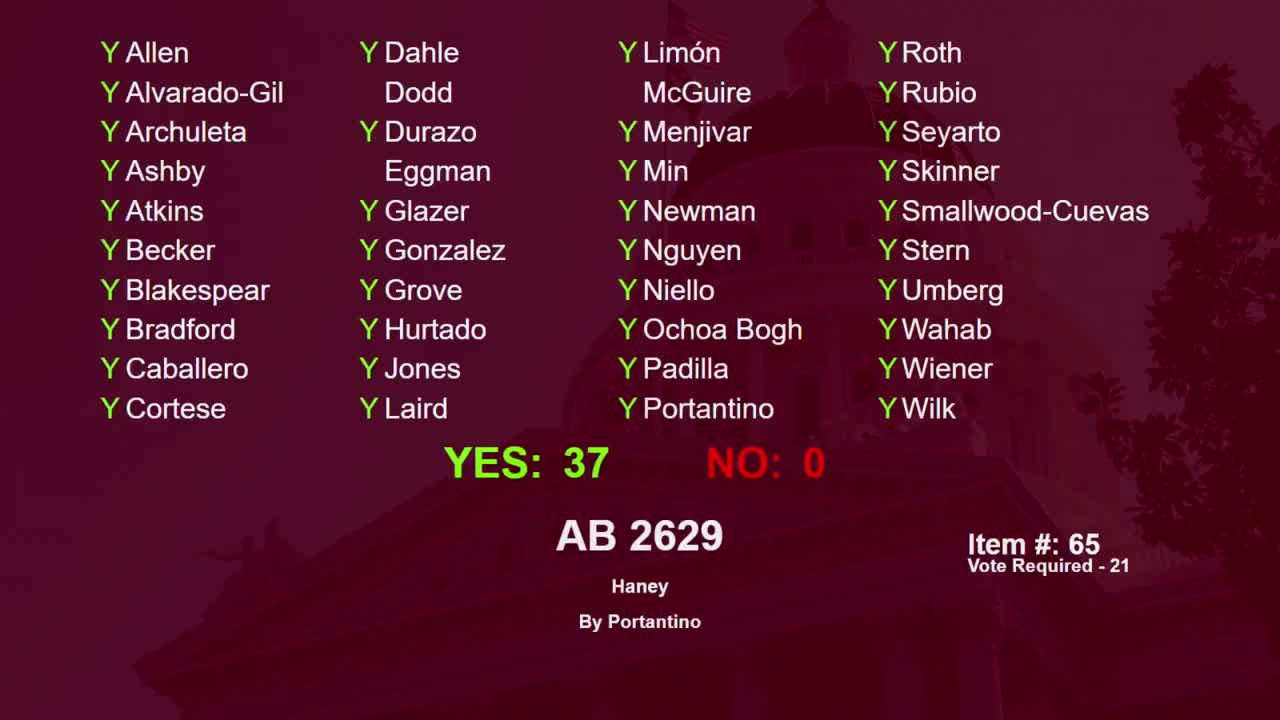 2MIN
Senate Floor
 43SEC
Assembly Floor
 8MIN
Senate Standing Committee on Public Safety
 1MIN
Assembly Floor
 14MIN
Assembly Standing Committee on Privacy and Consumer Protection
 33SEC
Assembly Standing Committee on Privacy and Consumer Protection
 17SEC
Assembly Standing Committee on Privacy and Consumer Protection
 7MIN
Assembly Standing Committee on Public Safety


Bill Co-Author(s):