AB 1843: Emergency ambulance employees.
- Session Year: 2023-2024
- House: Assembly
- Latest Version Date: 2024-09-29
Current Status:
Passed
(2024-09-29: Chaptered by Secretary of State - Chapter 943, Statutes of 2024.)
Introduced
In Committee
First Chamber
In Committee
Second Chamber
Enacted
Under the Emergency Ambulance Employee Safety and Preparedness Act, an initiative measure enacted by the voters as Proposition 11 at the November 6, 2018, statewide general election, every emergency ambulance employee is entitled to employer-paid mental health services through an employee assistance program (EAP), and requires the EAP coverage to provide up to 10 mental health treatments per issue per calendar year.
This bill would require an emergency ambulance provider, as defined, to offer to all emergency ambulance employees, upon the employees request, peer support services to provide peer representatives who are available to come to the aid of their fellow employees on a broad range of emotional or professional issues. The bill would require a peer support program to be implemented through a labor-management agreement negotiated separately from a collective bargaining agreement covering affected emergency ambulance employees. This bill would specify conditions under which prescribed confidential communications between an emergency ambulance employee and a peer support team member may be disclosed. The bill would specify that an emergency ambulance employee who provides peer support services as a member of a peer support team, and the ambulance agency that employs them, shall not be liable for damages unless an act, error, or omission in performing peer support services constitutes gross negligence or intentional misconduct, except for an action for medical malpractice.
Under the Emergency Ambulance Employee Safety and Preparedness Act, an initiative measure enacted by the voters as Proposition 11 at the November 6, 2018, statewide general election, every emergency ambulance employee is entitled to employer-paid mental health services through an employee assistance program (EAP), and requires the EAP coverage to provide up to 10 mental health treatments per issue per calendar year. The act defines issue for purposes of those provisions to mean mental health conditions such as, among other things, stress, depression, or substance abuse.
This bill would instead require an EAP to provide up to 20 mental health treatments per issue per calendar year, and would include post-traumatic stress disorder in the definition of issue for purposes of those provisions. The bill would require an EAP to make a good faith effort to ensure that a treatment provider under an EAP is trained and experienced in providing mental health services to first responders or emergency medical services personnel, as specified. The bill would also require an EAP to schedule an appointment with a mental health treatment provider within 48 hours, upon request of an emergency ambulance employee.This bill would require an emergency ambulance provider, as defined, to offer to all emergency ambulance employees, upon the employees request, peer support services to provide peer representatives who are available to come to the aid of their fellow employees on a broad range of emotional or professional issues. The bill would require a peer support program to be implemented through a labor-management agreement negotiated separately from a collective bargaining agreement covering affected emergency ambulance employees. This bill would specify conditions under which prescribed confidential communications between an emergency ambulance employee and a peer support team member may be disclosed. The bill would specify that an emergency ambulance employee who provides peer support services as a member of a peer support team, and the ambulance agency that employs them, shall not be liable for damages unless an act, error, or omission in performing peer support services constitutes gross negligence or intentional misconduct, except for an action for medical malpractice.
Existing law authorizes the act to be amended by a statute enacted by the Legislature with a 4/5 vote that furthers the purposes of the act.This bill would make legislative findings to that effect.Under the Emergency Ambulance Employee Safety and Preparedness Act, an initiative measure enacted by the voters as Proposition 11 at the November 6, 2018, statewide general election, every emergency ambulance employee is entitled to employer-paid mental health services through an employee assistance program (EAP), and requires the EAP coverage to provide up to 10 mental health treatments per issue per calendar year. The act defines issue for purposes of those provisions to mean mental health conditions such as, among other things, stress, depression, or substance abuse.
This bill would instead require an EAP to provide up to 20 mental health treatments per issue per calendar year, and would include post-traumatic stress disorder in the definition of issue for purposes of those provisions. The bill would require an EAP to make a good faith effort to ensure that a treatment provider under an EAP is trained and experienced in providing mental health services to first responders or emergency medical services personnel, as specified. The bill would also require an EAP to schedule an appointment with a mental health treatment provider within 48 hours, upon request of an emergency ambulance employee.
This bill would require an emergency ambulance provider provider, as defined, to offer to all emergency ambulance employees, upon the employees request, peer support services to provide peer representatives who are available to come to the aid of their fellow employees on a broad range of emotional or professional issues. The bill would require a peer support program to be implemented through a labor-management agreement negotiated separately from a collective bargaining agreement covering affected emergency ambulance employees. This bill would specify conditions under which prescribed confidential communications between an emergency ambulance employee and a peer support team member may be disclosed. The bill would specify that an emergency ambulance employee who provides peer support services as a member of a peer support team, and the ambulance agency that employs them, shall not be liable for damages unless an act, error, or omission in performing peer support services constitutes gross negligence or intentional misconduct, except for an action for medical malpractice.
Existing law authorizes the act to be amended by a statute enacted by the Legislature with a 4/5 vote that furthers the purposes of the act.
This bill would make legislative findings to that effect.
Under the Emergency Ambulance Employee Safety and Preparedness Act, an initiative measure enacted by the voters as Proposition 11 at the November 6, 2018, statewide general election, every emergency ambulance employee is entitled to employer-paid mental health services through an employee assistance program (EAP), and requires the EAP coverage to provide up to 10 mental health treatments per issue per calendar year. The act defines issue for purposes of those provisions to mean mental health conditions such as, among other things, stress, depression, or substance abuse.
This bill would instead require an EAP to provide up to 20 mental health treatments per issue per calendar year, and would include post-traumatic stress disorder in the definition of issue for purposes of those provisions. The bill would require an EAP to make a good faith effort to ensure that a treatment provider under an EAP is trained and experienced in providing mental health services to first responders or emergency medical services personnel, as specified. The bill would also require an EAP to schedule an appointment with a mental health treatment provider within 48 hours, upon request of an emergency ambulance employee.
This bill would require an emergency ambulance provider to offer to all emergency ambulance employees, upon the employees request, peer support services to provide peer representatives who are available to come to the aid of their fellow employees on a broad range of emotional or professional issues. The bill would require a peer support program to be implemented through a labor-management agreement negotiated separately from a collective bargaining agreement covering affected emergency ambulance employees. This bill would specify conditions under which prescribed confidential communications between an emergency ambulance employee and a peer support team member may be disclosed. The bill would specify that an emergency ambulance employee who provides peer support services as a member of a peer support team, and the ambulance agency that employs them, shall not be liable for damages unless an act, error, or omission in performing peer support services constitutes gross negligence or intentional misconduct, except for an action for medical malpractice.
Existing law authorizes the act to be amended by a statute enacted by the Legislature with a 4/5 vote that furthers the purposes of the act.
This bill would make legislative findings to that effect.
Under the Emergency Ambulance Employee Safety and Preparedness Act, an initiative measure enacted by the voters as Proposition 11 at the November 6, 2018, statewide general election, every emergency ambulance employee is entitled to employer-paid mental health services through an employee assistance program (EAP), and requires the EAP coverage to provide up to 10 mental health treatments per issue per calendar year. The act defines issue for purposes of those provisions to mean mental health conditions such as, among other things, stress, depression, or substance abuse.
This bill would instead require an EAP to provide up to 20 mental health treatments per issue per calendar year, and would include post-traumatic stress disorder in the definition of issue for purposes of those provisions. The bill would require an EAP to make a good faith effort to ensure that a treatment provider under an EAP to have a certification is trained and experienced in providing mental health services to first responders or emergency medical services personnel, as specified. The bill would also require an EAP to schedule an appointment with a mental health treatment provider within 48 hours, upon request of an emergency ambulance employee.
This bill would require an emergency ambulance provider to offer to all emergency ambulance employees, upon the employees request, peer support services to provide peer representatives who are available to come to the aid of their fellow employees on a broad range of emotional or professional issues. The bill would require a peer support program to be implemented through a labor-management agreement negotiated separately from a collective bargaining agreement covering affected emergency ambulance employees. This bill would specify conditions under which prescribed confidential communications between an emergency ambulance employee and a peer support team member may be disclosed. The bill would specify that an emergency ambulance employee who provides peer support services as a member of a peer support team, and the ambulance agency that employs them, shall not be liable for damages unless an act, error, or omission in performing peer support services constitutes gross negligence or intentional misconduct, except for an action for medical malpractice.
Existing law authorizes the act to be amended by a statute enacted by the Legislature with a 4/5 vote that furthers the purposes of the act.
This bill would make legislative findings to that effect.
Under the Emergency Ambulance Employee Safety and Preparedness Act, an initiative measure enacted by the voters as Proposition 11 at the November 6, 2018, statewide general election, every emergency ambulance employee is entitled to employer-paid mental health services through an employee assistance program (EAP), and requires the EAP coverage to provide up to 10 mental health treatments per issue per calendar year. The act defines issue for purposes of those provisions to mean mental health conditions such as, among other things, stress, depression, or substance abuse.
This bill would instead require an EAP to provide up to 20 mental health treatments per issue per calendar year, and would include post-traumatic stress disorder in the definition of issue for purposes of those provisions. The bill would require a treatment provider under an EAP to have a certification in providing mental health services to first responders or emergency medical services personnel, as specified. The bill would also require an EAP to schedule an appointment with a mental health treatment provider within 48 hours, upon request of an emergency ambulance employee.
This bill would require an emergency ambulance provider to offer to all emergency ambulance employees, upon the employees request, peer-to-peer peer support services to provide peer representatives who are available to come to the aid of their fellow employees on a broad range of emotional or professional issues. The bill would require a peer support program to be implemented through a labor-management agreement negotiated separately from a collective bargaining agreement covering affected emergency ambulance employees. This bill would specify conditions under which prescribed confidential communications between an emergency ambulance employee and a peer support team member may be disclosed. The bill would specify that an emergency ambulance employee who provides peer support services as a member of a peer support team, and the ambulance agency that employs them, shall not be liable for damages unless an act, error, or omission in performing peer support services constitutes gross negligence or intentional misconduct, except for an action for medical malpractice.
Existing law authorizes the act to be amended by a statute enacted by the Legislature with a 4/5 4/5 vote that furthers the purposes of the act.
This bill would make legislative findings to that effect.
Under the Emergency Ambulance Employee Safety and Preparedness Act, an initiative measure enacted by the voters as Proposition 11 at the November 6, 2018, statewide general election, every emergency ambulance employee is entitled to employer-paid mental health services through an employee assistance program (EAP), and requires the EAP coverage to provide up to 10 mental health treatments per issue per calendar year. The act defines issue for purposes of those provisions to mean mental health conditions such as, among other things, stress, depression, or substance abuse.
This bill would instead require the EAP program an EAP to provide up to 20 mental health treatments per issue per calendar year, and would include post-traumatic stress disorder in the definition of issue for purposes of those provisions. The bill would also require an EAP to schedule an appointment with a mental health treatment provider within 48 hours, upon request of an emergency ambulance employee.
This bill would require an emergency ambulance provider to offer to all emergency ambulance employees, upon the employees request, peer-to-peer services to provide peer representatives who are available to come to the aid of their fellow employees on a broad range of emotional or professional issues. The bill would require a peer support program to be implemented through a labor-management agreement negotiated separately from a collective bargaining agreement covering affected employees. This bill would specify conditions under which prescribed confidential communications between an emergency ambulance employee and a peer support team member may be disclosed. The bill would specify that an emergency ambulance employee who provides peer support services as a member of a peer support team, and the ambulance agency that employs them, shall not be liable for damages unless an act, error, or omission in performing peer support services constitutes gross negligence or intentional misconduct, except for an action for medical malpractice.
Existing law authorizes the act to be amended by a statute enacted by the Legislature with a 4/5 vote that furthers the purposes of the act.
This bill would make legislative findings to that effect.
Under the Emergency Ambulance Employee Safety and Preparedness Act, an initiative measure enacted by the voters as Proposition 11 at the November 6, 2018, statewide general election, every emergency ambulance employee is entitled to employer-paid mental health services through an employee assistance program (EAP), and requires the EAP coverage to provide up to 10 mental health treatments per issue per calendar year. The act defines issue for purposes of those provisions to mean mental health conditions such as, among other things, stress, depression, or substance abuse.
This bill would instead require the EAP program to provide up to 20 mental health treatments per issue per calendar year, and would include post-traumatic stress disorder in the definition of issue for purposes of those provisions.
Existing law authorizes the act to be amended by a statute enacted by the Legislature with a 4/5 vote that furthers the purposes of the act.
This bill would make legislative findings to that effect.
(a)An emergency ambulance provider shall offer to all emergency ambulance employees, upon the employees request, peer support services. The services shall provide peer representatives, reflective of the providers workforce both in job positions and personal experiences, who are available to come to the aid of their fellow employees on a broad range of emotional or professional issues. The emergency ambulance provider shall incorporate selection criteria for peer support team members into program policies.
(b)For purposes of this chapter, the following definitions apply:
(1)Confidential communication means any information, including, but not limited to, written or oral communication, transmitted between an emergency ambulance employee, a peer support team member, or a crisis hotline or crisis referral service staff member while the peer support team member provides peer support services or the crisis hotline or crisis referral service staff member provides crisis services and in confidence by a means that, as far as the emergency ambulance employee is aware, does not disclose the information to third parties other than those who are present to further the interests of the emergency ambulance employee in delivery of peer support services or those to whom disclosures are reasonably necessary for the transmission of the information or an accomplishment of the purposes for which the peer support team member is providing services. Confidential communication does not include a communication in which an emergency ambulance employee discloses the commission of a crime or a communication that reveals the emergency ambulance employees intent to defraud or deceive an investigation into a critical incident.
(2)Crisis referral services include all public or private organizations that provide consultation and treatment resources for personal problems, including mental health issues, chemical dependency, domestic violence, gambling, financial problems, and other personal crises. Neither crisis referral services nor crisis hotlines include services provided by an employee association, labor relations representative, or labor relations organization, or any entity owned or operated by an employee association, labor relations representative, or labor relations organization.
(3)Critical incident means an event or situation that involves crisis, disaster, trauma, or emergency.
(4)Critical incident stress means the acute or cumulative psychological stress or trauma that emergency ambulance personnel may experience in providing emergency services in response to a critical incident. The stress or trauma is an unusually strong emotional, cognitive, behavioral, or physical reaction that may interfere with normal functioning and could lead to post-traumatic stress injuries, including, but not limited to, one or more of the following:
(A)Physical and emotional illness.
(B)Failure of usual coping mechanisms.
(C)Loss of interest in the job or normal life activities.
(D)Personality changes.
(E)Loss of ability to function.
(F)Psychological disruption of personal life, including their relationship with a spouse, child, or friend.
(5)Emergency ambulance employee means a person who meets both of the following requirements:
(A)Is an emergency medical technician, dispatcher, paramedic, or other licensed or certified ambulance transport person who contributes to the delivery of ambulance services.
(B)Is employed by an emergency ambulance provider.
(6)Emergency ambulance provider means an employer that provides ambulance services, but not including the state, or any political subdivision thereof, in its capacity as the direct employer of a person meeting the description contained in subparagraph (A) of paragraph (5).
(A)Emergency ambulance provider does not include a provider that satisfies both of the following criteria:
(i)The provider operates emergency medical services aircraft.
(ii)The provider does not operate any ground ambulance services.
(B)For purposes of this paragraph, emergency medical services aircraft includes any aircraft utilized for the purpose of prehospital emergency patient response and transport as air service. These aircraft are specially constructed, modified, or equipped and used for the primary purposes of responding to emergency calls and transporting critically ill or injured patients whose medical flight crew has, at a minimum, two attendants certified or licensed in advanced life support.
(C)For purposes of this paragraph, ground ambulance services means the emergency, including advanced life support services, and nonemergency transportation of a person by an individual licensed pursuant to Article 1 (commencing with Section 2500) and Article 2 (commending with Section 2510) of Chapter 2.5 of Division 2 of the Vehicle Code and health care services are provided to a patient for the duration of the transportation.
(7)Peer support program means a program administered by the emergency ambulance provider to deliver peer support services to emergency ambulance employees consistent with this chapter.
(8)Peer support services means authorized peer support services provided by a peer support team member to emergency ambulance employees and their immediate families affected by a critical incident or the cumulative effect of witnessing multiple critical incidents. Peer support services assist those affected by a critical incident in coping with critical incident stress and mitigating reactions to critical incident stress, including reducing the risk of post-traumatic stress and other injuries. Peer support services may include any of the following:
(A)Precrisis education.
(B)Critical incident stress defusings.
(C)Critical incident stress debriefings.
(D)On-scene support services.
(E)One-on-one support services.
(F)Consultation.
(G)Referral services.
(H)Confidentiality obligations.
(I)The impact of toxic stress on health and well-being.
(J)Grief support.
(K)Substance abuse awareness and approaches.
(L)Active listening skills.
(M)Psychological first aid.
(9)Peer support team means a team or teams composed of emergency ambulance employees, hospital staff, clergy, and educators who have completed a peer support training course.
(10)Peer support team member means an emergency ambulance employee who has completed an approved peer support training course.
1799.301.(a)A peer support program shall be implemented through a labor-management agreement negotiated separately and apart from any collective bargaining agreement covering affected emergency ambulance employees. The labor-management agreement may cover topics, including any of the following:
(1)Program structure and administration.
(2)Selection and training of peer support team members.
(3)Peer support operations.
(4)Program evaluation, monitoring, and continuous improvement.
(5)Funding.
(6)Dispute resolution and program amendments.
(b)Sessions provided by a peer support program shall not count toward the total number of mental health treatments per issue required by Section 884 of the Labor Code.
1799.302.(a)In any civil, administrative, or arbitration proceeding, an emergency ambulance employee, whether or not a party to an action, has a right to refuse to disclose, and to prevent another from disclosing, a confidential communication between the emergency ambulance employee and a peer support team member made while the peer support team member was providing peer support services, or a confidential communication made to a crisis hotline or crisis referral service.
(b)Notwithstanding subdivision (a), a confidential communication described in subdivision (a) may be disclosed only under any of the following circumstances:
(1)The peer support team member reasonably must make an appropriate referral of the emergency ambulance employee to, or consult about the emergency ambulance employee with, another member of the peer support team or a peer support team clinician associated with the peer support team.
(2)The peer support team member, crisis hotline, or crisis referral service reasonably believes that disclosure is necessary to prevent death, substantial bodily harm, or commission of a crime.
(3)The peer support team member reasonably believes that disclosure is necessary pursuant to an obligation to report instances of child abuse, as required by Section 11166 of the Penal Code, or other obligation to disclose or report as a mandated reporter.
(4)The disclosure is made pursuant to a court order in a civil proceeding.
(5)In a criminal proceeding.
(6)If otherwise required by law.
(7)The emergency ambulance employee expressly agrees in writing that the confidential communication may be disclosed.
(c)Before an emergency ambulance employee participates in a peer support program, a peer support team member shall inform the emergency ambulance employee, in writing, of the confidentiality requirement described in subdivision (a) and the exceptions to that requirement described in subdivision (b).
1799.303.(a)Except as otherwise provided in subdivision (b), an emergency ambulance employee who provides peer support services as a member of a peer support team and who has received training, and the ambulance agency that employs them, shall not be liable for damages, including personal injury, wrongful death, property damage, or other loss related to an act, error, or omission in performing peer support services, unless the act, error, or omission constitutes gross negligence or intentional misconduct.
(b)Subdivision (a) does not apply to an action for medical malpractice.
(c)A person described in subdivision (a) shall not provide peer support services if, when serving in a peer support role, the individuals relationship with a peer support recipient could reasonably be expected to impair objectivity, competence, or effectiveness in providing peer support, or otherwise risk exploitation or harm to a peer support recipient.
(d)A person described in subdivision (a) providing peer support services shall not provide those services to a peer support recipient if the provider and recipient were both involved in the same specific traumatic incident, unless the incident is a large-scale incident.
(e)A person described in subdivision (a) providing peer support services shall not provide those services to a peer support recipient if the provider and recipient are both involved in the same active or ongoing investigation.
1799.304.To be eligible for the confidentiality protections afforded by this chapter, a peer support team member shall complete a training course or courses on peer support approved by the emergency ambulance provider that may include, but is not limited to, the following:
(a)Precrisis education.
(b)Critical incident stress defusings.
(c)Critical incident stress debriefings.
(d)On-scene support services.
(e)One-on-one support services.
(f)Consultation.
(g)Referral services.
(h)Confidentiality obligations.
(i)The impact of toxic stress on health and well-being.
(j)Grief support.
(k)Substance abuse awareness and approaches.
(l)Active listening skills.
(m)Stress management.
(n)Psychological first aid.
SEC. 2.Section 884 of the Labor Code is amended to read:884.Mental Health.(a)Every emergency ambulance employee shall receive employer-paid mental health and wellness education within 30 days of being hired and shall receive employer-paid mental health and wellness education each calendar year thereafter. Mental health and wellness education shall inform emergency ambulance employees of available mental health treatments and support services and provide general information regarding common mental health illnesses.(b)Every emergency ambulance employee shall be entitled to employer-paid mental health services through an employee assistance program (EAP). The EAP coverage shall provide up to 20 mental health treatments per issue, per calendar year.(1)The EAP shall schedule an appointment with a mental health treatment provider within 48 hours upon request of an emergency ambulance employee.(2)The EAP shall make a good faith effort to ensure that mental health treatment providers available under the EAP are trained and experienced in providing mental health services to first responders or emergency medical services personnel, including seeking out providers who hold relevant certifications related to addressing trauma associated with first responders.(c)Every emergency ambulance employee that qualifies for or is eligible to receive employer-provided health insurance shall have access to health insurance plans that offer long-term mental health treatment services.(d)The employer shall provide all workers compensation benefits, as set forth in Division 4 (commencing with Section 3200), to which the employee is entitled to receive, upon the filing of a workers compensation claim pursuant to Section 5401 by an emergency ambulance employee for a mental health illness, including, but not limited to, post-traumatic stress disorder. (e)For purposes of this section, issue means episodes of mental health conditions such as stress, depression, grief, loss, relationship struggles, substance abuse, post-traumatic stress disorder, parenting challenges, and other mental health conditions as described within the EAP.SEC. 3.The Legislature finds and declares that Sections 1 and 2 of this act, which amend Section 884 of the Labor Code, are consistent with, and further the purpose of, the Emergency Ambulance Employee Safety and Preparedness Act.(a)An emergency ambulance provider shall offer to all emergency ambulance employees, upon the employees request, peer support services. The services shall provide peer representatives, reflective of the providers workforce both in job positions and personal experiences, who are available to come to the aid of their fellow employees on a broad range of emotional or professional issues. The emergency ambulance provider shall incorporate selection criteria for peer support team members into program policies.
(b)For purposes of this chapter, the following definitions apply:
(1)Confidential communication means any information, including, but not limited to, written or oral communication, transmitted between an emergency ambulance employee, a peer support team member, or a crisis hotline or crisis referral service staff member while the peer support team member provides peer support services or the crisis hotline or crisis referral service staff member provides crisis services and in confidence by a means that, as far as the emergency ambulance employee is aware, does not disclose the information to third parties other than those who are present to further the interests of the emergency ambulance employee in delivery of peer support services or those to whom disclosures are reasonably necessary for the transmission of the information or an accomplishment of the purposes for which the peer support team member is providing services. Confidential communication does not include a communication in which an emergency ambulance employee discloses the commission of a crime or a communication that reveals the emergency ambulance employees intent to defraud or deceive an investigation into a critical incident.
(2)Crisis referral services include all public or private organizations that provide consultation and treatment resources for personal problems, including mental health issues, chemical dependency, domestic violence, gambling, financial problems, and other personal crises. Neither crisis referral services nor crisis hotlines include services provided by an employee association, labor relations representative, or labor relations organization, or any entity owned or operated by an employee association, labor relations representative, or labor relations organization.
(3)Critical incident means an event or situation that involves crisis, disaster, trauma, or emergency.
(4)Critical incident stress means the acute or cumulative psychological stress or trauma that emergency ambulance personnel may experience in providing emergency services in response to a critical incident. The stress or trauma is an unusually strong emotional, cognitive, behavioral, or physical reaction that may interfere with normal functioning and could lead to post-traumatic stress injuries, including, but not limited to, one or more of the following:
(A)Physical and emotional illness.
(B)Failure of usual coping mechanisms.
(C)Loss of interest in the job or normal life activities.
(D)Personality changes.
(E)Loss of ability to function.
(F)Psychological disruption of personal life, including their relationship with a spouse, child, or friend.
(5)Emergency ambulance employee means a person who meets both of the following requirements:
(A)Is an emergency medical technician, dispatcher, paramedic, or other licensed or certified ambulance transport person who contributes to the delivery of ambulance services.
(B)Is employed by an emergency ambulance provider.
(6)Emergency ambulance provider means an employer that provides ambulance services, but not including the state, or any political subdivision thereof, in its capacity as the direct employer of a person meeting the description contained in subparagraph (A) of paragraph (5).
(A)Emergency ambulance provider does not include a provider that satisfies both of the following criteria:
(i)The provider operates emergency medical services aircraft.
(ii)The provider does not operate any ground ambulance services.
(B)For purposes of this paragraph, emergency medical services aircraft includes any aircraft utilized for the purpose of prehospital emergency patient response and transport as air service. These aircraft are specially constructed, modified, or equipped and used for the primary purposes of responding to emergency calls and transporting critically ill or injured patients whose medical flight crew has, at a minimum, two attendants certified or licensed in advanced life support.
(C)For purposes of this paragraph, ground ambulance services means the emergency, including advanced life support services, and nonemergency transportation of a person by an individual licensed pursuant to Article 1 (commencing with Section 2500) and Article 2 (commending with Section 2510) of Chapter 2.5 of Division 2 of the Vehicle Code and health care services are provided to a patient for the duration of the transportation.
(7)Peer support program means a program administered by the emergency ambulance provider to deliver peer support services to emergency ambulance employees consistent with this chapter.
(8)Peer support services means authorized peer support services provided by a peer support team member to emergency ambulance employees and their immediate families affected by a critical incident or the cumulative effect of witnessing multiple critical incidents. Peer support services assist those affected by a critical incident in coping with critical incident stress and mitigating reactions to critical incident stress, including reducing the risk of post-traumatic stress and other injuries. Peer support services may include any of the following:
(A)Precrisis education.
(B)Critical incident stress defusings.
(C)Critical incident stress debriefings.
(D)On-scene support services.
(E)One-on-one support services.
(F)Consultation.
(G)Referral services.
(H)Confidentiality obligations.
(I)The impact of toxic stress on health and well-being.
(J)Grief support.
(K)Substance abuse awareness and approaches.
(L)Active listening skills.
(M)Psychological first aid.
(9)Peer support team means a team or teams composed of emergency ambulance employees, hospital staff, clergy, and educators who have completed a peer support training course.
(10)Peer support team member means an emergency ambulance employee who has completed an approved peer support training course.
1799.301.(a)A peer support program shall be implemented through a labor-management agreement negotiated separately and apart from any collective bargaining agreement covering affected emergency ambulance employees. The labor-management agreement may cover topics, including any of the following:
(1)Program structure and administration.
(2)Selection and training of peer support team members.
(3)Peer support operations.
(4)Program evaluation, monitoring, and continuous improvement.
(5)Funding.
(6)Dispute resolution and program amendments.
(b)Sessions provided by a peer support program shall not count toward the total number of mental health treatments per issue required by Section 884 of the Labor Code.
1799.302.(a)In any civil, administrative, or arbitration proceeding, an emergency ambulance employee, whether or not a party to an action, has a right to refuse to disclose, and to prevent another from disclosing, a confidential communication between the emergency ambulance employee and a peer support team member made while the peer support team member was providing peer support services, or a confidential communication made to a crisis hotline or crisis referral service.
(b)Notwithstanding subdivision (a), a confidential communication described in subdivision (a) may be disclosed only under any of the following circumstances:
(1)The peer support team member reasonably must make an appropriate referral of the emergency ambulance employee to, or consult about the emergency ambulance employee with, another member of the peer support team or a peer support team clinician associated with the peer support team.
(2)The peer support team member, crisis hotline, or crisis referral service reasonably believes that disclosure is necessary to prevent death, substantial bodily harm, or commission of a crime.
(3)The peer support team member reasonably believes that disclosure is necessary pursuant to an obligation to report instances of child abuse, as required by Section 11166 of the Penal Code, or other obligation to disclose or report as a mandated reporter.
(4)The disclosure is made pursuant to a court order in a civil proceeding.
(5)In a criminal proceeding.
(6)If otherwise required by law.
(7)The emergency ambulance employee expressly agrees in writing that the confidential communication may be disclosed.
(c)Before an emergency ambulance employee participates in a peer support program, a peer support team member shall inform the emergency ambulance employee, in writing, of the confidentiality requirement described in subdivision (a) and the exceptions to that requirement described in subdivision (b).
1799.303.(a)Except as otherwise provided in subdivision (b), an emergency ambulance employee who provides peer support services as a member of a peer support team and who has received training, and the ambulance agency that employs them, shall not be liable for damages, including personal injury, wrongful death, property damage, or other loss related to an act, error, or omission in performing peer support services, unless the act, error, or omission constitutes gross negligence or intentional misconduct.
(b)Subdivision (a) does not apply to an action for medical malpractice.
(c)A person described in subdivision (a) shall not provide peer support services if, when serving in a peer support role, the individuals relationship with a peer support recipient could reasonably be expected to impair objectivity, competence, or effectiveness in providing peer support, or otherwise risk exploitation or harm to a peer support recipient.
(d)A person described in subdivision (a) providing peer support services shall not provide those services to a peer support recipient if the provider and recipient were both involved in the same specific traumatic incident, unless the incident is a large-scale incident.
(e)A person described in subdivision (a) providing peer support services shall not provide those services to a peer support recipient if the provider and recipient are both involved in the same active or ongoing investigation.
1799.304.To be eligible for the confidentiality protections afforded by this chapter, a peer support team member shall complete a training course or courses on peer support approved by the emergency ambulance provider that may include, but is not limited to, the following:
(a)Precrisis education.
(b)Critical incident stress defusings.
(c)Critical incident stress debriefings.
(d)On-scene support services.
(e)One-on-one support services.
(f)Consultation.
(g)Referral services.
(h)Confidentiality obligations.
(i)The impact of toxic stress on health and well-being.
(j)Grief support.
(k)Substance abuse awareness and approaches.
(l)Active listening skills.
(m)Stress management.
(n)Psychological first aid.
SEC. 2.Section 884 of the Labor Code is amended to read:884.Mental Health.
(a)Every emergency ambulance employee shall receive employer-paid mental health and wellness education within 30 days of being hired and shall receive employer-paid mental health and wellness education each calendar year thereafter. Mental health and wellness education shall inform emergency ambulance employees of available mental health treatments and support services and provide general information regarding common mental health illnesses.
(b)Every emergency ambulance employee shall be entitled to employer-paid mental health services through an employee assistance program (EAP). The EAP coverage shall provide up to 20 mental health treatments per issue, per calendar year.
(1)The EAP shall schedule an appointment with a mental health treatment provider within 48 hours upon request of an emergency ambulance employee.
(2)The EAP shall make a good faith effort to ensure that mental health treatment providers available under the EAP are trained and experienced in providing mental health services to first responders or emergency medical services personnel, including seeking out providers who hold relevant certifications related to addressing trauma associated with first responders.
(c)Every emergency ambulance employee that qualifies for or is eligible to receive employer-provided health insurance shall have access to health insurance plans that offer long-term mental health treatment services.
(d)The employer shall provide all workers compensation benefits, as set forth in Division 4 (commencing with Section 3200), to which the employee is entitled to receive, upon the filing of a workers compensation claim pursuant to Section 5401 by an emergency ambulance employee for a mental health illness, including, but not limited to, post-traumatic stress disorder.
(e)For purposes of this section, issue means episodes of mental health conditions such as stress, depression, grief, loss, relationship struggles, substance abuse, post-traumatic stress disorder, parenting challenges, and other mental health conditions as described within the EAP.
SEC. 3.The Legislature finds and declares that Sections 1 and 2 of this act, which amend Section 884 of the Labor Code, are consistent with, and further the purpose of, the Emergency Ambulance Employee Safety and Preparedness Act.
(a)An emergency ambulance provider shall offer to all emergency ambulance employees, upon the employees request, peer support services. The services shall provide peer representatives, reflective of the providers workforce both in job positions and personal experiences, who are available to come to the aid of their fellow employees on a broad range of emotional or professional issues. The emergency ambulance provider shall incorporate selection criteria for peer support team members into program policies.
(b)For purposes of this chapter, the following definitions apply:
(1)Confidential communication means any information, including, but not limited to, written or oral communication, transmitted between an emergency ambulance employee, a peer support team member, or a crisis hotline or crisis referral service staff member while the peer support team member provides peer support services or the crisis hotline or crisis referral service staff member provides crisis services and in confidence by a means that, as far as the emergency ambulance employee is aware, does not disclose the information to third parties other than those who are present to further the interests of the emergency ambulance employee in delivery of peer support services or those to whom disclosures are reasonably necessary for the transmission of the information or an accomplishment of the purposes for which the peer support team member is providing services. Confidential communication does not include a communication in which an emergency ambulance employee discloses the commission of a crime or a communication that reveals the emergency ambulance employees intent to defraud or deceive an investigation into a critical incident.
(2)Crisis referral services include all public or private organizations that provide consultation and treatment resources for personal problems, including mental health issues, chemical dependency, domestic violence, gambling, financial problems, and other personal crises. Neither crisis referral services nor crisis hotlines include services provided by an employee association, labor relations representative, or labor relations organization, or any entity owned or operated by an employee association, labor relations representative, or labor relations organization.
(3)Critical incident means an event or situation that involves crisis, disaster, trauma, or emergency.
(4)Critical incident stress means the acute or cumulative psychological stress or trauma that emergency ambulance personnel may experience in providing emergency services in response to a critical incident. The stress or trauma is an unusually strong emotional, cognitive, behavioral, or physical reaction that may interfere with normal functioning and could lead to post-traumatic stress injuries, including, but not limited to, one or more of the following:
(A)Physical and emotional illness.
(B)Failure of usual coping mechanisms.
(C)Loss of interest in the job or normal life activities.
(D)Personality changes.
(E)Loss of ability to function.
(F)Psychological disruption of personal life, including their relationship with a spouse, child, or friend.
(5)Emergency ambulance employee means a person who meets both of the following requirements:
(A)Is an emergency medical technician, dispatcher, paramedic, or other licensed or certified ambulance transport person who contributes to the delivery of ambulance services.
(B)Is employed by an emergency ambulance provider.
(6)Emergency ambulance provider means an employer that provides ambulance services, but not including the state, or any political subdivision thereof, in its capacity as the direct employer of a person meeting the description contained in subparagraph (A) of paragraph (5).
(7)Peer support program means a program administered by the emergency ambulance provider to deliver peer support services to emergency ambulance employees consistent with this chapter.
(8)Peer support services means authorized peer support services provided by a peer support team member to emergency ambulance employees and their immediate families affected by a critical incident or the cumulative effect of witnessing multiple critical incidents. Peer support services assist those affected by a critical incident in coping with critical incident stress and mitigating reactions to critical incident stress, including reducing the risk of post-traumatic stress and other injuries. Peer support services may include any of the following:
(A)Precrisis education.
(B)Critical incident stress defusings.
(C)Critical incident stress debriefings.
(D)On-scene support services.
(E)One-on-one support services.
(F)Consultation.
(G)Referral services.
(H)Confidentiality obligations.
(I)The impact of toxic stress on health and well-being.
(J)Grief support.
(K)Substance abuse awareness and approaches.
(L)Active listening skills.
(M)Psychological first aid.
(9)Peer support team means a team or teams composed of emergency ambulance employees, hospital staff, clergy, and educators who have completed a peer support training course.
(10)Peer support team member means an emergency ambulance employee who has completed an approved peer support training course.
1799.301.(a)A peer support program shall be implemented through a labor-management agreement negotiated separately and apart from any collective bargaining agreement covering affected emergency ambulance employees. The labor-management agreement may cover topics, including any of the following:
(1)Program structure and administration.
(2)Selection and training of peer support team members.
(3)Peer support operations.
(4)Program evaluation, monitoring, and continuous improvement.
(5)Funding.
(6)Dispute resolution and program amendments.
(b)Sessions provided by a peer support program shall not count toward the total number of mental health treatments per issue required by Section 884 of the Labor Code.
1799.302.(a)In any civil, administrative, or arbitration proceeding, an emergency ambulance employee, whether or not a party to an action, has a right to refuse to disclose, and to prevent another from disclosing, a confidential communication between the emergency ambulance employee and a peer support team member made while the peer support team member was providing peer support services, or a confidential communication made to a crisis hotline or crisis referral service.
(b)Notwithstanding subdivision (a), a confidential communication described in subdivision (a) may be disclosed only under any of the following circumstances:
(1)The peer support team member reasonably must make an appropriate referral of the emergency ambulance employee to, or consult about the emergency ambulance employee with, another member of the peer support team or a peer support team clinician associated with the peer support team.
(2)The peer support team member, crisis hotline, or crisis referral service reasonably believes that disclosure is necessary to prevent death, substantial bodily harm, or commission of a crime.
(3)The peer support team member reasonably believes that disclosure is necessary pursuant to an obligation to report instances of child abuse, as required by Section 11166 of the Penal Code, or other obligation to disclose or report as a mandated reporter.
(4)The disclosure is made pursuant to a court order in a civil proceeding.
(5)In a criminal proceeding.
(6)If otherwise required by law.
(7)The emergency ambulance employee expressly agrees in writing that the confidential communication may be disclosed.
(c)If the communication is disclosed pursuant to paragraph (1), (2), (3), (4), (5), or (6) of subdivision (b), a peer support team member shall notify the emergency ambulance employee of the disclosure in writing.(c)Before an emergency ambulance employee participates in a peer support program, a peer support team member shall inform the emergency ambulance employee, in writing, of the confidentiality requirement described in subdivision (a) and the exceptions to that requirement described in subdivision (b).
1799.303.(a)Except as otherwise provided in subdivision (b), an emergency ambulance employee who provides peer support services as a member of a peer support team and who has received training, and the ambulance agency that employs them, shall not be liable for damages, including personal injury, wrongful death, property damage, or other loss related to an act, error, or omission in performing peer support services, unless the act, error, or omission constitutes gross negligence or intentional misconduct.
(b)Subdivision (a) does not apply to an action for medical malpractice.
(c)A person described in subdivision (a) shall not provide peer support services if, when serving in a peer support role, the individuals relationship with a peer support recipient could reasonably be expected to impair objectivity, competence, or effectiveness in providing peer support, or otherwise risk exploitation or harm to a peer support recipient.
(d)A person described in subdivision (a) providing peer support services shall not provide those services to a peer support recipient if the provider and recipient were both involved in the same specific traumatic incident, unless the incident is a large-scale incident.
(e)A person described in subdivision (a) providing peer support services shall not provide those services to a peer support recipient if the provider and recipient are both involved in the same active or ongoing investigation.
1799.304.To be eligible for the confidentiality protections afforded by this chapter, a peer support team member shall complete a training course or courses on peer support approved by the emergency ambulance provider that may include, but is not limited to, the following:
(a)Precrisis education.
(b)Critical incident stress defusings.
(c)Critical incident stress debriefings.
(d)On-scene support services.
(e)One-on-one support services.
(f)Consultation.
(g)Referral services.
(h)Confidentiality obligations.
(i)The impact of toxic stress on health and well-being.
(j)Grief support.
(k)Substance abuse awareness and approaches.
(l)Active listening skills.
(m)Stress management.
(n)Psychological first aid.
SEC. 2.Section 884 of the Labor Code is amended to read:884.Mental Health.
(a)Every emergency ambulance employee shall receive employer-paid mental health and wellness education within 30 days of being hired and shall receive employer-paid mental health and wellness education each calendar year thereafter. Mental health and wellness education shall inform emergency ambulance employees of available mental health treatments and support services and provide general information regarding common mental health illnesses.
(b)Every emergency ambulance employee shall be entitled to employer-paid mental health services through an employee assistance program (EAP). The EAP coverage shall provide up to 20 mental health treatments per issue, per calendar year.
(1)The EAP shall schedule an appointment with a mental health treatment provider within 48 hours upon request of an emergency ambulance employee.
(2)The EAP shall make a good faith effort to ensure that mental health treatment providers available under the EAP are trained and experienced in providing mental health services to first responders or emergency medical services personnel, including seeking out providers who hold relevant certifications related to addressing trauma associated with first responders.
(c)Every emergency ambulance employee that qualifies for or is eligible to receive employer-provided health insurance shall have access to health insurance plans that offer long-term mental health treatment services.
(d)The employer shall provide all workers compensation benefits, as set forth in Division 4 (commencing with Section 3200), to which the employee is entitled to receive, upon the filing of a workers compensation claim pursuant to Section 5401 by an emergency ambulance employee for a mental health illness, including, but not limited to, post-traumatic stress disorder.
(d)(e)For purposes of this section, issue means episodes of mental health conditions such as stress, depression, grief, loss, relationship struggles, substance abuse, post-traumatic stress disorder, parenting challenges, and other mental health conditions as described within the EAP.
SEC. 3.The Legislature finds and declares that Sections 1 and 2 of this act, which amend Section 884 of the Labor Code, are consistent with, and further the purpose of, the Emergency Ambulance Employee Safety and Preparedness Act.
(a)An emergency ambulance provider shall offer to all emergency ambulance employees, upon the employees request, peer support services. The services shall provide peer representatives, reflective of the providers workforce both in job positions and personal experiences, who are available to come to the aid of their fellow employees on a broad range of emotional or professional issues. The emergency ambulance provider shall incorporate selection criteria for peer support team members into program policies.
(b)For purposes of this chapter, the following definitions apply:
(1)Confidential communication means any information, including, but not limited to, written or oral communication, transmitted between an emergency ambulance employee, a peer support team member, or a crisis hotline or crisis referral service staff member while the peer support team member provides peer support services or the crisis hotline or crisis referral service staff member provides crisis services and in confidence by a means that, as far as the emergency ambulance employee is aware, does not disclose the information to third parties other than those who are present to further the interests of the emergency ambulance employee in delivery of peer support services or those to whom disclosures are reasonably necessary for the transmission of the information or an accomplishment of the purposes for which the peer support team member is providing services. Confidential communication does not include a communication in which an emergency ambulance employee discloses the commission of a crime or a communication that reveals the emergency ambulance employees intent to defraud or deceive an investigation into a critical incident.
(2)Crisis referral services include all public or private organizations that provide consultation and treatment resources for personal problems, including mental health issues, chemical dependency, domestic violence, gambling, financial problems, and other personal crises. Neither crisis referral services nor crisis hotlines include services provided by an employee association, labor relations representative, or labor relations organization, or any entity owned or operated by an employee association, labor relations representative, or labor relations organization.
(3)Critical incident means an event or situation that involves crisis, disaster, trauma, or emergency.
(4)Critical incident stress means the acute or cumulative psychological stress or trauma that emergency ambulance personnel may experience in providing emergency services in response to a critical incident. The stress or trauma is an unusually strong emotional, cognitive, behavioral, or physical reaction that may interfere with normal functioning and could lead to post-traumatic stress injuries, including, but not limited to, one or more of the following:
(A)Physical and emotional illness.
(B)Failure of usual coping mechanisms.
(C)Loss of interest in the job or normal life activities.
(D)Personality changes.
(E)Loss of ability to function.
(F)Psychological disruption of personal life, including their relationship with a spouse, child, or friend.
(5)Emergency ambulance employee means a person who meets both of the following requirements:
(A)Is an emergency medical technician, dispatcher, paramedic, or other licensed or certified ambulance transport person who contributes to the delivery of ambulance services.
(B)Is employed by an emergency ambulance provider.
(6)Emergency ambulance provider means an employer that provides ambulance services, but not including the state, or any political subdivision thereof, in its capacity as the direct employer of a person meeting the description contained in subparagraph (A) of paragraph (5).
(7)Peer support program means a program administered by the emergency ambulance provider to deliver peer support services to emergency ambulance employees consistent with this chapter.
(8)Peer support services means authorized peer support services provided by a peer support team member to emergency ambulance employees and their immediate families affected by a critical incident or the cumulative effect of witnessing multiple critical incidents. Peer support services assist those affected by a critical incident in coping with critical incident stress and mitigating reactions to critical incident stress, including reducing the risk of post-traumatic stress and other injuries. Peer support services may include any of the following:
(A)Precrisis education.
(B)Critical incident stress defusings.
(C)Critical incident stress debriefings.
(D)On-scene support services.
(E)One-on-one support services.
(F)Consultation.
(G)Referral services.
(H)Confidentiality obligations.
(I)The impact of toxic stress on health and well-being.
(J)Grief support.
(K)Substance abuse awareness and approaches.
(L)Active listening skills.
(M)Psychological first aid.
(9)Peer support team means a team or teams composed of emergency ambulance employees, hospital staff, clergy, and educators who have completed a peer support training course.
(10)Peer support team member means an emergency ambulance employee who has completed an approved peer support training course.
1799.301.(a)A peer support program shall be implemented through a labor-management agreement negotiated separately and apart from any collective bargaining agreement covering affected emergency ambulance employees. The labor-management agreement may cover topics, including any of the following:
(1)Program structure and administration.
(2)Selection and training of peer support team members.
(3)Peer support operations.
(4)Program evaluation, monitoring, and continuous improvement.
(5)Funding.
(6)Dispute resolution and program amendments.
(b)Sessions provided by a peer support program shall not count toward the total number of mental health treatments per issue required by Section 884 of the Labor Code.
1799.302.(a)In any civil, administrative, or arbitration proceeding, an emergency ambulance employee, whether or not a party to an action, has a right to refuse to disclose, and to prevent another from disclosing, a confidential communication between the emergency ambulance employee and a peer support team member made while the peer support team member was providing peer support services, or a confidential communication made to a crisis hotline or crisis referral service.
(b)Notwithstanding subdivision (a), a confidential communication described in subdivision (a) may be disclosed only under any of the following circumstances:
(1)The peer support team member reasonably must make an appropriate referral of the emergency ambulance employee to, or consult about the emergency ambulance employee with, another member of the peer support team or a peer support team clinician associated with the peer support team.
(2)The peer support team member, crisis hotline, or crisis referral service reasonably believes that disclosure is necessary to prevent death, substantial bodily harm, or commission of a crime.
(3)The peer support team member reasonably believes that disclosure is necessary pursuant to an obligation to report instances of child abuse, as required by Section 11166 of the Penal Code, or other obligation to disclose or report as a mandated reporter.
(4)The disclosure is made pursuant to a court order in a civil proceeding.
(5)In a criminal proceeding.
(6)If otherwise required by law.
(7)The emergency ambulance employee expressly agrees in writing that the confidential communication may be disclosed.
(c)If the communication is disclosed pursuant to paragraph (1), (2), (3), (4), (5), or (6) of subdivision (b), a peer support team member shall notify the emergency ambulance employee of the disclosure in writing.
1799.303.(a)Except as otherwise provided in subdivision (b), an emergency ambulance employee who provides peer support services as a member of a peer support team and who has received training, and the ambulance agency that employs them, shall not be liable for damages, including personal injury, wrongful death, property damage, or other loss related to an act, error, or omission in performing peer support services, unless the act, error, or omission constitutes gross negligence or intentional misconduct.
(b)Subdivision (a) does not apply to an action for medical malpractice.
(c)A person described in subdivision (a) shall not provide peer support services if, when serving in a peer support role, the individuals relationship with a peer support recipient could reasonably be expected to impair objectivity, competence, or effectiveness in providing peer support, or otherwise risk exploitation or harm to a peer support recipient.
(d)Whenever possible, a A person described in subdivision (a) providing peer support services should shall not provide those services to a peer support recipient if the provider and recipient were both involved in the same specific traumatic incident, unless the incident is a large-scale incident.
(e)A person described in subdivision (a) providing peer support services shall not provide those services to a peer support recipient if the provider and recipient are both involved in the same active or ongoing investigation.
1799.304.To be eligible for the confidentiality protections afforded by this chapter, a peer support team member shall complete a training course or courses on peer support approved by the emergency ambulance provider that may include, but is not limited to, the following:
(a)Precrisis education.
(b)Critical incident stress defusings.
(c)Critical incident stress debriefings.
(d)On-scene support services.
(e)One-on-one support services.
(f)Consultation.
(g)Referral services.
(h)Confidentiality obligations.
(i)The impact of toxic stress on health and well-being.
(j)Grief support.
(k)Substance abuse awareness and approaches.
(l)Active listening skills.
(m)Stress management.
(n)Psychological first aid.
SEC. 2.Section 884 of the Labor Code is amended to read:884.Mental Health.
(a)Every emergency ambulance employee shall receive employer-paid mental health and wellness education within 30 days of being hired and shall receive employer-paid mental health and wellness education each calendar year thereafter. Mental health and wellness education shall inform emergency ambulance employees of available mental health treatments and support services and provide general information regarding common mental health illnesses.
(b)Every emergency ambulance employee shall be entitled to employer-paid mental health services through an employee assistance program (EAP). The EAP coverage shall provide up to 20 mental health treatments per issue, per calendar year.
(1)The EAP shall schedule an appointment with a mental health treatment provider within 48 hours upon request of an emergency ambulance employee.
(2)The EAP shall make a good faith effort to ensure that mental health treatment providers available under the EAP are trained and experienced in providing mental health services to first responders or emergency medical services personnel, including seeking out providers who hold relevant certifications related to addressing trauma associated with first responders.
(c)Every emergency ambulance employee that qualifies for or is eligible to receive employer-provided health insurance shall have access to health insurance plans that offer long-term mental health treatment services.
(d)For purposes of this section, issue means episodes of mental health conditions such as stress, depression, grief, loss, relationship struggles, substance abuse, post-traumatic stress disorder, parenting challenges, and other mental health conditions as described within the EAP.
SEC. 3.The Legislature finds and declares that Sections 1 and 2 of this act, which amend Section 884 of the Labor Code, are consistent with, and further the purpose of, the Emergency Ambulance Employee Safety and Preparedness Act.
(a)An emergency ambulance provider shall offer to all emergency ambulance employees, upon the employees request, peer support services. The services shall provide peer representatives, reflective of the providers workforce both in job positions and personal experiences, who are available to come to the aid of their fellow employees on a broad range of emotional or professional issues. The emergency ambulance provider shall incorporate selection criteria for peer support team members into program policies.
(b)For purposes of this chapter, the following definitions apply:
(1)Confidential communication means any information, including, but not limited to, written or oral communication, transmitted between an emergency ambulance employee, a peer support team member, or a crisis hotline or crisis referral service staff member while the peer support team member provides peer support services or the crisis hotline or crisis referral service staff member provides crisis services and in confidence by a means that, as far as the emergency ambulance employee is aware, does not disclose the information to third parties other than those who are present to further the interests of the emergency ambulance employee in delivery of peer support services or those to whom disclosures are reasonably necessary for the transmission of the information or an accomplishment of the purposes for which the peer support team member is providing services.
(2)Crisis referral services include all public or private organizations that provide consultation and treatment resources for personal problems, including mental health issues, chemical dependency, domestic violence, gambling, financial problems, and other personal crises. Neither crisis referral services nor crisis hotlines include services provided by an employee association, labor relations representative, or labor relations organization, or any entity owned or operated by an employee association, labor relations representative, or labor relations organization.
(3)Critical incident means an event or situation that involves crisis, disaster, trauma, or emergency.
(4)Critical incident stress means the acute or cumulative psychological stress or trauma that emergency ambulance personnel may experience in providing emergency services in response to a critical incident. The stress or trauma is an unusually strong emotional, cognitive, behavioral, or physical reaction that may interfere with normal functioning and could lead to post-traumatic stress injuries, including, but not limited to, one or more of the following:
(A)Physical and emotional illness.
(B)Failure of usual coping mechanisms.
(C)Loss of interest in the job or normal life activities.
(D)Personality changes.
(E)Loss of ability to function.
(F)Psychological disruption of personal life, including their relationship with a spouse, child, or friend.
(5)Emergency ambulance employee means a person who meets both of the following requirements:
(A)Is an emergency medical technician, dispatcher, paramedic, or other licensed or certified ambulance transport person who contributes to the delivery of ambulance services.
(B)Is employed by an emergency ambulance provider.
(6)Emergency ambulance provider means an employer that provides ambulance services, but not including the state, or any political subdivision thereof, in its capacity as the direct employer of a person meeting the description contained in subparagraph (A) of paragraph (2). (5).
(7)Peer support program means a program administered by the emergency ambulance provider to deliver peer support services to emergency ambulance employees consistent with this chapter.
(8)Peer support services means authorized peer support services provided by a peer support team member to emergency ambulance employees and their immediate families affected by a critical incident or the cumulative effect of witnessing multiple critical incidents. Peer support services assist those affected by a critical incident in coping with critical incident stress and mitigating reactions to critical incident stress, including reducing the risk of post-traumatic stress and other injuries. Peer support services may include any of the following:
(A)Precrisis education.
(B)Critical incident stress defusings.
(C)Critical incident stress debriefings.
(D)On-scene support services.
(E)One-on-one support services.
(F)Consultation.
(G)Referral services.
(H)Confidentiality obligations.
(I)The impact of toxic stress on health and well-being.
(J)Grief support.
(K)Substance abuse awareness and approaches.
(L)Active listening skills.
(M)Psychological first aid.
(9)Peer support team means a team or teams composed of emergency ambulance employees, hospital staff, clergy, and educators who have completed a peer support training course.
(10)Peer support team member means an emergency ambulance employee who has completed an approved peer support training course.
1799.301.(a)A peer support program shall be implemented through a labor-management agreement negotiated separately and apart from any collective bargaining agreement covering affected emergency ambulance employees. The labor-management agreement may cover topics, including any of the following:
(1)Program structure and administration.
(2)Selection and training of peer support team members.
(3)Peer support operations.
(4)Program evaluation, monitoring, and continuous improvement.
(5)Funding.
(6)Dispute resolution and program amendments.
(b)Sessions provided by a peer support program shall not count toward the total number of mental health treatments per issue required by Section 884 of the Labor Code.
1799.302.(a)In any civil, administrative, or arbitration proceeding, an emergency ambulance employee, whether or not a party to an action, has a right to refuse to disclose, and to prevent another from disclosing, a confidential communication between the emergency ambulance employee and a peer support team member made while the peer support team member was providing peer support services, or a confidential communication made to a crisis hotline or crisis referral service.
(b)Notwithstanding subdivision (a), a confidential communication described in subdivision (a) may be disclosed only under any of the following circumstances:
(1)The peer support team member reasonably must make an appropriate referral of the emergency ambulance employee to, or consult about the emergency ambulance employee with, another member of the peer support team or a peer support team clinician associated with the peer support team.
(2)The peer support team member, crisis hotline, or crisis referral service reasonably believes that disclosure is necessary to prevent death, substantial bodily harm, or commission of a crime.
(3)The peer support team member reasonably believes that disclosure is necessary pursuant to an obligation to report instances of child abuse, as required by Section 11166 of the Penal Code, or other obligation to disclose or report as a mandated reporter.
(4)The disclosure is made pursuant to a court order in a civil proceeding.
(5)In a criminal proceeding.
(6)If otherwise required by law.
(7)The emergency ambulance employee expressly agrees in writing that the confidential communication may be disclosed.
(c)If the communication is disclosed pursuant to paragraph (1), (2), (3), (4), (5), or (6) of subdivision (b), a peer support team member shall notify the emergency ambulance employee of the disclosure in writing.
1799.303.(a)Except as otherwise provided in subdivision (b), an emergency ambulance employee who provides peer support services as a member of a peer support team and who has received training, and the ambulance agency that employs them, shall not be liable for damages, including personal injury, wrongful death, property damage, or other loss related to an act, error, or omission in performing peer support services, unless the act, error, or omission constitutes gross negligence or intentional misconduct.
(b)Subdivision (a) does not apply to an action for medical malpractice.
(c)A person described in subdivision (a) shall not provide peer support services if, when serving in a peer support role, the individuals relationship with a peer support recipient could reasonably be expected to impair objectivity, competence, or effectiveness in providing peer support, or otherwise risk exploitation or harm to a peer support recipient.
(d)Whenever possible, a person described in subdivision (a) providing peer support services should not provide those services to a peer support recipient if the provider and recipient were both involved in the same specific traumatic incident, unless the incident is a large-scale incident.
1799.304.To be eligible for the confidentiality protections afforded by this chapter, a peer support team member shall complete a training course or courses on peer support approved by the emergency ambulance provider that may include, but is not limited to, the following:
(a)Precrisis education.
(b)Critical incident stress defusings.
(c)Critical incident stress debriefings.
(d)On-scene support services.
(e)One-on-one support services.
(f)Consultation.
(g)Referral services.
(h)Confidentiality obligations.
(i)The impact of toxic stress on health and well-being.
(j)Grief support.
(k)Substance abuse awareness and approaches.
(l)Active listening skills.
(m)Stress management.
(n)Psychological first aid.
SEC. 2.Section 884 of the Labor Code is amended to read:884.Mental Health.
(a)Every emergency ambulance employee shall receive employer-paid mental health and wellness education within 30 days of being hired and shall receive employer-paid mental health and wellness education each calendar year thereafter. Mental health and wellness education shall inform emergency ambulance employees of available mental health treatments and support services and provide general information regarding common mental health illnesses.
(b)Every emergency ambulance employee shall be entitled to employer-paid mental health services through an employee assistance program (EAP). The EAP coverage shall provide up to 20 mental health treatments per issue, per calendar year.
(1)The EAP shall schedule an appointment with a mental health treatment provider within 48 hours upon request of an emergency ambulance employee.
(2)A provider of mental health treatment under the EAP shall have certifications that specialize or train The EAP shall make a good faith effort to ensure that mental health treatment providers available under the EAP are trained and experienced in providing mental health services to first responders or emergency medical services personnel. The certifications may include, but are not limited to, any of the following: personnel, including seeking out providers who hold relevant certifications related to addressing trauma associated with first responders.
(A)Certified First Responder, Counselor, Associate, or Supporter.(B)Emergency Responder and Public Safety Clinician.(C)First Responder Psychology.(D)Clinical First Responder Training.(E)Certified Clinical Trauma Professional or Specialist.(c)Every emergency ambulance employee that qualifies for or is eligible to receive employer-provided health insurance shall have access to health insurance plans that offer long-term mental health treatment services.
(d)For purposes of this section, issue means episodes of mental health conditions such as stress, depression, grief, loss, relationship struggles, substance abuse, post-traumatic stress disorder, parenting challenges, and other mental health conditions as described within the EAP.
SEC. 3.The Legislature finds and declares that Sections 1 and 2 of this act, which amend Section 884 of the Labor Code, is are consistent with, and furthers further the purpose of, the Emergency Ambulance Employee Safety and Preparedness Act.
(a)An emergency ambulance provider shall offer to all emergency ambulance employees, upon the employees request, peer-to-peer peer support services. The services shall provide peer representatives, reflective of the providers workforce both in job positions and personal experiences, who are available to come to the aid of their fellow employees on a broad range of emotional or professional issues. The emergency ambulance provider shall incorporate selection criteria for peer support team members into program policies.
(b)For purposes of this chapter, the following definitions apply:
(1)Confidential communication means any information, including, but not limited to, written or oral communication, transmitted between an emergency ambulance employee, a peer support team member, or a crisis hotline or crisis referral service staff member while the peer support team member provides peer support services or the crisis hotline or crisis referral service staff member provides crisis services and in confidence by a means that, as far as the emergency ambulance employee is aware, does not disclose the information to third persons parties other than those who are present to further the interests of the emergency ambulance employee in delivery of peer support services or those to whom disclosures are reasonably necessary for the transmission of the information or an accomplishment of the purposes for which the peer support team member is providing services.
(2)Crisis referral services include all public or private organizations that provide consultation and treatment resources for personal problems, including mental health issues, chemical dependency, domestic violence, gambling, financial problems, and other personal crises. Neither crisis referral services nor crisis hotlines include services provided by an employee association, labor relations representative, or labor relations organization, or any entity owned or operated by an employee association, labor relations representative, or labor relations organization.
(3)Critical incident means an event or situation that involves crisis, disaster, trauma, or emergency.
(4)Critical incident stress means the acute or cumulative psychological stress or trauma that emergency ambulance personnel may experience in providing emergency services in response to a critical incident. The stress or trauma is an unusually strong emotional, cognitive, behavioral, or physical reaction that may interfere with normal functioning and could lead to post-traumatic stress injuries, including, but not limited to, one or more of the following:
(A)Physical and emotional illness.
(B)Failure of usual coping mechanisms.
(C)Loss of interest in the job or normal life activities.
(D)Personality changes.
(E)Loss of ability to function.
(F)Psychological disruption of personal life, including their relationship with a spouse, child, or friend.
(2)(5)Emergency ambulance employee means a person who meets both of the following requirements:
(A)Is an emergency medical technician, dispatcher, paramedic, or other licensed or certified ambulance transport person who contributes to the delivery of ambulance services.
(B)Is employed by an emergency ambulance provider.
(3)(6)Emergency ambulance provider means an employer that provides ambulance services, but not including the state, or any political subdivision thereof, in its capacity as the direct employer of a person meeting the description contained in subparagraph (A) of paragraph (2).
(4)(7)Peer support program means a program administered by the emergency ambulance provider to deliver peer support services to emergency ambulance employees consistent with this chapter.
(5)(8)Peer support services means authorized peer support services provided by a peer support team member to emergency ambulance employees and their immediate families affected by a critical incident or the cumulative effect of witnessing multiple critical incidents. Peer support services assist those affected by a critical incident in coping with critical incident stress and mitigating reactions to critical incident stress, including reducing the risk of post-traumatic stress and other injuries. Peer support services may include any of the following:
(A)Precrisis education.
(B)Critical incident stress defusings.
(C)Critical incident stress debriefings.
(D)On-scene support services.
(E)One-on-one support services.
(F)Consultation.
(G)Referral services.
(H)Confidentiality obligations.
(I)The impact of toxic stress on health and well-being.
(J)Grief support.
(K)Substance abuse awareness and approaches.
(L)Active listening skills.
(M)Psychological first aid.
(6)(9)Peer support team means a team or teams composed of emergency ambulance employees, hospital staff, clergy, and educators who have completed a peer support training course.
(7)(10)Peer support team member means an emergency ambulance employee who has completed an approved peer support training course.
1799.301.(a)A peer support program shall be implemented through a labor-management agreement negotiated separately and apart from any collective bargaining agreement covering affected emergency ambulance employees. The labor-management agreement may cover topics, including any of the following:
(a)(1)Program structure and administration.
(b)(2)Selection and training of peer support team members.
(c)(3)Peer support operations.
(d)(4)Program evaluation, monitoring, and continuous improvement.
(e)(5)Funding.
(f)(6)Dispute resolution and program amendments.
(b)Sessions provided by a peer support program shall not count toward the total number of mental health treatments per issue required by Section 884 of the Labor Code.
1799.302.(a)In any civil, administrative, or arbitration proceeding, an emergency ambulance employee, whether or not a party to an action, has a right to refuse to disclose, and to prevent another from disclosing, a confidential communication between the emergency ambulance employee and a peer support team member made while the peer support team member was providing peer support services. services, or a confidential communication made to a crisis hotline or crisis referral service.
(b)Notwithstanding subdivision (a), a confidential communication described in subdivision (a) may be disclosed only under any of the following circumstances:
(1)The peer support team member reasonably must make an appropriate referral of the emergency ambulance employee to, or consult about the emergency ambulance employee with with, another member of the peer support team or a peer support team clinician associated with the peer support team.
(2)The peer support team member member, crisis hotline, or crisis referral service reasonably believes that disclosure is necessary to prevent death, substantial bodily harm, or commission of a crime.
(3)The peer support team member reasonably believes that disclosure is necessary pursuant to an obligation to report instances of child abuse, as required by Section 11166 of the Penal Code, or other obligation to disclose or report as a mandated reporter.
(4)The disclosure is made pursuant to a court order in a civil proceeding.
(5)In a criminal proceeding.
(6)If otherwise required by law.
(5)(7)The emergency ambulance employee expressly agrees in writing that the confidential communication may be disclosed.
(c)If the communication is disclosed pursuant to paragraph (1), (2), (3), or (4) (4), (5), or (6) of subdivision (b), a peer support team member shall notify the emergency ambulance employee of the disclosure in writing.
1799.303.(a)Except as otherwise provided in subdivision (b), an emergency ambulance employee who provides peer support services as a member of a peer support team and who has received training, and the ambulance agency that employs them, shall not be liable for damages, including personal injury, wrongful death, property damage, or other loss related to an act, error, or omission in performing peer support services, unless the act, error, or omission constitutes gross negligence or intentional misconduct.
(b)Subdivision (a) does not apply to an action for medical malpractice.
(c)A person described in subdivision (a) shall not provide peer support services if, when serving in a peer support role, the individuals relationship with a peer support recipient could reasonably be expected to impair objectivity, competence, or effectiveness in providing peer support, or otherwise risk exploitation or harm to a peer support recipient.
(d)Whenever possible, a person described in subdivision (a) providing peer support services should not provide those services to a peer support recipient if the provider and recipient were both involved in the same specific traumatic incident, unless the incident is a large-scale incident.
1799.304.An employee assistance program, as specified in section 884 of the Labor Code, shall schedule an appointment with a mental health treatment provider within 48 hours upon request of an emergency ambulance employee.1799.304.To be eligible for the confidentiality protections afforded by this chapter, a peer support team member shall complete a training course or courses on peer support approved by the emergency ambulance provider that may include, but is not limited to, the following:
(a)Precrisis education.
(b)Critical incident stress defusings.
(c)Critical incident stress debriefings.
(d)On-scene support services.
(e)One-on-one support services.
(f)Consultation.
(g)Referral services.
(h)Confidentiality obligations.
(i)The impact of toxic stress on health and well-being.
(j)Grief support.
(k)Substance abuse awareness and approaches.
(l)Active listening skills.
(m)Stress management.
(n)Psychological first aid.
SEC. 2.Section 884 of the Labor Code is amended to read:884.Mental Health.
(a)Every emergency ambulance employee shall receive employer-paid mental health and wellness education within 30 days of being hired and shall receive employer-paid mental health and wellness education each calendar year thereafter. Mental health and wellness education shall inform emergency ambulance employees of available mental health treatments and support services and provide general information regarding common mental health illnesses.
(b)Every emergency ambulance employee shall be entitled to employer-paid mental health services through an employee assistance program (EAP). The EAP coverage shall provide up to 20 mental health treatments per issue, per calendar year.
(1)The EAP shall schedule an appointment with a mental health treatment provider within 48 hours upon request of an emergency ambulance employee.
(2)A provider of mental health treatment under the EAP shall have certifications that specialize or train in providing mental health services to first responders or emergency medical services personnel. The certifications may include, but are not limited to, any of the following:
(A)Certified First Responder, Counselor, Associate, or Supporter.
(B)Emergency Responder and Public Safety Clinician.
(C)First Responder Psychology.
(D)Clinical First Responder Training.
(E)Certified Clinical Trauma Professional or Specialist.
(c)Every emergency ambulance employee that qualifies for or is eligible to receive employer-provided health insurance shall have access to health insurance plans that offer long-term mental health treatment services.
(d)For purposes of this section, issue means episodes of mental health conditions such as stress, depression, grief, loss, relationship struggles, substance abuse, post-traumatic stress disorder, parenting challenges, and other mental health conditions as described within the EAP.
SEC. 3.The Legislature finds and declares that Sections 1 and 2 of this act, which amend Section 884 of the Labor Code, is consistent with, and furthers the purpose of, the Emergency Ambulance Employee Safety and Preparedness Act.
(a)An emergency ambulance provider shall offer to all emergency ambulance employees, upon the employees request, peer-to-peer services. The services shall provide peer representatives, reflective of the providers workforce both in job positions and personal experiences, who are available to come to the aid of their fellow employees on a broad range of emotional or professional issues.
(b)For purposes of this chapter, the following definitions apply:
(1)Confidential communication means any information, including, but not limited to, written or oral communication, transmitted between an emergency ambulance employee, a peer support team member, and in confidence by a means that, as far as the emergency ambulance employee is aware, does not disclose the information to third persons other than those who are present to further the interests of the emergency ambulance employee or those to whom disclosures are reasonably necessary for the transmission of the information or an accomplishment of the purposes for which the peer support team member is providing services.
(2)Emergency ambulance employee means a person who meets both of the following requirements:
(A)Is an emergency medical technician, dispatcher, paramedic, or other licensed or certified ambulance transport person who contributes to the delivery of ambulance services.
(B)Is employed by an emergency ambulance provider.
(3)Emergency ambulance provider means an employer that provides ambulance services, but not including the state, or any political subdivision thereof, in its capacity as the direct employer of a person meeting the description contained in subparagraph (A) of paragraph (2).
(4)Peer support program means a program administered by the emergency ambulance provider to deliver peer support services to emergency ambulance employees consistent with this chapter.
(5)Peer support services means authorized peer support services provided by a peer support team member to emergency ambulance employees and their immediate families affected by a critical incident or the cumulative effect of witnessing multiple critical incidents. Peer support services assist those affected by a critical incident in coping with critical incident stress and mitigating reactions to critical incident stress, including reducing the risk of post-traumatic stress and other injuries. Peer support services may include any of the following:
(A)Precrisis education.
(B)Critical incident stress defusings.
(C)Critical incident stress debriefings.
(D)On-scene support services.
(E)One-on-one support services.
(F)Consultation.
(G)Referral services.
(H)Confidentiality obligations.
(I)The impact of toxic stress on health and well-being.
(J)Grief support.
(K)Substance abuse awareness and approaches.
(L)Active listening skills.
(M)Psychological first aid.
(6)Peer support team means a team or teams composed of emergency ambulance employees, hospital staff, clergy, and educators who have completed a peer support training course.
(7)Peer support team member means an emergency ambulance employee who has completed an approved peer support training course.
1799.301.A peer support program shall be implemented through a labor-management agreement negotiated separately and apart from any collective bargaining agreement covering affected employees. The labor-management agreement may cover topics, including any of the following:
(a)Program structure and administration.
(b)Selection and training of peer support team members.
(c)Peer support operations.
(d)Program evaluation, monitoring, and continuous improvement.
(e)Funding.
(f)Dispute resolution and program amendments.
1799.302.(a)In any civil, administrative, or arbitration proceeding, an emergency ambulance employee, whether or not a party to an action, has a right to refuse to disclose, and to prevent another from disclosing, a confidential communication between the emergency ambulance employee and a peer support team member made while the peer support team member was providing peer support services.
(b)Notwithstanding subdivision (a), a confidential communication described in subdivision (a) may be disclosed only under any of the following circumstances:
(1)The peer support team member reasonably must make an appropriate referral of the emergency ambulance employee or consult about the emergency ambulance employee with another member of the peer support team or a peer support team clinician associated with the peer support team.
(2)The peer support team member reasonably believes that disclosure is necessary to prevent death, substantial bodily harm, or commission of a crime.
(3)The peer support team member reasonably believes that disclosure is necessary pursuant to an obligation to report instances of child abuse, as required by Section 11166 of the Penal Code, or other obligation to disclose or report as a mandated reporter.
(4)The disclosure is made pursuant to a court order in a civil proceeding.
(5)The emergency ambulance employee expressly agrees in writing that the confidential communication may be disclosed.
(c)If the communication is disclosed pursuant to paragraph (1), (2), (3), or (4) of subdivision (b), a peer support team member shall notify the emergency ambulance employee of the disclosure in writing.
1799.303.(a)Except as otherwise provided in subdivision (b), an emergency ambulance employee who provides peer support services as a member of a peer support team and who has received training, and the ambulance agency that employs them, shall not be liable for damages, including personal injury, wrongful death, property damage, or other loss related to an act, error, or omission in performing peer support services, unless the act, error, or omission constitutes gross negligence or intentional misconduct.
(b)Subdivision (a) does not apply to an action for medical malpractice.
(c)A person described in subdivision (a) shall not provide peer support services if, when serving in a peer support role, the individuals relationship with a peer support recipient could reasonably be expected to impair objectivity, competence, or effectiveness in providing peer support, or otherwise risk exploitation or harm to a peer support recipient.
(d)Whenever possible, a person described in subdivision (a) providing peer support services should not provide those services to a peer support recipient if the provider and recipient were both involved in the same specific traumatic incident, unless the incident is a large-scale incident.
1799.304.An employee assistance program, as specified in section 884 of the Labor Code, shall schedule an appointment with a mental health treatment provider within 48 hours upon request of an emergency ambulance employee.
SECTION 1.SEC. 2.Section 884 of the Labor Code is amended to read:884.Mental Health.
(a)Every emergency ambulance employee shall receive employer-paid mental health and wellness education within 30 days of being hired and shall receive employer-paid mental health and wellness education each calendar year thereafter. Mental health and wellness education shall inform emergency ambulance employees of available mental health treatments and support services and provide general information regarding common mental health illnesses.
(b)Every emergency ambulance employee shall be entitled to employer-paid mental health services through an employee assistance program (EAP). The EAP coverage shall provide up to 20 mental health treatments per issue, per calendar year.
(c)Every emergency ambulance employee that qualifies for or is eligible to receive employer-provided health insurance shall have access to health insurance plans that offer long-term mental health treatment services.
(d)For purposes of this section, issue means episodes of mental health conditions such as stress, depression, grief, loss, relationship struggles, substance abuse, post-traumatic stress disorder, parenting challenges, and other mental health conditions as described within the EAP.
SEC. 2.SEC. 3.The Legislature finds and declares that Section 1 Sections 1 and 2 of this act, which amends amend Section 884 of the Labor Code, is consistent with, and furthers the purpose of, the Emergency Ambulance Employee Safety and Preparedness Act.
Mental Health.
(a)Every emergency ambulance employee shall receive employer-paid mental health and wellness education within 30 days of being hired and shall receive employer-paid mental health and wellness education each calendar year thereafter. Mental health and wellness education shall inform emergency ambulance employees of available mental health treatments and support services and provide general information regarding common mental health illnesses.
(b)Every emergency ambulance employee shall be entitled to employer-paid mental health services through an employee assistance program (EAP). The EAP coverage shall provide up to 10 20 mental health treatments per issue, per calendar year.
(c)Every emergency ambulance employee that qualifies for or is eligible to receive employer-provided health insurance shall have access to health insurance plans that offer long-term mental health treatment services.
(d)For purposes of this section, issue means episodes of mental health conditions such as stress, depression, grief, loss, relationship struggles, substance abuse, post-traumatic stress disorder, parenting challenges, and other mental health conditions as described within the EAP.
SEC. 2.The Legislature finds and declares that Section 1 of this act, which amends Section 884 of the Labor Code, is consistent with, and furthers the purpose of, the Emergency Ambulance Employee Safety and Preparedness Act.
|
Date
|
Status
|
|---|---|
| Sep 29, 2024 | Chaptered by Secretary of State - Chapter 943, Statutes of 2024. |
| Sep 29, 2024 | Approved by the Governor. |
| Sep 12, 2024 | Enrolled and presented to the Governor at 4 p.m. |
| Aug 31, 2024 | Senate amendments concurred in. To Engrossing and Enrolling. (Ayes 74. Noes 0.). |
| Aug 31, 2024 | In Assembly. Concurrence in Senate amendments pending. |
| Aug 31, 2024 | Read third time. Passed. Ordered to the Assembly. (Ayes 39. Noes 0.). |
| Aug 29, 2024 | Read second time. Ordered to third reading. |
| Aug 28, 2024 | Read third time and amended. Ordered to second reading. |
| Aug 28, 2024 | Joint Rule 61 suspended. |
| Aug 27, 2024 | Reconsideration granted. (Ayes 40. Noes 0.) |
| Aug 27, 2024 | Read third time. Passed. Ordered to the Assembly. (Ayes 40. Noes 0.). |
| Aug 26, 2024 | Read second time. Ordered to third reading. |
| Aug 23, 2024 | Read third time and amended. Ordered to second reading. |
| Aug 20, 2024 | Read second time. Ordered to third reading. |
| Aug 19, 2024 | Read third time and amended. Ordered to second reading. |
| Aug 6, 2024 | Read second time. Ordered to third reading. |
| Aug 5, 2024 | From committee: Be ordered to second reading pursuant to Senate Rule 28.8. |
| Jun 27, 2024 | Read second time and amended. Re-referred to Com. on APPR. |
| Jun 26, 2024 | From committee: Amend, and do pass as amended and re-refer to Com. on APPR. (Ayes 11. Noes 0.) (June 25). |
| Jun 24, 2024 | Read second time and amended. Re-referred to Com. on JUD. |
| Jun 20, 2024 | From committee: Amend, and do pass as amended and re-refer to Com. on JUD. (Ayes 11. Noes 0.) (June 19). |
| Jun 5, 2024 | Referred to Coms. on HEALTH and JUD. |
| May 24, 2024 | In Senate. Read first time. To Com. on RLS. for assignment. |
| May 23, 2024 | Read third time. Passed. Ordered to the Senate. (Ayes 69. Noes 0. Page 5612.) |
| May 16, 2024 | Read third time and amended. Ordered to third reading. |
| Apr 25, 2024 | Read second time. Ordered to third reading. |
| Apr 24, 2024 | From committee: Do pass. (Ayes 13. Noes 0.) (April 24). |
| Mar 14, 2024 | From committee: Do pass and re-refer to Com. on APPR. (Ayes 7. Noes 0.) (March 13). Re-referred to Com. on APPR. |
| Mar 7, 2024 | Re-referred to Com. on L. & E. |
| Mar 6, 2024 | From committee chair, with author's amendments: Amend, and re-refer to Com. on L. & E. Read second time and amended. |
| Jan 29, 2024 | Referred to Com. on L. & E. |
| Jan 17, 2024 | From printer. May be heard in committee February 16. |
| Jan 16, 2024 | Read first time. To print. |
|
Date
|
Description
|
Location
|
Votes
|
|
|---|---|---|---|---|
| Aug 31, 2024 | AB 1843 Rodriguez Concurrence in Senate Amendments | Assembly Floor |
Passed |
|
| Aug 31, 2024 | Assembly 3rd Reading AB1843 Rodriguez et al. By Seyarto | Senate Floor |
Passed |
|
| Aug 27, 2024 | Assembly 3rd Reading AB1843 Rodriguez et al. By Seyarto Reconsider | Senate Floor |
Passed |
|
| Aug 27, 2024 | Assembly 3rd Reading AB1843 Rodriguez et al. By Seyarto Motion to Reconsider Reconsider | Senate Floor |
Passed |
|
| Aug 27, 2024 | Assembly 3rd Reading AB1843 Rodriguez et al. By Seyarto | Senate Floor |
Passed |
|
| Aug 27, 2024 | Assembly 3rd Reading AB1843 Rodriguez et al. By Seyarto Motion to Reconsider | Senate Floor |
Passed |
|
| Jun 25, 2024 | Do pass as amended, but first amend, and re-refer to the Committee on [Appropriations] | Senate Standing Committee on Judiciary |
Passed |
|
| Jun 19, 2024 | Do pass as amended, but first amend, and re-refer to the Committee on [Judiciary] | Senate Standing Committee on Health |
Passed |
|
| May 23, 2024 | AB 1843 Rodriguez Assembly Third Reading | Assembly Floor |
Passed |
|
| Apr 24, 2024 | Do pass. | Assembly Standing Committee on Appropriations |
Passed |
|
| Mar 13, 2024 | Do pass and be re-referred to the Committee on [Appropriations] | Assembly Standing Committee on Labor and Employment |
Passed |
This list shows positions taken on this bill by organizations on the date displayed, which is linked to the original source.
Positions by individuals are not included.
|
Organization
|
Position
|
Date
|
|---|---|---|
| 911 AMBULANCE PROVIDERS MEDI-CAL ALLIANCE | ** Against | |
| Ambulance Providers Medical Alliance | * Against | Mar 13, 2024 |
| American Federation of State, County, and Municipal Employees | ** Support | |
| American Medical Response | ** Against | |
| California Conference Of Machinists | ** Support | |
| California Correctional Peace Officers Association Benefit Trust | ** Support | |
| California Professional Firefighters | ** Support | |
| International Association of EMTs and Paramedics | ** Support | |
| The International Association of EMTs and Paramedics | * Support | Mar 13, 2024 |
| United EMS Workers Local 4911 | * Support | Jun 19, 2024 |
| United Steelworkers District 12 | ** Support | |
| United Still Workers District 12 | * Support | Mar 13, 2024 |
| USW Local 1853 | * Support | Mar 13, 2024 |
| USW/TEMSA Local 12911 | * Support | Mar 13, 2024 |
CONCURRENCE IN SENATE AMENDMENTS
CSA1 Bill Id:AB 1843
Author:(Rodriguez)
As Amended Ver:August 28, 2024
Majority vote
SUMMARY
Requires the provision of peer support services upon an emergency ambulance employee's request.
Senate Amendments
- Exclude from the definition of "confidential communication" for the purposes of the provision of peer support services a communication in which an emergency ambulance employee discloses the commission of a crime or a communication that reveals the employee's intent to defraud or deceive an investigation into a critical incident.
- Clarify that before an emergency ambulance employee participates in a peer support program, a peer support team member shall inform the employee, in writing, of the confidentiality requirement and its exceptions.
- Prohibit an emergency ambulance employee who provides peer support services from providing those services to a peer support recipient if the provider and the recipient are both involved in the same active or ongoing investigation.
- Exclude from the definition of "emergency ambulance provider" a provider that solely operates emergency medical services aircrafts and does not operate any ground ambulance services.
- Make clarifying changes.
- Delete provisions related to employee assistance program (EAP) coverage.
COMMENTS
The mental health challenges of working in emergency medical care are documented in a number of studies. Paramedics and emergency medical technicians (EMTs) suffer disproportionately than other occupations from post-traumatic stress disorder, depression and suicidal ideation.[1] In addition, a 2017 report by the UC Berkeley and UCLA Labor Centers found that the emergency medical care workforce faces stagnating low wages, long shifts, and high turnover rates- all in an occupation that is inherently dangerous with high rates of mortality, injury, and mental and physical trauma.[2]
According to the Author
Note: The author's statement does not reflect recent amendments to the bill
"With over 35 years working in emergency medical services (EMS), I know firsthand the difficulties of being a first responder and encountering traumatic incidents almost daily. We constantly see death and are on the front lines of treating severe injuries and life-threatening conditions. Additionally, our irregular hours, constant exposure to critical incidents, and low wages leave EMS employees vulnerable to mental illnesses.
To address these problems, Proposition 11 (2018) entitled private ambulance employees access to employee assistance programs (EAP). However, employees have either encountered obstacles when attempting to utilize these programs or found them inadequate altogether. AB 1843 would address these challenges and require additional mental and emotional support programs for private ambulance employees. With this bill, our first responders can focus on recovering and ensuring that Californians get the immediate care they need."
The author further states, "Studies have indicated that underserved and marginalized communities may be at higher risk of developing PTSD. One study found that the "lifetime prevalence of PTSD was highest among Blacks (8.7%), intermediate among Hispanics and Whites (7.0% and 7.4%) and lowest among Asians (4.0%). The National Center for PTSD also examined multiple studies that found disparities in not only the prevalence of PTSD but also awareness of the need for treatment, accessibility, and the quality of treatment.
Research has also shown that the Emergency Medical Services (EMS) industry is insufficiently diverse and that "attrition among women and nonwhite may be higher than among men and White personnel" due to a number of factors, which include occupational safety and workplace experiences. One study found that women EMTs and paramedics in the Appalachian region reported higher mean scores for PTSD symptoms than men.
By increasing the EAP amount, underserved and marginalized communities would have more sessions to be able to treat their PTSD and improve the disparity in attrition rates in EMS."
Arguments in Support
The International Association of EMTs and Paramedics, co-sponsor of the bill, states, "AB 1843 is a vital step forward in ensuring us first responders are properly supported during our crucial, life-saving work. We believe that this bill would provide critical mental health treatment, advice, and resources to all the men and women who provide health and safety to our communities.
The job of an EMS professional is to provide care for residents in the face of danger, tragedy, adversity, uncertainty, and nearly every other moment of need. We put our lives on the line to serve others; the state of California owes it to us to ensure that we have the necessary mental health resources to stay as safe and healthy as possible in our line of duty."
Arguments in Opposition
No relevant arguments in opposition due to recent amendments.
FISCAL COMMENTS
According to the Senate Appropriations Committee pursuant to Senate Rule 28.8 negligible costs.
VOTES:
ASM LABOR AND EMPLOYMENT: 7-0-0
YES: Ortega, Flora, Alanis, Wendy Carrillo, Lee, Ward, Zbur
ASM APPROPRIATIONS: 13-0-2
YES: Wicks, Sanchez, Arambula, Bryan, Calderon, Wendy Carrillo, Mike Fong, Grayson, Haney, Hart, Pellerin, Ta, Villapudua
ABS, ABST OR NV: Dixon, Jim Patterson
ASSEMBLY FLOOR: 69-0-11
YES: Addis, Aguiar-Curry, Alanis, Alvarez, Arambula, Bains, Bauer-Kahan, Bennett, Berman, Boerner, Bonta, Bryan, Calderon, Juan Carrillo, Wendy Carrillo, Connolly, Davies, Flora, Mike Fong, Friedman, Gabriel, Garcia, Gipson, Grayson, Haney, Hart, Hoover, Irwin, Jackson, Jones-Sawyer, Kalra, Lackey, Lee, Low, Lowenthal, Maienschein, McCarty, McKinnor, Muratsuchi, Stephanie Nguyen, Ortega, Pacheco, Papan, Jim Patterson, Joe Patterson, Pellerin, Petrie-Norris, Quirk-Silva, Ramos, Rendon, Reyes, Rodriguez, Sanchez, Santiago, Schiavo, Soria, Ta, Ting, Valencia, Villapudua, Waldron, Wallis, Ward, Weber, Wicks, Wilson, Wood, Zbur, Robert Rivas
ABS, ABST OR NV: Cervantes, Chen, Megan Dahle, Dixon, Essayli, Vince Fong, Gallagher, Holden, Mathis, Luz Rivas, Blanca Rubio
SENATE FLOOR: 40-0-0
YES: Allen, Alvarado-Gil, Archuleta, Ashby, Atkins, Becker, Blakespear, Bradford, Caballero, Cortese, Dahle, Dodd, Durazo, Eggman, Glazer, Gonzalez, Grove, Hurtado, Jones, Laird, Limón, McGuire, Menjivar, Min, Newman, Nguyen, Niello, Ochoa Bogh, Padilla, Portantino, Roth, Rubio, Seyarto, Skinner, Smallwood-Cuevas, Stern, Umberg, Wahab, Wiener, Wilk
UPDATED
VERSION: August 28, 2024
CONSULTANT: Megan Lane / L. & E. / (916) 319-2091 FN: 0004626
FN:
Petrie, Katherine et al. "Prevalence of PTSD and common mental disorders amongst ambulance personnel: a systematic review and meta-analysis." Social Psychiatry and Psychiatric Epidemiology vol. 53, 9 (2018): 897-909. ↑
Jacobs, Ken, et al. UC Berkeley, UCLA, 2017, Emergency Medical Services in California: Wages, Working Conditions, and Industry Profile, https://laborcenter.berkeley.edu/emergency-medical-services-in-california-wages-working-conditions-and-industry-profile/. ↑
SENATE RULES COMMITTEE Office of Senate Floor Analyses (916) 651-1520 Fax: (916) 327-4478 | AB 1843 |
THIRD READING
Bill No: AB 1843
Author: Rodriguez (D), et al.
Amended: 8/28/24 in Senate
Vote: 21
SENATE HEALTH COMMITTEE: 11-0, 6/19/24
AYES: Roth, Nguyen, Glazer, Gonzalez, Grove, Hurtado, Limón, Menjivar, Rubio, Smallwood-Cuevas, Wiener
SENATE JUDICIARY COMMITTEE: 11-0, 6/25/24
AYES: Umberg, Wilk, Allen, Ashby, Caballero, Durazo, Laird, Niello, Roth, Stern, Wahab
SENATE APPROPRIATIONS COMMITTEE: Senate Rule 28.8
SENATE FLOOR: 40-0, 8/27/24
AYES: Allen, Alvarado-Gil, Archuleta, Ashby, Atkins, Becker, Blakespear, Bradford, Caballero, Cortese, Dahle, Dodd, Durazo, Eggman, Glazer, Gonzalez, Grove, Hurtado, Jones, Laird, Limón, McGuire, Menjivar, Min, Newman, Nguyen, Niello, Ochoa Bogh, Padilla, Portantino, Roth, Rubio, Seyarto, Skinner, Smallwood-Cuevas, Stern, Umberg, Wahab, Wiener, Wilk
ASSEMBLY FLOOR: 69-0, 5/23/24 - See last page for vote
SUBJECT: Emergency ambulance employees
SOURCE: International Association of EMTs and Paramedics
United Steelworkers District 12
DIGEST:
This bill requires an ambulance provider to offer all emergency ambulance employees, upon request, peer support services. This bill establishes a structure for the peer support program, including granting employees the right to refuse to disclose confidential information, and providing protection from liability when providing peer support services.
Senate Floor Amendments of 8/28/24 deleted provisions of this bill that increased the number of employer-paid mental health services that emergency ambulance employees are entitled to through an EAP, and also deleted related provisions revising this requirement.
ANALYSIS:
Existing law:
- Establishes the California Firefighter Peer Support and Crisis Referral Services Act that permits the state or any local or regional public fire agency to establish a peer support and crisis referral program. Provides fire agency emergency services personnel with the right to refuse to disclose confidential information between the emergency service personnel and a peer support team member, and provides protection from liability for fire agencies and their peer support team members for acts, errors, or omissions in performing peer support services. [Government Code (GOV) §8669.05 et seq.]
- Establishes the Law Enforcement Peer Support and Crisis Referral Program to permit local or regional law enforcement agencies to establish a peer support and crisis referral program that is substantially similar to the program for fire agencies described in 1) above. [GOV §8669.1 et seq.]
This bill:
- Requires an emergency ambulance provider to offer to all emergency ambulance employees, upon the employee’s request, peer support services. Requires the services to provide peer representatives, reflective of the provider’s workforce both in job positions and personal experiences, who are available to come to the aid of their fellow employees on a broad range of emotional or professional issues, and requires the emergency ambulance provider to incorporate selection criteria for peer support team members into program policies.
- Defines various terms for purposes of this bill, including the following:
- “Confidential communication” means any information, including written or oral communication, transmitted between an emergency ambulance employee, peer support team member, or a crisis hotline staff member while the peer support team member providers peer support services or the crisis hotline or crisis referral service staff member providers crisis services and in confidence by a means that, as far as the employee is aware, does not disclose the information to third parties other than those who are present to further the interests of the employee in delivery of peer support services or those to whom disclosures are reasonably necessary for the transmission of the information or an accomplishment of the purposes for which the peer support team member is providing services. Excludes from this definition a communication in which an employee discloses the commission of a crime or a communication that reveals the employee’s intent to defraud or deceive an investigation into a critical incident.
- “Crisis referral services” includes all public or private organizations that provide consultation and treatment resources for personal problems, including mental health issues, chemical dependency, domestic violence, gambling, financial problems, and other personal crises. Excludes crisis referral services or crisis hotlines provided by an employee association, labor relations representative, or labor relations organization, or any entity owned or operated by an employee association, labor relations representative or labor relations organization.
- “Emergency ambulance employee” means a person who is employed by an emergency ambulance employer, and is an emergency medical technician, dispatcher, paramedic, or other licensed or certified ambulance transport person who contributes to the delivery of ambulance services.
- “Emergency ambulance provider” means an employer that provides ambulance services, but not including the state, or any political subdivision thereof, in its capacity as the direct employer of a person meeting the definition of an emergency ambulance employee.
- “Peer support services” means authorized peer support services provided by a peer support team member to emergency ambulance employees and their immediate families affected by a critical incident or the cumulative effect of witnessing multiple critical incidents. Specifies that peer support services assist those affected by a critical incident in coping with critical stress and mitigating reactions to critical incident stress, including reducing the risk of post-traumatic stress and other injuries. Permits peer support services to include any of the following: precrisis education; critical incident stress defusings and debriefings; on-scene support services; one-on-one support services; consultation; referral services; confidentiality obligations; the impact of stress on health and well-being; grief support; substance abuse approaches; active listening skills; and, psychological first aid.
- “Peer support team” means a team or teams composed of emergency ambulance employees, hospital staff, clergy, and educators who have completed a peer support-training course.
- Excludes from the definition of “emergency ambulance provider,” a provider that satisfies both of the following:
- The provider operates emergency medical services aircraft, as specified; and,
- The provider does not operate any ground ambulance services, as specified.
- Requires a peer support program to be implemented through a labor-management agreement negotiated separately and apart from any collective bargaining agreement, covering affected emergency ambulance employees.
- Prohibits sessions provided by a peer support program from counting toward the number of mental health treatments per issue required by provisions of the Labor Code enacted by Proposition 11, currently 10 mental health treatments per issue, per calendar year, but would be increased to 20 visits per year by another provision of this bill.
- Requires an emergency ambulance employee, in any civil, administrative, or arbitration proceeding, whether or not a party to an action, to have the right to refuse to disclose, and to prevent another from disclosing, a confidential communication between the emergency ambulance employee and a peer support team member made while the peer support team member was providing peer support services, or a confidential communication made to a crisis hotline or crisis referral service.
- Permits, notwithstanding 6) above, a confidential communication to be disclosed only under any of the following circumstances:
- The peer support team member reasonably must make an appropriate referral of the emergency ambulance employee to, or consult about the emergency ambulance employee with, another member of the peer support team or a peer support team clinician associated with the peer support team.
- The peer support team member, crisis hotline, or crisis referral service reasonably believes that disclosure is necessary to prevent death, substantial bodily harm, or commission of a crime.
- The peer support team member reasonably believes that disclosure is necessary pursuant to an obligation to report instances of child abuse, as specified, or other obligation to disclose or report as a mandated reporter.
- The disclosure is made pursuant to a court order in a civil proceeding.
- In a criminal proceeding.
- If otherwise required by law.
- The emergency ambulance employee expressly agrees in writing that the confidential communication may be disclosed.
- Requires a peer support team member, prior to an emergency ambulance employee participating in a peer support program, to inform the emergency ambulance employee, in writing, of the confidentiality provisions in 6) above, and the exceptions to the confidentiality provisions in 7) above.
- Provides protection from liability for damages, including personal injury, wrongful death, property damage, or other loss related to an act, error, or omission in performing peer support services, for an emergency ambulance employee who provides peer support services as a member of a peer support team and who has received training, as well as the ambulance agency that employs them. Excludes acts, errors, or omissions that constitute gross negligence or intentional misconduct from this liability protection, and additionally specifies that this liability protection does not apply to an action for medical malpractice.
- Prohibits a peer support team member from providing peer support services if, when serving in a peer support role, the individual’s relationship with a peer support recipient could reasonably be expected to impair objectivity, competence, or effectiveness in providing peer support, or otherwise risk exploitation or harm to a peer support recipient.
- Specifies that whenever possible, a peer support team member should not provide those services to a peer support recipient if the provider and recipient were both involved in the same specific traumatic incident, unless the incident is a large-scale incident.
- Prohibits a peer support team member from providing peer support services if the provider and recipient are both involved in the same ongoing investigation.
- Requires a peer support team member to be eligible for the confidentiality protections afforded by this bill, to complete a training course or courses on peer support approved by the emergency ambulance provider that may include the following: precrisis education; critical incident stress defusings and debriefings; on-scene support services; one-on-one support services; referral services; confidentiality obligations; the impact of toxic stress on health and well-being; grief support; substance abuse awareness and approaches; active listening skills; stress management; and, psychological first aid.
Comments
- Author’s statement. According to the author, “with over 35 years working in emergency medical services (EMS), I know firsthand the difficulties of being a first responder and encountering traumatic incidents almost daily. We constantly see death and are on the front lines of treating severe injuries and life-threatening conditions. This bill would address these challenges and require additional mental and emotional support programs for private ambulance employees. With this bill, our first responders can focus on recovering and ensuring that Californians get the immediate care they need.”
- Background on responder peer support. According to the Substance Abuse and Mental Health Services Administration (SAMHSA), firefighters, law enforcement officers, EMS personnel, and other first responders and disaster responders repeatedly see the aftermath of disasters and other crises. High stress scenarios, threat of personal injury, and inability of any single person to save everyone can take a toll. Stress and posttraumatic stress and substance use disorders may affect first responders at higher rates, and studies suggest that firefighters and EMS personnel may be more likely to think about or die by suicide than the general public. Responder culture can play a role in whether those in need reach out for help or even recognize that the symptoms they are dealing with are a disorder requiring care and treatment. Responders also deal with the same stigma that makes it hard for people in many communities to seek help. They may think asking for help will make them seem not able to do their job, when asking for help is actually a sign of resilience. SAMHSA goes on to state that in peer support programs for responders, responders provide support for each other, and can help responders cope, lower stigma, and build team cohesion. Responders understand stressors their peers face as others may not, and peers can model healthy behaviors and share information about sources of support.
FISCAL EFFECT: Appropriation: No Fiscal Com.: No Local: No
SUPPORT: (Verified 8/5/24)
International Association of EMTs and Paramedics (co-source)
United Steelworkers District 12 (co-source)
American Federation of State, County, and Municipal Employees
California Conference of Machinists
California Correctional Peace Officers Association Benefit Trust
California Professional Firefighters
OPPOSITION: (Verified 8/5/24)
911 Ambulance Provider’s Medi-Cal Alliance
ARGUMENTS IN SUPPORT: The United Steelworkers District 12 states that for the EMS locals, the issue of having access to and receiving mental health services is crucial to their well-being. Employers often contract with an EAP provider to prevent and address personal or professional challenges, and that EAPs are critical to the wellbeing of the EMTs and paramedics. Although the 10 sessions provided pursuant to Proposition 11 have helped EMTs and paramedics, those who do not have health insurance cannot appropriately resolve mental illnesses incurred by incidents from the job. The United Steelworkers state that according to guidelines released by the American Psychological Association, it takes 15 to 20 sessions for 50% of patients to begin to recover from PTSD, with some requiring more than 20 sessions to achieve complete symptom remission. Additionally, anecdotal evidence indicates that many EAPs provide services in which counselors have little to no experience with first responders or have no experience with trauma-informed care. As a result, many workers waste their EAP sessions simply finding the right person to assist them.
ARGUMENTS IN OPPOSITION: The 911 Ambulance Provider’s Medi-Cal Alliance submitted a letter of opposition to a prior version of this bill based on changes to Proposition 11 from 2018 that changed the requirements for ambulance employer Employee Assistance Plans. Recent amendments have removed those provisions, and it is unclear if the 911 Ambulance Provider’s Medi-Cal Alliance remains in opposition.
ASSEMBLY FLOOR: 69-0, 5/23/24
AYES: Addis, Aguiar-Curry, Alanis, Alvarez, Arambula, Bains, Bauer-Kahan, Bennett, Berman, Boerner, Bonta, Bryan, Calderon, Juan Carrillo, Wendy Carrillo, Connolly, Davies, Flora, Mike Fong, Friedman, Gabriel, Garcia, Gipson, Grayson, Haney, Hart, Hoover, Irwin, Jackson, Jones-Sawyer, Kalra, Lackey, Lee, Low, Lowenthal, Maienschein, McCarty, McKinnor, Muratsuchi, Stephanie Nguyen, Ortega, Pacheco, Papan, Jim Patterson, Joe Patterson, Pellerin, Petrie-Norris, Quirk-Silva, Ramos, Rendon, Reyes, Rodriguez, Sanchez, Santiago, Schiavo, Soria, Ta, Ting, Valencia, Villapudua, Waldron, Wallis, Ward, Weber, Wicks, Wilson, Wood, Zbur, Robert Rivas
NO VOTE RECORDED: Cervantes, Chen, Megan Dahle, Dixon, Essayli, Vince Fong, Gallagher, Holden, Mathis, Luz Rivas, Blanca Rubio
Prepared by: Vincent D. Marchand / HEALTH / (916) 651-4111
8/29/24 16:35:26
CONCURRENCE IN SENATE AMENDMENTS
CSA1 Bill Id:AB 1843
Author:(Rodriguez)
As Amended Ver:August 23, 2024
4/5 vote
SUMMARY
Increases from 10 to 20 the number of employer-paid employee assistance program (EAP) treatments per issue for every emergency ambulance employee, adds post-traumatic stress disorder (PTSD) to the definition of issue, and requires the provision of peer support services upon an employee's request.
Senate Amendments
- Exclude from the definition of "confidential communication" for the purposes of the provision of peer support services a communication in which an emergency ambulance employee discloses the commission of a crime or a communication that reveals the employee's intent to defraud or deceive an investigation into a critical incident.
- Clarify that before an emergency ambulance employee participates in a peer support program, a peer support team member shall inform the employee, in writing, of the confidentiality requirement and its exceptions.
- Prohibit an emergency ambulance employee who provides peer support services from providing those services to a peer support recipient if the provider and the recipient are both involved in the same active or ongoing investigation.
- Remove the list of certifications that mental health treatment providers under an EAP program shall have to participate in the program and instead state that the EAP shall seek out providers who hold relevant certifications related to addressing trauma associated with first responders.
- Require an employer to provide all workers' compensation benefits to which the employee is entitled to receive upon the filing of a claim by the emergency ambulance employee for a mental health illness, including, but not limited to, post-traumatic stress disorder.
- Exclude from the definition of "emergency ambulance provider" a provider that solely operates emergency medical services aircrafts and does not operate any ground ambulance services.
- Make clarifying changes.
COMMENTS
The mental health challenges of working in emergency medical care are documented in a number of studies. Paramedics and emergency medical technicians (EMTs) suffer disproportionately than other occupations from post-traumatic stress disorder, depression and suicidal ideation.[1] In addition, a 2017 report by the UC Berkeley and UCLA Labor Centers found that the emergency medical care workforce faces stagnating low wages, long shifts, and high turnover rates- all in an occupation that is inherently dangerous with high rates of mortality, injury, and mental and physical trauma.[2] The provision of additional EAP sessions in this bill could help address the mental health strain felt by many who perform this type of live-saving work.
According to the Author
"With over 35 years working in emergency medical services (EMS), I know firsthand the difficulties of being a first responder and encountering traumatic incidents almost daily. We constantly see death and are on the front lines of treating severe injuries and life-threatening conditions. Additionally, our irregular hours, constant exposure to critical incidents, and low wages leave EMS employees vulnerable to mental illnesses.
To address these problems, Proposition 11 (2018) entitled private ambulance employees access to employee assistance programs (EAP). However, employees have either encountered obstacles when attempting to utilize these programs or found them inadequate altogether. AB 1843 would address these challenges and require additional mental and emotional support programs for private ambulance employees. With this bill, our first responders can focus on recovering and ensuring that Californians get the immediate care they need."
The author further states, "Studies have indicated that underserved and marginalized communities may be at higher risk of developing PTSD. One study found that the "lifetime prevalence of PTSD was highest among Blacks (8.7%), intermediate among Hispanics and Whites (7.0% and 7.4%) and lowest among Asians (4.0%). The National Center for PTSD also examined multiple studies that found disparities in not only the prevalence of PTSD but also awareness of the need for treatment, accessibility, and the quality of treatment.
Research has also shown that the Emergency Medical Services (EMS) industry is insufficiently diverse and that "attrition among women and nonwhite may be higher than among men and White personnel" due to a number of factors, which include occupational safety and workplace experiences. One study found that women EMTs and paramedics in the Appalachian region reported higher mean scores for PTSD symptoms than men.
By increasing the EAP amount, underserved and marginalized communities would have more sessions to be able to treat their PTSD and improve the disparity in attrition rates in EMS."
Arguments in Support
The International Association of EMTs and Paramedics, co-sponsor of the bill, states, "AB 1843 is a vital step forward in ensuring us first responders are properly supported during our crucial, life-saving work. We believe that this bill would provide critical mental health treatment, advice, and resources to all the men and women who provide health and safety to our communities.
The job of an EMS professional is to provide care for residents in the face of danger, tragedy, adversity, uncertainty, and nearly every other moment of need. We put our lives on the line to serve others; the state of California owes it to us to ensure that we have the necessary mental health resources to stay as safe and healthy as possible in our line of duty.
The various, often devastating situations in which we respond to these calls for help often-- understandably-- takes a toll on our mental health: the National Institute of Health reports that EMS personnel are 30% more likely to experience depression and anxiety than the average person.
AB 1843 proposes that these EAPs be more widely and immediately available to EMS providers with more enforced standards of care and accountability. This expansion and oversight could be vital in alleviating mental health crises at the source, improving workplace attendance, life satisfaction, and lost productive time across the board."
Arguments in Opposition
The American Medical Response is opposed and states, "our data shows that current utilization of EAP services is below 3%. Of the 3% of employees that use EAP services, the average utilization is 4.5 visits, with just 10 employees out of 5000 using the full 10 EAP sessions. The low visit utilization demonstrates that the employees are being referred to long-term treatment before maxing out on EAP sessions. PTSD or other serious mental health issues do not simply go away after a few months of visits, they can require years of long-term mental health treatment which is provided under health insurance coverage.
The real issue our employees are facing, and no legislator is willing to address, is access. There are simply not enough mental health professionals willing to take insurance, so our employees struggle to access long-term mental health treatment. When you add in a specialty for PTSD, the universe of mental health professionals willing to take commercial insurance is even smaller. Even worse, employees who establish a long-term relationship with a mental health professional are often left searching for a new provider when their current professional drops their insurance."
FISCAL COMMENTS
According to the Senate Appropriations Committee pursuant to Senate Rule 28.8 negligible costs.
VOTES:
ASM LABOR AND EMPLOYMENT: 7-0-0
YES: Ortega, Flora, Alanis, Wendy Carrillo, Lee, Ward, Zbur
ASM APPROPRIATIONS: 13-0-2
YES: Wicks, Sanchez, Arambula, Bryan, Calderon, Wendy Carrillo, Mike Fong, Grayson, Haney, Hart, Pellerin, Ta, Villapudua
ABS, ABST OR NV: Dixon, Jim Patterson
ASSEMBLY FLOOR: 69-0-11
YES: Addis, Aguiar-Curry, Alanis, Alvarez, Arambula, Bains, Bauer-Kahan, Bennett, Berman, Boerner, Bonta, Bryan, Calderon, Juan Carrillo, Wendy Carrillo, Connolly, Davies, Flora, Mike Fong, Friedman, Gabriel, Garcia, Gipson, Grayson, Haney, Hart, Hoover, Irwin, Jackson, Jones-Sawyer, Kalra, Lackey, Lee, Low, Lowenthal, Maienschein, McCarty, McKinnor, Muratsuchi, Stephanie Nguyen, Ortega, Pacheco, Papan, Jim Patterson, Joe Patterson, Pellerin, Petrie-Norris, Quirk-Silva, Ramos, Rendon, Reyes, Rodriguez, Sanchez, Santiago, Schiavo, Soria, Ta, Ting, Valencia, Villapudua, Waldron, Wallis, Ward, Weber, Wicks, Wilson, Wood, Zbur, Robert Rivas
ABS, ABST OR NV: Cervantes, Chen, Megan Dahle, Dixon, Essayli, Vince Fong, Gallagher, Holden, Mathis, Luz Rivas, Blanca Rubio
SENATE FLOOR: 40-0-0
YES: Allen, Alvarado-Gil, Archuleta, Ashby, Atkins, Becker, Blakespear, Bradford, Caballero, Cortese, Dahle, Dodd, Durazo, Eggman, Glazer, Gonzalez, Grove, Hurtado, Jones, Laird, Limón, McGuire, Menjivar, Min, Newman, Nguyen, Niello, Ochoa Bogh, Padilla, Portantino, Roth, Rubio, Seyarto, Skinner, Smallwood-Cuevas, Stern, Umberg, Wahab, Wiener, Wilk
SENATE FLOOR: 40-0-0
YES: Allen, Alvarado-Gil, Archuleta, Ashby, Atkins, Becker, Blakespear, Bradford, Caballero, Cortese, Dahle, Dodd, Durazo, Eggman, Glazer, Gonzalez, Grove, Hurtado, Jones, Laird, Limón, McGuire, Menjivar, Min, Newman, Nguyen, Niello, Ochoa Bogh, Padilla, Portantino, Roth, Rubio, Seyarto, Skinner, Smallwood-Cuevas, Stern, Umberg, Wahab, Wiener, Wilk
UPDATED
VERSION: August 23, 2024
CONSULTANT: Megan Lane / L. & E. / (916) 319-2091 FN: 0004626
Petrie, Katherine et al. "Prevalence of PTSD and common mental disorders amongst ambulance personnel: a systematic review and meta-analysis." Social Psychiatry and Psychiatric Epidemiology vol. 53, 9 (2018): 897-909. ↑
Jacobs, Ken, et al. UC Berkeley, UCLA, 2017, Emergency Medical Services in California: Wages, Working Conditions, and Industry Profile, https://laborcenter.berkeley.edu/emergency-medical-services-in-california-wages-working-conditions-and-industry-profile/. ↑
SENATE RULES COMMITTEE Office of Senate Floor Analyses (916) 651-1520 Fax: (916) 327-4478 | AB 1843 |
THIRD READING
Bill No: AB 1843
Author: Rodriguez (D), et al.
Amended: 8/23/24 in Senate
Vote: 32
SENATE HEALTH COMMITTEE: 11-0, 6/19/24
AYES: Roth, Nguyen, Glazer, Gonzalez, Grove, Hurtado, Limón, Menjivar, Rubio, Smallwood-Cuevas, Wiener
SENATE JUDICIARY COMMITTEE: 11-0, 6/25/24
AYES: Umberg, Wilk, Allen, Ashby, Caballero, Durazo, Laird, Niello, Roth, Stern, Wahab
SENATE APPROPRIATIONS COMMITTEE: Senate Rule 28.8
ASSEMBLY FLOOR: 69-0, 5/23/24 - See last page for vote
SUBJECT: Emergency ambulance employees
SOURCE: International Association of EMTs and Paramedics
United Steelworkers District 12
DIGEST:
This bill requires an ambulance provider to offer all emergency ambulance employees, upon request, peer support services. This bill establishes a structure for the peer support program, including granting employees the right to refuse to disclose confidential information, and providing protection from liability when providing peer support services. This bill increases the number of mental health visits an ambulance provider is required to provide to employees under an employee assistance program, currently 10 visits per issue per year, to 20 visits per year.
Senate Floor Amendments of 8/23/24 clarify that this bill does not apply to air ambulance companies.
ANALYSIS:
Existing law:
- Establishes the California Firefighter Peer Support and Crisis Referral Services Act that permits the state or any local or regional public fire agency to establish a peer support and crisis referral program. Provides fire agency emergency services personnel with the right to refuse to disclose confidential information between the emergency service personnel and a peer support team member, and provides protection from liability for fire agencies and their peer support team members for acts, errors, or omissions in performing peer support services. [Government Code (GOV) §8669.05 et seq.]
- Establishes the Law Enforcement Peer Support and Crisis Referral Program to permit local or regional law enforcement agencies to establish a peer support and crisis referral program that is substantially similar to the program for fire agencies described in 1) above. [GOV §8669.1 et seq.]
- Requires every emergency ambulance employee, pursuant to Proposition 11 adopted through a voter initiative in 2018, to receive employer-paid mental health and wellness education within 30 days of being hired, and to receive employer-paid mental health and wellness education each calendar year thereafter, and requires this education to inform emergency ambulance employees of available mental health treatments and support services. [Labor Code (LAB) §884(a)]
- Requires every emergency ambulance employee, pursuant to Proposition 11, to be entitled to employer-paid mental health services through an employee assistance program (EAP), and requires the EAP coverage to provide up to 10 mental health treatments per issue, per calendar year. Defines “issue” to mean episodes of mental health conditions such as stress, depression, grief, loss, relationship struggles, substance abuse, parenting challenges, and other mental health conditions as described within the EAP. [LAB §884(b) and (d)]
This bill:
- Requires an emergency ambulance provider to offer to all emergency ambulance employees, upon the employee’s request, peer support services. Requires the services to provide peer representatives, reflective of the provider’s workforce both in job positions and personal experiences, who are available to come to the aid of their fellow employees on a broad range of emotional or professional issues, and requires the emergency ambulance provider to incorporate selection criteria for peer support team members into program policies.
- Defines various terms for purposes of this bill, including the following:
- “Confidential communication” means any information, including written or oral communication, transmitted between an emergency ambulance employee, peer support team member, or a crisis hotline staff member while the peer support team member providers peer support services or the crisis hotline or crisis referral service staff member providers crisis services and in confidence by a means that, as far as the employee is aware, does not disclose the information to third parties other than those who are present to further the interests of the employee in delivery of peer support services or those to whom disclosures are reasonably necessary for the transmission of the information or an accomplishment of the purposes for which the peer support team member is providing services. Excludes from this definition a communication in which an employee discloses the commission of a crime or a communication that reveals the employee’s intent to defraud or deceive an investigation into a critical incident.
- “Crisis referral services” includes all public or private organizations that provide consultation and treatment resources for personal problems, including mental health issues, chemical dependency, domestic violence, gambling, financial problems, and other personal crises. Excludes crisis referral services or crisis hotlines provided by an employee association, labor relations representative, or labor relations organization, or any entity owned or operated by an employee association, labor relations representative or labor relations organization.
- “Emergency ambulance employee” means a person who is employed by an emergency ambulance employer, and is an emergency medical technician, dispatcher, paramedic, or other licensed or certified ambulance transport person who contributes to the delivery of ambulance services.
- “Emergency ambulance provider” means an employer that provides ambulance services, but not including the state, or any political subdivision thereof, in its capacity as the direct employer of a person meeting the definition of an emergency ambulance employee.
- “Peer support services” means authorized peer support services provided by a peer support team member to emergency ambulance employees and their immediate families affected by a critical incident or the cumulative effect of witnessing multiple critical incidents. Specifies that peer support services assist those affected by a critical incident in coping with critical stress and mitigating reactions to critical incident stress, including reducing the risk of post-traumatic stress and other injuries. Permits peer support services to include any of the following: precrisis education; critical incident stress defusings and debriefings; on-scene support services; one-on-one support services; consultation; referral services; confidentiality obligations; the impact of toxic stress on health and well-being; grief support; substance abuse awareness and approaches; active listening skills; and, psychological first aid.
- “Peer support team” means a team or teams composed of emergency ambulance employees, hospital staff, clergy, and educators who have completed a peer support-training course.
- Excludes from the definition of “emergency ambulance provider,” a provider that satisfies both of the following:
- The provider operates emergency medical services aircraft, as specified; and,
- The provider does not operate any ground ambulance services, as specified.
- Requires a peer support program to be implemented through a labor-management agreement negotiated separately and apart from any collective bargaining agreement, covering affected emergency ambulance employees.
- Prohibits sessions provided by a peer support program from counting toward the number of mental health treatments per issue required by provisions of the Labor Code enacted by Proposition 11, currently 10 mental health treatments per issue, per calendar year, but would be increased to 20 visits per year by another provision of this bill.
- Requires an emergency ambulance employee, in any civil, administrative, or arbitration proceeding, whether or not a party to an action, to have the right to refuse to disclose, and to prevent another from disclosing, a confidential communication between the emergency ambulance employee and a peer support team member made while the peer support team member was providing peer support services, or a confidential communication made to a crisis hotline or crisis referral service.
- Permits, notwithstanding 6) above, a confidential communication to be disclosed only under any of the following circumstances:
- The peer support team member reasonably must make an appropriate referral of the emergency ambulance employee to, or consult about the emergency ambulance employee with, another member of the peer support team or a peer support team clinician associated with the peer support team.
- The peer support team member, crisis hotline, or crisis referral service reasonably believes that disclosure is necessary to prevent death, substantial bodily harm, or commission of a crime.
- The peer support team member reasonably believes that disclosure is necessary pursuant to an obligation to report instances of child abuse, as specified, or other obligation to disclose or report as a mandated reporter.
- The disclosure is made pursuant to a court order in a civil proceeding.
- In a criminal proceeding.
- If otherwise required by law.
- The emergency ambulance employee expressly agrees in writing that the confidential communication may be disclosed.
- Requires a peer support team member, prior to an emergency ambulance employee participating in a peer support program, to inform the emergency ambulance employee, in writing, of the confidentiality provisions in 6) above, and the exceptions to the confidentiality provisions in 7) above.
- Provides protection from liability for damages, including personal injury, wrongful death, property damage, or other loss related to an act, error, or omission in performing peer support services, for an emergency ambulance employee who provides peer support services as a member of a peer support team and who has received training, as well as the ambulance agency that employs them. Excludes acts, errors, or omissions that constitute gross negligence or intentional misconduct from this liability protection, and additionally specifies that this liability protection does not apply to an action for medical malpractice.
- Prohibits a peer support team member from providing peer support services if, when serving in a peer support role, the individual’s relationship with a peer support recipient could reasonably be expected to impair objectivity, competence, or effectiveness in providing peer support, or otherwise risk exploitation or harm to a peer support recipient.
- Specifies that whenever possible, a peer support team member should not provide those services to a peer support recipient if the provider and recipient were both involved in the same specific traumatic incident, unless the incident is a large-scale incident.
- Prohibits a peer support team member from providing peer support services if the provider and recipient are both involved in the same ongoing investigation.
- Requires a peer support team member to be eligible for the confidentiality protections afforded by this bill, to complete a training course or courses on peer support approved by the emergency ambulance provider that may include the following: precrisis education; critical incident stress defusings and debriefings; on-scene support services; one-on-one support services; referral services; confidentiality obligations; the impact of toxic stress on health and well-being; grief support; substance abuse awareness and approaches; active listening skills; stress management; and, psychological first aid.
- Increases the number of employer-paid mental health services that every emergency ambulance employee is required to be entitled to through an EAP, currently 10 mental health treatments per issue per calendar year, to 20 mental health treatments per issue per calendar year.
- Requires the EAP to schedule an appointment with a mental health treatment provider within 48 hours upon request of an emergency ambulance employee.
- Requires the EAP to make a good faith effort to ensure that mental health treatment providers available under the EAP are trained and experienced in providing mental health services to first responders or emergency medical services personnel, including seeking out providers who hold relevant certifications related to addressing trauma associated with first responders.
- Requires an emergency ambulance employer to provide all workers’ compensation benefits, as specified, to which the employee is entitled to receive, upon the filing of a workers’ compensation claim for a mental health illness, including, but not limited to, post-traumatic stress disorder.
Comments
- Author’s statement. According to the author, “with over 35 years working in emergency medical services (EMS), I know firsthand the difficulties of being a first responder and encountering traumatic incidents almost daily. We constantly see death and are on the front lines of treating severe injuries and life-threatening conditions. Additionally, our irregular hours, constant exposure to critical incidents and low wages leave EMS employees vulnerable to mental illnesses. To address these problems, Proposition 11 entitled private ambulance employees access to EAPs. However, employees have either encountered obstacles when attempting to utilize these programs or found them inadequate altogether. This bill would address these challenges and require additional mental and emotional support programs for private ambulance employees. With this bill, our first responders can focus on recovering and ensuring that Californians get the immediate care they need.”
- Proposition 11. Proposition 11 was an initiative funded by American Medical Response ambulance company in response to a 2016 California Supreme Court ruling in Augustus v. ABM Security Services that determined that the California Labor Code prohibited employers from requiring employees to be “on-call” during their meal or rest breaks. Proposition 11, which was adopted on November 6, 2018, exempted ambulance providers from this requirement, thereby permitting the ambulance companies to require workers to remain on-call during meal and rest breaks. There were a number of related provisions, including requiring ambulance providers to pay workers at their regular rate during breaks, and specifying that if a worker is contacted during a meal or rest break, the interrupted break could not be counted towards the breaks the worker is required to receive. Relevant to this bill, Proposition 11 also contained provisions requiring ambulance providers to address the mental health of employees, including requiring every ambulance employee to be entitled to employer-paid mental health services through an EAP, and required the EAP to provide up to 10 mental health treatments per issue, per calendar year. Proposition 11 specified that the Legislature could amend the initiative only by passing a bill with a 4/5 vote, and is required to be in its final form at least 12 days prior to its passage in either house of the Legislature. Because of this provision, this bill has been keyed as requiring a 4/5 vote.
- Background on responder peer support. According to the Substance Abuse and Mental Health Services Administration (SAMHSA), firefighters, law enforcement officers, EMS personnel, and other first responders and disaster responders repeatedly see the aftermath of disasters and other crises. High stress scenarios, threat of personal injury, and inability of any single person to save everyone can take a toll. Stress and posttraumatic stress and substance use disorders may affect first responders at higher rates, and studies suggest that firefighters and EMS personnel may be more likely to think about or die by suicide than the general public. Responder culture can play a role in whether those in need reach out for help or even recognize that the symptoms they are dealing with are a disorder requiring care and treatment. Responders also deal with the same stigma that makes it hard for people in many communities to seek help. They may think asking for help will make them seem not able to do their job, when asking for help is actually a sign of resilience. SAMHSA goes on to state that in peer support programs for responders, responders provide support for each other, and can help responders cope, lower stigma, and build team cohesion. Responders understand stressors their peers face as others may not, and peers can model healthy behaviors and share information about sources of support.
FISCAL EFFECT: Appropriation: No Fiscal Com.: Yes Local: No
SUPPORT: (Verified 8/5/24)
International Association of EMTs and Paramedics (co-source)
United Steelworkers District 12 (co-source)
American Federation of State, County, and Municipal Employees
California Conference of Machinists
California Correctional Peace Officers Association Benefit Trust
California Professional Firefighters
OPPOSITION: (Verified 8/5/24)
911 Ambulance Provider’s Medi-Cal Alliance
American Medical Response
ARGUMENTS IN SUPPORT: The United Steelworkers District 12 states that for the EMS locals, the issue of having access to and receiving mental health services is crucial to their well-being. Employers often contract with an EAP provider to prevent and address personal or professional challenges, and that EAPs are critical to the wellbeing of the EMTs and paramedics. Although the 10 sessions provided pursuant to Proposition 11 have helped EMTs and paramedics, those who do not have health insurance cannot appropriately resolve mental illnesses incurred by incidents from the job. The United Steelworkers state that according to guidelines released by the American Psychological Association, it takes 15 to 20 sessions for 50% of patients to begin to recover from PTSD, with some requiring more than 20 sessions to achieve complete symptom remission. Additionally, anecdotal evidence indicates that many EAPs provide services in which counselors have little to no experience with first responders or have no experience with trauma-informed care. As a result, many workers waste their EAP sessions simply finding the right person to assist them.
ARGUMENTS IN OPPOSITION: Both American Medical Response (AMR) and the 911 Ambulance Provider’s Medi-Cal Alliance oppose this bill based on the changes to Proposition 11 concerning EAPs. According to AMR, if a change to a voter approved initiative is to be justified, compelling data must be shown, and this bill fails to meet this expectation. According to AMR, Proposition 11 already requires private EMTs and paramedics to have access to 10 EAP mental health treatments per issue per calendar year, which is more than any other employee group, public or private. AMR states that current data shows that less than 3% of private EMS employees use EAP services, and average only 4.5 treatments per year. AMR states that they do not dispute the very real risks inherent with being a first responder; however, an EAP is not intended to provide long-term care, but acute and emergent mental health treatment while identifying a long-term mental health professional under general insurance, which is also required under Proposition 11. Serious mental health issues are not remedied in 20 visits, they require long-term treatment. AMR states that if anything is clear from recent data, the problem needing to be addressed is one of access to long-term mental health professionals willing to accept private insurance. There are not enough providers to accept insurance as payment. AMR states this bill also requires EAP providers to have mental health professionals meet specific and obscure credentialing for EMS personnel, which will only further make access more difficult and potentially make it impossible for private ambulance providers to comply.
ASSEMBLY FLOOR: 69-0, 5/23/24
AYES: Addis, Aguiar-Curry, Alanis, Alvarez, Arambula, Bains, Bauer-Kahan, Bennett, Berman, Boerner, Bonta, Bryan, Calderon, Juan Carrillo, Wendy Carrillo, Connolly, Davies, Flora, Mike Fong, Friedman, Gabriel, Garcia, Gipson, Grayson, Haney, Hart, Hoover, Irwin, Jackson, Jones-Sawyer, Kalra, Lackey, Lee, Low, Lowenthal, Maienschein, McCarty, McKinnor, Muratsuchi, Stephanie Nguyen, Ortega, Pacheco, Papan, Jim Patterson, Joe Patterson, Pellerin, Petrie-Norris, Quirk-Silva, Ramos, Rendon, Reyes, Rodriguez, Sanchez, Santiago, Schiavo, Soria, Ta, Ting, Valencia, Villapudua, Waldron, Wallis, Ward, Weber, Wicks, Wilson, Wood, Zbur, Robert Rivas
NO VOTE RECORDED: Cervantes, Chen, Megan Dahle, Dixon, Essayli, Vince Fong, Gallagher, Holden, Mathis, Luz Rivas, Blanca Rubio
Prepared by: Vincent D. Marchand / HEALTH / (916) 651-4111
8/26/24 11:53:12
**** END ****
SENATE RULES COMMITTEE Office of Senate Floor Analyses (916) 651-1520 Fax: (916) 327-4478 | AB 1843 |
THIRD READING
Bill No: AB 1843
Author: Rodriguez (D), et al.
Amended: 8/19/24 in Senate
Vote: 32
SENATE HEALTH COMMITTEE: 11-0, 6/19/24
AYES: Roth, Nguyen, Glazer, Gonzalez, Grove, Hurtado, Limón, Menjivar, Rubio, Smallwood-Cuevas, Wiener
SENATE JUDICIARY COMMITTEE: 11-0, 6/25/24
AYES: Umberg, Wilk, Allen, Ashby, Caballero, Durazo, Laird, Niello, Roth, Stern, Wahab
SENATE APPROPRIATIONS COMMITTEE: Senate Rule 28.8
ASSEMBLY FLOOR: 69-0, 5/23/24 - See last page for vote
SUBJECT: Emergency ambulance employees
SOURCE: International Association of EMTs and Paramedics
United Steelworkers District 12
DIGEST:
This bill requires an ambulance provider to offer all emergency ambulance employees, upon request, peer support services. This bill establishes a structure for the peer support program, including granting employees the right to refuse to disclose confidential information, and providing protection from liability when providing peer support services. This bill increases the number of mental health visits an ambulance provider is required to provide to employees under an employee assistance program, currently 10 visits per issue per year, to 20 visits per year.
Senate Floor Amendments of 8/19/24 delete the requirement that a peer support team member notify an emergency ambulance employee of a disclosure in writing when confidential communications are disclosed based on one of the exceptions to confidentiality provided in the bill, and instead requires emergency ambulance employees to be notified of the exceptions to the confidentiality requirements prior to participating in a peer support program. Additionally, the amendments require an employer to provider all workers’ compensation benefits, as specified, to which the employee is entitled to receive, upon the filing of a workers’ compensation claim for a mental health illness, including, but not limited to, post-traumatic stress disorder.
ANALYSIS:
Existing law:
- Establishes the California Firefighter Peer Support and Crisis Referral Services Act that permits the state or any local or regional public fire agency to establish a peer support and crisis referral program. Provides fire agency emergency services personnel with the right to refuse to disclose confidential information between the emergency service personnel and a peer support team member, and provides protection from liability for fire agencies and their peer support team members for acts, errors, or omissions in performing peer support services. [Government Code (GOV) §8669.05 et seq.]
- Establishes the Law Enforcement Peer Support and Crisis Referral Program to permit local or regional law enforcement agencies to establish a peer support and crisis referral program that is substantially similar to the program for fire agencies described in 1) above. [GOV §8669.1 et seq.]
- Requires every emergency ambulance employee, pursuant to Proposition 11 adopted through a voter initiative in 2018, to receive employer-paid mental health and wellness education within 30 days of being hired, and to receive employer-paid mental health and wellness education each calendar year thereafter, and requires this education to inform emergency ambulance employees of available mental health treatments and support services. [Labor Code (LAB) §884(a)]
- Requires every emergency ambulance employee, pursuant to Proposition 11, to be entitled to employer-paid mental health services through an employee assistance program (EAP), and requires the EAP coverage to provide up to 10 mental health treatments per issue, per calendar year. Defines “issue” to mean episodes of mental health conditions such as stress, depression, grief, loss, relationship struggles, substance abuse, parenting challenges, and other mental health conditions as described within the EAP. [LAB §884(b) and (d)]
This bill:
- Requires an emergency ambulance provider to offer to all emergency ambulance employees, upon the employee’s request, peer support services. Requires the services to provide peer representatives, reflective of the provider’s workforce both in job positions and personal experiences, who are available to come to the aid of their fellow employees on a broad range of emotional or professional issues, and requires the emergency ambulance provider to incorporate selection criteria for peer support team members into program policies.
- Defines various terms for purposes of this bill, including the following:
- “Confidential communication” means any information, including written or oral communication, transmitted between an emergency ambulance employee, peer support team member, or a crisis hotline staff member while the peer support team member providers peer support services or the crisis hotline or crisis referral service staff member providers crisis services and in confidence by a means that, as far as the employee is aware, does not disclose the information to third parties other than those who are present to further the interests of the employee in delivery of peer support services or those to whom disclosures are reasonably necessary for the transmission of the information or an accomplishment of the purposes for which the peer support team member is providing services. Excludes from this definition a communication in which an employee discloses the commission of a crime or a communication that reveals the employee’s intent to defraud or deceive an investigation into a critical incident.
- “Crisis referral services” includes all public or private organizations that provide consultation and treatment resources for personal problems, including mental health issues, chemical dependency, domestic violence, gambling, financial problems, and other personal crises. Excludes crisis referral services or crisis hotlines provided by an employee association, labor relations representative, or labor relations organization, or any entity owned or operated by an employee association, labor relations representative or labor relations organization.
- “Emergency ambulance employee” means a person who is employed by an emergency ambulance employer, and is an emergency medical technician, dispatcher, paramedic, or other licensed or certified ambulance transport person who contributes to the delivery of ambulance services.
- “Emergency ambulance provider” means an employer that provides ambulance services, but not including the state, or any political subdivision thereof, in its capacity as the direct employer of a person meeting the definition of an emergency ambulance employee.
- “Peer support services” means authorized peer support services provided by a peer support team member to emergency ambulance employees and their immediate families affected by a critical incident or the cumulative effect of witnessing multiple critical incidents. Specifies that peer support services assist those affected by a critical incident in coping with critical stress and mitigating reactions to critical incident stress, including reducing the risk of post-traumatic stress and other injuries. Permits peer support services to include any of the following: precrisis education; critical incident stress defusings and debriefings; on-scene support services; one-on-one support services; consultation; referral services; confidentiality obligations; the impact of toxic stress on health and well-being; grief support; substance abuse awareness and approaches; active listening skills; and, psychological first aid.
- “Peer support team” means a team or teams composed of emergency ambulance employees, hospital staff, clergy, and educators who have completed a peer support-training course.
- Requires a peer support program to be implemented through a labor-management agreement negotiated separately and apart from any collective bargaining agreement, covering affected emergency ambulance employees.
- Prohibits sessions provided by a peer support program from counting toward the number of mental health treatments per issue required by provisions of the Labor Code enacted by Proposition 11, currently 10 mental health treatments per issue, per calendar year, but would be increased to 20 visits per year by another provision of this bill.
- Requires an emergency ambulance employee, in any civil, administrative, or arbitration proceeding, whether or not a party to an action, to have the right to refuse to disclose, and to prevent another from disclosing, a confidential communication between the emergency ambulance employee and a peer support team member made while the peer support team member was providing peer support services, or a confidential communication made to a crisis hotline or crisis referral service.
- Permits, notwithstanding 5) above, a confidential communication to be disclosed only under any of the following circumstances:
- The peer support team member reasonably must make an appropriate referral of the emergency ambulance employee to, or consult about the emergency ambulance employee with, another member of the peer support team or a peer support team clinician associated with the peer support team.
- The peer support team member, crisis hotline, or crisis referral service reasonably believes that disclosure is necessary to prevent death, substantial bodily harm, or commission of a crime.
- The peer support team member reasonably believes that disclosure is necessary pursuant to an obligation to report instances of child abuse, as specified, or other obligation to disclose or report as a mandated reporter.
- The disclosure is made pursuant to a court order in a civil proceeding.
- In a criminal proceeding.
- If otherwise required by law.
- The emergency ambulance employee expressly agrees in writing that the confidential communication may be disclosed.
- Requires a peer support team member, prior to an emergency ambulance employee participating in a peer support program, to inform the emergency ambulance employee, in writing, of the confidentiality provisions in 5) above, and the exceptions to the confidentiality provisions in 6) above.
- Provides protection from liability for damages, including personal injury, wrongful death, property damage, or other loss related to an act, error, or omission in performing peer support services, for an emergency ambulance employee who provides peer support services as a member of a peer support team and who has received training, as well as the ambulance agency that employs them. Excludes acts, errors, or omissions that constitute gross negligence or intentional misconduct from this liability protection, and additionally specifies that this liability protection does not apply to an action for medical malpractice.
- Prohibits a peer support team member from providing peer support services if, when serving in a peer support role, the individual’s relationship with a peer support recipient could reasonably be expected to impair objectivity, competence, or effectiveness in providing peer support, or otherwise risk exploitation or harm to a peer support recipient.
- Specifies that whenever possible, a peer support team member should not provide those services to a peer support recipient if the provider and recipient were both involved in the same specific traumatic incident, unless the incident is a large-scale incident.
- Prohibits a peer support team member from providing peer support services if the provider and recipient are both involved in the same ongoing investigation.
- Requires a peer support team member to be eligible for the confidentiality protections afforded by this bill, to complete a training course or courses on peer support approved by the emergency ambulance provider that may include the following: precrisis education; critical incident stress defusings and debriefings; on-scene support services; one-on-one support services; referral services; confidentiality obligations; the impact of toxic stress on health and well-being; grief support; substance abuse awareness and approaches; active listening skills; stress management; and, psychological first aid.
- Increases the number of employer-paid mental health services that every emergency ambulance employee is required to be entitled to through an EAP, currently 10 mental health treatments per issue per calendar year, to 20 mental health treatments per issue per calendar year.
- Requires the EAP to schedule an appointment with a mental health treatment provider within 48 hours upon request of an emergency ambulance employee.
- Requires the EAP to make a good faith effort to ensure that mental health treatment providers available under the EAP are trained and experienced in providing mental health services to first responders or emergency medical services personnel, including seeking out providers who hold relevant certifications related to addressing trauma associated with first responders.
- Requires an emergency ambulance employer to provide all workers’ compensation benefits, as specified, to which the employee is entitled to receive, upon the filing of a workers’ compensation claim for a mental health illness, including, but not limited to, post-traumatic stress disorder.
Comments
- Author’s statement. According to the author, with over 35 years working in emergency medical services (EMS), I know firsthand the difficulties of being a first responder and encountering traumatic incidents almost daily. We constantly see death and are on the front lines of treating severe injuries and life-threatening conditions. Additionally, our irregular hours, constant exposure to critical incidents and low wages leave EMS employees vulnerable to mental illnesses. To address these problems, Proposition 11 entitled private ambulance employees access to EAPs. However, employees have either encountered obstacles when attempting to utilize these programs or found them inadequate altogether. This bill would address these challenges and require additional mental and emotional support programs for private ambulance employees. With this bill, our first responders can focus on recovering and ensuring that Californians get the immediate care they need.
- Proposition 11. Proposition 11 was an initiative funded by American Medical Response ambulance company in response to a 2016 California Supreme Court ruling in Augustus v. ABM Security Services that determined that the California Labor Code prohibited employers from requiring employees to be “on-call” during their meal or rest breaks. Proposition 11, which was adopted on November 6, 2018, exempted ambulance providers from this requirement, thereby permitting the ambulance companies to require workers to remain on-call during meal and rest breaks. There were a number of related provisions, including requiring ambulance providers to pay workers at their regular rate during breaks, and specifying that if a worker is contacted during a meal or rest break, the interrupted break could not be counted towards the breaks the worker is required to receive. Relevant to this bill, Proposition 11 also contained provisions requiring ambulance providers to address the mental health of employees, including requiring every ambulance employee to be entitled to employer-paid mental health services through an EAP, and required the EAP to provide up to 10 mental health treatments per issue, per calendar year. Proposition 11 specified that the Legislature could amend the initiative only by passing a bill with a 4/5 vote, and is required to be in its final form at least 12 days prior to its passage in either house of the Legislature. Because of this provision, this bill has been keyed as requiring a 4/5 vote.
- Background on responder peer support. According to the Substance Abuse and Mental Health Services Administration (SAMHSA), firefighters, law enforcement officers, EMS personnel, and other first responders and disaster responders repeatedly see the aftermath of disasters and other crises. High stress scenarios, threat of personal injury, and inability of any single person to save everyone can take a toll. Stress and posttraumatic stress and substance use disorders may affect first responders at higher rates, and studies suggest that firefighters and EMS personnel may be more likely to think about or die by suicide than the general public. Responder culture can play a role in whether those in need reach out for help or even recognize that the symptoms they are dealing with are a disorder requiring care and treatment. Responders also deal with the same stigma that makes it hard for people in many communities to seek help. They may think asking for help will make them seem not able to do their job, when asking for help is actually a sign of resilience. SAMHSA goes on to state that in peer support programs for responders, responders provide support for each other, and can help responders cope, lower stigma, and build team cohesion. Responders understand stressors their peers face as others may not, and peers can model healthy behaviors and share information about sources of support.
FISCAL EFFECT: Appropriation: No Fiscal Com.: Yes Local: No
SUPPORT: (Verified 8/5/24)
International Association of EMTs and Paramedics (co-source)
United Steelworkers District 12 (co-source)
American Federation of State, County, and Municipal Employees
California Conference of Machinists
California Correctional Peace Officers Association Benefit Trust
California Professional Firefighters
OPPOSITION: (Verified 8/5/24)
911 Ambulance Provider’s Medi-Cal Alliance
American Medical Response
ARGUMENTS IN SUPPORT: The United Steelworkers District 12 states that for the EMS locals, the issue of having access to and receiving mental health services is crucial to their well-being. Employers often contract with an EAP provider to prevent and address personal or professional challenges, and that EAPs are critical to the wellbeing of the EMTs and paramedics. Although the 10 sessions provided pursuant to Proposition 11 have helped EMTs and paramedics, those who do not have health insurance cannot appropriately resolve mental illnesses incurred by incidents from the job. The United Steelworkers state that according to guidelines released by the American Psychological Association, it takes 15 to 20 sessions for 50% of patients to begin to recover from PTSD, with some requiring more than 20 sessions to achieve complete symptom remission. Additionally, anecdotal evidence indicates that many EAPs provide services in which counselors have little to no experience with first responders or have no experience with trauma-informed care. As a result, many workers waste their EAP sessions simply finding the right person to assist them.
ARGUMENTS IN OPPOSITION: Both American Medical Response (AMR) and the 911 Ambulance Provider’s Medi-Cal Alliance oppose this bill based on the changes to Proposition 11 concerning EAPs. According to AMR, if a change to a voter approved initiative is to be justified, compelling data must be shown, and this bill fails to meet this expectation. According to AMR, Proposition 11 already requires private EMTs and paramedics to have access to 10 EAP mental health treatments per issue per calendar year, which is more than any other employee group, public or private. AMR states that current data shows that less than 3% of private EMS employees use EAP services, and average only 4.5 treatments per year. AMR states that they do not dispute the very real risks inherent with being a first responder; however, an EAP is not intended to provide long-term care, but acute and emergent mental health treatment while identifying a long-term mental health professional under general insurance, which is also required under Proposition 11. Serious mental health issues are not remedied in 20 visits, they require long-term treatment. AMR states that if anything is clear from recent data, the problem needing to be addressed is one of access to long-term mental health professionals willing to accept private insurance. There are not enough providers to accept insurance as payment. AMR states this bill also requires EAP providers to have mental health professionals meet specific and obscure credentialing for EMS personnel, which will only further make access more difficult and potentially make it impossible for private ambulance providers to comply.
ASSEMBLY FLOOR: 69-0, 5/23/24
AYES: Addis, Aguiar-Curry, Alanis, Alvarez, Arambula, Bains, Bauer-Kahan, Bennett, Berman, Boerner, Bonta, Bryan, Calderon, Juan Carrillo, Wendy Carrillo, Connolly, Davies, Flora, Mike Fong, Friedman, Gabriel, Garcia, Gipson, Grayson, Haney, Hart, Hoover, Irwin, Jackson, Jones-Sawyer, Kalra, Lackey, Lee, Low, Lowenthal, Maienschein, McCarty, McKinnor, Muratsuchi, Stephanie Nguyen, Ortega, Pacheco, Papan, Jim Patterson, Joe Patterson, Pellerin, Petrie-Norris, Quirk-Silva, Ramos, Rendon, Reyes, Rodriguez, Sanchez, Santiago, Schiavo, Soria, Ta, Ting, Valencia, Villapudua, Waldron, Wallis, Ward, Weber, Wicks, Wilson, Wood, Zbur, Robert Rivas
NO VOTE RECORDED: Cervantes, Chen, Megan Dahle, Dixon, Essayli, Vince Fong, Gallagher, Holden, Mathis, Luz Rivas, Blanca Rubio
Prepared by: Vincent D. Marchand / HEALTH / (916) 651-4111
8/20/24 16:01:43
SENATE RULES COMMITTEE Office of Senate Floor Analyses (916) 651-1520 Fax: (916) 327-4478 | AB 1843 |
THIRD READING
Bill No: AB 1843
Author: Rodriguez (D), et al.
Amended: 6/27/24 in Senate
Vote: 32
SENATE HEALTH COMMITTEE: 11-0, 6/19/24
AYES: Roth, Nguyen, Glazer, Gonzalez, Grove, Hurtado, Limón, Menjivar, Rubio, Smallwood-Cuevas, Wiener
SENATE JUDICIARY COMMITTEE: 11-0, 6/25/24
AYES: Umberg, Wilk, Allen, Ashby, Caballero, Durazo, Laird, Niello, Roth, Stern, Wahab
SENATE APPROPRIATIONS COMMITTEE: Senate Rule 28.8
ASSEMBLY FLOOR: 69-0, 5/23/24 - See last page for vote
SUBJECT: Emergency ambulance employees
SOURCE: International Association of EMTs and Paramedics
United Steelworkers District 12
DIGEST:
This bill requires an ambulance provider to offer all emergency ambulance employees, upon request, peer support services. This bill establishes a structure for the peer support program, including granting employees the right to refuse to disclose confidential information, and providing protection from liability when providing peer support services. This bill increases the number of mental health visits an ambulance provider is required to provide to employees under an employee assistance program, currently 10 visits per issue per year, to 20 visits per year.
ANALYSIS:
Existing law:
- Establishes the California Firefighter Peer Support and Crisis Referral Services Act that permits the state or any local or regional public fire agency to establish a peer support and crisis referral program. Provides fire agency emergency services personnel with the right to refuse to disclose confidential information between the emergency service personnel and a peer support team member, and provides protection from liability for fire agencies and their peer support team members for acts, errors, or omissions in performing peer support services. [Government Code (GOV) §8669.05 et seq.]
- Establishes the Law Enforcement Peer Support and Crisis Referral Program to permit local or regional law enforcement agencies to establish a peer support and crisis referral program that is substantially similar to the program for fire agencies described in 1) above. [GOV §8669.1 et seq.]
- Requires every emergency ambulance employee, pursuant to Proposition 11 adopted through a voter initiative in 2018, to receive employer-paid mental health and wellness education within 30 days of being hired, and to receive employer-paid mental health and wellness education each calendar year thereafter, and requires this education to inform emergency ambulance employees of available mental health treatments and support services. [Labor Code (LAB) §884(a)]
- Requires every emergency ambulance employee, pursuant to Proposition 11, to be entitled to employer-paid mental health services through an employee assistance program (EAP), and requires the EAP coverage to provide up to 10 mental health treatments per issue, per calendar year. Defines “issue” to mean episodes of mental health conditions such as stress, depression, grief, loss, relationship struggles, substance abuse, parenting challenges, and other mental health conditions as described within the EAP. [LAB §884(b) and (d)]
This bill:
- Requires an emergency ambulance provider to offer to all emergency ambulance employees, upon the employee’s request, peer support services. Requires the services to provide peer representatives, reflective of the provider’s workforce both in job positions and personal experiences, who are available to come to the aid of their fellow employees on a broad range of emotional or professional issues, and requires the emergency ambulance provider to incorporate selection criteria for peer support team members into program policies.
- Defines various terms for purposes of this bill, including the following:
- “Confidential communication” means any information, including written or oral communication, transmitted between an emergency ambulance employee, peer support team member, or a crisis hotline or crisis referral service staff member while the peer support team member providers peer support services or the crisis hotline or crisis referral service staff member providers crisis services and in confidence by a means that, as far as the emergency ambulance employee is aware, does not disclose the information to third parties other than those who are present to further the interests of the emergency ambulance employee in delivery of peer support services or those to whom disclosures are reasonably necessary for the transmission of the information or an accomplishment of the purposes for which the peer support team member is providing services. Excludes from this definition a communication in which an emergency ambulance employee discloses the commission of a crime or a communication that reveals the employee’s intent to defraud or deceive an investigation into a critical incident.
- “Crisis referral services” includes all public or private organizations that provide consultation and treatment resources for personal problems, including mental health issues, chemical dependency, domestic violence, gambling, financial problems, and other personal crises. Excludes crisis referral services or crisis hotlines provided by an employee association, labor relations representative, or labor relations organization, or any entity owned or operated by an employee association, labor relations representative or labor relations organization.
- “Emergency ambulance employee” means a person who is employed by an emergency ambulance employer, and is an emergency medical technician, dispatcher, paramedic, or other licensed or certified ambulance transport person who contributes to the delivery of ambulance services.
- “Emergency ambulance provider” means an employer that provides ambulance services, but not including the state, or any political subdivision thereof, in its capacity as the direct employer of a person meeting the definition of an emergency ambulance employee.
- “Peer support services” means authorized peer support services provided by a peer support team member to emergency ambulance employees and their immediate families affected by a critical incident or the cumulative effect of witnessing multiple critical incidents. Specifies that peer support services assist those affected by a critical incident in coping with critical stress and mitigating reactions to critical incident stress, including reducing the risk of post-traumatic stress and other injuries. Permits peer support services to include any of the following: precrisis education; critical incident stress defusings and debriefings; on-scene support services; one-on-one support services; consultation; referral services; confidentiality obligations; the impact of toxic stress on health and well-being; grief support; substance abuse awareness and approaches; active listening skills; and, psychological first aid.
- “Peer support team” means a team or teams composed of emergency ambulance employees, hospital staff, clergy, and educators who have completed a peer support-training course.
- Requires a peer support program to be implemented through a labor-management agreement negotiated separately and apart from any collective bargaining agreement, covering affected emergency ambulance employees.
- Prohibits sessions provided by a peer support program from counting toward the number of mental health treatments per issue required by provisions of the Labor Code enacted by Proposition 11, currently 10 mental health treatments per issue, per calendar year, but would be increased to 20 visits per year by another provision of this bill.
- Requires an emergency ambulance employee, in any civil, administrative, or arbitration proceeding, whether or not a party to an action, to have the right to refuse to disclose, and to prevent another from disclosing, a confidential communication between the emergency ambulance employee and a peer support team member made while the peer support team member was providing peer support services, or a confidential communication made to a crisis hotline or crisis referral service.
- Permits, notwithstanding 5) above, a confidential communication to be disclosed only under any of the following circumstances:
- The peer support team member reasonably must make an appropriate referral of the emergency ambulance employee to, or consult about the emergency ambulance employee with, another member of the peer support team or a peer support team clinician associated with the peer support team.
- The peer support team member, crisis hotline, or crisis referral service reasonably believes that disclosure is necessary to prevent death, substantial bodily harm, or commission of a crime.
- The peer support team member reasonably believes that disclosure is necessary pursuant to an obligation to report instances of child abuse, as specified, or other obligation to disclose or report as a mandated reporter.
- The disclosure is made pursuant to a court order in a civil proceeding.
- In a criminal proceeding.
- If otherwise required by law.
- The emergency ambulance employee expressly agrees in writing that the confidential communication may be disclosed.
- Requires the peer support team member, if the communication is disclosure pursuant to 6) above, to notify the emergency ambulance employee of the disclosure in writing.
- Provides protection from liability for damages, including personal injury, wrongful death, property damage, or other loss related to an act, error, or omission in performing peer support services, for an emergency ambulance employee who provides peer support services as a member of a peer support team and who has received training, as well as the ambulance agency that employs them. Excludes acts, errors, or omissions that constitute gross negligence or intentional misconduct from this liability protection, and additionally specifies that this liability protection does not apply to an action for medical malpractice.
- Prohibits a peer support team member from providing peer support services if, when serving in a peer support role, the individual’s relationship with a peer support recipient could reasonably be expected to impair objectivity, competence, or effectiveness in providing peer support, or otherwise risk exploitation or harm to a peer support recipient.
- Specifies that whenever possible, a peer support team member should not provide those services to a peer support recipient if the provider and recipient were both involved in the same specific traumatic incident, unless the incident is a large-scale incident.
- Prohibits a peer support team member from providing peer support services if the provider and recipient are both involved in the same active or ongoing investigation.
- Requires a peer support team member to be eligible for the confidentiality protections afforded by this bill, to complete a training course or courses on peer support approved by the emergency ambulance provider that may include, but is not limited to: precrisis education; critical incident stress defusings and debriefings; on-scene support services; one-on-one support services; consultation; referral services; confidentiality obligations; the impact of toxic stress on health and well-being; grief support; substance abuse awareness and approaches; active listening skills; stress management; and, psychological first aid.
- Increases the number of employer-paid mental health services that every emergency ambulance employee is required to be entitled to through an EAP, currently 10 mental health treatments per issue per calendar year, to 20 mental health treatments per issue per calendar year.
- Requires the EAP to schedule an appointment with a mental health treatment provider within 48 hours upon request of an emergency ambulance employee.
- Requires the EAP to make a good faith effort to ensure that mental health treatment providers available under the EAP are trained and experienced in providing mental health services to first responders or emergency medical services personnel, including seeking out providers who hold relevant certifications related to addressing trauma associated with first responders.
Comments
- Author’s statement. According to the author, with over 35 years working in emergency medical services (EMS), I know firsthand the difficulties of being a first responder and encountering traumatic incidents almost daily. We constantly see death and are on the front lines of treating severe injuries and life-threatening conditions. Additionally, our irregular hours, constant exposure to critical incidents and low wages leave EMS employees vulnerable to mental illnesses. To address these problems, Proposition 11 entitled private ambulance employees access to EAPs. However, employees have either encountered obstacles when attempting to utilize these programs or found them inadequate altogether. This bill would address these challenges and require additional mental and emotional support programs for private ambulance employees. With this bill, our first responders can focus on recovering and ensuring that Californians get the immediate care they need.
- Proposition 11. Proposition 11 was an initiative funded by American Medical Response ambulance company in response to a 2016 California Supreme Court ruling in Augustus v. ABM Security Services that determined that the California Labor Code prohibited employers from requiring employees to be “on-call” during their meal or rest breaks. Proposition 11, which was adopted on November 6, 2018, exempted ambulance providers from this requirement, thereby permitting the ambulance companies to require workers to remain on-call during meal and rest breaks. There were a number of related provisions, including requiring ambulance providers to pay workers at their regular rate during breaks, and specifying that if a worker is contacted during a meal or rest break, the interrupted break could not be counted towards the breaks the worker is required to receive. Relevant to this bill, Proposition 11 also contained provisions requiring ambulance providers to address the mental health of ambulance employees, including requiring every ambulance employee to be entitled to employer-paid mental health services through an EAP, and required the EAP to provide up to 10 mental health treatments per issue, per calendar year. Proposition 11 specified that the Legislature could amend the initiative only by passing a bill with a 4/5 vote, and is required to be in its final form at least 12 days prior to its passage in either house of the Legislature. Because of this provision, this bill has been keyed as requiring a 4/5 vote.
- Background on responder peer support. According to the Substance Abuse and Mental Health Services Administration (SAMHSA), firefighters, law enforcement officers, EMS personnel, and other first responders and disaster responders repeatedly see the aftermath of disasters and other crises. High stress scenarios, threat of personal injury, and inability of any single person to save everyone can take a toll. Stress and posttraumatic stress and substance use disorders may affect first responders at higher rates, and studies suggest that firefighters and EMS personnel may be more likely to think about or die by suicide than the general public. Responder culture can play a role in whether those in need reach out for help or even recognize that the symptoms they are dealing with are a disorder requiring care and treatment. Responders also deal with the same stigma that makes it hard for people in many communities to seek help. They may think asking for help will make them seem not able to do their job, when asking for help is actually a sign of resilience. SAMHSA goes on to state that in peer support programs for responders, responders provide support for each other, and can help responders cope, lower stigma, and build team cohesion. Responders understand stressors their peers face as others may not, and peers can model healthy behaviors and share information about sources of support.
FISCAL EFFECT: Appropriation: No Fiscal Com.: Yes Local: No
SUPPORT: (Verified 8/5/24)
International Association of EMTs and Paramedics (co-source)
United Steelworkers District 12 (co-source)
American Federation of State, County, and Municipal Employees
California Conference of Machinists
California Correctional Peace Officers Association Benefit Trust
California Professional Firefighters
OPPOSITION: (Verified 8/5/24)
911 Ambulance Provider’s Medi-Cal Alliance
American Medical Response
ARGUMENTS IN SUPPORT: The United Steelworkers District 12 states that for the EMS locals, the issue of having access to and receiving mental health services is crucial to their well-being. Employers often contract with an EAP provider to prevent and address personal or professional challenges, and that EAPs are critical to the wellbeing of the EMTs and paramedics. Although the 10 sessions provided pursuant to Proposition 11 have helped EMTs and paramedics, those who do not have health insurance cannot appropriately resolve mental illnesses incurred by incidents from the job. The United Steelworkers state that according to guidelines released by the American Psychological Association, it takes 15 to 20 sessions for 50% of patients to begin to recover from PTSD, with some requiring more than 20 sessions to achieve complete symptom remission. Additionally, anecdotal evidence indicates that many EAPs provide services in which counselors have little to no experience with first responders or have no experience with trauma-informed care. As a result, many workers waste their EAP sessions simply finding the right person to assist them.
ARGUMENTS IN OPPOSITION: Both American Medical Response (AMR) and the 911 Ambulance Provider’s Medi-Cal Alliance oppose this bill based on the changes to Proposition 11 concerning EAPs. According to AMR, if a change to a voter approved initiative is to be justified, compelling data must be shown, and this bill fails to meet this expectation. According to AMR, Proposition 11 already requires private EMTs and paramedics to have access to 10 EAP mental health treatments per issue per calendar year, which is more than any other employee group, public or private. AMR states that current data shows that less than 3% of private EMS employees use EAP services, and average only 4.5 treatments per year. AMR states that they do not dispute the very real risks inherent with being a first responder; however, an EAP is not intended to provide long-term care, but acute and emergent mental health treatment while identifying a long-term mental health professional under general insurance, which is also required under Proposition 11. Serious mental health issues are not remedied in 20 visits, they require long-term treatment. AMR states that if anything is clear from recent data, the problem needing to be addressed is one of access to long-term mental health professionals willing to accept private insurance. Put simply, there are not enough providers to accept insurance as payment. AMR points out that this bill also requires EAP providers to have mental health professionals meet specific and obscure credentialing for EMS personnel, which will only further make access more difficult and potentially make it impossible for private ambulance providers to comply.
ASSEMBLY FLOOR: 69-0, 5/23/24
AYES: Addis, Aguiar-Curry, Alanis, Alvarez, Arambula, Bains, Bauer-Kahan, Bennett, Berman, Boerner, Bonta, Bryan, Calderon, Juan Carrillo, Wendy Carrillo, Connolly, Davies, Flora, Mike Fong, Friedman, Gabriel, Garcia, Gipson, Grayson, Haney, Hart, Hoover, Irwin, Jackson, Jones-Sawyer, Kalra, Lackey, Lee, Low, Lowenthal, Maienschein, McCarty, McKinnor, Muratsuchi, Stephanie Nguyen, Ortega, Pacheco, Papan, Jim Patterson, Joe Patterson, Pellerin, Petrie-Norris, Quirk-Silva, Ramos, Rendon, Reyes, Rodriguez, Sanchez, Santiago, Schiavo, Soria, Ta, Ting, Valencia, Villapudua, Waldron, Wallis, Ward, Weber, Wicks, Wilson, Wood, Zbur, Robert Rivas
NO VOTE RECORDED: Cervantes, Chen, Megan Dahle, Dixon, Essayli, Vince Fong, Gallagher, Holden, Mathis, Luz Rivas, Blanca Rubio
Prepared by: Vincent D. Marchand / HEALTH / (916) 651-4111
8/7/24 13:38:02
**** END ****
Senator Thomas Umberg, Chair
2023-2024 Regular Session
Bill No: AB 1843 (Author:Rodriguez)
Version: June 24, 2024
Hearing Date: June 25, 2024
Fiscal: Yes
Urgency: No
Consultant: CK
SUBJECT
Emergency ambulance employees
DIGEST
This bill requires emergency ambulance providers to establish a peer support program to provide peer support services upon request of their employees. It provides that communications between emergency ambulance employees and a peer support team member, or a crisis hotline or crisis referral service, are confidential, as provided. This bill immunizes a peer support team member from specified liability arising from the provision of peer support services.
EXECUTIVE SUMMARY
First responders are faced with extremely stressful situations on a regular basis and can be exposed to traumatic events as part of their regular course of business. This can lead those responding to emergencies with a host of issues, including behavioral health issues, substance abuse problems, and post-traumatic stress disorder (PTSD).
One method to address these consequences that has been growing in favor is the establishment of peer support and crisis referral services. Peer support teams allow those faced with these traumatic events to turn to colleagues, who are trained in handling such issues and communicating with those affected, to talk to and get help.
Such peer support and crisis referral programs have been established in the law for firefighters and law enforcement officers. To ensure a level of trust and openness within these programs, information disclosed within these programs is provided confidentiality and disclosure restrictions, with some exceptions. Peer support team members are also provided qualified immunity from civil damages to incentivize them to provide these critical services. This bill requires emergency ambulance providers to make such services available to their employees upon request.
The bill is sponsored by the International Association of EMTs and Paramedics and the United Steelworkers District 12. It is supported by the California Correctional Peace Officer Association Benefit Trust Fund. It is opposed by American Medical Response. This bill passed out of the Senate Health Committee on a vote of 11 to 0.
PROPOSED CHANGES TO THE LAW
Existing law:
- Establishes the California Firefighter Peer Support and Crisis Referral Services Act, which authorizes the state or any local or regional public fire agency to establish a Peer Support and Crisis Referral Program. (Gov. Code § 8669.05 et seq.)
- Establishes the Law Enforcement Peer Support and Crisis Referral Services Program, which authorizes a local or regional law enforcement agency to establish a peer support and crisis referral program. (Gov. Code § 8669.1 et seq.)
- Provides that, generally, no person has a privilege to refuse to be a witness, or refuse to disclose any matter, or to refuse to produce any writing, object, or other thing. (Evid. Code § 911.)
- Provides that communications made in the context of specified relationships are privileged, entitle the holder of the privilege to refuse to disclose, and to prevent another from disclosing, the communication. These specified relationships include: husband-wife, lawyer-client, physician-patient, clergy member-penitent, sexual assault counselor-victim, domestic violence counselor-victim, human trafficking caseworker-victim. (Evid. Code §§ 954, 980, 994, 1014, 1033, 1037.5, 1038.)
- Provides that the right of any person to claim a privilege provided in statute is waived with respect to a communication protected by the privilege if any holder of the privilege, without coercion, has disclosed a significant part of the communication or has consented to disclosure made by anyone. (Evid. Code § 912(a).)
- Provides that a firefighter, police officer or other law enforcement officer, EMT-I, EMT-II, EMT-P, or registered nurse who renders emergency medical services at the scene of an emergency or during an emergency air or ground ambulance transport shall only be liable in civil damages for acts or omissions performed in a grossly negligent manner or acts or omissions not performed in good faith. A public agency employing such a firefighter, police officer or other law enforcement officer, EMT-I, EMT-II, EMT-P, or registered nurse shall not be liable for civil damages if the firefighter, police officer or other law enforcement officer, EMT-I, EMT-II, EMT-P, or registered nurse is not liable. (Health & Saf. Code § 1799.106.)
- Provides that every person is responsible, not only for the result of their willful acts, but also for an injury occasioned to another by the person’s want of ordinary care or skill in the management of their property or person, except so far as the latter has, willfully or by want of ordinary care, brought the injury upon themselves. (Civ. Code § 1714(a).)
- Provides that no person who in good faith, and not for compensation, renders emergency medical or nonmedical care at the scene of an emergency shall be liable for any civil damages resulting from any act or omission. The scene of an emergency shall not include emergency departments and other places where medical care is usually offered. This applies only to the medical, law enforcement, and emergency personnel specified in this chapter. All others rendering such care are immune from civil damages resulting from any act or omission other than acts or omissions constituting gross negligence or willful or wanton misconduct. (Health & Saf. Code § 1799.102.)
- Provides that a physician or nurse, who in good faith gives emergency instructions to an EMT-II or mobile intensive care paramedic at the scene of an emergency, shall not be liable for any civil damages as a result of issuing the instructions. In addition, no EMT-II or mobile intensive care paramedic rendering care within the scope of their duties who, in good faith and in a nonnegligent manner, follows such instructions of a physician or nurse shall be liable for any civil damages as a result of following such instructions. (Health & Saf. Code § 1799.104.)
This bill:
- Requires an emergency ambulance provider to provide peer support services to its employees upon their request. The services shall provide peer representatives, reflective of the provider’s workforce both in job positions and personal experiences, who are available to come to the aid of their fellow employees on a broad range of emotional or professional issues. The emergency ambulance provider shall incorporate selection criteria for peer support team members into program policies.
- Requires the peer support program to be implemented through a labor-management agreement negotiated separately and apart from any collective bargaining agreement covering affected emergency ambulance employees.
- Specifies the matters for which the program can provide employee support and referral services, including substance abuse and grief support.
- Provides that an emergency ambulance employee who has a right to refuse to disclose, and to prevent another from disclosing, a confidential communication between the employee and a peer support team member made while the peer support team member was providing peer support services, or a confidential communication made to a crisis hotline or crisis referral service, in any civil, administrative, or arbitration proceeding, whether or not the employee is a party to the action. However, such communications may be disclosed under the following circumstances:
- The peer support team member reasonably must make an appropriate referral of the emergency ambulance employee to, or consult about the emergency ambulance employee with, another member of the peer support team or a peer support team clinician associated with the peer support team.
- The peer support team member, crisis hotline, or crisis referral service reasonably believes that disclosure is necessary to prevent death, substantial bodily harm, or commission of a crime.
- The peer support team member reasonably believes that disclosure is necessary pursuant to an obligation to report instances of child abuse, as required by Section 11166 of the Penal Code, or other obligation to disclose or report as a mandated reporter.
- The disclosure is made pursuant to a court order in a civil proceeding.
- In a criminal proceeding.
- If otherwise required by law.
- The emergency ambulance employee expressly agrees in writing that the confidential communication may be disclosed.
- Provides that a peer support team member who provides peer support services and has completed a specified training course, and the ambulance agency that employs them, are not liable for damages, including personal injury, wrongful death, property damage, or other loss related to an act, error, or omission in performing peer support services, unless the act, error, or omission constitutes gross negligence or intentional misconduct. This does not apply to an action for medical malpractice.
- Prohibits a peer support team member from providing peer support services if, when serving in a peer support role, the individual’s relationship with a peer support recipient could reasonably be expected to impair objectivity, competence, or effectiveness in providing peer support, or otherwise risk exploitation or harm to a peer support recipient. The bill also provides that whenever possible, a person providing peer support services should not provide those services to a peer support recipient if the provider and recipient were both involved in the same specific traumatic incident, unless the incident is a large-scale incident.
- Defines “confidential communication” as any information, including, but not limited to, written or oral communication, transmitted between an emergency ambulance employee, a peer support team member, or a crisis hotline or crisis referral service staff member while the peer support team member provides peer support services or the crisis hotline or crisis referral service staff member provides crisis services and in confidence by a means that, as far as the emergency ambulance employee is aware, does not disclose the information to third parties other than those who are present to further the interests of the emergency ambulance employee in delivery of peer support services or those to whom disclosures are reasonably necessary for the transmission of the information or an accomplishment of the purposes for which the peer support team member is providing services.
COMMENTS
- Stated intent of the bill
According to the author:
With over 35 years working in emergency medical services (EMS), I know firsthand the difficulties of being a first responder and encountering traumatic incidents almost daily. We constantly see death and are on the front lines of treating severe injuries and life-threatening conditions. Additionally, our irregular hours, constant exposure to critical incidents, and low wages leave EMS employees needing more mental and emotional support.
To address these problems, Proposition 11 (2018) entitled private ambulance employees access to employee assistance programs (EAP). However, employees have either encountered obstacles when attempting to utilize these programs or found them inadequate altogether. AB 1843 would address these challenges and require additional mental and emotional support programs for private ambulance employees. With this bill, our first responders can focus on recovering and ensuring that Californians get the immediate care they need.
- Emergency services and critical incident stress
The federal Occupational Safety and Health Administration (OSHA) put out a safety and health publication entitled “Critical Incident Stress Guide.”[1] It details how workers responding to emergency events or disasters will see and experience events, including exposure to death, serious injuries, and threatening situations, that will strain their ability to function. The guide indicates that the physical and psychological well-being of those experiencing this stress, as well as their future ability to function through a prolonged response, will depend upon how they manage this stress. However, OSHA has no standards that apply to the hazards associated with critical incident stress.
According to a study published by the International Society for Traumatic Stress Studies, “Guidelines for Peer Support in High-Risk Organizations,” peer support programs have emerged as standard practice for supporting staff in many high-risk organizations, organizations that routinely expose their personnel to potentially traumatic events, such as emergency services.[2] The study indicated the consensus view that all high-risk industries should have a well-planned, integrated, and tailored peer support program for their employees.
- Establishing peer support programs for emergency personnel
In order to address the serious issues identified above in two specified fields, two programs were created by statute. AB 1116 (Grayson, Ch. 388, Stats. 2019) established the California Firefighter Peer Support and Crisis Referral Services Act and AB 1117 (Grayson, Ch. 621, Stats. 2019) established the Law Enforcement Peer Support and Crisis Referral Services Program. The laws authorize the creation of peer support programs that are responsible for providing an agency-wide network of peer representatives, reflective of the respective agencies’ workforces both in job positions and personal experiences, who are available to come to the aid of their fellow employees on a broad range of emotional or professional issues.
This bill requires such programs to be established for emergency ambulance employees, upon request. Similar to the programs for firefighters and law enforcement, as well as laws in other states, this bill provides a qualified immunity to emergency ambulance employees for acts, errors, or omissions in performing peer support services that result in damages unless those acts, errors, or omissions constitute gross negligence or intentional misconduct. Standards of care function to guide the types of behavior public policy dictate in certain situations. By providing immunity from liability in this context, emergency service personnel will arguably be further incentivized to perform peer support services without the fear of liability for actions that are negligent.
In addition, this bill, similar to the others discussed, protects and makes confidential communications between emergency ambulance employees and peer support team members while they are providing peer support services, as well as communications with a crisis hotline or crisis referral service. In any civil, administrative, or arbitration proceeding, an emergency ambulance employee, whether or not a party to an action, has a right to refuse to disclose, and to prevent another from disclosing, such confidential communications.
These provisions are aimed at addressing the issues surrounding employees reluctance to communicate with a peer support team member and otherwise take advantage of the services of a peer support program for fear of disclosure and the attendant consequences, including social stigma and repercussions on their employment.
- Extending protections to these communications
Courts have made clear that confidentiality and privilege are two distinct concepts. (See United States v. Chase (9th Cir. 2003) 340 F.3d 978, 982.) Confidentiality refers to the “broad blanket of privacy” that laws place over certain relationships. Generally, these laws both establish a testimonial privilege and “create a more general blanket of confidentiality to cover the relationship in all contexts.” Privilege generally means the specific right of a party to a certain relationship to prevent another party to the relationship from testifying in a proceeding.
As a general matter, these laws function to exclude evidence, no matter how relevant or reliable that evidence might be, in order to promote some other extrinsic policy. Because they tend to suppress otherwise relevant evidence, statutory privileges are strictly construed and in California, unlike under federal law, the courts are not free to create new privileges as a matter of judicial policy; they may only apply those privileges created by statute or those that arise out of state or federal constitutional law. (Evid. Code § 911; Sullivan v. Superior Court (Spingola) 29 Cal.App.3rd 64 (1972).)
The Legislature has recognized that certain relationships should be protected under statutory privileges and duties of confidentiality, generally a professional who provides counseling services with a person who receives those services. The purpose is to foster the effective rendering of the professional service offered by the counselor. Without such protections, these types of services would not be utilized to the same extent.
As discussed above, the trauma routinely suffered by those responding to emergencies as a result of their occupations is real and widespread. The effects can be devastating for the individuals involved. Therefore, this bill seeks to encourage such individuals to seek the assistance of peer support team members to address their trauma and its effects by making the communications between those parties confidential.
Regardless of whether they are a party to a proceeding, emergency ambulance employees are granted the right to refuse to disclose, and to prevent another from disclosing, a confidential communication between them and a peer support team member made while the peer support team member was providing peer support services, or a confidential communication made to a crisis hotline or crisis referral service, in any civil, administrative, or arbitration proceeding. However, the bill recognizes situations wherein such communications can be divulged, including:
- The peer support team member reasonably must make an appropriate referral of the emergency ambulance employee to, or consult about the emergency ambulance employee with, another member of the peer support team or a peer support team clinician associated with the peer support team.
- The peer support team member, crisis hotline, or crisis referral service reasonably believes that disclosure is necessary to prevent death, substantial bodily harm, or commission of a crime.
- The peer support team member reasonably believes that disclosure is necessary pursuant to an obligation to report instances of child abuse, as required by Section 11166 of the Penal Code, or other obligation to disclose or report as a mandated reporter.
- The disclosure is made pursuant to a court order in a civil proceeding.
- In a criminal proceeding.
- If otherwise required by law.
- The emergency ambulance employee expressly agrees in writing that the confidential communication may be disclosed.
While these exceptions mitigate the concerns about restricting disclosure, other peer support schemes, such as that proposed in another bill in this Committee, AB 2859 (Jim Patterson, 2024), include a carve out from the definition of what constitutes a “confidential communication” to make clear it “does not include a communication in which the [employee] discloses the commission of a crime or a communication in which the [employee’s] intent to defraud or deceive an investigation into a critical incident is revealed.” The author has agreed to amendments adding this.
Similar to counselors in other contexts, peer support team members perform services that assist emergency service personnel affected by a critical incident in coping with critical incident stress or mitigating reactions to critical incident stress to reduce the risk of post-traumatic stress injuries.
Another protection the bill has to mitigate concerns about limiting the disclosure of these communications is a provision that limits when peer support services can be provided and between whom. A peer support team member is prohibited from providing peer support services if, when serving in a peer support role, the individual’s relationship with a peer support recipient could reasonably be expected to impair objectivity, competence, or effectiveness in providing peer support, or otherwise risk exploitation or harm to a peer support recipient. The bill also provides that whenever possible, a person described in subdivision (a) providing peer support services should not provide those services to a peer support recipient if the provider and recipient were both involved in the same specific traumatic incident, unless the incident is a large-scale incident.
This provision serves to limit conflicts that may otherwise arise in these situations. However, the protection could be strengthened by removing “whenever possible,” and instead prohibiting the provision of peer support when both parties are involved in the same incident. This could lead to a situation where the confidentiality provisions could be use in nefarious ways to obscure the details of a specific incident. On that same note, other schemes make explicit that if the peer support team member and the employee receiving peer support services are both involved in a shared active or ongoing investigation, peer support services cannot be provided. The author has agreed to amendments making these changes.
- Providing immunity
As a general rule, California law provides that persons are responsible, not only for the result of their willful acts, but also for an injury occasioned to another by their want of ordinary care or skill in the management of their property or person, except so far as the latter has, willfully or by want of ordinary care, brought the injury upon themselves. (Civ. Code § 1714(a).) Although immunity provisions are rarely preferable, the Legislature has in limited scenarios approved measured immunity from liability (as opposed to blanket immunities) to promote other policy goals that could benefit the public.
As a matter of policy, the Legislature has generally been reluctant to further immunize the acts of public employees and public agencies except in narrow circumstances. Immunity from liability disincentivizes careful planning and acting on the part of governmental actors. When an agency enjoys immunity from civil liability, it is relieved of the responsibility to act with due regard and an appropriate level of care in the conduct of its activities. Immunity provisions are also disfavored because they, by their nature, preclude parties from recovering when they are injured, and force injured parties to absorb losses for which they are not responsible. Liability acts not only to allow a victim to be made whole, but to encourage appropriate compliance with legal requirements.
Immunities are generally afforded when needed to incentivize certain conduct, such as the provision of life-saving or other critical services. Examples include protections for use of CPR, Civil Code Section 1714.2; use of an automated external defibrillator, Civil Code Section 1714.21; use of opiate overdose treatment, Civil Code Section 1714.22; providing emergency care at the scene of an emergency, Health and Safety Code Sections 1799.102, 1799.106; and performing emergency rescue services, Health and Safety Code Section 1799.107. However, as indicated above, rarely is immunity absolute, and these immunities generally do not cover grossly negligent conduct or intentional misconduct.
This bill provides a limited immunity for the provision of peer support services. These protections serve to combat any hesitance on the part of peer support team members to support and provide services to fellow emergency service personnel for fear of liability. Although immunity is generally disfavored, ensuring these services are provided to this population is arguably of significant public interest. Furthermore, this immunity does not shield gross negligence or intentional misconduct in the provision of these services.
In addition, this immunity only attaches if the relevant peer support team member went through specified training to further ensure they provide these critical services in a competent manner. Ensuring this training covers the appropriate topics and is effective is critical for the success of peer support services.
Also mitigating concerns about extending this qualified immunity are the provisions that limit the circumstances in which peer support services can be provided, as discussed above.
- Stakeholder positions
The International Association of EMTs and Paramedics, a co-sponsor of this bill, writes:
AB 1843 is a vital step forward in ensuring us first responders are properly supported during our crucial, life-saving work. We believe that this bill would provide critical mental health treatment, advice, and resources to all the men and women who provide health and safety to our communities.
Writing in support, the California Correctional Peace Officer Association Benefit Trust Fund states the bill “would significantly improve and expand the mental and emotional support options available for emergency medical service (EMS) workers.”
American Medical Response writes in opposition:
The real issue our employees are facing, and no legislator is willing to address, is access. There are simply not enough mental health professionals willing to take insurance, so our employees struggle to access long term mental health treatment. When you add in a specialty for PTSD, the universe of mental health professionals willing to take commercial insurance is even smaller. Even worse, employees who establish a long-term relationship with a mental health professional are often left searching for a new provider when their current professional drops their insurance.
When drafting Proposition 11, we considered the option of paying the provider directly to ensure access. However, if we pay a mental health professional directly for services to our employee, we are establishing a group health plan and establishing our company as a health insurer. This would not only be impossible to manage, but also raises concerns about patient privacy protections.
In closing, Proposition 11 does require long term mental health coverage for our employees, and it does require treatment for PTSD. Thus, AMR must oppose AB 1843.
SUPPORT
International Association of EMTs and Paramedics (sponsor)
United Steelworkers District 12 (sponsor)
American Federation of State, County and Municipal Employees (AFSCME), AFL-CIO
California Correctional Peace Officer Association Benefit Trust Fund
OPPOSITION
American Medical Response
RELATED LEGISLATION
Pending Legislation: AB 2859 (Patterson, 2024) authorizes emergency medical services (EMS) providers to establish a peer support and crisis referral program for providing a network of peer representatives, who are available to come to the aid of their fellow employees on a broad range of emotional or professional issues. It provides that communications between EMS personnel and a peer support team member, or a crisis hotline or crisis referral service, are confidential, as provided. This bill immunizes a peer support team member from specified liability arising from the provision of peer support services. AB 2859 is currently in this Committee.
Prior Legislation:
AB 1116 (Grayson, Ch. 388, Stats. 2019) See Comment 3.
AB 1117 (Grayson, Ch. 621, Stats. 2019) See Comment 3.
AB 1119 (Limón, Ch. 323, Stats. 2017) authorized, during the provision of emergency services and care, the communication of patient information for patients who are developmentally disabled and have a mental health disorder, between a physician and surgeon, licensed psychologist, social worker with a master’s degree in social work, licensed marriage and family therapist, licensed professional clinical counselor, nurse, emergency medical personnel at the scene of an emergency or in an emergency medical transport vehicle, or other professional person or emergency medical personnel at a licensed health facility, as specified.
AB 960 (La Suer, 2003) would have established a pilot project in which confidential communications between participants of the Los Angeles County Sheriff’s Department would be privileged. It would have established a privilege for communications between a peer support counselor and a public safety officer. This bill died in the Assembly Judiciary Committee.
AB 2443 (La Suer, 2002) would have established a privilege for communications between a peer support counselor and a public safety officer. This bill died in the Assembly Judiciary Committee.
PRIOR VOTES:
Senate Health Committee (Ayes 11, Noes 0)
Assembly Floor (Ayes 69, Noes 0)
Assembly Appropriations Committee (Ayes 13, Noes 0)
Assembly Labor and Employment Committee (Ayes 7, Noes 0)
**************
Critical Incident Stress Guide, OSHA, https://www.osha.gov/emergency-preparedness/guides/critical-incident-stress. All internet citations are current as of June 7, 2024. ↑
Mark C. Creamer, et al., Guidelines for Peer Support in High-Risk Organizations: An
International Consensus Study Using the Delphi Method (April 2012) Journal of Traumatic Stress, https://pubmed.ncbi.nlm.nih.gov/22522726/. ↑
SENATE COMMITTEE ON HEALTH
Senator Richard Roth, Chair
BILL NO: AB 1843
AUTHOR: | Rodriguez | ||
VERSION: | May 16, 2024 | ||
HEARING DATE: | June 19, 2024 | ||
CONSULTANT: | Vincent D. Marchand | ||
SUBJECT: Emergency ambulance employees
SUMMARY:
Requires an ambulance provider to offer all emergency ambulance employees, upon request, peer support services. Establishes a structure for the peer support program, including granting employees the right to refuse to disclose confidential information, and providing protection from liability when providing peer support services. Increases the number of mental health visits an ambulance provider is required to provide to employees under an employee assistance program, currently 10 visits per issue per year, to 20 visits per year. Requires mental health providers under the employee assistance program to have certifications that specialize in providing services to first responders.
Existing law:
- Establishes the California Firefighter Peer Support and Crisis Referral Services Act that permits the state or any local or regional public fire agency to establish a peer support and crisis referral program. Provides fire agency emergency services personnel with the right to refuse to disclose confidential information between the emergency service personnel and a peer support team member, and provides protection from liability for fire agencies and their peer support team members for acts, errors, or omissions in performing peer support services. [GOV §8669.05 et seq.]
- Establishes the Law Enforcement Peer Support and Crisis Referral Program to permit local or regional law enforcement agencies to establish a peer support and crisis referral program that is substantially similar to the program for fire agencies described in 1) above. [GOV §8669.1 et seq.]
- Requires every emergency ambulance employee, pursuant to Proposition 11 adopted through a voter initiative in 2018, to receive employer-paid mental health and wellness education within 30 days of being hired, and to receive employer-paid mental health and wellness education each calendar year thereafter, and requires this education to inform emergency ambulance employees of available mental health treatments and support services. [LAB §884(a)]
- Requires every emergency ambulance employee, pursuant to Proposition 11, to be entitled to employer-paid mental health services through an employee assistance program (EAP), and requires the EAP coverage to provide up to 10 mental health treatments per issue, per calendar year. Defines “issue” to mean episodes of mental health conditions such as stress, depression, grief, loss, relationship struggles, substance abuse, parenting challenges, and other mental health conditions as described within the EAP. [LAB §884(b) and (d)]
- Requires every emergency ambulance employee, pursuant to Proposition 11, that qualifies for or is eligible to receive employer-provided health insurance to have access to health insurance plans that offer long-term mental health treatment services. [LAB §884(c)]
- Requires confidential communications between a patient and a psychotherapist to be considered privileged, which means the patient has a right to refuse to disclose, and prevent the psychotherapist from disclosing, those communications. Defines psychotherapist to include all licensed mental health professionals, persons training to be licensed mental health professionals, as well as certain other credentialed persons providing professional psychotherapy services. Specifies that there is no privilege in specified circumstances, including if the psychotherapist has reasonable cause to believe that the patient is in a mental or emotional condition as to be dangerous to himself or to the person or property of another and that disclosure is necessary to prevent the danger. [EVID §1010, et seq.]
This bill:
- Requires an emergency ambulance provider to offer to all emergency ambulance employees, upon the employee’s request, peer support services. Requires the services to provide peer representatives, reflective of the provider’s workforce both in job positions and personal experiences, who are available to come to the aid of their fellow employees on a broad range of emotional or professional issues, and requires the emergency ambulance provider to incorporate selection criteria for peer support team members into program policies.
- Defines the following terms for purposes of this bill:
- “Confidential communication” means any information, including written or oral communication, transmitted between an emergency ambulance employee, peer support team member, or a crisis hotline or crisis referral service staff member while the peer support team member providers peer support services or the crisis hotline or crisis referral service staff member providers crisis services and in confidence by a means that, as far as the emergency ambulance employee is aware, does not disclose the information to third parties other than those who are present to further the interests of the emergency ambulance employee in delivery of peer support services or those to whom disclosures are reasonably necessary for the transmission of the information or an accomplishment of the purposes for which the peer support team member is providing services.
- “Crisis referral services” includes all public or private organizations that provide consultation and treatment resources for personal problems, including mental health issues, chemical dependency, domestic violence, gambling, financial problems, and other personal crises. Excludes crisis referral services or crisis hotlines provided by an employee association, labor relations representative, or labor relations organization, or any entity owned or operated by an employee association, labor relations representative or labor relations organization.
- “Critical incident” means an event or situation that involves crisis, disaster, trauma, or emergency.
- “Critical incident stress” means the acute or cumulative psychological stress or trauma that emergency ambulance personnel may experience in providing emergency services in response to a critical incident. Specifies that the stress or trauma is an unusually strong emotional, cognitive, behavioral, or physical reaction that may interfere with normal functioning and could lead to post-traumatic stress injuries, including, but not limited to, one or more of the following: physical and emotional illness; failure of usual coping mechanisms; loss of interest in the job or normal life activities; personality changes; loss of ability to function; and, psychological disruption of personal life.
- “Emergency ambulance employee” means a person who is employed by an emergency ambulance employer, and is an emergency medical technician, dispatcher, paramedic, or other licensed or certified ambulance transport person who contributes to the delivery of ambulance services.
- “Emergency ambulance provider” means an employer that provides ambulance services, but not including the state, or any political subdivision thereof, in its capacity as the direct employer of a person meeting the definition of an emergency ambulance employee.
- “Peer support services” means authorized peer support services provided by a peer support team member to emergency ambulance employees and their immediate families affected by a critical incident or the cumulative effect of witnessing multiple critical incidents. Specifies that peer support services assist those affected by a critical incident in coping with critical stress and mitigating reactions to critical incident stress, including reducing the risk of post-traumatic stress and other injuries. Permits peer support services to include any of the following: precrisis education; critical incident stress defusings and debriefings; on-scene support services; one-on-one support services; consultation; referral services; confidentiality obligations; the impact of toxic stress on health and well-being; grief support; substance abuse awareness and approaches; active listening skills; and, psychological first aid.
- “Peer support team” means a team or teams composed of emergency ambulance employees, hospital staff, clergy, and educators who have completed a peer support-training course.
- Requires a peer support program to be implemented through a labor-management agreement negotiated separately and apart from any collective bargaining agreement, covering affected emergency ambulance employees. Requires the labor-management agreement to cover topics such as program structure and administration; selection and training of peer support team members; peer support operations; program evaluation, monitoring, and continuous improvement; funding; and, dispute resolution and program amendments.
- Prohibits sessions provided by a peer support program from counting toward the number of mental health treatments per issue required by provisions of the Labor Code enacted by Proposition 11, currently 10 mental health treatments per issue, per calendar year, but would be increased to 20 visits per year by another provision of this bill.
- Requires an emergency ambulance employee, in any civil, administrative, or arbitration proceeding, whether or not a party to an action, to have the right to refuse to disclose, and to prevent another from disclosing, a confidential communication between the emergency ambulance employee and a peer support team member made while the peer support team member was providing peer support services, or a confidential communication made to a crisis hotline or crisis referral service.
- Permits, notwithstanding 5) above, a confidential communication to be disclosed only under any of the following circumstances:
- The peer support team member reasonably must make an appropriate referral of the emergency ambulance employee to, or consult about the emergency ambulance employee with, another member of the peer support team or a peer support team clinician associated with the peer support team;
- The peer support team member, crisis hotline, or crisis referral service reasonably believes that disclosure is necessary to prevent death, substantial bodily harm, or commission of a crime;
- The peer support team member reasonably believes that disclosure is necessary pursuant to an obligation to report instances of child abuse, as specified, or other obligation to disclose or report as a mandated reporter;
- The disclosure is made pursuant to a court order in a civil proceeding;
- In a criminal proceeding;
- If otherwise required by law; or,
- The emergency ambulance employee expressly agrees in writing that the confidential communication may be disclosed.
- Requires the peer support team member, if the communication is disclosure pursuant to 6) above, to notify the emergency ambulance employee of the disclosure in writing.
- Provides protection from liability for damages, including personal injury, wrongful death, property damage, or other loss related to an act, error, or omission in performing peer support services, for an emergency ambulance employee who provides peer support services as a member of a peer support team and who has received training, as well as the ambulance agency that employs them. Excludes acts, errors, or omissions that constitute gross negligence or intentional misconduct from this liability protection, and additionally specifies that this liability protection does not apply to an action for medical malpractice.
- Prohibits a peer support team member from providing peer support services if, when serving in a peer support role, the individual’s relationship with a peer support recipient could reasonably be expected to impair objectivity, competence, or effectiveness in providing peer support, or otherwise risk exploitation or harm to a peer support recipient.
- Specifies that whenever possible, a peer support team member should not provide those services to a peer support recipient if the provider and recipient were both involved in the same specific traumatic incident, unless the incident is a large-scale incident.
- Requires a peer support team member to be eligible for the confidentiality protections afforded by this bill, to complete a training course or courses on peer support approved by the emergency ambulance provider that may include, but is not limited to: precrisis education; critical incident stress defusings and debriefings; on-scene support services; one-on-one support services; consultation; referral services; confidentiality obligations; the impact of toxic stress on health and well-being; grief support; substance abuse awareness and approaches; active listening skills; stress management; and, psychological first aid.
- Increases the number of employer-paid mental health services that every emergency ambulance employee is required to be entitled to through an EAP, currently 10 mental health treatments per issue per calendar year, to 20 mental health treatments per issue per calendar year.
- Requires the EAP to schedule an appointment with a mental health treatment provider within 48 hours upon request of an emergency ambulance employee.
- Requires a provider of mental health treatment under the EAP to have certifications that specialize or train in providing mental health services to first responders or emergency medical services personnel. Permits the certifications to include, but not be limited to:
- Certified First Responder, Counselor, Associate, or Supporter;
- Emergency Responder and Public Safety Clinician;
- First Responder Psychology;
- Clinical First Responder Training; and,
- Certified Clinical Trauma Professional or Specialist.
FISCAL EFFECT:
According to the Assembly Appropriations Committee:
- Absorbable costs to the Division of Occupational Safety and Health (Cal/OSHA). Cal/OSHA does not specifically oversee the provision of EAP or other supportive services to employees, but such services may relate to Cal/OSHA's Workplace Violence Prevention in Health Care standard, which applies to emergency medical services (EMS) and transport.
- Absorbable costs to the Department of Managed Health Care (DMHC) to the extent an EAP plan must update its licensure documentation to reference the increased scope of services the plan must offer an emergency ambulance provider. While DMHC licenses and regulates EAP plans, such oversight is limited in relation to DMHC's role over full-scope health plans.
- No costs to Emergency Medical Services Authority, which oversees the statewide emergency medical services system, but does not have any role related to the EAP mandate.
PRIOR VOTES:
Assembly Floor: | 69 - 0 |
Assembly Appropriations Committee: | 13 - 0 |
Assembly Labor and Employment Committee: | 7 - 0 |
COMMENTS:
- Author’s statement. According to the author, with over 35 years working in emergency medical services (EMS), I know firsthand the difficulties of being a first responder and encountering traumatic incidents almost daily. We constantly see death and are on the front lines of treating severe injuries and life-threatening conditions. Additionally, our irregular hours, constant exposure to critical incidents and low wages leave EMS employees vulnerable to mental illnesses. To address these problems, Proposition 11 entitled private ambulance employees access to EAPs. However, employees have either encountered obstacles when attempting to utilize these programs or found them inadequate altogether. This bill would address these challenges and require additional mental and emotional support programs for private ambulance employees. With this bill, our first responders can focus on recovering and ensuring that Californians get the immediate care they need.
- Proposition 11. Proposition 11 was an initiative funded by American Medical Response ambulance company in response to a 2016 California Supreme Court ruling in Augustus v. ABM Security Services that determined that the California Labor Code prohibited employers from requiring employees to be “on-call” during their meal or rest breaks. Proposition 11, which was adopted on November 6, 2018, exempted ambulance providers from this requirement, thereby permitting the ambulance companies to require workers to remain on-call during meal and rest breaks. There were a number of related provisions, including requiring ambulance providers to pay workers at their regular rate during breaks, and specifying that if a worker is contacted during a meal or rest break, the interrupted break could not be counted towards the breaks the worker is required to receive. Relevant to this bill, Proposition 11 also contained provisions requiring ambulance providers to address the mental health of ambulance employees, including requiring every ambulance employee to be entitled to employer-paid mental health services through an EAP, and required the EAP to provide up to 10 mental health treatments per issue, per calendar year. Proposition 11 specified that the Legislature could amend the initiative only by passing a bill with a 4/5 vote, and is required to be in its final form at least 12 days prior to its passage in either house of the Legislature. Because of this provision, this bill has been keyed as requiring a 4/5 vote.
- Background on responder peer support. According to the Substance Abuse and Mental Health Services Administration (SAMHSA), firefighters, law enforcement officers, EMS personnel, and other first responders and disaster responders repeatedly see the aftermath of disasters and other crises. High stress scenarios, threat of personal injury, and inability of any single person to save everyone can take a toll. Stress and posttraumatic stress and substance use disorders may affect first responders at higher rates, and studies suggest that firefighters and EMS personnel may be more likely to think about or die by suicide than the general public. Responder culture can play a role in whether those in need reach out for help or even recognize that the symptoms they are dealing with are a disorder requiring care and treatment. Responders also deal with the same stigma that makes it hard for people in many communities to seek help. They may think asking for help will make them seem not able to do their job, when asking for help is actually a sign of resilience. SAMHSA goes on to state that in peer support programs for responders, responders provide support for each other, and can help responders cope, lower stigma, and build team cohesion. Responders understand stressors their peers face as others may not, and peers can model healthy behaviors and share information about sources of support.
According to a 2013 report in the Journal of Law Enforcement entitled, Critical Incident Stress Management and Peer-Support For Law Enforcement Personnel: an Object Review of Data and Practice for Administrators, research has indicated that critical incident stress affects upwards of 87% of all emergency service workers at some point in their careers. In many cases, the stress from one incident is compounded by two or more factors. As emergency service personnel are repetitively and perpetually exposed to critical incidents, the likelihood of carrying excessive stresses increases proportionately. According to an April 2012 study published in the Journal of Traumatic Stress, entitled Guidelines for Peer Support in High-Risk Organizations: An International Consensus Study Using the Delphi Method, peer-support programs have emerged as standard practice for supporting staff in many high-risk organizations, such as emergency services and the military. According to this study, the rationale for provision of peer-support programs often includes the goals of meeting the legal and moral duty to care for employees, as well as addressing multiple barriers to standard care, including stigma, lack of time, poor access to providers, lack of trust, and fear of job repercussions. The study noted that despite their increasing popularity and implementation across a range of these high-risk organizations, little consensus exists around how peer support in high-risk organizations is defined, its goals, how they should be implemented, and how effective they are on a range of outcomes. Although direct evidence relating to peer-support programs in high-risk services is lacking, there is an emerging body of evidence, which shows that boosting and protecting social support can increase an individual’s capacity to deal with a potentially traumatic event. The study states that peer support represents one attempt to operationalize social support within high-risk organizational structures. - Comparison to recent peer support bills for firefighters and law enforcement. This bill is following two bills from 2019 that established peer support programs for firefighters and for law enforcement personnel, respectively. Those two programs are very similar, and this bill is also establishing a very similar program for ambulance employees. However, while both the firefighter and law enforcement peer support programs are permissive, and grant government entities that operate fire and law enforcement agencies to establish peer support programs, this bill is a mandate on ambulance providers to establish a program. AB 2859 (Patterson), which is also pending in this Committee, would more closely mirror the firefighter and law enforcement programs in establishing a peer support program for EMS employees that would be permissive for the employer. While it is unclear how widespread peer support programs are across the law enforcement or fire agency communities, the California Professional Firefighters indicated that many large fire agencies have established a program, including Orange County, Los Angeles County, and CalFire.
- Double referral. This bill is double referred. Should it pass out of this Committee, it will be referred to the Senate Committee on Judiciary.
- Related legislation. AB 2859 (Patterson) permits an emergency medical services provider to establish a peer support and crisis referral program, with a structure similar to this bill. AB 2859 is set for hearing on June 19, 2024 in this Committee.
- Prior legislation. AB 1116 (Grayson, Chapter 388, Statutes of 2019) enacted the Firefighter Peer Support and Crisis Referral Services Act to enable state or local public fire agencies to establish confidential peer support and crisis referral services for fire agency employees.
AB 1117 (Grayson, Chapter 621, Statutes of 2019) enacted the Peace Officer Peer Support and Crisis Referral Services Program to authorize a local or regional law enforcement agency to establish peer support and crisis referral services for law enforcement employees. - Support. This bill is co-sponsored by the United Steelworkers District 12 and the International Association of EMTs and Paramedics. The United Steelworkers District 12 states that for the EMS locals, the issue of having access to and receiving mental health services is crucial to their well-being. Employers often contract with an EAP provider to prevent and address personal or professional challenges, and that EAPs are critical to the wellbeing of the EMTs and paramedics. Although the 10 sessions provided pursuant to Proposition 11 have helped EMTs and paramedics, those who do not have health insurance cannot appropriately resolve mental illnesses incurred by incidents from the job. The United Steelworkers state that according to guidelines released by the American Psychological Association, it takes 15 to 20 sessions for 50% of patients to begin to recover from PTSD, with some requiring more than 20 sessions to achieve complete symptom remission. Additionally, anecdotal evidence indicates that many EAPs provide services in which counselors have little to no experience with first responders or have no experience with trauma-informed care. As a result, many workers waste their EAP sessions simply finding the right person to assist them.
- Opposition. Both American Medical Response (AMR) and the 911 Ambulance Provider’s Medi-Cal Alliance oppose this bill based on the changes to Proposition 11 concerning EAPs. According to AMR, if a change to a voter approved initiative is to be justified, compelling data must be shown, and this bill fails to meet this expectation. According to AMR, Proposition 11 already requires private EMTs and paramedics to have access to 10 EAP mental health treatments per issue per calendar year, which is more than any other employee group, public or private. AMR states that current data shows that less than 3% of private EMS employees use EAP services, and average only 4.5 treatments per year. AMR states that they do not dispute the very real risks inherent with being a first responder; however, an EAP is not intended to provide long-term care, but acute and emergent mental health treatment while identifying a long-term mental health professional under general insurance, which is also required under Proposition 11. Serious mental health issues are not remedied in 20 visits, they require long-term treatment. AMR states that if anything is clear from recent data, the problem needing to be addressed is one of access to long-term mental health professionals willing to accept private insurance. Put simply, there are not enough providers to accept insurance as payment. AMR points out that this bill also requires EAP providers to have mental health professionals meet specific and obscure credentialing for EMS personnel, which will only further make access more difficult and potentially make it impossible for private ambulance providers to comply.
- Policy Comment. One provision of this bill, in addition to increasing the number of visits per issue to 20 visits under an employer’s EAP, also requires the treating provider to “have certifications that specialize or train in providing mental health services to first responders or emergency medical services personnel.” The bill goes on to list five certifying organizations that would meet this requirement (but does not limit the bill to just these five). Committee staff was able to find online provider directories for three out of the five identified certifying entities: For “Certified First Responder,” there were 36 providers in California. For “Emergency Responder and Public Safety Clinician,” there were seven California providers listed. For “Certified Clinical Trauma Professional or Specialist,” there were 38 California providers. There was no information readily available online for “First Responder Psychology,” and “Clinical First Responder Training” appeared targeted toward wilderness emergency response (and at any rate, there were only 18 people on this list).
It is certainly possible that these online directories are not accurate reflections of the number of mental health providers who are certified, and there could be other certifying organizations that could meet the requirements of this bill. However, absent other evidence, it appears that there are not very many mental health providers who are certified in treating first responders. While this bill requires ambulance employers to only use these certified professionals when providing EAP mental health benefits, presumably these providers are also sought after by other first responders such as fire and law enforcement personnel. It is not clear that ambulance providers across the state would be able to identify enough of these certified providers to meet the requirements of this bill. - Technical amendment. 1799.300(b)(6): cross reference should be subparagraph (A) of paragraph (5).
SUPPORT AND OPPOSITION:
Support: International Association of EMTs and Paramedics (co-sponsor)
United Steelworkers District 12 (co-sponsor)
California Conference of Machinists
California Correctional Peace Officers Association Benefit Trust
California Professional Firefighters
Oppose: 911 Ambulance Provider’s Medi-Cal Alliance
American Medical Response
-- END --
ASSEMBLY THIRD READING
ATR Bill Id:AB 1843
Author:(Rodriguez)
As Amended Ver:May 16, 2024
4/5 vote
SUMMARY
Increases from 10 to 20 the number of employer-paid employee assistance program (EAP) treatments per issue for every emergency ambulance employee, adds post-traumatic stress disorder (PTSD) to the definition of issue, and requires the provision of peer support services upon an employee's request.
Major Provisions
- Increases from 10 to 20 the number of employer-paid EAP treatments per issue, as defined, for every emergency ambulance employee.
- Adds PTSD to the definition of "issue" for purposes of EAP coverage.
- Requires an EAP program to schedule an appointment with a mental health treatment provider within 48 hours upon request of an emergency ambulance employee.
- Requires an emergency ambulance provider to offer to all emergency ambulance employees, upon the employee's request, peer support services. The services shall provide peer representatives, reflective of the provider's workforce both in job positions and personal experiences, who are available to come to the aid of their fellow employees on a broad range of emotional or professional issues. The emergency ambulance provider shall incorporate selection criteria for peer support team members into program policies.
- Defines "peer support services" to mean authorized peer support services provided by a peer support team member to emergency ambulance employees and their immediate families affected by a critical incident or the cumulative effect of witnessing multiple critical incidents. Peer support services assist those affected by a critical incident in coping with critical incident stress and mitigating reactions to critical incident stress, including reducing the risk of post-traumatic stress and other injuries.
- Defines "peer support program" to mean a program administered by the emergency ambulance provider to deliver peer support services to emergency ambulance employees.
- Requires a peer support program to be implemented through a labor-management agreement negotiated separately and apart from any collective bargaining agreement covering affected emergency ambulance employees. The labor-management agreement may cover topics, including any of the following:
- Program structure and administration.
- Selection and training of peer support team members.
- Peer support operations.
- Program evaluation, monitoring, and continuous improvement.
- Funding.
- Dispute resolution and program amendments.
- States that sessions provided by a peer support program shall not count toward the total number of mental health treatments per issue as required under the law.
- Provides that, in any civil, administrative, or arbitration proceeding, an emergency ambulance employee, whether or not a party to an action, has a right to refuse to disclose, and to prevent another from disclosing, with limited exceptions, a confidential communication between the emergency ambulance employee and a peer support team member made while the peer support team member was providing peer support services, or a confidential communication made to a crisis hotline or a crisis referral service.
- States that an emergency ambulance employee who provides peer support services as a member of a peer support team and who has received training, and the ambulance agency that employs them, shall not be liable for damages, as specified, related to an act, error, or omission in performing peer support services, unless the act, error, or omission constitutes gross negligence or intentional misconduct.
- This provision does not apply to an action for medical malpractice.
COMMENTS
The mental health challenges of working in emergency medical care are documented in a number of studies. Paramedics and emergency medical technicians (EMTs) suffer disproportionately than other occupations from post-traumatic stress disorder (PTSD), depression, and suicidal ideation.[1] In addition, a 2017 report by the UC Berkeley and UCLA Labor Centers found that the emergency medical care workforce faces stagnating low wages, long shifts, and high turnover rates- all in an occupation that is inherently dangerous with high rates of mortality, injury, and mental and physical trauma.[2] The provision of additional EAP sessions in this bill could help address the mental health strain felt by many who perform this type of live-saving work.
According to the Author
"With over 35 years working in emergency medical services (EMS), I know firsthand the difficulties of being a first responder and encountering traumatic incidents almost daily. We constantly see death and are on the front lines of treating severe injuries and life-threatening conditions. Additionally, our irregular hours, constant exposure to critical incidents, and low wages leave EMS employees vulnerable to mental illnesses.
To address these problems, Proposition 11 (2018) entitled private ambulance employees access to employee assistance programs (EAP). However, employees have either encountered obstacles when attempting to utilize these programs or found them inadequate altogether. AB 1843 would address these challenges and require additional mental and emotional support programs for private ambulance employees. With this bill, our first responders can focus on recovering and ensuring that Californians get the immediate care they need."
The author further states, "Studies have indicated that underserved and marginalized communities may be at higher risk of developing PTSD. One study found that the "lifetime prevalence of PTSD was highest among Blacks (8.7%), intermediate among Hispanics and Whites (7.0% and 7.4%), and lowest among Asians (4.0%). The National Center for PTSD also examined multiple studies that found disparities in not only the prevalence of PTSD but also awareness of the need for treatment, accessibility, and the quality of treatment.
Research has also shown that the Emergency Medical Services (EMS) industry is insufficiently diverse and that "attrition among women and nonwhite may be higher than among men and White personnel" due to a number of factors, which include occupational safety and workplace experiences. One study found that women EMTs and paramedics in the Appalachian region reported higher mean scores for PTSD symptoms than men.
By increasing the EAP amount, underserved and marginalized communities would have more sessions to be able to treat their PTSD and improve the disparity in attrition rates in EMS."
Arguments in Support
The International Association of EMTs and Paramedics is in support and states, "AB 1843 is a vital step forward in ensuring us first responders are properly supported during our crucial, life-saving work. We believe that this bill would provide critical mental health treatment, advice, and resources to all the men and women who provide health and safety to our communities.
The job of an EMS professional is to provide care for residents in the face of danger, tragedy, adversity, uncertainty, and nearly every other moment of need. We put our lives on the line to serve others; the state of California owes it to us to ensure that we have the necessary mental health resources to stay as safe and healthy as possible in our line of duty.
The various, often devastating situations in which we respond to these calls for help often-- understandably-- takes a toll on our mental health: the National Institute of Health reports that EMS personnel are 30% more likely to experience depression and anxiety than the average person.
AB 1843 proposes that these EAPs be more widely and immediately available to EMS providers with more enforced standards of care and accountability. This expansion and oversight could be vital in alleviating mental health crises at the source, improving workplace attendance, life satisfaction, and lost productive time across the board."
Arguments in Opposition
The American Medical Response is opposed and states, "our data shows that current utilization of EAP services is below 3%. Of the 3% of employees that use EAP services, the average utilization is 4.5 visits, with just 10 employees out of 5000 using the full 10 EAP sessions. The low visit utilization demonstrates that the employees are being referred to long-term treatment before maxing out on EAP sessions. PTSD or other serious mental health issues do not simply go away after a few months of visits, they can require years of long-term mental health treatment which is provided under health insurance coverage.
The real issue our employees are facing, and no legislator is willing to address, is access. There are simply not enough mental health professionals willing to take insurance, so our employees struggle to access long-term mental health treatment. When you add in a specialty for PTSD, the universe of mental health professionals willing to take commercial insurance is even smaller. Even worse, employees who establish a long-term relationship with a mental health professional are often left searching for a new provider when their current professional drops their insurance."
FISCAL COMMENTS
According to the Assembly Appropriations Committee:
- Absorbable costs to the Division of Occupational Safety and Health (Cal/OSHA). Cal/OSHA does not specifically oversee the provision of EAP or other supportive services to employees, but such services may relate to Cal/OSHA's Workplace Violence Prevention in Health Care standard, which applies to emergency medical services (EMS) and transport.
- Absorbable costs to the Department of Managed Health Care (DMHC) to the extent an EAP plan must update its licensure documentation to reference the increased scope of services the plan must offer an emergency ambulance provider. While DMHC licenses and regulates EAP plans, such oversight is limited in relation to DMHC's role over full-scope health plans.
- No costs to Emergency Medical Services Authority, which oversees the statewide emergency medical services system, but does not have any role related to the EAP mandate.
VOTES
ASM LABOR AND EMPLOYMENT: 7-0-0
YES: Ortega, Flora, Alanis, Wendy Carrillo, Lee, Ward, Zbur
ASM APPROPRIATIONS: 13-0-2
YES: Wicks, Sanchez, Arambula, Bryan, Calderon, Wendy Carrillo, Mike Fong, Grayson, Haney, Hart, Pellerin, Ta, Villapudua
ABS, ABST OR NV: Dixon, Jim Patterson
UPDATED
VERSION: May 16, 2024
CONSULTANT: Megan Lane / L. & E. / (916) 319-2091 FN: 0002963
Petrie, Katherine et al. "Prevalence of PTSD and common mental disorders amongst ambulance personnel: a systematic review and meta-analysis." Social Psychiatry and Psychiatric Epidemiology vol. 53, 9 (2018): 897-909. ↑
Jacobs, Ken, et al. UC Berkeley, UCLA, 2017, Emergency Medical Services in California: Wages, Working Conditions, and Industry Profile, https://laborcenter.berkeley.edu/emergency-medical-services-in-california-wages-working-conditions-and-industry-profile/. ↑
ASSEMBLY THIRD READING
ATR Bill Id:AB 1843
Author:(Rodriguez)
As Amended Ver:March 6, 2024
4/5 vote
SUMMARY
Increases from 10 to 20 the number of employer-paid employee assistance program (EAP) treatments per issue for every emergency ambulance employee, adds post-traumatic stress disorder (PTSD) to the definition of issue, and requires the provision of peer-to-peer services upon an employee's request.
Major Provisions
- Increases from 10 to 20 the number of employer-paid EAP treatments per issue, as defined, for every emergency ambulance employee.
- Adds PTSD to the definition of "issue" for purposes of EAP coverage.
- Requires an EAP program to schedule an appointment with a mental health treatment provider within 48 hours upon request of an emergency ambulance employee.
- Requires an emergency ambulance provider to offer to all emergency ambulance employees, upon the employee's request, peer-to-peer services. The services shall provide peer representatives, reflective of the provider's workforce both in job positions and personal experiences, who are available to come to the aid of their fellow employees on a broad range of emotional or professional issues.
- Defines "peer support services" to mean authorized peer support services provided by a peer support team member to emergency ambulance employees and their immediate families affected by a critical incident or the cumulative effect of witnessing multiple critical incidents. Peer support services assist those affected by a critical incident in coping with critical incident stress and mitigating reactions to critical incident stress, including reducing the risk of post-traumatic stress and other injuries.
- Defines "peer support program" to mean a program administered by the emergency ambulance provider to deliver peer support services to emergency ambulance employees.
- Requires a peer support program to be implemented through a labor-management agreement negotiated separately and apart from any collective bargaining agreement covering affected employees. The labor-management agreement may cover topics, including any of the following:
- Program structure and administration.
- Selection and training of peer support team members.
- Peer support operations.
- Program evaluation, monitoring, and continuous improvement.
- Funding.
- Dispute resolution and program amendments.
- Provides that, in any civil, administrative, or arbitration proceeding, an emergency ambulance employee, whether or not a party to an action, has a right to refuse to disclose, and to prevent another from disclosing, with limited exceptions, a confidential communication between the emergency ambulance employee and a peer support team member made while the peer support team member was providing peer support services.
- States that an emergency ambulance employee who provides peer support services as a member of a peer support team and who has received training, and the ambulance agency that employs them, shall not be liable for damages, as specified, related to an act, error, or omission in performing peer support services, unless the act, error, or omission constitutes gross negligence or intentional misconduct.
- This provision does not apply to an action for medical malpractice.
COMMENTS
The mental health challenges of working in emergency medical care are documented in a number of studies. Paramedics and emergency medical technicians (EMTs) suffer disproportionately than other occupations from post-traumatic stress disorder, depression and suicidal ideation.[1] In addition, a 2017 report by the UC Berkeley and UCLA Labor Centers found that the emergency medical care workforce faces stagnating low wages, long shifts, and high turnover rates- all in an occupation that is inherently dangerous with high rates of mortality, injury, and mental and physical trauma.[2] The provision of additional EAP sessions in this bill could help address the mental health strain felt by many who perform this type of live-saving work.
According to the Author
"With over 35 years working in emergency medical services (EMS), I know firsthand the difficulties of being a first responder and encountering traumatic incidents almost daily. We constantly see death and are on the front lines of treating severe injuries and life-threatening conditions. Additionally, our irregular hours, constant exposure to critical incidents, and low wages leave EMS employees vulnerable to mental illnesses.
To address these problems, Proposition 11 (2018) entitled private ambulance employees access to employee assistance programs (EAP). However, employees have either encountered obstacles when attempting to utilize these programs or found them inadequate altogether. AB 1843 would address these challenges and require additional mental and emotional support programs for private ambulance employees. With this bill, our first responders can focus on recovering and ensuring that Californians get the immediate care they need."
The author further states, "Studies have indicated that underserved and marginalized communities may be at higher risk of developing PTSD. One study found that the "lifetime prevalence of PTSD was highest among Blacks (8.7%), intermediate among Hispanics and Whites (7.0% and 7.4%) and lowest among Asians (4.0%). The National Center for PTSD also examined multiple studies that found disparities in not only the prevalence of PTSD but also awareness of the need for treatment, accessibility, and the quality of treatment.
Research has also shown that the Emergency Medical Services (EMS) industry is insufficiently diverse and that "attrition among women and nonwhite may be higher than among men and White personnel" due to a number of factors, which include occupational safety and workplace experiences. One study found that women EMTs and paramedics in the Appalachian region reported higher mean scores for PTSD symptoms than men.
By increasing the EAP amount, underserved and marginalized communities would have more sessions to be able to treat their PTSD and improve the disparity in attrition rates in EMS."
Arguments in Support
The International Association of EMTs and Paramedics is in support and states, "AB 1843 is a vital step forward in ensuring us first responders are properly supported during our crucial, life-saving work. We believe that this bill would provide critical mental health treatment, advice, and resources to all the men and women who provide health and safety to our communities.
The job of an EMS professional is to provide care for residents in the face of danger, tragedy, adversity, uncertainty, and nearly every other moment of need. We put our lives on the line to serve others; the state of California owes it to us to ensure that we have the necessary mental health resources to stay as safe and healthy as possible in our line of duty.
The various, often devastating situations in which we respond to these calls for help often-- understandably-- takes a toll on our mental health: the National Institute of Health reports that EMS personnel are 30% more likely to experience depression and anxiety than the average person.
AB 1843 proposes that these EAPs be more widely and immediately available to EMS providers with more enforced standards of care and accountability. This expansion and oversight could be vital in alleviating mental health crises at the source, improving workplace attendance, life satisfaction, and lost productive time across the board."
Arguments in Opposition
The American Medical Response is opposed and states, "our data shows that current utilization of EAP services is below 3%. Of the 3% of employees that use EAP services, the average utilization is 4.5 visits, with just 10 employees out of 5000 using the full 10 EAP sessions. The low visit utilization demonstrates that the employees are being referred to long-term treatment before maxing out on EAP sessions. PTSD or other serious mental health issues do not simply go away after a few months of visits, they can require years of long-term mental health treatment which is provided under health insurance coverage.
The real issue our employees are facing, and no legislator is willing to address, is access. There are simply not enough mental health professionals willing to take insurance, so our employees struggle to access long-term mental health treatment. When you add in a specialty for PTSD, the universe of mental health professionals willing to take commercial insurance is even smaller. Even worse, employees who establish a long-term relationship with a mental health professional are often left searching for a new provider when their current professional drops their insurance."
FISCAL COMMENTS
According to the Assembly Appropriations Committee:
- Absorbable costs to the Division of Occupational Safety and Health (Cal/OSHA). Cal/OSHA does not specifically oversee the provision of EAP or other supportive services to employees, but such services may relate to Cal/OSHA's Workplace Violence Prevention in Health Care standard, which applies to emergency medical services (EMS) and transport.
- Absorbable costs to the Department of Managed Health Care (DMHC) to the extent an EAP plan must update its licensure documentation to reference the increased scope of services the plan must offer an emergency ambulance provider. While DMHC licenses and regulates EAP plans, such oversight is limited in relation to DMHC's role over full-scope health plans.
- No costs to Emergency Medical Services Authority, which oversees the statewide emergency medical services system, but does not have any role related to the EAP mandate.
VOTES
ASM LABOR AND EMPLOYMENT: 7-0-0
YES: Ortega, Flora, Alanis, Wendy Carrillo, Lee, Ward, Zbur
ASM APPROPRIATIONS: 13-0-2
YES: Wicks, Sanchez, Arambula, Bryan, Calderon, Wendy Carrillo, Mike Fong, Grayson, Haney, Hart, Pellerin, Ta, Villapudua
ABS, ABST OR NV: Dixon, Jim Patterson
UPDATED
VERSION: March 6, 2024
CONSULTANT: Megan Lane / L. & E. / (916) 319-2091 FN: 0002771
Petrie, Katherine et al. "Prevalence of PTSD and common mental disorders amongst ambulance personnel: a systematic review and meta-analysis." Social Psychiatry and Psychiatric Epidemiology vol. 53, 9 (2018): 897-909. ↑
Jacobs, Ken, et al. UC Berkeley, UCLA, 2017, Emergency Medical Services in California: Wages, Working Conditions, and Industry Profile, https://laborcenter.berkeley.edu/emergency-medical-services-in-california-wages-working-conditions-and-industry-profile/. ↑
Date of Hearing: April 24, 2024
ASSEMBLY COMMITTEE ON APPROPRIATIONS
Buffy Wicks, Chair
ABPCA Bill Id:AB 1843
Author:(Rodriguez) – As Amended Ver:March 6, 2024
Policy Committee: | Labor and Employment | Vote: | 7 - 0 |
|
| ||
|
|
Urgency: No State Mandated Local Program: No Reimbursable: No
SUMMARY:
This bill increases the number of mental health treatments an emergency ambulance employer must provide through an employee assistance program (EAP) and requires an emergency ambulance employer to offer peer-to-peer services to aid employees with emotional or professional issues.
Specifically, this bill:
- Increases, from 10 to 20, the number of mental health treatments per issue, per year, to which an emergency ambulance employee is entitled through an EAP, and specifies that an “issue” includes post-traumatic stress disorder (PTSD).
- Requires an EAP to schedule an appointment with a mental health treatment provider within 48 hours upon request of an emergency ambulance employee.
- Requires an emergency ambulance provider to offer, upon employee request, peer-to-peer services that provide peer representatives available to aid fellow employees on a broad range of emotional or professional issues.
- Requires a peer support program be implemented through a labor-management agreement negotiated separately from a collective bargaining agreement covering affected employees.
- Provides than an emergency ambulance employee has the right to refuse to disclose confidential information learned through peer support services in a civil, administrative, or arbitration proceeding, unless certain circumstances arise.
- Provides that an emergency ambulance employee providing peer support services and the employer are not liable for damages related to the performance of peer support services, unless certain circumstances arise.
FISCAL EFFECT:
- Absorbable costs to the Division of Occupational Safety and Health (Cal/OSHA). Cal/OSHA does not specifically oversee the provision of EAP or other supportive services to employees, but such services may relate to Cal/OSHA’s Workplace Violence Prevention in Health Care standard, which applies to emergency medical services (EMS) and transport.
- Absorbable costs to the Department of Managed Health Care (DMHC) to the extent an EAP plan must update its licensure documentation to reference the increased scope of services the plan must offer an emergency ambulance provider. While DMHC licenses and regulates EAP plans, such oversight is limited in relation to DMHC’s role over full-scope health plans.
- No costs to Emergency Medical Services Authority, which oversees the statewide emergency medical services system, but does not have any role related to the EAP mandate.
COMMENTS:
- Purpose. According to the author:
With over 35 years working in [EMS], I know firsthand the difficulties of being a first responder and encountering traumatic incidents almost daily…To address these problems, Proposition 11 (2018) entitled private ambulance employees access to [EAP]. However, employees have either encountered obstacles when attempting to utilize these programs or found them inadequate altogether. AB 1843 would address these challenges and require additional mental and emotional support programs for private ambulance employees.
- Support and Opposition. This bill is co-sponsored by United Steelworkers District 12 and the International Association of EMTs and Paramedics, with the latter arguing this bill is “instrumental in changing the state EMS system for the better, helping to address and alleviate the growing mental health crisis within this profession and allowing EMS providers access to the robust system of care that we have needed for so long.” This bill is also supported by other labor organizations.
This bill is opposed by ambulance providers, with the 911 Ambulance Provider’s Medi-Cal Alliance arguing an EAP is “intended to address acute short-term needs, not to provide long term mental health treatment” and private EMS providers are already “required to provide health insurance that includes coverage for long term mental health treatment.”
- Proposition 11 (2018) – Emergency Ambulance Employee Safety and Preparedness Act. Following a 2016 California Supreme Court decision ruling that on-call breaks violate state labor law, emergency ambulance providers supported Proposition 11 on the November 2018 ballot, which passed by 59.3%. Proposition 11 required on-call meal and rest breaks for EMS employees, as well as employer-paid training and mental health services, including 10 mental health treatments per issue, per year, through an EAP and long-term mental health treatment through health insurance. The Legislative Analyst’s Office (LAO) analysis of Proposition 11 noted that “Ambulance companies that do not currently offer the training and mental health services required by this measure would pay new costs to provide them. These benefits would likely cost ambulance companies several million dollars each year.” Although the measure did not apply to an EMS employee directly employed by the state or a local government, such as a fire department, the LAO noted that raising costs of providing ambulance services ultimately affects county costs, since counties contract with private providers to respond to emergency calls within specified zones.
This bill amends a provision of Proposition 11 to increase, from 10 to 20, the number of required EAP treatments for an issue, and to specify PTSD as a treatable issue. As an amendment to Proposition 11, this bill must be approved by a four-fifths vote of the Legislature. Separately, the author intends this bill to require an EAP to respond, within 48 hours, to an emergency ambulance employee’s request for an appointment. This bill also requires an emergency ambulance provider to offer, upon employee request, peer-to-peer support services through a program implemented via a labor-management agreement outside the collective bargaining process, although conforming terminology is needed throughout this bill to help clarify the scope of the program. While this bill’s additional supportive services are not required for public emergency ambulance employees, requiring such services from private providers may increase the contract costs paid by local governments for EMS.
Prior Legislation. AB 1116 (Grayson), Chapter 388, Statutes of 2019, authorizes a state or local fire agency to establish a Peer Support and Crisis Referral Program.
AB 2131 (Rodriguez), of the 2019-20 Legislative Session, would have required a private ambulance provider to provide an emergency ambulance employee with requested mental health treatment for critical incident stress management or PTSD. AB 2131 was referred to, but not heard by, the Assembly Labor and Employment Committee.
Analysis Prepared by: Irene Ho / APPR. / (916) 319-2081
Date of Hearing: March 13, 2024
ASSEMBLY COMMITTEE ON LABOR AND EMPLOYMENT
Liz Ortega, Chair
ABPCA Bill Id:AB 1843 (
Author:Rodriguez) – As Amended Ver:March 6, 2024
SUBJECT: Emergency Ambulance Employee Safety and Preparedness Act
SUMMARY: Increases from 10 to 20 the number of employer-paid employee assistance program (EAP) treatments per issue for every emergency ambulance employee, adds post-traumatic stress disorder (PTSD) to the definition of issue, and requires the provision of peer-to-peer services upon an employee’s request. Specifically, this bill:
- Increases from 10 to 20 the number of employer-paid EAP treatments per issue, as defined, for every emergency ambulance employee.
- Adds PTSD to the definition of “issue” for purposes of EAP coverage.
- Requires an EAP program to schedule an appointment with a mental health treatment provider within 48 hours upon request of an emergency ambulance employee.
- Requires an emergency ambulance provider to offer to all emergency ambulance employees, upon the employee’s request, peer-to-peer services. The services shall provide peer representatives, reflective of the provider’s workforce both in job positions and personal experiences, who are available to come to the aid of their fellow employees on a broad range of emotional or professional issues.
- Defines “peer support services” to mean authorized peer support services provided by a peer support team member to emergency ambulance employees and their immediate families affected by a critical incident or the cumulative effect of witnessing multiple critical incidents. Peer support services assist those affected by a critical incident in coping with critical incident stress and mitigating reactions to critical incident stress, including reducing the risk of post-traumatic stress and other injuries.
- Defines “peer support program” to mean a program administered by the emergency ambulance provider to deliver peer support services to emergency ambulance employees.
- Requires a peer support program to be implemented through a labor-management agreement negotiated separately and apart from any collective bargaining agreement covering affected employees. The labor-management agreement may cover topics, including any of the following:
- Program structure and administration.
- Selection and training of peer support team members.
- Peer support operations.
- Program evaluation, monitoring, and continuous improvement.
- Funding.
- Dispute resolution and program amendments.
- Provides that, in any civil, administrative, or arbitration proceeding, an emergency ambulance employee, whether or not a party to an action, has a right to refuse to disclose, and to prevent another from disclosing, with limited exceptions, a confidential communication between the emergency ambulance employee and a peer support team member made while the peer support team member was providing peer support services.
- States that an emergency ambulance employee who provides peer support services as a member of a peer support team and who has received training, and the ambulance agency that employs them, shall not be liable for damages, as specified, related to an act, error, or omission in performing peer support services, unless the act, error, or omission constitutes gross negligence or intentional misconduct.
- This provision does not apply to an action for medical malpractice.
EXISTING LAW:
- Enacts, by voter initiative, the Emergency Ambulance Employee Safety and Preparedness Act (“Act”) to allow emergency ambulance employees to remain on-call during meal and rest breaks and provide specified training and mental health services. (Proposition 11, enacted November 6, 2018).
- Requires every emergency ambulance employee to receive employer-paid mental health and wellness education within 30 days of being hired and to receive employer-paid mental health and wellness education each calendar year thereafter. (Labor Code §884(a)).
- States that every emergency ambulance employee shall be entitled to employer-paid mental health services through an EAP. The EAP coverage shall provide up to 10 mental health treatments per issue, per calendar year. (Labor Code §884(b)).
- Defines “issue” to mean episodes of mental health conditions such as stress, depression, grief, loss, relationship struggles, substance abuse, parenting challenges, and other mental health conditions as described within the EAP. (Labor Code §884(d)).
- Authorizes the Act to be amended by a statute enacted by the Legislature with a 4/5 vote that furthers the purposes of the Act. (Labor Code §890).
- Authorizes the state or any local or regional public fire agency to establish a Peer Support and Crisis Referral Program. The program shall be responsible for providing an agencywide network of peer representatives, reflective of the agency’s workforce both in job positions and personal experiences, who are available to come to the aid of their fellow employees on a broad range of emotional or professional issues. (Government Code §8669.05).
FISCAL EFFECT: Unknown
COMMENTS: The mental health challenges of working in emergency medical care are documented in a number of studies. Paramedics and emergency medical technicians (EMTs) suffer disproportionately than other occupations from post-traumatic stress disorder, depression and suicidal ideation.[1] In addition, a 2017 report by the UC Berkeley and UCLA Labor Centers found that the emergency medical care workforce faces stagnating low wages, long shifts, and high turnover rates- all in an occupation that is inherently dangerous with high rates of mortality, injury, and mental and physical trauma.[2] The provision of additional EAP sessions in this bill could help address the mental health strain felt by many who perform this type of live-saving work.
According to the author, “With over 35 years working in emergency medical services (EMS), I know firsthand the difficulties of being a first responder and encountering traumatic incidents almost daily. We constantly see death and are on the front lines of treating severe injuries and life-threatening conditions. Additionally, our irregular hours, constant exposure to critical incidents, and low wages leave EMS employees vulnerable to mental illnesses.
To address these problems, Proposition 11 (2018) entitled private ambulance employees access to employee assistance programs (EAP). However, employees have either encountered obstacles when attempting to utilize these programs or found them inadequate altogether. AB 1843 would address these challenges and require additional mental and emotional support programs for private ambulance employees. With this bill, our first responders can focus on recovering and ensuring that Californians get the immediate care they need.”
The author further states, “Studies have indicated that underserved and marginalized communities may be at higher risk of developing PTSD. One study found that the “lifetime prevalence of PTSD was highest among Blacks (8.7%), intermediate among Hispanics and Whites (7.0% and 7.4%) and lowest among Asians (4.0%). The National Center for PTSD also examined multiple studies that found disparities in not only the prevalence of PTSD but also awareness of the need for treatment, accessibility, and the quality of treatment.
Research has also shown that the Emergency Medical Services (EMS) industry is insufficiently diverse and that “attrition among women and nonwhite may be higher than among men and White personnel” due to a number of factors, which include occupational safety and workplace experiences. One study found that women EMTs and paramedics in the Appalachian region reported higher mean scores for PTSD symptoms than men.
By increasing the EAP amount, underserved and marginalized communities would have more sessions to be able to treat their PTSD and improve the disparity in attrition rates in EMS.”
Need for this bill?
Opponents of this bill assert that additional EAP treatments per issue are unnecessary due to a 3% utilization rate of EAP services among employees. They assert that this rate is so low because employees are being referred to long-term treatment. This argument does not take into account a number of reasons that an ambulance employee may not take advantage of these treatments, including access issues, choosing to put off treatment, or even struggling with feelings of embarrassment.
Arguments in Support
None on file.
Arguments in Opposition
The American Medical Response is opposed and states, “our data shows that current utilization of EAP services is below 3%. Of the 3% of employees that use EAP services, the average utilization is 4.5 visits, with just 10 employees out of 5000 using the full 10 EAP sessions. The low visit utilization demonstrates that the employees are being referred to long-term treatment before maxing out on EAP sessions. PTSD or other serious mental health issues do not simply go away after a few months of visits, they can require years of long-term mental health treatment which is provided under health insurance coverage.
The real issue our employees are facing, and no legislator is willing to address, is access. There are simply not enough mental health professionals willing to take insurance, so our employees struggle to access long-term mental health treatment. When you add in a specialty for PTSD, the universe of mental health professionals willing to take commercial insurance is even smaller. Even worse, employees who establish a long-term relationship with a mental health professional are often left searching for a new provider when their current professional drops their insurance.”
Prior Legislation
AB 2131 (Rodriguez) of 2020 would have required a private ambulance provider to provide for an employee who requests it, treatment for PTSD and from someone who is a qualified professional who is trained in the areas of critical incident stress management. This bill died in this Committee.
AB 1116 (Grayson) Chapter 388, Statutes of 2019 authorized the state or a local or regional public fire agency to establish a Peer Support and Crisis Referral Program to provide an agencywide network of peer representatives available to aid fellow firefighters on emotional or professional issues.
AB 27 (Rodriguez) of 2018 would have required that a person who receives mental health treatment receive in-person treatment from a professional who is trained in critical incident stress management or PTSD. The bill died in this Committee.
AB 263 (Rodriguez) of 2017 would have provided that an employer that provides emergency medical services cannot interrupt an employee’s authorized rest or meal periods. The bill died in Senate Rules.
REGISTERED SUPPORT / OPPOSITION:
Support
None on file.
Opposition
911 Ambulance Provider's Medi-Cal Alliance
American Medical Response West
Analysis Prepared by: Megan Lane / L. & E. /
Petrie, Katherine et al. “Prevalence of PTSD and common mental disorders amongst ambulance personnel: a systematic review and meta-analysis.” Social Psychiatry and Psychiatric Epidemiology vol. 53, 9 (2018): 897-909. ↑
Jacobs, Ken, et al. UC Berkeley, UCLA, 2017, Emergency Medical Services in California: Wages, Working Conditions, and Industry Profile, https://laborcenter.berkeley.edu/emergency-medical-services-in-california-wages-working-conditions-and-industry-profile/. ↑
Discussed in Hearing
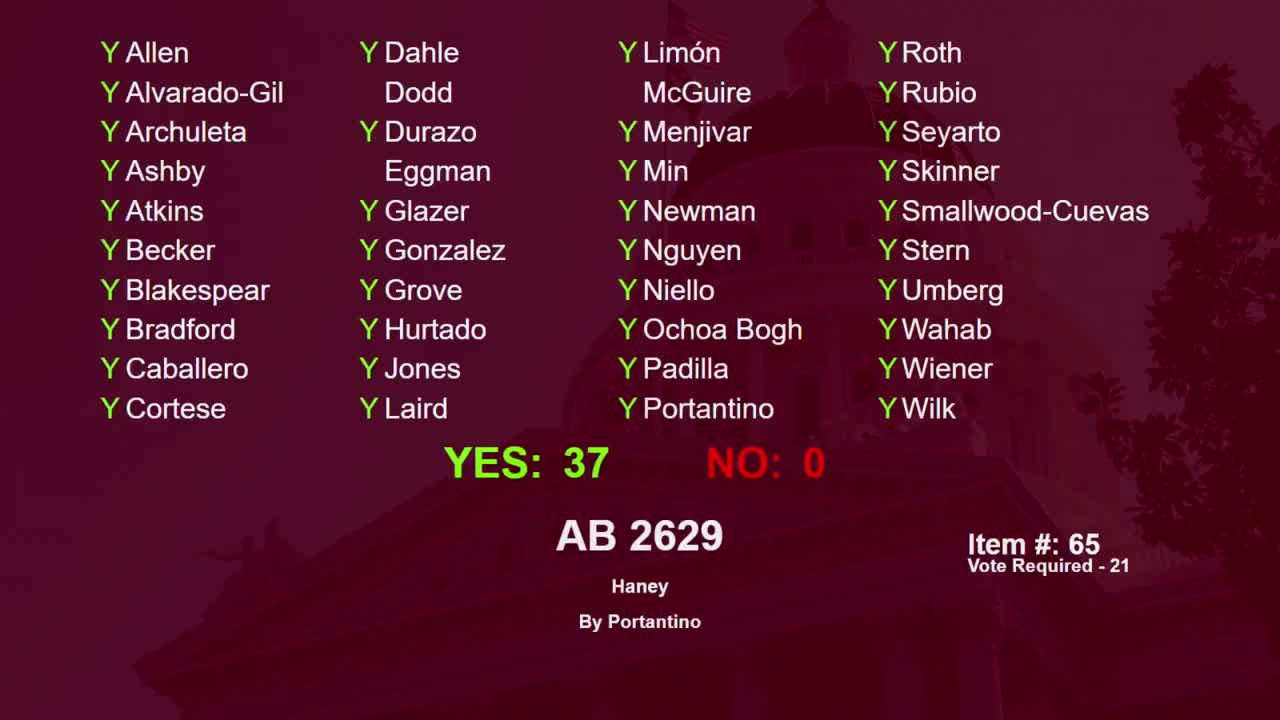 1MIN
Senate Floor
 58SEC
Assembly Floor
 2MIN
Senate Floor
 10MIN
Senate Standing Committee on Judiciary
 22MIN
Senate Standing Committee on Health
 3MIN
Assembly Floor
 1MIN
Assembly Standing Committee on Appropriations
 14MIN
Assembly Standing Committee on Labor and Employment
Bill Author

Bill Co-Author(s):
