AB 1947: California state preschool programs: contracting agencies: staff training days.
- Session Year: 2023-2024
- House: Assembly
- Latest Version Date: 2024-08-28
Current Status:
Failed
(2024-09-22: Vetoed by Governor.)
Introduced
In Committee
First Chamber
In Committee
Second Chamber
Enacted
What does this bill do?
The bill lets agencies that run California State Preschool programs use state reimbursement money for up to six days of staff training per contract period, up from two days. If a program has at least 25% dual language learner children (children learning two languages) and schedules three or more training days, at least one day must focus on supporting those children. A training day held during regular hours counts toward the program’s required days of operation, and programs must notify parents at least 30 calendar days before closing for staff training.
The summary is provided by generative AI which can make mistakes. For original language, please view the details in the table below.
Existing law, the Early Education Act, requires the Superintendent of Public Instruction to administer all California state preschool programs, including, but not limited to, part-day and full-day age and developmentally appropriate programs for 3- and 4-year-old chilren, and, until July 1, 2027, 2-year-old children. The act requires part-day and full-day California state preschool programs to operate specified minimum numbers of days per year. The act requires the State Department of Education, in collaboration with the State Department of Social Services, to implement a reimbursement system plan that establishes reasonable standards and assigned reimbursement rates, which vary with the length of the program year and the hours of service, as specified. The act authorizes an agency contracting with the State Department of Education to provide California state preschool program services to schedule up to 2 days of staff training, per contract period, using state reimbursement funding, as provided.
This bill would instead authorize up to 6 days of staff training, per contract period, using state reimbursement funding. The bill would require a contractor with an enrollment of at least 25% dual language learner children that schedules a minimum of 3 days of staff training to ensure that at least one scheduled staff training day is used to provide staff development that is specific to supporting dual language learner children, as provided. The bill would require a day of staff training scheduled during a contractors regular hours of operation to count toward the minimum number of days a California state preschool program is required to operate per year. The bill would require a contractor that schedules staff training during regular hours of operation to notify parents or guardians of children enrolled in the program at least 30 calendar days before a closure due to the scheduled staff training. The bill would require the Superintendent to adopt regulations to implement these provisions, and, on or before August 1, 2025, to develop informal directives and bulletins to implement these provisions until the regulations are adopted, as provided.
Existing law, the Early Education Act, requires the Superintendent of Public Instruction to administer all California state preschool programs, including, but not limited to, part-day and full-day age and developmentally appropriate programs for 3- and 4-year-old children. The act requires part-day and full-day California state preschool programs to operate specified minimum numbers of days per year. The act requires the State Department of Education, in collaboration with the State Department of Social Services, to implement a reimbursement system plan that establishes reasonable standards and assigned reimbursement rates, which vary with the length of the program year and the hours of service, as specified. The act authorizes an agency contracting with the State Department of Education to provide California state preschool program services to schedule up to 2 days of staff training, per contract period, using state reimbursement funding, as provided.
This bill would instead authorize up to 6 days of staff training, per contract period, using state reimbursement funding. The bill would require a contractor with an enrollment of at least 25% dual language learner children that schedules a minimum of 3 days of staff training to ensure that at least one scheduled staff training day is used to provide staff development that is specific to supporting dual language learner children, as provided. The bill would require a day of staff training scheduled during a contractors regular hours of operation to count toward the minimum number of days a California state preschool program is required to operate per year. The bill would require a contractor that schedules staff training during regular hours of operation to notify parents or guardians of children enrolled in the program at least 30 calendar days before a closure due to the scheduled staff training.
Existing law, the Early Education Act, requires the Superintendent of Public Instruction to administer all California state preschool programs, including, but not limited to, part-day and full-day age and developmentally appropriate programs for 3- and 4-year-old children. The act requires part-day and full-day California state preschool programs to operate specified minimum numbers of days per year. The act requires the State Department of Education, in collaboration with the State Department of Social Services, to implement a reimbursement system plan that establishes reasonable standards and assigned reimbursement rates, which vary with the length of the program year and the hours of service, as specified. The act authorizes an agency contracting with the State Department of Education to provide California state preschool program services to schedule up to 2 days of staff training, per contract period, using state reimbursement funding, as provided.
This bill would instead authorize up to 6 days of staff training, per contract period, using state reimbursement funding. The bill would require a contractor with an enrollment of at least 25% dual language learner children that schedules a minimum of 3 days of staff training to ensure that at least one scheduled staff training day is used to provide staff development that is specific to supporting dual language learner children. children, as provided. The bill would require a day of staff training scheduled during a contractors regular hours of operation to count toward the minimum number of days a California state preschool program is required to operate per year.
Existing law, the Early Education Act, requires the Superintendent of Public Instruction to administer all California state preschool programs, including, but not limited to, part-day and full-day age and developmentally appropriate programs for 3- and 4-year-old children. The act requires part-day and full-day California state preschool programs to operate specified minimum numbers of days per year. The act requires the State Department of Education, in collaboration with the State Department of Social Services, to implement a reimbursement system plan that establishes reasonable standards and assigned reimbursement rates, which vary with the length of the program year and the hours of service, as specified. The act authorizes an agency contracting with the State Department of Education to provide California state preschool program services to schedule up to 2 days of staff training, per contract period, using state reimbursement funding, as provided.
This bill would instead authorize up to 6 days of staff training, per contract period, using state reimbursement funding. The bill would require a contractor with an enrollment of an unspecified percentage of at least 25% dual language learner children that schedules a minimum of 3 days of staff training to ensure that at least one scheduled staff training day is used to provide staff development that is specific to supporting dual language learner children, as provided. children. The bill would require a day of staff training scheduled during a contractors regular hours of operation to count toward the minimum number of days a California state preschool program is required to operate per year.
Existing law, the Early Education Act, requires the Superintendent of Public Instruction to administer all California state preschool programs, including, but not limited to, part-day and full-day age and developmentally appropriate programs for 3- and 4-year-old children. The act requires part-day and full-day California state preschool programs to operate specified minimum numbers of days per year. The act requires the State Department of Education, in collaboration with the State Department of Social Services, to implement a reimbursement system plan that establishes reasonable standards and assigned reimbursement rates, which vary with the length of the program year and the hours of service, as specified. The act authorizes an agency contracting with the State Department of Education to provide California state preschool program services to schedule up to 2 days of staff training, per contract period, using state reimbursement funding, as provided.
This bill would instead authorize up to 6 days of staff training, per contract period, using state reimbursement funding. The bill would require a contractor with an enrollment of an unspecified percentage of dual language learner children that schedules a minimum of 3 days of staff training to ensure that at least one scheduled staff training day is used to provide staff development that is specific to supporting dual language learner children, as provided. The bill would require a day of staff training scheduled during a contractors regular hours of operation to count toward the minimum number of days a California state preschool program is required to operate per year.
(a)(1)An agency contracting with the department to provide California state preschool program services may schedule up to six days of staff training, per contract period, using state reimbursement funding.
(2)Staff training provided pursuant to paragraph (1) may include, but is not limited to, training on procedures for emergencies in preschool programs, licensing regulations relating to preschool programs, recognition and reporting of suspected abuse of children in preschool programs, managing challenging behaviors and preventing expulsion of children, practices related to trauma-informed care, practices to support dual language learners, improving program quality in alignment with state standards, and addressing items on the programs Quality Rating and Improvement System (QRIS) Quality plan.
(b)(1)A contractor with an enrollment of at least 25 percent dual language learner children that schedules a minimum of three days of staff training pursuant to subdivision (a) shall ensure that at least one scheduled staff training day is used to provide staff development that is specific to supporting dual language learner children enrolled in the program.
(2)Staff training provided pursuant to this subdivision is encouraged to include, but not be limited to, training on all of the following:
(A)Dual language acquisition.
(B)Biliteracy development.
(C)Engaging culturally and linguistically diverse families.
(D)Home language support.
(E)Culturally and linguistically appropriate observation and assessment of dual language learner children.
(F)Identification and support of dual language learner children with special needs.
(3)To the maximum extent possible, staff training provided pursuant to this subdivision shall offer instruction on how to involve parents and members of the community to promote cultural competence and improved understanding of the needs of dual language learner children.
(c)(1)A day of staff training described in this section that is scheduled during a contractors regular hours of operation shall be considered a day of operation for purposes of meeting the minimum days of operation for part-day and full-day state preschool programs required pursuant to subdivisions (b) and (c) of Section 8207.
(2)A contractor that schedules staff training during regular hours of operation shall notify parents or guardians of children enrolled in the program at least 30 calendar days before a closure due to the scheduled staff training.
(d)The Superintendent shall adopt regulations to implement this section. Notwithstanding Chapter 3.5 (commencing with Section 11340) of Part 1 of Division 3 of Title 2 of the Government Code, the Superintendent shall, on or before August 1, 2025, develop informal directives and bulletins to implement this section until the regulations are adopted.
(a)(1)An agency contracting with the department to provide California state preschool program services may schedule up to six days of staff training, per contract period, using state reimbursement funding.
(2)Staff training provided pursuant to paragraph (1) may include, but is not limited to, training on procedures for emergencies in preschool programs, licensing regulations relating to preschool programs, recognition and reporting of suspected abuse of children in preschool programs, managing challenging behaviors and preventing expulsion of children, practices related to trauma-informed care, practices to support dual language learners, improving program quality in alignment with state standards, and addressing items on the programs Quality Rating and Improvement System (QRIS) Quality plan.
(b)(1)A contractor with an enrollment of at least 25 percent dual language learner children that schedules a minimum of three days of staff training pursuant to subdivision (a) shall ensure that at least one scheduled staff training day is used to provide staff development that is specific to supporting dual language learner children enrolled in the program.
(2)Staff training provided pursuant to this subdivision is encouraged to include, but not be limited to, training on all of the following:
(A)Dual language acquisition.
(B)Biliteracy development.
(C)Engaging culturally and linguistically diverse families.
(D)Home language support.
(E)Culturally and linguistically appropriate observation and assessment of dual language learner children.
(F)Identification and support of dual language learner children with special needs.
(3)To the maximum extent possible, staff training provided pursuant to this subdivision shall offer instruction on how to involve parents and members of the community to promote cultural competence and improved understanding of the needs of dual language learner children.
(4)Staff training provided pursuant to this subdivision that incorporates other training related to supporting the whole child and that includes at least 80 percent of training consistent with paragraph (1) meets the requirements of this subdivision.(c)(1)A day of staff training described in this section that is scheduled during a contractors regular hours of operation shall be considered a day of operation for purposes of meeting the minimum days of operation for part-day and full-day state preschool programs required pursuant to subdivisions (b) and (c) of Section 8207.
(2)A contractor that schedules staff training during regular hours of operation shall notify parents or guardians of children enrolled in the program at least 30 calendar days before a closure due to the scheduled staff training.
(d)The Superintendent shall adopt regulations to implement this section. Notwithstanding Chapter 3.5 (commencing with Section 11340) of Part 1 of Division 3 of Title 2 of the Government Code, the Superintendent shall, on or before August 1, 2025, develop informal directives and bulletins to implement this section until the regulations are adopted.
(a)(1)An agency contracting with the department to provide California state preschool program services may schedule up to six days of staff training, per contract period, using state reimbursement funding.
(2)Staff training provided pursuant to paragraph (1) may include, but is not limited to, training on procedures for emergencies in preschool programs, licensing regulations relating to preschool programs, recognition and reporting of suspected abuse of children in preschool programs, managing challenging behaviors and preventing expulsion of children, practices related to trauma-informed care, practices to support dual language learners, improving program quality in alignment with state standards, and addressing items on the programs Quality Rating and Improvement System (QRIS) Quality plan.
(b)(1)A contractor with an enrollment of at least 25 percent dual language learner children that schedules a minimum of three days of staff training pursuant to subdivision (a) shall ensure that at least one scheduled staff training day is used to provide staff development that is specific to supporting dual language learner children enrolled in the program.
(2)Staff training provided pursuant to this subdivision is encouraged to include, but not be limited to, training on all of the following:
(A)Dual language acquisition.
(B)Biliteracy development.
(C)Engaging culturally and linguistically diverse families.
(D)Home language support.
(E)Culturally and linguistically appropriate observation and assessment of dual language learner children.
(F)Identification and support of dual language learner children with special needs.
(3)To the maximum extent possible, staff training provided pursuant to this subdivision shall offer instruction on how to involve parents and members of the community to promote cultural competence and improved understanding of the needs of dual language learner children.
(4)Staff training provided pursuant to this subdivision that incorporates other training related to supporting the whole child and that includes at least 80 percent of training consistent with paragraph (1) meets the requirements of this subdivision.
(c)(1)A day of staff training described in this section that is scheduled during a contractors regular hours of operation shall be considered a day of operation for purposes of meeting the minimum days of operation for part-day and full-day state preschool programs required pursuant to subdivisions (b) and (c) of Section 8207.
(2)A contractor that schedules staff training during regular hours of operation shall notify parents or guardians of children enrolled in the program at least 30 calendar days before a closure due to the scheduled staff training.
(a)(1)An agency contracting with the department to provide California state preschool program services may schedule up to six days of staff training, per contract period, using state reimbursement funding.
(2)Staff training provided pursuant to paragraph (1) may include, but is not limited to, training on procedures for emergencies in preschool programs, licensing regulations relating to preschool programs, recognition and reporting of suspected abuse of children in preschool programs, managing challenging behaviors and preventing expulsion of children, practices related to trauma-informed care, practices to support dual language learners, improving program quality in alignment with state standards, and addressing items on the programs Quality Rating and Improvement System (QRIS) Quality plan.
(b)(1)A contractor with an enrollment of at least 25 percent dual language learner children that schedules a minimum of three days of staff training pursuant to subdivision (a) shall ensure that at least one scheduled staff training day is used to provide staff development that is specific to supporting dual language learner children enrolled in the program.
(2)Staff training provided pursuant to this subdivision is encouraged to include, but not be limited to, training on all of the following:
(A)Dual language acquisition.
(B)Biliteracy development.
(C)Engaging culturally and linguistically diverse families.
(D)Home language support.
(E)Culturally and linguistically appropriate observation and assessment of dual language learner children.
(F)Identification and support of dual language learner children with special needs.
(3)To the maximum extent possible, staff training provided pursuant to this subdivision shall offer instruction on how to involve parents and members of the community to promote cultural competence and improved understanding of the needs of dual language learner children.
(4)Staff training provided pursuant to this subdivision that incorporates other training related to supporting the whole child and that includes at least 80 percent of training consistent with paragraph (1) meets the requirements of this subdivision.
(c)A day of staff training described in this section that is scheduled during a contractors regular hours of operation shall be considered a day of operation for purposes of meeting the minimum days of operation for part-day and full-day state preschool programs required pursuant to subdivisions (b) and (c) of Section 8207.
(a)(1)An agency contracting with the department to provide California state preschool program services may schedule up to six days of staff training, per contract period, using state reimbursement funding.
(2)Staff training provided pursuant to paragraph (1) may include, but is not limited to, training on procedures for emergencies in preschool programs, licensing regulations relating to preschool programs, recognition and reporting of suspected abuse of children in preschool programs, managing challenging behaviors and preventing expulsion of children, practices related to trauma-informed care, practices to support dual language learners, and improving program quality in alignment with state standards. standards, and addressing items on the programs Quality Rating and Improvement System (QRIS) Quality plan.
(b)(1)A contractor with an enrollment of at least ____ 25 percent dual language learner children that schedules a minimum of three days of staff training pursuant to subdivision (a) shall ensure that at least one scheduled staff training day is used to provide staff development that is specific to supporting dual language learner children enrolled in the program.
(2)Staff training provided pursuant to this subdivision shall is encouraged to include, but is not be limited to, training on all of the following:
(A)Dual language acquisition.
(B)Biliteracy development.
(C)Engaging culturally and linguistically diverse families.
(D)Home language support.
(E)Culturally and linguistically appropriate observation and assessment of dual language learner children.
(F)Identification and support of dual language learner children with special needs.
(3)To the maximum extent possible, staff training provided pursuant to this subdivision shall involve parents and members of the community to promote cultural competence and improved understanding of the needs of dual language learner children.
(4)Staff training provided pursuant to this subdivision that incorporates other training related to supporting the whole child meets the requirements of this subdivision.
(c)A day of staff training described in this section that is scheduled during a contractors regular hours of operation shall be considered a day of operation for purposes of meeting the minimum days of operation for part-day and full-day state preschool programs required pursuant to subdivisions (b) and (c) of Section 8207.
(a)(1)An agency contracting with the department to provide California state preschool program services may schedule up to two six days of staff training, per contract period, using state reimbursement funding on the topics including funding.
(2)Staff training provided pursuant to paragraph (1) may include, but is not limited to, training on procedures for emergencies in preschool programs, licensing regulations relating to preschool programs, recognition and reporting of suspected abuse of children in preschool programs, managing challenging behaviors and preventing expulsion of children, and addressing items on the programs Quality Rating and Improvement System (QRIS) Quality plan. practices related to trauma-informed care, practices to support dual language learners, and improving program quality in alignment with state standards.
(b)(1)A contractor with an enrollment of at least ____ percent dual language learner children that schedules a minimum of three days of staff training pursuant to subdivision (a) shall ensure that at least one scheduled staff training day is used to provide staff development that is specific to supporting dual language learner children enrolled in the program.
(2)Staff training provided pursuant to this subdivision shall include, but is not limited to, training on all of the following:
(A)Dual language acquisition.
(B)Biliteracy development.
(C)Engaging culturally and linguistically diverse families.
(D)Home language support.
(E)Culturally and linguistically appropriate observation and assessment of dual language learner children.
(F)Identification and support of dual language learner children with special needs.
(3)To the maximum extent possible, staff training provided pursuant to this subdivision shall involve parents and members of the community to promote cultural competence and improved understanding of the needs of dual language learner children.
(4)Staff training provided pursuant to this subdivision that incorporates other training related to supporting the whole child meets the requirements of this subdivision.
(c)A day of staff training described in this section that is scheduled during a contractors regular hours of operation shall be considered a day of operation for purposes of meeting the minimum days of operation for part-day and full-day state preschool programs required pursuant to subdivisions (b) and (c) of Section 8207.
|
Date
|
Status
|
|---|---|
| Sep 22, 2024 | Vetoed by Governor. |
| Sep 3, 2024 | Enrolled and presented to the Governor at 3:30 p.m. |
| Aug 26, 2024 | Senate amendments concurred in. To Engrossing and Enrolling. (Ayes 77. Noes 0. Page 6565.). |
| Aug 21, 2024 | In Assembly. Concurrence in Senate amendments pending. May be considered on or after August 23 pursuant to Assembly Rule 77. |
| Aug 21, 2024 | Read third time. Passed. Ordered to the Assembly. (Ayes 33. Noes 0. Page 5268.). |
| Aug 6, 2024 | Read second time. Ordered to third reading. |
| Aug 5, 2024 | From committee: Be ordered to second reading pursuant to Senate Rule 28.8. |
| Jul 1, 2024 | From committee chair, with author's amendments: Amend, and re-refer to committee. Read second time, amended, and re-referred to Com. on APPR. |
| Jun 18, 2024 | From committee: Do pass and re-refer to Com. on APPR. (Ayes 5. Noes 0.) (June 17). Re-referred to Com. on APPR. |
| Jun 11, 2024 | From committee chair, with author's amendments: Amend, and re-refer to committee. Read second time, amended, and re-referred to Com. on HUMAN S. |
| Jun 3, 2024 | In committee: Hearing postponed by committee. |
| May 29, 2024 | From committee: Do pass and re-refer to Com. on HUMAN S. (Ayes 7. Noes 0.) (May 29). Re-referred to Com. on HUMAN S. |
| May 15, 2024 | From committee chair, with author's amendments: Amend, and re-refer to committee. Read second time, amended, and re-referred to Com. on ED. |
| May 8, 2024 | Referred to Coms. on ED. and HUMAN S. |
| Apr 25, 2024 | In Senate. Read first time. To Com. on RLS. for assignment. |
| Apr 25, 2024 | Read third time. Passed. Ordered to the Senate. (Ayes 75. Noes 0. Page 4996.) |
| Apr 18, 2024 | Read second time. Ordered to Consent Calendar. |
| Apr 17, 2024 | From committee: Do pass. To Consent Calendar. (Ayes 15. Noes 0.) (April 17). |
| Apr 4, 2024 | From committee: Do pass and re-refer to Com. on APPR. (Ayes 7. Noes 0.) (April 3). Re-referred to Com. on APPR. |
| Apr 2, 2024 | Re-referred to Com. on ED. |
| Apr 1, 2024 | From committee chair, with author's amendments: Amend, and re-refer to Com. on ED. Read second time and amended. |
| Mar 18, 2024 | Referred to Com. on ED. |
| Jan 30, 2024 | From printer. May be heard in committee February 29. |
| Jan 29, 2024 | Read first time. To print. |
|
Date
|
Description
|
Location
|
Votes
|
|
|---|---|---|---|---|
| Aug 26, 2024 | AB 1947 Luz Rivas Concurrence in Senate Amendments | Assembly Floor |
Passed |
|
| Aug 21, 2024 | Assembly 3rd Reading AB1947 Luz Rivas By Limón | Senate Floor |
Passed |
|
| Jun 17, 2024 | Do pass, but first be re-referred to the Committee on [Appropriations] | Senate Standing Committee on Human Services |
Passed |
|
| May 29, 2024 | Do pass, but first be re-referred to the Committee on [Human Services] | Senate Standing Committee on Education |
Passed |
|
| Apr 25, 2024 | AB 1947 Luz Rivas Consent Calendar Second Day Regular Session | Assembly Floor |
Passed |
|
| Apr 17, 2024 | Do pass. To Consent Calendar. | Assembly Standing Committee on Appropriations |
Passed |
|
| Apr 3, 2024 | Do pass and be re-referred to the Committee on [Appropriations] | Assembly Standing Committee on Education |
Passed |
This list shows positions taken on this bill by organizations on the date displayed, which is linked to the original source.
Positions by individuals are not included.
|
Organization
|
Position
|
Date
|
|---|---|---|
| Alameda County Early Care and Education Planning Council | ** Support | |
| Asian Americans Advancing Justice Southern California | ** Support | |
| Association of Two-way Dual Language Education | ** Support | |
| California Legislative Advocates | * Support | Jun 17, 2024 |
| California Teachers Of English To Speakers Of Other Languages | ** Support | |
| Californians Together | ** Support | |
| Catalyst California | ** Support | |
| CFT- a Union of Educators & Classified Professionals, Aft, Afl-cio | ** Support | |
| Children Now | ** Support | |
| Cosumnes River College Child Development Center | * Support | Apr 3, 2024 |
| Early Edge California | ** Support | |
| Kern County Superintendent of Schools Office | ** Support | |
| Los Angeles County Office Of Education | ** Support | |
| Los Angeles County Superintendent Of Schools | * Support | May 29, 2024 |
| Los Angeles Unified School District | ** Support | |
| Los Rios Community College District | * Support | Apr 3, 2024 |
| Loyola Marymount University - The Center for Equity for English Learners | ** Support | |
| Parent Institute for Quality Education | ** Support | |
| School Services of California | * Support | Apr 3, 2024 |
| Sobrato Early Academic Language | ** Support | |
| The Children's Partnership | ** Support | |
| Thriving Families California | * Support | Jun 17, 2024 |
GOVERNOR'S VETO
GV Bill Id:AB 1947
Author:(Luz Rivas)
As Enrolled Ver:August 28, 2024
2/3 vote
SUMMARY
Increases the number of reimbursable staff training days for providers of California State Preschool Programs (CSPP), and requires that programs enrolling at least 25% of dual language learners (DLLs) designate at least one of their three or more days of staff training to supporting DLLs.
Senate Amendments
- Remove the reference to training related to the whole child meeting the requirements of this section.
- Require a contractor to notify parents or guardians at least 30 calendar days before a closure due to a scheduled staff training during regular hours of operation.
Require the Superintendent of Public Instruction (SPI) to adopt regulations to implement this section and authorizes the SPI to develop informal directives and bulletins by August 1, 2025, to implement this section until the regulations are adopted.
Governor's Veto Message
I am returning Assembly Bill 1947 without my signature. This bill would authorize California State Preschool Program (CSPP) contractors to offer up to six days of reimbursed staff training for part-day and full-day care, and would require a CSPP contractor that serves more than 25 percent of dual language learners (DLLs) to schedule a minimum of three staff training days, with one day dedicated to support dual language children. I appreciate the author's commitment to ensuring that dual language learners are provided a culturally appropriate and equitable educational experience. Our preschool, child care, and development workforce plays a key role in the academic future of such learners, and I agree with the author that it is important to provide our educators with the training to support these children. This is why the Department of Social Services, in collaboration with the Department of Education, is continuing its work to develop a single child care and development rate reimbursement structure that will include a new methodology to address some of these very same issues. These new requirements are better considered in a holistic manner as a part of the rate reform process.
COMMENTS
Who are California DLLs ages 0-5? The Education Code defines "dual language learner children" as children whose first language is a language other than English or children who are developing two or more languages, one of which may be English.
Master Plan for Early Learning and Care recommends support of DLLs. The Master Plan for Early Learning and Care, released in December 2020 by the California Health and Human Services Agency, recommended providing DLLs with high-quality language experiences in both English and their home language as a foundation for future academic success, noting that bilingualism has associated benefits such as strengthened cognitive and memory processes, improved communication abilities, social and cultural benefits, and advantages in the job market.
The Master Plan also found that California lacks a basic universal infrastructure for identifying DLLs and that caregivers often lack the support they need in order to provide these children with high-quality, culturally relevant experiences in both English and the children's home language.
According to the Author
"My bill, AB 1947, takes a critical step in implementing the Master Plan for Early Learning and Care recommendations supporting our children who are DLLs. These children are just beginning to be assessed and identified as DLLs when they enter California's State Preschool Programs (CSPP). However, CSPP teachers are not given enough time to be properly trained to provide quality early education to DLLs. The absence of a selected professional development day impairs CSPP teachers from enriching the early linguistic assets of these children for their benefit and the greater benefit of California. Early Childhood educators must have the tools and abilities to properly teach and care for DLLs to support children in ways that intentionally develop their home language and English."
Arguments in Support
Early Edge California and Californians Together write, "AB 1947 will build upon the progress made by the national landmark legislation, AB 1363 that helps the state achieve the goals of California's Master Plan for Early Learning and Care. The Master Plan stresses the importance of supporting the needs of DLL children through interactions that acknowledge their cultural and linguistic backgrounds while also promoting the development of both their home language and English. AB 1947 helps achieve this goal by providing CSPP educators with professional development opportunities to meet the needs of DLLs.
DLLs are a significant and expanding demographic throughout California's early learning programs, however the absence of formal certifications or training requirements can leave early learning providers needing more training and development to sufficiently support DLLs. This bill helps meet the goals of the Master Plan by ensuring CSPP educators have the opportunity to receive the professional development they need to promote learning and improved outcomes for DLLs."
Arguments in Opposition
An individual writes, "AB 1947 helps achieve only partly the Master Plan by providing CSPP educators with professional development opportunities to meet the needs of DLLs, but is not inclusive of professional development to support children with disabilities."
FISCAL COMMENTS
According to the Senate Appropriations Committee, pursuant to Senate Rule 28.8, negligible state costs.
VOTES
ASM EDUCATION: 7-0-0
YES: Muratsuchi, Addis, Alvarez, Bonta, Flora, Hoover, McCarty
ASM APPROPRIATIONS: 15-0-0
YES: Wicks, Sanchez, Arambula, Bryan, Calderon, Wendy Carrillo, Dixon, Mike Fong, Grayson, Haney, Hart, Jim Patterson, Pellerin, Ta, Villapudua
ASSEMBLY FLOOR: 75-0-5
YES: Addis, Aguiar-Curry, Alanis, Alvarez, Arambula, Bains, Bauer-Kahan, Bennett, Berman, Bonta, Bryan, Calderon, Juan Carrillo, Wendy Carrillo, Cervantes, Chen, Connolly, Davies, Dixon, Essayli, Flora, Mike Fong, Vince Fong, Friedman, Gabriel, Garcia, Gipson, Grayson, Haney, Holden, Hoover, Irwin, Jackson, Jones-Sawyer, Kalra, Lackey, Lee, Low, Lowenthal, Maienschein, McCarty, McKinnor, Muratsuchi, Stephanie Nguyen, Ortega, Pacheco, Papan, Jim Patterson, Joe Patterson, Pellerin, Petrie-Norris, Quirk-Silva, Ramos, Rendon, Reyes, Luz Rivas, Rodriguez, Blanca Rubio, Sanchez, Santiago, Schiavo, Soria, Ta, Ting, Valencia, Villapudua, Waldron, Wallis, Ward, Weber, Wicks, Wilson, Wood, Zbur, Robert Rivas
ABS, ABST OR NV: Boerner, Megan Dahle, Gallagher, Hart, Mathis
SENATE FLOOR: 33-0-7
YES: Allen, Alvarado-Gil, Archuleta, Ashby, Blakespear, Caballero, Cortese, Dahle, Dodd, Durazo, Eggman, Glazer, Gonzalez, Grove, Hurtado, Jones, Laird, Limón, McGuire, Min, Newman, Nguyen, Niello, Ochoa Bogh, Padilla, Portantino, Roth, Rubio, Seyarto, Stern, Umberg, Wiener, Wilk
ABS, ABST OR NV: Atkins, Becker, Bradford, Menjivar, Skinner, Smallwood-Cuevas, Wahab
ASSEMBLY FLOOR: 77-0-2
YES: Addis, Aguiar-Curry, Alanis, Alvarez, Arambula, Bains, Bauer-Kahan, Bennett, Berman, Boerner, Bonta, Bryan, Calderon, Juan Carrillo, Wendy Carrillo, Chen, Connolly, Megan Dahle, Davies, Dixon, Essayli, Flora, Mike Fong, Friedman, Gabriel, Gallagher, Garcia, Gipson, Grayson, Haney, Hart, Holden, Hoover, Irwin, Jackson, Jones-Sawyer, Kalra, Lackey, Lee, Low, Lowenthal, Maienschein, Mathis, McCarty, McKinnor, Muratsuchi, Stephanie Nguyen, Pacheco, Papan, Jim Patterson, Joe Patterson, Pellerin, Petrie-Norris, Quirk-Silva, Ramos, Rendon, Reyes, Luz Rivas, Rodriguez, Blanca Rubio, Sanchez, Santiago, Schiavo, Soria, Ta, Ting, Valencia, Villapudua, Waldron, Wallis, Ward, Weber, Wicks, Wilson, Wood, Zbur, Robert Rivas
ABS, ABST OR NV: Cervantes, Ortega
UPDATED
VERSION: August 28, 2024
CONSULTANT: Debbie Look / ED. / (916) 319-2087 FN: 0005094
CONCURRENCE IN SENATE AMENDMENTS
CSA1 Bill Id:AB 1947
Author:(Luz Rivas)
As Amended Ver:July 1, 2024
Majority vote
SUMMARY
Increases the number of reimbursable staff training days for providers of California State Preschool Programs (CSPP), and requires that programs enrolling at least 25% of dual language learners (DLLs) designate at least one of their three or more days of staff training to supporting DLLs.
Senate Amendments
- Remove the reference to training related to the whole child meeting the requirements of this section.
- Require a contractor to notify parents or guardians at least 30 calendar days before a closure due to a scheduled staff training during regular hours of operation.
- Require the Superintendent of Public Instruction (SPI) to adopt regulations to implement this section and authorizes the SPI to develop informal directives and bulletins by August 1, 2025, to implement this section until the regulations are adopted.
COMMENTS
Who are California DLLs ages 0-5? The Education Code defines "dual language learner children" as children whose first language is a language other than English or children who are developing two or more languages, one of which may be English.
Master Plan for Early Learning and Care recommends support of DLLs. The Master Plan for Early Learning and Care, released in December 2020 by the California Health and Human Services Agency, recommended providing DLLs with high-quality language experiences in both English and their home language as a foundation for future academic success, noting that bilingualism has associated benefits such as strengthened cognitive and memory processes, improved communication abilities, social and cultural benefits, and advantages in the job market.
The Master Plan also found that California lacks a basic universal infrastructure for identifying DLLs and that caregivers often lack the support they need in order to provide these children with high-quality, culturally relevant experiences in both English and the children's home language.
According to the Author
"My bill, AB 1947, takes a critical step in implementing the Master Plan for Early Learning and Care recommendations supporting our children who are DLLs. These children are just beginning to be assessed and identified as DLLs when they enter California's State Preschool Programs (CSPP). However, CSPP teachers are not given enough time to be properly trained to provide quality early education to DLLs. The absence of a selected professional development day impairs CSPP teachers from enriching the early linguistic assets of these children for their benefit and the greater benefit of California. Early Childhood educators must have the tools and abilities to properly teach and care for DLLs to support children in ways that intentionally develop their home language and English."
Arguments in Support
Early Edge California and Californians Together write, "AB 1947 will build upon the progress made by the national landmark legislation, AB 1363 that helps the state achieve the goals of California's Master Plan for Early Learning and Care. The Master Plan stresses the importance of supporting the needs of DLL children through interactions that acknowledge their cultural and linguistic backgrounds while also promoting the development of both their home language and English. AB 1947 helps achieve this goal by providing CSPP educators with professional development opportunities to meet the needs of DLLs.
DLLs are a significant and expanding demographic throughout California's early learning programs, however the absence of formal certifications or training requirements can leave early learning providers needing more training and development to sufficiently support DLLs. This bill helps meet the goals of the Master Plan by ensuring CSPP educators have the opportunity to receive the professional development they need to promote learning and improved outcomes for DLLs."
Arguments in Opposition
An individual writes, "AB 1947 helps achieve only partly the Master Plan by providing CSPP educators with professional development opportunities to meet the needs of DLLs, but is not inclusive of professional development to support children with disabilities."
FISCAL COMMENTS
According to the Senate Appropriations Committee, pursuant to Senate Rule 28.8, negligible state costs.
VOTES:
ASM EDUCATION: 7-0-0
YES: Muratsuchi, Addis, Alvarez, Bonta, Flora, Hoover, McCarty
ASM APPROPRIATIONS: 15-0-0
YES: Wicks, Sanchez, Arambula, Bryan, Calderon, Wendy Carrillo, Dixon, Mike Fong, Grayson, Haney, Hart, Jim Patterson, Pellerin, Ta, Villapudua
ASSEMBLY FLOOR: 75-0-5
YES: Addis, Aguiar-Curry, Alanis, Alvarez, Arambula, Bains, Bauer-Kahan, Bennett, Berman, Bonta, Bryan, Calderon, Juan Carrillo, Wendy Carrillo, Cervantes, Chen, Connolly, Davies, Dixon, Essayli, Flora, Mike Fong, Vince Fong, Friedman, Gabriel, Garcia, Gipson, Grayson, Haney, Holden, Hoover, Irwin, Jackson, Jones-Sawyer, Kalra, Lackey, Lee, Low, Lowenthal, Maienschein, McCarty, McKinnor, Muratsuchi, Stephanie Nguyen, Ortega, Pacheco, Papan, Jim Patterson, Joe Patterson, Pellerin, Petrie-Norris, Quirk-Silva, Ramos, Rendon, Reyes, Luz Rivas, Rodriguez, Blanca Rubio, Sanchez, Santiago, Schiavo, Soria, Ta, Ting, Valencia, Villapudua, Waldron, Wallis, Ward, Weber, Wicks, Wilson, Wood, Zbur, Robert Rivas
ABS, ABST OR NV: Boerner, Megan Dahle, Gallagher, Hart, Mathis
SENATE FLOOR: 33-0-7
YES: Allen, Alvarado-Gil, Archuleta, Ashby, Blakespear, Caballero, Cortese, Dahle, Dodd, Durazo, Eggman, Glazer, Gonzalez, Grove, Hurtado, Jones, Laird, Limón, McGuire, Min, Newman, Nguyen, Niello, Ochoa Bogh, Padilla, Portantino, Roth, Rubio, Seyarto, Stern, Umberg, Wiener, Wilk
ABS, ABST OR NV: Atkins, Becker, Bradford, Menjivar, Skinner, Smallwood-Cuevas, Wahab
UPDATED
VERSION: July 1, 2024
CONSULTANT: Debbie Look / ED. / (916) 319-2087 FN: 0004352
SENATE RULES COMMITTEE Office of Senate Floor Analyses (916) 651-1520 Fax: (916) 327-4478 | AB 1947 |
THIRD READING
Bill No: AB 1947
Author: Luz Rivas (D)
Amended: 7/1/24 in Senate
Vote: 21
SENATE EDUCATION COMMITTEE: 7-0, 5/29/24
AYES: Newman, Ochoa Bogh, Cortese, Glazer, Gonzalez, Smallwood-Cuevas, Wilk
SENATE HUMAN SERVICES COMMITTEE: 5-0, 6/17/24
AYES: Alvarado-Gil, Ochoa Bogh, Blakespear, Hurtado, Menjivar
SENATE APPROPRIATIONS COMMITTEE: Senate Rule 28.8
ASSEMBLY FLOOR: 75-0, 4/25/24 (Consent) - See last page for vote
SUBJECT: California state preschool programs: contracting agencies: staff training days
SOURCE: Californians Together
Early Edge California
DIGEST:
This bill expands the number of staff training days, from up to two days to up to six days, that agencies contracting with the California Department of Education (CDE) are authorized to schedule, and requires contractors with an enrollment of at least 25 percent dual language learners that have at least three days of staff training to dedicate at least one training day specifically on supporting dual language learners.
ANALYSIS:
Existing law:
- Establishes the Early Education Act to, among other things:
- Provide an inclusive and cost-effective preschool program that provides high-quality learning experiences, coordinated services, and referrals for families to access health and social-emotional support services through full- and part-day programs.
- To promote and support home language and development of multilingual capabilities to ensure all children attain their full potential.
(Education Code (EC) § 8201)
- Provide an inclusive and cost-effective preschool program that provides high-quality learning experiences, coordinated services, and referrals for families to access health and social-emotional support services through full- and part-day programs.
- Requires the Superintendent of Public Instruction (SPI) to administer all state preschool programs, which are to include full- and part-day age and developmentally appropriate programs offered through child care centers and family child care home education networks, that are designed to facilitate the transition to kindergarten for three- and four-year old children, and that provide early learning and care, health services, social services, nutritional services, parent education and parent participation, evaluation, and staff development. (EC § 8207)
- Requires the SPI to develop standards for the implementation of high-quality preschool programs, and requires indicators of quality to include, among other things, program activities and services that meet the cultural and linguistic needs of children and families, including but not limited to program activities and services that meet the need of dual language learners for support in the development of their home language and English. (EC § 8203)
- Defines “dual language learner children” as children whose first language is a language other than English or children who are developing two or more languages, one of which may be English. (EC § 8205)
- States legislative intent for state preschool contractors, teachers, and staff to better understand the language and developmental needs of dual language learners enrolled in publicly funded preschool programs by identifying them as a dual language learner through a family language instrument and support their needs through a family language and interest interview. Existing law states that the identification of dual language learners will help improve program quality and inform the allocation and use of state and program resources to better support them and their linguistic and developmental needs for success in school and in life. (EC § 8241.5)
- Requires the SPI to develop procedures for state preschool contractors to identify and report data on dual language learners enrolled in a state preschool program. (EC § 8241.5)
- Authorizes an agency contracting with CDE to provide state preschool program services to schedule up to two days of staff training, per contract period, using state reimbursement funding on the topics including procedures for emergencies in preschool programs, licensing regulations relating to preschool programs, recognition and reporting of suspected abuse of children in preschool programs, managing challenging behaviors and preventing expulsion of children, and addressing items on the program’s Quality Rating and Improvement System (QRIS) Quality plan. (EC § 8251)
This bill:
- Expands the number of staff training days, from up to two days to up to six days, that agencies contracting with CDE are authorized to schedule, per contract period, using state reimbursement funding.
- Expands the topics that may be included in staff training to include practices related to trauma-informed care, practices to support dual language learners, and improving program quality in alignment with state standards.
- Requires a contractor with an enrollment of at least 25 percent dual language learner children that schedules a minimum of three days of staff training to ensure that at least one scheduled staff training day is used to provide staff development that is specific to supporting dual language learner children enrolled in the program.
- Encourages staff training on supporting dual language learners to include, but not be limited to, training on all of the following:
- Dual language acquisition.
- Biliteracy development.
- Engaging culturally and linguistically diverse families.
- Home language support.
- Culturally and linguistically appropriate observation and assessment of dual language learner children.
- Identification and support of dual language learner children with special needs.
- Dual language acquisition.
- Requires, to the maximum extent possible, the staff training relative to dual language learners to offer instruction on how to involve parents and members of the community to promote cultural competence and improved understanding of the needs of dual language learner children.
- Requires that a day of staff training pursuant to this bill that is scheduled during a contractor’s regular hours of operation be considered a day of operation for purposes of meeting the required minimum days of operation for state preschool programs.
- Requires a contractor that schedules staff training during regular hours of operation to notify parents/guardians at least 30 calendar days before a closure due to the scheduled staff training.
- Requires the SPI to adopt regulations to implement this bill, and develop informal directives and bulletins by August 1, 2025, to implement this bill until the regulations are adopted.
Comments
- Need for the bill. According to the author, “My bill, AB 1947, takes a critical step in implementing the Master Plan for Early Learning and Care recommendations supporting our children who are DLLs. These children are just beginning to be assessed and identified as DLLs when they enter California’s State Preschool Programs (CSPP). However, CSPP teachers are not given enough time to be properly trained to provide quality early education to DLLs. The absence of a selected professional development day impairs CSPP teachers from enriching the early linguistic assets of these children for their benefit and the greater benefit of California. Early Childhood educators must have the tools and abilities to properly teach and care for DLLs to support children in ways that intentionally develop their home language and English.”
- Identification of dual language learners. Existing law defines “dual language learner children” as children whose first language is a language other than English or children who are developing two or more languages, one of which may be English.
The Master Plan for Early Learning and Care recommends providing dual language learners with high-quality language experiences in both English and their home language as a foundation for future academic success, noting that bilingualism has associated benefits such as strengthened cognitive and memory processes, improved communication abilities, social and cultural benefits, and advantages in the job market. The Master Plan also found that California lacks a basic universal infrastructure for identifying dual language learners, and that caregivers often lack the support they need in order to provide these children with high-quality, culturally relevant experiences in both English and the children’s home language. The Master Plan recommended, among other things, that the state require specialized training and development to address dual language development, children with disabilities, and how to eliminate bias and inequitable practices.
AB 1363 (Luz Rivas, Chapter 498, Statutes of 2021) requires the SPI to develop procedures for providers to identify and report data on dual language learners enrolled in the state preschool program. The CDE issued a management bulletin in March 2023 to notify and provide guidance to state preschool contractors regarding new requirements for identifying and collecting data on dual language learners, including multilingual learners, language characteristics of preschool programs, and language composition of program staff. State preschool program contractors were required to begin identifying dual language learners as of January 1, 2023. - Staff training. As noted in the Assembly Education Committee analysis of this bill, according to the CDE, a significant number of state preschool program providers are not utilizing their currently allotted two staff training days (see figure below). The CDE suggests that the reason these are not being utilized by more contractors is that contractors essentially have to enroll fewer children to be able to use their funding to pay for these days as many contractors are having to cover the cost of staff training within their existing contract funds. Another issue is that programs can only offer this on the weekends, after hours, or by retaining substitute staff, all of which have been flagged as administrative burdens.
Fiscal year | # of CSPP contractors reporting staff training expenses | Total # of CSPP contractors | % of contractors reporting training costs |
2019-20 | 164 | 691 | 24% |
2020-21 | 110 | 673 | 16% |
2021-22 | 88 | 653 | 13% |
Source: CDE
This bill requires state preschool contractors with an enrollment of at least 25 percent dual language learners that have at least three days of staff training to dedicate at least one training day specifically on supporting dual language learners. As noted above, the Master Plan for Early Learning and Care recommended that the state require specialized training and development to address dual language development, children with disabilities, and how to eliminate bias and inequitable practices.
FISCAL EFFECT: Appropriation: No Fiscal Com.: Yes Local: No
SUPPORT: (Verified 8/5/24)
Californians Together (Co-Source)
Early Edge California (Co-Source)
Alameda County Early Care and Education Planning Council
Asian Americans Advancing Justice-Southern California
Association of Two-Way Dual Language Education
Catalyst California
CFT- a Union of Educators & Classified Professionals, AFT, AFL-CIO
Children Now
Kern County Superintendent of Schools Office
Los Angeles County Office of Education
Los Angeles Unified School District
Sobrato Early Academic Language
The Children's Partnership
OPPOSITION: (Verified 8/5/24)
None received
ASSEMBLY FLOOR: 75-0, 4/25/24
AYES: Addis, Aguiar-Curry, Alanis, Alvarez, Arambula, Bains, Bauer-Kahan, Bennett, Berman, Bonta, Bryan, Calderon, Juan Carrillo, Wendy Carrillo, Cervantes, Chen, Connolly, Davies, Dixon, Essayli, Flora, Mike Fong, Vince Fong, Friedman, Gabriel, Garcia, Gipson, Grayson, Haney, Holden, Hoover, Irwin, Jackson, Jones-Sawyer, Kalra, Lackey, Lee, Low, Lowenthal, Maienschein, McCarty, McKinnor, Muratsuchi, Stephanie Nguyen, Ortega, Pacheco, Papan, Jim Patterson, Joe Patterson, Pellerin, Petrie-Norris, Quirk-Silva, Ramos, Rendon, Reyes, Luz Rivas, Rodriguez, Blanca Rubio, Sanchez, Santiago, Schiavo, Soria, Ta, Ting, Valencia, Villapudua, Waldron, Wallis, Ward, Weber, Wicks, Wilson, Wood, Zbur, Robert Rivas
NO VOTE RECORDED: Boerner, Megan Dahle, Gallagher, Hart, Mathis
Prepared by: Lynn Lorber / ED. / (916) 651-4105
8/7/24 17:51:14
**** END ****
SENATE COMMITTEE ON HUMAN SERVICES
Senator Alvarado-Gil, Chair
2023 - 2024 Regular
Bill No: | AB 1947 | ||
Author: | Luz Rivas | ||
Version: | June 11, 2024 | Hearing Date: | June 17, 2024 |
Urgency: | No | Fiscal: | Yes |
Consultant: | Diana Dominguez | ||
Subject: California state preschool programs: contracting agencies: staff training days
SUMMARY
This bill increases the number of training days a California State Preschool Program contractor is authorized to schedule from two to six days per contract period. The bill adds practices related to trauma-informed care, dual language learners, and improving program quality to the topics authorized to be provided on staff training days. This bill requires a California State Preschool Program contractor with an enrollment of at least 25 percent dual language learner children that schedules a minimum of three days of staff training to use at least one of those days to provide training specific to supporting dual language learner children. This bill specifies that a day of staff training that is scheduled during a contractor’s regular hours of operation shall be considered a day of operation for purposes of meeting the minimum days of operation for part- or full-day California State Preschool Program. This bill requires a contractor that schedules a staff training during regular hours of operation to notify parents or guardians of enrolled children at least 30 days before a closure due to the scheduled staff training.
ABSTRACT
Existing Law:
- Establishes the Early Education Act. (Education Code 8200 et seq.)
- Requires the State Superintendent of Public Instruction to administer all California State Preschool Programs. California State Preschool Programs include, but are not limited to, part-day and full-day age and developmentally appropriate programs offered through childcare centers and family childcare home education networks that are designed to facilitate the transition to kindergarten for three- and four-year-old children. (Education Code 8207(a))
- Requires a part-day California State Preschool Program to operate for a minimum of both of the following:
- Three hours per day, excluding time for home-to-school transportation, and
- One hundred and seventy-five days per year, unless specified in the contract. (Education Code 8207(b))
- Requires a full-day California State Preschool Program to operate for a minimum of 246 days per year, unless specified in the contract. (Education Code 8207(c))
- Authorizes an agency contracting with the California Department of Education (CDE) to provide California State Preschool Program services to schedule up to two days of staff training per contract period using state reimbursement funding. Authorizes topics to include procedures for emergencies in preschool programs, licensing regulations relating to preschool programs, recognition and reporting of suspected abuse of children in preschool programs, managing challenging behaviors and preventing expulsion of children, and addressing items on the program’s Quality Rating and Improvement System quality plan. (Education Code 8251)
- Defines “dual language learner children” as children whose first language is a language other than English or children who are developing two or more languages, one of which may be English. (Education Code 8205(o))
- States the intent of the Legislature for California State Preschool Program contractors, teachers, and staff to better understand the language and developmental needs of dual language learners enrolled in publicly funded preschool programs by identifying them as a dual language learner through a family language instrument and support their needs through a family language and interest interview. Further states the identification of dual language learners will help improve program quality and inform the allocation and use of state and program resources to better support them and their linguistic and developmental needs for success in school and in life. (Education Code 8241.5(a))
- Requires the Superintendent to develop procedures for contractors to identify and report data on dual language learners enrolled in a California State Preschool Program. (Education Code 8241.5(b))
- Requires that those procedures to identify dual language learners to, at a minimum, include all of the following:
- The distribution and collection of a completed family language instrument developed by the Superintendent from a parent or guardian of each child enrolled in a California State Preschool Program no later than upon enrollment, as specified.
- Criteria for California State Preschool Program contractors to use to accurately identify dual language learners enrolled in their programs based on the information collected from the family language instrument and criteria for the family language and interest interview. (Education Code 8241.5(c))
- Requires reported data about dual language learners and a preschool program to include, at a minimum, all of the following:
- A child’s home language, the language the child uses most, and the family’s preferred language in which to receive verbal and written communication.
- A child’s race or ethnicity.
- Language characteristics of the preschool program, including, but not limited to, whether the program uses the home language for instruction, such as a dual language immersion program, or another program that supports the development of home languages.
- The language composition of the program staff. (Education Code 8241.5(e))
- Requires the Superintendent to develop clear implementation procedures and related guidance for California State Preschool Program contractors to ensure dual language learners and their linguistic and developmental needs are accurately identified. (Education Code 8241.5(g))
This Bill:
- Increases the number of training days an agency contracting with the CDE to provide California State Preschool Program services are authorized to schedule from two to six.
- Adds the following topics to those authorized, but not required, to be provided on staff training days, including:
- Practices related to trauma-informed care.
- Practices to support dual language learners.
- Improving program quality in alignment with state standards.
- Requires a contractor with an enrollment of at least 25 percent dual language learner children that schedules a minimum of three days of staff training to ensure that at least one scheduled staff training day is used to provide staff development that is specific to supporting dual language learner children enrolled in the program.
- Encourages staff training pursuant to 3) to include, but not be limited to, all of the following:
- Dual language acquisition.
- Biliteracy development.
- Engaging culturally and linguistically diverse families.
- Home language support.
- Culturally and linguistically appropriate observation and assessment of dual language learner children.
- Identification and support of dual language learner children with special needs.
- Requires, to the maximum extent possible, staff training pursuant to 3) to offer instruction on how to involve parents and members of the community to promote cultural competence and improved understanding of the needs of dual language learner children.
- Specifies that staff training provided that incorporates other training related to supporting the whole child and that includes at least 80 percent of training consistent with 3) shall meet the requirements of this bill.
- Specifies a day of staff training that is scheduled during a contractor’s regular hours of operation shall be considered a day of operation for purposes of meeting the minimum days of operation for part-day and full-day state preschool programs.
- Requires a contractor that schedules staff training during regular hours of operation to notify parents or guardians of children enrolled in the program at least 30 calendar days before a closure due to the scheduled staff training.
FISCAL IMPACT
According to the Assembly Appropriations Committee: “Likely cost neutral. This bill does not increase funding for California State Preschool Plan contracts to provide training. Instead, the bill specifies that California State Preschool Plan contractors may use their existing state funding to provide training, should they choose to provide training.”
BACKGROUND AND DISCUSSION
Purpose of the Bill:
According to the author, “AB 1947 takes a critical step in implementing the Master Plan for Early Learning and Care recommendations supporting our children who are dual language learners. These children are just beginning to be assessed and identified as dual language learners when they enter California’s State Preschool Programs. However, California State Preschool Plan teachers are not given enough time to be properly trained to provide quality early education to dual language learners. The absence of a selected professional development day impairs California State Preschool Plan teachers from enriching the early linguistic assets of these children for their benefit and the greater benefit of California. Early Childhood educators must have the tools and abilities to properly teach and care for dual language learners to support children in ways that intentionally develop their home language and English.”
Dual Language Learners
According to a 2022 report by Migration Policy Institute, 59 percent of children ages 0 to 5 in California, or almost 1.7 million young children, are dual language learners.[1] According to the CDE, dual language learners make up 58 percent of California State Preschool Program enrollment. The Master Plan for Early Learning and Care[2] (Master Plan) states that learning more than one language is highly beneficial to young children, with benefits such as greater cognitive, social and emotional, and academic skills.
According to the Master Plan, “Research supports providing dual language learners with high-quality language experiences in both English and their home language as a foundation for future academic success. Bilingualism has associated benefits such as strengthened cognitive and memory processes, improved communication abilities, social and cultural benefits, and advantages in the job market.” Further, the Master Plan found that early care and education providers often lack the support they need in order to provide dual language learner children with high-quality, culturally relevant experiences in both English and the children’s home language. The Master Plan recommended, among other things, that the state require specialized training and development to address dual language development, children with disabilities, and how to eliminate bias and inequitable practices.
Identification of Dual Language Learners
The Master Plan recommends that the state proactively identify and report children’s language status, provider language status and qualifications, and characteristics of early care and education program settings, including language of instruction and quality level. AB 1363 (Luz Rivas, Chapter 498, Statutes of 2021) requires the Superintendent to develop procedures for contractors to identify and report data on dual language learners enrolled in California State Preschool Program. Contractors were required to implement AB 1363 starting on January 1, 2023. AB 393 (Luz Rivas, Chapter 435, Statutes of 2023) similarly requires the Director of the California Department of Social Services (CDSS) to develop procedures for contractors to identify and report data on dual language learners enrolled in General Child Care and Migrant Child Care programs. AB 393 has not yet been implemented.
This bill would build upon AB 1363 by utilizing dual language learner enrollment data to inform contractors on staff needs for training related to supporting dual language learners. According to the bill sponsors, the intent is to apply the same changes to training for General Child Care and Migrant Child Care once AB 393 has been implemented.
Staff Training
One of the changes authorized by AB 2626 (Mullin, Chapter 945, Statutes of 2018), allows center-based child care contractors, including California State Preschool Programs, to schedule up to two days of staff training, per contract period, using state reimbursement funding. Associated guidance, via Management Bulletin 19-05[3], specified that, because additional funding was not appropriated alongside this bill, contractors’ Maximum Reimbursable Amount would not be increased. The Management Bulletin advises contractors to determine the cost of providing staff training days and assess whether or not those costs will be reimbursable under their existing contract, and to consider revenue received outside of their contract or reserves that could be used for training. Further, the Management Bulletin offers two options for contractors to take advantage of the option to be reimbursed for staff training days: 1) close the child care program for two full-days or for partial days adding up to two full days throughout the year, or 2) remain open during training and hire qualified substitute staff to support the child care program during staff training. According to the bill sponsors, some contractors opt to hold staff trainings during off-hours, such as after hours or during weekends, which can create personal hardships for staff.
A significant number of California State Preschool Program providers are not utilizing their currently allotted two staff training days (see table below). The CDE suggests that this is due, in part, to the administrative burden of reporting to claim reimbursement for training expenses. The current reporting method is complex, resulting in contractors not properly reporting training days. This bill would allow California State Preschool Program contractors to offer a day of staff training during regular hours of operation and count it toward total days of operation. This change would allow a contractor to be reimbursed as if they were serving children as usual.
Fiscal Year | Number of California State Preschool Program Contractors Reporting Staff Training Expenses | Total Number of California State Preschool Program Contractors | Percentage of Contractors Reporting Training Costs |
2019-20 | 164 | 691 | 24% |
2020-21 | 110 | 673 | 16% |
2021-22 | 88 | 653 | 13% |
Source: CDE
Related/Prior Legislation:
AB 393 (Luz Rivas, Chapter 435, Statutes of 2023) required the Director of the CDSS to develop procedures for general or migrant childcare and development contractors to identify and report data on dual language learners in general childcare and development programs or migrant childcare and development programs. AB 393 further required the Superintendent and the Director of CDSS to coordinate in developing procedures and reporting data regarding dual language learners.
AB 321 (Valladares, Chapter 903, Statutes of 2022) added prioritization for children who come from a family in which the primary home language is a language other than English into California State Preschool Programs.
AB 1363 (Luz Rivas, Chapter 498, Statutes of 2021) required the Superintendent to develop procedures for providers to identify and report data on dual language learners enrolled in California State Preschool Programs.
AB 1012 (Reyes, 2019) would have required the CDE, upon appropriation, to provide grants to local educational agencies for professional learning for child development providers to support the development of dual language learners, among other purposes. AB 1012 was held in the Assembly Appropriations Committee.
AB 2626 (Mullin, Chapter 945, Statutes of 2018) among other things, authorized a child care center contracted with the CDE to schedule up to two days of staff training, per contract period, using state reimbursement funding on specified topics, effective July 1, 2019.
COMMENTS
This bill seeks to make various changes to staff training for California State Preschool Program contractors. By increasing the number of allowable staff training days eligible for reimbursement from two to six and considering a day of staff training scheduled during a contractor’s regular hours as a day of operation, this bill makes staff training more accessible for contractors and staff, and avoids administrative burdens, such as hiring substitute staff.
This bill seeks to address the recommendation in the Master Plan for Early Learning and Care to require specialized training and development to address dual language development, children with disabilities, and how to eliminate bias and inequitable practices. The bill would add to the list of authorized training topics practices related to trauma-informed care, practices to support dual language learners, and improving program quality. For California State Preschool Program contractors with an enrollment of at least 25 percent dual language learners, the bill allows flexibility to instead offer training that supports the “whole child” if it meets 80 percent of the training requirements for dual language learners.
PRIOR VOTES
Senate Education Committee: | 7 - 0 |
Assembly Floor: | 75 - 0 |
Assembly Appropriations Committee: | 15 - 0 |
Assembly Education Committee: | 7 - 0 |
POSITIONS
Support:
Californians Together (Co-Sponsor)
Early Edge California (Co-Sponsor)
Alameda County Early Care and Education Planning Council
Asian Americans Advancing Justice-southern California
Association of Two-way Dual Language Education
Catalyst California
Cft- a Union of Educators & Classified Professionals, Aft, Afl-cio
Children Now
Kern County Superintendent of Schools Office
Los Angeles County Office of Education
Los Angeles Unified School District
Sobrato Early Academic Language
The Children's Partnership
Oppose:
None
-- END --
https://www.migrationpolicy.org/sites/default/files/publications/mpi-nciip_dll-fact-sheet2022_ca-final.pdf ↑
https://cdn-west-prod-chhs-01.dsh.ca.gov/chhs/uploads/2020/12/01104743/Master-Plan-for-Early-Learning-and-Care-Making-California-For-All-Kids-FINAL.pdf ↑
https://www.cde.ca.gov/sp/cd/ci/mb1905.asp ↑
SENATE COMMITTEE ON EDUCATION
Senator Josh Newman, Chair
2023 - 2024 Regular
Bill No: Hearing Date: May 29, 2024
Author: | Luz Rivas | ||
Version: |
| ||
Urgency: | Fiscal: | ||
Consultant: | |||
Subject: .
NOTE: This bill has been referred to the Committees on Education and Human Services. A "do pass" motion should include referral to the Committee on Human Services.
SUMMARY
This bill expands the number of staff training days, from up to two days to up to six days, that agencies contracting with the California Department of Education (CDE) are authorized to schedule, and requires contractors with an enrollment of at least 25 percent dual language learners that have at least three days of staff training to dedicate at least one training day specifically on supporting dual language learners.
BACKGROUND
Existing law:
- Establishes the Early Education Act to, among other things:
- Provide an inclusive and cost-effective preschool program that provides high-quality learning experiences, coordinated services, and referrals for families to access health and social-emotional support services through full- and part-day programs.
- To promote and support home language and development of multilingual capabilities to ensure all children attain their full potential.
(Education Code (EC) § 8201)
- Provide an inclusive and cost-effective preschool program that provides high-quality learning experiences, coordinated services, and referrals for families to access health and social-emotional support services through full- and part-day programs.
- Requires the Superintendent of Public Instruction (SPI) to administer all state preschool programs, which are to include full- and part-day age and developmentally appropriate programs offered through child care centers and family child care home education networks, that are designed to facilitate the transition to kindergarten for three- and four-year old children, and that provide early learning and care, health services, social services, nutritional services, parent education and parent participation, evaluation, and staff development. (EC § 8207)
- Requires the SPI to develop standards for the implementation of high-quality preschool programs, and requires indicators of quality to include, among other things, program activities and services that meet the cultural and linguistic needs of children and families, including but not limited to program activities and services that meet the need of dual language learners for support in the development of their home language and English. (EC § 8203)
- Defines “dual language learner children” as children whose first language is a language other than English or children who are developing two or more languages, one of which may be English. (EC § 8205)
- States legislative intent for state preschool contractors, teachers, and staff to better understand the language and developmental needs of dual language learners enrolled in publicly funded preschool programs by identifying them as a dual language learner through a family language instrument and support their needs through a family language and interest interview. Existing law states that the identification of dual language learners will help improve program quality and inform the allocation and use of state and program resources to better support them and their linguistic and developmental needs for success in school and in life. (EC § 8241.5)
- Requires the SPI to develop procedures for state preschool contractors to identify and report data on dual language learners enrolled in a state preschool program. (EC § 8241.5)
- Authorizes an agency contracting with CDE to provide state preschool program services to schedule up to two days of staff training, per contract period, using state reimbursement funding on the topics including procedures for emergencies in preschool programs, licensing regulations relating to preschool programs, recognition and reporting of suspected abuse of children in preschool programs, managing challenging behaviors and preventing expulsion of children, and addressing items on the program’s Quality Rating and Improvement System (QRIS) Quality plan. (EC § 8251)
ANALYSIS
This bill:
- Expands the number of staff training days, from up to two days to up to six days, that agencies contracting with CDE are authorized to schedule, per contract period, using state reimbursement funding.
- Expands the topics that may be included in staff training to include practices related to trauma-informed care, practices to support dual language learners, and improving program quality in alignment with state standards.
- Requires a contractor with an enrollment of at least 25 percent dual language learner children that schedules a minimum of three days of staff training to ensure that at least one scheduled staff training day is used to provide staff development that is specific to supporting dual language learner children enrolled in the program.
- Encourages staff training on supporting dual language learners to include, but not be limited to, training on all of the following:
- Dual language acquisition.
- Biliteracy development.
- Engaging culturally and linguistically diverse families.
- Home language support.
- Culturally and linguistically appropriate observation and assessment of dual language learner children.
- Identification and support of dual language learner children with special needs.
- Dual language acquisition.
- Requires, to the maximum extent possible, the staff training relative to dual language learners to offer instruction on how to involve parents and members of the community to promote cultural competence and improved understanding of the needs of dual language learner children.
- Provides that staff training that incorporates other training related to supporting the whole child and that includes at least 80 percent of the training consistent with the provisions of this bill meets the requirements of this bill.
- Requires that a day of staff training pursuant to this bill that is scheduled during a contractor’s regular hours of operation be considered a day of operation for purposes of meeting the required minimum days of operation for state preschool programs.
STAFF COMMENTS
- Need for the bill. According to the author, “My bill, AB 1947, takes a critical step in implementing the Master Plan for Early Learning and Care recommendations supporting our children who are DLLs. These children are just beginning to be assessed and identified as DLLs when they enter California’s State Preschool Programs (CSPP). However, CSPP teachers are not given enough time to be properly trained to provide quality early education to DLLs. The absence of a selected professional development day impairs CSPP teachers from enriching the early linguistic assets of these children for their benefit and the greater benefit of California. Early Childhood educators must have the tools and abilities to properly teach and care for DLLs to support children in ways that intentionally develop their home language and English.”
- Identification of dual language learners. Existing law defines “dual language learner children” as children whose first language is a language other than English or children who are developing two or more languages, one of which may be English.
The Master Plan for Early Learning and Care recommends providing dual language learners with high-quality language experiences in both English and their home language as a foundation for future academic success, noting that bilingualism has associated benefits such as strengthened cognitive and memory processes, improved communication abilities, social and cultural benefits, and advantages in the job market. The Master Plan also found that California lacks a basic universal infrastructure for identifying dual language learners, and that caregivers often lack the support they need in order to provide these children with high-quality, culturally relevant experiences in both English and the children’s home language. The Master Plan recommended, among other things, that the state require specialized training and development to address dual language development, children with disabilities, and how to eliminate bias and inequitable practices.
AB 1363 (Luz Rivas, Chapter 498, Statutes of 2021) requires the SPI to develop procedures for providers to identify and report data on dual language learners enrolled in the state preschool program. The CDE issued a management bulletin in March 2023 to notify and provide guidance to state preschool contractors regarding new requirements for identifying and collecting data on dual language learners, including multilingual learners, language characteristics of preschool programs, and language composition of program staff. State preschool program contractors were required to begin identifying dual language learners as of January 1, 2023. - Staff training. As noted in the Assembly Education Committee analysis of this bill, according to the CDE, a significant number of state preschool program providers are not utilizing their currently allotted two staff training days (see figure below). The CDE suggests that the reason these are not being utilized by more contractors is that contractors essentially have to enroll fewer children to be able to use their funding to pay for these days as many contractors are having to cover the cost of staff training within their existing contract funds. Another issue is that programs can only offer this on the weekends, after hours, or by retaining substitute staff, all of which have been flagged as administrative burdens.
Fiscal year | # of CSPP contractors reporting staff training expenses | Total # of CSPP contractors | % of contractors reporting training costs |
2019-20 | 164 | 691 | 24% |
2020-21 | 110 | 673 | 16% |
2021-22 | 88 | 653 | 13% |
Source: CDE
This bill requires state preschool contractors with an enrollment of at least 25 percent dual language learners that have at least three days of staff training to dedicate at least one training day specifically on supporting dual language learners. As noted above, the Master Plan for Early Learning and Care recommended that the state require specialized training and development to address dual language development, children with disabilities, and how to eliminate bias and inequitable practices.
- Fiscal impact. According to the Assembly Appropriations Committee analysis, this bill would likely be cost neutral, as this bill does not increase funding for state preschool program contracts to provide training. Instead, the bill specifies that state preschool program contractors may use their existing state funding to provide training, should they choose to provide training.
SUPPORT
Californians Together (Co-Sponsor)
Early Edge California (Co-Sponsor)
Asian Americans Advancing Justice-Southern California
Association of Two-way Dual Language Education
California Federation of Teachers
Catalyst California
Children Now
Kern County Superintendent of Schools Office
Los Angeles County Office of Education
Los Angeles Unified School District
Sobrato Early Academic Language
The Children's Partnership
OPPOSITION
None received
-- END --
Date of Hearing: April 17, 2024
ASSEMBLY COMMITTEE ON APPROPRIATIONS
Buffy Wicks, Chair
ABPCA Bill Id:AB 1947
Author:(Luz Rivas) – As Amended Ver:April 1, 2024
Policy Committee: | Education | Vote: | 7 - 0 |
|
| ||
|
|
Urgency: No State Mandated Local Program: No Reimbursable: No
SUMMARY:
This bill increases the number of allowable staff training days for California State Preschool Programs (CSPP) contractors, from two to six days, and allows trainings conducted during regular hours of operation to be considered a day of operation for funding purposes. The bill maintains that contractors may use their existing funding to provide the training. The bill also requires that if a CSPP offers three or more staff training days, one training day must be to provide training specific to supporting dual language learner children, if at least 25% of the preschool’s students are dual language learners.
FISCAL EFFECT:
Likely cost neutral.
This bill does not increase funding for CSPP contracts to provide training. Instead, the bill specifies that CSPP contractors may use their existing state funding to provide training, should they choose to provide training.
COMMENTS:
- Purpose. According to the author, dual language learners “are just beginning to be assessed and identified as dual language learners when they enter CSPPs. However, CSPP teachers are not given enough time to be properly trained to provide quality early education to dual language learners.”
- Background. CSPP is administered by the California Department of Education (CDE) through contractors. CSPP provides both part-day and full-day preschool services to eligible three- and four-year olds. Current law requires CSPP part-day programs to operate for a minimum of three hours per day and 175 days per year and requires CSPP full-day programs to operate for a minimum of 246 days per year. In both cases, these requirements can be adjusted if the contract specifies a lower number of days of operation. CSPP can be offered in various settings, including childcare centers, family childcare network homes, or schools. CSPP contractors include local educational agencies (LEAs) and community-based providers. About two-thirds of children in CSPP are served by LEAs, and the remainder are served by community-based organizations. LEA contractors are funded with monies in the Proposition 98 General Fund and non-LEA contractors are funded with monies in the General Fund. The 2023 budget act provided $2.5 billion in total funding to CSPP.
Traditionally, the Legislature has funded CSPP providers based on a child’s attendance in the program, with higher levels of funding for certain children, such as dual language learners and children with disabilities. In the 2021‑22 fiscal year, the state funded 110,000 part‑day slots and 50,000 full‑day slots for State Preschool. Currently, CSPPs are funded based on a COVID-19 pandemic hold-harmless provision until the end of the 2024-25 fiscal year. Once the hold-harmless provision has expired, CSPP contracts will again be based on attendance.
Current law also authorizes CSPP contractors to schedule up to two days of staff training annually using funding from their contracts. Current law specifies topics for training may include procedures for emergencies, licensing regulations, recognition and reporting of suspected abuse of children, managing challenging behaviors, and other topics.
This bill authorizes up to six days of staff training and allows, for training scheduled during a contractor’s regular hours of operation, the training be considered a day of operation for purposes of meeting the minimum days of operation for CSPP programs. If a contractor opts to provide three or more staff training days, this bill requires one day to be training specific to supporting dual language learner children, if 25% or more of children served are dual language learners. According to the Migration Policy Institute, about 60% of Californian children aged zero to five years are dual language learners.
- Prior Legislation. AB 1363 (Luz Rivas), Chapter 498, Statutes of 2021, required CDE to develop procedures for providers to identify and report data on dual language learners enrolled in CSPP.
Analysis Prepared by: Natasha Collins / APPR. / (916) 319-2081
Date of Hearing: April 3, 2024
ASSEMBLY COMMITTEE ON EDUCATION
Al Muratsuchi, Chair
ABPCA Bill Id:AB 1947 (
Author:Luz Rivas) – As Amended Ver:April 1, 2024
SUBJECT: California state preschool programs: contracting agencies: staff training days
SUMMARY: Increases the number of reimbursable staff training days for providers of California State Preschool Programs (CSPP), and requires that programs enrolling at least 25% of dual language learners (DLLs) designate at least one of their three or more days of staff training to supporting DLLs. Specifically, this bill:
- Increases the allowable number of days for staff training using state reimbursement funding from two days to six days for contractors operating CSPPs.
- Adds topics to those authorized, but not required, to be provided on the staff training days, including:
- Practices related to trauma-informed care;
- Practices to support DLLs; and
- Improving program quality in alignment with state standards.
- Requires that a contractor with an enrollment of at least 25% of DLL children and who schedules at least three days of staff training, as specified, must ensure that at least one of the scheduled staff training days be used to provide staff development on supporting DLL children.
- Encourages staff training on supporting DLLs to include, but not be limited to, all of the following:
- Dual language acquisition;
- Biliteracy development;
- Engaging culturally and linguistically diverse families;
- Home language support;
- Culturally and linguistically appropriate observation and assessment of DLL children; and
- Identification and support of DLL children with special needs.
- Requires, to the extent possible, that staff training on supporting DLLs, involve parents and members of the community to promote cultural competence and improved understanding of the needs of DLL children.
- Specifies that staff training on supporting DLLs that incorporates other training relating to supporting the whole child meets these requirements.
- Requires that the additional days of staff training scheduled during a contractor’s regular hours of operation be considered days of operation for purposes of meeting the minimum days of operation for CSPP.
EXISTING LAW:
- Establishes the Early Education Act, to be administered by the California Department of Education (CDE), and requires that the programs to include, but not be limited to, part-day age and full-day developmentally appropriate programs designed to facilitate the transition to kindergarten for three- and four-year-old children in educational development, health services, social services, nutritional services, parent education and parent participation, evaluation, and staff development. (Education Code (EC) Section 8207)
- Authorizes contractors providing CSPP services to schedule up to two days of staff training per contract period using state reimbursement funding, and specifies that the topics may include procedures for emergencies, licensing regulations, recognition and reporting of suspected abuse of children, managing challenging behaviors and preventing expulsion of children, and addressing items on the program’s Quality Rating and Improvement System (QRIS) Quality plan. (EC 8251)
- States the intent of the Legislature that state preschool contractors, teachers, and staff better understand the language and developmental needs of DLLs enrolled in publicly funded preschool programs by identifying them as DLLs through a family language instrument and supporting their needs through a family language and interest interview. States that the identification of DLLs will help improve program quality and inform the allocation and use of state and program resources to better support them and their linguistic and developmental needs for success in school and in life. (EC 8241.5)
- In order to reflect the additional expense of serving full-day preschool children who meet specified criteria, a contractor’s reported child days of enrollment is required to be multiplied by a specific adjustment factor in calculating the applicable reimbursement rate. In the case of DLLs, the adjustment factor is 1.2. (EC 8244)
- Requires the Superintendent of Public Instruction (SPI) to develop procedures for state preschool contractors to identify and report data on DLLs enrolled in a state preschool program. (EC 8241.5)
- Requires the SPI to develop the family language and interest interview to be used by teachers and designated staff. (EC 8241.5)
- Requires that those procedures, at a minimum, include all of the following:
- The distribution and collection of a completed family language instrument developed by the SPI from a parent or guardian of each child enrolled in a CSPP no later than upon enrollment, as specified:
- Requires the family language instrument to identify which languages the child is exposed to in the child’s home and community environment, which languages the child understands, and which languages the child is able to speak.
- Authorizes a CSPP contractor serving a schoolage child enrolled in a K–12 education program who has been designated by the child’s school district, county office of education (COE), or charter school as an English learner (EL) through the state assessment for English language proficiency to use that designation to identify the child as a DLL.
- Criteria for CSPP contractors to use to accurately identify DLLs enrolled in their programs based on the information collected from the family language instrument and criteria for the family language and interest interview. (EC 8241.5)
- Requires, that for any child enrolled in a CSPP who has been identified as a DLL a family language and interest interview be conducted by the child’s teacher or other designated staff that must include, at a minimum, an inquiry and a discussion about the strengths and interests of the child, the language background of the child, and the needs of parents, guardians, or family members of the child to support the language and development of the child. (EC 8241.5)
- Requires the data reported to the CDE about DLLs and a CSPP to include, at a minimum, all of the following:
- A child’s home language, the language the child uses most, and the family’s preferred language in which to receive verbal and written communication;
- A child’s race or ethnicity;
- Language characteristics of the preschool program, including, but not limited to, whether the program uses the home language for instruction, such as a dual language immersion program, or another program that supports the development of home languages; and
- The language composition of the program staff. (EC 8241.5)
- Requires the SPI, to ensure DLLs and their linguistic and developmental needs are accurately identified in order to be effectively supported by CSPP contractors and to develop clear implementation procedures and related guidance for CSPP contractors. (EC 8241.5)
- Requires the SPI to develop standards for the implementation of quality programs. Requires indicators of quality to include, program activities and services that meet the cultural and linguistic needs of children and families. (EC 8203)
- Establishes, in regulations, the Desired Results Developmental Profile (DRDP) to record the information in the "developmental profile,” a record of a child's physical, cognitive, social, and emotional development that is used to inform teachers and parents about a child's developmental progress in meeting desired results. (CCR Title V, Section 18270.5)
FISCAL EFFECT: Unknown
COMMENTS:
Need for the bill. According to the author, “My bill, AB 1947, takes a critical step in implementing the Master Plan for Early Learning and Care recommendations supporting our children who are DLLs. These children are just beginning to be assessed and identified as DLLs when they enter California’s State Preschool Programs (CSPP). However, CSPP teachers are not given enough time to be properly trained to provide quality early education to DLLs. The absence of a selected professional development day impairs CSPP teachers from enriching the early linguistic assets of these children for their benefit and the greater benefit of California.
Early Childhood educators must have the tools and abilities to properly teach and care for DLLs to support children in ways that intentionally develop their home language and English.”
Who are California DLLs ages 0-5? The Education Code defines “dual language learner children” as children whose first language is a language other than English or children who are developing two or more languages, one of which may be English. According to the Migration Policy Institute:
- 59% of California’s children ages 0-5 years, or 1,689,000 children are DLL;
- Out of the 1,689,000 DLL children living in California in 2015–19, 44% had at least one Limited English Proficient (LEP) parent, meaning the parent reported speaking English less than “very well”. Either one or both parents for approximately 158,000 of these DLLs reported speaking English “not at all”;
- 19% of DLLs in the state lived in linguistically isolated households, which the U.S. Census Bureau defines as households in which all members who are age 14 or older speak a non-English language and also speak English less than “very well” (that is, they are LEP);
- DLLs in California come from families who speak a wide range of languages. In 2015–19, while 66% of these families reported speaking Spanish in the home, approximately 34% spoke languages other than either English or Spanish—including, but not limited to, Chinese, Tagalog, Vietnamese, Korean, Hindi, Arabic, Russian, Farsi/Persian, and Armenian;
- In California, DLL children were much more likely than non-DLL children (48% vs. 29%) to reside in low-income households in 2015–19. These are households with an annual income of below 200% of the federal poverty level;
- Although DLLs comprised 59% of children ages 0 to 5 years in the state, they represented 71% of all young children living in low-income households;
- While DLLs comprised slightly more than half of children ages 0 to 5 years in California, they represented 85% of all children of this age with at least one parent whose highest level of education was less than a high school diploma or equivalent; and
- In 2015–19, DLLs made up 77% of all California children ages 0 to 5 years whose households had no access to the internet, despite comprising 59% of the state’s children in this age range.
Master Plan for Early Learning and Care recommends identification of DLLs. The Master Plan for Early Learning and Care, released in December 2020 by the California Health and Human Services Agency, recommended providing DLLs with high-quality language experiences in both English and their home language as a foundation for future academic success, noting that bilingualism has associated benefits such as strengthened cognitive and memory processes, improved communication abilities, social and cultural benefits, and advantages in the job market.
The Master Plan also found that California lacks a basic universal infrastructure for identifying DLLs and that caregivers often lack the support they need in order to provide these children with high-quality, culturally relevant experiences in both English and the children’s home language.
The Master Plan recommended that legislation require identification and reporting of the language status of children from 0-5 years in subsidized early learning and care (disaggregated by age, race, ethnicity, language, and disability). It also recommended that California:
- Require specialized training and development to address dual language development, children with disabilities, and how to eliminate bias and inequitable practices;
- Make explicit, within licensure, Commission on Teacher Credentialing (CTC) issued permits and credentials, and other workforce requirements, the need for requirements to support anti-bias, DLLs, children with disabilities, and children who have experienced trauma;
- Update early learning guidelines to expand and integrate throughout DLLs and children with disabilities;
- Collect and use data to support DLLs and children with disabilities and address issues of equity. Identification, assessment, and progress monitoring on language development for DLLs varies by funding stream (e.g., Head Start, CSPP, private) and is limited by a lack of DLL-specific measures and tools to monitor instruction and learning for DLLs; and
- Legislation could require monitoring through data collection of developmental assessments in English and in the child’s home language (e.g., DRDP or other assessments).
CSPP requirements to identify DLLs. AB 1363 (Luz Rivas) Chapter 498, Statutes of 2021, requires the SPI to develop procedures for providers to identify and report data on DLLs enrolled in the CSPP. The CDE issued a management bulletin in March 2023 to notify and provide guidance to CSPP contractors regarding new requirements for identifying and collecting data on DLLs including multilingual learners, language characteristics of preschool programs, and language composition of program staff. CSPP contractors were required to identify DLLs as of January 1, 2023.
CSPP contractors are required to employ the Family Language Instrument, developed by the CDE, to determine the DLL status of the children enrolled in their programs. The instrument asks parents to describe which languages the child hears at home, in their neighborhood, and community; which languages the child understands; and which languages the child speaks. Contractors are urged to provide the instrument to the parent in the language the family speaks wherever possible.
Supporting DLLs. Research supports the early exposure of children to language rich environments. The California’s Preschool Learning Foundations support the use of home language in instruction at this age, noting its benefits for language acquisition and development of the brain:
The development of language and literacy skills in a child’s first language is important for the development of skills in a second language and, therefore, should be considered the first step in the range of expectations for children learning English as a second language. Learning by these children is not confined to one language. Children who have the skills to understand and communicate in their home language will transfer that knowledge to their learning of a second language, resulting in a more effective and efficient second-language learning process. Recent research suggests that the development of two languages benefits the brain through the increase in the density of brain tissue in areas related to language, memory, and attention. This increased brain activity may have long-term positive effects.
Diversity of the ECE workforce. The Center for the Study of Child Care Employment at the University of California, Berkeley reported in 2008 that licensed family child care providers and assistant teachers in centers are more linguistically diverse than the California adult population, but that the more qualified teachers are less likely to be able to communicate fluently with children and families in a language other than English. Providers (43%) and assistant teachers (49%) were the most likely, and teachers (37%) and directors (25%) were less likely, to have these language skills.
In addition to issues of supply, there is currently no early childhood education permit or supplementary authorization that qualifies a preschool teacher as a bilingual educator. Employers use their own means of determining whether early childhood educators possess the language and pedagogical skills to teach in another language.
Access to professional development for supporting DLLs. A survey of 744 administrators from a representative sample of licensed childcare centers and family childcare homes across California examined how many early educators are required to participate in professional development relating to supporting DLLs. The findings suggested that the early learning workforce is underprepared to support DLLs and opportunities and requirements for professional development focused on supporting DLLs vary substantially across the state. In particular, survey results indicate that staff in publicly funded programs such as Head Start and CSPPs are more likely to be required to participate in DLL-focused professional development. And while most centers are able to offer some supports for staff to participate in these opportunities (such as paid time off or providing a substitute for their classroom), fewer family child care providers have access to these resources. (American Institute for Research (AIR, 2020)
The AIR study identified challenges related to providing professional development by childcare centers, including:
- 78% did not have enough funding for professional development;
- 78% did not have enough staff trained to work with DLLs;
- 76% did not have enough staff trained in engaging with parents of DLLs; and
- 75% did not have enough staff who speak the home languages of DLLs.
The 2018 California state budget included a one-time $5 million investment to provide early childhood educators with professional development to support their work with DLLs. The DLL Professional Development Initiative supported six grantee programs from February, 2019 through June, 2020. The programs engaged approximately 1,400 early educators and focused on improving their instructional and family engagement practices to support DLL children from ages 0-5 years. Educators from across a variety of early learning settings, including center-based and family childcare homes, participated in these trainings. An evaluation of the training found that:
- 99% of participants felt better equipped to support DLLs and their families;
- 82% reported increased knowledge in supporting DLLs to a great extent; and
- 79% reported increased confidence in supporting DLLs to a great extent. (Harder, 2021)
The AIR study further found that programs serving a larger proportion of DLLs were more likely to require DLL-focused professional development. In those center-based programs with an enrollment of 75% or more of DLLs, 49% of staff were required to have DLL-focused professional development, while in those center-based programs serving less than 25% of DLLs, only 11% of staff were required to receive this type of professional development.
Current usage of professional development days. According to the CDE, a significant number of CSPP providers are not utilizing their currently allotted 2 professional development days (see figure below). The CDE suggests that the reason these are not being utilized by more contractors is that contractors essentially have to enroll fewer children to be able to use their funding to pay for these days as many contractors are having to cover the cost of professional development within their existing contract funds. Another issue with professional development is that programs can only offer this on the weekends, after hours, or by retaining substitute staff, all of which have been flagged as administrative burdens.
Fiscal year | # of CSPP contractors reporting staff training expenses | Total # of CSPP contractors | % of contractors reporting training costs |
2019-20 | 164 | 691 | 24% |
2020-21 | 110 | 673 | 16% |
2021-22 | 88 | 653 | 13% |
Source: CDE
Should professional development be prioritized for supporting DLLs? This bill would authorize CSPP contractors to utilize up to 6 days within their contract for staff training and would require if the contractor enrolls at least 25% DLLs and provides three or more days of staff training, that one of those days be used to provide staff development on supporting DLL children. Training for CSPP staff will continue to be necessary as the CDE is currently in the process of updating the Preschool Learning Foundations as well as the DRDP. CSPP staff will need to be trained as these resources become available in the coming months.
Concerns have been expressed about mandating training only in supporting DLLs as training needs may vary from one program to another depending upon specific requirements facing that program. Stakeholder workgroups have identified extensive lists of topics where there is a need for training, including supporting DLLs, but also topics such as supporting children with disabilities, supporting children in foster care, effective communication, and family engagement strategies.
Arguments in support. According to the co-sponsors, Early Edge California and Californians Together, “AB 1947 will build upon the progress made by the national landmark legislation, AB 1363 that helps the state achieve the goals of California’s Master Plan for Early Learning and Care. The Master Plan stresses the importance of supporting the needs of DLL children through interactions that acknowledge their cultural and linguistic backgrounds while also promoting the development of both their home language and English. AB 1947 helps achieve this goal by providing CSPP educators with professional development opportunities to meet the needs of DLLs.
DLLs are a significant and expanding demographic throughout California’s early learning programs, however the absence of formal certifications or training requirements can leave early learning providers needing more training and development to sufficiently support DLLs. This bill helps meet the goals of the Master Plan by ensuring CSPP educators have the opportunity to receive the professional development they need to promote learning and improved outcomes for DLLs.”
Arguments in opposition. An individual writes, “AB 1947 helps achieve only partly the Master Plan by providing CSPP educators with professional development opportunities to meet the needs of DLL but is not inclusive of professional development to support children with disabilities.”
Related legislation. AB 393 (L. Rivas) Chapter 435, Statutes of 2023, requires the Director of the California Department of Social Services (CDSS) to develop procedures for general or migrant childcare and development contractors to identify and report data on DLLs in General Childcare and Development Programs (CCTRs) or Migrant Childcare and Development Programs (CMIGs) and further requires the SPI and the Director of the CDSS to coordinate their efforts in developing procedures and reporting data regarding DLLs.
AB 1363 (Luz Rivas), Chapter 498, Statutes of 2021, required the SPI to develop procedures for providers to identify and report data on DLLs enrolled in CSPPs.
AB 321 (Valladares), Chapter 903, Statutes of 2022, added prioritization for children who come from a family in which the primary home language is a language other than English into specified federal and state subsidized child development services programs.
AB 1012 (Reyes) of the 2019-20 Session would have required, subject to an appropriation, the CDE to provide grants to LEAs for, among other purposes, professional learning for child development providers to support the development of DLLs. This bill was held in the Assembly Appropriations Committee.
REGISTERED SUPPORT / OPPOSITION:
Support
Asian Americans Advancing Justice-southern California
Association of Two-way Dual Language Education
California Federation of Teachers
California Teachers of English to Speakers of Other Languages
Californians Together
Children Now
Early Edge California
Kern County Superintendent of Schools Office
Los Angeles County Office of Education
Loyola Marymount University - the Center for Equity for English Learners
Parent Institute for Quality Education
Sobrato Early Academic Language
The Children's Partnership
Opposition
1 individual
Analysis Prepared by: Debbie Look / ED. / (916) 319-2087
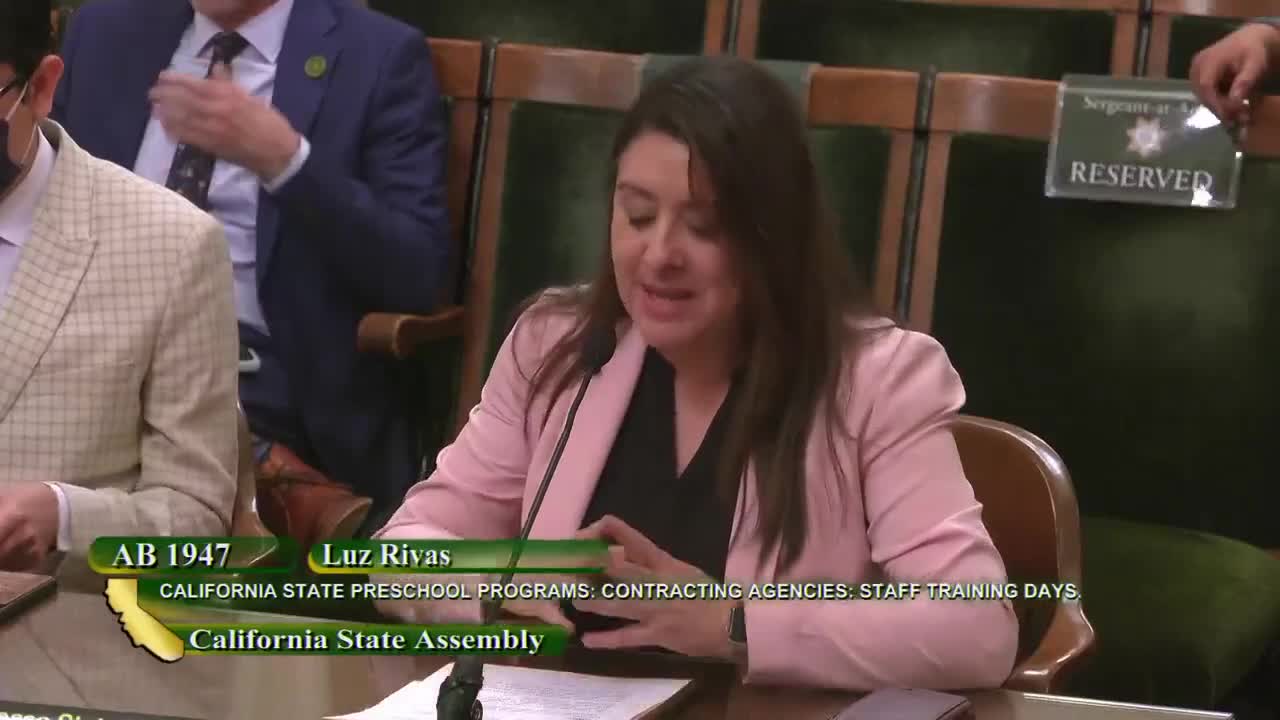
Bill Author

Bill Co-Author(s):