AB 1949: California Consumer Privacy Act of 2020: collection of personal information of a consumer less than 18 years of age.
- Session Year: 2023-2024
- House: Assembly
- Latest Version Date: 2024-09-03
Current Status:
Failed
(2024-09-28: Vetoed by Governor.)
Introduced
In Committee
First Chamber
In Committee
Second Chamber
Enacted
Existing law, the California Consumer Privacy Act of 2020 (CCPA), approved by the voters as Proposition 24 at the November 3, 2020, statewide general election, requires a consumer, as defined, to have various rights with respect to personal information, as defined, that is collected or sold by a business, as defined, including the right to direct a business that sells or shares personal information about a consumer to third parties to not sell or share the consumers personal information. The act prohibits a business from selling or sharing the personal information of a consumer if the business has actual knowledge that the consumer is less than 16 years of age, unless the consumer, or the consumers parent or guardian, as applicable, has affirmatively authorized the sale or sharing of the consumers personal information.
This bill would instead prohibit a business from selling or sharing the personal information of a consumer if the business has actual knowledge that the consumer is less than 18 years of age and would revise the above-described prohibition to prohibit a business from selling or sharing the personal information of a consumer over 13 years of age, but less than 18 years of age, unless the consumer, or the consumers parent or guardian, as applicable, has affirmatively authorized the sale or sharing of the consumers personal information, as specified. The bill would require a business to treat a consumer as under 18 years of age if the consumer, through a platform, technology, or mechanism, transmits a signal indicating that the consumer is less than 18 years of age.
The CCPA requires the Attorney General to solicit broad public participation and adopt regulations, as specified, to further the purposes of the act, including, but not limited to, regulations to establish technical specifications for an opt-out preference signal that allows the consumer, or the consumers parent or guardian, to specify that the consumer is less than 13 years of age, or at least 13 years of age and less than 16 years of age. The act requires the California Privacy Protection Agency, as specified, to adopt regulations under the authority assigned to the Attorney General under the act.
This bill would instead require the Attorney General to solicit broad public participation and adopt regulations, as described above, including, but not limited to, regulations to establish technical specifications for an opt-out preference signal that allows the consumer, or the consumers parent or guardian, to specify that the consumer is less than 13 years of age, or at least 13 years of age and less than 18 years of age.
The California Consumer Privacy Act of 2020 authorizes the Legislature to amend the act to further the purposes and intent of the act by a majority vote of both houses of the Legislature, as specified.
This bill would declare that its provisions further the purposes and intent of the California Consumer Privacy Act of 2020.
Existing law, the California Consumer Privacy Act of 2020 (CCPA), approved by the voters as Proposition 24 at the November 3, 2020, statewide general election, requires a consumer, as defined, to have various rights with respect to personal information, as defined, that is collected or sold by a business, as defined, including the right to direct a business that sells or shares personal information about a consumer to third parties to not sell or share the consumers personal information. The act prohibits a business from selling or sharing the personal information of a consumer if the business has actual knowledge that the consumer is less than 16 years of age, unless the consumer, or the consumers parent or guardian, as applicable, has affirmatively authorized the sale or sharing of the consumers personal information.
This bill would remove the condition that instead prohibit a business from selling or sharing the personal information of a consumer if the business have has actual knowledge that the consumer is less than 16 18 years of age and would revise the above-described prohibition to prohibit a business from selling or sharing the personal information of a consumer over 13 years of age, but less than 18 years of age, unless the consumer, or the consumers parent or guardian, as applicable, has affirmatively authorized the sale or sharing of the consumers personal information, as specified. The bill would require a business to treat a consumer as under 18 years of age if the consumer, through a platform, technology, or mechanism, transmits a signal indicating that the consumer is less than 18 years of age.
The CCPA requires the Attorney General to solicit broad public participation and adopt regulations, as specified, to further the purposes of the act, including, but not limited to, regulations to establish technical specifications for an opt-out preference signal that allows the consumer, or the consumers parent or guardian, to specify that the consumer is less than 13 years of age, or at least 13 years of age and less than 16 years of age. The act requires the California Privacy Protection Agency, as specified, to adopt regulations under the authority assigned to the Attorney General under the act.
This bill would instead require the Attorney General to solicit broad public participation and adopt regulations, as described above, including, but not limited to, regulations to establish technical specifications for an opt-out preference signal that allows the consumer, or the consumers parent or guardian, to specify that the consumer is less than 13 years of age, or at least 13 years of age and less than 18 years of age. The bill would require the California Privacy Protection Agency, on or before July 1, 2025, to solicit broad public participation and adopt regulations, as specified, to further the purposes of the act, including, but not limited to, issuing regulations to establish technical specifications for an opt-out preference signal that allows the consumer, or the consumers parent or guardian, to specify that the consumer is less than 13 years of age, or at least 13 years of age and less than 18 years of age, and issuing regulations regarding age verification and when a business must treat a consumer as being less than 13 or 18 years of age for purposes of the CCPA.
The California Consumer Privacy Act of 2020 authorizes the Legislature to amend the act to further the purposes and intent of the act by a majority vote of both houses of the Legislature, as specified.
This bill would declare that its provisions further the purposes and intent of the California Consumer Privacy Act of 2020.
Existing law, the California Consumer Privacy Act of 2020 (CCPA), approved by the voters as Proposition 24 at the November 3, 2020, statewide general election, requires a consumer, as defined, to have various rights with respect to personal information, as defined, that is collected or sold by a business, as defined, including the right to direct a business that sells or shares personal information about a consumer to third parties to not sell or share the consumers personal information. The act prohibits a business from selling or sharing the personal information of a consumer if the business has actual knowledge that the consumer is less than 16 years of age, unless the consumer, or the consumers parent or guardian, as applicable, has affirmatively authorized the sale or sharing of the consumers personal information.
This bill would remove the condition that the business have actual knowledge that the consumer is less than 16 years of age and would revise the above-described prohibition to prohibit a business from selling or sharing the personal information of a consumer less than 18 years of age, unless the consumer, or the consumers parent or guardian, as applicable, has affirmatively authorized the sale or sharing of the consumers personal information. information, as specified.
The CCPA requires the Attorney General to solicit broad public participation and adopt regulations, as specified, to further the purposes of the act, including, but not limited to, regulations to establish technical specifications for an opt-out preference signal that allows the consumer, or the consumers parent or guardian, to specify that the consumer is less than 13 years of age, or at least 13 years of age and less than 16 years of age. The act requires the California Privacy Protection Agency, as specified, to adopt regulations under the authority assigned to the Attorney General under the act.
This bill would instead require the Attorney General to solicit broad public participation and adopt regulations, as described above, including, but not limited to, regulations to establish technical specifications for an opt-out preference signal that allows the consumer, or the consumers parent or guardian, to specify that the consumer is less than 13 years of age, or at least 13 years of age and less than 18 years of age. The bill would require the California Privacy Protection Agency, on or before July 1, 2025, to solicit broad public participation and adopt regulations, as specified, to further the purposes of the act, including, but not limited to, issuing regulations to establish technical specifications for an opt-out preference signal that allows the consumer, or the consumers parent or guardian, to specify that the consumer is less than 13 years of age, or at least 13 years of age and less than 18 years of age, and issuing regulations regarding age verification and when a business must treat a consumer as being less than 13 or 18 years of age for purposes of the CCPA.
The California Consumer Privacy Act of 2020 authorizes the Legislature to amend the act to further the purposes and intent of the act by a majority vote of both houses of the Legislature, as specified.
This bill would declare that its provisions further the purposes and intent of the California Consumer Privacy Act of 2020.
Existing law, the California Consumer Privacy Act of 2020 (CCPA), approved by the voters as Proposition 24 at the November 3, 2020, statewide general election, requires a consumer, as defined, to have various rights with respect to personal information, as defined, that is collected or sold by a business, as defined, including the right to direct a business that sells or shares personal information about a consumer to third parties to not sell or share the consumers personal information. The act prohibits a business from selling or sharing the personal information of a consumer if the business has actual knowledge that the consumer is less than 16 years of age, unless the consumer, or the consumers parent or guardian, as applicable, has affirmatively authorized the sale or sharing of the consumers personal information.
This bill would remove the condition that the business have actual knowledge that the consumer is less than 16 years of age and would revise the above-described prohibition to prohibit a business from selling or sharing the personal information of a consumer less than 18 years of age, unless the consumer, or the consumers parent or guardian, as applicable, has affirmatively authorized the sale or sharing of the consumers personal information.
The CCPA requires the Attorney General to solicit broad public participation and adopt regulations, as specified, to further the purposes of the act, including, but not limited to, regulations to establish technical specifications for an opt-out preference signal that allows the consumer, or the consumers parent or guardian, to specify that the consumer is less than 13 years of age, or at least 13 years of age and less than 16 years of age. The act requires the California Privacy Protection Agency, as specified, to adopt regulations under the authority assigned to the Attorney General under the act.
This bill would require the California Privacy Protection Agency, on or before July 1, 2025, to solicit broad public participation and adopt regulations, as specified, to further the purposes of the act, including, but not limited to, issuing regulations to establish technical specifications for an opt-out preference signal that allows the consumer, or the consumers parent or guardian, to specify that the consumer is less than 13 years of age, or at least 13 years of age and less than 18 years of age, and issuing regulations regarding age verification and when a business must treat a consumer as being less than 13 or 18 years of age for purposes of the CCPA.
The California Consumer Privacy Act of 2020 authorizes the Legislature to amend the act to further the purposes and intent of the act by a majority vote of both houses of the Legislature, as specified.
This bill would declare that its provisions further the purposes and intent of the California Consumer Privacy Act of 2020.
General Duties of Businesses that Collect Personal Information
(a)A business that controls the collection of a consumers personal information shall, at or before the point of collection, inform consumers of the following:
(1)The categories of personal information to be collected and the purposes for which the categories of personal information are collected or used and whether that information is sold or shared. A business shall not collect additional categories of personal information or use personal information collected for additional purposes that are incompatible with the disclosed purpose for which the personal information was collected without providing the consumer with notice consistent with this section.
(2)If the business collects sensitive personal information, the categories of sensitive personal information to be collected and the purposes for which the categories of sensitive personal information are collected or used, and whether that information is sold or shared. A business shall not collect additional categories of sensitive personal information or use sensitive personal information collected for additional purposes that are incompatible with the disclosed purpose for which the sensitive personal information was collected without providing the consumer with notice consistent with this section.
(3)The length of time the business intends to retain each category of personal information, including sensitive personal information, or if that is not possible, the criteria used to determine that period provided that a business shall not retain a consumers personal information or sensitive personal information for each disclosed purpose for which the personal information was collected for longer than is reasonably necessary for that disclosed purpose.
(b)A business that, acting as a third party, controls the collection of personal information about a consumer may satisfy its obligation under subdivision (a) by providing the required information prominently and conspicuously on the homepage of its internet website. In addition, if a business acting as a third party controls the collection of personal information about a consumer on its premises, including in a vehicle, then the business shall, at or before the point of collection, inform consumers as to the categories of personal information to be collected and the purposes for which the categories of personal information are used, and whether that personal information is sold, in a clear and conspicuous manner at the location.
(c)A business collection, use, retention, and sharing of a consumers personal information shall be reasonably necessary and proportionate to achieve the purposes for which the personal information was collected or processed, or for another disclosed purpose that is compatible with the context in which the personal information was collected, and not further processed in a manner that is incompatible with those purposes.
(d)A business that collects a consumers personal information and that sells that personal information to, or shares it with, a third party or that discloses it to a service provider or contractor for a business purpose shall enter into an agreement with the third party, service provider, or contractor, that:
(1)Specifies that the personal information is sold or disclosed by the business only for limited and specified purposes.
(2)Obligates the third party, service provider, or contractor to comply with applicable obligations under this title and obligate those persons to provide the same level of privacy protection as is required by this title.
(3)Grants the business rights to take reasonable and appropriate steps to help ensure that the third party, service provider, or contractor uses the personal information transferred in a manner consistent with the business obligations under this title.
(4)Requires the third party, service provider, or contractor to notify the business if it makes a determination that it can no longer meet its obligations under this title.
(5)Grants the business the right, upon notice, including under paragraph (4), to take reasonable and appropriate steps to stop and remediate unauthorized use of personal information.
(e)A business that collects a consumers personal information shall implement reasonable security procedures and practices appropriate to the nature of the personal information to protect the personal information from unauthorized or illegal access, destruction, use, modification, or disclosure in accordance with Section 1798.81.5.
(f)Nothing in this section shall require a business to disclose trade secrets, as specified in regulations adopted pursuant to paragraph (3) of subdivision (a) of Section 1798.185.
(g)(1)Notwithstanding any other provision of this section, a business shall not collect the personal information of a consumer if the business has actual knowledge that the consumer is less than 18 years of age, unless the consumer, in the case of a consumer at least 13 years of age and less than 18 years of age, or the consumers parent or guardian, in the case of a consumer less than 13 years of age, has affirmatively authorized the collection of the consumers personal information.
(2)A business that willfully disregards the consumers age shall be deemed to have had actual knowledge of the consumers age.
SEC. 2.Section 1798.120 of the Civil Code is amended to read:1798.120.Consumers Right to Opt Out of Sale or Sharing of Personal Information
(a)A consumer shall have the right, at any time, to direct a business that sells or shares personal information about the consumer to third parties not to sell or share the consumers personal information. This right may be referred to as the right to opt-out of sale or sharing.
(b)A business that sells consumers personal information to, or shares it with, third parties shall provide notice to consumers, pursuant to subdivision (a) of Section 1798.135, that this information may be sold or shared and that consumers have the right to opt-out of the sale or sharing of their personal information.
(c)(1)Notwithstanding subdivision (a), a business shall not sell or share the personal information of a consumer if the business has actual knowledge that the consumer is less than 18 years of age, unless the consumer, in the case of a consumer at least 13 years of age and less than 18 years of age, or the consumers parent or guardian, in the case of a consumer less than 13 years of age, has affirmatively authorized the sale or sharing of the consumers personal information.
(2)A business that willfully disregards the consumers age shall be deemed to have had actual knowledge of the consumers age.
(d)A business that has received direction from a consumer not to sell or share the consumers personal information or, in the case of a minor consumers personal information has not received consent to sell or share the minor consumers personal information, shall be prohibited, pursuant to paragraph (4) of subdivision (c) of Section 1798.135, from selling or sharing the consumers personal information after its receipt of the consumers direction, unless the consumer subsequently provides consent, for the sale or sharing of the consumers personal information.
SEC. 3.Section 1798.121 of the Civil Code is amended to read:1798.121.Consumers Right to Limit Use and Disclosure of Sensitive Personal Information and a Minors Information
(a)A consumer shall have the right, at any time, to direct a business that collects sensitive personal information about the consumer to limit its use of the consumers sensitive personal information to that use which is necessary to perform the services or provide the goods reasonably expected by an average consumer who requests those goods or services, to perform the services set forth in paragraphs (2), (4), (5), and (8) of subdivision (e) of Section 1798.140, and as authorized by regulations adopted pursuant to subparagraph (C) of paragraph (19) of subdivision (a) of Section 1798.185. A business that uses or discloses a consumers sensitive personal information for purposes other than those specified in this subdivision shall provide notice to consumers, pursuant to subdivision (a) of Section 1798.135, that this information may be used, or disclosed to a service provider or contractor, for additional, specified purposes and that consumers have the right to limit the use or disclosure of their sensitive personal information.
(b)A business that has received direction from a consumer not to use or disclose the consumers sensitive personal information, except as authorized by subdivision (a), shall be prohibited, pursuant to paragraph (4) of subdivision (c) of Section 1798.135, from using or disclosing the consumers sensitive personal information for any other purpose after its receipt of the consumers direction unless the consumer subsequently provides consent for the use or disclosure of the consumers sensitive personal information for additional purposes.
(c)A service provider or contractor that assists a business in performing the purposes authorized by subdivision (a) may not use the sensitive personal information after it has received instructions from the business and to the extent it has actual knowledge that the personal information is sensitive personal information for any other purpose. A service provider or contractor is only required to limit its use of sensitive personal information received pursuant to a written contract with the business in response to instructions from the business and only with respect to its relationship with that business.
(d)Sensitive personal information that is collected or processed without the purpose of inferring characteristics about a consumer is not subject to this section, as further defined in regulations adopted pursuant to subparagraph (C) of paragraph (19) of subdivision (a) of Section 1798.185, and shall be treated as personal information for purposes of all other sections of this act, including Section 1798.100.
(e)(1)(A)Notwithstanding any other provision of this section, a business shall not use or disclose the personal information of a consumer if the business has actual knowledge that the consumer is less than 18 years of age, unless the consumer, in the case of a consumer at least 13 years of age and less than 18 years of age, or the consumers parent or guardian, in the case of a consumer less than 13 years of age, has affirmatively authorized the use or disclosure of the consumers personal information.
(B)A business that willfully disregards the consumers age shall be deemed to have had actual knowledge of the consumers age.
(2)This subdivision does not prohibit short-term, transient use of personal information that is necessary and proportional to the purpose for which it is used, and is not used, disclosed, or retained for any other purpose, including to build a profile regarding the consumer.
SEC. 4.Section 1798.139 is added to the Civil Code, to read:1798.139.A business shall treat a consumer as under 18 years of age if the consumer, through a platform, technology, or mechanism, transmits a signal indicating that the consumer is less than 18 years of age.
SEC. 5.Section 1798.185 of the Civil Code is amended to read:1798.185.Regulations
(a)On or before July 1, 2020, the Attorney General shall solicit broad public participation and adopt regulations to further the purposes of this title, including, but not limited to, the following areas:
(1)Updating or adding categories of personal information to those enumerated in subdivision (c) of Section 1798.130 and subdivision (v) of Section 1798.140, and updating or adding categories of sensitive personal information to those enumerated in subdivision (ae) of Section 1798.140 in order to address changes in technology, data collection practices, obstacles to implementation, and privacy concerns.
(2)Updating as needed the definitions of deidentified and unique identifier to address changes in technology, data collection, obstacles to implementation, and privacy concerns, and adding, modifying, or deleting categories to the definition of designated methods for submitting requests to facilitate a consumers ability to obtain information from a business pursuant to Section 1798.130. The authority to update the definition of deidentified shall not apply to deidentification standards set forth in Section 164.514 of Title 45 of the Code of Federal Regulations, where such information previously was protected health information as defined in Section 160.103 of Title 45 of the Code of Federal Regulations.
(3)Establishing any exceptions necessary to comply with state or federal law, including, but not limited to, those relating to trade secrets and intellectual property rights, within one year of passage of this title and as needed thereafter, with the intention that trade secrets should not be disclosed in response to a verifiable consumer request.
(4)Establishing rules and procedures for the following:
(A)To facilitate and govern the submission of a request by a consumer to opt out of the sale or sharing of personal information pursuant to Section 1798.120 and to limit the use of a consumers sensitive personal information pursuant to Section 1798.121 to ensure that consumers have the ability to exercise their choices without undue burden and to prevent business from engaging in deceptive or harassing conduct, including in retaliation against consumers for exercising their rights, while allowing businesses to inform consumers of the consequences of their decision to opt out of the sale or sharing of their personal information or to limit the use of their sensitive personal information.
(B)To govern business compliance with a consumers opt-out request.
(C)For the development and use of a recognizable and uniform opt-out logo or button by all businesses to promote consumer awareness of the opportunity to opt out of the sale of personal information.
(5)Adjusting the monetary thresholds, in January of every odd-numbered year to reflect any increase in the Consumer Price Index, in: subparagraph (A) of paragraph (1) of subdivision (d) of Section 1798.140; subparagraph (A) of paragraph (1) of subdivision (a) of Section 1798.150; subdivision (a) of Section 1798.155; Section 1798.199.25; and subdivision (a) of Section 1798.199.90.
(6)Establishing rules, procedures, and any exceptions necessary to ensure that the notices and information that businesses are required to provide pursuant to this title are provided in a manner that may be easily understood by the average consumer, are accessible to consumers with disabilities, and are available in the language primarily used to interact with the consumer, including establishing rules and guidelines regarding financial incentives within one year of passage of this title and as needed thereafter.
(7)Establishing rules and procedures to further the purposes of Sections 1798.105, 1798.106, 1798.110, and 1798.115 and to facilitate a consumers or the consumers authorized agents ability to delete personal information, correct inaccurate personal information pursuant to Section 1798.106, or obtain information pursuant to Section 1798.130, with the goal of minimizing the administrative burden on consumers, taking into account available technology, security concerns, and the burden on the business, to govern a businesss determination that a request for information received from a consumer is a verifiable consumer request, including treating a request submitted through a password-protected account maintained by the consumer with the business while the consumer is logged into the account as a verifiable consumer request and providing a mechanism for a consumer who does not maintain an account with the business to request information through the businesss authentication of the consumers identity, within one year of passage of this title and as needed thereafter.
(8)Establishing how often, and under what circumstances, a consumer may request a correction pursuant to Section 1798.106, including standards governing the following:
(A)How a business responds to a request for correction, including exceptions for requests to which a response is impossible or would involve disproportionate effort, and requests for correction of accurate information.
(B)How concerns regarding the accuracy of the information may be resolved.
(C)The steps a business may take to prevent fraud.
(D)If a business rejects a request to correct personal information collected and analyzed concerning a consumers health, the right of a consumer to provide a written addendum to the business with respect to any item or statement regarding any such personal information that the consumer believes to be incomplete or incorrect. The addendum shall be limited to 250 words per alleged incomplete or incorrect item and shall clearly indicate in writing that the consumer requests the addendum to be made a part of the consumers record.
(9)Establishing the standard to govern a businesss determination, pursuant to subparagraph (B) of paragraph (2) of subdivision (a) of Section 1798.130, that providing information beyond the 12-month period in a response to a verifiable consumer request is impossible or would involve a disproportionate effort.
(10)Issuing regulations further defining and adding to the business purposes, including other notified purposes, for which businesses, service providers, and contractors may use consumers personal information consistent with consumers expectations, and further defining the business purposes for which service providers and contractors may combine consumers personal information obtained from different sources, except as provided for in paragraph (6) of subdivision (e) of Section 1798.140.
(11)Issuing regulations identifying those business purposes, including other notified purposes, for which service providers and contractors may use consumers personal information received pursuant to a written contract with a business, for the service provider or contractors own business purposes, with the goal of maximizing consumer privacy.
(12)Issuing regulations to further define intentionally interacts, with the goal of maximizing consumer privacy.
(13)Issuing regulations to further define precise geolocation, including if the size defined is not sufficient to protect consumer privacy in sparsely populated areas or when the personal information is used for normal operational purposes, including billing.
(14)Issuing regulations to define the term specific pieces of information obtained from the consumer with the goal of maximizing a consumers right to access relevant personal information while minimizing the delivery of information to a consumer that would not be useful to the consumer, including system log information and other technical data. For delivery of the most sensitive personal information, the regulations may require a higher standard of authentication provided that the agency shall monitor the impact of the higher standard on the right of consumers to obtain their personal information to ensure that the requirements of verification do not result in the unreasonable denial of verifiable consumer requests.
(15)Issuing regulations requiring businesses whose processing of consumers personal information presents significant risk to consumers privacy or security, to:
(A)Perform a cybersecurity audit on an annual basis, including defining the scope of the audit and establishing a process to ensure that audits are thorough and independent. The factors to be considered in determining when processing may result in significant risk to the security of personal information shall include the size and complexity of the business and the nature and scope of processing activities.
(B)Submit to the California Privacy Protection Agency on a regular basis a risk assessment with respect to their processing of personal information, including whether the processing involves sensitive personal information, and identifying and weighing the benefits resulting from the processing to the business, the consumer, other stakeholders, and the public, against the potential risks to the rights of the consumer associated with that processing, with the goal of restricting or prohibiting the processing if the risks to privacy of the consumer outweigh the benefits resulting from processing to the consumer, the business, other stakeholders, and the public. Nothing in this section shall require a business to divulge trade secrets.
(16)Issuing regulations governing access and opt-out rights with respect to businesses use of automated decisionmaking technology, including profiling and requiring businesses response to access requests to include meaningful information about the logic involved in those decisionmaking processes, as well as a description of the likely outcome of the process with respect to the consumer.
(17)Issuing regulations to further define a law enforcement agency-approved investigation for purposes of the exception in subparagraph (B) of paragraph (1) of subdivision (a) of Section 1798.145.
(18)Issuing regulations to define the scope and process for the exercise of the agencys audit authority, to establish criteria for selection of persons to audit, and to protect consumers personal information from disclosure to an auditor in the absence of a court order, warrant, or subpoena.
(19)(A)Issuing regulations to define the requirements and technical specifications for an opt-out preference signal sent by a platform, technology, or mechanism, to indicate a consumers intent to opt out of the sale or sharing of the consumers personal information and to limit the use or disclosure of the consumers sensitive personal information. The requirements and specifications for the opt-out preference signal should be updated from time to time to reflect the means by which consumers interact with businesses, and should:
(i)Ensure that the manufacturer of a platform or browser or device that sends the opt-out preference signal cannot unfairly disadvantage another business.
(ii)Ensure that the opt-out preference signal is consumer-friendly, clearly described, and easy to use by an average consumer and does not require that the consumer provide additional information beyond what is necessary.
(iii)Clearly represent a consumers intent and be free of defaults constraining or presupposing that intent.
(iv)Ensure that the opt-out preference signal does not conflict with other commonly used privacy settings or tools that consumers may employ.
(v)Provide a mechanism for the consumer to selectively consent to a businesss sale of the consumers personal information, or the use or disclosure of the consumers sensitive personal information, without affecting the consumers preferences with respect to other businesses or disabling the opt-out preference signal globally.
(vi)State that in the case of a page or setting view that the consumer accesses to set the opt-out preference signal, the consumer should see up to three choices, including:
(I)Global opt out from sale and sharing of personal information, including a direction to limit the use of sensitive personal information.
(II)Choice to Limit the Use of My Sensitive Personal Information.
(III)Choice titled Do Not Sell/Do Not Share My Personal Information for Cross-Context Behavioral Advertising.
(B)Issuing regulations to establish technical specifications for an opt-out preference signal that allows the consumer, or the consumers parent or guardian, to specify that the consumer is less than 13 years of age, or at least 13 years of age and less than 18 years of age.
(C)Issuing regulations, with the goal of strengthening consumer privacy while considering the legitimate operational interests of businesses, to govern the use or disclosure of a consumers sensitive personal information, notwithstanding the consumers direction to limit the use or disclosure of the consumers sensitive personal information, including:
(i)Determining any additional purposes for which a business may use or disclose a consumers sensitive personal information.
(ii)Determining the scope of activities permitted under paragraph (8) of subdivision (e) of Section 1798.140, as authorized by subdivision (a) of Section 1798.121, to ensure that the activities do not involve health-related research.
(iii)Ensuring the functionality of the businesss operations.
(iv)Ensuring that the exemption in subdivision (d) of Section 1798.121 for sensitive personal information applies to information that is collected or processed incidentally, or without the purpose of inferring characteristics about a consumer, while ensuring that businesses do not use the exemption for the purpose of evading consumers rights to limit the use and disclosure of their sensitive personal information under Section 1798.121.
(20)Issuing regulations to govern how a business that has elected to comply with subdivision (b) of Section 1798.135 responds to the opt-out preference signal and provides consumers with the opportunity subsequently to consent to the sale or sharing of their personal information or the use and disclosure of their sensitive personal information for purposes in addition to those authorized by subdivision (a) of Section 1798.121. The regulations should:
(A)Strive to promote competition and consumer choice and be technology neutral.
(B)Ensure that the business does not respond to an opt-out preference signal by:
(i)Intentionally degrading the functionality of the consumer experience.
(ii)Charging the consumer a fee in response to the consumers opt-out preferences.
(iii)Making any products or services not function properly or fully for the consumer, as compared to consumers who do not use the opt-out preference signal.
(iv)Attempting to coerce the consumer to opt in to the sale or sharing of the consumers personal information, or the use or disclosure of the consumers sensitive personal information, by stating or implying that the use of the opt-out preference signal will adversely affect the consumer as compared to consumers who do not use the opt-out preference signal, including stating or implying that the consumer will not be able to use the businesss products or services or that those products or services may not function properly or fully.
(v)Displaying any notification or pop-up in response to the consumers opt-out preference signal.
(C)Ensure that any link to a web page or its supporting content that allows the consumer to consent to opt in:
(i)Is not part of a popup, notice, banner, or other intrusive design that obscures any part of the web page the consumer intended to visit from full view or that interferes with or impedes in any way the consumers experience visiting or browsing the web page or website the consumer intended to visit.
(ii)Does not require or imply that the consumer must click the link to receive full functionality of any products or services, including the website.
(iii)Does not make use of any dark patterns.
(iv)Applies only to the business with which the consumer intends to interact.
(D)Strive to curb coercive or deceptive practices in response to an opt-out preference signal but should not unduly restrict businesses that are trying in good faith to comply with Section 1798.135.
(21)Review existing Insurance Code provisions and regulations relating to consumer privacy, except those relating to insurance rates or pricing, to determine whether any provisions of the Insurance Code provide greater protection to consumers than the provisions of this title. Upon completing its review, the agency shall adopt a regulation that applies only the more protective provisions of this title to insurance companies. For the purpose of clarity, the Insurance Commissioner shall have jurisdiction over insurance rates and pricing.
(22)Harmonizing the regulations governing opt-out mechanisms, notices to consumers, and other operational mechanisms in this title to promote clarity and the functionality of this title for consumers.
(b)The Attorney General may adopt additional regulations as necessary to further the purposes of this title.
(c)The Attorney General shall not bring an enforcement action under this title until six months after the publication of the final regulations issued pursuant to this section or July 1, 2020, whichever is sooner.
(d)Notwithstanding subdivision (a), the timeline for adopting final regulations required by the act adding this subdivision shall be July 1, 2022. Beginning the later of July 1, 2021, or six months after the agency provides notice to the Attorney General that it is prepared to begin rulemaking under this title, the authority assigned to the Attorney General to adopt regulations under this section shall be exercised by the California Privacy Protection Agency. Notwithstanding any other law, civil and administrative enforcement of the provisions of law added or amended by this act shall not commence until July 1, 2023, and shall only apply to violations occurring on or after that date. Enforcement of provisions of law contained in the California Consumer Privacy Act of 2018 amended by this act shall remain in effect and shall be enforceable until the same provisions of this act become enforceable.
SEC. 6.The Legislature finds and declares that this act furthers the purposes and intent of The California Privacy Rights Act of 2020.
General Duties of Businesses that Collect Personal Information
(a)A business that controls the collection of a consumers personal information shall, at or before the point of collection, inform consumers of the following:
(1)The categories of personal information to be collected and the purposes for which the categories of personal information are collected or used and whether that information is sold or shared. A business shall not collect additional categories of personal information or use personal information collected for additional purposes that are incompatible with the disclosed purpose for which the personal information was collected without providing the consumer with notice consistent with this section.
(2)If the business collects sensitive personal information, the categories of sensitive personal information to be collected and the purposes for which the categories of sensitive personal information are collected or used, and whether that information is sold or shared. A business shall not collect additional categories of sensitive personal information or use sensitive personal information collected for additional purposes that are incompatible with the disclosed purpose for which the sensitive personal information was collected without providing the consumer with notice consistent with this section.
(3)The length of time the business intends to retain each category of personal information, including sensitive personal information, or if that is not possible, the criteria used to determine that period provided that a business shall not retain a consumers personal information or sensitive personal information for each disclosed purpose for which the personal information was collected for longer than is reasonably necessary for that disclosed purpose.
(b)A business that, acting as a third party, controls the collection of personal information about a consumer may satisfy its obligation under subdivision (a) by providing the required information prominently and conspicuously on the homepage of its internet website. In addition, if a business acting as a third party controls the collection of personal information about a consumer on its premises, including in a vehicle, then the business shall, at or before the point of collection, inform consumers as to the categories of personal information to be collected and the purposes for which the categories of personal information are used, and whether that personal information is sold, in a clear and conspicuous manner at the location.
(c)A business collection, use, retention, and sharing of a consumers personal information shall be reasonably necessary and proportionate to achieve the purposes for which the personal information was collected or processed, or for another disclosed purpose that is compatible with the context in which the personal information was collected, and not further processed in a manner that is incompatible with those purposes.
(d)A business that collects a consumers personal information and that sells that personal information to, or shares it with, a third party or that discloses it to a service provider or contractor for a business purpose shall enter into an agreement with the third party, service provider, or contractor, that:
(1)Specifies that the personal information is sold or disclosed by the business only for limited and specified purposes.
(2)Obligates the third party, service provider, or contractor to comply with applicable obligations under this title and obligate those persons to provide the same level of privacy protection as is required by this title.
(3)Grants the business rights to take reasonable and appropriate steps to help ensure that the third party, service provider, or contractor uses the personal information transferred in a manner consistent with the business obligations under this title.
(4)Requires the third party, service provider, or contractor to notify the business if it makes a determination that it can no longer meet its obligations under this title.
(5)Grants the business the right, upon notice, including under paragraph (4), to take reasonable and appropriate steps to stop and remediate unauthorized use of personal information.
(e)A business that collects a consumers personal information shall implement reasonable security procedures and practices appropriate to the nature of the personal information to protect the personal information from unauthorized or illegal access, destruction, use, modification, or disclosure in accordance with Section 1798.81.5.
(f)Nothing in this section shall require a business to disclose trade secrets, as specified in regulations adopted pursuant to paragraph (3) of subdivision (a) of Section 1798.185.
(g)Notwithstanding any other provision of this section, a business shall not collect the personal information of a consumer less than 18 years of age, unless the consumer, in the case of a consumer at least 13 years of age and less than 18 years of age, or the consumers parent or guardian, in the case of a consumer less than 13 years of age, has affirmatively authorized the collection of the consumers personal information.(g)(1)Notwithstanding any other provision of this section, a business shall not collect the personal information of a consumer if the business has actual knowledge that the consumer is less than 18 years of age, unless the consumer, in the case of a consumer at least 13 years of age and less than 18 years of age, or the consumers parent or guardian, in the case of a consumer less than 13 years of age, has affirmatively authorized the collection of the consumers personal information.
(2)A business that willfully disregards the consumers age shall be deemed to have had actual knowledge of the consumers age.
SEC. 2.Section 1798.120 of the Civil Code is amended to read:1798.120.Consumers Right to Opt Out of Sale or Sharing of Personal Information
(a)A consumer shall have the right, at any time, to direct a business that sells or shares personal information about the consumer to third parties not to sell or share the consumers personal information. This right may be referred to as the right to opt-out of sale or sharing.
(b)A business that sells consumers personal information to, or shares it with, third parties shall provide notice to consumers, pursuant to subdivision (a) of Section 1798.135, that this information may be sold or shared and that consumers have the right to opt-out of the sale or sharing of their personal information.
(c)Notwithstanding subdivision (a), a business shall not sell or share the personal information of consumers less than 18 years of age, unless the consumer, in the case of consumers at least 13 years of age and less than 18 years of age, or the consumers parent or guardian, in the case of consumers who are less than 13 years of age, has affirmatively authorized the sale or sharing of the consumers personal information.(c)(1)Notwithstanding subdivision (a), a business shall not sell or share the personal information of a consumer if the business has actual knowledge that the consumer is less than 18 years of age, unless the consumer, in the case of a consumer at least 13 years of age and less than 18 years of age, or the consumers parent or guardian, in the case of a consumer less than 13 years of age, has affirmatively authorized the sale or sharing of the consumers personal information.
(2)A business that willfully disregards the consumers age shall be deemed to have had actual knowledge of the consumers age.
(d)A business that has received direction from a consumer not to sell or share the consumers personal information or, in the case of a minor consumers personal information has not received consent to sell or share the minor consumers personal information, shall be prohibited, pursuant to paragraph (4) of subdivision (c) of Section 1798.135, from selling or sharing the consumers personal information after its receipt of the consumers direction, unless the consumer subsequently provides consent, for the sale or sharing of the consumers personal information.
SEC. 3.Section 1798.121 of the Civil Code is amended to read:1798.121.Consumers Right to Limit Use and Disclosure of Sensitive Personal Information and a Minors Information
(a)A consumer shall have the right, at any time, to direct a business that collects sensitive personal information about the consumer to limit its use of the consumers sensitive personal information to that use which is necessary to perform the services or provide the goods reasonably expected by an average consumer who requests those goods or services, to perform the services set forth in paragraphs (2), (4), (5), and (8) of subdivision (e) of Section 1798.140, and as authorized by regulations adopted pursuant to subparagraph (C) of paragraph (19) of subdivision (a) of Section 1798.185. A business that uses or discloses a consumers sensitive personal information for purposes other than those specified in this subdivision shall provide notice to consumers, pursuant to subdivision (a) of Section 1798.135, that this information may be used, or disclosed to a service provider or contractor, for additional, specified purposes and that consumers have the right to limit the use or disclosure of their sensitive personal information.
(b)A business that has received direction from a consumer not to use or disclose the consumers sensitive personal information, except as authorized by subdivision (a), shall be prohibited, pursuant to paragraph (4) of subdivision (c) of Section 1798.135, from using or disclosing the consumers sensitive personal information for any other purpose after its receipt of the consumers direction unless the consumer subsequently provides consent for the use or disclosure of the consumers sensitive personal information for additional purposes.
(c)A service provider or contractor that assists a business in performing the purposes authorized by subdivision (a) may not use the sensitive personal information after it has received instructions from the business and to the extent it has actual knowledge that the personal information is sensitive personal information for any other purpose. A service provider or contractor is only required to limit its use of sensitive personal information received pursuant to a written contract with the business in response to instructions from the business and only with respect to its relationship with that business.
(d)Sensitive personal information that is collected or processed without the purpose of inferring characteristics about a consumer is not subject to this section, as further defined in regulations adopted pursuant to subparagraph (C) of paragraph (19) of subdivision (a) of Section 1798.185, and shall be treated as personal information for purposes of all other sections of this act, including Section 1798.100.
(e)(1)Notwithstanding any other provision of this section, a business shall not use or disclose the personal information of a consumer less than 18 years of age, unless the consumer, in the case of a consumer at least 13 years of age and less than 18 years of age, or the consumers parent or guardian, in the case of a consumer less than 13 years of age, has affirmatively authorized the use or disclosure of the consumers personal information.(e)(1)(A)Notwithstanding any other provision of this section, a business shall not use or disclose the personal information of a consumer if the business has actual knowledge that the consumer is less than 18 years of age, unless the consumer, in the case of a consumer at least 13 years of age and less than 18 years of age, or the consumers parent or guardian, in the case of a consumer less than 13 years of age, has affirmatively authorized the use or disclosure of the consumers personal information.
(B)A business that willfully disregards the consumers age shall be deemed to have had actual knowledge of the consumers age.
(2)This subdivision does not prohibit short-term, transient use of personal information that is necessary and proportional to the purpose for which it is used, and is not used, disclosed, or retained for any other purpose, including to build a profile regarding the consumer.
SEC. 4.Section 1798.139 is added to the Civil Code, to read:1798.139.A business shall treat a consumer as under 18 years of age if the consumer, through a platform, technology, or mechanism, transmits a signal indicating that the consumer is less than 18 years of age.
SEC. 4.SEC. 5.Section 1798.185 of the Civil Code is amended to read:1798.185.Regulations
(a)On or before July 1, 2020, the Attorney General shall solicit broad public participation and adopt regulations to further the purposes of this title, including, but not limited to, the following areas:
(1)Updating or adding categories of personal information to those enumerated in subdivision (c) of Section 1798.130 and subdivision (v) of Section 1798.140, and updating or adding categories of sensitive personal information to those enumerated in subdivision (ae) of Section 1798.140 in order to address changes in technology, data collection practices, obstacles to implementation, and privacy concerns.
(2)Updating as needed the definitions of deidentified and unique identifier to address changes in technology, data collection, obstacles to implementation, and privacy concerns, and adding, modifying, or deleting categories to the definition of designated methods for submitting requests to facilitate a consumers ability to obtain information from a business pursuant to Section 1798.130. The authority to update the definition of deidentified shall not apply to deidentification standards set forth in Section 164.514 of Title 45 of the Code of Federal Regulations, where such information previously was protected health information as defined in Section 160.103 of Title 45 of the Code of Federal Regulations.
(3)Establishing any exceptions necessary to comply with state or federal law, including, but not limited to, those relating to trade secrets and intellectual property rights, within one year of passage of this title and as needed thereafter, with the intention that trade secrets should not be disclosed in response to a verifiable consumer request.
(4)Establishing rules and procedures for the following:
(A)To facilitate and govern the submission of a request by a consumer to opt out of the sale or sharing of personal information pursuant to Section 1798.120 and to limit the use of a consumers sensitive personal information pursuant to Section 1798.121 to ensure that consumers have the ability to exercise their choices without undue burden and to prevent business from engaging in deceptive or harassing conduct, including in retaliation against consumers for exercising their rights, while allowing businesses to inform consumers of the consequences of their decision to opt out of the sale or sharing of their personal information or to limit the use of their sensitive personal information.
(B)To govern business compliance with a consumers opt-out request.
(C)For the development and use of a recognizable and uniform opt-out logo or button by all businesses to promote consumer awareness of the opportunity to opt out of the sale of personal information.
(5)Adjusting the monetary thresholds, in January of every odd-numbered year to reflect any increase in the Consumer Price Index, in: subparagraph (A) of paragraph (1) of subdivision (d) of Section 1798.140; subparagraph (A) of paragraph (1) of subdivision (a) of Section 1798.150; subdivision (a) of Section 1798.155; Section 1798.199.25; and subdivision (a) of Section 1798.199.90.
(6)Establishing rules, procedures, and any exceptions necessary to ensure that the notices and information that businesses are required to provide pursuant to this title are provided in a manner that may be easily understood by the average consumer, are accessible to consumers with disabilities, and are available in the language primarily used to interact with the consumer, including establishing rules and guidelines regarding financial incentives within one year of passage of this title and as needed thereafter.
(7)Establishing rules and procedures to further the purposes of Sections 1798.105, 1798.106, 1798.110, and 1798.115 and to facilitate a consumers or the consumers authorized agents ability to delete personal information, correct inaccurate personal information pursuant to Section 1798.106, or obtain information pursuant to Section 1798.130, with the goal of minimizing the administrative burden on consumers, taking into account available technology, security concerns, and the burden on the business, to govern a businesss determination that a request for information received from a consumer is a verifiable consumer request, including treating a request submitted through a password-protected account maintained by the consumer with the business while the consumer is logged into the account as a verifiable consumer request and providing a mechanism for a consumer who does not maintain an account with the business to request information through the businesss authentication of the consumers identity, within one year of passage of this title and as needed thereafter.
(8)Establishing how often, and under what circumstances, a consumer may request a correction pursuant to Section 1798.106, including standards governing the following:
(A)How a business responds to a request for correction, including exceptions for requests to which a response is impossible or would involve disproportionate effort, and requests for correction of accurate information.
(B)How concerns regarding the accuracy of the information may be resolved.
(C)The steps a business may take to prevent fraud.
(D)If a business rejects a request to correct personal information collected and analyzed concerning a consumers health, the right of a consumer to provide a written addendum to the business with respect to any item or statement regarding any such personal information that the consumer believes to be incomplete or incorrect. The addendum shall be limited to 250 words per alleged incomplete or incorrect item and shall clearly indicate in writing that the consumer requests the addendum to be made a part of the consumers record.
(9)Establishing the standard to govern a businesss determination, pursuant to subparagraph (B) of paragraph (2) of subdivision (a) of Section 1798.130, that providing information beyond the 12-month period in a response to a verifiable consumer request is impossible or would involve a disproportionate effort.
(10)Issuing regulations further defining and adding to the business purposes, including other notified purposes, for which businesses, service providers, and contractors may use consumers personal information consistent with consumers expectations, and further defining the business purposes for which service providers and contractors may combine consumers personal information obtained from different sources, except as provided for in paragraph (6) of subdivision (e) of Section 1798.140.
(11)Issuing regulations identifying those business purposes, including other notified purposes, for which service providers and contractors may use consumers personal information received pursuant to a written contract with a business, for the service provider or contractors own business purposes, with the goal of maximizing consumer privacy.
(12)Issuing regulations to further define intentionally interacts, with the goal of maximizing consumer privacy.
(13)Issuing regulations to further define precise geolocation, including if the size defined is not sufficient to protect consumer privacy in sparsely populated areas or when the personal information is used for normal operational purposes, including billing.
(14)Issuing regulations to define the term specific pieces of information obtained from the consumer with the goal of maximizing a consumers right to access relevant personal information while minimizing the delivery of information to a consumer that would not be useful to the consumer, including system log information and other technical data. For delivery of the most sensitive personal information, the regulations may require a higher standard of authentication provided that the agency shall monitor the impact of the higher standard on the right of consumers to obtain their personal information to ensure that the requirements of verification do not result in the unreasonable denial of verifiable consumer requests.
(15)Issuing regulations requiring businesses whose processing of consumers personal information presents significant risk to consumers privacy or security, to:
(A)Perform a cybersecurity audit on an annual basis, including defining the scope of the audit and establishing a process to ensure that audits are thorough and independent. The factors to be considered in determining when processing may result in significant risk to the security of personal information shall include the size and complexity of the business and the nature and scope of processing activities.
(B)Submit to the California Privacy Protection Agency on a regular basis a risk assessment with respect to their processing of personal information, including whether the processing involves sensitive personal information, and identifying and weighing the benefits resulting from the processing to the business, the consumer, other stakeholders, and the public, against the potential risks to the rights of the consumer associated with that processing, with the goal of restricting or prohibiting the processing if the risks to privacy of the consumer outweigh the benefits resulting from processing to the consumer, the business, other stakeholders, and the public. Nothing in this section shall require a business to divulge trade secrets.
(16)Issuing regulations governing access and opt-out rights with respect to businesses use of automated decisionmaking technology, including profiling and requiring businesses response to access requests to include meaningful information about the logic involved in those decisionmaking processes, as well as a description of the likely outcome of the process with respect to the consumer.
(17)Issuing regulations to further define a law enforcement agency-approved investigation for purposes of the exception in subparagraph (B) of paragraph (1) of subdivision (a) of Section 1798.145.
(18)Issuing regulations to define the scope and process for the exercise of the agencys audit authority, to establish criteria for selection of persons to audit, and to protect consumers personal information from disclosure to an auditor in the absence of a court order, warrant, or subpoena.
(19)(A)Issuing regulations to define the requirements and technical specifications for an opt-out preference signal sent by a platform, technology, or mechanism, to indicate a consumers intent to opt out of the sale or sharing of the consumers personal information and to limit the use or disclosure of the consumers sensitive personal information. The requirements and specifications for the opt-out preference signal should be updated from time to time to reflect the means by which consumers interact with businesses, and should:
(i)Ensure that the manufacturer of a platform or browser or device that sends the opt-out preference signal cannot unfairly disadvantage another business.
(ii)Ensure that the opt-out preference signal is consumer-friendly, clearly described, and easy to use by an average consumer and does not require that the consumer provide additional information beyond what is necessary.
(iii)Clearly represent a consumers intent and be free of defaults constraining or presupposing that intent.
(iv)Ensure that the opt-out preference signal does not conflict with other commonly used privacy settings or tools that consumers may employ.
(v)Provide a mechanism for the consumer to selectively consent to a businesss sale of the consumers personal information, or the use or disclosure of the consumers sensitive personal information, without affecting the consumers preferences with respect to other businesses or disabling the opt-out preference signal globally.
(vi)State that in the case of a page or setting view that the consumer accesses to set the opt-out preference signal, the consumer should see up to three choices, including:
(I)Global opt out from sale and sharing of personal information, including a direction to limit the use of sensitive personal information.
(II)Choice to Limit the Use of My Sensitive Personal Information.
(III)Choice titled Do Not Sell/Do Not Share My Personal Information for Cross-Context Behavioral Advertising.
(B)Issuing regulations to establish technical specifications for an opt-out preference signal that allows the consumer, or the consumers parent or guardian, to specify that the consumer is less than 13 years of age, or at least 13 years of age and less than 18 years of age.
(C)Issuing regulations, with the goal of strengthening consumer privacy while considering the legitimate operational interests of businesses, to govern the use or disclosure of a consumers sensitive personal information, notwithstanding the consumers direction to limit the use or disclosure of the consumers sensitive personal information, including:
(i)Determining any additional purposes for which a business may use or disclose a consumers sensitive personal information.
(ii)Determining the scope of activities permitted under paragraph (8) of subdivision (e) of Section 1798.140, as authorized by subdivision (a) of Section 1798.121, to ensure that the activities do not involve health-related research.
(iii)Ensuring the functionality of the businesss operations.
(iv)Ensuring that the exemption in subdivision (d) of Section 1798.121 for sensitive personal information applies to information that is collected or processed incidentally, or without the purpose of inferring characteristics about a consumer, while ensuring that businesses do not use the exemption for the purpose of evading consumers rights to limit the use and disclosure of their sensitive personal information under Section 1798.121.
(20)Issuing regulations to govern how a business that has elected to comply with subdivision (b) of Section 1798.135 responds to the opt-out preference signal and provides consumers with the opportunity subsequently to consent to the sale or sharing of their personal information or the use and disclosure of their sensitive personal information for purposes in addition to those authorized by subdivision (a) of Section 1798.121. The regulations should:
(A)Strive to promote competition and consumer choice and be technology neutral.
(B)Ensure that the business does not respond to an opt-out preference signal by:
(i)Intentionally degrading the functionality of the consumer experience.
(ii)Charging the consumer a fee in response to the consumers opt-out preferences.
(iii)Making any products or services not function properly or fully for the consumer, as compared to consumers who do not use the opt-out preference signal.
(iv)Attempting to coerce the consumer to opt in to the sale or sharing of the consumers personal information, or the use or disclosure of the consumers sensitive personal information, by stating or implying that the use of the opt-out preference signal will adversely affect the consumer as compared to consumers who do not use the opt-out preference signal, including stating or implying that the consumer will not be able to use the businesss products or services or that those products or services may not function properly or fully.
(v)Displaying any notification or pop-up in response to the consumers opt-out preference signal.
(C)Ensure that any link to a web page or its supporting content that allows the consumer to consent to opt in:
(i)Is not part of a popup, notice, banner, or other intrusive design that obscures any part of the web page the consumer intended to visit from full view or that interferes with or impedes in any way the consumers experience visiting or browsing the web page or website the consumer intended to visit.
(ii)Does not require or imply that the consumer must click the link to receive full functionality of any products or services, including the website.
(iii)Does not make use of any dark patterns.
(iv)Applies only to the business with which the consumer intends to interact.
(D)Strive to curb coercive or deceptive practices in response to an opt-out preference signal but should not unduly restrict businesses that are trying in good faith to comply with Section 1798.135.
(21)Review existing Insurance Code provisions and regulations relating to consumer privacy, except those relating to insurance rates or pricing, to determine whether any provisions of the Insurance Code provide greater protection to consumers than the provisions of this title. Upon completing its review, the agency shall adopt a regulation that applies only the more protective provisions of this title to insurance companies. For the purpose of clarity, the Insurance Commissioner shall have jurisdiction over insurance rates and pricing.
(22)Harmonizing the regulations governing opt-out mechanisms, notices to consumers, and other operational mechanisms in this title to promote clarity and the functionality of this title for consumers.
(b)The Attorney General may adopt additional regulations as necessary to further the purposes of this title.
(c)The Attorney General shall not bring an enforcement action under this title until six months after the publication of the final regulations issued pursuant to this section or July 1, 2020, whichever is sooner.
(d)Notwithstanding subdivision (a), the timeline for adopting final regulations required by the act adding this subdivision shall be July 1, 2022. Beginning the later of July 1, 2021, or six months after the agency provides notice to the Attorney General that it is prepared to begin rulemaking under this title, the authority assigned to the Attorney General to adopt regulations under this section shall be exercised by the California Privacy Protection Agency. Notwithstanding any other law, civil and administrative enforcement of the provisions of law added or amended by this act shall not commence until July 1, 2023, and shall only apply to violations occurring on or after that date. Enforcement of provisions of law contained in the California Consumer Privacy Act of 2018 amended by this act shall remain in effect and shall be enforceable until the same provisions of this act become enforceable.
(e)On or before July 1, 2025, the California Privacy Protection Agency shall solicit broad public participation and adopt regulations to further the purposes of this title, including, but not limited to:(1)Issuing regulations to establish technical specifications for an opt-out preference signal that allows the consumer, or the consumers parent or guardian, to specify that the consumer is less than 13 years of age, or at least 13 years of age and less than 18 years of age.(2)Issuing regulations regarding age verification and when a business must treat a consumer as being less than 13 or 18 years of age for purposes of this title.SEC. 5.SEC. 6.The Legislature finds and declares that this act furthers the purposes and intent of The California Privacy Rights Act of 2020.
General Duties of Businesses that Collect Personal Information
(a)A business that controls the collection of a consumers personal information shall, at or before the point of collection, inform consumers of the following:
(1)The categories of personal information to be collected and the purposes for which the categories of personal information are collected or used and whether that information is sold or shared. A business shall not collect additional categories of personal information or use personal information collected for additional purposes that are incompatible with the disclosed purpose for which the personal information was collected without providing the consumer with notice consistent with this section.
(2)If the business collects sensitive personal information, the categories of sensitive personal information to be collected and the purposes for which the categories of sensitive personal information are collected or used, and whether that information is sold or shared. A business shall not collect additional categories of sensitive personal information or use sensitive personal information collected for additional purposes that are incompatible with the disclosed purpose for which the sensitive personal information was collected without providing the consumer with notice consistent with this section.
(3)The length of time the business intends to retain each category of personal information, including sensitive personal information, or if that is not possible, the criteria used to determine that period provided that a business shall not retain a consumers personal information or sensitive personal information for each disclosed purpose for which the personal information was collected for longer than is reasonably necessary for that disclosed purpose.
(b)A business that, acting as a third party, controls the collection of personal information about a consumer may satisfy its obligation under subdivision (a) by providing the required information prominently and conspicuously on the homepage of its internet website. In addition, if a business acting as a third party controls the collection of personal information about a consumer on its premises, including in a vehicle, then the business shall, at or before the point of collection, inform consumers as to the categories of personal information to be collected and the purposes for which the categories of personal information are used, and whether that personal information is sold, in a clear and conspicuous manner at the location.
(c)A business collection, use, retention, and sharing of a consumers personal information shall be reasonably necessary and proportionate to achieve the purposes for which the personal information was collected or processed, or for another disclosed purpose that is compatible with the context in which the personal information was collected, and not further processed in a manner that is incompatible with those purposes.
(d)A business that collects a consumers personal information and that sells that personal information to, or shares it with, a third party or that discloses it to a service provider or contractor for a business purpose shall enter into an agreement with the third party, service provider, or contractor, that:
(1)Specifies that the personal information is sold or disclosed by the business only for limited and specified purposes.
(2)Obligates the third party, service provider, or contractor to comply with applicable obligations under this title and obligate those persons to provide the same level of privacy protection as is required by this title.
(3)Grants the business rights to take reasonable and appropriate steps to help ensure that the third party, service provider, or contractor uses the personal information transferred in a manner consistent with the business obligations under this title.
(4)Requires the third party, service provider, or contractor to notify the business if it makes a determination that it can no longer meet its obligations under this title.
(5)Grants the business the right, upon notice, including under paragraph (4), to take reasonable and appropriate steps to stop and remediate unauthorized use of personal information.
(e)A business that collects a consumers personal information shall implement reasonable security procedures and practices appropriate to the nature of the personal information to protect the personal information from unauthorized or illegal access, destruction, use, modification, or disclosure in accordance with Section 1798.81.5.
(f)Nothing in this section shall require a business to disclose trade secrets, as specified in regulations adopted pursuant to paragraph (3) of subdivision (a) of Section 1798.185.
(g)Notwithstanding any other provision of this section, a business shall not collect the personal information of a consumer less than 18 years of age, unless the consumer, in the case of a consumer at least 13 years of age and less than 18 years of age, or the consumers parent or guardian, in the case of a consumer less than 13 years of age, has affirmatively authorized the collection of the consumers personal information.
SEC. 2.Section 1798.120 of the Civil Code is amended to read:1798.120.Consumers Right to Opt Out of Sale or Sharing of Personal Information
(a)A consumer shall have the right, at any time, to direct a business that sells or shares personal information about the consumer to third parties not to sell or share the consumers personal information. This right may be referred to as the right to opt-out of sale or sharing.
(b)A business that sells consumers personal information to, or shares it with, third parties shall provide notice to consumers, pursuant to subdivision (a) of Section 1798.135, that this information may be sold or shared and that consumers have the right to opt-out of the sale or sharing of their personal information.
(c)Notwithstanding subdivision (a), a business shall not sell or share the personal information of consumers less than 18 years of age, unless the consumer, in the case of consumers at least 13 years of age and less than 18 years of age, or the consumers parent or guardian, in the case of consumers who are less than 13 years of age, has affirmatively authorized the sale or sharing of the consumers personal information.
(d)A business that has received direction from a consumer not to sell or share the consumers personal information or, in the case of a minor consumers personal information has not received consent to sell or share the minor consumers personal information, shall be prohibited, pursuant to paragraph (4) of subdivision (c) of Section 1798.135, from selling or sharing the consumers personal information after its receipt of the consumers direction, unless the consumer subsequently provides consent, for the sale or sharing of the consumers personal information.
SEC. 3.Section 1798.121 of the Civil Code is amended to read:1798.121.Consumers Right to Limit Use and Disclosure of Sensitive Personal Information and a Minors Information
(a)A consumer shall have the right, at any time, to direct a business that collects sensitive personal information about the consumer to limit its use of the consumers sensitive personal information to that use which is necessary to perform the services or provide the goods reasonably expected by an average consumer who requests those goods or services, to perform the services set forth in paragraphs (2), (4), (5), and (8) of subdivision (e) of Section 1798.140, and as authorized by regulations adopted pursuant to subparagraph (C) of paragraph (19) of subdivision (a) of Section 1798.185. A business that uses or discloses a consumers sensitive personal information for purposes other than those specified in this subdivision shall provide notice to consumers, pursuant to subdivision (a) of Section 1798.135, that this information may be used, or disclosed to a service provider or contractor, for additional, specified purposes and that consumers have the right to limit the use or disclosure of their sensitive personal information.
(b)A business that has received direction from a consumer not to use or disclose the consumers sensitive personal information, except as authorized by subdivision (a), shall be prohibited, pursuant to paragraph (4) of subdivision (c) of Section 1798.135, from using or disclosing the consumers sensitive personal information for any other purpose after its receipt of the consumers direction unless the consumer subsequently provides consent for the use or disclosure of the consumers sensitive personal information for additional purposes.
(c)A service provider or contractor that assists a business in performing the purposes authorized by subdivision (a) may not use the sensitive personal information after it has received instructions from the business and to the extent it has actual knowledge that the personal information is sensitive personal information for any other purpose. A service provider or contractor is only required to limit its use of sensitive personal information received pursuant to a written contract with the business in response to instructions from the business and only with respect to its relationship with that business.
(d)Sensitive personal information that is collected or processed without the purpose of inferring characteristics about a consumer is not subject to this section, as further defined in regulations adopted pursuant to subparagraph (C) of paragraph (19) of subdivision (a) of Section 1798.185, and shall be treated as personal information for purposes of all other sections of this act, including Section 1798.100.
(e)(1)Notwithstanding any other provision of this section, a business shall not use or disclose the personal information of a consumer less than 18 years of age, unless the consumer, in the case of a consumer at least 13 years of age and less than 18 years of age, or the consumers parent or guardian, in the case of a consumer less than 13 years of age, has affirmatively authorized the use or disclosure of the consumers personal information.
(2)This subdivision does not prohibit short-term, transient use of personal information that is necessary and proportional to the purpose for which it is used, and is not used, disclosed, or retained for any other purpose, including to build a profile regarding the consumer.
SEC. 4.Section 1798.185 of the Civil Code is amended to read:1798.185.Regulations
(a)On or before July 1, 2020, the Attorney General shall solicit broad public participation and adopt regulations to further the purposes of this title, including, but not limited to, the following areas:
(1)Updating or adding categories of personal information to those enumerated in subdivision (c) of Section 1798.130 and subdivision (v) of Section 1798.140, and updating or adding categories of sensitive personal information to those enumerated in subdivision (ae) of Section 1798.140 in order to address changes in technology, data collection practices, obstacles to implementation, and privacy concerns.
(2)Updating as needed the definitions of deidentified and unique identifier to address changes in technology, data collection, obstacles to implementation, and privacy concerns, and adding, modifying, or deleting categories to the definition of designated methods for submitting requests to facilitate a consumers ability to obtain information from a business pursuant to Section 1798.130. The authority to update the definition of deidentified shall not apply to deidentification standards set forth in Section 164.514 of Title 45 of the Code of Federal Regulations, where such information previously was protected health information as defined in Section 160.103 of Title 45 of the Code of Federal Regulations.
(3)Establishing any exceptions necessary to comply with state or federal law, including, but not limited to, those relating to trade secrets and intellectual property rights, within one year of passage of this title and as needed thereafter, with the intention that trade secrets should not be disclosed in response to a verifiable consumer request.
(4)Establishing rules and procedures for the following:
(A)To facilitate and govern the submission of a request by a consumer to opt out of the sale or sharing of personal information pursuant to Section 1798.120 and to limit the use of a consumers sensitive personal information pursuant to Section 1798.121 to ensure that consumers have the ability to exercise their choices without undue burden and to prevent business from engaging in deceptive or harassing conduct, including in retaliation against consumers for exercising their rights, while allowing businesses to inform consumers of the consequences of their decision to opt out of the sale or sharing of their personal information or to limit the use of their sensitive personal information.
(B)To govern business compliance with a consumers opt-out request.
(C)For the development and use of a recognizable and uniform opt-out logo or button by all businesses to promote consumer awareness of the opportunity to opt out of the sale of personal information.
(5)Adjusting the monetary thresholds, in January of every odd-numbered year to reflect any increase in the Consumer Price Index, in: subparagraph (A) of paragraph (1) of subdivision (d) of Section 1798.140; subparagraph (A) of paragraph (1) of subdivision (a) of Section 1798.150; subdivision (a) of Section 1798.155; Section 1798.199.25; and subdivision (a) of Section 1798.199.90.
(6)Establishing rules, procedures, and any exceptions necessary to ensure that the notices and information that businesses are required to provide pursuant to this title are provided in a manner that may be easily understood by the average consumer, are accessible to consumers with disabilities, and are available in the language primarily used to interact with the consumer, including establishing rules and guidelines regarding financial incentives within one year of passage of this title and as needed thereafter.
(7)Establishing rules and procedures to further the purposes of Sections 1798.105, 1798.106, 1798.110, and 1798.115 and to facilitate a consumers or the consumers authorized agents ability to delete personal information, correct inaccurate personal information pursuant to Section 1798.106, or obtain information pursuant to Section 1798.130, with the goal of minimizing the administrative burden on consumers, taking into account available technology, security concerns, and the burden on the business, to govern a businesss determination that a request for information received from a consumer is a verifiable consumer request, including treating a request submitted through a password-protected account maintained by the consumer with the business while the consumer is logged into the account as a verifiable consumer request and providing a mechanism for a consumer who does not maintain an account with the business to request information through the businesss authentication of the consumers identity, within one year of passage of this title and as needed thereafter.
(8)Establishing how often, and under what circumstances, a consumer may request a correction pursuant to Section 1798.106, including standards governing the following:
(A)How a business responds to a request for correction, including exceptions for requests to which a response is impossible or would involve disproportionate effort, and requests for correction of accurate information.
(B)How concerns regarding the accuracy of the information may be resolved.
(C)The steps a business may take to prevent fraud.
(D)If a business rejects a request to correct personal information collected and analyzed concerning a consumers health, the right of a consumer to provide a written addendum to the business with respect to any item or statement regarding any such personal information that the consumer believes to be incomplete or incorrect. The addendum shall be limited to 250 words per alleged incomplete or incorrect item and shall clearly indicate in writing that the consumer requests the addendum to be made a part of the consumers record.
(9)Establishing the standard to govern a businesss determination, pursuant to subparagraph (B) of paragraph (2) of subdivision (a) of Section 1798.130, that providing information beyond the 12-month period in a response to a verifiable consumer request is impossible or would involve a disproportionate effort.
(10)Issuing regulations further defining and adding to the business purposes, including other notified purposes, for which businesses, service providers, and contractors may use consumers personal information consistent with consumers expectations, and further defining the business purposes for which service providers and contractors may combine consumers personal information obtained from different sources, except as provided for in paragraph (6) of subdivision (e) of Section 1798.140.
(11)Issuing regulations identifying those business purposes, including other notified purposes, for which service providers and contractors may use consumers personal information received pursuant to a written contract with a business, for the service provider or contractors own business purposes, with the goal of maximizing consumer privacy.
(12)Issuing regulations to further define intentionally interacts, with the goal of maximizing consumer privacy.
(13)Issuing regulations to further define precise geolocation, including if the size defined is not sufficient to protect consumer privacy in sparsely populated areas or when the personal information is used for normal operational purposes, including billing.
(14)Issuing regulations to define the term specific pieces of information obtained from the consumer with the goal of maximizing a consumers right to access relevant personal information while minimizing the delivery of information to a consumer that would not be useful to the consumer, including system log information and other technical data. For delivery of the most sensitive personal information, the regulations may require a higher standard of authentication provided that the agency shall monitor the impact of the higher standard on the right of consumers to obtain their personal information to ensure that the requirements of verification do not result in the unreasonable denial of verifiable consumer requests.
(15)Issuing regulations requiring businesses whose processing of consumers personal information presents significant risk to consumers privacy or security, to:
(A)Perform a cybersecurity audit on an annual basis, including defining the scope of the audit and establishing a process to ensure that audits are thorough and independent. The factors to be considered in determining when processing may result in significant risk to the security of personal information shall include the size and complexity of the business and the nature and scope of processing activities.
(B)Submit to the California Privacy Protection Agency on a regular basis a risk assessment with respect to their processing of personal information, including whether the processing involves sensitive personal information, and identifying and weighing the benefits resulting from the processing to the business, the consumer, other stakeholders, and the public, against the potential risks to the rights of the consumer associated with that processing, with the goal of restricting or prohibiting the processing if the risks to privacy of the consumer outweigh the benefits resulting from processing to the consumer, the business, other stakeholders, and the public. Nothing in this section shall require a business to divulge trade secrets.
(16)Issuing regulations governing access and opt-out rights with respect to businesses use of automated decisionmaking technology, including profiling and requiring businesses response to access requests to include meaningful information about the logic involved in those decisionmaking processes, as well as a description of the likely outcome of the process with respect to the consumer.
(17)Issuing regulations to further define a law enforcement agency-approved investigation for purposes of the exception in subparagraph (B) of paragraph (1) of subdivision (a) of Section 1798.145.
(18)Issuing regulations to define the scope and process for the exercise of the agencys audit authority, to establish criteria for selection of persons to audit, and to protect consumers personal information from disclosure to an auditor in the absence of a court order, warrant, or subpoena.
(19)(A)Issuing regulations to define the requirements and technical specifications for an opt-out preference signal sent by a platform, technology, or mechanism, to indicate a consumers intent to opt out of the sale or sharing of the consumers personal information and to limit the use or disclosure of the consumers sensitive personal information. The requirements and specifications for the opt-out preference signal should be updated from time to time to reflect the means by which consumers interact with businesses, and should:
(i)Ensure that the manufacturer of a platform or browser or device that sends the opt-out preference signal cannot unfairly disadvantage another business.
(ii)Ensure that the opt-out preference signal is consumer-friendly, clearly described, and easy to use by an average consumer and does not require that the consumer provide additional information beyond what is necessary.
(iii)Clearly represent a consumers intent and be free of defaults constraining or presupposing that intent.
(iv)Ensure that the opt-out preference signal does not conflict with other commonly used privacy settings or tools that consumers may employ.
(v)Provide a mechanism for the consumer to selectively consent to a businesss sale of the consumers personal information, or the use or disclosure of the consumers sensitive personal information, without affecting the consumers preferences with respect to other businesses or disabling the opt-out preference signal globally.
(vi)State that in the case of a page or setting view that the consumer accesses to set the opt-out preference signal, the consumer should see up to three choices, including:
(I)Global opt out from sale and sharing of personal information, including a direction to limit the use of sensitive personal information.
(II)Choice to Limit the Use of My Sensitive Personal Information.
(III)Choice titled Do Not Sell/Do Not Share My Personal Information for Cross-Context Behavioral Advertising.
(B)Issuing regulations to establish technical specifications for an opt-out preference signal that allows the consumer, or the consumers parent or guardian, to specify that the consumer is less than 13 years of age, or at least 13 years of age and less than 16 18 years of age.
(C)Issuing regulations, with the goal of strengthening consumer privacy while considering the legitimate operational interests of businesses, to govern the use or disclosure of a consumers sensitive personal information, notwithstanding the consumers direction to limit the use or disclosure of the consumers sensitive personal information, including:
(i)Determining any additional purposes for which a business may use or disclose a consumers sensitive personal information.
(ii)Determining the scope of activities permitted under paragraph (8) of subdivision (e) of Section 1798.140, as authorized by subdivision (a) of Section 1798.121, to ensure that the activities do not involve health-related research.
(iii)Ensuring the functionality of the businesss operations.
(iv)Ensuring that the exemption in subdivision (d) of Section 1798.121 for sensitive personal information applies to information that is collected or processed incidentally, or without the purpose of inferring characteristics about a consumer, while ensuring that businesses do not use the exemption for the purpose of evading consumers rights to limit the use and disclosure of their sensitive personal information under Section 1798.121.
(20)Issuing regulations to govern how a business that has elected to comply with subdivision (b) of Section 1798.135 responds to the opt-out preference signal and provides consumers with the opportunity subsequently to consent to the sale or sharing of their personal information or the use and disclosure of their sensitive personal information for purposes in addition to those authorized by subdivision (a) of Section 1798.121. The regulations should:
(A)Strive to promote competition and consumer choice and be technology neutral.
(B)Ensure that the business does not respond to an opt-out preference signal by:
(i)Intentionally degrading the functionality of the consumer experience.
(ii)Charging the consumer a fee in response to the consumers opt-out preferences.
(iii)Making any products or services not function properly or fully for the consumer, as compared to consumers who do not use the opt-out preference signal.
(iv)Attempting to coerce the consumer to opt in to the sale or sharing of the consumers personal information, or the use or disclosure of the consumers sensitive personal information, by stating or implying that the use of the opt-out preference signal will adversely affect the consumer as compared to consumers who do not use the opt-out preference signal, including stating or implying that the consumer will not be able to use the businesss products or services or that those products or services may not function properly or fully.
(v)Displaying any notification or pop-up in response to the consumers opt-out preference signal.
(C)Ensure that any link to a web page or its supporting content that allows the consumer to consent to opt in:
(i)Is not part of a popup, notice, banner, or other intrusive design that obscures any part of the web page the consumer intended to visit from full view or that interferes with or impedes in any way the consumers experience visiting or browsing the web page or website the consumer intended to visit.
(ii)Does not require or imply that the consumer must click the link to receive full functionality of any products or services, including the website.
(iii)Does not make use of any dark patterns.
(iv)Applies only to the business with which the consumer intends to interact.
(D)Strive to curb coercive or deceptive practices in response to an opt-out preference signal but should not unduly restrict businesses that are trying in good faith to comply with Section 1798.135.
(21)Review existing Insurance Code provisions and regulations relating to consumer privacy, except those relating to insurance rates or pricing, to determine whether any provisions of the Insurance Code provide greater protection to consumers than the provisions of this title. Upon completing its review, the agency shall adopt a regulation that applies only the more protective provisions of this title to insurance companies. For the purpose of clarity, the Insurance Commissioner shall have jurisdiction over insurance rates and pricing.
(22)Harmonizing the regulations governing opt-out mechanisms, notices to consumers, and other operational mechanisms in this title to promote clarity and the functionality of this title for consumers.
(b)The Attorney General may adopt additional regulations as necessary to further the purposes of this title.
(c)The Attorney General shall not bring an enforcement action under this title until six months after the publication of the final regulations issued pursuant to this section or July 1, 2020, whichever is sooner.
(d)Notwithstanding subdivision (a), the timeline for adopting final regulations required by the act adding this subdivision shall be July 1, 2022. Beginning the later of July 1, 2021, or six months after the agency provides notice to the Attorney General that it is prepared to begin rulemaking under this title, the authority assigned to the Attorney General to adopt regulations under this section shall be exercised by the California Privacy Protection Agency. Notwithstanding any other law, civil and administrative enforcement of the provisions of law added or amended by this act shall not commence until July 1, 2023, and shall only apply to violations occurring on or after that date. Enforcement of provisions of law contained in the California Consumer Privacy Act of 2018 amended by this act shall remain in effect and shall be enforceable until the same provisions of this act become enforceable.
(e)On or before July 1, 2025, the California Privacy Protection Agency shall solicit broad public participation and adopt regulations to further the purposes of this title, including, but not limited to:
(1)Issuing regulations to establish technical specifications for an opt-out preference signal that allows the consumer, or the consumers parent or guardian, to specify that the consumer is less than 13 years of age, or at least 13 years of age and less than 18 years of age.
(2)Issuing regulations regarding age verification and when a business must treat a consumer as being less than 13 or 18 years of age for purposes of this title.
SEC. 5.The Legislature finds and declares that this act furthers the purposes and intent of The California Privacy Rights Act of 2020.
General Duties of Businesses that Collect Personal Information
(a)A business that controls the collection of a consumers personal information shall, at or before the point of collection, inform consumers of the following:
(1)The categories of personal information to be collected and the purposes for which the categories of personal information are collected or used and whether that information is sold or shared. A business shall not collect additional categories of personal information or use personal information collected for additional purposes that are incompatible with the disclosed purpose for which the personal information was collected without providing the consumer with notice consistent with this section.
(2)If the business collects sensitive personal information, the categories of sensitive personal information to be collected and the purposes for which the categories of sensitive personal information are collected or used, and whether that information is sold or shared. A business shall not collect additional categories of sensitive personal information or use sensitive personal information collected for additional purposes that are incompatible with the disclosed purpose for which the sensitive personal information was collected without providing the consumer with notice consistent with this section.
(3)The length of time the business intends to retain each category of personal information, including sensitive personal information, or if that is not possible, the criteria used to determine that period provided that a business shall not retain a consumers personal information or sensitive personal information for each disclosed purpose for which the personal information was collected for longer than is reasonably necessary for that disclosed purpose.
(b)A business that, acting as a third party, controls the collection of personal information about a consumer may satisfy its obligation under subdivision (a) by providing the required information prominently and conspicuously on the homepage of its internet website. In addition, if a business acting as a third party controls the collection of personal information about a consumer on its premises, including in a vehicle, then the business shall, at or before the point of collection, inform consumers as to the categories of personal information to be collected and the purposes for which the categories of personal information are used, and whether that personal information is sold, in a clear and conspicuous manner at the location.
(c)A business collection, use, retention, and sharing of a consumers personal information shall be reasonably necessary and proportionate to achieve the purposes for which the personal information was collected or processed, or for another disclosed purpose that is compatible with the context in which the personal information was collected, and not further processed in a manner that is incompatible with those purposes.
(d)A business that collects a consumers personal information and that sells that personal information to, or shares it with, a third party or that discloses it to a service provider or contractor for a business purpose shall enter into an agreement with the third party, service provider, or contractor, that:
(1)Specifies that the personal information is sold or disclosed by the business only for limited and specified purposes.
(2)Obligates the third party, service provider, or contractor to comply with applicable obligations under this title and obligate those persons to provide the same level of privacy protection as is required by this title.
(3)Grants the business rights to take reasonable and appropriate steps to help ensure that the third party, service provider, or contractor uses the personal information transferred in a manner consistent with the business obligations under this title.
(4)Requires the third party, service provider, or contractor to notify the business if it makes a determination that it can no longer meet its obligations under this title.
(5)Grants the business the right, upon notice, including under paragraph (4), to take reasonable and appropriate steps to stop and remediate unauthorized use of personal information.
(e)A business that collects a consumers personal information shall implement reasonable security procedures and practices appropriate to the nature of the personal information to protect the personal information from unauthorized or illegal access, destruction, use, modification, or disclosure in accordance with Section 1798.81.5.
(f)Nothing in this section shall require a business to disclose trade secrets, as specified in regulations adopted pursuant to paragraph (3) of subdivision (a) of Section 1798.185.
(g)Notwithstanding any other provision of this section, a business shall not collect the personal information of a consumer less than 18 years of age, unless the consumer, in the case of a consumer at least 13 years of age and less than 18 years of age, or the consumers parent or guardian, in the case of a consumer less than 13 years of age, has affirmatively authorized the collection of the consumers personal information.
SEC. 2.Section 1798.120 of the Civil Code is amended to read:1798.120.Consumers Right to Opt Out of Sale or Sharing of Personal Information
(a)A consumer shall have the right, at any time, to direct a business that sells or shares personal information about the consumer to third parties not to sell or share the consumers personal information. This right may be referred to as the right to opt-out of sale or sharing.
(b)A business that sells consumers personal information to, or shares it with, third parties shall provide notice to consumers, pursuant to subdivision (a) of Section 1798.135, that this information may be sold or shared and that consumers have the right to opt-out of the sale or sharing of their personal information.
(c)Notwithstanding subdivision (a), a business shall not sell or share the personal information of consumers if the business has actual knowledge that the consumer is less than 16 18 years of age, unless the consumer, in the case of consumers at least 13 years of age and less than 16 18 years of age, or the consumers parent or guardian, in the case of consumers who are less than 13 years of age, has affirmatively authorized the sale or sharing of the consumers personal information. A business that willfully disregards the consumers age shall be deemed to have had actual knowledge of the consumers age.
(d)A business that has received direction from a consumer not to sell or share the consumers personal information or, in the case of a minor consumers personal information has not received consent to sell or share the minor consumers personal information, shall be prohibited, pursuant to paragraph (4) of subdivision (c) of Section 1798.135, from selling or sharing the consumers personal information after its receipt of the consumers direction, unless the consumer subsequently provides consent, for the sale or sharing of the consumers personal information.
SEC. 3.Section 1798.121 of the Civil Code is amended to read:1798.121.Consumers Right to Limit Use and Disclosure of Sensitive Personal Information and a Minors Information
(a)A consumer shall have the right, at any time, to direct a business that collects sensitive personal information about the consumer to limit its use of the consumers sensitive personal information to that use which is necessary to perform the services or provide the goods reasonably expected by an average consumer who requests those goods or services, to perform the services set forth in paragraphs (2), (4), (5), and (8) of subdivision (e) of Section 1798.140, and as authorized by regulations adopted pursuant to subparagraph (C) of paragraph (19) of subdivision (a) of Section 1798.185. A business that uses or discloses a consumers sensitive personal information for purposes other than those specified in this subdivision shall provide notice to consumers, pursuant to subdivision (a) of Section 1798.135, that this information may be used, or disclosed to a service provider or contractor, for additional, specified purposes and that consumers have the right to limit the use or disclosure of their sensitive personal information.
(b)A business that has received direction from a consumer not to use or disclose the consumers sensitive personal information, except as authorized by subdivision (a), shall be prohibited, pursuant to paragraph (4) of subdivision (c) of Section 1798.135, from using or disclosing the consumers sensitive personal information for any other purpose after its receipt of the consumers direction unless the consumer subsequently provides consent for the use or disclosure of the consumers sensitive personal information for additional purposes.
(c)A service provider or contractor that assists a business in performing the purposes authorized by subdivision (a) may not use the sensitive personal information after it has received instructions from the business and to the extent it has actual knowledge that the personal information is sensitive personal information for any other purpose. A service provider or contractor is only required to limit its use of sensitive personal information received pursuant to a written contract with the business in response to instructions from the business and only with respect to its relationship with that business.
(d)Sensitive personal information that is collected or processed without the purpose of inferring characteristics about a consumer is not subject to this section, as further defined in regulations adopted pursuant to subparagraph (C) of paragraph (19) of subdivision (a) of Section 1798.185, and shall be treated as personal information for purposes of all other sections of this act, including Section 1798.100.
(e)Notwithstanding any other provision of this section, a business shall not use or disclose the personal information of a consumer less than 18 years of age, unless the consumer, in the case of a consumer at least 13 years of age and less than 18 years of age, or the consumers parent or guardian, in the case of a consumer less than 13 years of age, has affirmatively authorized the use or disclosure of the consumers personal information.
SEC. 4.Section 1798.185 of the Civil Code is amended to read:1798.185.Regulations
(a)On or before July 1, 2020, the Attorney General shall solicit broad public participation and adopt regulations to further the purposes of this title, including, but not limited to, the following areas:
(1)Updating or adding categories of personal information to those enumerated in subdivision (c) of Section 1798.130 and subdivision (v) of Section 1798.140, and updating or adding categories of sensitive personal information to those enumerated in subdivision (ae) of Section 1798.140 in order to address changes in technology, data collection practices, obstacles to implementation, and privacy concerns.
(2)Updating as needed the definitions of deidentified and unique identifier to address changes in technology, data collection, obstacles to implementation, and privacy concerns, and adding, modifying, or deleting categories to the definition of designated methods for submitting requests to facilitate a consumers ability to obtain information from a business pursuant to Section 1798.130. The authority to update the definition of deidentified shall not apply to deidentification standards set forth in Section 164.514 of Title 45 of the Code of Federal Regulations, where such information previously was protected health information as defined in Section 160.103 of Title 45 of the Code of Federal Regulations.
(3)Establishing any exceptions necessary to comply with state or federal law, including, but not limited to, those relating to trade secrets and intellectual property rights, within one year of passage of this title and as needed thereafter, with the intention that trade secrets should not be disclosed in response to a verifiable consumer request.
(4)Establishing rules and procedures for the following:
(A)To facilitate and govern the submission of a request by a consumer to opt out of the sale or sharing of personal information pursuant to Section 1798.120 and to limit the use of a consumers sensitive personal information pursuant to Section 1798.121 to ensure that consumers have the ability to exercise their choices without undue burden and to prevent business from engaging in deceptive or harassing conduct, including in retaliation against consumers for exercising their rights, while allowing businesses to inform consumers of the consequences of their decision to opt out of the sale or sharing of their personal information or to limit the use of their sensitive personal information.
(B)To govern business compliance with a consumers opt-out request.
(C)For the development and use of a recognizable and uniform opt-out logo or button by all businesses to promote consumer awareness of the opportunity to opt out of the sale of personal information.
(5)Adjusting the monetary thresholds, in January of every odd-numbered year to reflect any increase in the Consumer Price Index, in: subparagraph (A) of paragraph (1) of subdivision (d) of Section 1798.140; subparagraph (A) of paragraph (1) of subdivision (a) of Section 1798.150; subdivision (a) of Section 1798.155; Section 1798.199.25; and subdivision (a) of Section 1798.199.90.
(6)Establishing rules, procedures, and any exceptions necessary to ensure that the notices and information that businesses are required to provide pursuant to this title are provided in a manner that may be easily understood by the average consumer, are accessible to consumers with disabilities, and are available in the language primarily used to interact with the consumer, including establishing rules and guidelines regarding financial incentives within one year of passage of this title and as needed thereafter.
(7)Establishing rules and procedures to further the purposes of Sections 1798.105, 1798.106, 1798.110, and 1798.115 and to facilitate a consumers or the consumers authorized agents ability to delete personal information, correct inaccurate personal information pursuant to Section 1798.106, or obtain information pursuant to Section 1798.130, with the goal of minimizing the administrative burden on consumers, taking into account available technology, security concerns, and the burden on the business, to govern a businesss determination that a request for information received from a consumer is a verifiable consumer request, including treating a request submitted through a password-protected account maintained by the consumer with the business while the consumer is logged into the account as a verifiable consumer request and providing a mechanism for a consumer who does not maintain an account with the business to request information through the businesss authentication of the consumers identity, within one year of passage of this title and as needed thereafter.
(8)Establishing how often, and under what circumstances, a consumer may request a correction pursuant to Section 1798.106, including standards governing the following:
(A)How a business responds to a request for correction, including exceptions for requests to which a response is impossible or would involve disproportionate effort, and requests for correction of accurate information.
(B)How concerns regarding the accuracy of the information may be resolved.
(C)The steps a business may take to prevent fraud.
(D)If a business rejects a request to correct personal information collected and analyzed concerning a consumers health, the right of a consumer to provide a written addendum to the business with respect to any item or statement regarding any such personal information that the consumer believes to be incomplete or incorrect. The addendum shall be limited to 250 words per alleged incomplete or incorrect item and shall clearly indicate in writing that the consumer requests the addendum to be made a part of the consumers record.
(9)Establishing the standard to govern a businesss determination, pursuant to subparagraph (B) of paragraph (2) of subdivision (a) of Section 1798.130, that providing information beyond the 12-month period in a response to a verifiable consumer request is impossible or would involve a disproportionate effort.
(10)Issuing regulations further defining and adding to the business purposes, including other notified purposes, for which businesses, service providers, and contractors may use consumers personal information consistent with consumers expectations, and further defining the business purposes for which service providers and contractors may combine consumers personal information obtained from different sources, except as provided for in paragraph (6) of subdivision (e) of Section 1798.140.
(11)Issuing regulations identifying those business purposes, including other notified purposes, for which service providers and contractors may use consumers personal information received pursuant to a written contract with a business, for the service provider or contractors own business purposes, with the goal of maximizing consumer privacy.
(12)Issuing regulations to further define intentionally interacts, with the goal of maximizing consumer privacy.
(13)Issuing regulations to further define precise geolocation, including if the size defined is not sufficient to protect consumer privacy in sparsely populated areas or when the personal information is used for normal operational purposes, including billing.
(14)Issuing regulations to define the term specific pieces of information obtained from the consumer with the goal of maximizing a consumers right to access relevant personal information while minimizing the delivery of information to a consumer that would not be useful to the consumer, including system log information and other technical data. For delivery of the most sensitive personal information, the regulations may require a higher standard of authentication provided that the agency shall monitor the impact of the higher standard on the right of consumers to obtain their personal information to ensure that the requirements of verification do not result in the unreasonable denial of verifiable consumer requests.
(15)Issuing regulations requiring businesses whose processing of consumers personal information presents significant risk to consumers privacy or security, to:
(A)Perform a cybersecurity audit on an annual basis, including defining the scope of the audit and establishing a process to ensure that audits are thorough and independent. The factors to be considered in determining when processing may result in significant risk to the security of personal information shall include the size and complexity of the business and the nature and scope of processing activities.
(B)Submit to the California Privacy Protection Agency on a regular basis a risk assessment with respect to their processing of personal information, including whether the processing involves sensitive personal information, and identifying and weighing the benefits resulting from the processing to the business, the consumer, other stakeholders, and the public, against the potential risks to the rights of the consumer associated with that processing, with the goal of restricting or prohibiting the processing if the risks to privacy of the consumer outweigh the benefits resulting from processing to the consumer, the business, other stakeholders, and the public. Nothing in this section shall require a business to divulge trade secrets.
(16)Issuing regulations governing access and opt-out rights with respect to businesses use of automated decisionmaking technology, including profiling and requiring businesses response to access requests to include meaningful information about the logic involved in those decisionmaking processes, as well as a description of the likely outcome of the process with respect to the consumer.
(17)Issuing regulations to further define a law enforcement agency-approved investigation for purposes of the exception in subparagraph (B) of paragraph (1) of subdivision (a) of Section 1798.145.
(18)Issuing regulations to define the scope and process for the exercise of the agencys audit authority, to establish criteria for selection of persons to audit, and to protect consumers personal information from disclosure to an auditor in the absence of a court order, warrant, or subpoena.
(19)(A)Issuing regulations to define the requirements and technical specifications for an opt-out preference signal sent by a platform, technology, or mechanism, to indicate a consumers intent to opt out of the sale or sharing of the consumers personal information and to limit the use or disclosure of the consumers sensitive personal information. The requirements and specifications for the opt-out preference signal should be updated from time to time to reflect the means by which consumers interact with businesses, and should:
(i)Ensure that the manufacturer of a platform or browser or device that sends the opt-out preference signal cannot unfairly disadvantage another business.
(ii)Ensure that the opt-out preference signal is consumer-friendly, clearly described, and easy to use by an average consumer and does not require that the consumer provide additional information beyond what is necessary.
(iii)Clearly represent a consumers intent and be free of defaults constraining or presupposing that intent.
(iv)Ensure that the opt-out preference signal does not conflict with other commonly used privacy settings or tools that consumers may employ.
(v)Provide a mechanism for the consumer to selectively consent to a businesss sale of the consumers personal information, or the use or disclosure of the consumers sensitive personal information, without affecting the consumers preferences with respect to other businesses or disabling the opt-out preference signal globally.
(vi)State that in the case of a page or setting view that the consumer accesses to set the opt-out preference signal, the consumer should see up to three choices, including:
(I)Global opt out from sale and sharing of personal information, including a direction to limit the use of sensitive personal information.
(II)Choice to Limit the Use of My Sensitive Personal Information.
(III)Choice titled Do Not Sell/Do Not Share My Personal Information for Cross-Context Behavioral Advertising.
(B)Issuing regulations to establish technical specifications for an opt-out preference signal that allows the consumer, or the consumers parent or guardian, to specify that the consumer is less than 13 years of age age, or at least 13 years of age and less than 16 years of age.
(C)Issuing regulations, with the goal of strengthening consumer privacy while considering the legitimate operational interests of businesses, to govern the use or disclosure of a consumers sensitive personal information, notwithstanding the consumers direction to limit the use or disclosure of the consumers sensitive personal information, including:
(i)Determining any additional purposes for which a business may use or disclose a consumers sensitive personal information.
(ii)Determining the scope of activities permitted under paragraph (8) of subdivision (e) of Section 1798.140, as authorized by subdivision (a) of Section 1798.121, to ensure that the activities do not involve health-related research.
(iii)Ensuring the functionality of the businesss operations.
(iv)Ensuring that the exemption in subdivision (d) of Section 1798.121 for sensitive personal information applies to information that is collected or processed incidentally, or without the purpose of inferring characteristics about a consumer, while ensuring that businesses do not use the exemption for the purpose of evading consumers rights to limit the use and disclosure of their sensitive personal information under Section 1798.121.
(20)Issuing regulations to govern how a business that has elected to comply with subdivision (b) of Section 1798.135 responds to the opt-out preference signal and provides consumers with the opportunity subsequently to consent to the sale or sharing of their personal information or the use and disclosure of their sensitive personal information for purposes in addition to those authorized by subdivision (a) of Section 1798.121. The regulations should:
(A)Strive to promote competition and consumer choice and be technology neutral.
(B)Ensure that the business does not respond to an opt-out preference signal by:
(i)Intentionally degrading the functionality of the consumer experience.
(ii)Charging the consumer a fee in response to the consumers opt-out preferences.
(iii)Making any products or services not function properly or fully for the consumer, as compared to consumers who do not use the opt-out preference signal.
(iv)Attempting to coerce the consumer to opt in to the sale or sharing of the consumers personal information, or the use or disclosure of the consumers sensitive personal information, by stating or implying that the use of the opt-out preference signal will adversely affect the consumer as compared to consumers who do not use the opt-out preference signal, including stating or implying that the consumer will not be able to use the businesss products or services or that those products or services may not function properly or fully.
(v)Displaying any notification or pop-up in response to the consumers opt-out preference signal.
(C)Ensure that any link to a web page or its supporting content that allows the consumer to consent to opt in:
(i)Is not part of a popup, notice, banner, or other intrusive design that obscures any part of the web page the consumer intended to visit from full view or that interferes with or impedes in any way the consumers experience visiting or browsing the web page or website the consumer intended to visit.
(ii)Does not require or imply that the consumer must click the link to receive full functionality of any products or services, including the website.
(iii)Does not make use of any dark patterns.
(iv)Applies only to the business with which the consumer intends to interact.
(D)Strive to curb coercive or deceptive practices in response to an opt-out preference signal but should not unduly restrict businesses that are trying in good faith to comply with Section 1798.135.
(21)Review existing Insurance Code provisions and regulations relating to consumer privacy, except those relating to insurance rates or pricing, to determine whether any provisions of the Insurance Code provide greater protection to consumers than the provisions of this title. Upon completing its review, the agency shall adopt a regulation that applies only the more protective provisions of this title to insurance companies. For the purpose of clarity, the Insurance Commissioner shall have jurisdiction over insurance rates and pricing.
(22)Harmonizing the regulations governing opt-out mechanisms, notices to consumers, and other operational mechanisms in this title to promote clarity and the functionality of this title for consumers.
(b)The Attorney General may adopt additional regulations as necessary to further the purposes of this title.
(c)The Attorney General shall not bring an enforcement action under this title until six months after the publication of the final regulations issued pursuant to this section or July 1, 2020, whichever is sooner.
(d)Notwithstanding subdivision (a), the timeline for adopting final regulations required by the act adding this subdivision shall be July 1, 2022. Beginning the later of July 1, 2021, or six months after the agency provides notice to the Attorney General that it is prepared to begin rulemaking under this title, the authority assigned to the Attorney General to adopt regulations under this section shall be exercised by the California Privacy Protection Agency. Notwithstanding any other law, civil and administrative enforcement of the provisions of law added or amended by this act shall not commence until July 1, 2023, and shall only apply to violations occurring on or after that date. Enforcement of provisions of law contained in the California Consumer Privacy Act of 2018 amended by this act shall remain in effect and shall be enforceable until the same provisions of this act become enforceable.
(e)On or before July 1, 2025, the California Privacy Protection Agency shall solicit broad public participation and adopt regulations to further the purposes of this title, including, but not limited to:
(1)Issuing regulations to establish technical specifications for an opt-out preference signal that allows the consumer, or the consumers parent or guardian, to specify that the consumer is less than 13 years of age, or at least 13 years of age and less than 18 years of age.
(2)Issuing regulations regarding age verification and when a business must treat a consumer as being less than 13 or 18 years of age for purposes of this title.
SEC. 5.The Legislature finds and declares that this act furthers the purposes and intent of The California Privacy Rights Act of 2020.
|
Date
|
Status
|
|---|---|
| Sep 28, 2024 | Vetoed by Governor. |
| Sep 11, 2024 | Enrolled and presented to the Governor at 4 p.m. |
| Aug 29, 2024 | Senate amendments concurred in. To Engrossing and Enrolling. (Ayes 60. Noes 0.). |
| Aug 29, 2024 | Assembly Rule 77 suspended. |
| Aug 28, 2024 | In Assembly. Concurrence in Senate amendments pending. May be considered on or after August 30 pursuant to Assembly Rule 77. |
| Aug 28, 2024 | Read third time. Passed. Ordered to the Assembly. (Ayes 33. Noes 0.). |
| Aug 19, 2024 | Read second time. Ordered to third reading. |
| Aug 15, 2024 | From committee: Do pass. (Ayes 4. Noes 1.) (August 15). |
| Aug 5, 2024 | In committee: Referred to APPR suspense file. |
| Jul 3, 2024 | Read second time and amended. Re-referred to Com. on APPR. |
| Jul 3, 2024 | From committee: Amend, and do pass as amended and re-refer to Com. on APPR. (Ayes 11. Noes 0.) (July 2). |
| May 29, 2024 | Referred to Com. on JUD. |
| May 22, 2024 | In Senate. Read first time. To Com. on RLS. for assignment. |
| May 21, 2024 | Read third time. Passed. Ordered to the Senate. (Ayes 58. Noes 0. Page 5405.) |
| May 20, 2024 | Read second time. Ordered to third reading. |
| May 16, 2024 | From committee: Do pass. (Ayes 11. Noes 0.) (May 16). |
| May 1, 2024 | In committee: Set, first hearing. Referred to APPR. suspense file. |
| Apr 8, 2024 | Re-referred to Com. on APPR. |
| Apr 4, 2024 | Read second time and amended. |
| Apr 3, 2024 | From committee: Amend, and do pass as amended and re-refer to Com. on APPR. (Ayes 8. Noes 0.) (April 2). |
| Mar 6, 2024 | In committee: Set, first hearing. Hearing canceled at the request of author. |
| Feb 12, 2024 | Referred to Com. on P. & C.P. |
| Jan 30, 2024 | From printer. May be heard in committee February 29. |
| Jan 29, 2024 | Read first time. To print. |
|
Date
|
Description
|
Location
|
Votes
|
|
|---|---|---|---|---|
| Aug 29, 2024 | AB 1949 Wicks Concurrence in Senate Amendments | Assembly Floor |
Passed |
|
| Aug 28, 2024 | Assembly 3rd Reading AB1949 Wicks et al. By Wilk | Senate Floor |
Passed |
|
| Aug 15, 2024 | Do pass | Senate Standing Committee on Appropriations |
Passed |
|
| Aug 5, 2024 | Placed on suspense file | Senate Standing Committee on Appropriations |
Passed |
|
| Jul 2, 2024 | Do pass as amended, but first amend, and re-refer to the Committee on [Appropriations] | Senate Standing Committee on Judiciary |
Passed |
|
| May 21, 2024 | AB 1949 Wicks Assembly Third Reading | Assembly Floor |
Passed |
|
| May 16, 2024 | Do pass. | Assembly Standing Committee on Appropriations |
Passed |
|
| Apr 2, 2024 | Do pass as amended and be re-referred to the Committee on [Appropriations] | Assembly Standing Committee on Privacy and Consumer Protection |
Passed |
This list shows positions taken on this bill by organizations on the date displayed, which is linked to the original source.
Positions by individuals are not included.
|
Organization
|
Position
|
Date
|
|---|---|---|
| Aclu California Action | ** Support | |
| American Property Casualty Insurance Association | ** Against | |
| Association of National Advertisers | * Against | Apr 2, 2024 |
| Attorney General Rob Bonta | ** Support | |
| California Bankers Association | ** Against | |
| California Chamber Of Commerce | ** Against | |
| California Department of Justice | ** Support | |
| California Retailers Association | ** Against | |
| Chamber Of Progress | * Against | Apr 2, 2024 |
| Childrens Advocacy Institute | ** Support | |
| Civil Justice Association Of California | ** Against | |
| cleanearth4kids.org | ** Support | |
| Common Sense Media | * Support | Jul 2, 2024 |
| Computer & Communications Industry Association | ** Against | |
| Consumer Attorneys Of California | ** Support | |
| Consumer Watchdog | ** Support | |
| Democrats for Israel - CA | ** Support | |
| Democrats for Israel Los Angeles | ** Support | |
| Electronic Frontier Foundation | ** Against | |
| ETTA | ** Support | |
| Hadassah | ** Support | |
| Holocaust Museum LA | ** Support | |
| Insights Association | ** Against | |
| Jewish Big Brothers Big Sisters of Los Angeles | ** Support | |
| Jewish Center for Justice | ** Support | |
| Jewish Democratic Club of Marin | ** Support | |
| Jewish Democratic Club of Solano County | ** Support | |
| Jewish Democratic Coalition of the Bay Area | ** Support | |
| Jewish Family and Children's Services of San Francisco, the Peninsula, Marin and Sonoma Counties | ** Support | |
| Jewish Family and Children’s Service of Long Beach and Orange County | ** Support | |
| Jewish Family Service of Los Angeles | ** Support | |
| Jewish Family Service of the Desert | ** Support | |
| Jewish Family Services of Silicon Valley | ** Support | |
| Jewish Federation Of Greater Los Angeles The | ** Support | |
| Jewish Federation of The Greater San Gabriel and Pomona Valleys | ** Support | |
| Jewish Long Beach | ** Support | |
| Jewish Public Affairs Committee | ** Support | |
| Jewish Silicon Valley | ** Support | |
| Oakland Privacy | ** Against | |
| Perk Advocacy | ** Support | |
| Planned Parenthood Affiliates Of California | * Support | Jul 2, 2024 |
| Privacy Rights Clearinghouse | ** Against | |
| Progressive Zionists of California | ** Support | |
| Software & Information Industry Association | ** Against | |
| Technet | ** Against |
GOVERNOR'S VETO
GV Bill Id:AB 1949
Author:(Wicks)
As Enrolled Ver:September 3, 2024
2/3 vote
SUMMARY
Amends the California Consumer Privacy Act (CCPA) to prohibit a business from collecting the personal information of a consumer under 18 years of age unless the consumer, or the consumer's parent or guardian if under 13, affirmatively authorizes the collection.
Senate Amendments
- Provide that the bill's prohibitions against the collection, sale or sharing, and use and disclosure of data apply if the business has "actual knowledge" that a consumer is less than age 18, unless affirmative authorization has been given by the consumer or consumer's parent or guardian, as specified.
- Require that a business treats a consumer as a minor if they receive a signal through a platform, mechanism or technology indicating that the consumer is, in fact, a minor.
- Remove the requirement that the Privacy Protection Agency promulgate regulations.
Governor's Veto Message
This bill would amend the California Consumer Privacy Act (CCPA) to prohibit sale, sharing, disclosure, or use of minors' personal information, unless the minor's parent or guardian (for those under 13) or the minor themselves (for those aged 13-18) consents.
I thank the author for her demonstrated commitment to ensuring children's well-being and safety online. I previously signed AB 2273 (Wicks, 2023), the Age-Appropriate Design Code Act, which would have required businesses to address children's privacy as part of a comprehensive approach to designing online products and services for use by minors. I continue to support thoughtful approaches to protect minors and limit the collection and use of their personal information, while ensuring they are able to avail themselves of the benefits of internet use.
However, this bill would fundamentally alter the structure of the CCPA to require businesses, at the point of collection, to distinguish between consumers who are adults and minors. I am concerned that making such a significant change to the CCPA would have unanticipated and potentially adverse effects on how businesses and consumers interact with each other, with unclear effects on children's privacy.
COMMENTS
The CCPA grants consumers certain rights with regard to their personal information, including enhanced notice, access, and disclosure; the right to deletion; the right to restrict the sale or sharing of information; and protection from discrimination for exercising these rights. (Civil Code Section 1798.100 et seq.) In the November 3, 2020 election, voters approved Proposition 24, which established the CPRA. The CPRA amends the CCPA, limits further amendment, and creates the CPPA (Privacy Agency). The CCPA has special protections for children the business has actual knowledge are under 16 years old, prohibiting the selling or sharing of their information without affirmative authorization, as provided.
This bill raises the age to anyone under 18 years old. This bill also prohibits a business from collecting, using, or disclosing the personal information of a consumer the business has actual knowledge is less than 18 years of age, unless the business receives affirmative authorization, as provided. It also requires businesses to treat a consumer as under 18 years of age if the consumer, through a platform, technology, or mechanism, transmits a signal indicating that the consumer is less than 18 years of age. This ensures that any consumer can take advantage of the enhanced CCPA protections for minors by transmitting such a signal.
According to the Author
According to research from UNICEF, approximately one in three internet users is a child who will generate tens of thousands of data points by the time the individual turns 18. This data, if used responsibly, can provide important information. However, without appropriate safeguards, it can also have a chilling effect on children at crucial development stages and potentially negatively impact their futures.
In a 2018 report, the London School of Economics noted that privacy is vital for child development. The report suggested that key privacy-related media literacy skills are closely associated with a number of child developmental areas, including autonomy, identity, responsibility, trust, pro-social behavior, resilience, and critical thinking. While online platforms can provide opportunities for such development, they also introduce and amplify risks that children may not have the capacity to navigate.
While existing federal and state privacy laws offer important protections that guard children's privacy, California's groundbreaking privacy protections – the CCPA and the CPRA - do not expressly include children. AB 1949 seeks to hold businesses accountable for unauthorized collection of children's data, in addition to updating safeguards and enforcements within the CCPA and the CPRA.
Arguments in Support
Attorney General Bonta argues in support of the bill:
Growing evidence shows not only that social media usage has a negative impact on children, but that businesses continue to collect children's data and use it to facilitate the algorithmic delivery of content and drive up company profits. On October 24, 2023 Attorney General Bonta and a bipartisan coalition of 33 attorneys general filed a federal complaint against Meta Platforms, Inc. and affiliates (Meta), alleging that the company (which owns Facebook and Instagram) is violating various federal and state privacy and consumer protection laws. The complaint revealed that Meta knows that its social media platforms are used by millions of children under 13, including, at one point, around 30% of all 10 to 12-year-olds, and unlawfully collects their personal information. Meta does this despite Mark Zuckerberg's testimony before Congress in 2021 that Meta "kicks off" children under 13.
In California, the CCPA secures increased privacy rights for consumers, including the right to know what personal information businesses collect and sell, and the right to stop those sales to third parties. With respect to young users, CCPA prohibits businesses from selling the personal information of a child that they know to be under the age of 16 if they get affirmative authorization ("opt-in") for the sale of the child's personal information.
These protections, however, still fail to cover 17-year-old users, and the law does not adequately limit businesses from collecting and exploiting the data of children, so long as they do not sell it. These gaps in the law have, among other things, allowed companies like Google and Meta to collect, exploit, and profit off of children's data on a massive scale.
The California Privacy Protection Agency writes:
Increasing the scope of protections for children encourages consistency with other state laws. Over a dozen states have followed California's footsteps in adopting comprehensive consumer privacy laws. All of them require consent for the collection, use, and disclosure of the personal information of children, similar to the federal children's privacy law, the Children's Online Privacy Protection Act (COPPA), and its implementing regulations. And several states have broadened their protections beyond children under 13 to include children and teens under 18 as well. For example, an amendment to the Connecticut privacy law, which will go into full effect on October 1, 2024, will raise the age of a "minor" to under 18 years of age, among other protections. Colorado adopted a similar bill that raises the age of a "minor" to under 18 years of age and applies the actual knowledge standard to controllers.
The Agency also appreciates recent amendments to the bill that retain the CCPA's actual knowledge standard for determining who is a child for the purposes of the CCPA. Earlier versions of the bill sought to remove the CCPA's actual knowledge standard; however, this could have incentivized businesses to collect additional information to determine who is a child.
Arguments in Opposition
A coalition, including the California Chamber of Commerce, TechNet, and the California Retailers Association, argue in opposition to the bill:
California's landmark data privacy law, the CCPA, is the result of deliberate policy choices and tradeoffs made between competing consumer privacy rights and business interests. Notably for this bill, in passing AB 375 (Chau & Hertzberg, Ch. 55, Stats. 2018) in 2018, the Legislature rejected a competing ballot initiative proposal which would have treated children's PI as a subcategory of the parent's PI, in favor of a legal construct that instead reflects all of the following principles: (1) a child's PI belongs to the child, not their parent; (2) younger minors face greater vulnerabilities and have significant cognitive differences when compared to 16- and 17-year-olds, warranting greater protections, consistent with other federal and state online privacy laws (e.g. Children's Online Privacy Protection Act; Privacy Rights for California Minors in the Digital World); (3) at various ages, minors develop the capacity to exercise various rights independent of their parents as demonstrated, for example, in medical privacy laws ; and (4) the greatest risk posed to consumer data privacy rights arises from disclosures made from one entity (with which the consumer interacts), to another.
As a result of such policy choices implicitly embedded into AB 375, the CCPA was crafted to require businesses to receive authorization from a parent or guardian prior to selling the PI of a child under the age of 13, while affording younger teens (13-, 14- and 15-year-olds) the ability to exercise their own opt-in rights, and granting older teens approaching the age of majority (16- and 17-year-olds) the same rights as 18-year-olds. This has the effect of protecting the most vulnerable children (under the age of 16) against the type of processing that posed the most risk (selling data to, or sharing data with, other entities), while effectively creating a ladder for minors that allowed them to gradually understand and assert their rights before turning the age of majority and while still under the supervision of their parent or guardian.
AB 1949 upsets that balance by now treating older teens the same as younger ones, and by expanding the requirements to obtain affirmative authorization (i.e., consent) for any sale or sharing of minors' PI, as well as any collection, use, or disclosure of the minors' PI. This imbalance is exacerbated by removing the actual knowledge standard (see comment below) and requiring a business to obtain consent prior to collecting, using, or disclosing the PI of a consumer who is under 18-years of age, and not just the PI collected from the consumer. Meaning, for example, that any time a parent names their child as a beneficiary or provides the child's PI to receive any benefits, the business will need the consent of their child if the child is at least 13 but under 18 years of age for even the act of collecting the child's name. By way of another example, consider any time a grandparent signs up their grandchild under 18 as their life insurance beneficiary, or an insurance company receives the name of a 16- or 17-year-old employee or driver as part of a worker's comp claim or accident claim. The insurance company will have to obtain the consent of the 16- or 17-year-old before they so much as accept the claim to avoid violating the law. Such a standard is wildly impractical, if not nearly impossible, to implement.
FISCAL COMMENTS
According to the Senate Appropriations Committee:
- Unknown, potentially significant cost pressure to the state funded trial court system (Trial Court Trust Fund, General Fund) to adjudicate additional claims of violations of this bill. Existing law establishes civil penalties for CCPA violations, to be recovered through a civil action brought on behalf of the people of the state of California by the Attorney General. The fiscal impact of this bill to the courts will depend on many unknown factors, including the numbers of violations alleged to have occurred, if parties settle the matter before the filing of an action, and the factors unique to each case. An eight hour court day costs approximately $8,000 in staff in workload. If the bill results in only 12 or more days spent in court, trial court costs could be in the hundreds of thousands of dollars. While the courts are not funded on a workload basis, an increase in workload could result in delayed court services and would put pressure on the General Fund to fund additional staff and resources and to increase the amount appropriated to backfill for trial court operations. The Budget Act of 2024, for the fiscal year beginning July 1, 2024, includes a $97 million reduction to the trial courts, a commensurate reduction of up to 7.95 percent to the budget for the state-level judiciary, and a reduction of the trial court state-level emergency reserve in the Trial Court Trust Fund from $10 million to $5 million. The Budget Act also includes a $37.3 million General Fund backfill for the Trial Court Trust Fund to address the continued decline in civil fee and criminal fine and penalty revenues expected in fiscal year 2024‒25.
- The California Privacy Protection Agency (CPPA) indicates minor and absorbable costs.
- Unknown potential costs to the Department of Justice (DOJ) (General Fund, Unfair Competition Fund) for the increased workload associated with investigating and prosecuting of violations of the requirements of this bill.
VOTES
ASM PRIVACY AND CONSUMER PROTECTION: 8-0-3
YES: Bauer-Kahan, Bryan, Irwin, Lowenthal, Ortega, Ward, Wicks, Wilson
ABS, ABST OR NV: Joe Patterson, Dixon, Hoover
ASM APPROPRIATIONS: 11-0-4
YES: Wicks, Arambula, Bryan, Calderon, Wendy Carrillo, Mike Fong, Grayson, Haney, Hart, Pellerin, Villapudua
ABS, ABST OR NV: Sanchez, Dixon, Jim Patterson, Ta
ASSEMBLY FLOOR: 58-0-22
YES: Addis, Aguiar-Curry, Alvarez, Arambula, Bains, Bauer-Kahan, Bennett, Berman, Boerner, Bonta, Bryan, Calderon, Juan Carrillo, Wendy Carrillo, Connolly, Mike Fong, Garcia, Gipson, Grayson, Haney, Hart, Irwin, Jackson, Jones-Sawyer, Kalra, Lee, Low, Lowenthal, Maienschein, McCarty, McKinnor, Muratsuchi, Stephanie Nguyen, Ortega, Pacheco, Papan, Pellerin, Petrie-Norris, Quirk-Silva, Ramos, Rendon, Reyes, Rodriguez, Blanca Rubio, Santiago, Schiavo, Soria, Ting, Valencia, Villapudua, Waldron, Ward, Weber, Wicks, Wilson, Wood, Zbur, Robert Rivas
ABS, ABST OR NV: Alanis, Cervantes, Chen, Megan Dahle, Davies, Dixon, Essayli, Flora, Vince Fong, Friedman, Gabriel, Gallagher, Holden, Hoover, Lackey, Mathis, Jim Patterson, Joe Patterson, Luz Rivas, Sanchez, Ta, Wallis
SENATE FLOOR: 33-0-7
YES: Allen, Archuleta, Ashby, Atkins, Becker, Blakespear, Bradford, Caballero, Cortese, Dodd, Durazo, Eggman, Glazer, Gonzalez, Grove, Hurtado, Laird, McGuire, Menjivar, Min, Newman, Niello, Padilla, Portantino, Roth, Rubio, Skinner, Smallwood-Cuevas, Stern, Umberg, Wahab, Wiener, Wilk
ABS, ABST OR NV: Alvarado-Gil, Dahle, Jones, Limón, Nguyen, Ochoa Bogh, Seyarto
ASSEMBLY FLOOR: 60-0-19
YES: Addis, Aguiar-Curry, Alvarez, Arambula, Bauer-Kahan, Bennett, Berman, Boerner, Bonta, Bryan, Calderon, Juan Carrillo, Wendy Carrillo, Connolly, Mike Fong, Friedman, Gabriel, Garcia, Gipson, Grayson, Haney, Hart, Holden, Irwin, Jackson, Jones-Sawyer, Kalra, Lee, Low, Lowenthal, Maienschein, McCarty, McKinnor, Muratsuchi, Stephanie Nguyen, Pacheco, Papan, Joe Patterson, Pellerin, Petrie-Norris, Quirk-Silva, Ramos, Rendon, Reyes, Luz Rivas, Rodriguez, Blanca Rubio, Santiago, Schiavo, Soria, Ting, Valencia, Villapudua, Waldron, Ward, Weber, Wicks, Wilson, Wood, Robert Rivas
ABS, ABST OR NV: Alanis, Bains, Cervantes, Chen, Megan Dahle, Davies, Dixon, Essayli, Flora, Gallagher, Hoover, Lackey, Mathis, Ortega, Jim Patterson, Sanchez, Ta, Wallis, Zbur
UPDATED
VERSION: September 3, 2024
CONSULTANT: Julie Salley / P. & C.P. / (916) 319-2200 FN: 0005196
CONCURRENCE IN SENATE AMENDMENTS
CSA1 Bill Id:AB 1949
Author:(Wicks)
As Amended Ver:July 3, 2024
Majority vote
SUMMARY
Amends the California Consumer Privacy Act (CCPA) to prohibit a business from collecting the personal information of a consumer under 18 years of age unless the consumer, or the consumer's parent or guardian if under 13, affirmatively authorizes the collection.
Senate Amendments
- Provide that the bill's prohibitions against the collection, sale or sharing, and use and disclosure of data apply if the business has "actual knowledge" that a consumer is less than age 18, unless affirmative authorization has been given by the consumer or consumer's parent or guardian, as specified.
- Require that a business treats a consumer as a minor if they receive a signal through a platform, mechanism or technology indicating that the consumer is, in fact, a minor.
- Remove the requirement that the Privacy Protection Agency promulgate regulations.
COMMENTS
The CCPA grants consumers certain rights with regard to their personal information, including enhanced notice, access, and disclosure; the right to deletion; the right to restrict the sale or sharing of information; and protection from discrimination for exercising these rights. (Civil Code Section 1798.100 et seq.) In the November 3, 2020 election, voters approved Proposition 24, which established the CPRA. The CPRA amends the CCPA, limits further amendment, and creates the CPPA (Privacy Agency). The CCPA has special protections for children the business has actual knowledge are under 16 years old, prohibiting the selling or sharing of their information without affirmative authorization, as provided.
This bill raises the age to anyone under 18 years old. This bill also prohibits a business from collecting, using, or disclosing the personal information of a consumer the business has actual knowledge is less than 18 years of age, unless the business receives affirmative authorization, as provided. It also requires businesses to treat a consumer as under 18 years of age if the consumer, through a platform, technology, or mechanism, transmits a signal indicating that the consumer is less than 18 years of age. This ensures that any consumer can take advantage of the enhanced CCPA protections for minors by transmitting such a signal.
According to the Author
According to research from UNICEF, approximately one in three internet users is a child who will generate tens of thousands of data points by the time the individual turns 18. This data, if used responsibly, can provide important information. However, without appropriate safeguards, it can also have a chilling effect on children at crucial development stages and potentially negatively impact their futures.
In a 2018 report, the London School of Economics noted that privacy is vital for child development. The report suggested that key privacy-related media literacy skills are closely associated with a number of child developmental areas, including autonomy, identity, responsibility, trust, pro-social behavior, resilience, and critical thinking. While online platforms can provide opportunities for such development, they also introduce and amplify risks that children may not have the capacity to navigate.
While existing federal and state privacy laws offer important protections that guard children's privacy, California's groundbreaking privacy protections – the CCPA and the CPRA - do not expressly include children. AB 1949 seeks to hold businesses accountable for unauthorized collection of children's data, in addition to updating safeguards and enforcements within the CCPA and the CPRA.
Arguments in Support
Attorney General Bonta argues in support of the bill:
Growing evidence shows not only that social media usage has a negative impact on children, but that businesses continue to collect children's data and use it to facilitate the algorithmic delivery of content and drive up company profits. On October 24, 2023 Attorney General Bonta and a bipartisan coalition of 33 attorneys general filed a federal complaint against Meta Platforms, Inc. and affiliates (Meta), alleging that the company (which owns Facebook and Instagram) is violating various federal and state privacy and consumer protection laws. The complaint revealed that Meta knows that its social media platforms are used by millions of children under 13, including, at one point, around 30% of all 10 to 12-year-olds, and unlawfully collects their personal information. Meta does this despite Mark Zuckerberg's testimony before Congress in 2021 that Meta "kicks off" children under 13.
In California, the CCPA secures increased privacy rights for consumers, including the right to know what personal information businesses collect and sell, and the right to stop those sales to third parties. With respect to young users, CCPA prohibits businesses from selling the personal information of a child that they know to be under the age of 16 if they get affirmative authorization ("opt-in") for the sale of the child's personal information.
These protections, however, still fail to cover 17-year-old users, and the law does not adequately limit businesses from collecting and exploiting the data of children, so long as they do not sell it. These gaps in the law have, among other things, allowed companies like Google and Meta to collect, exploit, and profit off of children's data on a massive scale.
The California Privacy Protection Agency writes:
Increasing the scope of protections for children encourages consistency with other state laws. Over a dozen states have followed California's footsteps in adopting comprehensive consumer privacy laws. All of them require consent for the collection, use, and disclosure of the personal information of children, similar to the federal children's privacy law, the Children's Online Privacy Protection Act (COPPA), and its implementing regulations. And several states have broadened their protections beyond children under 13 to include children and teens under 18 as well. For example, an amendment to the Connecticut privacy law, which will go into full effect on October 1, 2024, will raise the age of a "minor" to under 18 years of age, among other protections. Colorado adopted a similar bill that raises the age of a "minor" to under 18 years of age and applies the actual knowledge standard to controllers.
The Agency also appreciates recent amendments to the bill that retain the CCPA's actual knowledge standard for determining who is a child for the purposes of the CCPA. Earlier versions of the bill sought to remove the CCPA's actual knowledge standard; however, this could have incentivized businesses to collect additional information to determine who is a child.
Arguments in Opposition
A coalition, including the California Chamber of Commerce, TechNet, and the California Retailers Association, argue in opposition to the bill:
California's landmark data privacy law, the CCPA, is the result of deliberate policy choices and tradeoffs made between competing consumer privacy rights and business interests. Notably for this bill, in passing AB 375 (Chau & Hertzberg, Ch. 55, Stats. 2018) in 2018, the Legislature rejected a competing ballot initiative proposal which would have treated children's PI as a subcategory of the parent's PI, in favor of a legal construct that instead reflects all of the following principles: (1) a child's PI belongs to the child, not their parent; (2) younger minors face greater vulnerabilities and have significant cognitive differences when compared to 16- and 17-year-olds, warranting greater protections, consistent with other federal and state online privacy laws (e.g. Children's Online Privacy Protection Act; Privacy Rights for California Minors in the Digital World); (3) at various ages, minors develop the capacity to exercise various rights independent of their parents as demonstrated, for example, in medical privacy laws ; and (4) the greatest risk posed to consumer data privacy rights arises from disclosures made from one entity (with which the consumer interacts), to another.
As a result of such policy choices implicitly embedded into AB 375, the CCPA was crafted to require businesses to receive authorization from a parent or guardian prior to selling the PI of a child under the age of 13, while affording younger teens (13-, 14- and 15-year-olds) the ability to exercise their own opt-in rights, and granting older teens approaching the age of majority (16- and 17-year-olds) the same rights as 18-year-olds. This has the effect of protecting the most vulnerable children (under the age of 16) against the type of processing that posed the most risk (selling data to, or sharing data with, other entities), while effectively creating a ladder for minors that allowed them to gradually understand and assert their rights before turning the age of majority and while still under the supervision of their parent or guardian.
AB 1949 upsets that balance by now treating older teens the same as younger ones, and by expanding the requirements to obtain affirmative authorization (i.e., consent) for any sale or sharing of minors' PI, as well as any collection, use, or disclosure of the minors' PI. This imbalance is exacerbated by removing the actual knowledge standard (see comment below) and requiring a business to obtain consent prior to collecting, using, or disclosing the PI of a consumer who is under 18-years of age, and not just the PI collected from the consumer. Meaning, for example, that any time a parent names their child as a beneficiary or provides the child's PI to receive any benefits, the business will need the consent of their child if the child is at least 13 but under 18 years of age for even the act of collecting the child's name. By way of another example, consider any time a grandparent signs up their grandchild under 18 as their life insurance beneficiary, or an insurance company receives the name of a 16- or 17-year-old employee or driver as part of a worker's comp claim or accident claim. The insurance company will have to obtain the consent of the 16- or 17-year-old before they so much as accept the claim to avoid violating the law. Such a standard is wildly impractical, if not nearly impossible, to implement.
FISCAL COMMENTS
According to the Senate Appropriations Committee:
- Unknown, potentially significant cost pressure to the state funded trial court system (Trial Court Trust Fund, General Fund) to adjudicate additional claims of violations of this bill. Existing law establishes civil penalties for CCPA violations, to be recovered through a civil action brought on behalf of the people of the state of California by the Attorney General. The fiscal impact of this bill to the courts will depend on many unknown factors, including the numbers of violations alleged to have occurred, if parties settle the matter before the filing of an action, and the factors unique to each case. An eight hour court day costs approximately $8,000 in staff in workload. If the bill results in only 12 or more days spent in court, trial court costs could be in the hundreds of thousands of dollars. While the courts are not funded on a workload basis, an increase in workload could result in delayed court services and would put pressure on the General Fund to fund additional staff and resources and to increase the amount appropriated to backfill for trial court operations. The Budget Act of 2024, for the fiscal year beginning July 1, 2024, includes a $97 million reduction to the trial courts, a commensurate reduction of up to 7.95 percent to the budget for the state-level judiciary, and a reduction of the trial court state-level emergency reserve in the Trial Court Trust Fund from $10 million to $5 million. The Budget Act also includes a $37.3 million General Fund backfill for the Trial Court Trust Fund to address the continued decline in civil fee and criminal fine and penalty revenues expected in fiscal year 2024‒25.
- The California Privacy Protection Agency (CPPA) indicates minor and absorbable costs.
- Unknown potential costs to the Department of Justice (DOJ) (General Fund, Unfair Competition Fund) for the increased workload associated with investigating and prosecuting of violations of the requirements of this bill.
VOTES:
ASM PRIVACY AND CONSUMER PROTECTION: 8-0-3
YES: Bauer-Kahan, Bryan, Irwin, Lowenthal, Ortega, Ward, Wicks, Wilson
ABS, ABST OR NV: Joe Patterson, Dixon, Hoover
ASM APPROPRIATIONS: 11-0-4
YES: Wicks, Arambula, Bryan, Calderon, Wendy Carrillo, Mike Fong, Grayson, Haney, Hart, Pellerin, Villapudua
ABS, ABST OR NV: Sanchez, Dixon, Jim Patterson, Ta
ASSEMBLY FLOOR: 58-0-22
YES: Addis, Aguiar-Curry, Alvarez, Arambula, Bains, Bauer-Kahan, Bennett, Berman, Boerner, Bonta, Bryan, Calderon, Juan Carrillo, Wendy Carrillo, Connolly, Mike Fong, Garcia, Gipson, Grayson, Haney, Hart, Irwin, Jackson, Jones-Sawyer, Kalra, Lee, Low, Lowenthal, Maienschein, McCarty, McKinnor, Muratsuchi, Stephanie Nguyen, Ortega, Pacheco, Papan, Pellerin, Petrie-Norris, Quirk-Silva, Ramos, Rendon, Reyes, Rodriguez, Blanca Rubio, Santiago, Schiavo, Soria, Ting, Valencia, Villapudua, Waldron, Ward, Weber, Wicks, Wilson, Wood, Zbur, Robert Rivas
ABS, ABST OR NV: Alanis, Cervantes, Chen, Megan Dahle, Davies, Dixon, Essayli, Flora, Vince Fong, Friedman, Gabriel, Gallagher, Holden, Hoover, Lackey, Mathis, Jim Patterson, Joe Patterson, Luz Rivas, Sanchez, Ta, Wallis
SENATE FLOOR: 33-0-7
YES: Allen, Archuleta, Ashby, Atkins, Becker, Blakespear, Bradford, Caballero, Cortese, Dodd, Durazo, Eggman, Glazer, Gonzalez, Grove, Hurtado, Laird, McGuire, Menjivar, Min, Newman, Niello, Padilla, Portantino, Roth, Rubio, Skinner, Smallwood-Cuevas, Stern, Umberg, Wahab, Wiener, Wilk
ABS, ABST OR NV: Alvarado-Gil, Dahle, Jones, Limón, Nguyen, Ochoa Bogh, Seyarto
UPDATED
VERSION: July 3, 2024
CONSULTANT: Julie Salley / P. & C.P. / (916) 319-2200 FN: 0004970
SENATE RULES COMMITTEE Office of Senate Floor Analyses (916) 651-1520 Fax: (916) 327-4478 | AB 1949 |
THIRD READING
Bill No: AB 1949
Author: Wicks (D), et al.
Amended: 7/3/24 in Senate
Vote: 21
SENATE JUDICIARY COMMITTEE: 11-0, 7/2/24
AYES: Umberg, Wilk, Allen, Ashby, Caballero, Durazo, Laird, Niello, Roth, Stern, Wahab
SENATE APPROPRIATIONS COMMITTEE: 4-1, 8/15/24
AYES: Caballero, Ashby, Becker, Wahab
NOES: Jones
NO VOTE RECORDED: Bradford, Seyarto
ASSEMBLY FLOOR: 58-0, 5/21/24 - See last page for vote
SUBJECT: California Consumer Privacy Act of 2020: collection of personal information of a consumer less than 18 years of age
SOURCE: California Department of Justice
DIGEST:
This bill prohibits collecting, sharing, selling, using, or disclosing the personal information of minors without affirmative consent from either the minor or their parent or guardian, as provided. This bill requires businesses to treat a consumer as under 18 years of age if the consumer, through a platform, technology, or mechanism, transmits a signal indicating that the consumer is less than 18 years of age.
ANALYSIS:
Existing law:
- Establishes the California Consumer Privacy Act of 2020 (CCPA), which grants consumers certain rights with regard to their personal information, including enhanced notice, access, and disclosure; the right to deletion; the right to restrict the sale of information; and protection from discrimination for exercising these rights. It places attendant obligations on businesses to respect those rights. (Civil (Civ.) Code § 1798.100 et seq.)
- Provides a consumer the right, at any time, to direct a business that sells or shares personal information about the consumer to third parties not to sell or share the consumer’s personal information. It requires such a business to provide notice to consumers, as specified, that this information may be sold or shared and that consumers have the right to opt out of that selling and sharing. (Civ. Code § 1798.120(a)-(b))
- Prohibits a business, notwithstanding the above, from selling or sharing the personal information of consumers if the business has actual knowledge that the consumer is less than 16 years of age, unless the consumer, in the case of consumers at least 13 years of age and less than 16 years of age, or the consumer’s parent or guardian, in the case of consumers who are less than 13 years of age, has affirmatively authorized the sale or sharing of the consumer’s personal information. A business that willfully disregards the consumer’s age shall be deemed to have had actual knowledge of the consumer’s age. (Civ. Code § 1798.120(c))
- Provides that the obligations imposed by the CCPA shall not restrict a business’s ability to carry out certain conduct, including complying with federal, state, or local laws or to cooperate with law enforcement. This also includes cooperating with a government agency’s request for emergency access to a consumer’s personal information if a natural person is at risk or danger of death or serious physical injury where certain circumstances are met. (Civ. Code § 1798.145(a))
- Defines “personal information” as information that identifies, relates to, describes, is reasonably capable of being associated with, or could reasonably be linked, directly or indirectly, with a particular consumer or household. The CCPA provides a nonexclusive series of categories of information deemed to be personal information, including identifiers, biometric information, and geolocation data. (Civ. Code § 1798.140(v)) The CCPA defines and provides additional protections for sensitive personal information, as defined, that reveals specified personal information about consumers. (Civ. Code § 1798.140(ae))
- Establishes the California Privacy Rights Act of 2020 (CPRA), which amends the CCPA and creates the California Privacy Protection Agency (PPA), which is charged with implementing these privacy laws, promulgating regulations, and carrying out enforcement actions. (Civ. Code § 798.100 et seq.; Proposition 24 (2020))
- Provides that administrative actions to enforce the CCPA must be brought by the PPA within five years after the date on which the underlying violation occurred. (Civ. Code § 1798.199.70)
- Establishes civil penalties for CCPA violations, to be recovered through a civil action brought on behalf of the people of the state of California by the Attorney General. (Civ. Code § 1798.199.90(a))
- Permits amendment of the CPRA by a majority vote of each house of the Legislature and the signature of the Governor, provided such amendments are consistent with and further the purpose and intent of this act as set forth therein. (Proposition 24 § 25 (2020))
This bill:
- Prohibits a business from collecting, using, disclosing, selling, or sharing the personal information of a consumer the business has actual knowledge is less than 18 years of age, unless the consumer, in the case of a consumer at least 13 years of age and less than 18 years of age, or the consumer’s parent or guardian, in the case of a consumer less than 13 years of age, has affirmatively authorized the collection of the consumer’s personal information. This bill clarifies that this does not prohibit short-term, transient use of personal information that is necessary and proportional to the purpose for which it is used, and is not used, disclosed, or retained for any other purpose, including to build a profile regarding the consumer.
- Raises the age of consumers for whom regulations that must be promulgated by the Attorney General to allow for an opt-out preference signal shall apply.
- Requires a business to treat a consumer as under 18 years of age if the consumer, through a platform, technology, or mechanism, transmits a signal indicating that the consumer is less than 18 years of age.
- States that the Legislature finds and declares that this act furthers the purposes and intent of The California Privacy Rights Act of 2020.
Background
The CCPA grants consumers certain rights with regard to their personal information, including enhanced notice, access, and disclosure; the right to deletion; the right to restrict the sale or sharing of information; and protection from discrimination for exercising these rights. (Civil Code § 1798.100 et seq.) In the November 3, 2020 election, voters approved Proposition 24, which established the CPRA. The CPRA amends the CCPA, limits further amendment, and creates the PPA. The CCPA has special protections for children the business has actual knowledge are under 16 years old, prohibiting the selling or sharing of their information without affirmative authorization, as provided.
This bill raises the age to anyone under 18 years old. This bill also prohibits a business from collecting, using, or disclosing the personal information of a consumer the business has actual knowledge is less than 18 years of age, unless the business receives affirmative authorization, as provided. It also requires businesses to treat a consumer as under 18 years of age if the consumer, through a platform, technology, or mechanism, transmits a signal indicating that the consumer is less than 18 years of age. This ensures that any consumer can take advantage of the enhanced CCPA protections for minors by transmitting such a signal. For a more thorough assessment of the bill, see the Senate Judiciary Committee analysis.
Comments
According to the author, “According to research from UNICEF, approximately one in three internet users is a child who will generate tens of thousands of data points by the time the individual turns 18. This data, if used responsibly, can provide important information. However, without appropriate safeguards, it can also have a chilling effect on children at crucial development stages and potentially negatively impact their futures.
“In a 2018 report, the London School of Economics noted that privacy is vital for child development. The report suggested that key privacy-related media literacy skills are closely associated with a number of child developmental areas, including autonomy, identity, responsibility, trust, pro-social behavior, resilience, and critical thinking. While online platforms can provide opportunities for such development, they also introduce and amplify risks that children may not have the capacity to navigate.
“While existing federal and state privacy laws offer important protections that guard children’s privacy, California’s groundbreaking privacy protections – the CCPA and the CPRA - do not expressly include children. AB 1949 seeks to hold businesses accountable for unauthorized collection of children's data, in addition to updating safeguards and enforcements within the CCPA and the CPRA.”
FISCAL EFFECT: Appropriation: No Fiscal Com.: Yes Local: No
According to the Senate Appropriations Committee:
- Unknown, potentially significant cost pressure to the state funded trial court system (Trial Court Trust Fund, General Fund) to adjudicate additional claims of violations of this bill. Existing law establishes civil penalties for CCPA violations, to be recovered through a civil action brought on behalf of the people of the state of California by the Attorney General. The fiscal impact of this bill to the courts will depend on many unknown factors, including the numbers of violations alleged to have occurred, if parties settle the matter before the filing of an action, and the factors unique to each case. An eight hour court day costs approximately $8,000 in staff in workload. If the bill results in only 12 or more days spent in court, trial court costs could be in the hundreds of thousands of dollars. While the courts are not funded on a workload basis, an increase in workload could result in delayed court services and would put pressure on the General Fund to fund additional staff and resources and to increase the amount appropriated to backfill for trial court operations. The Budget Act of 2024, for the fiscal year beginning July 1, 2024, includes a $97 million reduction to the trial courts, a commensurate reduction of up to 7.95 percent to the budget for the state-level judiciary, and a reduction of the trial court state-level emergency reserve in the Trial Court Trust Fund from $10 million to $5 million. The Budget Act also includes a $37.3 million General Fund backfill for the Trial Court Trust Fund to address the continued decline in civil fee and criminal fine and penalty revenues expected in fiscal year 2024‒25.
- The California Privacy Protection Agency (PPA) indicates minor and absorbable costs.
- Unknown potential costs to the Department of Justice (DOJ) (General Fund, Unfair Competition Fund) for the increased workload associated with investigating and prosecuting of violations of the requirements of this bill.
SUPPORT: (Verified 8/28/24)
California Department of Justice (source)
ACLU California Action
Children’s Advocacy Institute
Cleanearth4kids.org
Consumer Watchdog
Democrats for Israel - CA
Democrats for Israel Los Angeles
Etta
Hadassah
Holocaust Museum LA
Jewish Big Brothers Big Sisters of Los Angeles
Jewish Center for Justice
Jewish Democratic Club of Marin
Jewish Democratic Club of Solano County
Jewish Democratic Coalition of the Bay Area
Jewish Family and Children's Service of Long Beach and Orange County
Jewish Family and Children's Services of San Francisco, the Peninsula, Marin and Sonoma Counties
Jewish Family Service of Los Angeles
Jewish Family Service of the Desert
Jewish Family Services of Silicon Valley
Jewish Federation of Greater Los Angeles, the
Jewish Federation of the Greater San Gabriel and Pomona Valleys
Jewish Long Beach
Jewish Public Affairs Committee
Jewish Silicon Valley
Perk Advocacy
Progressive Zionists of California
OPPOSITION: (Verified 8/28/24)
American Property Casualty Insurance Association
California Bankers Association
California Chamber of Commerce
California Retailers Association
Civil Justice Association of California
Computer & Communications Industry Association
Insights Association
Oakland Privacy
Software & Information Industry Association
TechNet
4 Individuals
ARGUMENTS IN SUPPORT: Consumer Watchdog states:
Consumer Watchdog wholeheartedly supports any efforts to implement a more fulsome “opt-in” system of privacy regulation, which is the system most commonly used outside the United States, such as by the European Union through its General Data Protection Regulation. The CCPA currently requires that businesses obtain opt-ins to sell or share children’s data, but only if the business has “actual knowledge” that the data in question is a child’s data. This bill expands that right by requiring that businesses obtain affirmative authorization before not only sharing or selling, but also collecting, using, or disclosing the personal information of a minor, while also removing the “actual knowledge” limiting language.
Ultimately, this is a matter of personal rights and liberties. Children today are continually having their personal information collected and processed in order to better profile them for targeted advertising. As you have previously noted: “By the time a child is 13 years old, online advertising firms have collected an average of 72 million data points about them.” Passing AB 1949 is a critical step towards ensuring Californians have the opportunity to “pursue and obtain privacy” as adults without having unknowingly forfeited that right as children.
ARGUMENTS IN OPPOSITION: A coalition of industry groups, including the California Chamber of Commerce and Technet, write:
As a result of such policy choices implicitly embedded into AB 375, the CCPA was crafted to require businesses to receive authorization from a parent or guardian prior to selling the PI of a child under the age of 13, while affording younger teens (13-, 14- and 15-year-olds) the ability to exercise their own opt-in rights, and granting older teens approaching the age of majority (16- and 17-year-olds) the same rights as 18-year-olds. This has the effect of protecting the most vulnerable children (under the age of 16) against the type of processing that posed the most risk (selling data to, or sharing data with, other entities), while effectively creating a ladder for minors that allowed them to gradually understand and assert their rights before turning the age of majority and while still under the supervision of their parent or guardian.
AB 1949 upsets that balance by now treating older teens the same as younger ones, and by expanding the requirements to obtain affirmative authorization (i.e., consent) for any sale or sharing of minors’ PI, as well as any collection, use, or disclosure of the minors’ PI.
ASSEMBLY FLOOR: 58-0, 5/21/24
AYES: Addis, Aguiar-Curry, Alvarez, Arambula, Bains, Bauer-Kahan, Bennett, Berman, Boerner, Bonta, Bryan, Calderon, Juan Carrillo, Wendy Carrillo, Connolly, Mike Fong, Garcia, Gipson, Grayson, Haney, Hart, Irwin, Jackson, Jones-Sawyer, Kalra, Lee, Low, Lowenthal, Maienschein, McCarty, McKinnor, Muratsuchi, Stephanie Nguyen, Ortega, Pacheco, Papan, Pellerin, Petrie-Norris, Quirk-Silva, Ramos, Rendon, Reyes, Rodriguez, Blanca Rubio, Santiago, Schiavo, Soria, Ting, Valencia, Villapudua, Waldron, Ward, Weber, Wicks, Wilson, Wood, Zbur, Robert Rivas
NO VOTE RECORDED: Alanis, Cervantes, Chen, Megan Dahle, Davies, Dixon, Essayli, Flora, Vince Fong, Friedman, Gabriel, Gallagher, Holden, Hoover, Lackey, Mathis, Jim Patterson, Joe Patterson, Luz Rivas, Sanchez, Ta, Wallis
Prepared by: Christian Kurpiewski / JUD. / (916) 651-4113
8/28/24 10:07:13
**** END ****
SENATE RULES COMMITTEE Office of Senate Floor Analyses (916) 651-1520 Fax: (916) 327-4478 | AB 1949 |
THIRD READING
Bill No: AB 1949
Author: Wicks (D), et al.
Amended: 7/3/24 in Senate
Vote: 21
SENATE JUDICIARY COMMITTEE: 11-0, 7/2/24
AYES: Umberg, Wilk, Allen, Ashby, Caballero, Durazo, Laird, Niello, Roth, Stern, Wahab
SENATE APPROPRIATIONS COMMITTEE: 4-1, 8/15/24
AYES: Caballero, Ashby, Becker, Wahab
NOES: Jones
NO VOTE RECORDED: Bradford, Seyarto
ASSEMBLY FLOOR: 58-0, 5/21/24 - See last page for vote
SUBJECT: California Consumer Privacy Act of 2020: collection of personal information of a consumer less than 18 years of age
SOURCE: California Department of Justice
DIGEST:
This bill prohibits collecting, sharing, selling, using, or disclosing the personal information of minors without affirmative consent from either the minor or their parent or guardian, as provided. This bill requires businesses to treat a consumer as under 18 years of age if the consumer, through a platform, technology, or mechanism, transmits a signal indicating that the consumer is less than 18 years of age.
ANALYSIS:
Existing law:
- Establishes the California Consumer Privacy Act of 2020 (CCPA), which grants consumers certain rights with regard to their personal information, including enhanced notice, access, and disclosure; the right to deletion; the right to restrict the sale of information; and protection from discrimination for exercising these rights. It places attendant obligations on businesses to respect those rights. (Civil (Civ.) Code § 1798.100 et seq.)
- Provides a consumer the right, at any time, to direct a business that sells or shares personal information about the consumer to third parties not to sell or share the consumer’s personal information. It requires such a business to provide notice to consumers, as specified, that this information may be sold or shared and that consumers have the right to opt out of that selling and sharing. (Civ. Code § 1798.120(a)-(b))
- Prohibits a business, notwithstanding the above, from selling or sharing the personal information of consumers if the business has actual knowledge that the consumer is less than 16 years of age, unless the consumer, in the case of consumers at least 13 years of age and less than 16 years of age, or the consumer’s parent or guardian, in the case of consumers who are less than 13 years of age, has affirmatively authorized the sale or sharing of the consumer’s personal information. A business that willfully disregards the consumer’s age shall be deemed to have had actual knowledge of the consumer’s age. (Civ. Code § 1798.120(c))
- Provides that the obligations imposed by the CCPA shall not restrict a business’s ability to carry out certain conduct, including complying with federal, state, or local laws or to cooperate with law enforcement. This also includes cooperating with a government agency’s request for emergency access to a consumer’s personal information if a natural person is at risk or danger of death or serious physical injury where certain circumstances are met. (Civ. Code § 1798.145(a))
- Defines “personal information” as information that identifies, relates to, describes, is reasonably capable of being associated with, or could reasonably be linked, directly or indirectly, with a particular consumer or household. The CCPA provides a nonexclusive series of categories of information deemed to be personal information, including identifiers, biometric information, and geolocation data. (Civ. Code § 1798.140(v)) The CCPA defines and provides additional protections for sensitive personal information, as defined, that reveals specified personal information about consumers. (Civ. Code § 1798.140(ae))
- Establishes the California Privacy Rights Act of 2020 (CPRA), which amends the CCPA and creates the California Privacy Protection Agency (PPA), which is charged with implementing these privacy laws, promulgating regulations, and carrying out enforcement actions. (Civ. Code § 798.100 et seq.; Proposition 24 (2020))
- Provides that administrative actions to enforce the CCPA must be brought by the PPA within five years after the date on which the underlying violation occurred. (Civ. Code § 1798.199.70)
- Establishes civil penalties for CCPA violations, to be recovered through a civil action brought on behalf of the people of the state of California by the Attorney General. (Civ. Code § 1798.199.90(a))
- Permits amendment of the CPRA by a majority vote of each house of the Legislature and the signature of the Governor, provided such amendments are consistent with and further the purpose and intent of this act as set forth therein. (Proposition 24 § 25 (2020))
This bill:
- Prohibits a business from collecting, using, disclosing, selling, or sharing the personal information of a consumer the business has actual knowledge is less than 18 years of age, unless the consumer, in the case of a consumer at least 13 years of age and less than 18 years of age, or the consumer’s parent or guardian, in the case of a consumer less than 13 years of age, has affirmatively authorized the collection of the consumer’s personal information. This bill clarifies that this does not prohibit short-term, transient use of personal information that is necessary and proportional to the purpose for which it is used, and is not used, disclosed, or retained for any other purpose, including to build a profile regarding the consumer.
- Raises the age of consumers for whom regulations that must be promulgated by the Attorney General to allow for an opt-out preference signal shall apply.
- Requires a business to treat a consumer as under 18 years of age if the consumer, through a platform, technology, or mechanism, transmits a signal indicating that the consumer is less than 18 years of age.
- States that the Legislature finds and declares that this act furthers the purposes and intent of The California Privacy Rights Act of 2020.
Background
The CCPA grants consumers certain rights with regard to their personal information, including enhanced notice, access, and disclosure; the right to deletion; the right to restrict the sale or sharing of information; and protection from discrimination for exercising these rights. (Civil Code § 1798.100 et seq.) In the November 3, 2020 election, voters approved Proposition 24, which established the CPRA. The CPRA amends the CCPA, limits further amendment, and creates the PPA. The CCPA has special protections for children the business has actual knowledge are under 16 years old, prohibiting the selling or sharing of their information without affirmative authorization, as provided.
This bill raises the age to anyone under 18 years old. This bill also prohibits a business from collecting, using, or disclosing the personal information of a consumer the business has actual knowledge is less than 18 years of age, unless the business receives affirmative authorization, as provided. It also requires businesses to treat a consumer as under 18 years of age if the consumer, through a platform, technology, or mechanism, transmits a signal indicating that the consumer is less than 18 years of age. This ensures that any consumer can take advantage of the enhanced CCPA protections for minors by transmitting such a signal. For a more thorough assessment of the bill, see the Senate Judiciary Committee analysis.
Comments
According to the author, “According to research from UNICEF, approximately one in three internet users is a child who will generate tens of thousands of data points by the time the individual turns 18. This data, if used responsibly, can provide important information. However, without appropriate safeguards, it can also have a chilling effect on children at crucial development stages and potentially negatively impact their futures.
“In a 2018 report, the London School of Economics noted that privacy is vital for child development. The report suggested that key privacy-related media literacy skills are closely associated with a number of child developmental areas, including autonomy, identity, responsibility, trust, pro-social behavior, resilience, and critical thinking. While online platforms can provide opportunities for such development, they also introduce and amplify risks that children may not have the capacity to navigate.
“While existing federal and state privacy laws offer important protections that guard children’s privacy, California’s groundbreaking privacy protections – the CCPA and the CPRA - do not expressly include children. AB 1949 seeks to hold businesses accountable for unauthorized collection of children's data, in addition to updating safeguards and enforcements within the CCPA and the CPRA.”
FISCAL EFFECT: Appropriation: No Fiscal Com.: Yes Local: No
According to the Senate Appropriations Committee:
- Unknown, potentially significant cost pressure to the state funded trial court system (Trial Court Trust Fund, General Fund) to adjudicate additional claims of violations of this bill. Existing law establishes civil penalties for CCPA violations, to be recovered through a civil action brought on behalf of the people of the state of California by the Attorney General. The fiscal impact of this bill to the courts will depend on many unknown factors, including the numbers of violations alleged to have occurred, if parties settle the matter before the filing of an action, and the factors unique to each case. An eight hour court day costs approximately $8,000 in staff in workload. If the bill results in only 12 or more days spent in court, trial court costs could be in the hundreds of thousands of dollars. While the courts are not funded on a workload basis, an increase in workload could result in delayed court services and would put pressure on the General Fund to fund additional staff and resources and to increase the amount appropriated to backfill for trial court operations. The Budget Act of 2024, for the fiscal year beginning July 1, 2024, includes a $97 million reduction to the trial courts, a commensurate reduction of up to 7.95 percent to the budget for the state-level judiciary, and a reduction of the trial court state-level emergency reserve in the Trial Court Trust Fund from $10 million to $5 million. The Budget Act also includes a $37.3 million General Fund backfill for the Trial Court Trust Fund to address the continued decline in civil fee and criminal fine and penalty revenues expected in fiscal year 2024‒25.
- The California Privacy Protection Agency (PPA) indicates minor and absorbable costs.
- Unknown potential costs to the Department of Justice (DOJ) (General Fund, Unfair Competition Fund) for the increased workload associated with investigating and prosecuting of violations of the requirements of this bill.
SUPPORT: (Verified 8/15/24)
California Department of Justice (source)
ACLU California Action
Children’s Advocacy Institute
Cleanearth4kids.org
Consumer Watchdog
Democrats for Israel - CA
Democrats for Israel Los Angeles
Etta
Hadassah
Holocaust Museum LA
Jewish Big Brothers Big Sisters of Los Angeles
Jewish Center for Justice
Jewish Democratic Club of Marin
Jewish Democratic Club of Solano County
Jewish Democratic Coalition of the Bay Area
Jewish Family and Children's Service of Long Beach and Orange County
Jewish Family and Children's Services of San Francisco, the Peninsula, Marin and Sonoma Counties
Jewish Family Service of Los Angeles
Jewish Family Service of the Desert
Jewish Family Services of Silicon Valley
Jewish Federation of Greater Los Angeles, the
Jewish Federation of the Greater San Gabriel and Pomona Valleys
Jewish Long Beach
Jewish Public Affairs Committee
Jewish Silicon Valley
Perk Advocacy
Progressive Zionists of California
OPPOSITION: (Verified 8/15/24)
American Property Casualty Insurance Association
California Chamber of Commerce
California Retailers Association
Civil Justice Association of California
Computer & Communications Industry Association
Insights Association
Oakland Privacy
Software & Information Industry Association
TechNet
4 Individuals
ARGUMENTS IN SUPPORT: Consumer Watchdog states:
Consumer Watchdog wholeheartedly supports any efforts to implement a more fulsome “opt-in” system of privacy regulation, which is the system most commonly used outside the United States, such as by the European Union through its General Data Protection Regulation. The CCPA currently requires that businesses obtain opt-ins to sell or share children’s data, but only if the business has “actual knowledge” that the data in question is a child’s data. This bill expands that right by requiring that businesses obtain affirmative authorization before not only sharing or selling, but also collecting, using, or disclosing the personal information of a minor, while also removing the “actual knowledge” limiting language.
Ultimately, this is a matter of personal rights and liberties. Children today are continually having their personal information collected and processed in order to better profile them for targeted advertising. As you have previously noted: “By the time a child is 13 years old, online advertising firms have collected an average of 72 million data points about them.” Passing AB 1949 is a critical step towards ensuring Californians have the opportunity to “pursue and obtain privacy” as adults without having unknowingly forfeited that right as children.
ARGUMENTS IN OPPOSITION: A coalition of industry groups, including the California Chamber of Commerce and Technet, write:
As a result of such policy choices implicitly embedded into AB 375, the CCPA was crafted to require businesses to receive authorization from a parent or guardian prior to selling the PI of a child under the age of 13, while affording younger teens (13-, 14- and 15-year-olds) the ability to exercise their own opt-in rights, and granting older teens approaching the age of majority (16- and 17-year-olds) the same rights as 18-year-olds. This has the effect of protecting the most vulnerable children (under the age of 16) against the type of processing that posed the most risk (selling data to, or sharing data with, other entities), while effectively creating a ladder for minors that allowed them to gradually understand and assert their rights before turning the age of majority and while still under the supervision of their parent or guardian.
AB 1949 upsets that balance by now treating older teens the same as younger ones, and by expanding the requirements to obtain affirmative authorization (i.e., consent) for any sale or sharing of minors’ PI, as well as any collection, use, or disclosure of the minors’ PI.
ASSEMBLY FLOOR: 58-0, 5/21/24
AYES: Addis, Aguiar-Curry, Alvarez, Arambula, Bains, Bauer-Kahan, Bennett, Berman, Boerner, Bonta, Bryan, Calderon, Juan Carrillo, Wendy Carrillo, Connolly, Mike Fong, Garcia, Gipson, Grayson, Haney, Hart, Irwin, Jackson, Jones-Sawyer, Kalra, Lee, Low, Lowenthal, Maienschein, McCarty, McKinnor, Muratsuchi, Stephanie Nguyen, Ortega, Pacheco, Papan, Pellerin, Petrie-Norris, Quirk-Silva, Ramos, Rendon, Reyes, Rodriguez, Blanca Rubio, Santiago, Schiavo, Soria, Ting, Valencia, Villapudua, Waldron, Ward, Weber, Wicks, Wilson, Wood, Zbur, Robert Rivas
NO VOTE RECORDED: Alanis, Cervantes, Chen, Megan Dahle, Davies, Dixon, Essayli, Flora, Vince Fong, Friedman, Gabriel, Gallagher, Holden, Hoover, Lackey, Mathis, Jim Patterson, Joe Patterson, Luz Rivas, Sanchez, Ta, Wallis
Prepared by: Christian Kurpiewski / JUD. / (916) 651-4113
8/16/24 12:47:33
**** END ****
SENATE COMMITTEE ON
Senator Anna Caballero, Chair
2023 - 2024 Regular Session
AB 1949 (Wicks) - California Consumer Privacy Act of 2020: collection of personal information of a consumer less than 18 years of age
Version: | Policy Vote: |
Urgency: | Mandate: |
Hearing Date: | Consultant: |
Bill Summary:
AB 1949 would limit a business’s ability to collect and disclose a child’s personal information under the California Consumer Privacy Act (CCPA).
Fiscal Impact:
- Unknown, potentially significant cost pressure to the state funded trial court system (Trial Court Trust Fund, General Fund) to adjudicate additional claims of violations of this bill. Existing law establishes civil penalties for CCPA violations, to be recovered through a civil action brought on behalf of the people of the state of California by the Attorney General. The fiscal impact of this bill to the courts will depend on many unknown factors, including the numbers of violations alleged to have occurred, if parties settle the matter before the filing of an action, and the factors unique to each case. An eight hour court day costs approximately $8,000 in staff in workload. If the bill results in only 12 or more days spent in court, trial court costs could be in the hundreds of thousands of dollars. While the courts are not funded on a workload basis, an increase in workload could result in delayed court services and would put pressure on the General Fund to fund additional staff and resources and to increase the amount appropriated to backfill for trial court operations. The Budget Act of 2024, for the fiscal year beginning July 1, 2024, includes a $97 million reduction to the trial courts, a commensurate reduction of up to 7.95 percent to the budget for the state-level judiciary, and a reduction of the trial court state-level emergency reserve in the Trial Court Trust Fund from $10 million to $5 million. The Budget Act also includes a $37.3 million General Fund backfill for the Trial Court Trust Fund to address the continued decline in civil fee and criminal fine and penalty revenues expected in fiscal year 2024‒25.
- The California Privacy Protection Agency (PPA) indicates minor and absorbable costs.
- Unknown potential costs to the Department of Justice (DOJ) (General Fund, Unfair Competition Fund) for the increased workload associated with investigating and prosecuting of violations of the requirements of this bill.
Background:
Generally, the CCPA prohibits a business from “collecting and selling” the personal information of a user who is under the age of 16 if the business has actual knowledge that the consumer is less than 16 years old. This prohibition applies unless a user over the age of 13, or the parent of a user under the age of 13, opts into the sale of the user’s data.
Proposed Law:
This bill makes two notable changes to the CCPA. First, it prohibits a business from collecting, using, or disclosing (not just selling) the personal information of a user under 18 years of age unless the user (or in the case of a user younger than 13 years old, the user’s parent or guardian) affirmatively authorizes its collection. Second, this bill removes the “actual knowledge” standard in the Act, and instead prohibits a business from selling or sharing the personal information of users under 18, unless the business receives prior authorization from the user or their parent or guardian. Specifically, this bill provides that a business that willfully disregards the consumer’s age shall be deemed to have had actual knowledge of the consumer’s age.
This bill also requires the PPA to establish an age verification system capable of determining when a business must treat a consumer as being under 13 or under 18. PPA has indicated that the costs of promulgating the required regulations is minor and absorbable.
Related Legislation:
AB 2877 (Bauer-Kahan) would prohibits developers of AI systems or tools from using the personal information of children under 16 to train AI systems or services without first obtaining affirmative authorization. AB 2877 is pending in this Committee.
-- END --
Senator Thomas Umberg, Chair
2023-2024 Regular Session
Bill No: AB 1949 (Author:Wicks)
Version: April 4, 2024
Hearing Date: July 2, 2024
Fiscal: Yes
Urgency: No
Consultant: CK
SUBJECT
California Consumer Privacy Act of 2020: collection of personal information of a consumer less than 18 years of age
DIGEST
This bill prohibits collecting, sharing, selling, using, or disclosing the personal information of minors without affirmative consent from either the minor or their parent or guardian, as provided. The bill provides for regulations to be promulgated by the California Privacy Protection Agency (PPA).
EXECUTIVE SUMMARY
The California Consumer Privacy Act (CCPA) grants consumers certain rights with regard to their personal information, including enhanced notice, access, and disclosure; the right to deletion; the right to restrict the sale or sharing of information; and protection from discrimination for exercising these rights. (Civ. Code § 1798.100 et seq.) In the November 3, 2020 election, voters approved Proposition 24, which established the California Privacy Rights Act of 2020 (CPRA). The CPRA amends the CCPA, limits further amendment, and creates the PPA. The CCPA has special protections for children the business has actual knowledge are under 16 years old, prohibiting the selling or sharing of their information without affirmative authorization, as provided.
This bill removes the actual knowledge standard in this provision and raises the age to anyone under 18 years old. The bill also prohibits a business from collecting, using, or disclosing the personal information of a consumer less than 18 years of age, unless the business receives affirmative authorization, as provided.
The bill is supported by various organizations including Consumer Watchdog and the Children’s Advocacy Institute. It is opposed by industry associations and privacy and civil liberties groups, including the California Retailers Association and Privacy Rights Clearinghouse.
PROPOSED CHANGES TO THE LAW
Existing law:
- Establishes the CCPA, which grants consumers certain rights with regard to their personal information, including enhanced notice, access, and disclosure; the right to deletion; the right to restrict the sale of information; and protection from discrimination for exercising these rights. It places attendant obligations on businesses to respect those rights. (Civ. Code § 1798.100 et seq.)
- Provides a consumer the right, at any time, to direct a business that sells or shares personal information about the consumer to third parties not to sell or share the consumer’s personal information. It requires such a business to provide notice to consumers, as specified, that this information may be sold or shared and that consumers have the right to opt out of that selling and sharing. (Civ. Code § 1798.120(a)-(b).)
- Prohibits a business, notwithstanding the above, from selling or sharing the personal information of consumers if the business has actual knowledge that the consumer is less than 16 years of age, unless the consumer, in the case of consumers at least 13 years of age and less than 16 years of age, or the consumer’s parent or guardian, in the case of consumers who are less than 13 years of age, has affirmatively authorized the sale or sharing of the consumer’s personal information. A business that willfully disregards the consumer’s age shall be deemed to have had actual knowledge of the consumer’s age. (Civ. Code § 1798.120(c).)
- Provides that the obligations imposed by the CCPA shall not restrict a business’s ability to carry out certain conduct, including complying with federal, state, or local laws or to cooperate with law enforcement. This also includes cooperating with a government agency’s request for emergency access to a consumer’s personal information if a natural person is at risk or danger of death or serious physical injury where certain circumstances are met. (Civ. Code § 1798.145(a).)
- Defines “personal information” as information that identifies, relates to, describes, is reasonably capable of being associated with, or could reasonably be linked, directly or indirectly, with a particular consumer or household. The CCPA provides a nonexclusive series of categories of information deemed to be personal information, including identifiers, biometric information, and geolocation data. (Civ. Code § 1798.140(v).) The CCPA defines and provides additional protections for sensitive personal information, as defined, that reveals specified personal information about consumers. (Civ. Code § 1798.140(ae).)
- Establishes the CPRA, which amends the CCPA and creates the PPA, which is charged with implementing these privacy laws, promulgating regulations, and carrying out enforcement actions. (Civ. Code § 798.100 et seq.; Proposition 24 (2020).)
- Provides that administrative actions to enforce the CCPA must be brought by the PPA within five years after the date on which the underlying violation occurred. (Civ. Code § 1798.199.70.)
- Establishes civil penalties for CCPA violations, to be recovered through a civil action brought on behalf of the people of the state of California by the Attorney General. (Civ. Code § 1798.199.90(a).)
- Permits amendment of the CPRA by a majority vote of each house of the Legislature and the signature of the Governor, provided such amendments are consistent with and further the purpose and intent of this act as set forth therein. (Proposition 24 § 25 (2020).)
This bill:
- Prohibits a business from collecting, using, disclosing, selling, or sharing the personal information of a consumer less than 18 years of age, unless the consumer, in the case of a consumer at least 13 years of age and less than 18 years of age, or the consumer’s parent or guardian, in the case of a consumer less than 13 years of age, has affirmatively authorized the collection of the consumer’s personal information. The bill clarifies that this does not prohibit short-term, transient use of personal information that is necessary and proportional to the purpose for which it is used, and is not used, disclosed, or retained for any other purpose, including to build a profile regarding the consumer.
- Raises the age of consumers for whom regulations that must be promulgated by the Attorney General to allow for an opt-out preference signal shall apply.
- Requires, on or before July 1, 2025, the PPA to solicit broad public participation and adopt regulations to further the purposes of the CCPA, including, but not limited to:
- Issuing regulations to establish technical specifications for an opt-out preference signal that allows the consumer, or the consumer’s parent or guardian, to specify that the consumer is less than 13 years of age, or at least 13 years of age and less than 18 years of age.
- Issuing regulations regarding age verification and when a business must treat a consumer as being less than 13 or 18 years of age for purposes of this title.
- States that the Legislature finds and declares that this act furthers the purposes and intent of The California Privacy Rights Act of 2020.
COMMENTS
- California’s landmark privacy protection law
As stated, the CCPA grants consumers certain rights with regard to their personal information, as defined. With passage of the CPRA in 2020, the CCPA got an overhaul. Consumers are afforded the right to receive notice from businesses at the point of collection of personal information and the right to access that information at any time. The CCPA also grants a consumer the right to request that a business delete any personal information about the consumer the business has collected from the consumer. However, a business is not required to comply with such a request to delete if it is necessary for the business to maintain the consumer’s personal information in order to carry out certain obligations or other conduct.
The CCPA provides adult consumers the right, at any time, “to direct a business that sells personal information about the consumer to third parties not to sell the consumer’s personal information. This right may be referred to as the right to opt-out.” Changes made by the CPRA extend this to opting out of the “sharing” of the personal information as well. A business is thereafter prohibited from selling (or sharing) that information unless consent is subsequently provided. A business that sells or shares personal information to third parties is required to notify consumers that this information may be sold and that they have the right to opt out of such sales. (Civ. Code § 1798.120(b).) The CPRA added a new category of information, sensitive information, which includes data such as precise geolocation and genetic information. Consumers are additionally empowered to limit businesses’ use of such information.
- Enhanced protections for minors
The CCPA currently provides heightened protections for children. If a business has actual knowledge that a consumer is less than 16 years of age, it is prohibited from selling or sharing the child’s personal information, with one exception. If the business gets affirmative authorization from a child over 13, or the child’s parent or guardian if they are younger than 13 years old, the business can sell or share the child’s personal information. A business that willfully disregards the consumer’s age shall be deemed to have had actual knowledge of the consumer’s age.
This bill enhances these protections by moving the age to less than 18 years of age and removing the actual knowledge standard. The bill further prohibits the collection, use, and disclosure of a minor’s personal information without affirmative consent, as provided.
According to the author:
According to research from UNICEF, approximately one in three internet users is a child who will generate tens of thousands of data points by the time the individual turns 18. This data, if used responsibly, can provide important information. However, without appropriate safeguards, it can also have a chilling effect on children at crucial development stages and potentially negatively impact their futures.
In a 2018 report, the London School of Economics noted that privacy is vital for child development. The report suggested that key privacy-related media literacy skills are closely associated with a number of child developmental areas, including autonomy, identity, responsibility, trust, pro-social behavior, resilience, and critical thinking. While online platforms can provide opportunities for such development, they also introduce and amplify risks that children may not have the capacity to navigate.
While existing federal and state privacy laws offer important protections that guard children’s privacy, California’s groundbreaking privacy protections – the CCPA and the CPRA - do not expressly include children. AB 1949 seeks to hold businesses accountable for unauthorized collection of children's data, in addition to updating safeguards and enforcements within the CCPA and the CPRA.
One area that such protections are particularly important in is social media interactions. The negative consequences of social media for children have been well-documented, including encouragement of eating disorders or drug use and severe effects on mental health.[1] In fact, the problem has become so dire that the United States Surgeon General recently issued a health advisory with respect to social media usage. The effects on mental health are intensified by the algorithms that are used to determine what content to push out to users, even children.[2] The algorithmic feeds are fueled by a user’s own information and inferences drawn from their past behavior and data collected from other sources. While these features can effectively serve up content curated for users’ personal tastes and create social connections among users, it is these types of features that are most concerning to advocates for reform. The Surgeon General’s report included the following recommendation:
Limit children’s exposure to harmful online content. This can involve a mix of limiting access for younger users, reducing content amplification, prohibiting data collection of and targeted advertising to children, ensuring privacy settings are maximized by default, removing content quickly if it violates company policies, tightening age verification requirements and audits, enabling independent algorithm audits, and imposing consequences for users found to be circumventing age restrictions or other policies.[3]
Writing in support, Consumer Watchdog states:
Consumer Watchdog wholeheartedly supports any efforts to implement a more fulsome “opt-in” system of privacy regulation, which is the system most commonly used outside the United States, such as by the European Union through its General Data Protection Regulation. The CCPA currently requires that businesses obtain opt-ins to sell or share children’s data, but only if the business has “actual knowledge” that the data in question is a child’s data. This bill expands that right by requiring that businesses obtain affirmative authorization before not only sharing or selling, but also collecting, using, or disclosing the personal information of a minor, while also removing the “actual knowledge” limiting language.
Ultimately, this is a matter of personal rights and liberties. Children today are continually having their personal information collected and processed in order to better profile them for targeted advertising. As you have previously noted: “By the time a child is 13 years old, online advertising firms have collected an average of 72 million data points about them.”4 Passing AB 1949 is a critical step towards ensuring Californians have the opportunity to “pursue and obtain privacy” as adults without having unknowingly forfeited that right as children.
- Concerns with age verification and the standard applied
A number of concerns have been raised by opposition, specifically focused on the removal of the actual knowledge standard and the attendant age verification practices that will be made necessary by the bill.
A coalition of industry groups, including the California Chamber of Commerce and Technet, write:
AB 1949 undermines privacy by striking the CCPA’s knowledge standard and forcing businesses to investigate the age of all consumers.
Currently, under the CCPA, minors under the age of 16 have an “opt-in right” to the sale or sharing of their PI. In furtherance of this right, the CCPA prohibits a business from selling or sharing the PI of a consumer who is less than 16 years of age absent affirmative authorization from either the minor (in the case of minors who are at least 13 years of age and less than 16) or the parent or guardian (in the case of minors who are under 13 years of age). That prohibition, however, applies only “if the business has actual knowledge that the consumer is less than 16 years of age […].” At the same time, to discourage willful ignorance, the CCPA sets forth that “a[ny] business that willfully disregards the consumer’s age shall be deemed to have had actual knowledge of the consumer’s age.” (See Civ. Code Sec. 1798.120(c), emphasis added.)
AB 1949 not only abandons the CCPA’s actual knowledge standard which was baked into the CCPA’s right to opt-in for minors since its inception in 2018, but it also requires affirmative authorization prior to the collection, use, or disclosure of a minor’s PI regardless of the business having actual knowledge of the consumer’s age. This will have far reaching impacts for all businesses, including brick and mortar stores.
Effectively, AB 1949 would create strict liability any time the business is wrong, even if the business took every reasonable effort to verify the consumer’s age. As such, the bill forces every business covered by the CCPA to collect and validate detailed PI about every consumer entering their physical stores or establishments, or websites – in other words, effectively mandating age verification. Of course, accurately confirming a specific individual’s age requires gathering more granular information on the consumer, which runs counter to data minimization principles. It is also incredibly impractical.
A coalition of privacy and civil liberties groups also write in opposition to the age verification scheme required by this bill:
[B]y directing the California Privacy Protection Agency ("the Agency) to create guidelines for age verification, the bill sets the foundation for a system that would burden all internet users' ability to access information online. EFF strongly opposes age verification schemes, because they harm everyone's First Amendment rights, limit online anonymity, and limit people's ability to access protected speech. Both adults and minors have a First Amendment right to access lawful speech online, including the news, social media, and health websites, without having to provide proof of their age or have that information collected. Moreover, although California has a legitimate interest in protecting children, that interest “does not include a free-floating power to restrict the ideas to which children may be exposed.” Brown v. Ent. Merchants Ass'n, 564 U.S.
786, 794 (2011). Age verification implemented to restrict children generally from accessing online services violate the First Amendment.
Age verification schemes also frustrate everyone's right to remain anonymous online while they access lawful speech. This includes, for example, young people seeking information on issues that may not be supported in their households—LGBTQ+ community support, reproductive care, gender-affirming care—without their parent's knowledge.
Aside from the constitutional problems, age verification schemes create new privacy concerns. Because the purpose of the age-gate is to identify minors v. adults, all minors and adults must pass through and be verified. Doing so sets up a system that necessitates additional data collection from every user—opening up new avenues for security breach or data misuse.
In response to these concerns, the author has agreed to amendments that replace the actual knowledge standard into the various sections of the bill, essentially imposing the restrictions of the bill for only those consumers the business has actual knowledge are under 18 years of age. Similar to the existing opt-out right language for children, a business that willfully disregards the consumer’s age is deemed to have had actual knowledge of the consumer’s age. Furthermore, businesses are required to treat a consumer as under age 18 if the consumer, through a platform, technology, or mechanism, transmits a signal indicating that the consumer is less than 18 years of age. This shall thus amount to actual knowledge. The amendments remove the requirement for the PPA to promulgate regulations.
This new approach removes the strict liability standard but still ensures children are given enhanced privacy rights in order to avoid the ills outlined above.
SUPPORT
Children’s Advocacy Institute
Cleanearth4kids.org
Consumer Watchdog
Democrats for Israel - CA
Democrats for Israel Los Angeles
Etta
Hadassah
Holocaust Museum LA
Jewish Big Brothers Big Sisters of Los Angeles
Jewish Center for Justice
Jewish Democratic Club of Marin
Jewish Democratic Club of Solano County
Jewish Democratic Coalition of the Bay Area
Jewish Family and Children's Service of Long Beach and Orange County
Jewish Family and Children's Services of San Francisco, the Peninsula, Marin and Sonoma Counties
Jewish Family Service of Los Angeles
Jewish Family Service of the Desert
Jewish Family Services of Silicon Valley
Jewish Federation of Greater Los Angeles, the
Jewish Federation of the Greater San Gabriel and Pomona Valleys
Jewish Long Beach
Jewish Public Affairs Committee
Jewish Silicon Valley
Perk Advocacy
Progressive Zionists of California
OPPOSITION
American Property Casualty Insurance Association
California Chamber of Commerce
California Retailers Association
Civil Justice Association of California
Computer & Communications Industry Association
Electronic Frontier Foundation
Insights Association
Oakland Privacy
Privacy Rights Clearinghouse
Software & Information Industry Association
TechNet
4 Individuals
RELATED LEGISLATION
Pending Legislation:
SB 1223 (Becker, 2024) includes “neural data,” as defined, within the definition of “sensitive personal information” for purposes of the CCPA. SB 1223 is currently in the Assembly Privacy and Consumer Protection Committee.
AB 1824 (Valencia, 2024) requires a business that assumes control of all or some part of a transferor business that includes the transfer of a consumer’s personal information to comply with a consumer’s direction to the transferor pursuant to the CCPA. AB 1824 is currently on the Senate Floor.
AB 2013 (Irwin, 2024) requires developers of AI systems or services that are made available for Californians to use to post on their website documentation regarding the data used to train the system or service, including high-level summaries of the datasets used. AB 2013 is currently in this Committee.
AB 2877 (Bauer-Kahan, 2024) prohibits CCPA covered-businesses that are the developers of AI systems or tools from using the personal information of consumers under the age of 16 to train AI systems or services without first obtaining affirmative authorization, and even with such authorization the data must be de-identified and aggregated before it is used to train. AB 2877 is currently in the Senate Appropriations Committee.
AB 3048 (Lowenthal, 2024) requires that internet browsers include an opt-out preference signal allowing consumers interacting with businesses online to automatically exercise their right to opt-out of the selling and sharing of their personal information. AB 3048 is currently in this Committee.
Prior Legislation:
AB 947 (Gabriel, Ch. 551, Stats. 2023) included personal information that reveals a consumer’s citizenship or immigration status in the definition of “sensitive personal information” for purposes of the CCPA.
AB 1194 (Wendy Carrillo, Ch. 567. Stats. 2023) provided stronger privacy protections pursuant to the CCPA where the consumer information contains information related to accessing, procuring, or searching for services regarding contraception, pregnancy care, and perinatal care, including abortion services.
AB 375 (Chau, Ch. 55, Stats. 2018) established the CCPA.
PRIOR VOTES:
Assembly Floor (Ayes 58, Noes 0)
Assembly Appropriations Committee (Ayes 11, Noes 0)
Assembly Privacy and Consumer Protection Committee (Ayes 8, Noes 0)
**************
See Zaheer Hussain and Mark D Griffiths, Problematic Social Networking Site Use and Comorbid Psychiatric Disorders: A Systematic Review of Recent Large-Scale Studies.” (December 14, 2018) Frontiers in psychiatry vol. 9 686, https://www.ncbi.nlm.nih.gov/pmc/articles/PMC6302102/pdf/fpsyt-09-00686.pdf; Jeff Horowitz & Deepa Seetharaman, Facebook Executives Shut Down Efforts to Make the Site Less Divisive (May 26, 2020) Wall Street Journal, https://www.wsj.com/articles/facebook-knows-it-encourages-division-top-executives-nixed-solutions-11590507499. All internet citations are current as of June 20, 2024. ↑
See Sheera Frenkel & Cecilia Kang, Mark Zuckerberg and Sheryl Sandberg’s Partnership Did Not Survive Trump (July 8, 2021) The New York Times, https://www.nytimes.com/2021/07/08/business/mark-zuckerberg-sheryl-sandberg-facebook.html; Caroline Atkinson, et al., Recommendations to the Biden Administration On Regulating Disinformation and Other Harmful Content on Social Media (March 2021) Harvard Kennedy School & New York University Stern School of Business, https://static1.squarespace.com/static/5b6df958f8370af3217d4178/t/6058a456ca24454a73370dc8/1616421974691/TechnologyRecommendations_2021final.pdf. ↑
U.S. Surgeon General’s Advisory, Social Media and Youth Mental Health (May 23, 2023) https://www.hhs.gov/sites/default/files/sg-youth-mental-health-social-media-advisory.pdf. ↑
ASSEMBLY THIRD READING
ATR Bill Id:AB 1949
Author:(Wicks)
As Amended Ver:April 4, 2024
Majority vote
SUMMARY
Amends the California Consumer Privacy Act (CCPA) to prohibit a business from collecting the personal information of a consumer under 18 years of age unless the consumer, or the consumer's parent or guardian if under 13, affirmatively authorizes the collection.
Major Provisions
- Prohibits a business subject to the CCPA from collecting, using, or disclosing the personal information of a consumer under 18 years of age unless the consumer, or in the case of a consumer less than 13 years old, the consumer's parent or guardian, affirmatively authorizes its collection.
- Removes the "actual knowledge" standard in the CCPA and instead prohibits a business from selling or sharing the personal information of consumers less than 18 years of age, unless the business receives prior authorization from the individual or their parent or guardian.
- Requires that on or before July 1, 2025 the California Privacy Protection Agency (Privacy Agency) solicit broad public participation in the adoptions of regulations that:
- Establish technical specifications for an opt-out preference signal that allows the consumer, or the consumer's parents or guardian, to specify that the consumer is under 18 years of age.
- Establish an age verification system capable of determining when a business must treat a consumer as being less than 13 or under 18 years old.
COMMENTS
In California, the CCPA secures increased privacy rights for consumers, including the right to know what personal information businesses collect and sell and the right to stop those sales to third parties. With respect to young users, the CCPA prohibits businesses from selling the personal information of a child that they know to be under the age of 16 unless they get affirmative authorization ("opt-in") for the sale of the child's personal information.
How this bill would work. This bill makes two key changes to the CCPA as it pertains to the collection, sharing, and sale of the personal information of children and young people under the age of 18:
- It removes the "actual knowledge" standard in the law, leaving a strict prohibition against collecting, sharing, or selling the personal information of children under the age of 17 unless the child, or the child's parent or guardian if the child is under 13, provides prior authorization for the business to do so.
- It increases the current prohibition against selling the personal information of children from 16 years old to include all youth under 18 years old, unless the business receives explicit permission to do so.
Because social media platform operators primarily earn revenue through digital advertising to their users and by keeping people attached to their platforms, these companies have a strong financial incentive to design their products to maximize the time users, including children, spend on their social media. The collection and exploitation of children's personal information is, in large part, what enables businesses to harness the algorithmic delivery of content designed to keep children and young people on platforms and drive up company profits in the process.
While the proposed language changes to the CCPA are simple and straightforward, the policy changes are significant. Primarily, removing the "actual knowledge" standard in the bill has the potential to dramatically change the way businesses behave when it comes to collecting, sharing, and selling the data of California's young people. Nothing in the proposed bill makes any change to the way the personal information of adults is handled. Depending on whether one finds the arguments of the author and sponsor or the opposition more compelling, the move away from requiring that businesses have actual knowledge of a consumer's age either increases privacy protections or reduces them.
On one hand, the author and sponsor argue that the actual knowledge standard "allows businesses to skirt the CCPA's specific prohibition on selling young users' data or using it for certain behavioral advertising by arguing that they did not have actual knowledge that the user was under the threshold age, which is currently age 16. This gives businesses an incentive to ignore signs that children are using their sites, and puts businesses that try to identify and protect young users at a competitive disadvantage."
On the other hand, opponents, including several privacy organizations, argue that removing that standard effectively weakens all consumers' privacy protections by requiring businesses to collect more personal information in order to verify the consumer's age. On this point, the Electronic Frontier Foundation (EFF) argues:
Changing this standard in the CCPA would spur companies to collect more data on everyone because it asks them to consider more than just what users have reported about their own age. Companies are likely to collect this personal information out of fear of being held strictly liable for violating the law. In the past, we have seen companies overcensor content or prevent broad public access to information to comply with standards that are less stringent than "actual knowledge." This is because online services have no practical way to, at scale, verify their users are adults—short of an age-gate that asks everyone for their information for the purpose of identifying children.
This argument of censorship or restricting access to information shows up throughout the opposition letters. In fact, EFF as well as a coalition of opponents that includes the California Chamber of Commerce, Chamber of Progress, and Technet suggest that requiring businesses to obtain consent for the collection, use, and sharing of children's data violates the First Amendment rights of children to both receive information and express themselves. Their letters, respectively, cite cases that invalidated prohibitions on selling minors video games with specific content. (Brown v. Ent. Merchants Ass'n (2011) 564 U.S. 786, 794 [violent video games]; Entertainment Software Ass'n v. Blagojevich (7th Cir. 2006) 469 F.3d 641, 646-47 [sexually explicit video games].) While these cases do not appear to directly implicate this bill—which is neither content-specific nor a prohibition on receiving information—such concerns arguably counsel in favor of continuing to work with stakeholders to ensure the bill is drawn as narrowly as possible without undermining its purpose.
The coalition further argues that:
By requiring businesses to seek the consent of a minor's parent or guardian if the minor is under the age of 13, to collect or use any of the minor's PI, this bill will prove problematic if not dangerous to some children who are seeking out information or services that their parent would not approve of. Imagine a 12-year-old wanting to browse books or find resources online to help them grapple with questions around their identity or to obtain necessary mental health services in a household where doing so would put them at risk. The business is placed in the position of having to either obtain parental consent or deny them the important resources that they are seeking out.
Nothing in this bill appears to require companies to either censor access to information on the internet or collect more personal information to verify age for the following reasons:
- In the context of the CCPA, particularly as it relates to Section three of the bill where the term "use" currently appears in subdivision a) of that section, the paragraph clearly states that "use" does not include that use which is necessary to perform the services or provide the goods reasonably expected by an average consumer who requests those goods or services, to perform the services, as defined, making it clear that the use of the term is not intended to restrict access to websites in any way.[1] Furthermore, these restrictions are already in place for consumers who have requested that their sensitive data be limited to only those necessary uses. Presumably, consumers making that request are not restricted from using the internet or expressing themselves. What it does mean is that their sensitive information cannot be used by the business for targeted advertising or any other activity that is not strictly necessary.
- When it comes to determining the age of a consumer, the large companies bound by the CCPA likely already have constructive knowledge of the age of their regular consumers based on the products being used. For example, if a consumer is accessing a tutoring application targeted at middle school students the owner of that application should know that the majority of their consumers are under 18 and should refrain from collecting, sharing, or selling the consumers' personal information. Similarly, while games designed for children may also have adult consumers, given the product and its targeted age group, a business should be able to reasonably determine that the majority of their consumers are under 18 and ask for consent prior to collecting any information.
- Finally, out of an abundance of caution, businesses could choose to seek the prior authorization of all consumers prior to collecting, selling, or sharing their data. To the extent the personal information is used to target advertising or steer consumers to specific content or products, businesses could let consumers decide what is of interest to them and seek it out as they do when going into physical stores and entertainment venues.
Prior to the advent of the internet and social media, businesses determined who their targeted audiences were and then developed advertising strategies that involved placing ads in specific magazines and newspapers that were read by their targeted audience or running commercials during television shows that their target audience watched. For example, if an advertiser wanted to sell toys, they would generally run commercials during shows traditionally watched by children. It was not necessary for Lego and Mattel's success to know that Suzy Smith loved Legos and Skipper Barbie Dolls, along with Suzy's exact habits and interests, in order to specifically target advertising for those items directly at Suzy and her parents.
Given these considerations, one could reasonably argue that this bill, which restricts the collection, selling, and sharing of children's personal information is consistent with and furthers the purpose and intent of the CPRA, which is to protect consumers' rights, including the constitutional right to privacy.
According to the Author
According to research from UNICEF, approximately one in three internet users is a child who will generate tens of thousands of data points by the time the individual turns 18. This data, if used responsibly, can provide important information. However, without appropriate safeguards, it can also have a chilling effect on children at crucial development stages and potentially negatively impact their futures.
In a 2018 report, the London School of Economics noted that privacy is vital for child development. The report suggested that key privacy-related media literacy skills are closely associated with a number of child developmental areas, including autonomy, identity, responsibility, trust, pro-social behavior, resilience, and critical thinking. While online platforms can provide opportunities for such development, they also introduce and amplify risks that children may not have the capacity to navigate.
While existing federal and state privacy laws offer important protections that guard children's privacy, California's groundbreaking privacy protections – the CCPA and the CPRA - do not expressly include children. AB 1949 seeks to hold businesses accountable for unauthorized collection of children's data, in addition to updating safeguards and enforcements within the CCPA and the CPRA.
Arguments in Support
Attorney General Bonta argues in support of the bill:
Because operators of social media platforms primarily earn their revenue through digital advertising to their users and by keeping people attached to their platforms, these companies have a strong financial incentive to design their products to maximize the time users—including children—spend on their social media. The collection and exploitation of children's personal information is in large part what enables businesses to harness the algorithmic delivery of content designed to lead to social media addiction in children, and drive up company profits in the process. The proposed legislation seeks to protect children from these types of business practices.
Arguments in Opposition
See previous section.
FISCAL COMMENTS
One-time costs (General Fund) to the Privacy Agency to promulgate regulations, likely in the hundreds of thousands of dollars. The agency estimates costs of $286,000 to hire an attorney for 12 months to complete the rulemaking as required by the bill. The agency anticipates any resulting enforcement workload will be absorbable in the near term, but it may require additional funding for enforcement in the future.
VOTES
ASM PRIVACY AND CONSUMER PROTECTION: 8-0-3
YES: Bauer-Kahan, Bryan, Irwin, Lowenthal, Ortega, Ward, Wicks, Wilson
ABS, ABST OR NV: Joe Patterson, Dixon, Hoover
ASM APPROPRIATIONS: 11-0-4
YES: Wicks, Arambula, Bryan, Calderon, Wendy Carrillo, Mike Fong, Grayson, Haney, Hart, Pellerin, Villapudua
ABS, ABST OR NV: Sanchez, Dixon, Jim Patterson, Ta
UPDATED
VERSION: April 4, 2024
CONSULTANT: Julie Salley / P. & C.P. / (916) 319-2200 FN: 0003244
Civil Code Section 1798.121(a) ↑
Date of Hearing: May 1, 2024
ASSEMBLY COMMITTEE ON APPROPRIATIONS
Buffy Wicks, Chair
ABPCA Bill Id:AB 1949
Author:(Wicks) – As Amended Ver:April 4, 2024
Policy Committee: | Privacy and Consumer Protection | Vote: | 8 - 0 |
|
| ||
|
|
Urgency: No State Mandated Local Program: No Reimbursable: No
SUMMARY:
This bill limits a business’s ability to collect and disclose a child’s personal information under the California Consumer Privacy Act (CCPA) and requires the California Privacy Protection Agency (Privacy Agency) to adopt regulations related to user age verification and opt-out preference signals.
Specifically, this bill:
- Prohibits a business subject to the CCPA from collecting, using, or disclosing the personal information of a user under 18 years of age unless the user (or in the case of a user younger than 13 years old, the user’s parent or guardian) affirmatively authorizes its collection.
- Removes the “actual knowledge” standard in the CCPA and instead prohibits a business from selling or sharing the personal information of users less than 18 years of age, unless the business receives prior authorization from the user or their parent or guardian.
- Requires the Privacy Agency to adopt regulations that:
- Establish technical specification for an opt-out preference signal that allows the consumer, or the consumer’s parents or guardian, to specify that the consumer is under 18 years of age.
- Establish an age verification system capable of determining when a business must treat a consumer as being under 13 years old or under 18 years old.
FISCAL EFFECT:
One-time costs (General Fund) to the Privacy Agency to promulgate regulations, likely in the hundreds of thousands of dollars. The agency estimates costs of $286,000 to hire an attorney for 12 months to complete the rulemaking as required by the bill. The agency anticipates any resulting enforcement workload will be absorbable in the near term, but it may require additional funding for enforcement in the future.
COMMENTS:
- Purpose. According to the author:
According to research from UNICEF, approximately one in three internet users is a child who will generate tens of thousands of data points by the time the individual turns 18. This data, if used responsibly, can provide important information. However, without appropriate safeguards, it can also have a chilling effect on children at crucial development stages and potentially negatively impact their futures…While existing federal and state privacy laws offer important protections that guard children’s privacy, California’s groundbreaking privacy protections – the CCPA and the CPRA - do not expressly include children.
- Background. Internet users, including children, are part of a vast economic system for collecting, buying, and selling personal data. Any time a person uses the internet, they leave behind a trail of personal information that is collected, aggregated, and monetized by internet browsers, websites, and social media platforms. Currently, the CCPA generally prohibits a business from collecting and selling the personal information of a user who is under the age of 16 if the business has actual knowledge that the consumer is less than 16 years old. This prohibition applies unless a user over the age of 13 or the parent of a user under the age of 13 opts into the sale of the user’s data.
This bill makes two significant changes to the CCPA. First, it raises the age threshold, prohibiting a business from collecting and selling personal information of a user under the age of 18. Second, it eliminates the “actual knowledge” standard. Eliminating this standard places an additional responsibility on a business to determine whether a user is a child or an adult so the business can treat the user’s personal information appropriately under the CCPA. If a business does not adhere to the CCPA’s prohibition on selling the data of a child user, under this bill, the business may be held liable even if they did not have actual knowledge of the user’s age. Proponents of this measure contend that many businesses – in particular, social media companies – have so much sophisticated, detailed data about their users that they are generally already capable of determining the age of an individual user, and should be responsible for using that information to comply with the CCPA’s age-related restrictions.
In addition to making these substantive changes, this bill requires the Privacy Agency to promulgate regulations that establish an age verification mechanism that is capable of determining whether a user is below age 13 or 18 for the purposes of compliance with CCPA’s age-related protections. The regulations must also establish technical specifications for an opt-out signal that automatically communicates a child user’s age to businesses online.
- Support and Opposition. In support of this measure, sponsor Attorney General Rob Bonta writes:
Because operators of social media platforms primarily earn their revenue through digital advertising to their users and by keeping people attached to their platforms, these companies have a strong financial incentive to design their products to maximize the time users—including children—spend on their social media. The collection and exploitation of children’s personal information is in large part what enables businesses to harness the algorithmic delivery of content designed to lead to social media addiction in children, and drive up company profits in the process. The proposed legislation seeks to protect children from these types of business practices.
In opposition, a coalition of business groups including CalChamber, Technet, and Chamber of Progress writes:
Our member companies take seriously the privacy of all their consumers, but especially those relating to children. Unfortunately, by requiring that a business obtain affirmative consent prior to collecting, using, or disclosing the personal information (PI) of anyone under the age of 18, even in the absence of having any actual knowledge of the consumer’s age, AB 1949 not only raises significant workability issues, but also has the effect of forcing companies to further impede consumers’ right of privacy to ensure compliance. Moreover, by creating such a rigid structure, the bill disrupts the careful and deliberate balance struck by the Legislature in passing the California Consumer Privacy Act (CCPA) in 2018 and affirmed by voters in approving Proposition 24 to expand the CCPA in 2020.
Analysis Prepared by: Annika Carlson / APPR. / (916) 319-2081
Date of Hearing: April 2, 2024
ASSEMBLY COMMITTEE ON PRIVACY AND CONSUMER PROTECTION
Rebecca Bauer-Kahan, Chair
ABPCA Bill Id:AB 1949 (
Author:Wicks) – As Introduced Ver:January 29, 2024
AS PROPOSED TO BE AMENDED
SUBJECT: California Consumer Privacy Act of 2020: collection of personal information of a consumer less than 18 years of age
SYNOPSIS
The California Consumer Privacy Act (CCPA) gives consumers certain rights regarding their personal information, such as: (1) the right to know what personal information is collected and sold about them; (2) the right to request the categories and specific pieces of personal information that a business collects about them; and (3) the right to opt-out of the sale of their personal information, or opt-in, in the case of minors under 16 years of age.
Under current law, large businesses covered by the CCPA are prohibited from selling or sharing a child’s personal information if the business has actual knowledge of the child’s age. Attorney General, Rob Bonta, the sponsor of this bill argues that the actual knowledge standard “allows businesses to skirt the CCPA’s specific prohibition on selling young users’ data or using it for certain behavioral advertising by arguing that they did not have actual knowledge that the user was under the threshold age, which is currently age 16. This gives businesses an incentive to ignore signs that children are using their sites, and puts businesses that try to identify and protect young users at a competitive disadvantage.”
Opponents of the bill, including the California Chamber of Commerce, Technet, Chamber of Progress, and the Electronic Frontier Foundation assert that removing the actual knowledge standard actually puts consumers’ privacy at greater risk because businesses will now be required to collect more personal information to verify their consumers’ ages. However, as discussed in detail in this analysis, nothing in the bill requires the collection of more information in order to conduct age verification in order to allow people to freely access websites and internet applications.
The focus of this bill is to eliminate potential loopholes in the CCPA by prohibiting the collection, sharing and selling of children’s personal information unless the child, or their parents if under 13, consent. There are many ways that businesses could comply with the requirements of this bill without resorting to gathering more personal information from consumers. For example, businesses could certainly opt for a privacy protective approach by erring on the side of asking all consumers whether or not they want their personal information shared.
This bill is sponsored by California’s Attorney General, Rob Bonta, and has a number of supporters, including Common Sense Media and Consumer Watchdog. This bill also has a number of opponents consisting of members of the business community and various privacy advocacy groups.
SUMMARY: Amends the CCPA to prohibit a business from collecting the personal information of a consumer under 18 years of age unless the consumer, or the consumer’s parent or guardian if under 13, affirmatively authorizes the collection. Specifically, this bill:
- Prohibits a business subject to the CCPA from collecting, using, or disclosing the personal information of a consumer under 18 years of age unless the consumer, or in the case of a consumer less than 13 years old, the consumer’s parent or guardian, affirmatively authorizes its collection.
- Removes the “actual knowledge” standard in the CCPA and instead prohibits a business from selling or sharing the personal information of consumers less than 18 years of age, unless the business receives prior authorization from the individual or their parent or guardian.
- Requires that on or before July 1, 2025 the California Privacy Protection Agency (Privacy Agency) solicit broad public participation in the adoptions of regulations that:
- Establish technical specification for an opt-out preference signal that allows the consumer, or the consumer’s parents or guardian, to specify that the consumer is under 18 years of age.
- Establish an age verification system capable of determining when a business must treat a consumer as being less than 13 or under 18 years old.
EXISTING LAW:
- Provides, pursuant to the California Constitution, that all people are by nature free and independent and have inalienable rights. Among these the fundamental right to privacy. (Cal. Const. art. I, § 1.)
- States that the “right to privacy is a personal and fundamental right protected by Section 1 of Article I of the Constitution of California and by the United States Constitution and that all individuals have a right of privacy in information pertaining to them.” Further states these findings of the Legislature:
- The right to privacy is being threatened by the indiscriminate collection, maintenance, and dissemination of personal information and the lack of effective laws and legal remedies.
- The increasing use of computers and other sophisticated information technology has greatly magnified the potential risk to individual privacy that can occur from the maintenance of personal information.
- In order to protect the privacy of individuals, it is necessary that the maintenance and dissemination of personal information be subject to strict limits. (Civ. Code § 1798.1.)
- Establishes the California Consumer Privacy Act. (Civ. Code §§ 1798.100-1798.199.100.)
- Limits a business’ collection, use, retention, and sharing of a consumer’s personal information to that which is reasonably necessary and proportionate to achieve the purposes for which the personal information was collected or processed, or for another disclosed purpose that is compatible with the context in which the personal information was collected, and not further processed in a manner that is incompatible with those purposes. (Civ. Code § 1798.100(c).)
- Prohibits a business from selling or sharing the personal information of a child that is 16 years of age or younger, if the business has actual knowledge of the child’s age, unless the child, or the child’s parent or guardian in the case of children less than 13 years old has affirmatively authorized the sharing of selling of the personal information. (Civ. Code § 1798.120(c).)
- Provides that consumers have the right, at any time, to direct a business that collects sensitive personal information about the consumer to restrict the use of that information to only that use which is necessary to perform the services or provide the goods reasonably expected by an average consumer who requests those goods or services. (Civ. Code § 1798.121(a).)
- Establishes the Privacy Agency, vested with full administrative power, authority, and jurisdiction to implement and enforce the CCPA. The Privacy Agency is governed by a five-member board, with the chairperson and one member appointed by the Governor, and the three remaining members are appointed by the Attorney General, the Senate Rules Committee, and the Speaker of the Assembly. (Civ. Code § 1798.199.10.)
- Requires the Privacy Agency adopt regulations to further the purposes of this title, among them:
- Regulations to define the requirements and technical specifications for an opt-out preference signal sent by a platform, technology, or mechanism, to indicate a consumer’s intent to opt out of the sale or sharing of personal information and to limit the use disclosure of sensitive personal information.
- Regulations establishing technical specifications for an opt-out preference signal that allows the consumer or the consumer’s parent or guardian, to specify that the consumer is less than 13 years of age or at least 13 years of age but less than 16 years of age. (Civ. Code § 1798.185(a)(19).)
- Defines the following terms under the CCPA:
- “Business” means a for-profit entity that collects consumers’ personal information, does business in California, and meets one or more of the following criteria:
- It had gross annual revenue of over $25 million in the previous calendar year.
- It buys, receives, or sells the personal information of 100,000 or more California residents, households, or devices annually.
- It derives 50% or more of its annual revenue from selling California residents’ personal information. (Civ. Code § 1798.140(d).)
- “Collects” and “collection” mean buying, renting, gathering, obtaining, receiving, or accessing any personal information pertaining to a consumer by any means. The term includes receiving information from the consumer, either actively or passively, or by observing the consumer’s behavior. (Civ. Code § 1798.140(f).)
- “Personal information” means information that identifies, relates to, describes, is reasonably capable of being associated with, or could reasonably be linked, directly or indirectly, with a particular consumer or household. Personal information includes such information as:
- Name, alias, postal address, unique personal identifier, online identifier, IP address, email address, account name, social security number, driver’s license number, passport number, or other identifier.
- Commercial information, including records of personal property, products or services purchased, obtained, or considered, or other purchasing or consuming histories or tendencies.
- Biometric information.
- Internet activity information, including browsing history and search history.
- Geolocation data.
- Audio, electronic, visual, thermal, olfactory, or similar information.
- Professional or employment-related information. (Civ. Code § 1798.140(v).)
- “Sell” means, with certain exceptions, selling, renting, releasing, disclosing, disseminating, making available, transferring, or otherwise communicating orally, in writing, or by electronic or other means, a consumer’s personal information by the business to a third party for monetary or other valuable consideration. (Civ. Code § 1798.140(ad).)
- “Sensitive personal information” means personal information that reveals a person’s:
- Social security, driver’s license, state identification card, or passport number.
- Account log-in, financial account, debit card, or credit card number in combination with any required security or access code, password, or credentials.
- Precise geolocation.
- Racial or ethnic origin, citizenship or immigration status, religious or philosophical beliefs, or union membership.
- Email, mail and text messages.
- Genetic data.
- Information collected and analyzed relating to health.
- Information concerning sex life or sexual orientation. (Civ. Code § 1798.140(ae).)
- “Share,” “Shared,” or “Sharing” to mean sharing, renting, releasing, disclosing, disseminating, making available, transferring, or otherwise communicating a person’s personal information by a business to a third party for cross-context behavioral advertising. (Civ. Code § 1798.140(ah).)
- “Third party” means a person who is not any of the following:
- The business with whom the consumer intentionally interacts and that collects personal information from the consumer as part of the consumer’s current interaction with the business under the CCPA.
- A service provider to the business.
- A contractor. (Civ. Code § 1798.140(ai).)
- “Business” means a for-profit entity that collects consumers’ personal information, does business in California, and meets one or more of the following criteria:
FISCAL EFFECT: As currently in print, this bill is keyed fiscal.
COMMENTS:
1) Purpose of this bill. In California, the CCPA secures increased privacy rights for consumers, including the right to know what personal information businesses collect and sell and the right to stop those sales to third parties. With respect to young users, the CCPA prohibits businesses from selling the personal information of a child that they know to be under the age of 16 unless they get affirmative authorization (“opt-in”) for the sale of the child’s personal information.
The author argues that the current CCPA protections fail to protect 17-year-old users, and do not adequately limit businesses from collecting and exploiting the data of children so long as they do not sell it. These gaps in the law have, among other things, allowed companies like Google and Meta to collect, exploit, and monetize young users’ data on a massive scale.
In addition, the “actual knowledge” standard in existing law could allow businesses to skirt the CCPA’s specific prohibition on selling young users’ data or using it for certain behavioral advertising by arguing that they did not have actual knowledge that the user was under the threshold age, which is currently age 16. This loophole may incentivize some businesses to ignore signs that children are using their sites and puts businesses that try to identify and protect young users at a competitive disadvantage.
Because social media platform operators primarily earn revenue through digital advertising to their users and by keeping people attached to their platforms, these companies have a strong financial incentive to design their products to maximize the time users, including children, spend on their social media. The collection and exploitation of children’s personal information is, in large part, what enables businesses to harness the algorithmic delivery of content designed to keep children and young people on platforms and drive up company profits in the process.
The purpose of this bill is to tighten the restrictions on the collection, sharing, and sale of children’s data in order to stop businesses from placing profits over protecting the privacy rights of young people.
2) Author’s statement. According to the author:
According to research from UNICEF, approximately one in three internet users is a child who will generate tens of thousands of data points by the time the individual turns 18. This data, if used responsibly, can provide important information. However, without appropriate safeguards, it can also have a chilling effect on children at crucial development stages and potentially negatively impact their futures.
In a 2018 report, the London School of Economics noted that privacy is vital for child development. The report suggested that key privacy-related media literacy skills are closely associated with a number of child developmental areas, including autonomy, identity, responsibility, trust, pro-social behavior, resilience, and critical thinking. While online platforms can provide opportunities for such development, they also introduce and amplify risks that children may not have the capacity to navigate.
While existing federal and state privacy laws offer important protections that guard children’s privacy, California’s groundbreaking privacy protections – the CCPA and the CPRA - do not expressly include children. AB 1949 seeks to hold businesses accountable for unauthorized collection of children's data, in addition to updating safeguards and enforcements within the CCPA and the CPRA.
3) How this bill would work. This bill makes two key changes to the CCPA as it pertains to the collection, sharing, and sale of the personal information of children and young people under the age of 18:
1. It removes the “actual knowledge” standard in the law, leaving a strict prohibition against collecting, sharing, or selling the personal information of children under the age of 17 unless the child, or the child’s parent or guardian if the child is under 13, provides prior authorization for the business to do so.
2. It increases the current prohibition against selling the personal information of children from 16 years old to include all youth under 18 years old, unless the business receives explicit permission to do so.
4) The California Consumer Privacy Act and the California Privacy Rights Act (CPRA). In 2018, the Legislature enacted the CCPA (AB 375 (Chau, Chap. 55, Stats. 2018)), which gives consumers certain rights regarding their personal information, such as the right to: (1) know what personal information about them is collected and sold; (2) request the categories and specific pieces of personal information the business collects about them; and (3) opt out of the sale of their personal information, or opt in, in the case of minors under 16 years of age.
Subsequently, in 2020, California voters passed Proposition 24, the California Privacy Rights Act (CPRA), which established additional privacy rights for Californians. With the passage of the CCPA and the CPRA, California now has the most comprehensive laws in the country when it comes to protecting consumers’ rights to privacy.
In addition, Proposition 24 created the California Privacy Protection Agency (Privacy Agency) in California, vested with full administrative power, authority, and jurisdiction to implement and enforce the CCPA and the CPRA. The Agency’s responsibilities include updating existing regulations, and adopting new regulations.
To protect Californians from any future legislative efforts to weaken statutory protections in the CPRA, Proposition 24 provided that the CPRA’s contents may be amended by a majority vote of the Legislature only if the amendments are consistent with and further the purpose and intent of the CPRA, which is to further protect consumers’ rights, including the constitutional right of privacy.[1]
5) Proposed committee amendments. The proposed amendments are intended to be technical and clarifying in nature. Specifically:
Amendment #1 clarifies the term “use” in section three of the bill –
1798.121(e) Notwithstanding any other provision of this section, a business shall not use or disclose the personal information of a consumer less than 18 years of age, unless the consumer, in the case of a consumer at least 13 years of age and less than 18 years of age, or the consumer’s parent or guardian, in the case of a consumer less than 13 years of age, has affirmatively authorized the use or disclosure of the consumer’s personal information. This subdivision does not prohibit short-term, transient use of personal information that is necessary and proportional to the purpose for which it is used, and is not used, disclosed, or retained for any other purpose, including to build a profile regarding the consumer.
Amendment #2 amends section four in the bill to reflect the change to age 18 in keeping with the purpose of the bill –
1798.185(a)(19)(B) Issuing regulations to establish technical specifications for an opt-out preference signal that allows the consumer, or the consumer’s parent or guardian, to specify that the consumer is less than 13 years of age, or at least 13 years of age and less than 16 18 years of age.
6) Analysis. The primary questions before this Committee are whether the proposed changes further goals of the CPRA by increasing protections related to children’s private information or reduces privacy protections for all consumers. If the Committee determines that it may impact consumers’ privacy, the question then becomes does the need to protect children on the internet outweigh the potential privacy risks?
While the proposed language changes to the CCPA are simple and straightforward, the policy changes are significant. Primarily, removing the “actual knowledge” standard in the bill has the potential to dramatically change the way businesses behave when it comes to collecting, sharing, and selling the data of California’s young people. Nothing in the proposed bill makes any change to the way the personal information of adults is handled. Depending on whether one finds the arguments of the author and sponsor or the opposition more compelling, the move away from requiring that businesses have actual knowledge of a consumer’s age either increases privacy protections or reduces them.
On one hand, the author and sponsor argue that the actual knowledge standard “allows businesses to skirt the CCPA’s specific prohibition on selling young users’ data or using it for certain behavioral advertising by arguing that they did not have actual knowledge that the user was under the threshold age, which is currently age 16. This gives businesses an incentive to ignore signs that children are using their sites, and puts businesses that try to identify and protect young users at a competitive disadvantage.”
On the other hand, opponents, including several privacy organizations, argue that removing that standard effectively weakens all consumers’ privacy protections by requiring businesses to collect more personal information in order to verify the consumer’s age. On this point, the Electronic Frontier Foundation (EFF) argues:
Changing this standard in the CCPA would spur companies to collect more data on everyone because it asks them to consider more than just what users have reported about their own age. Companies are likely to collect this personal information out of fear of being held strictly liable for violating the law. In the past, we have seen companies overcensor content or prevent broad public access to information to comply with standards that are less stringent than “actual knowledge.” This is because online services have no practical way to, at scale, verify their users are adults—short of an age-gate that asks everyone for their information for the purpose of identifying children.
This argument of censorship or restricting access to information shows up throughout the opposition letters. In fact, EFF as well as a coalition of opponents that includes the California Chamber of Commerce, Chamber of Progress, and Technet suggest that requiring businesses to obtain consent for the collection, use, and sharing of children’s data violates the First Amendment rights of children to both receive information and express themselves. Their letters, respectively, cite cases that invalidated prohibitions on selling minors video games with specific content. (Brown v. Ent. Merchants Ass’n (2011) 564 U.S. 786, 794 [violent video games]; Entertainment Software Ass’n v. Blagojevich (7th Cir. 2006) 469 F.3d 641, 646-47 [sexually explicit video games].) While these cases do not appear to directly implicate this bill—which is neither content-specific nor a prohibition on receiving information—such concerns arguably counsel in favor of continuing to work with stakeholders to ensure the bill is drawn as narrowly as possible without undermining its purpose.
The coalition further argues that:
By requiring businesses to seek the consent of a minor’s parent or guardian if the minor is under the age of 13, to collect or use any of the minor’s PI, this bill will prove problematic if not dangerous to some children who are seeking out information or services that their parent would not approve of. Imagine a 12-year-old wanting to browse books or find resources online to help them grapple with questions around their identity or to obtain necessary mental health services in a household where doing so would put them at risk. The business is placed in the position of having to either obtain parental consent or deny them the important resources that they are seeking out.
Nothing in this bill appears to require companies to either censor access to information on the internet or collect more personal information to verify age for the following reasons:
- In the context of the CCPA, particularly as it relates to section 3 of the bill where the term “use” currently appears in subdivision (a) of that section, the paragraph clearly states that “use” does not include that use which is necessary to perform the services or provide the goods reasonably expected by an average consumer who requests those goods or services, to perform the services, as defined, making it clear that the use of the term is not intended to restrict access to websites in any way.[2] Furthermore, these restrictions are already in place for consumers who have requested that their sensitive data be limited to only those necessary uses. Presumably, consumers making that request are not restricted from using the internet or expressing themselves. What it does mean is that their sensitive information cannot be used by the business for targeted advertising or any other activity that is not strictly necessary. Out of an abundance of caution, however, the Committee amendment discussed previously clarifies what is meant by the term “use.”
- When it comes to determining the age of a consumer, the large companies bound by the CCPA likely already have constructive knowledge of the age of their regular consumers based on the products being used. For example, if a consumer is accessing a tutoring application targeted at middle school students the owner of that application should know that the majority of their consumers are under 18 and should refrain from collecting, sharing, or selling the consumers’ personal information. Similarly, while games designed for children may also have adult consumers, given the product and its targeted age group, a business should be able to reasonably determine that the majority of their consumers are under 18 and ask for consent prior to collecting any information.
- Finally, out of an abundance of caution, businesses could choose to seek the prior authorization of all consumers prior to collecting, selling, or sharing their data. To the extent the personal information is used to target advertising or steer consumers to specific content or products, businesses could let consumers decide what is of interest to them and seek it out as they do when going into physical stores and entertainment venues.
Prior to the advent of the internet and social media, businesses determined who their targeted audiences were and then developed advertising strategies that involved placing ads in specific magazines and newspapers that were read by their targeted audience or running commercials during television shows that their target audience watched. For example, if an advertiser wanted to sell toys, they would generally run commercials during shows traditionally watched by children. It was not necessary for Lego and Mattel’s success to know that Suzy Smith loved Legos and Skipper Barbie Dolls, along with Suzy’s exact habits and interests, in order to specifically target advertising for those items directly at Suzy and her parents.
Given these considerations, one could reasonably argue that this bill, which restricts the collection, selling, and sharing of children’s personal information is consistent with and furthers the purpose and intent of the CPRA, which is to protect consumers’ rights, including the constitutional right to privacy.
Opponents of the bill make additional arguments, some of which are included in a later section. However, the gist of the arguments relate to eroding privacy protections and requiring the collection of additional personal information in order to verify the ages of their consumers.
The intent of this bill is to prevent businesses from profiting by collecting detailed personal information of children in order to manipulate those children and drive them toward particular content or products. Social media companies have known for some time that social media use can be harmful to young users, and despite that knowledge, have continued to use algorithms and other design features to capture and hold their attention. In the fall of 2021, much of the country was enthralled by Frances Haugen’s testimony regarding Facebook’s internal research regarding the impact of social media on users, particularly young users. (Note: Facebook’s parent company renamed itself “Meta” shortly after Haugen’s testimony, an apparently unrelated event.) Haugen’s testimony claimed that social media companies are part of the reason for the child and teen mental health crisis—and that Facebook was aware of the correlation. Haugen, a former Facebook employee, testified, “Facebook chooses to mislead and misdirect. Facebook has not earned our blind faith.” According to a Facebook study leaked by Haugen, more than 13% of teen girls in the U.K. reported their suicidal thoughts became more frequent after beginning to use Instagram; another leaked study found 17% of teen girls reported their eating disorders worsened after using the platform.[3]
Given some businesses’ seeming disinterest in self-regulating to protect children online, deciding to take a stronger approach in order to compel them to comply with California’s privacy laws, by removing the actual knowledge standard, appears to be a reasonable next step. In addition, on a larger scale, consumers and policymakers should not necessarily accept as fact that the complete erosion of privacy, particularly children’s privacy, is necessary in order for businesses and the internet to exist. This bill likely would further the protection of young Californians’ personal information and is worthy of serious consideration.
7) Related legislation. Over the last 5 years numerous bills have attempted to modify the CCPA and many have been successful in furthering its goals. In this hearing, alone, three bills, including this one, propose modifications to the CCPA. Specifically:
AB 1824 (Valencia) requires, under the CCPA, that businesses that are acquiring the personal data of consumers through the acquisition of another business, honor the previous decisions of consumers who have not given permission for the business to sell or share their personal information.
AB 3048 (Lowenthal) proposes prohibiting a business from developing or maintaining an internet browser through which a consumer interacts with a business that does not include a setting that enables the consumer to send an opt-out preference signal to that business.
ARGUMENTS IN SUPPORT:
Attorney General Bonta argues in support of the bill:
Because operators of social media platforms primarily earn their revenue through digital advertising to their users and by keeping people attached to their platforms, these companies have a strong financial incentive to design their products to maximize the time users—including children—spend on their social media. The collection and exploitation of children’s personal information is in large part what enables businesses to harness the algorithmic delivery of content designed to lead to social media addiction in children, and drive up company profits in the process. The proposed legislation seeks to protect children from these types of business practices.
Also in support, the Consumer Attorneys of California note:
In October 2023, Attorney General Bonta and a bipartisan coalition of 33 attorneys general filed a federal complaint against Meta, alleging that the company (which owns Facebook and Instagram) is violating various federal and state privacy and consumer protection laws. The complaint revealed that Meta knows that its social media platforms are used by millions of children under 13, including, at one point, around 30% of all 10 to 12-year-olds, and unlawfully collects their personal information.
The CCPA currently does not provide protections for 17 year old users, and the CCPA doesn’t limit the collection of data for children if the data is not sold. Additionally, the actual knowledge standards allows companies to skirt the law by arguing they did not have actual knowledge the user was under 16. “Actual knowledge” incentivizes a blind eye instead of trying to identify and protect young users.
AB 1949 seeks to combat these loopholes by (1) prohibiting the collection, use or disclosure of personal information for Californians under 18 without affirmative consent (consent by a parent if under 13) [and] (2) establishes that existing protections apply whether or not the business had actual knowledge that the person is under age 18. . . .
ARGUMENTS IN OPPOSITION:
Taking an “oppose unless amended” position, Oakland Privacy writes:
One of the three primary things proposed in AB 1949 is to change the age bracket for enhanced standards to include 16 and 17 year olds. It is important to remember that the standards in the CA Privacy Rights Act apply to the entire Internet, not just social media. This includes news sites, educational websites, shopping websites, and college application materials. The typical older adolescent uses online resources for many things including school assignments, and also may assist family members with online tasks (this is especially prevalent in newcomer families). While an affirmative opt-in is never a bad thing, we are not sure that treating a young adult applying for college as if they are a fourteen year old trying to get on Instagram as exactly the same problem is quite right. An affirmative opt-in, when paired with the other provisions in the bill regarding actual knowledge of a minor’s age, would likely create significant burdens on online access for young people just a few months shy of voting or being able to join the military.
[. . .]
AB 1949 adds a date of July 2025 for the California Privacy Protection Agency to issue regulations regarding technical specifications for an opt-out/opt-in preference signal, along with age verification procedures. We agree with the author that a global preference signal is the desired long-term solution for operationalizing the CPRA, including the restrictions on selling and sharing children’s data without consent.
[I]f AB 1949 were to be adopted as written, it would be demanding these regulations and technical specifications be issued less than 7 months after the bill takes effect, which would be a demanding schedule for the CA Privacy Agency to meet. In addition, this timing would encourage businesses to implement age verification procedures for the period from January to July of 2025 (at least) that would then be subject to change after the CPPA issues its regulations.
To be clear, we are privacy advocates and not advocates for business interests, so the problems that the AB 1949 timeline would cause to businesses is not the primary focus of our advocacy. But we do believe that public policy should be enforceable and should be structured so that regulated entities can comply with reasonable, not extraordinary, efforts. The proposed timeline in AB 1949 doesn’t make sense, from our point of view.
REGISTERED SUPPORT / OPPOSITION:
Support
Attorney General, Rob Bonta (sponsor)
Children's Advocacy Institute
Childrens Advocacy Institute
Common Sense Media
Consumer Attorneys of California
Consumer Watchdog
Support If Amended
ACLU California Action
Opposition
American Property Casualty Insurance Association
California Chamber of Commerce
Chamber of Progress
Civil Justice Association of California
Computer & Communications Industry Association
Electronic Frontier Foundation
Privacy Rights Clearinghouse
Software & Information Industry Association
Technet
Oppose Unless Amended
Oakland Privacy
Analysis Prepared by: Julie Salley / P. & C.P. / (916) 319-2200
Ballot Pamphlet. Primary Elec. (Nov. 3, 2020) text of Prop. 24, p. 74 ↑
Civil Code § 1798.121(a) ↑
Allyn, Here are 4 key points from the Facebook whistleblower’s testimony on Capitol Hill, National Public Radio (Oct. 5, 2021), available at https://www.npr.org/2021/10/05/1043377310/facebook-whistleblower-frances-haugen-congress ↑
Discussed in Hearing
 1MIN
Assembly Floor
 3MIN
Senate Floor
 48SEC
Senate Standing Committee on Appropriations
 11MIN
Senate Standing Committee on Judiciary
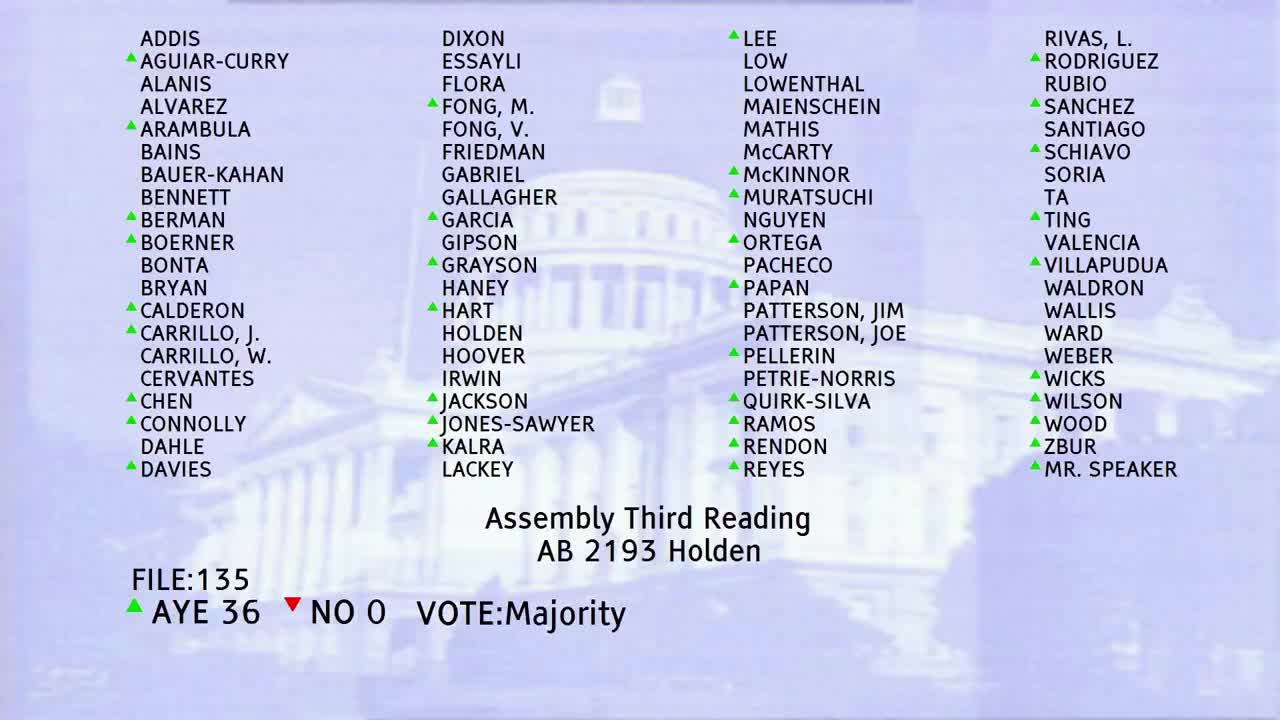 2MIN
Assembly Floor
 33MIN
Assembly Standing Committee on Privacy and Consumer Protection
Bill Author

Bill Co-Author(s):