AB 1961: End Hunger in California Act of 2024.
- Session Year: 2023-2024
- House: Assembly
- Latest Version Date: 2024-09-05
Current Status:
Failed
(2024-09-27: Vetoed by Governor.)
Introduced
In Committee
First Chamber
In Committee
Second Chamber
Enacted
What does this bill do?
Creates a 25-member “End Hunger in California” Master Plan Task Force, led by the California Department of Food and Agriculture, to develop statewide recommendations to improve access to healthy, culturally relevant food for Californians. The task force — made up of state agencies, community groups, farmers, grocery retailers, labor and tribal representatives — must meet regularly and recommend steps like mapping food deserts, finding barriers to stores, boosting use of nutrition programs, suggesting funding and new types of food retailers, and reporting member demographics each year; non-state members may get a small daily payment and travel pay from private donations.
The summary is provided by generative AI which can make mistakes. For original language, please view the details in the table below.
Existing law establishes the Department of Food and Agriculture, under the control of the Secretary of Food and Agriculture, to promote and protect the agricultural industry of the state.
Under existing law, the policy of the state is that every human being has the right to access sufficient, affordable, and healthy food. Existing law establishes various food assistance programs, including, among others, the federal Supplemental Nutrition Assistance Program (SNAP), known in California as CalFresh, under which supplemental nutrition assistance benefits allocated to the state by the federal government are distributed to eligible individuals by each county.
This bill would require the Department of Food and Agriculture, in consultation with specified entities, to appoint and convene the End Hunger in California Master Plan Task Force to make recommendations for future comprehensive strategies aimed at addressing access to healthy and culturally relevant food for all Californians. The bill would require the task force to meet at least twice per year and to be composed of 25 members, from specified agencies and with specified knowledge and expertise in various food-related subject matters. The bill would authorize the department to use privately donated funds to provide non-state-employed members with a reasonable per diem allowance for each day of attendance and reimbursement for actual and necessary travel expenses incurred in connection with their official duties involving the task force. The bill would also authorize the task force to form ad hoc advisory committees to learn more about specific issues regarding recommending future comprehensive strategies aimed at addressing access to healthy and culturally relevant food.
The bill would require the Department of Food and Agriculture to serve as the lead agency for developing the End Hunger in California Master Plan and to assist the task force in carrying out its duties. The bill would require the plan to be distributed to the Legislature no later than January 1, 2027, or 2 years after an appropriation of funds is made to implement these provisions, whichever is later, and to include specified actions, among others, identification of barriers to bringing retailers to specific locations, inclusion of a strategy to maximize eligible individuals participation in specified federal and state nutritional programs, and identification of goals and implementation mechanisms to ensure California achieves an end to hunger. The bill would make related findings and declarations. The bill would also require the task force to report to the Legislature, on an annual basis, the demographic information of its members, as defined, to the extent that the information is available and the member has agreed to disclose their demographic information in the report.
Existing law establishes the Department of Food and Agriculture, under the control of the Secretary of Food and Agriculture, to promote and protect the agricultural industry of the state.
Under existing law, the policy of the state is that every human being has the right to access sufficient, affordable, and healthy food. Existing law establishes various food assistance programs, including, among others, the federal Supplemental Nutrition Assistance Program (SNAP), known in California as CalFresh, under which supplemental nutrition assistance benefits allocated to the state by the federal government are distributed to eligible individuals by each county.
This bill would require the Strategic Growth Council, Department of Food and Agriculture, in consultation with specified entities, to appoint and convene the End Hunger in California Master Plan Task Force to make recommendations for future comprehensive strategies aimed at addressing access to healthy and culturally relevant food for all Californians. The bill would require the task force to meet at least quarterly twice per year and to be composed of up to 30 25 members, from specified agencies and with specified knowledge and expertise in various food-related subject matters. The bill would authorize the council department to use privately donated funds to provide non-state-employed members with a reasonable per diem allowance for each day of attendance and reimbursement for actual and necessary travel expenses incurred in connection with their official duties involving the task force. The bill would also authorize the task force to form ad hoc advisory committees to learn more about specific issues regarding recommending future comprehensive strategies aimed at addressing access to healthy and culturally relevant food.
The bill would require the council to serve as the lead agency for developing the End Hunger in California Master Plan and assist the task force in carrying out its duties. The bill would authorize the council to use existing resources and to accept and expend nongovernmental funds for its work with the task force.The bill would require the Department of Food and Agriculture to serve as the lead agency for developing the End Hunger in California Master Plan and to assist the task force in carrying out its duties. The bill would require the plan to be distributed to the Legislature no later than January 1, 2026, 2027, or 2 years after an appropriation of funds is made to implement these provisions, whichever is later, and to include specified actions, among others, identification of barriers to bringing retailers to specific locations, inclusion of a strategy to maximize eligible individuals participation in specified federal and state nutritional programs, identification and facilitation of stakeholder engagement, and analysis of state programs currently investing in regional food systems. and identification of goals and implementation mechanisms to ensure California achieves an end to hunger. The bill would make related findings and declarations. The bill would also require the task force to report to the Legislature, on an annual basis, the demographic information of its members, as defined, to the extent that the information is available and the member has agreed to disclose their demographic information in the report.
Existing law establishes the Strategic Growth Council in state government consisting of various state agency heads and 3 public members. Existing law requires the council to identify and review activities and funding programs of state agencies that may be coordinated to improve air and water quality, improve natural resource protection, increase the availability of affordable housing, improve transportation, meet greenhouse gas emissions reduction goals, encourage sustainable land use planning, and revitalize urban and community centers in a sustainable manner. Existing law requires the council to manage and award grants and loans to support the planning and development of sustainable communities.
Under existing law, the policy of the state is that every human being has the right to access sufficient, affordable, and healthy food. Existing law establishes various food assistance programs, including, among others, the federal Supplemental Nutrition Assistance Program (SNAP), known in California as CalFresh, under which supplemental nutrition assistance benefits allocated to the state by the federal government are distributed to eligible individuals by each county.
This bill would require the Strategic Growth Council, in consultation with specified entities, to appoint and convene the End Hunger in California Master Plan Task Force to make recommendations for future comprehensive strategies aimed at addressing access to healthy and culturally relevant food for all Californians. The bill would require the task force to meet at least quarterly and to be composed of up to 30 members, from specified agencies and with specified knowledge and expertise in various food-related subject matters. The bill would authorize the council to use privately donated funds to provide non-state-employed members with a reasonable per diem allowance for each day of attendance and reimbursement for actual and necessary travel expenses incurred in connection with their official duties involving the task force. The bill would also authorize the task force to form ad hoc advisory committees to learn more about specific issues regarding recommending future comprehensive strategies aimed at addressing access to healthy and culturally relevant food.
The bill would require the council to serve as the lead agency for developing the End Hunger in California Master Plan and assist the task force in carrying out its duties. The bill would authorize the council to use existing resources and to accept and expend nongovernmental funds for its work with the task force.
The bill would require the plan to be distributed to the Legislature no later than January 1, 2026, and to include specified actions, among others, identification of barriers to bringing retailers to specific locations, inclusion of a strategy to maximize eligible individuals participation in specified federal and state nutritional programs, identification and facilitation of stakeholder engagement, and analysis of state programs currently investing in regional food systems. The bill would make related findings and declarations. The bill would also require the task force to report to the Legislature, on an annual basis, the demographic information of its members, as defined, to the extent that the information is available and the member has agreed to disclose their demographic information in the report.
Existing law establishes the Strategic Growth Council in state government consisting of various state agency heads and 3 public members. Existing law requires the council to identify and review activities and funding programs of state agencies that may be coordinated to improve air and water quality, improve natural resource protection, increase the availability of affordable housing, improve transportation, meet greenhouse gas emissions reduction goals, encourage sustainable land use planning, and revitalize urban and community centers in a sustainable manner. Existing law requires the council to manage and award grants and loans to support the planning and development of sustainable communities.
Under existing law, the policy of the state is that every human being has the right to access sufficient, affordable, and healthy food. Existing law establishes various food assistance programs, including, among others, the federal Supplemental Nutrition Assistance Program (SNAP), known in California as CalFresh, under which supplemental nutrition assistance benefits allocated to the state by the federal government are distributed to eligible individuals by each county.
This bill would require the Strategic Growth Council, in consultation with specified entities, to appoint and convene the End Hunger in California Master Plan Task Force to make recommendations for future comprehensive strategies aimed at addressing access to healthy and culturally relevant food for all Californians. The bill would require the task force to meet at least quarterly and to be composed of up to 30 members, from specified agencies and with specified knowledge and expertise in various food-related subject matters. The bill would authorize the council to use privately donated funds to provide non-state-employed members with a reasonable per diem allowance for each day of attendance and reimbursement for actual and necessary travel expenses incurred in connection with their official duties involving the task force. The bill would also authorize the task force to form ad hoc advisory committees to learn more about specific issues regarding recommending future comprehensive strategies aimed at addressing access to healthy and culturally relevant food.
The bill would require the council to serve as the lead agency for developing the End Hunger in California Master Plan and assist the task force in carrying out its duties. The bill would authorize the council to use existing resources and to accept and expend nongovernmental funds for its work with the task force.
The bill would require the plan to be distributed to the Legislature no later than January 1, 2026, and to include specified actions, among others, identification of barriers to bringing retailers to specific locations, inclusion of a strategy to maximize eligible individuals participation in specified federal and state nutritional programs, identification and facilitation of stakeholder engagement, and analysis of state programs currently investing in regional food systems. The bill would make related findings and declarations.
Existing law establishes the Strategic Growth Council in state government consisting of various state agency heads and 3 public members. Existing law requires the council to identify and review activities and funding programs of state agencies that may be coordinated to improve air and water quality, improve natural resource protection, increase the availability of affordable housing, improve transportation, meet greenhouse gas emissions reduction goals, encourage sustainable land use planning, and revitalize urban and community centers in a sustainable manner. Existing law requires the council to manage and award grants and loans to support the planning and development of sustainable communities.
Under existing law, the policy of the state is that every human being has the right to access sufficient, affordable, and healthy food. Existing law establishes various food assistance programs, including, among others, the federal Supplemental Nutrition Assistance Program (SNAP), known in California as CalFresh, under which supplemental nutrition assistance benefits allocated to the state by the federal government are distributed to eligible individuals by each county.
This bill would require the Strategic Growth Council, in consultation with specified entities, to appoint and convene the End Hunger in California Master Plan Task Force to make recommendations for future comprehensive strategies aimed at addressing access to healthy and culturally relevant food for all Californians. The bill would require the task force to meet at least quarterly and to be composed of up to 40 30 members, from specified agencies and with specified knowledge and expertise in various food-related subject matters. The bill would authorize the council, subject to an appropriation from the Legislature for this purpose, to provide members council to use privately donated funds to provide non-state-employed members with a reasonable per diem allowance for each day of attendance and reimbursement for actual and necessary travel expenses incurred in connection with their official duties involving the task force. The bill would also authorize the task force to form ad hoc advisory committees to learn more about specific issues regarding recommending future comprehensive strategies aimed at addressing access to healthy and culturally relevant food.
The bill would require the council to serve as the lead agency for developing the End Hunger in California Master Plan and assist the task force in carrying out its duties. The bill would authorize the council to use existing resources and to accept and expend nongovernmental funds for its work with the task force.
The bill would require the plan to be distributed to the Legislature no later than January 1, 2026, and to include specified actions, among others, identification of barriers to bringing retailers to specific locations, inclusion of a strategy to maximize eligible individuals participation in specified federal and state nutritional programs, identification and facilitation of stakeholder engagement, and analysis of state programs currently investing in regional food systems. The bill would make related findings and declarations.
Existing law establishes the Strategic Growth Council in state government consisting of various state agency heads and 3 public members. Existing law requires the council to identify and review activities and funding programs of state agencies that may be coordinated to improve air and water quality, improve natural resource protection, increase the availability of affordable housing, improve transportation, meet greenhouse gas emissions reduction goals, encourage sustainable land use planning, and revitalize urban and community centers in a sustainable manner. Existing law requires the council to manage and award grants and loans to support the planning and development of sustainable communities.
Under existing law, the policy of the state is that every human being has the right to access sufficient, affordable, and healthy food. Existing law establishes various food assistance programs, including, among others, the federal Supplemental Nutrition Assistance Program (SNAP), known in California as CalFresh, under which supplemental nutrition assistance benefits allocated to the state by the federal government are distributed to eligible individuals by each county.
This bill would state the intent of the Legislature to enact legislation requiring the State of California to develop a strategic master plan to end hunger in California.This bill would require the Strategic Growth Council, in consultation with specified entities, to appoint and convene the End Hunger in California Master Plan Task Force to make recommendations for future comprehensive strategies aimed at addressing access to healthy and culturally relevant food for all Californians. The bill would require the task force to meet at least quarterly and to be composed of up to 40 members, from specified agencies and with specified knowledge and expertise in various food-related subject matters. The bill would authorize the council, subject to an appropriation from the Legislature for this purpose, to provide members with a reasonable per diem allowance for each day of attendance and reimbursement for actual and necessary travel expenses incurred in connection with their official duties involving the task force. The bill would also authorize the task force to form ad hoc advisory committees to learn more about specific issues regarding recommending future comprehensive strategies aimed at addressing access to healthy and culturally relevant food.
The bill would require the council to serve as the lead agency for developing the End Hunger in California Master Plan and assist the task force in carrying out its duties. The bill would authorize the council to use existing resources and to accept and expend nongovernmental funds for its work with the task force.
The bill would require the plan to be distributed to the Legislature no later than January 1, 2026, and to include specified actions, among others, identification of barriers to bringing retailers to specific locations, inclusion of a strategy to maximize eligible individuals participation in specified federal and state nutritional programs, identification and facilitation of stakeholder engagement, and analysis of state programs currently investing in regional food systems. The bill would make related findings and declarations.
Existing law establishes various food assistance programs, including, among others, the federal Supplemental Nutrition Assistance Program (SNAP), known in California as CalFresh, under which supplemental nutrition assistance benefits allocated to the state by the federal government are distributed to eligible individuals by each county.
This bill would state the intent of the Legislature to enact legislation requiring the State of California to develop a strategic master plan to end hunger in California.
This act shall be known and may be cited as the End Hunger in California Act of 2024.
SEC. 2.The Legislature hereby finds and declares all of the following:
(a)More than one in five Californians suffer from food insecurity.
(b)As lack of access to healthful food equates to ill health, poor educational outcomes, and poverty, guaranteeing access to healthy, culturally relevant food will ensure that fewer Californians will require the aid of Californias safety net programs, saving both lives and substantial taxpayer funds. For example, health care costs associated with food insecurity cost California more than $7,000,000,000 annually, more than any other state in the United States.
(c)Research in child brain development has shown that even one experience of hunger as a child can impact a persons health and mental well-being throughout the rest of their life. Research has similarly demonstrated the long-term academic and economic consequences of hunger in limiting a persons life chances.
(d)Hunger is exacerbated by racial and economic inequities, with 40 percent of Black households and 30 percent of Latino households in California experiencing hunger. In the County of Los Angeles alone, 23 percent of Asian American, Native Hawaiian, and other Pacific Islander residents live in food-insecure households. Additionally, a staggering 92 percent of Native American households suffer from food insecurity.
(e)Food workers face higher levels of food insecurity than the rest of the United States workforce. During the COVID-19 pandemic, 72 percent of agricultural workers reported trouble paying for food. In a 2021 survey of almost 120 small farmers across the state, 49 percent of farmers who identified as Black, Indigenous, and people of color experienced food insecurity, needing food from a food bank or CalFresh benefits. The majority of these farmworkers, food industry workers, and food service providers are people of color, undocumented, or live in mixed immigration status families, with one-fifth of farmers in California identifying as Black, Indigenous, and people of color.
(f)California produces more than enough food in the state. Over one-third of the vegetables and two-thirds of the fruits and nuts grown in the United States come from California. Hunger in California is, in substantial part, a failure of inequitable distribution and accessphysical, economic, and culturalto food due to historic racism.
(g)History-based economic disadvantages endured by communities of color are those that cause food insecurity and include, but are not limited to, lower wages, lack of inherited wealth, underprivileged neighborhoods, lack of mobility, and, therefore, the inability to afford to shop comparatively.
(h)Aligning food system workers rights, climate goals, and food access to address food insecurity are necessary.
(i)High-cost and economically disadvantaged congested areas of the state also experience limited access to food and often provide few opportunities for food businesses to relocate to food-insecure areas.
(j)In 2023, California declared food a human right, but the state has no plan for realizing this right. Just as California has deeply committed itself to providing health care, drinking water, and educational access, it must also comparably ensure access to adequate, nutritious, sustainably grown food in all communities across the state.
(k)California must support a process by which food system stakeholders will be engaged and collaborate at the local, regional, and state levels, and in partnerships with tribal governments, to remove barriers to adequate, nutritious, culturally appropriate food access and ensure that a vibrant and sustainable food system is available across all communities.
SEC. 3.Chapter 9.6 (commencing with Section 18800) is added to Part 6 of Division 9 of the Welfare and Institutions Code, to read:9.6.End Hunger in California Master Plan18800.(a)The Department of Food and Agriculture, in consultation with the State Department of Public Health, State Department of Education, State Department of Social Services, Governors Office of Business and Economic Development, and Labor and Workforce Development Agency, shall appoint and convene the End Hunger in California Master Plan Task Force to, in further consultation with the stakeholders listed in subdivision (b), make recommendations for future comprehensive strategies aimed at addressing access to healthy and culturally relevant food for all Californians.
(b)The task force shall be composed of 25 members, as follows:
(1)One representative from the State Department of Public Health, or their designee.
(2)One representative from the State Department of Education, or their designee.
(3)One representative from the Department of Food and Agriculture, including from the Office of Farm to Fork, or their designee.
(4)One representative from CalFresh, or their designee.
(5)One representative from California Food Assistance Program, or their designee.
(6)One representative from the Governors Office of Business and Economic Development, or their designee.
(7)One representative from the California Workforce Development Board, within the Labor and Workforce Development Agency, or their designee.
(8)Three representatives of labor organizations or community-based organizations representing workers in food-related areas, including, but not limited to, agriculture, food packaging, grocery, and human services programs. These representatives shall be selected exclusively by the Labor and Workforce Development Agency.
(9)Three representatives of state and local community nonprofit organizations that work with and advocate for food access, including individuals with expertise in urban agriculture, farmers markets, and regional food systems. These representatives shall be selected exclusively by the Department of Food and Agriculture, in consultation with the State Department of Social Services.
(10)One representative from community-based organizations or nonprofit organizations with expertise in school food programs, after school programs, or summer meal programs. This representative shall be selected exclusively by the Department of Food and Agriculture.
(11)Three representatives from antihunger organizations and county welfare administrators, including organizations that operate food banks. These representatives shall be selected exclusively by the State Department of Social Services.
(12)One representative from a community-based organization or nonprofit organization with expertise in food as medicine programs. This representative shall be selected exclusively by the Department of Food and Agriculture.
(13)Three farmers, including at least one representative with expertise in issues affecting socially disadvantaged farmers or ranchers as defined in Section 512 of the Food and Agricultural Code, and at least one representative from a small- or medium-sized certified organic farm according to the federal Organic Foods Production Act of 1990 (7 U.S.C. Sec. 6501 et seq.). These representatives shall be selected exclusively by the Department of Food and Agriculture.
(14)Two representatives of Native American, tribal, or indigenous groups, to be selected by the Governors California Truth and Healing Council, in additional to the entities outlined in subdivision (a).
(15)Two grocery retailers representing an independent, regional, or chain grocery company. These representatives shall be selected exclusively by the Department of Food and Agriculture.
(c)The Department of Food and Agriculture may consult with individuals with expertise in land procurement related to the food sector, food transportation and warehousing, market consolidation, or food access.
(d)The Department of Food and Agriculture shall ensure all of the following within the task force:
(1)Geographic diversity, including across urban, suburban, and rural geographies.
(2)Racial and ethnic diversity, including representation by racial and ethnic communities disproportionately affected by food insecurity.
(3)Identification and facilitation of stakeholder engagement from local initiatives addressing food insecurity and regional food systems.
(e)Notwithstanding any other law, the department may utilize privately donated funds to provide non-state-employed members of the task force with a reasonable per diem allowance, as specified in Section 11564.5 of the Government Code, or at a higher rate that may be established by the department, for each day of attendance at a noticed meeting of the task force. The department may also reimburse members of the task force for actual and necessary travel expenses incurred in connection with their official duties, and provide compensation for people with lived experience of food insecurity who work with the task force pursuant to this chapter based on their actual engagement level.
(f)The task force shall meet at least twice per year and may form ad hoc advisory committees to learn more about specific issues regarding future comprehensive strategies aimed at addressing access to healthy and culturally relevant food for all Californians.
(g)The Department of Food and Agriculture, as the convener and chair of the task force, shall serve as the lead agency for developing the End Hunger in California Master Plan and assist the task force in carrying out its duties. The department may use its existing resources to absorb costs for implementing this chapter. Notwithstanding any other law, the department may also accept and expend funds from nongovernmental sources for its work with the task force.
(h)The plan shall be distributed to the Legislature no later than January 1, 2027, or two years after an appropriation of funds is made to implement this section, whichever is later, in accordance with Section 9795 of the Government Code, and be made publicly available on the Department of Food and Agricultures internet website. The plan shall, at a minimum, do all of the following:
(1)Determine if the United States Department of Agricultures definition of food deserts is adequate for California, and, if not, develop an appropriate definition for California communities.
(2)Identify barriers to bringing retailers and other sellers to specific locations, such as food deserts. These barriers may include, but are not limited to, rural terrain, lack of infrastructure, zoning and other local ordinances, lack of capital, labor shortages, market consolidation, restrictive covenants, real estate costs, requirements imposed by local ordinances or state law, lack of investments in food hubs and cooperatives, limitations of the public transportation system, transportation costs for consumers, and the expense of distributing food, including storage, warehousing, and fuel and utility costs.
(3)Include a strategy to fully maximize eligible Californians participation in, and benefits received through, federal nutrition programs, including, but not limited to, school meals, CalFresh, the federal Summer Electronic Benefit Transfer for Children, the Women, Infants, and Children Program, the federal Child and Adult Care Food Program, and federal commodities programs supporting food banks, including the federal Emergency Food Assistance Program, the federal Commodity Supplemental Food Program, and the federal Food Distribution Program on Indian Reservations, and identify where state programs are needed to fill gaps in the federal food safety net to ensure food security for every Californian, including tribal communities.
(4)Make recommendations for improving food access, including funding alternative food retail models, such as those that support local food producers or those operated or subsidized by for-profit organizations, nonprofit organizations, worker-owned cooperatives, local governments, and the state or tribal governments.
(5)Identify goals and implementation mechanisms to ensure California achieves an end to hunger, including goals related to ending food deserts, different strategies for combating urban, suburban, and rural food deserts, and strategies for partnership with local and tribal governments without diminishing tribal sovereignty.
(i)The plan may do all of the following:
(1)Map all food deserts in California.
(2)Provide an analysis of state programs currently investing in regional food systems, food access, climate-smart agriculture, and workforce development for food sector workers, including how those programs can better connect gaps in communities served.
(3)Identify possible funding sources that are, or could be, available, such as tax credits or other monetary resources or incentives, including the federal Inflation Reduction Act of 2022 (Public Law 117-169), to motivate the for-profit organizations, nonprofit organizations, worker-owned cooperatives, local governments, state, or tribal governments to locate retail food establishments selling healthy, culturally appropriate, and sustainably grown food in food deserts.
(4)Develop a strategy to ensure that retail food establishments in food deserts return investment to local communities by employing local populations at living wages and benefits and prioritizing procurement from local farmers.
(j)(1)The task force shall report to the Legislature, on an annual basis, the demographic information of its members, to the extent that the information is available and the member has agreed to disclose their demographic information in the report.
(2)For purposes of this subdivision, demographic information means the age, ethnicity, gender, gender identity, disability status, region, veteran status, and sexual orientation of the member.
(3)A report to be submitted pursuant to this subdivision shall be submitted in compliance with Section 9795 of the Government Code.
This act shall be known and may be cited as the End Hunger in California Act of 2024.
SEC. 2.The Legislature hereby finds and declares all of the following:
(a)More than one in five Californians suffer from food insecurity.
(b)As lack of access to healthful food equates to ill health, poor educational outcomes, and poverty, guaranteeing access to healthy, culturally relevant food will ensure that fewer Californians will require the aid of Californias safety net programs, saving both lives and substantial taxpayer funds. For example, health care costs associated with food insecurity cost California more than $7,000,000,000 annually, more than any other state in the United States.
(c)Research in child brain development has shown that even one experience of hunger as a child can impact a persons health and mental well-being throughout the rest of their life. Research has similarly demonstrated the long-term academic and economic consequences of hunger in limiting a persons life chances.
(d)Hunger is exacerbated by racial and economic inequities, with 40 percent of Black households and 30 percent of Latino households in California experiencing hunger. In the County of Los Angeles alone, 23 percent of Asian American, Native Hawaiian, and other Pacific Islander residents live in food-insecure households. Additionally, a staggering 92 percent of Native American households suffer from food insecurity.
(e)Food workers face higher levels of food insecurity than the rest of the United States workforce. During the COVID-19 pandemic, 72 percent of agricultural workers reported trouble paying for food. In a 2021 survey of almost 120 small farmers across the state, 49 percent of farmers who identified as Black, Indigenous, and people of color experienced food insecurity, needing food from a food bank or CalFresh benefits. The majority of these farmworkers, food industry workers, and food service providers are people of color, undocumented, or live in mixed immigration status families, with one-fifth of farmers in California identifying as Black, Indigenous, and people of color.
(f)California produces more than enough food in the state. Over one-third of the vegetables and two-thirds of the fruits and nuts grown in the United States come from California. Hunger in California is, in substantial part, a failure of inequitable distribution and accessphysical, economic, and culturalto food due to historic racism.
(g)History-based economic disadvantages endured by communities of color are those that cause food insecurity and include, but are not limited to, lower wages, lack of inherited wealth, underprivileged neighborhoods, lack of mobility, and, therefore, the inability to afford to shop comparatively.
(h)Aligning food system workers rights, climate goals, and food access to address food insecurity are necessary.
(i)High-cost and economically disadvantaged congested areas of the state also experience limited access to food and often provide few opportunities for food businesses to relocate to food-insecure areas.
(j)In 2023, California declared food a human right, but the state has no plan for realizing this right. Just as California has deeply committed itself to providing health care, drinking water, and educational access, it must also comparably ensure access to adequate, nutritious, sustainably grown food in all communities across the state.
(k)California must support a process by which food system stakeholders will be engaged and collaborate at the local, regional, and state levels, and in partnerships with tribal governments, to remove barriers to adequate, nutritious, culturally appropriate food access and ensure that a vibrant and sustainable food system is available across all communities.
SEC. 3.Chapter 9.6 (commencing with Section 18800) is added to Part 6 of Division 9 of the Welfare and Institutions Code, to read:9.6.End Hunger in California Master Plan18800.(a)The Strategic Growth Council, Department of Food and Agriculture, in consultation with the State Department of Public Health, State Department of Education, Department of Food and Agriculture, State Department of Social Services, Governors Office of Business and Economic Development, and Labor and Workforce Development Agency Agency, shall appoint and convene the End Hunger in California Master Plan Task Force to, in further consultation with the stakeholders listed in subdivision (b), make recommendations for future comprehensive strategies aimed at addressing access to healthy and culturally relevant food for all Californians.
(b)The task force shall be composed of up to 30 members and shall include all of the following: 25 members, as follows:
(1)One representative from the State Department of Public Health, or their designee.
(2)One representative from the State Department of Education, or their designee.
(3)One representative from the Department of Food and Agriculture, including from the Office of Farm to Fork, or their designee.
(4)One representative from CalFresh, or their designee.
(5)One representative from California Food Assistance Program, or their designee.
(6)One representative from the Governors Office of Business and Economic Development, or their designee.
(7)One representative from the California Workforce Development Board, within the Labor and Workforce Development Agency, or their designee.
(8)At least three Three representatives of labor organizations or community-based organizations representing workers in food-related areas, including, but not limited to, agriculture, food packaging, and grocery. grocery, and human services programs. These representatives shall be selected exclusively by the Labor and Workforce Development Agency.
(9)At least three Three representatives of state and local community nonprofit organizations that work with and advocate for food access, including individuals with expertise in urban agriculture, farmers farmers markets, school programs, after school programs, summer meal programs, and regional food systems. These representatives shall be selected exclusively by the Department of Food and Agriculture, in consultation with the State Department of Social Services.
(10)One representative from community-based organizations or nonprofit organizations with expertise in school food programs, after school programs, or summer meal programs. This representative shall be selected exclusively by the Department of Food and Agriculture.
(10)At least three(11)Three representatives from antihunger organizations, organizations and county welfare administrators, including organizations that operate food banks. These representatives shall be selected exclusively by the State Department of Social Services.
(12)One representative from a community-based organization or nonprofit organization with expertise in food as medicine programs. This representative shall be selected exclusively by the Department of Food and Agriculture.
(11)At least three(13)Three farmers, including at least one representative with expertise in issues affecting socially disadvantaged farmers or ranchers as defined in Section 512 of the Food and Agricultural Code, and at least one representative from a small- or medium-sized certified organic farm according to the federal Organic Foods Production Act of 1990 (7 U.S.C. Sec. 6501 et seq.). These representatives shall be selected exclusively by the Department of Food and Agriculture Farm Equity Advisor. Agriculture.
(12)At least two(14)Two representatives of Native American, tribal, or indigenous groups, to be selected by the Governors California Truth and Healing Council, in additional to the entities outlined in subdivision (a).
(13)Up to three(15)Two grocery retailers representing an independent, regional, and or chain grocery company. These representatives shall be selected exclusively by the Department of Food and Agriculture.
(14)Up to four representatives(c)The Department of Food and Agriculture may consult with individuals with expertise in land procurement related to the food sector, food transportation and warehousing, market consolidation, or food access.
(c)(d)The council Department of Food and Agriculture shall ensure all of the following within the task force:
(1)Geographic diversity, including across urban, suburban, and rural geographies.
(2)Racial and ethnic diversity, including representation by racial and ethnic communities disproportionately affected by food insecurity.
(3)Identification and facilitation of stakeholder engagement from local initiatives addressing food insecurity and regional food systems.
(d)(e)Notwithstanding any other law, the council department may utilize privately donated funds to provide non-state-employed members of the task force with a reasonable per diem allowance allowance, as specified in Section 11564.5 of the Government Code, or at a higher rate that may be established by the council, department, for each day of attendance at a noticed meeting of the task force. The council department may also reimburse members of the task force for actual and necessary travel expenses incurred in connection with their official duties. duties, and provide compensation for people with lived experience of food insecurity who work with the task force pursuant to this chapter based on their actual engagement level.
(e)(f)The task force shall meet at least quarterly twice per year and may form ad hoc advisory committees to learn more about specific issues regarding future comprehensive strategies aimed at addressing access to healthy and culturally relevant food for all Californians.
(f)(g)The Strategic Growth Council, Department of Food and Agriculture, as the convener and chair of the task force, shall serve as the lead agency for developing the End Hunger in California Master Plan and assist the task force in carrying out its duties. The council department may use its existing resources to absorb costs for implementing this chapter. Notwithstanding any other law, the council department may also accept and expend funds from nongovernmental sources for its work with the task force.
(g)(h)The plan shall be distributed to the Legislature no later than January 1, 2026, 2027, or two years after an appropriation of funds is made to implement this section, whichever is later, in accordance with Section 9795 of the Government Code, and be made publicly available on the Strategic Growth Councils Department of Food and Agricultures internet website. The plan shall, at a minimum, do all of the following:
(1)Determine if the United States Department of Agricultures definition of food deserts is adequate for California, and, if not, develop an appropriate definition for California communities.
(2)Map all food deserts in California. (3)(2)Identify barriers to bringing retailers and other sellers to specific locations, such as food deserts. These barriers may include, but are not limited to, rural terrain, lack of infrastructure, zoning and other local ordinances, lack of capital, labor shortages, market consolidation, restrictive covenants, real estate costs, requirements imposed by local ordinances or state law, lack of investments in food hubs and cooperatives, limitations of the public transportation system, transportation costs for consumers, and the expense of distributing food, including storage, warehousing, and fuel and utility costs.
(4)(3)Include a strategy to fully maximize eligible Californians participation in, and benefits received through, federal nutrition programs, including, but not limited to, school meals, CalFresh, the federal Summer Electronic Benefit Transfer for Children, the Women, Infants, and Children Program, the federal Child and Adult Care Food Program, and federal commodities programs supporting food banks, including the federal Emergency Food Assistance Program and Program, the federal Commodity Supplemental Food Program, and the federal Food Distribution Program on Indian Reservations, and identify where state programs are needed to fill gaps in the federal food safety net to ensure food security for every Californian, including tribal communities.
(5)Identify and facilitate stakeholder engagement, including representatives from impacted communities and local initiatives addressing food insecurity and regional food systems.(6)(4)Make recommendations for improving food access, including funding alternative food retail models, such as those that support local food producers or those operated or subsidized by for-profit organizations, nonprofit organizations, worker-owned cooperatives, local governments, and the state or tribal governments.
(7)Provide an analysis of state programs currently investing in regional food systems, food access, climate-smart agriculture, and workforce development for food sector workers, including how those programs can better connect gaps in communities served.(8)(5)Identify yearly goals and implementation mechanisms to ensure California achieves an end to hunger, including goals related to ending food deserts. deserts, different strategies for combating urban, suburban, and rural food deserts, and strategies for partnership with local and tribal governments without diminishing tribal sovereignty.
(i)The plan may do all of the following:
(1)Map all food deserts in California.
(2)Provide an analysis of state programs currently investing in regional food systems, food access, climate-smart agriculture, and workforce development for food sector workers, including how those programs can better connect gaps in communities served.
(9)(3)Identify possible funding sources that are, or could be, available, such as tax credits or other monetary resources or incentives, including the federal Inflation Reduction Act of 2022 (Public Law 117-169), to motivate the for-profit organizations, nonprofit organizations, worker-owned cooperatives, local governments, state, or tribal governments to locate retail food establishments selling healthy, culturally appropriate, and sustainably grown food in food deserts.
(10)(4)Develop a strategy to ensure that retail food establishments in food deserts return investment to local communities by employing local populations at living wages and benefits and prioritizing procurement from local farmers.
(11)Identify different strategies for combating urban, suburban, and rural food deserts, including strategies for partnership with local and tribal governments without diminishing tribal sovereignty.(h)(j)(1)The task force shall report to the Legislature, on an annual basis, the demographic information of its members, to the extent that the information is available and the member has agreed to disclose their demographic information in the report.
(2)For purposes of this subdivision, demographic information means the age, ethnicity, gender, gender identity, disability status, region, veteran status, and sexual orientation of the member.
(3)A report to be submitted pursuant to this subdivision shall be submitted in compliance with Section 9795 of the Government Code.
This act shall be known and may be cited as the End Hunger in California Act of 2024.
SEC. 2.The Legislature hereby finds and declares all of the following:
(a)More than one in five Californians suffer from food insecurity.
(b)As lack of access to healthful food equates to ill health, poor educational outcomes, and poverty, guaranteeing access to healthy, culturally relevant food will ensure that fewer Californians will require the aid of Californias safety net programs, saving both lives and substantial taxpayer funds. For example, health care costs associated with food insecurity cost California more than $7,000,000,000 annually, more than any other state in the United States.
(c)Research in child brain development has shown that even one experience of hunger as a child can impact a persons health and mental well-being throughout the rest of their life. Research has similarly demonstrated the long-term academic and economic consequences of hunger in limiting a persons life chances.
(d)Hunger is exacerbated by racial and economic inequities, with 40 percent of Black households and 30 percent of Latino households in California experiencing hunger. In the County of Los Angeles alone, 23 percent of Asian American, Native Hawaiian, and other Pacific Islander residents live in food-insecure households. Additionally, a staggering 92 percent of Native American households suffer from food insecurity.
(e)Food workers face higher levels of food insecurity than the rest of the United States workforce. During the COVID-19 pandemic, 72 percent of agricultural workers reported trouble paying for food. In a 2021 survey of almost 120 small farmers across the state, 49 percent of farmers who identified as Black, Indigenous, and people of color experienced food insecurity, needing food from a food bank or CalFresh benefits. The majority of these farmworkers, food industry workers, and food service providers are people of color, undocumented, or live in mixed immigration status families, with one-fifth of farmers in California identifying as Black, Indigenous, and people of color.
(f)California produces more than enough food in the state. Over one-third of the vegetables and two-thirds of the fruits and nuts grown in the United States come from California. Hunger in California is, in substantial part, a failure of inequitable distribution and accessphysical, economic, and culturalto food due to historic racism.
(g)History-based economic disadvantages endured by communities of color are those that cause food insecurity and include, but are not limited to, lower wages, lack of inherited wealth, underprivileged neighborhoods, lack of mobility, and, therefore, the inability to afford to shop comparatively.
(h)Aligning food system workers rights, climate goals, and food access to address food insecurity are necessary.
(i)High-cost and economically disadvantaged congested areas of the state also experience limited access to food and often provide few opportunities for food businesses to relocate to food-insecure areas.
(j)In 2023, California declared food a human right, but the state has no plan for realizing this right. Just as California has deeply committed itself to providing health care, drinking water, and educational access, it must also comparably ensure access to adequate, nutritious, sustainably grown food in all communities across the state.
(k)California must support a process by which food system stakeholders will be engaged and collaborate at the local, regional, and state levels, and in partnerships with tribal governments, to remove barriers to adequate, nutritious, culturally appropriate food access and ensure that a vibrant and sustainable food system is available across all communities.
SEC. 3.Chapter 9.6 (commencing with Section 18800) is added to Part 6 of Division 9 of the Welfare and Institutions Code, to read:9.6.End Hunger in California Master Plan18800.(a)The Strategic Growth Council, in consultation with the State Department of Public Health, State Department of Education, Department of Food and Agriculture, State Department of Social Services, Governors Office of Business and Economic Development, and Labor and Workforce Development Agency shall appoint and convene the End Hunger in California Master Plan Task Force to, in further consultation with the stakeholders listed in subdivision (b), make recommendations for future comprehensive strategies aimed at addressing access to healthy and culturally relevant food for all Californians.
(b)The task force shall be composed of up to 30 members and shall include all of the following:
(1)One representative from the State Department of Public Health, or their designee.
(2)One representative from the State Department of Education, or their designee.
(3)One representative from the Department of Food and Agriculture, including from the Office of Farm to Fork, or their designee.
(4)One representative from CalFresh, or their designee.
(5)One representative from California Food Assistance Program, or their designee.
(6)One representative from the Governors Office of Business and Economic Development, or their designee.
(7)One representative from the California Workforce Development Board, within the Labor and Workforce Development Agency, or their designee.
(8)At least three representatives of labor organizations or community-based organizations representing workers in food-related areas, including, but not limited to, agriculture, food packaging, and grocery.
(9)At least three representatives of state and local community nonprofit organizations that work with and advocate for food access, including individuals with expertise in urban agriculture, farmers markets, school programs, after school programs, summer meal programs, and regional food systems.
(10)At least three representatives from antihunger organizations, including organizations that operate food banks.
(11)At least three farmers, including at least one representative with expertise in issues affecting socially disadvantaged farmers or ranchers as defined in Section 512 of the Food and Agricultural Code, and at least one representative from a small- or medium-sized certified organic farm according to the federal Organic Foods Production Act of 1990 (7 U.S.C. Sec. 6501 et seq.). These representatives shall be selected exclusively by the Department of Food and Agriculture Farm Equity Advisor.
(12)At least two representatives of Native American, tribal, or indigenous groups, to be selected by the Governors California Truth and Healing Council, in additional to the entities outlined in subdivision (a).
(13)Up to three grocery retailers representing an independent, regional, and chain grocery company.
(14)Up to four representatives with expertise in land procurement related to the food sector, food transportation and warehousing, market consolidation, or food access.
(c)The council shall ensure geographic diversity within the task force, including across urban, suburban, and rural geographies. all of the following within the task force:
(1)Geographic diversity, including across urban, suburban, and rural geographies.
(2)Racial and ethnic diversity, including representation by racial and ethnic communities disproportionately affected by food insecurity.
(d)Notwithstanding any other law, the council may utilize privately donated funds to provide non-state-employed members of the task force with a reasonable per diem allowance as specified in Section 11564.5 of the Government Code, or at a higher rate that may be established by the council, for each day of attendance at a noticed meeting of the task force. The council may also reimburse members of the task force for actual and necessary travel expenses incurred in connection with their official duties.
(e)The task force shall meet at least quarterly and may form ad hoc advisory committees to learn more about specific issues regarding future comprehensive strategies aimed at addressing access to healthy and culturally relevant food for all Californians.
(f)The Strategic Growth Council, as the convener and chair of the task force, shall serve as the lead agency for developing the End Hunger in California Master Plan and assist the task force in carrying out its duties. The council may use its existing resources to absorb costs for implementing this chapter. Notwithstanding any other law, the council may accept and expend funds from nongovernmental sources for its work with the task force.
(g)The plan shall be distributed to the Legislature no later than January 1, 2026, in accordance with Section 9795 of the Government Code, and be made publicly available on the Strategic Growth Councils internet website. The plan shall, at a minimum, do all of the following:
(1)Determine if the United States Department of Agricultures definition of food deserts is adequate for California, and, if not, develop an appropriate definition for California communities.
(2)Map all food deserts in California.
(3)Identify barriers to bringing retailers and other sellers to specific locations, such as food deserts. These barriers may include, but are not limited to, rural terrain, lack of infrastructure, zoning and other local ordinances, lack of capital, labor shortages, market consolidation, restrictive covenants, real estate costs, requirements imposed by local ordinances or state law, lack of investments in food hubs and cooperatives, limitations of the public transportation system, transportation costs for consumers, and the expense of distributing food, including storage, warehousing, and fuel and utility costs.
(4)Include a strategy to fully maximize eligible Californians participation in, and benefits received through, federal nutrition programs, including, but not limited to, school meals, CalFresh, the federal Summer Electronic Benefit Transfer for Children, the Women, Infants, and Children Program, the federal Child and Adult Care Food Program, and federal commodities programs supporting food banks, including the federal Emergency Food Assistance Program and the federal Commodity Supplemental Food Program, and identify where state programs are needed to fill gaps in the federal food safety net to ensure food security for every Californian, including tribal communities.
(5)Identify and facilitate stakeholder engagement, including representatives from impacted communities and local initiatives addressing food insecurity and regional food systems.
(6)Make recommendations for improving food access, including funding alternative food retail models, such as those that support local food producers or those operated or subsidized by for-profit organizations, nonprofit organizations, worker-owned cooperatives, local governments, and the state or tribal governments.
(7)Provide an analysis of state programs currently investing in regional food systems, food access, climate-smart agriculture, and workforce development for food sector workers, including how those programs can better connect gaps in communities served.
(8)Identify yearly goals and implementation mechanisms to ensure California achieves an end to hunger, including goals related to ending food deserts.
(9)Identify possible funding sources that are, or could be, available, such as tax credits or other monetary resources or incentives, including the Inflation Reduction Act of 2022 (Public Law 117-169), to motivate the for-profit organizations, nonprofit organizations, worker-owned cooperatives, local governments, state, or tribal governments to locate retail food establishments selling healthy, culturally appropriate, and sustainably grown food in food deserts.
(10)Develop a strategy to ensure that retail food establishments in food deserts return investment to local communities by employing local populations at living wages and benefits and prioritizing procurement from local farmers.
(11)Identify different strategies for combating urban, suburban, and rural food deserts, including strategies for partnership with local and tribal governments without diminishing tribal sovereignty.
(h)(1)The task force shall report to the Legislature, on an annual basis, the demographic information of its members, to the extent that the information is available and the member has agreed to disclose their demographic information in the report.
(2)For purposes of this subdivision, demographic information means the age, ethnicity, gender, gender identity, disability status, region, veteran status, and sexual orientation of the member.
(3)A report to be submitted pursuant to this subdivision shall be submitted in compliance with Section 9795 of the Government Code.
This act shall be known and may be cited as the End Hunger in California Act of 2024.
SEC. 2.The Legislature hereby finds and declares all of the following:
(a)More than one in five Californians suffer from food insecurity.
(b)As lack of access to healthful food equates to ill health, poor educational outcomes, and poverty, guaranteeing access to healthy, culturally relevant food will ensure that fewer Californians will require the aid of Californias safety net programs, saving both lives and substantial taxpayer funds. For example, health care costs associated with food insecurity cost California more than $7,000,000,000 annually, more than any other state in the United States.
(c)Research in child brain development has shown that even one experience of hunger as a child can impact a persons health and mental well-being throughout the rest of their life. Research has similarly demonstrated the long-term academic and economic consequences of hunger in limiting a persons life chances.
(d)Hunger is exacerbated by racial and economic inequities, with 40 percent of Black households and 30 percent of Latino households in California experiencing hunger. In the County of Los Angeles alone, 23 percent of Asian American, Native Hawaiian, and other Pacific Islander residents live in food-insecure households. Additionally, a staggering 92 percent of Native American households suffer from food insecurity.
(e)Food workers face higher levels of food insecurity than the rest of the United States workforce. During the COVID-19 pandemic, 72 percent of agricultural workers reported trouble paying for food. In a 2021 survey of almost 120 small farmers across the state, 49 percent of farmers who identified as Black, Indigenous, and people of color experienced food insecurity, needing food from a food bank or CalFresh benefits. The majority of these farmworkers, food industry workers, and food service providers are people of color, undocumented, or live in mixed immigration status families, with one-fifth of farmers in California identifying as Black, Indigenous, and people of color.
(f)California produces more than enough food in the state. Over one-third of the vegetables and two-thirds of the fruits and nuts grown in the United States come from California. Hunger in California is, in substantial part, a failure of inequitable distribution and accessphysical, economic, and culturalto food due to historic racism.
(g)History-based economic disadvantages endured by communities of color are those that cause food insecurity and include, but are not limited to, lower wages, lack of inherited wealth, underprivileged neighborhoods, lack of mobility, and, therefore, the inability to afford to shop comparatively.
(h)Aligning food system workers rights, climate goals, and food access to address food insecurity are necessary.
(i)High-cost and economically disadvantaged congested areas of the state also experience limited access to food and often provide few opportunities for food businesses to relocate to food-insecure areas.
(j)In 2023, California declared food a human right, but the state has no plan for realizing this right. Just as California has deeply committed itself to providing health care, drinking water, and educational access, it must also comparably ensure access to adequate, nutritious, sustainably grown food in all communities across the state.
(k)California must support a process by which food system stakeholders will be engaged and collaborate at the local, regional, and state levels, and in partnerships with tribal governments, to remove barriers to adequate, nutritious, culturally appropriate food access and ensure that a vibrant and sustainable food system is available across all communities.
SEC. 3.Chapter 9.6 (commencing with Section 18800) is added to Part 6 of Division 9 of the Welfare and Institutions Code, to read:9.6.End Hunger in California Master Plan18800.(a)The Strategic Growth Council, in consultation with the State Department of Public Health, State Department of Education, Department of Food and Agriculture, State Department of Social Services, Governors Office of Business and Economic Development, and Labor and Workforce Development Agency shall appoint and convene the End Hunger in California Master Plan Task Force to, in further consultation with the stakeholders listed in subdivision (b), make recommendations for future comprehensive strategies aimed at addressing access to healthy and culturally relevant food for all Californians.
(b)The task force shall be composed of up to 30 members and shall include all of the following:
(1)One representative from the State Department of Public Health, or their designee.
(2)One representative from the State Department of Education, or their designee.
(3)One representative from the Department of Food and Agriculture, including from the Office of Farm to Fork, or their designee.
(4)One representative from CalFresh, or their designee.
(5)One representative from California Food Assistance Program, or their designee.
(6)One representative from the Governors Office of Business and Economic Development, or their designee.
(7)One representative from the California Workforce Development Board, within the Labor and Workforce Development Agency, or their designee.
(8)At least three representatives of labor organizations or community-based organizations representing workers in food-related areas, including, but not limited to, agriculture, food packaging, and grocery.
(9)At least four three representatives of state and local community nonprofit organizations that work with and advocate for food access, including individuals with expertise in urban agriculture, farmers markets, school programs, after-school after school programs, summer meal programs, and regional food systems.
(10)At least three representatives from antihunger organizations, including organizations that operate food banks.
(11)At least one three farmers, including at least one representative with expertise in issues affecting socially disadvantaged farmers or ranchers as defined in Section 512 of the Food and Agricultural Code. Code, and at least one representative from a small- or medium-sized certified organic farm according to the federal Organic Foods Production Act of 1990 (7 U.S.C. Sec. 6501 et seq.). These representatives shall be selected exclusively by the Department of Food and Agriculture Farm Equity Advisor.
(12)At least one representative from a small- or medium-sized certified organic farm according to the federal Organic Foods Production Act of 1990 (7 U.S.C. Sec. 6501 et seq.)(13)(12)At least two representatives of Native American, tribal, or indigenous groups, to be selected by the Governors California Truth and Healing Council, in additional to the entities outlined in subdivision (a).
(14)(13)Up to three grocery retailers representing an independent, regional, and chain grocery company.
(15)(14)Up to four representatives with expertise in land procurement related to the food sector, food transportation and warehousing, market consolidation, or food access.
(c)The council shall ensure geographic diversity within the task force, including across urban, suburban, and rural geographies.
(d)Notwithstanding any other law, the council may utilize privately donated funds to provide non-state-employed members of the task force with a reasonable per diem allowance as specified in Section 11564.5 of the Government Code, or at a higher rate that may be established by the council, for each day of attendance at a noticed meeting of the task force. The council may also reimburse members of the task force for actual and necessary travel expenses incurred in connection with their official duties.
(e)The task force shall meet at least quarterly and may form ad hoc advisory committees to learn more about specific issues regarding future comprehensive strategies aimed at addressing access to healthy and culturally relevant food for all Californians.
(f)The Strategic Growth Council, as the convener and chair of the task force, shall serve as the lead agency for developing the End Hunger in California Master Plan and assist the task force in carrying out its duties. The council may use its existing resources to absorb costs for implementing this chapter. Notwithstanding any other law, the council may accept and expend funds from nongovernmental sources for its work with the task force.
(g)The plan shall be distributed to the Legislature no later than January 1, 2026, in accordance with Section 9795 of the Government Code, and be made publicly available on the Strategic Growth Councils internet website. The plan shall, at a minimum, do all of the following:
(1)Determine if the United States Department of Agricultures definition of food deserts is adequate for California, and, if not, develop an appropriate definition for California communities.
(2)Map all food deserts in California.
(3)Identify barriers to bringing retailers and other sellers to specific locations, such as food deserts. These barriers may include, but are not limited to, rural terrain, lack of infrastructure, zoning and other local ordinances, lack of capital, labor shortages, market consolidation, restrictive covenants, real estate costs, requirements imposed by local ordinances or state law, lack of investments in food hubs and cooperatives, limitations of the public transportation system, transportation costs for consumers, and the expense of distributing food, including storage, warehousing, and fuel and utility costs.
(4)Include a strategy to fully maximize eligible Californians participation in, and benefits received through, federal nutrition programs, including, but not limited to, school meals, CalFresh, the federal Summer Electronic Benefit Transfer for Children, the Women, Infants, and Children Program, the federal Child and Adult Care Food Program, and federal commodities programs supporting food banks, including the federal Emergency Food Assistance Program and the federal Commodity Supplemental Food Program, and identify where state programs are needed to fill gaps in the federal food safety net to ensure food security for every Californian, including tribal communities.
(5)Identify and facilitate stakeholder engagement, including representatives from impacted communities and local initiatives addressing food insecurity and regional food systems.
(6)Make recommendations for improving food access, including funding alternative food retail models, such as those that support local food producers or those operated or subsidized by for-profit organizations, nonprofit organizations, worker-owned cooperatives, local governments, and the state or tribal governments.
(7)Provide an analysis of state programs currently investing in regional food systems, food access, climate-smart agriculture, and workforce development for food sector workers, including how those programs can better connect gaps in communities served.
(8)Identify yearly goals and implementation mechanisms to ensure California achieves an end to hunger, including goals related to ending food deserts.
(9)Identify possible funding sources that are, or could be, available, such as tax credits or other monetary resources or incentives, including the Inflation Reduction Act of 2022 (Public Law 117-169), to motivate the for-profit organizations, nonprofit organizations, worker-owned cooperatives, local governments, state, or tribal governments to locate retail food establishments selling healthy, culturally appropriate, and sustainably grown food in food deserts.
(10)Develop a strategy to ensure that retail food establishments in food deserts return investment to local communities by employing local populations at living wages and benefits and prioritizing procurement from local farmers.
(11)Identify different strategies for combating urban, suburban, and rural food deserts, including strategies for partnership with local and tribal governments without diminishing tribal sovereignty.
This act shall be known and may be cited as the End Hunger in California Act of 2024.
SEC. 2.The Legislature hereby finds and declares all of the following:
(a)More than one in five Californians suffer from food insecurity.
(b)As lack of access to healthful food equates to ill health, poor educational outcomes, and poverty, guaranteeing access to healthy, culturally relevant food will ensure that fewer Californians will require the aid of Californias safety net programs, saving both lives and substantial taxpayer funds. For example, health care costs associated with food insecurity cost California more than $7,000,000,000 annually, more than any other state in the United States.
(c)Research in child brain development has shown that even one experience of hunger as a child can impact a persons health and mental well-being throughout the rest of their life. Research has similarly demonstrated the long-term academic and economic consequences of hunger in limiting a persons life chances.
(d)Hunger is exacerbated by racial and economic inequities, with 40 percent of Black households and 30 percent of Latino households in California experiencing hunger. In the County of Los Angeles alone, 23 percent of Asian American, Native Hawaiian, and other Pacific Islander residents live in food-insecure households. Additionally, a staggering 92 percent of Native American households suffer from food insecurity.
(e)Food workers face higher levels of food insecurity than the rest of the United States workforce. During the COVID-19 pandemic, 72 percent of agricultural workers reported trouble paying for food. In a 2021 survey of almost 120 small farmers across the state, 49 percent of farmers who identified as Black, Indigenous, and people of color experienced food insecurity, needing food from a food bank or CalFresh benefits. The majority of these farmworkers, food industry workers, and food service providers are people of color, undocumented, or live in mixed immigration status families, with one-fifth of farmers in California identifying as Black, Indigenous, and people of color.
(f)California produces more than enough food in the state. Over one-third of the vegetables and two-thirds of the fruits and nuts grown in the United States come from California. Hunger in California is, in substantial part, a failure of inequitable distribution and accessphysical, economic, and culturalto food due to historic racism.
(g)History-based economic disadvantages endured by communities of color are those that cause food insecurity and include, but are not limited to, lower wages, lack of inherited wealth, underprivileged neighborhoods, lack of mobility, and, therefore, the inability to afford to shop comparatively.
(h)Aligning food system workers rights, climate goals, and food access to address food insecurity are necessary.
(i)High-cost and economically disadvantaged congested areas of the state also experience limited access to food and often provide few opportunities for food businesses to relocate to food-insecure areas.
(j)In 2023, California declared food a human right, but the state has no plan for realizing this right. Just as California has deeply committed itself to providing health care, drinking water, and educational access, it must also comparably ensure access to adequate, nutritious, sustainably grown food in all communities across the state.
(k)California must support a process by which food system stakeholders will be engaged and collaborate at the local, regional, and state levels, and in partnerships with tribal governments, to remove barriers to adequate, nutritious, culturally appropriate food access and ensure that a vibrant and sustainable food system is available across all communities.
SEC. 3.Chapter 9.6 (commencing with Section 18800) is added to Part 6 of Division 9 of the Welfare and Institutions Code, to read:9.6.End Hunger in California Master Plan18800.(a)The Strategic Growth Council, in consultation with the State Department of Public Health, State Department of Education, Department of Food and Agriculture, State Department of Social Services, Governors Office of Business and Economic Development, and Labor and Workforce Development Agency shall appoint and convene the End Hunger in California Master Plan Task Force to, in further consultation with the stakeholders listed in subdivision (b), make recommendations for future comprehensive strategies aimed at addressing access to healthy and culturally relevant food for all Californians.
(b)The task force shall be composed of up to 40 30 members and shall include all of the following:
(1)Up to two representatives One representative from the State Department of Public Health. Health, or their designee.
(2)Up to two representatives One representative from the State Department of Education. Education, or their designee.
(3)Up to two representatives One representative from the Department of Food and Agriculture, including from the Office of Farm to Fork. Fork, or their designee.
(4)Up to two representatives from the State Department of Social Services.(4)One representative from CalFresh, or their designee.
(5)One representative from California Food Assistance Program, or their designee.
(5)Up to two representatives(6)One representative from the Governors Office of Business and Economic Development. Development, or their designee.
(6)Up to two representatives from the Labor and Workforce Development Agency, including(7)One representative from the California Workforce Development Board. Board, within the Labor and Workforce Development Agency, or their designee.
(7)(8)At least four three representatives of labor organizations or community-based organizations representing workers in food-related areas, including, but not limited to, agriculture, food packaging, and grocery.
(8)(9)At least four representatives of state and local community nonprofit organizations that work with and advocate for food access, including individuals with expertise in urban agriculture, farmers markets, food recovery, school food, programs, after-school programs, summer meal programs, and regional food systems.
(9)(10)At least three representatives from antihunger organizations. organizations, including organizations that operate food banks.
(10)(11)At least one representative with expertise in issues affecting socially disadvantaged farmers or ranchers as defined in Section 512 of the Food and Agricultural Code.
(11)(12)At least one representative from a small small- or medium-sized certified organic farm according to the federal Organic Foods Production Act of 1990 (7 U.S.C. Sec. 6501 et seq.)
(12)(13)At least two representatives of Native American, tribal, or indigenous groups. groups, to be selected by the Governors California Truth and Healing Council, in additional to the entities outlined in subdivision (a).
(13)Up to one grocery investor.(14)Up to two three grocery retailers representing an independent grocery store and a chain grocery store. independent, regional, and chain grocery company.
(15)Up to one representative with familiarity in real estate and land procurement related to the food sector.(16)Up to two representatives with expertise in food transportation and warehousing.(17)Up to two researchers or economists with subject matter expertise in capital markets, market consolidation, or food access.(18)Up to one representative representing an urban county or city.(19)Up to one representative representing a suburban county or city.(20)Up to one representative representing a rural county or city.(15)Up to four representatives with expertise in land procurement related to the food sector, food transportation and warehousing, market consolidation, or food access.
(c)The council shall ensure geographic diversity within the task force, including across urban, suburban, and rural geographies.
(c)(1)To ensure equitable participation, the Strategic Growth Council may provide(d)Notwithstanding any other law, the council may utilize privately donated funds to provide non-state-employed members of the task force with a reasonable per diem allowance as specified in Section 11564.5 of the Government Code, or at a higher rate that may be established by the council, for each day of attendance at a noticed meeting of the task force. The council may also reimburse members of the task force for actual and necessary travel expenses incurred in connection with their official duties.
(2)Implementation of this subdivision shall be subject to an appropriation by the Legislature for the purpose of this subdivision.(d)(e)The task force shall meet at least quarterly and may form ad hoc advisory committees to learn more about specific issues regarding future comprehensive strategies aimed at addressing access to healthy and culturally relevant food for all Californians.
(e)(f)The Strategic Growth Council, as the convener and chair of the task force, shall serve as the lead agency for developing the End Hunger in California Master Plan and assist the task force in carrying out its duties. The council may use its existing resources to absorb costs for implementing this chapter. Notwithstanding any other law, the council may accept and expend funds from nongovernmental sources for its work with the task force.
(f)(g)The plan shall be distributed to the Legislature no later than January 1, 2026, in accordance with Section 9795 of the Government Code, and be made publicly available on the Strategic Growth Councils internet website. The plan shall, at a minimum, do all of the following:
(1)Determine if the United States Department of Agricultures definition of food deserts is adequate for California, and, if not, develop an appropriate definition for California communities.
(2)Map all food deserts in California.
(3)Identify barriers to bringing retailers and other sellers to specific locations, such as food deserts. These barriers may include, but are not limited to, rural terrain, lack of infrastructure, zoning and other local ordinances, lack of capital, labor shortages, market consolidation, restrictive covenants, real estate costs, requirements imposed by local ordinances or state law, lack of investments in food hubs and cooperatives, limitations of the public transportation system, transportation costs for consumers, and the expense of distributing food, including storage, warehousing, and fuel and utility costs.
(4)Include a strategy to fully maximize eligible Californians participation in, and benefits received through, federal nutrition programs, including, but not limited to, school meals, CalFresh, the federal Summer Electronic Benefit Transfer for Children, the Women, Infants, and Children Program, the federal Child and Adult Care Food Program, and federal commodities programs supporting food banks, including the federal Emergency Food Assistance Program and the federal Commodity Supplemental Food Program, and identify where state programs are needed to fill gaps in the federal food safety net to ensure food security for every Californian, including tribal communities.
(5)Identify and facilitate stakeholder engagement, including representatives from impacted communities. communities and local initiatives addressing food insecurity and regional food systems.
(6)Make recommendations for improving food access, including funding alternative food retail models, such as those that support local food producers or those operated or subsidized by for-profit organizations, nonprofit organizations, worker-owned cooperatives, local governments, and the state or tribal governments.
(7)Provide an analysis of state programs currently investing in regional food systems, food access, climate-smart agriculture, and workforce development for food sector workers, including how those programs can better connect gaps in communities served.
(8)Identify yearly goals and implementation mechanisms to ensure California achieves an end to hunger, including goals related to ending food deserts.
(9)Identify possible funding sources that are, or could be, available, such as tax credits or other monetary resources or incentives, including the Inflation Reduction Act of 2022 (Public Law 117-169), to motivate the for-profit organizations, nonprofit organizations, worker-owned cooperatives, local governments, state, or tribal governments to locate retail food establishments selling healthy, culturally appropriate, and sustainably grown food in food deserts.
(10)Develop a strategy to ensure that retail food establishments in food deserts return investment to local communities by employing local populations at living wages and benefits and prioritizing procurement from local farmers.
(11)Identify different strategies for combating urban, suburban, and rural food deserts, including strategies for partnership with local and tribal governments without diminishing tribal sovereignty.
This act shall be known and may be cited as the End Hunger in California Act of 2024.
SEC. 2.The Legislature hereby finds and declares all of the following:
(a)More than one in five Californians suffer from food insecurity.
(b)As lack of access to healthful food equates to ill health, poor educational outcomes, and poverty, guaranteeing access to healthy, culturally relevant food will ensure that fewer Californians will require the aid of Californias safety net programs, saving both lives and substantial taxpayer funds. For example, health care costs associated with food insecurity cost California more than $7,000,000,000 annually, more than any other state in the United States.
(c)Research in child brain development has shown that even one experience of hunger as a child can impact a persons health and mental well-being throughout the rest of their life. Research has similarly demonstrated the long-term academic and economic consequences of hunger in limiting a persons life chances.
(d)Hunger is exacerbated by racial and economic inequities, with 40 percent of Black households and 30 percent of Latino households in California experiencing hunger. In the County of Los Angeles alone, 23 percent of Asian American, Native Hawaiian, and other Pacific Islander residents live in food-insecure households. Additionally, a staggering 92 percent of Native American households suffer from food insecurity.
(e)Food workers face higher levels of food insecurity than the rest of the United States workforce. During the COVID-19 pandemic, 72 percent of agricultural workers reported trouble paying for food. In a 2021 survey of almost 120 small farmers across the state, 49 percent of farmers who identified as Black, Indigenous, and people of color experienced food insecurity, needing food from a food bank or CalFresh benefits. The majority of these farmworkers, food industry workers, and food service providers are people of color, undocumented, or live in mixed immigration status families, with one-fifth of farmers in California identifying as Black, Indigenous, and people of color.
(f)California produces more than enough food in the state. Over one-third of the vegetables and two-thirds of the fruits and nuts grown in the United States come from California. Hunger in California is, in substantial part, a failure of inequitable distribution and accessphysical, economic, and culturalto food due to historic racism.
(g)History-based economic disadvantages endured by communities of color are those that cause food insecurity and include, but are not limited to, lower wages, lack of inherited wealth, underprivileged neighborhoods, lack of mobility, and, therefore, the inability to afford to shop comparatively.
(h)Aligning food system workers rights, climate goals, and food access to address food insecurity are necessary.
(i)High-cost and economically disadvantaged congested areas of the state also experience limited access to food and often provide few opportunities for food businesses to relocate to food-insecure areas.
(j)In 2023, California declared food a human right, but the state has no plan for realizing this right. Just as California has deeply committed itself to providing health care, drinking water, and educational access, it must also comparably ensure access to adequate, nutritious, sustainably grown food in all communities across the state.
(k)California must support a process by which food system stakeholders will be engaged and collaborate at the local, regional, and state levels, and in partnerships with tribal governments, to remove barriers to adequate, nutritious, culturally appropriate food access and ensure that a vibrant and sustainable food system is available across all communities.
SEC. 3.Chapter 9.6 (commencing with Section 18800) is added to Part 6 of Division 9 of the Welfare and Institutions Code, to read:9.6.End Hunger in California Master Plan18800.(a)The Strategic Growth Council, in consultation with the State Department of Public Health, State Department of Education, Department of Food and Agriculture, State Department of Social Services, Governors Office of Business and Economic Development, and Labor and Workforce Development Agency shall appoint and convene the End Hunger in California Master Plan Task Force to, in further consultation with the stakeholders listed in subdivision (b), make recommendations for future comprehensive strategies aimed at addressing access to healthy and culturally relevant food for all Californians.
(b)The task force shall be composed of up to 40 members and shall include all of the following:
(1)Up to two representatives from the State Department of Public Health.
(2)Up to two representatives from the State Department of Education.
(3)Up to two representatives from the Department of Food and Agriculture, including from the Office of Farm to Fork.
(4)Up to two representatives from the State Department of Social Services.
(5)Up to two representatives from the Governors Office of Business and Economic Development.
(6)Up to two representatives from the Labor and Workforce Development Agency, including from the California Workforce Development Board.
(7)At least four representatives of labor organizations or community-based organizations representing workers in food-related areas, including, but not limited to, agriculture, food packaging, and grocery.
(8)At least four representatives of state and local community nonprofit organizations that work with and advocate for food access, including individuals with expertise in urban agriculture, farmers markets, food recovery, school food, and regional food systems.
(9)At least three representatives from antihunger organizations.
(10)At least one representative with expertise in issues affecting socially disadvantaged farmers or ranchers as defined in Section 512 of the Food and Agricultural Code.
(11)At least one representative from a small or medium-sized certified organic farm according to the federal Organic Foods Production Act of 1990 (7 U.S.C. Sec. 6501 et seq.)
(12)At least two representatives of Native American, tribal, or indigenous groups.
(13)Up to one grocery investor.
(14)Up to two grocery retailers representing an independent grocery store and a chain grocery store.
(15)Up to one representative with familiarity in real estate and land procurement related to the food sector.
(16)Up to two representatives with expertise in food transportation and warehousing.
(17)Up to two researchers or economists with subject matter expertise in capital markets, market consolidation, or food access.
(18)Up to one representative representing an urban county or city.
(19)Up to one representative representing a suburban county or city.
(20)Up to one representative representing a rural county or city.
(c)(1)To ensure equitable participation, the Strategic Growth Council may provide members of the task force with a reasonable per diem allowance as specified in Section 11564.5 of the Government Code, or at a higher rate that may be established by the council, for each day of attendance at a noticed meeting of the task force. The council may also reimburse members of the task force for actual and necessary travel expenses incurred in connection with their official duties.
(2)Implementation of this subdivision shall be subject to an appropriation by the Legislature for the purpose of this subdivision.
(d)The task force shall meet at least quarterly and may form ad hoc advisory committees to learn more about specific issues regarding future comprehensive strategies aimed at addressing access to healthy and culturally relevant food for all Californians.
(e)The Strategic Growth Council, as the convener and chair of the task force, shall serve as the lead agency for developing the End Hunger in California Master Plan and assist the task force in carrying out its duties. The council may use its existing resources to absorb costs for implementing this chapter. Notwithstanding any other law, the council may accept and expend funds from nongovernmental sources for its work with the task force.
(f)The plan shall be distributed to the Legislature no later than January 1, 2026, in accordance with Section 9795 of the Government Code, and be made publicly available on the Strategic Growth Councils internet website. The plan shall, at a minimum, do all of the following:
(1)Determine if the United States Department of Agricultures definition of food deserts is adequate for California, and, if not, develop an appropriate definition for California communities.
(2)Map all food deserts in California.
(3)Identify barriers to bringing retailers and other sellers to specific locations, such as food deserts. These barriers may include, but are not limited to, rural terrain, lack of infrastructure, zoning and other local ordinances, lack of capital, labor shortages, market consolidation, restrictive covenants, real estate costs, requirements imposed by local ordinances or state law, lack of investments in food hubs and cooperatives, limitations of the public transportation system, transportation costs for consumers, and the expense of distributing food, including storage, warehousing, and fuel and utility costs.
(4)Include a strategy to fully maximize eligible Californians participation in, and benefits received through, federal nutrition programs, including, but not limited to, school meals, CalFresh, the federal Summer Electronic Benefit Transfer for Children, the Women, Infants, and Children Program, the federal Child and Adult Care Food Program, and federal commodities programs supporting food banks, including the federal Emergency Food Assistance Program and the federal Commodity Supplemental Food Program, and identify where state programs are needed to fill gaps in the federal food safety net to ensure food security for every Californian, including tribal communities.
(5)Identify and facilitate stakeholder engagement, including representatives from impacted communities.
(6)Make recommendations for improving food access, including funding alternative food retail models, such as those that support local food producers or those operated or subsidized by for-profit organizations, nonprofit organizations, worker-owned cooperatives, local governments, and the state or tribal governments.
(7)Provide an analysis of state programs currently investing in regional food systems, food access, climate-smart agriculture, and workforce development for food sector workers, including how those programs can better connect gaps in communities served.
(8)Identify yearly goals to ensure California achieves an end to hunger, including goals related to ending food deserts.
(9)Identify possible funding sources that are, or could be, available, such as tax credits or other monetary resources or incentives, including the Inflation Reduction Act of 2022 (Public Law 117-169), to motivate the for-profit organizations, nonprofit organizations, worker-owned cooperatives, local governments, state, or tribal governments to locate retail food establishments selling healthy, culturally appropriate, and sustainably grown food in food deserts.
(10)Develop a strategy to ensure that retail food establishments in food deserts return investment to local communities by employing local populations at living wages and benefits and prioritizing procurement from local farmers.
(11)Identify different strategies for combating urban, suburban, and rural food deserts, including strategies for partnership with tribal governments without diminishing tribal sovereignty.
SECTION 1.It is the intent of the Legislature to enact legislation requiring the State of California to develop a strategic master plan to end hunger in California. REVISIONS: HeadingLine 2.It is the intent of the Legislature to enact legislation requiring the State of California to develop a strategic master plan to end hunger in California.
|
Date
|
Status
|
|---|---|
| Sep 27, 2024 | Vetoed by Governor. |
| Sep 12, 2024 | Enrolled and presented to the Governor at 4 p.m. |
| Aug 31, 2024 | Senate amendments concurred in. To Engrossing and Enrolling. (Ayes 72. Noes 0.). |
| Aug 31, 2024 | In Assembly. Concurrence in Senate amendments pending. |
| Aug 30, 2024 | Read third time. Passed. Ordered to the Assembly. (Ayes 39. Noes 0.). |
| Aug 19, 2024 | Read second time. Ordered to third reading. |
| Aug 15, 2024 | Read second time and amended. Ordered returned to second reading. |
| Aug 15, 2024 | From committee: Amend, and do pass as amended. (Ayes 6. Noes 0.) (August 15). |
| Aug 5, 2024 | In committee: Referred to APPR suspense file. |
| Jul 3, 2024 | Read second time and amended. Re-referred to Com. on APPR. |
| Jul 3, 2024 | From committee: Amend, and do pass as amended and re-refer to Com. on APPR. (Ayes 5. Noes 0.) (July 1). |
| Jun 12, 2024 | From committee chair, with author's amendments: Amend, and re-refer to committee. Read second time, amended, and re-referred to Com. on HUMAN S. |
| Jun 5, 2024 | Referred to Com. on HUMAN S. |
| May 23, 2024 | In Senate. Read first time. To Com. on RLS. for assignment. |
| May 22, 2024 | Read third time. Passed. Ordered to the Senate. (Ayes 70. Noes 0. Page 5560.) |
| May 20, 2024 | Read second time. Ordered to third reading. |
| May 16, 2024 | Read second time and amended. Ordered returned to second reading. |
| May 16, 2024 | Joint Rule 62(a), file notice suspended. (Page 5215.) |
| May 16, 2024 | From committee: Amend, and do pass as amended. (Ayes 11. Noes 0.) (May 16). |
| May 16, 2024 | Assembly Rule 63 suspended. |
| May 15, 2024 | In committee: Set, first hearing. Referred to APPR. suspense file. |
| Apr 25, 2024 | From committee: Do pass and re-refer to Com. on APPR. (Ayes 9. Noes 0.) (April 24). Re-referred to Com. on APPR. |
| Apr 25, 2024 | Coauthors revised. |
| Apr 10, 2024 | From committee: Do pass and re-refer to Com. on AGRI. (Ayes 5. Noes 0.) (April 9). Re-referred to Com. on AGRI. |
| Apr 1, 2024 | Re-referred to Com. on HUM. S. |
| Mar 21, 2024 | Referred to Coms. on HUM. S. and AGRI. |
| Mar 21, 2024 | From committee chair, with author's amendments: Amend, and re-refer to Com. on HUM. S. Read second time and amended. |
| Jan 30, 2024 | From printer. May be heard in committee February 29. |
| Jan 29, 2024 | Read first time. To print. |
|
Date
|
Description
|
Location
|
Votes
|
|
|---|---|---|---|---|
| Aug 31, 2024 | AB 1961 Wicks Concurrence in Senate Amendments | Assembly Floor |
Passed |
|
| Aug 30, 2024 | Assembly 3rd Reading AB1961 Wicks et al. By Wiener | Senate Floor |
Passed |
|
| Aug 15, 2024 | Do pass as amended | Senate Standing Committee on Appropriations |
Passed |
|
| Aug 5, 2024 | Placed on suspense file | Senate Standing Committee on Appropriations |
Passed |
|
| Jul 1, 2024 | Do pass as amended, but first amend, and re-refer to the Committee on [Appropriations] | Senate Standing Committee on Human Services |
Passed |
|
| May 22, 2024 | AB 1961 Wicks Assembly Third Reading | Assembly Floor |
Passed |
|
| May 16, 2024 | Do pass as amended. | Assembly Standing Committee on Appropriations |
Passed |
|
| Apr 24, 2024 | Do pass and be re-referred to the Committee on [Appropriations] | Assembly Standing Committee on Agriculture |
Passed |
|
| Apr 9, 2024 | Do pass and be re-referred to the Committee on [Agriculture] | Assembly Standing Committee on Human Services |
Passed |
This list shows positions taken on this bill by organizations on the date displayed, which is linked to the original source.
Positions by individuals are not included.
|
Organization
|
Position
|
Date
|
|---|---|---|
| AARP | ** Support | |
| AB 1961 | * Support | Apr 9, 2024 |
| AB 1961 the End Hunger in California Act | * Support | Apr 9, 2024 |
| AB 1961 the End Hunger in California Act | * Support | Apr 9, 2024 |
| Agricultural Institute of Marin | ** Support | |
| Alameda County Community Food Bank | * Support | Jul 1, 2024 |
| Alchemist CDC | ** Support | |
| Almond Alliance | ** Support | |
| California Association Of Food Banks | ** Support | |
| California Coalition For Youth | ** Support | |
| California Food and Farming Network | ** Support | |
| California Rural Legal Assistance Foundation | ** Support | |
| California Teachers Association | ** Support | |
| Center for Healthy Communities | * Support | Jul 1, 2024 |
| Center for Healthy Communities At California State University, Chico | ** Support | |
| Central California Food Bank | ** Support | |
| Ceres Community Project | ** Support | |
| Child Care Law Center | ** Support | |
| ChildrenS Institute | ** Support | |
| Church State Council | ** Support | |
| City Of Merced | ** Support | |
| City of San Jose | ** Support | |
| Community Action Partnership of Orange County | ** Support | |
| Community Alliance With Family Farmers | ** Support | |
| Community Healers | * Support | Jul 1, 2024 |
| Consumer Federation Of California | ** Support | |
| Contra Costa Solano Food Bank | * Support | Jul 1, 2024 |
| Delores Huerta Foundation | ** Support | |
| Dolores Huerta Foundation | ** Support | |
| Equal Rights Advocates | ** Support | |
| Fibershed | ** Support | |
| Food Bank of Santa Barbara County | ** Support | |
| Food for People, the Food Bank for Humboldt County | ** Support | |
| Food in Need of Distribution Food Bank | ** Support | |
| Foodshed Coop | ** Support | |
| Fresh Approach | ** Support | |
| Fund Her | ** Support | |
| Glide | ** Support | |
| GRACE - End Child Poverty in California | ** Support | |
| Hunger Action Los Angeles | ** Support | |
| Junior Leagues of California State Public Affairs Committee | ** Support | |
| Latino Coalition for a Healthy California | ** Support | |
| League Of California Cities | ** Support | |
| Lideres Campesinas | ** Support | |
| Los Angeles Food Policy Council | ** Support | |
| Lutheran Office Of Public Policy - California | ** Support | |
| Marin Food Policy Council | ** Support | |
| Mesa Verde Group | * Support | Jul 1, 2024 |
| National Council of Jewish Women, CA | ** Support | |
| No Kid Hungry | * Support | Jul 1, 2024 |
| Parent Voices CA | ** Support | |
| Pesticide Action Network North America | ** Support | |
| Rising Communities | ** Support | |
| Roots of Change | ** Support | |
| Sacramento Food Policy Council | ** Support | |
| San Diego Food Bank | ** Support | |
| Second Harvest Food Bank of Orange County | ** Support | |
| second harvest food bank of santa cruz county | ** Support | |
| Second Harvest of Silicon Valley | ** Support | |
| SEIU California | ** Support | |
| Share Our Strength | ** Support | |
| Share Our Strength | * Support | Apr 24, 2024 |
| TechEquity Collaborative | ** Support | |
| The Praxis Project | ** Support | |
| Thriving Families California | * Support | Jul 1, 2024 |
| United Food And Commercial Workers, Western States Council | ** Support | |
| Veggielution | ** Support | |
| western center on law & poverty | ** Support |
GOVERNOR'S VETO
GV Bill Id:AB 1961
Author:(Wicks)
As Enrolled Ver:September 5, 2024
2/3 vote
SUMMARY
Subject to an appropriation from the Legislature, requires the Department of Food and Agriculture (CDFA), in consultation with specified agencies, to convene the End Hunger in California Master Plan Task Force (Task Force) to develop strategies for ensuring access to healthy and culturally relevant food for all Californians, and require the plan to be distributed by January 1, 2027.
Senate Amendments
- Requires CDFA, instead of the Strategic Growth Council, to convene the Task Force.
- Extend the due date for the plan from January 1, 2026, to January 1, 2027, or two years after an appropriation of funds is made to implement this section, whichever is later.
- Reduces the number of representatives of members on the Task Force and specifies who can appoint certain members.
- Add at least three farmers, including at least one representative with expertise in issues affecting socially disadvantaged farmers or ranchers, to be selected exclusively by the Department of Food and Agriculture Farm Equity Advisory.
- Requires CDFA to ensure the Task Force includes racial and ethnic diversity within the task force, including representation by racial and ethnic communities disproportionately affected by food insecurity.
- Add annual reporting requirements of demographic information of its members.
- Define "demographic information" to mean the age, ethnicity, gender, gender identity, disability status, region, veteran status, and sexual orientation of the member
Governor's Veto Message
This bill would require the California Department of Food and Agriculture (CDFA) to create the End Hunger in California Master Plan Task Force, composed of 25 members of specified organizations, to create the End Hunger in California Master Plan. The Plan would be made available to the Legislature and the public by January 1, 2027, or two years after an appropriation, whichever is later, and contain recommendations to address hunger and food deserts in California.
Tackling food insecurity is a priority of my Administration. There are currently multiple state programs focused on addressing this issue through the Office of Farm to Fork (Office) within CDFA, including programs that focus on increasing access to healthy foods for underserved communities, such as the California Nutrition Incentive Program. While I support the author's goal to address food insecurity in the state, the expansive scope of the proposed task force would be burdensome for CDFA to implement and would also result in ongoing General Fund costs that should be considered in the annual budget process.
In partnership with the Legislature this year, my Administration has enacted a balanced budget that avoids deep program cuts to vital services and protected investments in education, health care, climate, public safety, housing, and social service programs that millions of Californians rely on. It is important to remain disciplined when considering bills with significant fiscal implications that are not included in the budget, such as this measure.
COMMENTS
Background: Food Assistance Programs. California administers numerous federal food assistance programs aimed at increasing food security by providing tens of millions of children and families access to healthy food options. CalFresh enables recipients to purchase nutritious food items at authorized retailers, helping to alleviate immediate food needs and improve dietary quality. Moreover, school meal programs, including the National School Lunch Program, School Breakfast Program, Child and Adult Care Food Program, and Summer Electronic Benefit Transfer (EBT), ensure that children from low-income households have access to healthy meals not only throughout the school day, but also during the summer months and at childcare centers or other community venues where children congregate.
Beyond federal nutrition initiatives, California has implemented various state-funded initiatives to enhance food access and nutrition education. The California Food Assistance Program provides temporary food assistance to eligible immigrant households excluded from federal nutrition programs due solely to their immigration status. Additionally, the state established the Restaurant Meals Program to purchase hot and prepared meals using their EBT card for adults age 60 or older, who have a disability or are experiencing homelessness since the federal Supplemental Nutrition Assistance Program (SNAP) rules prohibit these types of purchases.
Nonprofit organizations and community groups also play a pivotal role in complementing government efforts and filling gaps in food access. Food banks, food pantries, and meal distribution programs, operated by organizations such as the California Association of Food Banks and local food banks, provide emergency food assistance to individuals and families facing hunger. Oftentimes, people turn to food banks when their CalFresh benefits are reduced or are entirely kicked off the program to make up the difference. As reported in a June 2023 CalMatters article, the reduction in extra CalFresh benefits as COVID-19 pandemic aid ends for 5.3 million Californians, coupled with inflation has prompted statewide food bank associations to warn of an impending catastrophic hunger crisis, where several food banks have reported running out of nutritious food. Today, food prices remain 19% more expensive than before the pandemic.
Barriers to Accessing Food Assistance Programs. While food assistance programs have made significant strides in addressing food insecurity and promoting healthy food access, persistent challenges remain when it comes to maximizing participation. For example, CalFresh participation rates have historically been lower than eligibility rates, with many eligible individuals and households failing to enroll in the program. United States Department of Agriculture (USDA) 2018 data shows that compared to the national SNAP participation rate of 82%, and states like Florida (84%), Georgia (84%), and Illinois (100%), California ranks nearly last with a 70% participation rate. When it comes to the Women, Infants & Children (WIC) program, the USDA shows that participation rates are even lower, estimated to be at 65% in 2020. Suboptimal participation rates compared to other states lead to an underutilization of vital resources and missed opportunities to address food insecurity.
According to the Author
"Ensuring food access and security for all Californians is not just a moral imperative but a fundamental human right. The prevalence of hunger in our state demands urgent action. I am happy to introduce [this bill], which will require the Strategic Growth Council to establish and convene the End Hunger in California masterplan taskforce to make recommendations for future comprehensive strategies to address access to healthy and culturally relevant food for all Californians.
"We recognize that addressing hunger requires a comprehensive approach beyond short-term fixes. By convening experts, stakeholders, and community leaders, we can craft a holistic plan that tackles the root causes of food insecurity and creates sustainable solutions."
Arguments in Support
The California Food and Farming Network and other advocates write, "[This bill] establishes a broadly inclusive task force that will work to develop statewide goals, strategies, and solutions to tackle the inequalities that exist in our current food system and improve access to nutritious and affordable food in all communities."
Arguments in Opposition
No opposition on file.
FISCAL COMMENTS
According to the Senate Appropriations Committee on August 15, 2024:
- Unknown costs for the Department of Food and Agriculture to administer the provisions of the bill. The General Fund impact would depend on the extent to which nongovernmental funds would be available for this purpose.
- Unknown potential General Fund cost pressures to implement the task force recommendations.
VOTES
ASM HUMAN SERVICES: 5-0-2
YES: Lee, Calderon, Gipson, Jackson, Ortega
ABS, ABST OR NV: Essayli, Mathis
ASM AGRICULTURE: 9-0-1
YES: Soria, Alanis, Aguiar-Curry, Connolly, Irwin, Jones-Sawyer, Sanchez, Villapudua, Wood
ABS, ABST OR NV: Ta
ASM APPROPRIATIONS: 11-0-4
YES: Wicks, Arambula, Bryan, Calderon, Wendy Carrillo, Mike Fong, Grayson, Haney, Hart, Pellerin, Villapudua
ABS, ABST OR NV: Sanchez, Dixon, Jim Patterson, Ta
ASSEMBLY FLOOR: 70-0-10
YES: Addis, Aguiar-Curry, Alanis, Alvarez, Arambula, Bains, Bauer-Kahan, Bennett, Berman, Boerner, Bonta, Bryan, Juan Carrillo, Wendy Carrillo, Chen, Connolly, Davies, Dixon, Flora, Mike Fong, Vince Fong, Gabriel, Garcia, Gipson, Grayson, Haney, Hart, Hoover, Irwin, Jackson, Jones-Sawyer, Kalra, Lackey, Lee, Low, Lowenthal, Maienschein, McCarty, McKinnor, Muratsuchi, Stephanie Nguyen, Ortega, Pacheco, Papan, Jim Patterson, Pellerin, Petrie-Norris, Quirk-Silva, Ramos, Rendon, Reyes, Rodriguez, Blanca Rubio, Sanchez, Santiago, Schiavo, Soria, Ta, Ting, Valencia, Villapudua, Waldron, Wallis, Ward, Weber, Wicks, Wilson, Wood, Zbur, Robert Rivas
ABS, ABST OR NV: Calderon, Cervantes, Megan Dahle, Essayli, Friedman, Gallagher, Holden, Mathis, Joe Patterson, Luz Rivas
SENATE FLOOR: 40-0-0
YES: Allen, Alvarado-Gil, Archuleta, Ashby, Atkins, Becker, Blakespear, Bradford, Caballero, Cortese, Dahle, Dodd, Durazo, Eggman, Glazer, Gonzalez, Grove, Hurtado, Jones, Laird, Limón, McGuire, Menjivar, Min, Newman, Nguyen, Niello, Ochoa Bogh, Padilla, Portantino, Roth, Rubio, Seyarto, Skinner, Smallwood-Cuevas, Stern, Umberg, Wahab, Wiener, Wilk
ASSEMBLY FLOOR: 72-0-7
YES: Addis, Aguiar-Curry, Alanis, Alvarez, Arambula, Bains, Bauer-Kahan, Bennett, Berman, Boerner, Bonta, Bryan, Juan Carrillo, Wendy Carrillo, Cervantes, Chen, Connolly, Megan Dahle, Davies, Dixon, Mike Fong, Friedman, Gabriel, Gallagher, Garcia, Gipson, Grayson, Haney, Hart, Holden, Hoover, Irwin, Jackson, Jones-Sawyer, Kalra, Lackey, Lee, Low, Lowenthal, Maienschein, Mathis, McCarty, McKinnor, Muratsuchi, Stephanie Nguyen, Pacheco, Papan, Joe Patterson, Pellerin, Petrie-Norris, Quirk-Silva, Ramos, Reyes, Luz Rivas, Rodriguez, Blanca Rubio, Sanchez, Santiago, Schiavo, Soria, Ta, Ting, Valencia, Waldron, Wallis, Ward, Weber, Wicks, Wilson, Wood, Zbur, Robert Rivas
ABS, ABST OR NV: Calderon, Essayli, Flora, Ortega, Jim Patterson, Rendon, Villapudua
UPDATED
VERSION: September 5, 2024
CONSULTANT: Bri-Ann Hernandez / HUM. S. / (916) 319-2089 FN: 0005170
CONCURRENCE IN SENATE AMENDMENTS
CSA1 Bill Id:AB 1961
Author:(Wicks)
As Amended Ver:August 15, 2024
Majority vote
SUMMARY
Subject to an appropriation from the Legislature, requires the Department of Food and Agriculture (CDFA), in consultation with specified agencies, to convene the End Hunger in California Master Plan Task Force (Task Force) to develop strategies for ensuring access to healthy and culturally relevant food for all Californians, and require the plan to be distributed by January 1, 2027.
Senate Amendments
- Requires CDFA, instead of the Strategic Growth Council, to convene the Task Force.
- Extend the due date for the plan from January 1, 2026, to January 1, 2027, or two years after an appropriation of funds is made to implement this section, whichever is later.
- Reduces the number of representatives of members on the Task Force and specifies who can appoint certain members.
- Add at least three farmers, including at least one representative with expertise in issues affecting socially disadvantaged farmers or ranchers, to be selected exclusively by the Department of Food and Agriculture Farm Equity Advisory.
- Requires CDFA to ensure the Task Force includes racial and ethnic diversity within the task force, including representation by racial and ethnic communities disproportionately affected by food insecurity.
- Add annual reporting requirements of demographic information of its members.
- Define "demographic information" to mean the age, ethnicity, gender, gender identity, disability status, region, veteran status, and sexual orientation of the member.
COMMENTS
Background: Food Assistance Programs. California administers numerous federal food assistance programs aimed at increasing food security by providing tens of millions of children and families access to healthy food options. CalFresh enables recipients to purchase nutritious food items at authorized retailers, helping to alleviate immediate food needs and improve dietary quality. Moreover, school meal programs, including the National School Lunch Program, School Breakfast Program, Child and Adult Care Food Program, and Summer Electronic Benefit Transfer (EBT), ensure that children from low-income households have access to healthy meals not only throughout the school day, but also during the summer months and at childcare centers or other community venues where children congregate.
Beyond federal nutrition initiatives, California has implemented various state-funded initiatives to enhance food access and nutrition education. The California Food Assistance Program provides temporary food assistance to eligible immigrant households excluded from federal nutrition programs due solely to their immigration status. Additionally, the state established the Restaurant Meals Program to purchase hot and prepared meals using their EBT card for adults age 60 or older, who have a disability or are experiencing homelessness since the federal Supplemental Nutrition Assistance Program (SNAP) rules prohibit these types of purchases.
Nonprofit organizations and community groups also play a pivotal role in complementing government efforts and filling gaps in food access. Food banks, food pantries, and meal distribution programs, operated by organizations such as the California Association of Food Banks and local food banks, provide emergency food assistance to individuals and families facing hunger. Oftentimes, people turn to food banks when their CalFresh benefits are reduced or are entirely kicked off the program to make up the difference. As reported in a June 2023 CalMatters article, the reduction in extra CalFresh benefits as COVID-19 pandemic aid ends for 5.3 million Californians, coupled with inflation has prompted statewide food bank associations to warn of an impending catastrophic hunger crisis, where several food banks have reported running out of nutritious food. Today, food prices remain 19% more expensive than before the pandemic.
Barriers to Accessing Food Assistance Programs. While food assistance programs have made significant strides in addressing food insecurity and promoting healthy food access, persistent challenges remain when it comes to maximizing participation. For example, CalFresh participation rates have historically been lower than eligibility rates, with many eligible individuals and households failing to enroll in the program. United States Department of Agriculture (USDA) 2018 data shows that compared to the national SNAP participation rate of 82%, and states like Florida (84%), Georgia (84%), and Illinois (100%), California ranks nearly last with a 70% participation rate. When it comes to the Women, Infants & Children (WIC) program, the USDA shows that participation rates are even lower, estimated to be at 65% in 2020. Suboptimal participation rates compared to other states lead to an underutilization of vital resources and missed opportunities to address food insecurity.
According to the Author
"Ensuring food access and security for all Californians is not just a moral imperative but a fundamental human right. The prevalence of hunger in our state demands urgent action. I am happy to introduce [this bill], which will require the Strategic Growth Council to establish and convene the End Hunger in California masterplan taskforce to make recommendations for future comprehensive strategies to address access to healthy and culturally relevant food for all Californians.
"We recognize that addressing hunger requires a comprehensive approach beyond short-term fixes. By convening experts, stakeholders, and community leaders, we can craft a holistic plan that tackles the root causes of food insecurity and creates sustainable solutions."
Arguments in Support
The California Food and Farming Network and other advocates write, "[This bill] establishes a broadly inclusive task force that will work to develop statewide goals, strategies, and solutions to tackle the inequalities that exist in our current food system and improve access to nutritious and affordable food in all communities."
Arguments in Opposition
No opposition on file.
FISCAL COMMENTS
According to the Senate Appropriations Committee on August 15, 2024:
- Unknown costs for the Department of Food and Agriculture to administer the provisions of the bill. The General Fund impact would depend on the extent to which nongovernmental funds would be available for this purpose.
- Unknown potential General Fund cost pressures to implement the task force recommendations.
VOTES:
ASM HUMAN SERVICES: 5-0-2
YES: Lee, Calderon, Gipson, Jackson, Ortega
ABS, ABST OR NV: Essayli, Mathis
ASM AGRICULTURE: 9-0-1
YES: Soria, Alanis, Aguiar-Curry, Connolly, Irwin, Jones-Sawyer, Sanchez, Villapudua, Wood
ABS, ABST OR NV: Ta
ASM APPROPRIATIONS: 11-0-4
YES: Wicks, Arambula, Bryan, Calderon, Wendy Carrillo, Mike Fong, Grayson, Haney, Hart, Pellerin, Villapudua
ABS, ABST OR NV: Sanchez, Dixon, Jim Patterson, Ta
ASSEMBLY FLOOR: 70-0-10
YES: Addis, Aguiar-Curry, Alanis, Alvarez, Arambula, Bains, Bauer-Kahan, Bennett, Berman, Boerner, Bonta, Bryan, Juan Carrillo, Wendy Carrillo, Chen, Connolly, Davies, Dixon, Flora, Mike Fong, Vince Fong, Gabriel, Garcia, Gipson, Grayson, Haney, Hart, Hoover, Irwin, Jackson, Jones-Sawyer, Kalra, Lackey, Lee, Low, Lowenthal, Maienschein, McCarty, McKinnor, Muratsuchi, Stephanie Nguyen, Ortega, Pacheco, Papan, Jim Patterson, Pellerin, Petrie-Norris, Quirk-Silva, Ramos, Rendon, Reyes, Rodriguez, Blanca Rubio, Sanchez, Santiago, Schiavo, Soria, Ta, Ting, Valencia, Villapudua, Waldron, Wallis, Ward, Weber, Wicks, Wilson, Wood, Zbur, Robert Rivas
ABS, ABST OR NV: Calderon, Cervantes, Megan Dahle, Essayli, Friedman, Gallagher, Holden, Mathis, Joe Patterson, Luz Rivas
SENATE FLOOR: 40-0-0
YES: Allen, Alvarado-Gil, Archuleta, Ashby, Atkins, Becker, Blakespear, Bradford, Caballero, Cortese, Dahle, Dodd, Durazo, Eggman, Glazer, Gonzalez, Grove, Hurtado, Jones, Laird, Limón, McGuire, Menjivar, Min, Newman, Nguyen, Niello, Ochoa Bogh, Padilla, Portantino, Roth, Rubio, Seyarto, Skinner, Smallwood-Cuevas, Stern, Umberg, Wahab, Wiener, Wilk
UPDATED
VERSION: August 15, 2024
CONSULTANT: Bri-Ann Hernández / HUM. S. / (916) 319-2089 FN: 0004949
SENATE RULES COMMITTEE Office of Senate Floor Analyses (916) 651-1520 Fax: (916) 327-4478 | AB 1961 |
THIRD READING
Bill No: AB 1961
Author: Wicks (D), et al.
Amended: 8/15/24 in Senate
Vote: 21
SENATE HUMAN SERVICES COMMITTEE: 5-0, 7/1/24
AYES: Alvarado-Gil, Ochoa Bogh, Blakespear, Limón, Menjivar
SENATE APPROPRIATIONS COMMITTEE: 7-0, 8/15/24
AYES: Caballero, Jones, Ashby, Becker, Seyarto, Wahab
NO VOTE RECORDED: Bradford
ASSEMBLY FLOOR: 70-0, 5/22/24 - See last page for vote
SUBJECT: End Hunger in California Act of 2024
SOURCE: California Association of Food Banks
California Food and Farming Network
DIGEST:
This bill requires the Department of Food and Agriculture in consultation with specified state agencies to convene End Hunger in California Master Plan Task Force which will develop the End Hunger in California Master Plan. Requires the End Hunger in California Master Plan to make recommendations for future comprehensive strategies aimed at addressing access to healthy and culturally relevant food for all Californians, as specified. The Plan must be distributed to the Legislature no later than January 1, 2027.
ANALYSIS:
Existing law:
- Acknowledges access to sufficient affordable and healthy food as human right and requires state agencies and departments to consider this state policy. (WIC 18700)
- Establishes CalFresh as California’s implementation of the federal SNAP program. (WIC 18900)
- Establishes California Food Assistance Program (CFAP) to provide assistance for persons who are not eligible for federal SNAP benefits due solely to their immigration status, as specified. (WIC 18930 et seq.)
- Establishes the State Emergency Food Assistance Program, administered by CDSS to provide food and funding for the provision of emergency food to food banks established pursuant to the federal Emergency Food Assistance Program whose ongoing primary function is to facilitate the distribution of food to low-income households. (WIC 18995)
- Requires public school districts, county offices of education, and charter schools serving students in grades transitional kindergarten through grade 12 to provide two meals free of charge during each school day to students requesting a meal, regardless of their free or reduced-price meal eligibility. (Education Code 49501.5)
This bill:
- Makes Legislative findings and declarations.
- Requires the Department of Food and Agriculture in consultation with the State Department of Public Health, State Department of Education, State Department of Social Services, Governor’s Office of Business and Economic Development, and Labor and Workforce Development Agency appoint and convene the End Hunger in California Master Plan Task Force to make recommendations for future comprehensive strategies aimed at addressing access to healthy and culturally relevant food for all Californians.
- Requires the task force to be composed of 25 members, as specified.
- Requires the department to ensure geographic diversity within the task force, including across urban, suburban, and rural geographies; Identify and facilitate stakeholder engagement from local initiatives addressing food insecurity and regional food systems, and racial and ethnic diversity.
- Allows the department to utilize privately donated funds to provide non-state-employed members of the task force with a reasonable per diem allowance as specified in Section 11564.5 of the Government Code, or at a higher rate that may be established by the department, for each day of attendance at a noticed meeting of the task force. The department may also reimburse members of the task force for actual and necessary travel expenses incurred in connection with their official duties.
- Requires the task force meet at least twice a year and allow the task force to form ad hoc advisory committees to learn more about specific issues.
- Requires the Department of Food and Agriculture to serve as the lead agency for developing the End Hunger in California Master Plan and assist the task force in carrying out its duties, as the convener and chair of the task force.
- Requires the End Hunger in California Master Plan to be distributed to the Legislature no later than January 1, 2027, or two years after funding for implementation of this section is appropriated, and be made publicly available on the Department of Food and Agriculture’s internet website. Requires the End Hunger in California Master Plan to, at a minimum, do the following:
- Determine if the United States Department of Agriculture’s definition of food deserts is adequate for California, and, if not, develop an appropriate definition for California communities.
- Identify barriers to bringing retailers and other sellers to specific locations, such as food deserts.
- Include a strategy to fully maximize eligible Californians’ participation in, and benefits received through, federal nutrition programs and identify where state programs are needed to fill gaps in the federal food safety net to ensure food security for every Californian, including tribal communities.
- Make recommendations for improving food access, including funding alternative food retail models, such as those that support local food producers or those operated or subsidized by for-profit organizations, nonprofit organizations, worker-owned cooperatives, local governments, and the state or tribal governments.
- Identify goals and implementation mechanisms to ensure California achieves an end to hunger, including goals related to ending food deserts, including identifying different strategies for combating urban, suburban, and rural food deserts, including strategies for partnership with local and tribal governments without diminishing tribal sovereignty.
- The plan described above may also map all food deserts, analyze state programs currently investing in regional food systems, identify possible funding sources that are, or could be, available to motivate specified organizations to sell healthy food in food deserts, and ensure that retail food establishments in food deserts return investment to local communities by employing local populations at living wages and benefits and prioritizing procurement from local farmers.
- Requires the taskforce to report to the Legislature the demographic information of its members, to the extent that the information is available and the member has agreed to disclose their demographic information in the report, annually.
Comments
According to the author, “Ensuring food access and security for all Californians is not just a moral imperative but a fundamental human right. The prevalence of hunger in our state demands urgent action. I am happy to introduce AB 1961, which will require the department to establish and convene the End Hunger in California masterplan task force to make recommendations for future comprehensive strategies to address access to healthy and culturally relevant food for all Californians.
We recognize that addressing hunger requires a comprehensive approach beyond short-term fixes. By convening experts, stakeholders, and community leaders, we can craft a holistic plan that tackles the root causes of food insecurity and creates sustainable solutions.”
Food Insecurity in California. Hunger is a statewide problem, one that can affect people from all backgrounds. While California is the greatest food-producing state in the country, about 10 million of California’s children and adults face food insecurity, according to the California Association of Food Banks. They also report that, on average, one out of every four Californians does not know where their next meal will come from and Black and Latinx families with children experience greater levels of hunger.
Because of limited financial resources, those who are food insecure sometime use cost cutting measures to stretch budgets that are harmful to their health, such as: engaging in cost-related medication underuse or non-adherence; postponing or declining medical care; forgoing the foods needed for special medical diets; purchasing a low-cost diet that relies on energy-dense, but nutrient-poor, foods; diluting or rationing infant formula; and making trade-offs between food and other basic necessities, like housing, utilities, transportation. Moreover, the impacts of childhood hunger are well known. Children who live in households experiencing food insecurity are at higher risk of health, academic, behavioral, and emotional problems than those who are not.
This bill makes various findings and declarations about the impacts of food insecurity in California and requires state agencies to work with stakeholders to study causes of food insecurity unique to California and make recommendations to address causes.
Food Assistance Programs. There are a number of food assistance programs operated throughout the state and administered by the California Departments of Aging, California Department of Education, CDSS, and California Department of Public Health. CalFresh, California’s version of federal SNAP, provides monthly food benefits to qualified low-income individuals and families to assist with the purchase of the food they need to maintain adequate nutrition levels. With 3 million households (and over 5.26 million people) receiving benefits, CalFresh is the largest nutrition assistance program in California. CalFresh benefits are 100 percent federally funded and CDSS oversees the administration of CalFresh. Income eligibility standards and benefit levels for the program are established by the federal government, with one standard used nationally. CDSS also administers other nutrition programs like the Child and Adult Care Food Program (CACFP) a federally funded program that provides free meals in facilities such as childcare centers, homeless shelters, adult daycare centers and afterschool care centers. SUN Bucks is another CDSS nutrition program that provides $40 per month to low income students during the summer. The bill requires state agencies and stakeholders to work together to analyze the current impact of these programs and how to make them more effective for serve more Californians.
FISCAL EFFECT: Appropriation: No Fiscal Com.: Yes Local: No
According to the Senate Appropriations Committee:
- Unknown costs for the Department of Food and Agriculture to administer the provisions of the bill. The General Fund impact would depend on the extent to which nongovernmental funds would be available for this purpose.
- Unknown potential General Fund cost pressures to implement the task force recommendations.
SUPPORT: (Verified 8/16/24)
California Association of Food Banks (co-source)
California Food and Farming Network (co-source)
AARP
Agricultural Institute of Marin
Alchemist CDC
Almond Alliance
California Coalition for Youth
California Rural Legal Assistance Foundation (CRLA Foundation)
California Teachers Association
Center for Healthy Communities At California State University, Chico
Central California Food Bank
Ceres Community Project
Child Care Law Center
Children's Institute
City of Merced
City of San Jose
Community Action Partnership of Orange County
Community Alliance With Family Farmers
Consumer Federation of California
Dolores Huerta Foundation
Equal Rights Advocates
Fibershed
Food for People, the Food Bank for Humboldt County
Food in Need of Distribution Food Bank
Foodbank of Santa Barbara County
Foodshed Coop
Fresh Approach
Fund Her
Glide
Grace - End Child Poverty in California
Hunger Action Los Angeles
Junior Leagues of California State Public Affairs Committee
Latino Coalition for A Healthy California
League of California Cities
Lideres Campesinas
Los Angeles Food Policy Council
Lutheran Office of Public Policy - California
Marin Food Policy Council
National Council of Jewish Women (NCJW) CA
Parent Voices CA
Pesticide Action Network North America
Rising Communities
Roots of Change
Sacramento Food Policy Council
San Diego Food Bank
Second Harvest Food Bank of Orange County
Second Harvest Food Bank of Santa Cruz County
Second Harvest of Silicon Valley
SEIU California
Techequity Collaborative
The Praxis Project
United Food and Commercial Workers, Western States Council
Veggielution
Western Center on Law & Poverty
OPPOSITION: (Verified 8/16/24)
None received
ASSEMBLY FLOOR: 70-0, 5/22/24
AYES: Addis, Aguiar-Curry, Alanis, Alvarez, Arambula, Bains, Bauer-Kahan, Bennett, Berman, Boerner, Bonta, Bryan, Juan Carrillo, Wendy Carrillo, Chen, Connolly, Davies, Dixon, Flora, Mike Fong, Vince Fong, Gabriel, Garcia, Gipson, Grayson, Haney, Hart, Hoover, Irwin, Jackson, Jones-Sawyer, Kalra, Lackey, Lee, Low, Lowenthal, Maienschein, McCarty, McKinnor, Muratsuchi, Stephanie Nguyen, Ortega, Pacheco, Papan, Jim Patterson, Pellerin, Petrie-Norris, Quirk-Silva, Ramos, Rendon, Reyes, Rodriguez, Blanca Rubio, Sanchez, Santiago, Schiavo, Soria, Ta, Ting, Valencia, Villapudua, Waldron, Wallis, Ward, Weber, Wicks, Wilson, Wood, Zbur, Robert Rivas
NO VOTE RECORDED: Calderon, Cervantes, Megan Dahle, Essayli, Friedman, Gallagher, Holden, Mathis, Joe Patterson, Luz Rivas
Prepared by: Naima Ford Antal / HUMAN S. / (916) 651-1524
8/19/24 10:47:17
**** END ****
SENATE COMMITTEE ON
Senator Anna Caballero, Chair
2023 - 2024 Regular Session
AB 1961 (Wicks) - End Hunger in California Act of 2024
Version: | Policy Vote: |
Urgency: | Mandate: |
Hearing Date: | Consultant: |
Bill Summary:
AB 1961 would require the Strategic Growth Council to appoint and convene the End Hunger in California Master Plan Task Force.
*********** ANALYSIS ADDENDUM – SUSPENSE FILE ***********
The following information is revised to reflect amendments
adopted by the committee on August 15, 2024
Fiscal Impact:
- Unknown costs for the Department of Food and Agriculture to administer the provisions of the bill. The General Fund impact would depend on the extent to which nongovernmental funds would be available for this purpose.
- Unknown potential General Fund cost pressures to implement the task force recommendations.
Author Amendments:
Require the Department of Food and Agriculture to convene the task force and make other changes to the task force.
Committee Amendments:
Delete the provisions related to the Strategic Growth Council.
-- END --
SENATE COMMITTEE ON
Senator Anna Caballero, Chair
2023 - 2024 Regular Session
AB 1961 (Wicks) - End Hunger in California Act of 2024
Version: | Policy Vote: |
Urgency: | Mandate: |
Hearing Date: | Consultant: |
Bill Summary:
AB 1961 would require the Strategic Growth Council to appoint and convene the End Hunger in California Master Plan Task Force.
Fiscal Impact:
- The Strategic Growth Council estimates costs of approximately $3,709,500 in the first year and $2,222,500 in the second year to administer the provisions of the bill. The General Fund impact would depend on the extent to which nongovernmental funds would be available for this purpose.
- Unknown potential General Fund cost pressures to implement the task force recommendations.
Background:
There are a number of food assistance programs administered by the state. These include, but are not limited to:
- The California Department of Social Services (CDSS) administers the CalFresh program which provides monthly food benefits to qualified low-income individuals and families to assist with the purchase of the food they need to maintain adequate nutrition levels. CalFresh is the largest nutrition assistance program in California. CalFresh benefits are 100 percent federally funded.
- The CDSS administers the California Food Assistance Program, which provides state-funded food assistance for individuals who are not eligible for federally funded CalFresh benefits, solely due to their immigration status.
- The CDSS administers the Child and Adult Care Food Program, which is a federally funded program that provides free meals in facilities such as childcare centers, homeless shelters, adult daycare centers and afterschool care centers.
- The California Department of Education (CDE) administers two federally funded meal programs that target school age children, the National School Lunch Program and the School Breakfast Program. Both programs provide free or reduced priced healthy meals to income-eligible students.
- The California Department of Public Health (CDPH) administers the federally funded Special Supplemental Nutrition Program for Women, Infants, and Children (WIC) program. WIC provides, at no cost to participants, supplemental foods, nutrition education, and health care referrals to low-income pregnant, breastfeeding and postpartum women, infants, and children up to age five who are determined to be at nutritional risk.
- The Department of Health Care Services administers the Medically Tailored Meals Pilot Program to serve eligible Medi-Cal beneficiaries.
- The California Department of Aging oversees several nutrition programs that provide meals for older adults.
Current law establishes the Strategic Growth Council to identify and review activities and funding programs of member state agencies that may be coordinated to improve air and water quality, improve natural resource protection, increase the availability of affordable housing, improve transportation, meet the goals of the California Global Warming Solutions Act of 2006 and the strategies and priorities developed in the state’s climate adaptation strategy known as the Safeguarding California Plan, encourage sustainable land use planning, and revitalize urban and community centers in a sustainable manner.
Proposed Law:
Specific provisions of the bill would:
- Require the Strategic Growth Council, in consultation with the CDPH, CDE, Department of Food and Agriculture, CDSS, Governor’s Office of Business and Economic Development, and Labor and Workforce Development Agency, to appoint and convene the End Hunger in California Master Plan Task Force to make recommendations for future comprehensive strategies aimed at addressing access to healthy and culturally relevant food for all Californians.
- Specify the membership of the task force and require the task force to meet at least quarterly.
- Require the task force to report to the Legislature, on an annual basis, the demographic information of its members.
- Authorize the Strategic Growth Council to utilize privately donated funds to reimburse non-state-employed task force members for expenses, as specified.
- Authorize the Strategic Growth Council to use its existing resources to absorb costs for implementation and to accept and expend funds from nongovernmental sources for its work with the task force.
- Require the master plan to be distributed to the Legislature no later than January 1, 2026.
-- END --
SENATE COMMITTEE ON HUMAN SERVICES
Senator Alvarado-Gil, Chair
2023 - 2024 Regular
Bill No: | AB 1961 | ||
Author: | Wicks | ||
Version: | June 12, 2024 | Hearing Date: | July 1, 2024 |
Urgency: | No | Fiscal: | Yes |
Consultant: | Naima Ford Antal | ||
Subject: End Hunger in California Act of 2024
SUMMARY
This bill requires the Strategic Growth Council to convene and chair of the task force to develop the End Hunger in California Master Plan and assist the task force in carrying out its duties. Names the task force the End Hunger in California Master Plan Task Force and requires the Strategic Growth Council to create the task force in consultation with specified state agencies. Requires the End Hunger in California Master Plan to make recommendations for future comprehensive strategies aimed at addressing access to healthy and culturally relevant food for all Californians, as specified.
ABSTRACT
Existing Law:
- Acknowledges access to sufficient affordable and healthy food as human right and requires state agencies and departments to consider this state policy. (WIC 18700)
- Establishes CalFresh as California’s implementation of the federal SNAP program. (WIC 18900)
- Establishes California Food Assistance Program (CFAP) to provide assistance for persons who are not eligible for federal SNAP benefits due solely to their immigration status, as specified. (WIC 18930 et seq.)
- Establishes the State Emergency Food Assistance Program, administered by CDSS to provide food and funding for the provision of emergency food to food banks established pursuant to the federal Emergency Food Assistance Program whose ongoing primary function is to facilitate the distribution of food to low-income households. (WIC 18995)
- Requires public school districts, county offices of education, and charter schools serving students in grades transitional kindergarten through grade 12 to provide two meals free of charge during each school day to students requesting a meal, regardless of their free or reduced-price meal eligibility. (Education Code 49501.5)
- Establishes the Strategic Growth Council review activities and funding programs of member state agencies that may be coordinated to improve air and water quality, improve natural resource protection, increase the availability of affordable housing, improve transportation, meet the goals of the California Global Warming Solutions Act of 2006, encourage sustainable land use planning, and revitalize urban and community centers in a sustainable manner. (Public Resources Code 75121)
This Bill:
- Makes Legislative findings and declarations as follows:
- More than one in five Californians suffer from food insecurity.
- As lack of access to healthful food equates to ill health, poor educational outcomes, and poverty, guaranteeing access to healthy, culturally relevant food will ensure that fewer Californians will require the aid of California’s safety net programs, saving both lives and substantial taxpayer funds.
- Even one experience of hunger as a child can impact a person’s health and mental well-being throughout the rest of their life.
- Hunger is exacerbated by racial and economic inequities, with 40 percent of Black households and 30 percent of Latino households in California experiencing hunger.
- Food workers face higher levels of food insecurity than the rest of the United States workforce.
- California produces more than enough food in the state. Over one-third of the vegetables and two-thirds of the fruits and nuts grown in the United States come from California. Hunger in California is, in substantial part, a failure of inequitable distribution and access—physical, economic, and cultural—to food due to historic racism.
- History-based economic disadvantages endured by communities of color are those that cause food insecurity and include, but are not limited to, lower wages, lack of inherited wealth, underprivileged neighborhoods, lack of mobility, and, therefore, the inability to afford to shop comparatively.
- Aligning food system workers’ rights, climate goals, and food access to address food insecurity are necessary.
- High-cost and economically disadvantaged congested areas of the state also experience limited access to food and often provide few opportunities for food businesses to relocate to food-insecure areas.
- In 2023, California declared food a human right, but the state has no plan for realizing this right. Just as California has deeply committed itself to providing health care, drinking water, and educational access, it must also comparably ensure access to adequate, nutritious, sustainably grown food in all communities across the state.
- California must support a process by which food system stakeholders will be engaged and collaborate at the local, regional, and state levels, and in partnerships with tribal governments, to remove barriers to adequate, nutritious, culturally appropriate food access and ensure that a vibrant and sustainable food system is available across all communities.
- Requires the Strategic Growth Council, in consultation with the State Department of Public Health, State Department of Education, Department of Food and Agriculture, State Department of Social Services, Governor’s Office of Business and Economic Development, and Labor and Workforce Development Agency appoint and convene the End Hunger in California Master Plan Task Force to make recommendations for future comprehensive strategies aimed at addressing access to healthy and culturally relevant food for all Californians.
- Requires the task force to be composed of 30 members including:
- One representative from the State Department of Public Health, or their designee.
- One representative from the State Department of Education, or their designee.
- One representative from the Department of Food and Agriculture, including from the Office of Farm to Fork, or their designee.
- One representative from CalFresh, or their designee.
- One representative from California Food Assistance Program, or their designee.
- One representative from the Governor’s Office of Business and Economic Development, or their designee.
- One representative from the California Workforce Development Board, within the Labor and Workforce Development Agency, or their designee.
- At least three representatives of labor organizations or community-based organizations representing workers in food-related areas, including, but not limited to, agriculture, food packaging, and grocery.
- At least three representatives of state and local community nonprofit organizations that work with and advocate for food access, including individuals with expertise in urban agriculture, farmers markets, school programs, after school programs, summer meal programs, and regional food systems.
- At least three representatives from anti-hunger organizations, including organizations that operate food banks.
- At least three farmers, including at least one representative with expertise in issues affecting socially disadvantaged farmers or ranchers, and at least one representative from a small- or medium-sized certified organic farm. These representatives shall be selected exclusively by the Department of Food and Agriculture Farm Equity Advisor.
- At least two representatives of Native American, tribal, or indigenous groups, to be selected by the Governor’s California Truth and Healing Council.
- Up to three grocery retailers representing an independent, regional, and chain grocery company.
- Up to four representatives with expertise in land procurement related to the food sector, food transportation and warehousing, market consolidation, or food access.
- Requires the council to ensure geographic diversity within the task force, including across urban, suburban, and rural geographies.
- Allows the council to utilize privately donated funds to provide non-state-employed members of the task force with a reasonable per diem allowance as specified in Section 11564.5 of the Government Code, or at a higher rate that may be established by the council, for each day of attendance at a noticed meeting of the task force. The council may also reimburse members of the task force for actual and necessary travel expenses incurred in connection with their official duties.
- Requires the council meet at least quarterly and allow the council to form ad hoc advisory committees to learn more about specific issues.
- Requires the Strategic Growth Council to serve as the lead agency for developing the End Hunger in California Master Plan and assist the task force in carrying out its duties, as the convener and chair of the task force. Allows the Strategic Growth Council to use existing resources to absorb costs to implement this bill and, notwithstanding any other law, the council may accept and expend funds from nongovernmental sources for its work with the task force.
- Requires the End Hunger in California Master Plan to be distributed to the Legislature no later than January 1, 2026 and be made publicly available on the Strategic Growth Council’s internet website. Requires the End Hunger in California Master Plan to, at a minimum, do the following:
- Determine if the United States Department of Agriculture’s definition of food deserts is adequate for California, and, if not, develop an appropriate definition for California communities.
- Map all food deserts in California.
- Identify barriers to bringing retailers and other sellers to specific locations, such as food deserts.
- Include a strategy to fully maximize eligible Californians’ participation in, and benefits received through, federal nutrition programs, including, but not limited to, school meals, CalFresh, the federal Summer Electronic Benefit Transfer for Children, the Women, Infants, and Children Program, the federal Child and Adult Care Food Program, and federal commodities programs supporting food banks, including the federal Emergency Food Assistance Program and the federal Commodity Supplemental Food Program, and identify where state programs are needed to fill gaps in the federal food safety net to ensure food security for every Californian, including tribal communities.
- Identify and facilitate stakeholder engagement, including representatives from impacted communities and local initiatives addressing food insecurity and regional food systems.
- Make recommendations for improving food access, including funding alternative food retail models, such as those that support local food producers or those operated or subsidized by for-profit organizations, nonprofit organizations, worker-owned cooperatives, local governments, and the state or tribal governments.
- Provide an analysis of state programs currently investing in regional food systems, food access, climate-smart agriculture, and workforce development for food sector workers, including how those programs can better connect gaps in communities served.
- Identify yearly goals and implementation mechanisms to ensure California achieves an end to hunger, including goals related to ending food deserts.
- Identify possible funding sources that are, or could be, available, such as tax credits or other monetary resources or incentives, including the Inflation Reduction Act of 2022, to motivate the for-profit organizations, nonprofit organizations, worker-owned cooperatives, local governments, state, or tribal governments to locate retail food establishments selling healthy, culturally appropriate, and sustainably grown food in food deserts.
- Develop a strategy to ensure that retail food establishments in food deserts return investment to local communities by employing local populations at living wages and benefits and prioritizing procurement from local farmers.
- Identify different strategies for combating urban, suburban, and rural food deserts, including strategies for partnership with local and tribal governments without diminishing tribal sovereignty.
FISCAL IMPACT
According to the Assembly Appropriations,
- “The SGC estimates General Fund costs of $3.71 million in the first year and $2.22 million in the second year. These costs include approximately 10 positions, contracting for technical services and research around food desert mapping, outreach strategy, and additional food access analysis, facilitating the task force and travel for task force meetings, and administrative and technical support for program staff. These costs would be incurred upon an appropriation to fund the task force.
- Potential future GF cost pressures to implement the recommendations made in the report.”
BACKGROUND AND DISCUSSION
Purpose of the Bill:
According to the author, “Ensuring food access and security for all Californians is not just a moral imperative but a fundamental human right. The prevalence of hunger in our state demands urgent action. I am happy to introduce AB 1961, which will require the Strategic Growth Council to establish and convene the End Hunger in California masterplan task force to make recommendations for future comprehensive strategies to address access to healthy and culturally relevant food for all Californians.
We recognize that addressing hunger requires a comprehensive approach beyond short-term fixes. By convening experts, stakeholders, and community leaders, we can craft a holistic plan that tackles the root causes of food insecurity and creates sustainable solutions.”
Background
Food Insecurity in California
Hunger is a statewide problem, one that can affect people from all backgrounds. While California is the greatest food-producing state in the country, about 10 million of California’s children and adults face food insecurity, according to the California Association of Food Banks. They also report that, on average, one out of every four Californians does not know where their next meal will come from and Black and Latinx families with children experience greater levels of hunger.
Because of limited financial resources, those who are food insecure sometime use cost cutting measures to stretch budgets that are harmful to their health, such as: engaging in cost-related medication underuse or non-adherence; postponing or declining medical care; forgoing the foods needed for special medical diets; purchasing a low-cost diet that relies on energy-dense, but nutrient-poor, foods; diluting or rationing infant formula; and making trade-offs between food and other basic necessities, like housing, utilities, transportation. Moreover, the impacts of childhood hunger are well known. Children who live in households experiencing food insecurity are at higher risk of health, academic, behavioral, and emotional problems than those who are not.
This bill makes various findings and declarations about the impacts of food insecurity in California and requires state agencies to work with stakeholders to study causes of food insecurity unique to California and make recommendations to address causes.
Food Assistance Programs
There are a number of food assistance programs operated throughout the state and administered by the California Departments of Aging, California Department of Education, CDSS, and California Department of Public Health. CalFresh, California’s version of federal SNAP, provides monthly food benefits to qualified low-income individuals and families to assist with the purchase of the food they need to maintain adequate nutrition levels. With 3 million households (and over 5.26 million people) receiving benefits, CalFresh is the largest nutrition assistance program in California. CalFresh benefits are 100 percent federally funded and CDSS oversees the administration of CalFresh. Income eligibility standards and benefit levels for the program are established by the federal government, with one standard used nationally. CDSS also administers other nutrition programs like the Child and Adult Care Food Program (CACFP) a federally funded program that provides free meals in facilities such as childcare centers, homeless shelters, adult daycare centers and afterschool care centers. SUN Bucks is another CDSS nutrition program that provides $40 per month to low income students during the summer.
California Department of Education administers two federally funded meal programs that target school age children, the National School Lunch Program and the School Breakfast Program. Both programs provide free or reduced priced healthy meals to income eligible students. Beginning in the 2022-23 school year, California became the first state to implement and fully fund a Universal Meals Program for school children grades PK-12. The program allows for all students who request a meal to be able to receive meals regardless of their eligibility for free or reduced priced school meals. Students may receive up to two free meals during the school day.
California Department of Public Health administers a federally-funded program called the California Special Supplemental Nutrition Program for Women, Infants, and Children (WIC). WIC provides, at no cost to participants, supplemental foods, nutrition education, and health care referrals to low-income pregnant, breastfeeding and postpartum women, infants, and children up to age five who are determined to be at nutritional risk. To be eligible for WIC, applicants must be determined by a health professional to be at nutritional risk (i.e., have certain medical-based or diet-based risk conditions).
Department of Health Care Services also administers nutrition related programs including the Medically Tailored Meals Pilot Program that is being integrated into California Advancing and Innovating Medi-Cal (CalAIM) reform. The bill seeks to promote this program and requires the Food Insecurity Officer to pursue other Medi-Cal federally funded nutrition services.
The Department of Aging oversees nutrition programs that provide meals for older adults. These services are typically offered at congregate nutrition sites or through home delivered meals. Both congregate nutrition and home delivered meals serve broad populations, with preference given to those in the greatest economic or social need. Many older adults receive nutrition assistance in congregate settings, such as in senior centers, and through Area Agencies on Aging (AAAs), Community-Based Adult Services, Adult Day Services, and Multi-Purposes Senior Services Programs. Federally funded Home-Delivered Nutrition Programs, commonly referred to as Meals on Wheels, is a longstanding program that delivers healthy meals to older adults who cannot go out and purchase food and/or prepare meals in their homes. Meals on Wheels is primarily funded by the Older Americans Act and often administered by local AAAs and overseen by the California Department of Aging.
Those in need of food assistance can also get help from thousands of food distribution sites. Food banks collect and distribute food to hunger-relief entities, such as food pantries or food closets, which in turn distribute the food within their local communities. They distribute bags or boxes of food directly to needy families and individuals without requiring those families or individuals verify eligibility.
The bill requires state agencies and stakeholders to work together to analyze the current impact of these programs and how to make them more effective for serve more Californians.
Strategic Growth Council
The Strategic Growth Council was created in 2008 to convene agencies and departments overseeing business, consumer services and housing; transportation; natural resources; health and human services; food and agriculture; and environmental protection, along with the Governor's Office of Planning and Research to coordinate activities to pursue California sustainability objectives. According to the Strategic Growth Council website, they are tasked with coordination for the following activities:
- Improve air and water quality
- Protect natural resources and agriculture lands
- Increase the availability of affordable housing
- Promote public health and equity
- Improve transportation
- Encourage greater infill and compact development
- Strengthen the economy
- Promote water conservation
- Revitalize community and urban centers
- Assist state and local entities in the planning of sustainable communities and meeting AB 32 goals
- Advance the priorities developed in Safeguarding California, the State’s climate adaptation strategy
The council membership includes the Director of State Office of Planning and Research, the Secretary of California Natural Resources Agency, Secretary for California Environmental Protection Agency, Secretary of California Business, Consumer Services and Housing Agency, the Secretary of California State Transportation Agency, the Secretary of California Health and Human Services Agency, the Secretary of the California Department of Food and Agriculture, a public member appointed by the Governor, a public member appointed by the Speaker of the Assembly, a public member appointed by the Senate Committee on Rules. Their duties include reviewing state programs; making recommendations to the Governor, Legislature and state agencies; provide, fund, and distribute data and information that will further its mission. This bill expands the Strategic Growth Council’s objective to promote public health and equity by requiring them to convene a task force to address hunger in California.
Related/Prior Legislation:
AB 1967 (Jackson, 2024) creates the Food Insecurity Officer within CDSS, appointed by the Governor. AB 1967 is pending in the Senate Appropriations Committee.
AB 1952 (Mayes, 2018) would have required the State Department of Social Services, the State Department of Public Health, the State Department of Education, and the Department of Food and Agriculture, to develop a plan to end hunger. The bill would have required the State Department of Social Services to serve as the lead agency for the development of the plan. AB 1952 was held in the Senate Appropriations Committee.
AB 2360 (Rodriguez, 2018) would require the California Department of Food and Agriculture, in collaboration with the California Department of Education, Strategic Growth Council, and other relevant entities and experts, to establish guidelines and best practices by January 1, 2020, for food banks and school districts to create partnerships that increase access to fresh produce for pupils in grades K-12. This bill is scheduled to be heard in Senate Education Committee on June 13, 2018. AB 2360 was vetoed by the Governor.
COMMENTS
AB 1961 requires the Strategic Growth Council to convene and lead a task force to create an End Hunger in California Master Plan. Though hunger and food insecurity have not historically been in the scope of the Strategic Growth Council, the task force members align with its current council membership and the tasks assigned are similar to the work done for other objectives. As climate change, world events, and economic pressures effect Californian’s access to food now and in the future, a global and long term assessment of the challenges and potential solutions could help fulfill the state’s mission to protect access to sufficient affordable and healthy food as a human right. To ensure the council represents the populations most affected by food insecurity and the population of California, the author should consider the following changes:
- Require the Strategic Growth Council to ensure racial and ethnic diversity within the task force, including representation by racial and ethnic communities disproportionately affected by food insecurity.
- Require the End Hunger in California Master Plan Task Force to report on the demographic data, to the extent available, of its members
- The demographic information is only be included to the extent that the individual agrees to disclose such information in the report.
- Define “demographic information” to mean the age, ethnicity, gender, gender identity, disability status, region, veteran status, and sexual orientation of the member.
- The demographic information is only be included to the extent that the individual agrees to disclose such information in the report.
PRIOR VOTES
| |
Assembly Floor: | 70 - 0 |
Assembly Appropriations Committee: | 11 - 0 |
Assembly Human Services Committee: | 5 - 0 |
POSITIONS
Support:
United Food and Commercial Workers, Western States Council (Sponsor)
AARP
Agricultural Institute of Marin
Alchemist CDC
Almond Alliance
California Association of Food Banks
California Coalition for Youth
California Food and Farming Network
California Rural Legal Assistance Foundation (crla Foundation)
California Teachers Association
Center for Healthy Communities At California State University, Chico
Central California Food Bank
Ceres Community Project
Child Care Law Center
Children's Institute
City of Merced
City of San Jose
Community Action Partnership of Orange County
Community Alliance With Family Farmers
Consumer Federation of California
Dolores Huerta Foundation
Equal Rights Advocates
Fibershed
Food for People, the Food Bank for Humboldt County
Food in Need of Distribution Food Bank
Foodbank of Santa Barbara County
Foodshed Coop
Fresh Approach
Fund Her
Glide
Grace - End Child Poverty in California
Hunger Action Los Angeles
Junior Leagues of California State Public Affairs Committee
Latino Coalition for A Healthy California
League of California Cities
Lideres Campesinas
Los Angeles Food Policy Council
Lutheran Office of Public Policy - California
Marin Food Policy Council
National Council of Jewish Women (NCJW) CA
Parent Voices CA
Pesticide Action Network North America
Rising Communities
Roots of Change
Sacramento Food Policy Council
San Diego Food Bank
Second Harvest Food Bank of Orange County
Second Harvest Food Bank of Santa Cruz County
Second Harvest of Silicon Valley
Seiu California
Techequity Collaborative
The Praxis Project
Veggielution
Western Center on Law & Poverty
Oppose:
None
-- END --
ASSEMBLY THIRD READING
ATR Bill Id:AB 1961
Author:(Wicks)
As Amended Ver:May 16, 2024
Majority vote
SUMMARY
Subject to appropriation from the Legislature, requires the Strategic Growth Council (Council), in consultation with specified agencies, to convene the End Hunger in California Master Plan Task Force to develop strategies for ensuring access to healthy and culturally relevant food for all Californians.
Major Provisions
- Requires the Council, in consultation with the California Department of Public Health (CDPH), Department of Education, Department of Food and Agriculture, Department of Social Services, Governor's Office of Business and Economic Development, and Labor and Workforce Development Agency, to appoint and convene the End Hunger in California Master Plan Task Force to, in further consultation with stakeholders, make recommendations for future comprehensive strategies aimed at addressing access to healthy and culturally relevant food for all Californians.
- Requires the task force to be composed of up to 30 members.
- Requires the Council to ensure geographic diversity within the task force, including across urban, suburban, and rural geographies.
- Authorizes the Council, notwithstanding any other law, to utilize privately donated funds to provide non-state employed members of the task force with a reasonable per diem allowance, or a higher rate that may be established by the Council, for each day of attendance at a noticed meeting of the task force. Permits the Council to reimburse members of the task force for actual and necessary travel expenses incurred in connection with their official duties.
- Requires the task force to meet at least quarterly and permits the task force to form ad hoc advisory committees to learn more about specific issues regarding future comprehensive strategies aimed at addressing access to healthy and culturally relevant food for all Californians.
- Requires the Council, as the convener and chair of the task force, to serve as the lead agency for developing the End Hunger in California Master Plan and assist the task force in carrying out its duties. Permits the Council to use its existing resources to absorb costs for implementation. Permits the Council, notwithstanding any other law, to accept and expend funds from nongovernmental sources for its work with the task force.
- Requires the plan be distributed to the Legislature no later than January 1, 2026, and be made publicly available on the Council's internet website. Requires the plan, at a minimum, do all of the following:
- Determine if the United States Department of Agriculture's (USDA) definition of food deserts is adequate for California, and if not, develop an appropriate definition for California communities;
- Map all food deserts in California;
- Identify barriers to bringing retailers and other sellers to specific locations, such as food deserts. These barriers may include, but are not limited to, rural terrain, lack of infrastructure, zoning and other local ordinances, lack of capital, labor shortages, market consolidation, restrictive covenants, real estate costs, requirements imposed by local ordinances or state law, lack of investments in food hubs and cooperatives, limitations of the public transportation system, transportation costs for consumers, and the expense of distributing food, including storage, warehousing, and fuel and utility costs;
- Include a strategy to fully maximize eligible Californians' participation in, and benefits received through, federal nutrition programs, including but not limited to, school meals, The federal Supplemental Nutrition Assistance Program (SNAP) also known as CalFresh, the federal Summer Electronic Benefit Transfer for Children (Summer EBT), the Women, Infants, and Children Program (WIC), the federal Child and Adult Care Food Program, and federal commodities programs supporting food banks, including the federal Emergency Food Assistance Program and the federal Commodity Supplemental Food Program, and identify where state programs are needed to fill gaps in the federal food safety net to ensure food security for every Californian, including tribal communities;
- Identify and facilitate stakeholder engagement, including representatives from impacted communities and local initiatives addressing food insecurity and regional food systems;
- Make recommendations for improving food access, including funding alternative food retail models, such as those that support local food producers or those operated or subsidized by for-profit organizations, nonprofit organizations, worker-owned cooperatives, local governments, and state or tribal governments;
- Provide an analysis of state programs currently investing in regional food systems, food access, climate-smart agriculture, and workforce development for food sector workers, including how those programs can better connect gaps in communities served;
- Identify yearly goals and implementation mechanisms to ensure California achieves an end to hunger, including goals related to ending food deserts;
- Identify possible funding sources that are, or could be, available, such as tax credits or other monetary resources or incentives, including the Inflation Reduction Act of 2022 (Public Law 117-169), to motivate for-profit organizations, nonprofit organizations, worker-owned cooperatives, local governments, state or tribal governments to locate retail food establishments selling healthy, culturally appropriate, and sustainably grown food in food deserts;
- Develop a strategy to ensure that retail food establishments in food deserts return investment to local communities by employing local populations at living wages and benefits and prioritizing procurement from local famers; and,
- Identify different strategies for combating urban, suburban, and rural food deserts, including strategies for partnership with local and tribal governments without diminishing tribal sovereignty.
COMMENTS
Background: Food Assistance Programs. California administers numerous federal food assistance programs aimed at increasing food security by providing tens of millions of children and families access to healthy food options. CalFresh enables recipients to purchase nutritious food items at authorized retailers, helping to alleviate immediate food needs and improve dietary quality. Moreover, school meal programs, including the National School Lunch Program, School Breakfast Program, Child and Adult Care Food Program, and Summer EBT, ensure that children from low-income households have access to healthy meals not only throughout the school day, but also during the summer months and at childcare centers or other community venues where children congregate.
Beyond federal nutrition initiatives, California has implemented various state-funded initiatives to enhance food access and nutrition education. The California Food Assistance Program provides temporary food assistance to eligible immigrant households excluded from federal nutrition programs due solely to their immigration status. Additionally, the state established the Restaurant Meals Program to purchase hot and prepared meals using their EBT card for adults age 60 or older, who have a disability or are experiencing homelessness since SNAP rules prohibit these types of purchases.
Nonprofit organizations and community groups also play a pivotal role in complementing government efforts and filling gaps in food access. Food banks, food pantries, and meal distribution programs, operated by organizations such as the California Association of Food Banks and local food banks, provide emergency food assistance to individuals and families facing hunger. Oftentimes, people turn to food banks when their CalFresh benefits are reduced or are entirely kicked off the program to make up the difference. As reported in a June 2023 CalMatters article, the reduction in extra CalFresh benefits as COVID-19 pandemic aid ends for 5.3 million Californians, coupled with inflation has prompted statewide food bank associations to warn of an impending catastrophic hunger crisis, where several food banks have reported running out of nutritious food. Today, food prices remain 19% more expensive than before the pandemic.
Barriers to Accessing Food Assistance Programs. While food assistance programs have made significant strides in addressing food insecurity and promoting healthy food access, persistent challenges remain when it comes to maximizing participation. For example, CalFresh participation rates have historically been lower than eligibility rates, with many eligible individuals and households failing to enroll in the program. USDA 2018 data shows that compared to the national SNAP participation rate of 82% and states like Florida (84%), Georgia (84%), and Illinois (100%), California ranks nearly last with a 70% participation rate. When it comes to the WIC program, the USDA shows that participation rates are even lower, estimated to be at 65% in 2020. Suboptimal participation rates compared to other states lead to an underutilization of vital resources and missed opportunities to address food insecurity.
This bill requires the Council to establish and convene a master plan task force to end hunger in California. The task force will develop a comprehensive master plan that actualizes the human right to food by addressing the root causes of food insecurity, identifying funding sources, and implementing evidence-based strategies to end hunger across suburban, rural, urban, and tribal areas.
According to the Author
"Ensuring food access and security for all Californians is not just a moral imperative but a fundamental human right. The prevalence of hunger in our state demands urgent action. I am happy to introduce [this bill], which will require the Strategic Growth Council to establish and convene the End Hunger in California masterplan taskforce to make recommendations for future comprehensive strategies to address access to healthy and culturally relevant food for all Californians.
"We recognize that addressing hunger requires a comprehensive approach beyond short-term fixes. By convening experts, stakeholders, and community leaders, we can craft a holistic plan that tackles the root causes of food insecurity and creates sustainable solutions."
Arguments in Support
According to California Food and Farming Network and GRACE Institute – End Child Poverty in CA, "[This bill] establishes a broadly inclusive task force that will work to develop statewide goals, strategies, and solutions to tackle the inequalities that exist in our current food system and improve access to nutritious and affordable food in all communities."
Arguments in Opposition
No opposition on file.
FISCAL COMMENTS
According to the Assembly Committee on Appropriations on May 14, 2024:
- The SGC estimates General Fund costs of $3.71 million in the first year and $2.22 million in the second year. These costs include approximately 10 positions, contracting for technical services and research around food desert mapping, outreach strategy, and additional food access analysis, facilitating the task force and travel for task force meetings, and administrative and technical support for program staff. The bill authorizes the SGC to use privately donated funds to provide non-state-employed members of the task force with per diem and reimbursement for travel expenses.
- Potential future GF cost pressures to implement the recommendations made in the report.
According to the Legislative Analyst's Office, the General Fund faces a structural deficit in the tens of billions of dollars over the next several fiscal years.
VOTES
ASM HUMAN SERVICES: 5-0-2
YES: Lee, Calderon, Gipson, Jackson, Ortega
ABS, ABST OR NV: Essayli, Mathis
ASM AGRICULTURE: 9-0-1
YES: Soria, Alanis, Aguiar-Curry, Connolly, Irwin, Jones-Sawyer, Sanchez, Villapudua, Wood
ABS, ABST OR NV: Ta
ASM APPROPRIATIONS: 11-0-4
YES: Wicks, Arambula, Bryan, Calderon, Wendy Carrillo, Mike Fong, Grayson, Haney, Hart, Pellerin, Villapudua
ABS, ABST OR NV: Sanchez, Dixon, Jim Patterson, Ta
UPDATED
VERSION: May 16, 2024
CONSULTANT: Bri-Ann Hernández / HUM. S. / (916) 319-2089 FN: 0003427
Date of Hearing: May 15, 2024
ASSEMBLY COMMITTEE ON APPROPRIATIONS
Buffy Wicks, Chair
ABPCA Bill Id:AB 1961
Author:(Wicks) – As Amended Ver:March 21, 2024
Policy Committee: | Human Services | Vote: | 5 - 0 |
Agriculture | 9 - 0 | ||
|
|
Urgency: No State Mandated Local Program: No Reimbursable: No
SUMMARY:
This bill requires the Strategic Growth Council (SGC), in consultation with specified agencies, to convene the End Hunger in California Master Plan Task Force to develop strategies for ensuring access to healthy and culturally relevant food for all Californians.
Specifically, this bill:
- Requires the Strategic Growth Council, upon appropriation by the Legislature, in consultation with the Department of Public Health (CDPH), Department of Education (CDE), Department of Food and Agriculture (CDFA), Department of Social Services (CDSS), Governor’s Office of Business and Economic Development (GO-Biz), and Labor and Workforce Development Agency (LWDA), to appoint and convene the End Hunger in California Master Plan Task Force to, in further consultation with specified stakeholders, make recommendations for future comprehensive strategies aimed at addressing access to healthy and culturally relevant food for all Californians.
- Requires the task force be composed of up to 40 members, as specified and authorizes the SGC, to ensure equitable participation, to provide members of the task force with a reasonable per diem allowance or a higher rate established by the council, as specified.
- Requires the SGC, as the convener and chair of the task force, to serve as the lead agency for developing the End Hunger in California Master Plan and to assist the task force in carrying out its duties. Permits the council to use its existing resources to absorb costs for implementation. Permits the council to accept and expend funds from nongovernmental sources for its work with the task force.
- Requires the plan be distributed to the Legislature no later than January 1, 2026, and be made publicly available on the SGC’s internet website. Requires the plan, among other items, to do all of the following:
- Determine if the U.S. Department of Agriculture’s (USDA) definition of food deserts is adequate for California, and if not, develop an appropriate definition for California.
- Map all food deserts in California.
- Identify barriers to bringing retailers and other sellers to specific locations, such as food deserts, as specified.
- Include a strategy to fully maximize eligible Californians’ participation in, and benefits received through, federal nutrition programs and federal commodities programs supporting food banks, and identify where state programs are needed to fill gaps in the federal food safety net to ensure food security for every Californian, including tribal communities.
- Provide an analysis of state programs currently investing in regional food systems, food access, climate-smart agriculture, and workforce development for food sector workers, including how those programs can better connect gaps in communities served.
- Identify yearly goals to ensure California achieves an end to hunger, including goals related to ending food deserts.
- Identify possible funding sources that are, or could be, available, such as tax credits or other monetary resources or incentives, to motivate the for-profit organizations, nonprofit organizations, worker-owned cooperatives, local governments, state or tribal governments to locate retail food establishments selling healthy, culturally appropriate, and sustainably grown food in food deserts.
- Develop a strategy to ensure retail food establishments in food deserts return investment to local communities by employing local populations at living wages and benefits and prioritizing procurement from local famers.
- Identify different strategies for combating urban, suburban, and rural food deserts, including strategies for partnership with tribal governments without diminishing tribal sovereignty.
FISCAL EFFECT:
- The SGC estimates General Fund costs of $3.71 million in the first year and $2.22 million in the second year. These costs include approximately 10 positions, contracting for technical services and research around food desert mapping, outreach strategy, and additional food access analysis, facilitating the task force and travel for task force meetings, and administrative and technical support for program staff. These costs would be incurred upon an appropriation to fund the task force.
- Potential future GF cost pressures to implement the recommendations made in the report.
According to the Legislative Analyst’s Office, the General Fund faces a structural deficit in the tens of billions of dollars over the next several fiscal years.
COMMENTS:
- Purpose. According to the Author:
Ensuring food access and security for all Californians is not just a moral imperative but a fundamental human right. The prevalence of hunger in our state demands urgent action. I am happy to introduce [this bill], which will require the Strategic Growth Council to establish and convene the End Hunger in California Masterplan Taskforce to make recommendations for future comprehensive strategies to address access to healthy and culturally relevant food for all Californians. We recognize that addressing hunger requires a comprehensive approach beyond short-term fixes. By convening experts, stakeholders, and community leaders, we can craft a holistic plan that tackles the root causes of food insecurity and creates sustainable solutions.
- Background. Food Insecurity. The United States Department of Agriculture (USDA) defines “food insecurity” as the occasional or constant lack of access to the food one needs in order to live a healthy, active life. It is considered a household-level economic and social condition while hunger is the individual-level physiological condition that may result from food insecurity. About eight million Californians struggle with food insecurity, representing 20% of the state’s population. Factors contributing to food insecurity include economic disparities, high living costs, limited access to affordable nutrition options, and systemic barriers such as racism and discrimination.
Areas with limited access to affordable and nutritious food options, commonly referred to as food deserts, is another critical aspect of food insecurity in California. In rural areas, residents may have to travel long distances to reach grocery stores or farmers’ markets, while in urban neighborhoods, access to fresh produce and healthy food choices may be scarce. Transportation barriers and inadequate public transportation compound the lack of access to healthy food.
Food Assistance Programs. California administers numerous federal food assistance programs aimed at increasing food security. The federal Supplemental Nutrition Assistance Program (SNAP), known as CalFresh in California, enables recipients to purchase nutritious food items at authorized retailers, helping to alleviate immediate food needs and improve dietary quality. Moreover, school meal programs, including the National School Lunch Program, School Breakfast Program, Child and Adult Care Food Program, and Summer EBT, ensure children from low-income households have access to healthy meals throughout the school day, during the summer months, and at childcare centers or other community venues where children congregate.
While food assistance programs have made significant strides in addressing food insecurity, persistent challenges remain to maximizing participation. Barriers to food assistance participation include a lack of awareness of the programs offering such assistance, stigma associated with receiving public assistance, complex application procedures, language barriers, lack of internet access, and fear of losing benefits from other social services programs.
Master Plan. This bill requires the Strategic Growth Council to establish and convene a master plan task force to end hunger in California. The task force will develop a comprehensive master plan that actualizes the human right to food by addressing the root causes of food insecurity, identifying funding sources, and implementing evidence-based strategies to end hunger across suburban, rural, urban, and tribal areas.
One of the central components of the master plan is to identify and map food deserts across the state to identify strategic investments and interventions in geographic areas with high levels of food insecurity, low supermarket density, and limited transportation options. The master plan is to also emphasize maximizing participation in federal nutrition programs.
- Related Legislation. AB 1967 (Jackson), of this legislative session, establishes a Food Insecurity Officer within the California Department of Social Services (CDSS) to coordinate and address food insecurity across state government operations. AB 1967 is pending in this committee.
- Prior Legislation. SB 628 (Hurtado), Chapter 879, Statutes of 2023, declares it is the established policy of the state that every human being has the right to access sufficient, affordable, and healthy food and requires all relevant state agencies to consider this policy when revising, adopting, or establishing policies, regulations, and grant criteria.
Analysis Prepared by: Jennifer Swenson / APPR. / (916) 319-2081
Date of Hearing: April 24, 2024
ASSEMBLY COMMITTEE ON AGRICULTURE
Esmeralda Soria, Chair
ABPCA Bill Id:AB 1961
Author:(Wicks) – As Amended Ver:March 21, 2024
SUBJECT: End Hunger in California Act of 2024
SUMMARY: This bill requires, upon appropriation from the Legislature, the Strategic Growth Council (SGC), in consultation with specified agencies, to convene the “End Hunger in California Master Plan Task Force” to develop strategies for ensuring access to healthy and culturally relevant food for all Californians. Specifically, this bill:
- Makes legislative findings recognizing the widespread issue of food insecurity in California, contributing to significant economic and health consequences that disproportionately impacts low-income households and communities of color. Further finds a need for collaborative efforts to address systemic barriers to nutritious food access and establish a sustainable food system to combat hunger and ensure the well-being for all Californians.
- Requires the SGC, in consultation with the Department of Public Health (CDPH), Department of Education (CDE), Department of Food and Agriculture (CDFA), Department of Social Services (CDSS), Governor’s Office of Business and Economic Development (GO-Biz), and Labor and Workforce Development Agency (LWDA), to appoint and convene the “End Hunger in California Master Plan Task Force” to, in further consultation with specified stakeholders, make recommendations for future comprehensive strategies aimed at addressing access to healthy and culturally relevant food for all Californians.
- Requires the task force to be composed of up to 40 members and to include all of the following:
- Up to two representatives from CDPH;
- Up to two representatives from CDE;
- Up to two representatives from CDFA, including from the Office of Farm to Fork;
- Up to two representatives from CDSS;
- Up to two representatives from GO-Biz;
- Up to two representatives from LWDA, including form the California Workforce Development Board;
- At least four representatives of labor organizations or community-based organizations that work with and advocates for food access, including individuals with expertise in urban agriculture, farmers markets, food recovery, school food, and regional food systems;
- At least three representatives from anti-hunger organizations;
- At least one representative with expertise in issues affecting socially disadvantaged farmers or ranchers;
- At least two representatives of Native American, tribal, or indigenous groups;
- Up to one grocery investor;
- Up to two grocery retailers representing an independent grocery store and a chain grocery store;
- Up to one representatives with familiarity in real estate and land procurement related to the food sector;
- Up to two representatives with expertise in food transportation and warehousing;
- Up to two researchers or economists with subject matter expertise in capital markets, market consolidation, or food access;
- Up to one representative representing an urban county or city;
- Up to one representative representing a suburban county or city; and,
- Up to one representative representing a rural county or city.
- Authorizes the SGC, to ensure equitable participation, to provide members of the task force with a reasonable per diem allowance or a higher rate that may be established by the council, as specified.
- Requires the task force to meet at least quarterly and permits the task force to form ad hoc advisory committees to learn more about specific issues regarding strategies aimed at addressing access to healthy and culturally relevant food for all Californians.
- Requires the SGC, as the convener and chair of the task force, to serve as the lead agency for developing the “End Hunger in California Master Plan” and assist the task force in carrying out its duties. Permits the council to use its existing resources to absorb costs for implementation. Permits the council to accept and expend funds from nongovernmental sources for its work with the task force.
- Requires the plan be distributed to the Legislature no later than January 1, 2026, and be made publicly available on the SGC’s internet website. Requires the plan, at a minimum, do all of the following:
- Determine if the United States Department of Agriculture’s (USDA) definition of food deserts is adequate for California, and if not, develop an appropriate definition for California communities;
- Map all food deserts in California;
- Identify barriers to bringing retailers and other sellers to specific locations, such as food deserts, as specified;
- Include a strategy to fully maximize eligible Californians’ participation in, and benefits received through, federal nutrition programs, including but not limited to, school meals, CalFresh, the federal Summer Electronic Benefit Transfer for Children (Summer EBT), the Women, Infants, and Children Program, the federal Child and Adult Care Food Program, and federal commodities programs supporting food banks, including the federal Emergency Food Assistance Program and the federal Commodity Supplemental Food Program, and identify where state programs are needed to fill gaps in the federal food safety net to ensure food security for every Californian, including tribal communities;
- Identify and facilitate stakeholder engagement, including representatives from impacted communities;
- Make recommendations for improving food access, as specified;
- Provide an analysis of state programs currently investing in regional food systems, food access, climate-smart agriculture, and workforce development for food sector workers, including how those programs can better connect gaps in communities served;
- Identify yearly goals to ensure California achieves an end to hunger, including goals related to ending food deserts;
- Identify possible funding sources that are, or could be, available, such as tax credits or other monetary resources or incentives, to motivate the for-profit organizations, nonprofit organizations, worker-owned cooperatives, local governments, state or tribal governments to locate retail food establishments selling healthy, culturally appropriate, and sustainably grown food in food deserts;
- Develop a strategy to ensure that retail food establishments in food deserts return investment to local communities by employing local populations at living wages and benefits and prioritizing procurement from local famers; and,
- Identify different strategies for combating urban, suburban, and rural food deserts, including strategies for partnership with tribal governments without diminishing tribal sovereignty.
- Requires the implementation of this bill to be subject to an appropriation by the Legislature.>
EXISTING LAW:
State law:
- Declares that every human being has the right to access sufficient affordable and healthy food as an established state policy. (Welfare and Institutions Code (WIC) 18700)
- Establishes the CalFresh program to administer the provision of federal Supplemental Nutrition Assistance Program (SNAP) benefits to families and individuals meeting certain criteria, as specified. (WIC 18900 et seq.)
- Establishes the CalFood program (previously known as the State Emergency Food Assistance Program)to provide food and funding for the provision of emergency food to food banks established pursuant to the federal Emergency Food Assistance Program whose ongoing primary function is to facilitate the distribution of food to low-income households. (WIC 18995)
- Requires CDSS, in partnership with CDE, to maximize participation in the federal Summer EBT program. (WIC 18901.57; Education Code (EDC) 49506)
- Requires a school district or a county superintendent of schools to provide breakfast and lunch free of charge to all pupils at a high-poverty school, as defined. (EDC 49564.3)
- Requires the California Healthy Food Financing Initiative Council to implement an initiative to expand access to nutritious food in underserved, urban, and rural communities and to eliminate food deserts in California. (Health and Safety Code 104660)
Federal law:
- Establishes under federal law the SNAP pursuant to the Food Stamp Act of 1964. (7 United States Code (U.S.C) 2011 et seq.)
- Establishes the National School Lunch Program, and program requirements for schools participating in the program. (42 U.S.C. 1751 et seq.)
- Establishes the Commodity Supplemental Food Program to provide nutritious commodities to help state and local agencies meet the nutritional needs of low-income elderly persons, women, infants, and children. (7 Code of Federal Regulations (C.F.R) 247; 250; 251)
- Establishes the Summer EBT Program to provide benefits to purchase food from retail food stores that have been approved for participation in the SNAP program during the summer months for each eligible child, to ensure continued access to food when school is not in session for the summer. (42 U.S.C. 1762)
- Establishes the Child and Adult Care Food Program, authorizing assistance to states through grants-in-aid and other means to initiate, maintain, and expand nonprofit food service programs for children and adult participants in non-residential institutions which provide care. (7 C.F.R. 226)
- Establishes the Special Supplemental Nutrition Program for Women, Infants, and Children, which provides federal grants to states for supplemental foods, health care referrals, and nutrition education for low-income, pregnant, breastfeeding, and non-breastfeeding postpartum women, and to infants and children up to five years of age who are found to be at nutritional risk. (7 C.F.R. 246)
FISCAL EFFECT: Unknown
COMMENTS: The USDA defines “food insecurity” as the occasional or constant lack of access to the food that one needs in order to live a healthy, active life. While California declared food as a human right in 2023 and produces nearly half of the nation’s fruits and vegetables, about 8 million Californians currently struggle with food insecurity, representing 20.3% of the state’s population. Factors contributing to food insecurity include economic disparities, high living costs, limited access to affordable and nutrition options, and systemic barriers such as racism and discrimination.
Limited access to affordable and nutritious food options, commonly referred to as food deserts, is another critical aspect of food insecurity in California. In rural areas, residents may have to travel long distances to reach grocery stores or farmers’ markets, while in urban neighborhoods, access to fresh produce and healthy food choices may be scarce. Transportation barriers, inadequate public transportation, and the prevalence of fast food restaurants and convenience stores offering unhealthy, processed foods compound the lack of access to healthy food. The USDA defines “limited access” as living more than a mile from a large grocery store for urban communities and more than 10 miles for rural areas. In 2016, the California Endowment’s FreshWorks Food Access Report stated “nearly one million Californians, 45% of whom are low-income, live without access to nearby supermarkets or large grocery stores.”
Beyond mere hunger, a lack of adequate food can have long-term physical and mental health consequences, particularly for children. Chronic disease such as diabetes, obesity, and cardiovascular conditions are more prevalent among food-insecure individuals due to poor nutrition and limited access to healthcare. Children growing up in food-insecure households are at risk of developmental delays, academic struggles, and long-term health consequences, perpetuating intergenerational cycles of poverty and food insecurity.
California administers numerous federal food assistance programs aimed at increasing food security by providing tens of millions of children and families access to healthy food options. The federal SNAP, also known as CalFresh in California, enables recipients to purchase nutritious food items at authorized retailers, helping to alleviate immediate food needs and improve dietary quality. Moreover, school meal programs, including the National School Lunch Program, School Breakfast Program, Child and Adult Care Food Program, and Summer EBT, ensure that children from low-income households have access to healthy meals not only throughout the school day, but also during the summer months and at childcare centers or other community venues where children congregate.
California has implemented various state-funded initiatives to enhance food access and nutrition education. The California Food Assistance Program provides temporary food assistance to eligible immigrant households excluded from federal nutrition programs due solely to their immigration status. Additionally, the state established the “Restaurant Meals Program” to purchase hot and prepared meals using their Electronic Benefits Transfer (EBT) card for adults age 60 or older, who have a disability or are experiencing homelessness since SNAP rules prohibit these types of purchases.
Nonprofit organizations and community groups also play a pivotal role in complementing government efforts and filling gaps in food access. Food banks, food pantries, and meal distribution programs, operated by organizations such as the California Association of Food Banks and local food banks, provide emergency food assistance to individuals and families facing hunger. Oftentimes, people turn to food banks when their CalFresh benefits are reduced or are entirely kicked off the program to make up the difference.
While food assistance programs have made significant strides in addressing food insecurity and promoting healthy food access, persistent challenges remain when it comes to maximizing participation. For example, CalFresh participation rates have historically been lower than eligibility rates, with many eligible individuals and households failing to enroll in the program. USDA 2018 data shows that compared to the national SNAP participation rate of 82% and states like Florida (84%), Georgia (84%), and Illinois (100%), California ranks nearly last with a 70% participation rate. When it comes to the Special Supplemental Nutrition Program for Women, Infants, and Children, program, the USDA shows that participation rates are even lower, estimated to be at 65% in 2020. Suboptimal participation rates compared to other states lead to an underutilization of vital resources and missed opportunities to address food insecurity and hunger.
For many eligible individuals, barriers to food assistance program participation include a lack of awareness about program eligibility and benefits, stigma associated with receiving public assistance, complex application procedures, language barriers, lack of internet access, and fear of losing benefits from other social services programs. For county workers who process applications, enrollment processes require substantial administrative resources, including staffing, paperwork processing, and verification procedures, which can strain agency capacities and prolong wait times for applicants, especially for large counties like Los Angeles County that processed at least 1.4 million applications in 2020.
Pennsylvania and Colorado have issued reports in the last several years that focused on ending hunger throughout the state. Both states convened a wide-range of stakeholders, including state health and human services agencies, food banks, food assistance policy and advocacy groups, government entities, and others who work to end hunger. Each respective steering committee/workgroup developed strategies and recommendations around linking and sustaining food security systems, such as leveraging federal, state, county, community, school resources, improve healthy food access, expand outreach and education, maximize federal programs, establish public-private partnerships, and strengthen the food safety net.
This bill aims to develop a comprehensive master plan that actualizes the human right to food, encompassing a range of key components, such as addressing the root causes of food insecurity, identifying funding sources, and implementing evidence-based strategies to end hunger across suburban, rural, urban, and tribal areas. One of the central components of the master plan is the identification and mapping of food deserts across the state. Defining and mapping areas with limited access to healthy food options provides a clear roadmap for strategic investments and interventions in geographic areas with high levels of food insecurity, low supermarket density, and limited transportation options. The master plan also emphasizes maximizing participation in federal nutrition programs, such as CalFresh, the National School Lunch Program, and the Special Supplemental Nutrition Program for Women, Infants, and Children (WIC) program, which play a critical role in providing essential food assistance to low-income households. By addressing hunger and food insecurity, the master plan could have the potential to improve health outcomes, reduce healthcare costs, and enhance the quality of life for millions of Californians.
According to the Author, ensuring food access and security for all Californians is not just a moral imperative but also a fundamental human right. The prevalence of hunger in our state demands urgent action. This bill which will require the SGC to establish and convene the End Hunger in California masterplan taskforce to make recommendations for future comprehensive strategies to address access to healthy and culturally relevant food for all Californians. California needs to recognize that addressing hunger requires a comprehensive approach beyond short-term fixes. By convening experts, stakeholders, and community leaders, we can craft a holistic plan that tackles the root causes of food insecurity and creates sustainable solutions.
Hunger and lack of access to healthy foods disproportionately impacts vulnerable communities, particularly among low-income individuals, pregnant women, households with children, Black and Latinx populations, immigrants, people who are disabled, and the elderly who often face greater food hardship. These stark disparities in food access are largely a result of systemic injustices, including “supermarket redlining” where land-use policies have facilitated the development of larger supermarkets in predominately wealthy and suburban neighborhoods and away from low-income neighborhoods, leading to food deserts.
Overall, this bill attempts to address inequities in hunger experienced by vulnerable populations through a master plan that aims to maximize participation in food assistance programs and develop strategies to mitigate hunger for all Californians.
Related or Prior Legislation:
AB 1967 (Jackson) of the current legislative session, would create the role of Food Insecurity Officer within the Government Operations Agency to coordinate and address food insecurity across the state government operations, including, but not limited to, increasing enrollment of the CalFresh Program for seniors, families with children, individuals leaving incarceration, and formerly incarcerated individuals; piloting coverage of medically tailored meals in the Medicare Program, addressing access to food and affordability; and, seeking applicable federal waivers or exemptions, as appropriate. AB 1967 is pending before the Assembly Human Services Committee and is set for a hearing on April 23, 2024.
SB 628 (Hurtado), Chapter 879, Statutes of 2023, declares that it is the established policy of the state that every human being has the right to access sufficient, affordable, and healthy food and requires all relevant state agencies to consider this policy when revising, adopting, or establishing policies, regulations, and grant criteria when those policies, regulations, and criteria are pertinent to the distribution of sufficient affordable food.
SB 907 (Pan), Chapter 605, Statutes of 2022, among other things, established new certified farmers’ markets that accept payment via EBT, primarily in underserved communities, including but not limited to, those in food deserts or with high CalFresh participation.
SB 108 (Hurtado) of 2021, was similar to this bill and would have declared that it is the established policy of the state that every human being has the right to access sufficient, affordable, and healthy food, and would have required state agencies to consider that policy as provided. SB 108 was held on the Assembly Appropriations Committee suspense file.
AB 1952 (Mayes) of 2018, would have established the Envision a Hunger-Free California Act of 2018, which would have required CDSS, CDPH, CDE and CDFA to develop a plan to end hunger and require the plan to include identification of barriers to food access, and for CDSS to serve as the lead agency for the development of the plan. AB 1952 was held on the Senate Appropriations Committee suspense file.
AB 1747 (Weber), Chapter 290, Statutes of 2016, provided the state with several new tools to draw down federal resources. AB 1747 also improved coordination between anti-hunger efforts on college campuses and anti-hunger efforts in the surrounding communities.
AB 581 (Pérez), Chapter 505, Statutes of 2011, created the “California Healthy Food Financing Initiative” (CHFFI), the “CHFFI fund”, and the “CHFFI Council”, for the purpose of expanding access to healthy foods in underserved communities. Required the CDFA Secretary of California to prepare recommended actions to be taken to promote food access within California.
REGISTERED SUPPORT / OPPOSITION:
Support
United Food and Commercial Workers, Western States Council (Co-Sponsor)
Grace Institute - End Child Poverty in CA (Co-Sponsor)
Agricultural Institute of Marin
Alchemist CDC
California Association of Food Banks
California Coalition for Youth
California Food and Farming Network
California Rural Legal Assistance Foundation (CRLA Foundation)
California Teachers Association
Ceres Community Project
Child Care Law Center
Children's Institute
Church State Council
Community Action Partnership of Orange County
Consumer Federation of California
Delores Huerta Foundation
Equal Rights Advocates
Fibershed
Foodshed Coop
Fresh Approach
Fund Her
Glide
Hunger Action Los Angeles
Junior Leagues of California State Public Affairs Committee
Lideres Campesinas
Los Angeles Food Policy Council
Lutheran Office of Public Policy - California
Marin Food Policy Council
National Council of Jewish Women – California
Parent Voices CA
Pesticide Action Network North America
Rising Communities
Roots of Change
Sacramento Food Policy Council
Second Harvest Food Bank of Orange County
Second Harvest of Silicon Valley
Seiu California
Share Our Strength
Techequity Action
The Praxis Project
Veggielution
Opposition
None on file.
Analysis Prepared by: Victor Francovich / AGRI. / (916) 319-2084
Date of Hearing: April 9, 2024
ASSEMBLY COMMITTEE ON HUMAN SERVICES
Alex Lee, Chair
ABPCA Bill Id:AB 1961 (
Author:Wicks) – As Amended Ver:March 21, 2024
SUBJECT: End Hunger in California Act of 2024
SUMMARY: Subject to appropriation from the Legislature, requires the Strategic Growth Council, in consultation with specified agencies, to convene the “End Hunger in California Master Plan Task Force” to develop strategies for ensuring access to healthy and culturally relevant food for all Californians. Specifically, this bill:
- Requires the Strategic Growth Council, in consultation with the Department of Public Health (CDPH), Department of Education (CDE), Department of Food and Agriculture (CDFA), Department of Social Services (CDSS), Governor’s Office of Business and Economic Development (GO-Biz), and Labor and Workforce Development Agency (LWDA), to appoint and convene the “End Hunger in California Master Plan Task Force” to, in further consultation with stakeholders listed in 2) below, make recommendations for future comprehensive strategies aimed at addressing access to healthy and culturally relevant food for all Californians.
- Requires the task force to be composed of up to 40 members and to include all of the following:
- Up to two representatives from CDPH;
- Up to two representatives from CDE;
- Up to two representatives from CDFA, including from the Office of Farm to Fork;
- Up to two representatives from CDSS;
- Up to two representatives from GO-Biz;
- Up to two representatives from LWDA, including form the California Workforce Development Board;
- At least four representatives of labor organizations or community-based organizations that work with and advocates for food access, including individuals with expertise in urban agriculture, farmers markets, food recovery, school food, and regional food systems;
- At least three representatives from anti-hunger organizations;
- At least one representative with expertise in issues affecting socially disadvantaged farmers or ranchers;
- At least two representatives of Native American, tribal, or indigenous groups;
- Up to one grocery investor;
- Up to two grocery retailers representing an independent grocery store and a chain grocery store;
- Up to one representatives with familiarity in real estate and land procurement related to the food sector;
- Up to two representatives with expertise in food transportation and warehousing;
- Up to two researchers or economists with subject matter expertise in capital markets, market consolidation, or food access;
- Up to one representative representing an urban county or city;
- Up to one representative representing a suburban county or city; and,
- Up to one representative representing a rural county or city.
- Authorizes the Strategic Growth Council, to ensure equitable participation, to provide members of the task force with a reasonable per diem allowance, or a higher rate that may be established by the council, for each day of attendance at a noticed meeting of the task force. Permits the council to reimburse members of the task force for actual and necessary travel expenses incurred in connection with their official duties.
- Requires the task force to meet at least quarterly and permits the task force to form ad hoc advisory committees to learn more about specific issues regarding future comprehensive strategies aimed at addressing access to healthy and culturally relevant food for all Californians.
- Requires the Strategic Growth Council, as the convener and chair of the task force, to serve as the lead agency for developing the “End Hunger in California Master Plan” and assist the task force in carrying out its duties. Permits the council to use its existing resources to absorb costs for implementation. Permits the council, notwithstanding any other law, to accept and expend funds from nongovernmental sources for its work with the task force.
- Requires the plan be distributed to the Legislature no later than January 1, 2026, and be made publicly available on the Strategic Growth Council’s internet website. Requires the plan, at a minimum, do all of the following:
- Determine if the United States Department of Agriculture’s (USDA) definition of food deserts is adequate for California, and if not, develop an appropriate definition for California communities;
- Map all food deserts in California;
- Identify barriers to bringing retailers and other sellers to specific locations, such as food deserts. These barriers may include, but are not limited to, rural terrain, lack of infrastructure, zoning and other local ordinances, lack of capital, labor shortages, market consolidation, restrictive covenants, real estate costs, requirements imposed by local ordinances or state law, lack of investments in food hubs and cooperatives, limitations of the public transportation system, transportation costs for consumers, and the expense of distributing food, including storage, warehousing, and fuel and utility costs;
- Include a strategy to fully maximize eligible Californians’ participation in, and benefits received through, federal nutrition programs, including but not limited to, school meals, CalFresh, the federal Summer Electronic Benefit Transfer for Children (Summer EBT), the Women, Infants, and Children Program, the federal Child and Adult Care Food Program, and federal commodities programs supporting food banks, including the federal Emergency Food Assistance Program and the federal Commodity Supplemental Food Program, and identify where state programs are needed to fill gaps in the federal food safety net to ensure food security for every Californian, including tribal communities;
- Identify and facilitate stakeholder engagement, including representatives from impacted communities;
- Make recommendations for improving food access, including funding alternative food retail models, such as those that support local food producers or those operated or subsidized by for-profit organizations, nonprofit organizations, worker-owned cooperatives, local governments, and state or tribal governments;
- Provide an analysis of state programs currently investing in regional food systems, food access, climate-smart agriculture, and workforce development for food sector workers, including how those programs can better connect gaps in communities served;
- Identify yearly goals to ensure California achieves an end to hunger, including goals related to ending food deserts;
- Identify possible funding sources that are, or could be, available, such as tax credits or other monetary resources or incentives, including the Inflation Reduction Act of 2022 (Public Law 117-169), to motivate the for-profit organizations, nonprofit organizations, worker-owned cooperatives, local governments, state or tribal governments to locate retail food establishments selling healthy, culturally appropriate, and sustainably grown food in food deserts;
- Develop a strategy to ensure that retail food establishments in food deserts return investment to local communities by employing local populations at living wages and benefits and prioritizing procurement from local famers; and,
- Identify different strategies for combating urban, suburban, and rural food deserts, including strategies for partnership with tribal governments without diminishing tribal sovereignty.
- Requires the implementation of this bill to be subject to an appropriation by the Legislature.
- Makes legislative findings recognizing the widespread issue of food insecurity in California, contributing to significant economic and health consequences that disproportionately impact low-income households and communities of color. Further finds a need for collaborative efforts to address systemic barriers to nutritious food access and establish a sustainable food system to combat hunger and ensure the well-being for all Californians.
EXISTING LAW:
State law:
- Declares that every human being has the right to access sufficient affordable and healthy food as an established state policy. (Welfare and Institutions Code [WIC] § 18700)
- Establishes the “CalFresh” program to administer the provision of federal Supplemental Nutrition Assistance Program (SNAP) benefits to families and individuals meeting certain criteria, as specified. (WIC 18900 § et seq.)
- Establishes the “CalFood” program (previously known as the State Emergency Food Assistance Program)to provide food and funding for the provision of emergency food to food banks established pursuant to the federal Emergency Food Assistance Program whose ongoing primary function is to facilitate the distribution of food to low-income households. (WIC § 18995)
- Requires CDSS, in partnership with CDE, to maximize participation in the federal Summer EBT program. (WIC § 18901.57; Education Code [EDC] § 49506)
- Requires a school district or a county superintendent of schools to provide breakfast and lunch free of charge to all pupils at a high-poverty school, as defined. (EDC § 49564.3)
- Requires the California Healthy Food Financing Initiative Council to implement an initiative to expand access to nutritious food in underserved, urban, and rural communities and to eliminate food deserts in California. (Health and Safety Code § 104660)
Federal law:
- Establishes under federal law the SNAP pursuant to the Food Stamp Act of 1964. (7 United States Code [U.S.C] § 2011 et seq.)
- Establishes the “National School Lunch Program”, and program requirements for schools participating in the program. (42 U.S.C. § 1751 et seq.)
- Establishes the “Commodity Supplemental Food Program” to provide nutritious commodities to help state and local agencies meet the nutritional needs of low-income elderly persons, women, infants, and children. (7 Code of Federal Regulations [C.F.R.] § 247; 250; 251)
- Establishes the “Summer EBT Program” to provide benefits to purchase food from retail food stores that have been approved for participation in the SNAP program during the summer months for each eligible child, to ensure continued access to food when school is not in session for the summer. (42 U.S.C. § 1762)
- Establishes the “Child and Adult Care Food Program”, authorizing assistance to states through grants-in-aid and other means to initiate, maintain, and expand nonprofit food service programs for children and adult participants in non-residential institutions which provide care. (7 C.F.R. § 226)
- Establishes the Special Supplemental Nutrition Program for Women, Infants, and Children, which provides federal grants to states for supplemental foods, health care referrals, and nutrition education for low-income, pregnant, breastfeeding, and non-breastfeeding postpartum women, and to infants and children up to five years of age who are found to be at nutritional risk. (7 C.F.R. § 246)
FISCAL EFFECT: Unknown, this bill has not been analyzed by a fiscal committee.
COMMENTS:
Background: Food Insecurity in California. The USDA defines “food insecurity” as the occasional or constant lack of access to the food that one needs in order to live a healthy, active life. It is considered a household-level economic and social condition while hunger is the individual-level physiological condition that may result from food insecurity. While California declared food as a human right in 2023 and produces nearly half of the nation’s fruits and vegetables, about 8 million Californians currently struggle with food insecurity, representing 20.3% of the state’s population. Factors contributing to food insecurity include economic disparities, high living costs, limited access to affordable and nutrition options, and systemic barriers such as racism and discrimination.
Economic factors play a significant role in driving food insecurity, particularly among low-income households. Many Californians struggle to afford basic necessities like housing, healthcare, and transportation, leaving little room in their budgets for nutritious food. High living costs, especially in urban areas like Los Angeles and San Francisco, further exacerbate this challenge, pushing individuals and families into situations where they must choose between paying for rent or putting food on the table.
Limited access to affordable and nutritious food options, commonly referred to as food deserts, is another critical aspect of food insecurity in California. In rural areas, residents may have to travel long distances to reach grocery stores or farmers’ markets, while in urban neighborhoods, access to fresh produce and healthy food choices may be scarce. Transportation barriers, inadequate public transportation, and the prevalence of fast food restaurants and convenience stores offering unhealthy, processed foods compound the lack of access to healthy food. The USDA defines “limited access” as living more than a mile from a large grocery store for urban communities and more than 10 miles for rural areas. In 2016, the California Endowment’s FreshWorks Food Access Report stated that “nearly one million Californians, 45% of whom are low-income, live without access to nearby supermarkets or large grocery stores.”
Moreover, systemic issues such as racism and discrimination disproportionately impact marginalized communities, including Black, Latinx, and Indigenous populations, immigrants, and individuals with disabilities, exacerbating their vulnerability to food insecurity. Data from the United States Census Bureau’s Household Pulse Survey shows that by March 2022, food insecurity for households with children in California was at 25.8%, with deep disparities for Black and Latinx households at 28.7% and 31.2%, respectively.
Beyond mere hunger, a lack of adequate food can have long-term physical and mental health consequences, particularly for children. Chronic diseases such as diabetes, obesity, and cardiovascular conditions are more prevalent among food-insecure individuals due to poor nutrition and limited access to healthcare. Children growing up in food-insecure households are at risk of developmental delays, academic struggles, and long-term health consequences, perpetuating intergenerational cycles of poverty and food insecurity.
Food Assistance Programs. California administers numerous federal food assistance programs aimed at increasing food security by providing tens of millions of children and families access to healthy food options. The federal SNAP, also known as CalFresh in California, enables recipients to purchase nutritious food items at authorized retailers, helping to alleviate immediate food needs and improve dietary quality. Moreover, school meal programs, including the National School Lunch Program, School Breakfast Program, Child and Adult Care Food Program, and Summer EBT, ensure that children from low-income households have access to healthy meals not only throughout the school day, but also during the summer months and at childcare centers or other community venues where children congregate.
Beyond federal nutrition initiatives, California has implemented various state-funded initiatives to enhance food access and nutrition education. The California Food Assistance Program provides temporary food assistance to eligible immigrant households excluded from federal nutrition programs due solely to their immigration status. Additionally, the state established the “Restaurant Meals Program” to purchase hot and prepared meals using their Electronic Benefits Transfer (EBT) card for adults age 60 or older, who have a disability or are experiencing homelessness since SNAP rules prohibit these types of purchases.
Nonprofit organizations and community groups also play a pivotal role in complementing government efforts and filling gaps in food access. Food banks, food pantries, and meal distribution programs, operated by organizations such as the California Association of Food Banks and local food banks, provide emergency food assistance to individuals and families facing hunger. Oftentimes, people turn to food banks when their CalFresh benefits are reduced or are entirely kicked off the program to make up the difference. As reported in a June 2023 CalMatters article, the reduction in extra CalFresh benefits as COVID-19 pandemic aid ends for 5.3 million Californians, coupled with inflation has prompted statewide food bank associations to warn of an impending catastrophic hunger crisis, where several food banks have reported running out of nutritious food. Today, food prices remain 19% more expensive than before the pandemic.
Barriers to Accessing Food Assistance Programs. While food assistance programs have made significant strides in addressing food insecurity and promoting healthy food access, persistent challenges remain when it comes to maximizing participation. For example, CalFresh participation rates have historically been lower than eligibility rates, with many eligible individuals and households failing to enroll in the program. USDA 2018 data shows that compared to the national SNAP participation rate of 82% and states like Florida (84%), Georgia (84%), and Illinois (100%), California ranks nearly last with a 70% participation rate. When it comes to the Special Supplemental Nutrition Program for Women, Infants, and Children, program, the USDA shows that participation rates are even lower, estimated to be at 65% in 2020. Suboptimal participation rates compared to other states lead to an underutilization of vital resources and missed opportunities to address food insecurity and hunger.
For many eligible individuals, barriers to food assistance program participation include a lack of awareness about program eligibility and benefits, stigma associated with receiving public assistance, complex application procedures, language barriers, lack of internet access, and fear of losing benefits from other social services programs. For county workers who process applications, enrollment processes require substantial administrative resources, including staffing, paperwork processing, and verification procedures, which can strain agency capacities and prolong wait times for applicants, especially for large counties like Los Angeles County that processed at least 1.4 million applications in 2020.
This setback not only hinders efforts to eradicate hunger, but also deals a considerable blow to California's food economy. The USDA has shown that each dollar in federally funded CalFresh benefits generates $1.79 in economic activity. Additionally, every $1 billion in benefits leads to the creation of over 10,000 jobs across various sectors, including farm labor, transportation, and retail. By maximizing CalFresh participation alone, the state could potentially receive $1.8 billion annually in federally funded food benefits, resulting in over $3.3 billion in total annual economic activity. On the flip side, hunger costs the United States economy at least $77.5 billion in healthcare costs every year through higher rates of chronic disease, higher utilization of health and mental healthcare services, more frequent and high-cost hospitalizations and more frequent use of nursing homes. Research has demonstrated a reduction in healthcare costs of $1,400 per person per year among low-income adults who also receive SNAP benefits, a finding that indicates state Medicaid programs could see significant savings from increased SNAP participation.
End Hunger Master Plan. Other states like Pennsylvania and Colorado have issued reports in the last several years that focused on ending hunger throughout the state. Both states convened a wide-range of stakeholders, including state health and human services agencies, food banks, food assistance policy and advocacy groups, government entities, and others who work to end hunger. Each respective steering committee/workgroup developed strategies and recommendations around linking and sustaining food security systems, such as leveraging federal, state, county, community, school resources, improve healthy food access, expand outreach and education, maximize federal programs, establish public-private partnerships, and strengthen the food safety net.
This bill aims to align with other state efforts by requiring the Strategic Growth Council to establish and convene a master plan task force to end hunger in California. The task force will include food system stakeholders who will collaborate at the local, regional, and state level and in partnership with tribal governments on ways to remove barriers to access adequate, nutritious, and culturally appropriate food for all communities in the state, and make recommendations for future comprehensive strategies to address food security. Specifically, the task force includes representatives from state government, including CDPH, CDE, CDFA, CDSS, GO-Biz, and the LWDA, as well as stakeholders representing workers in the food sector, nonprofits with expertise in regional food systems, anti-hunger organizations, farmers, grocers, local government, academics, and tribal representatives.
This bill aims to develop a comprehensive master plan that actualizes the human right to food, encompassing a range of key components, such as addressing the root causes of food insecurity, identifying funding sources, and implementing evidence-based strategies to end hunger across suburban, rural, urban, and tribal areas. One of the central components of the master plan is the identification and mapping of food deserts across the state. Defining and mapping areas with limited access to healthy food options provides a clear roadmap for strategic investments and interventions in geographic areas with high levels of food insecurity, low supermarket density, and limited transportation options. The master plan also emphasizes maximizing participation in federal nutrition programs, such as CalFresh, the National School Lunch Program, and the Special Supplemental Nutrition Program for Women, Infants, and Children (WIC) program, which play a critical role in providing essential food assistance to low-income households. By addressing hunger and food insecurity, the master plan could have the potential to improve health outcomes, reduce healthcare costs, and enhance the quality of life for millions of Californians.
Author’s Statement: According to the Author, “Ensuring food access and security for all Californians is not just a moral imperative but a fundamental human right. The prevalence of hunger in our state demands urgent action. I am happy to introduce [this bill], which will require the Strategic Growth Council to establish and convene the End Hunger in California masterplan taskforce to make recommendations for future comprehensive strategies to address access to healthy and culturally relevant food for all Californians.
“We recognize that addressing hunger requires a comprehensive approach beyond short-term fixes. By convening experts, stakeholders, and community leaders, we can craft a holistic plan that tackles the root causes of food insecurity and creates sustainable solutions.”
Equity Implications: Hunger and lack of access to healthy foods disproportionately impact vulnerable communities, particularly among low-income individuals, pregnant women, households with children, Black and Latinx populations, immigrants, people who are disabled, and the elderly who often face greater food hardship. According to an analysis conducted by the Center on Budget and Policy Priorities on the Census Bureau’s Household Pulse Survey in 2021, 18 million adults said their household didn’t get enough to eat sometimes or often in the last seven days. Additionally, 40% of Black households and 30% of Latinx households reported being food insecure in California. In Los Angeles County alone, 23% of Asian American, Native Hawaiian, and other Pacific Islander residents live in food-insecure households. Furthermore, a staggering 92% of Native American households suffer from food insecurity, according to a study of four tribes across Northern California. These stark disparities in food access is largely a result of systemic injustices, including “supermarket redlining” where land-use policies have facilitated the development of larger supermarkets in predominately wealthy and suburban neighborhoods and away from low-income neighborhoods, leading to food deserts.
For workers who grow and deliver food, this population faces higher levels of food insecurity than the rest of the U.S. workforce. During the COVID-19 pandemic, 72% of agricultural workers reported having trouble paying for food. In a 2021 survey of almost 120 small farmers across the state, 49% of Black, Indigenous, and people of color farmers experienced food insecurity, needing food from a food bank or would have benefited from CalFresh benefits. The majority of these farmworkers, food industry workers, and food service providers are people of color, undocumented, or live in mixed immigration status families, with one-fifth of farmers in California identifying as Black, Indigenous, and people of color.
Overall, this bill attempts to address inequities in hunger experienced by vulnerable populations through a master plan that aims to maximize participation in food assistance programs and develop strategies to mitigate hunger for all Californians.
Double-referral. Should this bill pass out of this Committee, it will be referred to the Assembly Agriculture Committee.
RELATED OR PRIOR LEGISLATION:
AB 1967 (Jackson) of the current legislative session, would create the role of Food Insecurity Officer within the Government Operations Agency to coordinate and address food insecurity across the state government operations, including, but not limited to, increasing enrollment of the CalFresh Program for seniors, families with children, individuals leaving incarceration, and formerly incarcerated individuals; piloting coverage of medically tailored meals in the Medicare Program, addressing access to food and affordability; and, seeking applicable federal waivers or exemptions, as appropriate. AB 1967 is pending before this committee and is set for a hearing on April 23, 2024.
SB 628 (Hurtado), Chapter 879, Statutes of 2023, declares that it is the established policy of the state that every human being has the right to access sufficient, affordable, and healthy food and requires all relevant state agencies to consider this policy when revising, adopting, or establishing policies, regulations, and grant criteria when those policies, regulations, and criteria are pertinent to the distribution of sufficient affordable food.
SB 907 (Pan), Chapter 605, Statutes of 2022, among other things, established new certified farmers’ markets that accept payment via EBT, primarily in underserved communities, including but not limited to, those in food deserts or with high CalFresh participation.
SB 108 (Hurtado) of 2021, was similar to this bill and would have declared that it is the established policy of the state that every human being has the right to access sufficient, affordable, and healthy food, and would have required state agencies to consider that policy as provided. SB 108 was held on the Assembly Appropriations Committee suspense file.
AB 1952 (Mayes) of 2018, would have established the Envision a Hunger-Free California Act of 2018, which would have required CDSS, CDPH, CDE and CDFA to develop a plan to end hunger and require the plan to include identification of barriers to food access, and for CDSS to serve as the lead agency for the development of the plan. AB 1952 was held on the Senate Appropriations Committee suspense file.
AB 1747 (Weber), Chapter 290, Statutes of 2016, provided the state with several new tools to draw down federal resources. AB 1747 also improved coordination between anti-hunger efforts on college campuses and anti-hunger efforts in the surrounding communities.
AB 581 (Pérez), Chapter 505, Statutes of 2011, created the “California Healthy Food Financing Initiative” (CHFFI), the “CHFFI fund”, and the “CHFFI Council”, for the purpose of expanding access to healthy foods in underserved communities. Required the CDFA Secretary of California to prepare recommended actions to be taken to promote food access within California.
REGISTERED SUPPORT / OPPOSITION:
Support
California Food and Farming Network (Co-Sponsor)
Grace Institute - End Child Poverty in Ca (Co-Sponsor)
United Food and Commercial Workers, Western States Council (Co-Sponsor)
Agricultural Institute of Marin
Alchemist CDC
California Rural Legal Assistance Foundation (CRLA Foundation)
Ceres Community Project
Children's Institute
Equal Rights Advocates
Fibershed
Foodshed Coop
Fresh Approach
Fund Her
Junior Leagues of California State Public Affairs Committee
Lideres Campesinas
Marin Food Policy Council
Pesticide Action Network North America
Rising Communities
Roots of Change
Sacramento Food Policy Council
Second Harvest of Silicon Valley
Share Our Strength
The Praxis Project
Veggielution
Opposition
None on file.
Analysis Prepared by: Bri-Ann Hernandez / HUM. S. / (916) 319-2089
Discussed in Hearing
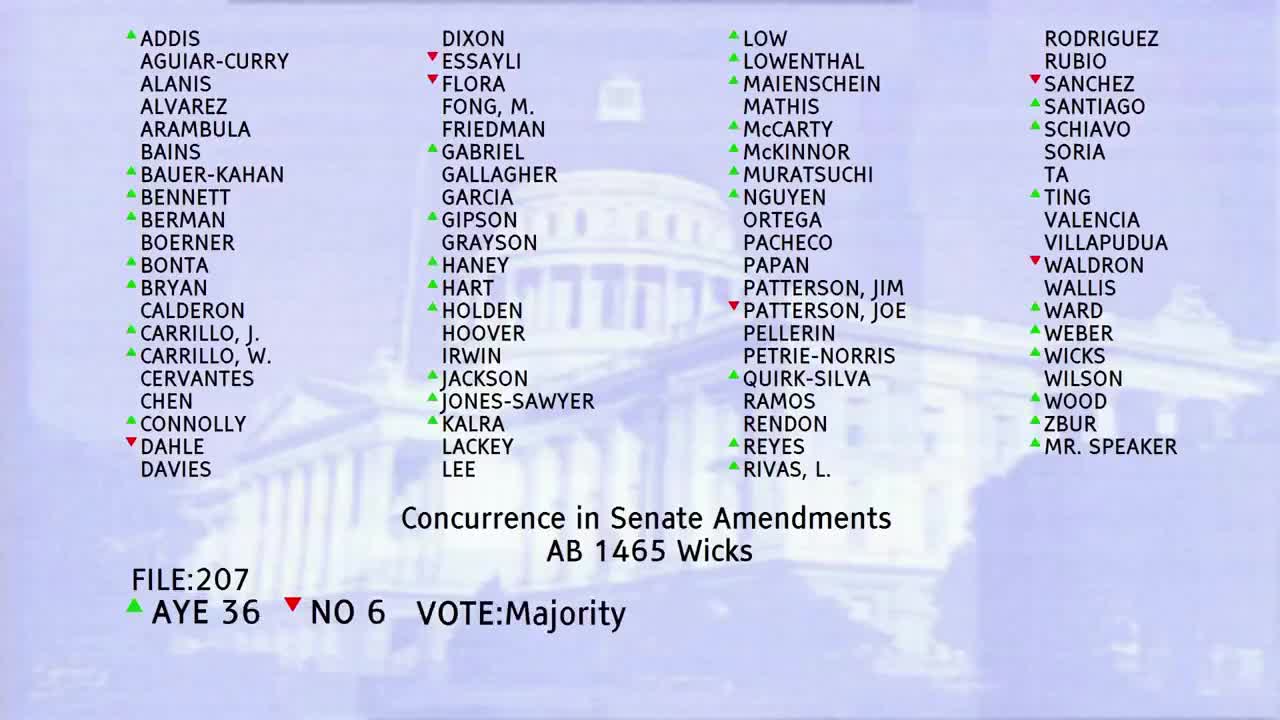 37SEC
Assembly Floor
 1MIN
Senate Floor
 1MIN
Senate Standing Committee on Appropriations
 17MIN
Senate Standing Committee on Human Services
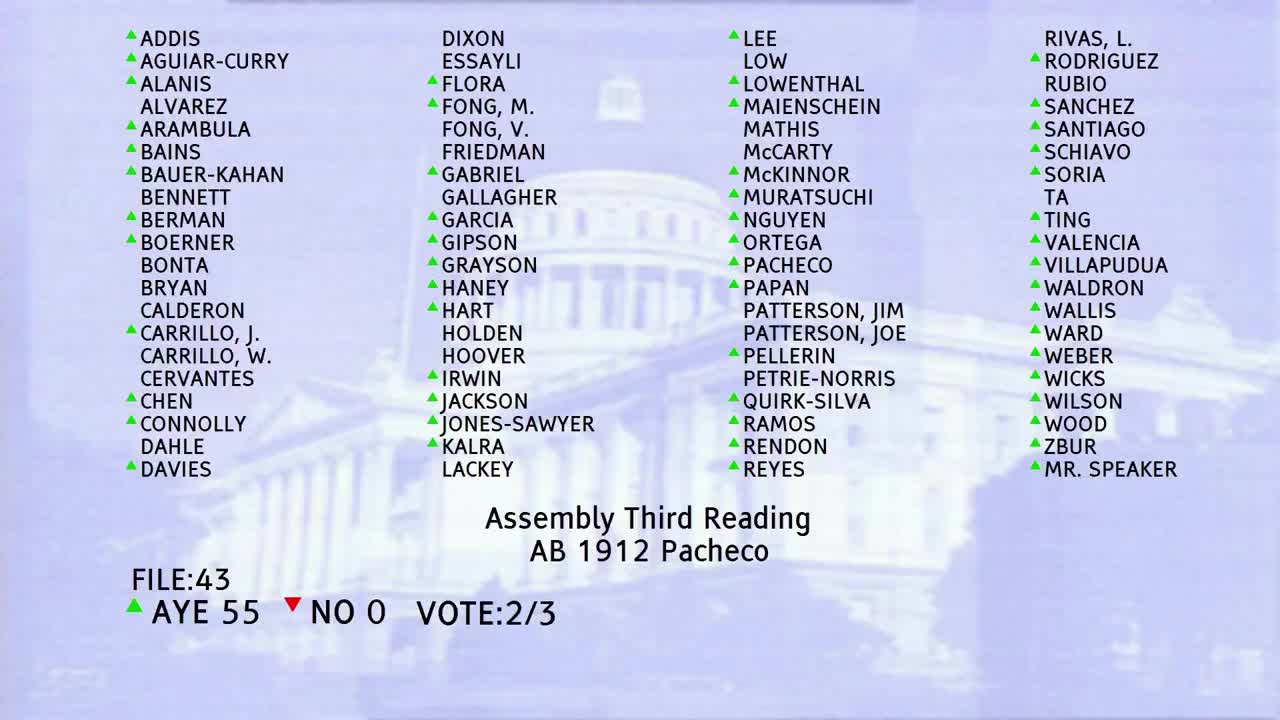 1MIN
Assembly Floor
 10MIN
Assembly Standing Committee on Agriculture
 9MIN
Assembly Standing Committee on Human Services
Bill Author

Bill Co-Author(s):
