AB 1963: Pesticides: paraquat dichloride.
- Session Year: 2023-2024
- House: Assembly
- Latest Version Date: 2024-09-27
Current Status:
Passed
(2024-09-27: Chaptered by Secretary of State - Chapter 688, Statutes of 2024.)
Introduced
In Committee
First Chamber
In Committee
Second Chamber
Enacted
Existing law regulates the use of pesticides and authorizes the Director of Pesticide Regulation to adopt regulations to govern the possession, sale, or use of specified pesticides, as prescribed. Existing law requires the director to endeavor to eliminate from use in the state any pesticide that, among other things, endangers the agricultural or nonagriculutral environment. Existing law requires the director to develop an orderly program for the continuous evaluation of all pesticides actually registered. Existing law authorizes the director, after a hearing, to cancel the registration of any pesticide that, among other things, is detrimental to vegetation, except weeds, to domestic animals, or to the public health and safety when properly used.
This bill would require the Department of Pesticide Regulation, on or before January 1, 2029, to complete a reevaluation of paraquat dichloride, as provided, and make the determination to retain, cancel, or suspend its registration or to place new appropriate restrictions on the use of pesticide products containing the active ingredient paraquat dichloride.
Existing law regulates the use of pesticides and authorizes the Director of Pesticide Regulation to adopt regulations to govern the possession, sale, or use of specified pesticides, as prescribed. Existing law requires the director to endeavor to eliminate from use in the state any pesticide that, among other things, endangers the agricultural or nonagriculutral environment. Existing law requires the director to develop an orderly program for the continuous evaluation of all pesticides actually registered. Existing law authorizes the director, after hearing, to cancel the registration of any pesticide that, among other things, is detrimental to vegetation, except weeds, to domestic animals, or to the public health and safety when properly used.
This bill would require the Department of Pesticide Regulation, on or before January 1, 2029, to complete a reevaluation of paraquat dichloride, as provided, and make the determination to retain, cancel, or suspend its registration or to place new appropriate restrictions on the use of pesticide products containing the active ingredient paraquat dichloride. The bill would require the department, upon request, to appear before specified committees of the Legislature to provide an update on the progress of the reevaluation before March 1, 2027, and, if the reevaluation is not completed by the deadline, to appear before the same committees to explain why the deadline was not met and provide its workplan and mileposts for completing the reevaluation.
Existing law regulates the use of pesticides and authorizes the Director of Pesticide Regulation to adopt regulations to govern the possession, sale, or use of specified pesticides, as prescribed. Existing law requires the director to adopt regulations designating and establishing a list of restricted materials and governing the possession and use of restricted materials that are injurious to the environment or to any person, animal, crop, or other property, as provided. Existing law authorizes the director to adopt regulations that prohibit the use or possession of a restricted material in certain areas or under certain conditions. Existing law requires the director and each county agricultural commissioner to enforce these and other laws, including regulations, relating to pesticides. Under existing law, the director adopted regulations designating specified forms of paraquat as restricted materials and regulating its use and application in specified circumstances. endeavor to eliminate from use in the state any pesticide that, among other things, endangers the agricultural or nonagriculutral environment. Existing law requires the director to develop an orderly program for the continuous evaluation of all pesticides actually registered. Existing law authorizes the director, after hearing, to cancel the registration of any pesticide that, among other things, is detrimental to vegetation, except weeds, to domestic animals, or to the public health and safety when properly used.
This bill, on and after January 1, 2026, would prohibit the use, manufacture, sale, delivery, holding, or offering for sale in commerce any pesticide product that contains paraquat dichloride until the Department of Pesticide Regulation completes a reevaluation of paraquat dichloride and either (1) cancels or suspends the registration of a pesticide product that contains the active ingredient paraquat dichloride, or (2) makes the determination to retain or place new appropriate restrictions on the use of the active ingredient paraquat dichloride that it deems to be sufficiently protective of human and environmental health to mitigate any potential significant adverse effects.Existing law provides that any violation of certain provisions relating to pesticides, or regulations issued pursuant to those provisions, is a misdemeanor.Because a violation of the prohibition imposed in this bill would be a crime, the bill would impose a state-mandated local program.The California Constitution requires the state to reimburse local agencies and school districts for certain costs mandated by the state. Statutory provisions establish procedures for making that reimbursement.This bill would provide that no reimbursement is required by this act for a specified reason.This bill would require the Department of Pesticide Regulation, on or before January 1, 2029, to complete a reevaluation of paraquat dichloride, as provided, and make the determination to retain, cancel, or suspend its registration or to place new appropriate restrictions on the use of pesticide products containing the active ingredient paraquat dichloride.
Existing law regulates the use of pesticides and authorizes the Director of Pesticide Regulation to adopt regulations to govern the possession, sale, or use of specified pesticides, as prescribed. Existing law requires the director to adopt regulations designating and establishing a list of restricted materials and governing the possession and use of restricted materials that are injurious to the environment or to any person, animal, crop, or other property, as provided. Existing law authorizes the director to adopt regulations that prohibit the use or possession of a restricted material in certain areas or under certain conditions. Existing law requires the director and each county agricultural commissioner to enforce these and other laws, including regulations, relating to pesticides. Under existing law, the director adopted regulations designating specified forms of paraquat as restricted materials and regulating its use and application in specified circumstances.
This bill, on and after January 1, 2026, would prohibit the use, manufacture, sale, delivery, holding, or offering for sale in commerce any pesticide product that contains paraquat dichloride until the Department of Pesticide Regulation completes a reevaluation of paraquat dichloride and either (1) cancels or suspends the registration of a pesticide product that contains the active ingredient paraquat dichloride, or (2) places makes the determination to retain or place new appropriate restrictions on the use of the active ingredient paraquat dichloride that it deems to be sufficiently protective of human and environmental health to mitigate any potential significant adverse effects.
Existing law, unless a different penalty is expressly provided, makes a violation of the Food and Agricultural Code a crime. law provides that any violation of certain provisions relating to pesticides, or regulations issued pursuant to those provisions, is a misdemeanor.
Because a violation of the prohibition imposed in this bill would be part of the Food and Agricultural Code, the violation of which would be a crime, the bill would impose a state-mandated local program.
The California Constitution requires the state to reimburse local agencies and school districts for certain costs mandated by the state. Statutory provisions establish procedures for making that reimbursement.
This bill would provide that no reimbursement is required by this act for a specified reason.
Existing law regulates the use of pesticides and authorizes the Director of Pesticide Regulation to adopt regulations to govern the possession, sale, or use of specified pesticides, as prescribed. Existing law requires the director to adopt regulations designating and establishing a list of restricted materials and governing the possession and use of restricted materials that are injurious to the environment or to any person, animal, crop, or other property, as provided. Existing law authorizes the director to adopt regulations that prohibit the use or possession of a restricted material in certain areas or under certain conditions. Existing law requires the director and each county agricultural commissioner to enforce these and other laws, including regulations, relating to pesticides. Under existing law, the director adopted regulations designating specified forms of paraquat as restricted materials and regulating its use and application in specified circumstances.
This bill, on and after January 1, 2026, would prohibit the use, manufacture, sale, delivery, holding, or offering for sale in commerce any pesticide product that contains paraquat dichloride until the Department of Pesticide Regulation completes a reevaluation of paraquat dichloride and either (1) cancels or suspends the registration of a pesticide product that contains the active ingredient paraquat dichloride, or (2) places appropriate restrictions on the use of the active ingredient paraquat dichloride to mitigate any potential significant adverse effects. The bill would provide that its provisions do not require the department to complete that reevaluation.
Existing law, unless a different penalty is expressly provided, makes a violation of the Food and Agricultural Code a crime.
Because the prohibition imposed in this bill would be part of the Food and Agricultural Code, the violation of which would be a crime, the bill would impose a state-mandated local program.
The California Constitution requires the state to reimburse local agencies and school districts for certain costs mandated by the state. Statutory provisions establish procedures for making that reimbursement.
This bill would provide that no reimbursement is required by this act for a specified reason.
Existing law regulates the use of pesticides and authorizes the Director of Pesticide Regulation to adopt regulations to govern the possession, sale, or use of specified pesticides, as prescribed. Existing law requires the director to adopt regulations designating and establishing a list of restricted materials and governing the possession and use of restricted materials that are injurious to the environment or to any person, animal, crop, or other property, as provided. Existing law authorizes the director to adopt regulations that prohibit the use or possession of a restricted material in certain areas or under certain conditions. Existing law requires the director and each county agricultural commissioner to enforce these and other laws, including regulations, relating to pesticides. Under existing law, the director adopted regulations designating specified forms of paraquat as restricted materials and regulating its use and application in specified circumstances.
This bill, on and after January 1, 2026, would prohibit the use of a pesticide, and the use, manufacture, sale, delivery, holding, or offering for sale in commerce any product, pesticide product that contains paraquat dichloride. dichloride until the Department of Pesticide Regulation completes a reevaluation of paraquat dichloride and either (1) cancels or suspends the registration of a pesticide product that contains the active ingredient paraquat dichloride, or (2) places appropriate restrictions on the use of the active ingredient paraquat dichloride to mitigate any potential significant adverse effects. The bill would provide that its provisions do not require the department to complete that reevaluation.
Existing law, unless a different penalty is expressly provided, makes a violation of the Food and Agricultural Code a crime.
Because the prohibition imposed in this bill would be part of the Food and Agricultural Code, the violation of which would be a crime, the bill would impose a state-mandated local program.
The California Constitution requires the state to reimburse local agencies and school districts for certain costs mandated by the state. Statutory provisions establish procedures for making that reimbursement.
This bill would provide that no reimbursement is required by this act for a specified reason.
Existing law regulates the use of pesticides and authorizes the Director of Pesticide Regulation to adopt regulations to govern the possession, sale, or use of specified pesticides, as prescribed. Existing law requires the director to adopt regulations designating and establishing a list of restricted materials and governing the possession and use of restricted materials that are injurious to the environment or to any person, animal, crop, or other property, as provided. Existing law authorizes the director to adopt regulations that prohibit the use or possession of a restricted material in certain areas or under certain conditions. Existing law requires the director and each county agricultural commissioner to enforce these and other laws, including regulations, relating to pesticides. Under existing law, the director adopted regulations designating specified forms of paraquat as restricted materials and regulating its use and application in specified circumstances.
This bill, commencing on and after January 1, 2026, would make unlawful prohibit the use of a pesticide, or and the manufacture, sale, delivery, holding, or offering for sale in commerce any product, that contains paraquat dichloride in the state. By creating a new crime, the bill would impose a state-mandated local program. dichloride.
Existing law, unless a different penalty is expressly provided, makes a violation of the Food and Agricultural Code a crime.
Because the prohibition imposed in this bill would be part of the Food and Agricultural Code, the violation of which would be a crime, the bill would impose a state-mandated local program.
The California Constitution requires the state to reimburse local agencies and school districts for certain costs mandated by the state. Statutory provisions establish procedures for making that reimbursement.
This bill would provide that no reimbursement is required by this act for a specified reason.
Existing law requires cases of pesticide poisoning to be reported to the local health officer.
This bill, commencing January 1, 2026, would make unlawful the use of a pesticide, or the manufacture, sale, delivery, holding, or offering for sale in commerce any product, that contains paraquat dichloride in the state. By creating a new crime, the bill would impose a state-mandated local program.
The California Constitution requires the state to reimburse local agencies and school districts for certain costs mandated by the state. Statutory provisions establish procedures for making that reimbursement.
This bill would provide that no reimbursement is required by this act for a specified reason.
Existing law requires the Department of Pesticide Regulation to prepare and submit quarterly reports due 60 days after the end of each quarter to specified Senate and Assembly committees and the Office of the Surgeon General that provide information, as prescribed, regarding granular chlorpyrifos use, monitoring, and exposure during the quarter.This bill would require the department to post the quarterly reports to its internet website.Existing law requires the Department of Pesticide Regulation to prepare and submit quarterly reports due 60 days after the end of each quarter to specified Senate and Assembly committees and the Office of the Surgeon General that provide information, as prescribed, regarding granular chlorpyrifos use, monitoring, and exposure during the quarter.
This bill would require the department to post the quarterly reports to its internet website.
For purposes of this chapter, pesticide has the same meaning as specified in Section 12753.
14086.On or before January 1, 2029, the department shall complete a reevaluation of paraquat dichloride pursuant to Section 12824, and make the determination to retain, cancel, or suspend its registration or to place new appropriate restrictions on the use of pesticide products containing the active ingredient paraquat dichloride.
For purposes of this chapter, pesticide has the same meaning as specified in Section 12753.
14086.(a)On or before January 1, 2029, the department shall complete a reevaluation of paraquat dichloride pursuant to Section 12824, and make the determination to retain, cancel, or suspend its registration or to place new appropriate restrictions on the use of pesticide products containing the active ingredient paraquat dichloride.
(b)The department shall, upon request, appear before the Senate Committee on Agriculture, the Senate Committee on Environmental Quality, and the Assembly Committee on Environmental Safety and Toxic Materials to provide an update on the progress of the reevaluation before March 1, 2027.(c)If the department does not complete the reevalution on or before January 1, 2029, pursuant to subdivision (a), the department shall, upon request, appear before the Senate Committee on Agriculture, the Senate Committee on Environmental Quality, and the Assembly Committee on Environmental Safety and Toxic Materials to explain why the deadline was not met and provide its workplan and mileposts for completing the reevaluation.For purposes of this chapter, pesticide has the same meaning as specified in Section 12753.
14086.(a)On or before January 1, 2029, the department shall complete a reevaluation of paraquat dichloride pursuant to Section 12824, and make the determination to retain, cancel, or suspend its registration or to place new appropriate restrictions on the use of pesticide products containing the active ingredient paraquat dichloride.
(b)The department shall, upon request, appear before the Senate Committee on Agriculture, the Senate Committee on Environmental Quality, and the Assembly Committee on Environmental Safety and Toxic Materials to provide an update on the progress of the reevaluation before March 1, 2027.
(c)If the department does not complete the reevalution on or before January 1, 2029, pursuant to subdivision (a), the department shall, upon request, appear before the Senate Committee on Agriculture, the Senate Committee on Environmental Quality, and the Assembly Committee on Environmental Safety and Toxic Materials to explain why the deadline was not met and provide its workplan and mileposts for completing the reevaluation.
For purposes of this chapter, pesticide has the same meaning as specified in Section 12753.
14086.On and after January 1, 2026, a person or entity shall not use, manufacture, sell, deliver, hold, or offer for sale in commerce in the state a pesticide product that contains the active ingredient paraquat dichloride until both of the following conditions are met:(a)The department has completed a reevaluation of paraquat dichloride.(b)Either of the following occurs:(1)The department cancels or suspends the registration of each pesticide product that contains the active ingredient paraquat dichloride.(2)The department makes the determination to retain or place new appropriate restrictions on the use of the active ingredient paraquat dichloride that it deems to be sufficiently protective of human and environmental health to mitigate any potential significant adverse effects.14086.On or before January 1, 2029, the department shall complete a reevaluation of paraquat dichloride pursuant to Section 12824, and make the determination to retain, cancel, or suspend its registration or to place new appropriate restrictions on the use of pesticide products containing the active ingredient paraquat dichloride.
SEC. 2.No reimbursement is required by this act pursuant to Section 6 of Article XIIIB of the California Constitution because the only costs that may be incurred by a local agency or school district will be incurred because this act creates a new crime or infraction, eliminates a crime or infraction, or changes the penalty for a crime or infraction, within the meaning of Section 17556 of the Government Code, or changes the definition of a crime within the meaning of Section 6 of Article XIIIB of the California Constitution.For purposes of this chapter, pesticide has the same meaning as specified in Section 12753.
14086.On and after January 1, 2026, a person or entity shall not use, manufacture, sell, deliver, hold, or offer for sale in commerce in the state a pesticide product that contains the active ingredient paraquat dichloride until both of the following conditions are met:
(a)The department has completed a reevaluation of paraquat dichloride.
(b)Either of the following occurs:
(1)The department cancels or suspends the registration of each pesticide product that contains the active ingredient paraquat dichloride.
(2)The department places makes the determination to retain or place new appropriate restrictions on the use of the active ingredient paraquat dichloride that it deems to be sufficiently protective of human and environmental health to mitigate any potential significant adverse effects.
SEC. 2.No reimbursement is required by this act pursuant to Section 6 of Article XIIIB of the California Constitution because the only costs that may be incurred by a local agency or school district will be incurred because this act creates a new crime or infraction, eliminates a crime or infraction, or changes the penalty for a crime or infraction, within the meaning of Section 17556 of the Government Code, or changes the definition of a crime within the meaning of Section 6 of Article XIIIB of the California Constitution.
For purposes of this chapter, pesticide has the same meaning as specified in Section 12753.
14086.(a)On and after January 1, 2026, a person or entity shall not use, manufacture, sell, deliver, hold, or offer for sale in commerce in the state a pesticide product that contains the active ingredient paraquat dichloride until both of the following conditions are met:
(1)(a)The department has completed a reevaluation of paraquat dichloride.
(2)(b)Either of the following occurs:
(A)(1)The department cancels or suspends the registration of each pesticide product that contains the active ingredient paraquat dichloride.
(B)(2)The department places appropriate restrictions on the use of the active ingredient paraquat dichloride to mitigate any potential significant adverse effects.
(b)This section does not require the department to complete a reevaluation of paraquat dichloride.SEC. 2.No reimbursement is required by this act pursuant to Section 6 of Article XIIIB of the California Constitution because the only costs that may be incurred by a local agency or school district will be incurred because this act creates a new crime or infraction, eliminates a crime or infraction, or changes the penalty for a crime or infraction, within the meaning of Section 17556 of the Government Code, or changes the definition of a crime within the meaning of Section 6 of Article XIIIB of the California Constitution.
For purposes of this chapter, pesticide has the same meaning as specified in Section 12753.
14086.(a)On and after January 1, 2026, a person shall not use in the state a pesticide that contains, and a person or entity shall not use, manufacture, sell, deliver, hold, or offer for sale in commerce in the state a pesticide product that contains, contains the active ingredient paraquat dichloride. dichloride until both of the following conditions are met:
(1)The department has completed a reevaluation of paraquat dichloride.
(2)Either of the following occurs:
(A)The department cancels or suspends the registration of each pesticide product that contains the active ingredient paraquat dichloride.
(B)The department places appropriate restrictions on the use of the active ingredient paraquat dichloride to mitigate any potential significant adverse effects.
(b)This section does not require the department to complete a reevaluation of paraquat dichloride.
SEC. 2.No reimbursement is required by this act pursuant to Section 6 of Article XIIIB of the California Constitution because the only costs that may be incurred by a local agency or school district will be incurred because this act creates a new crime or infraction, eliminates a crime or infraction, or changes the penalty for a crime or infraction, within the meaning of Section 17556 of the Government Code, or changes the definition of a crime within the meaning of Section 6 of Article XIIIB of the California Constitution.
For purposes of this chapter, pesticide has the same meaning as specified in Section 12753.
14086.On and after January 1, 2026, a person shall not use in the state a pesticide that contains, and a person or entity shall not manufacture, sell, deliver, hold, or offer for sale in commerce in the state a product that contains, the active ingredient paraquat dichloride.
SEC. 2.No reimbursement is required by this act pursuant to Section 6 of Article XIIIB of the California Constitution because the only costs that may be incurred by a local agency or school district will be incurred because this act creates a new crime or infraction, eliminates a crime or infraction, or changes the penalty for a crime or infraction, within the meaning of Section 17556 of the Government Code, or changes the definition of a crime within the meaning of Section 6 of Article XIIIB of the California Constitution.
For purposes of this chapter, pesticide has the same meaning specified in Section 12753 of the Food and Agricultural Code.
105246.Commencing January 1, 2026, it is unlawful for a person to use a pesticide that contains, or for a person or entity to manufacture, sell, deliver, hold, or offer for sale in commerce any product that contains, the active ingredient paraquat dichloride in the state.
SEC. 2.No reimbursement is required by this act pursuant to Section 6 of Article XIIIB of the California Constitution because the only costs that may be incurred by a local agency or school district will be incurred because this act creates a new crime or infraction, eliminates a crime or infraction, or changes the penalty for a crime or infraction, within the meaning of Section 17556 of the Government Code, or changes the definition of a crime within the meaning of Section 6 of Article XIIIB of the California Constitution.
SECTION 1.Section 105240 of the Health and Safety Code is amended to read:105240.(a)Notwithstanding Section 10231.5 of the Government Code, beginning with the first quarter of 2021, the Department of Pesticide Regulation shall prepare and submit quarterly reports, due 60 days after the end of each quarter, to the Senate Committee on Health, the Senate Committee on Labor, Public Employment and Retirement, the Senate Committee on Environmental Quality, the Assembly Committee on Health, the Assembly Committee on Labor and Employment, the Assembly Committee on Environmental Safety and Toxic Materials, and the Office of the Surgeon General that provide all of the following information:(1)The amount of chlorpyrifos in granular form used in the quarter, reported in pounds and by location of use.(2)Potential reasons for any increase or decrease in the use of chlorpyrifos in granular form in the quarter as compared to the same quarter of the previous year.(3)A description of how the Department of Pesticide Regulation monitors exposure to the use of chlorpyrifos in granular form with a particular emphasis on dermal and inhalation exposure, and any information relating to that exposure during the quarter.(b)The department shall post the quarterly reports on its internet website to allow public access to the information.(a)Notwithstanding Section 10231.5 of the Government Code, beginning with the first quarter of 2021, the Department of Pesticide Regulation shall prepare and submit quarterly reports, due 60 days after the end of each quarter, to the Senate Committee on Health, the Senate Committee on Labor, Public Employment and Retirement, the Senate Committee on Environmental Quality, the Assembly Committee on Health, the Assembly Committee on Labor and Employment, the Assembly Committee on Environmental Safety and Toxic Materials, and the Office of the Surgeon General that provide all of the following information:
(a)(1)The amount of chlorpyrifos in granular form used in the quarter, reported in pounds and by location of use.
(b)(2)Potential reasons for any increase or decrease in the use of chlorpyrifos in granular form in the quarter as compared to the same quarter of the previous year.
(c)(3)A description of how the Department of Pesticide Regulation monitors exposure to the use of chlorpyrifos in granular form with a particular emphasis on dermal and inhalation exposure, and any information relating to that exposure during the quarter.
(b)The department shall post the quarterly reports on its internet website to allow public access to the information.
|
Date
|
Status
|
|---|---|
| Sep 27, 2024 | Chaptered by Secretary of State - Chapter 688, Statutes of 2024. |
| Sep 27, 2024 | Approved by the Governor. |
| Sep 11, 2024 | Enrolled and presented to the Governor at 4 p.m. |
| Aug 29, 2024 | Senate amendments concurred in. To Engrossing and Enrolling. (Ayes 51. Noes 16.). |
| Aug 29, 2024 | Assembly Rule 77 suspended. |
| Aug 28, 2024 | In Assembly. Concurrence in Senate amendments pending. May be considered on or after August 30 pursuant to Assembly Rule 77. |
| Aug 28, 2024 | Read third time. Passed. Ordered to the Assembly. (Ayes 29. Noes 8.). |
| Aug 26, 2024 | Read second time. Ordered to third reading. |
| Aug 23, 2024 | Read third time and amended. Ordered to second reading. |
| Aug 20, 2024 | Read second time. Ordered to third reading. |
| Aug 19, 2024 | Read third time and amended. Ordered to second reading. |
| Aug 19, 2024 | Read second time. Ordered to third reading. |
| Aug 15, 2024 | From committee: Do pass. (Ayes 4. Noes 2.) (August 15). |
| Aug 5, 2024 | In committee: Referred to APPR suspense file. |
| Jul 3, 2024 | Read second time and amended. Re-referred to Com. on APPR. |
| Jul 2, 2024 | From committee: Amend, and do pass as amended and re-refer to Com. on APPR. (Ayes 3. Noes 0.) (July 2). |
| Jun 20, 2024 | Read second time and amended. Re-referred to Com. on AGRI. |
| Jun 19, 2024 | From committee: Amend, and do pass as amended and re-refer to Com. on AGRI. (Ayes 4. Noes 3.) (June 19). |
| Jun 6, 2024 | From committee chair, with author's amendments: Amend, and re-refer to committee. Read second time, amended, and re-referred to Com. on E.Q. |
| Jun 5, 2024 | Referred to Coms. on E.Q. and AGRI. |
| May 24, 2024 | In Senate. Read first time. To Com. on RLS. for assignment. |
| May 23, 2024 | Read third time. Passed. Ordered to the Senate. (Ayes 46. Noes 16. Page 5617.) |
| May 20, 2024 | Read second time. Ordered to third reading. |
| May 16, 2024 | From committee: Do pass. (Ayes 11. Noes 4.) (May 16). |
| May 8, 2024 | In committee: Set, first hearing. Referred to APPR. suspense file. |
| Apr 29, 2024 | Re-referred to Com. on APPR. |
| Apr 25, 2024 | Read second time and amended. |
| Apr 24, 2024 | From committee: Amend, and do pass as amended and re-refer to Com. on APPR. (Ayes 5. Noes 2.) (April 23). |
| Apr 15, 2024 | Re-referred to Com. on E.S. & T.M. |
| Apr 11, 2024 | From committee chair, with author's amendments: Amend, and re-refer to Com. on E.S. & T.M. Read second time and amended. |
| Apr 3, 2024 | Re-referred to Com. on E.S. & T.M. |
| Apr 2, 2024 | From committee chair, with author's amendments: Amend, and re-refer to Com. on E.S. & T.M. Read second time and amended. |
| Feb 12, 2024 | Referred to Com. on E.S. & T.M. |
| Jan 30, 2024 | From printer. May be heard in committee February 29. |
| Jan 29, 2024 | Read first time. To print. |
|
Date
|
Description
|
Location
|
Votes
|
|
|---|---|---|---|---|
| Aug 29, 2024 | AB 1963 Friedman Concurrence in Senate Amendments | Assembly Floor |
Passed |
|
| Aug 28, 2024 | Assembly 3rd Reading AB1963 Friedman et al. By Cortese | Senate Floor |
Passed |
|
| Aug 15, 2024 | Do pass | Senate Standing Committee on Appropriations |
Passed |
|
| Aug 5, 2024 | Placed on suspense file | Senate Standing Committee on Appropriations |
Passed |
|
| Jul 2, 2024 | Do pass as amended, but first amend, and re-refer to the Committee on [Appropriations] | Senate Standing Committee on Agriculture |
Passed |
|
| Jun 19, 2024 | Do pass as amended, but first amend, and re-refer to the Committee on [Agriculture] | Senate Standing Committee on Environmental Quality |
Passed |
|
| May 23, 2024 | AB 1963 Friedman Assembly Third Reading | Assembly Floor |
Passed |
|
| May 16, 2024 | Do pass. | Assembly Standing Committee on Appropriations |
Passed |
|
| Apr 23, 2024 | Do pass as amended and be re-referred to the Committee on [Appropriations] | Assembly Standing Committee on Environmental Safety and Toxic Materials |
Passed |
This list shows positions taken on this bill by organizations on the date displayed, which is linked to the original source.
Positions by individuals are not included.
|
Organization
|
Position
|
Date
|
|---|---|---|
| A Voice for Choice Advocacy | ** Support | |
| Agricultural Council Of California | ** Against | |
| Alliance of Nurses for Healthy Environments | ** Support | |
| Allman Alliance | ** Against | Jun 21, 2024 |
| Almond Alliance of California | ** Against | |
| American Bird Conservancy | ** Support | |
| American Pistachio Growers | * Against | Jul 2, 2024 |
| Beyond Pesticides | ** Support | |
| CA Cotton Ginners & Growers Association | ** Against | |
| California Agricultural Aircraft Association | ** Against | |
| California Agricultural Commissioners & Sealers Association | ** Against | |
| California Apple Commission | ** Against | |
| California Association Of Pest Control Advisers | ** Against | |
| California Association Of Professional Scientists | ** Support | |
| California Association Of Winegrape Growers | ** Against | |
| California Avocado Commission | * Against | Jul 2, 2024 |
| California Blueberry Association | ** Against | |
| California Blueberry Commission | ** Against | |
| California Cattlemen'S Association | ** Against | |
| California Chamber Of Commerce | ** Against | |
| California Cherry Board | ** Against | |
| California Cherry Growers and Industry Association | ** Against | |
| California Cotton Ginners and Growers Association | ** Against | |
| California Environmental Voters | ** Support | |
| California Farm Bureau Federation | ** Against | |
| California Fresh Fruit Association | ** Against | |
| California League of Food Producers | ** Against | |
| California Manufacturers & Technology Association | ** Against | |
| California Nurses for Environmental Health & Justice | ** Support | |
| california pear grower association | ** Against | |
| California Rural Legal Assistance Foundation | ** Support | |
| California Seed Association | ** Against | |
| California Strawberry Commission | * Against | Jul 2, 2024 |
| California Walnut Commission | ** Against | |
| California Walnuts | ** Against | |
| Californians for Pesticide Reform | ** Support | |
| Center For Biological Diversity | ** Support | |
| Center For Environmental Health | ** Support | |
| Center For Food Safety | * Support | Apr 23, 2024 |
| Chemical Industry Council Of California | ** Against | |
| Clean Water Action | ** Support | |
| cleanearth4kids.org | ** Support | |
| Coalition Advocating for Pesticide Safety | * For If Amend | Jul 2, 2024 |
| Community Water Center | ** Support | |
| Consumer Attorneys Of California | ** Support | |
| Croplife America | ** Against | |
| Dolores Huerta Foundation | ** Support | |
| Educate. Advocate. | ** Support | |
| Emf Center | ** Support | |
| Environmental Working Group | ** Support | |
| Families Advocating for Chemical and Toxics Safety | ** Support | |
| Farmworker Justice | ** Support | |
| Food and Water Watch | ** Support | |
| Friends Of The Earth | ** Support | |
| Fund Her | ** Support | |
| Future Leaders of Change | * Support | Jun 19, 2024 |
| Future Leaders of Change | * For If Amend | Jul 2, 2024 |
| GMO Science | ** Support | |
| Grandparents4action | ** Support | |
| Green Latinos | ** Support | |
| Greenfield City Councilwoman | * For If Amend | Jul 2, 2024 |
| Interfaith Coalition for Earth Justice | * Support | Apr 23, 2024 |
| Kp Public Affairs | * Against | Jul 2, 2024 |
| Leadership Counsel for Justice and Accountability | ** Support | |
| Lideres Campesinas | ** Support | |
| Lilla Films | ** Support | |
| Mamavation - Non-toxic Products for Healthy Families | ** Support | |
| Maternal and Child Health Access | ** Support | |
| Michael J Fox Foundation For ParkinsonS Research The | ** Support | |
| Michael J. Fox Foundation | * Support | Apr 23, 2024 |
| Michael J. Fox Foundation | * Support | Jun 19, 2024 |
| moms advocating sustainability | ** Support | |
| Napa Green | ** Support | |
| Non Toxic Communities | ** Support | |
| Nontoxic Neighborhoods | ** Support | |
| North County Equity and Justice Coalition | ** Support | |
| Olive Growers Council of California | ** Against | |
| Pesticide Action Network | ** Support | |
| Physicians for Social Responsibility-San Francisco Bay Area Chapter | ** Support | |
| Protect Wild Petaluma | ** Support | |
| Rachel Carson Council | ** Support | |
| Re:wild Your Campus | ** Support | |
| recolte energy | ** Support | |
| Resource Renewal Institute | ** Support | |
| Safe Ag Safe Schools | * Support | Jun 19, 2024 |
| Samson Advisors | * Against | Jul 2, 2024 |
| Seventh Generation Advisors | ** Support | |
| Sierra Club California | ** Support | |
| Slow Food Russian River | ** Support | |
| The Green Room Corporation | ** Support | |
| United Farm Workers | ** Support | |
| Voices for Progress | ** Support | |
| Voices For Progress Education Fund | ** Support | |
| Western Agricultural Processors Association | ** Against | |
| Western Growers Association | ** Against | |
| Western Plant Health Association | ** Against | |
| Worksafe | ** Support | |
| YardSmartMarin | ** Support |
CONCURRENCE IN SENATE AMENDMENTS
CSA1 Bill Id:AB 1963
Author:(Friedman)
As Amended Ver:August 23, 2024
Majority vote
SUMMARY
Requires, on or before January 1, 2029, the Department of Pesticide Regulation (DPR) to complete a reevaluation of paraquat dichloride (paraquat), and make the determination to retain, cancel, or suspend its registration, or to place new appropriate restrictions on the use of paraquat.
Senate Amendments
Delete the provisions of the bill as it passed the Assembly, which would have prohibited, on and after January 1, 2026, a person from using, manufacturing, selling, delivering, holding, or offering for sale a pesticide product that contains paraquat, and instead requires, on or before January 1, 2029, DPR to complete a reevaluation of paraquat, and to make the determination to retain, cancel, or suspend its registration or to place new appropriate restrictions on the use of pesticide products containing paraquat.
COMMENTS
Paraquat: The Centers for Disease Control and Prevention (CDC) describes paraquat as a "toxic chemical that is widely used as an herbicide (plant killer)." Paraquat is a contact herbicide that desiccates and destroys plant cell membranes within hours of application, and is one of the most widely used herbicides in the United States. Paraquat is used in many agricultural settings for the control of weeds and grasses, as a harvest aid desiccant (to remove green foliage before harvesting, such as for cotton or potatoes), and as a postharvest desiccant. Approved non-agricultural uses for paraquat include control of weeds and grasses around commercial buildings, electric transformer stations, pipeline pumping stations, public airports, and storage yards.
Impacts of paraquat exposure: According to the United States Environmental Protection Agency (US EPA), humans may be exposed to paraquat in food and drinking water since paraquat may be applied directly to growing crops and application may result in paraquat reaching surface and ground water sources of drinking water. Non-occupational exposures may occur as a result of spray drift from off-target applications of paraquat. US EPA states that occupational handler and post-application exposures are expected from paraquat usage. The CDC asserts that licensed applicators of paraquat are the people most at risk for exposure.
US EPA says that paraquat is highly toxic, that one small sip of paraquat can be fatal, and that there is no antidote. Because of paraquat's acute toxicity, all paraquat products registered for use in the United States are federally designated as restricted-use pesticides that can only be sold to and used by trained, certified applicators. There are no paraquat products registered for homeowner use and no products registered for application to residential areas in the United States. More than 60 countries have prohibited the use of paraquat.
Paraquat is also implicated in chronic health effects, especially the progressive neurodegenerative disorder Parkinson's disease. Experimental research has shown that paraquat crosses the blood-brain barrier and can enter and accumulate in dopaminergic neurons, the cells lost in Parkinson's disease. Dopaminergic neurons play an important role in the control of multiple brain functions, including voluntary movement and the regulation of many processes, such as mood and stress. At least 10 epidemiological studies have linked paraquat exposure to Parkinson's disease, and a 2019 meta-analysis of 13 case-control studies showed paraquat exposure to be associated with a 1.64- fold increase in the risk of Parkinson's disease. Epidemiological results have not been unequivocal, however, as a recent report from the Agricultural Health Study suggests no association, contradicting positive associations previously reported in a nested case-control study from the same cohort.
In addition to human health concerns, paraquat poses risks to other organisms. US EPA's 2019 draft ecological risk assessment of paraquat identified potential risks to mammals, birds, terrestrial invertebrates, terrestrial plants, and algae due to paraquat exposure, and stated that paraquat is "very persistent in soil/sediment and accumulates in the environment in an adsorbed state."
DPR's review of paraquat for reevaluation: In 2022 and 2023, DPR received comments requesting that DPR reevaluate, suspend, or cancel products containing paraquat, including thousands of comments submitted pursuant to an email campaign and seven unique comments, which contained references to public literature and studies, from environmental and Parkinson's disease research organizations and from Parkinson's disease researchers and practitioners. DPR notes that it continues to evaluate the studies and comments submitted in 2022 and 2023 on paraquat, and anticipates completing its initial scientific review in the coming months. DPR will make a decision about its next steps following that review, including whether the review triggers a reevaluation of products containing paraquat.
According to the Author
"Paraquat poisonings are deadly and research found that agricultural exposure to paraquat is associated with increased risk of Parkinson's disease… The people most at risk of paraquat exposure are primarily agricultural workers who mix, load, or apply paraquat, and enter areas after paraquat has been applied, as well as people living in agricultural communities who could be exposed from pesticide drift in the air or dust. In 2021 just over 430,000 pounds were applied in California, primarily in Kern, Kings, Fresno, Merced, and Tulare counties… The US EPA and independent scientists have well documented the hazards to public health and wildlife from the use of paraquat. Paraquat use has serious uncontrollable adverse effects. A considerable amount of evidence from studies in people, especially farmworkers, have linked paraquat exposure to the development of Parkinson's disease. A 2019 meta-analysis of 13 studies reported a statistically significant association where people exposed to paraquat are 1.64 times more likely to be diagnosed with Parkinson's disease… Paraquat is banned in more than sixty countries, including those with large agricultural economies, like the United Kingdom, China, and Brazil, as well as the European Union. California should follow their lead. There are reasonable, effective, and practicable alternatives to paraquat that are less destructive to the environment."
Arguments in Support
The Environmental Working Group writes, "[AB 1963] has been amended several times, but it still does something that is very important – it [DPR] to expedite the scientific reevaluation of paraquat… Despite claims by the opposition, the science is independent and is clear – exposure to paraquat greatly increases the odds of getting Parkinson's Disease. They also claim that this pesticide is so tightly restricted in the way that it is used, that nothing further needs to be done. But – a survey of the counties where paraquat is most heavily used, shows that accidents and misuse occurs on a fairly regular basis, leading to exposure to farmworkers… And, we note that AB 2113 (Garcia) is now law and DPR will be receiving a much needed infusion of funds to do these types of reevaluations. Paraquat is relevant and important pesticide for DPR to tackle to meet the concerns expressed by the Legislature in AB 2113."
Arguments in Opposition
A coalition of opponents, including pesticide manufacturers, chemical industry trade associations, and agricultural trade organizations, writes, "…Paraquat has been widely used for decades and has been the subject of more than 1,200 safety studies submitted and reviewed by regulatory authorities around the world demonstrating its safety and safe use. AB 1963 ignores the thorough and independent regulatory review of paraquat and overrides the [DPR's] scientific decision making. The bill requires a formal reevaluation of paraquat by 2029, regardless of the department's views on whether a formal reevaluation is necessary. This requirement preempts the [DPR's] current, additional review of paraquat safety. This bill is being considered only shortly after AB 2113, a major new increase in the pesticide mill taxes to better fund DPR and ensure it undertakes timely reevaluations was negotiated with agricultural groups. It is significant to note that new revenues authorized in AB 2113 cannot be used for reevaluations. Therefore, the provisions of AB 1963 would constitute a significant fiscal impact on DPR and delay critical product reviews."
FISCAL COMMENTS
According to the Senate Appropriations Committee, enactment of this bill could result in ongoing costs of $214,000 annually to DPR to support one position for work on the reevaluation of paraquat, and in potential ongoing forgone revenue in the thousands of dollars annually due to a reduction in registration and renewal fees in the mill assessment collected by DPR for pesticide products that contain paraquat.
VOTES:
ASM ENVIRONMENTAL SAFETY AND TOXIC MATERIALS: 5-2-0
YES: Garcia, Connolly, McKinnor, Papan, Reyes
NO: Hoover, Ta
ASM APPROPRIATIONS: 11-4-0
YES: Wicks, Arambula, Bryan, Calderon, Wendy Carrillo, Mike Fong, Grayson, Haney, Hart, Pellerin, Villapudua
NO: Sanchez, Dixon, Jim Patterson, Ta
ASSEMBLY FLOOR: 46-16-18
YES: Addis, Alvarez, Arambula, Bauer-Kahan, Bennett, Berman, Boerner, Bonta, Bryan, Calderon, Juan Carrillo, Wendy Carrillo, Connolly, Mike Fong, Friedman, Gabriel, Garcia, Haney, Hart, Jackson, Jones-Sawyer, Kalra, Lee, Low, Lowenthal, Maienschein, McCarty, McKinnor, Muratsuchi, Ortega, Pacheco, Papan, Pellerin, Quirk-Silva, Ramos, Rendon, Reyes, Santiago, Schiavo, Ting, Ward, Weber, Wicks, Wood, Zbur, Robert Rivas
NO: Alanis, Chen, Davies, Dixon, Flora, Vince Fong, Gallagher, Hoover, Lackey, Jim Patterson, Joe Patterson, Sanchez, Ta, Villapudua, Waldron, Wallis
ABS, ABST OR NV: Aguiar-Curry, Bains, Cervantes, Megan Dahle, Essayli, Gipson, Grayson, Holden, Irwin, Mathis, Stephanie Nguyen, Petrie-Norris, Luz Rivas, Rodriguez, Blanca Rubio, Soria, Valencia, Wilson
SENATE FLOOR: 29-8-3
YES: Allen, Archuleta, Ashby, Atkins, Becker, Blakespear, Caballero, Cortese, Dodd, Durazo, Eggman, Glazer, Hurtado, Laird, Limón, McGuire, Menjivar, Min, Newman, Padilla, Portantino, Roth, Rubio, Skinner, Smallwood-Cuevas, Stern, Umberg, Wahab, Wiener
NO: Dahle, Grove, Jones, Nguyen, Niello, Ochoa Bogh, Seyarto, Wilk
ABS, ABST OR NV: Alvarado-Gil, Bradford, Gonzalez
UPDATED
VERSION: August 23, 2024
CONSULTANT: Shannon McKinney / E.S. & T.M. / (916) 319-3965 FN: 0004929
SENATE RULES COMMITTEE Office of Senate Floor Analyses (916) 651-1520 Fax: (916) 327-4478 | AB 1963 |
THIRD READING
Bill No: AB 1963
Author: Friedman (D), et al.
Amended: 8/23/24 in Senate
Vote: 21
SENATE ENVIRONMENTAL QUALITY COMMITTEE: 4-3, 6/19/24
AYES: Allen, Gonzalez, Menjivar, Skinner
NOES: Dahle, Hurtado, Nguyen
SENATE AGRICULTURE COMMITTEE: 3-0, 7/2/24
AYES: Hurtado, Cortese, Padilla
NO VOTE RECORDED: Grove, Alvarado-Gil
SENATE APPROPRIATIONS COMMITTEE: 4-2, 8/15/24
AYES: Caballero, Ashby, Becker, Wahab
NOES: Jones, Seyarto
NO VOTE RECORDED: Bradford
ASSEMBLY FLOOR: 46-16, 5/23/24 - See last page for vote
SUBJECT: Pesticides: paraquat dichloride
SOURCE: Environmental Working Group
DIGEST:
This bill requires the Department of Pesticide Regulation (DPR) to complete a reevaluation of paraquat dichloride, as provided, and make the determination to retain, cancel, or suspend its registration or to place new restrictions on the use of pesticide products containing it as an active ingredient.
Senate Floor Amends of 8/23/24 remove requirements of DPR to appear before specified committees to provide updates of its reevaluation.
ANALYSIS:
Existing law:
- Authorizes the state's pesticide regulatory program and mandates the Department of Pesticide Regulation (DPR) to, among other things, provide for the proper, safe, and efficient use of pesticides essential for the production of food and fiber; for the protection of public health and safety; and, for the protection of the environment from environmentally harmful pesticides by prohibiting, regulating, or ensuring proper stewardship of those pesticides. (Food and Agriculture Code (FAC) § 11401, et seq.)
- Requires the director of DPR to endeavor to eliminate from use in the state any pesticide that endangers the agricultural or nonagricultural environment, is not beneficial for the purposes for which it is sold, or is misrepresented. (FAC § 12824)
- Requires the director of DPR to develop an orderly program for the continuous evaluation of all pesticides actually registered. (FAC § 12824)
- Authorizes the director of DPR to cancel the registration of, or refuse to register, any pesticide that, among other things, has demonstrated serious uncontrollable adverse effects and, for which the director determines the registrant has failed to report an adverse effect or risk as required by law. (FAC § 12825)
- Requires the registrant of a pesticide, if they have factual or scientific evidence of any adverse effect or risk of the pesticide to human health, livestock, crops, or the environment that has not been previously submitted to DPR, to submit the evidence to the director in a timely manner. (FAC § 12825.5)
- Authorizes the director of DPR, to, after notice to the registrant, suspend the registration of a pesticide that is suspected to cause harm to human or environmental health, pending a hearing and final decision. (FAC § 12826)
- Requires the director of DPR to investigate all reported episodes and information received by the director that indicate a pesticide may have caused, or is likely to cause, a significant adverse impact, or that indicate there is an alternative that may significantly reduce an adverse environmental impact. If it is found that significant adverse impact has occurred or is likely to occur or that such an alternative is available, the pesticide involved shall be reevaluated. (Title 3 of the California Code of Regulations (3 CCR) § 6220)
- Provides, under the Federal Insecticide, Fungicide, and Rodenticide Act (FIFRA), for federal regulation of pesticide distribution, sale, and use. Requires all pesticides distributed or sold in the United States to be registered (licensed) by the United States Environmental Protection Agency (US EPA). Requires, before US EPA registers a pesticide, the applicant to show, among other things, that using the pesticide according to specifications will not generally cause unreasonable adverse effects on the environment. (7 United States Code (USC) § 136 (a))
This bill requires DPR, on or before January 1, 2029, to complete a reevaluation of paraquat dichloride, as provided, and make the determination to retain, cancel, or suspend its registration or to place new appropriate restrictions on the use of pesticide products containing the active ingredient paraquat dichloride.
Background
- Paraquat. The Centers for Disease Control and Prevention (CDC) describes paraquat as a "toxic chemical that is widely used as an herbicide (plant killer)." Paraquat is a contact herbicide that desiccates and destroys plant cell membranes within hours of application, and, according to US EPA, is one of the most widely used herbicides in the United States. According to US EPA, humans may be exposed to paraquat in food and drinking water since paraquat may be applied directly to growing crops and application may result in it reaching surface and groundwater sources of drinking water. Non-occupational exposures may occur as a result of spray drift from off-target applications of paraquat. US EPA states that occupational handler and post-application exposures are expected from paraquat usage. The CDC asserts that licensed applicators of paraquat are the people most at risk for exposure.
- Health risks of paraquat exposure. Recent scientific studies have found associations between paraquat and Parkinson's disease. A 2019 meta-analysis of 13 case-control studies with 3231 patients and 4901 controls showed paraquat exposure to be associated with a 1.64- fold increase in the risk of Parkinson’s disease. The article observes, however, that epidemiological results have not been unequivocal, pointing to a recent report from the Agricultural Health Study suggesting no association, contradicting positive associations previously reported in a nested case-control study from the same cohort (it also notes questions about the accuracy of the self-reporting of pesticide use and selection bias in the Agricultural Health study).
- Paraquat use in California food production. Pesticide products containing paraquat are registered in California for use as an herbicide and defoliant on a variety of agricultural plants. Paraquat is a California-restricted material, and therefore not available for homeowner use or application in residential areas. Paraquat is used primarily in agricultural settings. Paraquat is used as a “burndown” product alongside cultural practices like mowing, irrigation techniques, and other herbicides to manage agricultural weeds and kill “suckers” at the base of nut trees. According to information provided by the author, paraquat is primarily used in Kern, Kings, Fresno, Merced, and Tulare counties. According to publicly available statistics, paraquat use has significantly declined in recent years. Opposition to this bill contends that paraquat is an essential tool in managing weeds (the presence of which increases water use and the potential for pests and disease).
- Paraquat alternatives. According to a 2023 Environmental Science and Pollution Research article, production data consistently failed to show any negative effects of banning paraquat on agricultural productivity. The article points to a wide range of alternative approaches to weed management and crop defoliation, many of which do not rely on herbicides, and says that over 1.25 million farmers in low- and middle-income countries successfully produce a range of crops for private voluntary standards in food and fiber supply chains that prohibit paraquat use.
The article highlights a wide range of non-herbicide and herbicide—both synthetic and plant-derived—tools and methods available to farmers that can be used as a direct alternative to paraquat or as part of an integrated weed management (IWM) system to replace its use. The aim of IWM is to diversify weed management strategies and reduce reliance on herbicides. There are also available herbicides that are used as a direct chemical substitute for paraquat, such as diquat, glufosinate ammonium, and glyphosate (Roundup); however, synthetic chemical herbicides can have a range of adverse health and environmental effects that need to be taken into consideration before being used. Opponents of this bill contend that paraquat is an essential tool to allow for the rotation of herbicide chemistries such that crops don’t develop resistance over time.
- DPR’s reevaluation process. DPR is required under law to "eliminate from use" any pesticide that "endangers the agricultural or nonagricultural environment, is not beneficial for the purposes for which it is sold, or is misrepresented." To carry out this requirement, regulation requires DPR to continuously evaluate pesticides currently registered in California. DPR is also required to investigate all reports of adverse effects on public health or the environment that indicate a pesticide may have caused or is likely to cause a significant adverse impact. Reevaluation of a registered pesticide is required if, from the investigation, a significant adverse impact occurred, or is likely to occur, from its use. Regulation identifies specific factors under which DPR may initiate a reevaluation. When a pesticide enters the reevaluation process, DPR reviews existing data and may require that registrants provide additional data to characterize the nature and extent of the potential hazard and identify appropriate mitigation measures, if needed.
DPR concludes reevaluations in several ways. If the data demonstrate use of the pesticide presents no significant adverse effects, DPR concludes the reevaluation without additional mitigation measures. If additional mitigation measures are necessary, DPR will place appropriate restrictions on the use of the pesticide to mitigate the potential significant adverse effect. If the adverse impact cannot be mitigated, DPR cancels or suspends the pesticide product registration.
- US EPA’s pesticide registration review process. US EPA is required to review each registered pesticide at least every 15 years to ensure that the pesticide can carry out its intended functions without creating unreasonable adverse effects on human health and the environment. While each pesticide review is unique, all pesticides go through the same basic registration review process at US EPA, which includes a preliminary work plan; a final work plan; a data call-in; draft risk assessments; a proposed interim decision or a proposed decision; and, an interim decision or final decision. US EPA says that whenever it determines there are urgent human or environmental risks from pesticide exposures that require prompt attention, it will take appropriate regulatory action, regardless of the registration review status of the pesticide.
Comments
- Purpose of Bill. According to the author, “AB 1963 requires the Department of Pesticide Regulation to expedite a scientific reevaluation of paraquat dichloride and make the determination to retain, cancel, or suspend its registration or to place new restrictions on the use of paraquat. Paraquat poisonings are deadly and research found that agricultural exposure to paraquat is associated with increased risk of Parkinson’s disease.
The people most at risk of paraquat exposure are primarily agricultural workers who mix, load, or apply paraquat, and enter areas after paraquat has been applied, as well as people living in agricultural communities who could be exposed from pesticide drift in the air or dust. In 2021 just over 430,000 pounds were applied in California, primarily in Kern, Kings, Fresno, Merced, and Tulare counties.
The US EPA and independent scientists have well documented the hazards to public health and wildlife from the use of paraquat. Paraquat use has serious uncontrollable adverse effects. A considerable amount of evidence from studies in people, especially farmworkers, have linked paraquat exposure to the development of Parkinson’s disease. A 2019 meta-analysis of 13 studies reported a statistically significant association where people exposed to paraquat are 1.64 times more likely to be diagnosed with Parkinson's disease.
Paraquat is banned in more than sixty countries, including those with large agricultural economies, like the United Kingdom, China, and Brazil, as well as the European Union. California should follow their lead. There are reasonable, effective, and practicable alternatives to paraquat that are less destructive to the environment. First and foremost, is Integrated Pest Management, or IPM. California’s Department of Pesticide Regulation is emphasizing that we need to be using less pesticides and herbicides in their new planning effort, Sustainable Pest Management. They state, ‘IPM is a strategy that focuses on long-term pest prevention through biological controls, habitat manipulation and other approaches.’ California needs to be the leader in eliminating highly toxic pesticides like paraquat. Furthermore, the pesticide industry, always proud of their ability to innovate, should step forward and agree to stop producing this product and produce far less toxic weed killers.”
- US EPA’s recent controversial action on paraquat. As described above, the US EPA has a thorough review and registration process for any pesticide. Paraquat was first registered in 1964. By law, the EPA must review pesticides every 15 years and cannot approve those that create an unreasonable risk to human health. The US EPA initiated its latest reregistration review for paraquat and, after reviewing public comments, US EPA finalized the paraquat interim decision in July 2021, which reapproved paraquat-based herbicides for use. This decision for paraquat adds several new restriction and mitigation measures for safe use.
Following the interim decision, a number of environmental and farmworker organizations filed suit to challenge the decision. The plaintiffs argue that the interim decision understates paraquat’s hazards, ignores relevant exposure pathways, and authorizes unsafe paraquat uses based on a one-sided risk benefit balancing, and therefore ultimately violates EPA’s mandate to prevent unreasonable risk to human health and the environment. Following the suit, US EPA agreed to reconsider its paraquat analyses, and, in January 2024, concluded that the evidence was insufficient to link paraquat exposure to Parkinson’s disease. The plaintiffs contend that the supplemental analysis neither evaluates the latest evidence of paraquat’s health risks nor addresses the legal and factual errors underlying the interim decision. US EPA is expected to finalize the supplemental analysis in January 2025, and to decide whether to pursue changes to the interim decision at that point. In January 2025, the lawsuit against the interim decision is also scheduled to come out of abeyance, meaning the litigation could resume.
Opponents of this bill point to this US EPA decision to contend that claims of harm from paraquat exposure are unsubstantiated. Supporters of this bill contend that the US EPA is failing to consider all of the relevant peer-reviewed science that suggests a significant association between paraquat exposure and Parkinson’s disease.
- DPR’s ongoing work. In addition to the US EPA, pesticides are regulated by California’s DPR. In response to public comments urging the department to begin reevaluation, suspension, and cancellation proceedings for pesticide products containing paraquat, DPR is currently undertaking what it calls a “preliminary investigation” to evaluate the data presented by public comments linking paraquat exposure to Parkinson’s disease, thyroid cancer, and attention deficit hyperactivity disorder (ADHD). Based on this preliminary investigation DPR may choose to initiate a formal reevaluation of the product, or not. A reevaluation process is more rigorous than the preliminary investigation and may result in the department placing additional restrictions on paraquat use, cancelling or suspending the registration of pesticides containing paraquat, or no further action.
AB 2113 (Garcia, Chapter 60, Statutes of 2024), was just signed into law increasing the mill tax in an effort to fund DPR due to their budgetary issues. A condition of the increase is the assurance that processes for registration and reevaluation of pesticides be streamlined. Currently, there is a backlog and the department is many years behind on these processes, making the likelihood of a quick turnaround on a reevaluation of paraquat unlikely. This bill would require DPR to complete a reevaluation by January 1, 2029, regardless of the outcome of the preliminary investigation it is currently undertaking.
- A vulnerable population. Studies have shown that farmworkers, a subcategory of agricultural workers who are disproportionately non-white and non-US born, are consistently exposed to higher-than-average levels of pesticides, have an elevated risk for acute pesticide poisoning, neurological disorders, endocrine disruption, and certain types of cancer, but are less likely to have health insurance to treat these ailments. As an inherently toxic chemical, the safety of paraquat in agricultural settings is dependent on the stringency of protections in place, during its application and use, which may fail or not be sufficiently enforced. According to information provided by the author, there have been numerous reported violations of these protections including improper personal protective equipment, improper and unsafe storage, and applicators being unaware of what they were spraying. Owing to language and cultural barriers, farmworkers often have limited access to or understanding of health regulations and reporting procedures for unsafe practices. Further, estimates indicate that nearly half of all farmworkers are undocumented, further limiting their ability to speak up due to fear or threat of deportation.
FISCAL EFFECT: Appropriation: No Fiscal Com.: Yes Local: No
According to the Senate Appropriations Committee, the DPR estimates ongoing costs of $214,000 annually (DPR Fund) to support one position for work on the reevaluation of paraquat. There are potential ongoing forgone revenue in the thousands of dollars annually (DPR Fund) due to a reduction in registration and renewal fees in the mill assessment collected by DPR for pesticide products that contain paraquat.
SUPPORT: (Verified 8/23/24)
Alliance of Nurses for Healthy Environments
American Bird Conservancy
Beyond Pesticides
California Association of Professional Scientists
California Environmental Voters
California Nurses for Environmental Health & Justice
California Rural Legal Assistance Foundation
Californians for Pesticide Reform
Center for Biological Diversity
Center for Environmental Health
Clean Water Action
Cleanearth4kids.org
Community Water Center
Consumer Attorneys of California
Dolores Huerta Foundation
Educate. Advocate.
Emf Center
Environmental Working Group
Families Advocating for Chemical and Toxics Safety
Farmworker Justice
Friends of The Earth
Gmo Science
Grandparents4action
Green Latinos
Leadership Counsel for Justice and Accountability
Lideres Campesinas
Lilla Films
Mamavation - Non-toxic Products for Healthy Families
Maternal and Child Health Access
Michael J. Fox Foundation for Parkinson's Research; the
Napa Green
Non-toxic Neighborhoods
Pesticide Action Network
Physicians for Social Responsibility - San Francisco Bay Area Chapter
Protect Wild Petaluma
Rachel Carson Council
Re:wild Your Campus
Recolte Energy
Resource Renewal Institute
Seventh Generation Advisors
Sierra Club California
Slow Food Russian River
The Green Room Corporation
Voices for Progress
Voices for Progress Education Fund
Worksafe
Yardsmartmarin
OPPOSITION: (Verified 8/23/24)
Agricultural Council of California
Almond Alliance of California
California Agricultural Aircraft Association
California Agricultural Commissioners & Sealers Association
California Apple Commission
California Association of Pest Control Advisers
California Association of Winegrape Growers
California Blueberry Association
California Blueberry Commission
California Cattlemen's Association
California Chamber of Commerce
California Cherry Board
California Cotton Ginners and Growers Association
California Farm Bureau Federation
California Fresh Fruit Association
California League of Food Producers
California Manufacturers & Technology Association
California Pear Grower Association
California Seed Association
California Walnut Commission
Chemical Industry Council of California
Croplife America
Olive Growers Council of California
Western Agricultural Processors Association
Western Growers Association
Western Plant Health Association
ARGUMENTS IN SUPPORT: According to a coalition of environmental groups, including the sponsors of the bill state that this highly toxic pesticide is used by the millions of pounds in California and removing it from commerce will protect people who work on farms as well as residents in close proximity to where it is sprayed. Doing so will also protect non-farmworkers from accidental poisonings. Paraquat is primarily used to clear fields before farmers plant corn, soybeans, cotton, almonds, peanuts, wine grapes and other crops. While much of the paraquat applied winds up in the soil for years, the chemical can also drift through the air or linger in dust. And, this pesticide drift creates health concerns. In California the available data shows that workers and residents in areas with the highest use of the chemical face a greater risk of Parkinson’s disease.
ARGUMENTS IN OPPOSITION: According to a coalition of agricultural and industry members, they state that ensuring the agricultural work force and communities are protected is paramount. Paraquat has been widely used for decades and has been the subject of more than 1,200 safety studies submitted and reviewed by regulatory authorities around the world demonstrating its safety and safe use. AB 1963 ignores the thorough and independent regulatory review of paraquat and overrides the Department’s scientific decision making. The bill requires a formal reevaluation of paraquat by 2029, regardless of the department’s views on whether a formal reevaluation is necessary. This requirement preempts the Department’s current, additional review of paraquat safety. This bill is being considered only shortly after AB 2113, a major new increase in the pesticide mill taxes to better fund DPR and ensure it undertakes timely reevaluations was negotiated with agricultural groups. It is significant to note that new revenues authorized in AB 2113 cannot be used for reevaluations. Therefore, the provisions of AB 1963 would constitute a significant fiscal impact on DPR and delay critical product reviews.
ASSEMBLY FLOOR: 46-16, 5/23/24
AYES: Addis, Alvarez, Arambula, Bauer-Kahan, Bennett, Berman, Boerner, Bonta, Bryan, Calderon, Juan Carrillo, Wendy Carrillo, Connolly, Mike Fong, Friedman, Gabriel, Garcia, Haney, Hart, Jackson, Jones-Sawyer, Kalra, Lee, Low, Lowenthal, Maienschein, McCarty, McKinnor, Muratsuchi, Ortega, Pacheco, Papan, Pellerin, Quirk-Silva, Ramos, Rendon, Reyes, Santiago, Schiavo, Ting, Ward, Weber, Wicks, Wood, Zbur, Robert Rivas
NOES: Alanis, Chen, Davies, Dixon, Flora, Vince Fong, Gallagher, Hoover, Lackey, Jim Patterson, Joe Patterson, Sanchez, Ta, Villapudua, Waldron, Wallis
NO VOTE RECORDED: Aguiar-Curry, Bains, Cervantes, Megan Dahle, Essayli, Gipson, Grayson, Holden, Irwin, Mathis, Stephanie Nguyen, Petrie-Norris, Luz Rivas, Rodriguez, Blanca Rubio, Soria, Valencia, Wilson
Prepared by: Holly Rudel / E.Q. / (916) 651-4108
8/25/24 12:49:30
**** END ****
SENATE RULES COMMITTEE Office of Senate Floor Analyses (916) 651-1520 Fax: (916) 327-4478 | AB 1963 |
THIRD READING
Bill No: AB 1963
Author: Friedman (D), et al.
Amended: 8/19/24 in Senate
Vote: 21
SENATE ENVIRONMENTAL QUALITY COMMITTEE: 4-3, 6/19/24
AYES: Allen, Gonzalez, Menjivar, Skinner
NOES: Dahle, Hurtado, Nguyen
SENATE AGRICULTURE COMMITTEE: 3-0, 7/2/24
AYES: Hurtado, Cortese, Padilla
NO VOTE RECORDED: Grove, Alvarado-Gil
SENATE APPROPRIATIONS COMMITTEE: 4-2, 8/15/24
AYES: Caballero, Ashby, Becker, Wahab
NOES: Jones, Seyarto
NO VOTE RECORDED: Bradford
ASSEMBLY FLOOR: 46-16, 5/23/24 - See last page for vote
SUBJECT: Pesticides: paraquat dichloride
SOURCE: Environmental Working Group
DIGEST:
This bill requires the Department of Pesticide Regulation (DPR) to complete a reevaluation of paraquat dichloride, as provided, and make the determination to retain, cancel, or suspend its registration or to place new restrictions on the use of pesticide products containing it as an active ingredient.
Senate Floor amendments of 8/19/24 require the Department of Pesticide Regulation (DPR), upon request, to appear in front of specified committees before March 1, 2027 to provide an update on the progress of their paraquat dichloride reevaluation and, if they do not complete the reevaluation by the 2029 deadline, to appear before the same committees to explain why the deadline was not met
ANALYSIS:
Existing law:
- Authorizes the state's pesticide regulatory program and mandates the Department of Pesticide Regulation (DPR) to, among other things, provide for the proper, safe, and efficient use of pesticides essential for the production of food and fiber; for the protection of public health and safety; and, for the protection of the environment from environmentally harmful pesticides by prohibiting, regulating, or ensuring proper stewardship of those pesticides. (Food and Agriculture Code (FAC) § 11401, et seq.)
- Requires the director of DPR to endeavor to eliminate from use in the state any pesticide that endangers the agricultural or nonagricultural environment, is not beneficial for the purposes for which it is sold, or is misrepresented. (FAC § 12824)
- Requires the director of DPR to develop an orderly program for the continuous evaluation of all pesticides actually registered. (FAC § 12824)
- Authorizes the director of DPR to cancel the registration of, or refuse to register, any pesticide that, among other things, has demonstrated serious uncontrollable adverse effects and, for which the director determines the registrant has failed to report an adverse effect or risk as required by law. (FAC § 12825)
- Requires the registrant of a pesticide, if they have factual or scientific evidence of any adverse effect or risk of the pesticide to human health, livestock, crops, or the environment that has not been previously submitted to DPR, to submit the evidence to the director in a timely manner. (FAC § 12825.5)
- Authorizes the director of DPR, to, after notice to the registrant, suspend the registration of a pesticide that is suspected to cause harm to human or environmental health, pending a hearing and final decision. (FAC § 12826)
- Requires the director of DPR to investigate all reported episodes and information received by the director that indicate a pesticide may have caused, or is likely to cause, a significant adverse impact, or that indicate there is an alternative that may significantly reduce an adverse environmental impact. If it is found that significant adverse impact has occurred or is likely to occur or that such an alternative is available, the pesticide involved shall be reevaluated. (Title 3 of the California Code of Regulations (3 CCR) § 6220)
- Provides, under the Federal Insecticide, Fungicide, and Rodenticide Act (FIFRA), for federal regulation of pesticide distribution, sale, and use. Requires all pesticides distributed or sold in the United States to be registered (licensed) by the United States Environmental Protection Agency (US EPA). Requires, before US EPA registers a pesticide, the applicant to show, among other things, that using the pesticide according to specifications will not generally cause unreasonable adverse effects on the environment. (7 United States Code (USC) § 136 (a))
This bill:
- Requires DPR, on or before January 1, 2029, to complete a reevaluation of paraquat dichloride, as provided, and make the determination to retain, cancel, or suspend its registration or to place new appropriate restrictions on the use of pesticide products containing the active ingredient paraquat dichloride.
- Requires DPR, upon request, to provide an update of its reevaluation of paraquat dichloride to the Senate Committee on Environmental Quality, the Senate Committee on Agriculture, and the Assembly Committee on Environmental Safety and Toxic Materials before March 1, 2027.
- Requires DPR, if it does not complete its reevaluation on or before January 1, 2029 and upon request, to appear before the same committees and explain why the deadline was not met and provide its workplan and mileposts for completing the reevaluation.
Background
- Paraquat. The Centers for Disease Control and Prevention (CDC) describes paraquat as a "toxic chemical that is widely used as an herbicide (plant killer)." Paraquat is a contact herbicide that desiccates and destroys plant cell membranes within hours of application, and, according to US EPA, is one of the most widely used herbicides in the United States. According to US EPA, humans may be exposed to paraquat in food and drinking water since paraquat may be applied directly to growing crops and application may result in it reaching surface and groundwater sources of drinking water. Non-occupational exposures may occur as a result of spray drift from off-target applications of paraquat. US EPA states that occupational handler and post-application exposures are expected from paraquat usage. The CDC asserts that licensed applicators of paraquat are the people most at risk for exposure.
- Health risks of paraquat exposure. Recent scientific studies have found associations between paraquat and Parkinson's disease. A 2019 meta-analysis of 13 case-control studies with 3231 patients and 4901 controls showed paraquat exposure to be associated with a 1.64- fold increase in the risk of Parkinson’s disease. The article observes, however, that epidemiological results have not been unequivocal, pointing to a recent report from the Agricultural Health Study suggesting no association, contradicting positive associations previously reported in a nested case-control study from the same cohort (it also notes questions about the accuracy of the self-reporting of pesticide use and selection bias in the Agricultural Health study).
- Paraquat use in California food production. Pesticide products containing paraquat are registered in California for use as an herbicide and defoliant on a variety of agricultural plants. Paraquat is a California-restricted material, and therefore not available for homeowner use or application in residential areas. Paraquat is used primarily in agricultural settings. Paraquat is used as a “burndown” product alongside cultural practices like mowing, irrigation techniques, and other herbicides to manage agricultural weeds and kill “suckers” at the base of nut trees. According to information provided by the author, paraquat is primarily used in Kern, Kings, Fresno, Merced, and Tulare counties. According to publicly available statistics, paraquat use has significantly declined in recent years. Opposition to this bill contends that paraquat is an essential tool in managing weeds (the presence of which increases water use and the potential for pests and disease).
- Paraquat alternatives. According to a 2023 Environmental Science and Pollution Research article, production data consistently failed to show any negative effects of banning paraquat on agricultural productivity. The article points to a wide range of alternative approaches to weed management and crop defoliation, many of which do not rely on herbicides, and says that over 1.25 million farmers in low- and middle-income countries successfully produce a range of crops for private voluntary standards in food and fiber supply chains that prohibit paraquat use.
The article highlights a wide range of non-herbicide and herbicide—both synthetic and plant-derived—tools and methods available to farmers that can be used as a direct alternative to paraquat or as part of an integrated weed management (IWM) system to replace its use. The aim of IWM is to diversify weed management strategies and reduce reliance on herbicides. There are also available herbicides that are used as a direct chemical substitute for paraquat, such as diquat, glufosinate ammonium, and glyphosate (Roundup); however, synthetic chemical herbicides can have a range of adverse health and environmental effects that need to be taken into consideration before being used. Opponents of this bill contend that paraquat is an essential tool to allow for the rotation of herbicide chemistries such that crops don’t develop resistance over time.
- DPR’s reevaluation process. DPR is required under law to "eliminate from use" any pesticide that "endangers the agricultural or nonagricultural environment, is not beneficial for the purposes for which it is sold, or is misrepresented." To carry out this requirement, regulation requires DPR to continuously evaluate pesticides currently registered in California. DPR is also required to investigate all reports of adverse effects on public health or the environment that indicate a pesticide may have caused or is likely to cause a significant adverse impact. Reevaluation of a registered pesticide is required if, from the investigation, a significant adverse impact occurred, or is likely to occur, from its use. Regulation identifies specific factors under which DPR may initiate a reevaluation. When a pesticide enters the reevaluation process, DPR reviews existing data and may require that registrants provide additional data to characterize the nature and extent of the potential hazard and identify appropriate mitigation measures, if needed.
DPR concludes reevaluations in several ways. If the data demonstrate use of the pesticide presents no significant adverse effects, DPR concludes the reevaluation without additional mitigation measures. If additional mitigation measures are necessary, DPR will place appropriate restrictions on the use of the pesticide to mitigate the potential significant adverse effect. If the adverse impact cannot be mitigated, DPR cancels or suspends the pesticide product registration.
- US EPA’s pesticide registration review process. US EPA is required to review each registered pesticide at least every 15 years to ensure that the pesticide can carry out its intended functions without creating unreasonable adverse effects on human health and the environment. While each pesticide review is unique, all pesticides go through the same basic registration review process at US EPA, which includes a preliminary work plan; a final work plan; a data call-in; draft risk assessments; a proposed interim decision or a proposed decision; and, an interim decision or final decision. US EPA says that whenever it determines there are urgent human or environmental risks from pesticide exposures that require prompt attention, it will take appropriate regulatory action, regardless of the registration review status of the pesticide.
Comments
- Purpose of the bill. According to the author, “AB 1963 requires the Department of Pesticide Regulation to expedite a scientific reevaluation of paraquat dichloride and make the determination to retain, cancel, or suspend its registration or to place new restrictions on the use of paraquat. Paraquat poisonings are deadly and research found that agricultural exposure to paraquat is associated with increased risk of Parkinson’s disease.
The people most at risk of paraquat exposure are primarily agricultural workers who mix, load, or apply paraquat, and enter areas after paraquat has been applied, as well as people living in agricultural communities who could be exposed from pesticide drift in the air or dust. In 2021 just over 430,000 pounds were applied in California, primarily in Kern, Kings, Fresno, Merced, and Tulare counties.
The US EPA and independent scientists have well documented the hazards to public health and wildlife from the use of paraquat. Paraquat use has serious uncontrollable adverse effects. A considerable amount of evidence from studies in people, especially farmworkers, have linked paraquat exposure to the development of Parkinson’s disease. A 2019 meta-analysis of 13 studies reported a statistically significant association where people exposed to paraquat are 1.64 times more likely to be diagnosed with Parkinson's disease.
Paraquat is banned in more than sixty countries, including those with large agricultural economies, like the United Kingdom, China, and Brazil, as well as the European Union. California should follow their lead. There are reasonable, effective, and practicable alternatives to paraquat that are less destructive to the environment. First and foremost, is Integrated Pest Management, or IPM. California’s Department of Pesticide Regulation is emphasizing that we need to be using less pesticides and herbicides in their new planning effort, Sustainable Pest Management. They state, ‘IPM is a strategy that focuses on long-term pest prevention through biological controls, habitat manipulation and other approaches.’ California needs to be the leader in eliminating highly toxic pesticides like paraquat. Furthermore, the pesticide industry, always proud of their ability to innovate, should step forward and agree to stop producing this product and produce far less toxic weed killers.”
- US EPA’s recent controversial action on paraquat. As described above, the US EPA has a thorough review and registration process for any pesticide. Paraquat was first registered in 1964. By law, the EPA must review pesticides every 15 years and cannot approve those that create an unreasonable risk to human health. The US EPA initiated its latest reregistration review for paraquat and, after reviewing public comments, US EPA finalized the paraquat interim decision in July 2021, which reapproved paraquat-based herbicides for use. This decision for paraquat adds several new restriction and mitigation measures for safe use.
Following the interim decision, a number of environmental and farmworker organizations filed suit to challenge the decision. The plaintiffs argue that the interim decision understates paraquat’s hazards, ignores relevant exposure pathways, and authorizes unsafe paraquat uses based on a one-sided risk benefit balancing, and therefore ultimately violates EPA’s mandate to prevent unreasonable risk to human health and the environment. Following the suit, US EPA agreed to reconsider its paraquat analyses, and, in January 2024, concluded that the evidence was insufficient to link paraquat exposure to Parkinson’s disease. The plaintiffs contend that the supplemental analysis neither evaluates the latest evidence of paraquat’s health risks nor addresses the legal and factual errors underlying the interim decision. US EPA is expected to finalize the supplemental analysis in January 2025, and to decide whether to pursue changes to the interim decision at that point. In January 2025, the lawsuit against the interim decision is also scheduled to come out of abeyance, meaning the litigation could resume.
Opponents of AB 1963 point to this US EPA decision to contend that claims of harm from paraquat exposure are unsubstantiated. Supporters of AB 1963 contend that the US EPA is failing to consider all of the relevant peer-reviewed science that suggests a significant association between paraquat exposure and Parkinson’s disease.
- DPR’s ongoing work. In addition to the US EPA, pesticides are regulated by California’s DPR. In response to public comments urging the department to begin reevaluation, suspension, and cancellation proceedings for pesticide products containing paraquat, DPR is currently undertaking what it calls a “preliminary investigation” to evaluate the data presented by public comments linking paraquat exposure to Parkinson’s disease, thyroid cancer, and attention deficit hyperactivity disorder (ADHD). Based on this preliminary investigation DPR may choose to initiate a formal reevaluation of the product, or not. A reevaluation process is more rigorous than the preliminary investigation and may result in the department placing additional restrictions on paraquat use, cancelling or suspending the registration of pesticides containing paraquat, or no further action.
AB 2113 (Garcia, Chapter 60, Statutes of 2024), was just signed into law increasing the mill tax in an effort to fund DPR due to their budgetary issues. A condition of the increase is the assurance that processes for registration and reevaluation of pesticides be streamlined. Currently, there is a backlog and the department is many years behind on these processes, making the likelihood of a quick turnaround on a reevaluation of paraquat unlikely. This bill would require DPR to complete a reevaluation by January 1, 2029, regardless of the outcome of the preliminary investigation it is currently undertaking.
- A vulnerable population. Studies have shown that farmworkers, a subcategory of agricultural workers who are disproportionately non-white and non-US born, are consistently exposed to higher-than-average levels of pesticides, have an elevated risk for acute pesticide poisoning, neurological disorders, endocrine disruption, and certain types of cancer, but are less likely to have health insurance to treat these ailments. As an inherently toxic chemical, the safety of paraquat in agricultural settings is dependent on the stringency of protections in place, during its application and use, which may fail or not be sufficiently enforced. According to information provided by the author, there have been numerous reported violations of these protections including improper personal protective equipment, improper and unsafe storage, and applicators being unaware of what they were spraying. Owing to language and cultural barriers, farmworkers often have limited access to or understanding of health regulations and reporting procedures for unsafe practices. Further, estimates indicate that nearly half of all farmworkers are undocumented, further limiting their ability to speak up due to fear or threat of deportation.
FISCAL EFFECT: Appropriation: No Fiscal Com.: Yes Local: No
According to the Senate Appropriations Committee:
- DPR estimates ongoing costs of $214,000 annually (DPR Fund) to support one position for work on the reevaluation of paraquat.
- Potential ongoing forgone revenue in the thousands of dollars annually (DPR Fund) due to a reduction in registration and renewal fees in the mill assessment collected by DPR for pesticide products that contain paraquat.
SUPPORT: (Verified 8/19/24)
Environmental Working Group (source)
Alliance of Nurses for Healthy Environments
American Bird Conservancy
Beyond Pesticides
California Association of Professional Scientists
California Environmental Voters
California Nurses for Environmental Health & Justice
California Rural Legal Assistance Foundation
Californians for Pesticide Reform
Center for Biological Diversity
Center for Environmental Health
Clean Water Action
Cleanearth4kids.org
Community Water Center
Consumer Attorneys of California
Dolores Huerta Foundation
Educate. Advocate.
Emf Center
Families Advocating for Chemical and Toxics Safety
Farmworker Justice
Friends of The Earth
Gmo Science
Grandparents4action
Green Latinos
Leadership Counsel for Justice and Accountability
Lideres Campesinas
Lilla Films
Mamavation - Non-toxic Products for Healthy Families
Maternal and Child Health Access
Michael J. Fox Foundation for Parkinson's Research; the
Napa Green
Non-toxic Neighborhoods
Pesticide Action Network
Physicians for Social Responsibility - San Francisco Bay Area Chapter
Protect Wild Petaluma
Rachel Carson Council
Re:wild Your Campus
Recolte Energy
Resource Renewal Institute
Seventh Generation Advisors
Sierra Club California
Slow Food Russian River
The Green Room Corporation
Voices for Progress
Voices for Progress Education Fund
Worksafe
Yardsmartmarin
OPPOSITION: (Verified 8/19/24)
Agricultural Council of California
Almond Alliance of California
California Agricultural Aircraft Association
California Agricultural Commissioners & Sealers Association
California Apple Commission
California Association of Pest Control Advisers
California Association of Winegrape Growers
California Blueberry Association
California Blueberry Commission
California Cattlemen's Association
California Chamber of Commerce
California Cherry Board
California Cotton Ginners and Growers Association
California Farm Bureau Federation
California Fresh Fruit Association
California League of Food Producers
California Manufacturers & Technology Association
California Pear Grower Association
California Seed Association
California Walnut Commission
Chemical Industry Council of California
Croplife America
Olive Growers Council of California
Western Agricultural Processors Association
Western Growers Association
Western Plant Health Association
ARGUMENTS IN SUPPORT: According to a coalition of environmental groups, including the sponsors of the bill, “This highly toxic pesticide is used by the millions of pounds in California and removing it from commerce will protect people who work on farms as well as residents in close proximity to where it is sprayed. Doing so will also protect non-farmworkers from accidental poisonings.
“Paraquat is primarily used to clear fields before farmers plant corn, soybeans, cotton, almonds, peanuts, wine grapes and other crops. While much of the paraquat applied winds up in the soil for years, the chemical can also drift through the air or linger in dust. And, this pesticide drift creates health concerns. In California the available data shows that workers and residents in areas with the highest use of the chemical face a greater risk of Parkinson’s disease.”
ARGUMENTS IN OPPOSITION: According to a coalition of agricultural and industry member, “Ensuring the agricultural work force and communities are protected is paramount. Paraquat has been widely used for decades and has been the subject of more than 1,200 safety studies submitted and reviewed by regulatory authorities around the world demonstrating its safety and safe use. AB 1963 ignores the thorough and independent regulatory review of paraquat and overrides the Department’s scientific decision making. The bill requires a formal reevaluation of paraquat by 2029, regardless of the department’s views on whether a formal reevaluation is necessary. This requirement preempts the Department’s current, additional review of paraquat safety. This bill is being considered only shortly after AB 2113, a major new increase in the pesticide mill taxes to better fund DPR and ensure it undertakes timely reevaluations was negotiated with agricultural groups. It is significant to note that new revenues authorized in AB 2113 cannot be used for reevaluations. Therefore, the provisions of AB 1963 would constitute a significant fiscal impact on DPR and delay critical product reviews.”
ASSEMBLY FLOOR: 46-16, 5/23/24
AYES: Addis, Alvarez, Arambula, Bauer-Kahan, Bennett, Berman, Boerner, Bonta, Bryan, Calderon, Juan Carrillo, Wendy Carrillo, Connolly, Mike Fong, Friedman, Gabriel, Garcia, Haney, Hart, Jackson, Jones-Sawyer, Kalra, Lee, Low, Lowenthal, Maienschein, McCarty, McKinnor, Muratsuchi, Ortega, Pacheco, Papan, Pellerin, Quirk-Silva, Ramos, Rendon, Reyes, Santiago, Schiavo, Ting, Ward, Weber, Wicks, Wood, Zbur, Robert Rivas
NOES: Alanis, Chen, Davies, Dixon, Flora, Vince Fong, Gallagher, Hoover, Lackey, Jim Patterson, Joe Patterson, Sanchez, Ta, Villapudua, Waldron, Wallis
NO VOTE RECORDED: Aguiar-Curry, Bains, Cervantes, Megan Dahle, Essayli, Gipson, Grayson, Holden, Irwin, Mathis, Stephanie Nguyen, Petrie-Norris, Luz Rivas, Rodriguez, Blanca Rubio, Soria, Valencia, Wilson
Prepared by: Holly Rudel / E.Q. / (916) 651-4108
8/20/24 16:01:43
SENATE RULES COMMITTEE Office of Senate Floor Analyses (916) 651-1520 Fax: (916) 327-4478 | AB 1963 |
THIRD READING
Bill No: AB 1963
Author: Friedman (D), et al.
Amended: 7/3/24 in Senate
Vote: 21
SENATE ENVIRONMENTAL QUALITY COMMITTEE: 4-3, 6/19/24
AYES: Allen, Gonzalez, Menjivar, Skinner
NOES: Dahle, Hurtado, Nguyen
SENATE AGRICULTURE COMMITTEE: 3-0, 7/2/24
AYES: Hurtado, Cortese, Padilla
NO VOTE RECORDED: Grove, Alvarado-Gil
SENATE APPROPRIATIONS COMMITTEE: 4-2, 8/15/24
AYES: Caballero, Ashby, Becker, Wahab
NOES: Jones, Seyarto
NO VOTE RECORDED: Bradford
ASSEMBLY FLOOR: 46-16, 5/23/24 - See last page for vote
SUBJECT: Pesticides: paraquat dichloride
SOURCE: Environmental Working Group
DIGEST:
This bill requires the Department of Pesticide Regulation (DPR) to complete a reevaluation of paraquat dichloride, as provided, and make the determination to retain, cancel, or suspend its registration or to place new restrictions on the use of pesticide products containing it as an active ingredient.
ANALYSIS:
Existing law:
- Authorizes the state's pesticide regulatory program and mandates the DPR to, among other things, provide for the proper, safe, and efficient use of pesticides essential for the production of food and fiber; for the protection of public health and safety; and, for the protection of the environment from environmentally harmful pesticides by prohibiting, regulating, or ensuring proper stewardship of those pesticides. (Food and Agriculture Code (FAC) § 11401, et seq.)
- Requires the director of DPR to endeavor to eliminate from use in the state any pesticide that endangers the agricultural or nonagricultural environment, is not beneficial for the purposes for which it is sold, or is misrepresented. (FAC § 12824)
- Requires the director of DPR to develop an orderly program for the continuous evaluation of all pesticides actually registered. (FAC § 12824)
- Authorizes the director of DPR to cancel the registration of, or refuse to register, any pesticide that, among other things, has demonstrated serious uncontrollable adverse effects and, for which the director determines the registrant has failed to report an adverse effect or risk as required by law. (FAC § 12825)
- Requires the registrant of a pesticide, if they have factual or scientific evidence of any adverse effect or risk of the pesticide to human health, livestock, crops, or the environment that has not been previously submitted to DPR, to submit the evidence to the director in a timely manner. (FAC § 12825.5)
- Authorizes the director of DPR, to, after notice to the registrant, suspend the registration of a pesticide that is suspected to cause harm to human or environmental health, pending a hearing and final decision. (FAC § 12826)
- Requires the director of DPR to investigate all reported episodes and information received by the director that indicate a pesticide may have caused, or is likely to cause, a significant adverse impact, or that indicate there is an alternative that may significantly reduce an adverse environmental impact. If it is found that significant adverse impact has occurred or is likely to occur or that such an alternative is available, the pesticide involved shall be reevaluated. (Title 3 of the California Code of Regulations (3 CCR) § 6220)
- Provides, under the Federal Insecticide, Fungicide, and Rodenticide Act (FIFRA), for federal regulation of pesticide distribution, sale, and use. Requires all pesticides distributed or sold in the United States to be registered (licensed) by the United States Environmental Protection Agency (US EPA). Requires, before US EPA registers a pesticide, the applicant to show, among other things, that using the pesticide according to specifications will not generally cause unreasonable adverse effects on the environment. (7 United States Code (USC) § 136 (a))
This bill requires DPR, on or before January 1, 2029, to complete a reevaluation of paraquat dichloride, as provided, and make the determination to retain, cancel, or suspend its registration or to place new appropriate restrictions on the use of pesticide products containing the active ingredient paraquat dichloride.
Background
- Paraquat. The Centers for Disease Control and Prevention (CDC) describes paraquat as a "toxic chemical that is widely used as an herbicide (plant killer)." Paraquat is a contact herbicide that desiccates and destroys plant cell membranes within hours of application, and, according to US EPA, is one of the most widely used herbicides in the United States. According to US EPA, humans may be exposed to paraquat in food and drinking water since paraquat may be applied directly to growing crops and application may result in it reaching surface and groundwater sources of drinking water. Non-occupational exposures may occur as a result of spray drift from off-target applications of paraquat. US EPA states that occupational handler and post-application exposures are expected from paraquat usage. The CDC asserts that licensed applicators of paraquat are the people most at risk for exposure.
- Health risks of paraquat exposure. Recent scientific studies have found associations between paraquat and Parkinson's disease. A 2019 meta-analysis of 13 case-control studies with 3231 patients and 4901 controls showed paraquat exposure to be associated with a 1.64- fold increase in the risk of Parkinson’s disease. The article observes, however, that epidemiological results have not been unequivocal, pointing to a recent report from the Agricultural Health Study suggesting no association, contradicting positive associations previously reported in a nested case-control study from the same cohort (it also notes questions about the accuracy of the self-reporting of pesticide use and selection bias in the Agricultural Health study).
- Paraquat use in California food production. Pesticide products containing paraquat are registered in California for use as an herbicide and defoliant on a variety of agricultural plants. Paraquat is a California-restricted material, and therefore not available for homeowner use or application in residential areas. Paraquat is used primarily in agricultural settings. Paraquat is used as a “burndown” product alongside cultural practices like mowing, irrigation techniques, and other herbicides to manage agricultural weeds and kill “suckers” at the base of nut trees. According to information provided by the author, paraquat is primarily used in Kern, Kings, Fresno, Merced, and Tulare counties. According to publicly available statistics, paraquat use has significantly declined in recent years. Opposition to AB 1963 contends that paraquat is an essential tool in managing weeds (the presence of which increases water use and the potential for pests and disease).
- Paraquat alternatives. According to a 2023 Environmental Science and Pollution Research article, production data consistently failed to show any negative effects of banning paraquat on agricultural productivity. The article points to a wide range of alternative approaches to weed management and crop defoliation, many of which do not rely on herbicides, and says that over 1.25 million farmers in low- and middle-income countries successfully produce a range of crops for private voluntary standards in food and fiber supply chains that prohibit paraquat use.
The article highlights a wide range of non-herbicide and herbicide—both synthetic and plant-derived—tools and methods available to farmers that can be used as a direct alternative to paraquat or as part of an integrated weed management (IWM) system to replace its use. The aim of IWM is to diversify weed management strategies and reduce reliance on herbicides. There are also available herbicides that are used as a direct chemical substitute for paraquat, such as diquat, glufosinate ammonium, and glyphosate (Roundup); however, synthetic chemical herbicides can have a range of adverse health and environmental effects that need to be taken into consideration before being used. Opponents of AB 1963 contend that paraquat is an essential tool to allow for the rotation of herbicide chemistries such that crops don’t develop resistance over time.
- DPR’s reevaluation process. DPR is required under law to "eliminate from use" any pesticide that "endangers the agricultural or nonagricultural environment, is not beneficial for the purposes for which it is sold, or is misrepresented." To carry out this requirement, regulation requires DPR to continuously evaluate pesticides currently registered in California. DPR is also required to investigate all reports of adverse effects on public health or the environment that indicate a pesticide may have caused or is likely to cause a significant adverse impact. Reevaluation of a registered pesticide is required if, from the investigation, a significant adverse impact occurred, or is likely to occur, from its use. Regulation identifies specific factors under which DPR may initiate a reevaluation. When a pesticide enters the reevaluation process, DPR reviews existing data and may require that registrants provide additional data to characterize the nature and extent of the potential hazard and identify appropriate mitigation measures, if needed.
DPR concludes reevaluations in several ways. If the data demonstrate use of the pesticide presents no significant adverse effects, DPR concludes the reevaluation without additional mitigation measures. If additional mitigation measures are necessary, DPR will place appropriate restrictions on the use of the pesticide to mitigate the potential significant adverse effect. If the adverse impact cannot be mitigated, DPR cancels or suspends the pesticide product registration.
- US EPA’s pesticide registration review process. US EPA is required to review each registered pesticide at least every 15 years to ensure that the pesticide can carry out its intended functions without creating unreasonable adverse effects on human health and the environment. While each pesticide review is unique, all pesticides go through the same basic registration review process at US EPA, which includes a preliminary work plan; a final work plan; a data call-in; draft risk assessments; a proposed interim decision or a proposed decision; and, an interim decision or final decision. US EPA says that whenever it determines there are urgent human or environmental risks from pesticide exposures that require prompt attention, it will take appropriate regulatory action, regardless of the registration review status of the pesticide.
Comments
- Purpose of Bill. According to the author, “AB 1963 requires the Department of Pesticide Regulation to expedite a scientific reevaluation of paraquat dichloride and make the determination to retain, cancel, or suspend its registration or to place new restrictions on the use of paraquat. Paraquat poisonings are deadly and research found that agricultural exposure to paraquat is associated with increased risk of Parkinson’s disease. The people most at risk of paraquat exposure are primarily agricultural workers who mix, load, or apply paraquat, and enter areas after paraquat has been applied, as well as people living in agricultural communities who could be exposed from pesticide drift in the air or dust. In 2021 just over 430,000 pounds were applied in California, primarily in Kern, Kings, Fresno, Merced, and Tulare counties.
“The US EPA and independent scientists have well documented the hazards to public health and wildlife from the use of paraquat. Paraquat use has serious uncontrollable adverse effects. A considerable amount of evidence from studies in people, especially farmworkers, have linked paraquat exposure to the development of Parkinson’s disease. A 2019 meta-analysis of 13 studies reported a statistically significant association where people exposed to paraquat are 1.64 times more likely to be diagnosed with Parkinson's disease.
“Paraquat is banned in more than sixty countries, including those with large agricultural economies, like the United Kingdom, China, and Brazil, as well as the European Union. California should follow their lead. There are reasonable, effective, and practicable alternatives to paraquat that are less destructive to the environment. First and foremost, is Integrated Pest Management, or IPM. California’s Department of Pesticide Regulation is emphasizing that we need to be using less pesticides and herbicides in their new planning effort, Sustainable Pest Management. They state, ‘IPM is a strategy that focuses on long-term pest prevention through biological controls, habitat manipulation and other approaches.’ California needs to be the leader in eliminating highly toxic pesticides like paraquat. Furthermore, the pesticide industry, always proud of their ability to innovate, should step forward and agree to stop producing this product and produce far less toxic weed killers.”
- US EPA’s recent controversial action on paraquat. As described above, the US EPA has a thorough review and registration process for any pesticide. Paraquat was first registered in 1964. By law, the EPA must review pesticides every 15 years and cannot approve those that create an unreasonable risk to human health. The US EPA initiated its latest reregistration review for paraquat and, after reviewing public comments, US EPA finalized the paraquat interim decision in July 2021, which reapproved paraquat-based herbicides for use. This decision for paraquat adds several new restriction and mitigation measures for safe use.
Following the interim decision, a number of environmental and farmworker organizations filed suit to challenge the decision. The plaintiffs argue that the interim decision understates paraquat’s hazards, ignores relevant exposure pathways, and authorizes unsafe paraquat uses based on a one-sided risk benefit balancing, and therefore ultimately violates EPA’s mandate to prevent unreasonable risk to human health and the environment. Following the suit, US EPA agreed to reconsider its paraquat analyses, and, in January 2024, concluded that the evidence was insufficient to link paraquat exposure to Parkinson’s disease. The plaintiffs contend that the supplemental analysis neither evaluates the latest evidence of paraquat’s health risks nor addresses the legal and factual errors underlying the interim decision. US EPA is expected to finalize the supplemental analysis in January 2025, and to decide whether to pursue changes to the interim decision at that point. In January 2025, the lawsuit against the interim decision is also scheduled to come out of abeyance, meaning the litigation could resume. Opponents of this bill point to this US EPA decision to contend that claims of harm from paraquat exposure are unsubstantiated. Supporters of this bill contend that the US EPA is failing to consider all of the relevant peer-reviewed science that suggests a significant association between paraquat exposure and Parkinson’s disease.
- DPR’s ongoing work. In addition to the US EPA, pesticides are regulated by California’s DPR. In response to public comments urging the department to begin reevaluation, suspension, and cancellation proceedings for pesticide products containing paraquat, DPR is currently undertaking what it calls a “preliminary investigation” to evaluate the data presented by public comments linking paraquat exposure to Parkinson’s disease, thyroid cancer, and attention deficit hyperactivity disorder (ADHD). Based on this preliminary investigation DPR may choose to initiate a formal reevaluation of the product, or not. A reevaluation process is more rigorous than the preliminary investigation and may result in the department placing additional restrictions on paraquat use, cancelling or suspending the registration of pesticides containing paraquat, or no further action.
AB 2113 (Garcia, Chapter 60, Statutes of 2024), was just signed into law increasing the mill tax in an effort to fund DPR due to their budgetary issues. A condition of the increase is the assurance that processes for registration and reevaluation of pesticides be streamlined. Currently, there is a backlog and the department is many years behind on these processes, making the likelihood of a quick turnaround on a reevaluation of paraquat unlikely. This bill requires DPR to complete a reevaluation by January 1, 2029, regardless of the outcome of the preliminary investigation it is currently undertaking.
- A vulnerable population. Studies have shown that farmworkers, a subcategory of agricultural workers who are disproportionately non-white and non-US born, are consistently exposed to higher-than-average levels of pesticides, have an elevated risk for acute pesticide poisoning, neurological disorders, endocrine disruption, and certain types of cancer, but are less likely to have health insurance to treat these ailments. As an inherently toxic chemical, the safety of paraquat in agricultural settings is dependent on the stringency of protections in place, during its application and use, which may fail or not be sufficiently enforced. According to information provided by the author, there have been numerous reported violations of these protections including improper personal protective equipment, improper and unsafe storage, and applicators being unaware of what they were spraying. Owing to language and cultural barriers, farmworkers often have limited access to or understanding of health regulations and reporting procedures for unsafe practices. Further, estimates indicate that nearly half of all farmworkers are undocumented, further limiting their ability to speak up due to fear or threat of deportation.
FISCAL EFFECT: Appropriation: No Fiscal Com.: Yes Local: No
According to the Senate Appropriations Committee:
- DPR estimates ongoing costs of $214,000 annually (DPR Fund) to support one position for work on the reevaluation of paraquat.
- Potential ongoing forgone revenue in the thousands of dollars annually (DPR Fund) due to a reduction in registration and renewal fees in the mill assessment collected by DPR for pesticide products that contain paraquat.
SUPPORT: (Verified 8/15/24)
Environmental Working Group (source)
Alliance of Nurses for Healthy Environments
American Bird Conservancy
Beyond Pesticides
California Association of Professional Scientists
California Environmental Voters
California Nurses for Environmental Health & Justice
California Rural Legal Assistance Foundation
Californians for Pesticide Reform
Center for Biological Diversity
Center for Environmental Health
Clean Water Action
Cleanearth4kids.org
Communitiy Water Center
Consumer Attorneys of California
Dolores Huerta Foundation
Educate. Advocate.
Emf Center
Families Advocating for Chemical and Toxics Safety
Farmworker Justice
Friends of The Earth
Gmo Science
Grandparents4action
Green Latinos
Leadership Counsel for Justice and Accountability
Lideres Campesinas
Lilla Films
Mamavation - Non-toxic Products for Healthy Families
Maternal and Child Health Access
Michael J. Fox Foundation for Parkinson's Research; the
Napa Green
Non-toxic Neighborhoods
Pesticide Action Network
Physicians for Social Responsibility - San Francisco Bay Area Chapter
Protect Wild Petaluma
Rachel Carson Council
Re:wild Your Campus
Recolte Energy
Resource Renewal Institute
Seventh Generation Advisors
Sierra Club California
Slow Food Russian River
The Green Room Corporation
Voices for Progress
Voices for Progress Education Fund
Worksafe
Yardsmartmarin
OPPOSITION: (Verified 8/15/24)
Agricultural Council of California
Almond Alliance of California
California Agricultural Aircraft Association
California Agricultural Commissioners & Sealers Association
California Apple Commission
California Association of Pest Control Advisers
California Association of Winegrape Growers
California Blueberry Association
California Blueberry Commission
California Cattlemen's Association
California Chamber of Commerce
California Cherry Board
California Cotton Ginners and Growers Association
California Farm Bureau Federation
California Fresh Fruit Association
California League of Food Producers
California Manufacturers & Technology Association
California Pear Grower Association
California Seed Association
California Walnut Commission
Chemical Industry Council of California
Croplife America
Olive Growers Council of California
Western Agricultural Processors Association
Western Growers Association
Western Plant Health Association
ARGUMENTS IN SUPPORT: According to a coalition of environmental groups, “This highly toxic pesticide is used by the millions of pounds in California and removing it from commerce will protect people who work on farms as well as residents in close proximity to where it is sprayed. Doing so will also protect non-farmworkers from accidental poisonings.
“Paraquat is primarily used to clear fields before farmers plant corn, soybeans, cotton, almonds, peanuts, wine grapes and other crops. While much of the paraquat applied winds up in the soil for years, the chemical can also drift through the air or linger in dust. And, this pesticide drift creates health concerns. In California the available data shows that workers and residents in areas with the highest use of the chemical face a greater risk of Parkinson’s disease.”
ARGUMENTS IN OPPOSITION: According to a coalition of agricultural and industry member, “Ensuring the agricultural work force and communities are protected is paramount. Paraquat has been widely used for decades and has been the subject of more than 1,200 safety studies submitted and reviewed by regulatory authorities around the world demonstrating its safety and safe use. AB 1963 ignores the thorough and independent regulatory review of paraquat and overrides the Department’s scientific decision making. The bill requires a formal reevaluation of paraquat by 2029, regardless of the department’s views on whether a formal reevaluation is necessary. This requirement preempts the Department’s current, additional review of paraquat safety. This bill is being considered only shortly after AB 2113, a major new increase in the pesticide mill taxes to better fund DPR and ensure it undertakes timely reevaluations was negotiated with agricultural groups. It is significant to note that new revenues authorized in AB 2113 cannot be used for reevaluations. Therefore, the provisions of AB 1963 would constitute a significant fiscal impact on DPR and delay critical product reviews.”
ASSEMBLY FLOOR: 46-16, 5/23/24
AYES: Addis, Alvarez, Arambula, Bauer-Kahan, Bennett, Berman, Boerner, Bonta, Bryan, Calderon, Juan Carrillo, Wendy Carrillo, Connolly, Mike Fong, Friedman, Gabriel, Garcia, Haney, Hart, Jackson, Jones-Sawyer, Kalra, Lee, Low, Lowenthal, Maienschein, McCarty, McKinnor, Muratsuchi, Ortega, Pacheco, Papan, Pellerin, Quirk-Silva, Ramos, Rendon, Reyes, Santiago, Schiavo, Ting, Ward, Weber, Wicks, Wood, Zbur, Robert Rivas
NOES: Alanis, Chen, Davies, Dixon, Flora, Vince Fong, Gallagher, Hoover, Lackey, Jim Patterson, Joe Patterson, Sanchez, Ta, Villapudua, Waldron, Wallis
NO VOTE RECORDED: Aguiar-Curry, Bains, Cervantes, Megan Dahle, Essayli, Gipson, Grayson, Holden, Irwin, Mathis, Stephanie Nguyen, Petrie-Norris, Luz Rivas, Rodriguez, Blanca Rubio, Soria, Valencia, Wilson
Prepared by: Holly Rudel / E.Q. / (916) 651-4108
8/16/24 12:47:34
**** END ****
SENATE COMMITTEE ON
Senator Anna Caballero, Chair
2023 - 2024 Regular Session
AB 1963 (Friedman) - Pesticides: paraquat dichloride
Version: | Policy Vote: |
Urgency: | Mandate: |
Hearing Date: | Consultant: |
Bill Summary:
This bill would require the Department of Pesticide Regulation (DPR) to complete a reevaluation of paraquat dichloride, as provided, and make the determination to retain, cancel, or suspend its registration or to place new restrictions on the use of pesticide products containing it as an active ingredient.
Fiscal Impact:
- DPR estimates ongoing costs of $214,000 annually (DPR Fund) to support one position for work on the reevaluation of paraquat.
- Potential ongoing forgone revenue in the thousands of dollars annually (DPR Fund) due to a reduction in registration and renewal fees in the mill assessment collected by DPR for pesticide products that contain paraquat.
Background:
The Centers for Disease Control and Prevention (CDC) describes paraquat as a "toxic chemical that is widely used as an herbicide (plant killer)." Paraquat is a contact herbicide that desiccates and destroys plant cell membranes within hours of application. According to US EPA, it is one of the most widely used herbicides in the United States, and humans may be exposed to paraquat in food and drinking water since it may be applied directly to growing crops and reach surface and groundwater sources of drinking water.
In response to known harms, particularly to human health, over 67 countries have banned the use of paraquat and many private voluntary standards in certified food and fiber supply chains and retailer companies have included paraquat in their prohibited chemical lists. Paraquat also poses a risk to the environment. US EPA’s 2019 draft ecological risk assessment identified potential risks to mammals, birds, terrestrial invertebrates, terrestrial plants, and algae due to paraquat exposure, and stated that paraquat is "very persistent in soil/sediment and accumulates in the environment in an adsorbed state."
DPR’s reevaluation process. DPR is required under law to "eliminate from use" any pesticide that "endangers the agricultural or nonagricultural environment, is not beneficial for the purposes for which it is sold, or is misrepresented." To carry out this requirement, regulation requires DPR to continuously evaluate pesticides currently registered in California.
DPR is also required to investigate all reports of adverse effects on public health or the environment that indicate a pesticide may have caused or is likely to cause a significant adverse impact. Reevaluation of a registered pesticide is required if, from the investigation, a significant adverse impact occurred, or is likely to occur, from its use. Regulation identifies specific factors under which DPR may initiate a reevaluation. An ongoing DPR pesticide review may also trigger a reevaluation, as can data or information received from registrants; state and county pesticide use surveillance and illness investigations; pesticide residue sample analyses; environmental monitoring activities; and, issues that may concern other state or federal agencies.
When a pesticide enters the reevaluation process, DPR reviews existing data and may require that registrants provide additional data to characterize the nature and extent of the potential hazard and identify appropriate mitigation measures, if needed.
DPR concludes reevaluations in several ways. If the data demonstrate use of the pesticide presents no significant adverse effects, DPR concludes the reevaluation without additional mitigation measures. If additional mitigation measures are necessary, DPR will place appropriate restrictions on the use of the pesticide to mitigate the potential significant adverse effect. If the adverse impact cannot be mitigated, DPR cancels or suspends the pesticide product registration.
DPR’s ongoing work. In response to public comments urging the department to begin reevaluation, suspension, and cancellation proceedings for pesticide products containing paraquat, DPR is currently undertaking what it calls a “preliminary investigation” to evaluate the data presented by public comments linking paraquat exposure to Parkinson’s disease, thyroid cancer, and attention deficit hyperactivity disorder. Based on this preliminary investigation DPR may choose to initiate a formal reevaluation of the product, or not. This reevaluation process is more rigorous than the preliminary investigation and may result in the department placing additional restrictions on paraquat use, cancelling or suspending the registration of pesticides containing paraquat, or no further action.
Proposed Law:
This bill would require DPR, on or before January 1, 2029, to complete a reevaluation of paraquat dichloride, as provided, and make the determination to retain, cancel, or suspend its registration or to place new appropriate restrictions on the use of pesticide products containing the active ingredient paraquat dichloride.
Related Legislation:
AB 2552 (Friedman, 2024) would prohibit the use, with the exception of certain agricultural activities, of first-generation anticoagulant rodenticide, defined as a pesticide product containing the active ingredients diphacinone, chlorophacinone, or warfarin, in a wildlife habitat area or within 2,500 feet of a wildlife habitat area, as specified.
AB 2113 (Garcia, 2024) increased, over a four-year period, the mill assessment (a fee on the sale of all pesticides sold into the state) to pay for programs within DPR related to the regulation of pesticide sales and use in California, among other things.
AB 1322 (Chapter 836, Statutes of 2023) prohibited the use, with an exception of certain agricultural activities, of the rodenticide diphacinone in wildlife habitat areas as defined and prohibited the use of diphacinone in the state until the Department of Pesticide Regulation (DPR) has completed a reevaluation and developed and adopted further restrictions on its use, as specified.
AB 1788 (Bloom, Chapter 250, Statutes of 2020) prohibited, with an exception of certain agricultural activities, the use of second-generation anticoagulant rodenticides (SGARs) until the director of DPR certifies a completed reevaluation of SGARs.
-- END --
SENATE COMMITTEE ON AGRICULTURE
Senator Melissa Hurtado, Chair
2023 - 2024 Regular
Bill No: AB 1963 Hearing Date: 7/02/24
Author: | Friedman | ||
Version: | 6/20/24 Amended | ||
Urgency: | No | Fiscal: | Yes |
Consultant: | Reichel Everhart | ||
Subject: Pesticides: paraquat dichloride prohibition
SUMMARY
:
This bill would, on and after January 1, 2026, prohibit the use, manufacture, sale, delivery, holding, or offering for sale in commerce any pesticide product that contains paraquat dichloride (paraquat) until the California Department of Pesticide Regulation (DPR) completes a re-evaluation of paraquat and either cancels or suspends the registration of a pesticide product that contains the active ingredient paraquat or places appropriate restrictions on the use of the active ingredient paraquat to mitigate any potential significant adverse effects.
BACKGROUND AND EXISTING LAW
:
Existing law:
- Requires DPR to investigate all reports of adverse effects to public health or to the environment that indicate a pesticide may have caused or is likely to cause a significant adverse impact. Reevaluation of a registered pesticide is required if from the investigation a significant adverse impact occurred, or is likely to occur, from its use (Title 3 of the California Code of Regulations Section 6221).
- Requires the director to adopt regulations designating and establishing a list of restricted materials and governing the possession and use of restricted materials that are injurious to the environment or to any person, animal, crop, or other property, as provided. (Title 3 of the California Code of Regulations Section 6420) (https://apps.cdpr.ca.gov/label/restricted.cfm).
- Establishes a permitting system for the use of pesticides designated as restricted-use materials (Title 3 of the California Code of Regulations Section 6420).
- Establishes safety requirements of employed persons handling pesticides (Title 3 of the California Code of Regulations, Section 6720 and 6760).
- Requires each county agricultural commissioner to enforce these and other laws, including regulations, relating to pesticides (Title 3 of the California Code of Regulations, Section 6128).
PROPOSED LAW
:
This bill:
- Would prohibit the use, manufacture, sale, delivery, holding, or offering for sale in commerce any pesticide product that contains paraquat dichloride until a reevaluation has taken place and either one of the following has occurred:
- DPR cancels or suspends the registration of a pesticide product that contains the active ingredient paraquat dichloride;
- DPR makes the determination to retain or place new appropriate restrictions on the use of the active ingredient paraquat dichloride that it deems to be sufficiently protective of human and environmental health to mitigate any potential significant adverse effects.
ARGUMENTS IN SUPPORT:
According to the author:
“On and after January 1, 2026, AB 1963 would prohibit the use of a pesticide, and the use, manufacture, sale, delivery, holding, or offering for sale in commerce any product, pesticide product that contains paraquat dichloride until the Department of Pesticide Regulation completes a reevaluation of paraquat dichloride and either (1) cancels or suspends the registration of a pesticide product that contains the active ingredient paraquat dichloride, or (2) places appropriate restrictions on the use of the active ingredient paraquat dichloride to mitigate any potential significant adverse effects. Paraquat is a highly toxic herbicide, or weed killer, used on nut crops like almonds, pistachios, and walnuts, grapes, as well as cotton, soybean, corn and others.
“The people most at risk of paraquat exposure are primarily agricultural workers who mix, load, or apply paraquat, and enter areas after paraquat has been applied, as well as people living in agricultural communities who could be exposed from pesticide drift in the air or dust. In 2021 just over 430,000 pounds were applied in California, primarily in Kern, Kings, Fresno, Merced, and Tulare counties.
“The US EPA and independent scientists have well documented the hazards to public health and wildlife from the use of paraquat. Paraquat use has serious uncontrollable adverse effects. A considerable amount of evidence from studies in people, especially farmworkers, have linked paraquat exposure to the development of Parkinson’s disease. A 2019 meta-analysis of 13 studies reported a statistically significant association where people exposed to paraquat are 1.64 times more likely to be diagnosed with Parkinson's disease.
“Paraquat is banned in more than sixty countries, including those with large agricultural economies, like the United Kingdom, China, Brazil, and the members of the European Union. California should follow their lead. There are reasonable, effective, and practicable alternatives to paraquat that are less destructive to the environment. First and foremost, is Integrated Pest Management, or IPM. California’s Department of Pesticide Regulation is emphasizing that we need to be using less pesticides and herbicides in their new planning effort, Sustainable Pest Management. They state, ‘IPM is a strategy that focuses on long-term pest prevention through biological controls, habitat manipulation and other approaches.’ California needs to be the leader in eliminating highly toxic pesticides like paraquat. Furthermore, the pesticide industry, always proud of their ability to innovate, should step forward and agree to stop producing this product and produce far less toxic weed killers.”
ARGUMENTS IN OPPOSITION:
The California Agricultural Commissioners and Sealers Association (CACASA) writes in opposition to this bill stating:
“California law currently allows the Department of Pesticide Regulation (DPR) to put special controls on pesticides designated as California restricted materials—limiting their use to trained individuals and then only at times and places approved by the state’s County Agricultural Commissioners (CACs). Working together with DPR, the pesticide use enforcement program promotes reduced risk pest management strategies, assesses human health risks from pesticides, licenses pest control businesses and monitors pesticide residue in the environment.
“CACASA has historically opposed legislation that challenges the preemptive status of state pesticide laws and authority provided to the Department of Pesticide Regulation (CDPR) and California Agricultural Commissioners. AB 1963 circumvents the established processes in place to determine the appropriate usage of these products.
“CACASA supports the existing, science-based process to determine appropriate usage of pesticides and, based on its adopted State Legislative Platform, must oppose AB 1963.”
COMMENTS
:
What is paraquat? Paraquat is a toxic chemical that is widely used as an herbicide (plant killer), primarily for weed and grass control. It was first produced for commercial purposes in 1961. Worldwide, paraquat is still one of the most commonly used herbicides.
In the United States, paraquat is available primarily as a liquid in various strengths. The US Environmental Protection Agency classifies paraquat as “restricted use.” This means that it can be used only by people who are licensed applicators.
Because paraquat is highly poisonous, the form that is marketed in the United States has a blue dye to keep it from being confused with beverages such as coffee, a sharp odor to serve as a warning, and an added agent to cause vomiting if someone drinks it. Paraquat from outside the United States may not have these safeguards added (https://emergency.cdc.gov/agent/paraquat/basics/facts.asp).
Who are the paraquat applicators? DPR has determined paraquat to be a “restricted-use” pesticide. The USEPA states, “To use paraquat products, you must be a certified applicator and you must take the paraquat-specific training. All paraquat labels include a link to the training. The training provides important information about paraquat’s toxicity, new label requirements and restrictions, and the consequences of misuse. The training must be retaken every three years. Although this training is a paraquat label requirement, a state may choose to approve it for continuing education.”
In 2020, the USEPA announced new requirements for handling paraquat. The new EPA restrictions on paraquat aimed to help protect Restricted Use Pesticide handlers and others who may come into contact with these pesticides. Label changes emphasizing paraquat toxicity, restrictions and safe handling were completed November, 2019.What changes did the USEPA mandate?
- Supplemental Warnings: The containers of paraquat products will be required to include several supplemental warnings. These include a sticker with a “one sip can kill” warning affixed near the dispensing valve and a product package safety requirements sticker affixed to the container. All of the supplemental warning materials will be in English, Spanish and pictogram format.
- Restricting use of all paraquat products to certified applicators. Two certifications are now required in order to use paraquat products:
- A certified pesticide applicator's license/permit from the applicator’s state or tribal authority.
- There are three main types of applicator certifications in California:
- Qualified Applicator License (QAL);
- Qualified Applicator Certificate (QAC); and
- Private Applicator Certification (PAC).
- There are three main types of applicator certifications in California:
- A paraquat-specific training certificate in the applicator’s name, obtained via online training at www.usparaquattraining.com, is currently hosted by the National Pesticide Safety Education Center (NPSEC).
- A certified pesticide applicator's license/permit from the applicator’s state or tribal authority.
DPR’s process for reevaluation of a pesticide: California regulations require DPR to investigate all reports of adverse effects to public health or to the environment that indicate a pesticide may have caused or is likely to cause a significant adverse impact. Reevaluation of a registered pesticide is required if from the investigation a significant adverse impact occurred, or is likely to occur, from its use.
Title 3 of the California Code of Regulations section 6221 specifies several factors under which DPR may initiate a reevaluation:
a) Public or worker health hazard;
b) Environmental contamination;
c) Residue over tolerance;
d) Fish or wildlife hazard;
e) Lack of efficacy;
f) Undesirable phytotoxicity;
g) Hazardous packaging;
h) Inadequate labeling;
i) Disruption of the implementation or conduct of pest management;
j) Other information suggesting a significant adverse effect;
k) Availability of an effective and feasible alternative material or procedure that is demonstrably less destructive to the environments;
l) Discovery that data upon which a registration was issued is false, misleading, or incomplete.
DPR’s pesticide review may trigger a reevaluation. Reevaluation triggers also include data or information received from registrants, state and county pesticide use surveillance and illness investigations, and pesticide residue sample analysis.
When a pesticide enters the reevaluation process, DPR reviews existing data and may require that registrants provide additional data to characterize the nature and extent of the potential hazard and identify appropriate mitigation measures if needed.
DPR concludes reevaluations in several different ways:
- If the data demonstrates the use of the pesticide presents no significant adverse effects, the department concludes the reevaluation without additional mitigation measures;
- If additional mitigation measures are necessary, DPR will place appropriate restrictions on the use of the pesticide to mitigate the potential significant adverse effect.
- If the adverse impact cannot be mitigated, DPR cancels or suspends the pesticide product’s registration.
Title 3 of the California Code of Regulations section 6225 requires DPR to prepare a semiannual report on pesticides that have been reevaluated, under reevaluation, or for which factual or scientific information was received, but no reevaluation was initiated.
Preliminary examination: DPR is currently conducting a “preliminary investigation” to evaluate data presented linking paraquat exposure to serious health issues. A formal reevaluation of the products containing paraquat dichloride will subsequently be started, if the department determines it is necessary and based on personnel workload.
DPR’s Workload: This committee just passed legislation increasing the mill tax in an effort to fund DPR due to their budgetary issues. A condition of the increase is the assurance that processes for registration and reevaluation of pesticides be streamlined. Currently, there is a backlog and the department is many years behind on these processes, making the likelihood of a quick turnaround on a reevaluation of paraquat unlikely.
RELATED LEGISLATION
:
AB 2113 (Garcia, 2024): This bill would increase, over a four-year period, the mill assessment (a fee on the sale of all pesticides sold into the state) to pay for programs within the Department of Pesticide Regulation (DPR) related to the regulation of pesticide sales and use in California, among other things, and would declare its provisions are to take effect immediately as an urgency statute. The bill is currently pending in the Assembly to concur with Senate amendments.
AB 2552 (Friedman, 2024) prohibits the use, with the exception of certain agricultural activities, of first-generation anticoagulant rodenticide, defined as a pesticide product containing the active ingredients diphacinone, chlorophacinone, or warfarin, in a wildlife habitat area or within 2,500 feet of a wildlife habitat area, as specified. This bill is in the Senate Committee on Appropriations.
AB 1322 (Chapter 836, Statutes of 2023) prohibited the use, with an exception of certain agricultural activities, of the rodenticide diphacinone in wildlife habitat areas as defined and prohibited the use of diphacinone in the state until the Department of Pesticide Regulation (DPR) has completed a reevaluation and developed and adopted further restrictions on its use, as specified.
AB 1788 (Bloom, Chapter 250, Statutes of 2020) prohibited, with an exception of certain agricultural activities, the use of second-generation anticoagulant rodenticides (SGARs) until the director of DPR certifies a completed reevaluation of SGARs.
PRIOR ACTIONS
:
Assembly Floor: | 46 - 16 |
Assembly Appropriations Committee: | 11 - 4 |
Assembly Environmental Safety and Toxic Materials Committee: | 5 - 2 |
SUPPORT
:
Environmental Working Group (Sponsor)
Alliance of Nurses for Healthy Environments
Beyond Pesticides
California Nurses for Environmental Health & Justice
California Rural Legal Assistance Foundation
Californians for Pesticide Reform
Center for Environmental Health
Clean Water Action
Cleanearth4kids.org
Consumer Attorneys of California
Dolores Huerta Foundation
Educate. Advocate.
Facts Families Advocating for Chemical and Toxics Safety
Farmworker Justice
Food and Water Watch
GMO Science
Leadership Counsel for Justice and Accountability
Mamavation - Non-toxic Products for Healthy Families
Michael J. Fox Foundation for Parkinson's Research; the
Moms Advocating Sustainability
Non Toxic Communities
North County Equity and Justice Coalition
Pesticide Action Network
Recolte Energy
S.F. Bay Physicians for Social Responsibility
United Farm Workers
Voices for Progress Education Fund
Yardsmartmarin
OPPOSITION
:
Agricultural Council of California
Almond Alliance of California
California Agricultural Aircraft Association
California Agricultural Commissioners & Sealers Association
California Apple Commission
California Association of Pest Control Advisers
California Association of Winegrape Growers
California Blueberry Commission
California Cattlemen's Association
California Chamber of Commerce
California Cherry Board
California Cotton Ginners and Growers Association
California Farm Bureau Federation
California Fresh Fruit Association
California League of Food Producers
California Manufacturers & Technology Association
California Pear Grower Association
California Seed Association
California Walnut Commission
Chemical Industry Council of California
Croplife America
Olive Growers Council of California
Western Agricultural Processors Association
Western Growers Association
Western Plant Health Association
-- END --
SENATE COMMITTEE ON ENVIRONMENTAL QUALITY
Senator Allen, Chair
2023 - 2024 Regular
Bill No: AB 1963
Author: | Friedman | ||
Version: | 6/6/2024 | Hearing Date: | 6/19/2024 |
Urgency: | No | Fiscal: | Yes |
Consultant: | Holly Rudel | ||
SUBJECT: Pesticides: paraquat dichloride prohibition
DIGEST: Prohibits, on and after January 1, 2026, a person from using, manufacturing, selling, delivering, holding, or offering for sale a pesticide product that contains the active ingredient paraquat dichloride (paraquat) until the Department of Pesticide Regulation (DPR) completes a reevaluation.
ANALYSIS:
Existing law:
- Authorizes the state's pesticide regulatory program and mandates the Department of Pesticide Regulation (DPR) to, among other things, provide for the proper, safe, and efficient use of pesticides essential for the production of food and fiber; for the protection of public health and safety; and, for the protection of the environment from environmentally harmful pesticides by prohibiting, regulating, or ensuring proper stewardship of those pesticides. (Food and Agriculture Code (FAC) § 11401, et seq.)
- Requires the director of DPR to endeavor to eliminate from use in the state any pesticide that endangers the agricultural or nonagricultural environment, is not beneficial for the purposes for which it is sold, or is misrepresented. (FAC § 12824)
- Requires the director of DPR to develop an orderly program for the continuous evaluation of all pesticides actually registered. (FAC § 12824)
- Authorizes the director of DPR to cancel the registration of, or refuse to register, any pesticide that, among other things, has demonstrated serious uncontrollable adverse effects and, for which the director determines the registrant has failed to report an adverse effect or risk as required by law. (FAC § 12825)
- Requires the registrant of a pesticide, if they have factual or scientific evidence of any adverse effect or risk of the pesticide to human health, livestock, crops, or the environment that has not been previously submitted to DPR, to submit the evidence to the director in a timely manner. (FAC § 12825.5)
- Authorizes the director of DPR, to, after notice to the registrant, suspend the registration of a pesticide that is suspected to cause harm to human or environmental health, pending a hearing and final decision. (FAC § 12826)
- Prohibits, except for specified health and safety and agricultural activities, the use of the rodenticides brodifacoum, bromadiolone, difenacoum, and difethialone in the state until the director of DPR certifies that DPR has completed a reevaluation of those pesticides and has adopted restrictions to protect wildlife, as specified. (FAC § 12978.7 (c and h))
- Prohibits, except for specified health and safety and agricultural activities, the use of the rodenticide diphacinone in the state and designates diphacinone as a restricted material until the director of DPR certifies that DPR has completed a reevaluation of diphacinone and has adopted restrictions to protect wildlife, as specified. (FAC § 12978.7 (d and i))
- Requires the director of DPR to investigate all reported episodes and information received by the director that indicate a pesticide may have caused, or is likely to cause, a significant adverse impact, or that indicate there is an alternative that may significantly reduce an adverse environmental impact. If it is found that significant adverse impact has occurred or is likely to occur or that such an alternative is available, the pesticide involved shall be reevaluated. (Title 3 of the California Code of Regulations (3 CCR) § 6220)
- Provides, under the Federal Insecticide, Fungicide, and Rodenticide Act (FIFRA), for federal regulation of pesticide distribution, sale, and use. Requires all pesticides distributed or sold in the United States to be registered (licensed) by the United States Environmental Protection Agency (US EPA). Requires, before US EPA registers a pesticide, the applicant to show, among other things, that using the pesticide according to specifications will not generally cause unreasonable adverse effects on the environment. (7 United States Code (USC) § 136 (a))
This bill:
- Prohibits, commencing January 1, 2026, a person from using, manufacturing, selling, delivering, holding, or offering for sale any pesticide product that contains paraquat dichloride until two conditions are met:
- DPR completes a re-evaluation of paraquat and;
- The department cancels or suspends the registration of paraquat products or places appropriate restrictions on paraquat products.
- DPR completes a re-evaluation of paraquat and;
Background
- Paraquat. The Centers for Disease Control and Prevention (CDC) describes paraquat as a "toxic chemical that is widely used as an herbicide (plant killer)." Paraquat is a contact herbicide that desiccates and destroys plant cell membranes within hours of application, and, according to US EPA, is one of the most widely used herbicides in the United States. Paraquat is used in many agricultural settings for the control of weeds and grasses, as a harvest aid desiccant (to remove green foliage before harvesting, such as for cotton or potatoes), and as a postharvest desiccant. Approved non-agricultural uses for paraquat include control of weeds and grasses around commercial buildings, electric transformer stations, fence lines, pipeline pumping stations, public airports, and storage yards. Paraquat can be applied to agricultural and non-agricultural areas (e.g., non-crop lands, and pasture lands) with aerial, ground, and handheld spray equipment.
According to US EPA, humans may be exposed to paraquat in food and drinking water since paraquat may be applied directly to growing crops and application may result in it reaching surface and groundwater sources of drinking water. Non-occupational exposures may occur as a result of spray drift from off-target applications of paraquat. US EPA states that occupational handler and post-application exposures are expected from paraquat usage. The CDC asserts that licensed applicators of paraquat are the people most at risk for exposure.
US EPA says that paraquat is highly toxic. According to the US EPA, one small sip of paraquat can be fatal and there is no antidote. Because of paraquat’s acute toxicity, all paraquat products registered for use in the United States are federally designated as restricted-use pesticides (RUPs) that can only be sold to and used by trained, certified applicators. There are no paraquat products registered for homeowner use and no products registered for application to residential areas.
- Health risks of paraquat exposure. Recent scientific studies have found associations between paraquat and Parkinson's disease. A 2019 meta-analysis of 13 case-control studies with 3231 patients and 4901 controls showed paraquat exposure to be associated with a 1.64- fold increase in the risk of Parkinson’s disease. The article observes, however, that epidemiological results have not been unequivocal, pointing to a recent report from the Agricultural Health Study suggesting no association, contradicting positive associations previously reported in a nested case-control study from the same cohort (it also notes questions about the accuracy of the self-reporting of pesticide use and selection bias in the Agricultural Health study).
In response to known harms, particularly to human health, over 67 countries have banned the use of paraquat and many private voluntary standards in certified food and fiber supply chains and retailer companies have included paraquat in their prohibited chemical lists. In some countries, such as South Korea and Japan, the main motive to ban paraquat was due to its use in suicide. The author of AB 1963 argues that taking paraquat off the market will address both intentional and accidental ingestions of the toxic chemical.
In addition to human health concerns, paraquat also poses a risk to the environment. A 2023 scientific article states that paraquat is moderately to highly toxic to mammals, birds, and aquatic invertebrates. US EPA’s 2019 draft ecological risk assessment also identified potential risks to mammals, birds, terrestrial invertebrates, terrestrial plants, and algae due to paraquat exposure, and stated that paraquat is "very persistent in soil/sediment and accumulates in the environment in an adsorbed state."
- Paraquat use in California food production. Pesticide products containing paraquat are registered in California for use as an herbicide and defoliant on a variety of agricultural plants. Paraquat is a California-restricted material, and therefore not available for homeowner use or application in residential areas. Restricted materials are pesticides deemed to have a higher potential to cause harm to public health, farm workers, domestic animals, honeybees, the environment, wildlife, or other crops compared to other pesticides. With certain exceptions, restricted materials may be purchased and used only by or under the supervision of a certified commercial or private applicator under a permit issued by the county agricultural commissioner.
Paraquat is used primarily in agricultural settings on nut crops like almonds, pistachios, and walnuts, and on grapes, cotton, soybean, and corn; according to the US EPA there are no homeowner uses and no products registered for application in residential areas. Paraquat is used as a “burndown” product alongside cultural practices like mowing, irrigation techniques, and other herbicides to manage agricultural weeds and kill “suckers” at the base of nut trees. According to information provided by the author, paraquat is primarily used in Kern, Kings, Fresno, Merced, and Tulare counties. According to publicly available statistics, paraquat use has significantly declined in recent years. Opposition to AB 1963 contends that paraquat is an essential tool in managing weeds (the presence of which increases water use and the potential for pests and disease) and that banning it would have detrimental impacts on California crop production.
- Paraquat alternatives. According to a 2023 Environmental Science and Pollution Research article, production data consistently failed to show any negative effects of banning paraquat on agricultural productivity. The article points to a wide range of alternative approaches to weed management and crop defoliation, many of which do not rely on herbicides, and says that over 1.25 million farmers in low- and middle-income countries successfully produce a range of crops for private voluntary standards in food and fiber supply chains that prohibit paraquat use.
The article highlights a wide range of non-herbicide and herbicide—both synthetic and plant-derived—tools and methods available to farmers that can be used as a direct alternative to paraquat or as part of an integrated weed management (IWM) system to replace its use. The aim of IWM is to diversify weed management strategies and reduce reliance on herbicides. Non-herbicide weed management approaches range from traditional techniques such as inter-row hoeing, to modern adaptions using computer vision systems, and novel "high-tech" approaches such as fully autonomous robotic weeders. The article points out that before herbicides were developed, mechanical weeding using harrows, inter-row cultivators, or mowers were widely used in farming and remain the most common alternative to herbicide use for direct weed control.
There are also available herbicides that are used as a direct chemical substitute for paraquat, such as diquat, glufosinate ammonium, and glyphosate (Roundup); however, synthetic chemical herbicides can have a range of adverse health and environmental effects that need to be taken into consideration before being used. Opponents of AB 1963 contend that paraquat is an essential tool to allow for the rotation of herbicide chemistries such that crops don’t develop resistance over time.
- DPR’s reevaluation process. DPR is required under law to "eliminate from use" any pesticide that "endangers the agricultural or nonagricultural environment, is not beneficial for the purposes for which it is sold, or is misrepresented." To carry out this requirement, regulation requires DPR to continuously evaluate pesticides currently registered in California.
DPR is also required to investigate all reports of adverse effects on public health or the environment that indicate a pesticide may have caused or is likely to cause a significant adverse impact. Reevaluation of a registered pesticide is required if, from the investigation, a significant adverse impact occurred, or is likely to occur, from its use. Regulation identifies specific factors under which DPR may initiate a reevaluation. An ongoing DPR pesticide review may also trigger a reevaluation, as can data or information received from registrants; state and county pesticide use surveillance and illness investigations; pesticide residue sample analyses; environmental monitoring activities; and, issues that may concern other state or federal agencies.
When a pesticide enters the reevaluation process, DPR reviews existing data and may require that registrants provide additional data to characterize the nature and extent of the potential hazard and identify appropriate mitigation measures, if needed.
DPR concludes reevaluations in several ways. If the data demonstrate use of the pesticide presents no significant adverse effects, DPR concludes the reevaluation without additional mitigation measures. If additional mitigation measures are necessary, DPR will place appropriate restrictions on the use of the pesticide to mitigate the potential significant adverse effect. If the adverse impact cannot be mitigated, DPR cancels or suspends the pesticide product registration.
- US EPA’s pesticide registration review process. US EPA is required to review each registered pesticide at least every 15 years to ensure that the pesticide can carry out its intended functions without creating unreasonable adverse effects on human health and the environment. US EPA notes that it strives to base its decisions on the best available and sound science, but science is constantly evolving, and new scientific information can come to light at any time and change the understanding of potential effects of pesticides. As part of registration review, US EPA may identify additional data that may be useful for assessing a pesticide and require that it be submitted through a data call-in.
While each pesticide review is unique, all pesticides go through the same basic registration review process at US EPA, which includes a preliminary work plan; a final work plan; a data call-in; draft risk assessments; a proposed interim decision or a proposed decision; and, an interim decision or final decision. US EPA says that whenever it determines there are urgent human or environmental risks from pesticide exposures that require prompt attention, it will take appropriate regulatory action, regardless of the registration review status of the pesticide.
Comments
- Purpose of Bill. According to the author, “AB 1963, on and after January 1, 2026, would prohibit the use of a pesticide, and the use, manufacture, sale, delivery, holding, or offering for sale in commerce any product, pesticide product that contains paraquat dichloride until the Department of Pesticide Regulation completes a reevaluation of paraquat dichloride and either (1) cancels or suspends the registration of a pesticide product that contains the active ingredient paraquat dichloride, or (2) places appropriate restrictions on the use of the active ingredient paraquat dichloride to mitigate any potential significant adverse effects. Paraquat is a highly toxic herbicide, or weed killer, used on nut crops like almonds, pistachios, and walnuts, grapes, as well as cotton, soybean, corn and others.
“The people most at risk of paraquat exposure are primarily agricultural workers who mix, load, or apply paraquat, and enter areas after paraquat has been applied, as well as people living in agricultural communities who could be exposed from pesticide drift in the air or dust. In 2021 just over 430,000 pounds were applied in California, primarily in Kern, Kings, Fresno, Merced, and Tulare counties. The US EPA and independent scientists have well documented the hazards to public health and wildlife from the use of paraquat. Paraquat use has serious uncontrollable adverse effects. A considerable amount of evidence from studies in people, especially farmworkers, have linked paraquat exposure to the development of Parkinson’s disease. A 2019 meta-analysis of 13 studies reported a statistically significant association where people exposed to paraquat are 1.64 times more likely to be diagnosed with Parkinson's disease
“Paraquat is banned in more than sixty countries, including those with large agricultural economies, like the United Kingdom, China, Brazil, and the members of the European Union. California should follow their lead. There are reasonable, effective, and practicable alternatives to paraquat that are less destructive to the environment. First and foremost, is Integrated Pest Management, or IPM. California’s Department of Pesticide Regulation is emphasizing that we need to be using less pesticides and herbicides in their new planning effort, Sustainable Pest Management. They state, “IPM is a strategy that focuses on long-term pest prevention through biological controls, habitat manipulation and other approaches.” California needs to be the leader in eliminating highly toxic pesticides like paraquat. Furthermore, the pesticide industry, always proud of their ability to innovate, should step forward and agree to stop producing this product and produce far less toxic weed killers.
- US EPA’s recent controversial action on paraquat. As described above (Background Comment 6), the US EPA has a thorough review and registration process for any pesticide. Paraquat was first registered in 1964. By law, the EPA must review pesticides every 15 years and cannot approve those that create an unreasonable risk to human health. The US EPA initiated its latest reregistration review for paraquat and, after reviewing public comments, US EPA finalized the paraquat interim decision in July 2021, which reapproved paraquat-based herbicides for use. This decision for paraquat adds new restriction and mitigation measures for safe use including: requiring a residential area drift buffer for all aerial applications; prohibiting the use of human flaggers; prohibiting pressurized handgun and backpack sprayer application methods; requiring a 7-day restricted entry interval for cotton desiccation; and, requiring mandatory spray drift management label language, among other measures.
Following the interim decision, California Rural Legal Assistance Foundation, Farmworker Association of Florida, Michael J. Fox Foundation for Parkinson’s Research, Farmworker Justice, Alianza Nacional De Campesinas, Pesticide Action Network North America, the Center for Biological Diversity, Toxic Free North Carolina, and United Farm Workers filed suit to challenge the decision. The plaintiffs argue that the interim decision understates paraquat’s hazards, ignores relevant exposure pathways, and authorizes unsafe paraquat uses based on a one-sided risk benefit balancing, and therefore ultimately violates EPA’s mandate to prevent unreasonable risk to human health and the environment. Following the suit, US EPA agreed to reconsider its paraquat analyses, and, in January 2024, concluded that the evidence was insufficient to link paraquat exposure to Parkinson’s disease. The plaintiffs contend that the supplemental analysis neither evaluates the latest evidence of paraquat’s health risks nor addresses the legal and factual errors underlying the interim decision. US EPA is expected to finalize the supplemental analysis in January 2025, and to decide whether to pursue changes to the interim decision at that point. In January 2025, the lawsuit against the interim decision is also scheduled to come out of abeyance, meaning the litigation could resume.
Opponents of AB 1963 point to this US EPA decision to contend that claims of harm from paraquat exposure are unsubstantiated. Supporters of AB 1963 contend that the US EPA is failing to consider all of the relevant peer-reviewed science that suggests a significant association between paraquat exposure and Parkinson’s disease.
- DPR’s ongoing work. In addition to the US EPA, pesticides are regulated by California’s DPR. In response to public comments urging the department to begin reevaluation, suspension, and cancellation proceedings for pesticide products containing paraquat, DPR is currently undertaking what it calls a “preliminary investigation” to evaluate the data presented by public comments linking paraquat exposure to Parkinson’s disease, thyroid cancer, and attention deficit hyperactivity disorder (ADHD). Based on this preliminary investigation DPR may choose to initiate a formal reevaluation of the product, or not. This reevaluation process is more rigorous than the preliminary investigation and may result in the department placing additional restrictions on paraquat use, cancelling or suspending the registration of pesticides containing paraquat, or no further action.
As written, AB 1963 would prohibit the use of paraquat until the reevaluation process is completed and the department cancels/suspends its registration or appropriately restricts its use. Inherent in this is two assumptions: 1) that the preliminary investigation that is currently underway will result in the decision to undergo an official reevaluation process and; 2) that the reevaluation process will result in a cancellation/suspension of the registration or further restrictions on paraquat use. This would seem to presuppose the outcome of that reevaluation process, which may result in no further action taken. By passing AB 1963, the Legislature is signaling that it wants DPR to undertake the reevaluation process for paraquat. If, however, through that process, DPR experts conclude that no further restrictions are required, would the prohibition continue indefinitely? The committee may wish to consider amending the bill to clarify that the prohibition is only until DPR completes the reevaluation process and determines to retain or place new appropriate restrictions on paraquat use.
- A vulnerable population. Studies have shown that farmworkers, a subcategory of agricultural workers who are disproportionately non-white and non-US born, are consistently exposed to higher-than-average levels of pesticides, have an elevated risk for acute pesticide poisoning, neurological disorders, endocrine disruption, and certain types of cancer, but are less likely to have health insurance to treat these ailments. As an inherently toxic chemical, the safety of paraquat in agricultural settings is dependent on the stringency of protections in place, during its application and use, which may fail or not be sufficiently enforced. According to information provided by the author, there have been numerous reported violations of these protections including improper personal protective equipment, improper and unsafe storage, and applicators being unaware of what they were spraying. Owing to language and cultural barriers, farmworkers often have limited access to or understanding of health regulations and reporting procedures for unsafe practices. Further, estimates indicate that nearly half of all farmworkers are undocumented, further limiting their ability to speak up due to fear or threat of deportation.
- Precautionary principle. AB 1963 prohibits the manufacture, sale, or use of paraquat until DPR undergoes a reevaluation process, which is an extensive review of existing data and data provided by registrants of the pesticide. DPR is not currently undergoing this process for paraquat, meaning that the pesticide would be prohibited until they decide to do so and then subsequently complete the reevaluation. The question AB 1963 presents to this committee is whether the harms presented by paraquat use are substantial enough to prohibit it now and indefinitely until DPR decides to have its scientific experts conduct a more thorough evaluation.
- Committee amendments. Staff recommends the committee adopt the bolded amendments contained in comment (3) above.
Related/Prior Legislation
AB 2552 (Friedman, 2024) prohibits the use of first-generation anticoagulant rodenticide, defined as a pesticide product containing the active ingredients diphacinone, chlorophacinone, or warfarin, in a wildlife habitat area or within 2,500 feet of a wildlife habitat area, as specified. This bill is set to be heard by the Senate Environmental Quality committee on June 19.
AB 1322 (Friedman, Chapter 836, Statutes of 2023) prohibited the use of the rodenticide diphacinone in wildlife habitat areas as defined and prohibited the use of diphacinone in the state until the Department of Pesticide Regulation (DPR) has completed a reevaluation and developed and adopted further restrictions on its use, as specified.
AB 1788 (Bloom, Chapter 250, Statutes of 2020) prohibited the use of second-generation anticoagulant rodenticides SGARs until the director of DPR certifies a completed reevaluation of SGARs.
AB 458 (Durazo, 2019) would have prohibited the use of a pesticide that contains chlorpyrifos. The bill was held in Senate Appropriations as Governor Newsom ordered DPR to deregister the pesticide.
DOUBLE REFERRAL:
If this measure is approved by the Senate Environmental Quality Committee, the do pass motion must include the action to re-refer the bill to the Senate Agriculture Committee.
SOURCE:
Environmental Working Group
SUPPORT:
Alliance of Nurses for Healthy Environments
American Bird Conservancy
Beyond Pesticides
California Environmental Voters
California Nurses for Environmental Health & Justice
California Rural Legal Assistance Foundation
Californians for Pesticide Reform
Center for Biological Diversity
Center for Environmental Health
Clean Water Action
Cleanearth4kids.org
Communitiy Water Center
Consumer Attorneys of California
Dolores Huerta Foundation
Educate. Advocate.
Emf Center
Environmental Working Group
Families Advocating for Chemical and Toxics Safety
Farmworker Justice
Friends of The Earth
Gmo Science
Grandparents4action
Green Latinos
Lideres Campesinas
Lilla Films
Mamavation - Non-toxic Products for Healthy Families
Maternal and Child Health Access
Michael J. Fox Foundation for Parkinson's Research; the
Napa Green
Non-toxic Neighborhoods
Pesticide Action Network
Physicians for Social Responsibility - San Francisco Bay Area Chapter
Protect Wild Petaluma
Rachel Carson Council
Re:wild Your Campus
Recolte Energy
Resource Renewal Institute
Seventh Generation Advisors
Sierra Club California
Slow Food Russian River
The Green Room Corporation
Voices for Progress
Voices for Progress Education Fund
Worksafe
Yardsmartmarin
OPPOSITION:
Agricultural Council of California
Almond Alliance of California
California Agricultural Aircraft Association
California Agricultural Commissioners & Sealers Association
California Apple Commission
California Association of Pest Control Advisers
California Association of Winegrape Growers
California Blueberry Association
California Blueberry Commission
California Cattlemen's Association
California Chamber of Commerce
California Cherry Board
California Cotton Ginners and Growers Association
California Farm Bureau Federation
California Fresh Fruit Association
California League of Food Producers
California Manufacturers & Technology Association
California Pear Grower Association
California Seed Association
California Walnut Commission
Chemical Industry Council of California
Croplife America
Olive Growers Council of California
Western Agricultural Processors Association
Western Growers Association
Western Plant Health Association
ARGUMENTS IN SUPPORT:
According to the Dolores Huerta Organization, “Paraquat is primarily used to clear fields before farmers plant corn, soybeans, cotton, almonds, peanuts, wine grapes and other crops. While much of the paraquat applied remains in the soil for years, the chemical can and does drift through the air or linger in dust exacerbating the health concerns. In the Central Valley, these health risks affect rural, working-class communities that experience existing disadvantages with access to quality and affordable healthcare. Central Valley communities have lived with the risks from pesticides for centuries and are
now bearing the brunt of this highly toxic chemical.
“Chronic exposure to paraquat increases the risk of developing Parkinson’s diseaseby reducing the number of neurons that produce dopamine in certain parts of the brain. A meta-analysis of 13 studies found a 64 percent increase in the likelihood of developing Parkinson’s disease from paraquat exposure. Just this year, findings from researchers at UCLA show paraquat sprayed within 500 meters of where people lived and worked could more than double a person’s odds of developing Parkinson’s. Other health problems linked to paraquat include thyroid disease and cancer, impaired kidney function, childhood leukemia, and non-Hodgkin lymphoma.
“AB 1963 will save lives. California must not wait for the foot-dragging federal government to act and join the over 60 countries that have banned paraquat to protect its citizens and the environment. With widely available, safe, affordable alternatives to paraquat, it is time to pass AB 1963.”
ARGUMENTS IN OPPOSITION:
According to a coalition of agricultural entities and industry members, “Paraquat is also designated as a California Restricted Material, and its use requires a permit and Notice of Intent to apply. Prior to using paraquat, a farmer must receive approval for a permit that includes area to be treated and size, pest problems, application method and a map or description of the surrounding area showing places that could be harmed by pesticides. The County Agricultural Commissioner (CAC) must evaluate the permit and, if necessary, require evaluation of alternatives and impose additional controls to reduce the risk of harm. The CAC must deny a permit if they conclude the use of the pesticide may cause harm and cannot be mitigated. If a permit is approved, the applicant must also submit a Notice of Intent at least 24 hours before using the product. As an additional precautionary measure, paraquat labels require anyone handling, mixing, loading, or applying paraquat to be a state certified applicator, with no allowance for uncertified applicators to use the product under direct supervision. Private applicators making non-commercial applications must have a valid Private Applicator Certificate administered by the County Agricultural Commissioner. For commercial use of paraquat, this requires even more extensive training and testing to achieve a Qualified Applicator License, or Qualified Applicator Certificate. AB 1963 fails to respect the pre-existing and obligatory standards in place by federal, state and local agencies to protect users, the public and environment from legitimate and verifiable risk.
“Above and beyond DPR’s recent review of updated labels, after claims from non-governmental organizations of risk, DPR has undertaken a preliminary investigation “to evaluate the data associated with the public comments on paraquat dichloride renewal and plans to issue a response once all available information has been considered.” And at any time, should the manufacturers, users, researchers or generally interested parties raise concerns about products and their impacts to human health or the environment, they can submit additional data to DPR. If warranted and the data substantiate the claim, DPR may initiate a formal reevaluation of the product. DPR can require mitigations and cancel product registrations if there are not feasible mitigations. To date, the State has not determined that reevaluation is warranted.
“The Legislature ought not substitute its judgment for the comprehensive and scientific review of the safety of paraquat conducted by technical experts.”
-- END --
ASSEMBLY THIRD READING
ATR Bill Id:AB 1963
Author:(Friedman)
As Amended Ver:April 25, 2024
Majority vote
SUMMARY
Prohibits, on and after January 1, 2026, a person from using, manufacturing, selling, delivering, holding, or offering for sale a pesticide product that contains the active ingredient paraquat dichloride (paraquat) until the Department of Pesticide Regulation (DPR) completes a reevaluation of paraquat, as specified.
Major Provisions
- Prohibits, on and after January 1, 2026, a person or entity from using, manufacturing, selling, delivering, holding, or offering for sale a pesticide product that contains paraquat until both of the following conditions are met:
- DPR has completed a reevaluation of paraquat; and,
- Either of the following occurs:
- DPR cancels or suspends the registration of each pesticide product that contains paraquat; or,
- DPR places appropriate restrictions on the use of paraquat products to mitigate any potential significant adverse effects.
- Specifies that the bill does not require DPR to complete a reevaluation of paraquat.
COMMENTS
Paraquat: The Centers for Disease Control and Prevention (CDC) describes paraquat as a "toxic chemical that is widely used as an herbicide (plant killer)." Paraquat is a contact herbicide that desiccates and destroys plant cell membranes within hours of application, and is one of the most widely used herbicides in the United States. Paraquat is used in many agricultural settings for the control of weeds and grasses, as a harvest aid desiccant (to remove green foliage before harvesting, such as for cotton or potatoes), and as a postharvest desiccant. Approved non-agricultural uses for paraquat include control of weeds and grasses around commercial buildings, electric transformer stations, pipeline pumping stations, public airports, and storage yards.
Impacts of paraquat exposure: According to the United States Environmental Protection Agency (US EPA), humans may be exposed to paraquat in food and drinking water since paraquat may be applied directly to growing crops and application may result in paraquat reaching surface and ground water sources of drinking water. Non-occupational exposures may occur as a result of spray drift from off-target applications of paraquat. US EPA states that occupational handler and post-application exposures are expected from paraquat usage. The CDC asserts that licensed applicators of paraquat are the people most at risk for exposure.
US EPA says that paraquat is highly toxic, that one small sip of paraquat can be fatal, and that there is no antidote. Because of paraquat's acute toxicity, all paraquat products registered for use in the United States are federally designated as restricted-use pesticides that can only be sold to and used by trained, certified applicators. There are no paraquat products registered for homeowner use and no products registered for application to residential areas in the United States. More than 60 countries have prohibited the use of paraquat.
Paraquat is also implicated in chronic health effects, especially the progressive neurodegenerative disorder Parkinson's disease. Experimental research has shown that paraquat crosses the blood-brain barrier and can enter and accumulate in dopaminergic neurons, the cells lost in Parkinson's disease. Dopaminergic neurons play an important role in the control of multiple brain functions, including voluntary movement and the regulation of many processes, such as mood and stress. At least 10 epidemiological studies have linked paraquat exposure to Parkinson's disease, and a 2019 meta-analysis of 13 case-control studies showed paraquat exposure to be associated with a 1.64- fold increase in the risk of Parkinson's disease. Epidemiological results have not been unequivocal, however, as a recent report from the Agricultural Health Study suggests no association, contradicting positive associations previously reported in a nested case-control study from the same cohort.
In addition to human health concerns, paraquat poses risks to other organisms. US EPA's 2019 draft ecological risk assessment of paraquat identified potential risks to mammals, birds, terrestrial invertebrates, terrestrial plants, and algae due to paraquat exposure, and stated that paraquat is "very persistent in soil/sediment and accumulates in the environment in an adsorbed state."
DPR's review of paraquat for reevaluation: In 2022 and 2023, DPR received comments requesting that DPR reevaluate, suspend, or cancel products containing paraquat, including thousands of comments submitted pursuant to an email campaign and seven unique comments, which contained references to public literature and studies, from environmental and Parkinson's disease research organizations and from Parkinson's disease researchers and practitioners. DPR notes that it continues to evaluate the studies and comments submitted in 2022 and 2023 on paraquat, and anticipates completing its initial scientific review in the coming months. DPR will make a decision about its next steps following that review, including whether the review triggers a reevaluation of products containing paraquat.
According to the Author
"The people most at risk of paraquat exposure are primarily agricultural workers who mix, load, or apply paraquat, and enter areas after paraquat has been applied, as well as people living in agricultural communities who could be exposed from pesticide drift in the air or dust… The US EPA and independent scientists have well documented the hazards to public health and wildlife from the use of paraquat. Paraquat use has serious uncontrollable adverse effects… A considerable amount of evidence from studies in people, especially farmworkers, have linked paraquat exposure to the development of Parkinson's disease… Paraquat is banned in more than sixty countries, including those with large agricultural economies, like the United Kingdom, China, Brazil, and the members of the European Union. California should follow their lead… There are reasonable, effective, and practicable alternatives to paraquat that are less destructive to the environment… California needs to be the leader in eliminating highly toxic pesticides like paraquat. Furthermore, the pesticide industry, always proud of their ability to innovate, should step forward and agree to stop producing this product and produce far less toxic weed killers."
Arguments in Support
According to a coalition of supporters, including environmental, public health, and environmental justice organizations, "While much of the paraquat applied winds up in the soil for years, the chemical can also drift through the air or linger in dust. And, this pesticide drift creates health concerns. In California the available data shows that workers and residents in areas with the highest use of the chemical face a greater risk of Parkinson's disease. Chronic exposure to paraquat increases the risk of developing Parkinson's disease by reducing the number of neurons that produce dopamine in certain parts of the brain. A study using data from the National Institutes of Health found people who sprayed paraquat were more than twice as likely to develop Parkinson's disease as those who applied other pesticides. And a meta-analysis of 13 studies found a 64% increase in the likelihood of developing Parkinson's disease from paraquat exposure. Just this year, findings from researchers at UCLA show paraquat sprayed within 500 meters of where people lived and worked could more than double a person's odds of developing Parkinson's. Other health problems linked to paraquat include thyroid disease and cancer, impaired kidney function, childhood leukemia, and non-Hodgkin lymphoma."
Arguments in Opposition
According to a coalition of opponents, including agricultural trade groups, chemical manufacturers, and pesticide manufacturers, who write in an oppose unless amended position,
"AB 1963 Circumvents the Federal and State Process for Ensuring Product Safety: Pesticide products are heavily regulated, evaluated, and restricted as appropriate at the federal, state, and local level… AB 1963 fails to respect the pre-existing and obligatory standards in place by federal, state and local agencies to protect users, the public and environment from legitimate and verifiable risk.
AB 1963 Ignores Reviews Completed and Currently Underway: …To date, the State has not determined that reevaluation is warranted… US EPA is also completing its extensive and thorough registration review of paraquat… The Legislature ought not substitute its judgment for the comprehensive and scientific review of the safety of paraquat conducted by technical experts.
AB 1963 Claims of Harm are Unsubstantiated: …In January 2024, US EPA… concluded that 'the weight of evidence was insufficient to link paraquat exposure from pesticidal use of U.S. registered paraquat products to [Parkinson's disease] in humans'… The allegations that paraquat can cause non-Hodgkin's lymphoma and childhood leukemia are also unwarranted…
Paraquat Remains an Essential Tool for Food Production:…[Paraquat] use has significantly declined the last several years... Nonetheless, it remains an essential tool in managing weeds.
Alternative Proposal:… this coalition recommends AB 1963 be amended to direct DPR to complete its current, additional review of paraquat safety. To address concerns of expediency, the bill can incorporate a date by which the review is completed."
FISCAL COMMENTS
According to the Assembly Appropriations Committee, DPR estimates that, should this bill be enacted, it will incur ongoing annual costs of an unknown amount, likely in the hundreds of thousands of dollars, for workload associated with compliance and enforcement of the provisions of this bill. Additionally, the Assembly Appropriations Committee estimates that, should this bill be enacted, there could be an annual revenue loss to DPR of an unknown amount, likely in the tens of thousands of dollars, due to a reduction in registration and renewal fees and the mill assessment collected by DPR for pesticide products that contain paraquat. Additionally, the Assembly Appropriations Committee estimates that, should this bill be enacted, there would be potential cost pressure to DPR of an unknown amount, possibly in the low hundreds of thousands of dollars, should DPR choose to complete a reevaluation of paraquat.
VOTES
ASM ENVIRONMENTAL SAFETY AND TOXIC MATERIALS: 5-2-0
YES: Garcia, Connolly, McKinnor, Papan, Reyes
NO: Hoover, Ta
ASM APPROPRIATIONS: 11-4-0
YES: Wicks, Arambula, Bryan, Calderon, Wendy Carrillo, Mike Fong, Grayson, Haney, Hart, Pellerin, Villapudua
NO: Sanchez, Dixon, Jim Patterson, Ta
UPDATED
VERSION: April 25, 2024
CONSULTANT: Shannon McKinney / E.S. & T.M. / (916) 319-3965 FN: 0002983
Date of Hearing: May 8, 2024
ASSEMBLY COMMITTEE ON APPROPRIATIONS
Buffy Wicks, Chair
ABPCA Bill Id:AB 1963
Author:(Friedman) – As Amended Ver:April 25, 2024
Policy Committee: | Environmental Safety and Toxic Materials | Vote: | 5 - 2 |
|
| ||
|
|
Urgency: No State Mandated Local Program: Yes Reimbursable: No
SUMMARY:
This bill prohibits a person from using, manufacturing, selling, delivering, holding, or offering for sale a pesticide product that contains the active ingredient paraquat dichloride (paraquat) until the Department of Pesticide Regulation (DPR) completes a revaluation of paraquat and takes specified actions.
Specifically, this bill:
1) Prohibits, on and after January 1, 2026, a person or entity from using, manufacturing, selling, delivering, holding, or offering for sale in commerce in the state a pesticide product that contains the active ingredient paraquat until both of the following conditions are met:
a) DPR has completed a reevaluation of paraquat.
b) Either of the following occurs:
i) DPR cancels or suspends the registration of each pesticide product that contains the active ingredient paraquat.
ii) DPR places appropriate restrictions on the use of the active ingredient paraquat to mitigate any potential significant adverse effects.
2) Provides that this bill does not require DPR to complete a reevaluation of paraquat.
FISCAL EFFECT:
1) DPR estimates ongoing annual costs of an unknown amount, likely in the hundreds of thousands of dollars, for workload associated with compliance and enforcement (DPR Fund). DPR’s enforcement branch oversees compliance with, among other things, pesticide registration, licensing, and labeling and the sale and use of pesticides. Under this bill, DPR would be responsible for ensuring that a pesticide product containing paraquat is not being manufactured, sold, or used in the state, and for investigating alleged violations.
2) Annual revenue loss to DPR of an unknown amount, likely in the tens of thousands of dollars, due to a reduction in registration and renewal fees as well as in the mill assessment collected by DPR for pesticide products that contain paraquat (DPR Fund).
3) Potential cost pressure to DPR of an unknown amount, possibly in the low hundreds of thousands of dollars, should DPR choose to complete a reevaluation of paraquat (DPR Fund).
According to the Legislative Analyst’s Office, the DPR Fund is in a structural deficit – with its ongoing revenues failing to keep pace with its increased expenditures – and is projected to be insolvent in fiscal year (FY) 2024-25. As part of the FY 2024-25 budget, the Governor proposes to increase the mill assessment – a tax levied on pesticides when first sold into or within the state – to address the structural deficit within the DPR Fund and to support various programmatic expansions for the department.
COMMENTS:
1) Purpose. According to the author:
AB 1963 prohibits the sale and use of paraquat dichloride, or paraquat, an herbicide commonly used in California, starting in 2026… The US EPA and independent scientists have well documented the hazards to public health and wildlife from the use of paraquat. Paraquat use has serious uncontrollable adverse effects. A considerable amount of evidence from studies in people, especially farmworkers, have linked paraquat exposure to the development of Parkinson’s disease… There are reasonable, effective, and practicable alternatives to paraquat that are less destructive to the environment.
2) Background. Paraquat is one of the most widely used herbicides in the U.S. Paraquat is regulated as restricted material in the state, and therefore not available for homeowner use or for application in residential areas. Restricted materials are pesticides deemed to have a higher potential to cause harm to public health, farmworkers, domestic animals, honeybees, the environment, wildlife, or other crops compared to other pesticides. With certain exceptions, restricted materials may be purchased and used only by or under the supervision of a certified commercial or private applicator under a permit issued by a county agricultural commissioner. Supporters of this bill argue that several studies have linked paraquat exposure to Parkinson’s disease. Many experts note that a wide range of non-herbicide and herbicide (both synthetic and plant-derived) tools and methods are currently available to farmers as a direct alternative to paraquat or as part of an integrated weed management system.
According to DPR’s 2023 semiannual report, in DPR’s notice to renew the registrations of pesticide products for 2023, DPR received a significant number of comments requesting that DPR reevaluate, suspend, or cancel products containing paraquat. DPR notes that it continues to evaluate the studies and comments and anticipates completing its initial scientific review in the coming months. DPR will make a decision about its next steps following that review, including whether the review triggers a reevaluation of products containing paraquat. For more information about recent federal action and litigation related to paraquat, please see the Assembly Environmental Safety and Toxic Materials Committee analysis of this bill. This bill prohibits the use of paraquat until DPR completes a reevaluation of paraquat and establishes appropriate controls to mitigate any potential significant adverse effects of paraquat exposure.
Writing in support, a coalition of organizations states:
Just this year, findings from researchers at UCLA show paraquat sprayed within 500 meters of where people lived and worked could more than double a person’s odds of developing Parkinson’s. Other health problems linked to paraquat include thyroid disease and cancer, impaired kidney function, childhood leukemia, and non-Hodgkin lymphoma. California must not wait for the foot-dragging federal government to act and join the over 60 countries that have banned paraquat in order to protect its citizens and the environment.
Writing in opposition, a coalition of agricultural and business organizations argues, among other things, that Paraquat has been the subject of “more than 1,200 safety studies submitted and reviewed by regulatory authorities around the world demonstrating its safety and safe use.” They argue that pesticide products are heavily regulated, evaluated, and restricted as appropriate at the federal, state, and local level, and that this bill circumvents these processes.
Analysis Prepared by: Nikita Koraddi / APPR. / (916) 319-2081
Date of Hearing: April 23, 2024
ASSEMBLY COMMITTEE ON ENVIRONMENTAL SAFETY AND TOXIC MATERIALS
Eduardo Garcia, Chair
ABPCA Bill Id:AB 1963 (
Author:Friedman) – As Amended Ver:April 11, 2024
SUBJECT: Pesticides: paraquat dichloride prohibition
SUMMARY: Prohibits, on and after January 1, 2026, a person from using, manufacturing, selling, delivering, holding, or offering for sale a pesticide product that contains the active ingredient paraquat dichloride (paraquat).
EXISTING LAW:
- Authorizes the state's pesticide regulatory program and mandates the Department of Pesticide Regulation (DPR) to, among other things, provide for the proper, safe, and efficient use of pesticides essential for the production of food and fiber; for the protection of public health and safety; and, for the protection of the environment from environmentally harmful pesticides by prohibiting, regulating, or ensuring proper stewardship of those pesticides. (Food and Agriculture Code (FAC) § 11401, et seq.)
- Requires the director of DPR to endeavor to eliminate from use in the state any pesticide that endangers the agricultural or nonagricultural environment, is not beneficial for the purposes for which it is sold, or is misrepresented. (FAC § 12824)
- Requires the director of DPR, in carrying out the responsibility outlined in FAC § 12824, to develop an orderly program for the continuous evaluation of all pesticides actually registered. (FAC § 12824)
- Authorizes the director of DPR, in carrying out the responsibility outlined in FAC § 12824 and after a hearing, to cancel the registration of, or refuse to register, any pesticide that, among other things, has demonstrated serious uncontrollable adverse effects; the use of which is of less public value or greater detriment to the environment than the benefit received by its use; for which there is a reasonable, effective, and practicable alternate material or procedure that is demonstrably less destructive to the environment; when properly used, is detrimental to vegetation, except weeds, to domestic animals, or to public health and safety; and, for which the director determines the registrant has failed to report an adverse effect or risk as required by law. (FAC § 12825)
- Requires the registrant of a pesticide, if they have factual or scientific evidence of any adverse effect or risk of the pesticide to human health, livestock, crops, or the environment that has not been previously submitted to DPR, to submit the evidence to the director in a timely manner. (FAC § 12825.5)
- Authorizes the director of DPR, if they have reason to believe that any of the conditions stated in FAC § 12825 are applicable to any registered pesticide and that the use or continued use of that pesticide constitutes an immediate substantial danger to persons or to the environment, to, after notice to the registrant, suspend the registration of that pesticide pending a hearing and final decision. (FAC § 12826)
- Authorizes the director of DPR to cancel a certificate of registration, or refuse to issue certification to any manufacturer, importer, or dealer for any pesticide that repeatedly violates pesticide law or regulations. (FAC § 12827)
- Prohibits, except for specified health and safety and agricultural activities, the use of the rodenticides brodifacoum, bromadiolone, difenacoum, and difethialone in the state until the director of DPR certifies that DPR has completed a reevaluation of those pesticides and has adopted restrictions to protect wildlife, as specified. (FAC § 12978.7 (c and h))
- Prohibits, except for specified health and safety and agricultural activities, the use of the rodenticide diphacinone in the state and designates diphacinone as a restricted material until the director of DPR certifies that DPR has completed a reevaluation of diphacinone and has adopted restrictions to protect wildlife, as specified. (FAC § 12978.7 (d and i))
- Authorizes the director of DPR, at any time, to evaluate a registered pesticide to carry out specified statutory requirements. (Title 3 of the California Code of Regulations (3 CCR) § 6220)
- Requires the director of DPR to investigate all reported episodes and information received by the director that indicate a pesticide may have caused, or is likely to cause, a significant adverse impact, or that indicate there is an alternative that may significantly reduce an adverse environmental impact. (3 CCR § 6220)
- Requires, if the director of DPR finds from the above investigation that a significant adverse impact has occurred or is likely to occur or that such an alternative is available, that the pesticide involved be reevaluated. (3 CCR § 6220)
- Specifies factors under which DPR may initiate a reevaluation, including public or worker health hazard; environmental contamination; pesticide residue overtolerance; fish or wildlife hazard; lack of efficacy; undesirable phytotoxicity; hazardous packaging; inadequate labeling; disruption of the implementation or conduct of pest management; availability of an effective and feasible alternative material or procedure that is demonstrably less destructive to the environment; discovery that data upon which a registration was issued is false, misleading, or incomplete; and, other information suggesting a significant adverse effect. (3 CCR § 6221)
- Provides, under the Federal Insecticide, Fungicide, and Rodenticide Act (FIFRA), for federal regulation of pesticide distribution, sale, and use. Requires all pesticides distributed or sold in the United States to be registered (licensed) by the United States Environmental Protection Agency (US EPA). Requires, before US EPA registers a pesticide, the applicant to show, among other things, that using the pesticide according to specifications will not generally cause unreasonable adverse effects on the environment. (7 United States Code (USC) § 136 (a))
- Defines, under FIFRA, ''unreasonable adverse effects on the environment'' to mean any unreasonable risk to man or the environment, taking into account the economic, social, and environmental costs and benefits of the use of any pesticide, or a human dietary risk from residues that result from the use of a pesticide in or on any food, as specified. (7 USC § 136 (bb))
FISCAL EFFECT: Unknown
COMMENTS:
Need for the bill: According to the author,
"AB 1963 prohibits the sale and use of paraquat dichloride, or paraquat, an herbicide commonly used in California, starting in 2026. Paraquat is a highly toxic herbicide, or weed-killer, used on nut crops like almonds, pistachios, and walnuts, grapes, as well as cotton, soybean, corn and others.
Paraquat is sprayed to "burn down" or clear crop fields before planting, and throughout the growing season to manage weeds between crop rows. Much of the chemical ends up in soil for years, but it can also linger in dust or drift through the air to nearby communities. This poses an increased risk to people living and working near fields who are exposed to paraquat.
The people most at risk of paraquat exposure are primarily agricultural workers who mix, load, or apply paraquat, and enter areas after paraquat has been applied, as well as people living in agricultural communities who could be exposed from pesticide drift in the air or dust. In 2021 just over 430,000 pounds were applied in California, primarily in Kern, Kings, Fresno, Merced, and Tulare counties.
The US EPA and independent scientists have well documented the hazards to public health and wildlife from the use of paraquat. Paraquat use has serious uncontrollable adverse effects.
A considerable amount of evidence from studies in people, especially farmworkers, have linked paraquat exposure to the development of Parkinson’s disease. A 2019 meta-analysis of 13 studies reported a statistically significant association where people exposed to paraquat are 1.64 times more likely to be diagnosed with Parkinson's disease. Ingesting even tiny amounts of paraquat can be lethal. Reports from America’s Poison Centers show hundreds of accidental and intentional poisonings - suicides - linked to paraquat ingestion in recent years, with at least one death a year.
Paraquat is banned in more than sixty countries, including those with large agricultural economies, like the United Kingdom, China, Brazil, and the members of the European Union. California should follow their lead.
There are reasonable, effective, and practicable alternatives to paraquat that are less destructive to the environment. First and foremost, is Integrated Pest Management, or IPM. California’s Department of Pesticide Regulation is emphasizing that we need to be using less pesticides and herbicides in their new planning effort, Sustainable Pest Management. They state, 'IPM is a strategy that focuses on long-term pest prevention through biological controls, habitat manipulation and other approaches'
California needs to be the leader in eliminating highly toxic pesticides like paraquat. Furthermore, the pesticide industry, always proud of their ability to innovate, should step forward and agree to stop producing this product and produce far less toxic weed killers."
Paraquat: The Centers for Disease Control and Prevention (CDC) describes paraquat as a "toxic chemical that is widely used as an herbicide (plant killer)." Paraquat is a contact herbicide that desiccates and destroys plant cell membranes within hours of application, and, according to US EPA, is one of the most widely used herbicides in the United States. Paraquat is used in many agricultural settings for the control of weeds and grasses, as a harvest aid desiccant (to remove green foliage before harvesting, such as for cotton or potatoes), and as a postharvest desiccant. Approved non-agricultural uses for paraquat include control of weeds and grasses around commercial buildings, electric transformer stations, fence lines, pipeline pumping stations, public airports, and storage yards. Paraquat can be applied to agricultural and non-agricultural areas (e.g., non-crop lands, and pasture lands) with aerial, ground, and handheld spray equipment.
Impacts of paraquat exposure: According to US EPA, humans may be exposed to paraquat in food and drinking water since paraquat may be applied directly to growing crops and application may result in it reaching surface and ground water sources of drinking water. Non-occupational exposures may occur as a result of spray drift from off-target applications of paraquat. US EPA states that occupational handler and post-application exposures are expected from paraquat usage. The CDC asserts that licensed applicators of paraquat are the people most at risk for exposure.
US EPA says that paraquat is highly toxic. According to the US EPA, one small sip of paraquat can be fatal and there is no antidote. Because of paraquat’s acute toxicity, all paraquat products registered for use in the United States are federally designated as restricted-use pesticides (RUPs) that can only be sold to and used by trained, certified applicators. There are no paraquat products registered for homeowner use and no products registered for application to residential areas.
The 2023 Environmental Science and Pollution Research article, "Agriculture without paraquat is feasible without loss of productivity—lessons learned from phasing out a highly hazardous herbicide," notes that in response to known harms, particularly to human health, over 67 countries have banned the use of paraquat and many private voluntary standards in certified food and fiber supply chains and retailer companies have included paraquat in their prohibited chemical lists. The article also explains that paraquat is one of the most frequently used pesticides in suicide. Paraquat is also involved in fatal and non-fatal unintentional poisonings, including in countries with high use of protective equipment and mitigation measures. For example, US EPA says that out of 27 paraquat fatality reports during 2014, eight were due to the accidental ingestion of paraquat.
Paraquat is also implicated in chronic health effects, especially the progressive neurodegenerative disorder Parkinson’s disease. Experimental research has shown that paraquat crosses the blood-brain barrier and can enter and accumulate in dopaminergic neurons, the cells lost in Parkinson’s disease. Dopaminergic neurons play an important role in the control of multiple brain functions, including voluntary movement and the regulation of many processes, such as mood and stress. The February 2024, article, "Agricultural paraquat dichloride use and Parkinson’s disease in California’s Central Valley," published in the International Journal of Epidemiology, notes that at least 10 epidemiological studies have linked paraquat exposure to Parkinson’s disease, and a 2019 meta-analysis of 13 case-control studies with 3231 patients and 4901 controls showed paraquat exposure to be associated with a 1.64- fold increase in the risk of Parkinson’s disease. The article observes, however, that epidemiological results have not been unequivocal, pointing to a recent report from the Agricultural Health Study suggesting no association, contradicting positive associations previously reported in a nested case-control study from the same cohort (it also notes questions about the accuracy of the self-reporting of pesticide use and selection bias in the Agricultural Health study). The 2024 epidemiological study published in the International Journal of Epidemiology article found that, in agricultural central California (Kern, Fresno, and Tulare counties), higher levels of ambient paraquat exposure at either residences or workplaces was associated with Parkinson’s disease risk. The study concludes that its findings provide further evidence that paraquat exposure increases the risk of Parkinson’s disease.
In addition to human health concerns, the Environmental Science and Pollution Research article notes that paraquat also poses a risk to the environment. It states that paraquat is moderately to highly toxic to mammals, birds, and aquatic invertebrates. US EPA’s 2019 draft ecological risk assessment also identified potential risks to mammals, birds, terrestrial invertebrates, terrestrial plants, and algae due to paraquat exposure, and stated that paraquat is "very persistent in soil/sediment and accumulates in the environment in an adsorbed state."
Alternatives to paraquat: According to the 2023 Environmental Science and Pollution Research article, production data consistently failed to show any negative effects of banning paraquat on agricultural productivity. The article points to a wide range of alternative approaches to weed management and crop defoliation, many of which do not rely on herbicides, and says that over 1.25 million farmers in low- and middle-income countries successfully produce a range of crops for private voluntary standards in food and fiber supply chains that prohibit paraquat use.
The article highlights a wide range of non-herbicide and herbicide—both synthetic and plant-derived—tools and methods available to farmers that can be used as a direct alternative to paraquat or as part of an integrated weed management (IWM) system to replace its use. The aim of IWM is to diversify weed management strategies and reduce reliance on herbicides. Non-herbicide weed management approaches range from traditional techniques such as inter-row hoeing, to modern adaptions using computer vision systems, and novel "high-tech" approaches such as fully autonomous robotic weeders. The article points out that before herbicides were developed, mechanical weeding using harrows, inter-row cultivators, or mowers were widely used in farming and remain the most common alternative to herbicide use for direct weed control. The article contends that these methods are successfully used in organic and non-organic farming.
The article also argues that agroecological approaches can considerably reduce the need to kill plants with either herbicides or mechanical techniques, with improved environmental outcomes. It says that agroecological practices, such as mulches, cover crops, livestock grazing, crop rotation, and diversifying crops and weed communities, provide a holistic and more sustainable approach to managing weeds. The article maintains that these practices provide multiple ecosystem services, as well as improving profitability due to reduced costs and increased crop yield.
There are also numerous available herbicides that are used as a direct substitute for paraquat, such as diquat, glufosinate ammonium, and glyphosate (Roundup); however, synthetic chemical herbicides can have a range of adverse health and environmental effects that need to be taken into consideration before being used.
Paraquat use in California: Pesticide products containing paraquat are registered in California for use as an herbicide and defoliant on a variety of agricultural plants. Paraquat is a California restricted material, and therefore not available for homeowner use or for application in residential areas. Restricted materials are pesticides deemed to have a higher potential to cause harm to public health, farm workers, domestic animals, honeybees, the environment, wildlife, or other crops compared to other pesticides. With certain exceptions, restricted materials may be purchased and used only by or under the supervision of a certified commercial or private applicator under a permit issued by the county agricultural commissioner.
The highest uses of paraquat reported in California in 2021 (the most recent year for which we have data) included use on alfalfa, almonds, cotton, grapes, pistachios, sunflowers, tomatoes, and walnut crops. In 2021, 426,103 pounds of paraquat products were applied on 399,445 acres in California; in 2020, 854,429 pounds were applied on 808,407 acres; in 2019, 1,340,825 pounds were applied on 1,237,110 acres; and, in 2018, 1,301,935 pounds were applied on 1,240,012 acres. According to these statistics, paraquat use has significantly declined in recent years.
It is difficult to track DPR’s reviews and actions on paraquat over the years because much of its past work is no longer posted online; however, a few documents provide some evidence. DPR’s March 21, 2008, document, "Prioritization and Status of Active Ingredients for Risk Characterization: Report 50," shows that as early as 2008, DPR ranked paraquat as "high priority" for undergoing a risk assessment due to multiple studies indicating possible adverse effects, including genotoxicity, oncogenicity, combined oncogenicity/chronic toxicity, and chronic toxicity. A March 27, 2023, letter from Californians for Pesticide Reform and California Rural Legal Assistance Foundation to DPR’s Pesticide Registration and Evaluation Committee notes that DPR again identified paraquat as high priority for risk assessment/reevaluation in 2011, and in 2014, DPR ranked paraquat as the second highest priority chemical in the state for risk assessment initiation. Unfortunately, the links to those documents on DPR’s website are no longer active, and it is unclear whether DPR initiated risk assessment following DPR’s multi-year high priority listing of paraquat.
DPR’s reevaluation process: FAC § 12824 requires DPR to "eliminate from use" any pesticide that "endangers the agricultural or nonagricultural environment, is not beneficial for the purposes for which it is sold, or is misrepresented." State statute also requires that, in order to do so, DPR must have "an orderly program for the continuous evaluation of all pesticides actually registered." To carry out this requirement, regulation requires DPR to continuously evaluate pesticides currently registered in California.
DPR, in its "Semiannual Report Summarizing the Reevaluation Status of Pesticide Products during the Period of July 1, 2023, through December 31, 2023," (2023 Semiannual Report) provided the following description of the reevaluation process.
California regulations require DPR to investigate all reports of adverse effects to public health or the environment that indicate a pesticide may have caused or is likely to cause a significant adverse impact. Reevaluation of a registered pesticide is required if, from the investigation, a significant adverse impact occurred, or is likely to occur, from its use.
Regulation specifies factors under which DPR may initiate a reevaluation, including public or worker health hazard; environmental contamination; residue overtolerance; fish or wildlife hazard; lack of efficacy; undesirable phytotoxicity; hazardous packaging; inadequate labeling; disruption of the implementation or conduct of pest management; availability of an effective and feasible alternative material or procedure that is demonstrably less destructive to the environment; discovery that data upon which a registration was issued is false, misleading, or incomplete; and, other information suggesting a significant adverse effect. An ongoing DPR pesticide review may also trigger a reevaluation, as can data or information received from registrants; state and county pesticide use surveillance and illness investigations; pesticide residue sample analyses; environmental monitoring activities; and, issues that may concern other state or federal agencies.
When a pesticide enters the reevaluation process, DPR reviews existing data and may require that registrants provide additional data to characterize the nature and extent of the potential hazard and identify appropriate mitigation measures, if needed.
DPR concludes reevaluations in several ways. If the data demonstrate use of the pesticide presents no significant adverse effects, DPR concludes the reevaluation without additional mitigation measures. If additional mitigation measures are necessary, DPR will place appropriate restrictions on the use of the pesticide to mitigate the potential significant adverse effect. If the adverse impact cannot be mitigated, DPR cancels or suspends the pesticide product registration.
DPR’s review of paraquat for reevaluation: According to DPR’s 2023 Semiannual Report, in DPR’s notice to renew the registrations of pesticide products for 2023, DPR received comments requesting that DPR reevaluate, suspend, or cancel products containing paraquat. DPR received 4,683 identical or substantially similar comments submitted pursuant to an email campaign, as well as six unique comments containing references to public literature and studies. The unique comments included letters from environmental and Parkinson’s disease research organizations, and from Parkinson’s disease researchers and practitioners, and expressed concern regarding human health and environmental issues regarding the use of paraquat. Several of these letters urged DPR to place paraquat into reevaluation, or to suspend or cancel its registration. In response to DPR’s notice to renew the registrations of pesticide products for 2023, DPR received one comment from an environmental group again requesting that DPR reevaluate, suspend, or cancel products containing paraquat. This comment included additional studies not referenced in the 2022 comment letters. DPR notes that it continues to evaluate the studies and comments submitted in 2022 and 2023 on paraquat, and anticipates completing its initial scientific review in the coming months. DPR will make a decision about its next steps following that review, including whether the review triggers a reevaluation of products containing paraquat.
US EPA’s pesticide registration review process: US EPA is required to review each registered pesticide at least every 15 years to ensure that the pesticide can carry out its intended functions without creating unreasonable adverse effects to human health and the environment. US EPA notes that it strives to base its decisions on the best available and sound science, but science is constantly evolving, and new scientific information can come to light at any time and change the understanding of potential effects from pesticides. As part of registration review, US EPA may identify additional data that may be useful for assessing a pesticide and require that it be submitted through a data call-in.
While each pesticide review is unique, all pesticides go through the same basic registration review process at US EPA, which includes a preliminary work plan; a final work plan; data call in; draft risk assessments; a proposed interim decision or a proposed decision; and, an interim decision or final decision. US EPA says that whenever it determines there are urgent human or environmental risks from pesticide exposures that require prompt attention, it will take appropriate regulatory action, regardless of the registration review status of the pesticide.
US EPA’s recent action on paraquat: US EPA first registered paraquat in 1964 and it completed re-registration of the chemical in 1997. US EPA initiated its latest reregistration review for paraquat in 2011, and in October 2019, it released the draft human health and ecological risk assessments for public comment. In October 2020, US EPA released the paraquat proposed interim decision and an addendum to the paraquat draft human health risk assessment. After reviewing public comments on the proposed interim decision, US EPA finalized the paraquat interim decision in July 2021. US EPA’s interim decision for paraquat finalizes new, enforceable mitigation measures to reduce exposure, including: requiring a residential area drift buffer for all aerial applications; prohibiting the use of human flaggers; prohibiting pressurized handgun and backpack sprayer application methods; requiring a 7-day restricted entry interval for cotton desiccation; and, requiring mandatory spray drift management label language, among other measures. US EPA uses interim decisions to finalize the completed parts of the registration review process and to implement enforceable mitigation measures while conducting other longer-term assessments, such as an endangered species assessment.
Following the interim decision, California Rural Legal Assistance Foundation, Farmworker Association of Florida, Michael J. Fox Foundation for Parkinson’s Research, Farmworker Justice, Alianza Nacional De Campesinas, Pesticide Action Network North America, the Center for Biological Diversity, Toxic Free North Carolina, and United Farm Workers filed suit to challenge the decision. The plaintiffs argue that the interim decision understates paraquat’s hazards, ignores relevant exposure pathways, and authorizes unsafe paraquat uses based on a one-sided risk benefit balancing, and therefore ultimately violates FIFRA’s requirements. FIFRA requires US EPA to evaluate the risks from pesticides and to take actions necessary to prevent unreasonable risk to human health or the environment. Following the suit, US EPA agreed to reconsider its paraquat analyses, and, in January 2024, submitted a Preliminary Supplemental Consideration of Certain Issues in Support of its Interim Registration Review Decision for Paraquat (supplemental analysis). The plaintiffs contend that the supplemental analysis neither evaluates the latest evidence of paraquat’s health risks nor addresses the legal and factual errors underlying the interim decision. US EPA is expected to finalize the supplemental analysis in January 2025, and to decide whether to pursue changes to the interim decision at that point. In January 2025, the lawsuit against the interim decision is also scheduled to come out of abeyance, meaning the litigation could resume.
Paraquat litigation and settlements: People who have developed Parkinson’s disease are filing lawsuits against the paraquat manufacturers Syngenta and Chevron, and the distributors of paraquat, including FMC Corporation. These lawsuits seek compensation for injuries to the victims, mainly agricultural workers and people living near agricultural activities, as a result of exposure to paraquat, or compensation for loss of consortium, meaning the loss a family or spouse experiences due to injuries to the victim. State court cases are pending in California, Delaware, Illinois, Florida, Pennsylvania, and Washington. The California cases of about 300 people were consolidated in the Superior Court of Contra Costa County, and the trial for one cases is commencing in October 2024 in King County, Washington. Additionally, the cases of about 5,000 people were consolidated in a federal multidistrict litigation docket in the Southern District of Illinois. For the multidistrict litigation case, on April 17, 2024, U.S. District Judge Nancy Rosenstengel dismissed four bellwether lawsuits after excluding the testimony of the plaintiffs’ key expert. Plaintiffs plan to appeal. While most paraquat Parkinson’s lawsuits are still in the early stages, Syngenta reported in its 2022 Financial Report that it reached a $187.5 million settlement in 2021 to resolve claims related to people alleging their Parkinson’s disease was caused by exposure to paraquat.
This bill: This bill prohibits, on and after January 1, 2026, a person from using, manufacturing, selling, delivering, holding, or offering for sale in commerce a pesticide product that contains the active ingredient paraquat.
Proposed amendments: The author’s intent in carrying AB 1963 is to address the public health and environmental concerns associated with exposure to paraquat. Currently this bill prohibits, on and after January 1, 2026, a person from using, manufacturing, selling, delivering, holding, or offering for sale a pesticide product that contains paraquat. Existing law prohibits the use of certain other pesticides, specifically rodenticide products that contain the active ingredients diphacinone, brodifacoum, bromadiolone, difenacoum, and difethialone These statutes, however, institute the prohibition on the pesticide only until DPR completes a reevaluation of these pesticides and establishes control measures to reduce potential environmental harm by any approved uses. In order to make the provisions of this bill consistent with existing statute, and to enable a thorough review of paraquat by DPR, the author may wish to consider amending the bill to prohibit the use of paraquat until DPR completes a reevaluation of paraquat and establishes appropriate controls to mitigate any potential significant adverse effects of paraquat exposure.
Arguments in support: According to a coalition of supporters, including environmental, public health, and environmental justice organizations, "While much of the paraquat applied winds up in the soil for years, the chemical can also drift through the air or linger in dust. And, this pesticide drift creates health concerns. In California the available data shows that workers and residents in areas with the highest use of the chemical face a greater risk of Parkinson’s disease. Chronic exposure to paraquat increases the risk of developing Parkinson’s disease by reducing the number of neurons that produce dopamine in certain parts of the brain. A study using data from the National Institutes of Health found people who sprayed paraquat were more than twice as likely to develop Parkinson’s disease as those who applied other pesticides. And a meta-analysis of 13 studies found a 64 percent increase in the likelihood of developing Parkinson’s disease from paraquat exposure. Just this year, findings from researchers at UCLA show paraquat sprayed within 500 meters of where people lived and worked could more than double a person’s odds of developing Parkinson’s. Other health problems linked to paraquat include thyroid disease and cancer, impaired kidney function, childhood leukemia, and non-Hodgkin lymphoma."
The Consumer Attorneys of California also write in support,
"…over 50 countries… have already banned the sale and use of paraquat, including other agricultural powerhouses such as the European Union, China, Brazil, and the United Kingdom.
Paraquat is extremely toxic to humans.... Additionally, a significant body of scientific evidence has linked paraquat exposure to the development of Parkinson's Disease… Those at highest risk for paraquat exposure are farmworkers and agricultural laborers who mix, load, and apply paraquat. This population makes up almost 5% of California's labor force and is the backbone of California's economy as the top food-producing state. The lives of many farmworkers have already been irrevocably harmed by paraquat, with more being jeopardized every day. Thousands of farmworkers in California alone have been diagnosed with Parkinson's disease following their exposure to paraquat and will live out their final decades suffering from a progressive loss of dignity, as they lose control over their bodies, their bowels, and eventually even their ability to communicate…
AB 1963 would not negatively affect crop production, as international assessments found that paraquat bans in other countries, including Brazil and China, largely did not impact crop yields. …Paraquat is one of the only toxins that replicate the neuropathological features of Parkinson's disease, as well as Parkinson's symptoms in animals. Hundreds of animal studies have shown that paraquat causes the death of dopamine-producing neurons, the production of Lewy bodies, motor deficits, and behavioral changes consistent with those seen in human Parkinson's disease. Human exposure studies have similarly confirmed this, finding more than a doubling of Parkinson's disease among those who work with paraquat…
Recent evidence shows that those who live and work in agricultural areas may be at risk whether or not they work directly with paraquat. A study published in 2024 by researchers at UCLA found that those who live and/or work near the locations where paraquat was sprayed in California's Central Valley were more than 2 times as likely to develop Parkinson's disease compared to others.…
Manufacturers have gone to great lengths to downplay or conceal the side effects of paraquat's dangers from regulators and consumers… they have also imposed significant restrictions on [their] internal scientists who study the herbicide. In 2003, Syngenta went so far as to ban its own scientists from measuring paraquat levels in the brains of its study animals for fear of public knowledge. Five years later, Syngenta banned its scientists from studying paraquat altogether without approval from its legal department. With the passage of AB 1963, Californians would be protected from a harmful, toxic herbicide."
Arguments in opposition: According to a coalition of opponents, including agricultural trade groups, chemical manufacturers, and pesticide manufacturers, who write in an oppose unless amended position,
"AB 1963 Circumvents the Federal and State Process for Ensuring Product Safety: Pesticide products are heavily regulated, evaluated, and restricted as appropriate at the federal, state, and local level… Before registering a new pesticide or new use for a registered pesticide, EPA must first ensure that the pesticide, when used according to label directions, does not pose unreasonable risks. After a product is approved for use by U.S. EPA, products must also be approved by [DPR], which considers the ingredients of the pesticides, sites of use, amount, frequency and timing of use, among other things. To ensure additional safety, DPR frequently imposes additional standards for required permits, use mitigations and other restrictions, or prohibits uses entirely… Paraquat is also designated as a California Restricted Material, and its use requires a permit and Notice of Intent to apply… AB 1963 fails to respect the pre-existing and obligatory standards in place by federal, state and local agencies to protect users, the public and environment from legitimate and verifiable risk.
AB 1963 Ignores Reviews Completed and Currently Underway:…After claims from non-governmental organizations of risk, DPR has undertaken a preliminary investigation 'to evaluate the data associated with the public comments...' If warranted and the data substantiate the claim, DPR may initiate a formal reevaluation of the product. DPR can require mitigations and cancel product registrations if there are not feasible mitigations. To date, the State has not determined that reevaluation is warranted… U.S. EPA is also completing its extensive and thorough registration review of paraquat… U.S. EPA’s review included but was not limited to 'health effects on the user through residential or occupational exposure; health effects on others such as farmworkers and bystanders or consumers of treated products; and effects on non-target organisms or the environment.' The Legislature ought not substitute its judgment for the comprehensive and scientific review of the safety of paraquat conducted by technical experts.
AB 1963 Claims of Harm are Unsubstantiated: …In January 2024, U.S. EPA released a detailed 63-page explanation of its human health evaluation, and a reaffirmation based on an extensive review of the evidence that paraquat is unlikely to cause Parkinson’s: the agency concluded that ‘the weight of evidence was insufficient to link paraquat exposure from pesticidal use of U.S. registered paraquat products to [Parkinson’s disease] in humans.’ In short, the hypothesis that paraquat causes Parkinson’s is not accepted in the medical community or peer-reviewed science, nor has it been accepted at any time in the past… The allegations that paraquat can cause non-Hodgkin's lymphoma and childhood leukemia are also unwarranted… U.S. EPA has determined that paraquat is not expected to volatilize from treated fields. The potential for drift is mitigated by measures on the label designed to be protective to reduce risks of illness or injury to bystanders, workers, and handlers.
Paraquat Remains an Essential Tool for Food Production:…Keeping weed-strips mostly clear of weeds can save a grower 10,000 to 50,000 gallons of water per acre per year… Since paraquat is a restricted product with significant protective equipment, handling and training requirements, its use has significantly declined the last several years, dropping nearly 70% from 2019 to 2021. Nonetheless, it remains an essential tool in managing weeds.
Alternative Proposal:…to address concerns from stakeholders, this coalition recommends AB 1963 be amended to direct DPR to complete its current, additional review of paraquat safety. To address concerns of expediency, the bill can incorporate a date by which the review is completed."
Related legislation:
- AB 2552 (Friedman). Prohibits, as specified, the use of the rodenticides chlorophacinone and warfarin until DPR has completed a reevaluation and developed and adopted further restrictions on their use. This bill is pending hearing in the Assembly Judiciary Committee.
- AB 1322 (Friedman, Chapter 836, Statutes of 2023). Prohibits, as specified, the use of the rodenticide diphacinone until DPR has completed a reevaluation and developed and adopted further restrictions on its use.
- AB 1788 (Bloom, Chapter 250, Statutes of 2020). Prohibits, as specified, the use of the rodenticides brodifacoum, bromadiolone, difenacoum, and difethialone until the director of DPR has completed a reevaluation of those pesticides and developed and adopted further restrictions on their use.
- SB 86 (Durazo, Chapter 299, Statutes of 2020). Would have, commencing June 1, 2021, prohibited the use of a pesticide that contains the active ingredient chlorpyrifos. The contents of this bill were stricken and the bill was amended to instead require DPR to submit a quarterly report, as specified, on the use of chlorpyrifos in granular form.
- SB 458 (Durazo, 2019). Would have prohibited the use of pesticides that contain chlorpyrifos in California until DPR adopts specified control measures for chlorpyrifos. This bill was held in the Senate Appropriations Committee.
REGISTERED SUPPORT / OPPOSITION:
Support
A Voice for Choice Advocacy
American Bird Conservancy
Beyond Pesticides
California Association of Professional Scientists
California Nurses for Environmental Health & Justice
California Rural Legal Assistance
California Rural Legal Assistance Foundation (CRLA Foundation)
Californians for Pesticide Reform
Center for Biological Diversity
Center for Environmental Health
Clean Water Action
Cleanearth4kids.org
Community Water Center
Consumer Attorneys of California
Educate. Advocate.
Environmental Working Group (Sponsor)
Facts Families Advocating for Chemical and Toxics Safety
Families Advocating for Chemical and Toxics Safety
Farmworker Justice
Food and Water Watch
Friends of The Earth
Fund Her
GMO Science
Green Latinos
Mamavation - Non-toxic Products for Healthy Families
Maternal and Child Health Access
Michael J. Fox Foundation for Parkinson's Research; the
Pesticide Action Network
Physicians for Social Responsibility - San Francisco Bay Area Chapter
Protect Wild Petaluma
Re:wild Your Campus
Recolte Energy
Resource Renewal Institute
Worksafe
YardSmartMarin
Opposition
Almond Alliance
CA Cotton Ginners & Growers Association
California Agricultural Aircraft Association
California Agricultural Commissioners & Sealers Association
California Apple Commission
California Association of Pest Control Advisers
California Association of Winegrape Growers
California Blueberry Commission
California Cattlemen's Association
California Chamber of Commerce
California Cherry Growers and Industry Association
California Farm Bureau Federation
California Food Producers
California Fresh Fruit Association
California Manufacturers & Technology Association
California Pear Growers Association
California Seed Association
California Walnuts
Chemical Industry Council of California
Croplife America
Olive Growers Council of California
Western Agricultural Processors Association
Western Growers Association
Western Plant Health Association
Analysis Prepared by: Shannon McKinney / E.S. & T.M. /
Discussed in Hearing
 58SEC
Assembly Floor
 2MIN
Senate Floor
 1MIN
Senate Standing Committee on Appropriations
 44MIN
Senate Standing Committee on Agriculture
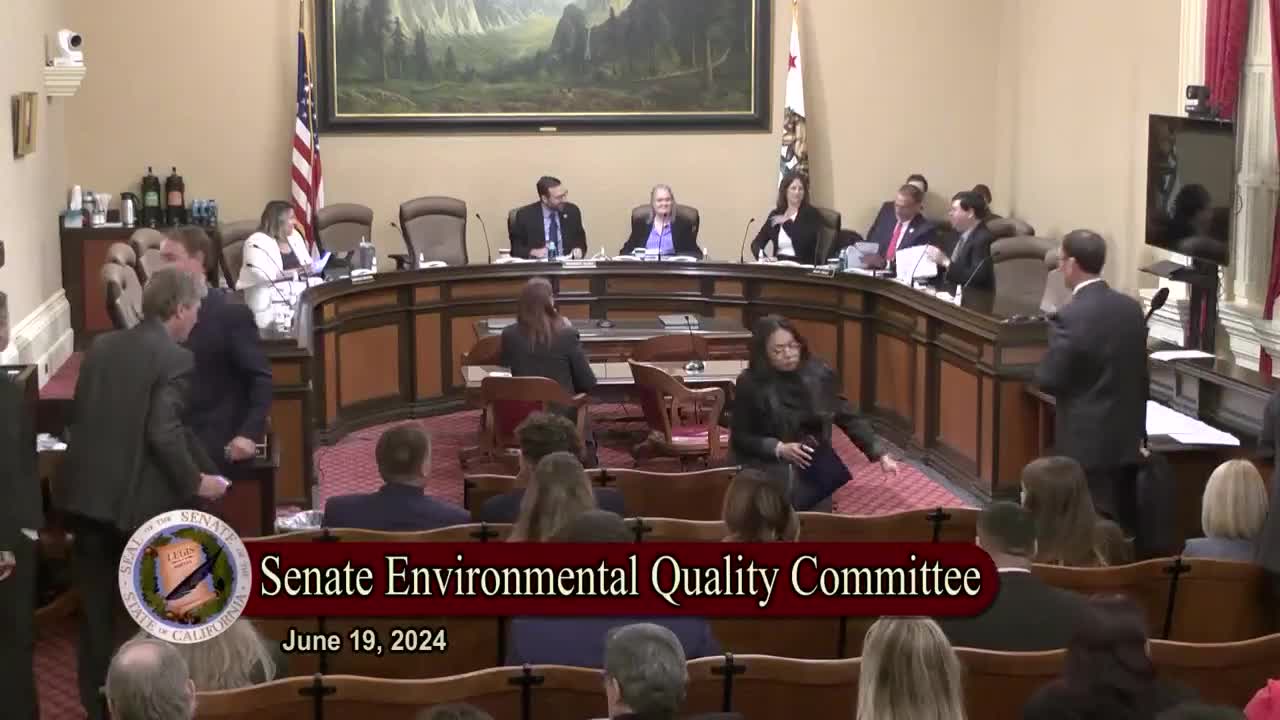 27MIN
Senate Standing Committee on Environmental Quality
 4MIN
Assembly Floor
 32MIN
Assembly Standing Committee on Environmental Safety and Toxic Materials
 1MIN
Assembly Standing Committee on Environmental Safety and Toxic Materials
Bill Author