AB 1996: Opioid antagonists: stadiums, concert venues, and amusement parks: overdose training.
- Session Year: 2023-2024
- House: Assembly
- Latest Version Date: 2024-08-26
Current Status:
Passed
(2024-08-26: Chaptered by Secretary of State - Chapter 199, Statutes of 2024.)
Introduced
In Committee
First Chamber
In Committee
Second Chamber
Enacted
Existing law requires the State Department of Public Health, subject to an appropriation in the Budget Act of 2016, to award funding to local health departments, local governmental agencies, or on a competitive basis to other organizations, as specified, to support or establish programs that provide naloxone or another opioid antagonist to first responders and at-risk opioid users through programs that serve at-risk drug users. Existing law requires each stadium, concert venue, and amusement park to maintain unexpired doses of naloxone hydrochloride or any other opioid antagonist on its premises at all times, and to ensure that at least 2 employees are aware of the location of the naloxone hydrochloride or other opioid antagonist.
This bill would require each stadium, concert venue, and amusement park to ensure that the naloxone hydrochloride or other opioid antagonist is easily accessible and its location is known by emergency responders on the premises or otherwise widely known.
Existing law requires the State Department of Public Health, subject to an appropriation in the Budget Act of 2016, to award funding to local health departments, local governmental agencies, or on a competitive basis to other organizations, as specified, to support or establish programs that provide naloxone or another opioid antagonist to first responders and at-risk opioid users through programs that serve at-risk drug users. Existing law requires each stadium, concert venue, and amusement park to maintain unexpired doses of naloxone hydrochloride or any other opioid antagonist on its premises at all times, and to ensure that at least 2 employees are aware of the location of the naloxone hydrochloride or other opioid antagonist.
This bill would require each stadium, concert venue, and amusement park to ensure that the naloxone hydrochloride or other opioid antagonist is easily accessible and its location is widely known. The bill would require the department to develop an opioid overdose training toolkit for these establishments, and, by July 1, 2026, to notify these establishments of this training toolkit. The bill would describe various types of information authorized to be included in the toolkit, including, but not limited to, informational videos, graphics, and trainings on how to respond during a drug or opioid overdose, as specified. The bill would require the department to collaborate with local, state, and national organizations to provide the staff of these establishments with integrated, comprehensive, accurate, and unbiased educational materials on opioid and drug overdose prevention and related topics.
Existing law requires the State Department of Public Health, subject to an appropriation in the Budget Act of 2016, to award funding to local health departments, local governmental agencies, or on a competitive basis to other organizations, as specified, to support or establish programs that provide naloxone or another opioid antagonist to first responders and at-risk opioid users through programs that serve at-risk drug users. Existing law requires each stadium, concert venue, and amusement park to maintain unexpired doses of naloxone hydrochloride or any other opioid antagonist on its premises at all times, and to ensure that at least 2 employees are aware of the location of the naloxone hydrochloride or other opioid antagonist.
This bill would require each stadium, concert venue, and amusement park to ensure that the naloxone hydrochloride or other opioid antagonist is easily accessible and its location is widely known. The bill would require the department to develop an opioid overdose training program for these establishments and toolkit for these establishments, and, by July 1, 2026, to notify these establishments of this training program. The bill would authorize the department to provide the overdose training program onsite. toolkit. The bill would describe various types of information authorized to be included in the toolkit, including, but not limited to, informational videos, graphics, and trainings on how to respond during a drug or opioid overdose, as specified. The bill would require the department to collaborate with local, state, and national organizations to provide the staff of these establishments with integrated, comprehensive, accurate, and unbiased educational materials on opioid and drug overdose prevention and related topics.
Existing law requires the State Department of Public Health, subject to an appropriation in the Budget Act of 2016, to award funding to local health departments, local governmental agencies, or on a competitive basis to other organizations, as specified, to support or establish programs that provide naloxone or another opioid antagonist to first responders and at-risk opioid users through programs that serve at-risk drug users. Existing law requires each stadium, concert venue, and amusement park to maintain unexpired doses of naloxone hydrochloride or any other opioid antagonist on its premises at all times, and to ensure that at least 2 employees are aware of the location of the naloxone hydrochloride or other opioid antagonist.
This bill would require each stadium, concert venue, and amusement park to ensure that the naloxone hydrochloride or other opioid antagonist is easily accessible and its location is widely known. The bill would require the department to develop an opioid overdose training program for these establishments and to notify these establishments of this training program. The bill would authorize the department to provide the overdose training program onsite.
(a)Each stadium, concert venue, and amusement park shall, at all times, maintain unexpired doses of naloxone hydrochloride or any other opioid antagonist on its premises and ensure that at least two employees are aware of the location of the naloxone hydrochloride or other opioid antagonist.
(b)Each stadium, concert venue, and amusement park shall ensure that the naloxone hydrochloride or other opioid antagonist is easily accessible and its location is known by emergency responders on the premises or otherwise widely known.
(a)Each stadium, concert venue, and amusement park shall, at all times, maintain unexpired doses of naloxone hydrochloride or any other opioid antagonist on its premises and ensure that at least two employees are aware of the location of the naloxone hydrochloride or other opioid antagonist.
(b)Each stadium, concert venue, and amusement park shall ensure that the naloxone hydrochloride or other opioid antagonist is easily accessible and its location is widely known.
SEC. 2.Section 11873 is added to the Health and Safety Code, to read:11873.(a)The State Department of Public Health shall develop an opioid overdose training toolkit for stadium, concert venue, and amusement park staff to be trained on how to effectively identify and respond to an opioid overdose, including by administering a federally approved opioid overdose reversal medication.(b)The toolkit may include, but is not limited to, all of the following:(1)Informational videos, graphics, and trainings on how to respond during a drug or opioid overdose, including the administration of naloxone hydrochloride or other opioid antagonists.(2)Information on how to recognize signs of a drug or opioid overdose.(3)Information on how to respond in an emergency involving a drug or opioid overdose.(c)The State Department of Public Health may use any existing content or other relevant materials already developed, or develop new materials, for the toolkit.(d)The State Department of Public Health shall collaborate with local, state, and national organizations, which may include community health centers, community health experts, and nonprofit organizations with related expertise, to provide stadium, concert venue, and amusement park staff with integrated, comprehensive, accurate, and unbiased educational materials on opioid and drug overdose prevention, opioid and drug safety, and stigma reduction. (e)By July 1, 2026, the department shall notify stadiums, concert venues, and amusement parks of the training toolkit offered in subdivision (a).(a)Each stadium, concert venue, and amusement park shall, at all times, maintain unexpired doses of naloxone hydrochloride or any other opioid antagonist on its premises and ensure that at least two employees are aware of the location of the naloxone hydrochloride or other opioid antagonist.
(b)Each stadium, concert venue, and amusement park shall ensure that the naloxone hydrochloride or other opioid antagonist is easily accessible and its location is widely known.
SEC. 2.Section 11873 is added to the Health and Safety Code, to read:11873.(a)The State Department of Public Health shall develop an opioid overdose training program toolkit for stadium, concert venue, and amusement park staff to be trained on how to effectively identify and respond to an opioid overdose, including how to administer naloxone hydrochloride or other opioid antagonists. The department may provide the overdose training program onsite. by administering a federally approved opioid overdose reversal medication.
(b)The toolkit may include, but is not limited to, all of the following:
(1)Informational videos, graphics, and trainings on how to respond during a drug or opioid overdose, including the administration of naloxone hydrochloride or other opioid antagonists.
(2)Information on how to recognize signs of a drug or opioid overdose.
(3)Information on how to respond in an emergency involving a drug or opioid overdose.
(c)The State Department of Public Health may use any existing content or other relevant materials already developed, or develop new materials, for the toolkit.
(d)The State Department of Public Health shall collaborate with local, state, and national organizations, which may include community health centers, community health experts, and nonprofit organizations with related expertise, to provide stadium, concert venue, and amusement park staff with integrated, comprehensive, accurate, and unbiased educational materials on opioid and drug overdose prevention, opioid and drug safety, and stigma reduction.
(b)The
(e)By July 1, 2026, the department shall notify stadiums, concert venues, and amusement parks of the training program toolkit offered in subdivision (a).
(a)Each stadium, concert venue, and amusement park shall, at all times, maintain unexpired doses of naloxone hydrochloride or any other opioid antagonist on its premises and ensure that at least two employees are aware of the location of the naloxone hydrochloride or other opioid antagonist.
(b)Each stadium, concert venue, and amusement park shall ensure that the naloxone hydrochloride or other opioid antagonist is easily accessible and its location is widely known.
SEC. 2.Section 11873 is added to the Health and Safety Code, to read:11873.(a)The State Department of Public Health shall develop an opioid overdose training program for stadium, concert venue, and amusement park staff to effectively identify and respond to an opioid overdose, including how to administer naloxone hydrochloride or other opioid antagonists. The department may provide the overdose training program onsite.
(b)The department shall notify stadiums, concert venues, and amusement parks of the training program offered in subdivision (a).
|
Date
|
Status
|
|---|---|
| Aug 26, 2024 | Chaptered by Secretary of State - Chapter 199, Statutes of 2024. |
| Aug 26, 2024 | Approved by the Governor. |
| Aug 16, 2024 | Enrolled and presented to the Governor at 11 a.m. |
| Aug 8, 2024 | Senate amendments concurred in. To Engrossing and Enrolling. (Ayes 72. Noes 0. Page 6237.). |
| Jul 5, 2024 | In Assembly. Concurrence in Senate amendments pending. May be considered on or after August 2 pursuant to Assembly Rule 77. |
| Jul 3, 2024 | Read third time. Passed. Ordered to the Assembly. (Ayes 39. Noes 0. Page 4931.). |
| Jun 27, 2024 | Read second time. Ordered to Consent Calendar. |
| Jun 26, 2024 | From committee: Do pass. To Consent Calendar. (Ayes 11. Noes 0.) (June 26). |
| Jun 10, 2024 | From committee chair, with author's amendments: Amend, and re-refer to committee. Read second time, amended, and re-referred to Com. on HEALTH. |
| Jun 5, 2024 | Referred to Com. on HEALTH. |
| May 23, 2024 | In Senate. Read first time. To Com. on RLS. for assignment. |
| May 22, 2024 | Read third time. Passed. Ordered to the Senate. (Ayes 70. Noes 0. Page 5561.) |
| May 20, 2024 | Read second time. Ordered to third reading. |
| May 16, 2024 | Read second time and amended. Ordered returned to second reading. |
| May 16, 2024 | From committee: Amend, and do pass as amended. (Ayes 11. Noes 0.) (May 16). |
| May 16, 2024 | Assembly Rule 63 suspended. |
| May 8, 2024 | In committee: Set, first hearing. Referred to APPR. suspense file. |
| Apr 16, 2024 | From committee: Do pass and re-refer to Com. on APPR. (Ayes 7. Noes 0.) (April 16). Re-referred to Com. on APPR. |
| Apr 15, 2024 | Re-referred to Com. on A., E., S., & T. |
| Apr 11, 2024 | Read second time and amended. |
| Apr 10, 2024 | From committee: Amend, and do pass as amended and re-refer to Com. on A., E., S., & T. with recommendation: To Consent Calendar. (Ayes 16. Noes 0.) (April 9). |
| Mar 26, 2024 | In committee: Hearing postponed by committee. |
| Feb 12, 2024 | Referred to Coms. on HEALTH and A., E., S., & T. |
| Jan 31, 2024 | From printer. May be heard in committee March 1. |
| Jan 30, 2024 | Read first time. To print. |
|
Date
|
Description
|
Location
|
Votes
|
|
|---|---|---|---|---|
| Aug 8, 2024 | AB 1996 Alanis Concurrence in Senate Amendments | Assembly Floor |
Passed |
|
| Jul 3, 2024 | Consent Calendar 2nd AB1996 Alanis | Senate Floor |
Passed |
|
| Jun 26, 2024 | Do pass and be ordered to the Consent Calendar | Senate Standing Committee on Health |
Passed |
|
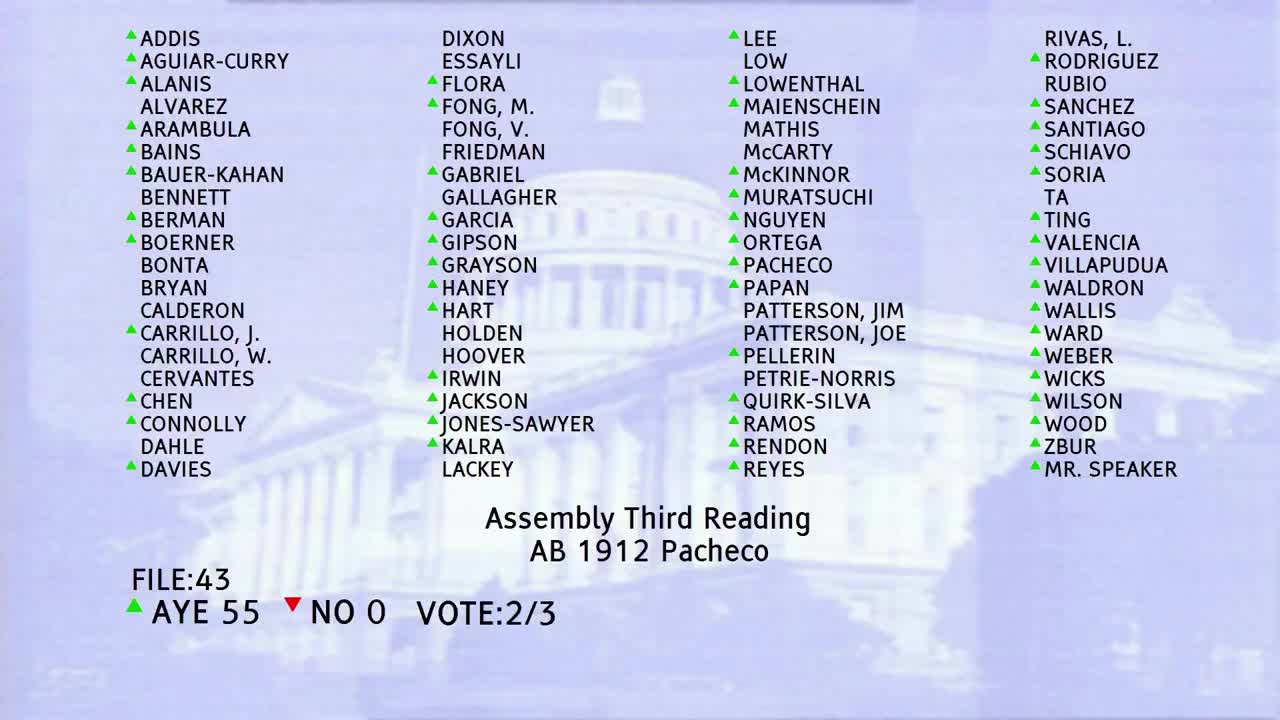
| May 22, 2024 | AB 1996 Alanis Assembly Third Reading | Assembly Floor |
Passed |
|
| May 16, 2024 | Do pass as amended. | Assembly Standing Committee on Appropriations |
Passed |
|
| Apr 16, 2024 | Do pass and be re-referred to the Committee on [Appropriations] | Assembly Standing Committee on Arts, Entertainment, Sports, and Tourism |
Passed |
|
| Apr 9, 2024 | Do pass as amended, and be re-referred to the Committee on [Arts, Entertainment, Sports, and Tourism] with recommendation: To Consent Calendar | Assembly Standing Committee on Health |
Passed |
This list shows positions taken on this bill by organizations on the date displayed, which is linked to the original source.
Positions by individuals are not included.
|
Organization
|
Position
|
Date
|
|---|---|---|
| California Academy Of Family Physicians | ** Support | |
| California Association of Alcohol and Drug Program Executives | ** Support | |
| California Chiropractic Association | ** Support | |
| California District Attorneys Association | ** Support | |
| California Medical Association | ** Support | |
| California Public Defenders Association | ** Support | |
| California Society of Health System Pharmacists | ** Support | |
| Everyday Responder Project | ** Support |
CONCURRENCE IN SENATE AMENDMENTS
CSA1 Bill Id:AB 1996
Author:(Alanis)
As Amended Ver:June 10, 2024
Majority vote
SUMMARY
Requires stadiums, concert venues, and amusement parks to ensure that naloxone hydrochloride (NH) or another opioid antagonist on site is easily accessible and its location is widely known.
Senate Amendments
Clarify that the location of NH must be known by emergency responders on the premises or otherwise widely known.
COMMENTS
California is facing an overdose epidemic. According to a California Health Care Foundation report, 9% of Californians have met the criteria for a substance use disorder (SUD) within the last year. While the health care system is moving toward acknowledging SUDs as a chronic illness, only about 10% of people with an SUD within the last year received treatment. Overdose deaths from both opioids and psychostimulants (such as amphetamines), are soaring. This issue, compounded by the increased availability of fentanyl, has resulted in a 10-fold increase in fentanyl related deaths between 2015 and 2019. The Department of Public Health's Opioid Overdose Dashboard reported 7,385 deaths related to "any" opioid overdose in 2022, with 6,473 (87.7%) of those deaths fentanyl related.
- Fentanyl. Fentanyl is a potent synthetic opioid drug approved by the United States Food and Drug Administration (FDA) for use as an analgesic and anesthetic. It is approximately 50 times stronger than heroin and 100 times stronger than morphine. First developed in 1959, it was introduced in the 1960s as an intravenous anesthetic. Fentanyl is legally manufactured and distributed in the United States; however, there are two types of fentanyl: pharmaceutical fentanyl and illicitly manufactured fentanyl. Both are considered synthetic opioids. Pharmaceutical fentanyl is prescribed by doctors to treat severe pain, especially after surgery and for advanced-stage cancer. Most recently, cases of fentanyl-related overdoses are linked to illicitly manufactured fentanyl that is distributed through illegal drug markets for its heroin-like effect. It is often added to other drugs because of its extreme potency, which makes drugs cheaper, more powerful, more addictive, and more dangerous.
- Reversing opioid overdoses. NH is the generic name for an opioid antagonist that rapidly reverses an opioid overdose. It attaches to opioid receptors and reverses and blocks the effects of other opioids. NH can quickly restore normal breathing to a person if their breathing has slowed or stopped because of an opioid overdose. NH comes in two FDA-approved forms: injectable and prepackaged nasal spray. Narcan nasal spray was first approved by the FDA in 2015 as a prescription drug.
As of July 2023 the FDA has approved Narcan and RiVive, for over-the-counter (OTC), nonprescription use. These are the first NH products approved for use without a prescription. These approvals allow the medications to be sold directly to consumers in drug stores, grocery stores, as well as online. According to an FDA Commissioner, "The approval of OTC NH nasal spray will help improve access to NH, increase the number of locations where it's available and help reduce opioid overdose deaths throughout the country. We encourage the manufacturer to make accessibility to the product a priority by making it available as soon as possible and at an affordable price."
According to the Author
The author states that California communities continue to be ravaged by opioid overdoses. Families are being ripped apart while access to this poison continues to grow. The author argues that this bill is a step toward helping our communities have better access to opioid antagonists in places where people gather. The author concludes that by making these life-saving medications more widely available, we can ensure a wider net of protection for all communities.
Arguments in Support
The California Association of Alcohol and Drug Program Executives (CAADPE) supports this bill, stating that like a fire extinguisher or automated external defibrillator, opioid antagonists like NH should be readily available to save lives in the case of emergency. CAADPE argues that by increasing the availability and visibility of NH, this bill empowers venue staff to respond promptly and effectively to opioid overdoses, potentially preventing unnecessary loss of life. CAADPE continues that opioid overdoses continue to rise in our state, and ensuring the availability of NH in venues frequented with large populations that are more likely to engage in substance use is paramount to saving lives.
Arguments in Opposition
None on file.
FISCAL COMMENTS
None.
VOTES:
ASM HEALTH: 16-0-0
YES: Bonta, Waldron, Aguiar-Curry, Arambula, Wendy Carrillo, Flora, Haney, Jones-Sawyer, Maienschein, McCarty, Joe Patterson, Rodriguez, Sanchez, Santiago, Schiavo, Weber
ASM ARTS, ENTERTAINMENT, SPORTS, AND TOURISM: 7-0-0
YES: Gipson, Wallis, Mike Fong, Lackey, McKinnor, Santiago, Valencia
ASM APPROPRIATIONS: 11-0-4
YES: Wicks, Arambula, Bryan, Calderon, Wendy Carrillo, Mike Fong, Grayson, Haney, Hart, Pellerin, Villapudua
ABS, ABST OR NV: Sanchez, Dixon, Jim Patterson, Ta
ASSEMBLY FLOOR: 70-0-10
YES: Addis, Aguiar-Curry, Alanis, Alvarez, Arambula, Bains, Bauer-Kahan, Bennett, Berman, Boerner, Bonta, Bryan, Juan Carrillo, Wendy Carrillo, Chen, Connolly, Davies, Dixon, Flora, Mike Fong, Vince Fong, Gabriel, Garcia, Gipson, Grayson, Haney, Hart, Hoover, Irwin, Jackson, Jones-Sawyer, Kalra, Lackey, Lee, Low, Lowenthal, Maienschein, McCarty, McKinnor, Muratsuchi, Stephanie Nguyen, Ortega, Pacheco, Papan, Jim Patterson, Pellerin, Petrie-Norris, Quirk-Silva, Ramos, Rendon, Reyes, Rodriguez, Blanca Rubio, Sanchez, Santiago, Schiavo, Soria, Ta, Ting, Valencia, Villapudua, Waldron, Wallis, Ward, Weber, Wicks, Wilson, Wood, Zbur, Robert Rivas
ABS, ABST OR NV: Calderon, Cervantes, Megan Dahle, Essayli, Friedman, Gallagher, Holden, Mathis, Joe Patterson, Luz Rivas
SENATE FLOOR: 39-0-1
YES: Allen, Alvarado-Gil, Archuleta, Ashby, Atkins, Becker, Blakespear, Bradford, Caballero, Cortese, Dahle, Dodd, Durazo, Eggman, Glazer, Gonzalez, Grove, Hurtado, Jones, Laird, Limón, McGuire, Menjivar, Min, Newman, Nguyen, Niello, Ochoa Bogh, Padilla, Portantino, Roth, Rubio, Seyarto, Skinner, Smallwood-Cuevas, Stern, Umberg, Wahab, Wiener
ABS, ABST OR NV: Wilk
UPDATED
VERSION: June 10, 2024
CONSULTANT: Riana King / HEALTH / (916) 319-2097 FN: 0003684
SENATE RULES COMMITTEE Office of Senate Floor Analyses (916) 651-1520 Fax: (916) 327-4478 | AB 1996 |
CONSENT
Bill No: AB 1996
Author: Alanis (R)
Amended: 6/10/24 in Senate
Vote: 21
SENATE HEALTH COMMITTEE: 11-0, 6/26/24
AYES: Roth, Nguyen, Glazer, Gonzalez, Grove, Hurtado, Limón, Menjivar, Rubio, Smallwood-Cuevas, Wiener
ASSEMBLY FLOOR: 70-0, 5/22/24 - See last page for vote
SUBJECT: Opioid antagonists: stadiums, concert venues, and amusement parks: overdose training
SOURCE: Author
DIGEST:
This bill requires each stadium, concert venue, and amusement park to ensure the opioid antagonists they are required to maintain are easily accessible and their location is known by emergency responders on the premises, or otherwise widely known.
ANALYSIS:
Existing law:
- Authorizes licensed health care providers to issue a standing order for the distribution or the administration of naloxone to a person at risk of overdose, or family members, friends, or other persons in a position to assist a person at risk of an opioid-related overdose. Requires a person who is prescribed or possesses naloxone pursuant to a standing order to receive training, as specified. [Civil Code §1714.22, et seq.]
- Requires each stadium, concert venue, and amusement park to, at all times, maintain unexpired doses of naloxone hydrochloride or any other opioid antagonist on its premises and ensure that at least two employees are aware of the location of the naloxone hydrochloride or other opioid antagonist. [Health and Safety Code §11871]
This bill requires each stadium, concert venue, and amusement park to ensure the naloxone hydrochloride or other opioid antagonists they are required to maintain are easily accessible and their location is known by emergency responders on the premises, or otherwise widely known.
Comments
- Author’s statement. According to the author, California communities, including those in his own district, continue to be ravaged by opioid overdoses. Families are being ripped apart while access to this poison continues to grow. This bill is a step toward helping our communities better understand and respond to signs of overdose in places where people gather. This bill focuses on current law requiring public venues’ employee access to approved opioid antagonists like Narcan. By addressing this accessibility gap, we can ensure a wider net of protection for all members of the community.
- Naloxone and the statewide standing order for its distribution. According to the California Department of Public Health (CDPH) website, naloxone, a prescription drug, is an opioid antagonist that works almost immediately to reverse opiate overdose and has few known adverse effects, no potential for abuse, and can be rapidly administered through intramuscular injection or nasal spray. Programs to train and equip bystanders, such as friends, family, and other non-health care providers, and drug users themselves, have gained momentum as an effective way to respond to and reverse an opioid overdose.
CDPH issued a statewide standing order for naloxone in June 2018. The order allows organizations and entities, including k-12 schools, colleges, and universities, to distribute naloxone to a person who is at risk of experiencing an overdose or an individual in a position to assist an at-risk person. Staff of community organizations and other entities distributing naloxone under the statewide standing order are required to receive training, and are also required to provide training to individuals who receive naloxone from them. Organizations may apply to use the statewide standing order and meet certain terms and conditions. A separate distribution program, the Naloxone Distribution Project (NDP) administered through Department of Health Care Services (DHCS), allows various entities to apply for and obtain naloxone at no cost.
- NDP. The NDP aims to reduce opioid overdose deaths through the provision of free naloxone. Entities can apply to DHCS to have naloxone shipped directly to their address. Eligible entities include:
- Community organizations;
- County health agencies;
- Community clinics or federally qualified health centers;
- Emergency departments or hospitals;
- Emergency medical services;
- Fire authorities;
- First responders;
- Law enforcement, courts, and criminal justice partners;
- Libraries;
- Local city agencies;
- Organizations that provide services to unhoused individuals/community;
- Religious organizations;
- Schools and universities;
- Substance use recovery facilities;
- Veteran organizations; and,
- Tribal entities.
Since it began in October 2018, the NDP has distributed more than 4,433,700 kits of naloxone, which have been used to reverse more than 277,000 overdoses. The NDP receives State General Funds and opioid settlement funds from the Janssen and Distributors (J&D) Settlement Agreements.
- Governor’s Master Plan for Tackling Fentanyl and the Opioid Crisis. In March 2023, the Governor unveiled California’s master plan for tackling the fentanyl and opioid crisis. The master plan includes allocations and activities in the following areas:
- $79 million for enhancement of the NDP administered by DHCS;
- $10 million in grants for education, testing, recovery, and support services;
- $4 million to make fentanyl test strips more available;
- $3.5 million to provide overdose medications (naloxone/Narcan) to all middle and high schools;
- $30 million to expand California National Guard’s (Cal Guard) work to prevent drug trafficking through the hiring, training and embedding of 144 new members (in 2022, 28,765 pounds of fentanyl were seized in operations supported by Cal Guard, an increase of 594% in seizures since 2021);
- $15 million over two years to establish and operate the Fentanyl Enforcement Program with the California Department of Justice to combat manufacturing, distribution, and trafficking;
- $40.8 million for an education and awareness campaign to establish partnerships and create messaging and education tools for parents and educators;
- $23 million to develop SUD training for non-behavioral health professionals working with children and youth; and,
- Manufacture naloxone for California through CalRx. Effective May 6, 2024, those applying through the NDP will either receive the generic 4mg naloxone nasal spray labeled either as “CalRx” or “Amneal,” which is manufactured by Amneal Pharmaceuticals through the CalRx Naloxone Access Initiative, or Narcan nasal spray manufactured by Emergent BioSolutions.
FISCAL EFFECT: Appropriation: No Fiscal Com.: No Local: No
SUPPORT: (Verified 6/27/24)
California Academy of Family Physicians
California Association of Alcohol and Drug Program Executives
California Chiropractic Association
California District Attorneys Association
California Medical Association
California Public Defenders Association
California Society of Health System Pharmacists
Everyday Responder Project
OPPOSITION: (Verified 6/27/24)
None received
ARGUMENTS IN SUPPORT: Supporters of this bill argue that like a fire extinguisher or automated external defibrillator, opioid antagonists should be readily available to save lives in the case of emergency. By increasing the availability and visibility of naloxone, this bill empowers venue staff to respond promptly and effectively to opioid overdoses, potentially preventing unnecessary loss of life. With nearly 6,000 lives lost to opioid overdoses in a single year and fentanyl being a central factor in this crisis, the necessity for proactive measures is clear. This alarming situation is further compounded by data revealing that drug overdoses, primarily driven by fentanyl’s prevalence, are now a leading cause of death in California, surpassing fatalities from car accidents, homicides, and even certain chronic diseases. Despite substantial investments exceeding a billion dollars aimed at combating this epidemic through awareness and prevention tools like naloxone, the battle is far from over. The persistence and worsening of this crisis underscore the imperative need for legislation like this.
ASSEMBLY FLOOR: 70-0, 5/22/24
AYES: Addis, Aguiar-Curry, Alanis, Alvarez, Arambula, Bains, Bauer-Kahan, Bennett, Berman, Boerner, Bonta, Bryan, Juan Carrillo, Wendy Carrillo, Chen, Connolly, Davies, Dixon, Flora, Mike Fong, Vince Fong, Gabriel, Garcia, Gipson, Grayson, Haney, Hart, Hoover, Irwin, Jackson, Jones-Sawyer, Kalra, Lackey, Lee, Low, Lowenthal, Maienschein, McCarty, McKinnor, Muratsuchi, Stephanie Nguyen, Ortega, Pacheco, Papan, Jim Patterson, Pellerin, Petrie-Norris, Quirk-Silva, Ramos, Rendon, Reyes, Rodriguez, Blanca Rubio, Sanchez, Santiago, Schiavo, Soria, Ta, Ting, Valencia, Villapudua, Waldron, Wallis, Ward, Weber, Wicks, Wilson, Wood, Zbur, Robert Rivas
NO VOTE RECORDED: Calderon, Cervantes, Megan Dahle, Essayli, Friedman, Gallagher, Holden, Mathis, Joe Patterson, Luz Rivas
Prepared by: Reyes Diaz / HEALTH / (916) 651-4111
6/28/24 10:45:06
**** END ****
SENATE COMMITTEE ON HEALTH
Senator Richard Roth, Chair
BILL NO: AB 1996
AUTHOR: | Alanis | ||
VERSION: | June 10, 2024 | ||
HEARING DATE: | June 26, 2024 | ||
CONSULTANT: | Reyes Diaz | ||
SUBJECT: Opioid antagonists: stadiums, concert venues, and amusement parks: overdose training
SUMMARY:
Requires each stadium, concert venue, and amusement park to ensure the opioid antagonist they are required to maintain is easily accessible and its location is known by emergency responders on the premises, or otherwise widely known.
Existing law:
- Authorizes licensed health care providers to issue a standing order for the distribution or the administration of naloxone to a person at risk of overdose, or family members, friends, or other persons in a position to assist a person at risk of an opioid-related overdose. Requires a person who is prescribed or possesses naloxone pursuant to a standing order to receive training, as specified. [CIV §1714.22, et seq.]
- Requires each stadium, concert venue, and amusement park to, at all times, maintain unexpired doses of naloxone hydrochloride or any other opioid antagonist on its premises and ensure that at least two employees are aware of the location of the naloxone hydrochloride or other opioid antagonist. [HSC §11871]
This bill: Requires each stadium, concert venue, and amusement park to ensure the naloxone hydrochloride or other opioid antagonist they are required to maintain is easily accessible and its location is known by emergency responders on the premises, or otherwise widely known.
FISCAL EFFECT:
According to the Assembly Committee on Appropriations, there are minor General Fund cost pressures to local and state government-owned stadiums and concert venues (such as those owned by colleges and universities) to ensure the location of the naloxone is accessible and widely known. If the Commission on State Mandates determines local costs are reimbursable, the state would be required to reimburse local governments for costs of implementing this bill. According to the Legislative Analyst's Office, the General Fund faces a structural deficit in the tens of billions of dollars over the next several fiscal years.
PRIOR VOTES:
Assembly Floor: | 70 - 0 |
Assembly Appropriations Committee: | 11 - 0 |
Assembly Arts, Entertainment, Sports, and Tourism Committee | 7 - 0 |
Assembly Health Committee: | 16 - 0 |
COMMENTS:
- Author’s statement. According to the author, California communities, including those in his own district, continue to be ravaged by opioid overdoses. Families are being ripped apart while access to this poison continues to grow. This bill is a step toward helping our communities better understand and respond to signs of overdose in places where people gather. This bill focuses on current law requiring public venues’ employee access to approved opioid antagonists like Narcan. By addressing this accessibility gap, we can ensure a wider net of protection for all members of the community.
- Naloxone and the statewide standing order for its distribution. According to the California Department of Public Health (CDPH) website, naloxone, a prescription drug, is an opioid antagonist that works almost immediately to reverse opiate overdose and has few known adverse effects, no potential for abuse, and can be rapidly administered through intramuscular injection or nasal spray. Programs to train and equip bystanders, such as friends, family, and other non-health care providers, and drug users themselves, have gained momentum as an effective way to respond to and reverse an opioid overdose.
CDPH issued a statewide standing order for naloxone in June 2018. The order allows organizations and entities, including k-12 schools, colleges, and universities, to distribute naloxone to a person who is at risk of experiencing an overdose or an individual in a position to assist an at-risk person. Staff of community organizations and other entities distributing naloxone under the statewide standing order are required to receive training, and are also required to provide training to individuals who receive naloxone from them. Organizations may apply to use the statewide standing order and meet certain terms and conditions. A separate distribution program, the Naloxone Distribution Project (NDP) administered through Department of Health Care Services (DHCS), allows various entities to apply for and obtain naloxone at no cost.
- NDP. The NDP aims to reduce opioid overdose deaths through the provision of free naloxone. Entities can apply to DHCS to have naloxone shipped directly to their address. Eligible entities include:
- Community organizations;
- County health agencies;
- Community clinics or federally qualified health centers;
- Emergency departments or hospitals;
- Emergency medical services;
- Fire authorities;
- First responders;
- Law enforcement, courts, and criminal justice partners;
- Libraries;
- Local city agencies;
- Organizations that provide services to unhoused individuals/community;
- Religious organizations;
- Schools and universities;
- Substance use recovery facilities;
- Veteran organizations; and,
- Tribal entities.
Since it began in October 2018, the NDP has distributed more than 4,433,700 kits of naloxone, which have been used to reverse more than 277,000 overdoses. The NDP receives State General Funds and opioid settlement funds from the Janssen and Distributors (J&D) Settlement Agreements.
- Governor’s Master Plan for Tackling Fentanyl and the Opioid Crisis. In March 2023, the Governor unveiled California’s master plan for tackling the fentanyl and opioid crisis. The master plan includes allocations and activities in the following areas:
- $79 million for enhancement of the NDP administered by DHCS;
- $10 million in grants for education, testing, recovery, and support services;
- $4 million to make fentanyl test strips more available;
- $3.5 million to provide overdose medications (naloxone/Narcan) to all middle and high schools;
- $30 million to expand California National Guard’s (Cal Guard) work to prevent drug trafficking through the hiring, training and embedding of 144 new members (in 2022, 28,765 pounds of fentanyl were seized in operations supported by Cal Guard, an increase of 594% in seizures since 2021);
- $15 million over two years to establish and operate the Fentanyl Enforcement Program with the California Department of Justice to combat manufacturing, distribution, and trafficking;
- $40.8 million for an education and awareness campaign to establish partnerships and create messaging and education tools for parents and educators;
- $23 million to develop SUD training for non-behavioral health professionals working with children and youth; and,
- Manufacture naloxone for California through CalRx. Effective May 6, 2024, those applying through the NDP will either receive the generic 4mg naloxone nasal spray labeled either as “CalRx” or “Amneal,” which is manufactured by Amneal Pharmaceuticals through the CalRx Naloxone Access Initiative, or Narcan nasal spray manufactured by Emergent BioSolutions.
- Related legislation. SB 997 (Portantino) permits local educational agencies to develop and adopt a policy that allows pupils at certain schools to carry over-the-counter, nonprescription naloxone. Requires those schools to stock and distribute fentanyl test strips. SB 997 is pending in the Assembly Appropriations Committee.
SB 1442 (Ochoa-Bough), as part of the Senate’s “Working Together for a Safer California” to combat the fentanyl crisis, permits California Health and Human Services Agency to enter into partnerships for the manufacture or purchase of any federally approved point-of-care fentanyl tests, as specified. SB 1442 is set for hearing on June 26, 2024, in the Assembly Appropriations Committee.
AB 1841 (Weber) requires each community college district and the Trustees of the California State University, and requests the Regents of the University of California, to make federally approved opioid overdose reversal medication available throughout specified locations on campuses and in affiliated housing and to train specified individuals in a position to quickly respond in emergencies. AB 1841 passed this Committee by a vote of 11-0 on June 19, 2024.
- Prior legislation. SB 234 (Portantino, Hurtado, and Umberg, Chapter 596, Statutes of 2023) implemented the law requiring each stadium, concert venue, and amusement park to maintain unexpired doses of opioid antagonist on its premises and to ensure at least two employees are aware of their location.
SB 472 (Hurtado of 2023) would have required each public school operated by a school district, county office of education, or charter school to maintain at least two doses of opioid antagonist on its campus. SB 472 would have required those entities to report specified information to the California Department of Education and the Department of Health Care Services by July 31, 2024, and annually thereafter. SB 472 was held on the Senate Appropriations Committee suspense file.
- Support. Supporters of this bill argue that like a fire extinguisher or automated external defibrillator, opioid antagonists should be readily available to save lives in the case of emergency. By increasing the availability and visibility of naloxone, this bill empowers venue staff to respond promptly and effectively to opioid overdoses, potentially preventing unnecessary loss of life. With nearly 6,000 lives lost to opioid overdoses in a single year and fentanyl being a central factor in this crisis, the necessity for proactive measures is clear. This alarming situation is further compounded by data revealing that drug overdoses, primarily driven by fentanyl’s prevalence, are now a leading cause of death in California, surpassing fatalities from car accidents, homicides, and even certain chronic diseases. Despite substantial investments exceeding a billion dollars aimed at combating this epidemic through awareness and prevention tools like naloxone, the battle is far from over. The persistence and worsening of this crisis underscore the imperative need for legislation like this.
SUPPORT AND OPPOSITION:
Support: California Association of Alcohol and Drug Program Executives
California Chiropractic Association
California District Attorneys Association
California Medical Association
California Public Defenders Association
California Society of Health System Pharmacists
Everyday Responder Project
Oppose: None received
-- END --
ASSEMBLY THIRD READING
ATR Bill Id:AB 1996
Author:(Alanis)
As Amended Ver:May 16, 2024
Majority vote
SUMMARY
Requires stadiums, concert venues, and amusement parks to ensure that naloxone hydrochloride (NH) or another opioid antagonist on site is easily accessible and its location is widely known.
Major Provisions
COMMENTS
California is facing an overdose epidemic. According to a California Health Care Foundation report, 9% of Californians have met the criteria for a substance use disorder (SUD) within the last year. While the health care system is moving toward acknowledging SUDs as a chronic illness, only about 10% of people with an SUD within the last year received treatment. Overdose deaths from both opioids and psychostimulants (such as amphetamines), are soaring. This issue, compounded by the increased availability of fentanyl, has resulted in a ten-fold increase in fentanyl related deaths between 2015 and 2019. The Department of Public Health's Opioid Overdose Dashboard reported 7,385 deaths related to "any" opioid overdose in 2022, with 6,473 (87.7%) of those deaths fentanyl related.
- Fentanyl. Fentanyl is a potent synthetic opioid drug approved by the United States Food and Drug Administration (FDA) for use as an analgesic and anesthetic. It is approximately 50 times stronger than heroin and 100 times stronger than morphine. First developed in 1959, it was introduced in the 1960s as an intravenous anesthetic. Fentanyl is legally manufactured and distributed in the United States; however, there are two types of fentanyl: pharmaceutical fentanyl and illicitly manufactured fentanyl. Both are considered synthetic opioids. Pharmaceutical fentanyl is prescribed by doctors to treat severe pain, especially after surgery and for advanced-stage cancer. Most recently, cases of fentanyl-related overdoses are linked to illicitly manufactured fentanyl that is distributed through illegal drug markets for its heroin-like effect. It is often added to other drugs because of its extreme potency, which makes drugs cheaper, more powerful, more addictive, and more dangerous.
- Reversing opioid overdoses. NH is the generic name for an opioid antagonist that rapidly reverses an opioid overdose. It attaches to opioid receptors and reverses and blocks the effects of other opioids. NH can quickly restore normal breathing to a person if their breathing has slowed or stopped because of an opioid overdose. NH comes in two FDA-approved forms: injectable and prepackaged nasal spray. Narcan nasal spray was first approved by the FDA in 2015 as a prescription drug.
As of July 2023 the FDA has approved Narcan and RiVive, for over-the-counter (OTC), nonprescription use. These are the first NH products approved for use without a prescription. These approvals allow the medications to be sold directly to consumers in drug stores, grocery stores, as well as online. According to an FDA Commissioner, "The approval of OTC NH nasal spray will help improve access to NH, increase the number of locations where it's available and help reduce opioid overdose deaths throughout the country. We encourage the manufacturer to make accessibility to the product a priority by making it available as soon as possible and at an affordable price."
According to the Author
The author states that California communities continue to be ravaged by opioid overdoses. Families are being ripped apart while access to this poison continues to grow. The author argues that this bill is a step toward helping our communities have better access to opioid antagonists in places where people gather. The author concludes that by making these life-saving medications more widely available, we can ensure a wider net of protection for all members of the community.
Arguments in Support
The California Association of Alcohol and Drug Program Executives (CAADPE) supports this bill, stating that like a fire extinguisher or automated external defibrillator, opioid antagonists like NH should be readily available to save lives in the case of emergency. CAADPE argues that by increasing the availability and visibility of NH, this bill empowers venue staff to respond promptly and effectively to opioid overdoses, potentially preventing unnecessary loss of life. CAADPE continues that opioid overdoses continue to rise in our state, and ensuring the availability of NH in venues frequented with large populations that are more likely to engage in substance use is paramount to saving lives.
Arguments in Opposition
None on file.
FISCAL COMMENTS
According to the Assembly Committee on Appropriations, there are minor General Fund cost pressures to local and state government-owned stadiums and concert venues (such as those owned by colleges and universities) to ensure the location of the naloxone is accessible and widely known. If the Commission on State Mandates determines local costs are reimbursable, the state would be required to reimburse local governments for costs of implementing this bill.
According to the Legislative Analyst's Office, the General Fund faces a structural deficit in the tens of billions of dollars over the next several fiscal years.
VOTES
ASM HEALTH: 16-0-0
YES: Bonta, Waldron, Aguiar-Curry, Arambula, Wendy Carrillo, Flora, Haney, Jones-Sawyer, Maienschein, McCarty, Joe Patterson, Rodriguez, Sanchez, Santiago, Schiavo, Weber
ASM ARTS, ENTERTAINMENT, SPORTS, AND TOURISM: 7-0-0
YES: Gipson, Wallis, Mike Fong, Lackey, McKinnor, Santiago, Valencia
ASM APPROPRIATIONS: 11-0-4
YES: Wicks, Arambula, Bryan, Calderon, Wendy Carrillo, Mike Fong, Grayson, Haney, Hart, Pellerin, Villapudua
ABS, ABST OR NV: Sanchez, Dixon, Jim Patterson, Ta
UPDATED
VERSION: May 16, 2024
CONSULTANT: Riana King / HEALTH / (916) 319-2097 FN: 0003317
Date of Hearing: May 8, 2024
ASSEMBLY COMMITTEE ON APPROPRIATIONS
Buffy Wicks, Chair
ABPCA Bill Id:AB 1996
Author:(Alanis) – As Amended Ver:April 11, 2024
Policy Committee: | Health | Vote: | 16 - 0 |
Arts, Entertainment, Sports, and Tourism | 7 - 0 | ||
|
|
Urgency: No State Mandated Local Program: No Reimbursable: Yes
SUMMARY:
This bill requires a stadium, concert venue, or amusement park to ensure the location of the naloxone or other opioid antagonist it is required to maintain is widely known and easily accessible. The bill also requires the California Department of Public Health (CDPH) to develop an opioid overdose response training toolkit, as specified, and collaborate with local, state, and national organizations to provide the staff of these establishments educational materials on opioid and drug overdose prevention.
FISCAL EFFECT:
CDPH anticipates the need to hire two limited-term, full-time equivalents for one year to develop the training toolkit and foster collaboration efforts, at an estimated cost of $344,000 in fiscal year 2025-26 (General Fund or Opioid Settlement Fund, if applicable).
Additional, likely minimal General Fund cost pressures to local and state government-owned stadiums and concert venues (such as those owned by colleges and universities) to ensure the location of the naloxone is accessible and widely known. If the Commission on State Mandates determines local costs are reimbursable, the state would be required to reimburse local governments for costs of implementing this bill.
According to the Legislative Analyst’s Office, the General Fund faces a structural deficit in the tens of billions of dollars over the next several fiscal years.
COMMENTS:
- Purpose. According to the author:
California communities, including those in my own district, continue to be ravaged by opioid overdoses. Families are being ripped apart while access to this poison continues to grow. AB 1996 is a step toward helping our communities better understand and respond to signs of overdoes in places where people gather. AB 1996 focuses on the expanded training of public venue employees’ ability to understand the signs of an opioid overdose and respond appropriately using approved opioid counter agents like Narcan. By creating this toolkit, we can ensure a wider net of protection for all members of the community.
- Naloxone hydrochloride (NH). NH is the generic name for an opioid antagonist that rapidly reverses an opioid overdose. It attaches to opioid receptors and reverses and blocks the effects of other opioids. NH can quickly restore normal breathing to a person if their breathing has slowed or stopped because of an opioid overdose. NH comes in two FDA-approved forms: injectable liquid and prepackaged nasal spray. Narcan nasal spray was first approved by the FDA in 2015 as a prescription drug.
- CDPH Education and Training Materials. CDPH’s Substance and Addiction Prevention Branch maintains numerous resources on NH and overdose prevention on their Opioid Prevention Initiative webpages. These webpages include two training videos, in English and Spanish, to educate the general public on how to administer NH. The webpages also host two recorded NH webinar trainings from 2018, one targeted for professionals who educate laypersons about opioid overdose and distributing NH, the other for program managers and others in charge of implementing NH distribution systems and the Overdose Education and Naloxone Distribution program in their community. The webpages also provide links to general information on opioids and NH, how to recognize and respond to an overdose, where to get NH, disposal guidance, and multiple outside resources on NH and overdose response.
- Related Legislation.
- AB 1915 (Arambula), of the current legislative session, requires CDPH to develop a training program and toolkit to teach public school pupils in grades nine to 12 how to identify and respond to an opioid overdose, including the administering of an approved opioid overdose reversal medication. AB 1915 is pending in this committee.
- AB 915 (Arambula), of the current legislative session, would have required CDPH to create an opioid overdose training program and program toolkit to train high school students on how to identify and respond to an opioid overdose. AB 915 also would have required any local educational agency, county office of education, and charter school that voluntarily determines to make an opioid antagonist available on campus to be placed in an appropriate location, as specified. AB 915 was held in Senate Appropriations Committee.
- Prior Legislation.
- AB 1233 (Waldron), Chapter 570, Statutes of 2023, requires the Department of Health Care Services (DHCS) to conduct outreach to each of the tribal governments in California for the purpose of advising them of the availability of NH or another opioid antagonist through DHCS’ Naloxone Distribution Project.
- SB 234 (Portantino), Chapter 596, Statutes of 2023, requires every stadium, concert venue, and amusement park to maintain unexpired doses of an opioid antagonist on its premises and ensure that at least two employees are aware of the location, and provides indemnification, as specified.
Analysis Prepared by: Allegra Kim / APPR. / (916) 319-2081
Date of Hearing: April 16, 2024
ASSEMBLY COMMITTEE ON ARTS, ENTERTAINMENT, SPORTS, AND TOURISM
Mike Gipson, Chair
ABPCA Bill Id:AB 1996 (
Author:Alanis) – As Introduced Ver:January 30, 2024
SUBJECT: Opioid antagonists: stadiums, concert venues, and amusement parks: overdose training
SUMMARY: Requires the State Department of Public Health (DPH) to develop an opioid overdose training program for stadium, concert venue, and amusement park staff.
Specifically, this bill:
- Requires DPH to develop an opioid overdose training toolkit for stadium, concert venue, and amusement park staff to be trained on how to effectively identify and respond to an opioid overdose, including by administering a federally approved opioid overdose reversal medication.
- Specifies that the toolkit may include, but is not limited to, all of the following:
- Informational videos, graphics, and trainings on how to respond during a drug or opioid overdose, including the administration of naloxone hydrochloride or other opioid antagonists.
- Information on how to recognize signs of a drug or opioid overdose.
- Information on how to respond in an emergency involving a drug or opioid overdose.
- Allows DPH to use any existing content or other relevant materials already developed, or develop new materials, for the toolkit.
- Requires DPH to collaborate with local, state, and national organizations, which may include community health centers, community health experts, and nonprofit organizations with related expertise, to provide stadium, concert venue, and amusement park staff with integrated, comprehensive, accurate, and unbiased educational materials on opioid and drug overdose prevention, opioid and drug safety, and stigma reduction.
- Requires DPH to notify stadiums, concert venues, and amusement parks of the training toolkit by July 1, 2026.
- Requires stadiums, concert venues, and amusement parks to ensure that naloxone hydrochloride (NH) or another opioid antagonist on site is easily accessible and its location is widely known.
EXISTING LAW:
- Establishes DPH, directed by a state Public Health Officer (PHO), to be vested with all the duties, powers, purposes, functions, responsibilities, and jurisdiction as they relate to disease prevention, as specified. Gives the PHO, broad authority to detect, monitor, and prevent the spread of communicable disease in the state. (Health and Safety Code (HSC) Sections 131050 and 120130)
- Requires DPH, in order to reduce the rate of fatal overdose from opioid drugs including heroin and prescription opioids and subject to appropriation, to award funding to local health departments, local government agencies, or on a competitive basis to community-based organizations, regional opioid prevention coalitions, or both, to support or establish programs that provide NH, or any other opioid antagonist that is approved by the United States Food and Drug Administration (FDA) for the treatment of an opioid overdose, to first responders and to at-risk opioid users through programs that serve at-risk drug users, including, but not limited to, syringe exchange and disposal programs, homeless programs, and substance use disorder (SUD) treatment providers. (HSC 1179.80(a))
- Requires stadiums, concert venues, and amusement parks to maintain unexpired doses of an opioid antagonist on site and ensure that at least two employees are aware of the location. Provides indemnification for anyone who administers NH or another opioid antagonist, in good faith, on the premises of a stadium, concert venue, or amusement park. (HSC 11871)
FISCAL EFFECT: Unknown. This measure has been keyed fiscal by the Legislative Counsel.
COMMENTS:
- Author’s statement. According to the author, “California communities, including those in my own district, continue to be ravaged by opioid overdoses. Families are being ripped apart while access to this poison continues to grow. AB 1996 is a step toward helping our communities better understand and respond to signs of overdoes in places where people gather. AB 1996 focuses on the expanded training of public venue employees’ ability to understand the signs of an opioid overdose and respond appropriately using approved opioid counter agents like Narcan. By creating this toolkit, we can ensure a wider net of protection for all members of the community.”
- Background. California is facing an overdose epidemic. According to a California Health Care Foundation report, 9% of Californians have met the criteria for a SUD within the last year. While the health care system is moving toward acknowledging SUDs as a chronic illness, only about 10% of people with an SUD within the last year received treatment. Overdose deaths from both opioids and psychostimulants (such as amphetamines), are soaring. This issue, compounded by the increased availability of fentanyl, has resulted in a ten-fold increase in fentanyl related deaths between 2015 and 2019. DPH’s Opioid Overdose Dashboard reported 7,385 deaths related to “any” opioid overdose in 2022, with 6,473 (87.7%) of those deaths fentanyl related.
Fentanyl is a potent synthetic opioid drug approved by the FDA for use as an analgesic and anesthetic. It is approximately 50 times stronger than heroin and 100 times stronger than morphine. First developed in 1959, it was introduced in the 1960s as an intravenous anesthetic. Fentanyl is legally manufactured and distributed in the United States; however, there are two types of fentanyl: pharmaceutical fentanyl and illicitly manufactured fentanyl. Both are considered synthetic opioids. Pharmaceutical fentanyl is prescribed by doctors to treat severe pain, especially after surgery and for advanced-stage cancer. Most recently, cases of fentanyl-related overdoses are linked to illicitly manufactured fentanyl that is distributed through illegal drug markets for its heroin-like effect. It is often added to other drugs because of its extreme potency, which makes drugs cheaper, more powerful, more addictive, and more dangerous.
NH is the generic name for an opioid antagonist that rapidly reverses an opioid overdose. It attaches to opioid receptors and reverses and blocks the effects of other opioids. NH can quickly restore normal breathing to a person if their breathing has slowed or stopped because of an opioid overdose. NH comes in two FDA-approved forms: injectable and prepackaged nasal spray. Narcan nasal spray was first approved by the FDA in 2015 as a prescription drug.
According to the FDA, in accordance with a process to change the status of a drug from prescription to nonprescription, the manufacturer of Narcan provided data demonstrating that the drug is safe and effective for use as directed in its proposed labeling. The manufacturer also showed that consumers can understand how to use the drug safely and effectively without the supervision of a healthcare professional. The application to approve Narcan nasal spray for over-the-counter (OTC) use was granted priority review status and was the subject of an advisory committee meeting in February 2023, where committee members voted unanimously to recommend it be approved for marketing without a prescription.
As of July 2023 the FDA has approved Narcan and RiVive, for OTC, nonprescription use. These are the first NH products approved for use without a prescription. These approvals allow the medications to be sold directly to consumers in drug stores, grocery stores, as well as online. According to an FDA Commissioner, “The approval of OTC NH nasal spray will help improve access to NH, increase the number of locations where it’s available and help reduce opioid overdose deaths throughout the country. We encourage the manufacturer to make accessibility to the product a priority by making it available as soon as possible and at an affordable price.”
Existing DPH education and training materials. DPH’s Substance and Addiction Prevention Branch maintains numerous resources for the public on NH and overdose prevention on their Opioid Prevention Initiative webpages. These webpages include two DPH developed training videos, in English and Spanish, to educate the general public on how to administer NH. The webpages also host two recorded NH webinar trainings from 2018, one targeted for professionals who educate laypersons about opioid overdose and distributing NH, the other for program managers and others in charge of implementing NH distribution systems and the Overdose Education and Naloxone Distribution program in their community. The webpages also provide links to general information on opioids and NH, how to recognize and respond to an overdose, where to get NH, disposal guidance, and multiple outside resources on NH and overdose response.
- Arguments in support. According to the California District Attorneys Association in support, “AB 1996 is a reasonable expansion of existing law that would require not only that large venue operators have opioid antagonists on hand, but also ensures that the availability of such lifesaving medications are well-known and that large venue operators and employees have resources and training on the proper administration of these life-saving medications.
“The epidemic of fentanyl overdoses, and the drastic increase in deaths attributed to fentanyl’s introduction into illicit drugs of all types has hit California, and the nation hard. Figures on increased deaths due to opioid overdose are a sobering reminder of the drastic harms that fentanyl use is having on our communities. [This] measure recognizes that large venues are increasingly likely to face an opioid overdose emergency, and better equips venue operators to have the medication and training to respond and react to an opioid overdose, and in so doing, to save lives.”
- Double-Referral. This measure was referred to the Assembly Committee on Health and to the Assembly Committee on Arts, Entertainment, Sports, and Tourism. This measure was amended and passed by the Assembly Committee on Health with a 16 to 0 vote.
- Policy considerations. Of note, the provisions of this bill do not mandate the completion of a training program by employees and staff working at stadiums, concert venues, and amusement parks. Additionally, it is the understanding of this committee that this bill will not cause these locations to be liable for any civil damages that result from providing emergency care in good faith at the scene of an emergency. Existing Good Samaritan Law and Drug Overdose Treatment Liability Law state that individuals that administer NH to someone suspected of experiencing an overdose, after receiving it along with required training, do not have civil or criminal liability.[1]
- Prior and related legislation:
- AB 1915 (Arambula) would require DPH to develop by July 1, 2026, a training program and toolkit for public school pupils in grades nine to 12, to gain skills in how to identify and respond to an opioid overdose, including the administering of a federally approved opioid overdose reversal medication. (Status: This bill is currently pending in Assembly Committee on Appropriations.
- SB 234 (Portantino), Chapter 596, Statutes of 2023, requires stadiums, concert venues, and amusement parks to maintain unexpired doses of an opioid antagonist on its premises and ensure that at least two employees are aware of the location and provides indemnification, as specified.
- AB 915 (Arambula) would have required DPH to create an opioid overdose training program and program toolkit to train high school students on how to identify and respond to an opioid overdose. This bill also would have required any local educational agency, county office of education, and charter school that voluntarily determines to make naloxone hydrochloride or another opioid antagonist available on campus to be placed in an appropriate location, as specified. AB 915 was held in the Senate Appropriations Committee.
- AB 1233 (Waldron), Chapter 570, Statutes of 2023, requires the Department of Health Care Services (DHCS) to conduct outreach to each of the tribal governments in California for the purpose of advising them of the availability of NH or another opioid antagonist through DHCS’ Naloxone Distribution Project.
- AB 33 (Bains), Chapter 887, Statutes of 2023, establishes the Fentanyl Addiction and Overdose Prevention Task Force to undertake specified duties relating to fentanyl abuse.
REGISTERED SUPPORT / OPPOSITION:
Support
California Association of Alcohol and Drug Program Executives
California District Attorneys Association
California Medical Association
California Public Defenders Association
Everyday Responder Project
Opposition
There is no opposition on file.
Analysis Prepared by: Brian V. Anderson, Jr. / A.,E.,S., & T. / (916) 319-3450
Date of Hearing: April 9, 2024
ASSEMBLY COMMITTEE ON HEALTH
Mia Bonta, Chair
ABPCA Bill Id:AB 1996
Author:((Alanis) – As Introduced Ver:January 30, 2024
SUBJECT: Opioid antagonists: stadiums, concert venues, and amusement parks: overdose training.
SUMMARY: Requires the State Department of Public Health (DPH) to develop an opioid overdose training program for stadium, concert venue, and amusement park staff. Specifically, this bill:
- Requires DPH to develop an opioid overdose training program for stadium, concert venue, and amusement park staff to effectively identify and respond to an opioid overdose, including how to administer naloxone hydrochloride (NH) or other opioid antagonists.
- Requires stadiums, concert venues, and amusement parks to ensure that NH or another opioid antagonist on site is easily accessible and its location is widely known.
EXISTING LAW:
- Establishes DPH, directed by a state Public Health Officer (PHO), to be vested with all the duties, powers, purposes, functions, responsibilities, and jurisdiction as they relate to disease prevention, as specified. Gives the PHO, broad authority to detect, monitor, and prevent the spread of communicable disease in the state. [Health & Safety Code (HSC) § 131050 and § 120130, et seq.]
- Authorizes the DPH, in order to reduce the rate of fatal overdose from opioid drugs including heroin and prescription opioids, to award funding to local health departments, local government agencies, or on a competitive basis to community-based organizations, regional opioid prevention coalitions, or both, to support or establish programs that provide NH, or any other opioid antagonist that is approved by the United States Food and Drug Administration (FDA) for the treatment of an opioid overdose, to first responders and to at-risk opioid users through programs that serve at-risk drug users, including, but not limited to, syringe exchange and disposal programs, homeless programs, and substance use disorder (SUD) treatment providers. [HSC § 1179.80]
- Requires stadiums, concert venues, and amusement parks to maintain unexpired doses of an opioid antagonist on site and ensure that at least two employees are aware of the location. Provides indemnification for anyone who administers NH or another opioid antagonist, in good faith, on the premises of a stadium, concert venue, or amusement park. [HSC § 11871]
FISCAL EFFECT: Unknown. This bill has not yet been analyzed by a fiscal committee.
COMMENTS:
- PURPOSE OF THIS BILL. According to the author, California communities continue to be ravaged by opioid overdoses. Families are being ripped apart while access to this poison continues to grow. The author states that this bill is a step toward helping our communities better understand and respond to signs of overdoes in places where people gather by focusing on the expanded training of public venue employees’ ability to understand the signs of an opioid overdose and respond appropriately using approved opioid counter agents like Narcan. The author concludes that by expanding this training, we can ensure a wider net of protection for all members of the community.
- BACKGROUND. California is facing an overdose epidemic. According to a California Health Care Foundation report, 9% of Californians have met the criteria for a SUD within the last year. While the health care system is moving toward acknowledging SUDs as a chronic illness, only about 10% of people with an SUD within the last year received treatment. Overdose deaths from both opioids and psychostimulants (such as amphetamines), are soaring. This issue, compounded by the increased availability of fentanyl, has resulted in a ten-fold increase in fentanyl related deaths between 2015 and 2019. DPH’s Opioid Overdose Dashboard reported 7,385 deaths related to “any” opioid overdose in 2022, with 6,473 (87.7%) of those deaths fentanyl related.
- Fentanyl. Fentanyl is a potent synthetic opioid drug approved by the FDA for use as an analgesic and anesthetic. It is approximately 50 times stronger than heroin and 100 times stronger than morphine. First developed in 1959, it was introduced in the 1960s as an intravenous anesthetic. Fentanyl is legally manufactured and distributed in the United States; however, there are two types of fentanyl: pharmaceutical fentanyl and illicitly manufactured fentanyl. Both are considered synthetic opioids. Pharmaceutical fentanyl is prescribed by doctors to treat severe pain, especially after surgery and for advanced-stage cancer. Most recently, cases of fentanyl-related overdoses are linked to illicitly manufactured fentanyl that is distributed through illegal drug markets for its heroin-like effect. It is often added to other drugs because of its extreme potency, which makes drugs cheaper, more powerful, more addictive, and more dangerous.
- Reversing opioid overdoses. NH is the generic name for an opioid antagonist that rapidly reverses an opioid overdose. It attaches to opioid receptors and reverses and blocks the effects of other opioids. NH can quickly restore normal breathing to a person if their breathing has slowed or stopped because of an opioid overdose. NH comes in two FDA-approved forms: injectable and prepackaged nasal spray. Narcan nasal spray was first approved by the FDA in 2015 as a prescription drug.
According to the FDA, in accordance with a process to change the status of a drug from prescription to nonprescription, the manufacturer of Narcan provided data demonstrating that the drug is safe and effective for use as directed in its proposed labeling. The manufacturer also showed that consumers can understand how to use the drug safely and effectively without the supervision of a healthcare professional. The application to approve Narcan nasal spray for over-the-counter (OTC) use was granted priority review status and was the subject of an advisory committee meeting in February 2023, where committee members voted unanimously to recommend it be approved for marketing without a prescription.
As of July 2023 the FDA has approved Narcan and RiVive, for OTC, nonprescription use. These are the first NH products approved for use without a prescription. These approvals allow the medications to be sold directly to consumers in drug stores, grocery stores, as well as online. According to an FDA Commissioner, “The approval of OTC NH nasal spray will help improve access to NH, increase the number of locations where it’s available and help reduce opioid overdose deaths throughout the country. We encourage the manufacturer to make accessibility to the product a priority by making it available as soon as possible and at an affordable price.”
- Existing DPH education and training materials. DPH’s Substance and Addiction Prevention Branch maintains numerous resources for the public on NH and overdose prevention on their Opioid Prevention Initiative webpages. These webpages include two DPH developed training videos, in English and Spanish, to educate the general public on how to administer NH. The webpages also host two recorded NH webinar trainings from 2018, one targeted for professionals who educate laypersons about opioid overdose and distributing NH, the other for program managers and others in charge of implementing NH distribution systems and the Overdose Education and Naloxone Distribution program in their community. The webpages also provide links to general information on opioids and NH, how to recognize and respond to an overdose, where to get NH, disposal guidance, and multiple outside resources on NH and overdose response.
- SUPPORT. The California Public Defenders Association (CDPA) supports this bill, stating that it addresses the alarming rise in fentanyl overdoses by requiring staff at stadiums, concert venues, and amusement parks to undergo training in identifying and treating overdoses, and ensuring the accessibility of opioid antagonists. CDPA argues that with a staggering 1,030% increase in fentanyl-related deaths over the past six years, California faces a pressing public health crisis. CDPA continues that this bill offers a proactive approach to saving lives and safeguarding attendees by equipping venue staff with the necessary tools and training to respond effectively to opioid overdoses, thereby enhancing public safety and health. CPDA welcomes legislative efforts treating opioid overdoses as a health issue, rather than relying on criminal penalties. Their clients and their families are members of the community attending sporting events, concerts, and amusement parks whose lives may be saved.
- RELATED LEGISLATION. AB 1915 (Arambula) requires DPH to develop by July 1, 2026, a training program and toolkit for public school pupils in grades nine to 12 to gain skills in how to identify and respond to an opioid overdose, including the administering of a federally approved opioid overdose reversal medication. This bill is currently pending in Assembly Health Committee.
- PREVIOUS LEGISLATION.
- SB 234 (Portantino), Chapter 596, Statutes of 2023, requires stadiums, concert venues, and amusement parks to maintain unexpired doses of an opioid antagonist on its premises and ensure that at least two employees are aware of the location and provides indemnification, as specified.
- AB 915 (Arambula) would have required DPH to create an opioid overdose training program and program toolkit to train high school students on how to identify and respond to an opioid overdose. This bill also would have required any local educational agency, county office of education, and charter school that voluntarily determines to make naloxone hydrochloride or another opioid antagonist available on campus to be placed in an appropriate location, as specified. AB 915 was held in the Senate Appropriations Committee.
- AB 1233 (Waldron), Chapter 570, Statutes of 2023, requires the Department of Health Care Services (DHCS) to conduct outreach to each of the tribal governments in California for the purpose of advising them of the availability of NH or another opioid antagonist through DHCS’ Naloxone Distribution Project.
- AB 33 (Bains), Chapter 887, Statutes of 2023, establishes the Fentanyl Addiction and Overdose Prevention Task Force to undertake specified duties relating to fentanyl abuse.
- DOUBLE REFERRAL. This bill is double referred, upon passage of this Committee, it will be referred to the Assembly Committee on Arts, Entertainment, Sport, and Tourism Committee.
- SUGGESTED AMENDMENT. DPH’s Opioid Prevention Initiative has produced numerous resources and trainings for the public on NH and overdose prevention. All of the initiative’s materials are available to the public on DPH’s website. It is unclear what DPH would need to develop separately for stadium, concert venue, and amusement park staff, and neither the author’s office nor representatives for the sites impacted in this bill have been able to detail what additional resources are needed. The Committee may wish to amend this bill to instead direct DPH to create an overdose training toolkit for stadium, concert venue, and amusement park staff. The amendments could include guidelines for what types of content the toolkit should include and authorize DPH to use existing content or develop new materials as needed.
REGISTERED SUPPORT / OPPOSITION:
Support
California Association of Alcohol and Drug Program Executives
California District Attorneys Association
California Medical Association
California Public Defenders Association
Everyday Responder Project
Opposition
None on file.
Analysis Prepared by: Riana King / HEALTH / (916) 319-2097
Discussed in Hearing
 53SEC
Assembly Floor
 1MIN
Assembly Floor
 26MIN
Assembly Standing Committee on Arts, Entertainment, Sports, and Tourism
Bill Author

Bill Co-Author(s):