AB 2159: Common interest developments: association governance: elections.
- Session Year: 2023-2024
- House: Assembly
- Latest Version Date: 2024-09-22
Current Status:
Passed
(2024-09-22: Chaptered by Secretary of State - Chapter 383, Statutes of 2024.)
Introduced
In Committee
First Chamber
In Committee
Second Chamber
Enacted
(1)Existing law, the Davis-Stirling Common Interest Development Act, governs the formation and operation of common interest developments. Existing law requires common interest developments to be managed by an association. Existing law requires elections regarding specified matters concerning the governance of common interest developments to be held by secret ballot in accordance with certain procedures. Existing law requires an association to adopt certain operating rules that govern elections. Existing law requires an association to select an independent third party as the inspector or inspectors of elections.
This bill would authorize an association to adopt an election operating rule that allows an association to utilize an inspector or inspectors of elections, as specified, to conduct an election by electronic secret ballot, as defined, except as specified, and notwithstanding the associations governing documents. The bill would require the rule to permit a member to change their preferred method of voting, as specified, no later than 90 days before an election, among other things. The bill would require the association to deliver individual notice to each member that includes certain information about voting by electronic secret ballot, as specified. The bill would specify that an electronic secret ballot is effective when transmitted, as specified, and irrevocable.
This bill would require the inspector or inspectors of elections that conduct an election by electronic secret ballot to ensure, among other things, that the electronic secret ballots provide a method to authenticate the members identity to the internet-based voting system and a method for the member to confirm that their electronic device can successfully communicate with the internet-based voting system at least 30 days before the voting deadline. The bill would require the internet-based voting system to have the ability to, among other things, authenticate the members identity and the validity of each electronic secret ballot, and to transmit a receipt to a member that casts an electronic secret ballot.
(2)Existing law, for elections of directors and for recall elections, requires an association to provide general notice of specified information at least 30 days before the ballots are distributed. Existing law requires the notice to include, among other things, the date and time by which ballots are to be returned by mail or handed to the inspector or inspectors of elections, the date, time, and location of the meeting at which a quorum will be determined, and a list of all candidates names that will appear on the ballot.
This bill, for an association that allows for voting in an election by electronic secret ballot, as described above, would require the notice to provide the date and time by which electronic secret ballots are to be transmitted to the internet-based voting system and preliminary instructions on how to vote by electronic secret ballot.
(3)Existing law requires an association to mail ballots and 2 preaddressed envelopes with instructions on how to return ballots by first-class mail or delivered by the association to every member not less than 30 days prior to the deadline for voting.
This bill, for an association that conducts an election by electronic secret ballot, as described above, would make this requirement to mail ballots and envelopes apply only to the members who will vote by written secret ballot, as specified.
(4)Existing law authorizes an association to conduct an election entirely by mail, except for the meeting to count the votes or unless otherwise specified in the governing documents.
This bill would, instead, authorize the association to conduct an election entirely by mail, electronic secret ballot, or a combination of mail and electronic secret ballot, pursuant to the above-described provisions, notwithstanding any contrary provision in the governing documents, except for the meeting to count the votes.
(5)Existing law requires, in an election to approve an amendment to the governing documents, that an association deliver the text of the proposed amendment to the members with the ballot.
This bill would, if an association conducts an election to approve an amendment of governing documents by electronic secret ballot, authorize the association to deliver by electronic means the text of the proposed amendment to those members who vote by electronic secret ballot, and would require the association to deliver a written copy of the text of the proposed amendment to those members upon request and without charge, as specified.
(6)Existing law requires that an inspector or inspectors of elections, or the designee of an inspector or inspectors of elections, count and tabulate all votes at a properly noticed open meeting of the board or members. Existing law prohibits anyone from opening or otherwise reviewing any ballot before the time and place at which the ballots are counted and tabulated.
This bill would additionally prohibit anyone from opening or otherwise reviewing any tally sheet of votes cast by electronic secret ballot before the time and place at which the ballots are counted and tabulated.
(7)Existing law requires that the sealed ballots, among other things, remain in the custody of the inspector or inspectors of elections or at a location designated by the inspector or inspectors of elections until after the tabulation of the vote, and until the time allowed for challenging the election has expired, when custody is required to be transferred to the association. Existing law requires the inspector or inspectors of elections to make the ballots available for inspection and review by an association member or the members authorized representative, upon written request, if there is a recount or other challenge to the election process.
This bill would additionally require the tally sheet of votes cast by electronic secret ballot to remain in the custody of the inspector or inspectors of elections. This bill would additionally require the inspector or inspectors of elections to make the tally sheet of votes cast by electronic secret ballot available for inspection or review by an association member or the members representative.
(8)Existing law requires an association to make association records available to members for copying and inspection, as specified. Existing law defines association records to include association election materials and also defines association election materials to include, among other things, returned ballots.
This bill would expand the definition of association election materials to include the tally sheet of votes cast by electronic secret ballot.
(9)Existing law requires certain requests be delivered in writing to the association, as specified, to be effective.
This bill would additionally require a request to opt out of or opt into electronically voting by electronic secret ballot to be delivered in writing to the association to be effective.
(10)This bill would incorporate additional changes to Section 5115 of the Civil Code proposed by AB 2460 to be operative only if this bill and AB 2460 are enacted and this bill is enacted last.
(1)Existing law, the Davis-Stirling Common Interest Development Act, governs the formation and operation of common interest developments. Existing law requires common interest developments to be managed by an association. Existing law requires elections regarding specified matters concerning the governance of common interest developments to be held by secret ballot in accordance with certain procedures. Existing law requires an association to adopt certain operating rules that govern elections. Existing law requires an association to select an independent third party as the inspector or inspectors of elections.
This bill would authorize an association to adopt an election operating rule that allows an association to utilize an inspector or inspectors of elections, as specified, to conduct an election by electronic secret ballot, as defined, except as specified, and notwithstanding the associations governing documents. The bill would require the rule to permit a member to opt out of voting by electronic secret ballot change their preferred method of voting, as specified, no later than 90 days before an election, among other things. The bill would require the association to deliver individual notice to each member that includes certain information about voting by electronic secret ballot, as specified. The bill would specify that an electronic secret ballot is effective when transmitted, as specified, and irrevocable.
This bill would require the inspector or inspectors of elections that conduct an election by electronic secret ballot to ensure, among other things, that the electronic secret ballots provide a method to authenticate the members identity to the internet-based voting system and a method for the member to confirm that their electronic device can successfully communicate with the internet-based voting system at least 30 days before the voting deadline. The bill would require the internet-based voting system to have the ability to, among other things, authenticate the members identity and the validity of each electronic secret ballot, and to transmit a receipt to a member that casts an electronic secret ballot.
(2)Existing law, for elections of directors and for recall elections, requires an association to provide general notice of specified information at least 30 days before the ballots are distributed. Existing law requires the notice to include, among other things, the date and time by which ballots are to be returned by mail or handed to the inspector or inspectors of elections, the date, time, and location of the meeting at which a quorum will be determined, and a list of all candidates names that will appear on the ballot.
This bill, for an association that conducts the allows for voting in an election by electronic secret ballot, as described above, would require the notice to provide the date and time by which electronic secret ballots are to be transmitted to the internet-based voting system and preliminary instructions on how to vote by electronic secret ballot.
(3)Existing law requires an association to mail ballots and 2 preaddressed envelopes with instructions on how to return ballots by first-class mail or delivered by the association to every member not less than 30 days prior to the deadline for voting.
This bill, for an association that conducts an election by electronic secret ballot, as described above, would make this requirement to mail ballots and envelopes apply only to the members who have opted out of voting by electronic will vote by written secret ballot, as specified.
(4)Existing law authorizes an association to conduct an election entirely by mail, except for the meeting to count the votes or unless otherwise specified in the governing documents.
This bill would, instead, authorize the association to conduct an election entirely by mail or mail, electronic secret ballot ballot, or a combination of mail and electronic secret ballot, pursuant to the above-described provisions, notwithstanding any contrary provision in the governing documents, except for the meeting to count the votes.
(5)Existing law requires, in an election to approve an amendment to the governing documents, that an association deliver the text of the proposed amendment to the members with the ballot.
This bill would, if an association conducts an election to approve an amendment of governing documents by electronic secret ballot, authorize the association to deliver by electronic means the text of the proposed amendment to those members who vote by electronic secret ballot, and would require the association to deliver a written copy of the text of the proposed amendment to those members upon request and without charge, as specified.
(5)(6)Existing law requires that an inspector or inspectors of elections, or the designee of an inspector or inspectors of elections, count and tabulate all votes at a properly noticed open meeting of the board or members. Existing law prohibits anyone from opening or otherwise reviewing any ballot before the time and place at which the ballots are counted and tabulated.
This bill would additionally prohibit anyone from opening or otherwise reviewing any tally sheet of votes cast by electronic secret ballot before the time and place at which the ballots are counted and tabulated.
(6)(7)Existing law requires that the sealed ballots, among other things, remain in the custody of the inspector or inspectors of elections or at a location designated by the inspector or inspectors of elections until after the tabulation of the vote, and until the time allowed for challenging the election has expired, when custody is required to be transferred to the association. Existing law requires the inspector or inspectors of elections to make the ballots available for inspection and review by an association member or the members authorized representative, upon written request, if there is a recount or other challenge to the election process.
This bill would additionally require the tally sheet of votes cast by electronic secret ballot to remain in the custody of the inspector or inspectors of elections. This bill would additionally require the inspector or inspectors of elections to make the tally sheet of votes cast by electronic secret ballot available for inspection or review by an association member or the members representative.
(7)(8)Existing law requires an association to make association records available to members for copying and inspection, as specified. Existing law defines association records to include association election materials and also defines association election materials to include, among other things, returned ballots.
This bill would expand the definition of association election materials to include the tally sheet of votes cast by electronic secret ballot.
(8)(9)Existing law requires certain requests be delivered in writing to the association, as specified, to be effective.
This bill would additionally require a request to opt out of or opt into electronically voting by electronic secret ballot to be delivered in writing to the association to be effective.
(10)This bill would incorporate additional changes to Section 5115 of the Civil Code proposed by AB 2460 to be operative only if this bill and AB 2460 are enacted and this bill is enacted last.
(1)Existing law, the Davis-Stirling Common Interest Development Act, governs the formation and operation of common interest developments. Existing law requires common interest developments to be managed by an association. Existing law requires elections regarding specified matters concerning the governance of common interest developments to be held by secret ballot in accordance with certain procedures. Existing law requires an association to adopt certain operating rules that govern elections. Existing law requires an association to select an independent third party as the inspector or inspectors of elections.
This bill would authorize an association to adopt an election operating rule that allows an association to utilize an inspector or inspectors of elections, as specified, to conduct an election by electronic secret ballot, as defined, except as specified, and notwithstanding the associations governing documents. The bill would require the rule to permit a member to opt out of voting by electronic secret ballot no later than 90 days before an election, among other things. The bill would require the association to deliver individual notice of the electronic secret ballot to each member, as specified, and would require that notice to also include specified instructions, including how to vote by electronic secret ballot. to each member that includes certain information about voting by electronic secret ballot, as specified. The bill would specify that an electronic secret ballot is effective when transmitted, as specified, and irrevocable.
This bill would require the inspector or inspectors of elections that conduct an election by electronic secret ballot to ensure, among other things, that the electronic secret ballots provide a method to authenticate the members identity to the internet-based voting system and a method for the member to confirm that their electronic device can successfully communicate with the internet-based voting system at least 30 days before the voting deadline. The bill would require the internet-based voting system to have the ability to, among other things, authenticate the members identity and the validity of each electronic secret ballot, and to transmit a receipt to a member that casts an electronic secret ballot.
(2)Existing law, for elections of directors and for recall elections, requires an association to provide general notice of specified information at least 30 days before the ballots are distributed. Existing law requires the notice to include, among other things, the date and time by which ballots are to be returned by mail or handed to the inspector or inspectors of elections, the date, time, and location of the meeting at which a quorum will be determined, and a list of all candidates names that will appear on the ballot.
This bill, for an association that conducts the election by electronic secret ballot, as described above, would require the notice to provide the date and time by which electronic secret ballots are to be transmitted to the internet-based voting system and preliminary instructions on how to vote by electronic secret ballot.
(3)Existing law requires an association to mail ballots and 2 preaddressed envelopes with instructions on how to return ballots by first-class mail or delivered by the association to every member not less than 30 days prior to the deadline for voting.
This bill, for an association that conducts an election by electronic secret ballot, as described above, would make this requirement to mail ballots and envelopes apply only to the members who have opted out of voting by electronic secret ballot, as specified.
(4)Existing law authorizes an association to conduct an election entirely by mail, except for the meeting to count the votes or unless otherwise specified in the governing documents.
This bill would, instead, authorize the association to conduct an election entirely by mail or electronic secret ballot pursuant to the above-described provisions, notwithstanding any contrary provision in the governing documents, except for the meeting to count the votes.
(5)Existing law requires that an inspector or inspectors of elections, or the designee of an inspector or inspectors of elections, count and tabulate all votes at a properly noticed open meeting of the board or members. Existing law prohibits anyone from opening or otherwise reviewing any ballot before the time and place at which the ballots are counted and tabulated.
This bill would additionally prohibit anyone from opening or otherwise reviewing any tally sheet of votes cast by electronic secret ballot before the time and place at which the ballots are counted and tabulated.
(6)Existing law requires that the sealed ballots, among other things, remain in the custody of the inspector or inspectors of elections or at a location designated by the inspector or inspectors of elections until after the tabulation of the vote, and until the time allowed for challenging the election has expired, when custody is required to be transferred to the association. Existing law requires the inspector or inspectors of elections to make the ballots available for inspection and review by an association member or the members authorized representative, upon written request, if there is a recount or other challenge to the election process.
This bill would additionally require the tally sheet of votes cast by electronic secret ballot to remain in the custody of the inspector or inspectors of elections. This bill would additionally require the inspector or inspectors of elections to make the tally sheet of votes cast by electronic secret ballot available for inspection or review by an association member or the members representative.
(7)Existing law requires an association to make association records available to members for copying and inspection, as specified. Existing law defines association records to include association election materials and also defines association election materials to include, among other things, returned ballots.
This bill would expand the definition of association election materials to include the tally sheet of votes cast by electronic secret ballot.
(8)Existing law requires certain requests be delivered in writing to the association, as specified, to be effective.
This bill would additionally require a request to opt out of electronically voting by electronic secret ballot to be delivered in writing to the association to be effective.
(1)Existing law, the Davis-Stirling Common Interest Development Act, governs the formation and operation of common interest developments. Existing law requires common interest developments to be managed by an association. Existing law requires elections regarding specified matters concerning the governance of common interest developments to be held by secret ballot in accordance with certain procedures. Existing law requires an association to adopt certain operating rules that govern elections. Existing law requires an association to select an independent third party as the inspector or inspectors of elections.
This bill would authorize an association to adopt an election operating rules rule that allow allows an association to utilize an inspector or inspectors of elections, as specified, to conduct an election by electronic secret ballot, as defined, except as specified, and notwithstanding the associations governing documents. The bill would require an association that conducts an election by electronic secret ballot to ensure, among other things, that the electronic secret ballots provide a method to authenticate the members identity to the online voting system and a method for the member to confirm that their electronic device can successfully communicate with the online voting system at least 14 days before the voting deadline. The bill would require the online voting system to have the ability to, among other things, authenticate the members identity, authenticate the validity of each electronic vote, and to transmit a receipt to a member that casts an electronic vote. If an electronic secret ballot is conducted by an internet website, the The bill would require the rule to permit a member to opt out of voting by electronic secret ballot no later than 90 days before an election, among other things. The bill would require the association to deliver individual notice of the ballot be delivered electronic secret ballot to each member member, as specified, and would require that notice to also include specified instructions, including how to vote by electronic secret ballot. The bill would specify that an electronic secret ballot is effective when transmitted transmitted, as specified, and irrevocable. The bill would prohibit the use of an electronic secret ballot unless the association creates procedures that provide an opportunity for a member to vote by written secret ballot and opt out of voting by electronic secret ballot.
This bill would require the inspector or inspectors of elections that conduct an election by electronic secret ballot to ensure, among other things, that the electronic secret ballots provide a method to authenticate the members identity to the internet-based voting system and a method for the member to confirm that their electronic device can successfully communicate with the internet-based voting system at least 30 days before the voting deadline. The bill would require the internet-based voting system to have the ability to, among other things, authenticate the members identity and the validity of each electronic secret ballot, and to transmit a receipt to a member that casts an electronic secret ballot.
Existing(2)Existing law, for elections of directors and for recall elections, requires an association to provide general notice of specified information at least 30 days before the ballots are distributed. Existing law requires the notice to include, among other things, (1) the date and time by which ballots are to be returned by mail or handed to the inspector or inspectors of elections, (2) the date, time, and location of the meeting at which a quorum will be determined, and (3) a list of all candidates names that will appear on the ballot.
This bill, for an association that conducts the election by electronic secret ballot, as described above, would require the notice to specify whether the ballot will be conducted by email or internet website, and would require the notice to include provide the date and time by which electronic secret ballots are to be transmitted to the internet-based voting system and preliminary instructions on how to vote by electronic secret ballot.
Existing(3)Existing law requires an association to mail ballots and 2 preaddressed envelopes with instructions on how to return ballots by first-class mail or delivered by the association to every member not less than 30 days prior to the deadline for voting.
This bill, for an association that conducts an election by electronic secret ballot, as described above, would make this requirement to mail ballots and envelopes apply only to the members who have opted out of voting by electronic secret ballot, as specified.
(4)Existing law authorizes an association to conduct an election entirely by mail, except for the meeting to count the votes or unless otherwise specified in the governing documents.
This bill would, instead, authorize the association to conduct an election entirely by mail or electronic secret ballot pursuant to the above-described provisions, notwithstanding any contrary provision in the governing documents, except for the meeting to count the votes.
(5)Existing law requires that an inspector or inspectors of elections, or the designee of an inspector or inspectors of elections, count and tabulate all votes at a properly noticed open meeting of the board or members. Existing law prohibits anyone from opening or otherwise reviewing any ballot before the time and place at which the ballots are counted and tabulated.
This bill would additionally prohibit anyone from opening or otherwise reviewing any tally sheet of votes cast by electronic secret ballot before the time and place at which the ballots are counted and tabulated.
(6)Existing law requires that the sealed ballots, among other things, remain in the custody of the inspector or inspectors of elections or at a location designated by the inspector or inspectors of elections until after the tabulation of the vote, and until the time allowed for challenging the election has expired, when custody is required to be transferred to the association. Existing law requires the inspector or inspectors of elections to make the ballots available for inspection and review by an association member or the members authorized representative, upon written request, if there is a recount or other challenge to the election process.
This bill would additionally require the tally sheet of votes cast by electronic secret ballot to remain in the custody of the inspector or inspectors of elections. This bill would additionally require the inspector or inspectors of elections to make the tally sheet of votes cast by electronic secret ballot available for inspection or review by an association member or the members representative.
(7)Existing law requires an association to make association records available to members for copying and inspection, as specified. Existing law defines association records to include association election materials and also defines association election materials to include, among other things, returned ballots.
This bill would expand the definition of association election materials to include the tally sheet of votes cast by electronic secret ballot.
(8)Existing law requires certain requests be delivered in writing to the association, as specified, to be effective.
This bill would additionally require a request to opt out of electronically voting by electronic secret ballot to be delivered in writing to the association to be effective.
Existing law, the Davis-Stirling Common Interest Development Act, governs the formation and operation of common interest developments. Existing law requires elections regarding specified matters concerning the governance of common interest developments to be held by secret ballot in accordance with certain procedures. Existing law requires an association to adopt certain operating rules that govern elections.
This bill would authorize an association to adopt operating rules that allow an association to conduct an election by electronic secret ballot unless ballot, as defined, except as specified, notwithstanding the associations governing documents provide otherwise. documents. The bill would require an association that conducts an election by electronic secret ballot pursuant to these provisions to ensure, among other things, that the electronic secret ballots provide a method to authenticate the members identity to the online voting system and a method for the member to confirm that their electronic device can successfully communicate with the online voting system at least 14 days before the voting deadline. The bill would require the online voting system to have the ability to to, among other things, authenticate the members identity, authenticate the validity of each electronic vote, and to transmit a receipt to a member that casts an electronic vote. If an electronic secret ballot is conducted by an internet website, the bill would require individual notice of the ballot be delivered to each member and would require that notice to also include specified information, including instructions on specified instructions, including how to vote by electronic secret ballot. The bill would specify that an electronic secret ballot is effective when transmitted and irrevocable. The bill would prohibit the use of an electronic secret ballot unless the association creates procedures that provide an opportunity for members a member to vote by written secret ballot. The bill would prohibit an association from using an electronic secret ballot for levying regular or special assessments. ballot and opt out of voting by electronic secret ballot.
Existing law, for elections of directors and for recall elections, requires an association to provide general notice of specified information at least 30 days before the ballots are distributed. Existing law requires the notice to include, among other things, (1) the date and time by which ballots are to be returned by mail or handed to the inspector or inspectors of elections, (2) the date, time, and location of the meeting at which a quorum will be determined, and (3) a list of all candidates names that will appear on the ballot.
This bill, for an association that conducts the election by electronic secret ballot, as described above, would require the notice to specify whether the ballot will be conducted by email or internet website, and would require the notice to include instructions on how to vote by electronic secret ballot.
Existing law requires an association to mail ballots and 2 preaddressed envelopes with instructions on how to return ballots by first-class mail or delivered by the association to every member not less than 30 days prior to the deadline for voting.
This bill, for an association that conducts an election by electronic secret ballot, as described above, would make this requirement to mail ballots and envelopes apply only to the members who have opted out of voting by electronic secret ballot, as specified.
Existing law, the Davis-Stirling Common Interest Development Act, governs the formation and operation of common interest developments. Existing law requires elections regarding specified matters concerning the governance of common interest developments to be held by secret ballot in accordance with certain procedures.
This bill would authorize an association to conduct an election by electronic secret ballot unless the associations governing documents provide otherwise. The bill would require an association that conducts an election by electronic secret ballot pursuant to these provisions to ensure, among other things, that the electronic secret ballots provide a method to authenticate the members identity to the online voting system and a method for the member to confirm that their electronic device can successfully communicate with the online voting system at least 14 days before the voting deadline. The bill would require the online voting system to have the ability to authenticate the members identity, authenticate the validity of each electronic vote, and to transmit a receipt to a member that casts an electronic vote. If an electronic secret ballot is conducted by internet website, the bill would require individual notice of the ballot be delivered to each member and would require that notice to also include specified information, including instructions on how to vote by electronic secret ballot. The bill would specify that an electronic secret ballot is effective when transmitted and irrevocable. The bill would prohibit the use of an electronic secret ballot unless the association creates procedures that provide an opportunity for members to vote by written secret ballot. The bill would prohibit an association from using an electronic secret ballot for levying regular or special assessments.
Existing law, for elections of directors and for recall elections, requires an association to provide general notice of specified information at least 30 days before the ballots are distributed. Existing law requires the notice to include, among other things, (1) the date and time by which ballots are to be returned by mail or handed to the inspector or inspectors of elections, (2) the date, time, and location of the meeting at which a quorum will be determined, and (3) a list of all candidates names that will appear on the ballot.
This bill, for an association that conducts the election by electronic secret ballot, as described above, would require the notice to specify whether the ballot will be conducted by email or internet website, and would require the notice to include instructions on how to vote by electronic secret ballot.
Existing law requires an association to mail ballots and 2 preaddressed envelopes with instructions on how to return ballots by first-class mail or delivered by the association to every member not less than 30 days prior to the deadline for voting.
This bill, for an association that conducts an election by electronic secret ballot, as described above, would make this requirement to mail ballots and envelopes apply only to the members who have opted out of voting by electronic secret ballot, as specified.
Existing law, the Davis-Stirling Common Interest Development Act, governs the formation and operation of common interest developments. Existing law requires elections regarding specified matters concerning the governance of common interest developments to be held by secret ballot in accordance with certain procedures.
This bill would authorize an association to conduct an election by electronic secret ballot unless the associations governing documents provide otherwise. The bill would require an association that conducts an election by electronic secret ballot pursuant to these provisions to ensure, among other things, that the electronic secret ballots provide a method to authenticate the members identity to the online voting system and a method for the member to confirm that their electronic device can successfully communicate with the online voting system at least 14 days before the voting deadline. The bill would require the online voting system to have the ability to authenticate the members identity, authenticate the validity of each electronic vote, and to transmit a receipt to a member that casts an electronic vote. If an electronic secret ballot is conducted by internet website, the bill would require individual notice of the ballot be delivered to each member and would require that notice to also include specified information, including instructions on how to vote by electronic secret ballot. The bill would specify that an electronic secret ballot is effective when transmitted and irrevocable. The bill would prohibit the use of an electronic secret ballot unless the association creates procedures that provide an opportunity for members to vote by written secret ballot.
Existing law, the Davis-Stirling Common Interest Development Act, governs the formation and operation of common interest developments. Existing law requires elections regarding specified matters concerning the governance of common interest developments to be held by secret ballot in accordance with certain procedures.
This bill would authorize an association to conduct an election by electronic secret ballot unless the associations governing documents provide otherwise. If an electronic secret ballot is conducted by internet website, the bill would require individual notice of the ballot be delivered to each member and would require that notice to also include specified information, including instructions on how to vote by electronic secret ballot. The bill would specify that an electronic secret ballot is effective when transmitted and irrevocable. The bill would prohibit the use of an electronic secret ballot unless the association creates procedures that provide an opportunity for members to vote by written secret ballot.
(a)An association shall adopt operating rules in accordance with the procedures prescribed by Article 5 (commencing with Section 4340) of Chapter 3, that do all of the following:
(1)Ensure that if any candidate or member advocating a point of view is provided access to association media, newsletters, or internet websites during a campaign, for purposes that are reasonably related to that election, equal access shall be provided to all candidates and members advocating a point of view, including those not endorsed by the board, for purposes that are reasonably related to the election. The association shall not edit or redact any content from these communications, but may include a statement specifying that the candidate or member, and not the association, is responsible for that content.
(2)Ensure access to the common area meeting space, if any exists, during a campaign, at no cost, to all candidates, including those who are not incumbents, and to all members advocating a point of view, including those not endorsed by the board, for purposes reasonably related to the election.
(3)Specify the qualifications for candidates for the board and any other elected position, subject to subdivision (b), and procedures for the nomination of candidates, consistent with the governing documents. A nomination or election procedure shall not be deemed reasonable if it disallows any member from nominating themself for election to the board.
(4)Specify the voting power of each membership, the authenticity, validity, and effect of proxies, and the voting period for elections, including the times at which polls will open and close, consistent with the governing documents.
(5)Specify a method of selecting one or three independent third parties as inspector or inspectors of elections utilizing one of the following methods:
(A)Appointment of the inspector or inspectors by the board.
(B)Election of the inspector or inspectors by the members of the association.
(C)Any other method for selecting the inspector or inspectors.
(6)Allow the inspector or inspectors to appoint and oversee additional persons to verify signatures and to count and tabulate votes as the inspector or inspectors deem appropriate, provided that the persons are independent third parties who meet the requirements in subdivision (b) of Section 5110.
(7)Require retention of, as association election materials, both a candidate registration list and a voter list. The candidate list shall include names and addresses of individuals nominated as a candidate for election to the board of directors. The voter list shall include the name, voting power, and either the physical address of the voters separate interest, the parcel number, or both. The mailing address for the ballot shall be listed on the voter list if it differs from the physical address of the voters separate interest or if only the parcel number is used. The association shall permit members to verify the accuracy of their individual information on both lists at least 30 days before the ballots are distributed. The association or member shall report any errors or omissions to either list to the inspector or inspectors who shall make the corrections within two business days.
(b)An association shall disqualify a person from a nomination as a candidate for not being a member of the association at the time of the nomination. An association shall disqualify a nominee if that person has served the maximum number of terms or sequential terms allowed by the association. A director who ceases to be a member shall be disqualified from continuing to serve as a director.
(1)This subdivision does not restrict a developer from making a nomination of a nonmember candidate consistent with the voting power of the developer as set forth in the regulations of the Department of Real Estate and the associations governing documents.
(2)If title to a separate interest parcel is held by a legal entity that is not a natural person, the governing authority of that legal entity shall have the power to appoint a natural person to be a member for purposes of this article.
(c)Through its bylaws or election operating rules adopted pursuant to subdivision (a) only, an association may disqualify a person from nomination as a candidate pursuant to any of the following:
(1)Subject to paragraph (2) of subdivision (d), an association may require a nominee for a board seat, and a director during their board tenure, to be current in the payment of regular and special assessments, which are consumer debts subject to validation. If an association requires a nominee to be current in the payment of regular and special assessments, it shall also require a director to be current in the payment of regular and special assessments.
(2)An association may disqualify a person from nomination as a candidate if the person, if elected, would be serving on the board at the same time as another person who holds a joint ownership interest in the same separate interest parcel as the person and the other person is either properly nominated for the current election or an incumbent director.
(3)An association may disqualify a nominee if that person has been a member of the association for less than one year.
(4)An association may disqualify a nominee if that person discloses, or if the association is aware or becomes aware of, a past criminal conviction that would, if the person was elected, either prevent the association from purchasing the insurance required by Section 5806 or terminate the associations existing insurance coverage required by Section 5806 as to that person should the person be elected.
(d)An association may disqualify a person from nomination for nonpayment of regular and special assessments, but may not disqualify a nominee for nonpayment of fines, fines renamed as assessments, collection charges, late charges, or costs levied by a third party. The person shall not be disqualified for failure to be current in payment of regular and special assessments if either of the following circumstances is true:
(1)The person has paid the regular or special assessment under protest pursuant to Section 5658.
(2)The person has entered into and is in compliance with a payment plan pursuant to Section 5665.
(e)An association shall not disqualify a person from nomination if the person has not been provided the opportunity to engage in internal dispute resolution pursuant to Article 2 (commencing with Section 5900) of Chapter 10.
(f)If an association disqualifies a nominee pursuant to this section, an association in its election rules shall also require a director to comply with the same requirements.
(g)Except as provided in subdivision (i), notwithstanding any other law, the rules adopted pursuant to this section may provide for the nomination of candidates from the floor of membership meetings or nomination by any other manner. Those rules may permit write-in candidates for ballots.
(h)Notwithstanding any other law, the rules adopted pursuant to this section shall do all of the following:
(1)Prohibit the denial of a ballot to a member for any reason other than not being a member at the time when ballots are distributed.
(2)Prohibit the denial of a ballot to a person with general power of attorney for a member.
(3)Require the ballot of a person with general power of attorney for a member to be counted if returned in a timely manner.
(4)Require the inspector or inspectors of elections to deliver, or cause to be delivered, at least 30 days before an election, to each member both of the following documents:
(A)The ballot or ballots.
(B)A copy of the election operating rules. Delivery of the election operating rules may be accomplished by any of the following methods:
(i)Posting the election operating rules to an internet website and including the corresponding internet website address on the ballot together with the phrase, in at least 12-point type: The rules governing this election may be found here:
(ii)Individual delivery.
(iii)Election operating rules adopted pursuant to this section shall not be amended less than 90 days prior to an election.
(i)Notwithstanding an associations governing documents, the association may adopt an election operating rule that allows an association to utilize an inspector or inspectors of elections, as specified in Section 5110, to conduct an election by electronic secret ballot, except for an election regarding regular or special assessments, as provided for in Chapter 8 (commencing with Section 5600).
(1)An election operating rule adopted pursuant to this subdivision shall include, but not be limited to, all of the following purposes:
(A)Permitting a member to change their preferred method of voting from electronic secret ballot to written ballot or written ballot to electronic secret ballot no later than 90 days before an election.
(B)Requiring an electronic secret ballot and a written ballot to contain the same list of items being voted on.(C)(i)For an election operating rule where a member is permitted to opt out of voting by electronic secret ballot to vote by written ballot, requiring the association to mail a written ballot only to a member who has opted out of voting by electronic secret ballot or for whom the association does not have an email address required to vote by electronic secret ballot.
(ii)For an election operating rule where a member who is permitted to opt into voting by electronic secret ballot, requiring the association to send an electronic secret ballot only to a member who has opted into voting by electronic secret ballot.
(D)Requiring the association to maintain a voting list identifying which members will vote by electronic secret ballot and which members will vote by written ballot, and include information on the procedures to either opt out of or opt into voting by electronic secret ballot, as applicable, in the annual statement prepared pursuant to Section 5310.(E)Requiring a member who votes by electronic secret ballot to provide a valid email address to the association.(F)Prohibiting nomination of candidates from the floor of membership meetings, notwithstanding subdivision (g).(2)An electronic secret ballot may be accompanied by or contained in an electronic individual notice in accordance with paragraph (2) of subdivision (a) of Section 4040.
(3)(A)The association shall deliver individual notice of the electronic secret ballot to each member 30 days before the election and shall contain instructions on both of the following:
(i)How to obtain access to that internet-based voting system.
(ii)How to vote by electronic secret ballot.
(B)Delivery of the individual notice described in subparagraph (A) may be accomplished by electronic submission to an address, location, or system designated by the member.
(4)For an election operating rule where members are permitted to opt out of voting by electronic secret ballot to vote by written ballot, the association shall provide individual notice, delivered pursuant to Section 4040, at least 30 days before the deadline to opt out of voting by electronic secret ballot, of all of the following:
(A)The members current voting method.
(B)If the members voting method is by electronic secret ballot and the association has an email address for the member, the email address of the member that will be used for voting by electronic secret ballot.
(C)An explanation that the member is required to opt out of voting by electronic secret ballot if the member elects to vote by written secret ballot.
(D)An explanation of how a member may opt out of voting by electronic secret ballot.
(E)The deadline by which the member is required to opt out of voting by electronic secret ballot if the member elects to exercise that right.
(5)A vote made by electronic secret ballot is effective when it is electronically transmitted to an address, location, or system designated by an inspector or inspectors of elections.
(6)A vote made by electronic secret ballot shall not be revoked.
(7)If the association does not have a members email address required to vote by electronic secret ballot by the time at which ballots are to be distributed, the association shall send the member a written secret ballot.
(8)For purposes of determining a quorum, a member voting electronically pursuant to this subdivision shall be counted as a member in attendance at the meeting. Once the quorum is established, a substantive vote of the members shall not be taken on any issue other than the issues specifically identified in the electronic vote.
(9)As used in this subdivision, electronic secret ballot means a ballot conducted by an electronic voting system that ensures the secrecy and integrity of a ballot pursuant to the requirements of this article.
SEC. 2.Section 5110 of the Civil Code is amended to read:5110.(a)The association shall select an independent third party or parties as an inspector of elections. The number of inspectors of elections shall be one or three.
(b)For the purposes of this section, an independent third party includes, but is not limited to, a volunteer poll worker with the county registrar of voters, a licensee of the California Board of Accountancy, or a notary public. An independent third party may be a member, but may not be a director or a candidate for director or be related to a director or to a candidate for director. An independent third party may not be a person, business entity, or subdivision of a business entity who is currently employed or under contract to the association for any compensable services other than serving as an inspector of elections.
(c)The inspector or inspectors of elections shall do all of the following:
(1)Determine the number of memberships entitled to vote and the voting power of each.
(2)Determine the authenticity, validity, and effect of proxies, if any.
(3)Receive ballots.
(4)Ensure compliance with all of the following, if the inspector or inspectors of elections conducts an election by electronic secret ballot pursuant to Section 5105:
(A)Each member voting by electronic secret ballot shall be provided with all of the following:
(i)A method to authenticate the members identity to the internet-based voting system.
(ii)A method to transmit an electronic secret ballot to the internet-based voting system that ensures the secrecy and integrity of each ballot.
(iii)A method to confirm, at least 30 days before the voting deadline, that the members electronic device can successfully communicate with the internet-based voting system.
(B)Any internet-based voting system that is utilized shall have the ability to accomplish all of the following:
(i)Authenticate the members identity.
(ii)Authenticate the validity of each electronic secret ballot to ensure that the electronic secret ballot is not altered in transit.
(iii)Transmit a receipt from the internet-based voting system to each member who casts an electronic secret ballot.
(iv)Permanently separate any authenticating or identifying information from the electronic secret ballot, rendering it impossible to connect an election ballot to a specific member.
(v)Store and keep electronic secret ballots accessible to elections officials or their authorized representatives for recount, inspection, and review purposes.
(5)Hear and determine all challenges and questions in any way arising out of or in connection with the right to vote.
(6)Count and tabulate all votes.
(7)Determine when the polls shall close, consistent with the governing documents.
(8)Determine the tabulated results of the election.
(9)Perform any acts as may be proper to conduct the election with fairness to all members in accordance with this article, the Corporations Code, and all applicable rules of the association regarding the conduct of the election that are not in conflict with this article.
(d)An inspector or inspectors of elections shall perform all duties impartially, in good faith, to the best of the inspector or inspectors of elections ability, as expeditiously as is practical, and in a manner that protects the interest of all members of the association. If there are three inspectors of elections, the decision or act of a majority shall be effective in all respects as the decision or act of all. Any report made by the inspector or inspectors of elections is prima facie evidence of the facts stated in the report.
SEC. 3.Section 5115 of the Civil Code is amended to read:5115.(a)An association shall provide general notice of the procedure and deadline for submitting a nomination at least 30 days before any deadline for submitting a nomination. Individual notice shall be delivered pursuant to Section 4040 if individual notice is requested by a member. This subdivision shall only apply to elections of directors and to recall elections.
(b)For elections of directors and for recall elections, an association shall provide general notice of all of the following at least 30 days before the ballots are distributed:
(1)The date and time by which, and the physical address where, ballots are to be returned by mail or handed to the inspector or inspectors of elections.
(2)If the association allows for voting in an election by electronic secret ballot as provided for in Section 5105, the date and time by which electronic secret ballots are to be transmitted to the internet-based voting system and preliminary instructions on how to vote by electronic secret ballot upon commencement of the voting period.
(3)The date, time, and location of the meeting at which a quorum will be determined, if the associations governing documents require a quorum, and at which ballots will be counted.
(4)The list of all candidates names that will appear on the ballot.
(5)Individual notice of the above paragraphs shall be delivered pursuant to Section 4040 if individual notice is requested by a member.
(6)If the associations governing documents require a quorum for an election of directors, a statement that the board of directors may call a subsequent meeting at least 20 days after a scheduled election if the required quorum is not reached, at which time the quorum of the membership to elect directors will be 20 percent of the associations members voting in person, by proxy, or by secret ballot.
(c)Ballots and two preaddressed envelopes with instructions on how to return ballots shall be mailed by first-class mail or delivered by the association to every member not less than 30 days prior to the deadline for voting, unless an association conducts an election by electronic secret ballot as provided for in Section 5105, in which case only members who will vote by written secret ballot pursuant to Section 5105 shall be mailed or delivered the ballots and envelopes. In order to preserve confidentiality, a voter may not be identified by name, address, or lot, parcel, or unit number on the ballot. The association shall use as a model those procedures used by California counties for ensuring confidentiality of vote by mail ballots, including all of the following:
(1)The ballot itself is not signed by the voter, but is inserted into an envelope that is sealed. This envelope is inserted into a second envelope that is sealed. In the upper left-hand corner of the second envelope, the voter shall sign the voters name, indicate the voters name, and indicate the address or separate interest identifier that entitles the voter to vote.
(2)The second envelope is addressed to the inspector or inspectors of elections, who will be tallying the votes. The envelope may be mailed or delivered by hand to a location specified by the inspector or inspectors of elections. The member may request a receipt for delivery.
(d)(1)A quorum shall be required only if so stated in the governing documents or other provisions of law. If a quorum is required by the governing documents, each ballot received by the inspector or inspectors of elections shall be treated as a member present at a meeting for purposes of establishing a quorum.
(2)For an election of directors of a corporation that is a common interest development, and in the absence of meeting quorum as required by the associations governing documents or Section 7512 of the Corporations Code, unless a lower quorum is authorized by the associations governing documents, the association may adjourn the proceeding to a date at least 20 days after the adjourned proceeding, at which time the quorum required for purposes of a membership meeting to elect directors shall be 20 percent of the associations voting members present in person, by proxy, or by secret written ballot received.
(3)No less than 15 days prior to an election authorized pursuant to paragraph (2), the association shall provide general notice of the membership meeting, which shall include:
(A)The date, time, and location of the meeting.
(B)The list of all candidates.
(C)A statement that 20 percent of the association present or voting by proxy or secret ballot will satisfy the quorum requirements for the election of directors and that the ballots will be counted if a quorum is reached, if the associations governing documents require a quorum.
(e)An association shall allow for cumulative voting using the secret ballot procedures provided in this section, if cumulative voting is provided for in the governing documents.
(f)Notwithstanding any contrary provision in the governing documents, except for the meeting to count the votes required in subdivision (a) of Section 5120, an election may be conducted entirely by mail, electronic secret ballot, or a combination of mail and electronic secret ballot, pursuant to Section 5105.
(g)(1)Except as provided in paragraph (2), in an election to approve an amendment of the governing documents, the text of the proposed amendment shall be delivered to the members with the ballot.
(2)Notwithstanding paragraph (1), if an association conducts an election to approve an amendment of governing documents by electronic secret ballot, the association may deliver, by electronic means, the text of the proposed amendment to those members who vote by electronic secret ballot, pursuant to Section 5105. The association shall also deliver a written copy of the text of the proposed amendment to those members upon request and without charge. If a member votes by written secret ballot, pursuant to Section 5105, the association shall deliver a written copy of the text of the proposed amendment to the member with the ballot.
SEC. 3.5.Section 5115 of the Civil Code is amended to read:5115.(a)An association shall provide general notice of the procedure and deadline for submitting a nomination at least 30 days before any deadline for submitting a nomination. Individual notice shall be delivered pursuant to Section 4040 if individual notice is requested by a member. This subdivision shall only apply to elections of directors and to recall elections.
(b)For elections of directors and for recall elections, an association shall provide general notice of all of the following at least 30 days before the ballots are distributed:
(1)The date and time by which, and the physical address where, ballots are to be returned by mail or handed to the inspector or inspectors of elections.
(2)If the association allows for voting in an election by electronic secret ballot as provided for in Section 5105, the date and time by which electronic secret ballots are to be transmitted to the internet-based voting system and preliminary instructions on how to vote by electronic secret ballot upon commencement of the voting period.
(3)The date, time, and location of the meeting at which a quorum will be determined, if the associations governing documents require a quorum, and at which ballots will be counted.
(4)The list of all candidates names that will appear on the ballot.
(5)Individual notice of the above paragraphs shall be delivered pursuant to Section 4040 if individual notice is requested by a member.
(6)(A)If the associations governing documents require a quorum for an election of directors, a statement that the association may call a reconvened meeting to be held at least 20 days after a scheduled election if the required quorum is not reached, at which time the quorum of the membership to elect directors will be 20 percent of the associations members, voting in person, by proxy, or by secret ballot.
(B)This paragraph shall not apply if the governing documents of the association provide for a quorum lower than 20 percent.
(c)Ballots and two preaddressed envelopes with instructions on how to return ballots shall be mailed by first-class mail or delivered by the association to every member not less than 30 days prior to the deadline for voting, unless an association conducts an election by electronic secret ballot as provided for in Section 5105, in which case only members who will vote by written secret ballot pursuant to Section 5105 shall be mailed or delivered the ballots and envelopes. In order to preserve confidentiality, a voter may not be identified by name, address, or lot, parcel, or unit number on the ballot. The association shall use as a model those procedures used by California counties for ensuring confidentiality of vote by mail ballots, including both of the following:
(1)The ballot itself is not signed by the voter, but is inserted into an envelope that is sealed. This envelope is inserted into a second envelope that is sealed. In the upper left-hand corner of the second envelope, the voter shall sign the voters name, indicate the voters name, and indicate the address or separate interest identifier that entitles the voter to vote.
(2)The second envelope is addressed to the inspector or inspectors of elections, who will be tallying the votes. The envelope may be mailed or delivered by hand to a location specified by the inspector or inspectors of elections. The member may request a receipt for delivery.
(d)(1)A quorum shall be required only if so stated in the governing documents or other provisions of law. If a quorum is required by the governing documents, each ballot received by the inspector or inspectors of elections shall be treated as a member present at a meeting for purposes of establishing a quorum.
(2)For an election of directors of an association, and in the absence of meeting quorum as required by the associations governing documents or Section 7512 of the Corporations Code, unless a lower quorum for a reconvened meeting is authorized by the associations governing documents, the association may adjourn the meeting to a date at least 20 days after the adjourned meeting, at which time the quorum required for purposes of a reconvened meeting to elect directors shall be 20 percent of the associations members, voting in person, by proxy, or by secret ballot.
(3)No less than 15 days prior to the date of the reconvened meeting described in paragraph (2), the association shall provide general notice of the reconvened meeting, which shall include:
(A)The date, time, and location of the meeting.
(B)The list of all candidates.
(C)Unless the associations governing documents provide for a lower quorum, a statement that 20 percent of the associations members, voting in person, by proxy, or secret ballot will satisfy the quorum requirements for the election of directors at that reconvened meeting and that the ballots will be counted if a quorum is reached, if the associations governing documents require a quorum.
(e)An association shall allow for cumulative voting using the secret ballot procedures provided in this section, if cumulative voting is provided for in the governing documents.
(f)Notwithstanding any contrary provision in the governing documents, except for the meeting to count the votes required in subdivision (a) of Section 5120, an election may be conducted entirely by mail, electronic secret ballot, or a combination of mail and electronic secret ballot, pursuant to Section 5105.
(g)(1)Except as provided in paragraph (2), in an election to approve an amendment of the governing documents, the text of the proposed amendment shall be delivered to the members with the ballot.
(2)Notwithstanding paragraph (1), if an association conducts an election to approve an amendment of governing documents by electronic secret ballot, the association may deliver, by electronic means, the text of the proposed amendment to those members who vote by electronic secret ballot, pursuant to Section 5105. The association shall also deliver a written copy of the text of the proposed amendment to those members upon request and without charge. If a member votes by written secret ballot, pursuant to Section 5105, the association shall deliver a written copy of the text of the proposed amendment to the member with the ballot.
SEC. 4.Section 5120 of the Civil Code is amended to read:5120.(a)All votes shall be counted and tabulated by the inspector or inspectors of elections, or the designee of the inspector or inspectors of elections, in public at a properly noticed open meeting of the board or members. Any candidate or other member of the association may witness the counting and tabulation of the votes. A person, including a member of the association or an employee of the management company, shall not open or otherwise review any ballot before the time and place at which the ballots are counted and tabulated. The inspector or inspectors of elections, or the designee of the inspector or inspectors of elections, may verify the members information and signature on the outer envelope prior to the meeting at which ballots are tabulated. Once a secret ballot is received by the inspector or inspectors of elections, it shall be irrevocable.
(b)The tabulated results of the election shall be promptly reported to the board and shall be recorded in the minutes of the next meeting of the board and shall be available for review by members of the association. Within 15 days of the election, the board shall give general notice pursuant to Section 4045 of the tabulated results of the election.
(c)A person, including a member of the association or an employee of the management company, shall not open or otherwise review any tally sheet of votes cast by electronic secret ballots before the time and place at which the ballots are counted and tabulated.
SEC. 5.Section 5125 of the Civil Code is amended to read:5125.The sealed ballots, signed voter envelopes, voter list, proxies, candidate registration list, and tally sheet of votes cast by electronic secret ballot shall at all times be in the custody of the inspector or inspectors of elections or at a location designated by the inspector or inspectors until after the tabulation of the vote, and until the time allowed by Section 5145 for challenging the election has expired, at which time custody shall be transferred to the association. If there is a recount or other challenge to the election process, the inspector or inspectors of elections shall, upon written request, make the ballots and the tally sheet of votes cast by electronic secret ballot available for inspection and review by an association member or the members authorized representative. Any recount shall be conducted in a manner that preserves the confidentiality of the vote.
SEC. 6.Section 5200 of the Civil Code is amended to read:5200.For the purposes of this article, the following definitions shall apply:
(a)Association records means all of the following:
(1)Any financial document required to be provided to a member in Article 7 (commencing with Section 5300) or in Sections 5565 and 5810.
(2)Any financial document or statement required to be provided in Article 2 (commencing with Section 4525) of Chapter 4.
(3)Interim financial statements, periodic or as compiled, containing any of the following:
(A)Balance sheet.
(B)Income and expense statement.
(C)Budget comparison.
(D)General ledger. A general ledger is a report that shows all transactions that occurred in an association account over a specified period of time.
The records described in this paragraph shall be prepared in accordance with an accrual or modified accrual basis of accounting.
(4)Executed contracts not otherwise privileged under law.
(5)Written board approval of vendor or contractor proposals or invoices.
(6)State and federal tax returns.
(7)Reserve account balances and records of payments made from reserve accounts.
(8)Agendas and minutes of meetings of the members, the board, and any committees appointed by the board pursuant to Section 7212 of the Corporations Code; excluding, however, minutes and other information from executive sessions of the board as described in Article 2 (commencing with Section 4900).
(9)Membership lists, including name, property address, mailing address, email address, as collected by the association in accordance with Section 4041 where applicable, but not including information for members who have opted out pursuant to Section 5220.
(10)Check registers.
(11)The governing documents.
(12)An accounting prepared pursuant to subdivision (b) of Section 5520.
(13)An enhanced association record as defined in subdivision (b).
(14)Association election materials as defined in subdivision (c).
(b)Enhanced association records means invoices, receipts, and canceled checks for payments made by the association, purchase orders approved by the association, bank account statements for bank accounts in which assessments are deposited or withdrawn, credit card statements for credit cards issued in the name of the association, statements for services rendered, and reimbursement requests submitted to the association.
(c)Association election materials means returned ballots, signed voter envelopes, the voter list of names, parcel numbers, and voters to whom ballots were to be sent, proxies, the candidate registration list, and the tally sheet of votes cast by electronic secret ballot. Signed voter envelopes may be inspected but may not be copied. An association shall maintain association election materials for one year after the date of the election.
SEC. 7.Section 5260 of the Civil Code is amended to read:5260.To be effective, any of the following requests shall be delivered in writing to the association, pursuant to Section 4035:
(a)A request to change the members information in the association membership list.
(b)A request to add or remove a second email or mailing address for delivery of individual notices to the member, pursuant to Section 4040.
(c)A request for individual delivery of general notices to the member, pursuant to subdivision (b) of Section 4045, or a request to cancel a prior request for individual delivery of general notices.
(d)A request to opt out of the membership list pursuant to Section 5220, or a request to cancel a prior request to opt out of the membership list.
(e)A request to receive a full copy of a specified annual budget report or annual policy statement pursuant to Section 5320.
(f)A request to receive all reports in full, pursuant to subdivision (b) of Section 5320, or a request to cancel a prior request to receive all reports in full.
(g)A request to opt out of or opt into electronically voting by electronic secret ballot, pursuant to Section 5105.
SEC. 8.Section 3.5 of this bill incorporates amendments to Section 5115 of the Civil Code proposed by both this bill and AB 2460. That section of this bill shall only become operative if (1) both bills are enacted and become effective on or before January 1, 2025, (2) each bill amends Section 5115 of the Civil Code, and (3) this bill is enacted after AB 2460, in which case Section 3 of this bill shall not become operative.
(a)An association shall adopt operating rules in accordance with the procedures prescribed by Article 5 (commencing with Section 4340) of Chapter 3, that do all of the following:
(1)Ensure that if any candidate or member advocating a point of view is provided access to association media, newsletters, or internet websites during a campaign, for purposes that are reasonably related to that election, equal access shall be provided to all candidates and members advocating a point of view, including those not endorsed by the board, for purposes that are reasonably related to the election. The association shall not edit or redact any content from these communications, but may include a statement specifying that the candidate or member, and not the association, is responsible for that content.
(2)Ensure access to the common area meeting space, if any exists, during a campaign, at no cost, to all candidates, including those who are not incumbents, and to all members advocating a point of view, including those not endorsed by the board, for purposes reasonably related to the election.
(3)Specify the qualifications for candidates for the board and any other elected position, subject to subdivision (b), and procedures for the nomination of candidates, consistent with the governing documents. A nomination or election procedure shall not be deemed reasonable if it disallows any member from nominating themself for election to the board.
(4)Specify the voting power of each membership, the authenticity, validity, and effect of proxies, and the voting period for elections, including the times at which polls will open and close, consistent with the governing documents.
(5)Specify a method of selecting one or three independent third parties as inspector or inspectors of elections utilizing one of the following methods:
(A)Appointment of the inspector or inspectors by the board.
(B)Election of the inspector or inspectors by the members of the association.
(C)Any other method for selecting the inspector or inspectors.
(6)Allow the inspector or inspectors to appoint and oversee additional persons to verify signatures and to count and tabulate votes as the inspector or inspectors deem appropriate, provided that the persons are independent third parties who meet the requirements in subdivision (b) of Section 5110.
(7)Require retention of, as association election materials, both a candidate registration list and a voter list. The candidate list shall include names and addresses of individuals nominated as a candidate for election to the board of directors. The voter list shall include the name, voting power, and either the physical address of the voters separate interest, the parcel number, or both. The mailing address for the ballot shall be listed on the voter list if it differs from the physical address of the voters separate interest or if only the parcel number is used. The association shall permit members to verify the accuracy of their individual information on both lists at least 30 days before the ballots are distributed. The association or member shall report any errors or omissions to either list to the inspector or inspectors who shall make the corrections within two business days.
(b)An association shall disqualify a person from a nomination as a candidate for not being a member of the association at the time of the nomination. An association shall disqualify a nominee if that person has served the maximum number of terms or sequential terms allowed by the association. A director who ceases to be a member shall be disqualified from continuing to serve as a director.
(1)This subdivision does not restrict a developer from making a nomination of a nonmember candidate consistent with the voting power of the developer as set forth in the regulations of the Department of Real Estate and the associations governing documents.
(2)If title to a separate interest parcel is held by a legal entity that is not a natural person, the governing authority of that legal entity shall have the power to appoint a natural person to be a member for purposes of this article.
(c)Through its bylaws or election operating rules adopted pursuant to subdivision (a) only, an association may disqualify a person from nomination as a candidate pursuant to any of the following:
(1)Subject to paragraph (2) of subdivision (d), an association may require a nominee for a board seat, and a director during their board tenure, to be current in the payment of regular and special assessments, which are consumer debts subject to validation. If an association requires a nominee to be current in the payment of regular and special assessments, it shall also require a director to be current in the payment of regular and special assessments.
(2)An association may disqualify a person from nomination as a candidate if the person, if elected, would be serving on the board at the same time as another person who holds a joint ownership interest in the same separate interest parcel as the person and the other person is either properly nominated for the current election or an incumbent director.
(3)An association may disqualify a nominee if that person has been a member of the association for less than one year.
(4)An association may disqualify a nominee if that person discloses, or if the association is aware or becomes aware of, a past criminal conviction that would, if the person was elected, either prevent the association from purchasing the insurance required by Section 5806 or terminate the associations existing insurance coverage required by Section 5806 as to that person should the person be elected.
(d)An association may disqualify a person from nomination for nonpayment of regular and special assessments, but may not disqualify a nominee for nonpayment of fines, fines renamed as assessments, collection charges, late charges, or costs levied by a third party. The person shall not be disqualified for failure to be current in payment of regular and special assessments if either of the following circumstances is true:
(1)The person has paid the regular or special assessment under protest pursuant to Section 5658.
(2)The person has entered into and is in compliance with a payment plan pursuant to Section 5665.
(e)An association shall not disqualify a person from nomination if the person has not been provided the opportunity to engage in internal dispute resolution pursuant to Article 2 (commencing with Section 5900) of Chapter 10.
(f)If an association disqualifies a nominee pursuant to this section, an association in its election rules shall also require a director to comply with the same requirements.
(g)Except as provided in subdivision (i), notwithstanding any other law, the rules adopted pursuant to this section may provide for the nomination of candidates from the floor of membership meetings or nomination by any other manner. Those rules may permit write-in candidates for ballots.
(h)Notwithstanding any other law, the rules adopted pursuant to this section shall do all of the following:
(1)Prohibit the denial of a ballot to a member for any reason other than not being a member at the time when ballots are distributed.
(2)Prohibit the denial of a ballot to a person with general power of attorney for a member.
(3)Require the ballot of a person with general power of attorney for a member to be counted if returned in a timely manner.
(4)Require the inspector or inspectors of elections to deliver, or cause to be delivered, at least 30 days before an election, to each member both of the following documents:
(A)The ballot or ballots.
(B)A copy of the election operating rules. Delivery of the election operating rules may be accomplished by any of the following methods:
(i)Posting the election operating rules to an internet website and including the corresponding internet website address on the ballot together with the phrase, in at least 12-point type: The rules governing this election may be found here:
(ii)Individual delivery.
(iii)Election operating rules adopted pursuant to this section shall not be amended less than 90 days prior to an election.
(i)Notwithstanding an associations governing documents, the association may adopt an election operating rule that allows an association to utilize an inspector or inspectors of elections, as specified in Section 5110, to conduct an election by electronic secret ballot, except for an election regarding regular or special assessments, as provided for in Chapter 8 (commencing with Section 5600).
(1)An election operating rule adopted pursuant to this subdivision may shall include, but not be limited to, all of the following purposes:
(A)Permitting a member to opt out of voting by change their preferred method of voting from electronic secret ballot to written ballot or written ballot to electronic secret ballot no later than 90 days before an election and vote by written secret ballot. election.
(B)Requiring an electronic secret ballot and a written ballot to contain the same list of items being voted on.(C)Requiring(C)(i)For an election operating rule where a member is permitted to opt out of voting by electronic secret ballot to vote by written ballot, requiring the association to mail a written ballot only to a member who has opted out of voting by electronic secret ballot or for whom the association does not have an email address required to vote by electronic secret ballot.
(ii)For an election operating rule where a member who is permitted to opt into voting by electronic secret ballot, requiring the association to send an electronic secret ballot only to a member who has opted into voting by electronic secret ballot.
(D)Requiring the association to maintain a voting list identifying which members will vote by electronic secret ballot and which members will vote by written ballot, and include information on the procedures to either opt out of or opt into voting by electronic secret ballot ballot, as applicable, in the annual statement prepared pursuant to Section 5310.(E)Requiring a member who votes by electronic secret ballot to provide a valid email address to the association.(F)Prohibiting nomination of candidates from the floor of membership meetings, notwithstanding subdivision (g).(2)An electronic secret ballot may be accompanied by or contained in an electronic individual notice in accordance with paragraph (2) of subdivision (a) of Section 4040.
(3)(A)The association shall deliver individual notice of the electronic secret ballot to each member 30 days before the election and shall contain instructions on both of the following:
(i)How to obtain access to that internet-based voting system.
(ii)How to vote by electronic secret ballot.
(B)Delivery of the individual notice described in subparagraph (A) may be accomplished by electronic submission to an address, location, or system designated by the member.
(4)The For an election operating rule where members are permitted to opt out of voting by electronic secret ballot to vote by written ballot, the association shall provide individual notice, delivered pursuant to Section 4040, at least 30 days before the deadline to opt out of voting by electronic secret ballot, of all of the following:
(A)The members current voting method.
(B)If the members voting method is by electronic secret ballot and the association has an email address for the member, the email address of the member that will be used for voting by electronic secret ballot.
(C)An explanation that the member is required to opt out of voting by electronic secret ballot if the member elects to vote by written secret ballot.
(D)An explanation of how a member may opt out of voting by electronic secret ballot.
(E)The deadline by which the member is required to opt out of voting by electronic secret ballot if the member elects to exercise that right.
(5)A vote made by electronic secret ballot is effective when it is electronically transmitted to an address, location, or system designated by an inspector or inspectors of elections.
(6)A vote made by electronic secret ballot shall not be revoked.
(7)If the association does not have a members email address required to vote by electronic secret ballot by the time at which ballots are to be distributed, the association shall send the member a written secret ballot.
(8)For purposes of determining a quorum, a member voting electronically pursuant to this subdivision shall be counted as a member in attendance at the meeting. Once the quorum is established, a substantive vote of the members shall not be taken on any issue other than the issues specifically identified in the electronic vote.
(9)As used in this subdivision, electronic secret ballot means a ballot conducted by an electronic voting system that ensures the secrecy and integrity of a ballot pursuant to the requirements of this article.
SEC. 2.Section 5110 of the Civil Code is amended to read:5110.(a)The association shall select an independent third party or parties as an inspector of elections. The number of inspectors of elections shall be one or three.
(b)For the purposes of this section, an independent third party includes, but is not limited to, a volunteer poll worker with the county registrar of voters, a licensee of the California Board of Accountancy, or a notary public. An independent third party may be a member, but may not be a director or a candidate for director or be related to a director or to a candidate for director. An independent third party may not be a person, business entity, or subdivision of a business entity who is currently employed or under contract to the association for any compensable services other than serving as an inspector of elections.
(c)The inspector or inspectors of elections shall do all of the following:
(1)Determine the number of memberships entitled to vote and the voting power of each.
(2)Determine the authenticity, validity, and effect of proxies, if any.
(3)Receive ballots.
(4)Ensure compliance with all of the following, if the inspector or inspectors of elections conducts an election by electronic secret ballot pursuant to Section 5105:
(A)Each member voting by electronic secret ballot shall be provided with all of the following:
(i)A method to authenticate the members identity to the internet-based voting system.
(ii)A method to transmit an electronic secret ballot to the internet-based voting system that ensures the secrecy and integrity of each ballot.
(iii)A method to confirm, at least 30 days before the voting deadline, that the members electronic device can successfully communicate with the internet-based voting system.
(B)Any internet-based voting system that is utilized shall have the ability to accomplish all of the following:
(i)Authenticate the members identity.
(ii)Authenticate the validity of each electronic secret ballot to ensure that the electronic secret ballot is not altered in transit.
(iii)Transmit a receipt from the internet-based voting system to each member who casts an electronic secret ballot.
(iv)Permanently separate any authenticating or identifying information from the electronic secret ballot, rendering it impossible to connect an election ballot to a specific member.
(v)Store and keep electronic secret ballots accessible to elections officials or their authorized representatives for recount, inspection, and review purposes.
(5)Hear and determine all challenges and questions in any way arising out of or in connection with the right to vote.
(6)Count and tabulate all votes.
(7)Determine when the polls shall close, consistent with the governing documents.
(8)Determine the tabulated results of the election.
(9)Perform any acts as may be proper to conduct the election with fairness to all members in accordance with this article, the Corporations Code, and all applicable rules of the association regarding the conduct of the election that are not in conflict with this article.
(d)An inspector or inspectors of elections shall perform all duties impartially, in good faith, to the best of the inspector or inspectors of elections elections ability, as expeditiously as is practical, and in a manner that protects the interest of all members of the association. If there are three inspectors of elections, the decision or act of a majority shall be effective in all respects as the decision or act of all. Any report made by the inspector or inspectors of elections is prima facie evidence of the facts stated in the report.
SEC. 3.Section 5115 of the Civil Code is amended to read:5115.(a)An association shall provide general notice of the procedure and deadline for submitting a nomination at least 30 days before any deadline for submitting a nomination. Individual notice shall be delivered pursuant to Section 4040 if individual notice is requested by a member. This subdivision shall only apply to elections of directors and to recall elections.
(b)For elections of directors and for recall elections, an association shall provide general notice of all of the following at least 30 days before the ballots are distributed:
(1)The date and time by which, and the physical address where, ballots are to be returned by mail or handed to the inspector or inspectors of elections.
(2)If the association conducts the allows for voting in an election by electronic secret ballot as provided for in Section 5105, the date and time by which electronic secret ballots are to be transmitted to the internet-based voting system and preliminary instructions on how to vote by electronic secret ballot upon commencement of the voting period.
(3)The date, time, and location of the meeting at which a quorum will be determined, if the associations governing documents require a quorum, and at which ballots will be counted.
(4)The list of all candidates names that will appear on the ballot.
(5)Individual notice of the above paragraphs shall be delivered pursuant to Section 4040 if individual notice is requested by a member.
(6)If the associations governing documents require a quorum for an election of directors, a statement that the board of directors may call a subsequent meeting at least 20 days after a scheduled election if the required quorum is not reached, at which time the quorum of the membership to elect directors will be 20 percent of the associations members voting in person, by proxy, or by secret ballot.
(c)Ballots and two preaddressed envelopes with instructions on how to return ballots shall be mailed by first-class mail or delivered by the association to every member not less than 30 days prior to the deadline for voting, unless an association conducts an election by electronic secret ballot as provided for in Section 5105, in which case only members who have opted out of voting by electronic secret will vote by written secret ballot pursuant to Section 5105 shall be mailed or delivered the ballots and envelopes. In order to preserve confidentiality, a voter may not be identified by name, address, or lot, parcel, or unit number on the ballot. The association shall use as a model those procedures used by California counties for ensuring confidentiality of vote by mail ballots, including all of the following:
(1)The ballot itself is not signed by the voter, but is inserted into an envelope that is sealed. This envelope is inserted into a second envelope that is sealed. In the upper left-hand corner of the second envelope, the voter shall sign the voters name, indicate the voters name, and indicate the address or separate interest identifier that entitles the voter to vote.
(2)The second envelope is addressed to the inspector or inspectors of elections, who will be tallying the votes. The envelope may be mailed or delivered by hand to a location specified by the inspector or inspectors of elections. The member may request a receipt for delivery.
(d)(1)A quorum shall be required only if so stated in the governing documents or other provisions of law. If a quorum is required by the governing documents, each ballot received by the inspector or inspectors of elections shall be treated as a member present at a meeting for purposes of establishing a quorum.
(2)For an election of directors of a corporation that is a common interest development, and in the absence of meeting quorum as required by the associations governing documents or Section 7512 of the Corporations Code, unless a lower quorum is authorized by the associations governing documents, the association may adjourn the proceeding to a date at least 20 days after the adjourned proceeding, at which time the quorum required for purposes of a membership meeting to elect directors shall be 20 percent of the associations voting members present in person, by proxy, or by secret written ballot received.
(3)No less than 15 days prior to an election authorized pursuant to paragraph (2), the association shall provide general notice of the membership meeting, which shall include:
(A)The date, time, and location of the meeting.
(B)The list of all candidates.
(C)A statement that 20 percent of the association present or voting by proxy or secret ballot will satisfy the quorum requirements for the election of directors and that the ballots will be counted if a quorum is reached, if the associations governing documents require a quorum.
(e)An association shall allow for cumulative voting using the secret ballot procedures provided in this section, if cumulative voting is provided for in the governing documents.
(f)Notwithstanding any contrary provision in the governing documents, except for the meeting to count the votes required in subdivision (a) of Section 5120, an election may be conducted entirely by mail or mail, electronic secret ballot ballot, or a combination of mail and electronic secret ballot, pursuant to Section 5105.
(g)In(g)(1)Except as provided in paragraph (2), in an election to approve an amendment of the governing documents, the text of the proposed amendment shall be delivered to the members with the ballot.
(2)Notwithstanding paragraph (1), if an association conducts an election to approve an amendment of governing documents by electronic secret ballot, the association may deliver, by electronic means, the text of the proposed amendment to those members who vote by electronic secret ballot, pursuant to Section 5105. The association shall also deliver a written copy of the text of the proposed amendment to those members upon request and without charge. If a member votes by written secret ballot, pursuant to Section 5105, the association shall deliver a written copy of the text of the proposed amendment to the member with the ballot.
SEC. 3.5.Section 5115 of the Civil Code is amended to read:5115.(a)An association shall provide general notice of the procedure and deadline for submitting a nomination at least 30 days before any deadline for submitting a nomination. Individual notice shall be delivered pursuant to Section 4040 if individual notice is requested by a member. This subdivision shall only apply to elections of directors and to recall elections.
(b)For elections of directors and for recall elections, an association shall provide general notice of all of the following at least 30 days before the ballots are distributed:
(1)The date and time by which, and the physical address where, ballots are to be returned by mail or handed to the inspector or inspectors of elections.
(2)If the association allows for voting in an election by electronic secret ballot as provided for in Section 5105, the date and time by which electronic secret ballots are to be transmitted to the internet-based voting system and preliminary instructions on how to vote by electronic secret ballot upon commencement of the voting period.
(2)(3)The date, time, and location of the meeting at which a quorum will be determined, if the associations governing documents require a quorum, and at which ballots will be counted.
(3)(4)The list of all candidates names that will appear on the ballot.
(4)(5)Individual notice of the above paragraphs shall be delivered pursuant to Section 4040 if individual notice is requested by a member.
(5)(6)(A)If the associations governing documents require a quorum for an election of directors, a statement that the board of directors association may call a subsequent reconvened meeting to be held at least 20 days after a scheduled election if the required quorum is not reached, at which time the quorum of the membership to elect directors will be 20 percent of the associations members members, voting in person, by proxy, or by secret ballot.
(B)This paragraph shall not apply if the governing documents of the association provide for a quorum lower than 20 percent.
(c)Ballots and two preaddressed envelopes with instructions on how to return ballots shall be mailed by first-class mail or delivered by the association to every member not less than 30 days prior to the deadline for voting. voting, unless an association conducts an election by electronic secret ballot as provided for in Section 5105, in which case only members who will vote by written secret ballot pursuant to Section 5105 shall be mailed or delivered the ballots and envelopes. In order to preserve confidentiality, a voter may not be identified by name, address, or lot, parcel, or unit number on the ballot. The association shall use as a model those procedures used by California counties for ensuring confidentiality of vote by mail ballots, including all both of the following:
(1)The ballot itself is not signed by the voter, but is inserted into an envelope that is sealed. This envelope is inserted into a second envelope that is sealed. In the upper left-hand corner of the second envelope, the voter shall sign the voters name, indicate the voters name, and indicate the address or separate interest identifier that entitles the voter to vote.
(2)The second envelope is addressed to the inspector or inspectors of elections, who will be tallying the votes. The envelope may be mailed or delivered by hand to a location specified by the inspector or inspectors of elections. The member may request a receipt for delivery.
(d)(1)A quorum shall be required only if so stated in the governing documents or other provisions of law. If a quorum is required by the governing documents, each ballot received by the inspector or inspectors of elections shall be treated as a member present at a meeting for purposes of establishing a quorum.
(2)For an election of directors of a corporation that is a common interest development, an association, and in the absence of meeting quorum as required by the associations governing documents or Section 7512 of the Corporations Code, unless a lower quorum for a reconvened meeting is authorized by the associations governing documents, the association may adjourn the proceeding meeting to a date at least 20 days after the adjourned proceeding, meeting, at which time the quorum required for purposes of a membership reconvened meeting to elect directors shall be 20 percent of the associations members, voting members present in person, by proxy, or by secret written ballot received. ballot.
(3)No less than 15 days prior to an election authorized pursuant to the date of the reconvened meeting described in paragraph (2), the association shall provide general notice of the membership reconvened meeting, which shall include:
(A)The date, time, and location of the meeting.
(B)The list of all candidates.
(C)A Unless the associations governing documents provide for a lower quorum, a statement that 20 percent of the association present or voting by proxy associations members, voting in person, by proxy, or secret ballot will satisfy the quorum requirements for the election of directors at that reconvened meeting and that the ballots will be counted if a quorum is reached, if the associations governing documents require a quorum.
(e)An association shall allow for cumulative voting using the secret ballot procedures provided in this section, if cumulative voting is provided for in the governing documents.
(f)Except Notwithstanding any contrary provision in the governing documents, except for the meeting to count the votes required in subdivision (a) of Section 5120, an election may be conducted entirely by mail unless otherwise specified in the governing documents. mail, electronic secret ballot, or a combination of mail and electronic secret ballot, pursuant to Section 5105.
(g)In(g)(1)Except as provided in paragraph (2), in an election to approve an amendment of the governing documents, the text of the proposed amendment shall be delivered to the members with the ballot.
(2)Notwithstanding paragraph (1), if an association conducts an election to approve an amendment of governing documents by electronic secret ballot, the association may deliver, by electronic means, the text of the proposed amendment to those members who vote by electronic secret ballot, pursuant to Section 5105. The association shall also deliver a written copy of the text of the proposed amendment to those members upon request and without charge. If a member votes by written secret ballot, pursuant to Section 5105, the association shall deliver a written copy of the text of the proposed amendment to the member with the ballot.
SEC. 4.Section 5120 of the Civil Code is amended to read:5120.(a)All votes shall be counted and tabulated by the inspector or inspectors of elections, or the designee of the inspector or inspectors of elections, in public at a properly noticed open meeting of the board or members. Any candidate or other member of the association may witness the counting and tabulation of the votes. A person, including a member of the association or an employee of the management company, shall not open or otherwise review any ballot before the time and place at which the ballots are counted and tabulated. The inspector or inspectors of elections, or the designee of the inspector or inspectors of elections, may verify the members information and signature on the outer envelope prior to the meeting at which ballots are tabulated. Once a secret ballot is received by the inspector or inspectors of elections, it shall be irrevocable.
(b)The tabulated results of the election shall be promptly reported to the board and shall be recorded in the minutes of the next meeting of the board and shall be available for review by members of the association. Within 15 days of the election, the board shall give general notice pursuant to Section 4045 of the tabulated results of the election.
(c)A person, including a member of the association or an employee of the management company, shall not open or otherwise review any tally sheet of votes cast by electronic secret ballots before the time and place at which the ballots are counted and tabulated.
SEC. 5.Section 5125 of the Civil Code is amended to read:5125.The sealed ballots, signed voter envelopes, voter list, proxies, candidate registration list, and tally sheet of votes cast by electronic secret ballot shall at all times be in the custody of the inspector or inspectors of elections or at a location designated by the inspector or inspectors until after the tabulation of the vote, and until the time allowed by Section 5145 for challenging the election has expired, at which time custody shall be transferred to the association. If there is a recount or other challenge to the election process, the inspector or inspectors of elections shall, upon written request, make the ballots and the tally sheet of votes cast by electronic secret ballot available for inspection and review by an association member or the members authorized representative. Any recount shall be conducted in a manner that preserves the confidentiality of the vote.
SEC. 6.Section 5200 of the Civil Code is amended to read:5200.For the purposes of this article, the following definitions shall apply:
(a)Association records means all of the following:
(1)Any financial document required to be provided to a member in Article 7 (commencing with Section 5300) or in Sections 5565 and 5810.
(2)Any financial document or statement required to be provided in Article 2 (commencing with Section 4525) of Chapter 4.
(3)Interim financial statements, periodic or as compiled, containing any of the following:
(A)Balance sheet.
(B)Income and expense statement.
(C)Budget comparison.
(D)General ledger. A general ledger is a report that shows all transactions that occurred in an association account over a specified period of time.
The records described in this paragraph shall be prepared in accordance with an accrual or modified accrual basis of accounting.
(4)Executed contracts not otherwise privileged under law.
(5)Written board approval of vendor or contractor proposals or invoices.
(6)State and federal tax returns.
(7)Reserve account balances and records of payments made from reserve accounts.
(8)Agendas and minutes of meetings of the members, the board, and any committees appointed by the board pursuant to Section 7212 of the Corporations Code; excluding, however, minutes and other information from executive sessions of the board as described in Article 2 (commencing with Section 4900).
(9)Membership lists, including name, property address, mailing address, email address, as collected by the association in accordance with Section 4041 where applicable, but not including information for members who have opted out pursuant to Section 5220.
(10)Check registers.
(11)The governing documents.
(12)An accounting prepared pursuant to subdivision (b) of Section 5520.
(13)An enhanced association record as defined in subdivision (b).
(14)Association election materials as defined in subdivision (c).
(b)Enhanced association records means invoices, receipts, and canceled checks for payments made by the association, purchase orders approved by the association, bank account statements for bank accounts in which assessments are deposited or withdrawn, credit card statements for credit cards issued in the name of the association, statements for services rendered, and reimbursement requests submitted to the association.
(c)Association election materials means returned ballots, signed voter envelopes, the voter list of names, parcel numbers, and voters to whom ballots were to be sent, proxies, the candidate registration list, and the tally sheet of votes cast by electronic secret ballot. Signed voter envelopes may be inspected but may not be copied. An association shall maintain association election materials for one year after the date of the election.
SEC. 7.Section 5260 of the Civil Code is amended to read:5260.To be effective, any of the following requests shall be delivered in writing to the association, pursuant to Section 4035:
(a)A request to change the members information in the association membership list.
(b)A request to add or remove a second email or mailing address for delivery of individual notices to the member, pursuant to Section 4040.
(c)A request for individual delivery of general notices to the member, pursuant to subdivision (b) of Section 4045, or a request to cancel a prior request for individual delivery of general notices.
(d)A request to opt out of the membership list pursuant to Section 5220, or a request to cancel a prior request to opt out of the membership list.
(e)A request to receive a full copy of a specified annual budget report or annual policy statement pursuant to Section 5320.
(f)A request to receive all reports in full, pursuant to subdivision (b) of Section 5320, or a request to cancel a prior request to receive all reports in full.
(g)A request to opt out of or opt into electronically voting by electronic secret ballot ballot, pursuant to Section 5105.
SEC. 8.Section 3.5 of this bill incorporates amendments to Section 5115 of the Civil Code proposed by both this bill and AB 2460. That section of this bill shall only become operative if (1) both bills are enacted and become effective on or before January 1, 2025, (2) each bill amends Section 5115 of the Civil Code, and (3) this bill is enacted after AB 2460, in which case Section 3 of this bill shall not become operative.
(a)An association shall adopt operating rules in accordance with the procedures prescribed by Article 5 (commencing with Section 4340) of Chapter 3, that do all of the following:
(1)Ensure that if any candidate or member advocating a point of view is provided access to association media, newsletters, or internet websites during a campaign, for purposes that are reasonably related to that election, equal access shall be provided to all candidates and members advocating a point of view, including those not endorsed by the board, for purposes that are reasonably related to the election. The association shall not edit or redact any content from these communications, but may include a statement specifying that the candidate or member, and not the association, is responsible for that content.
(2)Ensure access to the common area meeting space, if any exists, during a campaign, at no cost, to all candidates, including those who are not incumbents, and to all members advocating a point of view, including those not endorsed by the board, for purposes reasonably related to the election.
(3)Specify the qualifications for candidates for the board and any other elected position, subject to subdivision (b), and procedures for the nomination of candidates, consistent with the governing documents. A nomination or election procedure shall not be deemed reasonable if it disallows any member from nominating themself for election to the board.
(4)Specify the voting power of each membership, the authenticity, validity, and effect of proxies, and the voting period for elections, including the times at which polls will open and close, consistent with the governing documents.
(5)Specify a method of selecting one or three independent third parties as inspector or inspectors of elections utilizing one of the following methods:
(A)Appointment of the inspector or inspectors by the board.
(B)Election of the inspector or inspectors by the members of the association.
(C)Any other method for selecting the inspector or inspectors.
(6)Allow the inspector or inspectors to appoint and oversee additional persons to verify signatures and to count and tabulate votes as the inspector or inspectors deem appropriate, provided that the persons are independent third parties who meet the requirements in subdivision (b) of Section 5110.
(7)Require retention of, as association election materials, both a candidate registration list and a voter list. The candidate list shall include names and addresses of individuals nominated as a candidate for election to the board of directors. The voter list shall include the name, voting power, and either the physical address of the voters separate interest, the parcel number, or both. The mailing address for the ballot shall be listed on the voter list if it differs from the physical address of the voters separate interest or if only the parcel number is used. The association shall permit members to verify the accuracy of their individual information on both lists at least 30 days before the ballots are distributed. The association or member shall report any errors or omissions to either list to the inspector or inspectors who shall make the corrections within two business days.
(b)An association shall disqualify a person from a nomination as a candidate for not being a member of the association at the time of the nomination. An association shall disqualify a nominee if that person has served the maximum number of terms or sequential terms allowed by the association. A director who ceases to be a member shall be disqualified from continuing to serve as a director.
(1)This subdivision does not restrict a developer from making a nomination of a nonmember candidate consistent with the voting power of the developer as set forth in the regulations of the Department of Real Estate and the associations governing documents.
(2)If title to a separate interest parcel is held by a legal entity that is not a natural person, the governing authority of that legal entity shall have the power to appoint a natural person to be a member for purposes of this article.
(c)Through its bylaws or election operating rules adopted pursuant to subdivision (a) only, an association may disqualify a person from nomination as a candidate pursuant to any of the following:
(1)Subject to paragraph (2) of subdivision (d), an association may require a nominee for a board seat, and a director during their board tenure, to be current in the payment of regular and special assessments, which are consumer debts subject to validation. If an association requires a nominee to be current in the payment of regular and special assessments, it shall also require a director to be current in the payment of regular and special assessments.
(2)An association may disqualify a person from nomination as a candidate if the person, if elected, would be serving on the board at the same time as another person who holds a joint ownership interest in the same separate interest parcel as the person and the other person is either properly nominated for the current election or an incumbent director.
(3)An association may disqualify a nominee if that person has been a member of the association for less than one year.
(4)An association may disqualify a nominee if that person discloses, or if the association is aware or becomes aware of, a past criminal conviction that would, if the person was elected, either prevent the association from purchasing the insurance required by Section 5806 or terminate the associations existing insurance coverage required by Section 5806 as to that person should the person be elected.
(d)An association may disqualify a person from nomination for nonpayment of regular and special assessments, but may not disqualify a nominee for nonpayment of fines, fines renamed as assessments, collection charges, late charges, or costs levied by a third party. The person shall not be disqualified for failure to be current in payment of regular and special assessments if either of the following circumstances is true:
(1)The person has paid the regular or special assessment under protest pursuant to Section 5658.
(2)The person has entered into and is in compliance with a payment plan pursuant to Section 5665.
(e)An association shall not disqualify a person from nomination if the person has not been provided the opportunity to engage in internal dispute resolution pursuant to Article 2 (commencing with Section 5900) of Chapter 10.
(f)If an association disqualifies a nominee pursuant to this section, an association in its election rules shall also require a director to comply with the same requirements.
(g)Except as provided in subdivision (i), notwithstanding any other law, the rules adopted pursuant to this section may provide for the nomination of candidates from the floor of membership meetings or nomination by any other manner. Those rules may permit write-in candidates for ballots.
(h)Notwithstanding any other law, the rules adopted pursuant to this section shall do all of the following:
(1)Prohibit the denial of a ballot to a member for any reason other than not being a member at the time when ballots are distributed.
(2)Prohibit the denial of a ballot to a person with general power of attorney for a member.
(3)Require the ballot of a person with general power of attorney for a member to be counted if returned in a timely manner.
(4)Require the inspector or inspectors of elections to deliver, or cause to be delivered, at least 30 days before an election, to each member both of the following documents:
(A)The ballot or ballots.
(B)A copy of the election operating rules. Delivery of the election operating rules may be accomplished by any of the following methods:
(i)Posting the election operating rules to an internet website and including the corresponding internet website address on the ballot together with the phrase, in at least 12-point type: The rules governing this election may be found here:
(ii)Individual delivery.
(iii)Election operating rules adopted pursuant to this section shall not be amended less than 90 days prior to an election.
(i)Notwithstanding an associations governing documents, the association may adopt an election operating rule that allows an association to utilize an inspector or inspectors of elections, as specified in Section 5110, to conduct an election by electronic secret ballot, except for an election regarding regular or special assessments, as provided for in Chapter 8 (commencing with Section 5600).
(1)An election operating rule adopted pursuant to this subdivision may include, but not be limited to, all of the following purposes:
(A)Permitting a member to opt out of voting by electronic secret ballot no later than 90 days before an election and vote by written secret ballot.
(B)Requiring an electronic secret ballot and a written ballot to contain the same list of items being voted on.
(C)Requiring the association to mail a written ballot only to a member who has opted out of voting by electronic secret ballot. ballot or for whom the association does not have an email address required to vote by electronic secret ballot.
(D)Requiring the association to maintain a voting list identifying which members will vote by electronic secret ballot and which members will vote by written ballot, and include information on the procedures to opt out of voting by electronic secret ballot in the annual statement prepared pursuant to Section 5310.
(E)Requiring a member who votes by electronic secret ballot to provide a valid email address to the association.
(F)Prohibiting nomination of candidates from the floor of membership meetings, notwithstanding subdivision (g).
(2)An electronic secret ballot may be accompanied by or contained in an electronic individual notice in accordance with paragraph (2) of subdivision (a) of Section 4040.
(3)(A)The association shall deliver individual notice of the electronic secret ballot to each member 30 days before the election and shall contain instructions on both of the following:
(i)How to obtain access to that internet-based voting system.
(ii)How to vote by electronic secret ballot.
(B)Delivery of the individual notice described in subparagraph (A) may be accomplished by electronic submission to an address, location, or system designated by the member.
(4)The association shall provide individual notice, delivered pursuant to Section 4040, at least 30 days before the deadline to opt out of voting by electronic secret ballot, of all of the following:
(A)The members current voting method.
(B)If the members voting method is by electronic secret ballot and the association has an email address for the member, the email address of the member that will be used for voting by electronic secret ballot.
(C)An explanation that the member is required to opt out of voting by electronic secret ballot if the member elects to vote by written secret ballot.
(D)An explanation of how a member may opt out of voting by electronic secret ballot.
(E)The deadline by which the member is required to opt out of voting by electronic secret ballot if the member elects to exercise that right.
(4)(5)A vote made by electronic secret ballot is effective when it is electronically transmitted to an address, location, or system designated by an inspector or inspectors of elections.
(5)(6)A vote made by electronic secret ballot shall not be revoked.
(7)If the association does not have a members email address required to vote by electronic secret ballot by the time at which ballots are to be distributed, the association shall send the member a written secret ballot.
(6)(8)For purposes of determining a quorum, a member voting electronically pursuant to this subdivision shall be counted as a member in attendance at the meeting. Once the quorum is established, a substantive vote of the members shall not be taken on any issue other than the issues specifically identified in the electronic vote.
(7)(9)As used in this subdivision, electronic secret ballot means a ballot conducted by an electronic voting system that ensures the secrecy and integrity of a ballot pursuant to the requirements of this article.
SEC. 2.Section 5110 of the Civil Code is amended to read:5110.(a)The association shall select an independent third party or parties as an inspector of elections. The number of inspectors of elections shall be one or three.
(b)For the purposes of this section, an independent third party includes, but is not limited to, a volunteer poll worker with the county registrar of voters, a licensee of the California Board of Accountancy, or a notary public. An independent third party may be a member, but may not be a director or a candidate for director or be related to a director or to a candidate for director. An independent third party may not be a person, business entity, or subdivision of a business entity who is currently employed or under contract to the association for any compensable services other than serving as an inspector of elections.
(c)The inspector or inspectors of elections shall do all of the following:
(1)Determine the number of memberships entitled to vote and the voting power of each.
(2)Determine the authenticity, validity, and effect of proxies, if any.
(3)Receive ballots.
(4)Ensure compliance with all of the following, if the inspector or inspectors of elections conducts an election by electronic secret ballot pursuant to Section 5105:
(A)Each member voting by electronic secret ballot shall be provided with all of the following:
(i)A method to authenticate the members identity to the internet-based voting system.
(ii)A method to transmit an electronic secret ballot to the internet-based voting system that ensures the secrecy and integrity of each ballot.
(iii)A method to confirm, at least 30 days before the voting deadline, that the members electronic device can successfully communicate with the internet-based voting system.
(B)Any internet-based voting system that is utilized shall have the ability to accomplish all of the following:
(i)Authenticate the members identity.
(ii)Authenticate the validity of each electronic secret ballot to ensure that the electronic secret ballot is not altered in transit.
(iii)Transmit a receipt from the internet-based voting system to each member who casts an electronic secret ballot.
(iv)Permanently separate any authenticating or identifying information from the electronic secret ballot, rendering it impossible to connect an election ballot to a specific member.
(v)Store and keep electronic secret ballots accessible to elections officials or their authorized representatives for recount, inspection, and review purposes.
(5)Hear and determine all challenges and questions in any way arising out of or in connection with the right to vote.
(6)Count and tabulate all votes.
(7)Determine when the polls shall close, consistent with the governing documents.
(8)Determine the tabulated results of the election.
(9)Perform any acts as may be proper to conduct the election with fairness to all members in accordance with this article, the Corporations Code, and all applicable rules of the association regarding the conduct of the election that are not in conflict with this article.
(d)An inspector or inspectors of elections shall perform all duties impartially, in good faith, to the best of the inspector or inspectors of elections ability, as expeditiously as is practical, and in a manner that protects the interest of all members of the association. If there are three inspectors of elections, the decision or act of a majority shall be effective in all respects as the decision or act of all. Any report made by the inspector or inspectors of elections is prima facie evidence of the facts stated in the report.
SEC. 3.Section 5115 of the Civil Code is amended to read:5115.(a)An association shall provide general notice of the procedure and deadline for submitting a nomination at least 30 days before any deadline for submitting a nomination. Individual notice shall be delivered pursuant to Section 4040 if individual notice is requested by a member. This subdivision shall only apply to elections of directors and to recall elections.
(b)For elections of directors and for recall elections, an association shall provide general notice of all of the following at least 30 days before the ballots are distributed:
(1)The date and time by which, and the physical address where, ballots are to be returned by mail or handed to the inspector or inspectors of elections.
(2)If the association conducts the election by electronic secret ballot as provided for in Section 5105, the date and time by which electronic secret ballots are to be transmitted to the internet-based voting system and preliminary instructions on how to vote by electronic secret ballot upon commencement of the voting period.
(3)The date, time, and location of the meeting at which a quorum will be determined, if the associations governing documents require a quorum, and at which ballots will be counted.
(4)The list of all candidates names that will appear on the ballot.
(5)Individual notice of the above paragraphs shall be delivered pursuant to Section 4040 if individual notice is requested by a member.
(6)If the associations governing documents require a quorum for an election of directors, a statement that the board of directors may call a subsequent meeting at least 20 days after a scheduled election if the required quorum is not reached, at which time the quorum of the membership to elect directors will be 20 percent of the associations members voting in person, by proxy, or by secret ballot.
(c)Ballots and two preaddressed envelopes with instructions on how to return ballots shall be mailed by first-class mail or delivered by the association to every member not less than 30 days prior to the deadline for voting, unless an association conducts an election by electronic secret ballot as provided for in Section 5105, in which case only members who have opted out of voting by electronic secret ballot pursuant to Section 5105 shall be mailed or delivered the ballots and envelopes. In order to preserve confidentiality, a voter may not be identified by name, address, or lot, parcel, or unit number on the ballot. The association shall use as a model those procedures used by California counties for ensuring confidentiality of vote by mail ballots, including all of the following:
(1)The ballot itself is not signed by the voter, but is inserted into an envelope that is sealed. This envelope is inserted into a second envelope that is sealed. In the upper left-hand corner of the second envelope, the voter shall sign the voters name, indicate the voters name, and indicate the address or separate interest identifier that entitles the voter to vote.
(2)The second envelope is addressed to the inspector or inspectors of elections, who will be tallying the votes. The envelope may be mailed or delivered by hand to a location specified by the inspector or inspectors of elections. The member may request a receipt for delivery.
(d)(1)A quorum shall be required only if so stated in the governing documents or other provisions of law. If a quorum is required by the governing documents, each ballot received by the inspector or inspectors of elections shall be treated as a member present at a meeting for purposes of establishing a quorum.
(2)For an election of directors of a corporation that is a common interest development, and in the absence of meeting quorum as required by the associations governing documents or Section 7512 of the Corporations Code, unless a lower quorum is authorized by the associations governing documents, the association may adjourn the proceeding to a date at least 20 days after the adjourned proceeding, at which time the quorum required for purposes of a membership meeting to elect directors shall be 20 percent of the associations voting members present in person, by proxy, or by secret written ballot received.
(3)No less than 15 days prior to an election authorized pursuant to paragraph (2), the association shall provide general notice of the membership meeting, which shall include:
(A)The date, time, and location of the meeting.
(B)The list of all candidates.
(C)A statement that 20 percent of the association present or voting by proxy or secret ballot will satisfy the quorum requirements for the election of directors and that the ballots will be counted if a quorum is reached, if the associations governing documents require a quorum.
(e)An association shall allow for cumulative voting using the secret ballot procedures provided in this section, if cumulative voting is provided for in the governing documents.
(f)Notwithstanding any contrary provision in the governing documents, except for the meeting to count the votes required in subdivision (a) of Section 5120, an election may be conducted entirely by mail or electronic secret ballot pursuant to Section 5105.
(g)In an election to approve an amendment of the governing documents, the text of the proposed amendment shall be delivered to the members with the ballot.
SEC. 4.Section 5120 of the Civil Code is amended to read:5120.(a)All votes shall be counted and tabulated by the inspector or inspectors of elections, or the designee of the inspector or inspectors of elections, in public at a properly noticed open meeting of the board or members. Any candidate or other member of the association may witness the counting and tabulation of the votes. A person, including a member of the association or an employee of the management company, shall not open or otherwise review any ballot before the time and place at which the ballots are counted and tabulated. The inspector or inspectors of elections, or the designee of the inspector or inspectors of elections, may verify the members information and signature on the outer envelope prior to the meeting at which ballots are tabulated. Once a secret ballot is received by the inspector or inspectors of elections, it shall be irrevocable.
(b)The tabulated results of the election shall be promptly reported to the board and shall be recorded in the minutes of the next meeting of the board and shall be available for review by members of the association. Within 15 days of the election, the board shall give general notice pursuant to Section 4045 of the tabulated results of the election.
(c)A person, including a member of the association or an employee of the management company, shall not open or otherwise review any tally sheet of votes cast by electronic secret ballots before the time and place at which the ballots are counted and tabulated.
SEC. 5.Section 5125 of the Civil Code is amended to read:5125.The sealed ballots, signed voter envelopes, voter list, proxies, candidate registration list, and tally sheet of votes cast by electronic secret ballot shall at all times be in the custody of the inspector or inspectors of elections or at a location designated by the inspector or inspectors until after the tabulation of the vote, and until the time allowed by Section 5145 for challenging the election has expired, at which time custody shall be transferred to the association. If there is a recount or other challenge to the election process, the inspector or inspectors of elections shall, upon written request, make the ballots and the tally sheet of votes cast by electronic secret ballot available for inspection and review by an association member or the members authorized representative. Any recount shall be conducted in a manner that preserves the confidentiality of the vote.
SEC. 6.Section 5200 of the Civil Code is amended to read:5200.For the purposes of this article, the following definitions shall apply:
(a)Association records means all of the following:
(1)Any financial document required to be provided to a member in Article 7 (commencing with Section 5300) or in Sections 5565 and 5810.
(2)Any financial document or statement required to be provided in Article 2 (commencing with Section 4525) of Chapter 4.
(3)Interim financial statements, periodic or as compiled, containing any of the following:
(A)Balance sheet.
(B)Income and expense statement.
(C)Budget comparison.
(D)General ledger. A general ledger is a report that shows all transactions that occurred in an association account over a specified period of time.
The records described in this paragraph shall be prepared in accordance with an accrual or modified accrual basis of accounting.
(4)Executed contracts not otherwise privileged under law.
(5)Written board approval of vendor or contractor proposals or invoices.
(6)State and federal tax returns.
(7)Reserve account balances and records of payments made from reserve accounts.
(8)Agendas and minutes of meetings of the members, the board, and any committees appointed by the board pursuant to Section 7212 of the Corporations Code; excluding, however, minutes and other information from executive sessions of the board as described in Article 2 (commencing with Section 4900).
(9)Membership lists, including name, property address, mailing address, email address, as collected by the association in accordance with Section 4041 where applicable, but not including information for members who have opted out pursuant to Section 5220.
(10)Check registers.
(11)The governing documents.
(12)An accounting prepared pursuant to subdivision (b) of Section 5520.
(13)An enhanced association record as defined in subdivision (b).
(14)Association election materials as defined in subdivision (c).
(b)Enhanced association records means invoices, receipts receipts, and canceled checks for payments made by the association, purchase orders approved by the association, bank account statements for bank accounts in which assessments are deposited or withdrawn, credit card statements for credit cards issued in the name of the association, statements for services rendered, and reimbursement requests submitted to the association.
(c)Association election materials means returned ballots, signed voter envelopes, the voter list of names, parcel numbers, and voters to whom ballots were to be sent, proxies, the candidate registration list, and the tally sheet of votes cast by electronic secret ballot. Signed voter envelopes may be inspected but may not be copied. An association shall maintain association election materials for one year after the date of the election.
SEC. 7.Section 5260 of the Civil Code is amended to read:5260.To be effective, any of the following requests shall be delivered in writing to the association, pursuant to Section 4035:
(a)A request to change the members information in the association membership list.
(b)A request to add or remove a second email or mailing address for delivery of individual notices to the member, pursuant to Section 4040.
(c)A request for individual delivery of general notices to the member, pursuant to subdivision (b) of Section 4045, or a request to cancel a prior request for individual delivery of general notices.
(d)A request to opt out of the membership list pursuant to Section 5220, or a request to cancel a prior request to opt out of the membership list.
(e)A request to receive a full copy of a specified annual budget report or annual policy statement pursuant to Section 5320.
(f)A request to receive all reports in full, pursuant to subdivision (b) of Section 5320, or a request to cancel a prior request to receive all reports in full.
(g)A request to opt out of electronically voting by electronic secret ballot pursuant to Section 5105.
(a)An association shall adopt operating rules in accordance with the procedures prescribed by Article 5 (commencing with Section 4340) of Chapter 3, that do all of the following:
(1)Ensure that if any candidate or member advocating a point of view is provided access to association media, newsletters, or internet websites during a campaign, for purposes that are reasonably related to that election, equal access shall be provided to all candidates and members advocating a point of view, including those not endorsed by the board, for purposes that are reasonably related to the election. The association shall not edit or redact any content from these communications, but may include a statement specifying that the candidate or member, and not the association, is responsible for that content.
(2)Ensure access to the common area meeting space, if any exists, during a campaign, at no cost, to all candidates, including those who are not incumbents, and to all members advocating a point of view, including those not endorsed by the board, for purposes reasonably related to the election.
(3)Specify the qualifications for candidates for the board and any other elected position, subject to subdivision (b), and procedures for the nomination of candidates, consistent with the governing documents. A nomination or election procedure shall not be deemed reasonable if it disallows any member from nominating themself for election to the board.
(4)Specify the voting power of each membership, the authenticity, validity, and effect of proxies, and the voting period for elections, including the times at which polls will open and close, consistent with the governing documents.
(5)Specify a method of selecting one or three independent third parties as inspector or inspectors of elections utilizing one of the following methods:
(A)Appointment of the inspector or inspectors by the board.
(B)Election of the inspector or inspectors by the members of the association.
(C)Any other method for selecting the inspector or inspectors.
(6)Allow the inspector or inspectors to appoint and oversee additional persons to verify signatures and to count and tabulate votes as the inspector or inspectors deem appropriate, provided that the persons are independent third parties who meet the requirements in subdivision (b) of Section 5110.
(7)Require retention of, as association election materials, both a candidate registration list and a voter list. The candidate list shall include name names and address addresses of individuals nominated as a candidate for election to the board of directors. The voter list shall include the name, voting power, and either the physical address of the voters separate interest, the parcel number, or both. The mailing address for the ballot shall be listed on the voter list if it differs from the physical address of the voters separate interest or if only the parcel number is used. The association shall permit members to verify the accuracy of their individual information on both lists at least 30 days before the ballots are distributed. The association or member shall report any errors or omissions to either list to the inspector or inspectors who shall make the corrections within two business days.
(b)An association shall disqualify a person from a nomination as a candidate for not being a member of the association at the time of the nomination. An association shall disqualify a nominee if that person has served the maximum number of terms or sequential terms allowed by the association. A director who ceases to be a member shall be disqualified from continuing to serve as a director.
(1)This subdivision does not restrict a developer from making a nomination of a nonmember candidate consistent with the voting power of the developer as set forth in the regulations of the Department of Real Estate and the associations governing documents.
(2)If title to a separate interest parcel is held by a legal entity that is not a natural person, the governing authority of that legal entity shall have the power to appoint a natural person to be a member for purposes of this article.
(c)Through its bylaws or election operating rules adopted pursuant to subdivision (a) only, an association may disqualify a person from nomination as a candidate pursuant to any of the following:
(1)Subject to paragraph (2) of subdivision (d), an association may require a nominee for a board seat, and a director during their board tenure, to be current in the payment of regular and special assessments, which are consumer debts subject to validation. If an association requires a nominee to be current in the payment of regular and special assessments, it shall also require a director to be current in the payment of regular and special assessments.
(2)An association may disqualify a person from nomination as a candidate if the person, if elected, would be serving on the board at the same time as another person who holds a joint ownership interest in the same separate interest parcel as the person and the other person is either properly nominated for the current election or an incumbent director.
(3)An association may disqualify a nominee if that person has been a member of the association for less than one year.
(4)An association may disqualify a nominee if that person discloses, or if the association is aware or becomes aware of, a past criminal conviction that would, if the person was elected, either prevent the association from purchasing the insurance required by Section 5806 or terminate the associations existing insurance coverage required by Section 5806 as to that person should the person be elected.
(d)An association may disqualify a person from nomination for nonpayment of regular and special assessments, but may not disqualify a nominee for nonpayment of fines, fines renamed as assessments, collection charges, late charges, or costs levied by a third party. The person shall not be disqualified for failure to be current in payment of regular and special assessments if either of the following circumstances is true:
(1)The person has paid the regular or special assessment under protest pursuant to Section 5658.
(2)The person has entered into and is in compliance with a payment plan pursuant to Section 5665.
(e)An association shall not disqualify a person from nomination if the person has not been provided the opportunity to engage in internal dispute resolution pursuant to Article 2 (commencing with Section 5900) of Chapter 10.
(f)If an association disqualifies a nominee pursuant to this section, an association in its election rules shall also require a director to comply with the same requirements.
(g)Notwithstanding Except as provided in subdivision (i), notwithstanding any other law, the rules adopted pursuant to this section may provide for the nomination of candidates from the floor of membership meetings or nomination by any other manner. Those rules may permit write-in candidates for ballots.
(h)Notwithstanding any other law, the rules adopted pursuant to this section shall do all of the following:
(1)Prohibit the denial of a ballot to a member for any reason other than not being a member at the time when ballots are distributed.
(2)Prohibit the denial of a ballot to a person with general power of attorney for a member.
(3)Require the ballot of a person with general power of attorney for a member to be counted if returned in a timely manner.
(4)Require the inspector or inspectors of elections to deliver, or cause to be delivered, at least 30 days before an election, to each member both of the following documents:
(A)The ballot or ballots.
(B)A copy of the election operating rules. Delivery of the election operating rules may be accomplished by either any of the following methods:
(i)Posting the election operating rules to an internet website and including the corresponding internet website address on the ballot together with the phrase, in at least 12-point font: type: The rules governing this election may be found here:
(ii)Individual delivery.
(iii)Election operating rules adopted pursuant to this section shall not be amended less than 90 days prior to an election.
(i)Notwithstanding an associations governing documents, the association may adopt an election operating rules that allow rule that allows an association to utilize an inspector or inspectors of elections, as specified in Section 5110, to conduct an election by electronic secret ballot, except for an election regarding regular or special assessments, as provided for in Chapter 8 (commencing with Section 5600).
(1)An association that conducts an election by electronic secret ballot shall ensure all of the following:(A)The association shall provide each member with all of the following:(i)A method to authenticate the members identity to the online voting system.(ii)For an election of directors, a method to transmit an electronic secret ballot to the online voting system that ensures the secrecy and integrity of each ballot.(iii)A method to confirm, at least 14 days before the voting deadline, that the members electronic device can successfully communicate with the online voting system.(B)The association shall utilize an online voting system that has the ability to accomplish all of the following:(i)Authenticate the members identity.(ii)Authenticate the validity of each electronic vote to ensure that the vote is not altered in transit.(iii)Transmit a receipt from the online voting system to each member who casts an electronic vote.(iv)For an election of directors, permanently separate any authentication or identifying information from the electronic election ballot, rendering it impossible to connect an election ballot to a specific member.(v)Store and keep electronic votes accessible to election officials for recount, inspection, and review purposes.(1)An election operating rule adopted pursuant to this subdivision may include, but not be limited to, all of the following purposes:
(A)Permitting a member to opt out of voting by electronic secret ballot no later than 90 days before an election and vote by written secret ballot.
(B)Requiring an electronic secret ballot and a written ballot to contain the same list of items being voted on.
(C)Requiring the association to mail a written ballot only to a member who has opted out of voting by electronic secret ballot.
(D)Requiring the association to maintain a voting list identifying which members will vote by electronic secret ballot and which members will vote by written ballot, and include information on the procedures to opt out of voting by electronic secret ballot in the annual statement prepared pursuant to Section 5310.
(E)Requiring a member who votes by electronic secret ballot to provide a valid email address to the association.
(F)Prohibiting nomination of candidates from the floor of membership meetings, notwithstanding subdivision (g).
(2)An electronic secret ballot may be accompanied by or contained in an electronic individual notice in accordance with paragraph (2) of subdivision (a) of Section 4040.(3)If an electronic secret ballot is conducted by internet website,(3)(A)The association shall deliver individual notice of the electronic secret ballot shall be delivered to each member 30 days before the election and shall contain instructions on both of the following:
(A)(i)How to obtain access to that internet website. internet-based voting system.
(B)(ii)How to vote by electronic secret ballot.
(B)Delivery of the individual notice described in subparagraph (A) may be accomplished by electronic submission to an address, location, or system designated by the member.
(4)A vote made by electronic secret ballot is effective when it is electronically transmitted to an address, location, or system designated by the inspector or inspectors of elections for this purpose. an inspector or inspectors of elections.(5)A vote made by electronic secret ballot shall not be revoked.(6)For purposes of determining a quorum, a member voting electronically pursuant to this subdivision shall be counted as a member in attendance at the meeting. Once the quorum is established, a substantive vote of the members shall not be taken on any issue other than the issues specifically identified in the electronic vote.(7)The association shall not use an electronic secret ballot unless the association establishes procedures that provide a member an opportunity to do both of the following:(A)Vote by written secret ballot.(B)Opt out of voting by electronic secret ballot.(8)(7)As used in this subdivision, electronic secret ballot means a ballot conducted by email or internet website an electronic voting system that ensures the secrecy and integrity of a ballot pursuant to the requirements of this article.
SEC. 2.Section 5110 of the Civil Code is amended to read:5110.(a)The association shall select an independent third party or parties as an inspector of elections. The number of inspectors of elections shall be one or three.
(b)For the purposes of this section, an independent third party includes, but is not limited to, a volunteer poll worker with the county registrar of voters, a licensee of the California Board of Accountancy, or a notary public. An independent third party may be a member, but may not be a director or a candidate for director or be related to a director or to a candidate for director. An independent third party may not be a person, business entity, or subdivision of a business entity who is currently employed or under contract to the association for any compensable services other than serving as an inspector of elections.
(c)The inspector or inspectors of elections shall do all of the following:
(1)Determine the number of memberships entitled to vote and the voting power of each.
(2)Determine the authenticity, validity, and effect of proxies, if any.
(3)Receive ballots.
(4)Ensure compliance with all of the following, if the inspector or inspectors of elections conducts an election by electronic secret ballot pursuant to Section 5105:
(A)Each member voting by electronic secret ballot shall be provided with all of the following:
(i)A method to authenticate the members identity to the internet-based voting system.
(ii)A method to transmit an electronic secret ballot to the internet-based voting system that ensures the secrecy and integrity of each ballot.
(iii)A method to confirm, at least 30 days before the voting deadline, that the members electronic device can successfully communicate with the internet-based voting system.
(B)Any internet-based voting system that is utilized shall have the ability to accomplish all of the following:
(i)Authenticate the members identity.
(ii)Authenticate the validity of each electronic secret ballot to ensure that the electronic secret ballot is not altered in transit.
(iii)Transmit a receipt from the internet-based voting system to each member who casts an electronic secret ballot.
(iv)Permanently separate any authenticating or identifying information from the electronic secret ballot, rendering it impossible to connect an election ballot to a specific member.
(v)Store and keep electronic secret ballots accessible to elections officials or their authorized representatives for recount, inspection, and review purposes.
(4)(5)Hear and determine all challenges and questions in any way arising out of or in connection with the right to vote.
(5)(6)Count and tabulate all votes.
(6)(7)Determine when the polls shall close, consistent with the governing documents.
(7)(8)Determine the tabulated results of the election.
(8)(9)Perform any acts as may be proper to conduct the election with fairness to all members in accordance with this article, the Corporations Code, and all applicable rules of the association regarding the conduct of the election that are not in conflict with this article.
(d)An inspector or inspectors of elections shall perform all duties impartially, in good faith, to the best of the inspector or inspectors of elections ability, as expeditiously as is practical, and in a manner that protects the interest of all members of the association. If there are three inspectors of elections, the decision or act of a majority shall be effective in all respects as the decision or act of all. Any report made by the inspector or inspectors of elections is prima facie evidence of the facts stated in the report.
SEC. 2.SEC. 3.Section 5115 of the Civil Code is amended to read:5115.(a)An association shall provide general notice of the procedure and deadline for submitting a nomination at least 30 days before any deadline for submitting a nomination. Individual notice shall be delivered pursuant to Section 4040 if individual notice is requested by a member. This subdivision shall only apply to elections of directors and to recall elections.
(b)For elections of directors and for recall elections, an association shall provide general notice of all of the following at least 30 days before the ballots are distributed:
(1)The date and time by which, and the physical address where, ballots are to be returned by mail or handed to the inspector or inspectors of elections.
(2)If the association conducts the election by electronic secret ballot as provided for in Section 5105, the election procedures pursuant to that section, whether the ballot will be conducted by email or internet website, and date and time by which electronic secret ballots are to be transmitted to the internet-based voting system and preliminary instructions on how to vote by electronic secret ballot. ballot upon commencement of the voting period.
(3)The date, time, and location of the meeting at which a quorum will be determined, if the associations governing documents require a quorum, and at which ballots will be counted.
(4)The list of all candidates names that will appear on the ballot.
(5)Individual notice of the above paragraphs shall be delivered pursuant to Section 4040 if individual notice is requested by a member.
(6)If the associations governing documents require a quorum for an election of directors, a statement that the board of directors may call a subsequent meeting at least 20 days after a scheduled election if the required quorum is not reached, at which time the quorum of the membership to elect directors will be 20 percent of the associations members voting in person, by proxy, or by secret ballot.
(c)Ballots and two preaddressed envelopes with instructions on how to return ballots shall be mailed by first-class mail or delivered by the association to every member not less than 30 days prior to the deadline for voting, unless an association conducts an election by electronic secret ballot as provided for in Section 5105, in which case only members who have opted out of voting by electronic secret ballot pursuant to Section 5105 shall be mailed or delivered the ballots and envelopes. In order to preserve confidentiality, a voter may not be identified by name, address, or lot, parcel, or unit number on the ballot. The association shall use as a model those procedures used by California counties for ensuring confidentiality of vote by mail ballots, including all of the following:
(1)The ballot itself is not signed by the voter, but is inserted into an envelope that is sealed. This envelope is inserted into a second envelope that is sealed. In the upper left-hand corner of the second envelope, the voter shall sign the voters name, indicate the voters name, and indicate the address or separate interest identifier that entitles the voter to vote.
(2)The second envelope is addressed to the inspector or inspectors of elections, who will be tallying the votes. The envelope may be mailed or delivered by hand to a location specified by the inspector or inspectors of elections. The member may request a receipt for delivery.
(d)(1)A quorum shall be required only if so stated in the governing documents or other provisions of law. If a quorum is required by the governing documents, each ballot received by the inspector or inspectors of elections shall be treated as a member present at a meeting for purposes of establishing a quorum.
(2)For an election of directors of a corporation that is a common interest development, and in the absence of meeting quorum as required by the associations governing documents or Section 7512 of the Corporations Code, unless a lower quorum is authorized by the associations governing documents, the association may adjourn the proceeding to a date at least 20 days after the adjourned proceeding, at which time the quorum required for purposes of a membership meeting to elect directors shall be 20 percent of the associations voting members present in person, by proxy, or by secret written ballot received.
(3)No less than 15 days prior to an election authorized pursuant to paragraph (2), the association shall provide general notice of the membership meeting, which shall include:
(A)The date, time, and location of the meeting.
(B)The list of all candidates.
(C)A statement that 20 percent of the association present or voting by proxy or secret ballot will satisfy the quorum requirements for the election of directors and that the ballots will be counted if a quorum is reached, if the associations governing documents require a quorum.
(e)An association shall allow for cumulative voting using the secret ballot procedures provided in this section, if cumulative voting is provided for in the governing documents.
(f)Except Notwithstanding any contrary provision in the governing documents, except for the meeting to count the votes required in subdivision (a) of Section 5120, an election may be conducted entirely by mail unless otherwise specified in the governing documents. or electronic secret ballot pursuant to Section 5105.
(g)In an election to approve an amendment of the governing documents, the text of the proposed amendment shall be delivered to the members with the ballot.
SEC. 4.Section 5120 of the Civil Code is amended to read:5120.(a)All votes shall be counted and tabulated by the inspector or inspectors of elections, or the designee of the inspector or inspectors of elections, in public at a properly noticed open meeting of the board or members. Any candidate or other member of the association may witness the counting and tabulation of the votes. No A person, including a member of the association or an employee of the management company, shall not open or otherwise review any ballot prior to before the time and place at which the ballots are counted and tabulated. The inspector or inspectors of elections, or the designee of the inspector or inspectors of elections, may verify the members information and signature on the outer envelope prior to the meeting at which ballots are tabulated. Once a secret ballot is received by the inspector or inspectors of elections, it shall be irrevocable.
(b)The tabulated results of the election shall be promptly reported to the board and shall be recorded in the minutes of the next meeting of the board and shall be available for review by members of the association. Within 15 days of the election, the board shall give general notice pursuant to Section 4045 of the tabulated results of the election.
(c)A person, including a member of the association or an employee of the management company, shall not open or otherwise review any tally sheet of votes cast by electronic secret ballots before the time and place at which the ballots are counted and tabulated.
SEC. 5.Section 5125 of the Civil Code is amended to read:5125.The sealed ballots, signed voter envelopes, voter list, proxies, and candidate registration list list, and tally sheet of votes cast by electronic secret ballot shall at all times be in the custody of the inspector or inspectors of elections or at a location designated by the inspector or inspectors until after the tabulation of the vote, and until the time allowed by Section 5145 for challenging the election has expired, at which time custody shall be transferred to the association. If there is a recount or other challenge to the election process, the inspector or inspectors of elections shall, upon written request, make the ballots and the tally sheet of votes cast by electronic secret ballot available for inspection and review by an association member or the members authorized representative. Any recount shall be conducted in a manner that preserves the confidentiality of the vote.
SEC. 6.Section 5200 of the Civil Code is amended to read:5200.For the purposes of this article, the following definitions shall apply:
(a)Association records means all of the following:
(1)Any financial document required to be provided to a member in Article 7 (commencing with Section 5300) or in Sections 5565 and 5810.
(2)Any financial document or statement required to be provided in Article 2 (commencing with Section 4525) of Chapter 4.
(3)Interim financial statements, periodic or as compiled, containing any of the following:
(A)Balance sheet.
(B)Income and expense statement.
(C)Budget comparison.
(D)General ledger. A general ledger is a report that shows all transactions that occurred in an association account over a specified period of time.
The records described in this paragraph shall be prepared in accordance with an accrual or modified accrual basis of accounting.
(4)Executed contracts not otherwise privileged under law.
(5)Written board approval of vendor or contractor proposals or invoices.
(6)State and federal tax returns.
(7)Reserve account balances and records of payments made from reserve accounts.
(8)Agendas and minutes of meetings of the members, the board, and any committees appointed by the board pursuant to Section 7212 of the Corporations Code; excluding, however, minutes and other information from executive sessions of the board as described in Article 2 (commencing with Section 4900).
(9)Membership lists, including name, property address, mailing address, email address, as collected by the association in accordance with Section 4041 where applicable, but not including information for members who have opted out pursuant to Section 5220.
(10)Check registers.
(11)The governing documents.
(12)An accounting prepared pursuant to subdivision (b) of Section 5520.
(13)An enhanced association record as defined in subdivision (b).
(14)Association election materials as defined in subdivision (c).
(b)Enhanced association records means invoices, receipts and canceled checks for payments made by the association, purchase orders approved by the association, bank account statements for bank accounts in which assessments are deposited or withdrawn, credit card statements for credit cards issued in the name of the association, statements for services rendered, and reimbursement requests submitted to the association.
(c)Association election materials means returned ballots, signed voter envelopes, the voter list of names, parcel numbers, and voters to whom ballots were to be sent, proxies, and the candidate registration list. list, and the tally sheet of votes cast by electronic secret ballot. Signed voter envelopes may be inspected but may not be copied. An association shall maintain association election materials for one year after the date of the election.
SEC. 7.Section 5260 of the Civil Code is amended to read:5260.To be effective, any of the following requests shall be delivered in writing to the association, pursuant to Section 4035:
(a)A request to change the members information in the association membership list.
(b)A request to add or remove a second email or mailing address for delivery of individual notices to the member, pursuant to Section 4040.
(c)A request for individual delivery of general notices to the member, pursuant to subdivision (b) of Section 4045, or a request to cancel a prior request for individual delivery of general notices.
(d)A request to opt out of the membership list pursuant to Section 5220, or a request to cancel a prior request to opt out of the membership list.
(e)A request to receive a full copy of a specified annual budget report or annual policy statement pursuant to Section 5320.
(f)A request to receive all reports in full, pursuant to subdivision (b) of Section 5320, or a request to cancel a prior request to receive all reports in full.
(g)A request to opt out of electronically voting by electronic secret ballot pursuant to Section 5105.
(a)An association shall adopt operating rules in accordance with the procedures prescribed by Article 5 (commencing with Section 4340) of Chapter 3, that do all of the following:
(1)Ensure that if any candidate or member advocating a point of view is provided access to association media, newsletters, or internet websites during a campaign, for purposes that are reasonably related to that election, equal access shall be provided to all candidates and members advocating a point of view, including those not endorsed by the board, for purposes that are reasonably related to the election. The association shall not edit or redact any content from these communications, but may include a statement specifying that the candidate or member, and not the association, is responsible for that content.
(2)Ensure access to the common area meeting space, if any exists, during a campaign, at no cost, to all candidates, including those who are not incumbents, and to all members advocating a point of view, including those not endorsed by the board, for purposes reasonably related to the election.
(3)Specify the qualifications for candidates for the board and any other elected position, subject to subdivision (b), and procedures for the nomination of candidates, consistent with the governing documents. A nomination or election procedure shall not be deemed reasonable if it disallows any member from nominating themself for election to the board.
(4)Specify the voting power of each membership, the authenticity, validity, and effect of proxies, and the voting period for elections, including the times at which polls will open and close, consistent with the governing documents.
(5)Specify a method of selecting one or three independent third parties as inspector or inspectors of elections utilizing one of the following methods:
(A)Appointment of the inspector or inspectors by the board.
(B)Election of the inspector or inspectors by the members of the association.
(C)Any other method for selecting the inspector or inspectors.
(6)Allow the inspector or inspectors to appoint and oversee additional persons to verify signatures and to count and tabulate votes as the inspector or inspectors deem appropriate, provided that the persons are independent third parties who meet the requirements in subdivision (b) of Section 5110.
(7)Require retention of, as association election materials, both a candidate registration list and a voter list. The candidate list shall include name and address of individuals nominated as a candidate for election to the board of directors. The voter list shall include name, voting power, and either the physical address of the voters separate interest, the parcel number, or both. The mailing address for the ballot shall be listed on the voter list if it differs from the physical address of the voters separate interest or if only the parcel number is used. The association shall permit members to verify the accuracy of their individual information on both lists at least 30 days before the ballots are distributed. The association or member shall report any errors or omissions to either list to the inspector or inspectors who shall make the corrections within two business days.
(b)An association shall disqualify a person from a nomination as a candidate for not being a member of the association at the time of the nomination. An association shall disqualify a nominee if that person has served the maximum number of terms or sequential terms allowed by the association. A director who ceases to be a member shall be disqualified from continuing to serve as a director.
(1)This subdivision does not restrict a developer from making a nomination of a nonmember candidate consistent with the voting power of the developer as set forth in the regulations of the Department of Real Estate and the associations governing documents.
(2)If title to a separate interest parcel is held by a legal entity that is not a natural person, the governing authority of that legal entity shall have the power to appoint a natural person to be a member for purposes of this article.
(c)Through its bylaws or election operating rules adopted pursuant to subdivision (a) of Section 5105 only, an association may disqualify a person from nomination as a candidate pursuant to any of the following:
(1)Subject to paragraph (2) of subdivision (d), an association may require a nominee for a board seat, and a director during their board tenure, to be current in the payment of regular and special assessments, which are consumer debts subject to validation. If an association requires a nominee to be current in the payment of regular and special assessments, it shall also require a director to be current in the payment of regular and special assessments.
(2)An association may disqualify a person from nomination as a candidate if the person, if elected, would be serving on the board at the same time as another person who holds a joint ownership interest in the same separate interest parcel as the person and the other person is either properly nominated for the current election or an incumbent director.
(3)An association may disqualify a nominee if that person has been a member of the association for less than one year.
(4)An association may disqualify a nominee if that person discloses, or if the association is aware or becomes aware of, a past criminal conviction that would, if the person was elected, either prevent the association from purchasing the insurance required by Section 5806 or terminate the associations existing insurance coverage required by Section 5806 as to that person should the person be elected.
(d)An association may disqualify a person from nomination for nonpayment of regular and special assessments, but may not disqualify a nominee for nonpayment of fines, fines renamed as assessments, collection charges, late charges, or costs levied by a third party. The person shall not be disqualified for failure to be current in payment of regular and special assessments if either of the following circumstances is true:
(1)The person has paid the regular or special assessment under protest pursuant to Section 5658.
(2)The person has entered into and is in compliance with a payment plan pursuant to Section 5665.
(e)An association shall not disqualify a person from nomination if the person has not been provided the opportunity to engage in internal dispute resolution pursuant to Article 2 (commencing with Section 5900) of Chapter 10.
(f)If an association disqualifies a nominee pursuant to this section, an association in its election rules shall also require a director to comply with the same requirements.
(g)Notwithstanding any other law, the rules adopted pursuant to this section may provide for the nomination of candidates from the floor of membership meetings or nomination by any other manner. Those rules may permit write-in candidates for ballots.
(h)Notwithstanding any other law, the rules adopted pursuant to this section shall do all of the following:
(1)Prohibit the denial of a ballot to a member for any reason other than not being a member at the time when ballots are distributed.
(2)Prohibit the denial of a ballot to a person with general power of attorney for a member.
(3)Require the ballot of a person with general power of attorney for a member to be counted if returned in a timely manner.
(4)Require the inspector or inspectors of elections to deliver, or cause to be delivered, at least 30 days before an election, to each member both of the following documents:
(A)The ballot or ballots.
(B)A copy of the election operating rules. Delivery of the election operating rules may be accomplished by either of the following methods:
(i)Posting the election operating rules to an internet website and including the corresponding internet website address on the ballot together with the phrase, in at least 12-point font: The rules governing this election may be found here:
(ii)Individual delivery.
(iii)Election operating rules adopted pursuant to this section shall not be amended less than 90 days prior to an election.
(i)Notwithstanding an associations governing documents, the association may adopt operating rules that allow an association to conduct an election by electronic secret ballot, except for an election regarding regular or special assessments, as provided for in Chapter 8 (commencing with Section 5600).
(1)An association that conducts an election by electronic secret ballot shall ensure all of the following:
(A)The association shall provide each member with all of the following:
(i)A method to authenticate the members identity to the online voting system.
(ii)For an election of directors, a method to transmit an electronic secret ballot to the online voting system that ensures the secrecy and integrity of each ballot.
(iii)A method to confirm, at least 14 days before the voting deadline, that the members electronic device can successfully communicate with the online voting system.
(B)The association shall utilize an online voting system that has the ability to accomplish all of the following:
(i)Authenticate the members identity.
(ii)Authenticate the validity of each electronic vote to ensure that the vote is not altered in transit.
(iii)Transmit a receipt from the online voting system to each member who casts an electronic vote.
(iv)For an election of directors, permanently separate any authentication or identifying information from the electronic election ballot, rendering it impossible to connect an election ballot to a specific member.
(v)Store and keep electronic votes accessible to election officials for recount, inspection, and review purposes.
(2)An electronic secret ballot may be accompanied by or contained in an electronic individual notice in accordance with paragraph (2) of subdivision (a) of Section 4040.
(3)If an electronic secret ballot is conducted by internet website, individual notice of the ballot shall be delivered to each member and shall contain instructions on both of the following:
(A)How to obtain access to that internet website.
(B)How to vote by electronic secret ballot.
(4)A vote made by electronic secret ballot is effective when it is electronically transmitted to an address, location, or system designated by the inspector or inspectors of elections for this purpose.
(5)A vote made by electronic secret ballot shall not be revoked.
(6)For purposes of determining a quorum, a member voting electronically pursuant to this subdivision shall be counted as a member in attendance at the meeting. Once the quorum is established, a substantive vote of the members shall not be taken on any issue other than the issues specifically identified in the electronic vote.
(7)The association shall not use an electronic secret ballot unless the association establishes procedures that provide a member an opportunity to do both of the following:
(A)Vote by written secret ballot.
(B)Opt out of voting by electronic secret ballot.
(8)As used in this subdivision, electronic secret ballot means a ballot conducted by email or internet website that ensures the secrecy and integrity of a ballot pursuant to the requirements of this article.
SECTION 1.SEC. 2.Section 5115 of the Civil Code is amended to read:5115.(a)An association shall provide general notice of the procedure and deadline for submitting a nomination at least 30 days before any deadline for submitting a nomination. Individual notice shall be delivered pursuant to Section 4040 if individual notice is requested by a member. This subdivision shall only apply to elections of directors and to recall elections.
(b)For elections of directors and for recall elections, an association shall provide general notice of all of the following at least 30 days before the ballots are distributed:
(1)The date and time by which, and the physical address where, ballots are to be returned by mail or handed to the inspector or inspectors of elections.
(2)If the association conducts the election by electronic secret ballot as provided for in Section 5116, 5105, the election procedures pursuant to that section, whether the ballot will be conducted by email or internet website, and instructions on how to vote by electronic secret ballot.
(3)The date, time, and location of the meeting at which a quorum will be determined, if the associations governing documents require a quorum, and at which ballots will be counted.
(4)The list of all candidates names that will appear on the ballot.
(5)Individual notice of the above paragraphs shall be delivered pursuant to Section 4040 if individual notice is requested by a member.
(6)If the associations governing documents require a quorum for election of directors, a statement that the board of directors may call a subsequent meeting at least 20 days after a scheduled election if the required quorum is not reached, at which time the quorum of the membership to elect directors will be 20 percent of the associations members voting in person, by proxy, or by secret ballot.
(c)Ballots and two preaddressed envelopes with instructions on how to return ballots shall be mailed by first-class mail or delivered by the association to every member not less than 30 days prior to the deadline for voting, unless an association conducts an election by electronic secret ballot as provided for in Section 5116, 5105, in which case only members who have opted out of voting by electronic secret ballot pursuant to subdivision (j) of Section 5116 Section 5105 shall be mailed or delivered the ballots and envelopes. In order to preserve confidentiality, a voter may not be identified by name, address, or lot, parcel, or unit number on the ballot. The association shall use as a model those procedures used by California counties for ensuring confidentiality of vote by mail ballots, including all of the following:
(1)The ballot itself is not signed by the voter, but is inserted into an envelope that is sealed. This envelope is inserted into a second envelope that is sealed. In the upper left-hand corner of the second envelope, the voter shall sign the voters name, indicate the voters name, and indicate the address or separate interest identifier that entitles the voter to vote.
(2)The second envelope is addressed to the inspector or inspectors of elections, who will be tallying the votes. The envelope may be mailed or delivered by hand to a location specified by the inspector or inspectors of elections. The member may request a receipt for delivery.
(d)(1)A quorum shall be required only if so stated in the governing documents or other provisions of law. If a quorum is required by the governing documents, each ballot received by the inspector of elections shall be treated as a member present at a meeting for purposes of establishing a quorum.
(2)For an election of directors of a corporation that is a common interest development, and in the absence of meeting quorum as required by the associations governing documents or Section 7512 of the Corporations Code, unless a lower quorum is authorized by the associations governing documents, the association may adjourn the proceeding to a date at least 20 days after the adjourned proceeding, at which time the quorum required for purposes of a membership meeting to elect directors shall be 20 percent of the associations voting members present in person, by proxy, or by secret written ballot received.
(3)No less than 15 days prior to an election authorized pursuant to paragraph (2), the association shall provide general notice of the membership meeting, which shall include:
(A)The date, time, and location of the meeting.
(B)The list of all candidates.
(C)A statement that 20 percent of the association present or voting by proxy or secret ballot will satisfy the quorum requirements for the election of directors and that the ballots will be counted if a quorum is reached, if the associations governing documents require a quorum.
(e)An association shall allow for cumulative voting using the secret ballot procedures provided in this section, if cumulative voting is provided for in the governing documents.
(f)Except for the meeting to count the votes required in subdivision (a) of Section 5120, an election may be conducted entirely by mail unless otherwise specified in the governing documents.
(g)In an election to approve an amendment of the governing documents, the text of the proposed amendment shall be delivered to the members with the ballot.
SEC. 2.Section 5116 is added to the Civil Code, to read:5116.(a)As used in this section, electronic secret ballot means a ballot conducted by email or internet website.(b)Unless the governing documents provide otherwise, the association may conduct an election as provided for in Section 5100 by electronic secret ballot.(c)An electronic secret ballot shall comply with the requirements of this article and the associations governing documents.(d)An association that conducts an election by electronic secret ballot pursuant to this section shall ensure that all of the following conditions are satisfied:(1)Electronic secret ballots shall provide each member with all of the following:(A)A method to authenticate the members identity to the online voting system.(B)For an election of directors, a method to transmit an electronic ballot to the online voting system that ensures the secrecy and integrity of each ballot.(C)A method to confirm, at least 14 days before the voting deadline, that the members electronic device can successfully communicate with the online voting system.(2)The online voting system utilized by the association shall have the ability to accomplish all of the following:(A)Authenticate the members identity.(B)Authenticate the validity of each electronic vote to ensure that the vote is not altered in transit.(C)Transmit a receipt from the online voting system to each member who casts an electronic vote.(D)For an election of directors, permanently separate any authentication or identifying information from the electronic election ballot, rendering it impossible to connect an election ballot to a specific member.(E)Store and keep electronic votes accessible to election officials for recount, inspection, and review purposes.(e)For purposes of determining a quorum, a member voting electronically pursuant to this section shall be counted as a member in attendance at the meeting. A substantive vote of the members shall not be taken on any issue other than the issues specifically identified in the electronic vote. (f)An electronic secret ballot may be accompanied by or contained in an electronic individual notice in accordance with paragraph (2) of subdivision (a) of Section 4040.(g)If an electronic secret ballot is conducted by internet website, individual notice of the ballot shall be delivered to each member and shall contain instructions on both of the following:(1)How to obtain access to the internet website.(2)How to vote by electronic secret ballot.(h)A vote made by electronic secret ballot is effective when it is electronically transmitted to an address, location, or system designated by the inspector or inspectors of elections for this purpose.(i)A vote made by electronic secret ballot shall not be revoked.(j)A members consent to vote by electronic secret ballot shall be valid until the member opts out in accordance with the procedures established by the board. (k)The association shall not use an electronic secret ballot unless the association establishes procedures that provide an opportunity for members to vote by written secret ballot.(l)The association shall not use an electronic secret ballot for levying regular or special assessments, as provided for in Chapter 8 (commencing with Section 5600).(a)An association shall provide general notice of the procedure and deadline for submitting a nomination at least 30 days before any deadline for submitting a nomination. Individual notice shall be delivered pursuant to Section 4040 if individual notice is requested by a member. This subdivision shall only apply to elections of directors and to recall elections.
(b)For elections of directors and for recall elections, an association shall provide general notice of all of the following at least 30 days before the ballots are distributed:
(1)The date and time by which, and the physical address where, ballots are to be returned by mail or handed to the inspector or inspectors of elections.
(2)If the association conducts the election by electronic secret ballot as provided for in Section 5116, the election procedures pursuant to that section, whether the ballot will be conducted by email or internet website, and instructions on how to vote by electronic secret ballot.
(2)(3)The date, time, and location of the meeting at which a quorum will be determined, if the associations governing documents require a quorum, and at which ballots will be counted.
(3)(4)The list of all candidates names that will appear on the ballot.
(4)(5)Individual notice of the above paragraphs shall be delivered pursuant to Section 4040 if individual notice is requested by a member.
(5)(6)If the associations governing documents require a quorum for election of directors, a statement that the board of directors may call a subsequent meeting at least 20 days after a scheduled election if the required quorum is not reached, at which time the quorum of the membership to elect directors will be 20 percent of the associations members voting in person, by proxy, or by secret ballot.
(c)Ballots and two preaddressed envelopes with instructions on how to return ballots shall be mailed by first-class mail or delivered by the association to every member not less than 30 days prior to the deadline for voting. voting, unless an association conducts an election by electronic secret ballot as provided for in Section 5116, in which case only members who have opted out of voting by electronic secret ballot pursuant to subdivision (j) of Section 5116 shall be mailed or delivered the ballots and envelopes. In order to preserve confidentiality, a voter may not be identified by name, address, or lot, parcel, or unit number on the ballot. The association shall use as a model those procedures used by California counties for ensuring confidentiality of vote by mail ballots, including all of the following:
(1)The ballot itself is not signed by the voter, but is inserted into an envelope that is sealed. This envelope is inserted into a second envelope that is sealed. In the upper left-hand corner of the second envelope, the voter shall sign the voters name, indicate the voters name, and indicate the address or separate interest identifier that entitles the voter to vote.
(2)The second envelope is addressed to the inspector or inspectors of elections, who will be tallying the votes. The envelope may be mailed or delivered by hand to a location specified by the inspector or inspectors of elections. The member may request a receipt for delivery.
(d)(1)A quorum shall be required only if so stated in the governing documents or other provisions of law. If a quorum is required by the governing documents, each ballot received by the inspector of elections shall be treated as a member present at a meeting for purposes of establishing a quorum.
(2)For an election of directors of a corporation that is a common interest development, and in the absence of meeting quorum as required by the associations governing documents or Section 7512 of the Corporations Code, unless a lower quorum is authorized by the associations governing documents, the association may adjourn the proceeding to a date at least 20 days after the adjourned proceeding, at which time the quorum required for purposes of a membership meeting to elect directors shall be 20 percent of the associations voting members present in person, by proxy, or by secret written ballot received.
(3)No less than 15 days prior to an election authorized pursuant to paragraph (2), the association shall provide general notice of the membership meeting, which shall include:
(A)The date, time, and location of the meeting.
(B)The list of all candidates.
(C)A statement that 20 percent of the association present or voting by proxy or secret ballot will satisfy the quorum requirements for the election of directors and that the ballots will be counted if a quorum is reached, if the associations governing documents require a quorum.
(e)An association shall allow for cumulative voting using the secret ballot procedures provided in this section, if cumulative voting is provided for in the governing documents.
(f)Except for the meeting to count the votes required in subdivision (a) of Section 5120, an election may be conducted entirely by mail unless otherwise specified in the governing documents.
(g)In an election to approve an amendment of the governing documents, the text of the proposed amendment shall be delivered to the members with the ballot.
SECTION 1.SEC. 2.Section 5116 is added to the Civil Code, to read:5116.(a)As used in this section, electronic secret ballot means a ballot conducted by email or internet website.
(b)Unless the governing documents provide otherwise, the association may conduct an election as provided for in Section 5100 by electronic secret ballot.
(c)An electronic secret ballot shall comply with the requirements of this article and the associations governing documents.
(d)An association that conducts an election by electronic secret ballot pursuant to this section shall ensure that all of the following conditions are satisfied:
(1)Electronic secret ballots shall provide each member with all of the following:
(A)A method to authenticate the members identity to the online voting system.
(B)For an election of directors, a method to transmit an electronic ballot to the online voting system that ensures the secrecy and integrity of each ballot.
(C)A method to confirm, at least 14 days before the voting deadline, that the members electronic device can successfully communicate with the online voting system.
(2)The online voting system utilized by the association shall have the ability to accomplish all of the following:
(A)Authenticate the members identity.
(B)Authenticate the validity of each electronic vote to ensure that the vote is not altered in transit.
(C)Transmit a receipt from the online voting system to each member who casts an electronic vote.
(D)For an election of directors, permanently separate any authentication or identifying information from the electronic election ballot, rendering it impossible to connect an election ballot to a specific member.
(E)Store and keep electronic votes accessible to election officials for recount, inspection, and review purposes.
(e)For purposes of determining a quorum, a member voting electronically pursuant to this section shall be counted as a member in attendance at the meeting. A substantive vote of the members shall not be taken on any issue other than the issues specifically identified in the electronic vote.
(f)An electronic secret ballot may be accompanied by or contained in an electronic individual notice in accordance with paragraph (2) of subdivision (a) of Section 4040.
(g)If an electronic secret ballot is conducted by internet website, individual notice of the ballot shall be delivered to each member and shall contain instructions on both of the following:
(1)How to obtain access to the internet website.
(2)How to vote by electronic secret ballot.
(h)A vote made by electronic secret ballot is effective when it is electronically transmitted to an address, location, or system designated by the inspector or inspectors of elections for this purpose.
(i)A vote made by electronic secret ballot shall not be revoked.
(j)A members consent to vote by electronic secret ballot shall be valid until the member opts out in accordance with the procedures established by the board.
(k)The association shall not use an electronic secret ballot unless the association establishes procedures that provide an opportunity for members to vote by written secret ballot.
(l)The association shall not use an electronic secret ballot for levying regular or special assessments, as provided for in Chapter 8 (commencing with Section 5600).
(a)As used in this section, electronic secret ballot means a ballot conducted by email or internet website.
(b)Unless the governing documents provide otherwise, the association may conduct an election as provided for in Section 5100 by electronic secret ballot.
(c)An electronic secret ballot shall comply with the requirements of this article and the associations governing documents.
(d)An association that conducts an election by electronic secret ballot pursuant to this section shall ensure that all of the following conditions are satisfied:
(1)Electronic secret ballots shall provide each member with all of the following:
(A)A method to authenticate the members identity to the online voting system.
(B)For an election of directors, a method to transmit an electronic ballot to the online voting system that ensures the secrecy and integrity of each ballot.
(C)A method to confirm, at least 14 days before the voting deadline, that the members electronic device can successfully communicate with the online voting system.
(2)The online voting system utilized by the association shall have the ability to accomplish all of the following:
(A)Authenticate the members identity.
(B)Authenticate the validity of each electronic vote to ensure that the vote is not altered in transit.
(C)Transmit a receipt from the online voting system to each member who casts an electronic vote.
(D)For an election of directors, permanently separate any authentication or identifying information from the electronic election ballot, rendering it impossible to connect an election ballot to a specific member.
(E)Store and keep electronic votes accessible to election officials for recount, inspection, and review purposes.
(e)For purposes of determining a quorum, a member voting electronically pursuant to this section shall be counted as a member in attendance at the meeting. A substantive vote of the members shall not be taken on any issue other than the issues specifically identified in the electronic vote.
(d)(f)An electronic secret ballot may be accompanied by or contained in an electronic individual notice in accordance with paragraph (2) of subdivision (a) of Section 4040.
(e)(g)If an electronic secret ballot is conducted by internet website, individual notice of the ballot shall be delivered to each member and shall contain instructions on both of the following:
(1)How to obtain access to the internet website.
(2)How to vote by electronic secret ballot.
(f)(h)A vote made by electronic secret ballot is effective when it is electronically transmitted to an address, location, or system designated by the inspector or inspectors of elections for this purpose.
(g)(i)A vote made by electronic secret ballot shall not be revoked.
(j)A members consent to vote by electronic secret ballot shall be valid until the member opts out in accordance with the procedures established by the board.
(h)(k)The association shall not use an electronic secret ballot unless the association establishes procedures that provide an opportunity for members to vote by written secret ballot.
(a)As used in this section, electronic secret ballot means a ballot conducted by email or internet website.
(b)Unless the governing documents provide otherwise, the association may conduct an election as provided for in Section 5100 by electronic secret ballot.
(c)An electronic secret ballot shall comply with the requirements of this article and the associations governing documents.
(d)An electronic secret ballot may be accompanied by or contained in an electronic individual notice in accordance with paragraph (2) of subdivision (a) of Section 4040.
(e)If an electronic secret ballot is conducted by internet website, individual notice of the ballot shall be delivered to each member and shall contain instructions on both of the following:
(1)How to obtain access to the internet website.
(2)How to vote by electronic secret ballot.
(f)A vote made by electronic secret ballot is effective when it is electronically transmitted to an address, location, or system designated by the inspector or inspectors of elections for this purpose.
(g)A vote made by electronic secret ballot shall not be revoked.
(h)The association shall not use an electronic secret ballot unless the association establishes procedures that provide an opportunity for members to vote by written secret ballot.
|
Date
|
Status
|
|---|---|
| Sep 22, 2024 | Chaptered by Secretary of State - Chapter 383, Statutes of 2024. |
| Sep 22, 2024 | Approved by the Governor. |
| Sep 11, 2024 | Enrolled and presented to the Governor at 4 p.m. |
| Aug 30, 2024 | Senate amendments concurred in. To Engrossing and Enrolling. (Ayes 76. Noes 0.). |
| Aug 30, 2024 | In Assembly. Concurrence in Senate amendments pending. |
| Aug 29, 2024 | Read third time. Passed. Ordered to the Assembly. (Ayes 39. Noes 0.). |
| Aug 26, 2024 | Read second time. Ordered to third reading. |
| Aug 23, 2024 | Read third time and amended. Ordered to second reading. |
| Aug 5, 2024 | Read second time and amended. Ordered to third reading. |
| Jul 3, 2024 | From committee: Amend, and do pass as amended. (Ayes 10. Noes 1.) (July 2). |
| Jun 19, 2024 | From committee: Do pass and re-refer to Com. on JUD. (Ayes 7. Noes 1.) (June 18). Re-referred to Com. on JUD. |
| Jun 10, 2024 | From committee chair, with author's amendments: Amend, and re-refer to committee. Read second time, amended, and re-referred to Com. on HOUSING. |
| May 29, 2024 | Referred to Coms. on HOUSING and JUD. |
| May 21, 2024 | In Senate. Read first time. To Com. on RLS. for assignment. |
| May 20, 2024 | Read third time. Passed. Ordered to the Senate. (Ayes 73. Noes 0. Page 5306.) |
| May 6, 2024 | Read second time. Ordered to third reading. |
| May 2, 2024 | Read second time and amended. Ordered returned to second reading. |
| May 1, 2024 | From committee: Amend, and do pass as amended. (Ayes 12. Noes 0.) (April 30). |
| Apr 16, 2024 | Re-referred to Com. on JUD. |
| Apr 15, 2024 | Read second time and amended. |
| Apr 11, 2024 | From committee: Amend, and do pass as amended and re-refer to Com. on JUD. (Ayes 8. Noes 0.) (April 10). |
| Apr 2, 2024 | Re-referred to Com. on H. & C.D. |
| Apr 1, 2024 | From committee chair, with author's amendments: Amend, and re-refer to Com. on H. & C.D. Read second time and amended. |
| Feb 26, 2024 | Referred to Coms. on H. & C.D. and JUD. |
| Feb 7, 2024 | From printer. May be heard in committee March 8. |
| Feb 6, 2024 | Read first time. To print. |
|
Date
|
Description
|
Location
|
Votes
|
|
|---|---|---|---|---|
| Aug 30, 2024 | AB 2159 Maienschein Concurrence in Senate Amendments | Assembly Floor |
Passed |
|
| Aug 29, 2024 | Assembly 3rd Reading AB2159 Maienschein By Bradford | Senate Floor |
Passed |
|
| Jul 2, 2024 | Do pass as amended | Senate Standing Committee on Judiciary |
Passed |
|
| Jun 18, 2024 | Do pass, but first be re-referred to the Committee on [Judiciary] | Senate Standing Committee on Housing |
Passed |
|
| May 20, 2024 | AB 2159 Maienschein Assembly Third Reading | Assembly Floor |
Passed |
|
| Apr 30, 2024 | Do pass as amended. | Assembly Standing Committee on Judiciary |
Passed |
|
| Apr 10, 2024 | Do pass as amended and be re-referred to the Committee on [Judiciary] | Assembly Standing Committee on Housing and Community Development |
Passed |
This list shows positions taken on this bill by organizations on the date displayed, which is linked to the original source.
Positions by individuals are not included.
|
Organization
|
Position
|
Date
|
|---|---|---|
| California Alliance For Retired Americans | ** Against | |
| California Association Of Community Managers | ** Support | |
| CCAL Legislative Committee | * Against | Apr 30, 2024 |
| Center for California Homeowner Association Law | * Against | Jul 2, 2024 |
| Center For Homeowner Association Law | ** Against | |
| Community Association's Institute | * Support | Jun 18, 2024 |
| Community Associations Institute - California Legislative Action Committee | ** Support | |
| Condominium Financial Management, INC. | ** Support | |
| Flanagan Law | ** Support | |
| Flanagan Law, APC | ** Support | |
| Judicial Council | * Support | Apr 10, 2024 |
| One Woman No Cry | ** Support | |
| Pro Elections | ** Against | |
| Pro Elections | * Against | Apr 30, 2024 |
| Pro Elections, LLC | ** Support | |
| Verified Voting | ** Against | |
| VerifiedVoting.org | ** Against | |
| Walters Management | ** Support |
CONCURRENCE IN SENATE AMENDMENTS
CSA1 Bill Id:AB 2159
Author:(Maienschein)
As Amended Ver:August 23, 2024
Majority vote
SUMMARY
Authorizes a homeowners association (HOA) of a common interest development (CID) to adopt an election operating rule that allows the HOA to utilize an inspector of elections to conduct an election by electronic secret ballot unless the HOA's governing documents provide otherwise, subject to certain conditions.
Senate Amendments
- If a HOA adopts an election operating rule allowing for electronic balloting, require the election to be conducted by an inspector or inspectors of elections and shift requirements for ensuring validity, secrecy and integrity of an electronic secret ballot from the HOA to the inspector or inspectors of elections.
- Require an election operating rule to include, but not be limited to, all of the following purposes:
- Permitting a member to change their preferred method of voting no later than 90 days before an election;
- Requiring an electronic secret ballot and a written ballot to contain the same list of items being voted on;
- Requiring the HOA to mail a written ballot only to a member who has opted in to voting by that method or for whom the HOA does not have an email address;
- Requiring the HOA to maintain a voting list identifying which members will vote by electronic secret ballot and which members will vote by written ballot, and include information on the procedures to opt out of or opt into voting by electronic secret ballot in the annual statement, as specified;
- Requiring a member who votes by electronic secret ballot to provide a valid email address to the HOA; and
- Prohibiting nomination of candidates from the floor of membership meetings.
- Require the HOA to deliver individual notice of the electronic secret ballot to each member 30 days before the election, and allows delivery of the individual notice to be accomplished by electronic submission to an address, location, or system designated by the member.
- Require the HOA to provide individual notice at least 30 days before the deadline to opt out of voting by electronic ballot of all of the following:
- The member's current voting method;
- If the member's voting method is by electronic secret ballot and the HOA has an email address for the member, the email address of the member that will be used for voting by electronic secret ballot;
- An explanation that the member is required to opt out of voting by electronic secret ballot if the member elects to vote by written secret ballot;
- An explanation of how a member may opt out of voting by electronic secret ballot; and
- The deadline by which the member is required to opt out of voting by electronic secret ballot if the member elects to exercise that right.
- Require a HOA to send a member a written secret ballot if the HOA does not have the member's email address by the time at which ballots are to be distributed.
- Allows a HOA, if conducting an election to approve an amendment of governing documents by electronic secret ballot, to deliver the text of the proposed amendment by electronic means to those members who vote electronically, as specified.
- Prohibit a person, including a member of the HOA or an employee of the HOA's management company, from opening or otherwise reviewing any tally sheet of votes cast by electronic secret ballots before the time and place at which the ballots are counted and tabulated.
- Require a tally sheet of votes cast by electronic secret ballot to at all times be in the custody of the inspector or inspectors of elections or at a location designated by the inspector until after the tabulation of the vote, and until the time allowed for challenging the election has expired.
- Require the inspector of elections, if there is a recount or other challenge to the election process, to make the tally sheet of votes cast by electronic secret ballot available for inspection and review by a HOA member or the member's authorized representative.
- Require a request to opt out of or opt into electronically voting to be delivered in writing to the HOA.
- Include the tally sheet of votes cast by electronic secret ballot in the definition of "association election materials," as specified.
- Add chaptering language.
COMMENTS
Background on CIDs: CIDs are a type of housing with separate ownership of housing units that also share common areas and amenities. There are a variety of different types of CIDs, including condominium complexes, planned unit developments, and resident-owned mobilehome parks. In recent years CIDs have represented a growing share of California's housing stock. Data from 2019 indicates that there are an estimated 54,065 CIDs in the state that are made up of five million housing units, or about 35% of the state's total housing stock.
CIDs are regulated under the Davis-Stirling Act (Civil Code Section 4000 et seq.) as well as the governing documents of the HOA, including the bylaws, declaration, and operating rules. CIDs can also have Covenants, Conditions, and Restrictions (CC&Rs) which are filed with the county and recorded at the time they are established. Owners in a CID are contractually obligated to abide by the CC&Rs and the governing documents of a CID, which specify rules such as parking policies, allowable modifications to homes, and rental restrictions. Additionally, HOAs are governed by a board of directors elected by the membership in elections that closely resemble California's vote-by-mail process. In addition, many associations use a managing agent to assist with finances, logistics, and other services provided to homeowners.
HOA boards have a number of duties and powers. The board determines the annual assessments that members must pay in order to cover communal expenses. The board enforces the community rules and can propose as well as make changes to those rules. If members do not pay their assessments in full or on time, or if members violate the community rules, the board has the power to fine the members and, if necessary, the power to foreclose upon the offending member's property. This combination of responsibilities and authority has led multiple courts to observe that HOAs function in many ways almost "as a second municipal government, regulating many aspects of [the homeowners'] daily lives." (Villa Milano Homeowners Ass'n v. Il Davorge (2000) 84 Cal.App.4th 819, 836)
Election Procedures: HOAs are required to hold elections for board directors when a seat becomes vacant and at least every four years, and must hold elections when voting on amendments to certain governing documents and levying of some large regular and special assessments. The Davis-Stirling Act requires HOA elections to conform to certain procedures, including double-stuffed ballots and the selection of at least one independent third party inspector of elections. Voting for board members is the fundamental way a homeowner in a CID can advocate to have their interests represented in the HOA's governance. Recent legislative actions related to HOA election rules have addressed qualifications for nominees to the board, challenges with finding enough members who are willing to run for the board, procedures for election by acclamation, and reducing quorum thresholds when not enough members participate in the vote.
Electronic Voting: Electronic voting is available only in extremely limited circumstances in a small handful of states for traditional government elections, usually for individuals with disabilities, residents living abroad, or overseas military voters who do not have access to in-person or mailed ballots. Concerns about the security of electronic voting and the vulnerability of specific online systems to hacking have prevented this technology from being widely adopted. However, 27 states have permitted HOAs to utilize electronic voting for a variety of purposes. In addition, for-profit, nonprofit, and cooperative corporations in California and in many states may hold member meetings and shareholder or member votes electronically or in hybrid settings under procedures specified in various sections of the Corporations Code. HOAs are often organized as nonprofit corporations.
This bill would authorize HOAs in California to choose to hold votes by electronic secret ballot, so long as the voting system meets specific security and accessibility requirements and the HOA has followed existing procedures for adopting an operating rule to permit the inspector of elections to run electronic voting. Additionally, a HOA board choosing to utilize electronic voting under this bill would have to first provide notices to members of the instructions for how to cast their vote electronically and procedures for how any member who wishes to continue voting with a paper ballot can elect whether to participate or not to participate in the electronic process. If a HOA's governing documents prohibit electronic voting, or are subsequently amended to prohibit electronic voting, then the HOA would be prohibited from offering electronic voting. The HOA may not use electronic voting for votes on assessments.
According to the Author
"AB 2159 would allow homeowner associations (HOAs) to use electronic voting systems for a narrow list of association measures to include; approving governing documents and electing board members. The Davis-Stirling Act sets the rules for how HOAs should operate and outlines the association's and its members' rights and responsibilities. Currently, HOAs conduct elections using a paper and mail-based system similar to California's vote-by-mail process. This bill aims to offer associations an alternative voting method, cut costs, and boost voter participation."
Arguments in Support
According to the Community Associations Institute's California Legislative Action Committee, "While vote-by-mail is an appropriate tool for voting, the cost of this process is significant for most associations. And, if quorum is not achieved, even under the reduced quorum standards recently authorized by legislation, the election must be repeated. This cost is [borne] by homeowners through monthly assessments. Currently, many associations have adapted to use videoconferencing for meetings, electronic notification, and other technologies. These technologies have been shown to increase participation. Electronic voting, which is currently authorized in 27 other states, is another tool that could help increase access."
Arguments in Opposition
According to Verified Voting, "Currently, the primary voting method in California, including those in a homeowners association, uses a voter-verified paper ballot, which could be recounted in case of questions about the election. The paper ballot provides a durable record of voter intent, unlike a purely digital record, because it is the only durable record a voter can physically examine. A digital representation on a screen can change, be modified or corrupted in capture, or be lost irretrievably. A digital representation of voter intent cannot be assured of arriving at its destination intact. This physical record of voter intent, therefore, is a standard in all California elections, and there's no good reason to sink beneath that baseline if we are to continue to have reliable elections."
FISCAL COMMENTS
Unknown. This bill is keyed non-fiscal by the Legislative Counsel.
VOTES:
ASM HOUSING AND COMMUNITY DEVELOPMENT: 8-0-1
YES: Ward, Joe Patterson, Grayson, Lee, Quirk-Silva, Reyes, Sanchez, Wilson
ABS, ABST OR NV: Kalra
ASM JUDICIARY: 12-0-0
YES: Kalra, Dixon, Bauer-Kahan, Bryan, Connolly, Essayli, Haney, Maienschein, McKinnor, Pacheco, Reyes, Sanchez
ASSEMBLY FLOOR: 73-0-7
YES: Addis, Aguiar-Curry, Alanis, Alvarez, Bains, Bauer-Kahan, Bennett, Berman, Boerner, Bonta, Bryan, Calderon, Juan Carrillo, Wendy Carrillo, Chen, Connolly, Davies, Dixon, Essayli, Flora, Mike Fong, Vince Fong, Friedman, Gallagher, Garcia, Gipson, Grayson, Haney, Hart, Holden, Hoover, Irwin, Jackson, Jones-Sawyer, Kalra, Lackey, Lee, Low, Lowenthal, Maienschein, McCarty, McKinnor, Muratsuchi, Ortega, Pacheco, Papan, Jim Patterson, Joe Patterson, Pellerin, Petrie-Norris, Quirk-Silva, Ramos, Rendon, Reyes, Rodriguez, Blanca Rubio, Sanchez, Santiago, Schiavo, Soria, Ta, Ting, Valencia, Villapudua, Waldron, Wallis, Ward, Weber, Wicks, Wilson, Wood, Zbur, Robert Rivas
ABS, ABST OR NV: Arambula, Cervantes, Megan Dahle, Gabriel, Mathis, Stephanie Nguyen, Luz Rivas
SENATE FLOOR: 39-0-1
YES: Allen, Alvarado-Gil, Archuleta, Ashby, Atkins, Becker, Blakespear, Bradford, Caballero, Cortese, Dahle, Dodd, Durazo, Eggman, Glazer, Gonzalez, Grove, Hurtado, Jones, Laird, Limón, McGuire, Menjivar, Min, Newman, Nguyen, Niello, Ochoa Bogh, Padilla, Portantino, Roth, Rubio, Seyarto, Skinner, Smallwood-Cuevas, Stern, Umberg, Wiener, Wilk
ABS, ABST OR NV: Wahab
UPDATED
VERSION: August 23, 2024
CONSULTANT: Nicole Restmeyer / H. & C.D. / (916) 319-2085 FN: 0004809
SENATE RULES COMMITTEE Office of Senate Floor Analyses (916) 651-1520 Fax: (916) 327-4478 | AB 2159 |
THIRD READING
Bill No: AB 2159
Author: Maienschein (D)
Amended: 8/23/24 in Senate
Vote: 21
SENATE HOUSING COMMITTEE: 7-1, 6/18/24
AYES: Skinner, Blakespear, Cortese, Menjivar, Padilla, Seyarto, Umberg
NOES: Wahab
NO VOTE RECORDED: Ochoa Bogh, Caballero
SENATE JUDICIARY COMMITTEE: 10-1, 7/2/24
AYES: Umberg, Wilk, Allen, Ashby, Caballero, Durazo, Laird, Niello, Roth, Stern
NOES: Wahab
ASSEMBLY FLOOR: 73-0, 5/20/24 - See last page for vote
SUBJECT: Common interest developments: association governance: elections
SOURCE: Community Associations Institute - California Legislative Action Committee
DIGEST:
This bill provides a process by which the board of directors of a homeowners’ association (HOA) in a common interest development (CID) may adopt electronic secret ballots for a homeowners’ association election.
Senate Floor Amendments of 8/23/24 specify that a HOA that elects to conduct an election by secret ballot shall include specific provisions in its operating rule, including an option for HOA members to opt out of electronic voting, or opt in to electronic voting. The amendments also address chaptering conflicts with AB 2460 (Ta).
ANALYSIS:
Existing law:
- Establishes the Davis-Stirling Common Interest Development Act, which provides rules and regulations governing the operation of residential common interest developments (CIDs) and the rights and responsibilities of HOAs and HOA members.
- Requires an HOA to hold elections, remove directors, adopt amendments to governing documents, or grant exclusive use of common areas, by secret ballot.
- Requires the HOA to adopt election rules, as specified.
- Requires the HOA to select one independent third party or three independent third parties as inspector or inspectors of elections, as specified, and prescribes duties for the inspector or inspectors.
- Requires HOAs, in elections of directors and recall elections, to provide a general notice regarding the election at least 30 days before ballots are distributed.
- Requires ballots and two preaddressed envelopes with instructions on how to return ballots to be mailed by first-class mail or delivered by the association to every member no less than 30 days prior to the deadline for voting. Requires HOAs to use procedures used by California counties for ensuring confidentiality of vote by mail ballots, as specified.
- Permits a member of an HOA to bring a cause of action in small claims court against the HOA if the member can establish that election procedures were not followed, as specified.
This bill:
- Allows an HOA, notwithstanding the governing documents, to adopt an election operating rule allowing an HOA to utilize an inspector to conduct an election by electronic secret ballot, except for an election regarding regular or special assessments.
- Requires an election operating rule adopted pursuant to this bill to include, but not be limited to, the following purposes:
- Allowing any member to change their preferred method of voting from electronic to written ballot or from written ballot to electronic secret ballot at least 90 days before an election.
- Requiring the electronic secret ballot and a written ballot in an election to contain the same list of items being voted on.
- Requiring the HOA to mail a written ballot only to a member who has elected to vote by written ballot.
- Requiring the HOA to send an electronic secret ballot to a member who has elected to vote by electronic secret ballot.
- Requires the HOA to deliver individual notice of the electronic secret ballot to each member 30 days prior to the election that includes instructions on how to vote by electronic secret ballot.
- Provides that for purposes of determining a quorum, a member voting electronically shall be counted as a member in attendance at the meeting.
- Prohibits a substantive vote of the members from being taken on any issue other than the issues specifically identified in the electronic vote, once a quorum is established.
- Defines “electronic secret ballot” as a ballot conducted by an electronic voting system that ensures the secrecy and integrity of a ballot pursuant to the requirements of this bill.
- Requires, an inspector, for an election conducted by electronic secret ballot, to ensure compliance with all of the following:
- That each member voting by electronic secret ballot is provided with all of the following:
- A method to authenticate their identity to the internet-based voting system.
- A method to transmit an electronic secret ballot to the internet-based voting system that ensures the secrecy and integrity of each ballot.
- A method to confirm, at least 30 days prior to the voting deadline, that the member’s electronic device can successfully communicate with the online voting system.
- That any internet-based voting system that is utilized shall have the ability to accomplish all of the following:
- Authenticate the member’s identity.
- Authenticate the validity of each electronic secret ballot to ensure the electronic secret ballot is not altered in transit.
- Transmit a receipt from the internet-based voting system to each member who casts an electronic secret ballot.
- Permanently separate any authentication or identifying information from the electronic secret ballot, rendering it impossible to connect an election ballot to a specific member.
- Store and keep electronic secret ballots accessible to election officials or their authorized representatives for recount, inspection, and review purposes.
- That each member voting by electronic secret ballot is provided with all of the following:
- Requires the HOA, if conducting an electronic election, to include in its notice sent to members 30 days prior to the election, the date and time by which electronic secret ballots are to be transmitted to the internet-based voting system and preliminary instructions on how to vote by electronic secret ballot upon commencement of the voting period.
- Provides, notwithstanding any provision in the governing documents, and excluding the meeting to count votes as required by existing law, that any election may be conducted entirely by mail or electronic secret ballot as authorized under this bill.
- Prohibits any individual, including a member of the HOA or an employee of the management company, from opening or otherwise reviewing any tally sheet of votes cast by the electronic secret ballots, prior to the time and place at which the ballots are counted and tabulated.
- Updates references to votes and ballots in elections procedures requirements to include electronic secret ballots and the tally sheet of votes cast by electronic secret ballot.
- Updates references to HOA election materials to include electronic secret ballots and the tally sheet of votes cast by electronic secret ballot.
- Adds to the list of requests that must be submitted in writing to an HOA, a request to opt out of electronically voting by electronic secret ballot.
Background
CIDs and the Davis-Sterling Act. CIDs are a type of housing with separate ownership of housing units that also share common areas and amenities. There are a variety of different types of CIDs, including condominium complexes, planned unit developments, and resident-owned mobilehome parks. In recent years CIDs have represented a growing share of California’s housing stock. Data from 2019 indicates that there are an estimated 54,065 CIDs in the state made up of 5 million units, or about 35% of the state’s total housing stock.
CIDs are regulated under the Davis-Stirling Act as well as the governing documents of the HOA, including the bylaws, declaration, and operating rules. Additionally, HOAs are governed by a board of directors elected by the membership. HOA boards have a number of duties and powers, including determining the annual assessments members must pay in order to cover communal expenses. The board enforces the community rules and can propose and make changes to those rules.
Comments
- Author’s statement. According to the author, “AB 2159 would allow homeowner associations (HOAs) to use electronic voting systems for a narrow list of association measures to include; approving governing documents and electing board members. The Davis-Stirling Act sets the rules for how HOAs should operate and outlines the association's and its members' rights and responsibilities. Currently, HOAs conduct elections using a paper and mail-based system similar to California's vote-by-mail process. This bill aims to offer associations an alternative voting method, cut costs, and boost voter participation.”
- HOA elections. While an HOA’s governing documents outline the HOA’s elections procedures, statute places certain parameters on those procedures to help ensure election integrity and protect against manipulation, discrimination, and disenfranchisement. Legislation in recent years has addressed issues including qualifications for nominees to boards, procedures for election by acclamation, and reducing quorum requirements for elections. HOAs are required to hold elections for directors when a seat becomes vacant and at least every four years, and must hold elections to vote on amendments to certain governing documents and to levy certain assessments.
- Electronic voting. Although 27 states allow HOAs to conduct electronic voting in at least some circumstances, California currently does not allow its HOAs to conduct elections electronically. This bill seeks to authorize electronic voting for HOAs in California. This bill would authorize an HOA conduct an election using electronic secret balloting, though it excludes elections regarding regular or special assessments. This bill imposes a number of security and accessibility requirements, which the sponsor notes align with procedures followed in other states.
FISCAL EFFECT: Appropriation: No Fiscal Com.: No Local: No
SUPPORT: (Verified 8/23/24)
Community Associations Institute - California Legislative Action Committee (source)
California Association of Community Managers
Flanagan Law, APC
One Woman No Cry
Pro Elections LLC
Walters Management
OPPOSITION: (Verified 8/23/24)
California Alliance for Retired Americans
Center for Homeowner Association Law
Verified Voting
ARGUMENTS IN SUPPORT: According to Community Associations Institute –Legislative Action Committee, the vote-by-mail process is a significant cost for most HOAs, particularly if a quorum is not achieved and the election must be repeated. These costs are borne by homeowners through monthly assessments. Technologies such as videoconferencing and electronic notification have been shown to increase participation. Electronic voting, which is currently authorized in 27 other states, is another tool intended to increase access.
The Center for Homeowner Association Law, which represents HOA members, notes that the Legislature, the California courts, and the Office of Administrative Law have all established HOAs as another level of government impacting the lives and property of millions of Californians. Accordingly, statutes have established explicit requirements for HOA elections, including secret ballots, a neutral third party manager (e.g., the inspector or inspectors of elections), and allowing HOA members to witness the tabulation of ballots and to challenge election procedures and outcomes in small claims court. According to the Center, even with these existing law protections, elections are the second most frequently reported issue reported to them (after assessment collections); complaints filed commonly include improper vote counts.
The Center and other opponents raise numerous concerns, including the potential to hack secret ballots, the difficulty of auditing non-paper ballots, and the feasibility of HOA members to witness tabulation of electronic votes.
ASSEMBLY FLOOR: 73-0, 5/20/24
AYES: Addis, Aguiar-Curry, Alanis, Alvarez, Bains, Bauer-Kahan, Bennett, Berman, Boerner, Bonta, Bryan, Calderon, Juan Carrillo, Wendy Carrillo, Chen, Connolly, Davies, Dixon, Essayli, Flora, Mike Fong, Vince Fong, Friedman, Gallagher, Garcia, Gipson, Grayson, Haney, Hart, Holden, Hoover, Irwin, Jackson, Jones-Sawyer, Kalra, Lackey, Lee, Low, Lowenthal, Maienschein, McCarty, McKinnor, Muratsuchi, Ortega, Pacheco, Papan, Jim Patterson, Joe Patterson, Pellerin, Petrie-Norris, Quirk-Silva, Ramos, Rendon, Reyes, Rodriguez, Blanca Rubio, Sanchez, Santiago, Schiavo, Soria, Ta, Ting, Valencia, Villapudua, Waldron, Wallis, Ward, Weber, Wicks, Wilson, Wood, Zbur, Robert Rivas
NO VOTE RECORDED: Arambula, Cervantes, Megan Dahle, Gabriel, Mathis, Stephanie Nguyen, Luz Rivas
Prepared by: Hank Brady / HOUSING / (916) 651-4124
8/25/24 12:49:36
**** END ****
SENATE RULES COMMITTEE Office of Senate Floor Analyses (916) 651-1520 Fax: (916) 327-4478 | AB 2159 |
THIRD READING
Bill No: AB 2159
Author: Maienschein (D)
Amended: 6/10/24 in Senate
Vote: 21
SENATE HOUSING COMMITTEE: 7-1, 6/18/24
AYES: Skinner, Blakespear, Cortese, Menjivar, Padilla, Seyarto, Umberg
NOES: Wahab
NO VOTE RECORDED: Ochoa Bogh, Caballero
SENATE JUDICIARY COMMITTEE: 10-1, 7/2/24
AYES: Umberg, Wilk, Allen, Ashby, Caballero, Durazo, Laird, Niello, Roth, Stern
NOES: Wahab
ASSEMBLY FLOOR: 73-0, 5/20/24 - See last page for vote
SUBJECT: Common interest developments: association governance: elections
SOURCE: Community Associations Institute - California Legislative Action Committee
DIGEST:
This bill provides a process by which the board of directors of a homeowners’ association (HOA) in a common interest development (CID) may adopt electronic secret ballots for a homeowners’ association election.
ANALYSIS:
Existing law:
- Establishes the Davis-Stirling Common Interest Development Act, which provides rules and regulations governing the operation of residential common interest developments (CIDs) and the rights and responsibilities of HOAs and HOA members.
- Requires an HOA to hold elections, remove directors, adopt amendments to governing documents, or grant exclusive use of common areas, by secret ballot.
- Requires the HOA to adopt election rules, as specified.
- Requires the HOA to select one independent third party or three independent third parties as inspector or inspectors of elections, as specified, and prescribes duties for the inspector or inspectors.
- Requires HOAs, in elections of directors and recall elections, to provide a general notice regarding the election at least 30 days before ballots are distributed.
- Requires ballots and two preaddressed envelopes with instructions on how to return ballots to be mailed by first-class mail or delivered by the association to every member no less than 30 days prior to the deadline for voting. Requires HOAs to use procedures used by California counties for ensuring confidentiality of vote by mail ballots, as specified.
- Permits a member of an HOA to bring a cause of action in small claims court against the HOA if the member can establish that election procedures were not followed, as specified.
This bill:
- Allows an HOA, notwithstanding the governing documents, to adopt an election operating rule allowing an HOA to utilize an inspector to conduct an election by electronic secret ballot, except for an election regarding regular or special assessments.
- Requires an election operating rule adopted pursuant to this bill to include, but not be limited to, the following purposes:
- Allowing any member to opt out from voting by electronic secret ballot at least 90 days before an election and to instead vote by written secret ballot.
- Requiring the electronic secret ballot and a written ballot in an election to contain the same list of items being voted on.
- Requiring the HOA to mail a written ballot only to a member who has opted out of voting by electronic secret ballot.
- Requires the HOA to deliver individual notice of the electronic secret ballot to each member 30 days prior to the election that includes instructions on how to vote by electronic secret ballot.
- Provides that for purposes of determining a quorum, a member voting electronically shall be counted as a member in attendance at the meeting. Prohibits a substantive vote of the members from being taken on any issue other than the issues specifically identified in the electronic vote, once a quorum is established.
- Defines “electronic secret ballot” as a ballot conducted by an electronic voting system that ensures the secrecy and integrity of a ballot pursuant to the requirements of this bill.
- Requires, an inspector, for an election conducted by electronic secret ballot, to ensure compliance with all of the following:
- That each member voting by electronic secret ballot is provided with all of the following:
- A method to authenticate their identity to the internet-based voting system.
- A method to transmit an electronic secret ballot to the internet-based voting system that ensures the secrecy and integrity of each ballot.
- A method to confirm, at least 30 days prior to the voting deadline, that the member’s electronic device can successfully communicate with the online voting system.
- That any internet-based voting system that is utilized shall have the ability to accomplish all of the following:
- Authenticate the member’s identity.
- Authenticate the validity of each electronic secret ballot to ensure the electronic secret ballot is not altered in transit.
- Transmit a receipt from the internet-based voting system to each member who casts an electronic secret ballot.
- Permanently separate any authentication or identifying information from the electronic secret ballot, rendering it impossible to connect an election ballot to a specific member.
- Store and keep electronic secret ballots accessible to election officials or their authorized representatives for recount, inspection, and review purposes.
- That each member voting by electronic secret ballot is provided with all of the following:
- Requires the HOA, if conducting an electronic election, to include in its notice sent to members 30 days prior to the election, the date and time by which electronic secret ballots are to be transmitted to the internet-based voting system and preliminary instructions on how to vote by electronic secret ballot upon commencement of the voting period.
- Provides, notwithstanding any provision in the governing documents, and excluding the meeting to count votes as required by existing law, that any election may be conducted entirely by mail or electronic secret ballot as authorized under this bill.
- Prohibits any individual, including a member of the HOA or an employee of the management company, from opening or otherwise reviewing any tally sheet of votes cast by the electronic secret ballots, prior to the time and place at which the ballots are counted and tabulated.
- Updates references to votes and ballots in elections procedures requirements to include electronic secret ballots and the tally sheet of votes cast by electronic secret ballot.
- Updates references to HOA election materials to include electronic secret ballots and the tally sheet of votes cast by electronic secret ballot.
- Adds to the list of requests that must be submitted in writing to an HOA, a request to opt out of electronically voting by electronic secret ballot.
Background
CIDs and the Davis-Sterling Act. CIDs are a type of housing with separate ownership of housing units that also share common areas and amenities. There are a variety of different types of CIDs, including condominium complexes, planned unit developments, and resident-owned mobilehome parks. In recent years CIDs have represented a growing share of California’s housing stock. Data from 2019 indicates that there are an estimated 54,065 CIDs in the state made up of 5 million units, or about 35% of the state’s total housing stock.
CIDs are regulated under the Davis-Stirling Act as well as the governing documents of the HOA, including the bylaws, declaration, and operating rules. Additionally, HOAs are governed by a board of directors elected by the membership. HOA boards have a number of duties and powers, including determining the annual assessments members must pay in order to cover communal expenses. The board enforces the community rules and can propose and make changes to those rules.
Comments
- Author’s statement. “AB 2159 would allow homeowner associations (HOAs) to use electronic voting systems for a narrow list of association measures to include; approving governing documents and electing board members. The Davis-Stirling Act sets the rules for how HOAs should operate and outlines the association's and its members' rights and responsibilities. Currently, HOAs conduct elections using a paper and mail-based system similar to California's vote-by-mail process. This bill aims to offer associations an alternative voting method, cut costs, and boost voter participation.”
- HOA elections. While an HOA’s governing documents outline the HOA’s elections procedures, statute places certain parameters on those procedures to help ensure election integrity and protect against manipulation, discrimination, and disenfranchisement. Legislation in recent years has addressed issues including qualifications for nominees to boards, procedures for election by acclamation, and reducing quorum requirements for elections. HOAs are required to hold elections for directors when a seat becomes vacant and at least every four years, and must hold elections to vote on amendments to certain governing documents and to levy certain assessments.
- Electronic voting. Although 27 states allow HOAs to conduct electronic voting in at least some circumstances, California currently does not allow its HOAs to conduct elections electronically. This bill seeks to authorize electronic voting for HOAs in California. This bill would authorize an HOA conduct an election using electronic secret balloting, though it excludes elections regarding regular or special assessments. This bill imposes a number of security and accessibility requirements, which the sponsor notes align with procedures followed in other states.
FISCAL EFFECT: Appropriation: No Fiscal Com.: No Local: No
SUPPORT: (Verified 7/24/24)
Community Associations Institute - California Legislative Action Committee (source)
California Association of Community Managers
Flanagan Law, APC
One Woman No Cry
Pro Elections LLC
Walters Management
OPPOSITION: (Verified 7/24/24)
California Alliance for Retired Americans
Center for Homeowner Association Law
Verified Voting
ARGUMENTS IN SUPPORT: According to Community Associations Institute –Legislative Action Committee, the vote-by-mail process is a significant cost for most HOAs, particularly if a quorum is not achieved and the election must be repeated. These costs are borne by homeowners through monthly assessments. Technologies such as videoconferencing and electronic notification have been shown to increase participation. Electronic voting, which is currently authorized in 27 other states, is another tool intended to increase access.
The Center for Homeowner Association Law, which represents HOA members, notes that the Legislature, the California courts, and the Office of Administrative Law have all established HOAs as another level of government impacting the lives and property of millions of Californians. Accordingly, statutes have established explicit requirements for HOA elections, including secret ballots, a neutral third party manager (e.g., the inspector or inspectors of elections), and allowing HOA members to witness the tabulation of ballots and to challenge election procedures and outcomes in small claims court. According to the Center, even with these existing law protections, elections are the second most frequently reported issue reported to them (after assessment collections); complaints filed commonly include improper vote counts.
The Center and other opponents raise numerous concerns, including the potential to hack secret ballots, the difficulty of auditing non-paper ballots, and the feasibility of HOA members to witness tabulation of electronic votes.
ASSEMBLY FLOOR: 73-0, 5/20/24
AYES: Addis, Aguiar-Curry, Alanis, Alvarez, Bains, Bauer-Kahan, Bennett, Berman, Boerner, Bonta, Bryan, Calderon, Juan Carrillo, Wendy Carrillo, Chen, Connolly, Davies, Dixon, Essayli, Flora, Mike Fong, Vince Fong, Friedman, Gallagher, Garcia, Gipson, Grayson, Haney, Hart, Holden, Hoover, Irwin, Jackson, Jones-Sawyer, Kalra, Lackey, Lee, Low, Lowenthal, Maienschein, McCarty, McKinnor, Muratsuchi, Ortega, Pacheco, Papan, Jim Patterson, Joe Patterson, Pellerin, Petrie-Norris, Quirk-Silva, Ramos, Rendon, Reyes, Rodriguez, Blanca Rubio, Sanchez, Santiago, Schiavo, Soria, Ta, Ting, Valencia, Villapudua, Waldron, Wallis, Ward, Weber, Wicks, Wilson, Wood, Zbur, Robert Rivas
NO VOTE RECORDED: Arambula, Cervantes, Megan Dahle, Gabriel, Mathis, Stephanie Nguyen, Luz Rivas
Prepared by: Hank Brady / HOUSING / (916) 651-4124
7/31/24 15:30:44
**** END ****
Senator Thomas Umberg, Chair
2023-2024 Regular Session
Bill No: AB 2159 (Author:Maienschein)
Version: June 10, 2024
Hearing Date: July 2, 2024
Fiscal: No
Urgency: No
Consultant: ID
SUBJECT
Common interest developments: association governance: elections
DIGEST
This bill provides a process by which the board of directors of a homeowners’ association (HOA) in a common interest development (CID) may adopt electronic secret ballots for a homeowners’ association election.
EXECUTIVE SUMMARY
CIDs are self-governing housing developments comprised of individually-owned housing units and common space that all homeowners and residents of the common interest development can enjoy. The rules for CIDs are tightly prescribed by law, including how members of the development may elect a board of directors to manage the development and its HOA. HOA elections must be by secret ballot, in which members of the HOA are mailed a ballot that they must complete and return. The votes are counted and tabulated by an election inspector or inspectors at a public meeting. If the CID’s guiding documents require a quorum for board elections, a quorum must be met at this public meeting. Existing law also requires that the board of the HOA provide various notices to members of the HOA before the election. This bill aims to allow HOAs, upon adoption of a rule by the board, to conduct elections by electronic secret ballot. It specifies the provisions such a rule may include, and also sets various requirements on an HOA that adopts an election by electronic secret ballot. One of the permissive rules includes to require that HOA members opt out of voting electronically no later than 90 days before the election. AB 2159 is sponsored by the Community Associations Institute – California Legislative Action Committee, and is supported by the California Association of Community Managers, the Condominium Financial Management, Inc., Pro Elections LLC, Walters Management, and five individuals. It is opposed by five individuals, the Center for California Homeowner Law, Verified Voting Inc., and the California Alliance for Retired Americans. AB 2159 previously passed out of the Senate Housing Committee by a vote of 7 to 1.
PROPOSED CHANGES TO THE LAW
Existing law:
- Establishes, within the Davis-Stirling Common Interest Development Act, rules and regulations governing the operation of a residential common interest development (CID) and the respective rights and duties of an HOA and its members. (Civ. Code § 4000 et seq.)
- Obligates HOAs to hold an election by secret ballot, according to specified procedures, for:
- assessments legally requiring a vote;
- election and removal of directors;
- amendments to the governing documents; or
- the grant of exclusive use of a common area. (Civ. Code § 5100(a).)
- Prohibits an HOA board of directors from taking action on an item of business outside of a board meeting. (Civ. Code § 4910(a).)
- Specifies that an HOA must adopt operating rules for elections that do the following:
- ensure that any candidate and member advocating a point of view has equal access to association media, newsletters, or Web sites during a campaign, for purposes reasonably related to the election;
- ensure access to common-area meeting space to all candidates at no cost;
- specify the qualifications for candidates for the board and any other elected position, as well as procedures for the nomination of candidates, consistent with the governing documents. A rule shall not be deemed reasonable if it disallows any member from nominating himself or herself for election to the board;
- specify the voting power of each member; the authenticity, validity, effect of proxies; and the voting period for elections. This includes the times at which polls will open and close, consistent with the governing documents;
- specify a method for selecting one or three independent third parties as inspector or inspectors of elections. Inspectors may appoint or oversee additional independent third-party persons to verify signatures and to count and tabulate votes, as the inspector or inspectors deem appropriate;
- require the retention of both a candidate registration list and voter list, including the name, voting power, and either the physical address of the voter’s separate interest, the parcel number, or both, and the mailing address for the ballot if the address differs from the physical address of the voter’s separate interest or only the parcel number is used. The HOA must permit members to verify the accuracy of their individual information on both lists at least 30 days before the ballots are distributed, and a member must report any errors or omissions to either list to the inspector or inspectors of the election, who must make corrections to the list within two business days. (Civ. Code § 5105.)
- Provides that an HOA must provide general notice of the procedure and deadline for submitting a nomination for board of directors at least 30 days before the nomination deadline. (Civ. Code § 5115(a).)
- Specifies the voting process for an HOA election as follows:
- ballots and two pre-addressed envelopes with instructions on how to return ballots must be mailed by first-class mail or delivered by the association to every member not less than 30 days prior to the deadline for voting. In order to preserve confidentiality, a voter may not be identified by name, address, lot, parcel, or unit number on the ballot. The association must use as a model those procedures used by California counties for ensuring confidentiality of vote-by-mail ballots, including all of the following:
- the ballot itself is not signed by the voter, but is inserted into an envelope that is sealed. This envelope is inserted into a second envelope that is sealed. In the upper left hand corner of the second envelope, the voter shall sign the voter’s name, indicate the voter’s name, and indicate the address or separate interest identifier that entitles the voter to vote; and
- the second envelope is addressed to the inspector or inspectors of elections, who will be tallying the votes. The envelope may be mailed or delivered by hand to a location specified by the inspector or inspectors of elections. The member may request a receipt for delivery. (Civ. Code § 5115(c).)
- ballots and two pre-addressed envelopes with instructions on how to return ballots must be mailed by first-class mail or delivered by the association to every member not less than 30 days prior to the deadline for voting. In order to preserve confidentiality, a voter may not be identified by name, address, lot, parcel, or unit number on the ballot. The association must use as a model those procedures used by California counties for ensuring confidentiality of vote-by-mail ballots, including all of the following:
- Requires the HOA to select one to three independent, third-party inspectors to run the election and receive and tabulate ballots, and specifies their duties and obligations. Specifies that an inspector may be a volunteer. (Civ. Code § 5110.)
- Requires that all votes in a board election are to be counted and tabulated by the inspector or inspectors of elections in public at a properly noticed open meeting of the board or members, and that any candidate or other member of the association may witness the counting and tabulation of the votes. Prohibits any person, including a member of the association or an employee of the management company, from opening or otherwise reviewing any ballot prior to the time and place at which the ballots are counted and tabulated. (Civ. Code § 5120(a).)
- Requires HOAs, for an election or recall of a board of director, to provide a general notice of the procedure and deadline for submitting a nomination at least 30 days before any deadline for submitting a nomination. Requires an individual notice must be delivered, as specified, if individual notice is requested by a member. (Civ. Code § 5115(a).)
- Requires HOAs to provide general notice of all of the following at least 30 days before ballots are distributed for an election of directors and recall elections:
- The date and time by which, and the physical address where, ballots are to be returned by mail or handed to the inspector or inspectors of elections;
- the date, time, and location of the meeting at which ballots will be counted;
- the list of all candidates’ names that will appear on the ballot;
- individual notice of (a)-(c) must be delivered pursuant to existing law if individual notice is requested by a member; and
- if a quorum for an election of directors is required, a statement that if a quorum is not met for the election, the board may call a subsequent meeting at least 20 days after a scheduled election, at which time the quorum will be 20% of the HOA’s members voting in person, by proxy, or by secret ballot. (Civ. Code § 5115(b).)
- Specifies that a quorum is required in a board election only if stated in the governing documents or other provisions of law. If a quorum is required by the governing documents, each ballot received by the inspector of elections is to be treated as a member present at a meeting for purposes of establishing a quorum. (Civ. Code § 5115(d).)
- Specifies that, if a quorum is not met at the public meeting to count the votes for a board election, the board may call a subsequent meeting at least 20 days after a scheduled election, at which meeting the quorum will be 20 percent of the HOA’s members voting in person, by proxy, or by secret ballot. Specifies that, in order to utilize this lowered quorum process, the HOA must provide general notice of the subsequent meeting at least 15 days prior to the election, which must include:
- the date, time, and location of the meeting;
- the list of all candidates;
- a statement that 20% of the HOA present or voting by proxy or secret ballot will satisfy the quorum requirements for the election, and that the ballots will be counted if a quorum is reached. (Civ. Code § 5115(d).)
- Allows an HOA with 6,000 or more units to seat candidates for the board of directors by acclamation in lieu of balloting if, at the close of nominations for directors, the number of nominees is not more than the number of vacancies to be elected, as determined by the inspector or inspectors of elections, provided that all of the following are true:
- the HOA provided individual notice of the election and the procedure for nominating candidates at least 30 days before the close of nominations;
- the HOA permits all candidates to run if nominated, except that:
- an HOA shall disqualify a person from nomination as a candidate if the person is not a member of the association at the time of the nomination. This does not restrict a developer from making a nomination of a non-member candidate consistent with the developer’s voting powers;
- an HOA may disqualify a nominee with a prior criminal conviction that would prevent the association from purchasing or maintaining the required fidelity bond coverage;
- an HOA may disqualify a nominee who is not current on their payment of regular and special assessments, which are consumer debts subject to validation. This does not allow disqualification based on failure to pay any third parties and that non-payment of assessments is not disqualifying if payments are made under protest, the nominee has entered into a payment plan, or the nominee has not been given a chance to engage in internal dispute resolution;
- an HOA may disqualify a nominee who, if elected, would be serving on the board at the same time as another person with a joint ownership interest in the same separate interest parcel as the person, and the other person is either properly nominated for the current election or an incumbent director; and
- an HOA may disqualify a nominee who has been a member of the association for less than one year. (Civ. Code § 5100(g).)
This bill:
- Allows an HOA, notwithstanding the governing documents, to adopt an election operating rule allowing the HOA to utilize an inspector or inspectors of elections to conduct an election by electronic secret ballot, except for an election regarding regular or special assessments.
- Allows an election operating rule adopted pursuant to this bill to include, but not be limited to, the following purposes:
- Allowing any member to opt out from voting by electronic secret ballot no later than 90 days before an election and to instead vote by written secret ballot;
- requiring the electronic secret ballot and a written ballot in an election to contain the same list of items being voted on;
- requiring the HOA to mail a written ballot only to a member who has opted out of voting by electronic secret ballot;
- requiring the HOA to maintain a voting list identifying which members will vote by electronic secret ballot and which members will vote by written ballot, and include information on the procedures to opt out of voting by electronic secret ballot in the annual statement required by existing law;
- requiring a member who votes by electronic secret ballot to provide a valid email address to the HOA; and
- prohibiting nomination of candidates from the floor of membership meetings.
- Requires the HOA to deliver individual notice of the electronic secret ballot to each member 30 days prior to the election that includes instructions on both of the following:
- how to obtain access to the internet-based voting system; and
- how to vote by electronic secret ballot.
- Provides that delivery of the individual notice in 3) above may be accomplished by electronic submission to an address, location, or system designated by the HOA member.
- Provides that a vote made by electronic secret ballot is effective when it is electronically transmitted to an address, location, or system designated by an inspector or inspectors of elections.
- Provides that a vote made by electronic secret ballot shall not be revoked.
- Provides that, for purposes of determining a quorum, a member voting electronically shall be counted as a member in attendance at the meeting. Prohibits a substantive vote of the members from being taken on any issue other than the issues specifically identified in the electronic vote, once a quorum is established.
- Defines “electronic secret ballot” as a ballot conducted by an electronic voting system that ensures the secrecy and integrity of a ballot pursuant to the requirements of the Davis-Stirling Act provisions on member elections.
- Requires, the inspector or inspector of elections, for an election conducted by electronic secret ballot, to ensure compliance with all of the following:
- that each member voting by electronic secret ballot is provided with all of the following:
- a method to authenticate their identity to the internet-based voting system;
- a method to transmit an electronic secret ballot to the online internet-based voting system that ensures the secrecy and integrity of each ballot;
- a method to confirm, at least 30 days prior to the voting deadline, that the member’s electronic device can successfully communicate with the online voting system; and
- that any internet-based voting system that is utilized shall have the ability to accomplish all of the following:
- authenticate the member’s identity;
- authenticate the validity of each electronic vote secret ballot to ensure the electronic secret ballot is not altered in transit;
- transmit a receipt from the internet-based voting system to each member who casts an electronic secret ballot;
- permanently separate any authentication or identifying information from the electronic secret ballot, rendering it impossible to connect an election ballot to a specific member; and
- store and keep electronic secret ballots accessible to election officials or their authorized representatives for recount, inspection, and review purposes;
- that each member voting by electronic secret ballot is provided with all of the following:
- Requires the HOA, if conducting an electronic election, to include in its notice sent to members 30 days prior to the election, the date and time by which electronic secret ballots are to be transmitted to the internet-based voting system, and preliminary instructions on how to vote by electronic secret ballot upon commencement of the voting period.
- Provides, notwithstanding any provision in the governing documents, and excluding the meeting to count votes as required by existing law, that any election may be conducted entirely by mail or electronic secret ballot as authorized under this bill.
- Prohibits any individual, including a member of the HOA or an employee of the management company, from opening or otherwise reviewing any tally sheet of votes cast by electronic secret ballot prior to the time and place at which the ballots are counted and tabulated.
- Updates references to votes and ballots in elections procedures requirements to include electronic secret ballots and the tally sheet of votes cast by electronic secret ballot.
- Specifies that the tally sheet of votes cast by electronic secret ballot must be kept at all times in the custody of the inspector or inspectors of elections.
- Updates references to HOA election materials to include electronic secret ballots and the tally sheet of votes cast by electronic secret ballot.
- Requires that, to be effective, a request to opt out of electronically voting by electronic secret ballot must be delivered in writing to the HOA, as specified.
COMMENTS
- Author’s statement
According to the author:
AB 2159 bill would allow homeowner associations (HOAs) to use electronic voting systems for a narrow list of association measures to include; approving governing documents and electing board members. The Davis-Stirling Act sets the rules for how HOAs should operate and outlines the association's and its members' rights and responsibilities. Currently, HOAs conduct elections using a paper and mail-based system similar to California's vote-by-mail process. This bill aims to offer associations an alternative voting method, cut costs, and boost voter participation.
- Common Interest Developments
Common Interest Developments (CIDs) are self-governing housing developments comprised of individually-owned housing units and common space that all homeowners and residents of the CID can enjoy. Arrangements of CIDs can vary widely, from condominiums, townhouses, and detached single-family homes, to apartment-like high rises. They may be comprised of only a few housing units, or thousands. CIDs are commonly referred to as HOAs, or homeowner associations, for the body that provides for the CID’s self-governance.
The laws that regulate CIDs are encompassed in the Davis-Sterling Common Interest Development Act (Civil Code Section 4000 et seq.). All homeowners in the CID are members of the HOA, which provides for the self-governance of the CID, managing and maintaining the common space of the CID, setting the rules for the CID, and resolving disputes. The HOA elects a board of directors, and usually has bylaws outlining the governance rules of the HOA and its board of directors. The board of directors of the association has a number of duties and powers. The board manages the community, frequently by hiring an individual or entity to do so on its behalf. The board determines the annual assessments that members must pay in order to cover communal expenses. Many of the rules and structure of the CID are determined by the Declaration of Covenants, Conditions, and Restrictions (CC&Rs) that are filed with the county recorder when the CID is established. These CC&Rs identify the CID’s common area, the HOA’s responsibilities, the obligation of the HOA to collect assessments from homeowners to cover the HOA’s expenses, and a variety of other topics.
HOAs are usually funded through monthly dues set and charged by the board to the owners of each separate unit within the CID. In addition, HOAs may implement one-time assessments on their members to cover a major project or unexpected costs that the members’ dues are not able to cover. The HOA has significant power over individual members: when a homeowner in the CID does not pay their assessments, the HOA has the authority to impose a lien and foreclose on an individual’s property. (Civ. Code §§ 5660, 5700.) The Davis-Sterling Act also sets out the various responsibilities for maintenance of the facilities of the CID between the HOA and the individual homeowners.
The HOA’s board of directors are elected through HOA-wide elections. These elections must be conducted through a secret paper balloting system that is designed to be similar to the state’s vote-by-mail system. (Civ. Code § 5100 et seq.) The HOA must select one to three independent, third-party inspectors to run the election and receive and tabulate ballots. (Civ. Code § 5110.) HOA members are provided with paper ballots that must be completed and returned by a specified date in a separate envelope to preserve the secrecy of the ballots, and then the ballots are counted and tabulated by the election inspector at a public, open meeting of the board. (Civ. Code § 5120.) For elections of HOA board members, the board must provide HOA members with general notice of specified information, including the date, time, and location at which ballots are to be returned, at least 30 days before ballots are distributed. (Civ. Code § 5115.)
Sometimes, HOA elections require a quorum of members at the public meeting where the votes are to be counted in order for the election to take place. This is the case if the HOA’s governing documents or other law requires there be a quorum. (Civ. Code § 5115(d).) If there is not a quorum of the voting members present at the meeting to count ballots, present by proxy, or by mailed-in ballots, the HOA may adjourn the meeting and reconvene a meeting at least 20 days later at which meeting the quorum requirement will be 20 percent. (Civ. Code § 5115(d).)
- AB 2159 proposes to allow HOAs to utilize electronic voting for board elections
AB 2159 proposes to allow HOA boards to adopt a rule allowing for electronic voting for any election other than elections regarding assessments. It specifies that, if an HOA board adopts such a rule, the rule may include: permitting a member to opt out of voting by electronic secret ballot no later than 90 days before an election and still vote by written ballot; requiring an electronic secret ballot and a written ballot to contain the same list of items to be voted on; requiring an HOA to mail a written ballot only to a member who has opted out of voting by electronic secret ballot; requiring an association to maintain a voting list identifying which members will vote by electronic secret ballot, and which will vote by written ballot; include information on the procedures to opt out of voting by electronic secret ballot; requiring a member who votes by electronic secret ballot to provide a valid email address to the HOA; and prohibiting the nomination of candidates from the floor of membership meetings.
AB 2159 specifies a few requirements for electronic secret voting. The HOA must deliver individual notice, including by electronic means, to each voting HOA member with the electronic secret ballot and instructions for accessing the electronic system and voting electronically 30 days before the election. This notice may be delivered electronically. If the vote is for a board of directors, the HOA must also include in the required general notice to be sent 30 days prior to the distribution of ballots information on the date and time by which electronic secret ballots must be transmitted, and preliminary instructions on how to vote electronically. If a member wishes to opt out of voting electronically, they must deliver the request in writing to the HOA. If a quorum is required for the election, all electronic votes are to count as members present for the purposes of establishing a quorum, though AB 2159 also specifies that no vote of the members present at the meeting to count votes may be taken on any issues other than issues covered by the electronic election.
AB 2159 also requires the inspector or inspectors of the election to ensure the electronic election comply with a variety of standards meant to ensure the election’s secrecy and integrity. This includes ensuring that a there is a method to authenticate each member’s identity and a method to transmit the electronic ballot that ensures the integrity and secrecy of the ballot. In addition, the inspector must confirm that any internet-based voting system utilized can transmit a receipt to each member who casts an electronic secret ballot. AB 2159 prohibits any person, including a member of the HOA or employee of the HOA’s management company, from opening or otherwise reviewing any tally sheet of votes cast by electronic secret ballot before the time and place at which votes are to be counted and tabulated.
The author asserts that the regime it creates for electronic secret voting is necessary to cut the costs of elections for the HOA, and to increase HOA member participation in the election. They assert that HOA elections by mail-in voting are often quite expensive to run, and that low voter turnout is a serious issue. The author also points to the fact that 27 other states have passed laws allowing for electronic voting in HOA elections as evidence that such electronic voting is possible and secure. The opposition is mainly concerned with whether HOA members would be excluded or denied the opportunity to vote by an opt-out, electronic voting system. Opposition is also concerned with the ability for electronic voting systems to provide a truly secure, secret voting process.
- Amendments
To address concerns regarding whether HOA members would have notice of their current voting method and how and by when they must opt out, the author has agreed to accept amendments that require an association to provide individual notice to voting members of the association at least 30 days before a deadline to opt out. This notice must include: an explanation of the voter’s current voting method and the email that will be used for electronic voting, if voting electronically; an explanation that they must opt out if they wish to vote by paper ballot; and an explanation of the required process to opt out, and the deadline for doing so. The amendments also specify that, if an HOA does not have a member’s email address by the time that paper ballots are to be mailed, the HOA must mail a paper ballot to that member instead. A full mock-up of these amendments are attached at the end of this analysis.
- Arguments in support
According to the Communities Associations Institute – California Legislative Action Committee, which is the sponsor of AB 2159:
Under existing law, HOAs conduct elections through a paper, mail based balloting system that resembles California’s vote-by-mail process. Associations use these elections to identify members to serve on an associations’ board of directors, amend governing documents, such as bylaws, and levy assessments for specific purposes.
While vote-by-mail is an appropriate tool for voting, the cost of this process is significant for most associations. And, if quorum is not achieved, even under the reduced quorum standards recently authorized by legislation, the election must be repeated. This cost is born by homeowners through monthly assessments.
Currently, many associations have adapted to use videoconferencing for meetings, electronic notification, and other technologies. These technologies have been shown to increase participation. Electronic voting, which is currently authorized in 27 other states, is another tool that could help increase access.
- Arguments in opposition
According to the Center for California Homeowner Association Law, which is opposed to AB 2159:
These election events are of such public policy importance that the Legislature has designed detailed laws to ensure their integrity. [See Civil Code §§5100 et seq.] These laws were the result of two years of negotiations among homeowner, consumer, and senior advocates and the homeowner association industry itself. The legislation comprised SB61, AB1098, and SB1560 (2005-2006) and brought the standards of association elections into line with those of the California Elections Code. These were updated to address further challenges to election integrity in SB323 (2019-2020).
HOA elections must conform to the standards of public elections because the California Legislature and its courts have made clear that HOAs are quasi-governmental entities – much like special districts -- that impact the lives and property of millions of Californians living in them. The statutes protect both homeowners and associations during election events and establish that during association elections:
- The ballots shall be secret
- A neutral third party, an Inspector of Elections, will manage elections
- Owners may witness the tabulation of ballots
- Owners may challenge election procedures and outcomes in small claims court.
The Center for California Homeowner Association Law (CCHAL) regrets that it must Oppose AB2159, because it voids all these protections of existing law and substitutes all the risks inherent in voting over the internet. AB2159 essentially eliminates the security, privacy, transparency, the detection of problems, verification, and auditability of the secret ballot.
[…]
SUPPORT
Community Associations Institute - California Legislative Action Committee (sponsor)
California Association of Community Managers (CACM)
Condominium Financial Management, Inc.
Pro Elections LLC
Walters Management
Five individuals
OPPOSITION
California Alliance for Retired Americans
Center for Homeowner Association Law
Verified Voting
Verifiedvoting.org
Five individuals
RELATED LEGISLATION
Pending Legislation: AB 2460 (Ta, 2024) clarifies the requirements for CID board of director elections that are reconvened due to failure to achieve a quorum. AB 2460 is currently in this Committee.
Prior Legislation:
AB 1458 (Ta, Ch. 303, Stats. 2023) authorized a lower quorum requirement for HOA elections of directors, if a quorum is not met in the initial election, and provided a process for that lowered quorum requirement and reconvened election, as specified.
AB 502 (Davies, Ch. 517, Stats. 2021) removed the requirement that an HOA must have 6,000 or more units in order to use an election by acclamation procedure that allows HOAs to bypass a full election for board of directors if the number of nominees is not more than the number of vacancies to be filled.
SB 392 (Archuleta, Ch. 640, Stats. 2021) required CIDs to deliver specified documents to their members in the manner requested by the member, or by paper copy if the member has not indicated a preferred delivery mechanism.
SB 323 (Wieckowski, Ch. 848, Stats. 2019) enacted a series of reforms to the laws governing board of director elections in HOAs that seek to increase the regularity, fairness, formality, and transparency associated with such elections.
SB 754 (Moorlach, Ch. 858, Stats. 2019) provided that nominees to an HOA board in an HOA are considered elected by acclamation if the number of nominees does not exceed the number of vacancies on the board.
AB 1726 (Swanson, 2010) provided a 33 percent quorum requirement for a subsequent election after an HOA’s initial election failed to receive a quorum. AB 1726 passed the Legislature, but was vetoed by then-Governor Schwarzenegger under the explanation that the bill was “unnecessary because existing law allows a HOA to amend its governing documents to establish a lower quorum” and that the bill “bill would interfere with the basic democratic principle of CIDs.”
PRIOR VOTES:
Senate Housing Committee (Ayes 7, Noes 1)
Assembly Floor (Ayes 73, Noes 0)
Assembly Judiciary Committee (Ayes 12, Noes 0)
Assembly Housing and Community Development Committee (Ayes 8, Noes 0)
**************
Mock-up Amendments to AB 2159 (Maienschein)
(Amendments may be subject to technical or corrective changes by Legislative Counsel.)
Mock-up based on Version Number 95 - Amended Senate 6/10/24
The people of the State of California do enact as follows:
SECTION 1. Section 5105 of the Civil Code is amended to read:
5105. (a) An association shall adopt operating rules in accordance with the procedures prescribed by Article 5 (commencing with Section 4340) of Chapter 3, that do all of the following:
(1) Ensure that if any candidate or member advocating a point of view is provided access to association media, newsletters, or internet websites during a campaign, for purposes that are reasonably related to that election, equal access shall be provided to all candidates and members advocating a point of view, including those not endorsed by the board, for purposes that are reasonably related to the election. The association shall not edit or redact any content from these communications, but may include a statement specifying that the candidate or member, and not the association, is responsible for that content.
(2) Ensure access to the common area meeting space, if any exists, during a campaign, at no cost, to all candidates, including those who are not incumbents, and to all members advocating a point of view, including those not endorsed by the board, for purposes reasonably related to the election.
(3) Specify the qualifications for candidates for the board and any other elected position, subject to subdivision (b), and procedures for the nomination of candidates, consistent with the governing documents. A nomination or election procedure shall not be deemed reasonable if it disallows any member from nominating themself for election to the board.
(4) Specify the voting power of each membership, the authenticity, validity, and effect of proxies, and the voting period for elections, including the times at which polls will open and close, consistent with the governing documents.
(5) Specify a method of selecting one or three independent third parties as inspector or inspectors of elections utilizing one of the following methods:
(A) Appointment of the inspector or inspectors by the board.
(B) Election of the inspector or inspectors by the members of the association.
(C) Any other method for selecting the inspector or inspectors.
(6) Allow the inspector or inspectors to appoint and oversee additional persons to verify signatures and to count and tabulate votes as the inspector or inspectors deem appropriate, provided that the persons are independent third parties who meet the requirements in subdivision (b) of Section 5110.
(7) Require retention of, as association election materials, both a candidate registration list and a voter list. The candidate list shall include names and addresses of individuals nominated as a candidate for election to the board of directors. The voter list shall include the name, voting power, and either the physical address of the voter’s separate interest, the parcel number, or both. The mailing address for the ballot shall be listed on the voter list if it differs from the physical address of the voter’s separate interest or if only the parcel number is used. The association shall permit members to verify the accuracy of their individual information on both lists at least 30 days before the ballots are distributed. The association or member shall report any errors or omissions to either list to the inspector or inspectors who shall make the corrections within two business days.
(b) An association shall disqualify a person from a nomination as a candidate for not being a member of the association at the time of the nomination. An association shall disqualify a nominee if that person has served the maximum number of terms or sequential terms allowed by the association. A director who ceases to be a member shall be disqualified from continuing to serve as a director.
(1) This subdivision does not restrict a developer from making a nomination of a nonmember candidate consistent with the voting power of the developer as set forth in the regulations of the Department of Real Estate and the association’s governing documents.
(2) If title to a separate interest parcel is held by a legal entity that is not a natural person, the governing authority of that legal entity shall have the power to appoint a natural person to be a member for purposes of this article.
(c) Through its bylaws or election operating rules adopted pursuant to subdivision (a) only, an association may disqualify a person from nomination as a candidate pursuant to any of the following:
(1) Subject to paragraph (2) of subdivision (d), an association may require a nominee for a board seat, and a director during their board tenure, to be current in the payment of regular and special assessments, which are consumer debts subject to validation. If an association requires a nominee to be current in the payment of regular and special assessments, it shall also require a director to be current in the payment of regular and special assessments.
(2) An association may disqualify a person from nomination as a candidate if the person, if elected, would be serving on the board at the same time as another person who holds a joint ownership interest in the same separate interest parcel as the person and the other person is either properly nominated for the current election or an incumbent director.
(3) An association may disqualify a nominee if that person has been a member of the association for less than one year.
(4) An association may disqualify a nominee if that person discloses, or if the association is aware or becomes aware of, a past criminal conviction that would, if the person was elected, either prevent the association from purchasing the insurance required by Section 5806 or terminate the association’s existing insurance coverage required by Section 5806 as to that person should the person be elected.
(d) An association may disqualify a person from nomination for nonpayment of regular and special assessments, but may not disqualify a nominee for nonpayment of fines, fines renamed as assessments, collection charges, late charges, or costs levied by a third party. The person shall not be disqualified for failure to be current in payment of regular and special assessments if either of the following circumstances is true:
(1) The person has paid the regular or special assessment under protest pursuant to Section 5658.
(2) The person has entered into and is in compliance with a payment plan pursuant to Section 5665.
(e) An association shall not disqualify a person from nomination if the person has not been provided the opportunity to engage in internal dispute resolution pursuant to Article 2 (commencing with Section 5900) of Chapter 10.
(f) If an association disqualifies a nominee pursuant to this section, an association in its election rules shall also require a director to comply with the same requirements.
(g) Except as provided in subdivision (i), notwithstanding any other law, the rules adopted pursuant to this section may provide for the nomination of candidates from the floor of membership meetings or nomination by any other manner. Those rules may permit write-in candidates for ballots.
(h) Notwithstanding any other law, the rules adopted pursuant to this section shall do all of the following:
(1) Prohibit the denial of a ballot to a member for any reason other than not being a member at the time when ballots are distributed.
(2) Prohibit the denial of a ballot to a person with general power of attorney for a member.
(3) Require the ballot of a person with general power of attorney for a member to be counted if returned in a timely manner.
(4) Require the inspector or inspectors of elections to deliver, or cause to be delivered, at least 30 days before an election, to each member both of the following documents:
(A) The ballot or ballots.
(B) A copy of the election operating rules. Delivery of the election operating rules may be accomplished by any of the following methods:
(i) Posting the election operating rules to an internet website and including the corresponding internet website address on the ballot together with the phrase, in at least 12-point type: “The rules governing this election may be found here:”
(ii) Individual delivery.
(iii) Election operating rules adopted pursuant to this section shall not be amended less than 90 days prior to an election.
(i) Notwithstanding an association’s governing documents, the association may adopt an election operating rule that allows an association to utilize an inspector or inspectors of elections, as specified in Section 5110, to conduct an election by electronic secret ballot, except for an election regarding regular or special assessments, as provided for in Chapter 8 (commencing with Section 5600).
(1) An election operating rule adopted pursuant to this subdivision may include, but not be limited to, all of the following purposes:
(A) Permitting a member to opt out of voting by electronic secret ballot no later than 90 days before an election and vote by written secret ballot.
(B) Requiring an electronic secret ballot and a written ballot to contain the same list of items being voted on.
(C) Requiring the association to mail a written ballot only to a member who has opted out of voting by electronic secret ballot., or for whom the association does not have an email address required to vote by electronic secret ballot.
(D) Requiring the association to maintain a voting list identifying which members will vote by electronic secret ballot and which members will vote by written ballot, and include information on the procedures to opt out of voting by electronic secret ballot in the annual statement prepared pursuant to Section 5310.
(E) Requiring a member who votes by electronic secret ballot to provide a valid email address to the association.
(F) Prohibiting nomination of candidates from the floor of membership meetings, notwithstanding subdivision (g).
(2) An electronic secret ballot may be accompanied by or contained in an electronic individual notice in accordance with paragraph (2) of subdivision (a) of Section 4040.
(3) (A) The association shall deliver individual notice of the electronic secret ballot to each member 30 days before the election and shall contain instructions on both of the following:
(i) How to obtain access to that internet-based voting system.
(ii) How to vote by electronic secret ballot.
(B) Delivery of the individual notice described in subparagraph (A) may be accomplished by electronic submission to an address, location, or system designated by the member.
(4) The association shall provide individual notice, delivered pursuant to Section 4040, at least 30 days before any deadline to opt out of voting by electronic secret ballot, of the following:
(A) the member’s current voting method.
(B) the email address of the member that will be used for voting by electronic secret ballot, if the member’s voting method is by electronic secret ballot and the association has an email address for the member.
(C) An explanation that the member must opt out of voting by electronic secret ballot if they wish to vote by written secret ballot.
(D) An explanation of how a member may opt out of voting by electronic secret ballot.
(E) The deadline by which the member must opt out of voting by electronic secret ballot if they wish to do so.
(4) (5) A vote made by electronic secret ballot is effective when it is electronically transmitted to an address, location, or system designated by an inspector or inspectors of elections.
(5) (6) A vote made by electronic secret ballot shall not be revoked.
(7) If the association does not have a member’s email address required to vote by electronic secret ballot by the time at which ballots are to be distributed, the association must send the member a written secret ballot.
(6) (7) For purposes of determining a quorum, a member voting electronically pursuant to this subdivision shall be counted as a member in attendance at the meeting. Once the quorum is established, a substantive vote of the members shall not be taken on any issue other than the issues specifically identified in the electronic vote.
(7) As used in this subdivision, “electronic secret ballot” means a ballot conducted by an electronic voting system that ensures the secrecy and integrity of a ballot pursuant to the requirements of this article.
SEC. 2. Section 5110 of the Civil Code is amended to read:
5110. (a) The association shall select an independent third party or parties as an inspector of elections. The number of inspectors of elections shall be one or three.
(b) For the purposes of this section, an independent third party includes, but is not limited to, a volunteer poll worker with the county registrar of voters, a licensee of the California Board of Accountancy, or a notary public. An independent third party may be a member, but may not be a director or a candidate for director or be related to a director or to a candidate for director. An independent third party may not be a person, business entity, or subdivision of a business entity who is currently employed or under contract to the association for any compensable services other than serving as an inspector of elections.
(c) The inspector or inspectors of elections shall do all of the following:
(1) Determine the number of memberships entitled to vote and the voting power of each.
(2) Determine the authenticity, validity, and effect of proxies, if any.
(3) Receive ballots.
(4) Ensure compliance with all of the following, if the inspector or inspectors of elections conducts an election by electronic secret ballot pursuant to Section 5105:
(A) Each member voting by electronic secret ballot shall be provided with all of the following:
(i) A method to authenticate the member’s identity to the internet-based voting system.
(ii) A method to transmit an electronic secret ballot to the internet-based voting system that ensures the secrecy and integrity of each ballot.
(iii) A method to confirm, at least 30 days before the voting deadline, that the member’s electronic device can successfully communicate with the internet-based voting system.
(B) Any internet-based voting system that is utilized shall have the ability to accomplish all of the following:
(i) Authenticate the member’s identity.
(ii) Authenticate the validity of each electronic secret ballot to ensure that the electronic secret ballot is not altered in transit.
(iii) Transmit a receipt from the internet-based voting system to each member who casts an electronic secret ballot.
(iv) Permanently separate any authenticating or identifying information from the electronic secret ballot, rendering it impossible to connect an election ballot to a specific member.
(v) Store and keep electronic secret ballots accessible to elections officials or their authorized representatives for recount, inspection, and review purposes.
(5) Hear and determine all challenges and questions in any way arising out of or in connection with the right to vote.
(6) Count and tabulate all votes.
(7) Determine when the polls shall close, consistent with the governing documents.
(8) Determine the tabulated results of the election.
(9) Perform any acts as may be proper to conduct the election with fairness to all members in accordance with this article, the Corporations Code, and all applicable rules of the association regarding the conduct of the election that are not in conflict with this article.
(d) An inspector or inspectors of elections shall perform all duties impartially, in good faith, to the best of the inspector or inspectors of election’s ability, as expeditiously as is practical, and in a manner that protects the interest of all members of the association. If there are three inspectors of elections, the decision or act of a majority shall be effective in all respects as the decision or act of all. Any report made by the inspector or inspectors of elections is prima facie evidence of the facts stated in the report.
SEC. 3. Section 5115 of the Civil Code is amended to read:
5115. (a) An association shall provide general notice of the procedure and deadline for submitting a nomination at least 30 days before any deadline for submitting a nomination. Individual notice shall be delivered pursuant to Section 4040 if individual notice is requested by a member. This subdivision shall only apply to elections of directors and to recall elections.
(b) For elections of directors and for recall elections, an association shall provide general notice of all of the following at least 30 days before the ballots are distributed:
(1) The date and time by which, and the physical address where, ballots are to be returned by mail or handed to the inspector or inspectors of elections.
(2) If the association conducts the election by electronic secret ballot as provided for in Section 5105, the date and time by which electronic secret ballots are to be transmitted to the internet-based voting system and preliminary instructions on how to vote by electronic secret ballot upon commencement of the voting period.
(3) The date, time, and location of the meeting at which a quorum will be determined, if the association’s governing documents require a quorum, and at which ballots will be counted.
(4) The list of all candidates’ names that will appear on the ballot.
(5) Individual notice of the above paragraphs shall be delivered pursuant to Section 4040 if individual notice is requested by a member.
(6) If the association’s governing documents require a quorum for an election of directors, a statement that the board of directors may call a subsequent meeting at least 20 days after a scheduled election if the required quorum is not reached, at which time the quorum of the membership to elect directors will be 20 percent of the association’s members voting in person, by proxy, or by secret ballot.
(c) Ballots and two preaddressed envelopes with instructions on how to return ballots shall be mailed by first-class mail or delivered by the association to every member not less than 30 days prior to the deadline for voting, unless an association conducts an election by electronic secret ballot as provided for in Section 5105, in which case only members who have opted out of voting by electronic secret ballot pursuant to Section 5105 shall be mailed or delivered the ballots and envelopes. In order to preserve confidentiality, a voter may not be identified by name, address, or lot, parcel, or unit number on the ballot. The association shall use as a model those procedures used by California counties for ensuring confidentiality of vote by mail ballots, including all of the following:
(1) The ballot itself is not signed by the voter, but is inserted into an envelope that is sealed. This envelope is inserted into a second envelope that is sealed. In the upper left-hand corner of the second envelope, the voter shall sign the voter’s name, indicate the voter’s name, and indicate the address or separate interest identifier that entitles the voter to vote.
(2) The second envelope is addressed to the inspector or inspectors of elections, who will be tallying the votes. The envelope may be mailed or delivered by hand to a location specified by the inspector or inspectors of elections. The member may request a receipt for delivery.
(d) (1) A quorum shall be required only if so stated in the governing documents or other provisions of law. If a quorum is required by the governing documents, each ballot received by the inspector or inspectors of elections shall be treated as a member present at a meeting for purposes of establishing a quorum.
(2) For an election of directors of a corporation that is a common interest development, and in the absence of meeting quorum as required by the association’s governing documents or Section 7512 of the Corporations Code, unless a lower quorum is authorized by the association’s governing documents, the association may adjourn the proceeding to a date at least 20 days after the adjourned proceeding, at which time the quorum required for purposes of a membership meeting to elect directors shall be 20 percent of the association’s voting members present in person, by proxy, or by secret written ballot received.
(3) No less than 15 days prior to an election authorized pursuant to paragraph (2), the association shall provide general notice of the membership meeting, which shall include:
(A) The date, time, and location of the meeting.
(B) The list of all candidates.
(C) A statement that 20 percent of the association present or voting by proxy or secret ballot will satisfy the quorum requirements for the election of directors and that the ballots will be counted if a quorum is reached, if the association’s governing documents require a quorum.
(e) An association shall allow for cumulative voting using the secret ballot procedures provided in this section, if cumulative voting is provided for in the governing documents.
(f) Notwithstanding any contrary provision in the governing documents, except for the meeting to count the votes required in subdivision (a) of Section 5120, an election may be conducted entirely by mail or electronic secret ballot pursuant to Section 5105.
(g) In an election to approve an amendment of the governing documents, the text of the proposed amendment shall be delivered to the members with the ballot.
SEC. 4. Section 5120 of the Civil Code is amended to read:
5120. (a) All votes shall be counted and tabulated by the inspector or inspectors of elections, or the designee of the inspector or inspectors of elections, in public at a properly noticed open meeting of the board or members. Any candidate or other member of the association may witness the counting and tabulation of the votes. A person, including a member of the association or an employee of the management company, shall not open or otherwise review any ballot before the time and place at which the ballots are counted and tabulated. The inspector or inspectors of elections, or the designee of the inspector or inspectors of elections, may verify the member’s information and signature on the outer envelope prior to the meeting at which ballots are tabulated. Once a secret ballot is received by the inspector or inspectors of elections, it shall be irrevocable.
(b) The tabulated results of the election shall be promptly reported to the board and shall be recorded in the minutes of the next meeting of the board and shall be available for review by members of the association. Within 15 days of the election, the board shall give general notice pursuant to Section 4045 of the tabulated results of the election.
(c) A person, including a member of the association or an employee of the management company, shall not open or otherwise review any tally sheet of votes cast by electronic secret ballots before the time and place at which the ballots are counted and tabulated.
SEC. 5. Section 5125 of the Civil Code is amended to read:
5125. The sealed ballots, signed voter envelopes, voter list, proxies, candidate registration list, and tally sheet of votes cast by electronic secret ballot shall at all times be in the custody of the inspector or inspectors of elections or at a location designated by the inspector or inspectors until after the tabulation of the vote, and until the time allowed by Section 5145 for challenging the election has expired, at which time custody shall be transferred to the association. If there is a recount or other challenge to the election process, the inspector or inspectors of elections shall, upon written request, make the ballots and the tally sheet of votes cast by electronic secret ballot available for inspection and review by an association member or the member’s authorized representative. Any recount shall be conducted in a manner that preserves the confidentiality of the vote.
SEC. 6. Section 5200 of the Civil Code is amended to read:
5200. For the purposes of this article, the following definitions shall apply:
(a) “Association records” means all of the following:
(1) Any financial document required to be provided to a member in Article 7 (commencing with Section 5300) or in Sections 5565 and 5810.
(2) Any financial document or statement required to be provided in Article 2 (commencing with Section 4525) of Chapter 4.
(3) Interim financial statements, periodic or as compiled, containing any of the following:
(A) Balance sheet.
(B) Income and expense statement.
(C) Budget comparison.
(D) General ledger. A “general ledger” is a report that shows all transactions that occurred in an association account over a specified period of time.
The records described in this paragraph shall be prepared in accordance with an accrual or modified accrual basis of accounting.
(4) Executed contracts not otherwise privileged under law.
(5) Written board approval of vendor or contractor proposals or invoices.
(6) State and federal tax returns.
(7) Reserve account balances and records of payments made from reserve accounts.
(8) Agendas and minutes of meetings of the members, the board, and any committees appointed by the board pursuant to Section 7212 of the Corporations Code; excluding, however, minutes and other information from executive sessions of the board as described in Article 2 (commencing with Section 4900).
(9) Membership lists, including name, property address, mailing address, email address, as collected by the association in accordance with Section 4041 where applicable, but not including information for members who have opted out pursuant to Section 5220.
(10) Check registers.
(11) The governing documents.
(12) An accounting prepared pursuant to subdivision (b) of Section 5520.
(13) An “enhanced association record” as defined in subdivision (b).
(14) “Association election materials” as defined in subdivision (c).
(b) “Enhanced association records” means invoices, receipts and canceled checks for payments made by the association, purchase orders approved by the association, bank account statements for bank accounts in which assessments are deposited or withdrawn, credit card statements for credit cards issued in the name of the association, statements for services rendered, and reimbursement requests submitted to the association.
(c) “Association election materials” means returned ballots, signed voter envelopes, the voter list of names, parcel numbers, and voters to whom ballots were to be sent, proxies, the candidate registration list, and the tally sheet of votes cast by electronic secret ballot. Signed voter envelopes may be inspected but may not be copied. An association shall maintain association election materials for one year after the date of the election.
SEC. 7. Section 5260 of the Civil Code is amended to read:
5260. To be effective, any of the following requests shall be delivered in writing to the association, pursuant to Section 4035:
(a) A request to change the member’s information in the association membership list.
(b) A request to add or remove a second email or mailing address for delivery of individual notices to the member, pursuant to Section 4040.
(c) A request for individual delivery of general notices to the member, pursuant to subdivision (b) of Section 4045, or a request to cancel a prior request for individual delivery of general notices.
(d) A request to opt out of the membership list pursuant to Section 5220, or a request to cancel a prior request to opt out of the membership list.
(e) A request to receive a full copy of a specified annual budget report or annual policy statement pursuant to Section 5320.
(f) A request to receive all reports in full, pursuant to subdivision (b) of Section 5320, or a request to cancel a prior request to receive all reports in full.
(g) A request to opt out of electronically voting by electronic secret ballot pursuant to Section 5105.
SENATE COMMITTEE ON HOUSING
Senator Nancy Skinner, Chair
2023 - 2024 Regular
Bill No: AB 2159 Hearing Date: 6/18/2024
Author: | Maienschein | ||
Version: | 6/10/2024 Amended | ||
Urgency: | No | Fiscal: | No |
Consultant: | Erin Riches | ||
SUBJECT: Common interest developments: association governance: elections
DIGEST: This bill allows a homeowner association (HOA) to conduct an election by electronic secret ballot, as specified.
ANALYSIS:
Existing law:
- Establishes the Davis-Stirling Common Interest Development Act, which provides rules and regulations governing the operation of residential common interest developments (CIDs) and the rights and responsibilities of HOAs and HOA members.
- Requires an HOA to hold elections, remove directors, adopt amendments to governing documents, or grant exclusive use of common areas, by secret ballot.
- Requires the HOA to adopt election rules as follows:
- Ensure that any candidate and member advocating a point of view has equal access to association media, newsletters, or Web sites during a campaign, for purposes reasonably related to the election.
- Ensure access to common-area meeting space to all candidates at no cost.
- Specify the qualifications for candidates for the board and any other elected position, as well as procedures for the nomination of candidates, consistent with the governing documents. A rule shall not be deemed reasonable if it disallows any member from nominating himself or herself for election to the board.
- Specify the voting power of each member; the authenticity, validity, effect of proxies; and the voting period for elections. This includes the times at which polls will open and close, consistent with the governing documents.
- Specify a method for selecting one or three independent third parties as inspector or inspectors of elections. Inspectors may appoint or oversee additional independent third-party persons to verify signatures and to count and tabulate votes, as the inspector or inspectors deem appropriate.
- Requires the HOA to select one independent third party or three independent third parties as inspector or inspectors of elections, as specified, and prescribes duties for the inspector or inspectors.
- Requires HOAs to provide general notice of all of the following at least 30 days before ballots are distributed:
- The date and time by which, and the physical address where, ballots are to be returned by mail or handed to the inspector or inspectors of elections;
- The date, time, and location of the meeting at which ballots will be counted;
- The list of all candidates’ names that will appear on the ballot;
- Individual notice of (a)-(c) must be delivered pursuant to existing law if individual notice is requested by a member.
- If a quorum for an election of directors is required, a statement that if a quorum is not met for the election, the board may call a subsequent meeting at least 20 days after a scheduled election, at which time the quorum will be 20% of the HOA’s members voting in person, by proxy, or by secret ballot.
- Requires ballots and two preaddressed envelopes with instructions on how to return ballots to be mailed by first-class mail or delivered by the association to every member no less than 30 days prior to the deadline for voting. Requires HOAs to use procedures used by California counties for ensuring confidentiality of vote by mail ballots, as specified.
- Permits a member of an HOA to bring a cause of action in small claims court against the HOA if the member can establish that election procedures were not followed, as specified.
This bill:
- Allows an HOA, notwithstanding the governing documents, to adopt an election operating rule allowing an HOA to utilize an inspector or inspectors of elections to conduct an election by electronic secret ballot, except for an election regarding regular or special assessments. (Civ. Code §5105(i))
- Requires an election operating rule adopted pursuant to this bill to include, but not be limited to, the following purposes: (Civ. Code §5105(i)(1))
- Allowing any member to opt out from voting by electronic secret ballot at least 90 days before an election and to instead vote by written secret ballot.
- Requiring the electronic secret ballot and a written ballot in an election to contain the same list of items being voted on.
- Requiring the HOA to mail a written ballot only to a member who has opted out of voting by electronic secret ballot.
- Requiring the HOA to maintain a voting list identifying which members will vote by electronic secret ballot and which members will vote by written ballot, and include information on the procedures to opt out of voting by electronic secret ballot in the annual statement required by existing law.
- Requiring a member who votes by electronic secret ballot to provide a valid email address to the HOA.
- Prohibiting nomination of candidates from the floor of membership meetings.
- Requires the HOA to deliver individual notice of the electronic secret ballot to each member 30 days prior to the election that includes instructions on both of the following:
- How to obtain access to the internet-based voting system.
- How to vote by electronic secret ballot. (Civ. Code §5105(i)(3)(A))
- Provides that delivery of the individual notice in (3) above may be accomplished by electronic submission to an address, location, or system designated by the HOA member. (Civ. Code §5105(i)(3)(B))
- Provides that a vote made by electronic secret ballot or a notice sent to a member voting by electronic secret ballot is effective when it is electronically transmitted to an address, location, or system designated by an inspector or inspectors of elections. (Civ. Code §5105(i)(4))
- Provides that a vote made by electronic secret ballot shall not be revoked. (Civ. Code §5105(i)5))
- Provides that for purposes of determining a quorum, a member voting electronically shall be counted as a member in attendance at the meeting. Prohibits a substantive vote of the members from being taken on any issue other than the issues specifically identified in the electronic vote, once a quorum is established. (Civ. Code §5105(i)(6))
- Defines “electronic secret ballot” as a ballot conducted by an electronic voting system that ensures the secrecy and integrity of a ballot pursuant to the requirements of this bill. (Civ. Code §5105(i)(7))
- Requires, the inspector or inspector of elections, for an election conducted by electronic secret ballot, to ensure compliance with all of the following: (Civ. Code §5110(c)(4))
- That each member voting by electronic secret ballot is provided with all of the following:
- A method to authenticate their identity to the internet-based voting system.
- A method to transmit an electronic secret ballot to the
onlineinternet-based voting system that ensures the secrecy and integrity of each ballot. - A method to confirm, at least 30 days prior to the voting deadline, that the member’s electronic device can successfully communicate with the online voting system.
- That any internet-based voting system that is utilized shall have the ability to accomplish all of the following:
- Authenticate the member’s identity.
- Authenticate the validity of each electronic
votesecret ballot to ensure the electronic secret ballot is not altered in transit. - Transmit a receipt from the internet-based voting system to each member who casts an electronic secret ballot.
- Permanently separate any authentication or identifying information from the electronic secret ballot, rendering it impossible to connect an election ballot to a specific member.
- Store and keep electronic secret ballots accessible to election officials or their authorized representatives for recount, inspection, and review purposes.
- That each member voting by electronic secret ballot is provided with all of the following:
- Requires the HOA, if conducting an electronic election, to include in its notice sent to members 30 days prior to the election, the date and time by which electronic secret ballots are to be transmitted to the internet-based voting system and preliminary instructions on how to vote by electronic secret ballot upon commencement of the voting period. (Civ. Code §5115(b)(2))
- Provides, notwithstanding any provision in the governing documents, and excluding the meeting to count votes as required by existing law, that any election may be conducted entirely by mail or electronic secret ballot as authorized under this bill. (Civ. Code §5115(f))
- Prohibits any individual, including a member of the HOA or an employment of the management company, from opening or otherwise reviewing any tally sheet of votes cast by the electronic secret ballots, prior to the time and place at which the ballots are counted and tabulated. (Civ. Code § 5120(c))
- Updates references to votes and ballots in elections procedures requirements to include electronic secret ballots and the tally sheet of votes cast by electronic secret ballot. (Civ. Code §5120 and §5125)
- Updates references to HOA election materials to include electronic secret ballots and the tally sheet of votes cast by electronic secret ballot. (CIV §5200)
- Adds to the list of requests that must be submitted in writing to an HOA, a request to opt out of electronically voting by electronic secret ballot. (Civ. Code §5260)
COMMENTS:
- Author’s statement. “AB 2159 would allow homeowner associations (HOAs) to use electronic voting systems for a narrow list of association measures to include; approving governing documents and electing board members. The Davis-Stirling Act sets the rules for how HOAs should operate and outlines the association's and its members' rights and responsibilities. Currently, HOAs conduct elections using a paper and mail-based system similar to California's vote-by-mail process. This bill aims to offer associations an alternative voting method, cut costs, and boost voter participation.”
- CID background. CIDs are a type of housing with separate ownership of housing units that also share common areas and amenities. There are a variety of different types of CIDs, including condominium complexes, planned unit developments, and resident-owned mobilehome parks. In recent years CIDs have represented a growing share of California’s housing stock. Data from 2019 indicates that there are an estimated 54,065 CIDs in the state made up of 5 million units, or about 35% of the state’s total housing stock.
CIDs are regulated under the Davis-Stirling Act as well as the governing documents of the HOA, including the bylaws, declaration, and operating rules. Additionally, HOAs are governed by a board of directors elected by the membership. HOA boards have a number of duties and powers, including determining the annual assessments members must pay in order to cover communal expenses. The board enforces the community rules and can propose and make changes to those rules.
- HOA elections. While an HOA’s governing documents outline the HOA’s elections procedures, statute places certain parameters on those procedures to help ensure election integrity and protect against manipulation, discrimination, and disenfranchisement. Legislation in recent years has addressed issues including qualifications for nominees to boards, procedures for election by acclamation, and reducing quorum requirements for elections. HOAs are required to hold elections for directors when a seat becomes vacant and at least every four years, and must hold elections to vote on amendments to certain governing documents and to levy certain assessments.
- Electronic voting. Although 27 states allow HOAs to conduct electronic voting in at least some circumstances, California currently does not allow its HOAs to conduct elections electronically. This bill is sponsored by the Community Associations Institute – Legislative Action Committee (CAI-LAC), which represents HOA boards. According to CAI-LIC, the vote-by-mail process is a significant cost for most HOAs, particularly if a quorum is not achieved and the election must be repeated. These costs are borne by homeowners through monthly assessments. Technologies such as videoconferencing and electronic notification have been shown to increase participation. Electronic voting, which is currently authorized in 27 other states, is another tool intended to increase access.
This bill seeks to authorize electronic voting for HOAs in California. This bill would authorize an HOA conduct an election using electronic secret balloting, though it excludes elections regarding regular or special assessments. This bill imposes a number of security and accessibility requirements, which the sponsor notes align with procedures followed in other states.
- Trying again. The most recent attempt to authorize HOAs to conduct electronic voting was more than a decade ago. AB 1360 (Torres, 2013), which would have allowed HOA members to opt in to voting electronically, was based on recommendations and criteria set for internet-based municipal voting by the California Internet Voting Task Force (convened by then Secretary of State Bill Jones). AB 1360 would have required HOAs and their electronic voting systems to meet a multitude of privacy- and security-related criteria before electronic voting would be authorized, and would have required any electronic voting system intended for HOA use to be certified by the Secretary of State. Opponents raised several concerns, including the lack of security and reliability of internet voting, whether current technology could truly maintain the integrity and secrecy of ballots cast and transmitted across the internet, and the expense of administering both electronic voting and printed and mailed ballots. AB 1360 failed passage in the Assembly Judiciary Committee. The sponsor notes that elections technology has advanced considerably since 2013 and that 27 other states have authorized electronic voting for HOAs.
- Election costs. Although the sponsor states that this bill will reduce the cost of HOA elections, it is a bit unclear how this will be achieved in light of the fact that an HOA would potentially have to hold simultaneous electronic and paper elections. Further, if a quorum is not achieved – though the sponsor notes that quorums should be easier to achieve with electronic voting – another two-track election would have to be held. Finally, this bill was amended in the Assembly Judiciary Committee to prevent electronic voting from being used for votes on regular or special assessments. This could potentially create confusion for members who opt to vote electronically in a board of directors election, but then have to switch back to a written ballot for an assessment vote.
- Opt-in v opt-out. While this bill allows for voting by written ballot in an otherwise electronic election, it makes electronic voting the default. Specifically, this bill requires the HOA’s election operating rules to allow any member to opt out from voting by electronic secret ballot at least 90 days before an election if they would prefer to vote by written secret ballot. In addition, it requires a member to submit a request in writing to the HOA to opt out of voting by electronic secret ballot. This raises a potential concern that if a member wants a written ballot, but does not realize they need to submit a written request for one, they could be disenfranchised.
Existing law (SB 392, Archuleta, Chapter 640, Statutes of 2021) requires HOAs to deliver specified documents to their members in the manner requested by the member, or by paper copy if the member does not indicate a preferred delivery mechanism. In other words, existing law makes paper documents the default and requires members to “opt out” if they want electronic delivery. In addition, as noted above, AB 1360 of 2013 would have made written ballots the default and allowed HOA members to “opt out” if they wanted to vote electronically. The author and sponsor are working with election services companies to clarify how members can indicate their preferred voting method to the HOA and plan to amend this bill moving forward. However, they plan to maintain electronic voting as the default voting method. Moving forward, the author may wish to consider amending this bill to make written ballots the default voting method and allow members to “opt out” to instead vote electronically.
- Opposition arguments. The Center for Homeowner Association Law, which represents HOA members, notes that the Legislature, the California courts, and the Office of Administrative Law have all established HOAs as another level of government impacting the lives and property of millions of Californians. Accordingly, statutes have established explicit requirements for HOA elections, including secret ballots, a neutral third party manager (e.g., the inspector or inspectors of elections), and allowing HOA members to witness the tabulation of ballots and to challenge election procedures and outcomes in small claims court. According to the Center, even with these existing law protections, elections are the second most frequently reported issue reported to them (after assessment collections); complaints filed commonly include improper vote counts.
The Center and other opponents raise numerous concerns, including the potential to hack secret ballots, the difficulty of auditing non-paper ballots, and the feasibility of HOA members to witness tabulation of electronic votes.
- Double referral. This bill has also been referred to the Judiciary Committee.
Related Legislation:
AB 2460 (Ta, 2024) — clarifies requirements for common interest development (CID) board of director elections that must be rescheduled due to failure to achieve a quorum. This bill will also be heard in this committee today.
AB 648 (Valencia, Chapter 203, Statutes of 2023) — authorized an HOA to conduct a board or member meeting entirely by teleconference without any physical location, if certain conditions are met.
AB 502 (Davies, Chapter 517, Statutes of 2021) — removed the requirement that a homeowner association (HOA) must have 6,000 or more units in order to use an election by acclamation procedure which allows HOAs to bypass a full election for board of directors if the number of nominees is not more than the number of vacancies to be filled.
SB 392 (Archuleta, Chapter 640, Statutes of 2021) — required CIDs to deliver specified documents to their members in the manner requested by the member, or by paper copy if the member has not indicated a preferred delivery mechanism.
SB 323 (Wieckowski, Chapter 848, Statutes of 2019) — enacted a series of reforms to the laws governing board of director elections in common interest developments, commonly referred to as homeowners associations or HOAs that seek to increase the regularity, fairness, formality, and transparency associated with such elections.
SB 754 (Moorlach, Chapter 858, Statutes of 2019) — provided that if nominees to a homeowner association (HOA) board in a common interest development (CID) shall be considered elected by acclamation if the number of nominees does not exceed the number of vacancies on the board.
FISCAL EFFECT: Appropriation: Fiscal Com.: Local:
POSITIONS: (Communicated to the committee before noon on Wednesday,
June 12, 2024.)
SUPPORT:
Community Associations Institute - California Legislative Action Committee (Sponsor)
California Association of Community Managers (CACM)
Flanagan Law, APC
One Woman No Cry
Pro Elections LLC
Walters Management
OPPOSITION:
California Alliance for Retired Americans
Center for Homeowner Association Law
Verified Voting
-- END --
ASSEMBLY THIRD READING
ATR Bill Id:AB 2159
Author:(Maienschein)
As Amended Ver:May 02, 2024
Majority vote
SUMMARY
Authorizes a homeowners association (HOA) to conduct an election by electronic secret ballot unless the HOA's governing documents provide otherwise, subject to certain conditions.
Major Provisions
- Authorizes a HOA to adopt operating rules that allow the HOA to conduct an election by electronic secret ballot, except for an election regarding regular or special assessments, unless the governing documents provide otherwise.
- Defines "electronic secret ballot" to mean a ballot conducted by email or website that ensures the secrecy and integrity of a ballot under the requirements of the election provisions of the Davis-Stirling Common Interest Development (CID) Act (Act).
- Requires a HOA that conducts an election by electronic secret ballot under this bill to ensure all of the following conditions are satisfied:
- Electronic secret ballots must provide each member with all of the following:
- A method to authenticate the member's identity to the online voting system;
- For an election of directors, a method to transmit an electronic ballot to the online voting system that ensures the secrecy and integrity of each ballot; and
- A method to confirm at least 14 days before the voting deadline that the member's electronic device can successfully communicate with the online voting system.
- The online voting system utilized by the HOA must have the ability to accomplish all of the following:
- Authenticate the member's identity;
- Authenticate the validity of each electronic vote to ensure that the vote is not altered in transit;
- Transmit a receipt from the online voting system to each member who casts an electronic vote;
- For an election of directors, permanently separate any authentication or identifying information from the electronic election ballot, rendering it impossible to connect an election ballot to a specific member; and
- Store and keep electronic votes accessible to election officials for recount, inspection, and review purposes.
- Electronic secret ballots must provide each member with all of the following:
- Allows an electronic secret ballot to be accompanied by or contained in an electronic individual notice in accordance with existing law governing the delivery of electronic individual notices.
- Requires, if an electronic secret ballot is conducted by website, individual notice of the ballot to be delivered to each member and requires the notice to contain instructions on both of the following:
- How to obtain access to the website; and
- How to vote by electronic secret ballot.
- Provides that a vote made by electronic secret ballot is effective when it is electronically transmitted to an address, location, or system designated by the inspector or inspectors of elections for this purpose.
- Prohibits a vote made by electronic secret ballot from being revoked.
- Establishes that, for purposes of determining a quorum, a member voting electronically under this bill must be counted as a member in attendance at the meeting. Once the quorum is established, prohibits a substantive vote of the members from being taken on any issue other than the issues specifically identified in the electronic vote.
- Provides that a member's consent to vote by electronic secret ballot remains valid until the member opts out in accordance with the procedures established by the board.
- Prohibits a HOA from using an electronic secret ballot unless the HOA establishes procedures that provide an opportunity for members to do both of the following:
- Vote by written secret ballot; and
- Opt out of voting by electronic secret ballot.
- Requires a HOA that conducts an election by electronic secret ballot pursuant to this bill to provide general notice at least 30 days before ballots are distributed of the election procedures, whether the ballot will be conducted by email or website, and instructions on how to vote by electronic secret ballot.
- Provides an exemption to the requirement that the HOA mail or deliver ballots and two preaddressed envelopes with instruction on how to return the ballots to every member not less than 30 days prior to the deadline for voting, if the HOA conducts an election by electronic secret ballot pursuant to this bill, in which case only members who have opted out of voting by electronic secret ballot must be mailed or delivered the ballots and envelopes.
COMMENTS
Background on CIDs: CIDs are a type of housing with separate ownership of housing units that also share common areas and amenities. There are a variety of different types of CIDs, including condominium complexes, planned unit developments, and resident-owned mobilehome parks. In recent years CIDs have represented a growing share of California's housing stock. Data from 2019 indicates that there are an estimated 54,065 CIDs in the state that are made up of 5 million housing units, or about 35% of the state's total housing stock.
CIDs are regulated under the Davis-Stirling Act (Civil Code Section 4000 et seq.) as well as the governing documents of the HOA, including the bylaws, declaration, and operating rules. CIDs can also have Covenants, Conditions, and Restrictions (CC&Rs) which are filed with the county and recorded at the time they are established. Owners in a CID are contractually obligated to abide by the CC&Rs and the governing documents of a CID, which specify rules such as parking policies, allowable modifications to homes, and rental restrictions. Additionally, HOAs are governed by a board of directors elected by the membership in elections that closely resemble California's vote-by-mail process. In addition, many associations use a managing agent to assist with finances, logistics, and other services provided to homeowners.
HOA boards have a number of duties and powers. The board determines the annual assessments that members must pay in order to cover communal expenses. The board enforces the community rules and can propose as well as make changes to those rules. If members do not pay their assessments in full or on time, or if members violate the community rules, the board has the power to fine the members and, if necessary, the power to foreclose upon the offending member's property. This combination of responsibilities and authority has led multiple courts to observe that HOAs function in many ways almost "as a second municipal government, regulating many aspects of [the homeowners'] daily lives." (Villa Milano Homeowners Ass'n v. Il Davorge (2000) 84 Cal.App.4th 819, 836)
Election Procedures: HOAs are required to hold elections for board directors when a seat becomes vacant and at least every four years, and must hold elections when voting on amendments to certain governing documents and levying of some large regular and special assessments. The Davis-Stirling Act requires HOA elections to conform to certain procedures, including double-stuffed ballots and the selection of at least one independent third party inspector of elections. Voting for board members is the fundamental way a homeowner in a CID can advocate to have their interests represented in the HOA's governance. Recent legislative actions related to HOA election rules have addressed qualifications for nominees to the board, challenges with finding enough members who are willing to run for the board, procedures for election by acclamation, and reducing quorum thresholds when not enough members participate in the vote.
Electronic Voting: Electronic voting is available only in extremely limited circumstances in a small handful of states for traditional government elections, usually for individuals with disabilities, residents living abroad, or overseas military voters who do not have access to in-person or mailed ballots.[1] Concerns about the security of electronic voting and the vulnerability of specific online systems to hacking have prevented this technology from being widely adopted. However, 27 states have permitted HOAs to utilize electronic voting for a variety of purposes. In addition, for-profit, nonprofit, and cooperative corporations in California and in many states may hold member meetings and shareholder or member votes electronically or in hybrid settings under procedures specified in various sections of the Corporations Code. HOAs are often organized as nonprofit corporations.
This bill would authorize HOAs in California to choose to hold votes by electronic secret ballot, so long as the voting system meets specific security and accessibility requirements and the HOA has followed existing procedures for adopting operating rules to permit electronic voting. Additionally, a HOA board choosing to utilize electronic voting under this bill would have to first provide notices to members of the instructions for how to cast their vote electronically and procedures for how any member who wishes to continue voting with a paper ballot can opt out of the electronic process. If a HOA's governing documents prohibit electronic voting, or are subsequently amended to prohibit electronic voting, then the HOA would be prohibited from offering electronic voting. The HOA may not use electronic voting for votes on assessments.
According to the Author
"AB [2159] would authorize a common interest development (CID) or homeowner association (HOA) to conduct elections by using electronic voting systems. The Davis-Stirling Act establishes the rules and regulations governing the operation of a CID/HOA and the respective rights and duties of the association and its members. Associations use elections to choose members to serve on an association's board of directors, make changes to governing documents, like bylaws, and levy assessments for specific purposes. Under existing law, homeowners' associations conduct elections through a paper and mail-based balloting system that resembles California's vote-by-mail process. 27 states have adopted statutes allowing associations to use electronic balloting systems. These systems have been developed over time and have been proven efficient and effective in conducting elections. Associations have difficulty under the existing balloting system establishing the quorum required by their governing documents. The legislature and Governor provided some relief from this situation with the passage of AB 1458 (Ta). However, the cost of the current vote by mail is significant for most associations. And, if a quorum is not reached, even under the reduced quorum opportunity provided by AB 1458, the election must be repeated. The costs of this process are born by the homeowners through monthly assessments. Since the pandemic, many associations have utilized videoconferencing for meetings, electronic notification of activities, and other technologies to increase participation. The availability of electronic voting is just one more tool that could help increase participation."
Arguments in Support
According to the Community Associations Institute's California Legislative Action Committee (CAI-CLAC), the bill's sponsor, "Under existing law, HOAs conduct elections through a paper, mail based balloting system that resembles California's vote-by-mail process. Associations use these elections to identify members to serve on an associations' board of directors, amend governing documents, such as bylaws, and levy assessments for specific purposes. While vote-by-mail is an appropriate tool for voting, the cost of this process is significant for most associations. And, if quorum is not achieved, even under the reduced quorum standards recently authorized by legislation, the election must be repeated. This cost is born by homeowners through monthly assessments. Currently, many associations have adapted to use videoconferencing for meetings, electronic notification, and other technologies. These technologies have been shown to increase participation. Electronic voting, which is currently authorized in 27 other states, is another tool that could help increase access. CAI-CLAC supports AB 2159 which would authorize associations to use electronic balloting systems, which have been developed over time and have been proven efficient and effective in conducting elections."
Arguments in Opposition
According to the California Alliance for Retired Americans, "Electronic voting dispenses with paper ballots – along with the chain of custody, that is, with a verifiable physical record of who handled the ballots, in what manner, how often, and when. Both ballots and chain of custody are essential to verifying election results. Paper ballots were at the heart of the election dispute debated by the U.S. Supreme Court in Bush v. Gore, 531 U.S. 98 (2000). A paper ballot is the only durable record of the voter's intention and the only one that can be examined by the voter, by the Inspector of Elections, and by the courts. Electronic data (aka 'votes') can be altered, corrupted in a file, or irretrievably lost. Homeowners cannot 'witness' the physical tabulation of an electronic ballot. Numerous studies have been conducted on the risks inherent in electronic voting, including a comprehensive 'top to bottom' analysis commissioned by the California Secretary of State's office. The study concluded that there was no way to protect the ballots of voters when they were cast electronically. For these reasons, CARA must respectfully oppose AB 2159."
FISCAL COMMENTS
Unknown.
VOTES
ASM HOUSING AND COMMUNITY DEVELOPMENT: 8-0-1
YES: Ward, Joe Patterson, Grayson, Lee, Quirk-Silva, Reyes, Sanchez, Wilson
ABS, ABST OR NV: Kalra
ASM JUDICIARY: 12-0-0
YES: Kalra, Dixon, Bauer-Kahan, Bryan, Connolly, Essayli, Haney, Maienschein, McKinnor, Pacheco, Reyes, Sanchez
UPDATED
VERSION: May 02, 2024
CONSULTANT: Nicole Restmeyer / H. & C.D. / (916) 319-2085 FN: 0002847
https://stateline.org/2021/02/17/despite-security-concerns-online-voting-advances/ ↑
Date of Hearing: April 30, 2024
ASSEMBLY COMMITTEE ON JUDICIARY
Ash Kalra, Chair
ABPCA Bill Id:AB 2159
Author:(Maienschein) – As Amended Ver:April 15, 2024
As Proposed to be Amended
SUBJECT: Common interest developments: association governance: member election
KEY ISSUE: should homeowner associations be permitted to vote electronically in board membership elections?
SYNOPSIS
Homeowner associations, the governing arm of common interest developments, are required to hold elections to name members to the board that govern the day-to-day functions of the association. Typically, these elections are sleepy, low-turnout affairs. Nonetheless, these elections are subject to a series of statutory rules and regulations to ensure the fairness of the electoral process and to ensure that balloting remains secret. The author of this measures notes that due to the somewhat cumbersome elections process, voter turnout for homeowner association elections can be abysmally low.
This bill seeks to streamline the homeowner election process by permitting the use of electronic secret ballots in homeowner association elections. The bill spells out minimum notice and security procedures that must be utilized in order for an association to hold an election using an electronic ballot. Additionally, recognizing that not all homeowners may feel comfortable voting online the bill permits any homeowner to opt out of electronic balloting and utilize a paper ballot. Further recognizing that some homeowners may be uncomfortable with the entire premise of online voting, as proposed to be amended, this bill would enable a majority of association members to reject the technologies use.
This measure is supported by the Community Associations Institute - California Legislative Action Committee and several individual homeowner association management companies. The proponents of the bill highlight the successful use of online balloting in other states and note that the technology may boost voter turnout. This measure is opposed by the Center for Homeowner Association Law, the California Alliance for Retired Americans, and several voting security groups. The opposition contends that this bill undermines California’s carefully crafted homeowner association election laws and inserts needless risk into the integrity of the homeowner association election process. This measure was previously heard and approved by the Committee on Housing and Community Development by a vote of 8-0.
SUMMARY: Authorizes the use of electronic secret ballot voting technology for homeowner association elections. Specifically, this bill:
- Authorizes, notwithstanding an association’s governing documents, a homeowner association to adopt operating rules that allow an association to conduct an election by electronic secret ballot.
- Prohibits the use of an electronic secret ballot for elections involving regular or special assessments.
- Requires a homeowner association that conducts an election using an electronic secret ballot to provide each member with the following:
- A method to authenticate the member’s identity in the online voting system;
- A method to transmit the ballot to the online system that ensures secrecy and integrity of the ballot; and
- A method to confirm that the member’s electronic devices are compatible with the electronic voting system.
- Requires a homeowner association that conducts an election using an electronic secret ballot to ensure the online voting system can accomplish all of the following:
- Authenticate a member’s identity;
- Authenticate the validity of each electronic vote to ensure that the vote is not altered in transit;
- Transmit a receipt from the system to the member upon the member casting their vote;
- Permanently separate any authentication or identifying data from the electronic secret ballot so that it is impossible to connect the ballot with an individual voting member; and
- Store and keep electronic votes accessible to election officials for recount, inspection, and review.
- Authorizes an electronic secret ballot to be transmitted to members as part of an individual electronic notice, as specified.
- Requires, if an electronic secret ballot is conducted through an internet website that individual notice is provided to each member of the association containing the following instructions:
- How to access the internet website; and
- How to vote by electronic secret ballot.
- Provides that an electronic secret ballot is effective when it is transmitted to an address, system, or location designated by the inspector of elections.
- Prohibits a vote by electronic secret ballot from being revoked.
- Provides that, for the purposes of obtaining quorum for an election, a member voting utilizing an electronic secret ballot is deemed to be present for the purpose of establishing quorum.
- Prohibits a homeowner association from using an electronic secret ballot unless the association adopts procedures that do both of the following:
- Vote by written secret ballot; and
- Opt out of using the electronic secret ballot.
- Adds to the general notice requirements accompanying homeowner association elections a requirement that the notice contain the election procedures for the electronic ballot election, whether the ballot will be conducted by email or internet website, and instructions on how to vote by electronic secret ballot.
- Clarifies that the existing procedures for mailing paper ballots for homeowner association elections do not apply to members voting using an electronic secret ballot.
- Defines “electronic secret ballot” as a ballot collected by email or internet website that ensures the secrecy and integrity of a ballot.
EXISTING LAW:
- Establishes the Davis-Stirling Common Interest Development Act and provides for the rules and regulations governing the operation of a residential common interest development and the respective rights and duties of the homeowner association and its members. (Civil Code Section 4000 et seq.)
- Requires a homeowner association, in elections of directors and recall elections, to provide general notice of all of the following at least 30 days before ballots are distributed:
- The date and time by which, and the physical address where, ballots are to be returned by mail or handed to the inspector or inspectors of elections;
- The date, time, and location of the meeting at which the quorum will be determined, if a quorum is required by the association’s governing documents, and at which ballots will be counted;
- The list of all candidates’ names that will appear on the ballot;
- Individual notice of a)-c) must be delivered pursuant to existing law if individual notice is requested by a member;
- Language stating that if a quorum for the election of directors is required, and the quorum is not met, the board may call a subsequent meeting at least 20 days after a scheduled election, at which time the quorum will be 20 percent of the association’s members voting in person, by proxy, or by secret ballot. (Civil Code Section 5115 (a).)
- Requires that homeowner association elections regarding assessments legally requiring a vote, election and removal of directors, amendments to the governing documents, or the grant of exclusive use of common area must be held by secret ballot. (Civil Code Section 5100 (a).)
- Requires a homeowner association to adopt operating rules that do all of the following:
- Ensure that if any candidate or member advocating a point of view is provided access to association media, newsletters, or internet websites during a campaign, for purposes that are reasonably related to that election, equal access is provided to all candidates and members advocating a point of view, including those not endorsed by the board, for purposes that are reasonably related to the election;
- Ensure access to the common area meeting space, if any exists, during a campaign, at no cost, to all candidates, including those who are not incumbents, and to all members advocating a point of view, including those not endorsed by the board, for purposes reasonably related to the election;
- Specify the qualifications for candidates for the board and any other elected position;
- Specify the voting power of each membership, the authenticity, validity, and effect of proxies, and the voting period for elections, including the times at which polls will open and closed, consistent with the governing documents;
- Specify a method of selecting one or three independent third parties as inspector or inspectors of elections, as provided;
- Allow the inspector or inspectors to appoint and oversee additional persons to verify signatures and to count and tabulate votes as the inspector or inspectors deem appropriate; and
- Require retention of, as association election materials, both a candidate registration list and a voter list. (Civil Code Section 5105 (a).)
- Provides that for an election of directors of a corporation that is a common interest development, and in the absence of a meeting quorum as required by the association’s governing documents, unless a lower quorum is authorized by the association’s governing documents, the association may adjourn the proceeding to a date at least 20 days after the adjourned proceeding, at which time the quorum required for purposes of a membership meeting to elect directors is to be 20 percent of the association’s voting members present in person, by proxy, or by secret written ballot received. (Civil Code Section 5115 (d)(2) & Corporations Code Section 7512 (e).)
- Specifies the manner in which shareholders in a corporate entity are to be entitled to vote, including by proxy, in a shareholder election. (Corporations Code 700 et seq.)
- Requires the homeowner association to provide general notice of the time and place of a board meeting at least four days before a meeting, except as follows:
- Only two days’ notice is required for a non-emergency board meeting that is held solely in executive session; and
- No notice is required for an emergency meeting, as defined. (Civil Code Section 4920.)
- States that if a homeowner association is required to provide “general notice” of a meeting, it may deliver the notice by any of the following means:
- Any method constituting individual notice;
- Including the notice in a billing statement, newsletter, or other document;
- Posting the notice in a prominent location that is accessible to all members, as specified; or
- Television broadcast, if the association broadcasts television programming. (Civil Code Section 4045 (a).)
- Provides that if the homeowner association must provide “individual notice” of a meeting, it must deliver the notice by mail or overnight delivery unless the recipient has consented to delivery by email, facsimile, or other electronic means. (Civil Code Section 4040 (a).)
- Provides that each director of a corporation, including a director elected to fill a vacancy, must hold office until the expiration of the term for which elected and until a successor has been elected and qualified, unless the director has been removed from office, and except as otherwise provided in the articles or bylaws. (Corporations Code Section 7220.)
FISCAL EFFECT: As currently in print this bill is keyed non-fiscal.
COMMENTS: Homeowner associations are corporate entities that are designed to provide governance for units built within a common interest development. Like all corporate entities in this state, an association is governed by an elected board. In the case of homeowner associations, rather than shareholders voting for the board, the electorate consists of the homeowners within the development. This bill would authorize the use of electronic secret ballot technology to conduct most homeowner association elections. In support of this bill, the author states:
The bill would allow an Association to utilize an electronic balloting system for association elections. If an electronic balloting system is used, the association shall create procedures to ensure the privacy of the homeowner’s information and access to a paper, mail-in ballot.
Background on homeowner association governance. There are approximately 50,000 common interest developments in California. They vary in size and structure, but generally are characterized by the following: (1) separate ownership of individual residential units coupled with an undivided interest in common property; (2) covenants, conditions, and restrictions that limit the use of both separate interests and common property; and (3) management of common property and enforcement of restrictions by a homeowner association.
Governance of these developments and the homeowner associations that make up their governing bodies is regulated under the Davis-Stirling Act (Civil Code Section 1350 et seq.), which sets forth general rules governing common interest developments. Beyond the overarching state law, each individual association is also subject to specific rules and regulations set forth by the association’s “governing documents." These governing documents include the recorded declaration and any other documents, such as bylaws, operating rules of the association, or articles of incorporation that govern the operation of the association. Homeowner associations are governed by volunteer boards of directors who are elected by the members of the association and who are responsible for interpreting the governing documents and state law. The procedures for conducting association board elections are typically left to the governing documents of the association, outside of some basic parameters set in state law. To assist in managing the affairs of the association, many boards contract out the, day-to-day operations of the association to professional managers or management companies who handle everything from community maintenance to the financial affairs of the association, as well as providing logistical assistance to association elections.
Homeowner association elections for board seats must be held whenever a vacancy occurs, or at a minimum of every four years. Additional elections are held for amending governing documents and voting on assessments and other association fees. Existing law requires homeowner association elections to conform to various rules and regulations. Notably, ballots sent to homeowners must be double-stuffed and the association must select at least one independent third party inspector of elections to oversee ballot collection and tabulation. These procedures are designed to protect the secrecy of the vote and avoid potentially awkward interactions between neighbors should it ever become public that one neighbor voted against another. Recent legislative modifications to homeowner association election rules have also addressed qualifications for nominees to the board, challenges with finding enough members who are willing to run for the board, procedures for election by acclamation, and reducing quorum thresholds when not enough members participate in the vote.
Despite all of the legislative activity in this area, the vast majority of homeowner association elections are relatively low-stakes, sleepy affairs. Despite the horror stories of overbearing homeowner association boards disallowing improperly colored mailboxes and fining members for poor landscape management, most homeowner associations are an afterthought to their residents. Indeed, participation in homeowner association elections is frequently so low that, in 2023, the Legislature adopted procedures to assist associations conduct elections in the event an association is repeatedly failing to meet minimum quorum requirements due to low voter turnout. (AB 1458 (Ta) Chap. 303, Stats. 2023.)
This bill seeks to provide a new tool to make voting in homeowner association elections easier, and thereby potentially increase voter participation. As proposed to be amended, this measure would authorize a homeowner association to adopt operating rules permitting the use of electronic secret ballots for association elections. The bill lays out the notice requirements an association must use before conducting an election using electronic secret ballots, including requirements for the inclusion of instructions related to electronic voting, and adopts minimum technological and security standards for the election. It should be noted that while this bill seeks to be technology neutral, it does adopt requirements to ensure the secrecy of ballots and that ballots must be able to be securely transmitted between a homeowner and the election inspector. Importantly, this measure prohibits the use of electronic secret ballots for elections involving assessments and other fees. Finally, recognizing that not all homeowners are comfortable with technology, or may distrust the integrity of electronic voting, this measure requires a homeowner association to permit any homeowner to utilize a paper ballot should they request one.
Many other states have successfully deployed electronic voting for homeowner association elections. Typically, bills before this Committee that are modeled after Florida statutes are not well received. However, this measure acknowledges and seeks to model Florida’s highly successful online voting statute for homeowner associations. Indeed, Florida’s diverse age population and types of common interest developments make it a prime example of how to adopt a flexible online voting system. For example, Florida’s common interest developments range from high rise condos inhabited by younger residents in Miami to sprawling single family home retirement communities with elderly residents. The flexibility of the Florida model, largely mimicked by this bill enables homeowner associations to craft electronic voting rules to meet the needs of residents. For example, the opt-out provisions guaranteeing the use of paper ballots may be particularly popular at the senior communities but rarely used in high rise condos. Given the equally diverse set of common interest developments in California, this model seems appropriate.
Opponents of this bill contend that online voting is unsafe. This measure is opposed by a coalition of organizations representing seniors, voting integrity organizations, and those opposed to homeowner association board overreach. The primary issue with the measure uniting the opposition is the potential for manipulation in the online voting system. Several opposition groups have directed this Committee to academic studies regarding the risk of online voting. One study noted, “grave deficiencies that relate to these systems’ capacity to accurately record vote choices.” (Hoke, Judicial Protection of Popular Sovereignty: Redressing Voting Technology (2012) 62 Case W. Rsrv. L. Rev. 997.) However, it should be noted that the body of scholarly study in this area primarily focuses in government elections and the risk posed by foreign actors stemming from electronic voting. While the opponents to this measure are correct in stating that homeowner associations are quasi-governmental entities, they are not actual governments. Furthermore, the risk that a foreign government would seek to interfere with a homeowner association election seems exceedingly slim. A better analogy may be corporate elections. For years, corporations have permitted shareholders to vote by proxy and vote remotely. Indeed, some large corporations hold shareholder elections at multiple remote locations. This Committee has found little evidence that online shareholders elections have been corrupted.
The opposition further argues that the Legislature crafted homeowner association election laws to model government elections. While there is certainly significant procedural overlap, most notably secret balloting, the Legislature is free to amend election statutes as it sees fit. The opposition also makes claims about this measure that do not appear to align with the actual text of the bill. For example, the Center for California Homeowner Association Law contend that under this bill there is, “there is no paper trail that can be audited in order to verify voter participation.” However, the actual text of this bill requires an association to “store and keep electronic votes accessible to election officials for recount, inspection, and review purposes.” While there may not be a trail of actual pieces of paper, this bill does ensure that ballots are retained and may be inspected.
The opposition also contends that this bill would make challenging homeowner association elections in court virtually impossible. They note that unlike Florida, which has a state board to oversee homeowner association disputes, California law directs homeowner association disputes to small claims court. They contend that a lay homeowner would face a near-impossible task when trying to gain access to electronic records and then turn them into exhibits in small claims court. This argument certainly has merit. Indeed, given that small claims court leaves vulnerable homeowners to their own volition, this Committee may wish to reconsider whether small claims court is the appropriate venue for any issues related to homeowner association disputes, not just voting. While a Florida-like state board would be the better option, given California’s current budget constraints, the creation of such a board is imprudent at this time.
This bill does recognize some of these concerns. Indeed, amendments taken in a previous committee required a homeowner to be given a paper ballot should they feel uncomfortable voting online. However, this does not wholly negate issues posed by a contested election. Additional committee amendments, discussed in detail below, seek to address these concerns by giving the entire association greater input into the decision as to whether an association adopts electronic voting or not.
In light of this bill’s ballot security requirements, and the technological difficulties facing a lay homeowner seeking to tamper with their association’s elections, this bill appears reasonably crafted to prevent fraud and ensure election integrity.
Proposed amendments seek to give homeowners greater input into whether an association utilizes electronic balloting. Recognizing the legitimacy of some of the concerns expressed by opponents, the author is proposing to amend the bill to enhance the ability for all members of a homeowner association to weigh in on the adoption of an electronic secret ballot. As currently in print, the electronic ballot rules are established in their own code section. The bill in print would authorize a board to adopt electronic balloting and the association members could not object.
To boost association-wide input into the use of electronic ballots, the author is proposing amendments to move the entirety of the bill in print, which is currently in the proposed Civil Code Section 5116, into the existing Civil Code Section 5105. By moving the bill to section 5105, which regulates the operating rules of an association, the proposed amendments will now trigger a 28-day notice requirement prior to adoption of electronic balloting, the opportunity for members to reject the rule, and the protection that electronic balloting could not be adopted less than 90 days prior to an election. Between the ballot secrecy rules, the ability for members to request paper ballots, and now the ability for an association to reject the use of electronic balloting, this measure appears to create a reasonable tool to streamline homeowner association elections.
ARGUMENTS IN SUPPORT: This measure is supported by the Community Associations Institute's California Legislative Action Committee, on behalf of homeowner association boards, and is supported by several homeowner association management organizations. In support of the bill the Community Associations Institute writes:
Under existing law, HOAs conduct elections through a paper, mail based balloting system that resembles California’s vote-by-mail process. Associations use these elections to identify members to serve on an associations’ board of directors, amend governing documents, such as bylaws, and levy assessments for specific purposes.
While vote-by-mail is an appropriate tool for voting, the cost of this process is significant for most associations. And, if quorum is not achieved, even under the reduced quorum standards recently authorized by legislation, the election must be repeated. This cost is born by homeowners through monthly assessments.
Currently, many associations have adapted to use videoconferencing for meetings, electronic notification, and other technologies. These technologies have been shown to increase participation. Electronic voting, which is currently authorized in 27 other states, is another tool that could help increase access.
CAI-CLAC supports AB 2159 which would authorize associations to use electronic balloting systems, which have been developed over time and have been proven efficient and effective in conducting elections.
ARGUMENTS IN OPPOSITION: As noted, this measure is opposed by several homeowner advocate organizations, representatives for seniors, and election watchdog organizations. In opposition to the bill, the Center for California Homeowner Association Law writes:
These election events are of such public policy importance that the Legislature has designed detailed laws to ensure their integrity. [See Civil Code §§5100 et seq.] These laws were the result of two years of negotiations among homeowner, consumer, and senior advocates and the homeowner association industry itself. The legislation comprised SB 61, AB 1098, and SB 1560 (2005-2006) and brought the standards of association elections into line with those of the California Elections Code. These were updated to address further challenges to election integrity in SB 323 (2019-2020).
HOA elections must conform to the standards of public elections because the California Legislature and its courts have made clear that HOAs are quasi-governmental entities – much like special districts -- that impact the lives and property of millions of Californians living in them.
The Center for California Homeowner Association Law (CCHAL) regrets that it must Oppose AB2159, because it voids all these protections of existing law and substitutes all the risks inherent in voting by email and websites. AB2159 essentially eliminates the security, privacy, transparency, the detection of problems, verification, and auditability of the secret ballot.
Additionally, Verified Voting writes:
Recently, experts convened by the University of California’s Berkeley Center for Security in Politics concluded that creating standards for electronic ballot return, so that it can be done securely and privately, was not feasible. “When internet ballot return is employed,” the Working Group wrote, “it may be possible for a single attacker to alter thousands or even millions of votes. And this lone individual could perpetrate an attack from a different continent from the one where the election is being held – perhaps even while under the protection of a rogue nation where there is no concern of repercussions.”2 While the scale of an attack mentioned here may not neatly apply to homeowners’ associations, introducing electronic ballot return in homeowners’ associations elections could lead to a slippery slope of insecure technology being introduced in governmental elections
REGISTERED SUPPORT / OPPOSITION:
Support
Community Associations Institute - California Legislative Action Committee
Condominium Financial Management, Inc.
Flanagan Law, APC
One Woman No Cry
Walters Management
Opposition
California Alliance for Retired Americans
Center for Homeowner Association Law
Pro Elections, LLC (unless amended)
Verified Voting
Analysis Prepared by: Nicholas Liedtke / JUD. / (916) 319-2334
Date of Hearing: April 10, 2024
ASSEMBLY COMMITTEE ON HOUSING AND COMMUNITY DEVELOPMENT
Christopher M. Ward, Chair
ABPCA Bill Id:AB 2159 (
Author:Maienschein) – As Amended Ver:April 1, 2024
SUBJECT: Common interest developments: association governance: member election
SUMMARY: Authorizes a homeowners association (HOA) to conduct an election by electronic secret ballot unless the HOA’s governing documents provide otherwise, subject to certain conditions. Specifically, this bill:
- Authorizes a HOA to conduct an election by electronic secret ballot unless the governing documents provide otherwise.
- Defines “electronic secret ballot” to mean a ballot conducted by email or website.
- Requires an electronic secret ballot to comply with the requirements of the election provisions of the Davis-Stirling Common Interest Development (CID) Act (Act) and the HOA’s governing documents.
- Requires a HOA that conducts an election by electronic secret ballot under this bill to ensure all of the following conditions are satisfied:
- Electronic secret ballots must provide each member with all of the following:
- A method to authenticate the member’s identity to the online voting system;
- For an election of directors, a method to transmit an electronic ballot to the online voting system that ensures the secrecy and integrity of each ballot; and
- A method to confirm at least 14 days before the voting deadline that the member’s electronic device can successfully communicate with the online voting system.
- The online voting system utilized by the HOA must have the ability to accomplish all of the following:
- Authenticate the member’s identity;
- Authenticate the validity of each electronic vote to ensure that the vote is not altered in transit;
- Transmit a receipt from the online voting system to each member who casts an electronic vote;
- For an election of directors, permanently separate any authentication or identifying information from the electronic election ballot, rendering it impossible to connect an election ballot to a specific member; and
- Store and keep electronic votes accessible to election officials for recount, inspection, and review purposes.
- Electronic secret ballots must provide each member with all of the following:
- Establishes that, for purposes of determining a quorum, a member voting electronically under this bill must be counted as a member in attendance at the meeting.
- Prohibits a substantive vote of the members from being taken on any issue other than the issues specifically identified in the electronic vote.
- Allows an electronic secret ballot to be accompanied by or contained in an electronic individual notice in accordance with specified law.
- Requires, if an electronic secret ballot is conducted by website, individual notice of the ballot to be delivered to each member and requires the notice to contain instructions on both of the following:
- How to obtain access to the website; and
- How to vote by electronic secret ballot.
- Provides that a vote made by electronic secret ballot is effective when it is electronically transmitted to an address, location, or system designated by the inspector or inspectors of elections for this purpose.
- Prohibits a vote made by electronic secret ballot from being revoked.
- Provides that a member’s consent to vote by electronic secret ballot remains valid until the member opts out in accordance with the procedures established by the board.
- Prohibits a HOA from using an electronic secret ballot unless the HOA establishes procedures that provide an opportunity for members to vote by written secret ballot.
EXISTING LAW:
- Requires, notwithstanding any other law or provision of the governing documents, elections regarding assessments legally requiring a vote, election and removal of directors, amendments to the governing documents, or the grant of exclusive use of common area to be held by secret ballot in accordance with the procedures set forth in specified law. (Civil Code (CC) Section 5100(a))
- Applies the provisions of the Act to both incorporated and unincorporated associations, notwithstanding any contrary provision of the governing documents. Provides that in the event of a conflict between the Act and the provisions of the Nonprofit Mutual Benefit Corporation Law relating to elections, the provisions of the Act prevail. (CC 5100(c) and (e))
- Requires a HOA to adopt operating rules in accordance with specified law that do the following, among other requirements:
- Specify the voting power of each membership, the authenticity, validity, and effect of proxies, and the voting period for elections, including the times at which polls will open and close, consistent with the governing documents;
- Specify a method of selecting one or three independent third parties as inspector or inspectors of elections utilizing one of the following methods:
- Appointment of the inspector or inspectors by the board;
- Election of the inspector or inspectors by members of the HOA; or
- Any other method for selecting the inspector or inspectors.
- Allow the inspector or inspectors to appoint and oversee additional persons to verify signatures and to count and tabulate votes as the inspector or inspectors deem appropriate, provided the persons are independent third parties who meet specified requirements; and
- Require retention of, as HOA election materials, both a candidate registration list and a voter list, which must include the name, voting power, and physical address or parcel number of the voter’s separate interest. The HOA must permit members to verify the accuracy of their individual information on both lists at least 30 days before ballots are distributed, and an HOA or member must report any errors or omissions to the inspector, who must make the corrections within two business days. (CC 5105(a))
- Requires a HOA’s operating rules for elections to do all of the following:
- Prohibit the denial of a ballot to a member for any reason other than not being a member at the time when ballots are distributed;
- Prohibit the denial of a ballot to a person with general power of attorney for a member;
- Require the ballot of a person with general power of attorney for a member to be counted if returned in a timely manner; and
- Require the inspector of elections to deliver or cause to be delivered to each member the ballot or ballots and a copy of the election operating rules at least 30 days before an election. (CC 5105(h))
- Requires a HOA to select one or three independent third party or parties as an inspector of elections. An independent third party includes, but is not limited to, a volunteer poll worker with the county registrar of voters, a licensee of the California Board of Accountancy, or a notary public. An independent third party may be a member, but may not be a director or candidate for director or be related to a director or candidate for director, nor may they be a person or business entity currently employed or under contract to the HOA for any compensable services other than serving as an inspector of elections. (CC 5110(a)-(b))
- Requires the inspector of elections to do all of the following:
- Determine the number of memberships entitled to the vote and the voting power of each;
- Determine the authenticity, validity, and effect of proxies, if any;
- Receive ballots;
- Hear and determine all challenges and questions in any way arising out of or in connection with the right to vote;
- Count and tabulate all votes;
- Determine when the polls close, consistent with governing documents;
- Determine the tabulated results of the election; and
- Perform any acts as may be proper to conduct the election with fairness to all members in accordance with the Act, the Corporations Code, and all applicable rules of the HOA regarding the conduct of the election that are not in conflict with the Act. (CC 5110(c))
- Requires a HOA to provide general notice for elections of directors and recall elections of all of the following at least 30 days before the ballots are distributed:
- The date and time by which, and the physical address where, ballots are to be returned by mail or handed to the inspector or inspectors of elections;
- The date, time, and location of the meeting at which a quorum will be determined, if the HOA’s governing documents require a quorum, and at which ballots will be counted;
- The list of all candidates’ names that will appear on the ballot;
- If individual notice is requested by a member, deliver such notice pursuant to existing law; and
- If the HOA’s governing documents require a quorum for election of directors, a statement that the board may call a subsequent meeting at least 20 days after a scheduled election if the required quorum is not reached, at which time the quorum of the membership to elect directors will be 20% of the HOA’s members voting in person, by proxy, or by secret ballot. (CC 5115(b))
- Requires a HOA to mail by first-class mail or deliver ballots and two preaddressed envelopes with instructions on how to return the ballots to every member not less than 30 days prior to the deadline for voting. Requires ballots to be double-enveloped, as specified. (CC 5115(c))
- Authorizes an election to be conducted entirely by mail unless otherwise specified in the governing documents, except for the meeting to count the votes. (CC 5115(f))
- Requires all votes to be counted and tabulated by the inspector or inspectors of elections, or their designee, in public at a properly noticed open meeting of the board or members. Prohibits a person, including a member or an employee of the management company, from opening or otherwise reviewing any ballot prior to the time and place at which the ballots are counted and tabulated. Requires the tabulated results of the election to be promptly reported to the board and be recorded in the minutes of the next meeting of the board, and to be available for review by members. Requires the board to give general notice, as specified, of the tabulated results of the election within 15 days of the election. (CC 5120)
- Requires the sealed ballots, signed voter envelopes, voter list, proxies, and candidate registration list at all times to be in the custody of the inspector of elections or at a location designated by the inspector until after the tabulation of the vote, and until the time allowed by existing law for challenging the election has expired, at which time the custody must be transferred to the HOA. (CC 5125)
- Requires the inspector, if there is a recount or other challenge to the election process, to make the ballots available for inspection and review upon written request by a member or their authorized representative. Requires any recount to be conducted in a manner that preserves the confidentiality of the vote. (CC 5125)
- Prohibits a board from imposing regular assessments over 20% higher than the preceding year’s regular assessment, or imposing special assessments which in the aggregate exceed 5% of the budgeted gross expenses of the HOA for that fiscal year, without the approval of a majority of a quorum of the members at a member meeting or election. (CC 5605(b))
- Authorizes a corporation, a nonprofit corporation, a nonprofit mutual benefit corporation, a nonprofit religious corporation, and a cooperative corporation to conduct a shareholder meeting in whole or in part through remote electronic means provided that the corporation implements specified measures to provide shareholders and proxyholders a reasonable opportunity to participate and vote on matters considered at the meeting, and one of specified conditions is met. (Corporations Code Sections 600, 5510, 7510, 9411, 12460)
FISCAL EFFECT: Unknown.
COMMENTS:
Author’s Statement: According to the author, “Assembly Bill [2159] would authorize a common interest development (CID) or homeowner association (HOA) to conduct elections by using electronic voting systems. The Davis-Stirling Act establishes the rules and regulations governing the operation of a CID/HOA and the respective rights and duties of the association and its members. Associations use elections to choose members to serve on an association’s board of directors, make changes to governing documents, like bylaws, and levy assessments for specific purposes. Under existing law, homeowners’ associations conduct elections through a paper and mail-based balloting system that resembles California’s vote-by-mail process. 27 states have adopted statutes allowing associations to use electronic balloting systems. These systems have been developed over time and have been proven efficient and effective in conducting elections. Associations have difficulty under the existing balloting system establishing the quorum required by their governing documents. The legislature and Governor provided some relief from this situation with the passage of AB 1458 (Ta). However, the cost of the current vote by mail is significant for most associations. And, if a quorum is not reached, even under the reduced quorum opportunity provided by AB 1458, the election must be repeated. The costs of this process are born by the homeowners through monthly assessments. Since the pandemic, many associations have utilized videoconferencing for meetings, electronic notification of activities, and other technologies to increase participation. The availability of electronic voting is just one more tool that could help increase participation.”
Background on CIDs: CIDs are a type of housing with separate ownership of housing units that also share common areas and amenities. There are a variety of different types of CIDs, including condominium complexes, planned unit developments, and resident-owned mobilehome parks. In recent years CIDs have represented a growing share of California’s housing stock. Data from 2019 indicates that there are an estimated 54,065 CIDs in the state that are made up of 5 million housing units, or about 35% of the state’s total housing stock.
CIDs are regulated under the Davis-Stirling Act (Civil Code Section 4000 et seq.) as well as the governing documents of the HOA, including the bylaws, declaration, and operating rules. CIDs can also have Covenants, Conditions, and Restrictions (CC&Rs) which are filed with the county and recorded at the time they are established. Owners in a CID are contractually obligated to abide by the CC&Rs and the governing documents of a CID, which specify rules such as parking policies, allowable modifications to homes, and rental restrictions. Additionally, HOAs are governed by a board of directors elected by the membership in elections that closely resemble California’s vote-by-mail process. In addition, many associations use a managing agent to assist with finances, logistics, and other services provided to homeowners.
HOA boards have a number of duties and powers. The board determines the annual assessments that members must pay in order to cover communal expenses. The board enforces the community rules and can propose as well as make changes to those rules. If members do not pay their assessments in full or on time, or if members violate the community rules, the board has the power to fine the members and, if necessary, the power to foreclose upon the offending member’s property. This combination of responsibilities and authority has led multiple courts to observe that HOAs function in many ways almost “as a second municipal government, regulating many aspects of [the homeowners’] daily lives.” (Villa Milano Homeowners Ass’n v. Il Davorge (2000) 84 Cal.App.4th 819, 836)
Election Procedures: HOAs are required to hold elections for board directors when a seat becomes vacant and at least every four years, and must hold elections when voting on amendments to certain governing documents and levying of some large regular and special assessments. The Davis-Stirling Act requires HOA elections to conform to certain procedures, including double-stuffed ballots and the selection of at least one independent third party inspector of elections. Voting for board members is the fundamental way a homeowner in a CID can advocate to have their interests represented in the HOA’s governance. Recent legislative actions related to HOA election rules have addressed qualifications for nominees to the board, challenges with finding enough members who are willing to run for the board, procedures for election by acclamation, and reducing quorum thresholds when not enough members participate in the vote.
Electronic Voting: Electronic voting is available only in extremely limited circumstances in a small handful of states for traditional government elections, usually for individuals with disabilities, residents living abroad, or overseas military voters who do not have access to in-person or mailed ballots.[1] Concerns about the security of electronic voting and the vulnerability of specific online systems to hacking have prevented this technology from being widely adopted. However, 27 states have permitted HOAs to utilize electronic voting for a variety of purposes. In addition, for-profit, nonprofit, and cooperative corporations in California and in many states may hold member meetings and shareholder or member votes electronically or in hybrid settings under procedures specified in various sections of the Corporations Code. HOAs are often organized as nonprofit corporations.
This bill would authorize HOAs in California to choose to hold votes by electronic secret ballot, so long as the voting system meets specific security and accessibility requirements. Additionally, a HOA board choosing to utilize electronic voting under this bill would have to provide notices to members of the instructions for how to cast their vote electronically and specify its election procedures for how any member who wishes to continue voting with a paper ballot can opt out of the electronic process. If a HOA’s governing documents prohibit electronic voting, or are subsequently amended to prohibit electronic voting, then the HOA would be prohibited from offering electronic voting.
The committee may wish to consider whether it is appropriate to allow electronic voting on matters relating to assessments, as the assessments that legally must go to a vote of the membership are either 20% higher than the preceding year’s regular assessment or more than 5% of the budgeted gross expenses of the HOA for that fiscal year. This means they are likely to be large assessment increases that may not be appropriate for opening up to a new method of voting as proposed by this bill.
Arguments in Support: According to the Community Associations Institute’s California Legislative Action Committee (CAI-CLAC), the bill’s sponsor, “While vote-by-mail is an appropriate tool for voting, the cost of this process is significant for most associations. And, if quorum is not achieved, even under the reduced quorum standards recently authorized by legislation, the election must be repeated. This cost is born by homeowners through monthly assessments. Currently, many associations have adapted to use videoconferencing for meetings, electronic notification, and other technologies. These technologies have been shown to increase participation. Electronic voting, which is currently authorized in 27 other states, is another tool that could help increase access. CAI-CLAC supports AB 2159 which would authorize associations to use electronic balloting systems, which have been developed over time and have been proven efficient and effective in conducting elections.”
Arguments in Opposition: According to the California Alliance for Retired Americans, “Electronic voting dispenses with paper ballots – along with the chain of custody, that is, with a verifiable physical record of who handled the ballots, in what manner, how often, and when. Both ballots and chain of custody are essential to verifying election results. Paper ballots were at the heart of the election dispute debated by the U.S. Supreme Court in Bush v. Gore, 531 U.S. 98 (2000). A paper ballot is the only durable record of the voter’s intention and the only one that can be examined by the voter, by the Inspector of Elections, and by the courts. Electronic data (aka ‘votes’) can be altered, corrupted in a file, or irretrievably lost. Homeowners cannot ‘witness’ the physical tabulation of an electronic ballot. Numerous studies have been conducted on the risks inherent in electronic voting, including a comprehensive ‘top to bottom’ analysis commissioned by the California Secretary of State’s office. The study concluded that there was no way to protect the ballots of voters when they were cast electronically. For these reasons, CARA must respectfully oppose AB 2159.”
Committee Amendments: Staff recommends the bill be amended as follows:
- Prohibit HOAs from using electronic voting for elections where the association is proposing levying a regular or special assessment by adding a new subsection to Civil Code Section 5116:
5116. (l) The association shall not use an electronic secret ballot for levying regular or special assessments, as provided for in Chapter 8.
- Modify existing rules in Civil Code Section 5115 governing how HOAs must provide notice to members of upcoming elections and procedures for returning ballots to include the possibility of electronic balloting as proposed by the bill in those notices:
5115.(b) For elections of directors and for recall elections, an association shall provide general notice of all of the following at least 30 days before the ballots are distributed:
(1) The date and time by which, and the physical address where, ballots are to be returned by mail or handed to the inspector or inspectors of elections, and, if an association chooses to conduct an election by electronic secret ballot as provided for in Section 5116, the election procedures pursuant to that section, whether the ballot will be conducted by email or internet website, as specified, and instructions on how to vote by electronic secret ballot.
- Clarify that existing rules regarding all members being provided ballots and two preaddressed envelopes do not preclude a HOA from using electronic voting if it so chooses, and that only members who opt out of electronic voting in an instance of an electronic vote must be provided ballots and envelopes in Civil Code Section 5115:
5115.(c) Ballots and two preaddressed envelopes with instructions on how to return ballots shall be mailed by first-class mail or delivered by the association to every member not less than 30 days prior to the deadline for voting, unless an association chooses to conduct an election by electronic secret ballot as provided for in Section 5116, in which case only members who have opted out of electronic secret ballot and instead opted to vote by written secret ballot under the procedures specified in paragraph (h) and (j) of Section 5116 shall be mailed or delivered the ballots and envelopes. In order to preserve confidentiality, a voter may not be identified by name, address, or lot, parcel, or unit number on the ballot. The association shall use as a model those procedures used by California counties for ensuring confidentiality of vote by mail ballots, including all of the following:
(1) The ballot itself is not signed by the voter, but is inserted into an envelope that is sealed. This envelope is inserted into a second envelope that is sealed. In the upper left-hand corner of the second envelope, the voter shall sign the voter’s name, indicate the voter’s name, and indicate the address or separate interest identifier that entitles the voter to vote.
(2) The second envelope is addressed to the inspector or inspectors of elections, who will be tallying the votes. The envelope may be mailed or delivered by hand to a location specified by the inspector or inspectors of elections. The member may request a receipt for delivery.
Related Legislation:
AB 2460 (Ta) of the current legislative session would make changes to the lower quorum requirement authorized for HOA elections of directors under specified circumstances. This bill is currently pending before this committee.
AB 1458 (Ta), Chapter 303, Statutes of 2023: Authorizes a lower quorum requirement for CID association elections of directors under specified circumstances.
Double Referred: This bill was also referred to the Assembly Committee on Judiciary, where it will be heard should it pass out of this committee.
REGISTERED SUPPORT / OPPOSITION:
Support
Community Associations Institute - California Legislative Action Committee (Sponsor)
Condominium Financial Management
Flanagan Law
One Woman No Cry
Walters Management
Opposition
California Alliance for Retired Americans
Center for Homeowner Association Law
Verified Voting
Individual – 1
Oppose Unless Amended
Pro Elections
Analysis Prepared by: Nicole Restmeyer / H. & C.D. / (916) 319-2085
Discussed in Hearing
 48SEC
Assembly Floor
 3MIN
Senate Floor
 11MIN
Senate Standing Committee on Judiciary
 16MIN
Senate Standing Committee on Housing
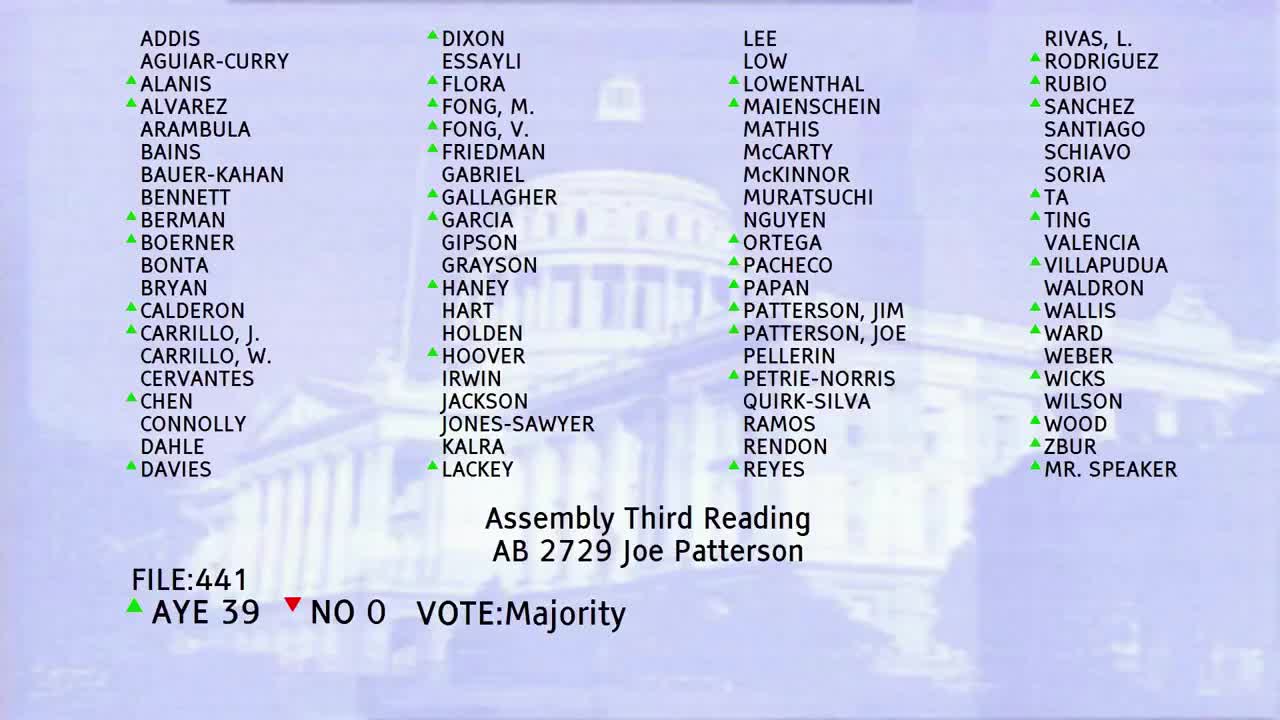 57SEC
Assembly Floor
 10MIN
Assembly Standing Committee on Judiciary
 14MIN
Assembly Standing Committee on Housing and Community Development
Bill Author

Bill Co-Author(s):