AB 2237: Children and youth: transfer of specialty mental health services.
- Session Year: 2023-2024
- House: Assembly
- Latest Version Date: 2024-09-03
Current Status:
Failed
(2024-09-27: Vetoed by Governor.)
Introduced
In Committee
First Chamber
In Committee
Second Chamber
Enacted
What does this bill do?
When a child or youth 21 or younger who is receiving Medi‑Cal specialty mental health services moves from one county to another, the county they move to must continue providing those specialty services if no other law covers the transfer. The state Department of Health Care Services must collect and publish statewide data on how many children move, how many continue to receive services, and their outcomes. The department must also issue guidance, including a department point of contact and standardized information‑sharing and prior‑authorization steps, to help counties coordinate and speed transfers.
The summary is provided by generative AI which can make mistakes. For original language, please view the details in the table below.
Existing law establishes the Medi-Cal program, which is administered by the State Department of Health Care Services (department), under which qualified low-income individuals receive health care services. The Medi-Cal program is, in part, governed and funded by federal Medicaid program provisions. Under existing law, specialty mental health services include federal Early and Periodic Screening, Diagnostic, and Treatment (EPSDT) services provided to eligible Medi-Cal beneficiaries under 21 years of age.
This bill would require, when a child or youth 21 years of age or younger who is receiving Medi-Cal specialty mental health services changes residence from one county to another, the receiving county to provide specialty mental health services to the child or youth, if the transfer of those services from one county to another is not otherwise governed by a process established in statute. The bill also would require the State Department of Health Care Services to collect specified data related to the receipt of specialty mental health services by children and youth who move outside of the county where they originally received specialty mental health services, and to include the data in the departments Medi-Cal specialty mental health services performance dashboard. The bill would require the department to issue guidance, as specified, to define the requirements placed on a receiving county for the continued provision of specialty mental health services, to coordinate and expedite the transfer of services from one county to another, and reduce the burden on children and youth and their caregivers to reestablish services in the receiving county. The bill would authorize the department to implement, interpret, or make specific its provisions by means of all-county letters, plan letters, plan or provider bulletins, or similar instructions, until regulations are adopted, as specified.
Existing law establishes the Medi-Cal program, which is administered by the State Department of Health Care Services (department), under which qualified low-income individuals receive health care services. The Medi-Cal program is, in part, governed and funded by federal Medicaid program provisions. Under existing law, specialty mental health services include federal Early and Periodic Screening, Diagnostic, and Treatment (EPSDT) services provided to eligible Medi-Cal beneficiaries under 21 years of age.
This bill would require, when a child or youth 21 years of age or younger who is receiving Medi-Cal specialty mental health services changes residence from one county to another, the receiving county to provide specialty mental health services to the child or youth, if the transfer of those services from one county to another is not otherwise governed by a process established in statute. The bill also would require the State Department of Health Care Services to collect specified data related to the receipt of specialty mental health services by children and youth who move outside of the county where they originally received specialty mental health services, and to include the data in the departments Medi-Cal specialty mental health services performance dashboard. The bill would require the department to issue guidance, as specified, to define the requirements on a receiving county for the continued provision of specialty mental health services, to coordinate and expedite the transfer of services from one county to another, and reduce the burden on children and youth and their caregivers to reestablish services in the receiving county. The bill would authorize the department to implement, interpret, or make specific its provisions by means of all-county letters, plan letters, plan or provider bulletins, or similar instructions, until regulations are adopted, as specified. By increasing duties of counties administering the Medi-Cal program, the bill would impose a state-mandated local program.
The California Constitution requires the state to reimburse local agencies and school districts for certain costs mandated by the state. Statutory provisions establish procedures for making that reimbursement.This bill would provide that no reimbursement is required by this act for a specified reason.Existing law establishes the Medi-Cal program, which is administered by the State Department of Health Care Services (department), under which qualified low-income individuals receive health care services. The Medi-Cal program is, in part, governed and funded by federal Medicaid program provisions. Under existing law, specialty mental health services include federal Early and Periodic Screening, Diagnostic, and Treatment (EPSDT) services provided to eligible Medi-Cal beneficiaries under 21 years of age.
This bill would require, when a child or youth 18 21 years of age or younger who is receiving Medi-Cal specialty mental health services changes residence from one county to another, the receiving county to provide specialty mental health services while the receiving county conducts its investigation and casework transfer process, if specified conditions are met, including, but not limited to, that the child or youth has been identified by the county of original residence as high risk or coming from a vulnerable population. services to the child or youth, if the transfer of those services from one county to another is not otherwise governed by a process established in statute. The bill also would require the State Department of Health Care Services and the State Department of Social Services to collaborate to create a system of standardized communication between counties that respects the procedures of the receiving county and the needs of the child that is without mental health services, and require the State Department of Social Services to establish care teams to help counties coordinate and expedite the transfer between counties. to collect specified data related to the receipt of specialty mental health services by children and youth who move outside of the county where they originally received specialty mental health services, and to include the data in the departments Medi-Cal specialty mental health services performance dashboard. The bill would require the department to issue guidance, as specified, to define the requirements on a receiving county for the continued provision of specialty mental health services, to coordinate and expedite the transfer of services from one county to another, and reduce the burden on children and youth and their caregivers to reestablish services in the receiving county. The bill would authorize the department to implement, interpret, or make specific its provisions by means of all-county letters, plan letters, plan or provider bulletins, or similar instructions, until regulations are adopted, as specified. By increasing duties of counties administering the Medi-Cal program, the bill would impose a state-mandated local program.
The California Constitution requires the state to reimburse local agencies and school districts for certain costs mandated by the state. Statutory provisions establish procedures for making that reimbursement.
This bill would provide that no reimbursement is required by this act for a specified reason.
Existing law establishes the Medi-Cal program, which is administered by the State Department of Health Care Services (department), under which qualified low-income individuals receive health care services. The Medi-Cal program is, in part, governed and funded by federal Medicaid program provisions. Under existing law, specialty mental health services include federal Early and Periodic Screening, Diagnostic, and Treatment (EPSDT) services provided to eligible Medi-Cal beneficiaries under 21 years of age. Existing law requires each local mental health plan to establish a procedure to ensure access to outpatient specialty mental health services, as required by the EPSDT program standards, for youth in foster care who have been placed outside their county of adjudication, as described.
Existing law requires the department to issue policy guidance on the conditions for, and exceptions to, presumptive transfer of responsibility for providing or arranging for specialty mental health services to a foster youth from the county of original jurisdiction to the county in which the foster youth resides, as prescribed. On a case-by-case basis, and when consistent with the medical rights of children in foster care, existing law authorizes the waiver of presumptive transfer, with the responsibility for the provision of specialty mental health services remaining with the county of original jurisdiction if certain exceptions exist. Under existing law, the county probation agency or the child welfare services agency is responsible for determining whether waiver of the presumptive transfer is appropriate, with notice provided to the person requesting the exception.Under existing law, in the case of placement of foster children in short-term residential therapeutic programs, community treatment facilities, or group homes, or in the case of admission of foster children to childrens crisis residential programs, the county of original jurisdiction is required to retain responsibility and presumptive transfer provisions apply only if certain circumstances exist.This bill would declare the intent of the Legislature to enact legislation requiring, when jurisdiction of a child or youth is being transferred from one county to another, the transfer county to assume financial responsibility for purposes of ensuring that the child or youth receives, or continues to receive, timely access to specialty mental health services when the child or youth has been transferred from the county of original jurisdiction, while the transfer require, when a child or youth 18 years of age or younger changes residence from one county to another, the receiving county to provide specialty mental health services while the receiving county conducts its investigation and casework transfer process, if specified conditions are met, including, but not limited to, that the child or youth has been identified by the county of original jurisdiction residence as high risk or coming from a vulnerable population. The bill also would declare the Legislatures intent to enact related provisions, including requiring require the State Department of Health Care Services and the State Department of Social Services to collaborate to create a system of standardized communication between counties that respects the procedures of the receiving county and the needs of the child that is without mental health services, and requiring require the State Department of Social Services to establish care teams to help counties coordinate and expedite the transfer between counties. By increasing duties of counties administering the Medi-Cal program, the bill would impose a state-mandated local program.
The California Constitution requires the state to reimburse local agencies and school districts for certain costs mandated by the state. Statutory provisions establish procedures for making that reimbursement.
This bill would provide that no reimbursement is required by this act for a specified reason.
Existing law establishes the Medi-Cal program, which is administered by the State Department of Health Care Services (department), under which qualified low-income individuals receive health care services. The Medi-Cal program is, in part, governed and funded by federal Medicaid program provisions. Under existing law, specialty mental health services include federal Early and Periodic Screening, Diagnostic, and Treatment (EPSDT) services provided to eligible Medi-Cal beneficiaries under 21 years of age. Existing law requires each local mental health plan to establish a procedure to ensure access to outpatient specialty mental health services, as required by the EPSDT program standards, for youth in foster care who have been placed outside their county of adjudication, as described.
Existing law requires the department to issue policy guidance on the conditions for, and exceptions to, presumptive transfer of responsibility for providing or arranging for specialty mental health services to a foster youth from the county of original jurisdiction to the county in which the foster youth resides, as prescribed. On a case-by-case basis, and when consistent with the medical rights of children in foster care, existing law authorizes the waiver of presumptive transfer, with the responsibility for the provision of specialty mental health services remaining with the county of original jurisdiction if certain exceptions exist. Under existing law, the county probation agency or the child welfare services agency is responsible for determining whether waiver of the presumptive transfer is appropriate, with notice provided to the person requesting the exception.
Under existing law, in the case of placement of foster children in short-term residential therapeutic programs, community treatment facilities, or group homes, or in the case of admission of foster children to childrens crisis residential programs, the county of original jurisdiction is required to retain responsibility and presumptive transfer provisions apply only if certain circumstances exist.
This bill would declare the intent of the Legislature to enact legislation requiring, when jurisdiction of a child or youth is being transferred from one county to another, the transfer county to assume financial responsibility for purposes of ensuring that the child or youth receives, or continues to receive, timely access to specialty mental health services when the child or youth has been transferred from the county of original jurisdiction, while the transfer county conducts its investigation and casework transfer process, if specified conditions are met, including, but not limited to, that the child or youth has been identified by the county of original jurisdiction as high risk or coming from a vulnerable population. The bill also would declare the Legislatures intent to enact related provisions, including requiring the State Department of Health Care Services and the State Department of Social Services to collaborate to create a system of standardized communication between counties that respects the procedures of the receiving county and the needs of the child that is without mental health services, and requiring the State Department of Social Services to establish care teams to help counties coordinate and expedite the transfer between counties.
(a)When a child or youth 21 years of age or younger who is receiving Medi-Cal specialty mental health services changes residence from one county to another, and the transfer of the childs or youths specialty mental health services from one county to another is not otherwise governed by a process established in statute, the receiving county shall provide specialty mental health services to the child or youth.
(b)The department shall collect data related to the receipt of specialty mental health services by children and youth who move outside of the county where they received specialty mental health services. These data shall be included in the departments Medi-Cal specialty mental health services performance dashboard, in compliance with all applicable state and federal privacy and confidentiality laws, and shall contain all of the following statewide information:
(1)The number of children and youth receiving specialty mental health services who move outside the county where they originally received specialty mental health services.
(2)The number of children and youth receiving specialty mental health services after they move outside the county where they originally received specialty mental health services.
(3)The outcomes for children and youth receiving specialty mental health services who move across county lines.
(c)The department shall issue guidance that defines requirements placed on a receiving county for the continued provision of specialty mental health services, as required by subdivision (a), to coordinate and expedite the transfer of specialty mental health services from one county to another, and reduce the burden on children and youth and their caregivers to reestablish services in the receiving county. The guidance shall also include both of the following:
(1)A point of contact at the department, accessible to applicable children and youth and their caregivers, that is responsible for ensuring that counties meet the requirements of subdivision (a), including reaching out to counties to resolve any potential problems with the transfer of services.
(2)Standardized notification and information-sharing requirements for county mental health plans and specialty mental health services providers, to facilitate the continued provision of specialty mental health services by a receiving county, including streamlining any required prior authorization in order to continue services in the receiving county, pursuant to subdivision (a).
(d)Notwithstanding Chapter 3.5 (commencing with Section 11340) of Part 1 of Division 3 of Title 2 of the Government Code, the department may implement, interpret, or make specific this section by means of all-county letters, plan letters, plan or provider bulletins, or similar instructions, without taking any further regulatory action, until regulations are adopted.
(a)When a child or youth 21 years of age or younger who is receiving Medi-Cal specialty mental health services changes residence from one county to another, and the transfer of the childs or youths specialty mental health services from one county to another is not otherwise governed by a process established in statute, the receiving county shall provide specialty mental health services to the child or youth.
(b)The department shall collect data related to the receipt of specialty mental health services by children and youth who move outside of the county where they received specialty mental health services. These data shall be included in the departments Medi-Cal specialty mental health services performance dashboard, in compliance with all applicable state and federal privacy and confidentiality laws, and shall contain all of the following statewide information:
(1)The number of children and youth receiving specialty mental health services who move outside the county where they originally received specialty mental health services.
(2)The number of children and youth receiving specialty mental health services after they move outside the county where they originally received specialty mental health services.
(3)The outcomes for children and youth receiving specialty mental health services who move across county lines.
(c)The department shall issue guidance that defines requirements on a receiving county for the continued provision of specialty mental health services, as required by subdivision (a), to coordinate and expedite the transfer of specialty mental health services from one county to another, and reduce the burden on children and youth and their caregivers to reestablish services in the receiving county. The guidance shall also include both of the following:
(1)A point of contact at the department, accessible to applicable children and youth and their caregivers, that is responsible for ensuring that counties meet the requirements of subdivision (a). (a), including reaching out to counties to resolve any potential problems with the transfer of services.
(2)Standardized notification and information-sharing requirements for county mental health plans and specialty mental health services providers, to facilitate the continued provision of specialty mental health services by a receiving county, including streamlining any required prior authorization in order to continue services in the receiving county, pursuant to subdivision (a).
(d)Notwithstanding Chapter 3.5 (commencing with Section 11340) of Part 1 of Division 3 of Title 2 of the Government Code, the department may implement, interpret, or make specific this section by means of all-county letters, plan letters, plan or provider bulletins, or similar instructions, without taking any further regulatory action, until regulations are adopted.
SEC. 2.To the extent that this act has an overall effect of increasing the costs already borne by a local agency for programs or levels of service mandated by the 2011 Realignment Legislation within the meaning of Section 36 of Article XIII of the California Constitution, it shall apply to local agencies only to the extent that the state provides annual funding for the cost increase. Any new program or higher level of service provided by a local agency pursuant to this act above the level for which funding has been provided shall not require a subvention of funds by the state or otherwise be subject to Section 6 of Article XIIIB of the California Constitution.(a)When a child or youth 21 years of age or younger who is receiving Medi-Cal specialty mental health services changes residence from one county to another, and the transfer of the childs or youths specialty mental health services from one county to another is not otherwise governed by a process established in statute, the receiving county shall provide specialty mental health services to the child or youth.
(b)The department shall collect data related to the receipt of specialty mental health services by children and youth who move outside of the county where they received specialty mental health services. These data shall be included in the departments Medi-Cal specialty mental health services performance dashboard, in compliance with all applicable state and federal privacy and confidentiality laws, and shall contain all of the following statewide information:
(1)The number of children and youth receiving specialty mental health services who move outside the county where they originally received specialty mental health services.
(2)The number of children and youth receiving specialty mental health services after they move outside the county where they originally received specialty mental health services.
(3)The outcomes for children and youth receiving specialty mental health services who move across county lines.
(c)The department shall issue guidance that defines requirements on a receiving county for the continued provision of specialty mental health services, as required by subdivision (a), to coordinate and expedite the transfer of specialty mental health services from one county to another, and reduce the burden on children and youth and their caregivers to reestablish services in the receiving county. The guidance shall also include both of the following:
(1)A point of contact at the department, accessible to applicable children and youth and their caregivers, that is responsible for ensuring that counties meet the requirements of subdivision (a).
(2)Standardized notification and information-sharing requirements for county mental health plans and specialty mental health services providers, to facilitate the continued provision of specialty mental health services by a receiving county, pursuant to subdivision (a).
(d)Notwithstanding Chapter 3.5 (commencing with Section 11340) of Part 1 of Division 3 of Title 2 of the Government Code, the department may implement, interpret, or make specific this section by means of all-county letters, plan letters, plan or provider bulletins, or similar instructions, without taking any further regulatory action, until regulations are adopted.
SEC. 2.To the extent that this act has an overall effect of increasing the costs already borne by a local agency for programs or levels of service mandated by the 2011 Realignment Legislation within the meaning of Section 36 of Article XIII of the California Constitution, it shall apply to local agencies only to the extent that the state provides annual funding for the cost increase. Any new program or higher level of service provided by a local agency pursuant to this act above the level for which funding has been provided shall not require a subvention of funds by the state or otherwise be subject to Section 6 of Article XIIIB of the California Constitution.
(a)When a child or youth 18 years of age or younger changes residence from one county to another, the receiving county shall provide specialty mental health services for the child or youth while it conducts its investigation and casework transfer process, if the following criteria are met:
(1)The child or youth has been identified by the county of original residence as high risk or coming from a vulnerable population.
(2)The child or youth is receiving specialty mental health services in the county of original residence.
(b)The State Department of Social Services and the State Department of Health Care Services shall do all of the following:
(1)Identify the available contracting options and notification requirements for county mental health plans and specialty mental health services providers.
(2)Create a system of standardized communication between counties that respects the procedures of the receiving county and the needs of the child or youth that is without mental health services.
(3)Collect and make available on the departments internet websites data relevant to the receipt of specialty mental health services by high-risk children who are placed outside their county of original residence.
(c)The State Department of Social Services shall establish care teams to help counties coordinate and expedite the transfer process between counties.
SEC. 2.To the extent that this act has an overall effect of increasing the costs already borne by a local agency for programs or levels of service mandated by the 2011 Realignment Legislation within the meaning of Section 36 of Article XIII of the California Constitution, it shall apply to local agencies only to the extent that the state provides annual funding for the cost increase. Any new program or higher level of service provided by a local agency pursuant to this act above the level for which funding has been provided shall not require a subvention of funds by the state or otherwise be subject to Section 6 of Article XIIIB of the California Constitution.
SECTION 1.It is the intent of the Legislature to enact legislation to do all of the following:(a)Require that when jurisdiction of a child or youth is being transferred from one county to another, the transfer county assume financial responsibility for purposes of ensuring that the child or youth receives, or continues to receive, timely access to specialty mental health services when the child or youth is transferred from the county of original jurisdiction, while the transfer county conducts its investigation and casework transfer process, when all of the following conditions apply:(1)The child or youth is 18 years of age or younger.(2)The child or youth has been identified by the county of original jurisdiction as high risk or coming from a vulnerable population.(3)The child or youth is receiving specialty mental health services in the county of original jurisdiction.(b)Identify the available contracting options and notification requirements for county mental health plans and specialty mental health services providers.(c)Require the State Department of Health Care Services and the State Department of Social Services to do both of the following:(1)Collaborate to create a system of standardized communication between counties that respects the procedures of the receiving county and the needs of the child that is without mental health services.(2)Collect and make available on the departments internet websites data relevant to the receipt of specialty mental health services by high-risk children and youth who are placed outside their county of original jurisdiction.(d)Require the State Department of Social Services to establish care teams to help counties coordinate and expedite the transfer process between counties.It is the intent of the Legislature to enact legislation to do all of the following:
(a)Require that when jurisdiction of a child or youth is being transferred from one county to another, the transfer county assume financial responsibility for purposes of ensuring that the child or youth receives, or continues to receive, timely access to specialty mental health services when the child or youth is transferred from the county of original jurisdiction, while the transfer county conducts its investigation and casework transfer process, when all of the following conditions apply:
(1)The child or youth is 18 years of age or younger.
(2)The child or youth has been identified by the county of original jurisdiction as high risk or coming from a vulnerable population.
(3)The child or youth is receiving specialty mental health services in the county of original jurisdiction.
(b)Identify the available contracting options and notification requirements for county mental health plans and specialty mental health services providers.
(c)Require the State Department of Health Care Services and the State Department of Social Services to do both of the following:
(1)Collaborate to create a system of standardized communication between counties that respects the procedures of the receiving county and the needs of the child that is without mental health services.
(2)Collect and make available on the departments internet websites data relevant to the receipt of specialty mental health services by high-risk children and youth who are placed outside their county of original jurisdiction.
(d)Require the State Department of Social Services to establish care teams to help counties coordinate and expedite the transfer process between counties.
|
Date
|
Status
|
|---|---|
| Sep 27, 2024 | Vetoed by Governor. |
| Sep 11, 2024 | Enrolled and presented to the Governor at 4 p.m. |
| Aug 29, 2024 | Senate amendments concurred in. To Engrossing and Enrolling. (Ayes 75. Noes 0.). |
| Aug 29, 2024 | Assembly Rule 77 suspended. |
| Aug 28, 2024 | In Assembly. Concurrence in Senate amendments pending. May be considered on or after August 30 pursuant to Assembly Rule 77. |
| Aug 28, 2024 | Read third time. Passed. Ordered to the Assembly. (Ayes 39. Noes 0.). |
| Aug 26, 2024 | Read second time. Ordered to third reading. |
| Aug 23, 2024 | Read third time and amended. Ordered to second reading. |
| Aug 19, 2024 | Read second time. Ordered to third reading. |
| Aug 15, 2024 | From committee: Do pass. (Ayes 7. Noes 0.) (August 15). |
| Aug 5, 2024 | In committee: Referred to APPR suspense file. |
| Jun 26, 2024 | Read second time and amended. Re-referred to Com. on APPR. |
| Jun 25, 2024 | From committee: Amend, and do pass as amended and re-refer to Com. on APPR. (Ayes 14. Noes 0.) (June 25). |
| Jun 20, 2024 | From committee: Do pass and re-refer to Com. on G.O. with recommendation: To Consent Calendar. (Ayes 11. Noes 0.) (June 19). Re-referred to Com. on G.O. |
| May 29, 2024 | Referred to Coms. on HEALTH and G.O. |
| May 22, 2024 | In Senate. Read first time. To Com. on RLS. for assignment. |
| May 21, 2024 | Read third time. Passed. Ordered to the Senate. (Ayes 73. Noes 0. Page 5432.) |
| May 20, 2024 | Read second time. Ordered to third reading. |
| May 16, 2024 | From committee: Do pass. (Ayes 15. Noes 0.) (May 16). |
| May 8, 2024 | In committee: Set, first hearing. Referred to APPR. suspense file. |
| Apr 15, 2024 | Re-referred to Com. on HUM. S. |
| Apr 15, 2024 | Re-referred to Com. on APPR. pursuant to Assembly Rule 96. |
| Apr 11, 2024 | Read second time and amended. |
| Apr 10, 2024 | From committee: Amend, and do pass as amended and re-refer to Com. on HUM. S. (Ayes 16. Noes 0.) (April 9). |
| Mar 19, 2024 | Re-referred to Com. on HEALTH. |
| Mar 18, 2024 | Referred to Coms. on HEALTH and HUM. S. |
| Mar 18, 2024 | From committee chair, with author's amendments: Amend, and re-refer to Com. on HEALTH. Read second time and amended. |
| Feb 9, 2024 | From printer. May be heard in committee March 10. |
| Feb 8, 2024 | Read first time. To print. |
|
Date
|
Description
|
Location
|
Votes
|
|
|---|---|---|---|---|
| Aug 29, 2024 | AB 2237 Aguiar-Curry Concurrence in Senate Amendments | Assembly Floor |
Passed |
|
| Aug 28, 2024 | Assembly 3rd Reading AB2237 Aguiar-Curry et al. By Menjivar | Senate Floor |
Passed |
|
| Aug 15, 2024 | Do pass | Senate Standing Committee on Appropriations |
Passed |
|
| Aug 5, 2024 | Placed on suspense file | Senate Standing Committee on Appropriations |
Passed |
|
| Jun 25, 2024 | Do pass as amended, but first amend, and re-refer to the Committee on [Appropriations] | Senate Standing Committee on Governmental Organization |
Passed |
|
| Jun 19, 2024 | Do pass, but first be re-referred to the Committee on [Governmental Organization] with the recommendation: To Consent Calendar | Senate Standing Committee on Health |
Passed |
|
| May 21, 2024 | AB 2237 Aguiar-Curry Assembly Third Reading | Assembly Floor |
Passed |
|
| May 16, 2024 | Do pass. | Assembly Standing Committee on Appropriations |
Passed |
|
| Apr 9, 2024 | Do pass as amended and be re-referred to the Committee on [Human Services] | Assembly Standing Committee on Health |
Passed |
This list shows positions taken on this bill by organizations on the date displayed, which is linked to the original source.
Positions by individuals are not included.
|
Organization
|
Position
|
Date
|
|---|---|---|
| American Academy Of Pediatrics, California | ** Support | |
| California Academy of Child and Adolescent Psychiatry | ** Support | |
| California Access Coalition | ** Support | |
| California Council Of Community Behavioral Health Agencies | ** Support | |
| ChildrenS Institute | ** Support | |
| HealthRight 360 | ** Support | |
| improve your tomorrow | ** Support | |
| PathPoint | ** Support | |
| Providence | ** Support | |
| Sacramento County Young Democrats | ** Support | |
| Santa Clara County Office Of Education | ** Support | |
| Sycamores | ** Support |
GOVERNOR'S VETO
GV Bill Id:AB 2237
Author:(Aguiar-Curry)
As Enrolled Ver:September 3, 2024
2/3 vote
SUMMARY
Streamlines the provision of Medi-Cal county-based specialty mental health services (SMHS) when a child or youth moves to a new county, by requiring the new county to continue to provide SMHS to the child or youth; requires the Department of Health Care Services (DHCS) to collect specified data.
Senate Amendments make minor changes to the responsibilities of DHCS.
Governor's Veto Message
This bill would require the Department of Health Care Services (DHCS) to coordinate and expedite the transfer of specialty mental health services from one county to another when a child or youth 21 years old or younger moves counties and would require DHCS to collect and publish related data.
I support efforts to ensure continuity of care for all children and youth when they have a change in county residence. However, this bill is unnecessary. DHCS has multiple policies in place to facilitate a smooth transition of care and to prevent any gaps in the provision of specialty mental health services during an intercounty transfer of Medi-Cal eligibility.
COMMENTS
- SMHS. Medi-Cal mental health benefits are delivered through two main delivery systems (county mental health plans (MHPs) and Medi-Cal managed care plans), as well as through fee-for-service (FFS) Medi-Cal. County MHPs provide a broad range of SMHS to individuals with more severe mental illnesses, while Medi-Cal managed care plans and FFS Medi-Cal provide a narrower set of "nonspecialty mental health" benefits (this is sometimes referred to as the "mild to moderate" benefit). DHCS has recently undertaken numerous initiatives to improve the Medi-Cal behavioral health system, reduce administrative burden, and streamline access to services.
- Moving Counties in Medi-Cal (Inter-County Transfer (ICT). Current law requires a beneficiary to promptly notify either the county from which they move (sending county) or the county to which they move (receiving county) of the change in residence. SB 1339 (Monning), Chapter 801, Statutes of 2016, establishes requirements related to ICT. It places responsibility on the county that the beneficiary notifies of the change in residence to initiate an ICT for all the benefits that the beneficiary is receiving. The notified county can be either the sending county or the receiving county. It also requires the notified county to initiate an ICT within seven business days of notice of a new residence.
- Presumptive Transfer. AB 1299 (Ridley-Thomas), Chapter 603, Statutes of 2016, established presumptive transfer, a process to transfer responsibility for provision of SMHS for foster children and youth. Presumptive transfer guidelines are strict, and only apply within the foster care system. This bill applies to children and youth under 21, the transfer of whose services are not otherwise governed by presumptive transfer or another process established in statute.
- DHCS Guidance on Transfer of SMHS to a New County, Outside of Foster Care. On February 8, 2024, DHCS issued Behavioral Health Information Notice (BHIN) No: 24-008 to clarify distinctions between and responsibilities of the County of Residence and County of Responsibility for members who move to another county. This BHIN applies to all Medi-Cal members receiving SMHS, and is not specific to children and youth in foster care. The guidance does not list timelines; however, it appears timelines for the ICT process and county authorization for SMHS could have the potential to result in significant gaps in care. Although the state has put in place a number of protections that expedite the delivery of SMHS to foster youth, youth outside the foster system may also have significant mental health needs and benefit from a standardized process and smoother transition of services when moving counties. This bill addresses youth outside the foster system.
According to the Author
Today, over 243,000 young Californians rely on county SMHS. However, the author asserts, when these minors move from county to county, they cannot receive county services in their new area until they re-establish their eligibility for services — a process that can take months. The author explains this results in gaps in mental health care during a major transition, creating a burden for families. This bill is intended to preserve critical mental health coverage for high-risk and vulnerable minors when they move across county lines by making sure that eligible minors receive services through the transition and the transfer of services is streamlined across county lines.
Arguments in Support
According to the bill's sponsor, California Council of Community Behavioral Health Agencies (CBHA), a coalition of behavioral health providers, this bill preserves counties' ability to conduct appropriate reviews to meet changing mental health needs and conditions, while also ensuring continuity of care for high-risk and vulnerable youth. CBHA also asserts the bill improves communication between counties, helping reduce the burden on families trying to navigate unfamiliar county systems to meet their child's need for mental health services. Sycamores, a mental health provider, illustrates the need for this bill through an example of a youth who moved counties having to "go through the county system to be assessed for eligibility for SMHS which is causing additional administrative barriers and potential delays for youth to receive services."
Arguments in Opposition
There is no known opposition.
FISCAL COMMENTS
According to the Senate Committee on Appropriations, unknown ongoing costs to DHCS for state administration (General Fund and federal funds).
VOTES
ASM HEALTH: 16-0-0
YES: Bonta, Waldron, Aguiar-Curry, Arambula, Wendy Carrillo, Flora, Haney, Jones-Sawyer, Maienschein, McCarty, Joe Patterson, Rodriguez, Sanchez, Santiago, Schiavo, Weber
ASM APPROPRIATIONS: 15-0-0
YES: Wicks, Sanchez, Arambula, Bryan, Calderon, Wendy Carrillo, Dixon, Mike Fong, Grayson, Haney, Hart, Jim Patterson, Pellerin, Ta, Villapudua
ASSEMBLY FLOOR: 73-0-7
YES: Addis, Aguiar-Curry, Alanis, Alvarez, Arambula, Bains, Bauer-Kahan, Bennett, Berman, Boerner, Bonta, Bryan, Calderon, Juan Carrillo, Wendy Carrillo, Chen, Connolly, Davies, Dixon, Essayli, Flora, Mike Fong, Vince Fong, Gallagher, Garcia, Gipson, Grayson, Haney, Hart, Hoover, Irwin, Jackson, Jones-Sawyer, Kalra, Lackey, Lee, Low, Lowenthal, Maienschein, McCarty, McKinnor, Muratsuchi, Stephanie Nguyen, Ortega, Pacheco, Papan, Jim Patterson, Joe Patterson, Pellerin, Petrie-Norris, Quirk-Silva, Ramos, Rendon, Reyes, Rodriguez, Blanca Rubio, Sanchez, Santiago, Schiavo, Soria, Ta, Ting, Valencia, Villapudua, Waldron, Wallis, Ward, Weber, Wicks, Wilson, Wood, Zbur, Robert Rivas
ABS, ABST OR NV: Cervantes, Megan Dahle, Friedman, Gabriel, Holden, Mathis, Luz Rivas
SENATE FLOOR: 39-0-1
YES: Allen, Archuleta, Ashby, Atkins, Becker, Blakespear, Bradford, Caballero, Cortese, Dahle, Dodd, Durazo, Eggman, Glazer, Gonzalez, Grove, Hurtado, Jones, Laird, Limón, McGuire, Menjivar, Min, Newman, Nguyen, Niello, Ochoa Bogh, Padilla, Portantino, Roth, Rubio, Seyarto, Skinner, Smallwood-Cuevas, Stern, Umberg, Wahab, Wiener, Wilk
ABS, ABST OR NV: Alvarado-Gil
ASSEMBLY FLOOR: 75-0-4
YES: Addis, Aguiar-Curry, Alanis, Alvarez, Arambula, Bains, Bauer-Kahan, Bennett, Berman, Boerner, Bonta, Bryan, Calderon, Juan Carrillo, Wendy Carrillo, Chen, Connolly, Megan Dahle, Davies, Dixon, Essayli, Flora, Mike Fong, Friedman, Gabriel, Gallagher, Garcia, Gipson, Grayson, Haney, Hart, Holden, Hoover, Irwin, Jackson, Jones-Sawyer, Kalra, Lackey, Lee, Low, Lowenthal, Maienschein, Mathis, McCarty, McKinnor, Muratsuchi, Stephanie Nguyen, Pacheco, Papan, Jim Patterson, Pellerin, Petrie-Norris, Quirk-Silva, Ramos, Rendon, Reyes, Luz Rivas, Rodriguez, Blanca Rubio, Sanchez, Santiago, Schiavo, Soria, Ta, Ting, Valencia, Villapudua, Waldron, Wallis, Ward, Weber, Wicks, Wilson, Wood, Robert Rivas
ABS, ABST OR NV: Cervantes, Ortega, Joe Patterson, Zbur
UPDATED
VERSION: September 3, 2024
CONSULTANT: Lisa Murawski / HEALTH / (916) 319-2097 FN: 0005137
CONCURRENCE IN SENATE AMENDMENTS
CSA1 Bill Id:AB 2237
Author:(Aguiar-Curry)
As Amended Ver:August 23, 2024
Majority vote
SUMMARY
Streamlines the provision of Medi-Cal county-based specialty mental health services (SMHS) when a child or youth moves to a new county, by requiring the new county to continue to provide SMHS to the child or youth; requires the Department of Health Care Services (DHCS) to collect specified data.
Senate Amendments
Make minor changes to the responsibilities of DHCS.
COMMENTS
- SMHS. Medi-Cal mental health benefits are delivered through two main delivery systems (county mental health plans (MHPs) and Medi-Cal managed care plans), as well as through fee-for-service (FFS) Medi-Cal. County MHPs provide a broad range of SMHS to individuals with more severe mental illnesses, while Medi-Cal managed care plans and FFS Medi-Cal provide a narrower set of "nonspecialty mental health" benefits (this is sometimes referred to as the "mild to moderate" benefit). DHCS has recently undertaken numerous initiatives to improve the Medi-Cal behavioral health system, reduce administrative burden, and streamline access to services.
- Moving Counties in Medi-Cal (Inter-County Transfer (ICT). Current law requires a beneficiary to promptly notify either the county from which they move (sending county) or the county to which they move (receiving county) of the change in residence. SB 1339 (Monning), Chapter 801, Statutes of 2016, establishes requirements related to ICT. It places responsibility on the county that the beneficiary notifies of the change in residence to initiate an ICT for all the benefits that the beneficiary is receiving. The notified county can be either the sending county or the receiving county. It also requires the notified county to initiate an ICT within seven business days of notice of a new residence.
- Presumptive Transfer. AB 1299 (Ridley-Thomas), Chapter 603, Statutes of 2016, established presumptive transfer, a process to transfer responsibility for provision of SMHS for foster children and youth. Presumptive transfer guidelines are strict, and only apply within the foster care system. This bill applies to children and youth under 21, the transfer of whose services are not otherwise governed by presumptive transfer or another process established in statute.
- DHCS Guidance on Transfer of SMHS to a New County, Outside of Foster Care. On February 8, 2024, DHCS issued Behavioral Health Information Notice (BHIN) No: 24-008 to clarify distinctions between and responsibilities of the County of Residence and County of Responsibility for members who move to another county. This BHIN applies to all Medi-Cal members receiving SMHS, and is not specific to children and youth in foster care. The guidance does not list timelines; however, it appears timelines for the ICT process and county authorization for SMHS could have the potential to result in significant gaps in care. Although the state has put in place a number of protections that expedite the delivery of SMHS to foster youth, youth outside the foster system may also have significant mental health needs and benefit from a standardized process and smoother transition of services when moving counties. This bill addresses youth outside the foster system.
According to the Author
Today, over 243,000 young Californians rely on county SMHS. However, the author asserts, when these minors move from county to county, they cannot receive county services in their new area until they re-establish their eligibility for services — a process that can take months. The author explains this results in gaps in mental health care during a major transition, creating a burden for families. This bill is intended to preserve critical mental health coverage for high-risk and vulnerable minors when they move across county lines by making sure that eligible minors receive services through the transition and the transfer of services is streamlined across county lines.
Arguments in Support
According to the bill's sponsor, California Council of Community Behavioral Health Agencies (CBHA), a coalition of behavioral health providers, this bill preserves counties' ability to conduct appropriate reviews to meet changing mental health needs and conditions, while also ensuring continuity of care for high-risk and vulnerable youth. CBHA also asserts the bill improves communication between counties, helping reduce the burden on families trying to navigate unfamiliar county systems to meet their child's need for mental health services. Sycamores, a mental health provider, illustrates the need for this bill through an example of a youth who moved counties having to "go through the county system to be assessed for eligibility for SMHS which is causing additional administrative barriers and potential delays for youth to receive services."
Arguments in Opposition
There is no known opposition.
FISCAL COMMENTS
According to the Senate Committee on Appropriations, unknown ongoing costs to DHCS for state administration (General Fund and federal funds).
VOTES:
ASM HEALTH: 16-0-0
YES: Bonta, Waldron, Aguiar-Curry, Arambula, Wendy Carrillo, Flora, Haney, Jones-Sawyer, Maienschein, McCarty, Joe Patterson, Rodriguez, Sanchez, Santiago, Schiavo, Weber
ASM APPROPRIATIONS: 15-0-0
YES: Wicks, Sanchez, Arambula, Bryan, Calderon, Wendy Carrillo, Dixon, Mike Fong, Grayson, Haney, Hart, Jim Patterson, Pellerin, Ta, Villapudua
ASSEMBLY FLOOR: 73-0-7
YES: Addis, Aguiar-Curry, Alanis, Alvarez, Arambula, Bains, Bauer-Kahan, Bennett, Berman, Boerner, Bonta, Bryan, Calderon, Juan Carrillo, Wendy Carrillo, Chen, Connolly, Davies, Dixon, Essayli, Flora, Mike Fong, Vince Fong, Gallagher, Garcia, Gipson, Grayson, Haney, Hart, Hoover, Irwin, Jackson, Jones-Sawyer, Kalra, Lackey, Lee, Low, Lowenthal, Maienschein, McCarty, McKinnor, Muratsuchi, Stephanie Nguyen, Ortega, Pacheco, Papan, Jim Patterson, Joe Patterson, Pellerin, Petrie-Norris, Quirk-Silva, Ramos, Rendon, Reyes, Rodriguez, Blanca Rubio, Sanchez, Santiago, Schiavo, Soria, Ta, Ting, Valencia, Villapudua, Waldron, Wallis, Ward, Weber, Wicks, Wilson, Wood, Zbur, Robert Rivas
ABS, ABST OR NV: Cervantes, Megan Dahle, Friedman, Gabriel, Holden, Mathis, Luz Rivas
SENATE FLOOR: 39-0-1
YES: Allen, Archuleta, Ashby, Atkins, Becker, Blakespear, Bradford, Caballero, Cortese, Dahle, Dodd, Durazo, Eggman, Glazer, Gonzalez, Grove, Hurtado, Jones, Laird, Limón, McGuire, Menjivar, Min, Newman, Nguyen, Niello, Ochoa Bogh, Padilla, Portantino, Roth, Rubio, Seyarto, Skinner, Smallwood-Cuevas, Stern, Umberg, Wahab, Wiener, Wilk
ABS, ABST OR NV: Alvarado-Gil
UPDATED
VERSION: August 23, 2024
CONSULTANT: Lisa Murawski / HEALTH / (916) 319-2097 FN: 0004172
SENATE RULES COMMITTEE Office of Senate Floor Analyses (916) 651-1520 Fax: (916) 327-4478 | AB 2237 |
THIRD READING
Bill No: AB 2237
Author: Aguiar-Curry (D), et al.
Amended: 8/23/24 in Senate
Vote: 21
SENATE HEALTH COMMITTEE: 11-0, 6/19/24
AYES: Roth, Nguyen, Glazer, Gonzalez, Grove, Hurtado, Limón, Menjivar, Rubio, Smallwood-Cuevas, Wiener
SENATE GOVERNMENTAL ORG. COMMITTEE: 14-0, 6/25/24
AYES: Dodd, Wilk, Alvarado-Gil, Archuleta, Ashby, Bradford, Glazer, Nguyen, Ochoa Bogh, Padilla, Roth, Rubio, Seyarto, Smallwood-Cuevas
NO VOTE RECORDED: Jones, Portantino
SENATE APPROPRIATIONS COMMITTEE: 7-0, 8/15/24
AYES: Caballero, Jones, Ashby, Becker, Bradford, Seyarto, Wahab
ASSEMBLY FLOOR: 73-0, 5/21/24 - See last page for vote
SUBJECT: Children and youth: transfer of specialty mental health services
SOURCE: California Council of Community Behavioral Health Agencies
DIGEST:
This bill requires the Department of Health Care Services (DHCS) to issue guidance to coordinate and expedite the transfer of specialty mental health services (specialty services) from one county to another when a child or youth 21 years of age or younger moves from one county to another. This bill requires DHCS to collect and publish specified data on children and youth receiving specialty services who move from one county to another.
Senate Floor Amendments of 8/23/24 added a co-author.
ANALYSIS:
Existing law:
- Establishes the Medi-Cal program, administered by Department of Health Care Services (DHCS), under which qualified low-income individuals receive health care services. [Welfare and Institutions Code (WIC) §14001.1]
- Requires DHCS to implement mental health managed care through contracts with mental health plans (MHPs). Requires DHCS to contract with a county or counties acting jointly for the delivery of specialty services to each county’s eligible Medi-Cal beneficiary population. Authorizes MHP contracts to be awarded exclusively and on a geographic basis. [WIC §14712]
- Requires a Medi-Cal recipient changing residence from one county to another to promptly notify either county of the change of residence. Permits recipients to notify the county in person, in writing, by phone, or electronically. Requires the notified county to initiate an intercountry transfer within seven business days of the notice and to transfer the case no later than the first day of the next available benefit month following 30 days after the county was notified. [WIC §10003]
- Requires that the intercountry transfer process be simple and client friendly to the greatest extent possible and minimize workload for county eligibility operations. Prohibits the process from requiring a recipient to provide documents that were previously provided to the prior county of residence and from creating an interruption in benefits. [WIC §10003]
- States legislative intent to ensure that foster children who are placed outside of their county of original jurisdiction are able to access specialty services in a timely manner, consistent with their individual strengths and needs and the requirements of the federal law. [WIC §14717.1]
- Defines “presumptive transfer” as the requirement that responsibility for providing or arranging for specialty services promptly transfer from the county of original jurisdiction to the county in which the foster child resides, under certain conditions, as specified. [WIC §14717.1]
- Permits presumptive transfer to be waived under any of the following exceptions:
- The transfer would disrupt continuity of care or delay access to services for the foster youth;
- The transfer would interfere with family reunification efforts;
- The youth’s placement in a county other than the county of original jurisdiction is expected to last less than six months; or,
- The youth’s residence is within 30 minutes of travel time to the established specialty services provider in the county of original jurisdiction. [WIC §14717.1]
This bill:
- Specifies that the new county of residence is to provide specialty mental health services to a child or youth 21 years of age or younger when that child or youth moves to the county, and the transfer of the child or youth’s specialty mental health services is not otherwise governed by a statutory process.
- Requires DHCS to collect data related to the receipt of specialty mental health services by children and youth who move outside of the county where they received specialty mental health services. Requires the data to be included in DHCS’s Medi-Cal specialty mental health services dashboard, in compliance with all applicable state and federal privacy and confidentiality laws, and to contain the following statewide information:
- The number of children and youth receiving specialty mental health services who move outside the county where they originally received specialty mental health services;
- The number of children and youth receiving specialty mental health services after they move outside of the county where they originally received specialty mental health services; and,
- The outcomes for children and youth receiving specialty mental health services who move across county lines.
- Requires DHCS to issue guidance that defines requirements for a receiving county for the continued provision of specialty mental health services to coordinate and expedite the transfer of specialty mental health services from one county to another and reduce the burden on children and youth and their caregivers to reestablish services in the receiving county. Requires the guidance to include the following:
- A point of contact at DHCS accessible to applicable children and youth and their caregivers that is responsible for ensuring that the counties meet the requirements of 1) above, including reaching out to counties to resolve any potential problems with transfer of services; and,
- Standardized notification and information-sharing requirements for county mental health plans and specialty mental health providers to facilitate the continued provision of specialty mental health services by a receiving county, including streamlining any required prior authorization in order to continue services in the receiving county.
- Allows DHCS to implement this bill via guidance until regulations are adopted.
Comments
Author’s statement. According to the author, today, over 243,000 young Californians (youth under the age of 21) rely on county MHPs for their mental healthcare. However, when these youth move from county to county, they cannot receive mental health services in their new area until they re-establish their eligibility — a process that can take months. This results in gaps in mental health care during a major transition, creating a burden for families and putting youth at the risk of having to enter the foster care system. This bill preserves critical mental health coverage for high risk and vulnerable youth when they move across county lines by making sure that eligible youth receive services during the intake process. This bill provides needed support for families by improving communication between counties to streamline transferring services across county lines.
- Provision of mental health services in the Medi-Cal program. In 2014, the Medi-Cal program began requiring Medi-Cal plans to provide services for mild-to-moderate impairment of mental, emotional, or behavioral health functioning. As a result, Medi-Cal mental health benefits are now delivered through two separate systems and under a separate statutory framework from the drug Medi-Cal benefit. County MHPs provide a broad range of specialty services to individuals with more severe mental illnesses, while Medi-Cal plans provide nonspecialty services (generally known as mental health services for those with mild-to-moderate mental illness). The delivery of specialty services through county mental health plans is commonly referred to as a “carve out,” which is when services covered by the Medi-Cal program are delivered outside of a Medi-Cal plan. Counties also provide substance use disorder services, including those in the Drug Medi-Cal Organized Delivery System plans. This bill applies to those specialty services received through the county MHPs only.
- Efforts to improve service delivery. DHCS, through its California Advancing and Innovating Medi-Cal (CalAIM) initiative, has made efforts to improve access to behavioral health care. DHCS implemented CalAIM through the California’s Medicaid State Plan, the 1115 waiver, and the 1915(b) waiver. CalAIM transferred DHCS’s authority to implement the Medi-Cal managed care program from the previous 1115 waiver to a 1915(b) waiver. Under the 1915(b) waiver, DHCS also renewed its authority to provide specialty services through county MHPs. One of the aims of the CalAIM initiative has been to standardize statewide screening and transition tools and streamline criteria for accessing services to reduce barriers to care as is required by AB 133 (Committee on Budget, Chapter 143, Statutes of 2021), the health trailer bill that established CalAIM. The focus of these efforts thus far has been on the adult and youth screening form used to determine which delivery system an individual should be referred to in an effort to avoid sending individuals back and forth between the mental health plans for specialty services and Medi-Cal plans for nonspecialty services. The form used to facilitate a referral between the two delivery systems while avoiding a break in care has also been modified. These forms have been implemented statewide as of January 1, 2023. DHCS has also implemented new chart documentation requirements for the specialty and substance use disorder services, effective July 1, 2022, to streamline documentation requirements and better align with federal coding standards. DHCS is also required to revise its documentation standards for its audits. DHCS has stated its intent to limit its audits to issues suggesting fraud, waste, or abuse rather than more minor issues such as the formatting of documentation.
- Intercounty transfer. Because Medi-Cal is administered at the county level in California, when a recipient moves from one county to another, they must move their Medi-Cal case from one county to another as well in order to continue accessing Medi-Cal services. Effectuating such a transfer has long been problematic. SB 1339 (Monning, Chapter 801, Statutes of 2016) was intended to streamline the process, ensuring that recipients could report their change of address in either the old or the new county and that the recipient would not be required to start the application process all over again. However, even in the best of circumstances, such a transfer can still take a long time as transfers are to be done no later than the first day of the next available benefit month following the 30 days after the beneficiary’s initial notification of the change. For example, in All-County Welfare Director Letter 18-02E, DHCS gives an example of a recipient reporting a change on January 10, which would require the transfer to be complete by March 1st.
- Presumptive transfer process for foster youth. Under existing law, responsibility to authorize and pay for specialty services provided to all foster youth placed outside of their county of original jurisdiction is “presumptively transferred” from the MHP in the county of original jurisdiction to the MHP in the county of residence, unless presumptive transfer is waived. The state’s adoption of presumptive transfer sought to ensure that foster youth who were placed out of county were able to access timely and adequate mental health services. However, because community treatment facilities, group homes, short term residential treatment homes, or children’s crisis residential programs are not distributed evenly throughout California’s 58 counties, some counties absorb the caseload of counties that do not have the appropriate facilities to treat these youth. For youth placed in these facilities, some providers and counties reported problems with reimbursements and complicated contracting processes. These complications interfered with out-of-county foster youth’s access to the most appropriate mental health services, counter to the goals of presumptive transfer.
In an effort to coordinate timely access to specialty services for out-of-county youth while balancing the needs of the counties who have taken a disproportionate number of these youth, AB 1051 (Bennett, Chapter 402, Statutes of 2022) prohibited presumptive transfer for specialty services provided to foster children placed in community treatment facilities, group homes, short term residential treatment facilities, or children’s crisis residential programs outside of their counties of original jurisdiction, unless a specified exception is invoked. Under AB 1051, the county of original jurisdiction will retain the responsibility for the child’s care, even if the child is transferred outside the county, unless the foster youth is transferred permanently to the new county, or if the transfer of responsibility would result in better care as determined by the child and family team and the placing agency. These provisions related to retaining presumptive transfer were intended to take effect July 1, 2023. However, given multiple changes to the delivery of behavioral health services via various initiatives and legislative efforts, implementation was delayed by one year in the 2023-2024 budget trailer bill [AB 118 (Committee on Budget, Chapter 42, Statutes of 2023)].
- DHCS guidance on transfer of specialty services outside of foster care. This bill applies specifically to children and youth who are not in the foster youth system, which can include youth who were in the foster youth system but are returning to live with family. DHCS recently issued Behavioral Health Information Notice 24-008 to clarify the transfer of specialty services in particular when a Medi-Cal recipient moves counties. The Notice explains that once the new county is entered into the system, that county is responsible for payment of services and shall only impose prior authorization for those services that require prior authorization. Thus, even if a recipient were receiving these services in their original county, they would be required to get authorization again to continue the services once they move to the new county, in addition to having their Medi-Cal case transferred via the intercountry transfer process.
FISCAL EFFECT: Appropriation: No Fiscal Com.: Yes Local: No
According to the Senate Appropriations Committee, the fiscal impact of this bill would be unknown ongoing costs for DHCS for state administration (General Fund and federal funds).
SUPPORT: (Verified 8/14/24)
California Council of Community Behavioral Health Agencies (source)
American Academy of Pediatrics, California
California Academy of Child and Adolescent Psychiatry
California Access Coalition
Children's Institute
HealthRIGHT 360
Improve Your Tomorrow
PathPoint
Providence
Sacramento County Young Democrats
Santa Clara County Office of Education
Sycamores
OPPOSITION: (Verified 8/14/24)
None received
ARGUMENTS IN SUPPORT: Sponsor, California Council of Community Behavioral Health Agencies writes that today, many high-risk youths receive specialty mental healthcare through counties. However, when minors move across county lines, their mental healthcare services are disrupted while the new county undertakes an investigation and casework process. This leaves at-risk youth without care as they experience a stressful transition and creates a burden on vulnerable families who are trying to care for their children while navigating a complex intake process. This bill preserves counties’ ability to conduct appropriate reviews to meet changing mental health needs and conditions, while also ensuring continuity of care for high-risk and vulnerable youth.
ASSEMBLY FLOOR: 73-0, 5/21/24
AYES: Addis, Aguiar-Curry, Alanis, Alvarez, Arambula, Bains, Bauer-Kahan, Bennett, Berman, Boerner, Bonta, Bryan, Calderon, Juan Carrillo, Wendy Carrillo, Chen, Connolly, Davies, Dixon, Essayli, Flora, Mike Fong, Vince Fong, Gallagher, Garcia, Gipson, Grayson, Haney, Hart, Hoover, Irwin, Jackson, Jones-Sawyer, Kalra, Lackey, Lee, Low, Lowenthal, Maienschein, McCarty, McKinnor, Muratsuchi, Stephanie Nguyen, Ortega, Pacheco, Papan, Jim Patterson, Joe Patterson, Pellerin, Petrie-Norris, Quirk-Silva, Ramos, Rendon, Reyes, Rodriguez, Blanca Rubio, Sanchez, Santiago, Schiavo, Soria, Ta, Ting, Valencia, Villapudua, Waldron, Wallis, Ward, Weber, Wicks, Wilson, Wood, Zbur, Robert Rivas
NO VOTE RECORDED: Cervantes, Megan Dahle, Friedman, Gabriel, Holden, Mathis, Luz Rivas
Prepared by: Jen Flory / HEALTH / (916) 651-4111
8/26/24 17:01:02
**** END ****
SENATE RULES COMMITTEE Office of Senate Floor Analyses (916) 651-1520 Fax: (916) 327-4478 | AB 2237 |
THIRD READING
Bill No: AB 2237
Author: Aguiar-Curry (D)
Amended: 6/26/24 in Senate
Vote: 21
SENATE HEALTH COMMITTEE: 11-0, 6/19/24
AYES: Roth, Nguyen, Glazer, Gonzalez, Grove, Hurtado, Limón, Menjivar, Rubio, Smallwood-Cuevas, Wiener
SENATE GOVERNMENTAL ORG. COMMITTEE: 14-0, 6/25/24
AYES: Dodd, Wilk, Alvarado-Gil, Archuleta, Ashby, Bradford, Glazer, Nguyen, Ochoa Bogh, Padilla, Roth, Rubio, Seyarto, Smallwood-Cuevas
NO VOTE RECORDED: Jones, Portantino
SENATE APPROPRIATIONS COMMITTEE: 7-0, 8/15/24
AYES: Caballero, Jones, Ashby, Becker, Bradford, Seyarto, Wahab
ASSEMBLY FLOOR: 73-0, 5/21/24 - See last page for vote
SUBJECT: Children and youth: transfer of specialty mental health services
SOURCE: California Council of Community Behavioral Health Agencies
DIGEST:
This bill requires the Department of Health Care Services (DHCS) to issue guidance to coordinate and expedite the transfer of specialty mental health services (specialty services) from one county to another when a child or youth 21 years of age or younger moves from one county to another. This bill requires DHCS to collect and publish specified data on children and youth receiving specialty services who move from one county to another.
ANALYSIS:
Existing law:
- Establishes the Medi-Cal program, administered by Department of Health Care Services (DHCS), under which qualified low-income individuals receive health care services. [Welfare and Institutions Code (WIC) §14001.1]
- Requires DHCS to implement mental health managed care through contracts with mental health plans (MHPs). Requires DHCS to contract with a county or counties acting jointly for the delivery of specialty services to each county’s eligible Medi-Cal beneficiary population. Authorizes MHP contracts to be awarded exclusively and on a geographic basis. [WIC §14712]
- Requires a Medi-Cal recipient changing residence from one county to another to promptly notify either county of the change of residence. Permits recipients to notify the county in person, in writing, by phone, or electronically. Requires the notified county to initiate an intercountry transfer within seven business days of the notice and to transfer the case no later than the first day of the next available benefit month following 30 days after the county was notified. [WIC §10003]
- Requires that the intercountry transfer process be simple and client friendly to the greatest extent possible and minimize workload for county eligibility operations. Prohibits the process from requiring a recipient to provide documents that were previously provided to the prior county of residence and from creating an interruption in benefits. [WIC §10003]
- States legislative intent to ensure that foster children who are placed outside of their county of original jurisdiction are able to access specialty services in a timely manner, consistent with their individual strengths and needs and the requirements of the federal law. [WIC §14717.1]
- Defines “presumptive transfer” as the requirement that responsibility for providing or arranging for specialty services promptly transfer from the county of original jurisdiction to the county in which the foster child resides, under certain conditions, as specified. [WIC §14717.1]
- Permits presumptive transfer to be waived under any of the following exceptions:
- The transfer would disrupt continuity of care or delay access to services for the foster youth;
- The transfer would interfere with family reunification efforts;
- The youth’s placement in a county other than the county of original jurisdiction is expected to last less than six months; or,
- The youth’s residence is within 30 minutes of travel time to the established specialty services provider in the county of original jurisdiction. [WIC §14717.1]
This bill:
- Specifies that the new county of residence is to provide specialty mental health services to a child or youth 21 years of age or younger when that child or youth moves to the county, and the transfer of the child or youth’s specialty mental health services is not otherwise governed by a statutory process.
- Requires DHCS to collect data related to the receipt of specialty mental health services by children and youth who move outside of the county where they received specialty mental health services. Requires the data to be included in DHCS’s Medi-Cal specialty mental health services dashboard, in compliance with all applicable state and federal privacy and confidentiality laws, and to contain the following statewide information:
- The number of children and youth receiving specialty mental health services who move outside the county where they originally received specialty mental health services;
- The number of children and youth receiving specialty mental health services after they move outside of the county where they originally received specialty mental health services; and,
- The outcomes for children and youth receiving specialty mental health services who move across county lines.
- Requires DHCS to issue guidance that defines requirements for a receiving county for the continued provision of specialty mental health services to coordinate and expedite the transfer of specialty mental health services from one county to another and reduce the burden on children and youth and their caregivers to reestablish services in the receiving county. Requires the guidance to include the following:
- A point of contact at DHCS accessible to applicable children and youth and their caregivers that is responsible for ensuring that the counties meet the requirements of 1) above, including reaching out to counties to resolve any potential problems with transfer of services; and,
- Standardized notification and information-sharing requirements for county mental health plans and specialty mental health providers to facilitate the continued provision of specialty mental health services by a receiving county, including streamlining any required prior authorization in order to continue services in the receiving county.
- Allows DHCS to implement this bill via guidance until regulations are adopted.
Comments
Author’s statement. According to the author, today, over 243,000 young Californians (youth under the age of 21) rely on county MHPs for their mental healthcare. However, when these youth move from county to county, they cannot receive mental health services in their new area until they re-establish their eligibility — a process that can take months. This results in gaps in mental health care during a major transition, creating a burden for families and putting youth at the risk of having to enter the foster care system. This bill preserves critical mental health coverage for high risk and vulnerable youth when they move across county lines by making sure that eligible youth receive services during the intake process. This bill provides needed support for families by improving communication between counties to streamline transferring services across county lines.
- Provision of mental health services in the Medi-Cal program. In 2014, the Medi-Cal program began requiring Medi-Cal plans to provide services for mild-to-moderate impairment of mental, emotional, or behavioral health functioning. As a result, Medi-Cal mental health benefits are now delivered through two separate systems and under a separate statutory framework from the drug Medi-Cal benefit. County MHPs provide a broad range of specialty services to individuals with more severe mental illnesses, while Medi-Cal plans provide nonspecialty services (generally known as mental health services for those with mild-to-moderate mental illness). The delivery of specialty services through county mental health plans is commonly referred to as a “carve out,” which is when services covered by the Medi-Cal program are delivered outside of a Medi-Cal plan. Counties also provide substance use disorder services, including those in the Drug Medi-Cal Organized Delivery System plans. This bill applies to those specialty services received through the county MHPs only.
- Efforts to improve service delivery. DHCS, through its California Advancing and Innovating Medi-Cal (CalAIM) initiative, has made efforts to improve access to behavioral health care. DHCS implemented CalAIM through the California’s Medicaid State Plan, the 1115 waiver, and the 1915(b) waiver. CalAIM transferred DHCS’s authority to implement the Medi-Cal managed care program from the previous 1115 waiver to a 1915(b) waiver. Under the 1915(b) waiver, DHCS also renewed its authority to provide specialty services through county MHPs. One of the aims of the CalAIM initiative has been to standardize statewide screening and transition tools and streamline criteria for accessing services to reduce barriers to care as is required by AB 133 (Committee on Budget, Chapter 143, Statutes of 2021), the health trailer bill that established CalAIM. The focus of these efforts thus far has been on the adult and youth screening form used to determine which delivery system an individual should be referred to in an effort to avoid sending individuals back and forth between the mental health plans for specialty services and Medi-Cal plans for nonspecialty services. The form used to facilitate a referral between the two delivery systems while avoiding a break in care has also been modified. These forms have been implemented statewide as of January 1, 2023. DHCS has also implemented new chart documentation requirements for the specialty and substance use disorder services, effective July 1, 2022, to streamline documentation requirements and better align with federal coding standards. DHCS is also required to revise its documentation standards for its audits. DHCS has stated its intent to limit its audits to issues suggesting fraud, waste, or abuse rather than more minor issues such as the formatting of documentation.
- Intercounty transfer. Because Medi-Cal is administered at the county level in California, when a recipient moves from one county to another, they must move their Medi-Cal case from one county to another as well in order to continue accessing Medi-Cal services. Effectuating such a transfer has long been problematic. SB 1339 (Monning, Chapter 801, Statutes of 2016) was intended to streamline the process, ensuring that recipients could report their change of address in either the old or the new county and that the recipient would not be required to start the application process all over again. However, even in the best of circumstances, such a transfer can still take a long time as transfers are to be done no later than the first day of the next available benefit month following the 30 days after the beneficiary’s initial notification of the change. For example, in All-County Welfare Director Letter 18-02E, DHCS gives an example of a recipient reporting a change on January 10, which would require the transfer to be complete by March 1st.
- Presumptive transfer process for foster youth. Under existing law, responsibility to authorize and pay for specialty services provided to all foster youth placed outside of their county of original jurisdiction is “presumptively transferred” from the MHP in the county of original jurisdiction to the MHP in the county of residence, unless presumptive transfer is waived. The state’s adoption of presumptive transfer sought to ensure that foster youth who were placed out of county were able to access timely and adequate mental health services. However, because community treatment facilities, group homes, short term residential treatment homes, or children’s crisis residential programs are not distributed evenly throughout California’s 58 counties, some counties absorb the caseload of counties that do not have the appropriate facilities to treat these youth. For youth placed in these facilities, some providers and counties reported problems with reimbursements and complicated contracting processes. These complications interfered with out-of-county foster youth’s access to the most appropriate mental health services, counter to the goals of presumptive transfer.
In an effort to coordinate timely access to specialty services for out-of-county youth while balancing the needs of the counties who have taken a disproportionate number of these youth, AB 1051 (Bennett, Chapter 402, Statutes of 2022) prohibited presumptive transfer for specialty services provided to foster children placed in community treatment facilities, group homes, short term residential treatment facilities, or children’s crisis residential programs outside of their counties of original jurisdiction, unless a specified exception is invoked. Under AB 1051, the county of original jurisdiction will retain the responsibility for the child’s care, even if the child is transferred outside the county, unless the foster youth is transferred permanently to the new county, or if the transfer of responsibility would result in better care as determined by the child and family team and the placing agency. These provisions related to retaining presumptive transfer were intended to take effect July 1, 2023. However, given multiple changes to the delivery of behavioral health services via various initiatives and legislative efforts, implementation was delayed by one year in the 2023-2024 budget trailer bill [AB 118 (Committee on Budget, Chapter 42, Statutes of 2023)].
- DHCS guidance on transfer of specialty services outside of foster care. This bill applies specifically to children and youth who are not in the foster youth system, which can include youth who were in the foster youth system but are returning to live with family. DHCS recently issued Behavioral Health Information Notice 24-008 to clarify the transfer of specialty services in particular when a Medi-Cal recipient moves counties. The Notice explains that once the new county is entered into the system, that county is responsible for payment of services and shall only impose prior authorization for those services that require prior authorization. Thus, even if a recipient were receiving these services in their original county, they would be required to get authorization again to continue the services once they move to the new county, in addition to having their Medi-Cal case transferred via the intercountry transfer process.
FISCAL EFFECT: Appropriation: No Fiscal Com.: Yes Local: No
According to the Senate Appropriations Committee, the fiscal impact of this bill would be unknown ongoing costs for DHCS for state administration (General Fund and federal funds).
SUPPORT: (Verified 8/14/24)
California Council of Community Behavioral Health Agencies (source)
American Academy of Pediatrics, California
California Academy of Child and Adolescent Psychiatry
California Access Coalition
Children's Institute
HealthRIGHT 360
Improve Your Tomorrow
PathPoint
Providence
Sacramento County Young Democrats
Santa Clara County Office of Education
Sycamores
OPPOSITION: (Verified 8/14/24)
None received
ARGUMENTS IN SUPPORT: Sponsor, California Council of Community Behavioral Health Agencies writes that today, many high-risk youths receive specialty mental healthcare through counties. However, when minors move across county lines, their mental healthcare services are disrupted while the new county undertakes an investigation and casework process. This leaves at-risk youth without care as they experience a stressful transition and creates a burden on vulnerable families who are trying to care for their children while navigating a complex intake process. This bill preserves counties’ ability to conduct appropriate reviews to meet changing mental health needs and conditions, while also ensuring continuity of care for high-risk and vulnerable youth.
ASSEMBLY FLOOR: 73-0, 5/21/24
AYES: Addis, Aguiar-Curry, Alanis, Alvarez, Arambula, Bains, Bauer-Kahan, Bennett, Berman, Boerner, Bonta, Bryan, Calderon, Juan Carrillo, Wendy Carrillo, Chen, Connolly, Davies, Dixon, Essayli, Flora, Mike Fong, Vince Fong, Gallagher, Garcia, Gipson, Grayson, Haney, Hart, Hoover, Irwin, Jackson, Jones-Sawyer, Kalra, Lackey, Lee, Low, Lowenthal, Maienschein, McCarty, McKinnor, Muratsuchi, Stephanie Nguyen, Ortega, Pacheco, Papan, Jim Patterson, Joe Patterson, Pellerin, Petrie-Norris, Quirk-Silva, Ramos, Rendon, Reyes, Rodriguez, Blanca Rubio, Sanchez, Santiago, Schiavo, Soria, Ta, Ting, Valencia, Villapudua, Waldron, Wallis, Ward, Weber, Wicks, Wilson, Wood, Zbur, Robert Rivas
NO VOTE RECORDED: Cervantes, Megan Dahle, Friedman, Gabriel, Holden, Mathis, Luz Rivas
Prepared by: Jen Flory / HEALTH / (916) 651-4111
8/18/24 9:07:27
**** END ****
SENATE COMMITTEE ON APPROPRIATIONS
Senator Anna Caballero, Chair
2023 - 2024 Regular Session
AB 2237 (Aguiar-Curry) - Children and youth: transfer of specialty mental health services
Version: June 26, 2024 | Policy Vote: HEALTH 11 - 0, G.O. 14 - 0 |
Urgency: No | Mandate: No |
Hearing Date: August 5, 2024 | Consultant: Agnes Lee |
Bill Summary:
AB 2237 would require the Department of Health Care Services (DHCS) to issue guidance to coordinate and expedite the transfer of specialty mental health services from one county to another when a child or youth 21 years of age or younger moves from one county to another.
Fiscal Impact:
Unknown ongoing costs for the DHCS for state administration (General Fund and federal funds).
Background:
The Medi-Cal program provides health coverage for eligible low-income individuals. DHCS contracts with counties for the delivery of specialty mental health services to each county’s eligible Medi-Cal beneficiary population. DHCS recently issued guidance to clarify the transfer of specialty mental health services, in particular when a Medi-Cal recipient moves between counties. The guidance explains that once the new county is entered into the system, that county is responsible for payment of services and can only impose prior authorization for those services that require prior authorization. Thus, even if a recipient were receiving these services in their original county, they would be required to get authorization again to continue the services once they move to the new county, in addition to having their Medi-Cal case transferred via the intercounty transfer process.
For foster youth only, current law requires that the responsibility to authorize and pay for specialty mental health services provided to foster youth placed outside of their county of original jurisdiction is “presumptively transferred” from the mental health plan in the county of original jurisdiction to the mental health plan in the county of residence, unless presumptive transfer is waived. However, current law prohibits presumptive transfer for specialty mental health services provided to foster children placed in community treatment facilities, group homes, short term residential treatment facilities, or children’s crisis residential programs outside of their counties of original jurisdiction, unless a specified exception is invoked.
Proposed Law:
Specific provisions of the bill would:
- Requre that when a child or youth 21 years of age or younger who is receiving Medi-Cal specialty mental health services changes residence from one county to another, and the transfer of the child’s or youth’s specialty mental health services from one county to another is not otherwise governed by a process established in statute, the receiving county must provide specialty mental health services to the child or youth.
- Require DHCS to collect data related to the receipt of specialty mental health services by children and youth who move outside of the county where they received specialty mental health services.
- Require DHCS to issue guidance that defines requirements on a receiving county for the continued provision of specialty mental health services, to coordinate and expedite the transfer of specialty mental health services from one county to another, and to reduce the burden on children and youth and their caregivers to reestablish services in the receiving county.
-- END --
SENATE COMMITTEE ON GOVERNMENTAL ORGANIZATION
Senator Bill Dodd
Chair
2023 - 2024 Regular
Bill No: AB Hearing Date: 6/25/2024
Author: | Aguiar-Curry | ||
Version: | Amended | ||
Urgency: | Fiscal: | ||
Consultant: | |||
SUBJECT:
DIGEST: This bill requires the Department of Health Care Services (DHCS) to issue guidance to coordinate and expedite the transfer of specialty mental health services from one county to another when a child or youth 21 years of age or younger moves from one county to another, as specified, and authorizes DHCS to implement the changes in this bill by means of all-county letters or similar instructions until regulations are adopted, as specified.
ANALYSIS:
Existing law:
- Establishes the Medi-Cal program, which is administered by DHCS, under which qualified low-income individuals receive health care services, and which is, in part, governed and funded by federal Medicaid program provisions.
- Includes federal Early and Periodic Screening, Diagnostic, and Treatment (EPSDT) services, within specialty mental health services, provided to eligible Medi-Cal beneficiaries under 21 years of age.
- Establishes the Administrative Procedures Act (APA) with rulemaking procedures and standards for state agencies in California designed to provide the public with a meaningful opportunity to participate in the adoption of state regulations and to ensure that regulations are clear, necessary, and legally valid.
This bill:
- Requires a receiving county, when a child or youth 21 years of age or younger who is receiving Medi-Cal specialty mental health services changes residence from one county to another, and the transfer of the specialty mental health services from one county to another is not otherwise governed by a process established in statute, to provide specialty mental health services to the child or youth.
- Requires DHCS to collect data related to the receipt of specialty mental health services by children and youth who move outside of the county where they received specialty mental health services. This data shall be included in the department’s Medi-Cal specialty mental health services performance dashboard, in compliance with all applicable state and federal privacy and confidentiality laws, and shall contain all of the following statewide information:
- The number of children and youth receiving specialty mental health services who move outside the county where they originally received specialty mental health services.
- The number of children and youth receiving specialty mental health services after they move outside the county where they originally received specialty mental health services.
- The outcomes for children and youth receiving specialty mental health services who move across county lines.
- Requires DHCS to issue guidance that defines requirements on a receiving county for the continued provision of specialty mental health services, as required above, to coordinate and expedite the transfer of specialty mental health services from one county to another, and reduce the burden on children and youth and their caregivers to reestablish services in the receiving county. The guidance shall also include both of the following:
- A point of contact at the department, accessible to applicable children and youth and their caregivers, that is responsible for ensuring that counties meet the requirements of this bill.
- Standardized notification and information-sharing requirements for county mental health plans and specialty mental health services providers, to facilitate the continued provision of specialty mental health services by a receiving county, as specified.
- Authorizes DHCS to implement, interpret, or make specific this bill by means of all-county letters, plan letters, plan or provider bulletins, or similar instructions, without taking any further regulatory action, until regulations are adopted.
- Provides that no reimbursement is required by this bill for a specified reason.
Background
Author Statement. According to the author’s office, “today, over 243,000 young Californians (youth under the age of 21) rely on county Specialty Mental Health Services (SMHS) for their mental healthcare. However, when these youth move from county to county, they cannot receive county services in their new area until they re-establish their eligibility — a process that can take months. This results in gaps in mental health care during a major transition, creating a burden for families and risking that youth enter the foster care system. AB 2237 preserves critical mental health coverage for high risk and vulnerable youth when they move across county lines by making sure that eligible youth receive services during the intake process. This bill provides needed support for families by improving communication between counties to streamline transferring services across county lines.”
The California Administrative Procedures Act. The APA, originally established by SB 705 (DeLap, Chapter 867, Statutes of 1945), predates the federal version and is a set of laws and regulations that governs how state agencies in California must conduct administrative rulemaking and adjudicative proceedings. The APA was established in response to concerns that the number of administrative regulations had grown significantly, and that many regulations were written in an unclear and unnecessarily complex manner. The APA aims to ensure that regulations are written in a comprehensible manner, are authorized by statute, and are consistent with other law.
To achieve these goals, the APA established the Office of Administrative Law (OAL) as a central office within state government charged with the orderly review of adopted regulations. The OAL is responsible for reviewing regulations to ensure that they are written in a comprehensible manner, are authorized by statute, and are consistent with other laws. The OAL is also tasked with reducing the number of administrative regulations and improving the quality of those regulations that are adopted.
State agencies must actively seek to reduce the unnecessary regulatory burden on private individuals and entities by substituting performance standards for prescriptive standards wherever performance standards can be reasonably expected to be as effective and less burdensome, and that this substitution shall be considered during the course of the agency rulemaking process.
The APA requires that state agencies must give the OAL ready access to their records and full information and reasonable assistance in any matter of research requiring recourse to them or to data within their knowledge or control.
Furthermore, any interested person may petition a state agency requesting the adoption, amendment, or repeal of a regulation as provided in Article 5 of the APA. The state agency must notify the petitioner in writing of the receipt and must within 30 days deny the petition indicating why the agency has reached its decision on the merits of the petition in writing or schedule the matter for public hearing in accordance with the notice and hearing requirements of that article.
The APA was designed to promote transparency, fairness, and public participation in the administrative process. Its main objectives are to ensure that regulations are written in a comprehensible manner, are authorized by statute, and are consistent with other laws. The APA established the OAL to review and improve the quality of adopted regulations, and state agencies must actively seek to reduce the unnecessary regulatory burden on private individuals and entities.
All County Welfare Director’s & Medi-Cal Eligibility Division Information Letters. DHCS provides county public social services agencies with All County Welfare Directors Letters (ACWDL) and Medi-Cal Eligibility Division Information Letters (MEDIL) regarding new or changed policies and/or procedures used in determining eligibility for Medi-Cal benefits. ACWDLs and MEDILs can be found on DHCS’s internet website dating back to 1978.
This bill authorizes DHCS to implement, interpret, or make specific by means of all-county letters, plan letters, plan or provider bulletins, or similar instructions, without taking any further regulatory action, until regulations are adopted.
Provision of Mental Health Services in the Medi-Cal Program. In 2014, the Medi-Cal program started requiring plans to offer services for mild-to-moderate mental, emotional, or behavioral health issues. This change created two separate systems for delivering Medi-Cal mental health benefits, distinct from the drug Medi-Cal benefit. County Mental Health Plans (MHPs) provide a wide range of specialty services for individuals with severe mental illness, while Medi-Cal plans handle non-specialty services for those with mild-to-moderate mental illness. This arrangement, where specialty services are delivered outside of a Medi-Cal plan, is known as a “carve out.” Counties also offer substance use disorder services, including those under the Drug Medi-Cal Organized Delivery System plans. This bill specifically addresses the specialty services provided through county MHPs.
Efforts to Improve Service Delivery. Through the California Advancing and Innovating Medi-Cal (CalAIM) initiative, DHCS has been working to enhance access to behavioral health care. CalAIM, implemented via California’s Medicaid State Plan, the 1115 waiver, and the 1915(b) waiver, shifted DHCS’s authority for Medi-Cal managed care from the 1115 waiver to the 1915(b) waiver, renewing its authority to provide specialty services through county MHPs. CalAIM aims to standardize statewide screening and transition tools, streamline access criteria, and reduce barriers to care as mandated by AB 133 (Committee on Budget, Chapter 143, Statutes of 2021).
A key focus has been on the adult and youth screening forms, which determine the appropriate delivery system for individuals to avoid back-and-forth transfers between mental health plans for specialty services and Medi-Cal plans for non-specialty services. These forms, implemented statewide on January 1, 2023, facilitate referrals between the two delivery systems without disrupting care. Additionally, DHCS introduced new chart documentation requirements for specialty and substance use disorder services on July 1, 2022, to streamline processes and align with federal coding standards. DHCS is also revising its audit documentation standards to focus on significant issues like fraud, waste, or abuse, rather than minor documentation formatting issues.
Inter-County Transfers. Since Medi-Cal is managed at the county level in California, recipients who move to a different county must transfer their Medi-Cal case to continue accessing services. This transfer process has historically been problematic. SB 1339 (Monning, Chapter 801, Statutes of 2016) aimed to streamline the process, allowing recipients to report their change of address in either the old or new county without restarting the application process. Despite these efforts, transfers can still be slow, as they must be completed by the first day of the next benefit month following 30 days after the recipient’s initial notification of the change. For instance, if a recipient reports a change on January 10, the transfer must be completed by March 1, as outlined in DHCS’s All-County Welfare Director Letter 18-02E.
Presumptive Transfer Process for Foster Youth. Under current law, the responsibility for authorizing and paying for specialty services for foster youth placed outside their county of original jurisdiction is “presumptively transferred” to the MHP in the county of residence, unless this transfer is waived. The goal of presumptive transfer is to ensure timely and adequate mental health services for out-of-county foster youth. However, the uneven distribution of community treatment facilities, group homes, short-term residential treatment homes, and children’s crisis residential programs across California’s 58 counties has caused some counties to absorb disproportionate caseloads. This has led to reimbursement issues and complex contracting processes, hindering out-of-county foster youth’s access to appropriate mental health services.
To address these issues, AB 1051 (Bennet, Chapter 402, Statutes of 2022) prohibited presumptive transfer for specialty services for foster children placed in specified facilities outside their counties of original jurisdiction, unless an exception is invoked. Under AB 1051, the county of original jurisdiction retains responsibility for the child’s care unless the child is permanently transferred to the new county, or if the transfer would result in better care as determined by the child and family team and the placing agency. These provisions were intended to take effect on July 1, 2023. However, due to various changes in the delivery of behavioral health services through different initiatives and legislative efforts, implementation was delayed by one year in the 2023-24 budget trailer bill, AB 118 (Committee on Budget, Chapter 42, Statutes of 2023).
DHCS Guidance on Transfer of Specialty Services Outside of Foster Care. This bill focuses on children and youth not in the foster care system, including those who have left foster care and returned to live with their families. DHCS recently issued Behavioral Health Information Notice 24-008 to clarify the process for transferring specialty services when a Medi-Cal recipient moves to a different county. The Notice states that once the recipient’s new county is updated in the system, that county becomes responsible for payment of services and may only require prior authorization for services that need it. Consequently, even if a recipient was receiving these services in their original county, they must obtain new authorization to continue these services in the new county, in addition to transferring their Medi-Cal case through the intercountry transfer process.
Senate Health Committee Amendments. This bill was previously heard in the Senate Health Committee, where the author agreed to amendments to provide more specificity to the guidance that is required of DHCS. Due to timing limitations, those amendments will be taken in this committee. The amendments are as follows:
Amendment #1: (1) A point of contact at the department, accessible to applicable children and youth and their caregivers, that is responsible for ensuring that counties meet the requirements of subdivision (a), including by reaching out to both counties to resolve problems with transfers.
Amendment #2: Standardized notification and information-sharing requirements for county mental health plans and specialty mental health services providers, to facilitate the continued provision of specialty mental health services by a receiving county, including streamlining any required prior authorization in order to continue services in the receiving county, pursuant to subdivision (a).
Amendment #3: On page 4, strike out lines 31 to 39, inclusive, and strike out page 5.
Prior/Related Legislation
AB 118 (Committee on Budget, Chapter 42, Statutes of 2023) among other things, delayed implementation of AB 1051 until July 1, 2024.
AB 1051 (Bennet, Chapter 402, Statutes of 2022) requires a foster child or probation-supervised youth’s county of original jurisdiction to retain responsibility to arrange and provide specialty mental health services if placed out of the county of original jurisdiction in a community treatment facility, group home, or short-term residential therapeutic program unless specified circumstances exist; enumerates contracting options and notification requirements for county mental health plans and providers; and requires DHCS and the Department of Social Services to collect and make available certain data related to the receipt of specialty mental health services of foster children who are placed outside of their county of jurisdiction.
AB 133 (Committee on Budget, Chapter 143, Statutes of 2021) makes technical and clarifying statutory revisions affecting health programs necessary to implement the Budget Act of 2021.
SB 1339 (Monning, Chapter 801, Statutes of 2016) clarifies the process counties must follow when a recipient of public assistance benefits, including CalWORKs, CalFresh, and Medi-Cal, moves between counties, as specified.
FISCAL EFFECT: Appropriation: No Fiscal Com.: Yes Local: Yes
SUPPORT:
California Council of Community Behavioral Health Agencies (Source)
American Academy of Pediatrics, California
California Academy of Child and Adolescent Psychiatry
California Access Coalition
California State PTA
Child Support Directors Association of California
Children's Institute
HealthRight 360
Improve Your Tomorrow, Inc.
PathPoint
Providence
Santa Clara County Office of Education
Sycamores
OPPOSITION:
None received
ARGUMENTS IN SUPPORT: In support of the bill, the California Council of Community Behavioral Health Agencies writes that, “[s]ince 2017, rates of anxiety and depression among California’s children have shot up 70% and one-third of California adolescents experienced serious psychological distress between 2019 and 2021, including a 20% increase in adolescent suicide rates. Since COVID the lack of workforce has led to gaps in care.”
Further, “[m]any families struggle to find affordable mental health care for their children. Specialty Mental Health Services (SMHS) provided by county mental health plans provide a key lifeline for over 243,000 minors across California. To receive these services, persons under 21 must have a condition placing them at a high risk for a mental health disorder, have a significant impairment and mental health disorder, or have significant trauma, like sexual assault. All youth who have been involved in the child welfare system, or juvenile justice system, are eligible for SMHS.”
Finally, this “bill preserves counties’ ability to conduct appropriate reviews to meet changing mental health needs and conditions, while also ensuring continuity of care for high-risk and vulnerable youth. This bill also improves communication between counties, helping reduce the burden on families trying to navigate unfamiliar county systems to meet their child’s need for mental health services.”
DUAL REFERRAL: Senate Health Committee (11-0) & Senate Governmental Organization Committee
SENATE COMMITTEE ON HEALTH
Senator Richard Roth, Chair
BILL NO: AB 2237
AUTHOR: | Aguiar-Curry | ||
VERSION: | April 11, 2024 | ||
HEARING DATE: | June 19, 2024 | ||
CONSULTANT: | Jen Flory | ||
SUBJECT: Children and youth: transfer of specialty mental health services.
SUMMARY:
Requires the Department of Health Care Services (DHCS) to issue guidance to coordinate and expedite the transfer of specialty mental health services (specialty services) from one county to another when a child or youth 21 years of age or younger moves from one county to another. Requires DHCS to collect and publish specified data on children and youth receiving specialty services who move from one county to another.
Existing law:
- Establishes the Medi-Cal program, administered by Department of Health Care Services (DHCS), under which qualified low-income individuals receive health care services. [WIC §14001.1]
- Requires DHCS to implement mental health managed care through contracts with mental health plans (MHPs). Requires DHCS to contract with a county or counties acting jointly for the delivery of specialty services to each county’s eligible Medi-Cal beneficiary population. Authorizes MHP contracts to be awarded exclusively and on a geographic basis. [WIC §14712]
- Requires a Medi-Cal recipient changing residence from one county to another to promptly notify either county of the change of residence. Permits recipients to notify the county in person, in writing, by phone, or electronically. Requires the notified county to initiate an intercountry transfer within seven business days of the notice and to transfer the case no later than the first day of the next available benefit month following 30 days after the county was notified. [WIC §10003]
- Requires that the intercountry transfer process be simple and client friendly to the greatest extent possible and minimize workload for county eligibility operations. Prohibits the process from requiring a recipient to provide documents that were previously provided to the prior county of residence and from creating an interruption in benefits. [WIC §10003]
- States legislative intent to ensure that foster children who are placed outside of their county of original jurisdiction are able to access specialty services in a timely manner, consistent with their individual strengths and needs and the requirements of the federal law. [WIC §14717.1]
- Defines “presumptive transfer” as the requirement that responsibility for providing or arranging for specialty services promptly transfer from the county of original jurisdiction to the county in which the foster child resides, under certain conditions, as specified. [WIC §14717.1]
- Permits presumptive transfer to be waived under any of the following exceptions:
- The transfer would disrupt continuity of care or delay access to services for the foster youth;
- The transfer would interfere with family reunification efforts;
- The youth’s placement in a county other than the county of original jurisdiction is expected to last less than six months; or,
- The youth’s residence is within 30 minutes of travel time to the established specialty services provider in the county of original jurisdiction. [WIC §14717.1]
This bill:
- Specifies that the new county of residence is to provide specialty mental health services to a child or youth 21 years of age or younger when that child or youth moves to the county, and the transfer of the child or youth’s specialty mental health services is not otherwise governed by a statutory process.
- Requires DHCS to collect data related to the receipt of specialty mental health services by children and youth who move outside of the county where they received specialty mental health services. Requires the data to be included in DHCS’s Medi-Cal specialty mental health services dashboard, in compliance with all applicable state and federal privacy and confidentiality laws, and to contain the following statewide information:
- The number of children and youth receiving specialty mental health services who move outside the county where they originally received specialty mental health services;
- The number of children and youth receiving specialty mental health services after they move outside of the county where they originally received specialty mental health services; and,
- The outcomes for children and youth receiving specialty mental health services who move across county lines.
- Requires DHCS to issue guidance that defines requirements for a receiving county for the continued provision of specialty mental health services to coordinate and expedite the transfer of specialty mental health services from one county to another and reduce the burden on children and youth and their caregivers to reestablish services in the receiving county. Requires the guidance to include the following:
- A point of contact at DHCS accessible to applicable children and youth and their caregivers that is responsible for ensuring that the counties meet the requirements of 1) above; and,
- Standardized notification and information-sharing requirements for county mental health plans and specialty mental health providers to facilitate the continued provision of specialty mental health services by a receiving county.
- Allows DHCS to implement this bill via guidance until regulations are adopted.
FISCAL EFFECT:
According to the Assembly Appropriations Committee, this bill has costs of an unknown, but likely absorbable, amount to DHCS (General Fund, federal funds). The committee analysis also states that the County Behavioral Health Directors Association (CBHDA) estimates county behavioral health costs could range from $200,000 to over $600,000 annually statewide, depending on how DHCS chooses to standardize the notification system and implement the information-sharing requirements. CBHDA notes that if county behavioral health programs need to modify their electronic health record system or other data collection applications and tools to conform to the new requirements, then counties may have associated increased costs, in addition to costs to manage the new on-going reporting and notification requirements. If the Commission on State Mandates determines this bill imposes a state-mandated local program, the state will be required to reimburse these costs (General Fund).
PRIOR VOTES:
Assembly Floor: | 73 - 0 |
Assembly Appropriations Committee: | 15 - 0 |
Assembly Health Committee: | 16 - 0 |
COMMENTS:
- Author’s statement. According to the author, today, over 243,000 young Californians (youth under the age of 21) rely on county MHPs for their mental healthcare. However, when these youth move from county to county, they cannot receive mental health services in their new area until they re-establish their eligibility — a process that can take months. This results in gaps in mental health care during a major transition, creating a burden for families and putting youth at the risk of having to enter the foster care system. This bill preserves critical mental health coverage for high risk and vulnerable youth when they move across county lines by making sure that eligible youth receive services during the intake process. This bill provides needed support for families by improving communication between counties to streamline transferring services across county lines.
- Provision of mental health services in the Medi-Cal program. In 2014, the Medi-Cal program began requiring Medi-Cal plans to provide services for mild-to-moderate impairment of mental, emotional, or behavioral health functioning. As a result, Medi-Cal mental health benefits are now delivered through two separate systems and under a separate statutory framework from the drug Medi-Cal benefit. County MHPs provide a broad range of specialty services to individuals with more severe mental illnesses, while Medi-Cal plans provide nonspecialty services (generally known as mental health services for those with mild-to-moderate mental illness). The delivery of specialty services through county mental health plans is commonly referred to as a “carve out,” which is when services covered by the Medi-Cal program are delivered outside of a Medi-Cal plan. Counties also provide substance use disorder services, including those in the Drug Medi-Cal Organized Delivery System plans. This bill applies to those specialty services received through the county MHPs only.
- Efforts to improve service delivery. DHCS, through its California Advancing and Innovating Medi-Cal (CalAIM) initiative, has made efforts to improve access to behavioral health care. DHCS implemented CalAIM through the California’s Medicaid State Plan, the 1115 waiver, and the 1915(b) waiver. CalAIM transferred DHCS’s authority to implement the Medi-Cal managed care program from the previous 1115 waiver to a 1915(b) waiver. Under the 1915(b) waiver, DHCS also renewed its authority to provide specialty services through county MHPs. One of the aims of the CalAIM initiative has been to standardize statewide screening and transition tools and streamline criteria for accessing services to reduce barriers to care as is required by AB 133 (Committee on Budget, Chapter 143, Statutes of 2021), the health trailer bill that established CalAIM. The focus of these efforts thus far has been on the adult and youth screening form used to determine which delivery system an individual should be referred to in an effort to avoid sending individuals back and forth between the mental health plans for specialty services and Medi-Cal plans for nonspecialty services. The form used to facilitate a referral between the two delivery systems while avoiding a break in care has also been modified. These forms have been implemented statewide as of January 1, 2023. DHCS has also implemented new chart documentation requirements for the specialty and substance use disorder services, effective July 1, 2022, to streamline documentation requirements and better align with federal coding standards. DHCS is also required to revise its documentation standards for its audits. DHCS has stated its intent to limit its audits to issues suggesting fraud, waste, or abuse rather than more minor issues such as the formatting of documentation.
- Intercounty transfer. Because Medi-Cal is administered at the county level in California, when a recipient moves from one county to another, they must move their Medi-Cal case from one county to another as well in order to continue accessing Medi-Cal services. Effectuating such a transfer has long been problematic. SB 1339 (Monning, Chapter 801, Statutes of 2016) was intended to streamline the process, ensuring that recipients could report their change of address in either the old or the new county and that the recipient would not be required to start the application process all over again. However, even in the best of circumstances, such a transfer can still take a long time as transfers are to be done no later than the first day of the next available benefit month following the 30 days after the beneficiary’s initial notification of the change. For example, in All-County Welfare Director Letter 18-02E, DHCS gives an example of a recipient reporting a change on January 10, which would require the transfer to be complete by March 1st.
- Presumptive transfer process for foster youth. Under existing law, responsibility to authorize and pay for specialty services provided to all foster youth placed outside of their county of original jurisdiction is “presumptively transferred” from the MHP in the county of original jurisdiction to the MHP in the county of residence, unless presumptive transfer is waived. The state’s adoption of presumptive transfer sought to ensure that foster youth who were placed out of county were able to access timely and adequate mental health services. However, because community treatment facilities, group homes, short term residential treatment homes, or children’s crisis residential programs are not distributed evenly throughout California’s 58 counties, some counties absorb the caseload of counties that do not have the appropriate facilities to treat these youth. For youth placed in these facilities, some providers and counties reported problems with reimbursements and complicated contracting processes. These complications interfered with out-of-county foster youth’s access to the most appropriate mental health services, counter to the goals of presumptive transfer.
In an effort to coordinate timely access to specialty services for out-of-county youth while balancing the needs of the counties who have taken a disproportionate number of these youth, AB 1051 (Bennett, Chapter 402, Statutes of 2022) prohibited presumptive transfer for specialty services provided to foster children placed in community treatment facilities, group homes, short term residential treatment facilities, or children’s crisis residential programs outside of their counties of original jurisdiction, unless a specified exception is invoked. Under AB 1051, the county of original jurisdiction will retain the responsibility for the child’s care, even if the child is transferred outside the county, unless the foster youth is transferred permanently to the new county, or if the transfer of responsibility would result in better care as determined by the child and family team and the placing agency. These provisions related to retaining presumptive transfer were intended to take effect July 1, 2023. However, given multiple changes to the delivery of behavioral health services via various initiatives and legislative efforts, implementation was delayed by one year in the 2023-2024 budget trailer bill [AB 118 (Committee on Budget, Chapter 42, Statutes of 2023)].
- DHCS guidance on transfer of specialty services outside of foster care. This bill applies specifically to children and youth who are not in the foster youth system, which can include youth who were in the foster youth system but are returning to live with family. DHCS recently issued Behavioral Health Information Notice 24-008 to clarify the transfer of specialty services in particular when a Medi-Cal recipient moves counties. The Notice explains that once the new county is entered into the system, that county is responsible for payment of services and shall only impose prior authorization for those services that require prior authorization. Thus, even if a recipient were receiving these services in their original county, they would be required to get authorization again to continue the services once they move to the new county, in addition to having their Medi-Cal case transferred via the intercountry transfer process.
- Prior legislation. AB 118 (Committee on Budget, Chapter 42, Statutes of 2023) delayed the implementation of AB 1051 until July 1, 2024.
AB 1051 (Bennett, Chapter 402, Statutes of 2022), prohibited presumptive transfer for specialty services provided to foster children placed in community treatment facilities, group homes, short-term residential placement programs, or children’s crisis residential programs outside of their counties of original jurisdiction, unless a specified exception is invoked.
AB 133 (Committee on Budget, Chapter 143, Statutes of 2021) implements various components of the CalAIM initiative, including those providing authority for DHCS to develop and implement documentation standards for behavioral health services.
SB 1339 (Monning, Chapter 801, Statutes of 2016) simplified the intercountry transfer process.
- Support. Sponsor California Council of Community Behavioral Health Agencies writes that today, many high-risk youths receive specialty mental healthcare through counties. However, when minors move across county lines, their mental healthcare services are disrupted while the new county undertakes an investigation and casework process. This leaves at-risk youth without care as they experience a stressful transition and creates a burden on vulnerable families who are trying to care for their children while navigating a complex intake process. This bill preserves counties’ ability to conduct appropriate reviews to meet changing mental health needs and conditions, while also ensuring continuity of care for high-risk and vulnerable youth.
- Amendments. The author and committee have agreed to the following amendments to provide more specificity to the guidance that is required of DHCS:
(c) The department shall issue guidance that defines requirements on a receiving county for the continued provision of specialty mental health services, as required by subdivision (a), to coordinate and expedite the transfer of specialty mental health services from one county to another, and reduce the burden on children and youth and their caregivers to reestablish services in the receiving county. The guidance shall also include both of the following:
(1) A point of contact at the department, accessible to applicable children and youth and their caregivers, that is responsible for ensuring that counties meet the requirements of subdivision (a) including by reaching out to both counties to resolve problems with transfers.
(2) Standardized notification and information-sharing requirements for county mental health plans and specialty mental health services providers, to facilitate the continued provision of specialty mental health services by a receiving county, including streamlining any required prior authorization in order to continue services in the receiving county, pursuant to subdivision (a).
These amendments will be taken in the Senate Governmental Organization Committee.
SUPPORT AND OPPOSITION:
Support: California Council of Community Behavioral Health Agencies (sponsor)
American Academy of Pediatrics, California
California Academy of Child and Adolescent Psychiatry
California Access Coalition
Children's Institute
HealthRIGHT 360
Improve Your Tomorrow
PathPoint
Providence
Santa Clara County Office of Education
Sycamores
Oppose: None received.
-- END --
ASSEMBLY THIRD READING
ATR Bill Id:AB 2237
Author:(Aguiar-Curry)
As Amended Ver:April 11, 2024
Majority vote
SUMMARY
Streamlines the provision of Medi-Cal county-based specialty mental health services (SMHS) when a child or youth moves to a new county, by requiring the new county to continue to provide SMHS to the child or youth; requires the Department of Health Care Services (DHCS) to collect specified data.
Major Provisions
COMMENTS
- SMHS. Medi-Cal mental health benefits are delivered through two main delivery systems (county mental health plans (MHPs) and Medi-Cal managed care plans), as well as through fee-for-service (FFS) Medi-Cal. County MHPs provide a broad range of SMHS to individuals with more severe mental illnesses, while Medi-Cal managed care plans and FFS Medi-Cal provide a narrower set of "nonspecialty mental health" benefits (this is sometimes referred to as the "mild to moderate" benefit). DHCS has recently undertaken numerous initiatives to improve the Medi-Cal behavioral health system, reduce administrative burden, and streamline access to services.
- Moving Counties in Medi-Cal (Inter-County Transfer (ICT). Current law requires a beneficiary to promptly notify either the county from which they move (sending county) or the county to which they move (receiving county) of the change in residence. SB 1339 (Monning), Chapter 801, Statutes of 2016, establishes requirements related to ICT. It places responsibility on the county that the beneficiary notifies of the change in residence to initiate an ICT for all the benefits that the beneficiary is receiving. The notified county can be either the sending county or the receiving county. It also requires the notified county to initiate an ICT within seven business days of notice of a new residence.
- Presumptive Transfer. AB 1299 (Ridley-Thomas), Chapter 603, Statutes of 2016, established presumptive transfer, a process to transfer responsibility for provision of SMHS for foster children and youth. Presumptive transfer guidelines are strict, and only apply within the foster care system. This bill applies to children and youth under 21, the transfer of whose services are not otherwise governed by presumptive transfer or another process established in statute.
- DHCS Guidance on Transfer of SMHS to a New County, Outside of Foster Care. On February 8, 2024, DHCS issued Behavioral Health Information Notice (BHIN) No: 24-008 to clarify distinctions between and responsibilities of the County of Residence and County of Responsibility for members who move to another county. This BHIN applies to all Medi-Cal members receiving SMHS, and is not specific to children and youth in foster care. The guidance does not list timelines; however, it appears timelines for the ICT process and county authorization for SMHS could have the potential to result in significant gaps in care. Although the state has put in place a number of protections that expedite the delivery of SMHS to foster youth, youth outside the foster system may also have significant mental health needs and benefit from a standardized process and smoother transition of services when moving counties. This bill addresses youth outside the foster system.
According to the Author
Today, over 243,000 young Californians rely on county SMHS. However, the author asserts, when these minors move from county to county, they cannot receive county services in their new area until they re-establish their eligibility for services — a process that can take months. The author explains this results in gaps in mental health care during a major transition, creating a burden for families. This bill is intended to preserve critical mental health coverage for high-risk and vulnerable minors when they move across county lines by making sure that eligible minors receive services through the transition and the transfer of services is streamlined across county lines.
Arguments in Support
According to the bill's sponsor, California Council of Community Behavioral Health Agencies (CBHA), a coalition of behavioral health providers, this bill preserves counties' ability to conduct appropriate reviews to meet changing mental health needs and conditions, while also ensuring continuity of care for high-risk and vulnerable youth. CBHA also asserts the bill improves communication between counties, helping reduce the burden on families trying to navigate unfamiliar county systems to meet their child's need for mental health services.
Arguments in Opposition
There is no known opposition.
FISCAL COMMENTS
According to the Assembly Committee on Appropriations:
Costs of an unknown, but likely absorbable, amount to DHCS (General Fund, federal funds).
The County Behavioral Health Directors Association (CBHDA) estimates county behavioral health costs could range from $200,000 to over $600,000 annually statewide, depending on how DHCS chooses to standardize the notification system and implement the information-sharing requirements. CBHDA notes that if county behavioral health programs need to modify their electronic health record system or other data collection applications and tools to conform to the new requirements, then counties may have associated increased costs, in addition to costs to manage the new on-going reporting and notification requirements. If the Commission on State Mandates determines this bill imposes a state-mandated local program, the state will be required to reimburse these costs (General Fund).
According to the Legislative Analyst's Office, the General Fund faces a structural deficit in the tens of billions of dollars over the next several fiscal years.
VOTES
ASM HEALTH: 16-0-0
YES: Bonta, Waldron, Aguiar-Curry, Arambula, Wendy Carrillo, Flora, Haney, Jones-Sawyer, Maienschein, McCarty, Joe Patterson, Rodriguez, Sanchez, Santiago, Schiavo, Weber
ASM APPROPRIATIONS: 15-0-0
YES: Wicks, Sanchez, Arambula, Bryan, Calderon, Wendy Carrillo, Dixon, Mike Fong, Grayson, Haney, Hart, Jim Patterson, Pellerin, Ta, Villapudua
UPDATED
VERSION: April 11, 2024
CONSULTANT: Lisa Murawski / HEALTH / (916) 319-2097 FN: 0003094
Date of Hearing: May 8, 2024
ASSEMBLY COMMITTEE ON APPROPRIATIONS
Buffy Wicks, Chair
ABPCA Bill Id:AB 2237
Author:(Aguiar-Curry) – As Amended Ver:April 11, 2024
Policy Committee: | Health | Vote: | 16 - 0 |
|
| ||
|
|
Urgency: No State Mandated Local Program: Yes Reimbursable: No
SUMMARY:
This bill requires a county to provide Medi-Cal specialty mental health services (SMHS) to a child or youth who relocates to that county if they were receiving those services in their previous county of residence. The bill also requires the Department of Health Care Services (DHCS) to issue guidance to facilitate the continued provision of SMHS for youth in the receiving county, standardize notification and information-sharing requirements, and collect related data and include the data in DHCS’s Medi-Cal SMHS performance dashboard.
FISCAL EFFECT:
Costs of an unknown, but likely absorbable, amount to DHCS (General Fund, federal funds).
The County Behavioral Health Directors Association (CBHDA) estimates county behavioral health costs could range from $200,000 to over $600,000 annually statewide, depending on how DHCS chooses to standardize the notification system and implement the information-sharing requirements. CBHDA notes that if county behavioral health programs need to modify their electronic health record system or other data collection applications and tools to conform to the new requirements, then counties may have associated increased costs, in addition to costs to manage the new on-going reporting and notification requirements. If the Commission on State Mandates determines this bill imposes a state-mandated local program, the state will be required to reimburse these costs (General Fund).
According to the Legislative Analyst’s Office, the General Fund faces a structural deficit in the tens of billions of dollars over the next several fiscal years.
COMMENTS:
- Purpose. This bill is sponsored by the California Council of Community Behavioral Health Agencies. According to the author:
Today, over 243,000 young Californians (under the age of 18 or “minors”) rely on county Specialty Mental Health Services (SMHS) for their mental healthcare. However, when these minors move from county to county, they cannot receive county services in their new area until they re-establish their eligibility — a process that can take months. This results in gaps in mental health care during a major transition, creating a burden for families and risking that minors enter the foster care system. AB 2237 preserves critical mental health coverage for high risk and vulnerable minors when they move across county lines by making sure that eligible minors receive services during the intake process. This bill provides needed for support for families by improving communication between counties to streamline transferring services across county lines.
- Background.
Presumptive Transfer. AB 1299 (Ridley-Thomas), Chapter 603, Statutes of 2016, established presumptive transfer, a process to transfer responsibility for provision of SMHS for foster children and youth. Presumptive transfer guidelines only apply within the foster care system. According to DHCS, presumptive transfer means a prompt transfer of the responsibility for providing or arranging and paying for SMHS from the county of original jurisdiction to the county in which the foster child or youth resides. Presumptive transfer is intended to provide children and youth in foster care who are placed outside their counties of original jurisdiction timely access to SMHS, consistent with their individual strengths and needs, and Medicaid requirements. Effective July 1, 2017, presumptive transfer statutes transferred the responsibility for authorization, provision, and payment of SMHS to the mental health provider (MHP) in the foster child’s county of residence for a child placed in a county other than their county of original jurisdiction, pursuant to timeframes in statute.
On July 14, 2017, DHCS and the Department of Social Services issued joint guidance to counties implementing presumptive transfer requirements. According to the guidance, upon presumptive transfer, the MHP in the county in which the foster child resides assumes responsibility for the authorization and provision of SMHS, and the payment for services. To provide timely provision of mental health services, the MHP in the foster child’s county of residence is required to accept an assessment, if one exists, of needed SMHS for the foster child from the MHP in the county of original jurisdiction. As counties implement procedures for presumptive transfer, they are to identify a single point of contact or unit at the MHP and each placing agency and post that information to a public website to ensure timely communication.
More recently, AB 1051 (Bennett), Chapter 402, Statutes of 2022, required the youth’s county of original jurisdiction to retain responsibility to arrange and provide SMHS if placed out of the county of original jurisdiction in a community treatment facility, group home, or short-term residential therapeutic program, unless specified circumstances exist.
Medi-Cal Inter-County Transfer (ICT). Current law requires a Medi-Cal beneficiary to promptly notify either the county from which they move (sending county) or the county to which they move (receiving county) of the change in residence. SB 1339 (Monning), Chapter 801, Statutes of 2016, places responsibility on the county that the beneficiary notifies of the change in residence to initiate an ICT for all the benefits that the beneficiary is receiving within seven business days of notice.
DHCS prohibits counties from requiring the beneficiary changing county residences to reapply for Medi-Cal benefits in the receiving county and requires counties to ensure all Medi-Cal cases remain active throughout the ICT period without an interruption in benefits; and requires a county to complete the ICT no later than the first day of the next benefit month following the 30 days after the beneficiary’s initial notification to either the sending county or receiving county of the change in residence county. DHCS guidance states that to the greatest extent possible, the ICT process shall be simple, client friendly, and minimize workload for county eligibility operations. DHCS also requires case file documents be electronically shared between the sending and receiving counties, to the extent possible, to ensure beneficiaries do not need to provide documents that were already provided to the prior county.
DHCS Guidance on Transfer of SMHS to a New County. On February 8, 2024, DHCS issued a Behavioral Health Information Notice (BHIN) to clarify responsibilities of the county of residence and county of responsibility for Medi-Cal members who move to another county. This BHIN applies to all Medi-Cal members receiving SMHS, and is not specific to children and youth in foster care. The BHIN explains, for services where referral, prior authorization, or concurrent review is required, if a provider requests an authorization for SMHS service from a county MHP, for a member that has initiated an ICT to another county, the county of responsibility must notify the provider that an ICT has been initiated, and the provider must then request the authorization from the county of residence. Once the county of residence field is updated in the applicable state data system, called MEDS, the provider may request authorization from the new county MHP listed in the county of residence field, and the county of residence reviews the authorization. It appears the ICT process and the SMHS authorization process discussed directly above may result in significant gaps in care, which the author intends to address with this bill.
Analysis Prepared by: Allegra Kim / APPR. / (916) 319-2081
Date of Hearing: April 9, 2024
ASSEMBLY COMMITTEE ON HEALTH
Mia Bonta, Chair
ABPCA Bill Id:AB 2237
Author:((Aguiar-Curry) – As Amended Ver:March 18, 2024
SUBJECT: Children and youth: transfer of specialty mental health services
SUMMARY: Requires a county to continue providing specialty mental health services (SMHS) to high-risk or vulnerable youth who moves to the county and is receiving SMHS; requires the Department of Health Care Services (DHCS) and Department of Social Services (DSS) to create a standardized system to notify counties and providers when such a youth moves from one county to another; requires DSS to establish a care team to support counties in implementation; and, requires DHCS to collect related data.
EXISTING FEDERAL LAW defines Early Periodic and Screening Diagnostic, and Treatment Services (EPSDT) as screening services, vision services, dental services, hearing services, and other necessary health care, diagnostic services, treatment and other measures to correct or ameliorate defects and physical and mental illnesses and conditions discovered by the screening services, including SMHS, for Medicaid eligible individuals who are under the age of 21. [42 United States Code §1396d(r)]
EXISTING STATE LAW:
- Establishes a state and local system of child welfare services, including foster care, for children who have been adjudged by the court to be at risk or have been abused or neglected, as specified. [Welfare and Institutions Code (WIC) §202]
- Requires DHCS to implement mental health managed care through contracts with mental health plans (MHPs). Requires DHCS to contract with a county or counties acting jointly for the delivery of SMHS to each county’s eligible Medi-Cal beneficiary population. Authorizes MHP contracts to be awarded exclusively and on a geographic basis. [WIC §14712]
- States legislative intent to ensure that foster children who are placed outside of their county of original jurisdiction are able to access SMHS in a timely manner, consistent with their individual strengths and needs and the requirements of the federal EPSDT services. [WIC §14717.1]
- Defines “presumptive transfer” as the requirement that, absent any exceptions as established by current law, responsibility for providing or arranging for SMHS promptly transfer from the county of original jurisdiction to the county in which the foster child resides, under certain conditions, as specified. [WIC §14717.1]
- Makes it the responsibility of a recipient of aid (CalWORKs, CalFresh, or Medi-Cal) changing residence from one county to another to promptly notify either the county from which he or she moves or the county to which he or she moves of the change of residence. [WIC §10003]
FISCAL EFFECT: Unknown. This bill has not yet been analyzed by a fiscal committee.
COMMENTS:
- PURPOSE OF THIS BILL. According to the author, today, over 243,000 young Californians rely on county SMHS. However, the author asserts, when these minors move from county to county, they cannot receive county services in their new area until they re-establish their eligibility for services — a process that can take months. The author explains this results in gaps in mental health care during a major transition, creating a burden for families and risking that minors enter the foster care system. This bill is intended to preserve critical mental health coverage for high-risk and vulnerable minors when they move across county lines by making sure that eligible minors receive services through the transition and the transfer of services is streamlined across county lines.
- BACKGROUND.
- SMHS. Medi-Cal mental health benefits are delivered through two main delivery systems (county MHPs and Medi-Cal managed care plans), as well as fee-for-service (FFS) Medi-Cal. County MHPs provide a broad range of SMHS to individuals with more severe mental illnesses, while Medi-Cal managed care plans provide a narrower set of non-SMHS (the Medi-Cal managed care plan benefit is sometimes referred to as the “mild to moderate” benefit).
- EPSDT under Medicaid. A range of children’s health care services are required to be provided by federal law, which establishes an entitlement to the EPSDT benefit. The EPSDT benefit provides a comprehensive array of prevention, diagnostic, and treatment services for individuals under the age of 21 who are enrolled in Medi-Cal, including physical and mental health services.
- Recent Medi-Cal Behavioral Health Initiatives. DHCS has recently undertaken numerous initiatives to improve the Medi-Cal behavioral health system, reduce administrative burden, and streamline access to services. Two key initiatives related to this bill are described below:
- No Wrong Door and Updates to Medical Necessity Criteria. On July 1, 2022, DHCS implemented the “no wrong door" policy to ensure Medi-Cal beneficiaries receive mental health services regardless of the delivery system where they seek care (via county MHP, Medi-Cal managed care plan, or FFS Medi-Cal). In a related effort, DHCS also updated and clarified the responsibilities of county MHPs, including updates to the medical necessity criteria for access to specialty services, both for adults and members under age 21. These criteria were intended to improve members' access to services and reduce provider administrative burdens.
- Screening and Transition of Care Tools. DHCS created standardized screening tools for adults and youth in order to determine the most appropriate Medi-Cal mental health delivery system (e.g., county MHP or Medi-Cal managed care plan) for members seeking services, as well as a transition of care tool for the transition of services between delivery systems, or when adding a service. According to DHCS, the purpose of these tools is to guide referrals of adult and youth beneficiaries to the appropriate Medi-Cal mental health delivery system and ensure that beneficiaries requiring transition between delivery systems receive timely, coordinated care.
- Presumptive Transfer. AB 1299 (Ridley-Thomas), Chapter 603, Statutes of 2016, established presumptive transfer, a process to transfer responsibility for provision of SMHS for foster children and youth. Presumptive transfer guidelines are strict, and only apply within the foster care system.
According to DHCS, presumptive transfer means a prompt transfer of the responsibility for providing or arranging and paying for SMHS from the county of original jurisdiction to the county in which the foster child or youth resides. Presumptive transfer is intended to provide children and youth in foster care who are placed outside their counties of original jurisdiction timely access to SMHS, consistent with their individual strengths and needs, and Medicaid EPSDT requirements.
Effective July 1, 2017, presumptive transfer statute transferred the responsibility for authorization, provision, and payment of SMHS to the MHP in the foster child’s county of residence for foster children placed in a county other than the county of original jurisdiction, pursuant to the timeframes outlined in statute, unless any exceptions to presumptive transfer apply. More recently, AB 1051 (Bennet), Chapter 402, Statutes of 2022, required the youth’s county of original jurisdiction to retain responsibility to arrange and provide SMHS if placed out of the county of original jurisdiction in a community treatment facility, group home, or short-term residential therapeutic program, unless specified circumstances exist.
On July 14, 2017, DHCS and DSS issued joint guidance to counties implementing presumptive transfer requirements (All County Letter No. 17-77 Mental Health and Substance Use Disorder Services Information Notice No. 17-032). According to this notice, upon presumptive transfer (unless an exception applies), the MHP in the county in which the foster child resides assumes responsibility for the authorization and provision of SMHS, and the payment for services. To provide timely provision of mental health services, the MHP in the foster child’s county of residence is required to accept an assessment, if one exists, of needed SMHS for the foster child from the MHP in the county of original jurisdiction. The notice states nothing should preclude the MHP of residence from updating the assessment or conducting a new assessment if clinically indicated, but these updates or new assessments may not delay the timely provision of SMHS to the child.
Pursuant to the notice, as counties implement procedural steps for presumptive transfer, they should identify a single point of contact or unit and have a dedicated phone number and/or e-mail address at the MHP and each placing agency and post that information to a public website to ensure timely communication. The notice states all parties must comply with the Health Insurance Portability and Accountability Act (HIPAA) of 1996 requirements and all applicable Federal and State regulations promulgated from HIPAA when making presumptive transfers, providing notifications, and requesting information regarding the foster child.
- Moving Counties in Medi-Cal (Inter-County Transfer (ICT)). Current law requires a beneficiary to promptly notify either the county from which they move (sending county) or the county to which they move (receiving county) of the change in residence. The Medi-Cal beneficiary has the option to report a change of residence in person, in writing, telephonically, or electronically online and individuals must be advised of these options at the time of application, redetermination, and/or certification.
SB 1339 (Monning), Chapter 801, Statutes of 2016, establishes requirements related to ICT. It places responsibility on the county that the beneficiary notifies of the change in residence to initiate an ICT for all the benefits that the beneficiary is receiving. The notified county can be either the sending county or the receiving county. It also requires that within seven business days of notice of a new residence, the notified county to initiate an ICT.
DHCS provides guidance on ICTs in a January 18, 2018, All County Welfare Directors Letter (ACWDL) 18-02. According to the ACWDL:
- Counties are prohibited from requiring the beneficiary changing county residences to reapply for Medi-Cal benefits in the receiving county;
- Counties must ensure all Medi-Cal cases remain active throughout the ICT period without an interruption in benefits; and,
- The ICT must be completed no later than the first day of the next available benefit month following the 30 days after the beneficiary’s initial notification to either the sending county or receiving county of the change in residence county.
DHCS provides an example: The beneficiary contacts her current county worker (sending county) on Wednesday, January 10, to report that she is moving to a new county. The sending county must initiate the ICT within seven business days or, in this instance, no later than Friday, January 19. To comply with the law, the ICT must be completed by the next available benefit month which falls after the 30th day from the beneficiary’s initial notification that he/she has moved. In this scenario, the beneficiary’s ICT must be processed and completed by the receiving county, effective March 1.
DHCS notes that to the greatest extent possible, the ICT process shall be simple, client friendly, and minimize workload for county eligibility operations. DHCS also requires case file documents be electronically shared between the prior county of residence and the new county of residence, to the extent possible, and notes this process ensures that beneficiaries do not need to provide documents that were already provided to the prior county.
- DHCS Guidance on Transfer of SMHS to a New County, Outside of Foster Care. On February 8, 2024, DHCS issued Behavioral Health Information Notice (BHIN) No: 24-008 to clarify distinctions between and responsibilities of the County of Residence and County of Responsibility for members who move to another county. This BHIN applies to all Medi-Cal members receiving SMHS, and is not specific to children and youth in foster care.
The BHIN explains, for services where referral, prior authorization or concurrent review is required, if a provider requests an authorization for SMHS service from a county MHP, for a member that has initiated an ICT to another county, the County of Responsibility must notify the provider that an ICT has been initiated, and the provider must then request the authorization from the County of Residence. Once the County of Residence field is updated in the applicable state data system, called MEDS, the provider may request authorization from the new county MHP listed in the County of Residence field, and the County of Residence shall review the authorization.
The guidance does not list timelines; however, it appears timelines for the ICT process and the SMHS authorization process discussed directly above have the potential to result in significant gaps in care. Appropriately, the state has put in place a number of protections that expedite the delivery of SMHS to foster youth; however, youth outside the foster system may also have significant mental health needs and benefit from a standardized process and smoother transition of services when moving counties.
- SUPPORT. According to the bill’s sponsor, California Council of Community Behavioral Health Agencies (CBHA), a coalition of behavioral health providers, this bill preserves counties’ ability to conduct appropriate reviews to meet changing mental health needs and conditions, while also ensuring continuity of care for high-risk and vulnerable youth. CBHA also asserts the bill improves communication between counties, helping reduce the burden on families trying to navigate unfamiliar county systems to meet their child’s need for mental health services. Sycamores, a mental health provider, illustrates the need for this bill through an example of a youth who moved counties having to “go through the county system to be assessed for eligibility for SMHS which is causing additional administrative barriers and potential delays for youth to receive services.”
- PREVIOUS LEGISLATION.
- AB 1051 made a number of changes to the presumptive transfer process and required DHCS to collect specified data.
- SB 1339 establishes requirements related to ICT.
- AB 1299 established presumptive transfer.
- SB 785 (Steinberg), Chapter 469, Statutes of 2007, facilitates access to mental health services for foster youth who are placed outside of the original county of jurisdiction, including those being adopted or entering into a guardianship with a relative. Required the former Department of Mental Health (now DHCS), following consultation with stakeholders, to require the use of standardized contracts, authorization procedures, and documentation standards and forms.
- DOUBLE REFERRAL. This bill is double referred, upon passage in this Committee, this bill will be re-referred to the Assembly Committee on Human Services.
- AMENDMENTS. Following discussion between the author, Committee, and key stakeholders, the author and Committee have agreed to recast the bill to accomplish the following:
- Clarify the bill does not address children and youth for whom the transfer of specialty mental health services is governed by other provisions of law, such as for youth subject to the presumptive transfer process;
- To remove requirements on DSS, given the bill is not specific to foster youth and DHCS is the appropriate oversight entity for SMHS;
- Align with federal EPSDT standards that apply to children and youth in Medi-Cal by changing the age from 18 to 21;
- Remove the provision limiting the bill’s applicability to children or youth deemed “high risk or coming from a vulnerable population,” in order to reduce administrative burden of an additional screening process and ensure all applicable children and youth receiving SMHS can benefit from a streamlined transfer of services;
- Clarify the data DHCS is required to report;
- Require DHCS to issue guidance to meet the objective of coordinating and expediting the transfer process of SMHS from one county to another and reducing the burden on children and youth and their caregivers to reestablish services in the receiving county;
- Instead of requiring care teams to be established to help counties coordinate the process, require a point of contact at DHCS responsible for overseeing the requirements; and,
- Allow DHCS to issue guidance to counties, such as a Behavioral Health Information Notice, to implement the bill’s provisions until regulations are adopted.
The amendments strike the current language and instead insert the following language:
14716.5.
(a) When a child or youth younger than 21 years of age who is receiving Medi-Cal specialty mental health services changes residence from one county to another, and the transfer of the child or youth’s specialty mental health services from one county to another is not otherwise governed by a process established in statute, the receiving county shall provide specialty mental health services to the child or youth.
(b) The department shall collect data on the receipt of specialty mental health services by children and youth who move outside of the county where they received specialty mental health services. These data shall be included in the department’s Medi-Cal specialty mental health services performance dashboard, in compliance with all applicable state and federal privacy and confidentiality laws, and shall contain all of the following statewide information:
(1) The number of children and youth receiving specialty mental health services who move outside the original county where they received specialty mental health services.
(2) The number of children and youth receiving specialty mental health services after they move outside the original county where they originally received specialty mental health services.
(3) The outcomes for children and youth receiving specialty mental health services who move across county lines.
(c) The department shall issue guidance that defines requirements on a receiving county for continued provision of specialty mental health services, as required by (a), that have the effect of coordinating and expediting the transfer of specialty mental health services from one county to another and reducing the burden on children and youth and their caregivers to reestablish services in the receiving county. Guidance shall also include:
1) A point of contact at DHCS, accessible to applicable children and youth and their caregivers, who is responsible for ensuring counties meet the requirements of subdivision (a).
2) Standardized notification and information-sharing requirements for county mental health plans and specialty mental health services providers, to facilitate the continued provision of specialty mental health services by a receiving county, pursuant to subdivision (a).
(d) Notwithstanding Chapter 3.5 (commencing with Section 11340) of Part 1 of Division 3 of Title 2 of the Government Code, the department may implement, interpret, or make specific this article by means of all-county letters, plan letters, plan or provider bulletins, or similar instructions, without taking any further regulatory action, until regulations are adopted.
- POLICY COMMENT. Committee staff recommends the author and sponsor continue working with stakeholders and seek technical assistance from DHCS to fine-tune the language consistent with the author’s intent and the direction of the amendments, paying particular attention to ensuring the new requirements do not inadvertently undermine any existing protections afforded to children and youth in Medi-Cal and considering whether the obligation on receiving counties to provide SMHS to a child or youth who changes residences is the right or optimal framing to ensure streamlined continuity of services and alignment with other initiatives and requirements.
REGISTERED SUPPORT / OPPOSITION:
Support
California Council of Community Behavioral Health Agencies (sponsor)
California Access Coalition
Children's Institute
Healthright 360
Pathpoint
Sycamores
Opposition
None on file.
Analysis Prepared by: Lisa Murawski / HEALTH / (916) 319-2097
Discussed in Hearing
 53SEC
Assembly Floor
 2MIN
Senate Floor
 33SEC
Senate Standing Committee on Appropriations
 6MIN
Senate Standing Committee on Governmental Organization
 1MIN
Assembly Floor
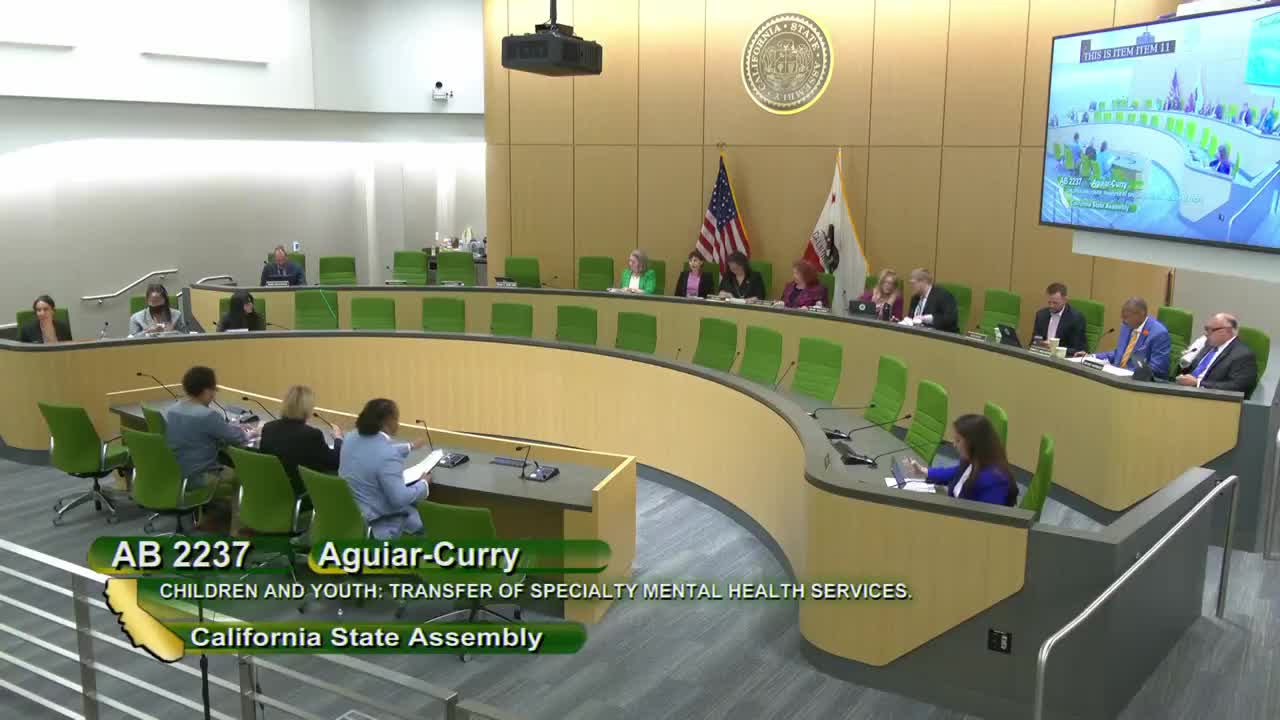 8MIN
Assembly Standing Committee on Health
Bill Author