AB 2247: Mobilehome Parks Act: enforcement: notice of violations: Manufactured Housing Opportunity and Revitalization (MORE) Program: annual fee.
- Session Year: 2023-2024
- House: Assembly
- Latest Version Date: 2024-09-22
Current Status:
Passed
(2024-09-22: Chaptered by Secretary of State - Chapter 387, Statutes of 2024.)
Introduced
In Committee
First Chamber
In Committee
Second Chamber
Enacted
Existing law, the Mobilehome Parks Act, establishes requirements for the construction, maintenance, occupancy, use, and design of mobilehome parks. Existing law requires the Department of Housing and Community Development to enforce the act, unless a city, county, or city and county has assumed responsibility for enforcement. A violation of these provisions is a misdemeanor.
Existing law requires an enforcement agency to enter and inspect mobilehome parks to ensure enforcement of the act, as specified. Existing law requires an enforcement agency in developing its mobilehome park maintenance inspection program to inspect the mobilehome parks that the enforcement agency determines have complaints that have been made to the enforcement agency regarding serious health and safety violations in the park. Existing law requires enforcement agencies, not less than 30 days before an inspection, to provide individual written notice of the inspection to the registered owners of the manufactured homes or mobilehomes, the occupants thereof, and the owner or operator of the mobilehome park, as specified. Existing law repeals these provisions on January 1, 2025.
This bill would extend that repeal date to January 1, 2030.
Existing law requires an enforcement agency to issue a notice to correct a violation to specified parties depending on the violation and provides for procedures for owners or operators to dispute and appeal a notice of violation, as specified. Existing law repeals these notice provisions on January 1, 2025.
This bill would extend that repeal date to January 1, 2030.
Existing law requires the department to develop a list of local agencies that have home rehabilitation or repair programs for which registered owners or occupants of manufactured homes and mobilehomes residing in mobilehome parks may be eligible. Existing law requires the enforcement agency to provide that list to a registered owner or occupant who receives a notice of violation and who resides in those jurisdictions that have rehabilitation or repair programs for which they may be eligible.
Existing law authorizes the department, pursuant to the Manufactured Housing Opportunity and Revitalization (MORE) Program, to make loans or grants, as applicable, to resident organizations, individual low-income residents of mobilehome parks, qualified nonprofit housing sponsors, and local public entities for specified purposes, including financing mobilehome park acquisition, conversion, rehabilitation, reconstruction, and replacement.
This bill would require the department to include, in the list provided with a notice of violation, local recipients of loans from the MORE program.
The Mobilehome Parks Act imposes prescribed fees, including, among others, a fee of $4 per lot to be used exclusively for the inspection of mobilehome parks and mobilehomes to determine compliance with the act. Existing law repeals the $4 fee per lot on January 1, 2025.
This bill would extend that repeal date to January 1, 2030.
This bill would incorporate additional changes to Section 18420 of the Health and Safety Code proposed by SB 1108 to be operative only if this bill and SB 1108 are enacted and this bill is enacted last.
Because this bill would extend the application of a crime under the Mobilehome Parks Act, it would impose a state-mandated local program.
The California Constitution requires the state to reimburse local agencies and school districts for certain costs mandated by the state. Statutory provisions establish procedures for making that reimbursement.
This bill would provide that no reimbursement is required by this act for a specified reason.
Existing law, the Mobilehome Parks Act, establishes requirements for the construction, maintenance, occupancy, use, and design of mobilehome parks. Existing law requires the Department of Housing and Community Development to enforce the act, unless a city, county, or city and county has assumed responsibility for enforcement. A violation of these provisions is a misdemeanor.
Existing law requires an enforcement agency to enter and inspect mobilehome parks to ensure enforcement of the act, as specified. Existing law requires an enforcement agency in developing its mobilehome park maintenance inspection program to inspect the mobilehome parks that the enforcement agency determines have complaints that have been made to the enforcement agency regarding serious health and safety violations in the park. Existing law requires enforcement agencies, not less than 30 days before an inspection, to provide individual written notice of the inspection to the registered owners of the manufactured homes or mobilehomes, the occupants thereof, and the owner or operator of the mobilehome park, as specified. Existing law repeals these provisions on January 1, 2025.
This bill would extend that repeal date to January 1, 2030.
Existing law requires an enforcement agency to issue a notice to correct a violation to specified parties depending on the violation and provides for procedures for owners or operators to dispute and appeal violation notices, a notice of violation, as specified. Existing law repeals these notice provisions on January 1, 2025.
This bill would extend that repeal date to January 1, 2030.
Existing law requires the department to develop a list of local agencies that have home rehabilitation or repair programs for which registered owners or occupants of manufactured homes and mobilehomes residing in mobilehome parks may be eligible. Existing law requires the enforcement agency to provide that list to a registered owner or occupant who receives a notice of violation and who resides in those jurisdictions that have rehabilitation or repair programs for which they may be eligible.
Existing law authorizes the department, pursuant to the Manufactured Housing Opportunity and Revitalization (MORE) Program, to make loans or grants, as applicable, to resident organizations, individual low-income residents of mobilehome parks, qualified nonprofit housing sponsors, and local public entities for specified purposes, including financing mobilehome park acquisition, conversion, rehabilitation, reconstruction, and replacement.
This bill would require the department to include, in the list provided with a notice of violation, the resident organizations, qualified nonprofit housing sponsors, and local public entities that have received a loan pursuant to local recipients of loans from the MORE program.
The Mobilehome Parks Act imposes prescribed fees, including, among others, a fee of $4 per lot to be used exclusively for the inspection of mobilehome parks and mobilehomes to determine compliance with the act. Existing law repeals the $4 fee per lot on January 1, 2025.
This bill would extend that repeal date to January 1, 2030.
Because this bill would extend the application of a crime under the Mobilehome Parks Act, it would impose a state-mandated local program.
The California Constitution requires the state to reimburse local agencies and school districts for certain costs mandated by the state. Statutory provisions establish procedures for making that reimbursement.
This bill would provide that no reimbursement is required by this act for a specified reason.
Existing law, the Mobilehome Parks Act, establishes requirements for the construction, maintenance, occupancy, use, and design of mobilehome parks. Existing law requires the Department of Housing and Community Development to enforce the act, unless a city, county, or city and county has assumed responsibility for enforcement. A violation of these provisions is a misdemeanor.
Existing law requires an enforcement agency to enter and inspect mobilehome parks to ensure enforcement of the act, as specified. Existing law requires an enforcement agency in developing its mobilehome park maintenance inspection program to inspect the mobilehome parks that the enforcement agency determines have complaints that have been made to the enforcement agency regarding serious health and safety violations in the park. Existing law requires enforcement agencies, not less than 30 days before an inspection, to provide individual written notice of the inspection to the registered owners of the manufactured homes or mobilehomes, the occupants thereof, and the owner or operator of the mobilehome park, as specified. Existing law repeals these provisions on January 1, 2025.
This bill would extend that repeal date to January 1, 2030.
Existing law requires an enforcement agency to issue a notice to correct a violation to specified parties depending on the violation and provides for procedures for owners or operators to dispute and appeal violation notices, as specified. Existing law repeals these notice provisions on January 1, 2025.
This bill would extend that repeal date to January 1, 2030.
Existing law requires the department to develop a list of local agencies that have home rehabilitation or repair programs for which registered owners or occupants of manufactured homes and mobilehomes residing in mobilehome parks may be eligible. Existing law requires the enforcement agency to provide that list to a registered owner or occupant who receives a notice of violation and who resides in those jurisdictions that have rehabilitation or repair programs for which they may be eligible.
Existing law authorizes the department, pursuant to the Manufactured Housing Opportunity and Revitalization (MORE) Program, to make loans or grants, as applicable, to resident organizations, individual low-income residents of mobilehome parks, qualified nonprofit housing sponsors, and local public entities for specified purposes, including financing mobilehome park acquisition, conversion, rehabilitation, reconstruction, and replacement.
This bill would require the department to include, in the list provided with a notice of violation, the resident organizations, qualified nonprofit housing sponsors, and local public entities that have received a loan pursuant to the MORE program. The bill, additionally, would require a notice of violation to include information about the MORE program, as specified.
The Mobilehome Parks Act imposes prescribed fees, including, among others, a fee of $4 per lot to be used exclusively for the inspection of mobilehome parks and mobilehomes to determine compliance with the act. Existing law repeals the $4 fee per lot on January 1, 2025.
This bill would extend that repeal date to January 1, 2030.
Because this bill would extend the application of a crime under the Mobilehome Parks Act, it would impose a state-mandated local program.
The California Constitution requires the state to reimburse local agencies and school districts for certain costs mandated by the state. Statutory provisions establish procedures for making that reimbursement.
This bill would provide that no reimbursement is required by this act for a specified reason.
Existing law, the Mobilehome Parks Act, establishes requirements for the construction, maintenance, occupancy, use, and design of mobilehome parks. Existing law requires the Department of Housing and Community Development to enforce the act, unless a city, county, or city and county has assumed responsibility for enforcement. Existing A violation of these provisions is a misdemeanor.
Existing law requires an enforcement agency to enter and inspect mobilehome parks to ensure enforcement of the act, as specified. Existing law requires an enforcement agency in developing its mobilehome park maintenance inspection program to inspect the mobilehome parks that the enforcement agency determines have complaints that have been made to the enforcement agency regarding serious health and safety violations in the park. Existing law requires enforcement agencies, not less than 30 days before an inspection, to provide individual written notice of the inspection to the registered owners of the manufactured homes or mobilehomes, the occupants thereof, and the owner or operator of the mobilehome park, as specified. Existing law repeals these provisions on January 1, 2025.
This bill would extend that repeal date to January 1, 2030.
Existing law also requires an enforcement agency to issue a notice to correct a violation to specified parties depending on the violation and provides for procedures for owners or operators to dispute and appeal violation notices, as specified. Existing law repeals these notice provisions on January 1, 2025.
This bill would extend that repeal date to January 1, 2030.
Existing law requires the department to develop a list of local agencies that have home rehabilitation or repair programs for which registered owners or occupants of manufactured homes and mobilehomes residing in mobilehome parks may be eligible. Existing law requires the enforcement agency to provide that list to a registered owner or occupant who receives a notice of violation and who resides in those jurisdictions that have rehabilitation or repair programs for which they may be eligible.
Existing law authorizes the department, pursuant to the Manufactured Housing Opportunity and Revitalization (MORE) Program, to make loans or grants, as applicable, to resident organizations, individual low-income residents of mobilehome parks, qualified nonprofit housing sponsors, and local public entities for specified purposes, including financing mobilehome park acquisition, conversion, rehabilitation, reconstruction, and replacement.
This bill would require the department to include, in the list provided with a notice of violation, the resident organizations, qualified nonprofit housing sponsors, and local public entities that have received a loan pursuant to the MORE program. The bill, additionally, would require a notice of violation to include information about the MORE program, as specified.
The Mobilehome Parks Act imposes prescribed fees, including, among others, a fee of $4 per lot to be used exclusively for the inspection of mobilehome parks and mobilehomes to determine compliance with the act. Existing law repeals the $4 fee per lot on January 1, 2025.
This bill would extend that repeal date to January 1, 2030.
Because this bill would extend the application of a crime under the Mobilehome Parks Act, it would impose a state-mandated local program.
The California Constitution requires the state to reimburse local agencies and school districts for certain costs mandated by the state. Statutory provisions establish procedures for making that reimbursement.
This bill would provide that no reimbursement is required by this act for a specified reason.
Existing law, the Mobilehome Parks Act, establishes requirements for the construction, maintenance, occupancy, use, and design of mobilehome parks. Existing law requires the Department of Housing and Community Development to enforce the act, unless a city, county, or city and county has assumed responsibility for enforcement. Existing law also requires an enforcement agency to issue a notice to correct a violation to specified parties depending on the violation and provides for procedures for owners or operators to dispute and appeal violation notices, as specified. Existing law repeals these notice provisions on January 1, 2025.
This bill would extend that repeal date to January 1, 2030.
Existing law requires the department to develop a list of local agencies that have home rehabilitation or repair programs for which registered owners or occupants of manufactured homes and mobilehomes residing in mobilehome parks may be eligible. Existing law requires the enforcement agency to provide that list to a registered owner or occupant who receives a notice of violation and who resides in those jurisdictions that have rehabilitation or repair programs for which they may be eligible.
Existing law authorizes the department, pursuant to the Manufactured Housing Opportunity and Revitalization (MORE) Program, to make loans or grants, as applicable, to resident organizations, individual low-income residents of mobilehome parks, qualified nonprofit housing sponsors, and local public entities for specified purposes, including financing mobilehome park acquisition, conversion, rehabilitation, reconstruction, and replacement.
This bill would require the department to include, in the list provided with a notice of violation, the resident organizations, qualified nonprofit housing sponsors, and local public entities that have received a loan pursuant to the MORE program. The bill, additionally, would require a notice of violation to include information about the MORE program, as specified.
Existing law, the Mobilehome Parks Act, makes it unlawful to use, or permit to be used for occupancy, a manufactured home, mobilehome, or, if located in a mobilehome park, a recreational vehicle that is supplied with fuel, gas, water, electricity, or sewage connections unless the connection and installations conform to regulations of the Department of Housing and Community Development. This bill would make a nonsubstantive change to these provisions.Existing law, the Mobilehome Parks Act, makes it unlawful to use, or permit to be used for occupancy, a manufactured home, mobilehome, or, if located in a mobilehome park, a recreational vehicle that is supplied with fuel, gas, water, electricity, or sewage connections unless the connection and installations conform to regulations of the Department of Housing and Community Development.
This bill would make a nonsubstantive change to these provisions.
(a)In accordance with subdivision (b), the enforcement agency shall enter and inspect mobilehome parks, as required under this part, with a goal of inspecting at least 5 percent of the parks per year, to ensure enforcement of this part and the regulations adopted pursuant to this part. The enforcement agencys inspection shall include an inspection of the exterior portions of individual manufactured homes and mobilehomes in each park inspected. Any notices of violation of this part shall be issued pursuant to Chapter 3.5 (commencing with Section 18420).
(b)In developing its mobilehome park maintenance inspection program, the enforcement agency shall inspect the mobilehome parks that the enforcement agency determines have complaints that have been made to the enforcement agency regarding serious health and safety violations in the park. A single complaint of a serious health and safety violation shall not automatically trigger an inspection of the entire park unless upon investigation of that single complaint the enforcement agency determines that there is a violation and that an inspection of the entire park is necessary.
(c)This part does not allow the enforcement agency to issue a notice for a violation of existing laws or regulations that were not violations of the laws or regulations at the time the mobilehome park received its original permit to operate, or the standards governing any subsequent permit to construct, or at the time the manufactured home or mobilehome received its original installation permit, unless the enforcement agency determines that a condition of the park, manufactured home, or mobilehome endangers the life, limb, health, or safety of the public or occupants thereof.
(d)Not less than 30 days prior to the inspection of a mobilehome park under this section, the enforcement agency shall provide individual written notice of the inspection to the registered owners of the manufactured homes or mobilehomes, with a copy of the notice to the occupants thereof, if different than the registered owners, and to the owner or operator of the mobilehome park and the responsible person, as defined in Section 18603.
(e)At the sole discretion of the enforcement agencys inspector, a representative of either the park operator or the mobilehome owners may accompany the inspector during the inspection if that request is made to the enforcement agency or the inspector requests a representative to accompany them. If either party requests permission to accompany the inspector or is requested by the inspector to accompany them, the other party shall also be given the opportunity, with reasonable notice, to accompany the inspector. Only one representative of the park owner and one representative of the mobilehome owners in the park may accompany the inspector at any one time during the inspection. If more than one representative of the mobilehome owners in the park requests permission to accompany the inspector, the enforcement agency may adopt procedures for choosing that representative.
(f)The enforcement agency shall coordinate a preinspection orientation for mobilehome owners and mobilehome park operators with the use of an audiovisual presentation furnished by the department to affected local enforcement agencies. Enforcement agencies shall furnish the audiovisual presentation to park operators and mobilehome owner representatives in each park subject to inspection not less than 30 days prior to the inspection. Additionally, it is the Legislatures intent that the department shall, where practicable, conduct live presentations, forums, and outreach programs throughout the state to orient mobilehome owners and park operators on the mobilehome park maintenance inspection program and their rights and obligations under the program.
(g)This section shall remain in effect only until January 1, 2030, and as of that date is repealed.
SEC. 2.Section 18420 of the Health and Safety Code is amended to read:18420.(a)(1)If, upon inspection, the enforcement agency determines that a mobilehome park is in violation of any provision of this part, or any rule or regulation adopted pursuant thereto, the enforcement agency shall promptly, but not later than 10 days, excluding Saturday, Sunday, and holidays, after the enforcement agency completes the inspection and determines that the alleged violation exists, issue a notice to correct the violation to the owner or operator of the mobilehome park and to the responsible person, as defined in Section 18603.
(2)In the event of a violation that constitutes an imminent threat to health and safety, the notice of violation shall be issued immediately and served on the owner or operator of the mobilehome park and to the responsible person, as defined in Section 18603.
(3)The owner or operator of the mobilehome park shall be responsible for the correction of any violations for which a notice of violation has been given pursuant to this subdivision.
(b)(1)If, upon inspection, the enforcement agency determines that a manufactured home, mobilehome, an accessory building or structure, or lot is in violation of any provision of Chapter 4 (commencing with Section 18500), Chapter 5 (commencing with Section 18550), Chapter 6 (commencing with Section 18690), or any rule or regulation adopted pursuant thereto, the enforcement agency shall promptly, but not later than 10 days, excluding Saturday, Sunday, and holidays, after the enforcement agency completes the inspection and determines that the alleged violation exists, issue a notice to correct the violation to the registered owner of the manufactured home or mobilehome, with a copy to the occupant thereof, if different from the registered owner.
(2)In the event a violation is discovered that constitutes an imminent hazard representing an immediate risk to life, health, and safety and requiring immediate correction, the notice of violation shall be issued immediately and served upon the occupant, with a copy mailed to the registered owner of the manufactured home or mobilehome, if different from the occupant, to the owner or operator of the mobilehome park, and to the responsible person, as defined in Section 18603.
(3)The registered owner of the manufactured home or mobilehome shall be responsible for the correction of any violations for which a notice of violation has been given pursuant to this subdivision.
(4)The enforcement agency may issue a notice of violation in accordance with this chapter to the owner of a recreational vehicle, or of factory-built housing, which occupies a lot within a mobilehome park.
(c)(1)Service of the notice of violation shall be effected either personally or by first-class mail. Each notice of violation shall be in writing and shall describe with particularity the nature of the violation in as clear language as the technicality of the violation will allow the average layperson to understand what is being cited, including a reference to the statutory provisions or regulation alleged to have been violated, as well as any penalty provided by law for failure to make timely correction.
(2)The department shall develop a list of local agencies that have home rehabilitation or repair programs for which registered owners or occupants of manufactured homes and mobilehomes residing in mobilehome parks may be eligible, including local recipients of loans from the Manufactured Housing Opportunity and Revitalization (MORE) Program (Chapter 11 (commencing with Section 50780) of Part 2 of Division 31). The list shall be provided to registered owners or occupants who receive a notice of violation and who reside in those jurisdictions that have rehabilitation or repair programs for which they may be eligible.
(3)For violations other than imminent threats to health and safety as provided in paragraph (2) of subdivision (a) and paragraph (2) of subdivision (b), the notice of violation shall allow 60 days from the postmarked date of the notice or date of personal delivery for the elimination of the condition constituting the alleged violation.
(4)If, after the reinspection of a violation described in paragraph (3), the enforcement agency determines that there is a valid reason why a violation has not been corrected, including, but not limited to, weather conditions, illness, availability of repair persons, or availability of financial resources, the enforcement agency may extend the time for correction, at its discretion, for 30 days or an additional reasonable period of time after the 60-day period.
(5)Upon a reinspection after the 60-day period of a violation described in paragraph (3) of this subdivision, if a second notice to correct a violation that is the responsibility of the registered owner of the manufactured home or mobilehome pursuant to paragraph (1) of subdivision (b) is issued to the registered owner of a manufactured home or mobilehome, with a copy to the occupant thereof, if different from the registered owner, a copy of the notice shall also be provided to the owner or operator of the mobilehome park, and to the responsible person, as defined in Section 18603. Upon a reinspection after the 60-day period of a violation described in paragraph (3) of this subdivision, if a second notice to correct a mobilehome park violation pursuant to paragraph (1) of subdivision (a) is issued to the owner or operator of the mobilehome park and to the responsible person, as defined in Section 18603, the enforcement agency shall post a copy of the violation in a conspicuous place in the mobilehome park common area, and the posted notice shall only be removed by the enforcement agency when the violation is corrected.
(6)All violations described in paragraph (2) of subdivision (a) and paragraph (2) of subdivision (b) shall be corrected within a reasonable time as determined by the enforcement agency. Notices of those violations shall state the time determined by the enforcement agency within which corrections must be made.
(d)Notwithstanding any other provision of law, the enforcement agency may, at its sole discretion, determine not to issue a notice of violation pursuant to this chapter if the condition which violates this part or the regulations adopted pursuant thereto does not constitute an imminent hazard representing an immediate risk to life, health, and safety and requiring immediate correction. If the enforcement agency determines, pursuant to this subdivision, not to issue a notice of violation, the enforcement agency shall include in its inspection report a description of the condition which violates this part and its determination not to issue a notice of violation.
SEC. 2.1.Section 18420 of the Health and Safety Code is amended to read:18420.(a)(1)If, upon inspection, the enforcement agency determines that a mobilehome park is in violation of any provision of this part, or any rule or regulation adopted pursuant thereto, the enforcement agency shall promptly, but not later than 10 days, excluding Saturday, Sunday, and holidays, after the enforcement agency completes the inspection and determines that the alleged violation exists, issue a notice to correct the violation to the owner or operator of the mobilehome park and to the responsible person, as defined in Section 18603.
(2)In the event of a violation that constitutes an imminent threat to health and safety, the notice of violation shall be issued immediately and served on the owner or operator of the mobilehome park and to the responsible person, as defined in Section 18603.
(3)The owner or operator of the mobilehome park shall be responsible for the correction of any violations for which a notice of violation has been given pursuant to this subdivision.
(b)(1)If, upon inspection, the enforcement agency determines that a manufactured home, mobilehome, an accessory building or structure, or lot is in violation of any provision of Chapter 4 (commencing with Section 18500), Chapter 5 (commencing with Section 18550), Chapter 6 (commencing with Section 18690), or any rule or regulation adopted pursuant thereto, the enforcement agency shall promptly, but not later than 10 days, excluding Saturday, Sunday, and holidays, after the enforcement agency completes the inspection and determines that the alleged violation exists, issue a notice to correct the violation to the registered owner of the manufactured home or mobilehome, with a copy to the occupant thereof, if different from the registered owner.
(2)In the event a violation is discovered that constitutes an imminent hazard representing an immediate risk to life, health, and safety and requiring immediate correction, the notice of violation shall be issued immediately and served upon the occupant, with a copy mailed to the registered owner of the manufactured home or mobilehome, if different from the occupant, to the owner or operator of the mobilehome park, and to the responsible person, as defined in Section 18603.
(3)The registered owner of the manufactured home or mobilehome shall be responsible for the correction of any violations for which a notice of violation has been given pursuant to this subdivision.
(4)The enforcement agency may issue a notice of violation in accordance with this chapter to the owner of a recreational vehicle, or of factory-built housing, which occupies a lot within a mobilehome park.
(c)(1)Service of the notice of violation shall be effected either personally or by first-class mail. Each notice of violation shall be in writing and shall describe with particularity the nature of the violation in as clear language as the technicality of the violation will allow the average layperson to understand what is being cited, including a reference to the statutory provisions or regulation alleged to have been violated, as well as any penalty provided by law for failure to make timely correction.
(2)The department shall develop a list of local agencies that have home rehabilitation or repair programs for which registered owners or occupants of manufactured homes and mobilehomes residing in mobilehome parks may be eligible, including local recipients of loans from the Manufactured Housing Opportunity and Revitalization (MORE) Program (Chapter 11 (commencing with Section 50780) of Part 2 of Division 31). The list shall be provided to registered owners or occupants who receive a notice of violation and who reside in those jurisdictions that have rehabilitation or repair programs for which they may be eligible.
(3)For violations other than imminent threats to health and safety as provided in paragraph (2) of subdivision (a) and paragraph (2) of subdivision (b), the notice of violation shall allow 60 days from the postmarked date of the notice or date of personal delivery for the elimination of the condition constituting the alleged violation.
(4)If, after the reinspection of a violation described in paragraph (3), the enforcement agency determines that there is a valid reason why a violation has not been corrected, including, but not limited to, weather conditions, illness, availability of repair persons, or availability of financial resources, the enforcement agency may extend the time for correction, at its discretion, for 30 days or an additional reasonable period of time after the 60-day period.
(5)Upon a reinspection after the 60-day period of a violation described in paragraph (3) of this subdivision, if a second notice to correct a violation that is the responsibility of the registered owner of the manufactured home or mobilehome pursuant to paragraph (1) of subdivision (b) is issued to the registered owner of a manufactured home or mobilehome, with a copy to the occupant thereof, if different from the registered owner, a copy of the notice shall also be provided to the owner or operator of the mobilehome park, and to the responsible person, as defined in Section 18603. Upon a reinspection after the 60-day period of a violation described in paragraph (3) of this subdivision, if a second notice to correct a mobilehome park violation pursuant to paragraph (1) of subdivision (a) is issued to the owner or operator of the mobilehome park and to the responsible person, as defined in Section 18603, the enforcement agency shall post a copy of the violation in a conspicuous place in the mobilehome park common area, and the posted notice shall only be removed by the enforcement agency when the violation is corrected.
(6)All violations described in paragraph (2) of subdivision (a) and paragraph (2) of subdivision (b) shall be corrected within a reasonable time as determined by the enforcement agency. Notices of those violations shall state the time determined by the enforcement agency within which corrections must be made.
(d)Notwithstanding any other provision of law, the enforcement agency may, at its sole discretion, determine not to issue a notice of violation pursuant to this chapter if the condition which violates this part or the regulations adopted pursuant thereto does not constitute an imminent hazard representing an immediate risk to life, health, and safety and requiring immediate correction. If the enforcement agency determines, pursuant to this subdivision, not to issue a notice of violation, the enforcement agency shall include in its inspection report a description of the condition which violates this part and its determination not to issue a notice of violation.
(e)This section shall remain in effect only until January 1, 2027, and as of that date is repealed.
SEC. 2.2.Section 18420 is added to the Health and Safety Code, to read:18420.(a)(1) If, upon inspection, the enforcement agency determines that a mobilehome park is in violation of any provision of this part, or any rule or regulation adopted pursuant thereto, the enforcement agency shall promptly, but not later than 10 days, excluding Saturday, Sunday, and holidays, after the enforcement agency completes the inspection and determines that the alleged violation exists, issue a notice to correct the violation to the owner or operator of the mobilehome park and to the responsible person, as defined in Section 18603.
(2)In the event of a violation that constitutes an imminent threat to health and safety, the notice of violation shall be issued immediately and served on the owner or operator of the mobilehome park and to the responsible person, as defined in Section 18603.
(3)The owner or operator of the mobilehome park shall be responsible for the correction of any violations for which a notice of violation has been given pursuant to this subdivision.
(b)(1) If, upon inspection, the enforcement agency determines that a manufactured home, mobilehome, an accessory building or structure, or lot is in violation of any provision of Chapter 4 (commencing with Section 18500), Chapter 5 (commencing with Section 18550), Chapter 6 (commencing with Section 18690), or any rule or regulation adopted pursuant thereto, the enforcement agency shall promptly, but not later than 10 days, excluding Saturday, Sunday, and holidays, after the enforcement agency completes the inspection and determines that the alleged violation exists, issue a notice to correct the violation to the registered owner of the manufactured home or mobilehome, with a copy to the occupant thereof, if different from the registered owner.
(2)In the event a violation is discovered that constitutes an imminent hazard representing an immediate risk to life, health, and safety and requiring immediate correction, the notice of violation shall be issued immediately and served upon the occupant, with a copy mailed to the registered owner of the manufactured home or mobilehome, if different from the occupant, to the owner or operator of the mobilehome park, and to the responsible person, as defined in Section 18603.
(3)(A) The registered owner of the manufactured home or mobilehome shall be responsible for the correction of any violations for which a notice of violation has been given pursuant to this subdivision.
(B)The enforcement agency shall be responsible for exhausting all administrative and legal recourse against a resident who fails to correct violations before looking to the mobilehome park owner or operator for corrective action. Only then shall the enforcement agency request action by the park owner or operator to abate the cited violations.
(4)The enforcement agency may issue a notice of violation in accordance with this chapter to the owner of a recreational vehicle, or of factory-built housing, which occupies a lot within a mobilehome park.
(c)(1) Service of the notice of violation shall be effected either personally or by first-class mail. Each notice of violation shall be in writing and shall describe with particularity the nature of the violation in as clear language as the technicality of the violation will allow the average layperson to understand what is being cited, including a reference to the statutory provisions or regulation alleged to have been violated, as well as any penalty provided by law for failure to make timely correction.
(2)The enforcement agency shall develop a list of local agencies that have home rehabilitation or repair programs for which registered owners or occupants of manufactured homes and mobilehomes residing in mobilehome parks may be eligible, including local recipients of loans from the Manufactured Housing Opportunity and Revitalization (MORE) Program (Chapter 11 (commencing with Section 50780) of Part 2 of Division 31). The list shall be provided to registered owners or occupants who receive a notice of violation and who reside in those jurisdictions that have rehabilitation or repair programs for which they may be eligible.
(3)For violations other than imminent threats to health and safety as provided in paragraph (2) of subdivision (a) and paragraph (2) of subdivision (b), the notice of violation shall allow 90 days from the postmarked date of the notice or date of personal delivery for the elimination of the condition constituting the alleged violation.
(4)If, after the reinspection of a violation described in paragraph (3), the enforcement agency determines that there is a valid reason why a violation has not been corrected, including, but not limited to, weather conditions, illness, availability of repair persons, or availability of financial resources, the enforcement agency may extend the time for correction, at its discretion, for 30 days or an additional reasonable period of time after the 90-day period.
(5)Upon a reinspection after the 90-day period of a violation described in paragraph (3) of this subdivision, if a second notice to correct a violation that is the responsibility of the registered owner of the manufactured home or mobilehome pursuant to paragraph (1) of subdivision (b) is issued to the registered owner of a manufactured home or mobilehome, with a copy to the occupant thereof, if different from the registered owner, a copy of the notice shall also be provided to the owner or operator of the mobilehome park, and to the responsible person, as defined in Section 18603. Upon a reinspection after the 90-day period of a violation described in paragraph (3) of this subdivision, if a second notice to correct a mobilehome park violation pursuant to paragraph (1) of subdivision (a) is issued to the owner or operator of the mobilehome park and to the responsible person, as defined in Section 18603, the enforcement agency shall post a copy of the violation in a conspicuous place in the mobilehome park common area, and the posted notice shall only be removed by the enforcement agency when the violation is corrected.
(6)All violations described in paragraph (2) of subdivision (a) and paragraph (2) of subdivision (b) shall be corrected within a reasonable time as determined by the enforcement agency. Notices of those violations shall state the time determined by the enforcement agency within which corrections must be made.
(d)Notwithstanding any other law, the enforcement agency may, at its sole discretion, determine not to issue a notice of violation pursuant to this chapter if the condition that violates this part or the regulations adopted pursuant thereto does not constitute an imminent hazard representing an immediate risk to life, health, and safety and requiring immediate correction. If the enforcement agency determines, pursuant to this subdivision, not to issue a notice of violation, the enforcement agency shall include in its inspection report a description of the condition that violates this part and its determination not to issue a notice of violation.
(e)This section shall become operative on January 1, 2027.
(f)This section shall remain in effect only until January 1, 2030, and as of that date is repealed.
SEC. 3.Section 18424 of the Health and Safety Code is amended to read:18424.This chapter shall remain in effect only until January 1, 2030, and as of that date is repealed.
SEC. 4.Section 18502 of the Health and Safety Code, as amended by Section 3 of Chapter 737 of the Statutes of 2023, is amended to read:18502.Fees as applicable shall be submitted for permits, as follows:
(a)Fees for a permit to conduct any construction subject to this part as determined by the schedule of fees adopted by the department.
(b)Plan checking fees equal to one-half of the construction, plumbing, mechanical, and electrical permit fees, except that the minimum fee shall be ten dollars ($10).
(c)(1)An annual operating permit fee of one hundred forty dollars ($140) and an additional seven dollars ($7) per lot.
(2)(A)An additional annual fee of four dollars ($4) per lot shall be paid to the department or the local enforcement agency, as appropriate, at the time of payment of the annual operating fee. All revenues derived from this fee shall be used exclusively for the inspection of mobilehome parks and mobilehomes to determine compliance with the Mobilehome Parks Act (Part 2.1 (commencing with Section 18200)) and any regulations adopted pursuant to the act.
(B)The Legislature hereby finds and declares that the health and safety of mobilehome park occupants are matters of public interest and concern and that the fee paid pursuant to subparagraph (A) shall be used exclusively for the inspection of mobilehome parks and mobilehomes to ensure that the living conditions of mobilehome park occupants meet the health and safety standards of this part and the regulations adopted pursuant thereto. Therefore, notwithstanding any other law or local ordinance, rule, regulation, or initiative measure to the contrary, the holder of the permit to operate the mobilehome park shall be entitled to directly charge one-half of the per-lot additional annual fee specified herein to each homeowner, as defined in Section 798.9 of the Civil Code. In that event, the holder of the permit to operate the mobilehome park shall be entitled to directly charge each homeowner for one-half of the per-lot additional annual fee at the next billing for the rent and other charges immediately following the payment of the additional fee to the department or local enforcement agency.
(3)The additional annual fee authorized by subdivision (b) of Section 18804 shall be paid to the department at the time of payment of the annual operating fee to the department or local enforcement agency, as appropriate.
(d)Change in name fee or transfer of ownership or possession fee of ten dollars ($10).
(e)Duplicate permit fee or amended permit fee of ten dollars ($10).
(f)This section shall remain in effect only until January 1, 2030, and as of that date is repealed.
SEC. 5.Section 18502 of the Health and Safety Code, as amended by Section 4 of Chapter 737 of the Statutes of 2023, is amended to read:18502.Fees as applicable shall be submitted for permits, as follows:
(a)Fees for a permit to conduct any construction subject to this part as determined by the schedule of fees adopted by the department.
(b)Plan checking fees equal to one-half of the construction, plumbing, mechanical, and electrical permit fees, except that the minimum fee shall be ten dollars ($10).
(c)An annual operating permit fee of one hundred forty dollars ($140) and an additional seven dollars ($7) per lot.
(d)Change in name fee or transfer of ownership or possession fee of ten dollars ($10).
(e)Duplicate permit fee or amended permit fee of ten dollars ($10).
(f)This section shall become operative on January 1, 2030.
SEC. 6.Sections 2.1 and 2.2 of this bill amend, repeal, and add Section 18420 to the Health and Safety Code as proposed by both this bill and SB 1108. Those section of this bill shall only become operative if (1) both bills are enacted and become effective on or before January 1, 2025, (2) each bill amends Section 18420 of the Health and Safety Code,(3) SB 1108 adds Section 18420 to the Health and Safety Code, and (4) this bill is enacted after SB 1108, in which case Section 2 of this bill shall not become operative.
SEC. 7.No reimbursement is required by this act pursuant to Section 6 of Article XIIIB of the California Constitution because the only costs that may be incurred by a local agency or school district will be incurred because this act creates a new crime or infraction, eliminates a crime or infraction, or changes the penalty for a crime or infraction, within the meaning of Section 17556 of the Government Code, or changes the definition of a crime within the meaning of Section 6 of Article XIIIB of the California Constitution.
(a)In accordance with subdivision (b), the enforcement agency shall enter and inspect mobilehome parks, as required under this part, with a goal of inspecting at least 5 percent of the parks per year, to ensure enforcement of this part and the regulations adopted pursuant to this part. The enforcement agencys inspection shall include an inspection of the exterior portions of individual manufactured homes and mobilehomes in each park inspected. Any notices of violation of this part shall be issued pursuant to Chapter 3.5 (commencing with Section 18420).
(b)In developing its mobilehome park maintenance inspection program, the enforcement agency shall inspect the mobilehome parks that the enforcement agency determines have complaints that have been made to the enforcement agency regarding serious health and safety violations in the park. A single complaint of a serious health and safety violation shall not automatically trigger an inspection of the entire park unless upon investigation of that single complaint the enforcement agency determines that there is a violation and that an inspection of the entire park is necessary.
(c)This part does not allow the enforcement agency to issue a notice for a violation of existing laws or regulations that were not violations of the laws or regulations at the time the mobilehome park received its original permit to operate, or the standards governing any subsequent permit to construct, or at the time the manufactured home or mobilehome received its original installation permit, unless the enforcement agency determines that a condition of the park, manufactured home, or mobilehome endangers the life, limb, health, or safety of the public or occupants thereof.
(d)Not less than 30 days prior to the inspection of a mobilehome park under this section, the enforcement agency shall provide individual written notice of the inspection to the registered owners of the manufactured homes or mobilehomes, with a copy of the notice to the occupants thereof, if different than the registered owners, and to the owner or operator of the mobilehome park and the responsible person, as defined in Section 18603.
(e)At the sole discretion of the enforcement agencys inspector, a representative of either the park operator or the mobilehome owners may accompany the inspector during the inspection if that request is made to the enforcement agency or the inspector requests a representative to accompany them. If either party requests permission to accompany the inspector or is requested by the inspector to accompany them, the other party shall also be given the opportunity, with reasonable notice, to accompany the inspector. Only one representative of the park owner and one representative of the mobilehome owners in the park may accompany the inspector at any one time during the inspection. If more than one representative of the mobilehome owners in the park requests permission to accompany the inspector, the enforcement agency may adopt procedures for choosing that representative.
(f)The enforcement agency shall coordinate a preinspection orientation for mobilehome owners and mobilehome park operators with the use of an audiovisual presentation furnished by the department to affected local enforcement agencies. Enforcement agencies shall furnish the audiovisual presentation to park operators and mobilehome owner representatives in each park subject to inspection not less than 30 days prior to the inspection. Additionally, it is the Legislatures intent that the department shall, where practicable, conduct live presentations, forums, and outreach programs throughout the state to orient mobilehome owners and park operators on the mobilehome park maintenance inspection program and their rights and obligations under the program.
(g)This section shall remain in effect only until January 1, 2030, and as of that date is repealed.
SEC. 2.Section 18420 of the Health and Safety Code is amended to read:18420.(a)(1)If, upon inspection, the enforcement agency determines that a mobilehome park is in violation of any provision of this part, or any rule or regulation adopted pursuant thereto, the enforcement agency shall promptly, but not later than 10 days, excluding Saturday, Sunday, and holidays, after the enforcement agency completes the inspection and determines that the alleged violation exists, issue a notice to correct the violation to the owner or operator of the mobilehome park and to the responsible person, as defined in Section 18603.
(2)In the event of a violation that constitutes an imminent threat to health and safety, the notice of violation shall be issued immediately and served on the owner or operator of the mobilehome park and to the responsible person, as defined in Section 18603.
(3)The owner or operator of the mobilehome park shall be responsible for the correction of any violations for which a notice of violation has been given pursuant to this subdivision.
(b)(1)If, upon inspection, the enforcement agency determines that a manufactured home, mobilehome, an accessory building or structure, or lot is in violation of any provision of Chapter 4 (commencing with Section 18500), Chapter 5 (commencing with Section 18550), Chapter 6 (commencing with Section 18690), or any rule or regulation adopted pursuant thereto, the enforcement agency shall promptly, but not later than 10 days, excluding Saturday, Sunday, and holidays, after the enforcement agency completes the inspection and determines that the alleged violation exists, issue a notice to correct the violation to the registered owner of the manufactured home or mobilehome, with a copy to the occupant thereof, if different from the registered owner.
(2)In the event a violation is discovered that constitutes an imminent hazard representing an immediate risk to life, health, and safety and requiring immediate correction, the notice of violation shall be issued immediately and served upon the occupant, with a copy mailed to the registered owner of the manufactured home or mobilehome, if different from the occupant, to the owner or operator of the mobilehome park, and to the responsible person, as defined in Section 18603.
(3)The registered owner of the manufactured home or mobilehome shall be responsible for the correction of any violations for which a notice of violation has been given pursuant to this subdivision.
(4)The enforcement agency may issue a notice of violation in accordance with this chapter to the owner of a recreational vehicle, or of factory-built housing, which occupies a lot within a mobilehome park.
(c)(1)Service of the notice of violation shall be effected either personally or by first-class mail. Each notice of violation shall be in writing and shall describe with particularity the nature of the violation in as clear language as the technicality of the violation will allow the average layperson to understand what is being cited, including a reference to the statutory provisions or regulation alleged to have been violated, as well as any penalty provided by law for failure to make timely correction.
(2)The department shall develop a list of local agencies that have home rehabilitation or repair programs for which registered owners or occupants of manufactured homes and mobilehomes residing in mobilehome parks may be eligible, including local recipients of loans from the Manufactured Housing Opportunity and Revitalization (MORE) Program (Chapter 11 (commencing with Section 50780) of Part 2 of Division 31). The list shall be provided to registered owners or occupants who receive a notice of violation and who reside in those jurisdictions that have rehabilitation or repair programs for which they may be eligible.
(3)For violations other than imminent threats to health and safety as provided in paragraph (2) of subdivision (a) and paragraph (2) of subdivision (b), the notice of violation shall allow 60 days from the postmarked date of the notice or date of personal delivery for the elimination of the condition constituting the alleged violation.
(4)If, after the reinspection of a violation described in paragraph (3), the enforcement agency determines that there is a valid reason why a violation has not been corrected, including, but not limited to, weather conditions, illness, availability of repair persons, or availability of financial resources, the enforcement agency may extend the time for correction, at its discretion, for 30 days or an additional reasonable period of time after the 60-day period.
(5)Upon a reinspection after the 60-day period of a violation described in paragraph (3) of this subdivision, if a second notice to correct a violation that is the responsibility of the registered owner of the manufactured home or mobilehome pursuant to paragraph (1) of subdivision (b) is issued to the registered owner of a manufactured home or mobilehome, with a copy to the occupant thereof, if different from the registered owner, a copy of the notice shall also be provided to the owner or operator of the mobilehome park, and to the responsible person, as defined in Section 18603. Upon a reinspection after the 60-day period of a violation described in paragraph (3) of this subdivision, if a second notice to correct a mobilehome park violation pursuant to paragraph (1) of subdivision (a) is issued to the owner or operator of the mobilehome park and to the responsible person, as defined in Section 18603, the enforcement agency shall post a copy of the violation in a conspicuous place in the mobilehome park common area, and the posted notice shall only be removed by the enforcement agency when the violation is corrected.
(6)All violations described in paragraph (2) of subdivision (a) and paragraph (2) of subdivision (b) shall be corrected within a reasonable time as determined by the enforcement agency. Notices of those violations shall state the time determined by the enforcement agency within which corrections must be made.
(d)Notwithstanding any other provision of law, the enforcement agency may, at its sole discretion, determine not to issue a notice of violation pursuant to this chapter if the condition which violates this part or the regulations adopted pursuant thereto does not constitute an imminent hazard representing an immediate risk to life, health, and safety and requiring immediate correction. If the enforcement agency determines, pursuant to this subdivision, not to issue a notice of violation, the enforcement agency shall include in its inspection report a description of the condition which violates this part and its determination not to issue a notice of violation.
SEC. 2.1.Section 18420 of the Health and Safety Code is amended to read:18420.(a)(1)If, upon inspection, the enforcement agency determines that a mobilehome park is in violation of any provision of this part, or any rule or regulation adopted pursuant thereto, the enforcement agency shall promptly, but not later than 10 days, excluding Saturday, Sunday, and holidays, after the enforcement agency completes the inspection and determines that the alleged violation exists, issue a notice to correct the violation to the owner or operator of the mobilehome park and to the responsible person, as defined in Section 18603.
(2)In the event of a violation that constitutes an imminent threat to health and safety, the notice of violation shall be issued immediately and served on the owner or operator of the mobilehome park and to the responsible person, as defined in Section 18603.
(3)The owner or operator of the mobilehome park shall be responsible for the correction of any violations for which a notice of violation has been given pursuant to this subdivision.
(b)(1)If, upon inspection, the enforcement agency determines that a manufactured home, mobilehome, an accessory building or structure, or lot is in violation of any provision of Chapter 4 (commencing with Section 18500), Chapter 5 (commencing with Section 18601), 18550), Chapter 6 (commencing with Section 18690), or any rule or regulation adopted pursuant thereto, the enforcement agency shall promptly, but not later than 10 days, excluding Saturday, Sunday, and holidays, after the enforcement agency completes the inspection and determines that the alleged violation exists, issue a notice to correct the violation to the registered owner of the manufactured home or mobilehome, with a copy to the occupant thereof, if different from the registered owner.
(2)In the event a violation is discovered that constitutes an imminent hazard representing an immediate risk to life, health, and safety and requiring immediate correction, the notice of violation shall be issued immediately and served upon the occupant, with a copy mailed to the registered owner of the manufactured home or mobilehome, if different from the occupant, to the owner or operator of the mobilehome park, and to the responsible person, as defined in Section 18603.
(3)The registered owner of the manufactured home or mobilehome shall be responsible for the correction of any violations for which a notice of violation has been given pursuant to this subdivision.
(4)The enforcement agency may issue a notice of violation in accordance with this chapter to the owner of a recreational vehicle, or of factory-built housing, which occupies a lot within a mobilehome park.
(c)(1)Service of the notice of violation shall be effected either personally or by first-class mail. Each notice of violation shall be in writing and shall describe with particularity the nature of the violation in as clear language as the technicality of the violation will allow the average layperson to understand what is being cited, including a reference to the statutory provisions or regulation alleged to have been violated, as well as any penalty provided by law for failure to make timely correction.
(2)The department shall develop a list of local agencies that have home rehabilitation or repair programs for which registered owners or occupants of manufactured homes and mobilehomes residing in mobilehome parks may be eligible. eligible, including local recipients of loans from the Manufactured Housing Opportunity and Revitalization (MORE) Program (Chapter 11 (commencing with Section 50780) of Part 2 of Division 31). The list shall be provided to registered owners or occupants who receive notices a notice of violation and who reside in those jurisdictions that have rehabilitation or repair programs for which they may be eligible.
(3)For violations other than imminent threats to health and safety as provided in paragraph (2) of subdivision (a) and paragraph (2) of subdivision (b), the notice of violation shall allow 60 days from the postmarked date of the notice or date of personal delivery for the elimination of the condition constituting the alleged violation.
(4)If If, after the reinspection of a violation described in paragraph (3) of this subdivision, (3), the enforcement agency determines that there is a valid reason why a violation has not been corrected, including, but not limited to, weather conditions, illness, availability of repair persons, or availability of financial resources, the enforcement agency may extend the time for correction, at its discretion, for 30 days or an additional reasonable period of time after the 60-day period.
(5)Upon a reinspection after the 60-day period of a violation described in paragraph (3) of this subdivision, if a second notice to correct a violation that is the responsibility of the registered owner of the manufactured home or mobilehome pursuant to paragraph (1) of subdivision (b) is issued to the registered owner of a manufactured home or mobilehome, with a copy to the occupant thereof, if different from the registered owner, a copy of the notice shall also be provided to the owner or operator of the mobilehome park, and to the responsible person, as defined in Section 18603. Upon a reinspection after the 60-day period of a violation described in paragraph (3) of this subdivision, if a second notice to correct a mobilehome park violation pursuant to paragraph (1) of subdivision (a) is issued to the owner or operator of the mobilehome park and to the responsible person, as defined in Section 18603, the enforcement agency shall post a copy of the violation in a conspicuous place in the mobilehome park common area, and the posted notice shall only be removed by the enforcement agency when the violation is corrected.
(6)All violations described in paragraph (2) of subdivision (a) and paragraph (2) of subdivision (b) shall be corrected within a reasonable time as determined by the enforcement agency. Notices of those violations shall state the time determined by the enforcement agency within which corrections must be made.
(d)Notwithstanding any other provision of law, the enforcement agency may, at its sole discretion, determine not to issue a notice of violation pursuant to this chapter if the condition which violates this part or the regulations adopted pursuant thereto does not constitute an imminent hazard representing an immediate risk to life, health, and safety and requiring immediate correction. If the enforcement agency determines, pursuant to this subdivision, not to issue a notice of violation, the enforcement agency shall include in its inspection report a description of the condition which violates this part and its determination not to issue a notice of violation.
(e)This section shall remain in effect only until January 1, 2027, and as of that date is repealed.
SEC. 2.2.Section 18420 is added to the Health and Safety Code, to read:18420.(a)(1) If, upon inspection, the enforcement agency determines that a mobilehome park is in violation of any provision of this part, or any rule or regulation adopted pursuant thereto, the enforcement agency shall promptly, but not later than 10 days, excluding Saturday, Sunday, and holidays, after the enforcement agency completes the inspection and determines that the alleged violation exists, issue a notice to correct the violation to the owner or operator of the mobilehome park and to the responsible person, as defined in Section 18603.
(2)In the event of a violation that constitutes an imminent threat to health and safety, the notice of violation shall be issued immediately and served on the owner or operator of the mobilehome park and to the responsible person, as defined in Section 18603.
(3)The owner or operator of the mobilehome park shall be responsible for the correction of any violations for which a notice of violation has been given pursuant to this subdivision.
(b)(1) If, upon inspection, the enforcement agency determines that a manufactured home, mobilehome, an accessory building or structure, or lot is in violation of any provision of Chapter 4 (commencing with Section 18500), Chapter 5 (commencing with Section 18550), Chapter 6 (commencing with Section 18690), or any rule or regulation adopted pursuant thereto, the enforcement agency shall promptly, but not later than 10 days, excluding Saturday, Sunday, and holidays, after the enforcement agency completes the inspection and determines that the alleged violation exists, issue a notice to correct the violation to the registered owner of the manufactured home or mobilehome, with a copy to the occupant thereof, if different from the registered owner.
(2)In the event a violation is discovered that constitutes an imminent hazard representing an immediate risk to life, health, and safety and requiring immediate correction, the notice of violation shall be issued immediately and served upon the occupant, with a copy mailed to the registered owner of the manufactured home or mobilehome, if different from the occupant, to the owner or operator of the mobilehome park, and to the responsible person, as defined in Section 18603.
(3)(A) The registered owner of the manufactured home or mobilehome shall be responsible for the correction of any violations for which a notice of violation has been given pursuant to this subdivision.
(B)The enforcement agency shall be responsible for exhausting all administrative and legal recourse against a resident who fails to correct violations before looking to the mobilehome park owner or operator for corrective action. Only then shall the enforcement agency request action by the park owner or operator to abate the cited violations.
(4)The enforcement agency may issue a notice of violation in accordance with this chapter to the owner of a recreational vehicle, or of factory-built housing, which occupies a lot within a mobilehome park.
(c)(1) Service of the notice of violation shall be effected either personally or by first-class mail. Each notice of violation shall be in writing and shall describe with particularity the nature of the violation in as clear language as the technicality of the violation will allow the average layperson to understand what is being cited, including a reference to the statutory provisions or regulation alleged to have been violated, as well as any penalty provided by law for failure to make timely correction.
(2)The enforcement agency shall develop a list of local agencies that have home rehabilitation or repair programs for which registered owners or occupants of manufactured homes and mobilehomes residing in mobilehome parks may be eligible, including local recipients of loans from the Manufactured Housing Opportunity and Revitalization (MORE) Program (Chapter 11 (commencing with Section 50780) of Part 2 of Division 31). The list shall be provided to registered owners or occupants who receive a notice of violation and who reside in those jurisdictions that have rehabilitation or repair programs for which they may be eligible.
(3)For violations other than imminent threats to health and safety as provided in paragraph (2) of subdivision (a) and paragraph (2) of subdivision (b), the notice of violation shall allow 90 days from the postmarked date of the notice or date of personal delivery for the elimination of the condition constituting the alleged violation.
(4)If, after the reinspection of a violation described in paragraph (3), the enforcement agency determines that there is a valid reason why a violation has not been corrected, including, but not limited to, weather conditions, illness, availability of repair persons, or availability of financial resources, the enforcement agency may extend the time for correction, at its discretion, for 30 days or an additional reasonable period of time after the 90-day period.
(5)Upon a reinspection after the 90-day period of a violation described in paragraph (3) of this subdivision, if a second notice to correct a violation that is the responsibility of the registered owner of the manufactured home or mobilehome pursuant to paragraph (1) of subdivision (b) is issued to the registered owner of a manufactured home or mobilehome, with a copy to the occupant thereof, if different from the registered owner, a copy of the notice shall also be provided to the owner or operator of the mobilehome park, and to the responsible person, as defined in Section 18603. Upon a reinspection after the 90-day period of a violation described in paragraph (3) of this subdivision, if a second notice to correct a mobilehome park violation pursuant to paragraph (1) of subdivision (a) is issued to the owner or operator of the mobilehome park and to the responsible person, as defined in Section 18603, the enforcement agency shall post a copy of the violation in a conspicuous place in the mobilehome park common area, and the posted notice shall only be removed by the enforcement agency when the violation is corrected.
(6)All violations described in paragraph (2) of subdivision (a) and paragraph (2) of subdivision (b) shall be corrected within a reasonable time as determined by the enforcement agency. Notices of those violations shall state the time determined by the enforcement agency within which corrections must be made.
(d)Notwithstanding any other law, the enforcement agency may, at its sole discretion, determine not to issue a notice of violation pursuant to this chapter if the condition that violates this part or the regulations adopted pursuant thereto does not constitute an imminent hazard representing an immediate risk to life, health, and safety and requiring immediate correction. If the enforcement agency determines, pursuant to this subdivision, not to issue a notice of violation, the enforcement agency shall include in its inspection report a description of the condition that violates this part and its determination not to issue a notice of violation.
(e)This section shall become operative on January 1, 2027.
(f)This section shall remain in effect only until January 1, 2030, and as of that date is repealed.
SEC. 3.Section 18424 of the Health and Safety Code is amended to read:18424.This chapter shall remain in effect only until January 1, 2030, and as of that date is repealed.
SEC. 4.Section 18502 of the Health and Safety Code, as amended by Section 3 of Chapter 737 of the Statutes of 2023, is amended to read:18502.Fees as applicable shall be submitted for permits, as follows:
(a)Fees for a permit to conduct any construction subject to this part as determined by the schedule of fees adopted by the department.
(b)Plan checking fees equal to one-half of the construction, plumbing, mechanical, and electrical permit fees, except that the minimum fee shall be ten dollars ($10).
(c)(1)An annual operating permit fee of one hundred forty dollars ($140) and an additional seven dollars ($7) per lot.
(2)(A)An additional annual fee of four dollars ($4) per lot shall be paid to the department or the local enforcement agency, as appropriate, at the time of payment of the annual operating fee. All revenues derived from this fee shall be used exclusively for the inspection of mobilehome parks and mobilehomes to determine compliance with the Mobilehome Parks Act (Part 2.1 (commencing with Section 18200)) and any regulations adopted pursuant to the act.
(B)The Legislature hereby finds and declares that the health and safety of mobilehome park occupants are matters of public interest and concern and that the fee paid pursuant to subparagraph (A) shall be used exclusively for the inspection of mobilehome parks and mobilehomes to ensure that the living conditions of mobilehome park occupants meet the health and safety standards of this part and the regulations adopted pursuant thereto. Therefore, notwithstanding any other law or local ordinance, rule, regulation, or initiative measure to the contrary, the holder of the permit to operate the mobilehome park shall be entitled to directly charge one-half of the per-lot additional annual fee specified herein to each homeowner, as defined in Section 798.9 of the Civil Code. In that event, the holder of the permit to operate the mobilehome park shall be entitled to directly charge each homeowner for one-half of the per-lot additional annual fee at the next billing for the rent and other charges immediately following the payment of the additional fee to the department or local enforcement agency.
(3)The additional annual fee authorized by subdivision (b) of Section 18804 shall be paid to the department at the time of payment of the annual operating fee to the department or local enforcement agency, as appropriate.
(d)Change in name fee or transfer of ownership or possession fee of ten dollars ($10).
(e)Duplicate permit fee or amended permit fee of ten dollars ($10).
(f)This section shall remain in effect only until January 1, 2030, and as of that date is repealed.
SEC. 5.Section 18502 of the Health and Safety Code, as amended by Section 4 of Chapter 737 of the Statutes of 2023, is amended to read:18502.Fees as applicable shall be submitted for permits, as follows:
(a)Fees for a permit to conduct any construction subject to this part as determined by the schedule of fees adopted by the department.
(b)Plan checking fees equal to one-half of the construction, plumbing, mechanical, and electrical permit fees, except that the minimum fee shall be ten dollars ($10).
(c)An annual operating permit fee of one hundred forty dollars ($140) and an additional seven dollars ($7) per lot.
(d)Change in name fee or transfer of ownership or possession fee of ten dollars ($10).
(e)Duplicate permit fee or amended permit fee of ten dollars ($10).
(f)This section shall become operative on January 1, 2030.
SEC. 6.Sections 2.1 and 2.2 of this bill amend, repeal, and add Section 18420 to the Health and Safety Code as proposed by both this bill and SB 1108. Those section of this bill shall only become operative if (1) both bills are enacted and become effective on or before January 1, 2025, (2) each bill amends Section 18420 of the Health and Safety Code,(3) SB 1108 adds Section 18420 to the Health and Safety Code, and (4) this bill is enacted after SB 1108, in which case Section 2 of this bill shall not become operative.
SEC. 6. SEC. 7.No reimbursement is required by this act pursuant to Section 6 of Article XIIIB of the California Constitution because the only costs that may be incurred by a local agency or school district will be incurred because this act creates a new crime or infraction, eliminates a crime or infraction, or changes the penalty for a crime or infraction, within the meaning of Section 17556 of the Government Code, or changes the definition of a crime within the meaning of Section 6 of Article XIIIB of the California Constitution.
(a)In accordance with subdivision (b), the enforcement agency shall enter and inspect mobilehome parks, as required under this part, with a goal of inspecting at least 5 percent of the parks per year, to ensure enforcement of this part and the regulations adopted pursuant to this part. The enforcement agencys inspection shall include an inspection of the exterior portions of individual manufactured homes and mobilehomes in each park inspected. Any notices of violation of this part shall be issued pursuant to Chapter 3.5 (commencing with Section 18420).
(b)In developing its mobilehome park maintenance inspection program, the enforcement agency shall inspect the mobilehome parks that the enforcement agency determines have complaints that have been made to the enforcement agency regarding serious health and safety violations in the park. A single complaint of a serious health and safety violation shall not automatically trigger an inspection of the entire park unless upon investigation of that single complaint the enforcement agency determines that there is a violation and that an inspection of the entire park is necessary.
(c)This part does not allow the enforcement agency to issue a notice for a violation of existing laws or regulations that were not violations of the laws or regulations at the time the mobilehome park received its original permit to operate, or the standards governing any subsequent permit to construct, or at the time the manufactured home or mobilehome received its original installation permit, unless the enforcement agency determines that a condition of the park, manufactured home, or mobilehome endangers the life, limb, health, or safety of the public or occupants thereof.
(d)Not less than 30 days prior to the inspection of a mobilehome park under this section, the enforcement agency shall provide individual written notice of the inspection to the registered owners of the manufactured homes or mobilehomes, with a copy of the notice to the occupants thereof, if different than the registered owners, and to the owner or operator of the mobilehome park and the responsible person, as defined in Section 18603.
(e)At the sole discretion of the enforcement agencys inspector, a representative of either the park operator or the mobilehome owners may accompany the inspector during the inspection if that request is made to the enforcement agency or the inspector requests a representative to accompany them. If either party requests permission to accompany the inspector or is requested by the inspector to accompany them, the other party shall also be given the opportunity, with reasonable notice, to accompany the inspector. Only one representative of the park owner and one representative of the mobilehome owners in the park may accompany the inspector at any one time during the inspection. If more than one representative of the mobilehome owners in the park requests permission to accompany the inspector, the enforcement agency may adopt procedures for choosing that representative.
(f)The enforcement agency shall coordinate a preinspection orientation for mobilehome owners and mobilehome park operators with the use of an audiovisual presentation furnished by the department to affected local enforcement agencies. Enforcement agencies shall furnish the audiovisual presentation to park operators and mobilehome owner representatives in each park subject to inspection not less than 30 days prior to the inspection. Additionally, it is the Legislatures intent that the department shall, where practicable, conduct live presentations, forums, and outreach programs throughout the state to orient mobilehome owners and park operators on the mobilehome park maintenance inspection program and their rights and obligations under the program.
(g)This section shall remain in effect only until January 1, 2030, and as of that date is repealed.
SEC. 2.Section 18420 of the Health and Safety Code is amended to read:18420.(a)(1)If, upon inspection, the enforcement agency determines that a mobilehome park is in violation of any provision of this part, or any rule or regulation adopted pursuant thereto, the enforcement agency shall promptly, but not later than 10 days, excluding Saturday, Sunday, and holidays, after the enforcement agency completes the inspection and determines that the alleged violation exists, issue a notice to correct the violation to the owner or operator of the mobilehome park and to the responsible person, as defined in Section 18603.
(2)In the event of a violation that constitutes an imminent threat to health and safety, the notice of violation shall be issued immediately and served on the owner or operator of the mobilehome park and to the responsible person, as defined in Section 18603.
(3)The owner or operator of the mobilehome park shall be responsible for the correction of any violations for which a notice of violation has been given pursuant to this subdivision.
(b)(1)If, upon inspection, the enforcement agency determines that a manufactured home, mobilehome, an accessory building or structure, or lot is in violation of any provision of Chapter 4 (commencing with Section 18500), Chapter 5 (commencing with Section 18601), 18550), Chapter 6 (commencing with Section 18690), or any rule or regulation adopted pursuant thereto, the enforcement agency shall promptly, but not later than 10 days, excluding Saturday, Sunday, and holidays, after the enforcement agency completes the inspection and determines that the alleged violation exists, issue a notice to correct the violation to the registered owner of the manufactured home or mobilehome, with a copy to the occupant thereof, if different from the registered owner.
(2)In the event a violation is discovered that constitutes an imminent hazard representing an immediate risk to life, health, and safety and requiring immediate correction, the notice of violation shall be issued immediately and served upon the occupant, with a copy mailed to the registered owner of the manufactured home or mobilehome, if different from the occupant, to the owner or operator of the mobilehome park, and to the responsible person, as defined in Section 18603.
(3)The registered owner of the manufactured home or mobilehome shall be responsible for the correction of any violations for which a notice of violation has been given pursuant to this subdivision.
(4)The enforcement agency may issue a notice of violation in accordance with this chapter to the owner of a recreational vehicle, or of factory-built housing, which occupies a lot within a mobilehome park.
(c)(1)Service of the notice of violation shall be effected either personally or by first-class mail. Each notice of violation shall be in writing and shall describe with particularity the nature of the violation in as clear language as the technicality of the violation will allow the average layperson to understand what is being cited, including a reference to the statutory provisions or regulation alleged to have been violated, as well as any penalty provided by law for failure to make timely correction.
(2)(A)The department shall develop a list of both of the following:
(i)Local local agencies that have home rehabilitation or repair programs for which registered owners or occupants of manufactured homes and mobilehomes residing in mobilehome parks may be eligible. eligible, including
(ii)Resident organizations, qualified nonprofit housing sponsors, and local public entities that have received a loan pursuant to the recipients of loans from the Manufactured Housing Opportunity and Revitalization (MORE) Program (Chapter 11 (commencing with Section 50780) of Part 2 of Division 31).
(B)TheThe list shall be provided to registered owners or occupants who receive a notice of violation and who reside in those jurisdictions that have rehabilitation or repair programs for which they may be eligible.
(3)For violations other than imminent threats to health and safety as provided in paragraph (2) of subdivision (a) and paragraph (2) of subdivision (b), the notice of violation shall allow 60 days from the postmarked date of the notice or date of personal delivery for the elimination of the condition constituting the alleged violation.
(4)If If, after the reinspection of a violation described in paragraph (3) of this subdivision, (3), the enforcement agency determines that there is a valid reason why a violation has not been corrected, including, but not limited to, weather conditions, illness, availability of repair persons, or availability of financial resources, the enforcement agency may extend the time for correction, at its discretion, for 30 days or an additional reasonable period of time after the 60-day period.
(5)Upon a reinspection after the 60-day period of a violation described in paragraph (3) of this subdivision, if a second notice to correct a violation that is the responsibility of the registered owner of the manufactured home or mobilehome pursuant to paragraph (1) of subdivision (b) is issued to the registered owner of a manufactured home or mobilehome, with a copy to the occupant thereof, if different from the registered owner, a copy of the notice shall also be provided to the owner or operator of the mobilehome park, and to the responsible person, as defined in Section 18603. Upon a reinspection after the 60-day period of a violation described in paragraph (3) of this subdivision, if a second notice to correct a mobilehome park violation pursuant to paragraph (1) of subdivision (a) is issued to the owner or operator of the mobilehome park and to the responsible person, as defined in Section 18603, the enforcement agency shall post a copy of the violation in a conspicuous place in the mobilehome park common area, and the posted notice shall only be removed by the enforcement agency when the violation is corrected.
(6)All violations described in paragraph (2) of subdivision (a) and paragraph (2) of subdivision (b) shall be corrected within a reasonable time as determined by the enforcement agency. Notices of those violations shall state the time determined by the enforcement agency within which corrections must be made.
(d)Notwithstanding any other provision of law, the enforcement agency may, at its sole discretion, determine not to issue a notice of violation pursuant to this chapter if the condition which violates this part or the regulations adopted pursuant thereto does not constitute an imminent hazard representing an immediate risk to life, health, and safety and requiring immediate correction. If the enforcement agency determines, pursuant to this subdivision, not to issue a notice of violation, the enforcement agency shall include in its inspection report a description of the condition which violates this part and its determination not to issue a notice of violation.
SEC. 3.Section 18424 of the Health and Safety Code is amended to read:18424.This chapter shall remain in effect only until January 1, 2030, and as of that date is repealed.
SEC. 4.Section 18502 of the Health and Safety Code, as amended by Section 3 of Chapter 737 of the Statutes of 2023, is amended to read:18502.Fees as applicable shall be submitted for permits, as follows:
(a)Fees for a permit to conduct any construction subject to this part as determined by the schedule of fees adopted by the department.
(b)Plan checking fees equal to one-half of the construction, plumbing, mechanical, and electrical permit fees, except that the minimum fee shall be ten dollars ($10).
(c)(1)An annual operating permit fee of one hundred forty dollars ($140) and an additional seven dollars ($7) per lot.
(2)(A)An additional annual fee of four dollars ($4) per lot shall be paid to the department or the local enforcement agency, as appropriate, at the time of payment of the annual operating fee. All revenues derived from this fee shall be used exclusively for the inspection of mobilehome parks and mobilehomes to determine compliance with the Mobilehome Parks Act (Part 2.1 (commencing with Section 18200)) and any regulations adopted pursuant to the act.
(B)The Legislature hereby finds and declares that the health and safety of mobilehome park occupants are matters of public interest and concern and that the fee paid pursuant to subparagraph (A) shall be used exclusively for the inspection of mobilehome parks and mobilehomes to ensure that the living conditions of mobilehome park occupants meet the health and safety standards of this part and the regulations adopted pursuant thereto. Therefore, notwithstanding any other law or local ordinance, rule, regulation, or initiative measure to the contrary, the holder of the permit to operate the mobilehome park shall be entitled to directly charge one-half of the per-lot additional annual fee specified herein to each homeowner, as defined in Section 798.9 of the Civil Code. In that event, the holder of the permit to operate the mobilehome park shall be entitled to directly charge each homeowner for one-half of the per-lot additional annual fee at the next billing for the rent and other charges immediately following the payment of the additional fee to the department or local enforcement agency.
(3)The additional annual fee authorized by subdivision (b) of Section 18804 shall be paid to the department at the time of payment of the annual operating fee to the department or local enforcement agency, as appropriate.
(d)Change in name fee or transfer of ownership or possession fee of ten dollars ($10).
(e)Duplicate permit fee or amended permit fee of ten dollars ($10).
(f)This section shall remain in effect only until January 1, 2030, and as of that date is repealed.
SEC. 5.Section 18502 of the Health and Safety Code, as amended by Section 4 of Chapter 737 of the Statutes of 2023, is amended to read:18502.Fees as applicable shall be submitted for permits, as follows:
(a)Fees for a permit to conduct any construction subject to this part as determined by the schedule of fees adopted by the department.
(b)Plan checking fees equal to one-half of the construction, plumbing, mechanical, and electrical permit fees, except that the minimum fee shall be ten dollars ($10).
(c)An annual operating permit fee of one hundred forty dollars ($140) and an additional seven dollars ($7) per lot.
(d)Change in name fee or transfer of ownership or possession fee of ten dollars ($10).
(e)Duplicate permit fee or amended permit fee of ten dollars ($10).
(f)This section shall become operative on January 1, 2030.
SEC. 6.No reimbursement is required by this act pursuant to Section 6 of Article XIIIB of the California Constitution because the only costs that may be incurred by a local agency or school district will be incurred because this act creates a new crime or infraction, eliminates a crime or infraction, or changes the penalty for a crime or infraction, within the meaning of Section 17556 of the Government Code, or changes the definition of a crime within the meaning of Section 6 of Article XIIIB of the California Constitution.
(a)In accordance with subdivision (b), the enforcement agency shall enter and inspect mobilehome parks, as required under this part, with a goal of inspecting at least 5 percent of the parks per year, to ensure enforcement of this part and the regulations adopted pursuant to this part. The enforcement agencys inspection shall include an inspection of the exterior portions of individual manufactured homes and mobilehomes in each park inspected. Any notices of violation of this part shall be issued pursuant to Chapter 3.5 (commencing with Section 18420).
(b)In developing its mobilehome park maintenance inspection program, the enforcement agency shall inspect the mobilehome parks that the enforcement agency determines have complaints that have been made to the enforcement agency regarding serious health and safety violations in the park. A single complaint of a serious health and safety violation shall not automatically trigger an inspection of the entire park unless upon investigation of that single complaint the enforcement agency determines that there is a violation and that an inspection of the entire park is necessary.
(c)This part does not allow the enforcement agency to issue a notice for a violation of existing laws or regulations that were not violations of the laws or regulations at the time the mobilehome park received its original permit to operate, or the standards governing any subsequent permit to construct, or at the time the manufactured home or mobilehome received its original installation permit, unless the enforcement agency determines that a condition of the park, manufactured home, or mobilehome endangers the life, limb, health, or safety of the public or occupants thereof.
(d)Not less than 30 days prior to the inspection of a mobilehome park under this section, the enforcement agency shall provide individual written notice of the inspection to the registered owners of the manufactured homes or mobilehomes, with a copy of the notice to the occupants thereof, if different than the registered owners, and to the owner or operator of the mobilehome park and the responsible person, as defined in Section 18603.
(e)At the sole discretion of the enforcement agencys inspector, a representative of either the park operator or the mobilehome owners may accompany the inspector during the inspection if that request is made to the enforcement agency or the inspector requests a representative to accompany them. If either party requests permission to accompany the inspector or is requested by the inspector to accompany them, the other party shall also be given the opportunity, with reasonable notice, to accompany the inspector. Only one representative of the park owner and one representative of the mobilehome owners in the park may accompany the inspector at any one time during the inspection. If more than one representative of the mobilehome owners in the park requests permission to accompany the inspector, the enforcement agency may adopt procedures for choosing that representative.
(f)The enforcement agency shall coordinate a preinspection orientation for mobilehome owners and mobilehome park operators with the use of an audiovisual presentation furnished by the department to affected local enforcement agencies. Enforcement agencies shall furnish the audiovisual presentation to park operators and mobilehome owner representatives in each park subject to inspection not less than 30 days prior to the inspection. Additionally, it is the Legislatures intent that the department shall, where practicable, conduct live presentations, forums, and outreach programs throughout the state to orient mobilehome owners and park operators on the mobilehome park maintenance inspection program and their rights and obligations under the program.
(g)This section shall remain in effect only until January 1, 2030, and as of that date is repealed.
SEC. 2.Section 18420 of the Health and Safety Code is amended to read:18420.(a)(1)If, upon inspection, the enforcement agency determines that a mobilehome park is in violation of any provision of this part, or any rule or regulation adopted pursuant thereto, the enforcement agency shall promptly, but not later than 10 days, excluding Saturday, Sunday, and holidays, after the enforcement agency completes the inspection and determines that the alleged violation exists, issue a notice to correct the violation to the owner or operator of the mobilehome park and to the responsible person, as defined in Section 18603.
(2)In the event of a violation that constitutes an imminent threat to health and safety, the notice of violation shall be issued immediately and served on the owner or operator of the mobilehome park and to the responsible person, as defined in Section 18603.
(3)The owner or operator of the mobilehome park shall be responsible for the correction of any violations for which a notice of violation has been given pursuant to this subdivision.
(b)(1)If, upon inspection, the enforcement agency determines that a manufactured home, mobilehome, an accessory building or structure, or lot is in violation of any provision of Chapter 4 (commencing with Section 18500), Chapter 5 (commencing with Section 18601), Chapter 6 (commencing with Section 18690), or any rule or regulation adopted pursuant thereto, the enforcement agency shall promptly, but not later than 10 days, excluding Saturday, Sunday, and holidays, after the enforcement agency completes the inspection and determines that the alleged violation exists, issue a notice to correct the violation to the registered owner of the manufactured home or mobilehome, with a copy to the occupant thereof, if different from the registered owner.
(2)In the event a violation is discovered that constitutes an imminent hazard representing an immediate risk to life, health, and safety and requiring immediate correction, the notice of violation shall be issued immediately and served upon the occupant, with a copy mailed to the registered owner of the manufactured home or mobilehome, if different from the occupant, to the owner or operator of the mobilehome park, and to the responsible person, as defined in Section 18603.
(3)The registered owner of the manufactured home or mobilehome shall be responsible for the correction of any violations for which a notice of violation has been given pursuant to this subdivision.
(4)The enforcement agency may issue a notice of violation in accordance with this chapter to the owner of a recreational vehicle, or of factory-built housing, which occupies a lot within a mobilehome park.
(c)(1)Service of the notice of violation shall be effected either personally or by first-class mail. Each notice of violation shall be in writing and shall describe with particularity the nature of the violation in as clear language as the technicality of the violation will allow the average layperson to understand what is being cited, including a reference to the statutory provisions or regulation alleged to have been violated, as well as any penalty provided by law for failure to make timely correction.
(2)(A)The department shall develop a list of both of the following:
(i)Local agencies that have home rehabilitation or repair programs for which registered owners or occupants of manufactured homes and mobilehomes residing in mobilehome parks may be eligible.
(ii)Resident organizations, qualified nonprofit housing sponsors, and local public entities that have received a loan pursuant to the Manufactured Housing Opportunity and Revitalization (MORE) Program (Chapter 11 (commencing with Section 50780) of Part 2 of Division 31).
(B)The list shall be provided to registered owners or occupants who receive a notice of violation and who reside in those jurisdictions that have rehabilitation or repair programs for which they may be eligible.
(3)The notice of violation shall include information about the Manufactured Housing Opportunity and Revitalization (MORE) Program (Chapter 11 (commencing with Section 50780) of Part 2 of Division 31), including the application processes for loans and grants under that program.(4)(3)For violations other than imminent threats to health and safety as provided in paragraph (2) of subdivision (a) and paragraph (2) of subdivision (b), the notice of violation shall allow 60 days from the postmarked date of the notice or date of personal delivery for the elimination of the condition constituting the alleged violation.
(5)(4)If after the reinspection of a violation described in paragraph (4) (3) of this subdivision, the enforcement agency determines that there is a valid reason why a violation has not been corrected, including, but not limited to, weather conditions, illness, availability of repair persons, or availability of financial resources, the enforcement agency may extend the time for correction, at its discretion, for 30 days or an additional reasonable period of time after the 60-day period.
(6)(5)Upon a reinspection after the 60-day period of a violation described in paragraph (4) (3) of this subdivision, if a second notice to correct a violation that is the responsibility of the registered owner of the manufactured home or mobilehome pursuant to paragraph (1) of subdivision (b) is issued to the registered owner of a manufactured home or mobilehome, with a copy to the occupant thereof, if different from the registered owner, a copy of the notice shall also be provided to the owner or operator of the mobilehome park, and to the responsible person, as defined in Section 18603. Upon a reinspection after the 60-day period of a violation described in paragraph (4) (3) of this subdivision, if a second notice to correct a mobilehome park violation pursuant to paragraph (1) of subdivision (a) is issued to the owner or operator of the mobilehome park and to the responsible person, as defined in Section 18603, the enforcement agency shall post a copy of the violation in a conspicuous place in the mobilehome park common area, and the posted notice shall only be removed by the enforcement agency when the violation is corrected.
(7)(6)All violations described in paragraph (2) of subdivision (a) and paragraph (2) of subdivision (b) shall be corrected within a reasonable time as determined by the enforcement agency. Notices of those violations shall state the time determined by the enforcement agency within which corrections must be made.
(d)Notwithstanding any other provision of law, the enforcement agency may, at its sole discretion, determine not to issue a notice of violation pursuant to this chapter if the condition which violates this part or the regulations adopted pursuant thereto does not constitute an imminent hazard representing an immediate risk to life, health, and safety and requiring immediate correction. If the enforcement agency determines, pursuant to this subdivision, not to issue a notice of violation, the enforcement agency shall include in its inspection report a description of the condition which violates this part and its determination not to issue a notice of violation.
SEC. 3.Section 18424 of the Health and Safety Code is amended to read:18424.This chapter shall remain in effect only until January 1, 2030, and as of that date is repealed.
SEC. 4.Section 18502 of the Health and Safety Code, as amended by Section 3 of Chapter 737 of the Statutes of 2023, is amended to read:18502.Fees as applicable shall be submitted for permits, as follows:
(a)Fees for a permit to conduct any construction subject to this part as determined by the schedule of fees adopted by the department.
(b)Plan checking fees equal to one-half of the construction, plumbing, mechanical, and electrical permit fees, except that the minimum fee shall be ten dollars ($10).
(c)(1)An annual operating permit fee of one hundred forty dollars ($140) and an additional seven dollars ($7) per lot.
(2)(A)An additional annual fee of four dollars ($4) per lot shall be paid to the department or the local enforcement agency, as appropriate, at the time of payment of the annual operating fee. All revenues derived from this fee shall be used exclusively for the inspection of mobilehome parks and mobilehomes to determine compliance with the Mobilehome Parks Act (Part 2.1 (commencing with Section 18200)) and any regulations adopted pursuant to the act.
(B)The Legislature hereby finds and declares that the health and safety of mobilehome park occupants are matters of public interest and concern and that the fee paid pursuant to subparagraph (A) shall be used exclusively for the inspection of mobilehome parks and mobilehomes to ensure that the living conditions of mobilehome park occupants meet the health and safety standards of this part and the regulations adopted pursuant thereto. Therefore, notwithstanding any other law or local ordinance, rule, regulation, or initiative measure to the contrary, the holder of the permit to operate the mobilehome park shall be entitled to directly charge one-half of the per-lot additional annual fee specified herein to each homeowner, as defined in Section 798.9 of the Civil Code. In that event, the holder of the permit to operate the mobilehome park shall be entitled to directly charge each homeowner for one-half of the per-lot additional annual fee at the next billing for the rent and other charges immediately following the payment of the additional fee to the department or local enforcement agency.
(3)The additional annual fee authorized by subdivision (b) of Section 18804 shall be paid to the department at the time of payment of the annual operating fee to the department or local enforcement agency, as appropriate.
(d)Change in name fee or transfer of ownership or possession fee of ten dollars ($10).
(e)Duplicate permit fee or amended permit fee of ten dollars ($10).
(f)This section shall remain in effect only until January 1, 2030, and as of that date is repealed.
SEC. 5.Section 18502 of the Health and Safety Code, as amended by Section 4 of Chapter 737 of the Statutes of 2023, is amended to read:18502.Fees as applicable shall be submitted for permits, as follows:
(a)Fees for a permit to conduct any construction subject to this part as determined by the schedule of fees adopted by the department.
(b)Plan checking fees equal to one-half of the construction, plumbing, mechanical, and electrical permit fees, except that the minimum fee shall be ten dollars ($10).
(c)An annual operating permit fee of one hundred forty dollars ($140) and an additional seven dollars ($7) per lot.
(d)Change in name fee or transfer of ownership or possession fee of ten dollars ($10).
(e)Duplicate permit fee or amended permit fee of ten dollars ($10).
(f)This section shall become operative on January 1, 2030.
SEC. 6.No reimbursement is required by this act pursuant to Section 6 of Article XIIIB of the California Constitution because the only costs that may be incurred by a local agency or school district will be incurred because this act creates a new crime or infraction, eliminates a crime or infraction, or changes the penalty for a crime or infraction, within the meaning of Section 17556 of the Government Code, or changes the definition of a crime within the meaning of Section 6 of Article XIIIB of the California Constitution.
(a)In accordance with subdivision (b), the enforcement agency shall enter and inspect mobilehome parks, as required under this part, with a goal of inspecting at least 5 percent of the parks per year, to ensure enforcement of this part and the regulations adopted pursuant to this part. The enforcement agencys inspection shall include an inspection of the exterior portions of individual manufactured homes and mobilehomes in each park inspected. Any notices of violation of this part shall be issued pursuant to Chapter 3.5 (commencing with Section 18420).
(b)In developing its mobilehome park maintenance inspection program, the enforcement agency shall inspect the mobilehome parks that the enforcement agency determines have complaints that have been made to the enforcement agency regarding serious health and safety violations in the park. A single complaint of a serious health and safety violation shall not automatically trigger an inspection of the entire park unless upon investigation of that single complaint the enforcement agency determines that there is a violation and that an inspection of the entire park is necessary.
(c)This part does not allow the enforcement agency to issue a notice for a violation of existing laws or regulations that were not violations of the laws or regulations at the time the mobilehome park received its original permit to operate, or the standards governing any subsequent permit to construct, or at the time the manufactured home or mobilehome received its original installation permit, unless the enforcement agency determines that a condition of the park, manufactured home, or mobilehome endangers the life, limb, health, or safety of the public or occupants thereof.
(d)Not less than 30 days prior to the inspection of a mobilehome park under this section, the enforcement agency shall provide individual written notice of the inspection to the registered owners of the manufactured homes or mobilehomes, with a copy of the notice to the occupants thereof, if different than the registered owners, and to the owner or operator of the mobilehome park and the responsible person, as defined in Section 18603.
(e)At the sole discretion of the enforcement agencys inspector, a representative of either the park operator or the mobilehome owners may accompany the inspector during the inspection if that request is made to the enforcement agency or the inspector requests a representative to accompany them. If either party requests permission to accompany the inspector or is requested by the inspector to accompany them, the other party shall also be given the opportunity, with reasonable notice, to accompany the inspector. Only one representative of the park owner and one representative of the mobilehome owners in the park may accompany the inspector at any one time during the inspection. If more than one representative of the mobilehome owners in the park requests permission to accompany the inspector, the enforcement agency may adopt procedures for choosing that representative.
(f)The enforcement agency shall coordinate a preinspection orientation for mobilehome owners and mobilehome park operators with the use of an audiovisual presentation furnished by the department to affected local enforcement agencies. Enforcement agencies shall furnish the audiovisual presentation to park operators and mobilehome owner representatives in each park subject to inspection not less than 30 days prior to the inspection. Additionally, it is the Legislatures intent that the department shall, where practicable, conduct live presentations, forums, and outreach programs throughout the state to orient mobilehome owners and park operators on the mobilehome park maintenance inspection program and their rights and obligations under the program.
(g)This section shall remain in effect only until January 1, 2025, 2030, and as of that date is repealed.
SECTION 1.SEC. 2.Section 18420 of the Health and Safety Code is amended to read:18420.(a)(1)If, upon inspection, the enforcement agency determines that a mobilehome park is in violation of any provision of this part, or any rule or regulation adopted pursuant thereto, the enforcement agency shall promptly, but not later than 10 days, excluding Saturday, Sunday, and holidays, after the enforcement agency completes the inspection and determines that the alleged violation exists, issue a notice to correct the violation to the owner or operator of the mobilehome park and to the responsible person, as defined in Section 18603.
(2)In the event of a violation that constitutes an imminent threat to health and safety, the notice of violation shall be issued immediately and served on the owner or operator of the mobilehome park and to the responsible person, as defined in Section 18603.
(3)The owner or operator of the mobilehome park shall be responsible for the correction of any violations for which a notice of violation has been given pursuant to this subdivision.
(b)(1)If, upon inspection, the enforcement agency determines that a manufactured home, mobilehome, an accessory building or structure, or lot is in violation of any provision of Chapter 4 (commencing with Section 18500), Chapter 5 (commencing with Section 18601), Chapter 6 (commencing with Section 18690), or any rule or regulation adopted pursuant thereto, the enforcement agency shall promptly, but not later than 10 days, excluding Saturday, Sunday, and holidays, after the enforcement agency completes the inspection and determines that the alleged violation exists, issue a notice to correct the violation to the registered owner of the manufactured home or mobilehome, with a copy to the occupant thereof, if different from the registered owner.
(2)In the event a violation is discovered that constitutes an imminent hazard representing an immediate risk to life, health, and safety and requiring immediate correction, the notice of violation shall be issued immediately and served upon the occupant, with a copy mailed to the registered owner of the manufactured home or mobilehome, if different from the occupant, to the owner or operator of the mobilehome park, and to the responsible person, as defined in Section 18603.
(3)The registered owner of the manufactured home or mobilehome shall be responsible for the correction of any violations for which a notice of violation has been given pursuant to this subdivision.
(4)The enforcement agency may issue a notice of violation in accordance with this chapter to the owner of a recreational vehicle, or of factory-built housing, which occupies a lot within a mobilehome park.
(c)(1)Service of the notice of violation shall be effected either personally or by first-class mail. Each notice of violation shall be in writing and shall describe with particularity the nature of the violation in as clear language as the technicality of the violation will allow the average layperson to understand what is being cited, including a reference to the statutory provisions or regulation alleged to have been violated, as well as any penalty provided by law for failure to make timely correction.
(2)(A)The department shall develop a list of both of the following:
(i)Local agencies that have home rehabilitation or repair programs for which registered owners or occupants of manufactured homes and mobilehomes residing in mobilehome parks may be eligible.
(ii)Resident organizations, qualified nonprofit housing sponsors, and local public entities that have received a loan pursuant to the Manufactured Housing Opportunity and Revitalization (MORE) Program (Chapter 11 (commencing with Section 50780) of Part 2 of Division 31).
(B)The list shall be provided to registered owners or occupants who receive a notice of violation and who reside in those jurisdictions that have rehabilitation or repair programs for which they may be eligible.
(3)The notice of violation shall include information about the Manufactured Housing Opportunity and Revitalization (MORE) Program (Chapter 11 (commencing with Section 50780) of Part 2 of Division 31), including the application processes for loans and grants under that program.
(4)For violations other than imminent threats to health and safety as provided in paragraph (2) of subdivision (a) and paragraph (2) of subdivision (b), the notice of violation shall allow 60 days from the postmarked date of the notice or date of personal delivery for the elimination of the condition constituting the alleged violation.
(5)If after the reinspection of a violation described in paragraph (4) of this subdivision, the enforcement agency determines that there is a valid reason why a violation has not been corrected, including, but not limited to, weather conditions, illness, availability of repair persons, or availability of financial resources, the enforcement agency may extend the time for correction, at its discretion, for 30 days or an additional reasonable period of time after the 60-day period.
(6)Upon a reinspection after the 60-day period of a violation described in paragraph (4) of this subdivision, if a second notice to correct a violation that is the responsibility of the registered owner of the manufactured home or mobilehome pursuant to paragraph (1) of subdivision (b) is issued to the registered owner of a manufactured home or mobilehome, with a copy to the occupant thereof, if different from the registered owner, a copy of the notice shall also be provided to the owner or operator of the mobilehome park, and to the responsible person, as defined in Section 18603. Upon a reinspection after the 60-day period of a violation described in paragraph (4) of this subdivision, if a second notice to correct a mobilehome park violation pursuant to paragraph (1) of subdivision (a) is issued to the owner or operator of the mobilehome park and to the responsible person, as defined in Section 18603, the enforcement agency shall post a copy of the violation in a conspicuous place in the mobilehome park common area, and the posted notice shall only be removed by the enforcement agency when the violation is corrected.
(7)All violations described in paragraph (2) of subdivision (a) and paragraph (2) of subdivision (b) shall be corrected within a reasonable time as determined by the enforcement agency. Notices of those violations shall state the time determined by the enforcement agency within which corrections must be made.
(d)Notwithstanding any other provision of law, the enforcement agency may, at its sole discretion, determine not to issue a notice of violation pursuant to this chapter if the condition which violates this part or the regulations adopted pursuant thereto does not constitute an imminent hazard representing an immediate risk to life, health, and safety and requiring immediate correction. If the enforcement agency determines, pursuant to this subdivision, not to issue a notice of violation, the enforcement agency shall include in its inspection report a description of the condition which violates this part and its determination not to issue a notice of violation.
SEC. 2.SEC. 3.Section 18424 of the Health and Safety Code is amended to read:18424.This chapter shall remain in effect only until January 1, 2030, and as of that date is repealed.
SEC. 4.Section 18502 of the Health and Safety Code, as amended by Section 3 of Chapter 737 of the Statutes of 2023, is amended to read:18502.Fees as applicable shall be submitted for permits, as follows:
(a)Fees for a permit to conduct any construction subject to this part as determined by the schedule of fees adopted by the department.
(b)Plan checking fees equal to one-half of the construction, plumbing, mechanical, and electrical permit fees, except that the minimum fee shall be ten dollars ($10).
(c)(1)An annual operating permit fee of one hundred forty dollars ($140) and an additional seven dollars ($7) per lot.
(2)(A)An additional annual fee of four dollars ($4) per lot shall be paid to the department or the local enforcement agency, as appropriate, at the time of payment of the annual operating fee. All revenues derived from this fee shall be used exclusively for the inspection of mobilehome parks and mobilehomes to determine compliance with the Mobilehome Parks Act (Part 2.1 (commencing with Section 18200)) and any regulations adopted pursuant to the act.
(B)The Legislature hereby finds and declares that the health and safety of mobilehome park occupants are matters of public interest and concern and that the fee paid pursuant to subparagraph (A) shall be used exclusively for the inspection of mobilehome parks and mobilehomes to ensure that the living conditions of mobilehome park occupants meet the health and safety standards of this part and the regulations adopted pursuant thereto. Therefore, notwithstanding any other law or local ordinance, rule, regulation, or initiative measure to the contrary, the holder of the permit to operate the mobilehome park shall be entitled to directly charge one-half of the per-lot additional annual fee specified herein to each homeowner, as defined in Section 798.9 of the Civil Code. In that event, the holder of the permit to operate the mobilehome park shall be entitled to directly charge each homeowner for one-half of the per-lot additional annual fee at the next billing for the rent and other charges immediately following the payment of the additional fee to the department or local enforcement agency.
(3)The additional annual fee authorized by subdivision (b) of Section 18804 shall be paid to the department at the time of payment of the annual operating fee to the department or local enforcement agency, as appropriate.
(d)Change in name fee or transfer of ownership or possession fee of ten dollars ($10).
(e)Duplicate permit fee or amended permit fee of ten dollars ($10).
(f)This section shall remain in effect only until January 1, 2025, 2030, and as of that date is repealed.
SEC. 5.Section 18502 of the Health and Safety Code, as amended by Section 4 of Chapter 737 of the Statutes of 2023, is amended to read:18502.Fees as applicable shall be submitted for permits, as follows:
(a)Fees for a permit to conduct any construction subject to this part as determined by the schedule of fees adopted by the department.
(b)Plan checking fees equal to one-half of the construction, plumbing, mechanical, and electrical permit fees, except that the minimum fee shall be ten dollars ($10).
(c)An annual operating permit fee of one hundred forty dollars ($140) and an additional seven dollars ($7) per lot.
(d)Change in name fee or transfer of ownership or possession fee of ten dollars ($10).
(e)Duplicate permit fee or amended permit fee of ten dollars ($10).
(f)This section shall become operative on January 1, 2025. 2030.
SEC. 6.No reimbursement is required by this act pursuant to Section 6 of Article XIIIB of the California Constitution because the only costs that may be incurred by a local agency or school district will be incurred because this act creates a new crime or infraction, eliminates a crime or infraction, or changes the penalty for a crime or infraction, within the meaning of Section 17556 of the Government Code, or changes the definition of a crime within the meaning of Section 6 of Article XIIIB of the California Constitution.
(a)(1)If, upon inspection, the enforcement agency determines that a mobilehome park is in violation of any provision of this part, or any rule or regulation adopted pursuant thereto, the enforcement agency shall promptly, but not later than 10 days, excluding Saturday, Sunday, and holidays, after the enforcement agency completes the inspection and determines that the alleged violation exists, issue a notice to correct the violation to the owner or operator of the mobilehome park and to the responsible person, as defined in Section 18603.
(2)In the event of a violation that constitutes an imminent threat to health and safety, the notice of violation shall be issued immediately and served on the owner or operator of the mobilehome park and to the responsible person, as defined in Section 18603.
(3)The owner or operator of the mobilehome park shall be responsible for the correction of any violations for which a notice of violation has been given pursuant to this subdivision.
(b)(1)If, upon inspection, the enforcement agency determines that a manufactured home, mobilehome, an accessory building or structure, or lot is in violation of any provision of Chapter 4 (commencing with Section 18500), Chapter 5 (commencing with Section 18601), Chapter 6 (commencing with Section 18690), or any rule or regulation adopted pursuant thereto, the enforcement agency shall promptly, but not later than 10 days, excluding Saturday, Sunday, and holidays, after the enforcement agency completes the inspection and determines that the alleged violation exists, issue a notice to correct the violation to the registered owner of the manufactured home or mobilehome, with a copy to the occupant thereof, if different from the registered owner.
(2)In the event a violation is discovered that constitutes an imminent hazard representing an immediate risk to life, health, and safety and requiring immediate correction, the notice of violation shall be issued immediately and served upon the occupant, with a copy mailed to the registered owner of the manufactured home or mobilehome, if different from the occupant, to the owner or operator of the mobilehome park, and to the responsible person, as defined in Section 18603.
(3)The registered owner of the manufactured home or mobilehome shall be responsible for the correction of any violations for which a notice of violation has been given pursuant to this subdivision.
(4)The enforcement agency may issue a notice of violation in accordance with this chapter to the owner of a recreational vehicle, or of factory-built housing, which occupies a lot within a mobilehome park.
(c)(1)Service of the notice of violation shall be effected either personally or by first-class mail. Each notice of violation shall be in writing and shall describe with particularity the nature of the violation in as clear language as the technicality of the violation will allow the average layperson to understand what is being cited, including a reference to the statutory provisions or regulation alleged to have been violated, as well as any penalty provided by law for failure to make timely correction.
(2)(A)The department shall develop a list of local agencies that have home rehabilitation or repair programs for which registered owners or occupants of manufactured homes and mobilehomes residing in mobilehome parks may be eligible. The list shall be provided to registered owners or occupants who receive notices of violation and who reside in those jurisdictions that have rehabilitation or repair programs for which they may be eligible. both of the following:
(i)Local agencies that have home rehabilitation or repair programs for which registered owners or occupants of manufactured homes and mobilehomes residing in mobilehome parks may be eligible.
(ii)Resident organizations, qualified nonprofit housing sponsors, and local public entities that have received a loan pursuant to the Manufactured Housing Opportunity and Revitalization (MORE) Program (Chapter 11 (commencing with Section 50780) of Part 2 of Division 31).
(B)The list shall be provided to registered owners or occupants who receive a notice of violation and who reside in those jurisdictions that have rehabilitation or repair programs for which they may be eligible.
(3)The notice of violation shall include information about the Manufactured Housing Opportunity and Revitalization (MORE) Program (Chapter 11 (commencing with Section 50780) of Part 2 of Division 31), including the application processes for loans and grants under that program.
(3)(4)For violations other than imminent threats to health and safety as provided in paragraph (2) of subdivision (a) and paragraph (2) of subdivision (b), the notice of violation shall allow 60 days from the postmarked date of the notice or date of personal delivery for the elimination of the condition constituting the alleged violation.
(4)(5)If after the reinspection of a violation described in paragraph (3) (4) of this subdivision, the enforcement agency determines that there is a valid reason why a violation has not been corrected, including, but not limited to, weather conditions, illness, availability of repair persons, or availability of financial resources, the enforcement agency may extend the time for correction, at its discretion, for 30 days or an additional reasonable period of time after the 60-day period.
(5)(6)Upon a reinspection after the 60-day period of a violation described in paragraph (3) (4) of this subdivision, if a second notice to correct a violation that is the responsibility of the registered owner of the manufactured home or mobilehome pursuant to paragraph (1) of subdivision (b) is issued to the registered owner of a manufactured home or mobilehome, with a copy to the occupant thereof, if different from the registered owner, a copy of the notice shall also be provided to the owner or operator of the mobilehome park, and to the responsible person, as defined in Section 18603. Upon a reinspection after the 60-day period of a violation described in paragraph (3) (4) of this subdivision, if a second notice to correct a mobilehome park violation pursuant to paragraph (1) of subdivision (a) is issued to the owner or operator of the mobilehome park and to the responsible person, as defined in Section 18603, the enforcement agency shall post a copy of the violation in a conspicuous place in the mobilehome park common area, and the posted notice shall only be removed by the enforcement agency when the violation is corrected.
(6)(7)All violations described in paragraph (2) of subdivision (a) and paragraph (2) of subdivision (b) shall be corrected within a reasonable time as determined by the enforcement agency. Notices of those violations shall state the time determined by the enforcement agency within which corrections must be made.
(d)Notwithstanding any other provision of law, the enforcement agency may, at its sole discretion, determine not to issue a notice of violation pursuant to this chapter if the condition which violates this part or the regulations adopted pursuant thereto does not constitute an imminent hazard representing an immediate risk to life, health, and safety and requiring immediate correction. If the enforcement agency determines, pursuant to this subdivision, not to issue a notice of violation, the enforcement agency shall include in its inspection report a description of the condition which violates this part and its determination not to issue a notice of violation.
SEC. 2.Section 18424 of the Health and Safety Code is amended to read:18424.This chapter shall remain in effect only until January 1, 2025, 2030, and as of that date is repealed.
SECTION 1.Section 18550 of the Health and Safety Code is amended to read:18550.It is unlawful for any person to use or cause, or permit to be used for occupancy, any of the following manufactured homes or mobilehomes wherever the manufactured homes or mobilehomes are located, or recreational vehicles located in mobilehome parks:(a)Any manufactured home, mobilehome, or recreational vehicle that is supplied with fuel, gas, water, electricity, or sewage connections, unless the connections and installations conform to regulations of the department.(b)Any manufactured home, mobilehome, or recreational vehicle that is permanently attached with underpinning or foundation to the ground, except for a manufactured home or mobilehome bearing a department insignia or federal label, that is installed in accordance with this part.(c)Any manufactured home, mobilehome, or recreational vehicle in an unsafe or unsanitary condition.(d)Any manufactured home, mobilehome, or recreational vehicle that is structurally unsound and does not protect its occupants against the elements.It is unlawful for any person to use or cause, or permit to be used for occupancy, any of the following manufactured homes or mobilehomes wherever the manufactured homes or mobilehomes are located, or recreational vehicles located in mobilehome parks:
(a)Any manufactured home, mobilehome, or recreational vehicle that is supplied with fuel, gas, water, electricity, or sewage connections, unless the connections and installations conform to regulations of the department.
(b)Any manufactured home, mobilehome, or recreational vehicle that is permanently attached with underpinning or foundation to the ground, except for a manufactured home or mobilehome bearing a department insignia or federal label, that is installed in accordance with this part.
(c)Any manufactured home, mobilehome, or recreational vehicle in an unsafe or unsanitary condition.
(d)Any manufactured home, mobilehome, or recreational vehicle that is structurally unsound and does not protect its occupants against the elements.
|
Date
|
Status
|
|---|---|
| Sep 22, 2024 | Chaptered by Secretary of State - Chapter 387, Statutes of 2024. |
| Sep 22, 2024 | Approved by the Governor. |
| Sep 11, 2024 | Enrolled and presented to the Governor at 4 p.m. |
| Aug 29, 2024 | Senate amendments concurred in. To Engrossing and Enrolling. (Ayes 76. Noes 0.). |
| Aug 29, 2024 | Assembly Rule 77 suspended. |
| Aug 28, 2024 | In Assembly. Concurrence in Senate amendments pending. May be considered on or after August 30 pursuant to Assembly Rule 77. |
| Aug 28, 2024 | Read third time. Passed. Ordered to the Assembly. (Ayes 39. Noes 0.). |
| Aug 26, 2024 | Read second time. Ordered to third reading. |
| Aug 23, 2024 | Read second time and amended. Ordered returned to second reading. |
| Aug 22, 2024 | Read third time and amended. Ordered to second reading. |
| Aug 19, 2024 | Read second time. Ordered to third reading. |
| Aug 15, 2024 | From committee: Do pass. (Ayes 6. Noes 0.) (August 15). |
| Aug 5, 2024 | In committee: Referred to APPR suspense file. |
| Jun 25, 2024 | From committee: Do pass and re-refer to Com. on APPR with recommendation: To Consent Calendar. (Ayes 10. Noes 0.) (June 24). Re-referred to Com. on APPR. |
| Jun 17, 2024 | From committee chair, with author's amendments: Amend, and re-refer to committee. Read second time, amended, and re-referred to Com. on HOUSING. |
| Jun 5, 2024 | Referred to Com. on HOUSING. |
| May 24, 2024 | In Senate. Read first time. To Com. on RLS. for assignment. |
| May 23, 2024 | Read third time. Passed. Ordered to the Senate. (Ayes 71. Noes 0. Page 5626.) |
| May 20, 2024 | Read second time. Ordered to third reading. |
| May 16, 2024 | Joint Rule 62(a), file notice suspended. (Page 5215.) |
| May 16, 2024 | From committee: Do pass. (Ayes 15. Noes 0.) (May 16). |
| May 15, 2024 | In committee: Set, first hearing. Referred to APPR. suspense file. |
| Apr 29, 2024 | Re-referred to Com. on APPR. |
| Apr 25, 2024 | Read second time and amended. |
| Apr 24, 2024 | From committee: Amend, and do pass as amended and re-refer to Com. on APPR. (Ayes 9. Noes 0.) (April 24). |
| Apr 1, 2024 | Re-referred to Com. on H. & C.D. |
| Mar 21, 2024 | Referred to Com. on H. & C.D. |
| Mar 21, 2024 | From committee chair, with author's amendments: Amend, and re-refer to Com. on H. & C.D. Read second time and amended. |
| Feb 9, 2024 | From printer. May be heard in committee March 10. |
| Feb 8, 2024 | Read first time. To print. |
|
Date
|
Description
|
Location
|
Votes
|
|
|---|---|---|---|---|
| Aug 29, 2024 | AB 2247 Wallis Concurrence in Senate Amendments | Assembly Floor |
Passed |
|
| Aug 28, 2024 | Assembly 3rd Reading AB2247 Wallis By Newman | Senate Floor |
Passed |
|
| Aug 15, 2024 | Do pass | Senate Standing Committee on Appropriations |
Passed |
|
| Aug 5, 2024 | Placed on suspense file | Senate Standing Committee on Appropriations |
Passed |
|
| Jun 24, 2024 | Do pass, but first be re-referred to the Committee on [Appropriations] with the recommendation: To Consent Calendar | Senate Standing Committee on Housing |
Passed |
|
| May 23, 2024 | AB 2247 Wallis Assembly Third Reading | Assembly Floor |
Passed |
|
| May 16, 2024 | Do pass. | Assembly Standing Committee on Appropriations |
Passed |
|
| Apr 24, 2024 | Do pass as amended and be re-referred to the Committee on [Appropriations] | Assembly Standing Committee on Housing and Community Development |
Passed |
This list shows positions taken on this bill by organizations on the date displayed, which is linked to the original source.
Positions by individuals are not included.
|
Organization
|
Position
|
Date
|
|---|---|---|
| Golden State Manufactured-Home Owners League | ** Against | |
| Western Manufactured Housing Communities Association | ** Support |
CONCURRENCE IN SENATE AMENDMENTS
CSA1 Bill Id:AB 2247
Author:(Wallis)
As Amended Ver:August 23, 2024
Majority vote
SUMMARY
Extends the sunset date on the Mobilehome Parks Act (MPA) from January 1, 2025 to January 1, 2030, and requires the Department of Housing and Community Development (HCD) to add local recipients of loans from the Manufactured Housing Opportunity and Revitalization (MORE) Program to the list of local agencies that have home repair or rehabilitation programs to be provided to mobilehome owners who receive a notice of violation (NOV).
Senate Amendments
- Delete the requirement for a NOV to include information about the MORE Program, and instead require HCD to add local recipients of loans from the MORE Program to the list of local agencies that have home repair or rehabilitation programs to be provided to owners who receive a NOV.
- Add chaptering language.
COMMENTS
Background: More than one million people live in California's approximately 4,500 mobilehome parks. Mobilehomes are not truly mobile, in that it is often cost prohibitive to relocate them. The cost to move a mobilehome ranges from $2,000 to upwards of $20,000 depending on the size of the home and the distance traveled. A mobilehome owner whose home is located in a mobilehome park does not own the land the unit sits on, and must pay rent and fees for the land and any community spaces to their parkowner, unless the park is collectively owned by the residents, in which case the RO operates like a homeowners association.
The Mobilehome Residency Law (MRL) extensively regulates the relationship between landlords and homeowners who occupy a mobilehome park. A limited number of provisions also apply to residents who rent, as opposed to own, their mobilehome. The MRL has two parts: Articles 1 through 8 apply to most mobilehome parks and Article 9 applies to resident-owned parks or parks which are established as a subdivision, cooperative or condominium. The provisions cover many issues, including, but not limited to: 1) the rental and lease contract terms and specific conditions of receipt and delivery of written leases, park rules and regulations, and other mandatory notices; 2) mandatory notice and amendment procedures for mobilehome park rules and regulations; 3) mandatory notice of fees and charges, and increases or changes in them; and 4) specified conditions governing mobilehome park evictions. A dispute that arises regarding the MRL generally must be resolved in a civil court of competent jurisdiction.
HCD oversees several areas of mobilehome law, including health and safety standards, registration and titling of mobilehomes and parks, and, through the Mobilehome Ombudsman, assists the public with questions or problems associated with various aspects of mobilehome law. The Mobilehome Ombudsman provides assistance by taking complaints and helping to resolve and coordinate the resolution of those complaints. However, the Ombudsman does not have enforcement authority for the MRL, and cannot arbitrate, mediate, negotiate, or provide legal advice on mobilehome park rent disputes, lease or rental agreements, but may provide general information on these issues. The Mobilehome Residency Law Protection Program at HCD also intakes resident complaints regarding alleged violations of the MRL and refers complaints to legal service providers.
Mobilehome Parks Act: The MPA requires HCD to regulate mobilehome parks to assure protection of the health, safety, and general welfare of all mobilehome park residents. Local agencies have the option of assuming enforcement authority of the MPA within their jurisdiction through agreement with HCD. Among these enforcement duties is performing health and safety inspections of parks.
The MPA also requires each mobilehome park to pay an annual fee and obtain a permit to operate from either HCD or the local enforcement agency. Operating permits last for a year and the enforcement agency has the ability to suspend an operating permit in the event of substandard conditions at the park or other violations of the MPA. If a mobilehome park or an individual park resident is found to be in violation of the MPA, the law requires the enforcement agency to promptly issue a notice to correct the violation or violations identified in the agency's inspection to the park owner or operator, or to the registered owner of the mobilehome.
If the park owner or operator does not correct the violations or otherwise violates the terms of their operating permit, the enforcement agency must notify the permit holder of the specific terms or provisions they are violating, and provide a 30-day window for the permittee to come into compliance. If the 30 days elapses with no compliance, the enforcement agency can suspend the permit to operate. Current law declares it unlawful for any person to operate a park or collect rents without a valid permit.
Legislative History of the MPM Inspection Program: HCD inspects parks and mobilehomes for health and safety issues. Under the Mobilehome Park Maintenance (MPM) program, HCD annually inspects 5% of parks for compliance with health and safety requirements under the MPA and Title 25 of the California Code of Regulations. The program is funded through a $4 fee, of which the property owner may charge half ($2) to the homeowners. In addition to the MPM program, HCD also responds to health and safety complaints under the MPA. With HCD's approval, a city or county can also act as a local enforcement agency and can request authority to enforce the MPA and perform inspection activities for mobilehome parks within its jurisdiction. In 2019, HCD reported that 63 local enforcement agencies in the state were responsible for enforcing the MPA for 860 mobilehome parks. This bill extends the MPA until 2030.
Manufactured Housing Opportunity and Revitalization (MORE) Program: The MORE Program helps fund a variety of activities intended to keep mobilehome parks a safe and affordable homeownership option. MORE funds can be used for the acquisition, conversion to Resident Ownership, rehabilitation, reconstruction and replacement of mobilehome parks, as well the remediation of health and safety items of both parks and individual mobilehomes. These organizations or entities can use loan funds to assist lower income homeowners to make repairs, accessibility upgrades, or energy efficiency upgrades to their mobilehomes, or to replace the mobilehome entirely.
Funding priorities from the most recent Notice of Funding Availability were given to resident-owned parks applying for loans to address serious health, safety, or code violations or suspended permits to operate, those with severe violations posing risks to life, health, and safety, and those with suspended permits to operate.
Notices of Violation: If a mobilehome park or an individual park resident is found to be in violation of the MPA, the law requires the enforcement agency to promptly issue a notice to correct the violation or violations identified in the agency's inspection to the park owner or operator, or to the registered owner of the mobilehome. For violations issued to individual homeowners, and in recognition of the challenge many lower income mobilehome residents might face in paying for what could be costly repairs or code compliance efforts, the law requires HCD to develop a list of local agencies that have home rehabilitation or repair programs that the homeowner might be eligible for. The violation notice has to include the list of those programs to point homeowners toward resources that could possibly assist them in remedying the violation. If homeowners do not fix these violations within certain timeframes, park management may initiate eviction proceedings.
This bill would require HCD to add local recipients of MORE Program funding to the list of home rehabilitation or repair programs that comes with a NOV. The author points out that after several fires in their community, many mobilehome park residents needed assistance making home repairs and were not aware of the MORE Program or resources that might be available.
According to the Author
"In the Summer of 2023 we had two serious fires in mobile home parks in my district. In meeting with residents who homes were lost and damaged in those fires, I learned that often residents don't know where to turn. Even when inspections find things wrong with their units they don't know that are places they can turn to receive assistance to repair their units so that they do not face the catastrophic losses that some of my constituents did. The state has invested significant resources in the MORE program, yet residents often don't know of its existence."
Arguments in Support
According to the Western Manufactured Housing Communities Association (WMA), "WMA believes that the health and safety of residents in manufactured housing communities is of vital importance. Residents and mobilehome parks themselves should be able to more easily identify programs that can assist with correcting a violation of the Health and Safety Code. By requiring HCD and [local enforcement agencies] to develop lists of organizations and vendors available to correct violations through the MORE Program, residents and mobilehome park owners can work together to ensure manufactured housing communities remain a safe and attainable housing option for hundreds of thousands of people across the state."
Arguments in Opposition
None on file.
FISCAL COMMENTS
According to the Senate Appropriations Committee:
- HCD estimated expenditures of approximately $1.8 million annually until January 1, 2030, to extend the MPM inspection program and the associated enforcement authority. Staff notes that the preliminary reported expenditures for the 2023 calendar year were approximately $1.1 million, not including distributed administrative costs. (Mobilehome Park Revolving Fund and General Fund)
- HCD revenues of approximately $1.2 million annually for five additional years, beginning on January 1, 2025 to extend the $4 per space annual fee that supports the inspection program. Staff notes that revenues for the 2023 calendar year were approximately $1.22 million. (Mobilehome Park Revolving Fund)
- HCD indicates that costs to include additional information with a notice of violation related to the Manufactured Housing Opportunity and Revitalization (MORE) Program would be minor and absorbable. (General Fund)
VOTES:
ASM HOUSING AND COMMUNITY DEVELOPMENT: 9-0-0
YES: Ward, Joe Patterson, Grayson, Kalra, Lee, Quirk-Silva, Reyes, Sanchez, Wilson
ASM APPROPRIATIONS: 15-0-0
YES: Wicks, Sanchez, Arambula, Bryan, Calderon, Wendy Carrillo, Dixon, Mike Fong, Grayson, Haney, Hart, Jim Patterson, Pellerin, Ta, Villapudua
ASSEMBLY FLOOR: 71-0-9
YES: Addis, Aguiar-Curry, Alanis, Alvarez, Arambula, Bains, Bauer-Kahan, Bennett, Berman, Boerner, Bonta, Bryan, Calderon, Juan Carrillo, Wendy Carrillo, Chen, Connolly, Davies, Dixon, Flora, Mike Fong, Vince Fong, Friedman, Gabriel, Gallagher, Garcia, Gipson, Grayson, Haney, Hart, Hoover, Irwin, Jackson, Jones-Sawyer, Kalra, Lackey, Lee, Low, Lowenthal, Maienschein, McCarty, McKinnor, Muratsuchi, Stephanie Nguyen, Ortega, Pacheco, Papan, Jim Patterson, Joe Patterson, Pellerin, Petrie-Norris, Quirk-Silva, Ramos, Rendon, Reyes, Rodriguez, Sanchez, Santiago, Schiavo, Ta, Ting, Valencia, Villapudua, Waldron, Wallis, Ward, Weber, Wilson, Wood, Zbur, Robert Rivas
ABS, ABST OR NV: Cervantes, Megan Dahle, Essayli, Holden, Mathis, Luz Rivas, Blanca Rubio, Soria, Wicks
SENATE FLOOR: 39-0-1
YES: Allen, Archuleta, Ashby, Atkins, Becker, Blakespear, Bradford, Caballero, Cortese, Dahle, Dodd, Durazo, Eggman, Glazer, Gonzalez, Grove, Hurtado, Jones, Laird, Limón, McGuire, Menjivar, Min, Newman, Nguyen, Niello, Ochoa Bogh, Padilla, Portantino, Roth, Rubio, Seyarto, Skinner, Smallwood-Cuevas, Stern, Umberg, Wahab, Wiener, Wilk
ABS, ABST OR NV: Alvarado-Gil
UPDATED
VERSION: August 23, 2024
CONSULTANT: Nicole Restmeyer / H. & C.D. / (916) 319-2085 FN: 0004779
SENATE RULES COMMITTEE Office of Senate Floor Analyses (916) 651-1520 Fax: (916) 327-4478 | AB 2247 |
THIRD READING
Bill No: AB 2247
Author: Wallis (R)
Amended: 8/23/24 in Senate
Vote: 21
SENATE HOUSING COMMITTEE: 10-0, 6/24/24
AYES: Skinner, Ochoa Bogh, Blakespear, Caballero, Cortese, Menjivar, Padilla, Seyarto, Umberg, Wahab
SENATE APPROPRIATIONS COMMITTEE: 6-0, 8/15/24
AYES: Caballero, Jones, Ashby, Becker, Seyarto, Wahab
NO VOTE RECORDED: Bradford
ASSEMBLY FLOOR: 71-0, 5/23/24 - See last page for vote
SUBJECT: Mobilehome Parks Act: enforcement: notice of violations: Manufactured Housing Opportunity and Revitalization (MORE) Program: annual fee
SOURCE: Author
DIGEST:
This bill extends the sunset date on the Mobilehome Parks Act (MPA) from January 1, 2025 to January 1, 2030, and requires a notice of violation to include information about organizations that have received a loan from the Manufactured Housing Opportunity and Revitalization (MORE) Program.
Senate Floor Amendments of 8/23/24 resolve chaptering conflicts with SB 1108 (Ochoa Bogh, 2024).
ANALYSIS:
Existing law:
- Requires the Housing and Community Development (HCD), or a local government that assumes responsibility for the enforcement of the MPA, to enter and inspect mobilehome parks, with a goal of inspecting at least five percent of the parks per year, to ensure enforcement of the MPA and subsequent regulations. The enforcement agency’s inspection must include an inspection of the exterior portions of individual manufactured homes and mobilehomes in each park inspected.
- Authorizes the officers or agents of an enforcement agency to enter and inspect all parks, wherever situated, and inspect all accommodations, equipment, or paraphernalia used in connection with the park, including the right to examine any registers of occupants to secure the enforcement of the MPA.
- Requires the enforcement agency, in developing its mobilehome park maintenance inspection program, to inspect the mobilehome parks that the agency determines have serious health and safety complaints.
- Requires an enforcement agency, if it determines upon inspection that a mobilehome park is in violation of any provision of the MPA or any rule or regulation adopted under the MPA, to promptly issue a notice to correct the violation to the park owner or operator and to the responsible person, as defined.
- Requires an enforcement agency, if it determines upon inspection that a manufactured home, mobilehome, accessory building or structure, or lot is in violation of specified MPA provisions, to promptly issue a notice to correct the violation to the registered owner of the manufactured home or mobilehome, and with a copy to the occupant thereof, if different from the registered owner.
- Requires HCD to develop a list of local agencies that have home rehabilitation or repair programs for which registered owners or occupants of manufactured homes and mobilehomes residing in mobilehome parks may be eligible. Requires the list to be provided to registered owners or occupants who receive notices of violation and who reside in those jurisdictions that have rehabilitation or repair programs for which they may be eligible.
- Provides that the MPA shall remain in effect until January 1, 2025.
- Establishes the MORE Program, under which HCD may make loans to resident organizations, qualified nonprofit housing sponsors, and local public entities for the purpose of financing mobilehome park acquisition, conversion, rehabilitation, reconstruction, and replacement, and for the purpose of assisting lower income homeowners to do any of the following:
- Make repairs to their mobilehomes;
- Make accessibility upgrades to their mobilehomes;
- Make energy efficiency upgrades to their mobilehomes; or
- Replace their mobilehomes.
This bill:
- Extends the sunset date of the MPA from January 1, 2024, until January 1, 2030
- Requires HCD to develop a list of resident organizations, qualified nonprofit housing sponsors, and local public entities that have received a loan pursuant to the MORE Program.
- Requires HCD to provide the list in 2) to registered owners or occupants of mobilehome parks who receive a notice of violation under the MPA and who reside in those jurisdictions that have rehabilitation or repair programs for which they may be eligible.
Background
Mobilehome housing in California. More than 1 million people live in California's approximately 4,500 mobilehome parks. Mobilehomes are not truly mobile, in that it is often cost prohibitive to relocate them. The cost to move a mobilehome ranges from $2,000 to upwards of $20,000 depending on the size of the home and the distance traveled. A mobilehome owner whose home is located in a mobilehome park does not own the land the unit sits on, and must pay rent and fees for the land and any community spaces to their parkowner, unless the park is collectively owned by the residents, in which case the Resident Ownership (RO) operates like a homeowners association. According to the Mobilehome Park Homeowners Alliance, California currently has 183 resident-owned parks, with an estimated 33,564 mobilehome spaces and another 1,300 recreational vehicle spaces.[1]
HCD oversees several areas of mobilehome law, including health and safety standards, registration and titling of mobilehomes and parks, and, through the Mobilehome Ombudsman, assists the public with questions or problems associated with various aspects of mobilehome law. The Mobilehome Ombudsman provides assistance by taking complaints and helping to resolve and coordinate the resolution of those complaints. However, the Ombudsman does not have enforcement authority for the MRL, and cannot arbitrate, mediate, negotiate, or provide legal advice on mobilehome park rent disputes, lease or rental agreements, but may provide general information on these issues.
Mobilehome Parks Act. The MPA requires HCD to regulate mobilehome parks to assure protection of the health, safety, and general welfare of all mobilehome park residents. Local agencies have the option of assuming enforcement authority of the MPA within their jurisdiction through agreement with HCD. Among these enforcement duties is performing health and safety inspections of parks.
The MPA also requires each mobilehome park to pay an annual fee and obtain a permit to operate from either HCD or the local enforcement agency. Operating permits last for a year and the enforcement agency has the ability to suspend an operating permit in the event of substandard conditions at the park or other violations of the MPA. If a mobilehome park or an individual park resident is found to be in violation of the MPA, the law requires the enforcement agency to promptly issue a notice to correct the violation or violations identified in the agency’s inspection to the park owner or operator, or to the registered owner of the mobilehome.
If the park owner or operator does not correct the violations or otherwise violates the terms of their operating permit, the enforcement agency must notify the permit holder of the specific terms or provisions they are violating, and provide a 30-day window for the permittee to come into compliance. If the 30-day period elapses with no compliance, the enforcement agency can suspend the permit to operate. Current law declares it unlawful for any person to operate a park or collect rents without a valid permit.
Legislative History of the MPM Inspection Program. HCD inspects parks and mobilehomes for health and safety issues. Under the Mobilehome Park Maintenance (MPM) program, HCD annually inspects 5% of parks for compliance with health and safety requirements under the MPA. The program is funded through a $4 fee, of which the property owner may charge half ($2) to the homeowners. In addition to the MPM program, HCD also responds to health and safety complaints under the MPA. With HCD’s approval, a city or county can also act as a local enforcement agency and can request authority to enforce the MPA and perform inspection activities for mobilehome parks within its jurisdiction. In 2019, HCD reported that 63 local enforcement agencies in the state were responsible for enforcing the MPA for 860 mobilehome parks.
There have been three additional extensions of the sunset date in the MPA and MPM statutes since 2012, most recently last year with AB 319 (Connolly, Chapter 737, Statutes of 2023). This bill extends the MPA until 2030.
Comments
- Author’s Statement. According to the author, “In the Summer of 2023 we had two serious fires in mobile home parks in my district. In meeting with residents who homes were lost and damaged in those fires, I learned that often residents don’t know where to turn. Even when inspections find things wrong with their units they don’t know that are places they can turn to receive assistance to repair their units so that they do not face the catastrophic losses that some of my constituents did. The state has invested significant resources in the MORE program, yet residents often don’t know of its existence. The Mobilehome Parks Act gives the Department of Housing and Community Development the authority to inspect and cite mobilehome parks and owners for violations and should continue in law.”
- MORE Program. The MORE program helps fund a variety of activities intended to keep mobilehome parks a safe and affordable homeownership option. MORE funds can be used for the acquisition, conversion to RO, rehabilitation, reconstruction and replacement of mobilehome parks, as well the remediation of health and safety items of both parks and individual mobilehomes. These organizations or entities can use loan funds to assist lower income homeowners to make repairs, accessibility upgrades, or energy efficiency upgrades to their mobilehomes, or to replace the mobilehome entirely.
Funding priorities from the most recent Notice of Funding Availability were given to resident-owned parks applying for loans to address serious health, safety, or code violations or suspended permits to operate, and those with severe violations posing risks to life, health, and safety.[2]
- Notices of Violation. If a mobilehome park or an individual park resident is found to be in violation of the MPA, the law requires the enforcement agency to promptly issue a notice to correct the violation or violations identified in the agency’s inspection to the park owner or operator, or to the registered owner of the mobilehome. For violations issued to individual homeowners, and in recognition of the challenge many lower income mobilehome residents might face in paying for what could be costly repairs or code compliance efforts, the law requires HCD to develop a list of local agencies that have home rehabilitation or repair programs that the homeowner might be eligible for. The violation notice has to include the list of those programs to point homeowners toward resources that could possibly assist them in remedying the violation. If homeowners do not fix these violations within certain timeframes, park management may initiate eviction proceedings.
This bill requires HCD to also develop a list of any resident organizations, qualified nonprofits, and local public entities that have received funding from the MORE Program, and to deliver that list along with the home rehabilitation or repair programs list along with the violation notice. The author points out that after several fires in their community, many mobilehome park residents needed assistance making home repairs and were not aware of the MORE Program or resources that might be available.
Related/Prior Legislation
SB 1108 (Ochoa Bogh, 2024) extends indefinitely provisions of the MPA relating to HCD enforcement authority of the health and safety standards for mobilehome parks, make changes requiring HCD to mail a copy of a first notice of violation for a resident’s violation of the MPA or related regulations to the park’s designated responsible person, increase the time allowed for correction of a violation from 60 to 90 days, and make HCD responsible for exhausting all administrative and legal recourse against a resident before requiring action by the mobilehome park. The bill is currently pending before the Assembly Floor.
AB 319 (Connolly, Chapter 737, Statutes of 2023) extended the MPA and MPM inspection program until January 1, 2025.
SB 197 (Committee on Budget, Chapter 70, Statutes of 2022) established the MORE Program.
FISCAL EFFECT: Appropriation: No Fiscal Com.: Yes Local: Yes
According to the Senate Appropriations Committee:
- HCD estimated expenditures of approximately $1.8 million annually until January 1, 2030, to extend the MPM inspection program and the associated enforcement authority. Staff notes that the preliminary reported expenditures for the 2023 calendar year were approximately $1.1 million, not including distributed administrative costs. (Mobilehome Park Revolving Fund and General Fund)
- HCD revenues of approximately $1.2 million annually for five additional years, beginning on January 1, 2025 to extend the $4 per space annual fee that supports the inspection program. Staff notes that revenues for the 2023 calendar year were approximately $1.22 million. (Mobilehome Park Revolving Fund)
- HCD indicates that costs to include additional information with a notice of violation related to the Manufactured Housing Opportunity and Revitalization (MORE) Program would be minor and absorbable. (General Fund)
SUPPORT: (Verified 7/18/24)
Western Manufactured Housing Communities Association
OPPOSITION: (Verified 7/18/24)
Golden State Manufactured-Home Owners League
ARGUMENTS IN SUPPORT: Western Manufactured Housing Communities Association states that this bill will help residents and mobilehome park owners work together to ensure manufactured housing communities remain a safe and attainable housing option.
ARGUMENTS IN OPPOSITION: Golden State Manufactured-Home Owners League states that the bill allows for misinterpretation and threats by park owners, particularly when it’s unclear if park owners have access to the notice of violations. This comment relates to the bill before it was amended to remove inclusion of the MORE program in the violation notice.
ASSEMBLY FLOOR: 71-0, 5/23/24
AYES: Addis, Aguiar-Curry, Alanis, Alvarez, Arambula, Bains, Bauer-Kahan, Bennett, Berman, Boerner, Bonta, Bryan, Calderon, Juan Carrillo, Wendy Carrillo, Chen, Connolly, Davies, Dixon, Flora, Mike Fong, Vince Fong, Friedman, Gabriel, Gallagher, Garcia, Gipson, Grayson, Haney, Hart, Hoover, Irwin, Jackson, Jones-Sawyer, Kalra, Lackey, Lee, Low, Lowenthal, Maienschein, McCarty, McKinnor, Muratsuchi, Stephanie Nguyen, Ortega, Pacheco, Papan, Jim Patterson, Joe Patterson, Pellerin, Petrie-Norris, Quirk-Silva, Ramos, Rendon, Reyes, Rodriguez, Sanchez, Santiago, Schiavo, Ta, Ting, Valencia, Villapudua, Waldron, Wallis, Ward, Weber, Wilson, Wood, Zbur, Robert Rivas
NO VOTE RECORDED: Cervantes, Megan Dahle, Essayli, Holden, Mathis, Luz Rivas, Blanca Rubio, Soria, Wicks
Prepared by: Max Ladow / HOUSING / (916) 651-4124
8/25/24 12:49:38
**** END ****
SENATE RULES COMMITTEE Office of Senate Floor Analyses (916) 651-1520 Fax: (916) 327-4478 | AB 2247 |
THIRD READING
Bill No: AB 2247
Author: Wallis (R)
Amended: 8/22/24 in Senate
Vote: 21
SENATE HOUSING COMMITTEE: 10-0, 6/24/24
AYES: Skinner, Ochoa Bogh, Blakespear, Caballero, Cortese, Menjivar, Padilla, Seyarto, Umberg, Wahab
SENATE APPROPRIATIONS COMMITTEE: 6-0, 8/15/24
AYES: Caballero, Jones, Ashby, Becker, Seyarto, Wahab
NO VOTE RECORDED: Bradford
ASSEMBLY FLOOR: 71-0, 5/23/24 - See last page for vote
SUBJECT: Mobilehome Parks Act: enforcement: notice of violations: Manufactured Housing Opportunity and Revitalization (MORE) Program: annual fee
SOURCE: Author
DIGEST:
This bill extends the sunset date on the Mobilehome Parks Act (MPA) from January 1, 2025 to January 1, 2030, and requires a notice of violation to include information about organizations that have received a loan from the Manufactured Housing Opportunity and Revitalization (MORE) Program.
Senate Floor Amendments of 8/22/2024 clarify language for notifications regarding who has received MORE program loans and fix cross-references.
ANALYSIS:
Existing law:
- Requires the Housing and Community Development (HCD), or a local government that assumes responsibility for the enforcement of the MPA, to enter and inspect mobilehome parks, with a goal of inspecting at least five percent of the parks per year, to ensure enforcement of the MPA and subsequent regulations. The enforcement agency’s inspection must include an inspection of the exterior portions of individual manufactured homes and mobilehomes in each park inspected.
- Authorizes the officers or agents of an enforcement agency to enter and inspect all parks, wherever situated, and inspect all accommodations, equipment, or paraphernalia used in connection with the park, including the right to examine any registers of occupants to secure the enforcement of the MPA.
- Requires the enforcement agency, in developing its mobilehome park maintenance inspection program, to inspect the mobilehome parks that the agency determines have serious health and safety complaints.
- Requires an enforcement agency, if it determines upon inspection that a mobilehome park is in violation of any provision of the MPA or any rule or regulation adopted under the MPA, to promptly issue a notice to correct the violation to the park owner or operator and to the responsible person, as defined.
- Requires an enforcement agency, if it determines upon inspection that a manufactured home, mobilehome, accessory building or structure, or lot is in violation of specified MPA provisions, to promptly issue a notice to correct the violation to the registered owner of the manufactured home or mobilehome, and with a copy to the occupant thereof, if different from the registered owner.
- Requires HCD to develop a list of local agencies that have home rehabilitation or repair programs for which registered owners or occupants of manufactured homes and mobilehomes residing in mobilehome parks may be eligible. Requires the list to be provided to registered owners or occupants who receive notices of violation and who reside in those jurisdictions that have rehabilitation or repair programs for which they may be eligible.
- Provides that the MPA shall remain in effect until January 1, 2025.
- Establishes the MORE Program, under which HCD may make loans to resident organizations, qualified nonprofit housing sponsors, and local public entities for the purpose of financing mobilehome park acquisition, conversion, rehabilitation, reconstruction, and replacement, and for the purpose of assisting lower income homeowners to do any of the following:
- Make repairs to their mobilehomes;
- Make accessibility upgrades to their mobilehomes;
- Make energy efficiency upgrades to their mobilehomes; or
- Replace their mobilehomes.
This bill:
- Extends the sunset date of the MPA from January 1, 2024, until January 1, 2030.
- Requires HCD to develop a list of resident organizations, qualified nonprofit housing sponsors, and local public entities that have received a loan pursuant to the MORE Program.
- Requires HCD to provide the list in 2) to registered owners or occupants of mobilehome parks who receive a notice of violation under the MPA and who reside in those jurisdictions that have rehabilitation or repair programs for which they may be eligible.
Background
Mobilehome housing in California. More than 1 million people live in California's approximately 4,500 mobilehome parks. Mobilehomes are not truly mobile, in that it is often cost prohibitive to relocate them. The cost to move a mobilehome ranges from $2,000 to upwards of $20,000 depending on the size of the home and the distance traveled. A mobilehome owner whose home is located in a mobilehome park does not own the land the unit sits on, and must pay rent and fees for the land and any community spaces to their parkowner, unless the park is collectively owned by the residents, in which case the Resident Ownership (RO) operates like a homeowners association. According to the Mobilehome Park Homeowners Alliance, California currently has 183 resident-owned parks, with an estimated 33,564 mobilehome spaces and another 1,300 recreational vehicle spaces.[1]
HCD oversees several areas of mobilehome law, including health and safety standards, registration and titling of mobilehomes and parks, and, through the Mobilehome Ombudsman, assists the public with questions or problems associated with various aspects of mobilehome law. The Mobilehome Ombudsman provides assistance by taking complaints and helping to resolve and coordinate the resolution of those complaints. However, the Mobilehome Ombudsman does not have enforcement authority for the MRL, and cannot arbitrate, mediate, negotiate, or provide legal advice on mobilehome park rent disputes, lease or rental agreements, but may provide general information on these issues.
Mobilehome Parks Act. The MPA requires HCD to regulate mobilehome parks to assure protection of the health, safety, and general welfare of all mobilehome park residents. Local agencies have the option of assuming enforcement authority of the MPA within their jurisdiction through agreement with HCD. Among these enforcement duties is performing health and safety inspections of parks.
The MPA also requires each mobilehome park to pay an annual fee and obtain a permit to operate from either HCD or the local enforcement agency. Operating permits last for a year and the enforcement agency has the ability to suspend an operating permit in the event of substandard conditions at the park or other violations of the MPA. If a mobilehome park or an individual park resident is found to be in violation of the MPA, the law requires the enforcement agency to promptly issue a notice to correct the violation or violations identified in the agency’s inspection to the park owner or operator, or to the registered owner of the mobilehome.
If the park owner or operator does not correct the violations or otherwise violates the terms of their operating permit, the enforcement agency must notify the permit holder of the specific terms or provisions they are violating, and provide a 30-day window for the permittee to come into compliance. If the 30-day period elapses with no compliance, the enforcement agency can suspend the permit to operate. Current law declares it unlawful for any person to operate a park or collect rents without a valid permit.
Legislative History of the MPM Inspection Program. HCD inspects parks and mobilehomes for health and safety issues. Under the Mobilehome Park Maintenance (MPM) program, HCD annually inspects five percent of parks for compliance with health and safety requirements under the MPA. The program is funded through a $4 fee, of which the property owner may charge half ($2) to the homeowners. In addition to the MPM program, HCD also responds to health and safety complaints under the MPA. With HCD’s approval, a city or county can also act as a local enforcement agency and can request authority to enforce the MPA and perform inspection activities for mobilehome parks within its jurisdiction. In 2019, HCD reported that 63 local enforcement agencies in the state were responsible for enforcing the MPA for 860 mobilehome parks.
There have been three additional extensions of the sunset date in the MPA and MPM statutes since 2012, most recently last year with AB 319 (Connolly, Chapter 737, Statutes of 2023). This bill extends the MPA until 2030.
Comments
- Author’s Statement. According to the author, “In the Summer of 2023 we had two serious fires in mobile home parks in my district. In meeting with residents who homes were lost and damaged in those fires, I learned that often residents don’t know where to turn. Even when inspections find things wrong with their units they don’t know that are places they can turn to receive assistance to repair their units so that they do not face the catastrophic losses that some of my constituents did. The state has invested significant resources in the MORE program, yet residents often don’t know of its existence. The Mobilehome Parks Act gives the Department of Housing and Community Development the authority to inspect and cite mobilehome parks and owners for violations and should continue in law.”
- MORE Program. The MORE program helps fund a variety of activities intended to keep mobilehome parks a safe and affordable homeownership option. MORE funds can be used for the acquisition, conversion to RO, rehabilitation, reconstruction and replacement of mobilehome parks, as well the remediation of health and safety items of both parks and individual mobilehomes. These organizations or entities can use loan funds to assist lower income homeowners to make repairs, accessibility upgrades, or energy efficiency upgrades to their mobilehomes, or to replace the mobilehome entirely.
Funding priorities from the most recent Notice of Funding Availability were given to resident-owned parks applying for loans to address serious health, safety, or code violations or suspended permits to operate, and those with severe violations posing risks to life, health, and safety.[2]
- Notices of Violation. If a mobilehome park or an individual park resident is found to be in violation of the MPA, the law requires the enforcement agency to promptly issue a notice to correct the violation or violations identified in the agency’s inspection to the park owner or operator, or to the registered owner of the mobilehome. For violations issued to individual homeowners, and in recognition of the challenge many lower income mobilehome residents might face in paying for what could be costly repairs or code compliance efforts, the law requires HCD to develop a list of local agencies that have home rehabilitation or repair programs that the homeowner might be eligible for. The violation notice has to include the list of those programs to point homeowners toward resources that could possibly assist them in remedying the violation. If homeowners do not fix these violations within certain timeframes, park management may initiate eviction proceedings.
This bill requires HCD to also develop a list of any resident organizations, qualified nonprofits, and local public entities that have received funding from the MORE Program, and to deliver that list along with the home rehabilitation or repair programs list along with the violation notice. The author points out that after several fires in their community, many mobilehome park residents needed assistance making home repairs and were not aware of the MORE Program or resources that might be available.
Related/Prior Legislation
SB 1108 (Ochoa Bogh, 2024) indefinitely extends provisions of the MPA relating to HCD enforcement authority of the health and safety standards for mobilehome parks, make changes requiring HCD to mail a copy of a first notice of violation for a resident’s violation of the MPA or related regulations to the park’s designated responsible person, increase the time allowed for correction of a violation from 60 to 90 days, and make HCD responsible for exhausting all administrative and legal recourse against a resident before requiring action by the mobilehome park. This bill is currently pending before the Assembly Appropriations Committee.
AB 319 (Connolly, Chapter 737, Statutes of 2023) extended the MPA and MPM inspection program until January 1, 2025.
SB 197 (Committee on Budget, Chapter 70, Statutes of 2022) established the MORE Program.
FISCAL EFFECT: Appropriation: No Fiscal Com.: Yes Local: Yes
According to the Senate Appropriations Committee:
- HCD estimated expenditures of approximately $1.8 million annually until January 1, 2030, to extend the MPM inspection program and the associated enforcement authority. Staff notes that the preliminary reported expenditures for the 2023 calendar year were approximately $1.1 million, not including distributed administrative costs. (Mobilehome Park Revolving Fund and General Fund)
- HCD revenues of approximately $1.2 million annually for five additional years, beginning on January 1, 2025 to extend the $4 per space annual fee that supports the inspection program. Staff notes that revenues for the 2023 calendar year were approximately $1.22 million. (Mobilehome Park Revolving Fund)
- HCD indicates that costs to include additional information with a notice of violation related to the Manufactured Housing Opportunity and Revitalization (MORE) Program would be minor and absorbable. (General Fund)
SUPPORT: (Verified 7/18/24)
Western Manufactured Housing Communities Association
OPPOSITION: (Verified 7/18/24)
Golden State Manufactured-Home Owners League
ARGUMENTS IN SUPPORT: Western Manufactured Housing Communities Association states that this bill will help residents and mobilehome park owners work together to ensure manufactured housing communities remain a safe and attainable housing option.
ARGUMENTS IN OPPOSITION: Golden State Manufactured-Home Owners League states that the bill allows for misinterpretation and threats by park owners, particularly when it’s unclear if park owners have access to the notice of violations. This comment relates to the bill before it was amended to remove inclusion of the MORE program in the violation notice.
ASSEMBLY FLOOR: 71-0, 5/23/24
AYES: Addis, Aguiar-Curry, Alanis, Alvarez, Arambula, Bains, Bauer-Kahan, Bennett, Berman, Boerner, Bonta, Bryan, Calderon, Juan Carrillo, Wendy Carrillo, Chen, Connolly, Davies, Dixon, Flora, Mike Fong, Vince Fong, Friedman, Gabriel, Gallagher, Garcia, Gipson, Grayson, Haney, Hart, Hoover, Irwin, Jackson, Jones-Sawyer, Kalra, Lackey, Lee, Low, Lowenthal, Maienschein, McCarty, McKinnor, Muratsuchi, Stephanie Nguyen, Ortega, Pacheco, Papan, Jim Patterson, Joe Patterson, Pellerin, Petrie-Norris, Quirk-Silva, Ramos, Rendon, Reyes, Rodriguez, Sanchez, Santiago, Schiavo, Ta, Ting, Valencia, Villapudua, Waldron, Wallis, Ward, Weber, Wilson, Wood, Zbur, Robert Rivas
NO VOTE RECORDED: Cervantes, Megan Dahle, Essayli, Holden, Mathis, Luz Rivas, Blanca Rubio, Soria, Wicks
Prepared by: Max Ladow / HOUSING / (916) 651-4124
8/23/24 21:36:24
**** END ****
SENATE RULES COMMITTEE Office of Senate Floor Analyses (916) 651-1520 Fax: (916) 327-4478 | AB 2247 |
THIRD READING
Bill No: AB 2247
Author: Wallis (R)
Amended: 6/17/24 in Senate
Vote: 21
SENATE HOUSING COMMITTEE: 10-0, 6/24/24
AYES: Skinner, Ochoa Bogh, Blakespear, Caballero, Cortese, Menjivar, Padilla, Seyarto, Umberg, Wahab
SENATE APPROPRIATIONS COMMITTEE: 6-0, 8/15/24
AYES: Caballero, Jones, Ashby, Becker, Seyarto, Wahab
NO VOTE RECORDED: Bradford
ASSEMBLY FLOOR: 71-0, 5/23/24 - See last page for vote
SUBJECT: Mobilehome Parks Act: enforcement: notice of violations: Manufactured Housing Opportunity and Revitalization (MORE) Program: annual fee
SOURCE: Author
DIGEST:
This bill extends the sunset date on the Mobilehome Parks Act (MPA) from January 1, 2025 to January 1, 2030, and requires a notice of violation to include information about organizations that have received a loan from the Manufactured Housing Opportunity and Revitalization (MORE) Program.
ANALYSIS:
Existing law:
- Requires the Housing and Community Development (HCD), or a local government that assumes responsibility for the enforcement of the MPA, to enter and inspect mobilehome parks, with a goal of inspecting at least five percent of the parks per year, to ensure enforcement of the MPA and subsequent regulations. The enforcement agency’s inspection must include an inspection of the exterior portions of individual manufactured homes and mobilehomes in each park inspected.
- Authorizes the officers or agents of an enforcement agency to enter and inspect all parks, wherever situated, and inspect all accommodations, equipment, or paraphernalia used in connection with the park, including the right to examine any registers of occupants to secure the enforcement of the MPA.
- Requires the enforcement agency, in developing its mobilehome park maintenance inspection program, to inspect the mobilehome parks that the agency determines have serious health and safety complaints.
- Requires an enforcement agency, if it determines upon inspection that a mobilehome park is in violation of any provision of the MPA or any rule or regulation adopted under the MPA, to promptly issue a notice to correct the violation to the park owner or operator and to the responsible person, as defined.
- Requires an enforcement agency, if it determines upon inspection that a manufactured home, mobilehome, accessory building or structure, or lot is in violation of specified MPA provisions, to promptly issue a notice to correct the violation to the registered owner of the manufactured home or mobilehome, and with a copy to the occupant thereof, if different from the registered owner.
- Requires HCD to develop a list of local agencies that have home rehabilitation or repair programs for which registered owners or occupants of manufactured homes and mobilehomes residing in mobilehome parks may be eligible. Requires the list to be provided to registered owners or occupants who receive notices of violation and who reside in those jurisdictions that have rehabilitation or repair programs for which they may be eligible.
- Provides that the MPA shall remain in effect until January 1, 2025.
- Establishes the MORE Program, under which HCD may make loans to resident organizations, qualified nonprofit housing sponsors, and local public entities for the purpose of financing mobilehome park acquisition, conversion, rehabilitation, reconstruction, and replacement, and for the purpose of assisting lower income homeowners to do any of the following:
- Make repairs to their mobilehomes;
- Make accessibility upgrades to their mobilehomes;
- Make energy efficiency upgrades to their mobilehomes; or
- Replace their mobilehomes.
This bill:
- Extends the sunset date of the MPA from January 1, 2024, until January 1, 2030
- Requires HCD to develop a list of resident organizations, qualified nonprofit housing sponsors, and local public entities that have received a loan pursuant to the MORE Program.
- Requires HCD to provide the list in 2) to registered owners or occupants of mobilehome parks who receive a notice of violation under the MPA and who reside in those jurisdictions that have rehabilitation or repair programs for which they may be eligible.
Background
Mobilehome housing in California. More than 1 million people live in California's approximately 4,500 mobilehome parks. Mobilehomes are not truly mobile, in that it is often cost prohibitive to relocate them. The cost to move a mobilehome ranges from $2,000 to upwards of $20,000 depending on the size of the home and the distance traveled. A mobilehome owner whose home is located in a mobilehome park does not own the land the unit sits on, and must pay rent and fees for the land and any community spaces to their parkowner, unless the park is collectively owned by the residents, in which case the Resident Ownership (RO) operates like a homeowners association. According to the Mobilehome Park Homeowners Alliance, California currently has 183 resident-owned parks, with an estimated 33,564 mobilehome spaces and another 1,300 recreational vehicle spaces.[1]
HCD oversees several areas of mobilehome law, including health and safety standards, registration and titling of mobilehomes and parks, and, through the Mobilehome Ombudsman, assists the public with questions or problems associated with various aspects of mobilehome law. The Mobilehome Ombudsman provides assistance by taking complaints and helping to resolve and coordinate the resolution of those complaints. However, the Ombudsman does not have enforcement authority for the MRL, and cannot arbitrate, mediate, negotiate, or provide legal advice on mobilehome park rent disputes, lease or rental agreements, but may provide general information on these issues.
Mobilehome Parks Act. The MPA requires HCD to regulate mobilehome parks to assure protection of the health, safety, and general welfare of all mobilehome park residents. Local agencies have the option of assuming enforcement authority of the MPA within their jurisdiction through agreement with HCD. Among these enforcement duties is performing health and safety inspections of parks.
The MPA also requires each mobilehome park to pay an annual fee and obtain a permit to operate from either HCD or the local enforcement agency. Operating permits last for a year and the enforcement agency has the ability to suspend an operating permit in the event of substandard conditions at the park or other violations of the MPA. If a mobilehome park or an individual park resident is found to be in violation of the MPA, the law requires the enforcement agency to promptly issue a notice to correct the violation or violations identified in the agency’s inspection to the park owner or operator, or to the registered owner of the mobilehome.
If the park owner or operator does not correct the violations or otherwise violates the terms of their operating permit, the enforcement agency must notify the permit holder of the specific terms or provisions they are violating, and provide a 30-day window for the permittee to come into compliance. If the 30-day period elapses with no compliance, the enforcement agency can suspend the permit to operate. Current law declares it unlawful for any person to operate a park or collect rents without a valid permit.
Legislative History of the MPM Inspection Program. HCD inspects parks and mobilehomes for health and safety issues. Under the Mobilehome Park Maintenance (MPM) program, HCD annually inspects 5% of parks for compliance with health and safety requirements under the MPA. The program is funded through a $4 fee, of which the property owner may charge half ($2) to the homeowners. In addition to the MPM program, HCD also responds to health and safety complaints under the MPA. With HCD’s approval, a city or county can also act as a local enforcement agency and can request authority to enforce the MPA and perform inspection activities for mobilehome parks within its jurisdiction. In 2019, HCD reported that 63 local enforcement agencies in the state were responsible for enforcing the MPA for 860 mobilehome parks.
There have been three additional extensions of the sunset date in the MPA and MPM statutes since 2012, most recently last year with AB 319 (Connolly, Chapter 737, Statutes of 2023). This bill extends the MPA until 2030.
Comments
- Author’s Statement. According to the author, “In the Summer of 2023 we had two serious fires in mobile home parks in my district. In meeting with residents who homes were lost and damaged in those fires, I learned that often residents don’t know where to turn. Even when inspections find things wrong with their units they don’t know that are places they can turn to receive assistance to repair their units so that they do not face the catastrophic losses that some of my constituents did. The state has invested significant resources in the MORE program, yet residents often don’t know of its existence. The Mobilehome Parks Act gives the Department of Housing and Community Development the authority to inspect and cite mobilehome parks and owners for violations and should continue in law.”
- MORE Program. The MORE program helps fund a variety of activities intended to keep mobilehome parks a safe and affordable homeownership option. MORE funds can be used for the acquisition, conversion to RO, rehabilitation, reconstruction and replacement of mobilehome parks, as well the remediation of health and safety items of both parks and individual mobilehomes. These organizations or entities can use loan funds to assist lower income homeowners to make repairs, accessibility upgrades, or energy efficiency upgrades to their mobilehomes, or to replace the mobilehome entirely.
Funding priorities from the most recent Notice of Funding Availability were given to resident-owned parks applying for loans to address serious health, safety, or code violations or suspended permits to operate, and those with severe violations posing risks to life, health, and safety.[2]
- Notices of Violation. If a mobilehome park or an individual park resident is found to be in violation of the MPA, the law requires the enforcement agency to promptly issue a notice to correct the violation or violations identified in the agency’s inspection to the park owner or operator, or to the registered owner of the mobilehome. For violations issued to individual homeowners, and in recognition of the challenge many lower income mobilehome residents might face in paying for what could be costly repairs or code compliance efforts, the law requires HCD to develop a list of local agencies that have home rehabilitation or repair programs that the homeowner might be eligible for. The violation notice has to include the list of those programs to point homeowners toward resources that could possibly assist them in remedying the violation. If homeowners do not fix these violations within certain timeframes, park management may initiate eviction proceedings.
This bill requires HCD to also develop a list of any resident organizations, qualified nonprofits, and local public entities that have received funding from the MORE Program, and to deliver that list along with the home rehabilitation or repair programs list along with the violation notice. The author points out that after several fires in their community, many mobilehome park residents needed assistance making home repairs and were not aware of the MORE Program or resources that might be available.
Related Legislation
SB 1108 (Ochoa Bogh, 2024) indefinitely extends provisions of the MPA relating to HCD enforcement authority of the health and safety standards for mobilehome parks, make changes requiring HCD to mail a copy of a first notice of violation for a resident’s violation of the MPA or related regulations to the park’s designated responsible person, increase the time allowed for correction of a violation from 60 to 90 days, and make HCD responsible for exhausting all administrative and legal recourse against a resident before requiring action by the mobilehome park. This bill is currently pending before the Assembly Appropriations Committee.
AB 319 (Connolly, Chapter 737, Statutes of 2023) extended the MPA and MPM inspection program until January 1, 2025.
SB 197 (Committee on Budget, Chapter 70, Statutes of 2022) established the MORE Program.
FISCAL EFFECT: Appropriation: No Fiscal Com.: Yes Local: Yes
According to the Senate Appropriations Committee:
- HCD estimated expenditures of approximately $1.8 million annually until January 1, 2030, to extend the MPM inspection program and the associated enforcement authority. Staff notes that the preliminary reported expenditures for the 2023 calendar year were approximately $1.1 million, not including distributed administrative costs. (Mobilehome Park Revolving Fund and General Fund)
- HCD revenues of approximately $1.2 million annually for five additional years, beginning on January 1, 2025 to extend the $4 per space annual fee that supports the inspection program. Staff notes that revenues for the 2023 calendar year were approximately $1.22 million. (Mobilehome Park Revolving Fund)
- HCD indicates that costs to include additional information with a notice of violation related to the Manufactured Housing Opportunity and Revitalization (MORE) Program would be minor and absorbable. (General Fund)
SUPPORT: (Verified 7/18/24)
Western Manufactured Housing Communities Association
OPPOSITION: (Verified 7/18/24)
Golden State Manufactured-home Owners League
ARGUMENTS IN SUPPORT: Western Manufactured Housing Communities Association states that this bill will help residents and mobilehome park owners work together to ensure manufactured housing communities remain a safe and attainable housing option.
ARGUMENTS IN OPPOSITION: Golden State Manufactured-home Owners League states that the bill allows for misinterpretation and threats by park owners, particularly when it’s unclear if park owners have access to the notice of violations. This comment relates to the bill before it was amended to remove inclusion of the MORE program in the violation notice.
ASSEMBLY FLOOR: 71-0, 5/23/24
AYES: Addis, Aguiar-Curry, Alanis, Alvarez, Arambula, Bains, Bauer-Kahan, Bennett, Berman, Boerner, Bonta, Bryan, Calderon, Juan Carrillo, Wendy Carrillo, Chen, Connolly, Davies, Dixon, Flora, Mike Fong, Vince Fong, Friedman, Gabriel, Gallagher, Garcia, Gipson, Grayson, Haney, Hart, Hoover, Irwin, Jackson, Jones-Sawyer, Kalra, Lackey, Lee, Low, Lowenthal, Maienschein, McCarty, McKinnor, Muratsuchi, Stephanie Nguyen, Ortega, Pacheco, Papan, Jim Patterson, Joe Patterson, Pellerin, Petrie-Norris, Quirk-Silva, Ramos, Rendon, Reyes, Rodriguez, Sanchez, Santiago, Schiavo, Ta, Ting, Valencia, Villapudua, Waldron, Wallis, Ward, Weber, Wilson, Wood, Zbur, Robert Rivas
NO VOTE RECORDED: Cervantes, Megan Dahle, Essayli, Holden, Mathis, Luz Rivas, Blanca Rubio, Soria, Wicks
Prepared by: Max Ladow / HOUSING / (916) 651-4124
8/18/24 9:07:30
**** END ****
SENATE COMMITTEE ON
Senator Anna Caballero, Chair
2023 - 2024 Regular Session
AB 2247 (Wallis) - Mobilehome Parks Act: enforcement: notice of violations: Manufactured Housing Opportunity and Revitalization (MORE) Program: annual fee
Version: | Policy Vote: |
Urgency: | Mandate: |
Hearing Date: | Consultant: |
Bill Summary:
AB 2247 would extend the sunset date for the Mobilehome Park Maintenance (MPM) inspection program and the $4 per space annual fee that supports the inspection program, from January 1, 2025 to January 1, 2030.
Fiscal Impact:
- HCD estimated expenditures of approximately $1.8 million annually until January 1, 2030, to extend the MPM inspection program and the associated enforcement authority. Staff notes that the preliminary reported expenditures for the 2023 calendar year were approximately $1.1 million, not including distributed administrative costs. (Mobilehome Park Revolving Fund and General Fund)
- HCD revenues of approximately $1.2 million annually for five additional years, beginning on January 1, 2025 to extend the $4 per space annual fee that supports the inspection program. Staff notes that revenues for the 2023 calendar year were approximately $1.22 million. (Mobilehome Park Revolving Fund)
- HCD indicates that costs to include additional information with a notice of violation related to the Manufactured Housing Opportunity and Revitalization (MORE) Program would be minor and absorbable. (General Fund)
Background:
Under existing law, the Mobilehome Parks Act requires HCD or a local enforcement agency to inspect mobilehome parks that have had a history of the most serious health and safety code violations, or complaints regarding these violations, with a goal of inspecting five percent of all parks each year. HCD or a local enforcement agency collects a per space fee of $4 annually from mobilehome park owners to fund the program. A park owner may charge half of that amount to individual mobilehome owners. Existing law requires HCD and local enforcement authorities to issue notices of violation to park owners/operators and mobilehome owners when it discovers violations of the Mobilehome Parks Act. Existing law also requires HCD to develop a list of local agencies that have home rehabilitation or repair programs for which registered owners or occupants of mobilehomes may be eligible, and to provide that list to owners or occupants who receive notices of violation, as specified. The MPM inspection program and the requirement to issue notices of violations discovered in connection with an inspection are scheduled to sunset on January 1, 2025.
Existing law requires HCD to convene a semiannual task force comprised of specified mobilehome groups, local enforcement agencies and legislative representatives to provide input on the conduct and operation of the inspection program. HCD must report to the task force information on the number of parks and spaces that were inspected, the fees collected, the most common violations discovered, and the number of violations as well as progress on correcting violations. HCD reports that tens of thousands of health and safety code violations have been cited and remedied since 1991.
There are currently 5,187 mobilehome and special occupancy parks in the state that contain 452,232 lots. HCD has enforcement responsibility over approximately 82 percent of the 4,231 active mobilehome parks (3,651 parks) and 76 percent of the individual lots (277,161 lots); 56 local enforcement agencies have enforcement responsibilities over the remaining parks and lots. In its March 15, 2024 report to the MPM task force, HCD indicates that it has met its goal of inspecting five percent of all mobilehome parks under its jurisdiction in 2023, inspecting 195 parks (5.3 percent) that include 6,493 lots. HCD notes that the inspection program has resulted in the correction of 4,653 park and resident violations of the Mobilehome Parks Act in 2023, resulting in improvement of the health and safety of park residents.
Existing law establishes the MORE Program, which is administered by HCD to provide loans to resident organizations, qualified nonprofit housing sponsors, and local public entities for the purpose of financing mobilehome park acquisition, conversion, rehabilitation, reconstruction, and replacement. Loans may also be used to assist lower income homeowners to make repairs, accessibility upgrades, and energy efficiency upgrades, or to finance the replacement of their mobilehomes. Funding priorities from the most recent Notice of Funding Availability were given to resident-owned parks applying for loans to address serious health, safety, or code violations or suspended permits to operate, and those with severe violations posing risks to life, health, and safety.
Proposed Law:
AB 2247 would extend the sunset date for the MPM inspection program and the $4 per space annual fee that supports the inspection program, from January 1, 2025 to January 1, 2030.
The bill would also require HCD to develop a list of resident organizations, nonprofit housing sponsors, and local public entities that have received a loan pursuant to the MORE Program, and to provide the list to mobilehome owners or occupants who receive a notice of violation, as specified.
Related Legislation:
AB 319 (Connolly), Chap. 737/2023, extended to sunset date for the MPM inspection program and the $4 per space annual fee that supports the program, from January 1, 2024 to January 1, 2025. The bill also required HCD to establish policies related to conflict of interest reporting for mobilhome park inspectors by January 1, 2025.
SB 46 (Leyva), Chap. 835/2018, extended the sunset on the MPM inspection program and the associated $4 per space fee from January 1, 2019 to January 1, 2024. The bill also incorporated additional changes to prescribed fees imposed by the Mobilehome Parks Act that become operative on January 1, 2024.
SB 951 (Correa), Chap. 314/2010, extended the sunset on the MPM inspection program and the associated $4 per space fee from January 1, 2012 to January 1, 2019.
SB 1231 (Dunn), Chap. 44/2006, and AB 2250 (Coto), Chap. 858/2006, both changed the program inspection requirements from inspecting all parks at least every seven years to a goal of 5% of the parks per year, and extended the sunset on the program and the associated $4 per space fee from January 1, 2007 to January 1, 2012.
SB 106 (Dunn), which was vetoed by the Governor in 2005, would have extended the inspection program for one year and increased the annual fee to $6 per unit, and required HCD to submit an evaluation of the program in order to assist the Legislature in determining the appropriate level of funding and inspection duties. SB 106 was supported by groups representing both residents and owners of mobilehome parks. The Governor’s veto message stated that, with the program sunsetting in one year, there was “no compelling reason to increase the fee at this time.”
Staff Comments:
HCD indicates that the $4 per lot fee that supports the MPM inspection program generates approximately $1.2 million annually. Staff notes that the program appears to have consistently run a deficit, estimated to be in the mid-hundreds of thousands of dollars annually, when accounting for the full actual costs to run the inspection program, including all administrative staff time dedicated to the program. HCD notes that it currently distributes administrative costs to other programs within the Codes and Standards Division in order to maintain the program’s stability. Any extension of the inspection program and current fee create General Fund cost pressures to fully fund the program.
Staff notes that the Mobilehome Parks and Special Occupancy Parks Revolving Fund has a structural deficit. This fund is a depository for fees collected by HCD to carry out the provisions of the Mobilehome Parks Act, including fees for the inspection program, as well as annual operating permit fees, plan checking fees related to improvements, and transfer of ownership fees. According to the Fund Condition Statement included in the adopted 2024-25 Budget, total expenditures from the fund for 2023-24 exceeded revenues by approximately $2.47 million and expenditures for 2024-25 are expected to exceed revenues by approximately $2.6 million, leaving a fund balance of only $635,000. Without further action, it appears that the fund will be insolvent by 2025-26.
-- END --
SENATE COMMITTEE ON HOUSING
Senator Nancy Skinner, Chair
2023 - 2024 Regular
Bill No: AB 2247 Hearing Date: 6/24/2024
Author: | Wallis | ||
Version: | 6/17/2024 Amended | ||
Urgency: | No | Fiscal: | Yes |
Consultant: | Max Ladow | ||
SUBJECT: Mobilehome Parks Act: enforcement: notice of violations: Manufactured Housing Opportunity and Revitalization (MORE) Program: annual fee
DIGEST: This bill extends the sunset date on the Mobilehome Parks Act (MPA) from January 1, 2025 to January 1, 2030, and requires a notice of violation to include information about organizations that have received a loan from the Manufactured Housing Opportunity and Revitalization (MORE) Program.
ANALYSIS:
Existing law:
- Requires the Housing and Community Development (HCD), or a local government that assumes responsibility for the enforcement of the MPA, to enter and inspect mobilehome parks, with a goal of inspecting at least five percent of the parks per year, to ensure enforcement of the MPA and subsequent regulations. The enforcement agency’s inspection must include an inspection of the exterior portions of individual manufactured homes and mobilehomes in each park inspected.
- Authorizes the officers or agents of an enforcement agency to enter and inspect all parks, wherever situated, and inspect all accommodations, equipment, or paraphernalia used in connection with the park, including the right to examine any registers of occupants to secure the enforcement of the MPA.
- Requires the enforcement agency, in developing its mobilehome park maintenance inspection program, to inspect the mobilehome parks that the agency determines have serious health and safety complaints.
- Requires an enforcement agency, if it determines upon inspection that a mobilehome park is in violation of any provision of the MPA or any rule or regulation adopted under the MPA, to promptly issue a notice to correct the violation to the park owner or operator and to the responsible person, as defined.
- Requires an enforcement agency, if it determines upon inspection that a manufactured home, mobilehome, accessory building or structure, or lot is in violation of specified MPA provisions, to promptly issue a notice to correct the violation to the registered owner of the manufactured home or mobilehome, and with a copy to the occupant thereof, if different from the registered owner.
- Requires HCD to develop a list of local agencies that have home rehabilitation or repair programs for which registered owners or occupants of manufactured homes and mobilehomes residing in mobilehome parks may be eligible. Requires the list to be provided to registered owners or occupants who receive notices of violation and who reside in those jurisdictions that have rehabilitation or repair programs for which they may be eligible.
- Provides that the MPA shall remain in effect until January 1, 2025.
- Establishes the MORE Program, under which HCD may make loans to resident organizations, qualified nonprofit housing sponsors, and local public entities for the purpose of financing mobilehome park acquisition, conversion, rehabilitation, reconstruction, and replacement, and for the purpose of assisting lower income homeowners to do any of the following:
- Make repairs to their mobilehomes;
- Make accessibility upgrades to their mobilehomes;
- Make energy efficiency upgrades to their mobilehomes; or
- Replace their mobilehomes.
This bill:
- Extends the sunset date of the MPA from January 1, 2024, until January 1, 2030
- Requires HCD to develop a list of resident organizations, qualified nonprofit housing sponsors, and local public entities that have received a loan pursuant to the MORE Program.
- Requires HCD to provide the list in 2) to registered owners or occupants of mobilehome parks who receive a notice of violation under the MPA and who reside in those jurisdictions that have rehabilitation or repair programs for which they may be eligible.
COMMENTS:
- Author’s Statement. “In the Summer of 2023 we had two serious fires in mobile home parks in my district. In meeting with residents who homes were lost and damaged in those fires, I learned that often residents don’t know where to turn. Even when inspections find things wrong with their units they don’t know that are places they can turn to receive assistance to repair their units so that they do not face the catastrophic losses that some of my constituents did. The state has invested significant resources in the MORE program, yet residents often don’t know of its existence. The Mobilehome Parks Act gives the Department of Housing and Community Development the authority to inspect and cite mobilehome parks and owners for violations and should continue in law.”
- Background. More than 1 million people live in California's approximately 4,500 mobilehome parks. Mobilehomes are not truly mobile, in that it is often cost prohibitive to relocate them. The cost to move a mobilehome ranges from $2,000 to upwards of $20,000 depending on the size of the home and the distance traveled. A mobilehome owner whose home is located in a mobilehome park does not own the land the unit sits on, and must pay rent and fees for the land and any community spaces to their parkowner, unless the park is collectively owned by the residents, in which case the Resident Ownership (RO) operates like a homeowners association. According to the Mobilehome Park Homeowners Alliance, California currently has 183 resident-owned parks, with an estimated 33,564 mobilehome spaces and another 1,300 recreational vehicle spaces.[1]
HCD oversees several areas of mobilehome law, including health and safety standards, registration and titling of mobilehomes and parks, and, through the Mobilehome Ombudsman, assists the public with questions or problems associated with various aspects of mobilehome law. The Mobilehome Ombudsman provides assistance by taking complaints and helping to resolve and coordinate the resolution of those complaints. However, the Ombudsman does not have enforcement authority for the MRL, and cannot arbitrate, mediate, negotiate, or provide legal advice on mobilehome park rent disputes, lease or rental agreements, but may provide general information on these issues.
- Mobilehome Parks Act. The MPA requires HCD to regulate mobilehome parks to assure protection of the health, safety, and general welfare of all mobilehome park residents. Local agencies have the option of assuming enforcement authority of the MPA within their jurisdiction through agreement with HCD. Among these enforcement duties is performing health and safety inspections of parks.
The MPA also requires each mobilehome park to pay an annual fee and obtain a permit to operate from either HCD or the local enforcement agency. Operating permits last for a year and the enforcement agency has the ability to suspend an operating permit in the event of substandard conditions at the park or other violations of the MPA. If a mobilehome park or an individual park resident is found to be in violation of the MPA, the law requires the enforcement agency to promptly issue a notice to correct the violation or violations identified in the agency’s inspection to the park owner or operator, or to the registered owner of the mobilehome.
If the park owner or operator does not correct the violations or otherwise violates the terms of their operating permit, the enforcement agency must notify the permit holder of the specific terms or provisions they are violating, and provide a 30-day window for the permittee to come into compliance. If the 30-day period elapses with no compliance, the enforcement agency can suspend the permit to operate. Current law declares it unlawful for any person to operate a park or collect rents without a valid permit.
- Legislative History of the MPM Inspection Program. HCD inspects parks and mobilehomes for health and safety issues. Under the Mobilehome Park Maintenance (MPM) program, HCD annually inspects 5% of parks for compliance with health and safety requirements under the MPA.. The program is funded through a $4 fee, of which the property owner may charge half ($2) to the homeowners. In addition to the MPM program, HCD also responds to health and safety complaints under the MPA. With HCD’s approval, a city or county can also act as a local enforcement agency and can request authority to enforce the MPA and perform inspection activities for mobilehome parks within its jurisdiction. In 2019, HCD reported that 63 local enforcement agencies in the state were responsible for enforcing the MPA for 860 mobilehome parks.
There have been three additional extensions of the sunset date in the MPA and MPM statutes since 2012, most recently last year with AB 319 (Connolly, Chapter 737, Statutes of 2023). This bill extends the MPA until 2030.
- MORE Program. The MORE program helps fund a variety of activities intended to keep mobilehome parks a safe and affordable homeownership option. MORE funds can be used for the acquisition, conversion to RO, rehabilitation, reconstruction and replacement of mobilehome parks, as well the remediation of health and safety items of both parks and individual mobilehomes. These organizations or entities can use loan funds to assist lower income homeowners to make repairs, accessibility upgrades, or energy efficiency upgrades to their mobilehomes, or to replace the mobilehome entirely.
Funding priorities from the most recent Notice of Funding Availability were given to resident-owned parks applying for loans to address serious health, safety, or code violations or suspended permits to operate, and those with severe violations posing risks to life, health, and safety.[2]
- Notices of Violation. If a mobilehome park or an individual park resident is found to be in violation of the MPA, the law requires the enforcement agency to promptly issue a notice to correct the violation or violations identified in the agency’s inspection to the park owner or operator, or to the registered owner of the mobilehome. For violations issued to individual homeowners, and in recognition of the challenge many lower income mobilehome residents might face in paying for what could be costly repairs or code compliance efforts, the law requires HCD to develop a list of local agencies that have home rehabilitation or repair programs that the homeowner might be eligible for. The violation notice has to include the list of those programs to point homeowners toward resources that could possibly assist them in remedying the violation. If homeowners do not fix these violations within certain timeframes, park management may initiate eviction proceedings.
This bill would require HCD to also develop a list of any resident organizations, qualified nonprofits, and local public entities that have received funding from the MORE Program, and to deliver that list along with the home rehabilitation or repair programs list along with the violation notice. The author points out that after several fires in their community, many mobilehome park residents needed assistance making home repairs and were not aware of the MORE Program or resources that might be available.
Related Legislation:
SB 1108 (Ochoa Bogh, 2024) — of the current legislative session would indefinitely extend provisions of the MPA relating to HCD enforcement authority of the health and safety standards for mobilehome parks, make changes requiring HCD to mail a copy of a first notice of violation for a resident’s violation of the MPA or related regulations to the park’s designated responsible person, increase the time allowed for correction of a violation from 60 to 90 days, and make HCD responsible for exhausting all administrative and legal recourse against a resident before requiring action by the mobilehome park. This bill is currently pending before the Assembly Housing and Community Development Committee.
AB 319 (Connolly, Chapter 737, Statutes of 2023) — extended the MPA and MPM inspection program until January 1, 2025.
SB 197 (Committee on Budget, Chapter 70, Statutes of 2022) — Established the MORE Program.
FISCAL EFFECT: Appropriation: No Fiscal Com.: Yes Local: Yes
POSITIONS: (Communicated to the committee before noon on Wednesday,
June 19, 2024.)
SUPPORT:
Western Manufactured Housing Communities Association
OPPOSITION:
None received.
-- END --
ASSEMBLY THIRD READING
ATR Bill Id:AB 2247
Author:(Wallis)
As Amended Ver:April 25, 2024
Majority vote
SUMMARY
Extends the sunset date on the Mobilehome Parks Act (MPA) from January 1, 2025 to January 1, 2030, and requires a notice of violation to include information about the Manufactured Housing Opportunity and Revitalization (MORE) Program.
Major Provisions
- Extends the sunset date of the MPA from January 1, 2024, until January 1, 2030.
- Requires the Department of Housing and Community Development (HCD) to develop a list of resident organizations, qualified nonprofit housing sponsors, and local public entities that have received a loan pursuant to the MORE Program.
- Requires HCD to provide the list in 2), above, to registered owners or occupants of mobilehome parks who receive a notice of violation under the MPA and who reside in those jurisdictions that have rehabilitation or repair programs for which they may be eligible.
- Requires a notice of violation to include information about the MORE Program, including the application process for loans and grants under that program.
COMMENTS
Background: More than 1 million people live in California's approximately 4,500 mobilehome parks. Mobilehomes are not truly mobile, in that it is often cost prohibitive to relocate them. The cost to move a mobilehome ranges from $2,000 to upwards of $20,000 depending on the size of the home and the distance traveled. A mobilehome owner whose home is located in a mobilehome park does not own the land the unit sits on, and must pay rent and fees for the land and any community spaces to their parkowner, unless the park is collectively owned by the residents, in which case the Resident Ownership (RO) operates like a homeowners association.
The Mobilehome Residency Law (MRL) extensively regulates the relationship between landlords and homeowners who occupy a mobilehome park. A limited number of provisions also apply to residents who rent, as opposed to own, their mobilehome. The MRL has two parts: Articles 1 through 8 apply to most mobilehome parks and Article 9 applies to resident-owned parks or parks which are established as a subdivision, cooperative or condominium. The provisions cover many issues, including, but not limited to: 1) the rental and lease contract terms and specific conditions of receipt and delivery of written leases, park rules and regulations, and other mandatory notices; 2) mandatory notice and amendment procedures for mobilehome park rules and regulations; 3) mandatory notice of fees and charges, and increases or changes in them; and 4) specified conditions governing mobilehome park evictions. A dispute that arises regarding the MRL generally must be resolved in a civil court of competent jurisdiction.
HCD oversees several areas of mobilehome law, including health and safety standards, registration and titling of mobilehomes and parks, and, through the Mobilehome Ombudsman, assists the public with questions or problems associated with various aspects of mobilehome law. The Mobilehome Ombudsman provides assistance by taking complaints and helping to resolve and coordinate the resolution of those complaints. However, the Ombudsman does not have enforcement authority for the MRL, and cannot arbitrate, mediate, negotiate, or provide legal advice on mobilehome park rent disputes, lease or rental agreements, but may provide general information on these issues. The Mobilehome Residency Law Protection Program at HCD also intakes resident complaints regarding alleged violations of the MRL and refers complaints to legal service providers.
Mobilehome Parks Act: The MPA requires HCD to regulate mobilehome parks to assure protection of the health, safety, and general welfare of all mobilehome park residents. Local agencies have the option of assuming enforcement authority of the MPA within their jurisdiction through agreement with HCD. Among these enforcement duties is performing health and safety inspections of parks.
The MPA also requires each mobilehome park to pay an annual fee and obtain a permit to operate from either HCD or the local enforcement agency. Operating permits last for a year and the enforcement agency has the ability to suspend an operating permit in the event of substandard conditions at the park or other violations of the MPA. If a mobilehome park or an individual park resident is found to be in violation of the MPA, the law requires the enforcement agency to promptly issue a notice to correct the violation or violations identified in the agency's inspection to the park owner or operator, or to the registered owner of the mobilehome.
If the park owner or operator does not correct the violations or otherwise violates the terms of their operating permit, the enforcement agency must notify the permit holder of the specific terms or provisions they are violating, and provide a 30-day window for the permittee to come into compliance. If the 30 days elapses with no compliance, the enforcement agency can suspend the permit to operate. Current law declares it unlawful for any person to operate a park or collect rents without a valid permit.
Legislative History of the MPM Inspection Program: HCD inspects parks and mobilehomes for health and safety issues. Under the Mobilehome Park Maintenance (MPM) program, HCD annually inspects 5% of parks for compliance with health and safety requirements under the MPA and Title 25 of the California Code of Regulations. The program is funded through a $4 fee, of which the property owner may charge half ($2) to the homeowners. In addition to the MPM program, HCD also responds to health and safety complaints under the MPA. With HCD's approval, a city or county can also act as a local enforcement agency and can request authority to enforce the MPA and perform inspection activities for mobilehome parks within its jurisdiction. In 2019, HCD reported that 63 local enforcement agencies in the state were responsible for enforcing the MPA for 860 mobilehome parks. This bill extends the MPA until 2030.
Manufactured Housing Opportunity and Revitalization (MORE) Program: The MORE program helps fund a variety of activities intended to keep mobilehome parks a safe and affordable homeownership option. MORE funds can be used for the acquisition, conversion toRO, rehabilitation, reconstruction and replacement of mobilehome parks, as well the remediation of health and safety items of both parks and individual mobilehomes. These organizations or entities can use loan funds to assist lower income homeowners to make repairs, accessibility upgrades, or energy efficiency upgrades to their mobilehomes, or to replace the mobilehome entirely.
Funding priorities from the most recent Notice of Funding Availability were given to resident-owned parks applying for loans to address serious health, safety, or code violations or suspended permits to operate, those with severe violations posing risks to life, health, and safety, and those with suspended permits to operate.[1]
Notices of Violation: If a mobilehome park or an individual park resident is found to be in violation of the MPA, the law requires the enforcement agency to promptly issue a notice to correct the violation or violations identified in the agency's inspection to the park owner or operator, or to the registered owner of the mobilehome. For violations issued to individual homeowners, and in recognition of the challenge many lower income mobilehome residents might face in paying for what could be costly repairs or code compliance efforts, the law requires HCD to develop a list of local agencies that have home rehabilitation or repair programs that the homeowner might be eligible for. The violation notice has to include the list of those programs to point homeowners toward resources that could possibly assist them in remedying the violation. If homeowners do not fix these violations within certain timeframes, park management may initiate eviction proceedings.
This bill would require HCD to also develop a list of any resident organizations, qualified nonprofits, and local public entities that have received funding from the MORE Program, and to deliver that list along with the home rehabilitation or repair programs list along with the violation notice. The notice will also have to include general information about the MORE Program, including the application processes for loans and grants. The author points out that after several fires in their community, many mobilehome park residents needed assistance making home repairs and were not aware of the MORE Program or resources that might be available.
According to the Author
"In the Summer of 2023 we had two serious fires in mobile home parks in my district. In meeting with residents who homes were lost and damaged in those fires, I learned that often residents don't know where to turn. Even when inspections find things wrong with their units they don't know that are places they can turn to receive assistance to repair their units so that they do not face the catastrophic losses that some of my constituents did. The state has invested significant resources in the MORE program, yet residents often don't know of its existence."
Arguments in Support
According to the Western Manufactured Housing Communities Association (WMA), "WMA believes that the health and safety of residents in manufactured housing communities is of vital importance. Residents and mobilehome parks themselves should be able to more easily identify programs that can assist with correcting a violation of the Health and Safety Code. By requiring HCD and [local enforcement agencies] to develop lists of organizations and vendors available to correct violations through the MORE Program, residents and mobilehome park owners can work together to ensure manufactured housing communities remain a safe and attainable housing option for hundreds of thousands of people across the state."
Arguments in Opposition
None on file.
FISCAL COMMENTS
According to the Assembly Appropriations Committee:
- HCD expenditures in the low millions of dollars annually (Mobilehome Parks and Special Occupancy Parks Revolving Fund) to extend the MPM inspection program and the associated enforcement authority. These costs will be offset by revenues in the low millions of dollars annually (Mobilehome Park Revolving Fund) from the extension of the $4 per space annual fee that supports the inspection program.
- HCD estimates minor and absorbable implementation costs, but notes additional research is needed related to information technology (IT) enhancements and IT costs may be determined at a later time.
VOTES
ASM HOUSING AND COMMUNITY DEVELOPMENT: 9-0-0
YES: Ward, Joe Patterson, Grayson, Kalra, Lee, Quirk-Silva, Reyes, Sanchez, Wilson
ASM APPROPRIATIONS: 15-0-0
YES: Wicks, Sanchez, Arambula, Bryan, Calderon, Wendy Carrillo, Dixon, Mike Fong, Grayson, Haney, Hart, Jim Patterson, Pellerin, Ta, Villapudua
UPDATED
VERSION: April 25, 2024
CONSULTANT: Nicole Restmeyer / H. & C.D. / (916) 319-2085 FN: 0003078
https://www.hcd.ca.gov/about-hcd/newsroom/california-issues-first-awards-pioneering-program-designed-to-preserve-mobilehomes-safe-quality-option-affordable-homeownership ↑
Date of Hearing: May 15, 2024
ASSEMBLY COMMITTEE ON APPROPRIATIONS
Buffy Wicks, Chair
ABPCA Bill Id:AB 2247
Author:(Wallis) – As Amended Ver:April 25, 2024
Policy Committee: | Housing and Community Development | Vote: | 9 - 0 |
|
| ||
|
|
Urgency: No State Mandated Local Program: Yes Reimbursable: No
SUMMARY:
This bill extends the sunset date on the Mobilehome Park Maintenance (MPM) inspection program and the $4 per space annual fee that supports the inspection program, from January 1, 2025, to January 1, 2030. The bill also requires a notice of violation to include information about the Manufactured Housing Opportunity and Revitalization (MORE) Program.
Specifically, this bill:
- Extends the sunset date of the MPM inspection program from January 1, 2024, to January 1, 2030.
- Requires the Department of Housing and Community Development (HCD) to develop a list of resident organizations, qualified nonprofit housing sponsors, and local public entities that have received a loan pursuant to the MORE Program.
- Requires HCD to provide the list in 2, above, to registered owners or occupants of mobilehome parks who receive a notice of violation under the MPM inspection program and who reside in those jurisdictions that have rehabilitation or repair programs for which they may be eligible.
- Requires HCD to include in a notice of violation information about the MORE Program, including the application process for loans and grants under that program.
FISCAL EFFECT:
- HCD expenditures in the low millions of dollars annually (Mobilehome Parks and Special Occupancy Parks Revolving Fund) to extend the MPM inspection program and the associated enforcement authority. These costs will be offset by revenues in the low millions of dollars annually (Mobilehome Park Revolving Fund) from the extension of the $4 per space annual fee that supports the inspection program.
- HCD estimates minor and absorbable implementation costs, but notes additional research is needed related to information technology (IT) enhancements and IT costs may be determined at a later time.
COMMENTS:
- Purpose. According to the author:
In the summer of 2023 we had two serious fires in mobile home parks in my district. In meeting with residents who homes were lost and damaged in those fires, I learned that often residents don’t know where to turn. Even when inspections find things wrong with their units they don’t know that are places they can turn to receive assistance to repair their units so that they do not face the catastrophic losses that some of my constituents did. The state has invested significant resources in the MORE program, yet residents often don’t know of its existence.
- Background. The Mobilehome Parks Act (MPA) requires HCD or a local enforcement agency to inspect mobilehome parks that have had a history of the most serious health and safety code violations, or complaints regarding these violations, with a goal of inspecting 5% of all parks each year. HCD or a local enforcement agency collects a per space fee of $4 annually from mobilehome park owners to fund the program. A park owner may charge half of that amount to individual mobilehome owners. Existing law also requires HCD and local enforcement authorities to issue a notice of violation to a park owner or operator and mobilehome owner when it discovers violations of the MPA. There are approximately 5,190 mobilehome and special occupancy parks in the state that contain over 452,300 lots.
The MPM inspection program and the requirement to issue notices of violations discovered in connection with an inspection are scheduled to sunset on January 1, 2025. This bill extends the sunset date to January 1, 2030.
Existing law requires HCD to develop a list of local agencies with home rehabilitation or repair programs for which registered owners or occupants of manufactured homes and mobilehomes residing in mobilehome parks may be eligible. HCD must provide the list to registered owners or occupants who receive notices of violation and who reside in those jurisdictions with rehabilitation or repair programs for which they may be eligible.
The MORE Program funds a variety of activities intended to keep mobilehome parks a safe and affordable homeownership option. MORE funds can be used for the acquisition, conversion to Resident Ownership, rehabilitation, reconstruction and replacement of mobilehome parks, as well the remediation of health and safety items of both parks and individual mobilehomes. These organizations or entities can use loan funds to assist lower income homeowners to make repairs, accessibility upgrades, or energy efficiency upgrades to their mobilehomes, or to replace the mobilehome entirely.
Funding priorities from the most recent Notice of Funding Availability were given to resident-owned parks applying for loans to address serious health, safety, or code violations or suspended permits to operate, those with severe violations posing risks to life, health, and safety, and those with suspended permits to operate. This bill requires HCD to include in a notice of violation information about the MORE Program.
- Prior Legislation. AB 319 (Connolly), Chapter 737, Statutes of 2023, extended the MPM inspection program until January 1, 2025.
Analysis Prepared by: Jennifer Swenson / APPR. / (916) 319-2081
Date of Hearing: April 24, 2024
ASSEMBLY COMMITTEE ON HOUSING AND COMMUNITY DEVELOPMENT
Christopher M. Ward, Chair
ABPCA Bill Id:AB 2247 (
Author:Wallis) – As Amended Ver:March 21, 2024
SUBJECT: Mobilehome Parks Act: notice of violations: Manufactured Housing Opportunity and Revitalization (MORE) Program
SUMMARY: Extends the sunset date on the Mobilehome Parks Act (MPA) from January 1, 2025 to January 1, 2030, and requires a notice of violation to include information about the Manufactured Housing Opportunity and Revitalization (MORE) Program. Specifically, this bill:
- Extends the sunset date of the MPA from January 1, 2024, until January 1, 2030.
- Requires the Department of Housing and Community Development (HCD) to develop a list of resident organizations, qualified nonprofit housing sponsors, and local public entities that have received a loan pursuant to the MORE Program.
- Requires HCD to provide the list in 2) to registered owners or occupants of mobilehome parks who receive a notice of violation under the MPA and who reside in those jurisdictions that have rehabilitation or repair programs for which they may be eligible.
- Requires a notice of violation to include information about the MORE Program, including the application process for loans and grants under that program.
EXISTING LAW:
- Requires HCD, or a city, county, or city and county that assumes responsibility for the enforcement of the MPA, to enter and inspect mobilehome parks, with a goal of inspecting at least 5 percent of the parks per year, to ensure enforcement of the MPA and subsequent regulations. The enforcement agency’s inspection must include an inspection of the exterior portions of individual manufactured homes and mobilehomes in each park inspected. (Health and Safety Code (HSC) 18400.1)
- Authorizes the officers or agents of an enforcement agency to enter and inspect all parks, wherever situated, and inspect all accommodations, equipment, or paraphernalia used in connection with the park, including the right to examine any registers of occupants to secure the enforcement of the MPA. (HSC 18400)
- Requires the enforcement agency, in developing its mobilehome park maintenance inspection program, to inspect the mobilehome parks that the agency determines have serious health and safety complaints. (HSC 18400.1)
- Requires an enforcement agency, if it determines upon inspection that a mobilehome park is in violation of any provision of the MPA or any rule or regulation adopted under the MPA, to promptly issue a notice to correct the violation to the park owner or operator and to the responsible person, as defined. (HSC 18420(a)(1))
- Requires an enforcement agency, if it determines upon inspection that a manufactured home, mobilehome, accessory building or structure, or lot is in violation of specified MPA provisions, to promptly issue a notice to correct the violation to the registered owner of the manufactured home or mobilehome, and with a copy to the occupant thereof, if different from the registered owner. (HSC 18420(b)(1))
- Requires service of the notice of violation to be effected either personally or by first-class mail. Requires each notice of violation to be in writing and to describe with particularity the nature of the violation in as clear language as the technicality of the violation will allow the average layperson to understand what is being cited, including a reference to the statutory provisions or regulation alleged to have been violated, as well as any penalty provided by law for failure to make timely correction. (HSC 18420(c)(1))
- Requires HCD to develop a list of local agencies that have home rehabilitation or repair programs for which registered owners or occupants of manufactured homes and mobilehomes residing in mobilehome parks may be eligible. Requires the list to be provided to registered owners or occupants who receive notices of violation and who reside in those jurisdictions that have rehabilitation or repair programs for which they may be eligible. (HSC 18420(c)(2))
- Provides that the MPA shall remain in effect until January 1, 2025. (HSC 18424)
- Establishes the MORE Program, under which HCD may make loans to resident organizations, qualified nonprofit housing sponsors, and local public entities for the purpose of financing mobilehome park acquisition, conversion, rehabilitation, reconstruction, and replacement, and for the purpose of assisting lower income homeowners to do any of the following:
- Make repairs to their mobilehomes;
- Make accessibility upgrades to their mobilehomes;
- Make enercy efficiency upgrades to their mobilehomes; or
- Replace their mobilehomes. (HSC 50783 and 50784)
FISCAL EFFECT: Unknown.
COMMENTS:
Author’s Statement: According to the author, “In the Summer of 2023 we had two serious fires in mobile home parks in my district. In meeting with residents who homes were lost and damaged in those fires, I learned that often residents don’t know where to turn. Even when inspections find things wrong with their units they don’t know that are places they can turn to receive assistance to repair their units so that they do not face the catastrophic losses that some of my constituents did. The state has invested significant resources in the MORE program, yet residents often don’t know of its existence.”
Background: More than 1 million people live in California's approximately 4,500 mobilehome parks. Mobilehomes are not truly mobile, in that it is often cost prohibitive to relocate them. The cost to move a mobilehome ranges from $2,000 to upwards of $20,000 depending on the size of the home and the distance traveled. A mobilehome owner whose home is located in a mobilehome park does not own the land the unit sits on, and must pay rent and fees for the land and any community spaces to their parkowner, unless the park is collectively owned by the residents, in which case the RO operates like a homeowners association. According to the Mobilehome Park Homeowners Alliance, California currently has 183 resident-owned parks, with an estimated 33,564 mobilehome spaces and another 1,300 recreational vehicle spaces.[1]
The Mobilehome Residency Law (MRL) extensively regulates the relationship between landlords and homeowners who occupy a mobilehome park. A limited number of provisions also apply to residents who rent, as opposed to own, their mobilehome. The MRL has two parts: Articles 1 through 8 apply to most mobilehome parks and Article 9 applies to resident-owned parks or parks which are established as a subdivision, cooperative or condominium. The provisions cover many issues, including, but not limited to: 1) the rental and lease contract terms and specific conditions of receipt and delivery of written leases, park rules and regulations, and other mandatory notices; 2) mandatory notice and amendment procedures for mobilehome park rules and regulations; 3) mandatory notice of fees and charges, and increases or changes in them; and 4) specified conditions governing mobilehome park evictions. A dispute that arises regarding the MRL generally must be resolved in a civil court of competent jurisdiction.
HCD oversees several areas of mobilehome law, including health and safety standards, registration and titling of mobilehomes and parks, and, through the Mobilehome Ombudsman, assists the public with questions or problems associated with various aspects of mobilehome law. The Mobilehome Ombudsman provides assistance by taking complaints and helping to resolve and coordinate the resolution of those complaints. However, the Ombudsman does not have enforcement authority for the MRL, and cannot arbitrate, mediate, negotiate, or provide legal advice on mobilehome park rent disputes, lease or rental agreements, but may provide general information on these issues. The Mobilehome Residency Law Protection Program at HCD also intakes resident complaints regarding alleged violations of the MRL and refers complaints to legal service providers.
Mobilehome Parks Act: The MPA requires HCD to regulate mobilehome parks to assure protection of the health, safety, and general welfare of all mobilehome park residents. Local agencies have the option of assuming enforcement authority of the MPA within their jurisdiction through agreement with HCD. Among these enforcement duties is performing health and safety inspections of parks.
The MPA also requires each mobilehome park to pay an annual fee and obtain a permit to operate from either HCD or the local enforcement agency. Operating permits last for a year and the enforcement agency has the ability to suspend an operating permit in the event of substandard conditions at the park or other violations of the MPA. If a mobilehome park or an individual park resident is found to be in violation of the MPA, the law requires the enforcement agency to promptly issue a notice to correct the violation or violations identified in the agency’s inspection to the park owner or operator, or to the registered owner of the mobilehome.
If the park owner or operator does not correct the violations or otherwise violates the terms of their operating permit, the enforcement agency must notify the permit holder of the specific terms or provisions they are violating, and provide a 30-day window for the permittee to come into compliance. If the 30 days elapses with no compliance, the enforcement agency can suspend the permit to operate. Current law declares it unlawful for any person to operate a park or collect rents without a valid permit.
Legislative History of the MPM Inspection Program: HCD inspects parks and mobilehomes for health and safety issues. Under the Mobilehome Park Maintenance (MPM) program, HCD annually inspects 5% of parks for compliance with health and safety requirements under the MPA and Title 25 of the California Code of Regulations. The program is funded through a $4 fee, of which the property owner may charge half ($2) to the homeowners. In addition to the MPM program, HCD also responds to health and safety complaints under the MPA. With HCD’s approval, a city or county can also act as a local enforcement agency and can request authority to enforce the MPA and perform inspection activities for mobilehome parks within its jurisdiction. In 2019, HCD reported that 63 local enforcement agencies in the state were responsible for enforcing the MPA for 860 mobilehome parks.
AB 925 (O'Connell), Chapter 1125, Statutes of 1990, created the MPM inspection program and required HCD or a local enforcement agency to inspect every mobilehome and every mobilehome park in the state once every five years. In 1999, SB 700 (O'Connell), Chapter 520, Statutes of 1999, extended the MPM inspection program until January 1, 2007, and made some changes to the program. In particular, SB 700 limited the inspection program to mobilehome parks that had a history of serious health and safety code violations and required these inspections at least once every seven years. SB 700 limited the inspections in part because of the limited funding provided by the $4 fee that supports the MPM program. About one-third of mobilehome parks in the state were inspected under the MPM program between 2000 and SB 700's sunset date of January 1, 2007. SB 700 also created the MPM inspection task force and required it to meet once a year. The task force includes mobilehome park owners, mobilehome owners, local enforcement agencies, and legislative representatives. HCD must report to the task force information on the number of parks and spaces that were inspected, the fees collected, the most common violations discovered, and the number of violations identified plus progress on correcting those violations.
SB 106 (Dunn) of 2005 would have deleted the 2007 sunset date on the MPM inspection program and increase the $4 fee to $6 for the inspections. Then-Governor Schwarzenegger vetoed SB 106 because of the fee increase, so in 2006, SB 1231 (Dunn), Chapter 644, Statutes of 2006, extended the sunset date on the MPM inspection program until January, 1, 2012, and increased the frequency of the MPM task force meetings to every six months, but did not increase the fee. Also in 2006, AB 2250 (Coto), Chapter 858, set the goal that 5% of parks would be inspected under the MPM program each year.
There have been three additional extensions of the sunset date in the MPA and MPM statutes since 2012, most recently last year with AB 319 (Connolly), Chapter 737, Statutes of 2023. This bill extends the MPA until 2030.
The committee may wish to consider amending the bill to ensure the MPM statute and the accompanying MPA fee is also extended to 2030.
Manufactured Housing Opportunity and Revitalization (MORE) Program: The MORE program helps fund a variety of activities intended to keep mobilehome parks a safe and affordable homeownership option. MORE funds can be used for the acquisition, conversion to Resident Ownership (RO), rehabilitation, reconstruction and replacement of mobilehome parks, as well the remediation of health and safety items of both parks and individual mobilehomes. These organizations or entities can use loan funds to assist lower income homeowners to make repairs, accessibility upgrades, or energy efficiency upgrades to their mobilehomes, or to replace the mobilehome entirely.
Funding priorities from the most recent Notice of Funding Availability were given to resident-owned parks applying for loans to address serious health, safety, or code violations or suspended permits to operate, those with severe violations posing risks to life, health, and safety, and those with suspended permits to operate.[2]
Notices of Violation: If a mobilehome park or an individual park resident is found to be in violation of the MPA, the law requires the enforcement agency to promptly issue a notice to correct the violation or violations identified in the agency’s inspection to the park owner or operator, or to the registered owner of the mobilehome. For violations issued to individual homeowners, and in recognition of the challenge many lower income mobilehome residents might face in paying for what could be costly repairs or code compliance efforts, the law requires HCD to develop a list of local agencies that have home rehabilitation or repair programs that the homeowner might be eligible for. The violation notice has to include the list of those programs to point homeowners toward resources that could possibly assist them in remedying the violation. If homeowners do not fix these violations within certain timeframes, park management may initiate eviction proceedings.
This bill would require HCD to also develop a list of any resident organizations, qualified nonprofits, and local public entities that have received funding from the MORE Program, and to deliver that list along with the home rehabilitation or repair programs list along with the violation notice. The notice will also have to include general information about the MORE Program, including the application processes for loans and grants. The author points out that after several fires in their community, many mobilehome park residents needed assistance making home repairs and were not aware of the MORE Program or resources that might be available.
Arguments in Support: According to the Western Manufactured Housing Communities Association (WMA), “WMA believes that the health and safety of residents in manufactured housing communities is of vital importance. Residents and mobilehome parks themselves should be able to more easily identify programs that can assist with correcting a violation of the Health and Safety Code. By requiring HCD and [local enforcement agencies] to develop lists of organizations and vendors available to correct violations through the MORE Program, residents and mobilehome park owners can work together to ensure manufactured housing communities remain a safe and attainable housing option for hundreds of thousands of people across the state.”
Arguments in Opposition: None on file.
Committee Amendments: Staff recommends the bill be amended to also extend the MPM program statute and the MPA fee statute until 2030.
Related Legislation:
SB 1108 (Ochoa Bogh) of the current legislative session would indefinitely extend provisions of the MPA relating to HCD enforcement authority of the health and safety standards for mobilehome parks, make changes requiring HCD to mail a copy of a first notice of violation for a resident’s violation of the MPA or related regulations to the park’s designated responsible person, increase the time allowed for correction of a violation from 60 to 90 days, and make HCD responsible for exhausting all administrative and legal recourse against a resident before requiring action by the mobilehome park. This bill is currently pending before the Senate Appropriations Committee.
AB 319 (Connolly), Chapter 737, Statutes of 2023: Extended the MPA and MPM inspection program until January 1, 2025.
SB 197 (Committee on Budget), Chapter 70, Statutes of 2022: Established the MORE Program.
SB 46 (Leyva), Chapter 835, Statutes of 2018: Extended the MPM inspection program until January 1, 2024.
SB 951 (Correa), Statutes of 2010: Extended the MPM inspection program until January 1, 2019.
AB 2250 (Coto), Chapter 858, Statutes of 2006: Set the goal that 5% of parks would be inspected under the MPM inspection program each year.
SB 1231 (Dunn), Chapter 644, Statutes of 2006: Extended the sunset date on the MPM inspection program until January, 1, 2012, and increased the frequency of the MPM task force meetings to every six months, but did not increase the fee.
SB 106 (Dunn) of the 2005-2006 Session would have deleted the 2007 sunset date on the MPM inspection program and increase the $4 fee to $6 for the inspections. This bill was vetoed by the Governor.
SB 700 (O'Connell), Chapter 520, Statutes of 1999: Extended the MPM inspection program until January 1, 2007, and made some changes to the program.
AB 925 (O'Connell), Chapter 1125, Statutes of 1990: Created the MPM inspection program and required HCD or a local enforcement agency to inspect every mobilehome and every mobilehome park in the state once every five years.
REGISTERED SUPPORT / OPPOSITION:
Support
Western Manufactured Housing Communities Association
Opposition
None on file.
Analysis Prepared by: Nicole Restmeyer / H. & C.D. / (916) 319-2085
Discussed in Hearing
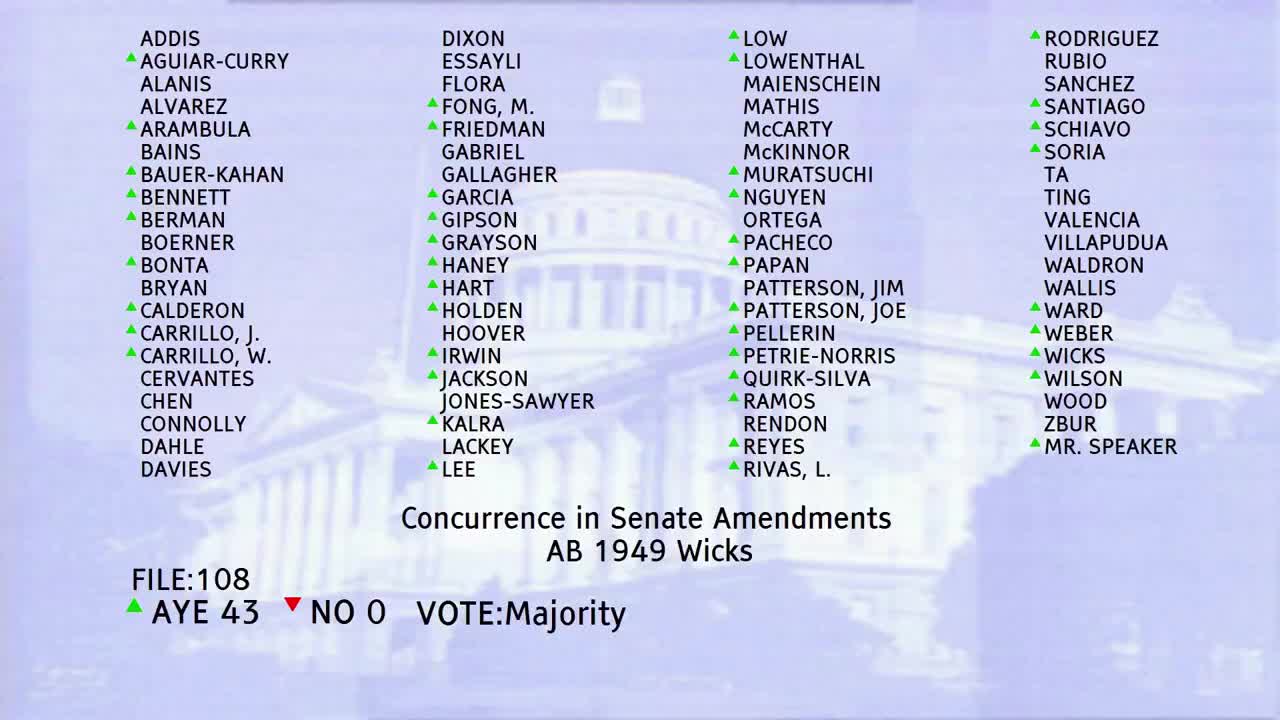 37SEC
Assembly Floor
 2MIN
Senate Floor
 48SEC
Assembly Floor
 3MIN
Assembly Standing Committee on Housing and Community Development
Bill Author

Bill Co-Author(s):