AB 2286: Vehicles: autonomous vehicles.
- Session Year: 2023-2024
- House: Assembly
- Latest Version Date: 2024-09-03
Current Status:
Failed
(2024-09-27: Vetoed by Governor.)
Introduced
In Committee
First Chamber
In Committee
Second Chamber
Enacted
What does this bill do?
The bill requires manufacturers of large autonomous vehicles (those over 10,001 pounds) to have a human safety operator — a trained person in the vehicle who can operate or shut off the system — physically present during testing or when carrying goods or passengers on public roads. It also requires manufacturers to report any crash that causes property damage, injury, or death within 10 days and to file yearly plain-language reports about each time the vehicle’s self-driving mode was turned off (disengagements), explaining where and why it happened. The DMV must study safety and job impacts and recommend whether the human-operator rule should remain.
The summary is provided by generative AI which can make mistakes. For original language, please view the details in the table below.
Existing law authorizes the operation of an autonomous vehicle on public roads for testing purposes by a driver who possesses the proper class of license for the type of vehicle operated if specified requirements are satisfied. Existing law prohibits the operation of an autonomous vehicle on public roads until the manufacturer submits an application to the Department of Motor Vehicles, as specified, and that application is approved.
This bill would require a manufacturer of an autonomous vehicle to report to the department a collision on a public road that involved one of its autonomous vehicles with a gross vehicle weight of 10,001 pounds or more that is operating under a testing or deployment permit that resulted in damage of property, bodily injury, or death within 10 days of the collision.
The bill would require a manufacturer of an autonomous vehicle to annually submit to the department specified information regarding the deactivation of the autonomous mode for its autonomous vehicles with a gross vehicle weight of 10,001 pounds or more that were operating under a testing or deployment permit that authorized the vehicle to operate on public roads.
The bill would prohibit the operation of an autonomous vehicle with a gross vehicle weight of 10,001 pounds or more on public roads for testing purposes, transporting goods, or transporting passengers without a human safety operator physically present in the autonomous vehicle at the time of operation.
The bill would require the Department of Motor Vehicles, by January 1, 2030, or 5 years after commencement of testing, whichever occurs later, and upon appropriation by the Legislature, to submit a report to the appropriate policy and fiscal committees of the Legislature evaluating the performance of autonomous vehicle technology and its impact on public safety and employment in the transportation sector for autonomous vehicles with a gross vehicle weight of 10,001 pounds or more. The bill would require the Department of the California Highway Patrol, the Labor and Workforce Development Agency, the Department of Transportation, the State Air Resources Board, and other relevant state agencies to provide additional information needed to research the report.
Existing law authorizes the operation of an autonomous vehicle on public roads for testing purposes by a driver who possesses the proper class of license for the type of vehicle operated if specified requirements are satisfied. Existing law prohibits the operation of an autonomous vehicle on public roads until the manufacturer submits an application to the Department of Motor Vehicles, as specified, and that application is approved.
This bill would require a manufacturer of an autonomous vehicle to report to the department a collision on a public road that involved one of its autonomous vehicles with a gross vehicle weight of 10,001 pounds or more that is operating under a testing permit that resulted in damage of property, bodily injury, or death within 10 days of the collision.
The bill would require a manufacturer of an autonomous vehicle to annually submit to the department specified information regarding the deactivation of the autonomous mode for its autonomous vehicles with a gross vehicle weight of 10,001 pounds or more that were operating under a testing permit that authorized the vehicle to operate on public roads.
The bill would prohibit the operation of an autonomous vehicle with a gross vehicle weight of 10,001 pounds or more on public roads for testing purposes, transporting goods, or transporting passengers without a human safety operator physically present in the autonomous vehicle at the time of operation.
The bill would require the Department of Motor Vehicles, by January 1, 2030, or 5 years after commencement of testing, whichever occurs later, and upon appropriation by the Legislature, to submit a report to the appropriate policy and fiscal committees of the Legislature evaluating the performance of autonomous vehicle technology and its impact on public safety and employment in the transportation sector for autonomous vehicles with a gross vehicle weight of 10,001 pounds or more. The bill would require the Department of the California Highway Patrol, the Labor and Workforce Development Agency, the Department of Transportation, the State Air Resources Board, and other relevant state agencies to provide additional information needed to research the report.
All of the following are the intent of the Legislature:
(a)To prioritize public safety, job security, and infrastructure needs in the development and deployment of autonomous vehicles on California roads.
(b)To ensure that public policy adapts to rapid advancements in autonomous vehicle technology.
(c)To revisit and amend applicable laws as necessary to reflect advancements that address threats to public safety and jobs.
SEC. 2.Section 38754 is added to the Vehicle Code, to read:38754.(a)An autonomous vehicle with a gross vehicle weight of 10,001 pounds or more shall not be operated on public roads for testing purposes, transporting goods, or transporting passengers without a human safety operator physically present in the autonomous vehicle at the time of operation.(b)For purposes of this section, the following terms have the following meanings:(1)Autonomous vehicle has the same meaning as defined in Section 38750.(2)Human safety operator means a person operating an autonomous vehicle or vehicle equipped with autonomous technology who is trained in operating and shutting off the vehicle. A human safety operator shall meet all federal and state qualifications for the type of vehicle being operated, whether in automated or nonautomated mode.SEC. 3.Section 38756 is added to the Vehicle Code, to read:38756.(a)By January 1, 2030, or five years after commencement of testing, whichever occurs later, and upon appropriation by the Legislature, the Department of Motor Vehicles shall submit a report to the appropriate policy and fiscal committees of the Legislature evaluating the performance of autonomous vehicle technology and its impact on public safety and employment in the transportation sector for autonomous vehicles with a gross vehicle weight of 10,001 pounds or more. The report shall include a summary of disengagements, crashes, and other information the department believes is relevant. The report shall include a recommendation on whether the Legislature should remove, modify, or maintain the requirement for an autonomous vehicle with a gross vehicle weight of 10,001 pounds or more to operate with a human safety operator physically present in the vehicle. While preparing the report, the Department of Motor Vehicles shall do all of the following:(1)Consult with the Department of the California Highway Patrol on traffic impacts, driver and passenger safety risks, and impacts on other motorists, bicyclists, and pedestrians.(2)Consult with the Labor and Workforce Development Agency on any job-related impacts, including worker displacement and shortcomings in retraining opportunities.(3)Consult with the Department of Transportation on infrastructure impacts, deficiencies, and needs.(4)Consult with the State Air Resources Board on how autonomous vehicles with a gross vehicle weight of 10,001 pounds or more impact the 2022 Scoping Plan for Achieving Carbon Neutrality.(5)Consult with independent experts on the performance of the technology, public safety impacts, and any other relevant factors in considering deployment.(b)The Department of the California Highway Patrol, the Labor and Workforce Development Agency, the Department of Transportation, the State Air Resources Board, and all other relevant state agencies shall provide additional information, as specified by the Department of Motor Vehicles, as needed to research the report required by this section.(c)Upon issuance of the report described in subdivision (a), it is the intent of the Legislature to conduct an oversight hearing to assess the state of autonomous vehicle technology for vehicles with a gross vehicle weight of 10,001 pounds or more.(d)The Department of Motor Vehicles shall not issue a deployment permit for use of autonomous vehicles with a gross vehicle weight of 10,001 pounds or more without a human safety operator earlier than one year after the oversight hearing described in subdivision (c), and only after express authorization of the Legislature and Governor.SEC. 4.Section 38757 is added to the Vehicle Code, to read:38757.(a)(1)In addition to any other reporting requirement, for autonomous vehicles with a gross vehicle weight of 10,001 pounds or more, a manufacturer whose autonomous vehicle is in any manner involved in a collision originating from the operation of the autonomous vehicle on a public road that resulted in the damage of property, bodily injury, or death while operating under a valid testing or deployment permit shall report the collision to the department, within 10 days of the collision, on a form specified by the department.
(2)Paragraph (1) does not relieve a person from compliance with any other statutory or regulatory collision reporting requirement.
(b)(1)In addition to any other reporting requirement, for autonomous vehicles with a gross vehicle weight of 10,001 pounds or more with a valid testing or deployment permit that authorizes the vehicle to operate on public roads, a manufacturer shall submit disengagement reports on an annual basis to the department.
(2)Disengagement reports shall summarize the circumstances or conditions at the time of the disengagement, including all of the following:
(A)The location of the disengagement on or in one of the following:
(i)On an interstate.
(ii)On a highway.
(iii)On a rural road.
(iv)On a city street.
(v)In a parking facility.
(B)Whether the vehicle was operating with or without a driver at the time of the disengagement.
(C)A description of the facts causing the disengagement, including all of the following:
(i)Weather conditions.
(ii)Road surface conditions.
(iii)Traffic conditions.
(iv)Emergency conditions.
(v)Whether there was a collision.
(D)The party that initiated the disengagement, including one of the following:
(i)The autonomous technology.
(ii)An autonomous vehicle test driver.
(iii)A remote operator.
(iv)A passenger.
(3)The description shall be written in plain language with enough detail that a nontechnical person can understand the circumstances triggering the disengagement.
(c)For purposes of this section, disengagement means a deactivation of the autonomous mode when a failure of the autonomous technology is detected or when the safe operation of the vehicle requires that the autonomous vehicle test driver disengage the autonomous mode and take immediate manual control of the vehicle, or in the case of driverless vehicles, when the safety of the vehicle, the occupants of the vehicle, or the public requires that the autonomous technology be deactivated.
All of the following are the intent of the Legislature:
(a)To prioritize public safety, job security, and infrastructure needs in the development and deployment of autonomous vehicles on California roads.
(b)To ensure that public policy adapts to rapid advancements in autonomous vehicle technology.
(c)To revisit and amend applicable laws as necessary to reflect advancements that address threats to public safety and jobs.
SEC. 2.Section 38750 of the Vehicle Code is amended to read:38750.(a)For purposes of this division, the following definitions apply:(1)Autonomous technology means technology that has the capability to drive a vehicle without the active physical control or monitoring by a human operator.(2)(A)Autonomous vehicle means any vehicle equipped with autonomous technology that has been integrated into that vehicle that meets the definition of Level 3, Level 4, or Level 5 of SAE Internationals Taxonomy and Definitions for Terms Related to Driving Automation Systems for On-Road Motor Vehicles, standard J3016 (APR2021), as may be revised.(B)An autonomous vehicle does not include a vehicle that is equipped with one or more collision avoidance systems, including, but not limited to, electronic blind spot assistance, automated emergency braking systems, park assist, adaptive cruise control, lane keep assist, lane departure warning, traffic jam and queuing assist, or other similar systems that enhance safety or provide driver assistance, but are not capable, collectively or singularly, of driving the vehicle without the active control or monitoring of a human operator.(3)Department means the Department of Motor Vehicles.(4)An operator of an autonomous vehicle is the person who is seated in the drivers seat, or, if there is no person in the drivers seat, causes the autonomous technology to engage.(5)A manufacturer of autonomous technology is the person, as defined in Section 470, that originally manufactures a vehicle and equips autonomous technology on the originally completed vehicle or, in the case of a vehicle not originally equipped with autonomous technology by the vehicle manufacturer, the person that modifies the vehicle by installing autonomous technology to convert it to an autonomous vehicle after the vehicle was originally manufactured.(b)An autonomous vehicle may be operated on public roads for testing purposes by a driver who possesses the proper class of license for the type of vehicle being operated if all of the following requirements are met:(1)The autonomous vehicle is being operated on roads in this state solely by employees, contractors, or other persons designated by the manufacturer of the autonomous technology.(2)The driver shall be seated in the drivers seat, monitoring the safe operation of the autonomous vehicle, and capable of taking over immediate manual control of the autonomous vehicle in the event of an autonomous technology failure or other emergency.(3)Prior to the start of testing in this state, the manufacturer performing the testing shall obtain an instrument of insurance, surety bond, or proof of self-insurance in the amount of five million dollars ($5,000,000), and shall provide evidence of the insurance, surety bond, or self-insurance to the department in the form and manner required by the department pursuant to the regulations adopted pursuant to subdivision (d).(c)Except as provided in subdivision (b), an autonomous vehicle shall not be operated on public roads until the manufacturer submits an application to the department, and that application is approved by the department pursuant to the regulations adopted pursuant to subdivision (d). The application shall contain, at a minimum, all of the following certifications:(1)A certification by the manufacturer that the autonomous technology satisfies all of the following requirements:(A)The autonomous vehicle has a mechanism to engage and disengage the autonomous technology that is easily accessible to the operator.(B)The autonomous vehicle has a visual indicator inside the cabin to indicate when the autonomous technology is engaged.(C)The autonomous vehicle has a system to safely alert the operator if an autonomous technology failure is detected while the autonomous technology is engaged, and when an alert is given, the system shall do either of the following:(i)Require the operator to take control of the autonomous vehicle.(ii)If the operator does not or is unable to take control of the autonomous vehicle, the autonomous vehicle shall be capable of coming to a complete stop.(D)The autonomous vehicle shall allow the operator to take control in multiple manners, including, without limitation, through the use of the brake, the accelerator pedal, or the steering wheel, and it shall alert the operator that the autonomous technology has been disengaged.(E)The autonomous vehicles autonomous technology meets Federal Motor Vehicle Safety Standards for the vehicles model year and all other applicable safety standards and performance requirements set forth in state and federal law and the regulations promulgated pursuant to those laws.(F)The autonomous technology does not make inoperative any Federal Motor Vehicle Safety Standards for the vehicles model year and all other applicable safety standards and performance requirements set forth in state and federal law and the regulations promulgated pursuant to those laws.(G)The autonomous vehicle has a separate mechanism, in addition to, and separate from, any other mechanism required by law, to capture and store the autonomous technology sensor data for at least 30 seconds before a collision occurs between the autonomous vehicle and another vehicle, object, or natural person while the vehicle is operating in autonomous mode. The autonomous technology sensor data shall be captured and stored in a read-only format by the mechanism so that the data is retained until extracted from the mechanism by an external device capable of downloading and storing the data. The data shall be preserved for three years after the date of the collision.(2)A certification that the manufacturer has tested the autonomous technology on public roads and has complied with the testing standards, if any, established by the department pursuant to subdivision (d).(3)A certification that the manufacturer will maintain, an instrument of insurance, a surety bond, or proof of self-insurance as specified in regulations adopted by the department pursuant to subdivision (d), in an amount of five million dollars ($5,000,000).(d)(1)As soon as practicable, but no later than January 1, 2015, the department shall adopt regulations setting forth requirements for the submission of evidence of insurance, surety bond, or self-insurance required by subdivision (b), and the submission and approval of an application to operate an autonomous vehicle pursuant to subdivision (c).(2)The regulations shall include any testing, equipment, and performance standards, in addition to those established for purposes of subdivision (b), that the department concludes are necessary to ensure the safe operation of autonomous vehicles on public roads, with or without the presence of a driver inside the vehicle. In developing these regulations, the department may consult with the Department of the California Highway Patrol, the Institute of Transportation Studies at the University of California, or any other entity identified by the department that has expertise in automotive technology, automotive safety, and autonomous system design.(3)The department may establish additional requirements by the adoption of regulations, which it determines, in consultation with the Department of the California Highway Patrol, are necessary to ensure the safe operation of autonomous vehicles on public roads, including, but not limited to, regulations regarding the aggregate number of deployments of autonomous vehicles on public roads, special rules for the registration of autonomous vehicles, new license requirements for operators of autonomous vehicles, and rules for revocation, suspension, or denial of any license or any approval issued pursuant to this division.(4)The department shall hold public hearings on the adoption of any regulation applicable to the operation of an autonomous vehicle without the presence of a driver inside the vehicle.(e)(1)The department shall approve an application submitted by a manufacturer pursuant to subdivision (c) if it finds that the applicant has submitted all information and completed testing necessary to satisfy the department that the autonomous vehicles are safe to operate on public roads and the applicant has complied with all requirements specified in the regulations adopted by the department pursuant to subdivision (d).(2)Notwithstanding paragraph (1), if the application seeks approval for autonomous vehicles capable of operating without the presence of a driver inside the vehicle, the department may impose additional requirements it deems necessary to ensure the safe operation of those vehicles, and may require the presence of a driver in the drivers seat of the vehicle if it determines, based on its review pursuant to paragraph (1), that such a requirement is necessary to ensure the safe operation of those vehicles on public roads.(3)(A)In addition to any other reporting requirement, for autonomous vehicles with a gross vehicle weight of 10,001 pounds or more, a manufacturer whose autonomous vehicle is in any manner involved in a collision originating from the operation of the autonomous vehicle on a public road that resulted in the damage of property, bodily injury, or death while operating under a valid testing or deployment permit shall report the collision to the department, within 10 days of the collision, on a form specified by the department.(B)Subparagraph (A) does not relieve a person from compliance with any other statutory or regulatory collision reporting requirement.(4)(A)In addition to any other reporting requirement, for autonomous vehicles with a gross vehicle weight of 10,001 pounds or more with a valid testing or deployment permit that authorizes the vehicle to operate on public roads, a manufacturer shall submit disengagement reports on an annual basis to the department.(B)Disengagement reports shall summarize the circumstances or conditions at the time of the disengagement, including all of the following:(i)The location of the disengagement on or in one of the following:(I)On an interstate.(II)On a highway.(III)On a rural road.(IV)On a city street.(V)In a parking facility.(ii)Whether the vehicle was operating with or without a driver at the time of the disengagement.(iii)A description of the facts causing the disengagement, including all of the following:(I)Weather conditions.(II)Road surface conditions.(III)Traffic conditions.(IV)Emergency conditions.(V)Whether there was a collision.(iv)The party that initiated the disengagement, including one of the following:(I)The autonomous technology.(II)An autonomous vehicle test driver.(III)A remote operator.(IV)A passenger.(C)The description shall be written in plain language with enough detail that a nontechnical person can understand the circumstances triggering the disengagement.(5)For purposes of this subdivision, disengagement means a deactivation of the autonomous mode when a failure of the autonomous technology is detected or when the safe operation of the vehicle requires that the autonomous vehicle test driver disengage the autonomous mode and take immediate manual control of the vehicle, or in the case of driverless vehicles, when the safety of the vehicle, the occupants of the vehicle, or the public requires that the autonomous technology be deactivated.(f)The department shall post a public notice on its internet website when it adopts the regulations required by subdivision (d). The department shall not approve an application submitted pursuant to the regulations until 30 days after the public notice is provided.(g)Federal regulations promulgated by the National Highway Traffic Safety Administration shall supersede the provisions of this division when found to be in conflict with any other state law or regulation.(h)The manufacturer of the autonomous technology installed on a vehicle shall provide a written disclosure to the purchaser of an autonomous vehicle that describes what information is collected by the autonomous technology equipped on the vehicle. The department may promulgate regulations to assess a fee upon a manufacturer that submits an application pursuant to subdivision (c) to operate autonomous vehicles on public roads in an amount necessary to recover all costs reasonably incurred by the department.(i)(1)Commencing January 1, 2030, to the extent authorized by federal law, any autonomous vehicle with a model year of 2031 or later and a gross vehicle weight rating of less than 8,501 pounds shall only be operated pursuant to a deployment permit pursuant to Article 3.8 (commencing with Section 228.00) of Chapter 1 of Division 1 of Title 13 of the California Code of Regulations if the vehicle is a zero-emission vehicle, as defined in Section 44258 of the Health and Safety Code.(2)The department shall not commence rulemaking for the adoption of regulations implementing this subdivision before January 1, 2027.SEC. 3.Section 38751 is added to the Vehicle Code, to read:38751.SEC. 2.Section 38754 is added to the Vehicle Code, to read:38754.(a)An autonomous vehicle with a gross vehicle weight of 10,001 pounds or more shall not be operated on public roads for testing purposes, transporting goods, or transporting passengers without a human safety operator physically present in the autonomous vehicle at the time of operation.(b)For purposes of this section, the following terms have the following meanings:(1)Autonomous vehicle has the same meaning as defined in Section 38750.(2)Human safety operator means a person operating an autonomous vehicle or vehicle equipped with autonomous technology who is trained in operating and shutting off the vehicle. A human safety operator shall meet all federal and state qualifications for the type of vehicle being operated, whether in automated or nonautomated mode.SEC. 4.Section 38752 is added to the Vehicle Code, to read:38752.SEC. 3.Section 38756 is added to the Vehicle Code, to read:38756.(a)By January 1, 2030, or five years after commencement of testing, whichever occurs later, and upon appropriation by the Legislature, the Department of Motor Vehicles shall submit a report to the appropriate policy and fiscal committees of the Legislature evaluating the performance of autonomous vehicle technology and its impact on public safety and employment in the transportation sector for autonomous vehicles with a gross vehicle weight of 10,001 pounds or more. The report shall include a summary of disengagements, crashes, and other information the department believes is relevant. The report shall include a recommendation on whether the Legislature should remove, modify, or maintain the requirement for an autonomous vehicle with a gross vehicle weight of 10,001 pounds or more to operate with a human safety operator physically present in the vehicle. While preparing the report, the Department of Motor Vehicles shall do all of the following:(1)Consult with the Department of the California Highway Patrol on traffic impacts, driver and passenger safety risks, and impacts on other motorists, bicyclists, and pedestrians.(2)Consult with the Labor and Workforce Development Agency on any job-related impacts, including worker displacement and shortcomings in retraining opportunities.(3)Consult with the Department of Transportation on infrastructure impacts, deficiencies, and needs.(4)Consult with the State Air Resources Board on how autonomous vehicles with a gross vehicle weight of 10,001 pounds or more impact the 2022 Scoping Plan for Achieving Carbon Neutrality.(5)Consult with independent experts on the performance of the technology, public safety impacts, and any other relevant factors in considering deployment.(b)The Department of the California Highway Patrol, the Labor and Workforce Development Agency, the Department of Transportation, the State Air Resources Board, and all other relevant state agencies shall provide additional information, as specified by the Department of Motor Vehicles, as needed to research the report required by this section.(c)Upon issuance of the report described in subdivision (a), it is the intent of the Legislature to conduct an oversight hearing to assess the state of autonomous vehicle technology for vehicles with a gross vehicle weight of 10,001 pounds or more.(d)The Department of Motor Vehicles shall not issue a deployment permit for use of autonomous vehicles with a gross vehicle weight of 10,001 pounds or more without a human safety operator earlier than one year after the oversight hearing described in subdivision (c), and only after express authorization of the Legislature and Governor.SEC. 4.Section 38757 is added to the Vehicle Code, to read:38757.(a)(1)In addition to any other reporting requirement, for autonomous vehicles with a gross vehicle weight of 10,001 pounds or more, a manufacturer whose autonomous vehicle is in any manner involved in a collision originating from the operation of the autonomous vehicle on a public road that resulted in the damage of property, bodily injury, or death while operating under a valid testing or deployment permit shall report the collision to the department, within 10 days of the collision, on a form specified by the department.
(2)Paragraph (1) does not relieve a person from compliance with any other statutory or regulatory collision reporting requirement.
(b)(1)In addition to any other reporting requirement, for autonomous vehicles with a gross vehicle weight of 10,001 pounds or more with a valid testing or deployment permit that authorizes the vehicle to operate on public roads, a manufacturer shall submit disengagement reports on an annual basis to the department.
(2)Disengagement reports shall summarize the circumstances or conditions at the time of the disengagement, including all of the following:
(A)The location of the disengagement on or in one of the following:
(i)On an interstate.
(ii)On a highway.
(iii)On a rural road.
(iv)On a city street.
(v)In a parking facility.
(B)Whether the vehicle was operating with or without a driver at the time of the disengagement.
(C)A description of the facts causing the disengagement, including all of the following:
(i)Weather conditions.
(ii)Road surface conditions.
(iii)Traffic conditions.
(iv)Emergency conditions.
(v)Whether there was a collision.
(D)The party that initiated the disengagement, including one of the following:
(i)The autonomous technology.
(ii)An autonomous vehicle test driver.
(iii)A remote operator.
(iv)A passenger.
(3)The description shall be written in plain language with enough detail that a nontechnical person can understand the circumstances triggering the disengagement.
(c)For purposes of this section, disengagement means a deactivation of the autonomous mode when a failure of the autonomous technology is detected or when the safe operation of the vehicle requires that the autonomous vehicle test driver disengage the autonomous mode and take immediate manual control of the vehicle, or in the case of driverless vehicles, when the safety of the vehicle, the occupants of the vehicle, or the public requires that the autonomous technology be deactivated.
All of the following are the intent of the Legislature:
(a)To prioritize public safety, job security, and infrastructure needs in the development and deployment of autonomous vehicles on California roads.
(b)To ensure that public policy adapts to rapid advancements in autonomous vehicle technology.
(c)To revisit and amend applicable laws as necessary to reflect advancements that address threats to public safety and jobs.
SEC. 2.Section 38750 of the Vehicle Code is amended to read:38750.(a)For purposes of this division, the following definitions apply:
(1)Autonomous technology means technology that has the capability to drive a vehicle without the active physical control or monitoring by a human operator.
(2)(A)Autonomous vehicle means any vehicle equipped with autonomous technology that has been integrated into that vehicle that meets the definition of Level 3, Level 4, or Level 5 of SAE Internationals Taxonomy and Definitions for Terms Related to Driving Automation Systems for On-Road Motor Vehicles, standard J3016 (APR2021), as may be revised.
(B)An autonomous vehicle does not include a vehicle that is equipped with one or more collision avoidance systems, including, but not limited to, electronic blind spot assistance, automated emergency braking systems, park assist, adaptive cruise control, lane keep assist, lane departure warning, traffic jam and queuing assist, or other similar systems that enhance safety or provide driver assistance, but are not capable, collectively or singularly, of driving the vehicle without the active control or monitoring of a human operator.
(3)Department means the Department of Motor Vehicles.
(4)An operator of an autonomous vehicle is the person who is seated in the drivers seat, or, if there is no person in the drivers seat, causes the autonomous technology to engage.
(5)A manufacturer of autonomous technology is the person, as defined in Section 470, that originally manufactures a vehicle and equips autonomous technology on the originally completed vehicle or, in the case of a vehicle not originally equipped with autonomous technology by the vehicle manufacturer, the person that modifies the vehicle by installing autonomous technology to convert it to an autonomous vehicle after the vehicle was originally manufactured.
(b)An autonomous vehicle may be operated on public roads for testing purposes by a driver who possesses the proper class of license for the type of vehicle being operated if all of the following requirements are met:
(1)The autonomous vehicle is being operated on roads in this state solely by employees, contractors, or other persons designated by the manufacturer of the autonomous technology.
(2)The driver shall be seated in the drivers seat, monitoring the safe operation of the autonomous vehicle, and capable of taking over immediate manual control of the autonomous vehicle in the event of an autonomous technology failure or other emergency.
(3)Prior to the start of testing in this state, the manufacturer performing the testing shall obtain an instrument of insurance, surety bond, or proof of self-insurance in the amount of five million dollars ($5,000,000), and shall provide evidence of the insurance, surety bond, or self-insurance to the department in the form and manner required by the department pursuant to the regulations adopted pursuant to subdivision (d).
(c)Except as provided in subdivision (b), an autonomous vehicle shall not be operated on public roads until the manufacturer submits an application to the department, and that application is approved by the department pursuant to the regulations adopted pursuant to subdivision (d). The application shall contain, at a minimum, all of the following certifications:
(1)A certification by the manufacturer that the autonomous technology satisfies all of the following requirements:
(A)The autonomous vehicle has a mechanism to engage and disengage the autonomous technology that is easily accessible to the operator.
(B)The autonomous vehicle has a visual indicator inside the cabin to indicate when the autonomous technology is engaged.
(C)The autonomous vehicle has a system to safely alert the operator if an autonomous technology failure is detected while the autonomous technology is engaged, and when an alert is given, the system shall do either of the following:
(i)Require the operator to take control of the autonomous vehicle.
(ii)If the operator does not or is unable to take control of the autonomous vehicle, the autonomous vehicle shall be capable of coming to a complete stop.
(D)The autonomous vehicle shall allow the operator to take control in multiple manners, including, without limitation, through the use of the brake, the accelerator pedal, or the steering wheel, and it shall alert the operator that the autonomous technology has been disengaged.
(E)The autonomous vehicles autonomous technology meets Federal Motor Vehicle Safety Standards for the vehicles model year and all other applicable safety standards and performance requirements set forth in state and federal law and the regulations promulgated pursuant to those laws.
(F)The autonomous technology does not make inoperative any Federal Motor Vehicle Safety Standards for the vehicles model year and all other applicable safety standards and performance requirements set forth in state and federal law and the regulations promulgated pursuant to those laws.
(G)The autonomous vehicle has a separate mechanism, in addition to, and separate from, any other mechanism required by law, to capture and store the autonomous technology sensor data for at least 30 seconds before a collision occurs between the autonomous vehicle and another vehicle, object, or natural person while the vehicle is operating in autonomous mode. The autonomous technology sensor data shall be captured and stored in a read-only format by the mechanism so that the data is retained until extracted from the mechanism by an external device capable of downloading and storing the data. The data shall be preserved for three years after the date of the collision.
(2)A certification that the manufacturer has tested the autonomous technology on public roads and has complied with the testing standards, if any, established by the department pursuant to subdivision (d).
(3)A certification that the manufacturer will maintain, an instrument of insurance, a surety bond, or proof of self-insurance as specified in regulations adopted by the department pursuant to subdivision (d), in an amount of five million dollars ($5,000,000).
(d)(1)As soon as practicable, but no later than January 1, 2015, the department shall adopt regulations setting forth requirements for the submission of evidence of insurance, surety bond, or self-insurance required by subdivision (b), and the submission and approval of an application to operate an autonomous vehicle pursuant to subdivision (c).
(2)The regulations shall include any testing, equipment, and performance standards, in addition to those established for purposes of subdivision (b), that the department concludes are necessary to ensure the safe operation of autonomous vehicles on public roads, with or without the presence of a driver inside the vehicle. In developing these regulations, the department may consult with the Department of the California Highway Patrol, the Institute of Transportation Studies at the University of California, or any other entity identified by the department that has expertise in automotive technology, automotive safety, and autonomous system design.
(3)The department may establish additional requirements by the adoption of regulations, which it determines, in consultation with the Department of the California Highway Patrol, are necessary to ensure the safe operation of autonomous vehicles on public roads, including, but not limited to, regulations regarding the aggregate number of deployments of autonomous vehicles on public roads, special rules for the registration of autonomous vehicles, new license requirements for operators of autonomous vehicles, and rules for revocation, suspension, or denial of any license or any approval issued pursuant to this division.
(4)The department shall hold public hearings on the adoption of any regulation applicable to the operation of an autonomous vehicle without the presence of a driver inside the vehicle.
(e)(1)The department shall approve an application submitted by a manufacturer pursuant to subdivision (c) if it finds that the applicant has submitted all information and completed testing necessary to satisfy the department that the autonomous vehicles are safe to operate on public roads and the applicant has complied with all requirements specified in the regulations adopted by the department pursuant to subdivision (d).
(2)Notwithstanding paragraph (1), if the application seeks approval for autonomous vehicles capable of operating without the presence of a driver inside the vehicle, the department may impose additional requirements it deems necessary to ensure the safe operation of those vehicles, and may require the presence of a driver in the drivers seat of the vehicle if it determines, based on its review pursuant to paragraph (1), that such a requirement is necessary to ensure the safe operation of those vehicles on public roads.
(3)(A)For In addition to any other reporting requirement, for autonomous vehicles with a gross vehicle weight of 10,001 pounds or more, a manufacturer whose autonomous vehicle is in any manner involved in a collision originating from the operation of the autonomous vehicle on a public road that resulted in the damage of property, bodily injury, or death while operating under a valid testing or deployment permit shall report the collision to the department, within 10 days of the collision, on a form specified by the department.
(B)Subparagraph (A) does not relieve a person from compliance with any other statutory or regulatory collision reporting requirement.
(4)(A)For In addition to any other reporting requirement, for autonomous vehicles with a gross vehicle weight of 10,001 pounds or more with a valid testing or deployment permit that authorizes the vehicle to operate on public roads, a manufacturer shall submit disengagement reports on an annual basis to the department.
(B)Disengagement reports shall summarize the circumstances or conditions at the time of the disengagement, including all of the following:
(i)The location of the disengagement on or in one of the following:
(I)On an interstate.
(II)On a highway.
(III)On a rural road.
(IV)On a city street.
(V)In a parking facility.
(ii)Whether the vehicle was operating with or without a driver at the time of the disengagement.
(iii)A description of the facts causing the disengagement, including all of the following:
(I)Weather conditions.
(II)Road surface conditions.
(III)Traffic conditions.
(IV)Emergency conditions.
(V)Whether there was a collision.
(iv)The party that initiated the disengagement, including one of the following:
(I)The autonomous technology.
(II)An autonomous vehicle test driver.
(III)A remote operator.
(IV)A passenger.
(C)The description shall be written in plain language with enough detail that a nontechnical person can understand the circumstances triggering the disengagement.
(5)For purposes of this subdivision, disengagement means a deactivation of the autonomous mode when a failure of the autonomous technology is detected or when the safe operation of the vehicle requires that the autonomous vehicle test driver disengage the autonomous mode and take immediate manual control of the vehicle, or in the case of driverless vehicles, when the safety of the vehicle, the occupants of the vehicle, or the public requires that the autonomous technology be deactivated.
(f)The department shall post a public notice on its internet website when it adopts the regulations required by subdivision (d). The department shall not approve an application submitted pursuant to the regulations until 30 days after the public notice is provided.
(g)Federal regulations promulgated by the National Highway Traffic Safety Administration shall supersede the provisions of this division when found to be in conflict with any other state law or regulation.
(h)The manufacturer of the autonomous technology installed on a vehicle shall provide a written disclosure to the purchaser of an autonomous vehicle that describes what information is collected by the autonomous technology equipped on the vehicle. The department may promulgate regulations to assess a fee upon a manufacturer that submits an application pursuant to subdivision (c) to operate autonomous vehicles on public roads in an amount necessary to recover all costs reasonably incurred by the department.
(i)(1)Commencing January 1, 2030, to the extent authorized by federal law, any autonomous vehicle with a model year of 2031 or later and a gross vehicle weight rating of less than 8,501 pounds shall only be operated pursuant to a deployment permit pursuant to Article 3.8 (commencing with Section 228.00) of Chapter 1 of Division 1 of Title 13 of the California Code of Regulations if the vehicle is a zero-emission vehicle, as defined in Section 44258 of the Health and Safety Code.
(2)The department shall not commence rulemaking for the adoption of regulations implementing this subdivision before January 1, 2027.
SEC. 3.Section 38751 is added to the Vehicle Code, to read:38751.(a)An autonomous vehicle with a gross vehicle weight of 10,001 pounds or more shall not be operated on public roads for testing purposes, transporting goods, or transporting passengers without a human safety operator physically present in the autonomous vehicle at the time of operation.
(b)For purposes of this section, the following terms have the following meanings:
(1)Autonomous vehicle has the same meaning as defined in Section 38750.
(2)Human safety operator means a person operating an autonomous vehicle or vehicle equipped with autonomous technology who is trained in operating and shutting off the vehicle. A human safety operator shall meet all federal and state qualifications for the type of vehicle being operated, whether in automated or nonautomated mode.
SEC. 4.Section 38752 is added to the Vehicle Code, to read:38752.(a)By January 1, 2030, or five years after commencement of testing, whichever occurs later, and upon appropriation by the Legislature, the Department of Motor Vehicles shall submit a report to the appropriate policy and fiscal committees of the Legislature evaluating the performance of autonomous vehicle technology and its impact on public safety and employment in the transportation sector for autonomous vehicles with a gross vehicle weight of 10,001 pounds or more. The report shall include a summary of disengagements, crashes, and other information the department believes is relevant. The report shall include a recommendation on whether the Legislature should remove, modify, or maintain the requirement for an autonomous vehicle with a gross vehicle weight of 10,001 pounds or more to operate with a human safety operator physically present in the vehicle. While preparing the report, the Department of Motor Vehicles shall do all of the following:
(1)Consult with the Department of the California Highway Patrol on traffic impacts, driver and passenger safety risks, and impacts on other motorists, bicyclists, and pedestrians.
(2)Consult with the Labor and Workforce Development Agency on any job-related impacts, including worker displacement and shortcomings in retraining opportunities.
(3)Consult with the Department of Transportation on infrastructure impacts, deficiencies, and needs.
(4)Consult with the State Air Resources Board on how autonomous vehicles with a gross vehicle weight of 10,001 pounds or more impact the 2022 Scoping Plan for Achieving Carbon Neutrality.
(5)Consult with independent experts on the performance of the technology, public safety impacts, and any other relevant factors in considering deployment.
(b)The Department of the California Highway Patrol, the Labor and Workforce Development Agency, the Department of Transportation, the State Air Resources Board, and all other relevant state agencies shall provide additional information, as specified by the Department of Motor Vehicles, as needed to research the report required by this section.
(c)Upon issuance of the report described in subdivision (a), it is the intent of the Legislature to conduct an oversight hearing to assess the state of autonomous vehicle technology for vehicles with a gross vehicle weight of 10,001 pounds or more.
(d)The Department of Motor Vehicles shall not issue a deployment permit for use of autonomous vehicles with a gross vehicle weight of 10,001 pounds or more without a human safety operator earlier than one year after the oversight hearing described in subdivision (c), and only after express authorization of the Legislature and Governor.
REVISIONS: HeadingLines 4 and 6.All of the following are the intent of the Legislature:
(a)To prioritize public safety, job security, and infrastructure needs in the development and deployment of autonomous vehicles on California roads.
(b)To ensure that public policy adapts to rapid advancements in autonomous vehicle technology.
(c)To revisit and amend applicable laws as necessary to reflect advancements that address threats to public safety and jobs.
SEC. 2.Section 38750 of the Vehicle Code is amended to read:38750.(a)For purposes of this division, the following definitions apply:
(1)Autonomous technology means technology that has the capability to drive a vehicle without the active physical control or monitoring by a human operator.
(2)(A)Autonomous vehicle means any vehicle equipped with autonomous technology that has been integrated into that vehicle that meets the definition of Level 3, Level 4, or Level 5 of SAE Internationals Taxonomy and Definitions for Terms Related to Driving Automation Systems for On-Road Motor Vehicles, standard J3016 (APR2021), as may be revised.
(B)An autonomous vehicle does not include a vehicle that is equipped with one or more collision avoidance systems, including, but not limited to, electronic blind spot assistance, automated emergency braking systems, park assist, adaptive cruise control, lane keep assist, lane departure warning, traffic jam and queuing assist, or other similar systems that enhance safety or provide driver assistance, but are not capable, collectively or singularly, of driving the vehicle without the active control or monitoring of a human operator.
(3)Department means the Department of Motor Vehicles.
(4)An operator of an autonomous vehicle is the person who is seated in the drivers seat, or, if there is no person in the drivers seat, causes the autonomous technology to engage.
(5)A manufacturer of autonomous technology is the person, as defined in Section 470, that originally manufactures a vehicle and equips autonomous technology on the originally completed vehicle or, in the case of a vehicle not originally equipped with autonomous technology by the vehicle manufacturer, the person that modifies the vehicle by installing autonomous technology to convert it to an autonomous vehicle after the vehicle was originally manufactured.
(b)An autonomous vehicle may be operated on public roads for testing purposes by a driver who possesses the proper class of license for the type of vehicle being operated if all of the following requirements are met:
(1)The autonomous vehicle is being operated on roads in this state solely by employees, contractors, or other persons designated by the manufacturer of the autonomous technology.
(2)The driver shall be seated in the drivers seat, monitoring the safe operation of the autonomous vehicle, and capable of taking over immediate manual control of the autonomous vehicle in the event of an autonomous technology failure or other emergency.
(3)Prior to the start of testing in this state, the manufacturer performing the testing shall obtain an instrument of insurance, surety bond, or proof of self-insurance in the amount of five million dollars ($5,000,000), and shall provide evidence of the insurance, surety bond, or self-insurance to the department in the form and manner required by the department pursuant to the regulations adopted pursuant to subdivision (d).
(c)Except as provided in subdivision (b), an autonomous vehicle shall not be operated on public roads until the manufacturer submits an application to the department, and that application is approved by the department pursuant to the regulations adopted pursuant to subdivision (d). The application shall contain, at a minimum, all of the following certifications:
(1)A certification by the manufacturer that the autonomous technology satisfies all of the following requirements:
(A)The autonomous vehicle has a mechanism to engage and disengage the autonomous technology that is easily accessible to the operator.
(B)The autonomous vehicle has a visual indicator inside the cabin to indicate when the autonomous technology is engaged.
(C)The autonomous vehicle has a system to safely alert the operator if an autonomous technology failure is detected while the autonomous technology is engaged, and when an alert is given, the system shall do either of the following:
(i)Require the operator to take control of the autonomous vehicle.
(ii)If the operator does not or is unable to take control of the autonomous vehicle, the autonomous vehicle shall be capable of coming to a complete stop.
(D)The autonomous vehicle shall allow the operator to take control in multiple manners, including, without limitation, through the use of the brake, the accelerator pedal, or the steering wheel, and it shall alert the operator that the autonomous technology has been disengaged.
(E)The autonomous vehicles autonomous technology meets Federal Motor Vehicle Safety Standards for the vehicles model year and all other applicable safety standards and performance requirements set forth in state and federal law and the regulations promulgated pursuant to those laws.
(F)The autonomous technology does not make inoperative any Federal Motor Vehicle Safety Standards for the vehicles model year and all other applicable safety standards and performance requirements set forth in state and federal law and the regulations promulgated pursuant to those laws.
(G)The autonomous vehicle has a separate mechanism, in addition to, and separate from, any other mechanism required by law, to capture and store the autonomous technology sensor data for at least 30 seconds before a collision occurs between the autonomous vehicle and another vehicle, object, or natural person while the vehicle is operating in autonomous mode. The autonomous technology sensor data shall be captured and stored in a read-only format by the mechanism so that the data is retained until extracted from the mechanism by an external device capable of downloading and storing the data. The data shall be preserved for three years after the date of the collision.
(2)A certification that the manufacturer has tested the autonomous technology on public roads and has complied with the testing standards, if any, established by the department pursuant to subdivision (d).
(3)A certification that the manufacturer will maintain, an instrument of insurance, a surety bond, or proof of self-insurance as specified in regulations adopted by the department pursuant to subdivision (d), in an amount of five million dollars ($5,000,000).
(d)(1)As soon as practicable, but no later than January 1, 2015, the department shall adopt regulations setting forth requirements for the submission of evidence of insurance, surety bond, or self-insurance required by subdivision (b), and the submission and approval of an application to operate an autonomous vehicle pursuant to subdivision (c).
(2)The regulations shall include any testing, equipment, and performance standards, in addition to those established for purposes of subdivision (b), that the department concludes are necessary to ensure the safe operation of autonomous vehicles on public roads, with or without the presence of a driver inside the vehicle. In developing these regulations, the department may consult with the Department of the California Highway Patrol, the Institute of Transportation Studies at the University of California, or any other entity identified by the department that has expertise in automotive technology, automotive safety, and autonomous system design.
(3)The department may establish additional requirements by the adoption of regulations, which it determines, in consultation with the Department of the California Highway Patrol, are necessary to ensure the safe operation of autonomous vehicles on public roads, including, but not limited to, regulations regarding the aggregate number of deployments of autonomous vehicles on public roads, special rules for the registration of autonomous vehicles, new license requirements for operators of autonomous vehicles, and rules for revocation, suspension, or denial of any license or any approval issued pursuant to this division.
(4)The department shall hold public hearings on the adoption of any regulation applicable to the operation of an autonomous vehicle without the presence of a driver inside the vehicle.
(e)(1)The department shall approve an application submitted by a manufacturer pursuant to subdivision (c) if it finds that the applicant has submitted all information and completed testing necessary to satisfy the department that the autonomous vehicles are safe to operate on public roads and the applicant has complied with all requirements specified in the regulations adopted by the department pursuant to subdivision (d).
(2)Notwithstanding paragraph (1), if the application seeks approval for autonomous vehicles capable of operating without the presence of a driver inside the vehicle, the department may impose additional requirements it deems necessary to ensure the safe operation of those vehicles, and may require the presence of a driver in the drivers seat of the vehicle if it determines, based on its review pursuant to paragraph (1), that such a requirement is necessary to ensure the safe operation of those vehicles on public roads.
(3)(A)For autonomous vehicles with a gross vehicle weight of 10,001 pounds or more, a manufacturer whose autonomous vehicle is in any manner involved in a collision originating from the operation of the autonomous vehicle on a public road that resulted in the damage of property, bodily injury, or death while operating under a valid testing permit shall report the collision to the department, within 10 days of the collision, on a form specified by the department.
(B)Subparagraph (A) does not relieve a person from compliance with any other statutory or regulatory collision reporting requirement.
(4)(A)For autonomous vehicles with a gross vehicle weight of 10,001 pounds or more with a valid testing permit that authorizes the vehicle to operate on public roads, a manufacturer shall submit disengagement reports on an annual basis to the department.
(B)Disengagement reports shall summarize the circumstances or conditions at the time of the disengagement, including all of the following:
(i)The location of the disengagement on or in one of the following:
(I)On an interstate.
(II)On a highway.
(III)On a rural road.
(IV)On a city street.
(V)In a parking facility.
(ii)Whether the vehicle was operating with or without a driver at the time of the disengagement.
(iii)A description of the facts causing the disengagement, including all of the following:
(I)Weather conditions.
(II)Road surface conditions.
(III)Traffic conditions.
(IV)Emergency conditions.
(V)Whether there was a collision.
(iv)The party that initiated the disengagement, including one of the following:
(I)The autonomous technology.
(II)An autonomous vehicle test driver.
(III)A remote operator.
(IV)A passenger.
(C)The description shall be written in plain language with enough detail that a nontechnical person can understand the circumstances triggering the disengagement.
(5)For purposes of this subdivision, disengagement means a deactivation of the autonomous mode when a failure of the autonomous technology is detected or when the safe operation of the vehicle requires that the autonomous vehicle test driver disengage the autonomous mode and take immediate manual control of the vehicle, or in the case of driverless vehicles, when the safety of the vehicle, the occupants of the vehicle, or the public requires that the autonomous technology be deactivated.
(f)The department shall post a public notice on its internet website when it adopts the regulations required by subdivision (d). The department shall not approve an application submitted pursuant to the regulations until 30 days after the public notice is provided.
(g)Federal regulations promulgated by the National Highway Traffic Safety Administration shall supersede the provisions of this division when found to be in conflict with any other state law or regulation.
(h)The manufacturer of the autonomous technology installed on a vehicle shall provide a written disclosure to the purchaser of an autonomous vehicle that describes what information is collected by the autonomous technology equipped on the vehicle. The department may promulgate regulations to assess a fee upon a manufacturer that submits an application pursuant to subdivision (c) to operate autonomous vehicles on public roads in an amount necessary to recover all costs reasonably incurred by the department.
(i)(1)Commencing January 1, 2030, to the extent authorized by federal law, any autonomous vehicle with a model year of 2031 or later and a gross vehicle weight rating of less than 8,501 pounds shall only be operated pursuant to a deployment permit pursuant to Article 3.8 (commencing with Section 228.00) of Chapter 1 of Division 1 of Title 13 of the California Code of Regulations if the vehicle is a zero-emission vehicle, as defined in Section 44258 of the Health and Safety Code.
(2)The department shall not commence rulemaking for the adoption of regulations implementing this subdivision before January 1, 2027.
SEC. 3.Section 38751 is added to the Vehicle Code, to read:38751.(a)An autonomous vehicle with a gross vehicle weight of 10,001 pounds or more shall not be operated on public roads for testing purposes, transporting goods, or transporting passengers without a human safety operator physically present in the autonomous vehicle at the time of operation.
(b)For purposes of this section, the following terms have the following meanings:
(1)Autonomous vehicle has the same meaning as defined in Section 38750.
(2)Human safety operator means a person operating an autonomous vehicle or vehicle equipped with autonomous technology who is trained in operating and shutting off the vehicle. A human safety operator shall meet all federal and state qualifications for the type of vehicle being operated, whether in automated or nonautomated mode.
SEC. 4.Section 38752 is added to the Vehicle Code, to read:38752.(a)By January 1, 2030, or five years after commencement of testing, whichever occurs later, and upon appropriation by the Legislature, the Department of Motor Vehicles shall submit a report to the appropriate policy and fiscal committees of the Legislature evaluating the performance of autonomous vehicle technology and its impact on public safety and employment in the transportation sector for autonomous vehicles with a gross vehicle weight of 10,001 pounds or more. The report shall include a summary of disengagements, crashes, and other information the department believes is relevant. The report shall include a recommendation on whether the Legislature should remove, modify, or maintain the requirement for an autonomous vehicle with a gross vehicle weight of 10,001 pounds or more to operate with a human safety operator physically present in the vehicle. While preparing the report, the Department of Motor Vehicles shall do all of the following:
(1)Consult with the Department of the California Highway Patrol on traffic impacts, driver and passenger safety risks, and impacts on other motorists, bicyclists, and pedestrians.
(2)Consult with the Labor and Workforce Development Agency on any job-related impacts, including worker displacement and shortcomings in retraining opportunities.
(3)Consult with the Department of Transportation on infrastructure impacts, deficiencies, and needs.
(4)Consult with the State Air Resources Board on how autonomous vehicles with a gross vehicle weight of 10,001 pounds or more impact the 2022 Scoping Plan for Achieving Carbon Neutrality.
(5)Consult with independent experts on the performance of the technology, public safety impacts, and any other relevant factors in considering deployment.
(b)The Department of the California Highway Patrol, the Labor and Workforce Development Agency, the Department of Transportation, the State Air Resources Board, and all other relevant state agencies shall provide additional information, as specified by the Department of Motor Vehicles, as needed to research the report required by this section.
(c)Upon issuance of the report described in subdivision (a), it is the intent of the Legislature to conduct an oversight hearing to assess the state of autonomous vehicle technology for vehicles with a gross vehicle weight of 10,001 pounds or more.
(d)The Department of Motor Vehicles shall not issue a deployment permit for use of autonomous vehicles with a gross vehicle weight of 10,001 pounds or more without a human safety operator earlier than one year after the oversight hearing described in subdivision (c), and only after express authorization of the Legislature and Governor.
|
Date
|
Status
|
|---|---|
| Sep 27, 2024 | Vetoed by Governor. |
| Sep 11, 2024 | Enrolled and presented to the Governor at 4 p.m. |
| Aug 29, 2024 | Senate amendments concurred in. To Engrossing and Enrolling. (Ayes 70. Noes 1.). |
| Aug 29, 2024 | Assembly Rule 77 suspended. |
| Aug 28, 2024 | In Assembly. Concurrence in Senate amendments pending. May be considered on or after August 30 pursuant to Assembly Rule 77. |
| Aug 28, 2024 | Read third time. Passed. Ordered to the Assembly. (Ayes 31. Noes 3.). |
| Aug 26, 2024 | Read second time. Ordered to third reading. |
| Aug 23, 2024 | Read third time and amended. Ordered to second reading. |
| Aug 19, 2024 | Read second time. Ordered to third reading. |
| Aug 15, 2024 | From committee: Do pass. (Ayes 6. Noes 0.) (August 15). |
| Aug 5, 2024 | In committee: Referred to APPR suspense file. |
| Jun 26, 2024 | From committee: Do pass and re-refer to Com. on APPR. (Ayes 11. Noes 1.) (June 25). Re-referred to Com. on APPR. |
| May 29, 2024 | Referred to Com. on TRANS. |
| May 22, 2024 | In Senate. Read first time. To Com. on RLS. for assignment. |
| May 21, 2024 | Read third time. Passed. Ordered to the Senate. (Ayes 63. Noes 4. Page 5436.) |
| May 20, 2024 | Read second time. Ordered to third reading. |
| May 16, 2024 | From committee: Do pass. (Ayes 13. Noes 1.) (May 16). |
| May 8, 2024 | In committee: Set, first hearing. Referred to APPR. suspense file. |
| Apr 25, 2024 | From committee: Do pass and re-refer to Com. on APPR. (Ayes 10. Noes 1.) (April 24). Re-referred to Com. on APPR. |
| Apr 16, 2024 | From committee: Do pass and re-refer to Com. on C. & C. (Ayes 13. Noes 1.) (April 15). Re-referred to Com. on C. & C. |
| Apr 16, 2024 | Coauthors revised. |
| Apr 9, 2024 | Re-referred to Com. on TRANS. |
| Apr 8, 2024 | From committee chair, with author's amendments: Amend, and re-refer to Com. on TRANS. Read second time and amended. |
| Mar 18, 2024 | Referred to Coms. on TRANS. and C. & C. |
| Feb 9, 2024 | From printer. May be heard in committee March 10. |
| Feb 8, 2024 | Read first time. To print. |
|
Date
|
Description
|
Location
|
Votes
|
|
|---|---|---|---|---|
| Aug 29, 2024 | AB 2286 Aguiar-Curry Concurrence in Senate Amendments | Assembly Floor |
Passed |
|
| Aug 28, 2024 | Assembly 3rd Reading AB2286 Aguiar-Curry et al. By Gonzalez | Senate Floor |
Passed |
|
| Aug 15, 2024 | Do pass | Senate Standing Committee on Appropriations |
Passed |
|
| Aug 5, 2024 | Placed on suspense file | Senate Standing Committee on Appropriations |
Passed |
|
| Jun 25, 2024 | Do pass, but first be re-referred to the Committee on [Appropriations] | Senate Standing Committee on Transportation |
Passed |
|
| May 21, 2024 | AB 2286 Aguiar-Curry Assembly Third Reading | Assembly Floor |
Passed |
|
| May 16, 2024 | Do pass. | Assembly Standing Committee on Appropriations |
Passed |
|
| Apr 24, 2024 | Do pass and be re-referred to the Committee on [Appropriations] | Assembly Standing Committee on Communications and Conveyance |
Passed |
|
| Apr 15, 2024 | Do pass and be re-referred to the Committee on [Communications and Conveyance] | Assembly Standing Committee on Transportation |
Passed |
This list shows positions taken on this bill by organizations on the date displayed, which is linked to the original source.
Positions by individuals are not included.
|
Organization
|
Position
|
Date
|
|---|---|---|
| 160 Driving Academy | * Support | Jun 25, 2024 |
| ABATE Motorcyclists | * Support | Jun 25, 2024 |
| American Federation Of State, County And Municipal Employees, Afl-Cio | ** Support | |
| Aurora Innovation, INC. | ** Against | |
| Autonomous Vehicle Industry Association | ** Against | |
| AUVSI | ** Against | |
| Bay Area Council | ** Against | |
| Brotherhood of Locomotive Engineers | * Support | Apr 24, 2024 |
| Burbank Unified School District | * Support | Apr 15, 2024 |
| California Asian Chamber of Commerce | * Against | Apr 24, 2024 |
| California Association Of Highway Patrolmen | ** Support | |
| California Chamber Of Commerce | ** Against | |
| California Chapter of Association of Uncrewed Vehicle Systems International | ** Against | |
| California Clothing Recyclers | * Against | Apr 15, 2024 |
| California Conference Board Of The Amalgamated Transit Union | ** Support | |
| California Conference Of Machinists | ** Support | |
| California Delivery Association | ** Against | |
| California Hispanic Chamber Of Commerce | ** Against | |
| California Labor Federation, Afl-Cio | ** Support | |
| California Manufacturers & Technology Association | ** Against | |
| California Professional Firefighters | ** Support | |
| California School Employees Association | ** Support | |
| Central City Association Of Los Angeles | ** Against | |
| Central Valley Yemen Association | * Against | Apr 15, 2024 |
| Central Valley Yemen Society | ** Against | |
| CFT- a Union of Educators & Classified Professionals, Aft, Afl-cio | ** Support | |
| Chamber Of Progress | ** Against | |
| Coalition of Small and Disabled Veteran Businesses | ** Against | |
| Consumer Attorneys Of California | * Support | Apr 24, 2024 |
| Consumer Federation Of California | * Support | Jun 25, 2024 |
| Consumer Technology Association | ** Against | |
| Cupertino Chamber of Commerce | ** Against | |
| daimler trucks north america | ** Against | |
| Einride Autonomous Technologies | ** Against | |
| Engineers and Scientists of California, IFPTE Local 20, AFL-CIO | ** Support | |
| Fairfax Lumber & Hardware | ** Against | |
| Flasher Barricade Association | ** Against | |
| Garvey School District | * Support | Apr 15, 2024 |
| Gatik | ** Against | |
| Inland Empire Economic Partnership | ** Against | |
| Kern Union High School District | * Support | Apr 15, 2024 |
| Kodiak Robotics | ** Against | |
| Kodiak Robotics, INC. | ** Against | |
| Latin Business Association | ** Against | |
| League Of California Cities | ** Support | |
| Los Angeles County Business Federation | ** Against | |
| Luminar | ** Against | |
| MEMA, the Vehicle Suppliers Association | ** Against | |
| Mission Street Neighbors | ** Support | |
| Mountain View Chamber of Commerce | ** Against | |
| national federation of independent business - california | ** Against | |
| Navistar | ** Against | |
| Navistar, Inc. | ** Against | |
| Newport Mesa Unified School District | * Support | Apr 15, 2024 |
| Palo Alto Chamber of Commerce | ** Against | |
| Palo Alto Unified School District | * Support | Apr 15, 2024 |
| Plus AI | ** Against | |
| Relles Florist | ** Against | |
| Rowland Unified School District | * Support | Apr 15, 2024 |
| San Francisco Board of Supervisors | ** Support | |
| San Francisco Taxi Workers Alliance | ** Support | |
| Si Se Puede | ** Against | |
| Silicon Valley Leadership Group | ** Against | |
| SMART - Transportation Division | ** Support | |
| Spartan Radar | ** Against | |
| Stack AV | ** Against | |
| Star Milling Co | ** Against | |
| State Building and Construction Trades Council | * Support | Jun 27, 2024 |
| State Superintendent of Public Instruction Tony Thurmond | ** Support | |
| Teamsters | * Support | Jun 27, 2024 |
| Technet | ** Against | |
| Tesla | ** Against | |
| Torc Robotics | ** Against | |
| Transport Workers Union of America, AFL-CIO | ** Support | |
| Uber Technologies, Inc. | ** Against | |
| UNITE-HERE, AFL-CIO | ** Support | |
| Utility Workers Union of America | ** Support | |
| Valley Industry & Commerce Association | ** Against | |
| VALLEY INDUSTRY AND COMMERCE ASSOCIATION | ** Against | |
| volvo group north america | ** Against | |
| Waabi Innovation Us Inc | ** Against | |
| Windsor Unified School District | * Support | Apr 15, 2024 |
| World Blind Union | ** Against |
GOVERNOR'S VETO
GV Bill Id:AB 2286
Author:(Aguiar-Curry, et al.)
As Enrolled Ver:September 3, 2024
2/3 vote
SUMMARY
Restricts an autonomous vehicle (AV) with a gross vehicle weight (GVW) of 10,001 pounds or more from operating on public roads for testing purposes, transporting goods, or transporting passengers without a human safety operator physically present in the AV at the time of operation.
Senate Amendments
Add co-authors and make technical changes to avoid chaptering out issues.
Governor's Veto Message
This bill would prohibit the operation of autonomous vehicles weighing 10,000 pounds or more on public roads for testing, transporting goods, or carrying passengers without a human safety operator physically present in the vehicle. In my veto of a nearly identical bill last year, I expressed that my Administration remains committed to working with the author, sponsors, and stakeholders in furthering our efforts to meet the needs of traffic safety, worker protections, and jobs as this evolving technology progresses in California. As we continue to move forward, it is important to note that 35 jurisdictions -- including Arizona, Nevada, Texas, Washington, and the District of Columbia - have already authorized the testing of heavy-duty autonomous vehicles. California remains the only state to actively prohibit these vehicles. To this end, the Department of Motor Vehicles (OMV), which has regulated autonomous vehicles over the last decade pursuant to authority granted to it by the Legislature, has issued three sets of regulations that create a framework allowing innovation, while also protecting public safety. A new set of draft regulations, currently open for public input until October 14, 2024, offers the nation's most comprehensive standards for heavy-duty autonomous vehicles. These draft regulations propose strict guidelines for heavy-duty AV operations, including limiting operations to roads with speed limits of 50 miles per hour or higher and excluding certain uses, such as transporting passengers or hazardous materials. They also require a phased permitting process to ensure a gradual transition to driverless operations, along with specific testing periods, mileage requirements, and clear definitions of where and how these vehicles can operate. Finally, these regulations also require more robust reporting from companies testing or deploying AVs, and give OMV additional enforcement tools to place restrictions on permits to protect public safety. Recognizing that our workforce is the foundation of our economic success, California leads the nation with some of the strongest worker protection laws. Our state also is renowned globally as a leader in technological innovation. We reject that one aim must yield to the other, and our success disproves this false binary. But advancing both priorities requires creativity, collaboration, and a willingness to work together to identify pragmatic solutions. Toward that end, my office offered multiple rounds of suggested amendments, which were unfortunately not accepted. While I cannot sign this legislation in its current form, my Administration stands ready to work with the legislature and stakeholders toward progress on this issue.
COMMENTS
DMV regulations prohibit the testing or deployment of AVs with a GVW of 10,001 pounds or more. This was initially done for safety reasons, as vehicles with heavier weights are capable of causing significantly more damage in a collision. DMV held a public workshop on January 27, 2023, to receive public comment to potentially start a new regulatory process to consider authorizing the testing and deployment of AVs over 10,000 pounds after years of lobbying efforts to expand testing and deployment permits for heavier vehicles.
Unclear if AVs are safer than humans. According to a RAND Corporation report Driving to Safety: How Many Miles of Driving Would it Take to Demonstrate Autonomous Vehicle Reliability, it may take decades before we know if AVs are safer than human drivers. Despite tens of thousands of deaths on the road every year, humans are capable of driving a remarkable number of miles without collisions. Americans drive 3 trillion miles every year. In 2013, there were 2.3 million injuries reported, a rate of 77 injuries per 100 million miles driven. The 32,719 deaths from car crashes that year correspond to a rate of about one fatality per 100 million miles driven. AVs have not driven anywhere near that many miles, and already at least one person has been killed by an AV in Tempe, Arizona.
AV companies often cite a report from the National Transportation Safety Board (NTSB) that concluded that 94% of all collisions are because of human error, and because of that AVs have the potential to save tens of thousands of lives. According to the Insurance Institute for Highway Safety (IIHS), "It is likely that fully self-driving cars will eventually identify hazards better than people, but we found that this alone would not prevent the bulk of crashes." IIHS estimates that only a third of the collisions caused by human error would be expected to be avoided because AVs will potentially have more accurate perceptions than human drivers and are not vulnerable to incapacitation. Avoiding the other two-thirds would require AVs that are programmed to prioritize safety over speed and convenience."
Truck safety. According to the Federal Motor Carrier Safety Administration, from 2019 to 2020, large truck and bus fatalities per 100 million vehicle miles traveled by all motor vehicles increased from 0.162 to 0.177, 14% below the 21st-century peak of 0.205 in 2000, but higher than the total fatality rate for all vehicles, which was 1.34 deaths per 100 million miles. According to NHTSA, from 2016 to 2020, large truck and bus injury crashes decreased by 4% (from 112,000 in 2016 to 108,000 in 2020). The majority, 83%, of fatalities were not occupants of the large truck.
The critical pre-crash event for 63% of the large trucks in fatal crashes was another vehicle, person, animal, or object in the large truck's lane or encroaching into it. In 2020, at least one driver-related factor was recorded for 32% of the large truck drivers in fatal crashes, compared to 55% of the passenger vehicle drivers in fatal crashes. Speeding was the most frequent driver-related factor for drivers of both vehicle types.
Encroachment collisions for trucks could potentially be reduced by AVs having faster brake time reactions than a human operator. However, emergency braking (AEB) technology may accomplish the same goal. A recent NHTSA study found that automated AEB technology reduces injury crash collisions by 54% and overall crash reductions by 49%. The Bipartisan Infrastructure and Investment Act of 2021 required NHTSA and the Federal Motor Carrier Safety Administration to require automated emergency braking (AEB) technology 2025. NHTSA in a November 2022 study found.
Another safety consideration for large trucks is road fires. According to the National Fire Protection Association, large trucks have a higher rate of deaths per 1,000 fires than highway vehicle fires overall, with tires playing a large role in large truck fires. An estimated 212,500 vehicle fires in 2018 caused 560 civilian deaths, 1,500 civilian injuries, and $1.9 billion in direct property damage in the US. Truck drivers are required to carry fire extinguishers in their vehicles. Removing a human safety driver would potentially remove hundreds of thousands of individuals from California roads that could help put out those fires, including ones caused by AV trucks.
AVs performance and reporting in California. Most AV testing and deployment in California has occurred in San Francisco. In January 2023, the San Francisco County Transportation Authority asked the California Public Utilities Commission to reject Waymo's request to allow commercial deployment throughout the city. The letter notes a series of 9-1-1 calls that the city had received. The letter states "Managers in the City's Department of Emergency Management began to notice several calls to 9-1-1 from people who witnessed or were affected by driverless AVs obstructing travel lanes. Sometimes these AVs caused extended traffic backups. Callers also complained of erratic driving (including signaling in one direction while moving in the other direction) or a Cruise AV blocking a transit vehicle. In other cases, callers reported evasive maneuvers by other road users such as driving on a sidewalk to get around a blockage caused by a disabled AV. The duration of these unplanned AV stops obstructing travel lanes appeared to range from minutes (extending through many traffic light cycles) to hours. Additional incidents were posted on social media or reported by the media. The number of reported incidents is likely a fraction of the total unplanned stops because most are reported during late night hours when few people are on the streets to notice them and because many people would not think to call 9-1-1 in these circumstances. Unfortunately, the AV failure incidents reported by the public have been significantly concentrated on streets of great importance in the City's transportation network: downtown streets, streets with transit service, streets on the bike network, intersections, and streets on the City's High Injury Network (the 12% of San Francisco streets that account for more than 68% of severe or fatal injury crashes)."
The incidents described by San Francisco were only known to them because of 9-1-1 calls and were not reported to DMV because DMV only requires disengagement reports for vehicles with a testing permit, but not a deployment permit. Companies also do not consider disengagements where a human operator is not present in the vehicle as a reportable disengagement under DMV regulations, allowing AV companies using remote operators to take over driverless vehicles to avoid reports to the DMV about disengagements.
The Cruise LLC vehicles involved in these incidents had a DMV deployment permit at the time of the incidents. To get this permit, a company must self-certify that the "autonomous technology is designed to detect and respond to roadway situations in compliance with all provisions of the California Vehicle Code and local regulation applicable to the performance of the dynamic driving task in the vehicle's operational design domain, except when necessary to enhance the safety of the vehicle's occupants and/ or other road users." DMV is permitted to suspend or revoke a deployment permit based on the performance of the vehicles if they determine the vehicles are not safe for public operation. To date, DMV has not suspended or revoked a testing or deployment permit for this reason, even after Cruise LLC in June of 2022 had to issue a recall for 80 vehicles after one of their vehicles got into a crash in San Francisco injuring two people after making an unprotected left turn (law enforcement contributed the other vehicle with mostly being at fault).
Despite the incidents of Cruise LLC vehicles documented by San Francisco above, Cruise LLC had received approval from DMV to expand their hours of service operation, increase their allowable speed, and test a vehicle incapable of being operated by a human operator. In addition, Cruise still has a pending application for approval for use by the National Highway Traffic Safety Administration (NHSTA).
The DMV only suspended Cruise's permit 24 days after one of their vehicles drove over a pedestrian that had been struck by another vehicle. The Cruise vehicle had come to a complete stop after the crash, but then proceeded to drive over the pedestrian. DMV took action against Cruise after it had discovered the company did not show them the entire video of the incident, stopping the video right after the initial crash.
According to the Author
"AB 2286 places a needed guardrail on the deployment of autonomous medium- and heavy-duty vehicles on California's public roads. Testing and deployment of light-duty autonomous vehicles (AVs) in California has been fraught with malfunctions, including AVs blocking traffic by suddenly stopping in the middle of the road, driving through emergency response scenes, impeding emergency vehicles, and causing accidents. As California considers expanding autonomous technology to include trucks and buses, AVs have greater potential to injure and kill Californians and displace large portions of the workforce. This bill requires that a certified human safety operator supervise AVs when they are on public roads so that a human can respond to unanticipated driving situations and emergencies. By requiring a human safety operator, this bill allows the technology to continue to develop, while also protecting public safety and providing a path to help California's transportation workforce adapt to AV technology."
Arguments in Support
The League of California Cities, writing in support of this bill, argues "In California, light-duty AVs have primarily been tested and deployed without a driver on public roads in San Francisco, highlighting the pitfalls of AV technology. AVs have repeatedly created large traffic jams when they stop working in traffic lanes. AVs have also blocked emergency vehicles from responding to calls. As a result, city officials wrote to the California Public Utilities Commission (CPUC) detailing 92 incidents occurring over seven months and asking the CPUC to narrow and constrain AV expansions.
AB 2286 provides much-needed safeguards for the continued testing of autonomous technology by prohibiting the operation of an autonomous vehicle with a gross vehicle weight of 10,001 pounds or more on public roads for testing purposes, transporting goods, or transporting passengers without a human safety operator physically present in the autonomous vehicle at the time of operation."
Arguments in Opposition
According to The Autonomous Vehicle Industry Association "AB 2286 would thwart California's robust regulatory process. As recognized by Governor Newsom in his veto of this exact bill last year, the Legislature passed a comprehensive legislative framework in 2012, which authorized the testing and deployment of AVs under regulations adopted by the California Highway Patrol ("CHP") and Department of Motor Vehicles ("DMV"). The Legislature did not distinguish between vehicle classes when it directed the agencies to adopt such regulations, though the regulations currently prohibit heavy-duty AVs from testing or deploying in California. CHP and the DMV—experienced safety regulators that have already established a robust regulatory regime for light-duty AVs—are now engaging on autonomous trucks, with the agencies recently taking critical steps to initiate a rulemaking process that addresses AVs over 10,000 pounds. Notably, there have been only two workshops on AV trucks and no draft rules released to react to, and yet AB 2286 takes the draconian step of upsetting this deliberate regulatory process.
FISCAL COMMENTS
According to Senate Appropriations Committee:
- DMV estimates minor one-time costs to promulgate regulations and establish a process for receiving collision and disengagement reports, and ongoing costs of approximately $1.15 million annually for five years (Motor Vehicle Account) for the following:
- $500,000 annually for consultant contracts with technical experts on AV technology to conduct an evaluation of the performance of AV technology and impact on public safety using data from AV manufacturers.
- $250,000 annually for a project management contract for oversight, coordination between relevant agencies, managing scope and timeline, and preparing the report.
- $396,000 annually for DMV staff work, including coordination and oversight of the consultant contracts, management and oversight of the required elements of the report, coordinating with specified state agencies, and completing the analysis.
- The California Highway Patrol (CHP) estimates minor costs, likely less than $100,000 annually for five years, to collect and analyze data on traffic and safety impacts, and to assist in the preparation of the final report. (Motor Vehicle Account)
- The California Air Resources Board (CARB) estimates costs of approximately $220,000 for 1.0 PY of staff to consult with DMV regarding impacts to the Scoping Plan, and to provide research support to DMV. Staff notes that CARB reported these costs to be minor and absorbable on a nearly identical bill last year, but indicates that it can no longer absorb workload within existing resources. (Cost of Implementation Account)
- The Labor and Workforce Development Agency (LWD Agency) and Department of Transportation (Caltrans) estimate minor and absorbable costs to consult with DMV. (various special funds)
VOTES
ASM TRANSPORTATION: 13-1-1
YES: Wilson, Davies, Aguiar-Curry, Juan Carrillo, Hart, Jackson, Lowenthal, Papan, Sanchez, Ting, Wallis, Ward, Wicks
NO: Hoover
ABS, ABST OR NV: Berman
ASM COMMUNICATIONS AND CONVEYANCE: 10-1-0
YES: Boerner, Jim Patterson, Bonta, Davies, Garcia, Holden, Maienschein, Stephanie Nguyen, Luz Rivas, Rodriguez
NO: Hoover
ASM APPROPRIATIONS: 13-1-1
YES: Wicks, Sanchez, Arambula, Bryan, Calderon, Wendy Carrillo, Mike Fong, Grayson, Haney, Hart, Jim Patterson, Pellerin, Villapudua
NO: Dixon
ABS, ABST OR NV: Ta
ASSEMBLY FLOOR: 63-4-13
YES: Addis, Aguiar-Curry, Alanis, Alvarez, Arambula, Bains, Bauer-Kahan, Bennett, Boerner, Bonta, Bryan, Juan Carrillo, Wendy Carrillo, Chen, Connolly, Davies, Mike Fong, Garcia, Gipson, Grayson, Haney, Hart, Irwin, Jackson, Jones-Sawyer, Kalra, Lackey, Lee, Low, Lowenthal, Maienschein, McCarty, McKinnor, Muratsuchi, Stephanie Nguyen, Ortega, Pacheco, Papan, Jim Patterson, Pellerin, Petrie-Norris, Quirk-Silva, Ramos, Rendon, Reyes, Rodriguez, Blanca Rubio, Sanchez, Santiago, Schiavo, Soria, Ting, Valencia, Villapudua, Waldron, Wallis, Ward, Weber, Wicks, Wilson, Wood, Zbur, Robert Rivas
NO: Dixon, Essayli, Vince Fong, Hoover
ABS, ABST OR NV: Berman, Calderon, Cervantes, Megan Dahle, Flora, Friedman, Gabriel, Gallagher, Holden, Mathis, Joe Patterson, Luz Rivas, Ta
SENATE FLOOR: 32-3-5
YES: Allen, Archuleta, Ashby, Atkins, Blakespear, Bradford, Caballero, Cortese, Durazo, Eggman, Gonzalez, Hurtado, Jones, Laird, Limón, McGuire, Menjivar, Min, Newman, Niello, Ochoa Bogh, Padilla, Portantino, Roth, Rubio, Skinner, Smallwood-Cuevas, Stern, Umberg, Wahab, Wiener, Wilk
NO: Dahle, Dodd, Glazer
ABS, ABST OR NV: Alvarado-Gil, Becker, Grove, Nguyen, Seyarto
ASSEMBLY FLOOR: 70-1-8
YES: Addis, Aguiar-Curry, Alanis, Alvarez, Arambula, Bains, Bauer-Kahan, Bennett, Boerner, Bonta, Bryan, Calderon, Juan Carrillo, Wendy Carrillo, Chen, Connolly, Davies, Dixon, Flora, Mike Fong, Friedman, Gabriel, Garcia, Gipson, Grayson, Haney, Hart, Holden, Irwin, Jackson, Jones-Sawyer, Kalra, Lackey, Lee, Low, Lowenthal, Maienschein, Mathis, McCarty, McKinnor, Muratsuchi, Stephanie Nguyen, Pacheco, Papan, Jim Patterson, Pellerin, Petrie-Norris, Quirk-Silva, Ramos, Rendon, Reyes, Luz Rivas, Rodriguez, Blanca Rubio, Sanchez, Santiago, Schiavo, Soria, Ta, Ting, Valencia, Villapudua, Waldron, Wallis, Ward, Weber, Wicks, Wilson, Wood, Robert Rivas
NO: Hoover
ABS, ABST OR NV: Berman, Cervantes, Megan Dahle, Essayli, Gallagher, Ortega, Joe Patterson, Zbur
UPDATED
VERSION: September 3, 2024
CONSULTANT: David Sforza / TRANS. / (916) 319-2093 FN: 0005152
CONCURRENCE IN SENATE AMENDMENTS
CSA1 Bill Id:AB 2286
Author:(Aguiar-Curry, et al.)
As Amended Ver:August 23, 2024
Majority vote
SUMMARY
Restricts an autonomous vehicle (AV) with a gross vehicle weight (GVW) of 10,001 pounds or more from operating on public roads for testing purposes, transporting goods, or transporting passengers without a human safety operator physically present in the AV at the time of operation.
Senate Amendments
Add co-authors and make technical changes to avoid chaptering out issues.
COMMENTS
DMV regulations prohibit the testing or deployment of AVs with a GVW of 10,001 pounds or more. This was initially done for safety reasons, as vehicles with heavier weights are capable of causing significantly more damage in a collision. DMV held a public workshop on January 27, 2023, to receive public comment to potentially start a new regulatory process to consider authorizing the testing and deployment of AVs over 10,000 pounds after years of lobbying efforts to expand testing and deployment permits for heavier vehicles.
Unclear if AVs are safer than humans. According to a RAND Corporation report Driving to Safety: How Many Miles of Driving Would it Take to Demonstrate Autonomous Vehicle Reliability, it may take decades before we know if AVs are safer than human drivers. Despite tens of thousands of deaths on the road every year, humans are capable of driving a remarkable number of miles without collisions. Americans drive 3 trillion miles every year. In 2013, there were 2.3 million injuries reported, a rate of 77 injuries per 100 million miles driven. The 32,719 deaths from car crashes that year correspond to a rate of about one fatality per 100 million miles driven. AVs have not driven anywhere near that many miles, and already at least one person has been killed by an AV in Tempe, Arizona.
AV companies often cite a report from the National Transportation Safety Board (NTSB) that concluded that 94% of all collisions are because of human error, and because of that AVs have the potential to save tens of thousands of lives. According to the Insurance Institute for Highway Safety (IIHS), "It is likely that fully self-driving cars will eventually identify hazards better than people, but we found that this alone would not prevent the bulk of crashes." IIHS estimates that only a third of the collisions caused by human error would be expected to be avoided because AVs will potentially have more accurate perceptions than human drivers and are not vulnerable to incapacitation. Avoiding the other two-thirds would require AVs that are programmed to prioritize safety over speed and convenience."
Truck safety. According to the Federal Motor Carrier Safety Administration, from 2019 to 2020, large truck and bus fatalities per 100 million vehicle miles traveled by all motor vehicles increased from 0.162 to 0.177, 14% below the 21st-century peak of 0.205 in 2000, but higher than the total fatality rate for all vehicles, which was 1.34 deaths per 100 million miles. According to NHTSA, from 2016 to 2020, large truck and bus injury crashes decreased by 4% (from 112,000 in 2016 to 108,000 in 2020). The majority, 83%, of fatalities were not occupants of the large truck.
The critical pre-crash event for 63% of the large trucks in fatal crashes was another vehicle, person, animal, or object in the large truck's lane or encroaching into it. In 2020, at least one driver-related factor was recorded for 32% of the large truck drivers in fatal crashes, compared to 55% of the passenger vehicle drivers in fatal crashes. Speeding was the most frequent driver-related factor for drivers of both vehicle types.
Encroachment collisions for trucks could potentially be reduced by AVs having faster brake time reactions than a human operator. However, emergency braking (AEB) technology may accomplish the same goal. A recent NHTSA study found that automated AEB technology reduces injury crash collisions by 54% and overall crash reductions by 49%. The Bipartisan Infrastructure and Investment Act of 2021 required NHTSA and the Federal Motor Carrier Safety Administration to require automated emergency braking (AEB) technology 2025. NHTSA in a November 2022 study found.
Another safety consideration for large trucks is road fires. According to the National Fire Protection Association, large trucks have a higher rate of deaths per 1,000 fires than highway vehicle fires overall, with tires playing a large role in large truck fires. An estimated 212,500 vehicle fires in 2018 caused 560 civilian deaths, 1,500 civilian injuries, and $1.9 billion in direct property damage in the US. Truck drivers are required to carry fire extinguishers in their vehicles. Removing a human safety driver would potentially remove hundreds of thousands of individuals from California roads that could help put out those fires, including ones caused by AV trucks.
AVs performance and reporting in California. Most AV testing and deployment in California has occurred in San Francisco. In January 2023, the San Francisco County Transportation Authority asked the California Public Utilities Commission to reject Waymo's request to allow commercial deployment throughout the city. The letter notes a series of 9-1-1 calls that the city had received. The letter states "Managers in the City's Department of Emergency Management began to notice several calls to 9-1-1 from people who witnessed or were affected by driverless AVs obstructing travel lanes. Sometimes these AVs caused extended traffic backups. Callers also complained of erratic driving (including signaling in one direction while moving in the other direction) or a Cruise AV blocking a transit vehicle. In other cases, callers reported evasive maneuvers by other road users such as driving on a sidewalk to get around a blockage caused by a disabled AV. The duration of these unplanned AV stops obstructing travel lanes appeared to range from minutes (extending through many traffic light cycles) to hours. Additional incidents were posted on social media or reported by the media. The number of reported incidents is likely a fraction of the total unplanned stops because most are reported during late night hours when few people are on the streets to notice them and because many people would not think to call 9-1-1 in these circumstances. Unfortunately, the AV failure incidents reported by the public have been significantly concentrated on streets of great importance in the City's transportation network: downtown streets, streets with transit service, streets on the bike network, intersections, and streets on the City's High Injury Network (the 12% of San Francisco streets that account for more than 68% of severe or fatal injury crashes)."
The incidents described by San Francisco were only known to them because of 9-1-1 calls and were not reported to DMV because DMV only requires disengagement reports for vehicles with a testing permit, but not a deployment permit. Companies also do not consider disengagements where a human operator is not present in the vehicle as a reportable disengagement under DMV regulations, allowing AV companies using remote operators to take over driverless vehicles to avoid reports to the DMV about disengagements.
The Cruise LLC vehicles involved in these incidents had a DMV deployment permit at the time of the incidents. To get this permit, a company must self-certify that the "autonomous technology is designed to detect and respond to roadway situations in compliance with all provisions of the California Vehicle Code and local regulation applicable to the performance of the dynamic driving task in the vehicle's operational design domain, except when necessary to enhance the safety of the vehicle's occupants and/ or other road users." DMV is permitted to suspend or revoke a deployment permit based on the performance of the vehicles if they determine the vehicles are not safe for public operation. To date, DMV has not suspended or revoked a testing or deployment permit for this reason, even after Cruise LLC in June of 2022 had to issue a recall for 80 vehicles after one of their vehicles got into a crash in San Francisco injuring two people after making an unprotected left turn (law enforcement contributed the other vehicle with mostly being at fault).
Despite the incidents of Cruise LLC vehicles documented by San Francisco above, Cruise LLC had received approval from DMV to expand their hours of service operation, increase their allowable speed, and test a vehicle incapable of being operated by a human operator. In addition, Cruise still has a pending application for approval for use by the National Highway Traffic Safety Administration (NHSTA).
The DMV only suspended Cruise's permit 24 days after one of their vehicles drove over a pedestrian that had been struck by another vehicle. The Cruise vehicle had come to a complete stop after the crash, but then proceeded to drive over the pedestrian. DMV took action against Cruise after it had discovered the company did not show them the entire video of the incident, stopping the video right after the initial crash.
According to the Author
"AB 2286 places a needed guardrail on the deployment of autonomous medium- and heavy-duty vehicles on California's public roads. Testing and deployment of light-duty autonomous vehicles (AVs) in California has been fraught with malfunctions, including AVs blocking traffic by suddenly stopping in the middle of the road, driving through emergency response scenes, impeding emergency vehicles, and causing accidents. As California considers expanding autonomous technology to include trucks and buses, AVs have greater potential to injure and kill Californians and displace large portions of the workforce. This bill requires that a certified human safety operator supervise AVs when they are on public roads so that a human can respond to unanticipated driving situations and emergencies. By requiring a human safety operator, this bill allows the technology to continue to develop, while also protecting public safety and providing a path to help California's transportation workforce adapt to AV technology."
Arguments in Support
The League of California Cities, writing in support of this bill, argues "In California, light-duty AVs have primarily been tested and deployed without a driver on public roads in San Francisco, highlighting the pitfalls of AV technology. AVs have repeatedly created large traffic jams when they stop working in traffic lanes. AVs have also blocked emergency vehicles from responding to calls. As a result, city officials wrote to the California Public Utilities Commission (CPUC) detailing 92 incidents occurring over seven months and asking the CPUC to narrow and constrain AV expansions.
AB 2286 provides much-needed safeguards for the continued testing of autonomous technology by prohibiting the operation of an autonomous vehicle with a gross vehicle weight of 10,001 pounds or more on public roads for testing purposes, transporting goods, or transporting passengers without a human safety operator physically present in the autonomous vehicle at the time of operation."
Arguments in Opposition
According to The Autonomous Vehicle Industry Association "AB 2286 would thwart California's robust regulatory process. As recognized by Governor Newsom in his veto of this exact bill last year, the Legislature passed a comprehensive legislative framework in 2012, which authorized the testing and deployment of AVs under regulations adopted by the California Highway Patrol ("CHP") and Department of Motor Vehicles ("DMV"). The Legislature did not distinguish between vehicle classes when it directed the agencies to adopt such regulations, though the regulations currently prohibit heavy-duty AVs from testing or deploying in California. CHP and the DMV—experienced safety regulators that have already established a robust regulatory regime for light-duty AVs—are now engaging on autonomous trucks, with the agencies recently taking critical steps to initiate a rulemaking process that addresses AVs over 10,000 pounds. Notably, there have been only two workshops on AV trucks and no draft rules released to react to, and yet AB 2286 takes the draconian step of upsetting this deliberate regulatory process.
FISCAL COMMENTS
According to Senate Appropriations Committee:
- DMV estimates minor one-time costs to promulgate regulations and establish a process for receiving collision and disengagement reports, and ongoing costs of approximately $1.15 million annually for five years (Motor Vehicle Account) for the following:
- $500,000 annually for consultant contracts with technical experts on AV technology to conduct an evaluation of the performance of AV technology and impact on public safety using data from AV manufacturers.
- $250,000 annually for a project management contract for oversight, coordination between relevant agencies, managing scope and timeline, and preparing the report.
- $396,000 annually for DMV staff work, including coordination and oversight of the consultant contracts, management and oversight of the required elements of the report, coordinating with specified state agencies, and completing the analysis.
- The California Highway Patrol (CHP) estimates minor costs, likely less than $100,000 annually for five years, to collect and analyze data on traffic and safety impacts, and to assist in the preparation of the final report. (Motor Vehicle Account)
- The California Air Resources Board (CARB) estimates costs of approximately $220,000 for 1.0 PY of staff to consult with DMV regarding impacts to the Scoping Plan, and to provide research support to DMV. Staff notes that CARB reported these costs to be minor and absorbable on a nearly identical bill last year, but indicates that it can no longer absorb workload within existing resources. (Cost of Implementation Account)
- The Labor and Workforce Development Agency (LWD Agency) and Department of Transportation (Caltrans) estimate minor and absorbable costs to consult with DMV. (various special funds)
VOTES:
ASM TRANSPORTATION: 13-1-1
YES: Wilson, Davies, Aguiar-Curry, Juan Carrillo, Hart, Jackson, Lowenthal, Papan, Sanchez, Ting, Wallis, Ward, Wicks
NO: Hoover
ABS, ABST OR NV: Berman
ASM COMMUNICATIONS AND CONVEYANCE: 10-1-0
YES: Boerner, Jim Patterson, Bonta, Davies, Garcia, Holden, Maienschein, Stephanie Nguyen, Luz Rivas, Rodriguez
NO: Hoover
ASM APPROPRIATIONS: 13-1-1
YES: Wicks, Sanchez, Arambula, Bryan, Calderon, Wendy Carrillo, Mike Fong, Grayson, Haney, Hart, Jim Patterson, Pellerin, Villapudua
NO: Dixon
ABS, ABST OR NV: Ta
ASSEMBLY FLOOR: 63-4-13
YES: Addis, Aguiar-Curry, Alanis, Alvarez, Arambula, Bains, Bauer-Kahan, Bennett, Boerner, Bonta, Bryan, Juan Carrillo, Wendy Carrillo, Chen, Connolly, Davies, Mike Fong, Garcia, Gipson, Grayson, Haney, Hart, Irwin, Jackson, Jones-Sawyer, Kalra, Lackey, Lee, Low, Lowenthal, Maienschein, McCarty, McKinnor, Muratsuchi, Stephanie Nguyen, Ortega, Pacheco, Papan, Jim Patterson, Pellerin, Petrie-Norris, Quirk-Silva, Ramos, Rendon, Reyes, Rodriguez, Blanca Rubio, Sanchez, Santiago, Schiavo, Soria, Ting, Valencia, Villapudua, Waldron, Wallis, Ward, Weber, Wicks, Wilson, Wood, Zbur, Robert Rivas
NO: Dixon, Essayli, Vince Fong, Hoover
ABS, ABST OR NV: Berman, Calderon, Cervantes, Megan Dahle, Flora, Friedman, Gabriel, Gallagher, Holden, Mathis, Joe Patterson, Luz Rivas, Ta
SENATE FLOOR: 32-3-5
YES: Allen, Archuleta, Ashby, Atkins, Blakespear, Bradford, Caballero, Cortese, Durazo, Eggman, Gonzalez, Hurtado, Jones, Laird, Limón, McGuire, Menjivar, Min, Newman, Niello, Ochoa Bogh, Padilla, Portantino, Roth, Rubio, Skinner, Smallwood-Cuevas, Stern, Umberg, Wahab, Wiener, Wilk
NO: Dahle, Dodd, Glazer
ABS, ABST OR NV: Alvarado-Gil, Becker, Grove, Nguyen, Seyarto
UPDATED
VERSION: August 23, 2024
CONSULTANT: David Sforza / TRANS. / (916) 319-2093 FN: 0004615
SENATE RULES COMMITTEE Office of Senate Floor Analyses (916) 651-1520 Fax: (916) 327-4478 | AB 2286 |
THIRD READING
Bill No: AB 2286
Author: Aguiar-Curry (D), Friedman (D) and Kalra (D), et al.
Amended: 8/23/24 in Senate
Vote: 21
SENATE TRANSPORTATION COMMITTEE: 11-1, 6/25/24
AYES: Cortese, Niello, Allen, Archuleta, Blakespear, Dodd, Gonzalez, Laird, Limón, Newman, Umberg
NOES: Dahle
NO VOTE RECORDED: Becker, Nguyen, Seyarto
ASSEMBLY FLOOR: 63-4, 5/21/24 - See last page for vote
SUBJECT: Vehicles: autonomous vehicles
SOURCE: Author
DIGEST:
This bill establishes a process for authorizing autonomous trucks on public roads without a driver.
Senate Floor Amendments of 8/23/24 resolve chaptering issues with AB 3061 (Haney).
ANALYSIS:
Existing law:
- Authorizes the operation of autonomous vehicles (AVs) on public roads for testing purposes under certain circumstances specified in Department of Motor Vehicles (DMV) regulations.
- Defines “autonomous vehicle” to mean vehicles equipped with technology that makes it capable of operation that meets the definition of Levels 3, 4, or 5 of the Society of Automotive Engineers (SAE) International's Taxonomy and Testing of Autonomous Vehicles Definitions for Terms Related to Driving Automation Systems for On-Road Motor Vehicles, standard J3016 (APR 2021). (Vehicle Code (VEH) Section 38750)
- Defines “autonomous technology” to mean technology that has the capability to drive a vehicle without the active physical control or monitoring by a human operator. (VEH Section 38750)
- Prohibits the operation of AVs on public roads for non-testing purposes without the DMVs approval.
- Requires the DMV, by January 1, 2015, to adopt regulations setting forth requirements for the application to operate AVs on public roads for non-testing purposes, and does not provide for a different deadline depending on the AVs gross vehicle weight. (VEH Section 38750(d))
- Requires the DMV to approve an application submitted by a manufacturer for the operation of AVs for non-testing purposes if it finds that the applicant has submitted all information and completed testing necessary to satisfy that the AVs are safe to operate on public roads and the applicant has complied with all requirements specified in its regulations.
- Authorizes the DMV to impose additional requirements it deems necessary to ensure the safe operation of AVs if those vehicles are capable of operating without the presence of a driver inside the vehicle.
- Requires AV manufacturers to have a testing or deployment permit to operate an autonomous vehicle in California.
- Restricts the testing and deployment of autonomous vehicles to vehicles under 10,001 pounds and excludes motorcycles.
- Authorizes both the testing and deployment of AVs without a human operator inside the vehicle.
This bill:
- Prohibits an autonomous vehicle (AV) with a gross vehicle weight (GVW) greater than 10,001 pounds from operating on public roads without a safety operator on board subject to future legislative action.
- Requires, by January 1, 2030, or five years after commencement of testing of AVs with a safety operator, whichever is later, and upon appropriation by the Legislature, the Department of Motor Vehicles (DMV) shall submit a report, in consultation with the California Highway Patrol, the Labor and Workforce Development Agency, the Department of Transportation, and the California Air Resources Board, to the Legislature evaluating the performance of AV technology and its impact on public safety and employment in the transportation sector for AVs with a GVW of greater than 10,001 pounds.
- States the intent of the Legislature to conduct a hearing on AVs after the issuance of the DMV’s report.
- Prohibits the DMV from issuing a deployment permit for AVs with a GVW of greater than 10,001 pounds without a human safety operator earlier than one year after the Legislative hearing and only after express authorization of the Legislature and the Governor.
- Establishes numerous reporting requirements on manufacturers of AVs with a GVW of greater than 10,001 pounds when testing those vehicles. Those requirements include reporting on collisions and annual reports on the circumstances under which human drivers had to take over the operation of the AV.
Comments
- Looks Familiar. This bill is nearly identical to AB 316 (Aguiar Curry, 2023) which was vetoed. An agreement with the Administration has not been reached. From the Governor’s veto statement:
Assembly Bill 316 is unnecessary for the regulation and oversight of heavy-duty autonomous vehicle technology in California, as existing law provides sufficient authority to create the appropriate regulatory framework.
DMV continuously monitors the testing and operations of autonomous vehicles on California roads and has the authority to suspend or revoke permits as necessary to protect the public's safety. Autonomous vehicle technology is evolving and DMV remains committed to keeping our rules up to date to reflect its continued development in California. DMV held public workshops with interested stakeholders earlier this year to inform the development of future rulemakings for both light-duty and heavy-duty autonomous vehicles. This rulemaking will be a transparent, public process where subject matter experts and other stakeholders will have the opportunity to shape the regulations related to the safe operations of autonomous vehicles in California. The draft regulations are expected to be released for public comment in the coming months.
Considering the longstanding commitment of my Administration to addressing the present and future challenges for work and workers in California, and the existing regulatory framework that presently and sufficiently governs this particular technology, this bill is not needed at this time. For these reasons, I cannot sign this bill.
- What’s the Experience with AVs? Concerns about robotic 80,000-pound trucks running amok at freeway speeds are understandable. The technology is very new and experience with these vehicles is limited. Only with substantial and transparent testing, can the public have confidence in these vehicles. Some states, such as Texas, Arizona and Arkansas, have been welcoming to AV trucks and imposed minimal regulation. These AV trucks are mostly operated with safety drivers. An exception is in Arkansas where Gatik, an AV delivery truck operator, has been operating without a safety driver delivering goods between a distribution center and a Walmart since late 2021.
AV trucks have had few crashes. The National Highway Traffic Safety Administration (NHTSA) requires incident reporting by all AVs. The number of crashes attributable to the AV trucking companies is very small, but the data does not provide a miles-driven context or whether the crashes were the fault of the AV truck. An internet search of AV truck crashes revealed two, one where another vehicle was at fault and the second the result of the AV operator error while engaging the AV function. The company in the second crash, TuSimple, has withdrawn from the U.S. market and is focusing overseas. While AV trucks have so far operated safely that does not mean that driverless deployment is safe. A Rand study[1] noted that it would take hundreds of millions of miles of testing to prove they are safe, which would take tens of years, though the study indicates there are other ways to evaluate safety including developing manufacturer safety processes and AV performance thresholds. The performance standard for AV trucks should not be perfection, but they should be substantially safer than non-AV trucks.
California has no experience with AV trucks as testing has not been authorized. However, California’s experience with light-duty AVs has shown them to be relatively safe, though this has been brought to question by a recent collision where a pedestrian was seriously injured.[2] Recently, the Police and Fire Chiefs in San Francisco, home to the most intensive AV deployment, have objected to the expansion of that deployment because of concerns about street blockages and interference with public safety vehicles[3]. These concerns are addressed in other pending legislation.
- Current Safety Testing for Light-Duty AVs. In 2012, the Legislature established the statutory framework for the DMV to test and approve the operation of all AVs. In 2014, the DMV established regulations to authorize the testing of AVs with gross vehicle weights of less than 10,001 pounds (e.g. light duty AVs) with safety drivers. In 2018, the DMV established regulations to authorize testing of light-duty AVs without safety drivers. In 2022, the DMV established regulations to authorize the deployment of light-duty AVs without safety drivers. Layered on top of the DMV process is approval by the California Public Utilities Commission (CPUC). Though not required as part of the 2012 legislation, the CPUC has been involved as a second layer of approval for light-duty AVs. This is because the AVs are carrying fare-paying passengers and the CPUC has the duty to ensure passenger safety. Unless specified in a new statute, the CPUC would have no role in the approval of AV trucks.
The DMV testing process appears relatively thorough though reliant on reporting and self-assessment. Before an AV is allowed on a public road with a safety driver, the manufacturer must apply for a permit where they demonstrate that they have validated the technology. The safety driver must be properly trained and enrolled in the DMV’s commercial driver program that tracks driver safety and revokes the license of unsafe drivers (pull-notice program). Evidence of financial responsibility (e.g. insurance) by the manufacturer is required. Extensive reporting by the AV manufacturer is required including all collisions and disengagements of the AV system. As of April 2024, 35 companies are authorized to test with a safety driver.
To test an AV without a safety driver the DMV looks at the performance of the manufacturer when testing with a safety driver. A real-time communication link between the AV and a remote operator must be maintained. A plan for interacting with law enforcement must be created, which is reviewed by the California Highway Patrol. As of April 2024, six companies are authorized to test without a safety driver.
To obtain final approval to deploy, the AV the manufacturer must identify the geographic location and conditions under which the AV will operate, certify compliance with all applicable Federal Motor Vehicle Safety standards, equip the vehicle with data recorders, which capture all vehicle functions, and provide other safety-related certifications. As of January 2024, three companies are authorized to operate autonomously without a driver in specified locations and conditions: Mercedes-Benz, Nuro, and Waymo.
- Not Ready Yet. The DMV has been extremely slow in issuing regulations for the testing of AV trucks. California law required the development of AV regulations by 2015, but the DMV chose to only consider light-duty vehicles. In January 2023, the DMV finally held a workshop to solicit input on topics that could be addressed in a potential heavy-duty AV rulemaking. In September 2023, the Governor’s veto message of AB 316 said that draft heavy-duty AV regulations would be released “in the coming months”. That has not yet happened. It will be many months, and perhaps years, before heavy-duty AVs can be tested with drivers in California.
- Trucking Accidents Rising. According to NHTSA, trucking accidents are increasing. In 2022, 5,936 people were killed in crashes involving medium- and heavy-duty trucks, a 2% increase from 2021 which included 17% increase over 2020. NHTSA also estimated that 160,608 injuries from such crashes, a 3.7% increase from 2021 showed a 9% increase over 2020. AV truck advocates believe that their technology will reduce these death and injury rates.
- AV Truck Approval Process Established in This Bill. This bill creates a process for approving the deployment of AV trucks. Instead of leaving the decision to the DMV, this bill establishes an authorization framework, which culminates in the need for additional action by the Legislature and the Governor. The bill requires a human safety operator in all AV truck testing, at least five years of testing, a subsequent report from the DMV on the performance of truck AVs and recommendations on whether human safety operators should continue to be required, and an oversight hearing on the status of truck AVs. Finally, deployment of truck AVs without human safety drivers is permitted only upon enactment of a new statute, which cannot occur earlier than one year after the oversight hearing. AV trucks without human safety drivers would not be permitted on California’s public roads until January 1, 2031 at the earliest.
- California Companies. Many of the companies developing the AV trucks and associated technology are California-based. Nevertheless, the associated employment and economic development benefits should not be taken for granted as other states are actively encouraging AV development, luring away potential California jobs. In particular, Texas has chosen to impose minimal regulation on the AV industry. The same is true in Arizona, Colorado and Florida. As testing has been permitted, the AV companies have created jobs in those states. Californians will expect more oversight than those states, but for the AV companies to grow in California they need to see a potential path to deployment, which so far they have not.
FISCAL EFFECT: Appropriation: No Fiscal Com.: Yes Local: No
According to the Senate Appropriations Committee:
- DMV estimates minor one-time costs to promulgate regulations and establish a process for receiving collision and disengagement reports, and ongoing costs of approximately $1.15 million annually for five years (Motor Vehicle Account) for the following:
- $500,000 annually for consultant contracts with technical experts on AV technology to conduct an evaluation of the performance of AV technology and impact on public safety using data from AV manufacturers.
- $250,000 annually for a project management contract for oversight, coordination between relevant agencies, managing scope and timeline, and preparing the report.
- $396,000 annually for DMV staff work, including coordination and oversight of the consultant contracts, management and oversight of the required elements of the report, coordinating with specified state agencies, and completing the analysis.
- The California Highway Patrol (CHP) estimates minor costs, likely less than $100,000 annually for five years, to collect and analyze data on traffic and safety impacts, and to assist in the preparation of the final report. (Motor Vehicle Account)
- The California Air Resources Board (CARB) estimates costs of approximately $220,000 for 1.0 PY of staff to consult with DMV regarding impacts to the Scoping Plan, and to provide research support to DMV. Staff notes that CARB reported these costs to be minor and absorbable on a nearly identical bill last year, but indicates that it can no longer absorb workload within existing resources. (Cost of Implementation Account)
- The Labor and Workforce Development Agency (LWD Agency) and Department of Transportation (Caltrans) estimate minor and absorbable costs to consult with DMV. (various special funds)
SUPPORT: (Verified 8/15/24)
American Federation of State, County and Municipal Employees, Afl-cio
California Association of Highway Patrolmen
California Labor Federation, Afl-cio
California Professional Firefighters
California School Employees Association
CFT- a Union of Educators & Classified Professionals, Aft, Afl-cio
League of California Cities
San Francisco Board of Supervisors
San Francisco Taxi Workers Alliance
Smart - Transportation Division
State Superintendent of Public Instruction Tony Thurmond
Transport Workers Union of America, Afl-cio
OPPOSITION: (Verified 8/15/24)
Aurora Innovation, INC.
Autonomous Vehicle Industry Association
Bay Area Council
California Chamber of Commerce
California Chapter of Association of Uncrewed Vehicle Systems International
California Delivery Association
California Hispanic Chamber of Commerce
California Manufacturers & Technology Association
Central City Association of Los Angeles
Central Valley Yemen Society
Chamber of Progress
Coalition of Small and Disabled Veteran Businesses
Consumer Technology Association
Cupertino Chamber of Commerce
Daimler Truck North America
Flasher Barricade Association
Inland Empire Economic Partnership
Kodiak Robotics, INC.
Latin Business Association
Los Angeles County Business Federation
Mountain View Chamber of Commerce
National Federation of Independent Business - California
Navistar, INC.
Si Se Puede
Silicon Valley Leadership Group
STAR Milling Co.
Technet
Tesla
Uber Technologies, INC.
Valley Industry & Commerce Association
Valley Industry and Commerce Association
Volvo Group North America
Waabi Innovation US Inc.
ASSEMBLY FLOOR: 63-4, 5/21/24
AYES: Addis, Aguiar-Curry, Alanis, Alvarez, Arambula, Bains, Bauer-Kahan, Bennett, Boerner, Bonta, Bryan, Juan Carrillo, Wendy Carrillo, Chen, Connolly, Davies, Mike Fong, Garcia, Gipson, Grayson, Haney, Hart, Irwin, Jackson, Jones-Sawyer, Kalra, Lackey, Lee, Low, Lowenthal, Maienschein, McCarty, McKinnor, Muratsuchi, Stephanie Nguyen, Ortega, Pacheco, Papan, Jim Patterson, Pellerin, Petrie-Norris, Quirk-Silva, Ramos, Rendon, Reyes, Rodriguez, Blanca Rubio, Sanchez, Santiago, Schiavo, Soria, Ting, Valencia, Villapudua, Waldron, Wallis, Ward, Weber, Wicks, Wilson, Wood, Zbur, Robert Rivas
NOES: Dixon, Essayli, Vince Fong, Hoover
NO VOTE RECORDED: Berman, Calderon, Cervantes, Megan Dahle, Flora, Friedman, Gabriel, Gallagher, Holden, Mathis, Joe Patterson, Luz Rivas, Ta
Prepared by: Randy Chinn / TRANS. / (916) 651-4121
8/26/24 17:01:03
**** END ****
Blumenthal, Marjory S., Laura Fraade-Blanar, Ryan Best, and J. Luke Irwin, Safe Enough: Approaches to Assessing Acceptable Safety for Automated Vehicles. Santa Monica, CA: RAND Corporation, 2020. https://www.rand.org/pubs/research_reports/RRA569-1.html. Also available in print form. ↑
In October 2023 a jaywalking pedestrian was struck by a vehicle and thrown in the path of a Cruise AV operating autonomously. The AV dragged the pedestrian as it attempted to move out of traffic causing serious injuries. The DMV and CPUC suspended Cruise’s operating permit, believing they were mislead by Cruise. Cruise acknowledged poor leadership, mistakes in judgment, an us-versus-them mentality with regulators, and a fundamental misapprehension of its obligations of accountability and transparency to the government and public. A settlement was reached with the pedestrian for $8 million to $12 million. ↑
Los Angeles Times, “San Francisco’s fire chief is fed up with robotaxis that mess with her firetrucks. And LA is next” by Russ Mitchell; June 22, 2023. ↑
SENATE RULES COMMITTEE Office of Senate Floor Analyses (916) 651-1520 Fax: (916) 327-4478 | AB 2286 |
THIRD READING
Bill No: AB 2286
Author: Aguiar-Curry (D), Friedman (D) and Kalra (D), et al.
Amended: 4/8/24 in Assembly
Vote: 21
SENATE TRANSPORTATION COMMITTEE: 11-1, 6/25/24
AYES: Cortese, Niello, Allen, Archuleta, Blakespear, Dodd, Gonzalez, Laird, Limón, Newman, Umberg
NOES: Dahle
NO VOTE RECORDED: Becker, Nguyen, Seyarto
ASSEMBLY FLOOR: 63-4, 5/21/24 - See last page for vote
SUBJECT: Vehicles: autonomous vehicles
SOURCE: Author
DIGEST:
This bill establishes a process for authorizing autonomous trucks on public roads without a driver.
ANALYSIS:
Existing law:
- Authorizes the operation of autonomous vehicles (AVs) on public roads for testing purposes under certain circumstances specified in Department of Motor Vehicles (DMV) regulations.
- Defines “autonomous vehicle” to mean vehicles equipped with technology that makes it capable of operation that meets the definition of Levels 3, 4, or 5 of the Society of Automotive Engineers (SAE) International's Taxonomy and Testing of Autonomous Vehicles Definitions for Terms Related to Driving Automation Systems for On-Road Motor Vehicles, standard J3016 (APR 2021). (Vehicle Code (VEH) Section 38750)
- Defines “autonomous technology” to mean technology that has the capability to drive a vehicle without the active physical control or monitoring by a human operator. (VEH Section 38750)
- Prohibits the operation of AVs on public roads for non-testing purposes without the DMVs approval.
- Requires the DMV, by January 1, 2015, to adopt regulations setting forth requirements for the application to operate AVs on public roads for non-testing purposes, and does not provide for a different deadline depending on the AVs gross vehicle weight. (VEH Section 38750(d))
- Requires the DMV to approve an application submitted by a manufacturer for the operation of AVs for non-testing purposes if it finds that the applicant has submitted all information and completed testing necessary to satisfy that the AVs are safe to operate on public roads and the applicant has complied with all requirements specified in its regulations.
- Authorizes the DMV to impose additional requirements it deems necessary to ensure the safe operation of AVs if those vehicles are capable of operating without the presence of a driver inside the vehicle.
- Requires AV manufacturers to have a testing or deployment permit to operate an autonomous vehicle in California.
- Restricts the testing and deployment of autonomous vehicles to vehicles under 10,001 pounds and excludes motorcycles.
- Authorizes both the testing and deployment of AVs without a human operator inside the vehicle.
This bill:
- Prohibits an autonomous vehicle (AV) with a gross vehicle weight (GVW) greater than 10,001 pounds from operating on public roads without a safety operator on board subject to future legislative action.
- Requires, by January 1, 2030, or five years after commencement of testing of AVs with a safety operator, whichever is later, and upon appropriation by the Legislature, the Department of Motor Vehicles (DMV) shall submit a report, in consultation with the California Highway Patrol, the Labor and Workforce Development Agency, the Department of Transportation, and the California Air Resources Board, to the Legislature evaluating the performance of AV technology and its impact on public safety and employment in the transportation sector for AVs with a GVW of greater than 10,001 pounds.
- States the intent of the Legislature to conduct a hearing on AVs after the issuance of the DMV’s report.
- Prohibits the DMV from issuing a deployment permit for AVs with a GVW of greater than 10,001 pounds without a human safety operator earlier than one year after the Legislative hearing and only after express authorization of the Legislature and the Governor.
- Establishes numerous reporting requirements on manufacturers of AVs with a GVW of greater than 10,001 pounds when testing those vehicles. Those requirements include reporting on collisions and annual reports on the circumstances under which human drivers had to take over the operation of the AV.
COMMENTS:
- Looks Familiar. This bill is nearly identical to AB 316 (Aguiar Curry, 2023) which was vetoed. From the Governor’s veto statement:
Assembly Bill 316 is unnecessary for the regulation and oversight of heavy-duty autonomous vehicle technology in California, as existing law provides sufficient authority to create the appropriate regulatory framework.
DMV continuously monitors the testing and operations of autonomous vehicles on California roads and has the authority to suspend or revoke permits as necessary to protect the public's safety. Autonomous vehicle technology is evolving and DMV remains committed to keeping our rules up to date to reflect its continued development in California. DMV held public workshops with interested stakeholders earlier this year to inform the development of future rulemakings for both light-duty and heavy-duty autonomous vehicles. This rulemaking will be a transparent, public process where subject matter experts and other stakeholders will have the opportunity to shape the regulations related to the safe operations of autonomous vehicles in California. The draft regulations are expected to be released for public comment in the coming months.
Considering the longstanding commitment of my Administration to addressing the present and future challenges for work and workers in California, and the existing regulatory framework that presently and sufficiently governs this particular technology, this bill is not needed at this time. For these reasons, I cannot sign this bill.
- What’s the Experience with AVs? Concerns about robotic 80,000 pound trucks running amok at freeway speeds are understandable. The technology is very new and experience with these vehicles is limited. Only with substantial and transparent testing can the public have confidence in these vehicles. Some states, such as Texas, Arizona and Arkansas, have been welcoming to AV trucks and imposed minimal regulation. These AV trucks are mostly operated with safety drivers. An exception is in Arkansas where Gatik, an AV delivery truck operator, has been operating without a safety driver delivering goods between a distribution center and a Walmart since late 2021.
AV trucks have had few crashes. The National Highway Traffic Safety Administration (NHTSA) requires incident reporting by all AVs. The number of crashes attributable to the AV trucking companies is very small, but the data doesn’t provide a miles-driven context or whether the crashes were the fault of the AV truck. An internet search of AV truck crashes revealed two, one where another vehicle was at fault and the second the result of the AV operator error while engaging the AV function. The company in the second crash, TuSimple, has withdrawn from the U.S. market and is focusing overseas. While AV trucks have so far operated safely that does not mean that driverless deployment is safe. A Rand study[1] noted that it would take hundreds of millions of miles of testing to prove they are safe, which would take tens of years, though the study indicates there are other ways to evaluate safety including developing manufacturer safety processes and AV performance thresholds. The performance standard for AV trucks should not be perfection, but they should be substantially safer than non-AV trucks.
California has no experience with AV trucks as testing has not been authorized. However, California’s experience with light-duty AVs has shown them to be relatively safe, though this has been brought to question by a recent collision where a pedestrian was seriously injured.[2] Recently, the Police and Fire Chiefs in San Francisco, home to the most intensive AV deployment, have objected to the expansion of that deployment because of concerns about street blockages and interference with public safety vehicles[3]. These concerns are addressed in other pending legislation.
- Current Safety Testing for Light-Duty AVs. In 2012, the Legislature established the statutory framework for the DMV to test and approve the operation of all AVs. In 2014, the DMV established regulations to authorize the testing of AVs with gross vehicle weights of less than 10,001 pounds (e.g. light duty AVs) with safety drivers. In 2018, the DMV established regulations to authorize testing of light-duty AVs without safety drivers. In 2022, the DMV established regulations to authorize the deployment of light-duty AVs without safety drivers. Layered on top of the DMV process is approval by the California Public Utilities Commission (CPUC). Though not required as part of the 2012 legislation, the CPUC has been involved as a second layer of approval for light-duty AVs. This is because the AVs are carrying fare-paying passengers and the CPUC has the duty to ensure passenger safety. Unless specified in a new statute, the CPUC would have no role in the approval of AV trucks.
The DMV testing process appears relatively thorough though reliant on reporting and self-assessment. Before an AV is allowed on a public road with a safety driver, the manufacturer must apply for a permit where they demonstrate that they have validated the technology. The safety driver must be properly trained and enrolled in the DMV’s commercial driver program that tracks driver safety and revokes the license of unsafe drivers (pull-notice program). Evidence of financial responsibility (e.g. insurance) by the manufacturer is required. Extensive reporting by the AV manufacturer is required including all collisions and disengagements of the AV system. As of April 2024, 35 companies are authorized to test with a safety driver.
To test an AV without a safety driver the DMV looks at the performance of the manufacturer when testing with a safety driver. A real-time communication link between the AV and a remote operator must be maintained. A plan for interacting with law enforcement must be created, which is reviewed by the California Highway Patrol. As of April 2024, six companies are authorized to test without a safety driver.
To obtain final approval to deploy, the AV the manufacturer must identify the geographic location and conditions under which the AV will operate, certify compliance with all applicable Federal Motor Vehicle Safety standards, equip the vehicle with data recorders, which capture all vehicle functions, and provide other safety-related certifications. As of January 2024, three companies are authorized to operate autonomously without a driver in specified locations and conditions: Mercedes-Benz, Nuro, and Waymo.
- Not Ready Yet. The DMV has been extremely slow in issuing regulations for the testing of AV trucks. California law required the development of AV regulations by 2015, but the DMV chose to only consider light-duty vehicles. In January 2023, the DMV finally held a workshop to solicit input on topics that could be addressed in a potential heavy-duty AV rulemaking. In September 2023, the Governor’s veto message of AB 316 said that draft heavy-duty AV regulations would be released “in the coming months”. That has not yet happened. It will be many months, and perhaps years, before heavy-duty AVs can be tested with drivers in California.
- Trucking Accidents Rising. According to NHTSA, trucking accidents are increasing. In 2022, 5,936 people were killed in crashes involving medium- and heavy-duty trucks, a 2% increase from 2021 which included 17% increase over 2020. NHTSA also estimated that 160,608 injuries from such crashes, a 3.7% increase from 2021 showed a 9% increase over 2020. AV truck advocates believe that their technology will reduce these death and injury rates.
- AV Truck Approval Process Established in This Bill. This bill creates a process for approving the deployment of AV trucks. Instead of leaving the decision to the DMV, this bill establishes an authorization framework, which culminates in the need for additional action by the Legislature and the Governor. The bill requires a human safety operator in all AV truck testing, at least five years of testing, a subsequent report from the DMV on the performance of truck AVs and recommendations on whether human safety operators should continue to be required, and an oversight hearing on the status of truck AVs. Finally, deployment of truck AVs without human safety drivers is permitted only upon enactment of a new statute, which cannot occur earlier than one year after the oversight hearing. AV trucks without human safety drivers would not be permitted on California’s public roads until January 1, 2031 at the earliest.
- California Companies. Many of the companies developing the AV trucks and associated technology are California-based. Nevertheless, the associated employment and economic development benefits should not be taken for granted as other states are actively encouraging AV development, luring away potential California jobs. In particular, Texas has chosen to impose minimal regulation on the AV industry. The same is true in Arizona, Colorado and Florida. As testing has been permitted, the AV companies have created jobs in those states. Californians will expect more oversight than those states, but for the AV companies to grow in California they need to see a potential path to deployment, which so far they have not.
FISCAL EFFECT: Appropriation: No Fiscal Com.: Yes Local: No
According to the Senate Appropriations Committee:
- DMV estimates minor one-time costs to promulgate regulations and establish a process for receiving collision and disengagement reports, and ongoing costs of approximately $1.15 million annually for five years (Motor Vehicle Account) for the following:
- $500,000 annually for consultant contracts with technical experts on AV technology to conduct an evaluation of the performance of AV technology and impact on public safety using data from AV manufacturers.
- $250,000 annually for a project management contract for oversight, coordination between relevant agencies, managing scope and timeline, and preparing the report.
- $396,000 annually for DMV staff work, including coordination and oversight of the consultant contracts, management and oversight of the required elements of the report, coordinating with specified state agencies, and completing the analysis.
- The California Highway Patrol (CHP) estimates minor costs, likely less than $100,000 annually for five years, to collect and analyze data on traffic and safety impacts, and to assist in the preparation of the final report. (Motor Vehicle Account)
- The California Air Resources Board (CARB) estimates costs of approximately $220,000 for 1.0 PY of staff to consult with DMV regarding impacts to the Scoping Plan, and to provide research support to DMV. Staff notes that CARB reported these costs to be minor and absorbable on a nearly identical bill last year, but indicates that it can no longer absorb workload within existing resources. (Cost of Implementation Account)
- The Labor and Workforce Development Agency (LWD Agency) and Department of Transportation (Caltrans) estimate minor and absorbable costs to consult with DMV. (various special funds)
SUPPORT: (Verified 8/15/24)
American Federation of State, County and Municipal Employees, Afl-cio
California Association of Highway Patrolmen
California Labor Federation, Afl-cio
California Professional Firefighters
California School Employees Association
CFT- a Union of Educators & Classified Professionals, Aft, Afl-cio
League of California Cities
San Francisco Board of Supervisors
San Francisco Taxi Workers Alliance
Smart - Transportation Division
State Superintendent of Public Instruction Tony Thurmond
Transport Workers Union of America, Afl-cio
OPPOSITION: (Verified August 15, 2024)
Aurora Innovation, INC.
Autonomous Vehicle Industry Association
Bay Area Council
California Chamber of Commerce
California Chapter of Association of Uncrewed Vehicle Systems International
California Delivery Association
California Hispanic Chamber of Commerce
California Manufacturers & Technology Association
Central City Association of Los Angeles
Central Valley Yemen Society
Chamber of Progress
Coalition of Small and Disabled Veteran Businesses
Consumer Technology Association
Cupertino Chamber of Commerce
Daimler Truck North America
Flasher Barricade Association
Inland Empire Economic Partnership
Kodiak Robotics, INC.
Latin Business Association
Los Angeles County Business Federation
Mountain View Chamber of Commerce
National Federation of Independent Business - California
Navistar, INC.
Si Se Puede
Silicon Valley Leadership Group
STAR Milling Co.
Technet
Tesla
Uber Technologies, INC.
Valley Industry & Commerce Association
Valley Industry and Commerce Association
Volvo Group North America
Waabi Innovation US Inc.
ASSEMBLY FLOOR: 63-4, 5/21/24
AYES: Addis, Aguiar-Curry, Alanis, Alvarez, Arambula, Bains, Bauer-Kahan, Bennett, Boerner, Bonta, Bryan, Juan Carrillo, Wendy Carrillo, Chen, Connolly, Davies, Mike Fong, Garcia, Gipson, Grayson, Haney, Hart, Irwin, Jackson, Jones-Sawyer, Kalra, Lackey, Lee, Low, Lowenthal, Maienschein, McCarty, McKinnor, Muratsuchi, Stephanie Nguyen, Ortega, Pacheco, Papan, Jim Patterson, Pellerin, Petrie-Norris, Quirk-Silva, Ramos, Rendon, Reyes, Rodriguez, Blanca Rubio, Sanchez, Santiago, Schiavo, Soria, Ting, Valencia, Villapudua, Waldron, Wallis, Ward, Weber, Wicks, Wilson, Wood, Zbur, Robert Rivas
NOES: Dixon, Essayli, Vince Fong, Hoover
NO VOTE RECORDED: Berman, Calderon, Cervantes, Megan Dahle, Flora, Friedman, Gabriel, Gallagher, Holden, Mathis, Joe Patterson, Luz Rivas, Ta
Prepared by: Randy Chinn / TRANS. / (916) 651-4121
8/18/24 9:07:33
**** END ****
Blumenthal, Marjory S., Laura Fraade-Blanar, Ryan Best, and J. Luke Irwin, Safe Enough: Approaches to Assessing Acceptable Safety for Automated Vehicles. Santa Monica, CA: RAND Corporation, 2020. https://www.rand.org/pubs/research_reports/RRA569-1.html. Also available in print form. ↑
In October 2023 a jaywalking pedestrian was struck by a vehicle and thrown in the path of a Cruise AV operating autonomously. The AV dragged the pedestrian as it attempted to move out of traffic causing serious injuries. The DMV and CPUC suspended Cruise’s operating permit, believing they were mislead by Cruise. Cruise acknowledged poor leadership, mistakes in judgment, an us-versus-them mentality with regulators, and a fundamental misapprehension of its obligations of accountability and transparency to the government and public. A settlement was reached with the pedestrian for $8 million to $12 million. ↑
Los Angeles Times, “San Francisco’s fire chief is fed up with robotaxis that mess with her firetrucks. And LA is next” by Russ Mitchell; June 22, 2023. ↑
SENATE COMMITTEE ON APPROPRIATIONS
Senator Anna Caballero, Chair
2023 - 2024 Regular Session
AB 2286 (Aguiar-Curry) - Vehicles: autonomous vehicles
Version: April 8, 2024 | Policy Vote: TRANS. 11 - 1 |
Urgency: No | Mandate: No |
Hearing Date: August 5, 2024 | Consultant: Mark McKenzie |
Bill Summary:
AB 2286 would prohibit the operation of an autonomous vehicle (AV) with a gross vehicle weight (GVW) of over 10,000 pounds on public roads without a human safety operator physically present in the AV. The bill would also require the manufacturers of AVs with a GVW of over 10,000 pounds operating under a testing permit to report collision and disengagement date to the Department of Motor Vehicles (DMV), and require DMV, upon appropriation by the Legislature, to submit a specified evaluation of AV technology and its impact on public safety and employment on the transportation sector by January 1, 2030, or five years after commencement of testing, whichever is later.
Fiscal Impact:
- DMV estimates minor one-time costs to promulgate regulations and establish a process for receiving collision and disengagement reports, and ongoing costs of approximately $1.15 million annually for five years (Motor Vehicle Account) for the following:
- $500,000 annually for consultant contracts with technical experts on AV technology to conduct an evaluation of the performance of AV technology and impact on public safety using data from AV manufacturers.
- $250,000 annually for a project management contract for oversight, coordination between relevant agencies, managing scope and timeline, and preparing the report.
- $396,000 annually for DMV staff work, including coordination and oversight of the consultant contracts, management and oversight of the required elements of the report, coordinating with specified state agencies, and completing the analysis.
- The California Highway Patrol (CHP) estimates minor costs, likely less than $100,000 annually for five years, to collect and analyze data on traffic and safety impacts, and to assist in the preparation of the final report. (Motor Vehicle Account)
- The California Air Resources Board (CARB) estimates costs of approximately $220,000 for 1.0 PY of staff to consult with DMV regarding impacts to the Scoping Plan, and to provide research support to DMV. Staff notes that CARB reported these costs to be minor and absorbable on a nearly identical bill last year, but indicates that it can no longer absorb workload within existing resources. (Cost of Implementation Account)
- The Labor and Workforce Development Agency (LWD Agency) and Department of Transportation (Caltrans) estimate minor and absorbable costs to consult with DMV. (various special funds)
Background:
Existing law defines “autonomous vehicle” as a vehicle equipped with technology that makes it capable of operation that meets the definition of Levels 3, 4, or 5 of the Society of Automotive Engineers (SAE) International's Taxonomy and Testing of Autonomous Vehicles Definitions for Terms Related to Driving Automation Systems for On-Road Motor Vehicles, standard J3016 (APR 2021). Existing law authorizes the operation of AVs on public roads for testing purposes under certain circumstances specified in DMV regulations, and prohibits operation of AVs on public roads without DMV approval.
Existing law requires DMV to adopt regulations by January 1, 2015 setting forth the requirements for the application to operate AVs on public roads for non-testing purposes. In 2014 the DMV established regulations to authorize the testing of AVs with gross vehicle weights of less than 10,001 pounds with safety drivers. In 2018 the DMV established regulations to authorize testing of light-duty AVs without safety drivers. In 2022 the DMV established regulations to authorize the deployment of light-duty AVs without safety drivers. The DMV website indicates that 36 companies are authorized to test light-duty AVs with a safety driver, six companies are authorized to test without a safety driver, and three companies are authorized to commercially deploy light-duty AVs. As of last year, nearly 3,000 safety drivers were enrolled in DMV’s Employer Pull Notice system and over 2,000 vehicles were registered in the testing program.
In California, testing and deployment of AVs with a GVW of 10,001 pounds or more is not permitted, but DMV held workshops in January and July of 2023 to discuss topics which will inform the development of future rulemakings for both light-duty and heavy-duty AVs, and has invited all interested parties, including AV manufacturers, technical experts, consumer, labor, and public interest groups, and governmental entities to participate in the process to inform regulations governing the safe operation of AVs in the state. In the Governor’s veto of AB 316 (Aguiar-Curry) last year, the veto message indicated, following DMV workshops soliciting input from interested parties for heavy-duty AVs, that “draft regulations are expected to be released for public comment in the coming months.” To date, however, draft heavy-duty AV regulations have not been released.
Proposed Law:
AB 2286 would prohibit the operation of an AV with a GVW of over 10,000 pounds (heavy-duty AVs) on public roads without a human safety operator, require manufacturers of those vehicles to report specified collision and disengagement information to DMV, and require DMV to submit an evaluation of public safety and employment to the Legislature. Specifically, this bill would:
- Prohibit the operation of a heavy-duty AV on public roads for testing purposes, transporting goods, or transporting passengers without a human safety operator physically present in the AV at the time of operation. The safety operator must be trained in operating and shutting off the vehicle, and meet all federal and state qualifications for the type of vehicle being operated.
- Require the manufacturer of a heavy-duty AV to report any collision to DMV within 10 days that originated from the operation of that vehicle on a public road that resulted in damage of property, bodily injury, or death while operating under a valid testing or deployment permit.
- Require a manufacturer of a heavy-duty AV operating under a valid testing or deployment permit to submit annual disengagement reports to DMV that summarize the circumstances or conditions at the time of disengagement, including the location of the disengagement, whether the AV was operated with or without a driver, a description of the facts causing disengagement, and the party initiating disengagement, as specified.
- Require DMV, upon appropriation by the Legislature, to submit a report to the Legislature evaluating the performance of AV technology and its impact on public safety and employment in the transportation sector for heavy-duty AVs by January 1, 2030, or five years after commencement of testing, whichever is later. The report must include a summary of disengagements, crashes, and any other relevant information, as well as a recommendation of whether the Legislature should remove, modify, or maintain the requirement for a heavy-duty AV to operate with a human safety operator physically present in the vehicle.
- Require DMV to consult with the following entities while preparing the report:
- CHP on traffic impacts, driver and passenger safety risks, and impacts on other motorists, bicyclists, and pedestrians.
- LWD Agency on any job-related impacts, including worker displacement and shortcomings in retraining opportunities.
- Caltrans on infrastructure impacts, deficiencies, and needs.
- CARB on how heavy-duty AVs impact the 2022 Scoping Plan.
- Independent experts on the performance of the technology, public safety impacts, and other relevant factors in considering deployment of heavy-duty AVs.
- State legislative intent to conduct an oversight hearing upon issuance of the report to assess the state of AV technology for heavy-duty AVs.
- Prohibit DMV from issuing a deployment permit for use of a heavy-duty AV without a human safety operator earlier than one year after the specified oversight hearing, and only after express authorization by the Legislature and Governor.
Related Legislation:
AB 1777 (Ting), which is currently pending in this Committee, would place various requirements on AV companies/manufacturers related to interactions with emergency response officials beginning July 1, 2026, and specifies whether a driver or AV manufacturer is liable for vehicle code violations in certain circumstances.
AB 3061 (Haney), which is currently pending in this Committee, would require AV manufacturers to report to the DMV specified information regarding vehicle collisions, vehicle code infractions, AV system disengagements, and barriers to access or incidents of discrimination regarding passengers with a disability, as specified.
AB 316 (Aguiar-Curry), which was vetoed by Governor Newsom last year, was nearly identical to this bill. The veto message, in part, stated the following:
“Assembly Bill 316 is unnecessary for the regulation and oversight of heavy-duty autonomous vehicle technology in California, as existing law provides sufficient authority to create the appropriate regulatory framework.” …and… “Considering the longstanding commitment of my Administration to addressing the present and future challenges for work and workers in California, and the existing regulatory framework that presently and sufficiently governs this particular technology, this bill is not needed at this time.”
SB 1298 (Padilla), Chap. 570/2012, established conditions for the operation of AVs on public roads, including DMV approval of a manufacturer’s application to operate on public roads, and subject to regulations adopted by DMV.
Staff Comments:
DMV indicates that it would incur costs of approximately $1.15 million annually for five years for contracts with technical experts, contracts for project management oversight, and for DMV staff work. Staff assumes that DMV would incur one-time costs to enter into a contract with independent experts to assess AV technology, public safety impacts, and other relevant factors, as well as conducting data analysis, and that DMV would incur some level of ongoing staffing costs to coordinate with manufacturers on collision and disengagement reports, consult with specified entities, compile information, and draft the report, upon appropriation of funds by the Legislature. DMV indicates that its assessment of contracting costs is based upon existing consulting contracts related to AV deployment. Ultimately, however, any requests for additional resources would be evaluated through the budget process and subject to approval by the Legislature.
The Legislative Analyst’s Office (LAO) recently published a report as part of its analysis of the Governor’s proposed 2024-25 Budget entitled “Insolvency Risks for Environmental and Transportation Special Funds” that includes an evaluation of the MVA. The report notes that between 2018-19 and 2023-24, MVA revenues have increased by $714 million while expenditures have increased by about $1 billion, and since 2021-22, annual expenditures have exceeded yearly revenues, resulting in a structural imbalance. The MVA is expected to fully exhaust its reserves and become insolvent in 2025-26 (Budget Year +1). Specifically, the administration projects expenditures will exceed available resources by roughly $140 million in 2025-26. Absent actions to address the MVA fund condition, approving any new proposals that would increase MVA expenditures would exacerbate the structural imbalance and hasten the insolvency timeline. As such, the LAO recommends that “the Legislature set a high bar for considering approval of any proposals that create additional MVA cost pressures and accelerate the risk of insolvency.” This bill would result in increases in MVA expenditures that would exacerbate the fund’s structural imbalance.
-- END --
SENATE COMMITTEE ON TRANSPORTATION
Senator Dave Cortese, Chair
2023 - 2024 Regular
Bill No: AB 2286 Hearing Date: 6/25/2024
Author: | Aguiar-Curry | ||
Version: | 4/8/2024 Amended | ||
Urgency: | No | Fiscal: | Yes |
Consultant: | Randy Chinn | ||
SUBJECT: Vehicles: autonomous vehicles
DIGEST: This bill establishes a process for authorizing autonomous trucks on public roads without a driver.
ANALYSIS:
Existing law:
- Authorizes the operation of autonomous vehicles (AVs) on public roads for testing purposes under certain circumstances specified in Department of Motor Vehicles (DMV) regulations.
- Defines “autonomous vehicle” to mean vehicles equipped with technology that makes it capable of operation that meets the definition of Levels 3, 4, or 5 of the Society of Automotive Engineers (SAE) International's Taxonomy and Testing of Autonomous Vehicles Definitions for Terms Related to Driving Automation Systems for On-Road Motor Vehicles, standard J3016 (APR 2021). (Vehicle Code (VEH) Section 38750)
- Defines “autonomous technology” to mean technology that has the capability to drive a vehicle without the active physical control or monitoring by a human operator. (VEH Section 38750)
- Prohibits the operation of AVs on public roads for non-testing purposes without the DMVs approval.
- Requires the DMV, by January 1, 2015, to adopt regulations setting forth requirements for the application to operate AVs on public roads for non-testing purposes, and does not provide for a different deadline depending on the AVs gross vehicle weight. (VEH Section 38750(d))
- Requires the DMV to approve an application submitted by a manufacturer for the operation of AVs for non-testing purposes if it finds that the applicant has submitted all information and completed testing necessary to satisfy that the AVs are safe to operate on public roads and the applicant has complied with all requirements specified in its regulations.
- Authorizes the DMV to impose additional requirements it deems necessary to ensure the safe operation of AVs if those vehicles are capable of operating without the presence of a driver inside the vehicle.
Existing DMV regulations:
- Requires AV manufacturers to have a testing or deployment permit to operate an autonomous vehicle in California.
- Restricts the testing and deployment of autonomous vehicles to vehicles under 10,001 pounds and excludes motorcycles.
- Authorizes both the testing and deployment of AVs without a human operator inside the vehicle.
This bill:
- Prohibits an autonomous vehicle (AV) with a gross vehicle weight (GVW) greater than 10,001 pounds from operating on public roads without a safety operator on board subject to future Legislative action.
- Requires, by January 1, 2030, or five years after commencement of testing of AVs with a safety operator, whichever is later, and upon appropriation by the Legislature, the Department of Motor Vehicles (DMV) shall submit a report, in consultation with the California Highway Patrol, the Labor and Workforce Development Agency, the Department of Transportation, and the California Air Resources Board, to the Legislature evaluating the performance of AV technology and its impact on public safety and employment in the transportation sector for AVs with a GVW of greater than 10,001 pounds.
- States the intent of the Legislature to conduct a hearing on AVs after the issuance of the DMV’s report.
- Prohibits the DMV from issuing a deployment permit for AVs with a GVW of greater than 10,001 pounds without a human safety operator earlier than one year after the Legislative hearing and only after express authorization of the Legislature and the Governor.
- Establishes numerous reporting requirements on manufacturers of AVs with a GVW of greater than 10,001 pounds when testing those vehicles. Those requirements include reporting on collisions and annual reports on the circumstances under which human drivers had to take over the operation of the AV.
COMMENTS:
- Looks Familiar. This bill is nearly identical to AB 316 (Aguiar Curry; 2023) which was vetoed. From the Governor’s veto statement:
Assembly Bill 316 is unnecessary for the regulation and oversight of heavy-duty autonomous vehicle technology in California, as existing law provides sufficient authority to create the appropriate regulatory framework.
DMV continuously monitors the testing and operations of autonomous vehicles on California roads and has the authority to suspend or revoke permits as necessary to protect the public's safety. Autonomous vehicle technology is evolving and DMV remains committed to keeping our rules up to date to reflect its continued development in California. DMV held public workshops with interested stakeholders earlier this year to inform the development of future rulemakings for both light-duty and heavy-duty autonomous vehicles. This rulemaking will be a transparent, public process where subject matter experts and other stakeholders will have the opportunity to shape the regulations related to the safe operations of autonomous vehicles in California. The draft regulations are expected to be released for public comment in the coming months.
Considering the longstanding commitment of my Administration to addressing the present and future challenges for work and workers in California, and the existing regulatory framework that presently and sufficiently governs this particular technology, this bill is not needed at this time. For these reasons, I cannot sign this bill.
- What’s the Experience with AVs? Concerns about robotic 80,000 pound trucks running amok at freeway speeds are understandable. The technology is very new and experience with these vehicles is limited. Only with substantial and transparent testing can the public have confidence in these vehicles. Some states, such as Texas, Arizona and Arkansas, have been welcoming to AV trucks and imposed minimal regulation. These AV trucks are mostly operated with safety drivers. An exception is in Arkansas where Gatik, an AV delivery truck operator, has been operating without a safety driver delivering goods between a distribution center and a Walmart since late 2021.
AV trucks have had few crashes. The National Highway Traffic Safety Administration (NHTSA) requires incident reporting by all AVs. The number of crashes attributable to the AV trucking companies is very small, but the data doesn’t provide a miles-driven context or whether the crashes were the fault of the AV truck. An internet search of AV truck crashes revealed two, one where another vehicle was at fault and the second the result of the AV operator error while engaging the AV function. The company in the second crash, TuSimple, has withdrawn from the U.S. market and is focusing overseas. While AV trucks have so far operated safely that does not mean that driverless deployment is safe. A Rand study[1] noted that it would take hundreds of millions of miles of testing to prove they are safe, which would take tens of years, though the study indicates there are other ways to evaluate safety including developing manufacturer safety processes and AV performance thresholds. The performance standard for AV trucks should not be perfection, but they should be substantially safer than non-AV trucks.
California has no experience with AV trucks as testing has not been authorized. However, California’s experience with light-duty AVs has shown them to be relatively safe, though this has been brought to question by a recent collision where a pedestrian was seriously injured.[2] Recently, the Police and Fire Chiefs in San Francisco, home to the most intensive AV deployment, have objected to the expansion of that deployment because of concerns about street blockages and interference with public safety vehicles[3]. These concerns are addressed in other pending legislation.
- Current Safety Testing for Light-Duty AVs. In 2012, the Legislature established the statutory framework for the DMV to test and approve the operation of all AVs. In 2014, the DMV established regulations to authorize the testing of AVs with gross vehicle weights of less than 10,001 pounds (e.g. light duty AVs) with safety drivers. In 2018, the DMV established regulations to authorize testing of light-duty AVs without safety drivers. In 2022, the DMV established regulations to authorize the deployment of light-duty AVs without safety drivers. Layered on top of the DMV process is approval by the California Public Utilities Commission (CPUC). Though not required as part of the 2012 legislation, the CPUC has been involved as a second layer of approval for light-duty AVs. This is because the AVs are carrying fare-paying passengers and the CPUC has the duty to ensure passenger safety. Unless specified in a new statute, the CPUC would have no role in the approval of AV trucks.
The DMV testing process appears relatively thorough though reliant on reporting and self-assessment. Before an AV is allowed on a public road with a safety driver, the manufacturer must apply for a permit where they demonstrate that they have validated the technology. The safety driver must be properly trained and enrolled in the DMV’s commercial driver program that tracks driver safety and revokes the license of unsafe drivers (pull-notice program). Evidence of financial responsibility (e.g. insurance) by the manufacturer is required. Extensive reporting by the AV manufacturer is required including all collisions and disengagements of the AV system. As of April 2024, 35 companies are authorized to test with a safety driver.
To test an AV without a safety driver the DMV looks at the performance of the manufacturer when testing with a safety driver. A real-time communication link between the AV and a remote operator must be maintained. A plan for interacting with law enforcement must be created, which is reviewed by the California Highway Patrol. As of April 2024, six companies are authorized to test without a safety driver.
To obtain final approval to deploy, the AV the manufacturer must identify the geographic location and conditions under which the AV will operate, certify compliance with all applicable Federal Motor Vehicle Safety standards, equip the vehicle with data recorders, which capture all vehicle functions, and provide other safety-related certifications. As of January 2024, three companies are authorized to operate autonomously without a driver in specified locations and conditions: Mercedes-Benz, Nuro, and Waymo.
- Not Ready Yet. The DMV has been extremely slow in issuing regulations for the testing of AV trucks. California law required the development of AV regulations by 2015, but the DMV chose to only consider light-duty vehicles. In January 2023, the DMV finally held a workshop to solicit input on topics that could be addressed in a potential heavy-duty AV rulemaking. In September 2023, the Governor’s veto message of AB 316 said that draft heavy-duty AV regulations would be released “in the coming months”. That has not yet happened. It will be many months, and perhaps years, before heavy-duty AVs can be tested with drivers in California.
- Trucking Accidents Rising. According to NHTSA, trucking accidents are increasing. In 2022, 5,936 people were killed in crashes involving medium- and heavy-duty trucks, a 2% increase from 2021 which included 17% increase over 2020. NHTSA also estimated that 160,608 injuries from such crashes, a 3.7% increase from 2021 showed a 9% increase over 2020. AV truck advocates believe that their technology will reduce these death and injury rates.
- AV Truck Approval Process Established in This Bill. This bill creates a process for approving the deployment of AV trucks. Instead of leaving the decision to the DMV, this bill establishes an authorization framework, which culminates in the need for additional action by the Legislature and the Governor. The bill requires a human safety operator in all AV truck testing, at least five years of testing, a subsequent report from the DMV on the performance of truck AVs and recommendations on whether human safety operators should continue to be required, and an oversight hearing on the status of truck AVs. Finally, deployment of truck AVs without human safety drivers is permitted only upon enactment of a new statute, which cannot occur earlier than one year after the oversight hearing. AV trucks without human safety drivers would not be permitted on California’s public roads until January 1, 2031 at the earliest.
- Options. Concern about the safety of AV trucks and their potential for greater damage than light-duty AVs motivates the bill supporters to remove the decision to allow driverless AV trucks from the regulatory agency and return it to the Legislature. Supporters are also concerned about job loss and the impact that AV trucks will have on employment. Resolving those concerns will be essential to developing the public support for this technology. Nevertheless, there may be alternative ways to address the concerns that are less stringent than this bill.
- Safety – Rather than requiring a final decision by the Legislature and Governor on whether driverless AV trucks can be allowed on the road, an alternative could include specific AV truck performance benchmarks for the DMV to assess before authorizing driverless AV trucks. Alternatively, authorization of testing with safety drivers and with a minimum statutory interval before full authorization would provide the time needed to address employment issues and for the industry to earn the trust of the public before the DMV authorizes deployment.
- Jobs – It makes sense that AV trucks will reduce the need for truck drivers, just as AV taxis will reduce the need for taxi and TNC drivers. However, AV trucking companies argue that they are focused on long-haul truck routes for which there is currently a driver shortage. They contend that increasing the amount of long-haul trucking will increase the amount of short-haul trucking as the AV trucks pass their freight onto local drivers who are better able to navigate the more complex local streets and road environment.[4] Limiting the testing or deployment of AV trucks to long-haul applications may address the concerns of drivers, and as well address safety concerns by keeping AV trucks on simpler roads with fewer potential interactions and hazards.
- California Companies. Many of the companies developing the AV trucks and associated technology are California-based. Nevertheless, the associated employment and economic development benefits should not be taken for granted as other states are actively encouraging AV development, luring away potential California jobs. In particular, Texas has chosen to impose minimal regulation on the AV industry. The same is true in Arizona, Colorado and Florida. As testing has been permitted, the AV companies have created jobs in those states. Californians will expect more oversight than those states, but for the AV companies to grow in California they need to see a potential path to deployment, which so far they have not.
Related Legislation:
SB 915 (Cortese) authorizes local governments to regulate autonomous vehicles. This bill is pending in the Assembly Transportation Committee.
AB 1777 (Ting) places various requirements on manufacturers of autonomous vehicles. This bill is pending in the Senate Transportation Committee.
AB 3061 (Haney) requires manufacturers of autonomous vehicles to report to the Department of Motor Vehicles on any vehicle collision, traffic violation, disengagement, or barrier to access or incident of discrimination for a passenger with a disability that involves a manufacturer’s vehicle in California. This bill is pending in the Senate Transportation Committee.
AB 316 (Aguiar Curry) establishes a process for authorizing autonomous trucks on public roads without a driver. This bill was vetoed by the Governor.
AB 96 (Kalra), Chapter 419 of 2023 requires public transit districts to notify, in writing, their employees’ unions of the district’s intention to begin any procurement process to acquire or deploy any autonomous transit vehicle technology for public transit services that would eliminate job functions or jobs of the workforce at least 10 months before beginning that procurement process.
AB 2441 (Kalra) of 2022 requires a public transit district to provide written notice to an exclusive representative of the workforce affected by autonomous transit vehicle technology. This bill was vetoed by the governor.
SB 336 (Dodd) of 2019 requires a transit operator on every fully automated transit vehicle until January 1, 2025. Failed in the Assembly.
AB 1141 (Berman) of 2017 requires the DMV to adopt regulations setting standards for AVs operating freight by September 30, 2018. Failed in the Assembly.
SB 1298 (Padilla), Chapter 570, Statutes of 2012 establishes conditions for the operation of AVs upon public roadways.
FISCAL EFFECT: Appropriation: Fiscal Com.: Local:
(From the Assembly Appropriations Committee)
This bill creates workload for the DMV to accept and organize disengagement data from AV manufacturers and to evaluate the performance of the AV technology, with costs likely in the millions of dollars.
DMV estimates the following costs because of this work, which DMV divides into three categories:
- Contracting with outside technical expert. $2.5 million, or $500,000 for each of five years, for a contract with an outside entity to conduct the evaluation of the performance of AV technology and its impact on public safety using testing data provided by AV manufacturers.
- Contracting with an outside project manager. $1.25 million or $250,000 for each of five years, for a contract with an outside entity to provide project management oversight, coordination of meetings between agencies and preparation of the final report.
- DMV Staff Work. $1.98 million or $396,000 for each of five years, for DMV staff work, including promulgating regulations governing new disengagement reporting requirements, coordination and oversight of the project management contract and consultant contracts, coordinating with other state entities, conducting analyses and finalizing the analyses.
The DMV notes the bill does not provide a mechanism for it to recover these costs.
All costs would be paid from the Motor Vehicle Account (MVA), the DMV’s main funding source. According to the Legislative Analyst’s Office (LAO), the MVA is expected to fully exhaust its reserves and become insolvent in fiscal year 2025‑26. The LAO further warns that the MVA, absent corrective action, such as revenue increases or spending reductions, will experience a negative fund balance of $1.4 billion in fiscal year 2028‑29.
POSITIONS: (Communicated to the committee before noon on Wednesday,
June 19, 2024.)
SUPPORT:
American Federation of State, County and Municipal Employees, Afl-cio
California Association of Highway Patrolmen
California Labor Federation, Afl-cio
California Professional Firefighters
California School Employees Association
Cft- a Union of Educators & Classified Professionals, Aft, Afl-cio
League of California Cities
San Francisco Board of Supervisors
San Francisco Taxi Workers Alliance (SFTWA)
Smart - Transportation Division (SMART-TD)
Transport Workers Union of America, Afl-cio
OPPOSITION:
Aurora Innovation, INC.
Autonomous Vehicle Industry Association
Bay Area Council
California Chamber of Commerce
California Chapter of Association of Uncrewed Vehicle Systems International (AUVSI)
California Delivery Association
California Hispanic Chamber of Commerce
California Manufacturers & Technology Association
Central City Association of Los Angeles
Central Valley Yemen Society
Chamber of Progress
Coalition of Small and Disabled Veteran Businesses
Consumer Technology Association
Cupertino Chamber of Commerce
Daimler Truck North America
Flasher Barricade Association
Inland Empire Economic Partnership
Kodiak Robotics, INC.
Latin Business Association
Los Angeles County Business Federation (BIZFED)
Mountain View Chamber of Commerce
National Federation of Independent Business - California
Navistar, INC.
Si Se Puede
Silicon Valley Leadership Group
STAR Milling Co.
Technet
Tesla
Uber Technologies, INC.
Valley Industry & Commerce Association
Volvo Group North America
Waabi Innovation US Inc.
-- END --
Blumenthal, Marjory S., Laura Fraade-Blanar, Ryan Best, and J. Luke Irwin, Safe Enough: Approaches to Assessing Acceptable Safety for Automated Vehicles. Santa Monica, CA: RAND Corporation, 2020. https://www.rand.org/pubs/research_reports/RRA569-1.html. Also available in print form. ↑
In October 2023 a jaywalking pedestrian was struck by a vehicle and thrown in the path of a Cruise AV operating autonomously. The AV dragged the pedestrian as it attempted to move out of traffic causing serious injuries. The DMV and CPUC suspended Cruise’s operating permit, believing they were mislead by Cruise. Cruise acknowledged poor leadership, mistakes in judgment, an us-versus-them mentality with regulators, and a fundamental misapprehension of its obligations of accountability and transparency to the government and public. A settlement was reached with the pedestrian for $8 million to $12 million. ↑
Los Angeles Times, “San Francisco’s fire chief is fed up with robotaxis that mess with her firetrucks. And LA is next” by Russ Mitchell; June 22, 2023. ↑
This is supported by a study commissioned by the Silicon Valley Leadership Group performed by Victoria University. In contrast, a recent study published in the journal Humanities and Social Sciences Communications by the University of Michigan and Carnegie Mellon University, “Impact of Automation on Long-Haul Trucking Operator-Hours in the United States”, casts doubt on this assertion. ↑
ASSEMBLY THIRD READING
ATR Bill Id:AB 2286
Author:(Aguiar-Curry, et al.)
As Amended Ver:April 8, 2024
Majority vote
SUMMARY
Restricts an autonomous vehicle (AV) with a gross vehicle weight (GVW) of 10,001 pounds or more from operating on public roads for testing purposes, transporting goods, or transporting passengers without a human safety operator physically present in the AV at the time of operation.
Major Provisions
- Defines a "human safety operator" to mean a person operating an autonomous vehicle or vehicle equipped with autonomous technology who is trained in operating and shutting off the vehicle. A human safety operator shall meet all federal and state qualifications for the type of vehicle being operated, whether in automated or nonautomated mode.
- Requires manufacturers to report to the Department of Motor Vehicles (DMV) disengagements and collisions for AVs with a GVW over 10,001 pounds.
- Requires DMV to issue a report to the Legislature by January 1, 2030, or five years after the commencement of testing, evaluating the performance of AV technology and its impact on public safety and employment in the transportation sector for AVs with a GVW of 10,001 pounds or more. The report is required to include a recommendation on whether the Legislature should remove, modify, or maintain the requirement for an AV with a GVW of 10,001 pounds or more to operate with a human safety operator physically present in the vehicle, and requires the Legislature to conduct an oversight hearing.
- Prohibits DMV from issuing a deployment permit for use of an autonomous vehicle with a gross vehicle weight of 10,001 pounds or more without a human safety operator earlier than one year after the oversight hearing, and only after express authorization of the Legislature and Governor.
COMMENTS
DMV regulations prohibit the testing or deployment of AVs with a GVW of 10,001 pounds or more. This was initially done for safety reasons, as vehicles with heavier weights are capable of causing significantly more damage in a collision. DMV held a public workshop on January 27, 2023, to receive public comment to potentially start a new regulatory process to consider authorizing the testing and deployment of AVs over 10,000 pounds after years of lobbying efforts to expand testing and deployment permits for heavier vehicles.
Unclear if AVs are safer than humans. According to a RAND Corporation report Driving to Safety: How Many Miles of Driving Would it Take to Demonstrate Autonomous Vehicle Reliability, it may take decades before we know if AVs are safer than human drivers. Despite tens of thousands of deaths on the road every year, humans are capable of driving a remarkable number of miles without collisions. Americans drive 3 trillion miles every year. In 2013, there were 2.3 million injuries reported, a rate of 77 injuries per 100 million miles driven. The 32,719 deaths from car crashes that year correspond to a rate of about one fatality per 100 million miles driven. AVs have not driven anywhere near that many miles, and already at least one person has been killed by an AV in Tempe, Arizona.
AV companies often cite a report from the National Transportation Safety Board (NTSB) that concluded that 94% of all collisions are because of human error, and because of that AVs have the potential to save tens of thousands of lives. According to the Insurance Institute for Highway Safety (IIHS), "It is likely that fully self-driving cars will eventually identify hazards better than people, but we found that this alone would not prevent the bulk of crashes." IIHS estimates that only a third of the collisions caused by human error would be expected to be avoided because AVs will potentially have more accurate perceptions than human drivers and are not vulnerable to incapacitation. Avoiding the other two-thirds would require AVs that are programmed to prioritize safety over speed and convenience."
Truck safety. According to the Federal Motor Carrier Safety Administration, from 2019 to 2020, large truck and bus fatalities per 100 million vehicle miles traveled by all motor vehicles increased from 0.162 to 0.177, 14% below the 21st-century peak of 0.205 in 2000, but higher than the total fatality rate for all vehicles, which was 1.34 deaths per 100 million miles. According to NHTSA, from 2016 to 2020, large truck and bus injury crashes decreased by 4% (from 112,000 in 2016 to 108,000 in 2020). The majority, 83%, of fatalities were not occupants of the large truck.
The critical pre-crash event for 63% of the large trucks in fatal crashes was another vehicle, person, animal, or object in the large truck's lane or encroaching into it. In 2020, at least one driver-related factor was recorded for 32% of the large truck drivers in fatal crashes, compared to 55% of the passenger vehicle drivers in fatal crashes. Speeding was the most frequent driver-related factor for drivers of both vehicle types.
Encroachment collisions for trucks could potentially be reduced by AVs having faster brake time reactions than a human operator. However, emergency braking (AEB) technology may accomplish the same goal. A recent NHTSA study found that automated AEB technology reduces injury crash collisions by 54% and overall crash reductions by 49%. The Bipartisan Infrastructure and Investment Act of 2021 required NHTSA and the Federal Motor Carrier Safety Administration to require automated emergency braking (AEB) technology 2025. NHTSA in a November 2022 study found
Another safety consideration for large trucks is road fires. According to the National Fire Protection Association, large trucks have a higher rate of deaths per 1,000 fires than highway vehicle fires overall, with tires playing a large role in large truck fires. An estimated 212,500 vehicle fires in 2018 caused 560 civilian deaths, 1,500 civilian injuries, and $1.9 billion in direct property damage in the US. Truck drivers are required to carry fire extinguishers in their vehicles. Removing a human safety driver would potentially remove hundreds of thousands of individuals from California roads that could help put out those fires, including ones caused by AV trucks.
AVs performance and reporting in California. Most AV testing and deployment in California has occurred in San Francisco. In January 2023, the San Francisco County Transportation Authority asked the California Public Utilities Commission to reject Waymo's request to allow commercial deployment throughout the city. The letter notes a series of 9-1-1 calls that the city had received. The letter states "Managers in the City's Department of Emergency Management began to notice several calls to 9-1-1 from people who witnessed or were affected by driverless AVs obstructing travel lanes. Sometimes these AVs caused extended traffic backups. Callers also complained of erratic driving (including signaling in one direction while moving in the other direction) or a Cruise AV blocking a transit vehicle. In other cases, callers reported evasive maneuvers by other road users such as driving on a sidewalk to get around a blockage caused by a disabled AV. The duration of these unplanned AV stops obstructing travel lanes appeared to range from minutes (extending through many traffic light cycles) to hours. Additional incidents were posted on social media or reported by the media. The number of reported incidents is likely a fraction of the total unplanned stops because most are reported during late night hours when few people are on the streets to notice them and because many people would not think to call 9-1-1 in these circumstances. Unfortunately, the AV failure incidents reported by the public have been significantly concentrated on streets of great importance in the City's transportation network: downtown streets, streets with transit service, streets on the bike network, intersections, and streets on the City's High Injury Network (the 12% of San Francisco streets that account for more than 68% of severe or fatal injury crashes)."
The incidents described by San Francisco were only known to them because of 9-1-1 calls and were not reported to DMV because DMV only requires disengagement reports for vehicles with a testing permit, but not a deployment permit. Companies also do not consider disengagements where a human operator is not present in the vehicle as a reportable disengagement under DMV regulations, allowing AV companies using remote operators to take over driverless vehicles to avoid reports to the DMV about disengagements.
The Cruise LLC vehicles involved in these incidents had a DMV deployment permit at the time of the incidents. To get this permit, a company must self-certify that the "autonomous technology is designed to detect and respond to roadway situations in compliance with all provisions of the California Vehicle Code and local regulation applicable to the performance of the dynamic driving task in the vehicle's operational design domain, except when necessary to enhance the safety of the vehicle's occupants and/ or other road users." DMV is permitted to suspend or revoke a deployment permit based on the performance of the vehicles if they determine the vehicles are not safe for public operation. To date, DMV has not suspended or revoked a testing or deployment permit for this reason, even after Cruise LLC in June of 2022 had to issue a recall for 80 vehicles after one of their vehicles got into a crash in San Francisco injuring two people after making an unprotected left turn (law enforcement contributed the other vehicle with mostly being at fault).
Despite the incidents of Cruise LLC vehicles documented by San Francisco above, Cruise LLC had received approval from DMV to expand their hours of service operation, increase their allowable speed, and test a vehicle incapable of being operated by a human operator. In addition, Cruise still has a pending application for approval for use by the National Highway Traffic Safety Administration (NHSTA).
The DMV only suspended Cruise's permit 24 days after one of their vehicles drove over a pedestrian that had been struck by another vehicle. The Cruise vehicle had come to a complete stop after the crash, but then proceeded to drive over the pedestrian. DMV took action against Cruise after it had discovered the company did not show them the entire video of the incident, stopping the video right after the initial crash.
According to the Author
"AB 2286 places a needed guardrail on the deployment of autonomous medium- and heavy-duty vehicles on California's public roads. Testing and deployment of light-duty autonomous vehicles (AVs) in California has been fraught with malfunctions, including AVs blocking traffic by suddenly stopping in the middle of the road, driving through emergency response scenes, impeding emergency vehicles, and causing accidents. As California considers expanding autonomous technology to include trucks and buses, AVs have greater potential to injure and kill Californians and displace large portions of the workforce. This bill requires that a certified human safety operator supervise AVs when they are on public roads so that a human can respond to unanticipated driving situations and emergencies. By requiring a human safety operator, this bill allows the technology to continue to develop, while also protecting public safety and providing a path to help California's transportation workforce adapt to AV technology."
Arguments in Support
The League of California Cities, writing in support of this bill, argues "In California, light-duty AVs have primarily been tested and deployed without a driver on public roads in San Francisco, highlighting the pitfalls of AV technology. AVs have repeatedly created large traffic jams when they stop working in traffic lanes. AVs have also blocked emergency vehicles from responding to calls. As a result, city officials wrote to the California Public Utilities Commission (CPUC) detailing 92 incidents occurring over seven months and asking the CPUC to narrow and constrain AV expansions.
AB 2286 provides much-needed safeguards for the continued testing of autonomous technology by prohibiting the operation of an autonomous vehicle with a gross vehicle weight of 10,001 pounds or more on public roads for testing purposes, transporting goods, or transporting passengers without a human safety operator physically present in the autonomous vehicle at the time of operation."
Arguments in Opposition
According to The Autonomous Vehicle Industry Association "AB 2286 would thwart California's robust regulatory process. As recognized by Governor Newsom in his veto of this exact bill last year, the Legislature passed a comprehensive legislative framework in 2012, which authorized the testing and deployment of AVs under regulations adopted by the California Highway Patrol ("CHP") and Department of Motor Vehicles ("DMV"). The Legislature did not distinguish between vehicle classes when it directed the agencies to adopt such regulations, though the regulations currently prohibit heavy-duty AVs from testing or deploying in California. CHP and the DMV—experienced safety regulators that have already established a robust regulatory regime for light-duty AVs—are now engaging on autonomous trucks, with the agencies recently taking critical steps to initiate a rulemaking process that addresses AVs over 10,000 pounds. Notably, there have been only two workshops on AV trucks and no draft rules released to react to, and yet AB 2286 takes the draconian step of upsetting this deliberate regulatory process.
FISCAL COMMENTS
According to Assembly Appropriations Committee, "This bill creates workload for DMV to accept and organize disengagement data from AV manufacturers and to evaluate the performance of the AV technology, with costs likely in the millions of dollars.
DMV estimates the following costs as a result of this work, which DMV divides into three categories:
- Contracting with outside technical expert. $2.5 million, or $500,000 for each of five years, for a contract with an outside entity to conduct the evaluation of the performance of AV technology and its impact on public safety using testing data provided by AV manufacturers.
- Contracting with an outside project manager. $1.25 million, or $250,000 for each of five years, for a contract with an outside entity to provide project management oversight, coordination of meetings between agencies and preparation of the final report.
- DMV Staff Work. $1.98 million, or $396,000 for each of five years, for DMV staff work, including promulgating regulations governing new disengagement reporting requirements, coordination and oversight of the project management contract and consultant contracts, coordinating with other state entities, conducting analyses and finalizing the analyses.
DMV notes the bill does not provide a mechanism for it to recover these costs.
All costs would be paid from the Motor Vehicle Account (MVA), the DMV's main funding source. According to the Legislative Analyst's Office (LAO), the MVA is expected to fully exhaust its reserves and become insolvent in fiscal year 2025‑26. The LAO further warns that the MVA, absent corrective action, such as revenue increases or spending reductions, will experience a negative fund balance of $1.4 billion in fiscal year 2028‑29."
VOTES
ASM TRANSPORTATION: 13-1-1
YES: Wilson, Davies, Aguiar-Curry, Juan Carrillo, Hart, Jackson, Lowenthal, Papan, Sanchez, Ting, Wallis, Ward, Wicks
NO: Hoover
ABS, ABST OR NV: Berman
ASM COMMUNICATIONS AND CONVEYANCE: 10-1-0
YES: Boerner, Jim Patterson, Bonta, Davies, Garcia, Holden, Maienschein, Stephanie Nguyen, Luz Rivas, Rodriguez
NO: Hoover
ASM APPROPRIATIONS: 13-1-1
YES: Wicks, Sanchez, Arambula, Bryan, Calderon, Wendy Carrillo, Mike Fong, Grayson, Haney, Hart, Jim Patterson, Pellerin, Villapudua
NO: Dixon
ABS, ABST OR NV: Ta
UPDATED
VERSION: April 8, 2024
CONSULTANT: David Sforza / TRANS. / (916) 319-2093 FN: 0002973
Date of Hearing: May 8, 2024
ASSEMBLY COMMITTEE ON APPROPRIATIONS
Buffy Wicks, Chair
ABPCA Bill Id:AB 2286
Author:(Aguiar-Curry) – As Amended Ver:April 8, 2024
Policy Committee: | Transportation | Vote: | 13 - 1 |
Communications and Conveyance | 10 - 1 | ||
|
|
Urgency: No State Mandated Local Program: No Reimbursable: No
SUMMARY:
This bill restricts an autonomous vehicle (AV) with a gross vehicle weight of 10,001 pounds or more from operating on public roads for testing purposes, transporting goods, or transporting passengers without a human safety operator physically present in the AV at the time of operation.
The bill also requires the manufacturer of an AV weighing 10,001 pounds or more to report to the Department of Motor Vehicles (DMV) information regarding any accidents or “disengagements” of the autonomous system and requires DMV to provide to the Legislature, by January 1, 2030, or five years after the beginning of testing, an evaluation of the performance of AV technology and its impact on public safety and employment in the transportation sector.
Finally, the bill prohibits DMV from issuing a deployment permit for use of an AV with a gross vehicle weight of 10,001 pounds or more without a human safety operator earlier than one year after an oversight hearing, which this bill requires the Legislature to hold, and only after express authorization of the Legislature and Governor.
FISCAL EFFECT:
This bill creates workload for DMV to accept and organize disengagement data from AV manufacturers and to evaluate the performance of the AV technology, with costs likely in the millions of dollars.
DMV estimates the following costs as a result of this work, which DMV divides into three categories:
- Contracting with outside technical expert. $2.5 million, or $500,000 for each of five years, for a contract with an outside entity to conduct the evaluation of the performance of AV technology and its impact on public safety using testing data provided by AV manufacturers.
- Contracting with an outside project manager. $1.25 million, or $250,000 for each of five years, for a contract with an outside entity to provide project management oversight, coordination of meetings between agencies and preparation of the final report.
- DMV Staff Work. $1.98 million, or $396,000 for each of five years, for DMV staff work, including promulgating regulations governing new disengagement reporting requirements, coordination and oversight of the project management contract and consultant contracts, coordinating with other state entities, conducting analyses and finalizing the analyses.
DMV notes the bill does not provide a mechanism for it to recover these costs.
All costs would be paid from the Motor Vehicle Account (MVA), the DMV’s main funding source. According to the Legislative Analyst’s Office (LAO), the MVA is expected to fully exhaust its reserves and become insolvent in fiscal year 2025‑26. The LAO further warns that the MVA, absent corrective action, such as revenue increases or spending reductions, will experience a negative fund balance of $1.4 billion in fiscal year 2028‑29.
COMMENTS:
- Purpose. The author intends this bill to better guarantee the safe operation of heavy-duty AVs by requiring, for the time being, at least, as human operator be present in such an AV operating on public roads. According to the author:
AB 2286 places a needed guardrail on the deployment of autonomous medium- and heavy-duty vehicles on California’s public roads.…As California considers expanding autonomous technology to include trucks and buses, AVs have greater potential to injure and kill Californians and displace large portions of the workforce. This bill requires that a certified human safety operator supervise AVs when they are on public roads so that a human can respond to unanticipated driving situations and emergencies. By requiring a human safety operator, this bill allows the technology to continue to develop, while also protecting public safety and providing a path to help California’s transportation workforce adapt to AV technology
- Background. Existing law allows operation of an AV on public roadways for testing purposes. To operate an AV on the roadways, a manufacturer must receive permission from DMV, but only after the manufacturer has submitted to DMV an application that includes various legally required elements.
DMV regulations have allowed dozens of companies to test and deploy light-duty AVs on California roadways. DMV’s website lists 40 companies permitted by DMV to test light-duty AVs with a driver, seven companies to test light-duty vehicles without a driver and three companies to deploy AV without a driver.
DMV’s existing AV regulations do not allow testing or deployment of an AV with a gross vehicle weight of over 10,000 pounds. However, in January of last year, DMV held an initial public workshop to consider a new regulatory process to authorize the testing and deployment of AVs that weigh over 10,000 pounds.
- Support and Opposition. This bill is supported by several organizations representing local governments and many labor organizations, among others, who generally contend AV technology is not yet safe for unrestricted operation, as evidenced by incidence with light-duty AVs, and that heavy-duty AVs must benefit from the presence of a human operator, given the greater lethality of heavy-duty vehicles.
In contrast, the bill is opposed by industry and business organizations, who, in a joint letter, assert the economic and safety promise of AVs and who describe the bill as “effectively a permanent ban on driverless trucks that would undermine California’s regulatory process, divert resources away from agencies with expertise to regulate AV technology, block Californians from accessing the benefits of autonomous trucking technology, and further set back the state on this critical innovation.”
- Related Legislation.
AB 3061 (Haney) requires AV manufacturers to report to DMV any vehicle collision, traffic violation or disengagement of the AV system. AB 3061 is pending before this committee.
AB 1777 (Ting) places various requirements on AVs, holds AV companies liable for vehicle code infractions and authorizes DMV to take incremental enforcement measures against AVs. AB 1777 is pending before this committee.
AB 316 (Aguiar-Curry) was largely the same as this bill and was vetoed by the Governor, who wrote, in part, “Assembly Bill 316 is unnecessary for the regulation and oversight of heavy-duty autonomous vehicle technology in California, as existing law provides sufficient authority to create the appropriate regulatory framework.”
SB 915 (Cortese) requires local authorization for an AV commercial passenger service to operate within a local jurisdiction. SB 915 is pending before the Senate Appropriations Committee.
Analysis Prepared by: Jay Dickenson / APPR. / (916) 319-2081
Date of Hearing: April 24, 2024
ASSEMBLY COMMITTEE ON COMMUNICATIONS AND CONVEYANCE
Tasha Boerner, Chair
ABPCA Bill Id:AB 2286 (
Author:Aguiar-Curry) – As Amended Ver:April 8, 2024
SUBJECT: Vehicles: autonomous vehicles
SUMMARY: Restricts an autonomous vehicle (AV) with a gross vehicle weight (GVW) of 10,001 pounds or more from operating on public roads for testing purposes, transporting goods, or transporting passengers without a human safety operator physically present in the AV at the time of operation.
Specifically, this bill:
- Defines a "human safety operator" to mean a person operating an autonomous vehicle or vehicle equipped with autonomous technology who is trained in operating and shutting off the vehicle. A human safety operator shall meet all federal and state qualifications for the type of vehicle being operated, whether in automated or nonautomated mode.
- Requires manufacturers to report to the Department of Motor Vehicles (DMV) disengagements and collisions for AVs with a GVW over 10,001 pounds.
- Requires DMV to issue a report to the Legislature by January 1, 2030, or five years after the commencement of testing, evaluating the performance of AV technology and its impact on public safety and employment in the transportation sector for AVs with a GVW of 10,001 pounds or more. The report is required to include a recommendation on whether the Legislature should remove, modify, or maintain the requirement for an AV with a GVW of 10,001 pounds or more to operate with a human safety operator physically present in the vehicle, and requires the Legislature to conduct an oversight hearing.
- Prohibits DMV from issuing a deployment permit for use of an autonomous vehicle with a gross vehicle weight of 10,001 pounds or more without a human safety operator earlier than one year after the oversight hearing, and only after express authorization of the Legislature and Governor.
EXISTING LAW:
- Authorizes the operation of AVs on public roads for testing purposes under certain circumstances specified in regulations established by the Department of Motor Vehicles (DMV).
- Defines “autonomous vehicle” to mean vehicle equipped with technology that makes it capable of operation that meets the definition of Levels 3, 4, or 5 of the Society of Automotive Engineers (SAE) International's Taxonomy and Testing of Autonomous Vehicles Definitions for Terms Related to Driving Automation Systems for On-Road Motor Vehicles, standard J3016 (APR 2021). (Vehicle Code (VEH) § 38750)
- Defines “autonomous technology” to mean technology that has the capability to drive a vehicle without the active physical control or monitoring by a human operator. (VEH § 38750)
- States that an AV does not include a vehicle that is equipped with one or more collision avoidance systems, including, but not limited to, electronic blind spot assistance, automated emergency braking systems, park assist, adaptive cruise control, lane keep assist, lane departure warning, traffic jam and queuing assist, or other similar systems that enhance safety or provide driver assistance, but are not capable, collectively or singularly, of driving the vehicle without the active control or monitoring of a human operator. (VEH § 38750)
- Prohibits the operation of AVs on public roads for non-testing purposes unless the manufacturer of the vehicles submits an application to DMV that is approved pursuant to DMV regulations.
- Requires DMV, by January 1, 2015, to adopt regulations setting forth requirements for the application to operate AVs on public roads for non-testing purposes.
- Requires DMV to approve an application submitted by a manufacturer for the operation of AVs for non-testing purposes if DMV finds that the applicant has submitted all information and completed testing necessary to satisfy that the AVs are safe to operate on public roads and the applicant has complied with all requirements specified in DMV regulations.
- Authorizes DMV to impose additional requirements it deems necessary to ensure the safe operation of AVs if those vehicles are capable of operating without the presence of a driver inside the vehicle.
Existing DMV Regulations[1]:
- Requires AV manufacturers to have a testing or deployment permit to operate an autonomous vehicle in California.
- Restricts the testing and deployment of autonomous vehicles to vehicles under 10,001 pounds and excludes motorcycles.
- Authorizes both the testing and deployment of AVs without a human operator inside the vehicle.
FISCAL EFFECT: Unknown. This bill is keyed fiscal by the Legislative Counsel.
COMMENTS:
- Purpose of this bill. The author posits that this bill is primarily about safety and jobs. “AB 2286 places a needed guardrail on the deployment of autonomous medium- and heavy-duty vehicles on California’s public roads. Testing and deployment of light-duty AVs in California has been fraught with malfunctions including AVs blocking traffic by suddenly stopping in the middle of the road, driving through emergency response scenes, impeding emergency vehicles, and causing accidents. As California considers expanding autonomous technology to include trucks, buses and other large vehicles, AVs have greater potential to injure and kill Californians and displace large portions of the workforce. This bill requires that a certified human safety operator supervise AVs when they are on public roads, so that a human can respond to unanticipated driving situations and emergencies. By requiring a human safety operator, this bill allows the technology to continue to develop, while also protecting public safety and providing a path to help California’s transportation workforce adapt to AV technology.”
- Legislative and Regulatory Background. In 2012, the Legislature passed SB 1298 (Padilla), Chapter 570, Statutes of 2012, which permitted AVs to be operated on public roads for testing purposes by a driver under certain conditions. In 2014, DMV released regulations to allow for testing AVs with a test driver, and in April 2018, DMV finalized regulations for the testing and deployment of AV’s on public roads without a driver, with certain limitations. About 40 companies currently have a testing permit with a driver (down from a high of 58), and seven companies have received a testing permit without a driver. Three companies have received a deployment permit without a human driver. DMV regulations prohibit the testing or deployment of AVs over with a gross vehicle weight (GVW) of 10,001 pounds or more. The weight threshold was initially adopted or safety reasons, as vehicles with heavier weights are capable of causing significantly more damage in a collision. More recently, DMV held an initial public workshop on January 27, 2023 to receive public comment to potentially start a new regulatory process to consider authorizing the testing and deployment of AVs over 10,000 pounds.
Last year, the Governor also vetoed a nearly identical bill by the same author – AB 316. In the Governor’s veto message he argues that the bill was not needed because existing law “provides sufficient authority to create the appropriate regulatory framework to address safety concerns”. The veto message also expressed the Governor’s commitment to address and mitigate any potential impacts to jobs in California. The Governor’s veto of AB 316 face-to-face with the Legislature’s strong approval of that bill underscores the policy tension inherent to this bill as well: protecting jobs and public safety, while balancing the need for supporting innovation (that can save lives) and economic development.
- AV Testing in California. AV manufacturers are required to obtain a testing or deployment permit to operate on public roads in California. Under existing DMV regulations, only the operation of AVs less than 10,000 pounds is authorized, henceforth referred to as “light-duty AVs”. There are currently three permits manufactures can apply for: tester permit with driver, tester permit for driverless vehicles, and approval to deploy on public roads. To obtain a tester permit with a driver, the manufacturer must self-certify that the AV has been tested under controlled conditions that stimulate operational design domain in which the manufacturer intends the vehicle to operate on public roads. There are also insurance requirements, and certain requirements to qualify a driver to operate the vehicle.
To obtain a driverless test permit, the barriers to entry are not significantly higher, although there are more requirements. For example, the manufacturer must notify local jurisdictions where the vehicle will be operated, including the list of public roads where the vehicle will be tested, the date that testing will begin, the days and times testing will be conducted, and the number of vehicles to be tested. The DMV regulations do not require that operators incorporate feedback from local jurisdictions on where the AVs will operate. The manufacturer must also self-certify that the vehicle is capable of operating without the presence of a driver inside the vehicle and that the vehicle meets the description of a level 4 or 5 automated driving system under international standards. While these regulations apply specifically to light-duty AVs, it’s unclear at this point whether DMV is planning more robust testing requirements for heavy-duty AVs.
- AV Deployment in California. DMV regulations define deployment to mean:
“the operation of an autonomous vehicle on public roads by members of the public who are not employees, contractors, or designees of a manufacturer or for the purpose of sale, lease, providing transportation services or transportation property for a fee, or otherwise making commercially available outside of a testing program.”
In summary, the key distinction of the deployment phase under the regulations is authorization to have passengers in the vehicle who are not affiliated with the manufacturer. To obtain a deployment permit for an AV in California, manufacturers are required to provide additional information about the vehicle’s design domain and identify commonly-occurring or restricted conditions such as: fog, black ice, wet surfaces, or construction zones.
DMV is permitted to suspend or revoke a deployment permit based upon the performance of the vehicles if they determine the vehicles are not safe for public operation. To date, DMV has suspended one manufacturer’s deployment permit for this reason.
In addition to the deployment programs operated by the DMV, the California Public Utilities Commission (CPUC) also administers an autonomous-vehicle program specifically for the carriage of passengers. The Commission authorized Drivered (with driver) and Driverless Pilot and Deployment AV passenger service programs to provide pre-arranged transportation in autonomous vehicles with or without a safety driver. To be eligible to participate in the CPUC’s program, operators must first obtain the proper testing or deployment permits from the DMV. Under the CPUC’s program, some operators are in the deployment phase and carrying passengers. However, because the CPUC’s pilot relies on participants first obtaining a DMV permit, there are currently only light-duty AVs deployed under the CPUC’s programs.
- Driving is dangerous, period. It’s unclear if AVs will be safer. Vehicles operating at any speed are inherently dangerous. While the requirement for autonomous vehicles to operate with a human safety operator would purport to make driving safer, vehicles operated by humans cause a lot of destruction. The National Highway Traffic Safety Administration (“NHTSA”) estimates that nearly 43,000 traffic deaths occurred in 2021—representing a 16-year high and an 11% increase in fatalities from 2020. In California alone more than 4,000 lives were lost in motor vehicle crashes in 2021. Nearly 14% of crashes in the United States involve a truck, and 1 in 3 long-haul truck drivers experience a serious crash in their career. In one study, the U.S. Department of Transportation found that drivers of trucks over 10,000 pounds were responsible in 87% of incidents in which the truck caused the crash. Autonomous vehicles can potentially make driving safer, but it’s unclear whether they will. Without sufficient data and rigorous testing that question cannot be answered definitively.
According to the Insurance Institute for Highway Safety (IIHS), “It is likely that fully self-driving cars will eventually identify hazards better than people, but we found that this alone would not prevent the bulk of crashes.” IIHS estimates that only a third of the collisions caused by human error would be expected to be avoided because AVs will potentially have more accurate perception than human drivers and are not vulnerable to incapacitation. Avoiding the other two thirds would require AVs that are programmed to prioritize safety over speed and convenience.”
- How much testing is needed to make a determination about AV safety? Existing law or regulations do not establish discrete benchmarks for light-duty AVs to enter the testing phase or full deployment. For example, there is not a minimum number of miles that are required to be traveled or a maximum number of incidents before a manufacturer would be deemed qualified to deploy on public. While the regulatory process would likely benefit from more structure, those topics are outside the scope of this bill as drafted. Instead, this bill contains intent language expressing the intent of the Legislature to “revisit and amend applicable laws as necessary to reflect advancements that address threats to public safety and jobs.”
How much testing would be needed anyway to make an informed decisions about the safety impacts of heavy-duty AVs? According to a RAND Corporation report Driving to Safety: How Many Miles of Driving Would it Take to Demonstrate Autonomous Vehicle Reliability, it may take decades before we know if AVs are safer than human drivers. Due primarily to the fact that humans drive trillions of miles per year, with comparatively low accident rates, it is difficult to compare the two even when controlling for distance. For example, Americans drive 3 trillion miles every year. In 2013, there were 2.3 million injuries reported, a rate of 77 injuries per 100 million miles driven. The 32,719 deaths from car crashes that year correspond to a rate of about one fatality per 100 million miles driven. AVs have not driven anywhere near that many miles, and already at least one person has been killed by an AV in Tempe, Arizona. It’s unclear whether manufactures will ever be able to meet the benchmarks needed to provide a definitive answer on the relative safety AVs, but in the meantime it’s possible that continued robust testing and minimal safety incidents can build the public’s and policymaker’s support for full driverless deployment in the future.
- This bill would prohibit the operation of heavy-duty AVs without a human safety operator under most circumstances. While this bill falls short of an outright ban on the operation of AVs with a GVW of 10,001 or more pounds, referred to henceforth as “heavy-duty AVs”, it comes close. This bill lists specified circumstances under which the prohibition applies: on public roads for testing purposes, while transporting goods, or transporting passengers. It’s unclear whether the author intends to cover scenarios which arguably might not be covered such as operation on private roads, when the vehicle is empty, or on public roads when the vehicle is empty but not testing. Regardless, the prohibition is broadly applicable and clearly intends to cover most scenarios where a heavy-duty AV could pose a danger to the general public.
- This bill establishes a pathway for full autonomous deployment, albeit a complicated one. Under existing law, the DMV would have the authority to authorize autonomous testing and deployment of heavy-duty AVs without a safety driver. However, under this bill, a human safety operator would be required in heavy-duty AVs for an indefinite period of time. Additionally, the DMV’s authority to authorize full deployment or testing without a safety driver would be subject to reporting requirements and additional legislation. Specifically, the bill creates a multi-step process by which the DMV would be required to report to the Legislature, no sooner than January 1, 2030, on the performance of autonomous vehicle technology and its impact on employment. In that report, the DMV would be required to recommend to the Legislature whether removing, modifying, or maintaining the human safety operator requirement under this bill is reasonable. This bill expresses the intent of the Legislature that a hearing be held to consider the report, and potentially at that time a bill to remove or modify the requirement could be introduced. Notably, it would always remain within the Legislature’s authority to rescind or modify any requirement established by this bill if it so wished, contingent on the Governor signing a future bill, including this one. Nonetheless, the process established by this bill introduces a level of uncertainty for manufactures developing heavy duty AVs in California. In turn, this bill could hamper California’s economic competitiveness in this industry compared to other states.
While the process to full autonomous deployment without a safety driver would become more complex under this bill, and highly contingent on future actions by both the DMV and Legislature, the additional steps are intended to serve the interest of public safety and job protection. As was noted above, there is notable public concern about the safety, effectiveness, jobs impact and other unintended consequences posed by the proliferation of this technology within California.
- Similar/related bills.
- AB 1777 (Ting) of 2024 places various requirements on AVs, holds AV companies liable for vehicle code infractions and authorizes DMV to take incremental enforcement measures against AVs, including restrictions on their operating domain. That bill is pending before this committee.
- AB 3061 (Haney) of 2024 requires the manufacturers of autonomous vehicles (AVs) to report to the Department of Motor Vehicles (DMV) any vehicle collision, traffic violation, or disengagement, or the assault or harassment of any passenger or safety driver that involves a manufacturer’s vehicle in California starting July 31, 2025. That bill is pending before this committee.
- SB 915 (Cortese) of 2024 requires local authorization for an AV commercial passenger service to operate within its limits. That bill is pending before Senate Local Government Committee.
- AB 316 (Aguiar-Curry) of 2023 was substantially similar to AB 2286. That bill was vetoed by Governor Newsom.
- AB 1141 (Berman) of 2017 would have required DMV to adopt regulations setting standards for AVs operating freight by September 30, 2018. That bill died in Assembly Communications and Conveyance Committee.
- SB 1298 (Padilla), Chapter 570, Statutes of 2012 established conditions for the operation of AVs upon public roadways.
REGISTERED SUPPORT / OPPOSITION:
Support
Board of Supervisors for The City and County of San Francisco
California Federation of Teachers Afl-cio
California Labor Federation, Afl-cio
California School Employees Association
League of California Cities
Mission Street Neighbors
San Francisco Taxi Workers Alliance (SFTWA)
Smart - Transportation Division (SMART-TD)
Opposition
Aurora Innovation, INC.
Autonomous Vehicle Industry Association
Bay Area Council
California Chamber of Commerce
California Delivery Association
California Hispanic Chamber of Commerce
California Manufacturers & Technology Association
Central City Association of Los Angeles
Central Valley Yemen Society
Chamber of Progress
Coalition of Small and Disabled Veteran Businesses
Consumer Technology Association
Cupertino Chamber of Commerce
Daimler Truck North America
Flasher Barricade Association
Inland Empire Economic Partnership
Kodiak Robotics, INC.
Latin Business Association
Los Angeles County Business Federation (BIZ-FED)
Los Angeles County Business Federation (BIZFED)
Mountain View Chamber of Commerce
Navistar, INC.
Si Se Puede
STAR Milling Co.
Svlg
Technet
Tesla
Uber Technologies, INC.
Valley Industry & Commerce Association
Volvo Group North America
Waabi Innovation US Inc.
Analysis Prepared by: Emilio Perez / C. & C. / (916) 319-2637
California Autonomous Vehicle Regulations. https://www.dmv.ca.gov/portal/file/adopted-regulatory-text-pdf/ ↑
Date of Hearing: April 15, 2024
ASSEMBLY COMMITTEE ON TRANSPORTATION
Lori D. Wilson, Chair
ABPCA Bill Id:AB 2286 (
Author:Aguiar-Curry) – As Amended Ver:April 8, 2024
SUBJECT: Vehicles: autonomous vehicles
SUMMARY: Restricts an autonomous vehicle (AV) with a gross vehicle weight (GVW) of 10,001 pounds or more from operating on public roads for testing purposes, transporting goods, or transporting passengers without a human safety operator physically present in the AV at the time of operation. Specifically, this bill:
- Defines a "human safety operator" to mean a person operating an autonomous vehicle or vehicle equipped with autonomous technology who is trained in operating and shutting off the vehicle. A human safety operator shall meet all federal and state qualifications for the type of vehicle being operated, whether in automated or nonautomated mode.
- Requires manufacturers to report to the Department of Motor Vehicles (DMV) disengagements and collisions for AVs with a GVW over 10,001 pounds.
- Requires DMV to issue a report to the Legislature by January 1, 2030, or five years after the commencement of testing, evaluating the performance of AV technology and its impact on public safety and employment in the transportation sector for AVs with a GVW of 10,001 pounds or more. The report is required to include a recommendation on whether the Legislature should remove, modify, or maintain the requirement for an AV with a GVW of 10,001 pounds or more to operate with a human safety operator physically present in the vehicle, and requires the Legislature to conduct an oversight hearing.
- Prohibits DMV from issuing a deployment permit for use of an autonomous vehicle with a gross vehicle weight of 10,001 pounds or more without a human safety operator earlier than one year after the oversight hearing, and only after express authorization of the Legislature and Governor.
EXISTING LAW:
- Authorizes the operation of AVs on public roads for testing purposes under certain circumstances specified in DMV regulations. (Vehicle Code Section (VEH) 38750)
- Defines “autonomous vehicle” to mean vehicle equipped with technology that makes it capable of operation that meets the definition of Levels 3, 4, or 5 of the Society of Automotive Engineers (SAE) International's Taxonomy and Testing of Autonomous Vehicles Definitions for Terms Related to Driving Automation Systems for On-Road Motor Vehicles, standard J3016 (APR 2021). (VEH Section 38750)
- Defines “autonomous technology” to mean technology that has the capability to drive a vehicle without the active physical control or monitoring by a human operator. (VEH 38750)
- States that an AV does not include a vehicle that is equipped with one or more collision avoidance systems, including, but not limited to, electronic blind spot assistance, automated emergency braking systems, park assist, adaptive cruise control, lane keep assist, lane departure warning, traffic jam and queuing assist, or other similar systems that enhance safety or provide driver assistance, but are not capable, collectively or singularly, of driving the vehicle without the active control or monitoring of a human operator. (VEH 38750)
- Prohibits the operation of AVs on public roads for non-testing purposes unless the manufacturer of the vehicles submits an application to DMV that is approved pursuant to DMV regulations. (VEH 38750)
- Requires DMV, by January 1, 2015, to adopt regulations setting forth requirements for the application to operate AVs on public roads for non-testing purposes. (VEH 38750)
- Requires DMV to approve an application submitted by a manufacturer for the operation of AVs for non-testing purposes if DMV finds that the applicant has submitted all information and completed testing necessary to satisfy that the AVs are safe to operate on public roads and the applicant has complied with all requirements specified in DMV regulations. (VEH 38750)
- Authorizes DMV to impose additional requirements it deems necessary to ensure the safe operation of AVs if those vehicles are capable of operating without the presence of a driver inside the vehicle. (VEH 38750)
Existing DMV regulations:
- Requires AV manufacturers to have a testing or deployment permit to operate an autonomous vehicle in California.
- Restricts the testing and deployment of autonomous vehicles to vehicles under 10,001 pounds and excludes motorcycles.
- Authorizes both the testing and deployment of AVs without a human operator inside the vehicle.
- Requires an AVs with a testing permit (but not a deployment permit) to report collisions to DMV within 10 days of the collision if the collision resulted in damage of property or in bodily injury or death if they have a testing permit
- Requires AVs with a testing permit (but not a deployment permit) to report disengagements on an annual basis.
- Defines “disengagement” to mean a deactivation of the autonomous mode when a failure of the autonomous technology is detected or when the safe operation of the vehicle requires that the AV test driver disengage the autonomous mode and take immediate manual control of the vehicle, or in the case of driverless vehicles, when the safety of the vehicle, the occupants of the vehicle, or the public requires that the autonomous technology be deactivated.
FISCAL EFFECT: Unknown
COMMENTS:
In 2012, the Legislature passed SB 1298 (Padilla), Chapter 570 which permitted AVs to operate on public roads for testing by a driver under certain conditions. In 2014, DMV released regulations to allow for testing AVs with a test driver, and in April 2018, DMV finalized regulations for the testing and deployment of AVs on public roads without a driver. 36 companies currently have a permit for testing with a driver (down from a high of 58), and six companies have received a testing permit without a driver. Three companies have received a deployment permit without a human driver. One company has a deployment permit for a level three AV, which requires a human operator. One or two companies currently have a deployment permit. One company, Cruise, has lost both its deployment permit and its permit to test without a human operator.
DMV regulations prohibit the testing or deployment of AVs with a GVW of 10,001 pounds or more. This was initially done for safety reasons, as vehicles with heavier weights are capable of causing significantly more damage in a collision. DMV held a public workshop on January 27, 2023, to receive public comment to potentially start a new regulatory process to consider authorizing the testing and deployment of AVs over 10,000 pounds after years of lobbying efforts to expand testing and deployment permits for heavier vehicles.
According to the author, “AB 2286 places a needed guardrail on the deployment of autonomous medium- and heavy-duty vehicles on California’s public roads. Testing and deployment of light-duty autonomous vehicles (AVs) in California has been fraught with malfunctions, including AVs blocking traffic by suddenly stopping in the middle of the road, driving through emergency response scenes, impeding emergency vehicles, and causing accidents. As California considers expanding autonomous technology to include trucks and buses, AVs have greater potential to injure and kill Californians and displace large portions of the workforce. This bill requires that a certified human safety operator supervise AVs when they are on public roads so that a human can respond to unanticipated driving situations and emergencies. By requiring a human safety operator, this bill allows the technology to continue to develop, while also protecting public safety and providing a path to help California’s transportation workforce adapt to AV technology.”
Unclear if AVs are safer than humans. According to a RAND Corporation report Driving to Safety: How Many Miles of Driving Would it Take to Demonstrate Autonomous Vehicle Reliability, it may take decades before we know if AVs are safer than human drivers. Despite tens of thousands of deaths on the road every year, humans are capable of driving a remarkable number of miles without collisions. Americans drive 3 trillion miles every year. In 2013, there were 2.3 million injuries reported, a rate of 77 injuries per 100 million miles driven. The 32,719 deaths from car crashes that year correspond to a rate of about one fatality per 100 million miles driven. AVs have not driven anywhere near that many miles, and already at least one person has been killed by an AV in Tempe, Arizona.
AV companies often cite a report from the National Transportation Safety Board (NTSB) that concluded that 94% of all collisions are because of human error, and because of that AVs have the potential to save tens of thousands of lives. According to the Insurance Institute for Highway Safety (IIHS), “It is likely that fully self-driving cars will eventually identify hazards better than people, but we found that this alone would not prevent the bulk of crashes.” IIHS estimates that only a third of the collisions caused by human error would be expected to be avoided because AVs will potentially have more accurate perceptions than human drivers and are not vulnerable to incapacitation. Avoiding the other two-thirds would require AVs that are programmed to prioritize safety over speed and convenience.”
Truck safety. According to the Federal Motor Carrier Safety Administration, from 2019 to 2020, large truck and bus fatalities per 100 million vehicle miles traveled by all motor vehicles increased from 0.162 to 0.177, 14% below the 21st-century peak of 0.205 in 2000, but higher than the total fatality rate for all vehicles, which was 1.34 deaths per 100 million miles. According to NHTSA, from 2016 to 2020, large truck and bus injury crashes decreased by 4% (from 112,000 in 2016 to 108,000 in 2020). The majority, 83%, of fatalities were not occupants of the large truck.
The critical pre-crash event for 63% of the large trucks in fatal crashes was another vehicle, person, animal, or object in the large truck’s lane or encroaching into it. In 2020, at least one driver-related factor was recorded for 32% of the large truck drivers in fatal crashes, compared to 55% of the passenger vehicle drivers in fatal crashes. Speeding was the most frequent driver-related factor for drivers of both vehicle types.
Encroachment collisions for trucks could potentially be reduced by AVs having faster brake time reactions than a human operator. However, emergency braking (AEB) technology may accomplish the same goal. A recent NHTSA study found that automated AEB technology reduces injury crash collisions by 54% and overall crash reductions by 49%. The Bipartisan Infrastructure and Investment Act of 2021 required NHTSA and the Federal Motor Carrier Safety Administration to require automated emergency braking (AEB) technology 2025. NHTSA in a November 2022 study found
Another safety consideration for large trucks is road fires. According to the National Fire Protection Association, large trucks have a higher rate of deaths per 1,000 fires than highway vehicle fires overall, with tires playing a large role in large truck fires. An estimated 212,500 vehicle fires in 2018 caused 560 civilian deaths, 1,500 civilian injuries, and $1.9 billion in direct property damage in the US. Truck drivers are required to carry fire extinguishers in their vehicles. Removing a human safety driver would potentially remove hundreds of thousands of individuals from California roads that could help put out those fires, including ones caused by AV trucks.
AVs performance and reporting in California. Most AV testing and deployment in California has occurred in San Francisco. In January 2023, the San Francisco County Transportation Authority asked the California Public Utilities Commission to reject Waymo’s request to allow commercial deployment throughout the city. The letter notes a series of 9-1-1 calls that the city had received. The letter states “Managers in the City’s Department of Emergency Management began to notice several calls to 9-1-1 from people who witnessed or were affected by driverless AVs obstructing travel lanes. Sometimes these AVs caused extended traffic backups. Callers also complained of erratic driving (including signaling in one direction while moving in the other direction) or a Cruise AV blocking a transit vehicle. In other cases, callers reported evasive maneuvers by other road users such as driving on a sidewalk to get around a blockage caused by a disabled AV. The duration of these unplanned AV stops obstructing travel lanes appeared to range from minutes (extending through many traffic light cycles) to hours. Additional incidents were posted on social media or reported by the media. The number of reported incidents is likely a fraction of the total unplanned stops because most are reported during late night hours when few people are on the streets to notice them and because many people would not think to call 9-1-1 in these circumstances. Unfortunately, the AV failure incidents reported by the public have been significantly concentrated on streets of great importance in the City’s transportation network: downtown streets, streets with transit service, streets on the bike network, intersections, and streets on the City’s High Injury Network (the 12% of San Francisco streets that account for more than 68% of severe or fatal injury crashes).”
The incidents described by San Francisco were only known to them because of 9-1-1 calls and were not reported to DMV because DMV only requires disengagement reports for vehicles with a testing permit, but not a deployment permit. Companies also do not consider disengagements where a human operator is not present in the vehicle as a reportable disengagement under DMV regulations, allowing AV companies using remote operators to take over driverless vehicles to avoid reports to the DMV about disengagements.
The Cruise LLC vehicles involved in these incidents had a DMV deployment permit at the time of the incidents. To get this permit, a company must self-certify that the “autonomous technology is designed to detect and respond to roadway situations in compliance with all provisions of the California Vehicle Code and local regulation applicable to the performance of the dynamic driving task in the vehicle’s operational design domain, except when necessary to enhance the safety of the vehicle’s occupants and/ or other road users.” DMV is permitted to suspend or revoke a deployment permit based on the performance of the vehicles if they determine the vehicles are not safe for public operation. To date, DMV has not suspended or revoked a testing or deployment permit for this reason, even after Cruise LLC in June of 2022 had to issue a recall for 80 vehicles after one of their vehicles got into a crash in San Francisco injuring two people after making an unprotected left turn (law enforcement contributed the other vehicle with mostly being at fault).
Despite the incidents of Cruise LLC vehicles documented by San Francisco above, Cruise LLC had received approval from DMV to expand their hours of service operation, increase their allowable speed, and test a vehicle incapable of being operated by a human operator. In addition, Cruise still has a pending application for approval for use by the National Highway Traffic Safety Administration (NHSTA).
The DMV only suspended Cruise’s permit 24 days after one of their vehicles drove over a pedestrian that had been struck by another vehicle. The Cruise vehicle had come to a complete stop after the crash, but then proceeded to drive over the pedestrian. DMV took action against Cruise after it had discovered the company did not show them the entire video of the incident, stopping the video right after the initial crash.
The League of California Cities, writing in support of this bill, argues “In California, light-duty AVs have primarily been tested and deployed without a driver on public roads in San Francisco, highlighting the pitfalls of AV technology. AVs have repeatedly created large traffic jams when they stop working in traffic lanes. AVs have also blocked emergency vehicles from responding to calls. As a result, city officials wrote to the California Public Utilities Commission (CPUC) detailing 92 incidents occurring over seven months and asking the CPUC to narrow and constrain AV expansions.
AB 2286 provides much-needed safeguards for the continued testing of autonomous technology by prohibiting the operation of an autonomous vehicle with a gross vehicle weight of 10,001 pounds or more on public roads for testing purposes, transporting goods, or transporting passengers without a human safety operator physically present in the autonomous vehicle at the time of operation.”
Governor Veto: Last year Governor Brown vetoed a nearly identical bill. In his veto message, the Governor stated:
“Among its provisions, this bill would ban driverless testing and operations of heavy-duty autonomous vehicles.
Assembly Bill 316 is unnecessary for the regulation and oversight of heavy-duty autonomous vehicle technology in California, as existing law provides sufficient authority to create the appropriate regulatory framework.
In 2012, the California Legislature provided the Department of Motor Vehicles (DMV) with the authority to regulate the testing and deployment of autonomous vehicles on public roads in California. As part of its oversight and regulatory responsibilities, DMV consults with the California Highway Patrol, the National Highway Traffic Safety Administration, and others with relevant expertise to determine the regulations necessary for the safe operation of autonomous vehicles on public roads.
DMV continuously monitors the testing and operations of autonomous vehicles on California roads and has the authority to suspend or revoke permits as necessary to protect the public's safety.
Autonomous vehicle technology is evolving and DMV remains committed to keeping our rules up to date to reflect its continued development in California. DMV held public workshops with interested stakeholders earlier this year to inform the development of future rulemakings for both light-duty and heavy-duty autonomous vehicles. This rulemaking will be a transparent, public process where subject matter experts and other stakeholders will have the opportunity to shape the regulations related to the safe operations of autonomous vehicles in California. The draft regulations are expected to be released for public comment in the coming months.
In addition to safety, my Administration has long been concerned with the impact of technology on the future of work - so much so that in 2019 we convened, with participation from a variety of organized labor leaders including the Teamsters, UFCW, and SEIU, a robust Future of Work Task Force. That effort led to the publication of a report that guides our work on issues of emerging technology and its impacts on California's workforce.
But our efforts don't end there. I am committed to incentivizing career pathways and training for the necessary workforce specifically associated with this technology. As such, I am directing the Labor and Workforce Development Agency to lead a stakeholder process next year to review and develop recommendations to mitigate the potential employment impact of testing and deployment of autonomous heavy-duty vehicles.
Considering the longstanding commitment of my Administration to addressing the present and future challenges for work and workers in California, and the existing regulatory framework that presently and sufficiently governs this particular technology, this bill is not needed at this time. For these reasons, I cannot sign this bill.
My Administration remains open to working with the author, sponsors, and other stakeholders on the right approach to safely test and deploy this evolving technology in California, while also addressing and mitigating any potential impacts to jobs.”
While it is correct that this bill would ban “driverless” testing and operation of AV vehicles, it does not prohibit AV technology. The bill still permits AVs with a GVW over 10,001 pounds to operate on public roads so long as a human safety driver is on board. Numerous other automated vehicles, like some transit vehicles and airplanes, continue to operate with human operators on board as a fail-safe.
The Autonomous Vehicle Industry Association, California Chamber of Commerce, “AB 2286 would thwart California’s robust regulatory process. As recognized by Governor Newsom in his veto of this exact bill last year, the Legislature passed a comprehensive legislative framework in 2012, which authorized the testing and deployment of AVs under regulations adopted by the California Highway Patrol (“CHP”) and Department of Motor Vehicles (“DMV”). The Legislature did not distinguish between vehicle classes when it directed the agencies to adopt such regulations, though the regulations currently prohibit heavy-duty AVs from testing or deploying in California. CHP and the DMV—experienced safety regulators that have already established a robust regulatory regime for light-duty AVs—are now engaging on autonomous trucks, with the agencies recently taking critical steps to initiate a rulemaking process that addresses AVs over 10,000 pounds. Notably, there have been only two workshops on AV trucks and no draft rules released to react to, and yet AB 2286 takes the draconian step of upsetting this deliberate regulatory process. Indeed, the Department of Finance’s analysis of this same bill last year states that the bill “creates a statutory framework for heavy-duty autonomous vehicle testing, which may not be the most appropriate pathway, given that the DMV, in its five years of experience working with light-duty testers, has significant policy expertise on autonomous vehicles[.]” Instead of imposing an ex-ante human-driver requirement that would serve only to further forestall heavy-duty AV innovation and investment in the state, the Legislature should allow this public, stakeholder-focused rulemaking process to appropriately take its course.”
Committee comments: This bill asks if the Legislature should trust DMV to decide when an AV over 10,000 pounds is capable of operating without a human operator, or whether the Legislature should have a say on when that moment has arrived, if it ever does.
DMV has permitted companies to test AVs without a human driver since 2018 and issued the first deployment permit in 2021. Since that time, DMV permitted AVs to operate with deployment permits despite numerous incidents that showed they were still in a testing phase. These incidents include, at least five AVs stopped operating for hours until they could be physically removed. An AV was involved in a collision that injured several individuals resulting in an NHTSA recall. AVs have continuously gotten stuck in a dead-end street in a residential neighborhood. An AV temporarily fled a police stop by driving several hundred feet away without operating headlights at night. An AV drove into a construction zone. An AV struck a cyclist. An AV crashed into a fire truck. AVs went into operation on a day with heavy rains despite their deployment permit stating they could not operate in heavy rain and shut down in the middle of the street when the rain started.
All of these actions occurred after under penalty of perjury the companies certified with the DMV their vehicles were capable of driving themselves and following all of the rules of the road in California. DMV has often within a matter of weeks of the events described above expanded the hours these vehicles were permitted to operate and permitted the testing of an AV incapable of being operated without a human operator that was still in the process of seeking NHTSA approval to operate on public roads.
While DMV did ultimately suspend Cruise LLC's permit, it did not do so over 20 days later, and only after it had discovered Cruise LLC did not initially display the entire video of the event Cruise LLC ultimately did provide the entire video to DMV.
Double referral: This bill is double referred to Communications and Conveyance Committee.
Related Legislation: AB 1777 (Ting) of 2024 places various requirements on AVs, holds AV companies liable for vehicle code infractions and authorizes DMV to take incremental enforcement measures against AVs, including restrictions on their operating domain. That bill is pending before this committee.
AB 3061 (Haney) of 2024 requires the manufacturers of autonomous vehicles (AVs) to report to the Department of Motor Vehicles (DMV) any vehicle collision, traffic violation, or disengagement, or the assault or harassment of any passenger or safety driver that involves a manufacturer’s vehicle in California starting July 31, 2025. That bill is pending before this committee.
SB 915 (Cortese) of 2024 requires local authorization for an AV commercial passenger service to operate within its limits. That bill is pending before Senate Local Government Committee.
AB 316 (Aguiar-Curry) of 2023 was substantially similar to AB 2286. That bill was vetoed by Governor Newsom.
AB 96 (Kalra), Chapter 419, Statutes of 2023 requires a public transit employer to provide written notice to an exclusive representative of the workforce affected by autonomous transit vehicle technology, and that collective bargaining commence within a certain timeframe, among other provisions.
AB 2441 (Kalra) of 2022 would have required a public transit district to provide written notice to an exclusive representative of the workforce affected by autonomous transit vehicle technology, among other provisions. That bill was vetoed by the Governor.
SB 336 (Dodd) of 2019 would have required a transit operator on every fully-automated transit vehicle until January 1, 2025. That bill died in this committee.
AB 1141 (Berman) of 2017 would have required DMV to adopt regulations setting standards for AVs operating freight by September 30, 2018. That bill died in Assembly Communications and Conveyance Committee.
SB 1298 (Padilla), Chapter 570, Statutes of 2012 established conditions for the operation of AVs upon public roadways.
REGISTERED SUPPORT / OPPOSITION:
Support
Board of Supervisors for the City and County of San Francisco
California Association of Highway Patrolmen
California Conference Board of the Amalgamated Transit Union
California Conference of Machinists
California Federation of Teachers, AFL-CIO
California Labor Federation, AFL-CIO
California School Employees Association
California Teamsters Public Affairs Council
Engineers and Scientists of California, IFPTE Local 20, AFL-CIO
League of California Cities
Mission Street Neighbors
San Francisco Taxi Workers Alliance
SMART - Transportation Division (SMART-TD)
Transport Workers Union of America, AFL-CIO
Unite-Here, AFL-CIO
Utility Workers Union of America
Oppose
Aurora Innovation
Autonomous Vehicle Industry Association
AUVSI
Bay Area Council
California Chamber of Commerce
California Delivery Association
California Hispanic Chamber of Commerce
California Manufacturers & Technology Association
Central City Association of Los Angeles
Chamber of Progress
Coalition of Small & Disabled Veteran Business
Consumer Technology Association
Cupertino Chamber of Commerce
Daimler Truck North America
Einride Autonomous Technologies
Fairfax Lumber & Hardware
Flasher Barricade Association
Gatik
Inland Empire Economic Partnership
Kodiak Robotics
Los Angeles County Business Federation (BIZ-FED)
Luminar
MEMA, The Vehicle Suppliers Association
Mountain View Chamber of Commerce
Navistar
Palo Alto Chamber of Commerce
Plus AI
Relles Florist
Spartan Radar
Stack AV
STAR Milling Co.
SVLG
Technet
Tesla
Torc Robotics
Uber
Valley Industry and Commerce Association (VICA)
Volvo Autonomous Solutions NA, Inc.
Volvo Group North America
Waabi Innovation
World Blind Union
Analysis Prepared by: David Sforza / TRANS. / (916) 319-2093
Discussed in Hearing
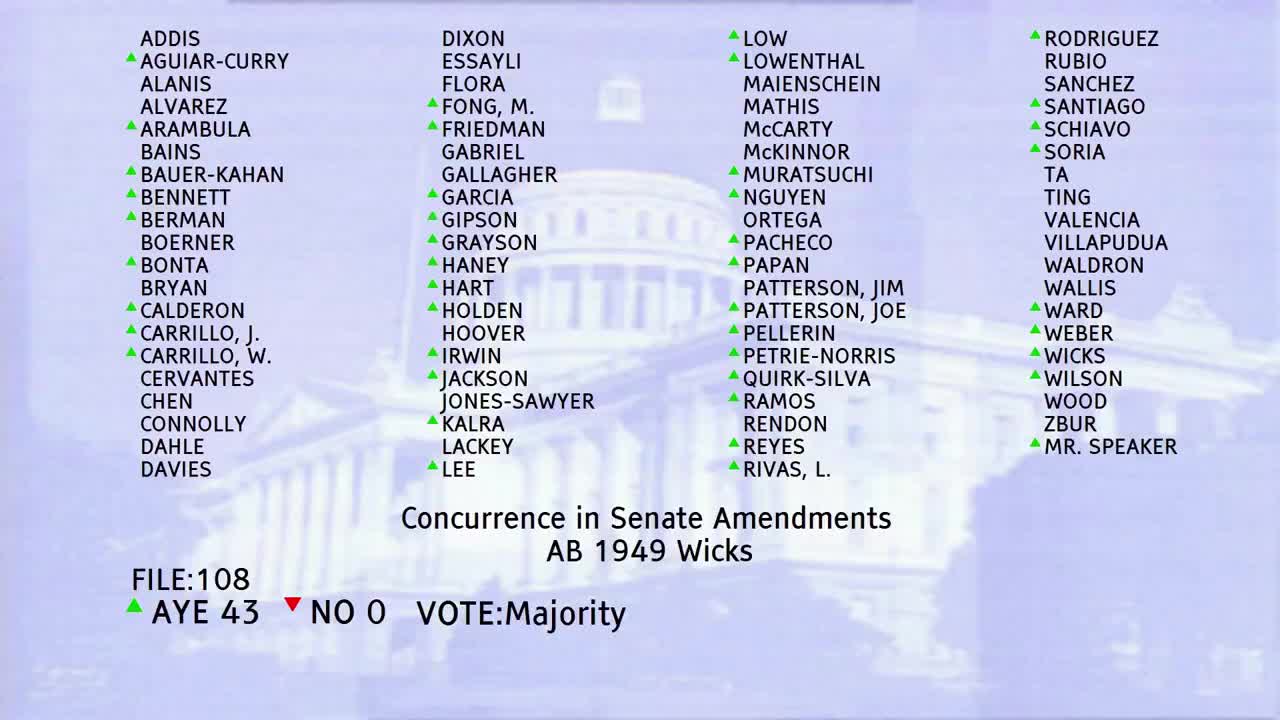 53SEC
Assembly Floor
 2MIN
Senate Floor
 47SEC
Senate Standing Committee on Appropriations
 34MIN
Senate Standing Committee on Transportation
 2MIN
Assembly Floor
 15MIN
Assembly Standing Committee on Communications and Conveyance
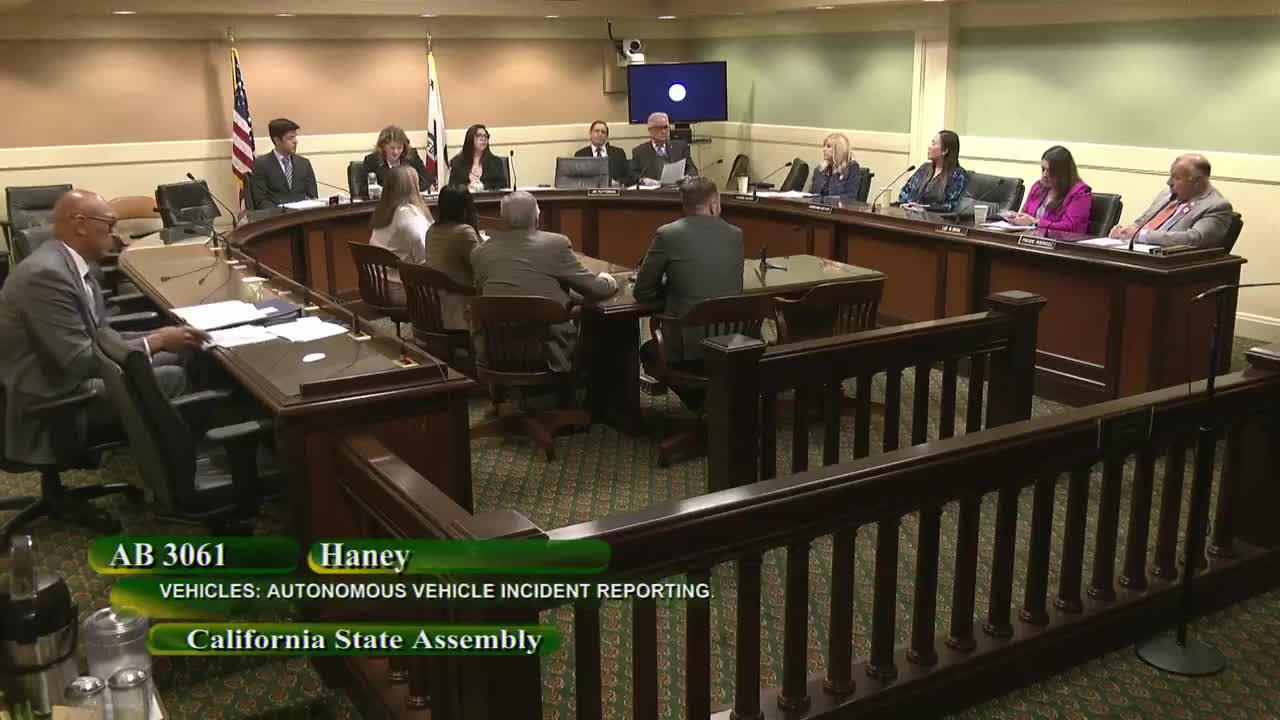 32SEC
Assembly Standing Committee on Communications and Conveyance
21SEC
Assembly Standing Committee on Communications and Conveyance



Bill Co-Author(s):