AB 2292: Electrical transmission facilities: certificates of public convenience and necessity.
- Session Year: 2023-2024
- House: Assembly
- Latest Version Date: 2024-09-27
Current Status:
Passed
(2024-09-27: Chaptered by Secretary of State - Chapter 709, Statutes of 2024.)
Introduced
In Committee
First Chamber
In Committee
Second Chamber
Enacted
What does this bill do?
This bill removes the rule that the California Public Utilities Commission must consider cost‑effective alternatives before approving electric transmission projects. Those alternatives included demand‑side options like targeted energy efficiency, ultraclean distributed generation (small, very clean power sources near customers), and other ways to reduce electricity demand, and the change affects electrical utilities and proposals for transmission lines and substations.
The summary is provided by generative AI which can make mistakes. For original language, please view the details in the table below.
Existing law vests the Public Utilities Commission with regulatory authority over public utilities, including electrical corporations. The Public Utilities Act prohibits any electrical corporation from beginning the construction of a line, plant, or system, or of any extension thereof, without having first obtained from the commission a certificate that the present or future public convenience and necessity require or will require its construction, except that the extension, expansion, upgrade, or other modification of an existing electrical transmission facility, including transmission lines and substations, does not require a certificate of public convenience and necessity. Existing law requires the commission, in considering an application for a certificate of public convenience and necessity for an electric transmission facility, to consider costeffective alternatives to transmission facilities that meet the need for an efficient, reliable, and affordable supply of electricity, including demand-side alternatives such as targeted energy efficiency, ultraclean distributed generation, as defined, and other demand reduction resources.
This bill would repeal the latter provision requiring the commission to consider cost-effective alternatives to transmission facilities, as specified.
Existing law vests the Public Utilities Commission with regulatory authority over public utilities, including electrical corporations. The Public Utilities Act prohibits any electrical corporation from beginning the construction of, among other things, a line, plant, or system, or of any extension thereof, without having first obtained from the commission a certificate of public convenience and necessity that the present or future public convenience and necessity require or will require its construction, except that the extension, expansion, upgrade, or other modification of an existing electrical transmission facility, including transmission lines and substations, does not require a certificate of public convenience and necessity. Existing law requires the commission, in considering an application for a certificate of public convenience and necessity for an electric transmission facility, to consider costeffective alternatives to transmission facilities that meet the need for an efficient, reliable, and affordable supply of electricity, including demand-side alternatives such as targeted energy efficiency, ultraclean distributed generation, as defined, and other demand reduction resources.
This bill would repeal the latter provision requiring the commission to consider cost-effective alternatives to transmission facilities, as specified.
|
Date
|
Status
|
|---|---|
| Sep 27, 2024 | Chaptered by Secretary of State - Chapter 709, Statutes of 2024. |
| Sep 27, 2024 | Approved by the Governor. |
| Sep 10, 2024 | Enrolled and presented to the Governor at 4:30 p.m. |
| Aug 28, 2024 | In Assembly. Ordered to Engrossing and Enrolling. |
| Aug 28, 2024 | Read third time. Passed. Ordered to the Assembly. (Ayes 30. Noes 7.). |
| Aug 6, 2024 | Read second time. Ordered to third reading. |
| Aug 5, 2024 | From committee: Be ordered to second reading pursuant to Senate Rule 28.8. |
| Jun 25, 2024 | From committee: Do pass and re-refer to Com. on APPR. (Ayes 13. Noes 0.) (June 24). Re-referred to Com. on APPR. |
| Jun 5, 2024 | Referred to Com. on E., U. & C. |
| May 24, 2024 | In Senate. Read first time. To Com. on RLS. for assignment. |
| May 23, 2024 | Read third time. Passed. Ordered to the Senate. (Ayes 65. Noes 0. Page 5596.) |
| May 2, 2024 | Read second time. Ordered to third reading. |
| May 1, 2024 | From committee: Do pass. (Ayes 11. Noes 0.) (May 1). |
| Apr 4, 2024 | From committee: Do pass and re-refer to Com. on APPR. (Ayes 14. Noes 0.) (April 3). Re-referred to Com. on APPR. |
| Feb 26, 2024 | Referred to Com. on U. & E. |
| Feb 13, 2024 | From printer. May be heard in committee March 14. |
| Feb 12, 2024 | Read first time. To print. |
|
Date
|
Description
|
Location
|
Votes
|
|
|---|---|---|---|---|
| Aug 28, 2024 | Assembly 3rd Reading AB2292 Petrie-Norris By Padilla | Senate Floor |
Passed |
|
| Jun 24, 2024 | Do pass, but first be re-referred to the Committee on [Appropriations] | Senate Standing Committee on Energy, Utilities and Communications |
Passed |
|
| May 23, 2024 | AB 2292 Petrie-Norris Assembly Third Reading | Assembly Floor |
Passed |
|
| May 1, 2024 | Do pass. | Assembly Standing Committee on Appropriations |
Passed |
|
| Apr 3, 2024 | Do pass and be re-referred to the Committee on [Appropriations] | Assembly Standing Committee on Utilities and Energy |
Passed |
This list shows positions taken on this bill by organizations on the date displayed, which is linked to the original source.
Positions by individuals are not included.
|
Organization
|
Position
|
Date
|
|---|---|---|
| American Clean Power-California | ** Support | |
| California Energy Storage Alliance | ** Support | |
| California Farm Bureau Federation | ** Against | |
| California State Association Of Electrical Workers | ** Support | |
| California Wind Energy Association | ** Support | |
| Clean Air Task Force | ** Support | |
| Clean Power Campaign | * Support | Jun 25, 2024 |
| Coalition of California Utility Employees | ** Support | |
| Environmental Defense Fund | ** Support | |
| Grid United | ** Support | |
| Independent Energy Producers Association | ** Support | |
| Large-Scale Solar Association | ** Support | |
| Northern California Power Agency | ** Support | |
| Pacific Gas And Electric Company | ** Support | |
| San Diego Gas and Electric Company | ** Support | |
| Sonoma Clean Power | ** Support | |
| Southern California Edison | ** Support |
SENATE RULES COMMITTEE Office of Senate Floor Analyses (916) 651-1520 Fax: (916) 327-4478 | AB 2292 |
THIRD READING
Bill No: AB 2292
Author: Petrie-Norris (D)
Introduced: 2/12/24
Vote: 21
SENATE ENERGY, U. & C. COMMITTEE: 13-0, 6/24/24
AYES: Bradford, Ashby, Becker, Caballero, Dodd, Durazo, Eggman, Gonzalez, Limón, Newman, Rubio, Skinner, Stern
NO VOTE RECORDED: Dahle, Grove, Min, Seyarto, Wilk
SENATE APPROPRIATIONS COMMITTEE: Senate Rule 28.8
ASSEMBLY FLOOR: 65-0, 5/23/24 - See last page for vote
SUBJECT: Electrical transmission facilities: certificates of public convenience and necessity
SOURCE: Clean Air Task Force
DIGEST:
This bill repeals the requirement that the California Public Utilities Commission (CPUC) consider alternatives to prospective transmission projects before issuing a Certificate of Public Convenience and Necessity (CPCN) approval.
ANALYSIS:
Existing law:
- Provides that the CPUC may supervise and regulate every public utility in the state and may do all things, whether specifically designated or in addition, which are convenient and necessary and in the exercise of such power and jurisdiction. (Public Utilities Code §701)
- Prohibits, via the Public Utilities Act, any electrical corporation from beginning the construction of, among other things, a line, plant, or system, or of any extension thereof, without having first obtained from the CPUC a CPCN that the present or future public convenience and necessity require or will require its construction, except that the extension, expansion, upgrade, or other modification of an existing electrical transmission facility, including transmission lines and substations, does not require a CPCN. (Public Utilities Code §1001)
- Requires the CPUC, in a proceeding evaluating the issuance of a CPCN for a proposed transmission project, to establish a rebuttable presumption with regard to need for the proposed transmission project in favor of a California Independent System Operator (CAISO) governing board-approved need evaluation if the project meets specified criteria. (Public Utilities Code §1001.1)
- Requires the CPUC, in considering an application for a CPCN for an electric transmission facility, to consider cost‑effective alternatives to transmission facilities that meet the need for an efficient, reliable, and affordable supply of electricity, including demand-side alternatives such as targeted energy efficiency, ultraclean distributed generation, as defined, and other demand reduction resources. (Public Utilities Code §1002.3)
- Requires the CPUC, by January 1, 2024, to update General Order (GO)131-D to authorize each public utility electrical corporation to use the permit-to-construct process or claim an exemption under Section III(B) of that general order to seek approval to construct an extension, expansion, upgrade, or other modification to its existing electrical transmission facilities, including electric transmission lines and substations within existing transmission easements, rights of way, or franchise agreements, irrespective of whether the electrical transmission facility is above a 200-kilovolt voltage (kV) level. (Public Utilities Code §564)
This bill repeals the provision that requires the CPUC to consider cost-effective alternatives to transmission facilities, including demand-side alternatives, as specified in Public Utilities Code Section1002.3
Background
- Transmission projects. Electric transmission lines are generally high voltage lines that move electricity from generation resources (power plants) to distribution lines in neighborhoods. Companies, usually electric investor-owned utilities (IOUs), proposing the construction of new transmission, are required to obtain a permit from the CPUC for construction of certain specified infrastructure listed under Public Utilities Code Section 1001, including transmission projects. The CPUC reviews permit applications under two concurrent processes: (1) an environmental review pursuant to California Environmental Quality Act (CEQA), and (2) the review of project need and costs pursuant to Public Utilities Code Section 1001 and GO 131-D (Certificate of Public Convenience and Necessity (CPCN)).
- Need for expanded transmission capacity. In order for the state to meet its clean energy goals, including achieving 100 percent clean energy by 2045, electric transmission capacity will likely need to grow significantly. The CAISO conducts its transmission planning process (TPP) to identify potential transmission system limitations as well as opportunities for system reinforcements that improve reliability and efficiency. The annual transmission plan fulfills the CAISO’s core responsibility to identify and plan the development of solutions, transmission or otherwise, to meet the future needs of the electricity grid. The CAISO identifies projects that address grid reliability requirements, identify upgrades needed to successfully meet California’s policy goals, and explore projects that can bring economic benefits to consumers. In 2021, the CAISO created a 20-Year Transmission Outlook for the electric grid, in collaboration with the CPUC and the California Energy Commission (CEC), with the goal of exploring the longer-term grid requirements and options for meeting the state’s SB 100 clean energy objectives reliably and cost-effectively. The 20-Year Transmission Outlook estimates a significant amount, and expense, to construct and expand transmission facilities, including an estimated $10.74 billion in upgrades to existing facilities.
- The Transmission Permitting Process. Usually, utilities proposing the construction of new transmission are required to obtain a permit from the CPUC for construction of certain specified infrastructure listed under Public Utilities Code Section 1001, including transmission projects. The CPUC reviews permit applications under two concurrent processes:
- An environmental review of applicable projects pursuant to CEQA and CPUC environmental rules. To prepare for the environmental review, the utility first conducts and submits a Proponents Environmental Assessment (PEA). The PEA is a preliminary assessment of the project’s potential environmental impacts and alternatives. Some projects may trigger a federal National Environmental Policy Act (NEPA) review if they cross federal land or use federal funds.
- The review of project needs and costs according to Public Utilities Code Section 1001 and GO 131-D, also known as a CPCN, or — depending on project size — a permit to construct (PTC).
- Permit/Certificate Review. Parallel to environmental review under CEQA, the CPUC reviews the utility’s application for a CPCN or a PTC, depending on the size of the project. The CPUC’s decision on the CPCN or PTC cannot be issued until the environmental review is complete, if one is required. But most transmission projects are categorically exempt from CEQA. Most of the CPCN/PTC process is outlined in GO 131-D.
- CPUC’s GO 131-D. GO 131-D was first adopted in 1970 and before a recent update late in 2023, it had not been updated since 1995. It establishes the criteria to be followed to trigger the need for a PTC or renovate electrical facilities, including transmission lines and substations, and also sets out public notice requirements for proposed transmission projects. The level of analysis performed by the CPUC pursuant to GO 131-D varies with the size (measured in voltage) of the transmission project.
- Projects below 50 kV are considered distribution line projects and in general, do not require CPUC approval.
- Projects between 50 kV and 200 kV generally require a PTC, which includes an environmental review pursuant to CEQA, if applicable. The CPUC process generally does not require a detailed analysis of the need for or economics of these projects. An application for a PTC must be filed at least nine months before a decision is required.
- Projects over 200 kV generally require a CPCN and are subject to CEQA review, as applicable.
The CPCN process analyzes the need for the project and the economics of the project, as well as, the environmental impacts of the project if CEQA applies. An application for a CPCN must be filed at least 12 months before a decision is required.
- GO 131-D Reforms. SB 529 (Hertzberg, Chapter 357, Statutes of 2022) required the CPUC to revise the permitting process for specified transmission projects. The bill directed the CPUC to revise GO 131-D to authorize a utility to use the PTC process or claim an exemption to seek approval to construct an extension, expansion, upgrade, or other modification to its existing transmission facilities regardless of the voltage level by January 1, 2024. However, CEQA still applies. In May 2023, the CPUC opened a rulemaking to solicit comments that would revise the GO 131-D rules. Based on the feedback, the assigned commissioner determined the issues to be considered in the proceeding should be separated into two phases. Phase 1 includes consideration of changes to GO 131-D necessary to conform it to the requirements of SB 529 and updates to outdated references. Phase 1 decision was approved on December 14, 2023.
- AB 1373 (Garcia, 2023). Among the many provisions adopted in AB 1373 is a provision that requires the CPUC to establish a rebuttable presumption with regard to need for the proposed transmission project in favor of a CAISO governing board-approved need evaluation if the project meets specified criteria. This requirement is among those under development within the SB 529 Rulemaking.
Comments
- Need for this bill. As shared by the author’s office, California’s transmission system is not equipped to handle the anticipated substantial increase in power flows; its lack of capacity and availability has led to grid congestion causing massive backlog in clean energy projects. Similarly, California’s transmission development process can be complicated and delayed taking over a decade or with ongoing coordination between CAISO, the CPUC and Utilities to plan, permit, and construct projects. Without revisions to current planning and permitting processes, it will be tremendously difficult for California to connect new generation to the grid in time to meet its clean energy and climate goals. The proponents contend that this bill proposes a modest, but important change to remove a duplicative review. They contend the CPUC review of alternatives is duplicative of the alternatives review by the CAISO in identifying the need for the project within the TPP. In this regard, the supporters believe this proposal would help reduce some of the delay in planning and siting transmission projects.
- Phase 2 Staff Proposal. Currently, the CPUC is in Phase 2 of the rulemaking proceeding to make changes to GO 131-D, which includes consideration of changes not addressed in the Phase 1. Roughly a month ago, the CPUC issued a Phase 2 Staff Proposal with recommendations for various approaches to the changes sought in GO 131-D, including consideration of comments submitted in the rulemaking. While still a proposal, not official policy adopted by the CPUC, it’s important to note that the rulemaking is actively considering related issues to this bill, including the application of the CPUC review of alternatives. The Staff Proposal states: “The CAISO and the CPUC have distinct and separate mandates to consider alternatives to transmission solutions. The role of the CPUC differs from the CAISO in key ways, including: the CPUC is a public agency with discretionary powers and an obligation to both comply with CEQA and ensure that public utility infrastructure projects serve the public convenience and necessity.” The Staff Proposal notes the CAISO is a nongovernmental nonprofit entity and does not conduct land use planning or environmental review pursuant to CEQA. Additional discussion in the Staff Proposal notes competing comments about the necessity and value of the CPUC review as compared to the CAISO’s. Within the rulemaking, stakeholders raise comparisons as to the review of cost and need at the CPUC and that by the CAISO. Similar comments are raised by supporters and opponents of this bill with some suggesting the CAISO process is more limited in terms of review and stakeholder ability to participate and others suggesting a CAISO review should be sufficient to inform the CPCN and siting process, particularly as AB 1373 (Garcia, 2023) requires a rebuttal presumption for a CAISO need evaluation under specified conditions.
Related/Prior Legislation
AB 2779 (Petrie-Norris, 2024) requires the CAISO, upon approval of the annual transmission plan, to report on any new use of any grid enhancing technology and its associated cost or efficiency savings. The bill is pending on the Senate Floor.
AB 3246 (Garcia, 2024) requires the CPUC, on or before January 1, 2026, to update a GO to provide specified exemption from the PTC for advanced reconductoring transmission projects. The bill is pending in the Senate Committee on Appropriations.
AB 3238 (Garcia, 2024) provides exemptions from, and streamlining of, planning, environmental review, and environmental permitting processes for the development of electrical transmission projects meeting specified criteria. The bill is pending before the Senate Appropriations Committee.
SB 1006 (Padilla, 2024) requires electrical transmission utilities, by January 1, 2026, to develop a strategic plan for grid-enhancing technologies to cost-effectively increase transmission capacity and to complete an evaluation to identify which of its transmission and distribution lines can be reconductored with advanced reconductors. Requires these plans and evaluations are submitted to the CPUC and made publicly available. The bill is pending before the Assembly Appropriations Committee.
AB 1373 (Garcia, Chapter 367, Statutes of 2023) included, among its many provisions, a requirement that the CPUC establish a rebuttable presumption with regard to need for the proposed transmission project in favor of a CAISO governing board-approved need evaluation if the project meets specified criteria.
SB 529 (Hertzberg, Chapter 357, Statutes of 2022) exempted an extension, expansion, upgrade, or other modification of an existing transmission line or substations from the requirement of a CPCN and directed the CPUC to revise its GO, by January 1, 2024, to instead use its permit to construct process for these approvals.
FISCAL EFFECT: Appropriation: No Fiscal Com.: Yes Local: No
SUPPORT: (Verified 8/5/24)
Clean Air Task Force (source)
American Clean Power-California
California Energy Storage Alliance
California State Association of Electrical Workers
California Wind Energy Association
Coalition of California Utility Employees
Environmental Defense Fund
Grid United
Independent Energy Producers Association
Large-Scale Solar Association
Northern California Power Agency
Pacific Gas and Electric Company
San Diego Gas and Electric Company
Sonoma Clean Power
Southern California Edison
OPPOSITION: (Verified 8/5/24)
California Farm Bureau Federation
ARGUMENTS IN SUPPORT: In support of this bill, the sponsor, the Clean Air Task Force states:
Currently, major transmission projects must be reviewed twice to determine if they are needed—once under the California Independent System Operator’s (CAISO) Transmission Planning Process (TPP) and once under the CPUC’s CPCN application. To approve a CPCN application, the CPUC must consider the availability of cost-effective alternatives to transmission. This requirement largely duplicates a similar determination made by the CAISO and is in addition to the CPUC’s environmental reviews under the California Environmental Quality Act (CEQA). In some cases, an alternative could be the no project alternative—not building the project at all if the need could be met through other means such as energy conservation, additional generation, or load management. The no project alternative is required even though CAISO independently identifies the transmission development needs in its TPP, including the energy efficiency and distributed generation assumptions provided directly by the CPUC. CATF can find no other case in the United States where one agency would effectively second-guess the need assessment determined by another agency.
ARGUMENTS IN OPPOSITION: In opposition to this bill, the California Farm Bureau states:
Farm Bureau has grave concerns that AB 2292 believes it is simply deleting repetitive action that is already taking place through the California Independent System Operator (CAISO) process. The process for participation at CAISO can be opaque and may not be used by stakeholders who are the most directly impacted by transmission projects because they are not always aware of the direct impacts until the project reaches the Commission [CPUC]. The current structure allows ratepayers and stakeholders to have an opportunity for input when they become aware of more specific projects at the Commission rather than the global view in the CAISO Transmission planning process (TPP) that can mask what may become direct impacts. Although recognizing the need for improved transmission connections, Farm Bureau is cognizant of and concerned about the impacts that could be imposed on agricultural landowners without an opportunity to understand the implications of expanding transmission lines on their properties. Our members already face the consequences of scaled back productive areas due to statewide requirements for utility management around the lines.
ASSEMBLY FLOOR: 65-0, 5/23/24
AYES: Addis, Aguiar-Curry, Alvarez, Arambula, Bains, Bauer-Kahan, Bennett, Berman, Boerner, Bonta, Bryan, Calderon, Juan Carrillo, Wendy Carrillo, Chen, Connolly, Davies, Dixon, Flora, Mike Fong, Friedman, Gabriel, Garcia, Gipson, Grayson, Haney, Hart, Hoover, Irwin, Jackson, Jones-Sawyer, Lee, Low, Lowenthal, Maienschein, McCarty, McKinnor, Muratsuchi, Stephanie Nguyen, Ortega, Pacheco, Papan, Joe Patterson, Pellerin, Petrie-Norris, Quirk-Silva, Ramos, Rendon, Reyes, Rodriguez, Santiago, Schiavo, Soria, Ting, Valencia, Villapudua, Waldron, Wallis, Ward, Weber, Wicks, Wilson, Wood, Zbur, Robert Rivas
NO VOTE RECORDED: Alanis, Cervantes, Megan Dahle, Essayli, Vince Fong, Gallagher, Holden, Kalra, Lackey, Mathis, Jim Patterson, Luz Rivas, Blanca Rubio, Sanchez, Ta
Prepared by: Nidia Bautista / E., U. & C. / (916) 651-4107
8/7/24 17:51:17
**** END ****
SENATE COMMITTEE ON ENERGY, UTILITIES AND COMMUNICATIONS
Senator Steven Bradford, Chair
2023 - 2024 Regular
Bill No: AB 2292 Hearing Date: 6/24/2024
Author: | Petrie-Norris | ||
Version: | 2/12/2024 Introduced | ||
Urgency: | No | Fiscal: | Yes |
Consultant: | Nidia Bautista | ||
SUBJECT: Electrical transmission facilities: certificates of public convenience and necessity
DIGEST: This bill repeals the requirement that the California Public Utilities Commission (CPUC) consider alternatives to prospective transmission projects before issuing a Certificate of Public Convenience and Necessity (CPCN) approval.
ANALYSIS:
Existing law:
- Establishes and vests the CPUC with regulatory authority over public utilities, including electrical corporations. (Article XII of the California Constitution)
- Provides that the CPUC may supervise and regulate every public utility in the state and may do all things, whether specifically designated or in addition, which are convenient and necessary and in the exercise of such power and jurisdiction. (Public Utilities Code §701)
- Prohibits, via the Public Utilities Act, any electrical corporation from beginning the construction of, among other things, a line, plant, or system, or of any extension thereof, without having first obtained from the CPUC a CPCN that the present or future public convenience and necessity require or will require its construction, except that the extension, expansion, upgrade, or other modification of an existing electrical transmission facility, including transmission lines and substations, does not require a CPCN. (Public Utilities Code §1001)
- Requires the CPUC, in a proceeding evaluating the issuance of a CPCN for a proposed transmission project, to establish a rebuttable presumption with regard to need for the proposed transmission project in favor of a California Independent System Operator (CAISO) governing board-approved need evaluation if the project meets specified criteria. Specifically:
- The CAISO governing board has made explicit findings regarding the need for the proposed transmission project and has determined that the proposed project is the most cost-effective transmission solution.
- The CAISO is a party to the proceeding.
- The CAISO governing board-approved need evaluation is submitted to the CPUC within sufficient time to be included within the scope of the proceeding.
- There has been no substantial change to the scope, estimated cost, or timeline of the proposed transmission project as approved by the CAISO governing board.
(Public Utilities Code §1001.1)
- Requires the CPUC, in considering an application for a CPCN for an electric transmission facility, to consider cost‑effective alternatives to transmission facilities that meet the need for an efficient, reliable, and affordable supply of electricity, including demand-side alternatives such as targeted energy efficiency, ultraclean distributed generation, as defined, and other demand reduction resources. (Public Utilities Code §1002.3)
- Requires the CPUC, by January 1, 2024, to update General Order (GO)131-D to authorize each public utility electrical corporation to use the permit-to-construct process or claim an exemption under Section III(B) of that general order to seek approval to construct an extension, expansion, upgrade, or other modification to its existing electrical transmission facilities, including electric transmission lines and substations within existing transmission easements, rights of way, or franchise agreements, irrespective of whether the electrical transmission facility is above a 200-kilovolt voltage (kV) level. (Public Utilities Code §564)
This bill repeals the provision that requires the CPUC to consider cost-effective alternatives to transmission facilities, including demand-side alternatives, as specified in Public Utilities Code §1002.3
Background
Transmission projects. Electric transmission lines are generally high voltage lines that move electricity from generation resources (power plants) to distribution lines in neighborhoods. Companies, usually electric investor-owned utilities (IOUs), proposing the construction of new transmission, are required to obtain a permit from the CPUC for construction of certain specified infrastructure listed under Public Utilities Code §1001, including transmission projects. The CPUC reviews permit applications under two concurrent processes: (1) an environmental review pursuant to California Environmental Quality Act (CEQA), and (2) the review of project need and costs pursuant to Public Utilities Code §1001 and GO 131-D (Certificate of Public Convenience and Necessity (CPCN)).
Need for expanded transmission capacity. In order for the state to meet its clean energy goals, including achieving 100 percent clean energy by 2045, electric transmission capacity will likely need to grow significantly. The CAISO conducts its transmission planning process (TPP) to identify potential transmission system limitations as well as opportunities for system reinforcements that improve reliability and efficiency. The annual transmission plan fulfills the CAISO’s core responsibility to identify and plan the development of solutions, transmission or otherwise, to meet the future needs of the electricity grid. The CAISO identifies projects that address grid reliability requirements, identify upgrades needed to successfully meet California’s policy goals, and explore projects that can bring economic benefits to consumers. In 2021, the CAISO created a 20-Year Transmission Outlook for the electric grid, in collaboration with the CPUC and the California Energy Commission (CEC), with the goal of exploring the longer-term grid requirements and options for meeting the state’s SB 100 clean energy objectives reliably and cost-effectively. The 20-Year Transmission Outlook estimates a significant amount, and expense, to construct and expand transmission facilities, including an estimated $10.74 billion in upgrades to existing facilities.
The Transmission Permitting Process. Usually, utilities proposing the construction of new transmission are required to obtain a permit from the CPUC for construction of certain specified infrastructure listed under Public Utilities Code §1001, including transmission projects. The CPUC reviews permit applications under two concurrent processes:
- An environmental review of applicable projects pursuant to CEQA and CPUC environmental rules. To prepare for the environmental review, the utility first conducts and submits a Proponents Environmental Assessment (PEA). The PEA is a preliminary assessment of the project’s potential environmental impacts and alternatives. Some projects may trigger a federal National Environmental Policy Act (NEPA) review if they cross federal land or use federal funds.
- The review of project needs and costs according to Public Utilities Code §1001 and GO 131-D, also known as a CPCN, or — depending on project size — a permit to construct (PTC).
Permit/Certificate Review. Parallel to environmental review under CEQA, the CPUC reviews the utility’s application for a CPCN or a PTC, depending on the size of the project. The CPUC’s decision on the CPCN or PTC cannot be issued until the environmental review is complete, if one is required. But most transmission projects are categorically exempt from CEQA. Most of the CPCN/PTC process is outlined in GO 131-D.
CPUC’s GO 131-D. GO 131-D was first adopted in 1970 and before a recent update late in 2023, it had not been updated since 1995. It establishes the criteria to be followed to trigger the need for a PTC or renovate electrical facilities, including transmission lines and substations, and also sets out public notice requirements for proposed transmission projects. The level of analysis performed by the CPUC pursuant to GO 131-D varies with the size (measured in voltage) of the transmission project.
- Projects below 50 kV are considered distribution line projects and in general, do not require CPUC approval.
- Projects between 50 kV and 200 kV generally require a PTC, which includes an environmental review pursuant to CEQA, if applicable. The CPUC process generally does not require a detailed analysis of the need for or economics of these projects. An application for a PTC must be filed at least nine months before a decision is required.
- Projects over 200 kV generally require a CPCN and are subject to CEQA review, as applicable.
The CPCN process analyzes the need for the project and the economics of the project, as well as, the environmental impacts of the project if CEQA applies. An application for a CPCN must be filed at least 12 months before a decision is required.
GO 131-D Reforms. SB 529 (Hertzberg, Chapter 357, Statutes of 2022) requires the CPUC to revise the permitting process for specified transmission projects. The bill directed the CPUC to revise GO 131-D to authorize a utility to use the PTC process or claim an exemption to seek approval to construct an extension, expansion, upgrade, or other modification to its existing transmission facilities regardless of the voltage level by January 1, 2024. However, CEQA still applies. In May 2023, the CPUC opened a rulemaking to solicit comments that would revise the GO 131-D rules. Based on the feedback, the assigned commissioner determined the issues to be considered in the proceeding should be separated into two phases. Phase 1 includes consideration of changes to GO 131-D necessary to conform it to the requirements of SB 529 and updates to outdated references. Phase 1 decision was approved on December 14, 2023.
AB 1373 (Garcia, 2023). Among the many provisions adopted in AB 1373 is a provision that requires the CPUC to establish a rebuttable presumption with regard to need for the proposed transmission project in favor of a CAISO governing board-approved need evaluation if the project meets specified criteria. This requirement is among those under development within the SB 529 Rulemaking.
Comments
Need for this bill. As shared by the author’s office, California’s transmission system is not equipped to handle the anticipated substantial increase in power flows; its lack of capacity and availability has led to grid congestion causing massive backlog in clean energy projects. Similarly, California’s transmission development process can be complicated and delayed taking over a decade or with ongoing coordination between CAISO, the CPUC and Utilities to plan, permit, and construct projects. Without revisions to current planning and permitting processes, it will be tremendously difficult for California to connect new generation to the grid in time to meet its clean energy and climate goals. The proponents contend that this bill proposes a modest, but important change to remove a duplicative review. They contend the CPUC review of alternatives is duplicative of the alternatives review by the CAISO in identifying the need for the project within the TPP. In this regard, the supporters believe this proposal would help reduce some of the delay in planning and siting transmission projects.
Phase 2 Staff Proposal. Currently, the CPUC is in Phase 2 of the rulemaking proceeding to make changes to GO 131-D, which includes consideration of changes not addressed in the Phase 1. Roughly a month ago, the CPUC issued a Phase 2 Staff Proposal with recommendations for various approaches to the changes sought in GO 131-D, including consideration of comments submitted in the rulemaking. While still a proposal, not official policy adopted by the CPUC, it’s important to note that the rulemaking is actively considering related issues to this bill, including the application of the CPUC review of alternatives. The Staff Proposal states: “The CAISO and the CPUC have distinct and separate mandates to consider alternatives to transmission solutions. The role of the CPUC differs from the CAISO in key ways, including: the CPUC is a public agency with discretionary powers and an obligation to both comply with CEQA and ensure that public utility infrastructure projects serve the public convenience and necessity.” The Staff Proposal notes the CAISO is a nongovernmental nonprofit entity and does not conduct land use planning or environmental review pursuant to CEQA. Additional discussion in the Staff Proposal notes competing comments about the necessity and value of the CPUC review as compared to the CAISO’s. Within the rulemaking, stakeholders raise comparisons as to the review of cost and need at the CPUC and that by the CAISO. Similar comments are raised by supporters and opponents of this bill with some suggesting the CAISO process is more limited in terms of review and stakeholder ability to participate and others suggesting a CAISO review should be sufficient to inform the CPCN and siting process, particularly as AB 1373 (Garcia, 2023) requires a rebuttal presumption for a CAISO need evaluation under specified conditions.
Prior/Related Legislation
AB 2779 (Petrie-Norris, 2024) requires the CAISO, upon approval of the annual transmission plan, to report on any new use of any grid enhancing technology and its associated cost or efficiency savings. The bill is pending on the Senate Floor.
AB 3246 (Garcia, 2024) requires the CPUC, on or before January 1, 2026, to update a GO to provide specified exemption from the PTC for advanced reconductoring transmission projects. The bill is pending before this committee.
AB 3238 (Garcia, 2024) provides exemptions from, and streamlining of, planning, environmental review, and environmental permitting processes for the development of electrical transmission projects meeting specified criteria. The bill is pending before this committee.
SB 1006 (Padilla, 2024) requires electrical transmission utilities, by January 1, 2026, to develop a strategic plan for grid-enhancing technologies to cost-effectively increase transmission capacity and to complete an evaluation to identify which of its transmission and distribution lines can be reconductored with advanced reconductors. Requires these plans and evaluations are submitted to the CPUC and made publicly available. The bill is pending in the Assembly.
SB 319 (McGuire, Chapter 390, Statutes of 2023) required the CEC and the CPUC, in coordination with the CAISO, to better and regularly coordinate planning and permitting of energy transmission infrastructure to ensure the state meets its clean energy goals and to evaluate and report on that planning and related infrastructure development.
AB 1373 (Garcia, Chapter 367, Statutes of 2023) among its many provisions included a requirement that the CPUC establish a rebuttable presumption with regard to need for the proposed transmission project in favor of a CAISO governing board-approved need evaluation if the project meets specified criteria.
SB 529 (Hertzberg, Chapter 357, Statutes of 2022) exempted an extension, expansion, upgrade, or other modification of an existing transmission line or substations from the requirement of a CPCN and directed the CPUC to revise its GO, by January 1, 2024, to instead use its permit to construct process for these approvals.
SB 887 (Becker, Chapter 358, Statutes of 2022) required 15-year projections of energy resource portfolios and energy demand to inform transmission planning to achieve the state’s clean energy goals, and requires the CAISO to consider approval for specified transmission projects as part of the 2022-23 TPP.
FISCAL EFFECT: Appropriation: No Fiscal Com.: Yes Local: No
SUPPORT:
American Clean Power-California
California Energy Storage Alliance
California State Association of Electrical Workers
California Wind Energy Association
Clean Air Task Force
Coalition of California Utility Employees
Environmental Defense Fund
Independent Energy Producers Association
Large-scale Solar Association
Northern California Power Agency
Pacific Gas and Electric Company
San Diego Gas and Electric Company
Sonoma Clean Power
Southern California Edison
OPPOSITION:
California Farm Bureau Federation
ARGUMENTS IN SUPPORT: In support of this bill, the sponsor, the Clean Air Task Force states:
Currently, major transmission projects must be reviewed twice to determine if they are needed—once under the California Independent System Operator’s (CAISO) Transmission Planning Process (TPP) and once under the CPUC’s CPCN application. To approve a CPCN application, the CPUC must consider the availability of cost-effective alternatives to transmission. This requirement largely duplicates a similar determination made by the CAISO and is in addition to the CPUC’s environmental reviews under the California Environmental Quality Act (CEQA). In some cases, an alternative could be the no project alternative—not building the project at all if the need could be met through other means such as energy conservation, additional generation, or load management. The no project alternative is required even though CAISO independently identifies the transmission development needs in its TPP, including the energy efficiency and distributed generation assumptions provided directly by the CPUC. CATF can find no other case in the United States where one agency would effectively second-guess the need assessment determined by another agency.
ARGUMENTS IN OPPOSITION: In opposition to this bill, the California Farm Bureau states:
Farm Bureau has grave concerns that AB 2292 believes it is simply deleting repetitive action that is already taking place through the California Independent System Operator (CAISO) process. The process for participation at CAISO can be opaque and may not be used by stakeholders who are the most directly impacted by transmission projects because they are not always aware of the direct impacts until the project reaches the Commission [CPUC]. The current structure allows ratepayers and stakeholders to have an opportunity for input when they become aware of more specific projects at the Commission rather than the global view in the CAISO Transmission planning process (TPP) that can mask what may become direct impacts. Although recognizing the need for improved transmission connections, Farm Bureau is cognizant of and concerned about the impacts that could be imposed on agricultural landowners without an opportunity to understand the implications of expanding transmission lines on their properties. Our members already face the consequences of scaled back productive areas due to statewide requirements for utility management around the lines.
-- END --
ASSEMBLY THIRD READING
ATR Bill Id:AB 2292
Author:(Petrie-Norris)
As Introduced Ver:February 12, 2024
Majority vote
SUMMARY
Repeals the requirement that the California Public Utilities Commission (CPUC) consider alternatives to prospective transmission projects before issuing a Certificate of Public Need and Convenience (CPCN) approval.
COMMENTS
California has ambitious clean energy goals: 100% renewable and zero-carbon energy-producing resources by December 31, 2045. Consequently, electricity demand in California is expected to nearly double by 2040, requiring heavy investment in the state's power grid to meet its net zero goals.
To support the state's climate targets, California has a complicated but robust planning and procurement regime spread across the CPUC, the California Air Resources Board (CARB), the California Energy Commission (CEC), and the California Independent Systems Operator (CAISO).
Briefly:
- The CARB's Scoping Plan establishes a target range for the electricity sector's greenhouse gas (GHG) emission reductions;
- The CEC's Integrated Energy Policy Report (IEPR), among other considerations and actions, provides a demand forecast to anticipate statewide load in the next decade or longer;
- The CPUC's Integrated Resource Plan (IRP) forecasts system generation resource needs to meet the customer demand forecast by the IEPR 10 years in the future;
- The CPUC's Resource Adequacy (RA) process identifies resources needed to meet customer demand and ensure reliability today; and
- The CAISO's TPP identifies the transmission needs to interconnect and balance the system supply provided by the IRP with the customer demand provided by the IEPR.
The TPP relies on the CPUC's IRP planning targets. CAISO receives the IRP results as inputs into its TPP. The CAISO also considers recommendations from the CEC's IEPR. In the TPP, CAISO identifies potential system limitations as well as transmission projects in need of upgrades or new infrastructure in need of construction to improve reliability and efficiency. Specifically, CAISO evaluates the need for new transmission capacity from economic, reliability, and policy lenses, with economic need historically driving transmission selection. The plan is updated annually, and culminates in a CAISO Board of Governors approved transmission plan that identifies the needed transmission solutions and authorizes cost recovery through CAISO transmission rates, subject to federal regulatory approval.
Extremely large projects with significant or new rights of way are subject to two application processes at the CPUC: a California Environmental Quality Act (CEQA) review and a CPCN review. As part of the CEQA review, alternatives to the proposed transmission project must be evaluated. The CPCN review also requires the examination of cost-reducing "non-wires" alternatives, or any electrical grid investment that can defer or remove the need to construct or upgrade components of a distribution and/or transmission system.
As evidenced by some of the solutions identified in previous TPPs, CAISO considers non-wires alternatives. For example, the 2021-22 TPP allocated 9,368 megawatts of battery storage in transmission zones. Since the CAISO presumably already considers non-wires alternatives in their TPP, the CPUC's statutory mandate to subsequently consider non-wires to these projects during the CPCN review seems duplicative. Moreover, this duplication may have the effect of rendering the CAISO analysis moot; i.e. in circumstances where the CAISO's TPP finds a need for a transmission project, but the CPUC's CPCN reconsiders non-wires alternatives and selects a different outcome.
This bill would help to facilitate the efficient development of projects that support California's energy and climate change goals by repealing this duplicative review of non-wires alternatives requirement in the CPUC's CPCN review for a transmission project. However, the CPUC would still need to consider alternatives to the proposed transmission projects as part of its CEQA permitting review. The practical effect of this bill should, therefore, be quite limited.
According to the Author
"California needs extensive transmission infrastructure to meet its clean energy goals. [This bill] seeks to expedite permitting timelines by removing the requirement that the California Public Utilities Commission should consider alternatives to prospective transmission projects before issuing an approval. Repealing this requirement will remove a duplicative process that currently slows down transmission developments in the state."
Arguments in Support
The Environmental Defense Fund writes, "[This bill] recognizes that the state's process for determining if new transmission is required has evolved since the rules were updated in General Order 131-D in 1994 with minor modifications in 1995. Given the new coordination framework between the Public Utilities Commission, Energy Commission, and the Independent System Operator, having a second duplicative need determination is no longer necessary. This process improvement will help match the coordination to help unlock our clean energy goals more quickly and affordably."
Arguments in Opposition
The California Farm Bureau writes, "Farm Bureau has grave concerns that [this bill] believes it is simply deleting repetitive action that is already taking place through the California Independent System Operator (CAISO) process. The process for participation at CAISO can be opaque and is rarely used by stakeholders who are the most directly impacted by transmission projects. To remove a tool from the Commission seems counterintuitive. Taking time to carefully consider cost-effective alternatives and allowing the ratepayers and landowners who will be most impacted by those decisions a clear and meaningful opportunity to participate should be the basic tenants of any application process. Further, if the belief is that the CAISO process is sufficiently robust, then continuing to include it as part of the Commission process should lead to minimal additional time, therefore removing the provision would be unnecessary."
FISCAL COMMENTS
According to the Assembly Committee on Appropriations, this bill has no state costs.
VOTES
ASM UTILITIES AND ENERGY: 14-0-2
YES: Petrie-Norris, Calderon, Chen, Connolly, Friedman, Holden, Joe Patterson, Reyes, Santiago, Schiavo, Ting, Wallis, Wood, Zbur
ABS, ABST OR NV: Jim Patterson, Bauer-Kahan
ASM APPROPRIATIONS: 11-0-4
YES: Wicks, Arambula, Bryan, Calderon, Wendy Carrillo, Mike Fong, Grayson, Haney, Hart, Pellerin, Villapudua
ABS, ABST OR NV: Sanchez, Dixon, Jim Patterson, Ta
UPDATED
VERSION: February 12, 2024
CONSULTANT: Kathleen Chen / U. & E. / (916) 319-2083 FN: 0002835
Date of Hearing: May 1, 2024
ASSEMBLY COMMITTEE ON APPROPRIATIONS
Buffy Wicks, Chair
ABPCA Bill Id:AB 2292
Author:(Petrie-Norris) – As Introduced Ver:February 12, 2024
Policy Committee: | Utilities and Energy | Vote: | 14 - 0 |
|
| ||
|
|
Urgency: No State Mandated Local Program: No Reimbursable: No
SUMMARY:
This bill repeals the requirement in existing law that the California Public Utilities Commission (CPUC) consider alternatives to a prospective transmission project before issuing a certificate of public need and convenience (CPNC).
FISCAL EFFECT:
No state costs.
COMMENTS:
- Purpose. The author, noting California’s need for “extensive transmission infrastructure,” intends this bill to remove a CPUC process the author concludes is “duplicative,” thereby expediting CPUC transmission project permitting.
- Background. To achieve the state’s clean energy goals, California will need considerable amounts of new transmission to be developed, quickly.
The state’s energy infrastructure planning and permitting processes is complex and involves inter-related activities by multiple parties and state agencies. This complexity and inter-relation is demonstrated by the Assembly Utilities and Energy Committee analysis of this bill, which described the process, more or less, as follows:
- The Air Resources Board’s Scoping Plan establishes a target range for the electricity sector’s greenhouse gas (GHG) emission reductions.
- The Energy Commission’s Integrated Energy Policy Report (IEPR) provides a demand forecast to anticipate statewide load in the next decade or longer.
- The CPUC’s integrated resource plan (IRP) forecasts system generation resource needs to meet the customer demand forecast by the IEPR 10 years in the future.
- The CPUC’s resources adequacy (RA) process identifies resources needed to meet customer demand and ensure reliability today.
- The California Independent System Operator’s (CAISO’s) transmission planning process (TPP) identifies the transmission needs to interconnect and balance the system supply described by the IRP with the customer demand projected by the IEPR.
- The TPP relies on the CPUC’s IRP planning targets. CAISO receives the IRP results as inputs into its TPP. The CAISO also considers recommendations from the Energy Commission’s IEPR. The plan is updated annually, and culminates in a CAISO Board of Governors-approved transmission plan that identifies the needed transmission solutions and authorizes cost recovery through CAISO transmission rates, subject to federal regulatory approval.
The Legislature granted the CPUC the power to regulate an investor-owned utility’s (IOU’s) construction of an electric line, by specifying that an IOU may not begin construction of a transmission line without having first obtained from the CPUC a certificate—a CPNC—that the present or future public convenience and necessity requires or will require its construction. This requirement notwithstanding, statute provides an IOU does not need a CPNC for the extension, expansion, upgrade or other modification of an existing electrical transmission facility, including transmission lines and substations.
Acting on this power granted by the Legislature, the CPUC adopted rules governing a utility’s construction of an electrical line. Specifically, CPUC General Order 131-D establishes the rules relating to the planning and construction of electric generation facilities, electric line facilities and substations. The general order distinguishes electrical lines according to their operating capacities: a transmission line being one designed to operate at or above 200 kV, a power line being one designed to operate between 50 kV and 200kV, and a distribution line being one designed to operate under 50 kV. And general order makes differing permit requirements applicable to each type of electrical line. Relevant to this analysis, CPUC’s general order requires an IOU seeking to construct a major electric transmission line in California—again, one designed to operate at or above 200kV—first receive a CPNC from the CPUC.
So, while an IOU generally must receive a CPNC from the CPUC before constructing an electrical line, the various exceptions to this general requirement mean, in effect, the CPUC does not review the majority of IOU transmission projects. The universe of projects subject to CPUC review this bill would effect, therefore, is relatively small.
Any project to construct an electrical line that is subject to permitting by the CPUC would also need permitting under the California Environmental Quality Act (CEQA), and the CPUC would serve as the lead CEQA permitting agency for the project. CEQA requires the permitting agency to consider the environmental effects of a project. If those environmental effects are substantial and cannot be mitigated, the permitting agency must produce an environmental impact report (EIR), part of which is consideration of all feasible alternatives to the project.
It is safe to assume that any project to construct a large electrical transmission line would have substantial effects on the environment. Therefore, the CPUC is likely to need to produce an EIR for any proposed transmission line subject to CPUC permitting. This bill may save the CPUC some work on the front end, in that the CPUC would no longer need to consider, as part of the CPNC process, alternatives to a proposed transmission line. However, the CPUC would still need to consider alternatives to the proposed transmission line as part of its CEQA permitting review. The practical effect of this bill should, therefore, be quite limited.
Analysis Prepared by: Jay Dickenson / APPR. / (916) 319-2081
Date of Hearing: April 3, 2024
ASSEMBLY COMMITTEE ON UTILITIES AND ENERGY
Cottie Petrie-Norris, Chair
ABPCA Bill Id:AB 2292 (
Author:Petrie-Norris) – As Introduced Ver:February 12, 2024
SUBJECT: Electrical transmission facilities: certificates of public convenience and necessity
SUMMARY: Repeals the requirement that the California Public Utilities Commission (CPUC) should consider alternatives to prospective transmission projects before issuing an approval.
EXISTING LAW:
- Requires the CPUC to consider in its Certificate of Public Convenience and Necessity (CPCN) review cost-effective alternatives to a transmission facility, including targeted energy efficiency, ultraclean distributed generation, and other demand reduction resources. (Public Utilities Code § 1002.3)
- Establishes as the policy of the state that eligible renewable energy resources and zero-carbon resources supply 100% of all retail sales of electricity to California end-use customers by December 31, 2045 and 100% of electricity procured to serve all state agencies by December 31, 2035. (Public Utilities Code § 454.53)
- Requires the CPUC to consider in its procurement plan eligible renewable energy resources that are cost-effective, reliable, and feasible. (Public Utilities Code § 454.5)
- Establishes the California Independent System Operator (CAISO) as a nonprofit public benefit corporation and requires the CAISO to ensure efficient use and reliable operation of the electrical transmission grid consistent with achieving planning and operating reserve criteria. (Public Utilities Code § 345.5)
FISCAL EFFECT: Unknown. This bill is keyed fiscal and will be referred to the Committee on Appropriations for its review.
BACKGROUND:
California’s climate goals – SB 100 (de León, Chapter 312, Statutes of 2018) established the state policy that renewable and zero-carbon resources supply 100% of retail sales and electricity procured to serve all state agencies by 2045 (the 100% Clean Energy Policy).[1] This policy was updated under SB 1020 (Laird, Chapter 361, Statutes of 2022) which accelerated the requirement on state agencies to 100% by 2035, and established interim targets to meet the sector-wide 100% goal. These ambitious targets establish the planning goal that informs all subsequent electricity procurement and transmission planning.
Transmission Planning – Transmission lines carry electric energy from one point to another in an electric power system. As the transmission system is the connecting point between generation resources (supply) and consumers (demand), planning for transmission construction – both new and upgrading old – requires an understanding of both future generation resource needs (capacity and location) and consumer demand changes. Therefore, transmission planning requires a robust planning process that considers all aspects of electricity supply and demand.
California has a complicated but robust electric planning and procurement regime spread across CARB, the CPUC, the CEC, and the CAISO. Much of this regime focuses on resource procurement needed to meet our clean energy goals, however the direct downstream effect of the procurement planning is planning for the transmission needed to accommodate the new generation. The main elements of the regime are the Scoping Plan at CARB, the Integrated Energy Policy Report (IEPR) at the CEC, the Integrated Resource Plans (IRP) and Resource Adequacy (RA) process at the CPUC, and finally the Transmission Planning Process (TPP) at the CAISO.
Briefly:
- The Scoping Plan establishes a target range for the electricity sector’s greenhouse gas (GHG) emission reductions;[2]
- The IEPR, among other considerations and actions, provides a demand forecast to anticipate statewide load in the next decade or longer;
- The IRP forecasts system generation resource needs to meet the customer demand forecast by the IEPR 10 years in the future;
- The RA identifies resources needed to meet customer demand and ensure reliability today; and
- The TPP identifies the transmission needs to interconnect and balance the system supply provided by the IRP with the customer demand provided by the IEPR.
The TPP relies on the CPUC’s IRP planning targets. CAISO receives the IRP results as inputs into its TPP. The CAISO also considers recommendations from the CEC’s IEPR. The plan is updated annually, and culminates in a CAISO Board of Governors approved transmission plan that identifies the needed transmission solutions and authorizes cost recovery through CAISO transmission rates, subject to federal regulatory approval.
Transmission permitting – Following the CAISO Board’s approval of a TPP, new projects that are identified as necessary go through a competitive solicitation process. Transmission developers – which may be POUs, IOUs, or private, for-profit entities – apply for the project solicitation and those applications are evaluated on a number of qualifying criteria, including cost. Most recently, the CAISO approved its 2022-2023 TPP on May 18, 2023,[3] and identified 45 projects – at an estimated $7.3 billion – needed for reliability and to meet state policy goals; three of these projects are eligible for competitive solicitation.[4]
Once a transmission developer’s project proposal is selected in the competitive solicitation, it undergoes two application processes at the CPUC: a California Environmental Quality Act (CEQA) review and a Certificate of Public Convenience and Necessity (CPCN) review. The CEQA review requires the examination of particular environmental issues such as water, air quality, noise, and land uses, among others. As part of the CEQA review, alternatives to the proposed transmission project must be evaluated. The CPCN review considers the need for the project based on economic, reliability, and/or renewable goals. The CPCN review also requires the examination of alternatives, with a focus on cost-reduction. CAISO is often a party to these CPCN proceedings at the CPUC, making the case for why a particular transmission project is necessary, per their TPP.
Typically, only extremely large projects with significant or new rights of way are subject to CPUC permit and environmental view. The vast majority of transmission upgrades are exempt from project permitting at the CPUC. However, as California’s electric grid rapidly evolves to accommodate new and distributed clean energy resources to meet energy and climate goals and reliability needs, it is becoming increasingly clear that current processes are not sufficient to efficiently review the number of new transmission projects in the state’s pipeline.
Permitting reforms – In 2023, the Legislature passed a package of permitting and environmental review reforms, with the goal of facilitating the development of projects that support California’s energy and climate change goals. The package included streamlining the judicial review of clean energy projects that are challenged under CEQA.[5] Simultaneously, the Governor released Executive Order N-8-23, directing the creation of an Infrastructure Strike Team, made up of the heads of various government agencies to identify projects on which to focus streamlining efforts.
COMMENTS:
- Author’s statement. According to the author, “California needs extensive transmission infrastructure to meet its clean energy goals. AB 2292 seeks to expedite permitting timelines by removing the requirement that the California Public Utilities Commission should consider alternatives to prospective transmission projects before issuing an approval. Repealing this requirement will remove a duplicative process that currently slows down transmission developments in the state.”
- Infrastructure development collides with affordability concerns. According to a May 2023 study by Kevala, Inc. released by the CPUC, “up to $50 billion…in investments are needed by 2035” for distribution grid upgrades.[6] As mentioned above, the May 2023 CAISO transmission plan estimated the need for approximately $7.3 billion in new investments over that same period for transmission infrastructure. Stretch the estimates to 2045, and the transmission costs alone are thought to be over $30 billion.[7] In February 2024, the CPUC adopted its preferred portfolio of generation resources needed to meet our decarbonization goals in 2035.[8] The decision adopted over 56 gigawatts of new resources, the costs of which are dependent on future supply chain and market constraints. These distribution, transmission, and generation costs sum into the tens of billions of dollars. However, these costs are in addition to costs for wildfire or other emergency response and mitigation efforts the utilities have been expensing over the last few years, which are only beginning to be absorbed into rates, as evidenced by PG&E’s recent increases.[9]
- Duplication leading to delays. In the TPP, CAISO identifies potential system limitations as well as transmission projects in need of upgrades or new infrastructure in need of construction to improve reliability and efficiency. Specifically, CAISO evaluates the need for new transmission capacity from economic, reliability, and policy lenses, with economic need historically driving transmission selection. As evidenced by some of the solutions identified in previous TPPs, CAISO does consider “non-wires” alternatives, or any electrical grid investment that can defer or remove the need to construct or upgrade components of a distribution and/or transmission system. For example, the 2021-2022 TPP allocated 9,368 megawatts of battery storage in transmission zones.
In the CPCN review of any construction designated by the TPP, the CPUC – according to SB 1037 (Kehoe, Chapter 366, Statutes of 2005) – must consider cost-effective non-wires alternatives to that project. Since the CAISO presumably already considers non-wires alternatives in their TPP, the CPUC’s statutory mandate to also consider non-wires during the CPCN review seems duplicative. Moreover, this duplication may have the effect of rendering the CAISO analysis moot; i.e. in circumstances where the CAISO’s TPP finds a need for a transmission project, but the CPUC’s CPCN reconsiders non-wire alternatives and selects a different outcome.
Writing in opposition to this measure, the Farm Bureau questions the characterization that the CAISO TPP and CPUC CPCN processes are duplicative with regard to considering project alternatives. They note that the CAISO process “can be opaque and is rarely used by stakeholders.” They further note that without realistic and robust consideration of transmission alternatives, cost overruns could abound. However, CAISO’s TPP regularly uses workshops and calls for public comment to engage with energy and non-energy industry stakeholders.[10] Moreover, this bill only repeals one statutorily-proscribed review requirement in the CPUC’s CPCN review for a transmission project; the underlying CPCN licensing authority and CEQA review are preserved at the CPUC.
- Related legislation.
AB 2779 (Petrie-Norris) would require the CAISO, upon approval of each transmission plan, to report to the CPUC and the Legislature any new use of grid-enhancing technology in the plan and the associated cost or efficiency savings of that deployment. Status: pending hearing in the Assembly Committee on Utilities and Energy.
AB 3246 (Garcia) would provide a streamlined CPUC review of investor-owned utilities’ advanced reconductoring projects on existing transmission facilities. Status: pending hearing in the Assembly Committee on Utilities and Energy.
SB 1006 (Padilla) would require specified utilities to jointly prepare a grid-enhancing technology strategic plan, and to evaluate which existing circuits may be reconductored cost-effectively, among other changes. Status: pending hearing in the Senate Committee on Energy, Utilities, and Communications.
- Prior legislation.
SB 1020 (Laird) accelerated the 100% Clean Energy Policy to require electricity procured to serve all state agencies be 100% clean energy by 2035, and established interim targets to meet the sector-wide 100% goal. Status: Chapter 361, Statutes of 2022.
SB 100 (de León) established the state policy that renewable and zero-carbon resources supply 100% of retail sales and electricity procured to serve all state agencies by 2045. Status: Chapter 312, Statutes of 2018.
SB 350 (Kehoe) established a “non-wires” consideration in transmission project approvals at the CPUC. Status: Chapter 366, Statutes of 2005).
REGISTERED SUPPORT / OPPOSITION:
Support
American Clean Power Association
California State Association of Electrical Workers
Clean Air Task Force
Coalition of California Utility Employees
Edison International and Affiliates, Including Southern California Edison
Environmental Defense Fund
Northern California Power Agency
San Diego Gas and Electric Company
Opposition
California Farm Bureau Federation
Analysis Prepared by: Kathleen Chen / U. & E. / (916) 319-2083
Public Utilities Code § 454.53 ↑
Public Utilities Code § 454.52(a)(1)(A) ↑
CAISO; “CAISO 2022-2023 Transmission Plan approved: More proactive approach recommends 45 projects; Interconnection queue improvements also advanced”; May 2023. ↑
Notice from August 3, 2023, CAISO; “2022-2023 Transmission Planning Process: Competitive solicitation project specification revisions posted”; http://www.caiso.com/Documents/2022-2023-transmission-planning-process-competitive-solicitation-revisions-posted.html ↑
SB 149 (Caballero, Becker, R.Rivas; Chapter 60, Statutes of 2023) ↑
Kevala; “Electrication Impacts Study Part 1: Bottom-Up Load Forecasting and System-Level Electrification Impacts Cost Estimates”; May 2023. ↑
CAISO; 2022 20-Year Transmission Outlook; May 2022. ↑
D. 24-02-047, R. 20-05-003, CPUC; Decision Adopting 2023 Preferred System Plan and Related Matters, and Addressing Two Petitions for Modification; February 2024. ↑
D. 23-11-069, A. 21-06-021, CPUC; Decision on Test Year 2023 GRC for PG&E; November 2023. ↑
CAISO; “2022-2023 Transmission planning process: Comments on draft transmission plan”; https://stakeholdercenter.caiso.com/Comments/AllComments/3b5eb926-9bce-4c7f-806c-9ae156a4f9f3. ↑
Discussed in Hearing
 2MIN
Senate Floor
 11MIN
Senate Standing Committee on Energy, Utilities and Communications
 1MIN
Assembly Floor
 2MIN
Assembly Standing Committee on Appropriations
 6MIN
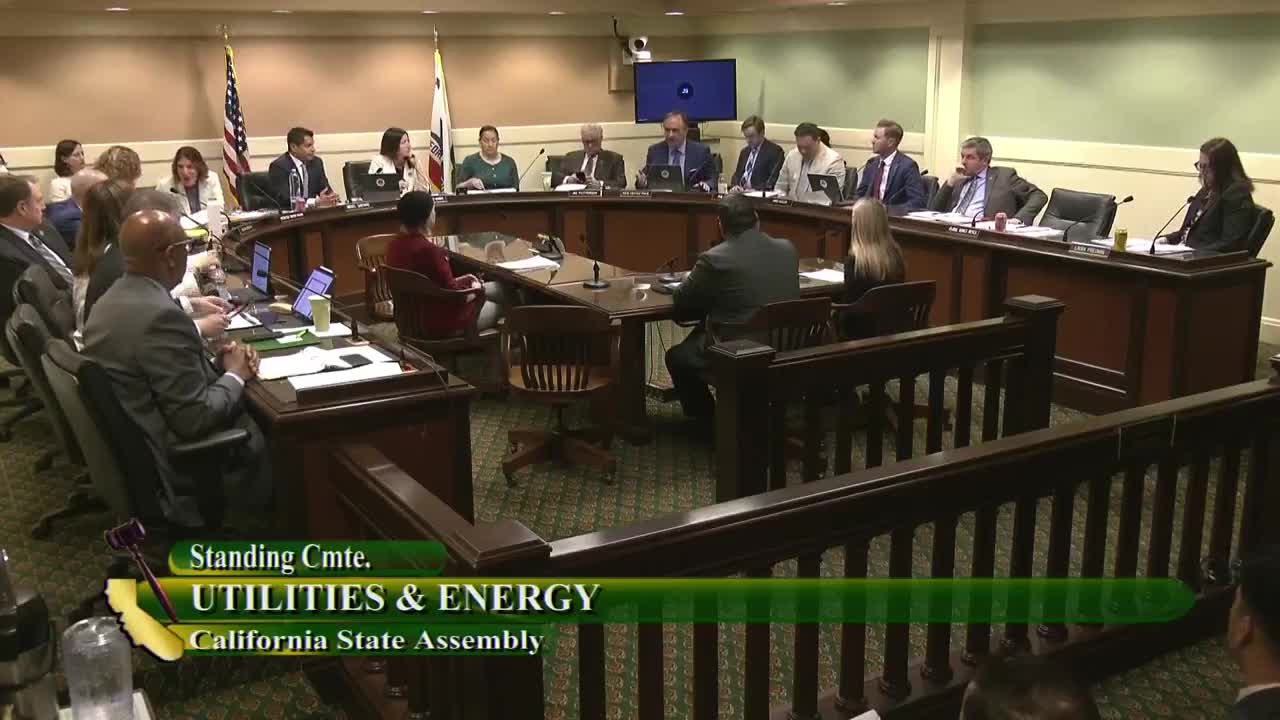
Assembly Standing Committee on Utilities and Energy
Bill Author

Bill Co-Author(s):