AB 2316: Pupil nutrition: substances: prohibition.
- Session Year: 2023-2024
- House: Assembly
- Latest Version Date: 2024-09-28
Current Status:
Passed
(2024-09-28: Chaptered by Secretary of State - Chapter 914, Statutes of 2024.)
Introduced
In Committee
First Chamber
In Committee
Second Chamber
Enacted
What does this bill do?
Beginning December 31, 2027, the bill bans certain artificial food dyes (Blue 1 and 2, Green 3, Red 40, Yellow 5 and 6) and bars caffeine in beverages served or sold to K–12 students, including in school breakfasts and lunches that qualify for federal meal programs. It also tightens nutrition limits for foods sold outside regular school meals—setting caps on calories, fat, added sugar, sodium, and trans fat—and allows limited exceptions for off‑campus sales or school fundraising events.
The summary is provided by generative AI which can make mistakes. For original language, please view the details in the table below.
Existing law requires the State Department of Education to develop and maintain nutrition guidelines for school lunches and breakfasts, and for all food and beverages sold on public school campuses. Existing law requires those nutrition guidelines to be consistent with the requirements for a nutritionally adequate breakfast and a nutritionally adequate lunch. Existing law defines a nutritionally adequate breakfast and a nutritionally adequate lunch for these purposes to mean those that qualify for reimbursement under the most current meal pattern for the federal School Breakfast Program and the federal National School Lunch Program, respectively.
Existing law requires a school district, county superintendent of schools, or charter school maintaining kindergarten or any of grades 1 to 12, inclusive, to make available a nutritionally adequate breakfast and a nutritionally adequate lunch, free of charge, during each schoolday to any pupil who requests a meal without consideration of the pupils eligibility for a federally funded free or reduced-price meal. Existing law authorizes a school operated and maintained by a school district or county office of education, from the midnight before to 30 minutes after the end of the official schoolday, to sell food and beverages other than meals reimbursed by specified federal nutrition programs, only if the food or beverages meet dietary guidelines, as specified, depending on grade level.
This bill, beginning December 31, 2027, would prohibit a school district, county superintendent of schools, or charter school maintaining kindergarten or any of grades 1 to 12, inclusive, from offering a nutritionally adequate breakfast or lunch containing specified substances, including, among others, red 40 and yellow 5 and would prohibit a school operated and maintained by a school district or county office of education from selling food or beverages, except for food items sold as part of a school fundraising event, containing those specified substances, as provided. To the extent this bill would impose additional requirements on public schools, the bill would impose a state-mandated local program.
The California Constitution requires the state to reimburse local agencies and school districts for certain costs mandated by the state. Statutory provisions establish procedures for making that reimbursement.
This bill would provide that, if the Commission on State Mandates determines that the bill contains costs mandated by the state, reimbursement for those costs shall be made pursuant to the statutory provisions noted above.
Existing law requires the State Department of Education to develop and maintain nutrition guidelines for school lunches and breakfasts, and for all food and beverages sold on public school campuses. Existing law requires those nutrition guidelines to be consistent with the requirements for a nutritionally adequate breakfast and a nutritionally adequate lunch. Existing law defines a nutritionally adequate breakfast and a nutritionally adequate lunch for these purposes to mean those that qualify for reimbursement under the most current meal pattern for the federal School Breakfast Program and the federal National School Lunch Program, respectively.
Existing law requires a school district, county superintendent of schools, or charter school maintaining kindergarten or any of grades 1 to 12, inclusive, to make available a nutritionally adequate breakfast and a nutritionally adequate lunch, free of charge, during each schoolday to any pupil who requests a meal without consideration of the pupils eligibility for a federally funded free or reduced-price meal. Existing law authorizes a school operated and maintained by a school district or county office of education, from the midnight before to 30 minutes after the end of the official schoolday, to sell food and beverages other than meals reimbursed by specified federal nutrition programs, only if the food or beverages meet dietary guidelines, as specified, depending on grade level.
This bill, beginning December 31, 2027, would prohibit a school district, county superintendent of schools, or charter school maintaining kindergarten or any of grades 1 to 12, inclusive, from offering a nutritionally adequate breakfast or lunch containing specified substances, including, among others, red 40 and titanium dioxide yellow 5 and would prohibit a school operated and maintained by a school district or county office of education from selling food or beverages, except for food items sold as part of a school fundraising event, containing those specified substances, as provided. To the extent this bill would impose additional requirements on public schools, the bill would impose a state-mandated local program.
The California Constitution requires the state to reimburse local agencies and school districts for certain costs mandated by the state. Statutory provisions establish procedures for making that reimbursement.
This bill would provide that, if the Commission on State Mandates determines that the bill contains costs mandated by the state, reimbursement for those costs shall be made pursuant to the statutory provisions noted above.
Existing law requires the State Department of Education to develop and maintain nutrition guidelines for school lunches and breakfasts, and for all food and beverages sold on public school campuses. Existing law requires those nutrition guidelines to be consistent with the requirements for a nutritionally adequate breakfast and a nutritionally adequate lunch. Existing law defines a nutritionally adequate breakfast and a nutritionally adequate lunch for these purposes to mean those that qualify for reimbursement under the most current meal pattern for the federal School Breakfast Program and the federal National School Lunch Program, respectively.
Existing law requires a school district, county superintendent of schools, or charter school maintaining kindergarten or any of grades 1 to 12, inclusive, to make available a nutritionally adequate breakfast and a nutritionally adequate lunch, free of charge, during each schoolday to any pupil who requests a meal without consideration of the pupils eligibility for a federally funded free or reduced-price meal. Existing law authorizes a school, school operated and maintained by a school district or county office of education, from the midnight before to 30 minutes after the end of the official schoolday, to sell food and beverages other than meals reimbursed by specified federal nutrition programs, only if the food or beverages meet dietary guidelines, as specified, depending on grade level.
This bill, notwithstanding any other law, commencing July 1, 2025, would prohibit a public school, defined as a school operated by a school district or county office of education, a charter school, and the state special schools, from offering, selling, or otherwise providing any food, except for food items sold as part of a school fundraising event, as specified, beginning December 31, 2027, would prohibit a school district, county superintendent of schools, or charter school maintaining kindergarten or any of grades 1 to 12, inclusive, from offering a nutritionally adequate breakfast or lunch containing specified substances, including, among others, red 40 and titanium dioxide, as provided. dioxide and would prohibit a school operated and maintained by a school district or county office of education from selling food or beverages, except for food items sold as part of a school fundraising event, containing those specified substances, as provided. To the extent this bill would impose additional requirements on public schools, the bill would impose a state-mandated local program.
The California Constitution requires the state to reimburse local agencies and school districts for certain costs mandated by the state. Statutory provisions establish procedures for making that reimbursement.
This bill would provide that, if the Commission on State Mandates determines that the bill contains costs mandated by the state, reimbursement for those costs shall be made pursuant to the statutory provisions noted above.
Existing law requires the State Department of Education to develop and maintain nutrition guidelines for school lunches and breakfasts, and for all food and beverages sold on public school campuses. Existing law requires those nutrition guidelines to be consistent with the requirements for a nutritionally adequate breakfast and a nutritionally adequate lunch. Existing law defines a nutritionally adequate breakfast and a nutritionally adequate lunch for these purposes to mean those that qualify for reimbursement under the most current meal pattern for the federal School Breakfast Program and the federal National School Lunch Program, respectively.
Existing law requires a school district, county superintendent of schools, or charter school maintaining kindergarten or any of grades 1 to 12, inclusive, to make available a nutritionally adequate breakfast and a nutritionally adequate lunch, free of charge, during each schoolday to any pupil who requests a meal without consideration of the pupils eligibility for a federally funded free or reduced-price meal. Existing law authorizes a school, from the midnight before to 30 minutes after the end of the official schoolday, to sell food and beverages other than meals reimbursed by specified federal nutrition programs, only if the food meets or beverages meet dietary guidelines, as specified, depending on grade level.
This bill, notwithstanding any other law, commencing July 1, 2025, would prohibit a public school, defined as a school operated by a school district or county office of education, a charter school, and the state special schools, from offering, selling, or otherwise providing any food food, except for food items sold as part of a school fundraising event, as specified, containing specified substances, including, among others, red 40 and titanium dioxide, as provided. To the extent this bill would impose additional requirements on public schools, the bill would impose a state-mandated local program.
The California Constitution requires the state to reimburse local agencies and school districts for certain costs mandated by the state. Statutory provisions establish procedures for making that reimbursement.
This bill would provide that, if the Commission on State Mandates determines that the bill contains costs mandated by the state, reimbursement for those costs shall be made pursuant to the statutory provisions noted above.
Existing law requires the State Department of Education to develop and maintain nutrition guidelines for school lunches and breakfasts, and for all food and beverages sold on public school campuses. Existing law requires those nutrition guidelines to be consistent with the requirements for a nutritionally adequate breakfast and a nutritionally adequate lunch. Existing law defines a nutritionally adequate breakfast and a nutritionally adequate lunch for these purposes to mean those that qualify for reimbursement under the most current meal pattern for the federal School Breakfast Program and the federal National School Lunch Program, respectively.
Existing law requires a school district, county superintendent of schools, or charter school maintaining kindergarten or any of grades 1 to 12, inclusive, to make available a nutritionally adequate breakfast and a nutritionally adequate lunch, free of charge, during each schoolday to any pupil who requests a meal without consideration of the pupils eligibility for a federally funded free or reduced-price meal. Existing law authorizes a school, from the midnight before to 30 minutes after the end of the official schoolday, to sell food other than meals reimbursed by specified federal nutrition programs, only if the food meets dietary guidelines, as specified, depending on grade level.
This bill, notwithstanding any other law, would prohibit a public school, defined as a school operated by a school district or county office of education, a charter school, and the state special schools, from offering, selling, or otherwise providing any food containing specified substances, including, among others, red 40 and titanium dioxide, as provided. To the extent this bill would impose additional requirements on public schools, the bill would impose a state-mandated local program.
The California Constitution requires the state to reimburse local agencies and school districts for certain costs mandated by the state. Statutory provisions establish procedures for making that reimbursement.
This bill would provide that, if the Commission on State Mandates determines that the bill contains costs mandated by the state, reimbursement for those costs shall be made pursuant to the statutory provisions noted above.
Under existing law, a heritage school is a school that, among other things, offers world language education or tutoring and cultural education relating to a country other than the United States to children who are at least 4 years and 9 months of age and no older than 18 years of age and who attend a public or private full-time day school. Existing law requires every person, firm, association, partnership, or corporation operating a heritage school to, between January 1 and 31 of each year, file with the Superintendent of Public Instruction an electronic registration form, under penalty of perjury, by the owner or other head setting forth specified information for the current year.This bill would make nonsubstantive changes to these provisions.Under existing law, a heritage school is a school that, among other things, offers world language education or tutoring and cultural education relating to a country other than the United States to children who are at least 4 years and 9 months of age and no older than 18 years of age and who attend a public or private full-time day school. Existing law requires every person, firm, association, partnership, or corporation operating a heritage school to, between January 1 and 31 of each year, file with the Superintendent of Public Instruction an electronic registration form, under penalty of perjury, by the owner or other head setting forth specified information for the current year.
This bill would make nonsubstantive changes to these provisions.
This act shall be known, and may be cited, as the California School Food Safety Act.
SEC. 2.Section 49431 of the Education Code is amended to read:49431.(a)From the midnight before to 30 minutes after the end of the official schoolday, at each elementary school, the only competitive foods that may be sold to a pupil are fruit, vegetable, dairy, protein, or whole grain rich food items; foods with a fruit, vegetable, dairy, protein, or whole grain item as its first ingredient; or combination foods containing at least one-quarter cup of fruit or vegetable that meets the following standards:
(1)Not more than 35 percent of its total calories shall be from fat. This paragraph shall not apply to individually sold portions of nuts, nut butters, seeds, seed butters, reduced-fat cheese or part skim mozzarella cheese packaged for individual sale, eggs, fruits, vegetables that have not been deep fried, seafood, or a dried fruit and nut and seed combination.
(2)Less than 10 percent of its total calories shall be from saturated fat. This paragraph shall not apply to reduced-fat cheese or part skim mozzarella cheese packaged for individual sale, eggs, nuts, nut butters, seeds, seed butters, or a dried fruit and nut and seed combination.
(3)Not more than 35 percent of its total weight shall be composed of sugar, including naturally occurring and added sugar. This paragraph shall not apply to fruits, vegetables that have not been deep fried, or a dried fruit and nut and seed combination.
(4)Contains less than 0.5 grams of trans fat per serving.
(5)Contains not more than 200 milligrams of sodium per item, package, or container sold to a pupil.
(6)Contains not more than 200 calories per individual food item.
(7)Beginning December 31, 2027, competitive foods do not contain any of the following substances:
(A)Blue 1 (CAS 3844-45-9).
(B)Blue 2 (CAS 860-22-0).
(C)Green 3 (CAS 2353-45-9).
(D)Red 40 (CAS 25956-17-6).
(E)Yellow 5 (CAS 1934-21-0).
(F)Yellow 6 (CAS 2783-94-0).
(b)An elementary school may permit the sale of food items that do not comply with subdivision (a) as part of a school fundraising event in either of the following circumstances:
(1)The sale of those items takes place off of and away from school premises.
(2)The sale of those items takes place on school premises at least one-half hour after the end of the schoolday.
(c)It is the intent of the Legislature that the governing board of a school district annually review its compliance with the nutrition standards described in this section and Section 49431.5.
(d)Nothing in this section shall be construed to prohibit a school from selling to a pupil, after the pupil has been provided a school meal pursuant to Section 49501.5, the entree from an additional nutritiously adequate meal that qualifies for federal reimbursement, from the same meal service.
SEC. 3.Section 49431.2 of the Education Code is amended to read:49431.2.(a)From the midnight before to 30 minutes after the end of the official schoolday, at each middle school or high school, the only competitive snack foods that may be sold to a pupil are fruit, vegetable, dairy, protein, or whole grain rich food items; foods with a fruit, vegetable, dairy, protein, or whole grain item as its first ingredient; or combination foods containing at least one-quarter cup of fruit or vegetable that meet all of the following standards:
(1)Not more than 35 percent of its total calories shall be from fat. This paragraph does not apply to the sale of nuts, nut butters, seeds, seed butters, reduced-fat cheese or part skim mozzarella cheese packaged for individual sale, eggs, fruits, vegetables that have not been deep fried, seafood, or a dried fruit and nut and seed combination.
(2)Less than 10 percent of its total calories shall be from saturated fat. This paragraph shall not apply to reduced-fat cheese or part skim mozzarella cheese packaged for individual sale, eggs, nuts, nut butters, seeds, seed butters, or a dried fruit and nut and seed combination.
(3)Not more than 35 percent of its total weight shall be composed of sugar, including naturally occurring and added sugars. This paragraph shall not apply to the sale of fruits, vegetables that have not been deep fried, or a dried fruit and nut and seed combination.
(4)Contains less than 0.5 grams of trans fat per serving.
(5)Contains not more than 200 milligrams of sodium per item, package, or container sold to a pupil.
(6)Contains not more than 200 calories per individual food item.
(7)Beginning December 31, 2027, competitive foods do not contain any of the following substances:
(A)Blue 1 (CAS 3844-45-9).
(B)Blue 2 (CAS 860-22-0).
(C)Green 3 (CAS 2353-45-9).
(D)Red 40 (CAS 25956-17-6).
(E)Yellow 5 (CAS 1934-21-0).
(F)Yellow 6 (CAS 2783-94-0).
(b)(1)From the midnight before to 30 minutes after the end of the official schoolday, at each middle school or high school, a competitive entree sold by the district food service department the day, or the day after, it is served on the federal National School Lunch Program or federal School Breakfast Program menu shall meet the following standards:
(A)Contains not more than 400 calories per entree item.
(B)Not more than 35 percent of its total calories shall be from fat.
(C)Contains less than 0.5 grams trans fat per serving.
(D)Is offered in the same or smaller portion sizes as in the federal National School Lunch Program or federal School Breakfast Program.
(E)Beginning December 31, 2027, federal National School Lunch Program and federal School Breakfast Program entrees, excluding foods provided by the United States Department of Agriculture (USDA) Foods in Schools program, do not contain any of the following substances:
(i)Blue 1 (CAS 3844-45-9).
(ii)Blue 2 (CAS 860-22-0).
(iii)Green 3 (CAS 2353-45-9).
(iv)Red 40 (CAS 25956-17-6).
(v)Yellow 5 (CAS 1934-21-0).
(vi)Yellow 6 (CAS 2783-94-0).
(2)From the midnight before to 30 minutes after the end of the official schoolday, at each middle school or high school, a competitive entree sold by the district food service department but not the day, or the day after, it is served on the federal National School Lunch Program or federal School Breakfast Program menu, or a competitive entree sold by any other entity, shall meet the following standards:
(A)Not more than 35 percent of its total calories shall be from fat.
(B)Less than 10 percent of its calories shall be from saturated fat.
(C)Not more than 35 percent of its total weight shall be composed of sugar, including naturally occurring and added sugar.
(D)Contains less than 0.5 grams of trans fat per serving.
(E)Contains not more than 480 milligrams of sodium.
(F)Contains not more than 350 calories.
(G)Beginning December 31, 2027, federal National School Lunch Program and federal School Breakfast Program entrees and competitive entrees sold by any entity, excluding foods provided by the United States Department of Agriculture (USDA) Foods in Schools program, do not contain any of the following substances:
(i)Blue 1 (CAS 3844-45-9).
(ii)Blue 2 (CAS 860-22-0).
(iii)Green 3 (CAS 2353-45-9).
(iv)Red 40 (CAS 25956-17-6).
(v)Yellow 5 (CAS 1934-21-0).
(vi)Yellow 6 (CAS 2783-94-0).
(c)A middle school or high school may permit the sale of food items that do not comply with subdivision (a) or (b) in any of the following circumstances:
(1)The sale of those items takes place off of and away from school premises.
(2)The sale of those items takes place on school premises at least one-half hour after the end of the schoolday.
(d)It is the intent of the Legislature that the governing board of a school district annually review its compliance with the nutrition standards described in this section.
(e)Nothing in this section shall be construed to prohibit a school from selling to a pupil, after the pupil has been provided a school meal pursuant to Section 49501.5, the entree from an additional nutritiously adequate meal that qualifies for federal reimbursement, from the same meal service.
SEC. 4.Section 49431.5 of the Education Code is amended to read:49431.5.(a)(1)From the midnight before to 30 minutes after the end of the official schoolday, at each elementary or middle school, the only competitive beverages that may be sold to a pupil are the following:
(A)Fruit-based drinks that are composed of no less than 50 percent fruit juice and have no added sweetener in a maximum serving size of 8 fluid ounces for elementary school or 12 fluid ounces for middle school.
(B)Vegetable-based drinks that are composed of no less than 50 percent vegetable juice and have no added sweetener in a maximum serving size of 8 fluid ounces for elementary school or 12 fluid ounces for middle school.
(C)Plain water or plain carbonated water.
(D)One-percent-fat unflavored milk, nonfat flavored or unflavored milk, soy milk, rice milk, almond milk, and other similar nondairy milk in a maximum serving size of 8 fluid ounces for elementary school or 12 fluid ounces for middle school.
(E)A beverage shall not contain either of the following:
(i)Caffeine, with the exception of trace amounts of naturally occurring caffeine substances.
(ii)Beginning December 31, 2027, any of the following substances:
(I)Blue 1 (CAS 3844-45-9).
(II)Blue 2 (CAS 860-22-0).
(III)Green 3 (CAS 2353-45-9).
(IV)Red 40 (CAS 25956-17-6).
(V)Yellow 5 (CAS 1934-21-0).
(VI)Yellow 6 (CAS 2783-94-0).
(2)An elementary school or middle school may permit the sale of beverages that do not comply with paragraph (1) as part of a school fundraising event in either of the following circumstances:
(A)The sale of those items takes place off and away from the premises of the school.
(B)The sale of those items takes place on school premises at least one-half hour after the end of the schoolday.
(3)From the midnight before to 30 minutes after the end of the official schoolday, at each high school, the only competitive beverages that may be sold to a pupil are the following:
(A)Fruit-based drinks that are composed of no less than 50 percent fruit juice and have no added sweetener in a maximum serving size of 12 fluid ounces.
(B)Vegetable-based drinks that are composed of no less than 50 percent vegetable juice and have no added sweetener in a maximum serving size of 12 fluid ounces.
(C)Plain water or plain carbonated water.
(D)One-percent-fat unflavored milk, nonfat flavored or unflavored milk, soy milk, rice milk, almond milk, and other similar nondairy milk in a maximum serving size of 12 fluid ounces.
(E)Flavored water or flavored carbonated water with no added sweetener that is labeled to contain less than five calories per 8 fluid ounces in a maximum serving size of 20 fluid ounces.
(F)Flavored water or flavored carbonated water with no added sweetener that is labeled to contain no more than 40 calories per 8 fluid ounces in a maximum serving size of 12 fluid ounces.
(G)Electrolyte replacement beverages that are labeled to contain less than five calories per 8 fluid ounces in a maximum serving size of 20 fluid ounces.
(H)Electrolyte replacement beverages that are labeled to contain no more than 40 calories per 8 fluid ounces in a maximum serving size of 12 fluid ounces.
(I)Beverages labeled or commonly referred to as sodas, colas, or soft drinks are not allowed.
(J)A beverage shall not contain either of the following:
(i)Caffeine, with the exception of trace amounts of naturally occurring caffeine substances.
(ii)Beginning December 31, 2027, any of the following substances:
(I)Blue 1 (CAS 3844-45-9).
(II)Blue 2 (CAS 860-22-0).
(III)Green 3 (CAS 2353-45-9).
(IV)Red 40 (CAS 25956-17-6).
(V)Yellow 5 (CAS 1934-21-0).
(VI)Yellow 6 (CAS 2783-94-0).
(4)A high school may permit the sale of beverages that do not comply with paragraph (3) as part of a school event if the sale of those items meets either of the following criteria:
(A)The sale of those items takes place off and away from the premises of the school.
(B)The sale of those items takes place on school premises at least one-half hour after the end of the schoolday.
(b)It is the intent of the Legislature that the governing board of a school district annually review its compliance with this section.
(c)Notwithstanding Article 3 (commencing with Section 33050) of Chapter 1 of Part 20 of Division 2, compliance with this section shall not be waived.
SEC. 5.Section 49501.5 of the Education Code, as amended by Section 58 of Chapter 38 of the Statutes of 2024, is amended to read:49501.5.(a)Notwithstanding any other provision of this chapter, commencing with the 202223 school year all of the following shall apply:
(1)(A)(i)A school district, county superintendent of schools, or charter school maintaining kindergarten or any of grades 1 to 12, inclusive, shall make available a nutritionally adequate breakfast and a nutritionally adequate lunch free of charge and with adequate time to eat, as determined by that school district, county superintendent of schools, or charter school in consideration of the recommendations provided by the department pursuant to subdivision (e), during each schoolday to any pupil who requests a meal without consideration of the pupils eligibility for a federally funded free or reduced-price meal, except as described in clauses (i) and (ii) of subparagraph (B), with a maximum of one free breakfast meal and one free lunch meal, except for family daycare homes that shall be reimbursed for 75 percent of the meals served. The meals made available under this paragraph shall be nutritionally adequate meals that qualify for federal reimbursement. Participating school districts, county superintendents of schools, and charter schools shall comply with federal regulations for the National School Lunch Program and School Breakfast Program, which includes established mealtimes and shall comply with state requirements for meals served.
(ii)Meals served that do not meet federal requirements shall not be eligible for federal or state meal reimbursement.
(iii)Meals served that do not meet state requirements shall not be eligible for state meal reimbursement.
(B)(i)The department shall submit a waiver request to the United States Department of Agriculture to allow for one meal provided during a schoolday lasting four hours or less to be served in a noncongregate manner.
(ii)If the department receives approval for the federal noncongregate waiver required by clause (i), school districts, county superintendents of schools, and charter schools may make available either a nutritionally adequate breakfast or a nutritionally adequate lunch in a noncongregate manner for meal service combinations resulting in either (I) a congregate nutritionally adequate breakfast and a noncongregate nutritionally adequate lunch or (II) a noncongregate nutritionally adequate breakfast and a congregate nutritionally adequate lunch. These meals shall be reimbursed under the provisions of paragraph (2) if both state and federal requirements are met.
(2)(A)The department shall provide state meal reimbursement to school districts, county offices of education, and charter schools that participate in, and comply with the requirements of, the federal School Breakfast Program and National School Lunch Program, and any applicable state laws and regulations. State meal reimbursement shall be provided for reduced-price and paid meals served to pupils, as described in subdivision (b).
(B)As a condition of receiving funding pursuant to this paragraph, school districts, county offices of education, and charter schools shall conduct direct certification matching through the California Longitudinal Pupil Achievement Data System on a monthly basis.
(b)The amount of per-meal reimbursements provided under this section shall not exceed the difference between the sum of the amounts calculated from meals claimed based on the free combined breakfast and lunch reimbursement rates established by the United States Department of Agriculture and state meal contribution established in Section 49559, and the combined federal and state amounts reimbursed for reduced-price and paid meals claimed.
(c)The reimbursement required pursuant to this section shall be provided upon appropriation by the Legislature. This section shall not be operative until the Legislature has appropriated funds for purposes of this section.
(d)(1)The department may adopt, and as necessary revise, guidelines in accordance with this section at a publicly noticed meeting if the department complies with all of the following:
(A)Provides an opportunity for public comment at the meeting.
(B)Provides written public notice of a meeting at least 30 days before the meeting at which the guideline to be adopted will be considered or approved.
(C)For a substantive revision of the guidelines, the department provides written notice of a meeting at least 15 days before the meeting at which the revision will be considered or approved.
(2)The adoption or revision of guidelines pursuant to this subdivision is exempt from Chapter 3.5 (commencing with Section 11340) of Part 1 of Division 3 of Title 2 of the Government Code until July 1, 2023.
(e)The department shall review available evidence-based research, studies, and survey findings with school food authorities and school food workers, or their representatives, to make a recommendation for the amount of time that is adequate for a pupil to eat a school meal, including, but not limited to, the steps necessary to ensure that a pupil has adequate time to eat school meals that are served pursuant to this section and examining the role that breakfast in the classroom and other innovative breakfast models can play in supporting adequate time to eat. These recommendations shall be made public on the departments internet website on or before June 30, 2025.
(f)Notwithstanding subdivision (a), a school district, county office of education, or charter school that offers independent study, pursuant to Article 5.5 (commencing with Section 51744) of Chapter 5 of Part 28, shall meet the requirements of this section for any pupil on any schoolday that the pupil is scheduled for educational activities, as defined in Section 49010, lasting two or more hours, at a schoolsite, resource center, meeting space, or other satellite facility. Pupils who are present during established meal times shall have a nutritionally adequate breakfast and nutritionally adequate lunch made available.
(g)The chartering authority shall, upon request by a charter school and to the extent feasible within existing resources, provide technical assistance to the charter school in implementing this section.
(h)A charter school may enter into a partnership with an existing school food authority for the purposes of implementing this section.
(i)The chartering authority shall, upon request by a new charter school, contract with a charter school to make available a nutritionally adequate school breakfast and a nutritionally adequate school lunch until the charter school is an approved school food authority or until July 1 of the school year after the charter school becomes operational, whichever occurs first. The contract shall not exceed the actual costs to provide meals to the charter school, including, but not limited to, additional staffing costs and delivery of meals to the schoolsite, that are not covered by federal or state meal reimbursement.
(j)To comply with subdivision (a), a school district, county office of education, or charter school may use funds made available through any federal or state program the purpose of which includes the provision of meals to a pupil, including the federal School Breakfast Program, the federal National School Lunch Program, the federal Summer Food Service Program, the federal Seamless Summer Option, or the state meal program, or may do so at the expense of the school district, county office of education, or charter school.
(k)For purposes of this section, the following definitions apply:
(1)Nutritionally adequate breakfast is one that qualifies for reimbursement under the most current meal pattern for the federal School Breakfast Program, as defined in Section 220.8 of Title 7 of the Code of Federal Regulations and, beginning December 31, 2027, excluding foods provided by the United States Department of Agriculture (USDA) Foods in Schools program, does not contain any of the following substances:
(A)Blue 1 (CAS 3844-45-9).
(B)Blue 2 (CAS 860-22-0).
(C)Green 3 (CAS 2353-45-9).
(D)Red 40 (CAS 25956-17-6).
(E)Yellow 5 (CAS 1934-21-0).
(F)Yellow 6 (CAS 2783-94-0).
(2)Nutritionally adequate lunch is one that qualifies for reimbursement under the most current meal pattern for the federal National School Lunch Program, as defined in Section 210.10 of Title 7 of the Code of Federal Regulations and, beginning December 31, 2027, excluding foods provided by the United States Department of Agriculture (USDA) Foods in Schools program, does not contain any of the following substances:
(A)Blue 1 (CAS 3844-45-9).
(B)Blue 2 (CAS 860-22-0).
(C)Green 3 (CAS 2353-45-9).
(D)Red 40 (CAS 25956-17-6).
(E)Yellow 5 (CAS 1934-21-0).
(F)Yellow 6 (CAS 2783-94-0).
(3)Schoolday means any day that pupils in kindergarten or any of grades 1 to 12, inclusive, are present at a schoolsite or school facility for purposes of instruction or educational activities, as defined in Section 49010, including, but not limited to, pupil attendance at minimum days, state-funded preschool, transitional kindergarten, summer school including incoming kindergarten pupils, extended school year days, school-sponsored field trips, independent study when a pupil is onsite during the schoolday, and Saturday school sessions.
SEC. 6.Section 49531 of the Education Code is amended to read:49531.(a)A school district, county superintendent of schools, or charter school may apply to the department for all available federal and state funds that they are eligible for so that a nutritionally adequate breakfast and lunch may be made available to pupils each schoolday at each schoolsite or school facility where pupils are present during the schoolday and to children receiving child development services. A school district, county superintendent of schools, or charter school that receives state funds pursuant to this article shall make available breakfasts and lunches in accordance with state and federal guidelines. If an entitys school meal service is not in compliance with state and federal guidelines or regulations, or both, including noncompliance determined during administrative reviews, procurement reviews, or complaint investigations conducted by the department, the entity shall be ineligible for state meal reimbursement.
(b)(1)A nutritionally adequate breakfast, for the purposes of this article, is one that qualifies for reimbursement under the most current meal pattern for the federal School Breakfast Program, as defined in Section 220.8 of Title 7 of the Code of Federal Regulations and paragraph (2). A nutritionally adequate lunch for purposes of this article is one that qualifies for reimbursement under the most current meal pattern for the federal National School Lunch Program, as defined in Section 210.10 of Title 7 of the Code of Federal Regulations and paragraph (2).
(2)A nutritionally adequate breakfast or lunch shall not consist of more added sugar than the amount allowed by the federal School Breakfast Program and the federal National School Lunch Program, respectively.
(3)Beginning December 31, 2027, a nutritionally adequate breakfast or lunch, excluding foods provided by the United States Department of Agriculture (USDA) Foods in Schools program, shall not contain any of the following substances:
(A)Blue 1 (CAS 3844-45-9).
(B)Blue 2 (CAS 860-22-0).
(C)Green 3 (CAS 2353-45-9).
(D)Red 40 (CAS 25956-17-6).
(E)Yellow 5 (CAS 1934-21-0).
(F)Yellow 6 (CAS 2783-94-0).
(c)(1)If the federal School Breakfast Program and federal National School Lunch Program allow more added sugar or sodium than is recommended by the most recent Dietary Guidelines for Americans, established by the United States Department of Agriculture and the United States Department of Health and Human Services, the State Department of Education shall convene representatives from the California School Nutrition Association and cafeteria workers, or their representatives, to work in partnership to provide the following:
(A)Maximum daily added sugar intake recommendations for each grade level commensurate with the American Academy of Pediatrics standards for children two years of age or older.
(B)Maximum daily added sodium intake recommendations for each grade level commensurate with recommendations for children and adolescents in the Dietary Guidelines for Americans.
(2)Recommendations pursuant to this subdivision shall encourage the prioritization of foods with higher nutritional density when there is added sugar or sodium in the food.
(d)State reimbursement for meals provided pursuant to this article shall be limited to meals made available to pupils pursuant to Section 49501.5.
SEC. 7.If the Commission on State Mandates determines that this act contains costs mandated by the state, reimbursement to local agencies and school districts for those costs shall be made pursuant to Part 7 (commencing with Section 17500) of Division 4 of Title 2 of the Government Code.
This act shall be known, and may be cited, as the California School Food Safety Act.
SEC. 2.Section 49431 of the Education Code is amended to read:49431.(a)From the midnight before to 30 minutes after the end of the official schoolday, at each elementary school, the only competitive foods that may be sold to a pupil are fruit, vegetable, dairy, protein, or whole grain rich food items; foods with a fruit, vegetable, dairy, protein, or whole grain item as its first ingredient; or combination foods containing at least one-quarter cup of fruit or vegetable that meets the following standards:
(1)Not more than 35 percent of its total calories shall be from fat. This paragraph shall not apply to individually sold portions of nuts, nut butters, seeds, seed butters, reduced-fat cheese or part skim mozzarella cheese packaged for individual sale, eggs, fruits, vegetables that have not been deep fried, seafood, or a dried fruit and nut and seed combination.
(2)Less than 10 percent of its total calories shall be from saturated fat. This paragraph shall not apply to reduced-fat cheese or part skim mozzarella cheese packaged for individual sale, eggs, nuts, nut butters, seeds, seed butters, or a dried fruit and nut and seed combination.
(3)Not more than 35 percent of its total weight shall be composed of sugar, including naturally occurring and added sugar. This paragraph shall not apply to fruits, vegetables that have not been deep fried, or a dried fruit and nut and seed combination.
(4)Contains less than 0.5 grams of trans fat per serving.
(5)Contains not more than 200 milligrams of sodium per item, package, or container sold to a pupil.
(6)Contains not more than 200 calories per individual food item.
(7)Beginning December 31, 2027, competitive foods do not contain any of the following substances:
(A)Blue 1 (CAS 3844-45-9).
(B)Blue 2 (CAS 860-22-0).
(C)Green 3 (CAS 2353-45-9).
(D)Red 40 (CAS 25956-17-6).
(E)Yellow 5 (CAS 1934-21-0).
(F)Yellow 6 (CAS 2783-94-0).
(b)An elementary school may permit the sale of food items that do not comply with subdivision (a) as part of a school fundraising event in either of the following circumstances:
(1)The sale of those items takes place off of and away from school premises.
(2)The sale of those items takes place on school premises at least one-half hour after the end of the schoolday.
(c)It is the intent of the Legislature that the governing board of a school district annually review its compliance with the nutrition standards described in this section and Section 49431.5.
(d)Nothing in this section shall be construed to prohibit a school from selling to a pupil, after the pupil has been provided a school meal pursuant to Section 49501.5, the entree from an additional nutritiously adequate meal that qualifies for federal reimbursement, from the same meal service.
SEC. 3.Section 49431.2 of the Education Code is amended to read:49431.2.(a)From the midnight before to 30 minutes after the end of the official schoolday, at each middle school or high school, the only competitive snack foods that may be sold to a pupil are fruit, vegetable, dairy, protein, or whole grain rich food items; foods with a fruit, vegetable, dairy, protein, or whole grain item as its first ingredient; or combination foods containing at least one-quarter cup of fruit or vegetable that meet all of the following standards:
(1)Not more than 35 percent of its total calories shall be from fat. This paragraph does not apply to the sale of nuts, nut butters, seeds, seed butters, reduced-fat cheese or part skim mozzarella cheese packaged for individual sale, eggs, fruits, vegetables that have not been deep fried, seafood, or a dried fruit and nut and seed combination.
(2)Less than 10 percent of its total calories shall be from saturated fat. This paragraph shall not apply to reduced-fat cheese or part skim mozzarella cheese packaged for individual sale, eggs, nuts, nut butters, seeds, seed butters, or a dried fruit and nut and seed combination.
(3)Not more than 35 percent of its total weight shall be composed of sugar, including naturally occurring and added sugars. This paragraph shall not apply to the sale of fruits, vegetables that have not been deep fried, or a dried fruit and nut and seed combination.
(4)Contains less than 0.5 grams of trans fat per serving.
(5)Contains not more than 200 milligrams of sodium per item, package, or container sold to a pupil.
(6)Contains not more than 200 calories per individual food item.
(7)Beginning December 31, 2027, competitive foods do not contain any of the following substances:
(A)Blue 1 (CAS 3844-45-9).
(B)Blue 2 (CAS 860-22-0).
(C)Green 3 (CAS 2353-45-9).
(D)Red 40 (CAS 25956-17-6).
(E)Yellow 5 (CAS 1934-21-0).
(F)Yellow 6 (CAS 2783-94-0).
(b)(1)From the midnight before to 30 minutes after the end of the official schoolday, at each middle school or high school, a competitive entree sold by the district food service department the day, or the day after, it is served on the federal National School Lunch Program or federal School Breakfast Program menu shall meet the following standards:
(A)Contains not more than 400 calories per entree item.
(B)Not more than 35 percent of its total calories shall be from fat.
(C)Contains less than 0.5 grams trans fat per serving.
(D)Is offered in the same or smaller portion sizes as in the federal National School Lunch Program or federal School Breakfast Program.
(E)Beginning December 31, 2027, federal National School Lunch Program and federal School Breakfast Program entrees, excluding foods provided by the United States Department of Agriculture (USDA) Foods in Schools program, do not contain any of the following substances:
(i)Blue 1 (CAS 3844-45-9).
(ii)Blue 2 (CAS 860-22-0).
(iii)Green 3 (CAS 2353-45-9).
(iv)Red 40 (CAS 25956-17-6).
(v)Yellow 5 (CAS 1934-21-0).
(vi)Yellow 6 (CAS 2783-94-0).
(2)From the midnight before to 30 minutes after the end of the official schoolday, at each middle school or high school, a competitive entree sold by the district food service department but not the day, or the day after, it is served on the federal National School Lunch Program or federal School Breakfast Program menu, or a competitive entree sold by any other entity, shall meet the following standards:
(A)Not more than 35 percent of its total calories shall be from fat.
(B)Less than 10 percent of its calories shall be from saturated fat.
(C)Not more than 35 percent of its total weight shall be composed of sugar, including naturally occurring and added sugar.
(D)Contains less than 0.5 grams of trans fat per serving.
(E)Contains not more than 480 milligrams of sodium.
(F)Contains not more than 350 calories.
(G)Beginning December 31, 2027, federal National School Lunch Program and federal School Breakfast Program entrees and competitive entrees sold by any entity, excluding foods provided by the United States Department of Agriculture (USDA) Foods in Schools program, do not contain any of the following substances:
(i)Blue 1 (CAS 3844-45-9).
(ii)Blue 2 (CAS 860-22-0).
(iii)Green 3 (CAS 2353-45-9).
(iv)Red 40 (CAS 25956-17-6).
(v)Yellow 5 (CAS 1934-21-0).
(vi)Yellow 6 (CAS 2783-94-0).
(c)A middle school or high school may permit the sale of food items that do not comply with subdivision (a) or (b) in any of the following circumstances:
(1)The sale of those items takes place off of and away from school premises.
(2)The sale of those items takes place on school premises at least one-half hour after the end of the schoolday.
(d)It is the intent of the Legislature that the governing board of a school district annually review its compliance with the nutrition standards described in this section.
(e)Nothing in this section shall be construed to prohibit a school from selling to a pupil, after the pupil has been provided a school meal pursuant to Section 49501.5, the entree from an additional nutritiously adequate meal that qualifies for federal reimbursement, from the same meal service.
SEC. 4.Section 49431.5 of the Education Code is amended to read:49431.5.(a)(1)From the midnight before to 30 minutes after the end of the official schoolday, at each elementary or middle school, the only competitive beverages that may be sold to a pupil are the following:
(A)Fruit-based drinks that are composed of no less than 50 percent fruit juice and have no added sweetener in a maximum serving size of 8 fluid ounces for elementary school or 12 fluid ounces for middle school.
(B)Vegetable-based drinks that are composed of no less than 50 percent vegetable juice and have no added sweetener in a maximum serving size of 8 fluid ounces for elementary school or 12 fluid ounces for middle school.
(C)Plain water or plain carbonated water.
(D)One-percent-fat unflavored milk, nonfat flavored or unflavored milk, soy milk, rice milk, almond milk, and other similar nondairy milk in a maximum serving size of 8 fluid ounces for elementary school or 12 fluid ounces for middle school.
(E)A beverage shall not contain either of the following:
(i)Caffeine, with the exception of trace amounts of naturally occurring caffeine substances.
(ii)Beginning December 31, 2027, any of the following substances:
(I)Blue 1 (CAS 3844-45-9).
(II)Blue 2 (CAS 860-22-0).
(III)Green 3 (CAS 2353-45-9).
(IV)Red 40 (CAS 25956-17-6).
(V)Yellow 5 (CAS 1934-21-0).
(VI)Yellow 6 (CAS 2783-94-0).
(2)An elementary school or middle school may permit the sale of beverages that do not comply with paragraph (1) as part of a school fundraising event in either of the following circumstances:
(A)The sale of those items takes place off and away from the premises of the school.
(B)The sale of those items takes place on school premises at least one-half hour after the end of the schoolday.
(3)From the midnight before to 30 minutes after the end of the official schoolday, at each high school, the only competitive beverages that may be sold to a pupil are the following:
(A)Fruit-based drinks that are composed of no less than 50 percent fruit juice and have no added sweetener in a maximum serving size of 12 fluid ounces.
(B)Vegetable-based drinks that are composed of no less than 50 percent vegetable juice and have no added sweetener in a maximum serving size of 12 fluid ounces.
(C)Plain water or plain carbonated water.
(D)One-percent-fat unflavored milk, nonfat flavored or unflavored milk, soy milk, rice milk, almond milk, and other similar nondairy milk in a maximum serving size of 12 fluid ounces.
(E)Flavored water or flavored carbonated water with no added sweetener that is labeled to contain less than five calories per 8 fluid ounces in a maximum serving size of 20 fluid ounces.
(F)Flavored water or flavored carbonated water with no added sweetener that is labeled to contain no more than 40 calories per 8 fluid ounces in a maximum serving size of 12 fluid ounces.
(G)Electrolyte replacement beverages that are labeled to contain less than five calories per 8 fluid ounces in a maximum serving size of 20 fluid ounces.
(H)Electrolyte replacement beverages that are labeled to contain no more than 40 calories per 8 fluid ounces in a maximum serving size of 12 fluid ounces.
(I)Beverages labeled or commonly referred to as sodas, colas, or soft drinks are not allowed.
(J)A beverage shall not contain either of the following:
(i)Caffeine, with the exception of trace amounts of naturally occurring caffeine substances.
(ii)Beginning December 31, 2027, any of the following substances:
(I)Blue 1 (CAS 3844-45-9).
(II)Blue 2 (CAS 860-22-0).
(III)Green 3 (CAS 2353-45-9).
(IV)Red 40 (CAS 25956-17-6).
(V)Yellow 5 (CAS 1934-21-0).
(VI)Yellow 6 (CAS 2783-94-0).
(4)A high school may permit the sale of beverages that do not comply with paragraph (3) as part of a school event if the sale of those items meets either of the following criteria:
(A)The sale of those items takes place off and away from the premises of the school.
(B)The sale of those items takes place on school premises at least one-half hour after the end of the schoolday.
(b)It is the intent of the Legislature that the governing board of a school district annually review its compliance with this section.
(c)Notwithstanding Article 3 (commencing with Section 33050) of Chapter 1 of Part 20 of Division 2, compliance with this section shall not be waived.
SEC. 5.Section 49501.5 of the Education Code, as amended by Section 58 of Chapter 38 of the Statutes of 2024, is amended to read:49501.5.(a)Notwithstanding any other provision of this chapter, commencing with the 202223 school year all of the following shall apply:
(1)(A)(i)A school district, county superintendent of schools, or charter school maintaining kindergarten or any of grades 1 to 12, inclusive, shall make available a nutritionally adequate breakfast and a nutritionally adequate lunch free of charge and with adequate time to eat, as determined by that school district, county superintendent of schools, or charter school in consideration of the recommendations provided by the department pursuant to subdivision (e), during each schoolday to any pupil who requests a meal without consideration of the pupils eligibility for a federally funded free or reduced-price meal, except as described in clauses (i) and (ii) of subparagraph (B), with a maximum of one free breakfast meal and one free lunch meal, except for family daycare homes that shall be reimbursed for 75 percent of the meals served. The meals made available under this paragraph shall be nutritionally adequate meals that qualify for federal reimbursement. Participating school districts, county superintendents of schools, and charter schools shall comply with federal regulations for the National School Lunch Program and School Breakfast Program, which includes established mealtimes and shall comply with state requirements for meals served.
(ii)Meals served that do not meet federal requirements shall not be eligible for federal or state meal reimbursement.
(iii)Meals served that do not meet state requirements shall not be eligible for state meal reimbursement.
(B)(i)The department shall submit a waiver request to the United States Department of Agriculture to allow for one meal provided during a schoolday lasting four hours or less to be served in a noncongregate manner.
(ii)If the department receives approval for the federal noncongregate waiver required by clause (i), school districts, county superintendents of schools, and charter schools may make available either a nutritionally adequate breakfast or a nutritionally adequate lunch in a noncongregate manner for meal service combinations resulting in either (I) a congregate nutritionally adequate breakfast and a noncongregate nutritionally adequate lunch or (II) a noncongregate nutritionally adequate breakfast and a congregate nutritionally adequate lunch. These meals shall be reimbursed under the provisions of paragraph (2) if both state and federal requirements are met.
(2)(A)The department shall provide state meal reimbursement to school districts, county offices of education, and charter schools that participate in, and comply with the requirements of, the federal School Breakfast Program and National School Lunch Program, and any applicable state laws and regulations. State meal reimbursement shall be provided for reduced-price and paid meals served to pupils, as described in subdivision (b).
(B)As a condition of receiving funding pursuant to this paragraph, school districts, county offices of education, and charter schools shall conduct direct certification matching through the California Longitudinal Pupil Achievement Data System on a monthly basis.
(b)The amount of per-meal reimbursements provided under this section shall not exceed the difference between the sum of the amounts calculated from meals claimed based on the free combined breakfast and lunch reimbursement rates established by the United States Department of Agriculture and state meal contribution established in Section 49559, and the combined federal and state amounts reimbursed for reduced-price and paid meals claimed.
(c)The reimbursement required pursuant to this section shall be provided upon appropriation by the Legislature. This section shall not be operative until the Legislature has appropriated funds for purposes of this section.
(d)(1)The department may adopt, and as necessary revise, guidelines in accordance with this section at a publicly noticed meeting if the department complies with all of the following:
(A)Provides an opportunity for public comment at the meeting.
(B)Provides written public notice of a meeting at least 30 days before the meeting at which the guideline to be adopted will be considered or approved.
(C)For a substantive revision of the guidelines, the department provides written notice of a meeting at least 15 days before the meeting at which the revision will be considered or approved.
(2)The adoption or revision of guidelines pursuant to this subdivision is exempt from Chapter 3.5 (commencing with Section 11340) of Part 1 of Division 3 of Title 2 of the Government Code until July 1, 2023.
(e)The department shall review available evidence-based research, studies, and survey findings with school food authorities and school food workers, or their representatives, to make a recommendation for the amount of time that is adequate for a pupil to eat a school meal, including, but not limited to, the steps necessary to ensure that a pupil has adequate time to eat school meals that are served pursuant to this section and examining the role that breakfast in the classroom and other innovative breakfast models can play in supporting adequate time to eat. These recommendations shall be made public on the departments internet website on or before June 30, 2025.
(f)Notwithstanding subdivision (a), a school district, county office of education, or charter school that offers independent study, pursuant to Article 5.5 (commencing with Section 51744) of Chapter 5 of Part 28, shall meet the requirements of this section for any pupil on any schoolday that the pupil is scheduled for educational activities, as defined in Section 49010, lasting two or more hours, at a schoolsite, resource center, meeting space, or other satellite facility. Pupils who are present during established meal times shall have a nutritionally adequate breakfast and nutritionally adequate lunch made available.
(g)The chartering authority shall, upon request by a charter school and to the extent feasible within existing resources, provide technical assistance to the charter school in implementing this section.
(h)A charter school may enter into a partnership with an existing school food authority for the purposes of implementing this section.
(i)The chartering authority shall, upon request by a new charter school, contract with a charter school to make available a nutritionally adequate school breakfast and a nutritionally adequate school lunch until the charter school is an approved school food authority or until July 1 of the school year after the charter school becomes operational, whichever occurs first. The contract shall not exceed the actual costs to provide meals to the charter school, including, but not limited to, additional staffing costs and delivery of meals to the schoolsite, that are not covered by federal or state meal reimbursement.
(j)To comply with subdivision (a), a school district, county office of education, or charter school may use funds made available through any federal or state program the purpose of which includes the provision of meals to a pupil, including the federal School Breakfast Program, the federal National School Lunch Program, the federal Summer Food Service Program, the federal Seamless Summer Option, or the state meal program, or may do so at the expense of the school district, county office of education, or charter school.
(k)For purposes of this section, the following definitions apply:
(1)Nutritionally adequate breakfast is one that qualifies for reimbursement under the most current meal pattern for the federal School Breakfast Program, as defined in Section 220.8 of Title 7 of the Code of Federal Regulations and, beginning December 31, 2027, excluding foods provided by the United States Department of Agriculture (USDA) Foods in Schools program, does not contain any of the following substances:
(A)Blue 1 (CAS 3844-45-9).
(B)Blue 2 (CAS 860-22-0).
(C)Green 3 (CAS 2353-45-9).
(C)(D)Red 40 (CAS 25956-17-6).
(D)(E)Yellow 5 (CAS 1934-21-0).
(E)(F)Yellow 6 (CAS 2783-94-0).
(2)Nutritionally adequate lunch is one that qualifies for reimbursement under the most current meal pattern for the federal National School Lunch Program, as defined in Section 210.10 of Title 7 of the Code of Federal Regulations and, beginning December 31, 2027, excluding foods provided by the United States Department of Agriculture (USDA) Foods in Schools program, does not contain any of the following substances:
(A)Blue 1 (CAS 3844-45-9).
(B)Blue 2 (CAS 860-22-0).
(C)Green 3 (CAS 2353-45-9).
(C)(D)Red 40 (CAS 25956-17-6).
(D)(E)Yellow 5 (CAS 1934-21-0).
(E)(F)Yellow 6 (CAS 2783-94-0).
(3)Schoolday means any day that pupils in kindergarten or any of grades 1 to 12, inclusive, are present at a schoolsite or school facility for purposes of instruction or educational activities, as defined in Section 49010, including, but not limited to, pupil attendance at minimum days, state-funded preschool, transitional kindergarten, summer school including incoming kindergarten pupils, extended school year days, school-sponsored field trips, independent study when a pupil is onsite during the schoolday, and Saturday school sessions.
SEC. 6.Section 49531 of the Education Code is amended to read:49531.(a)A school district, county superintendent of schools, or charter school may apply to the department for all available federal and state funds that they are eligible for so that a nutritionally adequate breakfast and lunch may be made available to pupils each schoolday at each schoolsite or school facility where pupils are present during the schoolday and to children receiving child development services. A school district, county superintendent of schools, or charter school that receives state funds pursuant to this article shall make available breakfasts and lunches in accordance with state and federal guidelines. If an entitys school meal service is not in compliance with state and federal guidelines or regulations, or both, including noncompliance determined during administrative reviews, procurement reviews, or complaint investigations conducted by the department, the entity shall be ineligible for state meal reimbursement.
(b)(1)A nutritionally adequate breakfast, for the purposes of this article, is one that qualifies for reimbursement under the most current meal pattern for the federal School Breakfast Program, as defined in Section 220.8 of Title 7 of the Code of Federal Regulations and paragraph (2). A nutritionally adequate lunch for purposes of this article is one that qualifies for reimbursement under the most current meal pattern for the federal National School Lunch Program, as defined in Section 210.10 of Title 7 of the Code of Federal Regulations and paragraph (2).
(2)A nutritionally adequate breakfast or lunch shall not consist of more added sugar than the amount allowed by the federal School Breakfast Program and the federal National School Lunch Program, respectively.
(3)Beginning December 31, 2027, a nutritionally adequate breakfast or lunch, excluding foods provided by the United States Department of Agriculture (USDA) Foods in Schools program, shall not contain any of the following substances:
(A)Blue 1 (CAS 3844-45-9).
(B)Blue 2 (CAS 860-22-0).
(C)Green 3 (CAS 2353-45-9).
(D)Red 40 (CAS 25956-17-6).
(E)Yellow 5 (CAS 1934-21-0).
(F)Yellow 6 (CAS 2783-94-0).
(c)(1)If the federal School Breakfast Program and federal National School Lunch Program allow more added sugar or sodium than is recommended by the most recent Dietary Guidelines for Americans, established by the United States Department of Agriculture and the United States Department of Health and Human Services, the State Department of Education shall convene representatives from the California School Nutrition Association and cafeteria workers, or their representatives, to work in partnership to provide the following:
(A)Maximum daily added sugar intake recommendations for each grade level commensurate with the American Academy of Pediatrics standards for children two years of age or older.
(B)Maximum daily added sodium intake recommendations for each grade level commensurate with recommendations for children and adolescents in the Dietary Guidelines for Americans.
(2)Recommendations pursuant to this subdivision shall encourage the prioritization of foods with higher nutritional density when there is added sugar or sodium in the food.
(d)State reimbursement for meals provided pursuant to this article shall be limited to meals made available to pupils pursuant to Section 49501.5.
SEC. 7.If the Commission on State Mandates determines that this act contains costs mandated by the state, reimbursement to local agencies and school districts for those costs shall be made pursuant to Part 7 (commencing with Section 17500) of Division 4 of Title 2 of the Government Code.
This act shall be known, and may be cited, as the California School Food Safety Act.
SECTION 1.SEC. 2.Section 49431 of the Education Code is amended to read:49431.(a)From the midnight before to 30 minutes after the end of the official schoolday, at each elementary school, the only competitive foods that may be sold to a pupil are fruit, vegetable, dairy, protein, or whole grain rich food items; foods with a fruit, vegetable, dairy, protein, or whole grain item as its first ingredient; or combination foods containing at least one-quarter cup of fruit or vegetable that meets the following standards:
(1)Not more than 35 percent of its total calories shall be from fat. This paragraph shall not apply to individually sold portions of nuts, nut butters, seeds, seed butters, reduced-fat cheese or part skim mozzarella cheese packaged for individual sale, eggs, fruits, vegetables that have not been deep fried, seafood, or a dried fruit and nut and seed combination.
(2)Less than 10 percent of its total calories shall be from saturated fat. This paragraph shall not apply to reduced-fat cheese or part skim mozzarella cheese packaged for individual sale, eggs, nuts, nut butters, seeds, seed butters, or a dried fruit and nut and seed combination.
(3)Not more than 35 percent of its total weight shall be composed of sugar, including naturally occurring and added sugar. This paragraph shall not apply to fruits, vegetables that have not been deep fried, or a dried fruit and nut and seed combination.
(4)Contains less than 0.5 grams of trans fat per serving.
(5)Contains not more than 200 milligrams of sodium per item, package, or container sold to a pupil.
(6)Contains not more than 200 calories per individual food item.
(7)Beginning December 31, 2027, competitive foods do not contain any of the following substances:
(A)Blue 1 (CAS 3844-45-9).
(B)Blue 2 (CAS 860-22-0).
(C)Green 3 (CAS 2353-45-9).
(D)Red 40 (CAS 25956-17-6).
(E)Yellow 5 (CAS 1934-21-0).
(F)Yellow 6 (CAS 2783-94-0).
(b)An elementary school may permit the sale of food items that do not comply with subdivision (a) as part of a school fundraising event in either of the following circumstances:
(1)The sale of those items takes place off of and away from school premises.
(2)The sale of those items takes place on school premises at least one-half hour after the end of the schoolday.
(c)It is the intent of the Legislature that the governing board of a school district annually review its compliance with the nutrition standards described in this section and Section 49431.5.
(d)Nothing in this section shall be construed to prohibit a school from selling to a pupil, after the pupil has been provided a school meal pursuant to Section 49501.5, the entree from an additional nutritiously adequate meal that qualifies for federal reimbursement, from the same meal service.
SEC. 2.SEC. 3.Section 49431.2 of the Education Code is amended to read:49431.2.(a)From the midnight before to 30 minutes after the end of the official schoolday, at each middle school or high school, the only competitive snack foods that may be sold to a pupil are fruit, vegetable, dairy, protein, or whole grain rich food items; foods with a fruit, vegetable, dairy, protein, or whole grain item as its first ingredient; or combination foods containing at least one-quarter cup of fruit or vegetable that meet all of the following standards:
(1)Not more than 35 percent of its total calories shall be from fat. This paragraph does not apply to the sale of nuts, nut butters, seeds, seed butters, reduced-fat cheese or part skim mozzarella cheese packaged for individual sale, eggs, fruits, vegetables that have not been deep fried, seafood, or a dried fruit and nut and seed combination.
(2)Less than 10 percent of its total calories shall be from saturated fat. This paragraph shall not apply to reduced-fat cheese or part skim mozzarella cheese packaged for individual sale, eggs, nuts, nut butters, seeds, seed butters, or a dried fruit and nut and seed combination.
(3)Not more than 35 percent of its total weight shall be composed of sugar, including naturally occurring and added sugars. This paragraph shall not apply to the sale of fruits, vegetables that have not been deep fried, or a dried fruit and nut and seed combination.
(4)Contains less than 0.5 grams of trans fat per serving.
(5)Contains not more than 200 milligrams of sodium per item, package, or container sold to a pupil.
(6)Contains not more than 200 calories per individual food item.
(7)Beginning December 31, 2027, competitive foods do not contain any of the following substances:
(A)Blue 1 (CAS 3844-45-9).
(B)Blue 2 (CAS 860-22-0).
(C)Green 3 (CAS 2353-45-9).
(D)Red 40 (CAS 25956-17-6).
(E)Yellow 5 (CAS 1934-21-0).
(F)Yellow 6 (CAS 2783-94-0).
(b)(1)From the midnight before to 30 minutes after the end of the official schoolday, at each middle school or high school, a competitive entree sold by the district food service department the day, or the day after, it is served on the federal National School Lunch Program or federal School Breakfast Program menu shall meet the following standards:
(A)Contains not more than 400 calories per entree item.
(B)Not more than 35 percent of its total calories shall be from fat.
(C)Contains less than 0.5 grams trans fat per serving.
(D)Is offered in the same or smaller portion sizes as in the federal National School Lunch Program or federal School Breakfast Program.
(E)Beginning December 31, 2027, federal National School Lunch Program and federal School Breakfast Program entrees, excluding foods provided by the United States Department of Agriculture (USDA) Foods in Schools program, do not contain any of the following substances:
(i)Blue 1 (CAS 3844-45-9).
(ii)Blue 2 (CAS 860-22-0).
(iii)Green 3 (CAS 2353-45-9).
(iv)Red 40 (CAS 25956-17-6).
(v)Yellow 5 (CAS 1934-21-0).
(vi)Yellow 6 (CAS 2783-94-0).
(2)From the midnight before to 30 minutes after the end of the official schoolday, at each middle school or high school, a competitive entree sold by the district food service department but not the day, or the day after, it is served on the federal National School Lunch Program or federal School Breakfast Program menu, or a competitive entree sold by any other entity, shall meet the following standards:
(A)Not more than 35 percent of its total calories shall be from fat.
(B)Less than 10 percent of its calories shall be from saturated fat.
(C)Not more than 35 percent of its total weight shall be composed of sugar, including naturally occurring and added sugar.
(D)Contains less than 0.5 grams of trans fat per serving.
(E)Contains not more than 480 milligrams of sodium.
(F)Contains not more than 350 calories.
(G)Beginning December 31, 2027, federal National School Lunch Program and federal School Breakfast Program entrees, entrees and competitive entrees sold by any entity, excluding foods provided by the United States Department of Agriculture (USDA) Foods in Schools program, do not contain any of the following substances:
(i)Blue 1 (CAS 3844-45-9).
(ii)Blue 2 (CAS 860-22-0).
(iii)Green 3 (CAS 2353-45-9).
(iv)Red 40 (CAS 25956-17-6).
(v)Yellow 5 (CAS 1934-21-0).
(vi)Yellow 6 (CAS 2783-94-0).
(c)A middle school or high school may permit the sale of food items that do not comply with subdivision (a) or (b) in any of the following circumstances:
(1)The sale of those items takes place off of and away from school premises.
(2)The sale of those items takes place on school premises at least one-half hour after the end of the schoolday.
(d)It is the intent of the Legislature that the governing board of a school district annually review its compliance with the nutrition standards described in this section.
(e)Nothing in this section shall be construed to prohibit a school from selling to a pupil, after the pupil has been provided a school meal pursuant to Section 49501.5, the entree from an additional nutritiously adequate meal that qualifies for federal reimbursement, from the same meal service.
SEC. 3.SEC. 4.Section 49431.5 of the Education Code is amended to read:49431.5.(a)(1)From the midnight before to 30 minutes after the end of the official schoolday, at each elementary or middle school, the only competitive beverages that may be sold to a pupil are the following:
(A)Fruit-based drinks that are composed of no less than 50 percent fruit juice and have no added sweetener in a maximum serving size of 8 fluid ounces for elementary school or 12 fluid ounces for middle school.
(B)Vegetable-based drinks that are composed of no less than 50 percent vegetable juice and have no added sweetener in a maximum serving size of 8 fluid ounces for elementary school or 12 fluid ounces for middle school.
(C)Plain water or plain carbonated water.
(D)One-percent-fat unflavored milk, nonfat flavored or unflavored milk, soy milk, rice milk, almond milk, and other similar nondairy milk in a maximum serving size of 8 fluid ounces for elementary school or 12 fluid ounces for middle school.
(E)A beverage shall not contain either of the following:
(i)Caffeine, with the exception of trace amounts of naturally occurring caffeine substances.
(ii)Beginning December 31, 2027, any of the following substances:
(I)Blue 1 (CAS 3844-45-9).
(II)Blue 2 (CAS 860-22-0).
(III)Green 3 (CAS 2353-45-9).
(IV)Red 40 (CAS 25956-17-6).
(V)Yellow 5 (CAS 1934-21-0).
(VI)Yellow 6 (CAS 2783-94-0).
(2)An elementary school or middle school may permit the sale of beverages that do not comply with paragraph (1) as part of a school fundraising event in either of the following circumstances:
(A)The sale of those items takes place off and away from the premises of the school.
(B)The sale of those items takes place on school premises at least one-half hour after the end of the schoolday.
(3)From the midnight before to 30 minutes after the end of the official schoolday, at each high school, the only competitive beverages that may be sold to a pupil are the following:
(A)Fruit-based drinks that are composed of no less than 50 percent fruit juice and have no added sweetener in a maximum serving size of 12 fluid ounces.
(B)Vegetable-based drinks that are composed of no less than 50 percent vegetable juice and have no added sweetener in a maximum serving size of 12 fluid ounces.
(C)Plain water or plain carbonated water.
(D)One-percent-fat unflavored milk, nonfat flavored or unflavored milk, soy milk, rice milk, almond milk, and other similar nondairy milk in a maximum serving size of 12 fluid ounces.
(E)Flavored water or flavored carbonated water with no added sweetener that is labeled to contain less than five calories per 8 fluid ounces in a maximum serving size of 20 fluid ounces.
(F)Flavored water or flavored carbonated water with no added sweetener that is labeled to contain no more than 40 calories per 8 fluid ounces in a maximum serving size of 12 fluid ounces.
(G)Electrolyte replacement beverages that are labeled to contain less than five calories per 8 fluid ounces in a maximum serving size of 20 fluid ounces.
(H)Electrolyte replacement beverages that are labeled to contain no more than 40 calories per 8 fluid ounces in a maximum serving size of 12 fluid ounces.
(I)Beverages labeled or commonly referred to as sodas, colas, or soft drinks are not allowed.
(J)A beverage shall not contain either of the following:
(i)Caffeine, with the exception of trace amounts of naturally occurring caffeine substances.
(ii)Beginning December 31, 2027, any of the following substances:
(I)Blue 1 (CAS 3844-45-9).
(II)Blue 2 (CAS 860-22-0).
(III)Green 3 (CAS 2353-45-9).
(IV)Red 40 (CAS 25956-17-6).
(V)Yellow 5 (CAS 1934-21-0).
(VI)Yellow 6 (CAS 2783-94-0).
(4)A high school may permit the sale of beverages that do not comply with paragraph (3) as part of a school event if the sale of those items meets either of the following criteria:
(A)The sale of those items takes place off and away from the premises of the school.
(B)The sale of those items takes place on school premises at least one-half hour after the end of the schoolday.
(b)It is the intent of the Legislature that the governing board of a school district annually review its compliance with this section.
(c)Notwithstanding Article 3 (commencing with Section 33050) of Chapter 1 of Part 20 of Division 2, compliance with this section shall not be waived.
SEC. 4.SEC. 5.Section 49501.5 of the Education Code, as amended by Section 58 of Chapter 38 of the Statutes of 2024, is amended to read:49501.5.(a)Notwithstanding any other provision of this chapter, commencing with the 202223 school year all of the following shall apply:
(1)(A)(i)A school district, county superintendent of schools, or charter school maintaining kindergarten or any of grades 1 to 12, inclusive, shall make available a nutritionally adequate breakfast and a nutritionally adequate lunch free of charge and with adequate time to eat, as determined by that school district, county superintendent of schools, or charter school in consideration of the recommendations provided by the department pursuant to subdivision (e), during each schoolday to any pupil who requests a meal without consideration of the pupils eligibility for a federally funded free or reduced-price meal, except as described in clauses (i) and (ii) of subparagraph (B), with a maximum of one free breakfast meal and one free lunch meal, except for family daycare homes that shall be reimbursed for 75 percent of the meals served. The meals made available under this paragraph shall be nutritionally adequate meals that qualify for federal reimbursement. Participating school districts, county superintendents of schools, and charter schools shall comply with federal regulations for the National School Lunch Program and School Breakfast Program, which includes established mealtimes and shall comply with state requirements for meals served.
(ii)Meals served that do not meet federal requirements shall not be eligible for federal or state meal reimbursement.
(iii)Meals served that do not meet state requirements shall not be eligible for state meal reimbursement.
(B)(i)The department shall submit a waiver request to the United States Department of Agriculture to allow for one meal provided during a schoolday lasting four hours or less to be served in a noncongregate manner.
(ii)If the department receives approval for the federal noncongregate waiver required by clause (i), school districts, county superintendents of schools, and charter schools may make available either a nutritionally adequate breakfast or a nutritionally adequate lunch in a noncongregate manner for meal service combinations resulting in either (I) a congregate nutritionally adequate breakfast and a noncongregate nutritionally adequate lunch or (II) a noncongregate nutritionally adequate breakfast and a congregate nutritionally adequate lunch. These meals shall be reimbursed under the provisions of paragraph (2) if both state and federal requirements are met.
(2)(A)The department shall provide state meal reimbursement to school districts, county offices of education, and charter schools that participate in, and comply with the requirements of, the federal School Breakfast Program and National School Lunch Program, and any applicable state laws and regulations. State meal reimbursement shall be provided for reduced-price and paid meals served to pupils, as described in subdivision (b).
(B)As a condition of receiving funding pursuant to this paragraph, school districts, county offices of education, and charter schools shall conduct direct certification matching through the California Longitudinal Pupil Achievement Data System on a monthly basis.
(b)The amount of per-meal reimbursements provided under this section shall not exceed the difference between the sum of the amounts calculated from meals claimed based on the free combined breakfast and lunch reimbursement rates established by the United States Department of Agriculture and state meal contribution established in Section 49559, and the combined federal and state amounts reimbursed for reduced-price and paid meals claimed.
(c)The reimbursement required pursuant to this section shall be provided upon appropriation by the Legislature. This section shall not be operative until the Legislature has appropriated funds for purposes of this section.
(d)(1)The department may adopt, and as necessary revise, guidelines in accordance with this section at a publicly noticed meeting if the department complies with all of the following:
(A)Provides an opportunity for public comment at the meeting.
(B)Provides written public notice of a meeting at least 30 days before the meeting at which the guideline to be adopted will be considered or approved.
(C)For a substantive revision of the guidelines, the department provides written notice of a meeting at least 15 days before the meeting at which the revision will be considered or approved.
(2)The adoption or revision of guidelines pursuant to this subdivision is exempt from Chapter 3.5 (commencing with Section 11340) of Part 1 of Division 3 of Title 2 of the Government Code until July 1, 2023.
(e)The department shall review available evidence-based research, studies, and survey findings with school food authorities and school food workers, or their representatives, to make a recommendation for the amount of time that is adequate for a pupil to eat a school meal, including, but not limited to, the steps necessary to ensure that a pupil has adequate time to eat school meals that are served pursuant to this section and examining the role that breakfast in the classroom and other innovative breakfast models can play in supporting adequate time to eat. These recommendations shall be made public on the departments internet website on or before June 30, 2025.
(f)Notwithstanding subdivision (a), a school district, county office of education, or charter school that offers independent study, pursuant to Article 5.5 (commencing with Section 51744) of Chapter 5 of Part 28, shall meet the requirements of this section for any pupil on any schoolday that the pupil is scheduled for educational activities, as defined in Section 49010, lasting two or more hours, at a schoolsite, resource center, meeting space, or other satellite facility. Pupils who are present during established meal times shall have a nutritionally adequate breakfast and nutritionally adequate lunch made available.
(g)The chartering authority shall, upon request by a charter school and to the extent feasible within existing resources, provide technical assistance to the charter school in implementing this section.
(h)A charter school may enter into a partnership with an existing school food authority for the purposes of implementing this section.
(i)The chartering authority shall, upon request by a new charter school, contract with a charter school to make available a nutritionally adequate school breakfast and a nutritionally adequate school lunch until the charter school is an approved school food authority or until July 1 of the school year after the charter school becomes operational, whichever occurs first. The contract shall not exceed the actual costs to provide meals to the charter school, including, but not limited to, additional staffing costs and delivery of meals to the schoolsite, that are not covered by federal or state meal reimbursement.
(j)To comply with subdivision (a), a school district, county office of education, or charter school may use funds made available through any federal or state program the purpose of which includes the provision of meals to a pupil, including the federal School Breakfast Program, the federal National School Lunch Program, the federal Summer Food Service Program, the federal Seamless Summer Option, or the state meal program, or may do so at the expense of the school district, county office of education, or charter school.
(k)For purposes of this section, the following definitions apply:
(1)Nutritionally adequate breakfast is one that qualifies for reimbursement under the most current meal pattern for the federal School Breakfast Program, as defined in Section 220.8 of Title 7 of the Code of Federal Regulations and, beginning December 31, 2027, excluding foods provided by the United States Department of Agriculture (USDA) Foods in Schools program, does not contain any of the following substances:
(A)Blue 1 (CAS 3844-45-9).
(B)Blue 2 (CAS 860-22-0).
(C)Red 40 (CAS 25956-17-6).
(D)Yellow 5 (CAS 1934-21-0).
(E)Yellow 6 (CAS 2783-94-0).
(2)Nutritionally adequate lunch is one that qualifies for reimbursement under the most current meal pattern for the federal National School Lunch Program, as defined in Section 210.10 of Title 7 of the Code of Federal Regulations and, beginning December 31, 2027, excluding foods provided by the United States Department of Agriculture (USDA) Foods in Schools program, does not contain any of the following substances:
(A)Blue 1 (CAS 3844-45-9).
(B)Blue 2 (CAS 860-22-0).
(C)Red 40 (CAS 25956-17-6).
(D)Yellow 5 (CAS 1934-21-0).
(E)Yellow 6 (CAS 2783-94-0).
(3)Schoolday means any day that pupils in kindergarten or any of grades 1 to 12, inclusive, are present at a schoolsite or school facility for purposes of instruction or educational activities, as defined in Section 49010, including, but not limited to, pupil attendance at minimum days, state-funded preschool, transitional kindergarten, summer school including incoming kindergarten pupils, extended school year days, school-sponsored field trips, independent study when a pupil is onsite during the schoolday, and Saturday school sessions.
SEC. 5.SEC. 6.Section 49531 of the Education Code is amended to read:49531.(a)A school district, county superintendent of schools, or charter school may apply to the department for all available federal and state funds that they are eligible for so that a nutritionally adequate breakfast and lunch may be made available to pupils each schoolday at each schoolsite or school facility where pupils are present during the schoolday and to children receiving child development services. A school district, county superintendent of schools, or charter school that receives state funds pursuant to this article shall make available breakfasts and lunches in accordance with state and federal guidelines. If an entitys school meal service is not in compliance with state and federal guidelines or regulations, or both, including noncompliance determined during administrative reviews, procurement reviews, or complaint investigations conducted by the department, the entity shall be ineligible for state meal reimbursement.
(b)(1)A nutritionally adequate breakfast, for the purposes of this article, is one that qualifies for reimbursement under the most current meal pattern for the federal School Breakfast Program, as defined in Section 220.8 of Title 7 of the Code of Federal Regulations and paragraph (2). A nutritionally adequate lunch for purposes of this article is one that qualifies for reimbursement under the most current meal pattern for the federal National School Lunch Program, as defined in Section 210.10 of Title 7 of the Code of Federal Regulations and paragraph (2).
(2)A nutritionally adequate breakfast or lunch shall not consist of more added sugar than the amount allowed by the federal School Breakfast Program and the federal National School Lunch Program, respectively.
(3)Beginning December 31, 2027, a nutritionally adequate breakfast or lunch, excluding foods provided by the United States Department of Agriculture (USDA) Foods in Schools program, shall not contain any of the following substances:
(A)Blue 1 (CAS 3844-45-9).
(B)Blue 2 (CAS 860-22-0).
(C)Green 3 (CAS 2353-45-9).
(D)Red 40 (CAS 25956-17-6).
(E)Yellow 5 (CAS 1934-21-0).
(F)Yellow 6 (CAS 2783-94-0).
(c)(1)If the federal School Breakfast Program and federal National School Lunch Program allow more added sugar or sodium than is recommended by the most recent Dietary Guidelines for Americans, established by the United States Department of Agriculture and the United States Department of Health and Human Services, the State Department of Education shall convene representatives from the California School Nutrition Association and cafeteria workers, or their representatives, to work in partnership to provide the following:
(A)Maximum daily added sugar intake recommendations for each grade level commensurate with the American Academy of Pediatrics standards for children two years of age or older.
(B)Maximum daily added sodium intake recommendations for each grade level commensurate with recommendations for children and adolescents in the Dietary Guidelines for Americans.
(2)Recommendations pursuant to this subdivision shall encourage the prioritization of foods with higher nutritional density when there is added sugar or sodium in the food.
(d)State reimbursement for meals provided pursuant to this article shall be limited to meals made available to pupils pursuant to Section 49501.5.
SEC. 6.SEC. 7.If the Commission on State Mandates determines that this act contains costs mandated by the state, reimbursement to local agencies and school districts for those costs shall be made pursuant to Part 7 (commencing with Section 17500) of Division 4 of Title 2 of the Government Code.
(a)From the midnight before to 30 minutes after the end of the official schoolday, at each elementary school, the only competitive foods that may be sold to a pupil are fruit, vegetable, dairy, protein, or whole grain rich food items; foods with a fruit, vegetable, dairy, protein, or whole grain item as its first ingredient; or combination foods containing at least one-quarter cup of fruit or vegetable that meets the following standards:
(1)Not more than 35 percent of its total calories shall be from fat. This paragraph shall not apply to individually sold portions of nuts, nut butters, seeds, seed butters, reduced-fat cheese or part skim mozzarella cheese packaged for individual sale, eggs, fruits, vegetables that have not been deep fried, seafood, or a dried fruit and nut and seed combination.
(2)Less than 10 percent of its total calories shall be from saturated fat. This paragraph shall not apply to reduced-fat cheese or part skim mozzarella cheese packaged for individual sale, eggs, nuts, nut butters, seeds, seed butters, or a dried fruit and nut and seed combination.
(3)Not more than 35 percent of its total weight shall be composed of sugar, including naturally occurring and added sugar. This paragraph shall not apply to fruits, vegetables that have not been deep fried, or a dried fruit and nut and seed combination.
(4)Contains less than 0.5 grams of trans fat per serving.
(5)Contains not more than 200 milligrams of sodium per item, package, or container sold to a pupil.
(6)Contains not more than 200 calories per individual food item.
(7)Beginning December 31, 2027, competitive foods do not contain any of the following substances:
(A)Blue 1 (CAS 3844-45-9).
(B)Blue 2 (CAS 860-22-0).
(C)Green 3 (CAS 2353-45-9).
(D)Red 40 (CAS 25956-17-6).
(E)Titanium dioxide (CAS 13463-67-7).(F)(E)Yellow 5 (CAS 1934-21-0).
(G)(F)Yellow 6 (CAS 2783-94-0).
(b)An elementary school may permit the sale of food items that do not comply with subdivision (a) as part of a school fundraising event in either of the following circumstances:
(1)The sale of those items takes place off of and away from school premises.
(2)The sale of those items takes place on school premises at least one-half hour after the end of the schoolday.
(c)It is the intent of the Legislature that the governing board of a school district annually review its compliance with the nutrition standards described in this section and Section 49431.5.
(d)Nothing in this section shall be construed to prohibit a school from selling to a pupil, after the pupil has been provided a school meal pursuant to Section 49501.5, the entree from an additional nutritiously adequate meal that qualifies for federal reimbursement, from the same meal service.
SEC. 2.Section 49431.2 of the Education Code is amended to read:49431.2.(a)From the midnight before to 30 minutes after the end of the official schoolday, at each middle school or high school, the only competitive snack foods that may be sold to a pupil are fruit, vegetable, dairy, protein, or whole grain rich food items; foods with a fruit, vegetable, dairy, protein, or whole grain item as its first ingredient; or combination foods containing at least one-quarter cup of fruit or vegetable that meet all of the following standards:
(1)Not more than 35 percent of its total calories shall be from fat. This paragraph does not apply to the sale of nuts, nut butters, seeds, seed butters, reduced-fat cheese or part skim mozzarella cheese packaged for individual sale, eggs, fruits, vegetables that have not been deep fried, seafood, or a dried fruit and nut and seed combination.
(2)Less than 10 percent of its total calories shall be from saturated fat. This paragraph shall not apply to reduced-fat cheese or part skim mozzarella cheese packaged for individual sale, eggs, nuts, nut butters, seeds, seed butters, or a dried fruit and nut and seed combination.
(3)Not more than 35 percent of its total weight shall be composed of sugar, including naturally occurring and added sugars. This paragraph shall not apply to the sale of fruits, vegetables that have not been deep fried, or a dried fruit and nut and seed combination.
(4)Contains less than 0.5 grams of trans fat per serving.
(5)Contains not more than 200 milligrams of sodium per item, package, or container sold to a pupil.
(6)Contains not more than 200 calories per individual food item.
(7)Beginning December 31, 2027, competitive foods do not contain any of the following substances:
(A)Blue 1 (CAS 3844-45-9).
(B)Blue 2 (CAS 860-22-0).
(C)Green 3 (CAS 2353-45-9).
(D)Red 40 (CAS 25956-17-6).
(E)Titanium dioxide (CAS 13463-67-7).(F)(E)Yellow 5 (CAS 1934-21-0).
(G)(F)Yellow 6 (CAS 2783-94-0).
(b)(1)From the midnight before to 30 minutes after the end of the official schoolday, at each middle school or high school, a competitive entree sold by the district food service department the day, or the day after, it is served on the federal National School Lunch Program or federal School Breakfast Program menu shall meet the following standards:
(A)Contains not more than 400 calories per entree item.
(B)Not more than 35 percent of its total calories shall be from fat.
(C)Contains less than 0.5 grams trans fat per serving.
(D)Is offered in the same or smaller portion sizes as in the federal National School Lunch Program or federal School Breakfast Program.
(E)Beginning December 31, 2027, federal National School Lunch Program and federal School Breakfast Program entrees, excluding foods provided by the United States Department of Agriculture (USDA) Foods in Schools program, do not contain any of the following substances:
(i)Blue 1 (CAS 3844-45-9).
(ii)Blue 2 (CAS 860-22-0).
(iii)Green 3 (CAS 2353-45-9).
(iv)Red 40 (CAS 25956-17-6).
(v)Titanium dioxide (CAS 13463-67-7).(vi)(v)Yellow 5 (CAS 1934-21-0).
(vii)(vi)Yellow 6 (CAS 2783-94-0).
(2)From the midnight before to 30 minutes after the end of the official schoolday, at each middle school or high school, a competitive entree sold by the district food service department but not the day, or the day after, it is served on the federal National School Lunch Program or federal School Breakfast Program menu, or a competitive entree sold by any other entity, shall meet the following standards:
(A)Not more than 35 percent of its total calories shall be from fat.
(B)Less than 10 percent of its calories shall be from saturated fat.
(C)Not more than 35 percent of its total weight shall be composed of sugar, including naturally occurring and added sugar.
(D)Contains less than 0.5 grams of trans fat per serving.
(E)Contains not more than 480 milligrams of sodium.
(F)Contains not more than 350 calories.
(G)Beginning December 31, 2027, federal National School Lunch Program and federal School Breakfast Program entrees, excluding foods provided by the United States Department of Agriculture (USDA) Foods in Schools program, do not contain any of the following substances:
(i)Blue 1 (CAS 3844-45-9).
(ii)Blue 2 (CAS 860-22-0).
(iii)Green 3 (CAS 2353-45-9).
(iv)Red 40 (CAS 25956-17-6).
(v)Titanium dioxide (CAS 13463-67-7).(vi)(v)Yellow 5 (CAS 1934-21-0).
(vii)(vi)Yellow 6 (CAS 2783-94-0).
(c)A middle school or high school may permit the sale of food items that do not comply with subdivision (a) or (b) in any of the following circumstances:
(1)The sale of those items takes place off of and away from school premises.
(2)The sale of those items takes place on school premises at least one-half hour after the end of the schoolday.
(d)It is the intent of the Legislature that the governing board of a school district annually review its compliance with the nutrition standards described in this section.
(e)Nothing in this section shall be construed to prohibit a school from selling to a pupil, after the pupil has been provided a school meal pursuant to Section 49501.5, the entree from an additional nutritiously adequate meal that qualifies for federal reimbursement, from the same meal service.
SEC. 3.Section 49431.5 of the Education Code is amended to read:49431.5.(a)(1)From the midnight before to 30 minutes after the end of the official schoolday, at each elementary or middle school, the only competitive beverages that may be sold to a pupil are the following:
(A)Fruit-based drinks that are composed of no less than 50 percent fruit juice and have no added sweetener in a maximum serving size of 8 fluid ounces for elementary school or 12 fluid ounces for middle school.
(B)Vegetable-based drinks that are composed of no less than 50 percent vegetable juice and have no added sweetener in a maximum serving size of 8 fluid ounces for elementary school or 12 fluid ounces for middle school.
(C)Plain water or plain carbonated water.
(D)One-percent-fat unflavored milk, nonfat flavored or unflavored milk, soy milk, rice milk, almond milk, and other similar nondairy milk in a maximum serving size of 8 fluid ounces for elementary school or 12 fluid ounces for middle school.
(E)A beverage shall not contain either of the following:
(i)Caffeine, with the exception of trace amounts of naturally occurring caffeine substances.
(ii)Beginning December 31, 2027, any of the following substances:
(I)Blue 1 (CAS 3844-45-9).
(II)Blue 2 (CAS 860-22-0).
(III)Green 3 (CAS 2353-45-9).
(IV)Red 40 (CAS 25956-17-6).
(V)Titanium dioxide (CAS 13463-67-7).(VI)(V)Yellow 5 (CAS 1934-21-0).
(VII)(VI)Yellow 6 (CAS 2783-94-0).
(2)An elementary school or middle school may permit the sale of beverages that do not comply with paragraph (1) as part of a school fundraising event in either of the following circumstances:
(A)The sale of those items takes place off and away from the premises of the school.
(B)The sale of those items takes place on school premises at least one-half hour after the end of the schoolday.
(3)From the midnight before to 30 minutes after the end of the official schoolday, at each high school, the only competitive beverages that may be sold to a pupil are the following:
(A)Fruit-based drinks that are composed of no less than 50 percent fruit juice and have no added sweetener in a maximum serving size of 12 fluid ounces.
(B)Vegetable-based drinks that are composed of no less than 50 percent vegetable juice and have no added sweetener in a maximum serving size of 12 fluid ounces.
(C)Plain water or plain carbonated water.
(D)One-percent-fat unflavored milk, nonfat flavored or unflavored milk, soy milk, rice milk, almond milk, and other similar nondairy milk in a maximum serving size of 12 fluid ounces.
(E)Flavored water or flavored carbonated water with no added sweetener that is labeled to contain less than five calories per 8 fluid ounces in a maximum serving size of 20 fluid ounces.
(F)Flavored water or flavored carbonated water with no added sweetener that is labeled to contain no more than 40 calories per 8 fluid ounces in a maximum serving size of 12 fluid ounces.
(G)Electrolyte replacement beverages that are labeled to contain less than five calories per 8 fluid ounces in a maximum serving size of 20 fluid ounces.
(H)Electrolyte replacement beverages that are labeled to contain no more than 40 calories per 8 fluid ounces in a maximum serving size of 12 fluid ounces.
(I)Beverages labeled or commonly referred to as sodas, colas, or soft drinks are not allowed.
(J)A beverage shall not contain either of the following:
(i)Caffeine, with the exception of trace amounts of naturally occurring caffeine substances.
(ii)Beginning December 31, 2027, any of the following substances:
(I)Blue 1 (CAS 3844-45-9).
(II)Blue 2 (CAS 860-22-0).
(III)Green 3 (CAS 2353-45-9).
(IV)Red 40 (CAS 25956-17-6).
(V)Titanium dioxide (CAS 13463-67-7).(VI)(V)Yellow 5 (CAS 1934-21-0).
(VII)(VI)Yellow 6 (CAS 2783-94-0).
(4)A high school may permit the sale of beverages that do not comply with paragraph (3) as part of a school event if the sale of those items meets either of the following criteria:
(A)The sale of those items takes place off and away from the premises of the school.
(B)The sale of those items takes place on school premises at least one-half hour after the end of the schoolday.
(b)It is the intent of the Legislature that the governing board of a school district annually review its compliance with this section.
(c)Notwithstanding Article 3 (commencing with Section 33050) of Chapter 1 of Part 20 of Division 2, compliance with this section shall not be waived.
SEC. 4.Section 49501.5 of the Education Code is amended to read:49501.5.(a)Notwithstanding any other provision of this chapter, commencing with the 202223 school year all of the following shall apply:(1)(A)(i)A school district, county superintendent of schools, or charter school maintaining kindergarten or any of grades 1 to 12, inclusive, shall make available a nutritionally adequate breakfast and a nutritionally adequate lunch free of charge and with adequate time to eat, as determined by that school district, county superintendent of schools, or charter school in consideration of the recommendations provided by the department pursuant to subdivision (e), during each schoolday to any pupil who requests a meal without consideration of the pupils eligibility for a federally funded free or reduced-price meal, except as described in clauses (i) and (ii) of subparagraph (B), with a maximum of one free breakfast meal and one free lunch meal, except for family daycare homes that shall be reimbursed for 75 percent of the meals served. The meals made available under this paragraph shall be nutritionally adequate meals that qualify for federal reimbursement. Participating school districts, county superintendents of schools, and charter schools shall comply with federal regulations for the National School Lunch Program and School Breakfast Program, which includes established mealtimes and shall comply with state requirements for meals served.(ii)Meals served that do not meet federal requirements shall not be eligible for federal or state meal reimbursement.(iii)Meals served that do not meet state requirements shall not be eligible for state meal reimbursement.(B)(i)The department shall submit a waiver request to the United States Department of Agriculture to allow for one meal provided during a schoolday lasting four hours or less to be served in a noncongregate manner.(ii)If the department receives approval for the federal noncongregate waiver required by clause (i), school districts, county superintendents of schools, and charter schools may make available either a nutritionally adequate breakfast or a nutritionally adequate lunch in a noncongregate manner for meal service combinations resulting in either (I) a congregate nutritionally adequate breakfast and a noncongregate nutritionally adequate lunch or (II) a noncongregate nutritionally adequate breakfast and a congregate nutritionally adequate lunch. These meals shall be reimbursed under the provisions of paragraph (2) if both state and federal requirements are met.(2)The department shall provide state meal reimbursement to school districts, county offices of education, and charter schools that participate in, and meet the requirements of, the federal School Breakfast Program and National School Lunch Program, and any applicable state laws and regulations. State meal reimbursement shall be provided for reduced-price and paid meals served to pupils, as described in subdivision (b).(b)The amount of per-meal reimbursements provided under this section shall not exceed the difference between the sum of the amounts calculated from meals claimed based on the free combined breakfast and lunch reimbursement rates established by the United States Department of Agriculture and state meal contribution established in Section 49559, and the combined federal and state amounts reimbursed for reduced-price and paid meals claimed.(c)The reimbursement required pursuant to this section shall be provided upon appropriation by the Legislature. This section shall not be operative until the Legislature has appropriated funds for purposes of this section.(d)(1)The department may adopt, and as necessary revise, guidelines in accordance with this section at a publicly noticed meeting if the department complies with all of the following:(A)Provides an opportunity for public comment at the meeting.(B)Provides written public notice of a meeting at least 30 days before the meeting at which the guideline to be adopted will be considered or approved.(C)For a substantive revision of the guidelines, the department provides written notice of a meeting at least 15 days before the meeting at which the revision will be considered or approved.(2)The adoption or revision of guidelines pursuant to this subdivision is exempt from Chapter 3.5 (commencing with Section 11340) of Part 1 of Division 3 of Title 2 of the Government Code until July 1, 2023.(e)The department shall review available evidence-based research, studies, and survey findings with school food authorities and school food workers, or their representatives, to make a recommendation for the amount of time that is adequate for a pupil to eat a school meal, including, but not limited to, the steps necessary to ensure that a pupil has adequate time to eat school meals that are served pursuant to this section and examining the role that breakfast in the classroom and other innovative breakfast models can play in supporting adequate time to eat. These recommendations shall be made public on the departments internet website on or before June 30, 2025.(f)Notwithstanding subdivision (a), a school district, county office of education, or charter school that offers independent study, pursuant to Article 5.5 (commencing with Section 51744) of Chapter 5 of Part 28, shall meet the requirements of this section for any pupil on any schoolday that the pupil is scheduled for educational activities, as defined in Section 49010, lasting two or more hours, at a schoolsite, resource center, meeting space, or other satellite facility. Pupils who are present during established meal times shall have a nutritionally adequate breakfast and nutritionally adequate lunch made available.(g)The chartering authority shall, upon request by a charter school and to the extent feasible within existing resources, provide technical assistance to the charter school in implementing this section.(h)A charter school may enter into a partnership with an existing school food authority for the purposes of implementing this section.(i)The chartering authority shall, upon request by a new charter school, contract with a charter school to make available a nutritionally adequate school breakfast and a nutritionally adequate school lunch until the charter school is an approved school food authority or until July 1 of the school year after the charter school becomes operational, whichever occurs first. The contract shall not exceed the actual costs to provide meals to the charter school, including, but not limited to, additional staffing costs and delivery of meals to the schoolsite, that are not covered by federal or state meal reimbursement.(j)To comply with subdivision (a), a school district, county office of education, or charter school may use funds made available through any federal or state program the purpose of which includes the provision of meals to a pupil, including the federal School Breakfast Program, the federal National School Lunch Program, the federal Summer Food Service Program, the federal Seamless Summer Option, or the state meal program, or may do so at the expense of the school district, county office of education, or charter school.(k)For purposes of this section, the following definitions apply:(1)Nutritionally adequate breakfast is one that qualifies for reimbursement under the most current meal pattern for the federal School Breakfast Program, as defined in Section 220.8 of Title 7 of the Code of Federal Regulations and, beginning December 31, 2027, excluding foods provided by the United States Department of Agriculture (USDA) Foods in Schools program, does not contain any of the following substances:(A)Blue 1 (CAS 3844-45-9).(B)Blue 2 (CAS 860-22-0).(C)Green 3 (CAS 2353-45-9).(D)Red 40 (CAS 25956-17-6).(E)Titanium dioxide (CAS 13463-67-7).(F)Yellow 5 (CAS 1934-21-0).(G)Yellow 6 (CAS 2783-94-0).(2)Nutritionally adequate lunch is one that qualifies for reimbursement under the most current meal pattern for the federal National School Lunch Program, as defined in Section 210.10 of Title 7 of the Code of Federal Regulations and, beginning December 31, 2027, excluding foods provided by the United States Department of Agriculture (USDA) Foods in Schools program, does not contain any of the following substances:(A)Blue 1 (CAS 3844-45-9).(B)Blue 2 (CAS 860-22-0).(C)Green 3 (CAS 2353-45-9).(D)Red 40 (CAS 25956-17-6).(E)Titanium dioxide (CAS 13463-67-7).(F)Yellow 5 (CAS 1934-21-0).(G)Yellow 6 (CAS 2783-94-0).(3)Schoolday means any day that pupils in kindergarten or any of grades 1 to 12, inclusive, are present at a schoolsite or school facility for purposes of instruction or educational activities, as defined in Section 49010, including, but not limited to, pupil attendance at minimum days, state-funded preschool, transitional kindergarten, summer school including incoming kindergarten pupils, extended school year days, school-sponsored field trips, independent study when a pupil is onsite during the schoolday, and Saturday school sessions.SEC. 4.Section 49501.5 of the Education Code, as amended by Section 58 of Chapter 38 of the Statutes of 2024, is amended to read:49501.5.(a)Notwithstanding any other provision of this chapter, commencing with the 202223 school year all of the following shall apply:
(1)(A)(i)A school district, county superintendent of schools, or charter school maintaining kindergarten or any of grades 1 to 12, inclusive, shall make available a nutritionally adequate breakfast and a nutritionally adequate lunch free of charge and with adequate time to eat, as determined by that school district, county superintendent of schools, or charter school in consideration of the recommendations provided by the department pursuant to subdivision (e), during each schoolday to any pupil who requests a meal without consideration of the pupils eligibility for a federally funded free or reduced-price meal, except as described in clauses (i) and (ii) of subparagraph (B), with a maximum of one free breakfast meal and one free lunch meal, except for family daycare homes that shall be reimbursed for 75 percent of the meals served. The meals made available under this paragraph shall be nutritionally adequate meals that qualify for federal reimbursement. Participating school districts, county superintendents of schools, and charter schools shall comply with federal regulations for the National School Lunch Program and School Breakfast Program, which includes established mealtimes. mealtimes and shall comply with state requirements for meals served.
(ii)Meals served that do not meet federal requirements shall not be eligible for federal or state meal reimbursement.
(iii)Meals served that do not meet state requirements shall not be eligible for state meal reimbursement.
(B)(i)The department shall submit a waiver request to the United States Department of Agriculture to allow for one meal provided during a schoolday lasting four hours or less to be served in a noncongregate manner.
(ii)If the department receives approval for the federal noncongregate waiver required by clause (i), school districts, county superintendents of schools, and charter schools may make available either a nutritionally adequate breakfast or a nutritionally adequate lunch in a noncongregate manner for meal service combinations resulting in either (I) a congregate nutritionally adequate breakfast and a noncongregate nutritionally adequate lunch or (II) a noncongregate nutritionally adequate breakfast and a congregate nutritionally adequate lunch. These meals shall be reimbursed under the provisions of paragraph (2) if both state and federal requirements are met.
(2)(A)The department shall provide state meal reimbursement to school districts, county offices of education, and charter schools that participate in, and comply with the requirements of, the federal School Breakfast Program and National School Lunch Program, and any applicable state laws and regulations. State meal reimbursement shall be provided for reduced-price and paid meals served to pupils, as described in subdivision (b).
(B)As a condition of receiving funding pursuant to this paragraph, school districts, county offices of education, and charter schools shall conduct direct certification matching through the California Longitudinal Pupil Achievement Data System on a monthly basis.
(b)The amount of per-meal reimbursements provided under this section shall not exceed the difference between the sum of the amounts calculated from meals claimed based on the free combined breakfast and lunch reimbursement rates established by the United States Department of Agriculture and state meal contribution established in Section 49559, and the combined federal and state amounts reimbursed for reduced-price and paid meals claimed.
(c)The reimbursement required pursuant to this section shall be provided upon appropriation by the Legislature. This section shall not be operative until the Legislature has appropriated funds for purposes of this section.
(d)(1)The department may adopt, and as necessary revise, guidelines in accordance with this section at a publicly noticed meeting if the department complies with all of the following:
(A)Provides an opportunity for public comment at the meeting.
(B)Provides written public notice of a meeting at least 30 days before the meeting at which the guideline to be adopted will be considered or approved.
(C)For a substantive revision of the guidelines, the department provides written notice of a meeting at least 15 days before the meeting at which the revision will be considered or approved.
(2)The adoption or revision of guidelines pursuant to this subdivision is exempt from Chapter 3.5 (commencing with Section 11340) of Part 1 of Division 3 of Title 2 of the Government Code until July 1, 2023.
(e)The department shall review available evidence-based research, studies, and survey findings with school food authorities and school food workers, or their representatives, to make a recommendation for the amount of time that is adequate for a pupil to eat a school meal, including, but not limited to, the steps necessary to ensure that a pupil has adequate time to eat school meals that are served pursuant to this section and examining the role that breakfast in the classroom and other innovative breakfast models can play in supporting adequate time to eat. These recommendations shall be made public on the departments internet website on or before June 30, 2025.
(f)Notwithstanding subdivision (a), a school district, county office of education, or charter school that offers independent study, pursuant to Article 5.5 (commencing with Section 51744) of Chapter 5 of Part 28, shall meet the requirements of this section for any pupil on any schoolday that the pupil is scheduled for educational activities, as defined in Section 49010, lasting two or more hours, at a schoolsite, resource center, meeting space, or other satellite facility. Pupils who are present during established meal times shall have a nutritionally adequate breakfast and nutritionally adequate lunch made available.
(g)The chartering authority shall, upon request by a charter school and to the extent feasible within existing resources, provide technical assistance to the charter school in implementing this section.
(h)A charter school may enter into a partnership with an existing school food authority for the purposes of implementing this section.
(i)The chartering authority shall, upon request by a new charter school, contract with a charter school to make available a nutritionally adequate school breakfast and a nutritionally adequate school lunch until the charter school is an approved school food authority or until July 1 of the school year after the charter school becomes operational, whichever occurs first. The contract shall not exceed the actual costs to provide meals to the charter school, including, but not limited to, additional staffing costs and delivery of meals to the schoolsite, that are not covered by federal or state meal reimbursement.
(j)To comply with subdivision (a), a school district, county office of education, or charter school may use funds made available through any federal or state program the purpose of which includes the provision of meals to a pupil, including the federal School Breakfast Program, the federal National School Lunch Program, the federal Summer Food Service Program, the federal Seamless Summer Option, or the state meal program, or may do so at the expense of the school district, county office of education, or charter school.
(k)For purposes of this section, the following definitions apply:
(1)Nutritionally adequate breakfast is one that qualifies for reimbursement under the most current meal pattern for the federal School Breakfast Program, as defined in Section 220.8 of Title 7 of the Code of Federal Regulations. Regulations and, beginning December 31, 2027, excluding foods provided by the United States Department of Agriculture (USDA) Foods in Schools program, does not contain any of the following substances:
(A)Blue 1 (CAS 3844-45-9).
(B)Blue 2 (CAS 860-22-0).
(C)Red 40 (CAS 25956-17-6).
(D)Yellow 5 (CAS 1934-21-0).
(E)Yellow 6 (CAS 2783-94-0).
(2)Nutritionally adequate lunch is one that qualifies for reimbursement under the most current meal pattern for the federal National School Lunch Program, as defined in Section 210.10 of Title 7 of the Code of Federal Regulations. Regulations and, beginning December 31, 2027, excluding foods provided by the United States Department of Agriculture (USDA) Foods in Schools program, does not contain any of the following substances:
(A)Blue 1 (CAS 3844-45-9).
(B)Blue 2 (CAS 860-22-0).
(C)Red 40 (CAS 25956-17-6).
(D)Yellow 5 (CAS 1934-21-0).
(E)Yellow 6 (CAS 2783-94-0).
(3)Schoolday means any day that pupils in kindergarten or any of grades 1 to 12, inclusive, are present at a schoolsite or school facility for purposes of instruction or educational activities, as defined in Section 49010, including, but not limited to, pupil attendance at minimum days, state-funded preschool, transitional kindergarten, summer school including incoming kindergarten pupils, extended school year days, school-sponsored field trips, independent study when a pupil is onsite during the schoolday, and Saturday school sessions.
SEC. 5.Section 49531 of the Education Code is amended to read:49531.(a)A school district, county superintendent of schools, or charter school may apply to the department for all available federal and state funds that they are eligible for so that a nutritionally adequate breakfast and lunch may be made available to pupils each schoolday at each schoolsite or school facility where pupils are present during the schoolday and to children receiving child development services. A school district, county superintendent of schools, or charter school that receives state funds pursuant to this article shall make available breakfasts and lunches in accordance with state and federal guidelines. If an entitys school meal service is not in compliance with state and federal guidelines or regulations, or both, including noncompliance determined during administrative reviews, procurement reviews, or complaint investigations conducted by the department, the entity shall be ineligible for state meal reimbursement.
(b)(1)A nutritionally adequate breakfast, for the purposes of this article, is one that qualifies for reimbursement under the most current meal pattern for the federal School Breakfast Program, as defined in Section 220.8 of Title 7 of the Code of Federal Regulations and paragraph (2). A nutritionally adequate lunch for purposes of this article is one that qualifies for reimbursement under the most current meal pattern for the federal National School Lunch Program, as defined in Section 210.10 of Title 7 of the Code of Federal Regulations and paragraph (2).
(2)A nutritionally adequate breakfast or lunch shall not consist of more added sugar than the amount allowed by the federal School Breakfast Program and the federal National School Lunch Program, respectively.
(3)Beginning December 31, 2027, a nutritionally adequate breakfast or lunch, excluding foods provided by the United States Department of Agriculture (USDA) Foods in Schools program, shall not contain any of the following substances:
(A)Blue 1 (CAS 3844-45-9).
(B)Blue 2 (CAS 860-22-0).
(C)Green 3 (CAS 2353-45-9).
(D)Red 40 (CAS 25956-17-6).
(E)Titanium dioxide (CAS 13463-67-7).(F)(E)Yellow 5 (CAS 1934-21-0).
(G)(F)Yellow 6 (CAS 2783-94-0).
(c)(1)If the federal School Breakfast Program and federal National School Lunch Program allow more added sugar or sodium than is recommended by the most recent Dietary Guidelines for Americans, established by the United States Department of Agriculture and the United States Department of Health and Human Services, the State Department of Education shall convene representatives from the California School Nutrition Association and cafeteria workers, or their representatives, to work in partnership to provide the following:
(A)Maximum daily added sugar intake recommendations for each grade level commensurate with the American Academy of Pediatrics standards for children two years of age or older.
(B)Maximum daily added sodium intake recommendations for each grade level commensurate with recommendations for children and adolescents in the Dietary Guidelines for Americans.
(2)Recommendations pursuant to this subdivision shall encourage the prioritization of foods with higher nutritional density when there is added sugar or sodium in the food.
(d)State reimbursement for meals provided pursuant to this article shall be limited to meals made available to pupils pursuant to Section 49501.5.
SEC. 6.If the Commission on State Mandates determines that this act contains costs mandated by the state, reimbursement to local agencies and school districts for those costs shall be made pursuant to Part 7 (commencing with Section 17500) of Division 4 of Title 2 of the Government Code.
(a)From the midnight before to 30 minutes after the end of the official schoolday, at each elementary school, the only competitive foods that may be sold to a pupil are fruit, vegetable, dairy, protein, or whole grain rich food items; foods with a fruit, vegetable, dairy, protein, or whole grain item as its first ingredient; or combination foods containing at least one-quarter cup of fruit or vegetable that meets the following standards:
(1)Not more than 35 percent of its total calories shall be from fat. This paragraph shall not apply to individually sold portions of nuts, nut butters, seeds, seed butters, reduced-fat cheese or part skim mozzarella cheese packaged for individual sale, eggs, fruits, vegetables that have not been deep fried, seafood, or a dried fruit and nut and seed combination.
(2)Less than 10 percent of its total calories shall be from saturated fat. This paragraph shall not apply to reduced-fat cheese or part skim mozzarella cheese packaged for individual sale, eggs, nuts, nut butters, seeds, seed butters, or a dried fruit and nut and seed combination.
(3)Not more than 35 percent of its total weight shall be composed of sugar, including naturally occurring and added sugar. This paragraph shall not apply to fruits, vegetables that have not been deep fried, or a dried fruit and nut and seed combination.
(4)Contains less than 0.5 grams of trans fat per serving.
(5)Contains not more than 200 milligrams of sodium per item, package, or container sold to a pupil.
(6)Contains not more than 200 calories per individual food item.
(7)Commencing July 1, 2025, does Beginning December 31, 2027, competitive foods do not contain any of the following substances:
(A)Blue 1 (CAS 3844-45-9).
(B)Blue 2 (CAS 860-22-0).
(C)Green 3 (CAS 2353-45-9).
(D)Red 40 (CAS 25956-17-6).
(E)Titanium dioxide (CAS 13463-67-7).
(F)Yellow 5 (CAS 1934-21-0).
(G)Yellow 6 (CAS 2783-94-0).
(b)An elementary school may permit the sale of food items that do not comply with subdivision (a) as part of a school fundraising event in either of the following circumstances:
(1)The sale of those items takes place off of and away from school premises.
(2)The sale of those items takes place on school premises at least one-half hour after the end of the schoolday.
(c)It is the intent of the Legislature that the governing board of a school district annually review its compliance with the nutrition standards described in this section and Section 49431.5.
(d)Nothing in this section shall be construed to prohibit a school from selling to a pupil, after the pupil has been provided a school meal pursuant to Section 49501.5, the entree from an additional nutritiously adequate meal that qualifies for federal reimbursement, from the same meal service.
SEC. 3.SEC. 2.Section 49431.2 of the Education Code is amended to read:49431.2.(a)From the midnight before to 30 minutes after the end of the official schoolday, at each middle school or high school, the only competitive snack foods that may be sold to a pupil are fruit, vegetable, dairy, protein, or whole grain rich food items; foods with a fruit, vegetable, dairy, protein, or whole grain item as its first ingredient; or combination foods containing at least one-quarter cup of fruit or vegetable that meet all of the following standards:
(1)Not more than 35 percent of its total calories shall be from fat. This paragraph does not apply to the sale of nuts, nut butters, seeds, seed butters, reduced-fat cheese or part skim mozzarella cheese packaged for individual sale, eggs, fruits, vegetables that have not been deep fried, seafood, or a dried fruit and nut and seed combination.
(2)Less than 10 percent of its total calories shall be from saturated fat. This paragraph shall not apply to reduced-fat cheese or part skim mozzarella cheese packaged for individual sale, eggs, nuts, nut butters, seeds, seed butters, or a dried fruit and nut and seed combination.
(3)Not more than 35 percent of its total weight shall be composed of sugar, including naturally occurring and added sugars. This paragraph shall not apply to the sale of fruits, vegetables that have not been deep fried, or a dried fruit and nut and seed combination.
(4)Contains less than 0.5 grams of trans fat per serving.
(5)Contains not more than 200 milligrams of sodium per item, package, or container sold to a pupil.
(6)Contains not more than 200 calories per individual food item.
(7)Commencing July 1, 2025, does Beginning December 31, 2027, competitive foods do not contain any of the following substances:
(A)Blue 1 (CAS 3844-45-9).
(B)Blue 2 (CAS 860-22-0).
(C)Green 3 (CAS 2353-45-9).
(D)Red 40 (CAS 25956-17-6).
(E)Titanium dioxide (CAS 13463-67-7).
(F)Yellow 5 (CAS 1934-21-0).
(G)Yellow 6 (CAS 2783-94-0).
(b)(1)From the midnight before to 30 minutes after the end of the official schoolday, at each middle school or high school, a competitive entree sold by the district food service department the day, or the day after, it is served on the federal National School Lunch Program or federal School Breakfast Program menu shall meet the following standards:
(A)Contains not more than 400 calories per entree item.
(B)Not more than 35 percent of its total calories shall be from fat.
(C)Contains less than 0.5 grams trans fat per serving.
(D)Is offered in the same or smaller portion sizes as in the federal National School Lunch Program or federal School Breakfast Program.
(E)Commencing July 1, 2025, does Beginning December 31, 2027, federal National School Lunch Program and federal School Breakfast Program entrees, excluding foods provided by the United States Department of Agriculture (USDA) Foods in Schools program, do not contain any of the following substances:
(i)Blue 1 (CAS 3844-45-9).
(ii)Blue 2 (CAS 860-22-0).
(iii)Green 3 (CAS 2353-45-9).
(iv)Red 40 (CAS 25956-17-6).
(v)Titanium dioxide (CAS 13463-67-7).
(vi)Yellow 5 (CAS 1934-21-0).
(vii)Yellow 6 (CAS 2783-94-0).
(2)From the midnight before to 30 minutes after the end of the official schoolday, at each middle school or high school, a competitive entree sold by the district food service department but not the day, or the day after, it is served on the federal National School Lunch Program or federal School Breakfast Program menu, or a competitive entree sold by any other entity, shall meet the following standards:
(A)Not more than 35 percent of its total calories shall be from fat.
(B)Less than 10 percent of its calories shall be from saturated fat.
(C)Not more than 35 percent of its total weight shall be composed of sugar, including naturally occurring and added sugar.
(D)Contains less than 0.5 grams of trans fat per serving.
(E)Contains not more than 480 milligrams of sodium.
(F)Contains not more than 350 calories.
(G)Commencing July 1, 2025, does Beginning December 31, 2027, federal National School Lunch Program and federal School Breakfast Program entrees, excluding foods provided by the United States Department of Agriculture (USDA) Foods in Schools program, do not contain any of the following substances:
(i)Blue 1 (CAS 3844-45-9).
(ii)Blue 2 (CAS 860-22-0).
(iii)Green 3 (CAS 2353-45-9).
(iv)Red 40 (CAS 25956-17-6).
(v)Titanium dioxide (CAS 13463-67-7).
(vi)Yellow 5 (CAS 1934-21-0).
(vii)Yellow 6 (CAS 2783-94-0).
(c)A middle school or high school may permit the sale of food items that do not comply with subdivision (a) or (b) in any of the following circumstances:
(1)The sale of those items takes place off of and away from school premises.
(2)The sale of those items takes place on school premises at least one-half hour after the end of the schoolday.
(d)It is the intent of the Legislature that the governing board of a school district annually review its compliance with the nutrition standards described in this section.
(e)Nothing in this section shall be construed to prohibit a school from selling to a pupil, after the pupil has been provided a school meal pursuant to Section 49501.5, the entree from an additional nutritiously adequate meal that qualifies for federal reimbursement, from the same meal service.
SEC. 4.SEC. 3.Section 49431.5 of the Education Code is amended to read:49431.5.(a)(1)From the midnight before to 30 minutes after the end of the official schoolday, at each elementary or middle school, the only competitive beverages that may be sold to a pupil are the following:
(A)Fruit-based drinks that are composed of no less than 50 percent fruit juice and have no added sweetener in a maximum serving size of 8 fluid ounces for elementary school or 12 fluid ounces for middle school.
(B)Vegetable-based drinks that are composed of no less than 50 percent vegetable juice and have no added sweetener in a maximum serving size of 8 fluid ounces for elementary school or 12 fluid ounces for middle school.
(C)Plain water or plain carbonated water.
(D)One-percent-fat unflavored milk, nonfat flavored or unflavored milk, soy milk, rice milk, almond milk, and other similar nondairy milk in a maximum serving size of 8 fluid ounces for elementary school or 12 fluid ounces for middle school.
(E)A beverage shall not contain either of the following:
(i)Caffeine, with the exception of trace amounts of naturally occurring caffeine substances.
(ii)Commencing July 1, 2025, Beginning December 31, 2027, any of the following substances:
(I)Blue 1 (CAS 3844-45-9).
(II)Blue 2 (CAS 860-22-0).
(III)Green 3 (CAS 2353-45-9).
(IV)Red 40 (CAS 25956-17-6).
(V)Titanium dioxide (CAS 13463-67-7).
(VI)Yellow 5 (CAS 1934-21-0).
(VII)Yellow 6 (CAS 2783-94-0).
(2)An elementary school or middle school may permit the sale of beverages that do not comply with paragraph (1) as part of a school fundraising event in either of the following circumstances:
(A)The sale of those items takes place off and away from the premises of the school.
(B)The sale of those items takes place on school premises at least one-half hour after the end of the schoolday.
(3)From the midnight before to 30 minutes after the end of the official schoolday, at each high school, the only competitive beverages that may be sold to a pupil are the following:
(A)Fruit-based drinks that are composed of no less than 50 percent fruit juice and have no added sweetener in a maximum serving size of 12 fluid ounces.
(B)Vegetable-based drinks that are composed of no less than 50 percent vegetable juice and have no added sweetener in a maximum serving size of 12 fluid ounces.
(C)Plain water or plain carbonated water.
(D)One-percent-fat unflavored milk, nonfat flavored or unflavored milk, soy milk, rice milk, almond milk, and other similar nondairy milk in a maximum serving size of 12 fluid ounces.
(E)Flavored water or flavored carbonated water with no added sweetener that is labeled to contain less than 5 five calories per 8 fluid ounces in a maximum serving size of 20 fluid ounces.
(F)Flavored water or flavored carbonated water with no added sweetener that is labeled to contain no more than 40 calories per 8 fluid ounces in a maximum serving size of 12 fluid ounces.
(G)Electrolyte replacement beverages that are labeled to contain less than 5 five calories per 8 fluid ounces in a maximum serving size of 20 fluid ounces.
(H)Electrolyte replacement beverages that are labeled to contain no more than 40 calories per 8 fluid ounces in a maximum serving size of 12 fluid ounces.
(I)Beverages labeled or commonly referred to as sodas, colas, or soft drinks are not allowed.
(J)A beverage shall not contain either of the following:
(i)Caffeine, with the exception of trace amounts of naturally occurring caffeine substances.
(ii)Commencing July 1, 2025, Beginning December 31, 2027, any of the following substances:
(I)Blue 1 (CAS 3844-45-9).
(II)Blue 2 (CAS 860-22-0).
(III)Green 3 (CAS 2353-45-9).
(IV)Red 40 (CAS 25956-17-6).
(V)Titanium dioxide (CAS 13463-67-7).
(VI)Yellow 5 (CAS 1934-21-0).
(VII)Yellow 6 (CAS 2783-94-0).
(4)A high school may permit the sale of beverages that do not comply with paragraph (3) as part of a school event if the sale of those items meets either of the following criteria:
(A)The sale of those items takes place off and away from the premises of the school.
(B)The sale of those items takes place on school premises at least one-half hour after the end of the schoolday.
(b)It is the intent of the Legislature that the governing board of a school district annually review its compliance with this section.
(c)Notwithstanding Article 3 (commencing with Section 33050) of Chapter 1 of Part 20 of Division 2, compliance with this section shall not be waived.
SEC. 5.SEC. 4.Section 49501.5 of the Education Code is amended to read:49501.5.(a)Notwithstanding any other provision of this chapter, commencing with the 202223 school year all of the following shall apply:
(1)(A)(i)A school district, county superintendent of schools, or charter school maintaining kindergarten or any of grades 1 to 12, inclusive, shall make available a nutritionally adequate breakfast and a nutritionally adequate lunch free of charge and with adequate time to eat, as determined by that school district, county superintendent of schools, or charter school in consideration of the recommendations provided by the department pursuant to subdivision (e), during each schoolday to any pupil who requests a meal without consideration of the pupils eligibility for a federally funded free or reduced-price meal, except as described in clauses (i) and (ii) of subparagraph (B), with a maximum of one free breakfast meal and one free lunch meal, except for family daycare homes that shall be reimbursed for 75 percent of the meals served. The meals made available under this paragraph shall be nutritionally adequate meals that qualify for federal reimbursement. Participating school districts, county superintendents of schools, and charter schools shall comply with federal regulations for the National School Lunch Program and School Breakfast Program, which includes established mealtimes. mealtimes and shall comply with state requirements for meals served.
(ii)Meals served that do not meet federal requirements shall not be eligible for federal or state meal reimbursement.
(iii)Meals served that do not meet state requirements shall not be eligible for state meal reimbursement.
(B)(i)The department shall submit a waiver request to the United States Department of Agriculture to allow for one meal provided during a schoolday lasting four hours or less to be served in a noncongregate manner.
(ii)If the department receives approval for the federal noncongregate waiver required by clause (i), school districts, county superintendents of schools, and charter schools may make available either a nutritionally adequate breakfast or a nutritionally adequate lunch in a noncongregate manner for meal service combinations resulting in either (I) a congregate nutritionally adequate breakfast and a noncongregate nutritionally adequate lunch or (II) a noncongregate nutritionally adequate breakfast and a congregate nutritionally adequate lunch. These meals shall be reimbursed under the provisions of paragraph (2) if both state and federal requirements are met.
(2)The department shall provide state meal reimbursement to school districts, county offices of education, and charter schools that participate in, and meet the requirements of, the federal School Breakfast Program and National School Lunch Program, and any applicable state laws and regulations. State meal reimbursement shall be provided for reduced-price and paid meals served to pupils, as described in subdivision (b).
(b)The amount of per-meal reimbursements provided under this section shall not exceed the difference between the sum of the amounts calculated from meals claimed based on the free combined breakfast and lunch reimbursement rates established by the United States Department of Agriculture and state meal contribution established in Section 49559, and the combined federal and state amounts reimbursed for reduced-price and paid meals claimed.
(c)The reimbursement required pursuant to this section shall be provided upon appropriation by the Legislature. This section shall not be operative until the Legislature has appropriated funds for purposes of this section.
(d)(1)The department may adopt, and as necessary revise, guidelines in accordance with this section at a publicly noticed meeting if the department complies with all of the following:
(A)Provides an opportunity for public comment at the meeting.
(B)Provides written public notice of a meeting at least 30 days before the meeting at which the guideline to be adopted will be considered or approved.
(C)For a substantive revision of the guidelines, the department provides written notice of a meeting at least 15 days before the meeting at which the revision will be considered or approved.
(2)The adoption or revision of guidelines pursuant to this subdivision is exempt from Chapter 3.5 (commencing with Section 11340) of Part 1 of Division 3 of Title 2 of the Government Code until July 1, 2023.
(e)The department shall review available evidence-based research, studies, and survey findings with school food authorities and school food workers, or their representatives, to make a recommendation for the amount of time that is adequate for a pupil to eat a school meal, including, but not limited to, the steps necessary to ensure that a pupil has adequate time to eat school meals that are served pursuant to this section and examining the role that breakfast in the classroom and other innovative breakfast models can play in supporting adequate time to eat. These recommendations shall be made public on the departments internet website on or before June 30, 2025.
(f)Notwithstanding subdivision (a), a school district, county office of education, or charter school that offers independent study, pursuant to Article 5.5 (commencing with Section 51744) of Chapter 5 of Part 28, shall meet the requirements of this section for any pupil on any schoolday that the pupil is scheduled for educational activities, as defined in Section 49010, lasting two or more hours, at a schoolsite, resource center, meeting space, or other satellite facility. Pupils who are present during established meal times shall have a nutritionally adequate breakfast and nutritionally adequate lunch made available.
(g)The chartering authority shall, upon request by a charter school and to the extent feasible within existing resources, provide technical assistance to the charter school in implementing this section.
(h)A charter school may enter into a partnership with an existing school food authority for the purposes of implementing this section.
(i)The chartering authority shall, upon request by a new charter school, contract with a charter school to make available a nutritionally adequate school breakfast and a nutritionally adequate school lunch until the charter school is an approved school food authority or until July 1 of the school year after the charter school becomes operational, whichever occurs first. The contract shall not exceed the actual costs to provide meals to the charter school, including, but not limited to, additional staffing costs and delivery of meals to the schoolsite, that are not covered by federal or state meal reimbursement.
(j)To comply with subdivision (a), a school district, county office of education, or charter school may use funds made available through any federal or state program the purpose of which includes the provision of meals to a pupil, including the federal School Breakfast Program, the federal National School Lunch Program, the federal Summer Food Service Program, the federal Seamless Summer Option, or the state meal program, or may do so at the expense of the school district, county office of education, or charter school.
(k)For purposes of this section, the following definitions apply:
(1)Nutritionally adequate breakfast is one that qualifies for reimbursement under the most current meal pattern for the federal School Breakfast Program, as defined in Section 220.8 of Title 7 of the Code of Federal Regulations and, commencing July 1, 2025, beginning December 31, 2027, excluding foods provided by the United States Department of Agriculture (USDA) Foods in Schools program, does not contain any of the following substances:
(A)Blue 1 (CAS 3844-45-9).
(B)Blue 2 (CAS 860-22-0).
(C)Green 3 (CAS 2353-45-9).
(D)Red 40 (CAS 25956-17-6).
(E)Titanium dioxide (CAS 13463-67-7).
(F)Yellow 5 (CAS 1934-21-0).
(G)Yellow 6 (CAS 2783-94-0).
(2)Nutritionally adequate lunch is one that qualifies for reimbursement under the most current meal pattern for the federal National School Lunch Program, as defined in Section 210.10 of Title 7 of the Code of Federal Regulations and, commencing July 1, 2025, beginning December 31, 2027, excluding foods provided by the United States Department of Agriculture (USDA) Foods in Schools program, does not contain any of the following substances:
(A)Blue 1 (CAS 3844-45-9).
(B)Blue 2 (CAS 860-22-0).
(C)Green 3 (CAS 2353-45-9).
(D)Red 40 (CAS 25956-17-6).
(E)Titanium dioxide (CAS 13463-67-7).
(F)Yellow 5 (CAS 1934-21-0).
(G)Yellow 6 (CAS 2783-94-0).
(3)Schoolday means any day that pupils in kindergarten or any of grades 1 to 12, inclusive, are present at a schoolsite or school facility for purposes of instruction or educational activities, as defined in Section 49010, including, but not limited to, pupil attendance at minimum days, state-funded preschool, transitional kindergarten, summer school including incoming kindergarten pupils, extended school year days, school-sponsored field trips, independent study when a pupil is onsite during the schoolday, and Saturday school sessions.
SEC. 6.SEC. 5.Section 49531 of the Education Code is amended to read:49531.(a)A school district, county superintendent of schools, or charter school may apply to the department for all available federal and state funds that they are eligible for so that a nutritionally adequate breakfast and lunch may be made available to pupils each schoolday at each schoolsite or school facility where pupils are present during the schoolday and to children receiving child development services. A school district, county superintendent of schools, or charter school that receives state funds pursuant to this article shall make available breakfasts and lunches in accordance with state and federal guidelines. If an entitys school meal service is not in compliance with state and federal guidelines or regulations, or both, both, including noncompliance determined during administrative reviews, procurement reviews, or complaint investigations conducted by the department, the entity shall be ineligible for state meal reimbursement.
(b)(1)A nutritionally adequate breakfast, for the purposes of this article, is one that qualifies for reimbursement under the most current meal pattern for the federal School Breakfast Program, as defined in Section 220.8 of Title 7 of the Code of Federal Regulations and paragraph (2). A nutritionally adequate lunch for purposes of this article is one that qualifies for reimbursement under the most current meal pattern for the federal National School Lunch Program, as defined in Section 210.10 of Title 7 of the Code of Federal Regulations and paragraph (2).
(2)A nutritionally adequate breakfast or lunch shall not consist of more added sugar than the amount allowed by the federal School Breakfast Program and the federal National School Lunch Program, respectively, and, commencing July 1, 2025, shall respectively.
(3)Beginning December 31, 2027, a nutritionally adequate breakfast or lunch, excluding foods provided by the United States Department of Agriculture (USDA) Foods in Schools program, shall not contain any of the following substances:
(A)Blue 1 (CAS 3844-45-9).
(B)Blue 2 (CAS 860-22-0).
(C)Green 3 (CAS 2353-45-9).
(D)Red 40 (CAS 25956-17-6).
(E)Titanium dioxide (CAS 13463-67-7).
(F)Yellow 5 (CAS 1934-21-0).
(G)Yellow 6 (CAS 2783-94-0).
(c)(1)If the federal School Breakfast Program and federal National School Lunch Program allow more added sugar or sodium than is recommended by the most recent Dietary Guidelines for Americans, established by the United States Department of Agriculture and the United States Department of Health and Human Services, the State Department of Education shall convene representatives from the California School Nutrition Association and cafeteria workers, or their representatives, to work in partnership to provide the following:
(A)Maximum daily added sugar intake recommendations for each grade level commensurate with the American Academy of Pediatrics standards for children two years of age or older.
(B)Maximum daily added sodium intake recommendations for each grade level commensurate with recommendations for children and adolescents in the Dietary Guidelines for Americans.
(2)Recommendations pursuant to this subdivision shall encourage the prioritization of foods with higher nutritional density when there is added sugar or sodium in the food.
(d)State reimbursement for meals provided pursuant to this article shall be limited to meals made available to pupils pursuant to Section 49501.5.
SEC. 7.SEC. 6.If the Commission on State Mandates determines that this act contains costs mandated by the state, reimbursement to local agencies and school districts for those costs shall be made pursuant to Part 7 (commencing with Section 17500) of Division 4 of Title 2 of the Government Code.
(a)Notwithstanding any other law, commencing on July 1, 2025, a public school shall not offer, sell, or otherwise provide any food containing any of the following substances:
(1)Blue 1 (CAS 3844-45-9).
(2)Blue 2 (CAS 860-22-0).
(3)Green 3 (CAS 2353-45-9).
(4)Red 40 (CAS 25956-17-6).
(5)Titanium dioxide (CAS 13463-67-7).
(6)Yellow 5 (CAS 1934-21-0).
(7)Yellow 6 (CAS 2783-94-0).
(b)A public school may permit the sale of food items that do not comply with subdivision (a) as part of a school fundraising event in either of the following circumstances:
(1)The sale of those items takes place off of and away from school premises.
(2)The sale of those items takes place on school premises at least one-half hour after the end of the schoolday.
(b)(c)For purposes of this section, the following definitions apply:
(1)Food has the same meaning as in Section 109935 of the Health and Safety Code.
(2)Public school means a school operated by a school district or county office of education, a charter school, and the state special schools.
SEC. 2.Section 49431 of the Education Code is amended to read:49431.(a)From the midnight before to 30 minutes after the end of the official schoolday, at each elementary school, the only competitive foods that may be sold to a pupil are fruit, vegetable, dairy, protein, or whole grain rich food items; foods with a fruit, vegetable, dairy, protein, or whole grain item as its first ingredient; or combination foods containing at least one-quarter cup of fruit or vegetable that meets the following standards:
(1)Not more than 35 percent of its total calories shall be from fat. This paragraph shall not apply to individually sold portions of nuts, nut butters, seeds, seed butters, reduced-fat cheese or part skim mozzarella cheese packaged for individual sale, eggs, fruits, vegetables that have not been deep fried, seafood, or a dried fruit and nut and seed combination.
(2)Less than 10 percent of its total calories shall be from saturated fat. This paragraph shall not apply to reduced-fat cheese or part skim mozzarella cheese packaged for individual sale, eggs, nuts, nut butters, seeds, seed butters, or a dried fruit and nut and seed combination.
(3)Not more than 35 percent of its total weight shall be composed of sugar, including naturally occurring and added sugar. This paragraph shall not apply to fruits, vegetables that have not been deep fried, or a dried fruit and nut and seed combination.
(4)Contains less than 0.5 grams of trans fat per serving.
(5)Contains not more than 200 milligrams of sodium per item, package, or container sold to a pupil.
(6)Contains not more than 200 calories per individual food item.
(7)Does Commencing July 1, 2025, does not contain any of the following substances:
(A)Blue 1 (CAS 3844-45-9).
(B)Blue 2 (CAS 860-22-0).
(C)Green 3 (CAS 2353-45-9).
(D)Red 40 (CAS 25956-17-6).
(E)Titanium dioxide (CAS 13463-67-7).
(F)Yellow 5 (CAS 1934-21-0).
(G)Yellow 6 (CAS 2783-94-0).
(b)An elementary school may permit the sale of food items that do not comply with subdivision (a) as part of a school fundraising event in either of the following circumstances:
(1)The sale of those items takes place off of and away from school premises.
(2)The sale of those items takes place on school premises at least one-half hour after the end of the schoolday.
(c)It is the intent of the Legislature that the governing board of a school district annually review its compliance with the nutrition standards described in this section and Section 49431.5.
(d)Nothing in this section shall be construed to prohibit a school from selling to a pupil, after the pupil has been provided a school meal pursuant to Section 49501.5, the entree from an additional nutritiously adequate meal that qualifies for federal reimbursement, from the same meal service.
SEC. 3.Section 49431.2 of the Education Code is amended to read:49431.2.(a)From the midnight before to 30 minutes after the end of the official schoolday, at each middle school or high school, the only competitive snack foods that may be sold to a pupil are fruit, vegetable, dairy, protein, or whole grain rich food items; foods with a fruit, vegetable, dairy, protein, or whole grain item as its first ingredient; or combination foods containing at least one-quarter cup of fruit or vegetable that meet all of the following standards:
(1)Not more than 35 percent of its total calories shall be from fat. This paragraph does not apply to the sale of nuts, nut butters, seeds, seed butters, reduced-fat cheese or part skim mozzarella cheese packaged for individual sale, eggs, fruits, vegetables that have not been deep fried, seafood, or a dried fruit and nut and seed combination.
(2)Less than 10 percent of its total calories shall be from saturated fat. This paragraph shall not apply to reduced-fat cheese or part skim mozzarella cheese packaged for individual sale, eggs, nuts, nut butters, seeds, seed butters, or a dried fruit and nut and seed combination.
(3)Not more than 35 percent of its total weight shall be composed of sugar, including naturally occurring and added sugars. This paragraph shall not apply to the sale of fruits, vegetables that have not been deep fried, or a dried fruit and nut and seed combination.
(4)Contains less than 0.5 grams of trans fat per serving.
(5)Contains not more than 200 milligrams of sodium per item, package, or container sold to a pupil.
(6)Contains not more than 200 calories per individual food item.
(7)Does Commencing July 1, 2025, does not contain any of the following substances:
(A)Blue 1 (CAS 3844-45-9).
(B)Blue 2 (CAS 860-22-0).
(C)Green 3 (CAS 2353-45-9).
(D)Red 40 (CAS 25956-17-6).
(E)Titanium dioxide (CAS 13463-67-7).
(F)Yellow 5 (CAS 1934-21-0).
(G)Yellow 6 (CAS 2783-94-0).
(b)(1)From the midnight before to 30 minutes after the end of the official schoolday, at each middle school or high school, a competitive entree sold by the district food service department the day, or the day after, it is served on the federal National School Lunch Program or federal School Breakfast Program menu shall meet the following standards:
(A)Contains not more than 400 calories per entree item.
(B)Not more than 35 percent of its total calories shall be from fat.
(C)Contains less than 0.5 grams trans fat per serving.
(D)Is offered in the same or smaller portion sizes as in the federal National School Lunch Program or federal School Breakfast Program.
(E)Does Commencing July 1, 2025, does not contain any of the following substances:
(i)Blue 1 (CAS 3844-45-9).
(ii)Blue 2 (CAS 860-22-0).
(iii)Green 3 (CAS 2353-45-9).
(iv)Red 40 (CAS 25956-17-6).
(v)Titanium dioxide (CAS 13463-67-7).
(vi)Yellow 5 (CAS 1934-21-0).
(vii)Yellow 6 (CAS 2783-94-0).
(2)From the midnight before to 30 minutes after the end of the official schoolday, at each middle school or high school, a competitive entree sold by the district food service department but not the day, or the day after, it is served on the federal National School Lunch Program or federal School Breakfast Program menu, or a competitive entree sold by any other entity, shall meet the following standards:
(A)Not more than 35 percent of its total calories shall be from fat.
(B)Less than 10 percent of its calories shall be from saturated fat.
(C)Not more than 35 percent of its total weight shall be composed of sugar, including naturally occurring and added sugar.
(D)Contains less than 0.5 grams of trans fat per serving.
(E)Contains not more than 480 milligrams of sodium.
(F)Contains not more than 350 calories.
(G)Does Commencing July 1, 2025, does not contain any of the following substances:
(i)Blue 1 (CAS 3844-45-9).
(ii)Blue 2 (CAS 860-22-0).
(iii)Green 3 (CAS 2353-45-9).
(iv)Red 40 (CAS 25956-17-6).
(v)Titanium dioxide (CAS 13463-67-7).
(vi)Yellow 5 (CAS 1934-21-0).
(vii)Yellow 6 (CAS 2783-94-0).
(c)A middle school or high school may permit the sale of food items that do not comply with subdivision (a) or (b) in any of the following circumstances:
(1)The sale of those items takes place off of and away from school premises.
(2)The sale of those items takes place on school premises at least one-half hour after the end of the schoolday.
(d)It is the intent of the Legislature that the governing board of a school district annually review its compliance with the nutrition standards described in this section.
(e)Nothing in this section shall be construed to prohibit a school from selling to a pupil, after the pupil has been provided a school meal pursuant to Section 49501.5, the entree from an additional nutritiously adequate meal that qualifies for federal reimbursement, from the same meal service.
SEC. 4.Section 49431.5 of the Education Code is amended to read:49431.5.(a)(1)From the midnight before to 30 minutes after the end of the official schoolday, at each elementary or middle school, the only competitive beverages that may be sold to a pupil are the following:
(A)Fruit-based drinks that are composed of no less than 50 percent fruit juice and have no added sweetener in a maximum serving size of 8 fluid ounces for elementary school or 12 fluid ounces for middle school.
(B)Vegetable-based drinks that are composed of no less than 50 percent vegetable juice and have no added sweetener in a maximum serving size of 8 fluid ounces for elementary school or 12 fluid ounces for middle school.
(C)Plain water or plain carbonated water.
(D)One-percent-fat unflavored milk, nonfat flavored or unflavored milk, soy milk, rice milk, almond milk, and other similar nondairy milk in a maximum serving size of 8 fluid ounces for elementary school or 12 fluid ounces for middle school.
(E)A beverage shall not contain caffeine either of the following:
(i)Caffeine, with the exception of trace amounts of naturally occurring caffeine substances.
(ii)Commencing July 1, 2025, any of the following substances:
(I)Blue 1 (CAS 3844-45-9).
(II)Blue 2 (CAS 860-22-0).
(III)Green 3 (CAS 2353-45-9).
(IV)Red 40 (CAS 25956-17-6).
(V)Titanium dioxide (CAS 13463-67-7).
(VI)Yellow 5 (CAS 1934-21-0).
(VII)Yellow 6 (CAS 2783-94-0).
(2)An elementary school or middle school may permit the sale of beverages that do not comply with paragraph (1) as part of a school fundraising event in either of the following circumstances:
(A)The sale of those items takes place off and away from the premises of the school.
(B)The sale of those items takes place on school premises at least one-half hour after the end of the schoolday.
(3)From the midnight before to 30 minutes after the end of the official schoolday, at each high school, the only competitive beverages that may be sold to a pupil are the following:
(A)Fruit-based drinks that are composed of no less than 50 percent fruit juice and have no added sweetener in a maximum serving size of 12 fluid ounces.
(B)Vegetable-based drinks that are composed of no less than 50 percent vegetable juice and have no added sweetener in a maximum serving size of 12 fluid ounces.
(C)Plain water or plain carbonated water.
(D)One-percent-fat unflavored milk, nonfat flavored or unflavored milk, soy milk, rice milk, almond milk, and other similar nondairy milk in a maximum serving size of 12 fluid ounces.
(E)Flavored water or flavored carbonated water with no added sweetener that is labeled to contain less than 5 calories per 8 fluid ounces in a maximum serving size of 20 fluid ounces.
(F)Flavored water or flavored carbonated water with no added sweetener that is labeled to contain no more than 40 calories per 8 fluid ounces in a maximum serving size of 12 fluid ounces.
(G)Electrolyte replacement beverages that are labeled to contain less than 5 calories per 8 fluid ounces in a maximum serving size of 20 fluid ounces.
(H)Electrolyte replacement beverages that are labeled to contain no more than 40 calories per 8 fluid ounces in a maximum serving size of 12 fluid ounces.
(I)Beverages labeled or commonly referred to as sodas, colas, or soft drinks are not allowed.
(J)A beverage shall not contain caffeine either of the following:
(i)Caffeine, with the exception of trace amounts of naturally occurring caffeine substances.
(ii)Commencing July 1, 2025, any of the following substances:
(I)Blue 1 (CAS 3844-45-9).
(II)Blue 2 (CAS 860-22-0).
(III)Green 3 (CAS 2353-45-9).
(IV)Red 40 (CAS 25956-17-6).
(V)Titanium dioxide (CAS 13463-67-7).
(VI)Yellow 5 (CAS 1934-21-0).
(VII)Yellow 6 (CAS 2783-94-0).
(4)A high school may permit the sale of beverages that do not comply with paragraph (3) as part of a school event if the sale of those items meets either of the following criteria:
(A)The sale of those items takes place off and away from the premises of the school.
(B)The sale of those items takes place on school premises at least one-half hour after the end of the schoolday.
(b)It is the intent of the Legislature that the governing board of a school district annually review its compliance with this section.
(c)Notwithstanding Article 3 (commencing with Section 33050) of Chapter 1 of Part 20 of Division 2, compliance with this section shall not be waived.
SEC. 4.SEC. 5.Section 49501.5 of the Education Code is amended to read:49501.5.(a)Notwithstanding any other provision of this chapter, commencing with the 202223 school year all of the following shall apply:
(1)(A)A school district, county superintendent of schools, or charter school maintaining kindergarten or any of grades 1 to 12, inclusive, shall make available a nutritionally adequate breakfast and a nutritionally adequate lunch free of charge and with adequate time to eat, as determined by that school district, county superintendent of schools, or charter school in consideration of the recommendations provided by the department pursuant to subdivision (e), during each schoolday to any pupil who requests a meal without consideration of the pupils eligibility for a federally funded free or reduced-price meal, except as described in clauses (i) and (ii) of subparagraph (B), with a maximum of one free breakfast meal and one free lunch meal, except for family daycare homes that shall be reimbursed for 75 percent of the meals served. The meals made available under this paragraph shall be nutritionally adequate meals that qualify for federal reimbursement. Participating school districts, county superintendents of schools, and charter schools shall comply with federal regulations for the National School Lunch Program and School Breakfast Program, which includes established mealtimes.
(B)(i)The department shall submit a waiver request to the United States Department of Agriculture to allow for one meal provided during a schoolday lasting four hours or less to be served in a noncongregate manner.
(ii)If the department receives approval for the federal noncongregate waiver required by clause (i), school districts, county superintendents of schools, and charter schools may make available either a nutritionally adequate breakfast or a nutritionally adequate lunch in a noncongregate manner for meal service combinations resulting in either (I) a congregate nutritionally adequate breakfast and a noncongregate nutritionally adequate lunch or (II) a noncongregate nutritionally adequate breakfast and a congregate nutritionally adequate lunch. These meals shall be reimbursed under the provisions of paragraph (2) if both state and federal requirements are met.
(2)The department shall provide state meal reimbursement to school districts, county offices of education, and charter schools that participate in, and meet the requirements of, the federal School Breakfast Program and National School Lunch Program, and any applicable state laws and regulations. State meal reimbursement shall be provided for reduced-price and paid meals served to pupils, as described in subdivision (b).
(b)The amount of per-meal reimbursements provided under this section shall not exceed the difference between the sum of the amounts calculated from meals claimed based on the free combined breakfast and lunch reimbursement rates established by the United States Department of Agriculture and state meal contribution established in Section 49559, and the combined federal and state amounts reimbursed for reduced-price and paid meals claimed.
(c)The reimbursement required pursuant to this section shall be provided upon appropriation by the Legislature. This section shall not be operative until the Legislature has appropriated funds for purposes of this section.
(d)(1)The department may adopt, and as necessary revise, guidelines in accordance with this section at a publicly noticed meeting if the department complies with all of the following:
(A)Provides an opportunity for public comment at the meeting.
(B)Provides written public notice of a meeting at least 30 days before the meeting at which the guideline to be adopted will be considered or approved.
(C)For a substantive revision of the guidelines, the department provides written notice of a meeting at least 15 days before the meeting at which the revision will be considered or approved.
(2)The adoption or revision of guidelines pursuant to this subdivision is exempt from Chapter 3.5 (commencing with Section 11340) of Part 1 of Division 3 of Title 2 of the Government Code until July 1, 2023.
(e)The department shall review available evidence-based research, studies, and survey findings with school food authorities and school food workers, or their representatives, to make a recommendation for the amount of time that is adequate for a pupil to eat a school meal, including, but not limited to, the steps necessary to ensure that a pupil has adequate time to eat school meals that are served pursuant to this section and examining the role that breakfast in the classroom and other innovative breakfast models can play in supporting adequate time to eat. These recommendations shall be made public on the departments internet website on or before June 30, 2025.
(f)Notwithstanding subdivision (a), a school district, county office of education, or charter school that offers independent study, pursuant to Article 5.5 (commencing with Section 51744) of Chapter 5 of Part 28, shall meet the requirements of this section for any pupil on any schoolday that the pupil is scheduled for educational activities, as defined in Section 49010, lasting two or more hours, at a schoolsite, resource center, meeting space, or other satellite facility. Pupils who are present during established meal times shall have a nutritionally adequate breakfast and nutritionally adequate lunch made available.
(g)The chartering authority shall, upon request by a charter school and to the extent feasible within existing resources, provide technical assistance to the charter school in implementing this section.
(h)A charter school may enter into a partnership with an existing school food authority for the purposes of implementing this section.
(i)The chartering authority shall, upon request by a new charter school, contract with a charter school to make available a nutritionally adequate school breakfast and a nutritionally adequate school lunch until the charter school is an approved school food authority or until July 1 of the school year after the charter school becomes operational, whichever occurs first. The contract shall not exceed the actual costs to provide meals to the charter school, including, but not limited to, additional staffing costs and delivery of meals to the schoolsite, that are not covered by federal or state meal reimbursement.
(j)To comply with subdivision (a), a school district, county office of education, or charter school may use funds made available through any federal or state program the purpose of which includes the provision of meals to a pupil, including the federal School Breakfast Program, the federal National School Lunch Program, the federal Summer Food Service Program, the federal Seamless Summer Option, or the state meal program, or may do so at the expense of the school district, county office of education, or charter school.
(k)For purposes of this section, the following definitions apply:
(1)Nutritionally adequate breakfast is one that qualifies for reimbursement under the most current meal pattern for the federal School Breakfast Program, as defined in Section 220.8 of Title 7 of the Code of Federal Regulations and and, commencing July 1, 2025, does not contain any of the following substances:
(A)Blue 1 (CAS 3844-45-9).
(B)Blue 2 (CAS 860-22-0).
(C)Green 3 (CAS 2353-45-9).
(D)Red 40 (CAS 25956-17-6).
(E)Titanium dioxide (CAS 13463-67-7).
(F)Yellow 5 (CAS 1934-21-0).
(G)Yellow 6 (CAS 2783-94-0).
(2)Nutritionally adequate lunch is one that qualifies for reimbursement under the most current meal pattern for the federal National School Lunch Program, as defined in Section 210.10 of Title 7 of the Code of Federal Regulations and and, commencing July 1, 2025, does not contain any of the following substances:
(A)Blue 1 (CAS 3844-45-9).
(B)Blue 2 (CAS 860-22-0).
(C)Green 3 (CAS 2353-45-9).
(D)Red 40 (CAS 25956-17-6).
(E)Titanium dioxide (CAS 13463-67-7).
(F)Yellow 5 (CAS 1934-21-0).
(G)Yellow 6 (CAS 2783-94-0).
(3)Schoolday means any day that pupils in kindergarten or any of grades 1 to 12, inclusive, are present at a schoolsite or school facility for purposes of instruction or educational activities, as defined in Section 49010, including, but not limited to, pupil attendance at minimum days, state-funded preschool, transitional kindergarten, summer school including incoming kindergarten pupils, extended school year days, school-sponsored field trips, independent study when a pupil is onsite during the schoolday, and Saturday school sessions.
SEC. 5.SEC. 6.Section 49531 of the Education Code is amended to read:49531.(a)A school district, county superintendent of schools, or charter school may apply to the department for all available federal and state funds that they are eligible for so that a nutritionally adequate breakfast and lunch may be made available to pupils each schoolday at each schoolsite or school facility where pupils are present during the schoolday and to children receiving child development services. A school district, county superintendent of schools, or charter school that receives state funds pursuant to this article shall make available breakfasts and lunches in accordance with state and federal guidelines. If an entitys school meal service is not in compliance with state and federal guidelines or regulations, or both, the entity shall be ineligible for state meal reimbursement.
(b)(1)A nutritionally adequate breakfast, for the purposes of this article, is one that qualifies for reimbursement under the most current meal pattern for the federal School Breakfast Program, as defined in Section 220.8 of Title 7 of the Code of Federal Regulations and paragraph (2). A nutritionally adequate lunch for purposes of this article is one that qualifies for reimbursement under the most current meal pattern for the federal National School Lunch Program, as defined in Section 210.10 of Title 7 of the Code of Federal Regulations and paragraph (2).
(2)A nutritionally adequate breakfast or lunch shall not consist of more added sugar than the amount allowed by the federal School Breakfast program Program and the federal National School Lunch Program, respectively, and and, commencing July 1, 2025, shall not contain any of the following substances:
(A)Blue 1 (CAS 3844-45-9).
(B)Blue 2 (CAS 860-22-0).
(C)Green 3 (CAS 2353-45-9).
(D)Red 40 (CAS 25956-17-6).
(E)Titanium dioxide (CAS 13463-67-7).
(F)Yellow 5 (CAS 1934-21-0).
(G)Yellow 6 (CAS 2783-94-0).
(c)(1)If the federal School Breakfast Program and federal National School Lunch Program allow more added sugar or sodium than is recommended by the most recent Dietary Guidelines for Americans, established by the United States Department of Agriculture and the United States Department of Health and Human Services, the State Department of Education shall convene representatives from the California School Nutrition Association and cafeteria workers, or their representatives, to work in partnership to provide the following:
(A)Maximum daily added sugar intake recommendations for each grade level commensurate with the American Academy of Pediatrics standards for children two years of age and or older.
(B)Maximum daily added sodium intake recommendations for each grade level commensurate with recommendations for children and adolescents in the Dietary Guidelines for Americans.
(2)Recommendations pursuant to this subdivision shall encourage the prioritization of foods with higher nutritional density when there is added sugar or sodium in the food.
(d)State reimbursement for meals provided pursuant to this article shall be limited to meals made available to pupils pursuant to Section 49501.5.
SEC. 6.SEC. 7.If the Commission on State Mandates determines that this act contains costs mandated by the state, reimbursement to local agencies and school districts for those costs shall be made pursuant to Part 7 (commencing with Section 17500) of Division 4 of Title 2 of the Government Code.
REVISIONS: HeadingLine 2.(a)Notwithstanding any other law, a public school shall not offer, sell, or otherwise provide any food containing any of the following substances:
(1)Blue 1 (CAS 3844-45-9).
(2)Blue 2 (CAS 860-22-0).
(3)Green 3 (CAS 2353-45-9).
(4)Red 40 (CAS 25956-17-6).
(5)Titanium dioxide (CAS 13463-67-7).
(6)Yellow 5 (CAS 1934-21-0).
(7)Yellow 6 (CAS 2783-94-0).
(b)For purposes of this section, the following definitions apply:
(1)Food has the same meaning as in Section 109935 of the Health and Safety Code.
(2)Public school means a school operated by a school district or county office of education, a charter school, and the state special schools.
SEC. 2.Section 49431 of the Education Code is amended to read:49431.(a)From the midnight before to 30 minutes after the end of the official schoolday, at each elementary school, the only competitive foods that may be sold to a pupil are fruit, vegetable, dairy, protein, or whole grain rich food items; foods with a fruit, vegetable, dairy, protein, or whole grain item as its first ingredient; or combination foods containing at least one-quarter cup of fruit or vegetable that meets the following standards:
(1)Not more than 35 percent of its total calories shall be from fat. This paragraph shall not apply to individually sold portions of nuts, nut butters, seeds, seed butters, reduced-fat cheese or part skim mozzarella cheese packaged for individual sale, eggs, fruits, vegetables that have not been deep fried, seafood, or a dried fruit and nut and seed combination.
(2)Less than 10 percent of its total calories shall be from saturated fat. This paragraph shall not apply to reduced-fat cheese or part skim mozzarella cheese packaged for individual sale, eggs, nuts, nut butters, seeds, seed butters, or a dried fruit and nut and seed combination.
(3)Not more than 35 percent of its total weight shall be composed of sugar, including naturally occurring and added sugar. This paragraph shall not apply to fruits, vegetables that have not been deep fried, or a dried fruit and nut and seed combination.
(4)Contains less than 0.5 grams of trans fat per serving.
(5)Contains not more than 200 milligrams of sodium per item, package, or container sold to a pupil.
(6)Contains not more than 200 calories per individual food item.
(7)Does not contain any of the following substances:
(A)Blue 1 (CAS 3844-45-9).
(B)Blue 2 (CAS 860-22-0).
(C)Green 3 (CAS 2353-45-9).
(D)Red 40 (CAS 25956-17-6).
(E)Titanium dioxide (CAS 13463-67-7).
(F)Yellow 5 (CAS 1934-21-0).
(G)Yellow 6 (CAS 2783-94-0).
(b)An elementary school may permit the sale of food items that do not comply with subdivision (a) as part of a school fundraising event in either of the following circumstances:
(1)The sale of those items takes place off of and away from school premises.
(2)The sale of those items takes place on school premises at least one-half hour after the end of the schoolday.
(c)It is the intent of the Legislature that the governing board of a school district annually review its compliance with the nutrition standards described in this section and Section 49431.5.
(d)Nothing in this section shall be construed to prohibit a school from selling to a pupil, after the pupil has been provided a school meal pursuant to Section 49501.5, the entree from an additional nutritiously adequate meal that qualifies for federal reimbursement, from the same meal service.
SEC. 3.Section 49431.2 of the Education Code is amended to read:49431.2.(a)From the midnight before to 30 minutes after the end of the official schoolday, at each middle school or high school, the only competitive snack foods that may be sold to a pupil are fruit, vegetable, dairy, protein, or whole grain rich food items; foods with a fruit, vegetable, dairy, protein, or whole grain item as its first ingredient; or combination foods containing at least one-quarter cup of fruit or vegetable that meet all of the following standards:
(1)Not more than 35 percent of its total calories shall be from fat. This paragraph does not apply to the sale of nuts, nut butters, seeds, seed butters, reduced-fat cheese or part skim mozzarella cheese packaged for individual sale, eggs, fruits, vegetables that have not been deep fried, seafood, or a dried fruit and nut and seed combination.
(2)Less than 10 percent of its total calories shall be from saturated fat. This paragraph shall not apply to reduced-fat cheese or part skim mozzarella cheese packaged for individual sale, eggs, nuts, nut butters, seeds, seed butters, or a dried fruit and nut and seed combination.
(3)Not more than 35 percent of its total weight shall be composed of sugar, including naturally occurring and added sugars. This paragraph shall not apply to the sale of fruits, vegetables that have not been deep fried, or a dried fruit and nut and seed combination.
(4)Contains less than 0.5 grams of trans fat per serving.
(5)Contains not more than 200 milligrams of sodium per item, package, or container sold to a pupil.
(6)Contains not more than 200 calories per individual food item.
(7)Does not contain any of the following substances:
(A)Blue 1 (CAS 3844-45-9).
(B)Blue 2 (CAS 860-22-0).
(C)Green 3 (CAS 2353-45-9).
(D)Red 40 (CAS 25956-17-6).
(E)Titanium dioxide (CAS 13463-67-7).
(F)Yellow 5 (CAS 1934-21-0).
(G)Yellow 6 (CAS 2783-94-0).
(b)(1)From the midnight before to 30 minutes after the end of the official schoolday, at each middle school or high school, a competitive entree sold by the district food service department the day, or the day after, it is served on the federal National School Lunch Program or federal School Breakfast Program menu shall meet the following standards:
(A)Contains not more than 400 calories per entree item.
(B)Not more than 35 percent of its total calories shall be from fat.
(C)Contains less than 0.5 grams trans fat per serving.
(D)Is offered in the same or smaller portion sizes as in the federal National School Lunch Program or federal School Breakfast Program.
(E)Does not contain any of the following substances:
(i)Blue 1 (CAS 3844-45-9).
(ii)Blue 2 (CAS 860-22-0).
(iii)Green 3 (CAS 2353-45-9).
(iv)Red 40 (CAS 25956-17-6).
(v)Titanium dioxide (CAS 13463-67-7).
(vi)Yellow 5 (CAS 1934-21-0).
(vii)Yellow 6 (CAS 2783-94-0).
(2)From the midnight before to 30 minutes after the end of the official schoolday, at each middle school or high school, a competitive entree sold by the district food service department but not the day, or the day after, it is served on the federal National School Lunch Program or federal School Breakfast Program menu, or a competitive entree sold by any other entity, shall meet the following standards:
(A)Not more than 35 percent of its total calories shall be from fat.
(B)Less than 10 percent of its calories shall be from saturated fat.
(C)Not more than 35 percent of its total weight shall be composed of sugar, including naturally occurring and added sugar.
(D)Contains less than 0.5 grams of trans fat per serving.
(E)Contains not more than 480 milligrams of sodium.
(F)Contains not more than 350 calories.
(G)Does not contain any of the following substances:
(i)Blue 1 (CAS 3844-45-9).
(ii)Blue 2 (CAS 860-22-0).
(iii)Green 3 (CAS 2353-45-9).
(iv)Red 40 (CAS 25956-17-6).
(v)Titanium dioxide (CAS 13463-67-7).
(vi)Yellow 5 (CAS 1934-21-0).
(vii)Yellow 6 (CAS 2783-94-0).
(c)A middle school or high school may permit the sale of food items that do not comply with subdivision (a) or (b) in any of the following circumstances:
(1)The sale of those items takes place off of and away from school premises.
(2)The sale of those items takes place on school premises at least one-half hour after the end of the schoolday.
(d)It is the intent of the Legislature that the governing board of a school district annually review its compliance with the nutrition standards described in this section.
(e)Nothing in this section shall be construed to prohibit a school from selling to a pupil, after the pupil has been provided a school meal pursuant to Section 49501.5, the entree from an additional nutritiously adequate meal that qualifies for federal reimbursement, from the same meal service.
SEC. 4.Section 49501.5 of the Education Code is amended to read:49501.5.(a)Notwithstanding any other provision of this chapter, commencing with the 202223 school year all of the following shall apply:
(1)(A)A school district, county superintendent of schools, or charter school maintaining kindergarten or any of grades 1 to 12, inclusive, shall make available a nutritionally adequate breakfast and a nutritionally adequate lunch free of charge and with adequate time to eat, as determined by that school district, county superintendent of schools, or charter school in consideration of the recommendations provided by the department pursuant to subdivision (e), during each schoolday to any pupil who requests a meal without consideration of the pupils eligibility for a federally funded free or reduced-price meal, except as described in clauses (i) and (ii) of subparagraph (B), with a maximum of one free breakfast meal and one free lunch meal, except for family daycare homes that shall be reimbursed for 75 percent of the meals served. The meals made available under this paragraph shall be nutritionally adequate meals that qualify for federal reimbursement. Participating school districts, county superintendents of schools, and charter schools shall comply with federal regulations for the National School Lunch Program and School Breakfast Program, which includes established mealtimes.
(B)(i)The department shall submit a waiver request to the United States Department of Agriculture to allow for one meal provided during a schoolday lasting four hours or less to be served in a noncongregate manner.
(ii)If the department receives approval for the federal noncongregate waiver required by clause (i), school districts, county superintendents of schools, and charter schools may make available either a nutritionally adequate breakfast or a nutritionally adequate lunch in a noncongregate manner for meal service combinations resulting in either (I) a congregate nutritionally adequate breakfast and a noncongregate nutritionally adequate lunch or (II) a noncongregate nutritionally adequate breakfast and a congregate nutritionally adequate lunch. These meals shall be reimbursed under the provisions of paragraph (2) if both state and federal requirements are met.
(2)The department shall provide state meal reimbursement to school districts, county offices of education, and charter schools that participate in, and meet the requirements of, the federal School Breakfast Program and National School Lunch Program, and any applicable state laws and regulations. State meal reimbursement shall be provided for reduced-price and paid meals served to pupils, as described in subdivision (b).
(b)The amount of per-meal reimbursements provided under this section shall not exceed the difference between the sum of the amounts calculated from meals claimed based on the free combined breakfast and lunch reimbursement rates established by the United States Department of Agriculture and state meal contribution established in Section 49559, and the combined federal and state amounts reimbursed for reduced-price and paid meals claimed.
(c)The reimbursement required pursuant to this section shall be provided upon appropriation by the Legislature. This section shall not be operative until the Legislature has appropriated funds for purposes of this section.
(d)(1)The department may adopt, and as necessary revise, guidelines in accordance with this section at a publicly noticed meeting if the department complies with all of the following:
(A)Provides an opportunity for public comment at the meeting.
(B)Provides written public notice of a meeting at least 30 days before the meeting at which the guideline to be adopted will be considered or approved.
(C)For a substantive revision of the guidelines, the department provides written notice of a meeting at least 15 days before the meeting at which the revision will be considered or approved.
(2)The adoption or revision of guidelines pursuant to this subdivision is exempt from Chapter 3.5 (commencing with Section 11340) of Part 1 of Division 3 of Title 2 of the Government Code until July 1, 2023.
(e)The department shall review available evidence-based research, studies, and survey findings with school food authorities and school food workers, or their representatives, to make a recommendation for the amount of time that is adequate for a pupil to eat a school meal, including, but not limited to, the steps necessary to ensure that a pupil has adequate time to eat school meals that are served pursuant to this section and examining the role that breakfast in the classroom and other innovative breakfast models can play in supporting adequate time to eat. These recommendations shall be made public on the departments internet website on or before June 30, 2025.
(f)Notwithstanding subdivision (a), a school district, county office of education, or charter school that offers independent study, pursuant to Article 5.5 (commencing with Section 51744) of Chapter 5 of Part 28, shall meet the requirements of this section for any pupil on any schoolday that the pupil is scheduled for educational activities, as defined in Section 49010, lasting two or more hours, at a schoolsite, resource center, meeting space, or other satellite facility. Pupils who are present during established meal times shall have a nutritionally adequate breakfast and nutritionally adequate lunch made available.
(g)The chartering authority shall, upon request by a charter school and to the extent feasible within existing resources, provide technical assistance to the charter school in implementing this section.
(h)A charter school may enter into a partnership with an existing school food authority for the purposes of implementing this section.
(i)The chartering authority shall, upon request by a new charter school, contract with a charter school to make available a nutritionally adequate school breakfast and a nutritionally adequate school lunch until the charter school is an approved school food authority or until July 1 of the school year after the charter school becomes operational, whichever occurs first. The contract shall not exceed the actual costs to provide meals to the charter school, including, but not limited to, additional staffing costs and delivery of meals to the schoolsite, that are not covered by federal or state meal reimbursement.
(j)To comply with subdivision (a), a school district, county office of education, or charter school may use funds made available through any federal or state program the purpose of which includes the provision of meals to a pupil, including the federal School Breakfast Program, the federal National School Lunch Program, the federal Summer Food Service Program, the federal Seamless Summer Option, or the state meal program, or may do so at the expense of the school district, county office of education, or charter school.
(k)For purposes of this section, the following definitions apply:
(1)Nutritionally adequate breakfast is one that qualifies for reimbursement under the most current meal pattern for the federal School Breakfast Program, as defined in Section 220.8 of Title 7 of the Code of Federal Regulations. Regulations and does not contain any of the following substances:
(A)Blue 1 (CAS 3844-45-9).
(B)Blue 2 (CAS 860-22-0).
(C)Green 3 (CAS 2353-45-9).
(D)Red 40 (CAS 25956-17-6).
(E)Titanium dioxide (CAS 13463-67-7).
(F)Yellow 5 (CAS 1934-21-0).
(G)Yellow 6 (CAS 2783-94-0).
(2)Nutritionally adequate lunch is one that qualifies for reimbursement under the most current meal pattern for the federal National School Lunch Program, as defined in Section 210.10 of Title 7 of the Code of Federal Regulations. Regulations and does not contain any of the following substances:
(A)Blue 1 (CAS 3844-45-9).
(B)Blue 2 (CAS 860-22-0).
(C)Green 3 (CAS 2353-45-9).
(D)Red 40 (CAS 25956-17-6).
(E)Titanium dioxide (CAS 13463-67-7).
(F)Yellow 5 (CAS 1934-21-0).
(G)Yellow 6 (CAS 2783-94-0).
(3)Schoolday means any day that pupils in kindergarten or any of grades 1 to 12, inclusive, are present at a schoolsite or school facility for purposes of instruction or educational activities, as defined in Section 49010, including, but not limited to, pupil attendance at minimum days, state-funded preschool, transitional kindergarten, summer school including incoming kindergarten pupils, extended school year days, school-sponsored field trips, independent study when a pupil is onsite during the schoolday, and Saturday school sessions.
SEC. 5.Section 49531 of the Education Code is amended to read:49531.(a)A school district, county superintendent of schools, or charter school may apply to the department for all available federal and state funds that they are eligible for so that a nutritionally adequate breakfast and lunch may be made available to pupils each schoolday at each schoolsite or school facility where pupils are present during the schoolday and to children receiving child development services. A school district, county superintendent of schools, or charter school that receives state funds pursuant to this article shall make available breakfasts and lunches in accordance with state and federal guidelines. If an entitys school meal service is not in compliance with state and federal guidelines or regulations, or both, the entity shall be ineligible for state meal reimbursement.
(b)(1)A nutritionally adequate breakfast, for the purposes of this article, is one that qualifies for reimbursement under the most current meal pattern for the federal School Breakfast Program, as defined in Section 220.8 of Title 7 of the Code of Federal Regulations and paragraph (2). A nutritionally adequate lunch for purposes of this article is one that qualifies for reimbursement under the most current meal pattern for the federal National School Lunch Program, as defined in Section 210.10 of Title 7 of the Code of Federal Regulations and paragraph (2).
(2)A nutritionally adequate breakfast or lunch shall not consist of more added sugar than the amount allowed by the federal School Breakfast program and the federal National School Lunch Program, respectively. respectively, and shall not contain any of the following substances:
(A)Blue 1 (CAS 3844-45-9).
(B)Blue 2 (CAS 860-22-0).
(C)Green 3 (CAS 2353-45-9).
(D)Red 40 (CAS 25956-17-6).
(E)Titanium dioxide (CAS 13463-67-7).
(F)Yellow 5 (CAS 1934-21-0).
(G)Yellow 6 (CAS 2783-94-0).
(c)(1)If the federal School Breakfast Program and federal National School Lunch Program allow more added sugar or sodium than is recommended by the most recent Dietary Guidelines for Americans, established by the United States Department of Agriculture and the United States Department of Health and Human Services, the State Department of Education shall convene representatives from the California School Nutrition Association and cafeteria workers, or their representatives, to work in partnership to provide the following:
(A)Maximum daily added sugar intake recommendations for each grade level commensurate with the American Academy of Pediatrics standards for children two years of age and older.
(B)Maximum daily added sodium intake recommendations for each grade level commensurate with recommendations for children and adolescents in the Dietary Guidelines for Americans.
(2)Recommendations pursuant to this subdivision shall encourage the prioritization of foods with higher nutritional density when there is added sugar or sodium in the food.
(d)State reimbursement for meals provided pursuant to this article shall be limited to meals made available to pupils pursuant to Section 49501.5.
SEC. 6.If the Commission on State Mandates determines that this act contains costs mandated by the state, reimbursement to local agencies and school districts for those costs shall be made pursuant to Part 7 (commencing with Section 17500) of Division 4 of Title 2 of the Government Code.
SECTION 1.Section 33195 of the Education Code is amended to read:33195.(a)Every person, firm, association, partnership, or corporation operating a heritage school, as defined in Section 33195.4, shall, between January 1 and 31 of each year, commencing on January 1, 2011, file with the Superintendent an electronic registration form, under penalty of perjury, by the owner or other head setting forth the following information for the current year:(1)All names, whether real or fictitious, of the person, firm, association, partnership, or corporation under which it has done and is doing business.(2)The address, including city and street, of the location at which the heritage school delivers services to pupils.(3)The names and addresses, including city and street, of the directors, if any, and principal officers of the person, firm, association, partnership, or corporation.(4)The school enrollment, by grade span, number of teachers, and coeducational or enrollment limited to boys or girls.(5)That the following records are maintained at the address stated, and are true and accurate:(A)The courses of study offered by the institution.(B)The names and addresses, including city and street, of its faculty, together with a record of the educational qualifications of each faculty member.(6)Criminal record summary information that has been obtained pursuant to Section 44237.(7)The heritage school telephone number.(8)Acknowledgment that the director of the heritage school and all employees are mandated reporters and subject to the requirements established by the Child Abuse and Neglect Reporting Act (Article 2.5 (commencing with Section 11164) of Chapter 2 of Title 1 of Part 4 of the Penal Code) and, consistent with that act, certification that:(A)The employer is aware that it is encouraged to provide its employees with training in the duties imposed by the act.(B)Employees have signed a statement provided by the employer that the employees have knowledge of the act and will comply with its provisions.(C)Employees have been notified by the employer of their reporting obligations and confidentiality rights, pursuant to Section 11165.9 of the Penal Code.(b)If two or more heritage schools are under the effective control or supervision of a single administrative unit, the administrative unit shall comply with the provisions of this section by submitting an electronic registration form on behalf of every heritage school under its effective control or supervision.(c)Filing pursuant to this section shall not be interpreted to mean, and it shall be unlawful for a school to expressly or impliedly represent, that the State of California, the Superintendent, the state board, the department or a division or bureau of the department, or an accrediting agency has made an evaluation, recognition, approval, or endorsement of the school or course, unless this is an actual fact.(d)Filing pursuant to this section does not grant a heritage school a right to receive state funding.(a)Every person, firm, association, partnership, or corporation operating a heritage school school, as defined in Section 33195.4 33195.4, shall, between the 1st and 31st day of January 1 and 31 of each year, commencing on January 1, 2011, file with the Superintendent an electronic registration form, under penalty of perjury, by the owner or other head setting forth the following information for the current year:
(1)All names, whether real or fictitious, of the person, firm, association, partnership, or corporation under which it has done and is doing business.
(2)The address, including city and street, of the location at which the heritage school delivers services to pupils.
(3)The names and addresses, including city and street, of the directors, if any, and principal officers of the person, firm, association, partnership, or corporation.
(4)The school enrollment, by grade span, number of teachers, and coeducational or enrollment limited to boys or girls.
(5)That the following records are maintained at the address stated, and are true and accurate:
(A)The courses of study offered by the institution.
(B)The names and addresses, including city and street, of its faculty, together with a record of the educational qualifications of each faculty member.
(6)Criminal record summary information that has been obtained pursuant to Section 44237.
(7)The heritage school telephone number.
(8)Acknowledgment that the director of the heritage school and all employees are mandated reporters and subject to the requirements established by the Child Abuse and Neglect Reporting Act (Article 2.5 (commencing with Section 11164) of Chapter 2 of Title 1 of Part 4 of the Penal Code) and, consistent with that act, certification that:
(A)The employer is aware that it is encouraged to provide its employees with training in the duties imposed by the act.
(B)Employees have signed a statement provided by the employer that the employees have knowledge of the act and will comply with its provisions.
(C)Employees have been notified by the employer of their reporting obligations and confidentiality rights, pursuant to Section 11165.9 of the Penal Code.
(b)If two or more heritage schools are under the effective control or supervision of a single administrative unit, the administrative unit shall comply with the provisions of this section by submitting an electronic registration form on behalf of every heritage school under its effective control or supervision.
(c)Filing pursuant to this section shall not be interpreted to mean, and it shall be unlawful for a school to expressly or impliedly represent, that the State of California, the Superintendent, the state board, the department or a division or bureau of the department, or an accrediting agency has made an evaluation, recognition, approval, or endorsement of the school or course, unless this is an actual fact.
(d)Filing pursuant to this section does not grant a heritage school a right to receive state funding.
|
Date
|
Status
|
|---|---|
| Sep 28, 2024 | Chaptered by Secretary of State - Chapter 914, Statutes of 2024. |
| Sep 28, 2024 | Approved by the Governor. |
| Sep 12, 2024 | Enrolled and presented to the Governor at 4 p.m. |
| Aug 29, 2024 | Senate amendments concurred in. To Engrossing and Enrolling. (Ayes 70. Noes 0.). |
| Aug 29, 2024 | Assembly Rule 77 suspended. |
| Aug 28, 2024 | In Assembly. Concurrence in Senate amendments pending. May be considered on or after August 30 pursuant to Assembly Rule 77. |
| Aug 28, 2024 | Read third time. Passed. Ordered to the Assembly. (Ayes 36. Noes 0.). |
| Aug 22, 2024 | Read second time. Ordered to third reading. |
| Aug 21, 2024 | Read third time and amended. Ordered to second reading. |
| Aug 19, 2024 | Read second time. Ordered to third reading. |
| Aug 15, 2024 | Read second time and amended. Ordered returned to second reading. |
| Aug 15, 2024 | From committee: Amend, and do pass as amended. (Ayes 5. Noes 0.) (August 15). |
| Aug 5, 2024 | In committee: Referred to APPR suspense file. |
| Jul 3, 2024 | Read second time and amended. Re-referred to Com. on APPR. |
| Jul 3, 2024 | From committee: Amend, and do pass as amended and re-refer to Com. on APPR. (Ayes 8. Noes 0.) (July 3). |
| Jun 27, 2024 | Read second time and amended. Re-referred to Com. on HEALTH. |
| Jun 26, 2024 | From committee: Amend, and do pass as amended and re-refer to Com. on HEALTH. (Ayes 7. Noes 0.) (June 26). |
| Jun 11, 2024 | In committee: Hearing postponed by committee. |
| May 29, 2024 | Referred to Coms. on ED. and HEALTH. |
| May 22, 2024 | In Senate. Read first time. To Com. on RLS. for assignment. |
| May 21, 2024 | Read third time. Passed. Ordered to the Senate. (Ayes 59. Noes 0. Page 5404.) |
| May 20, 2024 | Read second time. Ordered to third reading. |
| May 16, 2024 | From committee: Do pass. (Ayes 12. Noes 3.) (May 16). |
| May 16, 2024 | Coauthors revised. |
| May 8, 2024 | In committee: Set, first hearing. Referred to APPR. suspense file. |
| Apr 24, 2024 | From committee: Do pass and re-refer to Com. on APPR. (Ayes 5. Noes 1.) (April 23). Re-referred to Com. on APPR. |
| Apr 9, 2024 | Re-referred to Com. on E.S. & T.M. |
| Apr 8, 2024 | Read second time and amended. |
| Apr 4, 2024 | From committee: Amend, and do pass as amended and re-refer to Com. on E.S. & T.M. (Ayes 6. Noes 0.) (April 3). |
| Mar 12, 2024 | Re-referred to Com. on ED. |
| Mar 11, 2024 | Referred to Coms. on ED. and E.S. & T.M. |
| Mar 11, 2024 | From committee chair, with author's amendments: Amend, and re-refer to Com. on ED. Read second time and amended. |
| Feb 13, 2024 | From printer. May be heard in committee March 14. |
| Feb 12, 2024 | Read first time. To print. |
|
Date
|
Description
|
Location
|
Votes
|
|
|---|---|---|---|---|
| Aug 29, 2024 | AB 2316 Gabriel Concurrence in Senate Amendments | Assembly Floor |
Passed |
|
| Aug 28, 2024 | Assembly 3rd Reading AB2316 Gabriel et al. By Limón | Senate Floor |
Passed |
|
| Aug 15, 2024 | Do pass as amended | Senate Standing Committee on Appropriations |
Passed |
|
| Aug 5, 2024 | Placed on suspense file | Senate Standing Committee on Appropriations |
Passed |
|
| Jul 3, 2024 | Do pass as amended, but first amend, and re-refer to the Committee on [Appropriations] | Senate Standing Committee on Health |
Passed |
|
| Jun 26, 2024 | Do pass as amended, but first amend, and re-refer to the Committee on [Health] | Senate Standing Committee on Education |
Passed |
|
| May 21, 2024 | AB 2316 Gabriel Assembly Third Reading | Assembly Floor |
Passed |
|
| May 16, 2024 | Do pass. | Assembly Standing Committee on Appropriations |
Passed |
|
| Apr 23, 2024 | Do pass and be re-referred to the Committee on [Appropriations] | Assembly Standing Committee on Environmental Safety and Toxic Materials |
Passed |
|
| Apr 3, 2024 | Do pass as amended and be re-referred to the Committee on [Environmental Safety and Toxic Materials] | Assembly Standing Committee on Education |
Passed |
This list shows positions taken on this bill by organizations on the date displayed, which is linked to the original source.
Positions by individuals are not included.
|
Organization
|
Position
|
Date
|
|---|---|---|
| A Voice for Choice Advocacy | ** Support | |
| Active San Gabriel Valley | ** Support | |
| Agricultural Council Of California | ** Against | |
| Alliance for Community Empowerment | ** Support | |
| Alliance of Nurses for Healthy Environments | ** Support | |
| American Bakers Association | ** Against | |
| AMERICAN BANKERS ASSOCIATION | ** Against | |
| American Beverage Association | ** Against | |
| American Chemistry Council | ** Against | |
| american nurses association - california | ** Support | |
| As You Sow | ** Support | |
| Association Of Regional Center Agencies | ** Support | |
| Braid Mission | ** Support | |
| Breast Cancer Over Time | ** Support | |
| Breast Cancer Prevention Partners | ** Support | |
| Brighter Beginnings | ** Support | |
| Cal Chamber | ** Against | |
| California Agricultural Teachers Association | ** Against | |
| California Agricultural Teachers' Association | ** Against | |
| California Association Of Food Banks | ** Support | |
| California Chamber Of Commerce | ** Against | |
| California Environmental Voters | ** Support | |
| California Federation Of Teachers | ** Support | |
| California Health Coalition Advocacy | ** Support | |
| California League of Food Producers | ** Against | |
| California Manufacturers & Technology Association | ** Against | |
| California Medical Association | ** Support | |
| California Nurses for Environmental Health and Justice | ** Support | |
| California Safe Schools Coalition | ** Support | |
| California School Employees Association | ** Support | |
| California State Council of Service Employees International Union | ** Support | |
| California State PTA | ** Support | |
| California Teachers Association | ** Support | |
| Capistrano Unified School District | ** Support | |
| Center for Community Action and Environmental Justice | ** Support | |
| Center for Ecoliteracy | ** Support | |
| Center For Environmental Health | ** Support | |
| Center for Science in the Public Interest | ** Support | |
| Chef Ann Foundation | ** Support | |
| Child Development Institute | ** Support | |
| Children Now | ** Support | |
| Childrens Environmental Health Network | ** Support | |
| Clean Water Action | ** Support | |
| cleanearth4kids.org | ** Support | |
| Clearya | ** Support | |
| Community Clinic Association of Los Angeles County | ** Support | |
| Consumer Brands Association | ** Against | |
| Consumer Reports | ** Support | |
| Dairy Institute Of California | ** Against | |
| Development of Court Skills | ** Support | |
| Eat Real | ** Support | |
| Eat Real | * Support | Apr 3, 2024 |
| Eat Real | * Support | Jun 26, 2024 |
| Ecology Center | ** Support | |
| Educate. Advocate. | ** Support | |
| Environmental Health Trust | ** Support | |
| Environmental Working Group | ** Support | |
| Facts | * Support | Jun 26, 2024 |
| Facts: Families Advocating for Chemical & Toxics Safety | ** Support | |
| FoodSafe | ** Support | |
| Fresno Unified School District | * Support | Jun 26, 2024 |
| Friends Committee On Legislation Of California | ** Support | |
| GMOScience | ** Support | |
| Grandparents for Action | * Support | Apr 23, 2024 |
| Grandparents in Action | * Support | Jun 26, 2024 |
| Grassroots Environmental Education | ** Support | |
| Green Science Policy Institute | ** Support | |
| Group of Expert Independent Scientists | ** Support | |
| Healthy Babies Bright Futures | ** Support | |
| Indivisible Marin | ** Support | |
| Informed Alhambra | * Support | Jun 26, 2024 |
| Ingredient Guide for Better School Purchasing | ** Support | |
| Interfaith Coalition for Earth Justice | * Support | Apr 23, 2024 |
| International Association of Color Manufacturers | ** Against | |
| International Dairy Foods Association | ** Against | |
| John Burton Advocates for Youth | ** Support | |
| Las Virgenes Unified School District | ** Support | |
| Learning Disabilities Association of California | ** Support | |
| Life Time Foundation | ** Support | |
| Long Beach Gray Panthers | ** Support | |
| Los Angeles County Office Of Education | ** Support | |
| Lunch Assist | ** Support | |
| Lunchassist | ** Support | |
| Mamavation | ** Support | |
| Maternal and Child Health Access | ** Support | |
| Minneapolis Public Schools | ** Support | |
| moms across america | ** Support | |
| moms advocating sustainability | ** Support | |
| Morgan Hill Unified School District | ** Support | |
| mySafetyNEST | ** Support | |
| MySafetyNEST.org | ** Support | |
| National Association of Pediatric Nurse Practitioners | ** Support | |
| National Automatic Merchandising Association | ** Against | |
| National Confectioners Association | ** Against | |
| Neighbors of the 40th Assembly District for Sane Legislation | * Support | Jun 26, 2024 |
| NextGen California | ** Support | |
| Nontoxic Neighborhoods | ** Support | |
| Nontoxic Schools | ** Support | |
| North County Climate Change Alliance | * Support | Apr 23, 2024 |
| North County Equity and Justice Coalition | ** Support | |
| North Equity Justice | * Support | Jun 26, 2024 |
| Office of Kat Taylor | ** Support | |
| Office of Los Angeles Unified School District Board Vice President Nick Melvoin | ** Support | |
| Office of Los Angeles Unified School District Board, Nick Melvoin | ** Support | |
| Old World Winery | ** Support | |
| Our Voice: Communities for Quality Education | ** Support | |
| Oxnard Union High School District | ** Support | |
| Perk Advocacy | ** Support | |
| Pesticide Action Network | ** Support | |
| Physicians for Social Responsibility-San Francisco Bay Area Chapter | ** Support | |
| Public Health Advocates | ** Support | |
| Real Food for Kids | ** Support | |
| recolte energy | ** Support | |
| Resource Renewal Institute | ** Support | |
| Russian Riverkeeper | ** Support | |
| Safe Ag Safe Schools | ** Support | |
| Safety Nest | ** Support | |
| Samson Advisors | * Against | Apr 3, 2024 |
| San Francisco Bay Physicians for Social Responsibility | ** Support | |
| Santa Monica Democratic Club | ** Support | |
| Scratch Works | ** Support | |
| Scratchworks | ** Support | |
| See | ** Support | |
| SFE Alliance | * Support | Jun 26, 2024 |
| Social Eco Education | ** Support | |
| Socioeco Education | * Support | Jun 26, 2024 |
| Sonoma Safe Agriculture Safe Schools | ** Support | |
| Stand Up California | * Support | Jun 26, 2024 |
| State Superintendent of Public Instruction Tony Thurmond | * Support | Jun 26, 2024 |
| State Superintendent of Public Instruction Tony Thurmond | ** Support | |
| STIU California | * Support | Apr 3, 2024 |
| Strategic Actions for a Just Economy | ** Support | |
| Tahoe Truckee Unified School District | ** Support | |
| The Feingold Association of The United States | ** Support | |
| The Los Angeles Trust for Childrens Health | ** Support | |
| The Office of Kat Taylor | ** Support | |
| United Nurses Associations Of California/Union Of Health Care Professionals | ** Support | |
| UVE | ** Support | |
| Wellness in the Schools | ** Support | |
| Wellness in The Schools, Inc. | ** Support | |
| Western Nevada College | ** Support | |
| Youth Mental Health Equity Coalition | * Support | Jun 26, 2024 |
CONCURRENCE IN SENATE AMENDMENTS
CSA1 Bill Id:AB 2316
Author:(Gabriel)
As Amended Ver:August 21, 2024
Majority vote
SUMMARY
Prohibits, commencing December 31, 2027, food containing six specified food dye additives (Blue 1; Blue 2; Green 3; Red 40; Yellow 5; and Yellow 6) from being sold to students by school districts, county offices of education (COEs), charter schools, and state special schools.
Senate Amendments
- Extend the implementation date to December 31, 2027.
- Eliminate titanium dioxide from the list of prohibited additives.
- Delete the requirement for food provided to students abide by the prohibition on the list of additives.
- Exempt USDA commodity foods from the prohibition.
COMMENTS
What does this bill do? This bill prohibits food containing six specified food dye additives (Blue 1; Blue 2; Green 3; Red 40; Yellow 5; and Yellow 6) from being sold to students by school districts, COEs, charter schools and state special schools. This prohibition includes all school meals and competitive foods sold to students from midnight the night before to 30 minutes after the end of the schoolday.
Research on the effects of food dye on children. A 2021 report by the California Environmental Protection Agency's Office of Environmental Health Hazard Assessment (OEHHA) entitled, "Potential Neurobehavioral Effects of Synthetic Food Dyes in Children," found that consumption of synthetic food dyes can result in hyperactivity and other neurobehavioral problems in some children and that children vary in their sensitivity to synthetic food dyes. The findings of the report include:
Current federal levels for safe intake of synthetic food dyes may not sufficiently protect children's behavioral health. The levels were established by the US Food and Drug Administration decades ago and do not reflect newer research.
The percentage of American children and adolescents diagnosed with Attention Deficit/Hyperactivity Disorder (ADHD) has increased from an estimated 6.1% to 10.2% during the last 20 years.
The body of evidence from human studies indicates that synthetic food dyes are associated with adverse neurobehavioral outcomes in children and that children vary in their sensitivity to synthetic food dyes. "Challenge studies" placed the children on a dye-free diet for several weeks and measured their behavior. The children were then given food or drinks with dyes added, and measures of their behavior were recorded by a number of standardized methods. These studies demonstrated clearly that some children are likely to be more adversely affected by synthetic food dyes than others. Animal studies indicate synthetic food dyes affect activity, memory and learning, cause changes in the neurotransmitters (chemicals that carry signals from one nerve to the next) in the brain, and cause microscopic changes in brain structure.
Researchers also found that all of the U.S. Food and Drug Administration's (FDA's) Acceptable Daily Intake levels (ADIs) for synthetic food dyes are based on 35- to 70-year-old studies that were not designed to detect the types of behavioral effects that have been observed in children. Comparisons with newer studies indicate that the current ADIs may not adequately protect children from behavioral effects. For some of the dyes, these comparisons indicate that updated levels would be much lower.
OEHHA also collaborated with scientists at UC Berkeley and UC Davis to estimate the levels of exposure to synthetic food dyes by US children of varying ages as well as pregnant women and women of childbearing age. The research team found that children are exposed to multiple dyes in a day, and that the highest exposures are usually from juice drinks and soft drinks. They also found that common exposures to Red No. 3 from a few foods may exceed the existing ADI. If revised ADIs were to be based on newer studies, common exposures to food dyes in foods would exceed the revised guidance.
How many products might this affect in school meals? Using data from the Department of Agriculture's Child Nutrition Food Programs and analysis by the Center for Science in the Public Interest, the Environmental Working Group found that few foods available in schools use the ingredients that AB 2316 would ban. The analysis found that just 4.2% of all school meal products would be affected and just 2.5% of a la carte foods would be affected. The food categories with the highest percentages of affected food items include sweet bakery products, processed fruit, and chips.
The vast majority of school foods are already made without toxic chemicals linked to behavioral problems. Many students from low-income and under-resourced backgrounds often rely on free meals provided at school, so this bill would help ensure that, at least when it comes to school food, a student's socioeconomic status doesn't determine their access to food free of these toxic chemicals.
What are school districts in California doing? According to the Los Angeles Unified School District, "their school menus adhere to the following principles to ensure that every student finds healthy and appealing meal options at school:
- Offer a variety of menu choices, including a daily vegetarian and vegan option, fresh salad, and sandwich options;
- Provide only whole grain-rich products;
- Offer fresh fruits and vegetables daily;
- Offer only antibiotic free chicken;
- Participate in Meatless Mondays, where the menu consists of only vegetarian items on Monday;
- Meals have no more than 30% of total calories from fat, no more than 10% of total calories from saturated fat, and no added trans fats;
- Meals contain no artificial colors, flavors, monosodium glutamate (MSG), nitrates, or sulfites;
- Use student feedback obtained from student taste-testing of all potential menu items, where only those items with a high student acceptability rating are considered for menu placement."
According to the Tahoe Truckee Unified School District, "We serve fresh and nourishing food every day. We use locally sourced and organic ingredients whenever possible and we avoid highly processed foods, high fructose corn syrup, chemicals, dyes, and food additives."
According to the Author
"California has a responsibility to protect our students from chemicals that harm children and that can interfere with their ability to learn. It is unacceptable that federal regulators have not stepped up to prevent the serving of school foods with additives that are linked to cancer, hyperactivity, and neurobehavioral harms. This bill will empower schools to better protect the health and wellbeing of our kids and encourage manufacturers to stop using these dangerous additives."
Arguments in Support
California Medical Association states, "At the direction of the legislature, in 2019, the California Office of Environmental Health Hazard Assessment (OEHHA) began a study on the impact synthetic food dyes have on children, releasing their final report in 2021. The report found that current U.S. Food and Drug Administration levels for safe intake of synthetic food dyes "are based on 35- to 70-year-old studies that were not designed to detect the types of behavioral effects that have been observed in children" and that "newer studies indicate that the [current FDA guidelines] may not adequately protect children." CMA supports that all food made available to children in schools meet scientifically based nutritional standards, and that the inclusion and emphasis on whole foods being prioritized are essential for the development of children. AB 2316 will encourage schools to incorporate healthier alternative products or manufacturers to make minor modifications to their recipes. Introducing children to whole foods helps establish healthy eating habits that continue through adulthood.
Arguments in Opposition
The Consumer Brands Association states, "Food safety is a paramount concern to our members; however, this measure usurps the comprehensive food safety and approval system for these colorings, would limit the availability of wholesome and healthy foods, and eliminates common opportunities for fundraising for sports teams and student clubs. The United States Federal Government has a comprehensive food safety process that reviews food additives, including food colorings. In addition, California has several laws that require removing chemicals from foods, attaching warning labels, and finding alternatives if those food additives are unsafe. All of these additives have been thoroughly reviewed by the federal and state systems and many international scientific bodies and continue to be deemed safe. FDA continuously monitors information relating to the safety of all food and color additives and maintains data on the safety of all color additives approved in the U.S. Additionally, the U.S. FDA, the European Food Safety Authority (EFSA) and the WHO/FAO Joint Expert Committee on Food Additives (JECFA) have all concluded that the evidence suggesting associations between exposure to FD&C colors and adverse behavior in children and concluded that no causal relationship has been established and no additional risk management is warranted."
FISCAL COMMENTS
According to the Senate Appropriations Committee:
- To the extent that food manufacturers pass the costs of reformulating certain foods down to LEAs in the form of higher food prices or leave the school food market altogether, this bill could potentially result in additional Proposition 98 General Fund costs. The extent of these costs is unknown and could vary by LEA. However, if the bill only impacts a small percentage of food and beverage products that are served or if alternatives for these products already exist, the costs are likely to be minor. Further, if an LEA has already adopted a policy that prohibits these synthetic food dye additives, there would be no fiscal impact.
- By limiting certain food and beverages that could be sold at schools, this bill could lead to a decrease in revenues from the sales of these products. The extent of these forgone revenues is unknown and would vary by LEA.
- The California Department of Education (CDE) estimates General Fund costs of $150,000 in the first year of implementation and $95,000 thereafter to comply with the bill's requirements. This estimate includes one-time costs of $75,000 to update the online and mobile California Competitive Foods Compliance Tool development, and to purchase food and beverage data.
VOTES:
ASM EDUCATION: 6-0-1
YES: Muratsuchi, Addis, Alvarez, Bonta, Flora, McCarty
ABS, ABST OR NV: Hoover
ASM ENVIRONMENTAL SAFETY AND TOXIC MATERIALS: 5-1-1
YES: Garcia, Connolly, McKinnor, Papan, Reyes
NO: Ta
ABS, ABST OR NV: Hoover
ASM APPROPRIATIONS: 12-3-0
YES: Wicks, Sanchez, Arambula, Bryan, Calderon, Wendy Carrillo, Mike Fong, Grayson, Haney, Hart, Pellerin, Villapudua
NO: Dixon, Jim Patterson, Ta
ASSEMBLY FLOOR: 59-0-21
YES: Addis, Aguiar-Curry, Alvarez, Arambula, Bains, Bauer-Kahan, Bennett, Berman, Boerner, Bonta, Bryan, Calderon, Juan Carrillo, Wendy Carrillo, Connolly, Flora, Mike Fong, Garcia, Gipson, Grayson, Haney, Hart, Irwin, Jackson, Jones-Sawyer, Kalra, Lee, Low, Lowenthal, Maienschein, McCarty, McKinnor, Muratsuchi, Stephanie Nguyen, Ortega, Pacheco, Papan, Joe Patterson, Pellerin, Petrie-Norris, Quirk-Silva, Ramos, Rendon, Reyes, Blanca Rubio, Sanchez, Santiago, Schiavo, Ting, Valencia, Waldron, Wallis, Ward, Weber, Wicks, Wilson, Wood, Zbur, Robert Rivas
ABS, ABST OR NV: Alanis, Cervantes, Chen, Megan Dahle, Davies, Dixon, Essayli, Vince Fong, Friedman, Gabriel, Gallagher, Holden, Hoover, Lackey, Mathis, Jim Patterson, Luz Rivas, Rodriguez, Soria, Ta, Villapudua
SENATE FLOOR: 36-0-4
YES: Allen, Archuleta, Ashby, Atkins, Becker, Blakespear, Bradford, Caballero, Cortese, Dahle, Dodd, Durazo, Eggman, Glazer, Gonzalez, Grove, Hurtado, Laird, Limón, McGuire, Menjivar, Min, Newman, Nguyen, Ochoa Bogh, Padilla, Portantino, Roth, Rubio, Skinner, Smallwood-Cuevas, Stern, Umberg, Wahab, Wiener, Wilk
ABS, ABST OR NV: Alvarado-Gil, Jones, Niello, Seyarto
UPDATED
VERSION: August 21, 2024
CONSULTANT: Chelsea Kelley / ED. / (916) 319-2087 FN: 0004903
SENATE RULES COMMITTEE Office of Senate Floor Analyses (916) 651-1520 Fax: (916) 327-4478 | AB 2316 |
THIRD READING
Bill No: AB 2316
Author: Gabriel (D), et al.
Amended: 8/21/24 in Senate
Vote: 21
SENATE EDUCATION COMMITTEE: 7-0, 6/26/24
AYES: Newman, Ochoa Bogh, Cortese, Glazer, Gonzalez, Smallwood-Cuevas, Wilk
SENATE HEALTH COMMITTEE: 8-0, 7/3/24
AYES: Roth, Glazer, Gonzalez, Hurtado, Limón, Menjivar, Smallwood-Cuevas, Wiener
NO VOTE RECORDED: Nguyen, Grove, Rubio
SENATE APPROPRIATIONS COMMITTEE: 5-0, 8/15/24
AYES: Caballero, Ashby, Becker, Bradford, Wahab
NO VOTE RECORDED: Jones, Seyarto
ASSEMBLY FLOOR: 59-0, 5/21/24 - See last page for vote
SUBJECT: Pupil nutrition: substances: prohibition
SOURCE: State Superintendent of Public Instruction Tony Thurmond
Consumer Reports
Environmental Working Group
DIGEST:
This bill prohibits a local educational agency (LEA), county office of education (COE), and charter schools from offering, selling or otherwise providing any food or beverages containing food dye additives (Blue 1; Blue 2; Green 3; Red 40; Yellow 5; and Yellow 6), beginning December 31, 2027.
Senate Floor Amendments of 8/21/24 fix a drafting error from the 7/3/24 amended version by adding back in, what was previous removed, the prohibition of synthetic dye Green 3 in the definition of nutritionally adequate school lunch and breakfast.
ANALYSIS:
Existing Law:
Education Code (EC)
- Provides that, from midnight before the start of the schoolday to one-half hour after the schoolday, the only food that may be sold to students as competitive foods include individually-sold dairy or whole grain foods, and individually-sold portions of nuts, nut butters, seeds, eggs, cheese packaged for individual sale, fruit, vegetables that have not been deep fried, and legumes. (EC § 49431)
- Requires the food described above, if sold outside of a USDA meal program at an elementary school, to meet all of the standards, as specified. (EC § 49431)
- Requires, at each middle school or high school, a competitive entrée sold by the district food service department the day, or the day after, it is served on the federal National School Lunch Program (NSLP) or federal School Breakfast Program menu to meet the standards, as specified. (EC § 49431.2)
- Provides that, from midnight before the start of the schoolday to one-half hour after the schoolday at an elementary or middle school, only the following beverages may be sold, as specified. (EC § 49431.5)
- Provides that, from midnight before the start of the schoolday to one-half hour after the schoolday, at a high school, only the following beverages may be sold as specified. (EC § 49431.5)
- Prohibits a school or school district from selling food containing artificial trans-fat to K-12 students, from midnight before the start of the schoolday to one-half hour after the schoolday. (EC § 49431.7)
This bill:
- Prohibits a public school from offering, selling or otherwise providing any food containing any of the following substances beginning December 31, 2027:
- Blue 1 (CAS 3844-45-9);
- Blue 2 (CAS 860-22-0);
- Green 3 (CAS 2353-45-9);
- Red 40 (CAS 25956-17-6);
- Yellow 5 (CAS 1934-21-0); and,
- Yellow 6 (CAS 2783-94-0).
- Allows a public school to sell food containing the substances specified in 1) as part of a school fundraising event that takes place off of and away from school premises, take place on school premises at least one-half hour after the end of the schoolday.
- Defines “Food” to have the same meaning as in Section 109935 of the Health and Safety Code.
- Defines “Public school” to mean a school operated by a school district or COEs, a charter school, and the state special schools.
- Includes, as a condition of receiving funding for state meal reimbursement for school districts, county offices of education, and charter schools to conduct direct certification matching through the California Longitudinal Pupil Achievement Data System on a monthly basis and specifies meals served that do not meet federal requirements are not eligible for federal or state reimbursement.
- Prohibits competitive foods, competitive entrees, and beverages from being sold, from midnight before to 30 minutes after the end of the official schoolday, in elementary, middle, and high schools, from containing:
- Blue 1 (CAS 3844-45-9);
- Blue 2 (CAS 860-22-0);
- Green 3 (CAS 2353-45-9);
- Red 40 (CAS 25956-17-6);
- Yellow 5 (CAS 1934-21-0); and,
- Yellow 6 (CAS 2783-94-0).
- Defines “Nutritionally adequate breakfast” and “Nutritionally adequate lunch,” for purposes of meal reimbursement, as meals that do not contain any of the following substances beginning December 31, 2027, excluding foods provided by the United States Department of Agriculture (USDA) Foods in Schools program, does not contain any of the following substances:
- Blue 1 (CAS 3844-45-9);
- Blue 2 (CAS 860-22-0);
- Green 3 (CAS 2353-45-9);
- Red 40 (CAS 25956-17-6);
- Yellow 5 (CAS 1934-21-0); and,
- Yellow 6 (CAS 2783-94-0).
Comments
- Need for the bill. According to the author,” California has a responsibility to protect our students from chemicals that harm children and that can interfere with their ability to learn. It is unacceptable that federal regulators have not stepped up to prevent the serving of school foods with additives that are linked to cancer, hyperactivity, and neurobehavioral harms. This bill will empower schools to better protect the health and wellbeing of our kids and encourage manufacturers to stop using these dangerous additives.”
- The Federal Food and Drug Administration (FDA). The FDA regulates all color additives used in foods, drugs, and specific medical devices under the Food, Drug & Cosmetic Act (FD&C Act) to ensure they meet safety standards and are accurately labeled. A color additive is a dye, pigment, or other substance that imparts color when added or applied to a food, drug, cosmetic, or human body.
Color additives are beneficial in many products, making them attractive, appealing, delicious, and informative. They can serve as a code to identify products, such as candy flavors, medicine dosages, and left or right contact lenses. The FDA’s role includes ensuring the safe and appropriate use of color additives.
The FDA must approve all color additives and new uses for listed color additives before they may be used in foods, drugs, cosmetics, specific medical devices, or on the human body. There is no Generally Recognized As Safe (GRAS) provision within the federal statutory definition of a color additive. Any substance intentionally added to food is considered a food additive and is subject to premarket review and approval by the FDA unless it is designated as GRAS. The FDA has reviewed and continues to examine the effects of color additives on children’s behavior. According to the FDA, most children have no adverse effects when consuming foods containing color additives, but some evidence suggests that certain children may be sensitive to them.
- California Environmental Protection Agency’s Office of Environmental Health Hazard Assessment – Effect of Food Dyes On Children. In a 2021 report by the California Environmental Protection Agency’s Office of Environmental Health Hazard Assessment (OEHHA) titled “Potential Neurobehavioral Effects of Synthetic Food Dyes in Children,” it was found that consuming synthetic food dyes can lead to hyperactivity and other neurobehavioral issues in particular children. The report indicated that children have varying sensitivity to artificial food dyes. The key findings of the report include:
The current federal levels for safe intake of synthetic food dyes may not adequately protect children’s behavioral health. The U.S. Food and Drug Administration (USFDA) set these levels decades ago and do not reflect newer research. The percentage of American children and adolescents diagnosed with Attention Deficit/Hyperactivity Disorder (ADHD) has increased from an estimated 6.1% to 10.2% over the last 20 years.
Evidence from human studies suggests that synthetic food dyes are linked to adverse neurobehavioral outcomes in children and that children react differently to artificial food dyes. “Challenge studies” involved placing children on a diet free of dyes for several weeks and reintroducing food or drinks containing dyes. The children’s behavior was then measured using standardized methods, showing that some children are more negatively affected by synthetic food dyes than others. Animal studies also indicate that artificial food dyes affect activity, memory, and learning and cause changes in the brain's neurotransmitters and microscopic changes in brain structure.
All of the U.S. FDA’s Acceptable Daily Intake levels (ADIs) for synthetic food dyes are based on 35- to 70-year-old studies not designed to detect the observed behavioral effects in children. Comparisons with newer studies suggest that the current ADIs may not adequately protect children from behavioral effects and that updated levels would be much lower for some dyes.
OEHHA collaborated with scientists at UC Berkeley and UC Davis to estimate the levels of exposure to synthetic food dyes by U.S. children of varying ages, as well as pregnant women and women of childbearing age. The research team found that children are exposed to multiple dyes daily, with the highest exposure usually from juice and soft drinks. Common exposures to Red No. 3 from a few foods may exceed the existing ADI. If revised ADIs were based on newer studies, common exposures to food dyes in foods would exceed the revised guidance. This bill would prohibit public schools from offering foods that contain the synthetic dyes covered in this study by OEHHA.
- How Does This Bill Impact School Meals? The majority of school foods are already free from toxic chemicals that have been linked to behavioral issues. Many students from low-income and under-resourced backgrounds rely on the free meals provided at school. Additionally, according to data from the Department of Agriculture’s Child Nutrition Food Programs and analysis by the Center for Science in the Public Interest, the Environmental Working Group discovered that very few foods available in schools contain the ingredients specified in this bill. The analysis revealed that only 4.2% of all school meal products and 2.5% of a la carte foods would be affected. The foods most affected include sweet bakery products, processed fruit, and chips.
- Commodity Foods? School districts receive an allocation from the USDA to obtain free food directly from the federal government for use in school meals. These USDA foods are typically referred to as commodity foods, usually in the form of whole cheese, meat, and vegetables. Schools can utilize their commodity foods to create other food items. For instance, many school districts use commodity cheddar cheese to make bean and cheese burritos for the school meal program.
FISCAL EFFECT: Appropriation: No Fiscal Com.: Yes Local: Yes
According to the Senate Appropriations Committee analysis, “To the extent that food manufacturers pass the costs of reformulating certain foods down to LEAs in the form of higher food prices or leave the school food market altogether, this bill could potentially result in additional Proposition 98 General Fund costs. The extent of these costs is unknown and could vary by LEA. However, if the bill only impacts a small percentage of food and beverage products that are served or if alternatives for these products already exist, the costs are likely to be minor. Further, if an LEA has already adopted a policy that prohibits these synthetic food dye additives, there would be no fiscal impact. By limiting certain food and beverages that could be sold at schools, this bill could lead to a decrease in revenues from the sales of these products. The extent of these forgone revenues is unknown and would vary by LEA. The California Department of Education (CDE) estimates General Fund costs of $150,000 in the first year of implementation and $95,000 thereafter to comply with the bill’s requirements. This estimate includes one-time costs of $75,000 to update the online and mobile California Competitive Foods Compliance Tool development, and to purchase food and beverage data.”
SUPPORT: (Verified 8/21/24)
Consumer Reports (Co-Source)
Environmental Working Group (Co-Source)
State Superintendent of Public Instruction Tony Thurmond (Co-Source)
A Voice for Choice Advocacy
Active San Gabriel Valley
Alliance for Community Empowerment
Alliance of Nurses for Healthy Environments
American Nurses Association - California
As You Sow
Association of Regional Center Agencies
Braid Mission
Breast Cancer Prevention Partners
Brighter Beginnings
California Association of Food Banks
California Environmental Voters
California Federation of Teachers
California Health Coalition Advocacy
California Medical Association
California Nurses for Environmental Health and Justice
California Safe Schools Coalition
California School Employees Association
California State Council of Service Employees International Union
California State PTA
California Teachers Association
Capistrano Unified School District
Center for Community Action and Environmental Justice
Center for Ecoliteracy
Center for Environmental Health
Center for Science in the Public Interest
Chef Ann Foundation
Children Now
Childrens Environmental Health Network
Clean Water Action
CleanEarth4Kids.org
Clearya
Community Clinic Association of Los Angeles County
Development of Court Skills
Eat Real
Ecology Center
Educate. Advocate.
Environmental Health Trust
Facts: Families Advocating for Chemical & Toxics Safety
Foodsafe
Friends Committee on Legislation of California
GMOScience
Grassroots Environmental Education
Green Science Policy Institute
Healthy Babies Bright Futures
Indivisible Marin
Ingredient Guide for Better School Purchasing
John Burton Advocates for Youth
Las Virgenes Unified School District
Learning Disabilities Association of California
Life Time Foundation
Long Beach Gray Panthers
Los Angeles County Office of Education
Lunch Assist
Mamavation
Maternal and Child Health Access
Minneapolis Public Schools
Moms Across America
Moms Advocating Sustainability
mySafetyNEST
NextGen California
Non-Toxic Neighborhoods
Non-Toxic Schools
North County Equity and Justice Coalition
Office of Los Angeles Unified School District Board Vice President Nick Melvoin
Old World Winery
Our Voice: Communities for Quality Education
Oxnard Union High School District
PERK Advocacy
Pesticide Action Network
Physicians for Social Responsibility - San Francisco Bay Area Chapter
Public Health Advocates
Real Food for Kids
Recolte Energy
Resource Renewal Institute
Russian Riverkeeper
Safe Ag Safe Schools
San Francisco Bay Physicians for Social Responsibility
Santa Monica Democratic Club
ScratchWorks
Social Eco Education
Sonoma Safe Agriculture Safe Schools
Strategic Actions for a Just Economy
Tahoe Truckee Unified School District
The Feingold Association of the United States
The Los Angeles Trust for Children’s Health
The Office of Kat Taylor
United Nurses Associations of California/Union of Health Care Professionals
UVE
Wellness in the Schools
Western Nevada College
6 Individuals
OPPOSITION: (Verified 8/21/24)
Agricultural Council of California
American Bakers Association
American Beverage Association
Cal Chamber
California Agricultural Teachers’ Association
California Chamber of Commerce
California League of Food Producers
California Manufacturers & Technology Association
Consumer Brands Association
International Association of Color Manufacturers
National Automatic Merchandising Association
National Confectioners Association
ASSEMBLY FLOOR: 59-0, 5/21/24
AYES: Addis, Aguiar-Curry, Alvarez, Arambula, Bains, Bauer-Kahan, Bennett, Berman, Boerner, Bonta, Bryan, Calderon, Juan Carrillo, Wendy Carrillo, Connolly, Flora, Mike Fong, Garcia, Gipson, Grayson, Haney, Hart, Irwin, Jackson, Jones-Sawyer, Kalra, Lee, Low, Lowenthal, Maienschein, McCarty, McKinnor, Muratsuchi, Stephanie Nguyen, Ortega, Pacheco, Papan, Joe Patterson, Pellerin, Petrie-Norris, Quirk-Silva, Ramos, Rendon, Reyes, Blanca Rubio, Sanchez, Santiago, Schiavo, Ting, Valencia, Waldron, Wallis, Ward, Weber, Wicks, Wilson, Wood, Zbur, Robert Rivas
NO VOTE RECORDED: Alanis, Cervantes, Chen, Megan Dahle, Davies, Dixon, Essayli, Vince Fong, Friedman, Gabriel, Gallagher, Holden, Hoover, Lackey, Mathis, Jim Patterson, Luz Rivas, Rodriguez, Soria, Ta, Villapudua
Prepared by: Kordell Hampton / ED. / (916) 651-4105
8/22/24 16:10:29
**** END ****
SENATE RULES COMMITTEE Office of Senate Floor Analyses (916) 651-1520 Fax: (916) 327-4478 | AB 2316 |
THIRD READING
Bill No: AB 2316
Author: Gabriel (D), et al.
Amended: 8/15/24 in Senate
Vote: 21
SENATE EDUCATION COMMITTEE: 7-0, 6/26/24
AYES: Newman, Ochoa Bogh, Cortese, Glazer, Gonzalez, Smallwood-Cuevas, Wilk
SENATE HEALTH COMMITTEE: 8-0, 7/3/24
AYES: Roth, Glazer, Gonzalez, Hurtado, Limón, Menjivar, Smallwood-Cuevas, Wiener
NO VOTE RECORDED: Nguyen, Grove, Rubio
SENATE APPROPRIATIONS COMMITTEE: 5-0, 8/15/24
AYES: Caballero, Ashby, Becker, Bradford, Wahab
NO VOTE RECORDED: Jones, Seyarto
ASSEMBLY FLOOR: 59-0, 5/21/24 - See last page for vote
SUBJECT: Pupil nutrition: substances: prohibition
SOURCE: Consumer Reports
Environmental Working Group
State Superintendent of Public Instruction Tony Thurmond
DIGEST:
This bill prohibits a local educational agency (LEA), county office of education (COE), and charter schools from offering, selling or otherwise providing any food or beverages containing food dye additives (Blue 1; Blue 2; Green 3; Red 40; Titanium dioxide; Yellow 5; and Yellow 6), beginning December 31, 2027.
ANALYSIS:
Existing Law:
Education Code (EC)
- Provides that, from midnight before the start of the schoolday to one-half hour after the schoolday, the only food that may be sold to students as competitive foods include individually-sold dairy or whole grain foods, and individually-sold portions of nuts, nut butters, seeds, eggs, cheese packaged for individual sale, fruit, vegetables that have not been deep fried, and legumes. (EC § 49431)
- Requires the food described above, if sold outside of a USDA meal program at an elementary school, to meet all of the standards, as specified. (EC § 49431)
- Requires, at each middle school or high school, a competitive entrée sold by the district food service department the day, or the day after, it is served on the federal National School Lunch Program (NSLP) or federal School Breakfast Program menu to meet the standards, as specified. (EC § 49431.2)
- Provides that, from midnight before the start of the schoolday to one-half hour after the schoolday at an elementary or middle school, only the following beverages may be sold, as specified. (EC § 49431.5)
- Provides that, from midnight before the start of the schoolday to one-half hour after the schoolday, at a high school, only the following beverages may be sold as specified. (EC § 49431.5)
- Prohibits a school or school district from selling food containing artificial trans-fat to K-12 students, from midnight before the start of the schoolday to one-half hour after the schoolday. (EC § 49431.7)
This bill:
- Prohibits a public school from offering, selling or otherwise providing any food containing any of the following substances beginning December 31, 2027:
- Blue 1 (CAS 3844-45-9);
- Blue 2 (CAS 860-22-0);
- Green 3 (CAS 2353-45-9);
- Red 40 (CAS 25956-17-6);
- Yellow 5 (CAS 1934-21-0); and,
- Yellow 6 (CAS 2783-94-0).
- Allows a public school to sell food containing the substances specified in 1) as part of a school fundraising event that takes place off of and away from school premises, take place on school premises at least one-half hour after the end of the schoolday.
- Defines “Food” to have the same meaning as in Section 109935 of the Health and Safety Code.
- Defines “Public school” to mean a school operated by a school district or COEs, a charter school, and the state special schools.
- Includes, as a condition of receiving funding for state meal reimbursement for school districts, county offices of education, and charter schools to conduct direct certification matching through the California Longitudinal Pupil Achievement Data System on a monthly basis and specifies meals served that do not meet federal requirements are not eligible for federal or state reimbursement.
- Prohibits competitive foods, competitive entrees, and beverages from being sold, from midnight before to 30 minutes after the end of the official schoolday, in elementary, middle, and high schools, from containing:
- Blue 1 (CAS 3844-45-9);
- Blue 2 (CAS 860-22-0);
- Green 3 (CAS 2353-45-9);
- Red 40 (CAS 25956-17-6);
- Yellow 5 (CAS 1934-21-0); and,
- Yellow 6 (CAS 2783-94-0).
- Defines “Nutritionally adequate breakfast” and “Nutritionally adequate lunch,” for purposes of meal reimbursement, as meals that do not contain any of the following substances beginning December 31, 2027, excluding foods provided by the United States Department of Agriculture (USDA) Foods in Schools program, does not contain any of the following substances::
- Blue 1 (CAS 3844-45-9);
- Blue 2 (CAS 860-22-0);
- Red 40 (CAS 25956-17-6);
- Yellow 5 (CAS 1934-21-0); and,
- Yellow 6 (CAS 2783-94-0).
Comments
- Need for the bill. According to the author,” California has a responsibility to protect our students from chemicals that harm children and that can interfere with their ability to learn. It is unacceptable that federal regulators have not stepped up to prevent the serving of school foods with additives that are linked to cancer, hyperactivity, and neurobehavioral harms. This bill will empower schools to better protect the health and wellbeing of our kids and encourage manufacturers to stop using these dangerous additives.”
- The Federal Food and Drug Administration (FDA). The FDA regulates all color additives used in foods, drugs, and specific medical devices under the Food, Drug & Cosmetic Act (FD&C Act) to ensure they meet safety standards and are accurately labeled. A color additive is a dye, pigment, or other substance that imparts color when added or applied to a food, drug, cosmetic, or human body.
Color additives are beneficial in many products, making them attractive, appealing, delicious, and informative. They can serve as a code to identify products, such as candy flavors, medicine dosages, and left or right contact lenses. The FDA's role includes ensuring the safe and appropriate use of color additives.
The FDA must approve all color additives and new uses for listed color additives before they may be used in foods, drugs, cosmetics, specific medical devices, or on the human body. There is no Generally Recognized As Safe (GRAS) provision within the federal statutory definition of a color additive. Any substance intentionally added to food is considered a food additive and is subject to premarket review and approval by the FDA unless it is designated as GRAS. The FDA has reviewed and continues to examine the effects of color additives on children's behavior. According to the FDA, most children have no adverse effects when consuming foods containing color additives, but some evidence suggests that certain children may be sensitive to them.
- California Environmental Protection Agency’s Office of Environmental Health Hazard Assessment – Effect of Food Dyes On Children. In a 2021 report by the California Environmental Protection Agency's Office of Environmental Health Hazard Assessment (OEHHA) titled “Potential Neurobehavioral Effects of Synthetic Food Dyes in Children,” it was found that consuming synthetic food dyes can lead to hyperactivity and other neurobehavioral issues in particular children. The report indicated that children have varying sensitivity to artificial food dyes. The key findings of the report include:
The current federal levels for safe intake of synthetic food dyes may not adequately protect children's behavioral health. The U.S. Food and Drug Administration (USFDA) set these levels decades ago and do not reflect newer research. The percentage of American children and adolescents diagnosed with Attention Deficit/Hyperactivity Disorder (ADHD) has increased from an estimated 6.1% to 10.2% over the last 20 years.
Evidence from human studies suggests that synthetic food dyes are linked to adverse neurobehavioral outcomes in children and that children react differently to artificial food dyes. “Challenge studies” involved placing children on a diet free of dyes for several weeks and reintroducing food or drinks containing dyes. The children's behavior was then measured using standardized methods, showing that some children are more negatively affected by synthetic food dyes than others. Animal studies also indicate that artificial food dyes affect activity, memory, and learning and cause changes in the brain's neurotransmitters and microscopic changes in brain structure.
All of the U.S. FDA's Acceptable Daily Intake levels (ADIs) for synthetic food dyes are based on 35- to 70-year-old studies not designed to detect the observed behavioral effects in children. Comparisons with newer studies suggest that the current ADIs may not adequately protect children from behavioral effects and that updated levels would be much lower for some dyes.
OEHHA collaborated with scientists at UC Berkeley and UC Davis to estimate the levels of exposure to synthetic food dyes by U.S. children of varying ages, as well as pregnant women and women of childbearing age. The research team found that children are exposed to multiple dyes daily, with the highest exposure usually from juice and soft drinks. Common exposures to Red No. 3 from a few foods may exceed the existing ADI. If revised ADIs were based on newer studies, common exposures to food dyes in foods would exceed the revised guidance. This bill would prohibit public schools from offering foods that contain the synthetic dyes covered in this study by OEHHA.
- How Does This Bill Impact School Meals? The majority of school foods are already free from toxic chemicals that have been linked to behavioral issues. Many students from low-income and under-resourced backgrounds rely on the free meals provided at school. Additionally, according to data from the Department of Agriculture’s Child Nutrition Food Programs and analysis by the Center for Science in the Public Interest, the Environmental Working Group discovered that very few foods available in schools contain the ingredients specified in this bill. The analysis revealed that only 4.2% of all school meal products and 2.5% of a la carte foods would be affected. The foods most affected include sweet bakery products, processed fruit, and chips.
- Commodity Foods? School districts receive an allocation from the USDA to obtain free food directly from the federal government for use in school meals. These USDA foods are typically referred to as commodity foods, usually in the form of whole cheese, meat, and vegetables. Schools can utilize their commodity foods to create other food items. For instance, many school districts use commodity cheddar cheese to make bean and cheese burritos for the school meal program.
FISCAL EFFECT: Appropriation: No Fiscal Com.: Yes Local: Yes
According to the Senate Appropriations Committee analysis, “To the extent that food manufacturers pass the costs of reformulating certain foods down to LEAs in the form of higher food prices or leave the school food market altogether, this bill could potentially result in additional Proposition 98 General Fund costs. The extent of these costs is unknown and could vary by LEA. However, if the bill only impacts a small percentage of food and beverage products that are served or if alternatives for these products already exist, the costs are likely to be minor. Further, if an LEA has already adopted a policy that prohibits these synthetic food dye additives, there would be no fiscal impact. By limiting certain food and beverages that could be sold at schools, this bill could lead to a decrease in revenues from the sales of these products. The extent of these forgone revenues is unknown and would vary by LEA. The California Department of Education (CDE) estimates General Fund costs of $150,000 in the first year of implementation and $95,000 thereafter to comply with the bill’s requirements. This estimate includes one-time costs of $75,000 to update the online and mobile California Competitive Foods Compliance Tool development, and to purchase food and beverage data.”
SUPPORT: (Verified 8/16/24)
Consumer Reports (Co-Source)
Environmental Working Group (Co-Source)
State Superintendent of Public Instruction Tony Thurmond (Co-Source)
A Voice for Choice Advocacy
Active San Gabriel Valley
Alliance for Community Empowerment
Alliance of Nurses for Healthy Environments
American Nurses Association - California
American Nurses Association/California
As You Sow
Association of Regional Center Agencies
Braid Mission
Breast Cancer Prevention Partners
Brighter Beginnings
California Association of Food Banks
California Environmental Voters
California Federation of Teachers
California Health Coalition Advocacy
California Medical Association
California Nurses for Environmental Health and Justice
California Safe Schools Coalition
California School Employees Association
California State Council of Service Employees International Union
California State PTA
California Teachers Association
Capistrano Unified School District
Center for Community Action and Environmental Justice
Center for Ecoliteracy
Center for Environmental Health
Center for Science in the Public Interest
Chef Ann Foundation
Children Now
Childrens Environmental Health Network
Clean Water Action
CleanEarth4Kids.org
Clearya
Community Clinic Association of Los Angeles County
Development of Court Skills
Eat Real
Ecology Center
Educate. Advocate.
Environmental Health Trust
Facts: Families Advocating for Chemical & Toxics Safety
Foodsafe
Friends Committee on Legislation of California
GMOScience
Grassroots Environmental Education
Green Science Policy Institute
Healthy Babies Bright Futures
Indivisible Marin
Ingredient Guide for Better School Purchasing
John Burton Advocates for Youth
Las Virgenes Unified School District
Learning Disabilities Association of California
Life Time Foundation
Long Beach Gray Panthers
Los Angeles County Office of Education
Lunch Assist
Mamavation
Maternal and Child Health Access
Minneapolis Public Schools
Moms Across America
Moms Advocating Sustainability
mySafetyNEST
NextGen California
Non-Toxic Neighborhoods
Non-Toxic Schools
North County Equity and Justice Coalition
Office of Los Angeles Unified School District Board Vice President Nick Melvoin
Old World Winery
Our Voice: Communities for Quality Education
Oxnard Union High School District
PERK Advocacy
Pesticide Action Network
Physicians for Social Responsibility - San Francisco Bay Area Chapter
Public Health Advocates
Real Food for Kids
Recolte Energy
Resource Renewal Institute
Russian Riverkeeper
Safe Ag Safe Schools
San Francisco Bay Physicians for Social Responsibility
Santa Monica Democratic Club
ScratchWorks
Social Eco Education
Sonoma Safe Agriculture Safe Schools
Strategic Actions for a Just Economy
Tahoe Truckee Unified School District
The Feingold Association of the United States
The Los Angeles Trust for Children's Health
The Office of Kat Taylor
United Nurses Associations of California/Union of Health Care Professionals
UVE
Wellness in the Schools
Western Nevada College
6 Individuals
OPPOSITION: (Verified 8/16/24)
Agricultural Council of California
American Bakers Association
American Beverage Association
Cal Chamber
California Agricultural Teachers' Association
California Chamber of Commerce
California League of Food Producers
California Manufacturers & Technology Association
Consumer Brands Association
International Association of Color Manufacturers
National Automatic Merchandising Association
National Confectioners Association
ASSEMBLY FLOOR: 59-0, 5/21/24
AYES: Addis, Aguiar-Curry, Alvarez, Arambula, Bains, Bauer-Kahan, Bennett, Berman, Boerner, Bonta, Bryan, Calderon, Juan Carrillo, Wendy Carrillo, Connolly, Flora, Mike Fong, Garcia, Gipson, Grayson, Haney, Hart, Irwin, Jackson, Jones-Sawyer, Kalra, Lee, Low, Lowenthal, Maienschein, McCarty, McKinnor, Muratsuchi, Stephanie Nguyen, Ortega, Pacheco, Papan, Joe Patterson, Pellerin, Petrie-Norris, Quirk-Silva, Ramos, Rendon, Reyes, Blanca Rubio, Sanchez, Santiago, Schiavo, Ting, Valencia, Waldron, Wallis, Ward, Weber, Wicks, Wilson, Wood, Zbur, Robert Rivas
NO VOTE RECORDED: Alanis, Cervantes, Chen, Megan Dahle, Davies, Dixon, Essayli, Vince Fong, Friedman, Gabriel, Gallagher, Holden, Hoover, Lackey, Mathis, Jim Patterson, Luz Rivas, Rodriguez, Soria, Ta, Villapudua
Prepared by: Kordell Hampton / ED. / (916) 651-4105
8/19/24 10:47:28
**** END ****
SENATE COMMITTEE ON APPROPRIATIONS
Senator Anna Caballero, Chair
2023 - 2024 Regular Session
AB 2316 (Gabriel) - Pupil nutrition: substances: prohibition
Version: July 3, 2024 | Policy Vote: ED. 7 - 0, HEALTH 8 - 0 |
Urgency: No | Mandate: Yes |
Hearing Date: August 15, 2024 | Consultant: Lenin Del Castillo |
Bill Summary:
This bill prohibits local educational agencies (LEAs) from serving or selling food or beverages containing certain synthetic food dye additives, including items that are part of the school breakfast and lunch meal programs or those in any competitive food or beverage offered for sale.
*********** ANALYSIS ADDENDUM – SUSPENSE FILE ***********
The following information is revised to reflect amendments
adopted by the committee on August 15, 2024
Fiscal Impact:
- To the extent that food manufacturers pass the costs of reformulating certain foods down to LEAs in the form of higher food prices or leave the school food market altogether, this bill could potentially result in additional Proposition 98 General Fund costs. The extent of these costs is unknown and could vary by LEA. However, if the bill only impacts a small percentage of food and beverage products that are served or if alternatives for these products already exist, the costs are likely to be minor. Further, if an LEA has already adopted a policy that prohibits these synthetic food dye additives, there would be no fiscal impact.
- By limiting certain food and beverages that could be sold at schools, this bill could lead to a decrease in revenues from the sales of these products. The extent of these forgone revenues is unknown and would vary by LEA.
- The California Department of Education (CDE) estimates General Fund costs of $150,000 in the first year of implementation and $95,000 thereafter to comply with the bill’s requirements. This estimate includes one-time costs of $75,000 to update the online and mobile California Competitive Foods Compliance Tool development, and to purchase food and beverage data.
Author Amendments:
Make clarifying changes and add a coauthor.
-- END --
SENATE COMMITTEE ON APPROPRIATIONS
Senator Anna Caballero, Chair
2023 - 2024 Regular Session
AB 2316 (Gabriel) - Pupil nutrition: substances: prohibition
Version: July 3, 2024 | Policy Vote: ED. 7 - 0, HEALTH 8 - 0 |
Urgency: No | Mandate: Yes |
Hearing Date: August 5, 2024 | Consultant: Lenin Del Castillo |
Bill Summary:
This bill prohibits local educational agencies (LEAs) from serving or selling food or beverages containing certain synthetic food dye additives, including items that are part of the school breakfast and lunch meal programs or those in any competitive food or beverage offered for sale.
Fiscal Impact:
- To the extent that food manufacturers pass the costs of reformulating certain foods down to LEAs in the form of higher food prices or leave the school food market altogether, this bill could potentially result in additional Proposition 98 General Fund costs. The extent of these costs is unknown and could vary by LEA. However, if the bill only impacts a small percentage of food and beverage products that are served or if alternatives for these products already exist, the costs are likely to be minor. Further, if an LEA has already adopted a policy that prohibits these synthetic food dye additives, there would be no fiscal impact.
- By limiting certain food and beverages that could be sold at schools, this bill could lead to a decrease in revenues from the sales of these products. The extent of these forgone revenues is unknown and would vary by LEA.
Background:
Existing law provides that, from midnight before the start of the schoolday to one-half hour after the schoolday, the only food that may be sold to students as competitive foods include individually-sold dairy or whole grain foods, and individually-sold portions of nuts, nut butters, seeds, eggs, cheese packaged for individual sale, fruit, vegetables that have not been deep fried, and legumes. The law requires these foods, if sold outside of a USDA meal program at an elementary school, to meet all of the following standards:
- Not more than 35% of its total calories shall be from fat. Exempt from this standard are individually sold portions of nuts, nut butters, seeds, eggs, cheese packaged for individual sale, fruit, vegetables that have not been deep fried, or legumes;
- Not more than 10% of its total calories shall be from saturated fat. Exempt from these standards are eggs or cheese packaged for individual sale;
- Not more than 35% of its total weight shall be composed of sugar, including naturally occurring and added sugar. Exempt from this standard are fruits or vegetables that have not been deep-fried; and,
- Not more than 200 calories per individual food item.
Existing law requires, at each middle school or high school, a competitive entrée sold by the district food service department the day, or the day after, it is served on the federal National School Lunch Program (NSLP) or federal School Breakfast Program menu to meet specified standards, including that they contain not more than 400 calories per entrée item, not more than 35% of its total calories shall be from fat, and less than 0.5 grams of trans fat per serving.
Existing law provides that, from midnight before the start of the schoolday to one-half hour after the schoolday at an elementary or middle school, only the following beverages may be sold: fruit-based drinks that are composed of no less than 50% fruit juice and have no added sweetener; vegetable-based drinks that are composed of no less than 50% vegetable juice and have no added sweetener; plain water or plain carbonated water; and 1%-fat milk, nonfat milk, soy milk, rice milk, and other similar nondairy milk.
Proposed Law:
This bill prohibits competitive food and beverages sold at elementary, middle, and high schools, beginning December 31, 2027, for purposes of provisions of law governing what can be sold at the school until 30 minutes after the school day ends, from containing any of the following substances: Blue 1; Blue 2; Green 3; Red 40; Yellow 5; or Yellow 6.
This bill prohibits federal National School Lunch Program and federal School Breakfast Program foods, excluding foods provided by the United States Department of Agriculture (USDA) Foods in School Program, from containing those same substances.
This bill revises the definitions of “nutritionally adequate breakfast” and “nutritionally adequate lunch,” for purposes of a requirement that schools from kindergarten through grade 12 provide a nutritionally adequate breakfast and lunch free of charge without consideration of a pupil’s eligibility for free or reduced-price meals, to prohibit these meals from containing any of those same substances (excluding foods provided by the USDA Foods in Schools program).
Related Legislation:
AB 418 (Gabriel, Chapter 328, Statutes of 2023) enacted the California Food Safety Act to prohibit, commencing January 1, 2027, the manufacture or sale of a food product that contains any of the following substances: brominated vegetable oil; potassium bromate; propylparaben; and, red dye 3.
Staff Comments:
A 2021 report by the California Environmental Protection Agency's Office of Environmental Health Hazard Assessment (OEHHA), titled “Potential Neurobehavioral Effects of Synthetic Food Dyes in Children,” found that consuming synthetic food dyes can lead to hyperactivity and other neurobehavioral issues in some children and that currently allowed levels are not protective of children’s health. The report indicates that children have varying sensitivity to artificial food dyes. The key findings of the report include:
- The current federal levels for safe intake of synthetic food dyes may not adequately protect children's behavioral health. The U.S. Food and Drug Administration (USFDA) set these levels decades ago and do not reflect newer research.
- The percentage of American children and adolescents diagnosed with Attention Deficit/Hyperactivity Disorder (ADHD) has increased from an estimated 6.1% to 10.2% over the last 20 years.
This bill would prohibit food and beverages that contain the synthetic dyes covered in this study by OEHHA from being served in schools.
-- END --
SENATE COMMITTEE ON HEALTH
Senator Richard Roth, Chair
BILL NO: AB 2316
AUTHOR: | Gabriel | ||
VERSION: | June 27, 2024 | ||
HEARING DATE: | July 3, 2024 | ||
CONSULTANT: | Vincent D. Marchand | ||
SUBJECT: Pupil nutrition: substances: prohibition
SUMMARY:
Prohibits schools from serving or selling food or beverages containing synthetic color additives, including in any food or beverage that is part of the breakfast and lunch meals that schools are required to offer free of charge, or in any competitive food or beverage the school offers for sale, until 30 minutes after the end of the school day.
Existing law:
- Enacts the Sherman Food, Drug and Cosmetic Law, enforced by the California Department of Public Health (CDPH), which provides broad authority for CDPH to enforce food safety requirements, including that food is not adulterated, misbranded, or falsely advertised. Food labeling requirements generally adopt federal food labeling laws as the state requirement, including nutrition labeling and allergen labeling, but CDPH is permitted, by regulation, to adopt additional food labeling regulations. [HSC §109875, et seq.]
- Enacts the California Food Safety Act to prohibit, commencing January 1, 2027, the manufacture or sale of a food product that contains any of the following substances:
- Brominated vegetable oil;
- Potassium bromate;
- Propylparaben; and,
- Red dye 3. [HSC §109025]
- Requires a school district, county superintendent of schools, or charter school maintain kindergarten or any of grades 1 to 12, to make available a nutritionally adequate breakfast and a nutritionally adequate lunch free of charge, during each school day, to any pupil who requests a meal without consideration of the pupil’s eligibility for a federally funded free or reduced-price meal, with a maximum of one free breakfast meal and one free lunch meal. Requires the meals made available under this requirement to be nutritionally adequate meals that qualify for federal reimbursement. Requires the state to provide reimbursement to schools for this meal requirement, as specified. [EDC §49501.5]
- Restricts the types of competitive foods that can be sold to pupils at each elementary, middle, and high school, until 30 minutes after the end of the school day, to fruit, vegetables, dairy, protein, or whole grain rich food items; foods with a fruit, vegetable, dairy, protein, or whole grain item as its first ingredient; or combination foods containing at least one-quarter cup fruit or vegetable that meets certain standards, including specific limitations on fat, saturated fat, sugar, sodium, and calories. [EDC §49431, §49431.2]
- Requires, at each middle school or high school, a competitive entrée sold by the district food service department the day, or the day after, it is served on the federal National School Lunch Program or federal School Breakfast Program menu to meet specified standards limiting the fat, saturated fat, sugar, sodium, and calories. [EDC §49431.2 (b)]
- Restricts the type of competitive beverages that may be sold to pupils at elementary or middle schools to fruit-based drinks with at least 50% fruit juice and no added sweetener, vegetable-based drinks with at least 50% vegetable juice and no added sweetener, plain or carbonated water, nonfat or 1% unflavored milk, soy milk, rice milk, almond milk, or other similar nondairy milk. Restricts competitive beverages sold to pupils at high schools to a similar list of beverages, but additionally permits flavored carbonated water with no added sweeteners, and electrolyte replacement beverages with no more than 40 calories. [EDC §49431.5]
- Permits schools to sell food and beverage items that do not comply with the requirements in 3) through 6) above as part of a fundraising or other school event when it takes place at least one-half hour after the end of the school day, or the sale takes place away from school premises. [EDC §49431(b), §49431.2(c), §49431.5(a)(2)&(4)]
- Establishes the Green Chemistry program, which requires the California Department of Toxic Substances Control (DTSC) to adopt regulations to establish a process to identify and prioritize those chemicals or chemical ingredients in consumer products that may be considered as being a chemical of concern. Requires these regulations to consider the volume of the chemical in commerce in this state, the potential for exposure to the chemical in a consumer product, and the potential effects on sensitive subpopulations, including infants and children. However, food is specifically excluded from the definition of “consumer product,” and so is not part of the Green Chemistry program. [HSC §25252]
- Prohibits a person from manufacturing, selling, or distributing in commerce any bottle or cup that contains bisphenol A (BPA) if the bottle or cup is designed to be filled with any liquid, food, or beverage intended primarily for consumption from that bottle or cup by children three years of age or younger. [HSC §108940]
- Requires, pursuant to the Safe Consumer Cosmetic Act, a manufacturer of a cosmetic that is subject to regulation by the federal Food and Drug Administration (FDA) to submit to CDPH a list of its cosmetic products sold in California that contain any ingredient that is a chemical identified as causing cancer or reproductive toxicity. [HSC §111792]
- Prohibits, commencing January 1, 2025, a person or entity from manufacturing, selling, delivering, holding, or offering for sale in commerce any cosmetic product that contains 13 chemical ingredients banned from use in cosmetics by the European Union (EU). [HSC §108980]
- Prohibits, pursuant to the Safe Drinking Water and Toxic Enforcement Act of 1986 (Proposition 65), a person, in the course of doing business, from knowingly and intentionally exposing any individual to a chemical known to the state to cause cancer or reproductive toxicity without first giving clear and reasonable warning to such individual. [HSC §25249.6]
- Prohibits, under the federal Food Drug and Cosmetic Act, any food additive from being deemed to be safe if it is found to induce cancer when ingested (known as the Delaney Clause). [21USC §348(c)(3)]
This bill:
- Prohibits competitive food and beverages sold at elementary, middle, and high schools, beginning December 31, 2027, for purposes of provisions of law governing what can be sold at the school until 30 minutes after the school day ends, from containing any of the following substances:
- Blue 1;
- Blue 2;
- Green 3;
- Red 40;
- Yellow 5;
- Yellow 6; or,
- Titanium dioxide.
- Prohibits federal National School Lunch Program and federal School Breakfast Program foods, excluding foods provided by the United States Department of Agriculture (USDA) Foods in School Program, from containing those same substances.
- Revises the definitions of “nutritionally adequate breakfast” and “nutritionally adequate lunch,” for purposes of a requirement that schools from kindergarten through grade 12 provide a nutritionally adequate breakfast and lunch free of charge without consideration of a pupil’s eligibility for free or reduced-price meals, to prohibit these meals from containing any of those same substances (excluding foods provided by the USDA Foods in Schools program).
FISCAL EFFECT:
According to the Assembly Appropriations Committee:
- Potential Proposition 98 General Fund costs to local educational agencies (LEAs) to the extent, a) school food manufacturers pass the costs of reformulating certain foods down to LEAs in the form of higher food prices, or b) food manufactures exit the California school food market due to the requirement to reformulate, leaving less choice, and likely higher prices, for LEAs when buying school food.
- In the 2023-24 school year, according to the Legislative Analyst’s Office, the state provided $1.6 billion Proposition 98 General Fund for school meals. If this bill resulted in a 0.5% cost increase to the price of 4% of school foods purchased with state funds, costs would increase by $320,000.
- Potential ongoing Proposition 98 General Fund costs to LEAs to the extent they must reject certain federal commodity foods that contain these substances and instead purchase these items on the commercial market.
PRIOR VOTES:
Senate Education Committee: | 7 - 0 |
Assembly Floor: | 59 - 0 |
Assembly Appropriations Committee: | 12 - 3 |
Assembly ESTM Committee: | 5 - 1 |
Assembly Education Committee: | 6 - 0 |
COMMENTS:
- Author’s statement. According to the author, California has a responsibility to protect our students from chemicals that harm children and that can interfere with their ability to learn. It is unacceptable that federal regulators have not stepped up to prevent the serving of school foods with additives that are linked to cancer, hyperactivity, and neurobehavioral harms. This bill will empower schools to better protect the health and wellbeing of our kids and encourage manufacturers to stop using these dangerous additives.
- Federal regulation of food dyes. Color additives, defined in federal regulations as any dye, pigment, or other substances that imparts color to a food, drug, cosmetic or to the human body, are required to be approved by the FDA before they may be used in products marketed in the U.S. According to the FDA, a color additive is not to be listed unless data establishes that the proposed use of the color additive is safe, and an additive is only “safe” if there is “convincing evidence that establishes with reasonable certainty that no harm will result from the intended use of the color additive.” There are currently seven “food, drug, and cosmetic” (FD&C) color additives that have been certified for general use in foods: FD&C Blue No. 1, FD&C Blue No. 2, FD&C Green No. 3, FD&C Red No. 3, FD&C Red No. 40, FD&C Yellow No. 5, and FD&C Yellow No. 6. In addition, Citrus Red No. 2 is only approved to color the rind of oranges that are not used for processing. Food labels are required to include the name of any color additive that is used in that food product.
In May of 2023, the FDA published an article on its website entitled, “How FDA’s New Approach to Reviewing Chemicals Added to Food Will Strengthen Food Safety.” In this article, the FDA stated that “reassessing the safety of food ingredients and substances as new, relevant data become available, is a key part of their food safety mission in the post-market context.” The FDA stated that in light of this need to continue to assess the safety of food ingredients, it is embarking on a more modernized, systematic reassessment of chemicals with a focus on post-market review. The FDA states there are currently two ways it reviews chemicals used as food ingredients after they are on the market: the first one is through petitions or notifications, which is a way for stakeholders to ask the FDA to take action. The other way is through its own initiative as part of their ongoing commitment to oversee the safety of the food supply. As an examples of this, the FDA pointed to its work to remove the use of per- and polyfluoroalkyl substances (PFAS) from certain types of food packaging, and also to its current effort to reassess brominated vegetable oil. However, the FDA states that it is working to develop new approaches to mine existing data more efficiently and prioritize substances for in-depth review based on risk. To fully build this framework, the FDA states it needs resources, including new staff, expanded regulatory authority, and support from stakeholders and well as Congress to achieve its vision. - History of the food dye controversy. According to a 2012 article in the journal Neurotherapeutics, entitled “Artificial Food Colors and Attention-Deficit/Hyperactivity Symptoms: Conclusions to Dye For,” the initial specific hypothesis that food allergies or hypersensitivities lead to behavior and learning problems was presented by Dr. Benjamin Feingold in 1973. At the time, Dr. Feingold was Chief Emeritus for the Department of Allergy at Kaiser Permanente. Dr. Feingold believed that patients were often sensitive to foods containing natural salicylates, artificial food colorings, and flavors, and he devised a diet free of these substances, which came to be known as the “Kaiser Permanente diet.” This hypothesis was controversial and generally criticized in the medical field. After several studies, the National Institutes of Health held a conference on defined diets and hyperactivity in 1982 and concluded that, while a controlled diet may have benefits in the treatment of childhood hyperactivity, further studies were needed. In 1983, a meta-analysis of 23 studies concluded that the overall effect of defined diets on hyperactivity was too small to be important and did not support the Kaiser Permanente diet as a treatment for hyperactivity.
In 2007, food dyes again came under scrutiny following publication of a study conducted by the University of Southampton, commission by the United Kingdom Food Standards Agency (FSA), and published in The Lancet. The Southampton study evaluated whether six color additives, as well as the preservative sodium benzoate, when consumed in a beverage, cause hyperactivity in children. Of the six color additives in this study, only three are approved for use in the U.S. by the FDA: FD&C Red No. 40, FD&C Yellow No. 5, and FD&C Yellow No. 6. The Southampton study found an effect on hyperactivity in preschool age children, and a smaller effect on eight to nine year-olds in the higher-dosage portion of the study. Whether or not the child was previously associated with hyperactivity made no difference in the result. Following this study, the United Kingdom’s Committee on Toxicity concluded that the study provides supporting evidence of a possible link between the test mixtures and hyperactivity in children, but that because of study limitations, results could not be extrapolated to the general population, and further testing was recommended. The European Food Safety Authority (EFSA) also assessed the Southampton study, concluding that it provided only limited evidence of a small effect on the activity and attention of some children. EFSA also noted that because mixtures were tested, rather than individual ingredients, the observed effects could not be attributed to any individual additive. In 2009, EFSA re-evaluated the safety of the six color additives used in the Southampton study, and concluded that the available scientific evidence does not substantiate a link between the color additives and behavioral effects. However, based on the Southampton study, the United Kingdom began requesting manufacturers to avoid these additives in favor of natural food colors. In 2010, the EU began requiring warning labels on foods that contain any of the color additives tested in the Southampton study. Because of this law, many food manufacturers stopped adding these dyes to foods marketed in the European Union, so the warning appears on only a few products. - Petition by the Center for Science in the Public Interest. In 2008, the Center for Science in the Public Interest (CSPI) petitioned the FDA to ban eight of the nine certified color additives approved for use in foods (the petition excluded Citrus Red No. 2, as it is only used on the rinds of oranges not used for processing, so is not ingested by consumers). CSPI contended that these color additives cause hyperactivity and behavior problems in some children, and referenced a number of studies, including the Southampton study and a 2004 meta-analysis of 21 double-blind studies on artificial colors and children’s behavior. CSPI also requested that until it makes a final decision on CSPI’s request to ban the additives, that the FDA require warning labels on foods containing these color additives stating that they cause hyperactivity and behavioral problems in some children. In response to this petition, the FDA’s Center for Food Safety and Applied Nutrition convened its Food Advisory Committee (FDA Committee) in 2011 to consider the subject of children’s consumption of food dyes and its possible association with hyperactivity. The FDA Committee conducted a review of the literature, including the studies cited by CSPI. Based on this review, the FDA Committee concluded that a causal relationship between exposure to color additives and hyperactivity in the general population had not been established. However, the FDA Committee stated that for certain susceptible children with Attention Deficit/Hyperactivity Disorder and other problem behaviors, the data suggests that their condition may be exacerbated by exposure to a number of substances in food, including, but not limited to, synthetic color additives. According to the FDA Committee, findings from relevant clinical trials indicate that the effects on their behavior appear to be due to a unique intolerance to these substances and not to any inherent neurotoxic properties. The FDA Committee recommended additional safety studies be conducted, and voted against additional labeling requirements for foods containing color additives.
- OEHHA risk assessment. In the 2018-2019 Budget Act, funds were appropriated to OEHHA to review the scientific literature and conduct a risk assessment on the potential impacts of synthetic food dyes on children. (Note: while this risk assessment included the six synthetic color dyes affected by this bill, the OEHHA report did not evaluate titanium dioxide.) This assessment, Potential Neurobehavioral Effects of Synthetic Dyes in Children, was published on April 16, 2021. In reviewing the epidemiological research, OEHHA identified 27 clinical trials that met the criteria for inclusion, all but three of which were published in 1994 or earlier. Overall, OEHHA found a wide disparity in the results in the studies it identified, although the majority of studies reported at least some evidence of an association. Associations were more likely to be reported based on parent reports than teacher reports. OEHHA stated that although the findings in the studies it reviewed were not entirely consistent from one study to the next, the current human epidemiologic evidence “supports a relationship between food dye exposure and adverse behavioral outcomes in some children, both with and without pre-existing behavioral disorders.” After looking at animal toxicology studies, OEHHA stated that animal evidence is suggestive of effects of synthetic food dyes on behavior, although the effects are transient or short-term in nature. OEHHA stated that mechanistic studies provide evidence for potential roles of oxidative stress, and interaction with many neuronal targets such as neurotransmitter systems including receptors and key enzymes, and systems that exert influence on the brain. In terms of which individual food dyes are responsible for adverse impacts on neurobehavior in children, most human studies involved administering multiple dyes at the same time so no single offending agent could be identified. Yellow No. 5 was shown to affect children in several studies in which it was administered as the single dye. More evidence is currently available from animal studies for Red No. 3, Red No. 40, and Yellow No. 5 relative to other dyes reviewed. OEHHA identified gaps in research that, if filled, will help in the understanding of the mechanistic underpinnings of response to the synthetic dyes. More research is needed on the pharmacokinetics (the absorption, distribution, metabolism, and excretion) of ingested dyes, which is currently very limited. OEHHA concludes that the evidence to date indicates an association between exposure to food dyes and behavioral impacts in some children, which cannot be explained by bias or confounding. OEHHA states that there is some, albeit limited, evidence of mechanistic possibilities by which food dyes may exert neurobehavioral effects on children, and therefore, new research, while encouraged, should not be the reason to delay appropriate actions to reduce exposure. Finally, OEHHA states that comparison of recent animal studies and the single-dye human studies on neurotoxicological outcomes with the older studies that serve as the basis for FDA’s Acceptable Daily Intakes may not provide adequate protection from neurobehavioral impacts in children.
- Titanium dioxide: re-evaluation leads EU to prohibit its use in food, but other countries not convinced. Titanium dioxide is a powder that is used as a white pigment in a variety of products, including sunscreens and cosmetics. It can boost and brighten white opacity because of how well it scatters light. In food and drugs, this additive is known as E171, and can be found in candy, coffee creamer, baking and cake decorations, and white sauces. It can be added to white cheeses such as mozzarella, and can be added to nonfat milk and other dairy product to restore the whiteness that is lost from the removal of the milk fat. It is regulated as a color additive for coloring foods, as long as the quantity does not exceed 1% by weight of the food. In January of 2022, the EU published a regulation prohibiting titanium dioxide in food. According to this bill’s proponents, titanium dioxide is also banned in Saudi Arabia, Yemen, Qatar, Israel, Turkey, Jordan, and is restricted to decorative uses in Singapore.
In 2008, the EU enacted legislation requiring regulators to reconsider the safety of all food chemicals authorized for use in food offered for sale in the EU prior to 2009. Under this program, the EFSA conducted an evaluation of titanium dioxide in 2016. The scientific panel tasked to do the evaluation concluded at the time that the absorption of orally administered titanium dioxide is extremely low and low bioavailability of the chemical appears to be independent of particle size. The panel concluded in 2016 that the use of titanium dioxide as a food additive does not raise a genotoxic concern. The panel did note that possible adverse effects in the reproductive system were identified in some studies conducted with material which was either non-food-grade or inadequately characterized nanomaterial, which is not the food additive form of titanium dioxide. However, the panel stated that there were no such indications in the available, albeit limited, database on reproductive endpoints for the food additive form. In 2021, EFSA released an updated safety assessment of titanium dioxide, which reversed the 2016 evaluation, stating that: “Taking into account all available scientific studies and data, the panel concluded that titanium dioxide can no long be consider safe as a food additive. A critical element in reaching this conclusion is that we could not exclude genotoxicity concerns after consumption of titanium dioxide particles.” For this review, experts applied a 2018 EFSA Scientific Committee Guidance on Nanotechnology. EFSA found that after oral ingestion, the absorption of titanium dioxide particles is low; however, they can accumulate in the body due to their long half-life. While studies on general and organ toxicity did not indicate adverse effects, and no effects on reproductive and developmental toxicity were observed, some findings regarding immunotoxicity and inflammation, as well as neurotoxicity with titanium dioxide nano-particles, may be indicative of adverse effects. The opinion stated that combining the available lines of evidence on genotoxicity, titanium dioxide particles have the potential to induce DNA strand breaks and chromosomal damage, but not gene mutations. Overall, on the basis of all currently available evidence along with the uncertainties, in particular the fact that genotoxicity concern could not be ruled out, the panel concluded that titanium dioxide can no longer be considered safe.
Other countries disagreed with this assessment. Following publication of EFSA’s opinion, the United Kingdom directed its Food Safety Agency to review the opinion, and its scientific panel stated that the evidence did not allow definitive conclusions to be drawn and therefore they did not agree with the overall EFSA conclusions on the genotoxicity of titanium dioxide. The UK evaluation stated that EFSA seemed to put a lot of emphasis on the evidence of studies investigating nano-sized particles when only a small fraction of titanium dioxide is made up of nanoparticles. The UK stated that the wording of EFSA’s conclusion was not helpful from a risk communication perspective, and were not justiciable based on the available evidence and this may create unnecessary concern for the public. In June of 2022, Health Canada published a “state of the science” concerning the safety of titanium dioxide. Health Canada came to the conclusion that adverse effects associated with oral exposure to titanium dioxide are largely derived from non-standard studies that are administered stable, homogenized suspensions of ultrasonically dispersed particles, and while these intensive sample preparation steps are necessary and appropriate for particle characterization and hazard identification for nanoscale materials in general, they do not fully represent exposure to titanium dioxide as a constituent of food. Overall, Health Canada did not identify any compelling concerns for the use of titanium dioxide as a food additive, and that while some uncertainties in the database were identified that would benefit from further research, the weight of available evidence suggests these data gaps are not significant enough to warrant a more precautionary approach at this time. Opponents also highlighted a review from Food Standards Australia New Zealand published in September of 2022, which found there was currently no evidence to suggest dietary exposure to food-grade titanium dioxide is a concern for human health. In a December 2022 article in FoodNavigator-USA, a spokesperson for the FDA stated the following: “The FDA reviewed the findings of EFSA’s 2021 Opinion on titanium dioxide and notes that EFSA continued to affirm no general and organ toxicity, as well as no effects on reproductive and developmental toxicity. In its 2021 Opinion, EFSA noted it could not rule out genotoxicity and included genotoxicity tests on titanium dioxide nanomaterials. Some of the genotoxicity tests included test materials not representative of the color additive, and some tests included administration routes not relevant to human dietary exposure. The available studies do not demonstrate safety concerns connected to the use of titanium dioxide as a color additive.” Finally, in November 2023, the World Health Organization and the Food and Agriculture Organization of the United Nations Joint Expert Committee on Food Additives (JECFA) jointly released an assessment of titanium dioxide. According to the statement released by JECFA, recognizing the limitations and some equivocal findings in the available data on genotoxicity of titanium dioxide, the available data did not provide convincing evidence of genotoxicity. The statement said after reviewing all available research on genotoxicity risk, they determined that the evidence is insufficient, owing mostly to the lack of suitable testing methodologies for nanoparticles. JECFA stated that more research was needed to address the current uncertainty about the distribution of titanium dioxide particle sizes in food and to develop genotoxicity tests that are more appropriate for nanoparticles.
On April 14, 2023, the Environmental Defense Fund and a number of organizations including the Center for Science in the Public Interest and the Environmental Working Group, submitted a petition to the FDA to prohibit the use of titanium dioxide as a food additive. The petitioners stated that it no longer met safety standards, and cited the opinion published by the EFSA in 2021. The comment period closed on September 2023, and it is currently under review. It is unknown when the FDA will complete its response to this petition. - USDA Foods in Schools Program exempted. The USDA’s Foods in Schools Program purchases American-grown fruits, vegetables, dairy products, whole grains, and protein foods to provide to schools to support the National School Lunch Program and other child nutrition programs. Sometimes referred to as “commodity foods,” these foods are often in the form of whole cheese, meats, and vegetables, and schools use their commodity foods to create other food items, such as using bulk cheese to make burritos for the school meal program. Recent amendments adopted in Senate Education Committee exempted these commodity foods from the prohibition on containing synthetic dyes.
- Double referral. This bill was heard in the Senate Education Committee on June 16, 2024, and passed with a 7-0 vote.
- Prior legislation. AB 418 (Gabriel, Chapter 328, Statutes of 2023) enacted the California Food Safety Act to prohibit, commencing January 1, 2027, the manufacture or sale of a food product that contains any of the following substances: brominated vegetable oil; potassium bromate; propylparaben; and, red dye 3.
SB 348 (Skinner, Chapter 600, Statutes of 2023) requires schools to provide students with adequate time to eat following guidelines established by the California Department of Education (CDE); makes various conforming changes to the school meal program to implement the free universal school breakfast and lunch program; and, requires the CDE, in partnership with the California School Nutrition Association to develop guidelines to reduce the sugar and sodium content in school meals if the National School Lunch Program allows more added sugar or sodium than is recommended by the most recent Dietary Guidelines for Americans at any time in the future.
SB 651 (Wieckowski of 2021) would have required food containing synthetic dyes to have the following label: SAFETY WARNING: Synthetic dyes may cause or worsen behavioral problems in children. SB 651 was not heard in the Senate Health Committee.
SB 347 (Monning of 2019) would have established the Sugar-Sweetened Beverages Health Warning Act, to be administered by CDPH, and required a safety warning on all sealed sugar-sweetened beverage containers, as specified. Would have required the warning label to be posted in a place that is easily visible at the point-of-purchase of an establishment where a beverage container is not filled by the consumer. SB 347 was not heard in Assembly Health Committee.
SB 504 (Wieckowski of 2017), as introduced, was substantially similar to SB 651 (Wieckowski of 2021). Prior to the hearing in Senate Health Committee, it was amended to require the OEHHA to review existing scientific literature on the risks, if any, to children who consume synthetic food dyes, and to issue a report on whether synthetic dyes adversely affect some children’s behavior, and if so, what risk management options are available to the Legislature. SB 504 was held on the Senate Appropriations Committee suspense file, but funding for OEHHA to complete this assessment was included in the 2018-2019 Budget Act.
SB 300 (Monning of 2017), SB 203 (Monning, of 2015), and SB 1000 (Monning of 2014) were all substantially similar to SB 347 in related legislation. SB 300 was not heard in Senate Health Committee, SB 203 failed passage in the Senate Health Committee, and SB 1000 failed passage in the Assembly Health Committee.
SB 1381 (Evans of 2014), would have enacted “The California Right to Know Genetically Engineered Food Act” to require the labeling of all genetically engineered foods sold within California. SB 1381 failed passage on the Senate Floor.
- Support. This bill is co-sponsored by State Superintendent of Public Instruction Tony Thurmond, the Environmental Working Group, and Consumer Reports, and supported by a large coalition of environmental, educational, health, and consumer groups. Supporters state that the percentage of children and adolescents diagnosed with Attention Deficit Hyperactive Disorder has nearly doubled in the past 20 years, so prohibiting schools from offering food with chemicals that may be contributing to behavioral difficulties makes sense. Further, no child should be ingesting school foods that contain chemicals that might damage their DNA. Supporters state that participating in school breakfast and lunch programs increased during the 2022-2023 school year, when California began to provide free school meals for all children. With more students eating school meals, it is critical to ensure the food they are consuming is safe. This bill will make school food, whether free or purchased, safer for all students, and could especially benefit those who rely on school food to meet their nutritional needs. Supporters argue the evidence linking behavioral problems to the consumption of synthetic food colors is compelling, and points to the OEHHA study that conducted the most exhaustive government review ever done in the United States, which concluded that consumption of synthetic food dyes can cause or exacerbate neurobehavioral difficulties in some children. Supporters assert that few foods available in schools use the ingredients that this bill bans, so it should not impose a financial burden on schools. This assertion is based on an analysis by the Center for Science in the Public Interest, which reviewed data from USDA’s Child Nutrition Food Program. Given the compelling evidence regarding the health effects of the food chemicals listed in this bill, as well as the school systems already in place to address food requirements, supporters argue for preventing schools from serving these colors to children.
- Opposition. This bill is opposed by a coalition that includes the Consumer Brands Association, the International Association of Color Manufacturers, California Food Producers, the National Confectioners Association, the American Bakers Association, and others, which argue that this bill usurps the comprehensive food safety and approval system for these colorings. Further, opponents state that this bill would limit the availability of wholesome and health foods. Opponents state that the federal government has a comprehensive food safety process that reviews food additives, including food colorings. In addition, California has several laws that require removing chemicals from foods, attaching warning labels, and finding alternatives if those food additives are unsafe. Opponents argue all of these additives have been thoroughly reviewed by the federal and state systems and many international bodies and continue to be deemed safe. According to opponents, the US FDA, EFSA, and JECFA have all reviewed the evidence suggesting associations between exposure to colors and adverse behavior and have concluded that no causal relationship has been established and no additional risk management is warranted. According to opponents, common foods you may see in lunch programs with these colorings include: canned peas and vegetables, some dairy products, fruit drinks, bakery goods, breakfast cereal, and cereal bars. Opponents also argue that a recent USDA report on the school nutrition program identified an average funding gap between the actual cost of the school nutrition meal and the reimbursement of 12% for lunch and 30% for breakfast. Opponents quote the USDA as stating “net revenues from nonreimbursable sales (a la carte, adult meals, and other nonreimburseable meals) supported school foodservice by partially offsetting the gap.”
Another coalition of opponents focused primarily on titanium dioxide, including the Dairy Institute of California, the California Chamber of Commerce, the American Chemistry Council, the Agricultural Council of California, and the International Dairy Foods Association. These groups point out that the bill’s ban is reliant entirely on the 2021 opinion of EFSA, which is an outlier to the rest of the world, including the FDA. Regulators from several other countries have reviewed the EFSA study and science after the EFSA opinion was released, and disagreed with EFSAs conclusions. These opponents state that the conclusion of international scientific authorities affirming the safety of this additive stands in stark contrast to the bill’s prohibition and raises questions about the Legislature’s role in conducting and interpreting complex toxicological studies on food safety over scientific bodies. - Titanium dioxide is not associated with behavioral effects, and multiple food safety organizations have affirmed its safety as a food additive. As described above, there is a long history of controversy surrounding whether or not synthetic food colorings have a behavioral effect on children. However, titanium dioxide has never been a part of this controversy, and was not included in the OEHHA assessment of food dyes. To the extent a risk has been associated with titanium dioxide, it is with regard as to whether nanoparticles of the chemical pose a risk of genotoxicity. Genotoxicity refers to the capability of a substance to damage the genetic information of cells (DNA or chromosomal damage). However, as described above, following EFSA’s ban on titanium dioxide, multiple food safety organizations around the world reviewed the scientific evidence and concluded that there was insufficient evidence to justify banning its use as a food additive. The Committee may wish to consider whether the inclusion of titanium dioxide is appropriate in this bill.
SUPPORT AND OPPOSITION:
Support: A Voice for Choice Advocacy
Active San Gabriel Valley
Alliance for Community Empowerment
Alliance of Nurses for Healthy Environments
American Nurses Association / California
As You Sow
Association of Regional Center Agencies
Braid Mission
Breast Cancer Over Time
Breast Cancer Prevention Partners
Brighter Beginnings
California Association of Food Banks
California Environmental Voters
California Federation of Teachers
California Health Coalition Advocacy
California Medical Association
California Nurses for Environmental Health and Justice
California Safe Schools Coalition
California School Employees Association
California State Council of Service Employees International Union
California State PTA
California Teachers Association
Capistrano Unified School District
Center for Community Action and Environmental Justice
Center for Ecoliteracy
Center for Environmental Health
Center for Science in The Public Interest
Chef Ann Foundation
Child Development Institute
Children’s Environmental Health Network
Clean Water Action
Cleanearth4kids.org
Clearya
Community Clinic Association of Los Angeles County
Consumer Reports
Development of Court Skills
Eat Real
Ecology Center
Educate. Advocate.
Environmental Health Trust
Environmental Working Group
Families Advocating for Chemical & Toxics Safety
FoodSafe
Friends Committee on Legislation of California
GMO Science
Grassroots Environmental Education
Green Science Policy Institute
Healthy Babies Bright Futures
Indivisible Marin
Ingredient Guide for Better School Purchasing
John Burton Advocates for Youth
Las Virgenes Unified School District
Learning Disabilities Association of California
Life Time Foundation
Long Beach Gray Panthers
Los Angeles County Office of Education
LunchAssist
Mamavation - Non-toxic Products for Healthy Families
Maternal and Child Health Access
Minneapolis Public Schools
Moms Across America
Moms Advocating Sustainability
Morgan Hill Unified School District
MySafetyNest.org
National Association of Pediatric Nurse Practitioners
NextGen California
Non-toxic Neighborhoods
Non-toxic Schools
North County Equity and Justice Coalition
Office of Kat Taylor
Office of Los Angeles Unified School District Board, Nick Melvoin
Old World Winery
Our Voice: Communities for Quality Education
Oxnard Union High School District
Perk Advocacy
Pesticide Action Network
Physicians for Social Responsibility - San Francisco Bay Area Chapter
Public Health Advocates
Real Food for Kids
Recolte Energy
Resource Renewal Institute
Russian Riverkeeper
Safety Nest
San Francisco Bay Physicians for Social Responsibility
Santa Monica Democratic Club
Scratch Works
Social Eco Education
Sonoma Safe Agriculture Safe Schools
State Superintendent of Public Instruction Tony Thurmond
Strategic Actions for A Just Economy
Tahoe Truckee Unified School District
The Feingold Association of The United States
The Los Angeles Trust for Children's Health
United Nurses Associations of California/union of Health Care Professionals
UVE
Wellness in The Schools, INC.
Western Nevada College
www.gmoscience.org
30 individuals
Oppose: Agricultural Council of California
American Bakers Association
American Beverage Association
American Chemistry Council
California Agricultural Teachers' Association
California Chamber of Commerce
California League of Food Producers
California Manufacturers & Technology Association
Consumer Brands Association
Dairy Institute of California
International Association of Color Manufacturers
International Dairy Foods Association
National Automatic Merchandising Association
National Confectioners Association
-- END --
SENATE COMMITTEE ON EDUCATION
Senator Josh Newman, Chair
2023 - 2024 Regular
Bill No: Hearing Date: June 26, 2024
Author: | Gabriel | ||
Version: |
| ||
Urgency: | Fiscal: | ||
Consultant: | |||
Subject: Pupil nutrition: substances: prohibition.
NOTE: This bill has been referred to the Committees on Education and Health. A “do pass” motion should include referral to the Committee on Health.
SUMMARY
This bill prohibits a local educational agency (LEA), county office of education (COE), and charter schools from offering, selling or otherwise providing any food or beverages containing food dye additives (Blue 1; Blue 2; Green 3; Red 40; Titanium dioxide; Yellow 5; and Yellow 6), beginning July 1, 2025.
BACKGROUND
Existing Law:
Education Code (EC)
- Provides that, from midnight before the start of the schoolday to one-half hour after the schoolday, the only food that may be sold to students as competitive foods include individually-sold dairy or whole grain foods, and individually-sold portions of nuts, nut butters, seeds, eggs, cheese packaged for individual sale, fruit, vegetables that have not been deep fried, and legumes. (EC § 49431)
- Requires the food described above, if sold outside of a USDA meal program at an elementary school, to meet all of the following standards:
- Not more than 35% of its total calories shall be from fat. Exempt from this standard are individually sold portions of nuts, nut butters, seeds, eggs, cheese packaged for individual sale, fruit, vegetables that have not been deep fried, or legumes;
- Not more than 10% of its total calories shall be from saturated fat. Exempt from these standards are eggs or cheese packaged for individual sale;
- Not more than 35% of its total weight shall be composed of sugar, including naturally occurring and added sugar. Exempt from this standard are fruits or vegetables that have not been deep-fried; and,
- Not more than 200 calories per individual food item. (EC § 49431)
- Requires, at each middle school or high school, a competitive entrée sold by the district food service department the day, or the day after, it is served on the federal National School Lunch Program (NSLP) or federal School Breakfast Program menu to meet the following standards:
- Contains not more than 400 calories per entrée item;
- Not more than 35% of its total calories shall be from fat;
- Contains less than 0.5 grams of trans fat per serving; and,
- Is offered in the same or smaller portion sizes as in the federal NSLP or federal School Breakfast Program. (EC § 49431.2)
- Provides that, from midnight before the start of the schoolday to one-half hour after the schoolday at an elementary or middle school, only the following beverages may be sold:
- Fruit-based drinks that are composed of no less than 50% fruit juice and have no added sweetener;
- Vegetable-based drinks that are composed of no less than 50% vegetable juice and have no added sweetener;
- Plain water or plain carbonated water; and,
- 1%-fat milk, nonfat milk, soy milk, rice milk, and other similar nondairy milk. (EC § 49431.5)
- Provides that, from midnight before the start of the schoolday to one-half hour after the schoolday, at a high school, only the following beverages may be sold:
- Fruit-based drinks that are composed of no less than 50% fruit juice and have no added sweetener;
- Vegetable-based drinks that are composed of no less than 50% vegetable juice and have no added sweetener;
- Plain water or plain carbonated water;
- One-percent-fat milk, nonfat milk, soy milk, rice milk, and other similar nondairy milk;
- Flavored water or flavored carbonated water with no added sweetener that is labeled to contain less than 5 calories per 8 fluid ounces in a maximum serving size of 20 fluid ounces;
- Flavored water or flavored carbonated water with no added sweetener that is labeled to contain no more than 40 calories per 8 fluid ounces in a maximum serving size of 12 fluid ounces;
- Electrolyte replacement beverages that are labeled to contain less than 5 calories per 8 fluid ounces in a maximum serving size of 20 fluid ounces; and,
- Electrolyte replacement beverages that are labeled to contain no more than 40 calories per 8 fluid ounces in a maximum serving size of 12 fluid ounces. (EC § 49431.5)
- Prohibits a school or school district from selling food containing artificial trans-fat to K-12 students, from midnight before the start of the schoolday to one-half hour after the schoolday. (EC § 49431.7)
ANALYSIS
This bill:
- Prohibits a public school from offering, selling or otherwise providing any food containing any of the following substances beginning July 1, 2025:
- Blue 1 (CAS 3844-45-9);
- Blue 2 (CAS 860-22-0);
- Green 3 (CAS 2353-45-9);
- Red 40 (CAS 25956-17-6);
- Titanium dioxide (CAS 13463-67-7);
- Yellow 5 (CAS 1934-21-0); and,
- Yellow 6 (CAS 2783-94-0);
- Allows a public school to sell food containing the substances specified in 1) as part of a school fundraising event that takes place off of and away from school premises, take place on school premises at least one-half hour after the end of the schoolday.
- Defines “Food” to have the same meaning as in Section 109935 of the Health and Safety Code.
- Defines “Public school” to mean a school operated by a school district or COEs, a charter school, and the state special schools.
- Prohibits competitive foods, competitive entrees, and beverages from being sold, from midnight before to 30 minutes after the end of the official schoolday, in elementary, middle, and high schools, from containing:
- Blue 1 (CAS 3844-45-9);
- Blue 2 (CAS 860-22-0);
- Green 3 (CAS 2353-45-9);
- Red 40 (CAS 25956-17-6);
- Titanium dioxide (CAS 13463-67-7);
- Yellow 5 (CAS 1934-21-0); and,
- Yellow 6 (CAS 2783-94-0);
- Defines “Nutritionally adequate breakfast” and “Nutritionally adequate lunch,” for purposes of meal reimbursement, as meals that do not contain any of the following substances:
- Blue 1 (CAS 3844-45-9);
- Blue 2 (CAS 860-22-0);
- Green 3 (CAS 2353-45-9);
- Red 40 (CAS 25956-17-6);
- Titanium dioxide (CAS 13463-67-7);
- Yellow 5 (CAS 1934-21-0); and,
- Yellow 6 (CAS 2783-94-0).
STAFF COMMENTS
- Need for the bill. According to the author,” California has a responsibility to protect our students from chemicals that harm children and that can interfere with their ability to learn. It is unacceptable that federal regulators have not stepped up to prevent the serving of school foods with additives that are linked to cancer, hyperactivity, and neurobehavioral harms. This bill will empower schools to better protect the health and wellbeing of our kids and encourage manufacturers to stop using these dangerous additives.”
- The Federal Food and Drug Administration (FDA). The FDA regulates all color additives used in foods, drugs, and specific medical devices under the Food, Drug & Cosmetic Act (FD&C Act) to ensure they meet safety standards and are accurately labeled. A color additive is a dye, pigment, or other substance that imparts color when added or applied to a food, drug, cosmetic, or human body.
Color additives are beneficial in many products, making them attractive, appealing, delicious, and informative. They can serve as a code to identify products, such as candy flavors, medicine dosages, and left or right contact lenses. The FDA's role includes ensuring the safe and appropriate use of color additives.
The FDA must approve all color additives and new uses for listed color additives before they may be used in foods, drugs, cosmetics, specific medical devices, or on the human body. There is no Generally Recognized As Safe (GRAS) provision within the federal statutory definition of a color additive. Any substance intentionally added to food is considered a food additive and is subject to premarket review and approval by the FDA unless it is designated as GRAS.
The FDA has reviewed and continues to examine the effects of color additives on children's behavior. According to the FDA, most children have no adverse effects when consuming foods containing color additives, but some evidence suggests that certain children may be sensitive to them.
California Environmental Protection Agency’s Office of Environmental Health Hazard Assessment – Effect of Food Dyes On Children.
In a 2021 report by the California Environmental Protection Agency's Office of Environmental Health Hazard Assessment (OEHHA) titled “Potential Neurobehavioral Effects of Synthetic Food Dyes in Children,” it was found that consuming synthetic food dyes can lead to hyperactivity and other neurobehavioral issues in particular children. The report indicated that children have varying sensitivity to artificial food dyes. The key findings of the report include:
The current federal levels for safe intake of synthetic food dyes may not adequately protect children's behavioral health. The U.S. Food and Drug Administration (USFDA) set these levels decades ago and do not reflect newer research.
The percentage of American children and adolescents diagnosed with Attention Deficit/Hyperactivity Disorder (ADHD) has increased from an estimated 6.1% to 10.2% over the last 20 years.
Evidence from human studies suggests that synthetic food dyes are linked to adverse neurobehavioral outcomes in children and that children react differently to artificial food dyes. “Challenge studies” involved placing children on a diet free of dyes for several weeks and reintroducing food or drinks containing dyes. The children's behavior was then measured using standardized methods, showing that some children are more negatively affected by synthetic food dyes than others. Animal studies also indicate that artificial food dyes affect activity, memory, and learning and cause changes in the brain's neurotransmitters and microscopic changes in brain structure.
All of the U.S. FDA's Acceptable Daily Intake levels (ADIs) for synthetic food dyes are based on 35- to 70-year-old studies not designed to detect the observed behavioral effects in children. Comparisons with newer studies suggest that the current ADIs may not adequately protect children from behavioral effects and that updated levels would be much lower for some dyes.
OEHHA collaborated with scientists at UC Berkeley and UC Davis to estimate the levels of exposure to synthetic food dyes by U.S. children of varying ages, as well as pregnant women and women of childbearing age. The research team found that children are exposed to multiple dyes daily, with the highest exposure usually from juice and soft drinks. Common exposures to Red No. 3 from a few foods may exceed the existing ADI. If revised ADIs were based on newer studies, common exposures to food dyes in foods would exceed the revised guidance.
This bill would prohibit public schools from offering foods that contain the synthetic dyes covered in this study by OEHHA.
- How Does This Bill Impact School Meals? The majority of school foods are already free from toxic chemicals that have been linked to behavioral issues. Many students from low-income and under-resourced backgrounds rely on the free meals provided at school. Additionally, according to data from the Department of Agriculture’s Child Nutrition Food Programs and analysis by the Center for Science in the Public Interest, the Environmental Working Group discovered that very few foods available in schools contain the ingredients specified in this bill. The analysis revealed that only 4.2% of all school meal products and 2.5% of a la carte foods would be affected. The foods most affected include sweet bakery products, processed fruit, and chips.
Commodity Foods?
School districts receive an allocation from the USDA to obtain free food directly from the federal government for use in school meals. These USDA foods are typically referred to as commodity foods, usually in the form of whole cheese, meat, and vegetables. Schools can utilize their commodity foods to create other food items. For instance, many school districts use commodity cheddar cheese to make bean and cheese burritos for the school meal program.
New Nutritional Standards for USDA School Meals
By law, USDA is required to develop school nutrition standards that reflect the goals of the most recent edition of the Dietary Guidelines for Americans, which found that most kids are consuming too much sugar, sodium, and saturated fat, and not enough fruits, vegetables, and whole grains. This is leading to a rise in diet-related diseases. Following the science and listening to extensive feedback from all school meal partners, FNS is proposing gradual updates to the school nutrition standards in a few key areas to give kids the right balance of nutrients for healthy, tasty meals.
In February 2022, USDA published a rule that served as a bridge to give schools the support they need as they work together to build back from the pandemic. The rule establishes transitional standards for school years 2022-2023 and 2023- 2024 in three key areas – milk, whole grains, and sodium per the chart above. On February 7, 2023, the USDA began the public comment process to receive feedback on their proposal making various changes to school meal nutrition. The public comment process, according to the USDA’s website, is expected to end August 10, 2023. In time to plan for the 2024-2025 school year, “USDA plans to issue a final rule establishing practical, implementable, science based school meal standards that work for schools, industry, and – most importantly – the more than 30 million school children that rely on the school meal programs every day.”
- Committee Amendments. Committee Staff recommends the following amendments:
- Delay the implementation date.
- Make an exception for USDA Food Program.
- Related Legislation.
AB 418 (Gabriel, Chapter 328, Statutes of 2023). Prohibits a person or entity, commencing January 1, 2027, from manufacturing, selling, delivering, distributing, holding, or offering for sale in commerce a food product for human consumption that contains any of the following substances: brominated vegetable oil (BVO); potassium bromate; propylparaben; or, red dye 3.
SB 651 (Wieckowski, 2021). would have required food that contains synthetic dyes to have the following label: SAFETY WARNING: Synthetic dyes may cause or worsen behavioral problems in children. This bill was set for hearing in the Senate Health Committee, then the hearing was canceled at the request of the author, and the bill subsequently died on file.
SB 348 (Skinner, Chapter 600, Statutes of 2023) requires schools to provide students with adequate time to eat following guidelines established by the California Department of Education (CDE); makes various conforming changes to the school meal program to implement the free universal school breakfast and lunch program; and, requires the CDE, in partnership with the California School Nutrition Association (CSNA) to develop guidelines to reduce the sugar and sodium content in school meals if the NSLP allows more added sugar or sodium than is recommended by the most recent Dietary Guidelines for Americans at any time in the future.
SUPPORT
Consumer Reports (Co-Sponsor)
Environmental Working Group (Co-Sponsor)
State Superintendent of Public Instruction Tony Thurmond (Co-Sponsor)
A Voice for Choice Advocacy
Active San Gabriel Valley
Alliance for Community Empowerment
Alliance of Nurses for Healthy Environments
American Nurses Association/California
As You Sow
Association of Regional Center Agencies
Braid Mission
Breast Cancer Prevention Partners
Brighter Beginnings
California Association of Food Banks
California Environmental Voters
California Federation of Teachers
California Health Coalition Advocacy
California Medical Association
California Nurses for Environmental Health and Justice
California Safe Schools Coalition
California School Employees Association
California State Council of Service Employees International Union
California State PTA
California Teachers Association
Capistrano Unified School District
Center for Community Action and Environmental Justice
Center for Ecoliteracy
Center for Environmental Health
Center for Science in The Public Interest
Chef Ann Foundation
Childrens Environmental Health Network
Clean Water Action
CleanEarth4Kids.org
Clearya
Community Clinic Association of Los Angeles County
Development of Court Skills
Eat Real
Ecology Center
Educate. Advocate.
Environmental Health Trust
Facts Families Advocating for Chemical and Toxics Safety
Foodsafe
Friends Committee on Legislation of California
GMOScience
Grassroots Environmental Education
Green Science Policy Institute
Healthy Babies Bright Futures
Indivisible Marin
Ingredient Guide for Better School Purchasing
John Burton Advocates for Youth
Las Virgenes Unified School District
Learning Disabilities Association of California
Life Time Foundation
Long Beach Gray Panthers
Los Angeles County Office of Education
Lunch Assist
Mamavation
Maternal and Child Health Access
Minneapolis Public Schools
Moms Across America
Moms Advocating Sustainability
mySafetyNEST
NextGen California
Non-Toxic Neighborhoods
Non-Toxic Schools
North County Equity and Justice Coalition
Office of Los Angeles Unified School District Board Vice President Nick Melvoin
Old World Winery
Our Voice: Communities for Quality Education
Oxnard Union High School District
PERK Advocacy
Pesticide Action Network
Physicians for Social Responsibility - San Francisco Bay Area Chapter
Public Health Advocates
Real Food for Kids
Recolte Energy
Resource Renewal Institute
Russian Riverkeeper
Santa Monica Democratic Club
ScratchWorks
Social Eco Education
Sonoma Safe Agriculture Safe Schools
Strategic Actions for A Just Economy
Tahoe Truckee Unified School District
The Feingold Association of the United States
The Los Angeles Trust for Children's Health
The Office of Kat Taylor
United Nurses Associations of California/Union of Health Care Professionals
UVE
Wellness in the Schools
Western Nevada College
OPPOSITION
Agricultural Council of California
American Bakers Association
American Beverage Association
American Chemistry Council
California Agricultural Teachers' Association
California Chamber of Commerce
California League of Food Producers
California Manufacturers & Technology Association
Consumer Brands Association
Dairy Institute of California
International Association of Color Manufacturers
International Dairy Foods Association
National Automatic Merchandising Association
National Confectioners Association
-- END --
ASSEMBLY THIRD READING
ATR Bill Id:AB 2316
Author:(Gabriel)
As Amended Ver:April 8, 2024
Majority vote
SUMMARY
Prohibits, commencing July 1, 2025, food containing seven specified food dye additives (Blue 1; Blue 2; Green 3; Red 40; Titanium dioxide; Yellow 5; and Yellow 6) from being offered, sold, or otherwise provided to students by school districts, county offices of education (COEs), charter schools, and state special schools.
Major Provisions
- Prohibits a public school from offering, selling, or otherwise providing any food containing any of the following substances:
- Blue 1 (CAS 3844-45-9);
- Blue 2 (CAS 860-22-0);
- Green 3 (CAS 2353-45-9);
- Red 40 (CAS 25956-17-6);
- Titanium dioxide (CAS 13463-67-7);
- Yellow 5 (CAS 1934-21-0); and
- Yellow 6 (CAS 2783-94-0).
- Authorizes a public school to permit the sale of food items that do not comply with this measure as part of a school fundraising event in either of the following circumstances:
- The sale of those items takes place off of and away from school premises.
- The sale of those items takes place on school premises at least one-half hour after the end of the schoolday.
- Defines “Food” to have the same meaning as in Section 109935 of the Health and Safety Code.
- Defines “Public school” to mean a school operated by a school district or COEs, a charter school, and the state special schools.
- Prohibits competitive beverages, competitive foods and competitive entrees from being sold, from midnight before to 30 minutes after the end of the official schoolday, in elementary, middle, and high schools, from containing:
- Blue 1 (CAS 3844-45-9);
- Blue 2 (CAS 860-22-0);
- Green 3 (CAS 2353-45-9);
- Red 40 (CAS 25956-17-6);
- Titanium dioxide (CAS 13463-67-7);
- Yellow 5 (CAS 1934-21-0); and
- Yellow 6 (CAS 2783-94-0).
- Defines “Nutritionally adequate breakfast” and “Nutritionally adequate lunch,” for purposes of meal reimbursement, as meals that do not contain any of the following substances:
- Blue 1 (CAS 3844-45-9);
- Blue 2 (CAS 860-22-0);
- Green 3 (CAS 2353-45-9);
- Red 40 (CAS 25956-17-6);
- Titanium dioxide (CAS 13463-67-7);
- Yellow 5 (CAS 1934-21-0); and
- Yellow 6 (CAS 2783-94-0).
COMMENTS
What does this bill do? This bill prohibits food containing seven specified food dye additives (Blue 1; Blue 2; Green 3; Red 40; Titanium dioxide; Yellow 5; and Yellow 6) from being offered, sold, or otherwise provided to students by school districts, COEs, charter schools and state special schools. This prohibition includes all school meals, competitive foods, and any other food offered to students from midnight the night before to 30 minutes after the end of the schoolday.
Research on the effects of food dye on children. A 2021 report by the California Environmental Protection Agency’s Office of Environmental Health Hazard Assessment (OEHHA) entitled, “Potential Neurobehavioral Effects of Synthetic Food Dyes in Children,” found that consumption of synthetic food dyes can result in hyperactivity and other neurobehavioral problems in some children and that children vary in their sensitivity to synthetic food dyes. The findings of the report include:
Current federal levels for safe intake of synthetic food dyes may not sufficiently protect children’s behavioral health. The levels were established by the US Food and Drug Administration decades ago and do not reflect newer research.
The percentage of American children and adolescents diagnosed with Attention Deficit/Hyperactivity Disorder (ADHD) has increased from an estimated 6.1% to 10.2% during the last 20 years.
The body of evidence from human studies indicates that synthetic food dyes are associated with adverse neurobehavioral outcomes in children and that children vary in their sensitivity to synthetic food dyes. “Challenge studies” placed the children on a dye-free diet for several weeks and measured their behavior. The children were then given food or drinks with dyes added, and measures of their behavior were recorded by a number of standardized methods. These studies demonstrated clearly that some children are likely to be more adversely affected by synthetic food dyes than others. Animal studies indicate synthetic food dyes affect activity, memory and learning, cause changes in the neurotransmitters (chemicals that carry signals from one nerve to the next) in the brain, and cause microscopic changes in brain structure.
Researchers also found that all of the U.S. Food and Drug Administration’s (FDA’s) Acceptable Daily Intake levels (ADIs) for synthetic food dyes are based on 35- to 70-year-old studies that were not designed to detect the types of behavioral effects that have been observed in children. Comparisons with newer studies indicate that the current ADIs may not adequately protect children from behavioral effects. For some of the dyes, these comparisons indicate that updated levels would be much lower.
OEHHA also collaborated with scientists at UC Berkeley and UC Davis to estimate the levels of exposure to synthetic food dyes by US children of varying ages as well as pregnant women and women of childbearing age. The research team found that children are exposed to multiple dyes in a day, and that the highest exposures are usually from juice drinks and soft drinks. They also found that common exposures to Red No. 3 from a few foods may exceed the existing ADI. If revised ADIs were to be based on newer studies, common exposures to food dyes in foods would exceed the revised guidance.
How many products might this affect in school meals? Using data from the Department of Agriculture’s Child Nutrition Food Programs and analysis by the Center for Science in the Public Interest, the Environmental Working Group found that few foods available in schools use the ingredients that AB 2316 would ban. The analysis found that just 4.2% of all school meal products would be affected and just 2.5% of a la carte foods would be affected. The food categories with the highest percentages of affected food items include sweet bakery products, processed fruit, and chips.
The vast majority of school foods are already made without toxic chemicals linked to behavioral problems. Many students from low-income and under-resourced backgrounds often rely on free meals provided at school, so this bill would help ensure that, at least when it comes to school food, a student’s socioeconomic status doesn’t determine their access to food free of these toxic chemicals.
How will this impact commodity foods? School districts receive an allocation from the U.S. Department of Food and Agriculture (USDA) to acquire free food directly from the federal government for use in school meals. These USDA foods are commonly referred to as commodity foods. These food items are typically in a whole form of cheese, meat, and vegetables and schools can use their commodity foods to make other food items. For example, many school districts use commodity cheddar cheese to produce bean and cheese burritos for the school meal program.
It is unclear whether foods such as mozzarella cheese provided through the federal commodity food program contain titanium dioxide. It is unclear how many additional commodity food products contain one of the listed food additives. Given the fact that schools do not have a choice about which commodity foods are made available to them, the Assembly may wish to consider exempting commodity foods from these requirements if it is determined that commodity foods contain these additives.
What are school districts in California doing? According to the Los Angeles Unified School District, “their school menus adhere to the following principles to ensure that every student finds healthy and appealing meal options at school:
- Offer a variety of menu choices, including a daily vegetarian and vegan option, fresh salad, and sandwich options;
- Provide only whole grain-rich products;
- Offer fresh fruits and vegetables daily;
- Offer only antibiotic free chicken;
- Participate in Meatless Mondays, where the menu consists of only vegetarian items on Monday;
- Meals have no more than 30% of total calories from fat, no more than 10% of total calories from saturated fat, and no added trans fats;
- Meals contain no artificial colors, flavors, monosodium glutamate (MSG), nitrates, or sulfites;
- Use student feedback obtained from student taste-testing of all potential menu items, where only those items with a high student acceptability rating are considered for menu placement.”
According to the Tahoe Truckee Unified School District, “We serve fresh and nourishing food every day. We use locally sourced and organic ingredients whenever possible and we avoid highly processed foods, high fructose corn syrup, chemicals, dyes, and food additives.”
While it is clear that at least these two school districts are eliminating food dyes from their school meal programs, it is unclear if either district has successfully eliminated titanium dioxide as a food colorant.
According to the Author
“California has a responsibility to protect our students from chemicals that harm children and that can interfere with their ability to learn. It is unacceptable that federal regulators have not stepped up to prevent the serving of school foods with additives that are linked to cancer, hyperactivity, and neurobehavioral harms. This bill will empower schools to better protect the health and wellbeing of our kids and encourage manufacturers to stop using these dangerous additives.”
Arguments in Support
A Voice for Choice Advocacy states, “AVFCA advocates for people’s rights to be fully informed about the composition, quality, and short- and long-term health effects of all products that go into people’s bodies, such as food, water, air, pharmaceuticals, and cosmetics. We support this measure to prohibit a public school, defined as a school operated by a school district or COE, a charter school, and the state special schools, from offering, selling, or otherwise providing any food containing specified substances, including, among others, red 40 and titanium dioxide.”
Arguments in Opposition
The Consumer Brands Association states, “Food safety is a paramount concern to our members; however, this measure usurps the comprehensive food safety and approval system for these colorings, would limit the availability of wholesome and healthy foods, and eliminates common opportunities for fundraising for sports teams and student clubs. The United States Federal Government has a comprehensive food safety process that reviews food additives, including food colorings. In addition, California has several laws that require removing chemicals from foods, attaching warning labels, and finding alternatives if those food additives are unsafe. All of these additives have been thoroughly reviewed by the federal and state systems and many international scientific bodies and continue to be deemed safe. FDA continuously monitors information relating to the safety of all food and color additives and maintains data on the safety of all color additives approved in the U.S. Additionally, the U.S. FDA, the European Food Safety Authority (EFSA) and the WHO/FAO Joint Expert Committee on Food Additives (JECFA) have all concluded that the evidence suggesting associations between exposure to FD&C colors and adverse behavior in children and concluded that no causal relationship has been established and no additional risk management is warranted.”
FISCAL COMMENTS
According to the Appropriations Committee:
- Potential Proposition 98 General Fund costs to local educational agencies (LEAs) to the extent a) school food manufactures pass the costs of reformulating certain foods down to LEAs in the form of higher food prices, or b) food manufactures exit the California school food market due to the requirement to reformulate, leaving less choice, and likely higher prices, for LEAs when buying school food.
- In the 2023-24 school year, according to the Legislative Analyst’s Office (LAO), the state provided $1.6 billion Proposition 98 General Fund for school meals. If this bill resulted in a 0.5% cost increase to the price of 4% of school foods purchased with state funds, costs would increase by $320,000.
- Potential ongoing Proposition 98 General Fund costs to LEAs to the extent they must reject certain federal commodity foods that contain these substances and instead purchase these items on the commercial market.
VOTES
ASM EDUCATION: 5-0-1
YES: Muratsuchi, Addis, Alvarez, Bonta, McCarty
ABS, ABST OR NV: Hoover
ASM ENVIRONMENTAL SAFETY AND TOXIC MATERIALS: 5-1-1
YES: Garcia, Connolly, McKinnor, Papan, Reyes
NO: Ta
ABS, ABST OR NV: Hoover
ASM APPROPRIATIONS: 12-3-0
YES: Wicks, Sanchez, Arambula, Bryan, Calderon, Wendy Carrillo, Mike Fong, Grayson, Haney, Hart, Pellerin, Villapudua
NO: Dixon, Jim Patterson, Ta
UPDATED
VERSION: April 8, 2024
CONSULTANT: Chelsea Kelley / ED. / (916) 319-2087 FN: 0003184
Date of Hearing: May 8, 2024
ASSEMBLY COMMITTEE ON APPROPRIATIONS
Buffy Wicks, Chair
ABPCA Bill Id:AB 2316
Author:(Gabriel) – As Amended Ver:April 8, 2024
Policy Committee: | Education | Vote: | 6 - 0 |
Environmental Safety and Toxic Materials | 5 - 1 | ||
|
|
Urgency: No State Mandated Local Program: Yes Reimbursable: Yes
SUMMARY:
This bill prohibits, beginning July 1, 2025, a public school from offering, selling, or otherwise providing any food or beverage, except items sold as part of a school fundraising event, from containing six substances, including certain food dyes and titanium dioxide.
Specifically, this bill prohibits the food and drinks served by schools from containing Blue 1, Blue 2, Green 3, Red 40, titanium dioxide, Yellow 5, and Yellow 6.
FISCAL EFFECT:
- Potential Proposition 98 General Fund costs to local educational agencies (LEAs) to the extent (a) school food manufactures pass the costs of reformulating certain foods down to LEAs in the form of higher food prices, or (b) food manufactures exit the California school food market due to the requirement to reformulate, leaving less choice, and likely higher prices, for LEAs when buying school food.
In the 2023-24 school year, according to the Legislative Analyst’s Office (LAO), the state provided $1.6 billion Proposition 98 General Fund for school meals. While this bill’s sponsors estimate a small portion of school foods (about 4%) currently contain the substances prohibited by this bill, given the size of the state’s school meals program, even a small change to food pricing could result in increased costs in aggregate in excess of $150,000. For example, if this bill resulted in a 0.5% cost increase to the price of 4% of school foods purchased with state funds, costs would increase by $320,000.
- Potential ongoing Proposition 98 General Fund costs to LEAs to the extent they must reject certain federal commodity foods that contain these substances and instead purchase these items on the commercial market.
If the Commission on State Mandates determines the bill’s requirements to be a reimbursable state mandate, the state would need to reimburse these costs to LEAs or provide funding through the K-12 Mandate Block Grant.
According to the LAO, the General Fund faces a structural deficit in the tens of billions of dollars over the next several fiscal years.
COMMENTS:
1) Purpose. According to the author:
California has a responsibility to protect our students from chemicals that harm children and that can interfere with their ability to learn. It is unacceptable that federal regulators have not stepped up to prevent the serving of school foods with additives that are linked to cancer, hyperactivity, and neurobehavioral harms. This bill will empower schools to better protect the health and wellbeing of our kids and encourage manufacturers to stop using these dangerous additives.
- Background. The U.S. Department of Food and Agriculture (USDA), provides a set, per-meal reimbursement to LEAs to serve meals to low-income children. California’s Universal Meals Program, launched in the 2022-23 school year, supplements federal funding with state funding to provide all students with two free meals a day at school. According to the LAO, the 2023‑24 Budget Act provides $1.6 billion Proposition 98 General Fund and $2.6 billion in federal funding to provide a projected 813 million school meals during the school year.
In addition to receiving federal and state funding to provide meals to students, LEAs receive an allocation from USDA to acquire food directly from the federal government for use in school meals, a program commonly known as “commodity foods.” The value a state receives in commodity foods is based on a formula that multiplies the number of lunches claimed during the previous year by a per-meal rate, adjusted annually for inflation. According to USDA, commodity foods make up between 15% and 20% of the products served as part of school lunches nationally. Commodity foods are provided to schools at a steeply discounted price and include meats, dairy, fruits, vegetables, eggs, nuts and seeds, and grains.
A 2021 report by the California Environmental Protection Agency’s Office of Environmental Health Hazard Assessment, entitled “Potential Neurobehavioral Effects of Synthetic Food Dyes in Children,” found that consumption of synthetic food dyes can result in hyperactivity and other neurobehavioral problems in some children and that currently allowed levels are not protective of children’s health.
This bill prohibits certain food dyes and titanium dioxide from being provided in food served to school children.
The sponsor of this bill, the Environmental Working Group, using data from USDA and analysis by the Center for Science in the Public Interest, found that few foods available in schools use synthetic food dyes. However, it is unclear whether commodity foods contain the substances prohibited by this bill. For example, titanium dioxide is sometimes added to commodity foods, such as mozzarella cheese.
- Opposition. Opponents of this bill, which include the Dairy Institute of California and the American Chemistry Council, contend that research shows that synthetic food dyes and titanium dioxide are safe and that this bill circumvents federal processes.
- Related Legislation. AB 418 (Gabriel), Chapter 328, Statutes of 2023, prohibits a person or entity, commencing January 1, 2027, from manufacturing, selling, delivering, distributing, holding, or offering for sale a food product for human consumption that contains any of the following substances: Brominated vegetable oil, Potassium bromate, Propylparaben, or Red dye 3.
Analysis Prepared by: Natasha Collins / APPR. / (916) 319-2081
Date of Hearing: April 23, 2024
ASSEMBLY COMMITTEE ON ENVIRONMENTAL SAFETY AND TOXIC MATERIALS
Eduardo Garcia, Chair
ABPCA Bill Id:AB 2316 (
Author:Gabriel) – As Amended Ver:April 8, 2024
SUBJECT: Pupil nutrition: substances: prohibition
SUMMARY: Prohibits, beginning on July 1, 2025, a public school from offering, selling, or otherwise provide any food containing specified synthetic food dyes or titanium dioxide. Specifically, this bill:
1) Prohibits, beginning on July 1, 2025, a public school from offering, selling, or otherwise providing any food containing any of the following substances:
a) Blue 1 (CAS 3844-45-9);
b) Blue 2 (CAS 860-22-0);
c) Green 3 (CAS 2353-45-9);
d) Red 40 (CAS 25965-17-6);
e) Titanium dioxide (CAS 13463-67-7);
f) Yellow 5 (CAS 1934-21-0); and,
g) Yellow 6 (CAS 2783-94-0).
2) Authorizes a public school to permit the sale of food items that have any of the substances listed above as part of a school fundraising event in either of the following circumstances:
a) The sale of those items takes place off of and away from school premises, and
b) The sale of those items takes place on school premises at least one-half hour after the end of the school-day.
3) Defines "food" as any article, including a component of any article, used or intended for use for food, drink, confection, condiment, or chewing gum by man or other animal.
4) Defines "public school" as a school operated by a school district or county office of education, a charter school, and the state special schools.
EXISTING LAW:
- Prohibits, pursuant to the federal Food, Drug & Cosmetic Act (FD&C Act), the movement in interstate commerce of adulterated and misbranded food, drugs, devices, and cosmetics. (21 Code of Federal Regulations § 701.3)
- Establishes the Sherman Food, Drug, and Cosmetic Law (Sherman Law). (Health and Safety Code (HSC) § 109875)
- Defines "food" as any article, including a component of any article, used or intended for use for food, drink, confection, condiment, or chewing gum by man or other animal. (HSC § 109935)
- Defines "person" as any individual, firm, partnership, trust, corporation, limited liability company, company, estate, public or private institution, association, organization, group, city, county, city and county, political subdivision of this state, other governmental agency within the state, and any representative, agent, or agency of any of the foregoing. (HSC § 109995)
- Defines "food additive" as any substance, the intended use of which results or may reasonably be expected to result, directly or indirectly, in the substance becoming a component of the food or otherwise affecting characteristics of the food. This includes any substance or radiation source intended for use in producing, manufacturing, packing, treating, packaging, transporting, or holding any food. (HSC § 109940)
- Defines "manufacture" as the preparation, compounding, propagation, processing, or fabrication of any food, drug, device, or cosmetic. The term "manufacture" includes repackaging or otherwise changing the container, wrapper, or labeling of any food, drug, device, or cosmetic in furtherance of the distribution of the food, drug, device, or cosmetic. The term "manufacture" does not include repackaging from a bulk container by a retailer at the time of sale to its ultimate consumer. (HSC § 109970)
- Provides that it is unlawful for any person to manufacture, sell, deliver, hold, or offer for sale any food that is adulterated. (HSC § 110620)
- Provides that any food is adulterated if it bears or contains any poisonous or deleterious substance that may render it injurious to health of man or any other animal that may consume it. The food is not considered adulterated if the substance is a naturally occurring substance and if the quantity of the substance in the food does not render it injurious to health. (HSC § 110545)
9) Establishes the Unfair Competition Law (UCL). (Business and Professions Code § 17200 et seq.)
10) Establishes the following provisions under the California Safe Drinking Water and Toxic Enforcement Act of 1986 (Proposition 65):
- Prohibits a person, in the course of doing business, from knowingly discharging or releasing a chemical known to the state to cause cancer or reproductive toxicity into water or onto or into land where such chemical passes or probably will pass into any source of drinking water. (HSC § 25249.5)
- Prohibits a person, in the course of doing business, from knowingly and intentionally exposing any individual to a chemical known to the state to cause cancer or reproductive toxicity without first giving clear and reasonable warning to such individual. (HSC § 25249.6)
- Requires the Governor to publish a list of chemicals known to cause cancer or reproductive toxicity and to annually revise the list. (HSC § 25249.8)
FISCAL EFFECT: Unknown.
COMMENTS:
Need for the bill: According to the author, "California has a responsibility to protect our students from chemicals that harm children and that can interfere with their ability to learn. It is unacceptable that federal regulators have not stepped up to prevent the serving of school foods with additives that are linked to cancer, hyperactivity, and neurobehavioral harms. This bill will empower schools to better protect the health and wellbeing of our kids and encourage manufacturers to stop using these dangerous additives."
Federal Food and Drug Administration (FDA): Under the FD&C Act, the FDA is responsible for regulating all color additives used in foods, drugs, and certain medical devices to ensure that they meet FDA’s safety standard and are accurately labeled. A color additive is any dye, pigment, or other substance which when added or applied to a food, drug, cosmetic, or to the human body, is capable (alone or through reactions with other substances) of imparting color.
According to the FDA: "Color additives serve a useful purpose in many products, making them attractive, appealing, appetizing, and informative. Added color can serve as a kind of code that allows us to identify products on sight, like candy flavors, medicine dosages, and left or right contact lenses. One of the FDA’s roles is to assure that color additives are safely and appropriately used."
All color additives and new uses for listed color additives must be approved by the FDA before they may be used in foods, drugs, cosmetics, or certain medical devices, or on the human body. There is no Generally Recognized As Safe (GRAS) provision within the federal statutory definition of a color additive. Under the FD&C Act, any substance that is intentionally added to food, is a food additive, subject to premarket review and approval by FDA, unless the substance is designated as GRAS.
The FDA has reviewed and continues to examine the effects of color additives on children’s behavior. According to the FDA: "the totality of scientific evidence shows that most children have no adverse effects when consuming foods containing color additives, but some evidence suggests that certain children may be sensitive to them."
Sherman Food, Drug, and Cosmetic Law (Sherman Law): The Sherman law, administered by the California Department of Public Health (CDPH), ensures that food, drugs, and medical devices are safe and not adulterated, misbranded or falsely advertised, and that drugs and medical devices are effective. CDPH analyzes food, drugs, cosmetics, and other consumer products for chemical adulterations. Common analytes include toxic metals, seafood toxins, carcinogens, prescription drug ingredients, food additives, and preservatives.
OEHHA report on effects of synthetic food dyes: In April 2021, OEHHA released the report, "Health Effects Assessment: Potential Neurobehavioral Effects of Synthetic Food Dyes in Children." Excerpts from the report include the following:
"CalEPA’s Office of Environmental Health Hazard Assessment (OEHHA) evaluated the scientific literature and conducted a risk assessment of the impact of synthetic food dyes on children, particularly on whether the dyes are associated with hyperactivity and other behavioral changes in children….
OEHHA conducted a multifaceted evaluation of the FD&C 'batch-certified' synthetic food dyes, focusing on seven of the nine food dyes that have been approved by the US FD&C: FD&C Blue No. 1; FD&C Blue No. 2; FD&C Green No. 3; FD&C Red No. 3; FD&C Red No. 40; FD&C Yellow No. 5; and FD&C Yellow No. 6. These seven dyes contribute the greatest exposure to synthetic food dyes for the general US public….
The body of evidence from human studies indicates that synthetic food dyes are associated with adverse neurobehavioral outcomes in children, and that children vary in their sensitivity to synthetic food dyes….
Metaanalyses (combining results of multiple studies) indicate effects on children’s behavior from exposure to synthetic food dyes. Overall, our review of human studies suggests that synthetic food dyes are associated with adverse neurobehavioral effects, such as inattentiveness, hyperactivity and restlessness in sensitive children. The evidence supports a relationship between food dye exposure and adverse behavioral outcomes in children, both with and without pre-existing behavioral disorders. Animal studies indicate effects of exposure to synthetic food dyes on activity, memory and learning, changes in neurotransmitter systems in the brain, and microscopic changes in brain structure. Developmental toxicology studies demonstrated effects on the activity of offspring when either Red No. 3, Red No. 40, Yellow No. 5, or Blue No. 1 was administered in utero, through lactation and into adulthood."
This bill: AB 2316 would prohibit public schools from offering foods that contain the synthetic dyes covered in this study by OEHHA.
Comments to OEHHA's draft synthetic food dye report: A coalition letter, from multiple groups, including the California Chamber of Commerce, American Beverage Association and the American Chemistry Council, dated November 6, 2020, was submitted to OEHHA in response to OEHHA's "Public Review Draft of Health Effects Assessment: Potential Neurological Effects of Synthetic Food Dyes in Children." The letter states:
"As a prefatory matter, we remind OEHHA that the U.S. Food and Drug Administration (FDA) has an extensive premarket approval and market surveillance program for the use of synthetic food colors. Any additional regulatory action by OEHHA or the California Legislature will create confusion in an area where the FDA has sole and preeminent responsibility. The potential patchwork of laws at the state level will generate confusion among consumers. Clear, simple, and consistent national regulation informed by risk-based science will enhance consumer trust in these products. FDA currently provides this leadership.
In addition, robust reviews of the health impacts of synthetic food colors conducted by scientific bodies including the FDA and the European Food Safety Authority (EFSA) have generally found these ingredients to be safe for use as food additives. As such, the claims suggesting synthetic food colors cause possible attention deficit disorder / hyperactivity in children is not scientifically substantiated. Existing risk assessments by international bodies have dismissed and discounted much of the available neurobehavioral evidence in this respect. Rather, the basis and nature of the OEHHA risk assessment was precipitated by legislative interest and policy driven conclusions predicated on casual correlation.
Color additives play an important role in food and they do so without posing a health risk to consumers. The most important benefit is the organoleptic property that indicates the palatability, or tastiness, of a product. Research has consistently shown that if foods don’t have the right color, people won’t eat them. Colors are added to ensure an even, consistent appearance that meet consumer expectations and preferences. During processing, the naturally occurring color in foods is often lost, which can make otherwise nutritious foods unappealing to humans.
In conclusion, it has been our repeated position that to single out synthetic colors as a focus of investigation is not a productive strategy for addressing an important disorder such as ADHD. The legislative interest and inquiry does not in and of itself establish significant questions of fact or dispute to suggest a hazard exists. The evidence, when appropriately contextualized, does not support discriminating against food colors within our national food safety program. We support federal regulations that result in uniform structures, empower consumers to make informed decisions, and are grounded in risk-based science. When a patchwork of regulatory policies exists, it contributes to consumer confusion and adds unnecessary stress to the supply chain resulting in higher prices."
Additional research on synthetic food dyes: According to the 2012 article. "Toxicology of food dyes" (Kobylewski and Jacobson) in the International Journal of Occupational and Environmental Health:
"Food dyes, synthesized originally from coal tar and now petroleum, have long been controversial because of safety concerns. Many dyes have been banned because of their adverse effects on laboratory animals or inadequate testing. This review finds that all of the nine currently US-approved dyes raise health concerns of varying degrees. Red 3 causes cancer in animals, and there is evidence that several other dyes also are carcinogenic. Three dyes (Red 40, Yellow 5, and Yellow 6) have been found to be contaminated with benzidine or other carcinogens. At least four dyes (Blue 1, Red 40, Yellow 5, and Yellow 6) cause hypersensitivity reactions. Numerous microbiological and rodent studies of Yellow 5 were positive for genotoxicity. Toxicity tests on two dyes (Citrus Red 2 and Orange B) also suggest safety concerns, but Citrus Red 2 is used at low levels and only on some Florida oranges and Orange B has not been used for several years. The inadequacy of much of the testing and the evidence for carcinogenicity, genotoxicity, and hypersensitivity, coupled with the fact that dyes do not improve the safety or nutritional quality of foods, indicates that all of the currently used dyes should be removed from the food supply and replaced, if at all, by safer colorings. It is recommended that regulatory authorities require better and independent toxicity testing, exercise greater caution regarding continued approval of these dyes, and in the future approve only well-tested, safe dyes."
Additionally, according to the 2022 article, "Potential impacts of synthetic food dyes on activity and attention in children: a review of human and animal science," (Miller, et. al), in Environmental Health:
"Concern that synthetic food dyes may impact behavior in children prompted a review by the California Office of Environmental Health Hazard Assessment (OEHHA). OEHHA conducted a systematic review of the epidemiologic research on synthetic food dyes and neurobehavioral outcomes in children with or without identified behavioral disorders (particularly attention and activity). We also conducted a search of the animal toxicology literature to identify studies of neurobehavioral effects in laboratory animals exposed to synthetic food dyes. Finally, we conducted a hazard characterization of the potential neurobehavioral impacts of food dye consumption. We identified 27 clinical trials of children exposed to synthetic food dyes in this review, of which 25 were challenge studies. All studies used a cross-over design and most were double blinded and the cross-over design was randomized. Sixteen (64%) out of 25 challenge studies identified some evidence of a positive association, and in 13 (52%) the association was statistically significant. These studies support a relationship between food dye exposure and adverse behavioral outcomes in children. Animal toxicology literature provides additional support for effects on behavior. Together, the human clinical trials and animal toxicology literature support an association between synthetic food dyes and behavioral impacts in children. The current Food and Drug Administration (FDA) acceptable daily intakes are based on older studies that were not designed to assess the types of behavioral effects observed in children. For four dyes where adequate dose-response data from animal and human studies were available, comparisons of the effective doses in studies that measured behavioral or brain effects following exposure to synthetic food dyes indicate that the basis of the ADIs [acceptable daily intake] may not be adequate to protect neurobehavior in susceptible children. There is a need to re-evaluate exposure in children and for additional research to provide a more complete database for establishing ADIs protective of neurobehavioral effects."
Disagreement on the science regarding synthetic food dyes: As noted in the comment letter submitted to OEHHA, the industry opposing this bill strongly disagrees with the science that shows any harm from synthetic food dyes. The opposition to this bill contends that extensive scientific research shows that synthetic food dyes are safe. This topic will the subject of ongoing conversations on this bill.
Proposition 65: In 1986, California voters approved a ballot initiative, the Safe Drinking Water and Toxic Enforcement Act of 1986, commonly referred to as Proposition 65, to address their concern that "hazardous chemicals pose a serious potential threat to their health and well-being, [and] that state government agencies have failed to provide them with adequate protection…" Proposition 65 requires the state to publish a list of chemicals known to cause cancer or birth defects or other reproductive harm. This list, which must be updated at least once a year, currently includes approximately 900 chemicals. OEHHA administers the Proposition 65 program, including an evaluation of all currently available scientific information on substances considered for placement on the Proposition 65 list. The list contains a wide range of naturally occurring and synthetic chemicals that are known to cause cancer or birth defects or other reproductive harm. These chemicals include additives or ingredients in pesticides, common household products, food, drugs, dyes, or solvents. Listed chemicals may also be used in manufacturing and construction, or they may be byproducts of chemical processes, such as motor vehicle exhaust.
Purpose of synthetic food dyes and titanium dioxide in food: Synthetic food dyes and titanium dioxide have one main purpose in food: to change or alter the color. These chemicals have no positive health or nutritional benefits.
Titanium dioxide: Pure titanium dioxide is a fine, white powder that provides a bright, white pigment. Titanium dioxide has been used for a century in a range of industrial and consumer products, including paints, coatings, adhesives, paper, plastics and rubber, printing inks, coated fabrics and textiles, as well as ceramics, floor coverings, roofing materials, cosmetics, toothpaste, soap, water treatment agents, pharmaceuticals, food colorants, automotive products, sunscreen, catalysts, and menstrual products.
Titanium dioxide is produced in two main forms. The primary form, comprising over 98% of total production, is pigment grade titanium dioxide. The pigmentary form makes use of titanium dioxide’s excellent light-scattering properties in applications that require white opacity and brightness. The other form in which titanium dioxide is produced is as an ultrafine (nanomaterial) product. This form is selected when different properties, such as transparency and maximum ultraviolet light absorption, are required, such as in cosmetic sunscreens.
Titanium dioxide has been included on the Proposition 65 list since 2011 as causing cancer (airborne, unbound particles of respirable size). Exposure can irritate the eyes, nose and throat, and titanium dioxide can irritate the lungs following inhalation. Repeated exposure may cause bronchitis to develop with coughing, phlegm, and/or shortness of breath. Titanium dioxide has been banned in the European Union since 2022 and alternatives include products made from rice and corn starches and flours.
According to the article, "Safety assessment of titanium dioxide (E171) as a food additive," published by the European Food Safety Authority in May 2021:
"The present opinion deals with an updated safety assessment of the food additive titanium dioxide…. based on new relevant scientific evidence considered to be reliable to the Panel. Based on all the evidence available, a concern for genotoxicity could not be ruled out, and given the many uncertainties, the Panel concluded that titanium dioxide can no longer be considered as safe when used as a food additive."
Disagreement on the science regarding titanium dioxide: In addition to disagreeing with the science on synthetic food dyes, the industry opposing this bill strongly disagrees with the science that shows any harm from titanium dioxide. The opposition to this bill contends that extensive scientific research shows that titanium dioxide is safe in food. This topic will be the subject of ongoing conversations on this bill.
Recent legislation banning food dyes also impacts food in schools: In 2023, AB 418 (Gabriel, Chapter 328), was passed by the Legislature and signed by the Governor. Beginning January 1, 2027, AB 418 prohibits a person or entity from manufacturing, selling, delivering, distributing, holding, or offering for sale, in commerce a food product that contains any of the following substances: brominated vegetable oil, potassium bromate, propylparaben, and red dye 3. Red dye 3 is also a synthetic dye that was the subject of OEHHA's study. It is important to note that by 2027, all food in the state, including food served in schools, must comply with the requirements of AB 418.
Additional health effects and alternatives listed in AB 2316: According to information provided by the author of the bill, below are potential health risks of the chemicals in the bill, types of products those chemicals are used in, and potential alternatives to those chemicals:
Chemical | Health risks | Type of product | Most recent FDA review | Alternatives |
|---|---|---|---|---|
Red 40 | Behavioral difficulties in children | Cereal, ice cream, drinks, candy, popsicles, cheese-flavored chips, toaster pastries, yogurt, jellies, sprinkles, fruit cups | 1971 | Anthocyanins, black/purple carrot, elderberry, purple sweet potato, beet |
Yellow 5 | Behavioral difficulties in children | Cereal, ice cream, drinks, candy, popsicles, cheese-flavored chips, toaster pastries, sprinkles, fruit cups | 1969 | Annatto, saffron, turmeric, beta-carotene, paprika |
Yellow 6 | Behavioral difficulties in children | Cereal, ice cream, drinks, candy, popsicles, cheese-flavored chips, toaster pastries, sprinkles, fruit cups | 1986 | Annatto, saffron, turmeric, beta-carotene, paprika |
Blue 1 | Behavioral difficulties in children | Cereal, ice cream, drinks, popsicles, candy, sprinkles, yogurt | 1969 | Spirulina, butterfly pea flower extract, anthocyanin, red cabbage |
Blue 2 | Behavioral difficulties in children | Cereal, ice cream, drinks, popsicles, candy, sprinkles, yogurt | 1983 | Spirulina, butterfly pea flower extract, anthocyanin, red cabbage |
Green 3 | Behavioral difficulties in children | Cereal, ice cream, drinks, popsicles, candy, sprinkles | 1982 | Spirulina, chlorophyll, matcha |
Titanium dioxide (white pigment) | Genotoxicity, immunotoxicity, inflammation | Candy, salad dressing, processed desserts, frosting, cheese, canned soup | 1973 | Calcium carbonate, rice and corn starches and flours |
Potential benefit to California agriculture: California agriculture is a major part of California's economy. According to the California Department of Food and Agriculture: "In 2022, the market value of agricultural products sold in California totaled $59 billion." As the food industry complies with AB 418 and this bill, and moves away from synthetic dyes and titanium dioxide, the replacements for those chemicals are various foods grown in California, including carrots, blueberries, beets, and rice. California agriculture is in a great position to step in and provide food alternatives to these dyes and chemicals being served to children in public schools.
This bill: AB 2316 prohibits, beginning July 1, 2025, a public school from offering, selling, or otherwise provide any food containing, specified synthetic food dyes or titanium dioxide. Synthetic food dyes and titanium dioxide do not have health or nutritional benefits, and while those selling food with them believe they are important, they are not necessary to making food.
Ongoing conversations: Given the breadth of what this bill covers, food served to children in public schools in a state with 40 million people, there will be issues to be ironed out. As the bill moves through the legislative process the author and stakeholders will discuss issues including the scope of the bill (which foods served at public schools to be included), the implementation date of the bill (how much time is needed re-formulate and bring into the market alternatives), what, if any, cost implications there could be for public schools, further conversations regarding the science supporting the prohibition of synthetic food dyes and titanium dioxide, and likely other technical issues regarding implementation and compliance (ensuring that those providing food to schools know the rules).
Arguments in support: According to a coalition writing in support:
"We are writing to urge your committee to support AB 2316, a bill that prohibits California public schools from serving food containing any one of seven harmful food colors that are linked to behavioral difficulties, like inattentiveness and impaired memory, and to chromosomal damage.
Moreover, many students from low-income and under-resourced backgrounds often rely on free meals provided at school, so AB 2316 would help ensure that, at least when it comes to school food, a student’s socioeconomic status doesn’t affect their ability to eat food free of these toxic chemicals.
In particular, this bill prohibits schools from serving food containing Red 40, Yellow 5, Yellow 6, Blue 1, Blue 2, Green 3, all of which California state scientists at the California Environmental Protection Agency (CalEPA) say are linked to behavioral problems in some children. The bill also prohibits schools from serving food containing Titanium Dioxide, which the European Union no longer allows in food due to its links to genotoxicity, immunotoxicity, and inflammation.
Animal studies also show that synthetic food dyes affect activity, memory and learning, change the way the chemicals carry signals from one nerve to the next in the brain, and cause microscopic changes in brain structure.
Given the compelling evidence regarding the AB 2316 listed food chemicals’ health effects, especially on children, we would ask that the Legislature support this bill and prevent schools from serving the AB 2316 dyes and colors to children."
Arguments in opposition: According to a coalition writing in opposition:
"The undersigned organizations have taken an OPPOSE position on AB 2316, legislation that would prohibit public schools from offering for sale food products that contain various ingredients, including titanium dioxide (TiO2) and other color additives. Providing safe and affordable food, especially for school children, is of the utmost importance to our members. As outlined below, the overwhelming scientific assessments conducted by several international governmental agencies, as well as the US FDA, have concluded the safety of titanium dioxide and other additives as food ingredients. AB 2316 effectively circumvents the comprehensive food safety programs in place in favor of a legislative ban. The elimination of these products, with no reasonable time provided to even reformulate, would substantially impact school revenue, decrease access to nutritious food products and negatively impact public school budgets at a time when the state is facing record deficits. This letter focuses on why the bill is not scientifically sound by focusing on the ban of Titanium Dioxide, throwing into question the scientific rigor of the whole bill, including the use of causal evidence for hyperactivity not proven nor accepted by health authorities globally.
The conclusion of international scientific authorities, affirming the safety of this additive, stands in stark contrast to the bill's extensive prohibitions in the bill and raises questions about the Legislature's role in conducting and interpreting complex toxicological studies on food safety over scientific bodies that have concluded their safe use. The existence of these agencies, tasked explicitly with evaluating the safety of foods for market, underscores the importance of deferring to expert bodies who boast full-time, dedicated scientific staff whose primary mission is to thoroughly analyze and determine the safety of food products, leveraging their expertise and specialized knowledge for public benefit.
Finally, even if the Legislature were to disagree with these international scientific authorities and ban these ingredients, the proposed legislation provides no sell through provisions nor reformulation timeframe to realistically comply. As a result, food products already manufactured would need to be destroyed and food products that school programs rely upon would lose access to these foods with substantial impacts."
Related legislation:
1) AB 418 (Gabriel, Chapter 328, Statutes of 2023). Prohibits a person or entity, commencing January 1, 2027, from manufacturing, selling, delivering, distributing, holding, or offering for sale in commerce a food product for human consumption that contains any of the following substances: brominated vegetable oil (BVO); potassium bromate; propylparaben; or, red dye 3.
2) SB 651 (Wieckowski, 2021). Would have required food that contains synthetic dyes to have the following label: SAFETY WARNING: Synthetic dyes may cause or worsen behavioral problems in children. This bill was set for hearing in the Senate Health Committee, then the hearing was cancelled at the request of the author, and the bill subsequently died on file.
REGISTERED SUPPORT / OPPOSITION:
Support
26 Individual Scientists
A Voice for Choice Advocacy
Active San Gabriel Valley
Alliance of Nurses for Healthy Environments
American Nurses Association/California
As You Sow
Braid Mission
Breast Cancer Prevention Partners
Brighter Beginnings
California Environmental Voters (formerly CLCV)
California Nurses for Environmental Health and Justice
California State Council of Service Employees International Union (SEIU California)
Capistrano Unified School District
Center for Community Action and Environmental Justice
Center for Ecoliteracy
Center for Environmental Health
Center for Science in The Public Interest
Childrens Environmental Health Network
Cleanearth4kids.org
Clearya
Consumer Reports
Development of Court Skills
Eat Real
Ecology Center
Educate. Advocate.
Environmental Health Trust
Environmental Working Group
Facts: Families Advocating for Chemical & Toxics Safety
Friends Committee on Legislation of California
GMO Science
Grassroots Environmental Education
Green Science Policy Institute
Group of Expert Independent Scientists
Healthy Babies Bright Futures
Indivisible Marin
Life Time Foundation
Long Beach Gray Panthers
Los Angeles County Office of Education
Lunchassist
Mamavation - Non-toxic Products for Healthy Families
Maternal and Child Health Access
Moms Across America
Moms Advocating Sustainability
Mysafetynest.org
Non-toxic Neighborhoods
Nontoxic Schools
Old World Winery
Pesticide Action Network
Physicians for Social Responsibility - San Francisco Bay Area Chapter
Real Food for Kids
Recolte Energy
Resource Renewal Institute
Russian Riverkeeper
Scratchworks
See (Social Eco Education)
Sonoma Safe Agriculture Safe Schools (Sonoma Sass)
Tahoe Truckee Unified School District
The Feingold Association of The United States
United Nurses Associations of California/Union of Health Care Professionals
Uve
Wellness in The Schools, Inc.
Opposition
American Bakers Association
American Beverage Association
American Chemistry Council
California Agricultural Teachers Association
California Agricultural Teachers' Association
California Chamber of Commerce
California Food Producers
California League of Food Producers
California Manufacturers & Technology Association
Consumer Brands Association
Dairy Institute of California
International Association of Color Manufacturers
International Dairy Foods Association
National Automatic Merchandising Association
National Confectioners Association
Analysis Prepared by: Josh Tooker / E.S. & T.M. /
Date of Hearing: April 3, 2024
ASSEMBLY COMMITTEE ON EDUCATION
Al Muratsuchi, Chair
ABPCA Bill Id:AB 2316 (
Author:Gabriel) – As Amended Ver:March 11, 2024
[This bill was doubled referred to the Assembly Environmental Safety and Toxic Materials Committee and will be heard by that Committee as it relates to issues under its jurisdiction.]
SUBJECT: Pupil nutrition: substances: prohibition
SUMMARY: Prohibits food containing seven specified food dye additives (Blue 1; Blue 2; Green 3; Red 40; Titanium dioxide; Yellow 5; and Yellow 6) from being offered, sold, or otherwise provided to students by school districts, county offices of education (COEs), charter schools and state special schools. Specifically, this bill:
- Prohibits a public school from offering, selling, or otherwise providing any food containing any of the following substances:
- Blue 1 (CAS 3844-45-9);
- Blue 2 (CAS 860-22-0);
- Green 3 (CAS 2353-45-9);
- Red 40 (CAS 25956-17-6);
- Titanium dioxide (CAS 13463-67-7);
- Yellow 5 (CAS 1934-21-0); and
- Yellow 6 (CAS 2783-94-0).
- Defines “Food” to have the same meaning as in Section 109935 of the Health and Safety Code.
- Defines “Public school” to mean a school operated by a school district or COEs, a charter school, and the state special schools.
- Prohibits competitive foods and competitive entrees from being sold, from midnight before to 30 minutes after the end of the official schoolday, in elementary, middle, and high schools, from containing:
- Blue 1 (CAS 3844-45-9);
- Blue 2 (CAS 860-22-0);
- Green 3 (CAS 2353-45-9);
- Red 40 (CAS 25956-17-6);
- Titanium dioxide (CAS 13463-67-7);
- Yellow 5 (CAS 1934-21-0); and
- Yellow 6 (CAS 2783-94-0).
- Defines “Nutritionally adequate breakfast” and “Nutritionally adequate lunch,” for purposes of meal reimbursement, as meals that do not contain any of the following substances:
- Blue 1 (CAS 3844-45-9);
- Blue 2 (CAS 860-22-0);
- Green 3 (CAS 2353-45-9);
- Red 40 (CAS 25956-17-6);
- Titanium dioxide (CAS 13463-67-7);
- Yellow 5 (CAS 1934-21-0); and
- Yellow 6 (CAS 2783-94-0).
EXISTING LAW:
- Requires, commencing with the 2022–23 school year, all of the following:
- A school district, county superintendent of schools, or charter school maintaining kindergarten or any of grades 1 to 12, inclusive, to provide two school meals free of charge during each schoolday to any pupil who requests a meal, without consideration of the pupil’s eligibility for a federally funded free or reduced-price meal, with a maximum of one free meal for each meal service period, except when it requires family daycare homes to be reimbursed for 75% of the meals served. Requires the meals provided to be nutritiously adequate meals that qualify for federal reimbursement; and
- A local educational agency (LEA) that has a reimbursable school breakfast program to not charge any pupil enrolled in transitional kindergarten, kindergarten, or any of grades 1 to 12, inclusive, any amount for any breakfast served to that pupil, and to provide a breakfast free of charge to any pupil who requests one, without consideration of the pupil’s eligibility for a federally funded free or reduced-price meal. Requires the meals provided free of charge to be nutritiously adequate, and shall count toward the total of two school meals required to be provided each schoolday. (EC 49501.5)
- Requires a school district or charter school that offers nonclassroom-based instruction to meet the requirements for any eligible pupil on any schoolday where the pupil is scheduled for educational activities lasting two or more hours at a schoolsite, resource center, meeting space, or other satellite facility operated by the charter school. (EC 49501.5)
- Requires a school district or COE to provide the same meal to any free or reduced-price eligible pupils as all other pupils. (EC 49557)
- Provides that, from midnight before the start of the schoolday to one-half hour after the schoolday, the only food that may be sold to students as competitive foods include individually-sold dairy or whole grain foods, and individually-sold portions of nuts, nut butters, seeds, eggs, cheese packaged for individual sale, fruit, vegetables that have not been deep fried, and legumes. (Education Code (EC) 49431)
- Requires the food described above, if sold outside of a USDA meal program at an elementary school, to meet all of the following standards:
- Not more than 35% of its total calories shall be from fat. Exempt from this standard are individually sold portions of nuts, nut butters, seeds, eggs, cheese packaged for individual sale, fruit, vegetables that have not been deep fried, or legumes;
- Not more than 10% of its total calories shall be from saturated fat. Exempt from these standards are eggs or cheese packaged for individual sale;
- Not more than 35% of its total weight shall be composed of sugar, including naturally occurring and added sugar. Exempt from this standard are fruit or vegetables that have not been deep-fried; and
- Not more than 200 calories per individual food item. (EC 49431)
- Requires, at each middle school or high school, a competitive entrée sold by the district food service department the day, or the day after, it is served on the federal National School Lunch Program (NSLP) or federal School Breakfast Program menu to meet the following standards:
- Contains not more than 400 calories per entrée item;
- Not more than 35% of its total calories shall be from fat;
- Contains less than 0.5 grams of trans fat per serving; and
- Is offered in the same or smaller portion sizes as in the federal NSLP or federal School Breakfast Program. (EC 49431.2)
- Provides that, from midnight before the start of the schoolday to one-half hour after the schoolday at an elementary or middle school, only the following beverages may be sold:
- Fruit-based drinks that are composed of no less than 50% fruit juice and have no added sweetener;
- Vegetable-based drinks that are composed of no less than 50% vegetable juice and have no added sweetener;
- Plain water or plain carbonated water; and
- 1%-fat milk, nonfat milk, soy milk, rice milk, and other similar nondairy milk. (EC 49431.5)
- Provides that, from midnight before the start of the schoolday to one-half hour after the schoolday, at a high school, only the following beverages may be sold:
- Fruit-based drinks that are composed of no less than 50% fruit juice and have no added sweetener;
- Vegetable-based drinks that are composed of no less than 50% vegetable juice and have no added sweetener;
- Plain water or plain carbonated water;
- One-percent-fat milk, nonfat milk, soy milk, rice milk, and other similar nondairy milk;
- Flavored water or flavored carbonated water with no added sweetener that is labeled to contain less than 5 calories per 8 fluid ounces in a maximum serving size of 20 fluid ounces;
- Flavored water or flavored carbonated water with no added sweetener that is labeled to contain no more than 40 calories per 8 fluid ounces in a maximum serving size of 12 fluid ounces;
- Electrolyte replacement beverages that are labeled to contain less than 5 calories per 8 fluid ounces in a maximum serving size of 20 fluid ounces; and
- Electrolyte replacement beverages that are labeled to contain no more than 40 calories per 8 fluid ounces in a maximum serving size of 12 fluid ounces. (EC 49431.5)
- Prohibits a school or school district from selling food containing artificial trans-fat to K-12 students, from midnight before the start of the schoolday to one-half hour after the schoolday. (EC 49431.7)
FISCAL EFFECT: Unknown
COMMENTS:
What does this bill do? This bill prohibits food containing seven specified food dye additives (Blue 1; Blue 2; Green 3; Red 40; Titanium dioxide; Yellow 5; and Yellow 6) from being offered, sold, or otherwise provided to students by school districts, COEs, charter schools and state special schools. This prohibition includes all school meals, competitive foods, and any other food offered to students.
Need for the bill. According to the author, “California has a responsibility to protect our students from chemicals that harm children and that can interfere with their ability to learn. It is unacceptable that federal regulators have not stepped up to prevent the serving of school foods with additives that are linked to cancer, hyperactivity, and neurobehavioral harms. This bill will empower schools to better protect the health and wellbeing of our kids and encourage manufacturers to stop using these dangerous additives.”
Research on the effects of food dye on children. A 2021 report by the California Environmental Protection Agency’s Office of Environmental Health Hazard Assessment (OEHHA) entitled, “Potential Neurobehavioral Effects of Synthetic Food Dyes in Children,” found that consumption of synthetic food dyes can result in hyperactivity and other neurobehavioral problems in some children and that children vary in their sensitivity to synthetic food dyes. The findings of the report include:
Current federal levels for safe intake of synthetic food dyes may not sufficiently protect children’s behavioral health. The levels were established by the US Food and Drug Administration decades ago and do not reflect newer research.
The percentage of American children and adolescents diagnosed with Attention Deficit/Hyperactivity Disorder (ADHD) has increased from an estimated 6.1% to 10.2% during the last 20 years.
The body of evidence from human studies indicates that synthetic food dyes are associated with adverse neurobehavioral outcomes in children and that children vary in their sensitivity to synthetic food dyes. “Challenge studies” placed the children on a dye-free diet for several weeks and measured their behavior. The children were then given food or drinks with dyes added, and measures of their behavior were recorded by a number of standardized methods. These studies demonstrated clearly that some children are likely to be more adversely affected by synthetic food dyes than others. Animal studies indicate synthetic food dyes affect activity, memory and learning, cause changes in the neurotransmitters (chemicals that carry signals from one nerve to the next) in the brain, and cause microscopic changes in brain structure.
Researchers also found that all of the U.S. Food and Drug Administration’s (FDA’s) Acceptable Daily Intake levels (ADIs) for synthetic food dyes are based on 35- to 70-year-old studies that were not designed to detect the types of behavioral effects that have been observed in children. Comparisons with newer studies indicate that the current ADIs may not adequately protect children from behavioral effects. For some of the dyes, these comparisons indicate that updated levels would be much lower.
OEHHA also collaborated with scientists at UC Berkeley and UC Davis to estimate the levels of exposure to synthetic food dyes by US children of varying ages as well as pregnant women and women of childbearing age. The research team found that children are exposed to multiple dyes in a day, and that the highest exposures are usually from juice drinks and soft drinks. They also found that common exposures to Red No. 3 from a few foods may exceed the existing ADI. If revised ADIs were to be based on newer studies, common exposures to food dyes in foods would exceed the revised guidance.
Below is a chart of several research studies linking the specified food dyes to adverse health effects:
Chemical | Health Risks |
Titanium dioxide |
|
Red 40 |
|
Yellow 5 |
|
Yellow 6 |
|
Blue 1 |
|
Blue 2 |
|
Green 3 |
|
FDA food dye regulations. The federal law on color additives dates back to 1960 and does not require that approved colors be reassessed. Most of the FDA’s acceptable daily intake levels are based on studies 35 to 70 years old and are not capable of detecting the types of behavioral problems measured in recent studies. OEHHA’s findings concluded that currently allowed levels are not protective of children’s health and need to be much lower.
As an example of the FDA’s lack of action regarding food additives and colors, the FDA’s approvals/reviews of AB 2316’s listed colors are as follows:
- Red Dye No. 40 has not been evaluated for health risks since 1971. Many studies show it may pose a risk to brain development in children, hyperactivity, and even cancer.
- Yellow Dye No. 5 has been approved for use since 1931. The FDA affirmed its use with good manufacturing practices in 1969.
- Yellow Dye No. 6 was approved for use in 1931, and the FDA reaffirmed its use in 1986.
- Blue Dye No. 1 has been approved for use since 1931. Its use was affirmed in 1969.
- Blue Dye No. 2 was last reviewed in 1983.
- Green Dye No. 3 has been allowed for use since 1931 and hasn’t been reviewed since 1982.
How many products might this affect in school meals? Using data from the Department of Agriculture’s Child Nutrition Food Programs and analysis by the Center for Science in the Public Interest, the Environmental Working Group found that few foods available in schools use the ingredients that AB 2316 would ban. The analysis found that just 4.2% of all school meal products would be affected and just 2.5% of a la carte foods would be affected. The food categories with the highest percentages of affected food items include sweet bakery products, processed fruit, and chips.
The vast majority of school foods are already made without toxic chemicals linked to behavioral problems. Many students from low-income and under-resourced backgrounds often rely on free meals provided at school, so this bill would help ensure that, at least when it comes to school food, a student’s socioeconomic status doesn’t determine their access to food free of these toxic chemicals.
(Source: Environmental Working Group)
How will this impact commodity foods? School districts receive an allocation from the U.S. Department of Food and Agriculture (USDA) to acquire free food directly from the federal government for use in school meals. These USDA foods are commonly referred to as commodity foods. These food items are typically in a whole form of cheese, meat, and vegetables and schools can use their commodity foods to make other food items. For example, many school districts use commodity cheddar cheese to produce bean and cheese burritos for the school meal program.
It is unclear whether foods such as mozzarella cheese provided through the federal commodity food program contain titanium dioxide. It is unclear how many additional commodity food products contain one of the listed food additives. Given the fact that schools do not have a choice about which commodity foods are made available to them, the Committee may wish to consider exempting commodity foods from these requirements if it is determined that commodity foods contain these additives.
What are school districts in California doing? According to the Los Angeles Unified School District, “their school menus adhere to the following principles to ensure that every student finds healthy and appealing meal options at school:
- Offer a variety of menu choices, including a daily vegetarian and vegan option, fresh salad, and sandwich options;
- Provide only whole grain-rich products;
- Offer fresh fruits and vegetables daily;
- Offer only antibiotic free chicken;
- Participate in Meatless Mondays, where the menu consists of only vegetarian items on Monday;
- Meals have no more than 30% of total calories from fat, no more than 10% of total calories from saturated fat, and no added trans fats;
- Meals contain no artificial colors, flavors, monosodium glutamate (MSG), nitrates, or sulfites;
- Use student feedback obtained from student taste-testing of all potential menu items, where only those items with a high student acceptability rating are considered for menu placement.”
According to the Tahoe Truckee Unified School District, “We serve fresh and nourishing food every day. We use locally sourced and organic ingredients whenever possible and we avoid highly processed foods, high fructose corn syrup, chemicals, dyes, and food additives.”
While it is clear that at least these two school districts are eliminating food dyes from their school meal programs, it is unclear if either district has successfully eliminated titanium dioxide as a food colorant.
What are other countries doing? According to the author, food sold in the European Union with six dyes of concern – including AB 2316’s listed Yellow No. 5, Yellow No. 6, and Red No. 40 – must be labeled with the warning “May have an adverse effect on activity and attention in children.” This labeling requirement was imposed in 2010. Additionally, the European Union prohibits the use of AB 2316’s listed Green No. 3 and Titanium Dioxide in food.
Arguments in support. A Voice for Choice Advocacy states, “AVFCA advocates for people’s rights to be fully informed about the composition, quality, and short- and long-term health effects of all products that go into people’s bodies, such as food, water, air, pharmaceuticals, and cosmetics. We support this measure to prohibit a public school, defined as a school operated by a school district or COE, a charter school, and the state special schools, from offering, selling, or otherwise providing any food containing specified substances, including, among others, red 40 and titanium dioxide.”
Arguments in opposition. The Consumer Brands Association states, “Food safety is a paramount concern to our members; however, this measure usurps the comprehensive food safety and approval system for these colorings, would limit the availability of wholesome and healthy foods, and eliminates common opportunities for fundraising for sports teams and student clubs. The United States Federal Government has a comprehensive food safety process that reviews food additives, including food colorings. In addition, California has several laws that require removing chemicals from foods, attaching warning labels, and finding alternatives if those food additives are unsafe. All of these additives have been thoroughly reviewed by the federal and state systems and many international scientific bodies and continue to be deemed safe. FDA continuously monitors information relating to the safety of all food and color additives and maintains data on the safety of all color additives approved in the U.S. Additionally, the U.S. FDA, the European Food Safety Authority (EFSA) and the WHO/FAO Joint Expert Committee on Food Additives (JECFA) have all concluded that the evidence suggesting associations between exposure to FD&C colors and adverse behavior in children and concluded that no causal relationship has been established and no additional risk management is warranted.”
Recommended Committee Amendments. Staff recommends the bill be amended to:
- Clarify that the prohibition of specified food dyes applies to school competitive beverage requirements.
- Establish an operative data of July 1, 2025.
- Clarify that the existing exemption for fundraising events shall apply to this measure.
Related legislation. AB 418 (Gabriel), Chapter 328, Statutes of 2023, prohibits a person or entity, commencing January 1, 2027, from manufacturing, selling, delivering, distributing, holding, or offering for sale, in commerce a food product for human consumption that contains any of the following substances: Brominated vegetable oil (BVO); Potassium bromate; Propylparaben; or,
Red dye 3.
SB 348 (Skinner), Chapter 600, Statutes of 2023, requires schools to provide students with adequate time to eat following guidelines established by the California Department of Education (CDE); makes various conforming changes to the school meal program to implement the free universal school breakfast and lunch program; and, requires the CDE, in partnership with the California School Nutrition Association (CSNA) to develop guidelines to reduce the sugar and sodium content in school meals if the National School Lunch Program allows more added sugar or sodium than is recommended by the most recent Dietary Guidelines for Americans at any time in the future.
SB 651 (Wieckowski) of the 2021-22 Session would have required food that contains synthetic dyes to have the following label: SAFETY WARNING: Synthetic dyes may cause or worsen behavioral problems in children. This bill was held in the Senate Health Committee.
AB 130 (Committee on Budget), Chapter 44, Statutes of 2021, establishes the California Universal Meals Program with changes to the state meal mandate and new requirements for high poverty schools to apply for a federal provision.
AB 1871 (Bonta) Chapter 480, Statutes of 2018, requires charter schools, commencing with the 2019-20 school year, to provide each low-income pupil with one nutritionally adequate free or reduced-price meal during each schoolday.
SB 138 (McGuire) Chapter 724, Statutes of 2017, requires the CDE, in consultation with the State Department of Health Care Services, to develop and implement a process to use Medi-Cal data to directly certify children whose families meet the income criteria into the school meal program; requires school districts and COEs with high poverty schools and high poverty charter schools currently participating in the breakfast or lunch program to provide breakfast and lunch free of charge to all students at those schools; and, authorizes a school district, COE, or charter school to opt-out due to fiscal hardship.
AB 1169 (McGuire), Chapter 280, Statutes of 2016, makes numerous changes to school nutrition standards for competitive food and beverages to better align with the federal Smart Snacks in Schools regulations.
AB 626 (Skinner), Chapter 706, Statutes of 2013, makes numerous changes to school nutrition standards to conform to the federal Healthy and Hunger Free Kids Act (HHFKA), makes changes relative to the use of cafeteria funds, and deletes obsolete provisions.
SB 490 (Alquist), Chapter 648, Statues of 2007, prohibits schools and school districts, starting July 1, 2009, from making available through vending machines or school food establishments, foods containing artificial trans-fat, as defined, or from using food containing artificial trans-fat in the preparation of a food item served to pupils in grades K-12.
SB 12 (Escutia), Chapter 235, Statutes of 2005, eliminates the pilot program on nutrition standards for competitive foods and instead implements nutrition standards for competitive foods in elementary schools, and extends the standards to secondary schools.
SB 19 (Escutia) Chapter 913, Statutes of 2001, establishes a pilot program for nutrition standards for competitive foods for elementary schools and limits the sale of certain beverages at secondary schools.
REGISTERED SUPPORT / OPPOSITION:
Support
A Voice for Choice Advocacy
Active San Gabriel Valley
Alliance of Nurses for Healthy Environments
American Nurses Association/california
As You Sow
Braid Mission
Breast Cancer Prevention Partners
Center for Environmental Health
Childrens Environmental Health Network
Cleanearth4kids.org
Clearya
Consumer Reports
Development of Court Skills
Eat Real
Ecology Center
Educate. Advocate.
Environmental Health Trust
Environmental Working Group
Facts: Families Advocating for Chemical & Toxics Safety
Friends Committee on Legislation of California
Gmo Science
Grassroots Environmental Education
Green Science Policy Institute
Indivisible Marin
Life Time Foundation
Long Beach Gray Panthers
Lunchassist
Mamavation - Non-toxic Products for Healthy Families
Maternal and Child Health Access
Moms Across America
Moms Advocating Sustainability
Mysafetynest.org
Non-toxic Neighborhoods
Nontoxic Schools
Old World Winery
Pesticide Action Network
Physicians for Social Responsibility - San Francisco Bay Area Chapter
Recolte Energy
Resource Renewal Institute
Russian Riverkeeper
See (social Eco Education)
Sonoma Safe Agriculture Safe Schools (sonoma Sass)
Tahoe Truckee Unified School District
The Feingold Association of The United States
Uve
Opposition
American Bakers Association
American Beverage Association
American Chemistry Council
California Agricultural Teachers Association
California Chamber of Commerce
California Food Producers
California Manufacturers & Technology Association
Consumer Brands Association
Dairy Institute of California
International Association of Color Manufacturers
International Dairy Foods Association
National Automatic Merchandising Association
National Confectioners Association
Analysis Prepared by: Chelsea Kelley / ED. / (916) 319-2087
Discussed in Hearing
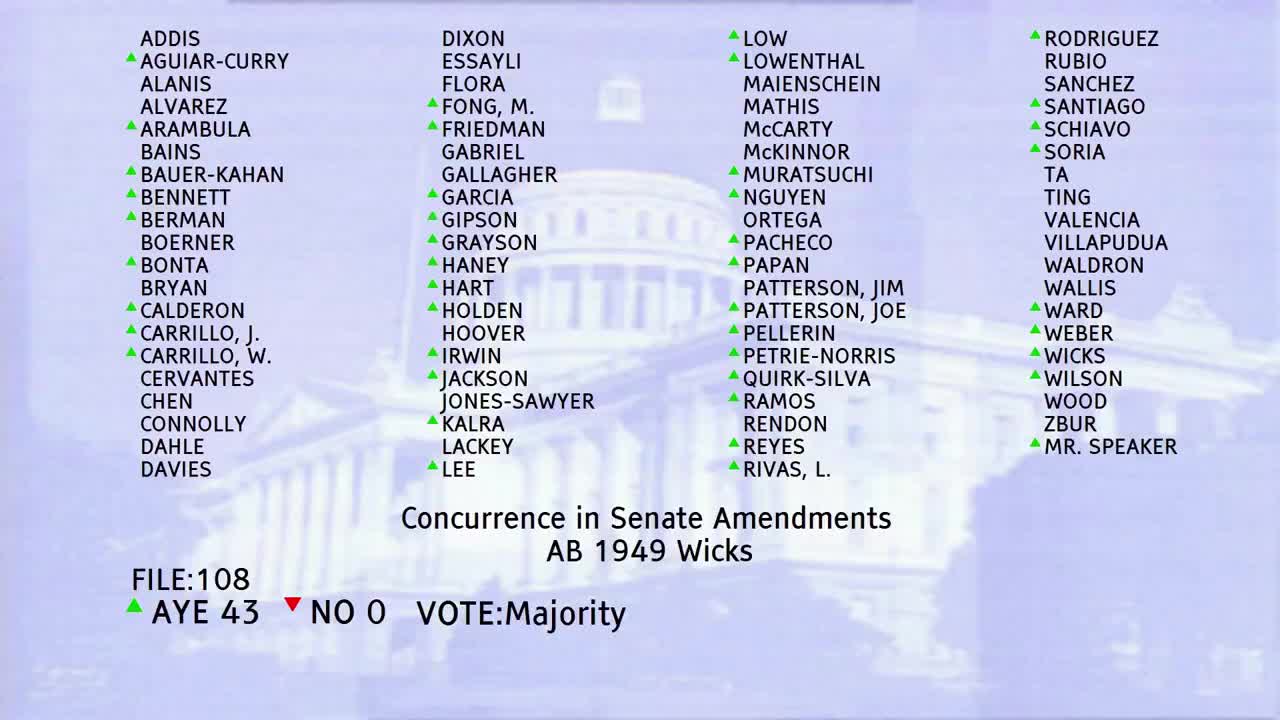 1MIN
Assembly Floor
 4MIN
Senate Floor
 1MIN
Senate Standing Committee on Appropriations
 26MIN
Senate Standing Committee on Health
 42MIN
Senate Standing Committee on Education
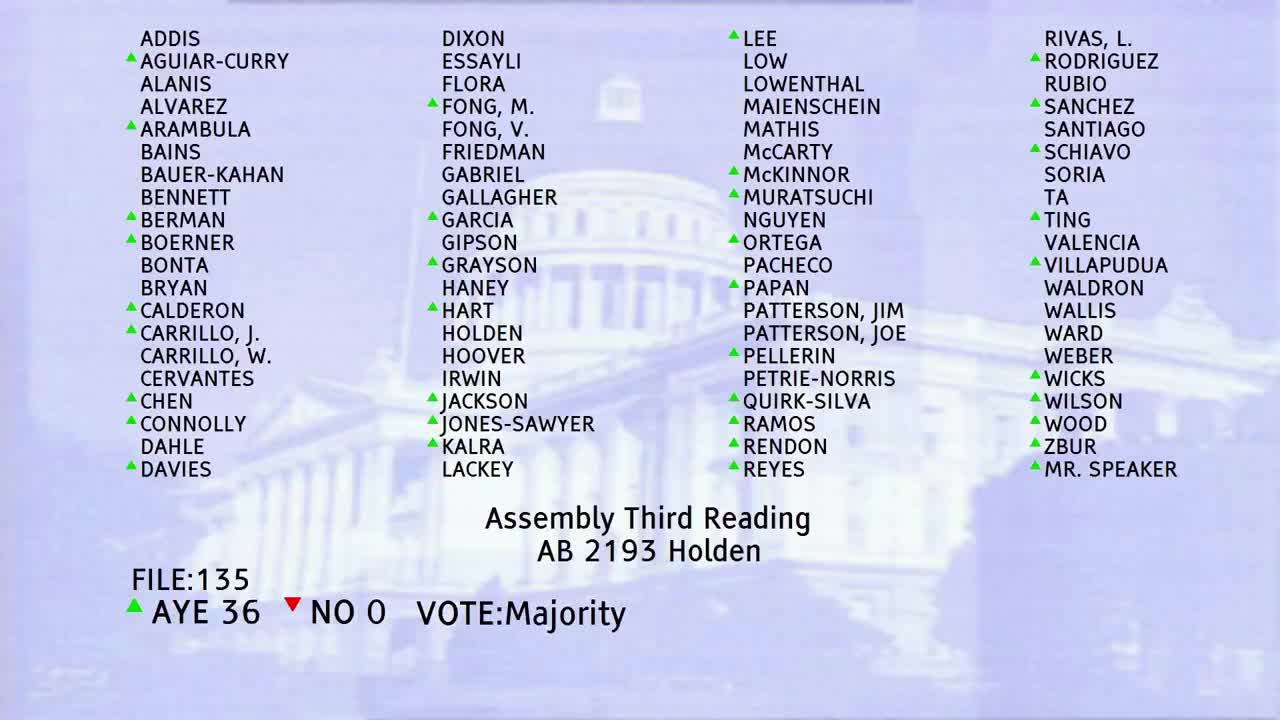 4MIN
Assembly Floor
 31MIN
Assembly Standing Committee on Environmental Safety and Toxic Materials
 21MIN
Assembly Standing Committee on Education
Bill Author