AB 2448: Electric Vehicle Economic Opportunity Zone: County of Riverside.
- Session Year: 2023-2024
- House: Assembly
- Latest Version Date: 2024-08-29
Current Status:
Failed
(2024-09-22: Vetoed by Governor.)
Introduced
In Committee
First Chamber
In Committee
Second Chamber
Enacted
Existing law, the California Clean Energy Jobs Act, expresses a goal of creating good-paying energy efficiency and clean energy jobs in California. Existing law establishes in state government the Labor and Workforce Development Agency, under the supervision of the Secretary of Labor and Workforce Development, which consists of the Office of the Secretary of Labor and Workforce Development and the California Workforce Development Board, among others. Existing law creates the position of Deputy Secretary for Climate within the agency, subject to appropriation by the Legislature, for the purpose of assisting in the oversight of Californias workforce transition to a sustainable and equitable carbon neutral economy.
This bill would, upon appropriation by the Legislature, establish an Electric Vehicle Economic Opportunity Zone (EVEOZ) for the County of Riverside, administered by the Labor and Workforce Development Agency, for the purpose of creating programs to make electric vehicle manufacturing jobs and education more accessible to lower income communities. The bill would require the agency to collaborate with the County of Riverside in determining the geographical boundaries of the EVEOZ. By imposing additional duties on local officials, the bill would impose a state-mandated local program. The bill would authorize the agency to partner with educational institutions, electric vehicle manufacturing businesses, and local and national financial intuitions to develop EVEOZ education, training, and investment programs, as specified.
This bill would make legislative findings and declarations as to the necessity of a special statute for the County of Riverside.
The California Constitution requires the state to reimburse local agencies and school districts for certain costs mandated by the state. Statutory provisions establish procedures for making that reimbursement.
This bill would provide that, if the Commission on State Mandates determines that the bill contains costs mandated by the state, reimbursement for those costs shall be made pursuant to the statutory provisions noted above.
Existing law, the California Clean Energy Jobs Act, expresses a goal of creating good-paying energy efficiency and clean energy jobs in California. Existing law establishes in state government the Labor and Workforce Development Agency, under the supervision of the Secretary of Labor and Workforce Development, which consists of the Office of the Secretary of Labor and Workforce Development and the California Workforce Development Board, among others. Existing law creates the position of Deputy Secretary for Climate within the agency, subject to appropriation by the Legislature, for the purpose of assisting in the oversight of Californias workforce transition to a sustainable and equitable carbon neutral economy.
This bill would, upon appropriation by the Legislature, establish an Electric Vehicle Economic Opportunity Zone (EVEOZ) for the County of Riverside, administered by the Labor and Workforce Development Agency, for the purpose of creating programs to make electric vehicle manufacturing jobs and education more accessible to lower income communities. The bill would require the agency to collaborate with the County of Riverside to assist in determining the geographical boundaries of the EVEOZ. By imposing additional duties on local officials, the bill would impose a state-mandated local program. The bill would authorize the agency to partner with educational institutions, electric vehicle manufacturing businesses, and local and national financial intuitions to develop EVEOZ education, training, and investment programs, as specified.
This bill would make legislative findings and declarations as to the necessity of a special statute for the County of Riverside.
The California Constitution requires the state to reimburse local agencies and school districts for certain costs mandated by the state. Statutory provisions establish procedures for making that reimbursement.
This bill would provide that, if the Commission on State Mandates determines that the bill contains costs mandated by the state, reimbursement for those costs shall be made pursuant to the statutory provisions noted above.
Existing law, the California Clean Energy Jobs Act, expresses a goal of creating good-paying energy efficiency and clean energy jobs in California. Existing law establishes in state government the Labor and Workforce Development Agency, under the supervision of the Secretary of Labor and Workforce Development, which consists of the Office of the Secretary of Labor and Workforce Development and the California Workforce Development Board, among others. Existing law creates the position of Deputy Secretary for Climate within the agency, subject to appropriation by the Legislature, for the purpose of assisting in the oversight of Californias workforce transition to a sustainable and equitable carbon neutral economy.
This bill would, upon appropriation by the Legislature, establish an Electric Vehicle Economic Opportunity Zone (EVEOZ) for the County of Riverside, administered by the California Competes Tax Credit Committee, Labor and Workforce Development Agency, for the purpose of creating programs to make electric vehicle manufacturing jobs and education more accessible to lower income communities. The bill would require County of Riverside to assist in determining the geographical boundaries of the EVEOZ. By imposing additional duties on local officials, the bill would impose a state-mandated local program. The bill would authorize the committee agency to partner with educational institutions, electric vehicle manufacturing businesses, and local and national financial intuitions to develop EVEOZ education, training, and investment programs, as specified.
This bill would make legislative findings and declarations as to the necessity of a special statute for the County of Riverside.
The California Constitution requires the state to reimburse local agencies and school districts for certain costs mandated by the state. Statutory provisions establish procedures for making that reimbursement.
This bill would provide that, if the Commission on State Mandates determines that the bill contains costs mandated by the state, reimbursement for those costs shall be made pursuant to the statutory provisions noted above.
Existing law, the Sacramento Emergency Clean Air and Transportation Program, authorizes the Sacramento Area Council of Governments to grant awards for eligible onroad emission-reducing projects. Existing law, the San Joaquin Valley Emergency Clean Air Attainment Program, authorizes the San Joaquin Valley Air Pollution Control District to grant awards for eligible onroad and off-road emission-reducing projects.
Existing law establishes the California Competes Tax Credit Committee, which has specified duties in regard to tax credits for economic development.
This bill would, upon appropriation by the Legislature, establish an Electric Vehicle Economic Opportunity Zone (EVEOZ) for the County of Riverside, administered by the California Competes Tax Credit Committee, for the purpose of creating programs to make electric vehicle manufacturing jobs and education more accessible to lower income communities. The bill would require County of Riverside to assist in determining the geographical boundaries of the EVEOZ. By imposing additional duties on local officials, the bill would impose a state-mandated local program. The bill would authorize the committee to partner with educational institutions, electric vehicle manufacturing businesses, and local and national financial intuitions to develop EVEOZ education, training, and investment programs, as specified.
This bill would make legislative findings and declarations as to the necessity of a special statute for the County of Riverside.
The California Constitution requires the state to reimburse local agencies and school districts for certain costs mandated by the state. Statutory provisions establish procedures for making that reimbursement.
This bill would provide that, if the Commission on State Mandates determines that the bill contains costs mandated by the state, reimbursement for those costs shall be made pursuant to the statutory provisions noted above.
(a)It is the intent of the Legislature that, as Executive Order No. N-79-20 established the goal that 100 percent of in-state sales of new passenger cars and trucks will be zero-emission by 2035, lower income communities will share in the economic benefits of the zero-emission vehicle industry, including electric vehicle manufacturing.
(b)(1)Upon appropriation by the Legislature, an Electric Vehicle Economic Opportunity Zone (EVEOZ) for the County of Riverside is hereby established to be administered by the Labor and Workforce Development Agency for the purpose of creating programs to make electric vehicle manufacturing jobs and education more accessible to lower income communities.
(2)The agency shall collaborate with the County of Riverside in determining the geographical boundaries of the EVEOZ.
(c)The agency may partner with educational institutions best fitted for educational and workforce development programs to develop EVEOZ education and training programs that may include, but are not limited to, any of the following:
(1)A fully accredited associate or bachelors collegiate electric vehicle manufacturing and engineering program.
(2)Workforce development related to electric vehicle and electric vehicle battery manufacturing.
(3)Career pathway, education, training, and support programs for electric vehicle manufacturing certification.
(4)Career pathway, education, training, and support programs for electric vehicle service technician development.
(5)Career pathway, education, training, and support programs for electric vehicle charging station installation and service.
(6)Electric vehicle apprenticeship programs.
(7)Engineering and manufacturing of the entire electric vehicle including, but not limited to, battery, safety equipment, electronics and computer coding, and other components necessary to electric vehicles.
(d)The agency may partner with electric vehicle manufacturing businesses and local and national financial intuitions to develop EVEOZ investment programs that may include, but are not limited to, any of the following:
(1)Incentives, including providing business loans, tax credits, and grants, to build, modify, or upgrade electric vehicle manufacturing facilities within the geographical boundaries of the EVEOZ.
(2)Hiring programs and corporate subsidies for companies to onboard, train, and retain workers who reside within the geographical boundaries of the EVEOZ.
(e)Any EVEOZ program developed pursuant to this section shall prioritize the recruitment and enrollment of workers or students of underprivileged economic status, as determined by the agency, that reside within the geographical boundaries of the EVEOZ.
SEC. 2.The Legislature finds and declares that a special statute is necessary and that a general statute cannot be made applicable within the meaning of Section 16 of Article IV of the California Constitution as Executive Order No. N-79-20 mandates the transition of the states automotive sales to be 100 percent zero-emissions vehicles, cultivating the workforce pipeline locally will financially benefit the state and build industry. Establishing an Electric Vehicle Economic Opportunity Zone (EVEOZ) in the County of Riverside would empower the people with economic and engineering skills, help make the transition to zero-emission vehicles more seamless, and would serve as a model for the establishment of future EVEOZs across the state.
SEC. 3.If the Commission on State Mandates determines that this act contains costs mandated by the state, reimbursement to local agencies and school districts for those costs shall be made pursuant to Part 7 (commencing with Section 17500) of Division 4 of Title 2 of the Government Code.
(a)It is the intent of the Legislature that, as Executive Order No. N-79-20 established the goal that 100 percent of in-state sales of new passenger cars and trucks will be zero-emission by 2035, lower income communities will share in the economic benefits of the zero-emission vehicle industry, including electric vehicle manufacturing.
(b)(1)Upon appropriation by the Legislature, an Electric Vehicle Economic Opportunity Zone (EVEOZ) for the County of Riverside is hereby established to be administered by the Labor and Workforce Development Agency for the purpose of creating programs to make electric vehicle manufacturing jobs and education more accessible to lower income communities.
(2)The agency shall collaborate with the County of Riverside shall assist in determining the geographical boundaries of the EVEOZ.
(c)The agency may partner with educational institutions best fitted for educational and workforce development programs to develop EVEOZ education and training programs that may include, but are not limited to, any of the following:
(1)A fully accredited associate or bachelors collegiate electric vehicle manufacturing and engineering program.
(2)Workforce development related to electric vehicle and electric vehicle battery manufacturing.
(3)Career pathway, education, training, and support programs for electric vehicle manufacturing certification.
(4)Career pathway, education, training, and support programs for electric vehicle service technician development.
(5)Career pathway, education, training, and support programs for electric vehicle charging station installation and service.
(6)Electric vehicle apprenticeship programs.
(7)Engineering and manufacturing of the entire electric vehicle including, but not limited to, battery, safety equipment, electronics and computer coding, and other components necessary to electric vehicles.
(d)The agency may partner with electric vehicle manufacturing businesses and local and national financial intuitions to develop EVEOZ investment programs that may include, but are not limited to, any of the following:
(1)Incentives, including providing business loans, tax credits, and grants, to build, modify, or upgrade electric vehicle manufacturing facilities within the geographical boundaries of the EVEOZ.
(2)Hiring programs and corporate subsidies for companies to onboard, train, and retain workers who reside within the geographical boundaries of the EVEOZ.
(e)Any EVEOZ program developed pursuant to this section shall prioritize the recruitment and enrollment of workers or students of underprivileged economic status, as determined by the agency, that reside within the geographical boundaries of the EVEOZ.
SEC. 2.The Legislature finds and declares that a special statute is necessary and that a general statute cannot be made applicable within the meaning of Section 16 of Article IV of the California Constitution as Executive Order No. N-79-20 mandates the transition of the states automotive sales to be 100 percent zero-emissions vehicles, cultivating the workforce pipeline locally will financially benefit the state and build industry. Establishing an Electric Vehicle Economic Opportunity Zone (EVEOZ) in the County of Riverside would empower the people with economic and engineering skills, help make the transition to zero-emission vehicles more seamless, and would serve as a model for the establishment of future EVEOZs across the state.
SEC. 3.If the Commission on State Mandates determines that this act contains costs mandated by the state, reimbursement to local agencies and school districts for those costs shall be made pursuant to Part 7 (commencing with Section 17500) of Division 4 of Title 2 of the Government Code.
(a)It is the intent of the Legislature that, as Executive Order No. N-79-20 established the goal that 100 percent of in-state sales of new passenger cars and trucks will be zero-emission by 2035, lower income communities will share in the economic benefits of the zero-emission vehicle industry, including electric vehicle manufacturing.
(b)(1)Upon appropriation by the Legislature, an Electric Vehicle Economic Opportunity Zone (EVEOZ) for the County of Riverside is hereby established to be administered by the Labor and Workforce Development Agency for the purpose of creating programs to make electric vehicle manufacturing jobs and education more accessible to lower income communities.
(2)The County of Riverside shall assist in determining the geographical boundaries of the EVEOZ.
(c)The agency may partner with educational institutions best fitted for educational and workforce development programs to develop EVEOZ education and training programs that may include, but are not limited to, any of the following:
(1)A fully accredited associate or bachelors collegiate electric vehicle manufacturing and engineering program.
(2)Workforce development related to electric vehicle and electric vehicle battery manufacturing.
(3)Career pathway, education, training, and support programs for electric vehicle manufacturing certification.
(4)Career pathway, education, training, and support programs for electric vehicle service technician development.
(5)Career pathway, education, training, and support programs for electric vehicle charging station installation and service.
(6)Electric vehicle apprenticeship programs.
(7)Engineering and manufacturing of the entire electric vehicle including, but not limited to, battery, safety equipment, electronics and computer coding, and other components necessary to electric vehicles.
(d)The agency may partner with electric vehicle manufacturing businesses and local and national financial intuitions to develop EVEOZ investment programs that may include, but are not limited to, any of the following:
(1)Incentives, including providing business loans, tax credits, and grants, to build, modify, or upgrade electric vehicle manufacturing facilities within the geographical boundaries of the EVEOZ.
(2)Hiring programs and corporate subsidies for companies to onboard, train, and retain workers who reside within the geographical boundaries of the EVEOZ.
(e)Any EVEOZ program developed pursuant to this section shall prioritize the recruitment and enrollment of workers or students of underprivileged economic status, as determined by the agency, that reside within the geographical boundaries of the EVEOZ.
SEC. 2.The Legislature finds and declares that a special statute is necessary and that a general statute cannot be made applicable within the meaning of Section 16 of Article IV of the California Constitution as Executive Order No. N-79-20 mandates the transition of the states automotive sales to be 100 percent zero-emissions vehicles, cultivating the workforce pipeline locally will financially benefit the state and build industry. Establishing an Electric Vehicle Economic Opportunity Zone (EVEOZ) in the County of Riverside would empower the people with economic and engineering skills, help make the transition to zero-emission vehicles more seamless, and would serve as a model for the establishment of future EVEOZs across the state.
SEC. 3.If the Commission on State Mandates determines that this act contains costs mandated by the state, reimbursement to local agencies and school districts for those costs shall be made pursuant to Part 7 (commencing with Section 17500) of Division 4 of Title 2 of the Government Code.
(a)It is the intent of the Legislature that, as Executive Order No. N-79-20 established the goal that 100 percent of in-state sales of new passenger cars and trucks will be zero-emission by 2035, lower income communities will share in the economic benefits of the zero-emission vehicle industry, including electric vehicle manufacturing.
(b)(1)Upon appropriation by the Legislature, an Electric Vehicle Economic Opportunity Zone (EVEOZ) for the County of Riverside is hereby established to be administered by the California Competes Tax Credit Committee for the purpose of creating programs to make electric vehicle manufacturing jobs and education more accessible to lower income communities.
(2)The County of Riverside shall assist in determining the geographical boundaries of the EVEOZ.
(c)The committee may partner with educational institutions best fitted for educational and workforce development programs to develop EVEOZ education and training programs that may include, but are not limited to, any of the following:
(1)A fully accredited associate or bachelors collegiate electric vehicle manufacturing and engineering program.
(2)Workforce development related to electric vehicle and electric vehicle battery manufacturing.
(3)Career pathway, education, training, and support programs for electric vehicle manufacturing certification.
(4)Career pathway, education, training, and support programs for electric vehicle service technician development.
(5)Career pathway, education, training, and support programs for electric vehicle charging station installation and service.
(6)Electric vehicle apprenticeship programs.
(7)Engineering and manufacturing of the entire electric vehicle including, but not limited to, battery, safety equipment, electronics and computer coding, and other components necessary to electric vehicles.
(d)The committee may partner with electric vehicle manufacturing businesses and local and national financial intuitions to develop EVEOZ investment programs that may include, but are not limited to, any of the following:
(1)Incentives, including providing business loans, tax credits, and grants, to build, modify, or upgrade electric vehicle manufacturing facilities within the geographical boundaries of the EVEOZ.
(2)Hiring programs and corporate subsidies for companies to onboard, train, and retain workers who reside within the geographical boundaries of the EVEOZ.
(e)Any EVEOZ program developed pursuant to this section shall prioritize the recruitment and enrollment of workers or students of underprivileged economic status, as determined by the committee, that reside within the geographical boundaries of the EVEOZ.
SEC. 2.The Legislature finds and declares that a special statute is necessary and that a general statute cannot be made applicable within the meaning of Section 16 of Article IV of the California Constitution as Executive Order No. N-79-20 mandates the transition of the states automotive sales to be 100 percent zero-emissions vehicles, cultivating the workforce pipeline locally will financially benefit the state and build industry. Establishing an Electric Vehicle Economic Opportunity Zone (EVEOZ) in the County of Riverside would empower the people with economic and engineering skills, help make the transition to zero-emission vehicles more seamless, and would serve as a model for the establishment of future EVEOZs across the state.
SEC. 3.If the Commission on State Mandates determines that this act contains costs mandated by the state, reimbursement to local agencies and school districts for those costs shall be made pursuant to Part 7 (commencing with Section 17500) of Division 4 of Title 2 of the Government Code.
|
Date
|
Status
|
|---|---|
| Sep 22, 2024 | Vetoed by Governor. |
| Sep 5, 2024 | Enrolled and presented to the Governor at 4 p.m. |
| Aug 27, 2024 | Senate amendments concurred in. To Engrossing and Enrolling. (Ayes 75. Noes 0.). |
| Aug 27, 2024 | Assembly Rule 77 suspended. |
| Aug 26, 2024 | In Assembly. Concurrence in Senate amendments pending. May be considered on or after August 28 pursuant to Assembly Rule 77. |
| Aug 26, 2024 | Read third time. Passed. Ordered to the Assembly. (Ayes 32. Noes 4.). |
| Aug 19, 2024 | Read second time. Ordered to third reading. |
| Aug 15, 2024 | From committee: Do pass. (Ayes 6. Noes 1.) (August 15). |
| Aug 5, 2024 | In committee: Referred to APPR suspense file. |
| Jun 24, 2024 | Withdrawn from committee. |
| Jun 24, 2024 | Re-referred to Com. on APPR. |
| Jun 20, 2024 | Read second time and amended. Re-referred to Com. on L. GOV. |
| Jun 19, 2024 | From committee: Amend, and do pass as amended and re-refer to Com. on L. GOV. (Ayes 5. Noes 0.) (June 19). |
| Jun 5, 2024 | Referred to Coms. on L., P.E. & R. and L. GOV. |
| May 24, 2024 | In Senate. Read first time. To Com. on RLS. for assignment. |
| May 23, 2024 | Read third time. Passed. Ordered to the Senate. (Ayes 71. Noes 0. Page 5601.) |
| May 20, 2024 | Read second time. Ordered to third reading. |
| May 16, 2024 | Read second time and amended. Ordered returned to second reading. |
| May 16, 2024 | From committee: Amend, and do pass as amended. (Ayes 11. Noes 0.) (May 16). |
| May 16, 2024 | Assembly Rule 63 suspended. |
| May 1, 2024 | In committee: Set, first hearing. Referred to APPR. suspense file. |
| Apr 16, 2024 | From committee: Do pass and re-refer to Com. on APPR. (Ayes 7. Noes 0.) (April 16). Re-referred to Com. on APPR. |
| Mar 21, 2024 | Referred to Com. on J., E.D., & E. |
| Feb 14, 2024 | From printer. May be heard in committee March 15. |
| Feb 13, 2024 | Read first time. To print. |
|
Date
|
Description
|
Location
|
Votes
|
|
|---|---|---|---|---|
| Aug 27, 2024 | AB 2448 Jackson Concurrence in Senate Amendments | Assembly Floor |
Passed |
|
| Aug 26, 2024 | Assembly 3rd Reading AB2448 Jackson By Roth | Senate Floor |
Passed |
|
| Aug 15, 2024 | Do pass | Senate Standing Committee on Appropriations |
Passed |
|
| Aug 5, 2024 | Placed on suspense file | Senate Standing Committee on Appropriations |
Passed |
|
| Jun 19, 2024 | Do pass as amended, but first amend, and re-refer to the Committee on [Local Government] | Senate Standing Committee on Labor, Public Employment and Retirement |
Passed |
|
| May 23, 2024 | AB 2448 Jackson Assembly Third Reading | Assembly Floor |
Passed |
|
| May 16, 2024 | Do pass as amended. | Assembly Standing Committee on Appropriations |
Passed |
|
| Apr 16, 2024 | Do pass and be re-referred to the Committee on [Appropriations] | Assembly Standing Committee on Jobs, Economic Development, and the Economy |
Passed |
This list shows positions taken on this bill by organizations on the date displayed, which is linked to the original source.
Positions by individuals are not included.
|
Organization
|
Position
|
Date
|
|---|---|---|
| Karma Automotive LLC | ** Support | |
| Southwest California Legislative Council | ** Support |
GOVERNOR'S VETO
GV Bill Id:AB 2448
Author:(Jackson)
As Enrolled Ver:August 29, 2024
2/3 vote
SUMMARY
AB 2448 seeks to create an Electric Vehicle Economic Opportunity Zone (EVEOZ) in Riverside County, funded by the Legislature and managed by the California Competes Tax Credit Committee. The goal is to boost electric vehicle manufacturing jobs and education, especially in lower-income communities.
Senate Amendments: Make technical and clarifying changes in section 2 adding agency shall collaborate with the, and removing shall assist.
Governor’s Veto Message
This bill would require the Labor and Workforce Development Agency (LWDA), upon appropriation of the Legislature, to establish an Electric Vehicle Economic Opportunity Zone in the county of Riverside, for the purpose of creating educational and employment opportunities related to electrical vehicles.
While I support efforts to boost electric vehicle manufacturing jobs and education in this state, particularly in low-income communities, this bill creates General Fund cost pressures and should be considered in the annual budget process.
In partnership with the Legislature this year, my Administration has enacted a balanced budget that avoids deep program cuts to vital services and protected investments in education, health care, climate, public safety, housing, and social service programs that millions of Californians rely on. It is important to remain disciplined when considering bills with significant fiscal implications that are not included in the budget, such as this measure.
COMMENTS
Executive Order No. N-79-20, signed in 2020, aims for all new passenger cars and trucks in California to be zero-emission by 2035, and all medium- and heavy-duty vehicles by 2045. CARB and other agencies are working to expand affordable zero-emission infrastructure, especially for underserved communities. By 2026, 35% of new passenger vehicles should be zero-emission, increasing to 68% by 2030.
Riverside County highways are key modals of transport for goods from the Ports of Los Angeles, and Long Beach out of Southern California to other points across the country.
As such as this bill proposes, among other things, the following:
Establish, upon appropriation by the Legislature, an EVEOZ for the County of Riverside that is administered by the California Labor and Workforce Development Agency (LWDA) for
Executive Order No. N-79-20, signed in 2020, aims for all new passenger cars and trucks in California to be zero-emission by 2035, and all medium- and heavy-duty vehicles by 2045. CARB and other agencies are working to expand affordable zero-emission infrastructure, especially for underserved communities. By 2026, 35% of new passenger vehicles should be zero-emission, increasing to 68% by 2030.
Riverside County highways are key modals of transport for goods from the Ports of Los Angeles, and Long Beach out of Southern California to other points across the country.
As such as this bill proposes, among other things, the following:
- Establish, upon appropriation by the Legislature, an EVEOZ for the County of Riverside that is administered by the California Labor and Workforce Development Agency (LWDA) for the purpose of creating programs to make electric vehicle manufacturing jobs and education more accessible to lower income communities.
- Require Riverside County to assist in determining the geographical boundaries of the EVEOZ.
- Authorize LWDA to partner with educational institutions to develop EVEOZ education and training programs that may include, but are not limited to, any of the following: (1) a fully accredited associate or bachelor’s collegiate electric vehicle manufacturing and engineering program, (2) workforce development related to electric vehicle and electric vehicle battery manufacturing, (3) career pathway, education, training, and support programs for electric vehicle service technician development, (4) career pathway, education, training, and support programs for electric vehicle charging station installation and service, and (5) electric vehicle apprenticeship programs.
- Authorize LWDA to partner with electric vehicle manufacturing businesses and local and national financial intuitions to develop EVEOZ investment programs that may include, but are not limited to, any of the following: (1) incentives, including providing business loans, tax credits, and grants, to build, modify, or upgrade electric vehicle manufacturing facilities within the geographical boundaries of the EVEOZ, and (2) hiring programs and corporate subsidies for companies to onboard, train, and retain workers who reside within the geographical boundaries of the EVEOZ.
- Require any EVEOZ program to prioritize the recruitment and enrollment of workers or students of underprivileged economic status, as determined by the LWDA, that reside within the geographical boundaries of the EVEOZ.
According to the Author
This bill is crucial for Riverside County and California as it establishes an Electric Vehicle Economic Opportunity Zone, aiming to enhance accessibility to electric vehicle manufacturing jobs and education in underserved communities. By collaborating with educational institutions and businesses, this bill not only fosters economic growth but also promotes sustainable practices, making it vital for the state's future development and environmental goals.
Arguments in Support
Supporters of AB 2448 emphasize its importance in creating clean energy jobs and revitalizing EV manufacturing in Southern California, noting it will generate hundreds of jobs and is crucial for combating climate change, improving air quality, and boosting economic growth, particularly in marginalized communities. The bill also fosters workforce development and partnerships with educational institutions, expanding opportunities for local communities. Karma strongly advocates for AB 2448 to drive economic growth and job creation in the EV sector.
Arguments in Opposition
No opposition on file.
FISCAL COMMENTS
According to the Senate Appropriations Committee
- LWDA indicates that it would incur one-time costs of $4.5 million, and ongoing costs of $1.2 million, to implement the provisions of the bill (General Fund).
- By requiring Riverside County to assist LWDA in determining the geographical boundaries of the EVEOZ, this bill creates a state-mandated local program. To the extent, the Commission on State Mandates determines that the provisions of this bill create a new program or impose a higher level of service on local agencies; local agencies could claim reimbursement of those costs. However, costs to Riverside County resulting from the bill would likely be minor.
VOTES
ASM JOBS, ECONOMIC DEVELOPMENT, AND THE ECONOMY: 7-0-0
YES: Villapudua, Hoover, Stephanie Nguyen, Petrie-Norris, Ramos, Soria, Wallis
ASM APPROPRIATIONS: 11-0-4
YES: Wicks, Arambula, Bryan, Calderon, Wendy Carrillo, Mike Fong, Grayson, Haney, Hart, Pellerin, Villapudua
ABS, ABST OR NV: Sanchez, Dixon, Jim Patterson, Ta
ASSEMBLY FLOOR: 71-0-9
YES: Addis, Aguiar-Curry, Alanis, Alvarez, Arambula, Bains, Bauer-Kahan, Bennett, Berman, Boerner, Bonta, Bryan, Calderon, Juan Carrillo, Wendy Carrillo, Chen, Connolly, Davies, Dixon, Flora, Mike Fong, Vince Fong, Friedman, Gabriel, Garcia, Gipson, Grayson, Haney, Hart, Hoover, Irwin, Jackson, Jones-Sawyer, Kalra, Lackey, Lee, Low, Lowenthal, Maienschein, McCarty, McKinnor, Muratsuchi, Stephanie Nguyen, Ortega, Pacheco, Papan, Joe Patterson, Pellerin, Petrie-Norris, Quirk-Silva, Ramos, Rendon, Reyes, Rodriguez, Sanchez, Santiago, Schiavo, Soria, Ta, Ting, Valencia, Villapudua, Waldron, Wallis, Ward, Weber, Wicks, Wilson, Wood, Zbur, Robert Rivas
ABS, ABST OR NV: Cervantes, Megan Dahle, Essayli, Gallagher, Holden, Mathis, Jim Patterson, Luz Rivas, Blanca Rubio
SENATE FLOOR: 33-4-3
YES: Allen, Archuleta, Ashby, Atkins, Becker, Blakespear, Bradford, Caballero, Cortese, Dodd, Durazo, Eggman, Glazer, Gonzalez, Hurtado, Laird, Limón, McGuire, Menjivar, Min, Newman, Niello, Padilla, Portantino, Roth, Rubio, Seyarto, Skinner, Smallwood-Cuevas, Stern, Umberg, Wahab, Wiener
NO: Alvarado-Gil, Grove, Jones, Wilk
ABS, ABST OR NV: Dahle, Nguyen, Ochoa Bogh
ASSEMBLY FLOOR: 75-0-4
YES: Addis, Aguiar-Curry, Alanis, Alvarez, Arambula, Bains, Bauer-Kahan, Bennett, Berman, Boerner, Bonta, Bryan, Calderon, Juan Carrillo, Wendy Carrillo, Chen, Connolly, Davies, Dixon, Essayli, Flora, Mike Fong, Friedman, Gabriel, Garcia, Gipson, Grayson, Haney, Hart, Holden, Hoover, Irwin, Jackson, Jones-Sawyer, Kalra, Lackey, Lee, Low, Lowenthal, Maienschein, Mathis, McCarty, McKinnor, Muratsuchi, Stephanie Nguyen, Pacheco, Papan, Jim Patterson, Joe Patterson, Pellerin, Petrie-Norris, Quirk-Silva, Ramos, Rendon, Reyes, Luz Rivas, Rodriguez, Blanca Rubio, Sanchez, Santiago, Schiavo, Soria, Ta, Ting, Valencia, Villapudua, Waldron, Wallis, Ward, Weber, Wicks, Wilson, Wood, Zbur, Robert Rivas
ABS, ABST OR NV: Cervantes, Megan Dahle, Gallagher, Ortega
UPDATED
VERSION: August 29, 2024
CONSULTANT: Carla Castilla / J., E.D., & E. / (916) 319-2090 FN: 0005118
CONCURRENCE IN SENATE AMENDMENTS
CSA1 Bill Id:AB 2448
Author:(Jackson)
As Amended Ver:June 20, 2024
Majority vote
SUMMARY
AB 2448 seeks to create an Electric Vehicle Economic Opportunity Zone (EVEOZ) in Riverside County, funded by the Legislature and managed by the California Competes Tax Credit Committee. The goal is to boost electric vehicle manufacturing jobs and education, especially in lower-income communities.
Senate Amendments
In Section 2 adding agency shall collaborate with the, and removing shall assist
COMMENTS
Executive Order No. N-79-20, signed in 2020, aims for all new passenger cars and trucks in California to be zero-emission by 2035, and all medium- and heavy-duty vehicles by 2045. CARB and other agencies are working to expand affordable zero-emission infrastructure, especially for underserved communities. By 2026, 35% of new passenger vehicles should be zero-emission, increasing to 68% by 2030.
Riverside County highways are key modals of transport for goods from the Ports of Los Angeles, and Long Beach out of Southern California to other points across the country.
As such as this bill proposes, among other things, the following:
- Establish, upon appropriation by the Legislature, an EVEOZ for the County of Riverside that is administered by the California Labor and Workforce Development Agency (LWDA) for the purpose of creating programs to make electric vehicle manufacturing jobs and education more accessible to lower income communities.
- Require Riverside County to assist in determining the geographical boundaries of the EVEOZ.
- Authorize LWDA to partner with educational institutions to develop EVEOZ education and training programs that may include, but are not limited to, any of the following: (1) a fully accredited associate or bachelor’s collegiate electric vehicle manufacturing and engineering program, (2) workforce development related to electric vehicle and electric vehicle battery manufacturing, (3) career pathway, education, training, and support programs for electric vehicle service technician development, (4) career pathway, education, training, and support programs for electric vehicle charging station installation and service, and (5) electric vehicle apprenticeship programs.
- Authorize LWDA to partner with electric vehicle manufacturing businesses and local and national financial intuitions to develop EVEOZ investment programs that may include, but are not limited to, any of the following: (1) incentives, including providing business loans, tax credits, and grants, to build, modify, or upgrade electric vehicle manufacturing facilities within the geographical boundaries of the EVEOZ, and (2) hiring programs and corporate subsidies for companies to onboard, train, and retain workers who reside within the geographical boundaries of the EVEOZ.
- Require any EVEOZ program to prioritize the recruitment and enrollment of workers or students of underprivileged economic status, as determined by the LWDA, that reside within the geographical boundaries of the EVEOZ.
According to the Author
This bill is crucial for Riverside County and California as it establishes an Electric Vehicle Economic Opportunity Zone, aiming to enhance accessibility to electric vehicle manufacturing jobs and education in underserved communities. By collaborating with educational institutions and businesses, this bill not only fosters economic growth but also promotes sustainable practices, making it vital for the state's future development and environmental goals.
Arguments in Support
Supporters of AB 2448 emphasize its importance in creating clean energy jobs and revitalizing EV manufacturing in Southern California, noting it will generate hundreds of jobs and is crucial for combating climate change, improving air quality, and boosting economic growth, particularly in marginalized communities. The bill also fosters workforce development and partnerships with educational institutions, expanding opportunities for local communities. Karma strongly advocates for AB 2448 to drive economic growth and job creation in the EV sector.
Arguments in Opposition
No opposition on file.
FISCAL COMMENTS
According to the Senate Appropriations Committee
- LWDA indicates that it would incur one-time costs of $4.5 million, and ongoing costs of $1.2 million, to implement the provisions of the bill (General Fund).
- By requiring Riverside County to assist LWDA in determining the geographical boundaries of the EVEOZ, this bill creates a state-mandated local program. To the extent the Commission on State Mandates determines that the provisions of this bill create a new program or impose a higher level of service on local agencies, local agencies could claim reimbursement of those costs. However, costs to Riverside County resulting from the bill would likely be minor.
VOTES:
ASM JOBS, ECONOMIC DEVELOPMENT, AND THE ECONOMY: 7-0-0
YES: Villapudua, Hoover, Stephanie Nguyen, Petrie-Norris, Ramos, Soria, Wallis
ASM APPROPRIATIONS: 11-0-4
YES: Wicks, Arambula, Bryan, Calderon, Wendy Carrillo, Mike Fong, Grayson, Haney, Hart, Pellerin, Villapudua
ABS, ABST OR NV: Sanchez, Dixon, Jim Patterson, Ta
ASSEMBLY FLOOR: 71-0-9
YES: Addis, Aguiar-Curry, Alanis, Alvarez, Arambula, Bains, Bauer-Kahan, Bennett, Berman, Boerner, Bonta, Bryan, Calderon, Juan Carrillo, Wendy Carrillo, Chen, Connolly, Davies, Dixon, Flora, Mike Fong, Vince Fong, Friedman, Gabriel, Garcia, Gipson, Grayson, Haney, Hart, Hoover, Irwin, Jackson, Jones-Sawyer, Kalra, Lackey, Lee, Low, Lowenthal, Maienschein, McCarty, McKinnor, Muratsuchi, Stephanie Nguyen, Ortega, Pacheco, Papan, Joe Patterson, Pellerin, Petrie-Norris, Quirk-Silva, Ramos, Rendon, Reyes, Rodriguez, Sanchez, Santiago, Schiavo, Soria, Ta, Ting, Valencia, Villapudua, Waldron, Wallis, Ward, Weber, Wicks, Wilson, Wood, Zbur, Robert Rivas
ABS, ABST OR NV: Cervantes, Megan Dahle, Essayli, Gallagher, Holden, Mathis, Jim Patterson, Luz Rivas, Blanca Rubio
SENATE FLOOR: 33-4-3
YES: Allen, Archuleta, Ashby, Atkins, Becker, Blakespear, Bradford, Caballero, Cortese, Dodd, Durazo, Eggman, Glazer, Gonzalez, Hurtado, Laird, Limón, McGuire, Menjivar, Min, Newman, Niello, Padilla, Portantino, Roth, Rubio, Seyarto, Skinner, Smallwood-Cuevas, Stern, Umberg, Wahab, Wiener
NO: Alvarado-Gil, Grove, Jones, Wilk
ABS, ABST OR NV: Dahle, Nguyen, Ochoa Bogh
UPDATED
VERSION: June 20, 2024
CONSULTANT: Carla Castilla / J., E.D., & E. / (916) 319-2090 FN: 0003958
CONCURRENCE IN SENATE AMENDMENTS
CSA1 Bill Id:AB 2448
Author:(Jackson)
As Amended Ver:June 20, 2024
Majority vote
SUMMARY
AB 2448 seeks to create an Electric Vehicle Economic Opportunity Zone (EVEOZ) in Riverside County, funded by the Legislature and managed by the California Competes Tax Credit Committee. The goal is to boost electric vehicle manufacturing jobs and education, especially in lower-income communities.
Senate Amendments
In Section 2 adding agency shall collaborate with the, and removing shall assist
COMMENTS
Executive Order No. N-79-20, signed in 2020, aims for all new passenger cars and trucks in California to be zero-emission by 2035, and all medium- and heavy-duty vehicles by 2045. CARB and other agencies are working to expand affordable zero-emission infrastructure, especially for underserved communities. By 2026, 35% of new passenger vehicles should be zero-emission, increasing to 68% by 2030.
Riverside County highways are key modals of transport for goods from the Ports of Los Angeles, and Long Beach out of Southern California to other points across the country.
As such as this bill proposes, among other things, the following:
- Establish, upon appropriation by the Legislature, an EVEOZ for the County of Riverside that is administered by the California Labor and Workforce Development Agency (LWDA) for the purpose of creating programs to make electric vehicle manufacturing jobs and education more accessible to lower income communities.
- Require Riverside County to assist in determining the geographical boundaries of the EVEOZ.
- Authorize LWDA to partner with educational institutions to develop EVEOZ education and training programs that may include, but are not limited to, any of the following: (1) a fully accredited associate or bachelor’s collegiate electric vehicle manufacturing and engineering program, (2) workforce development related to electric vehicle and electric vehicle battery manufacturing, (3) career pathway, education, training, and support programs for electric vehicle service technician development, (4) career pathway, education, training, and support programs for electric vehicle charging station installation and service, and (5) electric vehicle apprenticeship programs.
- Authorize LWDA to partner with electric vehicle manufacturing businesses and local and national financial intuitions to develop EVEOZ investment programs that may include, but are not limited to, any of the following: (1) incentives, including providing business loans, tax credits, and grants, to build, modify, or upgrade electric vehicle manufacturing facilities within the geographical boundaries of the EVEOZ, and (2) hiring programs and corporate subsidies for companies to onboard, train, and retain workers who reside within the geographical boundaries of the EVEOZ.
- Require any EVEOZ program to prioritize the recruitment and enrollment of workers or students of underprivileged economic status, as determined by the LWDA, that reside within the geographical boundaries of the EVEOZ.
According to the Author
This bill is crucial for Riverside County and California as it establishes an Electric Vehicle Economic Opportunity Zone, aiming to enhance accessibility to electric vehicle manufacturing jobs and education in underserved communities. By collaborating with educational institutions and businesses, this bill not only fosters economic growth but also promotes sustainable practices, making it vital for the state's future development and environmental goals.
Arguments in Support
Supporters of AB 2448 emphasize its importance in creating clean energy jobs and revitalizing EV manufacturing in Southern California, noting it will generate hundreds of jobs and is crucial for combating climate change, improving air quality, and boosting economic growth, particularly in marginalized communities. The bill also fosters workforce development and partnerships with educational institutions, expanding opportunities for local communities. Karma strongly advocates for AB 2448 to drive economic growth and job creation in the EV sector.
Arguments in Opposition
No opposition on file.
FISCAL COMMENTS
According to the Senate Appropriations Committee
- LWDA indicates that it would incur one-time costs of $4.5 million, and ongoing costs of $1.2 million, to implement the provisions of the bill (General Fund).
- By requiring Riverside County to assist LWDA in determining the geographical boundaries of the EVEOZ, this bill creates a state-mandated local program. To the extent the Commission on State Mandates determines that the provisions of this bill create a new program or impose a higher level of service on local agencies, local agencies could claim reimbursement of those costs. However, costs to Riverside County resulting from the bill would likely be minor.
VOTES:
ASM JOBS, ECONOMIC DEVELOPMENT, AND THE ECONOMY: 7-0-0
YES: Villapudua, Hoover, Stephanie Nguyen, Petrie-Norris, Ramos, Soria, Wallis
ASM APPROPRIATIONS: 11-0-4
YES: Wicks, Arambula, Bryan, Calderon, Wendy Carrillo, Mike Fong, Grayson, Haney, Hart, Pellerin, Villapudua
ABS, ABST OR NV: Sanchez, Dixon, Jim Patterson, Ta
ASSEMBLY FLOOR: 71-0-9
YES: Addis, Aguiar-Curry, Alanis, Alvarez, Arambula, Bains, Bauer-Kahan, Bennett, Berman, Boerner, Bonta, Bryan, Calderon, Juan Carrillo, Wendy Carrillo, Chen, Connolly, Davies, Dixon, Flora, Mike Fong, Vince Fong, Friedman, Gabriel, Garcia, Gipson, Grayson, Haney, Hart, Hoover, Irwin, Jackson, Jones-Sawyer, Kalra, Lackey, Lee, Low, Lowenthal, Maienschein, McCarty, McKinnor, Muratsuchi, Stephanie Nguyen, Ortega, Pacheco, Papan, Joe Patterson, Pellerin, Petrie-Norris, Quirk-Silva, Ramos, Rendon, Reyes, Rodriguez, Sanchez, Santiago, Schiavo, Soria, Ta, Ting, Valencia, Villapudua, Waldron, Wallis, Ward, Weber, Wicks, Wilson, Wood, Zbur, Robert Rivas
ABS, ABST OR NV: Cervantes, Megan Dahle, Essayli, Gallagher, Holden, Mathis, Jim Patterson, Luz Rivas, Blanca Rubio
UPDATED
VERSION: June 20, 2024
CONSULTANT: Carla Castilla / J., E.D., & E. / (916) 319-2090 FN: 0003958
SENATE RULES COMMITTEE Office of Senate Floor Analyses (916) 651-1520 Fax: (916) 327-4478 | AB 2448 |
THIRD READING
Bill No: AB 2448
Author: Jackson (D)
Amended: 6/20/24 in Senate
Vote: 21
SENATE LABOR, PUB. EMP. & RET. COMMITTEE: 5-0, 6/19/24
AYES: Smallwood-Cuevas, Wilk, Cortese, Gonzalez, Laird
SENATE APPROPRIATIONS COMMITTEE: 6-1, 8/15/24
AYES: Caballero, Ashby, Becker, Bradford, Seyarto, Wahab
NOES: Jones
ASSEMBLY FLOOR: 71-0, 5/23/24 - See last page for vote
SUBJECT: Electric Vehicle Economic Opportunity Zone: County of Riverside
SOURCE: Author
DIGEST:
This bill directs the Labor Workforce and Development Agency (LWDA) to administer, upon appropriation, an Electric Vehicle Economic Opportunity Zone (EVEOZ) for the County of Riverside, in order to make electric vehicle manufacturing jobs and education more accessible, as specified.
ANALYSIS:
Existing law:
- Establishes the LWDA under the supervision of an executive officer known as the Secretary. (Government Code §15551)
- Tasks the LWDA with serving California workers and businesses by improving access to employment and training programs; enforcing California labor laws to protect workers and create an even playing field for employers; and administering benefits that include workers’ compensation, unemployment insurance, disability insurance, and paid family leave. (Government Code §15550 et seq.)
- Establishes, within the LWDA, the position of Deputy Secretary for Climate to assist in the oversight of California’s workforce transition to a sustainable and equitable carbon neutral economy. (Government Code §15563.2)
- Establishes the California Workforce Development Board (CWDB), under the LWDA, as the body responsible for assisting the Governor in the development, oversight, and continuous improvement of California’s workforce system, including its alignment to the needs of the economy and the workforce. (Unemployment Insurance Code §14010 et seq.)
This bill:
- Establishes, upon appropriation by the Legislature, an Electric Vehicle Economic Opportunity Zone (EVEOZ) for the County of Riverside that is administered by the LWDA for the purpose of creating programs to make electric vehicle manufacturing jobs and education more accessible to lower income communities.
- Requires the LWDA to collaborate with the County of Riverside in determining the geographic boundaries of the EVEOZ.
- Authorizes the LWDA to partner with educational institutions to develop EVEOZ education and training programs that may include, but are not limited to, any of the following:
- A fully accredited associate or bachelor’s collegiate electric vehicle manufacturing and engineering program.
- Workforce development related to electric vehicle and electric vehicle battery manufacturing.
- Career pathway, education, training, and support programs for electric vehicle service technician development.
- Career pathway, education, training, and support programs for electric vehicle charging station installation and service.
- Electric vehicle apprenticeship programs.
- Authorizes the LWDA to partner with electric vehicle manufacturing businesses and local and national financial intuitions to develop EVEOZ investment programs that may include, but are not limited to, any of the following:
- Incentives, including providing business loans, tax credits, and grants, to build, modify, or upgrade electric vehicle manufacturing facilities within the geographical boundaries of the EVEOZ.
- Hiring programs and corporate subsidies for companies to onboard, train, and retain workers who reside within the geographical boundaries of the EVEOZ.
- Requires any EVEOZ program to prioritize the recruitment and enrollment of workers or students of underprivileged economic status, as determined by the LWDA, that reside within the geographical boundaries of the EVEOZ.
- Declares that establishing an EVEOZ in the County of Riverside would empower the people with economic and engineering skills, help make the transition to zero-emission vehicles more seamless, and would serve as a model for the establishment of future EVEOZs across the state.
Background
Race to Zero Emission Vehicles. On September 23, 2020, Governor Newsom issued Executive Order (EO) No. N-79-20, setting new statewide goals for phasing out gasoline-powered vehicles. Under the EO, 100 percent of in-state sales of new passenger cars and trucks will be zero-emission by 2035 and 100 percent of medium-and heavy-duty vehicles in the State will be zero-emission by 2045, where feasible. CARB, the Energy Commission, the Public Utilities Commission, and other agencies have been directed to accelerate deployment of affordable fueling and charging options for zero-emission vehicles in ways that serve all communities, particularly low-income and disadvantaged ones. In August of 2022, CARB adopted standards intended to further the EO and set interim targets. In the lead up to the 2035 deadline, 35 percent of new passenger vehicles sold by 2026 will be zero-emission and 68 percent will be by 2030. Transportation is the State’s top source of planet-warming greenhouse gas emissions. These mandates are an enormous step towards reducing dependence on fossil fuels and meeting our climate goals.
The transition to zero emissions will not be easy. For many people the price of an electric vehicle is prohibitive. State subsidies meant to assist with the purchase are inconsistent and underfunded. An article from CalMatters identified a “strikingly homogenous” portrait of who owns electric vehicles in California. Communities with mostly white and Asian, college-educated and high-income residents have the state’s highest contributions of zero-emission cars and most are concentrated in Silicon Valley or affluent coastal areas of Los Angeles and Orange counties[1]. In the 20 California zip codes where Latinos make up more than 95% of the population, including parts of Kings, Tulare, Fresno, Riverside, and Imperial counties, less than 1 percent of cars are electric[2].
Riverside County. In the past decade, the County of Riverside experienced a boom in warehouse growth. Trucks bring goods in from the Los Angeles and Long Beach ports to be shipped across the county. This movement of goods ties up roads, causing significant pollution. Warehouse workers also contribute to this pollution, as many do not earn enough money to live close to their jobs. The health consequences of this boom are clear; the region has unusually high incidences of asthma and cancer[3]. The Inland Empire, which is comprised of Riverside and San Bernardino Counties, is a major economic hub with a rapidly growing population. Despite this, its workers earn less than statewide averages, and there are fewer college graduates than in most metro areas. Local leaders are looking to reduce pollution and diversify the workforce. This unique combination of factors creates an opportunity for the County of Riverside to reap significant benefits as the state transitions to zero-emission vehicles.
Comments
This bill directs the LWDA, upon appropriation, to administer an EVEOZ and authorize the LWDA to partner with educational institutions and manufacturing businesses to make the electric vehicle industry more accessible. Aside from requiring any EVEOZ program to prioritize the recruitment and enrollment of workers or students of underprivileged economic status, this bill does not place any specific requirements on the LWDA or on the programs. The committee recommends that the author look at existing high road training partnerships (HRTPs), administered under the CWDB, for inspiration. The Inland Empire has several ongoing HRTPs related to upskilling workers for the green economy and the health care sector.
FISCAL EFFECT: Appropriation: No Fiscal Com.: Yes Local: Yes
According to the Senate Appropriations Committee,
- LWDA indicates that it would incur one-time costs of $4.5 million, and ongoing costs of $1.2 million, to implement the provisions of the bill (General Fund).
- By requiring Riverside County to assist LWDA in determining the geographical boundaries of the EVEOZ, this bill creates a state-mandated local program. To the extent the Commission on State Mandates determines that the provisions of this bill create a new program or impose a higher level of service on local agencies, local agencies could claim reimbursement of those costs. However, costs to Riverside County resulting from the bill would likely be minor.
SUPPORT: (Verified 8/15/24)
Karma Automotive, LLC
Southwest California Legislative Council
OPPOSITION: (Verified 8/15/24)
None received.
ARGUMENTS IN SUPPORT: The Southwest California Legislative Council (SWCLC) is in support of this bill, stating:
“AB 2448's vision aligns perfectly with the SWCLC's commitment to fostering economic development, environmental sustainability, and educational advancement in Southwest California. By focusing on electric vehicle manufacturing, this bill not only positions Riverside County as a leader in the green economy, but also addresses critical workforce development needs, ensuring that our communities are equipped with the skills necessary for the jobs of the future.
Furthermore, AB 2448 acknowledges the unique potential of our region to contribute to California's goals while promoting economic inclusivity. The SWCLC is particularly supportive of the bill's provisions for local involvement in determining the geographical boundaries of the EVEOZ, ensuring that the initiative is tailored to the specific needs and opportunities of our communities.”
ASSEMBLY FLOOR: 71-0, 5/23/24
AYES: Addis, Aguiar-Curry, Alanis, Alvarez, Arambula, Bains, Bauer-Kahan, Bennett, Berman, Boerner, Bonta, Bryan, Calderon, Juan Carrillo, Wendy Carrillo, Chen, Connolly, Davies, Dixon, Flora, Mike Fong, Vince Fong, Friedman, Gabriel, Garcia, Gipson, Grayson, Haney, Hart, Hoover, Irwin, Jackson, Jones-Sawyer, Kalra, Lackey, Lee, Low, Lowenthal, Maienschein, McCarty, McKinnor, Muratsuchi, Stephanie Nguyen, Ortega, Pacheco, Papan, Joe Patterson, Pellerin, Petrie-Norris, Quirk-Silva, Ramos, Rendon, Reyes, Rodriguez, Sanchez, Santiago, Schiavo, Soria, Ta, Ting, Valencia, Villapudua, Waldron, Wallis, Ward, Weber, Wicks, Wilson, Wood, Zbur, Robert Rivas
NO VOTE RECORDED: Cervantes, Megan Dahle, Essayli, Gallagher, Holden, Mathis, Jim Patterson, Luz Rivas, Blanca Rubio
Prepared by: Emma Bruce / L., P.E. & R. / (916) 651-1556
8/18/24 9:19:10
**** END ****
Nadia Lopes, Erica Yee, “Who buys electric cars in California-and who doesn’t?,” CalMatters, March 22, 2023, Who buys electric cars in California? - CalMatters ↑
Ibid. ↑
Jim Newton, “Pushback to Inland Empire Warehouse Boom Spans California’s Economic, Racial Divides,” CalMatters, February 23, 2023, https://calmatters.org/commentary/2023/02/inland-empire-warehouse-class-divide/ ↑
SENATE COMMITTEE ON APPROPRIATIONS
Senator Anna Caballero, Chair
2023 - 2024 Regular Session
AB 2448 (Jackson) - Electric Vehicle Economic Opportunity Zone: County of Riverside
Version: June 20, 2024 | Policy Vote: L., P.E. & R. 5 - 0 |
Urgency: No | Mandate: Yes |
Hearing Date: August 5, 2024 | Consultant: Robert Ingenito |
Bill Summary:
AB 2448 would direct the Labor Workforce and Development Agency (LWDA) to administer, upon appropriation, an Electric Vehicle Economic Opportunity Zone (EVEOZ) for Riverside County, as specified.
Fiscal Impact:
- LWDA indicates that it would incur one-time costs of $4.5 million, and ongoing costs of $1.2 million, to implement the provisions of the bill (General Fund).
- By requiring Riverside County to assist LWDA in determining the geographical boundaries of the EVEOZ, this bill creates a state-mandated local program. To the extent the Commission on State Mandates determines that the provisions of this bill create a new program or impose a higher level of service on local agencies, local agencies could claim reimbursement of those costs. However, costs to Riverside County resulting from the bill would likely be minor.
Background:
Executive Order No. N-79-20, signed by the Governor in 2020, established the goal that 100 percent of in-state sales of new passenger cars and trucks will be zero-emission by 2035 and 100 percent of medium-and heavy-duty vehicles in the State will be zero-emission by 2045, where feasible. Several relevant state agencies, including the California Air Resources Board (CARB), the Energy Commission, and the Public Utilities Commission, have been directed to accelerate deployment of affordable fueling and charging options for zero-emission vehicles in ways that serve all communities, particularly low-income and disadvantaged ones. In August of 2022, CARB adopted standards intended to further the EO and set interim targets. In the lead up to the 2035 deadline, 35 percent of new passenger vehicles sold by 2026 will be zero-emission and 68 percent will be by 2030.
The highways in Riverside County are key arteries on which trucks carry goods from the Ports of Los Angeles and Long Beach out of Southern California to points across the country. The resulting pollution contributes to unusually high incidences of asthma and cancer.
Proposed Law:
This bill would, among other things, do the following:
- Establish, upon appropriation by the Legislature, an EVEOZ for the County of Riverside that is administered by the LWDA for the purpose of creating programs to make electric vehicle manufacturing jobs and education more accessible to lower income communities.
- Require Riverside County to assist in determining the geographical boundaries of the EVEOZ.
- Authorize LWDA to partner with educational institutions to develop EVEOZ education and training programs that may include, but are not limited to, any of the following: (1) a fully accredited associate or bachelor’s collegiate electric vehicle manufacturing and engineering program, (2) workforce development related to electric vehicle and electric vehicle battery manufacturing, (3) career pathway, education, training, and support programs for electric vehicle service technician development, (4) career pathway, education, training, and support programs for electric vehicle charging station installation and service, and (5) electric vehicle apprenticeship programs.
- Authorize LWDA to partner with electric vehicle manufacturing businesses and local and national financial intuitions to develop EVEOZ investment programs that may include, but are not limited to, any of the following: (1) incentives, including providing business loans, tax credits, and grants, to build, modify, or upgrade electric vehicle manufacturing facilities within the geographical boundaries of the EVEOZ, and (2) hiring programs and corporate subsidies for companies to onboard, train, and retain workers who reside within the geographical boundaries of the EVEOZ.
- Require any EVEOZ program to prioritize the recruitment and enrollment of workers or students of underprivileged economic status, as determined by the LWDA, that reside within the geographical boundaries of the EVEOZ.
Related Legislation:
AB 2204 (Boerner, Chapter 348, Statutes of 2022) established, upon appropriation, the position of Deputy Secretary for Climate within the LWDA, as specified.
-- END --
SENATE COMMITTEE ON LABOR, PUBLIC EMPLOYMENT AND RETIREMENT
Senator Lola Smallwood-Cuevas, Chair
2023 - 2024 Regular
Bill No: AB 2448 Hearing Date: June 19, 2024
Author: | Jackson | ||
Version: | May 16, 2024 | ||
Urgency: | No | Fiscal: | Yes |
Consultant: | Emma Bruce | ||
SUBJECT: Electric Vehicle Economic Opportunity Zone: County of Riverside
KEY ISSUE
This bill directs the Labor Workforce and Development Agency (LWDA) to administer, upon appropriation, an Electric Vehicle Economic Opportunity Zone (EVEOZ) for the County of Riverside, in order to make electric vehicle manufacturing jobs and education more accessible, as specified.
ANALYSIS
Existing law:
- Establishes the Labor Workforce and Development Agency (LWDA) under the supervision of an executive officer known as the Secretary. (Government Code §15551)
- Tasks the LWDA with serving California workers and businesses by improving access to employment and training programs; enforcing California labor laws to protect workers and create an even playing field for employers; and administering benefits that include workers’ compensation, unemployment insurance, disability insurance, and paid family leave. (Government Code §15550 et seq.)
- Establishes, within the LWDA, the position of Deputy Secretary for Climate to assist in the oversight of California’s workforce transition to a sustainable and equitable carbon neutral economy. (Government Code §15563.2)
- Establishes the California Workforce Development Board (CWDB), under the LWDA, as the body responsible for assisting the Governor in the development, oversight, and continuous improvement of California’s workforce system, including its alignment to the needs of the economy and the workforce. (Unemployment Insurance Code §14010 et seq.)
- Provides that members of the CWDB are appointed by the Governor and are representative of the areas of business, labor, public education, higher education, economic development, youth activities, employment and training, as well as the Legislature (Unemployment Insurance Code §14011 §14012)
- Authorizes the California Air Resources Board (CARB) to protect public health from the harmful effects of air pollution and lead state efforts to address global climate change (Health and Safety Code §38510 & §38600 et seq.)
This bill:
- Establishes, upon appropriation by the Legislature, an Electric Vehicle Economic Opportunity Zone (EVEOZ) for the County of Riverside that is administered by the LWDA for the purpose of creating programs to make electric vehicle manufacturing jobs and education more accessible to lower income communities.
- Requires the County of Riverside to assist in determining the geographical boundaries of the EVEOZ.
- Authorizes the LWDA to partner with educational institutions to develop EVEOZ education and training programs that may include, but are not limited to, any of the following:
- A fully accredited associate or bachelor’s collegiate electric vehicle manufacturing and engineering program.
- Workforce development related to electric vehicle and electric vehicle battery manufacturing.
- Career pathway, education, training, and support programs for electric vehicle service technician development.
- Career pathway, education, training, and support programs for electric vehicle charging station installation and service.
- Electric vehicle apprenticeship programs.
- Authorizes the LWDA to partner with electric vehicle manufacturing businesses and local and national financial intuitions to develop EVEOZ investment programs that may include, but are not limited to, any of the following:
- Incentives, including providing business loans, tax credits, and grants, to build, modify, or upgrade electric vehicle manufacturing facilities within the geographical boundaries of the EVEOZ.
- Hiring programs and corporate subsidies for companies to onboard, train, and retain workers who reside within the geographical boundaries of the EVEOZ.
- Requires any EVEOZ program to prioritize the recruitment and enrollment of workers or students of underprivileged economic status, as determined by the LWDA, that reside within the geographical boundaries of the EVEOZ.
- Declares that establishing an EVEOZ in the County of Riverside would empower the people with economic and engineering skills, help make the transition to zero-emission vehicles more seamless, and would serve as a model for the establishment of future EVEOZs across the state.
COMMENTS
1. Race to Zero Emission Vehicles:
On September 23, 2020, Governor Newsom issued Executive Order (EO) No. N-79-20, setting new statewide goals for phasing out gasoline-powered vehicles. Under the EO, 100 percent of in-state sales of new passenger cars and trucks will be zero-emission by 2035 and 100 percent of medium-and heavy-duty vehicles in the State will be zero-emission by 2045, where feasible. CARB, the Energy Commission, the Public Utilities Commission, and other agencies have been directed to accelerate deployment of affordable fueling and charging options for zero-emission vehicles in ways that serve all communities, particularly low-income and disadvantaged ones. In August of 2022, CARB adopted standards intended to further the EO and set interim targets. In the lead up to the 2035 deadline, 35 percent of new passenger vehicles sold by 2026 will be zero-emission and 68 percent will be by 2030. Transportation is the State’s top source of planet-warming greenhouse gas emissions. These mandates are an enormous step towards reducing dependence on fossil fuels and meeting our climate goals.
The transition to zero emissions will not be easy. For many people the price of an electric vehicle is prohibitive. State subsidies meant to assist with the purchase are inconsistent and underfunded. An article from CalMatters identified a “strikingly homogenous” portrait of who owns electric vehicles in California. Communities with mostly white and Asian, college-educated and high-income residents have the state’s highest contributions of zero-emission cars and most are concentrated in Silicon Valley or affluent coastal areas of Los Angeles and Orange counties[1]. In the 20 California zip codes where Latinos make up more than 95% of the population, including parts of Kings, Tulare, Fresno, Riverside, and Imperial counties, less than 1 percent of cars are electric[2].
California’s workforce will need to transform to meet the state’s ambitious climate goals. CARB estimates that 64,700 jobs will be lost because of the zero emission mandate. However, CARB also estimates 24,900 jobs will be gained in other sectors. In addition to retraining/upskilling workers employed in the fuels, vehicles, and transportation supply chains, the state needs to construct a massive charging infrastructure.
2. Riverside County:
In the past decade, the County of Riverside experienced a boom in warehouse growth. Trucks bring goods in from the Los Angeles and Long Beach ports to be shipped across the county. This movement of goods ties up roads, causing significant pollution. Warehouse workers also contribute to this pollution, as many do not earn enough money to live close to their jobs. The health consequences of this boom are clear; the region has unusually high incidences of asthma and cancer[3]. The Inland Empire, which is comprised of Riverside and San Bernardino Counties, is a major economic hub with a rapidly growing population. Despite this, its workers earn less than statewide averages, and there are fewer college graduates than in most metro areas. Local leaders are looking to reduce pollution and diversify the workforce. This unique combination of factors creates an opportunity for the County of Riverside to reap significant benefits as the state transitions to zero-emission vehicles.
3. Committee Comments:
This bill would direct the LWDA, upon appropriation, to administer an EVEOZ and authorize the LWDA to partner with educational institutions and manufacturing businesses to make the electric vehicle industry more accessible. Aside from requiring any EVEOZ program to prioritize the recruitment and enrollment of workers or students of underprivileged economic status, this bill does not place any specific requirements on the LWDA or on the programs. The committee recommends that the author look at existing high road training partnerships (HRTPs), administered under the CWDB, for inspiration. The Inland Empire has several ongoing HRTPs related to upskilling workers for the green economy and the health care sector. Additionally, California can expect to receive a guaranteed $41.9 billion from the federal Infrastructure Investment and Jobs Act (IIJA) out of a total $1.2 trillion investment[4]. More than $800 million in IIJA funding is dedicated to investments in green economy workforce development. The author may also look for inspiration here as well.
4. Suggested Amendments:
Currently, the bill requires the County of Riverside to assist in determining the geographical boundaries of the EVEOZ. The following amendments, suggested by the Senate Local Government Committee, would instead require the LWDA to collaborate with the County to determine the boundaries.
15564…
(2) The agency shall collaborate with the County of Riverside shall assist in determining the geographical boundaries of the EVEOZ.
5. Need for this bill?
According to the author:
“AB 2448 creates an Electric Vehicle Economic Opportunity Zone (EVEOZ) in Riverside County, to be managed by the California Competes Tax Credit Committee. This bill seeks to build out Riverside County's ability to build relationships with education and industry to build economic zones of opportunity, benefiting local businesses, local career/job growth, and the climate goals of California.”
6. Proponent Arguments
The Southwest California Legislative Council (SWCLC) is in support of the measure, stating:
“AB 2448's vision aligns perfectly with the SWCLC's commitment to fostering economic development, environmental sustainability, and educational advancement in Southwest California. By focusing on electric vehicle manufacturing, this bill not only positions Riverside County as a leader in the green economy, but also addresses critical workforce development needs, ensuring that our communities are equipped with the skills necessary for the jobs of the future.
Furthermore, AB 2448 acknowledges the unique potential of our region to contribute to California's goals while promoting economic inclusivity. The SWCLC is particularly supportive of the bill's provisions for local involvement in determining the geographical boundaries of the EVEOZ, ensuring that the initiative is tailored to the specific needs and opportunities of our communities.”
7. Opponent Arguments:
None received.
8. Dual Referral:
The Senate Rules Committee referred this bill to the Senate Labor, Public Employment and the Senate Local Government Committee.
9. Prior Legislation:
AB 2204 (Boerner, Chapter 348, Statutes of 2022) established, upon appropriation, the position of Deputy Secretary for Climate within the LWDA, as specified.
SUPPORT
Karma Automotive, LLC
Southwest California Legislative Council
OPPOSITION
None received.
-- END --
Nadia Lopes, Erica Yee, “Who buys electric cars in California-and who doesn’t?,” CalMatters, March 22, 2023, Who buys electric cars in California? - CalMatters ↑
Ibid. ↑
Jim Newton, “Pushback to Inland Empire Warehouse Boom Spans California’s Economic, Racial Divides,” CalMatters, February 23, 2023, https://calmatters.org/commentary/2023/02/inland-empire-warehouse-class-divide/ ↑
“IIJA By The Numbers: federal funds improving transportation in California,” Rebuilding California, February 2, 2024, https://rebuildingca.ca.gov/iija-by-the-numbers/#:~:text=IIJA%20includes%20funding%20for%20multiple ↑
ASSEMBLY THIRD READING
ATR Bill Id:AB 2448
Author:(Jackson)
As Amended Ver:May 16, 2024
Majority vote
SUMMARY
Creates an Electric Vehicle Economic Opportunity Zone (EVEOZ) in Riverside County, to be managed by the California Competes Tax Credit Committee.
Major Provisions
- Establishes Electric Vehicle Economic Opportunity Zone (EVEOZ) in Riverside County, administered by California Competes Tax Credit Committee, to enhance accessibility of electric vehicle jobs and education in lower-income communities.
- Requires Riverside County's assistance in defining EVEOZ boundaries, potentially imposing a state-mandated local program.
- Authorizes committee collaboration with educational institutions, electric vehicle manufacturers, and financial institutions to develop EVEOZ education, training, and investment programs.
- Outlines legislative findings regarding the necessity of a special statute for Riverside County.
- Ensures reimbursement for state-mandated costs determined by the Commission on State Mandates.
- Establishing EVEOZ in Riverside County would empower individuals with economic and engineering skills, streamline the transition to zero-emission vehicles, and serve as a model for future EVEOZs statewide.
COMMENTS
The Legislature intends to ensure that lower-income communities benefit from the economic opportunities arising from the transition to zero-emission vehicles, as mandated by Executive Order No. N-79-20, targeting 100% zero-emission vehicle sales by 2035. To support this goal, the California Competes Tax Credit and Grant Programs have been instrumental. These programs, overseen by the California Competes Tax Credit Committee, aim to aid businesses in growing and remaining in the state by providing tax credits and grants based on various criteria such as job creation, investment, and economic impact. With substantial funds allocated, these programs have supported over 1,200 businesses, creating nearly 165,000 jobs, and are crucial in leveraging federal incentives like the CHIPS Act to foster semiconductor manufacturing and research in California.
According to the Author
This bill is crucial for Riverside County and California as it establishes an Electric Vehicle Economic Opportunity Zone, aiming to enhance accessibility to electric vehicle manufacturing jobs and education in underserved communities. By partnering with educational institutions and businesses, this bill not only fosters economic growth but also promotes sustainable practices, making it vital for the state's future development and environmental goals.
Arguments in Support
Those in support say this legislation is vital for creating clean energy jobs and revitalizing electric vehicle manufacturing in Southern California. With plans to invest over $600 million and generate hundreds of jobs, Karma sees AB2448 as a crucial step towards combating climate change and fostering economic growth. The focus on workforce development and partnerships with educational and financial institutions will further enhance opportunities in EV manufacturing.
Arguments in Opposition
None on file.
FISCAL COMMENTS
According to Assembly Appropriations Committee:
- Ongoing General Fund costs of an unknown amount, potentially in the hundreds of thousands of dollars or more, for the California Labor and Workforce Development Agency to develop and administer new workforce program related to electric vehicle manufacturing.
- Minor costs to the County of Riverside to assist in determining certain geographical boundaries.
- If the Commission on State Mandates determines the bill's requirements to be a reimbursable state mandate, the state would need to reimburse these costs to the County of Riverside.
VOTES
ASM JOBS, ECONOMIC DEVELOPMENT, AND THE ECONOMY: 7-0-0
YES: Villapudua, Hoover, Stephanie Nguyen, Petrie-Norris, Ramos, Soria, Wallis
ASM APPROPRIATIONS: 11-0-4
YES: Wicks, Arambula, Bryan, Calderon, Wendy Carrillo, Mike Fong, Grayson, Haney, Hart, Pellerin, Villapudua
ABS, ABST OR NV: Sanchez, Dixon, Jim Patterson, Ta
UPDATED
VERSION: May 16, 2024
CONSULTANT: Ashley Bennett / J., E.D., & E. / (916) 319-2090 FN: 0003342
Date of Hearing: May 1, 2024
ASSEMBLY COMMITTEE ON APPROPRIATIONS
Buffy Wicks, Chair
ABPCA Bill Id:AB 2448
Author:(Jackson) – As Introduced Ver:February 13, 2024
Policy Committee: | Jobs, Economic Development, and the Economy | Vote: | 7 - 0 |
|
| ||
|
|
Urgency: No State Mandated Local Program: Yes Reimbursable: Yes
SUMMARY:
This bill, subject to appropriation, establishes an Electric Vehicle Economic Opportunity Zone (EVEOZ) for the County of Riverside. The EVEOZ is to be administered by the California Competes Tax Credit Committee with the goal of creating programs to make electric vehicle manufacturing jobs and education more accessible to lower-income communities. In addition, the bill requires the County of Riverside to assist in determining the geographical boundaries of the EVEOZ.
FISCAL EFFECT:
- Ongoing General Fund costs of a significant amount, potentially in the hundreds of thousands of dollars or more, for the California Competes Tax Credit Committee at the Governor’s Office of Business and Economic Development (GO-Biz) to develop and administer new workforce program related to electric vehicle manufacturing.
The California Competes Tax Credit Committee does not currently administer any workforce programs.
- Minor costs to the County of Riverside to assist in determining certain geographical boundaries.
If the Commission on State Mandates determines the bill’s requirements to be a reimbursable state mandate, the state would need to reimburse these costs to the County of Riverside.
According to the Legislative Analyst’s Office, the General Fund faces a structural deficit in the tens of billions of dollars over the next several fiscal years.
COMMENTS:
Background. Executive Order No. N-79-20 established the goal that 100% of in-state sales of new passenger cars and trucks will be zero-emission by 2035.
The California Competes Tax Credit program is administered by GO-Biz. The program provides income tax credits to businesses creating high-quality jobs that wish to locate in California or stay and grow in California. Credits totaling $180 million annually are allocated by GO-Biz and approved by the California Competes Tax Credit Committee. The committee is comprised of the Director of GO-Biz, the State Treasurer, the Director of the Department of Finance, and two legislative appointees.
Analysis Prepared by: Natasha Collins / APPR. / (916) 319-2081
Date of Hearing: April 16, 2024
ASSEMBLY COMMITTEE ON JOBS, ECONOMIC DEVELOPMENT, AND THE ECONOMY
Carlos Villapudua, Chair
ABPCA Bill Id:AB 2448 (
Author:Jackson) – As Introduced Ver:February 13, 2024
SUBJECT: Electric Vehicle Economic Opportunity Zone: County of Riverside
SUMMARY: AB 2448 aims to establish an Electric Vehicle Economic Opportunity Zone (EVEOZ) in Riverside County, funded by the Legislature. Administered by the California Competes Tax Credit Committee, its purpose is to foster electric vehicle manufacturing jobs and education, particularly targeting lower-income communities.
> Specifically, this bill:
- Upon appropriation by the Legislature, establish an Electric Vehicle Economic Opportunity Zone (EVEOZ) for the County of Riverside, administered by the California Competes Tax Credit Committee, for the purpose of creating programs to make electric vehicle manufacturing jobs and education more accessible to lower income communities.
- Requires the County of Riverside to assist in determining the geographical boundaries of the EVEOZ. By imposing additional duties on local officials, the bill would impose a state-mandated local program.
- Authorizes the committee to partner with educational institutions, electric vehicle manufacturing businesses, and local and national financial intuitions to develop EVEOZ education, training, and investment programs, as specified.
- Makes legislative findings and declarations as to the necessity of a special statute for the County of Riverside.
- Provides that, if the Commission on State Mandates determines that the bill contains costs mandated by the state, reimbursement for those costs shall be made.
- Establishing an Electric Vehicle Economic Opportunity Zone (EVEOZ) in the County of Riverside would empower the people with economic and engineering skills, help make the transition to zero-emission vehicles more seamless, and would serve as a model for the establishment of future EVEOZs across the state.
EXISTING LAW:
- Existing law, the Sacramento Emergency Clean Air and Transportation Program, authorizes the Sacramento Area Council of Governments to grant awards for eligible onroad emission-reducing projects. Existing law, the San Joaquin Valley Emergency Clean Air Attainment Program, authorizes the San Joaquin Valley Air Pollution Control District to grant awards for eligible onroad and off-road emission-reducing projects.
- Existing law establishes the California Competes Tax Credit Committee, which has specified duties pertaining to tax credits for economic development.
FISCAL EFFECT: Unknown
COMMENTS:
It is the intent of the Legislature that, as Executive Order No. N-79-20 established the goal that 100 percent of in-state sales of new passenger cars and trucks will be zero-emission by 2035, lower income communities will share in the economic benefits of the zero-emission vehicle industry, including electric vehicle manufacturing.
The California Competes Tax Credit was created in 2013 to help businesses grow and stay in California. GO-Biz evaluates the most competitive applications based on the factors required by statute, including total jobs created, total investment, wages and benefits paid to employees, economic impact, strategic importance and more. In 2022, the program was extended for an additional five years with at least $180 million in tax credits available for allocation to businesses each year through 2028.
The California Competes Grant Program was created in 2021 and extended each of the following two years, with a total of $120 million allocated for the 2023-24 fiscal year. A significant priority for this grant program is to make resources available to businesses who cannot take advantage of a non-refundable tax credit and is one of the state’s main incentive programs to leverage tens of billions of federal funds available under the Creating Helpful Incentives to Produce Semiconductors (CHIPS) Act, and to encourage growth and expansion of semiconductor manufacturing and research and development in California. In total, as of November 2023, CalCompetes has awarded grants and tax credits to more than 1,200 businesses, creating nearly 165,000 jobs.
The California Competes Tax Credit Committee is comprised of the Director of GO-Biz (Chair), the State Treasurer, the Director of the Department of Finance, and two legislative appointees.
Program awards are based on 14 factors:
• Number of jobs created or retained
• Compensation paid to employees
• Amount of investment
• Duration of proposed project and commitment to remain in this state
• Extent of unemployment or poverty in business area
• Extent the benefit to the state exceeds the amount of the credit
• Incentives available in other states
• Opportunity for future growth and expansion
• Other incentives available in California
• Overall economic impact
• Strategic importance to the state, region, or locality
• Training opportunities offered to employees
• Commitment to treating workforce fairly and creating quality, full-time, wage and salary jobs
• Extent to which the credit influences the applicant’s decision to relocate jobs into California from states that have enacted laws that:
- Permit discrimination on the basis of sexual orientation, gender identity, or gender expression; or
- Deny or interfere with women’s reproductive rights
Author Statement: “This bill is crucial for Riverside County and California as it establishes an Electric Vehicle Economic Opportunity Zone, aiming to enhance accessibility to electric vehicle manufacturing jobs and education in underserved communities. By partnering with educational institutions and businesses, this bill not only fosters economic growth but also promotes sustainable practices, making it vital for the state's future development and environmental goals.”
REGISTERED SUPPORT / OPPOSITION:
Support
None on file
Opposition
None on file
Analysis Prepared by: Carla Cstilla / J., E.D., & E. / (916) 319-2090
Discussed in Hearing
 42SEC
Assembly Floor
 7MIN
Senate Floor
 55SEC
Senate Standing Committee on Appropriations
 3MIN
Senate Standing Committee on Labor, Public Employment and Retirement
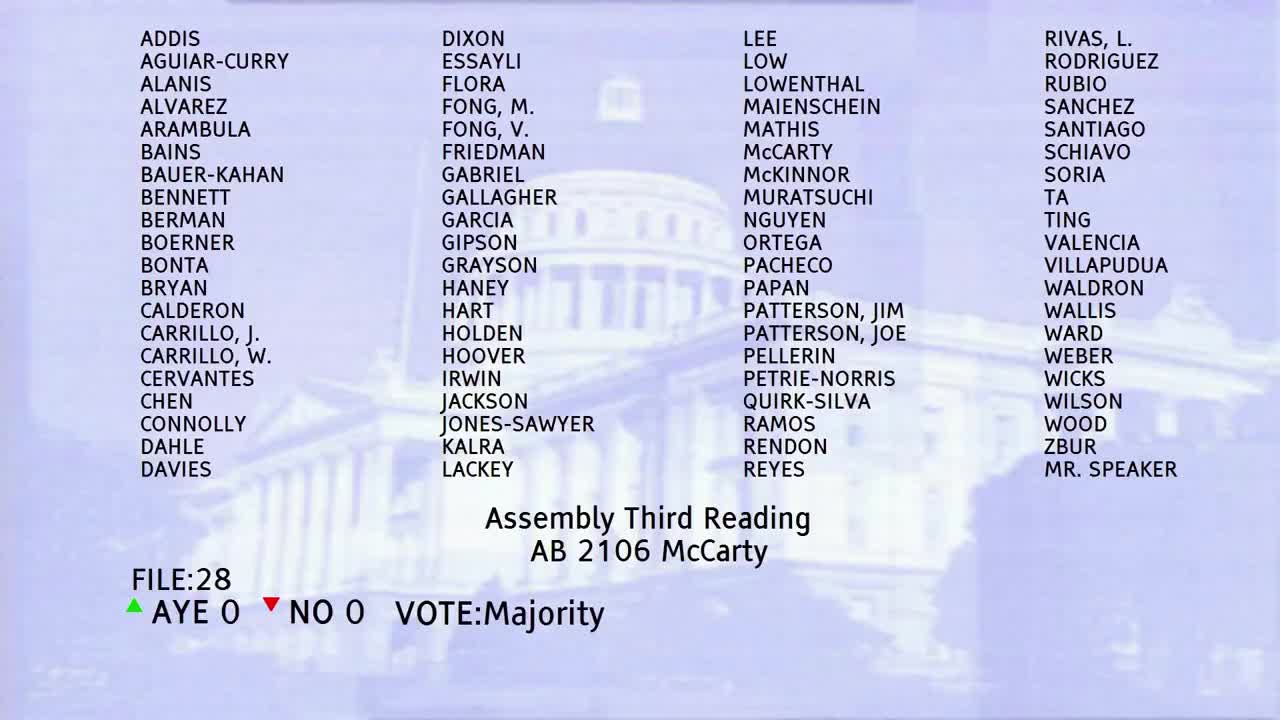 54SEC
Assembly Floor
 2MIN
Assembly Standing Committee on Jobs, Economic Development, and the Economy
Bill Author

Bill Co-Author(s):