AB 2477: Foster care: independent living.
- Session Year: 2023-2024
- House: Assembly
- Latest Version Date: 2024-09-14
Current Status:
Passed
(2024-09-14: Chaptered by Secretary of State - Chapter 237, Statutes of 2024.)
Introduced
In Committee
First Chamber
In Committee
Second Chamber
Enacted
Existing law establishes the Independent Living Program (ILP), which has among its purposes providing training in daily living skills, budgeting, locating and maintaining housing, and career planning for foster youth up to 21 years of age. Existing federal law authorizes a state, under certain circumstances, to expand eligibility for the ILP to former foster youth who have not attained 23 years of age. Existing law requires the State Department of Social Services, with the approval of the federal government, to amend the foster care state plan to permit all eligible children to be served by the ILP up to 21 years of age.
Existing law authorizes a child who is declared a ward or dependent child of the court who is 16 years of age or older, or a nonminor dependent, as defined, who is participating in a transitional independent living case plan to retain resources with a combined value of $10,000, consistent with federal law, and still remain eligible to receive public social services. Existing law requires the written approval of a childs probation officer or social worker for withdrawal of the childs savings, as specified.
Existing law establishes the Aid to Families with Dependent Children-Foster Care (AFDC-FC) program, under which counties provide payments to foster care providers on behalf of qualified children in foster care. Existing law requires the county to review the child or nonminor dependents payment amount annually, including an examination of any circumstances of a foster child or nonminor dependent that are subject to change and could affect the childs or nonminor dependents potential eligibility or payment amount.
This bill would remove that monetary value limit and instead allow those nonminor dependents to retain resources consistent with federal law. The bill would prohibit those resources from being evaluated after the initial determination for the same foster care episode to determine continued eligibility for a foster care maintenance payment. The bill would require AFDC-FC benefits to be available if all other criteria are met but the nonminor is determined ineligible for federal financial participation pursuant to specified criteria. Because counties would administer these extended benefits, this bill would impose a state-mandated local program.
The California Constitution requires the state to reimburse local agencies and school districts for certain costs mandated by the state. Statutory provisions establish procedures for making that reimbursement.
This bill would provide that no reimbursement is required by this act for a specified reason.
Existing law establishes the Independent Living Program (ILP), which has among its purposes providing training in daily living skills, budgeting, locating and maintaining housing, and career planning for foster youth up to 21 years of age. Existing federal law authorizes a state, under certain circumstances, to expand eligibility for the ILP to former foster youth who have not attained 23 years of age. Existing law requires the State Department of Social Services, with the approval of the federal government, to amend the foster care state plan to permit all eligible children to be served by the ILP up to 21 years of age.
Existing law authorizes a child who is declared a ward or dependent child of the court who is 16 years of age or older, or a nonminor dependent, as defined, who is participating in a transitional independent living case plan to retain resources with a combined value of $10,000, consistent with federal law, and still remain eligible to receive public social services. Existing law requires the written approval of a childs probation officer or social worker for withdrawal of the childs savings, as specified.
Existing law establishes the Aid to Families with Dependent Children-Foster Care (AFDC-FC) program, under which counties provide payments to foster care providers on behalf of qualified children in foster care. Existing law requires the county to review the child or nonminor dependents payment amount annually, including an examination of any circumstances of a foster child or nonminor dependent that are subject to change and could affect the childs or nonminor dependents potential eligibility or payment amount.
This bill would remove that monetary value limit and instead allow those nonminor dependents to retain resources consistent with federal law. The bill would prohibit those resources from being evaluated after the initial determination for the same foster care episode to determine continued eligibility for a foster care maintenance payment. The bill would also authorize a nonminor dependent who reenters foster care, as specified, and is ineligible for federal financial participation due to cash savings in an amount that is greater than allowed, to receive aid in the form of state AFDC-FC if certain requirements are met. require AFDC-FC benefits to be available if all other criteria are met but the nonminor is determined ineligible for federal financial participation pursuant to specified criteria. Because counties would administer these extended benefits, this bill would impose a state-mandated local program.
The California Constitution requires the state to reimburse local agencies and school districts for certain costs mandated by the state. Statutory provisions establish procedures for making that reimbursement.
This bill would provide that no reimbursement is required by this act for a specified reason.
Existing law establishes the Independent Living Program (ILP), which has among its purposes providing training in daily living skills, budgeting, locating and maintaining housing, and career planning for foster youth up to 21 years of age. Existing federal law authorizes a state, under certain circumstances, to expand eligibility for the ILP to former foster youth who have not attained 23 years of age. Existing law requires the State Department of Social Services, with the approval of the federal government, to amend the foster care state plan to permit all eligible children to be served by the ILP up to 21 years of age.
Existing law authorizes a child who is declared a ward or dependent child of the court who is 16 years of age or older, or a nonminor dependent, as defined, who is participating in a transitional independent living case plan to retain resources with a combined value of $10,000, consistent with federal law, and still remain eligible to receive public social services. Existing law requires the written approval of a childs probation officer or social worker for withdrawal of the childs savings, as specified.
Existing law establishes the Aid to Families with Dependent Children-Foster Care (AFDC-FC) program, under which counties provide payments to foster care providers on behalf of qualified children in foster care.
This bill would remove that monetary value limit and instead allow those nonminor dependents to retain resources consistent with federal law. The bill would prohibit those resources from being evaluated after the initial determination for the same foster care episode to determine continued eligibility for a foster care maintenance payment. The bill would also authorize a nonminor dependent who reenters foster care, as specified, and is ineligible for federal financial participation due to cash savings in an amount that is greater than allowed, to receive aid in the form of state AFDC-FC if certain requirements are met. Because counties would administer these extended benefits, this bill would impose a state-mandated local program.
The California Constitution requires the state to reimburse local agencies and school districts for certain costs mandated by the state. Statutory provisions establish procedures for making that reimbursement.
This bill would provide that no reimbursement is required by this act for a specified reason.
(a)In addition to the personal property permitted by other provisions of this part, a child declared a ward or dependent child of the juvenile court, who is 16 years of age or older, or, a nonminor dependent, as defined in subdivision (v) of Section 11400, who is participating in a transitional independent living case plan pursuant to the federal Fostering Connections to Success and Increasing Adoptions Act of 2008 (Public Law 110-351), may retain resources consistent with Section 472(a) of the federal Social Security Act (42 U.S.C. Sec. 672(a)) as contained in the federal Foster Care Independence Act of 1999 (Public Law 106-169) and the childs transitional independent living case plan. Any cash savings shall be the childs own money and shall be deposited by the child or on behalf of the child in any bank or savings and loan institution whose deposits are insured by the Federal Deposit Insurance Corporation or the Federal Savings and Loan Insurance Corporation. The cash savings shall be for the childs use for purposes directly related to the childs or nonminor dependents transitional independent living case plan goals.
(b)The withdrawal of the savings by a child shall require the written approval of the childs probation officer or social worker and shall be directly related to the goal of emancipation. This written approval is not required for withdrawals by a nonminor dependent.
SEC. 2.Section 11401.5 of the Welfare and Institutions Code is amended to read:11401.5.(a)The county shall review the childs or nonminor dependents payment amount annually. The review shall include an examination of any circumstances of a foster child or nonminor dependent that are subject to change and could affect the childs or nonminor dependents potential eligibility or payment amount, including, but not limited to, authority for placement, eligible facility, and age.
(b)Consistent with federal law, any income and resources of the foster child or nonminor dependent obtained after the initial eligibility determination shall not be used to redetermine eligibility during a single foster care episode.
SEC. 3.Section 11403 of the Welfare and Institutions Code is amended to read:11403.(a)It is the intent of the Legislature to exercise the option afforded states under Section 475(8) (42 U.S.C. Sec. 675(8)), and Section 473(a)(4) (42 U.S.C. Sec. 673(a)(4)) of the federal Social Security Act, as contained in the federal Fostering Connections to Success and Increasing Adoptions Act of 2008 (Public Law 110-351), to receive federal financial participation for nonminor dependents of the juvenile court who satisfy the conditions of subdivision (b), consistent with their transitional independent living case plan. Nonminor dependents are eligible to receive support until they reach 21 years of age, consistent with their transitional independent living case plan and as described in Section 10103.5. It is the intent of the Legislature, both at the time of initial determination of the nonminor dependents eligibility and throughout the time the nonminor dependent is eligible for aid pursuant to this section, that the social worker or probation officer or Indian tribal placing entity and the nonminor dependent shall work together to ensure the nonminor dependents ongoing eligibility. All case planning shall be a collaborative effort between the nonminor dependent and the social worker, probation officer, or Indian tribe, with the nonminor dependent assuming increasing levels of responsibility and independence.
(b)A nonminor dependent receiving aid pursuant to this chapter, who satisfies the age criteria set forth in subdivision (a), shall meet the legal authority for placement and care by being under a foster care placement order by the juvenile court, or the voluntary reentry agreement as set forth in subdivision (z) of Section 11400, and is otherwise eligible for AFDC-FC payments pursuant to Section 11401. A nonminor who satisfies the age criteria set forth in subdivision (a), and who is otherwise eligible, shall continue to receive CalWORKs payments pursuant to Section 11253, Approved Relative Caregiver Funding Program benefits pursuant to Section 11461.3, or, as a nonminor former dependent or ward, aid pursuant to Kin-GAP under Article 4.5 (commencing with Section 11360) or Article 4.7 (commencing with Section 11385) or adoption assistance payments, as specified in Chapter 2.1 (commencing with Section 16115) of Part 4. A nonminor former dependent child or ward of the juvenile court who is receiving AFDC-FC benefits pursuant to Section 11405 and who satisfies the criteria set forth in subdivision (a) is eligible to continue to receive aid as long as the nonminor is otherwise eligible for AFDC-FC benefits under this subdivision. This subdivision applies when one or more of the following conditions exist:
(1)The nonminor is completing secondary education or a program leading to an equivalent credential.
(2)The nonminor is enrolled in an institution that provides postsecondary or vocational education.
(3)The nonminor is participating in a program or activity designed to promote, or remove barriers to employment.
(4)The nonminor is employed for at least 80 hours per month.
(5)The nonminor is incapable of doing any of the activities described in paragraphs (1) to (4), inclusive, due to a medical condition, and that incapability is supported by regularly updated information in the case plan of the nonminor. The requirement to update the case plan under this section does not apply to nonminor former dependents or wards in receipt of Kin-GAP program or Adoption Assistance Program payments.
(c)The county child welfare or probation department, Indian tribe, consortium of tribes, or tribal organization that has entered into an agreement pursuant to Section 10553.1, shall work together with a nonminor dependent who is in foster care on the nonminor dependents 18th birthday and thereafter or a nonminor former dependent receiving aid pursuant to Section 11405, to satisfy one or more of the conditions described in paragraphs (1) to (5), inclusive, of subdivision (b) and shall certify the nonminors applicable condition or conditions in the nonminors six-month transitional independent living case plan update, and provide the certification to the eligibility worker and to the court at each six-month case plan review hearing for the nonminor dependent. Relative guardians who receive Kin-GAP payments and adoptive parents who receive adoption assistance payments shall be responsible for reporting to the county welfare agency that the nonminor does not satisfy at least one of the conditions described in subdivision (b). The social worker, probation officer, or tribal entity shall verify and obtain assurances that the nonminor dependent continues to satisfy at least one of the conditions in paragraphs (1) to (5), inclusive, of subdivision (b) at each six-month transitional independent living case plan update. The six-month case plan update shall certify the nonminors eligibility pursuant to subdivision (b) for the next six-month period. During the six-month certification period, the payee and nonminor shall report any change in placement or other relevant changes in circumstances that may affect payment. The nonminor dependent, or nonminor former dependent receiving aid pursuant to subdivision (e) of Section 11405, shall be informed of all due process requirements, in accordance with state and federal law, prior to an involuntary termination of aid, and shall simultaneously be provided with a written explanation of how to exercise their due process rights and obtain referrals to legal assistance. Any notices of action regarding eligibility shall be sent to the nonminor dependent or former dependent, their counsel, as applicable, and the placing worker, in addition to any other payee. Payments of aid pursuant to Kin-GAP under Article 4.5 (commencing with Section 11360) or Article 4.7 (commencing with Section 11385), adoption assistance payments as specified in Chapter 2.1 (commencing with Section 16115) of Part 4, or aid pursuant to subdivision (e) of Section 11405 that are made on behalf of a nonminor former dependent shall terminate subject to the terms of the agreements. Subject to federal approval of amendments to the state plan, aid payments may be suspended and resumed based on changes of circumstances that affect eligibility. Nonminor former dependents, as identified in paragraph (2) of subdivision (aa) of Section 11400, are not eligible for reentry under subdivision (e) of Section 388 as nonminor dependents under the jurisdiction of the juvenile court, but may be eligible for reentry pursuant to Section 388.1 if (1) the nonminor former dependent was receiving or, but for the receipt of Supplemental Security Income benefits or other aid from the federal Social Security Administration, would have received aid under either Kin-GAP pursuant to Article 4.5 (commencing with Section 11360) or Article 4.7 (commencing with Section 11385) or AFDC-FC pursuant to subdivision (e) of Section 11405, or the nonminor was receiving adoption assistance payments, as specified in Chapter 2.1 (commencing with Section 16115) of Part 4, and (2) the nonminors former guardian or adoptive parent dies, or no longer provides ongoing support to, and no longer receives benefits on behalf of, the nonminor after the nonminor turns 18 years of age, but before the nonminor turns 21 years of age. Nonminor former dependents requesting the resumption of AFDC-FC payments pursuant to subdivision (e) of Section 11405 shall complete the applicable portions of the voluntary reentry agreement, as described in subdivision (z) of Section 11400.
(d)A nonminor dependent may receive all of the payment directly provided that the nonminor is living independently in a supervised placement, as described in subdivision (w) of Section 11400, and that both the youth and the agency responsible for the foster care placement have signed a mutual agreement, as defined in subdivision (u) of Section 11400, if the youth is capable of making an informed agreement, that documents the continued need for supervised out-of-home placement, and the nonminors and social workers or probation officers agreement to work together to facilitate implementation of the mutually developed supervised placement agreement and transitional independent living case plan.
(e)Eligibility for aid under this section shall not terminate until the nonminor dependent attains the age criteria, as set forth in subdivision (a), but aid may be suspended when the nonminor dependent no longer resides in an eligible facility, as described in Section 11402, or is otherwise not eligible for AFDC-FC benefits under Section 11401, or terminated at the request of the nonminor, or after a court terminates dependency jurisdiction pursuant to Section 391, delinquency jurisdiction pursuant to Section 607.2, or transition jurisdiction pursuant to Section 452. AFDC-FC benefits to nonminor dependents may be resumed at the request of the nonminor by completing a voluntary reentry agreement pursuant to subdivision (z) of Section 11400, before or after the filing of a petition filed pursuant to subdivision (e) of Section 388 after a court terminates dependency or transitional jurisdiction pursuant to Section 391 or delinquency jurisdiction pursuant to Section 607.2. The county welfare or probation department or Indian tribal entity that has entered into an agreement pursuant to Section 10553.1 shall complete the voluntary reentry agreement with the nonminor who agrees to satisfy the criteria of the agreement, as described in subdivision (z) of Section 11400. The county welfare department or tribal entity shall establish a new child-only Title IV-E eligibility determination based on the nonminors completion of the voluntary reentry agreement pursuant to Section 11401. Pursuant to Section 11401 and subdivision (g), state AFDC-FC benefits are available if all other criteria are met, if the nonminor is determined ineligible for federal financial participation under subdivision (g) of Section 11401. The beginning date of aid for either federal or state AFDC-FC for a reentering nonminor who is placed in foster care is the date the voluntary reentry agreement is signed or the nonminor is placed, whichever is later. The county welfare department, county probation department, or tribal entity shall provide a nonminor dependent who wishes to continue receiving aid with the assistance necessary to meet and maintain eligibility.
(f)(1)The county having jurisdiction of the nonminor dependent shall remain the county of payment under this section regardless of the youths physical residence. Nonminor former dependents receiving aid pursuant to subdivision (e) of Section 11405 shall be paid by their county of residence. Counties may develop courtesy supervision agreements to provide case management and independent living services by the county of residence pursuant to the nonminor dependents transitional independent living case plan. Placements made out of state are subject to the applicable requirements of the Interstate Compact on Placement of Children, pursuant to Part 5 (commencing with Section 7900) of Division 12 of the Family Code.
(2)The county welfare department, county probation department, or tribal entity shall notify all foster youth who attain 16 years of age and are under the jurisdiction of that county or tribe, including those receiving Kin-GAP, and AAP, of the existence of the aid prescribed by this section.
(3)The department shall seek any waiver to amend its Title IV-E State Plan with the Secretary of the United States Department of Health and Human Services necessary to implement this section.
(g)(1)Subject to paragraph (3), a county shall pay the nonfederal share of the cost of extending aid pursuant to this section to eligible nonminor dependents who have reached 18 years of age and who are under the jurisdiction of the county, including AFDC-FC payments pursuant to Section 11401, aid pursuant to Kin-GAP under Article 4.7 (commencing with Section 11385), adoption assistance payments as specified in Chapter 2.1 (commencing with Section 16115) of Part 4, and aid pursuant to Section 11405 for nonminor dependents who are residing in the county as provided in paragraph (1) of subdivision (f). A county shall contribute to the CalWORKs payments pursuant to Section 11253 and aid pursuant to Kin-GAP under Article 4.5 (commencing with Section 11360) at the statutory sharing ratios in effect on January 1, 2012.
(2)Subject to paragraph (3), a county shall pay the nonfederal share of the cost of providing permanent placement services pursuant to subdivision (c) of Section 16508 and administering the Aid to Families with Dependent Children Foster Care program pursuant to Section 15204.9. For purposes of budgeting, the department shall use a standard for the permanent placement services that is equal to the midpoint between the budgeting standards for family maintenance services and family reunification services.
(3)(A)(i)Notwithstanding any other law, a countys required total contribution pursuant to paragraphs (1) and (2), excluding costs incurred pursuant to Section 10103.5, shall not exceed the amount of savings in Kin-GAP assistance grant expenditures realized by the county from the receipt of federal funds due to the implementation of Article 4.7 (commencing with Section 11385), and the amount of funding specifically included in the Protective Services Subaccount within the Support Services Account within the Local Revenue Fund 2011, plus any associated growth funding from the Support Services Growth Subaccount within the Sales and Use Tax Growth Account to pay the costs of extending aid pursuant to this section.
(ii)A county, at its own discretion, may expend additional funds beyond the amounts identified in clause (i). These additional amounts shall not be included in any cost and savings calculations or comparisons performed pursuant to this section.
(B)Beginning in the 201112 fiscal year, and for each fiscal year thereafter, funding and expenditures for programs and activities under this section shall be in accordance with the requirements provided in Sections 30025 and 30026.5 of the Government Code. In addition, the following are available to the counties for the purpose of funding costs pursuant to this section:
(i)The savings in Kin-GAP assistance grant expenditures realized from the receipt of federal funds due to the implementation of Article 4.7 (commencing with Section 11385).
(ii)The savings realized from the change in federal funding for adoption assistance resulting from the enactment of Public Law 110-351 and consistent with subdivision (d) of Section 16118.
(4)(A)The limit on the countys total contribution pursuant to paragraph (3) shall be assessed by the State Department of Social Services, in conjunction with the California State Association of Counties, in 201516, to determine if it shall be removed. The assessment of the need for the limit shall be based on a determination on a statewide basis of whether the actual county costs of providing extended care pursuant to this section, excluding costs incurred pursuant to Section 10103.5, are fully funded by the amount of savings in Kin-GAP assistance grant expenditures realized by the counties from the receipt of federal funds due to the implementation of Article 4.7 (commencing with Section 11385) and the amount of funding specifically included in the Protective Services Subaccount within the Support Services Account within the Local Revenue Fund 2011 plus any associated growth funding from the Support Services Growth Subaccount within the Sales and Use Tax Growth Account to pay the costs of extending aid pursuant to this section.
(B)If the assessment pursuant to subparagraph (A) shows that the statewide total costs of extending aid pursuant to this section, excluding costs incurred pursuant to Section 10103.5, are fully funded by the amount of savings in Kin-GAP assistance grant expenditures realized by the counties from the receipt of federal funds due to the implementation of Article 4.7 (commencing with Section 11385) and the amount of funding specifically included in the Protective Services Subaccount within the Support Services Account within the Local Revenue Fund 2011 plus any associated growth funding from the Support Services Growth Subaccount within the Sales and Use Tax Growth Account to pay the costs of extending aid pursuant to this section, the Department of Finance shall certify that fact, in writing, and shall post the certification on its internet website, at which time subparagraph (A) of paragraph (3) shall no longer be implemented.
(h)It is the intent of the Legislature that a county currently participating in the Child Welfare Demonstration Capped Allocation Project not be adversely impacted by the departments exercise of its option to extend foster care benefits pursuant to Section 673(a)(4) and Section 675(8) of Title 42 of the United States Code in the federal Social Security Act, as contained in the federal Fostering Connections to Success and Increasing Adoptions Act of 2008 (Public Law 110-351). Therefore, the department shall negotiate with the United States Department of Health and Human Services on behalf of those counties that are currently participating in the demonstration project to ensure that those counties receive reimbursement for these new programs outside of the provisions of those counties waiver under Subtitle IV-E (commencing with Section 470) of the federal Social Security Act (42 U.S.C. Sec. 670 et seq.).
(i)The department, on or before July 1, 2013, shall develop regulations to implement this section in consultation with concerned stakeholders, including, but not limited to, representatives of the Legislature, the County Welfare Directors Association of California, the Chief Probation Officers of California, the Judicial Council, representatives of Indian tribes, the California Youth Connection, former foster youth, child advocacy organizations, labor organizations, juvenile justice advocacy organizations, foster caregiver organizations, and researchers. In the development of these regulations, the department shall consider its Manual of Policy and Procedures, Division 30, Chapter 30-912, 913, 916, and 917, as guidelines for developing regulations that are appropriate for young adults who can exercise incremental responsibility concurrently with their growth and development. The department, in its consultation with stakeholders, shall take into consideration the impact to the statewide child welfare information system and required modifications needed to accommodate eligibility determination under this section, benefit issuance, case management across counties, and recognition of the legal status of nonminor dependents as adults, as well as changes to data tracking and reporting requirements as required by the Child Welfare System Improvement and Accountability Act as specified in Section 10601.2, and federal outcome measures as required by the federal John H. Chafee Foster Care Independence Program (42 U.S.C. Sec. 677(f)). In addition, the department, in its consultation with stakeholders, shall define the supervised independent living setting, which shall include, but not be limited to, apartment living, room and board arrangements, college or university dormitories, and shared roommate settings, and define how those settings meet health and safety standards suitable for nonminors. The department, in its consultation with stakeholders, shall define the six-month certification of the conditions of eligibility pursuant to subdivision (b) to be consistent with the flexibility provided by federal policy guidance, to ensure that there are ample supports for a nonminor to achieve the goals of the nonminors transition independent living case plan. The department, in its consultation with stakeholders, shall ensure that notices of action and other forms created to inform the nonminor of due process rights and how to access them shall be developed, using language consistent with the special needs of the nonminor dependent population.
(j)Notwithstanding the Administrative Procedure Act, Chapter 3.5 (commencing with Section 11340) of Part 1 of Division 3 of Title 2 of the Government Code, the department shall prepare for implementation of the applicable provisions of this section by publishing, after consultation with the stakeholders listed in subdivision (i), all-county letters or similar instructions from the director by October 1, 2011, to be effective January 1, 2012. Emergency regulations to implement the applicable provisions of this act may be adopted by the director in accordance with the Administrative Procedure Act. The initial adoption of the emergency regulations and one readoption of the emergency regulations are deemed to be an emergency and necessary for the immediate preservation of the public peace, health, safety, or general welfare. Initial emergency regulations and the first readoption of those emergency regulations are exempt from review by the Office of Administrative Law. The emergency regulations authorized by this section shall be submitted to the Office of Administrative Law for filing with the Secretary of State and shall remain in effect for no more than 180 days.
SEC. 4.To the extent that this act has an overall effect of increasing the costs already borne by a local agency for programs or levels of service mandated by the 2011 Realignment Legislation within the meaning of Section 36 of Article XIII of the California Constitution, it shall apply to local agencies only to the extent that the state provides annual funding for the cost increase. Any new program or higher level of service provided by a local agency pursuant to this act above the level for which funding has been provided shall not require a subvention of funds by the state or otherwise be subject to Section 6 of Article XIIIB of the California Constitution.
(a)In addition to the personal property permitted by other provisions of this part, a child declared a ward or dependent child of the juvenile court, who is 16 years of age or older, or, a nonminor dependent, as defined in subdivision (v) of Section 11400, who is participating in a transitional independent living case plan pursuant to the federal Fostering Connections to Success and Increasing Adoptions Act of 2008 (Public Law 110-351), may retain resources consistent with Section 472(a) of the federal Social Security Act (42 U.S.C. Sec. 672(a)) as contained in the federal Foster Care Independence Act of 1999 (Public Law 106-169) and the childs transitional independent living case plan. Any cash savings shall be the childs own money and shall be deposited by the child or on behalf of the child in any bank or savings and loan institution whose deposits are insured by the Federal Deposit Insurance Corporation or the Federal Savings and Loan Insurance Corporation. The cash savings shall be for the childs use for purposes directly related to the childs or nonminor dependents transitional independent living case plan goals.
(b)The withdrawal of the savings by a child shall require the written approval of the childs probation officer or social worker and shall be directly related to the goal of emancipation. This written approval is not required for withdrawals by a nonminor dependent.
(c)Consistent with federal law, resources shall not be evaluated after the initial determination for the same foster care episode to determine continued eligibility for a foster care maintenance payment. (d)A nonminor dependent who reenters foster care pursuant to subdivision (e) of Section 388 and is ineligible for federal financial participation due to cash savings in excess of those allowed pursuant to subdivision (a) is eligible to receive aid in the form of state Aid to Families with Dependent Children-Foster Care (AFDC-FC) if all other criteria pursuant to Section 11401 are met. SEC. 2.Section 11401.5 of the Welfare and Institutions Code is amended to read:11401.5.(a)The county shall review the childs or nonminor dependents payment amount annually. The review shall include an examination of any circumstances of a foster child or nonminor dependent that are subject to change and could affect the childs or nonminor dependents potential eligibility or payment amount, including, but not limited to, authority for placement, eligible facility, and age.
(b)Consistent with federal law, any income and resources of the foster child or nonminor dependent obtained after the initial eligibility determination shall not be used to redetermine eligibility during a single foster care episode.
SEC. 3.Section 11403 of the Welfare and Institutions Code is amended to read:11403.(a)It is the intent of the Legislature to exercise the option afforded states under Section 475(8) (42 U.S.C. Sec. 675(8)), and Section 473(a)(4) (42 U.S.C. Sec. 673(a)(4)) of the federal Social Security Act, as contained in the federal Fostering Connections to Success and Increasing Adoptions Act of 2008 (Public Law 110-351), to receive federal financial participation for nonminor dependents of the juvenile court who satisfy the conditions of subdivision (b), consistent with their transitional independent living case plan. Nonminor dependents are eligible to receive support until they reach 21 years of age, consistent with their transitional independent living case plan and as described in Section 10103.5. It is the intent of the Legislature, both at the time of initial determination of the nonminor dependents eligibility and throughout the time the nonminor dependent is eligible for aid pursuant to this section, that the social worker or probation officer or Indian tribal placing entity and the nonminor dependent shall work together to ensure the nonminor dependents ongoing eligibility. All case planning shall be a collaborative effort between the nonminor dependent and the social worker, probation officer, or Indian tribe, with the nonminor dependent assuming increasing levels of responsibility and independence.
(b)A nonminor dependent receiving aid pursuant to this chapter, who satisfies the age criteria set forth in subdivision (a), shall meet the legal authority for placement and care by being under a foster care placement order by the juvenile court, or the voluntary reentry agreement as set forth in subdivision (z) of Section 11400, and is otherwise eligible for AFDC-FC payments pursuant to Section 11401. A nonminor who satisfies the age criteria set forth in subdivision (a), and who is otherwise eligible, shall continue to receive CalWORKs payments pursuant to Section 11253, Approved Relative Caregiver Funding Program benefits pursuant to Section 11461.3, or, as a nonminor former dependent or ward, aid pursuant to Kin-GAP under Article 4.5 (commencing with Section 11360) or Article 4.7 (commencing with Section 11385) or adoption assistance payments, as specified in Chapter 2.1 (commencing with Section 16115) of Part 4. A nonminor former dependent child or ward of the juvenile court who is receiving AFDC-FC benefits pursuant to Section 11405 and who satisfies the criteria set forth in subdivision (a) is eligible to continue to receive aid as long as the nonminor is otherwise eligible for AFDC-FC benefits under this subdivision. This subdivision applies when one or more of the following conditions exist:
(1)The nonminor is completing secondary education or a program leading to an equivalent credential.
(2)The nonminor is enrolled in an institution that provides postsecondary or vocational education.
(3)The nonminor is participating in a program or activity designed to promote, or remove barriers to employment.
(4)The nonminor is employed for at least 80 hours per month.
(5)The nonminor is incapable of doing any of the activities described in paragraphs (1) to (4), inclusive, due to a medical condition, and that incapability is supported by regularly updated information in the case plan of the nonminor. The requirement to update the case plan under this section does not apply to nonminor former dependents or wards in receipt of Kin-GAP program or Adoption Assistance Program payments.
(c)The county child welfare or probation department, Indian tribe, consortium of tribes, or tribal organization that has entered into an agreement pursuant to Section 10553.1, shall work together with a nonminor dependent who is in foster care on the nonminor dependents 18th birthday and thereafter or a nonminor former dependent receiving aid pursuant to Section 11405, to satisfy one or more of the conditions described in paragraphs (1) to (5), inclusive, of subdivision (b) and shall certify the nonminors applicable condition or conditions in the nonminors six-month transitional independent living case plan update, and provide the certification to the eligibility worker and to the court at each six-month case plan review hearing for the nonminor dependent. Relative guardians who receive Kin-GAP payments and adoptive parents who receive adoption assistance payments shall be responsible for reporting to the county welfare agency that the nonminor does not satisfy at least one of the conditions described in subdivision (b). The social worker, probation officer, or tribal entity shall verify and obtain assurances that the nonminor dependent continues to satisfy at least one of the conditions in paragraphs (1) to (5), inclusive, of subdivision (b) at each six-month transitional independent living case plan update. The six-month case plan update shall certify the nonminors eligibility pursuant to subdivision (b) for the next six-month period. During the six-month certification period, the payee and nonminor shall report any change in placement or other relevant changes in circumstances that may affect payment. The nonminor dependent, or nonminor former dependent receiving aid pursuant to subdivision (e) of Section 11405, shall be informed of all due process requirements, in accordance with state and federal law, prior to an involuntary termination of aid, and shall simultaneously be provided with a written explanation of how to exercise their due process rights and obtain referrals to legal assistance. Any notices of action regarding eligibility shall be sent to the nonminor dependent or former dependent, their counsel, as applicable, and the placing worker, in addition to any other payee. Payments of aid pursuant to Kin-GAP under Article 4.5 (commencing with Section 11360) or Article 4.7 (commencing with Section 11385), adoption assistance payments as specified in Chapter 2.1 (commencing with Section 16115) of Part 4, or aid pursuant to subdivision (e) of Section 11405 that are made on behalf of a nonminor former dependent shall terminate subject to the terms of the agreements. Subject to federal approval of amendments to the state plan, aid payments may be suspended and resumed based on changes of circumstances that affect eligibility. Nonminor former dependents, as identified in paragraph (2) of subdivision (aa) of Section 11400, are not eligible for reentry under subdivision (e) of Section 388 as nonminor dependents under the jurisdiction of the juvenile court, but may be eligible for reentry pursuant to Section 388.1 if (1) the nonminor former dependent was receiving or, but for the receipt of Supplemental Security Income benefits or other aid from the federal Social Security Administration, would have received aid under either Kin-GAP pursuant to Article 4.5 (commencing with Section 11360) or Article 4.7 (commencing with Section 11385) or AFDC-FC pursuant to subdivision (e) of Section 11405, or the nonminor was receiving adoption assistance payments, as specified in Chapter 2.1 (commencing with Section 16115) of Part 4, and (2) the nonminors former guardian or adoptive parent dies, or no longer provides ongoing support to, and no longer receives benefits on behalf of, the nonminor after the nonminor turns 18 years of age, but before the nonminor turns 21 years of age. Nonminor former dependents requesting the resumption of AFDC-FC payments pursuant to subdivision (e) of Section 11405 shall complete the applicable portions of the voluntary reentry agreement, as described in subdivision (z) of Section 11400.
(d)A nonminor dependent may receive all of the payment directly provided that the nonminor is living independently in a supervised placement, as described in subdivision (w) of Section 11400, and that both the youth and the agency responsible for the foster care placement have signed a mutual agreement, as defined in subdivision (u) of Section 11400, if the youth is capable of making an informed agreement, that documents the continued need for supervised out-of-home placement, and the nonminors and social workers or probation officers agreement to work together to facilitate implementation of the mutually developed supervised placement agreement and transitional independent living case plan.
(e)Eligibility for aid under this section shall not terminate until the nonminor dependent attains the age criteria, as set forth in subdivision (a), but aid may be suspended when the nonminor dependent no longer resides in an eligible facility, as described in Section 11402, or is otherwise not eligible for AFDC-FC benefits under Section 11401, or terminated at the request of the nonminor, or after a court terminates dependency jurisdiction pursuant to Section 391, delinquency jurisdiction pursuant to Section 607.2, or transition jurisdiction pursuant to Section 452. AFDC-FC benefits to nonminor dependents may be resumed at the request of the nonminor by completing a voluntary reentry agreement pursuant to subdivision (z) of Section 11400, before or after the filing of a petition filed pursuant to subdivision (e) of Section 388 after a court terminates dependency or transitional jurisdiction pursuant to Section 391 or delinquency jurisdiction pursuant to Section 607.2. The county welfare or probation department or Indian tribal entity that has entered into an agreement pursuant to Section 10553.1 shall complete the voluntary reentry agreement with the nonminor who agrees to satisfy the criteria of the agreement, as described in subdivision (z) of Section 11400. The county welfare department or tribal entity shall establish a new child-only Title IV-E eligibility determination based on the nonminors completion of the voluntary reentry agreement pursuant to Section 11401. Pursuant to Section 11401 and subdivision (g), state AFDC-FC benefits are available if all other criteria are met, if the nonminor is determined ineligible for federal financial participation under subdivision (g) of Section 11401. The beginning date of aid for either federal or state AFDC-FC for a reentering nonminor who is placed in foster care is the date the voluntary reentry agreement is signed or the nonminor is placed, whichever is later. The county welfare department, county probation department, or tribal entity shall provide a nonminor dependent who wishes to continue receiving aid with the assistance necessary to meet and maintain eligibility.
(f)(1)The county having jurisdiction of the nonminor dependent shall remain the county of payment under this section regardless of the youths physical residence. Nonminor former dependents receiving aid pursuant to subdivision (e) of Section 11405 shall be paid by their county of residence. Counties may develop courtesy supervision agreements to provide case management and independent living services by the county of residence pursuant to the nonminor dependents transitional independent living case plan. Placements made out of state are subject to the applicable requirements of the Interstate Compact on Placement of Children, pursuant to Part 5 (commencing with Section 7900) of Division 12 of the Family Code.
(2)The county welfare department, county probation department, or tribal entity shall notify all foster youth who attain 16 years of age and are under the jurisdiction of that county or tribe, including those receiving Kin-GAP, and AAP, of the existence of the aid prescribed by this section.
(3)The department shall seek any waiver to amend its Title IV-E State Plan with the Secretary of the United States Department of Health and Human Services necessary to implement this section.
(g)(1)Subject to paragraph (3), a county shall pay the nonfederal share of the cost of extending aid pursuant to this section to eligible nonminor dependents who have reached 18 years of age and who are under the jurisdiction of the county, including AFDC-FC payments pursuant to Section 11401, aid pursuant to Kin-GAP under Article 4.7 (commencing with Section 11385), adoption assistance payments as specified in Chapter 2.1 (commencing with Section 16115) of Part 4, and aid pursuant to Section 11405 for nonminor dependents who are residing in the county as provided in paragraph (1) of subdivision (f). A county shall contribute to the CalWORKs payments pursuant to Section 11253 and aid pursuant to Kin-GAP under Article 4.5 (commencing with Section 11360) at the statutory sharing ratios in effect on January 1, 2012.
(2)Subject to paragraph (3), a county shall pay the nonfederal share of the cost of providing permanent placement services pursuant to subdivision (c) of Section 16508 and administering the Aid to Families with Dependent Children Foster Care program pursuant to Section 15204.9. For purposes of budgeting, the department shall use a standard for the permanent placement services that is equal to the midpoint between the budgeting standards for family maintenance services and family reunification services.
(3)(A)(i)Notwithstanding any other law, a countys required total contribution pursuant to paragraphs (1) and (2), excluding costs incurred pursuant to Section 10103.5, shall not exceed the amount of savings in Kin-GAP assistance grant expenditures realized by the county from the receipt of federal funds due to the implementation of Article 4.7 (commencing with Section 11385), and the amount of funding specifically included in the Protective Services Subaccount within the Support Services Account within the Local Revenue Fund 2011, plus any associated growth funding from the Support Services Growth Subaccount within the Sales and Use Tax Growth Account to pay the costs of extending aid pursuant to this section.
(ii)A county, at its own discretion, may expend additional funds beyond the amounts identified in clause (i). These additional amounts shall not be included in any cost and savings calculations or comparisons performed pursuant to this section.
(B)Beginning in the 201112 fiscal year, and for each fiscal year thereafter, funding and expenditures for programs and activities under this section shall be in accordance with the requirements provided in Sections 30025 and 30026.5 of the Government Code. In addition, the following are available to the counties for the purpose of funding costs pursuant to this section:
(i)The savings in Kin-GAP assistance grant expenditures realized from the receipt of federal funds due to the implementation of Article 4.7 (commencing with Section 11385).
(ii)The savings realized from the change in federal funding for adoption assistance resulting from the enactment of Public Law 110-351 and consistent with subdivision (d) of Section 16118.
(4)(A)The limit on the countys total contribution pursuant to paragraph (3) shall be assessed by the State Department of Social Services, in conjunction with the California State Association of Counties, in 201516, to determine if it shall be removed. The assessment of the need for the limit shall be based on a determination on a statewide basis of whether the actual county costs of providing extended care pursuant to this section, excluding costs incurred pursuant to Section 10103.5, are fully funded by the amount of savings in Kin-GAP assistance grant expenditures realized by the counties from the receipt of federal funds due to the implementation of Article 4.7 (commencing with Section 11385) and the amount of funding specifically included in the Protective Services Subaccount within the Support Services Account within the Local Revenue Fund 2011 plus any associated growth funding from the Support Services Growth Subaccount within the Sales and Use Tax Growth Account to pay the costs of extending aid pursuant to this section.
(B)If the assessment pursuant to subparagraph (A) shows that the statewide total costs of extending aid pursuant to this section, excluding costs incurred pursuant to Section 10103.5, are fully funded by the amount of savings in Kin-GAP assistance grant expenditures realized by the counties from the receipt of federal funds due to the implementation of Article 4.7 (commencing with Section 11385) and the amount of funding specifically included in the Protective Services Subaccount within the Support Services Account within the Local Revenue Fund 2011 plus any associated growth funding from the Support Services Growth Subaccount within the Sales and Use Tax Growth Account to pay the costs of extending aid pursuant to this section, the Department of Finance shall certify that fact, in writing, and shall post the certification on its internet website, at which time subparagraph (A) of paragraph (3) shall no longer be implemented.
(h)It is the intent of the Legislature that a county currently participating in the Child Welfare Demonstration Capped Allocation Project not be adversely impacted by the departments exercise of its option to extend foster care benefits pursuant to Section 673(a)(4) and Section 675(8) of Title 42 of the United States Code in the federal Social Security Act, as contained in the federal Fostering Connections to Success and Increasing Adoptions Act of 2008 (Public Law 110-351). Therefore, the department shall negotiate with the United States Department of Health and Human Services on behalf of those counties that are currently participating in the demonstration project to ensure that those counties receive reimbursement for these new programs outside of the provisions of those counties waiver under Subtitle IV-E (commencing with Section 470) of the federal Social Security Act (42 U.S.C. Sec. 670 et seq.).
(i)The department, on or before July 1, 2013, shall develop regulations to implement this section in consultation with concerned stakeholders, including, but not limited to, representatives of the Legislature, the County Welfare Directors Association of California, the Chief Probation Officers of California, the Judicial Council, representatives of Indian tribes, the California Youth Connection, former foster youth, child advocacy organizations, labor organizations, juvenile justice advocacy organizations, foster caregiver organizations, and researchers. In the development of these regulations, the department shall consider its Manual of Policy and Procedures, Division 30, Chapter 30-912, 913, 916, and 917, as guidelines for developing regulations that are appropriate for young adults who can exercise incremental responsibility concurrently with their growth and development. The department, in its consultation with stakeholders, shall take into consideration the impact to the statewide child welfare information system and required modifications needed to accommodate eligibility determination under this section, benefit issuance, case management across counties, and recognition of the legal status of nonminor dependents as adults, as well as changes to data tracking and reporting requirements as required by the Child Welfare System Improvement and Accountability Act as specified in Section 10601.2, and federal outcome measures as required by the federal John H. Chafee Foster Care Independence Program (42 U.S.C. Sec. 677(f)). In addition, the department, in its consultation with stakeholders, shall define the supervised independent living setting, which shall include, but not be limited to, apartment living, room and board arrangements, college or university dormitories, and shared roommate settings, and define how those settings meet health and safety standards suitable for nonminors. The department, in its consultation with stakeholders, shall define the six-month certification of the conditions of eligibility pursuant to subdivision (b) to be consistent with the flexibility provided by federal policy guidance, to ensure that there are ample supports for a nonminor to achieve the goals of the nonminors transition independent living case plan. The department, in its consultation with stakeholders, shall ensure that notices of action and other forms created to inform the nonminor of due process rights and how to access them shall be developed, using language consistent with the special needs of the nonminor dependent population.
(j)Notwithstanding the Administrative Procedure Act, Chapter 3.5 (commencing with Section 11340) of Part 1 of Division 3 of Title 2 of the Government Code, the department shall prepare for implementation of the applicable provisions of this section by publishing, after consultation with the stakeholders listed in subdivision (i), all-county letters or similar instructions from the director by October 1, 2011, to be effective January 1, 2012. Emergency regulations to implement the applicable provisions of this act may be adopted by the director in accordance with the Administrative Procedure Act. The initial adoption of the emergency regulations and one readoption of the emergency regulations are deemed to be an emergency and necessary for the immediate preservation of the public peace, health, safety, or general welfare. Initial emergency regulations and the first readoption of those emergency regulations are exempt from review by the Office of Administrative Law. The emergency regulations authorized by this section shall be submitted to the Office of Administrative Law for filing with the Secretary of State and shall remain in effect for no more than 180 days.
SEC. 2.SEC. 4.To the extent that this act has an overall effect of increasing the costs already borne by a local agency for programs or levels of service mandated by the 2011 Realignment Legislation within the meaning of Section 36 of Article XIII of the California Constitution, it shall apply to local agencies only to the extent that the state provides annual funding for the cost increase. Any new program or higher level of service provided by a local agency pursuant to this act above the level for which funding has been provided shall not require a subvention of funds by the state or otherwise be subject to Section 6 of Article XIIIB of the California Constitution.
(a)In addition to the personal property permitted by other provisions of this part, a child declared a ward or dependent child of the juvenile court, who is 16 years of age or older, or, a nonminor dependent, as defined in subdivision (v) of Section 11400, who is participating in a transitional independent living case plan pursuant to the federal Fostering Connections to Success and Increasing Adoptions Act of 2008 (Public Law 110-351), may retain resources consistent with Section 472(a) of the federal Social Security Act (42 U.S.C. Sec. 672(a)) as contained in the federal Foster Care Independence Act of 1999 (Public Law 106-169) and the childs transitional independent living case plan. Any cash savings shall be the childs own money and shall be deposited by the child or on behalf of the child in any bank or savings and loan institution whose deposits are insured by the Federal Deposit Insurance Corporation or the Federal Savings and Loan Insurance Corporation. The cash savings shall be for the childs use for purposes directly related to the childs or nonminor dependents transitional independent living case plan goals.
(b)The withdrawal of the savings by a child shall require the written approval of the childs probation officer or social worker and shall be directly related to the goal of emancipation. This written approval is not required for withdrawals by a nonminor dependent.
(c)Consistent with federal law, resources shall not be evaluated after the initial determination for the same foster care episode to determine continued eligibility for a foster care maintenance payment.
(d)A nonminor dependent who reenters foster care pursuant to subdivision (e) of Section 388 and is ineligible for federal financial participation due to cash savings in excess of the amounts referenced in those allowed pursuant to subdivision (a) is eligible to receive aid in the form of state Aid to Families with Dependent Children-Foster Care (AFDC-FC) if all other criteria pursuant to Section 11401 are met.
SEC. 2.To the extent that this act has an overall effect of increasing the costs already borne by a local agency for programs or levels of service mandated by the 2011 Realignment Legislation within the meaning of Section 36 of Article XIII of the California Constitution, it shall apply to local agencies only to the extent that the state provides annual funding for the cost increase. Any new program or higher level of service provided by a local agency pursuant to this act above the level for which funding has been provided shall not require a subvention of funds by the state or otherwise be subject to Section 6 of Article XIIIB of the California Constitution.
(a)In addition to the personal property permitted by other provisions of this part, a child declared a ward or dependent child of the juvenile court, who is 16 years of age or older, or, on and after January 1, 2012 a nonminor dependent, as defined in subdivision (v) of Section 11400, who is participating in a transitional independent living case plan pursuant to the federal Fostering Connections to Success and Increasing Adoptions Act of 2008 (Public Law 110-351), may retain resources with a combined value of not more than ten thousand dollars ($10,000), consistent with Section 472(a) of the federal Social Security Act (42 U.S.C. Sec. 672(a)) as contained in the federal Foster Care Independence Act of 1999 (Public Law 106-169) and the childs transitional independent living case plan. Any cash savings shall be the childs own money and shall be deposited by the child or on behalf of the child in any bank or savings and loan institution whose deposits are insured by the Federal Deposit Insurance Corporation or the Federal Savings and Loan Insurance Corporation. The cash savings shall be for the childs use for purposes directly related to the childs or nonminor dependents dependents transitional independent living case plan goals.
(b)The withdrawal of the savings by a child shall require the written approval of the childs probation officer or social worker and shall be directly related to the goal of emancipation. This written approval is not required for withdrawals by a nonminor dependent.
(c)Consistent with federal law, resources shall not be evaluated after the initial determination for the same foster care episode to determine continued eligibility for a foster care maintenance payment.
(d)A nonminor dependent who reenters foster care pursuant to subdivision (e) of Section 388 and is ineligible for federal financial participation due to cash savings in excess of the amounts referenced in subdivision (a) is eligible to receive aid in the form of state Aid to Families with Dependent Children-Foster Care (AFDC-FC) if all other criteria pursuant to Section 11401 are met.
SEC. 2.To the extent that this act has an overall effect of increasing the costs already borne by a local agency for programs or levels of service mandated by the 2011 Realignment Legislation within the meaning of Section 36 of Article XIII of the California Constitution, it shall apply to local agencies only to the extent that the state provides annual funding for the cost increase. Any new program or higher level of service provided by a local agency pursuant to this act above the level for which funding has been provided shall not require a subvention of funds by the state or otherwise be subject to Section 6 of Article XIIIB of the California Constitution.
|
Date
|
Status
|
|---|---|
| Sep 14, 2024 | Chaptered by Secretary of State - Chapter 237, Statutes of 2024. |
| Sep 14, 2024 | Approved by the Governor. |
| Sep 5, 2024 | Enrolled and presented to the Governor at 4 p.m. |
| Aug 27, 2024 | Senate amendments concurred in. To Engrossing and Enrolling. (Ayes 77. Noes 0.). |
| Aug 27, 2024 | Assembly Rule 77 suspended. |
| Aug 26, 2024 | In Assembly. Concurrence in Senate amendments pending. May be considered on or after August 28 pursuant to Assembly Rule 77. |
| Aug 26, 2024 | Read third time. Passed. Ordered to the Assembly. (Ayes 39. Noes 0.). |
| Aug 15, 2024 | Read second time. Ordered to third reading. |
| Aug 14, 2024 | Read third time and amended. Ordered to second reading. |
| Jun 18, 2024 | Read second time. Ordered to third reading. |
| Jun 17, 2024 | From committee: Be ordered to second reading pursuant to Senate Rule 28.8. |
| Jun 4, 2024 | From committee: Do pass and re-refer to Com. on APPR. (Ayes 4. Noes 0.) (June 3). Re-referred to Com. on APPR. |
| May 8, 2024 | Referred to Com. on HUMAN S. |
| Apr 25, 2024 | In Senate. Read first time. To Com. on RLS. for assignment. |
| Apr 25, 2024 | Read third time. Passed. Ordered to the Senate. (Ayes 75. Noes 0. Page 4998.) |
| Apr 18, 2024 | Read second time. Ordered to Consent Calendar. |
| Apr 17, 2024 | From committee: Do pass. To Consent Calendar. (Ayes 15. Noes 0.) (April 17). |
| Apr 8, 2024 | Re-referred to Com. on APPR. |
| Apr 4, 2024 | Read second time and amended. |
| Apr 3, 2024 | From committee: Amend, and do pass as amended and re-refer to Com. on APPR. (Ayes 7. Noes 0.) (April 2). |
| Feb 26, 2024 | Referred to Com. on HUM. S. |
| Feb 14, 2024 | From printer. May be heard in committee March 15. |
| Feb 13, 2024 | Read first time. To print. |
|
Date
|
Description
|
Location
|
Votes
|
|
|---|---|---|---|---|
| Aug 27, 2024 | AB 2477 Zbur Concurrence in Senate Amendments | Assembly Floor |
Passed |
|
| Aug 26, 2024 | Assembly 3rd Reading AB2477 Zbur By Padilla | Senate Floor |
Passed |
|
| Jun 3, 2024 | Do pass, but first be re-referred to the Committee on [Appropriations] | Senate Standing Committee on Human Services |
Passed |
|
| Apr 25, 2024 | AB 2477 Zbur Consent Calendar Second Day Regular Session | Assembly Floor |
Passed |
|
| Apr 17, 2024 | Do pass. To Consent Calendar. | Assembly Standing Committee on Appropriations |
Passed |
|
| Apr 2, 2024 | Do pass as amended and be re-referred to the Committee on [Appropriations] | Assembly Standing Committee on Human Services |
Passed |
This list shows positions taken on this bill by organizations on the date displayed, which is linked to the original source.
Positions by individuals are not included.
|
Organization
|
Position
|
Date
|
|---|---|---|
| Alliance for Children's Rights | ** Support | |
| ASPIRANET | ** Support | |
| Bill Wilson Center | ** Support | |
| California Academy of Child and Adolescent Psychiatry | ** Support | |
| California Alliance of Caregivers | ** Support | |
| California Alliance Of Child And Family Services | ** Support | |
| California Coalition For Youth | ** Support | |
| California Coalition of Welfare Rights Organization | * Support | Apr 2, 2024 |
| California Judges Association | ** Support | |
| California Youth Connection | ** Support | |
| Children Law Center of California | * Support | Jun 3, 2024 |
| Children Now | * Support | Jun 3, 2024 |
| Children'S Law Center Of California | ** Support | |
| County Welfare Directors Association Of California (Cwda) | * Support | Apr 2, 2024 |
| Equality California | ** Support | |
| First Place for Youth | ** Support | |
| John Burton Advocates for Youth | ** Support | |
| Larkin Street Youth Services | ** Support | |
| Los Angeles LGBT Center | ** Support | |
| Optimist Youth Homes & Family Services | ** Support | |
| Public Counsel - TAY | ** Support | |
| Safe Place For Youth | ** Support | |
| Steinberg Institute | ** Support | |
| western center on law & poverty | ** Support |
CONCURRENCE IN SENATE AMENDMENTS
CSA1 Bill Id:AB 2477
Author:(Zbur)
As Amended Ver:August 14, 2024
Majority vote
SUMMARY
Clarifies that a nonminor dependent (NMD) who re-enters foster care and is ineligible for federal financial participation, is eligible to receive aid in the form of state Aid to Families with Dependent Children – Foster Care (AFDC-FC) if all other specified criteria are met.
Senate Amendments
Make technical and conforming changes by adding the provisions of the bill to different code sections to ensure appropriate implementation and alignment with federal law.
COMMENTS
Background: Child Welfare Services. California's child welfare services programs are administered by the 58 individual counties with each county organizing and operating its own program of child protection based on local needs while adhering to state and federal regulations. When a child welfare case is open, counties are the primary governmental entity interacting with children and families when addressing issues of child abuse and neglect and are responsible, either directly or through providers, for obtaining or providing the interventions and relevant services to protect children and assist families with issues related to child abuse and neglect.
The California Department of Social Services (CDSS) secures federal funding to support child welfare services programs, provides statewide best practices training for social workers, conducts program regulatory oversight and administration, and is responsible for the development of policy while also providing direct services such as adoption placements.
As of April 1, 2024, there were 42,321 youth from birth up to the age of 21 in foster care.
Extended Foster Care. As a result of the passage of AB 12 (Beall), Chapter 559, Statutes of 2009, foster youth between the ages of 18 and 20, also known as NMDs, are eligible for extended foster care. Extended foster care is a benefit available to eligible youth to assist them to achieve self-sufficiency and includes educational opportunities, employment trainings, and supervised independent living environments. For a foster youth to be eligible for extended foster care, they must continue to be under the responsibility of the county welfare department, county probation department, or Indian tribe, and participating in a transitional independent learning plan (TILP). When an NMD ages out of extended foster care at 21 years of age, state law provides for various exit requirements to ensure the youth are provided with all the necessary information to thrive in their transition to adulthood.
Limits Placed on Savings for Foster Youth. Currently, state law specifies that in addition to the personal property permitted by other provisions of law, a foster youth who is 16 years of age or older, or an NMD who is participating in a TILP, is only authorized to retain resources with a combined value of not more than $10,000, consistent with the federal Foster Care Independence Act of 1999 and the youth's TILP.
Any cash savings are required to be the child's own money and must be deposited by the youth, or on behalf of the youth, in any bank or savings and loan institution insured by the Federal Deposit Insurance Corporation or the Federal Savings and Loan Insurance Corporation. If a youth wishes to withdraw the savings, they are required to secure the written approval of the youth's probation officer or social worker and the reason for the withdrawal must be directly related to the goal of emancipation. This written approval is not required for withdrawals by an NMD. The cash savings are required to be for the youth's use for purposes directly related to the youth's TILP goals.
Federal and State AFDC-FC. Funding to provide for the needs of youth in California's foster care system is provided by either the state or federal government. Federal AFDC-FC, also referred to as Title IV-E funding, is the aid provided on behalf of needy children in foster care who meet the eligibility requirements, as specified in department regulations and in applicable federal laws. In order to be eligible for federal AFDC-FC, the home from which a foster youth was removed must meet AFDC-FC eligibility criteria from 1996. Specifically, during the month of removal or one of the six months prior to removal, the youth must have been eligible for or receiving federal public assistance as of July 16, 1996, in that home. In 1996, the monthly income limit for a family of three to qualify for AFDC-FC was $723.
Because the criteria to receive federal AFDC-FC funding is rarely met due to the limit being so low, California created state AFDC-FC, which blends state and county funds to provide for youth who are otherwise ineligible for federal AFDC-FC. Under state AFDC-FC, counties provide payments to foster care providers on behalf of qualified children in foster care according to a schedule of basic rates, administered by CDSS, to pay for the care and supervision of each foster child. In summary, state AFDC-FC primarily relies on state-specific rules and funding, while federal AFDC-FC combines federal, state, and county resources.
Federal Limit on Resources and Re-Entry into Foster Care. Current law states that $10,000 is the resources threshold for federal AFDC-FC eligibility, but advocates claim that counties have been interpreting this to mean that youth in foster care lose eligibility for all foster care payments if their savings exceed $10,000.
To clarify this provision of law, CDSS issued All County Letter (ACL) 22-16 that said, "If a child in an authorized foster care placement is determined ineligible for a federal IV-E foster care payment for any reason (e.g. income/resources/deprivation standards), they are otherwise eligible to receive aid in the form of AFDC-FC, but without federal financial participation in the payment. Any provisions of the Manual of Policies and Procedures conflicting with this guidance will be amended in an upcoming regulations package."
The guidance clarifies that a youth in foster care can save more than $10,000 without jeopardizing their determination of benefits eligibility for continued support in extended foster care. Stakeholders report that caseworkers who are unaware of the policy change still cite the $10,000 savings cap as a trigger for re-determination of eligibility and that regularly used forms and documents also refer to the $10,000 savings cap without the nuance of the updated interpretation. In an effort to avoid confusion and address this reported problem, this bill strikes the reference to $10,000 altogether.
The ACL further states that, "Consistent with ACL 11-10, an eligibility redetermination is not required when a minor child or nonminor dependent (NMD) in foster care receives income or property after the initial linkage determination has been completed. In other words, if a youth in foster care receives income (e.g. through an inheritance or receipt of tribal trust fund), that income is not to be evaluated and has no impact on the youth's continued eligibility for AFDC-FC benefits."
According to the guidance, youth who are continuously in foster care through their 18th birthday maintain eligibility without needing to reevaluate the youth's incomes and resources. Youth who were eligible for federal funds before their 18th birthday will remain eligible until formally released from foster care via court order.
As described by CDSS in ACL 22-16, due to a 2010 change in federal law, annual re-determinations are no longer required by the federal Administration of Child and Families (ACF) and, effective February 15, 2022, income and resources are not to be evaluated after the initial determination for the same foster care episode in order to determine continued eligibility for an AFDC-FC payment. ACF describes a foster care episode as a removal with one or more placement settings. A previous episode is one that has been completed by a discharge. A current episode is a removal and one or more placement settings without a discharge. This means if a foster youth exits care upon reunification or permanent placement is discharged, and then reenters foster care at a later date, that will be considered another episode of foster care.
This bill aligns with the guidance issued by CDSS by clarifying that consistent with federal law, resources are prohibited from being evaluated after the initial determination for the same foster care episode to determine continued eligibility for a foster care maintenance payment.
Equity Implications: The provisions of this bill seek to clarify provisions in law that create barriers to foster youth building up savings. Existing law states that youth in foster care can only save up to $10,000 when they could be subject to a redetermination evaluation and lose their benefits due to income or resource ineligibility. Inconsistencies in the information youth are being told about the amount they can keep in their savings could potentially deter youth from accumulating savings and hamper their successful transition to independence.
Youth in foster care are disproportionately people of color and LGBTQ. Children of color, specifically Black and Native American children, continue to experience disparities at every stage of the child welfare system: maltreatment reports, investigations, case substantiations, service referrals, out-of-home placements, family reunification, termination of parental rights, and time spent in foster care. Recent research suggests that LGBTQ foster youth are overrepresented in those reporting unstable housing and face poorer treatment while in the system and lower rates of achieving permanency, as well as bleaker outcomes after they age out, including lower educational attainment and higher odds of homelessness and financial instability.
By clarifying that foster youth are not limited to saving a specific dollar amount, those who have already experienced the trauma of being removed from their homes would be able to focus on achieving self-sufficiency and money management while receiving all of the benefits to which they are entitled. While this consistent application of the law can potentially help all foster youth, it can have a particularly deep impact on the marginalized population within foster care as they seek stability and independence.
According to the Author
"[This bill] permits youth transitioning to adulthood from foster care the chance to grow the best financial safety net possible. Specifically, this bill updates state law to clarify that young adults have the ability to accumulate cash savings while in foster care. It is critically important that the State sets up our youth in foster care for long-term success and a financial safety net is one resource that supports future-ready transitions."
Arguments in Support
According to the Western Center on Law and Poverty, "This bill clarifies ambiguities in current law that appear to set a cap on savings while a youth is in extended foster care. It is critical that youth can accumulate resources to help them transition out of the system. California is an expensive state, with housing being a large expense that requires savings to afford first and last month's rent plus a security deposit. Not to mention money for food, clothing, utilities, and other necessary expenses. The bill also prohibits those resources from being evaluated after the initial determination for the same foster care episode to determine continued eligibility for a foster care maintenance payment. The bill would also require AFDC-FC benefits to be available if all other criteria are met but the nonminor is determined ineligible for federal financial participation pursuant to specified criteria."
Arguments in Opposition
No opposition on file.
FISCAL COMMENTS
According to the Senate Appropriations Committee, pursuant to Senate Rule 28.8, the April 4, 2024, version of the bill would result in negligible state costs.
VOTES:
ASM HUMAN SERVICES: 7-0-0
YES: Lee, Essayli, Calderon, Gipson, Jackson, Ta, Ortega
ASM APPROPRIATIONS: 15-0-0
YES: Wicks, Sanchez, Arambula, Bryan, Calderon, Wendy Carrillo, Dixon, Mike Fong, Grayson, Haney, Hart, Jim Patterson, Pellerin, Ta, Villapudua
ASSEMBLY FLOOR: 75-0-5
YES: Addis, Aguiar-Curry, Alanis, Alvarez, Arambula, Bains, Bauer-Kahan, Bennett, Berman, Bonta, Bryan, Calderon, Juan Carrillo, Wendy Carrillo, Cervantes, Chen, Connolly, Davies, Dixon, Essayli, Flora, Mike Fong, Vince Fong, Friedman, Gabriel, Garcia, Gipson, Grayson, Haney, Holden, Hoover, Irwin, Jackson, Jones-Sawyer, Kalra, Lackey, Lee, Low, Lowenthal, Maienschein, McCarty, McKinnor, Muratsuchi, Stephanie Nguyen, Ortega, Pacheco, Papan, Jim Patterson, Joe Patterson, Pellerin, Petrie-Norris, Quirk-Silva, Ramos, Rendon, Reyes, Luz Rivas, Rodriguez, Blanca Rubio, Sanchez, Santiago, Schiavo, Soria, Ta, Ting, Valencia, Villapudua, Waldron, Wallis, Ward, Weber, Wicks, Wilson, Wood, Zbur, Robert Rivas
ABS, ABST OR NV: Boerner, Megan Dahle, Gallagher, Hart, Mathis
SENATE FLOOR: 40-0-0
YES: Allen, Alvarado-Gil, Archuleta, Ashby, Atkins, Becker, Blakespear, Bradford, Caballero, Cortese, Dahle, Dodd, Durazo, Eggman, Glazer, Gonzalez, Grove, Hurtado, Jones, Laird, Limón, McGuire, Menjivar, Min, Newman, Nguyen, Niello, Ochoa Bogh, Padilla, Portantino, Roth, Rubio, Seyarto, Skinner, Smallwood-Cuevas, Stern, Umberg, Wahab, Wiener, Wilk
UPDATED
VERSION: August 14, 2024
CONSULTANT: Jessica Langtry / HUM. S. / (916) 319-2089 FN: 0004720
CONCURRENCE IN SENATE AMENDMENTS
CSA1 Bill Id:AB 2477
Author:(Zbur)
As Amended Ver:August 14, 2024
Majority vote
SUMMARY
Clarifies that a nonminor dependent (NMD) who re-enters foster care and is ineligible for federal financial participation, is eligible to receive aid in the form of state Aid to Families with Dependent Children – Foster Care (AFDC-FC) if all other specified criteria are met.
Senate Amendments
Make technical and conforming changes by adding the provisions of the bill to different code sections to ensure appropriate implementation and alignment with federal law.
COMMENTS
Background: Child Welfare Services. California's child welfare services programs are administered by the 58 individual counties with each county organizing and operating its own program of child protection based on local needs while adhering to state and federal regulations. When a child welfare case is open, counties are the primary governmental entity interacting with children and families when addressing issues of child abuse and neglect and are responsible, either directly or through providers, for obtaining or providing the interventions and relevant services to protect children and assist families with issues related to child abuse and neglect.
The California Department of Social Services (CDSS) secures federal funding to support child welfare services programs, provides statewide best practices training for social workers, conducts program regulatory oversight and administration, and is responsible for the development of policy while also providing direct services such as adoption placements.
As of April 1, 2024, there were 42,321 youth from birth up to the age of 21 in foster care.
Extended Foster Care. As a result of the passage of AB 12 (Beall), Chapter 559, Statutes of 2009, foster youth between the ages of 18 and 20, also known as NMDs, are eligible for extended foster care. Extended foster care is a benefit available to eligible youth to assist them to achieve self-sufficiency and includes educational opportunities, employment trainings, and supervised independent living environments. For a foster youth to be eligible for extended foster care, they must continue to be under the responsibility of the county welfare department, county probation department, or Indian tribe, and participating in a transitional independent learning plan (TILP). When an NMD ages out of extended foster care at 21 years of age, state law provides for various exit requirements to ensure the youth are provided with all the necessary information to thrive in their transition to adulthood.
Limits Placed on Savings for Foster Youth. Currently, state law specifies that in addition to the personal property permitted by other provisions of law, a foster youth who is 16 years of age or older, or an NMD who is participating in a TILP, is only authorized to retain resources with a combined value of not more than $10,000, consistent with the federal Foster Care Independence Act of 1999 and the youth's TILP.
Any cash savings are required to be the child's own money and must be deposited by the youth, or on behalf of the youth, in any bank or savings and loan institution insured by the Federal Deposit Insurance Corporation or the Federal Savings and Loan Insurance Corporation. If a youth wishes to withdraw the savings, they are required to secure the written approval of the youth's probation officer or social worker and the reason for the withdrawal must be directly related to the goal of emancipation. This written approval is not required for withdrawals by an NMD. The cash savings are required to be for the youth's use for purposes directly related to the youth's TILP goals.
Federal and State AFDC-FC. Funding to provide for the needs of youth in California's foster care system is provided by either the state or federal government. Federal AFDC-FC, also referred to as Title IV-E funding, is the aid provided on behalf of needy children in foster care who meet the eligibility requirements, as specified in department regulations and in applicable federal laws. In order to be eligible for federal AFDC-FC, the home from which a foster youth was removed must meet AFDC-FC eligibility criteria from 1996. Specifically, during the month of removal or one of the six months prior to removal, the youth must have been eligible for or receiving federal public assistance as of July 16, 1996, in that home. In 1996, the monthly income limit for a family of three to qualify for AFDC-FC was $723.
Because the criteria to receive federal AFDC-FC funding is rarely met due to the limit being so low, California created state AFDC-FC, which blends state and county funds to provide for youth who are otherwise ineligible for federal AFDC-FC. Under state AFDC-FC, counties provide payments to foster care providers on behalf of qualified children in foster care according to a schedule of basic rates, administered by CDSS, to pay for the care and supervision of each foster child. In summary, state AFDC-FC primarily relies on state-specific rules and funding, while federal AFDC-FC combines federal, state, and county resources.
Federal Limit on Resources and Re-Entry into Foster Care. Current law states that $10,000 is the resources threshold for federal AFDC-FC eligibility, but advocates claim that counties have been interpreting this to mean that youth in foster care lose eligibility for all foster care payments if their savings exceed $10,000.
To clarify this provision of law, CDSS issued All County Letter (ACL) 22-16 that said, "If a child in an authorized foster care placement is determined ineligible for a federal IV-E foster care payment for any reason (e.g. income/resources/deprivation standards), they are otherwise eligible to receive aid in the form of AFDC-FC, but without federal financial participation in the payment. Any provisions of the Manual of Policies and Procedures conflicting with this guidance will be amended in an upcoming regulations package."
The guidance clarifies that a youth in foster care can save more than $10,000 without jeopardizing their determination of benefits eligibility for continued support in extended foster care. Stakeholders report that caseworkers who are unaware of the policy change still cite the $10,000 savings cap as a trigger for re-determination of eligibility and that regularly used forms and documents also refer to the $10,000 savings cap without the nuance of the updated interpretation. In an effort to avoid confusion and address this reported problem, this bill strikes the reference to $10,000 altogether.
The ACL further states that, "Consistent with ACL 11-10, an eligibility redetermination is not required when a minor child or nonminor dependent (NMD) in foster care receives income or property after the initial linkage determination has been completed. In other words, if a youth in foster care receives income (e.g. through an inheritance or receipt of tribal trust fund), that income is not to be evaluated and has no impact on the youth's continued eligibility for AFDC-FC benefits."
According to the guidance, youth who are continuously in foster care through their 18th birthday maintain eligibility without needing to reevaluate the youth's incomes and resources. Youth who were eligible for federal funds before their 18th birthday will remain eligible until formally released from foster care via court order.
As described by CDSS in ACL 22-16, due to a 2010 change in federal law, annual re-determinations are no longer required by the federal Administration of Child and Families (ACF) and, effective February 15, 2022, income and resources are not to be evaluated after the initial determination for the same foster care episode in order to determine continued eligibility for an AFDC-FC payment. ACF describes a foster care episode as a removal with one or more placement settings. A previous episode is one that has been completed by a discharge. A current episode is a removal and one or more placement settings without a discharge. This means if a foster youth exits care upon reunification or permanent placement is discharged, and then reenters foster care at a later date, that will be considered another episode of foster care.
This bill aligns with the guidance issued by CDSS by clarifying that consistent with federal law, resources are prohibited from being evaluated after the initial determination for the same foster care episode to determine continued eligibility for a foster care maintenance payment.
Equity Implications: The provisions of this bill seek to clarify provisions in law that create barriers to foster youth building up savings. Existing law states that youth in foster care can only save up to $10,000 when they could be subject to a redetermination evaluation and lose their benefits due to income or resource ineligibility. Inconsistencies in the information youth are being told about the amount they can keep in their savings could potentially deter youth from accumulating savings and hamper their successful transition to independence.
Youth in foster care are disproportionately people of color and LGBTQ. Children of color, specifically Black and Native American children, continue to experience disparities at every stage of the child welfare system: maltreatment reports, investigations, case substantiations, service referrals, out-of-home placements, family reunification, termination of parental rights, and time spent in foster care. Recent research suggests that LGBTQ foster youth are overrepresented in those reporting unstable housing and face poorer treatment while in the system and lower rates of achieving permanency, as well as bleaker outcomes after they age out, including lower educational attainment and higher odds of homelessness and financial instability.
By clarifying that foster youth are not limited to saving a specific dollar amount, those who have already experienced the trauma of being removed from their homes would be able to focus on achieving self-sufficiency and money management while receiving all of the benefits to which they are entitled. While this consistent application of the law can potentially help all foster youth, it can have a particularly deep impact on the marginalized population within foster care as they seek stability and independence.
According to the Author
"[This bill] permits youth transitioning to adulthood from foster care the chance to grow the best financial safety net possible. Specifically, this bill updates state law to clarify that young adults have the ability to accumulate cash savings while in foster care. It is critically important that the State sets up our youth in foster care for long-term success and a financial safety net is one resource that supports future-ready transitions."
Arguments in Support
According to the Western Center on Law and Poverty, "This bill clarifies ambiguities in current law that appear to set a cap on savings while a youth is in extended foster care. It is critical that youth can accumulate resources to help them transition out of the system. California is an expensive state, with housing being a large expense that requires savings to afford first and last month's rent plus a security deposit. Not to mention money for food, clothing, utilities, and other necessary expenses. The bill also prohibits those resources from being evaluated after the initial determination for the same foster care episode to determine continued eligibility for a foster care maintenance payment. The bill would also require AFDC-FC benefits to be available if all other criteria are met but the nonminor is determined ineligible for federal financial participation pursuant to specified criteria."
Arguments in Opposition
No opposition on file.
FISCAL COMMENTS
According to the Senate Appropriations Committee, pursuant to Senate Rule 28.8, the April 4, 2024, version of the bill would result in negligible state costs.
VOTES:
ASM HUMAN SERVICES: 7-0-0
YES: Lee, Essayli, Calderon, Gipson, Jackson, Ta, Ortega
ASM APPROPRIATIONS: 15-0-0
YES: Wicks, Sanchez, Arambula, Bryan, Calderon, Wendy Carrillo, Dixon, Mike Fong, Grayson, Haney, Hart, Jim Patterson, Pellerin, Ta, Villapudua
ASSEMBLY FLOOR: 75-0-5
YES: Addis, Aguiar-Curry, Alanis, Alvarez, Arambula, Bains, Bauer-Kahan, Bennett, Berman, Bonta, Bryan, Calderon, Juan Carrillo, Wendy Carrillo, Cervantes, Chen, Connolly, Davies, Dixon, Essayli, Flora, Mike Fong, Vince Fong, Friedman, Gabriel, Garcia, Gipson, Grayson, Haney, Holden, Hoover, Irwin, Jackson, Jones-Sawyer, Kalra, Lackey, Lee, Low, Lowenthal, Maienschein, McCarty, McKinnor, Muratsuchi, Stephanie Nguyen, Ortega, Pacheco, Papan, Jim Patterson, Joe Patterson, Pellerin, Petrie-Norris, Quirk-Silva, Ramos, Rendon, Reyes, Luz Rivas, Rodriguez, Blanca Rubio, Sanchez, Santiago, Schiavo, Soria, Ta, Ting, Valencia, Villapudua, Waldron, Wallis, Ward, Weber, Wicks, Wilson, Wood, Zbur, Robert Rivas
ABS, ABST OR NV: Boerner, Megan Dahle, Gallagher, Hart, Mathis
UPDATED
VERSION: August 14, 2024
CONSULTANT: Jessica Langtry / HUM. S. / (916) 319-2089 FN: 0004720
SENATE RULES COMMITTEE Office of Senate Floor Analyses (916) 651-1520 Fax: (916) 327-4478 | AB 2477 |
THIRD READING
Bill No: AB 2477
Author: Zbur (D)
Amended: 8/14/24 in Senate
Vote: 21
SENATE HUMAN SERVICES COMMITTEE: 4-0, 6/3/24
AYES: Alvarado-Gil, Ochoa Bogh, Blakespear, Menjivar
NO VOTE RECORDED: Hurtado
SENATE APPROPRIATIONS COMMITTEE: Senate Rule 28.8
ASSEMBLY FLOOR: 75-0, 4/25/24 (Consent) - See last page for vote
SUBJECT: Foster care: independent living
SOURCE: Author
DIGEST:
This bill allows a nonminor dependent (NMD) that re-enters the foster care system with financial savings that make them ineligible for Federal Aid to Families with Dependent Children (federal AFDC-FC) to receive aid through State Aid to Families with Dependent Children-Foster Care (state AFDC-FC) if they otherwise qualify. The bill also prohibits a county from re-evaluating a dependent’s resources for the same foster care episode.
Senate Floor Amendments of 8/14/24 add the provisions of the bill to additional code sections to ensure appropriate implementation and alignment with federal law.
ANALYSIS:
Existing law:
- Establishes a state and local system of child welfare services, including foster care, for children who have been adjudged by the court to be at risk of abuse and neglect, or have been abused or neglected, as specified. (WIC 202)
- States that the purpose of foster care law is to provide maximum safety and protection for children who are currently being physically, sexually, emotionally abused, neglected, or exploited, and to ensure the safety, protection, and physical and emotional well-being of children who are at risk of harm. (WIC 300.2)
- Requires the California Department of Social Services (CDSS) to, with the approval of the federal government, permit all eligible children to be served by the Independent Living Program (ILP) until age 21. (WIC 10609.3(d))
- Delineates responsibilities for CDSS in the development and administration of the ILP. (WIC 10609.4)
- Defines a “nonminor dependent” (NMD) as a current or former foster youth who is between 18 and not more than 20 years of age, in foster care under the responsibility of the county welfare department, county probation department, or Indian tribe, and is has a transitional independent living case plan (TILP). (WIC 11400(v))
- Requires aid in the form of AFDC-FC to be provided on behalf of any child under 18 years of age, and to any NMD who meets specified conditions. (WIC 11401)
- Allows a nonminor former foster youth under the age of 21 to petition the court for re-entry into foster care if their guardian or adoptive parent is no longer providing them with support and no longer collecting benefits on behalf of the youth. (WIC 388.1)
- Prohibits, in addition to the personal property permitted by other provisions, a dependent child, who is 16 years of age or older, or, an NMD who is participating in a TILP, to retain resources with a combined value of not more $10,000, consistent with Section 472(a) of the federal Social Security Act (42 U.S.C. Sec. 672(a)) as contained in the federal Foster Care Independence Act of 1999 (Public Law 106-169) and the child’s transitional independent living plan. (WIC 11155.5)
This bill:
- Aligns state law with the federal guidance by prohibiting a county from re-evaluating a dependent’s resources for eligibility of foster care maintenance payments for the same foster care episode.
- Allows NMDs to receive aid through the state AFDC-FC if their financial savings disqualify them from federal aid if all other criteria for the program are met.
Comments
Author’s statement. According to the author, “This bill permits youth transitioning to adulthood from foster care the chance to grow the best financial safety net possible. Specifically, this bill updates state law to clarify that young adults have the ability to accumulate cash savings while in foster care. Existing law states that youth in foster care can only save up to $10,000, subject to a redetermination evaluation that may lead to the loss of benefits due to income or resource ineligibility. While many foster youth never accumulate that much in savings, some do, and having a financial safety net is to be encouraged. Further, when a youth in foster care pursues employment as a goal of their TILP, those earnings do not count towards this savings cap. Instead, state law has been interpreted over the past decade to exclude youth from extended foster care once they successfully save $10,000 or artificially limit youth in care from accumulating more than $10,000 in savings. This bill clarifies ambiguities in state law that appear to cap youths' cash savings to reflect recent departmental guidance.”
The author also states, “This bill attempts to prevent inequities for current foster youth by clarifying state law that has hampered their ability to successfully accumulate a cash savings. Youth in foster care, who are disproportionately people of color and identify as LGBTQ+, children of color, and specifically Black and Native American children, continue to experience disparities at every stage of the child welfare system: maltreatment reports, investigations, case substantiations, service referrals, out-of-home placements, family reunification, termination of parental rights, and time spent in foster care.”
Independent Living Program (ILP) and Transitional Independent Living Plan (TILP). The ILP provides training, services, and benefits to assist current and former foster youth in achieving self-sufficiency prior to, and after leaving, the foster care system. The TILP is a case plan document that describes the “emancipation preparation services” that are be provided to the youth 16 and over. In California, case workers and youth collaborate to create a TILP based on their goals as well as their individual needs and circumstances by identifying the ILP services needed to achieve those goals. To be eligible to receive ILP services, a youth must be at least 16 and can remain eligible until the day before the youth turns 21 years of age, provided one of the following criteria is met:
- The youth was/is in foster care at any time from their 16th to their 19th birthday.
- The youth was placed in out-of-home care by a tribe or tribal organization between their 16th and 19th birthdays.
- The youth is a former dependent who entered into a kinship guardianship at any age and is receiving or received Kinship Guardianship Assistance Payments between the ages of 16 and 18.
- The youth is a former dependent who entered into a Non-Related Legal Guardianship after attaining age eight, and is receiving or received permanent placement services.
Services provided include: living skills, money management, decision making, building self-esteem, financial assistance with college or vocational school attendance, educational resources, housing (such as Transitional Housing), and employment services. Up to 30 percent of federal funds may be used to support housing needs such as room and board for eligible youth. Additionally, counties can provide stipends to support the independent living needs of the youth so they can participate fully in the offered ILP services. Obtaining part time employment and investing savings from that employment are examples of goals that lead to increased savings.
Under current law, youth are only allowed to retain cash savings up to $10,000. However, that does not align with recent federal changes and the eligibility requirements for state AFDC-FC that have broader eligibility requirements.
AFDC- FC Eligibility Determinations. Foster care payments for eligible youth are provided through either state or federal AFDC-FC. In order to be eligible for federal AFDC-FC, the home from which the child was removed must meet AFDC eligibility criteria as established in 1996 for the month in which a dependency petition is filed with the juvenile court, or in any of the six months prior to the month in which the petition is filed. In 1996, the income limit for a family of three to qualify for AFDC was $723. Due to many youth not meeting the 1996 eligibility criteria for federal AFDC-FC, California created state AFDC-FC, which provides funding to foster children who are placed with non-relative foster parents. State AFDC-FC payments are a blend of state and county funds, while federal AFDC-FC payments are a blend of federal, state, and county funds. Whether a youth is eligible for certain services or supports is not tied to whether the youth qualifies for state or federal AFDC-FC, the only thing that differs is the funding source.
Eligibility for federal AFDC-FC is determined at the time a child is removed from their parent’s custody and eligibility not re-determined once the youth is in foster care. Since eligibility for federal AFDC-FC is determined at the time a child is removed from their parents’ custody, youth who immediately transition from foster care to extended foster care (EFC) do not undergo federal AFDC-FC eligibility re-determination, as there is no disruption in their foster care status that would warrant re-determination. This bill codifies that policy. The ACL 22-16 also cites federal guidance to reinforce that a new AFDC eligibility determination is conducted following a temporary absence from placement. Redeterminations are needed only if there is a termination of dependency and then the dependent returns to foster care.
AFDC-FC Determinations for NMDs. Current law permits nonminors who are eligible for EFC to undergo re-determination for federal AFDC-FC if they re-enter the dependency system after a termination of dependency through a voluntary re-entry agreement. Nonminors who choose to exit care and voluntarily re-enter care sometime between their 18th and 21st birthday undergo a federal AFDC-FC eligibility determination based on their household’s status at the time of re-entry. If a NMD has significant financial savings they can be determined ineligible for federal aid, consideration for state and county aid is necessary.
This bill allows an NMD that re-enters foster care who has $10,000 or more in savings that disqualifies from the federal funding sources of the AFDC-FC to still receive aid from state and county sources, based on the guidance of CDSS. In an All County Letter, 22-16, CDSS clarified that youth who are in authorized childcare placements eligible to receive aid in the form of state AFDC-FC. Even then, if a determination finds an NMD is not eligible for AFDC-FC by federal standards they can still receive AFDC-FC without the federal share. The letter also announced revised forms that “clarify that AFDC-FC payments are to be made to eligible foster care providers regardless of income or resources of the child, child’s family, or the NMD.” Federal guidance makes it clear that youth age 18 or older living independently in a supervised setting a county agency may give aid directly to the youth.
Related/Prior Legislation
AB 369 (Zbur, 2023) would have expanded eligibility for the Independent Living Program to age 23 if a county chooses to opt in by requiring CDSS to develop a plan, in consultation with stakeholders to update and upgrade curriculum to facilitate successful transitions to adulthood; obtain federal approval to permit eligible children to be served by the ILP up to 23 years of age; prohibit resources shall not be evaluated after the initial determination for the same foster care episode; and established eligibility for a NMD who reenters foster care to receive AFDC-FC if all other specified criteria are met. AB 369 was held in the Senate Appropriations Committee.
AB 640 (Cooley, Chapter 622, Statutes of 2021) created, with respect to foster youth who were ineligible for federal foster care funds before they turned 18, a process that triggers a new eligibility determination if they receive extended foster care after turning 18.
AB 12 (Beall, Chapter 599, Statutes of 2010) extended transitional foster care services to eligible youth between 18 and 21 years of age.
FISCAL EFFECT: Appropriation: No Fiscal Com.: Yes Local: Yes
SUPPORT: (Verified 8/14/24)
Alliance for Children's Rights
Aspiranet
Bill Wilson Center
California Academy of Child and Adolescent Psychiatry
California Alliance of Caregivers
California Alliance of Child and Family Services
California Coalition for Youth
California Judges Association
Children's Law Center of California
Equality California
First Place for Youth
John Burton Advocates for Youth
Optimist Youth Homes & Family Services
Public Counsel - TAY
Safe Place for Youth
Steinberg Institute
Western Center on Law & Poverty
OPPOSITION: (Verified 8/14/24)
None received
ASSEMBLY FLOOR: 75-0, 4/25/24
AYES: Addis, Aguiar-Curry, Alanis, Alvarez, Arambula, Bains, Bauer-Kahan, Bennett, Berman, Bonta, Bryan, Calderon, Juan Carrillo, Wendy Carrillo, Cervantes, Chen, Connolly, Davies, Dixon, Essayli, Flora, Mike Fong, Vince Fong, Friedman, Gabriel, Garcia, Gipson, Grayson, Haney, Holden, Hoover, Irwin, Jackson, Jones-Sawyer, Kalra, Lackey, Lee, Low, Lowenthal, Maienschein, McCarty, McKinnor, Muratsuchi, Stephanie Nguyen, Ortega, Pacheco, Papan, Jim Patterson, Joe Patterson, Pellerin, Petrie-Norris, Quirk-Silva, Ramos, Rendon, Reyes, Luz Rivas, Rodriguez, Blanca Rubio, Sanchez, Santiago, Schiavo, Soria, Ta, Ting, Valencia, Villapudua, Waldron, Wallis, Ward, Weber, Wicks, Wilson, Wood, Zbur, Robert Rivas
NO VOTE RECORDED: Boerner, Megan Dahle, Gallagher, Hart, Mathis
Prepared by: Naima Ford Antal / HUMAN S. / (916) 651-1524
8/16/24 12:47:37
**** END ****
SENATE RULES COMMITTEE Office of Senate Floor Analyses (916) 651-1520 Fax: (916) 327-4478 | AB 2477 |
THIRD READING
Bill No: AB 2477
Author: Zbur (D)
Amended: 4/4/24 in Assembly
Vote: 21
SENATE HUMAN SERVICES COMMITTEE: 4-0, 6/3/24
AYES: Alvarado-Gil, Ochoa Bogh, Blakespear, Menjivar
NO VOTE RECORDED: Hurtado
SENATE APPROPRIATIONS COMMITTEE: Senate Rule 28.8
ASSEMBLY FLOOR: 75-0, 4/25/24 (Consent) - See last page for vote
SUBJECT: Foster care: independent living
SOURCE: Author
DIGEST:
This bill allows a nonminor dependent (NMD) that re-enters the foster care system with financial savings that make them ineligible for Federal Aid to Families with Dependent Children (federal AFDC-FC) to receive aid through State Aid to Families with Dependent Children-Foster Care (state AFDC-FC) if they otherwise qualify. This bill also prohibits the county from re-evaluating dependent’s resources for the same foster care episode.
ANALYSIS:
Existing law:
- Establishes a state and local system of child welfare services, including foster care, for children who have been adjudged by the court to be at risk of abuse and neglect, or have been abused or neglected, as specified. (WIC 202)
- States that the purpose of foster care law is to provide maximum safety and protection for children who are currently being physically, sexually, emotionally abused, neglected, or exploited, and to ensure the safety, protection, and physical and emotional well-being of children who are at risk of harm. (WIC 300.2)
- Requires the California Department of Social Services (CDSS) to, with the approval of the federal government, permit all eligible children to be served by the Independent Living Program (ILP) until age 21. (WIC 10609.3(d))
- Delineates responsibilities for CDSS in the development and administration of the ILP. (WIC 10609.4)
- Defines a NMD, as a current or former foster youth who is between 18 and not more than 20 years of age, in foster care under the responsibility of the county welfare department, county probation department, or Indian tribe, and is has a transitional independent living case plan (TILP). (WIC 11400(v))
- Requires aid in the form of AFDC-FC to be provided on behalf of any child under 18 years of age, and to any NMD who meets specified conditions. (WIC 11401)
- Allows a nonminor former foster youth under the age of 21 to petition the court for re-entry into foster care if their guardian or adoptive parent is no longer providing them with support and no longer collecting benefits on behalf of the youth. (WIC 388.1)
- Prohibits, in addition to the personal property permitted by other provisions, a dependent child, who is 16 years of age or older, or, an NMD who is participating in a TILP, to retain resources with a combined value of not more $10,000, consistent with Section 472(a) of the federal Social Security Act (42 U.S.C. Sec. 672(a)) as contained in the federal Foster Care Independence Act of 1999 (Public Law 106-169) and the child’s transitional independent living plan. (WIC 11155.5)
This bill:
- Clarifies that a dependent who has a transitional independent living case plan pursuant to the federal Fostering Connections to Success and Increasing Adoptions Act of 2008 can retain savings of $10,000 or more.
- Aligns state law with the federal guidance by prohibiting a county from re-evaluating a dependent’s resources for eligibility of foster care maintenance payments for the same foster care episode.
- Allows NMDs to receive aid through the state AFDC-FC if their financial savings disqualify them from federal aid if all other criteria for the program are met.
Comments
According to the author, “This bill permits youth transitioning to adulthood from foster care the chance to grow the best financial safety net possible. Specifically, this bill updates state law to clarify that young adults have the ability to accumulate cash savings while in foster care. Existing law states that youth in foster care can only save up to $10,000, subject to a redetermination evaluation that may lead to the loss of benefits due to income or resource ineligibility. While many foster youth never accumulate that much in savings, some do, and having a financial safety net is to be encouraged. Further, when a youth in foster care pursues employment as a goal of their TILP, those earnings do not count towards this savings cap. Instead, state law has been interpreted over the past decade to exclude youth from extended foster care once they successfully save $10,000 or artificially limit youth in care from accumulating more than $10,000 in savings. This bill clarifies ambiguities in state law that appear to cap youths' cash savings to reflect recent departmental guidance.”
The author also states, “This bill attempts to prevent inequities for current foster youth by clarifying state law that has hampered their ability to successfully accumulate a cash savings. Youth in foster care, who are disproportionately people of color and identify as LGBTQ+, children of color, and specifically Black and Native American children, continue to experience disparities at every stage of the child welfare system: maltreatment reports, investigations, case substantiations, service referrals, out-of-home placements, family reunification, termination of parental rights, and time spent in foster care.”
Independent Living Program (ILP) and Transitional Independent Living Plan (TILP). The ILP provides training, services, and benefits to assist current and former foster youth in achieving self-sufficiency prior to, and after leaving, the foster care system. The TILP is a case plan document that describes the “emancipation preparation services” that are be provided to the youth 16 and over. In California, case workers and youth collaborate to create a TILP based on their goals as well as their individual needs and circumstances by identifying the ILP services needed to achieve those goals. To be eligible to receive ILP services, a youth must be at least 16 and can remain eligible until the day before the youth turns 21 years of age, provided one of the following criteria is met:
- The youth was/is in foster care at any time from their 16th to their 19th birthday.
- The youth was placed in out-of-home care by a tribe or tribal organization between their 16th and 19th birthdays.
- The youth is a former dependent who entered into a kinship guardianship at any age and is receiving or received Kinship Guardianship Assistance Payments between the ages of 16 and 18.
- The youth is a former dependent who entered into a Non-Related Legal Guardianship after attaining age eight, and is receiving or received permanent placement services.
Services provided include: living skills, money management, decision making, building self-esteem, financial assistance with college or vocational school attendance, educational resources, housing (such as Transitional Housing), and employment services. Up to 30 percent of federal funds may be used to support housing needs such as room and board for eligible youth. Additionally, counties can provide stipends to support the independent living needs of the youth so they can participate fully in the offered ILP services. Obtaining part time employment and investing savings from that employment are examples of goals that lead to increased savings.
Under current law, youth are only allowed to retain cash savings up to $10,000. However, that does not align with recent federal changes and the eligibility requirements for state AFDC-FC that have broader eligibility requirements.
AFDC- FC Eligibility Determinations. Foster care payments for eligible youth are provided through either state or federal AFDC-FC. In order to be eligible for federal AFDC-FC, the home from which the child was removed must meet AFDC eligibility criteria as established in 1996 for the month in which a dependency petition is filed with the juvenile court, or in any of the six months prior to the month in which the petition is filed. In 1996, the income limit for a family of three to qualify for AFDC was $723. Due to many youth not meeting the 1996 eligibility criteria for federal AFDC-FC, California created state AFDC-FC, which provides funding to foster children who are placed with non-relative foster parents. State AFDC-FC payments are a blend of state and county funds, while federal AFDC-FC payments are a blend of federal, state, and county funds. Whether a youth is eligible for certain services or supports is not tied to whether the youth qualifies for state or federal AFDC-FC, the only thing that differs is the funding source.
Eligibility for federal AFDC-FC is determined at the time a child is removed from their parent’s custody and eligibility not re-determined once the youth is in foster care. Since eligibility for federal AFDC-FC is determined at the time a child is removed from their parents’ custody, youth who immediately transition from foster care to extended foster care (EFC) do not undergo federal AFDC-FC eligibility re-determination, as there is no disruption in their foster care status that would warrant re-determination. This bill codifies that policy. The ACL 22-16 also cites federal guidance to reinforce that a new AFDC eligibility determination is conducted following a temporary absence from placement. Redeterminations are needed only if there is a termination of dependency and then the dependent returns to foster care.
AFDC-FC Determinations for NMDs. Current law permits nonminors who are eligible for EFC to undergo re-determination for federal AFDC-FC if they re-enter the dependency system after a termination of dependency through a voluntary re-entry agreement. Nonminors who choose to exit care and voluntarily re-enter care sometime between their 18th and 21st birthday undergo a federal AFDC-FC eligibility determination based on their household’s status at the time of re-entry. If a NMD has significant financial savings they can be determined ineligible for federal aid, consideration for state and county aid is necessary.
This bill allows an NMD that re-enters foster care who has $10,000 or more in savings that disqualifies from the federal funding sources of the AFDC-FC to still receive aid from state and county sources, based on the guidance of CDSS. In an All County Letter, 22-16, CDSS clarified that youth who are in authorized childcare placements eligible to receive aid in the form of state AFDC-FC. Even then, if a determination finds an NMD is not eligible for AFDC-FC by federal standards they can still receive AFDC-FC without the federal share. The letter also announced revised forms that “clarify that AFDC-FC payments are to be made to eligible foster care providers regardless of income or resources of the child, child’s family, or the NMD.” Federal guidance makes it clear that youth age 18 or older living independently in a supervised setting a county agency may give aid directly to the youth.
Related/Prior Legislation
AB 369 (Zbur, 2023) would have expanded eligibility for the Independent Living Program to age 23 if a county chooses to opt in by requiring CDSS to develop a plan, in consultation with stakeholders to update and upgrade curriculum to facilitate successful transitions to adulthood; obtain federal approval to permit eligible children to be served by the ILP up to 23 years of age; prohibit resources shall not be evaluated after the initial determination for the same foster care episode; and established eligibility for a NMD who reenters foster care to receive AFDC-FC if all other specified criteria are met. AB 369 was held in the Senate Appropriations Committee.
AB 640 (Cooley, Chapter 622, Statutes of 2021) created, with respect to foster youth who were ineligible for federal foster care funds before they turned 18, a process that triggers a new eligibility determination if they receive extended foster care after turning 18.
AB 12 (Beall, Chapter 599, Statutes of 2010) extended transitional foster care services to eligible youth between 18 and 21 years of age.
FISCAL EFFECT: Appropriation: No Fiscal Com.: Yes Local: Yes
SUPPORT: (Verified 6/17/24)
Alliance for Children's Rights
Aspiranet
Bill Wilson Center
California Academy of Child and Adolescent Psychiatry
California Alliance of Caregivers
California Alliance of Child and Family Services
California Coalition for Youth
California Judges Association
Children's Law Center of California
Equality California
First Place for Youth
John Burton Advocates for Youth
Optimist Youth Homes & Family Services
Public Counsel - Tay
Safe Place for Youth
Steinberg Institute
Western Center on Law & Poverty
OPPOSITION: (Verified 6/17/24)
None received
ASSEMBLY FLOOR: 75-0, 4/25/24
AYES: Addis, Aguiar-Curry, Alanis, Alvarez, Arambula, Bains, Bauer-Kahan, Bennett, Berman, Bonta, Bryan, Calderon, Juan Carrillo, Wendy Carrillo, Cervantes, Chen, Connolly, Davies, Dixon, Essayli, Flora, Mike Fong, Vince Fong, Friedman, Gabriel, Garcia, Gipson, Grayson, Haney, Holden, Hoover, Irwin, Jackson, Jones-Sawyer, Kalra, Lackey, Lee, Low, Lowenthal, Maienschein, McCarty, McKinnor, Muratsuchi, Stephanie Nguyen, Ortega, Pacheco, Papan, Jim Patterson, Joe Patterson, Pellerin, Petrie-Norris, Quirk-Silva, Ramos, Rendon, Reyes, Luz Rivas, Rodriguez, Blanca Rubio, Sanchez, Santiago, Schiavo, Soria, Ta, Ting, Valencia, Villapudua, Waldron, Wallis, Ward, Weber, Wicks, Wilson, Wood, Zbur, Robert Rivas
NO VOTE RECORDED: Boerner, Megan Dahle, Gallagher, Hart, Mathis
Prepared by: Naima Ford Antal / HUMAN S. / (916) 651-1524
6/18/24 13:52:39
**** END ****
SENATE COMMITTEE ON HUMAN SERVICES
Senator Alvarado-Gil, Chair
2023 - 2024 Regular
Bill No: | AB 2477 | ||
Author: | Zbur | ||
Version: | April 4, 2024 | Hearing Date: | June 3, 2024 |
Urgency: | No | Fiscal: | Yes |
Consultant: | Naima Ford Antal | ||
Subject: Foster care: independent living
SUMMARY
This bill allows a nonminor dependent (NMD) that re-enters the foster care system with financial savings that make them ineligible for Federal Aid to Families with Dependent Children (federal AFDC-FC) to receive aid through State Aid to Families with Dependent Children-Foster Care (state AFDC-FC) if they otherwise qualify. The bill also prohibits the county from re-evaluating dependent’s resources for the same foster care episode.
ABSTRACT
Existing Law:
- Establishes a state and local system of child welfare services, including foster care, for children who have been adjudged by the court to be at risk of abuse and neglect, or have been abused or neglected, as specified. (WIC 202)
- States that the purpose of foster care law is to provide maximum safety and protection for children who are currently being physically, sexually, emotionally abused, neglected, or exploited, and to ensure the safety, protection, and physical and emotional well-being of children who are at risk of harm. (WIC 300.2)
- Requires the California Department of Social Services (CDSS) to, with the approval of the federal government, permit all eligible children to be served by the Independent Living Program (ILP) until age 21. (WIC 10609.3(d))
- Delineates responsibilities for CDSS in the development and administration of the ILP. (WIC 10609.4)
- Defines a “nonminor dependent” (NMD) as a current or former foster youth who is between 18 and not more than 20 years of age, in foster care under the responsibility of the county welfare department, county probation department, or Indian tribe, and is has a transitional independent living case plan (TILP). (WIC 11400(v))
- Requires aid in the form of AFDC-FC to be provided on behalf of any child under 18 years of age, and to any NMD who meets specified conditions. (WIC 11401)
- Allows a nonminor former foster youth under the age of 21 to petition the court for re-entry into foster care if their guardian or adoptive parent is no longer providing them with support and no longer collecting benefits on behalf of the youth. (WIC 388.1)
- Prohibits, in addition to the personal property permitted by other provisions, a dependent child, who is 16 years of age or older, or, an NMD who is participating in a TILP, to retain resources with a combined value of not more $10,000, consistent with Section 472(a) of the federal Social Security Act (42 U.S.C. Sec. 672(a)) as contained in the federal Foster Care Independence Act of 1999 (Public Law 106-169) and the child’s transitional independent living plan. (WIC 11155.5)
This Bill:
- Clarifies that a dependent who has a transitional independent living case plan pursuant to the federal Fostering Connections to Success and Increasing Adoptions Act of 2008 can retain savings of $10,000 or more.
- Aligns state law with the federal guidance by prohibiting a county from re-evaluating a dependent’s resources for eligibility of foster care maintenance payments for the same foster care episode.
- Allows NMDs to receive aid through the state AFDC-FC if their financial savings disqualify them from federal aid if all other criteria for the program are met.
FISCAL IMPACT
According to the Assembly Appropriations Committee analysis, the California Department of Social Services (CDSS) anticipates no costs. This bill aligns state law with federal law and with current county practices per CDSS’ All County Letter (ACL) 22-16, issued in 2022.
BACKGROUND AND DISCUSSION
Purpose of the Bill:
According to the author, “This bill permits youth transitioning to adulthood from foster care the chance to grow the best financial safety net possible. Specifically, this bill updates state law to clarify that young adults have the ability to accumulate cash savings while in foster care. Existing law states that youth in foster care can only save up to $10,000, subject to a redetermination evaluation that may lead to the loss of benefits due to income or resource ineligibility. While many foster youth never accumulate that much in savings, some do, and having a financial safety net is to be encouraged. Further, when a youth in foster care pursues employment as a goal of their TILP, those earnings do not count towards this savings cap. Instead, state law has been interpreted over the past decade to exclude youth from extended foster care once they successfully save $10,000 or artificially limit youth in care from accumulating more than $10,000 in savings. This bill clarifies ambiguities in state law that appear to cap youths' cash savings to reflect recent departmental guidance.”
The author also states, “This bill attempts to prevent inequities for current foster youth by clarifying state law that has hampered their ability to successfully accumulate a cash savings. Youth in foster care, who are disproportionately people of color and identify as LGBTQ+, children of color, and specifically Black and Native American children, continue to experience disparities at every stage of the child welfare system: maltreatment reports, investigations, case substantiations, service referrals, out-of-home placements, family reunification, termination of parental rights, and time spent in foster care.”
Independent Living Program (ILP) and Transitional Independent Living Plan (TILP)
The ILP provides training, services, and benefits to assist current and former foster youth in achieving self-sufficiency prior to, and after leaving, the foster care system. The TILP is a case plan document that describes the “emancipation preparation services” that are be provided to the youth 16 and over.[1] In California, case workers and youth collaborate to create a TILP based on their goals as well as their individual needs and circumstances by identifying the ILP services needed to achieve those goals. To be eligible to receive ILP services, a youth must be at least 16 and can remain eligible until the day before the youth turns 21 years of age, provided one of the following criteria is met:
- The youth was/is in foster care at any time from their 16th to their 19th birthday.
- The youth was placed in out-of-home care by a tribe or tribal organization between their 16th and 19th birthdays.
- The youth is a former dependent who entered into a kinship guardianship at any age and is receiving or received Kinship Guardianship Assistance Payments between the ages of 16 and 18.
- The youth is a former dependent who entered into a Non-Related Legal Guardianship after attaining age eight, and is receiving or received permanent placement services.
Services provided include: living skills, money management, decision making, building self-esteem, financial assistance with college or vocational school attendance, educational resources, housing (such as Transitional Housing), and employment services. Up to 30 percent of federal funds may be used to support housing needs such as room and board for eligible youth. Additionally, counties can provide stipends to support the independent living needs of the youth so they can participate fully in the offered ILP services. Obtaining part time employment and investing savings from that employment are examples of goals that lead to increased savings.
Under current law, youth are only allowed to retain cash savings up to $10,000. However, that does not align with recent federal changes and the eligibility requirements for state AFDC-FC that have broader eligibility requirements.
AFDC- FC Eligibility Determinations
Foster care payments for eligible youth are provided through either state or federal AFDC-FC. In order to be eligible for federal AFDC-FC, the home from which the child was removed must meet AFDC eligibility criteria as established in 1996 for the month in which a dependency petition is filed with the juvenile court, or in any of the six months prior to the month in which the petition is filed. In 1996, the income limit for a family of three to qualify for AFDC was $723. Due to many youth not meeting the 1996 eligibility criteria for federal AFDC-FC, California created state AFDC-FC, which provides funding to foster children who are placed with non-relative foster parents. State AFDC-FC payments are a blend of state and county funds, while federal AFDC-FC payments are a blend of federal, state, and county funds. Whether a youth is eligible for certain services or supports is not tied to whether the youth qualifies for state or federal AFDC-FC, the only thing that differs is the funding source.
Eligibility for federal AFDC-FC is determined at the time a child is removed from their parent’s custody and eligibility not re-determined once the youth is in foster care. Since eligibility for federal AFDC-FC is determined at the time a child is removed from their parents’ custody, youth who immediately transition from foster care to extended foster care (EFC) do not undergo federal AFDC-FC eligibility re-determination, as there is no disruption in their foster care status that would warrant re-determination. This bill codifies that policy. The ACL 22-16 also cites federal guidance to reinforce that a new AFDC eligibility determination is conducted following a temporary absence from placement. Redeterminations are needed only if there is a termination of dependency and then the dependent returns to foster care.
AFDC-FC Determinations for NMDs
Current law permits nonminors who are eligible for EFC to undergo re-determination for federal AFDC-FC if they re-enter the dependency system after a termination of dependency through a voluntary re-entry agreement. Nonminors who choose to exit care and voluntarily re-enter care sometime between their 18th and 21st birthday undergo a federal AFDC-FC eligibility determination based on their household’s status at the time of re-entry. If a NMD has significant financial savings they can be determined ineligible for federal aid, consideration for state and county aid is necessary.
This bill allows an NMD that re-enters foster care who has $10,000 or more in savings that disqualifies from the federal funding sources of the AFDC-FC to still receive aid from state and county sources, based on the guidance of CDSS. In an All County Letter, 22-16, CDSS clarified that youth who are in authorized childcare placements eligible to receive aid in the form of state AFDC-FC. Even then, if a determination finds an NMD is not eligible for AFDC-FC by federal standards they can still receive AFDC-FC without the federal share. The letter also announced revised forms that “clarify that AFDC-FC payments are to be made to eligible foster care providers regardless of income or resources of the child, child’s family, or the NMD.” Federal guidance makes it clear that youth age 18 or older living independently in a supervised setting a county agency may give aid directly to the youth.
Related/Prior Legislation:
AB 369 (Zbur, 2023) would have expanded eligibility for the Independent Living Program to age 23 if a county chooses to opt in by requiring CDSS to develop a plan, in consultation with stakeholders to update and upgrade curriculum to facilitate successful transitions to adulthood; obtain federal approval to permit eligible children to be served by the ILP up to 23 years of age; prohibit resources shall not be evaluated after the initial determination for the same foster care episode; and established eligibility for a NMD who reenters foster care to receive AFDC-FC if all other specified criteria are met. AB 369 was held in the Senate Appropriations Committee.
AB 640 (Cooley, Chapter 622, Statutes 2021) creates, with respect to foster youth who were ineligible for federal foster care funds before they turned 18, a process that triggers a new eligibility determination if they receive extended foster care after turning 18.
AB 12 (Beall, Chapter 599, Statutes 2010) extends transitional foster care services to eligible youth between 18 and 21 years of age.
COMMENTS
This bill makes changes that align state law with federal and state guidance. Counties already have the authority to provide state AFDC to youth that have over $10,000 in savings and limit redeterminations to one per episode, but the authority is found in other parts of the Welfare and Institutions Code. Since counties often reference the code sections this bill is amending for direction about this program, updating these sections ensure that counties and social workers are confident they are advising youth accurately.
PRIOR VOTES
| |
Assembly Floor: | 75 - 0 |
Assembly Appropriations Committee: | 15-0 |
Assembly Human Services Committee: | 7 - 0 |
POSITIONS
Support:
Alliance for Children's Rights (Sponsor)
California Coalition for Youth (Sponsor)
Aspiranet
Bill Wilson Center
California Alliance of Caregivers
California Judges Association
Children's Law Center of California
Equality California
First Place for Youth
John Burton Advocates for Youth
Optimist Youth Homes & Family Services
Public Counsel - Tay
Safe Place for Youth
Steinberg Institute
Western Center on Law & Poverty
Oppose:
None
-- END --
California Department of Social Services. September 11, 2022. All County Information Notice I-61-02. All County Information Notice No. I-61_02 (ca.gov) ↑
Date of Hearing: April 17, 2024
ASSEMBLY COMMITTEE ON APPROPRIATIONS
Buffy Wicks, Chair
ABPCA Bill Id:AB 2477
Author:(Zbur) – As Amended Ver:April 4, 2024
Policy Committee: | Human Services | Vote: | 7 - 0 |
|
| ||
|
|
Urgency: No State Mandated Local Program: Yes Reimbursable: No
SUMMARY:
This bill clarifies that a nonminor dependent (NMD) who re-enters foster care and is ineligible for federal Aid to Families with Dependent Children (AFDC), is eligible to receive aid in the form of state Aid to Families with Dependent Children – Foster Care (AFDC-FC) if all other criteria are met.
Specifically, this bill:
- Establishes eligibility for an NMD who re-enters foster care, and is ineligible for federal AFDC due to cash savings above the federal limit, to receive state AFDC-FC if all other specified criteria are met.
- Deletes reference to the $10,000 limit on the amount of cash savings a foster youth over the age of 16 or an NMD is permitted to retain and remain eligible to receive federal AFDC and instead allows eligible individuals to retain resources consistent with federal law
- Prohibits, consistent with federal law, a youth’s resources from being evaluated after the initial determination for the same foster care episode to determine continued eligibility for a foster care maintenance payment.
FISCAL EFFECT:
The California Department of Social Services (CDSS) anticipates no costs. This bill aligns state law with federal law and with current county practices per CDSS’ All County Letter (ACL) 22-16, issued in 2022.
COMMENTS:
- Purpose. The author seeks to clarify several provisions of existing law regarding the determination of benefits eligibility for youth in foster care. According to the author:
[This bill] permits youth transitioning to adulthood from foster care the chance to grow the best financial safety net possible. Specifically, this bill updates state law to clarify that young adults have the ability to accumulate cash savings while in foster care. It is critically important that the State sets up our youth in foster care for long-term success and a financial safety net is one resource that supports future-ready transitions.
- Background. AFDC is aid provided on behalf of needy children in foster care who meet the eligibility requirements as specified in CDSS regulations and applicable state and federal laws. Funding is provided by either the state or federal government. Because the criteria to receive federal AFDC funding is rarely met, due to outdated income eligibility standards, California created AFDC-FC, which blends state and county funds to provide for youth who are otherwise ineligible for AFDC. This bill clarifies several eligibility determination issues regarding AFDC-FC to provide consistency with federal law and clear guidance to county program administrators.
- Related Legislation. AB 369 (Zbur), of this legislative session, included the contents of this bill as well as provisions to expand the upper age eligibility of the Independent Living Program to 23 years of age. AB 369 was held on the suspense file in the Senate Committee on Appropriations.
Analysis Prepared by: Jennifer Swenson / APPR. / (916) 319-2081
Date of Hearing: April 2, 2024
ASSEMBLY COMMITTEE ON HUMAN SERVICES
Alex Lee, Chair
ABPCA Bill Id:AB 2477 (
Author:Zbur) – As Introduced Ver:February 13, 2024
SUBJECT: Foster care: independent living
SUMMARY: Clarifies that a nonminor dependent (NMD) who re-enters foster care and is ineligible for federal financial participation, is eligible to receive aid in the form of state Aid to Families with Dependent Children – Foster Care (AFDC-FC) if all other specified criteria are met. Specifically, this bill:
- Strikes reference to the $10,000 limit on the amount of cash savings foster youth over the age of 16 or NMDs are permitted to retain in order to be eligible for federal financial participation.
- Specifies that an NMD who re-enters foster care and is ineligible for federal financial participation due to cash savings of $10,000 or more, is eligible to receive aid in the form of state AFDC-FC if all other specified criteria described in 5) below are met.
- Prohibits, consistent with federal law, resources from being evaluated after the initial determination for the same foster care episode to determine continued eligibility for a foster care maintenance payment.
EXISTING LAW:
State law:
- Establishes a state and local system of child welfare services, including foster care, for children who have been adjudged by the court to be at risk of abuse and neglect, or have been abused or neglected, as specified. (Welfare and Institutions Code [WIC] § 202)
- States that the purpose of foster care law is to provide maximum safety and protection for children who are currently being physically, sexually, or emotionally abused, neglected, or exploited, and to ensure the safety, protection, and physical and emotional well-being of children who are at risk of harm. (WIC § 300.2)
- Provides for extended foster care funding for youth until 21 years of age, and adopts other changes to conform to the federal Fostering Connections to Success Act. (WIC §§ 241.1; 303; 366.3; 388; 391; 11400;11402; 11403)
- Defines a “nonminor dependent” as a current or former foster youth who is between 18 and not more than 20 years of age, in foster care under the responsibility of the county welfare department, county probation department, or Indian tribe, and participating in a Transitional Independent Living Plan (TILP). (WIC § 11400(v))
- Requires aid in the form of AFDC-FC to be provided on behalf of any child under 18 years of age, and to any NMD who meets specified conditions, including relinquishment for adoption, removal from parental custody, adjudged a dependent, voluntarily placed, or re-entering foster care. (WIC § 11401)
- Requires counties to review the child’s or NMD’s payment amount annually, to include an examination of any circumstances of a foster child or NMD that are subject to change and could affect the potential eligibility or payment amount, including, but not limited to, authority for placement, eligible facility, and age. (WIC § 11401.5)
- Allows NMDs who meet general AFDC-FC requirements, as well as one or more of a set of specified requirements, to voluntarily continue placement or to re-enter foster care. (WIC § 11403(b))
- Establishes relevant definitions for purposes of AFDC-FC. (WIC § 11400)
- Enumerates specified eligibility requirements for AFDC-FC funding. (WIC § 11402)
- Provides that an NMD who is 18 years of age while subject to an order for foster care placement and who has not attained 21 years of age for whom the court has dismissed dependency, delinquency, or transition jurisdiction, but has retained general jurisdiction, or the county child welfare services, probation department, or tribal placing agency on behalf of the NMD, may petition the court in the same action in which the youth was found to be a dependent or delinquent child of the juvenile court, for a hearing to resume the dependency jurisdiction over a former dependent or to assume or resume transition jurisdiction over a former delinquent ward. (WIC § 388(e))
- Allows an NMD who is a former foster youth to petition the court for reentry into foster care if their guardian or adoptive parent is no longer providing them with support and no longer collecting benefits on behalf of the youth. (WIC § 388.1)
- Allows, in addition to the personal property permitted by other provisions, a ward or dependent child of the juvenile court, who is 16 years of age or older, or, an NMD, who is participating in a TILP, to retain resources with a combined value of not more than $10,000, consistent with federal law and the child’s TILP. (WIC § 11155.5(a))
- Specifies the withdrawal of the savings by a foster youth requires the written approval of the youth’s probation officer or social worker and shall be directly related to the goal of emancipation. This written approval is not required for withdrawals by an NMD. (WIC § 11155.5(b))
Federal law:
- Outlines provisions related to foster care maintenance payments and eligibility, pursuant to the federal Social Security Act. Specifies that in determining whether a child would have received aid under a state plan (as in effect on July 16, 1996), a child whose resources have a combined value of not more than $10,000 shall be considered a child whose resources have a combined value of not more than $1,000. (42 United States Code [U.S.C.] 672 § 472(a))
- Defines "foster care maintenance payments" to mean payments to cover the cost of (and the cost of providing) food, clothing, shelter, daily supervision, school supplies, a child's personal incidentals, liability insurance with respect to a child and reasonable travel to the child's home for visitation and reasonable travel for the child to remain in the school in which the child is enrolled at the time of placement. Requires, in the case of institutional care, the term to include the reasonable costs of administration and operation of such institution as are necessarily required to provide the items described in the preceding sentence. (42 U.S.C. 672 § 475(4))
- Establishes the federal Foster Care Independence Act of 1999 which amended part E of title IV of the Social Security Act to provide states with increased funding and greater flexibility in implementing programs designed to assist youth as they transition out of foster care. (Public Law 106-169)
- Establishes the federal Fostering Connections to Success and Increasing Adoptions Act of 2008 which amends part E of title IV of the Social Security Act to give state plans the option of providing for the state to enter into agreements to provide kinship guardianship assistance payments to grandparents and other relatives who have assumed legal guardianship of children for whom they have cared as foster parents and committed to care on a permanent basis. (Public Law 110-351)
FISCAL EFFECT: Unknown, this bill has not been analyzed by a fiscal committee.
COMMENTS:
Background: Child Welfare Services. California's child welfare services programs are administered by the 58 individual counties with each county organizing and operating its own program of child protection based on local needs while adhering to state and federal regulations. When a child welfare case is open, counties are the primary governmental entity interacting with children and families when addressing issues of child abuse and neglect and are responsible, either directly or through providers, for obtaining or providing the interventions and relevant services to protect children and assist families with issues related to child abuse and neglect.
The California Department of Social Services (CDSS) secures federal funding to support CWS programs, provides statewide best practices training for social workers, conducts program regulatory oversight and administration, and is responsible for the development of policy while also providing direct services such as adoption placements.
As of October 1, 2023, there were 45,044 youth from birth up to the age of 21 in foster care.
Extended Foster Care. As a result of the passage of AB 12 (Beall), Chapter 559, Statutes of 2009, foster youth between the ages of 18 and 20, also known as NMDs, are eligible for extended foster care. Extended foster care is a benefit available to eligible youth to assist them to achieve self-sufficiency and includes educational opportunities, employment trainings, and supervised independent living environments. For a foster youth to be eligible for extended foster care, they must continue to be under the responsibility of the county welfare department, county probation department, or Indian tribe, and participating in a TILP. When an NMD ages out of extended foster care at 21 years of age, state law provides for various exit requirements to ensure the youth are provided with all the necessary information to thrive in their transition to adulthood.
Limits Placed on Savings for Foster Youth. Currently, state law specifies that in addition to the personal property permitted by other provisions of law, a foster youth who is 16 years of age or older, or an NMD who is participating in a TILP, is only authorized to retain resources with a combined value of not more than $10,000, consistent with the federal Foster Care Independence Act of 1999 and the youth’s TILP.
Any cash savings are required to be the child’s own money and must be deposited by the youth, or on behalf of the youth, in any bank or savings and loan institution insured by the Federal Deposit Insurance Corporation or the Federal Savings and Loan Insurance Corporation. If a youth wishes to withdraw the savings, they are required to secure the written approval of the youth’s probation officer or social worker and the reason for the withdrawal must be directly related to the goal of emancipation. This written approval is not required for withdrawals by an NMD. The cash savings are required to be for the youth’s use for purposes directly related to the youth’s TILP goals.
Transitional Independent Living Case Plan. A TILP is required for each youth in foster care in California when they are between the ages of 15 1⁄2 and 16 and serves as a roadmap to help foster youth transition into independent living and self-sufficiency. For a youth just entering care after turning 16, the TILP is required to be completed prior to the dispositional hearing.
Key components of the TILP typically include the identification of suitable housing options, education and career goals, financial literacy and budgeting, health and wellness, and transportation options. The goal is to empower foster youth to lead an independent and successful life as they transition to adulthood.
The Legislature has found and declared that former foster youth are a vulnerable population at risk of homelessness, unemployment, welfare dependency, incarceration, and other adverse outcomes if they exit the foster care system unprepared to become self-sufficient. Unlike many young individuals 18 years of age who can depend on family for ongoing support while they complete postsecondary education or develop career opportunities, emancipating foster youth have their primary source of support, AFDC-FC payments, terminated when they age out of care and are then dependent on their own resources for self-support. Some foster youth are not able to complete high school or other education or training programs due to ongoing trauma from parental abuse or neglect and gaps in their educational attainment stemming from the original removal and subsequent changes in placement.
Federal and State AFDC-FC. Funding to provide for the needs of youth in California’s foster care system is provided by either the state or federal government. Federal AFDC-FC, also referred to as Title IV-E funding, is the aid provided on behalf of needy children in foster care who meet the eligibility requirements, as specified in department regulations and in applicable federal laws. In order to be eligible for federal AFDC-FC, the home from which a foster youth was removed must meet AFDC-FC eligibility criteria from 1996. Specifically, during the month of removal or one of the six months prior to removal, the youth must have been eligible for or receiving federal public assistance as of July 16, 1996, in that home. In 1996, the monthly income limit for a family of three to qualify for AFDC-FC was $723.
Because the criteria to receive federal AFDC-FC funding is rarely met due to the limit being so low, California created state AFDC-FC, which blends state and county funds to provide for youth who are otherwise ineligible for federal AFDC-FC. Under state AFDC-FC, counties provide payments to foster care providers on behalf of qualified children in foster care according to a schedule of basic rates, administered by CDSS, to pay for the care and supervision of each foster child. In summary, state AFDC-FC primarily relies on state-specific rules and funding, while federal AFDC-FC combines federal, state, and county resources.
Current law requires CDSS to administer a state system for establishing rates in the state AFDC-FC program and to implement a rate structure that is effective through December 31, 2022, for specified rates paid to certified family homes of a foster family agency, short-term residential therapeutic programs, and foster family agencies that provide treatment, intensive treatment, and therapeutic foster care programs.
In 2022, a two-year extension was provided for the payments of interim rates in the state AFDC-FC program. CDSS is currently finalizing a new and permanent rate structure to take effect in 2026 that will be based on the child’s assessed level of needs and strengths, and not based on the placement type. The Governor’s January Budget Proposal includes $12 million from the General Fund in 2024-25 to make automation changes for a reformed foster care payment structure, with full implementation anticipated as early as Fiscal Year 2026-27.
Federal Limit on Resources and Re-Entry into Foster Care. Current law states that $10,000 is the resources threshold for federal AFDC-FC eligibility, but advocates claim that counties have been interpreting this to mean that youth in foster care lose eligibility for all foster care payments if their savings exceed $10,000.
To clarify this provision of law, CDSS issued All County Letter (ACL) 22-16 that said, “If a child in an authorized foster care placement is determined ineligible for a federal IV-E foster care payment for any reason (e.g. income/resources/deprivation standards), they are otherwise eligible to receive aid in the form of AFDC-FC, but without federal financial participation in the payment. Any provisions of the Manual of Policies and Procedures conflicting with this guidance will be amended in an upcoming regulations package.”
The guidance clarifies that a youth in foster care can save more than $10,000 without jeopardizing their determination of benefits eligibility for continued support in extended foster care. Stakeholders report that caseworkers who are unaware of the policy change still cite the $10,000 savings cap as a trigger for re-determination of eligibility and that regularly used forms and documents also refer to the $10,000 savings cap without the nuance of the updated interpretation.
In an effort to avoid confusion and address this reported problem this bill strikes the reference to $10,000 altogether.
The ACL further states that, “Consistent with ACL 11-10, an eligibility redetermination is not required when a minor child or nonminor dependent (NMD) in foster care receives income or property after the initial linkage determination has been completed. In other words, if a youth in foster care receives income (e.g. through an inheritance or receipt of tribal trust fund), that income is not to be evaluated and has no impact on the youth’s continued eligibility for AFDC-FC benefits.”
According to the guidance, youth who are continuously in foster care through their 18th birthday maintain eligibility without needing to reevaluate the youth’s incomes and resources. Youth who were eligible for federal funds before their 18th birthday will remain eligible until formally released from foster care via court order.
As described by CDSS in ACL 22-16, due to a 2010 change in federal law, annual re-determinations are no longer required by the federal Administration of Child and Families (ACF) and, effective February 15, 2022, income and resources are not to be evaluated after the initial determination for the same foster care episode in order to determine continued eligibility for an AFDC-FC payment. ACF describes a foster care episode as a removal with one or more placement settings. A previous episode is one that has been completed by a discharge. A current episode is a removal and one or more placement settings without a discharge. This means if a foster youth exits care upon reunification or permanent placement is discharged, and then reenters foster care at a later date, that will be considered another episode of foster care.
This bill aligns with the guidance issued by CDSS by clarifying that consistent with federal law, resources are prohibited from being evaluated after the initial determination for the same foster care episode to determine continued eligibility for a foster care maintenance payment.
Author’s Statement: According to the Author, “[This bill] permits youth transitioning to adulthood from foster care the chance to grow the best financial safety net possible. Specifically, this bill updates state law to clarify that young adults have the ability to accumulate cash savings while in foster care. It is critically important that the State sets up our youth in foster care for long-term success and a financial safety net is one resource that supports future-ready transitions.”
Equity Implications: The provisions of this bill seek to clarify provisions in law that create barriers to foster youth building up savings. Existing law states that youth in foster care can only save up to $10,000 when they could be subject to a redetermination evaluation and lose their benefits due to income or resource ineligibility. Inconsistencies in the information youth are being told about the amount they can keep in their savings could potentially deter youth from accumulating savings and hamper their successful transition to independence.
Youth in foster care are disproportionately people of color and LGBTQ. Children of color, specifically Black and Native American children, continue to experience disparities at every stage of the child welfare system: maltreatment reports, investigations, case substantiations, service referrals, out-of-home placements, family reunification, termination of parental rights, and time spent in foster care. Recent research suggests that LGBTQ foster youth are overrepresented in those reporting unstable housing and face poorer treatment while in the system and lower rates of achieving permanency, as well as bleaker outcomes after they age out, including lower educational attainment and higher odds of homelessness and financial instability.
By clarifying that foster youth are not limited to saving a specific dollar amount, those who have already experienced the trauma of being removed from their homes would be able to focus on achieving self-sufficiency and money management while receiving all of the benefits to which they are entitled. While this consistent application of the law can potentially help all foster youth, it can have a particularly deep impact on the marginalized population within foster care as they seek stability and independence.
Proposed Committee Amendments:
The Committee proposes technical amendments to clarify a cross-reference:
On page 3, on line 17, strike “the amounts”
On page 3, on line 18, strike “referenced in” and insert “those allowed pursuant to”
RELATED AND PRIOR LEGISLATION:
AB 369 (Zbur) of 2023, would have expanded the upper age eligibility of the Independent Living Program from up to 21 years of age, to include youth up to 23 years of age. Would have removed the reference to a $10,000 limit on the amount of cash savings a foster youth is permitted to accrue in order to receive aid in the form of federal AFDC-FC. AB 369 was held on the Assembly Appropriations Committee suspense file.
AB 640 (Cooley), Chapter 622, Statutes of 2021, authorized counties to petition the juvenile court on behalf of certain NMDs to terminate dependency or transition jurisdiction over the youth and immediately re-establish jurisdiction in order to establish the NMD's eligibility for federal financial participation; expanded the definition of a voluntary re-entry agreement to include an agreement between an NMD who has not signed a voluntary re-entry agreement after attaining 18 years of age and for whom a petition to terminate jurisdiction will be filed.
AB 12 (Beall), Chapter 559, Statutes of 2010, established California’s extended foster care program to allow foster youth to remain in foster care until reaching 21 years of age.
AB 1261 (Migden), Chapter 686, Statutes of 2001, increased the amount of cash savings that foster youth who are 16 years of age or older may retain from $5,000 to $10,000.
AB 2773 (Committee on Human Services) Chapter 1056, Statutes of 1998, among other provisions, permits a child declared a ward or dependent child of the juvenile court to retain any cash savings accumulated pursuant to the TILP, to $5,000.
REGISTERED SUPPORT / OPPOSITION:
Support
Alliance for Children's Rights (Co-Sponsor)
California Coalition for Youth (Co-Sponsor)
Aspiranet
California Academy of Child and Adolescent Psychiatry
California Alliance of Caregivers
California Youth Connection (CYC)
Equality California
First Place for Youth
John Burton Advocates for Youth
Larkin Street Youth Services
Los Angeles Lgbt Center
Safe Place for Youth
Western Center on Law & Poverty
Opposition
None on file.
Analysis Prepared by: Jessica Langtry / HUM. S. / (916) 319-2089
Date of Hearing: April 2, 2024
ASSEMBLY COMMITTEE ON HUMAN SERVICES
Alex Lee, Chair
ABPCA Bill Id:AB 2477 (
Author:Zbur) – As Introduced Ver:February 13, 2024
SUBJECT: Foster care: independent living
SUMMARY: Clarifies that a nonminor dependent (NMD) who re-enters foster care and is ineligible for federal financial participation, is eligible to receive aid in the form of state Aid to Families with Dependent Children – Foster Care (AFDC-FC) if all other specified criteria are met. Specifically, this bill:
- Strikes reference to the $10,000 limit on the amount of cash savings foster youth over the age of 16 or NMDs are permitted to retain in order to be eligible for federal financial participation.
- Specifies that an NMD who re-enters foster care and is ineligible for federal financial participation due to cash savings of $10,000 or more, is eligible to receive aid in the form of state AFDC-FC if all other specified criteria described in 5) below are met.
- Prohibits, consistent with federal law, resources from being evaluated after the initial determination for the same foster care episode to determine continued eligibility for a foster care maintenance payment.
EXISTING LAW:
State law:
- Establishes a state and local system of child welfare services, including foster care, for children who have been adjudged by the court to be at risk of abuse and neglect, or have been abused or neglected, as specified. (Welfare and Institutions Code [WIC] § 202)
- States that the purpose of foster care law is to provide maximum safety and protection for children who are currently being physically, sexually, or emotionally abused, neglected, or exploited, and to ensure the safety, protection, and physical and emotional well-being of children who are at risk of harm. (WIC § 300.2)
- Provides for extended foster care funding for youth until 21 years of age, and adopts other changes to conform to the federal Fostering Connections to Success Act. (WIC §§ 241.1; 303; 366.3; 388; 391; 11400;11402; 11403)
- Defines a “nonminor dependent” as a current or former foster youth who is between 18 and not more than 20 years of age, in foster care under the responsibility of the county welfare department, county probation department, or Indian tribe, and participating in a Transitional Independent Living Plan (TILP). (WIC § 11400(v))
- Requires aid in the form of AFDC-FC to be provided on behalf of any child under 18 years of age, and to any NMD who meets specified conditions, including relinquishment for adoption, removal from parental custody, adjudged a dependent, voluntarily placed, or re-entering foster care. (WIC § 11401)
- Requires counties to review the child’s or NMD’s payment amount annually, to include an examination of any circumstances of a foster child or NMD that are subject to change and could affect the potential eligibility or payment amount, including, but not limited to, authority for placement, eligible facility, and age. (WIC § 11401.5)
- Allows NMDs who meet general AFDC-FC requirements, as well as one or more of a set of specified requirements, to voluntarily continue placement or to re-enter foster care. (WIC § 11403(b))
- Establishes relevant definitions for purposes of AFDC-FC. (WIC § 11400)
- Enumerates specified eligibility requirements for AFDC-FC funding. (WIC § 11402)
- Provides that an NMD who is 18 years of age while subject to an order for foster care placement and who has not attained 21 years of age for whom the court has dismissed dependency, delinquency, or transition jurisdiction, but has retained general jurisdiction, or the county child welfare services, probation department, or tribal placing agency on behalf of the NMD, may petition the court in the same action in which the youth was found to be a dependent or delinquent child of the juvenile court, for a hearing to resume the dependency jurisdiction over a former dependent or to assume or resume transition jurisdiction over a former delinquent ward. (WIC § 388(e))
- Allows an NMD who is a former foster youth to petition the court for reentry into foster care if their guardian or adoptive parent is no longer providing them with support and no longer collecting benefits on behalf of the youth. (WIC § 388.1)
- Allows, in addition to the personal property permitted by other provisions, a ward or dependent child of the juvenile court, who is 16 years of age or older, or, an NMD, who is participating in a TILP, to retain resources with a combined value of not more than $10,000, consistent with federal law and the child’s TILP. (WIC § 11155.5(a))
- Specifies the withdrawal of the savings by a foster youth requires the written approval of the youth’s probation officer or social worker and shall be directly related to the goal of emancipation. This written approval is not required for withdrawals by an NMD. (WIC § 11155.5(b))
Federal law:
- Outlines provisions related to foster care maintenance payments and eligibility, pursuant to the federal Social Security Act. Specifies that in determining whether a child would have received aid under a state plan (as in effect on July 16, 1996), a child whose resources have a combined value of not more than $10,000 shall be considered a child whose resources have a combined value of not more than $1,000. (42 United States Code [U.S.C.] 672 § 472(a))
- Defines "foster care maintenance payments" to mean payments to cover the cost of (and the cost of providing) food, clothing, shelter, daily supervision, school supplies, a child's personal incidentals, liability insurance with respect to a child and reasonable travel to the child's home for visitation and reasonable travel for the child to remain in the school in which the child is enrolled at the time of placement. Requires, in the case of institutional care, the term to include the reasonable costs of administration and operation of such institution as are necessarily required to provide the items described in the preceding sentence. (42 U.S.C. 672 § 475(4))
- Establishes the federal Foster Care Independence Act of 1999 which amended part E of title IV of the Social Security Act to provide states with increased funding and greater flexibility in implementing programs designed to assist youth as they transition out of foster care. (Public Law 106-169)
- Establishes the federal Fostering Connections to Success and Increasing Adoptions Act of 2008 which amends part E of title IV of the Social Security Act to give state plans the option of providing for the state to enter into agreements to provide kinship guardianship assistance payments to grandparents and other relatives who have assumed legal guardianship of children for whom they have cared as foster parents and committed to care on a permanent basis. (Public Law 110-351)
FISCAL EFFECT: Unknown, this bill has not been analyzed by a fiscal committee.
COMMENTS:
Background: Child Welfare Services. California's child welfare services programs are administered by the 58 individual counties with each county organizing and operating its own program of child protection based on local needs while adhering to state and federal regulations. When a child welfare case is open, counties are the primary governmental entity interacting with children and families when addressing issues of child abuse and neglect and are responsible, either directly or through providers, for obtaining or providing the interventions and relevant services to protect children and assist families with issues related to child abuse and neglect.
The California Department of Social Services (CDSS) secures federal funding to support CWS programs, provides statewide best practices training for social workers, conducts program regulatory oversight and administration, and is responsible for the development of policy while also providing direct services such as adoption placements.
As of October 1, 2023, there were 45,044 youth from birth up to the age of 21 in foster care.
Extended Foster Care. As a result of the passage of AB 12 (Beall), Chapter 559, Statutes of 2009, foster youth between the ages of 18 and 20, also known as NMDs, are eligible for extended foster care. Extended foster care is a benefit available to eligible youth to assist them to achieve self-sufficiency and includes educational opportunities, employment trainings, and supervised independent living environments. For a foster youth to be eligible for extended foster care, they must continue to be under the responsibility of the county welfare department, county probation department, or Indian tribe, and participating in a TILP. When an NMD ages out of extended foster care at 21 years of age, state law provides for various exit requirements to ensure the youth are provided with all the necessary information to thrive in their transition to adulthood.
Limits Placed on Savings for Foster Youth. Currently, state law specifies that in addition to the personal property permitted by other provisions of law, a foster youth who is 16 years of age or older, or an NMD who is participating in a TILP, is only authorized to retain resources with a combined value of not more than $10,000, consistent with the federal Foster Care Independence Act of 1999 and the youth’s TILP.
Any cash savings are required to be the child’s own money and must be deposited by the youth, or on behalf of the youth, in any bank or savings and loan institution insured by the Federal Deposit Insurance Corporation or the Federal Savings and Loan Insurance Corporation. If a youth wishes to withdraw the savings, they are required to secure the written approval of the youth’s probation officer or social worker and the reason for the withdrawal must be directly related to the goal of emancipation. This written approval is not required for withdrawals by an NMD. The cash savings are required to be for the youth’s use for purposes directly related to the youth’s TILP goals.
Transitional Independent Living Case Plan. A TILP is required for each youth in foster care in California when they are between the ages of 15 1⁄2 and 16 and serves as a roadmap to help foster youth transition into independent living and self-sufficiency. For a youth just entering care after turning 16, the TILP is required to be completed prior to the dispositional hearing.
Key components of the TILP typically include the identification of suitable housing options, education and career goals, financial literacy and budgeting, health and wellness, and transportation options. The goal is to empower foster youth to lead an independent and successful life as they transition to adulthood.
The Legislature has found and declared that former foster youth are a vulnerable population at risk of homelessness, unemployment, welfare dependency, incarceration, and other adverse outcomes if they exit the foster care system unprepared to become self-sufficient. Unlike many young individuals 18 years of age who can depend on family for ongoing support while they complete postsecondary education or develop career opportunities, emancipating foster youth have their primary source of support, AFDC-FC payments, terminated when they age out of care and are then dependent on their own resources for self-support. Some foster youth are not able to complete high school or other education or training programs due to ongoing trauma from parental abuse or neglect and gaps in their educational attainment stemming from the original removal and subsequent changes in placement.
Federal and State AFDC-FC. Funding to provide for the needs of youth in California’s foster care system is provided by either the state or federal government. Federal AFDC-FC, also referred to as Title IV-E funding, is the aid provided on behalf of needy children in foster care who meet the eligibility requirements, as specified in department regulations and in applicable federal laws. In order to be eligible for federal AFDC-FC, the home from which a foster youth was removed must meet AFDC-FC eligibility criteria from 1996. Specifically, during the month of removal or one of the six months prior to removal, the youth must have been eligible for or receiving federal public assistance as of July 16, 1996, in that home. In 1996, the monthly income limit for a family of three to qualify for AFDC-FC was $7,231.
Because the criteria to receive federal AFDC-FC funding is rarely met due to the limit being so low, California created state AFDC-FC, which blends state and county funds to provide for youth who are otherwise ineligible for federal AFDC-FC. Under state AFDC-FC, counties provide payments to foster care providers on behalf of qualified children in foster care according to a schedule of basic rates, administered by CDSS, to pay for the care and supervision of each foster child. In summary, state AFDC-FC primarily relies on state-specific rules and funding, while federal AFDC-FC combines federal, state, and county resources.
Current law requires CDSS to administer a state system for establishing rates in the state AFDC-FC program and to implement a rate structure that is effective through December 31, 2022, for specified rates paid to certified family homes of a foster family agency, short-term residential therapeutic programs, and foster family agencies that provide treatment, intensive treatment, and therapeutic foster care programs.
In 2022, a two-year extension was provided for the payments of interim rates in the state AFDC-FC program. CDSS is currently finalizing a new and permanent rate structure to take effect in 2026 that will be based on the child’s assessed level of needs and strengths, and not based on the placement type. The Governor’s January Budget Proposal includes $12 million from the General Fund in 2024-25 to make automation changes for a reformed foster care payment structure, with full implementation anticipated as early as Fiscal Year 2026-27.
Federal Limit on Resources and Re-Entry into Foster Care. Current law states that $10,000 is the resources threshold for federal AFDC-FC eligibility, but advocates claim that counties have been interpreting this to mean that youth in foster care lose eligibility for all foster care payments if their savings exceed $10,000.
To clarify this provision of law, CDSS issued All County Letter (ACL) 22-16 that said, “If a child in an authorized foster care placement is determined ineligible for a federal IV-E foster care payment for any reason (e.g. income/resources/deprivation standards), they are otherwise eligible to receive aid in the form of AFDC-FC, but without federal financial participation in the payment. Any provisions of the Manual of Policies and Procedures conflicting with this guidance will be amended in an upcoming regulations package.”
The guidance clarifies that a youth in foster care can save more than $10,000 without jeopardizing their determination of benefits eligibility for continued support in extended foster care. Stakeholders report that caseworkers who are unaware of the policy change still cite the $10,000 savings cap as a trigger for re-determination of eligibility and that regularly used forms and documents also refer to the $10,000 savings cap without the nuance of the updated interpretation.
In an effort to avoid confusion and address this reported problem this bill strikes the reference to $10,000 altogether.
The ACL further states that, “Consistent with ACL 11-10, an eligibility redetermination is not required when a minor child or nonminor dependent (NMD) in foster care receives income or property after the initial linkage determination has been completed. In other words, if a youth in foster care receives income (e.g. through an inheritance or receipt of tribal trust fund), that income is not to be evaluated and has no impact on the youth’s continued eligibility for AFDC-FC benefits.”
According to the guidance, youth who are continuously in foster care through their 18th birthday maintain eligibility without needing to reevaluate the youth’s incomes and resources. Youth who were eligible for federal funds before their 18th birthday will remain eligible until formally released from foster care via court order.
As described by CDSS in ACL 22-16, due to a 2010 change in federal law, annual re-determinations are no longer required by the federal Administration of Child and Families (ACF) and, effective February 15, 2022, income and resources are not to be evaluated after the initial determination for the same foster care episode in order to determine continued eligibility for an AFDC-FC payment. ACF describes a foster care episode as a removal with one or more placement settings. A previous episode is one that has been completed by a discharge. A current episode is a removal and one or more placement settings without a discharge. This means if a foster youth exits care upon reunification or permanent placement is discharged, and then reenters foster care at a later date, that will be considered another episode of foster care.
This bill aligns with the guidance issued by CDSS by clarifying that consistent with federal law, resources are prohibited from being evaluated after the initial determination for the same foster care episode to determine continued eligibility for a foster care maintenance payment.
Author’s Statement: According to the Author, “[This bill] permits youth transitioning to adulthood from foster care the chance to grow the best financial safety net possible. Specifically, this bill updates state law to clarify that young adults have the ability to accumulate cash savings while in foster care. It is critically important that the State sets up our youth in foster care for long-term success and a financial safety net is one resource that supports future-ready transitions.”
Equity Implications: The provisions of this bill seek to clarify provisions in law that create barriers to foster youth building up savings. Existing law states that youth in foster care can only save up to $10,000 when they could be subject to a redetermination evaluation and lose their benefits due to income or resource ineligibility. Inconsistencies in the information youth are being told about the amount they can keep in their savings could potentially deter youth from accumulating savings and hamper their successful transition to independence.
Youth in foster care are disproportionately people of color and LGBTQ. Children of color, specifically Black and Native American children, continue to experience disparities at every stage of the child welfare system: maltreatment reports, investigations, case substantiations, service referrals, out-of-home placements, family reunification, termination of parental rights, and time spent in foster care. Recent research suggests that LGBTQ foster youth are overrepresented in those reporting unstable housing and face poorer treatment while in the system and lower rates of achieving permanency, as well as bleaker outcomes after they age out, including lower educational attainment and higher odds of homelessness and financial instability.
By clarifying that foster youth are not limited to saving a specific dollar amount, those who have already experienced the trauma of being removed from their homes would be able to focus on achieving self-sufficiency and money management while receiving all of the benefits to which they are entitled. While this consistent application of the law can potentially help all foster youth, it can have a particularly deep impact on the marginalized population within foster care as they seek stability and independence.
Proposed Committee Amendments:
The Committee proposes technical amendments to clarify a cross-reference:
On page 3, on line 17, strike “the amounts”
On page 3, on line 18, strike “referenced in” and insert “those allowed pursuant to”
RELATED AND PRIOR LEGISLATION:
AB 369 (Zbur) of 2023, would have expanded the upper age eligibility of the Independent Living Program from up to 21 years of age, to include youth up to 23 years of age. Would have removed the reference to a $10,000 limit on the amount of cash savings a foster youth is permitted to accrue in order to receive aid in the form of federal AFDC-FC. AB 369 was held on the Assembly Appropriations Committee suspense file.
AB 640 (Cooley), Chapter 622, Statutes of 2021, authorized counties to petition the juvenile court on behalf of certain NMDs to terminate dependency or transition jurisdiction over the youth and immediately re-establish jurisdiction in order to establish the NMD's eligibility for federal financial participation; expanded the definition of a voluntary re-entry agreement to include an agreement between an NMD who has not signed a voluntary re-entry agreement after attaining 18 years of age and for whom a petition to terminate jurisdiction will be filed.
AB 12 (Beall), Chapter 559, Statutes of 2010, established California’s extended foster care program to allow foster youth to remain in foster care until reaching 21 years of age.
AB 1261 (Migden), Chapter 686, Statutes of 2001, increased the amount of cash savings that foster youth who are 16 years of age or older may retain from $5,000 to $10,000.
AB 2773 (Committee on Human Services) Chapter 1056, Statutes of 1998, among other provisions, permits a child declared a ward or dependent child of the juvenile court to retain any cash savings accumulated pursuant to the TILP, to $5,000.
REGISTERED SUPPORT / OPPOSITION:
Support
Alliance for Children's Rights (Co-Sponsor)
California Coalition for Youth (Co-Sponsor)
Aspiranet
California Academy of Child and Adolescent Psychiatry
California Alliance of Caregivers
California Youth Connection (CYC)
Equality California
First Place for Youth
John Burton Advocates for Youth
Larkin Street Youth Services
Los Angeles Lgbt Center
Safe Place for Youth
Western Center on Law & Poverty
Opposition
None on file.
Analysis Prepared by: Jessica Langtry / HUM. S. / (916) 319-2089
Discussed in Hearing
 53SEC
Assembly Floor
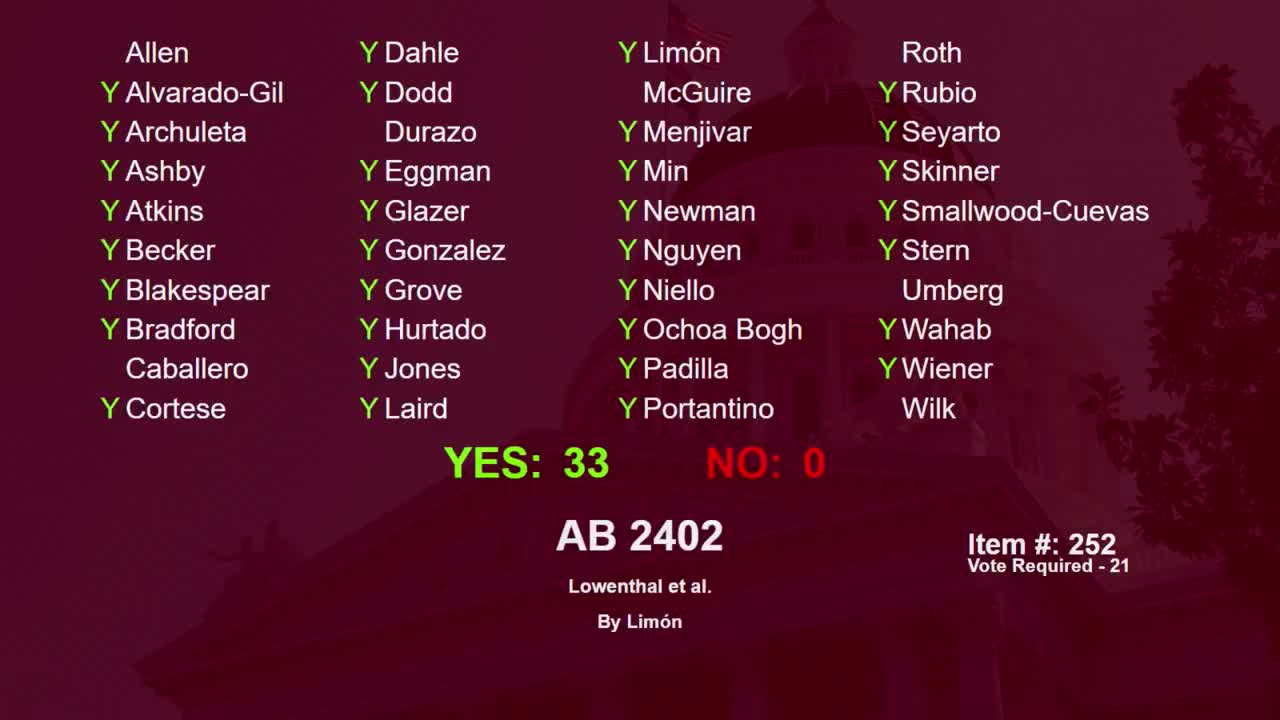 2MIN
Senate Floor
 8MIN
Senate Standing Committee on Human Services
 7MIN
Assembly Standing Committee on Human Services
Bill Author

Bill Co-Author(s):