AB 2513: Gas stoves and ranges: warning label.
- Session Year: 2023-2024
- House: Assembly
- Latest Version Date: 2024-09-05
Current Status:
Failed
(2024-09-27: Vetoed by Governor.)
Introduced
In Committee
First Chamber
In Committee
Second Chamber
Enacted
Existing law sets forth various health and safety requirements and prohibitions, including product safety label requirements.
This bill would prohibit a person from selling, attempting to sell, or offering to sell to a consumer in this state a gas stove, as defined, that is manufactured or sold online on or after January 1, 2025, or sold in a store on or after January 1, 2026, unless the gas stove bears an adhesive label and, for online sales, unless the internet website prominently posts a warning, that sets forth a specified statement relating to air pollutants that can be released by gas stoves, as specified.
Existing law sets forth various health and safety requirements and prohibitions, including product safety label requirements.
This bill would prohibit a person from selling, attempting to sell, or offering to sell to a consumer in this state a gas stove, as defined, that is manufactured or sold online on or after January 1, 2025, or sold in a store on or after January 1, 2026, unless the gas stove bears a an adhesive label attached in a conspicuous location and, for online sales, unless the internet website prominently posts a warning, that sets forth a specified statement relating to air pollutants that can be released by gas stoves, among other requirements. as specified.
Existing law sets forth various health and safety requirements and prohibitions, including product safety label requirements.
This bill would prohibit a person from selling, attempting to sell, or offering to sell to a consumer in this state a gas stove, as defined, that is manufactured or sold online on or after January 1, 2025, or sold in a store on or after January 1, 2026, unless the gas stove bears a label attached in a conspicuous location and, for online sales, unless the internet website prominently posts a warning, that sets forth a specified statement relating to air pollutants that can be released by gas stoves, among other requirements.
Existing law sets forth various health and safety requirements and prohibitions, including product safety label requirements.
This bill would prohibit a person from selling, attempting to sell, or offering to sell to a consumer in this state a gas stove, as defined, that is manufactured or sold online on or after January 1, 2025, or sold in a store on or after January 1, 2026, unless the gas stove bears a label label attached in a conspicuous location and, for online sales, unless the internet website prominently posts a warning, that sets forth a specified statement relating to air pollutants that can be released by gas stoves and that is attached to the gas stove in a conspicuous location, stoves, among other requirements.
Existing law sets forth various health and safety requirements and prohibitions, including product safety label requirements.
This bill would prohibit a person from selling, attempting to sell, or offering to sell to a consumer in this state a gas stove, as defined, that is manufactured on or after January 1, 2025, unless the gas stove bears a label that sets forth a specified statement relating to air pollutants that can be released by gas stoves and that is attached to the gas stove in a conspicuous location, among other requirements.
For purposes of this chapter, gas stove means a household natural gas stove or range that is used for indoor food preparation and provides at least one of the following functions:
(a)Surface cooking.
(b)Oven cooking.
(c)Broiling.
108531.(a)A person shall not sell, attempt to sell, or offer to sell to a consumer in this state a gas stove that is manufactured or sold online on or after January 1, 2025, or sold in a store on or after January 1, 2026, unless an adhesive label on the gas stove bears the following statement:
WARNING: Gas stoves can release nitrogen dioxide, benzene, carbon monoxide, formaldehyde, and other harmful pollutants into the air, which can be toxic to people and pets. Stove emissions, especially from gas stoves, are associated with increased respiratory disease. Young children, people with asthma, and people with heart or lung disease are especially vulnerable to the toxic effects of combustion pollutants. To help reduce the risk of breathing harmful gases, allow ventilation in the area and turn on a vent hood when gas-powered stoves and ranges are in use.
(b)A manufacturer or importer shall affix the adhesive label described in subdivision (a) to the gas stove in a position that is easily read by a consumer examining the product. The label shall be in a type size and font no smaller than the largest type size and font used for other consumer information on the product.
(c)Before transacting an online sale of a gas stove to an address in this state, the internet website where the online sale occurs shall prominently post for the prospective purchaser the content of the warning label described in subdivision (a).
For purposes of this chapter, the following terms apply:
(a)Gas chapter, gas stove means a household natural gas stove or range that is used for indoor food preparation and provides at least one of the following functions:
(1)(a)Surface cooking.
(2)(b)Oven cooking.
(3)(c)Broiling.
(b)QR code means a machine-readable code consisting of an array of squares used for storing an internet website address.108531.(a)(1)A person shall not sell, attempt to sell, or offer to sell to a consumer in this state a gas stove that is manufactured or sold online on or after January 1, 2025, or sold in a store on or after January 1, 2026, unless a an adhesive label on the gas stove bears the following statement:
WARNING: Gas stoves can release nitrogen dioxide, benzene, carbon monoxide, formaldehyde, and other harmful pollutants into the air, which can be toxic to people and pets. Stove emissions, especially from gas stoves, are associated with increased respiratory disease. Young children, people with asthma, and people with heart or lung disease are especially vulnerable to the toxic effects of combustion pollutants. To help reduce the risk of breathing harmful gases, allow ventilation in the area and turn on a vent hood when gas-powered stoves and ranges are in use.
(2)The label described in paragraph (1) shall include a QR code link to the internet website address: https://ww2.arb.ca.gov/resources/documents/indoor-air-pollution-cooking/.(b)The label described in subdivision (a) shall be attached to the gas stove in a conspicuous location. The
(b)A manufacturer or importer shall affix the adhesive label described in subdivision (a) to the gas stove in a position that is easily read by a consumer examining the product. The label shall be in a type size and font no smaller than the largest type size and font used for other consumer information on the product.
(c)Before transacting an online sale of a gas stove to an address in this state, the internet website where the online sale occurs shall prominently post for the prospective purchaser the content of the warning label described in subdivision (a).
For purposes of this chapter, the following terms apply:
(a)Gas stove means a household natural gas stove or range that is used for food preparation and provides at least one of the following functions:
(1)Surface cooking.
(2)Oven cooking.
(3)Broiling.
(b)QR code means a machine-readable code consisting of an array of squares used for storing an internet website address.
108531.(a)(1)A person shall not sell, attempt to sell, or offer to sell to a consumer in this state a gas stove that is manufactured or sold online on or after January 1, 2025, or sold in a store on or after January 1, 2026, unless a label on the gas stove bears the following statement:
WARNING: A gas stove or oven range in use can release nitrogen dioxide, carbon monoxide, and benzene inside homes at rates that lead to concentrations exceeding the standards of the Office of Environmental Health Hazard Assessment and the United States Environmental Protection Agency for outdoor air quality. Breathing these pollutants can exacerbate preexisting respiratory illnesses and increase the risk of developing leukemia and asthma, especially in children. To help reduce the risk of breathing harmful gases, allow ventilation in the area and turn on a vent hood when gas-powered stoves and ranges are in use.
WARNING: Gas stoves can release nitrogen dioxide, benzene, carbon monoxide, formaldehyde, and other harmful pollutants into the air, which can be toxic to people and pets. Stove emissions, especially from gas stoves, are associated with increased respiratory disease. Young children, people with asthma, and people with heart or lung disease are especially vulnerable to the toxic effects of combustion pollutants. To help reduce the risk of breathing harmful gases, allow ventilation in the area and turn on a vent hood when gas-powered stoves and ranges are in use.
(2)The label described in paragraph (1) shall include a QR code link to the internet website address: https://ww2.arb.ca.gov/resources/documents/indoor-air-pollution-cooking. https://ww2.arb.ca.gov/resources/documents/indoor-air-pollution-cooking/.
(b)The label described in subdivision (a) shall be attached to the gas stove in a conspicuous location. The label shall be in a type size and font no smaller than the largest type size and font used for other consumer information on the product.
(c)Before transacting an online sale of a gas stove to an address in this state, the internet website where the online sale occurs shall prominently post for the prospective purchaser the content of the warning label described in subdivision (a).
For purposes of this chapter, a gas the following terms apply:
(a)Gas stove means a household natural gas stove or range that is used for food preparation and provides at least one of the following functions:
(a)(1)Surface cooking.
(b)(2)Oven cooking.
(c)(3)Broiling.
(b)QR code means a machine-readable code consisting of an array of squares used for storing an internet website address.
108531.(a)(1)A person shall not sell, attempt to sell, or offer to sell to a consumer in this state a gas stove that is manufactured or sold online on or after January 1, 2025, or sold in a store on or after January 1, 2026, unless a label on the gas stove bears the following statement:
WARNING: A gas stove or oven range in use can release nitrogen dioxide, carbon monoxide, and benzene inside homes at rates that lead to concentrations exceeding the standards of the Office of Environmental Health Hazard Assessment and the United States Environmental Protection Agency for outdoor air quality. Breathing these pollutants can exacerbate preexisting respiratory illnesses and increase the risk of developing leukemia and asthma, especially in children. To help reduce the risk of breathing harmful gases, allow ventilation in the area and turn on a vent hood when gas-powered stoves and ranges are in use.
(2)The label described in paragraph (1) shall include a QR code link to the internet website address: https://ww2.arb.ca.gov/resources/documents/indoor-air-pollution-cooking.
(b)The label described in subdivision (a) shall be attached to the gas stove in a conspicuous location. The label shall be in a type size and font no smaller than the largest type size and font used for other consumer information on the product.
(c)Before transacting an online sale of a gas stove to an address in this state, the internet website where the online sale occurs shall prominently post for the prospective purchaser the content of the warning label described in subdivision (a).
For purposes of this chapter, a gas stove means a household natural gas stove or range that is used for food preparation and provides at least one of the following functions:
(a)Surface cooking.
(b)Oven cooking.
(c)Broiling.
108531.(a)A person shall not sell, attempt to sell, or offer to sell to a consumer in this state a gas stove that is manufactured on or after January 1, 2025, unless a label on the gas stove bears the following statement:
WARNING: A gas stove or oven range in use can release nitrogen dioxide and dioxide, carbon monoxide monoxide, and benzene inside homes at levels rates that lead to concentrations exceeding the standards of the Office of Environmental Health Hazard Assessment and the United States Environmental Protection Agencys standards Agency for outdoor air quality. The presence of Breathing these pollutants may can exacerbate preexisting respiratory illnesses or lead to the development of and increase the risk of developing leukemia and asthma, especially in children. To lower help reduce the risk of breathing in these harmful gases, allow ventilation in the area and turn on a vent hood when gas-powered stoves and ranges are in use.
(b)The label described in subdivision (a) shall be attached to the gas stove in a conspicuous location. The label shall be in a type size and font no smaller than the largest type size and font used for other consumer information on the product.
For purposes of this chapter, a gas stove means a household natural gas stove or range that is used for food preparation and provides at least one of the following functions:
(a)Surface cooking.
(b)Oven cooking.
(c)Broiling.
108531.(a)A person shall not sell, attempt to sell, or offer to sell to a consumer in this state a gas stove that is manufactured on or after January 1, 2025, unless a label on the gas stove bears the following statement:
WARNING: A gas stove or oven range in use can release nitrogen dioxide and carbon monoxide inside homes at levels exceeding the United States Environmental Protection Agencys standards for outdoor air quality. The presence of these pollutants may exacerbate preexisting respiratory illnesses or lead to the development of asthma, especially in children. To lower the risk of breathing in these harmful gases, allow ventilation in the area and turn on a vent hood when gas-powered stoves and ranges are in use.
(b)The label described in subdivision (a) shall be attached to the gas stove in a conspicuous location. The label shall be in a type size and font no smaller than the largest type size and font used for other consumer information on the product.
|
Date
|
Status
|
|---|---|
| Sep 27, 2024 | Vetoed by Governor. |
| Sep 13, 2024 | Enrolled and presented to the Governor at 4 p.m. |
| Aug 31, 2024 | Senate amendments concurred in. To Engrossing and Enrolling. (Ayes 52. Noes 15.). |
| Aug 31, 2024 | In Assembly. Concurrence in Senate amendments pending. |
| Aug 30, 2024 | Read third time. Passed. Ordered to the Assembly. (Ayes 21. Noes 11.). |
| Aug 20, 2024 | Reconsideration granted. (Ayes 40. Noes 0. Page 5247.) |
| Aug 20, 2024 | Read third time. Refused passage. (Ayes 17. Noes 12.). |
| Aug 20, 2024 | Motion to reconsider made by Senator Stern. |
| Aug 6, 2024 | Read second time. Ordered to third reading. |
| Aug 5, 2024 | Read third time and amended. Ordered to second reading. |
| Jun 10, 2024 | Read second time and amended. Ordered to third reading. |
| Jun 6, 2024 | From committee: Amend, and do pass as amended. (Ayes 5. Noes 2.) (June 5). |
| May 22, 2024 | Referred to Com. on E.Q. |
| May 13, 2024 | In Senate. Read first time. To Com. on RLS. for assignment. |
| May 13, 2024 | Read third time. Passed. Ordered to the Senate. (Ayes 57. Noes 14. Page 5184.) |
| Apr 25, 2024 | Read second time. Ordered to third reading. |
| Apr 24, 2024 | From committee: Do pass. (Ayes 5. Noes 2.) (April 23). |
| Apr 18, 2024 | Re-referred to Com. on E.S. & T.M. |
| Apr 17, 2024 | From committee chair, with author's amendments: Amend, and re-refer to Com. on E.S. & T.M. Read second time and amended. |
| Apr 4, 2024 | Re-referred to Com. on E.S. & T.M. |
| Apr 3, 2024 | From committee chair, with author's amendments: Amend, and re-refer to Com. on E.S. & T.M. Read second time and amended. |
| Mar 21, 2024 | Referred to Com. on E.S. & T.M. |
| Feb 14, 2024 | From printer. May be heard in committee March 15. |
| Feb 13, 2024 | Read first time. To print. |
|
Date
|
Description
|
Location
|
Votes
|
|
|---|---|---|---|---|
| Aug 31, 2024 | AB 2513 Pellerin Concurrence in Senate Amendments | Assembly Floor |
Passed |
|
| Aug 30, 2024 | Assembly 3rd Reading AB2513 Pellerin et al. By Stern | Senate Floor |
Passed |
|
| Aug 20, 2024 | Assembly 3rd Reading AB2513 Pellerin et al. By Stern Reconsider | Senate Floor |
Passed |
|
| Aug 20, 2024 | Assembly 3rd Reading AB2513 Pellerin et al. By Stern | Senate Floor |
Failed |
|
| Jun 5, 2024 | Do pass as amended | Senate Standing Committee on Environmental Quality |
Passed |
|
| May 13, 2024 | AB 2513 Pellerin Assembly Third Reading | Assembly Floor |
Passed |
|
| Apr 23, 2024 | Do pass. | Assembly Standing Committee on Environmental Safety and Toxic Materials |
Passed |
This list shows positions taken on this bill by organizations on the date displayed, which is linked to the original source.
Positions by individuals are not included.
|
Organization
|
Position
|
Date
|
|---|---|---|
| A Cecilia Mogal, Medical Doctor | ** Support | |
| Active San Gabriel Valley | ** Support | |
| Adriana Gardner, Pharmacist | ** Support | |
| Alameda Stop Waste | * Support | Apr 23, 2024 |
| Alexander Chang, Pre-health Student | ** Support | |
| Amanda Millstein, Medical Doctor | ** Support | |
| American Academy Of Pediatrics, California | ** Support | |
| American Lung Association in California | ** Support | |
| Angelina Crans Yoo, Medical Doctor | ** Support | |
| Ashley Mcclure, Medical Doctor | ** Support | |
| Association Of Home Appliance Manufacturers | ** Against | |
| Breast Cancer Prevention Partners | ** Support | |
| Breathe California | ** Support | |
| Brenda Nuyen, Medical Doctor | ** Support | |
| Bret Andrews, Doctor of Osteopathy | ** Support | |
| Brianna Egan, Medical Student and Nutritionist | ** Support | |
| Bruce Bekkar, Medical Doctor | ** Support | |
| Building Decarbonization Coalition | ** Support | |
| C Freeman, Medical Doctor | ** Support | |
| California Building Industry Association | ** Against | |
| California Chamber Of Commerce | ** Against | |
| California Environmental Voters | ** Support | |
| California Manufacturers And Technology Association | ** Against | |
| California Nurses for Environmental Health and Justice | * Support | Apr 23, 2024 |
| California Public Interest Research Group | ** Support | |
| Carmen Morales Board, Nurse Practitioner | ** Support | |
| Center for Climate Change & Health | ** Support | |
| Chelsea Young, Medical Doctor | ** Support | |
| Cindy Russell, Medical Doctor | ** Support | |
| Clean Water Action | ** Support | |
| cleanearth4kids.org | ** Support | |
| Climate Health Now | ** Support | |
| Climate Reality Project Silicon Valley Chapter | ** Support | |
| Climate Reality Project – Silicon Valley Chapter | ** Support | |
| Coalition For Clean Air | ** Support | |
| Condessa Curley, Medical Doctor | ** Support | |
| Cynthia Mahoney, Medical Doctor | ** Support | |
| Daniel Nguyen, Medical Doctor | ** Support | |
| David Bezanson, Phd | ** Support | |
| Day One | ** Support | |
| Deirdre Bernard-Pearl, Medical Doctor | ** Support | |
| Diane Chau, Medical Doctor | ** Support | |
| Dougal Mackinnon, Medical Doctor | ** Support | |
| Ellen Leng, Medical Doctor | ** Support | |
| Environmental Health Coalition | ** Support | |
| Environmental Working Group | ** Support | |
| Eve Yalom, Medical Doctor | ** Support | |
| Evelie Posch, Religious Leader/healer | ** Support | |
| Facts: Families Advocating for Chemical & Toxics Safety | ** Support | |
| Forward Dining Solutions LLC | ** Support | |
| Global Carbon Project | * Support | Apr 23, 2024 |
| Hina Fullar, Medical Doctor | ** Support | |
| Ilana Murphy, Acupuncturist | ** Support | |
| Jeffrey Mann, Medical Doctor | ** Support | |
| Jennifer Graber, Medical Doctor | ** Support | |
| Jonathan Lu, Medical Doctor | ** Support | |
| Joseph Eichenseher, Medical Doctor | ** Support | |
| Julio Lopez, Medical Student | ** Support | |
| Junior Philanthropist Foundation | ** Support | |
| Katrina Saba, Medical Doctor | ** Support | |
| Knox Kelly, Medical Doctor | ** Support | |
| Lara Wright, Medical Doctor | ** Support | |
| Latino Coalition for a Healthy California | ** Support | |
| Lawrence Nathan, Medical Doctor | ** Support | |
| Leslie Klein, Medical Doctor | ** Support | |
| Marc Futernick, Medical Doctor | ** Support | |
| Margie Chen, Medical Doctor | ** Support | |
| Marty Lynch, Healthcare Administrator | ** Support | |
| Melanie Schimpf, Public Health | ** Support | |
| Michael Harris, Medical Doctor | ** Support | |
| Morgan Theis, Medical Doctor | ** Support | |
| Nan Yarbrough, Mental Health Professional | ** Support | |
| Nneoma Ojiaku, Medical Doctor | ** Support | |
| North County Climate Action Change Alliance | * Support | Apr 23, 2024 |
| Peninsula Clean Energy | ** Support | |
| Physicians for Social Responsibility | * Support | Apr 23, 2024 |
| Physicians for Social Responsibility-San Francisco Bay Area Chapter | ** Support | |
| Protect Playa Now! | ** Support | |
| Rachel Abbott, Medical Doctor | ** Support | |
| Regional Asthma Management and Prevention | ** Support | |
| Rosalind Harder, Social Worker | ** Support | |
| Rupa Basu, Public Health | ** Support | |
| Samir Thadani, Medical Doctor | ** Support | |
| San Jose Clean Energy | ** Support | |
| SanDiego350 | ** Support | |
| Sandra Rubin, Medical Doctor | ** Support | |
| Sheila Tarbet, Public Health | ** Support | |
| Shuinn Chang, Nurse Practitioner | ** Support | |
| Sierra Club | ** Support | |
| SoCal 350 Climate Action | ** Support | |
| Southern California Gas Company | ** Against | |
| Stanford University | * Support | Apr 23, 2024 |
| Stop Waste | * Support | Jun 5, 2024 |
| Susan Steinbrecher, Licensed Vocational Nurse | ** Support | |
| Sustainable Claremont | ** Support | |
| Tara Dade, Physician Assistant | ** Support | |
| Terri Olson, Public Health | ** Support | |
| Thea Spitzer, Healthcare Administrator | ** Support | |
| UC Davis | * Support | Jun 5, 2024 |
| Vanessa Forsythe, Registered Nurse | ** Support | |
| Venise Curry, Medical Doctor | ** Support | |
| Vista Shakiba, Medical Doctor | ** Support | |
| Vote Solar | ** Support | |
| Western Propane Gas Association | ** Against | |
| William Pevec, Medical Doctor | ** Support | |
| Zerocarbonma | ** Support | |
| Zoe Novic, Public Health | ** Support |
GOVERNOR'S VETO
GV Bill Id:AB 2513
Author:(Pellerin)
As Enrolled Ver:September 5, 2024
2/3 vote
SUMMARY
Prohibits a person from selling or offering for sale a gas stove that is manufactured or sold online on or after January 1, 2025, or sold in a store on or after January 1, 2026, unless that gas stove contains a specified warning label.
Senate Amendments:
1) Delete the requirement that the warning label be provided within a QR code.
2) Require a manufacturer or importer to affix the adhesive warning label to the gas stove in a position that is easily read by a consumer examining the product.
Governor's Veto Message
"This bill would prohibit a person from selling or offering for sale a gas stove that is manufactured or sold online on or after January 1, 2025, or sold in a store on or after January 1, 2026, unless that gas stove contains a specified warning label.
While I appreciate the author's intent to provide consumers with information about the products they purchase, I am concerned that this bill codifies highly prescriptive labeling content that could only be changed by a future statutory amendment. This static approach falls short in enabling timely updates to the labeling content that should align with the latest scientific knowledge so that consumers are accurately informed about their purchases."
COMMENTS
Proposition 65: Proposition 65, officially known as the Safe Drinking Water and Toxic Enforcement Act of 1986, was enacted as a ballot initiative in November 1986. Proposition 65 requires the state to maintain and update a list of chemicals known to the state to cause cancer or reproductive toxicity; protects the state's drinking water sources from being contaminated with chemicals known to cause cancer, birth defects, or other reproductive harm; and requires businesses to inform Californians about exposure to such chemicals. The Office of Environmental Health Hazard Assessment (OEHHA) is the lead agency for implementation of Proposition 65 and has the authority to adopt and modify regulations as necessary. According to OEHHA, the Proposition 65 list contains a wide range of naturally occurring and synthetic chemicals including additives or ingredients in pesticides, common household products, food, drugs, dyes, or solvents.
Proposition 65 from household appliances: According to OEHHA's website, sources of exposure to Proposition 65-listed chemicals from household appliances can include:
- Appliances that use natural gas, such as some ranges, dryers, and hot water heaters, may emit benzene, carbon monoxide, or formaldehyde when in use. Benzene is present in natural gas, and carbon monoxide and formaldehyde are created when natural gas is burned. Consumers may be exposed to significant amounts of these chemicals, especially if the appliances are not properly vented;
- Some flame retardants and phthalates may be present in plastic components of appliances; and,
- Proposition 65 chemicals may also be present in enclosed components of the appliance (such as printed circuit boards). During normal use, consumer exposure to these chemicals is expected to be negligible.
Routes of exposure to Proposition 65-listed chemicals from household appliances are:
- Breathing in air or dust that contain chemicals;
- Transferring chemicals from the hands to the mouth, and swallowing;
- Touching surfaces or dust that contain chemicals and absorbing them through the skin; and,
- During pregnancy, some of these chemicals can pass from mother to baby.
Indoor air contamination from cooking: According to the California Air Resources Board,
"People use a variety of heat sources to cook food, including gas, wood, and electricity. Each of these heat sources can create indoor air pollution during cooking. Natural gas stoves can release carbon monoxide, formaldehyde and other harmful pollutants into the air, which can be toxic to people and pets. Using a wood stove or fireplace to cook can result in high levels of indoor air pollution from wood smoke.
Cooking can also generate unhealthy air pollutants from heating oil, fat, and other food ingredients, especially at high temperatures. Self-cleaning ovens, whether gas or electric, can create high levels of pollutants as food waste is burned away. Exposure to these can cause or worsen a wide range of health problems such as nose and throat irritation, headaches, fatigue and nausea. Young children, people with asthma and people with heart or lung disease are especially vulnerable to the harmful effects of indoor air pollution.
Studies show that air can be unhealthy to breathe when people cook in kitchens with poor ventilation. The best way to ventilate your kitchen is to use a properly-installed, high efficiency range hood over your stove. A high efficiency range hood has a high cubic feet per minute (cfm) rating and a low sones (noise) rating. If you have a gas stove, a qualified technician should inspect it every year for gas leaks and carbon monoxide.
Ways to improve ventilation in your kitchen:
- If you have a range hood: check to make sure it vents to the outdoors; use it while cooking or using your stove; and, cook on the back burners, if possible, because the range hood exhausts this area more effectively.
- If you don't have a range hood: use a wall or ceiling exhaust fan while cooking, open windows and/or exterior doors to improve air flow through the kitchen."
This bill: AB 2513 does not ban gas stoves. The bill provides consumers with information relating to pollutants associated with using a gas stove and how to mitigate potential harm from those pollutants. Currently there are no federal or state indoor air quality standards for stoves or ranges (either gas or electric). Until there are such standards, providing consumers with a warning and a way to mitigate that potential for harm is a good first step.
According to the Author
"The emissions from the use of gas stoves inside without the proper ventilation can lead to multiple health problems for Californians. The EPA states exposure to nitrogen dioxide can result in decreased lung function in those with chronic pulmonary diseases, development of acute/chronic bronchitis, and increased probability of developing asthma in children by 24%. In order to prevent excessive exposure to nitrogen dioxide, carbon monoxide, and other carcinogenic byproducts that cause harmful health effects, [this bill] will require consumer warning labels for all new gas stoves sold in California.
The labels will inform consumers of the hazards associated with gas stoves and oven appliances. This will allow for an increased vigilance in installing and proper use of gas stoves in order to prevent undue exposure. Similarly by making this information available to consumers at the point of sale, it will help the purchaser make more informed decisions."
Arguments in Support
According to the California Public Interest Research Group (CALPIRG),
"[This bill] would require all gas stoves manufactured on or after January 2025 and sold in California to have a warning label detailing the health risks associated with pollutants emitted from gas stoves.
More than four decades of research shows that gas stoves are producing dangerous air pollution indoors – increasing the risk of childhood asthma and other respiratory problems, but this risk has largely been hidden from the public. Consumers deserve the truth when it comes to the danger of cooking with gas stoves. The kitchen should be a place of bonding – not a place where our families are exposed to toxic pollution that can make us sick.
A growing body of evidence on the respiratory and other health risks associated with gas stove pollution has led the American Medical Association, the American Public Health Association, and Physicians for Social Responsibility to raise the alarm, and the Consumer Product Safety Commission has recently opened an investigation into the health risks and potential opportunities to mitigate harm.
A study from the nonprofit group RMI found that 20% of childhood asthma cases in California are attributable to gas stove use. Despite all these studies, lack of education and federal regulations leave consumers largely unaware of the risks associated with gas stove cooking."
Arguments in Opposition
According to the Association of Home Appliance Manufacturers and the California Building Industry Association,
"The undersigned organizations are writing to inform you of our opposition to AB 2513 (Pellerin), legislation that would require a warning label on gas cooking appliances. This legislation is unnecessary as existing standards provide consumers with robust protection from gas cooking emissions.
Gas cooking is an affordable and preferred technology used in 40% of U.S. homes. All cooking products, including gas ranges and cooktops, meet or exceed current safety standards and building code requirements. Effective ventilation is key to enhancing indoor air quality. Recent building code updates have focused on improving ventilation in newer homes, which are constructed to be more airtight than older homes.
Indisputably and by far the most important improvement in indoor air quality related to cooking of any type is improved ventilation, primarily, but not exclusively, to deal with particulate matter, especially PM2.5, emitted during both gas and electric cooking and originating in the foodstuffs cooked.
We support further public educational campaigns aimed at building owners, consumers, public housing authorities, and other entities to install and use improved ventilation in residences, including, but not limited to, the proper use and installation of ventilation devices such as exhaust hoods and fans."
FISCAL COMMENTS
This bill is keyed non-fiscal by the office of Legislative Counsel.
VOTES
ASM ENVIRONMENTAL SAFETY AND TOXIC MATERIALS: 5-2-0
YES: Garcia, Connolly, McKinnor, Papan, Reyes
NO: Hoover, Ta
ASSEMBLY FLOOR: 57-14-9
YES: Addis, Aguiar-Curry, Alvarez, Arambula, Bains, Bennett, Berman, Boerner, Bonta, Bryan, Calderon, Juan Carrillo, Wendy Carrillo, Cervantes, Connolly, Mike Fong, Friedman, Gabriel, Garcia, Gipson, Haney, Hart, Holden, Irwin, Jackson, Jones-Sawyer, Kalra, Lee, Low, Lowenthal, Maienschein, McCarty, McKinnor, Muratsuchi, Stephanie Nguyen, Ortega, Pacheco, Papan, Pellerin, Petrie-Norris, Ramos, Rendon, Reyes, Luz Rivas, Blanca Rubio, Santiago, Schiavo, Ting, Valencia, Villapudua, Ward, Weber, Wicks, Wilson, Wood, Zbur, Robert Rivas
NO: Chen, Davies, Dixon, Essayli, Flora, Vince Fong, Gallagher, Hoover, Lackey, Jim Patterson, Joe Patterson, Sanchez, Ta, Wallis
ABS, ABST OR NV: Alanis, Bauer-Kahan, Megan Dahle, Grayson, Mathis, Quirk-Silva, Rodriguez, Soria, Waldron
SENATE FLOOR: 21-11-8
YES: Allen, Archuleta, Atkins, Becker, Blakespear, Bradford, Cortese, Durazo, Glazer, Gonzalez, Hurtado, Laird, Limón, McGuire, Menjivar, Padilla, Skinner, Smallwood-Cuevas, Stern, Wahab, Wiener
NO: Alvarado-Gil, Dahle, Dodd, Eggman, Jones, Newman, Nguyen, Niello, Ochoa Bogh, Seyarto, Wilk
ABS, ABST OR NV: Ashby, Caballero, Grove, Min, Portantino, Roth, Rubio, Umberg
SENATE FLOOR: 17-12-11
YES: Allen, Archuleta, Becker, Blakespear, Cortese, Durazo, Gonzalez, Laird, Limón, McGuire, Menjivar, Padilla, Skinner, Smallwood-Cuevas, Stern, Wahab, Wiener
NO: Alvarado-Gil, Bradford, Dahle, Dodd, Eggman, Grove, Jones, Nguyen, Niello, Ochoa Bogh, Seyarto, Wilk
ABS, ABST OR NV: Ashby, Atkins, Caballero, Glazer, Hurtado, Min, Newman, Portantino, Roth, Rubio, Umberg
SENATE FLOOR: 39-0-1
YES: Allen, Alvarado-Gil, Archuleta, Ashby, Atkins, Becker, Blakespear, Bradford, Caballero, Cortese, Dahle, Dodd, Durazo, Eggman, Glazer, Gonzalez, Grove, Hurtado, Jones, Laird, Limón, Menjivar, Min, Newman, Nguyen, Niello, Ochoa Bogh, Padilla, Portantino, Roth, Rubio, Seyarto, Skinner, Smallwood-Cuevas, Stern, Umberg, Wahab, Wiener, Wilk
ABS, ABST OR NV: McGuire
ASSEMBLY FLOOR: 52-15-12
YES: Addis, Aguiar-Curry, Alvarez, Arambula, Bains, Bauer-Kahan, Bennett, Berman, Boerner, Bonta, Bryan, Juan Carrillo, Wendy Carrillo, Cervantes, Connolly, Mike Fong, Friedman, Gabriel, Garcia, Gipson, Haney, Hart, Holden, Irwin, Jackson, Jones-Sawyer, Kalra, Lee, Low, Lowenthal, Maienschein, McCarty, McKinnor, Muratsuchi, Pacheco, Papan, Pellerin, Petrie-Norris, Rendon, Reyes, Luz Rivas, Blanca Rubio, Santiago, Schiavo, Ting, Valencia, Waldron, Ward, Weber, Wicks, Zbur, Robert Rivas
NO: Alanis, Chen, Megan Dahle, Davies, Dixon, Essayli, Gallagher, Hoover, Lackey, Mathis, Jim Patterson, Joe Patterson, Sanchez, Ta, Wallis
ABS, ABST OR NV: Calderon, Flora, Grayson, Stephanie Nguyen, Ortega, Quirk-Silva, Ramos, Rodriguez, Soria, Villapudua, Wilson, Wood
UPDATED
VERSION: September 5, 2024
CONSULTANT: Josh Tooker / E.S. & T.M. / (916) 319-3965 FN: 0005177
CONCURRENCE IN SENATE AMENDMENTS
CSA1 Bill Id:AB 2513
Author:(Pellerin)
As Amended Ver:August 5, 2024
Majority vote
SUMMARY
Prohibits a person from selling or offering for sale a gas stove that is manufactured or sold online on or after January 1, 2025, or sold in a store on or after January 1, 2026, unless that gas stove contains a specified warning label.
Senate Amendments
1) Delete the requirement that the warning label be provided within a QR code.
2) Require a manufacturer or importer to affix the adhesive warning label to the gas stove in a position that is easily read by a consumer examining the product.
COMMENTS
Proposition 65: Proposition 65, officially known as the Safe Drinking Water and Toxic Enforcement Act of 1986, was enacted as a ballot initiative in November 1986. Proposition 65 requires the state to maintain and update a list of chemicals known to the state to cause cancer or reproductive toxicity; protects the state's drinking water sources from being contaminated with chemicals known to cause cancer, birth defects, and other reproductive harm; and requires businesses to inform Californians about exposure to such chemicals. The Office of Environmental Health Hazard Assessment (OEHHA) is the lead agency for implementation of Proposition 65 and has the authority to adopt and modify regulations as necessary. According to OEHHA, the Proposition 65 list contains a wide range of naturally occurring and synthetic chemicals including additives or ingredients in pesticides, common household products, food, drugs, dyes, or solvents.
Proposition 65 from household appliances: According to OEHHA's website, sources of exposure to Proposition 65-listed chemicals in household appliances can include:
- Appliances that use natural gas, such as some ranges, dryers, and hot water heaters, may emit benzene, carbon monoxide, or formaldehyde when in use. Benzene is present in natural gas, and carbon monoxide and formaldehyde are created when natural gas is burned. Consumers may be exposed to significant amounts of these chemicals, especially if the appliances are not properly vented;
- Some flame retardants and phthalates may be present in plastic components of appliances; and,
- Proposition 65 chemicals may also be present in enclosed components of the appliance (such as printed circuit boards). During normal use, consumer exposure to these chemicals is expected to be negligible.
Routes of exposure to Proposition 65-listed chemicals from household appliances are:
- Breathing in air or dust that contain chemicals;
- Transferring chemicals from the hands to the mouth, and swallowing;
- Touching surfaces or dust that contain chemicals and absorbing them through the skin; and,
- During pregnancy, some of these chemicals can pass from mother to baby.
Indoor air contamination from cooking: According to the California Air Resources Board,
"People use a variety of heat sources to cook food, including gas, wood, and electricity. Each of these heat sources can create indoor air pollution during cooking. Natural gas stoves can release carbon monoxide, formaldehyde and other harmful pollutants into the air, which can be toxic to people and pets. Using a wood stove or fireplace to cook can result in high levels of indoor air pollution from wood smoke.
Cooking can also generate unhealthy air pollutants from heating oil, fat, and other food ingredients, especially at high temperatures. Self-cleaning ovens, whether gas or electric, can create high levels of pollutants as food waste is burned away. Exposure to these can cause or worsen a wide range of health problems such as nose and throat irritation, headaches, fatigue and nausea. Young children, people with asthma and people with heart or lung disease are especially vulnerable to the harmful effects of indoor air pollution.
Studies show that air can be unhealthy to breathe when people cook in kitchens with poor ventilation. The best way to ventilate your kitchen is to use a properly-installed, high efficiency range hood over your stove. A high efficiency range hood has a high cubic feet per minute (cfm) rating and a low sones (noise) rating. If you have a gas stove, a qualified technician should inspect it every year for gas leaks and carbon monoxide.
Ways to improve ventilation in your kitchen:
- If you have a range hood: check to make sure it vents to the outdoors; use it while cooking or using your stove; and, cook on the back burners, if possible, because the range hood exhausts this area more effectively.
- If you don't have a range hood: use a wall or ceiling exhaust fan while cooking, open windows and/or exterior doors to improve air flow through the kitchen."
This bill: AB 2513 does not ban gas stoves. The bill provides consumers with information relating to pollutants associated with using a gas stove and how to mitigate potential harm from those pollutants. Currently there are no federal or state indoor air quality standards for stoves or ranges (either gas or electric). Until there are such standards, providing consumers with a warning and a way to mitigate that potential for harm is a good first step.
According to the Author
"The emissions from the use of gas stoves inside without the proper ventilation can lead to multiple health problems for Californians. The EPA states exposure to nitrogen dioxide can result in decreased lung function in those with chronic pulmonary diseases, development of acute/chronic bronchitis, and increased probability of developing asthma in children by 24%. In order to prevent excessive exposure to nitrogen dioxide, carbon monoxide, and other carcinogenic byproducts that cause harmful health effects, [this bill] will require consumer warning labels for all new gas stoves sold in California.
The labels will inform consumers of the hazards associated with gas stoves and oven appliances. This will allow for an increased vigilance in installing and proper use of gas stoves in order to prevent undue exposure. Similarly by making this information available to consumers at the point of sale, it will help the purchaser make more informed decisions."
Arguments in Support
According to the California Public Interest Research Group (CALPIRG),
"[This bill] would require all gas stoves manufactured on or after January 2025 and sold in California to have a warning label detailing the health risks associated with pollutants emitted from gas stoves.
More than four decades of research shows that gas stoves are producing dangerous air pollution indoors – increasing the risk of childhood asthma and other respiratory problems, but this risk has largely been hidden from the public. Consumers deserve the truth when it comes to the danger of cooking with gas stoves. The kitchen should be a place of bonding – not a place where our families are exposed to toxic pollution that can make us sick.
A growing body of evidence on the respiratory and other health risks associated with gas stove pollution has led the American Medical Association, the American Public Health Association, and Physicians for Social Responsibility to raise the alarm, and the Consumer Product Safety Commission has recently opened an investigation into the health risks and potential opportunities to mitigate harm.
A study from the nonprofit group RMI found that 20% of childhood asthma cases in California are attributable to gas stove use. Despite all these studies, lack of education and federal regulations leave consumers largely unaware of the risks associated with gas stove cooking."
Arguments in Opposition
According to the Association of Home Appliance Manufacturers and the California Building Industry Association,
"The undersigned organizations are writing to inform you of our opposition to AB 2513 (Pellerin), legislation that would require a warning label on gas cooking appliances. This legislation is unnecessary as existing standards provide consumers with robust protection from gas cooking emissions.
Gas cooking is an affordable and preferred technology used in 40% of U.S. homes. All cooking products, including gas ranges and cooktops, meet or exceed current safety standards and building code requirements. Effective ventilation is key to enhancing indoor air quality. Recent building code updates have focused on improving ventilation in newer homes, which are constructed to be more airtight than older homes.
Indisputably and by far the most important improvement in indoor air quality related to cooking of any type is improved ventilation, primarily, but not exclusively, to deal with particulate matter, especially PM2.5, emitted during both gas and electric cooking and originating in the foodstuffs cooked.
We support further public educational campaigns aimed at building owners, consumers, public housing authorities, and other entities to install and use improved ventilation in residences, including, but not limited to, the proper use and installation of ventilation devices such as exhaust hoods and fans."
FISCAL COMMENTS
This bill is keyed non-fiscal by Legislative Counsel.
VOTES:
ASM ENVIRONMENTAL SAFETY AND TOXIC MATERIALS: 5-2-0
YES: Garcia, Connolly, McKinnor, Papan, Reyes
NO: Hoover, Ta
ASSEMBLY FLOOR: 57-14-9
YES: Addis, Aguiar-Curry, Alvarez, Arambula, Bains, Bennett, Berman, Boerner, Bonta, Bryan, Calderon, Juan Carrillo, Wendy Carrillo, Cervantes, Connolly, Mike Fong, Friedman, Gabriel, Garcia, Gipson, Haney, Hart, Holden, Irwin, Jackson, Jones-Sawyer, Kalra, Lee, Low, Lowenthal, Maienschein, McCarty, McKinnor, Muratsuchi, Stephanie Nguyen, Ortega, Pacheco, Papan, Pellerin, Petrie-Norris, Ramos, Rendon, Reyes, Luz Rivas, Blanca Rubio, Santiago, Schiavo, Ting, Valencia, Villapudua, Ward, Weber, Wicks, Wilson, Wood, Zbur, Robert Rivas
NO: Chen, Davies, Dixon, Essayli, Flora, Vince Fong, Gallagher, Hoover, Lackey, Jim Patterson, Joe Patterson, Sanchez, Ta, Wallis
ABS, ABST OR NV: Alanis, Bauer-Kahan, Megan Dahle, Grayson, Mathis, Quirk-Silva, Rodriguez, Soria, Waldron
SENATE FLOOR: 21-11-8
YES: Allen, Archuleta, Atkins, Becker, Blakespear, Bradford, Cortese, Durazo, Glazer, Gonzalez, Hurtado, Laird, Limón, McGuire, Menjivar, Padilla, Skinner, Smallwood-Cuevas, Stern, Wahab, Wiener
NO: Alvarado-Gil, Dahle, Dodd, Eggman, Jones, Newman, Nguyen, Niello, Ochoa Bogh, Seyarto, Wilk
ABS, ABST OR NV: Ashby, Caballero, Grove, Min, Portantino, Roth, Rubio, Umberg
SENATE FLOOR: 17-12-11
YES: Allen, Archuleta, Becker, Blakespear, Cortese, Durazo, Gonzalez, Laird, Limón, McGuire, Menjivar, Padilla, Skinner, Smallwood-Cuevas, Stern, Wahab, Wiener
NO: Alvarado-Gil, Bradford, Dahle, Dodd, Eggman, Grove, Jones, Nguyen, Niello, Ochoa Bogh, Seyarto, Wilk
ABS, ABST OR NV: Ashby, Atkins, Caballero, Glazer, Hurtado, Min, Newman, Portantino, Roth, Rubio, Umberg
SENATE FLOOR: 39-0-1
YES: Allen, Alvarado-Gil, Archuleta, Ashby, Atkins, Becker, Blakespear, Bradford, Caballero, Cortese, Dahle, Dodd, Durazo, Eggman, Glazer, Gonzalez, Grove, Hurtado, Jones, Laird, Limón, Menjivar, Min, Newman, Nguyen, Niello, Ochoa Bogh, Padilla, Portantino, Roth, Rubio, Seyarto, Skinner, Smallwood-Cuevas, Stern, Umberg, Wahab, Wiener, Wilk
ABS, ABST OR NV: McGuire
UPDATED
VERSION: August 5, 2024
CONSULTANT: Josh Tooker / E.S. & T.M. / (916) 319-3965 FN: 0003864
SENATE RULES COMMITTEE Office of Senate Floor Analyses (916) 651-1520 Fax: (916) 327-4478 | AB 2513 |
THIRD READING
Bill No: AB 2513
Author: Pellerin (D), et al.
Amended: 8/5/24 in Senate
Vote: 21
SENATE ENVIRONMENTAL QUALITY COMMITTEE: 5-2, 6/5/24
AYES: Gonzalez, Hurtado, Laird, Menjivar, Skinner
NOES: Dahle, Nguyen
ASSEMBLY FLOOR: 57-14, 5/13/24 - See last page for vote
SUBJECT: Gas stoves and ranges: warning label
SOURCE: California Public Interest Research Group
DIGEST:
This bill prohibits a person from selling or offering for sale a gas stove that is manufactured or sold online on or after January 1, 2025, or sold in a store on or after January 1, 2026, unless that gas stove contains a specified warning label.
Senate Floor Amendments of 8/5/24 delete the requirement that the label contain a QR code link and clarify that the manufacturer or importer affix an adhesive label to the gas stove in a position that is easily read by a consumer examining the product.
ANALYSIS:
Existing law:
Under the California Safe Drinking Water and Toxic Enforcement Act of 1986 (Proposition 65)
- Prohibits, a person, in the course of doing business, from knowingly and intentionally exposing any individual to a chemical known to the state to cause cancer or reproductive toxicity without first giving clear and reasonable warning to such individual. (Health & Safety (HSC) § 25249.6)
- Requires the Governor, on or before March 1, 1987, to publish a list of chemicals known to the state to cause cancer or reproductive toxicity and to revise and republish it in light of additional knowledge, at least once per year thereafter. (HSC § 25249.8)
- Requires manufacturers of upholstered furniture to indicate, on a label currently required by law, whether or not the product contains added flame retardant chemicals. (Business Professions Code (BPC) § 19094)
This bill:
- Defines "gas stove" as a household natural gas stove or range that is used for indoor food preparation and provides at least one of the following functions:
- Surface cooking;
- Oven cooking; or,
- Broiling.
- Prohibits a person from selling, attempting to sell, or offering to sell to a consumer in this state a gas stove that is manufactured or sold online on or after January 1, 2025, or sold in a store on or after January 1, 2026, unless an adhesive label on the gas stove bears the following statement:
“WARNING: Gas stoves can release nitrogen dioxide, benzene, carbon monoxide, formaldehyde, and other harmful pollutants into the air, which can be toxic to people and pets. Stove emissions, especially from gas stoves, are associated with increased respiratory disease. Young children, people with asthma, and people with heart or lung disease are especially vulnerable to the toxic effects of combustion pollutants. To help reduce the risk of breathing harmful gases, allow ventilation in the area and turn on a vent hood when gas-powered stoves and ranges are in use.”
- Requires a manufacturer or importer to affix the adhesive warning label described above to the gas stove in a location that is easily read by a consumer examining the product and be in a type size and font no smaller than the largest type size and font used for other consumer information on the product.
- Requires an internet website, before transacting an online sale of a gas stove to an address in California, to prominently post for the prospective purchaser the content of the warning label required by this bill.
Background
- Proposition 65. Proposition 65, officially known as the Safe and Drinking Water and Toxic Enforcement Act of 1986, was enacted as a ballot initiative in November 1986. Proposition 65 requires the state to maintain and update a list of chemicals known to the state to cause cancer or reproductive toxicity; protects the state's drinking water sources from being contaminated with chemicals known to cause cancer, birth defects, and other reproductive harm, and, requires businesses to inform Californians about exposure to such chemicals. The Office of Health Hazard Assessment (OEHHA) is the lead agency for implementation of Proposition 65 and has the authority to adopt and modify regulations as necessary. According to OEHHA, the Proposition 65 list contains a wide range of naturally occurring and synthetic chemicals including additives or ingredients in pesticides, common household products, food, drugs, dyes, or solvents.
- Exposure to Proposition 65-listed chemicals from household appliances. According to OEHHA's website, exposure to Proposition 65-listed chemicals from household appliances can occur in the following ways:
- Appliances that use natural gas, such as some ranges, dryers, and hot water heaters, may emit benzene, carbon monoxide, or formaldehyde when in use. Benzene is present in natural gas, and carbon monoxide and formaldehyde are created when natural gas is burned. Consumers may be exposed to significant amounts of these chemicals, especially if the appliances are not properly vented.
- Some flame retardants and phthalates may be present in plastic components of appliances.
- Indoor air contamination from cooking. According to the California Air Resources Board (CARB),
"People use a variety of heat sources to cook food, including gas, wood, and electricity. Each of these heat sources can create indoor air pollution during cooking. Natural gas stoves can release carbon monoxide, formaldehyde and other harmful pollutants into the air, which can be toxic to people and pets…
“Studies show that air can be unhealthy to breathe when people cook in kitchens with poor ventilation. The best way to ventilate your kitchen is to use a properly-installed, high-efficiency range hood over your stove…If you have a gas stove, a qualified technician should inspect it every year for gas leaks and carbon monoxide.”
- Health concerns from gas stoves. According to the article, "Gas Stove Emissions Are a Public Health Concern: Exposure to Indoor Nitrogen Dioxide Increases Risk of Illness in Children, Older Adults, and People with Underlying Health Conditions" published November 8, 2022, by the American Public Health Association:
"Natural gas stoves generate a number of harmful air pollutants, with nitrogen dioxide (NO2) most consistently identified in the scientific literature. Multiple high-quality scientific studies have shown that NO2 concentrations are higher in homes that use gas stoves and that cooking with gas stoves without ventilation can result in home NO2 concentrations that are above the ambient air quality standards of the [US] Environmental Protection Agency (EPA). The [US] EPA has determined that NO2 is "causal" of more severe respiratory symptoms in people with asthma and that long-term exposure to NO2 is "likely causal" of respiratory illnesses such as asthma. Furthermore, epidemiological studies have shown that gas stoves are associated with an increased risk of asthma in children as well as more severe asthma symptoms. Despite this evidence, few safeguards are in place to protect the health of the public from gas stove emissions, particularly in overburdened and underserved communities. While comprehensive federal law regulates outdoor air quality in the United States, there are no federal indoor air quality guidelines, and few state or local policies address indoor air pollution. Those living in smaller, older, less ventilated homes are at higher risk of the effects of indoor air pollutants from a variety of sources, introducing a disproportionate risk of illness among lower-income populations and people of color. Along with other healthy home improvements, health experts should advocate for an equitable, multipronged approach to combat indoor air pollution from gas stoves, including policy change, program development, education about emission mitigation, and investment.
“An effective way to inform the public of the risk of gas stove emissions and effective remediation strategies is to require disclosures at the point of sale or when rental and lease agreements are signed...Another policy lever is to better regulate gas stoves and ventilation. The Institute for Policy Integrity at the New York University School of Law, citing health-harming emissions of gas stoves, recently called upon the Consumer Product Safety Commission (CPSC) to develop mandatory performance standards for gas stoves and range hoods, require warning labels for gas stoves, and educate the public about the harms of gas stove emissions."
Comments
- Purpose of the bill. According to the author, "The emissions from the use of gas stoves inside without the proper ventilation can lead to multiple health problems for Californians. The EPA states exposure to nitrogen dioxide can result in decreased lung function in those with chronic pulmonary diseases, development of acute/chronic bronchitis, and an increased probability of developing asthma in children by 24%. In order to prevent excessive exposure to nitrogen dioxide, carbon monoxide, and other carcinogenic byproducts that cause harmful health effects, AB 2513 will require consumer warning labels for all new gas stoves sold in California.
“The labels will inform consumers of the hazards associated with gas stoves and oven appliances. This will allow for increased vigilance in installing and proper use of gas stoves in order to prevent undue exposure. Similarly, by making this information available to consumers at the point of sale, it will help the purchaser make more informed decisions."
- Concern raised about the required warning label. Opponents of this measure contend that the bill’s warning label “would force companies to make false, misleading, and scientifically debated assertions.” They dispute the claim that using gas for cooking results in a higher risk for asthma in children or adults, citing a 2024 World Health Organization (WHO) study. They argue that, “all cooking—whether gas or electric—emits pollutants, and most indoor air quality issues associated with cooking can be effectively addressed through ventilation.” Thus, opponents state they would be supportive of an “accurate, science-based warning label on all cooking surface products” based on “trusted sources of science-based information at EPA, WHO, California Energy Commission, and California Air Resources Board.”
This bill’s sponsor counters that while the WHO study has less firm conclusions than other notable studies on the link between gas stoves and asthma, the study authors acknowledge there are higher health risks and make several assertive statements on the diminishing role of gas in high-income countries. The author provided several studies that demonstrate an increased risk of asthma and respiratory illness associated with gas stoves. According to a May 2024 journal article from ScienceAdvances, gas stove cooking has resulted in as many as 200,000 current cases of pediatric asthma compared with cooking with electric stoves, which do not produce nitrogen dioxide.
Proponents of this measure state that there are “more than 4 decades of research on the health impacts of gas stoves.” The sponsors also point to a 2023 report from the Climate Investigations Center that details the gas industry’s efforts to systematically obscure scientific health concerns dating back to the 1970s.
Additionally, the author cites a February 2024, U.S. PIRG Education Fund consumer survey that found major retailers were largely failing to warn potential customers of gas stove health concerns – and safety measures that could protect their health. In a survey conducted across 11 states, three-quarters of survey takers were told that gas stove pollution was not a concern, and eight in 10 were told that ventilation was unnecessary to protect health. Further, the author points to a national survey published in 2023 by Data for Progress that found that consumer preferences changed when informed of the health risks associated with gas stove emissions, especially among current gas stove users.
This bill provides consumers with information relating to pollutants associated with using a gas stove and how to mitigate potential harm from those pollutants. Currently, there are no federal or state indoor air quality standards for stoves or ranges (either gas or electric). Until there are such standards, providing consumers with a warning and a way to mitigate that potential for harm is a good first step.
Related/Prior Legislation
AB 1019 (Leno, Chapter 862, Statutes of 2014) required manufacturers of upholstered furniture to indicate, on a label currently required by law, whether or not the product contains added flame retardant chemicals.
FISCAL EFFECT: Appropriation: No Fiscal Com.: No Local: No
SUPPORT: (Verified 8/7/24)
California Public Interest Research Group (source)
Active San Gabriel Valley
American Academy of Pediatrics, California
American Lung Association in California
Breast Cancer Prevention Partners
Breathe California
Building Decarbonization Coalition
California Environmental Voters
Center for Climate Change & Health
Clean Water Action
Cleanearth4kids.org
Climate Health Now
Coalition for Clean Air
Day One
Environmental Health Coalition
Environmental Working Group
Facts: Families Advocating for Chemical & Toxics Safety
Forward Dining Solutions LLC
Individual - Medical Professionals Coalition Letter
Junior Philanthropists Foundation
Latino Coalition for A Healthy California
Peninsula Clean Energy
Physicians for Social Responsibility - San Francisco Bay Area Chapter
Protect Playa Now!
Regional Asthma Management and Prevention
San Jose Clean Energy
Sierra Club
So Cal 350 Climate Action
Sustainable Claremont
Vote Solar
Zerocarbonma
OPPOSITION: (Verified 8/7/24)
Association of Home Appliance Manufacturers
California Building Industry Association
California Chamber of Commerce
California Manufacturers and Technology Association
Southern California Gas Company
Western Propane Gas Association
ARGUMENTS IN SUPPORT: According to the California Public Interest Research Group, “More than four decades of research shows that gas stoves are producing dangerous air pollution indoors - increasing the risk of childhood asthma and other respiratory problems, but this risk has largely been hidden from the public. In 2022, U.S. PIRG Education Fund released the results of a consumer survey that found major retailers were largely failing to warn potential customers of gas stove health concerns – and safety measures that could protect their health. A national survey published in 2023 by Data for Progress found that consumer preferences changed when informed of the health risks associated with gas stove emissions, especially among current gas stove users. This data underscores exactly why the California Legislature should pass AB 2513 to require warning labels on gas stoves.”
ARGUMENTS IN OPPOSITION: According to the Association of Home Appliance Manufacturers (AHAM), “AHAM supports an accurate, science-based warning label on all cooking surface products. However, as currently drafted, AHAM is strongly opposed to AB 2513…. As currently proposed in AB 2513, the warning label would force companies to make false, misleading, and scientifically debated assertions, including that the products have serious deleterious health effects without a strong scientific consensus that they do. Please see the attached document that addresses the inaccurate aspects of the warning in detail. Compelled speech that is not purely factual and uncontroversial does not benefit California consumers, leads to confusion, and is unlikely to survive heightened judicial review.”
ASSEMBLY FLOOR: 57-14, 5/13/24
AYES: Addis, Aguiar-Curry, Alvarez, Arambula, Bains, Bennett, Berman, Boerner, Bonta, Bryan, Calderon, Juan Carrillo, Wendy Carrillo, Cervantes, Connolly, Mike Fong, Friedman, Gabriel, Garcia, Gipson, Haney, Hart, Holden, Irwin, Jackson, Jones-Sawyer, Kalra, Lee, Low, Lowenthal, Maienschein, McCarty, McKinnor, Muratsuchi, Stephanie Nguyen, Ortega, Pacheco, Papan, Pellerin, Petrie-Norris, Ramos, Rendon, Reyes, Luz Rivas, Blanca Rubio, Santiago, Schiavo, Ting, Valencia, Villapudua, Ward, Weber, Wicks, Wilson, Wood, Zbur, Robert Rivas
NOES: Chen, Davies, Dixon, Essayli, Flora, Vince Fong, Gallagher, Hoover, Lackey, Jim Patterson, Joe Patterson, Sanchez, Ta, Wallis
NO VOTE RECORDED: Alanis, Bauer-Kahan, Megan Dahle, Grayson, Mathis, Quirk-Silva, Rodriguez, Soria, Waldron
Prepared by: Gabrielle Meindl / E.Q. / (916) 651-4108
8/7/24 14:34:40
**** END ****
SENATE RULES COMMITTEE Office of Senate Floor Analyses (916) 651-1520 Fax: (916) 327-4478 | AB 2513 |
THIRD READING
Bill No: AB 2513
Author: Pellerin (D), et al.
Amended: 6/10/24 in Senate
Vote: 21
SENATE ENVIRONMENTAL QUALITY COMMITTEE: 5-2, 6/5/24
AYES: Gonzalez, Hurtado, Laird, Menjivar, Skinner
NOES: Dahle, Nguyen
ASSEMBLY FLOOR: 57-14, 5/13/24 - See last page for vote
SUBJECT: Gas stoves and ranges: warning label
SOURCE: California Public Interest Research Group
DIGEST: This bill prohibits a person from selling or offering for sale a gas stove that is manufactured or sold online on or after January 1, 2025, or sold in a store on or after January 1, 2026, unless that gas stove contains a specified warning label.
ANALYSIS:
Existing law:
Under the California Safe Drinking Water and Toxic Enforcement Act of 1986 (Proposition 65):
- Prohibits, a person, in the course of doing business, from knowingly and intentionally exposing any individual to a chemical known to the state to cause cancer or reproductive toxicity without first giving clear and reasonable warning to such individual. (HSC § 25249.6)
- Requires the Governor, on or before March 1, 1987, to publish a list of chemicals known to the state to cause cancer or reproductive toxicity and to revise and republish it in light of additional knowledge, at least once per year thereafter. (HSC § 25249.8)
- Requires manufacturers of upholstered furniture to indicate, on a label currently required by law, whether or not the product contains added flame retardant chemicals. (BPC § 19094)
This bill:
- Defines "gas stove" as a household natural gas stove or range that is used for food preparation and provides at least one of the following functions:
- Surface cooking;
- Oven cooking; or,
- Broiling.
- Defines "QR code" as a machine-readable code consisting of an array of squares used for storing an internet website address.
- Prohibits a person from selling, attempting to sell, or offering to sell to a consumer in this state a gas stove that is manufactured or sold online on or after January 1, 2025, or sold in a store on or after January 1, 2026, unless a label on the gas stove bears the following statement:
“WARNING: Gas stoves can release nitrogen dioxide, benzene, carbon monoxide, formaldehyde, and other harmful pollutants into the air, which can be toxic to people and pets. Stove emissions, especially from gas stoves, are associated with increased respiratory disease. Young children, people with asthma, and people with heart or lung disease are especially vulnerable to the toxic effects of combustion pollutants. To help reduce the risk of breathing harmful gases, allow ventilation in the area and turn on a vent hood when gas-powered stoves and ranges are in use.”
- Requires the warning label above to be attached to the gas stove in a conspicuous location and be in a type size and font no smaller than the largest type size and font used for other consumer information on the product.
- Requires the warning label required by this bill to include a QR code with a link to the website of the California Air Resources Board (ARB), specifically to their webpage dealing with indoor air pollution and cooking.
- Requires an internet website, before transacting an online sale of a gas stove to an address in California, to prominently post for the prospective purchaser the content of the warning label required by this bill.
Background
- Proposition 65. Proposition 65, officially known as the Safe and Drinking Water and Toxic Enforcement Act of 1986, was enacted as a ballot initiative in November 1986. Proposition 65 requires the state to maintain and update a list of chemicals known to the state to cause cancer or reproductive toxicity; protects the state's drinking water sources from being contaminated with chemicals known to cause cancer, birth defects, and other reproductive harm, and, requires businesses to inform Californians about exposure to such chemicals. The Office of Health Hazard Assessment (OEHHA) is the lead agency for implementation of Proposition 65 and has the authority to adopt and modify regulations as necessary. According to OEHHA, the Proposition 65 list contains a wide range of naturally occurring and synthetic chemicals including additives or ingredients in pesticides, common household products, food, drugs, dyes, or solvents.
- Exposure to Proposition 65-listed chemicals from household appliances. According to OEHHA's website, exposure to Proposition 65-listed chemicals from household appliances can occur in the following ways:
- Appliances that use natural gas, such as some ranges, dryers, and hot water heaters, may emit benzene, carbon monoxide, or formaldehyde when in use. Benzene is present in natural gas, and carbon monoxide and formaldehyde are created when natural gas is burned. Consumers may be exposed to significant amounts of these chemicals, especially if the appliances are not properly vented.
- Some flame retardants and phthalates may be present in plastic components of appliances.
- Indoor air contamination from cooking. According to the California Air Resources Board (CARB),
"People use a variety of heat sources to cook food, including gas, wood, and electricity. Each of these heat sources can create indoor air pollution during cooking. Natural gas stoves can release carbon monoxide, formaldehyde and other harmful pollutants into the air, which can be toxic to people and pets…
“Studies show that air can be unhealthy to breathe when people cook in kitchens with poor ventilation. The best way to ventilate your kitchen is to use a properly-installed, high-efficiency range hood over your stove…If you have a gas stove, a qualified technician should inspect it every year for gas leaks and carbon monoxide.”
- Health concerns from gas stoves. According to the article, "Gas Stove Emissions Are a Public Health Concern: Exposure to Indoor Nitrogen Dioxide Increases Risk of Illness in Children, Older Adults, and People with Underlying Health Conditions" published November 8, 2022, by the American Public Health Association:
"Natural gas stoves generate a number of harmful air pollutants, with nitrogen dioxide (NO2) most consistently identified in the scientific literature. Multiple high-quality scientific studies have shown that NO2 concentrations are higher in homes that use gas stoves and that cooking with gas stoves without ventilation can result in home NO2 concentrations that are above the ambient air quality standards of the [US] Environmental Protection Agency (EPA). The [US] EPA has determined that NO2 is "causal" of more severe respiratory symptoms in people with asthma and that long-term exposure to NO2 is "likely causal" of respiratory illnesses such as asthma. Furthermore, epidemiological studies have shown that gas stoves are associated with an increased risk of asthma in children as well as more severe asthma symptoms. Despite this evidence, few safeguards are in place to protect the health of the public from gas stove emissions, particularly in overburdened and underserved communities. While comprehensive federal law regulates outdoor air quality in the United States, there are no federal indoor air quality guidelines, and few state or local policies address indoor air pollution. Those living in smaller, older, less ventilated homes are at higher risk of the effects of indoor air pollutants from a variety of sources, introducing a disproportionate risk of illness among lower-income populations and people of color. Along with other healthy home improvements, health experts should advocate for an equitable, multipronged approach to combat indoor air pollution from gas stoves, including policy change, program development, education about emission mitigation, and investment.
“An effective way to inform the public of the risk of gas stove emissions and effective remediation strategies is to require disclosures at the point of sale or when rental and lease agreements are signed...Another policy lever is to better regulate gas stoves and ventilation. The Institute for Policy Integrity at the New York University School of Law, citing health-harming emissions of gas stoves, recently called upon the Consumer Product Safety Commission (CPSC) to develop mandatory performance standards for gas stoves and range hoods, require warning labels for gas stoves, and educate the public about the harms of gas stove emissions."
Comments
- Purpose of Bill. According to the author, "The emissions from the use of gas stoves inside without the proper ventilation can lead to multiple health problems for Californians. The EPA states exposure to nitrogen dioxide can result in decreased lung function in those with chronic pulmonary diseases, development of acute/chronic bronchitis, and an increased probability of developing asthma in children by 24%. In order to prevent excessive exposure to nitrogen dioxide, carbon monoxide, and other carcinogenic byproducts that cause harmful health effects, AB 2513 will require consumer warning labels for all new gas stoves sold in California.
“The labels will inform consumers of the hazards associated with gas stoves and oven appliances. This will allow for increased vigilance in installing and proper use of gas stoves in order to prevent undue exposure. Similarly, by making this information available to consumers at the point of sale, it will help the purchaser make more informed decisions."
- Concern raised about the required warning label. Opponents of this measure contend that the bill’s warning label “would force companies to make false, misleading, and scientifically debated assertions.” They dispute the claim that using gas for cooking results in a higher risk for asthma in children or adults, citing a 2024 World Health Organization (WHO) study. They argue that, “all cooking—whether gas or electric—emits pollutants, and most indoor air quality issues associated with cooking can be effectively addressed through ventilation.” Thus, opponents state they would be supportive of an “accurate, science-based warning label on all cooking surface products” based on “trusted sources of science-based information at EPA, WHO, California Energy Commission, and California Air Resources Board.”
This bill’s sponsor counters that while the WHO study has less firm conclusions than other notable studies on the link between gas stoves and asthma, the study authors acknowledge there are higher health risks and make several assertive statements on the diminishing role of gas in high-income countries. The author provided several studies that demonstrate an increased risk of asthma and respiratory illness associated with gas stoves. According to a May 2024 journal article from ScienceAdvances, gas stove cooking has resulted in as many as 200,000 current cases of pediatric asthma compared with cooking with electric stoves, which do not produce nitrogen dioxide.
Proponents of this measure state that there are “more than 4 decades of research on the health impacts of gas stoves.” The sponsors also point to a 2023 report from the Climate Investigations Center that details the gas industry’s efforts to systematically obscure scientific health concerns dating back to the 1970s.
Additionally, the author cites a February 2024, U.S. PIRG Education Fund consumer survey that found major retailers were largely failing to warn potential customers of gas stove health concerns – and safety measures that could protect their health. In a survey conducted across 11 states, three-quarters of survey takers were told that gas stove pollution was not a concern, and eight in 10 were told that ventilation was unnecessary to protect health. Further, the author points to a national survey published in 2023 by Data for Progress that found that consumer preferences changed when informed of the health risks associated with gas stove emissions, especially among current gas stove users.
This bill provides consumers with information relating to pollutants associated with using a gas stove and how to mitigate potential harm from those pollutants. Currently, there are no federal or state indoor air quality standards for stoves or ranges (either gas or electric). Until there are such standards, providing consumers with a warning and a way to mitigate that potential for harm is a good first step.
Related/Prior Legislation
AB 1019 (Leno, Chapter 862, Statutes of 2014) required manufacturers of upholstered furniture to indicate, on a label currently required by law, whether or not the product contains added flame retardant chemicals.
FISCAL EFFECT: Appropriation: No Fiscal Com.: No Local: No
SUPPORT: (Verified 6/5/24)
California Public Interest Research Group (source)
Active San Gabriel Valley
American Academy of Pediatrics, California
American Lung Association in California
Breast Cancer Prevention Partners
Breathe California
Building Decarbonization Coalition
California Environmental Voters (formerly Clcv)
Calpirg, California Public Interest Research Group
Center for Climate Change & Health
Clean Water Action
Cleanearth4kids.org
Climate Health Now
Coalition for Clean Air
Day One
Environmental Health Coalition
Environmental Working Group
Facts: Families Advocating for Chemical & Toxics Safety
Forward Dining Solutions LLC
Individual - Medical Professionals Coalition Letter
Junior Philanthropists Foundation
Latino Coalition for A Healthy California
Peninsula Clean Energy
Physicians for Social Responsibility - San Francisco Bay Area Chapter
Protect Playa Now!
Regional Asthma Management and Prevention (RAMP)
San Jose Clean Energy
Sierra Club
So Cal 350 Climate Action
Sustainable Claremont
Vote Solar
Zerocarbonma
OPPOSITION: (Verified 6/5/24)
Association of Home Appliance Manufacturers
Southern California Gas Company
Western Propane Gas Association
ARGUMENTS IN SUPPORT:
According to the California Public Interest Research Group (CALPIRG), “More than four decades of research shows that gas stoves are producing dangerous air pollution indoors - increasing the risk of childhood asthma and other respiratory problems, but this risk has largely been hidden from the public. In 2022, U.S. PIRG Education Fund released the results of a consumer survey that found major retailers were largely failing to warn potential customers of gas stove health concerns – and safety measures that could protect their health. A national survey published in 2023 by Data for Progress found that consumer preferences changed when informed of the health risks associated with gas stove emissions, especially among current gas stove users. This data underscores exactly why the California Legislature should pass AB 2513 to require
warning labels on gas stoves.”
ARGUMENTS IN OPPOSITION:
According to the Association of Home Appliance Manufacturers (AHAM), “AHAM supports an accurate, science-based warning label on all cooking surface products. However, as currently drafted, AHAM is strongly opposed to AB 2513…. As currently proposed in AB 2513, the warning label would force companies to make false, misleading, and scientifically debated assertions, including that the products have serious deleterious health effects without a strong scientific consensus that they do. Please see the attached document that addresses the inaccurate aspects of the warning in detail. Compelled speech that is not purely factual and uncontroversial does not benefit California consumers, leads to confusion, and is unlikely to survive heightened judicial review.”
ASSEMBLY FLOOR: 57-14, 5/13/24
AYES: Addis, Aguiar-Curry, Alvarez, Arambula, Bains, Bennett, Berman, Boerner, Bonta, Bryan, Calderon, Juan Carrillo, Wendy Carrillo, Cervantes, Connolly, Mike Fong, Friedman, Gabriel, Garcia, Gipson, Haney, Hart, Holden, Irwin, Jackson, Jones-Sawyer, Kalra, Lee, Low, Lowenthal, Maienschein, McCarty, McKinnor, Muratsuchi, Stephanie Nguyen, Ortega, Pacheco, Papan, Pellerin, Petrie-Norris, Ramos, Rendon, Reyes, Luz Rivas, Blanca Rubio, Santiago, Schiavo, Ting, Valencia, Villapudua, Ward, Weber, Wicks, Wilson, Wood, Zbur, Robert Rivas
NOES: Chen, Davies, Dixon, Essayli, Flora, Vince Fong, Gallagher, Hoover, Lackey, Jim Patterson, Joe Patterson, Sanchez, Ta, Wallis
NO VOTE RECORDED: Alanis, Bauer-Kahan, Megan Dahle, Grayson, Mathis, Quirk-Silva, Rodriguez, Soria, Waldron
Prepared by: Gabrielle Meindl / E.Q. / (916) 651-4108
6/11/24 9:53:59
**** END ****
SENATE COMMITTEE ON ENVIRONMENTAL QUALITY
Senator Allen, Chair
2023 - 2024 Regular
Bill No. | AB 2513 | Hearing Date: | 6/5/24 |
Author: | Pellerin | ||
Version: | 4/17/2024 | ||
Urgency: | No | Fiscal: | No |
Consultant: | Gabrielle Meindl | ||
SUBJECT: Gas stoves and ranges: warning label
DIGEST: Prohibits a person from selling or offering for sale a gas stove that is manufactured or sold online on or after January 1, 2025, or sold in a store on or after January 1, 2026, unless that gas stove contains a specified warning label.
ANALYSIS:
Existing law:
Under the California Safe Drinking Water and Toxic Enforcement Act of 1986 (Proposition 65):
- Prohibits, a person, in the course of doing business, from knowingly and intentionally exposing any individual to a chemical known to the state to cause cancer or reproductive toxicity without first giving clear and reasonable warning to such individual. (HSC § 25249.6)
- Requires the Governor, on or before March 1, 1987, to publish a list of chemicals known to the state to cause cancer or reproductive toxicity and to revise and republish it in light of additional knowledge, at least once per year thereafter. (HSC § 25249.8)
- Requires manufacturers of upholstered furniture to indicate, on a label currently required by law, whether or not the product contains added flame retardant chemicals. (Business & Professions Code § 19094)
This bill:
- Defines "gas stove" as a household natural gas stove or range that is used for food preparation and provides at least one of the following functions:
- Surface cooking;
- Oven cooking; or,
- Broiling.
- Defines "QR code" as a machine-readable code consisting of an array of squares used for storing an internet website address.
- Prohibits a person from selling, attempting to sell, or offering to sell to a consumer in this state a gas stove that is manufactured or sold online on or after January 1, 2025, or sold in a store on or after January 1, 2026, unless a label on the gas stove bears the following statement:
"WARNING: A gas stove or oven range in use can release nitrogen dioxide, carbon monoxide, and benzene inside homes at rates that lead to concentrations exceeding the standards of the Office of Environmental Health Hazard Assessment and the United States Environmental Protection Agency for outdoor air quality. Breathing these pollutants can exacerbate preexisting respiratory illnesses and increase the risk of developing leukemia and asthma, especially in children. To help reduce the risk of breathing harmful gases, allow ventilation in the area and turn on a vent hood when gas-powered stoves and ranges are in use."
- Requires the warning label above to be attached to the gas stove in a conspicuous location and be in a type size and font no smaller than the largest type size and font used for other consumer information on the product.
- Requires the warning label required by this bill to include a QR code with a link to the website of the California Air Resources Board (ARB), specifically to their webpage dealing with indoor air pollution and cooking.
- Requires an internet website, before transacting an online sale of a gas stove to an address in California, to prominently post for the prospective purchaser the content of the warning label required by this bill.
Background
- Proposition 65. Proposition 65, officially known as the Safe and Drinking Water and Toxic Enforcement Act of 1986, was enacted as a ballot initiative in November 1986. Proposition 65 requires the state to maintain and update a list of chemicals known to the state to cause cancer or reproductive toxicity; protects the state's drinking water sources from being contaminated with chemicals known to cause cancer, birth defects, and other reproductive harm, and, requires businesses to inform Californians about exposure to such chemicals. The Office of Health Hazard Assessment (OEHHA) is the lead agency for implementation of Proposition 65 and has the authority to adopt and modify regulations as necessary. According to OEHHA, the Proposition 65 list contains a wide range of naturally occurring and synthetic chemicals including additives or ingredients in pesticides, common household products, food, drugs, dyes, or solvents.
- Exposure to Proposition 65-listed chemicals from household appliances. According to OEHHA's website, exposure to Proposition 65-listed chemicals from household appliances can occur in the following ways:
- Appliances that use natural gas, such as some ranges, dryers, and hot water heaters, may emit benzene, carbon monoxide, or formaldehyde when in use. Benzene is present in natural gas, and carbon monoxide and formaldehyde are created when natural gas is burned. Consumers may be exposed to significant amounts of these chemicals, especially if the appliances are not properly vented.
- Some flame retardants and phthalates may be present in plastic components of appliances.
- Indoor air contamination from cooking. According to the California Air Resources Board (CARB),
"People use a variety of heat sources to cook food, including gas, wood, and electricity. Each of these heat sources can create indoor air pollution during cooking. Natural gas stoves can release carbon monoxide, formaldehyde and other harmful pollutants into the air, which can be toxic to people and pets…
“Studies show that air can be unhealthy to breathe when people cook in kitchens with poor ventilation. The best way to ventilate your kitchen is to use a properly-installed, high-efficiency range hood over your stove…If you have a gas stove, a qualified technician should inspect it every year for gas leaks and carbon monoxide.”
- Health concerns from gas stoves. According to the article, "Gas Stove Emissions Are a Public Health Concern: Exposure to Indoor Nitrogen Dioxide Increases Risk of Illness in Children, Older Adults, and People with Underlying Health Conditions" published November 8, 2022, by the American Public Health Association:
"Natural gas stoves generate a number of harmful air pollutants, with nitrogen dioxide (NO2) most consistently identified in the scientific literature. Multiple high-quality scientific studies have shown that NO2 concentrations are higher in homes that use gas stoves and that cooking with gas stoves without ventilation can result in home NO2 concentrations that are above the ambient air quality standards of the [US] Environmental Protection Agency (EPA). The [US] EPA has determined that NO2 is "causal" of more severe respiratory symptoms in people with asthma and that long-term exposure to NO2 is "likely causal" of respiratory illnesses such as asthma. Furthermore, epidemiological studies have shown that gas stoves are associated with an increased risk of asthma in children as well as more severe asthma symptoms. Despite this evidence, few safeguards are in place to protect the health of the public from gas stove emissions, particularly in overburdened and underserved communities. While comprehensive federal law regulates outdoor air quality in the United States, there are no federal indoor air quality guidelines, and few state or local policies address indoor air pollution. Those living in smaller, older, less ventilated homes are at higher risk of the effects of indoor air pollutants from a variety of sources, introducing a disproportionate risk of illness among lower-income populations and people of color. Along with other healthy home improvements, health experts should advocate for an equitable, multipronged approach to combat indoor air pollution from gas stoves, including policy change, program development, education about emission mitigation, and investment.
An effective way to inform the public of the risk of gas stove emissions and effective remediation strategies is to require disclosures at the point of sale or when rental and lease agreements are signed...Another policy lever is to better regulate gas stoves and ventilation. The Institute for Policy Integrity at the New York University School of Law, citing health-harming emissions of gas stoves, recently called upon the Consumer Product Safety Commission (CPSC) to develop mandatory performance standards for gas stoves and range hoods, require warning labels for gas stoves, and educate the public about the harms of gas stove emissions."
Comments
- Purpose of Bill. According to the author, "The emissions from the use of gas stoves inside without the proper ventilation can lead to multiple health problems for Californians. The EPA states exposure to nitrogen dioxide can result in decreased lung function in those with chronic pulmonary diseases, development of acute/chronic bronchitis, and an increased probability of developing asthma in children by 24%. In order to prevent excessive exposure to nitrogen dioxide, carbon monoxide, and other carcinogenic byproducts that cause harmful health effects, AB 2513 will require consumer warning labels for all new gas stoves sold in California.
“The labels will inform consumers of the hazards associated with gas stoves and oven appliances. This will allow for increased vigilance in installing and proper use of gas stoves in order to prevent undue exposure. Similarly by making this information available to consumers at the point of sale, it will help the purchaser make more informed decisions."
- Concern raised about the required warning label. Opponents of this measure contend that the bill’s warning label “would force companies to make false, misleading, and scientifically debated assertions.” They dispute the claim that using gas for cooking results in a higher risk for asthma in children or adults, citing a 2024 World Health Organization (WHO) study. They argue that “all cooking—whether gas or electric—emits pollutants, and most indoor air quality issues associated with cooking can be effectively addressed through ventilation.” Thus, opponents state they would be supportive of an “accurate, science-based warning label on all cooking surface products” based on “trusted sources of science-based information at EPA, WHO, California Energy Commission, and California Air Resources Board.”
The bill’s sponsor counters that while the WHO study has less firm conclusions than other notable studies on the link between gas stoves and asthma, the study authors acknowledge there are higher health risks and make several assertive statements on the diminishing role of gas in high-income countries. The author provided several studies that demonstrate an increased risk of asthma and respiratory illness associated with gas stoves. According to a May 2024 journal article from ScienceAdvances, gas stove cooking has resulted in as many as 200,000 current cases of pediatric asthma compared with cooking with electric stoves, which do not produce nitrogen dioxide.
Proponents of this measure state that there are “more than 4 decades of research on the health impacts of gas stoves.” The sponsors also point to a 2023 report from the Climate Investigations Center that details the gas industry’s efforts to systematically obscure scientific health concerns dating back to the 1970s.
Additionally, the author cites a February 2024, U.S. PIRG Education Fund consumer survey that found major retailers were largely failing to warn potential customers of gas stove health concerns – and safety measures that could protect their health. In a survey conducted across 11 states, three-quarters of survey takers were told that gas stove pollution was not a concern, and eight in 10 were told that ventilation was unnecessary to protect health. Further, the author points to a national survey published in 2023 by Data for Progress that found that consumer preferences changed when informed of the health risks associated with gas stove emissions, especially among current gas stove users.
AB 2513 provides consumers with information relating to pollutants associated with using a gas stove and how to mitigate potential harm from those pollutants. Currently, there are no federal or state indoor air quality standards for stoves or ranges (either gas or electric). Until there are such standards, providing consumers with a warning and a way to mitigate that potential for harm is a good first step.
However, should the committee and author wish to modify the warning label to more closely align with existing state guidance from CARB and OEHHA, staff suggests considering the following language:
“WARNING: Gas stoves can release nitrogen dioxide, benzene, carbon monoxide, formaldehyde, and other harmful pollutants into the air, which can be toxic to people and pets. Stove emissions, especially from gas stoves, are associated with increased respiratory disease. Young children, people with asthma, and people with heart or lung disease are especially vulnerable to the toxic effects of combustion pollutants. To help reduce the risk of breathing harmful gases, allow ventilation in the area and turn on a vent hood when gas-powered stoves and ranges are in use.”
- Committee amendments. Staff recommends the committee adopt the bolded amendments contained in comment 2 above.
Related/Prior Legislation
AB 1019 (Leno, Chapter 862, Statutes of 2014). Requires manufacturers of upholstered furniture to indicate, on a label currently required by law, whether or not the product contains added flame retardant chemicals.
SOURCE:
CALPIRG, California Public Interest Research Group (Sponsor)
SUPPORT:
Active San Gabriel Valley
American Academy of Pediatrics, California
Breast Cancer Prevention Partners
Breathe California
Building Decarbonization Coalition
California Environmental Voters (formerly Clcv)
Calpirg, California Public Interest Research Group
Center for Climate Change & Health
Clean Water Action
Climate Health Now
Coalition for Clean Air
Day One
Enviromental Health Coalition
Environmental Working Group
Facts: Families Advocating for Chemical & Toxics Safety
Forward Dining Solutions LLC
Junior Philanthropists Foundation
Latino Coalition for A Healthy California
Physicians for Social Responsibility - San Francisco Bay Area Chapter
Protect Playa Now!
Regional Asthma Management and Prevention (RAMP)
San Jose Clean Energy
So Cal 350 Climate Action
Sustainable Claremont
Vote Solar
Zerocarbonma
90 Individuals
OPPOSITION:
Association of Home Appliance Manufacturers
Southern California Gas Company
Western Propane Gas Association
ARGUMENTS IN SUPPORT:
According to the California Public Interest Research Group (CALPIRG), "AB 2513 would require all gas stoves manufactured on or after January 2025 and sold in California to have a warning label detailing the health risks associated with pollutants emitted from gas stoves.
“More than four decades of research shows that gas stoves are producing dangerous air pollution indoors - increasing the risk of childhood asthma and other respiratory problems, but this risk has largely been hidden from the public. Consumers deserve the truth when it comes to the danger of cooking with gas stoves. The kitchen should be a place of bonding - not a place where our families are exposed to toxic pollution that can make us sick.
“A growing body of evidence on the respiratory and other health risks associated with gas stove pollution has led the American Medical Association, the American Public Health Association, and Physicians for Social Responsibility to raise the alarm, and the Consumer Product Safety Commission has recently opened an investigation into the health risks and potential opportunities to mitigate harm.
“Gas stoves emit harmful levels of nitrogen dioxide, carbon monoxide, methane, and benzene. Recent Stanford studies found that gas stoves can emit carcinogenic benzene levels above those found in secondhand smoke and nationally, gas stoves have the same climate impact equivalent to 500,000 gasoline-powered cars.
“A study from the nonprofit group RMI found that 20% of childhood asthma cases in California are attributable to gas stove use. Despite all these studies, lack of education and federal regulations leave consumers largely unaware of the risks associated with gas stove cooking."
ARGUMENTS IN OPPOSITION:
According to the Association of Home Appliance Manufacturers (AHAM), “AHAM supports an accurate, science-based warning label on all cooking surface products. However, as currently drafted, AHAM is strongly opposed to AB 2513. This proposal would force companies to make false, misleading, and scientifically debated assertions.
“AHAM respectfully requests the committee consider the following alternative language to the warning label included in AB 2513, which is consistent with trusted sources of science-based information at EPA, WHO, California Energy Commission, and California Air Resources Board:
WARNING: The use of this cooking appliance can produce gases, odors, particles and byproducts from heated food, which can affect indoor air quality. Use appropriate ventilation or filtration in the area when cooking appliances are in use. Always operate the cooking appliance according to the manufacturer’s instructions.
“As currently proposed in AB 2513, the warning label would force companies to make false, misleading, and scientifically debated assertions, including that the products have serious deleterious health effects without a strong scientific consensus that they do. Please see the attached document that addresses the
inaccurate aspects of the warning in detail. Compelled speech that is not purely factual and uncontroversial does not benefit California consumers, leads to confusion, and is unlikely to survive heightened judicial review.”
Positions reflect letters received by noon one week prior to the hearing.
-- END --
ASSEMBLY THIRD READING
ATR Bill Id:AB 2513
Author:(Pellerin)
As Amended Ver:April 17, 2024
Majority vote
SUMMARY
Prohibits a person from selling or offering for sale a gas stove that is manufactured or sold online on or after January 1, 2025, or sold in a store on or after January 1, 2026, unless that gas stove contains a specified warning label.
Major Provisions
Prohibits a person from selling, attempting to sell, or offering to sell to a consumer in this state a gas stove that is manufactured or sold online on or after January 1, 2025, or sold in a store on or after January 1, 2026, unless a label on the gas stove bears the following statement:
"WARNING: A gas stove or oven range in use can release nitrogen dioxide, carbon monoxide, and benzene inside homes at rates that lead to concentrations exceeding the standards of the Office of Environmental Health Hazard Assessment and the United States Environmental Protection Agency for outdoor air quality. Breathing these pollutants can exacerbate preexisting respiratory illnesses and increase the risk of developing leukemia and asthma, especially in children. To help reduce the risk of breathing harmful gases, allow ventilation in the area and turn on a vent hood when gas-powered stoves and ranges are in use."
COMMENTS
Proposition 65: Proposition 65, officially known as the Safe Drinking Water and Toxic Enforcement Act of 1986, was enacted as a ballot initiative in November 1986. Proposition 65 requires the state to maintain and update a list of chemicals known to the state to cause cancer or reproductive toxicity; protects the state's drinking water sources from being contaminated with chemicals known to cause cancer, birth defects, and other reproductive harm; and requires businesses to inform Californians about exposure to such chemicals. The Office of Health Hazard Assessment (OEHHA) is the lead agency for implementation of Proposition 65 and has the authority to adopt and modify regulations as necessary. According to OEHHA, the Proposition 65 list contains a wide range of naturally occurring and synthetic chemicals including additives or ingredients in pesticides, common household products, food, drugs, dyes, or solvents.
Proposition 65 from household appliances: According to OEHHA's website, sources of exposure to Proposition 65-listed chemicals in household appliances can include:
- Appliances that use natural gas, such as some ranges, dryers, and hot water heaters, may emit benzene, carbon monoxide, or formaldehyde when in use. Benzene is present in natural gas, and carbon monoxide and formaldehyde are created when natural gas is burned. Consumers may be exposed to significant amounts of these chemicals, especially if the appliances are not properly vented;
- Some flame retardants and phthalates may be present in plastic components of appliances; and,
- Proposition 65 chemicals may also be present in enclosed components of the appliance (such as printed circuit boards). During normal use, consumer exposure to these chemicals is expected to be negligible.
Routes of exposure to Proposition 65-listed chemicals from household appliances are:
- Breathing in air or dust that contain chemicals;
- Transferring chemicals from the hands to the mouth, and swallowing;
- Touching surfaces or dust that contain chemicals and absorbing them through the skin; and,
- During pregnancy, some of these chemicals can pass from mother to baby.
Indoor air contamination from cooking: According to the California Air Resources Board (CARB),
"People use a variety of heat sources to cook food, including gas, wood, and electricity. Each of these heat sources can create indoor air pollution during cooking. Natural gas stoves can release carbon monoxide, formaldehyde and other harmful pollutants into the air, which can be toxic to people and pets. Using a wood stove or fireplace to cook can result in high levels of indoor air pollution from wood smoke.
Cooking can also generate unhealthy air pollutants from heating oil, fat, and other food ingredients, especially at high temperatures. Self-cleaning ovens, whether gas or electric, can create high levels of pollutants as food waste is burned away. Exposure to these can cause or worsen a wide range of health problems such as nose and throat irritation, headaches, fatigue and nausea. Young children, people with asthma and people with heart or lung disease are especially vulnerable to the harmful effects of indoor air pollution.
Studies show that air can be unhealthy to breathe when people cook in kitchens with poor ventilation. The best way to ventilate your kitchen is to use a properly-installed, high efficiency range hood over your stove. A high efficiency range hood has a high cubic feet per minute (cfm) rating and a low sones (noise) rating. If you have a gas stove, a qualified technician should inspect it every year for gas leaks and carbon monoxide.
Ways to improve ventilation in your kitchen:
- If you have a range hood: check to make sure it vents to the outdoors; use it while cooking or using your stove; and, cook on the back burners, if possible, because the range hood exhausts this area more effectively.
- If you don't have a range hood: use a wall or ceiling exhaust fan while cooking, open windows and/or exterior doors to improve air flow through the kitchen."
This bill: AB 2513 does not ban gas stoves. The bill provides consumers with information relating to pollutants associated with using a gas stove and how to mitigate potential harm from those pollutants. Currently there are no federal or state indoor air quality standards for stoves or ranges (either gas or electric). Until there are such standards, providing consumers with a warning and a way to mitigate that potential for harm is a good first step.
According to the Author
"The emissions from the use of gas stoves inside without the proper ventilation can lead to multiple health problems for Californians. The EPA states exposure to nitrogen dioxide can result in decreased lung function in those with chronic pulmonary diseases, development of acute/chronic bronchitis, and increased probability of developing asthma in children by 24%. In order to prevent excessive exposure to nitrogen dioxide, carbon monoxide, and other carcinogenic byproducts that cause harmful health effects, [This bill] will require consumer warning labels for all new gas stoves sold in California.
The labels will inform consumers of the hazards associated with gas stoves and oven appliances. This will allow for an increased vigilance in installing and proper use of gas stoves in order to prevent undue exposure. Similarly by making this information available to consumers at the point of sale, it will help the purchaser make more informed decisions."
Arguments in Support
According to the California Public Interest Research Group (CALPIRG),
"[This bill] would require all gas stoves manufactured on or after January 2025 and sold in California to have a warning label detailing the health risks associated with pollutants emitted from gas stoves.
More than four decades of research shows that gas stoves are producing dangerous air pollution indoors – increasing the risk of childhood asthma and other respiratory problems, but this risk has largely been hidden from the public. Consumers deserve the truth when it comes to the danger of cooking with gas stoves. The kitchen should be a place of bonding – not a place where our families are exposed to toxic pollution that can make us sick.
A growing body of evidence on the respiratory and other health risks associated with gas stove pollution has led the American Medical Association, the American Public Health Association, and Physicians for Social Responsibility to raise the alarm, and the Consumer Product Safety Commission has recently opened an investigation into the health risks and potential opportunities to mitigate harm.
A study from the nonprofit group RMI found that 20% of childhood asthma cases in California are attributable to gas stove use. Despite all these studies, lack of education and federal regulations leave consumers largely unaware of the risks associated with gas stove cooking."
Arguments in Opposition
According to the Association of Home Appliance Manufacturers and the California Building Industry Association,
"The undersigned organizations are writing to inform you of our opposition to AB 2513 (Pellerin), legislation that would require a warning label on gas cooking appliances. This legislation is unnecessary as existing standards provide consumers with robust protection from gas cooking emissions.
Gas cooking is an affordable and preferred technology used in 40% of U.S. homes. All cooking products, including gas ranges and cooktops, meet or exceed current safety standards and building code requirements. Effective ventilation is key to enhancing indoor air quality. Recent building code updates have focused on improving ventilation in newer homes, which are constructed to be more airtight than older homes.
Indisputably and by far the most important improvement in indoor air quality related to cooking of any type is improved ventilation, primarily, but not exclusively, to deal with particulate matter, especially PM2.5, emitted during both gas and electric cooking and originating in the foodstuffs cooked.
We support further public educational campaigns aimed at building owners, consumers, public housing authorities, and other entities to install and use improved ventilation in residences, including, but not limited to, the proper use and installation of ventilation devices such as exhaust hoods and fans. "
FISCAL COMMENTS
This bill is keyed non-fiscal by Legislative Counsel.
VOTES
ASM ENVIRONMENTAL SAFETY AND TOXIC MATERIALS: 5-2-0
YES: Garcia, Connolly, McKinnor, Papan, Reyes
NO: Hoover, Ta
UPDATED
VERSION: April 17, 2024
CONSULTANT: Josh Tooker / E.S. & T.M. / (916) 319-3965 FN: 0002796
Date of Hearing: April 23, 2024
ASSEMBLY COMMITTEE ON ENVIRONMENTAL SAFETY AND TOXIC MATERIALS
Eduardo Garcia, Chair
ABPCA Bill Id:AB 2513 (
Author:Pellerin) – As Amended Ver:April 17, 2024
SUBJECT: Gas stoves and ranges: warning label
SUMMARY: Prohibits a person from selling or offering for sale a gas stove that is manufactured or sold online on or after January 1, 2025, or sold in a store on or after January 1, 2026, unless that gas stove contains a specified warning label. Specifically, this bill:
1) Defines "gas stove" as a household natural gas stove or range that is used for food preparation and provides at least one of the following functions:
a) Surface cooking;
b) Oven cooking; or,
c) Broiling.
2) Defines "QR code" as a machine-readable code consisting of an array of squares used for storing an internet website address.
3) Prohibits a person from selling, attempting to sell, or offering to sell to a consumer in this state a gas stove that is manufactured or sold online on or after January 1, 2025, or sold in a store on or after January 1, 2026, unless a label on the gas stove bears the following statement:
"WARNING: A gas stove or oven range in use can release nitrogen dioxide, carbon monoxide, and benzene inside homes at rates that lead to concentrations exceeding the standards of the Office of Environmental Health Hazard Assessment and the United States Environmental Protection Agency for outdoor air quality. Breathing these pollutants can exacerbate preexisting respiratory illnesses and increase the risk of developing leukemia and asthma, especially in children. To help reduce the risk of breathing harmful gases, allow ventilation in the area and turn on a vent hood when gas-powered stoves and ranges are in use."
4) Requires the warning label above to be attached to the gas stove in a conspicuous location and be in a type size and font no smaller than the largest type size and font used for other consumer information on the product.
5) Requires the warning label required by this bill to include a QR code with a link to the website of the California Air Resources Board (ARB), specifically to their webpage dealing with indoor air pollution and cooking.
6) Requires an internet website, before transacting an online sale of a gas stove to an address in California, to prominently post for the prospective purchaser the content of the warning label required by this bill.
EXISTING LAW:
- Defines "person" as any person, firm, association, organization, partnership, business trust, corporation, limited liability company, or company. (Health and Safety Code (HSC) § 19)
2) Requires a warning label to be affixed near the thermostat of all new water heaters to be sold in the state for residential use. This warning shall read as follows:
"Warning: Setting of the water heater thermostat in excess of 130 degrees Fahrenheit or 54 degrees centigrade may cause accidental scalding or other injury, particularly to children or elderly persons." (HSC § 108525)
Under the California Safe Drinking Water and Toxic Enforcement Act of 1986 (Proposition 65):
3) Prohibits, a person, in the course of doing business, from knowingly and intentionally exposing any individual to a chemical known to the state to cause cancer or reproductive toxicity without first giving clear and reasonable warning to such individual. (HSC § 25249.6)
4) Requires the Governor, on or before March 1, 1987, to publish a list of chemicals known to the state to cause cancer or reproductive toxicity and to revise and republish it in light of additional knowledge, at least once per year thereafter. (HSC § 25249.8)
5) Requires manufacturers of upholstered furniture to indicate, on a label currently required by law, whether or not the product contains added flame retardant chemicals. (Business & Professions Code § 19094)
FISCAL EFFECT: Unknown.
COMMENTS:
Need for the bill: According to the author, "The emissions from the use of gas stoves inside without the proper ventilation can lead to multiple health problems for Californians. The EPA states exposure to nitrogen dioxide can result in decreased lung function in those with chronic pulmonary diseases, development of acute/chronic bronchitis, and increased probability of developing asthma in children by 24%. In order to prevent excessive exposure to nitrogen dioxide, carbon monoxide and other carcinogenic byproducts that cause harmful health effects, AB 2513 will require consumer warning labels for all new gas stoves sold in California.
The labels will inform consumers of the hazards associated with gas stoves and oven appliances. This will allow for an increased vigilance in installing and proper use of gas stoves in order to prevent undue exposure. Similarly by making this information available to consumers at the point of sale, it will help the purchaser make more informed decisions."
Proposition 65: Proposition 65, officially known as the Safe and Drinking Water and Toxic Enforcement Act of 1986, was enacted as a ballot initiative in November 1986. Proposition 65 requires the state to maintain and update a list of chemicals known to the state to cause cancer or reproductive toxicity; protects the state's drinking water sources from being contaminated with chemicals known to cause cancer, birth defects, and other reproductive harm, and, requires businesses to inform Californians about exposure to such chemicals. The Office of Health Hazard Assessment (OEHHA) is the lead agency for implementation of Proposition 65 and has the authority to adopt and modify regulations as necessary. According to OEHHA, the Proposition 65 list contains a wide range of naturally occurring and synthetic chemicals including additives or ingredients in pesticides, common household products, food, drugs, dyes, or solvents.
Proposition 65 from household appliances: According to OEHHA's website, exposure to Proposition 65-listed chemicals from household appliances can occur in the following ways:
- Appliances that use natural gas, such as some ranges, dryers, and hot water heaters, may emit benzene, carbon monoxide, or formaldehyde when in use. Benzene is present in natural gas, and carbon monoxide and formaldehyde are created when natural gas is burned. Consumers may be exposed to significant amounts of these chemicals, especially if the appliances are not properly vented.
- Some flame retardants and phthalates may be present in plastic components of appliances.
- Proposition 65 chemicals may also be present in enclosed components of the appliance (such as printed circuit boards). During normal use, consumer exposure to these chemicals is expected to be negligible.
The main ways a person can be exposed to Proposition 65-listed chemicals from household appliances are:
- Breathing in air or dust that contain chemicals;
- Transferring chemicals from the hands to the mouth, and swallowing;
- Touching surfaces or dust that contain chemicals and absorbing them through the skin; and,
- During pregnancy, some of these chemicals can pass from mother to baby.
Indoor air contamination from cooking: According to the California Air Resources Board (ARB),
"People use a variety of heat sources to cook food, including gas, wood, and electricity. Each of these heat sources can create indoor air pollution during cooking. Natural gas stoves can release carbon monoxide, formaldehyde and other harmful pollutants into the air, which can be toxic to people and pets. Using a wood stove or fireplace to cook can result in high levels of indoor air pollution from wood smoke.
Cooking can also generate unhealthy air pollutants from heating oil, fat and other food ingredients, especially at high temperatures. Self-cleaning ovens, whether gas or electric, can create high levels of pollutants as food waste is burned away. Exposure to these can cause or worsen a wide range of health problems such as nose and throat irritation, headaches, fatigue and nausea. Young children, people with asthma and people with heart or lung disease are especially vulnerable to the harmful effects of indoor air pollution.
Studies show that air can be unhealthy to breathe when people cook in kitchens with poor ventilation. The best way to ventilate your kitchen is to use a properly-installed, high efficiency range hood over your stove. A high efficiency range hood has a high cubic feet per minute (cfm) rating and a low sones (noise) rating. If you have a gas stove, a qualified technician should inspect it every year for gas leaks and carbon monoxide.
Ways to improve ventilation in your kitchen:
- If you have a range hood: check to make sure it vents to the outdoors; use it while cooking or using your stove; and, cook on the back burners, if possible, because the range hood exhausts this area more effectively.
- If you don't have a range hood: use a wall or ceiling exhaust fan while cooking, open windows and/or exterior doors to improve air flow through the kitchen."
Health concerns from gas stoves: According to the article, "Gas Stove Emissions Are a Public Health Concern: Exposure to Indoor Nitrogen Dioxide Increases Risk of Illness in Children, Older Adults, and People with Underlying Health Conditions" published November 8, 2022, by the American Public Health Association:
"Natural gas stoves generate a number of harmful air pollutants, with nitrogen dioxide (NO2) most consistently identified in the scientific literature. Multiple high-quality scientific studies have shown that NO2 concentrations are higher in homes that use gas stoves and that cooking with gas stoves without ventilation can result in home NO2 concentrations that are above the ambient air quality standards of the [US] Environmental Protection Agency (EPA). The [US] EPA has determined that NO2 is "causal" of more severe respiratory symptoms in people with asthma and that long-term exposure to NO2 is "likely causal" of respiratory illnesses such as asthma. Furthermore, epidemiological studies have shown that gas stoves are associated with an increased risk of asthma in children as well as more severe asthma symptoms. Despite this evidence, few safeguards are in place to protect the health of the public from gas stove emissions, particularly in overburdened and underserved communities. While comprehensive federal law regulates outdoor air quality in the United States, there are no federal indoor air quality guidelines, and few state or local policies address indoor air pollution. Those living in smaller, older, less ventilated homes are at higher risk of the effects of indoor air pollutants from a variety of sources, introducing a disproportionate risk of illness among lower-income populations and people of color. Along with other healthy home improvements, health experts should advocate for an equitable, multipronged approach to combat indoor air pollution from gas stoves, including policy change, program development, education about emission mitigation, and investment.
An effective way to inform the public of the risk of gas stove emissions and effective remediation strategies is to require disclosures at the point of sale or when rental and lease agreements are signed. Thirty-seven states require the presence of radon to be disclosed during real estate transactions, and four states require tenant disclosures. HUD [US Department of Housing and Urban Development] requires information about radon be provided for all Federal Housing Administration insured forward mortgages. This requirement is estimated to reach millions of people buying homes.
Another policy lever is to better regulate gas stoves and ventilation. The Institute for Policy Integrity at the New York University School of Law, citing health-harming emissions of gas stoves, recently called upon the Consumer Product Safety Commission (CPSC) to develop mandatory performance standards for gas stoves and range hoods, require warning labels for gas stoves, and educate the public about the harms of gas stove emissions."
Other statutory labeling requirements: Senate Bill (SB) 1019 (Leno, Chapter 862, Statutes of 2014) requires manufacturers of upholstered furniture to indicate, on a label currently required by law, whether or not the product contains added flame retardant chemicals. SB 1019 requires all upholstered and reupholstered furniture to contain the following label:
"The upholstery materials in this product:
_____contain added flame retardant chemicals
_____contain NO added flame retardant chemicals
The State of California has updated the flammability standard and determined that the fire safety requirements for this product can be met without adding flame retardant chemicals. The state has identified many flame retardant chemicals as being known to, or strongly suspected of, adversely impacting human health or development."
Additionally, SB 1019 requires Bureau of Electronic and Appliance Repair, Home Furnishings, and Thermal Insulation (BEARHFTI) to ensure compliance with the labeling and documentation requirements in this bill. Since passage of SB 1019, BEARHFTI has been re-named the Bureau of Household Goods and Services (BHGS).
This bill is placed in a code section that does not have a state entity ensuring compliance or enforcement. As the bill moves through the process, the author may wish to consider placing the labeling requirements under a state entity such as BHGS.
This bill: AB 2513 does not ban gas stoves. The bill provides consumers with information relating to pollutants associated with using a gas stove and how to mitigate potential harm from those pollutants. Currently there are no federal or state indoor air quality standards for stoves or ranges (either gas or electric). Until there are such standards, providing consumers with a warning and a way to mitigate that potential for harm is a good first step.
Arguments in support: According to the California Public Interest Research Group (CALPIRG),
"AB 2513 would require all gas stoves manufactured on or after January 2025 and sold in California to have a warning label detailing the health risks associated with pollutants emitted from gas stoves.
More than four decades of research shows that gas stoves are producing dangerous air pollution indoors – increasing the risk of childhood asthma and other respiratory problems, but this risk has largely been hidden from the public. Consumers deserve the truth when it comes to the danger of cooking with gas stoves. The kitchen should be a place of bonding – not a place where our families are exposed to toxic pollution that can make us sick.
A growing body of evidence on the respiratory and other health risks associated with gas stove pollution has led the American Medical Association, the American Public Health Association, and Physicians for Social Responsibility to raise the alarm, and the Consumer Product Safety Commission has recently opened an investigation into the health risks and potential opportunities to mitigate harm.
Gas stoves emit harmful levels of nitrogen dioxide, carbon monoxide, methane, and benzene.
Recent Stanford studies found that gas stoves can emit carcinogenic benzene levels above those found in secondhand smoke and nationally, gas stoves have the same climate impact equivalent to 500,000 gasoline-powered cars.
A study from the nonprofit group RMI found that 20% of childhood asthma cases in California are attributable to gas stove use. Despite all these studies, lack of education and federal regulations leave consumers largely unaware of the risks associated with gas stove cooking."
Arguments in opposition: According to the Association of Home Appliance Manufacturers and the California Building Industry Association,
"The undersigned organizations are writing to inform you of our opposition to AB 2513 (Pellerin), legislation that would require a warning label on gas cooking appliances. This legislation is unnecessary as existing standards provide consumers with robust protection from gas cooking emissions.
Gas cooking is an affordable and preferred technology used in 40 percent of U.S. homes. All cooking products, including gas ranges and cooktops, meet or exceed current safety standards and building code requirements. Effective ventilation is key to enhancing indoor air quality. Recent building code updates have focused on improving ventilation in newer homes, which are constructed to be more airtight than older homes.
Indisputably and by far the most important improvement in indoor air quality related to cooking of any type is improved ventilation, primarily, but not exclusively, to deal with particulate matter, especially PM2.5, emitted during both gas and electric cooking and originating in the foodstuffs cooked.
We support further public educational campaigns aimed at building owners, consumers, public housing authorities, and other entities to install and use improved ventilation in residences, including, but not limited to, the proper use and installation of ventilation devices such as exhaust hoods and fans.
Though we are opposed to AB 2513, we remain committed to the development of standards. Regardless of the fuel type used for cooking, the appropriate installation and use of improved ventilation in residences, such as exhaust hoods and fans, is key to the enhancement of indoor air quality."
Related legislation:
AB 1019 (Leno, Chapter 862, Statutes of 2014). Requires manufacturers of upholstered furniture to indicate, on a label currently required by law, whether or not the product contains added flame retardant chemicals.
REGISTERED SUPPORT / OPPOSITION:
Support
CALPIRG, California Public Interest Research Group (Sponsor)
A Cecilia Mogal, Medical Doctor
Active San Gabriel Valley
Adriana Gardner, Pharmacist
Alexander Chang, Pre-health Student
Amanda Millstein, Medical Doctor
American Lung Association in California
Angelina Crans Yoo, Medical Doctor
Ann Harvey, Medical Doctor
Ashley Mcclure, Medical Doctor
Breast Cancer Prevention Partners
Brenda Nuyen, Medical Doctor
Bret Andrews, Doctor of Osteopathy
Brianna Egan, Medical Student and Nutritionist
Bruce Bekkar, Medical Doctor
C Freeman, Medical Doctor
California Environmental Voters (formerly CLCV)
Carmen Morales Board, Nurse Practitioner
Center for Climate Change & Health
Chelsea Young, Medical Doctor
Cindy Russell, Medical Doctor
Clean Water Action
Cleanearth4kids.org
Climate Health Now
Climate Reality Project - Silicon Valley Chapter
Coalition for Clean Air
Condessa Curley, Medical Doctor
Cynthia Mahoney, Medical Doctor
Daniel Nguyen, Medical Doctor
David Bezanson, Phd
Day One
Deirdre Bernard-Pearl, Medical Doctor
Diane Chau, Medical Doctor
Dougal Mackinnon, Medical Doctor
Ellen Leng, Medical Doctor
Environmental Working Group
Eve Yalom, Medical Doctor
Evelie Posch, Religious Leader/healer
Facts: Families Advocating for Chemical & Toxics Safety
Forward Dining Solutions LLC
Hina Fullar, Medical Doctor
Ilana Murphy, Acupuncturist
Jeffrey Mann, Medical Doctor
Jennifer Graber, Medical Doctor
Jonathan Lu, Medical Doctor
Joseph Eichenseher, Medical Doctor
Julio Lopez, Medical Student
Katrina Saba, Medical Doctor
Knox Kelly, Medical Doctor
Lara Wright, Medical Doctor
Latino Coalition for A Healthy California
Lawrence Nathan, Medical Doctor
Leslie Klein, Medical Doctor
Marc Futernick, Medical Doctor
Margie Chen, Medical Doctor
Marty Lynch, Healthcare Administrator
Melanie Schimpf, Public Health
Michael Harris, Medical Doctor
Morgan Theis, Medical Doctor
Nan Yarbrough, Mental Health Professional
Nneoma Ojiaku, Medical Doctor
Physicians for Social Responsibility - San Francisco Bay Area Chapter
Protect Playa Now!
Rachel Abbott, Medical Doctor
Regional Asthma Management & Prevention
Rosalind Harder, Social Worker
Rupa Basu, Public Health
Samir Thadani, Medical Doctor
Sandiego350
Sandra Rubin, Medical Doctor
Sheila Tarbet, Public Health
Shuinn Chang, Nurse Practitioner
So Cal 350 Climate Action
Susan Steinbrecher, Licensed Vocational Nurse
Sustainable Claremont
Tara Dade, Physician Assistant
Terri Olson, Public Health
Thea Spitzer, Healthcare Administrator
Vanessa Forsythe, Registered Nurse
Venise Curry, Medical Doctor
Vista Shakiba, Medical Doctor
Vote Solar
William Pevec, Medical Doctor
Zerocarbonma
Zoe Novic, Public Health
Opposition
Association of Home Appliance Manufacturers
Analysis Prepared by: Josh Tooker / E.S. & T.M. /
Discussed in Hearing
 2MIN
Assembly Floor
 3MIN
Senate Floor
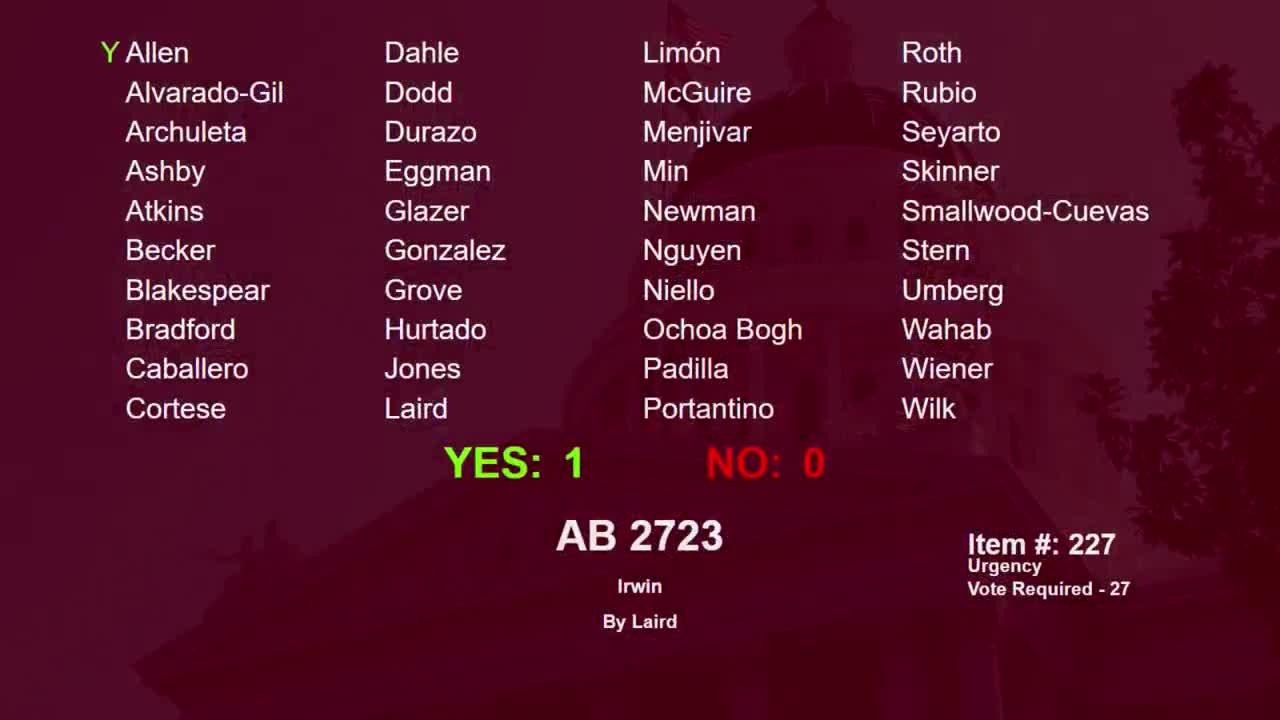 3MIN
Senate Floor
 18MIN
Senate Standing Committee on Environmental Quality
 1MIN
Assembly Floor
 22MIN
Assembly Standing Committee on Environmental Safety and Toxic Materials
Bill Author