AB 2574: Alcoholism or drug abuse recovery or treatment programs and facilities: disclosures.
- Session Year: 2023-2024
- House: Assembly
- Latest Version Date: 2024-09-22
Current Status:
Passed
(2024-09-22: Chaptered by Secretary of State - Chapter 410, Statutes of 2024.)
Introduced
In Committee
First Chamber
In Committee
Second Chamber
Enacted
What does this bill do?
The bill requires alcohol and drug treatment programs and licensed recovery facilities to tell the State Department of Health Care Services when any agent, partner, director, officer, or owner (including sole proprietors) owns or has a financial interest in a recovery residence — an unlicensed home that provides housing and recovery support, such as a sober living home — or has a contract with an outside provider that serves their clients. The department may suspend or revoke certifications or licenses for failing to disclose, must act against unlicensed recovery residences it learns about, and may refer complaints to other enforcement agencies.
The summary is provided by generative AI which can make mistakes. For original language, please view the details in the table below.
Existing law grants the sole authority in state government to the State Department of Health Care Services to certify alcohol or other drug programs and to license adult alcoholism or drug abuse recovery or treatment facilities. Existing law requires certified programs and licensed facilities to disclose specified information to the department, including ownership or a financial interest in a recovery residence, as defined, and contractual relationships with entities that provide recovery services to clients of certified programs or licensed facilities if the entity is not a part of a certified program or a licensed facility.
This bill would require a program or a licensed facility to disclose to the department if any of its agents, partners, directors, officers, or owners own or have a financial interest in a recovery residence and whether it has contractual relationships with entities that provide recovery services to clients of certified programs or licensed facilities if the entity is not a part of a certified program or a licensed facility.
This bill would incorporate additional changes to Section 11833.05 of the Health and Safety Code proposed by AB 2995 to be operative only if this bill and AB 2995 are enacted and this bill is enacted last.
Existing law grants the sole authority in state government to the State Department of Health Care Services to certify alcohol or other drug programs and to license adult alcoholism or drug abuse recovery or treatment facilities. Existing law requires certified programs and licensed facilities to disclose specified information to the department, including ownership or a financial interest in a recovery residence, as defined, and contractual relationships with entities that provide recovery services to clients of certified programs or licensed facilities if the entity is not a part of a certified program or a licensed facility.
This bill would require an organization that operates, conducts, owns, or maintains a certified a program or a licensed facility to disclose to the department whether the licensee, or a general partner, director, or officer of the licensee owns or has if any of its agents, partners, directors, officers, or owners own or have a financial interest in a recovery residence and whether it has contractual relationships with entities that provide recovery services to clients of certified programs or licensed facilities if the entity is not a part of a certified program or a licensed facility.
Existing law grants the sole authority in state government to the State Department of Health Care Services to certify alcohol or other drug programs and to license adult alcoholism or drug abuse recovery or treatment facilities. Existing law requires certified programs and licensed facilities to disclose specified information to the department, including ownership or a financial interest in a recovery residence, as defined, and contractual relationships with entities that provide recovery services to clients of certified programs or licensed facilities if the entity is not a part of a certified program or a licensed facility.
This bill would require an organization that operates, conducts, owns, or maintains a certified program or a licensed facility to disclose to the department whether the licensee, or a general partner, director, or officer of the licensee owns or has a financial interest in a recovery residence and whether it has contractual relationships with entities that provide recovery services to clients of certified programs or licensed facilities if the entity is not a part of a certified program or a licensed facility.
Existing law declares that it is the policy of the state that each county and city shall permit and encourage the development of sufficient numbers and types of alcoholism or drug abuse recovery or treatment facilities as are commensurate with local need. Existing law requires an alcoholism or drug abuse recovery or treatment facility that serves 6 or fewer persons to be considered a residential use of property for the purposes of local regulations, regardless of whether or not unrelated persons are living together.This bill would exempt an unlicensed home for persons recovering from alcoholism or drug abuse in a neighborhood zoned for residential use from being considered a residential use of property when specified evidence demonstrates that the facility is an integral part of a licensed drug treatment facility located elsewhere.Existing law declares that it is the policy of the state that each county and city shall permit and encourage the development of sufficient numbers and types of alcoholism or drug abuse recovery or treatment facilities as are commensurate with local need. Existing law requires an alcoholism or drug abuse recovery or treatment facility that serves 6 or fewer persons to be considered a residential use of property for the purposes of local regulations, regardless of whether or not unrelated persons are living together.
This bill would exempt an unlicensed home for persons recovering from alcoholism or drug abuse in a neighborhood zoned for residential use from being considered a residential use of property when specified evidence demonstrates that the facility is an integral part of a licensed drug treatment facility located elsewhere.
(a)A program certified by the department pursuant to Chapter 7.1 (commencing with Section 11832) or a facility licensed by the department pursuant to Chapter 7.5 (commencing with Section 11834.01) shall disclose to the department if any of its agents, partners, directors, officers, or owners, including a sole proprietor and member, has either of the following:
(1)Ownership or control of, or financial interest in, a recovery residence.
(2)Any contractual relationship with an entity that regularly provides professional services or addiction treatment or recovery services to clients of programs certified or facilities licensed by the department, if the entity is not part of the program certified or facility licensed by the department.
(b)All programs certified or facilities licensed by the department shall make the disclosures pursuant to subdivision (a) upon initial licensure or certification, upon renewal of licensure or certification, and upon a licensed facility or certified program acquiring or starting a relationship that meets the description in paragraph (1) or (2) of subdivision (a).
(c)The department may suspend or revoke the certification of a program or license of a facility for failing to disclose the information required in subdivision (a).
(d)The department shall take action pursuant to Section 11834.31 against an unlicensed facility that is disclosed as a recovery residence pursuant to paragraph (1) of subdivision (a). This subdivision does not require an investigation of a recovery residence that is not alleged to be operating in violation of Section 11834.30.
(e)The department may refer a substantiated complaint against a recovery residence to other enforcement entities as appropriate under state or federal law, including the Department of Insurance, the Department of Managed Health Care, the Attorney General, and the United States Attorney General.
(f)For the purposes of this section, recovery residence means a residential dwelling that provides primary housing for individuals who seek a cooperative living arrangement that supports personal recovery from a substance use disorder and that does not require licensure by the department or does not provide licensable services, pursuant to Chapter 7.5 (commencing with Section 11834.01). A recovery residence may include, but is not limited to, residential dwellings commonly referred to as sober living homes, sober living environments, or unlicensed alcohol and drug free residences.
SEC. 1.5.Section 11833.05 of the Health and Safety Code is amended to read:11833.05.(a)A program certified by the department pursuant to Chapter 7.1 (commencing with Section 11832) or a facility licensed by the department pursuant to Chapter 7.5 (commencing with Section 11834.01) shall disclose to the department if any of its agents, partners, directors, officers, or owners, including a sole proprietor and member, has either of the following:
(1)Ownership or control of, or financial interest in, a recovery residence.
(2)Any contractual relationship with an entity that regularly provides professional services or substance use disorder treatment or recovery services to clients of programs certified or facilities licensed by the department, if the entity is not part of the program certified or facility licensed by the department.
(b)All programs certified or facilities licensed by the department shall make the disclosures pursuant to subdivision (a) upon initial licensure or certification, upon renewal of licensure or certification, and upon a licensed facility or certified program acquiring or starting a relationship that meets the description in paragraph (1) or (2) of subdivision (a).
(c)The department may suspend or revoke the certification of a program or license of a facility for failing to disclose the information required in subdivision (a).
(d)The department shall take action pursuant to Section 11834.31 against an unlicensed facility that is disclosed as a recovery residence pursuant to paragraph (1) of subdivision (a). This subdivision does not require an investigation of a recovery residence that is not alleged to be operating in violation of Section 11834.30.
(e)The department may refer a substantiated complaint against a recovery residence to other enforcement entities as appropriate under state or federal law, including the Department of Insurance, the Department of Managed Health Care, the Attorney General, and the United States Attorney General.
(f)For the purposes of this section, recovery residence means a residential dwelling that provides primary housing for individuals who seek a cooperative living arrangement that supports personal recovery from a substance use disorder and that does not require licensure by the department or does not provide licensable services, pursuant to Chapter 7.5 (commencing with Section 11834.01). A recovery residence may include, but is not limited to, residential dwellings commonly referred to as sober living homes, sober living environments, or unlicensed alcohol and drug free residences.
SEC. 2.Section 1.5 of this bill incorporates amendments to Section 11833.05 of the Health and Safety Code proposed by both this bill and Assembly Bill 2995. That section of this bill shall only become operative if (1) both bills are enacted and become effective on or before January 1, 2025, (2) each bill amends Section 11833.05 of the Health and Safety Code, and (3) this bill is enacted after Assembly Bill 2995, in which case Section 1 of this bill shall not become operative.
(a)A program certified by the department pursuant to Chapter 7.1 (commencing with Section 11832) or a facility licensed by the department pursuant to Chapter 7.5 (commencing with Section 11834.01) shall disclose to the department if any of its agents, partners, directors, officers, or owners, including a sole proprietor and member, has either of the following:
(1)Ownership or control of, or financial interest in, a recovery residence.
(2)Any contractual relationship with an entity that regularly provides professional services or addiction treatment or recovery services to clients of programs certified or facilities licensed by the department, if the entity is not part of the program certified or facility licensed by the department.
(b)All programs certified or facilities licensed by the department shall make the disclosures pursuant to subdivision (a) upon initial licensure or certification, upon renewal of licensure or certification, and upon a licensed facility or certified program acquiring or starting a relationship that meets the description in paragraph (1) or (2) of subdivision (a).
(c)The department may suspend or revoke the certification of a program or license of a facility for failing to disclose the information required in subdivision (a).
(d)The department shall take action pursuant to Section 11834.31 against an unlicensed facility that is disclosed as a recovery residence pursuant to paragraph (1) of subdivision (a). This subdivision does not require an investigation of a recovery residence that is not alleged to be operating in violation of Section 11834.30.
(e)The department may refer a substantiated complaint against a recovery residence to other enforcement entities as appropriate under state or federal law, including the Department of Insurance, the Department of Managed Health Care, the Attorney General, and the United States Attorney General.
(f)For the purposes of this section, recovery residence means a residential dwelling that provides primary housing for individuals who seek a cooperative living arrangement that supports personal recovery from a substance use disorder and that does not require licensure by the department or does not provide licensable services, pursuant to Chapter 7.5 (commencing with Section 11834.01). A recovery residence may include, but is not limited to, residential dwellings commonly referred to as sober living homes, sober living environments, or unlicensed alcohol and drug free residences.
SEC. 1.5.Section 11833.05 of the Health and Safety Code is amended to read:11833.05.(a)All programs A program certified by the department pursuant to Chapter 7.1 (commencing with Section 11832) or facilities a facility licensed by the department pursuant to Chapter 7.5 (commencing with Section 11834.01) shall disclose to the department the following information: if any of its agents, partners, directors, officers, or owners, including a sole proprietor and member, has either of the following:
(1)Ownership or control of, or financial interest in, a recovery residence.
(2)Any contractual relationship with an entity that regularly provides professional services or addiction substance use disorder treatment or recovery services to clients of programs certified or facilities licensed by the department, if the entity is not part of the program certified or facility licensed by the department.
(b)All programs certified or facilities licensed by the department shall make the disclosures pursuant to subdivision (a) upon initial licensure or certification, upon renewal of licensure or certification, and upon a licensed facility or certified program acquiring or starting a relationship that meets the description in paragraph (1) or (2) of subdivision (a).
(c)The department may suspend or revoke the certification of a program or license of a facility for failing to disclose the information required in subdivision (a).
(d)The department shall take action pursuant to Section 11834.31 against an unlicensed facility that is disclosed as a recovery residence pursuant to paragraph (1) of subdivision (a). This subdivision does not require an investigation of a recovery residence that is not alleged to be operating in violation of Section 11834.30.
(e)The department may refer a substantiated complaint against a recovery residence to other enforcement entities as appropriate under state or federal law, including the Department of Insurance, the Department of Managed Health Care, the Attorney General, and the United States Attorney General.
(f)For the purposes of this section, recovery residence means a residential dwelling that provides primary housing for individuals who seek a cooperative living arrangement that supports personal recovery from a substance use disorder and that does not require licensure by the department or does not provide licensable services, pursuant to Chapter 7.5 (commencing with Section 11834.01). A recovery residence may include, but is not limited to, residential dwellings commonly referred to as sober living homes, sober living environments, or unlicensed alcohol and drug free residences.
SEC. 2.Section 1.5 of this bill incorporates amendments to Section 11833.05 of the Health and Safety Code proposed by both this bill and Assembly Bill 2995. That section of this bill shall only become operative if (1) both bills are enacted and become effective on or before January 1, 2025, (2) each bill amends Section 11833.05 of the Health and Safety Code, and (3) this bill is enacted after Assembly Bill 2995, in which case Section 1 of this bill shall not become operative.
(a)Each organization that operates, conducts, owns, or maintains a A program certified by the department pursuant to Chapter 7.1 (commencing with Section 11832) or a facility licensed by the department pursuant to Chapter 7.5 (commencing with Section 11834.01) shall disclose to the department whether the licensee, or a general partner, director, or officer of the licensee, if any of its agents, partners, directors, officers, or owners, including a sole proprietor and member, has either of the following:
(1)Ownership or control of, or financial interest in, a recovery residence.
(2)Any contractual relationship with an entity that regularly provides professional services or addiction treatment or recovery services to clients of programs certified or facilities licensed by the department, if the entity is not part of the program certified or facility licensed by the department.
(b)All programs certified or facilities licensed by the department shall make the disclosures pursuant to subdivision (a) upon initial licensure or certification, upon renewal of licensure or certification, and upon a licensed facility or certified program acquiring or starting a relationship that meets the description in paragraph (1) or (2) of subdivision (a).
(c)The department may suspend or revoke the certification of a program or license of a facility for failing to disclose the information required in subdivision (a).
(d)The department shall take action pursuant to Section 11834.31 against an unlicensed facility that is disclosed as a recovery residence pursuant to paragraph (1) of subdivision (a). This subdivision does not require an investigation of a recovery residence that is not alleged to be operating in violation of Section 11834.30.
(e)The department may refer a substantiated complaint against a recovery residence to other enforcement entities as appropriate under state or federal law, including the Department of Insurance, the Department of Managed Health Care, the Attorney General, and the United States Attorney General.
(f)For the purposes of this section, recovery residence means a residential dwelling that provides primary housing for individuals who seek a cooperative living arrangement that supports personal recovery from a substance use disorder and that does not require licensure by the department or does not provide licensable services, pursuant to Chapter 7.5 (commencing with Section 11834.01). A recovery residence may include, but is not limited to, residential dwellings commonly referred to as sober living homes, sober living environments, or unlicensed alcohol and drug free residences.
(a)All programs Each organization that operates, conducts, owns, or maintains a program certified by the department pursuant to Chapter 7.1 (commencing with Section 11832) or facilities a facility licensed by the department pursuant to Chapter 7.5 (commencing with Section 11834.01) shall disclose to the department the following information: whether the licensee, or a general partner, director, or officer of the licensee, has either of the following:
(1)Ownership or control of, or financial interest in, a recovery residence.
(2)Any contractual relationship with an entity that regularly provides professional services or addiction treatment or recovery services to clients of programs certified or facilities licensed by the department, if the entity is not part of the program certified or facility licensed by the department.
(b)All programs certified or facilities licensed by the department shall make the disclosures pursuant to subdivision (a) upon initial licensure or certification, upon renewal of licensure or certification, and upon a licensed facility or certified program acquiring or starting a relationship that meets paragraph (1) or (2) of subdivision (a).
(c)The department may suspend or revoke the certification of a program or license of a facility for failing to disclose the information required in subdivision (a).
(d)The department shall take action pursuant to Section 11834.31 against an unlicensed facility that is disclosed as a recovery residence pursuant to paragraph (1) of subdivision (a). This subdivision does not require an investigation of a recovery residence that is not alleged to be operating in violation of Section 11834.30.
(e)The department may refer a substantiated complaint against a recovery residence to other enforcement entities as appropriate under state or federal law, including the Department of Insurance, the Department of Managed Health Care, the Attorney General, and the United States Attorney General.
(f)For the purposes of this section, recovery residence means a residential dwelling that provides primary housing for individuals who seek a cooperative living arrangement that supports personal recovery from a substance use disorder and that does not require licensure by the department or does not provide licensable services, pursuant to Chapter 7.5 (commencing with Section 11834.01). A recovery residence may include, but is not limited to, residential dwellings commonly referred to as sober living homes, sober living environments, or unlicensed alcohol and drug free residences.
SECTION 1.Section 11834.23 of the Health and Safety Code is amended to read:11834.23.(a)Whether or not unrelated persons are living together, an alcoholism or drug abuse recovery or treatment facility that serves six or fewer persons shall be considered a residential use of property for the purposes of this article. In addition, the residents and operators of the facility shall be considered a family for the purposes of any law or zoning ordinance that relates to the residential use of property pursuant to this article.(b)For the purpose of all local ordinances, an alcoholism or drug abuse recovery or treatment facility that serves six or fewer persons shall not be included within the definition of a boarding house, rooming house, institution or home for the care of minors, the aged, or persons with mental health disorders, foster care home, guest home, rest home, community residence, or other similar term that implies that the alcoholism or drug abuse recovery or treatment home is a business run for profit or differs in any other way from a single-family residence.(c)This section shall not be construed to forbid a city, county, or other local public entity from placing restrictions on building heights, setback, lot dimensions, or placement of signs of an alcoholism or drug abuse recovery or treatment facility that serves six or fewer persons as long as the restrictions are identical to those applied to other single-family residences.(d)This section shall not be construed to forbid the application to an alcoholism or drug abuse recovery or treatment facility of any local ordinance that deals with health and safety, building standards, environmental impact standards, or any other matter within the jurisdiction of a local public entity. However, the ordinance shall not distinguish alcoholism or drug abuse recovery or treatment facilities that serve six or fewer persons from other single-family dwellings or distinguish residents of alcoholism or drug abuse recovery or treatment facilities from persons who reside in other single-family dwellings.(e)No conditional use permit, zoning variance, or other zoning clearance shall be required of an alcoholism or drug abuse recovery or treatment facility that serves six or fewer persons that is not required of a single-family residence in the same zone.(f)Use of a single-family dwelling for purposes of an alcoholism or drug abuse recovery facility serving six or fewer persons shall not constitute a change of occupancy for purposes of Part 1.5 (commencing with Section 17910) of Division 13 or local building codes. However, nothing in this section is intended to supersede Section 13143 or 13143.6, to the extent those sections are applicable to alcoholism or drug abuse recovery or treatment facilities serving six or fewer residents.(g)(1)A sober living home in a neighborhood zoned for residential use need not be considered a residential use of property when evidence demonstrates that the sober living home is an integral part of a licensed drug treatment facility located elsewhere. Evidence may include, but not be limited to, any of the following:(A)Transportation provided by the licensed facility to and from the sober living home.(B)Advertising connecting the facility to the sober living home.(C)Employees of the licensed facilities providing services or supervision at the sober living home.(2)For purposes of this subdivision, sober living home means an unlicensed home for persons recovering from alcoholism or drug abuse. REVISIONS: HeadingLine 2.(a)Whether or not unrelated persons are living together, an alcoholism or drug abuse recovery or treatment facility that serves six or fewer persons shall be considered a residential use of property for the purposes of this article. In addition, the residents and operators of the facility shall be considered a family for the purposes of any law or zoning ordinance that relates to the residential use of property pursuant to this article.
(b)For the purpose of all local ordinances, an alcoholism or drug abuse recovery or treatment facility that serves six or fewer persons shall not be included within the definition of a boarding house, rooming house, institution or home for the care of minors, the aged, or persons with mental health disorders, foster care home, guest home, rest home, community residence, or other similar term that implies that the alcoholism or drug abuse recovery or treatment home is a business run for profit or differs in any other way from a single-family residence.
(c)This section shall not be construed to forbid a city, county, or other local public entity from placing restrictions on building heights, setback, lot dimensions, or placement of signs of an alcoholism or drug abuse recovery or treatment facility that serves six or fewer persons as long as the restrictions are identical to those applied to other single-family residences.
(d)This section shall not be construed to forbid the application to an alcoholism or drug abuse recovery or treatment facility of any local ordinance that deals with health and safety, building standards, environmental impact standards, or any other matter within the jurisdiction of a local public entity. However, the ordinance shall not distinguish alcoholism or drug abuse recovery or treatment facilities that serve six or fewer persons from other single-family dwellings or distinguish residents of alcoholism or drug abuse recovery or treatment facilities from persons who reside in other single-family dwellings.
(e)No conditional use permit, zoning variance, or other zoning clearance shall be required of an alcoholism or drug abuse recovery or treatment facility that serves six or fewer persons that is not required of a single-family residence in the same zone.
(f)Use of a single-family dwelling for purposes of an alcoholism or drug abuse recovery facility serving six or fewer persons shall not constitute a change of occupancy for purposes of Part 1.5 (commencing with Section 17910) of Division 13 or local building codes. However, nothing in this section is intended to supersede Section 13143 or 13143.6, to the extent those sections are applicable to alcoholism or drug abuse recovery or treatment facilities serving six or fewer residents.
(g)(1)A sober living home in a neighborhood zoned for residential use need not be considered a residential use of property when evidence demonstrates that the sober living home is an integral part of a licensed drug treatment facility located elsewhere. Evidence may include, but not be limited to, any of the following:
(A)Transportation provided by the licensed facility to and from the sober living home.
(B)Advertising connecting the facility to the sober living home.
(C)Employees of the licensed facilities providing services or supervision at the sober living home.
(2)For purposes of this subdivision, sober living home means an unlicensed home for persons recovering from alcoholism or drug abuse.
|
Date
|
Status
|
|---|---|
| Sep 22, 2024 | Chaptered by Secretary of State - Chapter 410, Statutes of 2024. |
| Sep 22, 2024 | Approved by the Governor. |
| Sep 11, 2024 | Enrolled and presented to the Governor at 4 p.m. |
| Aug 29, 2024 | Senate amendments concurred in. To Engrossing and Enrolling. (Ayes 75. Noes 0.). |
| Aug 29, 2024 | Assembly Rule 77 suspended. |
| Aug 28, 2024 | In Assembly. Concurrence in Senate amendments pending. May be considered on or after August 30 pursuant to Assembly Rule 77. |
| Aug 28, 2024 | Read third time. Passed. Ordered to the Assembly. (Ayes 38. Noes 0.). |
| Aug 26, 2024 | Read second time. Ordered to third reading. |
| Aug 23, 2024 | Read third time and amended. Ordered to second reading. |
| Aug 21, 2024 | Read second time. Ordered to third reading. |
| Aug 20, 2024 | Read third time and amended. Ordered to second reading. |
| Jun 27, 2024 | Ordered to third reading. |
| Jun 27, 2024 | From Consent Calendar. |
| Jun 25, 2024 | Read second time. Ordered to Consent Calendar. |
| Jun 24, 2024 | From committee: Be ordered to second reading file pursuant to Senate Rule 28.8 and ordered to Consent Calendar. |
| Jun 13, 2024 | From committee: Do pass and re-refer to Com. on APPR with recommendation: To Consent Calendar. (Ayes 10. Noes 0.) (June 12). Re-referred to Com. on APPR. |
| May 29, 2024 | Referred to Com. on HEALTH. |
| May 22, 2024 | In Senate. Read first time. To Com. on RLS. for assignment. |
| May 21, 2024 | Read third time. Passed. Ordered to the Senate. (Ayes 71. Noes 0. Page 5444.) |
| May 16, 2024 | Read second time. Ordered to Consent Calendar. |
| May 15, 2024 | From committee: Do pass. To Consent Calendar. (Ayes 15. Noes 0.) (May 15). |
| May 15, 2024 | Coauthors revised. |
| Apr 29, 2024 | Read second time. Ordered to third reading. |
| Apr 29, 2024 | Re-referred to Com. on APPR. pursuant to Joint Rule 10.5. |
| Apr 25, 2024 | Read second time and amended. Ordered returned to second reading. |
| Apr 24, 2024 | From committee: Amend, and do pass as amended. (Ayes 16. Noes 0.) (April 23). |
| Mar 4, 2024 | Referred to Com. on HEALTH. |
| Feb 15, 2024 | From printer. May be heard in committee March 16. |
| Feb 14, 2024 | Read first time. To print. |
|
Date
|
Description
|
Location
|
Votes
|
|
|---|---|---|---|---|
| Aug 29, 2024 | AB 2574 Valencia Concurrence in Senate Amendments | Assembly Floor |
Passed |
|
| Aug 28, 2024 | Assembly 3rd Reading AB2574 Valencia et al. By Limón | Senate Floor |
Passed |
|
| Jun 12, 2024 | Do pass, but first be re-referred to the Committee on [Appropriations] with the recommendation: To Consent Calendar | Senate Standing Committee on Health |
Passed |
|
| May 21, 2024 | AB 2574 Valencia Consent Calendar Second Day Regular Session | Assembly Floor |
Passed |
|
| May 15, 2024 | Do pass. To Consent Calendar. | Assembly Standing Committee on Appropriations |
Passed |
|
| Apr 23, 2024 | Do pass as amended. | Assembly Standing Committee on Health |
Passed |
This list shows positions taken on this bill by organizations on the date displayed, which is linked to the original source.
Positions by individuals are not included.
|
Organization
|
Position
|
Date
|
|---|---|---|
| city of carlsbad | ** Support | |
| city of Cypress | ** Support | |
| City of Fountain Valley | ** Support | |
| City Of Huntington Beach | ** Support | |
| City Of Lake Forest | ** Support | |
| City of Moorpark | ** Support | |
| City Of Placentia | ** Support | |
| League Of California Cities | ** Support | |
| Orange County Board of Supervisors | ** Support | |
| Sue Kempf, Mayor, City of Laguna Beach | ** Support |
CONCURRENCE IN SENATE AMENDMENTS
CSA1 Bill Id:AB 2574
Author:(Valencia)
As Amended Ver:August 23, 2024
Majority vote
SUMMARY
Requires a licensed alcoholism or drug abuse recovery or treatment facility (RTF) or certified alcohol or other drug program to disclose to the Department of Health Care Services (DHCS) whether any of its agents, partners, directors, officers, or owners own or have a financial interest in a recovery residence (RR) and whether it has contractual relationships with unlicensed entities that provide recovery services.
Senate Amendments
- Make technical, clarifying changes to this bill.
- This bill and AB 2995 (Jackson), of the current legislative session, amend the same code sections. Amendments avoid chaptering out the other, should both bills be enacted.
COMMENTS
- Prevalence of Substance Use Disorder (SUD) in California. A 2022 publication from the California Health Care Foundation, entitled "Substance Use in California: Prevalence and Treatment" reported that substance use in California is widespread with over half of Californians over age 12 reporting using alcohol in the past month and 20% reporting using marijuana in the past year. According to the report, 9% of Californians have met the criteria for a SUD within the last year. While the health care system is moving toward acknowledging SUDs as a chronic illness, only about 10% of people with an SUD within the last year received treatment. Overdose deaths from both opioids and psychostimulants (such as amphetamines), are soaring. This issue, compounded by the increased availability of fentanyl, has resulted in a 10-fold increase in fentanyl related deaths between 2015 and 2019. The California Department of Public Health's Opioid Overdose Dashboard reported 7,385 deaths related to "any" opioid overdose in 2022, with 6,473 (87.7%) of those deaths fentanyl related.
- Alcohol and Drug Treatment Facility Licensing and Certification. DHCS has sole authority to license RTFs in the state. Licensure is required when at least one of the following services is provided: detoxification; group sessions; individual sessions; educational sessions; or, alcoholism or other drug abuse recovery or treatment planning. Additionally, facilities may be subject to other types of permits, clearances, business taxes, or local fees that may be required by the cities or counties in which the facilities are located.
As part of their licensing function, DHCS conducts reviews of RTF operations every two years, or as necessary. DHCS's Substance Use Disorder Compliance Division checks for compliance with statute and regulations to ensure the health and safety of RTF residents and investigates all complaints related to RTFs, including deaths, complaints against staff, and allegations of operating without a license. DHCS has the authority to suspend or revoke a license for conduct in the operation of an RTF that is inimical to the health, morals, welfare, or safety of either an individual in, or receiving services from, the facility or to the people of the State of California.
AB 118 (Committee on Budget), Chapter 42, Statutes of 2023, requires other non-residential, outpatient alcohol or other drug programs be certified by DHCS. Certification is required when at least one of the following is provided: outpatient treatment services; recovery services; detoxification; or, medications for addiction treatment. DHCS does not license alcohol and drug RRs with six or less beds that don't provide licensable services.
- RRs. A RR, sometimes called a sober living home (SLH), is a residence for people in recovery from substance abuse. It may serve as support for individuals undergoing treatment but it does not provide treatment or care, whether medical or nonmedical. The state laws and licensing requirements that govern treatment and care facilities do not currently include RRs. Therefore, the state does not keep any list of registered RRs, conduct inspections of RRs, or perform any of the other activities associated with licensing facilities. An RR may be completely self-governed or have formal on-site management, but in the latter case, the managers' duties relate to the administration of the house rather than the tenants or their recovery (as in "case management.") The tenants of an RR pay rent and abide by house rules, which always include maintenance of sobriety and participation in a self-help program. Multiple studies have shown the effectiveness of this kind of environment as a support for people transitioning out of drug or alcohol treatment. The effectiveness of sober living as one component of a person's successful recovery program is not controversial. The California Research Bureau estimates that there are at least 12,000 sober living beds in the state to serve an eligible population of between 25,000 and 35,000 individuals. If an RR is providing any licensable services then it must obtain a valid RTF license from DHCS.
DHCS's Drug Medi-Cal-Organized Delivery System waiver permits counties to use RRs in their continuum of services if they adhere to the following guidelines: the RR does not provide SUD services that would require licensure by DHCS; all residents of a RR are actively engaged in medically necessary recovery support services to be provided off-site; each county develops guidelines for contracted RR entities; and, the county provides monitoring and oversight of the RR.
According to the Author
This bill will protect communities and residents of SLHs by ensuring they are regulated by the state. The author continues that licensed RTFs provide necessary recovery services to those suffering from SUD, but some licensed RTFs have been found to be operating unlicensed SLHs for individuals in recovery who transition out of the treatment facility. The author argues that these SLHs are not covered under the licensure of the RTF, and are being considered a residential use of property despite providing services offered by the RTF to the residents of the sober living home. The author concludes that by requiring unlicensed SLHs to be covered under the RTF's licensure, DHCS can provide the necessary oversight of these homes.
Arguments in Support
The League of California Cities (The League) are sponsors of this bill, stating that residential recovery housing provides a wide range of benefits to some of California's most vulnerable residents and it is critical that their needs are prioritized over profits. The League continues that compliance with state licensing laws administered through DHCS is essential to safeguarding residents' well-being and maintaining quality care. The League states that there have been cases where a licensed RTF provides services to the residents of a SLH but does not include the SLH in the facility's licensure. The League argues that this bill would provide much-needed clarity to ensure that if a recovery residence is operated as a business with a licensed treatment facility, it is regulated like a business, not a residential home.
Arguments in Opposition
None on file.
FISCAL COMMENTS
According to the Senate Appropriations Committee, pursuant to Senate Rule 28.8, negligible state costs.
VOTES:
ASM HEALTH: 16-0-0
YES: Bonta, Waldron, Aguiar-Curry, Arambula, Wendy Carrillo, Flora, Haney, Jones-Sawyer, Maienschein, McCarty, Joe Patterson, Rodriguez, Sanchez, Santiago, Schiavo, Weber
ASM APPROPRIATIONS: 15-0-0
YES: Wicks, Sanchez, Arambula, Bryan, Calderon, Wendy Carrillo, Dixon, Mike Fong, Grayson, Haney, Hart, Jim Patterson, Pellerin, Ta, Villapudua
ASSEMBLY FLOOR: 71-0-9
YES: Addis, Aguiar-Curry, Alanis, Alvarez, Arambula, Bains, Bauer-Kahan, Bennett, Berman, Boerner, Bonta, Bryan, Juan Carrillo, Wendy Carrillo, Chen, Connolly, Davies, Dixon, Essayli, Flora, Mike Fong, Vince Fong, Gallagher, Garcia, Gipson, Grayson, Haney, Hart, Hoover, Irwin, Jackson, Jones-Sawyer, Kalra, Lackey, Lee, Low, Lowenthal, Maienschein, McCarty, McKinnor, Muratsuchi, Stephanie Nguyen, Ortega, Pacheco, Jim Patterson, Joe Patterson, Pellerin, Petrie-Norris, Quirk-Silva, Ramos, Rendon, Reyes, Rodriguez, Blanca Rubio, Sanchez, Santiago, Schiavo, Soria, Ta, Ting, Valencia, Villapudua, Waldron, Wallis, Ward, Weber, Wicks, Wilson, Wood, Zbur, Robert Rivas
ABS, ABST OR NV: Calderon, Cervantes, Megan Dahle, Friedman, Gabriel, Holden, Mathis, Papan, Luz Rivas
SENATE FLOOR: 39-0-1
YES: Allen, Archuleta, Ashby, Atkins, Becker, Blakespear, Bradford, Caballero, Cortese, Dahle, Dodd, Durazo, Eggman, Glazer, Gonzalez, Grove, Hurtado, Jones, Laird, Limón, McGuire, Menjivar, Min, Newman, Nguyen, Niello, Ochoa Bogh, Padilla, Portantino, Roth, Rubio, Seyarto, Skinner, Smallwood-Cuevas, Stern, Umberg, Wahab, Wiener, Wilk
ABS, ABST OR NV: Alvarado-Gil
UPDATED
VERSION: August 23, 2024
CONSULTANT: Riana King / HEALTH / (916) 319-2097 FN: 0004680
CONCURRENCE IN SENATE AMENDMENTS
CSA1 Bill Id:AB 2574
Author:(Valencia)
As Amended Ver:August 23, 2024
Majority vote
SUMMARY
Requires a licensed alcoholism or drug abuse recovery or treatment facility (RTF) or certified alcohol or other drug program to disclose to the Department of Health Care Services (DHCS) whether any of its agents, partners, directors, officers, or owners own or have a financial interest in a recovery residence (RR) and whether it has contractual relationships with unlicensed entities that provide recovery services.
Senate Amendments
- Make technical, clarifying changes to this bill.
- This bill and AB 2995 (Jackson), of the current legislative session, amend the same code sections. Amendments avoid chaptering out the other, should both bills be enacted.
COMMENTS
- Prevalence of Substance Use Disorder (SUD) in California. A 2022 publication from the California Health Care Foundation, entitled "Substance Use in California: Prevalence and Treatment" reported that substance use in California is widespread with over half of Californians over age 12 reporting using alcohol in the past month and 20% reporting using marijuana in the past year. According to the report, 9% of Californians have met the criteria for a SUD within the last year. While the health care system is moving toward acknowledging SUDs as a chronic illness, only about 10% of people with an SUD within the last year received treatment. Overdose deaths from both opioids and psychostimulants (such as amphetamines), are soaring. This issue, compounded by the increased availability of fentanyl, has resulted in a 10-fold increase in fentanyl related deaths between 2015 and 2019. The California Department of Public Health's Opioid Overdose Dashboard reported 7,385 deaths related to "any" opioid overdose in 2022, with 6,473 (87.7%) of those deaths fentanyl related.
- Alcohol and Drug Treatment Facility Licensing and Certification. DHCS has sole authority to license RTFs in the state. Licensure is required when at least one of the following services is provided: detoxification; group sessions; individual sessions; educational sessions; or, alcoholism or other drug abuse recovery or treatment planning. Additionally, facilities may be subject to other types of permits, clearances, business taxes, or local fees that may be required by the cities or counties in which the facilities are located.
As part of their licensing function, DHCS conducts reviews of RTF operations every two years, or as necessary. DHCS's Substance Use Disorder Compliance Division checks for compliance with statute and regulations to ensure the health and safety of RTF residents and investigates all complaints related to RTFs, including deaths, complaints against staff, and allegations of operating without a license. DHCS has the authority to suspend or revoke a license for conduct in the operation of an RTF that is inimical to the health, morals, welfare, or safety of either an individual in, or receiving services from, the facility or to the people of the State of California.
AB 118 (Committee on Budget), Chapter 42, Statutes of 2023, requires other non-residential, outpatient alcohol or other drug programs be certified by DHCS. Certification is required when at least one of the following is provided: outpatient treatment services; recovery services; detoxification; or, medications for addiction treatment. DHCS does not license alcohol and drug RRs with six or less beds that don't provide licensable services.
- RRs. A RR, sometimes called a sober living home (SLH), is a residence for people in recovery from substance abuse. It may serve as support for individuals undergoing treatment but it does not provide treatment or care, whether medical or nonmedical. The state laws and licensing requirements that govern treatment and care facilities do not currently include RRs. Therefore, the state does not keep any list of registered RRs, conduct inspections of RRs, or perform any of the other activities associated with licensing facilities. An RR may be completely self-governed or have formal on-site management, but in the latter case, the managers' duties relate to the administration of the house rather than the tenants or their recovery (as in "case management.") The tenants of an RR pay rent and abide by house rules, which always include maintenance of sobriety and participation in a self-help program. Multiple studies have shown the effectiveness of this kind of environment as a support for people transitioning out of drug or alcohol treatment. The effectiveness of sober living as one component of a person's successful recovery program is not controversial. The California Research Bureau estimates that there are at least 12,000 sober living beds in the state to serve an eligible population of between 25,000 and 35,000 individuals. If an RR is providing any licensable services then it must obtain a valid RTF license from DHCS.
DHCS's Drug Medi-Cal-Organized Delivery System waiver permits counties to use RRs in their continuum of services if they adhere to the following guidelines: the RR does not provide SUD services that would require licensure by DHCS; all residents of a RR are actively engaged in medically necessary recovery support services to be provided off-site; each county develops guidelines for contracted RR entities; and, the county provides monitoring and oversight of the RR.
According to the Author
This bill will protect communities and residents of SLHs by ensuring they are regulated by the state. The author continues that licensed RTFs provide necessary recovery services to those suffering from SUD, but some licensed RTFs have been found to be operating unlicensed SLHs for individuals in recovery who transition out of the treatment facility. The author argues that these SLHs are not covered under the licensure of the RTF, and are being considered a residential use of property despite providing services offered by the RTF to the residents of the sober living home. The author concludes that by requiring unlicensed SLHs to be covered under the RTF's licensure, DHCS can provide the necessary oversight of these homes.
Arguments in Support
The League of California Cities (The League) are sponsors of this bill, stating that residential recovery housing provides a wide range of benefits to some of California's most vulnerable residents and it is critical that their needs are prioritized over profits. The League continues that compliance with state licensing laws administered through DHCS is essential to safeguarding residents' well-being and maintaining quality care. The League states that there have been cases where a licensed RTF provides services to the residents of a SLH but does not include the SLH in the facility's licensure. The League argues that this bill would provide much-needed clarity to ensure that if a recovery residence is operated as a business with a licensed treatment facility, it is regulated like a business, not a residential home.
Arguments in Opposition
None on file.
FISCAL COMMENTS
According to the Senate Appropriations Committee, pursuant to Senate Rule 28.8, negligible state costs.
VOTES:
ASM HEALTH: 16-0-0
YES: Bonta, Waldron, Aguiar-Curry, Arambula, Wendy Carrillo, Flora, Haney, Jones-Sawyer, Maienschein, McCarty, Joe Patterson, Rodriguez, Sanchez, Santiago, Schiavo, Weber
ASM APPROPRIATIONS: 15-0-0
YES: Wicks, Sanchez, Arambula, Bryan, Calderon, Wendy Carrillo, Dixon, Mike Fong, Grayson, Haney, Hart, Jim Patterson, Pellerin, Ta, Villapudua
ASSEMBLY FLOOR: 71-0-9
YES: Addis, Aguiar-Curry, Alanis, Alvarez, Arambula, Bains, Bauer-Kahan, Bennett, Berman, Boerner, Bonta, Bryan, Juan Carrillo, Wendy Carrillo, Chen, Connolly, Davies, Dixon, Essayli, Flora, Mike Fong, Vince Fong, Gallagher, Garcia, Gipson, Grayson, Haney, Hart, Hoover, Irwin, Jackson, Jones-Sawyer, Kalra, Lackey, Lee, Low, Lowenthal, Maienschein, McCarty, McKinnor, Muratsuchi, Stephanie Nguyen, Ortega, Pacheco, Jim Patterson, Joe Patterson, Pellerin, Petrie-Norris, Quirk-Silva, Ramos, Rendon, Reyes, Rodriguez, Blanca Rubio, Sanchez, Santiago, Schiavo, Soria, Ta, Ting, Valencia, Villapudua, Waldron, Wallis, Ward, Weber, Wicks, Wilson, Wood, Zbur, Robert Rivas
ABS, ABST OR NV: Calderon, Cervantes, Megan Dahle, Friedman, Gabriel, Holden, Mathis, Papan, Luz Rivas
UPDATED
VERSION: August 23, 2024
CONSULTANT: Riana King / HEALTH / (916) 319-2097 FN: 0004680
SENATE RULES COMMITTEE Office of Senate Floor Analyses (916) 651-1520 Fax: (916) 327-4478 | AB 2574 |
THIRD READING
Bill No: AB 2574
Author: Valencia (D), et al.
Amended: 8/23/24 in Senate
Vote: 21
SENATE HEALTH COMMITTEE: 10-0, 6/12/24
AYES: Roth, Nguyen, Glazer, Gonzalez, Grove, Hurtado, Limón, Menjivar, Rubio, Wiener
NO VOTE RECORDED: Smallwood-Cuevas
SENATE APPROPRIATIONS COMMITTEE: Senate Rule 28.8
ASSEMBLY FLOOR: 71-0, 5/21/24 (Consent) - See last page for vote
SUBJECT: Alcoholism or drug abuse recovery or treatment programs and facilities: disclosures
SOURCE: League of California Cities
DIGEST:
This bill broadens the list of individuals required to disclose that they own or control, or have a financial interest in, a recovery residence, and any contractual relationship with an entity that regularly provides services to addiction treatment or recovery clients, that includes agents, partners, directors, officers, or owners, including a sole proprietor and member.
Senate Floor Amendments of 8/22/24 (1)incorporate Department of Health Care Services (DHCS) technical assistance (TA) to broaden the list of individuals required to make disclosures about business relationships with other entities from “the licensee, or a general partner, or officer of the licensee” to “agents, partners, directors, officers, or owners, including a sole proprietor and member.”; (2) add double jointing language related to AB 2995 (Jackson), a bill that updates language when referencing those with a substance use disorder.
ANALYSIS:
Existing law:
- Grants DHCS the sole authority in state government to administer, license, certify, and regulate all substance use disorder (SUD) functions and programs. [Health Safety Code (HSC) §11750, et seq.]
- Requires DHCS to license and regulate residential alcoholism or drug abuse (or substance use disorder [SUD]) recovery or treatment facilities (RTFs). [HSC §11834.02, et seq.]
- Grants DHCS the authority to implement a program certification procedure for alcohol and other drug treatment recovery services and to develop standards and regulations for the alcohol and other drug treatment recovery services describing the minimal level of service quality required of the service providers to qualify for and obtain state certification. [HSC §11830.1]
- Requires all programs certified, or RTFs licensed by DHCS, to disclose ownership or control of, or financial interest in, a recovery residence (RR) and any contractual relationship with an entity that regularly provides professional services or addiction treatment or recovery services to clients of programs certified or RTFs licensed by DHCS, if the entity is not part of the certified program or licensed RTF. [HSC §11833.05]
- Prohibits a DHCS licensed RTF or certified program, and specified individuals associated with or employed by those facilities and programs, from giving or receiving remuneration or anything of value for the referral of a person who is seeking alcoholism or drug abuse recovery and treatment services, as specified. Permits DHCS to investigate allegations of violations and take action, such as revocation of licensure or certification, or assessment of penalties. [HSC §11831.6 and 11831.7]
This bill broadens the disclosure requirement in 4) above of existing law to require agents, partners, directors, officers, or owners, including a sole proprietor and member, of a certified program or licensed RTF to make those disclosures.
Comments
- Author’s statement. According to the author, this bill will enhance DHCS’s oversight abilities of licensed and certified entities that own or have control of RRs by expanding reporting requirements. While state law requires DHCS to license and/or certify and regulate residential and outpatient facilities that provide treatment services, DHCS does not have oversight of RRs that only provide housing, even though some illegally provide treatment and even medical services. This bill aims to address this gap and provide a greater understanding of the relationships between the treatment facilities under DHCS’s purview and RRs that operate within our communities by requiring the disclosure of specified financial relationships.
- Licensed and certified programs. RTFs licensed by DHCS, based on what is commonly referred to as the “social model,” provide recovery, treatment, or detoxification services. (The Department of Public Health licenses medical model RTFs, known as chemical dependency recovery hospitals.) The services provided by social model RTFs include group and individual counseling, educational sessions, and alcoholism or drug abuse recovery and treatment planning. Social model RTFs are allowed to provide clients first aid and emergency care, and since the passage of AB 848 (Mark Stone, Chapter 744, Statutes of 2015), RTFs can apply to DHCS for an additional license to provide incidental medical services by a licensed physician or other health care practitioner. SB 823 (Hill, Chapter 781, Statutes of 2018) requires DHCS to adopt American Society of Addiction Medicine treatment criteria as the minimum standard of care for licensed RTFs. DHCS is also responsible for certification of a business entity with a physical location in the state that provides one or more of the following services to clients: treatment, recovery, or detoxification services, or medications for addiction treatment. DHCS also provides program certification for facilities that are licensed by the Department of Social Services that serve adolescents. As part of their licensing and certification functions, DHCS conducts reviews of licensed and certified programs every two years, or as necessary; checks for compliance with statute, regulations, and certification standards to ensure the health and safety of clients; investigates all complaints; and has the authority to suspend or revoke a program’s license or certification for a violation of statutes, regulations, and certification standards. DHCS states that they have the sole authority to conduct site visits to their licensed and certified facilities. As compliance reviews require DHCS to review resident or client information and files, which is protected information to ensure confidentiality under Title 42, Code of Federal Regulations, Part 2, any onsite visits by any other entity to ensure licensure or certification compliance could violate these protections.
- Recovery residences (RRs)/sober living homes (SLHs). A 2010 report on the National Institutes of Health (NIH) website, “Sober Living Houses for Alcohol and Drug Dependence: 18-month Outcomes,” states that SLHs are not formal treatment programs and are not obligated to comply with state or local regulations applicable to treatment. However, NIH does not provide a formal definition of a SLH. The report also mentions that it is difficult to determine how many SLHs there are in California because they are outside of the purview of state licensing authorities. The NIH report cites the protection that the federal FHA affords SLHs to be located in residentially zoned areas, personal privacy under the Fourth Amendment, and the right of people with disabilities to live together for a shared purpose, such as mutually assisted recovery and maintenance of an abstinent lifestyle.
According to DHCS’s website, some types of residences do not provide alcohol and other drug services and therefore do not require licensure by DHCS, including cooperative living arrangements with a commitment or requirement to be free from alcohol and other drugs, sometimes referred to as RRs, SLHs, transitional housing, or alcohol- and drug-free housing. DHCS states that while SLHs are not required to be licensed by DHCS, they may be subject to other types of permits, clearances, business taxes, or local fees, which may be required by the cities or counties in which they are located. If a SLH is providing licensable services to adults, then it must obtain a valid RTF license. Licensable services can include, but are not limited to, detoxification services, group sessions, individual sessions, one-on-one counseling, educational sessions, or recovery, treatment, or discharge planning. If a SLH is providing just one of the mentioned services, then it should be classified as a RTF and must obtain a license from DHCS.
DHCS’s Drug Medi-Cal Organized Delivery System waiver allows counties to use recovery SLHs in their continuum of services if they adhere to the following guidelines: do not provide SUD services that would require licensure by DHCS; all residents of an RR are actively engaged in medically necessary recovery support services to be provided off-site; and, each county develops guidelines for contracted RR providers and provide monitoring and oversight.
- Informational hearing on patient brokering and subsequent legislation. On January 31, 2018, this Committee held an informational hearing to examine the SUD treatment system with a focus on treatment and services provided in licensed RTFs; insurance coverage; patient referrals; and the state’s regulation and oversight of the system, including the inability to impose restrictions on unregulated sober living homes. The hearing provided an overview of issues that had been affecting the state regarding unscrupulous facility operators, and gave an opportunity for state regulators to highlight efforts they have undertaken to combat the exploitation of the SUD system, including CDI’s enforcement of unscrupulous sober living home operators that had been unlawfully providing services. The goal of the hearing was to examine the issues and to seek strategies and policies that would prevent unscrupulous individuals from exploiting the various industries that are supposed to help treat those with SUDs; to recognize federal and state protections for those with disabilities, including their housing rights and options for supportive housing at sober living homes; and to ensure that policies are not enacted, either at the local or state level, that will limit the number of recovery or treatment options for those who need them.
The Legislature passed, and Governor Brown signed, a package of bills that aimed to address the emerging issues in the SUD treatment and recovery realm. SB 1228 (Lara, Chapter 792, Statutes of 2018) prohibits facilities that are licensed or certified by DHCS, and anyone associated with them, from gaining financially for referring a person to treatment, also known as “patient brokering.” SB 992 (Hernandez, Chapter 784, Statutes of 2018) and AB 3162 (Friedman, Chapter 775, Statutes of 2018) made several changes to licensing statute for RTFs, particularly requiring RTFs and other facilities under DHCS’s purview to disclose certain business relationships, including with sober living homes, and requiring all RTF licensed services to be provided within the structures notated on an RTF’s license.
- Troubling trends in the SUD field. Various media reports over the years have documented how unscrupulous individuals have found ways to exploit the SUD treatment system. Senate Health Committee staff, at the time around the 2018 informational hearing on patient brokering, had received reports of emerging trends and requested DHCS confirm that some of the issues expressed were in fact occurring in licensed RTFs, including:
- Denying individuals admission to RTFs who had valid prescriptions from health care professionals for medications to aid in their recovery;
- RTF operators holding various licenses that were found to endanger the health and safety of residents at one RTF continued to operate the other RTFs while DHCS worked to suspend or revoke all of the licenses; and,
- RTF licensees who had a license suspended or revoked often reapplied for and subsequently were issued licensure just after only two years.
While the package of SUD bills from 2018 were intended to address these troubling trends, some of the bad actors who claim to be part of the SUD industry, to this day, often operate multiple residences and claim they do not require licensure by DHCS because they do not provide any treatment services, even though often times this is found not to be the case. Media reports, as well as anecdotes from advocates, claim that these are the operators who shuffle clients among their various businesses as a means to skirt licensing laws.
FISCAL EFFECT: Appropriation: No Fiscal Com.: Yes Local: No
SUPPORT: (Verified 8/22/24)
League of California Cities (source)
City of Carlsbad
City of Huntington Beach
City of Lake Forest
City of Moorpark
Orange County Board of Supervisors
OPPOSITION: (Verified 8/22/24)
None received
ARGUMENTS IN SUPPORT: The League of California Cities argues that residential recovery provides a wide range of benefits to some of California’s most vulnerable residents, and it is critical that their needs are prioritized over profits. Compliance with state licensing laws administered through DHCS is essential to safeguarding residents’ well-being and maintaining quality care. There have been cases where a licensed RTF provides services to the residents of a sober living home but does not include the sober living home in the facility’s licensure. This bill would protect residents and hold providers accountable for maintaining high-quality treatment and care.
ASSEMBLY FLOOR: 71-0, 5/21/24
AYES: Addis, Aguiar-Curry, Alanis, Alvarez, Arambula, Bains, Bauer-Kahan, Bennett, Berman, Boerner, Bonta, Bryan, Juan Carrillo, Wendy Carrillo, Chen, Connolly, Davies, Dixon, Essayli, Flora, Mike Fong, Vince Fong, Gallagher, Garcia, Gipson, Grayson, Haney, Hart, Hoover, Irwin, Jackson, Jones-Sawyer, Kalra, Lackey, Lee, Low, Lowenthal, Maienschein, McCarty, McKinnor, Muratsuchi, Stephanie Nguyen, Ortega, Pacheco, Jim Patterson, Joe Patterson, Pellerin, Petrie-Norris, Quirk-Silva, Ramos, Rendon, Reyes, Rodriguez, Blanca Rubio, Sanchez, Santiago, Schiavo, Soria, Ta, Ting, Valencia, Villapudua, Waldron, Wallis, Ward, Weber, Wicks, Wilson, Wood, Zbur, Robert Rivas
NO VOTE RECORDED: Calderon, Cervantes, Megan Dahle, Friedman, Gabriel, Holden, Mathis, Papan, Luz Rivas
Prepared by: Reyes Diaz / HEALTH / (916) 651-4111
8/25/24 13:35:37
**** END ****
SENATE RULES COMMITTEE Office of Senate Floor Analyses (916) 651-1520 Fax: (916) 327-4478 | AB 2574 |
THIRD READING
Bill No: AB 2574
Author: Valencia (D), et al.
Amended: 8/20/24 in Senate
Vote: 21
SENATE HEALTH COMMITTEE: 10-0, 6/12/24
AYES: Roth, Nguyen, Glazer, Gonzalez, Grove, Hurtado, Limón, Menjivar, Rubio, Wiener
NO VOTE RECORDED: Smallwood-Cuevas
SENATE APPROPRIATIONS COMMITTEE: Senate Rule 28.8
ASSEMBLY FLOOR: 71-0, 5/21/24 (Consent) - See last page for vote
SUBJECT: Alcoholism or drug abuse recovery or treatment programs and facilities: disclosures
SOURCE: League of California Cities
DIGEST:
This bill broadens the list of entities required to disclose that they own or control, or have a financial interest in, a recovery residence, and any contractual relationship with an entity that regularly provides services to addiction treatment or recovery clients, that includes agents, partners, directors, officers, or owners, including a sole proprietor and member.
Senate Floor Amendments of 8/20/24 incorporate technical assistance from the Department of Health Care Services (DHCS) to broaden the list of individuals at the treatment programs who are required to make disclosures about business relationships with other entities from “the licensee, or a general partner, or officer of the licensee” to “agents, partners, directors, officers, or owners, including a sole proprietor and member.”
ANALYSIS:
Existing law:
- Grants DHCS the sole authority in state government to administer, license, certify, and regulate all substance use disorder (SUD) functions and programs. [Health and Safety Code (HSC) §11750, et seq.]
- Requires DHCS to license and regulate residential alcoholism or drug abuse (or substance use disorder [SUD]) recovery or treatment facilities (RTFs). [HSC §11834.02, et seq.]
- Grants DHCS the authority to implement a program certification procedure for alcohol and other drug treatment recovery services and to develop standards and regulations for the alcohol and other drug treatment recovery services describing the minimal level of service quality required of the service providers to qualify for and obtain state certification. [HSC §11830.1]
- Requires all programs certified, or RTFs licensed by DHCS, to disclose ownership or control of, or financial interest in, a recovery residence (RR) and any contractual relationship with an entity that regularly provides professional services or addiction treatment or recovery services to clients of programs certified or RTFs licensed by DHCS, if the entity is not part of the certified program or licensed RTF. [HSC §11833.05]
- Prohibits a DHCS licensed RTF or certified program, and specified individuals associated with or employed by those facilities and programs, from giving or receiving remuneration or anything of value for the referral of a person who is seeking alcoholism or drug abuse recovery and treatment services, as specified. Permits DHCS to investigate allegations of violations and take action, such as revocation of licensure or certification, or assessment of penalties. [HSC §11831.6 and 11831.7]
This bill broadens the disclosure requirement in 4) above of existing law to require agents, partners, directors, officers, or owners, including a sole proprietor and member, of a certified program or licensed RTF to make those disclosures.
Comments
- Author’s statement. According to the author, this bill will enhance DHCS’s oversight abilities of licensed and certified entities that own or have control of RRs by expanding reporting requirements. While state law requires DHCS to license and/or certify and regulate residential and outpatient facilities that provide treatment services, DHCS does not have oversight of RRs that only provide housing, even though some illegally provide treatment and even medical services. This bill aims to address this gap and provide a greater understanding of the relationships between the treatment facilities under DHCS’s purview and RRs that operate within our communities by requiring the disclosure of specified financial relationships.
- Licensed and certified programs. RTFs licensed by DHCS, based on what is commonly referred to as the “social model,” provide recovery, treatment, or detoxification services. (The Department of Public Health licenses medical model RTFs, known as chemical dependency recovery hospitals.) The services provided by social model RTFs include group and individual counseling, educational sessions, and alcoholism or drug abuse recovery and treatment planning. Social model RTFs are allowed to provide clients first aid and emergency care, and since the passage of AB 848 (Mark Stone, Chapter 744, Statutes of 2015), RTFs can apply to DHCS for an additional license to provide incidental medical services by a licensed physician or other health care practitioner. SB 823 (Hill, Chapter 781, Statutes of 2018) requires DHCS to adopt American Society of Addiction Medicine treatment criteria as the minimum standard of care for licensed RTFs. DHCS is also responsible for certification of a business entity with a physical location in the state, that provides one or more of the following services to clients: treatment, recovery, or detoxification services, or medications for addiction treatment. DHCS also provides program certification for facilities that are licensed by the Department of Social Services that serve adolescents. As part of their licensing and certification functions, DHCS conducts reviews of licensed and certified programs every two years, or as necessary; checks for compliance with statute, regulations, and certification standards to ensure the health and safety of clients; investigates all complaints; and has the authority to suspend or revoke a program’s license or certification for a violation of statutes, regulations, and certification standards. DHCS states that they have the sole authority to conduct site visits to their licensed and certified facilities. As compliance reviews require DHCS to review resident or client information and files, which is protected information to ensure confidentiality under Title 42, Code of Federal Regulations, Part 2, any onsite visits by any other entity to ensure licensure or certification compliance could violate these protections.
- Recovery residences (RRs)/sober living homes (SLHs). A 2010 report on the National Institutes of Health (NIH) website, “Sober Living Houses for Alcohol and Drug Dependence: 18-month Outcomes,” states that SLHs are not formal treatment programs and are not obligated to comply with state or local regulations applicable to treatment. However, NIH does not provide a formal definition of a SLH. The report also mentions that it is difficult to determine how many SLHs there are in California because they are outside of the purview of state licensing authorities. The NIH report cites the protection that the federal FHA affords SLHs to be located in residentially zoned areas, personal privacy under the Fourth Amendment, and the right of people with disabilities to live together for a shared purpose, such as mutually assisted recovery and maintenance of an abstinent lifestyle.
According to DHCS’s website, some types of residences do not provide alcohol and other drug services and therefore do not require licensure by DHCS, including cooperative living arrangements with a commitment or requirement to be free from alcohol and other drugs, sometimes referred to as RRs, SLHs, transitional housing, or alcohol- and drug-free housing. DHCS states that while SLHs are not required to be licensed by DHCS, they may be subject to other types of permits, clearances, business taxes, or local fees, which may be required by the cities or counties in which they are located. If a SLH is providing licensable services to adults, then it must obtain a valid RTF license. Licensable services can include, but are not limited to, detoxification services, group sessions, individual sessions, one-on-one counseling, educational sessions, or recovery, treatment, or discharge planning. If a SLH is providing just one of the mentioned services, then it should be classified as a RTF and must obtain a license from DHCS.
DHCS’s Drug Medi-Cal Organized Delivery System waiver allows counties to use recovery SLHs in their continuum of services if they adhere to the following guidelines: do not provide SUD services that would require licensure by DHCS; all residents of an RR are actively engaged in medically necessary recovery support services to be provided off-site; and, each county develops guidelines for contracted RR providers and provide monitoring and oversight.
- Informational hearing on patient brokering and subsequent legislation. On January 31, 2018, this Committee held an informational hearing to examine the SUD treatment system with a focus on treatment and services provided in licensed RTFs; insurance coverage; patient referrals; and the state’s regulation and oversight of the system, including the inability to impose restrictions on unregulated sober living homes. The hearing provided an overview of issues that had been affecting the state regarding unscrupulous facility operators, and gave an opportunity for state regulators to highlight efforts they have undertaken to combat the exploitation of the SUD system, including CDI’s enforcement of unscrupulous sober living home operators that had been unlawfully providing services. The goal of the hearing was to examine the issues and to seek strategies and policies that would prevent unscrupulous individuals from exploiting the various industries that are supposed to help treat those with SUDs; to recognize federal and state protections for those with disabilities, including their housing rights and options for supportive housing at sober living homes; and to ensure that policies are not enacted, either at the local or state level, that will limit the number of recovery or treatment options for those who need them.
The Legislature passed, and Governor Brown signed, a package of bills that aimed to address the emerging issues in the SUD treatment and recovery realm. SB 1228 (Lara, Chapter 792, Statutes of 2018) prohibits facilities that are licensed or certified by DHCS, and anyone associated with them, from gaining financially for referring a person to treatment, also known as “patient brokering.” SB 992 (Hernandez, Chapter 784, Statutes of 2018) and AB 3162 (Friedman, Chapter 775, Statutes of 2018) made several changes to licensing statute for RTFs, particularly requiring RTFs and other facilities under DHCS’s purview to disclose certain business relationships, including with sober living homes, and requiring all RTF licensed services to be provided within the structures notated on an RTF’s license.
- Troubling trends in the SUD field. Various media reports over the years have documented how unscrupulous individuals have found ways to exploit the SUD treatment system. Senate Health Committee staff, at the time around the 2018 informational hearing on patient brokering, had received reports of emerging trends and requested DHCS confirm that some of the issues expressed were in fact occurring in licensed RTFs, including:
- Denying individuals admission to RTFs who had valid prescriptions from health care professionals for medications to aid in their recovery;
- RTF operators holding various licenses that were found to endanger the health and safety of residents at one RTF continued to operate the other RTFs while DHCS worked to suspend or revoke all of the licenses; and,
- RTF licensees who had a license suspended or revoked often reapplied for and subsequently were issued licensure just after only two years.
While the package of SUD bills from 2018 were intended to address these troubling trends, some of the bad actors who claim to be part of the SUD industry, to this day, often operate multiple residences and claim they do not require licensure by DHCS because they do not provide any treatment services, even though often times this is found not to be the case. Media reports, as well as anecdotes from advocates, claim that these are the operators who shuffle clients among their various businesses as a means to skirt licensing laws.
FISCAL EFFECT: Appropriation: No Fiscal Com.: Yes Local: No
SUPPORT: (Verified 8/20/24)
League of California Cities (source)
City of Carlsbad
City of Huntington Beach
City of Lake Forest
City of Moorpark
OPPOSITION: (Verified 8/20/24)
None received
ARGUMENTS IN SUPPORT: The League of California Cities argues that residential recovery provides a wide range of benefits to some of California’s most vulnerable residents, and it is critical that their needs are prioritized over profits. Compliance with state licensing laws administered through DHCS is essential to safeguarding residents’ well-being and maintaining quality care. There have been cases where a licensed RTF provides services to the residents of a sober living home but does not include the sober living home in the facility’s licensure. This bill would protect residents and hold providers accountable for maintaining high-quality treatment and care.
ASSEMBLY FLOOR: 71-0, 5/21/24
AYES: Addis, Aguiar-Curry, Alanis, Alvarez, Arambula, Bains, Bauer-Kahan, Bennett, Berman, Boerner, Bonta, Bryan, Juan Carrillo, Wendy Carrillo, Chen, Connolly, Davies, Dixon, Essayli, Flora, Mike Fong, Vince Fong, Gallagher, Garcia, Gipson, Grayson, Haney, Hart, Hoover, Irwin, Jackson, Jones-Sawyer, Kalra, Lackey, Lee, Low, Lowenthal, Maienschein, McCarty, McKinnor, Muratsuchi, Stephanie Nguyen, Ortega, Pacheco, Jim Patterson, Joe Patterson, Pellerin, Petrie-Norris, Quirk-Silva, Ramos, Rendon, Reyes, Rodriguez, Blanca Rubio, Sanchez, Santiago, Schiavo, Soria, Ta, Ting, Valencia, Villapudua, Waldron, Wallis, Ward, Weber, Wicks, Wilson, Wood, Zbur, Robert Rivas
NO VOTE RECORDED: Calderon, Cervantes, Megan Dahle, Friedman, Gabriel, Holden, Mathis, Papan, Luz Rivas
Prepared by: Reyes Diaz / HEALTH / (916) 651-4111
8/21/24 16:12:30
**** END ****
SENATE RULES COMMITTEE Office of Senate Floor Analyses (916) 651-1520 Fax: (916) 327-4478 | AB 2574 |
THIRD READING
Bill No: AB 2574
Author: Valencia (D), et al.
Amended: 4/25/24 in Assembly
Vote: 21
SENATE HEALTH COMMITTEE: 10-0, 6/12/24
AYES: Roth, Nguyen, Glazer, Gonzalez, Grove, Hurtado, Limón, Menjivar, Rubio, Wiener
NO VOTE RECORDED: Smallwood-Cuevas
SENATE APPROPRIATIONS COMMITTEE: Senate Rule 28.8
ASSEMBLY FLOOR: 71-0, 5/21/24 (Consent) - See last page for vote
SUBJECT: Alcoholism or drug abuse recovery or treatment programs and facilities: disclosures
SOURCE: League of California Cities
DIGEST:
This bill revises the requirement in existing law for certain entities to disclose that they own or control, or have a financial interest in, a recovery residence, and any contractual relationship with an entity that regularly provides services to addiction treatment or recovery clients, to also require a general partner, director, or officer of the licensee to make those disclosures.
ANALYSIS:
Existing law:
- Grants the Department of Health Care Services (DHCS) the sole authority in state government to administer, license, certify, and regulate all substance use disorder (SUD) functions and programs. [HSC §11750, et seq.]
- Requires DHCS to license and regulate residential alcoholism or drug abuse (or substance use disorder [SUD]) recovery or treatment facilities (RTFs). [HSC §11834.02, et seq.]
- Grants DHCS the authority to implement a program certification procedure for alcohol and other drug treatment recovery services and to develop standards and regulations for the alcohol and other drug treatment recovery services describing the minimal level of service quality required of the service providers to qualify for and obtain state certification. [HSC §11830.1]
- Requires all programs certified, or RTFs licensed by DHCS, to disclose ownership or control of, or financial interest in, a recovery residence (RR) and any contractual relationship with an entity that regularly provides professional services or addiction treatment or recovery services to clients of programs certified or RTFs licensed by DHCS, if the entity is not part of the certified program or licensed RTF. [HSC §11833.05]
- Prohibits a DHCS licensed RTF or certified program, and specified individuals associated with or employed by those facilities and programs, from giving or receiving remuneration or anything of value for the referral of a person who is seeking alcoholism or drug abuse recovery and treatment services, as specified. Permits DHCS to investigate allegations of violations and take action, such as revocation of licensure or certification, or assessment of penalties. [HSC §11831.6 and 11831.7]
This bill revises the disclosure requirement in 4) above of existing law to require a general partner, director, or officer of the licensee to make those disclosures when they operate, conduct, own, or maintain a certified program or licensed RTF.
Comments
- Author’s statement. According to the author, this bill will enhance DHCS’s oversight abilities of licensed and certified entities that own or have control of RRs by expanding reporting requirements. While state law requires DHCS to license and/or certify and regulate residential and outpatient facilities that provide treatment services, DHCS does not have oversight of RRs that only provide housing, even though some illegally provide treatment and even medical services. This bill aims to address this gap and provide a greater understanding of the relationships between the treatment facilities under DHCS’s purview and RRs that operate within our communities by requiring the disclosure of specified financial relationships.
- Licensed and certified programs. RTFs licensed by DHCS, based on what is commonly referred to as the “social model,” provide recovery, treatment, or detoxification services. (The Department of Public Health licenses medical model RTFs, known as chemical dependency recovery hospitals.) The services provided by social model RTFs include group and individual counseling, educational sessions, and alcoholism or drug abuse recovery and treatment planning. Social model RTFs are allowed to provide clients first aid and emergency care, and since the passage of AB 848 (Mark Stone, Chapter 744, Statutes of 2015), RTFs can apply to DHCS for an additional license to provide incidental medical services by a licensed physician or other health care practitioner. SB 823 (Hill, Chapter 781, Statutes of 2018) requires DHCS to adopt American Society of Addiction Medicine treatment criteria as the minimum standard of care for licensed RTFs. DHCS is also responsible for certification of a business entity with a physical location in the state, that provides one or more of the following services to clients: treatment, recovery, or detoxification services, or medications for addiction treatment. DHCS also provides program certification for facilities that are licensed by the Department of Social Services that serve adolescents. As part of their licensing and certification functions, DHCS conducts reviews of licensed and certified programs every two years, or as necessary; checks for compliance with statute, regulations, and certification standards to ensure the health and safety of clients; investigates all complaints; and has the authority to suspend or revoke a program’s license or certification for a violation of statutes, regulations, and certification standards. DHCS states that they have the sole authority to conduct site visits to their licensed and certified facilities. As compliance reviews require DHCS to review resident or client information and files, which is protected information to ensure confidentiality under Title 42, Code of Federal Regulations, Part 2, any onsite visits by any other entity to ensure licensure or certification compliance could violate these protections.
- Recovery residences (RRs)/sober living homes (SLHs). A 2010 report on the National Institutes of Health (NIH) website, “Sober Living Houses for Alcohol and Drug Dependence: 18-month Outcomes,” states that SLHs are not formal treatment programs and are not obligated to comply with state or local regulations applicable to treatment. However, NIH does not provide a formal definition of a SLH. The report also mentions that it is difficult to determine how many SLHs there are in California because they are outside of the purview of state licensing authorities. The NIH report cites the protection that the federal FHA affords SLHs to be located in residentially zoned areas, personal privacy under the Fourth Amendment, and the right of people with disabilities to live together for a shared purpose, such as mutually assisted recovery and maintenance of an abstinent lifestyle.
According to DHCS’s website, some types of residences do not provide alcohol and other drug services and therefore do not require licensure by DHCS, including cooperative living arrangements with a commitment or requirement to be free from alcohol and other drugs, sometimes referred to as RRs, SLHs, transitional housing, or alcohol- and drug-free housing. DHCS states that while SLHs are not required to be licensed by DHCS, they may be subject to other types of permits, clearances, business taxes, or local fees, which may be required by the cities or counties in which they are located. If a SLH is providing licensable services to adults, then it must obtain a valid RTF license. Licensable services can include, but are not limited to, detoxification services, group sessions, individual sessions, one-on-one counseling, educational sessions, or recovery, treatment, or discharge planning. If a SLH is providing just one of the mentioned services, then it should be classified as a RTF and must obtain a license from DHCS.
DHCS’s Drug Medi-Cal Organized Delivery System waiver allows counties to use recovery SLHs in their continuum of services if they adhere to the following guidelines: do not provide SUD services that would require licensure by DHCS; all residents of an RR are actively engaged in medically necessary recovery support services to be provided off-site; and, each county develops guidelines for contracted RR providers and provide monitoring and oversight.
- Informational hearing on patient brokering and subsequent legislation. On January 31, 2018, this Committee held an informational hearing to examine the SUD treatment system with a focus on treatment and services provided in licensed RTFs; insurance coverage; patient referrals; and the state’s regulation and oversight of the system, including the inability to impose restrictions on unregulated sober living homes. The hearing provided an overview of issues that had been affecting the state regarding unscrupulous facility operators, and gave an opportunity for state regulators to highlight efforts they have undertaken to combat the exploitation of the SUD system, including CDI’s enforcement of unscrupulous sober living home operators that had been unlawfully providing services. The goal of the hearing was to examine the issues and to seek strategies and policies that would prevent unscrupulous individuals from exploiting the various industries that are supposed to help treat those with SUDs; to recognize federal and state protections for those with disabilities, including their housing rights and options for supportive housing at sober living homes; and to ensure that policies are not enacted, either at the local or state level, that will limit the number of recovery or treatment options for those who need them.
The Legislature passed, and Governor Brown signed, a package of bills that aimed to address the emerging issues in the SUD treatment and recovery realm. SB 1228 (Lara, Chapter 792, Statutes of 2018) prohibits facilities that are licensed or certified by DHCS, and anyone associated with them, from gaining financially for referring a person to treatment, also known as “patient brokering.” SB 992 (Hernandez, Chapter 784, Statutes of 2018) and AB 3162 (Friedman, Chapter 775, Statutes of 2018) made several changes to licensing statute for RTFs, particularly requiring RTFs and other facilities under DHCS’s purview to disclose certain business relationships, including with sober living homes, and requiring all RTF licensed services to be provided within the structures notated on an RTF’s license.
- Troubling trends in the SUD field. Various media reports over the years have documented how unscrupulous individuals have found ways to exploit the SUD treatment system. Senate Health Committee staff, at the time around the 2018 informational hearing on patient brokering, had received reports of emerging trends and requested DHCS confirm that some of the issues expressed were in fact occurring in licensed RTFs, including:
- Denying individuals admission to RTFs who had valid prescriptions from health care professionals for medications to aid in their recovery;
- RTF operators holding various licenses that were found to endanger the health and safety of residents at one RTF continued to operate the other RTFs while DHCS worked to suspend or revoke all of the licenses; and,
- RTF licensees who had a license suspended or revoked often reapplied for and subsequently were issued licensure just after only two years.
While the package of SUD bills from 2018 were intended to address these troubling trends, some of the bad actors who claim to be part of the SUD industry, to this day, often operate multiple residences and claim they do not require licensure by DHCS because they do not provide any treatment services, even though often times this is found not to be the case. Media reports, as well as anecdotes from advocates, claim that these are the operators who shuffle clients among their various businesses as a means to skirt licensing laws.
FISCAL EFFECT: Appropriation: No Fiscal Com.: Yes Local: No
SUPPORT: (Verified 6/24/24)
League of California Cities (source)
OPPOSITION: (Verified 6/24/24)
None received
ARGUMENTS IN SUPPORT: The League of California Cities argues that residential recovery provides a wide range of benefits to some of California’s most vulnerable residents, and it is critical that their needs are prioritized over profits. Compliance with state licensing laws administered through DHCS is essential to safeguarding residents’ well-being and maintaining quality care. There have been cases where a licensed RTF provides services to the residents of a sober living home but does not include the sober living home in the facility’s licensure. This bill would protect residents and hold providers accountable for maintaining high-quality treatment and care.
ASSEMBLY FLOOR: 71-0, 5/21/24
AYES: Addis, Aguiar-Curry, Alanis, Alvarez, Arambula, Bains, Bauer-Kahan, Bennett, Berman, Boerner, Bonta, Bryan, Juan Carrillo, Wendy Carrillo, Chen, Connolly, Davies, Dixon, Essayli, Flora, Mike Fong, Vince Fong, Gallagher, Garcia, Gipson, Grayson, Haney, Hart, Hoover, Irwin, Jackson, Jones-Sawyer, Kalra, Lackey, Lee, Low, Lowenthal, Maienschein, McCarty, McKinnor, Muratsuchi, Stephanie Nguyen, Ortega, Pacheco, Jim Patterson, Joe Patterson, Pellerin, Petrie-Norris, Quirk-Silva, Ramos, Rendon, Reyes, Rodriguez, Blanca Rubio, Sanchez, Santiago, Schiavo, Soria, Ta, Ting, Valencia, Villapudua, Waldron, Wallis, Ward, Weber, Wicks, Wilson, Wood, Zbur, Robert Rivas
NO VOTE RECORDED: Calderon, Cervantes, Megan Dahle, Friedman, Gabriel, Holden, Mathis, Papan, Luz Rivas
Prepared by: Reyes Diaz / HEALTH / (916) 651-4111
6/27/24 15:38:53
**** END ****
SENATE COMMITTEE ON HEALTH
Senator Richard Roth, Chair
BILL NO: AB 2574
AUTHOR: | Valencia | ||
VERSION: | April 25, 2024 | ||
HEARING DATE: | June 12, 2024 | ||
CONSULTANT: | Reyes Diaz | ||
SUBJECT: Alcoholism or drug abuse recovery or treatment programs and facilities: disclosures
SUMMARY:
Revises the requirement in existing law for certain entities to disclose that they own or control, or have a financial interest in, a recovery residence, and any contractual relationship with an entity that regularly provides services to addiction treatment or recovery clients to also include a general partner, director, or officer of the licensee.
Existing law:
- Grants the Department of Health Care Services (DHCS) the sole authority in state government to administer, license, certify, and regulate all substance use disorder (SUD) functions and programs. [HSC §11750, et seq.]
- Requires DHCS to license and regulate residential alcoholism or drug abuse (or substance use disorder [SUD]) recovery or treatment facilities (RTFs). [HSC §11834.02, et seq.]
- Grants DHCS the authority to implement a program certification procedure for alcohol and other drug treatment recovery services and to develop standards and regulations for the alcohol and other drug treatment recovery services describing the minimal level of service quality required of the service providers to qualify for and obtain state certification. [HSC §11830.1]
- Requires all programs certified, or RTFs licensed by DHCS, to disclose ownership or control of, or financial interest in, a recovery residence (RR) and any contractual relationship with an entity that regularly provides professional services or addiction treatment or recovery services to clients of programs certified or RTFs licensed by DHCS, if the entity is not part of the certified program or licensed RTF. [HSC §11833.05]
- Prohibits a DHCS licensed RTF or certified program, and specified individuals associated with or employed by those facilities and programs, from giving or receiving remuneration or anything of value for the referral of a person who is seeking alcoholism or drug abuse recovery and treatment services, as specified. Permits DHCS to investigate allegations of violations and take action, such as revocation of licensure or certification, or assessment of penalties. [HSC §11831.6 and 11831.7]
This bill: Revises the disclosure requirement in 4) above of existing law to require a general partner, director, or officer of the licensee to make those disclosures when they operate, conduct, own, or maintain a certified program or licensed RTF.
FISCAL EFFECT:
According to the Assembly Appropriations Committee, this bill results in minor and absorbable costs to DHCS.
PRIOR VOTES:
Assembly Floor: | 71 - 0 |
Assembly Appropriations Committee: | 15 - 0 |
Assembly Health Committee: | 16 - 0 |
COMMENTS:
- Author’s statement. According to the author, this bill will enhance DHCS’s oversight abilities of licensed and certified entities that own or have control of RRs by expanding reporting requirements. While state law requires DHCS to license and/or certify and regulate residential and outpatient facilities that provide treatment services, DHCS does not have oversight of RRs that only provide housing, even though some illegally provide treatment and even medical services. This bill aims to address this gap and provide a greater understanding of the relationships between the treatment facilities under DHCS’s purview and RRs that operate within our communities by requiring the disclosure of specified financial relationships.
- Licensed and certified programs. RTFs licensed by DHCS, based on what is commonly referred to as the “social model,” provide recovery, treatment, or detoxification services. (The Department of Public Health licenses medical model RTFs, known as chemical dependency recovery hospitals.) The services provided by social model RTFs include group and individual counseling, educational sessions, and alcoholism or drug abuse recovery and treatment planning. Social model RTFs are allowed to provide clients first aid and emergency care, and since the passage of AB 848 (Mark Stone, Chapter 744, Statutes of 2015), RTFs can apply to DHCS for an additional license to provide incidental medical services by a licensed physician or other health care practitioner. SB 823 (Hill, Chapter 781, Statutes of 2018) requires DHCS to adopt American Society of Addiction Medicine treatment criteria as the minimum standard of care for licensed RTFs. DHCS is also responsible for certification of a business entity with a physical location in the state, that provides one or more of the following services to clients: treatment, recovery, or detoxification services, or medications for addiction treatment. DHCS also provides program certification for facilities that are licensed by the Department of Social Services that serve adolescents. As part of their licensing and certification functions, DHCS conducts reviews of licensed and certified programs every two years, or as necessary; checks for compliance with statute, regulations, and certification standards to ensure the health and safety of clients; investigates all complaints; and has the authority to suspend or revoke a program’s license or certification for a violation of statutes, regulations, and certification standards. DHCS states that they have the sole authority to conduct site visits to their licensed and certified facilities. As compliance reviews require DHCS to review resident or client information and files, which is protected information to ensure confidentiality under Title 42, Code of Federal Regulations, Part 2, any onsite visits by any other entity to ensure licensure or certification compliance could violate these protections.
- Recovery residences (RRs)/sober living homes (SLHs). A 2010 report on the National Institutes of Health (NIH) website, “Sober Living Houses for Alcohol and Drug Dependence: 18-month Outcomes,” states that SLHs are not formal treatment programs and are not obligated to comply with state or local regulations applicable to treatment. However, NIH does not provide a formal definition of a SLH. The report also mentions that it is difficult to determine how many SLHs there are in California because they are outside of the purview of state licensing authorities. The NIH report cites the protection that the federal FHA affords SLHs to be located in residentially zoned areas, personal privacy under the Fourth Amendment, and the right of people with disabilities to live together for a shared purpose, such as mutually assisted recovery and maintenance of an abstinent lifestyle.
According to DHCS’s website, some types of residences do not provide alcohol and other drug services and therefore do not require licensure by DHCS, including cooperative living arrangements with a commitment or requirement to be free from alcohol and other drugs, sometimes referred to as RRs, SLHs, transitional housing, or alcohol- and drug-free housing. DHCS states that while SLHs are not required to be licensed by DHCS, they may be subject to other types of permits, clearances, business taxes, or local fees, which may be required by the cities or counties in which they are located. If a SLH is providing licensable services to adults, then it must obtain a valid RTF license. Licensable services can include, but are not limited to, detoxification services, group sessions, individual sessions, one-on-one counseling, educational sessions, or recovery, treatment, or discharge planning. If a SLH is providing just one of the mentioned services, then it should be classified as a RTF and must obtain a license from DHCS.
DHCS’s Drug Medi-Cal Organized Delivery System waiver allows counties to use recovery SLHs in their continuum of services if they adhere to the following guidelines: do not provide SUD services that would require licensure by DHCS; all residents of an RR are actively engaged in medically necessary recovery support services to be provided off-site; and, each county develops guidelines for contracted RR providers and provide monitoring and oversight.
- Informational hearing on patient brokering and subsequent legislation. On January 31, 2018, this Committee held an informational hearing to examine the SUD treatment system with a focus on treatment and services provided in licensed RTFs; insurance coverage; patient referrals; and the state’s regulation and oversight of the system, including the inability to impose restrictions on unregulated sober living homes. The hearing provided an overview of issues that had been affecting the state regarding unscrupulous facility operators, and gave an opportunity for state regulators to highlight efforts they have undertaken to combat the exploitation of the SUD system, including CDI’s enforcement of unscrupulous sober living home operators that had been unlawfully providing services. The goal of the hearing was to examine the issues and to seek strategies and policies that would prevent unscrupulous individuals from exploiting the various industries that are supposed to help treat those with SUDs; to recognize federal and state protections for those with disabilities, including their housing rights and options for supportive housing at sober living homes; and to ensure that policies are not enacted, either at the local or state level, that will limit the number of recovery or treatment options for those who need them.
The Legislature passed, and Governor Brown signed, a package of bills that aimed to address the emerging issues in the SUD treatment and recovery realm. SB 1228 (Lara, Chapter 792, Statutes of 2018) prohibits facilities that are licensed or certified by DHCS, and anyone associated with them, from gaining financially for referring a person to treatment, also known as “patient brokering.” SB 992 (Hernandez, Chapter 784, Statutes of 2018) and AB 3162 (Friedman, Chapter 775, Statutes of 2018) made several changes to licensing statute for RTFs, particularly requiring RTFs and other facilities under DHCS’s purview to disclose certain business relationships, including with sober living homes, and requiring all RTF licensed services to be provided within the structures notated on an RTF’s license.
- Troubling trends in the SUD field. Various media reports over the years have documented how unscrupulous individuals have found ways to exploit the SUD treatment system. Senate Health Committee staff, at the time around the 2018 informational hearing on patient brokering, had received reports of emerging trends and requested DHCS confirm that some of the issues expressed were in fact occurring in licensed RTFs, including:
- Denying individuals admission to RTFs who had valid prescriptions from health care professionals for medications to aid in their recovery;
- RTF operators holding various licenses that were found to endanger the health and safety of residents at one RTF continued to operate the other RTFs while DHCS worked to suspend or revoke all of the licenses; and,
- RTF licensees who had a license suspended or revoked often reapplied for and subsequently were issued licensure just after only two years.
While the package of SUD bills from 2018 were intended to address these troubling trends, some of the bad actors who claim to be part of the SUD industry, to this day, often operate multiple residences and claim they do not require licensure by DHCS because they do not provide any treatment services, even though often times this is found not to be the case. Media reports, as well as anecdotes from advocates, claim that these are the operators who shuffle clients among their various businesses as a means to skirt licensing laws.
- Related legislation. AB 2081 (Davies) requires entities licensed or certified by the DHCS to include on their websites and intake paperwork a disclosure stating an individual may check DHCS’s website to confirm any actions taken against the entity. AB 2081 is set for hearing on June 12, 2024, in this Committee.
- Prior legislation. SB 823 (Hill, Chapter 781, Statutes of 2018) requires DHCS to adopt ASAM treatment criteria as the minimum standard of care for licensed RTFs.
SB 992 (Hernandez, Chapter 784, Statute of 2018), among other things, implemented the requirement that DHCS-licensed or certified programs disclose relationships with RRs.
SB 1228 (Lara, Chapter 792, Statutes of 2018) prohibits certain persons, programs, or entities, and persons employed by, or working for, that program, from giving or receiving remuneration or anything of value for the referral of a person who is seeking SUD recovery and treatment services.
AB 3162 (Friedman, Chapter 775, Statutes of 2018) made various changes regarding licensed RTFs including: making initial licenses provisional for one year; requiring services offered by the RTF to be specified on the license and provided within the licensed RTF; and, increasing civil penalties for the violation of licensing law.
AB 848 (Mark Stone, Chapter 744, Statutes of 2015), implemented law that permits RTFs to apply for an additional license to provide incidental medical services by a licensed physician or other health care practitioner to the residents of an RTF.
- Support. The League of California Cities states residential recovery provides a wide range of benefits to some of California’s most vulnerable residents, and it is critical that their needs are prioritized over profits. Compliance with state licensing laws administered through DHCS is essential to safeguarding residents’ well-being and maintaining quality care. There have been cases where a licensed RTF provides services to the residents of a sober living home but does not include the sober living home in the facility’s licensure. This bill would protect residents and hold providers accountable for maintaining high-quality treatment and care.
SUPPORT AND OPPOSITION:
Support: League of California Cities (sponsor)
Oppose: None received
-- END --
Date of Hearing: May 15, 2024
ASSEMBLY COMMITTEE ON APPROPRIATIONS
Buffy Wicks, Chair
ABPCA Bill Id:AB 2574
Author:(Valencia) – As Amended Ver:April 25, 2024
Policy Committee: | Health | Vote: | 16 - 0 |
|
| ||
|
|
Urgency: No State Mandated Local Program: No Reimbursable: No
SUMMARY:
This bill requires the operator of a certified alcohol or other drug program or a licensed adult alcoholism or drug abuse recovery or treatment facility to disclose to the Department of Health Care Services (DHCS) whether the licensee or any of its general partners, directors, or officers has a financial interest in a recovery residence or entities that provide recovery services.
FISCAL EFFECT:
Minor and absorbable costs to DHCS.
COMMENTS:
- Purpose. According to the author:
AB 2574 will give the Department of Healthcare Services (DHCS) more oversight of licensed operators of recovery residences by expanding reporting requirements. While state law requires the DHCS to license and regulate drug abuse recovery and treatment facilities, state law does not require the Department to license or regulate recovery residences. Unfortunately, there are instances when unlicensed facilities are operating under the radar as a recovery residence. Additionally, the department lacks data on the financial relationships a recovery residence has with a licensed treatment facility, or certified program. The disclosure of specified financial relationships that recovery residences have with licensed treatment facilities or certified programs to DHCS will provide more transparency and allow the department to take action against bad actors.
- Background. DHCS has the sole authority to license, certify, and monitor substance use disorder (SUD) recovery or treatment facilities to support the health and safety of program clients, including initial facility application and on-site reviews, renewal processes, on-site monitoring compliance reviews, and complaint investigations of facilities, counselors, and client deaths. There are 879 licensed SUD recovery or treatment facilities.
Licensure. Licensed SUD recovery or treatment facilities provide non-medical residential services to individuals seeking treatment for an SUD. Licensure is required when one or more of the following treatment services is provided in a residential setting: incidental medical services, detoxification, individual sessions, group sessions, educational sessions, or alcoholism or SUD treatment or recovery planning. These services may be offered by a variety of providers, including SUD counselors, mental health therapists, social workers, psychologists, nurses, and physicians. Licensure is not required for non-residential SUD treatment facilities, including outpatient SUD treatment facilities.
Certification. DHCS offers a voluntary facility certification to both residential and nonresidential programs. A facility that holds a DHCS voluntary certification is required to exceed minimum levels of service quality and must be in substantial compliance with program standards, specifically the state’s Alcohol and/or Other Drug Certification Standards. DHCS last revised these certification standards in February 2020. Most DHCS-licensed residential facilities also hold the voluntary certification. Some counties require providers to obtain the voluntary facility certification to receive state and federal funds. There are 1,343 facilities that have a voluntary certification. - Related Legislation. AB 2081 (Davies) requires an operator of a licensed alcoholism or drug abuse recovery or treatment facility or certified alcohol or other drug program to disclose on its website and intake paperwork the fact that an individual may check the DHCS website to confirm whether the facility’s license or program’s certification has been placed in probationary status, been subject to a temporary suspension order, or been revoked, or the operator has been given a notice of operation in violation of law. AB 2081 is pending on the Assembly floor.
Analysis Prepared by: Allegra Kim / APPR. / (916) 319-2081
Date of Hearing: April 23, 2024
ASSEMBLY COMMITTEE ON HEALTH
Mia Bonta, Chair
ABPCA Bill Id:AB 2574
Author:((Valencia) – As Introduced Ver:February 14, 2024
SUBJECT: Alcoholism or drug abuse recovery or treatment facilities.
SUMMARY: Exempts sober living homes (SLHs) from being considered a residential use of property when evidence demonstrates that the SLH is an integral part of a licensed drug treatment facility located elsewhere. Specifically, this bill:
- Exempts SLHs from being considered a residential use of property when evidence demonstrates that the SLH is an integral part of a licensed drug treatment facility located elsewhere. Allows evidence to include, but not be limited to:
- Transportation provided by the licensed facility to and from the SLH;
- Advertising connecting the facility to the SLH; or,
- Employees of the licensed facilities providing services or supervision at the SLH.
- Defines “SLH” as an unlicensed home for persons recovering from alcoholism or drug abuse.
EXISTING LAW:
- Grants the Department of Health Care Services (DHCS) the sole authority in state government to license alcoholism or drug abuse recovery or treatment facilities (RTFs). [Health and Safety Code (HSC) §11834.01]
- Defines “alcoholism or drug abuse RTF” as any, place or building that provides 24-hour residential nonmedical services to adults who are recovering from problems related to alcohol, drug, or alcohol and drug misuse or abuse, and who need alcohol, drug, or alcohol and drug recovery treatment or detoxification services. [HSC §11834.02]
- Defines a “recovery residence” (RR) as a residential dwelling that provides primary housing for individuals who seek a cooperative living arrangement that supports personal recovery from a substance use disorder (SUD) and that does not require licensure by DHCS or does not provide licensable services, as specified, including residential dwellings commonly referred to as “sober living homes,” “sober living environments,” or “unlicensed alcohol and drug free residences.” [HSC §11833.05]
- Prohibits any person, firm, partnership, association, corporation, or local governmental entity from operating, establishing, managing, conducting, or maintaining an alcoholism or drug abuse RTF to provide recovery, treatment, or detoxification services without first obtaining a current valid license from DHCS. [HSC §11834.30]
- Requires all licensed RTFs and programs certified by DHCS to disclose any ownership, control of, or financial interest in, a RR to DHCS. Additionally requires disclosure of any contractual relationship with an entity that regularly provides professional services or addiction treatment or recovery services to clients of programs certified or RTFs licensed by DHCS, if the entity is not part of the certified program or licensed RTF. [HSC §11833.05]
- Requires an RTF that serves six or fewer persons, for purposes of local regulation, to be considered a residential use of property. Prohibits the application of any term to an RTF that implies the treatment home is a business run for profit or differs in any other way from a single-family residence. [HSC §11834.23]
- Requires DHCS to conduct a site visit to investigate an allegation of an entity operating without a valid RTF license. Requires an employee or agent of DHCS to take the following actions if evidence substantiates that the entity is providing RTF services without a license:
- Submit the findings of the investigation;
- Issue a written notice to the entity stating that it is operating in violation DHCS’s licensing law and inform them of the date by which it ceases providing services and notice that DHCS will assess a civil penalty of $2,000 per day for every day they continue to provide services beyond the date specified in the notice;
- Notice that the case will be referred for civil proceedings in the event the entity continues to provide services beyond the date specified in the notice; and,
- Inform the entity of the licensing requirements. [HSC §11834.31]
- Prohibits, under the Fair Employment and Housing Act (FEHA), discrimination against any person in any housing accommodation on the basis of race, color, religion, sex, marital status, national origin, ancestry, familial status, or disability. Specifies that discriminatory land use regulations, zoning laws, and restrictive covenants are unlawful acts. [Government Code §12900 et seq.]
FISCAL EFFECT: None.
COMMENTS:
- PURPOSE OF THIS BILL. According to the author, this bill will protect communities and residents of SLHs by ensuring they are regulated by the state. The author continues that licensed RTFs provide necessary recovery services to those suffering from SUD, but some licensed RTFs have been found to be operating unlicensed SLHs for individuals in recovery who transition out of the treatment facility. The author argues that these SLHs are not covered under the licensure of the RTF, and are being considered a residential use of property despite providing services offered by the RTF to the residents of the sober living home. The author concludes that by requiring unlicensed SLHs to be covered under the RTF’s licensure, DHCS can provide the necessary oversight of these homes.
- BACKGROUND.
- Prevalence of SUD in California. A 2022 publication from the California Health Care Foundation, entitled “Substance Use in California: Prevalence and Treatment” reported that substance use in California is widespread with over half of Californians over age 12 reporting using alcohol in the past month and 20% reporting using marijuana in the past year. According to the report, 9% of Californians have met the criteria for a SUD within the last year. While the health care system is moving toward acknowledging SUDs as a chronic illness, only about 10% of people with an SUD within the last year received treatment. Overdose deaths from both opioids and psychostimulants (such as amphetamines), are soaring. This issue, compounded by the increased availability of fentanyl, has resulted in a 10-fold increase in fentanyl related deaths between 2015 and 2019. The California Department of Public Health’s Opioid Overdose Dashboard reported 7,385 deaths related to “any” opioid overdose in 2022, with 6,473 (87.7%) of those deaths fentanyl related.
- Alcohol and Drug Treatment Facility Licensing and Certification. DHCS has sole authority to license RTFs in the state. Licensure is required when at least one of the following services is provided: detoxification; group sessions; individual sessions; educational sessions; or, alcoholism or other drug abuse recovery or treatment planning. Additionally, facilities may be subject to other types of permits, clearances, business taxes, or local fees that may be required by the cities or counties in which the facilities are located.
As part of their licensing function, DHCS conducts reviews of RTF operations every two years, or as necessary. DHCS's Substance Use Disorder Compliance Division checks for compliance with statute and regulations to ensure the health and safety of RTF residents and investigates all complaints related to RTFs, including deaths, complaints against staff, and allegations of operating without a license. DHCS has the authority to suspend or revoke a license for conduct in the operation of an RTF that is inimical to the health, morals, welfare, or safety of either an individual in, or receiving services from, the facility or to the people of the State of California.
AB 118 (Committee on Budget), Chapter 42, Statutes of 2023, requires other non-residential, outpatient alcohol or other drug programs be certified by DHCS. Certification is required when at least one of the following is provided: outpatient treatment services; recovery services; detoxification; or, medications for addiction treatment. DHCS does not license alcohol and drug RRs with six or less beds that don’t provide licensable services, known as RRs.
- RRs. A RR, sometimes called a SLH, is a residence for people in recovery from substance abuse. It may serve as support for individuals undergoing treatment but it does not provide treatment or care, whether medical or nonmedical. The state laws and licensing requirements that govern treatment and care facilities do not currently include RRs. Therefore, the state does not keep any list of registered RRs, conduct inspections of RRs, or perform any of the other activities associated with licensing facilities. An RR may be completely self-governed or have formal on-site management, but in the latter case, the managers’ duties relate to the administration of the house rather than the tenants or their recovery (as in “case management.”) The tenants of an RR pay rent and abide by house rules, which always include maintenance of sobriety and participation in a self-help program. Multiple studies have shown the effectiveness of this kind of environment as a support for people transitioning out of drug or alcohol treatment. The effectiveness of sober living as one component of a person’s successful recovery program is not controversial. The California Research Bureau estimates that there are at least 12,000 sober living beds in the state to serve an eligible population of between 25,000 and 35,000 individuals. If an RR is providing any licensable services then it must obtain a valid RTF license from DHCS.
DHCS’s Drug Medi-Cal-Organized Delivery System waiver permits counties to use RRs in their continuum of services if they adhere to the following guidelines: the RR does not provide SUD services that would require licensure by DHCS; all residents of a RR are actively engaged in medically necessary recovery support services to be provided off-site; each county develops guidelines for contracted RR entities; and, the county provides monitoring and oversight of the RR.
- Fair Housing Act (FHA) and Americans with Disabilities Act (ADA). The FHA makes it illegal to engage in various discriminatory practices relating to the sale and rental of housing based on race, color, religion, sex, marital status, national origin, ancestry, familial status, or disability. FHA also prohibits land use regulations, zoning ordinances, and restrictive covenants from discriminating in housing on the basis of the aforementioned categories. FHA also states that groups of people with disabilities living together in a single dwelling unit are considered a family.
In addition, the ADA affords civil rights protection to individuals with disabilities, similar to the protections provided to individuals on the basis of race, sex, national origin, and religion. Under the ADA, an individual with a “disability” is someone who has a current “physical or mental impairment” that “substantially limits” one or more of that person’s “major life activities,” such as caring for one’s self, working, etc., or has a record of such a substantially limiting impairment, or is regarded as having such an impairment. The protections of the ADA apply to those who have successfully completed a drug rehabilitation program, or who are currently enrolled in such programs.
- Fair Housing Act (FHA) and Americans with Disabilities Act (ADA). The FHA makes it illegal to engage in various discriminatory practices relating to the sale and rental of housing based on race, color, religion, sex, marital status, national origin, ancestry, familial status, or disability. FHA also prohibits land use regulations, zoning ordinances, and restrictive covenants from discriminating in housing on the basis of the aforementioned categories. FHA also states that groups of people with disabilities living together in a single dwelling unit are considered a family.
In a joint statement issued in November 2016 by the federal Department of Justice (DOJ) and Department of Housing and Urban Development (HUD), which together are responsible for enforcing the FHA, DOJ and HUD declare that the term “group home” does not have a specific legal meaning, though land use and zoning officials and the courts have referred to some residences for persons with disabilities as group homes, including homes occupied by persons in recovery from alcohol or substance abuse. DOJ and HUD contend that persons with disabilities have the same FHA protections whether or not their housing is considered a group home, and that a household where two or more persons with disabilities choose to live together, as a matter of association, may not be subject to requirements or conditions that are not imposed on households consisting of persons without disabilities.
DOJ and HUD further state that the provision of services (medical, supervisory, supportive, etc.) is not required for a group home to be protected under the FHA. Group homes can also be opened by individuals or organizations, both for-profit (“commercially operated”) and nonprofit, and still be protected by the FHA. Further, the FHA does not require a person who resides in an RR to have participated in or be currently participating in a substance abuse treatment program to be considered a person with a disability. The fact that a resident of an RR may currently be illegally using a controlled substance does not deprive the other residents of the RR of the protection of the FHA. The DOJ and HUD statement also says that localities and states must ensure that actions to enforce criminal and other laws against RRs are not taken to target RRs and are applied equally, regardless of whether the residents of housing are persons with disabilities.
- California Department of Housing and Community Development’s (HCD) Group Home Technical Advisory (GHTA). In response to numerous local governments amending their zoning ordinances to add discriminatory regulations for group homes, particularly RRs, HCD’s Division of Housing Policy Development issued the GHTA in December 2022. The GHTA provides guidance about how discriminatory ordinances interact with obligations under state planning and zoning laws to promote more inclusive communities and affirmatively further fair housing. HCD states that group homes are an especially important type of housing for persons with disabilities, yet local land use policies and practices can block new group homes from opening, force existing ones to close, and impose costs, legal fees, and administrative burdens that make it difficult for group homes to operate. These concerns arise in the context of a shortage of adequate housing for persons with disabilities, which is a particularly acute problem within California’s broader housing crisis and the overlapping SUD epidemic. The GHTA provides guidance to assist local governments in identifying and correcting discriminatory land use policies, including the following:
- Intentional Discrimination and Discriminatory Effects. Land use policies and practices must not discriminate on the basis of disability or other characteristics protected by state and federal law, including SUD. Intentional discrimination includes “an act or failure to act” in which any protected characteristic is a motivating factor, even when other factors may have also motivated the practice. Even if a locality did not act with intentional discriminatory purpose, land use policies or practices can be found unlawful if they have a discriminate effect. Lastly, discrimination can arise from a jurisdiction failing to make reasonable accommodations in rules, policies, practices, or services when accommodations may be necessary to afford a disabled person equal opportunity to use and enjoy a dwelling.
- Supportive and Transitional Housing Protections. If a group home operates in ways that fall within the statutory definitions of supportive housing or transitional housing, jurisdictions must comply with Housing Element Law’s specific protections of these types of housing. This includes the requirement that supportive and transitional housing be permitted in all zones allowing residential uses and are not subject to any restrictions not imposed on similar dwellings (like single-family homes) in the same zone in which the transitional housing and supportive housing is located.
- California Department of Housing and Community Development’s (HCD) Group Home Technical Advisory (GHTA). In response to numerous local governments amending their zoning ordinances to add discriminatory regulations for group homes, particularly RRs, HCD’s Division of Housing Policy Development issued the GHTA in December 2022. The GHTA provides guidance about how discriminatory ordinances interact with obligations under state planning and zoning laws to promote more inclusive communities and affirmatively further fair housing. HCD states that group homes are an especially important type of housing for persons with disabilities, yet local land use policies and practices can block new group homes from opening, force existing ones to close, and impose costs, legal fees, and administrative burdens that make it difficult for group homes to operate. These concerns arise in the context of a shortage of adequate housing for persons with disabilities, which is a particularly acute problem within California’s broader housing crisis and the overlapping SUD epidemic. The GHTA provides guidance to assist local governments in identifying and correcting discriminatory land use policies, including the following:
- State and Federal Law Distinctions. Localities must confirm that a policy or practice complies with state housing laws even if it complies with federal law, because California law provides broader and different protections than federal law.
- Restrictive Definitions of Single-Family Residence. Zoning ordinances sometimes attempt to restrict or limit group homes in single-family residential zones through definitions of single housekeeping units or single-family homes that impermissibly constrain group homes from locating in single-family zones. This includes, for example, definitions that equate group homes with boardinghouses, require all residents to share a common deed or lease, overly scrutinize residents’ living arrangements, or automatically exclude group homes that are owned by for-profit businesses or pay staff to help manage a home’s operations. These definitions not only violate state housing laws, but the California Constitution’s protections of the rights of unrelated persons to live together in communal housing.
- Conditional Use Permits or Special Approvals. Some local zoning ordinances require group homes to apply for conditional use permits or obtain other special approvals to locate in single-family zones. Unlicensed group homes that operate as single-family residences and do not provide licensable services must be allowed in single-family neighborhoods, subject only to the generally applicable, nondiscriminatory health, safety, and zoning laws that apply to all single-family residences. Licensed group homes that operate as single-family residences and provide licensable services should be subject to the same. Group homes operating as single-family residences that provide licensable services to more than six residents may be subject to conditional use or other discretionary approval processes, but local governments must still provide flexible and reasonable accommodations in these permitting processes.
- Spacing Requirements. Spacing requirements restrict group homes from locating within a specific distance of other group homes. The Legislature has crafted careful limitations on spacing requirements, yet some local governments have imposed spacing requirements on RRs. These spacing requirements are very unlikely to withstand scrutiny under state housing and fair housing laws, HCD notes it would require substantial and detailed statistical evidence to establish that a spacing requirement would be of benefit to the residents of an RR. The Legislature has repeatedly rejected attempts to impose spacing requirements on RRs, citing concerns that they would discriminate on the basis of disability, impede opening new RRs, reduce access to much needed recovery services, and stigmatize RRs and their occupants.
- SUPPORT. The League of California Cities (The League) are sponsors of this bill, stating that residential recovery housing provides a wide range of benefits to some of California’s most vulnerable residents and it is critical that their needs are prioritized over profits. The League continues that compliance with state licensing laws administered through DHCS is essential to safeguarding residents’ well-being and maintaining quality care. The League states that there have been cases where a licensed RTF provides services to the residents of a SLH but does not include the SLH in the facility’s licensure. The League argues that this bill would provide much-needed clarity to ensure that if a recovery residence is operated as a business with a licensed treatment facility, it is regulated like a business, not a residential home.
- RELATED LEGISLATION.
- AB 2081 (Davies) requires an operator of a licensed RTF or certified alcohol or other drug program to disclose on its internet website and intake form paperwork a disclosure that an individual may check the DHCS website to confirm whether the facility’s license or program’s certification has been placed in probationary status, been subject to a temporary suspension order, been revoked, or the operator has been given a notice of operation in violation of law. AB 2081 is currently pending in the Assembly Appropriations Committee.
- AB 2121 (Dixon) requires RTFs licensed by DHCS to be located more than 300 feet from another RTF or community care facility. Requires DHCS to notify the city or county in which the facility is located of the issuance of a license. AB 2121 is currently pending in the Assembly Health Committee.
- AB 2893 (Ward) requires DHCS to establish a certification process for recovery homes and adds a standard for recovery homes that meets the state’s Housing First requirements. AB 2893 is currently pending in the Assembly Health Committee.
- SB 913 (Umberg) permits a city attorney of a city in which housing units are located or a district attorney, if the units are located in the unincorporated area of the county, to enforce parts of DHCS licensing laws, as specified. Requires DHCS to adopt a process that permits a city or county to conduct announced and/or unannounced site visits to facilities licensed by DHCS and to SLHs/RRs that do not require DHCS licensure. SB 913 is currently pending in the Senate Judiciary Committee.
- SB 1334 (Newman) defines an RR, for purposes of licensing RTFs, as a residential dwelling that provides primary housing for individuals who seek a cooperative living arrangement that supports personal recovery from a substance use disorder, does not require DHCS licensure, and does not provide licensable services, and clarifies that an unlicensed RR may provide services to its residents, including, but not limited to, dining, housekeeping, security, transportation, and recreation. Exempts RRs from being required to be licensed RTFs if the facility does not offer recovery services, as defined, and would allow residents of an RR to actively participate in recovery services outside of the home. Requires RRs to be operated as a separate business from a licensed RTF and require RRs to maintain separate agreements with each resident for the housing and services it provides. SB 1334 is currently pending in the Senate Health Committee.
- PREVIOUS LEGISLATION.
- AB 1696 (Sanchez) of 2021 would have required any government entity that contracts with a privately owned RR to provide recovery services to require the RR to comply with specified requirements. AB 1696 was vetoed by the Governor.
- SB 349 (Umberg), Chapter 15, Statutes of 2022, creates the California Ethical Treatment for Persons with Addiction Act to provide protection for SUD treatment clients and their families. Imposes requirements and proscribed unlawful acts relating to marketing and advertising with respect to treatment provide. Requires treatment providers to adopt a client bill of rights for persons seeking treatment for SUD, and to make the bill of rights available to all
- AB 1158 (Petrie Norris), Chapter 443, Statutes of 2021, requires an RFT licensed by DHCS serving more than six residents to maintain specified insurance coverages, including commercial general liability insurance and employer’s liability insurance. Required a licensee serving six or fewer residents to maintain general liability insurance coverage. Requires any government entity that contract with privately owned RR or RTF serving more than six residents to require the contractors to, at all times, maintain specific insurance coverage.
- AB 1098 (Daly) of 2021 would have created the Excellence in Recovery Residence Housing Act. Would have required the Secretary of California Health and Human Services to develop and publish on the DHCS internet website consensus-based guidelines and nationally recognized standards for counties to use to promote the availability of high-quality RR housing for individuals with a SUD and to dissuade the use of contracting with, or referral to, RRs that do not meet these guidelines and standards. AB 1098 was held on the Assembly Appropriations Committee suspense file.
- SB 589 (Bates) of 2020 would have prohibited an operator of a licensed RTF, an alcohol or other drug program (AOD), a RR, or a third party from engaging in specified marketing activities including make a false or misleading statements or providing false or misleading information about the entity’s products, goods, services, or geographical locations in its marketing, advertising materials, or media, or on its internet website or on a third-party internet AB 589 was vetoed by the Governor with the following message:
“This bill would establish several prohibitions related to the advertisement of SUD services by the operator of a RTF, an AOD, a RR, or a third party that provides any advertising or marketing services or directory listings to any of those entities. While it is important to protect vulnerable patients and their families from unethical marketing practices, I am concerned that as crafted, this measure creates a false promise. DHCS has no jurisdiction or licensing oversight over RRs or third parties. As such, it cannot take enforcement against those entities for violations of advertisement requirements.”
- PROPOSED AMENDMENTS. The author’s stated intent is to ensure that SLHs are “regulated by the state,” but this bill as drafted erects barriers to RRs that are not aligned with state and federal laws that protect this type of housing. Furthermore RRs, including SLHs, are already prohibited from providing licensable services without a license. Licensable services do not include the parameters of transportation, advertising, and staffing that are included in this bill. Lastly, there are no prohibitions on a licensed RTF owning or having a financial interest in an unlicensed RR or other facility. In fact, this practice is common given the ample evidence that RRs improve odds of successful recovery and are an important pillar in the SUD continuum of care.
Existing statute aims to bolster DHCS’s oversight of the relationships between licensed RTFs and unlicensed RRs by requiring all DHCS licensed facilities and certified programs to report ownership, control or financial interest in a RR. The sponsors of this legislation argue that current law allows some financial relationships to fall through the cracks as it only requires the licensed facility to report a relationship. Licensed RTFs are required to report less than others, such as licensed skill nursing facilities who are required to report the financial relationships of “the licensee, or the general partner, director, or officer of the licensee.”
To ensure that DHCS is able to thoroughly oversee and investigate relationships between licensed and unlicensed facilities, the Committee may wish to amend this bill to align the reporting requirements for DHCS licensed facilities and certified programs with those of skilled nursing facilities.
REGISTERED SUPPORT / OPPOSITION:
Support
League of California Cities (sponsor)
Sue Kempf, Mayor, City of Laguna Beach
City of Cypress
City of Fountain Valley
City of Placentia
County of Orange
Opposition
None on file.
Analysis Prepared by: Riana King / HEALTH / (916) 319-2097
Discussed in Hearing
 46SEC
Assembly Floor
 40SEC
Senate Floor
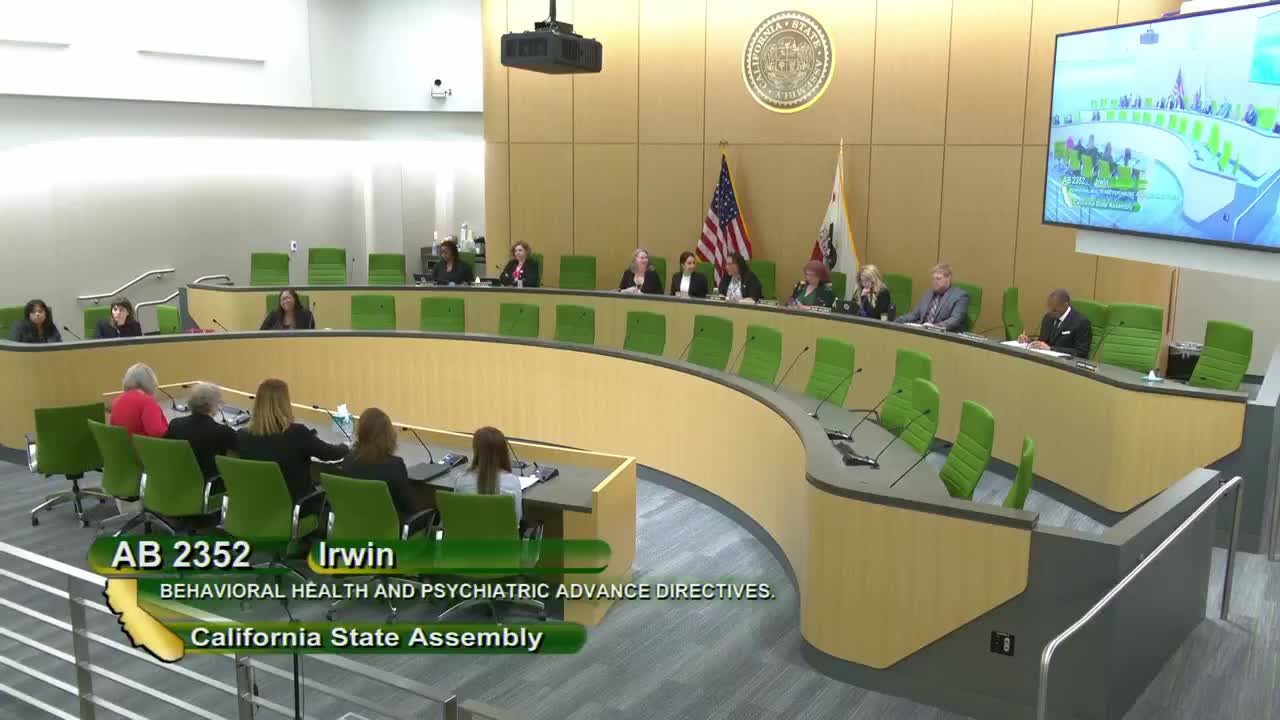 7MIN
Assembly Standing Committee on Health
 58SEC
Assembly Standing Committee on Health
Bill Author
Bill Co-Author(s):
