AB 2618: Surplus funds: investment.
- Session Year: 2023-2024
- House: Assembly
- Latest Version Date: 2024-09-14
Current Status:
Passed
(2024-09-14: Chaptered by Secretary of State - Chapter 239, Statutes of 2024.)
Introduced
In Committee
First Chamber
In Committee
Second Chamber
Enacted
Existing law authorizes a local agency that has the authority under law to invest funds, at its discretion, to invest a portion of its surplus funds in deposits at a commercial bank, savings bank, savings and loan association, or credit union that uses a private sector entity that assists in the placement of deposits, subject to certain conditions. Existing law, until January 1, 2026, prohibits deposits placed pursuant to that provision from exceeding 50% of the agencys funds that may be so invested and, on and after January 1, 2026, reduces that deposit limit to 30% of the agencys funds that may be so invested.
This bill would extend the date of the reduction to the 30% deposit limit to January 1, 2031.
Existing law establishes the California Debt and Investment Advisory Commission for, among other purposes, undertaking or commissioning studies on methods to reduce the costs and improve credit ratings of state and local issues and collecting, maintaining, and providing information on local agency investments of public funds for local agency investment.
This bill would require the commission, on or before January 1, 2030, to submit a prescribed report to the appropriate policy committees of the Legislature on the deposit of surplus funds pursuant to existing law by local agencies.
Existing law authorizes a local agency that has the authority under law to invest funds, at its discretion, to invest a portion of its surplus funds in deposits at a commercial bank, savings bank, savings and loan association, or credit union that uses a private sector entity that assists in the placement of deposits, subject to certain conditions. Existing law, until January 1, 2026, prohibits deposits placed pursuant to that provision from exceeding 50% of the agencys funds that may be so invested and, on and after January 1, 2026, reduces that deposit limit to 30% of the agencys funds that may be so invested.
This bill would extend the date of the reduction to the 30% deposit limit to January 1, 2031.
Existing law establishes the California Debt and Investment Advisory Commission for, among other purposes, undertaking or commissioning studies on methods to reduce the costs and improve credit ratings of state and local issues and collecting, maintaining, and providing information on local agency investments of public funds for local agency investment.
This bill would repeal the reduction to a 30% deposit limit. require the California Debt and Investment Advisory Commission, on or before January 1, 2030, to submit a prescribed report to the appropriate policy committees of the Legislature on the deposit of surplus funds pursuant to existing law by local agencies.
Existing law authorizes a local agency that has the authority under law to invest funds, at its discretion, to invest a portion of its surplus funds in deposits at a commercial bank, savings bank, savings and loan association, or credit union that uses a private sector entity that assists in the placement of deposits, subject to certain conditions. Existing law, until January 1, 2026, prohibits deposits placed pursuant to that provision from exceeding 50% of the agencys funds that may be so invested and, on and after January 1, 2026, reduces that deposit limit to 30% of the agencys funds that may be so invested.
This bill would repeal the reduction to a 30% deposit limit.
Existing law, the Debt Collection Licensing Act, prohibits a person from engaging in the business of debt collection in the state without first obtaining a license from the Commissioner of Financial Protection and Innovation, in accordance with specified requirements. Existing law authorizes the commissioner to allow any debt collector that submits an application before January 1, 2023, to operate pending the approval or denial of the application in accordance with specified requirements.This bill would make a nonsubstantive change to these provisions.Existing law, the Debt Collection Licensing Act, prohibits a person from engaging in the business of debt collection in the state without first obtaining a license from the Commissioner of Financial Protection and Innovation, in accordance with specified requirements. Existing law authorizes the commissioner to allow any debt collector that submits an application before January 1, 2023, to operate pending the approval or denial of the application in accordance with specified requirements.
This bill would make a nonsubstantive change to these provisions.
Notwithstanding any other provision of this code, a local agency that has the authority under law to invest funds, at its discretion, may invest a portion of its surplus funds in deposits at a commercial bank, savings bank, savings and loan association, or credit union that uses a private sector entity that assists in the placement of deposits. The following conditions shall apply:
(a)The local agency shall choose a nationally or state-chartered commercial bank, savings bank, savings and loan association, or credit union in this state to invest the funds, which shall be known as the selected depository institution.
(b)The selected depository institution may use a private sector entity to help place local agency deposits with one or more commercial banks, savings banks, savings and loan associations, or credit unions that are located in the United States and are within the network used by the private sector entity for this purpose.
(c)The selected depository institution shall request that the local agency inform it of depository institutions at which the local agency has other deposits, and the selected depository institution shall provide that information to the private sector entity.
(d)Any private sector entity used by a selected depository institution to help place its local agency deposits shall maintain policies and procedures requiring all of the following:
(1)The full amount of each deposit placed pursuant to subdivision (b) and the interest that may accrue on each such deposit shall at all times be insured by the Federal Deposit Insurance Corporation or the National Credit Union Administration.
(2)Every depository institution where funds are placed shall be capitalized at a level that is sufficient, and be otherwise eligible, to receive such deposits pursuant to regulations of the Federal Deposit Insurance Corporation or the National Credit Union Administration, as applicable.
(3)At the time of the local agencys investment with a selected depository institution and no less than monthly thereafter, the private sector entity shall ensure that the local agency is provided with an inventory of all depository institutions in which deposits have been placed on the local agencys behalf, that are within the private sector entitys network.
(4)Within its network, the private sector entity shall ensure that it does not place additional deposits from a particular local agency with any depository institution identified pursuant to subdivision (c) as holding that local agencys deposits if those additional deposits would result in that local agencys total amount on deposit at that depository institution exceeding the Federal Deposit Insurance Corporation or the National Credit Union Administration insurance limit.
(e)If a selected depository uses two or more private sector entities to assist in the placement of a local agencys deposits, the selected depository shall ensure that it does not place additional deposits from a particular local agency with a depository institution if those additional deposits would result in that local agencys total amount on deposit at that depository institution exceeding the Federal Deposit Insurance Corporation or the National Credit Union Administration insurance limit.
(f)The selected depository institution shall serve as a custodian for each such deposit.
(g)On the same date that the local agencys funds are placed pursuant to subdivision (b) by the private sector entity, the selected depository institution shall receive an amount of insured deposits from other financial institutions that, in total, are equal to, or greater than, the full amount of the principal that the local agency initially deposited through the selected depository institution pursuant to subdivision (b).
(h) Notwithstanding subdivisions (a) to (g), inclusive, a credit union shall not act as a selected depository institution under this section unless both of the following conditions are satisfied:
(1)The credit union offers federal depository insurance through the National Credit Union Administration.
(2)The credit union is in possession of written guidance or other written communication from the National Credit Union Administration authorizing participation of federally insured credit unions in one or more deposit placement services and affirming that the moneys held by those credit unions while participating in a deposit placement service will at all times be insured by the federal government.
(i)It is the intent of the Legislature that this section shall not restrict competition among private sector entities that provide placement services pursuant to this section.
(j)The deposits placed pursuant to this section shall be subject to Section 53638 and shall not, in total, exceed 50 percent of the agencys funds that may be invested for this purpose.
(k)(1)On or before January 1, 2030, the California Debt and Investment Advisory Commission shall submit a report to the appropriate policy committees of the Legislature on the deposit of surplus funds pursuant to this section by local agencies. The report shall include, but is not limited to, the following information:
(A)An overview of local agency surplus funds invested in depository institutions that use private-entity placement services pursuant to this section, including information regarding the number of agencies that have deposited more than 30 percent of their surplus funds in depository institutions that use private-entity placement services and whether any local agencies have deposited funds in more than one depository institution pursuant to this section.
(B)A recommendation for a limitation, if any, on the share of deposits that a local agency can invest in depository institutions that use private-entity placement services pursuant to this section for consideration by the Legislature.
(2)The report to be submitted pursuant to this subdivision shall be submitted in compliance with Section 9795.
(l)This section shall remain in effect only until January 1, 2031, and as of that date is repealed.
SEC. 2.Section 53601.8 of the Government Code, as added by Section 3 of Chapter 619 of the Statutes of 2019, is amended to read:53601.8.Notwithstanding any other provision of this code, a local agency that has the authority under law to invest funds, at its discretion, may invest a portion of its surplus funds in deposits at a commercial bank, savings bank, savings and loan association, or credit union that uses a private sector entity that assists in the placement of deposits. The following conditions shall apply:
(a)The local agency shall choose a nationally or state-chartered commercial bank, savings bank, savings and loan association, or credit union in this state to invest the funds, which shall be known as the selected depository institution.
(b)The selected depository institution may use a private sector entity to help place local agency deposits with one or more commercial banks, savings banks, savings and loan associations, or credit unions that are located in the United States and are within the network used by the private sector entity for this purpose.
(c)The selected depository institution shall request that the local agency inform it of depository institutions at which the local agency has other deposits, and the selected depository institution shall provide that information to the private sector entity.
(d)Any private sector entity used by a selected depository institution to help place its local agency deposits shall maintain policies and procedures requiring all of the following:
(1)The full amount of each deposit placed pursuant to subdivision (b) and the interest that may accrue on each such deposit shall at all times be insured by the Federal Deposit Insurance Corporation or the National Credit Union Administration.
(2)Every depository institution where funds are placed shall be capitalized at a level that is sufficient, and be otherwise eligible, to receive such deposits pursuant to regulations of the Federal Deposit Insurance Corporation or the National Credit Union Administration, as applicable.
(3)At the time of the local agencys investment with a selected depository institution and no less than monthly thereafter, the private sector entity shall ensure that the local agency is provided with an inventory of all depository institutions in which deposits have been placed on the local agencys behalf, that are within the private sector entitys network.
(4)Within its network, the private sector entity shall ensure that it does not place additional deposits from a particular local agency with any depository institution identified pursuant to subdivision (c) as holding that local agencys deposits if those additional deposits would result in that local agencys total amount on deposit at that depository institution exceeding the Federal Deposit Insurance Corporation or the National Credit Union Administration insurance limit.
(e)If a selected depository uses two or more private sector entities to assist in the placement of a local agencys deposits, the selected depository shall ensure that it does not place additional deposits from a particular local agency with a depository institution if those additional deposits would result in that local agencys total amount on deposit at that depository institution exceeding the Federal Deposit Insurance Corporation or the National Credit Union Administration insurance limit.
(f)The selected depository institution shall serve as a custodian for each such deposit.
(g)On the same date that the local agencys funds are placed pursuant to subdivision (b) by the private sector entity, the selected depository institution shall receive an amount of insured deposits from other financial institutions that, in total, are equal to, or greater than, the full amount of the principal that the local agency initially deposited through the selected depository institution pursuant to subdivision (b).
(h)Notwithstanding subdivisions (a) to (g), inclusive, a credit union shall not act as a selected depository institution under this section unless both of the following conditions are satisfied:
(1)The credit union offers federal depository insurance through the National Credit Union Administration.
(2)The credit union is in possession of written guidance or other written communication from the National Credit Union Administration authorizing participation of federally insured credit unions in one or more deposit placement services and affirming that the moneys held by those credit unions while participating in a deposit placement service will at all times be insured by the federal government.
(i)It is the intent of the Legislature that this section shall not restrict competition among private sector entities that provide placement services pursuant to this section.
(j)The deposits placed pursuant to this section shall be subject to Section 53638 and shall not, in total, exceed 30 percent of the agencys funds that may be invested for this purpose.
(k)This section shall become operative on January 1, 2031.
Notwithstanding any other provision of this code, a local agency that has the authority under law to invest funds, at its discretion, may invest a portion of its surplus funds in deposits at a commercial bank, savings bank, savings and loan association, or credit union that uses a private sector entity that assists in the placement of deposits. The following conditions shall apply:
(a)The local agency shall choose a nationally or state-chartered commercial bank, savings bank, savings and loan association, or credit union in this state to invest the funds, which shall be known as the selected depository institution.
(b)The selected depository institution may use a private sector entity to help place local agency deposits with one or more commercial banks, savings banks, savings and loan associations, or credit unions that are located in the United States and are within the network used by the private sector entity for this purpose.
(c)The selected depository institution shall request that the local agency inform it of depository institutions at which the local agency has other deposits, and the selected depository institution shall provide that information to the private sector entity.
(d)Any private sector entity used by a selected depository institution to help place its local agency deposits shall maintain policies and procedures requiring all of the following:
(1)The full amount of each deposit placed pursuant to subdivision (b) and the interest that may accrue on each such deposit shall at all times be insured by the Federal Deposit Insurance Corporation or the National Credit Union Administration.
(2)Every depository institution where funds are placed shall be capitalized at a level that is sufficient, and be otherwise eligible, to receive such deposits pursuant to regulations of the Federal Deposit Insurance Corporation or the National Credit Union Administration, as applicable.
(3)At the time of the local agencys investment with a selected depository institution and no less than monthly thereafter, the private sector entity shall ensure that the local agency is provided with an inventory of all depository institutions in which deposits have been placed on the local agencys behalf, that are within the private sector entitys network.
(4)Within its network, the private sector entity shall ensure that it does not place additional deposits from a particular local agency with any depository institution identified pursuant to subdivision (c) as holding that local agencys deposits if those additional deposits would result in that local agencys total amount on deposit at that depository institution exceeding the Federal Deposit Insurance Corporation or the National Credit Union Administration insurance limit.
(e)If a selected depository uses two or more private sector entities to assist in the placement of a local agencys deposits, the selected depository shall ensure that it does not place additional deposits from a particular local agency with a depository institution if those additional deposits would result in that local agencys total amount on deposit at that depository institution exceeding the Federal Deposit Insurance Corporation or the National Credit Union Administration insurance limit.
(f)The selected depository institution shall serve as a custodian for each such deposit.
(g)On the same date that the local agencys funds are placed pursuant to subdivision (b) by the private sector entity, the selected depository institution shall receive an amount of insured deposits from other financial institutions that, in total, are equal to, or greater than, the full amount of the principal that the local agency initially deposited through the selected depository institution pursuant to subdivision (b).
(h) Notwithstanding subdivisions (a) to (g), inclusive, a credit union shall not act as a selected depository institution under this section unless both of the following conditions are satisfied:
(1)The credit union offers federal depository insurance through the National Credit Union Administration.
(2)The credit union is in possession of written guidance or other written communication from the National Credit Union Administration authorizing participation of federally insured credit unions in one or more deposit placement services and affirming that the moneys held by those credit unions while participating in a deposit placement service will at all times be insured by the federal government.
(i)It is the intent of the Legislature that this section shall not restrict competition among private sector entities that provide placement services pursuant to this section.
(j)The deposits placed pursuant to this section shall be subject to Section 53638 and shall not, in total, exceed 50 percent of the agencys funds that may be invested for this purpose.
(k)(1)On or before January 1, 2030, the California Debt and Investment Advisory Commission shall submit a report to the appropriate policy committees of the Legislature on the deposit of surplus funds pursuant to this section by local agencies. The report shall include, but is not limited to, the following information:
(A)An overview of local agency surplus funds invested in depository institutions that use private-entity placement services pursuant to this section, including information regarding the number of agencies that have deposited more than 30 percent of their surplus funds in depository institutions that use private-entity placement services and whether any local agencies have deposited funds in more than one depository institution pursuant to this section.
(B)A recommendation for a limitation, if any, on the share of deposits that a local agency can invest in depository institutions that use private-entity placement services pursuant to this section for consideration by the Legislature.
(2)The report to be submitted pursuant to this subdivision shall be submitted in compliance with Section 9795.
(l)This section shall remain in effect only until January 1, 2031, and as of that date is repealed.
SEC. 2.Section 53601.8 of the Government Code, as added by Section 3 of Chapter 619 of the Statutes of 2019, is repealed.SEC. 2.Section 53601.8 of the Government Code, as added by Section 3 of Chapter 619 of the Statutes of 2019, is amended to read:53601.8.Notwithstanding any other provision of this code, a local agency that has the authority under law to invest funds, at its discretion, may invest a portion of its surplus funds in deposits at a commercial bank, savings bank, savings and loan association, or credit union that uses a private sector entity that assists in the placement of deposits. The following conditions shall apply:
(a)The local agency shall choose a nationally or state-chartered commercial bank, savings bank, savings and loan association, or credit union in this state to invest the funds, which shall be known as the selected depository institution.
(b)The selected depository institution may use a private sector entity to help place local agency deposits with one or more commercial banks, savings banks, savings and loan associations, or credit unions that are located in the United States and are within the network used by the private sector entity for this purpose.
(c)The selected depository institution shall request that the local agency inform it of depository institutions at which the local agency has other deposits, and the selected depository institution shall provide that information to the private sector entity.
(d)Any private sector entity used by a selected depository institution to help place its local agency deposits shall maintain policies and procedures requiring all of the following:
(1)The full amount of each deposit placed pursuant to subdivision (b) and the interest that may accrue on each such deposit shall at all times be insured by the Federal Deposit Insurance Corporation or the National Credit Union Administration.
(2)Every depository institution where funds are placed shall be capitalized at a level that is sufficient, and be otherwise eligible, to receive such deposits pursuant to regulations of the Federal Deposit Insurance Corporation or the National Credit Union Administration, as applicable.
(3)At the time of the local agencys investment with a selected depository institution and no less than monthly thereafter, the private sector entity shall ensure that the local agency is provided with an inventory of all depository institutions in which deposits have been placed on the local agencys behalf, that are within the private sector entitys network.
(4)Within its network, the private sector entity shall ensure that it does not place additional deposits from a particular local agency with any depository institution identified pursuant to subdivision (c) as holding that local agencys deposits if those additional deposits would result in that local agencys total amount on deposit at that depository institution exceeding the Federal Deposit Insurance Corporation or the National Credit Union Administration insurance limit.
(e)If a selected depository uses two or more private sector entities to assist in the placement of a local agencys deposits, the selected depository shall ensure that it does not place additional deposits from a particular local agency with a depository institution if those additional deposits would result in that local agencys total amount on deposit at that depository institution exceeding the Federal Deposit Insurance Corporation or the National Credit Union Administration insurance limit.
(f)The selected depository institution shall serve as a custodian for each such deposit.
(g)On the same date that the local agencys funds are placed pursuant to subdivision (b) by the private sector entity, the selected depository institution shall receive an amount of insured deposits from other financial institutions that, in total, are equal to, or greater than, the full amount of the principal that the local agency initially deposited through the selected depository institution pursuant to subdivision (b).
(h)Notwithstanding subdivisions (a) to (g), inclusive, a credit union shall not act as a selected depository institution under this section unless both of the following conditions are satisfied:
(1)The credit union offers federal depository insurance through the National Credit Union Administration.
(2)The credit union is in possession of written guidance or other written communication from the National Credit Union Administration authorizing participation of federally insured credit unions in one or more deposit placement services and affirming that the moneys held by those credit unions while participating in a deposit placement service will at all times be insured by the federal government.
(i)It is the intent of the Legislature that this section shall not restrict competition among private sector entities that provide placement services pursuant to this section.
(j)The deposits placed pursuant to this section shall be subject to Section 53638 and shall not, in total, exceed 30 percent of the agencys funds that may be invested for this purpose.
(k)This section shall become operative on January 1, 2026. 2031.
Notwithstanding any other provision of this code, a local agency that has the authority under law to invest funds, at its discretion, may invest a portion of its surplus funds in deposits at a commercial bank, savings bank, savings and loan association, or credit union that uses a private sector entity that assists in the placement of deposits. The following conditions shall apply:
(a)The local agency shall choose a nationally or state-chartered commercial bank, savings bank, savings and loan association, or credit union in this state to invest the funds, which shall be known as the selected depository institution.
(b)The selected depository institution may use a private sector entity to help place local agency deposits with one or more commercial banks, savings banks, savings and loan associations, or credit unions that are located in the United States and are within the network used by the private sector entity for this purpose.
(c)The selected depository institution shall request that the local agency inform it of depository institutions at which the local agency has other deposits, and the selected depository institution shall provide that information to the private sector entity.
(d)Any private sector entity used by a selected depository institution to help place its local agency deposits shall maintain policies and procedures requiring all of the following:
(1)The full amount of each deposit placed pursuant to subdivision (b) and the interest that may accrue on each such deposit shall at all times be insured by the Federal Deposit Insurance Corporation or the National Credit Union Administration.
(2)Every depository institution where funds are placed shall be capitalized at a level that is sufficient, and be otherwise eligible, to receive such deposits pursuant to regulations of the Federal Deposit Insurance Corporation or the National Credit Union Administration, as applicable.
(3)At the time of the local agencys investment with a selected depository institution and no less than monthly thereafter, the private sector entity shall ensure that the local agency is provided with an inventory of all depository institutions in which deposits have been placed on the local agencys behalf, that are within the private sector entitys network.
(4)Within its network, the private sector entity shall ensure that it does not place additional deposits from a particular local agency with any depository institution identified pursuant to subdivision (c) as holding that local agencys deposits if those additional deposits would result in that local agencys total amount on deposit at that depository institution exceeding the Federal Deposit Insurance Corporation or the National Credit Union Administration insurance limit.
(e)If a selected depository uses two or more private sector entities to assist in the placement of a local agencys deposits, the selected depository shall ensure that it does not place additional deposits from a particular local agency with a depository institution if those additional deposits would result in that local agencys total amount on deposit at that depository institution exceeding the Federal Deposit Insurance Corporation or the National Credit Union Administration insurance limit.
(f)The selected depository institution shall serve as a custodian for each such deposit.
(g)On the same date that the local agencys funds are placed pursuant to subdivision (b) by the private sector entity, the selected depository institution shall receive an amount of insured deposits from other financial institutions that, in total, are equal to, or greater than, the full amount of the principal that the local agency initially deposited through the selected depository institution pursuant to subdivision (b).
(h) Notwithstanding subdivisions (a) to (g), inclusive, a credit union shall not act as a selected depository institution under this section unless both of the following conditions are satisfied:
(1)The credit union offers federal depository insurance through the National Credit Union Administration.
(2)The credit union is in possession of written guidance or other written communication from the National Credit Union Administration authorizing participation of federally insured credit unions in one or more deposit placement services and affirming that the moneys held by those credit unions while participating in a deposit placement service will at all times be insured by the federal government.
(i)It is the intent of the Legislature that this section shall not restrict competition among private sector entities that provide placement services pursuant to this section.
(j)The deposits placed pursuant to this section shall be subject to Section 53638 and shall not, in total, exceed 50 percent of the agencys funds that may be invested for this purpose.
(k)This section shall remain in effect until January 1, 2026, and as of that date is repealed.SEC. 2.Section 53601.8 of the Government Code, as added by Section 3 of Chapter 619 of the Statutes of 2019, is repealed.53601.8.Notwithstanding any other provision of this code, a local agency that has the authority under law to invest funds, at its discretion, may invest a portion of its surplus funds in deposits at a commercial bank, savings bank, savings and loan association, or credit union that uses a private sector entity that assists in the placement of deposits. The following conditions shall apply:(a)The local agency shall choose a nationally or state-chartered commercial bank, savings bank, savings and loan association, or credit union in this state to invest the funds, which shall be known as the selected depository institution.(b)The selected depository institution may use a private sector entity to help place local agency deposits with one or more commercial banks, savings banks, savings and loan associations, or credit unions that are located in the United States and are within the network used by the private sector entity for this purpose.(c)The selected depository institution shall request that the local agency inform it of depository institutions at which the local agency has other deposits, and the selected depository institution shall provide that information to the private sector entity.(d)Any private sector entity used by a selected depository institution to help place its local agency deposits shall maintain policies and procedures requiring all of the following:(1)The full amount of each deposit placed pursuant to subdivision (b) and the interest that may accrue on each such deposit shall at all times be insured by the Federal Deposit Insurance Corporation or the National Credit Union Administration.(2)Every depository institution where funds are placed shall be capitalized at a level that is sufficient, and be otherwise eligible, to receive such deposits pursuant to regulations of the Federal Deposit Insurance Corporation or the National Credit Union Administration, as applicable.(3)At the time of the local agencys investment with a selected depository institution and no less than monthly thereafter, the private sector entity shall ensure that the local agency is provided with an inventory of all depository institutions in which deposits have been placed on the local agencys behalf, that are within the private sector entitys network.(4)Within its network, the private sector entity shall ensure that it does not place additional deposits from a particular local agency with any depository institution identified pursuant to subdivision (c) as holding that local agencys deposits if those additional deposits would result in that local agencys total amount on deposit at that depository institution exceeding the Federal Deposit Insurance Corporation or the National Credit Union Administration insurance limit.(e)If a selected depository uses two or more private sector entities to assist in the placement of a local agencys deposits, the selected depository shall ensure that it does not place additional deposits from a particular local agency with a depository institution if those additional deposits would result in that local agencys total amount on deposit at that depository institution exceeding the Federal Deposit Insurance Corporation or the National Credit Union Administration insurance limit.(f)The selected depository institution shall serve as a custodian for each such deposit.(g)On the same date that the local agencys funds are placed pursuant to subdivision (b) by the private sector entity, the selected depository institution shall receive an amount of insured deposits from other financial institutions that, in total, are equal to, or greater than, the full amount of the principal that the local agency initially deposited through the selected depository institution pursuant to subdivision (b).(h)Notwithstanding subdivisions (a) to (g), inclusive, a credit union shall not act as a selected depository institution under this section unless both of the following conditions are satisfied:(1)The credit union offers federal depository insurance through the National Credit Union Administration.(2)The credit union is in possession of written guidance or other written communication from the National Credit Union Administration authorizing participation of federally insured credit unions in one or more deposit placement services and affirming that the moneys held by those credit unions while participating in a deposit placement service will at all times be insured by the federal government.(i)It is the intent of the Legislature that this section shall not restrict competition among private sector entities that provide placement services pursuant to this section.(j)The deposits placed pursuant to this section shall be subject to Section 53638 and shall not, in total, exceed 30 percent of the agencys funds that may be invested for this purpose.(k)This section shall become operative on January 1, 2026.SECTION 1.Section 100000.5 of the Financial Code is amended to read:100000.5.(a)The commissioner shall allow a debt collector that submits an application before January 1, 2023, to operate pending the approval or denial of the application.(b)(1)Notwithstanding Section 100011, the commissioner may issue a conditional license to an applicant pending compliance with the requirements of subdivisions (a) to (c), inclusive, of Section 100008.(2)A conditional license issued pursuant to this subdivision shall expire at the earliest of the following:(A)Ninety days after the requirements of Sections 100007, 100008, and 100009 have been satisfied.(B)Upon the issuance of an unconditional license.(C)Ninety days after the commissioner directs the licensee in writing to submit fingerprints for submission to the Department of Justice pursuant to Section 100008, if the licensee fails to submit a set of fingerprints for each individual described in Section 100009.(D)Upon the denial, pursuant to Section 100012, of a license application.(c)The commissioner may deny an application under Section 100012 at any time before the issuance of an unconditional license.(a)The commissioner shall allow any a debt collector that submits an application before January 1, 2023, to operate pending the approval or denial of the application.
(b)(1)Notwithstanding Section 100011, the commissioner may issue a conditional license to an applicant pending compliance with the requirements of subdivisions (a) to (c), inclusive, of Section 100008.
(2)A conditional license issued pursuant to this subdivision shall expire at the earliest of the following:
(A)Ninety days after the requirements of Sections 100007, 100008, and 100009 have been satisfied.
(B)Upon the issuance of an unconditional license.
(C)Ninety days after the commissioner directs the licensee in writing to submit fingerprints for submission to the Department of Justice pursuant to Section 100008, if the licensee fails to submit a set of fingerprints for each individual described in Section 100009.
(D)Upon the denial, pursuant to Section 100012, of a license application.
(c)The commissioner may deny an application under Section 100012 at any time before the issuance of an unconditional license.
|
Date
|
Status
|
|---|---|
| Sep 14, 2024 | Chaptered by Secretary of State - Chapter 239, Statutes of 2024. |
| Sep 14, 2024 | Approved by the Governor. |
| Aug 28, 2024 | Enrolled and presented to the Governor at 4 p.m. |
| Aug 22, 2024 | Senate amendments concurred in. To Engrossing and Enrolling. (Ayes 61. Noes 0. Page 6433.). |
| Aug 20, 2024 | In Assembly. Concurrence in Senate amendments pending. May be considered on or after August 22 pursuant to Assembly Rule 77. |
| Aug 20, 2024 | Read third time. Passed. Ordered to the Assembly. (Ayes 40. Noes 0. Page 5234.). |
| Aug 6, 2024 | Read second time. Ordered to third reading. |
| Aug 5, 2024 | From committee: Be ordered to second reading pursuant to Senate Rule 28.8. |
| Jul 1, 2024 | In committee: Hearing postponed by committee. |
| Jun 20, 2024 | From committee: Do pass and re-refer to Com. on APPR. (Ayes 6. Noes 0.) (June 19). Re-referred to Com. on APPR. |
| May 30, 2024 | Read second time and amended. Re-referred to Com. on B. & F.I. |
| May 29, 2024 | From committee: Amend, and do pass as amended and re-refer to Com. on B. & F.I. (Ayes 7. Noes 0.) (May 29). |
| May 22, 2024 | Referred to Coms. on L. GOV. and B. & F.I. |
| May 9, 2024 | In Senate. Read first time. To Com. on RLS. for assignment. |
| May 9, 2024 | Read third time. Passed. Ordered to the Senate. (Ayes 65. Noes 0. Page 5162.) |
| May 2, 2024 | Read second time. Ordered to Consent Calendar. |
| May 1, 2024 | From committee: Do pass. To Consent Calendar. (Ayes 9. Noes 0.) (May 1). |
| Apr 16, 2024 | From committee: Do pass and re-refer to Com. on L. GOV. (Ayes 9. Noes 0.) (April 15). Re-referred to Com. on L. GOV. |
| Apr 1, 2024 | Re-referred to Coms. on B. & F. and L. GOV. |
| Apr 1, 2024 | Re-referred to Com. on L. GOV. |
| Mar 21, 2024 | Referred to Coms. on L. GOV. and B. & F. |
| Mar 21, 2024 | From committee chair, with author's amendments: Amend, and re-refer to Com. on L. GOV. Read second time and amended. |
| Feb 15, 2024 | From printer. May be heard in committee March 16. |
| Feb 14, 2024 | Read first time. To print. |
|
Date
|
Description
|
Location
|
Votes
|
|
|---|---|---|---|---|
| Aug 22, 2024 | AB 2618 Chen Concurrence in Senate Amendments | Assembly Floor |
Passed |
|
| Aug 20, 2024 | Assembly 3rd Reading AB2618 Chen By Niello | Senate Floor |
Passed |
|
| Jun 19, 2024 | Do pass, but first be re-referred to the Committee on [Appropriations] | Senate Standing Committee on Banking and Financial Institutions |
Passed |
|
| May 29, 2024 | Do pass as amended, but first amend, and re-refer to the Committee on [Banking and Financial Institutions] | Senate Standing Committee on Local Government |
Passed |
|
| May 9, 2024 | AB 2618 Chen Consent Calendar Second Day Regular Session | Assembly Floor |
Passed |
|
| May 1, 2024 | Do pass. To Consent Calendar. | Assembly Standing Committee on Local Government |
Passed |
|
| Apr 15, 2024 | Do pass and be re-referred to the Committee on [Local Government] | Assembly Standing Committee on Banking and Finance |
Passed |
This list shows positions taken on this bill by organizations on the date displayed, which is linked to the original source.
Positions by individuals are not included.
|
Organization
|
Position
|
Date
|
|---|---|---|
| California Bankers Association | ** Support | |
| California Community Banking Network | ** Support | |
| California Credit Union League | ** Support |
CONCURRENCE IN SENATE AMENDMENTS
CSA1 Bill Id:AB 2618
Author:(Chen)
As Amended Ver:May 30, 2024
Majority vote
SUMMARY
This bill extends, until January 1, 2031, the authority for a local agency to invest up to 50% (rather than 30%) of its surplus funds in deposits at a commercial bank, savings bank, savings and loan association, or credit union under specified conditions.
Senate Amendments
- Reestablish a sunset date and extend it to January 1, 2031.
- Require, on or before January 1, 2030, the California Debt Investment Advisory Commission to submit a report to the appropriate policy committees of the Legislature on specified deposits of surplus funds by local agencies. The report shall include, but is not limited to, the following information:
- An overview of local agency surplus funds invested in depository institutions that use private-entity placement services, as specified, including information regarding the number of agencies that have deposited more than 30% of their surplus funds in depository institutions that use private-entity placement services and whether any local agencies have deposited funds in more than one depository institution, as specified.
- A recommendation for a limitation, if any, on the share of deposits that a local agency can invest in depository institutions that use private-entity placement services for consideration by the Legislature.
- Require the report in 2) above, to be submitted in compliance with existing law.
COMMENTS
- Surplus Investments. Since 1913, state law has authorized local officials to invest a portion of local agencies' temporarily idle funds in a variety of financial instruments. Originally, state law limited the instruments to government bonds, but over time the laws governing local agency investments have been amended to keep pace with changing investment opportunities and current market offerings.
California law allows local officials to deposit money in state or national banks, savings associations, federal associations, credit unions, or federally insured industrial loan companies in the State of California. When investing, reinvesting, purchasing, acquiring, exchanging, selling, or managing public funds, state law outlines local agencies' investment objectives, also known as the prudent investor standard. The primary objective is to safeguard the principal of the funds under the local agency's control. The secondary objective is to meet the liquidity needs of the depositor. The final objective is to achieve a return on the funds under its control.
State law limits the percentage that local agencies can invest in many types of investments. This encourages local agencies to diversify their investment portfolios, which limits the risk to the local agency if any investment does not have the expected return. Local agencies make investments with different maturity dates, which refer to the date when the borrower must make the final payment due on an investment.
- Deposits. Public deposits are subject to restrictions, including a requirement that deposits must be insured by the FDIC or, to the extent not insured, collateralized with certain types of securities in specified amounts. FDIC insurance usually covers only $250,000 per depositor per institution. As a result, to secure large public deposits, depository institutions must hold significant amounts of collateral. Deposit placement services emerged in the early 2000s as a mechanism for a depository institution to accept a deposit from a local government of greater than the FDIC-insured amount.
Generally, deposit placement services will work with a local agency's initial selected bank to transfer the local agency's money in $250,000 increments to other banks. At the same time, that same service works with other accountholders and member banks to place deposits of a similar aggregate amount back in that selected bank. Thus, the local agency's deposits are fully federally insured, despite being in excess of the $250,000 insured limit, while the local depository institution receives the full deposit.
The success of deposit placement services, and the FDIC's acceptance of them, have led local financial institutions to seek larger deposits from local governments. These deposits, also called brokered deposits or reciprocal deposits, allow more taxpayer funds to be injected into the local banking system, rather than being invested in government bonds or other debt securities outside of the local banking system.
- Previous Legislation. AB 2011 (Vargas), Chapter 459, Statutes of 2006, until January 1, 2012, authorized local agencies to invest up to 30% of surplus funds in a private sector, certificate of deposit (CD) placement service.
SB 1344 (Kehoe), Chapter 112, Statutes of 2010, deleted the sunset date contained in AB 2011, thus permanently extending the ability of local agencies to use private sector, CD placement services.
AB 279 (Dickinson), Chapter 228, Statutes of 2013, until January 1, 2017, authorized local agencies to invest surplus funds in deposits other than CDs at depository institutions that use a private sector entity to assist in the placement of deposits, but capped the amount that any local agency could invest in non-CD deposits placed by any single placement service at 10%.
AB 283 (Dababneh), Chapter 181, Statutes of 2015 deleted the 10% per placement agency cap added by AB 279 and extended the sunset date on local agencies' ability to invest in non-CD deposits at depository institutions that use private sector placement agencies to January 1, 2021.
AB 945 (McCarty), Chapter 619, Statutes of 2019, increased, until January 1, 2026, from 30% to 50%, the maximum allowable percentage of a local agency's surplus funds that the local agency may invest in depository institutions that use a private sector entity to assist in the placement of deposits.
According to the Author
According to the author, "Depository institutions that use reciprocal deposits as a means to collateralize against local agency deposits are community banks operating within the geographical region of the local agency. This measure will maintain flexibility for local agencies and banks as they work together in managing local agency funds and in serving their communities. By keeping these funds in the community, rather than forcing local agencies to invest in the stock market, banks and credit unions can lend back into the community and local agencies have quick access to the funds in the event of a liquidity crisis."
Arguments in Support
According to the California Bankers Association, California Community Banking Network, and California Credit Union League, "Until January 1, 2026, Government Code Section 53601.8 allows, but does not mandate, a local agency to deposit up to 50 percent of their overall surplus funds with a depository institution that uses reciprocal deposits as a means of collateralization. These local agency funds may be deposited into a certificate of deposit or a demand deposit account. Using reciprocal deposits allows the depository institution to accept a deposit from a local agency exceeding the Federal Deposit Insurance Corporation or National Credit Union Association standard insurance limit of $250,000 (per depositor) while maintaining full insurance coverage over the entirety of the local agency's deposit.
"Unless the sunset date is removed, on January 1, 2026, the maximum 50 percent of local agency funds that may be placed using reciprocal deposits will be reduced to 30 percent. Depository institutions that use reciprocal deposits as a means to collateralize against local agency deposits are community banks and credit unions operating within the geographical region of the local agency. This measure maintains flexibility for local agencies and banks as they work together in managing local agency funds and in serving their communities."
Arguments in Opposition
None on file.
FISCAL COMMENTS
According to the Senate Appropriations Committee, pursuant to Senate Rule 28.8, negligible state costs.
VOTES:
ASM BANKING AND FINANCE: 9-0-0
YES: Grayson, Chen, Cervantes, Dixon, Mike Fong, Maienschein, Petrie-Norris, Blanca Rubio, Soria
ASM LOCAL GOVERNMENT: 9-0-0
YES: Juan Carrillo, Waldron, Essayli, Haney, Kalra, Pacheco, Ramos, Ward, Wilson
ASSEMBLY FLOOR: 65-0-15
YES: Addis, Aguiar-Curry, Alanis, Alvarez, Arambula, Bauer-Kahan, Bennett, Berman, Boerner, Bonta, Bryan, Calderon, Juan Carrillo, Wendy Carrillo, Chen, Connolly, Davies, Dixon, Essayli, Mike Fong, Vince Fong, Friedman, Gallagher, Garcia, Gipson, Hart, Holden, Hoover, Irwin, Jackson, Jones-Sawyer, Kalra, Lackey, Lee, Lowenthal, Maienschein, McCarty, McKinnor, Muratsuchi, Ortega, Pacheco, Papan, Jim Patterson, Joe Patterson, Pellerin, Quirk-Silva, Ramos, Rendon, Reyes, Rodriguez, Blanca Rubio, Sanchez, Santiago, Soria, Ta, Valencia, Villapudua, Waldron, Ward, Weber, Wicks, Wilson, Wood, Zbur, Robert Rivas
ABS, ABST OR NV: Bains, Cervantes, Megan Dahle, Flora, Gabriel, Grayson, Haney, Low, Mathis, Stephanie Nguyen, Petrie-Norris, Luz Rivas, Schiavo, Ting, Wallis
SENATE FLOOR: 40-0-0
YES: Allen, Alvarado-Gil, Archuleta, Ashby, Atkins, Becker, Blakespear, Bradford, Caballero, Cortese, Dahle, Dodd, Durazo, Eggman, Glazer, Gonzalez, Grove, Hurtado, Jones, Laird, Limón, McGuire, Menjivar, Min, Newman, Nguyen, Niello, Ochoa Bogh, Padilla, Portantino, Roth, Rubio, Seyarto, Skinner, Smallwood-Cuevas, Stern, Umberg, Wahab, Wiener, Wilk
UPDATED
VERSION: May 30, 2024
CONSULTANT: Jimmy MacDonald / L. GOV. / (916) 319-3958 FN: 0004258
SENATE RULES COMMITTEE Office of Senate Floor Analyses (916) 651-1520 Fax: (916) 327-4478 | AB 2618 |
THIRD READING
Bill No: AB 2618
Author: Chen (R)
Amended: 5/30/24 in Senate
Vote: 21
SENATE LOCAL GOVERNMENT COMMITTEE: 7-0, 5/29/24
AYES: Durazo, Seyarto, Dahle, Glazer, Skinner, Wahab, Wiener
SENATE BANKING & F.I. COMMITTEE: 6-0, 6/19/24
AYES: Limón, Niello, Caballero, Min, Nguyen, Portantino
NO VOTE RECORDED: Bradford
SENATE APPROPRIATIONS COMMITTEE: Senate Rule 28.8
ASSEMBLY FLOOR: 65-0, 5/9/24 (Consent) - See last page for vote
SUBJECT: Surplus funds: investment
SOURCE: California Bankers Association
DIGEST:
This bill extends, until January 1, 2031, the authority for a local agency to invest up to 50 percent (rather than 30 percent) of its surplus funds in deposits at a commercial bank, savings bank, savings and loan association, or credit union under specified conditions.
ANALYSIS:
Existing law:
- Provides that all governing bodies of local agencies are trustees and therefore fiduciaries subject to the prudent investor standard, as specified.
- Provides that the primary objective of a trustee shall be to safeguard the principal of funds under its control, the secondary objective shall be to meet the liquidity needs of the depositor, and the third objective shall be to achieve a return on the funds under its control.
- Authorizes a local agency, until January 1, 2026, to invest a portion of its surplus funds in deposits at a commercial bank, savings bank, savings and loan association, or credit union that uses a private sector entity that assists in the placement of deposits, provided that the purchases of deposits, in total, do not exceed 50 percent of the agency's funds. Starting January 1, 2026, the allowable limit of surplus funds that may be invested in this type of deposit arrangement decreases to 30 percent.
- Provides that the following conditions apply for a local agency to invest its surplus funds in deposits:
- The local agency shall choose a nationally or state chartered commercial bank, savings bank, savings and loan association, or credit union in California to invest the funds, which shall be known as the “selected” depository institution;
- The selected depository institution may use a private sector entity to help place local agency deposits with one or more commercial banks, savings banks, savings and loan associations, or credit unions that are located in the United States and within the network used by the private sector entity for this purpose;
- The selected depository institution shall request that the local agency inform it of depository institutions at which the local agency has other deposits, and the selected depository institution shall provide the information to the private sector entity.
- Any private sector entity used by a selected depository institution to help place its local agency deposits shall maintain policies and procedures that require the full amount of each deposit placed to be insured by the Federal Deposit Insurance Corporation (FDIC) or the National Credit Union Administration (NCUA) and to ensure that deposits are not placed in a manner that exceeds FDIC or NCUA insurance limits.
- The selected depository institution shall serve as a custodian for each deposit; and,
- On the same date the local agency’s funds are deposited, the selected depository institution shall receive an amount of insured deposits from other financial institutions that, in total, are equal to, or greater than, the full amount of the principal that the local agency initially deposited through the selected depository institution for investment.
This bill:
- Extends the sunset provision in existing law to January 1, 2031.
- Requires, on or before January 1, 2030, the California Debt and Investment Advisory Commission to submit a report related to the deposit of surplus funds using private-entity placement services, as specified.
Background
Since 1913, state law has authorized local officials to invest a portion of local agencies’ temporarily idle funds in a variety of financial instruments. Originally, state law limited the instruments to government bonds, but over time the laws governing local agency investments have been amended to keep pace with changing investment opportunities and current market offerings. California law allows local officials to deposit money in state or national banks, savings associations, federal associations, credit unions, or federally insured industrial loan companies in California. When investing, reinvesting, purchasing, acquiring, exchanging, selling, or managing public funds, state law outlines the investment objectives local agencies must adhere to, also known as the prudent investor standard. The primary objective is to safeguard the principal of the funds under its control. The secondary objective is to meet the liquidity needs of the depositor. The final objective is to achieve a return on the funds under its control. These public deposits, which include funds placed into certificates of deposit (CDs), are subject to restrictions, including a requirement that deposits must be insured by the FDIC or, in the case of a credit union, the NCUA. FDIC or NCUA insurance usually covers only $250,000 per depositor per institution. Deposits that do not meet these insurance require other forms of collateralization with certain types of securities in specified amounts, such as surety bonds. Since many local agencies have deposits well in excess of $250,000, to secure large public deposits, depository institutions must hold significant amounts of collateral.
In 1989, U.S. Congress codified the idea of “brokered deposits” into the Federal Deposit Insurance Act. This legislation helped regulate investors engaged in the business of placing deposits, or facilitating the placement of deposits, for third parties with insured depository institutions. In 2003, a private company established a network through which banks could place customer funds in deposits at other banks and receive deposits in an equal amount of funds in return. As an alternative to seeking other forms of collateral, placement services allow a public agency to deposit more than $250,000 in one bank while maintaining FDIC insurance by placing deposits in amounts that do not exceed $250,000 in other institutions.
In 2006, the Legislature authorized local agencies to invest up to 30 percent of their surplus funds in CDs issued through a private sector deposit placement service and included a January 1, 2012, sunset date (AB 2011, Vargas, Chapter 459, Statutes of 2006). Subsequent legislation repealed a sunset date from the statutes authorizing local agencies to invest in CDs using a deposit placement service (SB 1344, Kehoe, Chapter 112, Statutes of 2010). In 2013, the Legislature expanded local governments’ statutory authority to invest surplus funds through a deposit placement service to allow surplus funds to be placed not just in CDs but also in other types of deposits with a January 1, 2017, sunset date (AB 279, Dickinson, Chapter 228, Statutes of 2013). AB 283 (Dababneh, Chapter 181, Statutes of 2015) extended the sunset date on this authority to January 1, 2021.
Most recently, in 2019, AB 945 (McCarty, Chapter 619, Statutes of 2019) repealed the sunset on the ability of local governments to invest in other types of deposits. It also increased the cap on the share of a local agency’s surplus funds that can be invested through a deposit placement service to 50 percent until January 1, 2026, at which point the cap will revert back to 30 percent. The California Bankers Association and its members want to extend the sunset on the 50 percent limit.
Comments
- Purpose of the bill. According to the author, “Depository institutions that use reciprocal deposits as a means to collateralize against local agency deposits are community banks operating within the geographical region of the local agency. This measure will maintain flexibility for local agencies and banks as they work together in managing local agency funds and in serving their communities. By keeping these funds in the community, rather than forcing local agencies to invest in the stock market, banks and credit unions can lend back into the community and local agencies have quick access to the funds in the event of a liquidity crisis.”
- What’s the harm? This bill extends the 50 percent cap for another five years, instead of allowing it to revert to 30 percent in 2026, as it would absent this bill. Allowing a higher cap does not require any local agency to actually increase the level of its deposits in placement services. The bill only permits them to invest more surplus funds in placement services if they determine it is in their best interest. Nonetheless, because this bill maintains the higher cap, it potentially exposes local agencies to a greater level of risk that FDIC insurance could be at risk. This increased risk could occur when deposits are made to more than one selected depository institution, when local agencies use more than one placement service, or if the placement service makes administrative errors when swapping deposits. When the Legislature wants to limit local government’s investment risk, it often places statutory caps on how much a local agency can invest in a particular investment tool. On the other hand, it is also possible that, since these deposits must be insured, this risk may not have significant effects on local agencies. Supporters of this bill argue that deposits with placement services have manifold benefits, including that: (1) they are safer investments than other investment options for local agencies, which could be particularly important during a financial crisis when local agencies may want to move their funds to safer investments, and (2) the smaller banks that make up the majority of the participants in these placement services invest in the local communities. Additionally, they note that no depositor has lost a deposit since the early 2000s, including during the bank run on Silicon Valley Bank’s deposits in 2023. However, the federal government stepped in to protect both insured and uninsured deposits in that case. Accordingly, uncertainty remains regarding the potential for risk associated with the 50 percent cap over the longer term. To carefully study any risks, this bill requires CDIAC to report on the appropriate level of the cap prior to the bill’s enhanced authority sunsetting.
FISCAL EFFECT: Appropriation: No Fiscal Com.: Yes Local: No
SUPPORT: (Verified 8/5/24)
California Bankers Association (source)
California Community Banking Network
California Credit Union League
OPPOSITION: (Verified 8/5/24)
None received
ASSEMBLY FLOOR: 65-0, 5/9/24
AYES: Addis, Aguiar-Curry, Alanis, Alvarez, Arambula, Bauer-Kahan, Bennett, Berman, Boerner, Bonta, Bryan, Calderon, Juan Carrillo, Wendy Carrillo, Chen, Connolly, Davies, Dixon, Essayli, Mike Fong, Vince Fong, Friedman, Gallagher, Garcia, Gipson, Hart, Holden, Hoover, Irwin, Jackson, Jones-Sawyer, Kalra, Lackey, Lee, Lowenthal, Maienschein, McCarty, McKinnor, Muratsuchi, Ortega, Pacheco, Papan, Jim Patterson, Joe Patterson, Pellerin, Quirk-Silva, Ramos, Rendon, Reyes, Rodriguez, Blanca Rubio, Sanchez, Santiago, Soria, Ta, Valencia, Villapudua, Waldron, Ward, Weber, Wicks, Wilson, Wood, Zbur, Robert Rivas
NO VOTE RECORDED: Bains, Cervantes, Megan Dahle, Flora, Gabriel, Grayson, Haney, Low, Mathis, Stephanie Nguyen, Petrie-Norris, Luz Rivas, Schiavo, Ting, Wallis
Prepared by: Anton Favorini-Csorba / L. GOV. / (916) 651-4119
8/6/24 16:10:56
**** END ****
SENATE COMMITTEE ON
BANKING AND FINANCIAL INSTITUTIONS
Senator Monique Limón, Chair
2023 - 2024 Regular
Bill No: AB 2618 Hearing Date: June 19, 2024
Author: | Chen | ||
Version: | May 30, 2024 Amended | ||
Urgency: | No | Fiscal: | Yes |
Consultant: | Michael Burdick | ||
Subject: Surplus funds: investment
SUMMARY
This bill extends a sunset provision that would reduce, from 50% to 30%, the amount of surplus funds that a local agency may invest in deposits at financial institutions that use deposit placement services.
EXISTING LAW
- Provides that all governing bodies of local agencies are trustees and therefore fiduciaries subject to the prudent investor standard, as specified. (Government Code Section 53600.3)
- Provides that the primary objective of a trustee shall be to safeguard the principal of funds under its control, the secondary objective shall be to meet the liquidity needs of the depositor, and the third objective shall be to achieve a return on the funds under its control. (Government Code Section 53600.5)
- Authorizes a local agency, until January 1, 2026, to invest a portion of its surplus funds in deposits at a commercial bank, savings bank, savings and loan association, or credit union that uses a private sector entity that assists in the placement of deposits, provided that the purchases of deposits, in total, do not exceed 50% of the agency's funds. Starting January 1, 2026, the allowable limit of surplus funds that may be invested in this type of deposit arrangement decreases to 30%. (Government Code Section 53601.8)
- Provides that the following conditions apply for a local agency to invest its surplus funds in deposits:
- The local agency shall choose a nationally or state chartered commercial bank, savings bank, savings and loan association, or credit union in California to invest the funds, which shall be known as the "selected" depository institution;
- The selected depository institution may use a private sector entity to help place local agency deposits with one or more commercial banks, savings banks, savings and loan associations, or credit unions that are located in the United States and within the network used by the private sector entity for this purpose;
- The selected depository institution shall request that the local agency inform it of depository institutions at which the local agency has other deposits, and the selected depository institution shall provide the information to the private sector entity.
- Any private sector entity used by a selected depository institution to help place its local agency deposits shall maintain policies and procedures that require the full amount of each deposit placed to be insured by the Federal Deposit Insurance Corporation (FDIC) or the National Credit Union Administration (NCUA) and to ensure that deposits are not placed in a manner that exceeds FDIC or NCUA insurance limits.
- The selected depository institution shall serve as a custodian for each deposit; and,
- On the same date the local agency's funds are deposited, the selected depository institution shall receive an amount of insured deposits from other financial institutions that, in total, are equal to, or greater than, the full amount of the principal that the local agency initially deposited through the selected depository institution for investment. (Government Code Section 53601.8)
THIS BILL
- Extends the sunset provision in existing law to January 1, 2031.
- Requires, on or before January 1, 2030, the California Debt and Investment Advisory Commission to submit a report related to the deposit of surplus funds using private-entity placement services, as specified.
COMMENTS
- PURPOSE
According to the author:
This bill will extend the sunset date contained in Government Code Section 53601.8 to January 1, 2031, thereby extending an existing permissive authority where local agency’s may deposit up to 50 percent of their overall surplus funds with a depository institution that uses reciprocal deposits. This bill will, before January 1, 2030, have the California Debt and Investment Advisory Commission submit a report to the appropriate policy committees of the Legislature on the deposit of surplus funds pursuant to this section by local agencies.
- BACKGROUND
State law authorizes local officials to invest a portion of a local government’s temporarily idle funds in a variety of financial instruments. The law allows local officials to deposit money in state or national banks, savings associations, federal associations, credit unions, or federally insured industrial loan companies in the State of California. These public deposits are subject to restrictions, including a requirement that deposits must be insured by the FDIC or, to the extent not insured, collateralized with certain types of securities in specified amounts. FDIC insurance usually covers only $250,000 per depositor per institution. As a result, to secure large public deposits, depository institutions must hold significant amounts of collateral.
Deposit placement services emerged in the early 2000s as a mechanism for a depository institution to accept a deposit of greater than the FDIC insured amount, while fully insuring the deposit. Deposit placement services interface with depository institutions (not directly with customers) to split up and spread out large deposits across multiple institutions. This service allows the local government’s full deposit to be insured by the FDIC (or NCUA in the case of credit unions), which incentivizes local community banks and credit unions to seek larger deposits from local government customers. The service also provides a way for the depository institution to avoid purchasing costly collateral by splitting the deposit across multiple institutions and keeping the full amount of the deposit insured by the FDIC or NCUA.
By incentivizing local community depository institutions to compete for local government deposits, more taxpayer funds can be injected into the local banking system, rather than being invested in government bonds or other debt securities outside of the local banking system. Local government customers include county treasurers, city treasurers, and financial managers at special districts (e.g., school districts, water districts, mosquito abatement districts, etc.) and joint powers authorities. The amount of surplus funds that these entities invest can range from a few thousand dollars to multiple billions of dollars.
Since 2020 local governments have been able to invest up to 50% of their surplus funds using deposit placement services, up from the 30% limit that had previously been established in law. The bill that enacted that law in 2020 contained a sunset that will revert the limit to 30% on January 1, 2026, under current law. This bill proposes to extend that sunset to January 1, 2031.
- RECENT AMENDMENTS MAY BE BURDENSOME TO STATE TREASURER
This bill was recently amended by the Senate Local Government Committee to require extensive data collection by the California Debt and Investment Advisory Commission, for which the State Treasurer serves as chair. The amendments appear to require the Commission to gather information from all local agencies in the state – counties, cities, school districts, community college districts, public districts, county board of education, county superintendent of schools, or any public or municipal corporation – about their use of deposit placement services to determine how many have deposited more than 30% of their surplus funds in depository institutions that use deposit placement services and whether any local agency has deposited funds in more than one depository institution pursuant to this law. On its face, this reporting requirement appears to be burdensome and costly, as the Commission does not regulate local agencies and may find it difficult to contact and gather data from each one.
The potential benefits of this reporting requirement are unclear. The purpose of this area of law is to ensure local agencies are prudently managing their financial investments. Deposit placement services facilitate the investment of the surplus funds of a local agency in FDIC-insured accounts spread across many banks. Aligned with the statutory requirement that local agencies prioritize first the preservation of principal, FDIC-insured bank accounts are arguably the safest investment allowed under state law. Since the inception of the FDIC in 1934, no depositor has ever lost a single penny of FDIC-insured deposits.[1] With regards to the second priority imposed on local agency’s investment decisions, money in a bank account arguably offers unparalleled liquidity compared to other allowable investments. Particularly when comparing an investment in a bank account deposit relative to a bond or other obligation issued by a local agency – which state law allows a local agency to invest up to 100% of its surplus funds with no minimum quality requirements – it is unclear why this particular form of investment demands extra study and scrutiny by the State Treasurer.
- ARGUMENTS IN SUPPORT
A coalition of depository institution trade associations writes in support of the bill:
Using reciprocal deposits allows the depository institution to accept a deposit from a local agency exceeding the Federal Deposit Insurance Corporation or National Credit Union Association standard insurance limit of $250,000 (per depositor) while maintaining full insurance coverage over the entirety of the local agency’s deposit…
Depository institutions that use reciprocal deposits as a means to collateralize against local agency deposits are community banks and credit unions operating within the geographical region of the local agency. This measure maintains flexibility for local agencies and banks as they work together in managing local agency funds and in serving their communities.
- DOUBLE-REFERRAL
This bill was heard by the Committee on Local Government on May 29, 2024, and passed out of that committee on a 7-0 vote.
- PRIOR AND RELATED LEGISLATION
AB 945 (McCarty, Chapter 619, Statutes of 2019) authorizes a local agency, until January 1, 2026, to invest up to 50% of its surplus funds via deposit placement services, as specified.
LIST OF REGISTERED SUPPORT/OPPOSITION
Support
California Bankers Association
California Community Banking Network
California Credit Union League
Opposition
None received
-- END --
SENATE COMMITTEE ON LOCAL GOVERNMENT
Senator María Elena Durazo, Chair
2023 - 2024 Regular
Bill No: | AB 2618 | Hearing Date: | 5/29/24 |
Author: | Chen | Fiscal: | No |
Version: | 3/21/24 | Consultant: | Favorini-Csorba |
Surplus funds: investment
Makes permanent the authority for a local agency to invest up to 50 percent (rather than 30 percent) of its surplus funds in deposits at a commercial bank, savings bank, savings and loan association, or credit union under specified conditions.
Background
Investments. Since 1913, state law has authorized local officials to invest a portion of local agencies’ temporarily idle funds in a variety of financial instruments. Originally, state law limited the instruments to government bonds, but over time the laws governing local agency investments have been amended to keep pace with changing investment opportunities and current market offerings. California law allows local officials to deposit money in state or national banks, savings associations, federal associations, credit unions, or federally insured industrial loan companies in California. When investing, reinvesting, purchasing, acquiring, exchanging, selling, or managing public funds, state law outlines the investment objectives local agencies must adhere to, also known as the prudent investor standard. The primary objective is to safeguard the principal of the funds under its control. The secondary objective is to meet the liquidity needs of the depositor. The final objective is to achieve a return on the funds under its control. These public deposits, which include funds placed into certificates of deposit (CDs), are subject to restrictions, including a requirement that deposits must be insured by the Federal Deposit Insurance Corporation (FDIC) or, in the case of a credit union, the National Credit Union Administration (NCUA). FDIC or NCUA insurance usually covers only $250,000 per depositor per institution. Deposits that do not meet these insurance require other forms of collateralization with certain types of securities in specified amounts, such as surety bonds. Since many local agencies have deposits well in excess of $250,000, to secure large public deposits, depository institutions must hold significant amounts of collateral.
Placement services. In 1989, U.S. Congress codified the idea of “brokered deposits” into the Federal Deposit Insurance Act. This legislation helped regulate investors engaged in the business of placing deposits, or facilitating the placement of deposits, for third parties with insured depository institutions. In 2003, a private company established a network through which banks could place customer funds in deposits at other banks and receive deposits in an equal amount of funds in return. As an alternative to seeking other forms of collateral, placement services allow a public agency to deposit more than $250,000 in one bank while maintaining FDIC insurance by placing deposits in amounts that do not exceed $250,000 in other institutions.
In California, to use a placement service, a local agency first selects a nationally or state chartered commercial bank, savings bank, savings and loan association, or credit union in California to invest the funds, also known as the “selected depository.” The selected depository institution may use a private sector entity to help place local agency deposits with one or more commercial banks, savings banks, savings and loan associations, or credit unions that are located in the United States and within the network used by the private sector entity for this purpose. The local agency deposits its funds in the selected depository, and the depository parcels out these deposits to other members of the placement network in amounts of $250,000 or less. At the same time, the selected depository receives deposits from other members of the placement service network in amounts of $250,000 or less, which are equal to, or greater than, the full amount of the principal the local agency initially deposited with the selected bank. The selected depository ends up with at least the same amount of money on deposit that it received from the local agency; however, the full value of that money is insured, because it is held in increments of $250,000 or less for depositors that originally deposited their money with other selected institutions.
The private sector entities operating these placement services must maintain policies and procedures that require the following:
- The full amount of each deposit placed, including interest, shall at all times be insured by the FDIC or the NCUA.
- Every depository institution where funds are placed shall be capitalized at a sufficient level to receive deposits pursuant to FDIC or NCUA.
In 2006, the Legislature authorized local agencies to invest up to 30 percent of their surplus funds in CDs issued through a private sector deposit placement service and included a January 1, 2012, sunset date (AB 2011, Vargas, 2006). Subsequent legislation repealed a sunset date from the statutes authorizing local agencies to invest in CDs using a deposit placement service (SB 1344, Kehoe, 2010). In 2013, the Legislature expanded local governments’ statutory authority to invest surplus funds through a deposit placement service to allow surplus funds to be placed not just in CDs but also in other types of deposits with a January 1, 2017, sunset date (AB 279, Dickinson, 2013). AB 283 (Debabneh, 2015) extended the sunset date on this authority to January 1, 2021.
Most recently, in 2019, AB 945 (McCarty) repealed the sunset on the ability of local governments to invest in other types of deposits. It also increased the cap on the share of a local agency’s surplus funds that can be invested through a deposit placement service to 50 percent until January 1, 2026, at which point the cap will revert back to 30 percent. The California Bankers Association and its members want to make permanent the 50 percent limit.
Proposed Law
Assembly Bill 2618 repeals the January 1, 2026, sunset date on the authority for a local agency to invest up to 50 percent (rather than 30 percent) of its surplus funds in a deposit placement service.
Comments
1. Purpose of the bill. According to the author, “Depository institutions that use reciprocal deposits as a means to collateralize against local agency deposits are community banks operating within the geographical region of the local agency. This measure will maintain flexibility for local agencies and banks as they work together in managing local agency funds and in serving their communities. By keeping these funds in the community, rather than forcing local agencies to invest in the stock market, banks and credit unions can lend back into the community and local agencies have quick access to the funds in the event of a liquidity crisis.”
2. What’s the harm? AB 2618 maintains the 50 percent cap, instead of allowing it to revert to 30 percent as it would absent this bill. Allowing a higher cap does not require any local agency to actually increase the level of its deposits in placement services. The bill only permits them to invest more surplus funds in placement services if they determine it is in their best interest. Nonetheless, because AB 2618 maintains the higher cap, it potentially exposes local agencies to a greater level of risk that FDIC insurance could be at risk. This increased risk could occur when deposits are made to more than one selected depository institution, when local agencies use more than one placement service, or if the placement service makes administrative errors when swapping deposits. When the Legislature wants to limit local government’s investment risk, it often places statutory caps on how much a local agency can invest in a particular investment tool. On the other hand, it is also possible that, since these deposits must be insured, this risk may not have significant effects on local agencies. Supporters of the bill argue that deposits with placement services have manifold benefits, including that: (1) they are safer investments than other investment options for local agencies, which could be particularly important during a financial crisis when local agencies may want to move their funds to safer investments, and (2) the smaller banks that make up the majority of the participants in these placement services invest in the local communities. Additionally, they note that no depositor has lost a deposit since the early 2000s, including during the bank run on Silicon Valley Bank’s deposits in 2023. However, the federal government stepped in to protect both insured and uninsured deposits in that case. Accordingly, uncertainty remains regarding the potential for risk associated with the 50 percent cap over the longer term.
3. Guess who’s back, back again. While banking organizations want to increase the limit on placement service deposits to provide more flexibility to local governments, it is unclear whether this change is necessary. No cities or special districts came forward with specific information regarding how close their member agencies are to the cap, and counties are far from even the 30 percent cap that would become effective absent this bill. However, on account of their relatively smaller budgets, special districts or cities may or may not be close to the 30 percent cap. These concerns were raised in 2019, when AB 945 raised the cap temporarily to 50 percent. Now, five years later, AB 2618 proposes to make the changes in AB 945 permanent, yet the situation remains largely unchanged. No local governments have stated they need the higher cap to remain in place, and the Legislature still does not have a comprehensive picture of how these placement services are used by local agencies, nor whether 50 percent or some other cap is the correct level. For example, the California Bankers Association argues that no other state has any cap on the use of these services. In order to ensure the Legislature has adequate information regarding these services, the Committee may wish to consider amending AB 2618 to instead extend the higher cap to January 1, 2031, and to require the California Debt Investment Advisory Commission to report to the Legislature at least one year prior to the sunset date that comprehensively examines local agencies’ use of placement services and provides recommendations on the level of a cap, if any, that the Legislature should adopt to allow local agencies to best meet the mandate of the prudent investor standard.
4. Coming and going. The Senate Rules Committee has ordered a double-referral of AB 945—first to the Local Government Committee, which has jurisdiction over bills relating to local government finance issues, and then to the Banking and Financial Institutions Committee.
Assembly Actions
Assembly Banking and Finance Committee: 9-0
Assembly Local Government Committee: 9-0
Assembly Floor: 65-0
Support and Opposition
(5/24/24)
Support: California Bankers Association (Sponsor)
California Community Banking Network
California Credit Union League
Opposition: None received.
-- END --
Date of Hearing: May 1, 2024
ASSEMBLY COMMITTEE ON LOCAL GOVERNMENT
Juan Carrillo, Chair
ABPCA Bill Id:AB 2618 (
Author:Chen) – As Amended Ver:March 21, 2024
SUBJECT: Surplus funds: investment.
SUMMARY: Makes permanent the temporary authority for a local agency, until January 1, 2026, to invest up to 50% (rather than 30%) of its surplus funds in deposits at a commercial bank, savings bank, savings and loan association, or credit union under specified conditions.
EXISTING LAW:
- Authorizes a local agency, until January 1, 2026, to invest a portion of its surplus funds in deposits at a commercial bank, savings bank, savings and loan association, or credit union that uses a private sector entity that assists in the placement of deposits, provided that the purchases of deposits, in total, do not exceed 50% of the agency's funds. Beginning on January 1, 2026, the purchase of deposits shall not exceed 30% [Government Code (GC) § 53601.8].
- Provides that the following conditions apply for a local agency to invest its surplus funds in specified deposits (GC 53601.8):
- The local agency shall choose a nationally or state-chartered commercial bank, savings bank, savings and loan association, or credit union in California to invest the funds, which shall be known as the "selected" depository institution.
- The selected depository institution may use a private sector entity to help place local agency deposits with one or more commercial banks, savings banks, savings and loan associations, or credit unions that are located in the United States and within the network used by the private sector entity for this purpose.
- The selected depository institution shall request that the local agency inform it of depository institutions at which the local agency has other deposits, and the selected depository institution shall provide that information to the private sector entity.
- Any private sector entity used by a selected depository institution to help place its local agency deposits shall maintain policies and procedures that require the following:
- The full amount of each deposit placed, including interest, shall at all times be insured by the Federal Deposit Insurance Corporation (FDIC) or the National Credit Union Administration (NCUA).
- Every depository institution where funds are placed shall be capitalized at a sufficient level to receive deposits pursuant to FDIC or NCUA.
- At the time of the local agency’s investment with a selected depository institution and no less than monthly thereafter, the private sector entity shall ensure that the local agency is provided with an inventory of all depository institutions in which deposits have been placed on the local agency’s behalf, that are within the private sector entity’s network.
- Within its network, the private sector entity shall ensure that it does not place additional deposits from a particular local agency with any depository institution identified pursuant to c) above, as holding that local agency’s deposits if those additional deposits would result in that local agency’s total amount on deposit at that depository institution exceeding the FDIC or the NCUA insurance limit.
- The full amount of each deposit placed, including interest, shall at all times be insured by the Federal Deposit Insurance Corporation (FDIC) or the National Credit Union Administration (NCUA).
- If a selected depository uses two or more private sector entities to assist in the placement of a local agency’s deposits, the selected depository shall ensure that it does not place additional deposits from a particular local agency with a depository institution if those additional deposits would result in that local agency’s total amount on deposit at that depository institution exceeding the FDIC or the NCUA insurance limit.
- The selected depository institution shall serve as a custodian for each deposit.
- On the same date the local agency's funds are deposited, the selected depository institution shall receive an amount of insured deposits from other financial institutions that, in total, are equal to, or greater than, the full amount of the principal that the local agency initially deposited through the selected depository institution for investment.
- Notwithstanding subdivisions (a) to (g), inclusive, a credit union shall not act as a selected depository institution under this section unless both of the following conditions are satisfied:
- The credit union offers federal depository insurance through the NCUA.
- The credit union is in possession of written guidance or other written communication from the NCUA authorizing participation of federally insured credit unions in one or more deposit placement services and affirming that the moneys held by those credit unions while participating in a deposit placement service will at all times be insured by the federal government.
- The credit union offers federal depository insurance through the NCUA.
FISCAL EFFECT: None.
COMMENTS:
- Bill Summary and Author’s Statement. This bill makes permanent the temporary authority for a local agency, until January 1, 2026, to invest up to 50% (rather than 30%) of its surplus funds in deposits at a commercial bank, savings bank, savings and loan association, or credit union under specified conditions. The California Bankers Association is the sponsor of this bill.
According to the author, “Depository institutions that use reciprocal deposits as a means to collateralize against local agency deposits are community banks operating within the geographical region of the local agency. This measure will maintain flexibility for local agencies and banks as they work together in managing local agency funds and in serving their communities. By keeping these funds in the community, rather than forcing local agencies to invest in the stock market, banks and credit unions can lend back into the community and local agencies have quick access to the funds in the event of a liquidity crisis.”
- Surplus Investments. Since 1913, state law has authorized local officials to invest a portion of local agencies’ temporarily idle funds in a variety of financial instruments. Originally, state law limited the instruments to government bonds, but over time the laws governing local agency investments have been amended to keep pace with changing investment opportunities and current market offerings.
California law allows local officials to deposit money in state or national banks, savings associations, federal associations, credit unions, or federally insured industrial loan companies in the State of California. When investing, reinvesting, purchasing, acquiring, exchanging, selling, or managing public funds, state law outlines local agencies’ investment objectives, also known as the prudent investor standard. The primary objective is to safeguard the principal of the funds under the local agency’s control. The secondary objective is to meet the liquidity needs of the depositor. The final objective is to achieve a return on the funds under its control.
State law limits the percentage that local agencies can invest in many types of investments. This encourages local agencies to diversify their investment portfolios, which limits the risk to the local agency if any investment does not have the expected return. Local agencies make investments with different maturity dates, which refer to the date when the borrower must make the final payment due on an investment.
- Deposits. Public deposits are subject to restrictions, including a requirement that deposits must be insured by the FDIC or, to the extent not insured, collateralized with certain types of securities in specified amounts. FDIC insurance usually covers only $250,000 per depositor per institution. As a result, to secure large public deposits, depository institutions must hold significant amounts of collateral. Deposit placement services emerged in the early 2000s as a mechanism for a depository institution to accept a deposit from a local government of greater than the FDIC-insured amount.
Generally, deposit placement services will work with a local agency’s initial selected bank to transfer the local agency’s money in $250,000 increments to other banks. At the same time, that same service works with other accountholders and member banks to place deposits of a similar aggregate amount back in that selected bank. Thus, the local agency’s deposits are fully federally insured, despite being in excess of the $250,000 insured limit, while the local depository institution receives the full deposit.
The success of deposit placement services, and the FDIC’s acceptance of them, have led local financial institutions to seek larger deposits from local governments. These deposits, also called brokered deposits or reciprocal deposits, allow more taxpayer funds to be injected into the local banking system, rather than being invested in government bonds or other debt securities outside of the local banking system.
- Previous Legislation. AB 2011 (Vargas), Chapter 459, Statutes of 2006, until January 1, 2012, authorized local agencies to invest up to 30% of surplus funds in a private sector, certificate of deposit (CD) placement service.
SB 1344 (Kehoe), Chapter 112, Statutes of 2010, deleted the sunset date contained in AB 2011, thus permanently extending the ability of local agencies to use private sector, CD placement services.
AB 279 (Dickinson), Chapter 228, Statutes of 2013, until January 1, 2017, authorized local agencies to invest surplus funds in deposits other than CDs at depository institutions that use a private sector entity to assist in the placement of deposits, but capped the amount that any local agency could invest in non-CD deposits placed by any single placement service at 10%.
AB 283 (Dababneh), Chapter 181, Statutes of 2015 deleted the 10% per placement agency cap added by AB 279 and extended the sunset date on local agencies’ ability to invest in non-CD deposits at depository institutions that use private sector placement agencies to January 1, 2021.
AB 945 (McCarty), Chapter 619, Statutes of 2019, increased, until January 1, 2026, from 30% to 50%, the maximum allowable percentage of a local agency’s surplus funds that the local agency may invest in depository institutions that use a private sector entity to assist in the placement of deposits.
- Arguments in Support. According to the California Bankers Association, the sponsor of this bill, and a coalition of supporters, “Until January 1, 2026, Government Code Section 53601.8 allows, but does not mandate, a local agency to deposit up to 50 percent of their overall surplus funds with a depository institution that uses reciprocal deposits as a means of collateralization. These local agency funds may be deposited into a certificate of deposit or a demand deposit account. Using reciprocal deposits allows the depository institution to accept a deposit from a local agency exceeding the Federal Deposit Insurance Corporation or National Credit Union Association standard insurance limit of $250,000 (per depositor) while maintaining full insurance coverage over the entirety of the local agency’s deposit.
“Unless the sunset date is removed, on January 1, 2026, the maximum 50 percent of local agency funds that may be placed using reciprocal deposits will be reduced to 30 percent. Depository institutions that use reciprocal deposits as a means to collateralize against local agency deposits are community banks and credit unions operating within the geographical region of the local agency. This measure maintains flexibility for local agencies and banks as they work together in managing local agency funds and in serving their communities.”
- Arguments in Opposition. None on file.
- Double-Referral. This bill was double-referred to the Assembly Banking and Finance Committee, where it passed on 9-0 vote on April 15, 2024.
REGISTERED SUPPORT / OPPOSITION:
Support
California Bankers Association [SPONSOR]
California Community Banking Network
California Credit Union League
Opposition
None on file
Analysis Prepared by: Jimmy MacDonald / L. GOV. / (916) 319-3958
Date of Hearing: April 15, 2024
ASSEMBLY COMMITTEE ON BANKING AND FINANCE
Timothy Grayson, Chair
ABPCA Bill Id:AB 2618 (
Author:Chen) – As Amended Ver:March 21, 2024
SUBJECT: Surplus funds: investment
SUMMARY: This bill makes permanent the temporary authority for a local agency to invest up to 50% (rather than 30%) of its surplus funds in deposits at a commercial bank, savings bank, savings and loan association, or credit union under specified conditions.
EXISTING LAW:
- Authorizes a local agency, until January 1, 2026, to invest a portion of its surplus funds in deposits at a commercial bank, savings bank, savings and loan association, or credit union that uses a private sector entity that assists in the placement of deposits, provided that the purchases of deposits, in total, do not exceed 50% of the agency's funds. Beginning on January 1, 2026, the purchase of deposits shall not exceed 30%.
- Provides that the following conditions apply for a local agency to invest its surplus funds in deposits:
- The local agency shall choose a nationally or state-chartered commercial bank, savings bank, savings and loan association, or credit union in California to invest the funds, which shall be known as the "selected" depository institution;
- The selected depository institution may use a private sector entity to help place local agency deposits with one or more commercial banks, savings banks, savings and loan associations, or credit unions that are located in the United States and within the network used by the private sector entity for this purpose;
- Any private sector entity used by a selected depository institution to help place its local agency deposits shall maintain policies and procedures that require the following:
- The full amount of each deposit placed, including interest, shall at all times be insured by the Federal Deposit Insurance Corporation (FDIC) or the National Credit Union Administration (NCUA); and,
- Every depository institution where funds are placed shall be capitalized at a sufficient level to receive deposits pursuant to FDIC or NCUA.
- The full amount of each deposit placed, including interest, shall at all times be insured by the Federal Deposit Insurance Corporation (FDIC) or the National Credit Union Administration (NCUA); and,
- The selected depository institution shall serve as a custodian for each deposit; and,
- On the same date the local agency's funds are deposited, the selected depository institution shall receive an amount of insured deposits from other financial institutions that, in total, are equal to, or greater than, the full amount of the principal that the local agency initially deposited through the selected depository institution for investment.
FISCAL EFFECT: Unknown. This bill is keyed Nonfiscal by Legislative Counsel.
COMMENTS:
- Purpose.
According to the author:
Depository institutions that use reciprocal deposits as a means to collateralize against local agency deposits are community banks operating within the geographical region of the local agency. This measure will maintain flexibility for local agencies and banks as they work together in managing local agency funds and in serving their communities.
- Background.
State law authorizes local officials to invest a portion of local governments’ temporarily idle funds in a variety of financial instruments. Specifically, local officials may deposit money in state or national banks, savings associations, federal associations, credit unions, or federally insured industrial loan companies located in the State of California. These public deposits are subject to restrictions, including a requirement that deposits must be insured by the FDIC or, to the extent not insured, collateralized with certain types of securities in specified amounts. FDIC insurance usually covers only $250,000 per depositor per institution. As a result, to secure large public deposits, depository institutions must hold significant amounts of collateral.
Deposit placement services emerged in the early 2000s as a mechanism for a depository institution to accept a deposit from a local government of greater than the FDIC-insured amount. Generally, deposit placement services will work with a local agency’s initial selected bank to transfer the local agency’s money in $250,000 increments to other banks. At the same time, that same service works with other accountholders and member banks to place deposits of a similar aggregate amount back in that selected bank. Thus, the local agency’s deposits are fully federally insured, despite being in excess of the $250,000 insured limit, while the local depository institution receives the full deposit.
The success of deposit placement services, and the FDIC’s acceptance of them, have led local financial institutions to seek larger deposits from local governments. These deposits, also called brokered deposits or reciprocal deposits, allow for more taxpayer funds can be injected into the local banking system, rather than being invested in government bonds or other debt securities outside of the local banking system.
- Not all local agencies are covered by AB 2618.
Under existing law, counties may pool monies from other agencies with separate governing bodies, including special districts and school districts. Previous legislative efforts to expand the local reciprocal deposit program generated concern among county treasurers who manage funds not just on behalf of the county, but these other local agencies. In previous legislative discussions, the California Association of County Treasurers and Tax Collectors (CACTTC) expressed concern about tracking the deposits of participating local agencies and the possibility of deposit placing services making an error, thereby putting the deposits of local agencies in jeopardy if a bank were to fail.
Given these concerns, AB 925 (McCarty), Chapter 619, Statutes of 2019, which temporarily increased the allowable share of surplus funds that can be invested in reciprocal deposits from 30% to 50%, was amended late in the legislative process to exclude local agencies that pool investments with other local agencies. AB 2618 continues that approach and applies only to the local agencies that do not pool investments with other local agencies.
- Double-referred.
This bill is also referred to the Assembly Local Government Committee. While this committee is hearing AB 2618 as the committee of second referral, for scheduling purposes the order of the hearing was switched.
- Previous legislation.
- AB 925 (McCarty), Chapter 619, Statutes of 2019, increased the cap on the amount of surplus funds that certain local agencies can invest in placement service deposits from 30% to 50%, with a sunset date of January 1, 2026.
- AB 283 (Dababneh), Chapter 181, Statutes of 2015 deleted the 10% per placement agency cap added by AB 279 and extended the sunset date on local agencies’ ability to invest in non-CD deposits at depository institutions that use private sector placement agencies to January 1, 2021.
- AB 279 (Dickinson), Chapter 228, Statutes of 2013, until January 1, 2017, authorized local agencies to invest surplus funds in deposits other than CDs at depository institutions that use a private sector entity to assist in the placement of deposits, but capped the amount that any local agency could invest in non-CD deposits placed by any single placement service at 10%.
- SB 1344 (Kehoe), Chapter 112, Statutes of 2010 deleted the sunset date contained in AB 2011, thus permanently extending the ability of local agencies to use private sector, CD placement services.
- AB 2011 (Vargas), Chapter 459, Statutes of 2006, until January 1, 2012, authorized local agencies to invest up to 30% of surplus funds in a private sector, CD placement service.
- Support
AB 2618 is supported by the California Bankers Association, California Credit Union League, and the California Community Banking Network, who write:
Until January 1, 2026, Government Code Section 53601.8 allows, but does not mandate, a local agency to deposit up to 50 percent of their overall surplus funds with a depository institution that uses reciprocal deposits as a means of collateralization.
These local agency funds may be deposited into a certificate of deposit or a demand deposit account. Using reciprocal deposits allows the depository institution to accept a deposit from a local agency exceeding the Federal Deposit Insurance Corporation or National Credit Union Association standard insurance limit of $250,000 (per depositor) while maintaining full insurance coverage over the entirety of the local agency’s deposit.
Unless the sunset date is removed, on January 1, 2026, the maximum 50 percent of local agency funds that may be placed using reciprocal deposits will be reduced to 30 percent. If local agency surplus funds exceed the 30 percent threshold, local agencies may be forced to consider more expensive investment options that offer restricted access to those funds in the event of a liquidity crisis. Allowing local agencies to invest surplus funds in community banks helps ensure that these funds are redeployed into the community through small business and consumer lending.
REGISTERED SUPPORT / OPPOSITION:
Support
California Bankers Association
California Credit Union League
California Community Banking Network
Opposition
None on file.
Analysis Prepared by: Luke Reidenbach / B. & F. / (916) 319-3081
Discussed in Hearing
 47SEC
Assembly Floor
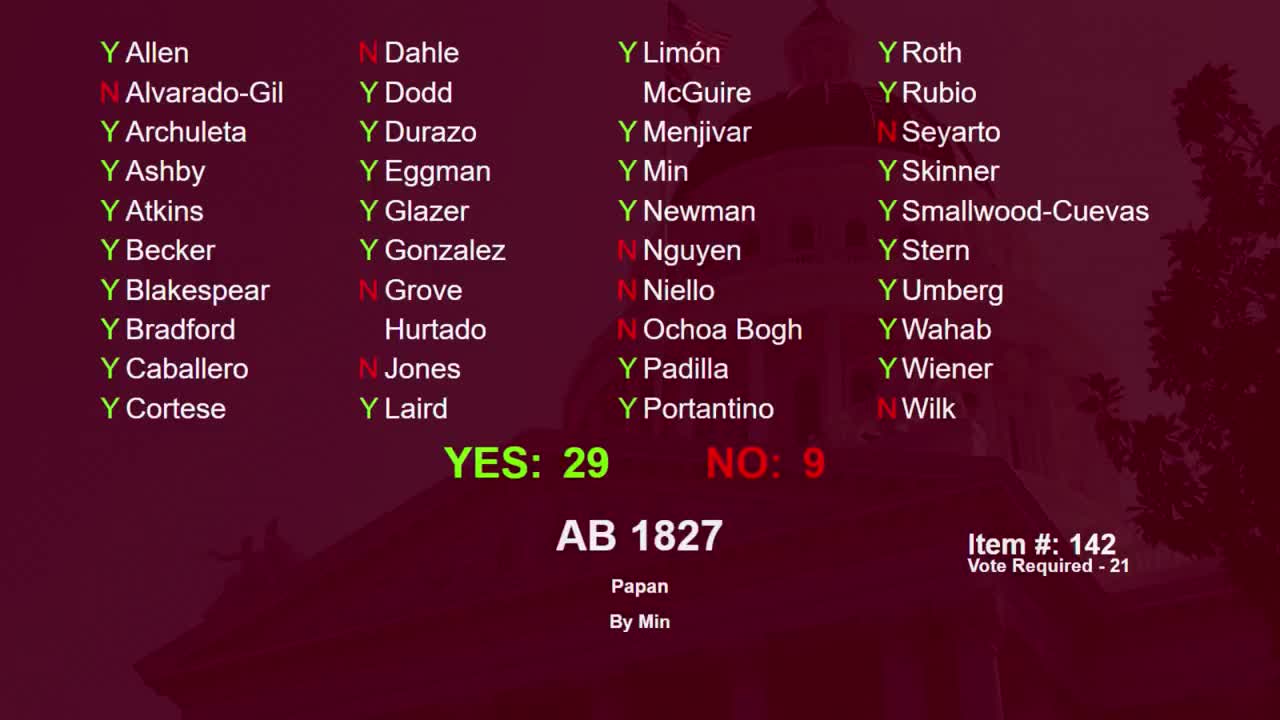 1MIN
Senate Floor
 7MIN
Senate Standing Committee on Banking and Financial Institutions
 4MIN
Senate Standing Committee on Local Government
 4MIN
Assembly Standing Committee on Banking and Finance
Bill Author

Bill Co-Author(s):