AB 265: Property tax postponement: Senior Citizens and Disabled Citizens Property Tax Postponement Fund.
- Session Year: 2023-2024
- House: Assembly
- Latest Version Date: 2023-09-14
Current Status:
Failed
(2024-01-25: Consideration of Governor's veto stricken from file.)
Introduced
In Committee
First Chamber
In Committee
Second Chamber
Enacted
Existing law authorizes the Controller, upon approval of a claim for the postponement of property taxes, as defined, to directly pay a county tax collector for the property taxes owed by the claimant, as provided. Existing law establishes the Senior Citizens and Disabled Citizens Property Tax Postponement Fund and continuously appropriates moneys in the fund to the Controller for specified purposes, including disbursements relating to the postponement of property taxes pursuant to the Property Tax Postponement Law. Existing law requires the Controller, on June 30, 2018, and on June 30 each year thereafter, to transfer any moneys in the fund in excess of $15,000,000 to the General Fund.
This bill would require money to be transferred, on June 30, 2024, and on June 30 each year thereafter, from the General Fund to the Senior Citizens and Disabled Citizens Property Tax Postponement Fund when the balance in the latter fund is less than $15,000,000. The bill would require the amount of money transferred each year to be equal to the sum needed to bring the balance of the Senior Citizens and Disabled Citizens Property Tax Postponement Fund to $15,000,000. By requiring the transfer of moneys into a continuously appropriated fund, the bill would make an appropriation.
Existing law authorizes the Controller, upon approval of a claim for the postponement of ad valorem property taxes, to directly pay a county tax collector for the property taxes owed by the claimant, as provided. Existing law establishes the Senior Citizens and Disabled Citizens Property Tax Postponement Fund and continuously appropriates moneys in the fund to the Controller for specified purposes, including disbursements relating to the postponement of property taxes pursuant to the Property Tax Postponement Law. Existing law requires the Controller, on June 30, 2018, and on June 30 each year thereafter, to transfer any moneys in the fund in excess of $15,000,000 to the General Fund.
This bill would require money to be transferred, on June 30, 2024, and on June 30 each year thereafter, from the General Fund to the Senior Citizens and Disabled Citizens Property Tax Postponement Fund when the balance in the latter fund is less than $15,000,000. The bill would require the amount of money transferred each year to be equal to the sum needed to bring the balance of the Senior Citizens and Disabled Citizens Property Tax Postponement Fund to $15,000,000. By requiring the transfer of moneys into a continuously appropriated fund, the bill would make an appropriation.
Existing law establishes the Senior Citizens and Disabled Citizens Property Tax Postponement Fund and continuously appropriates moneys in the fund to the Controller for specified purposes relating to the postponement of property taxes. Existing law imposes duties on the Controller related to the transfer and expenditure of moneys in the fund.This bill would make a nonsubstantive change to the provisions related to those duties imposed on the Controller.Existing law establishes the Senior Citizens and Disabled Citizens Property Tax Postponement Fund and continuously appropriates moneys in the fund to the Controller for specified purposes relating to the postponement of property taxes. Existing law imposes duties on the Controller related to the transfer and expenditure of moneys in the fund.
This bill would make a nonsubstantive change to the provisions related to those duties imposed on the Controller.
(a)There is hereby created in the State Treasury a Senior Citizens and Disabled Citizens Property Tax Postponement Fund. The fund shall be an interest-bearing fund. Subject to subdivision (b) and notwithstanding Section 13340, the fund is continuously appropriated to the Controller, commencing January 1, 2015, for purposes of administering this chapter, including, but not limited to, necessary administrative costs and disbursements relating to the postponement of property taxes pursuant to Chapter 2 (commencing with Section 20581), Chapter 3 (commencing with Section 20625), Chapter 3.3 (commencing with Section 20639), and Chapter 3.5 (commencing with Section 20640) of Part 10.5 of Division 2 of the Revenue and Taxation Code.
(b)The Controller shall do all of the following:
(1)On June 30, 2017, transfer any moneys in the fund in excess of twenty million dollars ($20,000,000) to the General Fund.
(2)On June 30, 2018, and on June 30 each year thereafter, transfer any moneys in the fund in excess of fifteen million dollars ($15,000,000) to the General Fund.
(3)On July 1, 2019, and on July 1 each year thereafter, up to 1 percent of the amount available in the fund for disbursements relating to the postponement of property taxes shall be available for residential dwellings that are manufactured homes pursuant to Chapter 3.3 (commencing with Section 20639).
(c)On or after January 1, 2015, any loan repayments relating to the Senior Citizens and Disabled Citizens Property Tax Postponement Law shall be deposited into the Senior Citizens and Disabled Citizens Property Tax Postponement Fund.
(d)On June 30, 2024, and on June 30 each year thereafter, the Controller shall transfer moneys from the General Fund to the Senior Citizens and Disabled Citizens Property Tax Postponement Fund when the balance of the latter fund is less than fifteen million dollars ($15,000,000). The amount of money transferred each year shall be equal to the sum needed to bring the balance of the Senior Citizens and Disabled Citizens Property Tax Postponement Fund to fifteen million dollars ($15,000,000).
(a)There is hereby created in the State Treasury a Senior Citizens and Disabled Citizens Property Tax Postponement Fund. The fund shall be an interest-bearing fund. Subject to subdivision (b) and notwithstanding Section 13340, the fund is continuously appropriated to the Controller, commencing January 1, 2015, for purposes of administering this chapter, including, but not limited to, necessary administrative costs and disbursements relating to the postponement of property taxes pursuant to Chapter 2 (commencing with Section 20581), Chapter 3 (commencing with Section 20625), Chapter 3.3 (commencing with Section 20639), and Chapter 3.5 (commencing with Section 20640) of Part 10.5 of Division 2 of the Revenue and Taxation Code.
(b)The Controller shall do all of the following:
(1)On June 30, 2017, transfer any moneys in the fund in excess of twenty million dollars ($20,000,000) to the General Fund.
(2)On June 30, 2018, and on June 30 each year thereafter, transfer any moneys in the fund in excess of fifteen million dollars ($15,000,000) to the General Fund.
(3)On July 1, 2019, and on July 1 each year thereafter, up to 1 percent of the amount available in the fund for disbursements relating to the postponement of property taxes shall be available for residential dwellings that are manufactured homes pursuant to Chapter 3.3 (commencing with Section 20639).
(c)On or after January 1, 2015, any loan repayments relating to the Senior Citizens and Disabled Citizens Property Tax Postponement Law shall be deposited into the Senior Citizens and Disabled Citizens Property Tax Postponement Fund.
(d)On June 30, 2024, and on June 30 each year thereafter, the Controller shall transfer moneys from the General Fund to the Senior Citizens and Disabled Citizens Property Tax Postponement Fund when the balance of the latter fund is less than fifteen million dollars ($15,000,000). The amount of money transferred each year shall be equal to the sum needed to bring the balance of the Senior Citizens and Disabled Citizens Property Tax Postponement Fund to fifteen million dollars ($15,000,000).
SECTION 1.Section 16180 of the Government Code is amended to read:16180.(a)There is hereby created in the State Treasury a Senior Citizens and Disabled Citizens Property Tax Postponement Fund. The fund shall be an interest-bearing fund. Subject to subdivision (b) and notwithstanding Section 13340, the fund is continuously appropriated to the Controller, commencing January 1, 2015, for purposes of administering this chapter, including, but not limited to, necessary administrative costs and disbursements relating to the postponement of property taxes pursuant to Chapter 2 (commencing with Section 20581), Chapter 3 (commencing with Section 20625), Chapter 3.3 (commencing with Section 20639), and Chapter 3.5 (commencing with Section 20640) of Part 10.5 of Division 2 of the Revenue and Taxation Code.(b)The Controller shall do the following:(1)On June 30, 2017, transfer any moneys in the fund in excess of twenty million dollars ($20,000,000) to the General Fund.(2)On June 30, 2018, and on June 30 each year thereafter, transfer any moneys in the fund in excess of fifteen million dollars ($15,000,000) to the General Fund.(3)On July 1, 2019, and on July 1 each year thereafter, up to 1 percent of the amount available in the fund for disbursements relating to the postponement of property taxes shall be available for residential dwellings that are manufactured homes pursuant to Chapter 3.3 (commencing with Section 20639).(c)On or after January 1, 2015, any loan repayments relating to the Senior Citizens and Disabled Citizens Property Tax Postponement Law shall be deposited into the Senior Citizens and Disabled Citizens Property Tax Postponement Fund. CORRECTIONS: HeadingLine 1. DigestPage 1.(a)There is hereby created in the State Treasury a Senior Citizens and Disabled Citizens Property Tax Postponement Fund. The fund shall be an interest-bearing fund. Subject to subdivision (b) and notwithstanding Section 13340, the fund is continuously appropriated to the Controller, commencing January 1, 2015, for purposes of administering this chapter, including, but not limited to, necessary administrative costs and disbursements relating to the postponement of property taxes pursuant to Chapter 2 (commencing with Section 20581), Chapter 3 (commencing with Section 20625), Chapter 3.3 (commencing with Section 20639), and Chapter 3.5 (commencing with Section 20640) of Part 10.5 of Division 2 of the Revenue and Taxation Code.
(b)The Controller shall do all of the following:
(1)On June 30, 2017, transfer any moneys in the fund in excess of twenty million dollars ($20,000,000) to the General Fund.
(2)On June 30, 2018, and on June 30 each year thereafter, transfer any moneys in the fund in excess of fifteen million dollars ($15,000,000) to the General Fund.
(3)On July 1, 2019, and on July 1 each year thereafter, up to 1 percent of the amount available in the fund for disbursements relating to the postponement of property taxes shall be available for residential dwellings that are manufactured homes pursuant to Chapter 3.3 (commencing with Section 20639).
(c)On or after January 1, 2015, any loan repayments relating to the Senior Citizens and Disabled Citizens Property Tax Postponement Law shall be deposited into the Senior Citizens and Disabled Citizens Property Tax Postponement Fund.
|
Date
|
Status
|
|---|---|
| Jan 25, 2024 | Consideration of Governor's veto stricken from file. |
| Jan 3, 2024 | Consideration of Governor's veto pending. |
| Oct 8, 2023 | Vetoed by Governor. |
| Sep 19, 2023 | Enrolled and presented to the Governor at 4 p.m. |
| Sep 12, 2023 | In Assembly. Ordered to Engrossing and Enrolling. |
| Sep 12, 2023 | Read third time. Passed. Ordered to the Assembly. (Ayes 39. Noes 0. Page 2685.). |
| Sep 8, 2023 | Ordered to special consent calendar. |
| Sep 5, 2023 | Read second time. Ordered to third reading. |
| Sep 1, 2023 | From committee: Do pass. (Ayes 7. Noes 0.) (September 1). |
| Jul 3, 2023 | In committee: Referred to APPR suspense file. |
| Jun 21, 2023 | From committee: Do pass and re-refer to Com. on APPR with recommendation: To Consent Calendar. (Ayes 8. Noes 0.) (June 21). Re-referred to Com. on APPR. |
| Jun 7, 2023 | Referred to Com. on GOV. & F. |
| May 26, 2023 | In Senate. Read first time. To Com. on RLS. for assignment. |
| May 25, 2023 | Read third time. Passed. Ordered to the Senate. (Ayes 77. Noes 0. Page 1785.) |
| May 18, 2023 | Read second time. Ordered to third reading. |
| May 18, 2023 | From committee: Do pass. (Ayes 15. Noes 0.) (May 18). |
| May 3, 2023 | In committee: Set, first hearing. Referred to APPR. suspense file. |
| Apr 25, 2023 | From committee: Do pass and re-refer to Com. on APPR. (Ayes 11. Noes 0.) (April 24). Re-referred to Com. on APPR. |
| Apr 20, 2023 | Measure version as amended on March 9 corrected. |
| Mar 28, 2023 | In committee: Set, first hearing. Referred to REV. & TAX. suspense file. |
| Mar 13, 2023 | Re-referred to Com. on REV. & TAX. |
| Mar 9, 2023 | Referred to Com. on REV. & TAX. |
| Mar 9, 2023 | From committee chair, with author's amendments: Amend, and re-refer to Com. on REV. & TAX. Read second time and amended. |
| Jan 20, 2023 | From printer. May be heard in committee February 19. |
| Jan 19, 2023 | Read first time. To print. |
|
Date
|
Description
|
Location
|
Votes
|
|
|---|---|---|---|---|
| Sep 12, 2023 | Special Consent AB265 Boerner By Ashby | Senate Floor |
Passed |
|
| Sep 1, 2023 | Do pass | Senate Standing Committee on Appropriations |
Passed |
|
| Jul 3, 2023 | Placed on suspense file | Senate Standing Committee on Appropriations |
Passed |
|
| Jun 21, 2023 | Do pass, but first be re-referred to the Committee on [Appropriations] with the recommendation: To Consent Calendar | Senate Standing Committee on Governance and Finance |
Passed |
|
| May 25, 2023 | AB 265 Boerner Assembly Third Reading | Assembly Floor |
Passed |
|
| May 18, 2023 | Do pass. | Assembly Standing Committee on Appropriations |
Passed |
|
| Apr 24, 2023 | Do pass and be re-referred to the Committee on [Appropriations] | Assembly Standing Committee on Revenue and Taxation |
Passed |
This list shows positions taken on this bill by organizations on the date displayed, which is linked to the original source.
Positions by individuals are not included.
|
Organization
|
Position
|
Date
|
|---|---|---|
| California Association Of Realtors | ** Support | |
| California Special Districts Association | ** Support | |
| State Controller Malia Cohen | ** Support |
GOVERNOR'S VETO
GV Bill Id:AB 265
Author:(Boerner)
As Enrolled Ver:September 14, 2023
2/3 vote
SUMMARY
Requires that money be transferred from the General Fund (GF) to the Senior Citizens and Disabled Citizens Property Tax Postponement Fund (Fund) when the Fund balance is less than $15 million.
Major Provisions
- Provides that, on June 30, 2024, and on June 30 each year thereafter, the State Controller shall transfer moneys from the GF to the Fund when the Fund balance is less than $15 million.
- Provides that the amount of money transferred each year shall be equal to the sum needed to bring the Fund balance to $15 million.
Governor's Veto Message
This bill would require annual transfers from the GF to the Fund to ensure the balance each June 30 is $15 million. The Property Tax Postponement Program (Program) allows income-eligible homeowners who are seniors, blind, or disabled to defer their property taxes, secured by a lien against the property that is later repaid when the property is sold or refinanced. By design, the Fund is structured to be self-sustaining.
The Department of Finance conducted an analysis of the Program and concluded the Program has enough funding for 2023-24, but cannot be sustained without an annual commitment of potentially millions of GF dollars to support it thereafter. While I support the Program, discussions regarding this continuous appropriation should be considered in the annual budget process. While I am unable to sign this bill, I look forward to continuing discussions to identify necessary resources in the upcoming fiscal year.
In partnership with the Legislature, we enacted a budget that closed a shortfall of more than $30 billion through balanced solutions that avoided deep program cuts and protected education, health care, climate, public safety, and social service programs that are relied on by millions of Californians. This year, however, the Legislature sent me bills outside of this budget process that, if all enacted, would add nearly $19 billion of unaccounted costs in the budget, of which $11 billion would be ongoing.
With our state facing continuing economic risk and revenue uncertainty, it is important to remain disciplined when considering bills with significant fiscal implications, such as this measure.
COMMENTS
- Constitutional authority for the program: In provisions originally adopted June 8, 1976, the California Constitution authorizes the Legislature to establish a program under which low- or moderate-income individuals aged 62 or older may postpone property taxes on their principal place of residence. These provisions, which predate Proposition 13, were adopted to address concerns that senior homeowners on fixed incomes might lose their homes because of an inability to pay rising property tax bills.[1]
- The program is suspended: In 2009, in the wake of the Great Recession, the Program was indefinitely suspended as part of budget reductions to the state's GF programs. Specifically, SB 8 X3 (Ducheny), Chapter 4, Statutes of 2009, Third Extraordinary Session, prohibited the filing of claims for property tax postponement on or after February 20, 2009, and prohibited the State Controller from accepting applications for postponement on or after that date.
- A revised program is reinstated: In 2014, the Program was revived with a delayed start date for property taxes associated with the 2016-17 fiscal year (FY). Additionally, the Program was modified to include tightened eligibility criteria and funding was no longer GF based.[2]
- The current program: The Program, administered by the State Controller, currently allows homeowners who are seniors, are blind, or have a disability to defer current-year property taxes on their principal residence if they meet certain criteria, including having at least 40% equity in the home and an annual household income of $49,017 or less (among other requirements). The deferment of property taxes is secured by a lien against the property that must eventually be repaid. The Program is self-funded from repayments from previous Program participants, and the Fund is capped at $15 million per year, with any moneys above this threshold transferred annually to the GF.
- So what is the problem? The State Controller notes that, for a variety of reasons, the Program is in jeopardy of being unable to fund all eligible applicants and cover its administrative costs as early as FY 2023-24. The State Controller also notes that collections have decreased due to the fact that new loans were not made between 2009 and 2016 during the Program's suspension, "resulting in [the State Controller] collecting on a dwindling number of old loans or waiting until recent loans become due and payable." The author has also noted that, in recent years, Program eligibility has been expanded and the interest rate of Program loans reduced, meaning more individuals will be eligible each year with a shrinking pool of collection accounts in the immediate future.
- What would this bill do? This bill would reinstate GF support for the Program by requiring an annual transfer of GF moneys to the Fund when the Fund balance is less than $15 million.
According to the Author
The author has provided the following statement in support of this bill:
Since 1977, the Fund has helped keep some of our state's most vulnerable residents in their own homes. Currently, the California State Controller is projecting the program will be insolvent as soon as 2025. AB 265 seeks to ensure this vital program never runs out of the funding it needs. If no alternative funding source is established, the program will be unable to approve new eligible applicants such as low-income seniors and disabled homeowners who are in need of financial relief to stay in their homes.
Arguments in Support
This bill is sponsored by State Controller Malia M. Cohen, who notes the following:
Due to a variety of reasons, the Program is in jeopardy of being unable to fund all eligible applicants and cover its administrative costs as early as fiscal year 2023-24. Collections have decreased due to no new loans being made between 2009 and 2016 when the program was suspended, resulting in the State Controller's Office collecting on a dwindling number of old loans or waiting until recent loans become due and payable. Additionally, recent changes to the program have reduced loan interest rates from seven percent to five percent, and the income threshold is now set to increase on an annual basis with inflation, meaning more people will be eligible each year with a shrinking pool of collections accounts in the immediate future. If no alternative funding source is established, the Program will be unable to approve new applications, potentially causing more harm to those vulnerable individuals who have come to rely on the assistance the Program provides.
Arguments in Opposition
None on file
FISCAL COMMENTS
According to the Senate Appropriations Committee:
- Annual GF costs of an unknown amount, but likely in the millions of dollars, depending on the amount of funds transferred to reset the Fund balance at $15 million. Without any intervention, the State Controller's Office (SCO) believes the Program will be unable to fund all eligible applicants and cover administrative costs as early as FY 2023-24. By requiring the transfer of money into the continuously appropriated Fund, this bill makes an appropriation.
- Minor and absorbable costs to the SCO to monitor and transfer funds.
VOTES
ASM REVENUE AND TAXATION: 11-0-0
YES: Irwin, Wallis, Bains, Grayson, Pacheco, Jim Patterson, Petrie-Norris, Luz Rivas, Ta, Valencia, Zbur
ASM APPROPRIATIONS: 15-0-1
YES: Holden, Megan Dahle, Bryan, Calderon, Wendy Carrillo, Dixon, Mike Fong, Hart, Lowenthal, Mathis, Papan, Pellerin, Sanchez, Weber, Ortega
ABS, ABST OR NV: Robert Rivas
ASSEMBLY FLOOR: 77-0-3
YES: Addis, Alanis, Alvarez, Arambula, Bains, Bauer-Kahan, Bennett, Berman, Boerner, Bonta, Bryan, Calderon, Juan Carrillo, Wendy Carrillo, Cervantes, Chen, Connolly, Megan Dahle, Davies, Dixon, Essayli, Flora, Mike Fong, Vince Fong, Friedman, Gabriel, Gallagher, Garcia, Gipson, Grayson, Haney, Hart, Holden, Hoover, Irwin, Jackson, Jones‑Sawyer, Kalra, Lackey, Lee, Low, Lowenthal, Maienschein, McCarty, McKinnor, Muratsuchi, Stephanie Nguyen, Ortega, Pacheco, Jim Patterson, Joe Patterson, Pellerin, Petrie‑Norris, Quirk-Silva, Ramos, Reyes, Luz Rivas, Robert Rivas, Rodriguez, Blanca Rubio, Sanchez, Santiago, Schiavo, Soria, Ta, Ting, Valencia, Villapudua, Waldron, Wallis, Ward, Weber, Wicks, Wilson, Wood, Zbur, Rendon
ABS, ABST OR NV: Aguiar-Curry, Mathis, Papan
SENATE FLOOR: 39-0-1
YES: Allen, Alvarado-Gil, Archuleta, Ashby, Atkins, Becker, Blakespear, Bradford, Cortese, Dahle, Dodd, Durazo, Eggman, Glazer, Gonzalez, Grove, Hurtado, Jones, Laird, Limón, McGuire, Menjivar, Min, Newman, Nguyen, Niello, Ochoa Bogh, Padilla, Portantino, Roth, Rubio, Seyarto, Skinner, Smallwood-Cuevas, Stern, Umberg, Wahab, Wiener, Wilk
ABS, ABST OR NV: Caballero
UPDATED
VERSION: September 14, 2023
CONSULTANT: David Ruff / REV. & TAX. / (916) 319-2098 FN: 0002528
SENATE RULES COMMITTEE Office of Senate Floor Analyses (916) 651-1520 Fax: (916) 327-4478 | AB 265 |
THIRD READING
Bill No: AB 265
Author: Boerner (D)
Amended: 3/9/23 in Assembly
Vote: 27
SENATE GOVERNANCE & FIN. COMMITTEE: 8-0, 6/21/23
AYES: Caballero, Seyarto, Blakespear, Dahle, Durazo, Glazer, Skinner, Wiener
SENATE APPROPRIATIONS COMMITTEE: 7-0, 9/1/23
AYES: Portantino, Jones, Ashby, Bradford, Seyarto, Wahab, Wiener
ASSEMBLY FLOOR: 77-0, 5/25/23 - See last page for vote
SUBJECT: Property tax postponement: Senior Citizens and Disabled Citizens Property Tax Postponement Fund
SOURCE: State Controller Malia Cohen
DIGEST:
This bill requires General Fund transfers to ensure a $15 million minimum balance in the Senior Citizens and Disabled Citizens Property Tax Postponement Fund.
ANALYSIS:
Existing law:
- Provides that all property is taxable unless explicitly exempted by the Constitution or federal law (California Constitution, Article XIII, Section One).
- Allows the Legislature to provide a manner for persons of low or moderate income to postpone their property taxes on their principal place of residence (California Constitution, Article XIII, Section 8.5)
- Enacts the Senior Citizens and Disabled Citizens Property Tax Postponement Law (PTP), which allows the State Controller to pay property taxes to county tax collectors due on the principal residence of individuals over the age of 62 or disabled persons with household income of less than the currently inflation adjusted threshold of $49,017 annually.
- Creates the Senior Citizens and Disabled Citizens Property Tax Postponement Fund (PTP Fund) as an interest-bearing fund in the state Treasury, which is continuously appropriated to the Controller to fund PTP loans.
- Directs any PTP loan repayments into the PTP Fund.
- Requires the State Controller to transfer to the General Fund PTP repayments received above a $20 million total on June 30, 2017, and $15 million for each June 30 thereafter.
This bill:
- Transfers from the General Fund to the PTP Fund an amount equal to the sum needed to bring the balance of the PTP Fund to fifteen million dollars.
- States that transfers begin on June 30, 2024, and occur on June 30 each year thereafter.
Background
PTP law allows the Controller to pay property taxes on behalf of income-eligible senior citizen and disabled taxpayers who file a claim. The claimant or the claimant’s spouse does not need to repay the Controller so long as they continue to occupy the home; instead, the Controller secures repayment by recording a lien against the claimant’s property, which is satisfied with interest when the home is sold or refinanced. As liens are repaid out of sales proceeds, revenue flows back to the PTP Fund, which then funds loans for new applicants.
In 2009, due to budgetary constraints and fewer funds flowing back to the Controller as a result of diminishing home values, the Legislature prohibited persons from filing new claims for property tax postponement, and the Controller from accepting them. Prior to suspension, the Controller granted about $12 million annually in claims, but repayments only ranged between $6 and $10 million. During the suspension, the Controller did not approve additional applications for property tax payments, but still collected repayments.
The Legislature resuscitated the program in 2014 by removing SBX3 8’s prohibition (AB 2231, Gordon, Chapter 703, Statutes of 2014). Because of the reduced repayments that resulted in its suspension, AB 2231 tightened eligibility criteria, including increasing the percentage of equity an applicant must have to be eligible from 20% to 40%, among other measures.
In September 2016, the Controller began accepting applications, and paying property taxes out of approximately $7 million of previously collected funds on a first-come, first-served basis. Today, individuals can apply between October 1 and February 10 each year. If approved, the Controller pays the individual’s property taxes only for that year; they must meet the eligibility criteria and reapply each year.
Since the program was reenacted, the Controller has granted increasing numbers of applications each year. In 2016-17, the Controller approved 812 claims and paid $2.3 million in property taxes. In 2017-18, the amount increased to 891 claims for $2.8 million in property taxes. The Controller increased approvals in every year since, with $4.4 million in 2021-22, and an estimated $5.6 million this fiscal year.
In 2018, the Legislative Analyst’s Office (LAO) published “Evaluation of the Property Tax Postponement Program,” which reviewed the PTP program. Among other recommendations, LAO stated that PTP’s interest rate of 7% was too high, which the state could afford to lower and keep the program self-funded. In 2019, the Legislature lowered the interest rate to 5%, increased the income eligibility threshold from $35,000 in annual household income to $45,000, and directed the Controller to increase the threshold annually to account for any inflationary growth (AB 133, Quirk Silva, Chapter 794, Statutes of 2019).
Recently, PTP collections have decreased, jeopardizing PTP’s ability to maintain its self-sufficiency in the long run. Repayments usually peak between eight and ten years after loans are made, but no new loans were made between 2009 and 2016, so repayments are derived only from repayments from loans made before 2009, or those made more recently. The state’s booming real estate market has pushed property values, and therefore property taxes and PTP loans, higher. During the 2020-21 fiscal year, program costs and postponement loans exceeded amounts collected by more than $1 million. Additionally, AB 133’s lower interest will reduce future repayments, and more applicants can now apply for PTP under the bill’s higher income threshold and inflation adjustment.
During the 2020-21 and 2021-22 fiscal years, program costs and postponement loans exceeded amounts collected by more than $1 million. In 2022-23, the Controller estimates the difference expanding more quickly with expenses outpacing collections by an estimated $3.7 million So far, the PTP Fund balance has been sufficient to cover the difference; however, the Controller expects the gap between revenues and expenditures will continue to grow. While the Controller estimates the fund will be insolvent by 2025-26, the Controller may have to begin denying applicants in 2024-25 to maintain balances sufficient to pay costs. The current balance in the PTP account is $9.7 million as of May 17th of this year, down from $13.6 million last year.
Related/Prior Legislation
AB 1707 (Boerner Horvath, 2022), which the Governor vetoed, was substantially similar to AB 1707
FISCAL EFFECT: Appropriation: Yes Fiscal Com.: Yes Local: No
According to the Senate Appropriations Committee:
- This bill would result in General Fund costs of an unknown amount, but likely in the millions of dollars annually, depending on the extent to which funds would be transferred to reset the PTPF balance at $15 million.
- The State Controller’s Office’s (SCO) administrative costs would be minor and absorbable.
SUPPORT: (Verified 9/1/23)
State Controller Malia Cohen (source)
California Association of Realtors
California Special Districts Association
OPPOSITION: (Verified 9/1/23)
None received
ARGUMENTS IN SUPPORT: According to the author, “Since 1977, the Senior Citizens and Disabled Citizens Property Tax Postponement Fund has helped keep some of our state's most vulnerable residents in their own homes. Currently, the California State Controller is projecting the program will be insolvent as soon as 2025. AB 265 seeks to ensure this vital program never runs out of the funding it needs. If no alternative funding source is established, the program will be unable to approve new eligible applicants such as low-income seniors and disabled homeowners who are in need of financial relief to stay in their homes.”
ASSEMBLY FLOOR: 77-0, 5/25/23
AYES: Addis, Alanis, Alvarez, Arambula, Bains, Bauer-Kahan, Bennett, Berman, Boerner, Bonta, Bryan, Calderon, Juan Carrillo, Wendy Carrillo, Cervantes, Chen, Connolly, Megan Dahle, Davies, Dixon, Essayli, Flora, Mike Fong, Vince Fong, Friedman, Gabriel, Gallagher, Garcia, Gipson, Grayson, Haney, Hart, Holden, Hoover, Irwin, Jackson, Jones-Sawyer, Kalra, Lackey, Lee, Low, Lowenthal, Maienschein, McCarty, McKinnor, Muratsuchi, Stephanie Nguyen, Ortega, Pacheco, Jim Patterson, Joe Patterson, Pellerin, Petrie-Norris, Quirk-Silva, Ramos, Reyes, Luz Rivas, Robert Rivas, Rodriguez, Blanca Rubio, Sanchez, Santiago, Schiavo, Soria, Ta, Ting, Valencia, Villapudua, Waldron, Wallis, Ward, Weber, Wicks, Wilson, Wood, Zbur, Rendon
NO VOTE RECORDED: Aguiar-Curry, Mathis, Papan
Prepared by: Colin Grinnell / GOV. & F. / (916) 651-4119
9/2/23 14:07:49
**** END ****
SENATE COMMITTEE ON APPROPRIATIONS
Senator Anthony Portantino, Chair
2023 - 2024 Regular Session
AB 265 (Boerner) - Property tax postponement: Senior Citizens and Disabled Citizens Property Tax Postponement Fund
Version: March 9, 2023 | Policy Vote: GOV. & F. 8 - 0 |
Urgency: No | Mandate: No |
Hearing Date: July 3, 2023 | Consultant: Robert Ingenito |
Bill Summary:
AB 265 would require an annual transfer from the General Fund to ensure a $15 million minimum balance in the Property Tax Postponement Fund (PTPF).
Fiscal Impact:
- This bill would result in General Fund costs of an unknown amount, but likely in the millions of dollars annually, depending on the extent to which funds would be transferred to reset the PTPF balance at $15 million.
- The State Controller’s Office’s (SCO) administrative costs would be minor and absorbable.
Background:
The Property Tax Postponement Program (PTPP) authorizes the State Controller to pay property taxes to county tax collectors on behalf of individuals over the age of 62 or disabled persons with household income of less than the currently inflation adjusted threshold of $51,762 annually. The claimant or the claimant’s spouse does not need to repay the Controller so long as they continue to occupy the home; instead, the Controller secures repayment by recording a lien against the claimant’s property, which is satisfied with interest when the home is sold or refinanced. As liens are repaid out of sales proceeds, revenue flows back to the Controller, who in turn uses these funds to pay property taxes for new applicants.
In 2009, reflecting budgetary constraints and fewer funds flowing back to PTPF as a result of diminishing home values, the Legislature prohibited persons from filing new claims for property tax postponement. Prior to suspension, the Controller granted about $12 million annually in claims, but repayments only ranged between $6 and $10 million. During the suspension, the Controller did not approve additional applications for property tax payments, but still collected repayments.
The Legislature renewed the program in 2014, albeit with tightened eligibility criteria, including increasing the percentage of equity an applicant must have to be eligible from 20 percent to 40 percent. The Controller was also required to transfer to the General Fund repayments received above a $20 million total on June 30, 2017, and $15 million for each June 30 thereafter.
In September, 2016, the Controller began accepting applications, and paying property taxes out of approximately $7 million of previously collected funds on a first-come, first-served basis. Today, individuals can apply between October 1 and February 10 each year. If approved, the Controller pays the individuals’ property taxes only for that year; they must meet the eligibility criteria and reapply annually.
Program participation has been increasing. In 2016-17, the Controller approved 812 claims and paid $2.3 million in property taxes. The amounts increased to 891 claims and $2.8 million in 2017-18. Loan disbursements have since increased to $4.4 million in 2021-22, and an estimated $5.6 million in the current fiscal year.
In 2018, the Legislative Analyst’s Office (LAO) reviewed the PTPP program. Among other recommendations, LAO stated that PTP’s interest rate of 7 percent was too high, which the State could afford to reduce and keep the program self-funded. In 2019, the Legislature enacted AB 133 (Quirk Silva), which lowered the interest rate to 5 percent. That bill also increased the income eligibility threshold from $35,000 in annual household income to $45,000, and directs the Controller to increase the threshold annually to account for any inflationary growth.
Recently, PTP collections have decreased, jeopardizing PTP’s ability to maintain its self-sufficiency in the long-run. Repayments usually peak between eight and ten years after loans are made, but since no new loans were made between 2009 and 2016, repayments are derived only from repayments from loans made before 2009, or those made more recently. The State’s robust real estate market has increased property values, and therefore property taxes and PTP loans, higher. During 2020-21, program costs and postponement loans exceeded amounts collected by more than $1 million. Additionally, AB 133’s lower interest will reduce future repayments, and more applicants can now apply for PTP under the bill’s higher income threshold and inflation adjustment.
Proposed Law:
This bill would require money to be transferred from the General Fund to the PTPF when the latter’s balance is less than $15 million. The bill would require the initial transfer to occur on June 30, 2023, and then occur on June 30 each year thereafter. The measure would set the amount of money transferred each year equal to the sum needed to bring the PTPF’s balance up to $15 million.
Related Legislation:
This bill is substantively identical to AB 1707 (Boerner Horvath, 2022), which the Governor vetoed last year.
Staff Comments:
The Controller expects that the gap between PTPF revenues and expenditures will continue to grow. Consequently, the Fund balance may fall below levels necessary to approve new postponements, which could result in the Controller denying eligible applications. Specifically, the Controller estimates that the PTPF will be insolvent by 2025-26. The Fund’s current balance is $9.7 million as of May 17th, 2023, down from $13.6 million last year.
-- END --
SENATE COMMITTEE ON GOVERNANCE AND FINANCE
Senator Anna M. Caballero, Chair
2023 - 2024 Regular
Bill No: | AB 265 | Hearing Date: | 6/21/23 |
Author: | Boerner | Tax Levy: | No |
Version: | 3/9/23 | Fiscal: | Yes |
Consultant: | Grinnell | ||
Property tax postponement: Senior Citizens and Disabled Citizens Property Tax Postponement Fund
Requires money to be transferred from the General Fund each year to ensure a $15 million minimum balance in the Property Tax Postponement Fund.
Background
Added by voters in 1976, Section 8.5 of Article XIII of the California Constitution allows the Legislature to provide a manner for persons of low or moderate income to postpone their property taxes on their principal place of residence. The Legislature enacted the Senior Citizens and Disabled Citizens Property Tax Postponement Law (PTP) in 1977 to implement the change. In 1984, voters allowed the Legislature to provide a process for disabled persons, too.
Today, PTP allows the State Controller to pay property taxes to county tax collectors on behalf of individuals over the age of 62 or disabled persons with household income of less than the currently inflation adjusted threshold of $51,762 annually. The claimant or the claimant’s spouse does not need to repay the Controller so long as they continue to occupy the home; instead, the Controller secures repayment by recording a lien against the claimant’s property, which is satisfied with interest when the home is sold or refinanced. As liens are repaid out of sales proceeds, revenue flows back to the Controller, who in turn uses these funds to pay property taxes for new applicants.
In 2009, due to budgetary constraints and fewer funds flowing back to the Controller as a result of diminishing home values, the Legislature prohibited persons from filing new claims for property tax postponement, and the Controller from accepting them (SBx3 8, Ducheny, 2009). Prior to suspension, the Controller granted about $12 million annually in claims, but repayments only ranged between $6 and $10 million. During the suspension, the Controller did not approve additional applications for property tax payments, but still collected repayments.
The Legislature resuscitated the program in 2014 by removing SBx3 8’s prohibition (AB 2231, Gordon). Because of the reduced repayments that resulted in its suspension, AB 2231 tightened eligibility criteria, including increasing the percentage of equity an applicant must have to be eligible for the program from 20% to 40%, among other measures.
In September 2016, the Controller began accepting applications, and paying property taxes out of approximately $7 million of previously collected funds on a first-come, first-served basis. Today, individuals can apply between October 1 and February 10 each year. If approved, the Controller pays the individual’s property taxes only for that year; they must meet the eligibility criteria and reapply each year.
Since the program’s reenactment, the Controller has granted increasing numbers of applications each year. In 2016-17, the Controller approved $2.3 million in property tax loans, which grew to $2.8 million in 2017-18. The Controller increased approvals in every year since, with $4.4 million in 2021-22, and an estimated $5.6 million this fiscal year.
In 2018, the Legislative Analyst’s Office (LAO) published “Evaluation of the Property Tax Postponement Program,” which reviewed the PTP program. Among other recommendations, LAO stated PTP’s interest rate of 7% was too high, which the state could afford to lower and keep the program self‑funded. In 2019, the Legislature enacted AB 133 (Quirk Silva), which lowered the interest rate to 5%. AB 133 also increased the income eligibility threshold from $35,000 in annual household income to $45,000, and directed the Controller to increase the threshold annually to account for any inflationary growth.
Recently, PTP collections have decreased, jeopardizing the program’s ability to maintain its self-sufficiency in the long run. Repayments usually peak between eight and ten years after loans are made, but no new loans were made between 2009 and 2016, so repayments are derived only from repayments from loans made before 2009, or those made more recently. The state’s real estate market had pushed property values, and therefore property taxes and PTP loan amounts, higher. Additionally, AB 133’s lower interest will reduce future repayment amounts, and more applicants can now apply for PTP under the bill’s higher income threshold and inflation adjustment. During the 2020-21 and 2021-22 fiscal years, program costs and postponement loans exceeded amounts collected by more than $1 million. In 2022-23, the Controller estimates the difference expanding more quickly with expenses outpacing collections by an estimated $3.7 million
So far, the PTP Fund balance has been sufficient to cover the difference; however, the Controller expects the gap between revenues and expenditures will continue to grow. While the Controller estimates the fund will be insolvent by 2025-26, the Controller may have to begin denying applicants in 2024-25 to maintain balances sufficient to pay costs. The current balance in the PTP account is $9.7 million as of May 17th of this year, down from $13.6 million last year; The Controller wants to transfer funds from the General Fund to the PTP to ensure a minimum $15 million fund balance.
Proposed Law
Assembly Bill 265 requires money to be transferred from the General Fund to the Senior Citizens and Disabled Citizens Property Tax Postponement Fund when its balance is less than $15 million. The bill requires the initial transfer to occur on June 30, 2023, and then occur on June 30 each year thereafter. The measure sets the amount of money transferred each year equal to the sum needed to bring the balance of the PTP Fund to $15 million.
State Revenue Impact
No estimate.
Comments
1. Purpose of the bill. According to the author, “Since 1977, the Senior Citizens and Disabled Citizens Property Tax Postponement Fund has helped keep some of our state's most vulnerable residents in their own homes. Currently, the California State Controller is projecting the program will be insolvent as soon as 2025. AB 265 seeks to ensure this vital program never runs out of the funding it needs. If no alternative funding source is established, the program will be unable to approve new eligible applicants such as low-income seniors and disabled homeowners who are in need of financial relief to stay in their homes.”
2. Tradeoffs. When the Legislature resuscitated PTP in 2016, it required the Controller to transfer to the General Fund repayments received above a $20 million total on June 30, 2017, and $15 million for each June 30 thereafter. The General Fund transfer requirement ensured loan repayment funds not needed to fund new PTP loans could be used by the state for other purposes. The Controller has transferred $8 million to the General Fund since the Legislature enacted the requirement, with the most recent transfer in the 2019-20 fiscal year. Now that loan repayment amounts have fallen below the demand to fund new loans, the PTP fund balance is diminishing. AB 265 would ensure the Controller can continue to fund loans to the state’s neediest homeowners under one of its most established and successful assistance programs, but would require reducing General Fund resources needed for other programs to do so.
3. Related legislation. AB 265 is substantively identical to AB 1707 (Boerner Horvath), which the Governor vetoed last year, stating in part:
“Although recent changes in law have expanded eligibility for the program, the State Controller's Office does not project a shortfall until the 2025-26 fiscal year. My administration supports this program and its role in helping our most vulnerable homeowners remain in their homes. Therefore, I am directing the Department of Finance to conduct an analysis of the Program to identify any fiscal stability concerns and propose appropriate solutions for consideration.
“I am returning AB 1707 without my signature until additional information on the viability of the program has been determined.”
While the Controller and committee staff are not aware of an analysis, identification of concerns, or proposals for solutions specifically called for in the Governor’s veto message, DOF notes that it conducted an internal analysis, and found that the main reasons for the declining fund balance trend are the reduction under AB 133’s lower interest rates and expanded eligibility.
Assembly Actions
Assembly Revenue and Taxation Committee: 11-0
Assembly Appropriations Committee: 15-0
Assembly Floor: 77-0
Support and Opposition
(6/16/23)
Support: Malia M. Cohen - California State Controller (Sponsor)
California Association of Realtors
California Special Districts Association
Opposition: None received.
-- END --
ASSEMBLY THIRD READING
ATR Bill Id:AB 265
Author:(Boerner)
As Amended Ver:March 9, 2023
2/3 vote
SUMMARY
Requires that money be transferred from the General Fund (GF) to the Senior Citizens and Disabled Citizens Property Tax Postponement Fund (Fund) when the Fund balance is less than $15 million.
Major Provisions
- Provides that, on June 30, 2024, and on June 30 each year thereafter, the State Controller shall transfer moneys from the GF to the Fund when the Fund balance is less than $15 million.
- Provides that the amount of money transferred each year shall be equal to the sum needed to bring the Fund balance to $15 million.
COMMENTS
- Constitutional authority for property tax postponement program: In provisions originally adopted June 8, 1976, the California Constitution authorizes the Legislature to establish a program under which low- or moderate-income individuals aged 62 or older may postpone property taxes on their principal place of residence. These provisions, which predate Proposition 13, were adopted to address concerns that senior homeowners on fixed incomes might lose their homes because of an inability to pay rising property tax bills.[1]
- The property tax postponement program is suspended: In 2009, in the wake of the Great Recession, the Property Tax Postponement Program (PTP) was indefinitely suspended as part of budget reductions to the state's GF programs. Specifically, SBx3 8 (Ducheny), Chapter 4, Statutes of 2009, Third Extraordinary Session, prohibited the filing of claims for property tax postponement on or after February 20, 2009, and prohibited the State Controller from accepting applications for postponement on or after that date.
- A revised program is reinstated: In 2014, the Property Tax Postponement Program was revived with a delayed start date for property taxes associated with the 2016-17 fiscal year (FY). Additionally, the Program was modified to include tightened eligibility criteria and funding was no longer GF based.[2]
- The current program: The Property Tax Postponement Program, administered by the State Controller, currently allows homeowners who are seniors, are blind, or have a disability to defer current-year property taxes on their principal residence if they meet certain criteria, including having at least 40% equity in the home and an annual household income of $49,017 or less (among other requirements). The deferment of property taxes is secured by a lien against the property that must eventually be repaid. The Program is self-funded from repayments from previous Program participants, and the Fund is capped at $15 million per year, with any moneys above this threshold transferred annually to the GF.
- So what is the problem? The State Controller notes that, for a variety of reasons, the Program is in jeopardy of being unable to fund all eligible applicants and cover its administrative costs as early as FY 2023-24. The State Controller also notes that collections have decreased due to the fact that new loans were not made between 2009 and 2016 during the Program's suspension, "resulting in [the State Controller] collecting on a dwindling number of old loans or waiting until recent loans become due and payable." The author has also noted that, in recent years, Program eligibility has been expanded and the interest rate of Program loans reduced, meaning more individuals will be eligible each year with a shrinking pool of collection accounts in the immediate future.
- What would this bill do? This bill would reinstate GF support for the Program by requiring an annual transfer of GF moneys to the Fund when the Fund balance is less than $15 million.
According to the Author
The author has provided the following statement in support of this bill:
Since 1977, the Senior Citizens and Disabled Citizens Property Tax Postponement Fund has helped keep some of our state's most vulnerable residents in their own homes. Currently, the California State Controller is projecting the program will be insolvent as soon as 2025. AB 265 seeks to ensure this vital program never runs out of the funding it needs. If no alternative funding source is established, the program will be unable to approve new eligible applicants such as low-income seniors and disabled homeowners who are in need of financial relief to stay in their homes.
Arguments in Support
This bill is sponsored by State Controller Malia M. Cohen, who notes the following:
Due to a variety of reasons, the PTP program is in jeopardy of being unable to fund all eligible applicants and cover its administrative costs as early as fiscal year 2023-24. Collections have decreased due to no new loans being made between 2009 and 2016 when the program was suspended, resulting in the State Controller's Office collecting on a dwindling number of old loans or waiting until recent loans become due and payable. Additionally, recent changes to the program have reduced loan interest rates from seven percent to five percent, and the income threshold is now set to increase on an annual basis with inflation, meaning more people will be eligible each year with a shrinking pool of collections accounts in the immediate future. If no alternative funding source is established, the PTP program will be unable to approve new applications, potentially causing more harm to those vulnerable individuals who have come to rely on the assistance the PTP program provides.
Arguments in Opposition
None on file
FISCAL COMMENTS
According to the Assembly Appropriations Committee:
- Annual GF costs of an unknown amount, but likely in the millions of dollars, depending on the amount of funds transferred to reset the Fund balance at $15 million. Without any intervention, the State Controller's Office (SCO) believes the Property Tax Postponement Program will be unable to fund all eligible applicants and cover administrative costs as early as FY 2023-24. By requiring the transfer of money into the continuously appropriated Fund, this bill makes an appropriation.
- Minor and absorbable costs to the SCO to monitor and transfer funds.
VOTES
ASM REVENUE AND TAXATION: 11-0-0
YES: Irwin, Wallis, Bains, Grayson, Pacheco, Jim Patterson, Petrie-Norris, Luz Rivas, Ta, Valencia, Zbur
ASM APPROPRIATIONS: 15-0-1
YES: Holden, Megan Dahle, Bryan, Calderon, Wendy Carrillo, Dixon, Mike Fong, Hart, Lowenthal, Mathis, Papan, Pellerin, Sanchez, Weber, Ortega
ABS, ABST OR NV: Robert Rivas
UPDATED
VERSION: March 9, 2023
CONSULTANT: M. David Ruff / REV. & TAX. / (916) 319-2098 FN: 0000619
Date of Hearing: May 3, 2023
ASSEMBLY COMMITTEE ON APPROPRIATIONS
Chris Holden, Chair
ABPCA Bill Id:AB 265
Author:(Boerner) – As Amended Ver:March 9, 2023
Policy Committee: | Revenue and Taxation | Vote: | 11 - 0 |
|
| ||
|
|
Urgency: No State Mandated Local Program: No Reimbursable: No
SUMMARY:
This bill requires, on June 30, 2024, and annually thereafter, the State Controller to transfer money from the General Fund (GF) to the Senior Citizens and Disabled Citizens Property Tax Postponement Fund (PTP Fund) when the PTP Fund balance is less than $15 million.
The transferred amount must reset the PTPF balance at $15 million.
FISCAL EFFECT:
- Annual General Fund (GF) costs of an unknown amount, but likely in the millions of dollars, depending on the amount of funds transferred to reset the PTP Fund balance at $15 million. Without any intervention, the State Controller’s Office (SCO) believes the Property Tax Postponement Program (PTP Program) will be unable to fund all eligible applicants and cover administrative costs as early as fiscal year (FY) 2023-24. By requiring the transfer of money into the continuously appropriated PTP Fund, this bill makes an appropriation.
- Minor and absorbable costs to the SCO to monitor and transfer funds.
COMMENTS:
- Purpose. According to the author:
Currently, the California State Controller is projecting the [PTP Program] will be insolvent as soon as 2025. AB 265 seeks to ensure this vital program never runs out of the funding it needs. If no alternative funding source is established, the program will be unable to approve new eligible applicants such as low-income seniors and disabled homeowners who are in need of financial relief to stay in their homes.
This bill is sponsored by State Controller Malia M. Cohen and supported by the California Association of Realtors.
- Background.
PTP Program. The PTP Program allows homeowners who are seniors, blind, or disabled to defer current-year property taxes on their principal residence if they have at least 40% equity in their home and annual household income of $49,017 or less. The deferment of property taxes is secured by a lien against the property in favor of the State of California, as the PTP Fund fronts the property tax payment to the county. Postponed property taxes are subject to an annual 5% interest rate. The homeowner may make full or partial repayments at any time, but no repayment is required until certain qualifying events occur, such as when the homeowner sells the property, refinances or dies. Repayments, in turn, fund deferments for new PTP Program participants.
According to the SCO, the PTP Program is in jeopardy of being unable to fund all eligible applicants and cover administrative costs by FY 2023-24 due to a variety of reasons. Repayments have decreased, because no new loans have been made between 2009 and 2016 when the PTP Program was suspended in the wake of the Great Recession, resulting in the SCO collecting on a dwindling number of old loans and waiting for more recent loans to become due and payable. Additionally, AB 133 (Quirk-Silva), Chapter 794, Statutes of 2019, lowered the interest rate on property tax postponement payments from 7% to 5% and increased the PTP Program’s income eligibility to $45,000, adjusted for inflation. Accordingly, in the immediate future, more people will become eligible each year for a program funded by a shrinking pool of collections accounts.
Balancing Act. Existing law effectively caps the PTP Program at $15 million annually, by requiring the SCO to transfer any money in the PTP Fund in excess of that amount to the GF on June 30. Thus, PTP Program expenditures are already limited, with approval into the program granted on a first-come, first-served basis. This bill does not lift the $15 million cap. However, this bill ensures $15 million is available each year for PTP Program expenditures, by requiring the SCO to transfer from the GF whatever amount is needed to reset a $15 million balance in the PTP Fund on June 30. This bill will allow a growing number of otherwise eligible homeowners, who may be shut out of the program as the PTP Fund dwindles, to benefit from property tax postponement.
- Prior Legislation. AB 1707 (Boerner), of the 2021-22 Legislative Session, was virtually identical to this bill. AB 1707 was vetoed by Governor Newsom, who stated:
Although recent changes in law have expanded eligibility for the program, the [SCO] does not project a shortfall until the 2025-26 fiscal year. My administration supports this program and its role in helping our most vulnerable homeowners remain in their homes. Therefore, I am directing the Department of Finance to conduct an analysis of the Program to identify any fiscal stability concerns and propose appropriate solutions for consideration.
Analysis Prepared by: Irene Ho / APPR. / (916) 319-2081
Date of Hearing: April 24, 2023
ASSEMBLY COMMITTEE ON REVENUE AND TAXATION
Jacqui Irwin, Chair
ABPCA Bill Id:AB 265 (
Author:Boerner) – As Amended Ver:March 9, 2023
SUSPENSE
2/3 vote. Fiscal committee.
SUBJECT: Property tax postponement: Senior Citizens and Disabled Citizens Property Tax Postponement Fund
SUMMARY: Requires that money be transferred from the General Fund (GF) to the Senior Citizens and Disabled Citizens Property Tax Postponement Fund (Fund) when the Fund balance is less than $15 million. Specifically, this bill:
- Provides that, on June 30, 2024, and on June 30 each year thereafter, the State Controller shall transfer moneys from the GF to the Fund when the Fund balance is less than $15 million.
- Provides that the amount of money transferred each year shall be equal to the sum needed to bring the Fund balance to $15 million.
EXISTING LAW:
- Authorizes the Legislature to provide by law for the manner in which a person of low or moderate income who is 62 years of age or older may postpone ad valorem property taxes on their principal place of residence. (Article XIII, Section 8.5 of the California Constitution.)
- Authorizes the Legislature to provide by law for the manner in which a disabled person may postpone payment of ad valorem property taxes on their principal place of residence. (Id.)
- Authorizes the State Controller, upon approval of a claim for the postponement of ad valorem property taxes, to directly pay a county tax collector for the property taxes owed by the claimant, as provided.
- Establishes the Fund and continuously appropriates moneys in the Fund to the State Controller for specified purposes, including disbursements relating to the postponement of property taxes under the Property Tax Postponement Law.
- Requires the State Controller to, on June 30, 2018, and on June 30 of each year thereafter, transfer any moneys in the Fund in excess of $15 million to the GF. (Government Code Section 16180.)
FISCAL EFFECT: Unknown
COMMENTS:
- The author has provided the following statement in support of this bill:
Since 1977, the Senior Citizens and Disabled Citizens Property Tax Postponement Fund has helped keep some of our state's most vulnerable residents in their own homes. Currently, the California State Controller is projecting the program will be insolvent as soon as 2025. AB 265 seeks to ensure this vital program never runs out of the funding it needs. If no alternative funding source is established, the program will be unable to approve new eligible applicants such as low-income seniors and disabled homeowners who are in need of financial relief to stay in their homes.
- This bill is sponsored by State Controller Malia M. Cohen, who notes the following:
Due to a variety of reasons, the PTP program is in jeopardy of being unable to fund all eligible applicants and cover its administrative costs as early as fiscal year 2023-24. Collections have decreased due to no new loans being made between 2009 and 2016 when the program was suspended, resulting in the State Controller's Office collecting on a dwindling number of old loans or waiting until recent loans become due and payable. Additionally, recent changes to the program have reduced loan interest rates from seven percent to five percent, and the income threshold is now set to increase on an annual basis with inflation, meaning more people will be eligible each year with a shrinking pool of collections accounts in the immediate future. If no alternative funding source is established, the PTP program will be unable to approve new applications, potentially
causing more harm to those vulnerable individuals who have come to rely on the assistance the PTP program provides.
- This bill is supported by the California Association of Realtors, which notes:
Existing law establishes the PTP program which allows the state Controller to pay property taxes to county tax collectors, on behalf of individuals over the age of 62 or disabled persons with an annual household income of $39,000 or less. This program was reinstated in 2014 after a suspension in early 2009 due to [a] budget gap the state was facing at the time.
C.A.R. supports the need to ensure that the viability of the program continues to operate as this valuable program offers individuals on fixed incomes and seniors or disabled persons assistance with paying their property taxes which allows them to continue to stay in their homes.
- Committee Staff Comments:
- Constitutional authority for property tax postponement program: In provisions originally adopted June 8, 1976, the California Constitution authorizes the Legislature to establish a program under which low- or moderate-income individuals aged 62 or older may postpone property taxes on their principal place of residence. These provisions, which predate Proposition 13, were adopted to address concerns that senior homeowners on fixed incomes might lose their homes because of an inability to pay rising property tax bills.[1]
- The property tax postponement program is suspended: In 2009, in the wake of the Great Recession, the Property Tax Postponement Program was indefinitely suspended as part of budget reductions to the state's GF programs. Specifically, SBx3 8 (Ducheny), Chapter 4, Statutes of 2009, Third Extraordinary Session, prohibited the filing of claims for property tax postponement on or after February 20, 2009, and prohibited the State Controller from accepting applications for postponement on or after that date.
- A revised program is reinstated: In 2014, the Property Tax Postponement Program was revived with a delayed start date for property taxes associated with the 2016-17 fiscal year. Additionally, the Program was modified to include tightened eligibility criteria and funding was no longer GF based.[2]
- The Legislative Analyst's Office issues a comprehensive report on the Program: In October 2018, the Legislative Analyst's Office (LAO) issued a report, "Evaluation of the Property Tax Postponement Program". This report criticized the Program for having high administrative costs and noted that Program participants must subsidize the relatively high costs associated with processing unapproved applicants. The report also faulted the Program's low participation rate. Specifically, the report noted:
Participation in PTP is very low – a clear shortcoming of the program. In particular, in the most recent years, PTP has had around 1,000 participants – compared to the over one million Californians who are over the age of 62, own their own homes, and live in a household with incomes less than $35,500.
The report did commend the Program for providing guaranteed eligibility for those who qualify and for allowing participants to indefinitely postpone repayments. The report also noted that Program loans were less costly than reverse mortgages.
Finally, the report highlighted the fact that the Program does not impose a cost on taxpayers by noting, "[i]n fact, PTP provides a [GF] benefit – meaning low-income participants in the program are effectively subsidizing the state's [GF]." This last comment reflects the fact that the reinstated Program is both self-funded and requires the State Controller, on June 30 of each year, to transfer any Fund moneys in excess of $15 million to the GF.
In the end, the report set forth two policy options for the Legislature to consider. The first option would be to eliminate the Program. Specifically, the report noted:
PTP has a very low participation rate and a high per-participant administrative cost. Both of these factors suggest the program is providing little total benefit. As such, the Legislature may want to consider eliminating the Program.
Alternatively, the LAO noted that if the Legislature wanted to maintain the Program, the Program would benefit from a number of changes. Specifically, the LAO recommended the following:
- Basing income eligibility on the "income limits" published annually by the Department of Housing and Community Development, which are tailored for county median income and household size;
- Eliminating the Program's GF benefit and lowering the 7% interest rate; and,
- Expanding Program eligibility to low-income homeowners in their 40s and 50s, who spend a higher share of their income on property taxes than older homeowners.
Since the report's issuance, the Legislature has adopted some, but not all, of these recommendations. Specifically, the Legislature has acted to lower the Program's interest rate and modify income eligibility, but has not eliminated the Program's benefit to the GF or expanded eligibility to younger homeowners.
- The current program: The Property Tax Postponement Program, administered by the State Controller, currently allows homeowners who are seniors, are blind, or have a disability to defer current-year property taxes on their principal residence if they meet certain criteria, including having at least 40% equity in the home and an annual household income of $49,017 or less (among other requirements). The deferment of property taxes is secured by a lien against the property that must eventually be repaid. The Program is self-funded from repayments from previous Program participants, and the Fund is capped at $15 million per year, with any moneys above this threshold transferred annually to the GF.
- So what is the problem? The State Controller notes that, for a variety of reasons, the Program is in jeopardy of being unable to fund all eligible applicants and cover its administrative costs as early as Fiscal Year 2023-24. The State Controller also notes that collections have decreased due to the fact that new loans were not made between 2009 and 2016 during the Program's suspension, "resulting in [the State Controller] collecting on a dwindling number of old loans or waiting until recent loans become due and payable." The author has also noted that, in recent years, Program eligibility has been expanded and the interest rate of Program loans reduced, meaning more individuals will be eligible each year with a shrinking pool of collection accounts in the immediate future.
- What would this bill do? This bill would reinstate GF support for the Program by requiring an annual transfer of GF moneys to the Fund when the Fund balance is less than $15 million.
- Prior legislation:
- AB 1707 (Boerner Horvath), of the 2021-22 Legislative Session, contained provisions substantially similar to this bill. Governor Newsom vetoed AB 1707, noting the following in his veto message:
This bill requires annual transfers from the General Fund to the Senior Citizens and Disabled Citizen Property Postponement (PTP) Fund to ensure the balance each June 30 is $15 million. The Property Tax Postponement Program allows income-eligible homeowners who are seniors, blind, or disabled to defer their property taxes, secured by a lien against the property that is later repaid when the property is sold or refinanced. By design, the PTP Fund is structured to be self-sustaining.
Although recent changes in law have expanded eligibility for the program, the State Controller's Office does not project a shortfall until the 2025-26 fiscal year. My administration supports this program and its role in helping our most vulnerable homeowners remain in their homes. Therefore, I am directing the Department of Finance to conduct an analysis of the Program to identify any fiscal stability concerns and propose appropriate solutions for consideration.
- AB 133 (Quirk-Silva), Chapter 794, Statutes of 2019, lowered the rate of interest on property tax postponement payments from 7% per annum to 5% per annum, and revised the income limitations to provide that a claimant's household income cannot exceed $45,000, compounded annually, as provided.
REGISTERED SUPPORT / OPPOSITION:
Support
State Controller Malia M. Cohen (Sponsor)
California Association of Realtors
Opposition
None on file
Analysis Prepared by: M. David Ruff / REV. & TAX. / (916) 319-2098
Date of Hearing: March 27, 2023
ASSEMBLY COMMITTEE ON REVENUE AND TAXATION
Jacqui Irwin, Chair
ABPCA Bill Id:AB 265 (
Author:Boerner Horvath) – As Amended Ver:March 9, 2023
2/3 vote. Fiscal committee.
SUBJECT: Property tax postponement: Senior Citizens and Disabled Citizens Property Tax Postponement Fund
SUMMARY: Requires that money be transferred from the General Fund (GF) to the Senior Citizens and Disabled Citizens Property Tax Postponement Fund (Fund) when the Fund balance is less than $15 million. Specifically, this bill:
- Provides that, on June 30, 2024, and on June 30 each year thereafter, the State Controller shall transfer moneys from the GF to the Fund when the Fund balance is less than $15 million.
- Provides that the amount of money transferred each year shall be equal to the sum needed to bring the Fund balance to $15 million.
EXISTING LAW:
- Authorizes the Legislature to provide by law for the manner in which a person of low or moderate income who is 62 years of age or older may postpone ad valorem property taxes on their principal place of residence. (Article XIII, Section 8.5 of the California Constitution.)
- Authorizes the Legislature to provide by law for the manner in which a disabled person may postpone payment of ad valorem property taxes on their principal place of residence. (Id.)
- Authorizes the State Controller, upon approval of a claim for the postponement of ad valorem property taxes, to directly pay a county tax collector for the property taxes owed by the claimant, as provided.
- Establishes the Fund and continuously appropriates moneys in the Fund to the State Controller for specified purposes, including disbursements relating to the postponement of property taxes under the Property Tax Postponement Law.
- Requires the State Controller to, on June 30, 2018, and on June 30 of each year thereafter, transfer any moneys in the Fund in excess of $15 million to the GF. (Government Code Section 16180.)
FISCAL EFFECT: Unknown
COMMENTS:
- The author has provided the following statement in support of this bill:
Since 1977, the Senior Citizens and Disabled Citizens Property Tax Postponement Fund has helped keep some of our state's most vulnerable residents in their own homes. Currently, the California State Controller is projecting the program will be insolvent as soon as 2025. AB 265 seeks to ensure this vital program never runs out of the funding it needs. If no alternative funding source is established, the program will be unable to approve new eligible applicants such as low-income seniors and disabled homeowners who are in need of financial relief to stay in their homes.
- This bill is sponsored by State Controller Malia M. Cohen, who notes the following:
Due to a variety of reasons, the PTP program is in jeopardy of being unable to fund all eligible applicants and cover its administrative costs as early as fiscal year 2023-24. Collections have decreased due to no new loans being made between 2009 and 2016 when the program was suspended, resulting in the State Controller's Office collecting on a dwindling number of old loans or waiting until recent loans become due and payable. Additionally, recent changes to the program have reduced loan interest rates from seven percent to five percent, and the income threshold is now set to increase on an annual basis with inflation, meaning more people will be eligible each year with a shrinking pool of collections accounts in the immediate future. If no alternative funding source is established, the PTP program will be unable to approve new applications, potentially
causing more harm to those vulnerable individuals who have come to rely on the assistance the PTP program provides.
- This bill is supported by the California Association of Realtors, which notes:
Existing law establishes the PTP program which allows the state Controller to pay property taxes to county tax collectors, on behalf of individuals over the age of 62 or disabled persons with an annual household income of $39,000 or less. This program was reinstated in 2014 after a suspension in early 2009 due to [a] budget gap the state was facing at the time.
C.A.R. supports the need to ensure that the viability of the program continues to operate as this valuable program offers individuals on fixed incomes and seniors or disabled persons assistance with paying their property taxes which allows them to continue to stay in their homes.
- Committee Staff Comments:
- Constitutional authority for property tax postponement program: In provisions originally adopted June 8, 1976, the California Constitution authorizes the Legislature to establish a program under which low- or moderate-income individuals aged 62 or older may postpone property taxes on their principal place of residence. These provisions, which predate Proposition 13, were adopted to address concerns that senior homeowners on fixed incomes might lose their homes because of an inability to pay rising property tax bills.[1]
- The property tax postponement program is suspended: In 2009, in the wake of the Great Recession, the Property Tax Postponement Program was indefinitely suspended as part of budget reductions to the state's GF programs. Specifically, SBx3 8 (Ducheny), Chapter 4, Statutes of 2009, Third Extraordinary Session, prohibited the filing of claims for property tax postponement on or after February 20, 2009, and prohibited the State Controller from accepting applications for postponement on or after that date.
- A revised program is reinstated: In 2014, the Property Tax Postponement Program was revived with a delayed start date for property taxes associated with the 2016-17 fiscal year. Additionally, the Program was modified to include tightened eligibility criteria and funding was no longer GF based.[2]
- The Legislative Analyst's Office issues a comprehensive report on the Program: In October 2018, the Legislative Analyst's Office (LAO) issued a report, "Evaluation of the Property Tax Postponement Program". This report criticized the Program for having high administrative costs and noted that Program participants must subsidize the relatively high costs associated with processing unapproved applicants. The report also faulted the Program's low participation rate. Specifically, the report noted:
Participation in PTP is very low – a clear shortcoming of the program. In particular, in the most recent years, PTP has had around 1,000 participants – compared to the over one million Californians who are over the age of 62, own their own homes, and live in a household with incomes less than $35,500.
The report did commend the Program for providing guaranteed eligibility for those who qualify and for allowing participants to indefinitely postpone repayments. The report also noted that Program loans were less costly than reverse mortgages.
Finally, the report highlighted the fact that the Program does not impose a cost on taxpayers by noting, "[i]n fact, PTP provides a [GF] benefit – meaning low-income participants in the program are effectively subsidizing the state's [GF]." This last comment reflects the fact that the reinstated Program is both self-funded and requires the State Controller, on June 30 of each year, to transfer any Fund moneys in excess of $15 million to the GF.
In the end, the report set forth two policy options for the Legislature to consider. The first option would be to eliminate the Program. Specifically, the report noted:
PTP has a very low participation rate and a high per-participant administrative cost. Both of these factors suggest the program is providing little total benefit. As such, the Legislature may want to consider eliminating the Program.
Alternatively, the LAO noted that if the Legislature wanted to maintain the Program, the Program would benefit from a number of changes. Specifically, the LAO recommended the following:
- Basing income eligibility on the "income limits" published annually by the Department of Housing and Community Development, which are tailored for county median income and household size;
- Eliminating the Program's GF benefit and lowering the 7% interest rate; and,
- Expanding Program eligibility to low-income homeowners in their 40s and 50s, who spend a higher share of their income on property taxes than older homeowners.
Since the report's issuance, the Legislature has adopted some, but not all, of these recommendations. Specifically, the Legislature has acted to lower the Program's interest rate and modify income eligibility, but has not eliminated the Program's benefit to the GF or expanded eligibility to younger homeowners.
- The current program: The Property Tax Postponement Program, administered by the State Controller, currently allows homeowners who are seniors, are blind, or have a disability to defer current-year property taxes on their principal residence if they meet certain criteria, including having at least 40% equity in the home and an annual household income of $49,017 or less (among other requirements). The deferment of property taxes is secured by a lien against the property that must eventually be repaid. The Program is self-funded from repayments from previous Program participants, and the Fund is capped at $15 million per year, with any moneys above this threshold transferred annually to the GF.
- So what is the problem? The State Controller notes that, for a variety of reasons, the Program is in jeopardy of being unable to fund all eligible applicants and cover its administrative costs as early as Fiscal Year 2023-24. The State Controller also notes that collections have decreased due to the fact that new loans were not made between 2009 and 2016 during the Program's suspension, "resulting in [the State Controller] collecting on a dwindling number of old loans or waiting until recent loans become due and payable." The author has also noted that, in recent years, Program eligibility has been expanded and the interest rate of Program loans reduced, meaning more individuals will be eligible each year with a shrinking pool of collection accounts in the immediate future.
- What would this bill do? This bill would reinstate GF support for the Program by requiring an annual transfer of GF moneys to the Fund when the Fund balance is less than $15 million.
- Prior legislation:
- AB 1707 (Boerner Horvath), of the 2021-22 Legislative Session, contained provisions substantially similar to this bill. Governor Newsom vetoed AB 1707, noting the following in his veto message:
This bill requires annual transfers from the General Fund to the Senior Citizens and Disabled Citizen Property Postponement (PTP) Fund to ensure the balance each June 30 is $15 million. The Property Tax Postponement Program allows income-eligible homeowners who are seniors, blind, or disabled to defer their property taxes, secured by a lien against the property that is later repaid when the property is sold or refinanced. By design, the PTP Fund is structured to be self-sustaining.
Although recent changes in law have expanded eligibility for the program, the State Controller's Office does not project a shortfall until the 2025-26 fiscal year. My administration supports this program and its role in helping our most vulnerable homeowners remain in their homes. Therefore, I am directing the Department of Finance to conduct an analysis of the Program to identify any fiscal stability concerns and propose appropriate solutions for consideration.
- AB 133 (Quirk-Silva), Chapter 794, Statutes of 2019, lowered the rate of interest on property tax postponement payments from 7% per annum to 5% per annum, and revised the income limitations to provide that a claimant's household income cannot exceed $45,000, compounded annually, as provided.
REGISTERED SUPPORT / OPPOSITION:
Support
State Controller Malia M. Cohen (Sponsor)
California Association of Realtors
Opposition
None on file
Analysis Prepared by: M. David Ruff / REV. & TAX. / (916) 319-2098
Discussed in Hearing
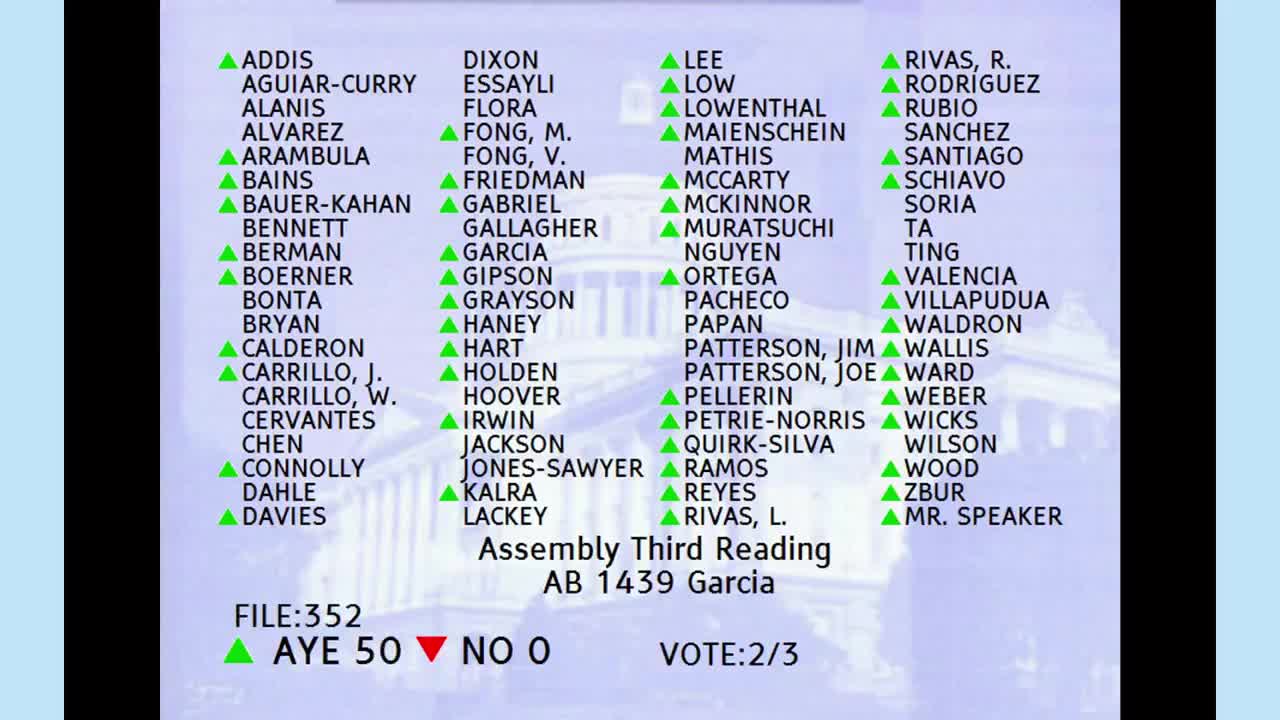 1MIN
Assembly Floor
 6MIN
Assembly Standing Committee on Revenue and Taxation
Bill Author

Bill Co-Author(s):