AB 2716: Oil and gas: low-production wells: Baldwin Hills Conservancy: Equitable Community Repair and Reinvestment Account.
- Session Year: 2023-2024
- House: Assembly
- Latest Version Date: 2024-09-25
Current Status:
Passed
(2024-09-25: Chaptered by Secretary of State - Chapter 549, Statutes of 2024.)
Introduced
In Committee
First Chamber
In Committee
Second Chamber
Enacted
What does this bill do?
The bill requires owners of oil and gas wells in the Baldwin Hills Conservancy area of Los Angeles County (in oil fields next to a state park or recreation area) to stop operating wells as low-production for more than 12 months and to plug and abandon (permanently close) all wells in that area by December 31, 2030. Owners who don’t comply face $10,000 per month in administrative fines, and those fines must go into a new Equitable Community Repair and Reinvestment Account to fund local parks, urban greening, affordable housing, climate resilience, and other community projects near the wells.
The summary is provided by generative AI which can make mistakes. For original language, please view the details in the table below.
Existing law establishes the Geologic Energy Management Division in the Department of Conservation, under the direction of the State Oil and Gas Supervisor, who is required to supervise the drilling, operation, maintenance, and abandonment of oil and gas wells, as provided. Existing law requires the operator of a well to file a written notice of intention to commence drilling with, and prohibits any drilling until approval is given by, the supervisor or district deputy. Existing law requires the operator of any idle well, as defined, to either (1) no later than May 1 of each year, for each idle well that was an idle well at any time in the last calendar year, file with the supervisor an annual fee according to a specified schedule of fees based on the length of time a well has been idle, or (2) file a plan with the supervisor to provide for the management and elimination of all long-term idle wells. A violation of these or other laws regulating oil and gas operations, as provided, is a crime.
This bill would require the division, on or before March 1, 2025, to identify all low-production wells, as defined, that are located in the County of Los Angeles in an oil field that is adjacent to a state recreation area or state park and is located, in whole or in part, within the boundary of the Baldwin Hills Conservancy, and determine the length of time each of those wells has continuously been a low-production well, as provided. The bill would prohibit, commencing March 1, 2026, the owners of those wells from allowing those wells to be low-production wells for more than 12 months. Upon a violation of that prohibition, the bill would require the supervisor to charge an administrative penalty of $10,000 per month to the low-production well owner, until the low-production well is plugged and abandoned, as provided. Because a violation of these requirements would be a crime, the bill would impose a state-mandated local program. The bill would establish the Equitable Community Repair and Reinvestment Account, require these administrative penalties to be deposited into the account, and make the funds from the account available, upon appropriation by the Legislature, to the Department of Conservation for allocation to the County of Los Angeles for projects that benefit communities living within 21/2 miles of the identified low production wells, as provided.
This bill would require the plugging and abandoning of all wells located in the County of Los Angeles in an oil field that is adjacent to a state recreation area or state park and is located, in whole or in part, within the boundary of the Baldwin Hills Conservancy by December 31, 2030. The bill would require the supervisor, on and after January 1, 2031, to charge the owner of a well an administrative penalty of $10,000 per month for a violation of that requirement, until the well is plugged and abandoned, to be deposited in the account, as provided. The bill would authorize the owner of an idle well or long-term idle well subject to this requirement to adjust the terms of the above-described idle well management plan to accomplish the plugging and abandoning of those covered wells by December 31, 2030. Because a violation of these requirements would be a crime, the bill would impose a state-mandated local program. The bill would state that the Legislature shall not allow the account balance to exceed specified amounts, determined as provided.
The California Constitution requires the state to reimburse local agencies and school districts for certain costs mandated by the state. Statutory provisions establish procedures for making that reimbursement.
This bill would provide that no reimbursement is required by this act for a specified reason.
Existing law establishes the Geologic Energy Management Division in the Department of Conservation, under the direction of the State Oil and Gas Supervisor, who is required to supervise the drilling, operation, maintenance, and abandonment of oil and gas wells, as provided. Existing law requires the operator of a well to file a written notice of intention to commence drilling with, and prohibits any drilling until approval is given by, the supervisor or district deputy. Existing law requires the operator of any idle well, as defined, to either (1) no later than May 1 of each year, for each idle well that was an idle well at any time in the last calendar year, file with the supervisor an annual fee according to a specified schedule of fees based on the length of time a well has been idle, or (2) file a plan with the supervisor to provide for the management and elimination of all long-term idle wells. A violation of these or other laws regulating oil and gas operations, as provided, is a crime.
This bill would require the division, on or before March 1, 2025, to identify all low-production wells, as defined, that are located in the County of Los Angeles in an oil field that is adjacent to a state recreation area or state park and is located, in whole or in part, within the boundary of the Baldwin Hills Conservancy, and determine the length of time each of those wells has continuously been a low-production well, as provided.The provided. The bill would prohibit, commencing March 1, 2026, the owners of those wells from allowing those wells to be low-production wells for more than 12 months. Upon a violation of that prohibition, the bill would require the supervisor to charge an administrative penalty of $10,000 per month to the low-production well owner, until the low-production well is plugged and abandoned, as provided. Because a violation of these requirements would be a crime, the bill would impose a state-mandated local program. The bill would establish the Equitable Community Repair and Reinvestment Account, require these administrative penalties to be deposited into the account, and make the funds from the account available, upon appropriation by the Legislature, to the Department of Conservation for allocation to the County of Los Angeles for projects that benefit communities living within 21/2 miles of the identified low production wells, as provided.
This bill would require the plugging and abandoning of all wells located in the County of Los Angeles in an oil field that is adjacent to a state recreation area or state park and is located, in whole or in part, within the boundary of the Baldwin Hills Conservancy by December 31, 2030. The bill would require the supervisor, on and after January 1, 2031, to charge the owner of a well an administrative penalty of $10,000 per month for a violation of that requirement, until the well is plugged and abandoned, to be deposited in the account, as provided. The bill would require authorize the owner of an idle well or long-term idle well subject to this requirement to maintain compliance with the above-described requirements for operators of idle wells until plugging and abandonment, and would authorize the owner of the idle well to adjust the terms of the above-described idle well management plan to accomplish the plugging and abandoning of those covered wells by December 31, 2030. Because a violation of these requirements would be a crime, the bill would impose a state-mandated local program. The bill would state that the Legislature shall not allow the account balance to exceed specified amounts, determined as provided.
The California Constitution requires the state to reimburse local agencies and school districts for certain costs mandated by the state. Statutory provisions establish procedures for making that reimbursement.
This bill would provide that no reimbursement is required by this act for a specified reason.
Existing law establishes the Geologic Energy Management Division in the Department of Conservation, under the direction of the State Oil and Gas Supervisor, who is required to supervise the drilling, operation, maintenance, and abandonment of oil and gas wells, as provided. Existing law requires the operator of a well to file a written notice of intention to commence drilling with, and prohibits any drilling until approval is given by, the supervisor or district deputy. Existing law requires the operator of any idle well, as defined, to either (1) no later than May 1 of each year, for each idle well that was an idle well at any time in the last calendar year, file with the supervisor an annual fee according to a specified schedule of fees based on the length of time a well has been idle, or (2) file a plan with the supervisor to provide for the management and elimination of all long-term idle wells. A violation of these or other laws regulating oil and gas operations, as provided, is a crime.
Existing law generally prohibits the division from approving any notice of intention within a health protection zone, defined as an area within 3,200 feet of a sensitive receptor, as provided. These provisions related to health protection zones are the subject of a referendum on Chapter 365 of the Statutes of 2022 to appear on the November 5, 2024, statewide general election ballot.This bill would require the division, on or before July March 1, 2025, to identify all low-production wells wells, as defined, that are located within 3,200 feet of a sensitive receptor, in the County of Los Angeles in an oil field that is adjacent to a state recreation area or state park and is located, in whole or in part, within the boundary of the Baldwin Hills Conservancy, and determine the length of time each of those wells has continuously been a low-production well, as provided. The bill would define a low-production well for these purposes as an oil or gas well that produces, on average, fewer than 15 barrels of oil a day during any period of 12 consecutive months, or a natural gas well whose maximum daily average gas production does not exceed 60,000 cubic feet of gas, per day, during any period of 12 consecutive months. The bill would include specified idle wells within the definition of a low-production well and exclude a natural gas storage well, a dedicated injection well, an active observation well, and a fully plugged and abandoned well from the definition of a low-production well, as provided. The bill would require the division, on or before July 1, 2026, to notify the owners of wells identified as low-production wells, as provided.
The bill would prohibit, commencing July March 1, 2026, a well located within 3,200 feet of a sensitive receptor the owners of those wells from being a allowing those wells to be low-production well wells for more than 24 12 months. Upon a violation of that prohibition, the bill would require the supervisor to charge an administrative penalty of $10,000 per day month to a the low-production well owner, until the low-production well is plugged and abandoned, as provided. The bill would require the division to waive this penalty on a low-production well when the owner submits a request for a notice of intention to plug and abandon the well, as provided. Because a violation of these requirements would be a crime, the bill would impose a state-mandated local program. The bill would establish the Equitable Community Repair and Reinvestment Account, require these administrative penalties to be deposited into the account, and make the funds from the account available, upon appropriation by the Legislature, to the County of Los Angeles for projects that benefit communities living within 21/2 miles of the identified low production wells, as provided.
Existing law establishes and requires the division to administer and manage the Oil and Gas Environmental Remediation Account in the Oil, Gas, and Geothermal Administrative Fund. Existing law requires moneys in the account to be used, upon appropriation by the Legislature, to plug and abandon oil and gas wells, decommission attendant facilities, or otherwise remediate sites that the supervisor determines could pose a danger to life, health, water quality, wildlife, or natural resources, as specified.This bill would require the above-described administrative penalties for operating low-production wells to be deposited into the Oil and Gas Environmental Remediation Account.This bill would require the plugging and abandoning of all wells located in the County of Los Angeles in an oil field that is adjacent to a state recreation area or state park and is located, in whole or in part, within the boundary of the Baldwin Hills Conservancy by December 31, 2030. The bill would require the supervisor, on and after January 1, 2031, to charge the owner of a well an administrative penalty of $10,000 per month for a violation of that requirement, until the well is plugged and abandoned, to be deposited in the account, as provided. The bill would require the owner of an idle well or long-term idle well subject to this requirement to maintain compliance with the above-described requirements for operators of idle wells until plugging and abandonment, and would authorize the owner of the idle well to adjust the terms of the idle well management plan to accomplish the plugging and abandoning of those covered wells by December 31, 2030. Because a violation of these requirements would be a crime, the bill would impose a state-mandated local program. The bill would state that the Legislature shall not allow the account balance to exceed specified amounts, determined as provided.
The California Constitution requires the state to reimburse local agencies and school districts for certain costs mandated by the state. Statutory provisions establish procedures for making that reimbursement.
This bill would provide that no reimbursement is required by this act for a specified reason.
Existing law establishes the Geologic Energy Management Division in the Department of Conservation, under the direction of the State Oil and Gas Supervisor, who is required to supervise the drilling, operation, maintenance, and abandonment of oil and gas wells, as provided. Existing law requires the operator of a well to file a written notice of intention to commence drilling with, and prohibits any drilling until approval is given by, the supervisor or district deputy. Existing law requires the operator of any idle well, as defined, to either (1) no later than May 1 of each year, for each idle well that was an idle well at any time in the last calendar year, file with the supervisor an annual fee according to a specified schedule of fees based on the length of time a well has been idle, or (2) file a plan with the supervisor to provide for the management and elimination of all long-term idle wells. A violation of these or other laws regulating oil and gas operations, as provided, is a crime.
Existing law generally prohibits the division from approving any notice of intention within a health protection zone, defined as an area within 3,200 feet of a sensitive receptor, as provided. These provisions related to health protection zones are the subject of a referendum on Chapter 365 of the Statutes of 2022 to appear on the November 5, 2024, statewide general election ballot.
This bill would require the division, on or before July 1, 2025, to identify all low-production wells that are located within 3,200 feet of a sensitive receptor, and determine the length of time each of those wells has continuously been a low-production well, as provided. The bill would define a low-production well for these purposes as an oil or gas well that produces, on average, fewer than 15 barrels of oil a day during any period of 12 consecutive months, or a natural gas well whose maximum daily average gas production does not exceed 60,000 cubic feet of gas, per day, during any period of 12 consecutive months. The bill would include specified idle wells within the definition of a low-production well and exclude a natural gas storage well, a dedicated injection well, an active observation well, and a fully plugged and abandoned well from the definition of a low-production well, as provided. The bill would require the division, on or before July 1, 2026, to notify the owners of wells identified as low-production wells, as provided.
The bill would prohibit, commencing July 1, 2026, a well located within 3,200 feet of a sensitive receptor from being a low-production well for more than 24 months. Upon a violation of that prohibition, the bill would require the supervisor to charge an administrative penalty of $10,000 per day to a low-production well owner, until the low-production well is plugged and abandoned, as provided. The bill would require the division to waive this penalty on a low-production well when the owner submits a request for a notice of intention to plug and abandon the well, as provided. Because a violation of these requirements would be a crime, the bill would impose a state-mandated local program.
Existing law establishes and requires the division to administer and manage the Oil and Gas Environmental Remediation Account in the Oil, Gas, and Geothermal Administrative Fund. Existing law requires moneys in the account to be used, upon appropriation by the Legislature, to plug and abandon oil and gas wells, decommission attendant facilities, or otherwise remediate sites that the supervisor determines could pose a danger to life, health, water quality, wildlife, or natural resources, as specified.
This bill would require the above-described administrative penalties for operating low-production wells to be deposited into the Oil and Gas Environmental Remediation Account.
The California Constitution requires the state to reimburse local agencies and school districts for certain costs mandated by the state. Statutory provisions establish procedures for making that reimbursement.
This bill would provide that no reimbursement is required by this act for a specified reason.
Existing law establishes the Geologic Energy Management Division in the Department of Conservation, under the direction of the State Oil and Gas Supervisor, who is required to supervise the drilling, operation, maintenance, and abandonment of oil and gas wells, as provided. Existing law requires the operator of a well to file a written notice of intention to commence drilling with, and prohibits any drilling until approval is given by, the supervisor or district deputy. Existing law requires the operator of any idle well well, as defined, to either (1) no later than May 1 of each year, for each idle well that was an idle well at any time in the last calendar year, file with the supervisor an annual fee according to a specified schedule of fees based on the length of time a well has been idle, or (2) file a plan with the supervisor to provide for the management and elimination of all long-term idle wells. A violation of these or other laws regulating oil and gas operations, as provided, is a crime.
Existing law generally prohibits the division from approving any notice of intention within a health protection zone, defined as an area within 3,200 feet of a sensitive receptor, as provided. These provisions related to health protection zones are the subject of a referendum on Chapter 365 of the Statutes of 2022 to appear on the November 5, 2024, statewide general election ballot.
This bill would make nonsubstantive changes to that provision. require the division, on or before July 1, 2025, to identify all low-production wells that are located within 3,200 feet of a sensitive receptor, and determine the length of time each of those wells has continuously been a low-production well, as provided. The bill would define a low-production well for these purposes as an oil or gas well that produces, on average, fewer than 15 barrels of oil a day during any period of 12 consecutive months, or a natural gas well whose maximum daily average gas production does not exceed 60,000 cubic feet of gas, per day, during any period of 12 consecutive months. The bill would include specified idle wells within the definition of a low-production well and exclude a natural gas storage well, a dedicated injection well, an active observation well, and a fully plugged and abandoned well from the definition of a low-production well, as provided. The bill would require the division, on or before July 1, 2026, to notify the owners of wells identified as low-production wells, as provided.
The bill would prohibit, commencing July 1, 2026, a well located within 3,200 feet of a sensitive receptor from being a low-production well for more than 24 months. Upon a violation of that prohibition, the bill would require the supervisor to charge an administrative penalty of $10,000 per day to a low-production well owner, until the low-production well is plugged and abandoned, as provided. The bill would require the division to waive this penalty on a low-production well when the owner submits a request for a notice of intention to plug and abandon the well, as provided. Because a violation of these requirements would be a crime, the bill would impose a state-mandated local program.
Existing law establishes and requires the division to administer and manage the Oil and Gas Environmental Remediation Account in the Oil, Gas, and Geothermal Administrative Fund. Existing law requires moneys in the account to be used, upon appropriation by the Legislature, to plug and abandon oil and gas wells, decommission attendant facilities, or otherwise remediate sites that the supervisor determines could pose a danger to life, health, water quality, wildlife, or natural resources, as specified.
This bill would require the above-described administrative penalties for operating low-production wells to be deposited into the Oil and Gas Environmental Remediation Account.
The California Constitution requires the state to reimburse local agencies and school districts for certain costs mandated by the state. Statutory provisions establish procedures for making that reimbursement.
This bill would provide that no reimbursement is required by this act for a specified reason.
Existing law establishes the Geologic Energy Management Division in the Department of Conservation, under the direction of the State Oil and Gas Supervisor, who is required to supervise the drilling, operation, maintenance, and abandonment of oil and gas wells, as provided. Existing law requires the operator of any idle well to either (1) no later than May 1 of each year, for each idle well that was an idle well at any time in the last calendar year, file with the supervisor an annual fee according to a specified schedule of fees based on the length of time a well has been idle, or (2) file a plan with the supervisor to provide for the management and elimination of all long-term idle wells.
This bill would make nonsubstantive changes to that provision.
The Legislature finds and declares all of the following:
(a)The Baldwin Hills Inglewood oil field is the largest urban oil field in our state with approximately 655 active oil wells right in the heart of the County of Los Angeles and historic South Los Angeles communities.
(b)In addition to the increasing impacts of climate change, a growing body of research shows direct health impacts from proximity to oil extraction.
(c)These impacts are disproportionately impacting Black, Brown, and Indigenous people in California, who are most likely to live in close proximity to oil extraction activities and who are the most vulnerable to the negative impacts of climate change.
(d)Proximity to oil and gas extraction sites poses significant health risks, especially due to increased air pollution.
(e)Studies have shown evidence of harm at distances up to one kilometer, which is approximately 3,200 feet.
(f)Further assistance must be provided to frontline communities that have been most polluted by the fossil fuel industry by cleaning up pollution, remediating negative health impacts, and building resilient infrastructure to prepare for the unavoidable impacts of climate change.
(g)On December 7, 2023, the City of Culver City and Sentinel Peak Resources, a California limited liability company, executed a settlement agreement that includes a provision that Sentinel Peak Resources must plug and abandon all remaining wells and complete the overall closure of the city portion of the Inglewood Oil Field by December 31, 2029.
SEC. 2.Section 3008 of the Public Resources Code is amended to read:3008.(a)Well means any oil or gas well or well for the discovery of oil or gas; any well on lands producing or reasonably presumed to contain oil or gas; any well drilled for the purpose of injecting fluids or gas for stimulating oil or gas recovery, repressuring or pressure maintenance of oil or gas reservoirs, or disposing of waste fluids from an oil or gas field; any well used to inject or withdraw gas from an underground storage facility; or any well drilled within or adjacent to an oil or gas pool for the purpose of obtaining water to be used in production stimulation or repressuring operations.
(b)Prospect well or exploratory well means any well drilled to extend a field or explore a new, potentially productive reservoir.
(c)Active observation well means a well being used for the sole purpose of gathering reservoir data, such as pressure or temperature in a reservoir being currently produced or injected by the operator. For a well to be an active observation well, the operator shall demonstrate to the divisions satisfaction that the well fulfills a need for gathering reservoir data, and the operator shall provide the division with a summary report of the type of data collected at least annually or as requested by the division.
(d)Idle well means any well that for a period of 24 consecutive months has not either produced oil or natural gas, produced water to be used in production stimulation, or been used for enhanced oil recovery, reservoir pressure management, or injection. For the purpose of determining whether a well is an idle well, production or injection is subject to verification by the division. An idle well continues to be an idle well until it has been properly abandoned in accordance with Section 3208 or it has been shown to the divisions satisfaction that, since the well became an idle well, the well has for a continuous six-month period either maintained production of oil or natural gas, maintained production of water used in production stimulation, or been used for enhanced oil recovery, reservoir pressure management, or injection. An idle well does not include an active observation well.
(e)Long-term idle well means any well that has been an idle well for eight or more years.
(f)Low-production well means an oil or gas well that produces, on average, fewer than 15 barrels of oil a day during the past 12 consecutive months, or a natural gas well whose maximum daily average gas production does not exceed 60,000 cubic feet of gas, per day, during the past 12 consecutive months. A low-production well does not include a natural gas storage well, a dedicated injection well, an active observation well, an idle well as defined in subdivision (d), or a fully plugged and abandoned well.
SEC. 3.Section 3206.1.5 is added to the Public Resources Code, immediately following Section 3206.1, to read:3206.1.5.(a)On or before March 1, 2025, the division shall identify all low-production wells that are located in a county of the first class in an oil field that is adjacent to a state recreation area or state park and is located, in whole or in part, within the boundary of the Baldwin Hills Conservancy. The division shall determine the length of time those low-production wells have continuously been low-production wells. The division shall consider whether and for how long a well was shut-in for maintenance and subtract that from the calculation of the length of time a well meets the definition of a low-production well.
(b)On or before March 1, 2026, the division shall notify the owners of low-production wells identified in subdivision (a) of the prohibition on operating a low-production well for more than 12 months, as described in subdivision (c).
(c)Commencing March 1, 2026, a well identified pursuant to subdivision (a) shall not be a low-production well for more than 12 months.
(d)The supervisor shall charge an administrative penalty of ten thousand dollars ($10,000) per month to a low-production well owner in violation of subdivision (c) until the low-production well is plugged and abandoned pursuant to Section 3208. Penalties shall be remitted annually on a schedule determined by the supervisor. The low-production well site shall not be required to be remediated until oil and gas operations cease.
(e)The division shall waive the penalty in subdivision (d) on a low-production well when the owner submits a request for approval of a notice of intention pursuant to Section 3203 to plug and abandon the well. If work to plug and abandon the well does not start before the notice of intention expires, the division shall resume assessing the penalty on the well owner. A well owner who has an approved notice of intention to plug and abandon a well in accordance with Section 3208 shall not apply for approval of another notice of intention to plug and abandon the same well in a two-year period unless the supervisor determines that the well poses a present danger to life, health, or natural resources.
(f)(1)All funds collected pursuant to this section shall be deposited into the Equitable Community Repair and Reinvestment Account, which is hereby created in the State Treasury as a special fund administered by the Department of Conservation.
(2)Funds from the account shall be available, upon appropriation by the Legislature, to the Department of Conservation for allocation to a county of the first class. The county may contract with entities within its jurisdiction, including, but not limited to, cities, state conservancies, joint powers authorities, and nonprofit organizations to use the funds for projects listed in subparagraphs (A) to (E), inclusive, to the extent that these projects benefit communities living within two and one-half miles of the oil wells identified in subdivision (a).
(A)Park creation or expansion and maintenance of new outdoor amenities in park-poor neighborhoods.
(B)Urban greening.
(C)Affordable housing needed to accommodate community needs.
(D)Climate mitigation and resilience.
(E)Community benefit projects with environmental cobenefits.
(3)(A)The Legislature shall not allow the account balance to exceed twenty million dollars ($20,000,000).
(B)Until December 31, 2030, the Legislature shall not allow the account balance to exceed ten million dollars ($10,000,000) once 50 percent of all wells that meet the conditions specified in subdivision (a) have been plugged and abandoned.
(C)Commencing January 1, 2031, the Legislature shall not allow the account balance to exceed ten million dollars ($10,000,000) once 50 percent of all wells that meet the conditions specified in paragraph (1) of subdivision (g) have been plugged and abandoned.
(g)(1)All wells, as defined in subdivision (a) of Section 3008, that are located in a county of the first class in an oil field that is adjacent to a state recreation area or state park and is located, in whole or in part, within the boundary of the Baldwin Hills Conservancy shall be plugged and abandoned by December 31, 2030.
(2)An owner of an idle well or long-term idle well that is located in a county of the first class in an oil field that is adjacent to a state recreation area or state park and is located, in whole or in part, within the boundary of the Baldwin Hills Conservancy may adjust the terms of an idle well management plan required pursuant to Section 3206, as needed, to accomplish the plugging and abandonment of those covered wells by December 31, 2030.
(3)(A)On and after January 1, 2031, the supervisor shall charge an administrative penalty of ten thousand dollars ($10,000) per month to a well owner in violation of paragraph (1) until the well is plugged and abandoned pursuant to Section 3208.
(B)The supervisor shall not charge an administrative penalty pursuant to subparagraph (A) for a violation by a well owner if the supervisor has already charged an administrative penalty to that well owner for a violation, applicable to the same well and covering the same time period, pursuant to subdivision (d).
SEC. 4.No reimbursement is required by this act pursuant to Section 6 of Article XIIIB of the California Constitution because the only costs that may be incurred by a local agency or school district will be incurred because this act creates a new crime or infraction, eliminates a crime or infraction, or changes the penalty for a crime or infraction, within the meaning of Section 17556 of the Government Code, or changes the definition of a crime within the meaning of Section 6 of Article XIIIB of the California Constitution.
The Legislature finds and declares all of the following:
(a)The Baldwin Hills Inglewood oil field is the largest urban oil field in our state with approximately 655 active oil wells right in the heart of the County of Los Angeles and historic South Los Angeles communities.
(b)In addition to the increasing impacts of climate change, a growing body of research shows direct health impacts from proximity to oil extraction.
(c)These impacts are disproportionately impacting Black, Brown, and Indigenous people in California, who are most likely to live in close proximity to oil extraction activities and who are the most vulnerable to the negative impacts of climate change.
(d)Proximity to oil and gas extraction sites poses significant health risks, especially due to increased air pollution.
(e)Studies have shown evidence of harm at distances up to one kilometer, which is approximately 3,200 feet.
(f)Further assistance must be provided to frontline communities that have been most polluted by the fossil fuel industry by cleaning up pollution, remediating negative health impacts, and building resilient infrastructure to prepare for the unavoidable impacts of climate change.
(g)On December 7, 2023, the City of Culver City and Sentinel Peak Resources, a California limited liability company, executed a settlement agreement that includes a provision that Sentinel Peak Resources must plug and abandon all remaining wells and complete the overall closure of the city portion of the Inglewood Oil Field by December 31, 2029.
SEC. 2.Section 3008 of the Public Resources Code is amended to read:3008.(a)Well means any oil or gas well or well for the discovery of oil or gas; any well on lands producing or reasonably presumed to contain oil or gas; any well drilled for the purpose of injecting fluids or gas for stimulating oil or gas recovery, repressuring or pressure maintenance of oil or gas reservoirs, or disposing of waste fluids from an oil or gas field; any well used to inject or withdraw gas from an underground storage facility; or any well drilled within or adjacent to an oil or gas pool for the purpose of obtaining water to be used in production stimulation or repressuring operations.
(b)Prospect well or exploratory well means any well drilled to extend a field or explore a new, potentially productive reservoir.
(c)Active observation well means a well being used for the sole purpose of gathering reservoir data, such as pressure or temperature in a reservoir being currently produced or injected by the operator. For a well to be an active observation well, the operator shall demonstrate to the divisions satisfaction that the well fulfills a need for gathering reservoir data, and the operator shall provide the division with a summary report of the type of data collected at least annually or as requested by the division.
(d)Idle well means any well that for a period of 24 consecutive months has not either produced oil or natural gas, produced water to be used in production stimulation, or been used for enhanced oil recovery, reservoir pressure management, or injection. For the purpose of determining whether a well is an idle well, production or injection is subject to verification by the division. An idle well continues to be an idle well until it has been properly abandoned in accordance with Section 3208 or it has been shown to the divisions satisfaction that, since the well became an idle well, the well has for a continuous six-month period either maintained production of oil or natural gas, maintained production of water used in production stimulation, or been used for enhanced oil recovery, reservoir pressure management, or injection. An idle well does not include an active observation well.
(e)Long-term idle well means any well that has been an idle well for eight or more years.
(f)Low-production well means an oil or gas well that produces, on average, fewer than 15 barrels of oil a day during any period of the past 12 consecutive months, or a natural gas well whose maximum daily average gas production does not exceed 60,000 cubic feet of gas, per day, during any period of the past 12 consecutive months. A low-production well includes an idle well that produces oil, gas, or oil and gas for up to a continuous six-month period, but does not meet the criteria to be reclassified from idle status. A low-production well does not include a natural gas storage well, a dedicated injection well, an active observation well, an idle well as defined in subdivision (d), or a fully plugged and abandoned well.
SEC. 3.Section 3206.1.5 is added to the Public Resources Code, immediately following Section 3206.1, to read:3206.1.5.(a)Notwithstanding Section 3206, on On or before March 1, 2025, the division shall identify all low-production wells that are located in a county of the first class in an oil field that is adjacent to a state recreation area or state park and is located, in whole or in part, within the boundary of the Baldwin Hills Conservancy. The division shall determine the length of time those low-production wells have continuously been low-production wells. The division shall consider whether and for how long a well was shut-in for maintenance and subtract that from the calculation of the length of time a well meets the definition of a low-production well.
(b)On or before March 1, 2026, the division shall notify the owners of low-production wells identified in subdivision (a) of the prohibition on operating a low-production well for more than 12 months, as described in subdivision (c).
(c)Commencing March 1, 2026, a well identified pursuant to subdivision (a) shall not be a low-production well for more than 12 months.
(d)The supervisor shall charge an administrative penalty of ten thousand dollars ($10,000) per month to a low-production well owner in violation of subdivision (c) until the low-production well is plugged and abandoned pursuant to Section 3208. Penalties shall be remitted annually on a schedule determined by the supervisor. The low-production well site shall not be required to be remediated until oil and gas operations cease.
(e)The division shall waive the penalty in subdivision (d) on a low-production well when the owner submits a request for approval of a notice of intention pursuant to Section 3203 to plug and abandon the well. If work to plug and abandon the well does not start before the notice of intention expires, the division shall resume assessing the penalty on the well owner. A well owner who has an approved notice of intention to plug and abandon a well in accordance with Section 3208 shall not apply for approval of another notice of intention to plug and abandon the same well in a two-year period unless the supervisor determines that the well poses a present danger to life, health, or natural resources.
(f)(1)All funds collected pursuant to this section shall be deposited into the Equitable Community Repair and Reinvestment Account, which is hereby created in the State Treasury. Treasury as a special fund administered by the Department of Conservation.
(2)Funds from the account shall be available, upon appropriation by the Legislature, to the Department of Conservation for allocation to a county of the first class. Funds shall be used by the county The county may contract with entities within its jurisdiction, including, but not limited to, cities, state conservancies, joint powers authorities, and nonprofit organizations to use the funds for projects listed in subparagraphs (A) to (E), inclusive, to the extent that these projects benefit communities living within two and one-half miles of the oil wells identified in subdivision (a).
(A)Park creation or expansion and maintenance of new outdoor amenities in park-poor neighborhoods.
(B)Urban greening.
(C)Affordable housing needed to accommodate community needs.
(D)Climate mitigation and resilience.
(E)Community benefit projects with environmental cobenefits.
(3)(A)The Legislature shall not allow the account balance to exceed twenty million dollars ($20,000,000).
(B)Until December 31, 2030, the Legislature shall not allow the account balance to exceed ten million dollars ($10,000,000) once 50 percent of all wells that meet the conditions specified in subdivision (a) have been plugged and abandoned.
(C)Commencing January 1, 2031, the Legislature shall not allow the account balance to exceed ten million dollars ($10,000,000) once 50 percent of all wells that meet the conditions specified in paragraph (1) of subdivision (g) have been plugged and abandoned.
(g)(1)All wells, as defined in subdivision (a) of Section 3008, that are located in a county of the first class in an oil field that is adjacent to a state recreation area or state park and is located, in whole or in part, within the boundary of the Baldwin Hills Conservancy shall be plugged and abandoned by December 31, 2030.
(2)An owner of an idle well or long-term idle well that is located in a county of the first class in an oil field that is adjacent to a state recreation area or state park and is located, in whole or in part, within the boundary of the Baldwin Hills Conservancy shall maintain compliance with Section 3206 until the well is plugged and abandoned. The owner may adjust the terms of the an idle well management plan, plan required pursuant to Section 3206, as needed, to accomplish the plugging and abandonment of those covered wells by December 31, 2030.
(3)(A)On and after January 1, 2031, the supervisor shall charge an administrative penalty of ten thousand dollars ($10,000) per month to a well owner in violation of paragraph (1) until the well is plugged and abandoned pursuant to Section 3208.
(B)The supervisor shall not charge an administrative penalty pursuant to subparagraph (A) for a violation by a well owner if the supervisor has already charged an administrative penalty to that well owner for that violation a violation, applicable to the same well and covering the same time period, pursuant to subdivision (d).
SEC. 4.No reimbursement is required by this act pursuant to Section 6 of Article XIIIB of the California Constitution because the only costs that may be incurred by a local agency or school district will be incurred because this act creates a new crime or infraction, eliminates a crime or infraction, or changes the penalty for a crime or infraction, within the meaning of Section 17556 of the Government Code, or changes the definition of a crime within the meaning of Section 6 of Article XIIIB of the California Constitution.
The Legislature finds and declares all of the following:
(a)The Baldwin Hills Inglewood oil field is the largest urban oil field in our state with approximately 655 active oil wells right in the heart of the County of Los Angeles and historic South Los Angeles communities.
(b)In addition to the increasing impacts of climate change, a growing body of research shows direct health impacts from proximity to oil extraction.
(c)These impacts are disproportionately impacting Black, Brown, and Indigenous people in California, who are most likely to live in close proximity to oil extraction activities and who are the most vulnerable to the negative impacts of climate change.
(d)Proximity to oil and gas extraction sites poses significant health risks, especially due to increased air pollution.
(e)Studies have shown evidence of harm at distances up to one kilometer, which is approximately 3,200 feet.
(f)Further assistance must be provided to frontline communities that have been most polluted by the fossil fuel industry by cleaning up pollution, remediating negative health impacts, and building resilient infrastructure to prepare for the unavoidable impacts of climate change.
SECTION 1.SEC. 2.Section 3008 of the Public Resources Code is amended to read:3008.(a)Well means any oil or gas well or well for the discovery of oil or gas; any well on lands producing or reasonably presumed to contain oil or gas; any well drilled for the purpose of injecting fluids or gas for stimulating oil or gas recovery, repressuring or pressure maintenance of oil or gas reservoirs, or disposing of waste fluids from an oil or gas field; any well used to inject or withdraw gas from an underground storage facility; or any well drilled within or adjacent to an oil or gas pool for the purpose of obtaining water to be used in production stimulation or repressuring operations.
(b)Prospect well or exploratory well means any well drilled to extend a field or explore a new, potentially productive reservoir.
(c)Active observation well means a well being used for the sole purpose of gathering reservoir data, such as pressure or temperature in a reservoir being currently produced or injected by the operator. For a well to be an active observation well, the operator shall demonstrate to the divisions satisfaction that the well fulfills a need for gathering reservoir data, and the operator shall provide the division with a summary report of the type of data collected at least annually or as requested by the division.
(d)Idle well means any well that for a period of 24 consecutive months has not either produced oil or natural gas, produced water to be used in production stimulation, or been used for enhanced oil recovery, reservoir pressure management, or injection. For the purpose of determining whether a well is an idle well, production or injection is subject to verification by the division. An idle well continues to be an idle well until it has been properly abandoned in accordance with Section 3208 or it has been shown to the divisions satisfaction that, since the well became an idle well, the well has for a continuous six-month period either maintained production of oil or natural gas, maintained production of water used in production stimulation, or been used for enhanced oil recovery, reservoir pressure management, or injection. An idle well does not include an active observation well.
(e)Long-term idle well means any well that has been an idle well for eight or more years.
(f)Low-production well means an oil or gas well that produces, on average, fewer than 15 barrels of oil a day during any period of 12 consecutive months, or a natural gas well whose maximum daily average gas production does not exceed 60,000 cubic feet of gas, per day, during any period of 12 consecutive months. A low-production well includes an idle well that produces oil, gas, or oil and gas for up to a continuous six-month period, but does not meet the criteria to be reclassified from idle status. A low-production well does not include a natural gas storage well, a dedicated injection well, an active observation well, or a fully plugged and abandoned well.
SEC. 2.SEC. 3.Section 3206.1.5 is added to the Public Resources Code, immediately following Section 3206.1, to read:3206.1.5.(a)Notwithstanding Section 3206, on or before July March 1, 2025, the division shall identify all low-production wells that are located within 3,200 feet of a sensitive receptor and in a county of the first class in an oil field that is adjacent to a state recreation area or state park and is located, in whole or in part, within the boundary of the Baldwin Hills Conservancy. The division shall determine the length of time those low-production wells have continuously been low-production wells. The division shall consider whether and for how long a well was shut-in for maintenance and subtract that from the calculation of the length of time a well meets the definition of a low-production well.
(b)On or before July March 1, 2026, the division shall notify the owners of low-production wells identified in subdivision (a) of the prohibition on operating a low-production well for more than 24 12 months, as described in subdivision (c).
(c)Commencing July March 1, 2026, a well located within 3,200 feet of a sensitive receptor identified pursuant to subdivision (a) shall not be a low-production well for more than 24 12 months.
(d)The supervisor shall charge an administrative penalty of ten thousand dollars ($10,000) per day month to a low-production well owner in violation of subdivision (c) until the low-production well is plugged and abandoned pursuant to Section 3208. Penalties shall be remitted annually on a schedule determined by the supervisor. The low-production well site shall not be required to be remediated until oil and gas operations cease.
(e)The division shall waive the penalty in subdivision (d) on a low-production well when the owner submits a request for approval of a notice of intention pursuant to Section 3203 to plug and abandon the well. If work to plug and abandon the well does not start before the notice of intention expires, the division shall resume assessing the penalty on the well owner. A well owner who has an approved notice of intention to plug and abandon a well in accordance with Section 3208 shall not apply for approval of another notice of intention to plug and abandon the same well in a two-year period unless the supervisor determines that the well poses a present danger to life, health, or natural resources.
(f)(1)All funds collected pursuant to this section shall be deposited into the Oil and Gas Environmental Remediation Account. Equitable Community Repair and Reinvestment Account, which is hereby created in the State Treasury.
(2)Funds from the account shall be available, upon appropriation by the Legislature, to a county of the first class. Funds shall be used by the county for projects listed in subparagraphs (A) to (E), inclusive, to the extent that these projects benefit communities living within two and one-half miles of the oil wells identified in subdivision (a).
(A)Park creation or expansion in park-poor neighborhoods.
(B)Urban greening.
(C)Affordable housing needed to accommodate community needs.
(D)Climate mitigation and resilience.
(E)Community benefit projects with environmental cobenefits.
(3)(A)The Legislature shall not allow the account balance to exceed twenty million dollars ($20,000,000).
(B)Until December 31, 2030, the Legislature shall not allow the account balance to exceed ten million dollars ($10,000,000) once 50 percent of all wells that meet the conditions specified in subdivision (a) have been plugged and abandoned.
(C)Commencing January 1, 2031, the Legislature shall not allow the account balance to exceed ten million dollars ($10,000,000) once 50 percent of all wells that meet the conditions specified in paragraph (1) of subdivision (g) have been plugged and abandoned.
(g)For purposes of this section, sensitive receptor has the same meaning as that term is defined in Section 3281, as that section read on January 1, 2023.(g)(1)All wells, as defined in subdivision (a) of Section 3008, that are located in a county of the first class in an oil field that is adjacent to a state recreation area or state park and is located, in whole or in part, within the boundary of the Baldwin Hills Conservancy shall be plugged and abandoned by December 31, 2030.
(2)An owner of an idle well or long-term idle well that is located in a county of the first class in an oil field that is adjacent to a state recreation area or state park and is located, in whole or in part, within the boundary of the Baldwin Hills Conservancy shall maintain compliance with Section 3206 until the well is plugged and abandoned. The owner may adjust the terms of the idle well management plan, as needed, to accomplish the plugging and abandonment of those covered wells by December 31, 2030.
(3)(A)On and after January 1, 2031, the supervisor shall charge an administrative penalty of ten thousand dollars ($10,000) per month to a well owner in violation of paragraph (1) until the well is plugged and abandoned pursuant to Section 3208.
(B)The supervisor shall not charge an administrative penalty pursuant to subparagraph (A) for a violation by a well owner if the supervisor has already charged an administrative penalty for that violation pursuant to subdivision (d).
SEC. 3.SEC. 4.No reimbursement is required by this act pursuant to Section 6 of Article XIIIB of the California Constitution because the only costs that may be incurred by a local agency or school district will be incurred because this act creates a new crime or infraction, eliminates a crime or infraction, or changes the penalty for a crime or infraction, within the meaning of Section 17556 of the Government Code, or changes the definition of a crime within the meaning of Section 6 of Article XIIIB of the California Constitution.
(a)Well means any oil or gas well or well for the discovery of oil or gas; any well on lands producing or reasonably presumed to contain oil or gas; any well drilled for the purpose of injecting fluids or gas for stimulating oil or gas recovery, repressuring or pressure maintenance of oil or gas reservoirs, or disposing of waste fluids from an oil or gas field; any well used to inject or withdraw gas from an underground storage facility; or any well drilled within or adjacent to an oil or gas pool for the purpose of obtaining water to be used in production stimulation or repressuring operations.
(b)Prospect well or exploratory well means any well drilled to extend a field or explore a new, potentially productive reservoir.
(c)Active observation well means a well being used for the sole purpose of gathering reservoir data, such as pressure or temperature in a reservoir being currently produced or injected by the operator. For a well to be an active observation well, the operator shall demonstrate to the divisions satisfaction that the well fulfills a need for gathering reservoir data, and the operator shall provide the division with a summary report of the type of data collected at least annually or as requested by the division.
(d)Idle well means any well that for a period of 24 consecutive months has not either produced oil or natural gas, produced water to be used in production stimulation, or been used for enhanced oil recovery, reservoir pressure management, or injection. For the purpose of determining whether a well is an idle well, production or injection is subject to verification by the division. An idle well continues to be an idle well until it has been properly abandoned in accordance with Section 3208 or it has been shown to the divisions satisfaction that, since the well became an idle well, the well has for a continuous six-month period either maintained production of oil or natural gas, maintained production of water used in production stimulation, or been used for enhanced oil recovery, reservoir pressure management, or injection. An idle well does not include an active observation well.
(e)Long-term idle well means any well that has been an idle well for eight or more years.
(f)Low-production well means an oil or gas well that produces, on average, fewer than 15 barrels of oil a day during any period of 12 consecutive months, or a natural gas well whose maximum daily average gas production does not exceed 60,000 cubic feet of gas, per day, during any period of 12 consecutive months. A low-production well includes an idle well that produces oil, gas, or oil and gas for up to a continuous six-month period, but does not meet the criteria to be reclassified from idle status. A low-production well does not include a natural gas storage well, a dedicated injection well, an active observation well, or a fully plugged and abandoned well.
SEC. 2.Section 3206.1.5 is added to the Public Resources Code, immediately following Section 3206.1, to read:3206.1.5.(a)On Notwithstanding Section 3206, on or before July 1, 2025, The the division shall identify all low-production wells that are located within 3,200 feet of a sensitive receptor and determine the length of time those low-production wells have continuously been low-production wells. The division shall consider whether and for how long a well was shut-in for maintenance and subtract that from the calculation of the length of time a well meets the definition of a low-production well.
(b)On or before July 1, 2026, the division shall notify the owners of low-production wells identified in subdivision (a) of the prohibition on operating a low-production well for more than 24 months, as described in subdivision (c).
(c)Commencing July 1, 2026, a well located within 3,200 feet of a sensitive receptor shall not be a low-production well for more than 24 months.
(d)The supervisor shall charge an administrative penalty of ten thousand dollars ($10,000) per day to a low-production well owner in violation of subdivision (c) until the low-production well is plugged and abandoned pursuant to Section 3208. The low-production well site shall not be required to be remediated until oil and gas operations cease.
(e)The division shall waive the penalty in subdivision (d) on a low-production well when the owner submits a request for a notice of intention pursuant to Section 3203 to plug and abandon the well. If work to plug and abandon the well does not start before the notice of intention expires, the division shall resume assessing the penalty on the well owner.
(f)All funds collected pursuant to this section shall be deposited into the Oil and Gas Environmental Remediation Account.
(g)For purposes of this section, sensitive receptor has the same meaning as that term is defined in Section 3281, as that section read on January 1, 2023.
SEC. 3.No reimbursement is required by this act pursuant to Section 6 of Article XIIIB of the California Constitution because the only costs that may be incurred by a local agency or school district will be incurred because this act creates a new crime or infraction, eliminates a crime or infraction, or changes the penalty for a crime or infraction, within the meaning of Section 17556 of the Government Code, or changes the definition of a crime within the meaning of Section 6 of Article XIIIB of the California Constitution.
(a)Well means any oil or gas well or well for the discovery of oil or gas; any well on lands producing or reasonably presumed to contain oil or gas; any well drilled for the purpose of injecting fluids or gas for stimulating oil or gas recovery, repressuring or pressure maintenance of oil or gas reservoirs, or disposing of waste fluids from an oil or gas field; any well used to inject or withdraw gas from an underground storage facility; or any well drilled within or adjacent to an oil or gas pool for the purpose of obtaining water to be used in production stimulation or repressuring operations.
(b)Prospect well or exploratory well means any well drilled to extend a field or explore a new, potentially productive reservoir.
(c)Active observation well means a well being used for the sole purpose of gathering reservoir data, such as pressure or temperature in a reservoir being currently produced or injected by the operator. For a well to be an active observation well, the operator shall demonstrate to the divisions satisfaction that the well fulfills a need for gathering reservoir data, and the operator shall provide the division with a summary report of the type of data collected at least annually or as requested by the division.
(d)Idle well means any well that for a period of 24 consecutive months has not either produced oil or natural gas, produced water to be used in production stimulation, or been used for enhanced oil recovery, reservoir pressure management, or injection. For the purpose of determining whether a well is an idle well, production or injection is subject to verification by the division. An idle well continues to be an idle well until it has been properly abandoned in accordance with Section 3208 or it has been shown to the divisions satisfaction that, since the well became an idle well, the well has for a continuous six-month period either maintained production of oil or natural gas, maintained production of water used in production stimulation, or been used for enhanced oil recovery, reservoir pressure management, or injection. An idle well does not include an active observation well.
(e)Long-term idle well means any well that has been an idle well for eight or more years.
(f)Low-production well means an oil or gas well that produces, on average, fewer than 15 barrels of oil a day during any period of 12 consecutive months, or a natural gas well whose maximum daily average gas production does not exceed 60,000 cubic feet of gas, per day, during any period of 12 consecutive months. A low-production well includes an idle well that produces oil, gas, or oil and gas for up to a continuous six-month period, but does not meet the criteria to be reclassified from idle status. A low-production well does not include a natural gas storage well, a dedicated injection well, an active observation well, or a fully plugged and abandoned well.
SEC. 2.Section 3206.1.5 is added to the Public Resources Code, immediately following Section 3206.1, to read:3206.1.5.(a)On or before July 1, 2025, The division shall identify all low-production wells that are located within 3,200 feet of a sensitive receptor and determine the length of time those low-production wells have continuously been low-production wells. The division shall consider whether and for how long a well was shut-in for maintenance and subtract that from the calculation of the length of time a well meets the definition of a low-production well.
(b)On or before July 1, 2026, the division shall notify the owners of low-production wells identified in subdivision (a) of the prohibition on operating a low-production well for more than 24 months, as described in subdivision (c).
(c)Commencing July 1, 2026, a well located within 3,200 feet of a sensitive receptor shall not be a low-production well for more than 24 months.
(d)The supervisor shall charge an administrative penalty of ten thousand dollars ($10,000) per day to a low-production well owner in violation of subdivision (c) until the low-production well is plugged and abandoned pursuant to Section 3208. The low-production well site shall not be required to be remediated until oil and gas operations cease.
(e)The division shall waive the penalty in subdivision (d) on a low-production well when the owner submits a request for a notice of intention pursuant to Section 3203 to plug and abandon the well. If work to plug and abandon the well does not start before the notice of intention expires, the division shall resume assessing the penalty on the well owner.
(f)All funds collected pursuant to this section shall be deposited into the Oil and Gas Environmental Remediation Account.
(g)For purposes of this section, sensitive receptor has the same meaning as that term is defined in Section 3281, as that section read on January 1, 2023.
SEC. 3.No reimbursement is required by this act pursuant to Section 6 of Article XIIIB of the California Constitution because the only costs that may be incurred by a local agency or school district will be incurred because this act creates a new crime or infraction, eliminates a crime or infraction, or changes the penalty for a crime or infraction, within the meaning of Section 17556 of the Government Code, or changes the definition of a crime within the meaning of Section 6 of Article XIIIB of the California Constitution.
SECTION 1.Section 3206 of the Public Resources Code is amended to read:3206.(a)The operator of any idle well shall do either of the following:(1)No later than May 1 of each year, for each idle well that was an idle well at any time in the last calendar year, file with the supervisor an annual fee equal to the sum of the following amounts:(A)One hundred fifty dollars ($150) for each idle well that has been an idle well for three years or longer, but less than eight years.(B)Three hundred dollars ($300) for each idle well that has been an idle well for eight years or longer, but less than 15 years.(C)Seven hundred fifty dollars ($750) for each idle well that has been an idle well for 15 years or longer, but less than 20 years.(D)One thousand five hundred dollars ($1,500) for each idle well that has been an idle well for 20 years or longer.(2)File a plan with the supervisor to provide for the management and elimination of all long-term idle wells.(A)For the purposes of the plan required by this paragraph, elimination of an idle well shall be accomplished when the well has been properly abandoned in accordance with Section 3208, or it has been shown to the divisions satisfaction that, since the well became an idle well, the well has maintained production of oil or gas or been used for injection for a continuous six-month period.(B)A plan filed pursuant to this paragraph shall meet all of the following requirements and conditions:(i)The plan shall specify the time period that it covers. The plan, and any renewal of the plan, shall cover a time period of no more than five years and shall be subject to approval by the supervisor who may prioritize the order in which idle wells are addressed.(ii)The plan shall be reviewed for performance annually by the supervisor, and be subject to amendment by the supervisor, or by the operator with the approval of the supervisor.(iii)The required rate of long-term idle well elimination shall be based upon the number of idle wells under the control of an operator on January 1 of each year, as specified in clause (iv). If the operator has eliminated more wells than required in the prior two years, the supervisor may deduct from the new requirement the net total of long-term idle wells eliminated in excess of those previously required. In addition, the supervisor may require additional well testing requirements as part of the plan.(iv)Unless and until the operator has no long-term idle wells, the plan shall require that operators with 250 or fewer idle wells eliminate at least 4 percent of their long-term idle wells each year, and, in no case, less than one long-term idle well; operators with 251 to 1,250, inclusive, idle wells eliminate at least 5 percent of their long-term idle wells each year, and, in no case, less than one long-term idle well; and operators with more than 1,250 idle wells eliminate at least 6 percent of their long-term idle wells each year, and, in no case, less than one long-term idle well.(v)An operator who fails to comply with the plan, as determined by the supervisor after the annual performance review, is not eligible to use the requirements of this paragraph, for purposes of compliance with this section, for any of its idle wells. That operator may not propose a new idle well plan for the next five years. An operator may appeal to the director pursuant to Article 6 (commencing with Section 3350) regarding the supervisors rejection of a plan and plan amendments and the supervisors determination of the operators failure to comply with a plan. If the supervisors determination that the operator failed to comply with the plan is not timely appealed, or if the director upholds the supervisors determination upon appeal, then the operator shall immediately file the fees required under paragraph (1) for each year that the operator failed to comply with the plan.(b)All fees received under this section shall be deposited in the Hazardous and Idle-Deserted Well Abatement Fund, which is hereby created in the State Treasury. Notwithstanding Section 13340 of the Government Code, the moneys in the Hazardous and Idle-Deserted Well Abatement Fund are hereby continuously appropriated to the department for expenditure without regard to fiscal year, to mitigate a hazardous or potentially hazardous condition, by well plugging and abandonment, decommissioning the production facilities, or both, at a well of an operator subject to the requirements of this section.(c)Failure to file, for any well, the fee required under this section shall be conclusive evidence of desertion of the well, permitting the supervisor to order the well abandoned pursuant to Section 3237.(d)Nothing in this section prohibits a local agency from collecting a fee for regulation of wells.(e)This section shall become operative on January 1, 2018.(a)The operator of any idle well shall do either of the following:
(1)No later than May 1 of each year, for each idle well that was an idle well at any time in the last calendar year, file with the supervisor an annual fee equal to the sum of the following amounts:
(A)One hundred fifty dollars ($150) for each idle well that has been an idle well for three years or longer, but less than eight years.
(B)Three hundred dollars ($300) for each idle well that has been an idle well for eight years or longer, but less than 15 years.
(C)Seven hundred fifty dollars ($750) for each idle well that has been an idle well for 15 years or longer, but less than 20 years.
(D)One thousand five hundred dollars ($1,500) for each idle well that has been an idle well for 20 years or longer.
(2)File a plan with the supervisor to provide for the management and elimination of all long-term idle wells.
(A)For the purposes of the plan required by this paragraph, elimination of an idle well shall be accomplished when the well has been properly abandoned in accordance with Section 3208, or it has been shown to the divisions satisfaction that, since the well became an idle well, the well has maintained production of oil or gas or been used for injection for a continuous six-month period.
(B)A plan filed pursuant to this paragraph shall meet all of the following requirements and conditions:
(i)The plan shall specify the time period that it covers. The plan plan, and any renewal of the plan plan, shall cover a time period of no more than five years and shall be subject to approval by the supervisor who may prioritize the order in which idle wells are addressed.
(ii)The plan shall be reviewed for performance annually by the supervisor, and be subject to amendment by the supervisor, or by the operator with the approval of the supervisor.
(iii)The required rate of long-term idle well elimination shall be based upon the number of idle wells under the control of an operator on January 1 of each year, as specified in clause (iv). If the operator has eliminated more wells than required in the prior two years, the supervisor may deduct from the new requirement the net total of long-term idle wells eliminated in excess of those previously required. In addition, the supervisor may require additional well testing requirements as part of the plan.
(iv)Unless and until the operator has no long-term idle wells, the plan shall require that operators with 250 or fewer idle wells eliminate at least 4 percent of their long-term idle wells each year, and, in no case, less than one long-term idle well; operators with 251 to 1,250, inclusive, idle wells eliminate at least 5 percent of their long-term idle wells each year, and, in no case, less than one long-term idle well; and operators with more than 1,250 idle wells eliminate at least 6 percent of their long-term idle wells each year, and, in no case, less than one long-term idle well.
(v)An operator who fails to comply with the plan, as determined by the supervisor after the annual performance review, is not eligible to use the requirements of this paragraph, for purposes of compliance with this section, for any of its idle wells. That operator may not propose a new idle well plan for the next five years. An operator may appeal to the director pursuant to Article 6 (commencing with Section 3350) regarding the supervisors rejection of a plan and plan amendments and the supervisors determination of the operators failure to comply with a plan. If the supervisors determination that the operator failed to comply with the plan is not timely appealed, or if the director upholds the supervisors determination upon appeal, then the operator shall immediately file the fees required under paragraph (1) for each year that the operator failed to comply with the plan.
(b)All fees received under this section shall be deposited in the Hazardous and Idle-Deserted Well Abatement Fund, which is hereby created in the State Treasury. Notwithstanding Section 13340 of the Government Code, the moneys in the Hazardous and Idle-Deserted Well Abatement Fund are hereby continuously appropriated to the department for expenditure without regard to fiscal year, to mitigate a hazardous or potentially hazardous condition, by well plugging and abandonment, decommissioning the production facilities, or both, at a well of an operator subject to the requirements of this section.
(c)Failure to file, for any well, the fee required under this section shall be conclusive evidence of desertion of the well, permitting the supervisor to order the well abandoned pursuant to Section 3237.
(d)Nothing in this section prohibits a local agency from collecting a fee for regulation of wells.
(e)This section shall become operative on January 1, 2018.
|
Date
|
Status
|
|---|---|
| Sep 25, 2024 | Chaptered by Secretary of State - Chapter 549, Statutes of 2024. |
| Sep 25, 2024 | Approved by the Governor. |
| Sep 13, 2024 | Enrolled and presented to the Governor at 4 p.m. |
| Aug 31, 2024 | Senate amendments concurred in. To Engrossing and Enrolling. (Ayes 49. Noes 13.). |
| Aug 31, 2024 | In Assembly. Concurrence in Senate amendments pending. |
| Aug 31, 2024 | Read third time. Passed. Ordered to the Assembly. (Ayes 28. Noes 9.). |
| Aug 26, 2024 | Read second time. Ordered to third reading. |
| Aug 23, 2024 | Read third time and amended. Ordered to second reading. |
| Aug 19, 2024 | Read second time. Ordered to third reading. |
| Aug 15, 2024 | Read second time and amended. Ordered returned to second reading. |
| Aug 15, 2024 | From committee: Amend, and do pass as amended. (Ayes 5. Noes 2.) (August 15). |
| Aug 5, 2024 | In committee: Referred to APPR suspense file. |
| Jun 26, 2024 | From committee: Do pass and re-refer to Com. on APPR. (Ayes 6. Noes 4.) (June 25). Re-referred to Com. on APPR. |
| May 29, 2024 | Referred to Com. on N.R. & W. |
| May 22, 2024 | In Senate. Read first time. To Com. on RLS. for assignment. |
| May 21, 2024 | Read third time. Passed. Ordered to the Senate. (Ayes 46. Noes 15. Page 5411.) |
| May 20, 2024 | Read second time. Ordered to third reading. |
| May 16, 2024 | From committee: Do pass. (Ayes 11. Noes 4.) (May 16). |
| May 1, 2024 | In committee: Set, first hearing. Referred to APPR. suspense file. |
| Apr 11, 2024 | Re-referred to Com. on APPR. |
| Apr 10, 2024 | Read second time and amended. |
| Apr 9, 2024 | From committee: Amend, and do pass as amended and re-refer to Com. on APPR. (Ayes 8. Noes 3.) (April 8). |
| Apr 1, 2024 | Re-referred to Com. on NAT. RES. |
| Mar 21, 2024 | Referred to Com. on NAT. RES. |
| Mar 21, 2024 | From committee chair, with author's amendments: Amend, and re-refer to Com. on NAT. RES. Read second time and amended. |
| Feb 15, 2024 | From printer. May be heard in committee March 16. |
| Feb 14, 2024 | Read first time. To print. |
|
Date
|
Description
|
Location
|
Votes
|
|
|---|---|---|---|---|
| Aug 31, 2024 | AB 2716 Bryan Concurrence in Senate Amendments | Assembly Floor |
Passed |
|
| Aug 31, 2024 | Assembly 3rd Reading AB2716 Bryan et al. By Smallwood-Cuevas | Senate Floor |
Passed |
|
| Aug 15, 2024 | Do pass as amended | Senate Standing Committee on Appropriations |
Passed |
|
| Aug 5, 2024 | Placed on suspense file | Senate Standing Committee on Appropriations |
Passed |
|
| Jun 25, 2024 | Do pass, but first be re-referred to the Committee on [Appropriations] | Senate Standing Committee on Natural Resources and Water |
Passed |
|
| May 21, 2024 | AB 2716 Bryan Assembly Third Reading | Assembly Floor |
Passed |
|
| May 16, 2024 | Do pass. | Assembly Standing Committee on Appropriations |
Passed |
|
| Apr 8, 2024 | Do pass as amended and be re-referred to the Committee on [Appropriations] | Assembly Standing Committee on Natural Resources |
Passed |
This list shows positions taken on this bill by organizations on the date displayed, which is linked to the original source.
Positions by individuals are not included.
|
Organization
|
Position
|
Date
|
|---|---|---|
| 1000 Grandmothers for Future Generations | ** Support | |
| 350 Bay Area Action | ** Support | |
| 350 Conejo/San Fernando Valley | ** Support | |
| 350 Humboldt | ** Support | |
| 350 Sacramento | ** Support | |
| 350 South Bay Los Angeles | ** Support | |
| 350 Ventura County Climate Hub | ** Support | |
| Breast Cancer Action | ** Support | |
| California Climate Voters | ** Support | |
| California Community Foundation | ** Support | |
| California Department of Finance | ** Against | |
| California Environmental Voters | ** Support | |
| California Independent Petroleum Association | ** Against | |
| California Nurses for Environmental Health and Justice | ** Support | |
| California Resident | * Support | Apr 8, 2024 |
| Ccaej | ** Support | |
| Center For Biological Diversity | ** Support | |
| Center for Community Action and Environmental Justice | ** Support | |
| Central California Environmental Justice Network | ** Support | |
| Central Coast Environmental Voters | ** Support | |
| Citizens’ Climate Lobby, Santa Cruz Chapter | ** Support | |
| City Of Los Angeles | ** Support | |
| cleanearth4kids.org | ** Support | |
| Climate Action California | ** Support | |
| Climate First: Replacing Oil & Gas | ** Support | |
| Climate Hawks Vote | ** Support | |
| Climate Health Now | ** Support | |
| Coalition For Clean Air | * Support | Apr 8, 2024 |
| Communities for a Better Environment | ** Support | |
| Consumer Watchdog | ** Support | |
| Consumers For Auto Reliability And Safety | ** Support | |
| County Of Kern | ** Against | |
| County Of Madera | ** Against | |
| Culver City Democratic Club | ** Support | |
| Elders Climate Action, Northern California Chapter | ** Support | |
| Elders Climate Action, Southern California Chapter | ** Support | |
| Elected Officials to Protect America Code Blue | ** Support | |
| Environment California | * Support | Jun 25, 2024 |
| Environmental Working Group | ** Support | |
| Extinction Rebellion, San Francisco Bay Area | ** Support | |
| Food & Water Watch | ** Support | |
| Fossil Free California | ** Support | |
| FracTracker Alliance | ** Support | |
| Friends Of The Earth | ** Support | |
| Glendale Environmental Coalition | ** Support | |
| Greenpeace Usa | ** Support | |
| Indivisible CA Green Team | ** Support | |
| Indivisible Marin | ** Support | |
| Manhattan Beach Huddle | ** Support | |
| Matrix Oil Corporation | * Against | Jun 25, 2024 |
| Natural Resources Defense Council | ** Support | |
| NRDC | * Support | Jun 25, 2024 |
| Oil and Gas Action Network | ** Support | |
| Physicians for Social Responsibility, Sacramento | ** Support | |
| Physicians for Social Responsibility, San Francisco | ** Support | |
| Presente.org | ** Support | |
| Resource Renewal Institute | ** Support | |
| RootsAction.org | ** Support | |
| San Francisco Baykeeper | ** Support | |
| San Francisco Climate Emergency Coalition | ** Support | |
| San Joaquin Valley Democratic Club | ** Support | |
| SanDiego350 | ** Support | |
| Santa Barbara Standing Rock Coalition | ** Support | |
| Santa Cruz Climate Action Network | ** Support | |
| Santa Monica Democratic Club | ** Support | |
| Sentinel Peak Resources | ** Against | |
| Sierra Club California | ** Support | |
| SoCal 350 Climate Action | ** Support | |
| Solano County Democratic Central Committee | ** Support | |
| Stand.earth | ** Support | |
| Strategic Concepts in Organizing and Policy Education | * Support | Apr 8, 2024 |
| Sunflower Alliance | ** Support | |
| Sunrise Movement Los Angeles | * Support | Apr 8, 2024 |
| Sustainable Mill Valley | ** Support | |
| The Climate Center | ** Support | |
| The Climate Reality Project, Bay Area Chapter | ** Support | |
| The Climate Reality Project, California Coalition | ** Support | |
| The Climate Reality Project, Los Angeles Chapter | ** Support | |
| The Climate Reality Project, San Fernando Valley, CA Chapter | ** Support | |
| Transformative Wealth Management, LLC | ** Support | |
| VALLEY INDUSTRY AND COMMERCE ASSOCIATION | ** Against | |
| Vote Solar | ** Support | |
| West LA Democratic Club | ** Support | |
| Western States Petroleum Association | ** Against |
CONCURRENCE IN SENATE AMENDMENTS
CSA1 Bill Id:AB 2716
Author:(Bryan)
As Amended Ver:August 23, 2024
Majority vote
SUMMARY
Prohibits the operation of low-production oil and gas wells located in an oil field within the Baldwin Hills Conservancy, requires the Geologic Energy Management Division (CalGEM) to identify these wells, imposes a $10,000 per month penalty upon these wells if certain criteria are not met, and provides for penalty revenue to fund projects, such as park creation, to benefit the nearby community, as provided, among other provisions.
Senate Amendments
- Narrow the scope of the bill to the Inglewood Oil Field.
- Require the plugging and abandoning of all wells located in the Inglewood Oil Field by December 31, 2030.
- Require the State Oil and Gas Supervisor, on and after January 1, 2031, to charge the owner of a well an administrative penalty of $10,000 per month for a violation of that requirement, until the well is plugged and abandoned.
- Establish the Equitable Community Repair and Reinvestment Account, require all administrative penalties to be deposited into the account, and make the funds from the account available, upon appropriation by the Legislature, to the County of Los Angeles for projects that benefit communities living within 21/2 miles of the identified low production wells, as provided.
COMMENTS
CalGEM data show that there are about 40,000 active wells (producing oil and gas) in the state. While low-production wells can be reworked to drill deeper for more oil, or reworked for enhanced oil recovery, like hydraulic fracturing, many active wells may be nearing the end of their productive lifespans and sit on the cusp of needing to be plugged.
The Inglewood Oil Field, located in the County of Los Angeles adjacent to a state recreation area and state park, and is within the boundary of the Baldwin Hills Conservancy, has approximately 835 unplugged wells. According to 2022 data, 655 of those wells are active; 180 are idle. Of those, 441 are low-production oil and gas wells, as defined by the bill.
Under a settlement agreement with Culver City and Sentinel Peak Resources LLC (Sentinel), Sentinel must plug and abandon a minimum of 15 wells by December 31, 2027, at a rate of a minimum of three wells per calendar year over the five-year period between 2023-2027. Sentinel must plug and abandon all remaining wells and complete the overall closure of the Inglewood Oil Field by December 31, 2029. An extension may be conditionally authorized under special circumstances, but not to extend beyond December 31, 2032. Culver City has acknowledged support for the redevelopment of the Inglewood Oil Field to transition to certain compatible land uses, including, but not limited to, residential, commercial and recreational uses.
This bill requires low-production wells in the Inglewood Oil Field to be plugged and abandoned within 12-months of notification by the Supervisor. The bill also requires all other wells to be plugged and abandoned by December 31, 2030, including those that are covered under the settle agreement. Any penalties assessed on violations would be deposited into the Equitable Community Repair and Reinvestment Account, to be invested in community benefits, such as park expansion and affordable housing.
According to the Author
The egregious environmental impacts of low-producing oil wells is no different from that of their high-producing counterparts. These wells extract a heavy toll from our communities, stripping them from their health and well-being without even extracting a meaningful amount of oil. In California alone, millions of people and whole communities reside within 3,200 feet of an oil well - 70% of them are communities of Color. This bill seeks to hold oil drillers accountable for continuing to operate low producing wells at the expense of communities.
Arguments in Support
More than 60 environmental, environmental justice, and public health organizations write in support, "We believe that it is unacceptable to allow oil drillers to continue to run these low production wells with no economic benefit while the people in nearby communities pay with their health. We need AB 2716 to incentive oil companies to shut down their stripper wells in Inglewood to protect our most vulnerable."
Arguments in Opposition
The Greater Bakersfield Chamber writes that AB 2716 would have significant and detrimental impacts on our local economy, particularly on small and medium-sized businesses in the energy sector who would be subject to a $10,000 per day fine for operating what is a falsely low producing well, and that the bill would result in significant economic harm to Kern County and beyond.
FISCAL COMMENTS
According to the Senate Appropriations Committee, this bill will result in unknown, potentially significant ongoing costs (Oil, Gas, and Geothermal Administrative [OGGA] Fund) for Department of Conservation to identify all low-production wells, as specified, determine the amount of time each of those wells have been continuously low-production, and enforce the provisions of this bill as related to those wells.
VOTES:
ASM NATURAL RESOURCES: 8-3-0
YES: Bryan, Connolly, Friedman, Kalra, Muratsuchi, Pellerin, Wicks, Wood
NO: Flora, Hoover, Joe Patterson
ASM APPROPRIATIONS: 11-4-0
YES: Wicks, Arambula, Bryan, Calderon, Wendy Carrillo, Mike Fong, Grayson, Haney, Hart, Pellerin, Villapudua
NO: Sanchez, Dixon, Jim Patterson, Ta
ASSEMBLY FLOOR: 46-15-19
YES: Addis, Aguiar-Curry, Alvarez, Arambula, Bauer-Kahan, Bennett, Berman, Boerner, Bonta, Bryan, Calderon, Wendy Carrillo, Connolly, Mike Fong, Garcia, Grayson, Haney, Hart, Irwin, Jackson, Jones-Sawyer, Kalra, Lee, Low, Lowenthal, Maienschein, McCarty, McKinnor, Muratsuchi, Ortega, Papan, Pellerin, Petrie-Norris, Quirk-Silva, Rendon, Reyes, Santiago, Schiavo, Ting, Valencia, Ward, Weber, Wicks, Wood, Zbur, Robert Rivas
NO: Bains, Chen, Davies, Essayli, Flora, Vince Fong, Gallagher, Hoover, Lackey, Jim Patterson, Joe Patterson, Sanchez, Ta, Waldron, Wallis
ABS, ABST OR NV: Alanis, Juan Carrillo, Cervantes, Megan Dahle, Dixon, Friedman, Gabriel, Gipson, Holden, Mathis, Stephanie Nguyen, Pacheco, Ramos, Luz Rivas, Rodriguez, Blanca Rubio, Soria, Villapudua, Wilson
UPDATED
VERSION: August 23, 2024
CONSULTANT: Paige Brokaw / NAT. RES. / (916) 319-2092 FN: 0005034
SENATE RULES COMMITTEE Office of Senate Floor Analyses (916) 651-1520 Fax: (916) 327-4478 | AB 2716 |
THIRD READING
Bill No: AB 2716
Author: Bryan (D), et al.
Amended: 8/23/24 in Senate
Vote: 21
SENATE NATURAL RES. & WATER COMMITTEE: 6-4, 6/25/24
AYES: Min, Allen, Laird, Limón, Padilla, Stern
NOES: Seyarto, Dahle, Grove, Hurtado
NO VOTE RECORDED: Eggman
SENATE APPROPRIATIONS COMMITTEE: 5-2, 8/15/24
AYES: Caballero, Ashby, Becker, Bradford, Wahab
NOES: Jones, Seyarto
ASSEMBLY FLOOR: 46-15, 5/21/24 - See last page for vote
SUBJECT: Oil and gas: low-production wells: Baldwin Hills Conservancy: Equitable Community Repair and Reinvestment Account
SOURCE: Consumer Watchdog
DIGEST:
This bill prohibits the operation of low-production oil and gas wells located in an oil field within the Baldwin Hills Conservancy, requires the Geologic Energy Management Division to identify these wells, imposes a $10,000 per month penalty upon these wells if certain criteria are not met, and provides for penalty revenue to fund projects, such as park creation, to benefit the nearby community, as provided, among other provisions.
Senate Floor Amendments of 8/23/24 clarify the definition of low-production well to exclude any idle wells that might otherwise qualify; clarify that more than one penalty cannot be assessed on a low-production or other well in violation of the terms of the bill for a given time period; provide that the penalty monies be a special fund administered by the Department of Conservation to Los Angeles County and clarify that the county may contract with certain entities to use allocated monies from the account for projects, as specified; update the findings; and make various conforming and minor technical changes
ANALYSIS:
Existing law:
- Provides that the purposes of the state’s oil and gas conservation laws include protecting public health and safety and environmental quality, including the reduction and mitigation of greenhouse gas emissions associated with the development of hydrocarbon and geothermal resources in a manner that meets the energy needs of the state. Requires the State Oil and Gas Supervisor (supervisor), the leader of the Geologic Energy Management Division in the Department of Conservation (CalGEM), to coordinate with other state agencies and others to further the goals of the California Global Warming Solutions Act of 2006 and to help support the state’s clean energy goals. (Public Resources Code (PRC) §3011)
- Directs the supervisor to so supervise the drilling, operation, maintenance, and abandonment of oil and gas wells and the operation, maintenance, and removal or abandonment of tanks and facilities attendant to oil and gas production, as specified, so as to prevent, as far as possible, damage to life, health, property, and natural resources, as provided. (PRC §3106)
- Classifies oil and gas wells based upon their use.
- An idle well is a well that is not in use, and has not been in use for at least 24 consecutive months, as specified. (PRC §3008)
- An idle well that has no operator or other responsible party to pay for its costs becomes an “idle-deserted” or “orphan” well, which is then the responsibility of the state to plug and abandon. (PRC §§3251, 3206.3)
- Long-term idle wells are those wells that have been idle for at least 8 years. (PRC §3008)
- Requires an operator of any completed well to file a written notice of intention with the supervisor or district deputy, as provided, before commencing the work to plug the well or any operation to permanently alter the casing of the well. (PRC §3203)
- Provides that a well is properly abandoned when it has been shown, to the satisfaction of the supervisor, that all proper steps have been taken to isolate all oil-bearing or gas-bearing strata, among other provisions, including decommissioning attendant production facilities, as provided. (PRC §3208)
- Requires CalGEM to require each operator of an oil or gas well to submit a report to the supervisor that demonstrates the operator’s total liability to plug and abandon all wells and to decommission all attendant production facilities, including any needed site remediation. Requires CalGEM to develop criteria to be used by operators for estimating costs to plug and abandon wells and decommission attendant production facilities, including site remediation.
This bill prohibits the operation of low-production oil and gas wells located in an oil field within the Baldwin Hills Conservancy, requires CalGEM to identify these wells, imposes a $10,000 per month penalty upon these wells if certain criteria are not met, and provides for penalty revenue to fund projects, such as park creation, to benefit the nearby community, as provided, among other provisions. Specifically, this bill:
- Defines a “low-production well” to be a non-idle oil or gas well that produces, on average, fewer than 15 barrels of oil a day during the past 12 consecutive months, or a natural gas well whose maximum daily average gas production does not exceed 60,000 cubic feet of gas, per day, during the past 12 consecutive months, as provided.
- Requires CalGEM, on or before March 1, 2025, to identify all low-production wells located within an oil field located in whole or in part in the Baldwin Hills Conservancy in Los Angeles County, and to determine the length of time those low-production wells have continuously been low-production wells, as provided.
- Requires CalGEM, on or before March 1, 2026, to notify owners of the low-production wells identified per 2) of the prohibition on operating a low-production well for more than 12 months, as provided.
- Prohibits, starting March 1, 2026, a well identified per 2) from being a low-production well for more than 12 months.
- Requires the supervisor to charge an administrative penalty of $10,000 per month to a low-production well owner in violation of 4) until the well is plugged and abandoned, as specified. Postpones the requirement for site remediation until oil and gas operations cease.
- Requires CalGEM to waive the penalty in 5) on a low-production well when the owner submits a request for a NOI to plug and abandon the well. Requires CalGEM to resume assessing the penalty on the well owner if work to plug and abandon the well does not start before the NOI expires. Restricts the ability of the owner to apply for another NOI to plug and abandon the well during a two year period, with certain exceptions.
- Requires all wells in an oil field located in whole or in part in the Baldwin Hills Conservancy to be plugged and abandoned by December 31, 2030. Requires the owner of an idle well or long-term idle well in the same field to comply with CalGEM’s idle well management requirements in order to accomplish the plugging and abandonment of those wells by the deadline, as provided.
- On or after January 1, 2031, requires the supervisor to charge an administrative penalty of $10,000 per month to a well owner who is not in compliance with 7) until the well is plugged and abandoned. Prohibits the supervisor from charging this penalty if a penalty pursuant to 5) has already been assessed for the same well for the same time period, as provided.
- Requires all funds collected to be deposited in the Equitable Community Repair and Reinvestment Account (account) which is created in the State Treasury.
- Prohibits the Legislature allowing the account balance to exceed $20M.
- Until December 31, 2030, prohibits the Legislature from allowing the account balance to exceed $10M after 50% of the wells identified in 2) have been plugged and abandoned. After January 1, 2031, prohibits the Legislature from allowing the account balance to exceed $10M after 50% of all of the wells in the oil field in whole or in part in the Baldwin Hills Conservancy are plugged and abandoned.
- Requires funds in the account to be available, upon appropriation, to the Department of Conservation for allocation to Los Angeles County. Requires funds to be used by the county for certain projects, such as park creation, and affordable housing, among others, to the extent these projects benefit communities living within 2-1/2 miles of the oil wells identified in 2). Authorizes the county to contract with certain entities within its jurisdiction for these projects.
- Makes relevant findings and declarations and provides that no reimbursement is required for the state mandate.
Background
California is a major oil and gas producing state. According to the U.S. Energy Information Administration, the state was 7th and 15th for oil and marketed natural gas production, respectively, among the 50 states. Oil exploration and production in California started in the 19th century. Production of oil was about 123 million barrels in 2023, and continues to decline from the 1985 peak. Many of the state’s oil and gas fields have been in operation for decades, if not longer.
According to the Assembly Natural Resources Committee, CalGEM data also show that approximately 80% of the state’s active wells are what are colloquially known as “stripper wells” – wells whose maximum daily average production during any 12-month consecutive time period does not exceed 15 barrels of oil per day, or 90,000 cubic feet of natural gas per day.
While low-production wells can be reworked or injection wells added to the field or reworked to help boost oil and gas production, the expense of these efforts would be weighed against potential revenue from future production. As noted previously, many of the state’s oil and gas fields have been producing oil and gas for decades. Many of the state’s active oil and gas wells may be nearing the end of their economic productivity, particularly in view of the state’s goals to achieve carbon neutrality by 2045 that includes phasing out fossil fuels and requiring all new cars to be zero-emission by 2035.
Comments
Bill’s scope narrowed to the Inglewood Oil Field. Author amendments taken in the Senate Appropriations Committee narrow the scope of the bill to the Inglewood Oil Field and reduce the penalty per low-production well substantially (from $10,000 per day to $10,000 per month), among other provisions.
[Additional information and discussion may be found in the Senate Natural Resources and Water Committee’s bill analysis.]
FISCAL EFFECT: Appropriation: No Fiscal Com.: Yes Local: Yes
According to the Senate Appropriations Committee to a previous version:
Unknown, potentially significant ongoing costs (Oil, Gas, and Geothermal Administrative [OGGA] Fund) for Department of Conservation (DOC) to identify all low-production wells, as specified, determine the amount of time each of those wells have been continuously low-production, and enforce the provisions of this bill as related to those wells.
SUPPORT: (Verified 8/15/24)
Consumer Watchdog (source)
1000 Grandmothers for Future Generations
350 Bay Area Action
350 Conejo/San Fernando Balley
350 Humboldt
350 Sacramento
350 South Bay Los Angeles
350 Ventura County Climate Hub
Breast Cancer Action
California Climate Voters
California Community Foundation
California Environmental Voters
California Nurses for Environmental Health and Justice
Center for Biological Diversity
Center for Community Action and Environmental Justice
Central California Environmental Justice Network
Central Coast Environmental Voters
Citizens’ Climate Lobby, Santa Cruz Chapter
City of Los Angeles
CleanEarth4Kids.org
Climate Action California
Climate First: Replacing Oil & Gas (CFROG)
Climate Hawks Vote
Climate Health Now
Communities for a Better Environment
Consumers for Auto Reliability and Safety
Culver City Democratic Club
Elders Climate Action, Northern California Chapter
Elders Climate Action, Southern California Chapter
Elected Officials to Protect America – Code Blue
Environmental Working Group
Extinction Rebellion, San Francisco Bay Area
Food & Water Watch
Fossil Free California
FracTracker Alliance
Friends of the Earth
Glendale Environmental Coalition
Greenpeace USA
Indivisible CA Green Team
Indivisible Marin
Manhattan Beach Huddle
Natural Resources Defense Council
Oil and Gas Action Network
Physicians for Social Responsibility, Sacramento
Physicians for Social Responsibility, San Francisco
Presente.org
Resource Renewal Institute
RootsAction.org
San Francisco Baykeeper
San Francisco Climate Emergency Coalition
San Joaquin Valley Democratic Club
SanDiego350
Santa Barbara Standing Rock Coalition
Santa Cruz Climate Action Network
Santa Monica Democratic Club
Sierra Club California
SoCal 350 Climate Action
Solano County Democratic Central Committee
Stand.earth
Sunflower Alliance
Sustainable Mill Valley
The Climate Center
The Climate Reality Project, Bay Area Chapter
The Climate Reality Project, California Coalition
The Climate Reality Project, Los Angeles Chapter
The Climate Reality Project, San Fernando Valley Chapter
Transformative Wealth Management, LLC
Vote Solar
West LA Democratic Club
OPPOSITION: (Verified 8/15/24)
California Department of Finance
California Independent Petroleum Association
County of Kern
County of Madera
Sentinel Peak Resources
Valley Industry and Commerce Association
Western States Petroleum Association
ARGUMENTS IN SUPPORT: According to the author, “The egregious environmental impacts of low-producing oil wells is no different from that of their high-producing counterparts. These wells extract a heavy toll from our communities, stripping them from their health and well-being without even extracting a meaningful amount of oil. In California alone, millions of people and whole communities reside within 3,200 feet of an oil well - 70% of them are communities of Color. This bill seeks to hold oil drillers accountable for continuing to operate low producing wells at the expense of communities.”
The Natural Resources Defense Council, writing in support, adds that those who live near low-producing wells “suffer higher rates of respiratory illness, prenatal defects, and cancer. AB 2716 seeks to mitigate these health risks by addressing wells in these zones that produce fewer than 15 barrels of oil per day. These wells, also known as “stripper wells,” are at the end of their economically useful life. Oil drillers continue to run these wells with low output in order to avoid paying the cost of plugging them, causing unnecessary health risks.”
“AB 2716 will incentivize oil companies to shut down low producing wells to protect our most vulnerable communities.”
ARGUMENTS IN OPPOSITION: Sentinel Peak Resources argues that “AB 2716 will add unnecessary costs and burdens to Sentinel Peak’s [Inglewood Oil Field] operations that will jeopardize Sentinel Peak’s entire development plan.”
They note that they are “at the beginning stages of a sweeping plan to transition the [Inglewood Oil Field] from oil extraction and to remediate and redevelop approximately 300 acres for housing amenities. Our proposal addresses two critical goals of Governor Newsom and the California Legislature: the advancement of California’s energy transition goals and the construction of affordable and market rate housing. Our project will turn the existing oil field into a vibrant new neighborhood in one of the most sought-after communities in the region. The process will take many years to permit and billions of dollars to achieve.”
“By singling out [Inglewood Oil Field] operations and excluding all other similar operations in the state, the amendments not only violate the equal protection clause of the United States Constitution, among other legal protections afforded to Sentinel Peak and other owners of the [Inglewood Oil Field], but also provisions of the California Constitution banning bills of attainder and special legislation.”
They argue for tolling any penalties for wells that are not plugged and abandoned by 2030 as it is unlikely all well plugging and abandonment and site remediation will not be completed until 2040 in accordance with the development plan.
ASSEMBLY FLOOR: 46-15, 5/21/24
AYES: Addis, Aguiar-Curry, Alvarez, Arambula, Bauer-Kahan, Bennett, Berman, Boerner, Bonta, Bryan, Calderon, Wendy Carrillo, Connolly, Mike Fong, Garcia, Grayson, Haney, Hart, Irwin, Jackson, Jones-Sawyer, Kalra, Lee, Low, Lowenthal, Maienschein, McCarty, McKinnor, Muratsuchi, Ortega, Papan, Pellerin, Petrie-Norris, Quirk-Silva, Rendon, Reyes, Santiago, Schiavo, Ting, Valencia, Ward, Weber, Wicks, Wood, Zbur, Robert Rivas
NOES: Bains, Chen, Davies, Essayli, Flora, Vince Fong, Gallagher, Hoover, Lackey, Jim Patterson, Joe Patterson, Sanchez, Ta, Waldron, Wallis
NO VOTE RECORDED: Alanis, Juan Carrillo, Cervantes, Megan Dahle, Dixon, Friedman, Gabriel, Gipson, Holden, Mathis, Stephanie Nguyen, Pacheco, Ramos, Luz Rivas, Rodriguez, Blanca Rubio, Soria, Villapudua, Wilson
Prepared by: Katharine Moore / N.R. & W. / (916) 651-4116
8/26/24 17:01:24
SENATE RULES COMMITTEE Office of Senate Floor Analyses (916) 651-1520 Fax: (916) 327-4478 | AB 2716 |
THIRD READING
Bill No: AB 2716
Author: Bryan (D), et al.
Amended: 8/15/24 in Senate
Vote: 21
SENATE NATURAL RES. & WATER COMMITTEE: 6-4, 6/25/24
AYES: Min, Allen, Laird, Limón, Padilla, Stern
NOES: Seyarto, Dahle, Grove, Hurtado
NO VOTE RECORDED: Eggman
SENATE APPROPRIATIONS COMMITTEE: 5-2, 8/15/24
AYES: Caballero, Ashby, Becker, Bradford, Wahab
NOES: Jones, Seyarto
ASSEMBLY FLOOR: 46-15, 5/21/24 - See last page for vote
SUBJECT: Oil and gas: low-production wells: Baldwin Hills Conservancy: Equitable Community Repair and Reinvestment Account
SOURCE: Consumer Watchdog
DIGEST:
This bill prohibits the operation of low-production oil and gas wells located in an oil field within the Baldwin Hills Conservancy, requires the Geologic Energy Management Division to identify these wells, imposes a $10,000 per month penalty upon these wells if certain criteria are not met, and provides for penalty revenue to fund projects, such as park creation, to benefit the nearby community, as provided, among other provisions.
ANALYSIS:
Existing law:
- Provides that the purposes of the state’s oil and gas conservation laws include protecting public health and safety and environmental quality, including the reduction and mitigation of greenhouse gas emissions associated with the development of hydrocarbon and geothermal resources in a manner that meets the energy needs of the state. Requires the State Oil and Gas Supervisor (supervisor), the leader of the Geologic Energy Management Division in the Department of Conservation (CalGEM), to coordinate with other state agencies and others to further the goals of the California Global Warming Solutions Act of 2006 and to help support the state’s clean energy goals. (Public Resources Code (PRC) §3011)
- Directs the supervisor to so supervise the drilling, operation, maintenance, and abandonment of oil and gas wells and the operation, maintenance, and removal or abandonment of tanks and facilities attendant to oil and gas production, as specified, so as to prevent, as far as possible, damage to life, health, property, and natural resources, as provided. (PRC §3106)
- Classifies oil and gas wells based upon their use.
- An idle well is a well that is not in use, and has not been in use for at least 24 consecutive months, as specified. (PRC §3008)
- An idle well that has no operator or other responsible party to pay for its costs becomes an “idle-deserted” or “orphan” well, which is then the responsibility of the state to plug and abandon. (PRC §§3251, 3206.3)
- Long-term idle wells are those wells that have been idle for at least 8 years. (PRC §3008)
- Requires an operator of any completed well to file a written notice of intention with the supervisor or district deputy, as provided, before commencing the work to plug the well or any operation to permanently alter the casing of the well. (PRC §3203)
- Provides that a well is properly abandoned when it has been shown, to the satisfaction of the supervisor, that all proper steps have been taken to isolate all oil-bearing or gas-bearing strata, among other provisions, including decommissioning attendant production facilities, as provided. (PRC §3208)
- Requires CalGEM to require each operator of an oil or gas well to submit a report to the supervisor that demonstrates the operator’s total liability to plug and abandon all wells and to decommission all attendant production facilities, including any needed site remediation. Requires CalGEM to develop criteria to be used by operators for estimating costs to plug and abandon wells and decommission attendant production facilities, including site remediation. (PRC §3205.7)
- Requires the supervisor to annually report to the Legislature with a list of all idle and long-term idle wells in the state; a list of orphan wells remaining, the estimated costs of abandoning those orphan wells, and a timeline for future orphan well abandonment with a specific schedule of goals; and, a list of all operators with plans filed with the supervisor for the management and elimination of all long-term idle wells and the status of those plans. (PRC §3206.3)
This bill prohibits the operation of low-production oil and gas wells located in an oil field within the Baldwin Hills Conservancy, requires the Geologic Energy Management Division to identify these wells, imposes a $10,000 per month penalty upon these wells if certain criteria are not met, and provides for penalty revenue to fund projects, such as park creation, to benefit the nearby community, as provided, among other provisions.
Specifically, this bill:
- Defines a “low-production well” to be an oil or gas well that produces, on average, fewer than 15 barrels of oil a day during any period of 12 consecutive months, or a natural gas well whose maximum daily average gas production does not exceed 60,000 cubic feet of gas, per day, during any period of 12 consecutive months, as provided.
- Requires CalGEM, on or before March 1, 2025, to identify all low-production wells located within an oil field located in whole or in part in the Baldwin Hills Conservancy in Los Angeles County, and to determine the length of time those low-production wells have continuously been low-production wells, as provided.
- Requires CalGEM, on or before March 1, 2026, to notify owners of the low-production wells identified per 2) of the prohibition on operating a low-production well for more than 12 months, as provided.
- Prohibits, starting March 1, 2026, a well identified per 2) from being a low-production well for more than 12 months.
- Requires the supervisor to charge an administrative penalty of $10,000 per month to a low-production well owner in violation of 4) until the well is plugged and abandoned, as specified. Postpones the requirement for site remediation until oil and gas operations cease.
- Requires CalGEM to waive the penalty in 5) on a low-production well when the owner submits a request for a NOI to plug and abandon the well. Requires CalGEM to resume assessing the penalty on the well owner if work to plug and abandon the well does not start before the NOI expires. Restricts the ability of the owner to apply for another NOI to plug and abandon the well during a two year period, with certain exceptions.
- Requires all wells in an oil field located in whole or in part in the Baldwin Hills Conservancy to be plugged and abandoned by December 31, 2030. Requires the owner of an idle well or long-term idle well in the same field to comply with CalGEM’s idle well management requirements in order to accomplish the plugging and abandonment of those wells by the deadline, as provided.
- On or after January 1, 2031, requires the supervisor to charge an administrative penalty of $10,000 per month to a well owner who is not in compliance with 7) until the well is plugged and abandoned. Prohibits the supervisor from charging this penalty if a penalty pursuant to 5) has already been assessed for the same violation.
- Requires all funds collected to be deposited in the Equitable Community Repair and Reinvestment Account (account) which is created in the State Treasury.
- Prohibits the Legislature allowing the account balance to exceed $20M.
- Until December 31, 2030, prohibits the Legislature from allowing the account balance to exceed $10M after 50% of the wells identified in 2) have been plugged and abandoned. After January 1, 2031, prohibits the Legislature from allowing the account balance to exceed $10M after 50% of all of the wells in the oil field in whole or in part in the Baldwin Hills Conservancy are plugged and abandoned.
- Requires funds in the account to be available, upon appropriation, to Los Angeles County. Requires funds to be used by the county for certain projects, such as park creation, and affordable housing, among others, to the extent these projects benefit communities living within 2-1/2 miles of the oil wells identified in 2).
- Makes relevant findings and declarations and provides that no reimbursement is required for the state mandate.
Background
California is a major oil and gas producing state. According to the U.S. Energy Information Administration, the state was 7th and 15th for oil and marketed natural gas production, respectively, among the 50 states. Oil exploration and production in California started in the 19th century. Production of oil was about 123 million barrels in 2023, and continues to decline from the 1985 peak. Many of the state’s oil and gas fields have been in operation for decades, if not longer.
According to the Assembly Natural Resources Committee, CalGEM data also show that approximately 80% of the state’s active wells are what are colloquially known as “stripper wells” – wells whose maximum daily average production during any 12-month consecutive time period does not exceed 15 barrels of oil per day, or 90,000 cubic feet of natural gas per day.
While low-production wells can be reworked or injection wells added to the field or reworked to help boost oil and gas production, the expense of these efforts would be weighed against potential revenue from future production. As noted previously, many of the state’s oil and gas fields have been producing oil and gas for decades. Many of the state’s active oil and gas wells may be nearing the end of their economic productivity, particularly in view of the state’s goals to achieve carbon neutrality by 2045 that includes phasing out fossil fuels and requiring all new cars to be zero-emission by 2035.
Comments
Bill’s scope narrowed to the Inglewood Oil Field. Author amendments taken in the Senate Appropriations Committee narrow the scope of the bill to the Inglewood Oil Field and reduce the penalty per low-production well substantially (from $10,000 per day to $10,000 per month), among other provisions.
[Additional information and discussion may be found in the Senate Natural Resources and Water Committee’s bill analysis.]
FISCAL EFFECT: Appropriation: No Fiscal Com.: Yes Local: Yes
According to the Senate Appropriations Committee:
Unknown, potentially significant ongoing costs (Oil, Gas, and Geothermal Administrative [OGGA] Fund) for Department of Conservation (DOC) to identify all low-production wells, as specified, determine the amount of time each of those wells have been continuously low-production, and enforce the provisions of this bill as related to those wells.
SUPPORT: (Verified 8/15/24)
Consumer Watchdog (source)
1000 Grandmothers for Future Generations
350 Bay Area Action
350 Conejo/San Fernando Balley
350 Humboldt
350 Sacramento
350 South Bay Los Angeles
350 Ventura County Climate Hub
Breast Cancer Action
California Climate Voters
California Community Foundation
California Environmental Voters
California Nurses for Environmental Health and Justice
Center for Biological Diversity
Center for Community Action and Environmental Justice
Central California Environmental Justice Network
Central Coast Environmental Voters
Citizens’ Climate Lobby, Santa Cruz Chapter
City of Los Angeles
CleanEarth4Kids.org
Climate Action California
Climate First: Replacing Oil & Gas (CFROG)
Climate Hawks Vote
Climate Health Now
Communities for a Better Environment
Consumers for Auto Reliability and Safety
Culver City Democratic Club
Elders Climate Action, Northern California Chapter
Elders Climate Action, Southern California Chapter
Elected Officials to Protect America – Code Blue
Environmental Working Group
Extinction Rebellion, San Francisco Bay Area
Food & Water Watch
Fossil Free California
FracTracker Alliance
Friends of the Earth
Glendale Environmental Coalition
Greenpeace USA
Indivisible CA Green Team
Indivisible Marin
Manhattan Beach Huddle
Natural Resources Defense Council
Oil and Gas Action Network
Physicians for Social Responsibility, Sacramento
Physicians for Social Responsibility, San Francisco
Presente.org
Resource Renewal Institute
RootsAction.org
San Francisco Baykeeper
San Francisco Climate Emergency Coalition
San Joaquin Valley Democratic Club
SanDiego350
Santa Barbara Standing Rock Coalition
Santa Cruz Climate Action Network
Santa Monica Democratic Club
Sierra Club California
SoCal 350 Climate Action
Solano County Democratic Central Committee
Stand.earth
Sunflower Alliance
Sustainable Mill Valley
The Climate Center
The Climate Reality Project, Bay Area Chapter
The Climate Reality Project, California Coalition
The Climate Reality Project, Los Angeles Chapter
The Climate Reality Project, San Fernando Valley Chapter
Transformative Wealth Management, LLC
Vote Solar
West LA Democratic Club
OPPOSITION: (Verified 8/15/24)
California Department of Finance
California Independent Petroleum Association
County of Kern
County of Madera
Sentinel Peak Resources
Valley Industry and Commerce Association
Western States Petroleum Association
ARGUMENTS IN SUPPORT: According to the author, “The egregious environmental impacts of low-producing oil wells is no different from that of their high-producing counterparts. These wells extract a heavy toll from our communities, stripping them from their health and well-being without even extracting a meaningful amount of oil. In California alone, millions of people and whole communities reside within 3,200 feet of an oil well - 70% of them are communities of Color. This bill seeks to hold oil drillers accountable for continuing to operate low producing wells at the expense of communities.”
The Natural Resources Defense Council, writing in support, adds that those who live near low-producing wells “suffer higher rates of respiratory illness, prenatal defects, and cancer. AB 2716 seeks to mitigate these health risks by addressing wells in these zones that produce fewer than 15 barrels of oil per day. These wells, also known as “stripper wells,” are at the end of their economically useful life. Oil drillers continue to run these wells with low output in order to avoid paying the cost of plugging them, causing unnecessary health risks.”
“AB 2716 will incentivize oil companies to shut down low producing wells to protect our most vulnerable communities.”
ARGUMENTS IN OPPOSITION: Sentinel Peak Resources argues that “AB 2716 will add unnecessary costs and burdens to Sentinel Peak’s [Inglewood Oil Field] operations that will jeopardize Sentinel Peak’s entire development plan.”
They note that they are “at the beginning stages of a sweeping plan to transition the [Inglewood Oil Field] from oil extraction and to remediate and redevelop approximately 300 acres for housing amenities. Our proposal addresses two critical goals of Governor Newsom and the California Legislature: the advancement of California’s energy transition goals and the construction of affordable and market rate housing. Our project will turn the existing oil field into a vibrant new neighborhood in one of the most sought-after communities in the region. The process will take many years to permit and billions of dollars to achieve.”
“By singling out [Inglewood Oil Field] operations and exlucing all other similar operations in the state, the amendments not only violate the equal protection clause of the United States Constitution, among other legal protections afforded to Sentinel Peak and other owners of the [Inglewood Oil Field], but also provisions of the California Constitution banning bills of attainder and special legislation.”
They argue for tolling any penalties for wells that are not plugged and abandoned by 2030 as it is unlikely all well plugging and abandonment and site remediation will not be completed until 2040 in accordance with the development plan.
ASSEMBLY FLOOR: 46-15, 5/21/24
AYES: Addis, Aguiar-Curry, Alvarez, Arambula, Bauer-Kahan, Bennett, Berman, Boerner, Bonta, Bryan, Calderon, Wendy Carrillo, Connolly, Mike Fong, Garcia, Grayson, Haney, Hart, Irwin, Jackson, Jones-Sawyer, Kalra, Lee, Low, Lowenthal, Maienschein, McCarty, McKinnor, Muratsuchi, Ortega, Papan, Pellerin, Petrie-Norris, Quirk-Silva, Rendon, Reyes, Santiago, Schiavo, Ting, Valencia, Ward, Weber, Wicks, Wood, Zbur, Robert Rivas
NOES: Bains, Chen, Davies, Essayli, Flora, Vince Fong, Gallagher, Hoover, Lackey, Jim Patterson, Joe Patterson, Sanchez, Ta, Waldron, Wallis
NO VOTE RECORDED: Alanis, Juan Carrillo, Cervantes, Megan Dahle, Dixon, Friedman, Gabriel, Gipson, Holden, Mathis, Stephanie Nguyen, Pacheco, Ramos, Luz Rivas, Rodriguez, Blanca Rubio, Soria, Villapudua, Wilson
Prepared by: Katharine Moore / N.R. & W. / (916) 651-4116
8/19/24 10:55:50
**** END ****
SENATE COMMITTEE ON
Senator Anna Caballero, Chair
2023 - 2024 Regular Session
AB 2716 (Bryan) - Oil and gas: low-production wells: sensitive receptors
Version: | Policy Vote: |
Urgency: | Mandate: |
Hearing Date: | Consultant: |
Bill Summary:
This bill would prohibit wells within 3,200 feet of a sensitive receptor from being operated as a low-production oil and gas well as provided, and, for each day that a well is in violation of this prohibition, would impose an administrative penalty of $10,000, among other things.
*********** ANALYSIS ADDENDUM – SUSPENSE FILE ***********
The following information is revised to reflect amendments
adopted by the committee on August 15, 2024
Fiscal Impact:
- Unknown, potentially significant ongoing costs (Oil, Gas, and Geothermal Administrative [OGGA] Fund) for Department of Conservation (DOC) to identify all low-production wells, as specified, determine the amount of time each of those wells have been continuously low-production, and enforce the provisions of this bill as related to those wells.
Author Amendments:
These amendments would significantly narrow the scope of the bill from statewide to only applying to low-production wells located in the County of Los Angeles in an oil field that is adjacent to a state recreation area or state park and is located, in whole or in part, within the boundary of the Baldwin Hills Conservancy.
-- END --
SENATE COMMITTEE ON
Senator Anna Caballero, Chair
2023 - 2024 Regular Session
AB 2716 (Bryan) - Oil and gas: low-production wells: sensitive receptors
Version: | Policy Vote: |
Urgency: | Mandate: |
Hearing Date: | Consultant: |
Bill Summary:
This bill would prohibit wells within 3,200 feet of a sensitive receptor from being operated as a low-production oil and gas well as provided, and, for each day that a well is in violation of this prohibition, would impose an administrative penalty of $10,000, among other things.
Fiscal Impact:
- The Department of Conservation (DOC) estimates ongoing costs of $8.2 million in the first year and $7.7 million annually thereafter as well as one-time costs of $1 million (Oil, Gas, and Geothermal Administrative [OGGA] Fund) and up to 35 positions to cover the workload of annual compliance audits and enforcement actions. Should operators plug and abandon a significant percentage of their inventory of wells subject to the bill requirements, it would lead to an increased number of permitting reviews and on-site witnessing requirements for specified work associated with plug and abandonment projects. For perspective, if approximately 5,000 wells were planned to be plugged and abandoned, 16 positions would be required at an estimated cost of $3.8 million in the first year and $3.6 million annually thereafter due to the increased workload. Of the total amount, $1 million in one-time funding would be needed for modifications to WellSTAR, CalGEM’s system of record.
Background:
California is a major oil and gas producing state. According to the US Energy Information Administration, the state was 7th and 15th for oil and marketed natural gas production, respectively, among the 50 states. Oil exploration and production in California started in the 19th century. Production of oil was about 123 million barrels in 2022, and continues to decline from the 1985 peak.
There are approximately 128,300 active, new, and idle oil and gas wells in the state and related production facilities located in over 180 oil and gas fields. Of these, about 75,500 are active, and 50,500 are idle. In addition, there are on the order of 100,000 wells that have been plugged-and-abandoned in various manners.
Active wells are those currently in use that either produce or inject fluids related to hydrocarbon production. Wells are expensive to drill, and to seal when they are no longer needed (“plug and abandon”). Therefore, operators may prefer to keep wells idle – sometimes for extended periods of time. In the 2020 idle well report, the Geologic Energy Management Division (CalGEM), the state’s oil and gas regulator, reported that roughly half of all idle wells were long-term idle wells (idle for 15 years or more) and that less than 2% of idle wells returned to active status during that year.
According to the Assembly Natural Resources Committee, CalGEM data also show that approximately 80% of the state’s active wells are what are colloquially known as “stripper wells” – wells whose maximum daily average production during any 12-month consecutive time period does not exceed 15 barrels of oil per day, or 90,000 cubic feet of natural gas per day. Less than 3% of California operators operate oil and gas wells that produce more than 10 barrels of oil per day per well. Those fourteen operators manage just 43 oil wells. At current oil prices, most operators need to produce at least two barrels of oil per day per well to cover operational costs.
According to FracTrackerAlliance, a nonprofit that provides data and analyses on hydrocarbon production, the total count of oil and gas production wells producing less than 15 barrels of oil or 90,000 cubic feet of natural gas per day is about 76,000 wells, not considering idle wells.
While low-production wells can be reworked or injection wells added to the field or reworked to help boost oil and gas production, the expense of these efforts would be weighed against potential revenue from future production. As noted previously, many of the state’s oil and gas fields have been producing oil and gas for decades. Many of the state’s active oil and gas wells may be nearing the end of their economic productivity, particularly in view of the state’s goals to achieve carbon neutrality by 2045 that includes phasing out fossil fuels and requiring all new cars to be zero-emission by 2035.
Governor Newsom in Executive Order N-79-20 directed the State Air Resources Board to evaluate how to phase out oil extraction by 2045 through the climate change scoping plan, the state’s comprehensive, multi-year regulatory and programmatic plan to achieve required reductions in greenhouse gas emissions.
Proposed Law:
This bill would prohibit wells within 3,200 feet of a sensitive receptor from being operated as a low-production oil and gas well as provided, and, for each day that a well is in violation of this prohibition, would impose an administrative penalty of $10,000, among other things. Specifically, this bill would:
- Define a “low-production well” as an oil or gas well that produces, on average, fewer than 15 barrels of oil a day during any period of 12 consecutive months, or a natural gas well whose maximum daily average gas production does not exceed 60,000 cubic feet of gas, per day, during any period of 12 consecutive months.
- Include an idle well that produces oil, gas, or oil and gas for up to a continuous six-month period, but does not meet the criteria to be reclassified from idle status.
- Not include a natural gas storage well, a dedicated injection well, an active observation well, or a fully plugged and abandoned well.
- Require CalGEM, on or before July 1, 2025, to identify all low-production wells located within 3,200 feet of a sensitive receptor, as defined, and determine the length of time those low-production wells have continuously been low-production wells. Require CalGEM to consider whether and for how long a well was shut-in for maintenance and subtract that from the calculation of how long the well meets the definition of low-production well.
- Require CalGEM, on or before July 1, 2026, to notify owners of identified low-production wells of the prohibition on operating a low-production well for more than 24 months, as specified.
- Prohibit, starting July 1, 2026, a well from being a low-production well for more than 24 months if the well is located within 3,200 feet of a sensitive receptor, as defined.
- Require the supervisor to charge an administrative penalty of $10,000 per day to a low-production well owner in violation of (4) until the well is plugged and abandoned, as specified. Postpone the requirement for site remediation until oil and gas operations cease.
- Require CalGEM to waive the penalty in (5) on a low-production well when the owner submits a request for a notice of intention to plug and abandon the well. Require CalGEM to resume assessing the penalty on the well owner if work to plug and abandon the well does not start before the notice of intention expires.
- Require all funds collected to be deposited in the Oil and Gas Environmental Remediation Account.
- Provide that no reimbursement is required for the state mandate.
Related Legislation:
SB 1433 (Limón, 2024) would authorize a gravity-based energy storage well pilot program at CalGEM, among other provisions.
SB 1425 (Gonzalez, 2024) would increase the monthly contribution from certain offshore oil revenues to the Oil Trust Fund to up to $13 million, as provided.
SB 1304 (Limón, 2024) would require that the California Environmental Quality Act apply to the aquifer exemption process required to designate locations where injection wells operate, and require the State Water Resources Control Board to lead the aquifer exemption process, as provided, among other provisions.
SJR 12 (Min, 2024) would ask the federal government to modify federal bankruptcy laws to not allow the discharge of oil and gas well clean-up and decommissioning obligations.
AB 3233 (Addis, 2024) would authorize a local jurisdiction to limit or prohibit oil and gas operations or development in its jurisdiction, as provided, among other things.
AB 1866 (Hart, 2024) would eliminate the option for an oil and gas well operator to pay idle well fees, require a well operator to submit an idle well management plan that meets specified requirements, and increase the percentage of idle wells that must be plugged and abandoned or returned to service annually, among other provisions.
AB 1167 (W. Carillo, Chapter 359, Statutes of 2023) requires a person who acquires the right to operate a well or production facility by purchase, transfer, assignment, conveyance, exchange, or other disposition, to file with the State Oil and Gas Supervisor an individual indemnity bond for the well or production facility or a blanket indemnity bond for multiple wells or facilities in an amount determined by the supervisor to be sufficient to cover, in full, all costs of plugging and abandonment, decommissioning, and site restoration, with certain exceptions, as provided, among other provisions.
AB 631 (Hart, Chapter 337, Statutes of 2023) enhanced CalGEM’s authority to take certain actions or impose various penalties on oil and gas operators and property owners for violations of the state’s oil and gas conservation laws and regulations, as specified.
SB 1137 (Gonzalez, Chapter 365, Statutes of 2022) provided for health protection zones around oil and gas wellheads, among other provisions. (Implementation of this bill is stayed pending a November 2024 referendum.)
SB 551 (Jackson, Chapter 774, Statutes of 2019) required oil and gas well operators to provide estimates of the cost to plug and abandon wells and decommission attendant oil and gas production facilities, and requires CalGEM to establish criteria for these estimates and perform certain related inspections, among other things
Staff Comments:
On average, the cost to plug and abandon a well is about $95,000 each. A deeper well or a well in an urban location may cost considerably more to plug and abandon. In 2016, two leaking wells in the Echo Park neighborhood of Los Angeles cost about $1 million each to plug and abandon. While that appears to be an extreme example, the average amount to plug and abandon a well in CalGEM’s Southern district in 2019 was $231,502. The cost to plug and abandon a well has likely also contributed to the significant number of idle and long-term idle wells in the state, although progress in recent years has been made in addressing long-term idle wells since reforms were instituted.
-- END --
SENATE COMMITTEE ON NATURAL RESOURCES AND WATER
Senator Dave Min, Chair
2023 - 2024 Regular
Bill No: AB Hearing Date: June 25, 2024
Author: | Bryan | ||
Version: | April 10, 2024 Amended | ||
Urgency: | No | Fiscal: | Yes |
Consultant: | Katharine Moore | ||
Subject: Oil and gas: low-production wells: sensitive receptors
SUMMARY
This bill would prohibit an oil and gas well within 3,200 feet of a sensitive receptor from being operated as a low-production oil and gas well, as defined, for more than 24 months starting July 1, 2026, and require the State Oil and Gas Supervisor to impose an administrative penalty of $10,000 per day to a low-production well owner in violation of this provision, until the low-production well is plugged and abandoned or a notice of intention to plug and abandon the well has been applied for, as provided, among other provisions.
BACKGROUND AND EXISTING LAW
California is a major oil and gas producing state. According to the U.S. Energy Information Administration, the state was 7th and 15th for oil and marketed natural gas production, respectively, among the 50 states[1]. Oil exploration and production in California started in the 19th century. Production of oil was about 123 million barrels in 2023[2], and continues to decline from the 1985 peak. Many of the state’s oil and gas fields have been in operation for decades, if not longer.
The Geologic Energy Management Division (CalGEM) in the Department of Conservation is the state’s oil and gas regulator. The State Oil and Gas Supervisor (supervisor) leads CalGEM.
There are approximately 101,250 active, new[3], and idle oil and gas wells in the state and related production facilities[4]. Of these, about 59,300 are active, and 40,100 are idle. In addition, there are on the order of 131,300 wells that have been plugged-and-abandoned in various manners[5].
Active wells are those currently in use that either produce or inject fluids related to hydrocarbon production. Wells are expensive to drill, and to seal when they are no longer needed (“plug and abandon”). Therefore, operators may prefer to keep wells idle – sometimes for extended periods of time. In the 2021 idle well report, CalGEM reported that about half of all idle wells were long-term idle wells (idle for 15 years or more) and that less than 2% of idle wells returned to active status during that year.
According to the Assembly Natural Resources Committee, CalGEM data also show that approximately 80% of the state’s active wells are what are colloquially known as “stripper wells” – wells whose maximum daily average production during any 12-month consecutive time period does not exceed 15 barrels of oil per day, or 90,000 cubic feet of natural gas per day.
According to FracTrackerAlliance, a nonprofit that provides data and analyses on hydrocarbon production, the total count of oil and gas production wells producing less than 15 barrels of oil or 90,000 cubic feet of natural gas per day is about 76,000 wells, not considering idle wells.
According to the Assembly Natural Resources Committee, less than 3% of California operators operate oil and gas wells that produce more than 10 barrels of oil per day per well. Those fourteen operators manage just 43 oil wells. At current oil prices, most operators need to produce at least two barrels of oil per day per well to cover operational costs.
While low-production wells can be reworked or injection wells added to the field or reworked to help boost oil and gas production, the expense of these efforts would be weighed against potential revenue from future production. As noted previously, many of the state’s oil and gas fields have been producing oil and gas for decades. Many of the state’s active oil and gas wells may be nearing the end of their economic productivity, particularly in view of the state’s goals to achieve carbon neutrality by 2045 that includes phasing out fossil fuels and requiring all new cars to be zero-emission by 2035.
Existing law:
- Provides that the purposes of the state’s oil and gas conservation laws include protecting public health and safety and environmental quality, including the reduction and mitigation of greenhouse gas emissions associated with the development of hydrocarbon and geothermal resources in a manner that meets the energy needs of the state. Requires the supervisor to coordinate with other state agencies and others to further the goals of the California Global Warming Solutions Act of 2006 and to help support the state’s clean energy goals. (Public Resources Code (PRC) §3011)
- Directs the supervisor to so supervise the drilling, operation, maintenance, and abandonment of wells and the operation, maintenance, and removal or abandonment of tanks and facilities attendant to oil and gas production, as specified, so as to prevent, as far as possible, damage to life, health, property, and natural resources, as provided. (PRC §3106)
- Classifies oil and gas wells based upon their use.
- An idle well is a well that is not in use, and has not been in use for at least 24 consecutive months, as specified. (PRC §3008)
- An idle well that has no operator or other responsible party to pay for its costs becomes an “idle-deserted” or “orphan” well, which is then the responsibility of the state to plug and abandon. (PRC §§3251, 3206.3)
- Long-term idle wells are those wells that have been idle for at least 8 years. (PRC §3008)
- Requires an operator of any completed well to file a written notice of intention with the supervisor or district deputy, as provided, before commencing the work to plug the well or any operation to permanently alter the case of the well. (PRC §3203)
- Provides that a well is properly abandoned when it has been shown, to the satisfaction of the supervisor, that all proper steps have been taken to isolate all oil-bearing or gas-bearing strata, among other provisions, including decommissioning attendant production facilities, as provided. (PRC §3208)
- Requires CalGEM to require each operator of an oil or gas well to submit a report to the supervisor that demonstrates the operator’s total liability to plug and abandon all wells and to decommission all attendant production facilities, including any needed site remediation. Requires CalGEM to develop criteria to be used by operators for estimating costs to plug and abandon wells and decommission attendant production facilities, including site remediation. (PRC §3205.7)
- Requires the supervisor to annually report to the Legislature with a list of all idle and long-term idle wells in the state; a list of orphan wells remaining, the estimated costs of abandoning those orphan wells, and a timeline for future orphan well abandonment with a specific schedule of goals; and, a list of all operators with plans filed with the supervisor for the management and elimination of all long-term idle wells and the status of those plans. (PRC §3206.3)
- Establishes the Oil and Gas Environmental Remediation Account. Requires moneys in the account, upon appropriation, to be used to plug and abandon oil and gas wells, decommission attendant facilities, or otherwise remediate sites if there is no operator responsible or who is able to respond, as provided. (PRC §§3260 et seq.)
- Defines a “health protection zone” as the area within 3,200 feet of a sensitive receptor. Defines “sensitive receptor” as a residence, an education resource, a community resource center, including a youth center, a health care facility, including a hospital, retirement home, and nursing home, live-in housing, and any building housing a business that is open to the public. (PRC §§3280, 3281)
PROPOSED LAW
This bill would prohibit an oil and gas well within 3,200 feet of a sensitive receptor from being operated as a low-production oil and gas well, as defined, for more than 24 months starting July 1, 2026, and require the State Oil and Gas Supervisor to impose an administrative penalty of $10,000 per day to a low-production well owner in violation of this provision, until the low-production well is plugged and abandoned or a notice of intention to plug and abandon the well has been applied for, as provided, among other provisions.
Specifically, this bill would:
- Define a “low-production well” to be an oil or gas well that produces, on average, fewer than 15 barrels of oil a day during any period of 12 consecutive months, or a natural gas well whose maximum daily average gas production does not exceed 60,000 cubic feet of gas, per day, during any period of 12 consecutive months.
- Include an idle well that produces oil, gas, or oil and gas for up to a continuous six-month period, but does not meet the criteria to be reclassified from idle status.
- Not include a natural gas storage well, a dedicated injection well, an active observation well, or a fully plugged and abandoned well.
- Require CalGEM, on or before July 1, 2025, to identify all low-production wells located within 3,200 feet of a sensitive receptor, as defined, and determine the length of time those low-production wells have continuously been low-production wells. Require CalGEM to consider whether and for how long a well was shut-in for maintenance and subtract that from the calculation of how long the well meets the definition of low-production well.
- Require CalGEM, on or before July 1, 2026, to notify owners of identified low-production wells of the prohibition on operating a low-production well for more than 24 months, as specified.
- Prohibit, starting July 1, 2026, a well from being a low-production well for more than 24 months if the well is located within 3,200 feet of a sensitive receptor, as defined.
- Require the supervisor to charge an administrative penalty of $10,000 per day to a low-production well owner in violation of (4) until the well is plugged and abandoned, as specified. Postpone the requirement for site remediation until oil and gas operations cease.
- Require CalGEM to waive the penalty in (5) on a low-production well when the owner submits a request for a notice of intention to plug and abandon the well. Require CalGEM to resume assessing the penalty on the well owner if work to plug and abandon the well does not start before the notice of intention expires.
- Require all funds collected to be deposited in the Oil and Gas Environmental Remediation Account.
- Provide that no reimbursement is required for the state mandate.
ARGUMENTS IN SUPPORT
According to the author, “The egregious environmental impacts of low-producing oil wells is no different from that of their high-producing counterparts. These wells extract a heavy toll from our communities, stripping them from their health and well-being without even extracting a meaningful amount of oil. In California alone, millions of people and whole communities reside within 3,200 feet of an oil well - 70% of them are communities of Color. This bill seeks to hold oil drillers accountable for continuing to operate low producing wells at the expense of communities.”
The Natural Resources Defense Council, writing in support, adds that those who live near low-producing wells “suffer higher rates of respiratory illness, prenatal defects, and cancer. AB 2716 seeks to mitigate these health risks by addressing wells in these zones that produce fewer than 15 barrels of oil per day. These wells, also known as “stripper wells,” are at the end of their economically useful life. Oil drillers continue to run these wells with low output in order to avoid paying the cost of plugging them, causing unnecessary health risks.”
“AB 2716 will incentivize oil companies to shut down low producing wells to protect our most vulnerable communities.”
ARGUMENTS IN OPPOSITION
The Western States Petroleum Association and California Independent Petroleum Association in a joint letter write “the bill would also require the plugging and decommissioning of actively producing wells. This blanket prohibition on owning a low-producing well comes with a $10,000 per day fine for operating those wells. This is inconsistent with existing statutes that promote the domestic production of oil (PRC section 3601) and support California’s need for in-state oil production to meet the demands of manufacturing fuel for California drivers.”
They argue that the assumption that a low-producing well is closer to being an idle well “is completely false” and state that before drilling a well “engineers design the well explicitly based on its anticipated volume of production, whether it is 15 barrels or less per day or significantly more than that. The wells are specifically designed and engineered to accommodate the amount of oil produced on a daily basis.”
“In addition, it is also a false assumption that a low-producing well has any greater or lesser risk associated with its operation than any other oil or gas well, without regard to volume of production. All are managed and regulated equally by the state under the same environmental and public safety rules and regulations.”
They further argue that severely restricting in-state production will continue to increase the state’s dependence upon foreign crude oil to meet the state’s energy needs, that the state’s idle well requirements have been effective in encouraging the plugging-and-abandonment of thousands of long-term idle wells, and that the state’s focus should be on addressing critical orphan oil and gas wells.
COMMENTS
Prioritizing wells impacting communities. The California Oil and Gas Public Health Rulemaking Scientific Advisory Panel, an advisory body to CalGEM, has noted that close proximity to oil and gas development causes significant adverse health effects, including poor birth outcomes, asthma, and reduced lung function. Hazardous air pollutants that are known to be emitted from oil and gas development sites include benzene, toluene, ethylbenzene, xylenes, hexane and formaldehyde – many of which are known, probable, or possible carcinogens and/or teratogens and which have other adverse health effects.
According to 2022 data cited by the Assembly Natural Resources Committee, there are 26,452 total unplugged wells in a health protection zone, 83% of which would be low-production wells, as defined by this bill. Approximately 2.7 million Californians live within 3,200 feet of an oil or gas well.
Cost to plug and abandon a well. On average, the cost to plug and abandon a well is about $95,000 each. A deeper well or a well in an urban location may cost considerably more to plug and abandon. In 2016, two leaking wells in the Echo Park neighborhood of Los Angeles cost about $1 million each to plug and abandon. While that appears to be an extreme example, the average amount to plug and abandon a well in CalGEM’s Southern district in 2019 was $231,502. The cost to plug and abandon a well has likely also contributed to the significant number of idle and long-term idle wells in the state, although progress in recent years has been made in addressing long-term idle wells since reforms were instituted.
Multiple bills. There are at least four active bills that would impact the state’s oil and gas conservation laws should they pass the Legislature and be signed by the Governor. While the intent of each bill is different, there is some potential for the bills to interact with each other.
The Committee may wish to direct Committee staff to continue working with the author and other legislative staff to ensure that the author’s goals are realized, particularly as the status of a well changes.
Recent related legislation.
SB 1433 (Limón, 2024) would authorize a gravity-based energy storage well pilot program at CalGEM, among other provisions. (This bill is pending before the Assembly Appropriations Committee.)
SB 1425 (Gonzalez, 2024) would increase the monthly contribution from certain offshore oil revenues to the Oil Trust Fund to up to $13 million, as provided. (This bill is pending before the Assembly Appropriations Committee.)
SB 1304 (Limón, 2024) would require that the California Environmental Quality Act apply to the aquifer exemption process required to designate locations where injection wells operate, and require the State Water Resources Control Board to lead the aquifer exemption process, as provided, among other provisions. (This bill is pending before the Assembly Natural Resources Committee.)
SJR 12 (Min, 2024) would ask the federal government to modify federal bankruptcy laws to not allow the discharge of oil and gas well clean-up and decommissioning obligations. (This resolution is at the Assembly Desk.)
AB 3233 (Addis, 2024) would authorize a local jurisdiction to limit or prohibit oil and gas operations or development in its jurisdiction, as provided, among other things. (This bill is pending before the Senate Appropriations Committee.)
AB 1866 (Hart, 2024) would eliminate the option for an oil and gas well operator to pay idle well fees, require a well operator to submit an idle well management plan that meets specified requirements, and increase the percentage of idle wells that must be plugged and abandoned or returned to service annually, among other provisions. (This bill is pending before the Senate Appropriations Committee.)
AB 1167 (W. Carillo, Chapter 359, Statutes of 2023) requires a person who acquires the right to operate a well or production facility by purchase, transfer, assignment, conveyance, exchange, or other disposition, to file with the State Oil and Gas Supervisor an individual indemnity bond for the well or production facility or a blanket indemnity bond for multiple wells or facilities in an amount determined by the supervisor to be sufficient to cover, in full, all costs of plugging and abandonment, decommissioning, and site restoration, with certain exceptions, as provided, among other provisions.
AB 631 (Hart, Chapter 337, Statutes of 2023) enhanced CalGEM’s authority to take certain actions or impose various penalties on oil and gas operators and property owners for violations of the state’s oil and gas conservation laws and regulations, as specified.
SB 1137 (Gonzalez, Chapter 365, Statutes of 2022) provided for health protection zones around oil and gas wellheads, among other provisions. (Implementation of this bill is stayed pending a November 2024 referendum.)
SB 551 (Jackson, Chapter 774, Statutes of 2019) required oil and gas well operators to provide estimates of the cost to plug and abandon wells and decommission attendant oil and gas production facilities, and requires CalGEM to establish criteria for these estimates and perform certain related inspections, among other things
SUGGESTED AMENDMENTS: none
SUPPORT
Consumer Watchdog (sponsor)
1000 Grandmothers for Future Generations
350 Bay Area Action
350 Conejo/San Fernando Balley
350 Sacramento
350 South Bay Los Angeles
350 Ventura County Climate Hub
Breast Cancer Action
California Climate Voters
California Community Foundation
California Nurses for Environmental Health and Justice
Center for Biological Diversity
Center for Community Action and Environmental Justice
Central California Environmental Justice Network
Central Coast Environmental Voters
Citizens’ Climate Lobby Santa Cruz Chapter
CleanEarth4Kids.org
Climate Action California
Climate First: Replacing Oil & Gas (CFROG)
Climate Hawks Vote
Climate Health Now
Communities for a Better Environment
Consumers for Auto Reliability and Safety
Culver City Democratic Club
Elders Climate Action, Northern California Chapter
Elders Climate Action, Southern California Chapter
Elected Officials to Protect America – Code Blue
Environmental Working Group
Extinction Rebellion, San Francisco Bay Area
Food & Water Watch
Fossil Free California
FracTracker Alliance
Friends of the Earth
Glendale Environmental Coalition
Greenpeace USA
Indivisible CA Green Team
Indivisible Marin
Manhattan Beach Huddle
Natural Resources Defense Council
Oil and Gas Action Network
Physicians for Social Responsibility, Sacramento
Physicians for Social Responsibility, San Francisco
Presente.org
Resource Renewal Institute
RootsAction.org
San Francisco Baykeeper
San Francisco Climate Emergency Coalition
San Joaquin Valley Democratic Club
SanDiego350
Santa Barbara Standing Rock Coalition
Santa Cruz Climate Action Network
Santa Monica Democratic Club
Sierra Club California
SoCal 350 Climate Action
Solano County Democratic Central Committee
Stand.earth
Sunflower Alliance
Sustainable Mill Valley
The Climate Center
The Climate Reality Project, Bay Area Chapter
The Climate Reality Project, Los Angeles Chapter
The Climate Reality Project, San Fernando Valley Chapter
Transformative Wealth Management, LLC
Vote Solar
West LA Democratic Club
Multiple individuals
OPPOSITION
California Independent Petroleum Association
County of Kern
Western States Petroleum Association
-- END --
Ranking based upon 2022 data. ↑
According to the WellSTAR data dashboard (accessed March 22, 2024) ↑
“Permitted” according to the WellSTAR data dashboard (accessed March 22, 2024) ↑
Active (59,283), idle (40,062), permitted (1,899), plugged-and-abandoned (131,320) according to the WellSTAR data dashboard (accessed March 22, 2024). ↑
Compiled well data obtained from CalGEM’s website by Committee staff and aggregated well information reported by CalGEM in various documents do not always appear to be entirely consistent, even while making allowance for varying reporting periods. ↑
ASSEMBLY THIRD READING
ATR Bill Id:AB 2716
Author:(Bryan)
As Amended Ver:April 10, 2024
Majority vote
SUMMARY
Prohibits, commencing July 1, 2026, a well located within 3,200 feet of a sensitive receptor from being a low-production well for more than 24 months. Requires the State Oil and Gas Supervisor (supervisor) to charge an administrative penalty of $10,000 per day to a low-production well owner in violation, until the low-production well is plugged and abandoned, as provided.
Major Provisions
- Defines "low-production well" as an oil and/or gas production well that produces, on average, fewer than 15 barrels of oil a day (BOE/D) during any 12-month consecutive time period, or a natural gas well whose maximum daily average gas production does not exceed 60 thousand cubic feet of gas (Mcf), per day, during any 12-month consecutive time period. Excludes a natural gas storage, dedicated injection wells, monitoring wells, or fully plugged and abandoned wells.
- Requires, on or before July 1, 2025, the Geologic Energy Management Division (CalGEM) to identify all low-production wells that are located within 3,200 feet of a sensitive receptor and to determine the length of time the well has continuously been a low-production well. Requires CalGEM to consider whether and for how long a well was shut-in for maintenance and subtract that from the calculation of the length of time a well meets the definition of low-production.
- Requires, on or before July 1, 2026, CalGEM to notify the owners of low-production wells of the prohibition on operating a low-production well for more than 24 months.
- Prohibits, commencing July 1, 2026, a well located within 3,200 feet of a sensitive receptor from being a low-production well for more than 24 months.
- Requires the supervisor to charge an administrative penalty of $10,000 per day to a low-production well owner in violation of the two-year time limit, until the low-production well is plugged and abandoned pursuant to current requirements. The low-production well site shall not be required to be remediated until oil and gas operations cease.
- Requires CalGEM to waive the penalty on a low-production well when the owner submits a request for a notice of intention (NOI) to plug and abandon the well. If work to plug and abandon the well does not start before the notice of intention expires, CalGEM shall resume assessing the penalty on the well owner.
COMMENTS
CalGEM data show that there are about 40,000 active wells (producing oil and gas) in the state. Of those, about 83% are colloquially known as "stripper wells" – wells whose maximum daily average oil production does not exceed 15 BOE/D, or any natural gas well whose maximum daily average gas production does not exceed 90 Mcf of gas per day, during any 12-month consecutive time period. While low-production wells can be reworked to drill deeper for more oil, or reworked for enhanced oil recovery, like hydraulic fracturing, many active wells may be nearing the end of their productive lifespans and sit on the cusp of needing to be plugged.
The California Oil and Gas Public Health Rulemaking Scientific Advisory Panel (Panel), an advisory body to CalGEM, has noted that close proximity to oil and gas development causes significant adverse health effects, including poor birth outcomes, asthma, and reduced lung function. Hazardous air pollutants that are known to be emitted from oil and gas development sites include benzene, toluene, ethylbenzene, xylenes, hexane and formaldehyde – many of which are known, probable, or possible carcinogens and/or substances that cause congenital disorders, and which have other adverse health effects.
SB 1137 (Gonzales) Chapter 365, Statutes of 2022, prohibits permits for most new oil and gas wells being drilled in setback zones ("health protection zones") – areas within 3,200 feet of a sensitive receptor, which includes schools, health care centers, businesses open to the public, and more.
This bill would prohibit a well located within 3,200 feet of a sensitive receptor from being a low-production well for more than 24 months and provides for an administrative penalty against a low-production well owner in violation of this prohibition.
According to the Author
The egregious environmental impacts of low-producing oil wells is no different from that of their high-producing counterparts. These wells extract a heavy toll from our communities, stripping them from their health and well-being without even extracting a meaningful amount of oil. In California alone, millions of people and whole communities reside within 3,200 feet of an oil well - 70% of them are communities of Color. This bill seeks to hold oil drillers accountable for continuing to operate low producing wells at the expense of communities.
Arguments in Support
Consumer Watchdog writes that approximately 2.7 million Californians live within 3,200 feet of an oil well. These Californians suffer higher rates of respiratory illness, prenatal defects, and cancer. 83% of the active oil wells in set-back zones in California are operating as stripper wells. AB 2716 targets wells in these dangerous zones that are adding significantly to these health risks while producing only insignificant amounts of oil.
Arguments in Opposition
The Western States Petroleum Association and the California Independent Petroleum Association write that severely restricting in-state production will continue to increase California's dependence on foreign crude oil to meet the State's energy needs. While every barrel of oil produced in California is consumed in the state, over 75% of the state's demand for crude oil is imported to meet California's energy needs. Unlike many other countries, California oil producers operate under the most stringent environmental regulations in the world. AB 2716 will simply result in increased imports from foreign sources not operating under the same environmental standards and will only lead to significantly higher transportation costs and an increase in greenhouse gasses and other emissions associated with bringing that oil into the state.
FISCAL COMMENTS
According to the Assembly Appropriations Committee, CalGEM estimates costs of up to $7.6 million in year one followed by ongoing annual costs of up to $7.1 million for up to 35 new positions, as well as $1 million in one-time costs to make required modifications to WellSTAR, CalGEM's well tracking and reporting database (Oil, Gas, and Geothermal Administrative Fund (OGGAF)). The bill would also result in increased penalty revenue for CalGEM of an unknown amount (OGGAF). The amount of revenue will ultimately depend on the number of low-production well owners in violation of the bill's requirements, the extent to which CalGEM assesses penalties, the ability of a well owner to pay the $10,000 per day penalty, and other factors.
VOTES
ASM NATURAL RESOURCES: 8-3-0
YES: Bryan, Connolly, Friedman, Kalra, Muratsuchi, Pellerin, Wicks, Wood
NO: Flora, Hoover, Joe Patterson
ASM APPROPRIATIONS: 11-4-0
YES: Wicks, Arambula, Bryan, Calderon, Wendy Carrillo, Mike Fong, Grayson, Haney, Hart, Pellerin, Villapudua
NO: Sanchez, Dixon, Jim Patterson, Ta
UPDATED
VERSION: April 10, 2024
CONSULTANT: Paige Brokaw / NAT. RES. / (916) 319-2092 FN: 0003030
Date of Hearing: May 1, 2024
ASSEMBLY COMMITTEE ON APPROPRIATIONS
Buffy Wicks, Chair
ABPCA Bill Id:AB 2716
Author:(Bryan) – As Amended Ver:April 10, 2024
Policy Committee: | Natural Resources | Vote: | 8 - 3 |
|
| ||
|
|
Urgency: No State Mandated Local Program: Yes Reimbursable: No
SUMMARY:
This bill prohibits a well located within 3,200 feet of a sensitive receptor from being a low-production well for more than 24 months and provides for an administrative penalty against a low-production well owner in violation of this prohibition.
Specifically, this bill, among other things:
- Requires the Geologic Energy Management Division (CalGEM), notwithstanding existing law related to the management and elimination of idle wells, on or before July 1, 2025, to identify all low-production wells (which this bill defines) located within 3,200 feet of a sensitive receptor and to determine the length of time each of those wells has continuously been a low-production well. Requires CalGEM to consider whether and for how long a well was shut-in for maintenance and subtract that from the calculation of the length of time the well meets the definition of a low-production well.
- Prohibits, commencing July 1, 2026, a well located within 3,200 feet of a sensitive receptor from being a low-production well for more than 24 months. Requires CalGEM, on or before July 1, 2026, to notify the owners of low-production wells of this prohibition.
- Requires the State Oil and Gas Supervisor (supervisor) to charge an administrative penalty of $10,000 per day to a low-production well owner in violation of the prohibition on low-production wells, described above, until the low-production well is plugged and abandoned pursuant to existing law. Provides that the low-production well site shall not be required to be remediated until oil and gas operations cease.
- Requires CalGEM to waive the penalty on a low-production well when the owner submits a request for a notice of intention (NOI) to plug and abandon the well. Provides that if the work to plug and abandon the well does not start before the NOI expires, CalGEM shall resume assessing the penalty on the well owner.
- Requires all funds collected pursuant to this bill be deposited into the Oil and Gas Environmental Remediation Account.
FISCAL EFFECT:
1) CalGEM estimates costs of up to $7.6 million in year one followed by ongoing annual costs of up to $7.1 million for up to 35 new positions, as well as $1 million in one-time costs to make required modifications to WellSTAR, CalGEM’s well tracking and reporting database (Oil, Gas, and Geothermal Administrative Fund (OGGAF)). The new staff positions will be responsible for annual compliance audits and enforcement actions. Should operators plug and abandon a significant percentage of their inventory of wells subject to the bill’s requirements, CalGEM will be responsible for an increased number of permitting reviews and on-site witnessing requirements for work associated with plugging and abandonment projects.
2) Increased penalty revenue for CalGEM of an unknown amount (OGGAF). The amount of revenue will ultimately depend on the number of low-production well owners in violation of the bill’s requirements, the extent to which CalGEM assesses penalties, the ability of a well owner to pay the $10,000 per day penalty, and other factors.
COMMENTS:
1) Purpose. According to the author:
The egregious environmental impacts of low-producing oil wells is no different from that of their high-producing counterparts. These wells extract a heavy toll from our communities, stripping them from their health and well-being without even extracting a meaningful amount of oil. In California alone, millions of people and whole communities reside within 3,200 feet of an oil well - 70% of them are communities of Color. This bill seeks to hold oil drillers accountable for continuing to operate low producing wells at the expense of communities.
2) Background.
Low-Production Wells. According to CalGEM, there are over 47,000 active wells (producing oil and gas) in the state. Of those, about 80% have a maximum daily average oil production that does not exceed 15 barrels of oil equivalent per day (BOE/D) or 60,000 cubic feet of gas per day. Fewer than 3% of California operators produce an average of 10 or more BOE/D per well. These operators – 14 in total – manage just 43 oil wells. Most operators need to produce at least 2 BOE/D per well to cover per-well operational costs at current oil prices.
While low-production wells can be reworked to drill deeper for more oil or reworked for enhanced oil recovery, many active wells may be nearing the end of their productive lifespans and are on the cusp of needing to be plugged. The Western States Petroleum Association (WSPA) states it is overly simplistic to assume that a low-volume producer cannot be profitable for many years, especially where there are economies of scale. WSPA contends that California producers have a long history of operating low-production wells at a profit for prolonged time periods. According to Consumer Watchdog, the sponsor of this bill, it can be more cost effective for an oil operator to maintain an active well in low production than pay for the cost to plug and remediate the well.
Idle Wells. An idle well is any well that has not produced oil or gas for two years. Under current law, an owner of an idle well must either pay an annual fee or file a plan with the supervisor to provide for the management and elimination of all long-term idle wells. If and when an idle well commences production of oil and gas, it typically produces low volumes. According to current data from CalGEM’s Well Statewide Tracking and Reporting System, there are approximately 8,000 producing idle wells that would be covered by this bill. This bill defines a low-production well as a well that produces less than specified amounts of oil and gas based on a 12-month average, which means some idle wells can be simultaneously covered by this bill and CalGEM’s idle well program.
Sensitive Receptors. SB 1137 (Gonzalez), Chapter 365, Statutes of 2022, prohibits permits for most new oil and gas wells in setback zones (“health protection zones”) – areas within 3,200 feet of a sensitive receptor, which includes schools, health care centers, and more. This bill covers all low-production wells within 3,200 feet of a sensitive receptor, as SB 1137 defined it when it was enacted. The oil industry qualified a referendum for the November 5, 2024, ballot to overturn the provisions of SB 1137. Until the election, the law pursuant to SB 1137 is effectively on hold.
Analysis Prepared by: Nikita Koraddi / APPR. / (916) 319-2081
Date of Hearing: April 8, 2024
ASSEMBLY COMMITTEE ON NATURAL RESOURCES
Isaac G. Bryan, Chair
ABPCA Bill Id:AB 2716 (
Author:Bryan) – As Amended Ver:March 21, 2024
SUBJECT: Oil and gas: low-production wells: sensitive receptors.
SUMMARY: Prohibits, commencing July 1, 2026, a well located within 3,200 feet of a sensitive receptor from being a low-production well for more than 24 months. Requires the State Oil and Gas Supervisor (supervisor) to charge an administrative penalty of $10,000 per day to a low-production well owner in violation, until the low-production well is plugged and abandoned, as provided.
EXISTING LAW:
- Establishes the Geologic Energy Management Division (CalGEM) in the Department of Conservation under the direction of the State Oil and Gas Supervisor (supervisor), who is required to supervise the drilling, operation, maintenance, and abandonment of oil and gas wells. (Public Resources Code (PRC) 3000 et seq.)
- Defines “idle well” as any well that for a period of 24 consecutive months has not produced oil or natural gas, produced water to be used in production stimulation, or been used for enhanced oil recovery, reservoir pressure management, or injection. Defines “long-term idle well” (LTIW) as any well that has been an idle well for eight or more years. (PRC 3008)
- Requires an operator of any idle well to either pay an annual fee for each idle well based on the length of time the well was idle or file a plan with the supervisor to provide for the management and elimination of all long-term idle wells. (PRC 3206)
- Requires CalGEM to require each operator of an oil or gas well to submit a report to the supervisor that demonstrates the operator’s total liability to plug and abandon all wells and to decommission all attendant production facilities, including any needed site remediation. Requires CalGEM to develop criteria to be used by operators for estimating costs to plug and abandon wells and decommission attendant production facilities, including site remediation. (PRC 3205.7)
- Requires the supervisor to annually report to the Legislature with a list of all idle and LTIWs in the state; a list of orphan wells remaining, the estimated costs of abandoning those orphan wells, and a timeline for future orphan well abandonment with a specific schedule of goals; and, a list of all operators with plans filed with the supervisor for the management and elimination of all long-term idle wells and the status of those plans. (PRC 3206.3)
- Authorizes the supervisor or district deputy to order the plugging and abandonment of a well or the decommissioning of a production facility that has been deserted whether or not any damage is occurring or threatened by reason of that deserted well or production facility. Requires the supervisor or district deputy to determine from credible evidence whether a well or production facility is deserted. (PRC 3237)
- Defines a “health protection zone” as the area within 3,200 feet of a sensitive receptor. Defines “sensitive receptor” as a residence, an education resource, a community resource center, including a youth center, a health care facility, including a hospital, retirement home, and nursing home, live-in housing, and any building housing a business that is open to the public. (PRC 3280-3281)
THIS BILL:
- Defines “low-production well” as an oil and/or gas production well that produces, on average, fewer than 15 barrels of oil a day (BOE/D) during any 12-month consecutive time period, or a natural gas well whose maximum daily average gas production does not exceed 60 thousand cubic feet of gas (Mcf), per day, during any 12-month consecutive time period. Excludes a natural gas storage, dedicated injection wells, monitoring wells, or fully plugged and abandoned wells.
- Requires, on or before July 1, 2025, CalGEM to identify all low-production wells that are located within 3,200 feet of a sensitive receptor and to determine the length of time the well has continuously been a low-production well. Requires CalGEM to consider whether and for how long a well was shut-in for maintenance and subtract that from the calculation of the length of time a well meets the definition of low-production.
- Requires, on or before July 1, 2026, CalGEM to notify the owners of low-production wells of the prohibition on operating a low-production well for more than 24 months.
- Prohibits, commencing July 1, 2026, a well located within 3,200 feet of a sensitive receptor from being a low-production well for more than 24 months.
- Requires the supervisor to charge an administrative penalty of $10,000 per day to a low-production well owner in violation of the 2-year time limit, until the low-production well is plugged and abandoned pursuant to current requirements. The low-production well site shall not be required to be remediated until oil and gas operations cease.
- Requires CalGEM to waive the penalty on a low-production well when the owner submits a request for a notice of intention (NOI) to plug and abandon the well. If work to plug and abandon the well does not start before the notice of intention expires, CalGEM shall resume assessing the penalty on the well owner.
- Requires all funds collected pursuant to this bill to be deposited into the Oil and Gas Environmental Remediation Account.
- Provides that “sensitive receptor” has the same meaning as that term is defined in Section 3281, as that section read on January 1, 2023.
FISCAL EFFECT: Unknown
COMMENTS:
- Oil production in CA. Oil production began in earnest in California in the late 1800s. In 1929, at the peak of oil development in the Los Angeles Basin, California accounted for more than 22% of total world oil production. California’s oil production reached an all-time high of almost 400 million barrels in 1985 and has generally declined 2.2% annually since then. Despite that decline, California remains the third largest oil and gas producing state, and as of 2022, produced 3% of the crude oil of the nation. That same year, California supplied about 26% of all oil going into the state’s 17 oil refineries.
CalGEM oversees and regulates the drilling, operation, and eventual permanent closure of oil, gas, and geothermal wells, and currently has jurisdiction over more than 242,000 wells, including nearly 101,300 defined as active or idle oil producers.
About 112,000 people are employed in California’s fossil fuel-based industries, amounting to about 0.6% the state’s total workforce in 2019. The total job figure includes oil and gas extraction operations, as well as support activities for all oil and gas projects, and other ancillary sectors, such as fossil fuel-based power generation.
California’s oil industry has been in decline over the past several decades due to a decline in resources. Furthermore, the state has goals to achieve carbon neutrality by 2045 that includes phasing out fossil fuels and requiring all new cars to be zero-emission by 2035.
- Low-production wells. CalGEM data show that there are about 40,000 active wells (producing oil and gas) in the state. Of those, about 83% are colloquially known as “stripper wells” – wells whose maximum daily average oil production does not exceed 15 BOE/D or any natural gas well whose maximum daily average gas production does not exceed 90 Mcf, per day, during any 12-month consecutive time period.
According to FracTrackerAlliance, a nonprofit that provides data and analyses on hydrocarbon extraction, the total count of oil and gas production wells producing less than 15 BOE/D and less than 90 Mcf is about 76,000 wells, not considering idle wells.
Less than 3% of California operators produced an average of 10 or more BOE/D per well. Those operators – 14 in total – manage just 43 oil wells in total. Most operators need to produce at least 2 BOE/D per well to cover operational costs at current oil prices. The most productive operators in the state produce an average of up to 55 barrels a day per well.
While low-production wells can be reworked to drill deeper for more oil, or reworked for enhanced oil recovery, like hydraulic fracturing, many active wells may be nearing the end of their productive lifespans and sit on the cusp of needing to be plugged.
In Colorado, Chevron has already divested from operations producing just 14 barrels per day, according to FracTracker Alliance
The Western States Petroleum Association (WSPA) states that it is overly simplistic to assume that a low-volume producer cannot be profitable for many years, especially where there are economies of scale. WSPA contends that California producers have a long history of operating low-production wells at a profit for prolonged time periods. This is partly due to the efficiency of oil operations in this state. Relative to other oil-producing regions, oil fields in California are more compact, with wells spaced tightly together, and thus able to share common power sources and other field infrastructure, which keep costs down.
According to Consumer Watchdog, sponsor of this bill, it can be more cost effective for an oil operator to maintain an active well in low production than pay for the cost to plug and remediate the well, which is, on average, $95,000 per well.
- Idle wells. According to CalGEM, there are more than 37,000 known idle wells in California, all of which will eventually come to their end of life, and their owner/operators will be required to plug the wells with cement and decommission the production facilities, restoring the well site to its prior condition. Idle wells can become orphan wells if they are deserted by insolvent operators. When this happens, there is the risk of shifting responsibilities and costs for decommissioning the wells to the state. As of December 31, 2021, CalGEM had identified more than 5,300 wells as orphan or potentially orphan.
An idle well is any well that hasn’t produced oil or gas for two years. Under current law, an owner of an idle well must either pay an annual fee or file a plan with the supervisor to provide for the management and elimination of all long-term idle wells.
An idle well can be reclassified as active if it has maintained production of oil or gas, maintained production of water used in production stimulation, or been used for enhanced oil recovery, reservoir pressure management, or injection for a continuous six-month period.
When idle wells commence production of oil and gas, they typically produce low volumes. According to current data from CalGEM’s Well Statewide Tracking and Reporting System (WellSTAR), there are approximately 8,000 producing idle wells that would be covered under this bill.
This bill defines a low-production well as a well that produces less than specified amounts of oil and gas based on a 12-month average, which means some “idle” wells can be simultaneously covered under this bill and CalGEM’s Idle Well Program.
- Health protection zones. The California Oil and Gas Public Health Rulemaking Scientific Advisory Panel (Panel), an advisory body to CalGEM, has noted that close proximity to oil and gas development causes significant adverse health effects, including poor birth outcomes, asthma, and reduced lung function. Hazardous air pollutants that are known to be emitted from oil and gas development sites include benzene, toluene, ethylbenzene, xylenes, hexane and formaldehyde – many of which are known, probable, or possible carcinogens and/or substances that cause congenital disorders, and which have other adverse health effects.
According to a 2023 research article, Temporal Trends of Racial and Socioeconomic Disparities in Population Exposures to Upstream Oil and Gas Development in California (David J. X. González, et al), approximately 1.1 million Californians (3.0%) lived within one kilometer of active wells between 2005 and 2019. The proportion of Black residents living near active wells was 42%–49% higher than the proportion of Black residents across California, and the proportion of Latino residents near active wells was 4%–13% higher than their statewide proportion. Other reports show that upwards of 2.7 million Californians currently live within 3,200 feet of an oil well.
About 95% of the wells on CalGEM’s list of 5,300 orphan wells are “potentially deserted wells” where the owner/operator did not pay idle well fees over a period of time. Many of these wells are located in urban areas throughout the state and some are labeled as “critical wells,” which means a well within 300 feet of a building or an airport runway and 100 feet of a street or highway, body of water, and public recreational facility, or wildlife preserve.
SB 1137 (Gonzales) Chapter 365, Statutes of 2022, prohibits permits for most new oil and gas wells being drilled in setback zones (“health protection zones”) – areas within 3,200 feet of a sensitive receptor, which includes schools, health care centers, businesses open to the public, and more.
This bill would cover all low-production wells within 3,200 feet of a sensitive receptor, as SB 1137 defined it when it was enacted.
According to 2022 data, there are 26,452 total unplugged wells in a health protection zone, 83% of which would be low-production wells, as defined by this bill.
The oil industry qualified a referendum, the California Oil and Gas Well Regulations Referendum, for the November 5, 2024, ballot to overturn the provisions of SB 1137. Until the election, the law pursuant to SB 1137 is effectively on hold.
While this bill cross references the definition of sensitive receptor as it was enacted by SB 1137, there is no provision of the California Constitution that expressly prohibits or restrains the Legislature from passing a bill that relates to a statute being challenged by a pending referendum.
- Notices of Intention. Approvals for drilling operations in California are a two-step process. An oil and gas operator must secure approval from local authorities, and then must apply to CalGEM for permits before constructing or operating a new well or modifying an existing one. CalGEM approves permits for: well abandonment (to permanently cease production); re-abandonment (to re-plug and abandon a well); rework (well repair); well deepening (to extend the length of an existing well); new drill (a new well); and, sidetrack (cement a portion of the original well path and re-drill). Well permits are good indefinitely, unless the operations have not commenced within 24 months of receipt of the NOI, in which case the notice is canceled.
This bill would require CalGEM to cease imposing the penalty on an operator who receives an NOI to plug & abandon the well. The current turn-around time for CalGEM to approve an NOI for plugging and abandoning a well, based on WellSTAR data, is relatively quick – about one week.
As for NOIs to rework a well (to drill deeper, increase production), there were 1,272 were issued to wells that produce oil and gas. Of those, 1,094 wells (86%) produced less than an average 15 BOE/D and less than 90 Mcf/day.
- Does this create an incentive to drill? Arguably, one way to escape the $10,000 daily penalty is to increase oil production.
Today, only one quarter of annual oil supply to California refineries comes from in state production because so many wells are spent, according to the California Energy Commission (CEC). The CEC reports that regardless of permit activity, new wells aren’t being drilled at accelerated rates, and those new permits are tapping into fields that have little resources left to give under normal economic situation. Dangerous drilling tactics, like fracking, that could spur more oil production have been restricted in California due to health concerns.
Should SB 1137 be upheld, operators would not be eligible for an NOI to rework a well in the 3,200 foot health protection zone.
- Author’s statement:
The egregious environmental impacts of low-producing oil wells is no different from that of their high-producing counterparts. These wells extract a heavy toll from our communities, stripping them from their health and well-being without even extracting a meaningful amount of oil. In California alone, millions of people and whole communities reside within 3,200 feet of an oil well - 70% of them are communities of Color. This bill seeks to hold oil drillers accountable for continuing to operate low producing wells at the expense of communities.
Asthma rates soar, birthing rates plummet, and life expectancies dwindle for those living in the shadow of these wells. AB 2716 aims to rectify this injustice. It calls for oil wells producing less than 15 barrels per day, situated within the health setback zone next to communities, be capped if they have been low producing for more than 2 years or assessed a daily penalty for their continued harm.
- Committee amendments. This bill creates a two-year time limit for wells to be operationally in low-production, compelling operators to plug and abandon the well in lieu of paying a $10,000 daily penalty. To avoid conflict with the schedule for eliminating idle wells and LTIWs under the IWMP, the committee may wish to consider amending the bill in 3206.1.5 (a) to read: Notwithstanding the provisions of section 3206 of this chapter, on or before July 1, 2025, the division …
REGISTERED SUPPORT / OPPOSITION:
Support
1000 Grandmothers for Future Generations
350 Bay Area Action
350 Conejo
350 Sacramento
350 South Bay LA
Breast Cancer Action
California Climate Voters
California Nurses for Environmental Health and Justice
CCAEJ
Center for Biological Diversity
Central California Environmental Justice Network
Cleanearth4kids.org
Climate Action California
Climate First: Replacing Oil & Gas
Climate Hawks Vote
Climate Health Now
Communities for A Better Environment
Consumer Watchdog
Elders Climate Action Norcal Chapter
Elders Climate Action Socal Chapter
Elected Officials to Protect America - Code Blue
Environmental Working Group
Extinction Rebellion San Francisco Bay Area
Food & Water Watch
Fossil Free California
Fractracker Alliance
Friends of The Earth
Glendale Environmental Coalition
Greenpeace USA
Indivisible California Green Team
Manhattan Beach Huddle
Oil & Gas Action Network
Presente.org
Physicians for Social Responsibility, Los Angeles
Resource Renewal Institute
Rootsaction
San Diego 350
San Fernando Valley Chapter of The Climate Reality Project
San Francisco Baykeeper
San Joaquin Valley Democratic Club
Santa Barbara Standing Rock Coalition
Santa Cruz Climate Action Network
Sierra Club California
Socal 350 Climate Action
StandEarth
Sunflower Alliance
Sustainable Mill Valley
The Climate Center
The Climate Reality Project California
The Climate Reality Project Los Angeles Chapter
Transformative Wealth Management LLC
Vote Solar
West LA Democratic Club
Opposition
California Independent Petroleum Association
Western States Petroleum Association
Analysis Prepared by: Paige Brokaw / NAT. RES. /
Date of Hearing: April 8, 2024
ASSEMBLY COMMITTEE ON NATURAL RESOURCES
Isaac G. Bryan, Chair
ABPCA Bill Id:AB 2716 (
Author:Bryan) – As Amended Ver:March 21, 2024
SUBJECT: Oil and gas: low-production wells: sensitive receptors.
SUMMARY: Prohibits, commencing July 1, 2026, a well located within 3,200 feet of a sensitive receptor from being a low-production well for more than 24 months. Requires the State Oil and Gas Supervisor (supervisor) to charge an administrative penalty of $10,000 per day to a low-production well owner in violation, until the low-production well is plugged and abandoned, as provided.
EXISTING LAW:
- Establishes the Geologic Energy Management Division (CalGEM) in the Department of Conservation under the direction of the State Oil and Gas Supervisor (supervisor), who is required to supervise the drilling, operation, maintenance, and abandonment of oil and gas wells. (Public Resources Code (PRC) 3000 et seq.)
- Defines “idle well” as any well that for a period of 24 consecutive months has not produced oil or natural gas, produced water to be used in production stimulation, or been used for enhanced oil recovery, reservoir pressure management, or injection. Defines “long-term idle well” (LTIW) as any well that has been an idle well for eight or more years. (PRC 3008)
- Requires an operator of any idle well to either pay an annual fee for each idle well based on the length of time the well was idle or file a plan with the supervisor to provide for the management and elimination of all long-term idle wells. (PRC 3206)
- Requires CalGEM to require each operator of an oil or gas well to submit a report to the supervisor that demonstrates the operator’s total liability to plug and abandon all wells and to decommission all attendant production facilities, including any needed site remediation. Requires CalGEM to develop criteria to be used by operators for estimating costs to plug and abandon wells and decommission attendant production facilities, including site remediation. (PRC 3205.7)
- Requires the supervisor to annually report to the Legislature with a list of all idle and LTIWs in the state; a list of orphan wells remaining, the estimated costs of abandoning those orphan wells, and a timeline for future orphan well abandonment with a specific schedule of goals; and, a list of all operators with plans filed with the supervisor for the management and elimination of all long-term idle wells and the status of those plans. (PRC 3206.3)
- Authorizes the supervisor or district deputy to order the plugging and abandonment of a well or the decommissioning of a production facility that has been deserted whether or not any damage is occurring or threatened by reason of that deserted well or production facility. Requires the supervisor or district deputy to determine from credible evidence whether a well or production facility is deserted. (PRC 3237)
- Defines a “health protection zone” as the area within 3,200 feet of a sensitive receptor. Defines “sensitive receptor” as a residence, an education resource, a community resource center, including a youth center, a health care facility, including a hospital, retirement home, and nursing home, live-in housing, and any building housing a business that is open to the public. (PRC 3280-3281)
THIS BILL:
- Defines “low-production well” as an oil and/or gas production well that produces, on average, fewer than 15 barrels of oil a day (BOE/D) during any 12-month consecutive time period, or a natural gas well whose maximum daily average gas production does not exceed 60 thousand cubic feet of gas (Mcf), per day, during any 12-month consecutive time period. Excludes a natural gas storage, dedicated injection wells, monitoring wells, or fully plugged and abandoned wells.
- Requires, on or before July 1, 2025, CalGEM to identify all low-production wells that are located within 3,200 feet of a sensitive receptor and to determine the length of time the well has continuously been a low-production well. Requires CalGEM to consider whether and for how long a well was shut-in for maintenance and subtract that from the calculation of the length of time a well meets the definition of low-production.
- Requires, on or before July 1, 2026, CalGEM to notify the owners of low-production wells of the prohibition on operating a low-production well for more than 24 months.
- Prohibits, commencing July 1, 2026, a well located within 3,200 feet of a sensitive receptor from being a low-production well for more than 24 months.
- Requires the supervisor to charge an administrative penalty of $10,000 per day to a low-production well owner in violation of the 2-year time limit, until the low-production well is plugged and abandoned pursuant to current requirements. The low-production well site shall not be required to be remediated until oil and gas operations cease.
- Requires CalGEM to waive the penalty on a low-production well when the owner submits a request for a notice of intention (NOI) to plug and abandon the well. If work to plug and abandon the well does not start before the notice of intention expires, CalGEM shall resume assessing the penalty on the well owner.
- Requires all funds collected pursuant to this bill to be deposited into the Oil and Gas Environmental Remediation Account.
- Provides that “sensitive receptor” has the same meaning as that term is defined in Section 3281, as that section read on January 1, 2023.
FISCAL EFFECT: Unknown
COMMENTS:
- Oil production in CA. Oil production began in earnest in California in the late 1800s. In 1929, at the peak of oil development in the Los Angeles Basin, California accounted for more than 22% of total world oil production. California’s oil production reached an all-time high of almost 400 million barrels in 1985 and has generally declined 2.2% annually since then. Despite that decline, California remains the third largest oil and gas producing state, and as of 2022, produced 3% of the crude oil of the nation. That same year, California supplied about 26% of all oil going into the state’s 17 oil refineries.
CalGEM oversees and regulates the drilling, operation, and eventual permanent closure of oil, gas, and geothermal wells, and currently has jurisdiction over more than 242,000 wells, including nearly 101,300 defined as active or idle oil producers.
About 112,000 people are employed in California’s fossil fuel-based industries, amounting to about 0.6% the state’s total workforce in 2019. The total job figure includes oil and gas extraction operations, as well as support activities for all oil and gas projects, and other ancillary sectors, such as fossil fuel-based power generation.
California’s oil industry has been in decline over the past several decades due to a decline in resources. Furthermore, the state has goals to achieve carbon neutrality by 2045 that includes phasing out fossil fuels and requiring all new cars to be zero-emission by 2035.
- Low-production wells. CalGEM data show that there are about 40,000 active wells (producing oil and gas) in the state. Of those, about 83% are colloquially known as “stripper wells” – wells whose maximum daily average oil production does not exceed 15 BOE/D or any natural gas well whose maximum daily average gas production does not exceed 90 Mcf, per day, during any 12-month consecutive time period.
According to FracTrackerAlliance, a nonprofit that provides data and analyses on hydrocarbon extraction, the total count of oil and gas production wells producing less than 15 BOE/D and less than 90 Mcf is about 76,000 wells, not considering idle wells.
Less than 3% of California operators produced an average of 10 or more BOE/D per well. Those operators – 14 in total – manage just 43 oil wells in total. Most operators need to produce at least 2 BOE/D per well to cover operational costs at current oil prices. The most productive operators in the state produce an average of up to 55 barrels a day per well.
While low-production wells can be reworked to drill deeper for more oil, or reworked for enhanced oil recovery, like hydraulic fracturing, many active wells may be nearing the end of their productive lifespans and sit on the cusp of needing to be plugged.
In Colorado, Chevron has already divested from operations producing just 14 barrels per day, according to FracTracker Alliance
The Western States Petroleum Association (WSPA) states that it is overly simplistic to assume that a low-volume producer cannot be profitable for many years, especially where there are economies of scale. WSPA contends that California producers have a long history of operating low-production wells at a profit for prolonged time periods. This is partly due to the efficiency of oil operations in this state. Relative to other oil-producing regions, oil fields in California are more compact, with wells spaced tightly together, and thus able to share common power sources and other field infrastructure, which keep costs down.
According to Consumer Watchdog, sponsor of this bill, it can be more cost effective for an oil operator to maintain an active well in low production than pay for the cost to plug and remediate the well, which is, on average, $95,000 per well.
- Idle wells. According to CalGEM, there are more than 37,000 known idle wells in California, all of which will eventually come to their end of life, and their owner/operators will be required to plug the wells with cement and decommission the production facilities, restoring the well site to its prior condition. Idle wells can become orphan wells if they are deserted by insolvent operators. When this happens, there is the risk of shifting responsibilities and costs for decommissioning the wells to the state. As of December 31, 2021, CalGEM had identified more than 5,300 wells as orphan or potentially orphan.
An idle well is any well that hasn’t produced oil or gas for two years. Under current law, an owner of an idle well must either pay an annual fee or file a plan with the supervisor to provide for the management and elimination of all long-term idle wells.
An idle well can be reclassified as active if it has maintained production of oil or gas, maintained production of water used in production stimulation, or been used for enhanced oil recovery, reservoir pressure management, or injection for a continuous six-month period.
When idle wells commence production of oil and gas, they typically produce low volumes. According to current data from CalGEM’s Well Statewide Tracking and Reporting System (WellSTAR), there are approximately 8,000 producing idle wells that would be covered under this bill.
This bill defines a low-production well as a well that produces less than specified amounts of oil and gas based on a 12-month average, which means some “idle” wells can be simultaneously covered under this bill and CalGEM’s Idle Well Program.
- Health protection zones. The California Oil and Gas Public Health Rulemaking Scientific Advisory Panel (Panel), an advisory body to CalGEM, has noted that close proximity to oil and gas development causes significant adverse health effects, including poor birth outcomes, asthma, and reduced lung function. Hazardous air pollutants that are known to be emitted from oil and gas development sites include benzene, toluene, ethylbenzene, xylenes, hexane and formaldehyde – many of which are known, probable, or possible carcinogens and/or substances that cause congenital disorders, and which have other adverse health effects.
According to a 2023 research article, Temporal Trends of Racial and Socioeconomic Disparities in Population Exposures to Upstream Oil and Gas Development in California (David J. X. González, et al), approximately 1.1 million Californians (3.0%) lived within one kilometer of active wells between 2005 and 2019. The proportion of Black residents living near active wells was 42%–49% higher than the proportion of Black residents across California, and the proportion of Latino residents near active wells was 4%–13% higher than their statewide proportion. Other reports show that upwards of 2.7 million Californians currently live within 3,200 feet of an oil well.
About 95% of the wells on CalGEM’s list of 5,300 orphan wells are “potentially deserted wells” where the owner/operator did not pay idle well fees over a period of time. Many of these wells are located in urban areas throughout the state and some are labeled as “critical wells,” which means a well within 300 feet of a building or an airport runway and 100 feet of a street or highway, body of water, and public recreational facility, or wildlife preserve.
SB 1137 (Gonzales) Chapter 365, Statutes of 2022, prohibits permits for most new oil and gas wells being drilled in setback zones (“health protection zones”) – areas within 3,200 feet of a sensitive receptor, which includes schools, health care centers, businesses open to the public, and more.
This bill would cover all low-production wells within 3,200 feet of a sensitive receptor, as SB 1137 defined it when it was enacted.
According to 2022 data, there are 26,452 total unplugged wells in a health protection zone, 83% of which would be low-production wells, as defined by this bill.
The oil industry qualified a referendum, the California Oil and Gas Well Regulations Referendum, for the November 5, 2024, ballot to overturn the provisions of SB 1137. Until the election, the law pursuant to SB 1137 is effectively on hold.
While this bill cross references the definition of sensitive receptor as it was enacted by SB 1137, there is no provision of the California Constitution that expressly prohibits or restrains the Legislature from passing a bill that relates to a statute being challenged by a pending referendum.
- Notices of Intention. Approvals for drilling operations in California are a two-step process. An oil and gas operator must secure approval from local authorities, and then must apply to CalGEM for permits before constructing or operating a new well or modifying an existing one. CalGEM approves permits for: well abandonment (to permanently cease production); re-abandonment (to re-plug and abandon a well); rework (well repair); well deepening (to extend the length of an existing well); new drill (a new well); and, sidetrack (cement a portion of the original well path and re-drill). Well permits are good indefinitely, unless the operations have not commenced within 24 months of receipt of the NOI, in which case the notice is canceled.
This bill would require CalGEM to cease imposing the penalty on an operator who receives an NOI to plug & abandon the well. The current turn-around time for CalGEM to approve an NOI for plugging and abandoning a well, based on WellSTAR data, is relatively quick – about one week.
As for NOIs to rework a well (to drill deeper, increase production), there were 1,272 were issued to wells that produce oil and gas. Of those, 1,094 wells (86%) produced less than an average 15 BOE/D and less than 90 Mcf/day.
- Does this create an incentive to drill? Arguably, one way to escape the $10,000 daily penalty is to increase oil production.
Today, only one quarter of annual oil supply to California refineries comes from in state production because so many wells are spent, according to the California Energy Commission (CEC). The CEC reports that regardless of permit activity, new wells aren’t being drilled at accelerated rates, and those new permits are tapping into fields that have little resources left to give under normal economic situation. Dangerous drilling tactics, like fracking, that could spur more oil production have been restricted in California due to health concerns.
Should SB 1137 be upheld, operators would not be eligible for an NOI to rework a well in the 3,200 foot health protection zone.
- Author’s statement:
The egregious environmental impacts of low-producing oil wells is no different from that of their high-producing counterparts. These wells extract a heavy toll from our communities, stripping them from their health and well-being without even extracting a meaningful amount of oil. In California alone, millions of people and whole communities reside within 3,200 feet of an oil well - 70% of them are communities of Color. This bill seeks to hold oil drillers accountable for continuing to operate low producing wells at the expense of communities.
Asthma rates soar, birthing rates plummet, and life expectancies dwindle for those living in the shadow of these wells. AB 2716 aims to rectify this injustice. It calls for oil wells producing less than 15 barrels per day, situated within the health setback zone next to communities, be capped if they have been low producing for more than 2 years or assessed a daily penalty for their continued harm.
- Committee amendments. This bill creates a two-year time limit for wells to be operationally in low-production, compelling operators to plug and abandon the well in lieu of paying a $10,000 daily penalty. To avoid conflict with the schedule for eliminating idle wells and LTIWs under the IWMP, the committee may wish to consider amending the bill in 3206.1.5 (a) to read: Notwithstanding the provisions of section 3206 of this chapter, on or before July 1, 2025, the division …
REGISTERED SUPPORT / OPPOSITION:
Support
1000 Grandmothers for Future Generations
350 Bay Area Action
350 Conejo
350 Sacramento
350 South Bay LA
Breast Cancer Action
California Climate Voters
California Nurses for Environmental Health and Justice
CCAEJ
Center for Biological Diversity
Central California Environmental Justice Network
Cleanearth4kids.org
Climate Action California
Climate First: Replacing Oil & Gas
Climate Hawks Vote
Climate Health Now
Communities for A Better Environment
Consumer Watchdog
Elders Climate Action Norcal Chapter
Elders Climate Action Socal Chapter
Elected Officials to Protect America - Code Blue
Environmental Working Group
Extinction Rebellion San Francisco Bay Area
Food & Water Watch
Fossil Free California
Fractracker Alliance
Friends of The Earth
Glendale Environmental Coalition
Greenpeace USA
Indivisible California Green Team
Manhattan Beach Huddle
Oil & Gas Action Network
Presente.org
Physicians for Social Responsibility, Los Angeles
Resource Renewal Institute
Rootsaction
San Diego 350
San Fernando Valley Chapter of The Climate Reality Project
San Francisco Baykeeper
San Joaquin Valley Democratic Club
Santa Barbara Standing Rock Coalition
Santa Cruz Climate Action Network
Sierra Club California
Socal 350 Climate Action
StandEarth
Sunflower Alliance
Sustainable Mill Valley
The Climate Center
The Climate Reality Project California
The Climate Reality Project Los Angeles Chapter
Transformative Wealth Management LLC
Vote Solar
West LA Democratic Club
Opposition
Western States Petroleum Association
Analysis Prepared by: Paige Brokaw / NAT. RES. /
Discussed in Hearing
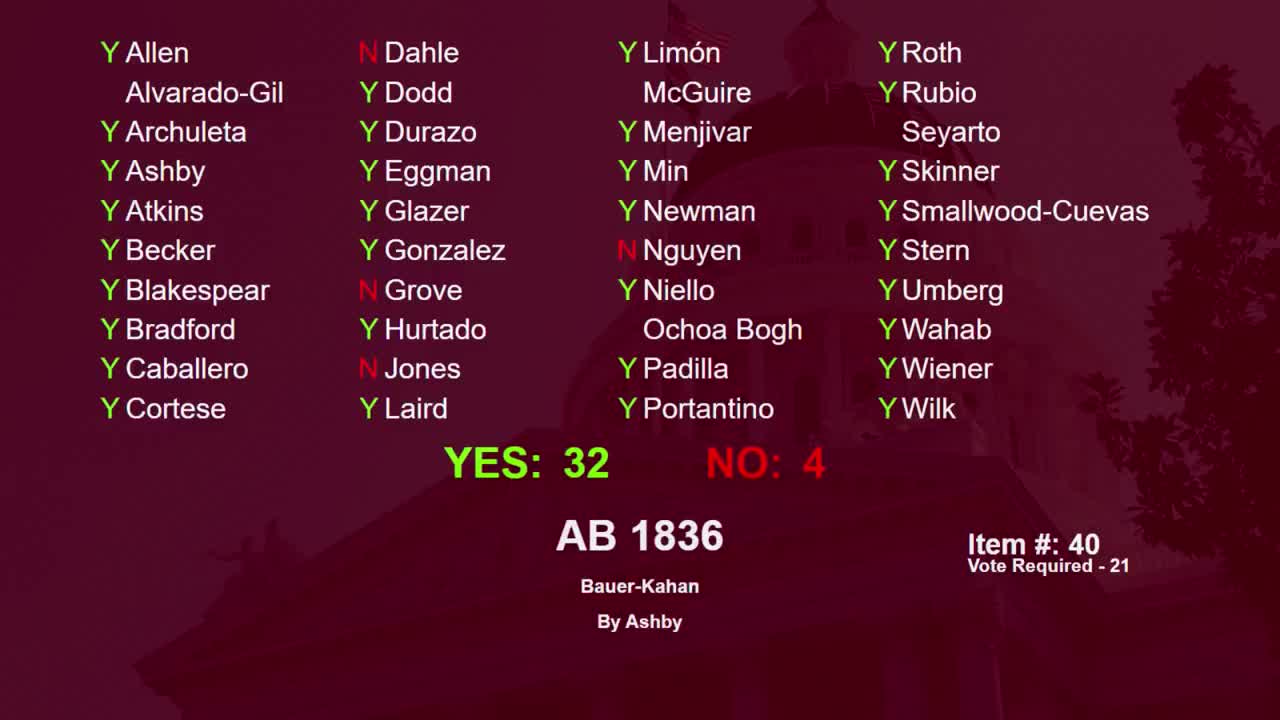 3MIN
Senate Floor
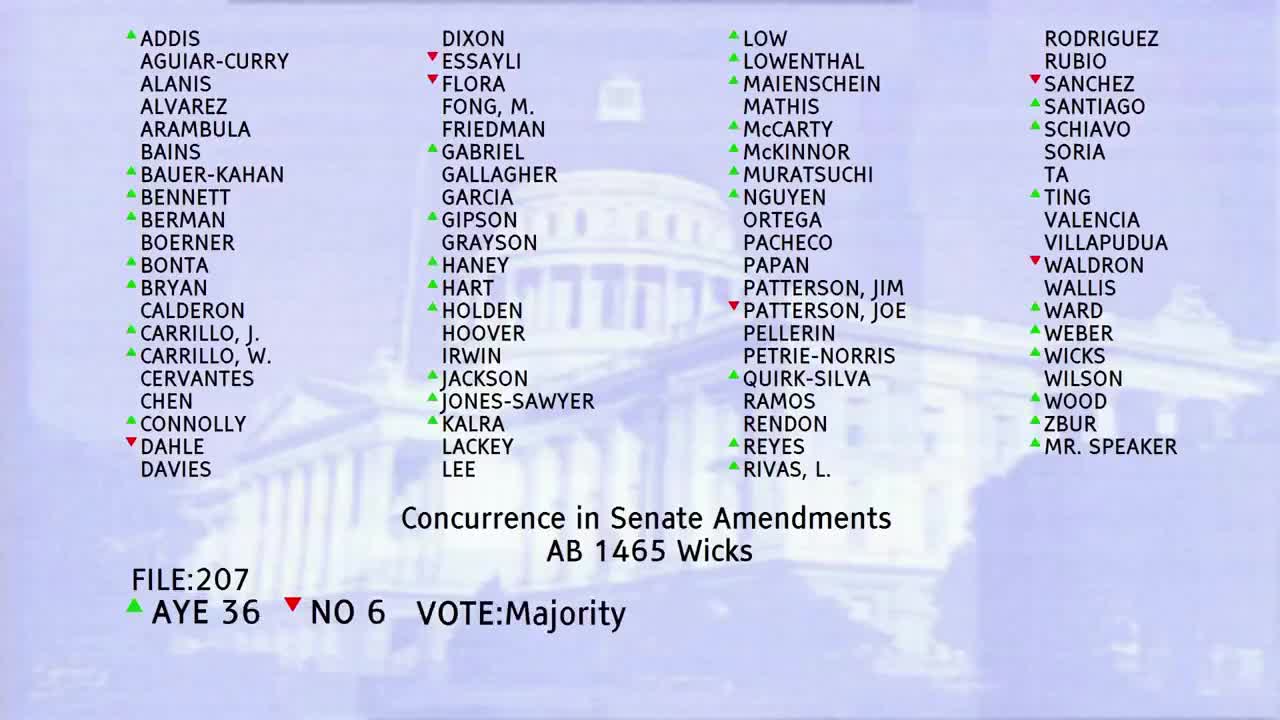 27SEC
Assembly Floor
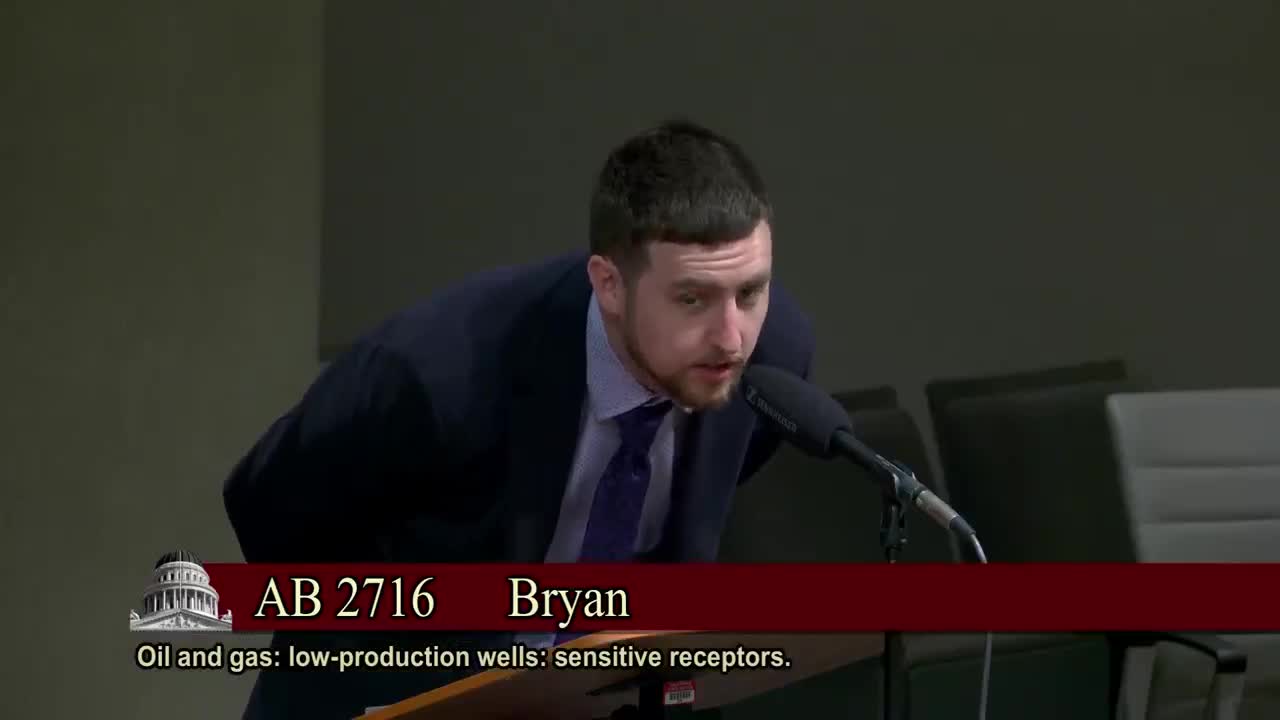 59SEC
Senate Standing Committee on Appropriations
 59MIN
Senate Standing Committee on Natural Resources and Water
 1MIN
Assembly Floor
 18MIN
Assembly Standing Committee on Natural Resources
Bill Author

Bill Co-Author(s):
