AB 2735: Joint powers agreements: water corporations.
- Session Year: 2023-2024
- House: Assembly
- Latest Version Date: 2024-08-28
Current Status:
Failed
(2024-09-20: Vetoed by Governor.)
Introduced
In Committee
First Chamber
In Committee
Second Chamber
Enacted
Existing law, the Joint Exercise of Powers Act, authorizes 2 or more public agencies, if authorized by their governing bodies, by agreement to jointly exercise any power common to the contracting parties. Existing law authorizes 2 or more local public entities, or a mutual water company, as defined, and a public agency, to provide insurance, as specified, by a joint powers agreement. Existing law authorizes a mutual water company and a public agency to enter into a joint powers agreement for the purposes of risk pooling, as specified.
Existing law vests the Public Utilities Commission with regulatory authority over public utilities, including water corporations.
This bill would authorize a water corporation, as defined, a mutual water company, and one or more public agencies to provide insurance, as specified, by a joint powers agreement. The bill would also authorize a water corporation, a mutual water company, and one or more public agencies to enter into a joint powers agreement for the purposes of risk pooling, as specified. The bill would prohibit a joint powers agency from allowing a water corporation to join the joint powers agency, unless the joint powers agency makes a specified determination relating to insurance. If a water corporation enters into a joint powers agreement for the purposes of risk pooling, the bill would require the water corporation to submit an annual information filing to the Public Utilities Commission and the joint powers agency, as specified.
Existing law, the Joint Exercise of Powers Act, authorizes 2 or more public agencies, if authorized by their governing bodies, by agreement to jointly exercise any power common to the contracting parties. Existing law authorizes 2 or more local public entities, or a mutual water company, as defined, and a public agency, to provide insurance, as specified, by a joint powers agreement. Existing law authorizes local public entities or a mutual water company and a public agency to enter into a joint powers agreement for the purposes of risk-pooling, risk pooling, as specified.
Existing law vests the Public Utilities Commission with regulatory authority over public utilities, including water corporations.
This bill would authorize a water corporation, as defined, a mutual water company, and one or more public agencies to provide insurance, as specified, by a joint powers agreement. The bill would also authorize a water corporation corporation, a mutual water company, and one or more public agencies to enter into a joint powers agreement for the purposes of risk-pooling, risk pooling, as specified. The bill would prohibit a joint powers agency from allowing a water corporation to join the joint powers agency, unless the joint powers agency makes a specified determination relating to insurance. If a water corporation enters into a joint powers agreement for the purposes of risk pooling, the bill would require the water corporation to submit an annual information filing to the Public Utilities Commission and the joint powers agency, as specified.
Existing law, the Joint Exercise of Powers Act, authorizes 2 or more public agencies, if authorized by their governing bodies, by agreement to jointly exercise any power common to the contracting parties. Existing law authorizes a mutual water company, as defined, to enter into a joint powers agreement with a public agency for these purposes. Existing law authorizes 2 or more local public entities, or a mutual water company company, as defined, and a public agency, to provide insurance, as specified, by a joint powers agreement. Existing law authorizes local public entities or a mutual water company and a public agency to enter into a joint powers agreement for the purposes of risk-pooling, as specified.
This bill would authorize a water corporation, as defined, to enter into a joint powers agreement with a public agency for the purpose of jointly exercising any power common to the contracting parties. The bill would also authorize a water corporation and one or more public agencies to provide insurance, as specified, by a joint powers agreement. The bill would also authorize a water corporation and one or more public agencies to enter into a joint powers agreement for the purposes of risk-pooling, as specified.
Existing law, the Joint Exercise of Powers Act, authorizes 2 or more public agencies, if authorized by their governing bodies, by agreement to jointly exercise any power common to the contracting parties. Existing law authorizes a mutual water company, as defined, to enter into a joint powers agreement with a public agency for these purposes. Existing law authorizes 2 or more local public entities, or a mutual water company and a public agency, to provide insurance, as specified, by a joint powers agreement. Existing law authorizes local public entities or a mutual water company and a public agency to enter into a joint powers agreement for the purposes of risk-pooling, as specified.
This bill would authorize a public utility, water corporation, as defined, to enter into a joint powers agreement with a public agency for the purpose of jointly exercising any power common to the contracting parties. The bill would also authorize a public utility water corporation and one or more public agencies to provide insurance, as specified, by a joint powers agreement. The bill would also authorize a public utility water corporation and one or more public agencies to enter into a joint powers agreement for the purposes of risk-pooling, as specified.
Existing law, the Joint Exercise of Powers Act, authorizes 2 or more public agencies, if authorized by their governing bodies, by agreement to jointly exercise any power common to the contracting parties. Existing law authorizes a mutual water company, as defined, to enter into a joint powers agreement with a public agency for these purposes. Existing law authorizes 2 or more local public entities, or a mutual water company and a public agency, to provide insurance, as specified, by a joint powers agreement. Existing law authorizes local public entities or a mutual water company and a public agency to enter into a joint powers agreement for the purposes of risk-pooling, as specified.
This bill would authorize a public utility, as defined, to enter into a joint powers agreement with a public agency for the purpose of jointly exercising any power common to the contracting parties. The bill would also authorize a public utility and one or more public agencies to provide insurance, as specified, by a joint powers agreement. The bill would also authorize a public utility and one or more public agencies to enter into a joint powers agreement for the purposes of risk-pooling, as specified.
(a)(1)Any of the following may provide insurance authorized by this part or for any other purpose by any one or more of the methods specified in Section 990.4 by a joint powers agreement made pursuant to Article 1 (commencing with Section 6500) of Chapter 5 of Division 7:
(A)Two or more local public entities.
(B)A mutual water company and a public agency, as authorized under subdivision (b) of Section 6525.
(C)A water corporation, a mutual water company, and one or more public agencies, as authorized under subdivision (b) of Section 6525.
(2)Where two or more hospital districts have joined together to pool their self-insurance claims or losses, any nonprofit corporation created pursuant to subdivision (p) of Section 32121 of the Health and Safety Code, and affiliated with a hospital district which is a party to the pool may participate in the pool.
(b)Two or more local public entities having the same governing board, a mutual water company and a public agency, or a water corporation, a mutual water company, and one or more public agencies, as authorized under subdivision (b) of Section 6525, may be coinsured under a master policy and the total premium may be prorated among those entities.
(c)The pooling of self-insured claims or losses among entities as authorized in subdivision (a) of Section 990.4 shall not be considered insurance nor be subject to regulation under the Insurance Code.
(d)Any liability or loss under a joint powers agreement for the pooling of self-insured claims or losses authorized by this part and provided pursuant to this section may, notwithstanding Section 620 of the Insurance Code or any other provision of law, be reinsured to the same extent and the same manner as insurance provided by an insurer.
(e)Where a joint powers agreement authorized by this part or authorized pursuant to Section 6516 provides for the pooling of self-insured claims or losses among entities, if any peril insured or covered under contract has existed, and the joint powers authority or other parties to the pool have been liable for any period, however short, the agreement may provide that the party insured or covered under contract is not entitled to the return of premiums, contributions, payments, or advances so far as that particular risk is concerned.
(f)For purposes of this section:
(1)Mutual water company has the same meaning as defined in Section 14300 of the Corporations Code.
(2)Water corporation has the same meaning as defined in Section 241 of the Public Utilities Code.
SEC. 2.Section 6525 of the Government Code is amended to read:6525.(a)Notwithstanding any other provision of this chapter, a mutual water company may enter into a joint powers agreement with any public agency for the purpose of jointly exercising any power common to the contracting parties.
(b)(1)Notwithstanding any other provisions of this chapter, a mutual water company and a public agency, or a water corporation, a mutual water company, and one or more public agencies, may enter into a joint powers agreement for the purpose of risk pooling in accordance with Section 990.8, provided that the agreement shall ensure that no participating public agency becomes responsible for the underlying debts or liabilities of the joint powers agency, and shall indemnify any participating public agency against those debts and liabilities.
(2)A joint powers agency established pursuant to this subdivision shall solely utilize any revenues it generates through the insurance provided to its members under this section for its necessary operating expenses, and to provide technical support, continuing education, safety engineering, operational and managerial advisory assistance to its members for the purpose of reducing risk liabilities and furthering the technical managerial and financial capacity of those members.
(3)A water corporation shall not enter into a joint powers agreement for the purpose of risk pooling in accordance with Section 990.8, unless a mutual water company is already a party to that agreement.
(4)A joint powers agency created pursuant to this subdivision that includes a water corporation shall not join any other joint powers agencies or public agencies or exercise any powers, except as described in this subdivision.
(5)(A)Before a water corporation can enter into a joint powers agreement pursuant to this subdivision, the water corporation shall submit an information filing to the Public Utilities Commission and the joint powers agency that includes three years of historical insurance costs and current year estimated insurance costs.
(B)The joint powers agency shall not allow the water corporation to join the joint powers agency unless the joint powers agency determines one of the following:
(i)That the insurance rates the joint powers agency can offer for similar insurance coverage are less than the rates described in the information filing submitted pursuant to subparagraph (A).
(ii)That the insurance coverage the joint powers agency can offer provides greater benefits to the customers of the water corporation than the water corporations current insurance policy.
(iii)The water corporation does not have a current insurance policy.
(6)If a water corporation enters into a joint powers agreement pursuant to this subdivision, the water corporation shall ensure any cost savings attributable to its membership in the joint powers agency shall benefit the customers of the water corporation and not the investors of the water corporation.
(7)If a water corporation enters into a joint powers agreement pursuant to this subdivision, the water corporation shall submit an annual information filing to the Public Utilities Commission and the joint powers agency that reports both of the following:
(A)The estimated level of savings resulting from its membership in the joint powers agency, including three years of historical insurance costs and estimated current year insurance costs.
(B)How the savings described in subparagraph (A) was used to benefit customers of the water corporation.
(c)For purposes of this section:
(1)Mutual water company has the same meaning as defined in Section 14300 of the Corporations Code.
(2)Water corporation has the same meaning as defined in Section 241 of the Public Utilities Code.
(a)(1)Any of the following may provide insurance authorized by this part or for any other purpose by any one or more of the methods specified in Section 990.4 by a joint powers agreement made pursuant to Article 1 (commencing with Section 6500) of Chapter 5 of Division 7:
(A)Two or more local public entities, a entities.
(B)A mutual water company and a public agency, or a as authorized under subdivision (b) of Section 6525.
(C)A water corporation corporation, a mutual water company, and one or more public agencies, as authorized under subdivision (b) of Section 6525, by a joint powers agreement made pursuant to Article 1 (commencing with Section 6500) of Chapter 5 of Division 7, may provide insurance authorized by this part or for any other purpose by any one or more of the methods specified in Section 990.4. Where 6525.
(2)Where two or more hospital districts have joined together to pool their self-insurance claims or losses, any nonprofit corporation created pursuant to subdivision (p) of Section 32121 of the Health and Safety Code, and affiliated with a hospital district which is a party to the pool may participate in the pool.
(b)Two or more local public entities having the same governing board, a mutual water company and a public agency, or a water corporation corporation, a mutual water company, and one or more public agencies, as authorized under subdivision (b) of Section 6525, may be coinsured under a master policy and the total premium may be prorated among those entities.
(c)The pooling of self-insured claims or losses among entities as authorized in subdivision (a) of Section 990.4 shall not be considered insurance nor be subject to regulation under the Insurance Code.
(d)Any liability or loss under a joint powers agreement for the pooling of self-insured claims or losses authorized by this part and provided pursuant to this section may, notwithstanding Section 620 of the Insurance Code or any other provision of law, be reinsured to the same extent and the same manner as insurance provided by an insurer.
(e)Where a joint powers agreement authorized by this part or authorized pursuant to Section 6516 provides for the pooling of self-insured claims or losses among entities, if any peril insured or covered under contract has existed, and the joint powers authority or other parties to the pool have been liable for any period, however short, the agreement may provide that the party insured or covered under contract is not entitled to the return of premiums, contributions, payments, or advances so far as that particular risk is concerned.
(f)For purposes of this section:
(1)Mutual water company has the same meaning as defined in Section 14300 of the Corporations Code.
(2)Water corporation has the same meaning as defined in Section 241 of the Public Utilities Code.
SEC. 2.Section 6525 of the Government Code is amended to read:6525.(a)Notwithstanding any other provision of this chapter, a mutual water company may enter into a joint powers agreement with any public agency for the purpose of jointly exercising any power common to the contracting parties.
(b)(1)Notwithstanding any other provisions of this chapter, a mutual water company and a public agency, or a water corporation corporation, a mutual water company, and one or more public agencies, may enter into a joint powers agreement for the purpose of risk-pooling risk pooling in accordance with Section 990.8, provided that the agreement shall ensure that no participating public agency becomes responsible for the underlying debts or liabilities of the joint powers agency, and shall indemnify any participating public agency against those debts and liabilities.
(2)A joint powers agency established pursuant to this subdivision shall solely utilize any revenues it generates through the insurance provided to its members under this section for its necessary operating expenses, and to provide technical support, continuing education, safety engineering, operational and managerial advisory assistance to its members for the purpose of reducing risk liabilities and furthering the technical managerial and financial capacity of those members.
(3)A water corporation shall not enter into a joint powers agreement for the purpose of risk pooling in accordance with Section 990.8, unless a mutual water company is already a party to that agreement.
(4)A joint powers agency created pursuant to this subdivision that includes a water corporation shall not join any other joint powers agencies or public agencies or exercise any powers, except as described in this subdivision.
(5)(A)Before a water corporation can enter into a joint powers agreement pursuant to this subdivision, the water corporation shall submit an information filing to the Public Utilities Commission and the joint powers agency that includes three years of historical insurance costs and current year estimated insurance costs.
(B)The joint powers agency shall not allow the water corporation to join the joint powers agency unless the joint powers agency determines one of the following:
(i)That the insurance rates the joint powers agency can offer for similar insurance coverage are less than the rates described in the information filing submitted pursuant to subparagraph (A).
(ii)That the insurance coverage the joint powers agency can offer provides greater benefits to the customers of the water corporation than the water corporations current insurance policy.
(iii)The water corporation does not have a current insurance policy.
(6)If a water corporation enters into a joint powers agreement pursuant to this subdivision, the water corporation shall ensure any cost savings attributable to its membership in the joint powers agency shall benefit the customers of the water corporation and not the investors of the water corporation.
(7)If a water corporation enters into a joint powers agreement pursuant to this subdivision, the water corporation shall submit an annual information filing to the Public Utilities Commission and the joint powers agency that reports both of the following:
(A)The estimated level of savings resulting from its membership in the joint powers agency, including three years of historical insurance costs and estimated current year insurance costs.
(B)How the savings described in subparagraph (A) was used to benefit customers of the water corporation.
(c)For purposes of this section:
(1)Mutual water company has the same meaning as defined in Section 14300 of the Corporations Code.
(2)Water corporation has the same meaning as defined in Section 241 of the Public Utilities Code.
(a)Two or more local public entities, a mutual water company and a public agency, or a water corporation and one or more public agencies, as authorized under subdivision (b) of Section 6525, by a joint powers agreement made pursuant to Article 1 (commencing with Section 6500) of Chapter 5 of Division 7, may provide insurance authorized by this part or for any other purpose by any one or more of the methods specified in Section 990.4. Where two or more hospital districts have joined together to pool their self-insurance claims or losses, any nonprofit corporation created pursuant to subdivision (p) of Section 32121 of the Health and Safety Code, and affiliated with a hospital district which is a party to the pool may participate in the pool.
(b)Two or more local public entities having the same governing board, a mutual water company and a public agency, or a water corporation and one or more public agencies, as authorized under subdivision (b) of Section 6525, may be coinsured under a master policy and the total premium may be prorated among those entities.
(c)The pooling of self-insured claims or losses among entities as authorized in subdivision (a) of Section 990.4 shall not be considered insurance nor be subject to regulation under the Insurance Code.
(d)Any liability or loss under a joint powers agreement for the pooling of self-insured claims or losses authorized by this part and provided pursuant to this section may, notwithstanding Section 620 of the Insurance Code or any other provision of law, be reinsured to the same extent and the same manner as insurance provided by an insurer.
(e)Where a joint powers agreement authorized by this part or authorized pursuant to Section 6516 provides for the pooling of self-insured claims or losses among entities, if any peril insured or covered under contract has existed, and the joint powers authority or other parties to the pool have been liable for any period, however short, the agreement may provide that the party insured or covered under contract is not entitled to the return of premiums, contributions, payments, or advances so far as that particular risk is concerned.
(f)For purposes of this section:
(1)Mutual water company has the same meaning as defined in Section 14300 of the Corporations Code.
(2)Water corporation has the same meaning as defined in Section 241 of the Public Utilities Code.
SEC. 2.Section 6525 of the Government Code is amended to read:6525.(a)Notwithstanding any other provision of this chapter, a mutual water company or a water corporation may enter into a joint powers agreement with any public agency for the purpose of jointly exercising any power common to the contracting parties.
(b)(1)Notwithstanding any other provisions of this chapter, a mutual water company and a public agency, or a water corporation and one or more public agencies, may enter into a joint powers agreement for the purpose of risk-pooling in accordance with Section 990.8, provided that the agreement shall ensure that no participating public agency becomes responsible for the underlying debts or liabilities of the joint powers agency, and shall indemnify any participating public agency against those debts and liabilities.
(2)A joint powers agency established pursuant to this subdivision shall solely utilize any revenues it generates through the insurance provided to its members under this section for its necessary operating expenses, and to provide technical support, continuing education, safety engineering, operational and managerial advisory assistance to its members for the purpose of reducing risk liabilities and furthering the technical managerial and financial capacity of those members.
(c)For purposes of this section:
(1)Mutual water company has the same meaning as defined in Section 14300 of the Corporations Code.
(2)Water corporation has the same meaning as defined in Section 241 of the Public Utilities Code.
(a)Two or more local public entities, a mutual water company and a public agency, or a public utility water corporation and one or more public agencies, as authorized under subdivision (b) of Section 6525, by a joint powers agreement made pursuant to Article 1 (commencing with Section 6500) of Chapter 5 of Division 7, may provide insurance authorized by this part or for any other purpose by any one or more of the methods specified in Section 990.4. Where two or more hospital districts have joined together to pool their self-insurance claims or losses, any nonprofit corporation created pursuant to subdivision (p) of Section 32121 of the Health and Safety Code, and affiliated with a hospital district which is a party to the pool may participate in the pool.
(b)Two or more local public entities having the same governing board, a mutual water company and a public agency, or a public utility water corporation and one or more public agencies, as authorized under subdivision (b) of Section 6525, may be coinsured under a master policy and the total premium may be prorated among those entities.
(c)The pooling of self-insured claims or losses among entities as authorized in subdivision (a) of Section 990.4 shall not be considered insurance nor be subject to regulation under the Insurance Code.
(d)Any liability or loss under a joint powers agreement for the pooling of self-insured claims or losses authorized by this part and provided pursuant to this section may, notwithstanding Section 620 of the Insurance Code or any other provision of law, be reinsured to the same extent and the same manner as insurance provided by an insurer.
(e)Where a joint powers agreement authorized by this part or authorized pursuant to Section 6516 provides for the pooling of self-insured claims or losses among entities, if any peril insured or covered under contract has existed, and the joint powers authority or other parties to the pool have been liable for any period, however short, the agreement may provide that the party insured or covered under contract is not entitled to the return of premiums, contributions, payments, or advances so far as that particular risk is concerned.
(f)For purposes of this section:
(1)Mutual water company has the same meaning as defined in Section 14300 of the Corporations Code.
(2)Public utility has the same meaning as defined in subdivision (a) of Section 216 of the Public Utilities Code. Water corporation has the same meaning as defined in Section 241 of the Public Utilities Code.
SEC. 2.Section 6525 of the Government Code is amended to read:6525.(a)Notwithstanding any other provision of this chapter, a mutual water company or a public utility water corporation may enter into a joint powers agreement with any public agency for the purpose of jointly exercising any power common to the contracting parties.
(b)(1)Notwithstanding any other provisions of this chapter, a mutual water company and a public agency, or a public utility water corporation and one or more public agencies, may enter into a joint powers agreement for the purpose of risk-pooling in accordance with Section 990.8, provided that the agreement shall ensure that no participating public agency becomes responsible for the underlying debts or liabilities of the joint powers agency, and shall indemnify any participating public agency against those debts and liabilities.
(2)A joint powers agency established pursuant to this subdivision shall solely utilize any revenues it generates through the insurance provided to its members under this section for its necessary operating expenses, and to provide technical support, continuing education, safety engineering, operational and managerial advisory assistance to its members for the purpose of reducing risk liabilities and furthering the technical managerial and financial capacity of those members.
(c)For purposes of this section:
(1)Mutual water company has the same meaning as defined in Section 14300 of the Corporations Code.
(2)Public utility has the same meaning as defined in subdivision (a) of Section 216 of the Public Utilities Code. Water corporation has the same meaning as defined in Section 241 of the Public Utilities Code.
(a)Two or more local public entities, or a mutual water company and a public agency, or a public utility and one or more public agencies, as authorized under subdivision (b) of Section 6525, by a joint powers agreement made pursuant to Article 1 (commencing with Section 6500) of Chapter 5 of Division 7, may provide insurance authorized by this part or for any other purpose by any one or more of the methods specified in Section 990.4. Where two or more hospital districts have joined together to pool their self-insurance claims or losses, any nonprofit corporation created pursuant to subdivision (p) of Section 32121 of the Health and Safety Code, and affiliated with a hospital district which is a party to the pool may participate in the pool.
(b)Two or more local public entities having the same governing board, or a mutual water company and a public agency, or a public utility and one or more public agencies, as authorized under subdivision (b) of Section 6525, may be coinsured under a master policy and the total premium may be prorated among those entities.
(c)The pooling of self-insured claims or losses among entities as authorized in subdivision (a) of Section 990.4 shall not be considered insurance nor be subject to regulation under the Insurance Code.
(d)Any liability or loss under a joint powers agreement for the pooling of self-insured claims or losses authorized by this part and provided pursuant to this section may, notwithstanding Section 620 of the Insurance Code or any other provision of law, be reinsured to the same extent and the same manner as insurance provided by an insurer.
(e)Where a joint powers agreement authorized by this part or authorized pursuant to Section 6516 provides for the pooling of self-insured claims or losses among entities, if any peril insured or covered under contract has existed, and the joint powers authority or other parties to the pool have been liable for any period, however short, the agreement may provide that the party insured or covered under contract is not entitled to the return of premiums, contributions, payments, or advances so far as that particular risk is concerned.
(f)For purposes of this section, mutual water company has the same meaning as the term does in Section 14300 of the Corporations Code. section:
(1)Mutual water company has the same meaning as defined in Section 14300 of the Corporations Code.
(2)Public utility has the same meaning as defined in subdivision (a) of Section 216 of the Public Utilities Code.
SEC. 2.Section 6525 of the Government Code is amended to read:6525.(a)Notwithstanding any other provision of this chapter, a mutual water company or a public utility may enter into a joint powers agreement with any public agency for the purpose of jointly exercising any power common to the contracting parties.
(b)(1)Notwithstanding any other provisions of this chapter, a mutual water company and a public agency agency, or a public utility and one or more public agencies, may enter into a joint powers agreement for the purpose of risk-pooling in accordance with Section 990.8, provided that the agreement shall ensure that no participating public agency becomes responsible for the underlying debts or liabilities of the joint powers agency, and shall indemnify any participating public agency against those debts and liabilities.
(2)A joint powers agency established pursuant to this subdivision shall solely utilize any revenues it generates through the insurance provided to its members under this section for its necessary operating expenses, and to provide technical support, continuing education, safety engineering, operational and managerial advisory assistance to its members for the purpose of reducing risk liabilities and furthering the technical managerial and financial capacity of those members.
(c)For purposes of this section, mutual water company has the same meaning as the term does in Section 14300 of the Corporations Code. section:
(1)Mutual water company has the same meaning as defined in Section 14300 of the Corporations Code.
(2)Public utility has the same meaning as defined in subdivision (a) of Section 216 of the Public Utilities Code.
|
Date
|
Status
|
|---|---|
| Sep 20, 2024 | Vetoed by Governor. |
| Sep 3, 2024 | Enrolled and presented to the Governor at 3:30 p.m. |
| Aug 26, 2024 | Senate amendments concurred in. To Engrossing and Enrolling. (Ayes 77. Noes 0. Page 6562.). |
| Aug 20, 2024 | In Assembly. Concurrence in Senate amendments pending. May be considered on or after August 22 pursuant to Assembly Rule 77. |
| Aug 20, 2024 | Read third time. Passed. Ordered to the Assembly. (Ayes 38. Noes 2. Page 5235.). |
| Aug 6, 2024 | Read second time. Ordered to third reading. |
| Aug 5, 2024 | From committee: Be ordered to second reading pursuant to Senate Rule 28.8. |
| Jul 3, 2024 | Read second time and amended. Re-referred to Com. on APPR. |
| Jul 3, 2024 | From committee: Amend, and do pass as amended and re-refer to Com. on APPR. (Ayes 6. Noes 1.) (July 3). |
| May 29, 2024 | Referred to Com. on L. GOV. |
| May 21, 2024 | In Senate. Read first time. To Com. on RLS. for assignment. |
| May 20, 2024 | Read third time. Passed. Ordered to the Senate. (Ayes 71. Noes 0. Page 5317.) |
| May 9, 2024 | Read second time. Ordered to third reading. |
| May 8, 2024 | From committee: Do pass. (Ayes 15. Noes 0.) (May 8). |
| Apr 30, 2024 | Re-referred to Com. on APPR. |
| Apr 29, 2024 | Read second time and amended. |
| Apr 25, 2024 | From committee: Amend, and do pass as amended and re-refer to Com. on APPR. (Ayes 7. Noes 0.) (April 24). |
| Apr 17, 2024 | From committee: Do pass and re-refer to Com. on L. GOV. (Ayes 15. Noes 0.) (April 17). Re-referred to Com. on L. GOV. |
| Apr 2, 2024 | Re-referred to Com. on INS. |
| Apr 1, 2024 | Referred to Coms. on INS. and L. GOV. |
| Apr 1, 2024 | From committee chair, with author's amendments: Amend, and re-refer to Com. on INS. Read second time and amended. |
| Feb 16, 2024 | From printer. May be heard in committee March 17. |
| Feb 15, 2024 | Read first time. To print. |
|
Date
|
Description
|
Location
|
Votes
|
|
|---|---|---|---|---|
| Aug 26, 2024 | AB 2735 Blanca Rubio Concurrence in Senate Amendments | Assembly Floor |
Passed |
|
| Aug 20, 2024 | Assembly 3rd Reading AB2735 Blanca Rubio By Durazo | Senate Floor |
Passed |
|
| Jul 3, 2024 | Do pass as amended, but first amend, and re-refer to the Committee on [Appropriations] | Senate Standing Committee on Local Government |
Passed |
|
| May 20, 2024 | AB 2735 Blanca Rubio Assembly Third Reading | Assembly Floor |
Passed |
|
| May 8, 2024 | Do pass. | Assembly Standing Committee on Appropriations |
Passed |
|
| Apr 24, 2024 | Do pass as amended and be re-referred to the Committee on [Appropriations] | Assembly Standing Committee on Local Government |
Passed |
|
| Apr 17, 2024 | Do pass and be re-referred to the Committee on [Local Government] | Assembly Standing Committee on Insurance |
Passed |
This list shows positions taken on this bill by organizations on the date displayed, which is linked to the original source.
Positions by individuals are not included.
|
Organization
|
Position
|
Date
|
|---|---|---|
| AFSCME | * Indeterminate | Jul 3, 2024 |
| Alta Irrigation District | ** Against | |
| Association of California Water Agencies Joint Powers Insurance Authority | ** Against | |
| BAKMAN WATER COMPANY | ** Support | |
| Bighorn-Desert View Water Agency | ** Support | |
| Cal Mutuals | * Support | Jul 3, 2024 |
| California Association Of Joint Powers Authorities | * Against | Jul 3, 2024 |
| California Association Of Mutual Water Companies | ** Support | |
| California Coalition Of Utility Workers | * Support | Jul 3, 2024 |
| California Domestic Water Company | ** Support | |
| California State Association Of Electrical Workers | ** Support | |
| California State Pipe Trades Council | ** Support | |
| California Water Association | ** Support | |
| California Water Service Company | ** Support | |
| CalMutuals JPRIMA Insurance | * Support | Apr 17, 2024 |
| Clean Water Action | ** Support | |
| Coalition of California Utility Employees | ** Support | |
| Coastside County Water District | ** Against | |
| Cold Springs Water Co. | ** Support | |
| Community Water Center | ** Support | |
| Cucamonga Valley Water District | ** Against | |
| El Toro Water District | ** Against | |
| Erskine Creek Water Co. | ** Support | |
| Fallbrook Public Utility District | ** Against | |
| Golden State Water Company | ** Support | |
| Humboldt Bay Municipal Water District | ** Against | |
| Krista Mutual Water Company | ** Support | |
| Lake Alpine Water Company | ** Support | |
| Lake of the Woods Mutual Water Company | ** Support | |
| Leadership Counsel for Justice & Accountability | ** Support | |
| Liberty Utilities | ** Support | |
| Lukins Brothers Water Company | ** Support | |
| Lukins Brothers Water Company, INC. | ** Support | |
| Marina Coast Water District | ** Against | |
| Mesa Water District | ** Against | |
| National Association of Water Companies | ** Support | |
| Public Water Agencies Group | * Support | Apr 17, 2024 |
| Puresource Water INC | ** Support | |
| Redwood Lodge Water Company | ** Support | |
| san gabriel county water district | ** Against | |
| San Gabriel Valley Water Association | ** Support | |
| San Gabriel Valley Water Company | ** Support | |
| San Jose Water Company | * Support | Jul 3, 2024 |
| San Jose Water Company - Operating Engineers Local 3 | ** Support | |
| San Juan Water District | ** Against | |
| San Luis Delta-Mendota Water Authority | ** Against | |
| Sierra Park Water Company | ** Support | |
| Sierra Park Water Company, INC. | ** Support | |
| Sierra Water Resources, INC. | ** Support | |
| SOUTHERN CALIFORNIA PIPE TRADES DISTRICT COUNCIL 16 | ** Support | |
| Suburban Water Systems | ** Support | |
| UA Local 250 Steamfitters & Refrigeration | ** Support | |
| Upper San Gabriel Valley Municipal Water District | ** Support | |
| Utica Water and Power Authority | ** Against | |
| Utility Workers Union of America, AFL-CIO | ** Support | |
| Utility Workers Union of America, Afl-cio Local 160 | ** Support | |
| Utility Workers Union of America, Afl-cio Local 160-c | ** Support | |
| Utility Workers Union of America, Afl-cio Local 160-d | ** Support | |
| Utility Workers Union of America, Afl-cio Local 205 | ** Support | |
| Utility Workers Union of America, Afl-cio Local 283 | ** Support | |
| Utility Workers Union of America, Afl-cio Local 484 | ** Support | |
| Valencia Heights Water Company | ** Support | |
| Valley Center Municipal Water District | ** Against | |
| Walnut Valley Water District | ** Against |
GOVERNOR'S VETO
GV Bill Id:AB 2735
Author:(Blanca Rubio)
As Enrolled Ver:August 28, 2024
2/3 vote
SUMMARY
Allows a water corporation to enter into a joint powers agreement (JPA) with a public agency for purposes of insurance risk pooling.
Senate Amendments
- Provide that a water corporation shall not enter into a JPA unless a mutual water company is already a party to that agreement.
- Prohibit a JPA from allowing a water corporation to join the JPA, unless the JPA makes a specified determination relating to insurance.
- Requires a water corporation that joins a JPA to submit an annual information filing to the California Public Utilities Commission (CPUC) and the JPA, as provided.
Governor’s Veto Message
This bill will allow private water corporations, also known as investor-owned public utilities, to enter into a joint powers agreement with a public agency for the purpose of insurance risk pooling.
Authorizing investor-owned, private water corporations to participate in public risk pools could transfer financial risks of decisions by for-profit entities to public entities, which has the potential to shift costs to public entities and their ratepayers. Absent a more robust analysis of the nature and extent of this potential cost-shifting, I am not convinced the benefit of this proposal outweighs the risk at this time.
COMMENTS
Public water systems that deliver domestic water generally fall into three categories:
- Local agencies (cities and special districts). Local Agency Formation Commissions (LAFCOs) control the cities and special districts' boundaries and local officials are responsible to their voters for their water rates;
- Investor-owned public utilities (water corporations). The CPUC controls the companies' service areas and their water rates; or,
- Mutual water companies. These private entities, formed under statutes governing corporations, respond to their shareholders, usually the landowners who receive water service. Neither LAFCOs nor the CPUC regulate mutual water companies.
Under existing law, public agencies may form JPAs to jointly exercise any power common to all members. JPAs offer self-insurance coverage on a pooled basis for a variety of purposes, including liability (malpractice and officers and directors coverage), workers' compensation, health insurance, and property coverage. Pooling of self-insured claims or losses among local public entities is not considered insurance and is not subject to regulation under the Insurance Code.
Any liability or loss under a JPA for the pooling of self-insured claims or losses can be reinsured to the same extent and the same manner as insurance provided by an insurer. When a JPA provides for the pooling of self-insured claims or losses, if any peril insured or covered under contract has existed, and the JPA or other parties to the pool have been liable for any period, the agreement may provide that the party insured or covered under contract is not entitled to the return of premiums, contributions, payments, or advances so far as that particular risk is concerned.
As previously mentioned, water rates for water corporations are set by the CPUC. However, any increases in operating costs, including the cost of insurance, are required to be recovered in rates. Therefore, as water corporations face higher insurance costs these costs will be passed onto consumers in the form of increased water rates.
In California, two JPAs exist to provide risk pooling for public water systems. These JPAs (ACWA JPIA and JPRIMA) provide insurance to water utility members at a lower average cost and offer broader coverage than the commercial insurance market.
Currently, mutual water companies are authorized to join a JPA, so long as the JPA has one or more public agencies as a member.
This bill is narrower in that it would permit a water corporation to join a JPA only for the purpose of insurance risk pooling, so long as the JPA has one or more public agencies as a member. By allowing water corporations to join a JPA, for this purpose, it will allow them to avoid the high cost of commercial insurance coverage and help offer more rate stability for consumers.
According to the Author
All water utilities in California are struggling to keep rates affordable with the ever-increasing cost of insurance. AB 2735 will allow a water corporation to join a joint powers agreement (JPA) for risk pooling, which provides more affordable insurance so long as there is at least one local agency member in the JPA. Because the pooling of self-insured claims or losses among entities participating in a JPA is not subject to regulation under the Insurance Code and is not subject to premium taxes, the JPA can set lower premiums and offer broader coverage than would be available through the private marketplace. As such, this bill will help to keep water utility costs down for consumers.
Arguments in Support
This bill's sponsor, the California Water Association, notes that water corporations would benefit from participation in JPAs because it would allow them to set lower premiums and offer broader coverage than would be available through the private marketplace.
Arguments in Opposition
The Association of California Water Agencies Joint Powers Insurance Authority (ACWA JPIA) oppose this bill noting that investor-owned private water corporations are fundamentally different from public water agencies and pose substantially increased risk. The opposition also notes concern over the potential downstream and unanticipated impact to the risk pooling industry in California by allowing investor-owned private water corporations to join or form a risk pool.
FISCAL COMMENTS
According to the Assembly Appropriations Committee, "No costs to the Department of Insurance. Costs to local agencies to form JPAs are not reimbursable."
VOTES
ASM INSURANCE: 15-0-0
YES: Calderon, Chen, Alvarez, Bauer-Kahan, Berman, Gipson, Jones-Sawyer, Lowenthal, Ortega, Joe Patterson, Petrie-Norris, Blanca Rubio, Valencia, Wallis, Wood
ASM LOCAL GOVERNMENT: 7-0-2
YES: Juan Carrillo, Waldron, Kalra, Pacheco, Ramos, Ward, Wilson
ABS, ABST OR NV: Essayli, Valencia
ASM APPROPRIATIONS: 15-0-0
YES: Wicks, Sanchez, Arambula, Bryan, Calderon, Wendy Carrillo, Dixon, Mike Fong, Friedman, Haney, Hart, Jim Patterson, Pellerin, Ta, Villapudua
ASSEMBLY FLOOR: 71-0-9
YES: Addis, Aguiar-Curry, Alanis, Bains, Bauer-Kahan, Bennett, Berman, Boerner, Bonta, Bryan, Calderon, Juan Carrillo, Wendy Carrillo, Chen, Connolly, Davies, Dixon, Essayli, Flora, Mike Fong, Vince Fong, Friedman, Gallagher, Garcia, Gipson, Grayson, Haney, Hart, Holden, Hoover, Irwin, Jackson, Jones-Sawyer, Kalra, Lackey, Lee, Low, Lowenthal, Maienschein, McCarty, McKinnor, Muratsuchi, Ortega, Pacheco, Papan, Jim Patterson, Joe Patterson, Pellerin, Petrie-Norris, Ramos, Rendon, Reyes, Rodriguez, Blanca Rubio, Sanchez, Santiago, Schiavo, Soria, Ta, Ting, Valencia, Villapudua, Waldron, Wallis, Ward, Weber, Wicks, Wilson, Wood, Zbur, Robert Rivas
ABS, ABST OR NV: Alvarez, Arambula, Cervantes, Megan Dahle, Gabriel, Mathis, Stephanie Nguyen, Quirk-Silva, Luz Rivas
SENATE FLOOR: 38-2-0
YES: Allen, Alvarado-Gil, Archuleta, Ashby, Atkins, Becker, Blakespear, Bradford, Caballero, Cortese, Dahle, Dodd, Durazo, Eggman, Glazer, Gonzalez, Grove, Hurtado, Jones, Laird, Limón, McGuire, Menjivar, Min, Newman, Nguyen, Niello, Ochoa Bogh, Padilla, Portantino, Roth, Rubio, Seyarto, Skinner, Stern, Umberg, Wiener, Wilk
NO: Smallwood-Cuevas, Wahab
ASSEMBLY FLOOR: 77-0-2
YES: Addis, Aguiar-Curry, Alanis, Alvarez, Arambula, Bains, Bauer-Kahan, Bennett, Berman, Boerner, Bonta, Bryan, Calderon, Juan Carrillo, Wendy Carrillo, Chen, Connolly, Megan Dahle, Davies, Dixon, Essayli, Flora, Mike Fong, Friedman, Gabriel, Gallagher, Garcia, Gipson, Grayson, Haney, Hart, Holden, Hoover, Irwin, Jackson, Jones-Sawyer, Kalra, Lackey, Lee, Low, Lowenthal, Maienschein, Mathis, McCarty, McKinnor, Muratsuchi, Stephanie Nguyen, Pacheco, Papan, Jim Patterson, Joe Patterson, Pellerin, Petrie-Norris, Quirk-Silva, Ramos, Rendon, Reyes, Luz Rivas, Rodriguez, Blanca Rubio, Sanchez, Santiago, Schiavo, Soria, Ta, Ting, Valencia, Villapudua, Waldron, Wallis, Ward, Weber, Wicks, Wilson, Wood, Zbur, Robert Rivas
ABS, ABST OR NV: Cervantes, Ortega
UPDATED
VERSION: August 28, 2024
CONSULTANT: Claire Wendt / INS. / (916) 319-2086 FN: 0005095
CONCURRENCE IN SENATE AMENDMENTS
CSA1 Bill Id:AB 2735
Author:(Blanca Rubio)
As Amended Ver:July 3, 2024
Majority vote
SUMMARY
Allows a water corporation to enter into a joint powers agreement (JPA) with a public agency for purposes of insurance risk pooling.
Senate Amendments
- Provide that a water corporation shall not enter into a JPA unless a mutual water company is already a party to that agreement.
- Prohibit a JPA from allowing a water corporation to join the JPA, unless the JPA makes a specified determination relating to insurance.
- Requires a water corporation that joins a JPA to submit an annual information filing to the California Public Utilities Commission (CPUC) and the JPA, as provided.
COMMENTS
Public water systems that deliver domestic water generally fall into three categories:
- Local agencies (cities and special districts). Local Agency Formation Commissions (LAFCOs) control the cities and special districts' boundaries and local officials are responsible to their voters for their water rates;
- Investor-owned public utilities (water corporations). The CPUC controls the companies' service areas and their water rates; or,
- Mutual water companies. These private entities, formed under statutes governing corporations, respond to their shareholders, usually the landowners who receive water service. Neither LAFCOs nor the CPUC regulate mutual water companies.
Under existing law, public agencies may form JPAs to jointly exercise any power common to all members. JPAs offer self-insurance coverage on a pooled basis for a variety of purposes, including liability (malpractice and officers and directors coverage), workers' compensation, health insurance, and property coverage. Pooling of self-insured claims or losses among local public entities is not considered insurance and is not subject to regulation under the Insurance Code.
Any liability or loss under a JPA for the pooling of self-insured claims or losses can be reinsured to the same extent and the same manner as insurance provided by an insurer. When a JPA provides for the pooling of self-insured claims or losses, if any peril insured or covered under contract has existed, and the JPA or other parties to the pool have been liable for any period, the agreement may provide that the party insured or covered under contract is not entitled to the return of premiums, contributions, payments, or advances so far as that particular risk is concerned.
As previously mentioned, water rates for water corporations are set by the CPUC. However, any increases in operating costs, including the cost of insurance, are required to be recovered in rates. Therefore, as water corporations face higher insurance costs these costs will be passed onto consumers in the form of increased water rates.
In California, two JPAs exist to provide risk pooling for public water systems. These JPAs (ACWA JPIA and JPRIMA) provide insurance to water utility members at a lower average cost and offer broader coverage than the commercial insurance market.
Currently, mutual water companies are authorized to join a JPA, so long as the JPA has one or more public agencies as a member.
This bill is narrower in that it would permit a water corporation to join a JPA only for the purpose of insurance risk pooling, so long as the JPA has one or more public agencies as a member. By allowing water corporations to join a JPA, for this purpose, it will allow them to avoid the high cost of commercial insurance coverage and help offer more rate stability for consumers.
According to the Author
All water utilities in California are struggling to keep rates affordable with the ever-increasing cost of insurance. AB 2735 will allow a water corporation to join a joint powers agreement (JPA) for risk pooling, which provides more affordable insurance so long as there is at least one local agency member in the JPA. Because the pooling of self-insured claims or losses among entities participating in a JPA is not subject to regulation under the Insurance Code and is not subject to premium taxes, the JPA can set lower premiums and offer broader coverage than would be available through the private marketplace. As such, this bill will help to keep water utility costs down for consumers.
Arguments in Support
This bill's sponsor, the California Water Association, notes that water corporations would benefit from participation in JPAs because it would allow them to set lower premiums and offer broader coverage than would be available through the private marketplace.
Arguments in Opposition
The Association of California Water Agencies Joint Powers Insurance Authority (ACWA JPIA) oppose this bill noting that investor-owned private water corporations are fundamentally different from public water agencies and pose substantially increased risk. The opposition also notes concern over the potential downstream and unanticipated impact to the risk pooling industry in California by allowing investor-owned private water corporations to join or form a risk pool.
FISCAL COMMENTS
According to the Assembly Appropriations Committee, "No costs to the Department of Insurance. Costs to local agencies to form JPAs are not reimbursable."
VOTES:
ASM INSURANCE: 15-0-0
YES: Calderon, Chen, Alvarez, Bauer-Kahan, Berman, Gipson, Jones-Sawyer, Lowenthal, Ortega, Joe Patterson, Petrie-Norris, Blanca Rubio, Valencia, Wallis, Wood
ASM LOCAL GOVERNMENT: 7-0-2
YES: Juan Carrillo, Waldron, Kalra, Pacheco, Ramos, Ward, Wilson
ABS, ABST OR NV: Essayli, Valencia
ASM APPROPRIATIONS: 15-0-0
YES: Wicks, Sanchez, Arambula, Bryan, Calderon, Wendy Carrillo, Dixon, Mike Fong, Friedman, Haney, Hart, Jim Patterson, Pellerin, Ta, Villapudua
ASSEMBLY FLOOR: 71-0-9
YES: Addis, Aguiar-Curry, Alanis, Bains, Bauer-Kahan, Bennett, Berman, Boerner, Bonta, Bryan, Calderon, Juan Carrillo, Wendy Carrillo, Chen, Connolly, Davies, Dixon, Essayli, Flora, Mike Fong, Vince Fong, Friedman, Gallagher, Garcia, Gipson, Grayson, Haney, Hart, Holden, Hoover, Irwin, Jackson, Jones-Sawyer, Kalra, Lackey, Lee, Low, Lowenthal, Maienschein, McCarty, McKinnor, Muratsuchi, Ortega, Pacheco, Papan, Jim Patterson, Joe Patterson, Pellerin, Petrie-Norris, Ramos, Rendon, Reyes, Rodriguez, Blanca Rubio, Sanchez, Santiago, Schiavo, Soria, Ta, Ting, Valencia, Villapudua, Waldron, Wallis, Ward, Weber, Wicks, Wilson, Wood, Zbur, Robert Rivas
ABS, ABST OR NV: Alvarez, Arambula, Cervantes, Megan Dahle, Gabriel, Mathis, Stephanie Nguyen, Quirk-Silva, Luz Rivas
SENATE FLOOR: 38-2-0
YES: Allen, Alvarado-Gil, Archuleta, Ashby, Atkins, Becker, Blakespear, Bradford, Caballero, Cortese, Dahle, Dodd, Durazo, Eggman, Glazer, Gonzalez, Grove, Hurtado, Jones, Laird, Limón, McGuire, Menjivar, Min, Newman, Nguyen, Niello, Ochoa Bogh, Padilla, Portantino, Roth, Rubio, Seyarto, Skinner, Stern, Umberg, Wiener, Wilk
NO: Smallwood-Cuevas, Wahab
UPDATED
VERSION: July 3, 2024
CONSULTANT: Claire Wendt / INS. / (916) 319-2086 FN: 0004310
SENATE RULES COMMITTEE Office of Senate Floor Analyses (916) 651-1520 Fax: (916) 327-4478 | AB 2735 |
THIRD READING
Bill No: AB 2735
Author: Blanca Rubio (D)
Amended: 7/3/24 in Senate
Vote: 21
SENATE LOCAL GOVERNMENT COMMITTEE: 6-1, 7/3/24
AYES: Durazo, Seyarto, Dahle, Glazer, Skinner, Wiener
NOES: Wahab
SENATE APPROPRIATIONS COMMITTEE: Senate Rule 28.8
ASSEMBLY FLOOR: 71-0, 5/20/24 - See last page for vote
SUBJECT: Joint powers agreements: water corporations
SOURCE: California Water Association
DIGEST:
This bill allows private water corporations to have the same authority as mutual water companies to enter into a risk-pooling joint powers authority or agreement.
ANALYSIS:
Existing law:
- Authorizes, under the Joint Exercise of Powers Act, two or more public agencies to use their powers in common if they sign a joint powers agreement. Such an agreement may create a new, separate government called a joint powers agency (JPA). Agencies that may exercise joint powers include federal agencies, state departments, counties, cities, special districts, school districts, federally recognized Indian tribes, and even other JPAs.
- Authorizes public agencies to use the JPA law and the related Marks-Roos Local Bond Pooling Act to form bond pools to finance public works, working capital, insurance needs, and other public benefit projects. Bond pooling saves money on interest rates and finance charges, and allows smaller local agencies to enter the bond market. Because a JPA is an entity separate from its members, bonds issued by JPAs do not have to be approved by voters.
- Allows two or more local public entities, by a joint powers agreement, to provide insurance authorized by specified statutes. These risk-pooling JPAs are subject to additional requirements, including the agreement ensures no participating public agency becomes responsible for the underlying debts or liabilities of the joint powers agency, and indemnifies any participating public agency against those debts and liabilities.
This bill:
- Allows a water corporation to join a risk-pooling JPA for the purpose of providing insurance provided that:
- The risk-pooling JPA complies with all other requirements for such a JPA to provide insurance.
- A mutual water company is already part to the JPA.
- Provides that, before a water corporation can enter a risk-pooling JPA, the water corporation must submit an information filing to the Public Utilities Commission (PUC) and the JPA that includes three years of historical insurance costs and current year estimated insurance costs.
- Prohibits a JPA from allowing a water corporation to join the JPA unless it determines one of the following:
- That the insurance rates the joint powers agency can offer for similar insurance coverage are less than the rates described in the information filing submitted.
- That the insurance coverage the joint powers agency can offer provides greater benefits to the customers of the water corporation than the water corporation’s current insurance policy.
- The water corporation does not have a current insurance policy.
- Provides that, if a water corporation enters into a JPA, the water corporation must ensure any cost savings attributable to its membership in the JPA benefit the customers of the water corporation and not the investors of the water corporation.
- Requires water corporations that join a JPA to submit an annual information filing to the (PUC) and the JPA with:
- The estimated level of savings resulting from its membership in the joint powers agency, including three years of historical insurance costs and estimated current year insurance costs.
- How the savings was used to benefit customers of the water corporation.
Background
- State law. State law generally limits membership in JPAs to public agencies: federal, state, and local governments. However, legislation has authorized some types of private entities to enter into joint powers agreements with public agencies for specified purposes. For example, state law allows a mutual water company to enter into a joint powers agreement with any public agency for the purpose of jointly exercising any power common to the contracting parties provided that the agreement ensures that no participating public agency becomes responsible for the underlying debts or liabilities of the joint powers agency (AB 2014, Cortese, Chapter 250, Statutes of 1994). Similarly, state law allows nonprofit hospitals to enter into JPAs to provide health care services in Fresno County (AB 1785, Reyes, Chapter 55, Statutes of 2002); Contra Costa County (AB 3097, Campbell, Chapter 148, Statutes of 1996); Tulare, Kings, and San Diego Counties (SB 850, Kelley, Chapter 432, Statutes of 1997); and Tuolumne County (AB 2717, House, Chapter 227, Statutes of 2000). These hospital JPAs specify that a nonprofit hospital that participates in one these JPAs cannot levy any tax or assessment.
The Legislature enacted SB 1403 (Maienschein, Chapter 188, Statutes of 2015), which, until January 1, 2024, allows one or more private, nonprofit 501(c)(3) corporations that provide services to homeless persons for the prevention of homelessness to form a JPA, or enter into a joint powers agreement with one or more public agencies. The JPA must be a public entity, but cannot have the power to incur debt. JPAs formed under this provision are to encourage and ease information sharing between public agencies and nonprofit corporations to identify the most costly and frequent users of publicly funded emergency services, provide frequent user coordinated care housing services, and prevent homelessness. The participating public agencies must determine the composition of the board of directors, but the representation of nonprofit 501(c)(3) corporations cannot exceed 50% of the board membership.
In recent years, the Legislature has also created five new JPAs for funding the development of housing for homeless and low-income individuals and families in different regions of the state. Following these efforts, SB 20 (Rubio, Chapter 147, Statutes of 2023) generally authorized any two or more local agencies to enter into an agreement to create a regional housing trust to fund housing for people experiencing homelessness and persons and families of extremely low-, very low-, and low-income within their jurisdictions.
- Water providers. Public water systems that deliver domestic water generally fall into three categories:
- Local agencies (cities and special districts). Local Agency Formation Commissions (LAFCOs) control the cities and special districts’ boundaries and local officials are responsible to their voters for their water rates;
- Private water companies. These private entities, formed under statutes governing corporations, respond to investors. The California Public Utilities Commission (PUC) controls the companies’ service areas and their water rates; and
- Mutual water companies. These private entities, formed under statutes governing corporations, respond to their shareholders, usually the landowners who receive water service. Neither LAFCOs nor the PUC regulate mutual water companies, although LAFCOs have limited oversight over mutual water companies.
Mutual water companies can be either for-profit or not-for-profit.State law allows a mutual water company to enter into a joint powers agreement with any public agency to jointly exercise any power common to the contracting parties provided the agreement ensures no participating public agency becomes responsible for the underlying debts or liabilities of the joint powers agency (AB 2014, Cortese, Chapter 250, Statutes of 1994). However, mutual water companies do not have the independent power to offer insurance, so they could not join a JPA for insurance purposes. AB 656 (Cristina Garcia, Chapter 250, Statutes of 2015) addressed this issue by allowing mutual water companies to join a JPA for risk-pooling and providing technical support, continuing education, safety engineering, and operational and managerial advisory assistance to JPA members to reduce risk liabilities.
Comments
- Purpose of the bill. According to the author, “All water utilities in California are struggling to keep rates affordable with the ever-increasing cost of insurance. AB 2735 will allow a water corporation to join a joint powers authority (JPA) for risk pooling, which provides more affordable insurance so long as there is at least one local agency member in the JPA. Because the pooling of self-insured claims or losses among entities participating in a JPA is not subject to regulation under the Insurance Code and is not subject to premium taxes, the JPA can set lower premiums and offer broader coverage than would be available through the private marketplace. As such, this bill will help to keep water utility costs down for consumers.”
- Public agency in name only. The Legislature has seldom offered private entities the opportunity to join JPAs because they are not public agencies: unlike public agencies, private companies are not subject to laws regarding public meetings, their records are not always public, and they are accountable to their investors, not to the public. Private companies may accept higher levels of risk because they want to achieve returns for investors, while public agencies may not accept the same level of risk because of their duty to protect taxpayer dollars. While the Legislature has allowed some private entities to join JPAs, it has typically reserved this authority for nonprofits. Less often, the Legislature has offered for-profit entities the ability join JPAs. One such example is mutual water companies, which can be for-profit. After witnessing mutual water companies’ ability to join risk-pooling JPAs, private water corporations want the same authority. Supporters of the measure, including many private water companies, highlight the challenges they face finding affordable insurance options, particularly in rural areas. Without many private insurance options on the open market, these companies feel pressure to increase their customers’ rates. On the other hand, opponents including some risk pooling JPAs, argue this would expand opportunities for private companies to join public agencies to reduce their risk, but increase the risk public agencies could end up bearing full financial responsibility for the actions or faults of a for-profit member. Should the Legislature expand opportunities for private, for profit companies to join JPAs?
Related/Prior Legislation
AB 2293 (Mathis, 2024) allows nonprofits formed to provide health care services to join a joint powers authority or enter into a joint powers agreement with one or more public agencies. The bill is pending in the Senate.
AB 2593 (McCarty, 2024) allows the County of Sacramento and any cities in the county with populations of at least 50,000 to create a JPA to assist the homeless population, coordinate their homelessness response, and develop and manage a comprehensive strategy to address homelessness. The bill is pending in the Senate.
AB 3198 (Garcia, 2024) allows a public agency that can provide retail electric services to enter into a JPA with one or more public agencies within the Coachella Valley Service Area to jointly exercise the authority to provide retail electric services notwithstanding an inability of a party to the joint powers agreement to exercise that power independently. The bill is pending in the Senate.
FISCAL EFFECT: Appropriation: No Fiscal Com.: Yes Local: No
SUPPORT: (Verified 8/5/24)
California Water Association (Source)
Bighorn Desert View Water Agency
California Association of Mutual Water Companies
California Domestic Water Company
California State Association of Electrical Workers
California State Pipe Trades Council
California Water Service Company
Clean Water Action
Coalition of California Utility Employees
Cold Springs Water Co.
Community Water Center
Erskine Creek Water Co.
Golden State Water Company
Krista Mutual Water Company
Lake Alpine Water Company
Lake of the Woods Mutual Water Company
Leadership Counsel for Justice & Accountability
Liberty Utilities
Lukins Brothers Water Company
Puresource Water Inc.
Redwood Lodge Water Company
San Gabriel Valley Water Association
San Gabriel Valley Water Company
San Jose Water Company - Operating Engineers Local 3
Sierra Park Water Company
Sierra Water Resources, Inc.
Southern California Pipe Trades District Council 16
Suburban Water Systems
UA Local 250 Steamfitters & Refrigeration
Upper San Gabriel Valley Municipal Water District
Utility Workers Union of America, AFL-CIO
Utility Workers Union of America, AFL-CIO Local 160
Utility Workers Union of America, AFL-CIO Local 160-c
Utility Workers Union of America, AFL-CIO Local 160-d
Utility Workers Union of America, AFL-CIO Local 205
Utility Workers Union of America, AFL-CIO Local 283
Utility Workers Union of America, AFL-CIO Local 484
Valencia Heights Water Company
OPPOSITION: (Verified 8/5/24)
Alta Irrigation District
Association of California Water Agencies Joint Powers Insurance Authority
Coastside County Water District
Cucamonga Valley Water District
El Toro Water District
Fallbrook Public Utility District
Humboldt Bay Municipal Water District
Marina Coast Water District
San Gabriel County Water District
San Juan Water District
Utica Water and Power Authority
Valley Center Municipal Water District
Walnut Valley Water District
ASSEMBLY FLOOR: 71-0, 5/20/24
AYES: Addis, Aguiar-Curry, Alanis, Bains, Bauer-Kahan, Bennett, Berman, Boerner, Bonta, Bryan, Calderon, Juan Carrillo, Wendy Carrillo, Chen, Connolly, Davies, Dixon, Essayli, Flora, Mike Fong, Vince Fong, Friedman, Gallagher, Garcia, Gipson, Grayson, Haney, Hart, Holden, Hoover, Irwin, Jackson, Jones-Sawyer, Kalra, Lackey, Lee, Low, Lowenthal, Maienschein, McCarty, McKinnor, Muratsuchi, Ortega, Pacheco, Papan, Jim Patterson, Joe Patterson, Pellerin, Petrie-Norris, Ramos, Rendon, Reyes, Rodriguez, Blanca Rubio, Sanchez, Santiago, Schiavo, Soria, Ta, Ting, Valencia, Villapudua, Waldron, Wallis, Ward, Weber, Wicks, Wilson, Wood, Zbur, Robert Rivas
NO VOTE RECORDED: Alvarez, Arambula, Cervantes, Megan Dahle, Gabriel, Mathis, Stephanie Nguyen, Quirk-Silva, Luz Rivas
Prepared by: Jonathan Peterson / L. GOV. / (916) 651-4119
8/19/24 16:55:08
**** END ****
SENATE RULES COMMITTEE Office of Senate Floor Analyses (916) 651-1520 Fax: (916) 327-4478 | AB 2735 |
THIRD READING
Bill No: AB 2735
Author: Blanca Rubio (D)
Amended: 7/3/24 in Senate
Vote: 21
SENATE LOCAL GOVERNMENT COMMITTEE: 6-1, 7/3/24
AYES: Durazo, Seyarto, Dahle, Glazer, Skinner, Wiener
NOES: Wahab
SENATE APPROPRIATIONS COMMITTEE: Senate Rule 28.8
ASSEMBLY FLOOR: 71-0, 5/20/24 - See last page for vote
SUBJECT: Joint powers agreements: water corporations
SOURCE: California Water Association
DIGEST:
This bill allows private water corporations to have the same authority as mutual water companies to enter into a risk-pooling joint powers authority or agreement.
ANALYSIS:
Existing law:
- Authorizes, under the Joint Exercise of Powers Act, two or more public agencies to use their powers in common if they sign a joint powers agreement. Such an agreement may create a new, separate government called a joint powers agency (JPA). Agencies that may exercise joint powers include federal agencies, state departments, counties, cities, special districts, school districts, federally recognized Indian tribes, and even other JPAs.
- Authorizes public agencies to use the JPA law and the related Marks-Roos Local Bond Pooling Act to form bond pools to finance public works, working capital, insurance needs, and other public benefit projects. Bond pooling saves money on interest rates and finance charges, and allows smaller local agencies to enter the bond market. Because a JPA is an entity separate from its members, bonds issued by JPAs do not have to be approved by voters.
- Allows two or more local public entities, by a joint powers agreement, to provide insurance authorized by specified statutes. These risk-pooling JPAs are subject to additional requirements, including the agreement ensures no participating public agency becomes responsible for the underlying debts or liabilities of the joint powers agency, and indemnifies any participating public agency against those debts and liabilities.
This bill:
- Allows a water corporation to join a risk-pooling JPA for the purpose of providing insurance provided that:
- The risk-pooling JPA complies with all other requirements for such a JPA to provide insurance.
- A mutual water company is already part to the JPA.
- Provides that, before a water corporation can enter a risk-pooling JPA, the water corporation must submit an information filing to the Public Utilities Commission (PUC) and the JPA that includes three years of historical insurance costs and current year estimated insurance costs.
- Prohibits a JPA from allowing a water corporation to join the JPA unless it determines one of the following:
- That the insurance rates the joint powers agency can offer for similar insurance coverage are less than the rates described in the information filing submitted.
- That the insurance coverage the joint powers agency can offer provides greater benefits to the customers of the water corporation than the water corporation’s current insurance policy.
- The water corporation does not have a current insurance policy.
- Provides that, if a water corporation enters into a JPA, the water corporation must ensure any cost savings attributable to its membership in the JPA benefit the customers of the water corporation and not the investors of the water corporation.
- Requires water corporations that join a JPA to submit an annual information filing to the (PUC) and the JPA with:
- The estimated level of savings resulting from its membership in the joint powers agency, including three years of historical insurance costs and estimated current year insurance costs.
- How the savings was used to benefit customers of the water corporation.
Background
- State law. State law generally limits membership in JPAs to public agencies: federal, state, and local governments. However, legislation has authorized some types of private entities to enter into joint powers agreements with public agencies for specified purposes. For example, state law allows a mutual water company to enter into a joint powers agreement with any public agency for the purpose of jointly exercising any power common to the contracting parties provided that the agreement ensures that no participating public agency becomes responsible for the underlying debts or liabilities of the joint powers agency (AB 2014, Cortese, Chapter 250, Statutes of 1994). Similarly, state law allows nonprofit hospitals to enter into JPAs to provide health care services in Fresno County (AB 1785, Reyes, Chapter 55, Statutes of 2002); Contra Costa County (AB 3097, Campbell, Chapter 148, Statutes of 1996); Tulare, Kings, and San Diego Counties (SB 850, Kelley, Chapter 432, Statutes of 1997); and Tuolumne County (AB 2717, House, Chapter 227, Statutes of 2000). These hospital JPAs specify that a nonprofit hospital that participates in one these JPAs cannot levy any tax or assessment.
The Legislature enacted SB 1403 (Maienschein, Chapter 188, Statutes of 2015), which, until January 1, 2024, allows one or more private, nonprofit 501(c)(3) corporations that provide services to homeless persons for the prevention of homelessness to form a JPA, or enter into a joint powers agreement with one or more public agencies. The JPA must be a public entity, but cannot have the power to incur debt. JPAs formed under this provision are to encourage and ease information sharing between public agencies and nonprofit corporations to identify the most costly and frequent users of publicly funded emergency services, provide frequent user coordinated care housing services, and prevent homelessness. The participating public agencies must determine the composition of the board of directors, but the representation of nonprofit 501(c)(3) corporations cannot exceed 50% of the board membership.
In recent years, the Legislature has also created five new JPAs for funding the development of housing for homeless and low-income individuals and families in different regions of the state. Following these efforts, SB 20 (Rubio, Chapter 147, Statutes of 2023) generally authorized any two or more local agencies to enter into an agreement to create a regional housing trust to fund housing for people experiencing homelessness and persons and families of extremely low-, very low-, and low-income within their jurisdictions.
- Water providers. Public water systems that deliver domestic water generally fall into three categories:
- Local agencies (cities and special districts). Local Agency Formation Commissions (LAFCOs) control the cities and special districts’ boundaries and local officials are responsible to their voters for their water rates;
- Private water companies. These private entities, formed under statutes governing corporations, respond to investors. The California Public Utilities Commission (PUC) controls the companies’ service areas and their water rates; and
- Mutual water companies. These private entities, formed under statutes governing corporations, respond to their shareholders, usually the landowners who receive water service. Neither LAFCOs nor the PUC regulate mutual water companies, although LAFCOs have limited oversight over mutual water companies.
Mutual water companies can be either for-profit or not-for-profit.State law allows a mutual water company to enter into a joint powers agreement with any public agency to jointly exercise any power common to the contracting parties provided the agreement ensures no participating public agency becomes responsible for the underlying debts or liabilities of the joint powers agency (AB 2014, Cortese, Chapter 250, Statutes of 1994). However, mutual water companies do not have the independent power to offer insurance, so they could not join a JPA for insurance purposes. AB 656 (Cristina Garcia, Chapter 250, Statutes of 2015) addressed this issue by allowing mutual water companies to join a JPA for risk-pooling and providing technical support, continuing education, safety engineering, and operational and managerial advisory assistance to JPA members to reduce risk liabilities.
Comments
- Purpose of the bill. According to the author, “All water utilities in California are struggling to keep rates affordable with the ever-increasing cost of insurance. AB 2735 will allow a water corporation to join a joint powers authority (JPA) for risk pooling, which provides more affordable insurance so long as there is at least one local agency member in the JPA. Because the pooling of self-insured claims or losses among entities participating in a JPA is not subject to regulation under the Insurance Code and is not subject to premium taxes, the JPA can set lower premiums and offer broader coverage than would be available through the private marketplace. As such, this bill will help to keep water utility costs down for consumers.”
- Public agency in name only. The Legislature has seldom offered private entities the opportunity to join JPAs because they are not public agencies: unlike public agencies, private companies are not subject to laws regarding public meetings, their records are not always public, and they are accountable to their investors, not to the public. Private companies may accept higher levels of risk because they want to achieve returns for investors, while public agencies may not accept the same level of risk because of their duty to protect taxpayer dollars. While the Legislature has allowed some private entities to join JPAs, it has typically reserved this authority for nonprofits. Less often, the Legislature has offered for-profit entities the ability join JPAs. One such example is mutual water companies, which can be for-profit. After witnessing mutual water companies’ ability to join risk-pooling JPAs, private water corporations want the same authority. Supporters of the measure, including many private water companies, highlight the challenges they face finding affordable insurance options, particularly in rural areas. Without many private insurance options on the open market, these companies feel pressure to increase their customers’ rates. On the other hand, opponents including some risk pooling JPAs, argue this would expand opportunities for private companies to join public agencies to reduce their risk, but increase the risk public agencies could end up bearing full financial responsibility for the actions or faults of a for-profit member. Should the Legislature expand opportunities for private, for profit companies to join JPAs?
Related/Prior Legislation
AB 2293 (Mathis, 2024) allows nonprofits formed to provide health care services to join a joint powers authority or enter into a joint powers agreement with one or more public agencies. The bill is pending in the Senate.
AB 2593 (McCarty, 2024) allows the County of Sacramento and any cities in the county with populations of at least 50,000 to create a JPA to assist the homeless population, coordinate their homelessness response, and develop and manage a comprehensive strategy to address homelessness. The bill is pending in the Senate.
AB 3198 (Garcia, 2024) allows a public agency that can provide retail electric services to enter into a JPA with one or more public agencies within the Coachella Valley Service Area to jointly exercise the authority to provide retail electric services notwithstanding an inability of a party to the joint powers agreement to exercise that power independently. The bill is pending in the Senate.
FISCAL EFFECT: Appropriation: No Fiscal Com.: Yes Local: No
SUPPORT: (Verified 8/5/24)
California Water Association (Source)
Bighorn Desert View Water Agency
California Association of Mutual Water Companies
California Domestic Water Company
California State Association of Electrical Workers
California State Pipe Trades Council
California Water Service Company
Clean Water Action
Coalition of California Utility Employees
Cold Springs Water Co.
Community Water Center
Erskine Creek Water Co.
Golden State Water Company
Krista Mutual Water Company
Lake Alpine Water Company
Lake of the Woods Mutual Water Company
Leadership Counsel for Justice & Accountability
Liberty Utilities
Lukins Brothers Water Company
Puresource Water Inc.
Redwood Lodge Water Company
San Gabriel Valley Water Association
San Gabriel Valley Water Company
San Jose Water Company - Operating Engineers Local 3
Sierra Park Water Company
Sierra Water Resources, Inc.
Southern California Pipe Trades District Council 16
Suburban Water Systems
UA Local 250 Steamfitters & Refrigeration
Upper San Gabriel Valley Municipal Water District
Utility Workers Union of America, AFL-CIO
Utility Workers Union of America, AFL-CIO Local 160
Utility Workers Union of America, AFL-CIO Local 160-c
Utility Workers Union of America, AFL-CIO Local 160-d
Utility Workers Union of America, AFL-CIO Local 205
Utility Workers Union of America, AFL-CIO Local 283
Utility Workers Union of America, AFL-CIO Local 484
Valencia Heights Water Company
OPPOSITION: (Verified 8/5/24)
Alta Irrigation District
Association of California Water Agencies Joint Powers Insurance Authority
Coastside County Water District
Cucamonga Valley Water District
El Toro Water District
Fallbrook Public Utility District
Humboldt Bay Municipal Water District
Marina Coast Water District
San Gabriel County Water District
San Juan Water District
San Luis Delta-Mendota Water Authority
Utica Water and Power Authority
Valley Center Municipal Water District
Walnut Valley Water District
ASSEMBLY FLOOR: 71-0, 5/20/24
AYES: Addis, Aguiar-Curry, Alanis, Bains, Bauer-Kahan, Bennett, Berman, Boerner, Bonta, Bryan, Calderon, Juan Carrillo, Wendy Carrillo, Chen, Connolly, Davies, Dixon, Essayli, Flora, Mike Fong, Vince Fong, Friedman, Gallagher, Garcia, Gipson, Grayson, Haney, Hart, Holden, Hoover, Irwin, Jackson, Jones-Sawyer, Kalra, Lackey, Lee, Low, Lowenthal, Maienschein, McCarty, McKinnor, Muratsuchi, Ortega, Pacheco, Papan, Jim Patterson, Joe Patterson, Pellerin, Petrie-Norris, Ramos, Rendon, Reyes, Rodriguez, Blanca Rubio, Sanchez, Santiago, Schiavo, Soria, Ta, Ting, Valencia, Villapudua, Waldron, Wallis, Ward, Weber, Wicks, Wilson, Wood, Zbur, Robert Rivas
NO VOTE RECORDED: Alvarez, Arambula, Cervantes, Megan Dahle, Gabriel, Mathis, Stephanie Nguyen, Quirk-Silva, Luz Rivas
Prepared by: Jonathan Peterson / L. GOV. / (916) 651-4119
8/6/24 16:11:00
**** END ****
SENATE COMMITTEE ON LOCAL GOVERNMENT
Senator María Elena Durazo, Chair
2023 - 2024 Regular
Bill No: | AB 2735 | Hearing Date: | 7/3/24 |
Author: | Blanca Rubio | Fiscal: | Yes |
Version: | 4/29/24 | Consultant: | Peterson |
Joint powers agreements: water corporations
Allows private water corporations to have the same authority as mutual water companies to enter into a risk-pooling joint powers authority or agreement.
Background
Joint Exercise of Powers Act. The Joint Exercise of Powers Act allows two or more public agencies to use their powers in common if they sign a joint powers agreement. Each public agency must independently possess the authority to perform the activity that is to be performed jointly pursuant to a joint powers agreement. Sometimes an agreement creates a new, separate government called a joint powers authority (JPA). Public agencies can also use the JPA law and the related Marks-Roos Local Bond Pooling Act to form bond pools to finance public works, working capital, insurance needs, and other public benefit projects. JPAs can issue one large Marks-Roos Act bond and then loan the capital to local agencies, thus creating a “bond pool.” Bond pooling saves money on interest rates and finance charges. It also lets smaller local agencies enter the bond market. Because JPAs are entities separate from its members, and are not bound by the same limitations on debt issuance, voters need not approve bonds JPAs issue.
State law generally limits membership in JPAs to public agencies: federal, state, and local governments. However, legislation has authorized some types of private entities to enter into joint powers agreements with public agencies for specified purposes.
Similarly, state law allows nonprofit hospitals to enter into JPAs to provide health care services in Fresno County (AB 1785, Reyes, 2002); Contra Costa County (AB 3097, Campbell, 1996); Tulare, Kings, and San Diego Counties (SB 850, Kelley, 1997); and Tuolumne County (AB 2717, House, 2000). These hospital JPAs specify a nonprofit hospital that participates in one these JPAs cannot levy any tax or assessment.
More recently, the Legislature enacted AB 1403 (Maienschein, 2015), which, until January 1, 2024, allows one or more private, nonprofit 501(c)(3) corporations that provide services to homeless persons to form a JPA, or enter into a joint powers agreement with one or more public agencies. The JPA must be a public entity, but cannot have the power to incur debt. JPAs formed under this provision are to encourage and ease information sharing between public agencies and nonprofit corporations to identify the most costly and frequent users of publicly funded emergency services, provide frequent user coordinated care housing services, and prevent homelessness. The participating public agencies must determine the composition of the board of directors, but the representation of nonprofit 501(c)(3) corporations cannot exceed 50 percent of the board membership.
Using the model of AB 1403, SB 1226 (Durazo, 2022), allows, until January 1, 2032, a private, non-profit corporation that provides services for zero-emission transportation to enter into a joint powers agreement with a public agency to facilitate the development, construction, and operation of zero-emission transportation systems or facilities. Like AB 1403, these JPAs cannot incur debt, and nonprofit representation on the board must not exceed 50 percent.
Risk pooling JPAs. Among the common powers public agencies can exercise jointly through a JPA is the power to insure against specified liabilities. State law allows two or more local public entities, by a joint powers agreement, to provide insurance authorized by specified statutes. Insurance provided by these JPAs is different from traditional insurance. For example, public entities can be co-insured under a master policy and prorate their premiums among the different entities. This pooling of self-insured claims or losses is not subject to state regulation like private insurance. However, liabilities and losses can be reinsured to the same extent as private insurance. These JPAs are subject to additional requirements, including the agreement ensures no participating public agency becomes responsible for the underlying debts or liabilities of the joint powers agency, and indemnifies any participating public agency against those debts and liabilities.
Mutual water companies. Public water systems that deliver domestic water generally fall into three categories:
- Local agencies (cities and special districts). Local Agency Formation Commissions (LAFCOs) control the cities and special districts’ boundaries and local officials are responsible to their voters for their water rates;
- Private water companies. These private entities, formed under statutes governing corporations, respond to investors. The California Public Utilities Commission (PUC) controls the companies’ service areas and their water rates; and
- Mutual water companies. These private entities, formed under statutes governing corporations, respond to their shareholders, usually the landowners who receive water service. Neither LAFCOs nor the PUC regulate mutual water companies, although LAFCOs have limited oversight over mutual water companies. Mutual water companies can be either for-profit or not-for-profit.
State law allows a mutual water company to enter into a joint powers agreement with any public agency to jointly exercise any power common to the contracting parties provided the agreement ensures no participating public agency becomes responsible for the underlying debts or liabilities of the joint powers agency (AB 2014, Cortese, 1994). However, mutual water companies do not have the independent power to offer insurance, so they could not join a JPA for insurance purposes. AB 656 (Cristina Garcia, 2015) addressed this issue by allowing mutual water companies to join a JPA for risk-pooling and providing technical support, continuing education, safety engineering, and operational and managerial advisory assistance to JPA members to reduce risk liabilities.
The California Water Association wants to allow private water companies to join a risk-pooling JPA.
Proposed Law
Assembly Bill 2735 allows private water corporations to have the same authority as mutual water companies to join JPAs for risk pooling.
Comments
1. Purpose of the bill. According to the author, “All water utilities in California are struggling to keep rates affordable with the ever-increasing cost of insurance. AB 2735 will allow a water corporation to join a joint powers authority (JPA) for risk pooling, which provides more affordable insurance so long as there is at least one local agency member in the JPA. Because the pooling of self-insured claims or losses among entities participating in a JPA is not subject to regulation under the Insurance Code and is not subject to premium taxes, the JPA can set lower premiums and offer broader coverage than would be available through the private marketplace. As such, this bill will help to keep water utility costs down for consumers.”
2. Public agency in name only. The beauty of the Joint Exercise of Powers Act is its flexibility: local agencies can come together to form an agreement of their own design to carry out any power common to each of its members. Agreements specify a JPA’s mission, structure, governing board, each member’s financial obligations, and provisions for members to enter and exit the JPA, among other items. As such, local agencies do not need legislative authority for a JPA unless it requires powers not common to all its members, or when statutory certainty and specificity is preferable to the agreement’s details. The Legislature has seldom offered private entities the opportunity to join JPAs because they are not public agencies: unlike public agencies, private companies are not subject to laws regarding public meetings, their records are not always public, and they are accountable to their investors, not to the public. Private companies may accept higher levels of risk because they want to achieve returns for investors, while public agencies may not accept the same level of risk because of their duty to protect taxpayer dollars.
While the Legislature has allowed some private entities to join JPAs, it has typically reserved this authority for nonprofits. Less often, the Legislature has offered for-profit entities the ability join JPAs. One such example is mutual water companies, which can be for-profit. Prior to AB 656, mutual water companies had to purchase insurance in the open market. Because the pooling of self-insured claims or losses among entities participating in a JPA is not subject to regulation under the Insurance Code and is not subject to premium taxes, a risk-pooling JPA can generally set lower premiums and offer broader coverage than would be available through the private marketplace. By allowing mutual water companies to realize some of these savings through membership in a mutual water company insurance JPA, AB 656 made residual funding available to help mutual water companies.
After witnessing mutual water companies’ ability to join risk-pooling JPAs, private water corporations want the same authority. Supporters of the measure, including many private water companies, highlight the challenges they face finding affordable insurance options, particularly in rural areas. Without many private insurance options on the open market, these companies feel pressure to increase their customers’ rates. On the other hand, opponents including some risk pooling JPAs, argue this would expand opportunities for private companies to join public agencies to reduce their risk, but increase the risk public agencies could end up bearing full financial responsibility for the actions or faults of a for-profit member. Furthermore, there is no guarantee private water companies will pass savings on to ratepayers instead of passing on profits to investors. Should the Legislature expand opportunities for private, for profit companies to join JPAs?
3. Protecting the public. If the Committee wants to ensure AB 2735 JPAs better protect taxpayer funds, it may wish to consider amending the bill to:
- Clarify private water companies can only join a risk-pooling JPA that already includes mutual water company members;
- Require private water companies to ensure any cost savings shall benefit the customers of the water system and not the investors; and
- Clarify a JPA with private water companies cannot join another JPA with a broader purpose.
4. Related legislation. The Legislature is considering various measures dealing with JPAs:
- AB 2293 (Mathis) allows nonprofits formed to provide health care services to join a joint powers authority or enter into a JPA with one or more public agencies. The measure is also scheduled for the Committee’s July 3rd hearing.
- AB 2593 (McCarty), which the Committee approved on a vote of 7-0 at its June 5th hearing, allows the County of Sacramento and any cities in the county with populations of at least 50,000 to create a JPA to assist the homeless population, coordinate their homelessness response, and develop and manage a comprehensive strategy to address homelessness. The measure is currently pending in the Senate Housing Committee.
- AB 3198 (Garcia) allows a public agency that can provide retail electric services to enter into a JPA with one or more public agencies within the Coachella Valley Service Area to jointly exercise the authority to provide retail electric services notwithstanding an inability of a party to the joint powers agreement to exercise that power independently. The measure is also scheduled for the Committee’s July 3rd hearing.
Assembly Actions
Assembly Insurance Committee: 15-0
Assembly Local Government: 7-0
Assembly Appropriations: 15-0
Assembly Floor: 71-0
Support and Opposition
(6/28/24)
Support: California Water Association (Sponsor)
California Association of Mutual Water Companies
California State Association of Electrical Workers
California State Pipe Trades Council
California Water Service Company
Clean Water Action
Coalition of California Utility Employees
Cold Springs Water Co.
Community Water Center
Erskine Creek Water Co.
Golden State Water Company, a Wholly Owned Subsidiary of American States Water Company
Lake Alpine Water Company
Leadership Counsel for Justice & Accountability
Liberty Utilities
Lukins Brothers Water Company
Puresource Water INC
Redwood Lodge Water Company
San Gabriel Valley Water Association
San Gabriel Valley Water Company
San Jose Water Company - Operating Engineers Local 3
Sierra Park Water Company
Sierra Water Resources, INC.
Southern California Pipe Trades District Council 16
Suburban Water Systems
Ua Local 250 Steamfitters & Refrigeration
Upper San Gabriel Valley Municipal Water District
Utility Workers Union of America, Afl-cio
Utility Workers Union of America, Afl-cio Local 160
Utility Workers Union of America, Afl-cio Local 160-c
Utility Workers Union of America, Afl-cio Local 160-d
Utility Workers Union of America, Afl-cio Local 205
Utility Workers Union of America, Afl-cio Local 283
Utility Workers Union of America, Afl-cio Local 484
Opposition: American Federation of State, County and Municipal Employees, Afl-cio
Association of California Water Agencies Joint Powers Insurance Authority
Coastside County Water District
Fallbrook Public Utility District
Humboldt Bay Municipal Water District
Mesa Water District
San Gabriel County Water District
San Juan Water District
-- END --
ASSEMBLY THIRD READING
ATR Bill Id:AB 2735
Author:(Blanca Rubio)
As Amended Ver:April 29, 2024
Majority vote
SUMMARY
Allows a water corporation to enter into a joint powers agreement (JPA) with a public agency for purposes of insurance risk pooling.
Major Provisions
COMMENTS
Public water systems that deliver domestic water generally fall into three categories:
- Local agencies (cities and special districts). Local Agency Formation Commissions (LAFCOs) control the cities and special districts' boundaries and local officials are responsible to their voters for their water rates;
- Investor-owned public utilities (water corporations). The California Public Utilities Commission (CPUC) controls the companies' service areas and their water rates; or,
- Mutual water companies. These private entities, formed under statutes governing corporations, respond to their shareholders, usually the landowners who receive water service. Neither LAFCOs nor the CPUC regulate mutual water companies.
Under existing law, public agencies may form JPAs to jointly exercise any power common to all members. JPAs offer self-insurance coverage on a pooled basis for a variety of purposes, including liability (malpractice and officers and directors coverage), workers' compensation, health insurance, and property coverage. Pooling of self-insured claims or losses among local public entities is not considered insurance and is not subject to regulation under the Insurance Code.
Any liability or loss under a JPA for the pooling of self-insured claims or losses can be reinsured to the same extent and the same manner as insurance provided by an insurer. When a JPA provides for the pooling of self-insured claims or losses, if any peril insured or covered under contract has existed, and the JPA or other parties to the pool have been liable for any period, the agreement may provide that the party insured or covered under contract is not entitled to the return of premiums, contributions, payments, or advances so far as that particular risk is concerned.
As previously mentioned, water rates for water corporations are set by the CPUC. However, any increases in operating costs, including the cost of insurance, are required to be recovered in rates. Therefore, as water corporations face higher insurance costs these costs will be passed onto consumers in the form of increased water rates.
In California, two JPAs exist to provide risk pooling for public water systems. These JPAs (ACWA JPIA and JPRIMA) provide insurance to water utility members at a lower average cost and offer broader coverage than the commercial insurance market.
Currently, mutual water companies are authorized to join a JPA, so long as the JPA has one or more public agencies as a member.
This bill is narrower in that it would permit a water corporation to join a JPA only for the purpose of insurance risk pooling, so long as the JPA has one or more public agencies as a member. By allowing water corporations to join a JPA, for this purpose, it will allow them to avoid the high cost of commercial insurance coverage and help offer more rate stability for consumers.
According to the Author
All water utilities in California are struggling to keep rates affordable with the ever-increasing cost of insurance. AB 2735 will allow a water corporation to join a joint powers agreement (JPA) for risk pooling, which provides more affordable insurance so long as there is at least one local agency member in the JPA. Because the pooling of self-insured claims or losses among entities participating in a JPA is not subject to regulation under the Insurance Code and is not subject to premium taxes, the JPA can set lower premiums and offer broader coverage than would be available through the private marketplace. As such, this bill will help to keep water utility costs down for consumers.
Arguments in Support
This bill's sponsor, the California Water Association, notes that water corporations would benefit from participation in JPAs because it would allow them to set lower premiums and offer broader coverage than would be available through the private marketplace.
Arguments in Opposition
The Association of California Water Agencies Joint Powers Insurance Authority (ACWA JPIA) oppose this bill noting that investor-owned private water corporations are fundamentally different from public water agencies and pose substantially increased risk. The opposition also notes concern over the potential downstream and unanticipated impact to the risk pooling industry in California by allowing investor-owned private water corporations to join or form a risk pool.
FISCAL COMMENTS
According to the Assembly Appropriations Committee, "No costs to the Department of Insurance. Costs to local agencies to form JPAs are not reimbursable."
VOTES
ASM INSURANCE: 15-0-0
YES: Calderon, Chen, Alvarez, Bauer-Kahan, Berman, Gipson, Jones-Sawyer, Lowenthal, Ortega, Joe Patterson, Petrie-Norris, Blanca Rubio, Valencia, Wallis, Wood
ASM LOCAL GOVERNMENT: 7-0-2
YES: Juan Carrillo, Waldron, Kalra, Pacheco, Ramos, Ward, Wilson
ABS, ABST OR NV: Essayli, Valencia
ASM APPROPRIATIONS: 15-0-0
YES: Wicks, Sanchez, Arambula, Bryan, Calderon, Wendy Carrillo, Dixon, Mike Fong, Friedman, Haney, Hart, Jim Patterson, Pellerin, Ta, Villapudua
UPDATED
VERSION: April 29, 2024
CONSULTANT: Claire Wendt / INS. / (916) 319-2086 FN: 0002896
Date of Hearing: May 8, 2024
ASSEMBLY COMMITTEE ON APPROPRIATIONS
Buffy Wicks, Chair
ABPCA Bill Id:AB 2735
Author:(Blanca Rubio) – As Amended Ver:April 29, 2024
Policy Committee: | Insurance | Vote: | 15 - 0 |
Local Government | 7 - 0 | ||
|
|
Urgency: No State Mandated Local Program: No Reimbursable: No
SUMMARY:
This bill authorizes a water corporation and one or more public agencies to form a joint powers agreement (JPA) to provide insurance or risk-pooling.
FISCAL EFFECT:
No costs to the Department of Insurance. Costs to local agencies to form JPAs are not reimbursable.
COMMENTS:
- Purpose. According to the author:
All water utilities in California are struggling to keep rates affordable with the ever-increasing cost of insurance. AB 2735 will allow a water corporation to join a [JPA] for risk pooling, which provides more affordable insurance so long as there is at least one local agency member in the JPA. Because the pooling of self-insured claims or losses among entities participating in a JPA is not subject to regulation under the Insurance Code and is not subject to premium taxes, the JPA can set lower premiums and offer broader coverage than would be available through the private marketplace. As such, this bill will help to keep water utility costs down for consumers.
- Support and Opposition. This bill is co-sponsored by the California Water Association and the California Association of Mutual Water Companies (CalMutuals), with the former arguing that investor-owned utilities (IOUs) were not included in past legislation allowing insurance risk pooling for mutual water companies, “and as such, our customers have not been able to benefit from affordable insurance coverage.” This bill is also supported by various water companies.
This bill is opposed by the Association of California Water Agencies Joint Powers Insurance Authority (ACWA JPIA), which argues “Several key factors with regard to how investor-owned private water corporations are regulated and run pose substantial risk of jeopardizing the current structure and operations of California risk pools.”
- Background.
Water Systems. Public water systems that deliver domestic water generally fall into three categories: (a) local agencies, with local agency formation commissions controlling district boundaries and local officials setting water rates for voters, (b) IOUs, with the California Public Utilities Commission (PUC) controlling a company’s service area and water rates, and (c) mutual water companies, which are private (often non-profit) corporations responsive to shareholders, who are generally landowners receiving water service.
JPAs for Insurance and Risk Pooling. JPAs have existed in California for nearly 100 years to allow multiple local governments in a region to pool resources to meet common needs. JPAs are an attractive tool for local governments because they facilitate more efficient service provision though collaboration and allow entities to issue bonds without voter ratification. There are a few, limited instances in JPA law allowing non-governmental entities to join a JPA with a public agency partner.
Two JPAs currently exist to provide risk pooling for water systems. These JPAs (ACWA JPIA and CalMutuals Joint Powers Risk and Insurance Management Authority) provide insurance to members at a lower average cost and offer broader coverage than the commercial insurance market. AB 656 (Garcia), Chapter 250, Statutes of 2015, allowed a mutual water company and a public agency to form a JPA to provide insurance or risk-pooling, provided that the agreement ensures no participating public agency becomes responsible for the underlying debts or liabilities of the JPA. This bill allows an IOU water corporation to enter into a JPA with a public agency under the same conditions. As noted in the Assembly Local Government Committee’s analysis of this bill, “water corporations are not required to comply with the same transparency and accountability laws that public agencies must follow” and “The Committee may wish to consider if the benefits of JPA law should be extended to water corporations, absent these transparency and accountability requirements.” The analysis also notes:
While this is not the first instance of a non-governmental body being allowed to form or join a JPA, it is the first time private utilities regulated by the PUC – in this case, private water corporations – have been proposed for inclusion in JPA law…it represents a potential ‘slippery slope’ that could lead to similar proposals in the future for other private utilities or other private corporations.
Analysis Prepared by: Irene Ho / APPR. / (916) 319-2081
Date of Hearing: April 24, 2024
ASSEMBLY COMMITTEE ON LOCAL GOVERNMENT
Juan Carrillo, Chair
ABPCA Bill Id:AB 2735 (
Author:Blanca Rubio) – As Amended Ver:April 1, 2024
SUBJECT: Joint powers agreements: water corporations.
SUMMARY: Allows a water corporation to enter into a joint powers agreement (JPA) with a public agency for the purpose of insurance risk pooling. Specifically, this bill:
- Allows a water corporation and one or more public agencies, via a JPA, to provide insurance and to be coinsured under a master policy and the total premium to be prorated among those entities, as specified.
- Provides that the pooling of self-insured claims or losses shall not be considered insurance nor be subject to regulation under the Insurance Code, as specified.
- Provides that any liability or loss under a JPA for the pooling of self-insured claims or losses authorized by this bill may be reinsured to the same extent and the same manner as insurance provided by an insurer.
- Provides, where a JPA authorized by this bill provides for the pooling of self-insured claims or losses among entities, if any peril insured or covered under contract has existed, and the JPA or other parties to the pool have been liable for any period, however short, the agreement may provide that the party insured or covered under contract is not entitled to the return of premiums, contributions, payments, or advances so far as that particular risk is concerned.
- Allows a water corporation to enter into a JPA with any public agency for the purpose of jointly exercising any power common to the contracting parties.
- Allows a water corporation and one or more public agencies to enter into a joint powers agreement for the purpose of risk-pooling, as specified, provided that the agreement shall ensure that no participating public agency becomes responsible for the underlying debts or liabilities of the joint powers agency, and shall indemnify any participating public agency against those debts and liabilities.
- Requires a joint powers agency established pursuant to this bill to solely utilize any revenues it generates through the insurance provided to its members for its necessary operating expenses, and to provide technical support, continuing education, safety engineering, operational and managerial advisory assistance to its members for the purpose of reducing risk liabilities and furthering the technical managerial and financial capacity of those members.
- Defines “water corporation” to include every corporation or person owning, controlling, operating, or managing any water system for compensation within this State.
EXISTING LAW:
- Specifies that any corporation organized for or engaged in the business of selling, distributing, supplying, or delivering water for irrigation purposes or for domestic use must be known as a mutual water company. [Corporations Code (CORP) § 14300]
- Defines a “public water system” to mean a system for the provision of water for human consumption through pipes or other constructed conveyances that has 15 or more service connections or regularly serves at least 25 individuals daily at least 60 days out of the year. A public water system includes the following:
- Any collection, treatment, storage, and distribution facilities under control of the operator of the system that are used primarily in connection with the system;
- Any collection or pretreatment storage facilities not under the control of the operator that are used primarily in connection with the system; and,
- Any water system that treats water on behalf of one or more public water systems for the purpose of rendering it safe for human consumption. [Health and Safety Code (HSC) § 116275.]
- Requires each mutual water company operating as a public water system to, no later than December 31, 2012, submit to the Secretary of State and the local agency formation commission (LAFCO) a map depicting the boundaries of the property that the company serves. (CORP § 14301.1)
- Requires a mutual water company that operates a public water system, if the LAFCO or a county department requests information, to provide within 45 days of a request all reasonably available, non-confidential information and explain, in writing, why any requested information is not reasonably available. (CORP § 14301.1)
- Requires a mutual water company that operates a public water system to maintain a financial reserve fund to be used for repairs and replacements to its water productions, transmission and distribution facilities at a level sufficient for continuous operation of facilities in compliance with the federal Safe Drinking Water Act. (CORP § 14301.3)
- Authorizes a LAFCO to approve with or without amendment, wholly, partially, or conditionally or disapprove the annexation of territory served by a mutual water company operating as a public water system to a city or special district. [Government Code (GOV) § 56375]
- Authorizes a LAFCO, in conducting a service review, to include a review of whether the agencies under review, including any public water system, are in compliance with the California Safe Drinking Water Act (SDWA). (GOV § 56430)
- Authorizes a LAFCO to request information, as part of a service review, from identified public or private entities that provide wholesale or retail supply of drinking water, including mutual water companies and private utilities. (GOV § 56430)
- Requires each board member of a mutual water company operating as a public water system to complete a four-hour course regarding the duties of board members within six months of taking office, as specified. (CORP § 14301.2)
- Establishes, pursuant to the Mutual Water Company Open Meeting Act, increased transparency requirements for mutual water companies that operate a public water system, and allows mutual water companies to impose liens to collect unpaid charges. (CORP § 14305)
- Allows, pursuant to the Joint Exercise of Powers Act (JPA Act), two or more public agencies by agreement to jointly exercise any power common to the contracting parties, as specified,
if authorized by their legislative or other governing bodies. (GOV § 6500 et seq.) - Defines, for purposes of the JPA Act, public agency to mean “the federal government or any federal department or agency, this state, another state or any state department or agency, a county, county board of education, county superintendent of schools, city, public corporation, public district, regional transportation commission of this state or another state, a federally recognized Indian tribe, or any joint powers authority formed pursuant to the JPA Act by any of these agencies.” (GOV § 6500)
- Allows a mutual water company to enter into a JPA with any public agency for the purpose of jointly exercising any power common to the contracting parties. (GOV § 6525)
- Allows a mutual water company and a public agency to enter into a JPA for the purpose of risk-pooling, provided that the agreement shall ensure that no participating public agency becomes responsible for the underlying debts or liabilities of the joint powers agency, and shall indemnify any participating public agency against those debts and liabilities. (GOV § 6525)
- Requires a JPA established pursuant to 14), above, to solely utilize any revenues it generates through the insurance provided to its members under this section for its necessary operating expenses, and to provide technical support, continuing education, safety engineering, operational and managerial advisory assistance to its members for the purpose of reducing risk liabilities and furthering the technical managerial and financial capacity of those members. (GOV § 6525)
- Allows two or more local public entities, or a mutual water company and a public agency, via a JPA, to provide insurance coverage or self-insurance, or to obtain insurance coverage by means of a reciprocal or inter-insurance exchange. (GOV § 990.8)
- Provides that the pooling of self-insured claims or losses among local public entities shall not be considered insurance nor be subject to regulation under the Insurance Code. (GOV § 990.8)
- Allows any liability or loss under a JPA for the pooling of self-insured claims or losses to be reinsured to the same extent and the same manner as insurance provided by an insurer. (GOV § 990.8)
- Provides that, where a JPA provides for the pooling of self-insured claims or losses among entities, if any peril insured or covered under contract has existed, and the JPA or other parties to the pool have been liable for any period, however short, the agreement may provide that the party insured or covered under contract is not entitled to the return of premiums, contributions, payments, or advances so far as that particular risk is concerned. (GOV § 990.8)
FISCAL EFFECT: This bill is keyed fiscal.
COMMENTS:
- Bill Summary and Author’s Statement. This bill adds water corporations to provisions of law allowing mutual water companies to enter into a JPA with a public agency for the purpose of risk-pooling and providing insurance. This bill is sponsored by the California Water Association and the California Association of Mutual Water Companies.
According to the author, “All water utilities in California are struggling to keep rates affordable with the ever-increasing cost of insurance. AB 2735 will allow a water corporation to join a joint powers authority (JPA) for risk pooling, which provides more affordable insurance so long as there is at least one local agency member in the JPA. Because the pooling of self-insured claims or losses among entities participating in a JPA is not subject to regulation under the Insurance Code and is not subject to premium taxes, the JPA can set lower premiums and offer broader coverage than would be available through the private marketplace. As such, this bill will help to keep water utility costs down for consumers.”
- Background. Public water systems that deliver domestic water generally fall into three categories:
- Local agencies (cities and special districts). LAFCOs control the cities and special districts’ boundaries and local officials are responsible to their voters for their water rates.
- Investor-owned public utilities. The California Public Utilities Commission (PUC) controls the companies’ service areas and their water rates.
- Mutual water companies. These private entities, formed under statutes governing corporations, respond to their shareholders, usually the landowners who receive water service. Neither LAFCOs nor the PUC regulate mutual water companies, although LAFCOs have limited oversight over mutual water companies.
The State Department of Public Health and some county health departments monitor the quality of drinking water delivered to most households, regardless of the type of public water system that delivers the water.
Most mutual water companies are organized pursuant to the General Corporation Law or the Nonprofit Mutual Benefit Corporation Law. Shareholders in a mutual water company hold a right to purchase water from the company. Stock in a company is usually linked to the ownership of a parcel served by the company and transfers with the land when the parcel is sold to successive owners. This type of corporate structure allows landowners to establish, essentially, a customer-owned water provider to serve their properties.
Governance of a mutual water company is generally limited to shareholders, or members,
of the company. While the details of any particular company’s governing structure are determined by its articles and bylaws, most mutual water companies allow only shareholders and members to vote on organizational matters and serve on the company’s governing board.
- Joint Exercise of Powers Act. JPAs have existed in California for nearly 100 years, and were originally created to allow multiple local governments in a region to pool resources to meet common needs. The Act authorizes federal, state and local agencies to create and use a joint powers agreement, which is a legal document that allows the contracting parties to exercise powers that are common to all of the contracting parties. A joint powers agreement can be administered by one of the contracting agencies, or it can be carried out by a new, separate public entity called a joint powers authority.
Joint powers agreements are an attractive tool for local governments because they facilitate more efficient service provision through collaboration, and they allow local entities to issue bonds without voter ratification. There are a few, limited instances in JPA law allowing non-governmental entities to join a JPA with a public agency partner.
- JPAs and Mutual Water Companies. Existing law allows a mutual water company to enter into a JPA with any public agency for the purpose of jointly exercising any power common to the contracting parties. This authority was established by AB 2014 (Cortese), Chapter 250, Statutes of 1994. According to the Assembly concurrence analysis, “The (bill is) sponsored by the Association of California Water Agencies. The Association feels this authority will facilitate arrangements among water entities to improve the management of the state’s water resources, such as groundwater management, development of water conservation or reclamation programs, or compliance with water quality regulatory requirements.”
At that time, the proposal was considered unusual. According to an analysis of the bill by the Senate Committee on Agriculture and Water, “The proposed joint powers agreements between public and private entities appear to be without substantial precedent and may raise uncertain issues regarding access to public moneys by private companies and the applicability of open meeting laws which, in general, do not apply to private concerns.”
Nonetheless, the bill became law, and mutual water companies have the authority to form a JPA with any public agency for the purpose of jointly exercising any power common to the contracting parties.
- Insurance/Risk-Pooling, JPAs and Local Agencies. Existing law allows two or more local public entities, by a JPA, to provide insurance coverage or self-insurance, or to obtain insurance coverage by means of a reciprocal or inter-insurance exchange (risk-pooling). JPAs offer self-insurance coverage on a pooled basis for a variety of purposes, including liability (malpractice and officers and directors coverage), workers’ compensation, health insurance and property coverage.
The law also allows a nonprofit hospital corporation affiliated with a hospital district to participate in a self-insurance pool formed by two or more hospital districts to pool their self-insurance claims or losses. In addition, two or more local public entities having the same governing board may be coinsured under a master policy, with the total premium to be prorated among those entities.
Any liability or loss under a JPA for the pooling of self-insured claims or losses can be reinsured to the same extent and the same manner as insurance provided by an insurer. When a JPA provides for the pooling of self-insured claims or losses, if any peril insured or covered under contract has existed, and the JPA or other parties to the pool have been liable for any period, the agreement may provide that the party insured or covered under contract is not entitled to the return of premiums, contributions, payments, or advances so far as that particular risk is concerned.
Pooling of self-insured claims or losses among local public entities is not considered insurance and is not subject to regulation under the Insurance Code.
- AB 656 of 2016. AB 656 (Christina Garcia), Chapter 250, Statutes of 2015, allowed a mutual water company and a public agency to do the following:
- Form a JPA for risk-pooling provided that the agreement must ensure that no participating public agency becomes responsible for the underlying debts or liabilities of the joint powers agency, and must indemnify any participating public agency against those debts and liabilities.
- Form a JPA to provide insurance by methods specified in state law.
- Be coinsured under a master policy and to prorate the total premium among JPA members.
AB 656 required a JPA established pursuant to its provisions to solely utilize any revenues it generates through the insurance provided to its members for its necessary operating expenses, and to provide technical support, continuing education, safety engineering, operational and managerial advisory assistance to its members for the purpose of reducing risk liabilities and furthering the technical managerial and financial capacity of those members.
According to the author of AB 656, “Over 400 mutual water companies in California were once eligible for insurance coverage provided by the Association of California Water Agencies Joint Powers Insurance Authority (ACWA-JPIA). This structure afforded mutual water companies relatively inexpensive insurance, as well as resources through ACWA that were made possible by residuals of revenue that are exempt from taxes, and that would have otherwise been assessed through regular market-based insurance. Due to IRS regulations, several years ago, the ACWA-JPIA determined that mutual water companies were no longer eligible to participate in ACWA-JPIA’s insurance programs, and thus mutual water companies were excluded from the coverage and benefits they once enjoyed.
“Mutual water companies are not-for-profit public water systems organized under the state Corporations Code. The vast majority of mutual water companies in California are small, with many serving less than 3,000 connections and/or less than 3,000 residents. Many mutual water companies serve ‘economically disadvantaged’ areas and do not have access to low cost insurance and other services, such as those available to special districts under ACWA-JPIA or other joint powers agency insurance programs. Today, mutual water companies must purchase higher cost insurance in the open market, and many are not provided the opportunity to easily obtain other services that could assist them in building operational and managerial capacity.”
According to the sponsor of AB 656, the California Association of Mutual Water Companies, the authorization was being sought because a JPA is not subject to insurance regulations or premium taxes, so it can set more competitive premiums and offer expanded coverage. Funds that would otherwise pay for insurance regulatory compliance and taxes would remain as “residuals” to be used for support services for the JPA’s members.
- Legislative History: Mutual Water Companies. In response to concerns that some mutual water companies lacked capital to pay for needed water quality improvements and the managerial capacity to operate successful public water systems, the Legislature passed
AB 54 (Solorio), Chapter 512, Statutes 2011. AB 54 established training requirements for mutual water districts’ board members regarding the duties of board members, made mutual water companies liable for specified fines and penalties for violating the California Safe Drinking Water Act, and expanded LAFCOs’ authority to review matters related to mutual water companies.
AB 240 (Rendon), Chapter 633, Statutes of 2013, increased transparency requirements for mutual water companies by enacting the Mutual Water Company Open Meeting Act. The bill also allowed mutual water companies to impose liens to collect unpaid charges. While the bill’s requirements opened the meetings of mutual water companies to “eligible persons,” these requirements are far more limited than the requirements of the Ralph M. Brown Act (Brown Act).
AB 1077 (Holden), Chapter 669, Statutes of 2015, made a number of changes to the Mutual Water Company Open Meeting Act, including allowing the use of teleconferencing to provide access for eligible persons to attend meetings, and specifying requirements for executive sessions.
- Policy Considerations. The Committee may wish to consider the following:
- Slippery Slope? While this is not the first instance of a non-governmental body being allowed to form or join a JPA, it is the first time private utilities regulated by the PUC – in this case, private water corporations – have been proposed for inclusion in JPA law. While arguments can be made in favor or against this proposal, it represents a potential “slippery slope” that could lead to similar proposals in the future for other private utilities or other private corporations.
- Just for Insurance? The proponents of this bill have argued for the need to obtain more affordable (or any) insurance. While this bill allows for this, it also contains language allowing a water corporation “to enter into a JPA with any public agency for the purpose of jointly exercising any power common to the contracting parties.” (Emphasis added). The Committee may wish to consider if this provision is necessary to accomplish the stated intent of this bill.
- Access to Public Agency Benefits. This bill seeks to grant water corporations the authority to form a JPA, which has (for the most part) been limited to public agencies. However, water corporations are not required to comply with the same transparency and accountability laws that public agencies must follow – such as the Brown Act, the Public Records Act, conflict-of-interest requirements pursuant to Government Code 1090 et al., and the Political Reform Act, including Form 700 filing requirements. Nor do they have to comply with the Mutual Water Company Open Meeting Act or the limited LAFCO oversight that applies to mutual water companies. The Committee may wish to consider if the benefits of JPA law should be extended to water corporations, absent these transparency and accountability requirements.
- Stakeholder Concerns. The California Association of Joint Powers Authorities (CAJPA) has registered concerns with this bill, stating, “We are not opposing this bill in acknowledgement that (it) is permissive and may help consumers struggling under higher rates due to a lack of affordable commercial coverage available to their service provider. However, we would like to share some concerns related to the precedent of this bill and any related future legislative or regulatory actions pertaining to the public agency risk sharing pooling industry in California caused by allowing investor-owned private water corporations to join or form a risk pool with public entity members.
“JPAs are currently comprised of public agencies which cannot go bankrupt or be sold and are ultimately ‘guaranteed’ by the state. There is a relatively new permission in state law for not-for-profit mutual water companies to join JPAs. This law in application has been limited to one JPA and the full impacts of related cost and risk are relatively unknown. We are concerned that for-profit water corporations are fundamentally different from public water agencies and even not-for-profit mutual water companies and pose substantially increased risk. For example, for-profit water corporations are subject to the will of owners and shareholders and can be sold or go bankrupt. This circumstance would result in a constitutionally prohibited ‘gift of public funds’ by the public agency member(s) of the JPA since JPAs are bound by joint and several liability and share financial risk of all JPA members. In application, a public agency could end up bearing full financial responsibility for the actions or faults of a for-profit member.
“For-profit water agencies may also elect to join or leave JPA coverage based on the circumstances of their bottomline. This contrasts with public agencies which cannot dissolve and the longstanding membership of public agencies within JPAs, many of whom have been members since a pool’s inception in the late 1970s. With retroactive changes in state law, the need to re-assess members for significant historic liabilities that were not reserved for, is another reason permissive flight of members causes concern.”
Government Code Section 6525 (b) (1) provides the following: “Notwithstanding any other provisions of this chapter, a mutual water company and a public agency may enter into a joint powers agreement for the purpose of risk-pooling in accordance with Section 990.8, provided that the agreement shall ensure that no participating public agency becomes responsible for the underlying debts or liabilities of the joint powers agency, and shall indemnify any participating public agency against those debts and liabilities. (Emphasis added). It is not clear whether this language is sufficient to address the concerns raised by CAJPA. The Committee may wish to consider whether this bill should be clarified to address CAJPA’s concerns.
- Committee Amendments. In order to address the concerns raised in 8)b), above, the Committee may wish to amend this bill as follows:
6525.
(a) Notwithstanding any other provision of this chapter, a mutual water company or a water corporation may enter into a joint powers agreement with any public agency for the purpose of jointly exercising any power common to the contracting parties.
- Related Legislation. AB 2293 (Mathis) allows one or more private, nonprofit mutual benefit corporations formed for purposes of providing health care services to join a joint powers authority or enter into a joint powers agreement with one or more public entities established under JPA law. AB 2293 is pending in this committee.
- Previous Legislation. AB 656 (Christina Garcia), Chapter 250, Statutes of 2015, allowed a mutual water company and a public agency to enter into a JPA for the provision of insurance and risk-pooling.
AB 1077 (Holden), Chapter 669, Statutes of 2015, made a number of changes to the Mutual Water Company Open Meeting Act, including allowing the use of teleconferencing to provide access for eligible persons to attend meetings, and specifying requirements for executive sessions.
AB 2046 (Gomez) of 2014 would have authorized a JPA to issue bonds and enter into loan agreements for the financing or refinancing of a private project located outside of the state under specified conditions, until January 1, 2021. This bill raised a number of concerns regarding the appropriate purposes and activities of JPAs, such as allowing the issuance of tax-exempt bonds for private projects outside of the state, severing the geographical nexus between a bond-issuing JPA and the jurisdiction in which a local agency project is located, and others. AB 2046 was held in the Senate Appropriations Committee.
AB 240 (Rendon), Chapter 633, Statutes of 2013, increased transparency requirements for mutual water companies by enacting the Mutual Water Company Open Meeting Act.
AB 54 (Solorio), Chapter 512, Statutes of 2011, established training requirements for mutual water companies’ board members regarding their duties, made mutual water companies liable for specified fines and penalties for violating the California Safe Drinking Water Act, and expanded LAFCOs’ authority to review matters related to mutual water companies.
- Arguments in Support. The California Water Association writes, “The California Water Association (CWA) is proud to sponsor Assembly Bill 2735. CWA represents 89 water utilities in California that are regulated by the California Public Utilities Commission. Our members provide safe, reliable, high-quality water service to 15% of the State, approximately 6 million Californians.
“In recognition of increased need to protect consumers from increasing water rates due to the rising costs of insurance, the Legislature passed AB 656 (C. Garcia 2015) to allow insurance risk pooling for mutual water companies. Public water systems that deliver domestic water generally fall into three categories, local agencies, investor-owned utilities, and mutual water companies. In 2015, investor-owned utilities were not included in AB 656, and as such, our customers have not been able to benefit from affordable insurance coverage.
“AB 2735 will allow an investor-owned utility to join a pooled insurance via a Joint Powers Authority (JPA), which provides pooled insurance so long as there is at least one local agency member in the JPA. Because the pooling of self-insured claims or losses among entities participating in a JPA is not subject to regulation under the Insurance Code and is not subject to premium taxes, the JPA can set lower premiums and offer broader coverage than would be available through the private marketplace.”
- Arguments in Opposition. ACWA JPIA states, “Should a new risk pool of largely non-public entities be allowed to form, or a current risk pool absorb a significant number of non-public entity members, and should it fail financially, it jeopardizes the ability to exist for every other risk pool in the State.
“Investor-owned private water corporations are fundamentally different from public entities and – specifically – public water agencies and pose substantially increased risk. (There are) Some key structural and operational elements exclusive to public water agencies that make them a highly desirable risk as compared to investor-owned private water companies are that public water agencies…(while) several key factors with regard to how investor-owned private water corporations are regulated and run pose substantial risk of jeopardizing the current structure and operations of California risk pools…
“Additional considerations are that there are different regulations and rules for private SIGs vs. public risk pools. The current regulatory landscape does not consider the ramifications of combining these two very different types of entities. There are also potential tax ramifications; would private corporations now benefit from paying less taxes because they are part of a public risk pool? Is this potentially a gift of public funds in that you now have public dollars subsidizing the coverages and risks of private corporations?
“We humbly request your support in opposing a bill that could jeopardize the ability of all risk pools in the State to continue to exist within the current operational environment and potentially jeopardizes a long-standing, viable, and thriving mechanism by which most public entities obtain coverage and manage risks and by which public monies have been consistently saved and protected.”
- Double-Referral. This bill is double-referred to the Assembly Insurance Committee, where it passed on a 15-0 vote on April 17, 2024.
REGISTERED SUPPORT / OPPOSITION:
Support
Bakman Water Company
California Association of Mutual Water Companies
California Water Association
California Water Service Company
Golden State Water Company
Lake Alpine Water Company
Lukins Brothers Water Company
National Association of Water Companies
San Gabriel Valley Water Company
Sierra Park Water Company
Suburban Water Systems
Concerns
The California Association of Joint Powers Authorities
Opposition
ACWA JPIA
Analysis Prepared by: Angela Mapp / L. GOV. / (916) 319-3958
Date of Hearing: April 17, 2024
ASSEMBLY COMMITTEE ON INSURANCE
Lisa Calderon, Chair
ABPCA Bill Id:AB 2735 (
Author:Blanca Rubio) – As Amended Ver:April 1, 2024
SUBJECT: Joint powers agreements: water corporations
SUMMARY: Allows a water corporation to enter into a joint powers agreement (JPA) with a public agency for purposes of insurance risk pooling.
EXISTING LAW:
- Allows, pursuant to the Joint Exercise of Powers Act (JPA Act), two or more public agencies by agreement to jointly exercise any power common to the contracting parties, as specified,
if authorized by their legislative or other governing bodies. (Government Code (GOV) Section 6500 et seq.) - Defines, for purposes of the JPA Act, public agency to mean "the federal government or any federal department or agency, this state, another state or any state department or agency, a county, county board of education, county superintendent of schools, city, public corporation, public district, regional transportation commission of this state or another state, a federally recognized Indian tribe, or any joint powers authority formed pursuant to the JPA Act by any of these agencies." (GOV Section 6500)
- Allows a mutual water company to enter into a JPA with any public agency for the purpose of jointly exercising any power common to the contracting parties. (GOV Section 6525)
- Allows two or more local public entities, by a JPA, to provide insurance coverage or self-insurance, or to obtain insurance coverage by means of a reciprocal or inter-insurance exchange. JPAs offer self-insurance coverage on a pooled basis for a variety of purposes, including liability (malpractice and officers and directors coverage), workers' compensation, health insurance and property coverage. (GOV Section 6512.2)
- Provides that the pooling of self-insured claims or losses among entities participating in a JPA are not subject to regulation under the Insurance Code, as provided. (GOV Section 990.8(c))
- Defines water corporation as including every corporation or person owning, controlling, operating, or managing any water system for compensation within this state. (Public Utilities Code (PUC) Section 241)
- Provides that any person, firm, or corporation, their lessees, trustees, receivers or trustees appointed by any court whatsoever, owning, controlling, operating, or managing any water system within the state, who sells, leases, rents, or delivers water to any person, firm, corporation, municipality, or any other political subdivision of the state, whether under contract or otherwise, is a public utility, and is subject to regulation by the California Public Utilities Commissioner (CPUC). (PUC Section 2701)
FISCAL EFFECT: Unknown
COMMENTS:
- Purpose. According to the author:
All water utilities in California are struggling to keep rates affordable with the ever-increasing cost of insurance. AB 2735 will allow a water corporation to join a joint powers agreement (JPA) for risk pooling, which provides more affordable insurance so long as there is at least one local agency member in the JPA. Because the pooling of self-insured claims or losses among entities participating in a JPA is not subject to regulation under the Insurance Code and is not subject to premium taxes, the JPA can set lower premiums and offer broader coverage than would be available through the private marketplace. As such, this bill will help to keep water utility costs down for consumers.
- Discussion. Public water systems that deliver domestic water generally fall into three categories:
- Local agencies (cities and special districts). Local Agency Formation Commissions (LAFCOs) control the cities and special districts’ boundaries and local officials are responsible to their voters for their water rates;
- Investor-owned public utilities (water corporations). The California Public Utilities Commission (CPUC) controls the companies’ service areas and their water rates; or,
- Mutual water companies. These private entities, formed under statutes governing corporations, respond to their shareholders, usually the landowners who receive water service. Neither LAFCOs nor the CPUC regulate mutual water companies.
Under existing law, public agencies may form JPAs to jointly exercise any power common to all members. JPAs offer self-insurance coverage on a pooled basis for a variety of purposes, including liability (malpractice and officers and directors coverage), workers' compensation, health insurance, and property coverage. Pooling of self-insured claims or losses among local public entities is not considered insurance and is not subject to regulation under the Insurance Code.
As previously mentioned, water rates for water corporations are set by the CPUC. However, any increases in operating costs, including the cost of insurance, are required to be recovered in rates. Therefore, as water corporations face higher insurance costs these costs will be passed onto consumers in the form of increased water rates.
In California, two JPAs exist to provide risk pooling for public water systems. These JPAs (ACWA JPIA and JPRIMA) provide insurance to water utility members at a lower average cost and offer broader coverage than the commercial insurance market.
Currently, mutual water companies are authorized to join a JPA for the provision of insurance, so long as the JPA has one or more public agencies as a member. This bill asks for the same allowance for water corporations. By allowing water corporations to join a JPA it will allow them to avoid the high cost of commercial insurance coverage and help offer more rate stability for consumers.
- Argument in Support. This bill’s sponsor, the California Water Association, notes that water corporations would benefit from participation in JPAs because it would allow them to set lower premiums and offer broader coverage than would be available through the private marketplace.
- Argument in Opposition. The Association of California Water Agencies Joint Powers Insurance Authority (ACWA JPIA) oppose this bill noting that investor-owned private water corporations are fundamentally different from public water agencies and pose substantially increased risk. The opposition also notes concern over the potential downstream and unanticipated impact to the risk pooling industry in California by allowing investor-owned private water corporations to join or form a risk pool.
- Double Referral. This bill is to be heard in the Assembly Local Government Committee upon passage out of this committee.
- Prior Legislation.
- AB 656 (Cristina Garcia), Chapter 250, Statutes of 2015 allowed a mutual water company to enter into a JPA with a public agency for the provision of insurance and risk-pooling.
- AB 101 (Steinberg), Chapter 14, Statutes of 2000 allowed a private (non-profit or for-profit) charter school to be considered a public agency for membership in a JPA for risk pooling.
REGISTERED SUPPORT / OPPOSITION:
Support
California Association of Mutual Water Companies
California Water Association
Lake Alpine Water Company
Lukins Brothers Water Company, INC.
National Association of Water Companies
San Gabriel Valley Water Company
Sierra Park Water Company, INC.
Suburban Water Systems
Opposition
Association of California Water Agencies Joint Powers Insurance Authority (ACWA JPIA)
Analysis Prepared by: Claire Wendt / INS. / (916) 319-2086
Discussed in Hearing
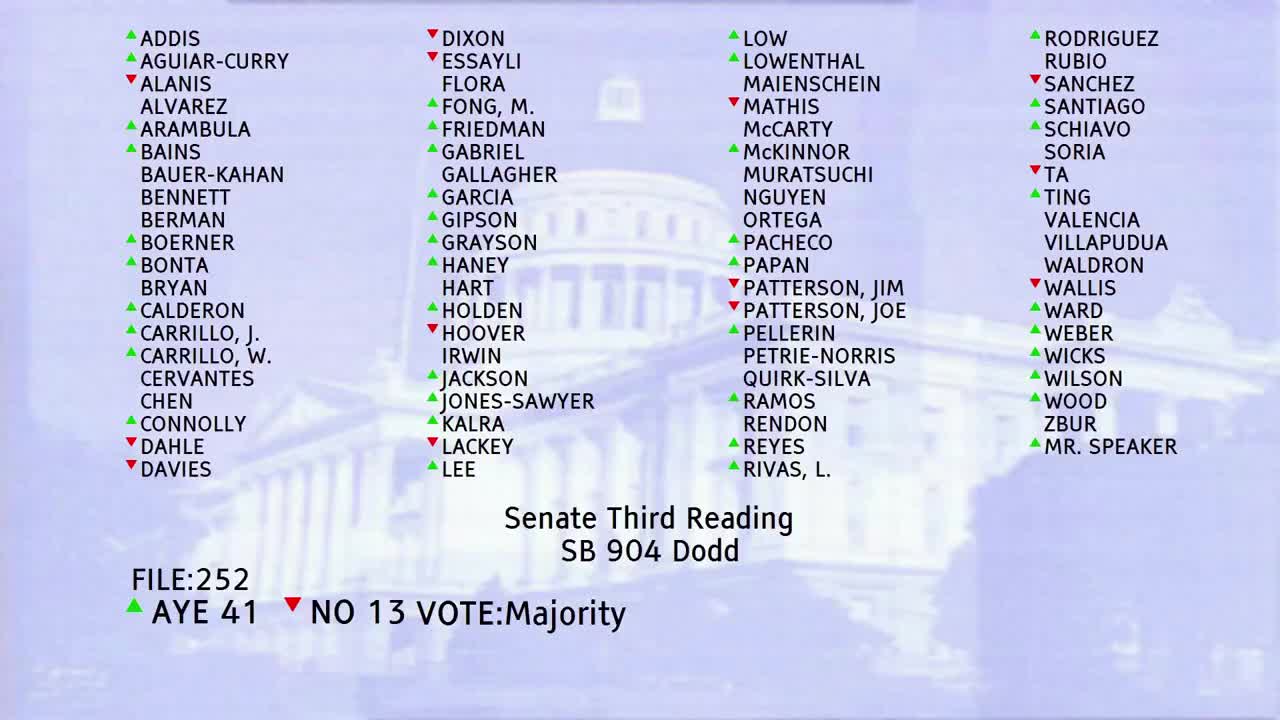 56SEC
Assembly Floor
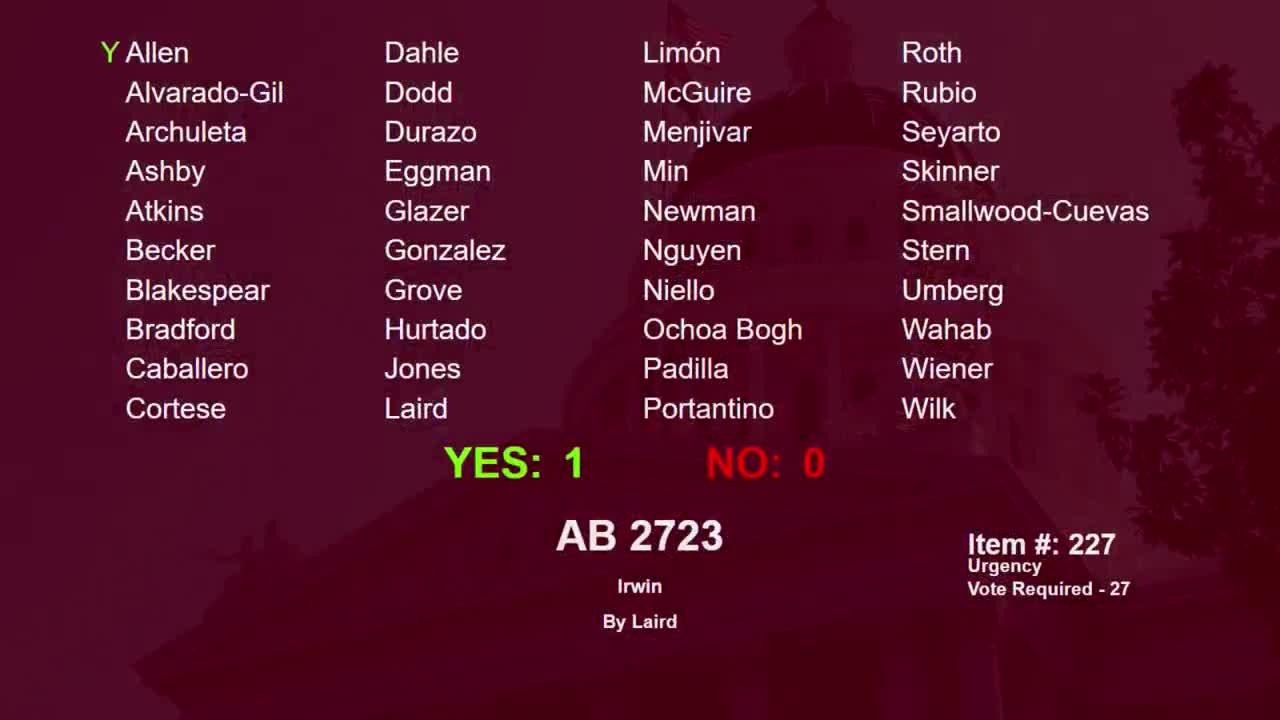 3MIN
Senate Floor
 9MIN
Senate Standing Committee on Local Government
 1MIN
Assembly Floor
 1MIN
Assembly Standing Committee on Appropriations
 5MIN
Assembly Standing Committee on Local Government
 10MIN
Assembly Standing Committee on Insurance
Bill Author

Bill Co-Author(s):