AB 2759: Domestic violence protective orders: possession of a firearm.
- Session Year: 2023-2024
- House: Assembly
- Latest Version Date: 2024-09-24
Current Status:
Passed
(2024-09-24: Chaptered by Secretary of State - Chapter 535, Statutes of 2024.)
Introduced
In Committee
First Chamber
In Committee
Second Chamber
Enacted
Existing law prohibits a person subject to a protective order, as defined, from owning, possessing, purchasing, or receiving a firearm or ammunition while that protective order is in effect and makes a willful and knowing violation of a protective order a crime. Existing law requires the court, when issuing the order with both parties present, to inform the parties of this information and to order the restrained person to relinquish any firearm or ammunition in the persons immediate possession or control or subject to their immediate possession or control. Existing law specifies the means of relinquishment if the law enforcement officer serving the protective order does not request the immediate surrender of the firearm or ammunition, including, surrender to law enforcement, or by selling the firearm or ammunition to a licensed gun dealer.
Existing law requires a court to order the restrained person to relinquish firearms or ammunition and to notify the parties of how any firearms or ammunition still in the restrained partys possession are to be relinquished and how to submit a receipt to the court. Existing law authorizes the court to grant an exemption from the relinquishment order for a particular firearm or ammunition if the respondent can show that the firearm or ammunition is a necessary condition of continued employment and the person cannot be reassigned, as specified, and only authorizes possession on the job or traveling to and from employment. If the person is a peace officer who carries a firearm or ammunition as a condition of employment and the peace officers personal safety depends on the ability to carry a firearm or ammunition, the court may exempt them from the relinquishment order, on duty or off, if the court finds that the peace officer does not pose a threat of harm. Existing law requires, prior to making this finding, that the court require a mandatory psychological evaluation of the peace officer and authorizes the court to require the peace officer to enter into counseling or other remedial treatment program to deal with any propensity for domestic violence.
This bill would revise the peace officer exemption to authorize a court to allow a peace officer to carry a specific firearm, ammunition, or firearm and ammunition if the peace officer is required, as a condition of continued employment, to carry that firearm, ammunition, or firearm and ammunition, as specified, if they cannot be reassigned, and if the court finds by a preponderance of the evidence, in writing or on the record, that the peace officers personal safety depends on the ability to carry that specific firearm, ammunition, or firearm and ammunition outside of scheduled work hours and they do not pose an additional threat of harm to a protected party or the public, as specified. The bill would require the mandatory psychological evaluation of the peace officer to be conducted by a mental health professional with domestic violence expertise and would require the court to consider the results of that evaluation.
This bill would authorize an exemption from the relinquishment requirement, only during scheduled working hours, for a nonpeace officer who is required to carry a specific firearm, ammunition, or firearm and ammunition as a condition of continued employment, as specified, if the court finds by a preponderance of the evidence, in writing or on the record, that the respondent does not pose an additional threat of harm to a protected party or the public by having access to the specific firearm, ammunition, or firearm and ammunition. The bill would authorize the court to order a psychological evaluation by a licensed mental health professional with domestic violence expertise to make this finding.
The bill would require the court, if an exemption is granted during the pendency of a temporary restraining order and the court subsequently issues a restraining order on the same application, to review and make a finding regarding the appropriateness of the granted exemption, as provided.
This bill would incorporate additional changes to Section 6389 of the Family Code proposed by SB 899 to be operative only if this bill and SB 899 are enacted and this bill is enacted last.
Existing law prohibits a person subject to a protective order, as defined, from owning, possessing, purchasing, or receiving a firearm or ammunition while that protective order is in effect and makes a willful and knowing violation of a protective order a crime. Existing law requires the court, when issuing the order with both parties present, to inform the parties of this information and to order the restrained person to relinquish any firearm or ammunition in the persons immediate possession or control or subject to their immediate possession or control. Existing law specifies the means of relinquishment if the law enforcement officer serving the protective order does not request the immediate surrender of the firearm or ammunition, including, surrender to law enforcement, or by selling the firearm or ammunition to a licensed gun dealer.
Existing law requires a court to order the restrained person to relinquish firearms or ammunition and to notify the parties of how any firearms or ammunition still in the restrained partys possession are to be relinquished and how to submit a receipt to the court. Existing law authorizes the court to grant an exemption from the relinquishment order for a particular firearm or ammunition if the respondent can show that the firearm or ammunition is a necessary condition of continued employment and the person cannot be reassigned, as specified, and only authorizes possession on the job or traveling to and from employment. If the person is a peace officer who carries a firearm or ammunition as a condition of employment and the peace officers personal safety depends on the ability to carry a firearm or ammunition, the court may exempt them from the relinquishment order, on duty or off, if the court finds that the peace officer does not pose a threat of harm. Existing law requires, prior to making this finding, that the court require a mandatory psychological evaluation of the peace officer and authorizes the court to require the peace officer to enter into counseling or other remedial treatment program to deal with any propensity for domestic violence.
This bill would revise the peace officer exemption to authorize a court to allow a peace officer to carry a specific firearm, ammunition, or firearm and ammunition if the peace officer is required, as a condition of continued employment, to carry that firearm, ammunition, or firearm and ammunition, as specified, if they cannot be reassigned, and if the court finds by a preponderance of the evidence, in writing or on the record, that the peace officers personal safety depends on the ability to carry that specific firearm, ammunition, or firearm and ammunition outside of scheduled work hours and they do not pose an additional threat of harm to a protected party or the public, as specified. The bill would require the mandatory psychological evaluation of the peace officer to be conducted by a mental health professional with domestic violence expertise and would require the court to consider the results of that evaluation.
This bill would authorize an exemption from the relinquishment requirement, only during scheduled working hours, for a nonpeace officer who is required to carry a specific firearm, ammunition, or firearm and ammunition as a condition of continued employment, as specified, if the court finds by a preponderance of the evidence, in writing or on the record, that the respondent does not pose an additional threat of harm to a protected party or the public by having access to the specific firearm, ammunition, or firearm and ammunition. The bill would authorize the court to order a psychological evaluation by a licensed mental health professional with domestic violence expertise to make this finding.
The bill would require the court, if an exemption is granted during the pendency of a temporary restraining order and the court subsequently issues a restraining order on the same application, to review and make a finding regarding the appropriateness of the granted exemption, as provided.
Existing law prohibits a person subject to a protective order, as defined, from owning, possessing, purchasing, or receiving a firearm or ammunition while that protective order is in effect and makes a willful and knowing violation of a protective order a crime. Existing law requires the court, when issuing the order with both parties present, to inform the parties of this information and to order the restrained person to relinquish any firearm or ammunition in the persons immediate possession or control or subject to their immediate possession or control. Existing law specifies the means of relinquishment if the law enforcement officer serving the protective order does not request the immediate surrender of the firearm or ammunition, including, surrender to law enforcement, or by selling the firearm or ammunition to a licensed gun dealer.
Existing law requires a court to order the restrained person to relinquish firearms or ammunition and to notify the parties of how any firearms or ammunition still in the restrained partys possession are to be relinquished and how to submit a receipt to the court. Existing law authorizes the court to grant an exemption from the relinquishment order for a particular firearm or ammunition if the respondent can show that the firearm or ammunition is a necessary condition of continued employment and the person cannot be reassigned, as specified, and only authorizes possession on the job or traveling to and from employment. If the person is a peace officer who carries a firearm or ammunition as a condition of employment and the peace officers personal safety depends on the ability to carry a firearm or ammunition, the court may exempt them from the relinquishment order, on duty or off, if the court finds that the peace officer does not pose a threat of harm. Existing law requires, prior to making this finding, that the court require a mandatory psychological evaluation of the peace officer and authorizes the court to require the peace officer to enter into counseling or other remedial treatment program to deal with any propensity for domestic violence.
This bill would revise the peace officer exemption to authorize a court to allow a peace officer to carry a firearm or ammunition specific firearm, ammunition, or firearm and ammunition if the peace officer is required, as a condition of continued employment, to carry a firearm or that firearm, ammunition, or firearm and ammunition, as specified, if they cannot be reassigned, and if the court finds by a preponderance of the evidence, in writing or on the record, that the peace officers personal safety depends on the ability to carry that firearm or specific firearm, ammunition, or firearm and ammunition outside of scheduled work hours and they do not pose an additional threat of harm to a protected party or the public, as specified. The bill would require the mandatory psychological evaluation of the peace officer to be conducted by a mental health professional with domestic violence expertise and would require the court to consider the results of that evaluation.
This bill would authorize an exemption from the relinquishment requirement, only during scheduled working hours, for a nonpeace officer who is required to carry a firearm or specific firearm, ammunition, or firearm and ammunition as a condition of continued employment, as specified, if the court finds by a preponderance of the evidence, in writing or on the record, that the respondent does not pose an additional threat of harm to a protected party or the public by having access to the firearm or specific firearm, ammunition, or firearm and ammunition. The bill would authorize the court to order a psychological evaluation by a licensed mental health professional with domestic violence expertise to make this finding.
The bill would require the court, if an exemption is granted during the pendency of a temporary restraining order and the court subsequently issues a restraining order on the same application, to review and make a finding regarding the appropriateness of the granted exemption, as provided.
Existing law prohibits a person subject to a protective order, as defined, from owning, possessing, purchasing, or receiving a firearm or ammunition while that protective order is in effect and makes a willful and knowing violation of a protective order a crime. Existing law requires the court, when issuing the order with both parties present, to inform the parties of this information and to order the restrained person to relinquish any firearm or ammunition in the persons immediate possession or control or subject to their immediate possession or control. Existing law specifies the means of relinquishment if the law enforcement officer serving the protective order does not request the immediate surrender of the firearm or ammunition, including, surrender to law enforcement, or by selling the firearm or ammunition to a licensed gun dealer.
Existing law requires a court to order the restrained person to relinquish firearms or ammunition and to notify the parties of how any firearms or ammunition still in the restrained partys possession are to be relinquished and how to submit a receipt to the court. Existing law authorizes the court to grant an exemption from the relinquishment order for a particular firearm or ammunition if the respondent can show that the firearm or ammunition is a necessary condition of continued employment and the person cannot be reassigned, as specified, and only authorizes possession on the job or traveling to and from employment. If the person is a peace officer who carries a firearm or ammunition as a condition of employment and the peace officers personal safety depends on the ability to carry a firearm or ammunition, the court may exempt them from the relinquishment order, on duty or off, if the court finds that the peace officer does not pose a threat of harm. Existing law requires, prior to making this finding, that the court require a mandatory psychological evaluation of the peace officer and authorizes the court to require the peace officer to enter into counseling or other remedial treatment program to deal with any propensity for domestic violence.
This bill would revise the peace officer exemption to authorize a court to allow a peace officer to carry a firearm or ammunition if the peace officer is required, as a condition of continued employment, to carry a firearm or ammunition, as specified, if they cannot be reassigned, and if the court finds by a preponderance of the evidence, in writing or on the record, that the peace officers personal safety depends on the ability to carry that firearm or ammunition outside of scheduled work hours and they do not pose an additional threat of harm to a protected party or the public, as specified. The bill would require the mandatory psychological evaluation of the peace officer to be conducted by a mental health professional with domestic violence expertise and would require the court to consider the results of that evaluation.
This bill would authorize an exemption from the relinquishment requirement, only during scheduled working hours, for a nonpeace officer who is required to carry a firearm or ammunition as a condition of continued employment, as specified, if the court finds by a preponderance of the evidence, in writing or on the record, that the respondent does not pose an additional threat of harm to a protected party or the public by having access to the firearm or ammunition. The bill would authorize the court to order a psychological evaluation by a licensed mental health professional with domestic violence expertise to make this finding.
The bill would require the court, if an exemption is granted during the pendency of a temporary restraining order and the court subsequently issues a restraining order on the same application, to review and make a finding regarding the appropriateness of the granted exemption, as provided.
(a)A person subject to a protective order, as defined in Section 6218, shall not own, possess, purchase, or receive a firearm or ammunition while that protective order is in effect. A person who owns, possesses, purchases, or receives, or attempts to purchase or receive, a firearm or ammunition while the protective order is in effect is punishable pursuant to Section 29825 of the Penal Code.
(b)On all forms providing notice that a protective order has been requested or granted, the Judicial Council shall include a notice that, upon service of the order, the respondent shall be ordered to relinquish possession or control of any firearms or ammunition and not to purchase or receive or attempt to purchase or receive any firearms or ammunition for a period not to exceed the duration of the restraining order.
(c)(1)Upon issuance of a protective order, as defined in Section 6218, the court shall order the respondent to relinquish any firearm or ammunition in the respondents immediate possession or control or subject to the respondents immediate possession or control.
(2)The relinquishment ordered pursuant to paragraph (1) shall occur by immediately surrendering the firearm or ammunition in a safe manner, upon request of a law enforcement officer, to the control of the officer, after being served with the protective order. A law enforcement officer serving a protective order that indicates that the respondent possesses weapons or ammunition shall request that the firearm or ammunition be immediately surrendered. Alternatively, if a request is not made by a law enforcement officer, the relinquishment shall occur within 24 hours of being served with the order, by either surrendering the firearm or ammunition in a safe manner to the control of local law enforcement officials, or by selling, transferring, or relinquishing for storage pursuant to Section 29830 of the Penal Code, the firearm or ammunition to a licensed gun dealer, as specified in Article 1 (commencing with Section 26700) and Article 2 (commencing with Section 26800) of Chapter 2 of Division 6 of Title 4 of Part 6 of the Penal Code. The law enforcement officer or licensed gun dealer taking possession of the firearm or ammunition pursuant to this subdivision shall issue a receipt to the person relinquishing the firearm or ammunition at the time of relinquishment. A person ordered to relinquish a firearm or ammunition pursuant to this subdivision shall, within 48 hours after being served with the order, do both of the following:
(A)File, with the court that issued the protective order, the receipt showing the firearm or ammunition was surrendered to a local law enforcement agency or sold to a licensed gun dealer. Failure to timely file a receipt shall constitute a violation of the protective order.
(B)File a copy of the receipt described in subparagraph (A) with the law enforcement agency that served the protective order. Failure to timely file a copy of the receipt shall constitute a violation of the protective order.
(3)The forms for protective orders adopted by the Judicial Council and approved by the Department of Justice shall require the petitioner to describe the number, types, and locations of any firearms or ammunition presently known by the petitioner to be possessed or controlled by the respondent.
(4)A court holding a hearing on this matter shall review the file to determine whether the receipt has been filed and inquire of the respondent whether they have complied with the requirement. Violations of the firearms prohibition of any restraining order under this section shall be reported to the prosecuting attorney in the jurisdiction where the order has been issued within two business days of the court hearing unless the restrained party provides a receipt showing compliance at a subsequent hearing or by direct filing with the clerk of the court.
(5)Every law enforcement agency in the state shall develop, adopt, and implement written policies and standards for law enforcement officers who request immediate relinquishment of firearms or ammunition.
(d)If the respondent declines to relinquish possession of a firearm or ammunition based on the assertion of the right against self-incrimination, as provided by the Fifth Amendment to the United States Constitution and Section 15 of Article I of the California Constitution, the court may grant use immunity for the act of relinquishing the firearm or ammunition required under this section.
(e)A local law enforcement agency may charge the respondent a fee for the storage of a firearm or ammunition pursuant to this section. This fee shall not exceed the actual cost incurred by the local law enforcement agency for the storage of the firearm or ammunition. For purposes of this subdivision, actual cost means expenses directly related to taking possession of a firearm or ammunition, storing the firearm or ammunition, and surrendering possession of the firearm or ammunition to a licensed dealer as defined in Section 26700 of the Penal Code or to the respondent.
(f)The restraining order requiring a person to relinquish a firearm or ammunition pursuant to subdivision (c) shall state on its face that the respondent is prohibited from owning, possessing, purchasing, or receiving a firearm or ammunition while the protective order is in effect and that the firearm or ammunition shall be relinquished to the local law enforcement agency for that jurisdiction or sold to a licensed gun dealer, and that proof of surrender or sale shall be filed with the court within a specified period of receipt of the order. The order shall also state on its face the expiration date for relinquishment. This section does not limit a respondents right under existing law to petition the court at a later date for modification of the order.
(g)The restraining order requiring a person to relinquish a firearm or ammunition pursuant to subdivision (c) shall prohibit the person from possessing or controlling a firearm or ammunition for the duration of the order. At the expiration of the order, the local law enforcement agency shall return possession of the surrendered firearm or ammunition to the respondent, within five days after the expiration of the relinquishment order, unless the local law enforcement agency determines that (1) the firearm or ammunition has been stolen, (2) the respondent is prohibited from possessing a firearm or ammunition because the respondent is in a prohibited class for the possession of firearms or ammunition, as defined in Chapter 2 (commencing with Section 29800) and Chapter 3 (commencing with Section 29900) of Division 9 of Title 4 of Part 6 of the Penal Code, Section 30305 of the Penal Code, and Sections 8100 and 8103 of the Welfare and Institutions Code, or (3) another successive restraining order is issued against the respondent under this section. If the local law enforcement agency determines that the respondent is the legal owner of a firearm or ammunition deposited with the local law enforcement agency and is prohibited from possessing a firearm or ammunition, the respondent shall be entitled to sell or transfer the firearm or ammunition to a licensed dealer as defined in Section 26700 of the Penal Code. If the firearm or ammunition has been stolen, the firearm or ammunition shall be restored to the lawful owner upon the owner identifying the firearm and ammunition and providing proof of ownership.
(h)The court may, as part of the relinquishment order, grant an exemption from the relinquishment requirements of this section for a particular firearm or ammunition if the respondent is not otherwise prohibited from owning, possessing, controlling, or purchasing a firearm and ammunition under state or federal law and one of the following applies:
(1)(A)The respondent is currently employed as a sworn peace officer who is required, as a condition of continued employment, to carry a firearm, ammunition, or firearm and ammunition and the current employer is unable to reassign the peace officer to another position where use of a specified firearm or ammunition is unnecessary. In such a case, a court may allow the peace officer to continue to carry a specified firearm, ammunition, or firearm and ammunition, either on duty or off duty, if the court finds by a preponderance of the evidence, in writing or on the record, both of the following:
(i)The peace officers personal safety depends on the ability to carry that specific firearm, ammunition, or firearm and ammunition outside of scheduled work hours.
(ii)The peace officer does not pose an additional threat of harm to a protected party or the public by having access to that specific firearm, ammunition, or firearm and ammunition, including whether the peace officer might use the firearm for a purpose other than as permitted under this paragraph.
(B)Prior to making this finding, the court shall require a mandatory psychological evaluation of the peace officer by a licensed mental health professional with domestic violence expertise. The court shall consider the results of an evaluation and may require the peace officer to enter into counseling or another remedial treatment program to deal with a propensity for domestic violence.
(2)(A)The respondent is not a peace officer but is required to carry a specific firearm, ammunition, or firearm and ammunition during scheduled work hours as a condition of continued employment, the current employer is unable to reassign the respondent to another position where the firearm, ammunition, or firearm and ammunition is unnecessary. In such a case, a court may grant an exemption to allow the respondent to possess a specific firearm, ammunition, or firearm and ammunition only during scheduled work hours if the court finds by a preponderance of the evidence, in writing or on the record, that the respondent does not pose an additional threat of harm to a protected party or the public by having access to the specific firearm, ammunition, or firearm and ammunition only during scheduled work hours, including whether the respondent might utilize the firearm, ammunition, or firearm and ammunition for a purpose other than as permitted under this paragraph.
(B)To assist the court in making this determination, the court may order a psychological evaluation of the respondent by a licensed mental health professional with domestic violence expertise.
(C)If the court grants an exemption pursuant to this paragraph, the order shall provide that the specific firearm, ammunition, or firearm and ammunition shall be in the physical possession of the respondent only during scheduled work hours and that the exemption does not authorize the respondent to possess any other firearm or ammunition, or to possess the specific firearm, ammunition, or firearm and ammunition outside of scheduled work hours.
(i)(1)If an exemption is granted under subdivision (h) during the pendency of a temporary restraining order and the court subsequently issues a restraining order after hearing on the same application, the court shall review and make a finding, in writing or on the record, as to whether the exemption remains appropriate, based upon the criteria set forth in paragraph (1) or (2) of subdivision (h), as applicable, in light of the issuance of the order after hearing. This review and finding shall occur at the time the restraining order after hearing is issued.
(2)If an exemption is granted and the court subsequently renews the restraining order pursuant to Section 6345 at the request of a party, the court shall review and make a finding, in writing or on the record, as to whether the exemption remains appropriate, based upon the criteria set forth in paragraph (1) or (2) of subdivision (h), as applicable, in light of the renewal. This finding shall be made at the time the restraining order after hearing is renewed.
(3)The court may terminate or modify an exemption granted pursuant to this paragraph at any time if the respondent demonstrates a need to modify the specific firearm, ammunition, or firearm and ammunition authorized by the court pursuant to subdivision (h) or if the respondent no longer meets the requirements in this section or otherwise violates the restraining order.
(j)During the period of the relinquishment order, a respondent is entitled to make one sale of all firearms or ammunition that are in the possession of a local law enforcement agency pursuant to this section. A licensed gun dealer, who presents a local law enforcement agency with a bill of sale indicating that all firearms or ammunition owned by the respondent that are in the possession of the local law enforcement agency have been sold by the respondent to the licensed gun dealer, shall be given possession of those firearms or ammunition, at the location where a respondents firearms or ammunition are stored, within five days of presenting the local law enforcement agency with a bill of sale.
(k)The disposition of any unclaimed property under this section shall be made pursuant to Section 1413 of the Penal Code.
(l)The relinquishment of a firearm to a law enforcement agency pursuant to subdivision (g) or the return of a firearm to a person pursuant to subdivision (g) shall not be subject to the requirements of Section 27545 of the Penal Code.
(m)If the respondent notifies the court that the respondent owns a firearm or ammunition that is not in their immediate possession, the court may limit the order to exclude that firearm or ammunition if the judge is satisfied the respondent is unable to gain access to that firearm or ammunition while the protective order is in effect.
(n)A respondent to a protective order who violates an order issued pursuant to this section shall be punished under the provisions of Section 29825 of the Penal Code.
SEC. 1.1.Section 6389 of the Family Code is amended to read:6389.(a)A person subject to a protective order, as defined in Section 6218, shall not own, possess, purchase, or receive a firearm or ammunition while that protective order is in effect. A person who owns, possesses, purchases, or receives, or attempts to purchase or receive, a firearm or ammunition while the protective order is in effect is punishable pursuant to Section 29825 of the Penal Code.
(b)On all forms providing notice that a protective order has been requested or granted, the Judicial Council shall include a notice that, upon service of the order, the respondent shall be ordered to relinquish possession or control of any firearms or ammunition and not to purchase or receive or attempt to purchase or receive any firearms or ammunition for a period not to exceed the duration of the restraining order.
(c)(1)Upon issuance of a protective order, as defined in Section 6218, the court shall order the respondent to relinquish any firearm or ammunition in the respondents immediate possession or control or subject to the respondents immediate possession or control.
(2)The relinquishment ordered pursuant to paragraph (1) shall occur by immediately surrendering the firearm or ammunition in a safe manner, upon request of a law enforcement officer, to the control of the officer, after being served with the protective order. A law enforcement officer serving a protective order that indicates that the respondent possesses weapons or ammunition shall request that the firearm or ammunition be immediately surrendered. Alternatively, if a request is not made by a law enforcement officer, the relinquishment shall occur within 24 hours of being served with the order, by either surrendering the firearm or ammunition in a safe manner to the control of local law enforcement officials, or by selling, transferring, or relinquishing for storage pursuant to Section 29830 of the Penal Code, the firearm or ammunition to a licensed gun dealer, as specified in Article 1 (commencing with Section 26700) and Article 2 (commencing with Section 26800) of Chapter 2 of Division 6 of Title 4 of Part 6 of the Penal Code. The law enforcement officer or licensed gun dealer taking possession of the firearm or ammunition pursuant to this subdivision shall issue a receipt to the person relinquishing the firearm or ammunition at the time of relinquishment. A person ordered to relinquish a firearm or ammunition pursuant to this subdivision shall, within 48 hours after being served with the order, do both of the following:
(A)File, with the court that issued the protective order, the receipt showing the firearm or ammunition was surrendered to a local law enforcement agency or sold to a licensed gun dealer. Failure to timely file a receipt shall constitute a violation of the protective order.
(B)File a copy of the receipt described in subparagraph (A) with the law enforcement agency that served the protective order. Failure to timely file a copy of the receipt shall constitute a violation of the protective order.
(3)The forms for protective orders adopted by the Judicial Council and approved by the Department of Justice shall require the petitioner to describe the number, types, and locations of any firearms or ammunition presently known by the petitioner to be possessed or controlled by the respondent.
(4)A court holding a hearing on this matter shall review the file to determine whether the receipt has been filed and inquire of the respondent whether they have complied with the requirement. Violations of the firearms prohibition of any restraining order under this section shall be reported to the prosecuting attorney in the jurisdiction where the order has been issued within two business days of the court hearing unless the restrained party provides a receipt showing compliance at a subsequent hearing or by direct filing with the clerk of the court.
(5)Every law enforcement agency in the state shall develop, adopt, and implement written policies and standards for law enforcement officers who request immediate relinquishment of firearms or ammunition.
(d)If the respondent declines to relinquish possession of a firearm or ammunition based on the assertion of the right against self-incrimination, as provided by the Fifth Amendment to the United States Constitution and Section 15 of Article I of the California Constitution, the court may grant use immunity for the act of relinquishing the firearm or ammunition required under this section.
(e)A local law enforcement agency may charge the respondent a fee for the storage of a firearm or ammunition pursuant to this section. This fee shall not exceed the actual cost incurred by the local law enforcement agency for the storage of the firearm or ammunition. For purposes of this subdivision, actual cost means expenses directly related to taking possession of a firearm or ammunition, storing the firearm or ammunition, and surrendering possession of the firearm or ammunition to a licensed dealer as defined in Section 26700 of the Penal Code or to the respondent.
(f)The restraining order requiring a person to relinquish a firearm or ammunition pursuant to subdivision (c) shall state on its face that the respondent is prohibited from owning, possessing, purchasing, or receiving a firearm or ammunition while the protective order is in effect and that the firearm or ammunition shall be relinquished to the local law enforcement agency for that jurisdiction or sold to a licensed gun dealer, and that proof of surrender or sale shall be filed with the court within a specified period of receipt of the order. The order shall also state on its face the expiration date for relinquishment. This section does not limit a respondents right under existing law to petition the court at a later date for modification of the order.
(g)The restraining order requiring a person to relinquish a firearm or ammunition pursuant to subdivision (c) shall prohibit the person from possessing or controlling a firearm or ammunition for the duration of the order. At the expiration of the order, the local law enforcement agency shall return possession of the surrendered firearm or ammunition to the respondent, within five days after the expiration of the relinquishment order, unless the local law enforcement agency determines that (1) the firearm or ammunition has been stolen, (2) the respondent is prohibited from possessing a firearm or ammunition because the respondent is in a prohibited class for the possession of firearms or ammunition, as defined in Chapter 2 (commencing with Section 29800) and Chapter 3 (commencing with Section 29900) of Division 9 of Title 4 of Part 6 of the Penal Code, Section 30305 of the Penal Code, and Sections 8100 and 8103 of the Welfare and Institutions Code, or (3) another successive restraining order is issued against the respondent under this section. If the local law enforcement agency determines that the respondent is the legal owner of a firearm or ammunition deposited with the local law enforcement agency and is prohibited from possessing a firearm or ammunition, the respondent shall be entitled to sell or transfer the firearm or ammunition to a licensed dealer as defined in Section 26700 of the Penal Code. If the firearm or ammunition has been stolen, the firearm or ammunition shall be restored to the lawful owner upon the owner identifying the firearm and ammunition and providing proof of ownership.
(h)The court may, as part of the relinquishment order, grant an exemption from the relinquishment requirements of this section for a particular firearm or ammunition if the respondent is not otherwise prohibited from owning, possessing, controlling, or purchasing a firearm and ammunition under state or federal law and one of the following applies:
(1)(A)The respondent is currently employed as a sworn peace officer who is required, as a condition of continued employment, to carry a firearm, ammunition, or firearm and ammunition and the current employer is unable to reassign the peace officer to another position where use of a specified firearm or ammunition is unnecessary. In such a case, a court may allow the peace officer to continue to carry a specified firearm, ammunition, or firearm and ammunition, either on duty or off duty, if the court finds by a preponderance of the evidence, in writing or on the record, both of the following:
(i)The peace officers personal safety depends on the ability to carry that specific firearm, ammunition, or firearm and ammunition outside of scheduled work hours.
(ii)The peace officer does not pose an additional threat of harm to a protected party or the public by having access to that specific firearm, ammunition, or firearm and ammunition, including whether the peace officer might use the firearm for a purpose other than as permitted under this paragraph.
(B)Prior to making this finding, the court shall require a mandatory psychological evaluation of the peace officer by a licensed mental health professional with domestic violence expertise. The court shall consider the results of an evaluation and may require the peace officer to enter into counseling or another remedial treatment program to deal with a propensity for domestic violence.
(2)(A)The respondent is not a peace officer but is required to carry a specific firearm, ammunition, or firearm and ammunition during scheduled work hours as a condition of continued employment, the current employer is unable to reassign the respondent to another position where the firearm, ammunition, or firearm and ammunition is unnecessary. In such a case, a court may grant an exemption to allow the respondent to possess a specific firearm, ammunition, or firearm and ammunition only during scheduled work hours if the court finds by a preponderance of the evidence, in writing or on the record, that the respondent does not pose an additional threat of harm to a protected party or the public by having access to the specific firearm, ammunition, or firearm and ammunition only during scheduled work hours, including whether the respondent might utilize the firearm, ammunition, or firearm and ammunition for a purpose other than as permitted under this paragraph.
(B)To assist the court in making this determination, the court may order a psychological evaluation of the respondent by a licensed mental health professional with domestic violence expertise.
(C)If the court grants an exemption pursuant to this paragraph, the order shall provide that the specific firearm, ammunition, or firearm and ammunition shall be in the physical possession of the respondent only during scheduled work hours and that the exemption does not authorize the respondent to possess any other firearm or ammunition, or to possess the specific firearm, ammunition, or firearm and ammunition outside of scheduled work hours.
(i)(1)If an exemption is granted under subdivision (h) during the pendency of a temporary restraining order and the court subsequently issues a restraining order after hearing on the same application, the court shall review and make a finding, in writing or on the record, as to whether the exemption remains appropriate, based upon the criteria set forth in paragraph (1) or (2) of subdivision (h), as applicable, in light of the issuance of the order after hearing. This review and finding shall occur at the time the restraining order after hearing is issued.
(2)If an exemption is granted and the court subsequently renews the restraining order pursuant to Section 6345 at the request of a party, the court shall review and make a finding, in writing or on the record, as to whether the exemption remains appropriate, based upon the criteria set forth in paragraph (1) or (2) of subdivision (h), as applicable, in light of the renewal. This finding shall be made at the time the restraining order after hearing is renewed.
(3)The court may terminate or modify an exemption granted pursuant to this paragraph at any time if the respondent demonstrates a need to modify the specific firearm, ammunition, or firearm and ammunition authorized by the court pursuant to subdivision (h) or if the respondent no longer meets the requirements in this section or otherwise violates the restraining order.
(j)During the period of the relinquishment order, a respondent is entitled to make one sale of all firearms or ammunition that are in the possession of a local law enforcement agency pursuant to this section. A licensed gun dealer, who presents a local law enforcement agency with a bill of sale indicating that all firearms or ammunition owned by the respondent that are in the possession of the local law enforcement agency have been sold by the respondent to the licensed gun dealer, shall be given possession of those firearms or ammunition, at the location where a respondents firearms or ammunition are stored, within five days of presenting the local law enforcement agency with a bill of sale.
(k)The disposition of any unclaimed property under this section shall be made pursuant to Section 1413 of the Penal Code.
(l)The relinquishment of a firearm to a law enforcement agency pursuant to subdivision (g) or the return of a firearm to a person pursuant to subdivision (g) shall not be subject to the requirements of Section 27545 of the Penal Code.
(m)If the respondent notifies the court that the respondent owns a firearm or ammunition that is not in their immediate possession, the court may limit the order to exclude that firearm or ammunition if the judge is satisfied the respondent is unable to gain access to that firearm or ammunition while the protective order is in effect.
(n)A respondent to a protective order who violates an order issued pursuant to this section shall be punished under the provisions of Section 29825 of the Penal Code.
(o)This section shall remain in effect only until January 1, 2026, and as of that date is repealed.
SEC. 1.2.Section 6389 is added to the Family Code, to read:6389.(a)A person subject to a protective order, as defined in Section 6218, shall not own, possess, purchase, or receive a firearm or ammunition while that protective order is in effect. A person who owns, possesses, purchases, or receives, or attempts to purchase or receive, a firearm or ammunition while the protective order is in effect is punishable pursuant to Section 29825 of the Penal Code.
(b)On all forms providing notice that a protective order has been requested or granted, the Judicial Council shall include a notice that, upon service of the order, the respondent shall be ordered to relinquish possession or control of any firearms or ammunition and not to purchase or receive or attempt to purchase or receive any firearms or ammunition for a period not to exceed the duration of the restraining order.
(c)(1)Upon issuance of a protective order, as defined in Section 6218, the court shall order the respondent to relinquish any firearm or ammunition in the respondents immediate possession or control or subject to the respondents immediate possession or control.
(2)The relinquishment ordered pursuant to paragraph (1) shall occur by immediately surrendering the firearm or ammunition in a safe manner, upon request of a law enforcement officer, to the control of the officer, after being served with the protective order. A law enforcement officer serving a protective order that indicates that the respondent possesses weapons or ammunition shall request that the firearm or ammunition be immediately surrendered. Alternatively, if a request is not made by a law enforcement officer, the relinquishment shall occur within 24 hours of being served with the order, by either surrendering the firearm or ammunition in a safe manner to the control of local law enforcement officials, or by selling, transferring, or relinquishing for storage pursuant to Section 29830 of the Penal Code, the firearm or ammunition to a licensed gun dealer, as specified in Article 1 (commencing with Section 26700) and Article 2 (commencing with Section 26800) of Chapter 2 of Division 6 of Title 4 of Part 6 of the Penal Code. The law enforcement officer or licensed gun dealer taking possession of the firearm or ammunition pursuant to this subdivision shall issue a receipt to the person relinquishing the firearm or ammunition at the time of relinquishment. A person ordered to relinquish a firearm or ammunition pursuant to this subdivision shall, within 48 hours after being served with the order, do both of the following:
(A)File, with the court that issued the protective order, the receipt showing the firearm or ammunition was surrendered to a local law enforcement agency or sold to a licensed gun dealer. Failure to timely file a receipt shall constitute a violation of the protective order.
(B)File a copy of the receipt described in subparagraph (A) with the law enforcement agency that served the protective order. Failure to timely file a copy of the receipt shall constitute a violation of the protective order.
(3)The forms for protective orders adopted by the Judicial Council and approved by the Department of Justice shall require the petitioner to describe the number, types, and locations of any firearms or ammunition presently known by the petitioner to be possessed or controlled by the respondent.
(4)A court holding a hearing on this matter shall review the file to determine whether the receipt has been filed and inquire of the respondent whether they have complied with the requirement. Violations of the firearms prohibition of any restraining order under this section shall be reported to the prosecuting attorney in the jurisdiction where the order has been issued within two business days of the court hearing unless the restrained party provides a receipt showing compliance at a subsequent hearing or by direct filing with the clerk of the court.
(5)Every law enforcement agency in the state shall develop, adopt, and implement written policies and standards for law enforcement officers who request immediate relinquishment of firearms or ammunition.
(d)If the respondent declines to relinquish possession of a firearm or ammunition based on the assertion of the right against self-incrimination, as provided by the Fifth Amendment to the United States Constitution and Section 15 of Article I of the California Constitution, the court may grant use immunity for the act of relinquishing the firearm or ammunition required under this section.
(e)A local law enforcement agency may charge the respondent a fee for the storage of a firearm or ammunition pursuant to this section. This fee shall not exceed the actual cost incurred by the local law enforcement agency for the storage of the firearm or ammunition. For purposes of this subdivision, actual cost means expenses directly related to taking possession of a firearm or ammunition, storing the firearm or ammunition, and surrendering possession of the firearm or ammunition to a licensed dealer as defined in Section 26700 of the Penal Code or to the respondent.
(f)The restraining order requiring a person to relinquish a firearm or ammunition pursuant to subdivision (c) shall state on its face that the respondent is prohibited from owning, possessing, purchasing, or receiving a firearm or ammunition while the protective order is in effect and that the firearm or ammunition shall be relinquished to the local law enforcement agency for that jurisdiction or sold to a licensed gun dealer, and that proof of surrender or sale shall be filed with the court within a specified period of receipt of the order. The order shall also state on its face the expiration date for relinquishment. This section does not limit a respondents right under existing law to petition the court at a later date for modification of the order.
(g)The restraining order requiring a person to relinquish a firearm or ammunition pursuant to subdivision (c) shall prohibit the person from possessing or controlling a firearm or ammunition for the duration of the order. At the expiration of the order, the local law enforcement agency shall return possession of the surrendered firearm or ammunition to the respondent, within five days after the expiration of the relinquishment order, unless the local law enforcement agency determines that (1) the firearm or ammunition has been stolen, (2) the respondent is prohibited from possessing a firearm or ammunition because the respondent is in a prohibited class for the possession of firearms or ammunition, as defined in Chapter 2 (commencing with Section 29800) and Chapter 3 (commencing with Section 29900) of Division 9 of Title 4 of Part 6 of the Penal Code, Section 30305 of the Penal Code, and Sections 8100 and 8103 of the Welfare and Institutions Code, or (3) another successive restraining order is issued against the respondent under this section. If the local law enforcement agency determines that the respondent is the legal owner of a firearm or ammunition deposited with the local law enforcement agency and is prohibited from possessing a firearm or ammunition, the respondent shall be entitled to sell or transfer the firearm or ammunition to a licensed dealer as defined in Section 26700 of the Penal Code. If the firearm or ammunition has been stolen, the firearm or ammunition shall be restored to the lawful owner upon the owner identifying the firearm and ammunition and providing proof of ownership.
(h)The court may, as part of the relinquishment order, grant an exemption from the relinquishment requirements of this section for a particular firearm or ammunition if the respondent is not otherwise prohibited from owning, possessing, controlling, or purchasing a firearm and ammunition under state or federal law and one of the following applies:
(1)(A)The respondent is currently employed as a sworn peace officer who is required, as a condition of continued employment, to carry a firearm, ammunition, or firearm and ammunition and the current employer is unable to reassign the peace officer to another position where use of a specified firearm or ammunition is unnecessary. In such a case, a court may allow the peace officer to continue to carry a specified firearm, ammunition, or firearm and ammunition, either on duty or off duty, if the court finds by a preponderance of the evidence, in writing or on the record, both of the following:
(i)The peace officers personal safety depends on the ability to carry that specific firearm, ammunition, or firearm and ammunition outside of scheduled work hours.
(ii)The peace officer does not pose an additional threat of harm to a protected party or the public by having access to that specific firearm, ammunition, or firearm and ammunition, including whether the peace officer might use the firearm for a purpose other than as permitted under this paragraph.
(B)Prior to making this finding, the court shall require a mandatory psychological evaluation of the peace officer by a licensed mental health professional with domestic violence expertise. The court shall consider the results of an evaluation and may require the peace officer to enter into counseling or another remedial treatment program to deal with a propensity for domestic violence.
(2)(A)The respondent is not a peace officer but is required to carry a specific firearm, ammunition, or firearm and ammunition during scheduled work hours as a condition of continued employment, the current employer is unable to reassign the respondent to another position where the firearm, ammunition, or firearm and ammunition is unnecessary. In such a case, a court may grant an exemption to allow the respondent to possess a specific firearm, ammunition, or firearm and ammunition only during scheduled work hours if the court finds by a preponderance of the evidence, in writing or on the record, that the respondent does not pose an additional threat of harm to a protected party or the public by having access to the specific firearm, ammunition, or firearm and ammunition only during scheduled work hours, including whether the respondent might utilize the firearm, ammunition, or firearm and ammunition for a purpose other than as permitted under this paragraph.
(B)To assist the court in making this determination, the court may order a psychological evaluation of the respondent by a licensed mental health professional with domestic violence expertise.
(C)If the court grants an exemption pursuant to this paragraph, the order shall provide that the specific firearm, ammunition, or firearm and ammunition shall be in the physical possession of the respondent only during scheduled work hours and that the exemption does not authorize the respondent to possess any other firearm or ammunition, or to possess the specific firearm, ammunition, or firearm and ammunition outside of scheduled work hours.
(i)(1)If an exemption is granted under subdivision (h) during the pendency of a temporary restraining order and the court subsequently issues a restraining order after hearing on the same application, the court shall review and make a finding, in writing or on the record, as to whether the exemption remains appropriate, based upon the criteria set forth in paragraph (1) or (2) of subdivision (h), as applicable, in light of the issuance of the order after hearing. This review and finding shall occur at the time the restraining order after hearing is issued.
(2)If an exemption is granted and the court subsequently renews the restraining order pursuant to Section 6345 at the request of a party, the court shall review and make a finding, in writing or on the record, as to whether the exemption remains appropriate, based upon the criteria set forth in paragraph (1) or (2) of subdivision (h), as applicable, in light of the renewal. This finding shall be made at the time the restraining order after hearing is renewed.
(3)The court may terminate or modify an exemption granted pursuant to this paragraph at any time if the respondent demonstrates a need to modify the specific firearm, ammunition, or firearm and ammunition authorized by the court pursuant to subdivision (h) or if the respondent no longer meets the requirements in this section or otherwise violates the restraining order.
(j)During the period of the relinquishment order, a respondent is entitled to make one sale of all firearms or ammunition that are in the possession of a local law enforcement agency pursuant to this section. A licensed gun dealer, who presents a local law enforcement agency with a bill of sale indicating that all firearms or ammunition owned by the respondent that are in the possession of the local law enforcement agency have been sold by the respondent to the licensed gun dealer, shall be given possession of those firearms or ammunition, at the location where a respondents firearms or ammunition are stored, within five days of presenting the local law enforcement agency with a bill of sale.
(k)The disposition of any unclaimed property under this section shall be made pursuant to Section 1413 of the Penal Code.
(l)(1)The relinquishment of a firearm to a law enforcement agency pursuant to subdivision (g) shall not be subject to the requirements of Section 27545 of the Penal Code.
(2)The return of firearms and ammunition by a law enforcement agency pursuant to this section shall be governed by the applicable provisions of Chapter 2 (commencing with Section 33850) of Division 11 of Title 4 of Part 6 of the Penal Code.
(m)If the respondent notifies the court that the respondent owns a firearm or ammunition that is not in their immediate possession, the court may limit the order to exclude that firearm or ammunition if the judge is satisfied the respondent is unable to gain access to that firearm or ammunition while the protective order is in effect.
(n)A respondent to a protective order who violates an order issued pursuant to this section shall be punished under the provisions of Section 29825 of the Penal Code.
(o)This section shall become operative on January 1, 2026.
SEC. 2.Sections 1.1 and 1.2 of this bill incorporate amendments to Section 6389 of the Family Code proposed by both this bill and Senate Bill 899. Those sections of this bill shall only become operative if (1) both bills are enacted and become effective on or before January 1, 2025, (2) this bill amends Section 6389 of the Family Code and Senate Bill 899 amends, repeals, and adds Section 6389 of the Family Code, and (3) this bill is enacted after Senate Bill 899, in which case Section 1 of this bill and Sections 8 and 9 of Senate Bill 899 shall not become operative.
(a)A person subject to a protective order, as defined in Section 6218, shall not own, possess, purchase, or receive a firearm or ammunition while that protective order is in effect. A person who owns, possesses, purchases, or receives, or attempts to purchase or receive, a firearm or ammunition while the protective order is in effect is punishable pursuant to Section 29825 of the Penal Code.
(b)On all forms providing notice that a protective order has been requested or granted, the Judicial Council shall include a notice that, upon service of the order, the respondent shall be ordered to relinquish possession or control of any firearms or ammunition and not to purchase or receive or attempt to purchase or receive any firearms or ammunition for a period not to exceed the duration of the restraining order.
(c)(1)Upon issuance of a protective order, as defined in Section 6218, the court shall order the respondent to relinquish any firearm or ammunition in the respondents immediate possession or control or subject to the respondents immediate possession or control.
(2)The relinquishment ordered pursuant to paragraph (1) shall occur by immediately surrendering the firearm or ammunition in a safe manner, upon request of a law enforcement officer, to the control of the officer, after being served with the protective order. A law enforcement officer serving a protective order that indicates that the respondent possesses weapons or ammunition shall request that the firearm or ammunition be immediately surrendered. Alternatively, if a request is not made by a law enforcement officer, the relinquishment shall occur within 24 hours of being served with the order, by either surrendering the firearm or ammunition in a safe manner to the control of local law enforcement officials, or by selling, transferring, or relinquishing for storage pursuant to Section 29830 of the Penal Code, the firearm or ammunition to a licensed gun dealer, as specified in Article 1 (commencing with Section 26700) and Article 2 (commencing with Section 26800) of Chapter 2 of Division 6 of Title 4 of Part 6 of the Penal Code. The law enforcement officer or licensed gun dealer taking possession of the firearm or ammunition pursuant to this subdivision shall issue a receipt to the person relinquishing the firearm or ammunition at the time of relinquishment. A person ordered to relinquish a firearm or ammunition pursuant to this subdivision shall, within 48 hours after being served with the order, do both of the following:
(A)File, with the court that issued the protective order, the receipt showing the firearm or ammunition was surrendered to a local law enforcement agency or sold to a licensed gun dealer. Failure to timely file a receipt shall constitute a violation of the protective order.
(B)File a copy of the receipt described in subparagraph (A) with the law enforcement agency that served the protective order. Failure to timely file a copy of the receipt shall constitute a violation of the protective order.
(3)The forms for protective orders adopted by the Judicial Council and approved by the Department of Justice shall require the petitioner to describe the number, types, and locations of any firearms or ammunition presently known by the petitioner to be possessed or controlled by the respondent.
(4)A court holding a hearing on this matter shall review the file to determine whether the receipt has been filed and inquire of the respondent whether they have complied with the requirement. Violations of the firearms prohibition of any restraining order under this section shall be reported to the prosecuting attorney in the jurisdiction where the order has been issued within two business days of the court hearing unless the restrained party provides a receipt showing compliance at a subsequent hearing or by direct filing with the clerk of the court.
(5)Every law enforcement agency in the state shall develop, adopt, and implement written policies and standards for law enforcement officers who request immediate relinquishment of firearms or ammunition.
(d)If the respondent declines to relinquish possession of a firearm or ammunition based on the assertion of the right against self-incrimination, as provided by the Fifth Amendment to the United States Constitution and Section 15 of Article I of the California Constitution, the court may grant use immunity for the act of relinquishing the firearm or ammunition required under this section.
(e)A local law enforcement agency may charge the respondent a fee for the storage of a firearm or ammunition pursuant to this section. This fee shall not exceed the actual cost incurred by the local law enforcement agency for the storage of the firearm or ammunition. For purposes of this subdivision, actual cost means expenses directly related to taking possession of a firearm or ammunition, storing the firearm or ammunition, and surrendering possession of the firearm or ammunition to a licensed dealer as defined in Section 26700 of the Penal Code or to the respondent.
(f)The restraining order requiring a person to relinquish a firearm or ammunition pursuant to subdivision (c) shall state on its face that the respondent is prohibited from owning, possessing, purchasing, or receiving a firearm or ammunition while the protective order is in effect and that the firearm or ammunition shall be relinquished to the local law enforcement agency for that jurisdiction or sold to a licensed gun dealer, and that proof of surrender or sale shall be filed with the court within a specified period of receipt of the order. The order shall also state on its face the expiration date for relinquishment. This section does not limit a respondents right under existing law to petition the court at a later date for modification of the order.
(g)The restraining order requiring a person to relinquish a firearm or ammunition pursuant to subdivision (c) shall prohibit the person from possessing or controlling a firearm or ammunition for the duration of the order. At the expiration of the order, the local law enforcement agency shall return possession of the surrendered firearm or ammunition to the respondent, within five days after the expiration of the relinquishment order, unless the local law enforcement agency determines that (1) the firearm or ammunition has been stolen, (2) the respondent is prohibited from possessing a firearm or ammunition because the respondent is in a prohibited class for the possession of firearms or ammunition, as defined in Chapter 2 (commencing with Section 29800) and Chapter 3 (commencing with Section 29900) of Division 9 of Title 4 of Part 6 of the Penal Code, Section 30305 of the Penal Code, and Sections 8100 and 8103 of the Welfare and Institutions Code, or (3) another successive restraining order is issued against the respondent under this section. If the local law enforcement agency determines that the respondent is the legal owner of a firearm or ammunition deposited with the local law enforcement agency and is prohibited from possessing a firearm or ammunition, the respondent shall be entitled to sell or transfer the firearm or ammunition to a licensed dealer as defined in Section 26700 of the Penal Code. If the firearm or ammunition has been stolen, the firearm or ammunition shall be restored to the lawful owner upon the owner identifying the firearm and ammunition and providing proof of ownership.
(h)The court may, as part of the relinquishment order, grant an exemption from the relinquishment requirements of this section for a particular firearm or ammunition if the respondent is not otherwise prohibited from owning, possessing, controlling, or purchasing a firearm and ammunition under state or federal law and one of the following applies:
(1)(A)The respondent is currently employed as a sworn peace officer who is required, as a condition of continued employment, to carry a firearm, ammunition, or firearm and ammunition and the current employer is unable to reassign the peace officer to another position where use of a specified firearm or ammunition is unnecessary. In such a case, a court may allow the peace officer to continue to carry a specified firearm, ammunition, or firearm and ammunition, either on duty or off duty, if the court finds by a preponderance of the evidence, in writing or on the record, both of the following:
(i)The peace officers personal safety depends on the ability to carry that specific firearm, ammunition, or firearm and ammunition outside of scheduled work hours.
(ii)The peace officer does not pose an additional threat of harm to a protected party or the public by having access to that specific firearm, ammunition, or firearm and ammunition, including whether the peace officer might use the firearm for a purpose other than as permitted under this paragraph.
(B)Prior to making this finding, the court shall require a mandatory psychological evaluation of the peace officer by a licensed mental health professional with domestic violence expertise. The court shall consider the results of an evaluation and may require the peace officer to enter into counseling or another remedial treatment program to deal with a propensity for domestic violence.
(2)(A)The respondent is not a peace officer but is required to carry a specific firearm, ammunition, or firearm and ammunition during scheduled work hours as a condition of continued employment, the current employer is unable to reassign the respondent to another position where the firearm, ammunition, or firearm and ammunition is unnecessary. In such a case, a court may grant an exemption to allow the respondent to possess a specific firearm, ammunition, or firearm and ammunition only during scheduled work hours if the court finds by a preponderance of the evidence, in writing or on the record, that the respondent does not pose an additional threat of harm to a protected party or the public by having access to the specific firearm, ammunition, or firearm and ammunition only during scheduled work hours, including whether the respondent might utilize the firearm, ammunition, or firearm and ammunition for a purpose other than as permitted under this paragraph.
(B)To assist the court in making this determination, the court may order a psychological evaluation of the respondent by a licensed mental health professional with domestic violence expertise.
(C)If the court grants an exemption pursuant to this paragraph, the order shall provide that the specific firearm, ammunition, or firearm and ammunition shall be in the physical possession of the respondent only during scheduled work hours and that the exemption does not authorize the respondent to possess any other firearm or ammunition, or to possess the specific firearm, ammunition, or firearm and ammunition outside of scheduled work hours.
(i)(1)If an exemption is granted under subdivision (h) during the pendency of a temporary restraining order and the court subsequently issues a restraining order after hearing on the same application, the court shall review and make a finding, in writing or on the record, as to whether the exemption remains appropriate, based upon the criteria set forth in paragraph (1) or (2) of subdivision (h), as applicable, in light of the issuance of the order after hearing. This review and finding shall occur at the time the restraining order after hearing is issued.
(2)If an exemption is granted and the court subsequently renews the restraining order pursuant to Section 6345 at the request of a party, the court shall review and make a finding, in writing or on the record, as to whether the exemption remains appropriate, based upon the criteria set forth in paragraph (1) or (2) of subdivision (h), as applicable, in light of the renewal. This finding shall be made at the time the restraining order after hearing is renewed.
(3)The court may terminate or modify an exemption granted pursuant to this paragraph at any time if the respondent demonstrates a need to modify the specific firearm, ammunition, or firearm and ammunition authorized by the court pursuant to subdivision (h) or if the respondent no longer meets the requirements in this section or otherwise violates the restraining order.
(j)During the period of the relinquishment order, a respondent is entitled to make one sale of all firearms or ammunition that are in the possession of a local law enforcement agency pursuant to this section. A licensed gun dealer, who presents a local law enforcement agency with a bill of sale indicating that all firearms or ammunition owned by the respondent that are in the possession of the local law enforcement agency have been sold by the respondent to the licensed gun dealer, shall be given possession of those firearms or ammunition, at the location where a respondents firearms or ammunition are stored, within five days of presenting the local law enforcement agency with a bill of sale.
(k)The disposition of any unclaimed property under this section shall be made pursuant to Section 1413 of the Penal Code.
(l)The relinquishment of a firearm to a law enforcement agency pursuant to subdivision (g) or the return of a firearm to a person pursuant to subdivision (g) shall not be subject to the requirements of Section 27545 of the Penal Code.
(m)If the respondent notifies the court that the respondent owns a firearm or ammunition that is not in their immediate possession, the court may limit the order to exclude that firearm or ammunition if the judge is satisfied the respondent is unable to gain access to that firearm or ammunition while the protective order is in effect.
(n)A respondent to a protective order who violates an order issued pursuant to this section shall be punished under the provisions of Section 29825 of the Penal Code.
SEC. 1.1.Section 6389 of the Family Code is amended to read:6389.(a)A person subject to a protective order, as defined in Section 6218, shall not own, possess, purchase, or receive a firearm or ammunition while that protective order is in effect. A person who owns, possesses, purchases, or receives, or attempts to purchase or receive receive, a firearm or ammunition while the protective order is in effect is punishable pursuant to Section 29825 of the Penal Code.
(b)On all forms providing notice that a protective order has been requested or granted, the Judicial Council shall include a notice that, upon service of the order, the respondent shall be ordered to relinquish possession or control of any firearms or ammunition and not to purchase or receive or attempt to purchase or receive any firearms or ammunition for a period not to exceed the duration of the restraining order.
(c)(1)Upon issuance of a protective order, as defined in Section 6218, the court shall order the respondent to relinquish any firearm or ammunition in the respondents immediate possession or control or subject to the respondents immediate possession or control.
(2)The relinquishment ordered pursuant to paragraph (1) shall occur by immediately surrendering the firearm or ammunition in a safe manner, upon request of a law enforcement officer, to the control of the officer, after being served with the protective order. A law enforcement officer serving a protective order that indicates that the respondent possesses weapons or ammunition shall request that the firearm or ammunition be immediately surrendered. Alternatively, if a request is not made by a law enforcement officer, the relinquishment shall occur within 24 hours of being served with the order, by either surrendering the firearm or ammunition in a safe manner to the control of local law enforcement officials, or by selling, transferring, or relinquishing for storage pursuant to Section 29830 of the Penal Code, the firearm or ammunition to a licensed gun dealer, as specified in Article 1 (commencing with Section 26700) and Article 2 (commencing with Section 26800) of Chapter 2 of Division 6 of Title 4 of Part 6 of the Penal Code. The law enforcement officer or licensed gun dealer taking possession of the firearm or ammunition pursuant to this subdivision shall issue a receipt to the person relinquishing the firearm or ammunition at the time of relinquishment. A person ordered to relinquish a firearm or ammunition pursuant to this subdivision shall, within 48 hours after being served with the order, do both of the following:
(A)File, with the court that issued the protective order, the receipt showing the firearm or ammunition was surrendered to a local law enforcement agency or sold to a licensed gun dealer. Failure to timely file a receipt shall constitute a violation of the protective order.
(B)File a copy of the receipt described in subparagraph (A) with the law enforcement agency that served the protective order. Failure to timely file a copy of the receipt shall constitute a violation of the protective order.
(3)The forms for protective orders adopted by the Judicial Council and approved by the Department of Justice shall require the petitioner to describe the number, types, and locations of any firearms or ammunition presently known by the petitioner to be possessed or controlled by the respondent.
(4)A court holding a hearing on this matter shall review the file to determine whether the receipt has been filed and inquire of the respondent whether they have complied with the requirement. Violations of the firearms prohibition of any restraining order under this section shall be reported to the prosecuting attorney in the jurisdiction where the order has been issued within two business days of the court hearing unless the restrained party provides a receipt showing compliance at a subsequent hearing or by direct filing with the clerk of the court.
(5)Every law enforcement agency in the state shall develop, adopt, and implement written policies and standards for law enforcement officers who request immediate relinquishment of firearms or ammunition.
(d)If the respondent declines to relinquish possession of a firearm or ammunition based on the assertion of the right against self-incrimination, as provided by the Fifth Amendment to the United States Constitution and Section 15 of Article I of the California Constitution, the court may grant use immunity for the act of relinquishing the firearm or ammunition required under this section.
(e)A local law enforcement agency may charge the respondent a fee for the storage of a firearm or ammunition pursuant to this section. This fee shall not exceed the actual cost incurred by the local law enforcement agency for the storage of the firearm or ammunition. For purposes of this subdivision, actual cost means expenses directly related to taking possession of a firearm or ammunition, storing the firearm or ammunition, and surrendering possession of the firearm or ammunition to a licensed dealer as defined in Section 26700 of the Penal Code or to the respondent.
(f)The restraining order requiring a person to relinquish a firearm or ammunition pursuant to subdivision (c) shall state on its face that the respondent is prohibited from owning, possessing, purchasing, or receiving a firearm or ammunition while the protective order is in effect and that the firearm or ammunition shall be relinquished to the local law enforcement agency for that jurisdiction or sold to a licensed gun dealer, and that proof of surrender or sale shall be filed with the court within a specified period of receipt of the order. The order shall also state on its face the expiration date for relinquishment. This section does not limit a respondents right under existing law to petition the court at a later date for modification of the order.
(g)The restraining order requiring a person to relinquish a firearm or ammunition pursuant to subdivision (c) shall prohibit the person from possessing or controlling a firearm or ammunition for the duration of the order. At the expiration of the order, the local law enforcement agency shall return possession of the surrendered firearm or ammunition to the respondent, within five days after the expiration of the relinquishment order, unless the local law enforcement agency determines that (1) the firearm or ammunition has been stolen, (2) the respondent is prohibited from possessing a firearm or ammunition because the respondent is in a prohibited class for the possession of firearms or ammunition, as defined in Chapter 2 (commencing with Section 29800) and Chapter 3 (commencing with Section 29900) of Division 9 of Title 4 of Part 6 of the Penal Code, Section 30305 of the Penal Code, and Sections 8100 and 8103 of the Welfare and Institutions Code, or (3) another successive restraining order is issued against the respondent under this section. If the local law enforcement agency determines that the respondent is the legal owner of a firearm or ammunition deposited with the local law enforcement agency and is prohibited from possessing a firearm or ammunition, the respondent shall be entitled to sell or transfer the firearm or ammunition to a licensed dealer as defined in Section 26700 of the Penal Code. If the firearm or ammunition has been stolen, the firearm or ammunition shall be restored to the lawful owner upon the owner identifying the firearm and ammunition and providing proof of ownership.
(h)The court may, as part of the relinquishment order, grant an exemption from the relinquishment requirements of this section for a particular firearm or ammunition if the respondent can show that a particular firearm or ammunition is necessary as a condition of continued employment and that the current employer is unable to reassign the respondent to another position where a firearm or ammunition is unnecessary. If an exemption is granted pursuant to this subdivision, the order shall provide that the firearm or ammunition shall be in the physical possession of the respondent only during scheduled work hours and during travel to and from the place of employment. When a peace officer is required, as a condition of employment, to carry a firearm or ammunition and whose personal safety depends on the ability to carry a firearm or ammunition a court may allow the peace officer to continue to carry a firearm or ammunition, either on duty or off duty, if the court finds by a preponderance of the evidence that the officer does not pose a threat of harm. Prior to making this finding, the court shall require a mandatory psychological evaluation of the peace officer and may require the peace officer to enter into counseling or other remedial treatment program to deal with any propensity for domestic violence.(h)The court may, as part of the relinquishment order, grant an exemption from the relinquishment requirements of this section for a particular firearm or ammunition if the respondent is not otherwise prohibited from owning, possessing, controlling, or purchasing a firearm and ammunition under state or federal law and one of the following applies:
(1)(A)The respondent is currently employed as a sworn peace officer who is required, as a condition of continued employment, to carry a firearm, ammunition, or firearm and ammunition and the current employer is unable to reassign the peace officer to another position where use of a specified firearm or ammunition is unnecessary. In such a case, a court may allow the peace officer to continue to carry a specified firearm, ammunition, or firearm and ammunition, either on duty or off duty, if the court finds by a preponderance of the evidence, in writing or on the record, both of the following:
(i)The peace officers personal safety depends on the ability to carry that specific firearm, ammunition, or firearm and ammunition outside of scheduled work hours.
(ii)The peace officer does not pose an additional threat of harm to a protected party or the public by having access to that specific firearm, ammunition, or firearm and ammunition, including whether the peace officer might use the firearm for a purpose other than as permitted under this paragraph.
(B)Prior to making this finding, the court shall require a mandatory psychological evaluation of the peace officer by a licensed mental health professional with domestic violence expertise. The court shall consider the results of an evaluation and may require the peace officer to enter into counseling or another remedial treatment program to deal with a propensity for domestic violence.
(2)(A)The respondent is not a peace officer but is required to carry a specific firearm, ammunition, or firearm and ammunition during scheduled work hours as a condition of continued employment, the current employer is unable to reassign the respondent to another position where the firearm, ammunition, or firearm and ammunition is unnecessary. In such a case, a court may grant an exemption to allow the respondent to possess a specific firearm, ammunition, or firearm and ammunition only during scheduled work hours if the court finds by a preponderance of the evidence, in writing or on the record, that the respondent does not pose an additional threat of harm to a protected party or the public by having access to the specific firearm, ammunition, or firearm and ammunition only during scheduled work hours, including whether the respondent might utilize the firearm, ammunition, or firearm and ammunition for a purpose other than as permitted under this paragraph.
(B)To assist the court in making this determination, the court may order a psychological evaluation of the respondent by a licensed mental health professional with domestic violence expertise.
(C)If the court grants an exemption pursuant to this paragraph, the order shall provide that the specific firearm, ammunition, or firearm and ammunition shall be in the physical possession of the respondent only during scheduled work hours and that the exemption does not authorize the respondent to possess any other firearm or ammunition, or to possess the specific firearm, ammunition, or firearm and ammunition outside of scheduled work hours.
(i)(1)If an exemption is granted under subdivision (h) during the pendency of a temporary restraining order and the court subsequently issues a restraining order after hearing on the same application, the court shall review and make a finding, in writing or on the record, as to whether the exemption remains appropriate, based upon the criteria set forth in paragraph (1) or (2) of subdivision (h), as applicable, in light of the issuance of the order after hearing. This review and finding shall occur at the time the restraining order after hearing is issued.
(2)If an exemption is granted and the court subsequently renews the restraining order pursuant to Section 6345 at the request of a party, the court shall review and make a finding, in writing or on the record, as to whether the exemption remains appropriate, based upon the criteria set forth in paragraph (1) or (2) of subdivision (h), as applicable, in light of the renewal. This finding shall be made at the time the restraining order after hearing is renewed.
(3)The court may terminate or modify an exemption granted pursuant to this paragraph at any time if the respondent demonstrates a need to modify the specific firearm, ammunition, or firearm and ammunition authorized by the court pursuant to subdivision (h) or if the respondent no longer meets the requirements in this section or otherwise violates the restraining order.
(i)(j)During the period of the relinquishment order, a respondent is entitled to make one sale of all firearms or ammunition that are in the possession of a local law enforcement agency pursuant to this section. A licensed gun dealer, who presents a local law enforcement agency with a bill of sale indicating that all firearms or ammunition owned by the respondent that are in the possession of the local law enforcement agency have been sold by the respondent to the licensed gun dealer, shall be given possession of those firearms or ammunition, at the location where a respondents firearms or ammunition are stored, within five days of presenting the local law enforcement agency with a bill of sale.
(j)(k)The disposition of any unclaimed property under this section shall be made pursuant to Section 1413 of the Penal Code.
(k)(l)The relinquishment of a firearm to a law enforcement agency pursuant to subdivision (g) or the return of a firearm to a person pursuant to subdivision (g) shall not be subject to the requirements of Section 27545 of the Penal Code.
(l)(m)If the respondent notifies the court that the respondent owns a firearm or ammunition that is not in their immediate possession, the court may limit the order to exclude that firearm or ammunition if the judge is satisfied the respondent is unable to gain access to that firearm or ammunition while the protective order is in effect.
(m)(n)A respondent to a protective order who violates an order issued pursuant to this section shall be punished under the provisions of Section 29825 of the Penal Code.
(o)This section shall remain in effect only until January 1, 2026, and as of that date is repealed.
SEC. 1.2.Section 6389 is added to the Family Code, to read:6389.(a)A person subject to a protective order, as defined in Section 6218, shall not own, possess, purchase, or receive a firearm or ammunition while that protective order is in effect. A person who owns, possesses, purchases, or receives, or attempts to purchase or receive, a firearm or ammunition while the protective order is in effect is punishable pursuant to Section 29825 of the Penal Code.
(b)On all forms providing notice that a protective order has been requested or granted, the Judicial Council shall include a notice that, upon service of the order, the respondent shall be ordered to relinquish possession or control of any firearms or ammunition and not to purchase or receive or attempt to purchase or receive any firearms or ammunition for a period not to exceed the duration of the restraining order.
(c)(1)Upon issuance of a protective order, as defined in Section 6218, the court shall order the respondent to relinquish any firearm or ammunition in the respondents immediate possession or control or subject to the respondents immediate possession or control.
(2)The relinquishment ordered pursuant to paragraph (1) shall occur by immediately surrendering the firearm or ammunition in a safe manner, upon request of a law enforcement officer, to the control of the officer, after being served with the protective order. A law enforcement officer serving a protective order that indicates that the respondent possesses weapons or ammunition shall request that the firearm or ammunition be immediately surrendered. Alternatively, if a request is not made by a law enforcement officer, the relinquishment shall occur within 24 hours of being served with the order, by either surrendering the firearm or ammunition in a safe manner to the control of local law enforcement officials, or by selling, transferring, or relinquishing for storage pursuant to Section 29830 of the Penal Code, the firearm or ammunition to a licensed gun dealer, as specified in Article 1 (commencing with Section 26700) and Article 2 (commencing with Section 26800) of Chapter 2 of Division 6 of Title 4 of Part 6 of the Penal Code. The law enforcement officer or licensed gun dealer taking possession of the firearm or ammunition pursuant to this subdivision shall issue a receipt to the person relinquishing the firearm or ammunition at the time of relinquishment. A person ordered to relinquish a firearm or ammunition pursuant to this subdivision shall, within 48 hours after being served with the order, do both of the following:
(A)File, with the court that issued the protective order, the receipt showing the firearm or ammunition was surrendered to a local law enforcement agency or sold to a licensed gun dealer. Failure to timely file a receipt shall constitute a violation of the protective order.
(B)File a copy of the receipt described in subparagraph (A) with the law enforcement agency that served the protective order. Failure to timely file a copy of the receipt shall constitute a violation of the protective order.
(3)The forms for protective orders adopted by the Judicial Council and approved by the Department of Justice shall require the petitioner to describe the number, types, and locations of any firearms or ammunition presently known by the petitioner to be possessed or controlled by the respondent.
(4)A court holding a hearing on this matter shall review the file to determine whether the receipt has been filed and inquire of the respondent whether they have complied with the requirement. Violations of the firearms prohibition of any restraining order under this section shall be reported to the prosecuting attorney in the jurisdiction where the order has been issued within two business days of the court hearing unless the restrained party provides a receipt showing compliance at a subsequent hearing or by direct filing with the clerk of the court.
(5)Every law enforcement agency in the state shall develop, adopt, and implement written policies and standards for law enforcement officers who request immediate relinquishment of firearms or ammunition.
(d)If the respondent declines to relinquish possession of a firearm or ammunition based on the assertion of the right against self-incrimination, as provided by the Fifth Amendment to the United States Constitution and Section 15 of Article I of the California Constitution, the court may grant use immunity for the act of relinquishing the firearm or ammunition required under this section.
(e)A local law enforcement agency may charge the respondent a fee for the storage of a firearm or ammunition pursuant to this section. This fee shall not exceed the actual cost incurred by the local law enforcement agency for the storage of the firearm or ammunition. For purposes of this subdivision, actual cost means expenses directly related to taking possession of a firearm or ammunition, storing the firearm or ammunition, and surrendering possession of the firearm or ammunition to a licensed dealer as defined in Section 26700 of the Penal Code or to the respondent.
(f)The restraining order requiring a person to relinquish a firearm or ammunition pursuant to subdivision (c) shall state on its face that the respondent is prohibited from owning, possessing, purchasing, or receiving a firearm or ammunition while the protective order is in effect and that the firearm or ammunition shall be relinquished to the local law enforcement agency for that jurisdiction or sold to a licensed gun dealer, and that proof of surrender or sale shall be filed with the court within a specified period of receipt of the order. The order shall also state on its face the expiration date for relinquishment. This section does not limit a respondents right under existing law to petition the court at a later date for modification of the order.
(g)The restraining order requiring a person to relinquish a firearm or ammunition pursuant to subdivision (c) shall prohibit the person from possessing or controlling a firearm or ammunition for the duration of the order. At the expiration of the order, the local law enforcement agency shall return possession of the surrendered firearm or ammunition to the respondent, within five days after the expiration of the relinquishment order, unless the local law enforcement agency determines that (1) the firearm or ammunition has been stolen, (2) the respondent is prohibited from possessing a firearm or ammunition because the respondent is in a prohibited class for the possession of firearms or ammunition, as defined in Chapter 2 (commencing with Section 29800) and Chapter 3 (commencing with Section 29900) of Division 9 of Title 4 of Part 6 of the Penal Code, Section 30305 of the Penal Code, and Sections 8100 and 8103 of the Welfare and Institutions Code, or (3) another successive restraining order is issued against the respondent under this section. If the local law enforcement agency determines that the respondent is the legal owner of a firearm or ammunition deposited with the local law enforcement agency and is prohibited from possessing a firearm or ammunition, the respondent shall be entitled to sell or transfer the firearm or ammunition to a licensed dealer as defined in Section 26700 of the Penal Code. If the firearm or ammunition has been stolen, the firearm or ammunition shall be restored to the lawful owner upon the owner identifying the firearm and ammunition and providing proof of ownership.
(h)The court may, as part of the relinquishment order, grant an exemption from the relinquishment requirements of this section for a particular firearm or ammunition if the respondent is not otherwise prohibited from owning, possessing, controlling, or purchasing a firearm and ammunition under state or federal law and one of the following applies:
(1)(A)The respondent is currently employed as a sworn peace officer who is required, as a condition of continued employment, to carry a firearm, ammunition, or firearm and ammunition and the current employer is unable to reassign the peace officer to another position where use of a specified firearm or ammunition is unnecessary. In such a case, a court may allow the peace officer to continue to carry a specified firearm, ammunition, or firearm and ammunition, either on duty or off duty, if the court finds by a preponderance of the evidence, in writing or on the record, both of the following:
(i)The peace officers personal safety depends on the ability to carry that specific firearm, ammunition, or firearm and ammunition outside of scheduled work hours.
(ii)The peace officer does not pose an additional threat of harm to a protected party or the public by having access to that specific firearm, ammunition, or firearm and ammunition, including whether the peace officer might use the firearm for a purpose other than as permitted under this paragraph.
(B)Prior to making this finding, the court shall require a mandatory psychological evaluation of the peace officer by a licensed mental health professional with domestic violence expertise. The court shall consider the results of an evaluation and may require the peace officer to enter into counseling or another remedial treatment program to deal with a propensity for domestic violence.
(2)(A)The respondent is not a peace officer but is required to carry a specific firearm, ammunition, or firearm and ammunition during scheduled work hours as a condition of continued employment, the current employer is unable to reassign the respondent to another position where the firearm, ammunition, or firearm and ammunition is unnecessary. In such a case, a court may grant an exemption to allow the respondent to possess a specific firearm, ammunition, or firearm and ammunition only during scheduled work hours if the court finds by a preponderance of the evidence, in writing or on the record, that the respondent does not pose an additional threat of harm to a protected party or the public by having access to the specific firearm, ammunition, or firearm and ammunition only during scheduled work hours, including whether the respondent might utilize the firearm, ammunition, or firearm and ammunition for a purpose other than as permitted under this paragraph.
(B)To assist the court in making this determination, the court may order a psychological evaluation of the respondent by a licensed mental health professional with domestic violence expertise.
(C)If the court grants an exemption pursuant to this paragraph, the order shall provide that the specific firearm, ammunition, or firearm and ammunition shall be in the physical possession of the respondent only during scheduled work hours and that the exemption does not authorize the respondent to possess any other firearm or ammunition, or to possess the specific firearm, ammunition, or firearm and ammunition outside of scheduled work hours.
(i)(1)If an exemption is granted under subdivision (h) during the pendency of a temporary restraining order and the court subsequently issues a restraining order after hearing on the same application, the court shall review and make a finding, in writing or on the record, as to whether the exemption remains appropriate, based upon the criteria set forth in paragraph (1) or (2) of subdivision (h), as applicable, in light of the issuance of the order after hearing. This review and finding shall occur at the time the restraining order after hearing is issued.
(2)If an exemption is granted and the court subsequently renews the restraining order pursuant to Section 6345 at the request of a party, the court shall review and make a finding, in writing or on the record, as to whether the exemption remains appropriate, based upon the criteria set forth in paragraph (1) or (2) of subdivision (h), as applicable, in light of the renewal. This finding shall be made at the time the restraining order after hearing is renewed.
(3)The court may terminate or modify an exemption granted pursuant to this paragraph at any time if the respondent demonstrates a need to modify the specific firearm, ammunition, or firearm and ammunition authorized by the court pursuant to subdivision (h) or if the respondent no longer meets the requirements in this section or otherwise violates the restraining order.
(j)During the period of the relinquishment order, a respondent is entitled to make one sale of all firearms or ammunition that are in the possession of a local law enforcement agency pursuant to this section. A licensed gun dealer, who presents a local law enforcement agency with a bill of sale indicating that all firearms or ammunition owned by the respondent that are in the possession of the local law enforcement agency have been sold by the respondent to the licensed gun dealer, shall be given possession of those firearms or ammunition, at the location where a respondents firearms or ammunition are stored, within five days of presenting the local law enforcement agency with a bill of sale.
(k)The disposition of any unclaimed property under this section shall be made pursuant to Section 1413 of the Penal Code.
(l)(1)The relinquishment of a firearm to a law enforcement agency pursuant to subdivision (g) shall not be subject to the requirements of Section 27545 of the Penal Code.
(2)The return of firearms and ammunition by a law enforcement agency pursuant to this section shall be governed by the applicable provisions of Chapter 2 (commencing with Section 33850) of Division 11 of Title 4 of Part 6 of the Penal Code.
(m)If the respondent notifies the court that the respondent owns a firearm or ammunition that is not in their immediate possession, the court may limit the order to exclude that firearm or ammunition if the judge is satisfied the respondent is unable to gain access to that firearm or ammunition while the protective order is in effect.
(n)A respondent to a protective order who violates an order issued pursuant to this section shall be punished under the provisions of Section 29825 of the Penal Code.
(o)This section shall become operative on January 1, 2026.
SEC. 2.Sections 1.1 and 1.2 of this bill incorporate amendments to Section 6389 of the Family Code proposed by both this bill and Senate Bill 899. Those sections of this bill shall only become operative if (1) both bills are enacted and become effective on or before January 1, 2025, (2) this bill amends Section 6389 of the Family Code and Senate Bill 899 amends, repeals, and adds Section 6389 of the Family Code, and (3) this bill is enacted after Senate Bill 899, in which case Section 1 of this bill and Sections 8 and 9 of Senate Bill 899 shall not become operative.
(a)A person subject to a protective order, as defined in Section 6218, shall not own, possess, purchase, or receive a firearm or ammunition while that protective order is in effect. A person who owns, possesses, purchases, or receives, or attempts to purchase or receive, a firearm or ammunition while the protective order is in effect is punishable pursuant to Section 29825 of the Penal Code.
(b)On all forms providing notice that a protective order has been requested or granted, the Judicial Council shall include a notice that, upon service of the order, the respondent shall be ordered to relinquish possession or control of any firearms or ammunition and not to purchase or receive or attempt to purchase or receive any firearms or ammunition for a period not to exceed the duration of the restraining order.
(c)(1)Upon issuance of a protective order, as defined in Section 6218, the court shall order the respondent to relinquish any firearm or ammunition in the respondents immediate possession or control or subject to the respondents immediate possession or control.
(2)The relinquishment ordered pursuant to paragraph (1) shall occur by immediately surrendering the firearm or ammunition in a safe manner, upon request of a law enforcement officer, to the control of the officer, after being served with the protective order. A law enforcement officer serving a protective order that indicates that the respondent possesses weapons or ammunition shall request that the firearm or ammunition be immediately surrendered. Alternatively, if a request is not made by a law enforcement officer, the relinquishment shall occur within 24 hours of being served with the order, by either surrendering the firearm or ammunition in a safe manner to the control of local law enforcement officials, or by selling, transferring, or relinquishing for storage pursuant to Section 29830 of the Penal Code, the firearm or ammunition to a licensed gun dealer, as specified in Article 1 (commencing with Section 26700) and Article 2 (commencing with Section 26800) of Chapter 2 of Division 6 of Title 4 of Part 6 of the Penal Code. The law enforcement officer or licensed gun dealer taking possession of the firearm or ammunition pursuant to this subdivision shall issue a receipt to the person relinquishing the firearm or ammunition at the time of relinquishment. A person ordered to relinquish a firearm or ammunition pursuant to this subdivision shall, within 48 hours after being served with the order, do both of the following:
(A)File, with the court that issued the protective order, the receipt showing the firearm or ammunition was surrendered to a local law enforcement agency or sold to a licensed gun dealer. Failure to timely file a receipt shall constitute a violation of the protective order.
(B)File a copy of the receipt described in subparagraph (A) with the law enforcement agency that served the protective order. Failure to timely file a copy of the receipt shall constitute a violation of the protective order.
(3)The forms for protective orders adopted by the Judicial Council and approved by the Department of Justice shall require the petitioner to describe the number, types, and locations of any firearms or ammunition presently known by the petitioner to be possessed or controlled by the respondent.
(4)A court holding a hearing on this matter shall review the file to determine whether the receipt has been filed and inquire of the respondent whether they have complied with the requirement. Violations of the firearms prohibition of any restraining order under this section shall be reported to the prosecuting attorney in the jurisdiction where the order has been issued within two business days of the court hearing unless the restrained party provides a receipt showing compliance at a subsequent hearing or by direct filing with the clerk of the court.
(5)Every law enforcement agency in the state shall develop, adopt, and implement written policies and standards for law enforcement officers who request immediate relinquishment of firearms or ammunition.
(d)If the respondent declines to relinquish possession of a firearm or ammunition based on the assertion of the right against self-incrimination, as provided by the Fifth Amendment to the United States Constitution and Section 15 of Article I of the California Constitution, the court may grant use immunity for the act of relinquishing the firearm or ammunition required under this section.
(e)A local law enforcement agency may charge the respondent a fee for the storage of a firearm or ammunition pursuant to this section. This fee shall not exceed the actual cost incurred by the local law enforcement agency for the storage of the firearm or ammunition. For purposes of this subdivision, actual cost means expenses directly related to taking possession of a firearm or ammunition, storing the firearm or ammunition, and surrendering possession of the firearm or ammunition to a licensed dealer as defined in Section 26700 of the Penal Code or to the respondent.
(f)The restraining order requiring a person to relinquish a firearm or ammunition pursuant to subdivision (c) shall state on its face that the respondent is prohibited from owning, possessing, purchasing, or receiving a firearm or ammunition while the protective order is in effect and that the firearm or ammunition shall be relinquished to the local law enforcement agency for that jurisdiction or sold to a licensed gun dealer, and that proof of surrender or sale shall be filed with the court within a specified period of receipt of the order. The order shall also state on its face the expiration date for relinquishment. This section does not limit a respondents right under existing law to petition the court at a later date for modification of the order.
(g)The restraining order requiring a person to relinquish a firearm or ammunition pursuant to subdivision (c) shall prohibit the person from possessing or controlling a firearm or ammunition for the duration of the order. At the expiration of the order, the local law enforcement agency shall return possession of the surrendered firearm or ammunition to the respondent, within five days after the expiration of the relinquishment order, unless the local law enforcement agency determines that (1) the firearm or ammunition has been stolen, (2) the respondent is prohibited from possessing a firearm or ammunition because the respondent is in a prohibited class for the possession of firearms or ammunition, as defined in Chapter 2 (commencing with Section 29800) and Chapter 3 (commencing with Section 29900) of Division 9 of Title 4 of Part 6 of the Penal Code, Section 30305 of the Penal Code, and Sections 8100 and 8103 of the Welfare and Institutions Code, or (3) another successive restraining order is issued against the respondent under this section. If the local law enforcement agency determines that the respondent is the legal owner of a firearm or ammunition deposited with the local law enforcement agency and is prohibited from possessing a firearm or ammunition, the respondent shall be entitled to sell or transfer the firearm or ammunition to a licensed dealer as defined in Section 26700 of the Penal Code. If the firearm or ammunition has been stolen, the firearm or ammunition shall be restored to the lawful owner upon the owner identifying the firearm and ammunition and providing proof of ownership.
(h)The court may, as part of the relinquishment order, grant an exemption from the relinquishment requirements of this section for a particular firearm or ammunition if the respondent is not otherwise prohibited from owning, possessing, controlling, or purchasing a firearm and ammunition under state or federal law and one of the following applies:
(1)(A)The respondent is currently employed as a sworn peace officer who is required, as a condition of continued employment, to carry a firearm, ammunition, or firearm and ammunition and the current employer is unable to reassign the peace officer to another position where use of a specified firearm or ammunition is unnecessary. In such a case, a court may allow the peace officer to continue to carry a specified firearm, ammunition, or firearm and ammunition, either on duty or off duty, if the court finds by a preponderance of the evidence, in writing or on the record, both of the following:
(i)The peace officers personal safety depends on the ability to carry that specific firearm, ammunition, or firearm and ammunition outside of scheduled work hours.
(ii)The peace officer does not pose an additional threat of harm to a protected party or the public by having access to that specific firearm, ammunition, or firearm and ammunition, including whether the peace officer might use the firearm for a purpose other than as permitted under this paragraph.
(B)Prior to making this finding, the court shall require a mandatory psychological evaluation of the peace officer by a licensed mental health professional with domestic violence expertise. The court shall consider the results of an evaluation and may require the peace officer to enter into counseling or another remedial treatment program to deal with a propensity for domestic violence.
(2)(A)The respondent is not a peace officer but is required to carry a specific firearm, ammunition, or firearm and ammunition during scheduled work hours as a condition of continued employment, the current employer is unable to reassign the respondent to another position where the firearm, ammunition, or firearm and ammunition is unnecessary. In such a case, a court may grant an exemption to allow the respondent to possess a specific firearm, ammunition, or firearm and ammunition only during scheduled work hours if the court finds by a preponderance of the evidence, in writing or on the record, that the respondent does not pose an additional threat of harm to a protected party or the public by having access to the specific firearm, ammunition, or firearm and ammunition only during scheduled work hours, including whether the respondent might utilize the firearm, ammunition, or firearm and ammunition for a purpose other than as permitted under this paragraph.
(B)To assist the court in making this determination, the court may order a psychological evaluation of the respondent by a licensed mental health professional with domestic violence expertise.
(C)If the court grants an exemption pursuant to this paragraph, the order shall provide that the specific firearm, ammunition, or firearm and ammunition shall be in the physical possession of the respondent only during scheduled work hours and that the exemption does not authorize the respondent to possess any other firearm or ammunition, or to possess the specific firearm, ammunition, or firearm and ammunition outside of scheduled work hours.
(i)(1)If an exemption is granted under subdivision (h) during the pendency of a temporary restraining order and the court subsequently issues a restraining order after hearing on the same application, the court shall review and make a finding, in writing or on the record, as to whether the exemption remains appropriate, based upon the criteria set forth in paragraph (1) or (2) of subdivision (h), as applicable, in light of the issuance of the order after hearing. This review and finding shall occur at the time the restraining order after hearing is issued.
(2)If an exemption is granted following an initial restraining order, after hearing and the court subsequently renews the initial restraining order pursuant to Section 6345 at the request of the protected a party, the court shall review and make a finding, in writing or on the record, as to whether the exemption remains appropriate, based upon the criteria set forth in paragraph (1) or (2) of subdivision (h), as applicable, in light of the renewal. This review and finding shall occur be made at the time the restraining order after hearing is renewed.
(3)The court may terminate or modify an exemption granted pursuant to this paragraph at any time if the respondent demonstrates a need to modify the specific firearm, ammunition, or firearm and ammunition authorized by the court pursuant to subdivision (h) or if the respondent no longer meets the requirements in this section or otherwise violates the restraining order.
(j)During the period of the relinquishment order, a respondent is entitled to make one sale of all firearms or ammunition that are in the possession of a local law enforcement agency pursuant to this section. A licensed gun dealer, who presents a local law enforcement agency with a bill of sale indicating that all firearms or ammunition owned by the respondent that are in the possession of the local law enforcement agency have been sold by the respondent to the licensed gun dealer, shall be given possession of those firearms or ammunition, at the location where a respondents firearms or ammunition are stored, within five days of presenting the local law enforcement agency with a bill of sale.
(k)The disposition of any unclaimed property under this section shall be made pursuant to Section 1413 of the Penal Code.
(l)The relinquishment of a firearm to a law enforcement agency pursuant to subdivision (g) or the return of a firearm to a person pursuant to subdivision (g) shall not be subject to the requirements of Section 27545 of the Penal Code.
(m)If the respondent notifies the court that the respondent owns a firearm or ammunition that is not in their immediate possession, the court may limit the order to exclude that firearm or ammunition if the judge is satisfied the respondent is unable to gain access to that firearm or ammunition while the protective order is in effect.
(n)A respondent to a protective order who violates an order issued pursuant to this section shall be punished under the provisions of Section 29825 of the Penal Code.
(a)A person subject to a protective order, as defined in Section 6218, shall not own, possess, purchase, or receive a firearm or ammunition while that protective order is in effect. A person who owns, possesses, purchases, or receives, or attempts to purchase or receive, a firearm or ammunition while the protective order is in effect is punishable pursuant to Section 29825 of the Penal Code.
(b)On all forms providing notice that a protective order has been requested or granted, the Judicial Council shall include a notice that, upon service of the order, the respondent shall be ordered to relinquish possession or control of any firearms or ammunition and not to purchase or receive or attempt to purchase or receive any firearms or ammunition for a period not to exceed the duration of the restraining order.
(c)(1)Upon issuance of a protective order, as defined in Section 6218, the court shall order the respondent to relinquish any firearm or ammunition in the respondents immediate possession or control or subject to the respondents immediate possession or control.
(2)The relinquishment ordered pursuant to paragraph (1) shall occur by immediately surrendering the firearm or ammunition in a safe manner, upon request of a law enforcement officer, to the control of the officer, after being served with the protective order. A law enforcement officer serving a protective order that indicates that the respondent possesses weapons or ammunition shall request that the firearm or ammunition be immediately surrendered. Alternatively, if a request is not made by a law enforcement officer, the relinquishment shall occur within 24 hours of being served with the order, by either surrendering the firearm or ammunition in a safe manner to the control of local law enforcement officials, or by selling, transferring, or relinquishing for storage pursuant to Section 29830 of the Penal Code, the firearm or ammunition to a licensed gun dealer, as specified in Article 1 (commencing with Section 26700) and Article 2 (commencing with Section 26800) of Chapter 2 of Division 6 of Title 4 of Part 6 of the Penal Code. The law enforcement officer or licensed gun dealer taking possession of the firearm or ammunition pursuant to this subdivision shall issue a receipt to the person relinquishing the firearm or ammunition at the time of relinquishment. A person ordered to relinquish a firearm or ammunition pursuant to this subdivision shall, within 48 hours after being served with the order, do both of the following:
(A)File, with the court that issued the protective order, the receipt showing the firearm or ammunition was surrendered to a local law enforcement agency or sold to a licensed gun dealer. Failure to timely file a receipt shall constitute a violation of the protective order.
(B)File a copy of the receipt described in subparagraph (A) with the law enforcement agency that served the protective order. Failure to timely file a copy of the receipt shall constitute a violation of the protective order.
(3)The forms for protective orders adopted by the Judicial Council and approved by the Department of Justice shall require the petitioner to describe the number, types, and locations of any firearms or ammunition presently known by the petitioner to be possessed or controlled by the respondent.
(4)A court holding a hearing on this matter shall review the file to determine whether the receipt has been filed and inquire of the respondent whether they have complied with the requirement. Violations of the firearms prohibition of any restraining order under this section shall be reported to the prosecuting attorney in the jurisdiction where the order has been issued within two business days of the court hearing unless the restrained party provides a receipt showing compliance at a subsequent hearing or by direct filing with the clerk of the court.
(5)Every law enforcement agency in the state shall develop, adopt, and implement written policies and standards for law enforcement officers who request immediate relinquishment of firearms or ammunition.
(d)If the respondent declines to relinquish possession of a firearm or ammunition based on the assertion of the right against self-incrimination, as provided by the Fifth Amendment to the United States Constitution and Section 15 of Article I of the California Constitution, the court may grant use immunity for the act of relinquishing the firearm or ammunition required under this section.
(e)A local law enforcement agency may charge the respondent a fee for the storage of a firearm or ammunition pursuant to this section. This fee shall not exceed the actual cost incurred by the local law enforcement agency for the storage of the firearm or ammunition. For purposes of this subdivision, actual cost means expenses directly related to taking possession of a firearm or ammunition, storing the firearm or ammunition, and surrendering possession of the firearm or ammunition to a licensed dealer as defined in Section 26700 of the Penal Code or to the respondent.
(f)The restraining order requiring a person to relinquish a firearm or ammunition pursuant to subdivision (c) shall state on its face that the respondent is prohibited from owning, possessing, purchasing, or receiving a firearm or ammunition while the protective order is in effect and that the firearm or ammunition shall be relinquished to the local law enforcement agency for that jurisdiction or sold to a licensed gun dealer, and that proof of surrender or sale shall be filed with the court within a specified period of receipt of the order. The order shall also state on its face the expiration date for relinquishment. This section does not limit a respondents right under existing law to petition the court at a later date for modification of the order.
(g)The restraining order requiring a person to relinquish a firearm or ammunition pursuant to subdivision (c) shall prohibit the person from possessing or controlling a firearm or ammunition for the duration of the order. At the expiration of the order, the local law enforcement agency shall return possession of the surrendered firearm or ammunition to the respondent, within five days after the expiration of the relinquishment order, unless the local law enforcement agency determines that (1) the firearm or ammunition has been stolen, (2) the respondent is prohibited from possessing a firearm or ammunition because the respondent is in a prohibited class for the possession of firearms or ammunition, as defined in Chapter 2 (commencing with Section 29800) and Chapter 3 (commencing with Section 29900) of Division 9 of Title 4 of Part 6 of the Penal Code, Section 30305 of the Penal Code, and Sections 8100 and 8103 of the Welfare and Institutions Code, or (3) another successive restraining order is issued against the respondent under this section. If the local law enforcement agency determines that the respondent is the legal owner of a firearm or ammunition deposited with the local law enforcement agency and is prohibited from possessing a firearm or ammunition, the respondent shall be entitled to sell or transfer the firearm or ammunition to a licensed dealer as defined in Section 26700 of the Penal Code. If the firearm or ammunition has been stolen, the firearm or ammunition shall be restored to the lawful owner upon the owner identifying the firearm and ammunition and providing proof of ownership.
(h)The court may, as part of the relinquishment order, grant an exemption from the relinquishment requirements of this section for a particular firearm or ammunition if the respondent is not otherwise prohibited from owning, possessing, controlling, or purchasing a firearm and ammunition under state or federal law and under either one of the following conditions: applies:
(1)(A)If The respondent is currently employed as a sworn peace officer who is required, as a condition of continued employment, to carry a firearm or firearm, ammunition, or firearm and ammunition and the current employer is unable to reassign the peace officer to another position where the use of a specified firearm or ammunition is unnecessary, and their personal safety depends on the ability to carry a firearm or ammunition, unnecessary. In such a case, a court may allow the peace officer to continue to carry a firearm or ammunition, specified firearm, ammunition, or firearm and ammunition, either on duty or off duty, if the court finds by a preponderance of the evidence, in writing or on the record, both of the following:
(i)The peace officers personal safety depends on the ability to carry that firearm or ammunition specific firearm, ammunition, or firearm and ammunition outside of scheduled work hours.
(ii)The peace officer does not pose an additional threat of harm to a protected party or the public by having access to the firearm or ammunition, that specific firearm, ammunition, or firearm and ammunition, including whether the peace officer might use the firearm for a purpose other than as permitted under this paragraph.
(B)Prior to making this finding, the court shall require a mandatory psychological evaluation of the peace officer by a licensed mental health professional with domestic violence expertise. The court shall consider the results of an evaluation and may require the peace officer to enter into counseling or another remedial treatment program to deal with a propensity for domestic violence.
(2)(A)If the The respondent is not a peace officer but is required to carry a firearm or ammunition specific firearm, ammunition, or firearm and ammunition during scheduled work hours as a condition of continued employment, the current employer is unable to reassign the respondent to another position where the firearm or ammunition is unnecessary, and firearm, ammunition, or firearm and ammunition is unnecessary. In such a case, a court may grant an exemption to allow the respondent to possess a specific firearm, ammunition, or firearm and ammunition only during scheduled work hours if the court finds by a preponderance of the evidence, in writing or on the record, that the respondent does not pose an additional threat of harm to a protected party or the public by having access to the firearm or ammunition, specific firearm, ammunition, or firearm and ammunition only during scheduled work hours, including whether the respondent might utilize the firearm firearm, ammunition, or firearm and ammunition for a purpose other than as permitted under this paragraph.
(B)To assist the court in making this determination, the court may order a psychological evaluation of the respondent by a licensed mental health professional with domestic violence expertise.
(C)If the court grants an exemption pursuant to this paragraph, the order shall provide that the firearm or ammunition specific firearm, ammunition, or firearm and ammunition shall be in the physical possession of the respondent only during scheduled work hours. hours and that the exemption does not authorize the respondent to possess any other firearm or ammunition, or to possess the specific firearm, ammunition, or firearm and ammunition outside of scheduled work hours.
(i)(1)If an exemption is granted under subdivision (h) during the pendency of a temporary restraining order and the court subsequently issues a restraining order after hearing on the same application, the court shall review and make a finding, in writing or on the record, as to whether the exemption remains appropriate appropriate, based upon the criteria set forth in paragraph (1) or (2) of subdivision (h), as applicable, in light of the issuance of the order after hearing. This review and finding shall occur at the time the restraining order after hearing is issued.
(2)If an exemption is granted following an initial restraining order, after hearing and the court subsequently renews the initial restraining order at the request of the protected party, the court shall review and make a finding, in writing or on the record, as to whether the exemption remains appropriate appropriate, based upon the criteria set forth in paragraph (1) or (2) of subdivision (h), as applicable, in light of the renewal. This review and finding shall occur at the time the restraining order after hearing is renewed.
(3)The court may terminate or modify an exemption granted pursuant to this paragraph at any time if the respondent demonstrates a need to modify the particular firearm or ammunition included in the exception specific firearm, ammunition, or firearm and ammunition authorized by the court pursuant to subdivision (h) or if the respondent no longer meets the requirements in this section or otherwise violates the restraining order.
(j)During the period of the relinquishment order, a respondent is entitled to make one sale of all firearms or ammunition that are in the possession of a local law enforcement agency pursuant to this section. A licensed gun dealer, who presents a local law enforcement agency with a bill of sale indicating that all firearms or ammunition owned by the respondent that are in the possession of the local law enforcement agency have been sold by the respondent to the licensed gun dealer, shall be given possession of those firearms or ammunition, at the location where a respondents firearms or ammunition are stored, within five days of presenting the local law enforcement agency with a bill of sale.
(k)The disposition of any unclaimed property under this section shall be made pursuant to Section 1413 of the Penal Code.
(l)The relinquishment of a firearm to a law enforcement agency pursuant to subdivision (g) or the return of a firearm to a person pursuant to subdivision (g) shall not be subject to the requirements of Section 27545 of the Penal Code.
(m)If the respondent notifies the court that the respondent owns a firearm or ammunition that is not in their immediate possession, the court may limit the order to exclude that firearm or ammunition if the judge is satisfied the respondent is unable to gain access to that firearm or ammunition while the protective order is in effect.
(n)A respondent to a protective order who violates an order issued pursuant to this section shall be punished under the provisions of Section 29825 of the Penal Code.
(a)A person subject to a protective order, as defined in Section 6218, shall not own, possess, purchase, or receive a firearm or ammunition while that protective order is in effect. A person who owns, possesses, purchases, or receives, or attempts to purchase or receive receive, a firearm or ammunition while the protective order is in effect is punishable pursuant to Section 29825 of the Penal Code.
(b)On all forms providing notice that a protective order has been requested or granted, the Judicial Council shall include a notice that, upon service of the order, the respondent shall be ordered to relinquish possession or control of any firearms or ammunition and not to purchase or receive or attempt to purchase or receive any firearms or ammunition for a period not to exceed the duration of the restraining order.
(c)(1)Upon issuance of a protective order, as defined in Section 6218, the court shall order the respondent to relinquish any firearm or ammunition in the respondents immediate possession or control or subject to the respondents immediate possession or control.
(2)The relinquishment ordered pursuant to paragraph (1) shall occur by immediately surrendering the firearm or ammunition in a safe manner, upon request of a law enforcement officer, to the control of the officer, after being served with the protective order. A law enforcement officer serving a protective order that indicates that the respondent possesses weapons or ammunition shall request that the firearm or ammunition be immediately surrendered. Alternatively, if a request is not made by a law enforcement officer, the relinquishment shall occur within 24 hours of being served with the order, by either surrendering the firearm or ammunition in a safe manner to the control of local law enforcement officials, or by selling, transferring, or relinquishing for storage pursuant to Section 29830 of the Penal Code, the firearm or ammunition to a licensed gun dealer, as specified in Article 1 (commencing with Section 26700) and Article 2 (commencing with Section 26800) of Chapter 2 of Division 6 of Title 4 of Part 6 of the Penal Code. The law enforcement officer or licensed gun dealer taking possession of the firearm or ammunition pursuant to this subdivision shall issue a receipt to the person relinquishing the firearm or ammunition at the time of relinquishment. A person ordered to relinquish a firearm or ammunition pursuant to this subdivision shall, within 48 hours after being served with the order, do both of the following:
(A)File, with the court that issued the protective order, the receipt showing the firearm or ammunition was surrendered to a local law enforcement agency or sold to a licensed gun dealer. Failure to timely file a receipt shall constitute a violation of the protective order.
(B)File a copy of the receipt described in subparagraph (A) with the law enforcement agency that served the protective order. Failure to timely file a copy of the receipt shall constitute a violation of the protective order.
(3)The forms for protective orders adopted by the Judicial Council and approved by the Department of Justice shall require the petitioner to describe the number, types, and locations of any firearms or ammunition presently known by the petitioner to be possessed or controlled by the respondent.
(4)A court holding a hearing on this matter shall review the file to determine whether the receipt has been filed and inquire of the respondent whether they have complied with the requirement. Violations of the firearms prohibition of any restraining order under this section shall be reported to the prosecuting attorney in the jurisdiction where the order has been issued within two business days of the court hearing unless the restrained party provides a receipt showing compliance at a subsequent hearing or by direct filing with the clerk of the court.
(5)Every law enforcement agency in the state shall develop, adopt, and implement written policies and standards for law enforcement officers who request immediate relinquishment of firearms or ammunition.
(d)If the respondent declines to relinquish possession of a firearm or ammunition based on the assertion of the right against self-incrimination, as provided by the Fifth Amendment to the United States Constitution and Section 15 of Article I of the California Constitution, the court may grant use immunity for the act of relinquishing the firearm or ammunition required under this section.
(e)A local law enforcement agency may charge the respondent a fee for the storage of a firearm or ammunition pursuant to this section. This fee shall not exceed the actual cost incurred by the local law enforcement agency for the storage of the firearm or ammunition. For purposes of this subdivision, actual cost means expenses directly related to taking possession of a firearm or ammunition, storing the firearm or ammunition, and surrendering possession of the firearm or ammunition to a licensed dealer as defined in Section 26700 of the Penal Code or to the respondent.
(f)The restraining order requiring a person to relinquish a firearm or ammunition pursuant to subdivision (c) shall state on its face that the respondent is prohibited from owning, possessing, purchasing, or receiving a firearm or ammunition while the protective order is in effect and that the firearm or ammunition shall be relinquished to the local law enforcement agency for that jurisdiction or sold to a licensed gun dealer, and that proof of surrender or sale shall be filed with the court within a specified period of receipt of the order. The order shall also state on its face the expiration date for relinquishment. This section does not limit a respondents right under existing law to petition the court at a later date for modification of the order.
(g)The restraining order requiring a person to relinquish a firearm or ammunition pursuant to subdivision (c) shall prohibit the person from possessing or controlling a firearm or ammunition for the duration of the order. At the expiration of the order, the local law enforcement agency shall return possession of the surrendered firearm or ammunition to the respondent, within five days after the expiration of the relinquishment order, unless the local law enforcement agency determines that (1) the firearm or ammunition has been stolen, (2) the respondent is prohibited from possessing a firearm or ammunition because the respondent is in a prohibited class for the possession of firearms or ammunition, as defined in Chapter 2 (commencing with Section 29800) and Chapter 3 (commencing with Section 29900) of Division 9 of Title 4 of Part 6 of the Penal Code, Section 30305 of the Penal Code, and Sections 8100 and 8103 of the Welfare and Institutions Code, or (3) another successive restraining order is issued against the respondent under this section. If the local law enforcement agency determines that the respondent is the legal owner of a firearm or ammunition deposited with the local law enforcement agency and is prohibited from possessing a firearm or ammunition, the respondent shall be entitled to sell or transfer the firearm or ammunition to a licensed dealer as defined in Section 26700 of the Penal Code. If the firearm or ammunition has been stolen, the firearm or ammunition shall be restored to the lawful owner upon the owner identifying the firearm and ammunition and providing proof of ownership.
(h)The court may, as part of the relinquishment order, grant an exemption from the relinquishment requirements of this section for a particular firearm or ammunition if the respondent can show that a particular firearm or ammunition is necessary as a condition of continued employment and that the current employer is unable to reassign the respondent to another position where a firearm or ammunition is unnecessary. If an exemption is granted pursuant to this subdivision, the order shall provide that the firearm or ammunition shall be in the physical possession of the respondent only during scheduled work hours and during travel to and from the place of employment. When a peace officer is required, as a condition of employment, to carry a firearm or ammunition and whose personal safety depends on the ability to carry a firearm or ammunition a court may allow the peace officer to continue to carry a firearm or ammunition, either on duty or off duty, if the court finds by a preponderance of the evidence that the officer does not pose a threat of harm. Prior to making this finding, the court shall require a mandatory psychological evaluation of the peace officer and may require the peace officer to enter into counseling or other remedial treatment program to deal with any propensity for domestic violence. is not otherwise prohibited from owning, possessing, controlling, or purchasing a firearm and ammunition under state or federal law and under either of the following conditions:
(1)(A)If a sworn peace officer is required, as a condition of continued employment, to carry a firearm or ammunition, the current employer is unable to reassign the peace officer to another position where the firearm or ammunition is unnecessary, and their personal safety depends on the ability to carry a firearm or ammunition, a court may allow the peace officer to continue to carry a firearm or ammunition, either on duty or off duty, if the court finds by a preponderance of the evidence, in writing or on the record, both of the following:
(i)The peace officers personal safety depends on the ability to carry that firearm or ammunition outside of scheduled work hours.
(ii)The peace officer does not pose an additional threat of harm to a protected party or the public by having access to the firearm or ammunition, including whether the peace officer might use the firearm for a purpose other than as permitted under this paragraph.
(B)Prior to making this finding, the court shall require a mandatory psychological evaluation of the peace officer by a licensed mental health professional with domestic violence expertise. The court shall consider the results of an evaluation and may require the peace officer to enter into counseling or another remedial treatment program to deal with a propensity for domestic violence.
(2)(A)If the respondent is not a peace officer but is required to carry a firearm or ammunition as a condition of continued employment, the current employer is unable to reassign the respondent to another position where the firearm or ammunition is unnecessary, and the court finds by a preponderance of the evidence, in writing or on the record, that the respondent does not pose an additional threat of harm to a protected party or the public by having access to the firearm or ammunition, including whether the respondent might utilize the firearm for a purpose other than as permitted under this paragraph.
(B)To assist the court in making this determination, the court may order a psychological evaluation by a licensed mental health professional with domestic violence expertise.
(C)If the court grants an exemption pursuant to this paragraph, the order shall provide that the firearm or ammunition shall be in the physical possession of the respondent only during scheduled work hours.
(i)(1)If an exemption is granted under subdivision (h) during the pendency of a temporary restraining order and the court subsequently issues a restraining order after hearing on the same application, the court shall review and make a finding, in writing or on the record, as to whether the exemption remains appropriate in light of the issuance of the order after hearing. This review and finding shall occur at the time the restraining order after hearing is issued.
(2)If an exemption is granted following an initial restraining order, after hearing and the court subsequently renews the initial restraining order at the request of the protected party, the court shall review and make a finding, in writing or on the record, as to whether the exemption remains appropriate in light of the renewal. This review and finding shall occur at the time the restraining order after hearing is renewed.
(3)The court may terminate or modify an exemption granted pursuant to this paragraph at any time if the respondent demonstrates a need to modify the particular firearm or ammunition included in the exception or if the respondent no longer meets the requirements in this section or otherwise violates the restraining order.
(i)(j)During the period of the relinquishment order, a respondent is entitled to make one sale of all firearms or ammunition that are in the possession of a local law enforcement agency pursuant to this section. A licensed gun dealer, who presents a local law enforcement agency with a bill of sale indicating that all firearms or ammunition owned by the respondent that are in the possession of the local law enforcement agency have been sold by the respondent to the licensed gun dealer, shall be given possession of those firearms or ammunition, at the location where a respondents firearms or ammunition are stored, within five days of presenting the local law enforcement agency with a bill of sale.
(j)(k)The disposition of any unclaimed property under this section shall be made pursuant to Section 1413 of the Penal Code.
(k)(l)The relinquishment of a firearm to a law enforcement agency pursuant to subdivision (g) or the return of a firearm to a person pursuant to subdivision (g) shall not be subject to the requirements of Section 27545 of the Penal Code.
(l)(m)If the respondent notifies the court that the respondent owns a firearm or ammunition that is not in their immediate possession, the court may limit the order to exclude that firearm or ammunition if the judge is satisfied the respondent is unable to gain access to that firearm or ammunition while the protective order is in effect.
(m)(n)A respondent to a protective order who violates an order issued pursuant to this section shall be punished under the provisions of Section 29825 of the Penal Code.
|
Date
|
Status
|
|---|---|
| Sep 24, 2024 | Chaptered by Secretary of State - Chapter 535, Statutes of 2024. |
| Sep 24, 2024 | Approved by the Governor. |
| Sep 11, 2024 | Enrolled and presented to the Governor at 4 p.m. |
| Aug 29, 2024 | Senate amendments concurred in. To Engrossing and Enrolling. (Ayes 76. Noes 0.). |
| Aug 29, 2024 | Assembly Rule 77 suspended. |
| Aug 28, 2024 | In Assembly. Concurrence in Senate amendments pending. May be considered on or after August 30 pursuant to Assembly Rule 77. |
| Aug 28, 2024 | Read third time. Passed. Ordered to the Assembly. (Ayes 38. Noes 0.). |
| Aug 26, 2024 | Read second time. Ordered to third reading. |
| Aug 23, 2024 | Read third time and amended. Ordered to second reading. |
| Aug 23, 2024 | Ordered to third reading. |
| Aug 23, 2024 | Action rescinded whereby the bill was read third time, passed, and to Assembly. |
| Aug 8, 2024 | In Senate. Held at Desk. |
| Aug 8, 2024 | Ordered to the Senate. |
| Jun 27, 2024 | In Assembly. Concurrence in Senate amendments pending. May be considered on or after June 29 pursuant to Assembly Rule 77. |
| Jun 27, 2024 | Read third time. Passed. Ordered to the Assembly. (Ayes 40. Noes 0.). |
| Jun 20, 2024 | Read second time and amended. Ordered to consent calendar. |
| Jun 19, 2024 | From committee: Amend, and do pass as amended. To Consent Calendar. (Ayes 10. Noes 0.) (June 18). |
| Jun 4, 2024 | From committee: Do pass and re-refer to Com. on JUD. with recommendation: To Consent Calendar. (Ayes 5. Noes 0.) (June 4). Re-referred to Com. on JUD. |
| May 1, 2024 | Referred to Coms. on PUB S. and JUD. |
| Apr 18, 2024 | In Senate. Read first time. To Com. on RLS. for assignment. |
| Apr 18, 2024 | Read third time. Passed. Ordered to the Senate. (Ayes 72. Noes 0.) |
| Apr 11, 2024 | Read second time. Ordered to Consent Calendar. |
| Apr 10, 2024 | Read second time and amended. Ordered returned to second reading. |
| Apr 9, 2024 | From committee: Amend, and do pass as amended. To Consent Calendar. (Ayes 12. Noes 0.) (April 9). |
| Apr 3, 2024 | From committee: Do pass and re-refer to Com. on JUD. with recommendation: To Consent Calendar. (Ayes 8. Noes 0.) (April 2). Re-referred to Com. on JUD. |
| Mar 4, 2024 | Referred to Coms. on PUB. S. and JUD. |
| Feb 16, 2024 | From printer. May be heard in committee March 17. |
| Feb 15, 2024 | Read first time. To print. |
|
Date
|
Description
|
Location
|
Votes
|
|
|---|---|---|---|---|
| Aug 29, 2024 | AB 2759 Petrie-Norris Concurrence in Senate Amendments | Assembly Floor |
Passed |
|
| Aug 28, 2024 | Assembly 3rd Reading AB2759 Petrie-Norris By Skinner | Senate Floor |
Passed |
|
| Jun 27, 2024 | Consent Calendar 2nd AB2759 Petrie-Norris | Senate Floor |
Passed |
|
| Jun 18, 2024 | Do pass as amended, and be ordered to the Consent Calendar | Senate Standing Committee on Judiciary |
Passed |
|
| Jun 4, 2024 | Do pass, but first be re-referred to the Committee on [Judiciary] with the recommendation: To Consent Calendar | Senate Standing Committee on Public Safety |
Passed |
|
| Apr 18, 2024 | AB 2759 Petrie-Norris Consent Calendar Second Day | Assembly Floor |
Passed |
|
| Apr 9, 2024 | Do pass as amended. To Consent Calendar. | Assembly Standing Committee on Judiciary |
Passed |
|
| Apr 2, 2024 | Do pass and be re-referred to the Committee on [Judiciary] with recommendation: To Consent Calendar | Assembly Standing Committee on Public Safety |
Passed |
This list shows positions taken on this bill by organizations on the date displayed, which is linked to the original source.
Positions by individuals are not included.
|
Organization
|
Position
|
Date
|
|---|---|---|
| Brady California | ** Support | |
| Brady Campaign | ** Support | |
| California District Attorney Association | ** Support | |
| California Partnership To End Domestic Violence | ** Support | |
| Family Assistance Program | ** Support | |
| Family Violence Appellate Project | ** Support | |
| fresno building healthy communities | ** Support | |
| Futures Without Violence | ** Support | |
| Giffords | ** Support | |
| Legislative Coalition to Prevent Child Abuse | ** Support | |
| Los Angeles County District AttorneyS Office | ** Support | |
| Lumina Alliance | ** Support | |
| Messaging for Success | ** Support | |
| Partners Against Violence | ** Support | |
| Partners Against Violence, INC. | ** Support | |
| Women’s Foundation of California, Solis Policy Institute | ** Support |
CONCURRENCE IN SENATE AMENDMENTS
CSA1 Bill Id:AB 2759
Author:(Petrie-Norris)
As Amended Ver:August 23, 2024
Majority vote
SUMMARY
Revises the exemption in existing law pertaining to the issuance of a protective order or restraining order and the relinquishment of a firearm to clarify and expand the standard considered by the court in making determinations as to sown peace officers carrying a firearm either on or off duty, as a condition of employment.
Senate Amendments
- Clarify if an exemption is granted following the issuance of an initial restraining order, and the restraining order is later renewed, a finding that the exemption remains appropriate shall be made at the time the restraining order is renewed.
- Double join this bill with SB 899 (Skinner) to avoid chaptering problems.
COMMENTS
- As passed by the Assembly, this bill:
- Stated a court may grant a firearms relinquishment exemption when considering or issuing a protective order where the person is not otherwise prohibited from owning or possessing a firearm under state or federal law and the following conditions apply:
- If the person subject to the protective order is a sworn peace officer, and they seek to carry a firearm both on and off duty, the peace officer must demonstrate:
- To carry on duty, that they are required, as a condition of employment, to carry a firearm and their employer cannot reassign the person to another position where a firearm is not necessary.
- If a peace officer seeks to possess a firearm or ammunition off duty, the peace officer must show, by a preponderance of evidence, the peace officer’s personal safety depends on the ability to carry that firearm or ammunition outside of scheduled work hours; and by a preponderance of evidence, the peace officer does not pose an additional threat of harm to a protected party or the public by having access to the firearm or ammunition, including whether the peace officer might use the firearm for a purpose other than for the reasons of employment and personal safety.
- If the person subject to the protective order is not a sworn peace officer, the person must demonstrate:
- The person is required to carry a firearm as a condition of employment and their employer cannot reassign the person to another position where a firearm is not necessary, and
- The court finds, by a preponderance of evidence, in writing or on the record, that the person does not pose an additional threat of harm to a protected party or the public by having access to a firearm for any employment related purpose. A civilian may not possess a firearm except during the course of their employment.
- If the person subject to the protective order is a sworn peace officer, and they seek to carry a firearm both on and off duty, the peace officer must demonstrate:
- Mandated that prior to making a finding that a peace officer is entitled to an exemption to the relinquishment order, the court must order a psychological evaluation of the peace officer by a licensed mental health professional with domestic violence expertise.
- Required a court to consider the results of the evaluation and may require the peace officer to enter into counseling or another remedial treatment program to deal with a propensity for domestic violence.
- Stated that if the court grants an exemption to a non-peace officer, it may, but is not required to, order a psychological evaluation by a license mental professional with domestic violence expertise.
- Stated if a court orders any exemption to a firearms relinquishment order for a non-peace officer, it shall restrict the exemption to physical possession only during scheduled work hours.
- Stated if a court grants a relinquishment exemption during the pendency of determining whether to issue a restraining order, and the court subsequently issues a restraining order, the court must review and make findings, in writing, or on the record, as to whether the exemption remains appropriate in light of the issuance of the order after a hearing.
- Required if an exemption is granted following the issuance of a restraining order, and the court subsequently renews the initial restraining order at the request of the protected party, the court must review and make a finding, in writing or on the record, as to whether the exemption remains appropriate in light of the renewal.
- Authorized a court to terminate or modify an exemption at any time if the respondent demonstrates a need to modify the particular firearm or ammunition included in the exception or if the respondent no longer meets the requirements for an exemption, or otherwise violates the restraining order.
According to the Author
“Under existing California law, the vast majority of persons subject to a domestic violence restraining order must surrender all firearms and ammunition they own or possess. There is, however, a state exemption to this law. Family Code section 6389(h) permits peace officers or others whose professional duties require them to carry a particular firearm to continue to do so under certain circumstances. The exemption is limited in scope so that those subject to a domestic violence civil restraining order who can safely perform their job duties may continue to do so where appropriate, which can support ongoing financial stability for domestic violence victims and their families. Unfortunately, the exemption for those whose continued employment requires they have a firearm is generally unclear, vague, limited, and contradictory. This increases the possibility that someone receives an exemption who should not have one, putting victims and the public at risk.
“AB 2759 proposes several changes to make the law fairer, more consistent, and offer better protection to survivors of domestic violence and the public at-large. For instance, this bill clarifies that the exemption is only valid while the respondent’s employment status doesn’t change, and should the restraining order need to be renewed, the court must review and determine if the exemption remains appropriate. Furthermore, this bill clarifies that these exemptions may only be granted if the person is not otherwise prohibited from having a firearm under any state or federal law, and also ensures that those with the exemption cannot purchase any additional firearms and must surrender any additional firearms or ammunition in their possession.”
Arguments in Support
According to the California Partnership to End Domestic Violence, “Firearm safety is a long-standing priority for our coalition. When firearms are present in a situation where domestic violence is being perpetrated, a survivor is more likely to experience an increase in severe physical abuse, and more likely to end up killed than in situations where firearms are not present. A person who causes harm’s access to a firearm poses a serious threat to victims, making it five times more likely that a survivor will be killed. In total, a firearm is used in over half of domestic violence homicides nationwide. Within these devastating statistics are significant racial disparities. Black women are twice as likely to be shot and killed by an intimate partner in comparison to white women.
“Our work includes collaboration with partners in the movement to prevent gun violence to strengthen California’s legal protections to reduce the presence of firearms in these dangerous situations. Our support of AB 2759 is in line with our past work on these issues. As you know, gun violence is a public health crisis in this country, and in particular, the nexus of guns and domestic violence puts victims at tremendous risk. Women in the United States are 21 times more likely to be killed with a gun than women in other high-income countries and the risk of homicide increases by at least 500% when a firearm is present in the home during an incident of domestic violence. Under existing California law, the vast majority of persons subject to a domestic violence restraining order (the respondent) must surrender all firearms and ammunition they own or possess.
“There is, however, an exemption allowed for peace officers or others whose professional duties require them to carry a particular firearm to continue to do so under certain circumstances. This exemption is limited in scope so that those subject to a domestic violence civil restraining order who can safely perform their job duties may continue to do so where appropriate, which can support ongoing financial stability for domestic violence victims and their families. Unfortunately, the current exemption is generally unclear, limited, and contradictory. This increases the possibility that someone receives an exemption who should not have one, putting victims and the public at risk. AB 2759 proposes several changes that will make the law fairer, more consistent, and better protect survivors of domestic violence and the public at large.”
Arguments in Opposition
None on file.
FISCAL COMMENTS
Unknown. This bill is keyed non-fiscal by the Legislative Counsel.
VOTES:
ASM PUBLIC SAFETY: 8-0-0
YES: McCarty, Alanis, Lackey, Stephanie Nguyen, Reyes, Ting, Wilson, Zbur
ASM JUDICIARY: 12-0-0
YES: Kalra, Dixon, Ting, Bryan, Connolly, Haney, Maienschein, McKinnor, Pacheco, Reyes, Sanchez, Waldron
ASSEMBLY FLOOR: 72-0-8
YES: Addis, Aguiar-Curry, Alanis, Alvarez, Bains, Bauer-Kahan, Bennett, Berman, Calderon, Juan Carrillo, Wendy Carrillo, Chen, Connolly, Davies, Dixon, Flora, Mike Fong, Vince Fong, Friedman, Gabriel, Gallagher, Garcia, Gipson, Grayson, Haney, Hart, Holden, Hoover, Irwin, Jackson, Jones-Sawyer, Kalra, Lackey, Lee, Low, Lowenthal, Maienschein, McCarty, McKinnor, Muratsuchi, Stephanie Nguyen, Ortega, Pacheco, Papan, Jim Patterson, Joe Patterson, Pellerin, Petrie-Norris, Quirk-Silva, Ramos, Rendon, Reyes, Luz Rivas, Rodriguez, Blanca Rubio, Sanchez, Santiago, Schiavo, Soria, Ta, Ting, Valencia, Villapudua, Waldron, Wallis, Ward, Weber, Wicks, Wilson, Wood, Zbur, Robert Rivas
ABS, ABST OR NV: Arambula, Boerner, Bonta, Bryan, Cervantes, Megan Dahle, Essayli, Mathis
SENATE FLOOR: 39-0-1
YES: Allen, Archuleta, Ashby, Atkins, Becker, Blakespear, Bradford, Caballero, Cortese, Dahle, Dodd, Durazo, Eggman, Glazer, Gonzalez, Grove, Hurtado, Jones, Laird, Limón, McGuire, Menjivar, Min, Newman, Nguyen, Niello, Ochoa Bogh, Padilla, Portantino, Roth, Rubio, Seyarto, Skinner, Smallwood-Cuevas, Stern, Umberg, Wahab, Wiener, Wilk
ABS, ABST OR NV: Alvarado-Gil
SENATE FLOOR: 40-0-0
YES: Allen, Alvarado-Gil, Archuleta, Ashby, Atkins, Becker, Blakespear, Bradford, Caballero, Cortese, Dahle, Dodd, Durazo, Eggman, Glazer, Gonzalez, Grove, Hurtado, Jones, Laird, Limón, McGuire, Menjivar, Min, Newman, Nguyen, Niello, Ochoa Bogh, Padilla, Portantino, Roth, Rubio, Seyarto, Skinner, Smallwood-Cuevas, Stern, Umberg, Wahab, Wiener, Wilk
UPDATED
VERSION: August 23, 2024
CONSULTANT: Gregory Pagan / PUB. S. / (916) 319-3744 FN: 0004956
CONCURRENCE IN SENATE AMENDMENTS
CSA1 Bill Id:AB 2759
Author:(Petrie-Norris)
As Amended Ver:August 23, 2024
Majority vote
SUMMARY
Revises the exemption in existing law pertaining to the issuance of a protective order or restraining order and the relinquishment of a firearm to clarify and expand the standard considered by the court in making determinations as to sown peace officers carrying a firearm either on or off duty, as a condition of employment.
Senate Amendments
- Clarify if an exemption is granted following the issuance of an initial restraining order, and the restraining order is later renewed, a finding that the exemption remains appropriate shall be made at the time the restraining order is renewed.
- Double join this bill with SB 899 (Skinner) to avoid chaptering problems.
COMMENTS
- As passed by the Assembly, this bill:
- Stated a court may grant a firearms relinquishment exemption when considering or issuing a protective order where the person is not otherwise prohibited from owning or possessing a firearm under state or federal law and the following conditions apply:
- If the person subject to the protective order is a sworn peace officer, and they seek to carry a firearm both on and off duty, the peace officer must demonstrate:
- To carry on duty, that they are required, as a condition of employment, to carry a firearm and their employer cannot reassign the person to another position where a firearm is not necessary.
- If a peace officer seeks to possess a firearm or ammunition off duty, the peace officer must show, by a preponderance of evidence, the peace officer’s personal safety depends on the ability to carry that firearm or ammunition outside of scheduled work hours; and by a preponderance of evidence, the peace officer does not pose an additional threat of harm to a protected party or the public by having access to the firearm or ammunition, including whether the peace officer might use the firearm for a purpose other than for the reasons of employment and personal safety.
- If the person subject to the protective order is not a sworn peace officer, the person must demonstrate:
- The person is required to carry a firearm as a condition of employment and their employer cannot reassign the person to another position where a firearm is not necessary, and
- The court finds, by a preponderance of evidence, in writing or on the record, that the person does not pose an additional threat of harm to a protected party or the public by having access to a firearm for any employment related purpose. A civilian may not possess a firearm except during the course of their employment.
- If the person subject to the protective order is a sworn peace officer, and they seek to carry a firearm both on and off duty, the peace officer must demonstrate:
- Mandated that prior to making a finding that a peace officer is entitled to an exemption to the relinquishment order, the court must order a psychological evaluation of the peace officer by a licensed mental health professional with domestic violence expertise.
- Required a court to consider the results of the evaluation and may require the peace officer to enter into counseling or another remedial treatment program to deal with a propensity for domestic violence.
- Stated that if the court grants an exemption to a non-peace officer, it may, but is not required to, order a psychological evaluation by a license mental professional with domestic violence expertise.
- Stated if a court orders any exemption to a firearms relinquishment order for a non-peace officer, it shall restrict the exemption to physical possession only during scheduled work hours.
- Stated if a court grants a relinquishment exemption during the pendency of determining whether to issue a restraining order, and the court subsequently issues a restraining order, the court must review and make findings, in writing, or on the record, as to whether the exemption remains appropriate in light of the issuance of the order after a hearing.
- Required if an exemption is granted following the issuance of a restraining order, and the court subsequently renews the initial restraining order at the request of the protected party, the court must review and make a finding, in writing or on the record, as to whether the exemption remains appropriate in light of the renewal.
- Authorized a court to terminate or modify an exemption at any time if the respondent demonstrates a need to modify the particular firearm or ammunition included in the exception or if the respondent no longer meets the requirements for an exemption, or otherwise violates the restraining order.
According to the Author
“Under existing California law, the vast majority of persons subject to a domestic violence restraining order must surrender all firearms and ammunition they own or possess. There is, however, a state exemption to this law. Family Code section 6389(h) permits peace officers or others whose professional duties require them to carry a particular firearm to continue to do so under certain circumstances. The exemption is limited in scope so that those subject to a domestic violence civil restraining order who can safely perform their job duties may continue to do so where appropriate, which can support ongoing financial stability for domestic violence victims and their families. Unfortunately, the exemption for those whose continued employment requires they have a firearm is generally unclear, vague, limited, and contradictory. This increases the possibility that someone receives an exemption who should not have one, putting victims and the public at risk.
“AB 2759 proposes several changes to make the law fairer, more consistent, and offer better protection to survivors of domestic violence and the public at-large. For instance, this bill clarifies that the exemption is only valid while the respondent’s employment status doesn’t change, and should the restraining order need to be renewed, the court must review and determine if the exemption remains appropriate. Furthermore, this bill clarifies that these exemptions may only be granted if the person is not otherwise prohibited from having a firearm under any state or federal law, and also ensures that those with the exemption cannot purchase any additional firearms and must surrender any additional firearms or ammunition in their possession.”
Arguments in Support
According to the California Partnership to End Domestic Violence, “Firearm safety is a long-standing priority for our coalition. When firearms are present in a situation where domestic violence is being perpetrated, a survivor is more likely to experience an increase in severe physical abuse, and more likely to end up killed than in situations where firearms are not present. A person who causes harm’s access to a firearm poses a serious threat to victims, making it five times more likely that a survivor will be killed. In total, a firearm is used in over half of domestic violence homicides nationwide. Within these devastating statistics are significant racial disparities. Black women are twice as likely to be shot and killed by an intimate partner in comparison to white women.
“Our work includes collaboration with partners in the movement to prevent gun violence to strengthen California’s legal protections to reduce the presence of firearms in these dangerous situations. Our support of AB 2759 is in line with our past work on these issues. As you know, gun violence is a public health crisis in this country, and in particular, the nexus of guns and domestic violence puts victims at tremendous risk. Women in the United States are 21 times more likely to be killed with a gun than women in other high-income countries and the risk of homicide increases by at least 500% when a firearm is present in the home during an incident of domestic violence. Under existing California law, the vast majority of persons subject to a domestic violence restraining order (the respondent) must surrender all firearms and ammunition they own or possess.
“There is, however, an exemption allowed for peace officers or others whose professional duties require them to carry a particular firearm to continue to do so under certain circumstances. This exemption is limited in scope so that those subject to a domestic violence civil restraining order who can safely perform their job duties may continue to do so where appropriate, which can support ongoing financial stability for domestic violence victims and their families. Unfortunately, the current exemption is generally unclear, limited, and contradictory. This increases the possibility that someone receives an exemption who should not have one, putting victims and the public at risk. AB 2759 proposes several changes that will make the law fairer, more consistent, and better protect survivors of domestic violence and the public at large.”
Arguments in Opposition
None on file.
FISCAL COMMENTS
Unknown. This bill is keyed non-fiscal by the Legislative Counsel.
VOTES:
ASM PUBLIC SAFETY: 8-0-0
YES: McCarty, Alanis, Lackey, Stephanie Nguyen, Reyes, Ting, Wilson, Zbur
ASM JUDICIARY: 12-0-0
YES: Kalra, Dixon, Ting, Bryan, Connolly, Haney, Maienschein, McKinnor, Pacheco, Reyes, Sanchez, Waldron
ASSEMBLY FLOOR: 72-0-8
YES: Addis, Aguiar-Curry, Alanis, Alvarez, Bains, Bauer-Kahan, Bennett, Berman, Calderon, Juan Carrillo, Wendy Carrillo, Chen, Connolly, Davies, Dixon, Flora, Mike Fong, Vince Fong, Friedman, Gabriel, Gallagher, Garcia, Gipson, Grayson, Haney, Hart, Holden, Hoover, Irwin, Jackson, Jones-Sawyer, Kalra, Lackey, Lee, Low, Lowenthal, Maienschein, McCarty, McKinnor, Muratsuchi, Stephanie Nguyen, Ortega, Pacheco, Papan, Jim Patterson, Joe Patterson, Pellerin, Petrie-Norris, Quirk-Silva, Ramos, Rendon, Reyes, Luz Rivas, Rodriguez, Blanca Rubio, Sanchez, Santiago, Schiavo, Soria, Ta, Ting, Valencia, Villapudua, Waldron, Wallis, Ward, Weber, Wicks, Wilson, Wood, Zbur, Robert Rivas
ABS, ABST OR NV: Arambula, Boerner, Bonta, Bryan, Cervantes, Megan Dahle, Essayli, Mathis
SENATE FLOOR: 40-0-0
YES: Allen, Alvarado-Gil, Archuleta, Ashby, Atkins, Becker, Blakespear, Bradford, Caballero, Cortese, Dahle, Dodd, Durazo, Eggman, Glazer, Gonzalez, Grove, Hurtado, Jones, Laird, Limón, McGuire, Menjivar, Min, Newman, Nguyen, Niello, Ochoa Bogh, Padilla, Portantino, Roth, Rubio, Seyarto, Skinner, Smallwood-Cuevas, Stern, Umberg, Wahab, Wiener, Wilk
UPDATED
VERSION: August 23, 2024
CONSULTANT: Gregory Pagan / PUB. S. / (916) 319-3744 FN: 0004956
SENATE RULES COMMITTEE Office of Senate Floor Analyses (916) 651-1520 Fax: (916) 327-4478 | AB 2759 |
THIRD READING
Bill No: AB 2759
Author: Petrie-Norris (D)
Amended: 8/23/24 in Senate
Vote: 21
SENATE PUBLIC SAFETY COMMITTEE: 5-0, 6/4/24
AYES: Wahab, Seyarto, Bradford, Skinner, Wiener
SENATE JUDICIARY COMMITTEE: 10-0, 6/18/24
AYES: Umberg, Wilk, Allen, Ashby, Caballero, Durazo, Niello, Roth, Stern, Wahab
NO VOTE RECORDED: Laird
SENATE FLOOR: 40-0, 6/27/24 (Consent)
AYES: Allen, Alvarado-Gil, Archuleta, Ashby, Atkins, Becker, Blakespear, Bradford, Caballero, Cortese, Dahle, Dodd, Durazo, Eggman, Glazer, Gonzalez, Grove, Hurtado, Jones, Laird, Limón, McGuire, Menjivar, Min, Newman, Nguyen, Niello, Ochoa Bogh, Padilla, Portantino, Roth, Rubio, Seyarto, Skinner, Smallwood-Cuevas, Stern, Umberg, Wahab, Wiener, Wilk
ASSEMBLY FLOOR: 72-0, 4/18/24 (Consent) - See last page for vote
SUBJECT: Domestic violence protective orders: possession of a firearm
SOURCE: Author
DIGEST:
This bill clarifies the applicability of an existing exemption to domestic violence protective order firearm relinquishment requirements that pertains to individuals who must use firearms in the course of their employment, including peace officers.
Senate Floor Amendments of 8/23/24 resolve chaptering conflicts with SB 899 (Skinner).
ANALYSIS:
Existing law:
- Punishes any intentional and knowing violation of a protective order, as a misdemeanor punishable by a fine of not more than $1,000, or by imprisonment in a county jail for not more than one year, or by both that fine and imprisonment. (Pen. Code, § 273.6, subd. (a).)
- Authorizes a court, under the Domestic Violence Protection Act (DVPA), to issue and enforce domestic violence restraining orders, including emergency protective orders (EPOs), temporary (or ex parte) restraining orders (TROs), and longer-term or permanent restraining orders (also known as orders after hearing, or for purposes of this analysis, a DVRO). (Family Code, §§ 6200 et seq.)
- Requires, before a hearing on a protective order, that the court ensures a search of specified records and databases is conducted to determine if the subject of the proposed order has a registered firearm. (Family Code, § 6306 (a).)
- Prohibits a person subject to a protective order from owning, possessing, purchasing, or receiving a firearm or ammunition while the order is in effect, a violation of which is a crime. (Family Code, § 6389 (a).)
- Makes a violation of the prohibition in 4) punishable as either a misdemeanor (owning or possessing a firearm when prohibited from doing so by a restraining order), or a wobbler (purchasing or receiving or attempting to purchase or receive a firearm when prohibited from doing so by a restraining order), punishable by imprisonment in a county jail not exceeding one year or in the state prison, by a fine not exceeding one thousand dollars ($1,000), or by both that imprisonment and fine. (Ibid.; See also Pen. Code, § 29825, subd. (a).)
- Provides that upon issuance of a restraining order, the court shall order the respondent to relinquish any firearm in the respondent’s immediate possession or control or subject to the respondent’s immediate possession or control. (Family Code, § 6389, subd. (c)(1).)
- Provides that the restraining order requiring a person to relinquish a firearm or ammunition pursuant to Family Code § 6389 shall state on its face that the respondent is prohibited from owning, possessing, purchasing or receiving a firearm or ammunition while the protective order is in effect, as specified. (Family Code, § 6389, subd. (f).)
- Provides that the restraining order requiring a person to relinquish a firearm or ammunition pursuant to Family Code § 6389 shall prohibit the person from possessing or controlling a firearm or ammunition for the duration of the order, and prescribes the process for the return of the firearm by law enforcement to the respondent at the expiration of the order. (Family Code, § 6389, subd. (f).)
- Authorizes the court, as part of the relinquishment order, grant an exemption from the relinquishment requirements of Family Code § 6389 for a particular firearm or ammunition if the respondent can show that a particular firearm or ammunition is necessary as a condition of continued employment and that the current employer is unable to reassign the respondent to another position where a firearm or ammunition is unnecessary, and if such an exemption is granted, the order shall provide that the firearm or ammunition shall be in the physical possession of the respondent only during scheduled work hours and during travel to and from the place of employment. (Family Code, § 6389, subd. (h).)
- Provides that when a peace officer is required, as a condition of employment, to carry a firearm or ammunition and whose personal safety depends on the ability to carry a firearm or ammunition a court may allow the peace officer to continue to carry a firearm or ammunition, either on duty or off duty, if the court finds by a preponderance of the evidence that the officer does not pose a threat of harm. Prior to making this finding, the court shall require a mandatory psychological evaluation of the peace officer and may require the peace officer to enter into counseling or other remedial treatment program to deal with any propensity for domestic violence. (Family Code, § 6389, subd. (h).)
This bill:
- Provides that the court may, as part of the relinquishment order, grant an exemption from the relinquishment requirements of Family Code § 6389 for a particular firearm or ammunition if the respondent is not otherwise prohibited from owning, possessing, controlling or purchasing a firearm and ammunition under state or federal law and one of the following applies:
- The respondent is currently employed as a sworn peace officer who is required, as a condition of continued employment, to carry a firearm, ammunition or firearm and ammunition and the current employer is unable to reassign the peace officer to another position where the use of a specified firearm or ammunition is unnecessary. In such a case, a court may allow the peace officer to continue to carry a specified firearm, ammunition, or firearm and ammunition, either on duty or off duty, if the court finds by a preponderance of the evidence, in writing or on the record, both of the following:
- The peace officer’s personal safety depends on the ability to carry that specific firearm, ammunition, or firearm and ammunition outside of scheduled work hours.
- The peace officer does not pose an additional threat of harm to a protected party or the public by having access to the specific firearm, ammunition, or firearm and ammunition, including whether the peace officer might use the firearm for a purpose other than as permitted under this paragraph.
- The respondent is not a peace officer but is required to carry a specific firearm, ammunition, or firearm and ammunition during scheduled work hours as a condition of continued employment, the current employer is unable to reassign the respondent to another position where the firearm, ammunition, or firearm and ammunition is unnecessary.
- The respondent is currently employed as a sworn peace officer who is required, as a condition of continued employment, to carry a firearm, ammunition or firearm and ammunition and the current employer is unable to reassign the peace officer to another position where the use of a specified firearm or ammunition is unnecessary. In such a case, a court may allow the peace officer to continue to carry a specified firearm, ammunition, or firearm and ammunition, either on duty or off duty, if the court finds by a preponderance of the evidence, in writing or on the record, both of the following:
- Provides that prior to making the finding in (1)(a) above, the court shall require a mandatory psychological evaluation of the peace officer by a licensed mental health professional with domestic violence expertise; the court shall consider the results of an evaluation and may require the peace officer to enter into counseling or another remedial treatment program to deal with a propensity for domestic violence.
- Provides that in a case that falls under (1)(b) above, a court may grant an exemption to allow the respondent to possess a specific firearm, ammunition, or firearm and ammunition only during scheduled work hours if the court finds by a preponderance of the evidence, in writing or on the record, that the respondent does not pose an additional threat of harm to a protected party or the public by having access to the specific firearm, ammunition, or firearm and ammunition only during scheduled work hours, including whether the respondent might utilize the firearm, ammunition, or firearm and ammunition for a purpose other than as permitted under this paragraph.
- Provides that, for the purposes of (1)(b) above, the court may order a psychological evaluation of the respondent by a licensed mental health professional with domestic violence expertise to assist the court in making the decision.
- Provides that if the court grants the exemption pursuant to (1)(b) above, the order shall provide that the specific firearm, ammunition, or firearm and ammunition shall be in the physical possession of the respondent only during scheduled work hours and that the exemption does not authorize the respondent to possess any other firearm or ammunition, or to possess the specific firearm, ammunition, or firearm and ammunition outside of scheduled work hours.
- Provides that if an exemption is granted under (1)(a) or (1)(b) above during the pendency of a temporary restraining order and the court subsequently issues a restraining order after hearing on the same application, the court shall review and make a finding, in writing or on the record, as to whether the exemption remains appropriate, based upon the criteria set forth in 1) and 2), as applicable, in light of the issuance of the order after hearing. This review and finding shall occur at the time the restraining order after hearing is issued.
- Provides that if an exemption is granted following an initial restraining order, after hearing and the court subsequently renews the initial restraining order at the request of the protected party, the court shall review and make a finding, in writing or on the record, as to whether the exemption remains appropriate, based upon the criteria set forth in (1)(a) and (1)(b), as applicable, in light of the renewal. This review and finding shall occur at the time the restraining order after hearing is issued.
- Authorizes a court to terminate or modify an exemption granted pursuant to this paragraph at any time if the respondent demonstrates a need to modify the specific firearm, ammunition, or firearm and ammunition authorized by the court pursuant to (1)(a) or (1)(b), or if the respondent no longer meets the requirements in this section, or otherwise violates the restraining order.
Comments
According to the Author, “Under existing California law, the vast majority of persons subject to a domestic violence restraining order must surrender all firearms and ammunition they possess. There is, however, an exemption to this law. Family Code section 6389(h) permits peace officers or others whose professional duties require them to carry a particular firearm to continue to do so under certain circumstances. The exemption is limited in scope so that those subject to a domestic violence civil restraining order who can safely perform their job duties may continue to do so where appropriate, which can support ongoing financial stability for domestic violence victims and their families. Unfortunately, the exemption for those whose continued employment requires they have a firearm is generally unclear, limited, and contradictory. This increases the possibility that someone receives an exemption who should not have one, putting victims and the public at risk.
This bill proposes several changes to make the law fairer and offer better protection to survivors of domestic violence and the public at-large. For instance, this bill clarifies that the exemption is only valid while the respondent’s employment status doesn’t change, and should the order need to be renewed, the court must determine if the exemption remains appropriate. Furthermore, this bill clarifies that these exemptions may only be granted if the person is not otherwise prohibited from having a firearm under any state or federal law, and also ensures that those with the exemption cannot purchase any additional firearms and must surrender any additional firearms or ammunition in their possession.”
This bill provides that when a DVRO respondent is currently employed as a peace officer where carrying a firearm is required, and reassignment of that officer is not possible, a court may allow the officer to continue to carry a specified firearm, ammo, or firearm and ammo, either on or off duty, if the court finds both of the following: 1) the officer’s safety depends on ability to carry that firearm while off duty and 2) the officer does not pose an additional threat of harm to the protected party or the public because they can access the firearm. In cases where the DVRO respondent is required to carry a specified firearm for their job but is not a peace officer and cannot be reassigned, the bill provides that the court may grant an exemption to allow the individual to possess a firearm and ammunition only during work hours if it finds that the individual does not pose a risk of harm to the protected party or the public during those hours. Another provision of the bill clarifies the process a court must follow if the employment exemption is granted during a temporary restraining order and a restraining order after hearing is granted, or during an initial restraining order and an extension of that order is grant, requiring the court to determine whether the exemption is still appropriate based upon the criteria outlined above.
FISCAL EFFECT: Appropriation: No Fiscal Com.: No Local: No
SUPPORT: (Verified 8/23/24)
Brady California
Brady Campaign
California District Attorney Association
California Partnership to End Domestic Violence
Family Assistance Program
Family Violence Appellate Project
Fresno Building Healthy Communities
Futures Without Violence
Giffords
Legislative Coalition to Prevent Child Abuse
Los Angeles County District Attorney’s Office
Lumina Alliance
Messaging for Success
Partners Against Violence
Women’s Foundation of California, Solis Policy Institute
OPPOSITION: (Verified 8/23/24)
1 Individual
ASSEMBLY FLOOR: 72-0, 4/18/24
AYES: Addis, Aguiar-Curry, Alanis, Alvarez, Bains, Bauer-Kahan, Bennett, Berman, Calderon, Juan Carrillo, Wendy Carrillo, Chen, Connolly, Davies, Dixon, Flora, Mike Fong, Vince Fong, Friedman, Gabriel, Gallagher, Garcia, Gipson, Grayson, Haney, Hart, Holden, Hoover, Irwin, Jackson, Jones-Sawyer, Kalra, Lackey, Lee, Low, Lowenthal, Maienschein, McCarty, McKinnor, Muratsuchi, Stephanie Nguyen, Ortega, Pacheco, Papan, Jim Patterson, Joe Patterson, Pellerin, Petrie-Norris, Quirk-Silva, Ramos, Rendon, Reyes, Luz Rivas, Rodriguez, Blanca Rubio, Sanchez, Santiago, Schiavo, Soria, Ta, Ting, Valencia, Villapudua, Waldron, Wallis, Ward, Weber, Wicks, Wilson, Wood, Zbur, Robert Rivas
NO VOTE RECORDED: Arambula, Boerner, Bonta, Bryan, Cervantes, Megan Dahle, Essayli, Mathis
Prepared by: Alex Barnett / PUB. S. /
8/25/24 13:35:46
**** END ****
CONCURRENCE IN SENATE AMENDMENTS
CSA1 Bill Id:AB 2759
Author:(Petrie-Norris)
As Amended Ver:June 20, 2024
Majority vote
SUMMARY
Revises the exemption in existing law pertaining to the issuance of a protective order or restraining order and the relinquishment of a firearm to clarify and expand the standard considered by the court in making determinations as to sown peace officers carrying a firearm either on or off duty, as a condition of employment.
Senate Amendments
Clarify if an exemption is granted following the issuance of an initial restraining order, and the restraining order is later renewed, a finding that the exemption remains appropriate shall be made at the time the restraining order is renewed.
COMMENTS
As passed by the Assembly, this bill:
- Stated a court may grant a firearms relinquishment exemption when considering or issuing a protective order where the person is not otherwise prohibited from owning or possessing a firearm under state or federal law and the following conditions apply:
- If the person subject to the protective order is a sworn peace officer, and they seek to carry a firearm both on and off duty, the peace officer must demonstrate:
- To carry on duty, that they are required, as a condition of employment, to carry a firearm and their employer cannot reassign the person to another position where a firearm is not necessary.
- If a peace officer seeks to possess a firearm or ammunition off duty, the peace officer must show, by a preponderance of evidence, the peace officer's personal safety depends on the ability to carry that firearm or ammunition outside of scheduled work hours; and by a preponderance of evidence, the peace officer does not pose an additional threat of harm to a protected party or the public by having access to the firearm or ammunition, including whether the peace officer might use the firearm for a purpose other than for the reasons of employment and personal safety.
- If the person subject to the protective order is not a sworn peace officer, the person must demonstrate:
- The person is required to carry a firearm as a condition of employment and their employer cannot reassign the person to another position where a firearm is not necessary, and
- The court finds, by a preponderance of evidence, in writing or on the record, that the person does not pose an additional threat of harm to a protected party or the public by having access to a firearm for any employment related purpose. A civilian may not possess a firearm except during the course of their employment.
- If the person subject to the protective order is a sworn peace officer, and they seek to carry a firearm both on and off duty, the peace officer must demonstrate:
- Mandated that prior to making a finding that a peace officer is entitled to an exemption to the relinquishment order, the court must order a psychological evaluation of the peace officer by a licensed mental health professional with domestic violence expertise.
- Required a court to consider the results of the evaluation and may require the peace officer to enter into counseling or another remedial treatment program to deal with a propensity for domestic violence.
- Stated that if the court grants an exemption to a non-peace officer, it may, but is not required to, order a psychological evaluation by a license mental professional with domestic violence expertise.
- Stated if a court orders any exemption to a firearms relinquishment order for a non-peace officer, it shall restrict the exemption to physical possession only during scheduled work hours.
- Stated if a court grants a relinquishment exemption during the pendency of determining whether to issue a restraining order, and the court subsequently issues a restraining order, the court must review and make findings, in writing, or on the record, as to whether the exemption remains appropriate in light of the issuance of the order after a hearing.
- Required if an exemption is granted following the issuance of a restraining order, and the court subsequently renews the initial restraining order at the request of the protected party, the court must review and make a finding, in writing or on the record, as to whether the exemption remains appropriate in light of the renewal.
- Authorized a court to terminate or modify an exemption at any time if the respondent demonstrates a need to modify the particular firearm or ammunition included in the exception or if the respondent no longer meets the requirements for an exemption, or otherwise violates the restraining order.
According to the Author
"Under existing California law, the vast majority of persons subject to a domestic violence restraining order must surrender all firearms and ammunition they own or possess. There is, however, a state exemption to this law. Family Code section 6389(h) permits peace officers or others whose professional duties require them to carry a particular firearm to continue to do so under certain circumstances. The exemption is limited in scope so that those subject to a domestic violence civil restraining order who can safely perform their job duties may continue to do so where appropriate, which can support ongoing financial stability for domestic violence victims and their families. Unfortunately, the exemption for those whose continued employment requires they have a firearm is generally unclear, vague, limited, and contradictory. This increases the possibility that someone receives an exemption who should not have one, putting victims and the public at risk.
"AB 2759 proposes several changes to make the law fairer, more consistent, and offer better protection to survivors of domestic violence and the public at-large. For instance, this bill clarifies that the exemption is only valid while the respondent's employment status doesn't change, and should the restraining order need to be renewed, the court must review and determine if the exemption remains appropriate. Furthermore, this bill clarifies that these exemptions may only be granted if the person is not otherwise prohibited from having a firearm under any state or federal law, and also ensures that those with the exemption cannot purchase any additional firearms and must surrender any additional firearms or ammunition in their possession."
Arguments in Support
According to the California Partnership to End Domestic Violence, "Firearm safety is a long-standing priority for our coalition. When firearms are present in a situation where domestic violence is being perpetrated, a survivor is more likely to experience an increase in severe physical abuse, and more likely to end up killed than in situations where firearms are not present. A person who causes harm's access to a firearm poses a serious threat to victims, making it five times more likely that a survivor will be killed. In total, a firearm is used in over half of domestic violence homicides nationwide. Within these devastating statistics are significant racial disparities. Black women are twice as likely to be shot and killed by an intimate partner in comparison to white women.
"Our work includes collaboration with partners in the movement to prevent gun violence to strengthen California's legal protections to reduce the presence of firearms in these dangerous situations. Our support of AB 2759 is in line with our past work on these issues. As you know, gun violence is a public health crisis in this country, and in particular, the nexus of guns and domestic violence puts victims at tremendous risk. Women in the United States are 21 times more likely to be killed with a gun than women in other high-income countries and the risk of homicide increases by at least 500% when a firearm is present in the home during an incident of domestic violence. Under existing California law, the vast majority of persons subject to a domestic violence restraining order (the respondent) must surrender all firearms and ammunition they own or possess.
"There is, however, an exemption allowed for peace officers or others whose professional duties require them to carry a particular firearm to continue to do so under certain circumstances. This exemption is limited in scope so that those subject to a domestic violence civil restraining order who can safely perform their job duties may continue to do so where appropriate, which can support ongoing financial stability for domestic violence victims and their families. Unfortunately, the current exemption is generally unclear, limited, and contradictory. This increases the possibility that someone receives an exemption who should not have one, putting victims and the public at risk. AB 2759 proposes several changes that will make the law fairer, more consistent, and better protect survivors of domestic violence and the public at large."
Arguments in Opposition
None on file.
FISCAL COMMENTS
Unknown. This bill is keyed non-fiscal by the Legislative Counsel.
VOTES:
ASM PUBLIC SAFETY: 8-0-0
YES: McCarty, Alanis, Lackey, Stephanie Nguyen, Reyes, Ting, Wilson, Zbur
ASM JUDICIARY: 12-0-0
YES: Kalra, Dixon, Ting, Bryan, Connolly, Haney, Maienschein, McKinnor, Pacheco, Reyes, Sanchez, Waldron
ASSEMBLY FLOOR: 72-0-8
YES: Addis, Aguiar-Curry, Alanis, Alvarez, Bains, Bauer-Kahan, Bennett, Berman, Calderon, Juan Carrillo, Wendy Carrillo, Chen, Connolly, Davies, Dixon, Flora, Mike Fong, Vince Fong, Friedman, Gabriel, Gallagher, Garcia, Gipson, Grayson, Haney, Hart, Holden, Hoover, Irwin, Jackson, Jones-Sawyer, Kalra, Lackey, Lee, Low, Lowenthal, Maienschein, McCarty, McKinnor, Muratsuchi, Stephanie Nguyen, Ortega, Pacheco, Papan, Jim Patterson, Joe Patterson, Pellerin, Petrie-Norris, Quirk-Silva, Ramos, Rendon, Reyes, Luz Rivas, Rodriguez, Blanca Rubio, Sanchez, Santiago, Schiavo, Soria, Ta, Ting, Valencia, Villapudua, Waldron, Wallis, Ward, Weber, Wicks, Wilson, Wood, Zbur, Robert Rivas
ABS, ABST OR NV: Arambula, Boerner, Bonta, Bryan, Cervantes, Megan Dahle, Essayli, Mathis
SENATE FLOOR: 40-0-0
YES: Allen, Alvarado-Gil, Archuleta, Ashby, Atkins, Becker, Blakespear, Bradford, Caballero, Cortese, Dahle, Dodd, Durazo, Eggman, Glazer, Gonzalez, Grove, Hurtado, Jones, Laird, Limón, McGuire, Menjivar, Min, Newman, Nguyen, Niello, Ochoa Bogh, Padilla, Portantino, Roth, Rubio, Seyarto, Skinner, Smallwood-Cuevas, Stern, Umberg, Wahab, Wiener, Wilk
UPDATED
VERSION: June 20, 2024
CONSULTANT: Gregory Pagan / PUB. S. / (916) 319-3744 FN: 0003665
SENATE RULES COMMITTEE Office of Senate Floor Analyses (916) 651-1520 Fax: (916) 327-4478 | AB 2759 |
CONSENT
Bill No: AB 2759
Author: Petrie-Norris (D)
Amended: 6/20/24 in Senate
Vote: 21
SENATE PUBLIC SAFETY COMMITTEE: 5-0, 6/4/24
AYES: Wahab, Seyarto, Bradford, Skinner, Wiener
SENATE JUDICIARY COMMITTEE: 10-0, 6/18/24
AYES: Umberg, Wilk, Allen, Ashby, Caballero, Durazo, Niello, Roth, Stern, Wahab
NO VOTE RECORDED: Laird
ASSEMBLY FLOOR: 72-0, 4/18/24 (Consent) - See last page for vote
SUBJECT: Domestic violence protective orders: possession of a firearm
SOURCE: The Women’s Foundation of California Solis Policy Institute
DIGEST:
This bill clarifies the applicability of an existing exemption to domestic violence protective order firearm relinquishment requirements that pertains to individuals who must use firearms in the course of their employment, including peace officers.
ANALYSIS:
Existing law:
- Punishes any intentional and knowing violation of a protective order, as a misdemeanor punishable by a fine of not more than $1,000, or by imprisonment in a county jail for not more than one year, or by both that fine and imprisonment. (Penal Code § 273.6, subd. (a))
- Authorizes a court, under the Domestic Violence Protection Act (DVPA), to issue and enforce domestic violence restraining orders, including emergency protective orders (EPOs), temporary (or ex parte) restraining orders (TROs), and longer-term or permanent restraining orders (also known as orders after hearing, or for purposes of this analysis, a DVRO). (Family Code §§ 6200 et seq.)
- Requires, before a hearing on a protective order, that the court ensures a search of specified records and databases is conducted to determine if the subject of the proposed order has a registered firearm. (Family Code § 6306 (a))
- Prohibits a person subject to a protective order from owning, possessing, purchasing, or receiving a firearm or ammunition while the order is in effect, a violation of which is a crime. (Family Code § 6389 (a))
- Makes a violation of the prohibition in 4) punishable as either a misdemeanor (owning or possessing a firearm when prohibited from doing so by a restraining order), or a wobbler (purchasing or receiving or attempting to purchase or receive a firearm when prohibited from doing so by a restraining order), punishable by imprisonment in a county jail not exceeding one year or in the state prison, by a fine not exceeding one thousand dollars ($1,000), or by both that imprisonment and fine. (Ibid.; See also Penal Code § 29825, subd. (a))
- Provides that upon issuance of a restraining order, the court shall order the respondent to relinquish any firearm in the respondent’s immediate possession or control or subject to the respondent’s immediate possession or control. (Family Code § 6389, subd. (c)(1))
- Provides that the restraining order requiring a person to relinquish a firearm or ammunition pursuant to Family Code Section 6389 shall state on its face that the respondent is prohibited from owning, possessing, purchasing or receiving a firearm or ammunition while the protective order is in effect, as specified. (Family Code § 6389, subd. (f))
- Provides that the restraining order requiring a person to relinquish a firearm or ammunition pursuant to Family Code Section 6389 shall prohibit the person from possessing or controlling a firearm or ammunition for the duration of the order, and prescribes the process for the return of the firearm by law enforcement to the respondent at the expiration of the order. (Family Code § 6389, subd. (f))
- Authorizes the court, as part of the relinquishment order, grant an exemption from the relinquishment requirements of Family Code Section 6389 for a particular firearm or ammunition if the respondent can show that a particular firearm or ammunition is necessary as a condition of continued employment and that the current employer is unable to reassign the respondent to another position where a firearm or ammunition is unnecessary, and if such an exemption is granted, the order shall provide that the firearm or ammunition shall be in the physical possession of the respondent only during scheduled work hours and during travel to and from the place of employment. (Family Code § 6389, subd. (h))
- Provides that when a peace officer is required, as a condition of employment, to carry a firearm or ammunition and whose personal safety depends on the ability to carry a firearm or ammunition a court may allow the peace officer to continue to carry a firearm or ammunition, either on duty or off duty, if the court finds by a preponderance of the evidence that the officer does not pose a threat of harm. Prior to making this finding, the court shall require a mandatory psychological evaluation of the peace officer and may require the peace officer to enter into counseling or other remedial treatment program to deal with any propensity for domestic violence. (Family Code § 6389, subd. (h))
This bill:
- Provides that the court may, as part of the relinquishment order, grant an exemption from the relinquishment requirements of Family Code Section 6389 for a particular firearm or ammunition if the respondent is not otherwise prohibited from owning, possessing, controlling or purchasing a firearm and ammunition under state or federal law and one of the following applies:
- The respondent is currently employed as a sworn peace officer who is required, as a condition of continued employment, to carry a firearm, ammunition or firearm and ammunition and the current employer is unable to reassign the peace officer to another position where the use of a specified firearm or ammunition is unnecessary. In such a case, a court may allow the peace officer to continue to carry a specified firearm, ammunition, or firearm and ammunition, either on duty or off duty, if the court finds by a preponderance of the evidence, in writing or on the record, both of the following:
i) The peace officer’s personal safety depends on the ability to carry that specific firearm, ammunition, or firearm and ammunition outside of scheduled work hours.
ii) The peace officer does not pose an additional threat of harm to a protected party or the public by having access to the specific firearm, ammunition, or firearm and ammunition, including whether the peace officer might use the firearm for a purpose other than as permitted under this paragraph.
- The respondent is not a peace officer but is required to carry a specific firearm, ammunition, or firearm and ammunition during scheduled work hours as a condition of continued employment, the current employer is unable to reassign the respondent to another position where the firearm, ammunition, or firearm and ammunition is unnecessary.
- Provides that prior to making the finding in (1)(a) above, the court shall require a mandatory psychological evaluation of the peace officer by a licensed mental health professional with domestic violence expertise; the court shall consider the results of an evaluation and may require the peace officer to enter into counseling or another remedial treatment program to deal with a propensity for domestic violence.
- Provides that in a case that falls under (1)(b) above, a court may grant an exemption to allow the respondent to possess a specific firearm, ammunition, or firearm and ammunition only during scheduled work hours if the court finds by a preponderance of the evidence, in writing or on the record, that the respondent does not pose an additional threat of harm to a protected party or the public by having access to the specific firearm, ammunition, or firearm and ammunition only during scheduled work hours, including whether the respondent might utilize the firearm, ammunition, or firearm and ammunition for a purpose other than as permitted under this paragraph.
- Provides that, for the purposes of (1)(b) above, the court may order a psychological evaluation of the respondent by a licensed mental health professional with domestic violence expertise to assist the court in making the decision.
- Provides that if the court grants the exemption pursuant to (1)(b) above, the order shall provide that the specific firearm, ammunition, or firearm and ammunition shall be in the physical possession of the respondent only during scheduled work hours and that the exemption does not authorize the respondent to possess any other firearm or ammunition, or to possess the specific firearm, ammunition, or firearm and ammunition outside of scheduled work hours.
- Provides that if an exemption is granted under (1)(a) or (1)(b) above during the pendency of a temporary restraining order and the court subsequently issues a restraining order after hearing on the same application, the court shall review and make a finding, in writing or on the record, as to whether the exemption remains appropriate, based upon the criteria set forth in 1) and 2), as applicable, in light of the issuance of the order after hearing. This review and finding shall occur at the time the restraining order after hearing is issued.
- Provides that if an exemption is granted following an initial restraining order, after hearing and the court subsequently renews the initial restraining order at the request of the protected party, the court shall review and make a finding, in writing or on the record, as to whether the exemption remains appropriate, based upon the criteria set forth in (1)(a) and (1)(b), as applicable, in light of the renewal. This review and finding shall occur at the time the restraining order after hearing is issued.
- Authorizes a court to terminate or modify an exemption granted pursuant to this paragraph at any time if the respondent demonstrates a need to modify the specific firearm, ammunition, or firearm and ammunition authorized by the court pursuant to (1)(a) or (1)(b), or if the respondent no longer meets the requirements in this section, or otherwise violates the restraining order.
Comments
According to the Author, “Under existing California law, the vast majority of persons subject to a domestic violence restraining order must surrender all firearms and ammunition they possess. There is, however, an exemption to this law. Family Code section 6389(h) permits peace officers or others whose professional duties require them to carry a particular firearm to continue to do so under certain circumstances. The exemption is limited in scope so that those subject to a domestic violence civil restraining order who can safely perform their job duties may continue to do so where appropriate, which can support ongoing financial stability for domestic violence victims and their families. Unfortunately, the exemption for those whose continued employment requires they have a firearm is generally unclear, limited, and contradictory. This increases the possibility that someone receives an exemption who should not have one, putting victims and the public at risk.
“AB 2759 proposes several changes to make the law fairer and offer better protection to survivors of domestic violence and the public at-large. For instance, AB 2759 clarifies that the exemption is only valid while the respondent’s employment status doesn’t change, and should the order need to be renewed, the court must determine if the exemption remains appropriate. Furthermore, this bill clarifies that these exemptions may only be granted if the person is not otherwise prohibited from having a firearm under any state or federal law, and also ensures that those with the exemption cannot purchase any additional firearms and must surrender any additional firearms or ammunition in their possession.”
This bill provides that when a DVRO respondent is currently employed as a peace officer where carrying a firearm is required, and reassignment of that officer is not possible, a court may allow the officer to continue to carry a specified firearm, ammo, or firearm and ammo, either on or off duty, if the court finds both of the following: 1) the officer’s safety depends on ability to carry that firearm while off duty and 2) the officer does not pose an additional threat of harm to the protected party or the public because they can access the firearm. In cases where the DVRO respondent is required to carry a specified firearm for their job but is not a peace officer and cannot be reassigned, this bill provides that the court may grant an exemption to allow the individual to possess a firearm and ammunition only during work hours if it finds that the individual does not pose a risk of harm to the protected party or the public during those hours. Another provision of this bill clarifies the process a court must follow if the employment exemption is granted during a temporary restraining order and a restraining order after hearing is granted, or during an initial restraining order and an extension of that order is grant, requiring the court to determine whether the exemption is still appropriate based upon the criteria outlined above.
FISCAL EFFECT: Appropriation: No Fiscal Com.: No Local: No
SUPPORT: (Verified 6/19/24)
The Women’s Foundation of California Solis Policy Institute (source)
Brady California
Brady Campaign
California District Attorney Association
California Partnership to End Domestic Violence
Family Assistance Program
Family Violence Appellate Project
Fresno Building Healthy Communities
Futures Without Violence
Giffords
Legislative Coalition to Prevent Child Abuse
Los Angeles County District Attorneys Office
Lumina Alliance
Partners Against Violence
OPPOSITION: (Verified 6/19/24)
None received
ASSEMBLY FLOOR: 72-0, 4/18/24
AYES: Addis, Aguiar-Curry, Alanis, Alvarez, Bains, Bauer-Kahan, Bennett, Berman, Calderon, Juan Carrillo, Wendy Carrillo, Chen, Connolly, Davies, Dixon, Flora, Mike Fong, Vince Fong, Friedman, Gabriel, Gallagher, Garcia, Gipson, Grayson, Haney, Hart, Holden, Hoover, Irwin, Jackson, Jones-Sawyer, Kalra, Lackey, Lee, Low, Lowenthal, Maienschein, McCarty, McKinnor, Muratsuchi, Stephanie Nguyen, Ortega, Pacheco, Papan, Jim Patterson, Joe Patterson, Pellerin, Petrie-Norris, Quirk-Silva, Ramos, Rendon, Reyes, Luz Rivas, Rodriguez, Blanca Rubio, Sanchez, Santiago, Schiavo, Soria, Ta, Ting, Valencia, Villapudua, Waldron, Wallis, Ward, Weber, Wicks, Wilson, Wood, Zbur, Robert Rivas
NO VOTE RECORDED: Arambula, Boerner, Bonta, Bryan, Cervantes, Megan Dahle, Essayli, Mathis
Prepared by: Alex Barnett / PUB. S. /
6/21/24 11:05:53
**** END ****
Senator Thomas Umberg, Chair
2023-2024 Regular Session
Bill No: AB 2759 (Author:Petrie-Norris)
Version: April 10, 2024
Hearing Date: June 18, 2024
Fiscal: No
Urgency: No
Consultant: AWM
SUBJECT
Domestic violence protective orders: possession of a firearm
DIGEST
This bill clarifies and strengthens the applicability of, and procedures for obtaining, an existing exemption that allows a person who is the subject of a protective order issued under the Domestic Violence Prevention Act (DVPA) to carry a firearm or ammunition in connection with their employment, despite the DVPA’s general rule that a person who is the subject of a DVPA order is prohibited from possessing a firearm or ammunition.
EXECUTIVE SUMMARY
The DVPA seeks to prevent acts of domestic violence, abuse, and sexual abuse, and to provide for a separation of persons involved in domestic violence for a period sufficient to enable them to seek a resolution. A person subject to a DVPA protective order is prohibited from owning, possessing, purchasing, or receiving, a firearm or ammunition while the protective order is in effect. Violation of this prohibition is punishable as a misdemeanor. Current law authorizes a person subject to a DVPA protective order to obtain an exemption from this prohibition for a specific firearm or ammunition if they are able to demonstrate a particular firearm is necessary as a condition of continued employment and the current employer is unable to reassign the person to another position where a firearm is unnecessary. The exemption provision provides both a general exemption and an exemption for a respondent who is a peace officer who can demonstrate that their employment and personal safety depend on their ability to carry a firearm; however, the interplay between these two provisions, and requirements for granting each exemption, are somewhat muddled.
This bill revises and recasts the DVPA’s firearm prohibition exemptions in order to provide clear guidance to parties and courts on when, and how, a respondent may seek and obtain an exemption to the prohibition for a firearm necessary for the respondent’s current job. The bill’s provisions break out the peace officer and non-peace officer exemptions, so as to give courts clear guidance as to which prong of the exemption applies, and clarify that the exemption should be granted under either prong only if the court finds, by a preponderance of the evidence, that the respondent does not pose an additional threat of harm to the protected party or the public by having access to a specific firearm or ammunition. The bill also clarifies how an exemption may be extended in duration or modified, as needed. The author has agreed to minor technical amendments to clarify when and how an exemption may be extended.
This bill is sponsored by the Women’s Foundation California, Solis Policy Institute, and is supported by Brady Against Gun Violence, the California District Attorneys Association, the Los Angeles County District Attorney’s Office, and Messaging for Success. The Committee has not received timely opposition to this bill. The Senate Public Safety Committee passed this bill with a vote of 5-0.
PROPOSED CHANGES TO THE LAW
Existing law:
- Establishes the DVPA (Fam. Code, §§ 6200 et seq.), which sets forth procedural and substantive requirements for the issuance of an emergency protective order, an ex parte temporary restraining order (TRO), or a longer-term restraining order issued after a noticed hearing (known as orders after hearing, or for purposes of this analysis, a DVRO) to, among other things, enjoin specific acts of abuse or prohibit the abuser from coming within a specified distance of the abused person. (Fam. Code, §§ 6218, 6300 et seq.)
- Defines “domestic violence,” for purposes of the DVPA, as abuse perpetrated against a spouse or former spouse; a cohabitant or former cohabitant; a person with whom the respondent is having or has had a dating or engagement relationship; a person with whom the respondent has had a child, as specified; a child of a party or a child who is the subject of an action under the Uniform Parentage Act, as specified; or any other person related by consanguinity or affinity within the second degree. (Fam. Code, § 6211.)
- Requires that a judge, in courts identified by the Judicial Council has having sufficient resources or for which there has been an appropriation by the Legislature, ensure a search of specified records and databases is conducted before a hearing on a protective order to determine if the subject of the proposed order has a registered firearm. (Fam. Code, § 6306(a).)[1]
- Provides that a person subject to a protective order shall not own, possess, purchase, or receive a firearm or ammunition while that protective order is in effect; a violation of this restriction is punishable as a misdemeanor or a wobbler. (Fam. Code, § 6389(a).)
- Requires a court, upon issuance of a protective order, to order the respondent to immediately relinquish any firearm or ammunition in their immediate possession or control, or subject to their immediate possession or control. (Fam. Code, § 6389(c).)
- Permits a court to grant an exemption from the relinquishment order in 5) for a particular firearm or ammunition if the respondent can show that a particular firearm is necessary as a condition of continued employment and that the current employer is unable to reassign the respondent to another position where a firearm or ammunition is unnecessary.
- If the court grants an exemption, the order shall provide that the firearm or ammunition shall be in the physical possession of the respondent only during scheduled work hours and during travel to and from the place of employment.
- If the respondent is a peace officer who is required, as a condition of employment, to carry a firearm or ammunition and whose personal safety depends on the ability to carry a firearm or ammunition, a court may allow the peace officer to continue to carry a firearm or ammunition, either on duty or off duty, if the court finds by a preponderance of the evidence that the officer does not pose a threat of harm. Prior to making this finding, the court shall require a mandatory psychological evaluation of the peace officer and may require the peace officer to enter into counseling or other remedial treatment program to deal with any propensity for domestic violence. (Fam. Code, § 6389(h).)
This bill:
- Reorganizes and adds to the provisions allowing the subject of a DVPA protective order to continue to possess a firearm or ammunition when necessary as a condition of employment, as set forth below.
- Separates the continued possession of a firearm provisions into separate paragraphs for respondents who are currently sworn peace officers and all other respondents.
- Provides, for respondents who are currently sworn peace officers who are required, as a condition of continued employment, to carry a firearm, ammunition, or a firearm or ammunition and whose current employer is unable to reassign the peace officer to another position where the use of a firearm or ammunition is unnecessary, that a court may grant an exemption to allow the peace officer to continue to carry a firearm, ammunition, or a firearm and ammunition, either on or off duty, if the court finds by a preponderance of the evidence, in writing or on the record, both of the following:
- The peace officer’s personal safety depends on the ability to carry that specific firearm, ammunition, or firearm and ammunition outside of scheduled work hours.
- The peace officer does not pose an additional threat of harm to a protected party or the public by having access to that specific firearm, ammunition, or firearm and ammunition, including whether the peace officer might use the firearm for a purpose other than the purpose permitted by the court.
- Requires a court, prior to making the finding in 3), to require a mandatory psychological evaluation of the peace officer by a licensed mental health professional with domestic violence expertise. The court must consider the results of the evaluation and may require the peace officer to enter into counseling or another remedial treatment program to deal with a propensity for domestic violence.
- Provides, for respondents who are not currently sworn peace officers but who are required to carry a specific firearm, ammunition, or firearm and ammunition during work hours as a condition of employment, and whose current employer is unable to reassign them to another position where a firearm or ammunition is unnecessary, that a court may grant an exemption to allow the respondent to possess a specific firearm, ammunition, or firearm and ammunition only during scheduled work hours if the court finds by a preponderance of the evidence, in writing or on the record, that the respondent does not pose an additional threat of harm to a protected party or to the public by having access to the specific firearm, ammunition, or firearm and ammunition only during scheduled work hours, including whether the respondent might utilize the firearm or ammunition for a purpose other than the purpose permitted by the court.
- The court may order a psychological evaluation of the respondent by a licensed mental health professional with domestic violence expertise to assist the court in making this determination.
- If the court grants an exemption, the order shall provide that the specific firearm, ammunition, or firearm and ammunition shall be in the physical possession of the respondent only during scheduled work hours and that the exemption does not authorize the respondent to possess any other firearm or ammunition, or to possess the specific firearm, ammunition, or firearm and ammunition outside of scheduled work hours.
- Provides that, if the court grants an exemption under 3) or 5) during the pendency of a temporary restraining order and the court subsequently issues a restraining order after hearing on the same application, the court shall review and make a finding, in writing or on the record, as to whether the exemption remains appropriate, based on the same criteria for the initial finding, in light of the issuance of the order after hearing. This review and finding shall occur at the time the order after hearing is issued.
- Provides that, if the court grants an exemption under 3) or 5) during an initial order after hearing and the court subsequently renews the initial order at the request of the protected party, the court shall review and make a finding, in writing or on the record, as to whether the exemption remains appropriate, based on the same criteria for the initial finding, in light of the renewal. This review and finding shall occur at the time the order after hearing is renewed.
- Provides that a court may terminate or modify an exemption granted pursuant to 3) or 5) at any time if the respondent demonstrates a need to modify the specific firearm, ammunition, or firearm and ammunition authorized by the court, or if the respondent no longer meets the requirements in this section or otherwise violates the restraining order.
COMMENTS
- Author’s comment
According to the author:
Under existing California law, the vast majority of persons subject to a domestic violence restraining order must surrender all firearms and ammunition they own or possess. There is, however, a state exemption to this law. Family Code section 6389(h) permits peace officers or others whose professional duties require them to carry a particular firearm to continue to do so under certain circumstances. The exemption is limited in scope so that those subject to a domestic violence civil restraining order who can safely perform their job duties may continue to do so where appropriate, which can support ongoing financial stability for domestic violence victims and their families.
Unfortunately, the exemption for those whose continued employment requires they have a firearm is generally unclear, vague, limited, and contradictory. This increases the possibility that someone receives an exemption who should not have one, putting victims and the public at risk.
AB 2759 proposes several changes to make the law fairer, more consistent, and offer better protection to survivors of domestic violence and the public at-large. For instance, this bill clarifies that the exemption is only valid while the respondent’s employment status doesn’t change, and should the restraining order need to be renewed, the court must review and determine if the exemption remains appropriate.
Furthermore, this bill clarifies that these exemptions may only be granted if the person is not otherwise prohibited from having a firearm under any state or federal law, and also ensures that those with the exemption cannot purchase any additional firearms and must surrender any additional firearms or ammunition in their possession.
2. Background on the DVPA
The DVPA seeks to prevent acts of domestic violence, abuse, and sexual abuse, and to provide for a separation of persons involved in domestic violence for a period sufficient to enable them to seek a resolution. The DVPA’s “protective purpose is broad both in its stated intent and its breadth of persons protected” and courts are required to construe it broadly in order to accomplish the statute’s purpose.[2] The DVPA enables a party to seek a “protective order,” also known as a restraining order, which may be issued to protect a petitioner who presents “reasonable proof of a past act or acts of abuse,” and are among the most common restraining orders issued throughout the state.[3]
Victims of domestic violence who need immediate protection may seek a temporary restraining order, which may be decided ex parte and generally must be issued or denied the same court day the petition is filed.[4] Because the restrained party would not have had the opportunity to defend their interests, TROs are short in duration. After a duly noticed hearing at which the respondent had the opportunity to appear, the court is authorized to extend the original temporary restraining order into a DVPO that lasts for up to five years; the DVPO may be renewed for a period of five years or permanently.[5]
This bill addresses a provision of the DVPA—Family Code section 6389—that applies to both TROs and DVPOs; going forward, this bill refers to both types of orders as “DVPA protective orders.”
3. The DVPA’s firearm prohibition and the exemption for job-related firearms
A person subject to a DVPA protective order is prohibited from owning, possessing, purchasing, or receiving, a firearm or ammunition while the protective order is in effect.[6] Violation of this prohibition is punishable as a misdemeanor.[7] This prohibition is grounded in the well-established fact that an abuser’s access to firearms dramatically increases the danger of further abuse or death: a victim or survivor of intimate partner violence is five times more likely to die when an abusive partner has access to a gun.[8]
When the court issues a DVPA protective order, the court must also order the respondent to relinquish any firearm or ammunition in the respondent’s immediate possession or control or subject to the respondent’s immediate possession or control.[9] The court may, however, grant an exemption from the relinquishment requirement for a particular firearm (i.e., one specific firearm) or ammunition if the respondent can show that: (1) a particular firearm or ammunition is necessary as a condition of continued employment, and (2) the respondent’s current employer is unable to reassign the respondent to another position where a firearm or ammunition is unnecessary.[10] If the court grants an exemption, the order generally must provide that the respondent may possess the firearm or ammunition only during scheduled work hours and while traveling to and from work.[11] Additionally, if the respondent is a peace officer who is required, as a condition of employment, to carry a firearm or ammunition and their personal safety depends on the ability to carry a firearm or ammunition, and the court finds, by a preponderance of the evidence that the respondent does not pose a threat of harm, the court may allow the respondent to continue to carry a firearm or ammunition on or off duty.[12] Before allowing a peace officer-respondent to carry a firearm or ammunition off duty, the court must require the respondent to undergo a psychological evaluation and may require them to enter into counseling or other remedial treatment program to deal with any propensity for domestic violence.[13]
As the author notes, the statute setting forth these exemptions is not a model of clarity. The ordering of the clauses, and the lack of explanation about the relationship between the general and peace officer exemption, raises questions about the scope of the peace officer exemption. Does the peace officer need to meet a different standard to maintain possession of their firearm while on duty vs. off duty? Does the “personal safety” requirement relate only to the officer’s off-duty safety? Does “threat of harm” relate only to a threat against the person protected by the DVPA protective order? Does the off-duty exemption relate to all firearms in the officer’s possession? This bill seeks to answer these and other related questions about this jumbled provision of existing law.
4. This bill clarifies the DVPA’s firearm prohibition exemptions and the procedures for granting or denying such an exemption
This bill revises and recasts the DVPA’s firearm prohibition exemptions in order to provide clear guidance to parties and courts on when, and how, a respondent may seek and obtain an exemption to the prohibition for a firearm necessary for the respondent’s current job.
First, the bill creates distinct provisions for how the court should consider and grant firearm exemptions for respondents who are peace officers and respondents who are not peace officers. Under this bill, therefore, it would be clear which provisions apply to a respondent making a request for an exemption based on whether the respondent is a peace officer or not.
Second, the bill clarifies and strengthens the requirements for a respondent who is peace officer to obtain a firearm exemption. Specifically, the bill provides that when a respondent is currently employed as a peace officer where carrying a firearm is required, and reassignment of that officer is not possible, a court may allow the respondent to continue to carry a specified firearm or ammunition, either on or off duty, if the court finds, by a preponderance of the evidence, that: (1) the respondent’s personal safety depends on ability to carry that specific firearm or ammunition while off duty, and (2) the respondent does not pose an additional threat of harm to the protected party or the public because they can access the firearm, including whether the respondent might use the firearm for a purpose not permitted by the exemption. The bill retains the requirement that the court the peace officer to undergo a psychological evaluation as a condition of the exemption and court’s authority to order the officer to enter into counseling.
Third, the bill clarifies and strengthens the requirements for a respondent who is not a peace officer to obtain a firearm exemption. For a respondent who is not a peace officer, a court may grant a firearm exemption if the respondent is required to carry a specific firearm or ammunition and the current employer cannot reassign the respondent; however, the exemption is available only for periods while the respondent is at work, not while the respondent is off the clock. The court may grant the exemption if the court finds, by a preponderance of the evidence, that the respondent does not pose an additional threat of harm to the protected party or the public by having access to the specified firearm or ammunition during scheduled work hours, including whether the respondent might use the firearm for a purpose not authorized by the exemption. The bill permits the court to order a psychological evaluation of the respondent by a licensed mental health professional with domestic violence expertise.
Finally, the bill adds procedural clarity to the firearm exemption by setting forth (1) how an exemption granted during a TRO can be reviewed and, if the findings remain accurate, carried over to a DVRO; (2) how an exemption granted in a DVRO can be reviewed and, if the findings remain accurate, carried over to a renewed DVRO; and (3) how the court may terminate or modify an exemption due to changed circumstances at the respondent’s place of employment or evidence that the respondent no longer meets the criteria for an exemption. The author has agreed to minor technical amendments to clarify the process for extending an exemption when the underlying DVRO is renewed.
5. Amendments
As noted above, the author has agreed to minor technical amendments to clarify the provisions setting forth how a firearm exemption can be extended when a DVRO is renewed, including matching the language to the existing Family Code section regarding DVRO renewals. The amendments are set forth below, subject to any nonsubstantive changes the Office of Legislative Counsel may make. Additions are bold and in underline, and deletions are in strikethrough.
Amendment
At page 8, in lines 5-13, modify paragraph (2) as follows:
(2) If an exemption is granted following an initial restraining order, after hearing and the court subsequently renews the initial restraining order pursuant to Family Code section 6345 at the request of the protected a party, the court shall review and make a finding, in writing or on the record, as to whether the exemption remains appropriate, based upon the criteria set forth in paragraph (1) or (2) of subdivision (h), as applicable, in light of the renewal. This review and finding shall occur be made at the time the restraining order after hearing is renewed.
6. Arguments in support
According to the District Attorney’s Office for the County of Los Angeles:
Family Code section 6389 conflates relinquishment exceptions for peace officers and non-peace officers and is, admittedly, confusing. The standard for granting an exemption is slightly different for peace officers because in some circumstances, a peace officer may have a need to carry a firearm off duty to protect themselves.
AB 2759 requires that if a peace officer seeks to possess a specified firearm or ammunition off duty, the peace officer must show, by a preponderance of evidence, the peace officer’s personal safety depends on the ability to carry that firearm or ammunition outside of scheduled work hours; and by a preponderance of evidence, the peace officer does not pose an additional threat of harm to a protected party or the public by having access to the firearm or ammunition, including whether the peace officer might use the firearm for a purpose other than for the reasons of employment and personal safety.
This is a more robust determination that aims to ensure law enforcement officers do not continue to possess a firearm even if their employment requires it unless they can prove it is necessary for safety off duty; and there is no evidence the peace officer will misuse the firearm or present a threat to others including the alleged victim of domestic violence.
For non-peace officers the court would apply the same standard that applies to peace officers. However, for a non-peace officer the exemption would be limited only to scheduled work hours and the exemption would specify that the respondent is not authorized to possess any other firearm or ammunition, or to possess the specific firearm, ammunition, or firearm and ammunition outside of scheduled work hours…
AB 2759 is a common-sense domestic violence gun control measure that our Office is pleased to support.
SUPPORT
Women’s Foundation, Solis Policy Institute (sponsor)
Brady Against Gun Violence
California District Attorneys Association
Los Angeles County District Attorney’s Office
Messaging for Success
OPPOSITION
None received
RELATED LEGISLATION
Pending Legislation:
SB 899 (Skinner, 2024) extends procedures relating to firearm and ammunition relinquishment by the subject of domestic violence protective orders to the subjects of other protective orders under which the possession of a firearm or ammunition is already prohibited. SB 899 is pending before the Assembly Public Safety Committee.
AB 3083 (Lackey, 2024) requires a court, in connection with a hearing on a petition for a domestic violence protective order, to determine whether the subject of the proposed order possesses or owned any firearm, rather than just a registered firearm. AB 3803 is pending before this Committee and is set to be heard on the same date as this bill.
AB 2822 (Gabriel, 2024) requires a law enforcement agency to include, in its incident report for domestic violence calls, a space for officers to document whether a firearm or deadly weapon was removed from the location of the domestic violence call. AB 2822 is pending before the Senate Appropriations Committee.
Prior Legislation:
AB 818 (Petrie-Norris, Ch. 242, Stats. 2023) requires a law enforcement officer to serve a domestic violence protective order issued under the DVPA and confiscate firearms obtained on the scene of a domestic violence incident, as specified.
AB 36 (Gabriel, 2023) would have prohibited, beginning July 1, 2024, a person subject to a protective order from owning, possessing, purchasing, or receiving a firearm or ammunition within three years after the expiration of the order, and expanded the grounds on which a search warrant may be issued when a person is prohibited from owning a firearm and the person has failed to relinquish the firearm. AB 36 died in the Assembly Appropriations Committee.
SB 320 (Eggman, Ch. 685, Stats. 2021) codified Rules of Court related to the relinquishment of a firearm by a person subject to a civil domestic violence restraining order and requires the courts to notify law enforcement and the county prosecutor’s office when there has been a violation of a firearm relinquishment order.
AB 465 (Eggman, Ch. 137, Stats. 2020) was gutted and amended in the Senate to be similar to SB 320, but also would have expedited and expanded certain requirements relating to domestic violence restraining orders and implemented a corresponding rule for criminal restraining orders. The bill was placed on the inactive file and was subsequently gutted and amended again to address a different subject matter.
PRIOR VOTES:
Senate Public Safety Committee (Ayes 5, Noes 0)
Assembly Floor (Ayes 72, Noes 0)
Assembly Judiciary Committee (Ayes 12, Noes 0)
Assembly Public Safety Committee (Ayes 8, Noes 0)
**************
The limitation on which courts are required to conduct the pre-hearing search is set forth in uncodified sections of SB 1433 (Alquist, Ch. 765, Stats. 2012) and SB 66 (Kuehl, Ch. 572, Stats. 2001). According to Judicial Council, most courts are performing these background checks, though the Legislature has not appropriated funds for that purpose. AB 3083 (Lackey, 2024), which is pending before this Committee, would eliminate the uncodified section making the firearm search conditional upon funding. ↑
Caldwell v. Coppola (1990) 219 Cal.App.3d 859, 863; In re Marriage of Nadkarni (2009) 173 Cal.App.4th 1483, 1498. ↑
Fam. Code, §§ 6218, 6300; Judicial Council of California, Judges Guide to Restraining Orders: Domestic Violence Restraining Orders (Oct. 2023) p. 1. ↑
Fam. Code, §§ 6320 et seq. ↑
Id., §§ 6302, 6340, 6345. ↑
Id., § 6389(a). ↑
Ibid.; Pen. Code, § 29825. ↑
Tobin-Tyler, Intimate Partner Violence, Firearm Injuries and Homicides: A Health Justice Approach to Two Intersecting Public Health Crises, J. Law. Med. Ethics (2023 Spring) 51(1) 64-76, available at https://www.ncbi.nlm.nih.gov/pmc/articles/PMC10209983/ (link current as of June 13, 2024). ↑
Fam. Code, § 6389(c). In November 2023, the United States Supreme Court heard oral argument in United States v. Rahimi. (See United States v. Rahimi, Supreme Court Docket No. 22-915.) The case arises from an opinion of the United States Court of Appeals for the Fifth Circuit holding that a federal law prohibiting a person subject to a domestic violence restraining order violated the Second Amendment of the United States Constitution. (See United States v. Rahimi (5th Cir. 2023) 61 F.4th 443, 448.) The outcome in Rahimi could implicate California’s laws at issue in this bill, but for the time being, the State retains the authority to prohibit the persons who are the subject of a restraining order from possessing firearms. ↑
Fam. Code, § 6389(h). ↑
Ibid. ↑
Ibid. ↑
Ibid. ↑
SENATE COMMITTEE ON PUBLIC SAFETY
Senator Aisha Wahab, Chair
2023 - 2024 Regular
Bill No: AB 2759 Hearing Date: June 4, 2024
Author: | Petrie-Norris | ||
Version: | April 10, 2024 | ||
Urgency: | No | Fiscal: | No |
Consultant: | AB | ||
Subject: Domestic violence protective orders: possession of a firearm
HISTORY
Source: The Women’s Foundation of California Solis Policy Institute
Prior Legislation: AB 1143 (Berman, Ch. 156, Stats. of 2021)
SB 538 (Rubio, Ch. 686, Stats. of 2021)
SB 218 (Solis, Ch. 662, Stats. of 1999)
Support: Brady California; Brady Campaign; California District Attorney Association; California Partnership to End Domestic Violence; Family Assistance Program; Family Violence Appellate Project; Fresno Building Healthy Communities; Futures Without Violence; Giffords; Legislative Coalition to Prevent Child Abuse; Lumina Alliance; Partners Against Violence
Opposition: None known
Assembly Floor Vote: 72 - 0
PURPOSE
The purpose of this bill is to clarify the applicability of an existing exemption to domestic violence protective order firearm relinquishment requirements that generally pertains to individuals who must use firearms in the course of their employment, including peace officers.
Existing law provides that a person who has suffered civil harassment may apply to the court for a temporary restraining order and an order after hearing prohibiting harassment. (Code of Civil Procedure, §527.6)
Existing law provides that an individual subject to the a restraining order per the above provision (and other specified provisions regarding the issuance of restraining orders) must relinquish any firearm in that person’s possession upon an order from the court issuing the order within 24 hours of being served with the order, and prescribes a process for that relinquishment. (Code of Civil Procedure, §527.9)
Existing law provides that a court may, as part of the relinquishment order, grant an exemption from the relinquishment requirements above for a particular firearm if the respondent can show that a particular firearm is necessary as a condition of continued employment and that the current employer is unable to reassign the respondent to another position where a firearm is unnecessary. If such an exemption is granted, the order shall provide that the firearm shall be in the physical possession of the respondent only during scheduled work hours and during travel to and from his or her place of employment. (Code Civil Procedure, § 527.9, subd. (f).)
Existing law provides that in any case involving a peace officer who as a condition of employment and whose personal safety depends on the ability to carry a firearm, a court may allow the peace officer to continue to carry a firearm, either on duty or off duty, if the court finds by a preponderance of the evidence that the officer does not pose a threat of harm. Prior to making this finding, the court shall require a mandatory psychological evaluation of the peace officer and may require the peace officer to enter into counseling or other remedial treatment program to deal with any propensity for domestic violence. (Ibid.)
Existing law Punishes any intentional and knowing violation of a protective order, as a misdemeanor punishable by a fine of not more than $1,000, or by imprisonment in a county jail for not more than one year, or by both that fine and imprisonment. (Pen. Code, § 273.6, subd. (a).)
Existing law authorizes a court, under the Domestic Violence Protection Act (DVPA), to issue and enforce domestic violence restraining orders, including emergency protective orders (EPOs), temporary (or ex parte) restraining orders (TROs), and longer-term or permanent restraining orders (also known as orders after hearing, or for purposes of this analysis, a DVRO). (Family Code, §§ 6200 et seq.)
Existing law requires, before a hearing on a protective order, that the court ensures a search of specified records and databases is conducted to determine if the subject of the proposed order has a registered firearm. (Family Code, § 6306 (a).)
Existing law prohibits a person subject to a protective order from owning, possessing, purchasing, or receiving a firearm or ammunition while the order is in effect, a violation of which is a crime. (Family Code, § 6389 (a).)
Existing law makes a violation of the prohibition in 4) punishable as either a misdemeanor (owning or possessing a firearm when prohibited from doing so by a restraining order), or a wobbler (purchasing or receiving or attempting to purchase or receive a firearm when prohibited from doing so by a restraining order), punishable by imprisonment in a county jail not exceeding one year or in the state prison, by a fine not exceeding one thousand dollars ($1,000), or by both that imprisonment and fine. (Ibid.; See also Pen. Code, § 29825, subd. (a).)
Existing law provides that upon issuance of a restraining order, the court shall order the respondent to relinquish any firearm in the respondent’s immediate possession or control or subject to the respondent’s immediate possession or control. (Family Code, § 6389, subd. (c)(1).)
Existing law provides that the restraining order requiring a person to relinquish a firearm or ammunition pursuant to Family Code § 6389 shall state on its face that the respondent is prohibited from owning, possessing, purchasing or receiving a firearm or ammunition while the protective order is in effect, as specified. (Family Code, § 6389, subd. (f).)
Existing law provides that the restraining order requiring a person to relinquish a firearm or ammunition pursuant to Family Code § 6389 shall prohibit the person from possessing or controlling a firearm or ammunition for the duration of the order, and prescribes the process for the return of the firearm by law enforcement to the respondent at the expiration of the order. (Family Code, § 6389, subd. (f).)
Existing law authorizes the court, as part of the relinquishment order, grant an exemption from the relinquishment requirements of Family Code § 6389 for a particular firearm or ammunition if the respondent can show that a particular firearm or ammunition is necessary as a condition of continued employment and that the current employer is unable to reassign the respondent to another position where a firearm or ammunition is unnecessary, and if such an exemption is granted, the order shall provide that the firearm or ammunition shall be in the physical possession of the respondent only during scheduled work hours and during travel to and from the place of employment. (Family Code, § 6389, subd. (h).)
Existing law provides that when a peace officer is required, as a condition of employment, to carry a firearm or ammunition and whose personal safety depends on the ability to carry a firearm or ammunition a court may allow the peace officer to continue to carry a firearm or ammunition, either on duty or off duty, if the court finds by a preponderance of the evidence that the officer does not pose a threat of harm. Prior to making this finding, the court shall require a mandatory psychological evaluation of the peace officer and may require the peace officer to enter into counseling or other remedial treatment program to deal with any propensity for domestic violence.
This bill provides that the court may, as part of the relinquishment order, grant an exemption from the relinquishment requirements of Family Code § 6389 for a particular firearm or ammunition if the respondent is not otherwise prohibited from owning, possessing, controlling or purchasing a firearm and ammunition under state or federal law and one of the following applies:
- The respondent is currently employed as a sworn peace officer who is required, as a condition of continued employment, to carry a firearm, ammunition or firearm and ammunition and the current employer is unable to reassign the peace officer to another position where the use of a specified firearm or ammunition is unnecessary. In such a case, a court may allow the peace officer to continue to carry a specified firearm, ammunition, or firearm and ammunition, either on duty or off duty, if the court finds by a preponderance of the evidence, in writing or on the record, both of the following:
- The peace officer’s personal safety depends on the ability to carry that specific firearm, ammunition, or firearm and ammunition outside of scheduled work hours.
- The peace officer does not pose an additional threat of harm to a protected party or the public by having access to the specific firearm, ammunition, or firearm and ammunition, including whether the peace officer might use the firearm for a purpose other than as permitted under this paragraph.
- The respondent is not a peace officer but is required to carry a specific firearm, ammunition, or firearm and ammunition during scheduled work hours as a condition of continued employment, the current employer is unable to reassign the respondent to another position where the firearm, ammunition, or firearm and ammunition is unnecessary.
This bill provides that prior to making the finding in 1) above, the court shall require a mandatory psychological evaluation of the peace officer by a licensed mental health professional with domestic violence expertise; the court shall consider the results of an evaluation and may require the peace officer to enter into counseling or another remedial treatment program to deal with a propensity for domestic violence.
This bill provides that in a case that falls under 2) above, a court may grant an exemption to allow the respondent to possess a specific firearm, ammunition, or firearm and ammunition only during scheduled work hours if the court finds by a preponderance of the evidence, in writing or on the record, that the respondent does not pose an additional threat of harm to a protected party or the public by having access to the specific firearm, ammunition, or firearm and ammunition only during scheduled work hours, including whether the respondent might utilize the firearm, ammunition, or firearm and ammunition for a purpose other than as permitted under this paragraph.
This bill provides that, for the purposes of 2) above, the court may order a psychological evaluation of the respondent by a licensed mental health professional with domestic violence expertise to assist the court in making the decision.
This bill provides that if the court grants the exemption pursuant to 2) above, the order shall provide that the specific firearm, ammunition, or firearm and ammunition shall be in the physical possession of the respondent only during scheduled work hours and that the exemption does not authorize the respondent to possess any other firearm or ammunition, or to possess the specific firearm, ammunition, or firearm and ammunition outside of scheduled work hours.
This bill provides that if an exemption is granted under 1) or 2) above during the pendency of a temporary restraining order and the court subsequently issues a restraining order after hearing on the same application, the court shall review and make a finding, in writing or on the record, as to whether the exemption remains appropriate, based upon the criteria set forth in 1) and 2), as applicable, in light of the issuance of the order after hearing. This review and finding shall occur at the time the restraining order after hearing is issued.
This bill provides that if an exemption is granted following an initial restraining order, after hearing and the court subsequently renews the initial restraining order at the request of the protected party, the court shall review and make a finding, in writing or on the record, as to whether the exemption remains appropriate, based upon the criteria set forth in 1) and 2), as applicable, in light of the renewal. This review and finding shall occur at the time the restraining order after hearing is issued.
This bill authorizes a court to terminate or modify an exemption granted pursuant to this paragraph at any time if the respondent demonstrates a need to modify the specific firearm, ammunition, or firearm and ammunition authorized by the court pursuant to 1) or 2), or if the respondent no longer meets the requirements in this section, or otherwise violates the restraining order.
COMMENTS
- Need for This Bill
According to the Author:
Under existing California law, the vast majority of persons subject to a domestic violence restraining order must surrender all firearms and ammunition they possess. There is, however, an exemption to this law. Family Code section 6389(h) permits peace officers or others whose professional duties require them to carry a particular firearm to continue to do so under certain circumstances. The exemption is limited in scope so that those subject to a domestic violence civil restraining order who can safely perform their job duties may continue to do so where appropriate, which can support ongoing financial stability for domestic violence victims and their families. Unfortunately, the exemption for those whose continued employment requires they have a firearm is generally unclear, limited, and contradictory. This increases the possibility that someone receives an exemption who should not have one, putting victims and the public at risk.
AB 2759 proposes several changes to make the law fairer and offer better protection to survivors of domestic violence and the public at-large. For instance, AB 2759 clarifies that the exemption is only valid while the respondent’s employment status doesn’t change, and should the order need to be renewed, the court must determine if the exemption remains appropriate. Furthermore, this bill clarifies that these exemptions may only be granted if the person is not otherwise prohibited from having a firearm under any state or federal law, and also ensures that those with the exemption cannot purchase any additional firearms and must surrender any additional firearms or ammunition in their possession.
- Domestic Violence Restraining Orders (DVRO) Generally
California’s Domestic Violence Protection Act (DVPA) seeks to prevent acts of domestic violence, abuse, and sexual abuse, and to provide for a separation of persons involved in domestic violence for a period sufficient to enable them to seek a resolution. The DVPA’s “protective purpose is broad both in its stated intent and its breadth of persons protected” and courts are required to construe it broadly in order to accomplish the statute’s purpose.[1] The act enables a party to seek a “protective order,” also known as a restraining order, which may be issued to protect a petitioner who presents “reasonable proof of a past act or acts of abuse,” and are among the most common restraining orders issued throughout the state.[2]
Victims of domestic violence who need immediate protection may seek a temporary restraining order, which may be decided ex parte (without notice to the respondent) and generally must be issued or denied the same court day the petition is filed.[3] Because the restrained party would not have had the opportunity to defend their interests, ex parte orders are short in duration. If a noticed hearing is not held within 21 days (or 25 if the court finds good cause), a temporary restraining order is no longer enforceable, unless a court grants a continuance. The respondent must be personally served with a copy of the petition, the temporary restraining order, if any, and the notice of the hearing on the petition, at least five days before the hearing.[4] After a duly noticed hearing, the court is authorized to extend the original temporary restraining order for up to five years, which may then be renewed.[5]
There is often some confusion about the terminology surrounding protective orders and restraining orders. Generally, protective orders are shorter in duration (also called “temporary restraining orders, or TROs), and restraining orders are longer and issued only after notice to a respondent and a subsequent hearing (also called “restraining orders after hearing,” or ROAHs).[6] This bill refers to a provision of law – Family Code § 6389 – that applies to both protective orders/TROs and ROAHs. A person may be the subject of a protective order or a restraining order even if they are not facing a criminal charges and are never convicted of any criminal act.
- DVRO Firearm Relinquishment Requirement and Employment Exemption
Under existing law, individuals convicted of domestic violence felonies and specified domestic violence misdemeanors are subject to a lifetime or 10-year ban (respectively) on the purchase, possession and ownership of firearms.[7] However, even if an individual has not yet been convicted of a domestic violence offense, if they become subject to any DVRO, existing law prohibits them from acquiring or possessing firearms, firearm parts and ammunition for the entire duration that the order is in effect, and requires them to relinquish any firearms currently in their possession.[8]
When the court issues a DVRO, it must also issue a corresponding relinquishment order under which the respondent must relinquish all firearms, firearm parts and ammunition in their custody or control within 24 hours, either by selling or storing with a licensed gun dealer or turning over to local law enforcement. If a person is ordered to relinquish their firearm and law enforcement has not secured it, the person must provide proof the firearm was relinquished within 48 hours of being served with the protective order.[9] Law enforcement must return the relinquished firearm within five days of the expiration of order, unless the firearm has been stolen or the person is a prohibited person and is included on the Armed and Prohibited Persons (APPS) list.[10]
Existing law allows a court to grant an exemption from the relinquishment order if the respondent is able to demonstrate a particular firearm is necessary as a condition of continued employment and the current employer is unable to reassign the recipient of the protective order to another position where a firearm is unnecessary.[11] This provision is not specific to just peace officers, but applies to any person who may be subject to protective or restraining order, and further states that if an exemption is granted, the order must provide that the firearm can only be in the physical possession of the respondent during scheduled work hours and travel to and from employment. However, the same provision goes on to specify that, in cases involving a peace officer whose employment and personal safety depend on the ability to carry a firearm, a court may allow the peace officer to continue to carry a firearm, either on duty or off duty, if the court finds that the officer does not pose a threat of harm after the officer undergoes a psychological evaluation.[12] According to the Author, and as mentioned above, the “exemption for those whose continued employment requires they have a firearm is generally unclear, limited, and contradictory,” and this is especially true in the case of peace officers, and what must be demonstrated to the court in order for an officer subject to a DVRO to possess their firearm while off duty. Does the peace officer need to meet a different standard to maintain possession of their firearm while on duty vs. off duty? Does the ‘personal safety’ requirement relate only to the officer’s off-duty safety? Does ‘threat of harm’ relate only to the protected party? Does the exemption relate to all firearms in the officer’s possession? This bill seeks to answer these and other related questions about this confusing provision of existing law.
Effect of This Bill
This bill seeks to provide clarity about the process a court must follow to permit a person who is subject to a domestic violence protective order, but must use a firearm while working, to possess a specified firearm, ammunition, or firearm and ammunition in the course of their employment. It sets forth the considerations and findings that a court must make when evaluating a request from a respondent who seeks to possess a firearm, ammunition, or firearm and ammunition during their employment, and does so by making considerable revisions to the existing exemption and establishing separate standards for civilians and peace officers.
Specifically, the bill provides that when a DVRO respondent is currently employed as a peace officer where carrying a firearm is required, and reassignment of that officer is not possible, a court may allow the officer to continue to carry a specified firearm, ammo, or firearm and ammo, either on or off duty, if the court finds both of the following: 1) the officer’s safety depends on ability to carry that firearm while off duty and 2) the officer does not pose an additional threat of harm to the protected party or the public because they can access the firearm.[13] In cases where the DVRO respondent is required to carry a specified firearm for their job but is not a peace officer and cannot be reassigned, the bill provides that the court may grant an exemption to allow the individual to possess a firearm and ammunition only during work hours if it finds that the individual does not pose a risk of harm to the protected party or the public during those hours.[14] Another provision of the bill clarifies the process a court must follow if the employment exemption is granted during a TRO and an ROAH is granted, or during an initial restraining order and an extension of that order is grant, requiring the court to determine whether the exemption is still appropriate based upon the criteria outlined in the previous paragraph.
Existing law contains provisions nearly identical to the DVRO relinquishment requirement and employment exemptions that apply to non-DV civil harassment protection/restraining orders.[15] This bill does not amend those provisions, despite the presence of similarly confusing language regarding civilian and peace officer employment exemptions. Accordingly, the author may wish to consider amending this bill to include its revised exemption language in those provisions.
- Constitutional Considerations
In N.Y. State Rifle & Pistol Ass’n v. Bruen (2022) 142 S.Ct. 2111, the United States Supreme Court established a new test for determining whether a government restriction on carrying a firearm violates the Second Amendment:
“[W]hen the Second Amendment’s plain text covers an individual’s conduct, the Constitution presumptively protects that conduct. To justify its regulation, the government may not simply posit that the regulation promotes an important interest. Rather, the government must demonstrate that the regulation is consistent with this Nation’s historical tradition of firearm regulation. Only if a firearm regulation is consistent with this Nation’s historical tradition may a court conclude that the individual’s conduct falls outside the Second Amendment’s ‘unqualified command.’” (Id. at 2126.)
Based on Bruen, the Fifth Circuit Court of Appeals invalidated a federal statute prohibiting a defendant from possessing a firearm pursuant to a domestic violence court order, even after the defendant was involved in five shootings over the course of approximately one month.[16] The court examined several different historical statutes to see if there were any analogues which prohibited firearm possession based on civil proceedings alone.[17] Ultimately, the court found that there were no such relevantly similar historical laws and found that the firearm prohibition was an, “‘an outlier that our ancestors would never have accepted.’”[18] The United States Supreme Court is now reviewing the case (certiorari granted United States v. Rahimi (2023) 143 S.Ct. 2688). On November 7, 2023, the Court heard oral arguments in the case. The justices’ questioning seemed to suggest that they would uphold the law at issue in the case.[19]
- Related Legislation
SB 899 (Skinner) extends firearm and ammunition relinquishment procedures that exist for the purposes of DVROs to gun violence restraining orders, civil harassment, workplace violence or postsecondary violence temporary restraining orders and injunctions, elder abuse restraining orders, and protective orders issued during the pendency of criminal proceedings and following specified criminal convictions. That bill passed out of this committee on a vote of 5-0. The Author may wish to include the provisions of this bill therein, as both bills amend Family Code § 6389. In any event, at some point, amendments will be needed to avoid chaptering issues between these measures.
- Argument in Support
According to the Giffords Law Center to Prevent Gun Violence:
AB 2759 will help ensure exemptions for firearm prohibitions are provided only in those domestic violence cases where an exemption is warranted and supports public safety. As you know, gun violence is a public health crisis in this country, and in particular, the nexus of guns and domestic violence puts victims at tremendous risk. Women in the United States are 21 times more likely to be killed with a firearm than women in other high-income countries and the risk of homicide increases by at least 500% when a firearm is present in the home during an incident of domestic violence.
Under existing California law, the vast majority of persons subject to a domestic violence restraining order (respondents) must surrender all firearms and ammunition they own or possess. There is, however, an exemption allowed for peace officers or others whose professional duties require them to carry a particular firearm to continue to do so under certain circumstances. In the Family Code, this exemption is limited in scope so that those subject to a domestic violence civil restraining order who can safely perform their job duties may continue to do so where appropriate, which can support ongoing financial stability for domestic violence victims and their families. Unfortunately, the current exemption is generally unclear, limited, and contradictory. This increases the possibility that someone receives an exemption who should not have one, putting victims and the public at risk. AB 2759 proposes several changes that will make the law fairer, more consistent, and better protect survivors of domestic violence and the public at large.
-- END –
Caldwell v. Coppola (1990) 219 Cal.App.3d 859, 863; In re Marriage of Nadkarni (2009) 173 Cal.App.4th 1483, 1498 ↑
Fam. Code, § § 6218, 6300 ; Judges Guide to Restraining Orders: Domestic Violence Restraining Orders. Judicial Council of California ↑
Fam. Code, §§ 241, 6320 et seq. ↑
Fam. Code, §§ 242, 243 & 245. ↑
Fam. Code, §§ 6302, 6340, 6345. ↑
For a more expansive explanation regarding the difference between protective orders and restraining orders, see the analysis prepared by the Assembly Public Safety Committee, pp. 5-6. ↑
Penal Code §§ 29800, 29805. ↑
Family Code §6389 (a), (c). ↑
To prove to the court that the firearms have been turned over, the respondent must fill out a DV-800 form. DV-800/JV-270 Receipt for Firearms, Firearm Parts, and Ammunition (Domestic Violence Prevention) (ca.gov) ↑
Family Code § 6389 (c), (g) ↑
Family Code § 6389 (h) ↑
Ibid. The provision also authorizes the court to require the officer to enter counseling. ↑
The bill retains the requirement that the court require a mandatory psych evaluation of the peace officer and the authority of the court to require the officer to enter into counseling. The findings listed must be made by a preponderance of the evidence. ↑
The findings must be made by a preponderance of the evidence, and if an exemption is granted, the order must provide that the individual must be in physical possession of the firearm only during work hours. ↑
See Code of Civil Procedure § 527.9 ↑
U.S. v. Rahimi (2023) 61 F.4th 443. ↑
Id. at 455-460. ↑
Id. at 461. ↑
See Amy Howe, Justices appear wary of striking down domestic-violence gun restriction, SCOTUSblog (Nov. 7, 2023, 5:47 PM), https://www.scotusblog.com/2023/11/justices-appear-wary-of-striking-down-domestic-violence-gun-restriction ) ↑
Date of Hearing: April 9, 2024
ASSEMBLY COMMITTEE ON JUDICIARY
Ash Kalra, Chair
ABPCA Bill Id:AB 2759
Author:(Petrie-Norris) – As Introduced Ver:February 15, 2024
PROPOSED CONSENT (As Proposed to be Amended)
SUBJECT: Domestic violence protective orders: possession of a firearm
KEY ISSUE: SHOULD THE LAW PROVIDE MORE CLARITY ABOUT THE PROCESS FOR A COURT TO ALLOW A PERSON SUBJECT TO A DOMESTIC VIOLENCE PROTECTIVE ORDER AND THEREFORE PROHIBITED BY LAW FROM POSSESSING A FIREARM AND AMMUNITION, BUT who MUST USE A FIREARM WHILE WORKING, IS ALLOWED TO POSSESS A SPECIFIED FIREARM, AMMUNITION, OR FIREARM AND AMMUNITION in the course of their employment?
SYNOPSIS
Existing law prohibits a person subject to a DVRO from owning, possessing, purchasing, or receiving a firearm or ammunition while the order is in effect, and makes the violation of such an order a crime. (Family Law Code Section 6389 (a).) Existing law allows a court to grant an exemption from the relinquishment order if the respondent is able to demonstrate a particular firearm is necessary as a condition of continued employment and the current employer is unable to reassign the recipient of the protective order to another position where a firearm is unnecessary. (Family Code Section 6389 (h).) This section is not specific to just peace officers, but applies to any person who may be subject to protective or restraining order, and unfortunately does not clearly delineate the difference between them.
This bill seeks to provide clarity about the process for a court to allow a person who is subject to a domestic violence protective order, but must use a firearm while working, is allowed to possess a specified firearm, ammunition, or firearm and ammunition in the course of their employment. It sets forth the considerations and evaluations that a court must make when evaluating a request from a respondent who seeks to possess a firearm, ammunition, or firearm and ammunition while working. But the language of the bill in print is still somewhat confusing. As proposed to be amended, the bill is more clear on these points. Among other things, the author’s amendments also clarify that a court order allows possession of a specific firearm. Given that a person who is authorized to carry a firearm also needs ammunition for the firearm, the amendments change the disjunctive “firearm or ammunition” to the inclusive “firearm, ammunition, or firearm and ammunition.” The author’s amendments are incorporated into the SUMMARY and explained in the analysis.
Sponsored by the Women’s Foundation California, Solis Policy Institute, the bill is supported by numerous firearm violence prevention organizations and anti-domestic violence organizations. It recently was approved by the Assembly Committee on Public Safety by a vote of 8 – 0.
SUMMARY: Provides clarity about the process for a court to allow a person who is subject to a domestic violence protective order, but must use a firearm while working, is allowed to possess a specified firearm, ammunition, or firearm and ammunition in the course of their employment. Specifically, this bill:
- Provides that the court may, as part of the relinquishment order, grant an exemption from the relinquishment requirements of this section for a particular firearm or ammunition if the respondent is not otherwise prohibited from owning, possessing, controlling, or purchasing a firearm and ammunition under state or federal law and one of the following applies:
- The respondent is currently employed as a sworn peace officer who is required, as a condition of continued employment, to carry a firearm, ammunition, or firearm and ammunition and the current employer is unable to reassign the peace officer to another position where use of a specified firearm or ammunition is unnecessary. In such a case, a court may allow the peace officer to continue to carry a specified firearm, ammunition, or firearm and ammunition, either on duty or off duty, if the court finds by a preponderance of the evidence, in writing or on the record, both of the following:
- The peace officer’s personal safety depends on the ability to carry that specific firearm, ammunition, or firearm and ammunition outside of scheduled work hours.
- The peace officer does not pose an additional threat of harm to a protected party or the public by having access to the specific firearm, ammunition, or firearm and ammunition, including whether the peace officer might use the firearm for a purpose other than as permitted under this paragraph.
- The respondent is not a peace officer but is required to carry a specific firearm, ammunition, or firearm and ammunition during scheduled work hours as a condition of continued employment, the current employer is unable to reassign the respondent to another position where the firearm, ammunition, or firearm and ammunition is unnecessary.
- Provides that in such a case, a court may grant and exemption to allow the respondent to possess a specific firearm, ammunition, or firearm and ammunition only during scheduled work hours if the court finds by a preponderance of the evidence, in writing or on the record, that the respondent does not pose an additional threat of harm to a protected party or the public by having access to the specific firearm, ammunition, or firearm and ammunition only during scheduled work hours, including whether the respondent might utilize the firearm, ammunition, or firearm and ammunition for a purpose other than as permitted under this paragraph.
- Provides that to assist the court in making this determination, the court may order a psychological evaluation of the respondent by a licensed mental health professional with domestic violence expertise.
- States that if the court grants an exemption pursuant to this paragraph, the order shall provide that the specific firearm, ammunition, or firearm and ammunition shall be in the physical possession of the respondent only during scheduled work hours and that the exemption does not authorize the respondent to possess any other firearm or ammunition, or to possess the specific firearm, ammunition, or firearm and ammunition outside of scheduled work hours.
- Provides that prior to making the finding pursuant to 1a), the court shall require a mandatory psychological evaluation of the peace officer by a licensed mental health professional with domestic violence expertise. The court shall consider the results of an evaluation and may require the peace officer to enter into counseling or another remedial treatment program to deal with a propensity for domestic violence.
- Provides that if an exemption is granted under 1) during the pendency of a temporary restraining order and the court subsequently issues a restraining order after hearing on the same application, the court shall review and make a finding, in writing or on the record, as to whether the exemption remains appropriate, based upon the criteria set forth in a) or b) of 1), as applicable, in light of the issuance of the order after hearing. This review and finding shall occur at the time the restraining order after hearing is issued.
- States that if an exemption is granted following an initial restraining order, after hearing and the court subsequently renews the initial restraining order at the request of the protected party, the court shall review and make a finding, in writing or on the record, as to whether the exemption remains appropriate, based upon the criteria set forth in a) or b) of 1), as applicable, in light of the renewal. This review and finding shall occur at the time the restraining order after hearing is renewed.
- Allows the court to terminate or modify an exemption granted pursuant to this paragraph at any time if the respondent demonstrates a need to modify the specific firearm, ammunition, or firearm and ammunition authorized by the court pursuant to 1), or if the respondent no longer meets the requirements in this section, or otherwise violates the restraining order.
EXISTING LAW:
- Authorizes a court, under the Domestic Violence Protection Act (DVPA), to issue and enforce domestic violence restraining orders, including emergency protective orders (EPOs), temporary (or ex parte) restraining orders (TROs), and longer-term or permanent restraining orders (also known as orders after hearing, or for purposes of this analysis, a DVRO). (Family Code Section 6200 et seq.)
- Requires, before a hearing on a protective order, that the court ensures a search of specified records and databases is conducted to determine if the subject of the proposed order has a registered firearm. (Family Code Section 6306 (a).)
- Provides, in uncodified statutory language, that the requirements of 2): “shall be implemented pursuant to the provisions of Section 7 of Chapter 572 of the Statutes of 2001” [which, pursuant to 14), makes other requirements relating to the DVPA contingent upon either the court being identified by the Judicial Council, or appropriation of the Legislature]. (Section 4 of Chapter 765 of the Statutes of 2012.)
- Prohibits a person subject to a protective order from owning, possessing, purchasing, or receiving a firearm or ammunition while the order is in effect, a violation of which is a crime. (Family Code Section 6389 (a).)
- Makes a violation of the prohibition in 4) punishable as either a misdemeanor (owning or possessing a firearm when prohibited from doing so by a restraining order), or a wobbler (purchasing or receiving or attempting to purchase or receive a firearm when prohibited from doing so by a restraining order), punishable by imprisonment in a county jail not exceeding one year or in the state prison, by a fine not exceeding one thousand dollars ($1,000), or by both that imprisonment and fine. (Ibid.; See also Penal Code Section 29825 (a).)
- Provides that upon issuance of a restraining order, the court shall order the respondent to relinquish any firearm in the respondent’s immediate possession or control or subject to the respondent’s immediate possession or control. (Family Code Section 6389 (c)(1).)
- Establishes, in the Rules of Court, processes for a family court to determine whether a restrained party has a firearm in their control, and, if a protective order has been issued, to determine if the restrained party has properly disposed of the firearm. (Cal. Rules of Court 5.495.)
- Requires, when relevant information is presented to the court at any noticed hearing that the person has a firearm, that the court consider that information to determine whether, by a preponderance of the evidence, the person subject to the protective order is violating 5), above. (Id. at (c).)
- Authorizes the court to make this determination at a noticed hearing when a protective order is issued, at a subsequent review hearing, or at any subsequent family law hearing while the order remains in effect. (Id. at (d)(2).) A review hearing must be set within 10 days after the noticed hearing at which the information was presented. (Id. at (e)(2).) If the restrained person is not present when the court sets the review hearing, the protected person must provide notice of the review hearing to the restrained person at least two court days before the review hearing, by personal service, or by mail to the restrained person’s known address. (Ibid.)
- Codifies 7) – 9), above, as Family Code Section 6322.5 (a) – (c).
- Requires a court, when holding a hearing on whether a person subject to a protective order has relinquished a firearm or ammunition, to review the file to determine whether the receipt has been filed and inquire of the respondent whether they have complied with the requirement. (Family Code Section 6389 (c)(4).)
- Requires violations of the firearms prohibition of any restraining order to be reported to the prosecuting attorney in the jurisdiction where the order has been issued within two business days of the court hearing unless the restrained party provides a receipt showing compliance at a subsequent hearing or by direct filing with the clerk of the court. (Ibid.)
- Allows a court, as part of the relinquishment order, to grant an exemption from the relinquishment requirements of 11), above, for a particular firearm or ammunition if the respondent can show that a particular firearm or ammunition is necessary as a condition of continued employment and that the current employer is unable to reassign the respondent to another position where a firearm or ammunition is unnecessary. (Id., at (h).)
- Provides that if an exemption is granted pursuant to13), the order shall provide that the firearm or ammunition shall be in the physical possession of the respondent only during scheduled work hours and during travel to and from the place of employment; and specifies that when a peace officer is required, as a condition of employment, to carry a firearm or ammunition and whose personal safety depends on the ability to carry a firearm or ammunition a court may allow the peace officer to continue to carry a firearm or ammunition, either on duty or off duty, if the court finds by a preponderance of the evidence that the officer does not pose a threat of harm. Prior to making this finding, the court shall require a mandatory psychological evaluation of the peace officer and may require the peace officer to enter into counseling or other remedial treatment program to deal with any propensity for domestic violence. (Ibid.)
- Requires the Judicial Council to provide notice on all protective orders issued within the state that the respondent is prohibited from owning, possessing, purchasing, receiving, or attempting to purchase or receive a firearm while the protective order is in effect. (Penal Code Section 1524 (d).)
FISCAL EFFECT: As currently in print this bill is keyed non-fiscal.
COMMENTS: This commonsense bill, sponsored by the Women’s Foundation California, Solis Policy Institute, provides clarity about the process for a court to allow a person who is subject to a domestic violence protective order, but must use a firearm while working, is allowed to possess a specified firearm, ammunition, or firearm and ammunition in the course of their employment. According to the author:
Under existing California law, the vast majority of persons subject to a domestic violence restraining order must surrender all firearms and ammunition they own or possess. There is, however, a state exemption to this law. . . .Unfortunately, the exemption for those whose continued employment requires they have a firearm is generally unclear, vague, limited, and contradictory. This increases the possibility that someone receives an exemption who should not have one, putting victims and the public at risk.
AB 2759 proposes several changes to make the law fairer, more consistent, and offer better protection to survivors of domestic violence and the public at-large. For instance, this bill clarifies that the exemption is only valid while the respondent’s employment status doesn’t change, and should the restraining order need to be renewed, the court must review and determine if the exemption remains appropriate.
Furthermore, this bill clarifies that these exemptions may only be granted if the person is not otherwise prohibited from having a firearm under any state or federal law, and also ensures that those with the exemption cannot purchase any additional firearms and must surrender any additional firearms or ammunition in their possession.
Background – DVROs. The Domestic Violence Prevention Act (DVPA, or Act) seeks to prevent acts of domestic violence, abuse, and sexual abuse, and to provide for a separation of persons involved in domestic violence for a period sufficient to create safety. The Act enables a party to seek a “protective order” to protect a petitioner who presents “reasonable proof of a past act or acts of abuse.” (Family Code Sections 6300, 6218.)
Petitioners who need immediate protection may seek a temporary restraining order or TRO, which becomes effective upon receiving a judge’s signature and being served on the respondent. TROs may be issued “ex parte” (Latin for “by or for one party”)—that is, without formal notice to, or the presence of, the respondent. (Family Code Section 241.) Speed is by necessity an issue in obtaining the TRO, so processes that make it quicker and easier to file for, and receive, the TRO are important. Because a restrained party may not have had the opportunity to defend their interests, TROs are of necessity short in duration. If a noticed hearing is not held within 21 days (or 25 days if the court finds good cause), the TRO is no longer enforceable, unless a court grants a continuance. (Family Code Sections 242, 245.) After a duly noticed hearing, however, the court is authorized to extend the original TRO into a “permanent” protective order (also known as orders after hearing or, for purposes of this analysis, a DVRO) that may last up to five years. (Family Code Sections 6345, 6302.)
Legal Effect of a DVRO on the Ability to Own, Possess, and Purchase Firearms and Ammunition. Existing law prohibits a person subject to a DVRO from owning, possessing, purchasing, or receiving a firearm or ammunition while the order is in effect, and makes the violation of such an order a crime. (Family Law Code Section 6389 (a).) A violation is punishable as either a misdemeanor (owning or possessing a firearm when prohibited from doing so by a restraining order), or a wobbler (purchasing or receiving or attempting to purchase or receive a firearm when prohibited from doing so by a restraining order). (Ibid.; See also Penal Code Section 29825.)
Existing law requires, before a hearing on a protective order, that the court ensure a search of specified records and databases is conducted to determine if the subject of the proposed order, among other things, owns a firearm. (Family Code Section 6306 (a).) In 2021, SB 320 (Eggman), Chapter 685, Statutes of 2021, codified Rule of Court 5.495 in the Family Code and made compliance mandatory so that standards and procedures for ensuring the relinquishment of a firearm and ammunition following the issuance of a civil restraining order would consistently apply throughout the state. It also required, in order to fill the gaps in court communication with justice partners identified by the 2008 Judicial Council report, the court to notify law enforcement officials and the county prosecutor’s office when there has been a violation of a firearm relinquishment order related to a DVRO.
Existing law allows a court to grant an exemption from the relinquishment order if the respondent is able to demonstrate a particular firearm is necessary as a condition of continued employment and the current employer is unable to reassign the recipient of the protective order to another position where a firearm is unnecessary. (Family Code Section 6389 (h).) This section is not specific to just peace officers, but applies to any person who may be subject to protective or restraining order, and unfortunately does not clearly delineate the difference between them. If a peace officer is able to demonstrate that possession of an off duty firearm is necessary for their own personal safety, a court may allow the officer to carry off duty if it finds, by a preponderance of evidence, that the officer does not pose a threat of harm. (Ibid.) Prior to making this finding, the court must require a psychological evaluation and may require the peace officer to enter counseling or remedial treatment to deal with a propensity for domestic violence. (Ibid.) However, existing law states that a peace officer may carry a firearm “on or off duty” – it does not make a clear distinction between the standards for possession on or off duty, resulting in confusion. It is possible the Legislature simply assumed a peace officer may have to carry on or off duty because they are peace officers and conflated both into one standard.
Domestic Violence and its Connection to Gun Violence. The presence of a firearm can turn domestic violence into domestic homicide. According to the Violence Policy Center, when men murder women, the most common weapon used is a gun; and nearly 90 percent of women murdered by men are killed by someone they know.
Intimate partner violence against women is all too common and takes many forms. [footnote (fn).] The most serious is homicide by an intimate partner. [fn.] Guns can easily turn domestic violence into domestic homicide. One federal study on homicide among intimate partners found that female intimate partners are more likely to be murdered with a firearm than all other means combined, concluding that “the figures demonstrate the importance of reducing access to firearms in households affected by IPV [intimate partner violence].” [fn]
Guns are also often used in non-fatal domestic violence. A study by Harvard School of Public Health researchers analyzed gun use at home and concluded that “hostile gun displays against family members may be more common than gun use in self-defense, and that hostile gun displays are often acts of domestic violence directed against women.” [fn]
The U.S. Department of Justice has found that women are far more likely to be the victims of violent crimes committed by intimate partners than men, especially when a weapon is involved. Moreover, women are much more likely to be victimized at home than in any other place.[fn.] (Violence Policy Center, “When Men Murder Women: An Analysis of 2020 Homicide Data,” Introduction, available at https://vpc.org/when-men-murder-women-introduction/.)
Mindful of these facts, in 2022, Congress enacted and President Biden signed into law the Bipartisan Safer Communities Act, which prohibits the purchase and possession of firearms for five years by people convicted in any court of a “misdemeanor crime of domestic violence” against a victim with whom they have or had a current or recent former dating relationship.
The frequency of DV and firearm violence among law enforcement officers. There is some evidence that the incidence of domestic violence among law enforcement may be higher than among the public at large, mostly attributed in the literature to job-related stress. According to a summary of research prepared by the Digital Commons at the University of South Florida, Graduate and Program:
The most recent research in police domestic violence has shown officers may perpetrate domestic violence at a higher rate than the general population, 28% versus 16%, respectively. Traditional police sub-culture has been identified, in several studies, as contributing to higher work stress, and using force on the job. This research, however, has not fully examined the link between adherence to the traditional police sub-culture and officer involvement in domestic violence. (Blumenstein, et al., "Domestic Violence within Law Enforcement Families: The Link between Traditional Police Subculture and Domestic Violence among Police” (2009) USF Tampa Graduate Theses and Dissertations, at p. iv).
“It is important to identify factors,” according to Blumenstein, “that may make officers prone to commit violent acts against their significant others, as well as ascertain the differences between officers who engage in domestic violence and those who do not.” (Ibid [Internal citation omitted].)
This bill and proposed author’s amendments. This bill seeks to provide clarity about the process for a court to allow a person who is subject to a domestic violence protective order, but must use a firearm while working, is allowed to possess a specified firearm, ammunition, or firearm and ammunition in the course of their employment. It sets forth the considerations and evaluations that a court must make when evaluating a request from a respondent who seeks to possess a firearm, ammunition, or firearm and ammunition while working.
The Assembly Public Safety Committee’s analysis points out the confusion in existing law and how the bill in print seeks to clarify the law:
Family Code section 6389 conflates relinquishment exceptions for peace officers and non-peace officers and is, admittedly, confusing. The standard for granting an exemption is slightly different for peace officers because in some circumstances, a peace officer may have a need to carry a firearm off duty to protect themselves. The author proposes to clarify and tighten language related to when, and under what circumstances, a court may grant a peace officer or a civilian an exemption when they are required to carry a firearm. This bill creates separate sections pertaining to peace officers and civilians – which makes more sense since the standards are different. The author is continuing to work with the committee to clarify a few different technical confusions.
First, subdivision (h), which in existing law, conflates peace officer and civilian standards into one provision, is amended to require that a court may issue an exemption to a firearms relinquishment order where the person facing a protective order is not otherwise prohibited from possessing a firearm and “under either of the following conditions.” However, the language is not reduced to two conditions. As drafted, a new provision is added specific to peace officers, but contains at least two separate standards on when a court may issue a firearm to a peace officer off duty. It is not clear which two conditions the court may consider (as suggested by the term “either”).
As proposed to be amended, the bill is more clear on these points. The author’s amendments also clarify that a court order allows possession of a specific firearm. Given that a person who is authorized to carry a firearm also needs ammunition for the firearm, the amendments change the disjunctive “firearm or ammunition” to the inclusive “firearm, ammunition, or firearm and ammunition.” After working with both this Committee, as well as the Assembly Public Safety Committee, the author proposes to amend subdivisions (h) and (i) of the bill to read as follows:
(h) The court may, as part of the relinquishment order, grant an exemption from the relinquishment requirements of this section for a particular firearm or ammunition if the respondent is not otherwise prohibited from owning, possessing, controlling, or purchasing a firearm and ammunition under state or federal law and under either one of the following conditions applies:
(1) (A) If The respondent is currently employed as a sworn peace officer who is required, as a condition of continued employment, to carry a firearm, ammunition, or firearm and ammunition and the current employer is unable to reassign the peace officer to another position where the use of a specified firearm or ammunition is unnecessary, and their personal safety depends on the ability to carry a firearm or ammunition unnecessary. In such a case, a court may allow the peace officer to continue to carry a firearm or ammunition specified firearm, ammunition, or firearm and ammunition, either on duty or off duty, if the court finds by a preponderance of the evidence, in writing or on the record, both of the following:
(i) The peace officer’s personal safety depends on the ability to carry that firearm or ammunition specific firearm, ammunition, or firearm and ammunition outside of scheduled work hours.
(ii) The peace officer does not pose an additional threat of harm to a protected party or the public by having access to the firearm or ammunition that specific firearm, ammunition, or firearm and ammunition, including whether the peace officer might use the firearm for a purpose other than as permitted under this paragraph.
(B) Prior to making this finding, the court shall require a mandatory psychological evaluation of the peace officer by a licensed mental health professional with domestic violence expertise. The court shall consider the results of an evaluation and may require the peace officer to enter into counseling or another remedial treatment program to deal with a propensity for domestic violence.
(2) (A) If the The respondent is not a peace officer but is required to carry a firearm or ammunition specific firearm, ammunition, or firearm and ammunition during scheduled work hours as a condition of continued employment, the current employer is unable to reassign the respondent to another position where the firearm or ammunition firearm, ammunition, or firearm and ammunition, is unnecessary. In such a case, a court may grant and exemption to allow the respondent to possess a specific firearm, ammunition, or firearm and ammunition only during scheduled work hours if the court finds by a preponderance of the evidence, in writing or on the record, that the respondent does not pose an additional threat of harm to a protected party or the public by having access to the specific firearm or ammunition firearm., ammunition, or firearm and ammunition only during scheduled work hours, including whether the respondent might utilize the firearm or ammunition firearm, ammunition, or firearm and ammunition for a purpose other than as permitted under this paragraph.
(B) To assist the court in making this determination, the court may order a psychological evaluation of the respondent by a licensed mental health professional with domestic violence expertise.
(C) If the court grants an exemption pursuant to this paragraph, the order shall provide that the firearm or ammunition specific firearm ,ammunition, or firearm and ammunition shall be in the physical possession of the respondent only during scheduled work hours and that the exemption does not authorize the respondent to possess any other firearm or ammunition, or to possess the specific firearm, ammunition, or firearm and ammunition outside of scheduled work hours.
(i) (1) If an exemption is granted under subdivision (h) during the pendency of a temporary restraining order and the court subsequently issues a restraining order after hearing on the same application, the court shall review and make a finding, in writing or on the record, as to whether the exemption remains appropriate, based upon the criteria set forth in paragraph (1) or (2), as applicable, in light of the issuance of the order after hearing. This review and finding shall occur at the time the restraining order after hearing is issued.
(2) If an exemption is granted following an initial restraining order, after hearing and the court subsequently renews the initial restraining order at the request of the protected party, the court shall review and make a finding, in writing or on the record, as to whether the exemption remains appropriate, based upon the criteria set forth in paragraph (1 or (2), as applicable), in light of the renewal. This review and finding shall occur at the time the restraining order after hearing is renewed.
(3) The court may terminate or modify an exemption granted pursuant to this paragraph at any time if the respondent demonstrates a need to modify the particular firearm or ammunition included in the exception specific firearm, ammunition, or firearm and ammunition authorized by the court pursuant to subdivision (h) or if the respondent no longer meets the requirements in this section or otherwise violates the restraining order.
ARGUMENTS IN SUPPORT: The California Partnership to End Domestic Violence writes:
[G]un violence is a public health crisis in this country, and in particular, the nexus of guns and domestic violence puts victims at tremendous risk. Women in the United States are 21 times more likely to be killed with a gun than women in other high-income countries and the risk of homicide increases by at least 500% when a firearm is present in the home during an incident of domestic violence.
Giffords observes:
Under existing California law, the vast majority of persons subject to a domestic violence restraining order (respondents) must surrender all firearms and ammunition they own or possess. There is, however, an exemption allowed for peace officers or others whose professional duties require them to carry a particular firearm to continue to do so under certain circumstances. . . . Unfortunately, the current exemption is generally unclear, limited, and contradictory. This increases the possibility that someone receives an exemption who should not have one, putting victims and the public at risk.
Sponsor Women’s Foundation California, Solis Policy Institute writes that, “AB 2759 proposes several changes that will make the law fairer, more consistent, and better protect survivors of domestic violence and the public at large.”
REGISTERED SUPPORT / OPPOSITION:
Support
Women's Foundation of California, Dr. Beatriz Maria Solis Policy Institute (sponsor)
California District Attorneys Association
California Partnership to End Domestic Violence
Family Assistance Program
Family Violence Appellate Project
Fresno Building Healthy Communities
Giffords
Legislative Coalition to Prevent Child Abuse
Lumina Alliance
Partners Against Violence, INC.
Opposition
None on file
Analysis Prepared by: Alison Merrilees / JUD. / (916) 319-2334
Date of Hearing: April 2, 2024
Counsel: Kimberly Horiuchi
ASSEMBLY COMMITTEE ON
Kevin McCarty, Chair
ABPCA Bill Id:
Author:() – As Ver:
SUMMARY:
Revises the exemption in existing law pertaining to the issuance of a protective order or restraining order and the relinquishment of a firearm to clarify and expand the standard considered by the court in making determinations as to sown peace officers carrying a firearm either on or off duty, as a condition of employment. Specifically, this bill:
- States a court may grant a firearms relinquishment exemption when considering or issuing a protective order where the person is not otherwise prohibited from owning or possessing a firearm under state or federal law and the following conditions apply:
- If the person subject to the protective order is a sworn peace officer, and they seek to carry a firearm both on and off duty, the peace officer must demonstrate:
- To carry on duty, that they are required, as a condition of employment, to carry a firearm and their employer cannot reassign the person to another position where a firearm is not necessary.
- If a peace officer seeks to possess a firearm or ammunition off duty, the peace officer must show, by a preponderance of evidence, the peace officer’s personal safety depends on the ability to carry that firearm or ammunition outside of scheduled work hours; and by a preponderance of evidence, the peace officer does not pose an additional threat of harm to a protected party or the public by having access to the firearm or ammunition, including whether the peace officer might use the firearm for a purpose other than for the reasons of employment and personal safety.
- To carry on duty, that they are required, as a condition of employment, to carry a firearm and their employer cannot reassign the person to another position where a firearm is not necessary.
- If the person subject to the protective order is not a sworn peace officer, the person must demonstrate:
- The person is required to carry a firearm as a condition of employment and their employer cannot reassign the person to another position where a firearm is not necessary, and
- The court finds, by a preponderance of evidence, in writing or on the record, that the person does not pose an additional threat of harm to a protected party or the public by having access to a firearm for any employment related purpose. A civilian may not possess a firearm except during the course of their employment.
- The person is required to carry a firearm as a condition of employment and their employer cannot reassign the person to another position where a firearm is not necessary, and
- If the person subject to the protective order is a sworn peace officer, and they seek to carry a firearm both on and off duty, the peace officer must demonstrate:
- Mandates that prior to making a finding that a peace officer is entitled to an exemption to the relinquishment order, the court must order a psychological evaluation of the peace officer by a licensed mental health professional with domestic violence expertise.
- Requires a court to consider the results of the evaluation and may require the peace officer to enter into counseling or another remedial treatment program to deal with a propensity for domestic violence.
- States that if the court grants an exemption to a non-peace officer, it may, but is not required to, order a psychological evaluation by a license mental professional with domestic violence expertise.
- States if a court orders any exemption to a firearms relinquishment order for a non-peace officer, it shall restrict the exemption to physical possession only during scheduled work hours.
- States if a court grants a relinquishment exemption during the pendency of determining whether to issue a restraining order, and the court subsequently issues a restraining order, the court must review and make findings, in writing, or on the record, as to whether the exemption remains appropriate in light of the issuance of the order after a hearing.
- Requires if an exemption is granted following the issuance of a restraining order, and the court subsequently renews the initial restraining order at the request of the protected party, the court must review and make a finding, in writing or on the record, as to whether the exemption remains appropriate in light of the renewal.
- Authorizes a court to terminate or modify an exemption at any time if the respondent demonstrates a need to modify the particular firearm or ammunition included in the exception or if the respondent no longer meets the requirements for an exemption, or otherwise violates the restraining order.
EXISTING LAW:
- Authorizes a court, as part of the relinquishment order, to grant an exemption from the relinquishment requirements in existing law pertaining to issuing a protective order for a particular firearm or ammunition if the respondent can show that a particular firearm or ammunition is necessary as a condition of continued employment and that the current employer is unable to reassign the respondent to another position where a firearm or ammunition is unnecessary. (Fam. Code, § 6389, subd. (h).)
- States that if an exemption is granted, the order shall provide that the firearm or ammunition shall be in the physical possession of the respondent only during scheduled work hours and during travel to and from the place of employment. When a peace officer is required, as a condition of employment, to carry a firearm or ammunition and whose personal safety depends on the ability to carry a firearm or ammunition a court may allow the peace officer to continue to carry a firearm or ammunition, either on duty or off duty, if the court finds by a preponderance of the evidence that the officer does not pose a threat of harm. Prior to making this finding, the court shall require a mandatory psychological evaluation of the peace officer and may require the peace officer to enter into counseling or other remedial treatment program to deal with any propensity for domestic violence. (Fam. Code, § 6389, subd. (h).)
- Punishes any intentional and knowing violation of a protective order, as a misdemeanor punishable by a fine of not more than $1,000, or by imprisonment in a county jail for not more than one year, or by both that fine and imprisonment. (Pen. Code, § 273.6, subd. (a).)
- States a court may issue an ex parte order enjoining a party from molesting, attacking, striking, stalking, threatening, sexually assaulting, battering, credibly impersonating, falsely personating, harassing, telephoning, including, but not limited to, making annoying telephone calls, destroying personal property, contacting, either directly or indirectly, by mail or otherwise, coming within a specified distance of, or disturbing the peace of the other party, and, in the discretion of the court, on a showing of good cause, of other named family or household members. (Fam. Code, § 6320, subd. (a).)
- Provides that on a showing of good cause, the court may include in a protective order a grant to the petitioner of the exclusive care, possession, or control of any animal owned, possessed, leased, kept, or held by either the petitioner or the respondent or a minor child residing in the residence or household of either the petitioner or the respondent. The court may order the respondent to stay away from the animal and forbid the respondent from taking, transferring, encumbering, concealing, molesting, attacking, striking, threatening, harming, or otherwise disposing of the animal. (Fam. Code, § 6320, subd. (b).)
- Requires any person who knowingly and without consent credibly impersonates another actual person through or on an internet web site or by other electronic means for purposes of harming, intimidating, threatening, or defrauding another person is guilty of a public offense and shall be sentenced to up to one year in county jail, by a fine not exceeding $1,000, or both imprisonment or fine. (Pen. Code, § 528.5, subd. (a) and (d).)
- Punishes any person who falsely impersonates another in their private or official capacity, and in that assumed character does any of the following, by imprisonment in the county jail for up to one year, or as a felony punishable by up to three years in the county jail, or by fine of not more than $1,000 or by both imprisonment or fine, if they engage in any of the following:
- Becomes bail or surety for any party in any proceeding whatever, before any court or officer authorized to take that bail or surety.
- Verifies, publishes, acknowledges, or proves, in the name of another person, any written instrument, with intent that the same may be recorded, delivered, or used as true.
- Does any other act whereby, if done by the person falsely personated, he might, in any event, become liable to any suit or prosecution, or to pay any sum of money, or to incur any charge, forfeiture, or penalty, or whereby any benefit might accrue to the party personating, or to any other person.
- Becomes bail or surety for any party in any proceeding whatever, before any court or officer authorized to take that bail or surety.
- Provides any person who, with intent to annoy, telephones or makes contact by means of an electronic communication device with another and addresses to or about the other person any obscene language or addresses to the other person any threat to inflict injury to the person or property of the person addressed or any member of his or her family, is guilty of a misdemeanor; however, this does not prohibit telephone calls or electronic contacts made in good faith. (Pen. Code, § 653m, subd. (a).)
- States a court may, as part of the relinquishment order, grant an exemption from the relinquishment requirements of this section for a particular firearm if the respondent can show that a particular firearm is necessary as a condition of continued employment and that the current employer is unable to reassign the respondent to another position where a firearm is unnecessary. If an exemption is granted pursuant to this subdivision, the order shall provide that the firearm shall be in the physical possession of the respondent only during scheduled work hours and during travel to and from his or her place of employment. In any case involving a peace officer who as a condition of employment and whose personal safety depends on the ability to carry a firearm, a court may allow the peace officer to continue to carry a firearm, either on duty or off duty, if the court finds by a preponderance of the evidence that the officer does not pose a threat of harm. Prior to making this finding, the court shall require a mandatory psychological evaluation of the peace officer and may require the peace officer to enter into counseling or other remedial treatment program to deal with any propensity for domestic violence. (Code Civ. Proc., § 527.9, subd. (f).)
FISCAL EFFECT:
Unknown
COMMENTS:
- Author's Statement: According to the author, “Under existing California law, the vast majority of persons subject to a domestic violence restraining order must surrender all firearms and ammunition they own or possess. There is, however, a state exemption to this law. Family Code section 6389(h) permits peace officers or others whose professional duties require them to carry a particular firearm to continue to do so under certain circumstances. The exemption is limited in scope so that those subject to a domestic violence civil restraining order who can safely perform their job duties may continue to do so where appropriate, which can support ongoing financial stability for domestic violence victims and their families. Unfortunately, the exemption for those whose continued employment requires they have a firearm is generally unclear, vague, limited, and contradictory. This increases the possibility that someone receives an exemption who should not have one, putting victims and the public at risk.
AB 2759 proposes several changes to make the law fairer, more consistent, and offer better protection to survivors of domestic violence and the public at-large. For instance, this bill clarifies that the exemption is only valid while the respondent’s employment status doesn’t change, and should the restraining order need to be renewed, the court must review and determine if the exemption remains appropriate. Furthermore, this bill clarifies that these exemptions may only be granted if the person is not otherwise prohibited from having a firearm under any state or federal law, and also ensures that those with the exemption cannot purchase any additional firearms and must surrender any additional firearms or ammunition in their possession.
- Difference between a Restraining Order and Protective Order: Protective orders and restraining orders are, in the outcome, very similar – both are orders issued or approved by a court that prevents a person from contacting another person under specific circumstances and may also restrict other conduct to prevent harassment, threats, or violence. (See generally, Fam. Code, § 6218, subd. (a)-(c).)
However, there are a couple of differences, at least in a practical sense. According to the California Courts, Self Help Guide, the police may ask for an emergency (which includes instances of domestic violence) protective order (EPO) to protect the victim of a crime, usually when the victim calls the police or 911 for help.
If the defendant (the person accused of committing the crime) is arrested and charged, a judge can issue a criminal protective order (CPO) to protect victims and witnesses, particularly during the pendency of the case. EPOs and CPOs are protective orders. Protective orders and “temporary restraining orders or TROs” are often used interchangeably. A victim may also be able to file their own moving papers to request a protective or restraining order. A restraining order can include some of the same orders as an EPO or CPO, like ordering the defendant to stay away from the victim. But in restraining order cases filed by a victim (instead of law enforcement), additional protections may be available. A victim can have a restraining order and an EPO or CPO at the same time as one is issued on an emergency basis and one is issued for a longer period of time. (See Fam. Code, § 6320, subd. (a); Judicial Branch of California, California Courts Self-Help Guide, Guide to Protective Orders, p. 1-2.)[1]
An EPO can include orders that the defendant: (a) not contact people protected by the order; (b) not harass, stalk, threaten or hurt people protected by the order; (c) stay a certain distance away from people protected by the order or places they live or go regularly; (d) move out from a home that is shared with the protected person; or (e) not have guns, firearms, or ammunition. An EPO only lasts a short time, usually 5-7 days. If the person protected by the EPO needs protection that lasts longer or wants to ask for other orders, they can apply for a restraining order.
This bill refers to a provision of law that refers to both protective orders and restraining orders. A protective order may be issued for a short period of time, often without service to the alleged wrongdoer (ex parte), so the victim may be protected while the court calendars a hearing on the order and the alleged wrongdoer may be served a more formalized notice. In some cases, law enforcement will seek a protective order even after the alleged wrongdoer was already arrested. In cases of a restraining order, where a person may be enjoined from contacting someone for a longer period of time, the alleged victim may seek a civil order barring a person from coming within a certain distance, but, may not have resulted from any police intervention against the person being restrained. A person may be the subject of a protective order or a restraining order even if they are not facing a criminal charges and are never convicted of any criminal act.
- Family Code section 6389: Family Code section 6389 generally prohibits any person who is the subject of a protective order, from owning or possessing a firearm or ammunition while the protective order is in place. (Fam. Code, § 6389, subd. (a).) Family Code section 6389 pertains to protective orders, which, as explained above, are usually requested by law enforcement to protect the victim of a crime, including the victim of domestic violence. This prohibition applies whether a person is a peace officer or not, or whether the person is required to carry a firearm in the course of employment.
When the court issues a protective or restraining order, it ordinarily must order the respondent to relinquish any firearm or any ammunition in their possession, custody, or control. This prohibition stays in place during the pendency of the protective or restraining order. The firearm must be either safely transferred to law enforcement or sold to a licensed dealer at the time a restraining order is served. (Fam. Code, § 6389, subd. (c)(2).) If a person is ordered to relinquish their firearm and law enforcement has not secured it, the person must provide proof the firearm was relinquished within 48 hours of being served with the protective order. (Fam. Code, § 6389, subd. (c)(2)(A-B).) Law enforcement must return the relinquished firearm within five days of the expiration of order, unless: (a) the firearm has been stolen, or (b) the person is a prohibited person and is included on the Armed and Prohibited Persons (APPS) list. (Fam. Code, § 6389, subd. (g).)
Existing law allows a court to grant an exemption from the relinquishment order if the respondent is able to demonstrate a particular firearm is necessary as a condition of continued employment and the current employer is unable to reassign the recipient of the protective order to another position where a firearm is unnecessary. (Fam. Code, § 6389, subd. (h).)
This section is not specific to just peace officers, but applies to any person who may be subject to protective or restraining order. If a peace officer is able to demonstrate that possession of an off duty firearm is necessary for their own personal safety, a court may allow the officer to carry off duty if it finds, by a preponderance of evidence, that the officer does not pose a threat of harm. (Id.) Prior to making this finding, the court must require a psychological evaluation and may require the peace officer to enter counseling or remedial treatment to deal with a propensity for domestic violence. (Id.) However, existing law states that a peace officer may carry a firearm “on or off duty” – it does not make a clear distinction between the standards for possession on or off duty, resulting in confusion. It is possible the Legislature simply assumed a peace officer may have to carry on or off duty because they are peace officers and conflated both into one standard. This bill seeks to clarify that.
This bill undertakes to clarify and slightly expand this section as it pertains to peace officers and civilians and involves circumstances pertaining to firearms possession really off duty. However, the law still generally mandates a person relinquish their firearm regardless of profession when they are the subject of a protective or restraining order, pursuant to Family Code section 6218 and Code of Civil Procedure 527.6.
This bill requires that if a peace officer seeks to possess a firearm or ammunition off duty, the peace officer must show, by a preponderance of evidence, the peace officer’s personal safety depends on the ability to carry that firearm or ammunition outside of scheduled work hours; and by a preponderance of evidence, the peace officer does not pose an additional threat of harm to a protected party or the public by having access to the firearm or ammunition, including whether the peace officer might use the firearm for a purpose other than for the reasons of employment and personal safety. This is a more robust determination that aims to ensure law enforcement officers do not continue to possess a firearm even if their employment requires it unless they can prove it is necessary for safety off duty; and there is no evidence the peace officer will misuse the firearm or present a threat to others including the alleged victim of domestic violence.
- Confusion in the Law: As noted above, existing Family Code section 6389 conflates relinquishment exceptions for peace officers and non-peace officers and is, admittedly, confusing. The standard for granting an exemption is slightly different for peace officers because in some circumstances, a peace officer may have a need to carry a firearm off duty to protect themselves. The author proposes to clarify and tighten language related to when, and under what circumstances, a court may grant a peace officer or a civilian an exemption when they are required to carry a firearm. This bill creates separate sections pertaining to peace officers and civilians – which makes more sense since the standards are different. The author is continuing to work with the committee to clarify a few different technical confusions.
First, subdivision (h), which in existing law, conflates peace officer and civilian standards into one provision, is amended to require that a court may issue an exemption to a firearms relinquishment order where the person facing a protective order is not otherwise prohibited from possessing a firearm and “under either of the following conditions.”[2] However, the language is not reduced to two conditions. As drafted, a new provision is added specific to peace officers, but contains at least two separate standards on when a court may issue a firearm to a peace officer off duty. It is not clear which two conditions the court may consider (as suggested by the term “either”).
However, it appears the goal is for the court to require a peace officer demonstrate the following:
- To lawfully possess a firearm and ammunition on duty, that they are required to demonstrate that they must carry on duty as a condition of employment, and their employer cannot reassign them to another position where a firearm is not necessary;
- To lawfully possess a firearm and ammunition off duty, a peace office must show:
- By a preponderance of evidence, the peace officer’s personal safety depends on the ability to carry that firearm or ammunition outside of scheduled work hours; and
- By a preponderance of evidence, the peace officer does not pose an additional threat of harm to a protected party or the public by having access to the firearm or ammunition, including whether the peace officer might use the firearm for a purpose other than for the reasons of employment and personal safety.
- By a preponderance of evidence, the peace officer’s personal safety depends on the ability to carry that firearm or ammunition outside of scheduled work hours; and
Also, existing law and this bill make clear that any determination related to threat to safety only occurs after the initial showing that the person is not otherwise prohibited from possessing a firearm, and they are required to carry a firearm as a condition of employment. Additionally, existing law requires a court to make a safety determination by a preponderance of evidence. (Fam. Code, § 6389, subd. (h).) Where a court is required to make a factual determination, it usually takes testimony either in writing or in person. (Kelly v. Stamps.com Inc. (2005) 135 Cal.App.4th 1088, 1097–1098.)
As noted above, it appears the a priori issue is whether the respondent – either a peace officer or a civilian - is able to demonstrate they are not otherwise ineligible to possess a firearm and they are required to carry a firearm as a condition of employment and cannot be reassigned. Those requirements are the same for both peace officers and non-peace officers and do not require additional evidence. At that point, the court rules, by a preponderance of evidence, on whether the respondent poses a threat to others if allowed to retain their firearm. It may make sense to separate the sections to better inform the court of their required determinations.
- Domestic Violence Rates among Law Enforcement: There is some evidence that members of law enforcement may suffer a higher rates of domestic violence incidents mostly attributed in the literature to job-related stress rather than a permissive police culture of abuse. According to a summary of research prepared by the Digital Commons at the University of South Florida, Graduate and Program,
“The most recent research in police domestic violence has shown officers may perpetrate domestic violence at a higher rate than the general population, 28% versus 16%, respectively. Traditional police sub-culture has been identified, in several studies, as contributing to higher work stress, and using force on the job. This research, however, has not fully examined the link between adherence to the traditional police sub-culture and officer involvement in domestic violence.” (Blumenstein, et al., "Domestic Violence within Law Enforcement Families: The Link between Traditional Police Subculture and Domestic Violence among Police” (2009) USF Tampa Graduate Theses and Dissertations, p. iv (hereinafter “Blumenstein summary.).[3]
According to the Blumenstein summary:
“It is important to identify factors that may make officers prone to commit violent acts against their significant others, as well as ascertain the differences between officers who engage in domestic violence and those who do not. (Internal citation omitted).”
It makes sense to improve the clarity of this section given the risk to a third party when a person retains a firearm despite a protective order in place. This bill also requires a court to re-consider the exemption if, during the pendency of a protective order, the court ultimately issues a restraining order. In that case, a court may find that the person poses a threat to another person.
- Argument in Support: According to the California Partnership to End Domestic Violence, “Firearm safety is a long-standing priority for our coalition. When firearms are present in a situation where domestic violence is being perpetrated, a survivor is more likely to experience an increase in severe physical abuse, and more likely to end up killed than in situations where firearms are not present. A person who causes harm’s access to a firearm poses a serious threat to victims, making it five times more likely that a survivor will be killed. In total, a firearm is used in over half of domestic violence homicides nationwide. Within these devastating statistics are significant racial disparities. Black women are twice as likely to be shot and killed by an intimate partner in comparison to white women.
“Our work includes collaboration with partners in the movement to prevent gun violence to strengthen California’s legal protections to reduce the presence of firearms in these dangerous situations. Our support of AB 2759 is in line with our past work on these issues. As you know, gun violence is a public health crisis in this country, and in particular, the nexus of guns and domestic violence puts victims at tremendous risk. Women in the United States are 21 times more likely to be killed with a gun than women in other high-income countries and the risk of homicide increases by at least 500% when a firearm is present in the home during an incident of domestic violence. Under existing California law, the vast majority of persons subject to a domestic violence restraining order (the respondent) must surrender all firearms and ammunition they own or possess.
“There is, however, an exemption allowed for peace officers or others whose professional duties require them to carry a particular firearm to continue to do so under certain circumstances. This exemption is limited in scope so that those subject to a domestic violence civil restraining order who can safely perform their job duties may continue to do so where appropriate, which can support ongoing financial stability for domestic violence victims and their families. Unfortunately, the current exemption is generally unclear, limited, and contradictory. This increases the possibility that someone receives an exemption who should not have one, putting victims and the public at risk. AB 2759 proposes several changes that will make the law fairer, more consistent, and better protect survivors of domestic violence and the public at large.”
- Argument in Opposition: None on file.
- Related Legislation:
- AB 2024 (Pacheco) seeks to eliminate delays in getting DVPO protection forms to the judicial officer due to relatively minor errors or omissions. AB 2024 is pending referral in the senate.
- AB 2621 (Gabriel) requires the Commission on Peace Officer Standards and Training (POST) instruction to include identifying when a gun violence restraining order is appropriate to prevent a hate crime and the procedure for seeking a gun violence restraining order and require instruction on responses to hate crime waves against specified groups, including the LGBTQ and Jewish communities.
- AB 2024 (Pacheco) seeks to eliminate delays in getting DVPO protection forms to the judicial officer due to relatively minor errors or omissions. AB 2024 is pending referral in the senate.
- Prior Legislation:
- AB 1143 (Berman) Chapter 156, Statutes of 2021 provides that in lieu of personal service of a petition for a civil harassment restraining order, if a respondent's address is unknown, the court may authorize another method of service that is reasonably calculated to give actual notice to the respondent, if the court determines that a petitioner made a diligent effort to accomplish service, and may prescribe the manner in which proof of service must be made.
- SB 538 (Rubio), Chapter 686, Statutes of 2021 facilitates the filing of a DVRO and gun violence restraining order (GVRO) by allowing petitions to be submitted electronically and hearings to be held remotely.
REGISTERED SUPPORT / OPPOSITION:
Support
Women's Foundation of California, Dr. Beatriz Maria Solis Policy Institute (SPI) (Sponsor)
California District Attorneys Association
California Partnership to End Domestic Violence
Family Assistance Program
Family Violence Appellate Project
Fresno Building Healthy Communities
Giffords
Legislative Coalition to Prevent Child Abuse
Lumina Alliance
Partners Against Violence, INC.
Opposition
None Submitted.
Analysis Prepared by:
Located at https://selfhelp.courts.ca.gov/protective-orders, last visited March 21, 2024. ↑
Existing law already prohibits any person who is convicted of a misdemeanor or felony domestic violence offense from possessing a firearm for at least ten years, or in some cases, life. (Pen. Code, § 29805, subd. (a)(1).) ↑
Located at https://digitalcommons.usf.edu/etd/1862 last visited on March 21, 2024. ↑
Discussed in Hearing
View Older Hearings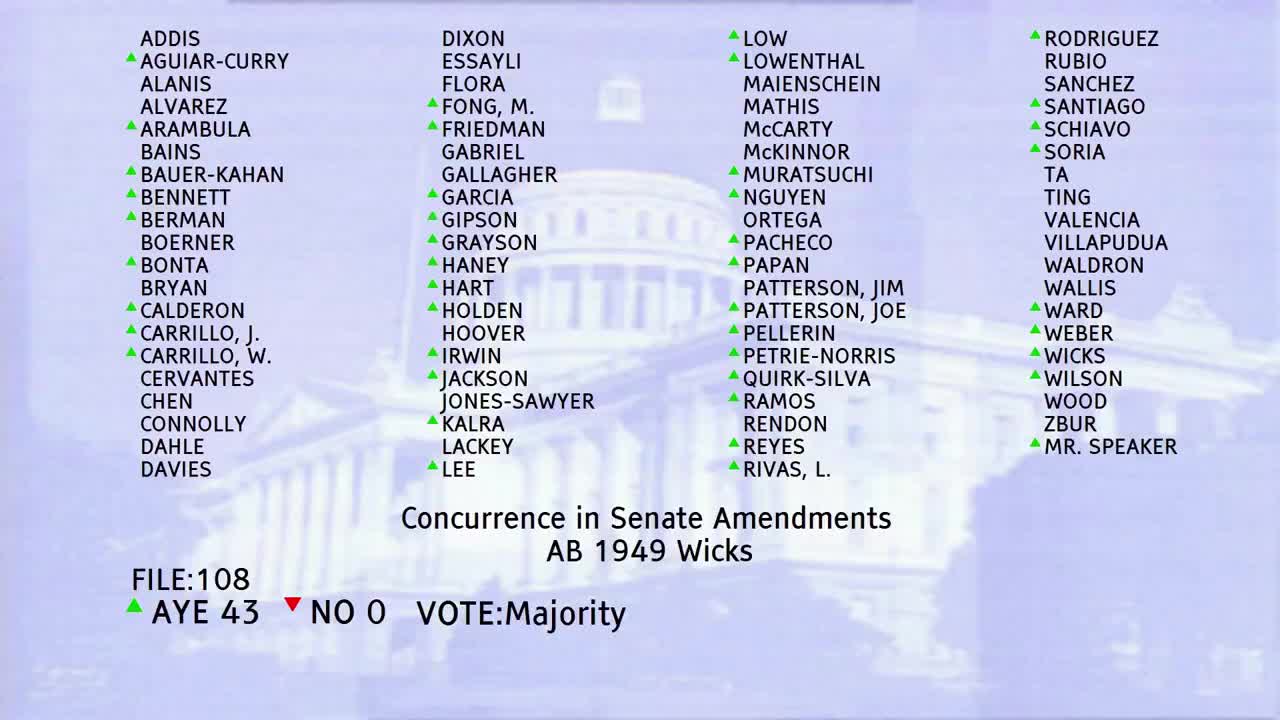
Bill Author

Bill Co-Author(s):