AB 2821: Postsecondary education: students with disabilities.
- Session Year: 2023-2024
- House: Assembly
- Latest Version Date: 2024-09-28
Current Status:
Passed
(2024-09-28: Chaptered by Secretary of State - Chapter 905, Statutes of 2024.)
Introduced
In Committee
First Chamber
In Committee
Second Chamber
Enacted
What does this bill do?
The bill requires California public colleges to include program costs and budget breakdowns when evaluating state-funded programs and services for students with disabilities. It also requires the CSU and community colleges (and asks the UC and independent colleges) to provide a Disability Access and Compliance training for college staff during onboarding that covers staff duties to provide accommodations, universal design for courses and classrooms, how to spot and respond to ableist discrimination, and where students can get campus and local support.
The summary is provided by generative AI which can make mistakes. For original language, please view the details in the table below.
Existing law establishes the California Community Colleges, under the administration of the Board of Governors of the California Community Colleges, the California State University, under the administration of the Trustees of the California State University, the University of California, under the administration of the Regents of the University of California, and independent institutions of higher education as 4 of the segments of postsecondary education in the state. Existing law requires the Board of Governors of the California Community Colleges and the Trustees of the California State University, and authorizes the Regents of the University of California, to carry out specified actions for their respective systems regarding state-funded programs and services for students with disabilities, including developing and implementing a system for evaluating state-funded programs and services for disabled students on each campus at least every 5 years. Existing law requires those systems, at a minimum, to provide for the gathering of outcome data, staff and student perceptions of program effectiveness, and data on the implementation of specified program and physical accessibility requirements of the Federal Rehabilitation Act of 1973.
This bill would require the systems for evaluating state-funded programs and services to also provide for the gathering of program costs and budget breakdowns. The bill would require the Trustees of the California State University, and would request the Regents of the University of California and the governing boards of independent institutions of higher education, to provide, as part of existing college personnel onboarding and training, a Disability Access and Compliance Training Program that meets prescribed requirements.
This bill would require the Chancellor of the California Community Colleges to establish, on or before January 1, 2026, a Disability Access and Compliance Training Program for California Community College campuses that meets prescribed requirements, and would require the chancellor and community college districts to develop specified training components. The bill would require community college districts, on or before the start of the 202627 academic year, to include the Disability Access and Compliance Training Program within existing college personnel training and onboarding, as specified. To the extent the bill would impose new duties on community college campuses and community college districts, the bill would impose a state-mandated local program. The bill would delete an obsolete reference and provision.
The California Constitution requires the state to reimburse local agencies and school districts for certain costs mandated by the state. Statutory provisions establish procedures for making that reimbursement.
This bill would provide that, if the Commission on State Mandates determines that the bill contains costs mandated by the state, reimbursement for those costs shall be made pursuant to the statutory provisions noted above.
Existing law establishes the California Community Colleges, under the administration of the Board of Governors of the California Community Colleges, the California State University, under the administration of the Trustees of the California State University, the University of California, under the administration of the Regents of the University of California, and independent institutions of higher education as 4 of the segments of postsecondary education in the state. Existing law requires the Board of Governors of the California Community Colleges and the Trustees of the California State University, and authorizes the Regents of the University of California, to carry out specified actions for their respective systems regarding state-funded programs and services for students with disabilities, including developing and implementing a system for evaluating state-funded programs and services for disabled students on each campus at least every 5 years. Existing law requires those systems, at a minimum, to provide for the gathering of outcome data, staff and student perceptions of program effectiveness, and data on the implementation of specified program and physical accessibility requirements of the Federal Rehabilitation Act of 1973.
This bill would require the systems for evaluating state-funded programs and services to also provide for the gathering of program costs and budget breakdowns. The bill would require the Board of Governors of the California Community Colleges and the Trustees of the California State University, and would request the University of California and the governing boards of independent institutions of higher education, to provide, as part of existing college personnel onboarding and training, a Disability Access and Compliance Training Program that meets prescribed requirements. To
This bill would require the Chancellor of the California Community Colleges to develop, on or before January 1, 2026, a Disability Access and Compliance Training Program for California Community College campuses that meets prescribed requirements, and would require the chancellor and community college districts to collaborate to develop specified training components. The bill would require community college districts, on or before the start of the 202627 academic year, to include the Disability Access and Compliance Training Program within existing college personnel training and onboarding, as specified. To the extent the bill would impose new duties on community college campuses, campuses and community college districts, the bill would impose a state-mandated local program. The bill would delete an obsolete reference and provision.
The California Constitution requires the state to reimburse local agencies and school districts for certain costs mandated by the state. Statutory provisions establish procedures for making that reimbursement.
This bill would provide that, if the Commission on State Mandates determines that the bill contains costs mandated by the state, reimbursement for those costs shall be made pursuant to the statutory provisions noted above.
Existing law establishes the California Community Colleges, under the administration of the Board of Governors of the California Community Colleges, the California State University, under the administration of the Trustees of the California State University, the University of California, under the administration of the Regents of the University of California, and independent institutions of higher education as 4 of the segments of postsecondary education in the state. Existing law requires the Board of Governors of the California Community Colleges and the Trustees of the California State University, and authorizes the Regents of the University of California, to carry out specified actions for their respective systems regarding state-funded programs and services for students with disabilities, including developing and implementing a system for evaluating state-funded programs and services for disabled students on each campus at least every 5 years. Existing law requires those systems, at a minimum, to provide for the gathering of outcome data, staff and student perceptions of program effectiveness, and data on the implementation of specified program and physical accessibility requirements of the Federal Rehabilitation Act of 1973.
This bill would require the systems for evaluating state-funded programs and services to also provide for the gathering of program costs and budget breakdowns. The bill would require the governing boards of community college districts Board of Governors of the California Community Colleges and the Trustees of the California State University, and would request the University of California and the governing boards of independent institutions of higher education, to provide, as part of existing college personnel onboarding and training, a Disability Access and Compliance Training Program that meets prescribed requirements. To the extent the bill would impose new duties on community college districts, college campuses, the bill would impose a state-mandated local program. The bill would delete an obsolete reference and provision.
The California Constitution requires the state to reimburse local agencies and school districts for certain costs mandated by the state. Statutory provisions establish procedures for making that reimbursement.
This bill would provide that, if the Commission on State Mandates determines that the bill contains costs mandated by the state, reimbursement for those costs shall be made pursuant to the statutory provisions noted above.
Existing law establishes the California Community Colleges, under the administration of the Board of Governors of the California Community Colleges, the California State University, under the administration of the Trustees of the California State University, the University of California, under the administration of the Regents of the University of California, and independent institutions of higher education as 4 of the segments of postsecondary education in the state. Existing law requires the Board of Governors of the California Community Colleges and the Trustees of the California State University, and authorizes the Regents of the University of California, to, for their respective systems, to carry out specified actions for their respective systems regarding state-funded programs and services for students with disabilities, including developing and implementing a system for evaluating state-funded programs and services for disabled students on each campus at least every 5 years. Existing law requires those systems, at a minimum, to provide for the gathering of outcome data, staff and student perceptions of program effectiveness, and data on the implementation of specified program and physical accessibility requirements of the Federal Rehabilitation Act of 1973.
This bill would require the systems for evaluating state-funded programs and services to also provide for the gathering of program costs and budget breakdowns. The bill would require the governing boards of community colleges districts, instead of the Board of Governors of the California Community Colleges, to carry out the above-described actions regarding state-funded programs and services for students with disabilities at community colleges. The bill would require the governing boards of community college districts and the Trustees of the California State University, and would request the University of California and the governing boards of independent institutions of higher education, to provide, as part of existing college personnel onboarding and training, a Disability Access and Compliance Training Program that meets prescribed requirements. To the extent the bill would impose new duties on community college districts, the bill would impose a state-mandated local program. The bill would delete an obsolete reference and provision.
The California Constitution requires the state to reimburse local agencies and school districts for certain costs mandated by the state. Statutory provisions establish procedures for making that reimbursement.
This bill would provide that, if the Commission on State Mandates determines that the bill contains costs mandated by the state, reimbursement for those costs shall be made pursuant to the statutory provisions noted above.
Existing law establishes the California Community Colleges, under the administration of the Board of Governors of the California Community Colleges, the California State University, under the administration of the Trustees of the California State University, the University of California, under the administration of the Regents of the University of California, and independent institutions of higher education as 4 of the segments of postsecondary education in the state. Existing law requires the Board of Governors of the California Community Colleges and the Trustees of the California State University, and authorizes the Regents of the University of California, to, for their respective systems, carry out specified actions regarding state-funded programs and services for students with disabilities, including developing and implementing a system for evaluating state-funded programs and services for disabled students on each campus at least every 5 years. Existing law requires those systems, at a minimum, to provide for the gathering of outcome data, staff and student perceptions of program effectiveness, and data on the implementation of specified program and physical accessibility requirements of the Federal Rehabilitation Act of 1973.
This bill would require the systems for evaluating state-funded programs and services to also provide for the gathering of program costs and budget breakdowns. The bill would require the governing boards of community colleges districts, instead of the Board of Governors of the California Community Colleges, to carry out the above-described actions regarding state-funded programs and services for students with disabilities at community colleges. The bill would require the governing boards of community college districts and the Trustees of the California State University, and would request the University of California and the governing boards of independent institutions of higher education, to provide, as part of existing college personnel onboarding and training, a Disability Access and Compliance Training Program that meets prescribed requirements. To the extent the bill would impose new duties on community college districts, the bill would impose a state-mandated local program. The bill would delete an obsolete reference and provision.
The California Constitution requires the state to reimburse local agencies and school districts for certain costs mandated by the state. Statutory provisions establish procedures for making that reimbursement.
This bill would provide that, if the Commission on State Mandates determines that the bill contains costs mandated by the state, reimbursement for those costs shall be made pursuant to the statutory provisions noted above.
(a)The Board of Governors of the California Community Colleges and the Trustees of the California State University shall, and the Regents of the University of California are requested to, for their respective systems, do all of the following:
(1)Work with the Department of Finance to develop formulas or procedures for allocating funds authorized under this chapter.
(2)Adopt rules and regulations necessary to the operation of programs funded pursuant to this chapter.
(3)Develop and implement, in consultation with students and staff, a system for evaluating state-funded programs and services for disabled students on each campus at least every five years. At a minimum, these systems shall provide for the gathering of program cost and budget breakdowns, outcome data, staff and student perceptions of program effectiveness, and data on the implementation of the program and physical accessibility requirements of the Federal Rehabilitation Act of 1973 (29 U.S.C. Sec. 794).
(b)(1)The Trustees of the California State University shall, and the Regents of the University of California are requested to, for their respective systems, provide, as part of established college personnel onboarding and training, information regarding disability access and compliance pursuant to Section 67312.5.
(2)The Chancellor of the California Community Colleges and community college districts shall collaborate to provide, as part of established college personnel onboarding and training, information regarding disability access and compliance pursuant to Section 67312.5.
(c)Commencing in January 1990, and every two years thereafter, the Board of Governors of the California Community Colleges shall submit a report to the Governor and the education policy committees of the Legislature describing its efforts to serve students with disabilities. These biennial reports shall also include a review on a campus-by-campus basis of the enrollment, retention, transition, and graduation rates of disabled students, including categorical funding of those programs.
SEC. 2.Section 67312.5 is added to the Education Code, to read:67312.5.(a)The Trustees of the California State University shall, and the Regents of the University of California and the governing boards of independent postsecondary institutions are requested to, each establish a Disability Access and Compliance Training Program for their campuses. A Disability Access and Compliance Training Program shall be included within existing college personnel training and provided to college personnel upon onboarding.
(b)(1)On or before January 1, 2026, the Chancellor of the California Community Colleges shall establish a Disability Access and Compliance Training Program for California Community College campuses. On or before the start of the 202627 academic year, community college districts shall include the Disability Access and Compliance Training Program within existing college personnel training and provide the training to college personnel upon onboarding.
(2)The Chancellor of the California Community Colleges shall develop the training components described in paragraphs (1), (2), and (3) of subdivision (c). Each community college district shall develop the training components described in paragraphs (4) and (5) of subdivision (c).
(c)A Disability Access and Compliance Training Program established pursuant to subdivision (a) or (b) shall include, but is not limited to, all of the following:
(1)The legal and procedural responsibility of college personnel to provide effective accommodations for disabled students, the implementation and administration of this responsibility, and the campus, criminal, and civil consequences for failing to comply with this responsibility.
(2)Guidance regarding constructing and enforcing accessibility fixtures and practices in the universal design of campus coursework and classrooms.
(3)Common facts and myths regarding anti-disability and ableist stigmas and prejudices, including guidance on how to mitigate and report instances of anti-disability and ableist discrimination and harassment.
(4)The availability of, and contact information for, academic, campus, and local community resources for individuals experiencing anti-disability or ableist discrimination or harassment.
(5)Training on how to increase access to campus academic accommodations hubs, disability students program faculty liaisons, academic accommodations guidance, disability access center disability access liaison team members, designated campus department ambassadors, and any other relevant campus personnel to offer additional support to students with disabilities.
SEC. 3.If the Commission on State Mandates determines that this act contains costs mandated by the state, reimbursement to local agencies and school districts for those costs shall be made pursuant to Part 7 (commencing with Section 17500) of Division 4 of Title 2 of the Government Code.
(a)The Board of Governors of the California Community Colleges and the Trustees of the California State University shall, and the Regents of the University of California are requested to, for their respective systems, do all of the following:
(1)Work with the Department of Finance to develop formulas or procedures for allocating funds authorized under this chapter.
(2)Adopt rules and regulations necessary to the operation of programs funded pursuant to this chapter.
(3)Provide, as part of established college personnel onboarding and training, information regarding disability access and compliance pursuant to Section 67312.5.(4)(3)Develop and implement, in consultation with students and staff, a system for evaluating state-funded programs and services for disabled students on each campus at least every five years. At a minimum, these systems shall provide for the gathering of program cost and budget breakdowns, outcome data, staff and student perceptions of program effectiveness, and data on the implementation of the program and physical accessibility requirements of the Federal Rehabilitation Act of 1973 (29 U.S.C. Sec. 794).
(b)(1)The Trustees of the California State University shall, and the Regents of the University of California are requested to, for their respective systems, provide, as part of established college personnel onboarding and training, information regarding disability access and compliance pursuant to Section 67312.5.
(2)The Chancellor of the California Community Colleges and community college districts shall collaborate to provide, as part of established college personnel onboarding and training, information regarding disability access and compliance pursuant to Section 67312.5.
(b)(c)Commencing in January 1990, and every two years thereafter, the Board of Governors of the California Community Colleges shall submit a report to the Governor and the education policy committees of the Legislature describing its efforts to serve students with disabilities. These biennial reports shall also include a review on a campus-by-campus basis of the enrollment, retention, transition, and graduation rates of disabled students, including categorical funding of those programs.
SEC. 2.Section 67312.5 is added to the Education Code, to read:67312.5.(a)The Board of Governors of the California Community Colleges and the Trustees of the California State University shall, and the Regents of the University of California and the governing boards of independent postsecondary institutions are requested to, each establish a Disability Access and Compliance Training Program for their campuses. A Disability Access and Compliance Training Program shall be included within existing college personnel training and provided to college personnel upon onboarding.
(b)(1)On or before January 1, 2026, the Chancellor of the California Community Colleges shall establish a Disability Access and Compliance Training Program for California Community College campuses. On or before the start of the 202627 academic year, community college districts shall include the Disability Access and Compliance Training Program within existing college personnel training and provide the training to college personnel upon onboarding.
(2)The Chancellor of the California Community Colleges shall develop the training components described in paragraphs (1), (2), and (3) of subdivision (c). Each community college district shall develop the training components described in paragraphs (4) and (5) of subdivision (c).
(b)(c)A Disability Access and Compliance Training Program established pursuant to subdivision (a) or (b) shall include, but is not limited to, all of the following:
(1)The legal and procedural responsibility of college personnel to provide effective accommodations for disabled students, the implementation and administration of this responsibility, and the campus, criminal, and civil consequences for failing to comply with this responsibility.
(2)Guidance regarding constructing and enforcing accessibility fixtures and practices in the universal design of campus coursework and classrooms.
(3)Common facts and myths regarding anti-disability and ableist stigmas and prejudices, including guidance on how to mitigate and report instances of anti-disability and ableist discrimination and harassment.
(4)The availability of, and contact information for, academic, campus, and local community resources for individuals experiencing anti-disability or ableist discrimination or harassment.
(5)Training on how to increase access to campus academic accommodations hubs, disability students program faculty liaisons, academic accommodations guidance, disability access center disability access liaison team members, designated campus department ambassadors, and any other relevant campus personnel to offer additional support to students with disabilities.
SEC. 3.If the Commission on State Mandates determines that this act contains costs mandated by the state, reimbursement to local agencies and school districts for those costs shall be made pursuant to Part 7 (commencing with Section 17500) of Division 4 of Title 2 of the Government Code.
(a)The Board of Governors of the California Community Colleges and the Trustees of the California State University shall, and the Regents of the University of California are requested to, for their respective systems, do all of the following:
(1)Work with the Department of Finance to develop formulas or procedures for allocating funds authorized under this chapter.
(2)Adopt rules and regulations necessary to the operation of programs funded pursuant to this chapter.
(3)Provide, as part of established college personnel onboarding and training, information regarding disability access and compliance pursuant to Section 67312.5.
(4)Develop and implement, in consultation with students and staff, a system for evaluating state-funded programs and services for disabled students on each campus at least every five years. At a minimum, these systems shall provide for the gathering of program cost and budget breakdowns, outcome data, staff and student perceptions of program effectiveness, and data on the implementation of the program and physical accessibility requirements of the Federal Rehabilitation Act of 1973 (29 U.S.C. Sec. 794).
(b)Commencing in January 1990, and every two years thereafter, the Board of Governors of the California Community Colleges shall submit a report to the Governor and the education policy committees of the Legislature describing its efforts to serve students with disabilities. These biennial reports shall also include a review on a campus-by-campus basis of the enrollment, retention, transition, and graduation rates of disabled students, including categorical funding of those programs.
SEC. 2.Section 67312.5 is added to the Education Code, to read:67312.5.(a)The governing board of each community college district Board of Governors of the California Community Colleges and the Trustees of the California State University shall, and the Regents of the University of California and the governing boards of independent postsecondary institutions are requested to, each establish a Disability Access and Compliance Training Program for their campuses. A Disability Access and Compliance Training Program shall be included within existing college personnel training and provided to college personnel upon onboarding.
(b)A Disability Access and Compliance Training Program established pursuant to subdivision (a) shall include, but is not limited to, all of the following:
(1)The legal and procedural responsibility of college personnel to provide effective accommodations for disabled students, the implementation and administration of this responsibility, and the campus, criminal, and civil consequences for failing to comply with this responsibility.
(2)Guidance regarding constructing and enforcing accessibility fixtures and practices in the universal design of campus coursework and classrooms.
(3)Common facts and myths regarding anti-disability and ableist stigmas and prejudices, including guidance on how to mitigate and report instances of anti-disability and ableist discrimination and harassment.
(4)The availability of, and contact information for, academic, campus, and local community resources for individuals experiencing anti-disability or ableist discrimination or harassment.
(5)Training on how to increase access to campus academic accommodations hubs, disability students program faculty liaisons, academic accommodations guidance, disability access center disability access liaison team members, designated campus department ambassadors, and any other relevant campus personnel to offer additional support to students with disabilities.
SEC. 3.If the Commission on State Mandates determines that this act contains costs mandated by the state, reimbursement to local agencies and school districts for those costs shall be made pursuant to Part 7 (commencing with Section 17500) of Division 4 of Title 2 of the Government Code.
(a)The governing board of each community college district Board of Governors of the California Community Colleges and the Trustees of the California State University shall, and the Regents of the University of California are requested to, for their respective systems, do all of the following:
(1)Work with the Department of Finance to develop formulas or procedures for allocating funds authorized under this chapter.
(2)Adopt rules and regulations necessary to the operation of programs funded pursuant to this chapter.
(3)Provide, as part of established college personnel onboarding and training, information regarding disability access and compliance pursuant to Section 67312.5.
(4)Develop and implement, in consultation with students and staff, a system for evaluating state-funded programs and services for disabled students on each campus at least every five years. At a minimum, these systems shall provide for the gathering of program cost and budget breakdowns, outcome data, staff and student perceptions of program effectiveness, and data on the implementation of the program and physical accessibility requirements of the Federal Rehabilitation Act of 1973 (29 U.S.C. Sec. 794).
(b)Commencing in January 1990, and every two years thereafter, the Board of Governors of the California Community Colleges shall submit a report to the Governor and the education policy committees of the Legislature describing its efforts to serve students with disabilities. These biennial reports shall also include a review on a campus-by-campus basis of the enrollment, retention, transition, and graduation rates of disabled students, including categorical funding of those programs.
SEC. 2.Section 67312.5 is added to the Education Code, to read:67312.5.(a)The governing board of each community college district and the Trustees of the California State University shall, and the Regents of the University of California and the governing boards of independent postsecondary institutions are requested to, each establish a Disability Access and Compliance Training Program for their campuses. A Disability Access and Compliance Training Program shall be included within existing college personnel training and provided to college personnel upon onboarding.
(b)A Disability Access and Compliance Training Program established pursuant to subdivision (a) shall include, but is not limited to, all of the following:
(1)The legal and procedural responsibility of college personnel to provide effective accommodations for disabled students, the implementation and administration of this responsibility, and the campus, criminal, and civil consequences for failing to comply with this responsibility.
(2)Guidance regarding constructing and enforcing accessibility fixtures and practices in the universal design of campus coursework and classrooms.
(3)Common facts and myths regarding anti-disability and ableist stigmas and prejudices, including guidance on how to mitigate and report instances of anti-disability and ableist discrimination and harassment.
(4)The availability of, and contact information for, academic, campus, and local community resources for individuals experiencing anti-disability or ableist discrimination or harassment.
(5)Training on how to increase access to campus academic accommodations hubs, disability students program faculty liaisons, academic accommodations guidance, disability access center disability access liaison team members, designated campus department ambassadors, and any other relevant campus personnel to offer additional support to students with disabilities.
SEC. 3.If the Commission on State Mandates determines that this act contains costs mandated by the state, reimbursement to local agencies and school districts for those costs shall be made pursuant to Part 7 (commencing with Section 17500) of Division 4 of Title 2 of the Government Code.
(a)The Board of Governors of the California Community Colleges governing board of each community college district and the Trustees of the California State University shall, and the Regents of the University of California are requested to, for their respective systems, and the Regents of the University of California may, do all of the following:
(1)Work with the California Postsecondary Education Commission and the Department of Finance to develop formulas or procedures for allocating funds authorized under this chapter.
(2)Adopt rules and regulations necessary to the operation of programs funded pursuant to this chapter.
(3)Maintain the present intersegmental efforts to work with the California Postsecondary Education Commission and other interested parties, to coordinate the planning and development of programs for students with disabilities, including, but not necessarily limited to, the establishment of common definitions for students with disabilities and uniform formats for reports required under this chapter.(3)Provide, as part of established college personnel onboarding and training, information regarding disability access and compliance pursuant to Section 67312.5.
(4)Develop and implement, in consultation with students and staff, a system for evaluating state-funded programs and services for disabled students on each campus at least every five years. At a minimum, these systems shall provide for the gathering of program cost and budget breakdowns, outcome data, staff and student perceptions of program effectiveness, and data on the implementation of the program and physical accessibility requirements of Section 794 of Title 29 of the Federal Rehabilitation Act of 1973. 1973 (29 U.S.C. Sec. 794).
(b)Commencing in January 1990, and every two years thereafter, the Board of Governors of the California Community Colleges shall submit a report to the Governor, Governor and the education policy committees of the Legislature, and the California Postsecondary Education Commission Legislature describing its efforts to serve students with disabilities. These biennial reports shall also include a review on a campus-by-campus basis of the enrollment, retention, transition, and graduation rates of disabled students, including categorical funding of those programs.
SEC. 2.Section 67312.5 is added to the Education Code, to read:67312.5.(a)The governing board of each community college district and the Trustees of the California State University shall, and the Regents of the University of California and the governing boards of independent postsecondary institutions are requested to, each establish a Disability Access and Compliance Training Program for their campuses. A Disability Access and Compliance Training Program shall be included within existing college personnel training and provided to college personnel upon onboarding.
(b)A Disability Access and Compliance Training Program established pursuant to subdivision (a) shall include, but is not limited to, all of the following:
(1)The legal and procedural responsibility of college personnel to provide effective accommodations for disabled students, the implementation and administration of this responsibility, and the campus, criminal, and civil consequences for failing to comply with this responsibility.
(2)Guidance regarding constructing and enforcing accessibility fixtures and practices in the universal design of campus coursework and classrooms.
(3)Common facts and myths regarding anti-disability and ableist stigmas and prejudices, including guidance on how to mitigate and report instances of anti-disability and ableist discrimination and harassment.
(4)The availability of, and contact information for, academic, campus, and local community resources for individuals experiencing anti-disability or ableist discrimination or harassment.
(5)Training on how to increase access to campus academic accommodations hubs, disability students program faculty liaisons, academic accommodations guidance, disability access center disability access liaison team members, designated campus department ambassadors, and any other relevant campus personnel to offer additional support to students with disabilities.
SEC. 3.If the Commission on State Mandates determines that this act contains costs mandated by the state, reimbursement to local agencies and school districts for those costs shall be made pursuant to Part 7 (commencing with Section 17500) of Division 4 of Title 2 of the Government Code.
|
Date
|
Status
|
|---|---|
| Sep 28, 2024 | Chaptered by Secretary of State - Chapter 905, Statutes of 2024. |
| Sep 28, 2024 | Approved by the Governor. |
| Sep 11, 2024 | Enrolled and presented to the Governor at 4 p.m. |
| Aug 29, 2024 | Senate amendments concurred in. To Engrossing and Enrolling. (Ayes 76. Noes 0.). |
| Aug 29, 2024 | Assembly Rule 77 suspended. |
| Aug 28, 2024 | In Assembly. Concurrence in Senate amendments pending. May be considered on or after August 30 pursuant to Assembly Rule 77. |
| Aug 28, 2024 | Read third time. Passed. Ordered to the Assembly. (Ayes 39. Noes 0.). |
| Aug 23, 2024 | Ordered to special consent calendar. |
| Aug 19, 2024 | Read second time. Ordered to third reading. |
| Aug 15, 2024 | From committee: Do pass. (Ayes 7. Noes 0.) (August 15). |
| Aug 5, 2024 | In committee: Referred to APPR suspense file. |
| Jul 3, 2024 | From committee: Do pass and re-refer to Com. on APPR with recommendation: To Consent Calendar. (Ayes 7. Noes 0.) (July 3). Re-referred to Com. on APPR. |
| Jun 12, 2024 | From committee chair, with author's amendments: Amend, and re-refer to committee. Read second time, amended, and re-referred to Com. on ED. |
| Jun 6, 2024 | In committee: Set, first hearing. Hearing canceled at the request of author. |
| Jun 5, 2024 | Referred to Com. on ED. |
| May 24, 2024 | In Senate. Read first time. To Com. on RLS. for assignment. |
| May 23, 2024 | Read third time. Passed. Ordered to the Senate. (Ayes 73. Noes 0. Page 5609.) |
| May 20, 2024 | Read second time. Ordered to third reading. |
| May 16, 2024 | Read second time and amended. Ordered returned to second reading. |
| May 16, 2024 | From committee: Amend, and do pass as amended. (Ayes 11. Noes 0.) (May 16). |
| May 16, 2024 | Assembly Rule 63 suspended. |
| May 1, 2024 | In committee: Set, first hearing. Referred to APPR. suspense file. |
| Apr 10, 2024 | From committee: Do pass and re-refer to Com. on APPR. (Ayes 10. Noes 0.) (April 9). Re-referred to Com. on APPR. |
| Apr 2, 2024 | Re-referred to Com. on HIGHER ED. |
| Apr 1, 2024 | From committee chair, with author's amendments: Amend, and re-refer to Com. on HIGHER ED. Read second time and amended. |
| Mar 4, 2024 | Referred to Com. on HIGHER ED. |
| Feb 16, 2024 | From printer. May be heard in committee March 17. |
| Feb 15, 2024 | Read first time. To print. |
|
Date
|
Description
|
Location
|
Votes
|
|
|---|---|---|---|---|
| Aug 29, 2024 | AB 2821 Grayson Concurrence in Senate Amendments | Assembly Floor |
Passed |
|
| Aug 28, 2024 | Special Consent AB2821 Grayson By Roth | Senate Floor |
Passed |
|
| Aug 15, 2024 | Do pass | Senate Standing Committee on Appropriations |
Passed |
|
| Aug 5, 2024 | Placed on suspense file | Senate Standing Committee on Appropriations |
Passed |
|
| Jul 3, 2024 | Do pass, but first be re-referred to the Committee on [Appropriations] with the recommendation: To Consent Calendar | Senate Standing Committee on Education |
Passed |
|
| May 23, 2024 | AB 2821 Grayson Assembly Third Reading | Assembly Floor |
Passed |
|
| May 16, 2024 | Do pass as amended. | Assembly Standing Committee on Appropriations |
Passed |
|
| Apr 9, 2024 | Do pass and be re-referred to the Committee on [Appropriations] | Assembly Standing Committee on Higher Education |
Passed |
This list shows positions taken on this bill by organizations on the date displayed, which is linked to the original source.
Positions by individuals are not included.
|
Organization
|
Position
|
Date
|
|---|---|---|
| Cal State Student Association | ** Support | |
| California Disability Services Association | ** Support | |
| California Foundation For Independent Living Centers | ** Support | |
| Disability Rights California | ** Support | |
| University Of California Student Association | ** Support |
CONCURRENCE IN SENATE AMENDMENTS
CSA1 Bill Id:AB 2821
Author:(Grayson)
As Amended Ver:June 12, 2024
Majority vote
SUMMARY
Requires the Board of Governors (BOG) of the California Community Colleges (CCC) and the Trustees of the California State University (CSU), and would request the University of California (UC) and the governing boards of independent institutions of higher education, to provide, as part of existing college personnel onboarding and training, a Disability Access and Compliance Training Program (DACTP) that meets prescribed requirements.
Senate Amendments
Requires the Chancellor of the CCC to develop, on or before January 1, 2026, a DACTP for CCC campuses that meets prescribed requirements, and would require the CCC Chancellor and community college districts to collaborate to develop specified training components. Requires community college districts, on or before the start of the 2026–27 academic year, to include the DACTP within existing college personnel training and onboarding, as specified.
COMMENTS
CCC Report. Current law requires the CCC BOG to report biennially on their efforts to serve students with disabilities. According to the 2022 Disabled Student Programs and Services (DSPS) Legislative Report, published in February of 2024, each CCC campus used state funding allocated for DSPS to provide support services and educational accommodations to 118,257 students during the 2019-20 and 93,877 students during the 2020-21 academic years with disabilities so they can have full and equitable access to community college classes.
In addition, most colleges include specialized instruction as part of their DSPS program. Examples of services the colleges provide to students with disabilities include test proctoring, learning disability assessment, specialized counseling, interpreter or captioning services for hearing-impaired and/or deaf students, mobility assistance, note taker services, reader services, transcription services, specialized tutoring, access to adaptive equipment, job development/placement, registration assistance, and special parking.
The report found that students with disabilities represent just under 7% of the population of the
CCC. The key findings from the 2019-2020 and 2020-2021 academic years are as follows:
- DSPS student enrollment saw a decline at a rate similar to that of the overall student population.
- DSPS students lag behind students without a disability in credit class enrollment but exceed them in noncredit courses.
- Noncredit course attendance dropped 50% for DSPS in 2020-2021 compared to 2019-2020.
- DSPS students perform similarly in workforce preparation courses when compared to students without disabilities.
The basic skills course pass rate for DSPS student was 66% in 2019-20, with a modest gain to 69% in 2020-21.
UC Advisory Workgroup recommendations. The UC systemwide Advisory Workgroup on Students with Disabilities published a report in January of 2024, which found that in general, UC's approach to supporting students with disabilities is typically addressed on an individual basis. It is not a comprehensive proactive approach centered on inclusion. In contrast, a social model of disability affirms that a person's disability is only present or exacerbated based on the limitations of the environment. The social model is proactive and aims to transform the environment and culture to be more welcoming to the diversity of people who interact with the community.
Amongst the recommendations in the report is developing and sustaining a professional learning environment for faculty and staff to learn and apply best practices to interact with persons with disabilities. The recommendation states that "all individuals with disabilities deserve to interact with supervisors, faculty, and leaders who understand their own compliance and confidentiality obligations and how the [Americans with Disabilities Act (ADA)] applies to students, employees, patients, and job applicants in the workplace. Requiring all supervisory personnel to receive ADA training and ongoing professional development around diversity, equity, and inclusion will not only create the type of inclusive culture for which the University strives, but will also mitigate risks."
The DACTP proposed in AB 2821 (Grayson) seems to be consistent with the recommendation of the UC Advisory Workgroup.
According to the Author
According to the author, "Although students with disabilities in higher education are protected by state, federal and local laws that prohibit discrimination, they still face significant barriers to academic success. Currently, there is a lack of a statewide framework for disability compliance training in order to meet their ADA obligations for faculty and staff for higher institutions. AB 2821 seeks to ensure that students with disabilities needs are met and that they can access the accommodations and supportive services they need for success as college students. Specifically, this bill will require the governing boards of community colleges districts, Trustees of the California State University, and request the University of California and the governing boards of independent institutions of higher education to provide disability access and compliance training upon onboarding and subsequently in their annual training for faculty and staff."
Arguments in Support
According to the UC Student Association, "It is our mission to advocate on behalf of current and future students for the accessibility, affordability, and quality of the University of California system. With accessibility as one of the key pillars of the UC system, we believe this training is highly necessary to ensure an accessible environment."
"Students with disabilities routinely experience ableism from their professors and other faculty and staff. This comes in the form of refusing to provide accommodations, or making it more difficult for students to access their accommodations in that Professors' class, invalidating and minimizing comments, or inability to [have] access to additional resources and support provided to other students, like office hours, etc. These are just a few examples of the testimonies we have heard from students with disabilities."
"When these instances occur, Disabled Students' Service Providers (DSP or DSPS) have to take valuable time out of their already overbooked schedules to individually educate faculty and staff on disabilities, ableism, etc. DSP staff already experience caseloads of hundreds of students each, and this takes them away from working directly with students. DSP staff from across the UC system have also recommended mandatory Disability Access and Compliance Trainings for faculty and staff, because they believe this will allow them to recoup some of the time they spend educating faculty and staff in more beneficial ways, such as working with students with disabilities on their individual cases."
Arguments in Opposition
None on file.
FISCAL COMMENTS
According to the Senate Committee on Appropriations:
- The UC indicates that while it already offers this training for some staff, there would be General Fund costs in the hundreds of thousands of dollars each year for more frequent training and to provide it to an increased number of faculty and staff.
- The CSU indicates that the bill's specific training requirements would warrant updates to its existing training material and additional content creation, resulting in additional, unknown General Fund administrative costs. The CSU also indicates that it already meets the bill's evaluation requirements since it currently surveys students and faculty on their perception of program effectiveness every five years, which is conducted by an independent third party.
- The Chancellor's Office estimates Proposition 98 General Fund costs of about $1.2 million for community college districts to adapt and deliver the additional training during established personnel onboarding and training. This estimate assumes a cost of $17,000 per CCC district. These activities could be deemed to be a reimbursable state mandate by the Commission on State Mandates. The Chancellor's office also estimates one-time General Fund costs of $306,000 to hire two consultants to develop the training.
VOTES:
ASM HIGHER EDUCATION: 10-0-1
YES: Mike Fong, Ta, Arambula, Boerner, Chen, Essayli, Irwin, Jackson, Muratsuchi, Quirk-Silva
ABS, ABST OR NV: Low
ASM APPROPRIATIONS: 11-0-4
YES: Wicks, Arambula, Bryan, Calderon, Wendy Carrillo, Mike Fong, Grayson, Haney, Hart, Pellerin, Villapudua
ABS, ABST OR NV: Sanchez, Dixon, Jim Patterson, Ta
ASSEMBLY FLOOR: 73-0-7
YES: Addis, Aguiar-Curry, Alanis, Alvarez, Arambula, Bains, Bauer-Kahan, Bennett, Berman, Boerner, Bonta, Bryan, Calderon, Juan Carrillo, Wendy Carrillo, Chen, Connolly, Davies, Dixon, Flora, Mike Fong, Vince Fong, Friedman, Gabriel, Gallagher, Garcia, Gipson, Grayson, Haney, Hart, Hoover, Irwin, Jackson, Jones-Sawyer, Kalra, Lackey, Lee, Low, Lowenthal, Maienschein, McCarty, McKinnor, Muratsuchi, Stephanie Nguyen, Ortega, Pacheco, Papan, Jim Patterson, Joe Patterson, Pellerin, Petrie-Norris, Quirk-Silva, Ramos, Rendon, Reyes, Rodriguez, Sanchez, Santiago, Schiavo, Soria, Ta, Ting, Valencia, Villapudua, Waldron, Wallis, Ward, Weber, Wicks, Wilson, Wood, Zbur, Robert Rivas
ABS, ABST OR NV: Cervantes, Megan Dahle, Essayli, Holden, Mathis, Luz Rivas, Blanca Rubio
SENATE FLOOR: 39-0-1
YES: Allen, Archuleta, Ashby, Atkins, Becker, Blakespear, Bradford, Caballero, Cortese, Dahle, Dodd, Durazo, Eggman, Glazer, Gonzalez, Grove, Hurtado, Jones, Laird, Limón, McGuire, Menjivar, Min, Newman, Nguyen, Niello, Ochoa Bogh, Padilla, Portantino, Roth, Rubio, Seyarto, Skinner, Smallwood-Cuevas, Stern, Umberg, Wahab, Wiener, Wilk
ABS, ABST OR NV: Alvarado-Gil
UPDATED
VERSION: June 12, 2024
CONSULTANT: Kevin J. Powers / HIGHER ED. / (916) 319-3960 FN: 0004633
CONCURRENCE IN SENATE AMENDMENTS
CSA1 Bill Id:AB 2821
Author:(Grayson)
As Amended Ver:June 12, 2024
Majority vote
SUMMARY
Requires the Board of Governors (BOG) of the California Community Colleges (CCC) and the Trustees of the California State University (CSU), and would request the University of California (UC) and the governing boards of independent institutions of higher education, to provide, as part of existing college personnel onboarding and training, a Disability Access and Compliance Training Program (DACTP) that meets prescribed requirements.
Senate Amendments
Requires the Chancellor of the CCC to develop, on or before January 1, 2026, a DACTP for CCC campuses that meets prescribed requirements, and would require the CCC Chancellor and community college districts to collaborate to develop specified training components. Requires community college districts, on or before the start of the 2026–27 academic year, to include the DACTP within existing college personnel training and onboarding, as specified.
COMMENTS
CCC Report. Current law requires the CCC BOG to report biennially on their efforts to serve students with disabilities. According to the 2022 Disabled Student Programs and Services (DSPS) Legislative Report, published in February of 2024, each CCC campus used state funding allocated for DSPS to provide support services and educational accommodations to 118,257 students during the 2019-20 and 93,877 students during the 2020-21 academic years with disabilities so they can have full and equitable access to community college classes.
In addition, most colleges include specialized instruction as part of their DSPS program. Examples of services the colleges provide to students with disabilities include test proctoring, learning disability assessment, specialized counseling, interpreter or captioning services for hearing-impaired and/or deaf students, mobility assistance, note taker services, reader services, transcription services, specialized tutoring, access to adaptive equipment, job development/placement, registration assistance, and special parking.
The report found that students with disabilities represent just under 7% of the population of the
CCC. The key findings from the 2019-2020 and 2020-2021 academic years are as follows:
- DSPS student enrollment saw a decline at a rate similar to that of the overall student population.
- DSPS students lag behind students without a disability in credit class enrollment but exceed them in noncredit courses.
- Noncredit course attendance dropped 50% for DSPS in 2020-2021 compared to 2019-2020.
- DSPS students perform similarly in workforce preparation courses when compared to students without disabilities.
The basic skills course pass rate for DSPS student was 66% in 2019-20, with a modest gain to 69% in 2020-21.
UC Advisory Workgroup recommendations. The UC systemwide Advisory Workgroup on Students with Disabilities published a report in January of 2024, which found that in general, UC's approach to supporting students with disabilities is typically addressed on an individual basis. It is not a comprehensive proactive approach centered on inclusion. In contrast, a social model of disability affirms that a person's disability is only present or exacerbated based on the limitations of the environment. The social model is proactive and aims to transform the environment and culture to be more welcoming to the diversity of people who interact with the community.
Amongst the recommendations in the report is developing and sustaining a professional learning environment for faculty and staff to learn and apply best practices to interact with persons with disabilities. The recommendation states that "all individuals with disabilities deserve to interact with supervisors, faculty, and leaders who understand their own compliance and confidentiality obligations and how the [Americans with Disabilities Act (ADA)] applies to students, employees, patients, and job applicants in the workplace. Requiring all supervisory personnel to receive ADA training and ongoing professional development around diversity, equity, and inclusion will not only create the type of inclusive culture for which the University strives, but will also mitigate risks."
The DACTP proposed in AB 2821 (Grayson) seems to be consistent with the recommendation of the UC Advisory Workgroup.
According to the Author
According to the author, "Although students with disabilities in higher education are protected by state, federal and local laws that prohibit discrimination, they still face significant barriers to academic success. Currently, there is a lack of a statewide framework for disability compliance training in order to meet their ADA obligations for faculty and staff for higher institutions. AB 2821 seeks to ensure that students with disabilities needs are met and that they can access the accommodations and supportive services they need for success as college students. Specifically, this bill will require the governing boards of community colleges districts, Trustees of the California State University, and request the University of California and the governing boards of independent institutions of higher education to provide disability access and compliance training upon onboarding and subsequently in their annual training for faculty and staff."
Arguments in Support
According to the UC Student Association, "It is our mission to advocate on behalf of current and future students for the accessibility, affordability, and quality of the University of California system. With accessibility as one of the key pillars of the UC system, we believe this training is highly necessary to ensure an accessible environment."
"Students with disabilities routinely experience ableism from their professors and other faculty and staff. This comes in the form of refusing to provide accommodations, or making it more difficult for students to access their accommodations in that Professors' class, invalidating and minimizing comments, or inability to [have] access to additional resources and support provided to other students, like office hours, etc. These are just a few examples of the testimonies we have heard from students with disabilities."
"When these instances occur, Disabled Students' Service Providers (DSP or DSPS) have to take valuable time out of their already overbooked schedules to individually educate faculty and staff on disabilities, ableism, etc. DSP staff already experience caseloads of hundreds of students each, and this takes them away from working directly with students. DSP staff from across the UC system have also recommended mandatory Disability Access and Compliance Trainings for faculty and staff, because they believe this will allow them to recoup some of the time they spend educating faculty and staff in more beneficial ways, such as working with students with disabilities on their individual cases."
Arguments in Opposition
None on file.
FISCAL COMMENTS
According to the Senate Committee on Appropriations:
- The UC indicates that while it already offers this training for some staff, there would be General Fund costs in the hundreds of thousands of dollars each year for more frequent training and to provide it to an increased number of faculty and staff.
- The CSU indicates that the bill's specific training requirements would warrant updates to its existing training material and additional content creation, resulting in additional, unknown General Fund administrative costs. The CSU also indicates that it already meets the bill's evaluation requirements since it currently surveys students and faculty on their perception of program effectiveness every five years, which is conducted by an independent third party.
- The Chancellor's Office estimates Proposition 98 General Fund costs of about $1.2 million for community college districts to adapt and deliver the additional training during established personnel onboarding and training. This estimate assumes a cost of $17,000 per CCC district. These activities could be deemed to be a reimbursable state mandate by the Commission on State Mandates. The Chancellor's office also estimates one-time General Fund costs of $306,000 to hire two consultants to develop the training.
VOTES:
ASM HIGHER EDUCATION: 10-0-1
YES: Mike Fong, Ta, Arambula, Boerner, Chen, Essayli, Irwin, Jackson, Muratsuchi, Quirk-Silva
ABS, ABST OR NV: Low
ASM APPROPRIATIONS: 11-0-4
YES: Wicks, Arambula, Bryan, Calderon, Wendy Carrillo, Mike Fong, Grayson, Haney, Hart, Pellerin, Villapudua
ABS, ABST OR NV: Sanchez, Dixon, Jim Patterson, Ta
ASSEMBLY FLOOR: 73-0-7
YES: Addis, Aguiar-Curry, Alanis, Alvarez, Arambula, Bains, Bauer-Kahan, Bennett, Berman, Boerner, Bonta, Bryan, Calderon, Juan Carrillo, Wendy Carrillo, Chen, Connolly, Davies, Dixon, Flora, Mike Fong, Vince Fong, Friedman, Gabriel, Gallagher, Garcia, Gipson, Grayson, Haney, Hart, Hoover, Irwin, Jackson, Jones-Sawyer, Kalra, Lackey, Lee, Low, Lowenthal, Maienschein, McCarty, McKinnor, Muratsuchi, Stephanie Nguyen, Ortega, Pacheco, Papan, Jim Patterson, Joe Patterson, Pellerin, Petrie-Norris, Quirk-Silva, Ramos, Rendon, Reyes, Rodriguez, Sanchez, Santiago, Schiavo, Soria, Ta, Ting, Valencia, Villapudua, Waldron, Wallis, Ward, Weber, Wicks, Wilson, Wood, Zbur, Robert Rivas
ABS, ABST OR NV: Cervantes, Megan Dahle, Essayli, Holden, Mathis, Luz Rivas, Blanca Rubio
UPDATED
VERSION: June 12, 2024
CONSULTANT: Kevin J. Powers / HIGHER ED. / (916) 319-3960 FN: 0004633
SENATE RULES COMMITTEE Office of Senate Floor Analyses (916) 651-1520 Fax: (916) 327-4478 | AB 2821 |
THIRD READING
Bill No: AB 2821
Author: Grayson (D)
Amended: 6/12/24 in Senate
Vote: 21
SENATE EDUCATION COMMITTEE: 7-0, 7/3/24
AYES: Newman, Ochoa Bogh, Cortese, Glazer, Gonzalez, Smallwood-Cuevas, Wilk
SENATE APPROPRIATIONS COMMITTEE: 7-0, 8/15/24
AYES: Caballero, Jones, Ashby, Becker, Bradford, Seyarto, Wahab
ASSEMBLY FLOOR: 73-0, 5/23/24 - See last page for vote
SUBJECT: Postsecondary education: students with disabilities
SOURCE: University of California Student Association
DIGEST:
This bill requires the Chancellor of the California Community Colleges (CCC) and the Trustees of the California State University (CSU) and requests the University of California (UC) and the governing boards of independent institutions of higher education, to provide as part of existing college personnel onboarding and training, a Disability Access and Compliance Training Program (DACTP) that meets prescribed requirements.
ANALYSIS:
Existing law:
- Establishes the UC as a public trust to be administered by the Regents of the UC; and, grants the Regents full powers of organization and government, subject only to such legislative control as may be necessary to insure security of its funds, compliance with the terms of its endowments, statutory requirements around competitive bidding and contracts, sales of property and the purchase of materials, goods and services. (Article IX, Section (9)(a) of the California Constitution)
- Confers upon the CSU Trustees the powers, duties, and functions with respect to the management, administration, control of the CSU system and provides that the Trustees are responsible for the rule of government of their appointees and employees. (Education Code (EC) § 66606 and 89500, et seq.)
- Establishes the CCC under the administration of the Board of Governors (BOG) of the CCC, as one of the segments of public postsecondary education in this state, and specifies that the CCC is comprised of community college districts. (EC § 70900)
- Specifies that independent institutions of higher education will provide undergraduate and graduate instruction and research in accordance with their respective missions. (EC § 66010.4)
- Requires the CCC BOG and the Trustees CSU, and authorizes the Regents of the UC, to carry out specified actions for their respective systems regarding state-funded programs and services for students with disabilities, including developing and implementing a system for evaluating state-funded programs and services for disabled students on each campus at least every 5 years. Requires the CCC BOG to submit a report to the Governor, the education policy committees of the Legislature, and the California Postsecondary Educational Commission (CPEC) describing its efforts to serve students with disabilities. (EC § 67312)
This bill:
- Requires the CSU Trustees, and requests the UC Regents and the governing boards of independent postsecondary institutions to do all of the following:
- Each establish and include a DACTP for their campuses within existing college personnel training and provided to college personnel upon onboarding.
- Each develop required training components for inclusion in the DACTP for their campuses that consists of information related to all of the following:
- Legal and procedural responsibility of college personnel to provide effective accommodations for disabled students.
- Guidance regarding accessibility.
- Common facts and myths regarding anti-disability and ableist stigmas and prejudices.
- Contact information for academic, campus, and local community resources for individuals experiencing anti-disability or ableist discrimination or harassment.
- Training on how to increase access to campus personnel to offer additional support to students with disabilities.
- Requires the CSU Trustees, and requests the UC Regents to for their respective systems, provide, as part of established college personnel onboarding and training, information regarding disability access and compliance with DACTP as provided.
- Requires the CCC Chancellor to do all of the following:
- Establish, by January 1, 2026, a DACTP for CCC campuses.
- Develop all of the following required training components for inclusion in the DACTP:
- Legal and procedural responsibility of college personnel to provide effective accommodations for disabled students.
- Guidance regarding accessibility.
- Common facts and myths regarding anti-disability and ableist stigmas and prejudices.
- Requires each community college district to do all of the following:
- Include, by the start of the 2026–27 academic year, the DACTP within existing college personnel training and provide the training to college personnel upon onboarding.
- Develop all of the following required training components for inclusion in the DACTP:
- Contact information for, academic, campus, and local community resources for individuals experiencing anti-disability or ableist discrimination or harassment.
- Training on how to increase access to campus personnel to offer additional support to students with disabilities.
- Requires the CCC Chancellor and community college districts to collaborate to provide, as part of established college personnel onboarding and training, information regarding disability access and compliance with DACTP as provided.
- Requires the systems for evaluating state-funded programs and services to also provide for the gathering of program costs and budget breakdowns.
- Removes references to the CPEC and an obsolete provision, as specified.
- Makes other technical and non-substantial changes.
Comments
- Need for the bill. According to the author, “Although students with disabilities in higher education are protected by state, federal and local laws that prohibit discrimination, they still face significant barriers to academic success. Currently, there is a lack of a statewide framework for disability compliance training in order to meet their ADA obligations for faculty and staff for higher institutions. AB 2821 seeks to ensure that students with disabilities’ needs are met and that they can access the accommodations and supportive services they need for success as college students. Specifically, this bill requires the California Community Colleges (CCC), and California State University, and requests the University of California and private universities to provide disability access and compliance training upon onboarding and subsequently in their annual training for faculty and staff.”
- Related activity by segment. Below is a summary of CSU's systemwide policy and reports from the CCC BOG and UC Advisory Workgroup on serving students with disabilities.
- CSU systemwide policy. In 2004, the CSU Policy on Disability Support and Accommodations. Executive Order 926 documents explicitly establishes systemwide policies for disability support and accommodation. It delegated responsibility to campus presidents and designees to develop and maintain overall procedures for ensuring compliance with federal and state laws and regulations, as well as with local campus policies. The CSU policy applies only to students with disabilities. The policy states that campuses are to furnish appropriate accommodations and support services where necessary to afford a student with a disability an equal opportunity to participate in and enjoy the benefits of campus services, programs, and activities. The policy also outlines the conditions for qualifying for and availability of instruction related modifications, accommodations, and student support services.
- CCC. Current law requires the CCC BOG to report biennially on their efforts to serve students with disabilities. According to the 2022 Disabled Student Programs and Services (DSPS) Legislative Report, published in February 2024, each CCC campus used state funding allocated for DSPS to provide support services and educational accommodations to 118,257 students during the 2019-20 academic year and 93,877 students during the 2020-21 academic year with disabilities so they could have full and equitable access to community college classes.
In addition, most colleges include specialized instruction as part of their DSPS program. Examples of services the colleges provide to students with disabilities include test proctoring, learning disability assessment, specialized counseling, interpreter or captioning services for hearing-impaired and/or deaf students, mobility assistance, note-taking services, reader services, transcription services, specialized tutoring, access to adaptive equipment, job development and placement, registration assistance, and special parking.
The report found that students with disabilities represent just under 7 percent of the population of the CCC. The key findings from the 2019-2020 and 2020-2021 academic years are as follows:
- DSPS student enrollment saw a decline at a rate similar to that of the overall student population.
- DSPS students lag behind students without a disability in credit class enrollment but exceed them in noncredit courses.
- DSPS students perform similarly in workforce preparation courses when compared to students without disabilities.
- The basic skills course pass rate for DSPS students was 66 percent in 2019-20, with a modest gain to 69 percent in 2020-21.
- UC Advisory Workgroup recommendations. The UC systemwide advisory workgroup on students with disabilities published a report in January 2024 that offered a number of recommendations. The recommendations aim to enhance the college experience for students with disabilities by creating campuses that meet their needs. The recommendations are intended to be used as a guide for the UC system and its campuses to improve disability inclusion for students. One recommendation of the report is to develop and sustain a professional learning environment for postsecondary faculty and staff to learn and apply best practices to interact with persons with disabilities. According to the report, all individuals with disabilities deserve to interact with supervisors, faculty, and leaders who understand their own compliance and confidentiality obligations, as well as how the ADA applies to students, employees, patients, and job applicants in the workplace. Requiring all supervisory personnel to receive ADA training and ongoing professional development around diversity, equity, and inclusion will not only create the type of inclusive culture for which the University strives but will also mitigate risks.
This bill attempts to implement provisions similar to this recommendation across California’s higher education institutions by integrating training for faculty and staff to support students’ disability-related needs that covers legal responsibilities, accessibility guidance, stigmas, and information about additional supports available to staff.
FISCAL EFFECT: Appropriation: No Fiscal Com.: Yes Local: Yes
According to the Senate Appropriations Committee analysis, this bill would have the following fiscal impact:
- The UC indicates that while it already offers this training for some staff, there would be General Fund costs in the hundreds of thousands of dollars each year for more frequent training and to provide it to an increased number of faculty and staff.
- The CSU indicates that the bill’s specific training requirements would warrant updates to its existing training material and additional content creation, resulting in additional, unknown General Fund administrative costs. The CSU also indicates that it already meets the bill’s evaluation requirements since it currently surveys students and faculty on their perception of program effectiveness every five years, which is conducted by an independent third party.
- The Chancellor’s Office estimates Proposition 98 General Fund costs of about $1.2 million for community college districts to adapt and deliver the additional training during established personnel onboarding and training. This estimate assumes a cost of $17,000 per CCC district. These activities could be deemed to be a reimbursable state mandate by the Commission on State Mandates. The Chancellor’s office also estimates one-time General Fund costs of $306,000 to hire two consultants to develop the training.
SUPPORT: (Verified 8/15/24)
University of California Student Association (Source)
Cal State Student Association
California Disability Services Association
California Foundation for Independent Living Centers
OPPOSITION: (Verified 8/15/24)
None received
ASSEMBLY FLOOR: 73-0, 5/23/24
AYES: Addis, Aguiar-Curry, Alanis, Alvarez, Arambula, Bains, Bauer-Kahan, Bennett, Berman, Boerner, Bonta, Bryan, Calderon, Juan Carrillo, Wendy Carrillo, Chen, Connolly, Davies, Dixon, Flora, Mike Fong, Vince Fong, Friedman, Gabriel, Gallagher, Garcia, Gipson, Grayson, Haney, Hart, Hoover, Irwin, Jackson, Jones-Sawyer, Kalra, Lackey, Lee, Low, Lowenthal, Maienschein, McCarty, McKinnor, Muratsuchi, Stephanie Nguyen, Ortega, Pacheco, Papan, Jim Patterson, Joe Patterson, Pellerin, Petrie-Norris, Quirk-Silva, Ramos, Rendon, Reyes, Rodriguez, Sanchez, Santiago, Schiavo, Soria, Ta, Ting, Valencia, Villapudua, Waldron, Wallis, Ward, Weber, Wicks, Wilson, Wood, Zbur, Robert Rivas
NO VOTE RECORDED: Cervantes, Megan Dahle, Essayli, Holden, Mathis, Luz Rivas, Blanca Rubio
Prepared by: Olgalilia Ramirez / ED. / (916) 651-4105
8/18/24 11:47:28
**** END ****
SENATE COMMITTEE ON
Senator Anna Caballero, Chair
2023 - 2024 Regular Session
AB 2821 (Grayson) - Postsecondary education: students with disabilities
Version: | Policy Vote: |
Urgency: | Mandate: |
Hearing Date: | Consultant: |
Bill Summary:
This bill requires the California Community Colleges (CCCs) and the California State University (CSU), and requests the University of California (UC) and independent institutions of higher education, to provide as part of existing college personnel onboarding and training, a Disability Access and Compliance Training Program (DACTP).
Fiscal Impact:
- The UC indicates that while it already offers this training for some staff, there would be General Fund costs in the hundreds of thousands of dollars each year for more frequent training and to provide it to an increased number of faculty and staff.
- The CSU indicates that the bill’s specific training requirements would warrant updates to its existing training material and additional content creation, resulting in additional, unknown General Fund administrative costs. The CSU also indicates that it already meets the bill’s evaluation requirements since it currently surveys students and faculty on their perception of program effectiveness every five years, which is conducted by an independent third party.
- The Chancellor’s Office estimates Proposition 98 General Fund costs of about $1.2 million for community college districts to adapt and deliver the additional training during established personnel onboarding and training. This estimate assumes a cost of $17,000 per CCC district. These activities could be deemed to be a reimbursable state mandate by the Commission on State Mandates. The Chancellor’s office also estimates one-time General Fund costs of $306,000 to hire two consultants to develop the training.
Background:
Existing law requires the CCC Board of Governors and the Trustees of the CSU, and authorizes the Regents of the UC, to carry out specified actions for their respective systems regarding state-funded programs and services for students with disabilities, including developing and implementing a system for evaluating state-funded programs and services for disabled students on each campus at least every 5 years. Requires the CCC BOG to submit a report to the Governor, the education policy committees of the Legislature, and the California Postsecondary Educational Commission (CPEC) describing its efforts to serve students with disabilities.
Proposed Law:
This bill requires the CSU Trustees, and requests the UC Regents and the governing boards of independent postsecondary institutions to do all of the following:
- Each establish and include a DACTP for their campuses within existing college personnel training and provided to college personnel upon onboarding.
- Each develop required training components for inclusion in the DACTP for their campuses that consists of specified information, including the legal and procedural responsibility of college personnel to provide effective accommodations for disabled students, guidance regarding accessibility, and common facts and myths regarding anti-disability and ableist stigmas and prejudices.
This bill requires the CSU Trustees, and requests the UC Regents for their respective systems, to provide, as part of established college personnel onboarding and training, information regarding disability access and compliance with DACTP as provided.
This bill requires the CCC Chancellor establish, by January 1, 2026, a DACTP for CCC campuses and develop all of the following required training components for inclusion in the DACTP: legal and procedural responsibility of college personnel to provide effective accommodations for disabled students, guidance regarding accessibility, and common facts and myths regarding anti-disability and ableist stigmas and prejudices.
This bill requires each community college district to do all of the following:
- Include, by the start of the 2026–27 academic year, the DACTP within existing college personnel training and provide the training to college personnel upon onboarding.
- Develop all of the following required training components for inclusion in the DACTP: contact information for, academic, campus, and local community resources for individuals experiencing anti-disability or ableist discrimination or harassment, and training on how to increase access to campus personnel to offer additional support to students with disabilities.
This bill requires the CCC Chancellor and community college districts to collaborate to provide, as part of established college personnel onboarding and training, information regarding disability access and compliance with DACTP as provided. It also requires the systems for evaluating state-funded programs and services to provide for the gathering of program costs and budget breakdowns.
Related Legislation:
AB 624 (Grayson, 2023) would have required the CSU Trustees and requested the UC Regents to cover the costs of diagnostic assessments as proof for academic accommodations for any student who receives student financial aid or who is eligible for financial assistance from the institution's health or disability center. Further, it would have required that the Department of General Services oversee reimbursement to institutions for their documented costs for diagnostic services. AB 624 was vetoed by the Governor with the following message:
While I support the author's goal of supporting students with learning disabilities, unfortunately, the bill creates at least $5 million in ongoing General Fund costs that are not reflected in the state's current fiscal plan. Additionally, the Department of General Services may not be the appropriate entity to administer the reimbursement.
Staff Comments:
The UC systemwide advisory workgroup on students with disabilities published a report in January 2024 that offered a number of recommendations to enhance the college experience for students with disabilities by creating campuses that meet their needs. The recommendations are intended to be used as a guide for the UC system and its campuses to improve disability inclusion for students. The report includes a recommendation to develop and sustain a professional learning environment for postsecondary faculty and staff to learn and apply best practices to interact with persons with disabilities. According to the report, all individuals with disabilities deserve to interact with supervisors, faculty, and leaders who understand their own compliance and confidentiality obligations, as well as how the ADA applies to students, employees, patients, and job applicants in the workplace. The report indicates that requiring all supervisory personnel to receive ADA training and ongoing professional development around diversity, equity, and inclusion will not only create the type of inclusive culture for which the University strives but will also mitigate risks. This bill’s provisions are similar to this recommendation and would extend to all public higher education institutions. They would integrate training for faculty and staff to support students’ disability-related needs that cover legal responsibilities, accessibility guidance, stigmas, and information about additional supports available to staff.
-- END --
SENATE COMMITTEE ON EDUCATION
Senator Josh Newman, Chair
2023 - 2024 Regular
Bill No: Hearing Date: July 3, 2024
Author: | Grayson | ||
Version: |
| ||
Urgency: | Fiscal: | ||
Consultant: | |||
Subject: .
SUMMARY
This bill requires the Chancellor of the California Community Colleges (CCC) and the Trustees of the California State University (CSU) and requests the University of California (UC) and the governing boards of independent institutions of higher education, to provide as part of existing college personnel onboarding and training, a Disability Access and Compliance Training Program (DACTP) that meets prescribed requirements.
BACKGROUND
Existing law:
1) Establishes the UC as a public trust to be administered by the Regents of the
UC; and, grants the Regents full powers of organization and government, subject only to such legislative control as may be necessary to insure security of its funds, compliance with the terms of its endowments, statutory requirements around competitive bidding and contracts, sales of property and the purchase of materials, goods and services. (Article IX, Section (9)(a) of the California Constitution)
2) Confers upon the CSU Trustees the powers, duties, and functions with respect to the management, administration, control of the CSU system and provides that the Trustees are responsible for the rule of government of their appointees and employees. (Education Code (EC) § 66606 and 89500, et seq.)
3) Establishes the CCC under the administration of the Board of Governors (BOG) of the CCC, as one of the segments of public postsecondary education in this state, and specifies that the CCC is comprised of community college districts. (EC § 70900)
4) Specifies that independent institutions of higher education will provide undergraduate and graduate instruction and research in accordance with their respective missions. (EC § 66010.4)
5) Requires the CCC BOG and the Trustees CSU, and authorizes the Regents of
the UC, to carry out specified actions for their respective systems regarding state-funded programs and services for students with disabilities, including developing and implementing a system for evaluating state-funded programs and services for disabled students on each campus at least every 5 years. Requires the CCC BOG to submit a report to the Governor, the education policy committees of the Legislature, and the California Postsecondary Educational Commission (CPEC) describing its efforts to serve students with disabilities. (EC § 67312)
ANALYSIS
This bill:
- Requires the CSU Trustees, and requests the UC Regents and the governing boards of independent postsecondary institutions to do all of the following:
- Each establish and include a DACTP for their campuses within existing
college personnel training and provided to college personnel upon onboarding.
- Each develop required training components for inclusion in
the DACTP for their campuses that consists of information related to all of
the following:
- Legal and procedural responsibility of college personnel to provide
effective accommodations for disabled students.
- Guidance regarding accessibility.
- Common facts and myths regarding anti-disability and ableist
stigmas and prejudices.
- Contact information for academic, campus, and local community
resources for individuals experiencing anti-disability or ableist discrimination or harassment.
- Training on how to increase access to campus personnel to offer
additional support to students with disabilities.
- Requires the CSU Trustees, and requests the UC Regents to for their respective systems, provide, as part of established college personnel onboarding and training, information regarding disability access and compliance with DACTP as provided.
- Requires the CCC Chancellor to do all of the following:
- Establish by January 1, 2026, a DACTP for CCC campuses.
- Develop all of the following required training components for inclusion in
the DACTP:
i) Legal and procedural responsibility of college personnel to provide
effective accommodations for disabled students.
ii) Guidance regarding accessibility.
iii) Common facts and myths regarding anti-disability and ableist
stigmas and prejudices.
- Requires each community college district to do all of the following:
- Include, by the start of the 2026–27 academic year, the DACTP within
existing college personnel training and provide the training to college personnel upon onboarding.
- Develop all of the following required training components for inclusion in
the DACTP:
- Contact information for, academic, campus, and local community
resources for individuals experiencing anti-disability or ableist discrimination or harassment.
- Training on how to increase access to campus personnel to offer
additional support to students with disabilities.
- Requires the CCC Chancellor and community college districts to collaborate to provide, as part of established college personnel onboarding and training, information regarding disability access and compliance with DACTP as provided.
- Requires the systems for evaluating state-funded programs and services to also provide for the gathering of program costs and budget breakdowns.
- Removes references to the CPEC and an obsolete provision, as specified.
- Makes other technical and non-substantial changes.
STAFF COMMENTS
- Need for the bill. According to the author, “Although students with disabilities in higher education are protected by state, federal and local laws that prohibit discrimination, they still face significant barriers to academic success. Currently, there is a lack of a statewide framework for disability compliance training in order to meet their ADA obligations for faculty and staff for higher institutions. AB 2821 seeks to ensure that students with disabilities’ needs are met and that they can access the accommodations and supportive services they need for success as college students. Specifically, this bill requires the California Community Colleges (CCC), and California State University, and requests the University of California and private universities to provide disability access and compliance training upon onboarding and subsequently in their annual training for faculty and staff.”
- Related activity by segment. Below is a summary of CSU's systemwide policy and reports from the CCC BOG and UC Advisory Workgroup on serving students with disabilities.
- CSU systemwide policy. In 2004, the CSU Policy on Disability Support and Accommodations. Executive Order 926 documents explicitly establishes systemwide policies for disability support and accommodation. It delegated responsibility to campus presidents and designees to develop and maintain overall procedures for ensuring compliance with federal and state laws and regulations, as well as with local campus policies. The CSU policy applies only to students with disabilities. The policy states that campuses are to furnish appropriate accommodations and support services where necessary to afford a student with a disability an equal opportunity to participate in and enjoy the benefits of campus services, programs, and activities. The policy also outlines the conditions for qualifying for and availability of instruction related modifications, accommodations, and student support services.
- CCC. Current law requires the CCC BOG to report biennially on their efforts to serve students with disabilities. According to the 2022 Disabled Student Programs and Services (DSPS) Legislative Report, published in February 2024, each CCC campus used state funding allocated for DSPS to provide support services and educational accommodations to 118,257 students during the 2019-20 academic year and 93,877 students during the 2020-21 academic year with disabilities so they could have full and equitable access to community college classes.
In addition, most colleges include specialized instruction as part of their DSPS program. Examples of services the colleges provide to students with disabilities include test proctoring, learning disability assessment, specialized counseling, interpreter or captioning services for hearing-impaired and/or deaf students, mobility assistance, note-taking services, reader services, transcription services, specialized tutoring, access to adaptive equipment, job development and placement, registration assistance, and special parking.
The report found that students with disabilities represent just under 7 percent of the population of the CCC. The key findings from the 2019-2020 and 2020-2021 academic years are as follows:
- DSPS student enrollment saw a decline at a rate similar to that of the overall student population.
- DSPS students lag behind students without a disability in credit class enrollment but exceed them in noncredit courses.
- DSPS students perform similarly in workforce preparation courses when compared to students without disabilities.
- The basic skills course pass rate for DSPS students was 66 percent in 2019-20, with a modest gain to 69 percent in 2020-21.
- UC Advisory Workgroup recommendations. The UC systemwide advisory workgroup on students with disabilities published a report in January 2024 that offered a number of recommendations. The recommendations aim to enhance the college experience for students with disabilities by creating campuses that meet their needs. The recommendations are intended to be used as a guide for the UC system and its campuses to improve disability inclusion for students. One recommendation of the report is to develop and sustain a professional learning environment for postsecondary faculty and staff to learn and apply best practices to interact with persons with disabilities. According to the report, all individuals with disabilities deserve to interact with supervisors, faculty, and leaders who understand their own compliance and confidentiality obligations, as well as how the ADA applies to students, employees, patients, and job applicants in the workplace. Requiring all supervisory personnel to receive ADA training and ongoing professional development around diversity, equity, and inclusion will not only create the type of inclusive culture for which the University strives but will also mitigate risks.
This bill attempts to implement provisions similar to this recommendation across California’s higher education institutions by integrating training for faculty and staff to support students’ disability-related needs that covers legal responsibilities, accessibility guidance, stigmas, and information about additional supports available to staff.
- Related legislation.
AB 624 (Grayson, 2023) would have required the CSU Trustees and requested the UC Regents to cover the costs of diagnostic assessments as proof for academic accommodations for any student who receives student financial aid or who is eligible for financial assistance from the institution's health or disability center. Further, it would have required that the Department of General Services oversee reimbursement to institutions for their documented costs for diagnostic services. AB 624 was vetoed by the Governor, whose message read in part:
“While I support the author's goal of supporting students with learning disabilities, unfortunately, the bill creates at least $5 million in ongoing General Fund costs that are not reflected in the state's current fiscal plan. Additionally, the Department of General Services may not be the appropriate entity to administer the reimbursement.”
SUPPORT
Cal State Student Association
California Disability Services Association
California Foundation for Independent Living Centers
University of California Student Association
OPPOSITION
None received
-- END --
ASSEMBLY THIRD READING
ATR Bill Id:AB 2821
Author:(Grayson)
As Amended Ver:May 16, 2024
Majority vote
SUMMARY
Requires the Board of Governors (BOG) of the California Community Colleges (CCC) and the Trustees of the California State University (CSU), and would request the University of California (UC) and the governing boards of independent institutions of higher education, to provide, as part of existing college personnel onboarding and training, a Disability Access and Compliance Training Program (DACTP) that meets prescribed requirements.
Major Provisions
- Requires CCC BOG and the Trustees of the CSU to, and requests the Regents of the UC and the governing boards of independent postsecondary institutions to each establish a DACPT for their campuses. A DACPT must be included within existing college personnel training and provided to college personnel upon onboarding.
- Specifies that a DACPT, as specified, will include, but is not limited to, all of the following:
- The legal and procedural responsibility of college personnel to provide effective accommodations for disabled students, the implementation and administration of this responsibility, and the campus, criminal, and civil consequences for failing to comply with this responsibility;
- Guidance regarding constructing and enforcing accessibility fixtures and practices in the universal design of campus coursework and classrooms;
- Common facts and myths regarding anti-disability and ableist stigmas and prejudices, including guidance on how to mitigate and report instances of anti-disability and ableist discrimination and harassment;
- The availability of, and contact information for, academic, campus, and local community resources for individuals experiencing anti-disability or ableist discrimination or harassment; and,
- Training on how to increase access to campus academic accommodations hubs, disability students program faculty liaisons, academic accommodations guidance, disability access center disability access liaison team members, designated campus department ambassadors, and any other relevant campus personnel to offer additional support to students with disabilities.
- Requires the systems, for evaluating state-funded programs and services, to also provide for the gathering of program costs and budget breakdowns.
- Removes references to the California Postsecondary Educational Commission (CPEC) and an obsolete provision, as specified.
- Stipulates that, if the Commission on State Mandates determines that this act contains costs mandated by the state, reimbursement to local agencies and school districts for those costs will be made, as specified.
COMMENTS
CCC Report. Current law requires the CCC BOG to report biennially on their efforts to serve students with disabilities. According to the 2022 Disabled Student Programs and Services (DSPS) Legislative Report, published in February of 2024, each CCC campus used state funding allocated for DSPS to provide support services and educational accommodations to 118,257 students during the 2019-20 and 93,877 students during the 2020-21 academic years with disabilities so they can have full and equitable access to community college classes.
In addition, most colleges include specialized instruction as part of their DSPS program. Examples of services the colleges provide to students with disabilities include test proctoring, learning disability assessment, specialized counseling, interpreter or captioning services for hearing-impaired and/or deaf students, mobility assistance, note taker services, reader services, transcription services, specialized tutoring, access to adaptive equipment, job development/placement, registration assistance, and special parking.
The report found that students with disabilities represent just under 7% of the population of the
CCC. The key findings from the 2019-2020 and 2020-2021 academic years are as follows:
- DSPS student enrollment saw a decline at a rate similar to that of the overall student population.
- DSPS students lag behind students without a disability in credit class enrollment but exceed them in noncredit courses.
- Noncredit course attendance dropped 50% for DSPS in 2020-2021 compared to 2019-2020.
- DSPS students perform similarly in workforce preparation courses when compared to students without disabilities.
The basic skills course pass rate for DSPS student was 66% in 2019-20, with a modest gain to 69% in 2020-21.
UC Advisory Workgroup recommendations. The UC systemwide Advisory Workgroup on Students with Disabilities published a report in January of 2024, which found that in general, UC's approach to supporting students with disabilities is typically addressed on an individual basis. It is not a comprehensive proactive approach centered on inclusion. In contrast, a social model of disability affirms that a person's disability is only present or exacerbated based on the limitations of the environment. The social model is proactive and aims to transform the environment and culture to be more welcoming to the diversity of people who interact with the community.
Amongst the recommendations in the report is developing and sustaining a professional learning environment for faculty and staff to learn and apply best practices to interact with persons with disabilities. The recommendation states that "all individuals with disabilities deserve to interact with supervisors, faculty, and leaders who understand their own compliance and confidentiality obligations and how the [Americans with Disabilities Act (ADA)] applies to students, employees, patients, and job applicants in the workplace. Requiring all supervisory personnel to receive ADA training and ongoing professional development around diversity, equity, and inclusion will not only create the type of inclusive culture for which the University strives, but will also mitigate risks."
The DACPT proposed in AB 2821 (Grayson) seems to be consistent with the recommendation of the UC Advisory Workgroup.
According to the Author
According to the author, "Although students with disabilities in higher education are protected by state, federal and local laws that prohibit discrimination, they still face significant barriers to academic success. Currently, there is a lack of a statewide framework for disability compliance training in order to meet their ADA obligations for faculty and staff for higher institutions. AB 2821 seeks to ensure that students with disabilities needs are met and that they can access the accommodations and supportive services they need for success as college students. Specifically, this bill will require the governing boards of community colleges districts, Trustees of the California State University, and request the University of California and the governing boards of independent institutions of higher education to provide disability access and compliance training upon onboarding and subsequently in their annual training for faculty and staff."
Arguments in Support
According to the UC Student Association, "It is our mission to advocate on behalf of current and future students for the accessibility, affordability, and quality of the University of California system. With accessibility as one of the key pillars of the UC system, we believe this training is highly necessary to ensure an accessible environment."
"Students with disabilities routinely experience ableism from their professors and other faculty and staff. This comes in the form of refusing to provide accommodations, or making it more difficult for students to access their accommodations in that Professors' class, invalidating and minimizing comments, or inability to [have] access to additional resources and support provided to other students, like office hours, etc. These are just a few examples of the testimonies we have heard from students with disabilities."
"When these instances occur, Disabled Students' Service Providers (DSP or DSPS) have to take valuable time out of their already overbooked schedules to individually educate faculty and staff on disabilities, ableism, etc. DSP staff already experience caseloads of hundreds of students each, and this takes them away from working directly with students. DSP staff from across the UC system have also recommended mandatory Disability Access and Compliance Trainings for faculty and staff, because they believe this will allow them to recoup some of the time they spend educating faculty and staff in more beneficial ways, such as working with students with disabilities on their individual cases."
Arguments in Opposition
None on file.
FISCAL COMMENTS
According to the Assembly Committee on Appropriations:
- One-time General Fund costs to UC of about $150,000 for two consultants to develop the training. Ongoing General Fund costs to UC of about $150,000 to adapt and deliver the training during established personnel onboarding and training.
- One-time General Fund costs to CSU of about $150,000 for two consultants to develop the training. Ongoing General Fund costs to CSU of about $400,000 to adapt and deliver the training during established personnel onboarding and training.
- One-time General Fund costs to the CCC Chancellor's Office of about $150,000 for two consultants to develop the training.
- Ongoing Proposition 98 General Fund costs to CCC districts, of about $1.2 million, to adapt and deliver the training during established personnel onboarding and training.
- Minor and absorbable Proposition 98 General Fund and General Fund costs to CCC, CSU, and UC to collect information about state-funded programs and services for disabled students related to program cost and budget breakdowns as part of an existing report.
VOTES
ASM HIGHER EDUCATION: 10-0-1
YES: Mike Fong, Ta, Arambula, Boerner, Chen, Essayli, Irwin, Jackson, Muratsuchi, Quirk-Silva
ABS, ABST OR NV: Low
ASM APPROPRIATIONS: 11-0-4
YES: Wicks, Arambula, Bryan, Calderon, Wendy Carrillo, Mike Fong, Grayson, Haney, Hart, Pellerin, Villapudua
ABS, ABST OR NV: Sanchez, Dixon, Jim Patterson, Ta
UPDATED
VERSION: May 16, 2024
CONSULTANT: Kevin J. Powers / HIGHER ED. / (916) 319-3960 FN: 0003396
Date of Hearing: May 1, 2024
ASSEMBLY COMMITTEE ON APPROPRIATIONS
Buffy Wicks, Chair
ABPCA Bill Id:AB 2821
Author:(Grayson) – As Amended Ver:April 1, 2024
Policy Committee: | Higher Education | Vote: | 10 - 0 |
|
| ||
|
|
Urgency: No State Mandated Local Program: Yes Reimbursable: Yes
SUMMARY:
This bill requires the California Community Colleges (CCC) and California State University (CSU), and requests the University of California (UC) and private universities, to establish a Disability Access and Compliance Training Program to be provided during established personnel onboarding and training at their respective campuses, beginning January 1, 2025. The bill also requires CCC and CSU, and requests UC, to collect information about state-funded programs and services for disabled students related to program cost and budget breakdowns as part of an existing report.
Specifically, the training is to include information pertaining to:
- Legal and procedural responsibility of college personnel to provide effective accommodations for disabled students.
- Guidance regarding accessibility.
- Common facts and myths regarding anti-disability and ableist stigmas and prejudices.
- Contact information for, academic, campus, and local community resources for individuals experiencing anti-disability or ableist discrimination or harassment.
- Training on how to increase access to campus personnel to offer additional support to students with disabilities.
FISCAL EFFECT:
- One-time General Fund costs to UC of about $150,000 for two consultants to develop the training.
- Ongoing General Fund costs to UC of about $150,000 to adapt and deliver the training during established personnel onboarding and training. This assumes $17,000 per UC. The state has nine UCs. Costs would be lower after the initial year of transition to the new training.
- One-time General Fund costs to CSU of about $150,000 for two consultants to develop the training.
- Ongoing General Fund costs to CSU of about $400,000 to adapt and deliver the training during established personnel onboarding and training. This assumes $17,000 per CSU. The state has 23 CSUs. Costs would be lower after the initial year of transition to the new training.
- One-time General Fund costs to the CCC Chancellor’s Office of about $150,000 for two consultants to develop the training. The CCC Chancellor’s office notes the bill would require the training be established January 1, 2205, and indicates it would need until January 1, 2026 to develop the training and begin delivering the new training in fall 2026.
- Ongoing Proposition 98 General Fund costs to CCC districts, of about $1.2 million, to adapt and deliver the training during established personnel onboarding and training. This assumes $17,000 per CCC district. The CCC has 72 districts and 115 campuses. Costs would be lower after the initial year of transition to the new training.
- Minor and absorbable Proposition 98 General Fund and General Fund costs to CCC, CSU, and UC to collect information about state-funded programs and services for disabled students related to program cost and budget breakdowns as part of an existing report.
If the Commission on State Mandates determines the bill’s requirements to be a reimbursable state mandate, the state would need to reimburse these costs to CCCs.
According to the Legislative Analyst’s Office, the General Fund faces a structural deficit in the tens of billions of dollars over the next several fiscal years.
COMMENTS:
- Purpose. According to the author:
Although students with disabilities in higher education are protected by state, federal and local laws that prohibit discrimination, they still face significant barriers to academic success…AB 2821 seeks to ensure that students with disabilities needs are met and that they can access the accommodations and supportive services they need for success as college students.
- Background. Current law requires the CCC and CSU, and requests the UC, to develop and implement, in consultation with students and staff, a system for evaluating state-funded programs and services for disabled students on each campus at least every five years. As part of this effort, the systems are to gather outcome data, staff and student perceptions of program effectiveness, and data on the implementation of the program and physical accessibility requirements.
This bill requires CCC and CSU, and requires UC, to also collect information about program cost and budget breakdowns as part of this effort.
In January 2024, the UC systemwide Advisory Workgroup on Students with Disabilities published a report. One recommendation of the report is to develop and sustain a professional learning environment for postsecondary faculty and staff to learn and apply best practices to interact with persons with disabilities.
This bill implements this recommendation by creating a training related to people with disabilities.
- Related Legislation. AB 624 (Grayson) requires CSU and UC to cover the costs of diagnostic assessments for any student who receives student financial aid or who is eligible for financial assistance from the institution's health or disability center. The bill was vetoed by the Governor.
Analysis Prepared by: Natasha Collins / APPR. / (916) 319-2081
Date of Hearing: April 9, 2024
ASSEMBLY COMMITTEE ON HIGHER EDUCATION
Mike Fong, Chair
ABPCA Bill Id:AB 2821 (
Author:Grayson) – As Amended Ver:April 1, 2024
SUBJECT: Postsecondary education: students with disabilities
SUMMARY: Requires the governing boards of community college districts (CCDs) and the Trustees of the California State University (CSU), and would request the University of California (UC) and the governing boards of independent institutions of higher education, to provide, as part of existing college personnel onboarding and training, a Disability Access and Compliance Training Program (DACTP) that meets prescribed requirements. Specifically, this bill:
- Requires the governing board of each community college district (CCD) and the Trustees of the California State University (CSU) to, and requests the Regents of the UC and the governing boards of independent postsecondary institutions to each establish a DACPT for their campuses. A DACPT must be included within existing college personnel training and provided to college personnel upon onboarding.
- Specifies that a DACPT, as specified, will include, but is not limited to, all of the following:
- The legal and procedural responsibility of college personnel to provide effective accommodations for disabled students, the implementation and administration of this responsibility, and the campus, criminal, and civil consequences for failing to comply with this responsibility;
- Guidance regarding constructing and enforcing accessibility fixtures and practices in the universal design of campus coursework and classrooms;
- Common facts and myths regarding anti-disability and ableist stigmas and prejudices, including guidance on how to mitigate and report instances of anti-disability and ableist discrimination and harassment;
- The availability of, and contact information for, academic, campus, and local community resources for individuals experiencing anti-disability or ableist discrimination or harassment; and,
- Training on how to increase access to campus academic accommodations hubs, disability students program faculty liaisons, academic accommodations guidance, disability access center disability access liaison team members, designated campus department ambassadors, and any other relevant campus personnel to offer additional support to students with disabilities.
- Requires the systems, for evaluating state-funded programs and services, to also provide for the gathering of program costs and budget breakdowns.
- Removes references to the California Postsecondary Educational Commission (CPEC) and an obsolete provision, as specified.
- Stipulates that, if the Commission on State Mandates determines that this act contains costs mandated by the state, reimbursement to local agencies and school districts for those costs will be made, as specified.
EXISTING LAW:
- Establishes the UC as a public trust to be administered by the Regents of the UC; and, grants the Regents full powers of organization and government, subject only to such legislative control as may be necessary to insure security of its funds, compliance with the terms of its endowments, statutory requirements around competitive bidding and contracts, sales of property and the purchase of materials, goods and services. (Article IX, Section (9)(a) of the California Constitution)
- Confers upon the CSU Trustees the powers, duties, and functions with respect to the management, administration, control of the CSU system and provides that the Trustees are responsible for the rule of government of their appointees and employees. (EDC Sections 66606 and 89500, et seq.)
- Establishes the CCC under the administration of the Board of Governors (BOG) of the CCC, as one of the segments of public postsecondary education in this state, and specifies that the CCC is comprised of community college districts. (EDC Section 70900).
- Specifies that independent institutions of higher education will provide undergraduate and graduate instruction and research in accordance with their respective missions. (EDC Section 66010.4)
- Existing law requires the CCC BOG and the Trustees CSU, and authorizes the Regents of the UC, to carry out specified actions for their respective systems regarding state-funded programs and services for students with disabilities, including developing and implementing a system for evaluating state-funded programs and services for disabled students on each campus at least every 5 years. Requires the CCC BOG to submit a report to the Governor, the education policy committees of the Legislature, and the CPEC describing its efforts to serve students with disabilities.
FISCAL EFFECT: Unknown
COMMENTS: Purpose. According to the author, “Although students with disabilities in higher education are protected by state, federal and local laws that prohibit discrimination, they still face significant barriers to academic success. Currently, there is a lack of a statewide framework for disability compliance training in order to meet their ADA obligations for faculty and staff for higher institutions. AB 2821 seeks to ensure that students with disabilities needs are met and that they can access the accommodations and supportive services they need for success as college students. Specifically, this bill will require the governing boards of community colleges districts, Trustees of the California State University, and request the University of California and the governing boards of independent institutions of higher education to provide disability access and compliance training upon onboarding and subsequently in their annual training for faculty and staff.”
CCC Report. Current law requires the CCC BOG to report biennially on their efforts to serve students with disabilities. According to the 2022 Disabled Student Programs and Services (DSPS) Legislative Report, published in February of 2024, each CCC campus used state funding allocated for DSPS to provide support services and educational accommodations to 118,257 students during the 2019-20 and 93,877 students during the 2020-21 academic years with disabilities so they can have full and equitable access to community college classes.
In addition, most colleges include specialized instruction as part of their DSPS program. Examples of services the colleges provide to students with disabilities include test proctoring, learning disability assessment, specialized counseling, interpreter or captioning services for hearing-impaired and/or deaf students, mobility assistance, note taker services, reader services, transcription services, specialized tutoring, access to adaptive equipment, job development/placement, registration assistance, and special parking.
The report found that students with disabilities represent just under 7% of the population of the
CCC. The key findings from the 2019-2020 and 2020-2021 academic years are as follows:
- DSPS student enrollment saw a decline at a rate similar to that of the overall student population.
- DSPS students lag behind students without a disability in credit class enrollment but exceed them in noncredit courses.
- Noncredit course attendance dropped 50% for DSPS in 2020-2021 compared to 2019-2020.
- DSPS students perform similarly in workforce preparation courses when compared to students without disabilities.
The basic skills course pass rate for DSPS student was 66% in 2019-20, with a modest gain to 69% in 2020-21.
UC Advisory Workgroup recommendations. The UC systemwide Advisory Workgroup on Students with Disabilities published a report in January of 2024, which found that in general, UC’s approach to supporting students with disabilities is typically addressed on an individual basis. It is not a comprehensive proactive approach centered on inclusion. In contrast, a social model of disability affirms that a person’s disability is only present or exacerbated based on the limitations of the environment. The social model is proactive and aims to transform the environment and culture to be more welcoming to the diversity of people who interact with the community.
Amongst the recommendations in the report is developing and sustaining a professional learning environment for faculty and staff to learn and apply best practices to interact with persons with disabilities. The recommendation states that “all individuals with disabilities deserve to interact with supervisors, faculty, and leaders who understand their own compliance and confidentiality obligations and how the [Americans with Disabilities Act (ADA)] applies to students, employees, patients, and job applicants in the workplace. Requiring all supervisory personnel to receive ADA training and ongoing professional development around diversity, equity, and inclusion will not only create the type of inclusive culture for which the University strives, but will also mitigate risks.”
Committee staff notes that the DACPT proposed in AB 2821 (Grayson) seems to be consistent with the recommendation of the UC Advisory Workgroup.
Arguments in support. According to the UC Student Association, “It is our mission to advocate on behalf of current and future students for the accessibility, affordability, and quality of the University of California system. With accessibility as one of the key pillars of the UC system, we believe this training is highly necessary to ensure an accessible environment.”
“Students with disabilities routinely experience ableism from their professors and other faculty and staff. This comes in the form of refusing to provide accommodations, or making it more difficult for students to access their accommodations in that Professors’ class, invalidating and minimizing comments, or inability to [have] access to additional resources and support provided to other students, like office hours, etc. These are just a few examples of the testimonies we have heard from students with disabilities.”
“When these instances occur, Disabled Students’ Service Providers (DSP or DSPS) have to take valuable time out of their already overbooked schedules to individually educate faculty and staff on disabilities, ableism, etc. DSP staff already experience caseloads of hundreds of students each, and this takes them away from working directly with students. DSP staff from across the UC system have also recommended mandatory Disability Access and Compliance Trainings for faculty and staff, because they believe this will allow them to recoup some of the time they spend educating faculty and staff in more beneficial ways, such as working with students with disabilities on their individual cases.”
REGISTERED SUPPORT / OPPOSITION:
Support
California Disability Services Association
Disability Rights California
University of California Student Association
Opposition
None on file
Analysis Prepared by: Kevin J. Powers / HIGHER ED. / (916) 319-3960
Discussed in Hearing
 38SEC
Assembly Floor
 46SEC
Senate Standing Committee on Appropriations
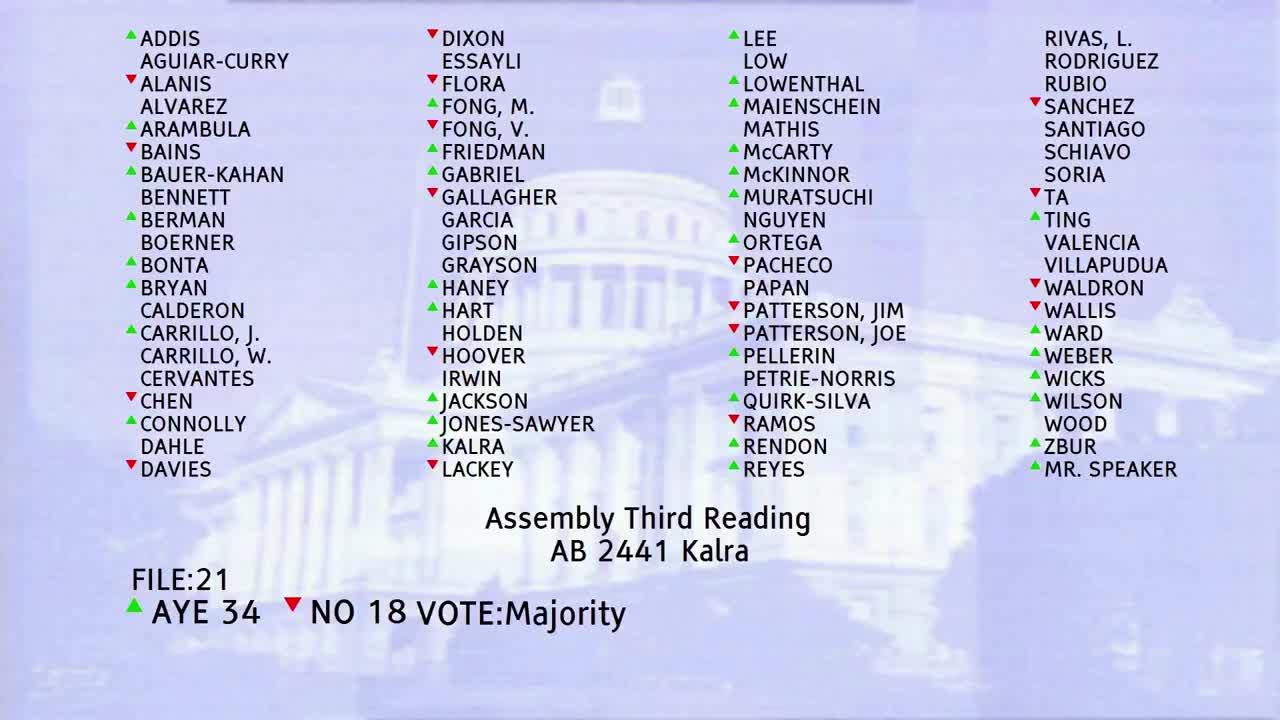 49SEC
Assembly Floor
 5MIN
Assembly Standing Committee on Higher Education
Bill Author

Bill Co-Author(s):