AB 2839: Elections: deceptive media in advertisements.
- Session Year: 2023-2024
- House: Assembly
- Latest Version Date: 2024-09-17
Current Status:
Passed
(2024-09-17: Chaptered by Secretary of State - Chapter 262, Statutes of 2024.)
Introduced
In Committee
First Chamber
In Committee
Second Chamber
Enacted
Existing law prohibits certain distribution of materially deceptive audio or visual media of a candidate within 60 days of an election at which the candidate will appear on the ballot, unless the media includes a disclosure stating that the media has been manipulated, subject to specified exemptions. Existing law authorizes a candidate whose voice or likeness appears in audio or visual media distributed in violation of these provisions to file specified actions, and it requires a court to place such proceedings on the calendar in the order of their date of filing and give the proceedings precedence.
This bill would prohibit a person, committee, or other entity from knowingly distributing an advertisement or other election communication, as defined, that contains certain materially deceptive content, as defined, with malice, as defined, subject to specified exemptions. The bill would apply this prohibition within 120 days of an election in California and, in specified cases, 60 days after an election. The bill would authorize a recipient of materially deceptive content distributed in violation of this section, candidate or committee participating in the election, or elections official, as defined, to file a civil action to enjoin the distribution of the media and to seek damages against the person, committee, or other entity that distributed it, except as specified. The bill would require a court to place such proceedings on the calendar in the order of their date of filing and give the proceedings precedence.
This bill would incorporate additional changes to Section 35 of the Code of Civil Procedure proposed by AB 2655 to be operative only if this bill and AB 2655 are enacted and this bill is enacted last.
This bill would declare that it is to take effect immediately as an urgency statute.
Existing law prohibits certain distribution of materially deceptive audio or visual media of a candidate within 60 days of an election at which the candidate will appear on the ballot, unless the media includes a disclosure stating that the media has been manipulated, subject to specified exemptions. Existing law authorizes a candidate whose voice or likeness appears in audio or visual media distributed in violation of these provisions to file specified actions, and it requires a court to place such proceedings on the calendar in the order of their date of filing and give the proceedings precedence.
This bill would prohibit a person, committee, or other entity from knowingly distributing an advertisement or other election communication, as defined, that contains certain materially deceptive content, as defined, with malice, as defined, subject to specified exemptions. The bill would apply this prohibition within 120 days of an election in California and, in specified cases, 60 days after an election. The bill would authorize a recipient of materially deceptive content distributed in violation of this section, candidate or committee participating in the election, or elections official, as defined, to file a civil action to enjoin the distribution of the media and to seek damages against the person, committee, or other entity that distributed it. it, except as specified. The bill would require a court to place such proceedings on the calendar in the order of their date of filing and give the proceedings precedence.
Existing law prohibits certain distribution of materially deceptive audio or visual media of a candidate within 60 days of an election at which the candidate will appear on the ballot, unless the media includes a disclosure stating that the media has been manipulated, subject to specified exemptions. Existing law authorizes a candidate whose voice or likeness appears in audio or visual media distributed in violation of these provisions to file specified actions, and it requires a court to place such proceedings on the calendar in the order of their date of filing and give the proceedings precedence.
This bill would prohibit a person, committee, or other entity from knowingly distributing an advertisement or other election communication, as defined, that contains certain materially deceptive content, as defined, with malice, as defined, subject to specified exemptions. The bill would apply this prohibition within 120 days of an election in California and, in specified cases, 60 days after an election. The bill would authorize a recipient of materially deceptive content distributed in violation of this section, candidate or committee participating in the election, or elections official, as defined, to file a civil action to enjoin the distribution of the media and to seek damages against the person, committee, or other entity that distributed it. The bill would require a court to place such proceedings on the calendar in the order of their date of filing and give the proceedings precedence.
Existing law prohibits certain distribution of materially deceptive audio or visual media of a candidate within 60 days of an election at which the candidate will appear on the ballot, unless the media includes a disclosure stating that the media has been manipulated, subject to specified exemptions. Existing law authorizes a candidate whose voice or likeness appears in audio or visual media distributed in violation of these provisions to file specified actions, and it requires a court to place such proceedings on the calendar in the order of their date of filing and give the proceedings precedence.
This bill would prohibit a person, committee, or other entity from knowingly distributing an advertisement or other election communication, as defined, that contains certain materially deceptive and digitally altered or digitally created images or audio or video files, content, as defined, with the intent to influence an election or solicit funds for a candidate or campaign, malice, as defined, subject to specified exemptions. The bill would apply this prohibition within 120 days of an election in California and, in specified cases, 60 days after an election. The bill would authorize a recipient of a materially deceptive and digitally altered or digitally created image or audio or video file content distributed in violation of this section, candidate or committee participating in the election, or officer holding an election or conducting a canvass elections official, as defined, to file a civil action to enjoin the distribution of the media and to seek damages against the person, committee, or other entity that distributed it. The bill would require a court to place such proceedings on the calendar in the order of their date of filing and give the proceedings precedence.
Existing law prohibits certain distribution of materially deceptive audio or visual media of a candidate within 60 days of an election at which the candidate will appear on the ballot, unless the media includes a disclosure stating that the media has been manipulated, subject to specified exemptions. Existing law authorizes a candidate whose voice or likeness appears in audio or visual media distributed in violation of these provisions to file specified actions, and it requires a court to place such proceedings on the calendar in the order of their date of filing and give the proceedings precedence.
This bill would prohibit a person, committee, or other entity from knowingly distributing an advertisement or other election communication, as defined, that contains certain materially deceptive and digitally altered or digitally created images or audio or video files, as defined, with the intent to influence an election or solicit funds for a candidate or campaign, subject to specified exemptions. The bill would apply this prohibition within 120 days of an election and, in specified cases, 60 days after an election. The bill would authorize a recipient of a materially deceptive and digitally altered or digitally created image or audio or video file distributed in violation of this section, candidate or committee participating in the election, or officer holding an election or conducting a canvass to file a civil action to enjoin the distribution of the media and to seek damages against the person, committee, or other entity that distributed it. The bill would require a court to place such proceedings on the calendar in the order of their date of filing and give the proceedings precedence.
Existing law prohibits certain distribution of materially deceptive audio or visual media of a candidate within 60 days of an election at which the candidate will appear on the ballot, unless the media includes a disclosure stating that the media has been manipulated, subject to specified exemptions. Existing law authorizes a candidate whose voice or likeness appears in audio or visual media distributed in violation of these provisions to file specified actions, and it requires a court to place such proceedings on the calendar in the order of their date of filing and give the proceedings precedence.
This bill would prohibit a person, committee, or other entity from knowingly distributing an advertisement or other election communication, as defined, that contains certain materially deceptive and digitally altered or digitally created images or audio or video files, as defined, with the intent to influence an election or solicit funds for a candidate or campaign, subject to specified exemptions. The bill would apply this prohibition within 120 days of an election and, in specified cases, 60 days after an election. The bill would authorize a recipient of a materially deceptive and digitally altered or digitally created image or audio or video file distributed in violation of this section, or a candidate or committee participating in the election, or officer holding an election or conducting a canvass to file a civil action to enjoin the distribution of the media and to seek damages against the person, committee, or other entity that distributed it. The bill would require a court to place such proceedings on the calendar in the order of their date of filing and give the proceedings precedence.
Existing law prohibits certain distribution of materially deceptive audio or visual media of a candidate within 60 days of an election at which the candidate will appear on the ballot, unless the media includes a disclosure stating that the media has been manipulated, subject to specified exemptions. Existing law authorizes a candidate whose voice or likeness appears in audio or visual media distributed in violation of these provisions to file specified actions, and it requires a court to place such proceedings on the calendar in the order of their date of filing and give the proceedings precedence.
This bill would prohibit a person, committee, or other entity from knowingly distributing an advertisement or other election communication, as defined, that contains certain materially deceptive and digitally altered or digitally created images or audio or video files, as defined, with the intent to influence an election or solicit funds for a candidate or campaign, subject to specified exemptions. The bill would apply this prohibition within 120 days of an election and, in specified cases, 60 days after an election. The bill would authorize a recipient of a materially deceptive and digitally altered or digitally created image or audio or video file distributed in violation of this section, or a candidate or committee participating in the election, to file a civil action to enjoin the distribution of the media and to seek damages against the person, committee, or other entity that distributed it. The bill would require a court to place such proceedings on the calendar in the order of their date of filing and give the proceedings precedence.
(a)Proceedings in cases involving the registration or denial of registration of voters, the certification or denial of certification of candidates, the certification or denial of certification of ballot measures, election contests, actions under Section 20010 or 20012 of the Elections Code, and actions under Chapter 2 (commencing with Section 21100) of Division 21 of the Elections Code shall be placed on the calendar in the order of their date of filing and shall be given precedence.
(b)This section shall remain in effect only until January 1, 2027, and as of that date is repealed, unless a later enacted statute, that is enacted before January 1, 2027, deletes or extends that date.
SEC. 1.5.Section 35 of the Code of Civil Procedure, as amended by Section 1 of Chapter 343 of the Statutes of 2023, is amended to read:35.(a)Proceedings in cases involving the registration or denial of registration of voters, the certification or denial of certification of candidates, the certification or denial of certification of ballot measures, election contests, actions under Section 20010 or 20012 of the Elections Code, actions under Chapter 7 (commencing with Section 20510) of Division 20 of the Elections Code, and actions under Chapter 2 (commencing with Section 21100) of Division 21 of the Elections Code shall be placed on the calendar in the order of their date of filing and shall be given precedence.
(b)This section shall remain in effect only until January 1, 2027, and as of that date is repealed, unless a later enacted statute, that is enacted before January 1, 2027, deletes or extends that date.
SEC. 2.Section 35 of the Code of Civil Procedure, as amended by Section 2 of Chapter 343 of the Statutes of 2023, is amended to read:35.(a)Proceedings in cases involving the registration or denial of registration of voters, the certification or denial of certification of candidates, the certification or denial of certification of ballot measures, election contests, actions under Section 20012 of the Elections Code, and actions under Chapter 2 (commencing with Section 21100) of Division 21 of the Elections Code shall be placed on the calendar in the order of their date of filing and shall be given precedence.
(b)This section shall become operative January 1, 2027.
SEC. 2.5.Section 35 of the Code of Civil Procedure, as amended by Section 2 of Chapter 343 of the Statutes of 2023, is amended to read:35.(a)Proceedings in cases involving the registration or denial of registration of voters, the certification or denial of certification of candidates, the certification or denial of certification of ballot measures, election contests, actions under Section 20012 of the Elections Code, actions under Chapter 7 (commencing with Section 20510) of Division 20 of the Elections Code, and actions under Chapter 2 (commencing with Section 21100) of Division 21 of the Elections Code shall be placed on the calendar in the order of their date of filing and shall be given precedence.
(b)This section shall become operative January 1, 2027.
SEC. 3.Section 20012 is added to the Elections Code, to read:20012.(a)The Legislature finds and declares as follows:
(1)California is entering its first-ever artificial intelligence (AI) election, in which disinformation powered by generative AI will pollute our information ecosystems like never before. Voters will not know what images, audio, or video they can trust.
(2)In a few clicks, using current technology, bad actors now have the power to create a false image of a candidate accepting a bribe, or a fake video of an elections official caught on tape saying that voting machines are not secure, or generate an artificial robocall in the Governors voice telling millions of Californians their voting site has changed.
(3)In the lead-up to the 2024 presidential elections, candidates and parties are already creating and distributing deepfake images and audio and video content. These fake images or files can skew election results, even if they use older methods of distribution, such as mail, television, telephone, and text, and undermine trust in the ballot counting process.
(4)In order to ensure California elections are free and fair, California must, for a limited time before and after elections, prevent the use of deepfakes and disinformation meant to prevent voters from voting and deceive voters based on fraudulent content. The provisions of this bill are narrowly tailored to advance Californias compelling interest in protecting free and fair elections.
(5)The labeling information required by this bill is narrowly tailored to provide consumers with factual information about the inauthenticity of particular images, audio, video, or text content in order to prevent consumer deception.
(b)(1)A person, committee, or other entity shall not, during the time period set forth in subdivision (c), with malice, knowingly distribute an advertisement or other election communication containing materially deceptive content of any of the following:
(A)A candidate for any federal, state, or local elected office in California portrayed as doing or saying something that the candidate did not do or say if the content is reasonably likely to harm the reputation or electoral prospects of a candidate.
(i)For purposes of subparagraph (A), candidate for any federal, state, or local elected office includes any person running for the office of President of the United States or Vice President of the United States who seeks to or will appear on a ballot issued in California.
(B)An elections official portrayed as doing or saying something in connection with an election in California that the elections official did not do or say if the content is reasonably likely to falsely undermine confidence in the outcome of one or more election contests.
(C)An elected official portrayed as doing or saying something in connection with an election in California that the elected official did not do or say if the content is reasonably likely to harm the reputation or electoral prospects of a candidate or is reasonably likely to falsely undermine confidence in the outcome of one or more election contests.
(D)A voting machine, ballot, voting site, or other property or equipment related to an election in California portrayed in a materially false way if the content is reasonably likely to falsely undermine confidence in the outcome of one or more election contests.
(2)Notwithstanding subparagraph (A) of paragraph (1), this section does not apply to a candidate portraying themself as doing or saying something that the candidate did not do or say if the content includes a disclosure stating This ____ has been manipulated. and complies with the following requirements:
(A)The blank in the disclosure required by paragraph (2) shall be filled with whichever of the following terms most accurately describes the media:
(i)Image.
(ii)Audio.
(iii)Video.
(B)(i)For visual media, the text of the disclosure shall appear in a size that is easily readable by the average viewer and no smaller than the largest font size of other text appearing in the visual media. If the visual media does not include any other text, the disclosure shall appear in a size that is easily readable by the average viewer. For visual media that is video, the disclosure shall appear for the duration of the video.
(ii)If the media consists of audio only, the disclosure shall be read in a clearly spoken manner and in a pitch that can be easily heard by the average listener, at the beginning of the audio, at the end of the audio, and, if the audio is greater than two minutes in length, interspersed within the audio at intervals of not greater than two minutes each.
(3)Notwithstanding paragraph (1), this section does not apply to an advertisement or other election communication containing materially deceptive content that constitutes satire or parody if the communication includes a disclosure stating This ____ has been manipulated for purposes of satire or parody. The disclosure shall comply with the requirements set forth in subparagraphs (A) and (B) of paragraph (2).
(4)(A)A person, committee, or other entity shall not, during the time period set forth in subdivision (c), do either of the following:
(i)Remove any disclosure required by paragraph (2) or (3).
(ii)Knowingly republish any content subject to paragraph (2) or (3) without the required disclosure.
(B)A violation of subparagraph (A) is evidence of intent to knowingly distribute an advertisement or other election communication containing materially deceptive content, as prohibited by paragraph (1).
(c)The prohibition in subdivision (b) applies only during the following time periods:
(1)One hundred twenty days before any election in California.
(2)For people and items set forth in subparagraphs (B) and (D) of paragraph (1) of subdivision (b), 120 days before any election in California through 60 days after the election, inclusive.
(d)(1)A recipient of materially deceptive content distributed in violation of this section, candidate or committee participating in the election, or elections official may seek injunctive or other equitable relief prohibiting the distribution of the materially deceptive content in violation of this section. The court shall also award a prevailing plaintiff reasonable attorneys fees and costs. An action under this paragraph shall be entitled to precedence in accordance with Section 35 of the Code of Civil Procedure.
(2)(A)A recipient of materially deceptive content distributed in violation of this section, candidate or committee participating in the election, or elections official may bring an action for general or special damages against the person, committee, or other entity that distributed or republished the materially deceptive content in violation of this section. The court shall also award a prevailing party reasonable attorneys fees and costs. This subdivision shall not be construed to limit or preclude a plaintiff from securing or recovering any other available remedy at law or equity.
(B)This paragraph does not apply to a broadcasting station or internet website that distributed the materially deceptive content if the broadcasting station or internet website did not create the content.
(3)In any civil action alleging a violation of this section, the plaintiff shall bear the burden of establishing the violation through clear and convincing evidence.
(e)(1)This section does not apply to a broadcasting station that broadcasts any materially deceptive content prohibited by this section as part of a bona fide newscast, news interview, news documentary, commentary of general interest, or on-the-spot coverage of bona fide news events, if the broadcast clearly acknowledges through content or a disclosure, in a manner that can be easily heard or read by the average listener or viewer, that the materially deceptive content does not accurately represent any actual event, occurrence, appearance, speech, or expressive conduct.
(2)This section does not apply to a broadcasting station when it is paid to broadcast materially deceptive content and either of the following circumstances exist:
(A)The broadcasting station can show that it has prohibition and disclaimer requirements that are consistent with the requirements in this section and that it has provided those prohibition and disclaimer requirements to each person or entity that purchased the advertisement.
(B)Federal law requires the broadcasting station to air advertisements from legally qualified candidates or prohibits the broadcasting station from censoring or altering the message.
(3)This section does not apply to a regularly published newspaper, magazine, or other periodical of general circulation, including an internet or electronic publication, that routinely carries news and commentary of general interest, and that publishes any materially deceptive content prohibited by this section, if the publication clearly states that the materially deceptive content does not accurately represent any actual event, occurrence, appearance, speech, or expressive conduct.
(4)This section does not impose liability on an interactive computer service, as defined in Section 230(f)(2) of Title 47 of the United States Code.
(f)For purposes of this section, the following definitions apply:
(1)Advertisement means any general or public communication that is authorized or paid for the purpose of supporting or opposing a candidate for elective office in California or a ballot measure that appears on a ballot issued in California and that is broadcast by or through television, radio, telephone, or text, distributed through the internet, or disseminated by print media, including billboards, video billboards or screens, and other similar types of advertising.
(2)Broadcasting station means a radio or television broadcasting station, including any of the following:
(i)Cable operator, programmer, or producer.
(ii)Streaming service operator, programmer, or producer.
(iii)Direct-to-home satellite television operator, programmer, or producer.
(3)Committee means a committee as defined in Section 82013 of the Government Code.
(4)Deepfake means audio or visual media that is digitally created or modified such that it would falsely appear to a reasonable person to be an authentic record of the actual speech or conduct of the individual depicted in the media.
(5)Election communication means any general or public communication not covered under advertisement that is broadcast by or through television, radio, telephone, or text, distributed through the internet, or disseminated by print media, including billboards, video billboards or screens, and other similar types of communications, that concerns any of the following:
(A)A candidate for office or ballot measure.
(B)Voting or refraining from voting in an election.
(C)The canvass of the vote.
(6)Elections official means any of the following persons, but only in their capacity as a person charged with holding or conducting an election, conducting a canvass, assisting with the holding or conducting of an election or a canvass, or performing another duty related to administering the provisions of the Elections Code:
(i)An elections official as defined in Section 320.
(ii)The Secretary of State and their staff.
(iii)A temporary worker, poll worker, or member of a precinct board.
(iv)Any other person charged with holding or conducting an election, conducting a canvass, assisting with the holding or conducting of an election or a canvass, or performing another duty related to administering the provisions of the Elections Code.
(7)Malice means the person, committee, or other entity distributed the audio or visual media knowing the materially deceptive content was false or with a reckless disregard for the truth.
(8)(A)Materially deceptive content means audio or visual media that is intentionally digitally created or modified, which includes, but is not limited to, deepfakes, such that the content would falsely appear to a reasonable person to be an authentic record of the content depicted in the media.
(B)Materially deceptive content does not include any audio or visual media that contains only minor modifications that do not significantly change the perceived contents or meaning of the content. Minor changes include changes to brightness or contrast of images, removal of background noise in audio, and other minor changes that do not impact the content of the audio or visual media.
(9)Recipient includes a person who views, hears, or otherwise perceives an image or audio or video file that was initially distributed in violation of this section.
(g)The provisions of this section apply regardless of the language used in the advertisement or solicitation. If the language used is not English, the disclosure required by paragraph (2) of subdivision (b) shall appear in the language used in the advertisement or solicitation.
(h)The provisions of this section are severable. If any provision of this section or its application is held invalid, that invalidity shall not affect other provisions or applications that can be given effect without the invalid provision or application.
SEC. 4.Section 1.5 of this bill incorporates amendments to Section 35 of the Code of Civil Procedure proposed by both this bill and Assembly Bill 2655. That section of this bill shall only become operative if (1) both bills are enacted and become effective on or before January 1, 2025, but this bill becomes operative first, (2) each bill amends Section 35 of the Code of Civil Procedure, as amended by Section 1 of Chapter 343 of the Statutes of 2023, and (3) this bill is enacted after Assembly Bill 2655, in which case Section 35 of the Code of Civil Procedure, as amended by Section 1 of this bill, shall remain operative only until the operative date of Assembly Bill 2655, at which time Section 1.5 of this bill shall become operative.
SEC. 5.Section 2.5 of this bill incorporates amendments to Section 35 of the Code of Civil Procedure proposed by both this bill and Assembly Bill 2655. That section of this bill shall only become operative if (1) both bills are enacted and become effective on or before January 1, 2025, but this bill becomes operative first, (2) each bill amends Section 35 of the Code of Civil Procedure, as amended by Section 2 of Chapter 343 of the Statutes of 2023, and (3) this bill is enacted after Assembly Bill 2655, in which case Section 35 of the Code of Civil Procedure, as amended by Section 2 of this bill, shall remain operative only until the operative date of Assembly Bill 2655, at which time Section 2.5 of this bill shall become operative.
SEC. 6.This act is an urgency statute necessary for the immediate preservation of the public peace, health, or safety within the meaning of Article IV of the California Constitution and shall go into immediate effect. The facts constituting the necessity are:
California is approaching its first election influenced by artificial intelligence (AI), where disinformation generated by AI can distort voter awareness and perception of candidates, elections officials, elected officials, and voting apparatuses. In the lead-up to the 2024 presidential election, candidates and bad actors are already creating and distributing deepfake images and audio and video content. In order to implement the provisions of this act and safeguard the upcoming November 5, 2024, general election against disinformation propagated by AI and deepfake media, it is necessary for this act to take effect immediately.
(a)Proceedings in cases involving the registration or denial of registration of voters, the certification or denial of certification of candidates, the certification or denial of certification of ballot measures, election contests, actions under Section 20010 or 20012 of the Elections Code, and actions under Chapter 2 (commencing with Section 21100) of Division 21 of the Elections Code shall be placed on the calendar in the order of their date of filing and shall be given precedence.
(b)This section shall remain in effect only until January 1, 2027, and as of that date is repealed, unless a later enacted statute, that is enacted before January 1, 2027, deletes or extends that date.
SEC. 1.5.Section 35 of the Code of Civil Procedure, as amended by Section 1 of Chapter 343 of the Statutes of 2023, is amended to read:35.(a)Proceedings in cases involving the registration or denial of registration of voters, the certification or denial of certification of candidates, the certification or denial of certification of ballot measures, election contests, actions under Section 20010 or 20012 of the Elections Code, actions under Chapter 7 (commencing with Section 20510) of Division 20 of the Elections Code, and actions under Chapter 2 (commencing with Section 21100) of Division 21 of the Elections Code shall be placed on the calendar in the order of their date of filing and shall be given precedence.
(b)This section shall remain in effect only until January 1, 2027, and as of that date is repealed, unless a later enacted statute, that is enacted before January 1, 2027, deletes or extends that date.
SEC. 2.Section 35 of the Code of Civil Procedure, as amended by Section 2 of Chapter 343 of the Statutes of 2023, is amended to read:35.(a)Proceedings in cases involving the registration or denial of registration of voters, the certification or denial of certification of candidates, the certification or denial of certification of ballot measures, election contests, actions under Section 20012 of the Elections Code, and actions under Chapter 2 (commencing with Section 21100) of Division 21 of the Elections Code shall be placed on the calendar in the order of their date of filing and shall be given precedence.
(b)This section shall become operative January 1, 2027.
SEC. 2.5.Section 35 of the Code of Civil Procedure, as amended by Section 2 of Chapter 343 of the Statutes of 2023, is amended to read:35.(a)Proceedings in cases involving the registration or denial of registration of voters, the certification or denial of certification of candidates, the certification or denial of certification of ballot measures, election contests, actions under Section 20012 of the Elections Code, actions under Chapter 7 (commencing with Section 20510) of Division 20 of the Elections Code, and actions under Chapter 2 (commencing with Section 21100) of Division 21 of the Elections Code shall be placed on the calendar in the order of their date of filing and shall be given precedence.
(b)This section shall become operative January 1, 2027.
SEC. 3.Section 20012 is added to the Elections Code, to read:20012.(a)The Legislature finds and declares as follows:
(1)California is entering its first-ever artificial intelligence (AI) election, in which disinformation powered by generative AI will pollute our information ecosystems like never before. Voters will not know what images, audio, or video they can trust.
(2)In a few clicks, using current technology, bad actors now have the power to create a false image of a candidate accepting a bribe, or a fake video of an elections official caught on tape saying that voting machines are not secure, or generate an artificial robocall in the Governors voice telling millions of Californians their voting site has changed.
(3)In the lead-up to the 2024 presidential elections, candidates and parties are already creating and distributing deepfake images and audio and video content. These fake images or files can skew election results, even if they use older methods of distribution, such as mail, television, telephone, and text, and undermine trust in the ballot counting process.
(4)In order to ensure California elections are free and fair, California must, for a limited time before and after elections, prevent the use of deepfakes and disinformation meant to prevent voters from voting and deceive voters based on fraudulent content. The provisions of this bill are narrowly tailored to advance Californias compelling interest in protecting free and fair elections.
(5)The labeling information required by this bill is narrowly tailored to provide consumers with factual information about the inauthenticity of particular images, audio, video, or text content in order to prevent consumer deception.
(b)(1)A person, committee, or other entity shall not, during the time period set forth in subdivision (c), with malice, knowingly distribute an advertisement or other election communication containing materially deceptive content of any of the following:
(A)A candidate for any federal, state, or local elected office in California portrayed as doing or saying something that the candidate did not do or say if the content is reasonably likely to harm the reputation or electoral prospects of a candidate.
(i)For purposes of subparagraph (A), candidate for any federal, state, or local elected office includes any person running for the office of President of the United States or Vice President of the United States who seeks to or will appear on a ballot issued in California.
(B)An elections official portrayed as doing or saying something in connection with an election in California that the elections official did not do or say if the content is reasonably likely to falsely undermine confidence in the outcome of one or more election contests.
(C)An elected official portrayed as doing or saying something in connection with an election in California that the elected official did not do or say if the content is reasonably likely to harm the reputation or electoral prospects of a candidate or is reasonably likely to falsely undermine confidence in the outcome of one or more election contests.
(D)A voting machine, ballot, voting site, or other property or equipment related to an election in California portrayed in a materially false way if the content is reasonably likely to falsely undermine confidence in the outcome of one or more election contests.
(2)Notwithstanding subparagraph (A) of paragraph (1), this section does not apply to a candidate portraying themself as doing or saying something that the candidate did not do or say if the content includes a disclosure stating This ____ has been manipulated. and complies with the following requirements:
(A)The blank in the disclosure required by paragraph (2) shall be filled with whichever of the following terms most accurately describes the media:
(i)Image.
(ii)Audio.
(iii)Video.
(B)(i)For visual media, the text of the disclosure shall appear in a size that is easily readable by the average viewer and no smaller than the largest font size of other text appearing in the visual media. If the visual media does not include any other text, the disclosure shall appear in a size that is easily readable by the average viewer. For visual media that is video, the disclosure shall appear for the duration of the video.
(ii)If the media consists of audio only, the disclosure shall be read in a clearly spoken manner and in a pitch that can be easily heard by the average listener, at the beginning of the audio, at the end of the audio, and, if the audio is greater than two minutes in length, interspersed within the audio at intervals of not greater than two minutes each.
(3)Notwithstanding paragraph (1), this section does not apply to an advertisement or other election communication containing materially deceptive content that constitutes satire or parody if the communication includes a disclosure stating This ____ has been manipulated for purposes of satire or parody. The disclosure shall comply with the requirements set forth in subparagraphs (A) and (B) of paragraph (2).
(4)(A)A person, committee, or other entity shall not, during the time period set forth in subdivision (c), do either of the following:
(i)Remove any disclosure required by paragraph (2) or (3).
(ii)Knowingly republish any content subject to paragraph (2) or (3) without the required disclosure.
(B)A violation of subparagraph (A) is evidence of intent to knowingly distribute an advertisement or other election communication containing materially deceptive content, as prohibited by paragraph (1).
(c)The prohibition in subdivision (b) applies only during the following time periods:
(1)One hundred twenty days before any election in California.
(2)For people and items set forth in subparagraphs (B) and (D) of paragraph (1) of subdivision (b), 120 days before any election in California through 60 days after the election, inclusive.
(d)(1)A recipient of materially deceptive content distributed in violation of this section, candidate or committee participating in the election, or elections official may seek injunctive or other equitable relief prohibiting the distribution of the materially deceptive content in violation of this section. The court shall also award a prevailing plaintiff reasonable attorneys fees and costs. An action under this paragraph shall be entitled to precedence in accordance with Section 35 of the Code of Civil Procedure.
(2)(i)(A)A recipient of materially deceptive content distributed in violation of this section, candidate or committee participating in the election, or elections official may bring an action for general or special damages against the person, committee, or other entity that distributed or republished the materially deceptive content in violation of this section. The court shall also award a prevailing party reasonable attorneys fees and costs. This subdivision shall not be construed to limit or preclude a plaintiff from securing or recovering any other available remedy at law or equity.
(ii)
(B)This paragraph does not apply to a broadcasting station or internet website that distributed the materially deceptive content if the broadcasting station or internet website did not create the content.
(3)In any civil action alleging a violation of this section, the plaintiff shall bear the burden of establishing the violation through clear and convincing evidence.
(e)(1)This section does not apply to a broadcasting station that broadcasts any materially deceptive content prohibited by this section as part of a bona fide newscast, news interview, news documentary, commentary of general interest, or on-the-spot coverage of bona fide news events, if the broadcast clearly acknowledges through content or a disclosure, in a manner that can be easily heard or read by the average listener or viewer, that the materially deceptive content does not accurately represent any actual event, occurrence, appearance, speech, or expressive conduct.
(2)This section does not apply to a broadcasting station when it is paid to broadcast materially deceptive content and either of the following circumstances exist:
(A)The broadcasting station can show that it has prohibition and disclaimer requirements that are consistent with the requirements in this section and that it has provided those prohibition and disclaimer requirements to each person or entity that purchased the advertisement.
(B)Federal law requires the broadcasting station to air advertisements from legally qualified candidates or prohibits the broadcasting station from censoring or altering the message.
(3)This section does not apply to a regularly published newspaper, magazine, or other periodical of general circulation, including an internet or electronic publication, that routinely carries news and commentary of general interest, and that publishes any materially deceptive content prohibited by this section, if the publication clearly states that the materially deceptive content does not accurately represent any actual event, occurrence, appearance, speech, or expressive conduct.
(4)This section does not apply to materially deceptive content that constitutes satire or parody. impose liability on an interactive computer service, as defined in Section 230(f)(2) of Title 47 of the United States Code.
(f)For purposes of this section, the following definitions apply:
(1)Advertisement means any general or public communication that is authorized or paid for the purpose of supporting or opposing a candidate for elective office in California or a ballot measure that appears on a ballot issued in California and that is broadcast by or through television, radio, telephone, or text, distributed through the internet, or disseminated by print media, including billboards, video billboards or screens, and other similar types of advertising.
(2)Broadcasting station means a radio or television broadcasting station, including any of the following:
(i)Cable operator, programmer, or producer.
(ii)Streaming service operator, programmer, or producer.
(iii)Direct-to-home satellite television operator, programmer, or producer.
(3)Committee means a committee as defined in Section 82013 of the Government Code.
(4)Deepfake means audio or visual media that is digitally created or modified such that it would falsely appear to a reasonable person to be an authentic record of the actual speech or conduct of the individual depicted in the media.
(5)Election communication means any general or public communication not covered under advertisement that is broadcast by or through television, radio, telephone, or text, distributed through the internet, or disseminated by print media, including billboards, video billboards or screens, and other similar types of communications, that concerns any of the following:
(A)A candidate for office or ballot measure.
(B)Voting or refraining from voting in an election.
(C)The canvass of the vote.
(6)Elections official means any of the following persons, but only in their capacity as a person charged with holding or conducting an election, conducting a canvass, assisting with the holding or conducting of an election or a canvass, or performing another duty related to administering the provisions of the Elections Code:
(i)An elections official as defined in Section 320.
(ii)The Secretary of State and their staff.
(iii)A temporary worker, poll worker, or member of a precinct board.
(iv)Any other person charged with holding or conducting an election, conducting a canvass, assisting with the holding or conducting of an election or a canvass, or performing another duty related to administering the provisions of the Elections Code.
(7)Malice means the person, committee, or other entity distributed the audio or visual media knowing the materially deceptive content was false or with a reckless disregard for the truth.
(8)(A)Materially deceptive content means audio or visual media that is intentionally digitally created or modified, which includes, but is not limited to, deepfakes, such that the content would falsely appear to a reasonable person to be an authentic record of the content depicted in the media.
(B)Materially deceptive content does not include any audio or visual media that contains only minor modifications that do not significantly change the perceived contents or meaning of the content. Minor changes include changes to brightness or contrast of images, removal of background noise in audio, and other minor changes that do not impact the content of the audio or visual media.
(9)Recipient includes a person who views, hears, or otherwise perceives an image or audio or video file that was initially distributed in violation of this section.
(g)The provisions of this section apply regardless of the language used in the advertisement or solicitation. If the language used is not English, the disclosure required by paragraph (2) of subdivision (b) shall appear in the language used in the advertisement or solicitation.
(h)The provisions of this section are severable. If any provision of this section or its application is held invalid, that invalidity shall not affect other provisions or applications that can be given effect without the invalid provision or application.
SEC. 4.Section 1.5 of this bill incorporates amendments to Section 35 of the Code of Civil Procedure proposed by both this bill and Assembly Bill 2655. That section of this bill shall only become operative if (1) both bills are enacted and become effective on or before January 1, 2025, but this bill becomes operative first, (2) each bill amends Section 35 of the Code of Civil Procedure, as amended by Section 1 of Chapter 343 of the Statutes of 2023, and (3) this bill is enacted after Assembly Bill 2655, in which case Section 35 of the Code of Civil Procedure, as amended by Section 1 of this bill, shall remain operative only until the operative date of Assembly Bill 2655, at which time Section 1.5 of this bill shall become operative.
SEC. 5.Section 2.5 of this bill incorporates amendments to Section 35 of the Code of Civil Procedure proposed by both this bill and Assembly Bill 2655. That section of this bill shall only become operative if (1) both bills are enacted and become effective on or before January 1, 2025, but this bill becomes operative first, (2) each bill amends Section 35 of the Code of Civil Procedure, as amended by Section 2 of Chapter 343 of the Statutes of 2023, and (3) this bill is enacted after Assembly Bill 2655, in which case Section 35 of the Code of Civil Procedure, as amended by Section 2 of this bill, shall remain operative only until the operative date of Assembly Bill 2655, at which time Section 2.5 of this bill shall become operative.
SEC. 6.This act is an urgency statute necessary for the immediate preservation of the public peace, health, or safety within the meaning of Article IV of the California Constitution and shall go into immediate effect. The facts constituting the necessity are:
California is approaching its first election influenced by artificial intelligence (AI), where disinformation generated by AI can distort voter awareness and perception of candidates, elections officials, elected officials, and voting apparatuses. In the lead-up to the 2024 presidential election, candidates and bad actors are already creating and distributing deepfake images and audio and video content. In order to implement the provisions of this act and safeguard the upcoming November 5, 2024 general election against disinformation propagated by AI and deepfake media, it is necessary for this act to take effect immediately.
(a)Proceedings in cases involving the registration or denial of registration of voters, the certification or denial of certification of candidates, the certification or denial of certification of ballot measures, election contests, actions under Section 20010 or 20012 of the Elections Code, and actions under Chapter 2 (commencing with Section 21100) of Division 21 of the Elections Code shall be placed on the calendar in the order of their date of filing and shall be given precedence.
(b)This section shall remain in effect only until January 1, 2027, and as of that date is repealed, unless a later enacted statute, that is enacted before January 1, 2027, deletes or extends that date.
SEC. 2.Section 35 of the Code of Civil Procedure, as amended by Section 2 of Chapter 343 of the Statutes of 2023, is amended to read:35.(a)Proceedings in cases involving the registration or denial of registration of voters, the certification or denial of certification of candidates, the certification or denial of certification of ballot measures, election contests, actions under Section 20012 of the Elections Code, and actions under Chapter 2 (commencing with Section 21100) of Division 21 of the Elections Code shall be placed on the calendar in the order of their date of filing and shall be given precedence.
(b)This section shall become operative January 1, 2027.
SEC. 3.Section 20012 is added to the Elections Code, to read:20012.(a)The Legislature finds and declares as follows:
(1)California is entering its first-ever artificial intelligence (AI) election, in which disinformation powered by generative AI will pollute our information ecosystems like never before. Voters will not know what images, audio, or video they can trust.
(2)In a few clicks, using current technology, bad actors now have the power to create a false image of a candidate accepting a bribe, or a fake video of an elections official caught on tape saying that voting machines are not secure, or generate an artificial robocall in the Governors voice telling millions of Californians their voting site has changed.
(3)In the lead-up to the 2024 presidential elections, candidates and parties are already creating and distributing deepfake images and audio and video content. These fake images or files can skew election results, even if they use older methods of distribution, such as mail, television, telephone, and text, and undermine trust in the ballot counting process.
(4)In order to ensure California elections are free and fair, California must, for a limited time before and after elections, prevent the use of deepfakes and disinformation meant to prevent voters from voting and deceive voters based on fraudulent content. The provisions of this bill are narrowly tailored to advance Californias compelling interest in protecting free and fair elections.
(5)The labeling information required by this bill is narrowly tailored to provide consumers with factual information about the inauthenticity of particular images, audio, video, or text content in order to prevent consumer deception.
(b)(1)A person, committee, or other entity shall not, during the time period set forth in subdivision (c), with malice, knowingly distribute an advertisement or other election communication containing materially deceptive content of any of the following:
(A)A candidate for any federal, state, or local elected office in California portrayed as doing or saying something that the candidate did not do or say if the content is reasonably likely to harm the reputation or electoral prospects of a candidate.
(i)For purposes of subparagraph (A), candidate for any federal, state, or local elected office includes any person running for the office of President of the United States or Vice President of the United States who seeks to or will appear on a ballot issued in California.
(B)An elections official portrayed as doing or saying something in connection with an election in California that the elections official did not do or say if the content is reasonably likely to falsely undermine confidence in the outcome of one or more election contests.
(C)An elected official portrayed as doing or saying something in connection with an election in California that the elected official did not do or say if the content is reasonably likely to harm the reputation or electoral prospects of a candidate or is reasonably likely to falsely undermine confidence in the outcome of one or more election contests.
(D)A voting machine, ballot, voting site, or other property or equipment related to an election in California portrayed in a materially false way if the content is reasonably likely to falsely undermine confidence in the outcome of one or more election contests.
(2)Notwithstanding subparagraph (A) of paragraph (1), this section does not apply to a candidate portraying themself as doing or saying something that the candidate did not do or say if the content includes a disclosure stating This ____ has been manipulated. and complies with the following requirements:
(A)The blank in the disclosure required by paragraph (2) shall be filled with whichever of the following terms most accurately describes the media:
(i)Image.
(ii)Audio.
(iii)Video.
(B)(i)For visual media, the text of the disclosure shall appear in a size that is easily readable by the average viewer and no smaller than the largest font size of other text appearing in the visual media. If the visual media does not include any other text, the disclosure shall appear in a size that is easily readable by the average viewer. For visual media that is video, the disclosure shall appear for the duration of the video.
(ii)If the media consists of audio only, the disclosure shall be read in a clearly spoken manner and in a pitch that can be easily heard by the average listener, at the beginning of the audio, at the end of the audio, and, if the audio is greater than two minutes in length, interspersed within the audio at intervals of not greater than two minutes each.
(c)The prohibition in subdivision (b) applies only during the following time periods:
(1)One hundred twenty days before any election in California.
(2)For people and items set forth in subparagraphs (B) and (D) of paragraph (1) of subdivision (b), 120 days before any election in California through 60 days after the election, inclusive.
(d)(1)A recipient of materially deceptive content distributed in violation of this section, candidate or committee participating in the election, or elections official may seek injunctive or other equitable relief prohibiting the distribution of the materially deceptive content in violation of this section. The court shall also award a prevailing plaintiff reasonable attorneys fees and costs. An action under this paragraph shall be entitled to precedence in accordance with Section 35 of the Code of Civil Procedure.
(2)(i)A recipient of materially deceptive content distributed in violation of this section, candidate or committee participating in the election, or elections official may bring an action for general or special damages against the person, committee, or other entity that distributed the materially deceptive content in violation of this section. The court shall also award a prevailing party reasonable attorneys fees and costs. This subdivision shall not be construed to limit or preclude a plaintiff from securing or recovering any other available remedy at law or equity.
(ii)This paragraph does not apply to a broadcasting station that distributed the materially deceptive content if the broadcasting station did not create the content.
(3)In any civil action alleging a violation of this section, the plaintiff shall bear the burden of establishing the violation through clear and convincing evidence.
(e)(1)This section does not apply to a radio or television broadcasting station, including a cable or satellite television operator, programmer, or producer, station that broadcasts any materially deceptive content prohibited by this section as part of a bona fide newscast, news interview, news documentary, commentary of general interest, or on-the-spot coverage of bona fide news events, if the broadcast clearly acknowledges through content or a disclosure, in a manner that can be easily heard or read by the average listener or viewer, that the materially deceptive content does not accurately represent any actual event, occurrence, appearance, speech, or expressive conduct.
(2)This section does not apply to a radio or television broadcasting station when it is paid to broadcast materially deceptive content. content and either of the following circumstances exist:
(A)The broadcasting station can show that it has prohibition and disclaimer requirements that are consistent with the requirements in this section and that it has provided those prohibition and disclaimer requirements to each person or entity that purchased the advertisement.
(B)Federal law requires the broadcasting station to air advertisements from legally qualified candidates or prohibits the broadcasting station from censoring or altering the message.
(3)This section does not apply to a regularly published newspaper, magazine, or other periodical of general circulation, including an internet or electronic publication, that routinely carries news and commentary of general interest, and that publishes any materially deceptive content prohibited by this section, if the publication clearly states that the materially deceptive content does not accurately represent any actual event, occurrence, appearance, speech, or expressive conduct.
(4)This section does not apply to materially deceptive content that constitutes satire or parody.
(f)For purposes of this section, the following definitions apply:
(1)Advertisement means any general or public communication that is authorized or paid for the purpose of supporting or opposing a candidate for elective office in California or a ballot measure that appears on a ballot issued in California and that is broadcast by or through television, radio, telephone, or text, or disseminated by print media, including billboards, video billboards or screens, and other similar types of advertising.
(2)Broadcasting station means a radio or television broadcasting station, including any of the following:
(i)Cable operator, programmer, or producer.
(ii)Streaming service operator, programmer, or producer.
(iii)Direct-to-home satellite television operator, programmer, or producer.
(2)(3)Committee means a committee as defined in Section 82013 of the Government Code.
(3)(4)Deepfake means audio or visual media that is digitally created or modified such that it would falsely appear to a reasonable person to be an authentic record of the actual speech or conduct of the individual depicted in the media.
(4)(5)Election communication means any general or public communication not covered under advertisement that is broadcast by or through television, radio, telephone, or text, or disseminated by print media, including billboards, video billboards or screens, and other similar types of communications, that concerns any of the following:
(A)A candidate for office or ballot measure.
(B)Voting or refraining from voting in an election.
(C)The canvass of the vote.
(5)(6)Elections official means any of the following persons, but only in their capacity as a person charged with holding or conducting an election, conducting a canvass, assisting with the holding or conducting of an election or a canvass, or performing another duty related to administering the provisions of the Elections Code:
(i)An elections official as defined in Section 320.
(ii)The Secretary of State and their staff.
(iii)A temporary worker, poll worker, or member of a precinct board.
(iv)Any other person charged with holding or conducting an election, conducting a canvass, assisting with the holding or conducting of an election or a canvass, or performing another duty related to administering the provisions of the Elections Code.
(6)(7)Malice means the person, committee, or other entity distributed the audio or visual media knowing the materially deceptive content was false or with a reckless disregard for the truth.
(7)(8)(A)Materially deceptive content means audio or visual media that is intentionally digitally created or modified, which includes, but is not limited to, deepfakes, such that the content would falsely appear to a reasonable person to be an authentic record of the content depicted in the media.
(B)Materially deceptive content does not include any audio or visual media that contains only minor modifications that do not significantly change the perceived contents or meaning of the content. Minor changes include changes to brightness or contrast of images, removal of background noise in audio, and other minor changes that do not impact the content of the audio or visual media.
(8)(9)Recipient includes a person who views, hears, or otherwise perceives an image or audio or video file that was initially distributed in violation of this section.
(g)The provisions of this section apply regardless of the language used in the advertisement or solicitation. If the language used is not English, the disclosure required by paragraph (2) of subdivision (b) shall appear in the language used in the advertisement or solicitation.
(h)The provisions of this section are severable. If any provision of this section or its application is held invalid, that invalidity shall not affect other provisions or applications that can be given effect without the invalid provision or application.
(a)Proceedings in cases involving the registration or denial of registration of voters, the certification or denial of certification of candidates, the certification or denial of certification of ballot measures, election contests, actions under Section 20010 or 20012 of the Elections Code, and actions under Chapter 2 (commencing with Section 21100) of Division 21 of the Elections Code shall be placed on the calendar in the order of their date of filing and shall be given precedence.
(b)This section shall remain in effect only until January 1, 2027, and as of that date is repealed, unless a later enacted statute, that is enacted before January 1, 2027, deletes or extends that date.
SEC. 2.Section 35 of the Code of Civil Procedure, as amended by Section 2 of Chapter 343 of the Statutes of 2023, is amended to read:35.(a)Proceedings in cases involving the registration or denial of registration of voters, the certification or denial of certification of candidates, the certification or denial of certification of ballot measures, election contests, actions under Section 20012 of the Elections Code, and actions under Chapter 2 (commencing with Section 21100) of Division 21 of the Elections Code shall be placed on the calendar in the order of their date of filing and shall be given precedence.
(b)This section shall become operative January 1, 2027.
SEC. 3.Section 20012 is added to the Elections Code, to read:20012.(a)The Legislature finds and declares as follows:
(1)California is entering its first-ever artificial intelligence (AI) election, in which disinformation powered by generative AI will pollute our information ecosystems like never before. Voters will not know what images, audio, or video they can trust.
(2)In a few clicks, using current technology, bad actors now have the power to create a false image of a candidate accepting a bribe, or a fake video of an elections official caught on tape saying that voting machines are not secure, or generate an artificial robocall in the Governors voice telling millions of Californians their voting site has changed.
(3)In the lead-up to the 2024 presidential elections, candidates and parties are already creating and distributing deepfake images and audio and video content. These fake images or files can skew election results, even if they use older methods of distribution, such as mail, television, telephone, and text, and undermine trust in the ballot counting process.
(4)In order to ensure California elections are free and fair, California must, for a limited time before and after elections, prevent the use of deepfakes and disinformation meant to prevent voters from voting and deceive voters based on fraudulent content. The provisions of this bill are narrowly tailored to advance Californias compelling interest in protecting free and fair elections.
(5)The labeling information required by this bill is narrowly tailored to provide consumers with factual information about the inauthenticity of particular images, audio, video, or text content in order to prevent consumer deception.
(b)(1)A person, committee, or other entity shall not, during the time period set forth in subdivision (c), with malice, knowingly distribute an advertisement or other election communication containing materially deceptive content of any of the following:
(A)A candidate for any federal, state, or local elected office in California portrayed as doing or saying something that the candidate did not do or say if the content is reasonably likely to harm the reputation or electoral prospects of a candidate.
(i)For purposes of subparagraph (A), candidate for any federal, state, or local elected office includes any person running for the office of President of the United States or Vice President of the United States who seeks to or will appear on a ballot issued in California.
(B)An elections official portrayed as doing or saying something in connection with an election in California that the elections official did not do or say if the content is reasonably likely to falsely undermine confidence in the outcome of one or more election contests.
(C)An elected official portrayed as doing or saying something in connection with an election in California that the elected official did not do or say if the content is reasonably likely to harm the reputation or electoral prospects of a candidate or is reasonably likely to falsely undermine confidence in the outcome of one or more election contests.
(D)A voting machine, ballot, voting site, or other property or equipment related to an election in California portrayed in a materially false way if the content is reasonably likely to falsely undermine confidence in the outcome of one or more election contests.
(2)Notwithstanding subparagraph (A) of paragraph (1), a candidate may portray themself as doing or saying something that the candidate did not do or say, but only this section does not apply to a candidate portraying themself as doing or saying something that the candidate did not do or say if the content includes a disclosure stating This ____ has been manipulated. and complies with the following requirements:
(A)The blank in the disclosure required by paragraph (2) shall be filled with whichever of the following terms most accurately describes the media:
(i)Image.
(ii)Audio.
(iii)Video.
(B)(i)For visual media, the text of the disclosure shall appear in a size that is easily readable by the average viewer and no smaller than the largest font size of other text appearing in the visual media. If the visual media does not include any other text, the disclosure shall appear in a size that is easily readable by the average viewer. For visual media that is video, the disclosure shall appear for the duration of the video.
(ii)If the media consists of audio only, the disclosure shall be read in a clearly spoken manner and in a pitch that can be easily heard by the average listener, at the beginning of the audio, at the end of the audio, and, if the audio is greater than two minutes in length, interspersed within the audio at intervals of not greater than two minutes each.
(c)The prohibition in subdivision (b) applies only during the following time periods:
(1)One hundred twenty days before any election in California.
(2)For people and items set forth in subparagraphs (B) and (D) of paragraph (1) of subdivision (b), 120 days before any election in California through 60 days after the election, inclusive.
(d)(1)A recipient of materially deceptive content distributed in violation of this section, candidate or committee participating in the election, or elections official may seek injunctive or other equitable relief prohibiting the distribution of the materially deceptive content in violation of this section. The court shall also award a prevailing plaintiff reasonable attorneys fees and costs. An action under this paragraph shall be entitled to precedence in accordance with Section 35 of the Code of Civil Procedure.
(2)A recipient of materially deceptive content distributed in violation of this section, candidate or committee participating in the election, or elections official may bring an action for general or special damages against the person, committee, or other entity that distributed the materially deceptive content in violation of this section. The court shall also award a prevailing party reasonable attorneys fees and costs. This subdivision shall not be construed to limit or preclude a plaintiff from securing or recovering any other available remedy at law or equity.
(3)In any civil action alleging a violation of this section, the plaintiff shall bear the burden of establishing the violation through clear and convincing evidence.
(e)(1)This section does not apply to a radio or television broadcasting station, including a cable or satellite television operator, programmer, or producer, that broadcasts any materially deceptive content prohibited by this section as part of a bona fide newscast, news interview, news documentary, or on-the-spot coverage of bona fide news events, if the broadcast clearly acknowledges through content or a disclosure, in a manner that can be easily heard or read by the average listener or viewer, that the materially deceptive content does not accurately represent any actual event, occurrence, appearance, speech, or expressive conduct.
(2)This section does not apply to a radio or television broadcasting station when it is paid to broadcast materially deceptive content.
(3)This section does not apply to a regularly published newspaper, magazine, or other periodical of general circulation, including an internet or electronic publication, that routinely carries news and commentary of general interest, and that publishes any materially deceptive content prohibited by this section, if the publication clearly states that the materially deceptive content does not accurately represent any actual event, occurrence, appearance, speech, or expressive conduct.
(4)This section does not apply to materially deceptive content that constitutes satire or parody.
(f)For purposes of this section, the following definitions apply:
(1)Advertisement means any general or public communication that is authorized or paid for the purpose of supporting or opposing a candidate for elective office in California or a ballot measure that appears on a ballot issued in California and that is broadcast by or through television, radio, telephone, or text, or disseminated by print media, including billboards, video billboards or screens, and other similar types of advertising.
(2)Committee means a committee as defined in Section 82013 of the Government Code.
(3)Deepfake means audio or visual media that is digitally created or modified such that it would falsely appear to a reasonable person to be an authentic record of the actual speech or conduct of the individual depicted in the media.
(4)Election communication means any general or public communication not covered under advertisement that is broadcast by or through television, radio, telephone, or text, or disseminated by print media, including billboards, video billboards or screens, and other similar types of communications, that concerns any of the following:
(A)A candidate for office or ballot measure.
(B)Voting or refraining from voting in an election.
(C)The canvass of the vote.
(5)Elections official means any of the following persons, but only in their capacity as a person charged with holding or conducting an election, conducting a canvass, assisting with the holding or conducting of an election or a canvass, or performing another duty related to administering the provisions of the Elections Code:
(i)An elections official as defined in Section 320.
(ii)The Secretary of State and their staff.
(iii)A temporary worker, poll worker, or member of a precinct board.
(iv)Any other person charged with holding or conducting an election, conducting a canvass, assisting with the holding or conducting of an election or a canvass, or performing another duty related to administering the provisions of the Elections Code.
(6)Malice means the person, committee, or other entity distributed the audio or visual media knowing the materially deceptive content was false or with a reckless disregard for the truth.
(7)(A)Materially deceptive content means audio or visual media that is intentionally digitally created or modified, which includes, but is not limited to, deepfakes, such that the content would falsely appear to a reasonable person to be an authentic record of the content depicted in the media.
(B)Materially deceptive content does not include any audio or visual media that contains only minor modifications that do not significantly change the perceived contents or meaning of the content. Minor changes include changes to brightness or contrast of images, removal of background noise in audio, and other minor changes that do not impact the content of the audio or visual media.
(8)Recipient includes a person who views, hears, or otherwise perceives an image or audio or video file that was initially distributed in violation of this section.
(g)The provisions of this section apply regardless of the language used in the advertisement or solicitation. If the language used is not English, the disclosure required by paragraph (2) of subdivision (b) shall appear in the language used in the advertisement or solicitation.
(h)The provisions of this section are severable. If any provision of this section or its application is held invalid, that invalidity shall not affect other provisions or applications that can be given effect without the invalid provision or application.
(a)Proceedings in cases involving the registration or denial of registration of voters, the certification or denial of certification of candidates, the certification or denial of certification of ballot measures, election contests, actions under Section 20010 or 20012 of the Elections Code, and actions under Chapter 2 (commencing with Section 21100) of Division 21 of the Elections Code shall be placed on the calendar in the order of their date of filing and shall be given precedence.
(b)This section shall remain in effect only until January 1, 2027, and as of that date is repealed, unless a later enacted statute, that is enacted before January 1, 2027, deletes or extends that date.
SEC. 2.Section 35 of the Code of Civil Procedure, as amended by Section 2 of Chapter 343 of the Statutes of 2023, is amended to read:35.(a)Proceedings in cases involving the registration or denial of registration of voters, the certification or denial of certification of candidates, the certification or denial of certification of ballot measures, election contests, actions under Section 20012 of the Elections Code, and actions under Chapter 2 (commencing with Section 21100) of Division 21 of the Elections Code shall be placed on the calendar in the order of their date of filing and shall be given precedence.
(b)This section shall become operative January 1, 2027.
SEC. 3.Section 20012 is added to the Elections Code, to read:20012.(a)The Legislature finds and declares as follows:
(1)California is entering its first-ever artificial intelligence (AI) election, in which disinformation powered by generative AI will pollute our information ecosystems like never before. Voters will not know what images, audio, or video they can trust.
(2)In a few clicks, using current technology, bad actors now have the power to create a false image of a candidate accepting a bribe, or a fake video of an elections official caught on tape saying that voting machines are not secure, or generate an artificial robocall in the Governors voice telling millions of Californians their voting site has changed.
(3)In the lead-up to the 2024 presidential elections, candidates and parties are already creating and distributing deepfake images and audio and video content. These fake images or files can skew election results, even if they use older methods of distribution, such as mail, television, telephone, and text, and undermine trust in the ballot counting process.
(4)In order to ensure California elections are free and fair, California must, for a limited time before and after elections, prevent the use of deepfakes and disinformation meant to prevent voters from voting and deceive voters based on fraudulent content. The provisions of this bill are narrowly tailored to advance Californias compelling interest in protecting free and fair elections.
(5)The labeling information required by this bill is narrowly tailored to provide consumers with factual information about the inauthenticity of particular images, audio, video, or text content in order to prevent consumer deception.
(b)(1)A person, committee, or other entity shall not, during the time period set forth in subdivision (c), with the intent to influence an election or solicit funds for a candidate or campaign, malice, knowingly distribute an advertisement or other election communication containing a materially deceptive and digitally altered or digitally created image or audio or video file content of any of the following:
(A)A candidate for any federal, state, or local elected office in California portrayed as doing or saying something that the candidate did not do or say. say if the content is reasonably likely to harm the reputation or electoral prospects of a candidate.
(i)For purposes of subparagraph (A), candidate for any federal, state, or local elected office includes any person running for the office of President of the United States or Vice President of the United States who seeks to or will appear on a ballot issued in California.
(B)An officer holding an election or conducting a canvass elections official portrayed as doing or saying something in connection with the an election in California that the officer holding an election or conducting a canvass elections official did not do or say. say if the content is reasonably likely to falsely undermine confidence in the outcome of one or more election contests.
(C)An elected official portrayed as doing or saying something in connection with the an election in California that the elected official did not do or say. say if the content is reasonably likely to harm the reputation or electoral prospects of a candidate or is reasonably likely to falsely undermine confidence in the outcome of one or more election contests.
(D)A voting machine, ballot, voting site, or other elections-related property or equipment related to an election in California portrayed in a materially false way. way if the content is reasonably likely to falsely undermine confidence in the outcome of one or more election contests.
(2)Notwithstanding subparagraph (A) of paragraph (1), a candidate may portray themself as doing or saying something that the candidate did not do or say, but only if the image or audio or video file content includes a disclosure stating This ____ has been manipulated. and complies with the following requirements:
(A)The blank in the disclosure required by paragraph (2) shall be filled with whichever of the following terms most accurately describes the media:
(i)Image.
(ii)Audio.
(iii)Video.
(B)(i)For visual media, the text of the disclosure shall appear in a size that is easily readable by the average viewer and no smaller than the largest font size of other text appearing in the visual media. If the visual media does not include any other text, the disclosure shall appear in a size that is easily readable by the average viewer. For visual media that is video, the disclosure shall appear for the duration of the video.
(ii)If the media consists of audio only, the disclosure shall be read in a clearly spoken manner and in a pitch that can be easily heard by the average listener, at the beginning of the audio, at the end of the audio, and, if the audio is greater than two minutes in length, interspersed within the audio at intervals of not greater than two minutes each.
(c)The prohibition in subdivision (b) applies only during the following time periods:
(1)One hundred twenty days before any election. election in California.
(2)For people and items set forth in subparagraphs (B) and (D) of paragraph (1) of subdivision (b), 120 days before any election in California through 60 days after the election, inclusive.
(d)(1)A recipient of a materially deceptive and digitally altered or digitally created image or audio or video file content distributed in violation of this section, candidate or committee participating in the election, or officer holding an election or conducting a canvass elections official may seek injunctive or other equitable relief prohibiting the distribution of the materially deceptive and digitally altered or digitally created image or audio or video file content in violation of this section. The court shall also award a prevailing plaintiff reasonable attorneys fees and costs. An action under this paragraph shall be entitled to precedence in accordance with Section 35 of the Code of Civil Procedure.
(2)A recipient of a materially deceptive and digitally altered or digitally created image or audio or video file content distributed in violation of this section, candidate or committee participating in the election, or officer holding an election or conducting a canvass elections official may bring an action for general or special damages against the person, committee, or other entity that distributed the materially deceptive and digitally altered or digitally created image or audio or video file content in violation of this section. The court shall also award a prevailing party reasonable attorneys fees and costs. This subdivision shall not be construed to limit or preclude a plaintiff from securing or recovering any other available remedy at law or equity.
(3)In any civil action alleging a violation of this section, the plaintiff shall bear the burden of establishing the violation through clear and convincing evidence.
(e)(1)This section does not apply to a radio or television broadcasting station, including a cable or satellite television operator, programmer, or producer, that broadcasts any materially deceptive and digitally altered or digitally created image or audio or video file content prohibited by this section as part of a bona fide newscast, news interview, news documentary, or on-the-spot coverage of bona fide news events, if the broadcast clearly acknowledges through content or a disclosure, in a manner that can be easily heard or read by the average listener or viewer, that the materially deceptive audio or visual media content does not accurately represent any actual event, occurrence, appearance, speech, or expressive conduct.
(2)(2)This section does not apply to a radio or television broadcasting station when it is paid to broadcast materially deceptive content.
(3)This section does not apply to a regularly published newspaper, magazine, or other periodical of general circulation, including an internet or electronic publication, that routinely carries news and commentary of general interest, and that publishes any materially deceptive and digitally altered or digitally created image or audio or video file content prohibited by this section, if the publication clearly states that the materially deceptive and digitally altered or digitally created image or audio or video file content does not accurately represent any actual event, occurrence, appearance, speech, or expressive conduct.
(3)(4)This section does not apply to a materially deceptive and digitally altered or digitally created image or audio or video file content that constitutes satire or parody.
(f)For purposes of this section, the following definitions apply:
(1)Advertisement means any general or public communication that is authorized or paid for the purpose of supporting or opposing a candidate for elective office in California or a ballot measure that appears on a ballot issued in California and that is broadcast by or through television, radio, telephone, or text, or disseminated by print media, including billboards, video billboards or screens, and other similar types of advertising.
(2)Artificial intelligence means an engineered or machine-based system that varies in its level of autonomy and that can, for explicit or implicit objectives, infer from the input it receives how to generate outputs that can influence physical or virtual environments. (3)(2)Committee means a committee as defined in Section 82013 of the Government Code.
(3)Deepfake means audio or visual media that is digitally created or modified such that it would falsely appear to a reasonable person to be an authentic record of the actual speech or conduct of the individual depicted in the media.
(4)Election communication means any general or public communication not covered under advertisement that is broadcast by or through television, radio, telephone, or text, or disseminated by print media, including billboards, video billboards or screens, and other similar types of communications, that concerns any of the following:
(A)A candidate for office or ballot measure.
(B)Voting or refraining from voting in an election.
(C)The canvass of the vote.
(5) (A)Materially deceptive and digitally modified or created image or audio or video file means an image or an audio or video file that has been intentionally manipulated in a manner such that all of the following conditions are met:(i)The image or audio or video file is the product of digital manipulation or artificial intelligence that appears authentic, but that contains a false portrayal of any of the following:(I)Candidate for elective office.(II)Elected official.(III)Elections official.(IV)Voting machine.(V)Ballot.(VI)Voting site.(VII)Other property or equipment related to an election or elections process. (ii)For the purposes of this clause, a false portrayal of the candidate for elective office, an elected official, an elections official, or a voting machine, ballot, voting site, or other elections property or equipment means the image or audio or video file would cause a reasonable person to believe that the content is authentic and to have a fundamentally different understanding or impression of the expressive content of the image or audio or video file than that person would have if the person were hearing or seeing the authentic version of the image or audio or video file.(iii)The person, committee, or other entity distributed the image or audio or video file knowing the portrayal of the candidate for elective office, the elected official, the elections official, or the voting machine, ballot, voting site, or other elections property or equipment was false or with a reckless disregard for the true portrayal of the candidate, the elected official, the elections official, or the voting machine, ballot, voting site, or other elections property or equipment. This clause is presumed when an image or audio or video file has been intentionally manipulated to represent a false portrayal of the candidate for elective office, the elected official, the elections official, or the voting machine, ballot, voting site, or other elections property or equipment, but may be rebutted.(B)Materially deceptive and digitally modified or created image or audio or video file does not include any image or audio or video file that contains only minor modifications that do not lead to significant changes to the perceived contents or meaning of the content. Minor changes include changes to brightness or contrast of images, removal of background noise in audio, and other minor changes that do not impact the content of the image or audio or video file.(6)Officer holding an election or conducting a canvass has the same meaning as in Section 18502.(7)(5)Elections official means any of the following persons, but only in their capacity as a person charged with holding or conducting an election, conducting a canvass, assisting with the holding or conducting of an election or a canvass, or performing another duty related to administering the provisions of the Elections Code:
(i)An elections official as defined in Section 320.
(ii)The Secretary of State and their staff.
(iii)A temporary worker, poll worker, or member of a precinct board.
(iv)Any other person charged with holding or conducting an election, conducting a canvass, assisting with the holding or conducting of an election or a canvass, or performing another duty related to administering the provisions of the Elections Code.
(6)Malice means the person, committee, or other entity distributed the audio or visual media knowing the materially deceptive content was false or with a reckless disregard for the truth.
(7)(A)Materially deceptive content means audio or visual media that is intentionally digitally created or modified, which includes, but is not limited to, deepfakes, such that the content would falsely appear to a reasonable person to be an authentic record of the content depicted in the media.
(B)Materially deceptive content does not include any audio or visual media that contains only minor modifications that do not significantly change the perceived contents or meaning of the content. Minor changes include changes to brightness or contrast of images, removal of background noise in audio, and other minor changes that do not impact the content of the audio or visual media.
(8)Recipient includes a person who views, hears, or otherwise perceives an image or audio or video file that was initially distributed in violation of this section.
(g)The provisions of this section apply regardless of the language used in the advertisement or solicitation. If the language used is not English, the disclosure required by paragraph (2) of subdivision (a) (b) shall appear in the language used in the advertisement or solicitation.
(h)The provisions of this section are severable. If any provision of this section or its application is held invalid, that invalidity shall not affect other provisions or applications that can be given effect without the invalid provision or application.
(a)Proceedings in cases involving the registration or denial of registration of voters, the certification or denial of certification of candidates, the certification or denial of certification of ballot measures, election contests, actions under Section 20010 or 20012 of the Elections Code, and actions under Chapter 2 (commencing with Section 21100) of Division 21 of the Elections Code shall be placed on the calendar in the order of their date of filing and shall be given precedence.
(b)This section shall remain in effect only until January 1, 2027, and as of that date is repealed, unless a later enacted statute, that is enacted before January 1, 2027, deletes or extends that date.
SEC. 2.Section 35 of the Code of Civil Procedure, as amended by Section 2 of Chapter 343 of the Statutes of 2023, is amended to read:35.(a)Proceedings in cases involving the registration or denial of registration of voters, the certification or denial of certification of candidates, the certification or denial of certification of ballot measures, election contests, actions under Section 20012 of the Elections Code, and actions under Chapter 2 (commencing with Section 21100) of Division 21 of the Elections Code shall be placed on the calendar in the order of their date of filing and shall be given precedence.
(b)This section shall become operative January 1, 2027.
SEC. 3.Section 20012 is added to the Elections Code, to read:20012.(a)The Legislature finds and declares as follows:
(1)California is entering its first-ever artificial intelligence (AI) election, in which disinformation powered by generative AI will pollute our information ecosystems like never before. Voters will not know what images, audio, or video they can trust.
(2)In a few clicks, using current technology, bad actors now have the power to create a false image of a candidate accepting a bribe, or a fake video of an elections official caught on tape saying that voting machines are not secure, or generate an artificial robocall in the Governors voice telling millions of Californians their voting site has changed.
(3)In the lead-up to the 2024 presidential elections, candidates and parties are already creating and distributing deepfake images and audio and video content. These fake images or files can skew election results, even if they use older methods of distribution, such as mail, television, telephone, and text, and undermine trust in the ballot counting process.
(4)In order to ensure California elections are free and fair, California must, for a limited time before and after elections, prevent the use of deepfakes and disinformation meant to prevent voters from voting and deceive voters based on fraudulent content. The provisions of this bill are narrowly tailored to advance Californias compelling interest in protecting free and fair elections.
(5)The labeling information required by this bill is narrowly tailored to provide consumers with factual information about the inauthenticity of particular images, audio, video video, or text content in order to prevent consumer deception.
(b)(1)A person, committee, or other entity shall not, during the time period set forth in subdivision (c), with the intent to influence an election or solicit funds for a candidate or campaign, knowingly distribute an advertisement or other election communication containing a materially deceptive and digitally altered or digitally created image or audio or video file of any of the following:
(A)A candidate portrayed as doing or saying something that the candidate did not do or say.
(B)An officer holding an election or conducting a canvass portrayed as doing or saying something in connection with the election that the officer holding an election or conducting a canvass did not do or say.
(C)An elected official portrayed as doing or saying something in connection with the election that the elected official did not do or say.
(D)A voting machine, ballot, voting site, or other elections-related property or equipment portrayed in a materially false way.
(2)Notwithstanding subparagraph (A) of paragraph (1), a candidate may portray themself as doing or saying something that the candidate did not do or say, but only if the image or audio or video file includes a disclosure stating This ____ has been manipulated. and complies with the following requirements:
(A)The blank in the disclosure required by paragraph (2) shall be filled with whichever of the following terms most accurately describes the media:
(i)Image.
(ii)Audio.
(iii)Video.
(B)(i)For visual media, the text of the disclosure shall appear in a size that is easily readable by the average viewer and no smaller than the largest font size of other text appearing in the visual media. If the visual media does not include any other text, the disclosure shall appear in a size that is easily readable by the average viewer. For visual media that is video, the disclosure shall appear for the duration of the video.
(ii)If the media consists of audio only, the disclosure shall be read in a clearly spoken manner and in a pitch that can be easily heard by the average listener, at the beginning of the audio, at the end of the audio, and, if the audio is greater than two minutes in length, interspersed within the audio at intervals of not greater than two minutes each.
(c)The prohibition in subdivision (b) applies only during the following time periods:
(1)One hundred twenty days before any election.
(2)For people and items set forth in subparagraphs (B) and (D) of paragraph (1) of subdivision (b), 120 days before any election through 60 days after the election, inclusive.
(d)(1)A recipient of a materially deceptive and digitally altered or digitally created image or audio or video file distributed in violation of this section, candidate or committee participating in the election, or officer holding an election or conducting a canvass may seek injunctive or other equitable relief prohibiting the distribution of the materially deceptive and digitally altered or digitally created image or audio or video file in violation of this section. The court shall also award a prevailing plaintiff reasonable attorneys fees and costs. An action under this paragraph shall be entitled to precedence in accordance with Section 35 of the Code of Civil Procedure.
(2)A recipient of a materially deceptive and digitally altered or digitally created image or audio or video file distributed in violation of this section, candidate or committee participating in the election, or officer holding an election or conducting a canvass may bring an action for general or special damages against the person, committee, or other entity that distributed the materially deceptive and digitally altered or digitally created image or audio or video file in violation of this section. The court shall also award a prevailing party reasonable attorneys fees and costs. This subdivision shall not be construed to limit or preclude a plaintiff from securing or recovering any other available remedy at law or equity.
(3)In any civil action alleging a violation of this section, the plaintiff shall bear the burden of establishing the violation through clear and convincing evidence.
(e)(1)This section does not apply to a radio or television broadcasting station, including a cable or satellite television operator, programmer, or producer, that broadcasts any materially deceptive and digitally altered or digitally created image or audio or video file prohibited by this section as part of a bona fide newscast, news interview, news documentary, or on-the-spot coverage of bona fide news events, if the broadcast clearly acknowledges through content or a disclosure, in a manner that can be easily heard or read by the average listener or viewer, that the materially deceptive audio or visual media does not accurately represent any actual event, occurrence, appearance, speech, or expressive conduct.
(2)This section does not apply to a regularly published newspaper, magazine, or other periodical of general circulation, including an internet or electronic publication, that routinely carries news and commentary of general interest, and that publishes any materially deceptive and digitally altered or digitally created image or audio or video file prohibited by this section, if the publication clearly states that the materially deceptive and digitally altered or digitally created image or audio or video file does not accurately represent any actual event, occurrence, appearance, speech, or expressive conduct.
(3)This section does not apply to a materially deceptive and digitally altered or digitally created image or audio or video file that constitutes satire or parody.
(f)For purposes of this section, the following definitions apply:
(1)Advertisement means any general or public communication that is authorized or paid for the purpose of supporting or opposing a candidate for elective office or a ballot measure and that is broadcast by or through television, radio, telephone, or text, or disseminated by print media, including billboards, video billboards or screens, and other similar types of advertising.
(2)Artificial intelligence means an engineered or machine-based system that varies in its level of autonomy and that can, for explicit or implicit objectives, infer from the input it receives how to generate outputs that can influence physical or virtual environments.
(2)(3)Committee means a committee as defined in Section 82013 of the Government Code.
(3)(4)Election communication means any general or public communication not covered under advertisement that is broadcast by or through television, radio, telephone, or text, or disseminated by print media, including billboards, video billboards or screens, and other similar types of communications, that concerns any of the following:
(A)A candidate for office or ballot measure.
(B)Voting or refraining from voting in an election.
(C)The canvass of the vote.
(4)(5)(A)Materially deceptive and digitally modified or created image or audio or video file means an image or an audio or video file that has been intentionally manipulated in a manner such that all of the following conditions are met:
(i)The image or audio or video file is the product of digital manipulation, artificial intelligence, or machine learning, including deep learning techniques, that merges, combines, replaces, or superimposes content onto an image or an audio or video file, creating an image or an audio or video file manipulation or artificial intelligence that appears authentic, or generates an inauthentic image or an audio or video file that appears authentic. but that contains a false portrayal of any of the following:
(I)Candidate for elective office.
(II)Elected official.
(III)Elections official.
(IV)Voting machine.
(V)Ballot.
(VI)Voting site.
(VII)Other property or equipment related to an election or elections process.
(ii)(I)The image or audio or video file represents a false portrayal of a candidate for elective office, an elected official, an elections official, or a voting machine, ballot, voting site, or other elections property or equipment. (II)(ii)For the purposes of this clause, a false portrayal of the candidate for elective office, an elected official, an elections official, or a voting machine, ballot, voting site, or other elections property or equipment means the image or audio or video file would cause a reasonable person to believe that the content is authentic and to have a fundamentally different understanding or impression of the expressive content of the image or audio or video file than that person would have if the person were hearing or seeing the unaltered, original authentic version of the image or audio or video file.
(iii)The person, committee, or other entity distributed the image or audio or video file knowing the portrayal of the candidate for elective office, the elected official, the elections official, or the voting machine, ballot, voting site, or other elections property or equipment was false or with a reckless disregard for the true portrayal of the candidate, the elected official, the elections official, or the voting machine, ballot, voting site, or other elections property or equipment. This clause is presumed when an image or audio or video file has been intentionally manipulated to represent a false portrayal of the candidate for elective office, the elected official, the elections official, or the voting machine, ballot, voting site, or other elections property or equipment, but may be rebutted.
(B)Materially deceptive and digitally modified or created image or audio or video file does not include any image or audio or video file that contains only minor modifications that do not lead to significant changes to the perceived contents or meaning of the content. Minor changes include changes to brightness or contrast of images, removal of background noise in audio, and other minor changes that do not impact the content of the image or audio or video file.
(5)(6)Officer holding an election or conducting a canvass has the same meaning as in Section 18502.
(6)(7)Recipient includes a person who views, hears, or otherwise perceives an image or audio or video file that was initially distributed in violation of this section.
(g)The provisions of this section apply regardless of the language used in the advertisement or solicitation. If the language used is not English, the disclosure required by paragraph (2) of subdivision (a) shall appear in the language used in the advertisement or solicitation.
(h)The provisions of this section are severable. If any provision of this section or its application is held invalid, that invalidity shall not affect other provisions or applications that can be given effect without the invalid provision or application.
(a)Proceedings in cases involving the registration or denial of registration of voters, the certification or denial of certification of candidates, the certification or denial of certification of ballot measures, election contests, actions under Section 20010 or 20012 of the Elections Code, and actions under Chapter 2 (commencing with Section 21100) of Division 21 of the Elections Code shall be placed on the calendar in the order of their date of filing and shall be given precedence.
(b)This section shall remain in effect only until January 1, 2027, and as of that date is repealed, unless a later enacted statute, that is enacted before January 1, 2027, deletes or extends that date.
SEC. 2.Section 35 of the Code of Civil Procedure, as amended by Section 2 of Chapter 343 of the Statutes of 2023, is amended to read:35.(a)Proceedings in cases involving the registration or denial of registration of voters, the certification or denial of certification of candidates, the certification or denial of certification of ballot measures, election contests, actions under Section 20012 of the Elections Code, and actions under Chapter 2 (commencing with Section 21100) of Division 21 of the Elections Code shall be placed on the calendar in the order of their date of filing and shall be given precedence.
(b)This section shall become operative January 1, 2027.
SEC. 3.Section 20012 is added to the Elections Code, to read:20012.(a)The Legislature finds and declares as follows:
(1)California is entering its first-ever artificial intelligence (AI) election, in which disinformation powered by generative AI will pollute our information ecosystems like never before. Voters will not know what images, audio, or video they can trust.
(2)In a few clicks, using current technology, bad actors now have the power to create a false image of a candidate accepting a bribe, or a fake video of an elections official caught on tape saying that voting machines are not secure, or generate an artificial robocall in the Governors voice telling millions of Californians their voting site has changed.
(3)In the lead-up to the 2024 presidential elections, candidates and parties are already creating and distributing deepfake images and audio and video content. These fake images or files can skew election results, even if they use older methods of distribution, such as mail, television, telephone, and text, and undermine trust in the ballot counting process.
(4)In order to ensure California elections are free and fair, California must, for a limited time before and after elections, prevent the use of deepfakes and disinformation meant to prevent voters from voting and deceive voters based on fraudulent content.
(5)The labeling information required by this bill is narrowly tailored to provide consumers with factual information about the inauthenticity of particular images, audio, video or text content in order to prevent consumer deception.
(b)(1)A person, committee, or other entity shall not, during the time period set forth in subdivision (c), with the intent to influence an election or solicit funds for a candidate or campaign, knowingly distribute an advertisement or other election communication containing a materially deceptive and digitally altered or digitally created images image or audio or video files file of any of the following:
(A)A candidate portrayed as doing or saying something that the candidate did not do or say.
(B)An officer holding an election or conducting a canvass portrayed as doing or saying something in connection with the election that the officer holding an election or conducting a canvass did not do or say.
(C)An elected official portrayed as doing or saying something in connection with the election that the elected official did not do or say.
(D)A voting machine, ballot, voting site, or other elections-related property or equipment portrayed in a materially false way.
(2)Notwithstanding subparagraph (A) of paragraph (1), a candidate may portray themself as doing or saying something that the candidate did not do or say, but only if the image or audio or video file includes a disclosure stating This ____ has been manipulated. and complies with the following requirements:
(A)The blank in the disclosure required by paragraph (2) shall be filled with whichever of the following terms most accurately describes the media:
(i)Image.
(ii)Audio.
(iii)Video.
(B)(i)For visual media, the text of the disclosure shall appear in a size that is easily readable by the average viewer and no smaller than the largest font size of other text appearing in the visual media. If the visual media does not include any other text, the disclosure shall appear in a size that is easily readable by the average viewer. For visual media that is video, the disclosure shall appear for the duration of the video.
(ii)If the media consists of audio only, the disclosure shall be read in a clearly spoken manner and in a pitch that can be easily heard by the average listener, at the beginning of the audio, at the end of the audio, and, if the audio is greater than two minutes in length, interspersed within the audio at intervals of not greater than two minutes each.
(c)The prohibition in subdivision (b) applies only during the following time periods:
(1)One hundred twenty days before any election.
(2)For elections officials people and items set forth in subparagraphs (B) and (C) (D) of paragraph (1) of subdivision (b), 120 days before any election through 60 days after the election, inclusive.
(d)(1)A recipient of a materially deceptive and digitally altered or digitally created image or audio or video file distributed in violation of this section, or a candidate or committee participating in the election, or officer holding an election or conducting a canvass may seek injunctive or other equitable relief prohibiting the distribution of the materially deceptive and digitally altered or digitally created image or audio or video file in violation of this section. The court shall also award a prevailing plaintiff reasonable attorneys fees and costs. An action under this paragraph shall be entitled to precedence in accordance with Section 35 of the Code of Civil Procedure.
(2)A recipient of a materially deceptive and digitally altered or digitally created image or audio or video file distributed in violation of this section, or a candidate or committee participating in the election, or officer holding an election or conducting a canvass may bring an action for general or special damages against the person, committee, or other entity that distributed the materially deceptive and digitally altered or digitally created image or audio or video file in violation of this section. The court shall also award a prevailing party reasonable attorneys fees and costs. This subdivision shall not be construed to limit or preclude a plaintiff from securing or recovering any other available remedy at law or equity.
(3)In any civil action alleging a violation of this section, the plaintiff shall bear the burden of establishing the violation through clear and convincing evidence.
(e)(1)This section does not apply to a radio or television broadcasting station, including a cable or satellite television operator, programmer, or producer, that broadcasts any materially deceptive and digitally altered or digitally created image or audio or video file prohibited by this section as part of a bona fide newscast, news interview, news documentary, or on-the-spot coverage of bona fide news events, if the broadcast clearly acknowledges through content or a disclosure, in a manner that can be easily heard or read by the average listener or viewer, that the materially deceptive audio or visual media does not accurately represent any actual event, occurrence, appearance, speech, or expressive conduct.
(2)This section does not apply to a regularly published newspaper, magazine, or other periodical of general circulation, including an internet or electronic publication, that routinely carries news and commentary of general interest, and that publishes any materially deceptive and digitally altered or digitally created image or audio or video file prohibited by this section, if the publication clearly states that the materially deceptive and digitally altered or digitally created image or audio or video file does not accurately represent any actual event, occurrence, appearance, speech, or expressive conduct.
(3)This section does not apply to a materially deceptive and digitally altered or digitally created image or audio or video file that constitutes satire or parody.
(f)For purposes of this section, the following definitions apply:
(1)Advertisement means any general or public communication that is authorized or paid for the purpose of supporting or opposing a candidate for elective office or a ballot measure and that is broadcast by or through television, radio, telephone, or text, or disseminated by print media, including billboards, video billboards or screens, and other similar types of advertising.
(2)Committee means a committee as defined in Section 82013 of the Government Code.
(3)Election communication means any general or public communication not covered under advertisement that is broadcast by or through television, radio, telephone, or text, or disseminated by print media, including billboards, video billboards or screens, and other similar types of communications, that concerns any of the following:
(A)A candidate for office or ballot measure.
(B)Voting or refraining from voting in an election.
(C)The canvass of the vote.
(4)(A)Materially deceptive and digitally modified or created image or audio or video file means an image or an audio or video file that has been intentionally manipulated in a manner such that all of the following conditions are met:
(i)The image or audio or video file is the product of digital manipulation, artificial intelligence, or machine learning, including deep learning techniques, that merges, combines, replaces, or superimposes content onto an image or an audio or video file, creating an image or an audio or video file that appears authentic, or generates an inauthentic image or an audio or video file that appears authentic.
(ii)(I)The image or audio or video file represents a false portrayal of a candidate for elective office, an elected official, an elections official, or a voting machine, ballot, voting site, or other elections property or equipment.
(II)For the purposes of this clause, a false portrayal of the candidate for elective office, an elected official, an elections official, or a voting machine, ballot, voting site, or other elections property or equipment means the image or audio or video file would cause a reasonable person to have a fundamentally different understanding or impression of the expressive content of the image or audio or video file than that person would have if the person were hearing or seeing the unaltered, original version of the image or audio or video file.
(iii)The person, committee, or other entity distributed the image or audio or video file knowing the portrayal of the candidate for elective office, the elected official, the elections official, or the voting machine, ballot, voting site, or other elections property or equipment was false or with a reckless disregard for the true portrayal of the candidate, the elected official, the elections official, or the voting machine, ballot, voting site, or other elections property or equipment. This clause is presumed when an image or audio or video file has been intentionally manipulated to represent a false portrayal of the candidate for elective office, the elected official, the elections official, or the voting machine, ballot, voting site, or other elections property or equipment, but may be rebutted.
(B)Materially deceptive and digitally modified or created image or audio or video file does not include any image or audio or video file that contains only minor modifications that do not lead to significant changes to the perceived contents or meaning of the content. Minor changes include changes to brightness or contrast of images, removal of background noise in audio, and other minor changes that do not impact the content of the image or audio or video file.
(5)Officer holding an election or conducting a canvass has the same meaning as in Section 18502.
(6)Recipient includes a person who views, hears, or otherwise perceives an image or audio or video file that was initially distributed in violation of this section.
(g)The provisions of this section apply regardless of the language used in the advertisement or solicitation. If the language used is not English, the disclosure required by paragraph (2) of subdivision (a) shall appear in the language used in the advertisement or solicitation.
(h)The provisions of this section are severable. If any provision of this section or its application is held invalid, that invalidity shall not affect other provisions or applications that can be given effect without the invalid provision or application.
(a)Proceedings in cases involving the registration or denial of registration of voters, the certification or denial of certification of candidates, the certification or denial of certification of ballot measures, election contests, actions under Section 20010 or 20012 of the Elections Code, and actions under Chapter 2 (commencing with Section 21100) of Division 21 of the Elections Code shall be placed on the calendar in the order of their date of filing and shall be given precedence.
(b)This section shall remain in effect only until January 1, 2027, and as of that date is repealed, unless a later enacted statute, that is enacted before January 1, 2027, deletes or extends that date.
SEC. 2.Section 35 of the Code of Civil Procedure, as amended by Section 2 of Chapter 343 of the Statutes of 2023, is amended to read:35.(a)Proceedings in cases involving the registration or denial of registration of voters, the certification or denial of certification of candidates, the certification or denial of certification of ballot measures, election contests, actions under Section 20012 of the Elections Code, and actions under Chapter 2 (commencing with Section 21100) of Division 21 of the Elections Code shall be placed on the calendar in the order of their date of filing and shall be given precedence.
(b)This section shall become operative January 1, 2027.
SEC. 3.Section 20012 is added to the Elections Code, to read:20012.(a)The Legislature finds and declares as follows:
(1)California is entering its first-ever artificial intelligence (AI) election, in which disinformation powered by generative AI will pollute our information ecosystems like never before. Voters will not know what images, audio, or video they can trust.
(2)In a few clicks, using current technology, bad actors now have the power to create a false image of a candidate accepting a bribe, or a fake video of an elections official caught on tape saying that voting machines are not secure, or generate an artificial robocall in the Governors voice telling millions of Californians their voting site has changed.
(3)In the lead-up to the 2024 presidential elections, candidates and parties are already creating and distributing deepfake images and audio and video content. These fake images or files can skew election results, even if they use older methods of distribution, such as mail, television, telephone, and text, and undermine trust in the ballot counting process.
(4)In order to ensure California elections are free and fair, California must, for a limited time before and after elections, prevent the use of deepfakes and disinformation meant to prevent voters from voting and deceive voters based on fraudulent content.
(b)(1)A person, committee, or other entity shall not, during the time period set forth in subdivision (c), with the intent to influence an election or solicit funds for a candidate or campaign, knowingly distribute an advertisement or other election communication containing materially deceptive and digitally altered or digitally created images or audio or video files of any the following:
(A)A candidate portrayed as doing or saying something that the candidate did not do or say.
(B)An officer holding an election or conducting a canvass portrayed as doing or saying something in connection with the election that the officer holding an election or conducting a canvass did not do or say.
(C)An elected official portrayed as doing or saying something in connection with the election that the elected official did not do or say.
(D)A voting machine, ballot, voting site, or other elections-related property or equipment portrayed in a materially false way.
(2)Notwithstanding subparagraph (A) of paragraph (1), a candidate may portray themself as doing or saying something that the candidate did not do or say, but only if the image or audio or video file includes a disclosure stating This ____ has been manipulated. and complies with the following requirements:
(A)The blank in the disclosure required by paragraph (2) shall be filled with whichever of the following terms most accurately describes the media:
(i)Image.
(ii)Audio.
(iii)Video.
(B)(i)For visual media, the text of the disclosure shall appear in a size that is easily readable by the average viewer and no smaller than the largest font size of other text appearing in the visual media. If the visual media does not include any other text, the disclosure shall appear in a size that is easily readable by the average viewer. For visual media that is video, the disclosure shall appear for the duration of the video.
(ii)If the media consists of audio only, the disclosure shall be read in a clearly spoken manner and in a pitch that can be easily heard by the average listener, at the beginning of the audio, at the end of the audio, and, if the audio is greater than two minutes in length, interspersed within the audio at intervals of not greater than two minutes each.
(c)The prohibition in subdivision (b) applies only during the following time periods:
(1)One hundred twenty days before any election.
(2)For elections officials and items set forth in subparagraphs (B) and (C) of paragraph (1) of subdivision (b), 120 days before any election through 60 days after the election, inclusive.
(d)(1)A recipient of a materially deceptive and digitally altered or digitally created image or audio or video file distributed in violation of this section, or a candidate or committee participating in the election, may seek injunctive or other equitable relief prohibiting the distribution of the materially deceptive and digitally altered or digitally created image or audio or video file in violation of this section. The court shall also award a prevailing plaintiff reasonable attorneys fees and costs. An action under this paragraph shall be entitled to precedence in accordance with Section 35 of the Code of Civil Procedure.
(2)A recipient of a materially deceptive and digitally altered or digitally created image or audio or video file distributed in violation of this section, or a candidate or committee participating in the election, may bring an action for general or special damages against the person, committee, or other entity that distributed the materially deceptive and digitally altered or digitally created image or audio or video file in violation of this section. The court shall also award a prevailing party reasonable attorneys fees and costs. This subdivision shall not be construed to limit or preclude a plaintiff from securing or recovering any other available remedy at law or equity.
(3)In any civil action alleging a violation of this section, the plaintiff shall bear the burden of establishing the violation through clear and convincing evidence.
(e)(1)This section does not apply to a radio or television broadcasting station, including a cable or satellite television operator, programmer, or producer, that broadcasts any materially deceptive and digitally altered or digitally created image or audio or video file prohibited by this section as part of a bona fide newscast, news interview, news documentary, or on-the-spot coverage of bona fide news events, if the broadcast clearly acknowledges through content or a disclosure, in a manner that can be easily heard or read by the average listener or viewer, that the materially deceptive audio or visual media does not accurately represent any actual event, occurrence, appearance, speech, or expressive conduct.
(2)This section does not apply to a regularly published newspaper, magazine, or other periodical of general circulation, including an internet or electronic publication, that routinely carries news and commentary of general interest, and that publishes any materially deceptive and digitally altered or digitally created image or audio or video file prohibited by this section, if the publication clearly states that the materially deceptive and digitally altered or digitally created image or audio or video file does not accurately represent any actual event, occurrence, appearance, speech, or expressive conduct.
(3)This section does not apply to a materially deceptive and digitally altered or digitally created image or audio or video file that constitutes satire or parody.
(f)For purposes of this section, the following definitions apply:
(1)Advertisement means any general or public communication that is authorized or paid for the purpose of supporting or opposing a candidate for elective office or a ballot measure and that is broadcast by or through television, radio, telephone, or text, or disseminated by print media, including billboards, video billboards or screens, and other similar types of advertising.
(2)Committee means a committee as defined in Section 82013 of the Government Code.
(3)Election communication means any general or public communication not covered under advertisement that is broadcast by or through television, radio, telephone, or text, or disseminated by print media, including billboards, video billboards or screens, and other similar types of communications, that concerns any of the following:
(A)A candidate for office or ballot measure.
(B)Voting or refraining from voting in an election.
(C)The canvass of the vote.
(4)(A)Materially deceptive and digitally modified or created image or audio or video file means an image or an audio or video file that has been intentionally manipulated in a manner such that all of the following conditions are met:
(i)The image or audio or video file is the product of digital manipulation, artificial intelligence, or machine learning, including deep learning techniques, that merges, combines, replaces, or superimposes content onto an image or an audio or video file, creating an image or an audio or video file that appears authentic, or generates an inauthentic image or an audio or video file that appears authentic.
(ii)(I)The image or audio or video file represents a false portrayal of a candidate for elective office, an elected official, an elections official, or a voting machine, ballot, voting site, or other elections property or equipment.
(II)For the purposes of this clause, a false portrayal of the candidate for elective office, an elected official, an elections official, or a voting machine, ballot, voting site, or other elections property or equipment means the image or audio or video file would cause a reasonable person to have a fundamentally different understanding or impression of the expressive content of the image or audio or video file than that person would have if the person were hearing or seeing the unaltered, original version of the image or audio or video file.
(iii)The person, committee, or other entity distributed the image or audio or video file knowing the portrayal of the candidate for elective office, the elected official, the elections official, or the voting machine, ballot, voting site, or other elections property or equipment was false or with a reckless disregard for the true portrayal of the candidate, the elected official, the elections official, or the voting machine, ballot, voting site, or other elections property or equipment. This clause is presumed when an image or audio or video file has been intentionally manipulated to represent a false portrayal of the candidate for elective office, the elected official, the elections official, or the voting machine, ballot, voting site, or other elections property or equipment, but may be rebutted.
(B)Materially deceptive and digitally modified or created image or audio or video file does not include any image or audio or video file that contains only minor modifications that do not lead to significant changes to the perceived contents or meaning of the content. Minor changes include changes to brightness or contrast of images, removal of background noise in audio, and other minor changes that do not impact the content of the image or audio or video file.
(5)Officer holding an election or conducting a canvass has the same meaning as in Section 18502.
(6)Recipient includes a person who views, hears, or otherwise perceives an image or audio or video file that was initially distributed in violation of this section.
(g)The provisions of this section apply regardless of the language used in the advertisement or solicitation. If the language used is not English, the disclosure required by paragraph (2) of subdivision (a) shall appear in the language used in the advertisement or solicitation.
(h)The provisions of this section are severable. If any provision of this section or its application is held invalid, that invalidity shall not affect other provisions or applications that can be given effect without the invalid provision or application.
|
Date
|
Status
|
|---|---|
| Sep 17, 2024 | Chaptered by Secretary of State - Chapter 262, Statutes of 2024. |
| Sep 17, 2024 | Approved by the Governor. |
| Sep 11, 2024 | Enrolled and presented to the Governor at 4 p.m. |
| Aug 30, 2024 | Urgency clause adopted. Senate amendments concurred in. To Engrossing and Enrolling. (Ayes 63. Noes 8.). |
| Aug 30, 2024 | In Assembly. Concurrence in Senate amendments pending. |
| Aug 29, 2024 | Read third time. Urgency clause adopted. Passed. Ordered to the Assembly. (Ayes 32. Noes 5.). |
| Aug 26, 2024 | Read second time. Ordered to third reading. |
| Aug 23, 2024 | Read third time and amended. Ordered to second reading. |
| Aug 19, 2024 | Read second time. Ordered to third reading. |
| Aug 15, 2024 | Read second time and amended. Ordered returned to second reading. |
| Aug 15, 2024 | From committee: Amend, and do pass as amended. (Ayes 5. Noes 2.) (August 15). |
| Aug 5, 2024 | In committee: Referred to APPR suspense file. |
| Jul 3, 2024 | Read second time and amended. Re-referred to Com. on APPR. |
| Jul 3, 2024 | From committee: Amend, and do pass as amended and re-refer to Com. on APPR. (Ayes 10. Noes 1.) (July 2). |
| Jun 24, 2024 | From committee chair, with author's amendments: Amend, and re-refer to committee. Read second time, amended, and re-referred to Com. on JUD. |
| Jun 18, 2024 | From committee: Do pass and re-refer to Com. on JUD. (Ayes 6. Noes 0.) (June 18). Re-referred to Com. on JUD. |
| Jun 5, 2024 | Referred to Coms. on E. & C.A., JUD. and APPR. |
| May 23, 2024 | In Senate. Read first time. To Com. on RLS. for assignment. |
| May 22, 2024 | Read third time. Passed. Ordered to the Senate. (Ayes 59. Noes 4. Page 5511.) |
| May 20, 2024 | Read second time. Ordered to third reading. |
| May 16, 2024 | Joint Rule 62(a), file notice suspended. (Page 5215.) |
| May 16, 2024 | From committee: Do pass. (Ayes 11. Noes 3.) (May 16). |
| May 15, 2024 | In committee: Set, first hearing. Referred to APPR. suspense file. |
| May 6, 2024 | Re-referred to Com. on APPR. |
| May 2, 2024 | Read second time and amended. |
| May 1, 2024 | From committee: Amend, and do pass as amended and re-refer to Com. on APPR. (Ayes 8. Noes 2.) (April 30). |
| Apr 15, 2024 | Re-referred to Com. on JUD. |
| Apr 11, 2024 | Read second time and amended. |
| Apr 10, 2024 | From committee: Amend, and do pass as amended and re-refer to Com. on JUD. (Ayes 6. Noes 1.) (April 10). |
| Mar 21, 2024 | Referred to Coms. on ELECTIONS and JUD. |
| Feb 16, 2024 | From printer. May be heard in committee March 17. |
| Feb 15, 2024 | Read first time. To print. |
|
Date
|
Description
|
Location
|
Votes
|
|
|---|---|---|---|---|
| Aug 30, 2024 | AB 2839 Pellerin Concurrence - Urgency Added | Assembly Floor |
Passed |
|
| Aug 29, 2024 | Assembly 3rd Reading AB2839 Pellerin et al. By Blakespear Urgency Clause | Senate Floor |
Passed |
|
| Aug 15, 2024 | Do pass as amended | Senate Standing Committee on Appropriations |
Passed |
|
| Aug 5, 2024 | Placed on suspense file | Senate Standing Committee on Appropriations |
Passed |
|
| Jul 2, 2024 | Do pass as amended, but first amend, and re-refer to the Committee on [Appropriations] | Senate Standing Committee on Judiciary |
Passed |
|
| Jun 18, 2024 | Do pass, but first be re-referred to the Committee on [Judiciary] | Senate Standing Committee on Elections and Constitutional Amendments |
Passed |
|
| May 22, 2024 | AB 2839 Pellerin Assembly Third Reading | Assembly Floor |
Passed |
|
| May 16, 2024 | Do pass. | Assembly Standing Committee on Appropriations |
Passed |
|
| Apr 30, 2024 | Do pass as amended and be re-referred to the Committee on [Appropriations] | Assembly Standing Committee on Judiciary |
Passed |
|
| Apr 10, 2024 | Do pass as amended and be re-referred to the Committee on [Judiciary] | Assembly Standing Committee on Elections |
Passed |
This list shows positions taken on this bill by organizations on the date displayed, which is linked to the original source.
Positions by individuals are not included.
|
Organization
|
Position
|
Date
|
|---|---|---|
| American Booksellers Association | ** Against | |
| American Federation Of State, County, And Municipal Employees, Afl-Cio | ** Support | |
| Asian Americans Advancing Justice Asian Law Caucus | ** Support | |
| Asian Americans and Pacific Islanders for Civic Empowerment | ** Support | |
| Asian Law Alliance | ** Support | |
| Association Of American Publishers | ** Against | |
| Authors Guild | ** Against | |
| Bay Rising | ** Support | |
| California Attorney General Rob Bonta | ** Support | |
| California Broadcasters Association | ** Support | |
| California Chamber Of Commrece | * For If Amend | Jul 2, 2024 |
| California Clean Money Campaign | ** Support | |
| California Initiative for Technology and Democracy | ** Support | |
| Campaign Legal Center | ** Support | |
| Catalyst California | ** Support | |
| Center for Countering Digital Hate | ** Support | |
| Chinese Progressive Association | ** Support | |
| City and County of San Francisco Board of Supervisors | ** Support | |
| Comic Book Legal Defense Fund | ** Against | |
| Computer & Communications Industry Association | * For If Amend | Jul 2, 2024 |
| Courage California | ** Support | |
| DIRECT TV, LLC | ** Against | |
| Disability Rights California | ** Support | |
| DISH NETWORK | ** Against | |
| Electronic Frontier Foundation | ** Against | |
| Entertainment Software Association | ** Against | |
| First Amendment Coalition | ** Against | |
| Freedom to Read Foundation | ** Against | |
| Hmong Innovating Politics | ** Support | |
| Indivisible Ca: Statestrong | ** Support | |
| Inland Empire United | ** Support | |
| League Of Women Voters Of California | ** Support | |
| Motion Picture Association | ** Against | |
| Move the Valley | ** Support | |
| NBC Universal | * Against Unless Amend | Jul 2, 2024 |
| NextGen CA | ** Support | |
| Northern California Recycling Association | ** Support | |
| Partnership for the Advancement of New Americans | ** Support | |
| SEIU California | ** Support | |
| Software & Information Industry Association | ** Support | |
| Sony Pictures Entertainment | * Against Unless Amend | Jul 2, 2024 |
| Streaming Innovation Alliance | ** Against | |
| Techequity Action | ** Support | |
| Technet | * For If Amend | Jul 2, 2024 |
| Verified Voting | ** Support | |
| Voices for Progress | * Support | Jun 18, 2024 |
| Voices For Progress Education Fund | ** Support | |
| Warner Bros Discovery | * Against Unless Amend | Jul 2, 2024 |
| Young People’s Alliance | ** Support | |
| Youth Power Project | ** Support |
CONCURRENCE IN SENATE AMENDMENTS
CSA1 Bill Id:AB 2839
Author:(Pellerin and Berman)
As Amended Ver:August 23, 2024
2/3 vote. Urgency
SUMMARY
Prohibits the distribution of campaign advertisements and other election communications that contain media that has been digitally altered in a deceptive way, except as specified. Allows a court to issue injunctive relief prohibiting the distribution of such content, and to award general or special damages against a person that distributed the content, except as specified.
Senate Amendments
- Broaden the bill to apply to content that is distributed through the internet.
- Limit the bill's applicability to content related to elections in California.
- Delete a provision of the bill that specified that it does not apply to content that is satire or parody, and instead provides that such content must contain a disclaimer, as specified, stating "This [image/audio/video] has been manipulated for purposes of satire or parody."
- Specify that the bill does not apply to a broadcasting station that is paid to broadcast materially deceptive content if federal law requires the station to air the advertisement or if the station has its own prohibition and disclaimer requirements that are generally consistent with the requirements of this bill, as specified.
- Specify that the bill does not impose liability on an interactive computer service, as defined under federal law.
- Specify that an action for general or special damages under the bill may not be brought against a broadcasting station or internet website that distributed materially deceptive content but did not create the content.
- Recast various provisions of the bill to improve clarity, and make other clarifying, technical, and conforming changes.
- Add an urgency clause, allowing this bill to take effect immediately upon enactment.
- Add double-jointing language to avoid chaptering problems with AB 2655 (Berman) of the current legislative session.
COMMENTS
The use of false and deceptive information in campaigns to influence election outcomes is not a new phenomenon. Laws aimed at curbing such practices and preserving the integrity of elections have a long history in California. In 1850, the First Session of the California State Legislature created penalties for election misconduct, including for "deceiving [an elector] and causing him to vote for a different person for any office than such elector desired or intended to vote for" (Chapter 38, Statutes of 1850).
Advancements in technology have made it increasingly simple to produce false and misleading media that closely resembles authentic content. Moreover, platforms like social media have facilitated the rapid dissemination of deceptive media to large audiences at minimal cost. Given these developments, the potential threat posed by manipulated media to future elections' integrity may be more significant than in the past.
Past legislative efforts have addressed concerns about manipulated media's use to deceive voters during elections. Those laws, however, are limited, and are designed primarily to target the harms to candidates that may result from the distribution of manipulated media of those candidates. In contrast, this bill aims to regulate materially deceptive and digitally altered media depicting not only candidates, but also elections officials and elected officials who are not candidates. Additionally, this bill targets media that portrays elections materials and equipment in materially deceptive ways. The author and supporters of this bill believe that these provisions will safeguard voters against deceitful media that could undermine trust in the electoral process.
A question could be raised about whether this bill is consistent with the right to freedom of speech that is guaranteed by the United States (US) and California constitutions. The US Supreme Court has ruled that even false statements are protected by the First Amendment (United States v. Alvarez (2012), 567 U.S. 709). When a law burdens core political speech, the restrictions on speech generally must be "narrowly tailored to serve an overriding state interest," McIntyre v. Ohio Elections Commission (1995), 514 US 334.
This bill targets deceptive content that could undermine trust in elections, prevent voters from voting, and distort the electoral process. The US Supreme Court generally has found that the protection of the integrity of elections is an overriding (or compelling) government interest (Id. at 349; Burson v. Freeman (1992) 504 U.S. 191, 199). A challenge of this bill on First Amendment grounds, then, likely would hinge on whether the court found this bill's provisions to be narrowly tailored.
This bill includes provisions to limit its scope to communications posing the greatest threat to election integrity in an effort to tailor its provisions. It applies only to communications that include media that was intentionally manipulated to be materially deceptive. Minor and cosmetic changes alone would not be considered to be materially deceptive. Furthermore, liability under this bill requires knowledge of the media's false portrayal of a candidate, elections official, elected official, or elections materials or equipment, or action with reckless disregard for the true portrayal of the candidate, official, or materials or equipment. Moreover, this bill applies only to communications that are reasonably likely to harm the reputation or electoral prospects of a candidate or to falsely undermine confidence in the outcome of one or more election contests.
Whether these limitations adequately protect this bill from a potential constitutional challenge is unclear. However, while these limitations may help protect the bill against a constitutional challenge, they may also make it harder for the bill to achieve its aims of limiting the spread of materially deceptive communications that have the potential to undermine election integrity.
The Senate amendments make several changes to narrow the bill's applicability to broadcast stations in response to opposition concerns, broaden the bill to apply to content that is distributed through the internet, and require materially deceptive content that is satire or parody to contain a disclaimer, among other changes.
Please see the policy committee analysis for a full discussion of this bill.
According to the Author
"Those trying to influence elections—conspiracy theorists, foreign states, online trolls, and even campaigns themselves—have already started creating and distributing deepfake images, audio, and video content, in the United States and around the world. This generative AI-fueled disinformation can affect voter behavior and undermine faith in our elections. Entering the 2024 election, millions of voters will not know what images, audio, or video they can trust, and their faith in election integrity and our democracy will be significantly diminished. AB 2839 will protect our democracy by limiting the spread of harmful disinformation and deepfakes used in political campaign ads including mailers, television, radio, and robocalls."
Arguments in Support
In support of this bill, the Campaign Legal Center writes, "AB 2839 is an important tool in the effort to address the role of AI in election advertising and disinformation. It would take several steps to prevent the use of deepfakes and disinformation in political communications, including communications targeting candidates, elected officials, and elections officials, and it provides a fast-track for injunctive relief to stop violations of the law. This approach is narrowly tailored and consistent with the First Amendment…While the risks of election manipulation, voter suppression, and misinformation all predate AI-based tools, AI provides bad actors with easy access to new tools to harm our democracy more easily and effectively. AI-fueled disinformation has the power to skew election results and undermine faith in our elections; states must act now to address this challenge head-on."
Arguments in Opposition
In opposition to this bill, the First Amendment Coalition writes, "[AB 2839] presents constitutional problems by authorizing an injunction against speech that is only 'reasonably likely' to harm reputation, as opposed to speech that has been found to be actually defamatory…By allowing courts to decide whether speech is 'reasonably likely' to harm 'electoral prospects' or 'undermine confidence' in elections, AB 2839 would improperly embroil courts in political disputes… In addition, AB 2839 radically expands the scope of liability by allowing any alleged 'recipient of materially deceptive content' to sue any person who distributes such content, regardless of whether the plaintiff was personally injured. AB 2839 threatens to flood the courts with complex litigation initiated by persons with no personal stake in the matter."
FISCAL COMMENTS
According to the Senate Appropriations Committee:
- This bill would not have a fiscal impact to the Secretary of State.
- By authorizing a claim by specified individuals and entities to enjoin distribution of a prohibited communication and seek damages, this bill may result in an increased number of civil actions that also receive precedence when filed in court. Consequently, the bill could result in potentially significant cost pressures to the courts; the magnitude is unknown (Trial Court Trust Fund (TCTF)). The specific number of new actions that could be filed under the bill also is unknown; however, it generally costs about $1,000 to operate a courtroom for one hour. Courts are not funded on the basis of workload, and increased pressure on TCTF may create a need for increased funding for courts from the General Fund. The enacted 2024-25 budget includes $37 million in ongoing support from the General Fund to continue to backfill TCTF for revenue declines.
VOTES:
ASM ELECTIONS: 6-1-1
YES: Pellerin, Bennett, Berman, Cervantes, Low, Weber
NO: Essayli
ABS, ABST OR NV: Lackey
ASM JUDICIARY: 8-2-2
YES: Kalra, Bryan, Connolly, Haney, Maienschein, McKinnor, Pacheco, Reyes
NO: Essayli, Sanchez
ABS, ABST OR NV: Dixon, Bauer-Kahan
ASM APPROPRIATIONS: 11-3-1
YES: Wicks, Arambula, Bryan, Calderon, Wendy Carrillo, Mike Fong, Grayson, Haney, Hart, Pellerin, Villapudua
NO: Sanchez, Jim Patterson, Ta
ABS, ABST OR NV: Dixon
ASSEMBLY FLOOR: 59-4-17
YES: Addis, Aguiar-Curry, Alanis, Alvarez, Arambula, Bains, Bennett, Berman, Boerner, Bonta, Bryan, Juan Carrillo, Wendy Carrillo, Connolly, Davies, Mike Fong, Gabriel, Garcia, Gipson, Grayson, Haney, Hart, Irwin, Jackson, Jones-Sawyer, Kalra, Lee, Low, Lowenthal, Maienschein, McCarty, McKinnor, Muratsuchi, Stephanie Nguyen, Ortega, Pacheco, Papan, Pellerin, Petrie-Norris, Quirk-Silva, Ramos, Rendon, Reyes, Rodriguez, Blanca Rubio, Santiago, Schiavo, Soria, Ting, Valencia, Villapudua, Waldron, Ward, Weber, Wicks, Wilson, Wood, Zbur, Robert Rivas
NO: Vince Fong, Gallagher, Joe Patterson, Sanchez
ABS, ABST OR NV: Bauer-Kahan, Calderon, Cervantes, Chen, Megan Dahle, Dixon, Essayli, Flora, Friedman, Holden, Hoover, Lackey, Mathis, Jim Patterson, Luz Rivas, Ta, Wallis
SENATE FLOOR: 32-6-2
YES: Allen, Archuleta, Ashby, Atkins, Becker, Blakespear, Bradford, Caballero, Cortese, Dodd, Durazo, Eggman, Glazer, Gonzalez, Hurtado, Laird, Limón, McGuire, Menjivar, Min, Newman, Padilla, Portantino, Roth, Rubio, Skinner, Smallwood-Cuevas, Stern, Umberg, Wahab, Wiener, Wilk
NO: Alvarado-Gil, Dahle, Grove, Jones, Niello, Seyarto
ABS, ABST OR NV: Nguyen, Ochoa Bogh
UPDATED
VERSION: August 23, 2024
CONSULTANT: Ethan Jones / ELECTIONS / (916) 319-2094 FN: 0004790
SENATE RULES COMMITTEE Office of Senate Floor Analyses (916) 651-1520 Fax: (916) 327-4478 | AB 2839 |
THIRD READING
Bill No: AB 2839
Author: Pellerin (D) and Berman (D), et al.
Amended: 8/23/24 in Senate
Vote: 27 - Urgency
SENATE ELECTIONS & C.A. COMMITTEE: 6-0, 6/18/24
AYES: Blakespear, Allen, Menjivar, Newman, Portantino, Umberg
NO VOTE RECORDED: Nguyen
SENATE JUDICIARY COMMITTEE: 10-1, 7/2/24
AYES: Umberg, Wilk, Allen, Ashby, Caballero, Durazo, Laird, Roth, Stern, Wahab
NOES: Niello
SENATE APPROPRIATIONS COMMITTEE: 5-2, 8/15/24
AYES: Caballero, Ashby, Becker, Bradford, Wahab
NOES: Jones, Seyarto
ASSEMBLY FLOOR: 59-4, 5/22/24 - See last page for vote
SUBJECT: Elections: deceptive media in advertisements
SOURCE: California Initiative for Technology and Democracy
DIGEST:
This bill prohibits the distribution of campaign advertisements and other election communications that contain media that has been digitally altered in a deceptive way. This bill also allows a court to issue injunctive relief prohibiting the distribution of such content, and to award general or special damages against the person that distributed the content.
Senate Floor Amendments of 8/23/24 specify that campaign advertisements and other election communications containing materially deceptive content that constitutes satire or parody are exempt from the provisions of the bill if there is an acknowledgement that the materially deceptive content does not represent any actual event. The amendments also make additional clarifying changes, add urgency, and address chaptering issues with AB 2655 (Berman, 2024).
ANALYSIS:
Existing law:
- Prohibits anyone from, until January 1, 2027, distributing within 60 days of an election materially deceptive audio or visual media of a candidate with the intent to injure the candidate’s reputation or to deceive a voter into voting for or against the candidate.
- Prohibits anyone from, beginning January 1, 2027, producing, distributing, publishing, or broadcasting campaign material that contains a superimposed image of a candidate unless the campaign material includes a disclaimer that the picture is not an accurate representation of fact.
This bill:
- Prohibits anyone, with malice, from knowingly distributing a campaign advertisement or other election communication containing materially deceptive content, during specified time periods, if:
- A candidate is portrayed as doing or saying something they did not do or say and the content is reasonably likely to harm the reputation or electoral prospects of the candidate;
- An elections official is portrayed as doing or saying something in connection with an election in California that the elections official did not do or say if the content is reasonably likely to falsely undermine confidence in the outcome of one or more election contests;
- An elected official is portrayed as doing or saying something in connection with an election in California that the elected official did not do or say if the content is reasonably likely to harm the reputation or electoral prospects of a candidate or is reasonably likely to falsely undermine confidence in the outcome of one or more election contests; or
- A voting machine, ballot, voting site, or other property or equipment related to an election in California is portrayed in a materially false way if the content is reasonably likely to falsely undermine confidence in the outcome of one or more election contests.
- Provides the prohibition detailed above applies 120 days before any election in California and, with respect to content depicting an officer holding an election, conducting a canvass, or depicting elections equipment and materials, for 60 days after the election.
- Permits a candidate, notwithstanding the prohibition detailed above, to portray themself as doing or saying something they did not do or say if the media includes a disclaimer stating “This (image/video/audio) has been manipulated.”
- Permits a recipient of materially deceptive content distributed in violation of this bill, a candidate or committee participating in the election, or an elections official, to seek:
- Injunctive or other equitable relief prohibiting the distribution of the media.
- Requires the court to award a prevailing plaintiff attorney’s fees and costs, and provides such an action is entitled to precedence in court.
- General or special damages against the entity that distributed the materially deceptive content.
- Requires the court to award attorney’s fees and costs to a prevailing party. Provides that this does not apply to a broadcast station or internet website that distributed the materially deceptive content if the broadcasting station or internet website did not create the content.
- Injunctive or other equitable relief prohibiting the distribution of the media.
- Provides that in any civil action brought under this bill, the plaintiff shall bear the burden of establishing the violation through clear and convincing evidence.
- Provides this bill does not apply to:
- A broadcast station that broadcasts or a regularly-published news periodical that distributes any materially deceptive content prohibited by this bill if the media includes a clear acknowledgement it is not accurately representative;
- When an advertisement of other election communication containing materially deceptive content that constitutes as satire or parody if the communication includes a disclosure stating that the media has been manipulated; or
- A broadcast station when it is paid to broadcast materially deceptive content and either the following circumstances exist:
- The broadcasting station can show it has prohibition and disclaimer requirements that are consistent with the requirements in this bill and that it has provided those requirements to each person or entity that purchased the advertisement.
- Federal law requires the broadcasting station to air advertisements from legally qualified candidates or prohibits the broadcasting station from censoring or altering the message.
- Provides that specified provisions do not impose liability on an interactive computer service, as defined in Section 230(f)(2) of Title 47 of the United States Code.
- Addresses chaptering issues with this bill and AB 2655.
- Contains an urgency provision to take effect immediately.
Background
Manipulated Media in Campaign Communications. The use of false and deceptive information in campaigns to influence election outcomes is not a new phenomenon. Laws aimed at curbing such practices and preserving the integrity of elections have a long history in California. The inaugural 1850 session of the California State Legislature created penalties for election misconduct, including for “deceiving [an elector] and causing him to vote for a different person for any office than such elector desired or intended to vote for.”
California law today includes various provisions criminalizing deceptive tactics that undermine election integrity or interfere with voters’ ability to participate in elections. This includes laws that prohibit distribution of false and misleading information about qualifications to vote or about the days, dates, times, and places where voting may occur; prohibit the misleading use of government seals in campaign literature; and prohibit coercing or deceiving people into voting in a way that was inconsistent with the person’s intent.
Artificial Intelligence and Elections. On June 4, 2024, the Senate Committee on Elections and Constitutional Amendments and the Assembly Committee on Elections held a joint information hearing focusing on AI and elections.
The purpose of the hearing was to inform and assist the Legislature in making informed decisions on legislation related to AI-generated and altered content. It became evident that the ease with which people can create and spread mis- and disinformation creates a world where many people may have trouble determining what is fact and what is fiction. The development of increasingly advanced AI tools has made once time-consuming activities much easier to complete, while also enabling the completion of tasks that are otherwise too complex for humans to tackle alone.
State Action. In 2018, the Legislature approved and Governor Brown signed AB 3075 (Berman, Chapter 241, Statutes of 2018) to establish the Office of Elections Cybersecurity (OEC) in the Secretary of State’s (SOS) office. The OEC has two primary missions. First, it is responsible for coordinating efforts between the SOS and local elections officials to reduce the likelihood and severity of cyber incidents that could interfere with the security or integrity of elections in California. The OEC is also tasked with monitoring and counteracting false or misleading information regarding the electoral process that is published online or on other platforms that may suppress voter participation, cause confusion, or disrupt the ability to ensure a secure election. According to the OEC’s website, the office serves California with the sole purpose of keeping every Californian’s vote safe from online interference, especially the spread of mis- and disinformation.
In 2019, the Legislature approved and Governor Newsom signed AB 730 (Berman, Chapter 493, Statutes of 2019). AB 730 sought to address concerns that deepfake technology could be used to spread misinformation in political campaigns. Legislative analyses of AB 730 described “deepfake technology” as software capable of producing a realistic looking video of someone saying or doing something they did not actually say or do.
AB 730 prohibits anyone from distributing deceptive audio or visual media with actual malice and the intent to injure a candidate’s reputation or to deceive a voter, unless the media includes a disclaimer that it has been manipulated. AB 730 does not apply exclusively to deepfakes, it also applies to any intentional manipulation of audio or visual images where a reasonable person would be misled into believing it was authentic. Notably, AB 730 focused on materially deceptive representations of candidates, and not on deceptive media of other aspects of the electoral process. AB 730 included a January 1, 2023, sunset date, but in 2022 the Legislature approved AB 972 (Berman, Chapter 745, Statutes of 2022) to extend the sunset date to January 1, 2027.
Comments
- According to the Author: “Those trying to influence elections—conspiracy theorists, foreign states, online trolls, and even campaigns themselves—have already started creating and distributing deepfake images, audio, and video content in the United States and around the world. This generative AI-fueled disinformation can affect voter behavior and undermine faith in our elections.
“Entering the 2024 election, millions of voters will not know what images, audio, or video they can trust, and their faith in election integrity and our democracy will be significantly diminished. AB 2839 will protect our democracy by limiting the spread of harmful disinformation and deepfakes used in political campaign ads including mailers, television, radio, and robocalls.”
- First Amendment Considerations. The First Amendment to the United States (US) Constitution provides in relevant part “Congress shall make no law…abridging the freedom of speech…” Similarly, Section 2 of Article I of the California Constitution provides in relevant part “Every person may freely speak, write, and publish his or her sentiments on all subjects, being responsible for the abuse of this right. A law may not restrain or abridge liberty of speech or press.”
This bill seeks to regulate the distribution of intentionally manipulated images, audio, or video related to candidates, elections officials, elected officials, and election materials and equipment under certain circumstances. A question could be raised about whether this bill is consistent with the right to freedom of speech that is guaranteed by the US and California constitutions. The US Supreme Court has ruled that even false statements are protected by the First Amendment (United States v. Alvarez (2012), 567 U.S. 709). When a law burdens core political speech, the restrictions on speech generally must be “narrowly tailored to serve an overriding state interest,” McIntyre v. Ohio Elections Commission (1995, 514 US 334).
This bill targets deceptive content that could undermine trust in elections, prevent voters from voting, and distort the electoral process. The US Supreme Court generally has found that the protection of the integrity of elections is an overriding (or compelling) government interest (Id. at 349; Burson v. Freeman (1992) 504 U.S. 191, 199). A challenge of this bill on First Amendment grounds would likely hinge on whether the court finds this bill’s provisions to be narrowly tailored.
Related/Prior Legislation
AB 2355 (W. Carrillo, 2024) requires a campaign committee that creates, originally publishes, or originally distributes a political advertisement to include a disclosure stating that the audio, image, or video was generated or substantially altered using AI.
AB 2655 (Berman, 2024) requires large online platforms with at least one million California users to develop and implement procedures to identify and remove materially deceptive content if certain conditions are met.
FISCAL EFFECT: Appropriation: No Fiscal Com.: No Local: No
According to the Senate Appropriations Committee:
- This bill would not have a fiscal impact to the Secretary of State (SOS).
- By authorizing a claim by specified individuals and entities to enjoin distribution of a prohibited communication and seek damages, this bill may result in an increased number of civil actions that also receive precedence when filed in court. Consequently, the bill could result in potentially significant cost pressures to the courts; the magnitude is unknown (Trial Court Trust Fund (TCTF)). The specific number of new actions that could be filed under the bill also is unknown; however, it generally costs about $1,000 to operate a courtroom for one hour. Courts are not funded on the basis of workload, and increased pressure on TCTF may create a need for increased funding for courts from the General Fund. The enacted 2024-25 budget includes $37 million in ongoing support from the General Fund to continue to backfill TCTF for revenue declines.
SUPPORT: (Verified 8/27/24)
California Initiative for Technology and Democracy (source)
California Attorney General Rob Bonta
American Federation of State, County, and Municipal Employees, AFL-CIO
Asian Americans Advancing Justice – Asian Law Caucus
Asian Americans and Pacific Islanders for Civic Empowerment
Asian Law Alliance
Bay Rising
California Broadcasters Association
California Clean Money Campaign
Campaign Legal Center
Catalyst California
Center for Countering Digital Hate
Chinese Progressive Association
City and County of San Francisco Board of Supervisors
Courage California
Disability Rights California
Hmong Innovating Politics
Indivisible CA: Statestrong
Inland Empire United
League of Women Voters of California
MOVE (Mobilize, Organize, Vote, Empower) the Valley
NextGen CA
Northern California Recycling Association
Partnership for the Advancement of New Americans
SEIU California
TechEquity Action
Verified Voting
Voices for Progress Education Fund
Young People’s Alliance
Youth Power Project
OPPOSITION: (Verified 8/27/24)
American Booksellers Association
Association of American Publishers
Authors Guild
Comic Book Legal Defense Fund
Entertainment Software Association
Electronic Frontier Foundation
First Amendment Coalition
Freedom to Read Foundation
Motion Picture Association
Streaming Innovation Alliance
ASSEMBLY FLOOR: 59-4, 5/22/24
AYES: Addis, Aguiar-Curry, Alanis, Alvarez, Arambula, Bains, Bennett, Berman, Boerner, Bonta, Bryan, Juan Carrillo, Wendy Carrillo, Connolly, Davies, Mike Fong, Gabriel, Garcia, Gipson, Grayson, Haney, Hart, Irwin, Jackson, Jones-Sawyer, Kalra, Lee, Low, Lowenthal, Maienschein, McCarty, McKinnor, Muratsuchi, Stephanie Nguyen, Ortega, Pacheco, Papan, Pellerin, Petrie-Norris, Quirk-Silva, Ramos, Rendon, Reyes, Rodriguez, Blanca Rubio, Santiago, Schiavo, Soria, Ting, Valencia, Villapudua, Waldron, Ward, Weber, Wicks, Wilson, Wood, Zbur, Robert Rivas
NOES: Vince Fong, Gallagher, Joe Patterson, Sanchez
NO VOTE RECORDED: Bauer-Kahan, Calderon, Cervantes, Chen, Megan Dahle, Dixon, Essayli, Flora, Friedman, Holden, Hoover, Lackey, Mathis, Jim Patterson, Luz Rivas, Ta, Wallis
Prepared by: Scott Matsumoto / E. & C.A. / (916) 651-4106
8/27/24 13:17:18
**** END ****
SENATE RULES COMMITTEE Office of Senate Floor Analyses (916) 651-1520 Fax: (916) 327-4478 | AB 2839 |
THIRD READING
Bill No: AB 2839
Author: Pellerin (D) and Berman (D), et al.
Amended: 8/23/24 in Senate
Vote: 27 - Urgency
SENATE ELECTIONS & C.A. COMMITTEE: 6-0, 6/18/24
AYES: Blakespear, Allen, Menjivar, Newman, Portantino, Umberg
NO VOTE RECORDED: Nguyen
SENATE JUDICIARY COMMITTEE: 10-1, 7/2/24
AYES: Umberg, Wilk, Allen, Ashby, Caballero, Durazo, Laird, Roth, Stern, Wahab
NOES: Niello
SENATE APPROPRIATIONS COMMITTEE: 5-2, 8/15/24
AYES: Caballero, Ashby, Becker, Bradford, Wahab
NOES: Jones, Seyarto
ASSEMBLY FLOOR: 59-4, 5/22/24 - See last page for vote
SUBJECT: Elections: deceptive media in advertisements
SOURCE: California Initiative for Technology and Democracy
DIGEST:
This bill prohibits the distribution of campaign advertisements and other election communications that contain media that has been digitally altered in a deceptive way. This bill also allows a court to issue injunctive relief prohibiting the distribution of such content, and to award general or special damages against the person that distributed the content.
Senate Floor Amendments of 8/23/24 specify that campaign advertisements and other election communications containing materially deceptive content that constitutes satire or parody are exempt from the provisions of the bill if there is an acknowledgement that the materially deceptive content does not represent any actual event. The amendments also make additional clarifying changes, add urgency, and address chaptering issues with AB 2655 (Berman, 2024).
ANALYSIS:
Existing law:
- Prohibits anyone from, until January 1, 2027, distributing within 60 days of an election materially deceptive audio or visual media of a candidate with the intent to injure the candidate’s reputation or to deceive a voter into voting for or against the candidate.
- Prohibits anyone from, beginning January 1, 2027, producing, distributing, publishing, or broadcasting campaign material that contains a superimposed image of a candidate unless the campaign material includes a disclaimer that the picture is not an accurate representation of fact.
This bill:
- Prohibits anyone, with malice, from knowingly distributing a campaign advertisement or other election communication containing materially deceptive content, during specified time periods, if:
- A candidate is portrayed as doing or saying something they did not do or say and the content is reasonably likely to harm the reputation or electoral prospects of the candidate;
- An elections official is portrayed as doing or saying something in connection with an election in California that the elections official did not do or say if the content is reasonably likely to falsely undermine confidence in the outcome of one or more election contests;
- An elected official is portrayed as doing or saying something in connection with an election in California that the elected official did not do or say if the content is reasonably likely to harm the reputation or electoral prospects of a candidate or is reasonably likely to falsely undermine confidence in the outcome of one or more election contests; or
- A voting machine, ballot, voting site, or other property or equipment related to an election in California is portrayed in a materially false way if the content is reasonably likely to falsely undermine confidence in the outcome of one or more election contests.
- Provides the prohibition detailed above applies 120 days before any election in California and, with respect to content depicting an officer holding an election, conducting a canvass, or depicting elections equipment and materials, for 60 days after the election.
- Permits a candidate, notwithstanding the prohibition detailed above, to portray themself as doing or saying something they did not do or say if the media includes a disclaimer stating “This (image/video/audio) has been manipulated.”
- Permits a recipient of materially deceptive content distributed in violation of this bill, a candidate or committee participating in the election, or an elections official, to seek:
- Injunctive or other equitable relief prohibiting the distribution of the media.
- Requires the court to award a prevailing plaintiff attorney’s fees and costs, and provides such an action is entitled to precedence in court.
- General or special damages against the entity that distributed the materially deceptive content.
- Requires the court to award attorney’s fees and costs to a prevailing party. Provides that this does not apply to a broadcast station or internet website that distributed the materially deceptive content if the broadcasting station or internet website did not create the content.
- Injunctive or other equitable relief prohibiting the distribution of the media.
- Provides that in any civil action brought under this bill, the plaintiff shall bear the burden of establishing the violation through clear and convincing evidence.
- Provides this bill does not apply to:
- A broadcast station that broadcasts or a regularly-published news periodical that distributes any materially deceptive content prohibited by this bill if the media includes a clear acknowledgement it is not accurately representative;
- When an advertisement of other election communication containing materially deceptive content that constitutes as satire or parody if the communication includes a disclosure stating that the media has been manipulated; or
- A broadcast station when it is paid to broadcast materially deceptive content and either the following circumstances exist:
- The broadcasting station can show it has prohibition and disclaimer requirements that are consistent with the requirements in this bill and that it has provided those requirements to each person or entity that purchased the advertisement.
- Federal law requires the broadcasting station to air advertisements from legally qualified candidates or prohibits the broadcasting station from censoring or altering the message.
- Provides that specified provisions do not impose liability on an interactive computer service, as defined in Section 230(f)(2) of Title 47 of the United States Code.
- Addresses chaptering issues with this bill and AB 2655.
- Contains an urgency provision to take effect immediately.
Background
Manipulated Media in Campaign Communications. The use of false and deceptive information in campaigns to influence election outcomes is not a new phenomenon. Laws aimed at curbing such practices and preserving the integrity of elections have a long history in California. The inaugural 1850 session of the California State Legislature created penalties for election misconduct, including for “deceiving [an elector] and causing him to vote for a different person for any office than such elector desired or intended to vote for.”
California law today includes various provisions criminalizing deceptive tactics that undermine election integrity or interfere with voters’ ability to participate in elections. This includes laws that prohibit distribution of false and misleading information about qualifications to vote or about the days, dates, times, and places where voting may occur; prohibit the misleading use of government seals in campaign literature; and prohibit coercing or deceiving people into voting in a way that was inconsistent with the person’s intent.
Artificial Intelligence and Elections. On June 4, 2024, the Senate Committee on Elections and Constitutional Amendments and the Assembly Committee on Elections held a joint information hearing focusing on AI and elections.
The purpose of the hearing was to inform and assist the Legislature in making informed decisions on legislation related to AI-generated and altered content. It became evident that the ease with which people can create and spread mis- and disinformation creates a world where many people may have trouble determining what is fact and what is fiction. The development of increasingly advanced AI tools has made once time-consuming activities much easier to complete, while also enabling the completion of tasks that are otherwise too complex for humans to tackle alone.
State Action. In 2018, the Legislature approved and Governor Brown signed AB 3075 (Berman, Chapter 241, Statutes of 2018) to establish the Office of Elections Cybersecurity (OEC) in the Secretary of State’s (SOS) office. The OEC has two primary missions. First, it is responsible for coordinating efforts between the SOS and local elections officials to reduce the likelihood and severity of cyber incidents that could interfere with the security or integrity of elections in California. The OEC is also tasked with monitoring and counteracting false or misleading information regarding the electoral process that is published online or on other platforms that may suppress voter participation, cause confusion, or disrupt the ability to ensure a secure election. According to the OEC’s website, the office serves California with the sole purpose of keeping every Californian’s vote safe from online interference, especially the spread of mis- and disinformation.
In 2019, the Legislature approved and Governor Newsom signed AB 730 (Berman, Chapter 493, Statutes of 2019). AB 730 sought to address concerns that deepfake technology could be used to spread misinformation in political campaigns. Legislative analyses of AB 730 described “deepfake technology” as software capable of producing a realistic looking video of someone saying or doing something they did not actually say or do.
AB 730 prohibits anyone from distributing deceptive audio or visual media with actual malice and the intent to injure a candidate’s reputation or to deceive a voter, unless the media includes a disclaimer that it has been manipulated. AB 730 does not apply exclusively to deepfakes, it also applies to any intentional manipulation of audio or visual images where a reasonable person would be misled into believing it was authentic. Notably, AB 730 focused on materially deceptive representations of candidates, and not on deceptive media of other aspects of the electoral process. AB 730 included a January 1, 2023, sunset date, but in 2022 the Legislature approved AB 972 (Berman, Chapter 745, Statutes of 2022) to extend the sunset date to January 1, 2027.
Comments
- According to the Author: “Those trying to influence elections—conspiracy theorists, foreign states, online trolls, and even campaigns themselves—have already started creating and distributing deepfake images, audio, and video content in the United States and around the world. This generative AI-fueled disinformation can affect voter behavior and undermine faith in our elections.
“Entering the 2024 election, millions of voters will not know what images, audio, or video they can trust, and their faith in election integrity and our democracy will be significantly diminished. AB 2839 will protect our democracy by limiting the spread of harmful disinformation and deepfakes used in political campaign ads including mailers, television, radio, and robocalls.”
- First Amendment Considerations. The First Amendment to the United States (US) Constitution provides in relevant part “Congress shall make no law…abridging the freedom of speech…” Similarly, Section 2 of Article I of the California Constitution provides in relevant part “Every person may freely speak, write, and publish his or her sentiments on all subjects, being responsible for the abuse of this right. A law may not restrain or abridge liberty of speech or press.”
This bill seeks to regulate the distribution of intentionally manipulated images, audio, or video related to candidates, elections officials, elected officials, and election materials and equipment under certain circumstances. A question could be raised about whether this bill is consistent with the right to freedom of speech that is guaranteed by the US and California constitutions. The US Supreme Court has ruled that even false statements are protected by the First Amendment (United States v. Alvarez (2012), 567 U.S. 709). When a law burdens core political speech, the restrictions on speech generally must be “narrowly tailored to serve an overriding state interest,” McIntyre v. Ohio Elections Commission (1995, 514 US 334).
This bill targets deceptive content that could undermine trust in elections, prevent voters from voting, and distort the electoral process. The US Supreme Court generally has found that the protection of the integrity of elections is an overriding (or compelling) government interest (Id. at 349; Burson v. Freeman (1992) 504 U.S. 191, 199). A challenge of this bill on First Amendment grounds would likely hinge on whether the court finds this bill’s provisions to be narrowly tailored.
Related/Prior Legislation
AB 2355 (W. Carrillo, 2024) requires a campaign committee that creates, originally publishes, or originally distributes a political advertisement to include a disclosure stating that the audio, image, or video was generated or substantially altered using AI.
AB 2655 (Berman, 2024) requires large online platforms with at least one million California users to develop and implement procedures to identify and remove materially deceptive content if certain conditions are met.
FISCAL EFFECT: Appropriation: No Fiscal Com.: No Local: No
According to the Senate Appropriations Committee:
- This bill would not have a fiscal impact to the Secretary of State (SOS).
- By authorizing a claim by specified individuals and entities to enjoin distribution of a prohibited communication and seek damages, this bill may result in an increased number of civil actions that also receive precedence when filed in court. Consequently, the bill could result in potentially significant cost pressures to the courts; the magnitude is unknown (Trial Court Trust Fund (TCTF)). The specific number of new actions that could be filed under the bill also is unknown; however, it generally costs about $1,000 to operate a courtroom for one hour. Courts are not funded on the basis of workload, and increased pressure on TCTF may create a need for increased funding for courts from the General Fund. The enacted 2024-25 budget includes $37 million in ongoing support from the General Fund to continue to backfill TCTF for revenue declines.
SUPPORT: (Verified 8/26/24)
California Initiative for Technology and Democracy (source)
California Attorney General Rob Bonta
American Federation of State, County, and Municipal Employees, AFL-CIO
Asian Americans Advancing Justice – Asian Law Caucus
Asian Americans and Pacific Islanders for Civic Empowerment
Asian Law Alliance
Bay Rising
California Broadcasters Association
California Clean Money Campaign
Campaign Legal Center
Catalyst California
Center for Countering Digital Hate
Chinese Progressive Association
City and County of San Francisco Board of Supervisors
Courage California
Disability Rights California
Hmong Innovating Politics
Indivisible CA: Statestrong
Inland Empire United
League of Women Voters of California
MOVE (Mobilize, Organize, Vote, Empower) the Valley
NextGen CA
Northern California Recycling Association
Partnership for the Advancement of New Americans
SEIU California
TechEquity Action
Verified Voting
Voices for Progress Education Fund
Young People’s Alliance
Youth Power Project
OPPOSITION: (Verified 8/26/24)
Electronic Frontier Foundation
First Amendment Coalition
Motion Picture Association
Streaming Innovation Alliance
ASSEMBLY FLOOR: 59-4, 5/22/24
AYES: Addis, Aguiar-Curry, Alanis, Alvarez, Arambula, Bains, Bennett, Berman, Boerner, Bonta, Bryan, Juan Carrillo, Wendy Carrillo, Connolly, Davies, Mike Fong, Gabriel, Garcia, Gipson, Grayson, Haney, Hart, Irwin, Jackson, Jones-Sawyer, Kalra, Lee, Low, Lowenthal, Maienschein, McCarty, McKinnor, Muratsuchi, Stephanie Nguyen, Ortega, Pacheco, Papan, Pellerin, Petrie-Norris, Quirk-Silva, Ramos, Rendon, Reyes, Rodriguez, Blanca Rubio, Santiago, Schiavo, Soria, Ting, Valencia, Villapudua, Waldron, Ward, Weber, Wicks, Wilson, Wood, Zbur, Robert Rivas
NOES: Vince Fong, Gallagher, Joe Patterson, Sanchez
NO VOTE RECORDED: Bauer-Kahan, Calderon, Cervantes, Chen, Megan Dahle, Dixon, Essayli, Flora, Friedman, Holden, Hoover, Lackey, Mathis, Jim Patterson, Luz Rivas, Ta, Wallis
Prepared by: Scott Matsumoto / E. & C.A. / (916) 651-4106
8/26/24 17:01:27
**** END ****
SENATE RULES COMMITTEE Office of Senate Floor Analyses (916) 651-1520 Fax: (916) 327-4478 | AB 2839 |
THIRD READING
Bill No: AB 2839
Author: Pellerin (D) and Berman (D), et al.
Amended: 8/15/24 in Senate
Vote: 21
SENATE ELECTIONS & C.A. COMMITTEE: 6-0, 6/18/24
AYES: Blakespear, Allen, Menjivar, Newman, Portantino, Umberg
NO VOTE RECORDED: Nguyen
SENATE JUDICIARY COMMITTEE: 10-1, 7/2/24
AYES: Umberg, Wilk, Allen, Ashby, Caballero, Durazo, Laird, Roth, Stern, Wahab
NOES: Niello
SENATE APPROPRIATIONS COMMITTEE: 5-2, 8/15/24
AYES: Caballero, Ashby, Becker, Bradford, Wahab
NOES: Jones, Seyarto
ASSEMBLY FLOOR: 59-4, 5/22/24 - See last page for vote
SUBJECT: Elections: deceptive media in advertisements
SOURCE: California Initiative for Technology and Democracy
DIGEST:
This bill prohibits the distribution of campaign advertisements and other election communications that contain media that has been digitally altered in a deceptive way. This bill also allows a court to issue injunctive relief prohibiting the distribution of such content, and to award general or special damages against the person that distributed the content.
ANALYSIS:
Existing law:
- Prohibits anyone from, until January 1, 2027, distributing within 60 days of an election materially deceptive audio or visual media of a candidate with the intent to injure the candidate’s reputation or to deceive a voter into voting for or against the candidate.
- Prohibits anyone from, beginning January 1, 2027, producing, distributing, publishing, or broadcasting campaign material that contains a superimposed image of a candidate unless the campaign material includes a disclaimer that the picture is not an accurate representation of fact.
This bill:
- Prohibits anyone from knowingly distributing a campaign advertisement or other election communication containing materially deceptive content, during specified time periods, if:
- A candidate is portrayed as doing or saying something they did not do or say and the content is reasonably likely to harm the reputation or electoral prospects of the candidate;
- An elections official is portrayed as doing or saying something in connection with an election in California that the elections official did not do or say if the content is reasonably likely to falsely undermine confidence in the outcome of one or more election contests;
- An elected official is portrayed as doing or saying something in connection with an election in California that the elected official did not do or say if the content is reasonably likely to harm the reputation or electoral prospects of a candidate or is reasonably likely to falsely undermine confidence in the outcome of one or more election contests; or
- A voting machine, ballot, voting site, or other property or equipment related to an election in California is portrayed in a materially false way if the content is reasonably likely to falsely undermine confidence in the outcome of one or more election contests.
- Provides the prohibition detailed above applies 120 days before any election in California and, with respect to content depicting an officer holding an election, conducting a canvass, or depicting elections equipment and materials, for 60 days after the election.
- Permits a candidate, notwithstanding the prohibition detailed above, to portray themselves as doing or saying something they did not do or say if the media includes a disclaimer stating “This (image/video/audio) has been manipulated.”
- Permits a recipient of a communication with materially deceptive content distributed in violation of this bill, a candidate or committee participating in the election, or an elections official, to seek:
- Injunctive or other equitable relief prohibiting the distribution of the media.
- Requires the court to award a prevailing plaintiff attorney’s fees and costs, and provides such an action is entitled to precedence in court.
- General or special damages against the entity that distributed the materially deceptive content.
- Requires the court to award attorney’s fees and costs to a prevailing party. Provides that this does not apply to a broadcast station that distributed the materially deceptive content if the broadcasting station did not create the content.
- Injunctive or other equitable relief prohibiting the distribution of the media.
- Provides that in any civil action brought under this bill, the plaintiff bear the burden of establishing the violation through clear and convincing evidence.
- Provides this bill does not apply to:
- A broadcast station that broadcasts or a regularly-published news periodical that distributes any materially deceptive content prohibited by this bill if the media includes a clear acknowledgement it is not accurately representative;
- When deceptively-altered media is satire or parody; or
- A broadcast station when it is paid to broadcast materially deceptive content and either the following circumstances exist:
- The broadcasting station can show it has prohibition and disclaimer requirements that are consistent with the requirements in this bill and that it has provided those requirements to each person or entity that purchased the advertisement.
- Federal law requires the broadcasting station to air advertisements from legally qualified candidates or prohibits the broadcasting station from censoring or altering the message.
Background
Manipulated Media in Campaign Communications. The use of false and deceptive information in campaigns to influence election outcomes is not a new phenomenon. Laws aimed at curbing such practices and preserving the integrity of elections have a long history in California. The inaugural 1850 session of the California State Legislature created penalties for election misconduct, including for “deceiving [an elector] and causing him to vote for a different person for any office than such elector desired or intended to vote for.”
California law today includes various provisions criminalizing deceptive tactics that undermine election integrity or interfere with voters’ ability to participate in elections. This includes laws that prohibit distribution of false and misleading information about qualifications to vote or about the days, dates, times, and places where voting may occur; prohibit the misleading use of government seals in campaign literature; and prohibit coercing or deceiving people into voting in a way that was inconsistent with the person’s intent.
Artificial Intelligence and Elections. On June 4, 2024, the Senate Committee on Elections and Constitutional Amendments and the Assembly Committee on Elections held a joint information hearing focusing on AI and elections.
The purpose of the hearing was to inform and assist the Legislature in making informed decisions on legislation related to AI-generated and altered content. It became evident that the ease with which people can create and spread mis- and disinformation creates a world where many people may have trouble determining what is fact and what is fiction. The development of increasingly advanced AI tools has made once time-consuming activities much easier to complete, while also enabling the completion of tasks that are otherwise too complex for humans to tackle alone.
State Action. In 2018, the Legislature approved and Governor Brown signed AB 3075 (Berman, Chapter 241, Statutes of 2018) to establish the Office of Elections Cybersecurity (OEC) in the Secretary of State’s (SOS) office. The OEC has two primary missions. First, it is responsible for coordinating efforts between the SOS and local elections officials to reduce the likelihood and severity of cyber incidents that could interfere with the security or integrity of elections in California. The OEC is also tasked with monitoring and counteracting false or misleading information regarding the electoral process that is published online or on other platforms that may suppress voter participation, cause confusion, or disrupt the ability to ensure a secure election. According to the OEC’s website, the office serves California with the sole purpose of keeping every Californian’s vote safe from online interference, especially the spread of mis- and disinformation.
In 2019, the Legislature approved and Governor Newsom signed AB 730 (Berman, Chapter 493, Statutes of 2019). AB 730 sought to address concerns that deepfake technology could be used to spread misinformation in political campaigns. Legislative analyses of AB 730 described “deepfake technology” as software capable of producing a realistic looking video of someone saying or doing something they did not actually say or do.
AB 730 prohibits anyone from distributing deceptive audio or visual media with actual malice and the intent to injure a candidate’s reputation or to deceive a voter, unless the media includes a disclaimer that it has been manipulated. AB 730 does not apply exclusively to deepfakes, it also applies to any intentional manipulation of audio or visual images where a reasonable person would be misled into believing it was authentic. Notably, AB 730 focused on materially deceptive representations of candidates, and not on deceptive media of other aspects of the electoral process. AB 730 included a January 1, 2023, sunset date, but in 2022 the Legislature approved AB 972 (Berman, Chapter 745, Statutes of 2022) to extend the sunset date to January 1, 2027.
Tech Accord to Combat Deceptive Use of AI in 2024. In February 2024, 20 technology companies signed the “Tech Accord to Combat Deceptive Use of AI in 2024 Elections.” This set of commitments seeks to combat harmful AI-generated content meant to deceive voters. The signatories included Adobe, Amazon, Anthropic, Arm, ElevenLabs, Google, IBM, Inflection AI, LinkedIn, McAfee, Meta, Microsoft, Nota, OpenAI, Snap Inc., Stability AI, TikTok, Trend Micro, Truepic, and X.
The signatories committed to taking the following steps through this year:
- Develop and implement technology to mitigate risks related to deceptive AI content.
- Assess and better understand the risks presented by deceptive AI election content.
- Seek ways to detect the distribution of deceptive AI election content.
- Seek to address deceptive AI election content.
- Share best practices and explore pathways to share tools throughout the industry.
- Provide transparency to the public.
- Continue to engage with stakeholders to better understand the global risk landscape.
- Support efforts to raise public awareness regarding deceptive AI election content.
Comments
- Author’s statement. According to the author, “Those trying to influence elections—conspiracy theorists, foreign states, online trolls, and even campaigns themselves—have already started creating and distributing deepfake images, audio, and video content in the United States and around the world. This generative AI-fueled disinformation can affect voter behavior and undermine faith in our elections.
“Entering the 2024 election, millions of voters will not know what images, audio, or video they can trust, and their faith in election integrity and our democracy will be significantly diminished. AB 2839 will protect our democracy by limiting the spread of harmful disinformation and deepfakes used in political campaign ads including mailers, television, radio, and robocalls.”
- First Amendment Considerations. The First Amendment to the United States (US) Constitution provides in relevant part “Congress shall make no law…abridging the freedom of speech…” Similarly, Section 2 of Article I of the California Constitution provides in relevant part “Every person may freely speak, write, and publish his or her sentiments on all subjects, being responsible for the abuse of this right. A law may not restrain or abridge liberty of speech or press.”
This bill seeks to regulate the distribution of intentionally manipulated images, audio, or video related to candidates, elections officials, elected officials, and election materials and equipment under certain circumstances. A question could be raised about whether this bill is consistent with the right to freedom of speech that is guaranteed by the US and California constitutions. The US Supreme Court has ruled that even false statements are protected by the First Amendment (United States v. Alvarez (2012), 567 U.S. 709). When a law burdens core political speech, the restrictions on speech generally must be “narrowly tailored to serve an overriding state interest,” McIntyre v. Ohio Elections Commission (1995), 514 US 334.
This bill targets deceptive content that could undermine trust in elections, prevent voters from voting, and distort the electoral process. The US Supreme Court generally has found that the protection of the integrity of elections is an overriding (or compelling) government interest (Id. at 349; Burson v. Freeman (1992) 504 U.S. 191, 199). A challenge of this bill on First Amendment grounds would likely hinge on whether the court finds this bill’s provisions to be narrowly tailored.
- Election Timing. This bill prohibits anyone from knowingly distributing digitally deceptive and altered campaign communication beginning 120 days before an election and ending as many as 60 days after the election. As a result, in counties where there are large numbers of elections (statewide, legislative, and congressional elections are held in every even-numbered year and many cities hold local elections in odd-numbered years), committees and media companies may be monitoring content almost constantly in order to ensure compliance with the provisions of this bill.
Related/Prior Legislation
AB 2355 (W. Carrillo, 2024) required a campaign committee that creates, originally publishes, or originally distributes a political advertisement to include a disclosure stating that the audio, image, or video was generated or substantially altered using AI.
AB 2655 (Berman, 2024) required large online social media platforms to block the posting or sending of materially deceptive and digitally modified or created content related to elections, or to label that content, before and after an election.
FISCAL EFFECT: Appropriation: No Fiscal Com.: No Local: No
According to the Senate Appropriations Committee:
- This bill would not have a fiscal impact to the Secretary of State (SOS).
- By authorizing a claim by specified individuals and entities to enjoin distribution of a prohibited communication and seek damages, this bill may result in an increased number of civil actions that also receive precedence when filed in court. Consequently, the bill could result in potentially significant cost pressures to the courts; the magnitude is unknown (Trial Court Trust Fund (TCTF)). The specific number of new actions that could be filed under the bill also is unknown; however, it generally costs about $1,000 to operate a courtroom for one hour. Courts are not funded on the basis of workload, and increased pressure on TCTF may create a need for increased funding for courts from the General Fund. The enacted 2024-25 budget includes $37 million in ongoing support from the General Fund to continue to backfill TCTF for revenue declines.
SUPPORT: (Verified 8/20/24)
California Initiative for Technology and Democracy (source)
California Attorney General Rob Bonta
American Federation of State, County, and Municipal Employees, AFL-CIO
Asian Americans Advancing Justice – Asian Law Caucus
Asian Americans and Pacific Islanders for Civic Empowerment
Asian Law Alliance
Bay Rising
California Broadcasters Association
California Clean Money Campaign
Campaign Legal Center
Catalyst California
Center for Countering Digital Hate
Chinese Progressive Association
City and County of San Francisco Board of Supervisors
Courage California
Disability Rights California
Hmong Innovating Politics
Indivisible CA: Statestrong
Inland Empire United
League of Women Voters of California
MOVE (Mobilize, Organize, Vote, Empower) the Valley
NextGen CA
Northern California Recycling Association
Partnership for the Advancement of New Americans
SEIU California
TechEquity Action
Verified Voting
Voices for Progress Education Fund
Young People’s Alliance
Youth Power Project
OPPOSITION: (Verified 8/20/24)
Electronic Frontier Foundation
First Amendment Coalition
Motion Picture Association
Streaming Innovation Alliance
ASSEMBLY FLOOR: 59-4, 5/22/24
AYES: Addis, Aguiar-Curry, Alanis, Alvarez, Arambula, Bains, Bennett, Berman, Boerner, Bonta, Bryan, Juan Carrillo, Wendy Carrillo, Connolly, Davies, Mike Fong, Gabriel, Garcia, Gipson, Grayson, Haney, Hart, Irwin, Jackson, Jones-Sawyer, Kalra, Lee, Low, Lowenthal, Maienschein, McCarty, McKinnor, Muratsuchi, Stephanie Nguyen, Ortega, Pacheco, Papan, Pellerin, Petrie-Norris, Quirk-Silva, Ramos, Rendon, Reyes, Rodriguez, Blanca Rubio, Santiago, Schiavo, Soria, Ting, Valencia, Villapudua, Waldron, Ward, Weber, Wicks, Wilson, Wood, Zbur, Robert Rivas
NOES: Vince Fong, Gallagher, Joe Patterson, Sanchez
NO VOTE RECORDED: Bauer-Kahan, Calderon, Cervantes, Chen, Megan Dahle, Dixon, Essayli, Flora, Friedman, Holden, Hoover, Lackey, Mathis, Jim Patterson, Luz Rivas, Ta, Wallis
Prepared by: Scott Matsumoto / E. & C.A. / (916) 651-4106
8/20/24 15:04:01
SENATE RULES COMMITTEE Office of Senate Floor Analyses (916) 651-1520 Fax: (916) 327-4478 | AB 2839 |
THIRD READING
Bill No: AB 2839
Author: Pellerin (D) and Berman (D), et al.
Amended: 8/15/24 in Senate
Vote: 21
SENATE ELECTIONS & C.A. COMMITTEE: 6-0, 6/18/24
AYES: Blakespear, Allen, Menjivar, Newman, Portantino, Umberg
NO VOTE RECORDED: Nguyen
SENATE JUDICIARY COMMITTEE: 10-1, 7/2/24
AYES: Umberg, Wilk, Allen, Ashby, Caballero, Durazo, Laird, Roth, Stern, Wahab
NOES: Niello
SENATE APPROPRIATIONS COMMITTEE: 5-2, 8/15/24
AYES: Caballero, Ashby, Becker, Bradford, Wahab
NOES: Jones, Seyarto
ASSEMBLY FLOOR: 59-4, 5/22/24 - See last page for vote
SUBJECT: Elections: deceptive media in advertisements
SOURCE: California Initiative for Technology and Democracy
DIGEST:
This bill prohibits the distribution of campaign advertisements and other election communications that contain media that has been digitally altered in a deceptive way. This bill also allows a court to issue injunctive relief prohibiting the distribution of such content, and to award general or special damages against the person that distributed the content.
ANALYSIS:
Existing law:
- Prohibits anyone from, until January 1, 2027, distributing within 60 days of an election materially deceptive audio or visual media of a candidate with the intent to injure the candidate’s reputation or to deceive a voter into voting for or against the candidate.
- Prohibits anyone from, beginning January 1, 2027, producing, distributing, publishing, or broadcasting campaign material that contains a superimposed image of a candidate unless the campaign material includes a disclaimer that the picture is not an accurate representation of fact.
This bill:
- Prohibits anyone from knowingly distributing a campaign advertisement or other election communication containing materially deceptive content, during specified time periods, if:
- A candidate is portrayed as doing or saying something they did not do or say and the content is reasonably likely to harm the reputation or electoral prospects of the candidate;
- An elections official is portrayed as doing or saying something in connection with an election in California that the elections official did not do or say if the content is reasonably likely to falsely undermine confidence in the outcome of one or more election contests;
- An elected official is portrayed as doing or saying something in connection with an election in California that the elected official did not do or say if the content is reasonably likely to harm the reputation or electoral prospects of a candidate or is reasonably likely to falsely undermine confidence in the outcome of one or more election contests; or
- A voting machine, ballot, voting site, or other property or equipment related to an election in California is portrayed in a materially false way if the content is reasonably likely to falsely undermine confidence in the outcome of one or more election contests.
- Provides the prohibition detailed above applies 120 days before any election in California and, with respect to content depicting an officer holding an election, conducting a canvass, or depicting elections equipment and materials, for 60 days after the election.
- Permits a candidate, notwithstanding the prohibition detailed above, to portray themselves as doing or saying something they did not do or say if the media includes a disclaimer stating “This (image/video/audio) has been manipulated.”
- Permits a recipient of a communication with materially deceptive content distributed in violation of this bill, a candidate or committee participating in the election, or an elections official, to seek:
- Injunctive or other equitable relief prohibiting the distribution of the media.
- Requires the court to award a prevailing plaintiff attorney’s fees and costs, and provides such an action is entitled to precedence in court.
- General or special damages against the entity that distributed the materially deceptive content.
- Requires the court to award attorney’s fees and costs to a prevailing party. Provides that this does not apply to a broadcast station that distributed the materially deceptive content if the broadcasting station did not create the content.
- Injunctive or other equitable relief prohibiting the distribution of the media.
- Provides that in any civil action brought under this bill, the plaintiff bear the burden of establishing the violation through clear and convincing evidence.
- Provides this bill does not apply to:
- A broadcast station that broadcasts or a regularly-published news periodical that distributes any materially deceptive content prohibited by this bill if the media includes a clear acknowledgement it is not accurately representative;
- When deceptively-altered media is satire or parody; or
- A broadcast station when it is paid to broadcast materially deceptive content and either the following circumstances exist:
- The broadcasting station can show it has prohibition and disclaimer requirements that are consistent with the requirements in this bill and that it has provided those requirements to each person or entity that purchased the advertisement.
- Federal law requires the broadcasting station to air advertisements from legally qualified candidates or prohibits the broadcasting station from censoring or altering the message.
Background
Manipulated Media in Campaign Communications. The use of false and deceptive information in campaigns to influence election outcomes is not a new phenomenon. Laws aimed at curbing such practices and preserving the integrity of elections have a long history in California. The inaugural 1850 session of the California State Legislature created penalties for election misconduct, including for “deceiving [an elector] and causing him to vote for a different person for any office than such elector desired or intended to vote for.”
California law today includes various provisions criminalizing deceptive tactics that undermine election integrity or interfere with voters’ ability to participate in elections. This includes laws that prohibit distribution of false and misleading information about qualifications to vote or about the days, dates, times, and places where voting may occur; prohibit the misleading use of government seals in campaign literature; and prohibit coercing or deceiving people into voting in a way that was inconsistent with the person’s intent.
Artificial Intelligence and Elections. On June 4, 2024, the Senate Committee on Elections and Constitutional Amendments and the Assembly Committee on Elections held a joint information hearing focusing on AI and elections.
The purpose of the hearing was to inform and assist the Legislature in making informed decisions on legislation related to AI-generated and altered content. It became evident that the ease with which people can create and spread mis- and disinformation creates a world where many people may have trouble determining what is fact and what is fiction. The development of increasingly advanced AI tools has made once time-consuming activities much easier to complete, while also enabling the completion of tasks that are otherwise too complex for humans to tackle alone.
State Action. In 2018, the Legislature approved and Governor Brown signed AB 3075 (Berman, Chapter 241, Statutes of 2018) to establish the Office of Elections Cybersecurity (OEC) in the Secretary of State’s (SOS) office. The OEC has two primary missions. First, it is responsible for coordinating efforts between the SOS and local elections officials to reduce the likelihood and severity of cyber incidents that could interfere with the security or integrity of elections in California. The OEC is also tasked with monitoring and counteracting false or misleading information regarding the electoral process that is published online or on other platforms that may suppress voter participation, cause confusion, or disrupt the ability to ensure a secure election. According to the OEC’s website, the office serves California with the sole purpose of keeping every Californian’s vote safe from online interference, especially the spread of mis- and disinformation.
In 2019, the Legislature approved and Governor Newsom signed AB 730 (Berman, Chapter 493, Statutes of 2019). AB 730 sought to address concerns that deepfake technology could be used to spread misinformation in political campaigns. Legislative analyses of AB 730 described “deepfake technology” as software capable of producing a realistic looking video of someone saying or doing something they did not actually say or do.
AB 730 prohibits anyone from distributing deceptive audio or visual media with actual malice and the intent to injure a candidate’s reputation or to deceive a voter, unless the media includes a disclaimer that it has been manipulated. AB 730 does not apply exclusively to deepfakes, it also applies to any intentional manipulation of audio or visual images where a reasonable person would be misled into believing it was authentic. Notably, AB 730 focused on materially deceptive representations of candidates, and not on deceptive media of other aspects of the electoral process. AB 730 included a January 1, 2023, sunset date, but in 2022 the Legislature approved AB 972 (Berman, Chapter 745, Statutes of 2022) to extend the sunset date to January 1, 2027.
Tech Accord to Combat Deceptive Use of AI in 2024. In February 2024, 20 technology companies signed the “Tech Accord to Combat Deceptive Use of AI in 2024 Elections.” This set of commitments seeks to combat harmful AI-generated content meant to deceive voters. The signatories included Adobe, Amazon, Anthropic, Arm, ElevenLabs, Google, IBM, Inflection AI, LinkedIn, McAfee, Meta, Microsoft, Nota, OpenAI, Snap Inc., Stability AI, TikTok, Trend Micro, Truepic, and X.
The signatories committed to taking the following steps through this year:
- Develop and implement technology to mitigate risks related to deceptive AI content.
- Assess and better understand the risks presented by deceptive AI election content.
- Seek ways to detect the distribution of deceptive AI election content.
- Seek to address deceptive AI election content.
- Share best practices and explore pathways to share tools throughout the industry.
- Provide transparency to the public.
- Continue to engage with stakeholders to better understand the global risk landscape.
- Support efforts to raise public awareness regarding deceptive AI election content.
Comments
- Author’s statement. According to the author, “Those trying to influence elections—conspiracy theorists, foreign states, online trolls, and even campaigns themselves—have already started creating and distributing deepfake images, audio, and video content in the United States and around the world. This generative AI-fueled disinformation can affect voter behavior and undermine faith in our elections.
“Entering the 2024 election, millions of voters will not know what images, audio, or video they can trust, and their faith in election integrity and our democracy will be significantly diminished. AB 2839 will protect our democracy by limiting the spread of harmful disinformation and deepfakes used in political campaign ads including mailers, television, radio, and robocalls.”
- First Amendment Considerations. The First Amendment to the United States (US) Constitution provides in relevant part “Congress shall make no law…abridging the freedom of speech…” Similarly, Section 2 of Article I of the California Constitution provides in relevant part “Every person may freely speak, write, and publish his or her sentiments on all subjects, being responsible for the abuse of this right. A law may not restrain or abridge liberty of speech or press.”
This bill seeks to regulate the distribution of intentionally manipulated images, audio, or video related to candidates, elections officials, elected officials, and election materials and equipment under certain circumstances. A question could be raised about whether this bill is consistent with the right to freedom of speech that is guaranteed by the US and California constitutions. The US Supreme Court has ruled that even false statements are protected by the First Amendment (United States v. Alvarez (2012), 567 U.S. 709). When a law burdens core political speech, the restrictions on speech generally must be “narrowly tailored to serve an overriding state interest,” McIntyre v. Ohio Elections Commission (1995), 514 US 334.
This bill targets deceptive content that could undermine trust in elections, prevent voters from voting, and distort the electoral process. The US Supreme Court generally has found that the protection of the integrity of elections is an overriding (or compelling) government interest (Id. at 349; Burson v. Freeman (1992) 504 U.S. 191, 199). A challenge of this bill on First Amendment grounds would likely hinge on whether the court finds this bill’s provisions to be narrowly tailored.
- Election Timing. This bill prohibits anyone from knowingly distributing digitally deceptive and altered campaign communication beginning 120 days before an election and ending as many as 60 days after the election. As a result, in counties where there are large numbers of elections (statewide, legislative, and congressional elections are held in every even-numbered year and many cities hold local elections in odd-numbered years), committees and media companies may be monitoring content almost constantly in order to ensure compliance with the provisions of this bill.
Related/Prior Legislation
AB 2355 (W. Carrillo, 2024) required a campaign committee that creates, originally publishes, or originally distributes a political advertisement to include a disclosure stating that the audio, image, or video was generated or substantially altered using AI.
AB 2655 (Berman, 2024) required large online social media platforms to block the posting or sending of materially deceptive and digitally modified or created content related to elections, or to label that content, before and after an election.
FISCAL EFFECT: Appropriation: No Fiscal Com.: No Local: No
According to the Senate Appropriations Committee:
- This bill would not have a fiscal impact to the Secretary of State (SOS).
- By authorizing a claim by specified individuals and entities to enjoin distribution of a prohibited communication and seek damages, this bill may result in an increased number of civil actions that also receive precedence when filed in court. Consequently, the bill could result in potentially significant cost pressures to the courts; the magnitude is unknown (Trial Court Trust Fund (TCTF)). The specific number of new actions that could be filed under the bill also is unknown; however, it generally costs about $1,000 to operate a courtroom for one hour. Courts are not funded on the basis of workload, and increased pressure on TCTF may create a need for increased funding for courts from the General Fund. The enacted 2024-25 budget includes $37 million in ongoing support from the General Fund to continue to backfill TCTF for revenue declines.
SUPPORT: (Verified 8/16/24)
California Initiative for Technology and Democracy (source)
California Attorney General Rob Bonta
American Federation of State, County, and Municipal Employees, AFL-CIO
Asian Americans Advancing Justice – Asian Law Caucus
Asian Americans and Pacific Islanders for Civic Empowerment
Asian Law Alliance
Bay Rising
California Broadcasters Association
California Clean Money Campaign
Campaign Legal Center
Catalyst California
Center for Countering Digital Hate
Chinese Progressive Association
City and County of San Francisco Board of Supervisors
Courage California
Disability Rights California
Hmong Innovating Politics
Indivisible CA: Statestrong
Inland Empire United
League of Women Voters of California
MOVE (Mobilize, Organize, Vote, Empower) the Valley
NextGen CA
Northern California Recycling Association
Partnership for the Advancement of New Americans
SEIU California
TechEquity Action
Verified Voting
Voices for Progress Education Fund
Young People’s Alliance
Youth Power Project
OPPOSITION: (Verified 8/16/24)
DISH Network
Electronic Frontier Foundation
First Amendment Coalition
Motion Picture Association
Streaming Innovation Alliance
ASSEMBLY FLOOR: 59-4, 5/22/24
AYES: Addis, Aguiar-Curry, Alanis, Alvarez, Arambula, Bains, Bennett, Berman, Boerner, Bonta, Bryan, Juan Carrillo, Wendy Carrillo, Connolly, Davies, Mike Fong, Gabriel, Garcia, Gipson, Grayson, Haney, Hart, Irwin, Jackson, Jones-Sawyer, Kalra, Lee, Low, Lowenthal, Maienschein, McCarty, McKinnor, Muratsuchi, Stephanie Nguyen, Ortega, Pacheco, Papan, Pellerin, Petrie-Norris, Quirk-Silva, Ramos, Rendon, Reyes, Rodriguez, Blanca Rubio, Santiago, Schiavo, Soria, Ting, Valencia, Villapudua, Waldron, Ward, Weber, Wicks, Wilson, Wood, Zbur, Robert Rivas
NOES: Vince Fong, Gallagher, Joe Patterson, Sanchez
NO VOTE RECORDED: Bauer-Kahan, Calderon, Cervantes, Chen, Megan Dahle, Dixon, Essayli, Flora, Friedman, Holden, Hoover, Lackey, Mathis, Jim Patterson, Luz Rivas, Ta, Wallis
Prepared by: Scott Matsumoto / E. & C.A. / (916) 651-4106
8/19/24 10:55:54
SENATE COMMITTEE ON APPROPRIATIONS
Senator Anna Caballero, Chair
2023 - 2024 Regular Session
AB 2839 (Pellerin) - Elections: deceptive media in advertisements
Version: July 3, 2024 | Policy Vote: E. & C.A. 6 - 0, JUD. 10 - 1 |
Urgency: No | Mandate: No |
Hearing Date: August 15, 2024 | Consultant: Robert Ingenito |
Bill Summary:
AB 2839 would (1) prohibit the distribution of campaign advertisements and other election communications that contain media that has been digitally altered in a deceptive way, and (2) allow a court to issue injunctive relief prohibiting the distribution of such content, and to award general or special damages against the person that distributed the content.
*********** ANALYSIS ADDENDUM – SUSPENSE FILE ***********
The following information is revised to reflect amendments
adopted by the committee on August 15, 2024
Fiscal Impact:
- This bill would not have a fiscal impact to the Secretary of State (SOS).
- By authorizing a claim by specified individuals and entities to enjoin distribution of a prohibited communication and seek damages, this bill may result in an increased number of civil actions that also receive precedence when filed in court. Consequently, the bill could result in potentially significant cost pressures to the courts; the magnitude is unknown (Trial Court Trust Fund (TCTF)). The specific number of new actions that could be filed under the bill also is unknown; however, it generally costs about $1,000 to operate a courtroom for one hour. Courts are not funded on the basis of workload, and increased pressure on TCTF may create a need for increased funding for courts from the General Fund. The enacted 2024-25 budget includes $37 million in ongoing support from the General Fund to continue to backfill TCTF for revenue declines.
Author Amendments:
Amendments (1) define “broadcasting station,” as specified, (2) exclude broadcasting stations from damages, as specified, (3) require that broadcast stations have prohibition and disclaimer requirements that are consistent with the requirements of this bill, and (4) provide that stations get the federal exemption if provided by federal law.
-- END --
SENATE COMMITTEE ON
Senator Anna Caballero, Chair
2023 - 2024 Regular Session
AB 2839 (Pellerin) - Elections: deceptive media in advertisements
Version: | Policy Vote: |
Urgency: | Mandate: |
Hearing Date: | Consultant: |
Bill Summary:
AB 2839 would (1) prohibit the distribution of campaign advertisements and other election communications that contain media that has been digitally altered in a deceptive way, and (2) allow a court to issue injunctive relief prohibiting the distribution of such content, and to award general or special damages against the person that distributed the content.
Fiscal Impact:
- This bill would not have a fiscal impact to the Secretary of State (SOS).
- By authorizing a claim by specified individuals and entities to enjoin distribution of a prohibited communication and seek damages, this bill may result in an increased number of civil actions that also receive precedence when filed in court. Consequently, the bill could result in potentially significant cost pressures to the courts; the magnitude is unknown (Trial Court Trust Fund (TCTF)). The specific number of new actions that could be filed under the bill also is unknown; however, it generally costs about $1,000 to operate a courtroom for one hour. Courts are not funded on the basis of workload, and increased pressure on TCTF may create a need for increased funding for courts from the General Fund. The enacted 2024-25 budget includes $37 million in ongoing support from the General Fund to continue to backfill TCTF for revenue declines.
Background:
Current law includes various provisions criminalizing deceptive tactics that undermine election integrity or interfere with voters’ ability to participate in elections. This includes laws that prohibit distribution of false and misleading information about qualifications to vote or about the days, dates, times, and places where voting may occur; prohibit the misleading use of government seals in campaign literature; and prohibit coercing or deceiving people into voting in a way that was inconsistent with the person’s intent.
In June 2024, a joint hearing was conducted by the Legislature’s two elections committees focusing on artificial intelligence (AI) and elections. The hearing’s purpose was to assist the Legislature in making informed decisions on legislation related to AI-generated and altered content. The ease with which people can create and spread misinformation and disinformation creates a world where many people may have trouble determining what is fact and what is fiction. The development of increasingly advanced AI tools has made once time-consuming activities much easier to complete, while also enabling the completion of tasks that are otherwise too complex for humans to complete on their own.
In 2018, the Legislature and Governor established the Office of Elections Cybersecurity (OEC) within SOS. OEC has two primary missions. First, it is responsible for coordinating efforts between SOS and local elections officials to reduce the likelihood and severity of cyber incidents that could interfere with the security or integrity of state elections. Second, OEC is tasked with monitoring and counteracting false or misleading information regarding the electoral process that is published online or on other platforms that may suppress voter participation, cause confusion, or disrupt the ability to ensure a secure election.
In 2019, the Legislature enacted AB 730 (Berman), which sought to address concerns that deepfake technology could be used to spread misinformation in political campaigns. AB 730 prohibits anyone from distributing deceptive audio or visual media with actual malice and the intent to injure a candidate’s reputation or to deceive a voter, unless the media includes a disclaimer that it has been manipulated. AB 730 does not apply exclusively to deepfakes; it also applies to any intentional manipulation of audio or visual images where a reasonable person would be misled into believing it was authentic. The bill focused on materially deceptive representations of candidates, and not on deceptive media of other aspects of the electoral process. AB 730’s provisions have been extended, and currently sunset on January 1, 2027.
Proposed Law:
This bill would, among other things, do the following:
- Prohibit a person, committee, or other entity from knowingly distributing an advertisement or other election communication, as defined, that contains certain materially deceptive content, as defined, with malice, as defined, subject to specified exemptions.
- Apply this prohibition within 120 days of an election in California and, in specified cases, 60 days after an election.
- Authorize a recipient of materially deceptive content distributed in violation, a candidate or committee participating in the election, or elections official, as defined, to file a civil action to enjoin the distribution of the media and to seek damages against the person, committee, or other entity that distributed it.
- Require a court to place such proceedings on the calendar in the order of their date of filing and give the proceedings precedence.
Related Legislation:
- AB 2355 (W. Carrillo) would require a campaign committee that creates, originally publishes, or originally distributes a political advertisement to include a disclosure stating that the audio, image, or video was generated or substantially altered using AI. The measure is currently pending in this Committee.
- AB 2655 (Berman) would require large online social media platforms to block the posting or sending of materially deceptive and digitally modified or created content related to elections, or to label that content, before and after an election. The measure is currently pending in this Committee.
Staff Comments:
The Office of the Legislative Counsel has keyed this bill “non-fiscal.” However, the purview of this Committee, pursuant to Joint Rule 10.5, is to review and analyze bills that would, among other things, result in a substantial expenditure of state money. Thus, even though the bill was keyed “non-fiscal,” the Committee requested the bill to examine the extent to which it might potentially increase costs to the State.
The $37 million in General Fund support for TCTF in 2024-25 is down sharply (over 50 percent) from previous years. The comparative figure was $74 million in 2023-24, $72 million in 2022-23, and $84 million in 2021-22.
-- END --
Senator Thomas Umberg, Chair
2023-2024 Regular Session
Bill No: AB 2839 (Author:Pellerin)
Version: June 24, 2024
Hearing Date: July 2, 2024
Fiscal: No
Urgency: No
Consultant: CK
SUBJECT
Elections: deceptive media in advertisements
DIGEST
This bill prohibits a person, committee, or other entity from knowingly distributing an advertisement or other election communication that contains materially deceptive content, as defined and specified, with malice, except as provided, within 120 days of a California election, and in specified cases, 60 days thereafter.
EXECUTIVE SUMMARY
Certain forms of media – audio recordings, video recordings, and still images – can be powerful evidence of what truly took place. While such media have always been susceptible to some degree of manipulation, until recently, fakes were relatively easy to detect. The rapid advancement of AI technology, specifically the wide-scale introduction of generative AI models, has made it drastically cheaper and easier to produce synthetic content – audio, images, text, and video recordings that are not real, but that are so realistic that they are virtually impossible to distinguish from authentic content, including so-called “deepfakes.” In the context of election campaigns, such deepfakes can be weaponized to deceive voters into thinking that a candidate said or did something which the candidate did not. A series of bills currently pending before this Committee attempt to address these issues. In an attempt to prevent deepfakes and other materially deceptive content from altering elections, this bill prohibits the knowing distribution, with malice, of advertisements containing material deceptive content of specified material, including specified portrayals of candidates, elections officials, and elections property or equipment.
Supporters of the bill include the League of Women Voters of California and the California Broadcasters Association. It is opposed by several groups, including the Electronic Frontier Foundation and the Motion Picture Association. The bill passed out of the Senate Elections and Constitutional Amendments Committee on a 6 to 0 vote.
PROPOSED CHANGES TO THE LAW
Existing law:
- Provides that “Congress shall make no law… abridging the freedom of speech...” (U.S. Const., amend. 1.)
- Applies the First Amendment to the states through operation of the Fourteenth Amendment. (Gitlow v. New York (1925) 268 U.S. 652; NAACP v. Alabama (1925) 357 U.S. 449.)
- Provides that no provider or user of an interactive computer service shall be treated for liability purposes as the publisher or speaker of any information provided by another information content provider. (47 U.S.C. § 230.)
- Defines “materially deceptive audio or visual media” as an image or an audio or video recording of a candidate’s appearance, speech, or conduct that has been intentionally manipulated in a manner such that both of the following conditions are met:
- The image or audio or video recording would falsely appear to a reasonable person to be authentic.
- The image or audio or video recording would cause a reasonable person to have a fundamentally different understanding or impression of the expressive content of the image or audio or video recording than that person would have if the person were hearing or seeing the unaltered, original version of the image or audio or video recording. (Elec. Code § 20010(e).)
- Prohibits a person, committee, or other entity from distributing with actual malice materially deceptive audio or visual media of a candidate with the intent to injure the candidate’s reputation or to deceive a voter into voting for or against the candidate within 60 days of an election at which a candidate for elective office will appear on the ballot, unless specified conditions are met. (Elec. Code § 20010(a).)
- Exempts audio or visual media that includes a disclosure stating: “This _____ has been manipulated.” Requires the blank in the disclosure to be filled with a term that most accurately describes the media, as specified. Requires the following disclosures for visual and audio-only media:
- For visual media, the text of the disclosure shall appear in a size that is easily readable by the average viewer and no smaller than the largest font size of other text appearing in the visual media. If the visual media does not include any other text, then the disclosure shall appear in a size that is easily readable by the average viewer. Requires, for visual media that is video, the disclosure to be displayed throughout the duration of the video.
- For audio-only media, the disclosure shall be read in the clearly spoken manner and in a pitch that can be easily heard by the average listener, at the beginning of the audio, at the end of the audio, and, if the audio is greater than two minutes in length, interspersed within the audio at intervals of not greater than two minutes each. (Elec. Code § 20010(b).)
- Permits a candidate for elective office whose voice or likeness appears in a materially deceptive audio or visual media distributed in violation of the above provisions, to seek injunctive or other equitable relief prohibiting the distribution of the audio or visual media in violation. (Elec. Code § 20010(c)(1).)
- Permits a candidate for elective office whose voice or likeness appears in materially deceptive audio or visual media distributed in violation of the provisions of this bill to bring an action for general or special damages against the person, committee, or other entity that distributed the materially deceptive audio or visual media, as specified. Requires the plaintiff to bear the burden of establishing the violation through clear and convincing evidence in any civil action alleging a violation, as specified. (Elec. Code § 21101(c)(2).)
This bill:
- Prohibits a person, committee, or other entity, during the time period of 120 days before an election to, in some specified instances, 60 days after the election in California from knowingly distributing, with malice, an advertisement or other election communication containing materially deceptive content of any of the following:
- A candidate for any federal, state, or local elected office in California portrayed as doing or saying something that the candidate did not do or say if the content is reasonably likely to harm the reputation or electoral prospects of a candidate.
- An elections official portrayed as doing or saying something in connection with an election in California that the elections official did not do or say if the content is reasonably likely to falsely undermine confidence in the outcome of one or more election contests.
- An elected official portrayed as doing or saying something in connection with an election in California that the elected official did not do or say if the content is reasonably likely to harm the reputation or electoral prospects of a candidate or is reasonably likely to falsely undermine confidence in the outcome of one or more election contests.
- A voting machine, ballot, voting site, or other property or equipment related to an election in California portrayed in a materially false way if the content is reasonably likely to falsely undermine confidence in the outcome of one or more election contests.
- Authorizes, notwithstanding the above, a candidate to portray themself as doing or saying something that the candidate did not do or say, if the content includes a disclosure stating “This [category of content] has been manipulated.” and complies with the following requirements:
- For visual media, the text of the disclosure shall appear in a size that is easily readable by the average viewer and no smaller than the largest font size of other text appearing in the visual media. If the visual media does not include any other text, the disclosure shall appear in a size that is easily readable by the average viewer. For visual media that is video, the disclosure shall appear for the duration of the video.
- If the media consists of audio only, the disclosure shall be read in a clearly spoken manner and in a pitch that can be easily heard by the average listener, at the beginning of the audio, at the end of the audio, and, if the audio is greater than two minutes in length, interspersed within the audio at intervals of not greater than two minutes each.
- Authorizes a recipient of materially deceptive content distributed in violation hereof, a candidate or committee participating in the election, or an elections official to seek injunctive or other equitable relief prohibiting the distribution of the violative content. The court shall also award a prevailing plaintiff reasonable attorney’s fees and costs. Such an action is entitled to precedence in accordance with Section 35 of the Code of Civil Procedure. The bill further authorizes such parties to bring an action for general or special damages against the person, committee, or other entity that distributed the materially deceptive content in violation hereof. The court shall also award a prevailing party reasonable attorney’s fees and costs.
- Requires plaintiffs in the actions outlined above to establish violations by clear and convincing evidence.
- Provides a list of exemptions from these provisions, including satire or parody, news publications, and a radio or television broadcasting station when it is paid to broadcast materially deceptive content or when it is broadcasting the content as part of a news program and the content is acknowledged to be materially deceptive.
- Defines the relevant terms, including:
- “Advertisement” means any general or public communication that is authorized or paid for the purpose of supporting or opposing a candidate for elective office in California or a ballot measure that appears on a California ballot and that is broadcast by or through television, radio, telephone, or text, or disseminated by print media, including billboards, video billboards or screens, and other similar types of advertising.
- “Deepfake” means audio or visual media that is digitally created or modified such that it would falsely appear to a reasonable person to be an authentic record of the actual speech or conduct of the individual depicted in the media.
- “Malice” means the person, committee, or other entity distributed the audio or visual media knowing the materially deceptive content was false or with a reckless disregard for the truth.
- “Materially deceptive content” means audio or visual media that is intentionally digitally created or modified, which includes deepfakes, such that the content would falsely appear to a reasonable person to be an authentic record of the content depicted in the media.
- Requires actions brought pursuant hereto to be placed on the court calendar in the order of their date of filing and to be given precedence.
- Includes findings and declarations and a severability clause.
COMMENTS
- Blurring reality: AI-generated content
Generative AI is a type of artificial intelligence that can create new content, including text, images, code, or music, by learning from existing data. Generative AI models can produce realistic and novel artifacts that resemble the data they were trained on, but do not copy it. For example, generative AI can write a poem, draw a picture, or compose a song based on a given prompt or theme. Generative AI enables users to quickly generate new content based on a variety of inputs. Generative AI models use neural networks to identify the patterns and structures within existing data to generate new and original content.
The world has been in awe of the powers of this generative AI since the widespread introduction of AI systems such as ChatGPT. However, the capabilities of these advanced systems leads to a blurring between reality and fiction. The Brookings Institution lays out the issue:
Over the last year, generative AI tools have made the jump from research prototype to commercial product. Generative AI models like OpenAI’s ChatGPT and Google’s Gemini can now generate realistic text and images that are often indistinguishable from human-authored content, with generative AI for audio and video not far behind. Given these advances, it’s no longer surprising to see AI-generated images of public figures go viral or AI-generated reviews and comments on digital platforms. As such, generative AI models are raising concerns about the credibility of digital content and the ease of producing harmful content going forward.
Against the backdrop of such technological advances, civil society and policymakers have taken increasing interest in ways to distinguish AI-generated content from human-authored content.[1]
One expert at the Copenhagen Institute for Future Studies estimates that should large generative-AI models run amok, up to 99 percent of the internet’s content could be AI-generated by 2025 to 2030.[2] The problematic applications are seemingly infinite, whether it be deepfakes to blackmail or shame victims, false impersonations to commit fraud, or other nefarious purposes. Infamously, in January of this year, Taylor Swift was the victim of sexually explicit, nonconsensual deepfake images using AI that were widely spread across social media platforms.[3] Perhaps more disturbingly, a trend has emerged in schools of students creating such images: “At schools across the country, people have used deepfake technology combined with real images of female students to create fraudulent images of nude bodies. The deepfake images can be produced using a cellphone.”[4] As more of the population becomes aware of the potential to realistically fake images, video, and text, some will use the skepticism that creates to challenge the authenticity of real content, a phenomena coined the “liar’s dividend.”[5]
Relevant here, AI and specifically generative AI can spread misinformation regarding elections with ease, both in California and across the world:
Artificial intelligence is supercharging the threat of election disinformation worldwide, making it easy for anyone with a smartphone and a devious imagination to create fake – but convincing – content aimed at fooling voters.
It marks a quantum leap from a few years ago, when creating phony photos, videos or audio clips required teams of people with time, technical skill and money. Now, using free and low-cost generative artificial intelligence services from companies like Google and OpenAI, anyone can create high-quality “deepfakes” with just a simple text prompt.
A wave of AI deepfakes tied to elections in Europe and Asia has coursed through social media for months, serving as a warning for more than 50 countries heading to the polls this year.
“You don’t need to look far to see some people ... being clearly confused as to whether something is real or not,” said Henry Ajder, a leading expert in generative AI based in Cambridge, England.
The question is no longer whether AI deepfakes could affect elections, but how influential they will be, said Ajder, who runs a consulting firm called Latent Space Advisory.
As the U.S. presidential race heats up, FBI Director Christopher Wray recently warned about the growing threat, saying generative AI makes it easy for “foreign adversaries to engage in malign influence.”[6]
On that last note, in February of this year, voters in New Hampshire received robocalls that are purported to have used an AI voice resembling President Joe Biden advising them against voting in the presidential primary and saving their vote for the November general election.[7] The examples are endless:
Former President Donald Trump, who is running in 2024, has shared AI-generated content with his followers on social media. A manipulated video of CNN host Anderson Cooper that Trump shared on his Truth Social platform on Friday, which distorted Cooper’s reaction to the CNN town hall this past week with Trump, was created using an AI voice-cloning tool.
A dystopian campaign ad released last month by the Republican National Committee offers another glimpse of this digitally manipulated future. The online ad, which came after President Joe Biden announced his reelection campaign, and starts with a strange, slightly warped image of Biden and the text “What if the weakest president we’ve ever had was re-elected?”
A series of AI-generated images follows: Taiwan under attack; boarded up storefronts in the United States as the economy crumbles; soldiers and armored military vehicles patrolling local streets as tattooed criminals and waves of immigrants create panic.
“An AI-generated look into the country’s possible future if Joe Biden is re-elected in 2024,” reads the ad’s description from the RNC.
The RNC acknowledged its use of AI, but others, including nefarious political campaigns and foreign adversaries, will not, said Petko Stoyanov, global chief technology officer at Forcepoint, a cybersecurity company based in Austin, Texas. Stoyanov predicted that groups looking to meddle with U.S. democracy will employ AI and synthetic media as a way to erode trust.[8]
Legislatures across the country are pushing legislation that would address this looming threat.
- Materially deceptive content in political advertisements
This bill takes aim at “materially deceptive content” in elections communications. “Materially deceptive content” means audio or visual media that is intentionally digitally created or modified, such that the content would falsely appear to a reasonable person to be an authentic record of the content depicted in the media, including deepfakes. The bill prohibits any person, committee, or entity from knowingly distributing such advertisements or elections communications with this deceptive content when it portrays the following:
- A candidate for any federal, state, or local elected office in California portrayed as doing or saying something that the candidate did not do or say if the content is reasonably likely to harm the reputation or electoral prospects of a candidate.
- An elected official portrayed as doing or saying something in connection with an election in California that the elected official did not do or say if the content is reasonably likely to harm the reputation or electoral prospects of a candidate or is reasonably likely to falsely undermine confidence in the outcome of one or more election contests.
- An elections official portrayed as doing or saying something in connection with an election in California that the elections official did not do or say if the content is reasonably likely to falsely undermine confidence in the outcome of one or more election contests.
- A voting machine, ballot, voting site, or other property or equipment related to an election in California portrayed in a materially false way if the content is reasonably likely to falsely undermine confidence in the outcome of one or more election contests.
The bill provides one exception from these prohibitions. It provides that a candidate may portray themself as doing or saying something that the candidate did not do or say, if the content includes a clear disclosure, as specified, that states “This [category of content] has been manipulated.” Concerns have been raised that this could be read as providing explicit legal authority for candidates to possibly engage in deceptive advertising or elections communications. The author has agreed to an amendment that instead clarifies that such portrayals are not subject to the provisions of this bill.
Recent amendments require this to be done with malice to amount to a violation. These prohibitions only apply 120 days before an election in California and, for the latter two categories, applies through 60 days after the election. These timelines limit the scope to periods when the outcome of the election, or the confidence in the election itself, is most vulnerable to such content.
Anyone receiving such advertisements or elections communications, any candidate or committee participating in the election, and any elections official are all given standing to seek injunctive relief to prohibit further distribution, with such actions given precedence in the courts. Prevailing plaintiffs are also entitled to reasonable attorney’s fees and costs. In addition, such parties shall also have standing to bring an action for damages and fees and costs against a party in violation. Plaintiffs in these actions are required to establish violations by clear and convincing evidence.
According to the author:
Those trying to influence elections—conspiracy theorists, foreign states, online trolls, and even campaigns themselves—have already started creating and distributing deepfake images, audio, and video content in the United States and around the world. This generative AI-fueled disinformation can affect voter behavior and undermine faith in our elections.
Entering the 2024 election, millions of voters will not know what images, audio, or video they can trust, and their faith in election integrity and our democracy will be significantly diminished. AB 2839 will protect our democracy by limiting the spread of harmful disinformation and deepfakes used in political campaign ads including mailers, television, radio, and robocalls.
- Constitutional implications
As the bill prohibits certain forms of speech, it implicates the protections of the First Amendment of the United States Constitution, applied to the states by the Fourteenth Amendment. The First Amendment provides that “Congress shall make no law . . . prohibiting the freedom of speech.” As interpreted by the courts, the First Amendment prevents the government from enacting any law or adopting any policy that burdens freedom of speech. In addition, Article I, Section 2 of the California Constitution guarantees to every person the freedom to “speak, write, and publish his or her sentiments on all subjects, being responsible for the abuse of this right.” Moreover, the First Amendment not only protects the right to speak, as a logical corollary it protects the “right to receive information and ideas.”[9] California courts have been clear that political expression in the context of campaigns of any manner should be given wide latitude:
Hyperbole, distortion, invective, and tirades are as much a part of American politics as kissing babies and distributing bumper stickers and pot holders. Political mischief has been part of the American political scene since, at least, 1800.
In any election, public calumny of candidates is all too common. “Once an individual decides to enter the political wars, he subjects himself to this kind of treatment. . . . [D]eeply ingrained in our political history is a tradition of free-wheeling, irresponsible, bare knuckled, Pier 6, political brawls.” To endure the animadversion, brickbats and skullduggery of a given campaign, a politician must be possessed with the skin of a rhinoceros. Harry Truman cautioned would-be solons with sage advice about the heat in the kitchen.
Nevertheless, political campaigns are one of the most exhilarating phenomena of our democracy. They bring out the best and the worst in us. They allow candidates and their supporters to express the most noble and, lamentably, the most vile sentiments. They can be fractious and unruly, but what they yield is invaluable: an opportunity to criticize and comment upon government and the issues of the day.
The candidate who finds himself or herself the victim of misconduct is not without a remedy. Those campaign tactics which go beyond the pale are sanctionable under FPPC laws.
It is abhorrent that many political campaigns are mean-spirited affairs that shower the voters with invective instead of insight. The elimination from political campaigns of opprobrium, deception and exaggeration would shed more light on the substantive issues, resulting in a more informed electorate. It would encourage more able people to seek public office. But to ensure the preservation of a citizen’s right of free expression, we must allow wide latitude.[10]
The United States Supreme Court has emphasized the extraordinary protection afforded to political speech:
Discussion of public issues and debate on the qualifications of candidates are integral to the operation of the system of government established by our Constitution. The First Amendment affords the broadest protection to such political expression in order “to assure [the] unfettered interchange of ideas for the bringing about of political and social changes desired by the people.” Although First Amendment protections are not confined to “the exposition of ideas,” “there is practically universal agreement that a major purpose of that Amendment was to protect the free discussion of governmental affairs,… of course includ[ing] discussions of candidates….” This no more than reflects our “profound national commitment to the principle that debate on public issues should be uninhibited, robust, and wide-open.” In a republic where the people are sovereign, the ability of the citizenry to make informed choices among candidates for office is essential, for the identities of those who are elected will inevitably shape the course that we follow as a nation. As the Court observed in Monitor Patriot Co. v. Roy, 401 U.S. 265, 272 (1971), “it can hardly be doubted that the constitutional guarantee has its fullest and most urgent application precisely to the conduct of campaigns for political office.”[11]
This protection does not end where the truth of the speech does. “Although false statements of fact, by themselves, have no constitutional value, constitutional protection is not withheld from all such statements.”[12] For instance, in the seminal opinion in New York Times Co. v. Sullivan (1964) 376 U.S. 254, 279-80, the court found the Constitution requires a rule that “prohibits a public official from recovering damages for a defamatory falsehood relating to his official conduct unless he proves that the statement was made with ‘actual malice’ -- that is, with knowledge that it was false or with reckless disregard of whether it was false or not. The Supreme Court has expounded on this principle, providing nuance based on the knowledge of the speaker:
Truth may not be the subject of either civil or criminal sanctions where discussion of public affairs is concerned. And since “. . . erroneous statement is inevitable in free debate, and . . . it must be protected if the freedoms of expression are to have the ‘breathing space’ that they ‘need . . . to survive’ . . . ,” only those false statements made with the high degree of awareness of their probable falsity demanded by New York Times may be the subject of either civil or criminal sanctions. For speech concerning public affairs is more than self-expression; it is the essence of self-government. The First and Fourteenth Amendments embody our “profound national commitment to the principle that debate on public issues should be uninhibited, robust, and wide-open, and that it may well include vehement, caustic, and sometimes unpleasantly sharp attacks on government and public officials.”
The use of calculated falsehood, however, would put a different cast on the constitutional question. Although honest utterance, even if inaccurate, may further the fruitful exercise of the right of free speech, it does not follow that the lie, knowingly and deliberately published about a public official, should enjoy a like immunity. At the time the First Amendment was adopted, as today, there were those unscrupulous enough and skillful enough to use the deliberate or reckless falsehood as an effective political tool to unseat the public servant or even topple an administration. That speech is used as a tool for political ends does not automatically bring it under the protective mantle of the Constitution. For the use of the known lie as a tool is at once at odds with the premises of democratic government and with the orderly manner in which economic, social, or political change is to be effected. Calculated falsehood falls into that class of utterances which “are no essential part of any exposition of ideas, and are of such slight social value as a step to truth that any benefit that may be derived from them is clearly outweighed by the social interest in order and morality. . . .” Hence the knowingly false statement and the false statement made with reckless disregard of the truth, do not enjoy constitutional protection.[13]
This bill implicates both the right to speak about elections, as well as the right to receive information regarding them. “Laws that burden political speech are subject to strict scrutiny, which requires the Government to prove that the restriction furthers a compelling interest and is narrowly tailored to achieve that interest.”[14]
However, this bill’s language narrowly tailors the prohibitions in the bill to that speech afforded the least constitutional protection. “Materially deceptive content” requires that it was intentionally created or altered such that the content falsely appears to be authentic. The bill requires the person, committee, or entity to knowingly distribute such material with malice, which means the person, committee, or other entity distributed the content knowing the materially deceptive content was false or with a reckless disregard for the truth. This mirrors the test laid out in New York Times v. Sullivan. In addition, many of the relevant cases stress that the level of burden placed on a defendant to defend their political speech is a factor to consider. For instance, the following was stated in New York Times v. Sullivan:
A rule compelling the critic of official conduct to guarantee the truth of all his factual assertions -- and to do so on pain of libel judgments virtually unlimited in amount -- leads to a comparable “self-censorship.” Allowance of the defense of truth, with the burden of proving it on the defendant, does not mean that only false speech will be deterred. Even courts accepting this defense as an adequate safeguard have recognized the difficulties of adducing legal proofs that the alleged libel was true in all its factual particulars.[15]
Responsive to this consideration, the bill requires a plaintiff bringing a claim pursuant to this bill, to prove the above factors by clear and convincing evidence.
Ultimately, this bill prohibits the knowing distribution of deceptive content with malice only at key points in the election cycle with an extremely compelling goal of safeguarding our democracy. Although, as with most restrictions on political speech, this bill may face legal challenge, it is arguably narrowly tailored to serve this compelling government interest to avoid improperly impinging on the constitutional guarantees of the First Amendment.
- Stakeholder positions
A coalition of groups in support, including SEIU California and NextGen California, write:
California is entering its first-ever generative artificial intelligence (AI) election, in which disinformation powered by generative AI will pollute our information ecosystems like never before. In a few clicks, using current technology, bad actors now have the power to create a false image of a candidate accepting a bribe, a fake video of an elections official “caught on tape” saying that voting machines are not secure, or a robocall of “Governor Newsom” incorrectly telling millions of Californians their voting site has changed. . . .
AB 2839 seeks to solve these problems by preventing the use of deepfakes and disinformation -- targeting candidates, elected officials, and elections officials -- in political communications, and does so in a narrowly tailored way that is consistent with the First Amendment.
Writing in an oppose position, the Electronic Frontier Foundation argues the bill should be narrowed to focus on the direct publishers:
We respectfully oppose your bill A.B. 2839, which not only bans the distribution of materially deceptive or altered content in relation to an election, but also places burdens on those unconnected to the creation of the content but who distribute it (internet websites, newspapers, etc.) regardless of whether they know of the prohibited manipulation. We recognize the complex issues raised by potentially harmful artificially generated election content. However, this bill’s “exceptions” for only some types of republishers, and by requiring them to publish a disclaimer, does not reflect the full First Amendment protection due the republication of speech pertaining to matters of public interest by those not connected with the creation of the offending material.
The First Amendment requires this distinction between those who create synthetic media and those not directly involved in it. The Fourth Circuit relied on this distinction in striking down a Maryland law that extended the reach of campaign finance law to include ‘online platforms,’ thus imposing disclosure requirements on them when they ran online ads. AB 2389, as written, suffers from the same constitutional defect.
By extending beyond the direct publishers of the content and toward re-publishers, A.B. 2839 burdens and holding liable re-publishers of content in a manner that has been found unconstitutional.
SUPPORT
AFSCME California
Bay Rising
California Broadcasters Association
Catalyst California
Center for Countering Digital Hate
Chinese Progressive Association
City and County of San Francisco Board of Supervisors
Disability Rights California
Indivisible CA Statestrong
League of Women Voters of California
Move (mobilize, Organize, Vote, Empower) the Valley
NextGen California
Northern California Recycling Association
Partnership for the Advancement of New Americans
SEIU California
Youth Power Project
OPPOSITION
Directv Group, INC.
Dish Network, LLC
Electronic Frontier Foundation
Motion Picture Association
Streaming Innovation Alliance
RELATED LEGISLATION
Pending Legislation:
SB 942 (Becker, 2024) establishes the California AI Transparency Act, requiring covered providers to create and make freely available an AI detection tool to detect content as AI-generated and to include disclosures in content generated by the provider’s system. SB 942 is currently in the Assembly Judiciary Committee.
SB 970 (Ashby, 2024) ensures that media manipulated or generated by artificial intelligence (AI) technology is incorporated into the right of publicity law and criminal false impersonation statutes. The bill requires those providing access to such technology to provide a warning to consumers about liability for misuse. SB 970 was held on suspense in the Senate Appropriations Committee.
AB 2355 (Wendy Carrillo, 2024) requires committees that create, publish, or distribute a political advertisement that contains any image, audio, or video that is generated or substantially altered using artificial intelligence to include a disclosure in the advertisement disclosing that the content has been so altered. AB 2355 is currently in this Committee.
AB 2655 (Berman, 2024) establishes the Defending Democracy from Deepfake Deception Act of 2024, which requires a large online platform to block the posting or sending of materially deceptive and digitally modified or created content related to elections, during specified periods before and after an election. It requires these platforms to label certain additional content inauthentic, fake, or false during specified periods before and after an election and to provide mechanisms to report content. AB 2655 is currently in this Committee.
AB 2930 (Bauer-Kahan, 2024) requires, among other things, a deployer and a developer of an automated decision tool to perform an impact assessment for any automated decision tool the deployer uses that includes, among other things, a statement of the purpose of the automated decision tool and its intended benefits, uses, and deployment contexts. AB 2930 requires a deployer to, at or before the time an automated decision tool is used to make a consequential decision, notify any natural person that is the subject of the consequential decision that an automated decision tool is being used to make, or be a substantial factor in making, the consequential decision and to provide that person with, among other things, a statement of the purpose of the automated decision tool. AB 2930 is currently in this Committee.
AB 3211 (Wicks, 2024) establishes the California Provenance, Authenticity and Watermarking Standards Act, which requires a generative AI system provider to take certain actions to assist in the disclosure of provenance data to mitigate harms caused by inauthentic content, including placing imperceptible and maximally indelible watermarks containing provenance data into content created by an AI system that the generative AI system provider makes available. AB 3211 also requires a large online platform, as defined, to, among other things, use labels to prominently disclose the provenance data found in watermarks or digital signatures in content distributed to users on its platforms, as specified. AB 3211 is currently in the Senate Appropriations Committee.
Prior Legislation: AB 730 (Berman, Ch. 493, Stats. 2019) prohibited the use of deepfakes depicting a candidate for office within 60 days of the election unless the deepfake is accompanied by a prominent notice that the content of the audio, video, or image has been manipulated. Additionally, AB 730 authorized a candidate who was falsely depicted in a deepfake to seek rapid injunctive relief against further publication and distribution of the deepfake.
PRIOR VOTES:
Senate Elections and Constitutional Amendments Committee (Ayes 6, Noes 0)
Assembly Floor (Ayes 59, Noes 4)
Assembly Appropriations Committee (Ayes 11, Noes 3)
Assembly Judiciary Committee (Ayes 8, Noes 2)
Assembly Elections Committee (Ayes 6, Noes 1)
**************
Siddarth Srinivasan, Detecting AI fingerprints: A guide to watermarking and beyond (January 4, 2024) Brookings Institution, https://www.brookings.edu/articles/detecting-ai-fingerprints-a-guide-to-watermarking-and-beyond/#:~:text=Google%20also%20recently%20announced%20SynthID,model%20to%20detect%20the%20watermark. All internet citations are current as of June 22, 2024. ↑
Lonnie Lee Hood, Experts Say That Soon, Almost The Entire Internet Could Be Generated by AI (March 4, 2022) The Byte, https://futurism.com/the-byte/ai-internet-generation. ↑
Brian Contreras, Tougher AI Policies Could Protect Taylor Swift—And Everyone Else—From Deepfakes (February 8, 2024) Scientific American, https://www.scientificamerican.com/article/tougher-ai-policies-could-protect-taylor-swift-and-everyone-else-from-deepfakes/. ↑
Hannah Fry, Laguna Beach High School investigates ‘inappropriate’ AI-generated images of students (April 2, 2024) Los Angeles Times, https://www.latimes.com/california/story/2024-04-02/laguna-beach-high-school-investigating-creation-of-ai-generated-images-of-students. ↑
Bobby Chesney & Danielle Citron, Deep Fakes: A Looming Challenge for Privacy, Democracy, and National Security (July 14, 2018) 107 California Law Review 1753 (2019), https://ssrn.com/abstract=3213954. ↑
Ali Swenson & Kelvin Chan, Election disinformation takes a big leap with AI being used to deceive worldwide (March 14, 2024) Associated Press, https://apnews.com/article/artificial-intelligence-elections-disinformation-chatgpt-bc283e7426402f0b4baa7df280a4c3fd. ↑
Em Steck & Andrew Kaczynski, Fake Joe Biden robocall urges New Hampshire voters not to vote in Tuesday’s Democratic primary (January 22, 2024) CNN, https://www.cnn.com/2024/01/22/politics/fake-joe-biden-robocall/index.html. ↑
David Klepper & Ali Swenson, AI-generated disinformation poses threat of misleading voters in 2024 election (May 14, 2023) PBS News, https://www.pbs.org/newshour/politics/ai-generated-disinformation-poses-threat-of-misleading-voters-in-2024-election. ↑
Stanley v Georgia (1969) 394 U.S. 557, 564. Internal citations omitted ↑
Beilenson v. Superior Court (1996) 44 Cal. App. 4th 944, 954-55. Internal citations omitted. ↑
Buckley v. Valeo (1976) 424 U.S. 1, 14-15. Internal citations omitted. ↑
People v. Stanistreet (2002) 29 Cal. 4th 497, 505. ↑
Garrison v. Louisiana (1964) 379 U.S. 64, 74-75. Internal citations omitted. ↑
Citizens United v. FEC (2010) 558 U.S. 310, 340. Internal citations omitted. It should be noted that while not controversial for the principle cited herein, this opinion is widely criticized for further tilting political influence toward wealthy donors and corporations. ↑
N.Y. Times Co. v. Sullivan, at 279. ↑
SENATE COMMITTEE ON
ELECTIONS AND CONSTITUTIONAL AMENDMENTS
Senator Catherine Blakespear, Chair
2023 - 2024 Regular
Bill No: AB Hearing Date: 6/18/24
Author: | |||
Version: | 5/2/24 | ||
Urgency: | No | Fiscal: | No |
Consultant: | Scott Matsumoto | ||
Subject: Elections: deceptive media in advertisements
DIGEST
This bill prohibits the distribution of campaign advertisements and other election communications that contain media that has been digitally altered in a deceptive way. This bill also allows a court to issue injunctive relief prohibiting the distribution of such content, and to award general or special damages against the person that distributed the content.
ANALYSIS
Existing law:
- Prohibits anyone from, until January 1, 2027, distributing within 60 days of an election materially deceptive audio or visual media of a candidate with the intent to injure the candidate’s reputation or to deceive a voter into voting for or against the candidate.
- Prohibits anyone from, beginning January 1, 2027, producing, distributing, publishing, or broadcasting campaign material that contains a superimposed image of a candidate unless the campaign material includes a disclaimer that the picture is not an accurate representation of fact.
This bill:
- Prohibits anyone from knowingly distributing a campaign advertisement or other election communication containing materially deceptive and digitally altered or created images or audio or video files with the intent to influence an election or solicit funds for a candidate or campaign, during a specified period of time, if:
- A candidate is portrayed as doing or saying something they did not do or say;
- An officer holding an election or conducting a canvass is portrayed as doing or saying something in connection with the election they did not do or say;
- An elected official is portrayed as doing or saying something in connection with the election they did not do or say; or
- A voting machine, ballot, voting site, or other elections-related property or equipment is portrayed in a materially false way.
- Provides the prohibition detailed above applies 120 days before any election and, with respect to content depicting an officer holding an election or conducting a canvass and depicting elections equipment and materials, for 60 days after the election.
- Permits a candidate, notwithstanding the prohibition detailed above, to portray themselves as doing or saying something they did not do or say if the media includes a disclaimer stating “This (image/video/audio) has been manipulated.”
- Permits a recipient of a communication with deceptively-altered media distributed in violation of this bill, a candidate or committee participating in the election, or an elections official, to seek:
- Injunctive or other equitable relief prohibiting the distribution of the media. Requires the court to award a prevailing plaintiff attorney’s fees and costs, and provides such an action is entitled to precedence in court.
- General or special damages against the entity that distributed the deceptively-altered media. Requires the court to award attorney’s fees and costs to a prevailing party.
- Provides that in any civil action brought under this bill, the plaintiff bears the burden of establishing the violation through clear and convincing evidence.
- Provides this bill does not apply to:
- A broadcast station or a regularly-published news periodical that distributes deceptively-altered media if the media includes a clear acknowledgement it is not accurately representative; or
- Deceptively-altered media that is satire or parody.
- Provides deceptively-altered media is subject to the restrictions of this bill if the media has been intentionally manipulated in a manner such that:
- The file is the product of digital manipulation or artificial intelligence (AI) that appears authentic, but that contains a false portrayal of a candidate, an elected official, an elections official, a voting machine, a ballot, a voting site, or other elections property or equipment; and
- The entity distributed the file knowing the portrayal was false or with a reckless disregard for the true portrayal.
BACKGROUND
Manipulated Media in Campaign Communications. The use of false and deceptive information in campaigns to influence election outcomes is not a new phenomenon. Laws aimed at curbing such practices and preserving the integrity of elections have a long history in California. The inaugural 1850 session of the California State Legislature created penalties for election misconduct, including for “deceiving [an elector] and causing him to vote for a different person for any office than such elector desired or intended to vote for.”
California law today includes various provisions criminalizing deceptive tactics that undermine election integrity or interfere with voters’ ability to participate in elections. This includes laws that prohibit distribution of false and misleading information about qualifications to vote or about the days, dates, times, and places where voting may occur; prohibit the misleading use of government seals in campaign literature; and prohibit coercing or deceiving people into voting in a way that was inconsistent with the person’s intent.
Artificial Intelligence and Elections. On June 4, 2024, the Senate Committee on Elections and Constitutional Amendments and the Assembly Committee on Elections held a joint information hearing focusing on AI and elections.
The purpose of the hearing was to inform and assist the Legislature in making informed decisions on legislation related to AI-generated and altered content. It became evident that the ease with which people can create and spread mis- and disinformation creates a world where many people may have trouble determining what is fact and what is fiction. The development of increasingly advanced AI tools has made once time-consuming activities much easier to complete, while also enabling the completion of tasks that are otherwise too complex for humans to tackle alone.
State Action. In 2018, the Legislature approved and Governor Brown signed AB 3075 (Berman), Chapter 241, Statutes of 2018 to establish the Office of Elections Cybersecurity (OEC) in the Secretary of State’s (SOS) office. The OEC has two primary missions. First, it is responsible for coordinating efforts between the SOS and local elections officials to reduce the likelihood and severity of cyber incidents that could interfere with the security or integrity of elections in California. The OEC is also tasked with monitoring and counteracting false or misleading information regarding the electoral process that is published online or on other platforms that may suppress voter participation, cause confusion, or disrupt the ability to ensure a secure election. According to the OEC’s website, the office serves California with the sole purpose of keeping every Californian’s vote safe from online interference, especially the spread of mis- and disinformation.
In 2019, the Legislature approved and Governor Newsom signed AB 730 (Berman), Chapter 493, Statutes of 2019. AB 730 sought to address concerns that deepfake technology could be used to spread misinformation in political campaigns. Legislative analyses of AB 730 described “deepfake technology” as software capable of producing a realistic looking video of someone saying or doing something they did not actually say or do.
AB 730 prohibits anyone from distributing deceptive audio or visual media with actual malice and the intent to injure a candidate’s reputation or to deceive a voter, unless the media includes a disclaimer that it has been manipulated. AB 730 does not apply exclusively to deepfakes, it also applies to any intentional manipulation of audio or visual images where a reasonable person would be misled into believing it was authentic. Notably, AB 730 focused on materially deceptive representations of candidates, and not on deceptive media of other aspects of the electoral process.
AB 730 included a January 1, 2023, sunset date, but in 2022 the Legislature approved AB 972 (Berman), Chapter 745, Statutes of 2022, to extend the sunset date to January 1, 2027.
Tech Accord to Combat Deceptive Use of AI in 2024. In February 2024, 20 technology companies signed the “Tech Accord to Combat Deceptive Use of AI in 2024 Elections.” This set of commitments seeks to combat harmful AI-generated content meant to deceive voters. The signatories included Adobe, Amazon, Anthropic, Arm, ElevenLabs, Google, IBM, Inflection AI, LinkedIn, McAfee, Meta, Microsoft, Nota, OpenAI, Snap Inc., Stability AI, TikTok, Trend Micro, Truepic, and X.
The signatories committed to taking the following steps through this year:
- Develop and implement technology to mitigate risks related to deceptive AI content.
- Assess and better understand the risks presented by deceptive AI election content.
- Seek ways to detect the distribution of deceptive AI election content.
- Seek to address deceptive AI election content.
- Share best practices and explore pathways to share tools throughout the industry.
- Provide transparency to the public.
- Continue to engage with stakeholders to better understand the global risk landscape.
- Support efforts to raise public awareness regarding deceptive AI election content.
Other States. According to the National Conference of State Legislatures, 16 states (Alabama, Arizona, California, Colorado, Florida, Idaho, Indiana, Michigan, Minnesota, Mississippi, New Mexico, Oregon, Texas, Utah, Washington, and Wisconsin) enacted legislation designed to address deceptive media, including but not limited to, AI.
COMMENTS
- According to the Author: “Those trying to influence elections—conspiracy theorists, foreign states, online trolls, and even campaigns themselves—have already started creating and distributing deepfake images, audio, and video content in the United States and around the world. This generative AI-fueled disinformation can affect voter behavior and undermine faith in our elections.
“Entering the 2024 election, millions of voters will not know what images, audio, or video they can trust, and their faith in election integrity and our democracy will be significantly diminished. AB 2839 will protect our democracy by limiting the spread of harmful disinformation and deepfakes used in political campaign ads including mailers, television, radio, and robocalls.”
- First Amendment Considerations. The First Amendment to the United States (US) Constitution provides in relevant part “Congress shall make no law…abridging the freedom of speech…” Similarly, Section 2 of Article I of the California Constitution provides in relevant part “Every person may freely speak, write, and publish his or her sentiments on all subjects, being responsible for the abuse of this right. A law may not restrain or abridge liberty of speech or press.”
This bill seeks to regulate the distribution of intentionally manipulated images, audio, or video related to candidates, elections officials, elected officials, and election materials and equipment under certain circumstances. A question could be raised about whether this bill is consistent with the right to freedom of speech that is guaranteed by the US and California constitutions. The US Supreme Court has ruled that even false statements are protected by the First Amendment (United States v. Alvarez (2012), 567 U.S. 709). When a law burdens core political speech, the restrictions on speech generally must be “narrowly tailored to serve an overriding state interest,” McIntyre v. Ohio Elections Commission (1995), 514 US 334.
This bill targets deceptive content that could undermine trust in elections, prevent voters from voting, and distort the electoral process. The US Supreme Court generally has found that the protection of the integrity of elections is an overriding (or compelling) government interest (Id. at 349; Burson v. Freeman (1992) 504 U.S. 191, 199). A challenge of this bill on First Amendment grounds would likely hinge on whether the court found this bill’s provisions to be narrowly tailored.
- Banned Sometimes. This bill prohibits anyone from knowingly distributing a campaign advertisement or other election communication containing materially deceptive and digitally altered or created images or audio or video files with the intent to influence an election or solicit funds for a candidate or campaign from 120 days before an election and, in some cases, 60 days after an election.
However, for the other six to eight months of the year, such content would be permitted to be provided to the public.
The Committee may wish to consider whether this distinction is appropriate and why, if content is materially deceptive, the content shouldn’t be banned entirely from the platform, regardless of how close to an election such content is posted or displayed.
AB 2655 (Berman), which is also on the Committee’s agenda, requires materially deceptive content posted outside of the same elections-related window covered by this bill to be labeled.
- Should It Be Okay For Candidates To Create Misleading Content About Themselves? This bill permits a candidate to falsely portray themselves as doing or saying something they did not do or say, as long as the media includes a disclaimer stating “This (image/video/audio) has been manipulated.”
For example, this provision could permit a candidate to use AI to falsely tell voters they voted one way on a measure when they actually voted another way or be portrayed as visiting a location in an effort to appeal to a certain group of voters, when in reality they have never been to that location.
As such, the Committee may wish to consider if there is the potential for candidates to abuse this section of the bill and whether it should be removed.
- Election Timing. This bill prohibits anyone from knowingly distributing digitally deceptive and altered campaign communication beginning 120 days before an election and ending as many as 60 days after the election. As drafted, this would include any election in California. As a result, in counties where there are large numbers of elections (statewide, legislative, and congressional elections are held in every even-numbered year and many cities hold local elections in odd-numbered years), committees and media companies may be monitoring content almost constantly in order to ensure compliance with the provisions of this bill.
- Double Referral. If approved by this committee, AB 2839 will be referred to the Committee on Judiciary for further consideration.
RELATED/PRIOR LEGISLATION
AB 2355 (W. Carrillo) of 2024 requires a campaign committee that creates, originally publishes, or originally distributes a political advertisement to include a disclosure stating that the audio, image, or video was generated or substantially altered using AI. AB 2355 is being considered by this committee.
AB 2655 (Berman) of 2024 requires large online social media platforms to block the posting or sending of materially deceptive and digitally modified or created content related to elections, or to label that content, before and after an election. AB 2655 is being considered by this committee.
PRIOR ACTION
Assembly Floor: | |
Assembly Appropriations Committee: | |
Assembly Elections Committee: |
POSITIONS
Sponsor: California Initiative for Technology and Democracy
Support: American Federation of State, County, and Municipal Employees, AFL-CIO
Bay Rising
Campaign Legal Center
Catalyst California
Center for Countering Digital Hate
Chinese Progressive Association
City and County of San Francisco Board of Supervisors
Disability Rights California
Hmong Innovating Politics
Indivisible CA: Statestrong
League of Women Voters of California
MOVE (Mobilize, Organize, Vote, Empower) the Valley
NextGen CA
Northern California Recycling Association
Partnership for the Advancement of New Americans
SEIU California
TechEquity Action
Young People’s Alliance
Oppose: California Broadcasters Association
DIRECT TV, LLC
DISH Network
Electronic Frontier Foundation
-- END --
ASSEMBLY THIRD READING
ATR Bill Id:AB 2839
Author:(Pellerin and Berman)
As Amended Ver:May 2, 2024
Majority vote
SUMMARY
Prohibits the distribution of campaign advertisements and other election communications that contain media that has been digitally altered in a deceptive way, except as specified. Allows a court to issue injunctive relief prohibiting the distribution of such content, and to award general or special damages against the person that distributed the content.
Major Provisions
- Prohibits a person, committee, or other entity from knowingly distributing a campaign advertisement or other election communication containing materially deceptive and digitally altered or created image or audio or video files with the intent to influence an election or solicit funds for a candidate or campaign, during a specified period of time, if the files are of any of the following:
- A candidate portrayed as doing or saying something that the candidate did not do or say.
- An officer holding an election or conducting a canvass portrayed as doing or saying something in connection with the election that the officer did not do or say.
- An elected official portrayed as doing or saying something in connection with the election that the official did not do or say.
- A voting machine, ballot, voting site, or other elections-related property or equipment portrayed in a materially false way.
- Provides that the prohibition detailed above applies 120 days before any election and, with respect to content depicting an officer holding an election or conducting a canvass and depicting elections equipment and materials, during the 60 days after the election.
- Permits a candidate, notwithstanding the prohibition detailed above, to portray themself as doing or saying something that the candidate did not do or say if the media includes a disclaimer, as specified, stating "This (image/video/audio) has been manipulated."
- Permits a recipient of a communication with deceptively-altered media distributed in violation of this bill, a candidate or committee participating in the election, or an officer holding an election or conducting a canvass, to seek the following relief:
- Injunctive or other equitable relief prohibiting the distribution of the media. Requires the court to award a prevailing plaintiff attorney's fees and costs, and provides that such an action is entitled to precedence in court, as specified.
- General or special damages against the entity that distributed that deceptively-altered media. Requires the court to award attorney's fees and costs to a prevailing party.
- Provides that in any civil action brought under this bill, the plaintiff bears the burden of establishing the violation through clear and convincing evidence.
- Provides that this bill does not apply to any of the following:
- A broadcasting station or a regularly-published news periodical that distributes deceptively-altered media if the media includes a clear acknowledgement that it is not accurately representative.
- Deceptively-altered media that is satire or parody.
- Provides that deceptively-altered media is subject to the restrictions of this bill if the media has been intentionally manipulated in a manner such that both of the following are true:
- The file is the product of digital manipulation or artificial intelligence (AI) that appears authentic, but that contains a false portrayal of a candidate for elective office, an elected official, an elections official, a voting machine, a ballot, a voting site, or other elections property or equipment, as specified.
- The entity distributed the file knowing the portrayal was false or with a reckless disregard for the true portrayal, as specified.
COMMENTS
The use of false and deceptive information in campaigns to influence election outcomes is not a new phenomenon. Laws aimed at curbing such practices and preserving the integrity of elections have a long history in California. In 1850, the First Session of the California State Legislature created penalties for election misconduct, including for "deceiving [an elector] and causing him to vote for a different person for any office than such elector desired or intended to vote for" (Chapter 38, Statutes of 1850).
Advancements in technology have made it increasingly simple to produce false and misleading media that closely resembles authentic content. Moreover, platforms like social media have facilitated the rapid dissemination of deceptive media to large audiences at minimal cost. Given these developments, the potential threat posed by manipulated media to future elections' integrity may be more significant than in the past.
Past legislative efforts have addressed concerns about manipulated media's use to deceive voters during elections. Those laws, however, are limited, and are designed primarily to target the harms to candidates that may result from the distribution of manipulated media of those candidates. In contrast, this bill aims to regulate materially deceptive and digitally altered media depicting not only candidates, but also elections officials and elected officials who are not candidates. Additionally, this bill targets media that portrays elections materials and equipment in materially deceptive ways. The author and supporters of this bill believe that these provisions will safeguard voters against deceitful media that could undermine trust in the electoral process.
A question could be raised about whether this bill is consistent with the right to freedom of speech that is guaranteed by the United States (US) and California constitutions. The US Supreme Court has ruled that even false statements are protected by the First Amendment (United States v. Alvarez (2012), 567 U.S. 709). When a law burdens core political speech, the restrictions on speech generally must be "narrowly tailored to serve an overriding state interest," McIntyre v. Ohio Elections Commission (1995), 514 US 334.
This bill targets deceptive content that could undermine trust in elections, prevent voters from voting, and distort the electoral process. The US Supreme Court generally has found that the protection of the integrity of elections is an overriding (or compelling) government interest (Id. at 349; Burson v. Freeman (1992) 504 U.S. 191, 199). A challenge of this bill on First Amendment grounds, then, likely would hinge on whether the court found this bill's provisions to be narrowly tailored.
This bill includes provisions to limit its scope to communications posing the greatest threat to election integrity in an effort to tailor its provisions. It applies only to communications that include media that was intentionally manipulated to be materially deceptive. Minor and cosmetic changes alone would not be considered to be materially deceptive. Furthermore, liability under this bill requires knowledge of the media's false portrayal of a candidate, elections official, elected official, or elections materials or equipment, or action with reckless disregard for the true portrayal of the candidate, official, or materials or equipment. Moreover, this bill applies only to communications intended "to influence an election or solicit funds for a candidate or campaign."
Whether these limitations adequately protect this bill from a potential constitutional challenge is unclear. However, while these limitations may help protect the bill against a constitutional challenge, they may also make it harder for the bill to achieve its aims of limiting the spread of materially deceptive communications that have the potential to undermine election integrity.
AB 2355 (Wendy Carrillo), which is pending on the Assembly Floor, requires any political advertisement, as specified, that is generated or substantially altered using AI, to include a disclaimer stating that fact.
AB 2655 (Berman), which is pending on the Assembly Floor, requires large online platforms, as defined, to block the posting or sending of materially deceptive and digitally modified or created content related to elections, or to label that content, during specified periods before and after an election.
Please see the policy committee analysis for a full discussion of this bill
According to the Author
"Those trying to influence elections—conspiracy theorists, foreign states, online trolls, and even campaigns themselves—have already started creating and distributing deepfake images, audio, and video content, in the United States and around the world. This generative AI-fueled disinformation can affect voter behavior and undermine faith in our elections. Entering the 2024 election, millions of voters will not know what images, audio, or video they can trust, and their faith in election integrity and our democracy will be significantly diminished. AB 2839 will protect our democracy by limiting the spread of harmful disinformation and deepfakes used in political campaign ads including mailers, television, radio, and robocalls."
Arguments in Support
The sponsor of this bill, the California Initiative for Technology & Democracy, a Project of California Common Cause, writes in support, "Current California law requires disclosure that content has been manipulated for certain deepfakes of a candidate, to better inform voters on the credibility of the content they are consuming. However, this disclosure requirement only applies in a very narrow set of circumstances with a high burden of proof, and only applies to media portraying candidates…In order to help ensure California elections are free and fair, AB 2839 would prevent the use of the most potentially harmful offline deepfakes close to an election… AB 2839 would address significant deficiencies of current law by removing potential disinformation from the information ecosystem and expanding coverage to additional key election-related subjects beyond just candidates. In short, AB 2839 ensures deepfake-free campaigning close to Election Day, when voter attention is highest."
Arguments in Opposition
In opposition to this bill, the Electronic Frontier Foundation writes, "We respectfully oppose… A.B. 2839, which not only bans the distribution of materially deceptive or altered content in relation to an election, but also places burdens on those unconnected to the creation of the content but who distribute it (internet websites, newspapers, etc.) regardless of whether they know of the prohibited manipulation. We recognize the complex issues raised by potentially harmful artificially generated election content. However, this bill's 'exceptions' for only some types of republishers, and by requiring them to publish a disclaimer, does not reflect the full First Amendment protection due the republication of speech pertaining to matters of public interest by those not connected with the creation of the offending material. The First Amendment requires this distinction between those who create synthetic media and those not directly involved in it. The Fourth Circuit relied on this distinction in striking down a Maryland law that extended the reach of campaign finance law to include ‘online platforms,’ thus imposing disclosure requirements on them when they ran online ads. AB 2389, as written, suffers from the same constitutional defect."
FISCAL COMMENTS
According to the Assembly Appropriations Committee, by authorizing a claim by a recipient of a prohibited communication, a candidate or committee participating in the election, or an officer holding the election or conducting a canvass to enjoin distribution of a prohibited communication and seek damages, this bill may result in an increased number of civil actions that also receive precedence when filed in court, resulting in potentially significant cost pressures of an unknown amount to the courts (Trial Court Trust Fund (TCTF)). It is unclear how many new actions may be filed statewide, but disinformation and hostility regarding elections has grown in recent years and one hour of court time is estimated to cost $1,000 in workload. Although courts are not funded on the basis of workload, increased pressure on staff and the TCTF may create a need for increased court funding from the General Fund (GF) to perform existing duties. The Governor's proposed 2024-25 state budget includes $83.1 million ongoing GF to backfill declining TCTF revenue.
According to the Legislative Analyst's Office, the GF faces a structural deficit in the tens of billions of dollars over the next several fiscal years.
VOTES
ASM ELECTIONS: 6-1-1
YES: Pellerin, Bennett, Berman, Cervantes, Low, Weber
NO: Essayli
ABS, ABST OR NV: Lackey
ASM JUDICIARY: 8-2-2
YES: Kalra, Bryan, Connolly, Haney, Maienschein, McKinnor, Pacheco, Reyes
NO: Essayli, Sanchez
ABS, ABST OR NV: Dixon, Bauer-Kahan
ASM APPROPRIATIONS: 11-3-1
YES: Wicks, Arambula, Bryan, Calderon, Wendy Carrillo, Mike Fong, Grayson, Haney, Hart, Pellerin, Villapudua
NO: Sanchez, Jim Patterson, Ta
ABS, ABST OR NV: Dixon
UPDATED
VERSION: May 2, 2024
CONSULTANT: Ethan Jones / ELECTIONS / (916) 319-2094 FN: 0003170
Date of Hearing: May 15, 2024
ASSEMBLY COMMITTEE ON APPROPRIATIONS
Buffy Wicks, Chair
ABPCA Bill Id:AB 2839
Author:(Pellerin) – As Amended Ver:May 2, 2024
Policy Committee: | Elections | Vote: | 6 - 1 |
Judiciary | 8 - 2 | ||
|
|
Urgency: No State Mandated Local Program: No Reimbursable: No
SUMMARY:
This bill prohibits the distribution of an advertisement or other election communication containing certain materially deceptive and digitally modified or created content with the intent to influence an election or solicit campaign funds.
Specifically, this bill:
- Prohibits, during specified periods before and after an election, a person, committee, or other entity from knowingly distributing an advertisement or other election communication that contains a materially deceptive and digitally modified or created image, audio, or video, with the intent to influence an election or solicit funds for a candidate or campaign, as follows:
- A candidate portrayed as doing or saying something that the candidate did not do or say, except a candidate may portray themselves as such if a specified disclosure is included.
- An officer holding an election or conducting a canvass portrayed as doing or saying something in connection with the election that the officer did not do or say.
- An elected official portrayed as doing or saying something in connection with the election that the elected official did not do or say.
- A voting machine, ballot, voting site, or other elections-related property or equipment portrayed in a materially false way.
- Authorizes a recipient of a prohibited campaign communication, a candidate or committee participating in the election, or an officer holding the election or conducting a canvass to file a civil action to enjoin the distribution of the communication and seek damages against the person or entity that distributed the communication, as well as reasonable attorney’s fees and costs for a prevailing plaintiff. Such actions will be assigned precedence when filed in court.
- Provides that the prohibition does not apply to satire or parody, as well as content broadcast or published through certain media if the broadcast of publication clearly acknowledges the content does not accurately represent an actual event or occurrence.
FISCAL EFFECT:
By authorizing a claim by a recipient of a prohibited communication, a candidate or committee participating in the election, or an officer holding the election or conducting a canvass to enjoin distribution of a prohibited communication and seek damages, this bill may result in an increased number of civil actions that also receive precedence when filed in court, resulting in potentially significant cost pressures of an unknown amount to the courts (Trial Court Trust Fund (TCTF)). It is unclear how many new actions may be filed statewide, but disinformation and hostility regarding elections has grown in recent years and one hour of court time is estimated to cost $1,000 in workload. Although courts are not funded on the basis of workload, increased pressure on staff and the TCTF may create a need for increased court funding from the General Fund (GF) to perform existing duties. The Governor’s proposed 2024-25 state budget includes $83.1 million ongoing GF to backfill declining TCTF revenue.
According to the Legislative Analyst’s Office, the GF faces a structural deficit in the tens of billions of dollars over the next several fiscal years.
COMMENTS:
- Purpose. According to the author:
Entering the 2024 election, millions of voters will not know what images, audio, or video they can trust, and their faith in election integrity and our democracy will be significantly diminished. AB 2839 will protect our democracy by limiting the spread of harmful disinformation and deepfakes used in political campaign ads including mailers, television, radio, and robocalls.
- Support and Opposition. This bill is sponsored by the California Initiative for Technology and Democracy, a project of California Common Cause, which argues, “for the most pernicious disinformation in our elections, we must do more than require disclosures – we must prevent it from even entering the information ecosystem to truly protect the integrity of our democracy.” This bill is also supported by voter empowerment groups, civil rights groups, and labor organizations.
This bill is opposed by the Electronic Frontier Foundation, which argues, “By extending beyond the direct publishers of the content and toward re-publishers, [AB] 2839 burdens and holding liable re-publishers of content in a manner that has been found unconstitutional.”
- Manipulated Campaign Communications. The use of false and deceptive information in campaigns to influence elections is not a new phenomenon, with laws aimed at curbing such practices and preserving the integrity of elections dating back to 1850, the first session of the state legislature. However, advancements in technology have made it increasingly simple to produce false and misleading media that closely resembles authentic content. Moreover, platforms like social media have facilitated the rapid dissemination of deceptive media to large audiences at minimal cost. In response, AB 730 (Berman), Chapter 493, Statutes of 2019, prohibited the distribution of materially deceptive audio or visual media with actual malice and intent to injure a candidate’s reputation or to deceive a voter to vote for or against a candidate, unless the media includes a disclaimer that the content is manipulated. As such, AB 730, as well as most previous laws, was designed primarily to target the harm caused to a candidate by the distribution of manipulated media, and not the harm caused to the general electorate.
In contrast, this bill prohibits the distribution of an advertisement or other election communication containing certain materially deceptive and digitally modified or created content with the intent to influence an election or solicit campaign funds. The prohibition extends to communications depicting elected officials who are not candidates; elections officials; and elections materials, equipment, and processes. For example, AI was used by a democratic operative and a magician to generate deepfake audio of President Biden’s voice used in a robocall to dissuade voters from participating in the primary election. The author intends this bill to prohibit the spread of such materially deceptive and digitally created content. This bill also allows a recipient of a prohibited campaign communication or a party to the election, but not a deceptively portrayed elected official who is not on the ballot, to file a civil action to enjoin the distribution of the communication and seek damages against the person or entity that distributed the communication
- Related Legislation. AB 2355 (Wendy Carrillo) requires a political advertisement generated in whole or in part using AI to include a disclaimer indicating such generation. AB 2355 is pending hearing in this committee.
AB 2655 (Berman) requires, during specified periods before and after an election, a large online platform to block the posting or sending of materially deceptive and digitally modified or created content related to elections, and to label certain additional content as inauthentic, fake, or false. AB 2655 is pending on this committee’s suspense file.
Analysis Prepared by: Irene Ho / APPR. / (916) 319-2081
Date of Hearing: April 30, 2024
ASSEMBLY COMMITTEE ON JUDICIARY
Ash Kalra, Chair
ABPCA Bill Id:AB 2839
Author:(Pellerin) – As Amended Ver:April 11, 2024
As Proposed to be Amended
SUBJECT: Elections: deceptive media in advertisements
KEY ISSUE: should california prohibit the distribution of campaign advertisements that contain materially deceptive and fake images, Audio, and video?
SYNOPSIS
Artificial intelligence technology presents a myriad of opportunities to better humanity. From predictive analytics in healthcare settings, to making workplaces more efficient, to making travel safer for all Americans, the benefits of artificial intelligence seem endless. However, there is a dark side to these technological advancements. Artificial intelligence can now produce lifelike, yet fake, images, video, and audio. Particularly troubling these fake images, video, and audio can be manipulated to influence American elections by portraying candidates as saying things they did not, impugning the credibility of election officials, and generally undermining public faith in the electoral process.
This bill seeks to protect the integrity of California’s electoral process by prohibiting the distribution of campaign advertisements and other election communications that contain materially deceptive and digitally altered or created images, audio, and video within specified time periods surrounding an election. The measure would limit the prohibition to content that was intentionally manipulated then disseminated by a person who knew it was false or recklessly ignored the veracity of the content. The bill exempts from its prohibitions media companies who republish the content, so long as the republication is conducted in a limited manner and subject to various disclaimers. The measure also clarifies that the prohibition only applies 120 days in advance of an election and concludes 60 days after Election Day.
This bill is sponsored by the California Initiative for Technology & Democracy and is supported by a coalition of labor, legal aid and environmental organizations. The proponents of this bill highlight the growing use of and threat posed by disinformation related to elections. They note that fake content developed utilizing artificial technology can generate exceedingly lifelike content that average users may not be able to deem fake. This measure is opposed by the Electronic Frontier Foundation who question the measure’s constitutionality, especially provisions related to the republication of content. This measure was previously heard and approved by the Committee on Elections by a vote of 6-1.
SUMMARY: Prohibits the distribution of campaign advertisements and other election communications that contain materially deceptive and digitally altered or created images, audio, and video within specified time periods surrounding an election. Specifically, this bill:
- Prohibits a person, committee, or other entity from knowingly distributing, with the intent to influence an election or solicit funds for a candidate or campaign, an advertisement or other election communication containing a materially deceptive and digitally altered or digitally created image or audio or video file of any of the following:
- A candidate portrayed as doing or saying something that the candidate did not do or say;
- An officer holding an election or conducting a canvass portrayed as doing or saying something in connection with the election that the officer holding an election or conducting a canvass did not do or say;
- An elected official portrayed as doing or saying something in connection with the election that the elected official did not do or say; or
- A voting machine, ballot, voting site, or other elections-related property or equipment portrayed in a materially false way.
- Provides, notwithstanding the prohibition in 1), a candidate may portray themselves as doing or saying something that the candidate did not do or say, but only if the image or audio or video file includes a disclosure stating “This ____ has been manipulated.” and complies with the following requirements:
- The blank in the disclosure states whether or not the media is an image, audio, or video;
- For visual media the text of the disclosure is in a size that is easily readable by the average viewer and no smaller than the largest font size of other text appearing in the visual media, as specified; and
- For media that consists of audio only, the disclosure must read in a clearly spoken manner and in a pitch that can be easily heard by the average listener, at the beginning of the audio, at the end of the audio, or in two minute intervals, as specified.
- Provides that the prohibition in 1) only applies during the following time periods:
- One hundred twenty days before any election; and
- Sixty days after the election, as specified.
- Authorizes the recipient of a materially deceptive and digitally altered or digitally created image or audio or video file distributed in violation of this, as well as a candidate or committee participating in the election, or officer holding an election or conducting a canvass to seek injunctive or other equitable relief prohibiting the distribution of the materially deceptive and digitally altered or digitally created image or audio or video file.
- Provides that in addition to the injunctive or equitable relief provided in 4) a plaintiff may also seek general or special damages against the person, committee, or other entity that distributed the materially deceptive and digitally altered or digitally created image or audio or video file in violation of this bill.
- Provides that a prevailing party in an action brought pursuant to 4) or 5) is entitled to reasonable attorney’s fees and costs.
- Provides that in any action brought pursuant to 4) or 5) the plaintiff bears the burden of establishing the violation through clear and convincing evidence.
- Provides that this bill does not apply to a radio or television broadcasting station, including a cable or satellite television operator, programmer, or producer, that broadcasts any materially deceptive and digitally altered or digitally created image or audio or video file prohibited by this bill as part of a bona fide newscast, news interview, news documentary, or on-the-spot coverage of bona fide news events, if the broadcast clearly acknowledges through content or a disclosure, in a manner that can be easily heard or read by the average listener or viewer, that the materially deceptive audio or visual media does not accurately represent any actual event, occurrence, appearance, speech, or expressive conduct.
- Provides that this bill not apply to a regularly published newspaper, magazine, or other periodical of general circulation, including an internet or electronic publication, that routinely carries news and commentary of general interest, and that publishes any materially deceptive and digitally altered or digitally created image or audio or video file prohibited by this bill, if the publication clearly states that the materially deceptive and digitally altered or digitally created image or audio or video file does not accurately represent any actual event, occurrence, appearance, speech, or expressive conduct.
- Defines “advertisement” to mean any general or public communication that is authorized or paid for the purpose of supporting or opposing a candidate for elective office or a ballot measure and that is broadcast by or through television, radio, telephone, or text, or disseminated by print media, including billboards, video billboards or screens, and other similar types of advertising.
- Defines “artificial intelligence” to mean an engineered or machine-based system that varies in its level of autonomy and that can, for explicit or implicit objectives, infer from the input it receives how to generate outputs that can influence physical or virtual environments.
- Defines “committee” to mean any person or combination thereof who does any of the following:
- Receives contributions totaling two thousand dollars ($2,000) or more in a calendar year;
- Makes independent expenditures totaling one thousand dollars ($1,000) or more in a calendar year; or
- Makes contributions totaling ten thousand dollars ($10,000) or more in a calendar year to or at the behest of candidates or committees.
- Defines “election communication” to mean any general or public communication not covered under “advertisement” that is broadcast by or through television, radio, telephone, or text, or disseminated by print media, including billboards, video billboards or screens, and other similar types of communications, that concerns any of the following:
- A candidate for office or ballot measure;
- Voting or refraining from voting in an election;
- The canvass of the vote.
- Defines “materially deceptive and digitally modified or created image or audio or video file” to mean an image or an audio or video file that has been intentionally manipulated in a manner such that all of the following conditions are met:
- The image or audio or video file is the product of digital manipulation, artificial intelligence, that appears authentic, but contains a false portrayal of specified actors or items; and
- The person, committee, or other entity distributed the image or audio or video file knowing the portrayal of the candidate for elective office, the elected official, the elections official, or the voting machine, ballot, voting site, or other elections property or equipment was false or with a reckless disregard for the true portrayal of the candidate, the elected official, the elections official, or the voting machine, ballot, voting site, or other elections property or equipment.
- Provides that “materially deceptive and digitally modified or created image or audio or video file” does not include any image or audio or video file that contains only minor modifications that do not lead to significant changes to the perceived contents or meaning of the content, as specified.
- Defines for the purpose of 14) a “false portrayal of the candidate for elective office, an elected official, an elections official, or a voting machine, ballot, voting site, or other elections property or equipment” to mean the image or audio or video file would cause a reasonable person to believe that the content is authentic and to have a fundamentally different understanding or impression of the expressive content of the image or audio or video file than that person would have if the person were hearing or seeing the authentic version of the image or audio or video file.
- Defines “officers holding an election or conducting a canvass” to include, but be not limited to, the Secretary of State as the chief elections officer, and their staff, as it relates to performance of any of their duties related to administering the provisions of the Elections Code, and elections officials and their staff, including temporary workers and poll workers, and members of a precinct board, in their performance of any duty related to assisting with holding an election or conducting a canvass.
- Defines “recipient” to include a person who views, hears, or otherwise perceives an image or audio or video file that was initially distributed in violation of this bill.
- Provides that the provisions of this bill apply regardless of the language in which the advertisement or solicitation was provided.
- Provides that actions to enforce this bill are to be placed on a judicial calendar in the order of their date of filing and are to be given precedence.
- Adopts numerous findings and declarations about election security, the state’s compelling interest in election security, and that this measure is narrowly tailored to achieve the state’s interest.
- Adopts a severability clause.
EXISTING LAW:
- Prohibits, until January 1, 2027, a person, committee, or other entity from distributing, with actual malice, materially deceptive audio or visual media of the candidate with the intent to injure the candidate’s reputation or to deceive a voter into voting for or against the candidate, within 60 days of an election in which the candidate will appear on the ballot. (Elections Code Section 20010 (a).)
- Exempts from the prohibition of 1) any audio or visual media that includes a disclosure stating: “This _____ has been manipulated.” (Elections Code Section 20010 (b).)
- Authorizes a candidate for office who’s voice of likeness was utilized in violation of 1) to seek injunctive or other equitable relief prohibiting the distribution of audio or visual media in violation. (Elections Code Section 20010 (c)(1).)
- Defines for the purpose of 1), “materially deceptive audio or visual media” to mean an image or an audio or video recording of a candidate’s appearance, speech, or conduct that has been intentionally manipulated in a manner such that both of the following conditions are met:
- The image or audio or video recording would falsely appear to a reasonable person to be authentic; and
- The image or audio or video recording would cause a reasonable person to have a fundamentally different understanding or impression of the expressive content of the image or audio or video recording than that person would have if the person were hearing or seeing the unaltered, original version of the image or audio or video recording. (Elections Code Section 20010 (e).)
- Exempts from the prohibition of 1) audio or visual media that constitutes satire or parody. (Elections Code Section 20010 (d).)
- Prohibits a candidate or committee on their behalf from representing, in connection with an election campaign, either orally or in campaign material, that the candidate has the support of a committee or organization that includes as part of its name the name or any variation upon the name of a qualified political party with which the candidate is not affiliated, together with the words “county committee,” “central committee,” “county,” or any other term that might tend to mislead the voters into believing that the candidate has the support of that party’s county central committee or state central committee, when that is not the case. (Elections Code Section 20007.)
- Requires any paid political advertisement that refers to an election or to any candidate for state or local elective office and that is contained in or distributed with a newspaper, to bear on each surface or page thereof, in type or lettering at least half as large as the type or lettering of the advertisement or in 10-point roman type, whichever is larger, the words “Paid Political Advertisement.” (Elections Code Section 20008.)
- Provides that any person who in any manner interferes with the officers holding an election or conducting a canvass, as to prevent the election or canvass from being fairly held and lawfully conducted, or with the voters lawfully exercising their rights of voting at an election, is punishable by imprisonment for 16 months or two or three years. (Elections Code Section 18502.)
- Prohibits the following conduct within 100 feet of the entrance to a building that contains a polling place or an outdoor site, including a curbside voting area, at which a voter may cast or drop off a ballot:
- Soliciting a vote or speaking to a voter on the subject of marking the voter’s ballot;
- Placing a sign relating to voters’ qualifications or speak to a voter on the subject of the voter’s qualifications, except as specified;
- Photographing, video recording, or otherwise recording a voter entering or exiting a polling place; or
- Obstructing ingress, egress, or parking. (Elections Code Section 18541.)
FISCAL EFFECT: As currently in print this bill is keyed non-fiscal.
COMMENTS: As more Americans turn away from traditional news sources, the market for online election-related content is growing. Unfortunately, without traditional media outlets serving as gatekeepers of information, the amount of blatantly false or misleading election-related content appearing on the internet is growing significantly. Given American’s propensity to dabble in conspiracy theories and take at face value information provided on the internet, this fake election-related content can have profound and troubling impacts on our democracy. Seeking to protect California voters from the proliferation of fake election content, this bill would prohibit the distribution of campaign advertisements and other election communications that contain materially deceptive and digitally altered or created images, audio, and video within specified time periods surrounding an election. In support of this measure, the author states:
Those trying to influence elections—conspiracy theorists, foreign states, online trolls, and even campaigns themselves—have already started creating and distributing deepfake images, audio, and video content in the United States and around the world. This generative AI-fueled disinformation can affect voter behavior and undermine faith in our elections.
Entering the 2024 election, millions of voters will not know what images, audio, or video they can trust, and their faith in election integrity and our democracy will be significantly diminished. AB 2839 will protect our democracy by limiting the spread of harmful disinformation and deepfakes used in political campaign ads including mailers, television, radio, and robocalls.
The risk of false information in electioneering is as old as American democracy. The use of questionable tactics to win an election are as old as America’s democracy. The election of 1800 between John Adams and Thomas Jefferson features a panoply of disgusting and unfounded attacks traded between the two candidates. Indeed, paraphrasing the actual terms used by each side, Jefferson’s camp accused Adams of being a woman while Adams camp accused Jefferson of being non-white. (Kerwin Stewart, Founding Fathers' dirty campaign, CNN (2008) available at: https://www.cnn.com/2008/LIVING/wayoflife/08/22/mf.campaign.slurs.slogans/.) Indeed, some of the handbills containing these attacks were so believable it is reported that America’s first First Lady, Martha Washington, once said of Jefferson that he was, “one of the most detestable of mankind.” (Ibid.) As technology has improved so have the attacks and the tactics used to disseminate campaign-related falsehoods.
In the highly contested election of 1876 between Rutherford B. Hayes and Samuel J. Tilden, campaign operatives worked with friendly newspapers to accuse each side of “stealing” the election. (Ronald G. Shafer, The ugliest presidential election in history: Fraud, voter intimidation and a backroom deal, The Washington Post (Nov. 24, 2020) available at: https://www.washingtonpost.com/history/2020/11/24/rutherford-hayes-fraud-election-trump/.) The television era made spreading falsehoods much easier. It’s been determined that in the contentious election of 1960, President Kennedy knowingly spread falsehoods about the state of America’s missile deterrence systems. (Daniel Bush, The history of lies on the campaign trail, PBS Newshour (Dec. 4, 2015) available at: https://www.pbs.org/newshour/politics/the-history-of-lies-on-the-campaign-trail.) Notoriously, Richard Nixon utilized television and attacks on the press to hide his involvement in the Watergate break-in in the lead up to the 1972 Presidential campaign. (Ibid.) Perhaps most confounding of all of the historic election mistruths broadcast by candidates, Gerald Ford, at the height of the Cold War, once tried to contend that the Soviet Union did not have significant influence in Eastern Europe in a bid to “win” a televised debate with Jimmy Carter. (Ibid.)
With the social media-driven misinformation campaign surrounding the 2016 election, and the outright lies about the integrity of the 2020 election, fear about the use of technology to manipulate elections is growing and legitimate. In fact, signs of manipulation are already evidence in the 2024 Presidential election. During the recent New Hampshire Presidential Primary, one study suggested that between 5,000 and 20,000 New Hampshire residents received artificially generated phone calls, impersonating President Biden, that told them not to vote in the state’s primary. (Adam Edelman, States turn their attention to regulating AI and deepfakes as 2024 kicks off, NBC News, (Jan. 22, 2024) available at: www.nbcnews.com/politics/states-turn-attention-regulating-ai-deepfakes-2024-rcna135122.) As the United States faces an incredibly contentious rematch between President Joe Biden and Donald Trump, one can only imagine that the threat of fake online content designed to influence the election will grow.
California’s historic efforts to maintain election integrity. Dating back to California’s founding, state law has sought to protect election integrity. The First Session of the California State Legislature created penalties for election misconduct, including for “deceiving [an elector] and causing him to vote for a different person for any office than such elector desired or intended to vote for” (Chap. 38, Stats. 1850). Modern election law recognizes the myriad of tools parties can utilize to impact elections. State law already prohibits the distribution or dissemination of misleading information about election logistics including polling places and the date of elections. Additionally, the law prohibits misusing government seals on election information, coercing peoples vote, electioneering within a set distance of polling places, maliciously distributing fake election materials.
This bill recognizes the significant threat that emerging technologies and misinformation pose to the integrity of future elections. To that end, this bill prohibits the distribution of campaign advertisements and other election communications that contain materially deceptive and digitally altered or created images, audio, and video 120 days before and 60 days after an election. The bill generally limits the prohibition to the distribution of fake video, audio, or imagines of candidates, election officials, elected officials, or election machinery, as specified. Most notably, the bill is limited only to false election information that is disseminated in the form of materially deceptive and digitally modified or created image or audio or video files. This term is defined as, “a file that is intentionally manipulated in a manner such that a reasonable person would believe the image, video, or audio to be authentic and that the information was distributed with the knowledge of the files inaccuracy or reckless disregard for the truth underlying the accuracy of the image, video, or audio files.” The measure, generally, exempts from the prohibition of this bill news media that republish the false content for the purpose of a newsworthy story on the false image, video or audio. Finally, the measure adopts numerous definitions and makes various findings and declarations.
By limiting the dissemination of speech related to elections, this measure implicates the First Amendment and the broad protections it provides to political speech. By prohibiting the dissemination of false election information this measure represents a government-imposed restriction on speech, thus implicating the First Amendment to the United States Constitution. The First Amendment provides that “Congress shall make no law . . . prohibiting the freedom of speech.” As interpreted by the courts and incorporated against the states by the due process clause of the 14th Amendment, the First Amendment prevents any government entity (not just Congress) from enacting any law or adopting any policy that burdens freedom of speech. In addition, Article I, Section 2 of the California Constitution guarantees to every person the freedom to “speak, write, and publish his or her sentiments on all subjects, being responsible for the abuse of this right.” Moreover, the First Amendment not only protects the right to speak, as a logical corollary it protects the “right to receive information and ideas.” (Stanley v Georgia (1969) 394 U.S. 557, 564.)
This bill implicates both the right to speak about elections, as well as the right to receive information regarding them. Furthermore, given that this bill implicates political speech, it is almost certainly going to be subject to the most exacting legal review afforded to restrictions on speech. Indeed, the First Amendment affords the “broadest protection” to the “discussion of public issues” and “political expression in order to assure the unfettered interchange of ideas for the bringing about of political and social changes desired by the people.” (McIntyre v Ohio Election Commission (1997) 514 U.S. 334.) It is difficult to imagine any content more related to “political expression” and “discussion of public issues” than content about candidates and elections. Notably, however, the Supreme Court has also held that there is "no constitutional value in false statements of fact.” (Gertz v. Robert Welch, Inc. (1974) 418 U.S. 323.) Nonetheless, while false statements have little constitutional value, the modern Supreme Court has argued that the remedy for false speech is more true speech, and false speech tends to call forth true speech. (United States v Alvarez (2012) 567 U.S. 709.)
This bill firmly falls somewhere in this constitutional spectrum. Looking at the case law, it is clear that this measure, as a prior restriction on speech, would be subject to strict scrutiny. (See, e.g. Frisby v. Schultz (1988) 487 U.S. 474.) To overcome this level of scrutiny, the government must demonstrate that it has a compelling interest in regulating the speech and its restrictions are narrowly tailored to meet that goal. It would appear obvious, especially in light of the fact that California has regulated the integrity of elections since its inception, that the government has a compelling interest in protecting election integrity. Thus, it must be determined whether this bill is sufficiently narrowly tailored. Proponents of this bill argue that this measure is narrowly tailored in that its prohibitions are limited to 120 days prior to and 60 days after an election. Further, the proponents note that the bill specifically targets artificially doctored images, audio, and video of specific figures integral to the election process. They argue, for example, that any person would still be free to post a video of themselves speaking falsehoods about candidates so long as the video were not altered in any way. Furthermore, the proponents of this bill note that it mirrors the holding in New York Times v. Sullivan, which authorized some prior restraints.
When examining this bill in light of the New York Times v. Sullivan holding, several key aspects of that decision are notable. First, the court held that, “even a false statement may be deemed to make a valuable contribution to public debate, since it brings about ‘the clearer perception and livelier impression of truth, produced by its collision with error.’” (New York Times Co. v. Sullivan (1964) 376 U.S. 254, 279 internal citations omitted.) However, that decision also provided fewer speech protections to falsehoods, even those about public officials, made with actual malice. (Ibid.) The proponents of this measure contend that it meets the New York Times v. Sullivan standard because it is limited only to false statements that are intentionally made, “knowing the portrayal of the candidate for elective office, the elected official, the elections official, or the voting machine, ballot, voting site, or other elections property or equipment was false or with a reckless disregard for the true portrayal of the candidate, the elected official, the elections official, or the voting machine, ballot, voting site, or other elections property or equipment.” Finally, it should be noted that the enforcement provisions of this bill adopt a “clear and convincing evidence” standard which is a higher standard of proof than typically applies to civil actions like the one proposed by this measure.
The constitutional questions posed by this bill present an exceedingly difficult decision for this Committee. It does appear that the prohibitions proposed by this bill, at least as applied to the original content creator, are as narrowly tailored as possible and certainly implicate a compelling government interest. Furthermore, the adoption of the malice-like intent standard further narrows the bill. However, the Committee cannot ignore the longstanding preference of the courts to protect all forms of speech. Moreover, the current Supreme Court has demonstrated a willingness to greatly expand the scope of speech rights, especially when the speaker’s views align with the court’s majority. (See, e.g. Citizens United v. Federal Election Commission (2010) 558 U.S. 310.) Thus, while this bill is certainly designed to provide the greatest chance of withstanding constitutional review, it is almost guaranteed to be the subject of litigation.
Proposed amendments seek to make this bill as narrowly tailored as possible. As noted above, this measure will almost certainly be the target of immediate litigation should it be signed into law. Seeking to further buttress this measure, to bring terminology into alignment with other bills involving artificial intelligence technology, and clarify various terms, the author is proposing several amendments. First, the author wishes to make findings to indicate that this bill is designed to be as narrowly tailored as possible. Those amendments would amend the findings section of the bill to read:
(4) In order to ensure California elections are free and fair, California must, for a limited time before and after elections, prevent the use of deepfakes and disinformation meant to prevent voters from voting and deceive voters based on fraudulent content. The provisions of this bill are narrowly tailored to advance California’s compelling interest in protecting free and fair elections.
It should be noted that while these findings are helpful, a court is not compelled to following the Legislature’s judgment on this matter.
Secondly, the author proposes to further refine the definition of “materially deceptive and digitally modified or created image or audio or video file.” Accordingly, that rather lengthy and detailed definition will now read:
“Materially deceptive and digitally modified or created image or audio or video file” means an image or an audio or video file that has been intentionally manipulated in a manner such that all of the following conditions are met:
(i) The image or audio or video file is the product of digital manipulation, artificial intelligence, or machine learning, including deep learning techniques, that merges, combines, replaces, or superimposes content onto an image or an audio or video file, creating an image or an audio or video file that appears authentic, that appears authentic, but contains a false portrayal of any of the following:
(I)A candidate for elective office,
(II) An elected official,
(III) Elections official,
(IV) Voting machine,
(V) Ballots,
(VI) Voting sites,
(VII) Other property or equipment related to an election, or elections process. or generates an inauthentic image or an audio or video file that appears authentic.
(ii) (I) The image or audio or video file represents a false portrayal of a candidate for elective office, an elected official, an elections official, or a voting machine, ballot, voting site, or other elections property or equipment.
(ii) (II) For the purposes of this clause, “a false portrayal of the candidate for elective office, an elected official, an elections official, or a voting machine, ballot, voting site, or other elections property or equipment” means the image or audio or video file would cause a reasonable person to believe that the content is authentic and to have a fundamentally different understanding or impression of the expressive content of the image or audio or video file than that person would have if the person were hearing or seeing the authentic unaltered, original version of the image or audio or video file.
(iii) The person, committee, or other entity distributed the image or audio or video file knowing the portrayal of the candidate for elective office, the elected official, the elections official, or the voting machine, ballot, voting site, or other elections property or equipment was false or with a reckless disregard for the true portrayal of the candidate, the elected official, the elections official, or the voting machine, ballot, voting site, or other elections property or equipment. This clause is presumed when an image or audio or video file has been intentionally manipulated to represent a false portrayal of the candidate for elective office, the elected official, the elections official, or the voting machine, ballot, voting site, or other elections property or equipment, but may be rebutted.
Finally, in consultation with the Committee on Privacy and Consumer Protection, the author is proposing to add the Privacy Committee’s new standard definition of artificial intelligence to this bill to promote consistency in the codes. That definition will now read:
(2) “Artificial intelligence” means an engineered or machine-based system that varies in its level of autonomy and that can, for explicit or implicit objectives, infer from the input it receives how to generate outputs that can influence physical or virtual environments.
Additional policy considerations. Should this measure advance, the author and the proponents may wish to consider three additional policy considerations. First, in opposition to this measure the Electronic Frontier Foundation objects to the restriction on media outlets republishing the false information. The author may wish to consider working with the opposition to see if this section can be further narrowed or refined to avoid potential litigation and further defend the bill against First Amendment scrutiny. Secondly, the bill applies to false images, audio, and video of elected officials, candidates, and election officials but omits former elected officials. Thus, for example, should an artificially generated video of former President Barack Obama speaking poorly of his Vice President, now-President Joe Biden, be created it would not be covered by this measure. While this omission would arguably expand a bill seeking to be as narrowly tailored as possible, it may be a worthwhile type of false speech to regulate. Finally, the author may wish to consider expanding the 60-day post-election timeline. For example, the 2024 election is set for Tuesday November 5, 2024. Should Congress meet on January 6, 2025 to certify the election that date would be outside the 60-day window. Thus, a bad actor would have several days to flood the internet with artificially generated content related to the election. Furthermore, the President will not be inaugurated until January 20, 2025. The author may wish to consider expanding the post-election prohibitions until all elected officials are sworn into office.
ARGUMENTS IN SUPPORT: This bill is sponsored by the California Initiative for Technology & Democracy and is supported by a coalition of labor, legal aid and environmental organizations. In support of this bill the California Initiative for Technology & Democracy writes:
California is entering its first-ever generative artificial intelligence (AI) election, in which disinformation powered by generative AI and social media will pollute our information ecosystems like never before. In a few clicks, bad actors such as conspiracy theorists, foreign states, online trolls, and unscrupulous campaigns have the power to create false images, video, and audio to deceive and manipulate voters.
These deepfakes could include depictions of a candidate accepting a bribe, a fake video of an elections official “caught on tape” saying that voting machines are not secure, or an artificial robocall in the Governor's voice incorrectly telling millions of Californians their voting site has changed. The technology is widely available, provided for little to no cost, and rapidly improving in its ability to produce realistic deepfakes. This AI-fueled disinformation can skew specific election results by deceiving voters or impacting voter turnout, call results into question, and more generally undermine faith in our elections, their security, and democratic systems.
This problem is not a hypothetical future but a real and present danger to democracy. Generative AI has been used in various ways – most of them deeply deceptive – to influence national elections in Slovakia, Bangladesh, Argentina, Pakistan, and elsewhere, including in our own country. In New Hampshire’s 2024 presidential primary election, an AI-generated deepfake robocall of President Biden was used to dissuade voters from voting in the primary. Just this month, a supporter of former President Trump created a deepfake image depicting Trump with Black Americans, trying to influence Black voters to support Trump.
In order to help ensure California elections are free and fair, AB 2839 would prevent the use of the most potentially harmful offline deepfakes close to an election. Specifically, the bill would ban the distribution of specified digitally generated or manipulated communications that portray a candidate, an elected official, or elections official as doing or saying something that they did not do or say, or specified election equipment and voting sites in a materially false way, within 120 days before an election and, for those regarding election officials or voting systems, within 60 days after the election through offline means such as robocalls, mailers, television advertisements. AB 2839 would address significant deficiencies of current law by removing potential disinformation from the information ecosystem and expanding coverage to additional key election-related subjects beyond just candidates. In short, AB 2839 ensures deepfake-free campaigning close to Election Day, when voter attention is highest.
ARGUMENTS IN OPPOSITION: This measure is opposed by the Electronic Frontier Foundation. They note:
We respectfully oppose A.B. 2839, which not only bans the distribution of materially deceptive or altered content in relation to an election, but also places burdens on those unconnected to the creation of the content but who distribute it (internet websites, newspapers, etc.) regardless of whether they know of the prohibited manipulation. We recognize the complex issues raised by potentially harmful artificially generated election content. However, this bill’s “exceptions” for only some types of republishers, and by requiring them to publish a disclaimer, does not reflect the full First Amendment protection due the republication of speech pertaining to matters of public interest by those not connected with the creation of the offending material.
The First Amendment requires this distinction between those who create synthetic media and those not directly involved in it. The Fourth Circuit relied on this distinction in striking down a Maryland law that extended the reach of campaign finance law to include ‘online platforms,’ thus imposing disclosure requirements on them when they ran online ads.12 AB 2389, as written, suffers from the same constitutional defect.
By extending beyond the direct publishers of the content and toward re-publishers, A.B. 2839 burdens and holding liable re-publishers of content in a manner that has been found unconstitutional. For these reason, we must oppose A.B. 2839.
REGISTERED SUPPORT / OPPOSITION:
Support
AFSCME AFL-CIO
Asian Americans Advancing Justice - Asian Law Caucus
Asian Americans and Pacific Islanders for Civic Empowerment
Asian Law Alliance
Bay Rising
California Clean Money Campaign
California Initiative for Technology & Democracy, a Project of California Common CAUSE
Campaign Legal Center
Chinese Progressive Association
Courage California
Disability Rights California
Hmong Innovating Politics
Indivisible CA Statestrong
Inland Empire United
League of Women Voters of California
NextGen California
Partnership for The Advancement of New Americans
SEIU California
TechEquity Collaborative
The Partnership for The Advancement of New Americans
Verified Voting
Voices for Progress Education Fund
Support If Amended
California Chamber of Commerce
Computer and Communications Industry Association
Software & Information Industry Association
TechNet
Oppose
Electronic Frontier Foundation
Analysis Prepared by: Nicholas Liedtke / JUD. / (916) 319-2334
Date of Hearing: April 30, 2024
ASSEMBLY COMMITTEE ON JUDICIARY
Ash Kalra, Chair
ABPCA Bill Id:AB 2839
Author:(Pellerin) – As Amended Ver:April 11, 2024
As Proposed to be Amended
SUBJECT: Elections: deceptive media in advertisements
KEY ISSUE: should california prohibit the distribution of campaign advertisements that contain materially deceptive and fake images, Audio, and video?
SYNOPSIS
Artificial intelligence technology presents a myriad of opportunities to better humanity. From predictive analytics in healthcare settings, to making workplaces more efficient, to making travel safer for all Americans, the benefits of artificial intelligence seem endless. However, there is a dark side to these technological advancements. Artificial intelligence can now produce lifelike, yet fake, images, video, and audio. Particularly troubling these fake images, video, and audio can be manipulated to influence American elections by portraying candidates as saying things they did not, impugning the credibility of election officials, and generally undermining public faith in the electoral process.
This bill seeks to protect the integrity of California’s electoral process by prohibiting the distribution of campaign advertisements and other election communications that contain materially deceptive and digitally altered or created images, audio, and video within specified time periods surrounding an election. The measure would limit the prohibition to content that was intentionally manipulated then disseminated by a person who knew it was false or recklessly ignored the veracity of the content. The bill exempts from its prohibitions media companies who republish the content, so long as the republication is conducted in a limited manner and subject to various disclaimers. The measure also clarifies that the prohibition only applies 120 days in advance of an election and concludes 60 days after Election Day.
This bill is sponsored by the California Initiative for Technology & Democracy and is supported by a coalition of labor, legal aid and environmental organizations. The proponents of this bill highlight the growing use of and threat posed by disinformation related to elections. They note that fake content developed utilizing artificial technology can generate exceedingly lifelike content that average users may not be able to deem fake. This measure is opposed by the Electronic Frontier Foundation who question the measure’s constitutionality, especially provisions related to the republication of content. This measure was previously heard and approved by the Committee on Elections by a vote of 6-1.
SUMMARY: Prohibits the distribution of campaign advertisements and other election communications that contain materially deceptive and digitally altered or created images, audio, and video within specified time periods surrounding an election. Specifically, this bill:
- Prohibits a person, committee, or other entity from knowingly distributing, with the intent to influence an election or solicit funds for a candidate or campaign, an advertisement or other election communication containing a materially deceptive and digitally altered or digitally created image or audio or video file of any of the following:
- A candidate portrayed as doing or saying something that the candidate did not do or say;
- An officer holding an election or conducting a canvass portrayed as doing or saying something in connection with the election that the officer holding an election or conducting a canvass did not do or say;
- An elected official portrayed as doing or saying something in connection with the election that the elected official did not do or say; or
- A voting machine, ballot, voting site, or other elections-related property or equipment portrayed in a materially false way.
- Provides, notwithstanding the prohibition in 1), a candidate may portray themselves as doing or saying something that the candidate did not do or say, but only if the image or audio or video file includes a disclosure stating “This ____ has been manipulated.” and complies with the following requirements:
- The blank in the disclosure states whether or not the media is an image, audio, or video;
- For visual media the text of the disclosure is in a size that is easily readable by the average viewer and no smaller than the largest font size of other text appearing in the visual media, as specified; and
- For media that consists of audio only, the disclosure must read in a clearly spoken manner and in a pitch that can be easily heard by the average listener, at the beginning of the audio, at the end of the audio, or in two minute intervals, as specified.
- Provides that the prohibition in 1) only applies during the following time periods:
- One hundred twenty days before any election; and
- Sixty days after the election, as specified.
- Authorizes the recipient of a materially deceptive and digitally altered or digitally created image or audio or video file distributed in violation of this, as well as a candidate or committee participating in the election, or officer holding an election or conducting a canvass to seek injunctive or other equitable relief prohibiting the distribution of the materially deceptive and digitally altered or digitally created image or audio or video file.
- Provides that in addition to the injunctive or equitable relief provided in 4) a plaintiff may also seek general or special damages against the person, committee, or other entity that distributed the materially deceptive and digitally altered or digitally created image or audio or video file in violation of this bill.
- Provides that a prevailing party in an action brought pursuant to 4) or 5) is entitled to reasonable attorney’s fees and costs.
- Provides that in any action brought pursuant to 4) or 5) the plaintiff bears the burden of establishing the violation through clear and convincing evidence.
- Provides that this bill does not apply to a radio or television broadcasting station, including a cable or satellite television operator, programmer, or producer, that broadcasts any materially deceptive and digitally altered or digitally created image or audio or video file prohibited by this bill as part of a bona fide newscast, news interview, news documentary, or on-the-spot coverage of bona fide news events, if the broadcast clearly acknowledges through content or a disclosure, in a manner that can be easily heard or read by the average listener or viewer, that the materially deceptive audio or visual media does not accurately represent any actual event, occurrence, appearance, speech, or expressive conduct.
- Provides that this bill not apply to a regularly published newspaper, magazine, or other periodical of general circulation, including an internet or electronic publication, that routinely carries news and commentary of general interest, and that publishes any materially deceptive and digitally altered or digitally created image or audio or video file prohibited by this bill, if the publication clearly states that the materially deceptive and digitally altered or digitally created image or audio or video file does not accurately represent any actual event, occurrence, appearance, speech, or expressive conduct.
- Defines “advertisement” to mean any general or public communication that is authorized or paid for the purpose of supporting or opposing a candidate for elective office or a ballot measure and that is broadcast by or through television, radio, telephone, or text, or disseminated by print media, including billboards, video billboards or screens, and other similar types of advertising.
- Defines “artificial intelligence” to mean an engineered or machine-based system that varies in its level of autonomy and that can, for explicit or implicit objectives, infer from the input it receives how to generate outputs that can influence physical or virtual environments.
- Defines “committee” to mean any person or combination thereof who does any of the following:
- Receives contributions totaling two thousand dollars ($2,000) or more in a calendar year;
- Makes independent expenditures totaling one thousand dollars ($1,000) or more in a calendar year; or
- Makes contributions totaling ten thousand dollars ($10,000) or more in a calendar year to or at the behest of candidates or committees.
- Defines “election communication” to mean any general or public communication not covered under “advertisement” that is broadcast by or through television, radio, telephone, or text, or disseminated by print media, including billboards, video billboards or screens, and other similar types of communications, that concerns any of the following:
- A candidate for office or ballot measure;
- Voting or refraining from voting in an election;
- The canvass of the vote.
- Defines “materially deceptive and digitally modified or created image or audio or video file” to mean an image or an audio or video file that has been intentionally manipulated in a manner such that all of the following conditions are met:
- The image or audio or video file is the product of digital manipulation, artificial intelligence, that appears authentic, but contains a false portrayal of specified actors or items; and
- The person, committee, or other entity distributed the image or audio or video file knowing the portrayal of the candidate for elective office, the elected official, the elections official, or the voting machine, ballot, voting site, or other elections property or equipment was false or with a reckless disregard for the true portrayal of the candidate, the elected official, the elections official, or the voting machine, ballot, voting site, or other elections property or equipment.
- Provides that “materially deceptive and digitally modified or created image or audio or video file” does not include any image or audio or video file that contains only minor modifications that do not lead to significant changes to the perceived contents or meaning of the content, as specified.
- Defines for the purpose of 14) a “false portrayal of the candidate for elective office, an elected official, an elections official, or a voting machine, ballot, voting site, or other elections property or equipment” to mean the image or audio or video file would cause a reasonable person to believe that the content is authentic and to have a fundamentally different understanding or impression of the expressive content of the image or audio or video file than that person would have if the person were hearing or seeing the authentic version of the image or audio or video file.
- Defines “officers holding an election or conducting a canvass” to include, but be not limited to, the Secretary of State as the chief elections officer, and their staff, as it relates to performance of any of their duties related to administering the provisions of the Elections Code, and elections officials and their staff, including temporary workers and poll workers, and members of a precinct board, in their performance of any duty related to assisting with holding an election or conducting a canvass.
- Defines “recipient” to include a person who views, hears, or otherwise perceives an image or audio or video file that was initially distributed in violation of this bill.
- Provides that the provisions of this bill apply regardless of the language in which the advertisement or solicitation was provided.
- Provides that actions to enforce this bill are to be placed on a judicial calendar in the order of their date of filing and are to be given precedence.
- Adopts numerous findings and declarations about election security, the state’s compelling interest in election security, and that this measure is narrowly tailored to achieve the state’s interest.
- Adopts a severability clause.
EXISTING LAW:
- Prohibits, until January 1, 2027, a person, committee, or other entity from distributing, with actual malice, materially deceptive audio or visual media of the candidate with the intent to injure the candidate’s reputation or to deceive a voter into voting for or against the candidate, within 60 days of an election in which the candidate will appear on the ballot. (Elections Code Section 20010 (a).)
- Exempts from the prohibition of 1) any audio or visual media that includes a disclosure stating: “This _____ has been manipulated.” (Elections Code Section 20010 (b).)
- Authorizes a candidate for office who’s voice of likeness was utilized in violation of 1) to seek injunctive or other equitable relief prohibiting the distribution of audio or visual media in violation. (Elections Code Section 20010 (c)(1).)
- Defines for the purpose of 1), “materially deceptive audio or visual media” to mean an image or an audio or video recording of a candidate’s appearance, speech, or conduct that has been intentionally manipulated in a manner such that both of the following conditions are met:
- The image or audio or video recording would falsely appear to a reasonable person to be authentic; and
- The image or audio or video recording would cause a reasonable person to have a fundamentally different understanding or impression of the expressive content of the image or audio or video recording than that person would have if the person were hearing or seeing the unaltered, original version of the image or audio or video recording. (Elections Code Section 20010 (e).)
- Exempts from the prohibition of 1) audio or visual media that constitutes satire or parody. (Elections Code Section 20010 (d).)
- Prohibits a candidate or committee on their behalf from representing, in connection with an election campaign, either orally or in campaign material, that the candidate has the support of a committee or organization that includes as part of its name the name or any variation upon the name of a qualified political party with which the candidate is not affiliated, together with the words “county committee,” “central committee,” “county,” or any other term that might tend to mislead the voters into believing that the candidate has the support of that party’s county central committee or state central committee, when that is not the case. (Elections Code Section 20007.)
- Requires any paid political advertisement that refers to an election or to any candidate for state or local elective office and that is contained in or distributed with a newspaper, to bear on each surface or page thereof, in type or lettering at least half as large as the type or lettering of the advertisement or in 10-point roman type, whichever is larger, the words “Paid Political Advertisement.” (Elections Code Section 20008.)
- Provides that any person who in any manner interferes with the officers holding an election or conducting a canvass, as to prevent the election or canvass from being fairly held and lawfully conducted, or with the voters lawfully exercising their rights of voting at an election, is punishable by imprisonment for 16 months or two or three years. (Elections Code Section 18502.)
- Prohibits the following conduct within 100 feet of the entrance to a building that contains a polling place or an outdoor site, including a curbside voting area, at which a voter may cast or drop off a ballot:
- Soliciting a vote or speaking to a voter on the subject of marking the voter’s ballot;
- Placing a sign relating to voters’ qualifications or speak to a voter on the subject of the voter’s qualifications, except as specified;
- Photographing, video recording, or otherwise recording a voter entering or exiting a polling place; or
- Obstructing ingress, egress, or parking. (Elections Code Section 18541.)
FISCAL EFFECT: As currently in print this bill is keyed non-fiscal.
COMMENTS: As more Americans turn away from traditional news sources, the market for online election-related content is growing. Unfortunately, without traditional media outlets serving as gatekeepers of information, the amount of blatantly false or misleading election-related content appearing on the internet is growing significantly. Given American’s propensity to dabble in conspiracy theories and take at face value information provided on the internet, this fake election-related content can have profound and troubling impacts on our democracy. Seeking to protect California voters from the proliferation of fake election content, this bill would prohibit the distribution of campaign advertisements and other election communications that contain materially deceptive and digitally altered or created images, audio, and video within specified time periods surrounding an election. In support of this measure, the author states:
Those trying to influence elections—conspiracy theorists, foreign states, online trolls, and even campaigns themselves—have already started creating and distributing deepfake images, audio, and video content in the United States and around the world. This generative AI-fueled disinformation can affect voter behavior and undermine faith in our elections.
Entering the 2024 election, millions of voters will not know what images, audio, or video they can trust, and their faith in election integrity and our democracy will be significantly diminished. AB 2839 will protect our democracy by limiting the spread of harmful disinformation and deepfakes used in political campaign ads including mailers, television, radio, and robocalls.
The risk of false information in electioneering is as old as American democracy. The use of questionable tactics to win an election are as old as America’s democracy. The election of 1880 between John Adams and Thomas Jefferson features a panoply of disgusting and unfounded attacks traded between the two candidates. Indeed, paraphrasing the actual terms used by each side, Jefferson’s camp accused Adams of being a woman while Adams camp accused Jefferson of being non-white. (Kerwin Stewart, Founding Fathers' dirty campaign, CNN (2008) available at: https://www.cnn.com/2008/LIVING/wayoflife/08/22/mf.campaign.slurs.slogans/.) Indeed, some of the handbills containing these attacks were so believable it is reported that America’s first First Lady, Martha Washington, once said of Jefferson that he was, “one of the most detestable of mankind.” (Ibid.) As technology has improved so have the attacks and the tactics used to disseminate campaign-related falsehoods.
In the highly contested election of 1876 between Rutherford B. Hayes and Samuel J. Tilden, campaign operatives worked with friendly newspapers to accuse each side of “stealing” the election. (Ronald G. Shafer, The ugliest presidential election in history: Fraud, voter intimidation and a backroom deal, The Washington Post (Nov. 24, 2020) available at: https://www.washingtonpost.com/history/2020/11/24/rutherford-hayes-fraud-election-trump/.) The television era made spreading falsehoods much easier. It’s been determined that in the contentious election of 1960, President Kennedy knowingly spread falsehoods about the state of America’s missile deterrence systems. (Daniel Bush, The history of lies on the campaign trail, PBS Newshour (Dec. 4, 2015) available at: https://www.pbs.org/newshour/politics/the-history-of-lies-on-the-campaign-trail.) Notoriously, Richard Nixon utilized television and attacks on the press to hide his involvement in the Watergate break-in in the lead up to the 1972 Presidential campaign. (Ibid.) Perhaps most confounding of all of the historic election mistruths broadcast by candidates, Gerald Ford, at the height of the Cold War, once tried to contend that the Soviet Union did not have significant influence in Eastern Europe in a bid to “win” a televised debate with Jimmy Carter. (Ibid.)
With the social media-driven misinformation campaign surrounding the 2016 election, and the outright lies about the integrity of the 2020 election, fear about the use of technology to manipulate elections is growing and legitimate. In fact, signs of manipulation are already evidence in the 2024 Presidential election. During the recent New Hampshire Presidential Primary, one study suggested that between 5,000 and 20,000 New Hampshire residents received artificially generated phone calls, impersonating President Biden, that told them not to vote in the state’s primary. (Adam Edelman, States turn their attention to regulating AI and deepfakes as 2024 kicks off, NBC News, (Jan. 22, 2024) available at: www.nbcnews.com/politics/states-turn-attention-regulating-ai-deepfakes-2024-rcna135122.) As the United States faces an incredibly contentious rematch between President Joe Biden and Donald Trump, one can only imagine that the threat of fake online content designed to influence the election will grow.
California’s historic efforts to maintain election integrity. Dating back to California’s founding, state law has sought to protect election integrity. The First Session of the California State Legislature created penalties for election misconduct, including for “deceiving [an elector] and causing him to vote for a different person for any office than such elector desired or intended to vote for” (Chap. 38, Stats. 1850). Modern election law recognizes the myriad of tools parties can utilize to impact elections. State law already prohibits the distribution or dissemination of misleading information about election logistics including polling places and the date of elections. Additionally, the law prohibits misusing government seals on election information, coercing peoples vote, electioneering within a set distance of polling places, maliciously distributing fake election materials.
This bill recognizes the significant threat that emerging technologies and misinformation pose to the integrity of future elections. To that end, this bill prohibits the distribution of campaign advertisements and other election communications that contain materially deceptive and digitally altered or created images, audio, and video 120 days before and 60 days after an election. The bill generally limits the prohibition to the distribution of fake video, audio, or imagines of candidates, election officials, elected officials, or election machinery, as specified. Most notably, the bill is limited only to false election information that is disseminated in the form of materially deceptive and digitally modified or created image or audio or video files. This term is defined as, “a file that is intentionally manipulated in a manner such that a reasonable person would believe the image, video, or audio to be authentic and that the information was distributed with the knowledge of the files inaccuracy or reckless disregard for the truth underlying the accuracy of the image, video, or audio files.” The measure, generally, exempts from the prohibition of this bill news media that republish the false content for the purpose of a newsworthy story on the false image, video or audio. Finally, the measure adopts numerous definitions and makes various findings and declarations.
By limiting the dissemination of speech related to elections, this measure implicates the First Amendment and the broad protections it provides to political speech. By prohibiting the dissemination of false election information this measure represents a government-imposed restriction on speech, thus implicating the First Amendment to the United States Constitution. The First Amendment provides that “Congress shall make no law . . . prohibiting the freedom of speech.” As interpreted by the courts and incorporated against the states by the due process clause of the 14th Amendment, the First Amendment prevents any government entity (not just Congress) from enacting any law or adopting any policy that burdens freedom of speech. In addition, Article I, Section 2 of the California Constitution guarantees to every person the freedom to “speak, write, and publish his or her sentiments on all subjects, being responsible for the abuse of this right.” Moreover, the First Amendment not only protects the right to speak, as a logical corollary it protects the “right to receive information and ideas.” (Stanley v Georgia (1969) 394 U.S. 557, 564.)
This bill implicates both the right to speak about elections, as well as the right to receive information regarding them. Furthermore, given that this bill implicates political speech, it is almost certainly going to be subject to the most exacting legal review afforded to restrictions on speech. Indeed, the First Amendment affords the “broadest protection” to the “discussion of public issues” and “political expression in order to assure the unfettered interchange of ideas for the bringing about of political and social changes desired by the people.” (McIntyre v Ohio Election Commission (1997) 514 U.S. 334.) It is difficult to imagine any content more related to “political expression” and “discussion of public issues” than content about candidates and elections. Notably, however, the Supreme Court has also held that there is "no constitutional value in false statements of fact.” (Gertz v. Robert Welch, Inc. (1974) 418 U.S. 323.) Nonetheless, while false statements have little constitutional value, the modern Supreme Court has argued that the remedy for false speech is more true speech, and false speech tends to call forth true speech. (United States v Alvarez (2012) 567 U.S. 709.)
This bill firmly falls somewhere in this constitutional spectrum. Looking at the case law, it is clear that this measure, as a prior restriction on speech, would be subject to strict scrutiny. (See, e.g. Frisby v. Schultz (1988) 487 U.S. 474.) To overcome this level of scrutiny, the government must demonstrate that it has a compelling interest in regulating the speech and its restrictions are narrowly tailored to meet that goal. It would appear obvious, especially in light of the fact that California has regulated the integrity of elections since its inception, that the government has a compelling interest in protecting election integrity. Thus, it must be determined whether this bill is sufficiently narrowly tailored. Proponents of this bill argue that this measure is narrowly tailored in that its prohibitions are limited to 120 days prior to and 60 days after an election. Further, the proponents note that the bill specifically targets artificially doctored images, audio, and video of specific figures integral to the election process. They argue, for example, that any person would still be free to post a video of themselves speaking falsehoods about candidates so long as the video were not altered in any way. Furthermore, the proponents of this bill note that it mirrors the holding in New York Times v. Sullivan, which authorized some prior restraints.
When examining this bill in light of the New York Times v. Sullivan holding, several key aspects of that decision are notable. First, the court held that, “even a false statement may be deemed to make a valuable contribution to public debate, since it brings about ‘the clearer perception and livelier impression of truth, produced by its collision with error.’” (New York Times Co. v. Sullivan (1964) 376 U.S. 254, 279 internal citations omitted.) However, that decision also provided fewer speech protections to falsehoods, even those about public officials, made with actual malice. (Ibid.) The proponents of this measure contend that it meets the New York Times v. Sullivan standard because it is limited only to false statements that are intentionally made, “knowing the portrayal of the candidate for elective office, the elected official, the elections official, or the voting machine, ballot, voting site, or other elections property or equipment was false or with a reckless disregard for the true portrayal of the candidate, the elected official, the elections official, or the voting machine, ballot, voting site, or other elections property or equipment.” Finally, it should be noted that the enforcement provisions of this bill adopt a “clear and convincing evidence” standard which is a higher standard of proof than typically applies to civil actions like the one proposed by this measure.
The constitutional questions posed by this bill present an exceedingly difficult decision for this Committee. It does appear that the prohibitions proposed by this bill, at least as applied to the original content creator, are as narrowly tailored as possible and certainly implicate a compelling government interest. Furthermore, the adoption of the malice-like intent standard further narrows the bill. However, the Committee cannot ignore the longstanding preference of the courts to protect all forms of speech. Moreover, the current Supreme Court has demonstrated a willingness to greatly expand the scope of speech rights, especially when the speaker’s views align with the court’s majority. (See, e.g. Citizens United v. Federal Election Commission (2010) 558 U.S. 310.) Thus, while this bill is certainly designed to provide the greatest chance of withstanding constitutional review, it is almost guaranteed to be the subject of litigation.
Proposed amendments seek to make this bill as narrowly tailored as possible. As noted above, this measure will almost certainly be the target of immediate litigation should it be signed into law. Seeking to further buttress this measure, to bring terminology into alignment with other bills involving artificial intelligence technology, and clarify various terms, the author is proposing several amendments. First, the author wishes to make findings to indicate that this bill is designed to be as narrowly tailored as possible. Those amendments would amend the findings section of the bill to read:
(4) In order to ensure California elections are free and fair, California must, for a limited time before and after elections, prevent the use of deepfakes and disinformation meant to prevent voters from voting and deceive voters based on fraudulent content. The provisions of this bill are narrowly tailored to advance California’s compelling interest in protecting free and fair elections.
It should be noted that while these findings are helpful, a court is not compelled to following the Legislature’s judgment on this matter.
Secondly, the author proposes to further refine the definition of “materially deceptive and digitally modified or created image or audio or video file.” Accordingly, that rather lengthy and detailed definition will now read:
“Materially deceptive and digitally modified or created image or audio or video file” means an image or an audio or video file that has been intentionally manipulated in a manner such that all of the following conditions are met:
(i) The image or audio or video file is the product of digital manipulation, artificial intelligence, or machine learning, including deep learning techniques, that merges, combines, replaces, or superimposes content onto an image or an audio or video file, creating an image or an audio or video file that appears authentic, that appears authentic, but contains a false portrayal of any of the following:
(I)A candidate for elective office,
(II) An elected official,
(III) Elections official,
(IV) Voting machine,
(V) Ballots,
(VI) Voting sites,
(VII) Other property or equipment related to an election, or elections process. or generates an inauthentic image or an audio or video file that appears authentic.
(ii) (I) The image or audio or video file represents a false portrayal of a candidate for elective office, an elected official, an elections official, or a voting machine, ballot, voting site, or other elections property or equipment.
(ii) (II) For the purposes of this clause, “a false portrayal of the candidate for elective office, an elected official, an elections official, or a voting machine, ballot, voting site, or other elections property or equipment” means the image or audio or video file would cause a reasonable person to believe that the content is authentic and to have a fundamentally different understanding or impression of the expressive content of the image or audio or video file than that person would have if the person were hearing or seeing the authentic unaltered, original version of the image or audio or video file.
(iii) The person, committee, or other entity distributed the image or audio or video file knowing the portrayal of the candidate for elective office, the elected official, the elections official, or the voting machine, ballot, voting site, or other elections property or equipment was false or with a reckless disregard for the true portrayal of the candidate, the elected official, the elections official, or the voting machine, ballot, voting site, or other elections property or equipment. This clause is presumed when an image or audio or video file has been intentionally manipulated to represent a false portrayal of the candidate for elective office, the elected official, the elections official, or the voting machine, ballot, voting site, or other elections property or equipment, but may be rebutted.
Finally, in consultation with the Committee on Privacy and Consumer Protection, the author is proposing to add the Privacy Committee’s new standard definition of artificial intelligence to this bill to promote consistency in the codes. That definition will now read:
(2) “Artificial intelligence” means an engineered or machine-based system that varies in its level of autonomy and that can, for explicit or implicit objectives, infer from the input it receives how to generate outputs that can influence physical or virtual environments.
Additional policy considerations. Should this measure advance, the author and the proponents may wish to consider three additional policy considerations. First, in opposition to this measure the Electronic Frontier Foundation objects to the restriction on media outlets republishing the false information. The author may wish to consider working with the opposition to see if this section can be further narrowed or refined to avoid potential litigation and further defend the bill against First Amendment scrutiny. Secondly, the bill applies to false images, audio, and video of elected officials, candidates, and election officials but omits former elected officials. Thus, for example, should an artificially generated video of former President Barack Obama speaking poorly of his Vice President, now-President Joe Biden, be created it would not be covered by this measure. While this omission would arguably expand a bill seeking to be as narrowly tailored as possible, it may be a worthwhile type of false speech to regulate. Finally, the author may wish to consider expanding the 60-day post-election timeline. For example, the 2024 election is set for Tuesday November 5, 2024. Should Congress meet on January 6, 2025 to certify the election that date would be outside the 60-day window. Thus, a bad actor would have several days to flood the internet with artificially generated content related to the election. Furthermore, the President will not be inaugurated until January 20, 2025. The author may wish to consider expanding the post-election prohibitions until all elected officials are sworn into office.
ARGUMENTS IN SUPPORT: This bill is sponsored by the California Initiative for Technology & Democracy and is supported by a coalition of labor, legal aid and environmental organizations. In support of this bill the California Initiative for Technology & Democracy writes:
California is entering its first-ever generative artificial intelligence (AI) election, in which disinformation powered by generative AI and social media will pollute our information ecosystems like never before. In a few clicks, bad actors such as conspiracy theorists, foreign states, online trolls, and unscrupulous campaigns have the power to create false images, video, and audio to deceive and manipulate voters.
These deepfakes could include depictions of a candidate accepting a bribe, a fake video of an elections official “caught on tape” saying that voting machines are not secure, or an artificial robocall in the Governor's voice incorrectly telling millions of Californians their voting site has changed. The technology is widely available, provided for little to no cost, and rapidly improving in its ability to produce realistic deepfakes. This AI-fueled disinformation can skew specific election results by deceiving voters or impacting voter turnout, call results into question, and more generally undermine faith in our elections, their security, and democratic systems.
This problem is not a hypothetical future but a real and present danger to democracy. Generative AI has been used in various ways – most of them deeply deceptive – to influence national elections in Slovakia, Bangladesh, Argentina, Pakistan, and elsewhere, including in our own country. In New Hampshire’s 2024 presidential primary election, an AI-generated deepfake robocall of President Biden was used to dissuade voters from voting in the primary. Just this month, a supporter of former President Trump created a deepfake image depicting Trump with Black Americans, trying to influence Black voters to support Trump.
In order to help ensure California elections are free and fair, AB 2839 would prevent the use of the most potentially harmful offline deepfakes close to an election. Specifically, the bill would ban the distribution of specified digitally generated or manipulated communications that portray a candidate, an elected official, or elections official as doing or saying something that they did not do or say, or specified election equipment and voting sites in a materially false way, within 120 days before an election and, for those regarding election officials or voting systems, within 60 days after the election through offline means such as robocalls, mailers, television advertisements. AB 2839 would address significant deficiencies of current law by removing potential disinformation from the information ecosystem and expanding coverage to additional key election-related subjects beyond just candidates. In short, AB 2839 ensures deepfake-free campaigning close to Election Day, when voter attention is highest.
ARGUMENTS IN OPPOSITION: This measure is opposed by the Electronic Frontier Foundation. They note:
We respectfully oppose A.B. 2839, which not only bans the distribution of materially deceptive or altered content in relation to an election, but also places burdens on those unconnected to the creation of the content but who distribute it (internet websites, newspapers, etc.) regardless of whether they know of the prohibited manipulation. We recognize the complex issues raised by potentially harmful artificially generated election content. However, this bill’s “exceptions” for only some types of republishers, and by requiring them to publish a disclaimer, does not reflect the full First Amendment protection due the republication of speech pertaining to matters of public interest by those not connected with the creation of the offending material.
The First Amendment requires this distinction between those who create synthetic media and those not directly involved in it. The Fourth Circuit relied on this distinction in striking down a Maryland law that extended the reach of campaign finance law to include ‘online platforms,’ thus imposing disclosure requirements on them when they ran online ads.12 AB 2389, as written, suffers from the same constitutional defect.
By extending beyond the direct publishers of the content and toward re-publishers, A.B. 2839 burdens and holding liable re-publishers of content in a manner that has been found unconstitutional. For these reason, we must oppose A.B. 2839.
REGISTERED SUPPORT / OPPOSITION:
Support
AFSCME AFL-CIO
Asian Americans Advancing Justice - Asian Law Caucus
Asian Americans and Pacific Islanders for Civic Empowerment
Asian Law Alliance
Bay Rising
California Clean Money Campaign
California Initiative for Technology & Democracy, a Project of California Common CAUSE
Campaign Legal Center
Chinese Progressive Association
Courage California
Disability Rights California
Hmong Innovating Politics
Indivisible CA Statestrong
Inland Empire United
League of Women Voters of California
NextGen California
Partnership for The Advancement of New Americans
SEIU California
TechEquity Collaborative
The Partnership for The Advancement of New Americans
Verified Voting
Voices for Progress Education Fund
Support If Amended
California Chamber of Commerce
Computer and Communications Industry Association
Software & Information Industry Association
TechNet
Oppose
Electronic Frontier Foundation
Analysis Prepared by: Nicholas Liedtke / JUD. / (916) 319-2334
Date of Hearing: April 10, 2024
ASSEMBLY COMMITTEE ON ELECTIONS
Gail Pellerin, Chair
ABPCA Bill Id:AB 2839 (
Author:Pellerin) – As Introduced Ver:February 15, 2024
ANALYSIS CORRECTED 4/9/24; 4:20PM – Corrected Support List
AS PROPOSED TO BE AMENDED
SUBJECT: Elections: deceptive media in advertisements.
SUMMARY: Prohibits the distribution of campaign advertisements and other election communications that contain materially deceptive and digitally altered or created images, audio, and video, except as specified. Allows a court to issue injunctive relief prohibiting the distribution of such content, and to award general or special damages against the person that distributed the content. Specifically, this bill:
- Prohibits a person, committee, or other entity from knowingly distributing an advertisement or other election communication containing materially deceptive and digitally altered or created image or audio or video files with the intent to influence an election or solicit funds for a candidate or campaign, during a specified period of time, if the files are of any of the following:
- A candidate portrayed as doing or saying something that the candidate did not do or say.
- An officer holding an election or conducting a canvass portrayed as doing or saying something in connection with the election that the officer did not do or say.
- An elected official portrayed as doing or saying something in connection with the election that the official did not do or say.
- A voting machine, ballot, voting site, or other elections-related property or equipment portrayed in a materially false way.
- A candidate portrayed as doing or saying something that the candidate did not do or say.
- Provides that the prohibition detailed above applies only during the following time periods:
- 120 days before any election.
- With respect to content depicting an officer holding an election or conducting a canvass and depicting elections equipment and materials, 120 days before any election through 60 days after the election.
- 120 days before any election.
- Permits a candidate, notwithstanding the prohibition detailed above, to portray themself as doing or saying something that the candidate did not do or say if the image or audio or video file includes a disclaimer stating “This (image/video/audio) has been manipulated.” Requires this disclaimer to comply with the following:
- In the case of visual media, requires the text of the disclaimer to appear in a size that is easily readable, as specified.
- In the case of a video, requires the disclaimer to appear for the duration of the video.
- In the case of media that consists of audio only, requires the disclaimer to be read in a manner that can be easily heard by the average listener at both the beginning and the end of the audio. For audio that is longer than two minutes, the disclaimer must also be included during the audio at intervals of not more than two minutes each.
- Permits a recipient of a materially deceptive and digitally altered or digitally created image or audio or video file distributed in violation of this bill, a candidate or committee participating in the election, or an officer holding an election or conducting a canvass, to seek the following relief:
- Injunctive or other equitable relief prohibiting the distribution of the materially deceptive file. Requires the court in this case to award a prevailing plaintiff reasonable attorney’s fees and costs. Provides that such an action is entitled to precedence in court, as specified.
- General or special damages against the person, committee, or other entity that distributed that materially deceptive file. Requires the court to award attorney’s fees and costs to a prevailing party in such an action.
- Provides that in any civil action brought under this bill, the plaintiff bears the burden of establishing the violation through clear and convincing evidence.
- Provides that this bill does not apply to any of the following:
- A radio or television broadcasting station, as specified, when it broadcasts materially deceptive and digitally altered or created content as part of a bona fide news coverage if the broadcast clearly acknowledges that the audio or visual media does not accurately represent any actual event, occurrence, appearance, speech, or expressive conduct.
- A regularly published newspaper, magazine, or other periodical of general circulation, including an internet or electronic publication, that routinely carries news and commentary of general interest, and that publishes materially deceptive and digitally altered or digitally created content if the publication clearly states that the materially deceptive file does not accurately represent any actual event, occurrence, appearance, speech, or expressive conduct.
- Materially deceptive audio or visual media that constitutes satire or parody.
- A radio or television broadcasting station, as specified, when it broadcasts materially deceptive and digitally altered or created content as part of a bona fide news coverage if the broadcast clearly acknowledges that the audio or visual media does not accurately represent any actual event, occurrence, appearance, speech, or expressive conduct.
- Defines the following terms, for the purposes of this bill:
- “Advertisement” to mean any general or public communication that is authorized or paid for the purpose of supporting or opposing a candidate for elective office or a ballot measure and that is broadcast by or through television, radio, telephone, or text, or disseminated by print media, including billboards, video billboards or screens, and other similar types of advertising.
- “Election communication” to mean any general or public communication not covered under “advertisement” that is broadcast by or through television, radio, telephone, or text, or disseminated by print media, including billboards, video billboards or screens, and other similar types of communications, that concerns any of the following:
- A candidate for office or ballot measure.
- Voting or refraining from voting in an election.
- The canvass of the vote.
- A candidate for office or ballot measure.
- “Materially deceptive and digitally modified or created image or audio or video file” to mean an image or audio or video file that has been intentionally manipulated in a manner such that all of the following conditions are met:
- The file is the product of digital manipulation, artificial intelligence (AI), or machine learning, including deep learning techniques, that merges, combines, replaces, or superimposes content onto an image or an audio or video file, creating an image or an audio or video file that appears authentic, or generates an inauthentic image or an audio or video file that appears authentic.
- The file represents a false portrayal of a candidate for elective office, an elected official, an elections official, or a voting machine, ballot, voting site, or other elections property or equipment. Provides that “a false portrayal of the candidate for elective office, an elected official, an elections official, or a voting machine, ballot, voting site, or other elections property or equipment” means the file would cause a reasonable person to have a fundamentally different understanding or impression of the expressive content of the file than if the person were hearing or seeing the unaltered, original version of the file.
- The person, committee, or other entity distributed the file knowing the portrayal of the candidate, elected official, elections official, or elections materials, property, or equipment was false or with a reckless disregard for the true portrayal of the candidate, the elected official, the elections official, or the elections materials, property, or equipment. Provides that this provision is presumed when a file has been intentionally manipulated to represent a false portrayal, but may be rebutted.
- The file is the product of digital manipulation, artificial intelligence (AI), or machine learning, including deep learning techniques, that merges, combines, replaces, or superimposes content onto an image or an audio or video file, creating an image or an audio or video file that appears authentic, or generates an inauthentic image or an audio or video file that appears authentic.
- “Advertisement” to mean any general or public communication that is authorized or paid for the purpose of supporting or opposing a candidate for elective office or a ballot measure and that is broadcast by or through television, radio, telephone, or text, or disseminated by print media, including billboards, video billboards or screens, and other similar types of advertising.
- Provides that a file that contains only minor modifications that do not lead to significant changes to the perceived contents or meaning of the content is not a “materially deceptive and digitally modified or created image or audio or video file” for the purposes of this bill, as specified.
- Contains various findings and declarations and contains a severability clause.
EXISTING STATE LAW:
- Prohibits a person, committee, or other entity, until January 1, 2027, from distributing with actual malice, within 60 days of an election at which a candidate for elective office will appear on the ballot, materially deceptive audio or visual media of a candidate with the intent to injure the candidate’s reputation or to deceive a voter into voting for or against the candidate.
- Defines “materially deceptive audio or visual media,” for these purposes, as an image or an audio or visual recording of a candidate’s appearance, speech or conduct that has been intentionally manipulated in a manner that both of the following are true about the image or audio or video recording:
- It would falsely appear to a reasonable person to be authentic; and,
- It would cause a reasonable person to have a fundamentally different understanding or impression of the expressive content of the image or audio or video recording than the person would have if the person were hearing or seeing the unaltered, original version of the image or audio or video recording.
- Provides that this prohibition does not apply if the audio or visual media includes a disclaimer stating “This (image/video/audio) has been manipulated,” and the disclaimer complies with specified requirements.
- Permits a candidate whose voice or likeness appears in deceptive audio or visual media distributed in violation of this provision to seek the following relief:
- Injunctive or other equitable relief prohibiting the distribution of the materially deceptive audio or visual media in violation of this bill. Provides that such an action is entitled to precedence in court, as specified.
- General or special damages against the person, committee, or other entity that distributed that audio or visual media. Permits the court to award reasonable attorney’s fees and costs to a prevailing party in such an action.
- Provides that in any civil action brought pursuant to these provisions, the plaintiff bears the burden of establishing the violation through clear and convincing evidence.
- Provides that this prohibition shall not be construed to alter or negate any rights, obligations, or immunities of an interactive service provider under Section 230 of the federal Communications Decency Act.
- Provides that this prohibition does not apply to any of the following:
- A radio or television broadcasting station, as specified, in either of the following circumstances:
- When it broadcasts materially deceptive audio or visual media as part of a bona fide newscast, news interview, news documentary, or on-the-spot coverage of bona fide news events, if the broadcast clearly acknowledges through content or disclosure that there are questions about the authenticity of the audio or visual media, as specified.
- When it is paid to broadcast materially deceptive audio or visual media.
- When it broadcasts materially deceptive audio or visual media as part of a bona fide newscast, news interview, news documentary, or on-the-spot coverage of bona fide news events, if the broadcast clearly acknowledges through content or disclosure that there are questions about the authenticity of the audio or visual media, as specified.
- An internet website, or a regularly published newspaper, magazine, or other periodical of general circulation, including an internet or electronic publication, that routinely carries news and commentary of general interest, and that publishes materially deceptive audio or visual media covered by this prohibition, if the publication clearly states that the media does not accurately represent the speech or conduct of the candidate.
- Materially deceptive audio or visual media that constitute satire or parody. (Elections Code §20010, as amended by Section 3 of Chapter 745 of the Statutes of 2022)
- A radio or television broadcasting station, as specified, in either of the following circumstances:
- Defines “materially deceptive audio or visual media,” for these purposes, as an image or an audio or visual recording of a candidate’s appearance, speech or conduct that has been intentionally manipulated in a manner that both of the following are true about the image or audio or video recording:
- Prohibits a person, firm, association, corporation, campaign committee, or organization, beginning January 1, 2027, with actual malice, from producing, distributing, publishing, or broadcasting campaign material, as defined, that contains either of the following types of pictures or photographs, as specified, unless the campaign material includes a disclaimer that the picture is not an accurate representation of fact:
- A picture or photograph of a person or persons into which the image of a candidate for public office is superimposed.
- A picture or photograph of a candidate for public office into which the image of another person or persons is superimposed. (Elections Code §20010, as amended by Section 4 of Chapter 745 of the Statutes of 2022)
EXISTING FEDERAL LAW provides, pursuant to Section 230 of the federal Communications Decency Act, that no provider or user of an interactive computer service shall be treated as the publisher or speaker of any information provided by another information content provider. (47 U.S.C. §230)
FISCAL EFFECT: None. This bill is keyed non-fiscal by the Legislative Counsel.
COMMENTS:
- Author’s Amendments: After the committee’s deadline for pre-committee author’s amendments, the author proposed the following minor and technical amendments to this bill:
- Add the following to the findings and declarations included in the bill:
The labeling information required by this bill is narrowly tailored to provide consumers with factual information about the inauthenticity of particular images, audio, video, or text content in order to prevent consumer deception. - Amend the language on page 3, lines 19-25 of the bill, to make technical corrections:
(b) (1) A person, committee, or other entity shall not, during the time period set forth in subdivision (c), with the intent to influence an election or solicit funds for a candidate or campaign, knowingly distribute an advertisement or other election communication containing a materially deceptive and digitally altered or digitally createdimagesimage or audio or video files of any the following: - Amend the language on page 4, lines 25-27 as follows to correct a drafting error:
(2) Forelections officialspeople and items set forth in subparagraphs (B) and(C)(D) of paragraph (1) of subdivision (b), 120 days before any election through 60 days after the election, inclusive. - Amend the language to add “an officer holding an election or conducting a canvass” to the list of entities that can bring an action to enforce this bill.
- Add the following to the findings and declarations included in the bill:
This analysis reflects those proposed author’s amendments.
- Purpose of the Bill: According to the author:
Those trying to influence elections—conspiracy theorists, foreign states, online trolls, and even campaigns themselves—have already started creating and distributing deepfake images, audio, and video content, in the United States and around the world. This generative AI-fueled disinformation can affect voter behavior and undermine faith in our elections.
Entering the 2024 election, millions of voters will not know what images, audio, or video they can trust, and their faith in election integrity and our democracy will be significantly diminished. AB 2839 will protect our democracy by limiting the spread of harmful disinformation and deepfakes used in political campaign ads including mailers, television, radio, and robocalls.
- Threats of Manipulated Media in Campaign Communications: The use of false and deceptive information in campaigns to influence election outcomes is not a new phenomenon. Laws aimed at curbing such practices and preserving the integrity of elections have a long history in California. In 1850, the First Session of the California State Legislature created penalties for election misconduct, including for “deceiving [an elector] and causing him to vote for a different person for any office than such elector desired or intended to vote for” (Chapter 38, Statutes of 1850). California law today includes various provisions criminalizing deceptive tactics that undermine election integrity or interfere with voters’ ability to participate in elections. This includes laws that prohibit distribution of false and misleading information about qualifications to vote or about the days, dates, times, and places where voting may occur (Elections Code §18302); prohibit the misleading use of government seals in campaign literature (Elections Code §18304); and prohibit coercing or deceiving people into voting in a way that was inconsistent with the person’s intent (Elections Code §§18573, 18573.5).
Advancements in technology have made it increasingly simple to produce false and misleading media that closely resembles authentic content. Moreover, platforms like social media have facilitated the rapid dissemination of deceptive media to large audiences at minimal cost. Given these developments, the potential threat posed by manipulated media to future elections' integrity may be more significant than in the past.
As described in greater detail below, past legislative efforts have addressed concerns about manipulated media’s use to deceive voters during elections. Those laws, however, are limited, and are designed primarily to target the harms to candidates that may result from the distribution of manipulated media of those candidates. In contrast, this bill aims to regulate materially deceptive and digitally altered media depicting not only candidates, but also elections officials and elected officials who are not candidates. Additionally, this bill targets media that portrays elections materials and equipment in materially deceptive ways. The author and supporters of this bill believe that these provisions will safeguard voters against deceitful media that could undermine trust in the electoral process. - Recent Examples of Materially Deceptive Campaign Communications: As evidence of the need for this bill, the author points to the following incidents, as reported in the media:
- Elections in Bangladesh were recently plagued by a number of deepfake videos promoting disinformation and intended to influence the election results.
- During elections in Slovakia, deepfake audio was released of a conversation discussing how to rig the election. Due to a media blackout and social media policies, debunking the audio proved difficult.
- A political action committee in support of candidate Ron DeSantis released a political advertisement with a deepfake of former President Donald Trump, and DeSantis’ campaign released an advertisement featuring AI generated images of former President Trump and Dr. Anthony Fauci. Neither included disclaimers that they were manipulated content.
- In New Hampshire’s 2024 Presidential Primary, an AI generated deepfake audio of President Biden was used as part of a robocall to dissuade voters from voting in the primary.
- Previous Legislation Related to Materially Deceptive Media in Campaigns: In 2019, in response to concerns that deepfake technology could be used to spread misinformation in political campaigns, the Legislature approved and Governor Newsom signed AB 730 (Berman), Chapter 493, Statutes of 2019. Deepfake technology refers to software capable of producing a realistic looking video of someone saying or doing something that they did not, in fact, say or do. This technology has advanced rapidly in recent years thanks to the use of AI to help train the software.
AB 730 prohibits the distribution of materially deceptive audio or visual media with actual malice with the intent to injure a candidate’s reputation or to deceive a voter into voting for or against a candidate, unless the materially deceptive audio or visual media includes a disclaimer that it has been manipulated. AB 730 does not apply exclusively to deepfakes, but rather applies to any intentional manipulation of audio or visual images that results in a version that a reasonable observer would believe to be authentic. Nonetheless, the increasing availability and advancing capability of deepfake technology was the immediate impetus for that bill.
AB 730 was designed as an update to California’s “Truth in Political Advertising Act,” a law enacted in 1998 (through the passage of AB 1233 (Leach), Chapter 718, Statutes of 1998) that prohibited campaign material that contains a picture of a person into which a candidate's image is superimposed, or contains a picture of a candidate into which another person's image is superimposed, except if a specified disclaimer was included. The Truth in Political Advertising Act was introduced in response to the use of photoshopped pictures in campaign materials, and accordingly was designed to target the manipulation of photographs in campaign materials. In the 20 years following its passage, however, it was never amended to update the law to address more modern techniques of manipulating campaign materials in a manner that can mislead voters. AB 730 replaced the Truth in Political Advertising Act with a law that regulates not only altered photographs in campaign materials, but also audio and video media that have been altered in a materially deceptive manner.
AB 730 included a January 1, 2023 sunset date. In 2022, however, the Legislature approved AB 972 (Berman), Chapter 745, Statutes of 2022, which extended the sunset date to January 1, 2027. AB 972 did not otherwise change the provisions of AB 730. If the current January 1, 2027 sunset date is not repealed or extended, the original Truth in Political Advertising Act as enacted by AB 1233 of 1998 would go back into effect.
Because the impetus for AB 730 was concern about the potential that people might create deepfake media appearing to be accurate representations of the conduct of candidates for office, its provisions apply exclusively to images or audio or video recordings of a candidate’s appearance, speech, or conduct. Relatedly, candidates for elective office who are the target of materially deceptive media are the only entities that can seek injunctive relief or damages under AB 730. Materially deceptive images, audio, or video that appear in campaign communications are not covered by AB 730 if that media is not of a candidate. For instance, if a candidate digitally manipulated video or a photo of a campaign rally to make the crowd look significantly larger than it actually was, such manipulation would not be covered by AB 730 as long as the manipulated image or video was not materially deceptive about a candidate’s appearance, speech, or conduct. Similarly, manipulated and materially deceptive content in advertisements related to ballot measures, or in communications that seek to undermine confidence in the electoral process but that do not mention candidates directly, generally would not be covered by AB 730. - Free Speech Considerations: The First Amendment to the United States (US) Constitution, which also applies to states under the Fourteenth Amendment, provides in relevant part "Congress shall make no law…abridging the freedom of speech…” Similarly, Section 2 of Article I of the California Constitution provides in relevant part "Every person may freely speak, write, and publish his or her sentiments on all subjects, being responsible for the abuse of this right. A law may not restrain or abridge liberty of speech or press."
This bill seeks to regulate the distribution of media containing intentionally manipulated images, audio, or video related to candidates, elections officials, elected officials, and election materials and equipment under certain circumstances. A question could be raised about whether this bill is consistent with the right to freedom of speech that is guaranteed by the US and California constitutions. The US Supreme Court has ruled that even false statements are protected by the First Amendment (United States v. Alvarez (2012), 567 U.S. 709). When a law burdens core political speech, the restrictions on speech generally must be "narrowly tailored to serve an overriding state interest," McIntyre v. Ohio Elections Commission (1995), 514 US 334.
This bill targets deceptive content that could undermine trust in elections, prevent voters from voting, and distort the electoral process. The US Supreme Court generally has found that the protection of the integrity of elections is an overriding (or compelling) government interest (Id. at 349; Burson v. Freeman (1992) 504 U.S. 191, 199). A challenge of this bill on First Amendment grounds, then, likely would hinge on whether the court found this bill’s provisions to be narrowly tailored.
This bill includes provisions to limit its scope to communications posing the greatest threat to election integrity. It applies only to communications that include media that was intentionally manipulated to be materially deceptive. To be “materially deceptive,” a communication would have to “cause a reasonable person to have a fundamentally different understanding or impression of the expressive content” of the media; minor and cosmetic changes alone would not be considered to be materially deceptive. Furthermore, liability under this bill requires knowledge of the media’s false portrayal of a candidate, elections official, elected official, or elections materials or equipment, or action with reckless disregard for the true portrayal of the candidate, official, or materials or equipment. Moreover, this bill applies only to communications intended “to influence an election or solicit funds for a candidate or campaign.”
This bill’s application is restricted to deceptive portrayals of candidates or elections officials in the 120 days before an election to target periods where a deceptive communication would be more likely to harm election integrity. (For communications that include deceptive portrayals of elections officials or election materials and equipment, the bill additionally applies in the 60 days after the election. This post-election period is intended to protect against deceptive communications that could undermine confidence in the integrity of recently-conducted elections during the period when election results are being finalized and newly-elected officials are taking office.) Finally, relief under this bill requires the plaintiff to establish a violation through clear and convincing evidence.
Whether these limitations adequately protect this bill from a potential constitutional challenge is a question that falls more squarely within the jurisdiction of the Assembly Judiciary Committee, where this bill will be heard next if it is approved by this committee. However, while these limitations may help protect the bill against a constitutional challenge, they may also make it harder for the bill to achieve its aims of limiting the spread of materially deceptive communications that have the potential to undermine election integrity.
- Digital Alterations Only: While digital tools may have made it considerably easier and less costly to create and distribute convincingly-realistic but materially deceptive elections-related communications, the harm that this bill presumably seeks to address is the fact that those communications were created or altered to be deceptive, and not the fact that the creation or alteration was done using digital means. To the extent that someone is able to create convincingly-realistic and materially deceptive communications without using digital means, it seems that those communications would pose an equal threat to elections as a communication that was digitally created or altered. The author and the committee may wish to consider whether limiting this bill to digitally created or altered media is necessary.
- Arguments in Support: The sponsor of this bill, the California Initiative for Technology & Democracy, a Project of California Common Cause, writes in support:
Current California law requires disclosure that content has been manipulated for certain deepfakes of a candidate, to better inform voters on the credibility of the content they are consuming. However, this disclosure requirement only applies in a very narrow set of circumstances with a high burden of proof, and only applies to media portraying candidates… [F]or the most pernicious disinformation in our elections, we must do more than require disclosures -- we must prevent it from even entering the information ecosystem to truly protect the integrity of our democracy…
In order to help ensure California elections are free and fair, AB 2839 would prevent the use of the most potentially harmful offline deepfakes close to an election… AB 2839 would address significant deficiencies of current law by removing potential disinformation from the information ecosystem and expanding coverage to additional key election-related subjects beyond just candidates. In short, AB 2839 ensures deepfake-free campaigning close to Election Day, when voter attention is highest.
- Arguments in Opposition: In opposition to this bill, the Electronic Frontier Foundation writes:
We respectfully oppose your bill A.B. 2839, which not only bans the distribution of materially deceptive or altered content in relation to an election, but also places burdens on those unconnected to the creation of the content but who distribute it (internet websites, newspapers, etc.) regardless of whether they know of the prohibited manipulation. We recognize the complex issues raised by potentially harmful artificially generated election content. However, this bill’s “exceptions” for only some types of republishers, and by requiring them to publish a disclaimer, does not reflect the full First Amendment protection due the republication of speech pertaining to matters of public interest by those not connected with the creation of the offending material.
The First Amendment requires this distinction between those who create synthetic media and those not directly involved in it. The Fourth Circuit relied on this distinction in striking down a Maryland law that extended the reach of campaign finance law to include ‘online platforms,’ thus imposing disclosure requirements on them when they ran online ads. AB 2389, as written, suffers from the same constitutional defect.
- Related Legislation: AB 2355 (Wendy Carrillo), which is also being heard in this committee today, requires a political advertisement that is generated in whole or in part using AI to include a disclaimer stating that fact.
AB 2655 (Berman), which is also being heard in this committee today, requires large online platforms to block the posting or sending of materially deceptive and digitally modified or created content related to elections, during specified periods before and after an election. - Double-Referral: This bill has been double-referred to the Assembly Judiciary Committee.
REGISTERED SUPPORT / OPPOSITION:
Support
California Initiative for Technology & Democracy, a Project of California Common Cause (Sponsor)
Asian Americans Advancing Justice - Asian Law Caucus
Asian Americans and Pacific Islanders for Civic Empowerment
Asian Law Alliance
California Chamber of Commerce (if amended)
California Clean Money Campaign
Campaign Legal Center
Computer and Communications Industry Association (if amended)
Courage California
Disability Rights California
Indivisible CA Statestrong
Inland Empire United
Partnership for the Advancement of New Americans
Software & Information Industry Association (if amended)
TechNet (if amended)
Verified Voting
Voices for Progress Education Fund
Opposition
Chamber of Progress (unless amended)
Electronic Frontier Foundation
Analysis Prepared by: Ethan Jones / ELECTIONS / (916) 319-2094
Date of Hearing: April 10, 2024
ASSEMBLY COMMITTEE ON ELECTIONS
Gail Pellerin, Chair
ABPCA Bill Id:AB 2839 (
Author:Pellerin) – As Introduced Ver:February 15, 2024
AS PROPOSED TO BE AMENDED
SUBJECT: Elections: deceptive media in advertisements.
SUMMARY: Prohibits the distribution of campaign advertisements and other election communications that contain materially deceptive and digitally altered or created images, audio, and video, except as specified. Allows a court to issue injunctive relief prohibiting the distribution of such content, and to award general or special damages against the person that distributed the content. Specifically, this bill:
- Prohibits a person, committee, or other entity from knowingly distributing an advertisement or other election communication containing materially deceptive and digitally altered or created image or audio or video files with the intent to influence an election or solicit funds for a candidate or campaign, during a specified period of time, if the files are of any of the following:
- A candidate portrayed as doing or saying something that the candidate did not do or say.
- An officer holding an election or conducting a canvass portrayed as doing or saying something in connection with the election that the officer did not do or say.
- An elected official portrayed as doing or saying something in connection with the election that the official did not do or say.
- A voting machine, ballot, voting site, or other elections-related property or equipment portrayed in a materially false way.
- A candidate portrayed as doing or saying something that the candidate did not do or say.
- Provides that the prohibition detailed above applies only during the following time periods:
- 120 days before any election.
- With respect to content depicting an officer holding an election or conducting a canvass and depicting elections equipment and materials, 120 days before any election through 60 days after the election.
- 120 days before any election.
- Permits a candidate, notwithstanding the prohibition detailed above, to portray themself as doing or saying something that the candidate did not do or say if the image or audio or video file includes a disclaimer stating “This (image/video/audio) has been manipulated.” Requires this disclaimer to comply with the following:
- In the case of visual media, requires the text of the disclaimer to appear in a size that is easily readable, as specified.
- In the case of a video, requires the disclaimer to appear for the duration of the video.
- In the case of media that consists of audio only, requires the disclaimer to be read in a manner that can be easily heard by the average listener at both the beginning and the end of the audio. For audio that is longer than two minutes, the disclaimer must also be included during the audio at intervals of not more than two minutes each.
- Permits a recipient of a materially deceptive and digitally altered or digitally created image or audio or video file distributed in violation of this bill, a candidate or committee participating in the election, or an officer holding an election or conducting a canvass, to seek the following relief:
- Injunctive or other equitable relief prohibiting the distribution of the materially deceptive file. Requires the court in this case to award a prevailing plaintiff reasonable attorney’s fees and costs. Provides that such an action is entitled to precedence in court, as specified.
- General or special damages against the person, committee, or other entity that distributed that materially deceptive file. Requires the court to award attorney’s fees and costs to a prevailing party in such an action.
- Provides that in any civil action brought under this bill, the plaintiff bears the burden of establishing the violation through clear and convincing evidence.
- Provides that this bill does not apply to any of the following:
- A radio or television broadcasting station, as specified, when it broadcasts materially deceptive and digitally altered or created content as part of a bona fide news coverage if the broadcast clearly acknowledges that the audio or visual media does not accurately represent any actual event, occurrence, appearance, speech, or expressive conduct.
- A regularly published newspaper, magazine, or other periodical of general circulation, including an internet or electronic publication, that routinely carries news and commentary of general interest, and that publishes materially deceptive and digitally altered or digitally created content if the publication clearly states that the materially deceptive file does not accurately represent any actual event, occurrence, appearance, speech, or expressive conduct.
- Materially deceptive audio or visual media that constitutes satire or parody.
- A radio or television broadcasting station, as specified, when it broadcasts materially deceptive and digitally altered or created content as part of a bona fide news coverage if the broadcast clearly acknowledges that the audio or visual media does not accurately represent any actual event, occurrence, appearance, speech, or expressive conduct.
- Defines the following terms, for the purposes of this bill:
- “Advertisement” to mean any general or public communication that is authorized or paid for the purpose of supporting or opposing a candidate for elective office or a ballot measure and that is broadcast by or through television, radio, telephone, or text, or disseminated by print media, including billboards, video billboards or screens, and other similar types of advertising.
- “Election communication” to mean any general or public communication not covered under “advertisement” that is broadcast by or through television, radio, telephone, or text, or disseminated by print media, including billboards, video billboards or screens, and other similar types of communications, that concerns any of the following:
- A candidate for office or ballot measure.
- Voting or refraining from voting in an election.
- The canvass of the vote.
- A candidate for office or ballot measure.
- “Materially deceptive and digitally modified or created image or audio or video file” to mean an image or audio or video file that has been intentionally manipulated in a manner such that all of the following conditions are met:
- The file is the product of digital manipulation, artificial intelligence (AI), or machine learning, including deep learning techniques, that merges, combines, replaces, or superimposes content onto an image or an audio or video file, creating an image or an audio or video file that appears authentic, or generates an inauthentic image or an audio or video file that appears authentic.
- The file represents a false portrayal of a candidate for elective office, an elected official, an elections official, or a voting machine, ballot, voting site, or other elections property or equipment. Provides that “a false portrayal of the candidate for elective office, an elected official, an elections official, or a voting machine, ballot, voting site, or other elections property or equipment” means the file would cause a reasonable person to have a fundamentally different understanding or impression of the expressive content of the file than if the person were hearing or seeing the unaltered, original version of the file.
- The person, committee, or other entity distributed the file knowing the portrayal of the candidate, elected official, elections official, or elections materials, property, or equipment was false or with a reckless disregard for the true portrayal of the candidate, the elected official, the elections official, or the elections materials, property, or equipment. Provides that this provision is presumed when a file has been intentionally manipulated to represent a false portrayal, but may be rebutted.
- The file is the product of digital manipulation, artificial intelligence (AI), or machine learning, including deep learning techniques, that merges, combines, replaces, or superimposes content onto an image or an audio or video file, creating an image or an audio or video file that appears authentic, or generates an inauthentic image or an audio or video file that appears authentic.
- “Advertisement” to mean any general or public communication that is authorized or paid for the purpose of supporting or opposing a candidate for elective office or a ballot measure and that is broadcast by or through television, radio, telephone, or text, or disseminated by print media, including billboards, video billboards or screens, and other similar types of advertising.
- Provides that a file that contains only minor modifications that do not lead to significant changes to the perceived contents or meaning of the content is not a “materially deceptive and digitally modified or created image or audio or video file” for the purposes of this bill, as specified.
- Contains various findings and declarations and contains a severability clause.
EXISTING STATE LAW:
- Prohibits a person, committee, or other entity, until January 1, 2027, from distributing with actual malice, within 60 days of an election at which a candidate for elective office will appear on the ballot, materially deceptive audio or visual media of a candidate with the intent to injure the candidate’s reputation or to deceive a voter into voting for or against the candidate.
- Defines “materially deceptive audio or visual media,” for these purposes, as an image or an audio or visual recording of a candidate’s appearance, speech or conduct that has been intentionally manipulated in a manner that both of the following are true about the image or audio or video recording:
- It would falsely appear to a reasonable person to be authentic; and,
- It would cause a reasonable person to have a fundamentally different understanding or impression of the expressive content of the image or audio or video recording than the person would have if the person were hearing or seeing the unaltered, original version of the image or audio or video recording.
- Provides that this prohibition does not apply if the audio or visual media includes a disclaimer stating “This (image/video/audio) has been manipulated,” and the disclaimer complies with specified requirements.
- Permits a candidate whose voice or likeness appears in deceptive audio or visual media distributed in violation of this provision to seek the following relief:
- Injunctive or other equitable relief prohibiting the distribution of the materially deceptive audio or visual media in violation of this bill. Provides that such an action is entitled to precedence in court, as specified.
- General or special damages against the person, committee, or other entity that distributed that audio or visual media. Permits the court to award reasonable attorney’s fees and costs to a prevailing party in such an action.
- Provides that in any civil action brought pursuant to these provisions, the plaintiff bears the burden of establishing the violation through clear and convincing evidence.
- Provides that this prohibition shall not be construed to alter or negate any rights, obligations, or immunities of an interactive service provider under Section 230 of the federal Communications Decency Act.
- Provides that this prohibition does not apply to any of the following:
- A radio or television broadcasting station, as specified, in either of the following circumstances:
- When it broadcasts materially deceptive audio or visual media as part of a bona fide newscast, news interview, news documentary, or on-the-spot coverage of bona fide news events, if the broadcast clearly acknowledges through content or disclosure that there are questions about the authenticity of the audio or visual media, as specified.
- When it is paid to broadcast materially deceptive audio or visual media.
- When it broadcasts materially deceptive audio or visual media as part of a bona fide newscast, news interview, news documentary, or on-the-spot coverage of bona fide news events, if the broadcast clearly acknowledges through content or disclosure that there are questions about the authenticity of the audio or visual media, as specified.
- An internet website, or a regularly published newspaper, magazine, or other periodical of general circulation, including an internet or electronic publication, that routinely carries news and commentary of general interest, and that publishes materially deceptive audio or visual media covered by this prohibition, if the publication clearly states that the media does not accurately represent the speech or conduct of the candidate.
- Materially deceptive audio or visual media that constitute satire or parody. (Elections Code §20010, as amended by Section 3 of Chapter 745 of the Statutes of 2022)
- A radio or television broadcasting station, as specified, in either of the following circumstances:
- Defines “materially deceptive audio or visual media,” for these purposes, as an image or an audio or visual recording of a candidate’s appearance, speech or conduct that has been intentionally manipulated in a manner that both of the following are true about the image or audio or video recording:
- Prohibits a person, firm, association, corporation, campaign committee, or organization, beginning January 1, 2027, with actual malice, from producing, distributing, publishing, or broadcasting campaign material, as defined, that contains either of the following types of pictures or photographs, as specified, unless the campaign material includes a disclaimer that the picture is not an accurate representation of fact:
- A picture or photograph of a person or persons into which the image of a candidate for public office is superimposed.
- A picture or photograph of a candidate for public office into which the image of another person or persons is superimposed. (Elections Code §20010, as amended by Section 4 of Chapter 745 of the Statutes of 2022)
EXISTING FEDERAL LAW provides, pursuant to Section 230 of the federal Communications Decency Act, that no provider or user of an interactive computer service shall be treated as the publisher or speaker of any information provided by another information content provider. (47 U.S.C. §230)
FISCAL EFFECT: None. This bill is keyed non-fiscal by the Legislative Counsel.
COMMENTS:
- Author’s Amendments: After the committee’s deadline for pre-committee author’s amendments, the author proposed the following minor and technical amendments to this bill:
- Add the following to the findings and declarations included in the bill:
The labeling information required by this bill is narrowly tailored to provide consumers with factual information about the inauthenticity of particular images, audio, video, or text content in order to prevent consumer deception. - Amend the language on page 3, lines 19-25 of the bill, to make technical corrections:
(b) (1) A person, committee, or other entity shall not, during the time period set forth in subdivision (c), with the intent to influence an election or solicit funds for a candidate or campaign, knowingly distribute an advertisement or other election communication containing a materially deceptive and digitally altered or digitally createdimagesimage or audio or video files of any the following: - Amend the language on page 4, lines 25-27 as follows to correct a drafting error:
(2) Forelections officialspeople and items set forth in subparagraphs (B) and(C)(D) of paragraph (1) of subdivision (b), 120 days before any election through 60 days after the election, inclusive. - Amend the language to add “an officer holding an election or conducting a canvass” to the list of entities that can bring an action to enforce this bill.
- Add the following to the findings and declarations included in the bill:
This analysis reflects those proposed author’s amendments.
- Purpose of the Bill: According to the author:
Those trying to influence elections—conspiracy theorists, foreign states, online trolls, and even campaigns themselves—have already started creating and distributing deepfake images, audio, and video content, in the United States and around the world. This generative AI-fueled disinformation can affect voter behavior and undermine faith in our elections.
Entering the 2024 election, millions of voters will not know what images, audio, or video they can trust, and their faith in election integrity and our democracy will be significantly diminished. AB 2839 will protect our democracy by limiting the spread of harmful disinformation and deepfakes used in political campaign ads including mailers, television, radio, and robocalls.
- Threats of Manipulated Media in Campaign Communications: The use of false and deceptive information in campaigns to influence election outcomes is not a new phenomenon. Laws aimed at curbing such practices and preserving the integrity of elections have a long history in California. In 1850, the First Session of the California State Legislature created penalties for election misconduct, including for “deceiving [an elector] and causing him to vote for a different person for any office than such elector desired or intended to vote for” (Chapter 38, Statutes of 1850). California law today includes various provisions criminalizing deceptive tactics that undermine election integrity or interfere with voters’ ability to participate in elections. This includes laws that prohibit distribution of false and misleading information about qualifications to vote or about the days, dates, times, and places where voting may occur (Elections Code §18302); prohibit the misleading use of government seals in campaign literature (Elections Code §18304); and prohibit coercing or deceiving people into voting in a way that was inconsistent with the person’s intent (Elections Code §§18573, 18573.5).
Advancements in technology have made it increasingly simple to produce false and misleading media that closely resembles authentic content. Moreover, platforms like social media have facilitated the rapid dissemination of deceptive media to large audiences at minimal cost. Given these developments, the potential threat posed by manipulated media to future elections' integrity may be more significant than in the past.
As described in greater detail below, past legislative efforts have addressed concerns about manipulated media’s use to deceive voters during elections. Those laws, however, are limited, and are designed primarily to target the harms to candidates that may result from the distribution of manipulated media of those candidates. In contrast, this bill aims to regulate materially deceptive and digitally altered media depicting not only candidates, but also elections officials and elected officials who are not candidates. Additionally, this bill targets media that portrays elections materials and equipment in materially deceptive ways. The author and supporters of this bill believe that these provisions will safeguard voters against deceitful media that could undermine trust in the electoral process. - Recent Examples of Materially Deceptive Campaign Communications: As evidence of the need for this bill, the author points to the following incidents, as reported in the media:
- Elections in Bangladesh were recently plagued by a number of deepfake videos promoting disinformation and intended to influence the election results.
- During elections in Slovakia, deepfake audio was released of a conversation discussing how to rig the election. Due to a media blackout and social media policies, debunking the audio proved difficult.
- A political action committee in support of candidate Ron DeSantis released a political advertisement with a deepfake of former President Donald Trump, and DeSantis’ campaign released an advertisement featuring AI generated images of former President Trump and Dr. Anthony Fauci. Neither included disclaimers that they were manipulated content.
- In New Hampshire’s 2024 Presidential Primary, an AI generated deepfake audio of President Biden was used as part of a robocall to dissuade voters from voting in the primary.
- Previous Legislation Related to Materially Deceptive Media in Campaigns: In 2019, in response to concerns that deepfake technology could be used to spread misinformation in political campaigns, the Legislature approved and Governor Newsom signed AB 730 (Berman), Chapter 493, Statutes of 2019. Deepfake technology refers to software capable of producing a realistic looking video of someone saying or doing something that they did not, in fact, say or do. This technology has advanced rapidly in recent years thanks to the use of AI to help train the software.
AB 730 prohibits the distribution of materially deceptive audio or visual media with actual malice with the intent to injure a candidate’s reputation or to deceive a voter into voting for or against a candidate, unless the materially deceptive audio or visual media includes a disclaimer that it has been manipulated. AB 730 does not apply exclusively to deepfakes, but rather applies to any intentional manipulation of audio or visual images that results in a version that a reasonable observer would believe to be authentic. Nonetheless, the increasing availability and advancing capability of deepfake technology was the immediate impetus for that bill.
AB 730 was designed as an update to California’s “Truth in Political Advertising Act,” a law enacted in 1998 (through the passage of AB 1233 (Leach), Chapter 718, Statutes of 1998) that prohibited campaign material that contains a picture of a person into which a candidate's image is superimposed, or contains a picture of a candidate into which another person's image is superimposed, except if a specified disclaimer was included. The Truth in Political Advertising Act was introduced in response to the use of photoshopped pictures in campaign materials, and accordingly was designed to target the manipulation of photographs in campaign materials. In the 20 years following its passage, however, it was never amended to update the law to address more modern techniques of manipulating campaign materials in a manner that can mislead voters. AB 730 replaced the Truth in Political Advertising Act with a law that regulates not only altered photographs in campaign materials, but also audio and video media that have been altered in a materially deceptive manner.
AB 730 included a January 1, 2023 sunset date. In 2022, however, the Legislature approved AB 972 (Berman), Chapter 745, Statutes of 2022, which extended the sunset date to January 1, 2027. AB 972 did not otherwise change the provisions of AB 730. If the current January 1, 2027 sunset date is not repealed or extended, the original Truth in Political Advertising Act as enacted by AB 1233 of 1998 would go back into effect.
Because the impetus for AB 730 was concern about the potential that people might create deepfake media appearing to be accurate representations of the conduct of candidates for office, its provisions apply exclusively to images or audio or video recordings of a candidate’s appearance, speech, or conduct. Relatedly, candidates for elective office who are the target of materially deceptive media are the only entities that can seek injunctive relief or damages under AB 730. Materially deceptive images, audio, or video that appear in campaign communications are not covered by AB 730 if that media is not of a candidate. For instance, if a candidate digitally manipulated video or a photo of a campaign rally to make the crowd look significantly larger than it actually was, such manipulation would not be covered by AB 730 as long as the manipulated image or video was not materially deceptive about a candidate’s appearance, speech, or conduct. Similarly, manipulated and materially deceptive content in advertisements related to ballot measures, or in communications that seek to undermine confidence in the electoral process but that do not mention candidates directly, generally would not be covered by AB 730. - Free Speech Considerations: The First Amendment to the United States (US) Constitution, which also applies to states under the Fourteenth Amendment, provides in relevant part "Congress shall make no law…abridging the freedom of speech…” Similarly, Section 2 of Article I of the California Constitution provides in relevant part "Every person may freely speak, write, and publish his or her sentiments on all subjects, being responsible for the abuse of this right. A law may not restrain or abridge liberty of speech or press."
This bill seeks to regulate the distribution of media containing intentionally manipulated images, audio, or video related to candidates, elections officials, elected officials, and election materials and equipment under certain circumstances. A question could be raised about whether this bill is consistent with the right to freedom of speech that is guaranteed by the US and California constitutions. The US Supreme Court has ruled that even false statements are protected by the First Amendment (United States v. Alvarez (2012), 567 U.S. 709). When a law burdens core political speech, the restrictions on speech generally must be "narrowly tailored to serve an overriding state interest," McIntyre v. Ohio Elections Commission (1995), 514 US 334.
This bill targets deceptive content that could undermine trust in elections, prevent voters from voting, and distort the electoral process. The US Supreme Court generally has found that the protection of the integrity of elections is an overriding (or compelling) government interest (Id. at 349; Burson v. Freeman (1992) 504 U.S. 191, 199). A challenge of this bill on First Amendment grounds, then, likely would hinge on whether the court found this bill’s provisions to be narrowly tailored.
This bill includes provisions to limit its scope to communications posing the greatest threat to election integrity. It applies only to communications that include media that was intentionally manipulated to be materially deceptive. To be “materially deceptive,” a communication would have to “cause a reasonable person to have a fundamentally different understanding or impression of the expressive content” of the media; minor and cosmetic changes alone would not be considered to be materially deceptive. Furthermore, liability under this bill requires knowledge of the media’s false portrayal of a candidate, elections official, elected official, or elections materials or equipment, or action with reckless disregard for the true portrayal of the candidate, official, or materials or equipment. Moreover, this bill applies only to communications intended “to influence an election or solicit funds for a candidate or campaign.”
This bill’s application is restricted to deceptive portrayals of candidates or elections officials in the 120 days before an election to target periods where a deceptive communication would be more likely to harm election integrity. (For communications that include deceptive portrayals of elections officials or election materials and equipment, the bill additionally applies in the 60 days after the election. This post-election period is intended to protect against deceptive communications that could undermine confidence in the integrity of recently-conducted elections during the period when election results are being finalized and newly-elected officials are taking office.) Finally, relief under this bill requires the plaintiff to establish a violation through clear and convincing evidence.
Whether these limitations adequately protect this bill from a potential constitutional challenge is a question that falls more squarely within the jurisdiction of the Assembly Judiciary Committee, where this bill will be heard next if it is approved by this committee. However, while these limitations may help protect the bill against a constitutional challenge, they may also make it harder for the bill to achieve its aims of limiting the spread of materially deceptive communications that have the potential to undermine election integrity.
- Digital Alterations Only: While digital tools may have made it considerably easier and less costly to create and distribute convincingly-realistic but materially deceptive elections-related communications, the harm that this bill presumably seeks to address is the fact that those communications were created or altered to be deceptive, and not the fact that the creation or alteration was done using digital means. To the extent that someone is able to create convincingly-realistic and materially deceptive communications without using digital means, it seems that those communications would pose an equal threat to elections as a communication that was digitally created or altered. The author and the committee may wish to consider whether limiting this bill to digitally created or altered media is necessary.
- Arguments in Support: The sponsor of this bill, the California Initiative for Technology & Democracy, a Project of California Common Cause, writes in support:
Current California law requires disclosure that content has been manipulated for certain deepfakes of a candidate, to better inform voters on the credibility of the content they are consuming. However, this disclosure requirement only applies in a very narrow set of circumstances with a high burden of proof, and only applies to media portraying candidates… [F]or the most pernicious disinformation in our elections, we must do more than require disclosures -- we must prevent it from even entering the information ecosystem to truly protect the integrity of our democracy…
In order to help ensure California elections are free and fair, AB 2839 would prevent the use of the most potentially harmful offline deepfakes close to an election… AB 2839 would address significant deficiencies of current law by removing potential disinformation from the information ecosystem and expanding coverage to additional key election-related subjects beyond just candidates. In short, AB 2839 ensures deepfake-free campaigning close to Election Day, when voter attention is highest.
- Arguments in Opposition: In opposition to this bill, the Electronic Frontier Foundation writes:
We respectfully oppose your bill A.B. 2839, which not only bans the distribution of materially deceptive or altered content in relation to an election, but also places burdens on those unconnected to the creation of the content but who distribute it (internet websites, newspapers, etc.) regardless of whether they know of the prohibited manipulation. We recognize the complex issues raised by potentially harmful artificially generated election content. However, this bill’s “exceptions” for only some types of republishers, and by requiring them to publish a disclaimer, does not reflect the full First Amendment protection due the republication of speech pertaining to matters of public interest by those not connected with the creation of the offending material.
The First Amendment requires this distinction between those who create synthetic media and those not directly involved in it. The Fourth Circuit relied on this distinction in striking down a Maryland law that extended the reach of campaign finance law to include ‘online platforms,’ thus imposing disclosure requirements on them when they ran online ads. AB 2389, as written, suffers from the same constitutional defect.
- Related Legislation: AB 2355 (Wendy Carrillo), which is also being heard in this committee today, requires a political advertisement that is generated in whole or in part using AI to include a disclaimer stating that fact.
AB 2655 (Berman), which is also being heard in this committee today, requires large online platforms to block the posting or sending of materially deceptive and digitally modified or created content related to elections, during specified periods before and after an election. - Double-Referral: This bill has been double-referred to the Assembly Judiciary Committee.
REGISTERED SUPPORT / OPPOSITION:
Support
California Initiative for Technology & Democracy, a Project of California Common Cause (Sponsor)
Asian Americans Advancing Justice - Asian Law Caucus
Asian Americans and Pacific Islanders for Civic Empowerment
Asian Law Alliance
California Chamber of Commerce (if amended)
Campaign Legal Center
Computer and Communications Industry Association (if amended)
Courage California
Disability Rights California
Software & Information Industry Association (if amended)
TechNet (if amended)
Verified Voting
Voices for Progress Education Fund
Opposition
Chamber of Progress (unless amended)
Electronic Frontier Foundation
Analysis Prepared by: Ethan Jones / ELECTIONS / (916) 319-2094
Discussed in Hearing
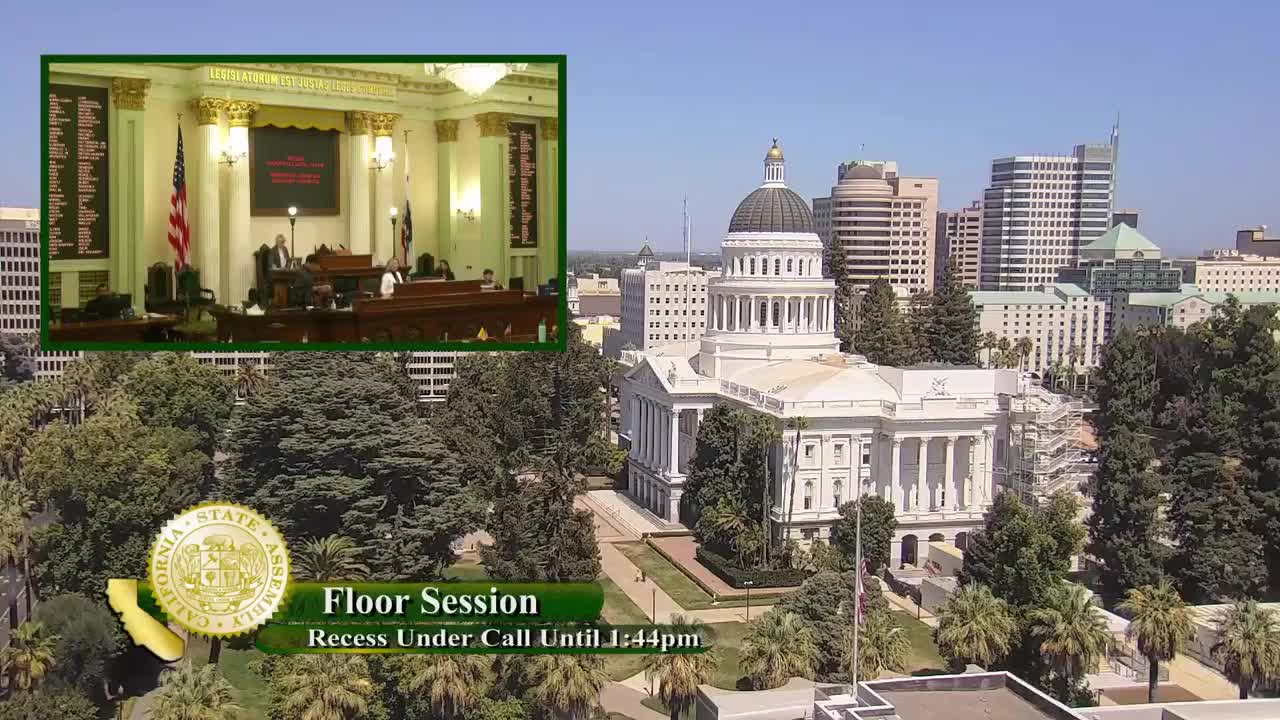 1MIN
Assembly Floor
 4MIN
Senate Floor
 1MIN
Senate Standing Committee on Appropriations
 8MIN
Senate Standing Committee on Judiciary
 12MIN
Senate Standing Committee on Elections and Constitutional Amendments
 2MIN
Assembly Floor
 14MIN
Assembly Standing Committee on Judiciary
 15MIN