AB 2842: Firearms.
- Session Year: 2023-2024
- House: Assembly
- Latest Version Date: 2024-09-24
Current Status:
Passed
(2024-09-24: Chaptered by Secretary of State - Chapter 537, Statutes of 2024.)
Introduced
In Committee
First Chamber
In Committee
Second Chamber
Enacted
Existing law requires that a weapon acquired by a specified governmental entity under specified circumstances, including as part of a gun-buyback program, be destroyed.
This bill would require a law enforcement agency that contracts with a third party for the destruction of firearms or weapons to ensure that the contract for those services prohibits the sale of any parts of, or attachments to, the firearm or other weapon, as specified.
The bill would also exempt from the destruction requirement, any firearm obtained through a gun-buyback program that is donated to a historical society, museum, or institutional collection, as specified.
By requiring a higher level of service for local agencies, this bill would impose a state-mandated local program.
This bill would incorporate additional changes to Section 18005 of the Penal Code proposed by SB 1019 and AB 2739 to be operative only if this bill and either one or both of those bills are enacted and this bill is enacted last.
The California Constitution requires the state to reimburse local agencies and school districts for certain costs mandated by the state. Statutory provisions establish procedures for making that reimbursement.
This bill would provide that, if the Commission on State Mandates determines that the bill contains costs mandated by the state, reimbursement for those costs shall be made pursuant to the statutory provisions noted above.
Existing law requires that a weapon acquired by a specified governmental entity under specified circumstances, including as part of a gun-buyback program, be destroyed.
This bill would require a law enforcement agency that contracts with a third party for the destruction of firearms or weapons to ensure that the contract for those services prohibits the sale of any parts of, or attachments to, the firearm or other weapon, as specified.
The bill would also exempt from the destruction requirement, any firearm obtained through a gun-buyback program that is donated to a historical society, museum, or institutional collection, as specified.
By requiring a higher level of service for local agencies, this bill would impose a state-mandated local program.
The California Constitution requires the state to reimburse local agencies and school districts for certain costs mandated by the state. Statutory provisions establish procedures for making that reimbursement.
This bill would provide that, if the Commission on State Mandates determines that the bill contains costs mandated by the state, reimbursement for those costs shall be made pursuant to the statutory provisions noted above.
Existing law requires that a weapon acquired by a specified governmental entity under specified circumstances, including as part of a gun-buyback program program, be sold or destroyed.
This bill would state the intent of the Legislature to enact legislation prohibiting the resale of confiscated firearms and firearms obtained through buyback programs, in whole or in part, in California.This bill would require a law enforcement agency that contracts with a third party for the destruction of firearms or weapons to ensure that the contract for those services prohibits the sale of any parts of, or attachments to, the firearm or other weapon, as specified.
By requiring a higher level of service for local agencies, this bill would impose a state-mandated local program.
The California Constitution requires the state to reimburse local agencies and school districts for certain costs mandated by the state. Statutory provisions establish procedures for making that reimbursement.
This bill would provide that, if the Commission on State Mandates determines that the bill contains costs mandated by the state, reimbursement for those costs shall be made pursuant to the statutory provisions noted above.
Existing law requires that a weapon acquired by a specified governmental entity as part of a gun-buyback program be sold or destroyed.
This bill would state the intent of the Legislature to enact legislation prohibiting the resale of confiscated firearms and firearms obtained through buyback programs, in whole or in part, in California.
(a)An officer to whom a weapon is surrendered under Section 18000, except upon the certificate of a judge of a court of record, or of the district attorney of the county, that the retention thereof is necessary or proper to the ends of justice, shall destroy that weapon and, if applicable, submit proof of its destruction to the court.
(b)If any weapon has been stolen and is thereafter recovered from the thief or the thiefs transferee, or is used in a manner as to constitute a nuisance under Section 19190, 21390, 21590, or 29300, or subdivision (a) of Section 25700 without the prior knowledge of its lawful owner that it would be so used, it shall not be destroyed pursuant to subdivision (a) but shall be restored to the lawful owner, as soon as its use as evidence has been served, upon the lawful owners identification of the weapon and proof of ownership, and after the law enforcement agency has complied with Chapter 2 (commencing with Section 33850) of Division 11 of Title 4.
(c)No stolen weapon shall be destroyed pursuant to subdivision (a) unless reasonable notice is given to its lawful owner, if the lawful owners identity and address can be reasonably ascertained.
(d)If the weapon was evidence in a criminal case, the weapon shall be retained as required by Chapter 13 (commencing with Section 1417) of Title 10 of Part 2.
(e)(1)If a law enforcement agency contracts with a third party for the destruction of firearms or other weapons pursuant to this section or any other related law, the agency shall ensure that any such contract explicitly prohibits the sale of any firearm or weapon, or any part or attachment thereof.
(2)This subdivision is not intended to prohibit the recycling, or sale for the purpose of recycling, of any scrap metal or other material resulting from the destruction of a firearm or other weapon.
SEC. 1.1.Section 18005 of the Penal Code is amended to read:18005.(a)An officer to whom a weapon is surrendered under Section 18000, except upon the certificate of a judge of a court of record, or of the district attorney of the county, that the retention thereof is necessary or proper to the ends of justice, shall destroy that weapon and, if applicable, submit proof of its destruction to the court.
(b)If any weapon has been stolen and is thereafter recovered from the thief or the thiefs transferee, or is used in a manner as to constitute a nuisance under Section 19190, 21390, 21590, or 29300, or subdivision (a) of Section 25700 without the prior knowledge of its lawful owner that it would be so used, it shall not be destroyed pursuant to subdivision (a) but shall be restored to the lawful owner, as soon as its use as evidence has been served, upon the lawful owners identification of the weapon and proof of ownership, and after the law enforcement agency has complied with Chapter 2 (commencing with Section 33850) of Division 11 of Title 4.
(c)No stolen weapon shall be destroyed pursuant to subdivision (a) unless reasonable notice is given to its lawful owner, if the lawful owners identity and address can be reasonably ascertained.
(d)If the weapon was evidence in a criminal case, the weapon shall be retained as required by Chapter 13 (commencing with Section 1417) of Title 10 of Part 2.
(e)(1)Every law enforcement agency shall develop and maintain a written policy on the destruction of firearms and other weapons including, without limitation, policies for identifying firearms and other weapons that are required to be destroyed, keeping records of those firearms and other weapons, including entry into the Automated Firearms System, as applicable, and the destruction and disposal of those firearms and other weapons. A law enforcement agency that either contracts with, or operates under, a memorandum of understanding (MOU) with another agency for the storage or destruction of weapons or other firearms shall have a policy identifying the other agency and outlining the responsibilities of both agencies under the contract or MOU.
(2)Every law enforcement agency shall post the policy required by this subdivision on its internet website.
(f)As used in this section, the following terms are defined as follows:
(1)Destroy means to destroy a firearm or other weapon in its entirety by smelting, shredding, crushing, or cutting and shall include all parts including, without limitation, the frame or receiver, barrel, bolt, and grip of a firearm, as applicable, and any attachments including, but not limited to, a sight, scope, silencer, or suppressor, as applicable.
(2)Law enforcement agency means any police department, sheriffs department, or other department or agency of the state, or any political subdivision thereof, that employs any peace officer as described in Section 830.
(g)(1)If a law enforcement agency contracts with a third party for the destruction of firearms or other weapons pursuant to this section or any other related law, the agency shall ensure that any such contract explicitly prohibits the sale of any firearm or weapon, or any part or attachment thereof.
(2)This subdivision is not intended to prohibit the recycling, or sale for the purpose of recycling, of any scrap metal or other material resulting from the destruction of a firearm or other weapon.
(h)A law enforcement agency that had an existing contract with another person or entity for the destruction of firearms or other weapons prior to November 1, 2024, is not required to destroy a weapon pursuant to the requirements of subdivision (e) or (f) if any of those requirements would require the law enforcement agency to breach its contract with the other person or entity.
SEC. 1.3.Section 18005 of the Penal Code is amended to read:18005.(a)An officer to whom a weapon is surrendered under Section 18000, except upon the certificate of a judge of a court of record, or of the district attorney of the county, that the retention thereof is necessary or proper to the ends of justice, shall destroy that weapon and, if applicable, submit proof of its destruction to the court.
(b)If any weapon has been stolen and is thereafter recovered from the thief or the thiefs transferee, or is used in a manner as to constitute a nuisance under Section 19190, 21390, 21590, 25700, 26110, 26395, or 29300, without the prior knowledge of its lawful owner that it would be so used, it shall not be destroyed pursuant to subdivision (a) but shall be restored to the lawful owner, as soon as its use as evidence has been served, upon the lawful owners identification of the weapon and proof of ownership, and after the law enforcement agency has complied with Chapter 2 (commencing with Section 33850) of Division 11 of Title 4.
(c)No stolen weapon shall be destroyed pursuant to subdivision (a) unless reasonable notice is given to its lawful owner, if the lawful owners identity and address can be reasonably ascertained.
(d)If the weapon was evidence in a criminal case, the weapon shall be retained as required by Chapter 13 (commencing with Section 1417) of Title 10 of Part 2.
(e)(1)If a law enforcement agency contracts with a third party for the destruction of firearms or other weapons pursuant to this section or any other related law, the agency shall ensure that any such contract explicitly prohibits the sale of any firearm or weapon, or any part or attachment thereof.
(2)This subdivision is not intended to prohibit the recycling, or sale for the purpose of recycling, of any scrap metal or other material resulting from the destruction of a firearm or other weapon.
SEC. 1.5.Section 18005 of the Penal Code is amended to read:18005.(a)An officer to whom a weapon is surrendered under Section 18000, except upon the certificate of a judge of a court of record, or of the district attorney of the county, that the retention thereof is necessary or proper to the ends of justice, shall destroy that weapon and, if applicable, submit proof of its destruction to the court.
(b)If any weapon has been stolen and is thereafter recovered from the thief or the thiefs transferee, or is used in a manner as to constitute a nuisance under Section 19190, 21390, 21590, 25700, 26110, 26395, or 29300, without the prior knowledge of its lawful owner that it would be so used, it shall not be destroyed pursuant to subdivision (a) but shall be restored to the lawful owner, as soon as its use as evidence has been served, upon the lawful owners identification of the weapon and proof of ownership, and after the law enforcement agency has complied with Chapter 2 (commencing with Section 33850) of Division 11 of Title 4.
(c)No stolen weapon shall be destroyed pursuant to subdivision (a) unless reasonable notice is given to its lawful owner, if the lawful owners identity and address can be reasonably ascertained.
(d)If the weapon was evidence in a criminal case, the weapon shall be retained as required by Chapter 13 (commencing with Section 1417) of Title 10 of Part 2.
(e)(1)Every law enforcement agency shall develop and maintain a written policy on the destruction of firearms and other weapons including, without limitation, policies for identifying firearms and other weapons that are required to be destroyed, keeping records of those firearms and other weapons, including entry into the Automated Firearms System, as applicable, and the destruction and disposal of those firearms and other weapons. A law enforcement agency that either contracts with, or operates under, a memorandum of understanding (MOU) with another agency for the storage or destruction of weapons or other firearms shall have a policy identifying the other agency and outlining the responsibilities of both agencies under the contract or MOU.
(2)Every law enforcement agency shall post the policy required by this subdivision on its internet website.
(f)As used in this section, the following terms are defined as follows:
(1)Destroy means to destroy a firearm or other weapon in its entirety by smelting, shredding, crushing, or cutting and shall include all parts including, without limitation, the frame or receiver, barrel, bolt, and grip of a firearm, as applicable, and any attachments including, but not limited to, a sight, scope, silencer, or suppressor, as applicable.
(2)Law enforcement agency means any police department, sheriffs department, or other department or agency of the state, or any political subdivision thereof, that employs any peace officer as described in Section 830.
(g)(1)If a law enforcement agency contracts with a third party for the destruction of firearms or other weapons pursuant to this section or any other related law, the agency shall ensure that any such contract explicitly prohibits the sale of any firearm or weapon, or any part or attachment thereof.
(2)This subdivision is not intended to prohibit the recycling, or sale for the purpose of recycling, of any scrap metal or other material resulting from the destruction of a firearm or other weapon.
(h)A law enforcement agency that had an existing contract with another person or entity for the destruction of firearms or other weapons prior to November 1, 2024, is not required to destroy a weapon pursuant to the requirements of subdivision (e) or (f) if any of those requirements would require the law enforcement agency to breach its contract with the other person or entity.
SEC. 2.Section 26576 of the Penal Code is amended to read:26576.(a)Section 26500 does not apply to a sale, delivery, or transfer of firearms if both of the following requirements are satisfied:
(1)The sale, delivery, or transfer is to an authorized representative of a city, city and county, county, or state government, or of the federal government, and is for the governmental entity.
(2)The entity is acquiring the firearm as part of an authorized, voluntary program in which the entity is buying or receiving firearms from private individuals.
(b)Any weapons acquired pursuant to subdivision (a) of this section shall be disposed of pursuant to the applicable provisions of Section 34000 or Sections 18000 and 18005.
(c)(1)Notwithstanding subdivision (b), a firearm acquired pursuant to subdivision (a) may, in lieu of destruction, be donated to a public or private nonprofit historical society, museum, or institutional collection, subject to the provisions of Section 27855, including that the firearm be deactivated or rendered inoperable before delivery.
(2)For purposes of this and other sections in this title, deactivated or rendered inoperable means to render the firearm permanently inoperable by means including, without limitation, welding of the chamber, cutting of the barrel, chamber, or breech, plugging the barrel, or welding the bolt to the chamber.
SEC. 3.(a)Section 1.1 of this bill incorporates amendments to Section 18005 of the Penal Code proposed by both this bill and Senate Bill 1019. That section of this bill shall only become operative if (1) both bills are enacted and become effective on or before January 1, 2025, (2) each bill amends Section 18005 of the Penal Code, (3) Assembly Bill 2739 is not enacted or as enacted does not amend that section, and (4) this bill is enacted after Senate Bill 1019, in which case Sections 1, 1.3, and 1.5 of this bill shall not become operative.
(b)Section 1.3 of this bill incorporates amendments to Section 18005 of the Penal Code proposed by both this bill and Assembly Bill 2739. That section of this bill shall only become operative if (1) both bills are enacted and become effective on or before January 1, 2025, (2) each bill amends Section 18005 of the Penal Code, (3) Senate Bill 1019 is not enacted or as enacted does not amend that section, and (4) this bill is enacted after Assembly Bill 2739 in which case Sections 1, 1.1, and 1.5 of this bill shall not become operative.
(c)Section 1.5 of this bill incorporates amendments to Section 18005 of the Penal Code proposed by this bill, Senate Bill 1019, and Assembly Bill 2739. That section of this bill shall only become operative if (1) all three bills are enacted and become effective on or before January 1, 2025, (2) all three bills amend Section 18005 of the Penal Code, and (3) this bill is enacted after Senate Bill 1019 and Assembly Bill 2739, in which case Sections 1, 1.1, and 1.3 of this bill shall not become operative.
SEC. 4.If the Commission on State Mandates determines that this act contains costs mandated by the state, reimbursement to local agencies and school districts for those costs shall be made pursuant to Part 7 (commencing with Section 17500) of Division 4 of Title 2 of the Government Code.
(a)An officer to whom a weapon is surrendered under Section 18000, except upon the certificate of a judge of a court of record, or of the district attorney of the county, that the retention thereof is necessary or proper to the ends of justice, shall destroy that weapon and, if applicable, submit proof of its destruction to the court.
(b)If any weapon has been stolen and is thereafter recovered from the thief or the thiefs transferee, or is used in a manner as to constitute a nuisance under Section 19190, 21390, 21590, or 29300, or subdivision (a) of Section 25700 without the prior knowledge of its lawful owner that it would be so used, it shall not be destroyed pursuant to subdivision (a) but shall be restored to the lawful owner, as soon as its use as evidence has been served, upon the lawful owners identification of the weapon and proof of ownership, and after the law enforcement agency has complied with Chapter 2 (commencing with Section 33850) of Division 11 of Title 4.
(c)No stolen weapon shall be destroyed pursuant to subdivision (a) unless reasonable notice is given to its lawful owner, if the lawful owners identity and address can be reasonably ascertained.
(d)If the weapon was evidence in a criminal case, the weapon shall be retained as required by Chapter 13 (commencing with Section 1417) of Title 10 of Part 2.
(e)(1)If a law enforcement agency contracts with a third party for the destruction of firearms or other weapons pursuant to this section or any other related law, the agency shall ensure that any such contract explicitly prohibits the sale of any firearm or weapon, or any part or attachment thereof.
(2)This subdivision is not intended to prohibit the recycling, or sale for the purpose of recycling, of any scrap metal or other material resulting from the destruction of a firearm or other weapon.
SEC. 1.1.Section 18005 of the Penal Code is amended to read:18005.(a)An officer to whom a weapon is surrendered under Section 18000, except upon the certificate of a judge of a court of record, or of the district attorney of the county, that the retention thereof is necessary or proper to the ends of justice, shall destroy that weapon and, if applicable, submit proof of its destruction to the court.
(b)If any weapon has been stolen and is thereafter recovered from the thief or the thiefs transferee, or is used in a manner as to constitute a nuisance under Section 19190, 21390, 21590, or 29300, or subdivision (a) of Section 25700 without the prior knowledge of its lawful owner that it would be so used, it shall not be destroyed pursuant to subdivision (a) but shall be restored to the lawful owner, as soon as its use as evidence has been served, upon the lawful owners identification of the weapon and proof of ownership, and after the law enforcement agency has complied with Chapter 2 (commencing with Section 33850) of Division 11 of Title 4.
(c)No stolen weapon shall be destroyed pursuant to subdivision (a) unless reasonable notice is given to its lawful owner, if the lawful owners identity and address can be reasonably ascertained.
(d)If the weapon was evidence in a criminal case, the weapon shall be retained as required by Chapter 13 (commencing with Section 1417) of Title 10 of Part 2.
(e)(1)Every law enforcement agency shall develop and maintain a written policy on the destruction of firearms and other weapons including, without limitation, policies for identifying firearms and other weapons that are required to be destroyed, keeping records of those firearms and other weapons, including entry into the Automated Firearms System, as applicable, and the destruction and disposal of those firearms and other weapons. A law enforcement agency that either contracts with, or operates under, a memorandum of understanding (MOU) with another agency for the storage or destruction of weapons or other firearms shall have a policy identifying the other agency and outlining the responsibilities of both agencies under the contract or MOU.
(2)Every law enforcement agency shall post the policy required by this subdivision on its internet website.
(f)As used in this section, the following terms are defined as follows:
(1)Destroy means to destroy a firearm or other weapon in its entirety by smelting, shredding, crushing, or cutting and shall include all parts including, without limitation, the frame or receiver, barrel, bolt, and grip of a firearm, as applicable, and any attachments including, but not limited to, a sight, scope, silencer, or suppressor, as applicable.
(2)Law enforcement agency means any police department, sheriffs department, or other department or agency of the state, or any political subdivision thereof, that employs any peace officer as described in Section 830.
(g)(1)If a law enforcement agency contracts with a third party for the destruction of firearms or other weapons pursuant to this section or any other related law, the agency shall ensure that any such contract explicitly prohibits the sale of any firearm or weapon, or any part or attachment thereof.
(2)This subdivision is not intended to prohibit the recycling, or sale for the purpose of recycling, of any scrap metal or other material resulting from the destruction of a firearm or other weapon.
(h)A law enforcement agency that had an existing contract with another person or entity for the destruction of firearms or other weapons prior to November 1, 2024, is not required to destroy a weapon pursuant to the requirements of subdivision (e) or (f) if any of those requirements would require the law enforcement agency to breach its contract with the other person or entity.
SEC. 1.3.Section 18005 of the Penal Code is amended to read:18005.(a)An officer to whom a weapon is surrendered under Section 18000, except upon the certificate of a judge of a court of record, or of the district attorney of the county, that the retention thereof is necessary or proper to the ends of justice, shall destroy that weapon and, if applicable, submit proof of its destruction to the court.
(b)If any weapon has been stolen and is thereafter recovered from the thief or the thiefs transferee, or is used in a manner as to constitute a nuisance under Section 19190, 21390, 21590, or 29300, or subdivision (a) of Section 25700 25700, 26110, 26395, or 29300, without the prior knowledge of its lawful owner that it would be so used, it shall not be destroyed pursuant to subdivision (a) but shall be restored to the lawful owner, as soon as its use as evidence has been served, upon the lawful owners identification of the weapon and proof of ownership, and after the law enforcement agency has complied with Chapter 2 (commencing with Section 33850) of Division 11 of Title 4.
(c)No stolen weapon shall be destroyed pursuant to subdivision (a) unless reasonable notice is given to its lawful owner, if the lawful owners identity and address can be reasonably ascertained.
(d)If the weapon was evidence in a criminal case, the weapon shall be retained as required by Chapter 13 (commencing with Section 1417) of Title 10 of Part 2.
(e)(1)If a law enforcement agency contracts with a third party for the destruction of firearms or other weapons pursuant to this section or any other related law, the agency shall ensure that any such contract explicitly prohibits the sale of any firearm or weapon, or any part or attachment thereof.
(2)This subdivision is not intended to prohibit the recycling, or sale for the purpose of recycling, of any scrap metal or other material resulting from the destruction of a firearm or other weapon.
SEC. 1.5.Section 18005 of the Penal Code is amended to read:18005.(a)An officer to whom a weapon is surrendered under Section 18000, except upon the certificate of a judge of a court of record, or of the district attorney of the county, that the retention thereof is necessary or proper to the ends of justice, shall destroy that weapon and, if applicable, submit proof of its destruction to the court.
(b)If any weapon has been stolen and is thereafter recovered from the thief or the thiefs transferee, or is used in a manner as to constitute a nuisance under Section 19190, 21390, 21590, or 29300, or subdivision (a) of Section 25700 25700, 26110, 26395, or 29300, without the prior knowledge of its lawful owner that it would be so used, it shall not be destroyed pursuant to subdivision (a) but shall be restored to the lawful owner, as soon as its use as evidence has been served, upon the lawful owners identification of the weapon and proof of ownership, and after the law enforcement agency has complied with Chapter 2 (commencing with Section 33850) of Division 11 of Title 4.
(c)No stolen weapon shall be destroyed pursuant to subdivision (a) unless reasonable notice is given to its lawful owner, if the lawful owners identity and address can be reasonably ascertained.
(d)If the weapon was evidence in a criminal case, the weapon shall be retained as required by Chapter 13 (commencing with Section 1417) of Title 10 of Part 2.
(e)(1)Every law enforcement agency shall develop and maintain a written policy on the destruction of firearms and other weapons including, without limitation, policies for identifying firearms and other weapons that are required to be destroyed, keeping records of those firearms and other weapons, including entry into the Automated Firearms System, as applicable, and the destruction and disposal of those firearms and other weapons. A law enforcement agency that either contracts with, or operates under, a memorandum of understanding (MOU) with another agency for the storage or destruction of weapons or other firearms shall have a policy identifying the other agency and outlining the responsibilities of both agencies under the contract or MOU.
(2)Every law enforcement agency shall post the policy required by this subdivision on its internet website.
(f)As used in this section, the following terms are defined as follows:
(1)Destroy means to destroy a firearm or other weapon in its entirety by smelting, shredding, crushing, or cutting and shall include all parts including, without limitation, the frame or receiver, barrel, bolt, and grip of a firearm, as applicable, and any attachments including, but not limited to, a sight, scope, silencer, or suppressor, as applicable.
(2)Law enforcement agency means any police department, sheriffs department, or other department or agency of the state, or any political subdivision thereof, that employs any peace officer as described in Section 830.
(g)(1)If a law enforcement agency contracts with a third party for the destruction of firearms or other weapons pursuant to this section or any other related law, the agency shall ensure that any such contract explicitly prohibits the sale of any firearm or weapon, or any part or attachment thereof.
(2)This subdivision is not intended to prohibit the recycling, or sale for the purpose of recycling, of any scrap metal or other material resulting from the destruction of a firearm or other weapon.
(h)A law enforcement agency that had an existing contract with another person or entity for the destruction of firearms or other weapons prior to November 1, 2024, is not required to destroy a weapon pursuant to the requirements of subdivision (e) or (f) if any of those requirements would require the law enforcement agency to breach its contract with the other person or entity.
SEC. 2.Section 26576 of the Penal Code is amended to read:26576.(a)Section 26500 does not apply to a sale, delivery, or transfer of firearms if both of the following requirements are satisfied:
(1)The sale, delivery, or transfer is to an authorized representative of a city, city and county, county, or state government, or of the federal government, and is for the governmental entity.
(2)The entity is acquiring the firearm as part of an authorized, voluntary program in which the entity is buying or receiving firearms from private individuals.
(b)Any weapons acquired pursuant to subdivision (a) of this section shall be disposed of pursuant to the applicable provisions of Section 34000 or Sections 18000 and 18005.
(c)(1)Notwithstanding subdivision (b), a firearm acquired pursuant to subdivision (a) may, in lieu of destruction, be donated to a public or private nonprofit historical society, museum, or institutional collection, subject to the provisions of Section 27855, including that the firearm be deactivated or rendered inoperable before delivery.
(2)For purposes of this and other sections in this title, deactivated or rendered inoperable means to render the firearm permanently inoperable by means including, without limitation, welding of the chamber, cutting of the barrel, chamber, or breech, plugging the barrel, or welding the bolt to the chamber.
SEC. 3.(a)Section 1.1 of this bill incorporates amendments to Section 18005 of the Penal Code proposed by both this bill and Senate Bill 1019. That section of this bill shall only become operative if (1) both bills are enacted and become effective on or before January 1, 2025, (2) each bill amends Section 18005 of the Penal Code, (3) Assembly Bill 2739 is not enacted or as enacted does not amend that section, and (4) this bill is enacted after Senate Bill 1019, in which case Sections 1, 1.3, and 1.5 of this bill shall not become operative.
(b)Section 1.3 of this bill incorporates amendments to Section 18005 of the Penal Code proposed by both this bill and Assembly Bill 2739. That section of this bill shall only become operative if (1) both bills are enacted and become effective on or before January 1, 2025, (2) each bill amends Section 18005 of the Penal Code, (3) Senate Bill 1019 is not enacted or as enacted does not amend that section, and (4) this bill is enacted after Assembly Bill 2739 in which case Sections 1, 1.1, and 1.5 of this bill shall not become operative.
(c)Section 1.5 of this bill incorporates amendments to Section 18005 of the Penal Code proposed by this bill, Senate Bill 1019, and Assembly Bill 2739. That section of this bill shall only become operative if (1) all three bills are enacted and become effective on or before January 1, 2025, (2) all three bills amend Section 18005 of the Penal Code, and (3) this bill is enacted after Senate Bill 1019 and Assembly Bill 2739, in which case Sections 1, 1.1, and 1.3 of this bill shall not become operative.
SEC. 3.SEC. 4.If the Commission on State Mandates determines that this act contains costs mandated by the state, reimbursement to local agencies and school districts for those costs shall be made pursuant to Part 7 (commencing with Section 17500) of Division 4 of Title 2 of the Government Code.
(a)An officer to whom a weapon is surrendered under Section 18000, except upon the certificate of a judge of a court of record, or of the district attorney of the county, that the retention thereof is necessary or proper to the ends of justice, shall destroy that weapon and, if applicable, submit proof of its destruction to the court.
(b)If any weapon has been stolen and is thereafter recovered from the thief or the thiefs transferee, or is used in a manner as to constitute a nuisance under Section 19190, 21390, 21590, or 29300, or subdivision (a) of Section 25700 without the prior knowledge of its lawful owner that it would be so used, it shall not be destroyed pursuant to subdivision (a) but shall be restored to the lawful owner, as soon as its use as evidence has been served, upon the lawful owners identification of the weapon and proof of ownership, and after the law enforcement agency has complied with Chapter 2 (commencing with Section 33850) of Division 11 of Title 4.
(c)No stolen weapon shall be destroyed pursuant to subdivision (a) unless reasonable notice is given to its lawful owner, if the lawful owners identity and address can be reasonably ascertained.
(d)If the weapon was evidence in a criminal case, the weapon shall be retained as required by Chapter 13 (commencing with Section 1417) of Title 10 of Part 2.
(e)(1)If a law enforcement agency contracts with a third party for the destruction of firearms or other weapons pursuant to this section or any other related law, the agency shall ensure that any such contract explicitly prohibits the sale of any firearm or weapon, or any part or attachment thereof.
(2)This subdivision is not intended to prohibit the recycling, or sale for the purpose of recycling, of any scrap metal or other material resulting from the destruction of a firearm or other weapon.
SEC. 2.Section 26576 of the Penal Code is amended to read:26576.(a)Section 26500 does not apply to a sale, delivery, or transfer of firearms if both of the following requirements are satisfied:
(1)The sale, delivery, or transfer is to an authorized representative of a city, city and county, county, or state government, or of the federal government, and is for the governmental entity.
(2)The entity is acquiring the firearm as part of an authorized, voluntary program in which the entity is buying or receiving firearms from private individuals.
(b)Any weapons acquired pursuant to subdivision (a) of this section shall be disposed of pursuant to the applicable provisions of Section 34000 or Sections 18000 and 18005.
(c)(1)Notwithstanding subdivision (b), a firearm acquired pursuant to subdivision (a) may, in lieu of destruction, be donated to a public or private nonprofit historical society, museum, or institutional collection, subject to the provisions of Section 27860, 27855, including that the firearm be deactivated or rendered inoperable before delivery.
(2)For purposes of this and other sections in this title, deactivated or rendered inoperable means to render the firearm permanently inoperable by means including, without limitation, welding of the chamber, cutting of the barrel, chamber, or breech, plugging the barrel, or welding the bolt to the chamber.
SEC. 3.If the Commission on State Mandates determines that this act contains costs mandated by the state, reimbursement to local agencies and school districts for those costs shall be made pursuant to Part 7 (commencing with Section 17500) of Division 4 of Title 2 of the Government Code.
(a)An officer to whom a weapon is surrendered under Section 18000, except upon the certificate of a judge of a court of record, or of the district attorney of the county, that the retention thereof is necessary or proper to the ends of justice, shall destroy that weapon and, if applicable, submit proof of its destruction to the court.
(b)If any weapon has been stolen and is thereafter recovered from the thief or the thiefs transferee, or is used in a manner as to constitute a nuisance under Section 19190, 21390, 21590, or 29300, or subdivision (a) of Section 25700 without the prior knowledge of its lawful owner that it would be so used, it shall not be destroyed pursuant to subdivision (a) but shall be restored to the lawful owner, as soon as its use as evidence has been served, upon the lawful owners identification of the weapon and proof of ownership, and after the law enforcement agency has complied with Chapter 2 (commencing with Section 33850) of Division 11 of Title 4.
(c)No stolen weapon shall be destroyed pursuant to subdivision (a) unless reasonable notice is given to its lawful owner, if the lawful owners identity and address can be reasonably ascertained.
(d)If the weapon was evidence in a criminal case, the weapon shall be retained as required by Chapter 13 (commencing with Section 1417) of Title 10 of Part 2.
(e)(1)If a law enforcement agency contracts with a third party for the destruction of firearms or other weapons pursuant to this section or any other related law, the agency shall ensure that any such contract explicitly prohibits the sale of any firearm or weapon, or any part or attachment thereof.
(2)This subdivision is not intended to prohibit the recycling, or sale for the purpose of recycling, of any scrap metal or other material resulting from the destruction of a firearm or other weapon.
SEC. 2.Section 26576 of the Penal Code is amended to read:26576.(a)Section 26500 does not apply to a sale, delivery, or transfer of firearms if both of the following requirements are satisfied:
(1)The sale, delivery, or transfer is to an authorized representative of a city, city and county, county, or state government, or of the federal government, and is for the governmental entity.
(2)The entity is acquiring the firearm as part of an authorized, voluntary program in which the entity is buying or receiving firearms from private individuals.
(b)Any weapons acquired pursuant to subdivision (a) of this section shall be disposed of pursuant to the applicable provisions of Section 34000 or Sections 18000 and 18005.
(c)(1)Notwithstanding subdivision (b), a firearm acquired pursuant to subdivision (a) may, in lieu of destruction, be donated to a public or private nonprofit historical society, museum, or institutional collection, subject to the provisions of Section 27860, including that the firearm be deactivated or rendered inoperable before delivery.
(2)For purposes of this and other sections in this title, deactivated or rendered inoperable means to render the firearm permanently inoperable by means including, without limitation, welding of the chamber, cutting of the barrel, chamber, or breech, plugging the barrel, or welding the bolt to the chamber.
SEC. 2.SEC. 3.If the Commission on State Mandates determines that this act contains costs mandated by the state, reimbursement to local agencies and school districts for those costs shall be made pursuant to Part 7 (commencing with Section 17500) of Division 4 of Title 2 of the Government Code.
(a)An officer to whom a weapon is surrendered under Section 18000, except upon the certificate of a judge of a court of record, or of the district attorney of the county, that the retention thereof is necessary or proper to the ends of justice, shall destroy that weapon and, if applicable, submit proof of its destruction to the court.
(b)If any weapon has been stolen and is thereafter recovered from the thief or the thiefs transferee, or is used in a manner as to constitute a nuisance under Section 19190, 21390, 21590, or 29300, or subdivision (a) of Section 25700 without the prior knowledge of its lawful owner that it would be so used, it shall not be destroyed pursuant to subdivision (a) but shall be restored to the lawful owner, as soon as its use as evidence has been served, upon the lawful owners identification of the weapon and proof of ownership, and after the law enforcement agency has complied with Chapter 2 (commencing with Section 33850) of Division 11 of Title 4.
(c)No stolen weapon shall be destroyed pursuant to subdivision (a) unless reasonable notice is given to its lawful owner, if the lawful owners identity and address can be reasonably ascertained.
(d)If the weapon was evidence in a criminal case, the weapon shall be retained as required by Chapter 13 (commencing with Section 1417) of Title 10 of Part 2.
(e)(1)If a law enforcement agency contracts with a third party for the destruction of firearms or other weapons pursuant to this section or any other related law, the agency shall ensure that any such contract explicitly prohibits the sale of any firearm or weapon, or any part or attachment thereof.
(2)This subdivision is not intended to prohibit the recycling, or sale for the purpose of recycling, of any scrap metal or other material resulting from the destruction of a firearm or other weapon.
SEC. 2.If the Commission on State Mandates determines that this act contains costs mandated by the state, reimbursement to local agencies and school districts for those costs shall be made pursuant to Part 7 (commencing with Section 17500) of Division 4 of Title 2 of the Government Code.
SECTION 1.It is the intent of the Legislature to enact legislation prohibiting the resale of confiscated firearms and firearms obtained through buyback programs, in whole or in part, in California.It is the intent of the Legislature to enact legislation prohibiting the resale of confiscated firearms and firearms obtained through buyback programs, in whole or in part, in California.
|
Date
|
Status
|
|---|---|
| Sep 24, 2024 | Chaptered by Secretary of State - Chapter 537, Statutes of 2024. |
| Sep 24, 2024 | Approved by the Governor. |
| Sep 13, 2024 | Enrolled and presented to the Governor at 4 p.m. |
| Aug 31, 2024 | Senate amendments concurred in. To Engrossing and Enrolling. (Ayes 75. Noes 1.). |
| Aug 31, 2024 | In Assembly. Concurrence in Senate amendments pending. |
| Aug 30, 2024 | Read third time. Passed. Ordered to the Assembly. (Ayes 38. Noes 0.). |
| Aug 26, 2024 | Read second time. Ordered to third reading. |
| Aug 23, 2024 | Read third time and amended. Ordered to second reading. |
| Aug 19, 2024 | Read second time. Ordered to third reading. |
| Aug 15, 2024 | Read second time and amended. Ordered returned to second reading. |
| Aug 15, 2024 | From committee: Amend, and do pass as amended. (Ayes 7. Noes 0.) (August 15). |
| Jun 24, 2024 | In committee: Referred to suspense file. |
| Jun 11, 2024 | From committee: Do pass and re-refer to Com. on APPR. (Ayes 5. Noes 0.) (June 11). Re-referred to Com. on APPR. |
| May 30, 2024 | From committee chair, with author's amendments: Amend, and re-refer to committee. Read second time, amended, and re-referred to Com. on PUB S. |
| May 22, 2024 | Referred to Com. on PUB S. |
| May 9, 2024 | In Senate. Read first time. To Com. on RLS. for assignment. |
| May 9, 2024 | Read third time. Passed. Ordered to the Senate. (Ayes 65. Noes 0. Page 5161.) |
| May 2, 2024 | Read second time. Ordered to Consent Calendar. |
| May 1, 2024 | From committee: Do pass. To Consent Calendar. (Ayes 14. Noes 0.) (May 1). |
| Apr 17, 2024 | From committee: Do pass and re-refer to Com. on APPR. with recommendation: To Consent Calendar. (Ayes 8. Noes 0.) (April 16). Re-referred to Com. on APPR. |
| Mar 19, 2024 | Re-referred to Com. on PUB. S. |
| Mar 18, 2024 | Referred to Com. on PUB. S. |
| Mar 18, 2024 | From committee chair, with author's amendments: Amend, and re-refer to Com. on PUB. S. Read second time and amended. |
| Feb 16, 2024 | From printer. May be heard in committee March 17. |
| Feb 15, 2024 | Read first time. To print. |
|
Date
|
Description
|
Location
|
Votes
|
|
|---|---|---|---|---|
| Aug 31, 2024 | AB 2842 Papan Concurrence in Senate Amendments | Assembly Floor |
Passed |
|
| Aug 30, 2024 | Assembly 3rd Reading AB2842 Papan et al. By Blakespear | Senate Floor |
Passed |
|
| Aug 15, 2024 | Do pass as amended | Senate Standing Committee on Appropriations |
Passed |
|
| Jun 24, 2024 | Placed on suspense file | Senate Standing Committee on Appropriations |
Passed |
|
| Jun 11, 2024 | Do pass, but first be re-referred to the Committee on [Appropriations] | Senate Standing Committee on Public Safety |
Passed |
|
| May 9, 2024 | AB 2842 Papan Consent Calendar Second Day Regular Session | Assembly Floor |
Passed |
|
| May 1, 2024 | Do pass. To Consent Calendar. | Assembly Standing Committee on Appropriations |
Passed |
|
| Apr 16, 2024 | Do pass and be re-referred to the Committee on [Appropriations] with recommendation: To Consent Calendar | Assembly Standing Committee on Public Safety |
Passed |
This list shows positions taken on this bill by organizations on the date displayed, which is linked to the original source.
Positions by individuals are not included.
|
Organization
|
Position
|
Date
|
|---|---|---|
| Brady California | ** Support | |
| City of Berkeley | ** Support | |
| City Of Oakland | ** Support | |
| City of South San Francisco | ** Support | |
| Everytown for Gun Safety Action Fund | ** Support | |
| Giffords | ** Support | |
| Moms Demand Action | ** Support | |
| Peace Officer Research Association of California | ** Support | |
| Students Demand Action | ** Support |
CONCURRENCE IN SENATE AMENDMENTS
CSA1 Bill Id:AB 2842
Author:(Papan)
As Amended Ver:August 23, 2024
Majority vote
SUMMARY
Requires law enforcement agencies that contract for the destruction of firearms to ensure that such contracts prohibit the sale of firearms or any part or attachment of firearms.
Senate Amendments
- Provide that a firearm acquired by an authorized representative of a government entity, as specified, that are for the governmental entity, or acquired as part of authorized voluntary programs where the entity buys or receives firearms from private individuals, may, in lieu of destruction, be donated to a public or private nonprofit historical society, museum, or institutional collection, as specified, and that the firearm be deactivated or rendered inoperable before delivery.
- Define "deactivated or rendered inoperable" as "to render the firearm permanently inoperable by means including, without limitation, welding of the chamber, cutting of the barrel, chamber, or breech, plugging the barrel, or welding the bolt to the chamber."
- Double-joint this bill with AB 2739 (Maienschein) and SB 1019 (Blakespear) to avoid chaptering issues.
COMMENTS
As passed by the Assembly, this bill:
- Required a law enforcement agency that contracts with a third party for the destruction of firearms or other weapons, to ensure that said contract explicitly prohibits the sale of any firearm or weapon, or any part or attachment of said firearm.
- Provided that this is not intended to prohibit the recycling, or sale for the purpose of recycling, of any scrap metal or other material resulting from the destruction of a firearm or other weapon.
According to the Author
"As a society, we must address the looming threat posed by the proliferation of ghost guns. These untraceable firearms represent a dangerous gap in our gun control laws, allowing individuals to bypass background checks and evade accountability. I was shocked to read the December 2023 New York Times article that highlighted an obvious gap in our system: law enforcement agencies are using 3rd party gun destruction companies to dispose of confiscated weapons, and the 3rd party companies are reselling leftover gun parts as "kits" to hobbyists. We have essentially created a legal pipeline for the creation of ghost guns.
"Not only does the prevalence of ghost guns undermine public safety efforts, it is highly unethical to think that portions of a weapon that were used in murder are being reused. AB 2842 simply stops the 3rd party companies from being able to resell gun parts, closing the loophole that allows these deadly weapons to proliferate unchecked."
Arguments in Support
According to Giffords, "[c]urrent law (Penal Code Section 18005) prohibits law enforcement from selling deadly weapons they seized or received or received custody under specified circumstances. This bill would address the deplorable practice highlighted by the New York Times by requiring that, when law enforcement agencies enter into contracts with vendors for the destruction of firearms, the contracts must prohibit the sale of the firearms or any parts or attachments.
"We abhor the recently-discovered practice of vendors' taking guns meant for destruction and selling the component parts for assembly into new guns. Indeed, Brady, Everytown and Giffords strongly support SB 1019, which addresses this same problem, albeit in a different manner. SB 1019 would ensure total destruction of unwanted firearms turned in during gun buyback programs and firearms confiscated by law enforcement during investigations, and require local law enforcement to develop a written, publicly available policy regarding the destruction of firearms in their possession. By requiring total destruction of firearms designated for destruction as in SB 1019 and mandating contractual provisions prohibiting the sale of firearms or parts designated for destruction as in AB 2842, the practice of releasing confiscated firearms or parts back into the community will be prevented."
Arguments in Opposition
No longer applicable.
FISCAL COMMENTS
According to the Senate Appropriations Committee,
"Unknown, potentially significant reimbursable costs (General Fund) to state and local law enforcement agencies who may be unable to offset their costs to they are unable to enter into contracts due to the obligations imposed by this bill. There are over 500 state and local law enforcement agencies in California, though not all state and local law enforcement agencies contract with third-parties for the destruction of firearms, actual costs will depend on how many and the size of the agencies that do, and the costs for each agency to review, update and renegotiate their contracts to ensure compliance with this bill. General Fund costs will depend on whether the duties imposed by this bill constitute a reimbursable state mandate, as determined by the Commission on State Mandates."
VOTES:
ASM PUBLIC SAFETY: 8-0-0
YES: McCarty, Alanis, Lackey, Stephanie Nguyen, Reyes, Ting, Wilson, Zbur
ASM APPROPRIATIONS: 14-0-1
YES: Wicks, Sanchez, Arambula, Bryan, Calderon, Wendy Carrillo, Dixon, Mike Fong, Grayson, Haney, Hart, Pellerin, Ta, Villapudua
ABS, ABST OR NV: Jim Patterson
ASSEMBLY FLOOR: 65-0-15
YES: Addis, Aguiar-Curry, Alanis, Alvarez, Arambula, Bauer-Kahan, Bennett, Berman, Boerner, Bonta, Bryan, Calderon, Juan Carrillo, Wendy Carrillo, Chen, Connolly, Davies, Dixon, Essayli, Mike Fong, Vince Fong, Friedman, Gallagher, Garcia, Gipson, Hart, Holden, Hoover, Irwin, Jackson, Jones-Sawyer, Kalra, Lackey, Lee, Lowenthal, Maienschein, McCarty, McKinnor, Muratsuchi, Ortega, Pacheco, Papan, Jim Patterson, Joe Patterson, Pellerin, Quirk-Silva, Ramos, Rendon, Reyes, Rodriguez, Blanca Rubio, Sanchez, Santiago, Soria, Ta, Valencia, Villapudua, Waldron, Ward, Weber, Wicks, Wilson, Wood, Zbur, Robert Rivas
ABS, ABST OR NV: Bains, Cervantes, Megan Dahle, Flora, Gabriel, Grayson, Haney, Low, Mathis, Stephanie Nguyen, Petrie-Norris, Luz Rivas, Schiavo, Ting, Wallis
SENATE FLOOR: 40-0-0
YES: Allen, Alvarado-Gil, Archuleta, Ashby, Atkins, Becker, Blakespear, Bradford, Caballero, Cortese, Dahle, Dodd, Durazo, Eggman, Glazer, Gonzalez, Grove, Hurtado, Jones, Laird, Limón, McGuire, Menjivar, Min, Newman, Nguyen, Niello, Ochoa Bogh, Padilla, Portantino, Roth, Rubio, Seyarto, Skinner, Smallwood-Cuevas, Stern, Umberg, Wahab, Wiener, Wilk
UPDATED
VERSION: August 23, 2024
CONSULTANT: Ilan Zur / PUB. S. / (916) 319-3744 FN: 0005029
SENATE RULES COMMITTEE Office of Senate Floor Analyses (916) 651-1520 Fax: (916) 327-4478 | AB 2842 |
THIRD READING
Bill No: AB 2842
Author: Papan (D), et al.
Amended: 8/23/24 in Senate
Vote: 21
SENATE PUBLIC SAFETY COMMITTEE: 5-0, 6/11/24
AYES: Wahab, Seyarto, Bradford, Skinner, Wiener
SENATE APPROPRIATIONS COMMITTEE: 7-0, 8/15/24
AYES: Caballero, Jones, Ashby, Becker, Bradford, Seyarto, Wahab
ASSEMBLY FLOOR: 65-0, 5/9/24 (Consent) - See last page for vote
SUBJECT: Firearms
SOURCE: Author
DIGEST:
This bill requires law enforcement agencies that contract with a third party for the destruction of firearms to ensure that such contracts prohibit the sale of those firearms or any part or attachment thereof.
Senate Floor Amendments of 8/23/24 resolve chaptering conflicts between this bill and SB 1019 (Blakespear).
ANALYSIS:
Existing law:
- States that when a firearm is taken into custody by a law enforcement officer, the officer shall issue the person who possessed the firearm a receipt describing the firearm, as specified, and listing any serial number or other identification on the firearm. (Pen. Code, §33800.)
- Establishes a detailed process governing the return or transfer of a firearm in the custody of a court or law enforcement agency. ((Pen. Code, §§ 33850 – 33895.)
- Provides that no law enforcement agency or court shall be required to retain any firearm or related device for more than 180 days after the owner has been notified that the property has been made available for return, and stipulates that an unclaimed firearm may be disposed of after the 180-day period. (Pen. Code, §§ 33875.)
- Provides that when any firearm is in the possession of any officer of the state, or of a county, city, or city and county, or of any campus of the University of California or the California State University, and the firearm is an exhibit filed in any criminal action or proceeding which is no longer needed or is unclaimed or abandoned property, which has been in the possession of the officer for at least 180 days, the firearm shall be sold, or destroyed, as provided. (Pen. Code § 34000, subd. (a).)
- Provides that any law enforcement agency that has custody of any firearms or any parts of firearms which are subject to destruction may, in lieu of destroying the weapons, retain and use any of them as may be useful in carrying out the official duties of the agency, including releasing weapons to another law enforcement agency for a similar use or turning over to the criminalistics laboratory of the DOJ or other local law enforcement entity, but must destroy the weapon when it is no longer needed by the agency for use in carrying out its official duties. (Pen. Code § 34005, subds. (b), (c).)
- Authorizes a law enforcement agency that has custody of any firearms or any parts of firearms that are subject to destruction to instead obtain a court order directing the release of the firearm to the sheriff, who must record the firearm in the Automated Firearms System (AFS), and may in turn loan out the firearm to the basic training academy so that the firearms may be used for educational purposes. (Pen. Code § 34005, subd. (d).)
- Provides that any weapon which is considered a nuisance under specified provisions of existing law shall be surrendered to the sheriff of a county, the chief of police or other head of a municipal police department of any city or city and county, the chief of police of any campus of the University of California or the California State University, or the Commissioner of the Highway Patrol (CHP). (Pen. Code § 18000, subd. (a).)
- Specifies that, for the purposes of the requirement above, the Commissioner of the CHP shall receive only weapons that were confiscated by a member of the CHP. (Pen. Code § 18000, subd. (b).)
- Provides that an officer to whom a weapon is surrendered, except upon receiving a certificate, as specified, stating that the retention of the weapon is necessary or proper to the ends of justice, shall destroy the weapon, and, if applicable, submit proof of its destruction to the court. (Pen. Code § 18005, subd. (a).)
- Specifies that if any weapon has been stolen and is thereafter recovered, or is used in a manner as to constitute a nuisance without the prior knowledge of its lawful owner that it would be so used, it shall not be destroyed per the above but rather restored to the lawful owner, as soon as its use as evidence has been served, upon the lawful owner’s identification of the weapon and proof of ownership, and after the law enforcement agency has complied with specified provisions of existing law governing the return or transfer of a firearm in the custody or control of a court or law enforcement agency. (Pen. Code § 18005, subd. (b).)
- Specifies that no weapon shall be destroyed per the requirement above unless reasonable notice is given to its lawful owner, if the lawful owner’s identity and address can be reasonable ascertained. (Pen. Code § 18005, subd. (c).)
- Authorizes the Attorney General, a district attorney, or a city attorney to bring an action to enjoin the manufacture, importation of, keeping for sale of, offering or exposing for sale, giving, lending, or possession of specified weapons, including various types of firearms and firearm precursor parts, and provides that those weapons shall be subject to confiscation and summary destruction, in the same manner specified in §18005, whenever they are found within the state. (Pen. Code § 18010.)
- Generally prohibits the sale, lease or transfer of firearms unless the person has been issued a license by the California Department of Justice, and establishes various exceptions to this prohibition. (Pen. Code §§26500 – 26625.)
- Provides that a license to sell firearms is subject to forfeiture for any violation of a number of specified prohibitions and requirements, with limited exceptions. (Pen. Code §§26800 – 26915.)
- Provides that the requirement that the sale, delivery, lease or transfer of a firearm be conducted by a licensed firearms dealer does not apply to the sale, delivery or transfer of a firearm to an authorized representative of a city, city and county, county, or state government, or of the federal government, where the firearm is being acquired for the governmental entity, and the entity is acquiring the firearm as part of an authorized, voluntary program in which the entity is buying or receiving firearms from private individuals (i.e. a gun buyback program). (Pen. Code § 26576, subd. (a).)
- Provides that any weapons acquired pursuant to a program described above shall be destroyed pursuant to existing provisions regarding the destruction of firearms. (Pen. Code § 26576, subd. (b).)
This bill:
- Provides that if a law enforcement agency contracts with a third party for the destruction of firearms or other weapons pursuant existing law, the agency shall ensure that any such contract explicitly prohibits the sale of any firearm or weapon, or any part or attachment thereof.
- Provides that the above provision is not intended to prohibit the recycling, or sale for the purpose of recycling, of any scrap metal or other material resulting from the destruction of a firearm or other weapon.
- Provides that a firearm acquired pursuant to a buyback program described above may, in lieu of destruction, be donated to a public or private nonprofit historical society, museum, or institutional collection, subject to specified provisions of existing law related to firearm transfers to such entities, including that the firearm be deactivated or rendered inoperable before delivery.
- Defines “deactivated or rendered inoperable” as meaning “to render the firearm permanently inoperable by means including, without limitation, welding of the chamber, cutting of the barrel, chamber or breech, plugging the barrel, or welding the bold to the chamber.
Comments
According to the Author, “This bill seeks to close the loophole that allows confiscated weapons to be resurrected in ghost form. There is a gap in our system that has enhanced the proliferation of untraceable firearms or "ghost guns" that allow individuals to bypass background checks and evade accountability. Law enforcement agencies use 3rd party gun destruction companies to dispose of confiscated weapons. The problem is that these 3rd party companies only destroy a part of the firearms. They resell leftover gun parts as “kits”. Purchasers of the gun "kits" then use 3-D printers to re-create the destroyed piece and combine it with the kits to create ghost guns. The prevalence of ghost guns are threat to public safety. AB 2842 stops the 3rd party companies from being able to resell gun parts, thereby stopping the supply of parts to create ghost guns.”
Law enforcement agencies routinely acquire and retain possession of firearms in the course of their investigatory duties, and must follow a specific process for their disposal set forth in California law. Generally, law enforcement agencies are not required to retain possession of seized or recovered firearms, ammunition feeding devices, or ammunition for more than 180 days after the owner (if one can be identified) has been notified, and may dispose of the firearm, feeding device, or ammunition once the 180-day period has expired. Moreover, existing law requires that firearms in the possession of law enforcement for at least 180 days and that were exhibits in criminal actions but no longer needed, or were unclaimed or abandoned, must be destroyed. Although exemptions exist for use of those weapons by law enforcement agencies for a limited time to carry out the duties of the agency, and for specified training purposes, the firearms must be destroyed when they are no longer needed. Additionally, existing law requires that specified prohibited firearms and crime guns (i.e. guns defined as a “nuisance”) be surrendered to a law enforcement agency, which in turn must destroy the weapon unless a court certifies that retention of the weapon is “necessary or proper to the end of justice.”
This bill requires a law enforcement agency that contracts with a third party for the destruction of firearms or other weapons, to ensure that said contract explicitly prohibits the sale of any firearm or weapon, or any part or attachment thereof. The bill clarifies that it is not intended to prohibit the recycling, or sale for the purpose of recycling, of any scrap metal or other material resulting from the destruction of a firearm or other weapon. Additionally, the bill provides that guns acquired by law enforcement pursuant to a gun buyback program are not required to be destroyed if they are instead donated to a public or nonprofit historical society, museum, or institutional collection, subject to specified provisions of existing law related to firearm transfers to such entities, provided that the firearms are rendered permanently inoperable prior to delivery.
FISCAL EFFECT: Appropriation: No Fiscal Com.: Yes Local: Yes
According to the Senate Appropriations Committee:
“Unknown, potentially significant reimbursable costs (General Fund) to state and local law enforcement agencies who may be unable to offset their costs to they are unable to enter into contracts due to the obligations imposed by this bill. There are over 500 state and local law enforcement agencies in California, though not all state and local law enforcement agencies contract with third-parties for the destruction of firearms, actual costs will depend on how many and the size of the agencies that do, and the costs for each agency to review, update and renegotiate their contracts to ensure compliance with this bill. General Fund costs will depend on whether the duties imposed by this bill constitute a reimbursable state mandate, as determined by the Commission on State Mandates.”
SUPPORT: (Verified 8/23/24)
Brady California
City of Berkeley
City of Oakland
City of South San Francisco
Everytown for Gun Safety Action Fund
Giffords
Mom’s Demand Action
Peace Officer Research Association of California (PORAC)
Students Demand Action
OPPOSITION: (Verified 8/23/24)
None received
ASSEMBLY FLOOR: 65-0, 5/9/24
AYES: Addis, Aguiar-Curry, Alanis, Alvarez, Arambula, Bauer-Kahan, Bennett, Berman, Boerner, Bonta, Bryan, Calderon, Juan Carrillo, Wendy Carrillo, Chen, Connolly, Davies, Dixon, Essayli, Mike Fong, Vince Fong, Friedman, Gallagher, Garcia, Gipson, Hart, Holden, Hoover, Irwin, Jackson, Jones-Sawyer, Kalra, Lackey, Lee, Lowenthal, Maienschein, McCarty, McKinnor, Muratsuchi, Ortega, Pacheco, Papan, Jim Patterson, Joe Patterson, Pellerin, Quirk-Silva, Ramos, Rendon, Reyes, Rodriguez, Blanca Rubio, Sanchez, Santiago, Soria, Ta, Valencia, Villapudua, Waldron, Ward, Weber, Wicks, Wilson, Wood, Zbur, Robert Rivas
NO VOTE RECORDED: Bains, Cervantes, Megan Dahle, Flora, Gabriel, Grayson, Haney, Low, Mathis, Stephanie Nguyen, Petrie-Norris, Luz Rivas, Schiavo, Ting, Wallis
Prepared by: Alex Barnett / PUB. S. /
8/25/24 13:35:47
**** END ****
SENATE RULES COMMITTEE Office of Senate Floor Analyses (916) 651-1520 Fax: (916) 327-4478 | AB 2842 |
THIRD READING
Bill No: AB 2842
Author: Papan (D), et al.
Amended: 8/15/24 in Senate
Vote: 21
SENATE PUBLIC SAFETY COMMITTEE: 5-0, 6/11/24
AYES: Wahab, Seyarto, Bradford, Skinner, Wiener
SENATE APPROPRIATIONS COMMITTEE: 7-0, 8/15/24
AYES: Caballero, Jones, Ashby, Becker, Bradford, Seyarto, Wahab
ASSEMBLY FLOOR: 65-0, 5/9/24 (Consent) - See last page for vote
SUBJECT: Firearms
SOURCE: Author
DIGEST:
This bill requires law enforcement agencies that contract with a third party for the destruction of firearms to ensure that such contracts prohibit the sale of those firearms or any part or attachment thereof.
ANALYSIS:
Existing law:
- States that when a firearm is taken into custody by a law enforcement officer, the officer shall issue the person who possessed the firearm a receipt describing the firearm, as specified, and listing any serial number or other identification on the firearm. (Pen. Code, §33800.)
- Establishes a detailed process governing the return or transfer of a firearm in the custody of a court or law enforcement agency. ((Pen. Code, §§ 33850 – 33895.)
- Provides that no law enforcement agency or court shall be required to retain any firearm or related device for more than 180 days after the owner has been notified that the property has been made available for return, and stipulates that an unclaimed firearm may be disposed of after the 180-day period. (Pen. Code, §§ 33875.)
- Provides that when any firearm is in the possession of any officer of the state, or of a county, city, or city and county, or of any campus of the University of California or the California State University, and the firearm is an exhibit filed in any criminal action or proceeding which is no longer needed or is unclaimed or abandoned property, which has been in the possession of the officer for at least 180 days, the firearm shall be sold, or destroyed, as provided. (Pen. Code § 34000, subd. (a).)
- Provides that any law enforcement agency that has custody of any firearms or any parts of firearms which are subject to destruction may, in lieu of destroying the weapons, retain and use any of them as may be useful in carrying out the official duties of the agency, including releasing weapons to another law enforcement agency for a similar use or turning over to the criminalistics laboratory of the DOJ or other local law enforcement entity, but must destroy the weapon when it is no longer needed by the agency for use in carrying out its official duties. (Pen. Code § 34005, subds. (b), (c).)
- Authorizes a law enforcement agency that has custody of any firearms or any parts of firearms that are subject to destruction to instead obtain a court order directing the release of the firearm to the sheriff, who must record the firearm in the Automated Firearms System (AFS), and may in turn loan out the firearm to the basic training academy so that the firearms may be used for educational purposes. (Pen. Code § 34005, subd. (d).)
- Provides that any weapon which is considered a nuisance under specified provisions of existing law shall be surrendered to the sheriff of a county, the chief of police or other head of a municipal police department of any city or city and county, the chief of police of any campus of the University of California or the California State University, or the Commissioner of the Highway Patrol (CHP). (Pen. Code § 18000, subd. (a).)
- Specifies that, for the purposes of the requirement above, the Commissioner of the CHP shall receive only weapons that were confiscated by a member of the CHP. (Pen. Code § 18000, subd. (b).)
- Provides that an officer to whom a weapon is surrendered, except upon receiving a certificate, as specified, stating that the retention of the weapon is necessary or proper to the ends of justice, shall destroy the weapon, and, if applicable, submit proof of its destruction to the court. (Pen. Code § 18005, subd. (a).)
- Specifies that if any weapon has been stolen and is thereafter recovered, or is used in a manner as to constitute a nuisance without the prior knowledge of its lawful owner that it would be so used, it shall not be destroyed per the above but rather restored to the lawful owner, as soon as its use as evidence has been served, upon the lawful owner’s identification of the weapon and proof of ownership, and after the law enforcement agency has complied with specified provisions of existing law governing the return or transfer of a firearm in the custody or control of a court or law enforcement agency. (Pen. Code § 18005, subd. (b).)
- Specifies that no weapon shall be destroyed per the requirement above unless reasonable notice is given to its lawful owner, if the lawful owner’s identity and address can be reasonable ascertained. (Pen. Code § 18005, subd. (c).)
- Authorizes the Attorney General, a district attorney, or a city attorney to bring an action to enjoin the manufacture, importation of, keeping for sale of, offering or exposing for sale, giving, lending, or possession of specified weapons, including various types of firearms and firearm precursor parts, and provides that those weapons shall be subject to confiscation and summary destruction, in the same manner specified in §18005, whenever they are found within the state. (Pen. Code § 18010.)
- Generally prohibits the sale, lease or transfer of firearms unless the person has been issued a license by the California Department of Justice, and establishes various exceptions to this prohibition. (Pen. Code §§26500 – 26625.)
- Provides that a license to sell firearms is subject to forfeiture for any violation of a number of specified prohibitions and requirements, with limited exceptions. (Pen. Code §§26800 – 26915.)
- Provides that the requirement that the sale, delivery, lease or transfer of a firearm be conducted by a licensed firearms dealer does not apply to the sale, delivery or transfer of a firearm to an authorized representative of a city, city and county, county, or state government, or of the federal government, where the firearm is being acquired for the governmental entity, and the entity is acquiring the firearm as part of an authorized, voluntary program in which the entity is buying or receiving firearms from private individuals (i.e. a gun buyback program). (Pen. Code § 26576, subd. (a).)
- Provides that any weapons acquired pursuant to a program described above shall be destroyed pursuant to existing provisions regarding the destruction of firearms. (Pen. Code § 26576, subd. (b).)
This bill:
- Provides that if a law enforcement agency contracts with a third party for the destruction of firearms or other weapons pursuant existing law, the agency shall ensure that any such contract explicitly prohibits the sale of any firearm or weapon, or any part or attachment thereof.
- Provides that the above provision is not intended to prohibit the recycling, or sale for the purpose of recycling, of any scrap metal or other material resulting from the destruction of a firearm or other weapon.
- Provides that a firearm acquired pursuant to a buyback program described above may, in lieu of destruction, be donated to a public or private nonprofit historical society, museum, or institutional collection, subject to specified provisions of existing law related to firearm transfers to such entities, including that the firearm be deactivated or rendered inoperable before delivery.
- Defines “deactivated or rendered inoperable” as meaning “to render the firearm permanently inoperable by means including, without limitation, welding of the chamber, cutting of the barrel, chamber or breech, plugging the barrel, or welding the bold to the chamber.
Comments
According to the Author, “This bill seeks to close the loophole that allows confiscated weapons to be resurrected in ghost form. There is a gap in our system that has enhanced the proliferation of untraceable firearms or "ghost guns" that allow individuals to bypass background checks and evade accountability. Law enforcement agencies use 3rd party gun destruction companies to dispose of confiscated weapons. The problem is that these 3rd party companies only destroy a part of the firearms. They resell leftover gun parts as “kits”. Purchasers of the gun "kits" then use 3-D printers to re-create the destroyed piece and combine it with the kits to create ghost guns. The prevalence of ghost guns are threat to public safety. AB 2842 stops the 3rd party companies from being able to resell gun parts, thereby stopping the supply of parts to create ghost guns.”
Law enforcement agencies routinely acquire and retain possession of firearms in the course of their investigatory duties, and must follow a specific process for their disposal set forth in California law. Generally, law enforcement agencies are not required to retain possession of seized or recovered firearms, ammunition feeding devices, or ammunition for more than 180 days after the owner (if one can be identified) has been notified, and may dispose of the firearm, feeding device, or ammunition once the 180-day period has expired. Moreover, existing law requires that firearms in the possession of law enforcement for at least 180 days and that were exhibits in criminal actions but no longer needed, or were unclaimed or abandoned, must be destroyed. Although exemptions exist for use of those weapons by law enforcement agencies for a limited time to carry out the duties of the agency, and for specified training purposes, the firearms must be destroyed when they are no longer needed. Additionally, existing law requires that specified prohibited firearms and crime guns (i.e. guns defined as a “nuisance”) be surrendered to a law enforcement agency, which in turn must destroy the weapon unless a court certifies that retention of the weapon is “necessary or proper to the end of justice.”
This bill requires a law enforcement agency that contracts with a third party for the destruction of firearms or other weapons, to ensure that said contract explicitly prohibits the sale of any firearm or weapon, or any part or attachment thereof. The bill clarifies that it is not intended to prohibit the recycling, or sale for the purpose of recycling, of any scrap metal or other material resulting from the destruction of a firearm or other weapon. Additionally, the bill provides that guns acquired by law enforcement pursuant to a gun buyback program are not required to be destroyed if they are instead donated to a public or nonprofit historical society, museum, or institutional collection, subject to specified provisions of existing law related to firearm transfers to such entities, provided that the firearms are rendered permanently inoperable prior to delivery.
FISCAL EFFECT: Appropriation: No Fiscal Com.: Yes Local: Yes
According to the Senate Appropriations Committee:
“Unknown, potentially significant reimbursable costs (General Fund) to state and local law enforcement agencies who may be unable to offset their costs to they are unable to enter into contracts due to the obligations imposed by this bill. There are over 500 state and local law enforcement agencies in California, though not all state and local law enforcement agencies contract with third-parties for the destruction of firearms, actual costs will depend on how many and the size of the agencies that do, and the costs for each agency to review, update and renegotiate their contracts to ensure compliance with this bill. General Fund costs will depend on whether the duties imposed by this bill constitute a reimbursable state mandate, as determined by the Commission on State Mandates.”
SUPPORT: (Verified 8/14/24)
Brady California
City of Berkeley
City of Oakland
City of South San Francisco
Everytown for Gun Safety Action Fund
Giffords
Mom’s Demand Action
Peace Officer Research Association of California (PORAC)
Students Demand Action
OPPOSITION: (Verified 8/14/24)
None received
ASSEMBLY FLOOR: 65-0, 5/9/24
AYES: Addis, Aguiar-Curry, Alanis, Alvarez, Arambula, Bauer-Kahan, Bennett, Berman, Boerner, Bonta, Bryan, Calderon, Juan Carrillo, Wendy Carrillo, Chen, Connolly, Davies, Dixon, Essayli, Mike Fong, Vince Fong, Friedman, Gallagher, Garcia, Gipson, Hart, Holden, Hoover, Irwin, Jackson, Jones-Sawyer, Kalra, Lackey, Lee, Lowenthal, Maienschein, McCarty, McKinnor, Muratsuchi, Ortega, Pacheco, Papan, Jim Patterson, Joe Patterson, Pellerin, Quirk-Silva, Ramos, Rendon, Reyes, Rodriguez, Blanca Rubio, Sanchez, Santiago, Soria, Ta, Valencia, Villapudua, Waldron, Ward, Weber, Wicks, Wilson, Wood, Zbur, Robert Rivas
NO VOTE RECORDED: Bains, Cervantes, Megan Dahle, Flora, Gabriel, Grayson, Haney, Low, Mathis, Stephanie Nguyen, Petrie-Norris, Luz Rivas, Schiavo, Ting, Wallis
Prepared by: Alex Barnett / PUB. S. /
8/18/24 17:50:13
**** END ****
SENATE COMMITTEE ON
Senator Anna Caballero, Chair
2023 - 2024 Regular Session
AB 2842 (Papan) - Firearms
Version: | Policy Vote: |
Urgency: | Mandate: |
Hearing Date: | Consultant: |
Bill Summary:
AB 2842 would require law enforcement agencies that contract with a third party for the destruction of firearms to ensure that such contracts prohibit the sale of those firearms or any part or attachment thereof.
*********** ANALYSIS ADDENDUM – SUSPENSE FILE ***********
The following information is revised to reflect amendments
adopted by the committee on August 15, 2024
Fiscal Impact:
Unknown, potentially significant reimbursable costs (General Fund) to state and local law enforcement agencies who may be unable to offset their costs to they are unable to enter into contracts due to the obligations imposed by this bill. There are over 500 state and local law enforcement agencies in California, though not all state and local law enforcement agencies contract with third-parties for the destruction of firearms, actual costs will depend on how many and the size of the agencies that do, and the costs for each agency to review, update and renegotiate their contracts to ensure compliance with this bill. General Fund costs will depend on whether the duties imposed by this bill constitute a reimbursable state mandate, as determined by the Commission on State Mandates.
Author Amendments:
The amendments add co-authors and make a technical change to correct a cross-reference.
-- END --
SENATE COMMITTEE ON
Senator Anna Caballero, Chair
2023 - 2024 Regular Session
AB 2842 (Papan) - Firearms
Version: | Policy Vote: |
Urgency: | Mandate: |
Hearing Date: | Consultant: |
Bill Summary:
AB 2842 would require law enforcement agencies that contract with a third party for the destruction of firearms to ensure that such contracts prohibit the sale of those firearms or any part or attachment thereof.
Fiscal Impact:
Unknown, potentially significant reimbursable costs (General Fund) to state and local law enforcement agencies who may be unable to offset their costs to they are unable to enter into contracts due to the obligations imposed by this bill. There are over 500 state and local law enforcement agencies in California, though not all state and local law enforcement agencies contract with third-parties for the destruction of firearms, actual costs will depend on how many and the size of the agencies that do, and the costs for each agency to review, update and renegotiate their contracts to ensure compliance with this bill. General Fund costs will depend on whether the duties imposed by this bill constitute a reimbursable state mandate, as determined by the Commission on State Mandates.
Background:
Law enforcement agencies acquire firearms from the communities they serve for a host of reasons and in a variety of ways; they are seized in enforcement actions, relinquished or surrendered by individuals prohibited from possessing them, purchased in gun buyback programs, and sometimes found abandoned. Many jurisdictions, including California, have requirements that firearms acquired in these various ways be destroyed if or when they cannot be returned to a legal owner. In several of these jurisdictions, the guns are not in fact destroyed so as to render them completely inoperable, but rather sent to companies that crush or cut a single piece of the gun that constitutes the “firearm” under federal law and sells the remaining parts as a kit.
Proposed Law:
This bill requires a law enforcement agency that contracts with a third party for the destruction of firearms or other weapons, to ensure that said contract explicitly prohibits the sale of any firearm or weapon, or any part or attachment thereof. The bill clarifies that it is not intended to prohibit the recycling, or sale for the purpose of recycling, of any scrap metal or other material resulting from the destruction of a firearm or other weapon. Additionally, the bill provides that guns acquired by law enforcement pursuant to a gun buyback program are not required to be destroyed if they are instead donated to a public or nonprofit historical society, museum, or institutional collection, subject to specified provisions of existing law related to firearm transfers to such entities, provided that the firearms are rendered permanently inoperable prior to delivery.
Related Legislation:
- SB 1019 (Blakespear), of the 2023-2024 Legislative Session, requires law enforcement agencies to destroy firearms subject to destruction under existing law in their entirety and to develop and make available on its website a written policy regarding the destruction of firearms. SB 1019 is pending in Assembly Appropriations Committee.
- AB 733 (Fong), of the 2023-2024 Legislative Session, would have prohibited, commencing January 1, 2025, governmental agencies within the state from selling firearms, ammunition, or body armor, except as specified. AB 733 was vetoed by the Governor.
- AB 200 (Ting), Chapter 58, Statutes of 2022, required law enforcement agencies to destroy firearms that were surrendered to them.
- Proposition 63 of the November 2016 general election, stated, in part, that law enforcement agencies could sell firearms relinquished to them due to a felony or specified misdemeanor conviction prohibiting the owner from possessing firearms.
Staff Comments:
AB 733 (Mike Fong, 2023) would have prohibited any state or local government agency or department from selling any firearm, ammunition or body armor, with limited exceptions. Governor Newsom vetoed AB 733 citing cost concerns:
While I applaud the author for efforts to curb gun violence, I am concerned about the cost implications of this legislation. Law enforcement agencies, both local and state, oftentimes sell their firearms to a dealer when they upgrade. I am concerned that this bill, which limits these sales to a dealer who contractually agrees to resell only to a law enforcement agency, will restrict the ability to trade in these firearms and will cost law enforcement agencies across the state millions of dollars at a time when resources are limited, and staffing is low.
-- END --
SENATE COMMITTEE ON PUBLIC SAFETY
Senator Aisha Wahab, Chair
2023 - 2024 Regular
Bill No: AB 2842 Hearing Date: June 11, 2024
Author: | Papan | ||
Version: | May 30, 2024 | ||
Urgency: | No | Fiscal: | Yes |
Consultant: | AB | ||
Subject: Firearms
HISTORY
Source: Author
Prior Legislation: AB 733 (Mike Fong, 2023), vetoed by the Governor
AB 200 (Committee on Budget), Ch. 58, Stats. of 2022
SB 1061 (Monning, 2020), not heard in Senate Public Safety
AB 232 (Ting, 2014), not heard in Assembly Public Safety
AB 538 (Pan), Ch. 738, Stats. of 2013
Support: Peace Officers Research Association of California (PORAC)
Opposition: None known
Assembly Floor Vote: 65 - 0
PURPOSE
The purpose of this bill is to require law enforcement agencies that contract with a third party for the destruction of firearms to ensure that such contracts prohibit the sale of those firearms or any part or attachment thereof.
Existing law states that when a firearm is taken into custody by a law enforcement officer, the officer shall issue the person who possessed the firearm a receipt describing the firearm, as specified, and listing any serial number or other identification on the firearm. (Pen. Code, §33800.)
Existing law establishes a detailed process governing the return or transfer of a firearm in the custody of a court or law enforcement agency. ((Pen. Code, §§ 33850 – 33895.)
Existing law provides that no law enforcement agency or court shall be required to retain any firearm or related device for more than 180 days after the owner has been notified that the property has been made available for return, and stipulates that an unclaimed firearm may be disposed of after the 180-day period. (Pen. Code, §§ 33875.)
Existing law provides that when any firearm is in the possession of any officer of the state, or of a county, city, or city and county, or of any campus of the University of California or the California State University, and the firearm is an exhibit filed in any criminal action or proceeding which is no longer needed or is unclaimed or abandoned property, which has been in the possession of the officer for at least 180 days, the firearm shall be sold, or destroyed, as provided. (Pen. Code § 34000, subd. (a).)
Existing law provides that any law enforcement agency that has custody of any firearms or any parts of firearms which are subject to destruction may, in lieu of destroying the weapons, retain and use any of them as may be useful in carrying out the official duties of the agency, including releasing weapons to another law enforcement agency for a similar use or turning over to the criminalistics laboratory of the DOJ or other local law enforcement entity, but must destroy the weapon when it is no longer needed by the agency for use in carrying out its official duties. (Pen. Code § 34005, subds. (b), (c).)
Existing law authorizes a law enforcement agency that has custody of any firearms or any parts of firearms that are subject to destruction to instead obtain a court order directing the release of the firearm to the sheriff, who must record the firearm in the Automated Firearms System (AFS), and may in turn loan out the firearm to the basic training academy so that the firearms may be used for educational purposes. (Pen. Code § 34005, subd. (d).)
Existing law provides that any weapon which is considered a nuisance under specified provisions of existing law shall be surrendered to the sheriff of a county, the chief of police or other head of a municipal police department of any city or city and county, the chief of police of any campus of the University of California or the California State University, or the Commissioner of the Highway Patrol (CHP). (Pen. Code § 18000, subd. (a).)
Existing law specifies that, for the purposes of the requirement above, the Commissioner of the CHP shall receive only weapons that were confiscated by a member of the CHP. (Pen. Code § 18000, subd. (b).)
Existing law provides that an officer to whom a weapon is surrendered, except upon receiving a certificate, as specified, stating that the retention of the weapon is necessary or proper to the ends of justice, shall destroy the weapon, and, if applicable, submit proof of its destruction to the court. (Pen. Code § 18005, subd. (a).)
Existing law specifies that if any weapon has been stolen and is thereafter recovered, or is used in a manner as to constitute a nuisance without the prior knowledge of its lawful owner that it would be so used, it shall not be destroyed per the above but rather restored to the lawful owner, as soon as its use as evidence has been served, upon the lawful owner’s identification of the weapon and proof of ownership, and after the law enforcement agency has complied with specified provisions of existing law governing the return or transfer of a firearm in the custody or control of a court or law enforcement agency. (Pen. Code § 18005, subd. (b).)
Existing law specifies that no weapon shall be destroyed per the requirement above unless reasonable notice is given to its lawful owner, if the lawful owner’s identity and address can be reasonable ascertained. (Pen. Code § 18005, subd. (c).)
Existing law authorizes the Attorney General, a district attorney, or a city attorney to bring an action to enjoin the manufacture, importation of, keeping for sale of, offering or exposing for sale, giving, lending, or possession of specified weapons, including various types of firearms and firearm precursor parts, and provides that those weapons shall be subject to confiscation and summary destruction, in the same manner specified in §18005, whenever they are found within the state. (Pen. Code § 18010.)
This bill provides that if a law enforcement agency contracts with a third party for the destruction of firearms or other weapons pursuant existing law, the agency shall ensure that any such contract explicitly prohibits the sale of any firearm or weapon, or any part or attachment thereof.
This bill provides that the above provision is not intended to prohibit the recycling, or sale for the purpose of recycling, of any scrap metal or other material resulting from the destruction of a firearm or other weapon.
Existing law generally prohibits the sale, lease or transfer of firearms unless the person has been issued a license by the California Department of Justice, and establishes various exceptions to this prohibition. (Pen. Code §§26500 – 26625.)
Existing law provides that a license to sell firearms is subject to forfeiture for any violation of a number of specified prohibitions and requirements, with limited exceptions. (Pen. Code §§26800 – 26915.)
Existing law provides that the requirement that the sale, delivery, lease or transfer of a firearm be conducted by a licensed firearms dealer does not apply to the sale, delivery or transfer of a firearm to an authorized representative of a city, city and county, county, or state government, or of the federal government, where the firearm is being acquired for the governmental entity, and the entity is acquiring the firearm as part of an authorized, voluntary program in which the entity is buying or receiving firearms from private individuals (i.e. a gun buyback program). (Pen. Code § 26576, subd. (a).)
Existing law provides that any weapons acquired pursuant to a program described above shall be destroyed pursuant to existing provisions regarding the destruction of firearms. (Pen. Code § 26576, subd. (b).)
This bill provides that a firearm acquired pursuant to a program described above may, in lieu of destruction, be donated to a public or private nonprofit historical society, museum, or institutional collection, subject to specified provisions of existing law related to firearm transfers to such entities, including that the firearm be deactivated or rendered inoperable before delivery.
This bill defines “deactivated or rendered inoperable” as meaning “to render the firearm permanently inoperable by means including, without limitation, welding of the chamber, cutting of the barrel, chamber or breech, plugging the barrel, or welding the bold to the chamber.
COMMENTS
- Need for This Bill
According to the Author:
This bill seeks to close the loophole that allows confiscated weapons to be resurrected in ghost form. There is a gap in our system that has enhanced the proliferation of untraceable firearms or "ghost guns" that allow individuals to bypass background checks and evade accountability. Law enforcement agencies use 3rd party gun destruction companies to dispose of confiscated weapons. The problem is that these 3rd party companies only destroy a part of the firearms. They resell leftover gun parts as “kits”. Purchasers of the gun "kits" then use 3-D printers to re-create the destroyed piece and combine it with the kits to create ghost guns.
The prevalence of ghost guns are threat to public safety. AB 2842 stops the 3rd party companies from being able to resell gun parts, thereby stopping the supply of parts to create ghost guns.
- Destruction of Firearms by Law Enforcement Generally
Law enforcement agencies acquire firearms from the communities they serve for a host of reasons and in a variety of ways; they are seized in enforcement actions, relinquished or surrendered by individuals prohibited from possessing them, purchased in gun buyback programs, and sometimes found abandoned. Many jurisdictions, including California (see below), have requirements that firearms acquired in these various ways be destroyed if or when they cannot be returned to a legal owner. However, a recent investigation from the New York Times revealed that in several of these jurisdictions, the guns are not in fact destroyed so as to render them completely inoperable, but rather sent to companies that crush or cut a single piece of the gun that constitutes the “firearm” under federal law and sells the remaining parts as a kit. These kits, which often include barrels, triggers, grips, slides, stocks and springs, can be purchased by individuals across the country and rebuilt into operable firearms. Thus, a firearm seized by a police officer in California and sent to one of these companies for disposal may end up providing parts to a ghost gun built in Florida.[1]
These companies operate by taking advantage of a loophole in federal law related to the definition of a “firearm.” Specifically, the federal definition of “firearm” includes the frame or receiver of a gun that provides housing or structure for the rest of the components, and under federal law, every legal frame or receiver must have a unique serial number.[2] The Bureau of Alcohol, Tobacco, Firearms and Explosives (ATF) provides guidance depicting acceptable methods for smelting, shredding or crushing the firearm receiver so as to render it legally “destroyed,” and specifies that any method of destruction must render the firearm so that it is not restorable to firing condition and is otherwise reduced to scrap.[3] In other words, by destroying the serialized frame or receiver of a firearm but salvaging the remainder of the components, the companies investigated in the New York Times report are technically in compliance with the letter, if not the spirit, of federal law.
The Times investigation also reviewed a contract between a Nevada firearm destruction company called LSC Destruction and Riverside County, California, which stipulated that LSC may sell gun parts to distributors but not to the civilian population. But as the Times notes, distributors often sell to licensed dealers, who sell to the public. LSC’s website also featured a testimonial from an unnamed police official – possibly not linked to Riverside County – saying that “gun buybacks used to be a big headache before contracting with LSC, but now the politicians are happy, and I’m happy too.”
- Existing California Law Regarding Destruction of Firearms and Effect of This Bill
As mentioned above, law enforcement agencies routinely acquire and retain possession of firearms in the course of their investigatory duties, and must follow a specific process for their disposal set forth in California law. Generally, law enforcement agencies are not required to retain possession of seized or recovered firearms, ammunition feeding devices, or ammunition for more than 180 days after the owner (if one can be identified) has been notified, and may dispose of the firearm, feeding device, or ammunition once the 180-day period has expired.[4] Moreover, existing law requires that firearms in the possession of law enforcement for at least 180 days and that were exhibits in criminal actions but no longer needed, or were unclaimed or abandoned, must be destroyed. Although exemptions exist for use of those weapons by law enforcement agencies for a limited time to carry out the duties of the agency, and for specified training purposes, the firearms must be destroyed when they are no longer needed.[5] Additionally, existing law requires that specified prohibited firearms and crime guns (i.e. guns defined as a “nuisance”) be surrendered to a law enforcement agency, which in turn must destroy the weapon unless a court certifies that retention of the weapon is “necessary or proper to the end of justice.”[6]
This bill requires a law enforcement agency that contracts with a third party for the destruction of firearms or other weapons, to ensure that said contract explicitly prohibits the sale of any firearm or weapon, or any part or attachment thereof. The bill clarifies that it is not intended to prohibit the recycling, or sale for the purpose of recycling, of any scrap metal or other material resulting from the destruction of a firearm or other weapon. Additionally, the bill provides that guns acquired by law enforcement pursuant to a gun buyback program are not required to be destroyed if they are instead donated to a public or nonprofit historical society, museum, or institutional collection, subject to specified provisions of existing law related to firearm transfers to such entities, provided that the firearms are rendered permanently inoperable prior to delivery.
- Related Legislation
SB 1019 (Blakespear) also relates to the destruction of firearms by law enforcement and at the time this analysis was finalized was pending referral in the Assembly. While this bill and SB 1019 seek to tackle the same problem, they take different approaches. Specifically, SB 1019 requires law enforcement agencies to develop and maintain a written policy on the destruction of firearms including policies for identifying firearms and other weapons required to be destroyed, keeping records of those firearms and other weapons, including entry into the DOJs Automated Firearms System, and the destruction and disposal of those firearms and other weapons. In addition, SB 1019, for the purposes of the destruction requirements in existing law, defines “destroy” as destroying a firearm in its entirety by smelting, shredding, crushing, or cutting, including all parts, such as the frame or receiver, barrel, bolt, and grip of a firearm, and any attachments.” Although they take different approaches to address a similar problem, the bills are not inconsistent – SB 1019 effectively prevents the sale of a firearm by a contracted third-party destruction company via its definition of the term “destroy,” but does not explicitly prohibit said sale. Moreover, SB 1019 does not expressly specify the scrap or other material resulting from the destruction of a firearm may not be sold or recycled, whereas this bill does include such a provision. Thus, the enactment of both measures is unlikely to create a conflict in the law, though chaptering amendments will need to be adopted at some point prior to signage, should they both reach the Governor’s desk.
- Prior Legislation
Last year, AB 733 (Mike Fong, 2023) would have prohibited any state or local government agency or department from selling any firearm, ammunition or body armor, with limited exceptions, but was vetoed by the Governor. The bill was introduced in part in response to a situation in Los Angeles County in the wake of the mass shooting in Monterey Park, CA. Shortly after the shooting in Monterey Park, L.A. County officials became aware that the L.A. County Probation Department was preparing to sell firearms from their inventory to the public, and the county’s board of supervisors passed a last minute motion to halt the sale of surplus firearms in an online auction.[7] Although the L.A. County Probation Department ultimately cancelled the auction, the incident raised many questions about the prudence of the state adding firearms back into general circulation.[8] Governor Newsom vetoed AB 733 citing cost concerns:
While I applaud the author for efforts to curb gun violence, I am concerned about the cost implications of this legislation. Law enforcement agencies, both local and state, oftentimes sell their firearms to a dealer when they upgrade. I am concerned that this bill, which limits these sales to a dealer who contractually agrees to resell only to a law enforcement agency, will restrict the ability to trade in these firearms and will cost law enforcement agencies across the state millions of dollars at a time when resources are limited, and staffing is low.
-- END –
“The Guns Were Said to Be Destroyed. Instead, They Were Reborn.” New York Times. 10 December 2023. The Guns Were Said to Be Destroyed. Instead, They Were Reborn. - The New York Times (nytimes.com) ↑
See 27 CFR § 478.92\ for the regulations regarding serialization. ↑
How to Properly Destroy Firearms | Bureau of Alcohol, Tobacco, Firearms and Explosives (atf.gov) ↑
Penal Code § 33875; The 9th Circuit Court of Appeals ruled in Wright v. Beck 981 F.3d 719 (2020) that law enforcement may not destroy seized firearms without providing notice to the owner. Wright v. Beck, No. 19-55084 (9th Cir. 2020) :: Justia ↑
Penal Code §§34000, 34005. ↑
Penal Code §§18000, 18005(a). ↑
“LA County supervisors move to stop ‘insensitive’ sale of guns by Probation Department.” LA Daily News. 25 January 2023. LA County supervisors move to stop ‘insensitive’ sale of guns by Probation Department – Daily News ↑
“Editorial: What were L.A. probation officials thinking? Public agencies should not profit from firearm sales.” LA Times. 24 January 2023. https://www.latimes.com/opinion/story/2023-01-24/l-a-probation-firearm-auction-semiautomatic ↑
Date of Hearing: May 1, 2024
ASSEMBLY COMMITTEE ON APPROPRIATIONS
Buffy Wicks, Chair
ABPCA Bill Id:AB 2842
Author:(Papan) – As Amended Ver:March 18, 2024
Policy Committee: | Public Safety | Vote: | 8 - 0 |
|
| ||
|
|
Urgency: No State Mandated Local Program: Yes Reimbursable: Yes
SUMMARY:
This bill requires a law enforcement agency that contracts with a third party for the destruction of firearms to ensure the contract explicitly prohibits the sale of any firearm or firearm part.
FISCAL EFFECT:
Costs (local funds, General Fund) of an unknown amount for each law enforcement agency (LEA) with an applicable contract to review and update the contract to ensure compliance with this bill. Cumulative costs to LEAs statewide will likely be below this committee’s suspense threshold. General Fund costs will depend on whether the duties imposed by this bill constitute a reimbursable state mandate, as determined by the Commission on State Mandates.
COMMENTS:
- Purpose. According to the author:
I was shocked to read the December 2023 New York Times article that highlighted an obvious gap in our system: law enforcement agencies are using 3rd party gun destruction companies to dispose of confiscated weapons, and the 3rd party companies are reselling leftover gun parts as “kits” to hobbyists. We have essentially created a legal pipeline for the creation of ghost guns.
Not only does the prevalence of ghost guns undermine public safety efforts, it is highly unethical to think that portions of a weapon that were used in murder are being reused. AB 2842 simply stops the 3rd party companies from being able to resell gun parts, closing the loophole that allows these deadly weapons to proliferate unchecked.
- Background. Law enforcement agencies frequently take possession of firearms for a variety of reasons. For example, an agency may seize firearms during an enforcement action, purchase a firearm through a buyback program, or take possession of a firearm that must be surrendered by its owner by law. Generally, a law enforcement agency must destroy a firearm in its possession if or when it cannot be returned to its owner. Some law enforcement agencies contract with third-party companies to fulfill this obligation. In December 2023, the New York Times published an investigation that found some companies that purported to destroy firearms on behalf of law enforcement agencies were instead destroying only a single part of each firearm and selling the remaining parts as a kit to be reassembled by a future buyer.
This bill requires a law enforcement agency in California that contracts with a third party to destroy firearms to ensure its contract explicitly prohibits the sale of any firearm or any firearm part. The bill specifies that it is not intended to prohibit scrap metal recycling or sale for the purpose of recycling.
Analysis Prepared by: Annika Carlson / APPR. / (916) 319-2081
Date of Hearing:
Counsel: Ilan Zur
ASSEMBLY COMMITTEE ON PUBLIC SAFETY
Kevin McCarty, Chair
ABPCA Bill Id:AB 2842
Author:(Papan) – As Amended Ver:March 18, 2024
SUMMARY:
Requires law enforcement agencies that contract for the destruction of firearms, to ensure that such contracts prohibit the sale of firearms or any part or attachment of firearms. Specifically, this bill:
- Requires a law enforcement agency that contracts with a third party for the destruction of firearms or other weapons, to ensure that said contract explicitly prohibits the sale of any firearm or weapon, or any part or attachment of said firearm.
- Provides that this is not intended to prohibit the recycling, or sale for the purpose of recycling, of any scrap metal or other material resulting from the destruction of a firearm or other weapon.
EXISTING FEDERAL LAW
- Defines “firearm” as (A) any weapon (including a starter gun) which will or is designed to or may readily be converted to expel a projectile by the action of an explosive; (B) the frame or receiver of any such weapon; (C) any firearm muffler or firearm silencer; or (D) any destructive device. Such term does not include an antique firearm. (18 U.S.C. § 921, subd. (a)(3).)
- Requires licensed manufacturers and licensed importers of firearms to legibly identify each firearm they manufacturer or import with a unique serial number. (27 C.F.R. § 478.92, subd. (a).)
EXISTING LAW:
- Defines “firearm” in part, as including the frame or receiver of the weapon, including a completed frame or receiver, or a firearm precursor part. (Pen. Code, § 16520, subd. (b).)
- Defines a “firearm precursor part” as any forging, casting, extrusion, or similar article that has reached a stage where it can be readily assembled or completed to be used as the frame of a functional firearm, or that is marketed or sold to the public to become or be used as the frame or receiver of a functional firearm once completed, assembled, or converted. (Pen. Code, § 16531, subd. (a).)
- Provides that when any firearm is in the possession of any officer of the state, or of a county, city, or city and county, or of any campus of the University of California or the California State University, and the firearm is an exhibit filed in any criminal action or proceeding which is no longer needed or is unclaimed or abandoned property, which has been in the possession of the officer for at least 180 days, the firearm shall be sold, or destroyed, as specified. (Pen. Code § 34000, subd. (a).)
- Provides that an officer to whom a weapon (including specified firearms) is surrendered, except upon receiving a certificate, as specified, stating that the retention of the weapon is necessary or proper to the ends of justice, shall destroy the weapon, and, if applicable, submit proof of its destruction to the court. (Pen. Code § 18005, subd. (a).)
- Provides that no weapon shall be destroyed per the requirement above, unless reasonable notice is given to its lawful owner, if the lawful owner’s identity and address can be reasonable ascertained. (Pen. Code § 18005, subd. (c).)
- Provides that if any weapon has been stolen and is thereafter recovered, or is used in a manner as to constitute a nuisance without the prior knowledge of its lawful owner that it would be so used, it shall not be destroyed per the above but rather restored to the lawful owner, as soon as its use as evidence has been served, upon the lawful owner’s identification of the weapon and proof of ownership, and after the law enforcement agency has complied with specified provisions of existing law governing the return or transfer of a firearm in the custody or control of a court or law enforcement agency. (Pen. Code § 18005, subd. (b).)
- Provides that when a firearm is taken into custody by a law enforcement officer, the officer shall issue the person who possessed the firearm a receipt describing the firearm, as specified, and listing any serial number or other identification on the firearm. (Pen. Code, § 33800.)
- Establishes a detailed process governing the return or transfer of a firearm in the custody of a court or law enforcement agency. ((Pen. Code, §§ 33850 – 33895.)
- Provides that no law enforcement agency or court shall be required to retain any firearm or related device for more than 180 days after the owner has been notified that the property has been made available for return, and stipulates that an unclaimed firearm may be disposed of after the 180-day period. (Pen. Code, § 33875.)
- Provides that any law enforcement agency that has custody of any firearms or any parts of firearms which are subject to destruction may, in lieu of destroying the weapons, retain and use any of them as may be useful in carrying out the official duties of the agency, including releasing weapons to another law enforcement agency for a similar use or turning over to the criminalistics laboratory of the Department of Justice (DOJ) or other local law enforcement entity, but must destroy the weapon when it is no longer needed by the agency for use in carrying out its official duties. (Pen. Code § 34005, subds. (b), (c).)
- Authorizes a law enforcement agency that has custody of any firearms or any parts of firearms that are subject to destruction to instead obtain a court order directing the release of the firearm to the sheriff, who must record the firearm in the Automated Firearms System (AFS), and may in turn loan out the firearm to the basic training academy so that the firearms may be used for educational purposes. (Pen. Code § 34005, subd. (d).)
- Provides that any weapon which is considered a nuisance under specified provisions of existing law shall be surrendered to the sheriff of a county, the chief of police or other head of a municipal police department of any city or city and county, the chief of police of any campus of the University of California or the California State University, or the Commissioner of the Highway Patrol (CHP). (Pen. Code § 18000, subd. (a).)
- Provides that for the purposes of the requirement above, the Commissioner of the CHP shall receive only weapons that were confiscated by a member of the CHP. (Pen. Code § 18000, subd. (b).)
- Authorizes the Attorney General, a district attorney, or a city attorney to bring an action to enjoin the manufacture, importation of, keeping for sale of, offering or exposing for sale, giving, lending, or possession of specified weapons, including various types of firearms and firearm precursor parts, and provides that those weapons shall be subject to confiscation and summary destruction, as specified, whenever they are found within the state. (Pen. Code § 18010.)
- Requires a law enforcement agency that is the registered owner of an institutional weapon, as defined, that subsequently destroys that weapon to enter such information into the AFS via the California Law Enforcement Telecommunications System (CLETS).
- Provides that any firearms confiscated by law enforcement that do not bear an engraved serial number or other specified mark of identification, shall be destroyed as specified. (Pen. Code, § 29180, subd. (d)(3).)
- States that firearms owned in violation of specified state laws, or that have been used in the commission of a crime, upon conviction of the defendant, are a nuisance and must be surrendered, as specified. (Pen. Code, § 29300.)
- Authorizes law enforcement to sell a firearm relinquished to them by a person prohibited from owning a firearm due to a conviction. (Pen. Code, § 29810, subd. (a) & (i).)
FISCAL EFFECT:
Unknown
COMMENTS:
- Author's Statement: According to the author, “As a society, we must address the looming threat posed by the proliferation of ghost guns. These untraceable firearms represent a dangerous gap in our gun control laws, allowing individuals to bypass background checks and evade accountability. I was shocked to read the December 2023 New York Times article that highlighted an obvious gap in our system: law enforcement agencies are using 3rd party gun destruction companies to dispose of confiscated weapons, and the 3rd party companies are reselling leftover gun parts as “kits” to hobbyists. We have essentially created a legal pipeline for the creation of ghost guns.
“Not only does the prevalence of ghost guns undermine public safety efforts, it is highly unethical to think that portions of a weapon that were used in murder are being reused. AB 2842 simply stops the 3rd party companies from being able to resell gun parts, closing the loophole that allows these deadly weapons to proliferate unchecked.”
- Existing California Law Regarding Destruction of Firearms and Effect of This Bill: Law enforcement agencies routinely acquire and retain possession of firearms in the course of their investigatory duties, and must follow a specific process for their disposal set forth in California law. Generally, law enforcement agencies are not required to retain possession of seized or recovered firearms, ammunition feeding devices, or ammunition for more than 180 days after the owner (if one can be identified) has been notified, and may dispose of the firearm, feeding device, or ammunition once the 180-day period has expired. (Pen. Code, § 33875.) (See also Wright v. Beck (9th Cir. 2020) 981 F.3d 719 (finding law enforcement may not destroy seized firearms without providing notice to the owner). Moreover, existing law requires that firearms in the possession of law enforcement for at least 180 days and that were exhibits in criminal actions but no longer needed, or were unclaimed or abandoned, must be destroyed. (Pen. Code § 34000, subd. (a).) Although exemptions exist for use of those weapons by law enforcement agencies for a limited time to carry out the duties of the agency, and for specified training purposes, the firearms must be destroyed when they are no longer needed. (Pen. Code § 34005, subds. (b), (c).) Additionally, existing law requires that specified prohibited firearms and crime guns (i.e. guns defined as a “nuisance”) be surrendered to a law enforcement agency, which in turn must destroy the weapon unless a court certifies that retention of the weapon is “necessary or proper to the end of justice.” (Pen. Code § 18005, subd. (a).)
- Resale of Firearms Required to be Destroyed: Law enforcement agencies acquire firearms from the communities they serve for a host of reasons and in a variety of ways; they are seized in enforcement actions, relinquished or surrendered by individuals prohibited from possessing them, purchased in gun buyback programs, and sometimes found abandoned. Many jurisdictions, including California, have requirements that firearms acquired in these various ways be destroyed if or when they cannot be returned to a legal owner. ((Pen. Code §§ 18005, 33875, 34000, 34005.) However, a recent investigation from the New York Times revealed that in several of these jurisdictions, the guns are not in fact destroyed so as to render them completely inoperable, but rather sent to companies that crush or cut a single piece of the gun that constitutes the “firearm” under federal law and sells the remaining parts as a kit. The New York Times, The Guns Were Said to Be Destroyed. Instead They were Reborn (Dec. 10, 2023). Available at: <https://www.nytimes.com/2023/12/10/us/guns-disposal-recycling.html> [as of April 8, 2024].) These kits, which often include barrels, triggers, grips, slides, stocks and springs, can be purchased by individuals across the country and rebuilt into operable firearms. Thus, a firearm seized by a police officer in California and sent to one of these companies for disposal may end up providing parts to a future ghost gun.
These companies operate by taking advantage of a loophole in federal law related to the definition of a “firearm.” Specifically, the federal definition of “firearm” includes the frame or receiver of a gun that provides housing or structure for the rest of the components, and under federal law, every legal frame or receiver must have a unique serial number. (18 U.S.C. § 921, subd. (a)(3); (27 C.F.R. § 478.92, subd. (a).) The Bureau of Alcohol, Tobacco, Firearms and Explosives (ATF) provides guidance depicting acceptable methods for smelting, shredding or crushing the firearm receiver so as to render it legally “destroyed,” and specifies that any method of destruction must render the firearm so that it is not restorable to firing condition and is otherwise reduced to scrap. (Bureau of Alcohol, Tobacco, Firearms and Explosives, How to Properly Destroy Firearms. Available at: <https://www.atf.gov/firearms/how-properly-destroy-firearms> [as of April 8, 2024].) In other words, by destroying the serialized frame or receiver of a firearm but salvaging the remainder of the components, the companies investigated in the New York Times report are technically in compliance with the letter, if not the spirit, of federal law.
The Times investigation also reviewed a contract between a Nevada firearm destruction company called LSC Destruction and Riverside County, California, which stipulated that LSC may sell gun parts to distributors but not to the civilian population. (New York Times, supra.) But as the Times notes, distributors often sell to licensed dealers, who sell to the public. LSC’s website also featured a testimonial from an unnamed police official – possibly not linked to Riverside County – saying that “gun buybacks used to be a big headache before contracting with LSC, but now the politicians are happy, and I’m happy too.” (Ibid.)
- Effect of this Bill: AB 2842 requires a law enforcement agency that contracts with a third party for the destruction of firearms or other weapons, to ensure that said contract explicitly prohibits the sale of any firearm or weapon, or any part or attachment of said firearm. This would not prohibit the recycling, or sale for the purpose of recycling, of any scrap metal or other material resulting from the destruction of a firearm or other weapon. Under existing law, guns deemed to be a “nuisance” must be destroyed, guns that were unclaimed, abandoned, or formerly in evidence but no longer needed may be destroyed if they have been in the possession of law enforcement for at least 180 days. However, existing law does not clearly define “destroy” for the purposes of the provisions referenced above. Thus, it is possible for California law enforcement agencies to dispose of firearms via the “destruction” companies cited in the New York Times investigation. This bill seeks to prevent this conduct by providing that any such law enforcement contract for the destruction of firearms must explicitly prohibits the sale of any firearm, or any firearm part or attachment. Given that firearm destruction companies are already utilizing the loophole in federal law to avoid fully destroying guns, and California law similarly defines a firearm to include the frame or receiver of the weapon, it may be prudent for the author to clarify that “any firearm part or attachment” includes every single part of a firearm, and not just the frame or receiver.
- Interaction with Related Legislation: This bill is substantially similar to SB 1019 (Blakespear) which is pending in Senate Appropriations Committee. SB 1019 requires law enforcement agencies to destroy firearms subject to destruction under existing law in their entirety and to develop and make available on its website a written policy regarding the destruction of firearms. Specifically, SB 1019 adds a definition of “destroy” to the same Penal Code Section amended by this bill (defining “destroy” to mean to destroy a firearm or other weapon in its entirety by smelting, shredding, crushing, or cutting and shall include all parts including, without limitation, the frame or receiver, barrel, bolt, and grip of a firearm, as applicable, and any attachments including, but not limited to, a sight, scope, silencer, or suppressor, as applicable.”) SB 1019 also would require law enforcement agencies that “either contract with, or operate under, a memorandum of understanding (MOU) with another agency for the storage or destruction of weapons or other firearms shall have a policy identifying the other agency and outlining the responsibilities of both agencies under the contract or MOU. AB 2842 may partially complement SB 1019 since it more broadly applies to contracts with any third party (as contrast to SB 1019 which addresses MOU’s with other agencies ) to explicitly prohibit the sale of any part or attachment. That being said, if SB 1019 is also enacted, AB 2842 may become redundant needed. This is because SB 1019 clarifies that “destroy” means the destroying of any firearm or other weapon in its entirety, which would make redundant any contractual provision with a third party requiring any part or attachment of a firearm to be destroyed, since this would already be required by SB 1019. On the other hand, AB 2842 provides a notable exemption, clarifying that it would not prohibit the recycling, or sale for the purpose of recycling, of any scrap metal or other material resulting from the destruction of a firearm or other weapon.
- Argument in Support: None.
- Argument in Opposition: According to the Peace Officer’s Research Association of California “Current law requires that a weapon acquired by a specified governmental entity under specified circumstances, including as part of a “gun-buyback” program, be destroyed. This bill would require a law enforcement agency that contracts with a third party for the destruction of firearms or weapons to ensure that the contract for those services prohibits the sale of any parts of, or attachments to, the firearm or other weapon.
PORAC is opposed to AB 2842 because it does not provide an exemption for departments that donate historical or significant firearms obtained through confiscation or buyback programs to recognized museums, educational institutions, or other appropriate entities for public display or educational purposes. Because of this we ask that this amendment is included in the bill:
‘It is the intent of the Legislature to enact legislation prohibiting the resale of confiscated firearms and firearms obtained through buyback programs, in whole or in part, in California, except that public safety departments may donate historical or significant firearms obtained through confiscation or buyback programs to recognized museums, educational institutions, or other appropriate entities for public display or educational purposes, provided that such donations comply with all applicable laws and regulations regarding the transfer and possession of firearms.’”
- Related Legislation:
- SB 1019 (Blakespear), of the 2023-2024 Legislative Session, requires law enforcement agencies to destroy firearms subject to destruction under existing law in their entirety and to develop and make available on its website a written policy regarding the destruction of firearms. SB 1019 is pending in Senate Appropriations Committee.
- AB 733 (Fong), of the 2023-2024 Legislative Session, would have prohibited, commencing January 1, 2025, governmental agencies within the state from selling firearms, ammunition, or body armor, except as specified. AB 733 was vetoed by the Governor.
- AB 2739 (Maienschein), of the 2023-2024 Legislative Session, would have required a firearm, as specified, that is used in the commission of a crime, to be surrendered to law enforcement even where the defendant is granted diversion, if the crime would require the firearm to be surrendered if the defendant had been convicted of the crime. AB 2739 is pending in Assembly Appropriations Committee.
- Prior Legislation:
- AB 200 (Ting), Chapter 58, Statutes of 2022, required law enforcement agencies to destroy firearms that were surrendered to them.
- SB 1061 (Monning), of the 2019-2020 Legislative Session, would have required a law enforcement agency to accept and dispose of any found, unwanted, or inherited firearm turned in and prescribe the disposition of these weapons by destruction, retention by the agency, or, in the case of a stolen weapon, the return of the weapon to the lawful owner. SB 1061 was held in Senate Public Safety Committee.
- Proposition 63 of the November 2016 general election, stated, in part, that law enforcement agencies could sell firearms relinquished to them due to a felony or specified misdemeanor conviction prohibiting the owner from possessing firearms.
- AB 232 (Ting), of the 2013-2014 Legislative Session, would have provided a tax credit, for a handgun, shotgun, rifle, or assault weapon in working condition that is either surrendered or sold to local law enforcement in a gun buyback program. AB 232 died in Assembly Public Safety committee.
- AB 538 (Pan), Chapter 738, Statutes of 2013, requires a law enforcement agency that is the registered owner of an institutional weapon, as defined, that subsequently destroys that weapon to enter such information into the AFS via the CLETS.
REGISTERED SUPPORT / OPPOSITION:
Support
None
Oppose
Peace Officers Research Association of California (PORAC)
Analysis Prepared by:
Ilan Zur / PUB. S. / (916) 319-3744
Discussed in Hearing
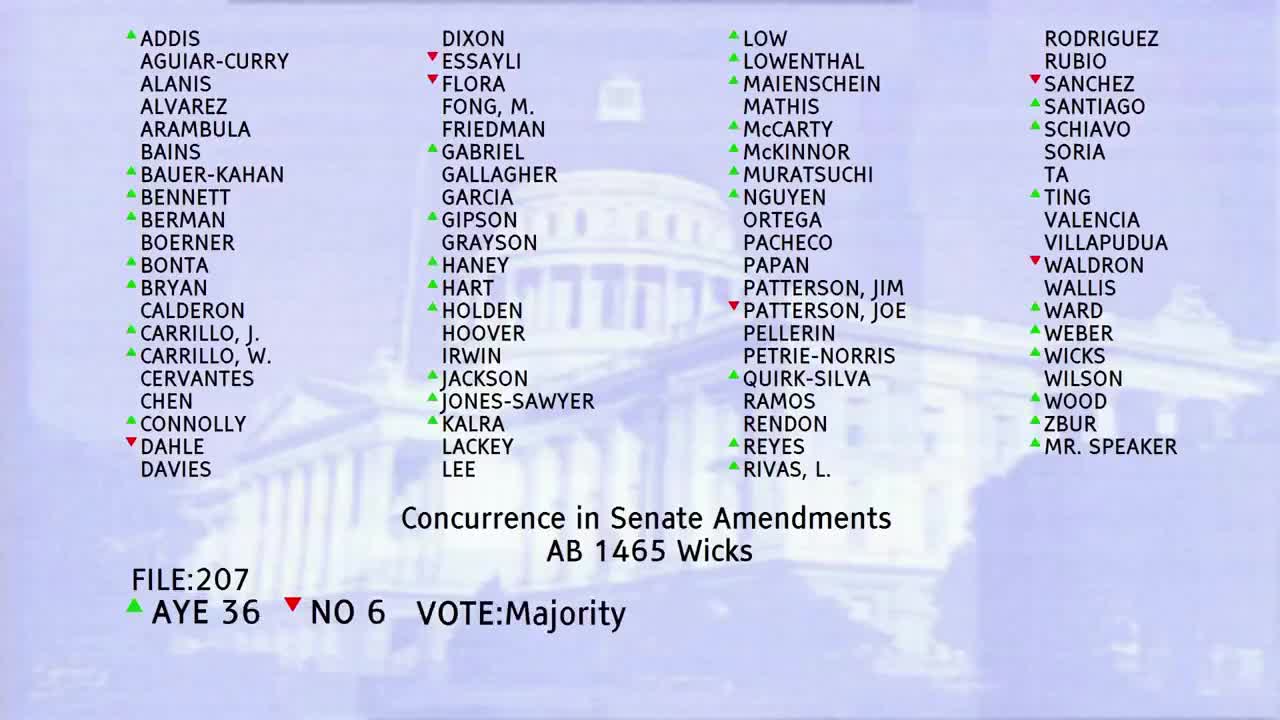 30SEC
Assembly Floor
 1MIN
Senate Floor
 5MIN