AB 2987: Public postsecondary education: sex discrimination complaints: status updates and notices.
- Session Year: 2023-2024
- House: Assembly
- Latest Version Date: 2024-08-26
Current Status:
Passed
(2024-08-26: Chaptered by Secretary of State - Chapter 205, Statutes of 2024.)
Introduced
In Committee
First Chamber
In Committee
Second Chamber
Enacted
Existing federal law, known as Title IX, prohibits a person, on the basis of sex, from being excluded from participation in, being denied the benefits of, or being subject to discrimination, which includes sexual harassment, under any education program or activity receiving federal financial assistance.
Existing law prohibits a person from being subjected to discrimination on the basis of specified attributes, including, among others, disability or gender, in a program or activity conducted by a postsecondary educational institution that receives, or benefits from, state financial assistance or enrolls students who receive state student financial aid.
This bill would require each California State University and California Community College campus, and would request each University of California campus, to provide, as specified, status updates on complaints of sex discrimination to the complainants and respondents, except for those who opt to not receive the updates. The bill would require each California State University and California Community College campus, and would request each University of California campus, to provide, within 5 business days of a decision of disciplinary action being made against a respondent in response to a complaint of sex discrimination, a notification of the disciplinary action to the respondent and complainant. By imposing new duties on community college districts, the bill would impose a state-mandated local program.
The California Constitution requires the state to reimburse local agencies and school districts for certain costs mandated by the state. Statutory provisions establish procedures for making that reimbursement.
This bill would provide that, if the Commission on State Mandates determines that the bill contains costs mandated by the state, reimbursement for those costs shall be made pursuant to the statutory provisions noted above.
Existing federal law, known as Title IX, prohibits a person, on the basis of sex, from being excluded from participation in, being denied the benefits of, or being subject to discrimination, which includes sexual harassment, under any education program or activity receiving federal financial assistance.
Existing law prohibits a person from being subjected to discrimination on the basis of specified attributes, including, among others, disability or gender, in a program or activity conducted by a postsecondary educational institution that receives, or benefits from, state financial assistance or enrolls students who receive state student financial aid.
This bill would require each California State University and California Community College campus, and would request each University of California campus, to provide, as specified, status updates on complaints of sex discrimination to the complainants and respondents, except for those who opt to not receive the updates. The bill would require each California State University and California Community College campus, and would request each University of California campus, to provide, within 3 schooldays 5 business days of a decision of disciplinary action being made against a respondent in response to a complaint of sex discrimination, a notification of the disciplinary action to the respondent and complainant. By imposing new duties on community college districts, the bill would impose a state-mandated local program.
The California Constitution requires the state to reimburse local agencies and school districts for certain costs mandated by the state. Statutory provisions establish procedures for making that reimbursement.
This bill would provide that, if the Commission on State Mandates determines that the bill contains costs mandated by the state, reimbursement for those costs shall be made pursuant to the statutory provisions noted above.
Existing federal law, known as Title IX, prohibits a person, on the basis of sex, from being excluded from participation in, being denied the benefits of, or being subject to discrimination, which includes sexual harassment, under any education program or activity receiving federal financial assistance.
Existing law prohibits a person from being subjected to discrimination on the basis of specified attributes, including, among others, disability or gender, in a program or activity conducted by a postsecondary educational institution that receives, or benefits from, state financial assistance or enrolls students who receive state student financial aid.
This bill would require each California State University and California Community College campus, and would request each University of California campus, to provide provide, as specified, status updates on the outcomes of complaints of sex discrimination to the complainants and respondents, except for those who opt to not receive the updates. The bill would require each California State University and California Community College campus, and would request each University of California campus, to provide, within 3 schooldays of a decision of disciplinary action being made against a respondent in response to a complaint of sex discrimination, notice a notification of the disciplinary action to the respondent. respondent and complainant. By imposing new duties on community college districts, the bill would impose a state-mandated local program.
The California Constitution requires the state to reimburse local agencies and school districts for certain costs mandated by the state. Statutory provisions establish procedures for making that reimbursement.
This bill would provide that, if the Commission on State Mandates determines that the bill contains costs mandated by the state, reimbursement for those costs shall be made pursuant to the statutory provisions noted above.
Existing federal law, known as Title IX, prohibits a person, on the basis of sex, from being excluded from participation in, being denied the benefits of, or being subject to discrimination, which includes sexual harassment, under any education program or activity receiving federal financial assistance.
Existing law prohibits a person from being subjected to discrimination on the basis of specified attributes, including, among others, disability or gender, in a program or activity conducted by a postsecondary educational institution that receives, or benefits from, state financial assistance or enrolls students who receive state student financial aid.
This bill would require each California State University and California Community College campus, and would request each University of California campus, to provide status updates on the outcomes of complaints of sex discrimination to the complainants and respondents, except for those who opt to not receive the updates. The bill would require each California State University and California Community College campus, and would request each University of California campus, to provide, within 3 schooldays of a decision of disciplinary action being made against a respondent in response to a complaint of sex discrimination, notice of the disciplinary action to the respondent. By imposing new duties on community college districts, the bill would impose a state-mandated local program.
The California Constitution requires the state to reimburse local agencies and school districts for certain costs mandated by the state. Statutory provisions establish procedures for making that reimbursement.
This bill would provide that, if the Commission on State Mandates determines that the bill contains costs mandated by the state, reimbursement for those costs shall be made pursuant to the statutory provisions noted above.
Existing law establishes the State Department of Education under the administration of the Superintendent of Public Instruction, and assigns to the department numerous responsibilities relating to the governance of the public elementary and secondary schools in the state.This bill would make nonsubstantive changes to provisions relating to certain duties of the department.Existing law establishes the State Department of Education under the administration of the Superintendent of Public Instruction, and assigns to the department numerous responsibilities relating to the governance of the public elementary and secondary schools in the state.
This bill would make nonsubstantive changes to provisions relating to certain duties of the department.
(a)Each campus of the California State University and the California Community Colleges shall, and each campus of the University of California is requested to, provide, upon request of the complainant or respondent, and every 30 days until the outcome of a complaint is determined, and only to the extent permissible under state and federal law, status updates on complaints of sex discrimination, including, but not limited to, complaints of sexual harassment, to complainants and respondents.
(b)Status updates shall not be provided pursuant to subdivision (a) to a complainant or respondent who opts to not receive the updates.
(c)Each campus of the California State University and the California Community Colleges shall, and each campus of the University of California is requested to, provide, within five business days of a decision of disciplinary action being made against a respondent in response to a complaint of sex discrimination, a notification of the disciplinary action to the respondent and complainant.
SEC. 2.If the Commission on State Mandates determines that this act contains costs mandated by the state, reimbursement to local agencies and school districts for those costs shall be made pursuant to Part 7 (commencing with Section 17500) of Division 4 of Title 2 of the Government Code.
(a)Each campus of the California State University and the California Community Colleges shall, and each campus of the University of California is requested to, provide, upon request of the complainant or respondent, and every 30 days until the outcome of a complaint is determined, and only to the extent permissible under state and federal law, status updates on complaints of sex discrimination, including, but not limited to, complaints of sexual harassment, to complainants and respondents.
(b)Status updates shall not be provided pursuant to subdivision (a) to a complainant or respondent who opts to not receive the updates.
(c)Each campus of the California State University and the California Community Colleges shall, and each campus of the University of California is requested to, provide, within three schooldays five business days of a decision of disciplinary action being made against a respondent in response to a complaint of sex discrimination, a notification of the disciplinary action to the respondent and complainant.
SEC. 2.If the Commission on State Mandates determines that this act contains costs mandated by the state, reimbursement to local agencies and school districts for those costs shall be made pursuant to Part 7 (commencing with Section 17500) of Division 4 of Title 2 of the Government Code.
(a)Each campus of the California State University and the California Community Colleges shall, and each campus of the University of California is requested to, provide, upon request of the complainant or respondent, and every 30 days until the outcome of a complaint is determined, and only to the extent permissible under state and federal law, status updates on the outcomes of complaints of sex discrimination, including, but not limited to, complaints of sexual harassment, to complainants and respondents.
(b)Status updates shall not be provided pursuant to subdivision (a) to a complainant or respondent who opts to not receive the updates.
(c)Each campus of the California State University and the California Community Colleges shall, and each campus of the University of California is requested to, provide, within three schooldays of a decision of disciplinary action being made against a respondent in response to a complaint of sex discrimination, notice a notification of the disciplinary action to the respondent. respondent and complainant.
SEC. 2.If the Commission on State Mandates determines that this act contains costs mandated by the state, reimbursement to local agencies and school districts for those costs shall be made pursuant to Part 7 (commencing with Section 17500) of Division 4 of Title 2 of the Government Code.
(a)Each campus of the California State University and the California Community Colleges shall, and each campus of the University of California is requested to, provide, only to the extent permissible under state and federal law, status updates on the outcomes of complaints of sex discrimination, including, but not limited to, complaints of sexual harassment, to complainants and respondents.
(b)Status updates shall not be provided pursuant to subdivision (a) to a complainant or respondent who opts to not receive the updates.
(c)Each campus of the California State University and the California Community Colleges shall, and each campus of the University of California is requested to, provide, within three schooldays of a decision of disciplinary action being made against a respondent in response to a complaint of sex discrimination, notice of the disciplinary action to the respondent.
SEC. 2.If the Commission on State Mandates determines that this act contains costs mandated by the state, reimbursement to local agencies and school districts for those costs shall be made pursuant to Part 7 (commencing with Section 17500) of Division 4 of Title 2 of the Government Code.
SECTION 1.Section 33316 of the Education Code is amended to read:33316.The department shall do all of the following:(a)Revise and update budget manuals, forms, and guidelines.(b)Cooperate with federal and state agencies in prescribing rules and regulations, and instructions required by those agencies.(c)Assess the needs and methods of collecting and disseminating financial information.(d)Conduct workshops and conferences for the purpose of training school district and county personnel.(e)Provide consultant services to colleges and universities on courses of instruction relative to school budgets and accounting practices.(f)For purposes of Section 44421.5, report to the Commission on Teacher Credentialing the identity of any certificated person who knowingly and willfully reports false fiscal expenditure data relative to the conduct of any educational program. This requirement applies only if, in the course of their normal duties, a representative of the department discovers information that gives them reasonable cause to believe that false fiscal expenditure data relative to the conduct of any educational program has been reported.The State Department of Education department shall do all of the following:
(a)Revise and update budget manuals, forms forms, and guidelines.
(b)Cooperate with federal and state agencies in prescribing rules and regulations, and instructions required by those agencies.
(c)Assess the needs and methods of collecting and disseminating financial information.
(d)Conduct workshops and conferences for the purpose of training school district and county personnel.
(e)Provide consultant services to colleges and universities on courses of instruction relative to school budgets and accounting practices.
(f)For purposes of Section 44421.5, report to the Commission on Teacher Credentialing the identity of any certificated person who knowingly and willfully reports false fiscal expenditure data relative to the conduct of any educational program. This requirement applies only if, in the course of his or her their normal duties, a representative of the State Department of Education department discovers information that gives him or her them reasonable cause to believe that false fiscal expenditure data relative to the conduct of any educational program has been reported.
|
Date
|
Status
|
|---|---|
| Aug 26, 2024 | Chaptered by Secretary of State - Chapter 205, Statutes of 2024. |
| Aug 26, 2024 | Approved by the Governor. |
| Aug 16, 2024 | Enrolled and presented to the Governor at 11 a.m. |
| Aug 8, 2024 | Senate amendments concurred in. To Engrossing and Enrolling. (Ayes 72. Noes 0. Page 6239.). |
| Aug 5, 2024 | In Assembly. Concurrence in Senate amendments pending. May be considered on or after August 7 pursuant to Assembly Rule 77. |
| Aug 5, 2024 | Read third time. Passed. Ordered to the Assembly. (Ayes 40. Noes 0. Page 4973.). |
| Jul 2, 2024 | Read second time. Ordered to Consent Calendar. |
| Jul 1, 2024 | From committee: Be ordered to second reading file pursuant to Senate Rule 28.8 and ordered to Consent Calendar. |
| Jun 13, 2024 | Read second time and amended. Re-referred to Com. on APPR. |
| Jun 12, 2024 | From committee: Amend, and do pass as amended and re-refer to Com. on APPR with recommendation: To Consent Calendar. (Ayes 7. Noes 0.) (June 12). |
| May 29, 2024 | Referred to Com. on ED. |
| May 16, 2024 | In Senate. Read first time. To Com. on RLS. for assignment. |
| May 16, 2024 | Read third time. Passed. Ordered to the Senate. (Ayes 71. Noes 0.) |
| May 9, 2024 | Read second time. Ordered to Consent Calendar. |
| May 8, 2024 | From committee: Do pass. To Consent Calendar. (Ayes 15. Noes 0.) (May 8). |
| Apr 22, 2024 | Re-referred to Com. on APPR. |
| Apr 18, 2024 | Read second time and amended. |
| Apr 17, 2024 | From committee: Amend, and do pass as amended and re-refer to Com. on APPR. (Ayes 11. Noes 0.) (April 16). |
| Mar 20, 2024 | Re-referred to Com. on HIGHER ED. |
| Mar 19, 2024 | From committee chair, with author's amendments: Amend, and re-refer to Com. on HIGHER ED. Read second time and amended. |
| Mar 18, 2024 | Referred to Com. on HIGHER ED. |
| Feb 17, 2024 | From printer. May be heard in committee March 18. |
| Feb 16, 2024 | Read first time. To print. |
|
Date
|
Description
|
Location
|
Votes
|
|
|---|---|---|---|---|
| Aug 8, 2024 | AB 2987 Ortega Concurrence in Senate Amendments | Assembly Floor |
Passed |
|
| Aug 5, 2024 | Consent Calendar 2nd AB2987 Ortega et al. | Senate Floor |
Passed |
|
| Jun 12, 2024 | Do pass as amended, but first amend, and re-refer to the Committee on [Appropriations] with the recommendation: To Consent Calendar | Senate Standing Committee on Education |
Passed |
|
| May 16, 2024 | AB 2987 Ortega Consent Calendar Second Day Regular Session | Assembly Floor |
Passed |
|
| May 8, 2024 | Do pass. To Consent Calendar. | Assembly Standing Committee on Appropriations |
Passed |
|
| Apr 16, 2024 | Do pass as amended and be re-referred to the Committee on [Appropriations] | Assembly Standing Committee on Higher Education |
Passed |
This list shows positions taken on this bill by organizations on the date displayed, which is linked to the original source.
Positions by individuals are not included.
|
Organization
|
Position
|
Date
|
|---|---|---|
| Cal State Student Association | ** Support | |
| California Community College Independents | * Support | Apr 16, 2024 |
| California Faculty Association | ** Support | |
| California Federation Of Teachers | * Support | Apr 16, 2024 |
| California State University Employees Union | ** Support | |
| Faculty Association Of California Community Colleges | ** Support | |
| Generation Up | ** Support | |
| Ignite | ** Support | |
| Office of Lieutenant Governor Eleni Kounalakis | ** Support | |
| Sacramento State University | * Support | Apr 16, 2024 |
| SAFE Campuses Coalition | ** Support | |
| Youth Power Project | ** Support |
CONCURRENCE IN SENATE AMENDMENTS
CSA1 Bill Id:AB 2987
Author:(Ortega, et al.)
As Amended Ver:June 13, 2024
Majority vote
SUMMARY
Requires each campus of the California Community Colleges (CCC) and California State University (CSU) and requests each campus of the University of California (UC) to provide status updates every thirty days on the progress of sex discrimination complaints to the respondent and complainants of a sex discrimination complaint and to provide the disciplinary notification within five business days of the outcome of a sex discrimination complaint.
Senate Amendments
Requires the notification of a decision of a disciplinary action against a respondent to be delivered to the complainant and respondent of a sex discrimination complaint within five business days after the outcome of the sex discrimination complaint.
COMMENTS
California State University: It did not adequately or consistently address some allegations of sexual harassment (2022-109). The investigation of the CSU conducted by the California State Auditor, was conducted over three campuses and also examined the role of the Chancellor's Office in monitoring the compliance of campuses with the system's sexual harassment policy. The Auditor reviewed 40 cases of alleged sexual harassment by CSU employees and determined the following:
- Complaints of sexual harassment are not adjudicated in a clear and analogous manner despite each campus being required to follow the same policy for how cases are to be adjudicated;
- Disciplinary sanctions were not always implemented despite conclusive findings of sexual harassment; and,
- The Chancellor's Office had not provided oversight or regulation over the implementation of the system's policies.
In terms of notifications or status updates to complainants and respondents, the State Auditor determined:
"Although CSU's sexual harassment policy requires the notifications we list above, it does not require Title IX coordinators to proactively provide additional status updates to complainants and respondents while the investigation is ongoing; instead, the parties must request them."
For disciplinary sanction notifications, the State Auditor, "identified seven cases in which campuses either did not initiate appropriate discipline or corrective action or did not document implementing any discipline or corrective action. In four cases, the campuses' disciplinary or corrective actions were not taken in a timely manner; in fact, in one instance, the campus waited more than five years before issuing a letter of reprimand."
To help take corrective action, the Auditor provided 16 multi-faceted recommendations to the CSU with varying time frames for implementation between July 2024, January 2025, and July 2026. Two of the recommendations request the CSU to implement similar notification requirements as the measure.
Notification policies for CCC, CSU, and UC. As referenced in the "A Call to Action" report published by this Committee, the California Sex Equity in Education Act (EDC Section 6627.5 - 66282) contains requirements for the adjudication of sex discrimination and sexual harassment complaints, including a requirement for a timeline for the complaint process and the provision of periodic updates on the investigation to the complainant and respondent.
Contained within the California Code of Regulations for CCC are the system's operating procedures for addressing discrimination complaints. The following status updates are provided for complaints of sex discrimination processed by the CCC:
- Within 90 days of receiving a complaint the district will complete an investigation and forward a copy and written notice of outcome to the complainant and the respondent. The respondent will also receive the determination, proposed resolution including disciplinary action, and the respondent's right to appeal.
The CSU and UC systems have similar status update requirements for sex discrimination complaints:
- Status updates are provided to both parties when complaints are accepted, when investigations begin, and any extension of the investigation timeframes. The complainants and respondents are also provided a copy of the investigative report and a copy of the outcome.
The measure requires the disciplinary notification to be delivered to the complainant and the respondent within five business days of the official decision/outcome of the complaint. The measure does not require the "disciplinary action" to be conducted within five business days nor does it disrupt the respondent's or complainant's ability to appeal the outcome of a complaint. The current policy at the CSU is for a disciplinary notification to occur within 10 days of the outcome of a compliant and for the UC the disciplinary notification is required within 15 days.
According to the Author
"It became clear during the Joint Legislative Audit Committee Oversight Hearing not only that the CSU system has failed its students and employees in following Title IX requirements, but that the problem is deeper and more widespread, affecting all institutions in the California public higher education system. Enacting AB 2987 would increase transparency and accountability that campuses must abide by in order to keep their students and employees safe from sexual abuse and keep perpetrators accountable. By requiring open communication between the investigators and the complainants and respondents about the timeline and process of their open sexual misconduct cases, campuses are held to the higher standard of transparency expected of a California higher education institution. AB 2987 is part of a larger package of bills introduced in 2024 working towards changing campus culture, and shifting the focus to making campus life safe for and welcoming to all."
Arguments in Support
As described by the Cal State Student Association, which represents over nearly half a million students in the CSU, "AB 2987 addresses critical deficiencies highlighted in the 2023 Oversight Hearing report by the Joint Legislative Audit Committee on the CSU's handling of sexual misconduct cases, ensuring accountability and transparency in investigation processes. By mandating regular updates to complainants and respondents, the bill empowers individuals with vital information about the progress and resolution of their case. Additionally, it requires prompt notification of disciplinary actions taken against respondents, further supporting complainants and enhancing campus safety. Standardizing this notification process ensures a uniform approach across all campuses, enhancing transparency and accountability in how sex discrimination cases are handled. This contributes to a safer and more supportive educational environment, aligning with existing federal and state regulations aimed at eliminating sex-based discrimination."
Arguments in Opposition
None on file.
FISCAL COMMENTS
According to the Assembly Committee on Appropriations:
- Minor and absorbable General Fund costs to UC campuses, as it already provides periodic updates and would only need to slightly change its practices as a result of this bill.
- Minor and absorbable General Fund costs to CSU campuses.
- Minor Proposition 98 General Fund costs to CCC campuses.
If the Commission on State Mandates determines the bill's requirements to be a reimbursable state mandate, the state would need to reimburse these costs to CCCs.
VOTES:
ASM HIGHER EDUCATION: 11-0-0
YES: Mike Fong, Ta, Arambula, Boerner, Chen, Alanis, Irwin, Jackson, Addis, Muratsuchi, Quirk-Silva
ASM APPROPRIATIONS: 15-0-0
YES: Wicks, Sanchez, Arambula, Bryan, Calderon, Wendy Carrillo, Dixon, Mike Fong, Friedman, Haney, Hart, Jim Patterson, Pellerin, Ta, Villapudua
ASSEMBLY FLOOR: 71-0-9
YES: Aguiar-Curry, Alanis, Arambula, Bains, Bauer-Kahan, Bennett, Berman, Boerner, Bonta, Bryan, Calderon, Juan Carrillo, Wendy Carrillo, Chen, Connolly, Davies, Dixon, Essayli, Mike Fong, Friedman, Gabriel, Gallagher, Garcia, Grayson, Haney, Hart, Holden, Hoover, Jackson, Jones-Sawyer, Kalra, Lackey, Lee, Low, Lowenthal, Maienschein, McCarty, McKinnor, Muratsuchi, Stephanie Nguyen, Ortega, Pacheco, Papan, Jim Patterson, Joe Patterson, Pellerin, Petrie-Norris, Quirk-Silva, Ramos, Rendon, Reyes, Luz Rivas, Rodriguez, Blanca Rubio, Sanchez, Santiago, Schiavo, Soria, Ta, Ting, Valencia, Villapudua, Waldron, Wallis, Ward, Weber, Wicks, Wilson, Wood, Zbur, Robert Rivas
ABS, ABST OR NV: Addis, Alvarez, Cervantes, Megan Dahle, Flora, Vince Fong, Gipson, Irwin, Mathis
SENATE FLOOR: 40-0-0
YES: Allen, Alvarado-Gil, Archuleta, Ashby, Atkins, Becker, Blakespear, Bradford, Caballero, Cortese, Dahle, Dodd, Durazo, Eggman, Glazer, Gonzalez, Grove, Hurtado, Jones, Laird, Limón, McGuire, Menjivar, Min, Newman, Nguyen, Niello, Ochoa Bogh, Padilla, Portantino, Roth, Rubio, Seyarto, Skinner, Smallwood-Cuevas, Stern, Umberg, Wahab, Wiener, Wilk
UPDATED
VERSION: June 13, 2024
CONSULTANT: Ellen Cesaretti-Monroy / HIGHER ED. / (916) 319-3960 FN: 0003786
SENATE RULES COMMITTEE Office of Senate Floor Analyses (916) 651-1520 Fax: (916) 327-4478 | AB 2987 |
CONSENT
Bill No: AB 2987
Author: Ortega (D), Cervantes (D) and Mike Fong (D), et al.
Amended: 6/13/24 in Senate
Vote: 21
SENATE EDUCATION COMMITTEE: 7-0, 6/12/24
AYES: Newman, Ochoa Bogh, Cortese, Glazer, Gonzalez, Limón, Wilk
SENATE APPROPRIATIONS COMMITTEE: Senate Rule 28.8
ASSEMBLY FLOOR: 71-0, 5/16/24 (Consent) - See last page for vote
SUBJECT: Public postsecondary education: sex discrimination complaints: status updates and notices
SOURCE: California Faculty Association
DIGEST:
This bill requires each campus of the California State University (CSU) and the California Community Colleges (CCCs), and requests each campus of the University of California (UC) to provide (a) status updates on complaints of sex discrimination, including, but not limited to, complaints of sexual harassment, to complainants and respondents; and (b) a notification of the disciplinary action to the respondent and complainant, within five business days of a decision of disciplinary action being made against a respondent in response to a complaint of sex discrimination.
ANALYSIS:
Existing federal law:
- Provides that, in part, "no person in the United States shall, on the basis of sex, be excluded from participation in, be denied the benefits of, or be subjected to discrimination under any educational program or activity receiving Federal financial assistance." Enforcement of compliance is initiated upon the filing of a complaint alleging a violation of Title IX. (Title IX of the Education Amendments of 1972 to the 1964 Civil Rights Act)
- Outlines the required response pursuant to Title IX, of a postsecondary higher education institution when the institution is made aware of an alleged sexual harassment incident on campus. The regulations include a requirement for a formal complaint, a grievance procedure for an investigation into whether the incident based on a standard of evidence occurred, and a method of appealing the outcome of the grievance process. (Federal Code of Regulations Title 34, Subtitle B, Chapter 1, Subpart D, § 106.45)
Existing state law:
- Requires the governing board or body of each postsecondary institution in the state, as a condition of receiving state funding, to comply with an array of conditions pertaining to preventing sexual harassment and providing students with procedural protections relating to complaints of sexual harassment. Existing law requires postsecondary institutions to adopt grievance procedures that must provide for periodic status updates on the investigation consistent with the timelines established in the grievance procedures, provide for written notice of discipline imposed, and timelines by which the parties shall be notified of the outcome of any investigation. (Education Code (EC) § 66281.8)
- Requires the CSU to annually submit a report to the Legislature related to sexual harassment reports, complaints, investigations, hearings, and appeals.
(EC § 66282)
ANALYSIS
This bill:
Status updates on complaints of sex discrimination
- Requires each campus of the CSU and the CCCs, and requests each campus of the UC, to provide status updates on complaints of sex discrimination, including, but not limited to, complaints of sexual harassment, to complainants and respondents.
- Provides that status updates are to be provided upon request of the complainant or respondent, and to be provided every 30 days until the outcome of a complaint is determined.
- Provides that status updates are to be provided only to the extent permissible under state and federal law.
- Prohibits status updates from provided to a complainant or respondent who opts to not receive the updates.
Notification of disciplinary action
- Requires each campus of the CSU and the CCCs, and requests each campus of the UC, to provide a notification of the disciplinary action to the respondent and complainant within five business days of a decision of disciplinary action being made against a respondent in response to a complaint of sex discrimination.
Comments
- Need for the bill. According to the author, “It became clear during the Joint Legislative Audit Committee Oversight Hearing not only that the CSU system has failed its students and employees in following Title IX requirements, but that the problem is deeper and more widespread, affecting all institutions in the California public higher education system. Enacting AB 2987 would increase transparency and accountability that campuses must abide by in order to keep their students and employees safe from sexual abuse and keep perpetrators accountable. By requiring open communication between the investigators and the complainants and respondents about the timeline and process of their open sexual misconduct cases, campuses are held to the higher standard of transparency expected of a California higher education institution. AB 2987 is part of a larger package of bills introduced in 2024 working towards changing campus culture, and shifting the focus to making campus life safe for and welcoming to all.”
- Recent report on how postsecondary education institutions address sexual discrimination. Throughout 2023, staff from the Assembly Higher Education Committee and this committee hosted fact-finding briefings with representatives from the CCC, CSU, UC, and various California Independent Colleges and Universities to understand how higher education institutions are preventing and addressing sexual discrimination on campuses. The Assembly Higher Education Committee released a report that provides a synopsis of the information gleaned from the briefings and a compilation of legislative proposals for how the State can partner with higher education institutions to prevent and address discrimination in all its forms on college and university campuses throughout California. https://ahed.assembly.ca.gov/system/files/2024-02/a-call-to-action-report-2024_0.pdf
- State Audit. The California State Auditor released an audit report in July 2023, titled “California State University: It did not adequately or consistently address some allegations of sexual harassment.” This audit was conducted over three CSU campuses and also examined the role of the Chancellor’s Office in monitoring the compliance of campuses with the system’s sexual harassment policy.
Regarding status updates of investigations or notifications of disciplinary action, the State Auditor determined: “Although CSU’s sexual harassment policy requires the notifications we list above, it does not require Title IX coordinators to proactively provide additional status updates to complainants and respondents while the investigation is ongoing; instead, the parties must request them. Despite the lack of a formal requirement, San José State’s interim Title IX coordinator explained that his practice is to ask complainants and respondents at the outset of a case about their preferences for receiving status updates; he then schedules periodic update meetings with each of them, such as every two weeks, if they so desire. Further, Fresno State’s Title IX task force recommended that the campus explore creating a dashboard that would allow complainants and respondents to check the status of their specific cases at any time. The Chancellor’s Office should consider requiring campuses to implement something similar to the dashboard or regular update meetings to provide complainants and respondents information on the status of their cases.”
This bill’s provisions are similar to two of the recommendations made by the State Auditor. As detailed in the Assembly Higher Education Committee analysis:
CSU Audit | AB 2987 (Ortega) |
To more effectively communicate the status of cases to the parties involved, the Chancellor's Office should amend CSU's sexual harassment policy by January 2025 to include specific requirements for campuses to provide regular status updates to complainants and respondents unless those parties request not to receive them. These updates should also communicate the outcomes of cases, including any associated disciplinary or corrective actions, to the extent possible under law. | Requires each campus of the CCC and CSU, and requests the UC to provide status updates on outcomes of complaints of sex discrimination to both the complainants and the respondent. |
The Chancellor's Office should provide guidance to campuses by July 2024 about best practices for initiating, carrying out, and documenting timely disciplinary or corrective actions after a finding of sexual harassment. Further, it should encourage campuses to communicate these principles to relevant decision makers. This guidance should include providing a prompt notice of pending disciplinary action to a respondent when applicable. | Requires the disciplinary notice to be provided to the respondent within five business days. |
- Existing procedures for providing updates and notice of disciplinary action. The California Code of Regulations include operating procedures for how the CCCs are to address complaints of discrimination. The following notices are provided for complaints of sex discrimination processed by the CCC:
- Within 90 days of receiving a complaint, the community college district will complete an investigation and forward a copy and written notice of outcome to the complainant and the respondent. The respondent will also receive the determination, proposed resolution including disciplinary action, and the respondent’s right to appeal.
The CSU and UC systems have similar notification requirements, specifically:
- Notification to both parties when complaints are accepted, when investigations begin, and any extension of the investigation timeframes. The complainants and respondents are also provided a copy of the investigative report and a copy of the outcome.
CSU’s existing policy is to provide notice of disciplinary action within 10 days of the decision, and the UC’s policy is to provide notice within 15 days.
This bill requires status updates to be provided about complaints of sex discrimination, upon request, and requires updates to be provided every 30 days until the outcome of a complaint is determined. This bill also requires a notification of the disciplinary action to be provided within five business days of the decision.
Notifications of disciplinary action does not imply the sanction will be levied within five business days; student respondents would retain the ability to appeal the decision. Similarly, this bill does not interfere with the appeal processes afforded to employees, the “Skelly process” (due process), collective bargaining agreements, or internal policies.
FISCAL EFFECT: Appropriation: No Fiscal Com.: Yes Local: Yes
SUPPORT: (Verified 7/1/24)
California Faculty Association (source)
Office of Lieutenant Governor Eleni Kounalakis
California State University Employees Union
Cal State Student Association
Faculty Association of California Community Colleges
Generation Up
Ignite
Safe Campuses Coalition
Youth Power Project
OPPOSITION: (Verified 7/1/24)
None received
ASSEMBLY FLOOR: 71-0, 5/16/24
AYES: Aguiar-Curry, Alanis, Arambula, Bains, Bauer-Kahan, Bennett, Berman, Boerner, Bonta, Bryan, Calderon, Juan Carrillo, Wendy Carrillo, Chen, Connolly, Davies, Dixon, Essayli, Mike Fong, Friedman, Gabriel, Gallagher, Garcia, Grayson, Haney, Hart, Holden, Hoover, Jackson, Jones-Sawyer, Kalra, Lackey, Lee, Low, Lowenthal, Maienschein, McCarty, McKinnor, Muratsuchi, Stephanie Nguyen, Ortega, Pacheco, Papan, Jim Patterson, Joe Patterson, Pellerin, Petrie-Norris, Quirk-Silva, Ramos, Rendon, Reyes, Luz Rivas, Rodriguez, Blanca Rubio, Sanchez, Santiago, Schiavo, Soria, Ta, Ting, Valencia, Villapudua, Waldron, Wallis, Ward, Weber, Wicks, Wilson, Wood, Zbur, Robert Rivas
NO VOTE RECORDED: Addis, Alvarez, Cervantes, Megan Dahle, Flora, Vince Fong, Gipson, Irwin, Mathis
Prepared by: Lynn Lorber / ED. / (916) 651-4105
7/2/24 9:32:06
**** END ****
SENATE COMMITTEE ON EDUCATION
Senator Josh Newman, Chair
2023 - 2024 Regular
Bill No: Hearing Date: June 12, 2024
Author: | Ortega, et al. | ||
Version: |
| ||
Urgency: | Fiscal: | ||
Consultant: | |||
Subject:
SUMMARY
This bill requires each campus of the California State University (CSU) and the California Community Colleges (CCCs), and requests each campus of the University of California (UC) to provide (1) status updates on complaints of sex discrimination, including, but not limited to, complaints of sexual harassment, to complainants and respondents; and (2) a notification of the disciplinary action to the respondent and complainant, within three schooldays of a decision of disciplinary action being made against a respondent in response to a complaint of sex discrimination.
BACKGROUND
Existing federal law:
- Provides that, in part, "no person in the United States shall, on the basis of sex, be excluded from participation in, be denied the benefits of, or be subjected to discrimination under any educational program or activity receiving Federal financial assistance." Enforcement of compliance is initiated upon the filing of a complaint alleging a violation of Title IX. (Title IX of the Education Amendments of 1972 to the 1964 Civil Rights Act)
- Outlines the required response pursuant to Title IX, of a postsecondary higher education institution when the institution is made aware of an alleged sexual harassment incident on campus. The regulations include a requirement for a formal complaint, a grievance procedure for an investigation into whether the incident based on a standard of evidence occurred, and a method of appealing the outcome of the grievance process. (Federal Code of Regulations Title 34, Subtitle B, Chapter 1, Subpart D, § 106.45)
Existing state law:
- Requires the governing board or body of each postsecondary institution in the state, as a condition of receiving state funding, to comply with an array of conditions pertaining to preventing sexual harassment and providing students with procedural protections relating to complaints of sexual harassment. Existing law requires postsecondary institutions to adopt grievance procedures that must provide for periodic status updates on the investigation consistent with the timelines established in the grievance procedures, provide for written notice of discipline imposed, and timelines by which the parties shall be notified of the outcome of any investigation. (Education Code (EC) § 66281.8)
- Requires the CSU to annually submit a report to the Legislature related to sexual harassment reports, complaints, investigations, hearings, and appeals.
(EC § 66282)
ANALYSIS
This bill:
Status updates on complaints of sex discrimination
- Requires each campus of the CSU and the CCCs, and requests each campus of the UC, to provide status updates on complaints of sex discrimination, including, but not limited to, complaints of sexual harassment, to complainants and respondents.
- Provides that status updates are to be provided upon request of the complainant or respondent, and to be provided every 30 days until the outcome of a complaint is determined.
- Provides that status updates are to be provided only to the extent permissible under state and federal law.
- Prohibits status updates from provided to a complainant or respondent who opts to not receive the updates.
Notification of disciplinary action
- Requires each campus of the CSU and the CCCs, and requests each campus of the UC, to provide a notification of the disciplinary action to the respondent and complainant within three schooldays of a decision of disciplinary action being made against a respondent in response to a complaint of sex discrimination.
STAFF COMMENTS
- Need for the bill. According to the author, “It became clear during the Joint Legislative Audit Committee Oversight Hearing not only that the CSU system has failed its students and employees in following Title IX requirements, but that the problem is deeper and more widespread, affecting all institutions in the California public higher education system. Enacting AB 2987 would increase transparency and accountability that campuses must abide by in order to keep their students and employees safe from sexual abuse and keep perpetrators accountable. By requiring open communication between the investigators and the complainants and respondents about the timeline and process of their open sexual misconduct cases, campuses are held to the higher standard of transparency expected of a California higher education institution. AB 2987 is part of a larger package of bills introduced in 2024 working towards changing campus culture, and shifting the focus to making campus life safe for and welcoming to all.”
- Recent report on how postsecondary education institutions address sexual discrimination. Throughout 2023, staff from the Assembly Higher Education Committee and this committee hosted fact-finding briefings with representatives from the CCC, CSU, UC, and various California Independent Colleges and Universities to understand how higher education institutions are preventing and addressing sexual discrimination on campuses. The Assembly Higher Education Committee released a report that provides a synopsis of the information gleaned from the briefings and a compilation of legislative proposals for how the State can partner with higher education institutions to prevent and address discrimination in all its forms on college and university campuses throughout California. https://ahed.assembly.ca.gov/system/files/2024-02/a-call-to-action-report-2024_0.pdf
- State Audit. The California State Auditor released an audit report in July 2023, titled “California State University: It did not adequately or consistently address some allegations of sexual harassment.” This audit was conducted over three CSU campuses and also examined the role of the Chancellor’s Office in monitoring the compliance of campuses with the system’s sexual harassment policy.
Regarding status updates of investigations or notifications of disciplinary action, the State Auditor determined: “Although CSU’s sexual harassment policy requires the notifications we list above, it does not require Title IX coordinators to proactively provide additional status updates to complainants and respondents while the investigation is ongoing; instead, the parties must request them. Despite the lack of a formal requirement, San José State’s interim Title IX coordinator explained that his practice is to ask complainants and respondents at the outset of a case about their preferences for receiving status updates; he then schedules periodic update meetings with each of them, such as every two weeks, if they so desire. Further, Fresno State’s Title IX task force recommended that the campus explore creating a dashboard that would allow complainants and respondents to check the status of their specific cases at any time. The Chancellor’s Office should consider requiring campuses to implement something similar to the dashboard or regular update meetings to provide complainants and respondents information on the status of their cases.”
This bill’s provisions are similar to two of the recommendations made by the State Auditor. As detailed in the Assembly Higher Education Committee analysis:
CSU Audit | AB 2987 (Ortega) |
To more effectively communicate the status of cases to the parties involved, the Chancellor's Office should amend CSU's sexual harassment policy by January 2025 to include specific requirements for campuses to provide regular status updates to complainants and respondents unless those parties request not to receive them. These updates should also communicate the outcomes of cases, including any associated disciplinary or corrective actions, to the extent possible under law. | Requires each campus of the CCC and CSU, and requests the UC to provide status updates on outcomes of complaints of sex discrimination to both the complainants and the respondent. |
The Chancellor's Office should provide guidance to campuses by July 2024 about best practices for initiating, carrying out, and documenting timely disciplinary or corrective actions after a finding of sexual harassment. Further, it should encourage campuses to communicate these principles to relevant decision makers. This guidance should include providing a prompt notice of pending disciplinary action to a respondent when applicable. | Requires the disciplinary notice to be provided to the respondent within three school days. |
- Existing procedures for providing updates and notice of disciplinary action. The California Code of Regulations include operating procedures for how the CCCs are to address complaints of discrimination. The following notices are provided for complaints of sex discrimination processed by the CCC:
- Within 90 days of receiving a complaint, the community college district will complete an investigation and forward a copy and written notice of outcome to the complainant and the respondent. The respondent will also receive the determination, proposed resolution including disciplinary action, and the respondent’s right to appeal.
The CSU and UC systems have similar notification requirements, specifically:
- Notification to both parties when complaints are accepted, when investigations begin, and any extension of the investigation timeframes. The complainants and respondents are also provided a copy of the investigative report and a copy of the outcome.
CSU’s existing policy is to provide notice of disciplinary action within 10 days of the decision, and the UC’s policy is to provide notice within 15 days.
This bill requires status updates to be provided about complaints of sex discrimination, upon request, and requires updates to be provided every 30 days until the outcome of a complaint is determined. This bill also requires a notification of the disciplinary action to be provided within three schooldays of the decision.
Notifications of disciplinary action does not imply the sanction will be levied within three school days; student respondents would retain the ability to appeal the decision. Similarly, this bill does not interfere with the appeal processes afforded to employees, the “Skelly process” (due process), collective bargaining agreements, or internal policies.
- Author’s amendments. The author wishes to amend this bill to extend the timeline by which notification of the disciplinary action is required to be provided from three schooldays of the decision to five business days.
- Fiscal impact. According to the Assembly Appropriations Committee, this bill would impose the following costs:
- Minor and absorbable General Fund costs to UC campuses, as it already provides periodic updates and would only need to slightly change its practices as a result of this bill.
- Minor and absorbable General Fund costs to CSU campuses.
- Minor Proposition 98 General Fund costs to CCC campuses.
- Minor and absorbable General Fund costs to UC campuses, as it already provides periodic updates and would only need to slightly change its practices as a result of this bill.
- Related legislation.
SB 1166 (Dodd, 2024) (1) expands the scope of a currently-required CSU report containing a summation of the activities undertaken by each campus and by the systemwide Title IX office to also include outcomes of appeals, a list of personnel who are exempt from being a “responsible employee,” and a yet-to-be-developed annual report that compiles campus-based evaluations of how sex discrimination is addressed on campuses; and, (2) requests the UC and requires each community college district to also submit this report. SB 1166 is pending in the Assembly Higher Education Committee.
AB 2492 (Irwin, 2024) requires each public postsecondary education institution to establish specified positions and designate at least one person to fulfill each position, including a confidential student advocate, a confidential staff and faculty advocate, and a confidential respondent services coordinator. AB 2492 is scheduled to be heard in this committee on June 19, 2024.
AB 2047 (Mike Fong, 2024) requires the CSU and the UC to establish a systemwide Title IX office, a systemwide Office of Civil Rights, a position of civil rights officer, and establishes duties for the systemwide Office of Civil Rights, the civil rights coordinator, and Title IX coordinator. AB 2047 is scheduled to be heard in this committee on June 19, 2024.
SB 1491 (Eggman, 2024) (1) requires the CSU Trustees and the governing board of each community college district to designate an employee at each of their respective campuses as a point of contact for the needs of lesbian, gay, bisexual, asexual, pansexual, transgender, gender-nonconforming, intersex and two-spirit faculty, staff, and students at the respective campus; (2) requires the point of contact to be a confidential employee, as specified; (3) requires the CSU Trustees and the governing board of each community college district to adopt and publish policies on harassment, intimidation, and bullying and include these policies within the rules and regulations governing student behavior; and, (4) requires California Student Aid Commission, beginning with the 2026-27 school year, to provide written notice to students who receive state financial aid whether their college or university has a religious school exemption from Title IX.
SB 1491 is pending in the Assembly Higher Education Committee.
AB 810 (Friedman, 2024) (1) requests the governing board or body of an independent institution of higher education that receives state financial assistance, as part of the hiring process for specified positions, to require an applicant to disclose any final administrative decision or final judicial decision issued within the last seven years determining that the applicant committed sexual harassment; (2) requires the governing board of community college districts and the Trustees of the CSU (and requests the Regents of the UC), to require an applicant for an academic, athletic, or administrative position to sign a release form that authorizes the release of information by previous employers concerning any substantiated allegations of misconduct and, (3) requires the UC, CSU, CCC, independent institutions of higher education, and private postsecondary educational institutions, during the process to authorize a volunteer in an athletic department, to contact the current or former employer to determine if the applicant violated any employment policies. AB 810 is pending in the Senate Judiciary Committee.
AB 2326 (Alvarez, 2024) recasts and modifies statutes that specify which individual or office within each public higher education segment is responsible for ensuring campus programs are free from discrimination, and who has the authority to oversee and monitor compliance with state and federal laws related to anti-discrimination, specifically including sexual harassment. AB 2326 is scheduled to be heard in this committee on June 12, 2024.
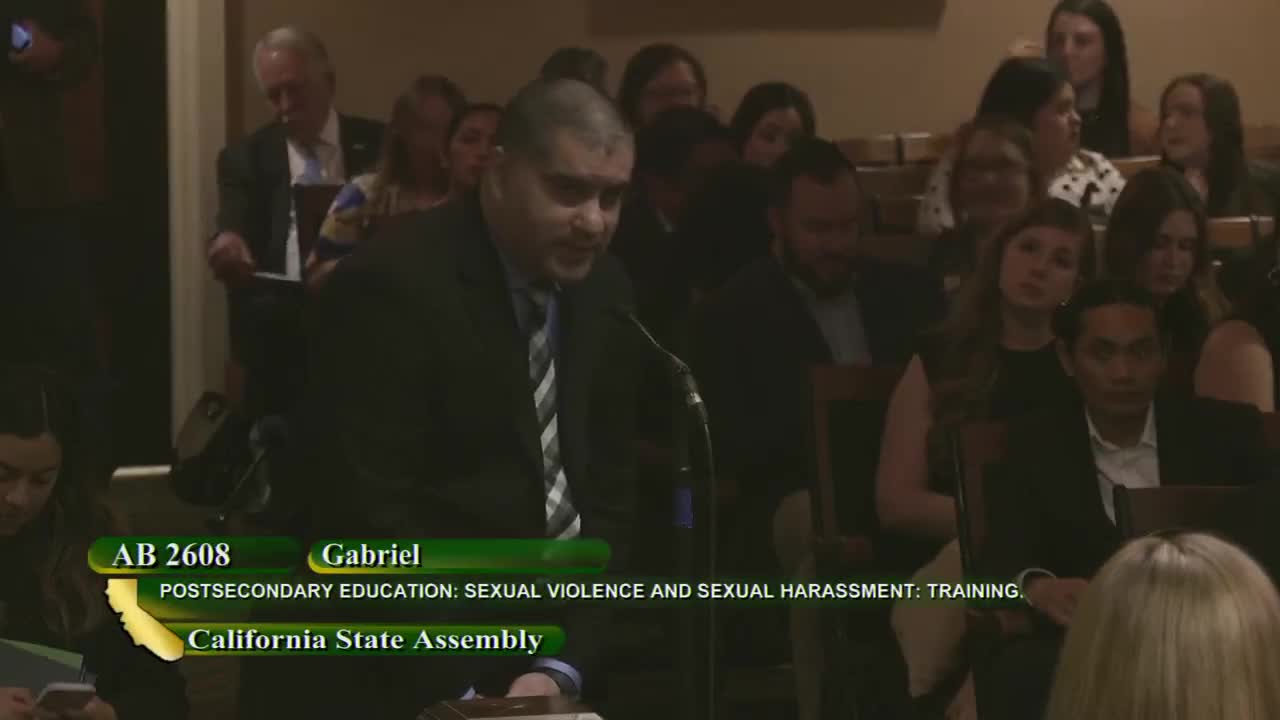
AB 2608 (Gabriel, 2024) expands currently required annual training for students on sexual violence and sexual harassment to also include topics related to alcohol- and drug-facilitated sexual assault and confidential support and care resources for situations that arise as a result of an act of sexual violence and/or sexual harassment. AB 2608 is scheduled to be heard in this committee on
June 12, 2024.
AB 2925 (Friedman, 2024) creates a requirement for specific anti-discrimination training or diversity, equity, and inclusion training offered by postsecondary education institutions to include training on how to combat and address discrimination against the five most targeted groups in the state. AB 2925 is scheduled to be heard in this committee on June 12, 2024.
AB 1575 (Irwin, 2024) authorizes students who receive a disciplinary notification the right to have an adviser of their choosing and requires postsecondary education institutions to provide training for the aforementioned adviser.
AB 1575 is pending in the Senate Judiciary Committee.
AB 1790 (Connelly, 2024) requires the CSU to implement the recommendations provided in a 2023 California State Auditor report related to CSU’s handling of allegations of sexual harassment. AB 1790 is scheduled to be heard in this committee on June 12, 2024.
AB 2407 (Hart, 2024) requires the California State Auditor to report, by September 1, 2026, and every three years thereafter, the results of an audit of the ability of the CCCs, the CSU, and the UC to address and prevent sexual harassment on campus. AB 2407 is scheduled to be heard in this committee on June 12, 2024.
AB 1905 (Addis, 2024) prohibits an employee of a public postsecondary educational institution from being eligible for retreat rights and from receiving a letter of recommendation if the employee is the respondent in a sexual harassment complaint where a final determination has been made, the employee resigned, or the employee enters into a settlement with the institution. AB 1905 is scheduled to be heard in this committee on June 12, 2024.
AB 2048 (Mike Fong, 2024) requires the Chancellor of the CCCs to convene a community college sexual harassment and Title IX working group to review policies and procedures, determine if existing district policies and procedures are adequate, determine to what extent a systemwide model of compliance would best assist community colleges, and review and determine if the CCC Chancellor’s Office is effective in its duty to monitor community colleges for their compliance with state and federal laws pertaining to sexual harassment.
AB 2048 is scheduled to be heard in this committee on June 19, 2024.
SUPPORT
California Faculty Association (Sponsor)
Office of Lieutenant Governor Eleni Kounalakis
Cal State Student Association
California State University Employees Union
Faculty Association of California Community Colleges
Generation Up
Ignite
Safe Campuses Coalition
Youth Power Project
OPPOSITION
None received
-- END --
Date of Hearing: May 8, 2024
ASSEMBLY COMMITTEE ON APPROPRIATIONS
Buffy Wicks, Chair
ABPCA Bill Id:AB 2987
Author:(Ortega) – As Amended Ver:April 18, 2024
Policy Committee: | Higher Education | Vote: | 11 - 0 |
|
| ||
|
|
Urgency: No State Mandated Local Program: Yes Reimbursable: Yes
SUMMARY:
This bill requires each campus of the California State University (CSU) and the California Community Colleges (CCC), and requests each campus of the University of California (UC), provide updates on the status of complaints of sexual discrimination to complainants and respondents.
Specifically, this bill requires each campus of the CSU and CCC, and requests each campus of the UC, upon request, and every 30 days until the outcome of a complaint is determined, to provide updates on complaints of sex discrimination to complainant or respondents. The bill specifies the status updates will be provided only to the extent permissible under state and federal laws. The bill further requires each campus of the CSU and CCC, and requests each campus of the UC, within three days of a decision related to a disciplinary action related to sex discrimination, to notify the respondent and the complainant.
FISCAL EFFECT:
- Minor and absorbable General Fund costs to UC campuses, as it already provides periodic updates and would only need to slightly change its practices as a result of this bill.
- Minor and absorbable General Fund costs to CSU campuses.
- Minor Proposition 98 General Fund costs to CCC campuses.
If the Commission on State Mandates determines the bill’s requirements to be a reimbursable state mandate, the state would need to reimburse these costs to CCCs.
COMMENTS:
- Purpose. According to the author, “Enacting AB 2987 would increase transparency and accountability that campuses must abide by in order to keep their students and employees safe from sexual abuse and keep perpetrators accountable.”
- Background. Current law requires UC, CSU, CCC, a private postsecondary educational institution, or an independent institution of higher education that receives state financial assistance to adopt and publish on its website grievance procedures that provide for prompt and equitable resolution of sexual harassment complaints filed by a student against an employee or another student. Included in these grievance procedures is a requirement that institutions provide a reasonably prompt timeframe for all of the major stages of the complaint process and provide for the prompt communication of that information to the complainant and respondent. To comply with this requirement, CCC completes an investigation within 90 days of receiving a complaint and forwards a copy and written notice of the outcome to the complainant and the respondent. The respondent also receives the determination, proposed resolution including disciplinary action, and the respondent’s right to appeal. The UC and CSU provide notifications to the complainant and respondent when complaints are accepted, when investigations begin, and in the event there is an extension of an investigation timeframe. The complainants and respondents are also provided a copy of the investigative report and a copy of the outcome.
This bill requires institutions provide complainant and respondents with updates at specific times. CSU indicates the three-day turn around to relay decision information required by this bill may be impractical due to fluctuating administrative workload and internal review processes.
- Related Legislation. This bill is part of the Assembly’s “Call to Action” bill package. The bill package includes several bills related to addressing sexual discrimination on college and university campuses.
Analysis Prepared by: Natasha Collins / APPR. / (916) 319-2081
Date of Hearing: April 16, 2024
ASSEMBLY COMMITTEE ON HIGHER EDUCATION
Mike Fong, Chair
ABPCA Bill Id:AB 2987 (
Author:Ortega) – As Amended Ver:March 19, 2024
SUBJECT: Public postsecondary education: sex discrimination complaints: status updates and notices
SUMMARY: Requires each campus of the California Community Colleges (CCC) and California State University (CSU) and requests each campus of the University of California (UC) to provide status updates on the outcomes of sex discrimination complaints to both parties in a sex discrimination complaint and to provide the disciplinary notification within three school days to the respondent of a sex discrimination complaint. Specifically, this bill:
- Requires each campus of the CSU and CCC and requests each campus of the UC to provide, when possible, status updates on the outcomes of sex discrimination complaints, including, but not limited to, complaints of sexual harassment, to both parties in a sex discrimination complaint.
- Clarifies that complaints will not be provided to complainants and respondents who elect not to receive updates.
- Requires each campus of the CSU and CCC and requests each campus of the UC to provide to the respondent the disciplinary action, within the three schooldays following the conclusion the sex discrimination complaint.
- Stipulates if the Commission on State Mandates determines the above provisions contains costs mandated by the state, reimbursement will be made to local agencies and school districts for the cost.
EXISTING LAW: Federal law.
- No person in the United States will, on the basis of sex, be excluded from participation in, be denied the benefits of, or be subjected to discrimination under any education program or activity receiving Federal financial assistance except for specified circumstances including membership of fraternities and sororities (United States Code Title 20, Chapter 38, Section 1681… colloquially known as Title IX).
- Outlines the required response pursuant to Title IX, of a postsecondary higher education institution when the institution is made aware of an alleged sexual harassment incident on campus. The regulations include a requirement for a formal complaint, a grievance procedure for an investigation into whether the incident based on a standard of evidence occurred, and a method of appealing the outcome of the grievance process (Federal Code of Regulations Title 34, Subtitle B, Chapter 1, Subpart D, Section 106.45).
- Defines sexual harassment as conduct on the basis of sex that satisfies at least one of the following:
- An employee of the postsecondary education institution conditions aid, benefit, or services to a recipient on the individual’s participation in unwelcome sexual conduct;
- Unwelcome conduct determined by a reasonable person to be so severe, pervasive, and objectively offensive that it effectively denies a person equal access to the recipient’s education program or activity; an
- Sexual assault, dating violence, domestic violence, and stalking, as defined in the United States Code (Federal Code of Regulations, Title 34, Subpart D, Section 106.30).
State law.
- Establishes the UC as a public trust to be administered by the Regents and grants the Regents full powers of organization and governance subject only to legislative control as necessary to ensure the security of funds, compliance with terms of its endowments, and the statutory requirements around competitive bidding and contracts, sales of property, and the purchase of materials, goods, and services (Article IX, Section (9) (a) of the California Constitution).
- Establishes the CCC under the administration of the Board of Governors of the CCC, as one of the segments of public postsecondary education in California. The CCC shall be comprised of community college districts (Education Code (EDC) Section 70900).
- Establishes the CSU system, comprised of 23 campuses, and bestows upon the CSU Trustees, through the BOT, the power, duties, and functions with respect to the management, administration, and control of the CSU system (EDC Sections 66606 and 89000 et. Seq.).
- Stipulates no provision of the Donahue Higher Education Act shall apply to the UC unless the UC Regents adopts the provision (EDC Section 67400).
- Requires the governing board or body of each postsecondary institution in the state, as a condition of receiving state funding, to comply with an array of conditions pertaining to protecting students from sexual harassment protections and to provide students with procedural protections relating to claims of sexual harassment (EDC Section 66281.8).
- Defines sexual harassment and sexual violence as the following:
- “Sexual harassment” as sexual battery, sexual violence, sexual exploitation, and unwelcomed sexual advances request for sexual favors and other verbal, visual, or physical conduct of a sexual nature made by someone from or in the work or educational setting in which specific conditions are met. Clarifies sexual harassment of students is a form of sex discrimination prohibited by the Equity in Higher Education Act; and,
- “Sexual violence” as a physical sexual act perpetrated against a person without the affirmed consent of the survivor, as defined. Physical sexual acts include rape, sexual batter, sexual exploitation, prostituting another person, trafficking another person, recording images of the person during the act without consent, distributions of said images without consent, or viewing a person’s intimate moments in which privacy is expected without consent, as defined (EDC Section 66262.5).
FISCAL EFFECT: Unknown
COMMENTS: Purpose. As indicated by the author, “It became clear during the Joint Legislative Audit Committee Oversight Hearing not only that the CSU system has failed its students and employees in following Title IX requirements, but that the problem is deeper and more widespread, affecting all institutions in the California public higher education system. Enacting AB 2987 would increase transparency and accountability that campuses must abide by in order to keep their students and employees safe from sexual abuse and keep perpetrators accountable. By requiring open communication between the investigators and the complainants and respondents about the timeline and process of their open sexual misconduct cases, campuses are held to the higher standard of transparency expected of a California higher education institution. AB 2987 is part of a larger package of bills introduced in 2024 working towards changing campus culture, and shifting the focus to making campus life safe for and welcoming to all.”
California State University: It did not adequately or consistently address some allegations of sexual harassment (2022-109).[1] The investigation of the CSU conducted by the California State Auditor, was conducted over three campuses and also examined the role of the Chancellor’s Office in monitoring the compliance of campuses with the system’s sexual harassment policy. The Auditor reviewed 40 cases of alleged sexual harassment by CSU employees and determined the following:
- Complaints of sexual harassment are not adjudicated in a clear and analogous manner despite each campus being required to follow the same policy for how cases are to be adjudicated;
- Disciplinary sanctions were not always implemented despite conclusive findings of sexual harassment; and,
- The Chancellor’s Office had not provided oversight or regulation over the implementation of the system’s policies.
In terms of notifications or status updates to complainants and respondents, the State Auditor determined:
“Although CSU’s sexual harassment policy requires the notifications we list above, it does not require Title IX coordinators to proactively provide additional status updates to complainants and respondents while the investigation is ongoing; instead, the parties must request them. Despite the lack of a formal requirement, San José State’s interim Title IX coordinator explained that his practice is to ask complainants and respondents at the outset of a case about their preferences for receiving status updates; he then schedules periodic update meetings with each of them, such as every two weeks, if they so desire. Further, Fresno State’s Title IX task force recommended that the campus explore creating a dashboard that would allow complainants and respondents to check the status of their specific cases at any time. The Chancellor’s Office should consider requiring campuses to implement something similar to the dashboard or regular update meetings to provide complainants and respondents information on the status of their cases.”
For disciplinary sanction notifications, the State Auditor, “identified seven cases in which campuses either did not initiate appropriate discipline or corrective action or did not document implementing any discipline or corrective action. In four cases, the campuses’ disciplinary or corrective actions were not taken in a timely manner; in fact, in one instance, the campus waited more than five years before issuing a letter of reprimand.”
To help take corrective action, the Auditor provided 16 multi-faceted recommendations to the CSU with varying time frames for implementation between July 2024, January 2025, and July 2026. Two of the recommendations request the CSU to implement similar notification requirements as AB 2987 (Ortega). Specifically,
CSU Audit | AB 2987 (Ortega) |
To more effectively communicate the status of cases to the parties involved, the Chancellor's Office should amend CSU's sexual harassment policy by January 2025 to include specific requirements for campuses to provide regular status updates to complainants and respondents unless those parties request not to receive them. These updates should also communicate the outcomes of cases, including any associated disciplinary or corrective actions, to the extent possible under law. | Requires each campus of the CCC and CSU, and requests the UC to provide status updates on outcomes of complaints of sex discrimination to both the complainants and the respondent. |
The Chancellor's Office should provide guidance to campuses by July 2024 about best practices for initiating, carrying out, and documenting timely disciplinary or corrective actions after a finding of sexual harassment. Further, it should encourage campuses to communicate these principles to relevant decision makers. This guidance should include providing a prompt notice of pending disciplinary action to a respondent when applicable. | Requires the disciplinary notice to be provided to the respondent within three school days. |
Source: The California State Auditor Audit.[2]
The above recommendations have not been implemented by the CSU.
Notification policies for CCC, CSU, and UC. As referenced in the “A Call to Action” report published by this Committee, the California Sex Equity in Education Act (EDC Section 6627.5 - 66282) contains requirements for the adjudication of sex discrimination and sexual harassment complaints, including a requirement for a timeline for the complaint process and the provision of periodic updates on the investigation to the complainant and respondent.
Contained within the California Code of Regulations for CCC are the system’s operating procedures for addressing discrimination complaints. The following notices are provided for complaints of sex discrimination processed by the CCC:
- Within 90 days of receiving a complaint the district will complete an investigation and forward a copy and written notice of outcome to the complainant and the respondent. The respondent will also receive the determination, proposed resolution including disciplinary action, and the respondent’s right to appeal.
The CSU and UC systems have similar notification requirements, specifically:
- Notification to both parties when complaints are accepted, when investigations begin, and any extension of the investigation timeframes. The complainants and respondents are also provided a copy of the investigative report and a copy of the outcome.
AB 2987 (Ortega) would establish a specified outcome for when the disciplinary sanction notification is required to be provided to the complainant and respondent and asks for status updates on the outcome of complaints, which is aligned with existing Education Code, Title IX, and best practices.
Arguments in support. As described by the California Faculty Association, which represents over 29,999 faculty from all 23 campuses of the CSU, “AB 2987 addresses critical gaps identified in the handling of sexual misconduct cases within California’s higher education institutions. The need for this bill is underscored by the findings of a 2023 Oversight Hearing by the Joint Legislative Audit Committee, which published a report on CSU's management of sexual misconduct cases. The audit revealed significant lapses in the universities' investigation processes, including unclear rationales for not pursuing investigations, questionable investigative outcomes, and inconsistent or absent disciplinary actions. Notably, the report found that nearly two-thirds of the 21 detailed investigations reviewed exceeded prescribed timelines, reflecting poor adherence to procedural standards.”
“These issues stem from inadequate guidance and oversight from the Chancellor's Office and emphasize the need for clearer policies and more robust system-wide enforcement to ensure proper handling of sexual harassment allegations. AB 2987 directly responds to these concerns by mandating CCCs and CSUs, and requesting UCs, to regularly update complainants and respondents about the process and resolution of their cases, unless the involved parties specifically opt-out. This bill also mandates that campuses communicate disciplinary actions taken against respondents to complainants within three business days.”
“The prompt notification provision in AB 2987 is designed to empower complainants, providing them with the necessary information to avoid potentially traumatic encounters on campus and maintain their well-being. By standardizing this notification process, the bill ensures a uniform approach across all campuses, enhancing the transparency and accountability of how these cases are handled. This contributes to creating a safer and more supportive educational environment for all students, faculty, and staff.”
Ignite National, explains the need of AB 2987 (Ortega) as it, “addresses critical gaps identified in the handling of sexual misconduct cases within California’s higher education institutions. The need for this bill is underscored by the findings of a 2023 Oversight Hearing by the Joint Legislative Audit Committee, which published a report on CSU's management of sexual misconduct cases. The audit revealed significant lapses in the universities' investigation processes, including unclear rationales for not pursuing investigations, questionable investigative outcomes, and inconsistent or absent disciplinary actions. Notably, the report found that nearly two-thirds of the 21 detailed investigations reviewed exceeded prescribed timelines, reflecting poor adherence to procedural standards. These issues stem from inadequate guidance and oversight from the Chancellor's Office and emphasize the need for clearer policies and more robust system-wide enforcement to ensure proper handling of sexual harassment allegations. AB 2987 directly responds to these concerns by mandating CCCs and CSUs, and requesting UCs, to regularly update complainants and respondents about the process and resolution of their cases, unless the involved parties specifically opt-out. This bill also mandates that campuses communicate disciplinary actions taken against respondents to complainants within three business days. The prompt notification provision in AB 2987 is designed to empower complainants, providing them with the necessary information to avoid potentially traumatic encounters on campus and maintain their well-being. By standardizing this notification process, the bill ensures a uniform approach across all campuses, enhancing the transparency and accountability of how these cases are handled. This contributes to creating a safer and more supportive educational environment for all students, faculty, and staff.”
Committee comments. AB 2987 (Ortega) will require disciplinary sanctions notifications to be provided within three business days thereby, not delaying the conclusion of the resolution of the complaint. Notifications of disciplinary sanctions does not imply the sanction will be levied within three school days. Student respondents will still need the ability to appeal to the disciplinary sanction notification and the measure does not prevent such an action from occurring. Nor does the measure interfere with the appeal processes afforded to employees of the system, the Skelly process, which is established by Education Code, collective bargaining agreements, or internal policies of the systems.
The measure only asks for the disciplinary notification to be provided within three days not for the disciplinary sanction to be levied or implemented within three days of the outcome of a complaint. The current policy at the CSU is for a disciplinary notification to occur within 10 days of the outcome of a compliant and the UC is 15 days. Three school days is a rather quick turn around and does not account for the working realities of the people involved in the work of adjudicating cases of sex discrimination.
To ensure the proper procedures and formats are adhered to, in order to prevent the overturn on appeals, the Author should continue to work with the CSU to address timelines that both ensures harassers are removed or disciplined accordingly while also preserving due process rights as delineated in the nondiscrimination policies.
Furthermore, AB 2987 (Ortega) does not provide specifics on the requirement to provide status updates and is almost the exact language currently in EDC Section 66281.8; however, this section of code only pertains to complaints where the complainant is a student. AB 2987 (Ortega) extends the existing best practice for periodic updates on the adjudication of the sex discrimination complaint when the complaint is an employee.
In order to enumerate the intent of the author to have periodic status updates, Committee Staff has suggested and, the Author has agreed to, the following amendments:
- Amend Section 66281.4 subdivision (a) to read as follows:
(a) Each campus of the California State University and the California Community Colleges shall, and each campus of the University of California is requested to, provide, upon request of the complainant or respondent, and every 30 days until the outcome of a complaint is determined, and only to the extent permissible under state and federal law, status updates on the outcomes of complaints of sex discrimination, including, but not limited to, complaints of sexual harassment, to complainants and respondents.
- Amend Section 66281.4 subdivision (c) to read as follows:
(c) Each campus of the California State University and the California Community Colleges shall, and each campus of the University of California is requested to, provide, within three schooldays of a decision of disciplinary action being made against a respondent in response to a complaint of sex discrimination, notice a notification of the disciplinary action to the respondent. respondent and complainant.
Related legislation. In response to the recommendations put forth by the Assembly Higher Education Committee, 12 bills by 11 different authors were introduced. In addition to AB 2987 (Ortega), the bills included in the bill package are as follows:
- AB 810 (Friedman) of 2024, currently pending referral in the Senate Rules Committee, would require the CCC, the CSU, and requests both the UC and private postsecondary education institutions, to implement a policy of requiring potential employees for academic, athletic, and administrative positions to disclose whether they have been the subject of a finding of sexual harassment and to permit the institution to contact past employers to inquire whether the applicant had any substantiated allegations of misconduct.
- SB 1166 (Dodd) of 2024, currently pending a hearing in the Senate Committee on Appropriations, would require the CCC, the CSU, and requests the UC to provide annual reports to the Legislature on the timelines and outcomes of sexual harassment complaints adjudicated by campuses within the system.
- SB 1491 (Eggman) of 2024, currently pending a hearing in the Senate Committee on Judiciary, provides an array of additional supports and protections for lesbian, gay, bisexual, asexual, pansexual, transgender, gender-nonconforming, intersex and two-spirit faculty, staff, and students at postsecondary education institutions throughout the State.
- AB 1790 (Connolly) of 2024, is scheduled to be heard in the Assembly Higher Education Committee on April 16, 2024 and requires the CSU to implement the California State Auditor’s findings by January 1, 2026 and to provide two reports to the Legislature on the implementation of the recommendations, as described.
- AB 1905 (Addis) of 2024, places conditions upon the use of settlements, informal resolutions, retreat rights, and letters of recommendations for public postsecondary education institutions of the state for employees who are the respondent in a sexual harassment complaint, as defined. AB 1905 (Addis) passed out of this Committee with a 11 - 0, and is currently pending a hearing in the Assembly Public Employment and Retirement Committee.
- AB 2047 (Mike Fong) of 2024, is scheduled to be heard in the Assembly Higher Education Committee on April 16, 2024. This measure would the CCC, CSU, and the UC to establish a systemwide Office of Civil Rights and requires the system to hire a systemwide Title IX coordinator.
- AB 2048 (Mike Fong) of 2024, is scheduled to be heard in the Assembly Higher Education Committee on April 16, 2024. The measure would require each campus of the CSU and UC, and each community college district, to establish a Title IX office in a private space for students and employees to disclose complaints of sex discrimination and establishes the responsibilities of the Title IX office in addressing and preventing sex discrimination on college campuses.
- AB 2326 (Alvarez) of 2024, is scheduled to be heard in the Assembly Higher Education Committee on April 16, 2024, delineates which entities with the public higher education institutions are responsible for ensuring campus programs are free from discrimination and who has the authority to oversee and monitor compliance with state and federal laws; and, requires the leadership of all three public higher education institutions to present to the Legislature their efforts in addressing and preventing discrimination on campus..
- AB 2407 (Hart) of 2024, is scheduled to be heard in the Assembly Higher Education Committee on April 16, 2024, and requires the State Auditor to conduct an audit every three years of the CCC, CSU, and UC regarding their respective handling and investigation of sexual harassment complaints.
- AB 2492 (Irwin) of 2024, is scheduled to be heard in the Assembly Higher Education Committee on April 16, 2024, and would require each public postsecondary education institution to establish the positions of a confidential student advocate, a confidential staff and faculty advocate, and a confidential respondent services coordinator.
- AB 2608 (Gabriel) of 2024, is scheduled to be heard in the Assembly Higher Education Committee on April 16, 2024 and would expand the requirements for annual training for students on sexual violence and sexual harassment to include information on drug-facilitated sexual assault and information related to confidential support and care resources.
REGISTERED SUPPORT / OPPOSITION:
Support
Cal State Student Association
California Faculty Association
California State University Employees Union (CSUEU)
Faculty Association of California Community Colleges
GenUp (Generation Up)
Ignite
Safe Campuses Coalition
Opposition
None on file.
Analysis Prepared by: Ellen Cesaretti-Monroy / HIGHER ED. / (916) 319-3960
Date of Hearing: April 16, 2024
ASSEMBLY COMMITTEE ON HIGHER EDUCATION
Mike Fong, Chair
ABPCA Bill Id:AB 2987 (
Author:Ortega) – As Amended Ver:March 19, 2024
SUBJECT: Public postsecondary education: sex discrimination complaints: status updates and notices
SUMMARY: Requires each campus of the California Community Colleges (CCC) and California State University (CSU) and requests each campus of the University of California (UC) to provide status updates on the outcomes of sex discrimination complaints to both parties in a sex discrimination complaint and to provide the disciplinary notification within three school days to the respondent of a sex discrimination complaint. Specifically, this bill:
- Requires each campus of the CSU and CCC and requests each campus of the UC to provide, when possible, status updates on the outcomes of sex discrimination complaints, including, but not limited to, complaints of sexual harassment, to both parties in a sex discrimination complaint.
- Clarifies that complaints will not be provided to complainants and respondents who elect not to receive updates.
- Requires each campus of the CSU and CCC and requests each campus of the UC to provide to the respondent the disciplinary action, within the three schooldays following the conclusion the sex discrimination complaint.
- Stipulates if the Commission on State Mandates determines the above provisions contains costs mandated by the state, reimbursement will be made to local agencies and school districts for the cost.
EXISTING LAW: Federal law.
- No person in the United States will, on the basis of sex, be excluded from participation in, be denied the benefits of, or be subjected to discrimination under any education program or activity receiving Federal financial assistance except for specified circumstances including membership of fraternities and sororities (United States Code Title 20, Chapter 38, Section 1681… colloquially known as Title IX).
- Outlines the required response pursuant to Title IX, of a postsecondary higher education institution when the institution is made aware of an alleged sexual harassment incident on campus. The regulations include a requirement for a formal complaint, a grievance procedure for an investigation into whether the incident based on a standard of evidence occurred, and a method of appealing the outcome of the grievance process (Federal Code of Regulations Title 34, Subtitle B, Chapter 1, Subpart D, Section 106.45).
- Defines sexual harassment as conduct on the basis of sex that satisfies at least one of the following:
- An employee of the postsecondary education institution conditions aid, benefit, or services to a recipient on the individual’s participation in unwelcome sexual conduct;
- Unwelcome conduct determined by a reasonable person to be so severe, pervasive, and objectively offensive that it effectively denies a person equal access to the recipient’s education program or activity; an
- Sexual assault, dating violence, domestic violence, and stalking, as defined in the United States Code (Federal Code of Regulations, Title 34, Subpart D, Section 106.30).
State law.
- Establishes the UC as a public trust to be administered by the Regents and grants the Regents full powers of organization and governance subject only to legislative control as necessary to ensure the security of funds, compliance with terms of its endowments, and the statutory requirements around competitive bidding and contracts, sales of property, and the purchase of materials, goods, and services (Article IX, Section (9) (a) of the California Constitution).
- Establishes the CCC under the administration of the Board of Governors of the CCC, as one of the segments of public postsecondary education in California. The CCC shall be comprised of community college districts (Education Code (EDC) Section 70900).
- Establishes the CSU system, comprised of 23 campuses, and bestows upon the CSU Trustees, through the BOT, the power, duties, and functions with respect to the management, administration, and control of the CSU system (EDC Sections 66606 and 89000 et. Seq.).
- Stipulates no provision of the Donahue Higher Education Act shall apply to the UC unless the UC Regents adopts the provision (EDC Section 67400).
- Requires the governing board or body of each postsecondary institution in the state, as a condition of receiving state funding, to comply with an array of conditions pertaining to protecting students from sexual harassment protections and to provide students with procedural protections relating to claims of sexual harassment (EDC Section 66281.8).
- Defines sexual harassment and sexual violence as the following:
- “Sexual harassment” as sexual battery, sexual violence, sexual exploitation, and unwelcomed sexual advances request for sexual favors and other verbal, visual, or physical conduct of a sexual nature made by someone from or in the work or educational setting in which specific conditions are met. Clarifies sexual harassment of students is a form of sex discrimination prohibited by the Equity in Higher Education Act; and,
- “Sexual violence” as a physical sexual act perpetrated against a person without the affirmed consent of the survivor, as defined. Physical sexual acts include rape, sexual batter, sexual exploitation, prostituting another person, trafficking another person, recording images of the person during the act without consent, distributions of said images without consent, or viewing a person’s intimate moments in which privacy is expected without consent, as defined (EDC Section 66262.5).
FISCAL EFFECT: Unknown
COMMENTS: Purpose. As indicated by the author, “It became clear during the Joint Legislative Audit Committee Oversight Hearing not only that the CSU system has failed its students and employees in following Title IX requirements, but that the problem is deeper and more widespread, affecting all institutions in the California public higher education system. Enacting AB 2987 would increase transparency and accountability that campuses must abide by in order to keep their students and employees safe from sexual abuse and keep perpetrators accountable. By requiring open communication between the investigators and the complainants and respondents about the timeline and process of their open sexual misconduct cases, campuses are held to the higher standard of transparency expected of a California higher education institution. AB 2987 is part of a larger package of bills introduced in 2024 working towards changing campus culture, and shifting the focus to making campus life safe for and welcoming to all.”
California State University: It did not adequately or consistently address some allegations of sexual harassment (2022-109).[1] The investigation of the CSU conducted by the California State Auditor, was conducted over three campuses and also examined the role of the Chancellor’s Office in monitoring the compliance of campuses with the system’s sexual harassment policy. The Auditor reviewed 40 cases of alleged sexual harassment by CSU employees and determined the following:
- Complaints of sexual harassment are not adjudicated in a clear and analogous manner despite each campus being required to follow the same policy for how cases are to be adjudicated;
- Disciplinary sanctions were not always implemented despite conclusive findings of sexual harassment; and,
- The Chancellor’s Office had not provided oversight or regulation over the implementation of the system’s policies.
In terms of notifications or status updates to complainants and respondents, the State Auditor determined:
“Although CSU’s sexual harassment policy requires the notifications we list above, it does not require Title IX coordinators to proactively provide additional status updates to complainants and respondents while the investigation is ongoing; instead, the parties must request them. Despite the lack of a formal requirement, San José State’s interim Title IX coordinator explained that his practice is to ask complainants and respondents at the outset of a case about their preferences for receiving status updates; he then schedules periodic update meetings with each of them, such as every two weeks, if they so desire. Further, Fresno State’s Title IX task force recommended that the campus explore creating a dashboard that would allow complainants and respondents to check the status of their specific cases at any time. The Chancellor’s Office should consider requiring campuses to implement something similar to the dashboard or regular update meetings to provide complainants and respondents information on the status of their cases.”
For disciplinary sanction notifications, the State Auditor, “identified seven cases in which campuses either did not initiate appropriate discipline or corrective action or did not document implementing any discipline or corrective action. In four cases, the campuses’ disciplinary or corrective actions were not taken in a timely manner; in fact, in one instance, the campus waited more than five years before issuing a letter of reprimand.”
To help take corrective action, the Auditor provided 16 multi-faceted recommendations to the CSU with varying time frames for implementation between July 2024, January 2025, and July 2026. Two of the recommendations request the CSU to implement similar notification requirements as AB 2987 (Ortega). Specifically,
CSU Audit | AB 2987 (Ortega) |
To more effectively communicate the status of cases to the parties involved, the Chancellor's Office should amend CSU's sexual harassment policy by January 2025 to include specific requirements for campuses to provide regular status updates to complainants and respondents unless those parties request not to receive them. These updates should also communicate the outcomes of cases, including any associated disciplinary or corrective actions, to the extent possible under law. | Requires each campus of the CCC and CSU, and requests the UC to provide status updates on outcomes of complaints of sex discrimination to both the complainants and the respondent. |
The Chancellor's Office should provide guidance to campuses by July 2024 about best practices for initiating, carrying out, and documenting timely disciplinary or corrective actions after a finding of sexual harassment. Further, it should encourage campuses to communicate these principles to relevant decision makers. This guidance should include providing a prompt notice of pending disciplinary action to a respondent when applicable. | Requires the disciplinary notice to be provided to the respondent within three school days. |
Source: The California State Auditor Audit.[2]
The above recommendations have not been implemented by the CSU.
Notification policies for CCC, CSU, and UC. As referenced in the “A Call to Action” report published by this Committee, the California Sex Equity in Education Act (EDC Section 6627.5 - 66282) contains requirements for the adjudication of sex discrimination and sexual harassment complaints, including a requirement for a timeline for the complaint process and the provision of periodic updates on the investigation to the complainant and respondent.
Contained within the California Code of Regulations for CCC are the system’s operating procedures for addressing discrimination complaints. The following notices are provided for complaints of sex discrimination processed by the CCC:
- Within 90 days of receiving a complaint the district will complete an investigation and forward a copy and written notice of outcome to the complainant and the respondent. The respondent will also receive the determination, proposed resolution including disciplinary action, and the respondent’s right to appeal.
The CSU and UC systems have similar notification requirements, specifically:
- Notification to both parties when complaints are accepted, when investigations begin, and any extension of the investigation timeframes. The complainants and respondents are also provided a copy of the investigative report and a copy of the outcome.
AB 2987 (Ortega) would establish a specified outcome for when the disciplinary sanction notification is required to be provided to the complainant and respondent and asks for status updates on the outcome of complaints, which is aligned with existing Education Code, Title IX, and best practices.
Arguments in support. As described by the California Faculty Association, which represents over 29,999 faculty from all 23 campuses of the CSU, “AB 2987 addresses critical gaps identified in the handling of sexual misconduct cases within California’s higher education institutions. The need for this bill is underscored by the findings of a 2023 Oversight Hearing by the Joint Legislative Audit Committee, which published a report on CSU's management of sexual misconduct cases. The audit revealed significant lapses in the universities' investigation processes, including unclear rationales for not pursuing investigations, questionable investigative outcomes, and inconsistent or absent disciplinary actions. Notably, the report found that nearly two-thirds of the 21 detailed investigations reviewed exceeded prescribed timelines, reflecting poor adherence to procedural standards.”
“These issues stem from inadequate guidance and oversight from the Chancellor's Office and emphasize the need for clearer policies and more robust system-wide enforcement to ensure proper handling of sexual harassment allegations. AB 2987 directly responds to these concerns by mandating CCCs and CSUs, and requesting UCs, to regularly update complainants and respondents about the process and resolution of their cases, unless the involved parties specifically opt-out. This bill also mandates that campuses communicate disciplinary actions taken against respondents to complainants within three business days.”
“The prompt notification provision in AB 2987 is designed to empower complainants, providing them with the necessary information to avoid potentially traumatic encounters on campus and maintain their well-being. By standardizing this notification process, the bill ensures a uniform approach across all campuses, enhancing the transparency and accountability of how these cases are handled. This contributes to creating a safer and more supportive educational environment for all students, faculty, and staff.”
Ignite National, explains the need of AB 2987 (Ortega) as it, “addresses critical gaps identified in the handling of sexual misconduct cases within California’s higher education institutions. The need for this bill is underscored by the findings of a 2023 Oversight Hearing by the Joint Legislative Audit Committee, which published a report on CSU's management of sexual misconduct cases. The audit revealed significant lapses in the universities' investigation processes, including unclear rationales for not pursuing investigations, questionable investigative outcomes, and inconsistent or absent disciplinary actions. Notably, the report found that nearly two-thirds of the 21 detailed investigations reviewed exceeded prescribed timelines, reflecting poor adherence to procedural standards. These issues stem from inadequate guidance and oversight from the Chancellor's Office and emphasize the need for clearer policies and more robust system-wide enforcement to ensure proper handling of sexual harassment allegations. AB 2987 directly responds to these concerns by mandating CCCs and CSUs, and requesting UCs, to regularly update complainants and respondents about the process and resolution of their cases, unless the involved parties specifically opt-out. This bill also mandates that campuses communicate disciplinary actions taken against respondents to complainants within three business days. The prompt notification provision in AB 2987 is designed to empower complainants, providing them with the necessary information to avoid potentially traumatic encounters on campus and maintain their well-being. By standardizing this notification process, the bill ensures a uniform approach across all campuses, enhancing the transparency and accountability of how these cases are handled. This contributes to creating a safer and more supportive educational environment for all students, faculty, and staff.”
Committee comments. AB 2987 (Ortega) will require disciplinary sanctions notifications to be provided within three business days thereby, not delaying the conclusion of the resolution of the complaint. Notifications of disciplinary sanctions does not imply the sanction will be levied within three school days. Student respondents will still need the ability to appeal to the disciplinary sanction notification and the measure does not prevent such an action from occurring. Nor does the measure interfere with the appeal processes afforded to employees of the system, the Skelly process, which is established by Education Code, collective bargaining agreements, or internal policies of the systems.
The measure only asks for the disciplinary notification to be provided within three days not for the disciplinary sanction to be levied or implemented within three days of the outcome of a complaint. The current policy at the CSU is for a disciplinary notification to occur within 10 days of the outcome of a compliant and the UC is 15 days. Three school days is a rather quick turn around and does not account or the working realities of the people involved in the work of adjudicating cases of Title IX.
To ensure the proper procedures and formats are adhered to, in order to prevent the overturn on appeals, the Author should continue to work with the CSU to address timelines that both ensures harassers are removed or disciplined accordingly while also preserving due process rights as delineated in the nondiscrimination policies.
Furthermore, AB 2987 (Ortega) does not provide specifics on the requirement to provide status updates and is almost the exact language currently in EDC Section 66281.8; however, this section of code only pertains to complaints where the complainant is a student. AB 2987 (Ortega) extends the existing best practice for periodic updates on the adjudication of the sex discrimination complaint when the complaint is an employee.
In order to enumerate the intent of the author to have periodic status updates, Committee Staff has suggested and, the Author has agreed to, the following amendments:
- Amend Section 66281.4 subdivision (a) to read as follows:
(a) Each campus of the California State University and the California Community Colleges shall, and each campus of the University of California is requested to, provide, upon request of the complainant or respondent, and every 30 days until the outcome of a complaint is determined, and only to the extent permissible under state and federal law, status updates on the outcomes of complaints of sex discrimination, including, but not limited to, complaints of sexual harassment, to complainants and respondents.
- Amend Section 66281.4 subdivision (c) to read as follows:
(c) Each campus of the California State University and the California Community Colleges shall, and each campus of the University of California is requested to, provide, within three schooldays of a decision of disciplinary action being made against a respondent in response to a complaint of sex discrimination, notice a notification of the disciplinary action to the respondent. respondent and complainant.
Related legislation. In response to the recommendations put forth by the Assembly Higher Education Committee, 12 bills by 11 different authors were introduced. In addition to AB 2987 (Ortega), the bills included in the bill package are as follows:
- AB 810 (Friedman) of 2024, currently pending referral in the Senate Rules Committee, would require the CCC, the CSU, and requests both the UC and private postsecondary education institutions, to implement a policy of requiring potential employees for academic, athletic, and administrative positions to disclose whether they have been the subject of a finding of sexual harassment and to permit the institution to contact past employers to inquire whether the applicant had any substantiated allegations of misconduct.
- SB 1166 (Dodd) of 2024, currently pending a hearing in the Senate Committee on Appropriations, would require the CCC, the CSU, and requests the UC to provide annual reports to the Legislature on the timelines and outcomes of sexual harassment complaints adjudicated by campuses within the system.
- SB 1491 (Eggman) of 2024, currently pending a hearing in the Senate Committee on Judiciary, provides an array of additional supports and protections for lesbian, gay, bisexual, asexual, pansexual, transgender, gender-nonconforming, intersex and two-spirit faculty, staff, and students at postsecondary education institutions throughout the State.
- AB 1790 (Connolly) of 2024, is scheduled to be heard in the Assembly Higher Education Committee on April 16, 2024 and requires the CSU to implement the California State Auditor’s findings by January 1, 2026 and to provide two reports to the Legislature on the implementation of the recommendations, as described.
- AB 1905 (Addis) of 2024, places conditions upon the use of settlements, informal resolutions, retreat rights, and letters of recommendations for public postsecondary education institutions of the state for employees who are the respondent in a sexual harassment complaint, as defined. AB 1905 (Addis) passed out of this Committee with a 11 - 0, and is currently pending a hearing in the Assembly Public Employment and Retirement Committee.
- AB 2047 (Mike Fong) of 2024, is scheduled to be heard in the Assembly Higher Education Committee on April 16, 2024. This measure would the CCC, CSU, and the UC to establish a systemwide Office of Civil Rights and requires the system to hire a systemwide Title IX coordinator.
- AB 2048 (Mike Fong) of 2024, is scheduled to be heard in the Assembly Higher Education Committee on April 16, 2024. The measure would require each campus of the CSU and UC, and each community college district, to establish a Title IX office in a private space for students and employees to disclose complaints of sex discrimination and establishes the responsibilities of the Title IX office in addressing and preventing sex discrimination on college campuses.
- AB 2326 (Alvarez) of 2024, is scheduled to be heard in the Assembly Higher Education Committee on April 16, 2024, delineates which entities with the public higher education institutions are responsible for ensuring campus programs are free from discrimination and who has the authority to oversee and monitor compliance with state and federal laws; and, requires the leadership of all three public higher education institutions to present to the Legislature their efforts in addressing and preventing discrimination on campus..
- AB 2407 (Hart) of 2024, is scheduled to be heard in the Assembly Higher Education Committee on April 16, 2024, and requires the State Auditor to conduct an audit every three years of the CCC, CSU, and UC regarding their respective handling and investigation of sexual harassment complaints.
- AB 2492 (Irwin) of 2024, is scheduled to be heard in the Assembly Higher Education Committee on April 16, 2024, and would require each public postsecondary education institution to establish the positions of a confidential student advocate, a confidential staff and faculty advocate, and a confidential respondent services coordinator.
- AB 2608 (Gabriel) of 2024, is scheduled to be heard in the Assembly Higher Education Committee on April 16, 2024 and would expand the requirements for annual training for students on sexual violence and sexual harassment to include information on drug-facilitated sexual assault and information related to confidential support and care resources.
REGISTERED SUPPORT / OPPOSITION:
Support
Cal State Student Association
California Faculty Association
California State University Employees Union (CSUEU)
Faculty Association of California Community Colleges
GenUp (Generation Up)
Ignite
Safe Campuses Coalition
Opposition
None on file.
Analysis Prepared by: Ellen Cesaretti-Monroy / HIGHER ED. / (916) 319-3960
Discussed in Hearing
View Older Hearings