AB 3105: Employment: wages and hours: exemption for faculty at private institutions of higher education.
- Session Year: 2023-2024
- House: Assembly
- Latest Version Date: 2024-07-18
Current Status:
Passed
(2024-07-18: Chaptered by Secretary of State - Chapter 158, Statutes of 2024.)
Introduced
In Committee
First Chamber
In Committee
Second Chamber
Enacted
Existing law establishes the Division of Labor Standards Enforcement, headed by the Labor Commissioner, within the Department of Industrial Relations, for the purpose of enforcing labor laws. Existing law exempts an employee from certain provisions governing wages, hours, and other protections if the employee meets certain requirements, including being employed to provide instruction for a course or laboratory at an independent institution of higher education, as defined.
This bill would revise the definition of an independent institution of higher education for purposes of the above-described exemption by including those institutions whose formation as a nonprofit corporation occurred out of this state and excluding those institutions whose formation occurred on or after January 1, 2023. The bill would declare that these provisions are declaratory of existing law.
Existing law establishes the Division of Labor Standards Enforcement, headed by the Labor Commissioner, within the Department of Industrial Relations, for the purpose of enforcing labor laws. Existing law exempts an employee from certain provisions governing wages, hours, and other protections if the employee meets certain requirements, including being employed to provide instruction for a course or laboratory at an independent institution of higher education, as defined.
This bill would narrow the definition of an independent institution of higher education for purposes of the above-described exemption by excluding those institutions formed as a nonprofit corporation on or after January 1, 2023. The bill would declare that these provisions are declaratory of existing law.
Existing law establishes the Division of Labor Standards Enforcement, headed by the Labor Commissioner, within the Department of Industrial Relations, for the purpose of enforcing labor laws. Existing law exempts an employee from certain provisions governing wages, hours, and other protections if the employee meets certain requirements, including being employed to provide instruction for a course or laboratory at an independent institution of higher education, as defined.
This bill would narrow the definition of an independent institution of higher education for purposes of the above-described exemption by excluding those institutions formed as a nonprofit corporation on or after January 1, 2023, and would require the institution to be in good standing with the Bureau for Private Postsecondary Education. 2023.
Existing law exempts an employee from certain provisions governing wages, hours, and other protections if the employee meets certain requirements, including being employed to provide instruction for a course or laboratory at an independent institution of higher education, as defined.
This bill would narrow the definition of an independent institution of higher education for purposes of the above-described exemption by excluding those institutions formed as a nonprofit corporation on or after January 1, 2023, and would require the institution to be in good standing with the Bureau for Private Postsecondary Education.
(a)If an employee is employed to provide instruction for a course or laboratory at an independent institution of higher education, the employee shall be classified as employed in a professional capacity under Wage Order No. 4-2001 of the Industrial Welfare Commission, or under Wage Order No. 5-2001 of the Industrial Welfare Commission, and shall be exempt from paragraphs (2), (3), and (9) of subdivision (a) of Section 226, and Sections 510 and 512, when all of the following apply:
(1)The employee is employed in a professional capacity. For the purpose of this section, an employee shall be considered to be employed in a professional capacity under Wage Order No. 4-2001 or Wage Order No. 5-2001, notwithstanding clauses (a) and (d) of subparagraph (3) of paragraph (A) of Section 1 of Wage Order 4 and clauses (a) and (d) of subparagraph (3) of paragraph (B) of Section 1 of Wage Order 5, if:
(A)The employee is primarily engaged in an occupation commonly recognized as a learned or artistic profession; and
(B)The employee customarily and regularly exercises discretion and independent judgment in the performance of duties set forth in subparagraph (A).
(C)For the purposes of this paragraph, learned or artistic profession means an employee who is primarily engaged in the performance of:
(i)Work requiring knowledge of an advanced type in a field or science or learning customarily acquired by a prolonged course of specialized intellectual instruction and study, as distinguished from a general academic education and from an apprenticeship, and from training in the performance of routine mental, manual, or physical processes, or work that is an essential part of or necessarily incident to any of the above work; or
(ii)Work that is original and creative in character in a recognized field of artistic endeavor, as opposed to work which can be produced by a person endowed with general manual or intellectual ability and training, and the result of which depends primarily on the invention, imagination, or talent of the employee or work that is an essential part of or necessarily incident to any of the above work; and
(iii)Whose work is predominantly intellectual and varied in character, as opposed to routine mental, manual, mechanical, or physical work, and is of such character that the output produced or the result accomplished cannot be standardized in relation to a given period of time.
(2)The employee is paid on a salary basis, as defined by Section 541.602 of Title 29 of the Code of Federal Regulations, and receives one of the following minimum compensations:
(A)A monthly salary equivalent to no less than two times the state minimum wage for employment in which the employee is employed for at least 40 hours per week.
(B)When employed per course or laboratory, a salary for a course or laboratory that is calculated on the basis of classroom hours as set forth in subdivision (b).
(C)When employed under a collective bargaining agreement, payment pursuant to that collective bargaining agreement, if the classification of employment in a professional capacity is expressly included in the collective bargaining agreement in clear and unambiguous terms. The requirements of Section 514 that mandate provisions of a collective bargaining agreement shall not apply.
(b)The minimum salary required by subparagraph (B) of paragraph (2) of subdivision (a) shall be calculated using classroom hours as follows:
(1)The minimum payment that is calculated using classroom hours shall encompass payment for all classroom or laboratory time, preparation, grading, office hours, and other course- or laboratory-related work for that course or laboratory and no separate payment shall be required. The following minimum rates shall be used in this calculation:
(A)For each classroom hour in 2020: one hundred seventeen dollars ($117).
(B)For each classroom hour in 2021: one hundred twenty-six dollars ($126).
(C)For each classroom hour in 2022: one hundred thirty-five dollars ($135).
(D)For each classroom hour in 2023 and each year thereafter: a percentage increase to the rate described in subparagraph (C) that is equal to the percentage increase to the state minimum wage calculated in accordance with subdivision (c) of Section 1182.12.
(2)Notwithstanding paragraph (1), if a laboratory, art studio course, clinical course, or other nonlecture course has more classroom hours than a lecture-based course with the same number of units at the institution, the minimum salary required by subparagraph (B) of paragraph (2) of subdivision (a) for the laboratory, art studio course, clinical course, or other nonlecture course shall be that of the lecture-based course with the same number of units.
(3)The minimum rate of pay for per course or laboratory compensation is for course-related work only. Employees shall be compensated separately for other non-course-related work on behalf of the employer, which shall not affect the employees classification as an exempt employee.
(c)For purposes of this section, the following definitions apply:
(1)Classroom hour means the time spent in the primary forum of the course or laboratory, regardless of whether the forum is inperson or virtual.
(2)Independent institution of higher education means a nonpublic, higher education institution that grants undergraduate degrees, graduate degrees, or both, and that is formed as a nonprofit corporation before January 1, 2023, and is accredited by an agency recognized by the United States Department of Education.
SEC. 2.The changes made by this act do not constitute a change in, but are declaratory of, existing law.
(a)If an employee is employed to provide instruction for a course or laboratory at an independent institution of higher education, the employee shall be classified as employed in a professional capacity under Wage Order No. 4-2001 of the Industrial Welfare Commission, or under Wage Order No. 5-2001 of the Industrial Welfare Commission, and shall be exempt from paragraphs (2), (3), and (9) of subdivision (a) of Section 226, and Sections 510 and 512, when all of the following apply:
(1)The employee is employed in a professional capacity. For the purpose of this section, an employee shall be considered to be employed in a professional capacity under Wage Order No. 4-2001 or Wage Order No. 5-2001, notwithstanding clauses (a) and (d) of subparagraph (3) of paragraph (A) of Section 1 of Wage Order 4 and clauses (a) and (d) of subparagraph (3) of paragraph (B) of Section 1 of Wage Order 5, if:
(A)The employee is primarily engaged in an occupation commonly recognized as a learned or artistic profession; and
(B)The employee customarily and regularly exercises discretion and independent judgment in the performance of duties set forth in subparagraph (A).
(C)For the purposes of this paragraph, learned or artistic profession means an employee who is primarily engaged in the performance of:
(i)Work requiring knowledge of an advanced type in a field or science or learning customarily acquired by a prolonged course of specialized intellectual instruction and study, as distinguished from a general academic education and from an apprenticeship, and from training in the performance of routine mental, manual, or physical processes, or work that is an essential part of or necessarily incident to any of the above work; or
(ii)Work that is original and creative in character in a recognized field of artistic endeavor, as opposed to work which can be produced by a person endowed with general manual or intellectual ability and training, and the result of which depends primarily on the invention, imagination, or talent of the employee or work that is an essential part of or necessarily incident to any of the above work; and
(iii)Whose work is predominantly intellectual and varied in character, as opposed to routine mental, manual, mechanical, or physical work, and is of such character that the output produced or the result accomplished cannot be standardized in relation to a given period of time.
(2)The employee is paid on a salary basis, as defined by Section 541.602 of Title 29 of the Code of Federal Regulations, and receives one of the following minimum compensations:
(A)A monthly salary equivalent to no less than two times the state minimum wage for employment in which the employee is employed for at least 40 hours per week.
(B)When employed per course or laboratory, a salary for a course or laboratory that is calculated on the basis of classroom hours as set forth in subdivision (b).
(C)When employed under a collective bargaining agreement, payment pursuant to that collective bargaining agreement, if the classification of employment in a professional capacity is expressly included in the collective bargaining agreement in clear and unambiguous terms. The requirements of Section 514 that mandate provisions of a collective bargaining agreement shall not apply.
(b)The minimum salary required by subparagraph (B) of paragraph (2) of subdivision (a) shall be calculated using classroom hours as follows:
(1)The minimum payment that is calculated using classroom hours shall encompass payment for all classroom or laboratory time, preparation, grading, office hours, and other course- or laboratory-related work for that course or laboratory and no separate payment shall be required. The following minimum rates shall be used in this calculation:
(A)For each classroom hour in 2020: one hundred seventeen dollars ($117).
(B)For each classroom hour in 2021: one hundred twenty-six dollars ($126).
(C)For each classroom hour in 2022: one hundred thirty-five dollars ($135).
(D)For each classroom hour in 2023 and each year thereafter: a percentage increase to the rate described in subparagraph (C) that is equal to the percentage increase to the state minimum wage calculated in accordance with subdivision (c) of Section 1182.12.
(2)Notwithstanding paragraph (1), if a laboratory, art studio course, clinical course, or other nonlecture course has more classroom hours than a lecture-based course with the same number of units at the institution, the minimum salary required by subparagraph (B) of paragraph (2) of subdivision (a) for the laboratory, art studio course, clinical course, or other nonlecture course shall be that of the lecture-based course with the same number of units.
(3)The minimum rate of pay for per course or laboratory compensation is for course-related work only. Employees shall be compensated separately for other non-course-related work on behalf of the employer, which shall not affect the employees classification as an exempt employee.
(c)For purposes of this section, the following definitions apply:
(1)Classroom hour means the time spent in the primary forum of the course or laboratory, regardless of whether the forum is inperson or virtual.
(2)Independent institution of higher education means a nonpublic, higher education institution that grants undergraduate degrees, graduate degrees, or both, and that is formed as a nonprofit corporation before January 1, 2023, is in current good standing with the Bureau for Private Postsecondary Education, and is accredited by an agency recognized by the United States Department of Education.
(a)If an employee is employed to provide instruction for a course or laboratory at an independent institution of higher education, as defined in subdivision (b) of Section 66010 of the Education Code, the employee shall be classified as employed in a professional capacity under Wage Order No. 4-2001 of the Industrial Welfare Commission, or under Wage Order No. 5-2001 of the Industrial Welfare Commission, and shall be exempt from paragraphs (2), (3), and (9) of subdivision (a) of Section 226, and Sections 510 and 512, when all of the following apply:
(1)The employee is employed in a professional capacity. For the purpose of this section, an employee shall be considered to be employed in a professional capacity under Wage Order No. 4-2001 or Wage Order No. 5-2001, notwithstanding clauses (a) and (d) of subparagraph (3) of paragraph (A) of Section 1 of Wage Order 4 and clauses (a) and (d) of subparagraph (3) of paragraph (B) of Section 1 of Wage Order 5, if:
(A)The employee is primarily engaged in an occupation commonly recognized as a learned or artistic profession; and
(B)The employee customarily and regularly exercises discretion and independent judgment in the performance of duties set forth in subparagraph (A).
(C)For the purposes of this paragraph, learned or artistic profession means an employee who is primarily engaged in the performance of:
(i)Work requiring knowledge of an advanced type in a field or science or learning customarily acquired by a prolonged course of specialized intellectual instruction and study, as distinguished from a general academic education and from an apprenticeship, and from training in the performance of routine mental, manual, or physical processes, or work that is an essential part of or necessarily incident to any of the above work; or
(ii)Work that is original and creative in character in a recognized field of artistic endeavor, as opposed to work which can be produced by a person endowed with general manual or intellectual ability and training, and the result of which depends primarily on the invention, imagination, or talent of the employee or work that is an essential part of or necessarily incident to any of the above work; and
(iii)Whose work is predominantly intellectual and varied in character, as opposed to routine mental, manual, mechanical, or physical work, and is of such character that the output produced or the result accomplished cannot be standardized in relation to a given period of time.
(2)The employee is paid on a salary basis, as defined by Section 541.602 of Title 29 of the Code of Federal Regulations, and receives one of the following minimum compensations:
(A)A monthly salary equivalent to no less than two times the state minimum wage for employment in which the employee is employed for at least 40 hours per week.
(B)When employed per course or laboratory, a salary for a course or laboratory that is calculated on the basis of classroom hours as set forth in subdivision (b).
(C)When employed under a collective bargaining agreement, payment pursuant to that collective bargaining agreement, if the classification of employment in a professional capacity is expressly included in the collective bargaining agreement in clear and unambiguous terms. The requirements of Section 514 that mandate provisions of a collective bargaining agreement shall not apply.
(b)The minimum salary required by subparagraph (B) of paragraph (2) of subdivision (a) shall be calculated using classroom hours as follows:
(1)The minimum payment that is calculated using classroom hours shall encompass payment for all classroom or laboratory time, preparation, grading, office hours, and other course- or laboratory-related work for that course or laboratory and no separate payment shall be required. The following minimum rates shall be used in this calculation:
(A)For each classroom hour in 2020: one hundred seventeen dollars ($117).
(B)For each classroom hour in 2021: one hundred twenty-six dollars ($126).
(C)For each classroom hour in 2022: one hundred thirty-five dollars ($135).
(D)For each classroom hour in 2023 and each year thereafter: a percentage increase to the rate described in subparagraph (C) that is equal to the percentage increase to the state minimum wage calculated in accordance with subdivision (c) of Section 1182.12.
(2)Notwithstanding paragraph (1), if a laboratory, art studio course, clinical course, or other nonlecture course has more classroom hours than a lecture-based course with the same number of units at the institution, the minimum salary required by subparagraph (B) of paragraph (2) of subdivision (a) for the laboratory, art studio course, clinical course, or other nonlecture course shall be that of the lecture-based course with the same number of units.
(3)The minimum rate of pay for per course or laboratory compensation is for course-related work only. Employees shall be compensated separately for other non-course-related work on behalf of the employer, which shall not affect the employees classification as an exempt employee.
(4)(c)For purposes of this section, classroom the following definitions apply:
(1)Classroom hour means the time spent in the primary forum of the course or laboratory, regardless of whether the forum is in-person inperson or virtual.
(2)Independent institution of higher education means a nonpublic, higher education institution that grants undergraduate degrees, graduate degrees, or both, and that is formed as a nonprofit corporation before January 1, 2023, is in current good standing with the Bureau for Private Postsecondary Education, and is accredited by an agency recognized by the United States Department of Education.
|
Date
|
Status
|
|---|---|
| Jul 18, 2024 | Chaptered by Secretary of State - Chapter 158, Statutes of 2024. |
| Jul 18, 2024 | Approved by the Governor. |
| Jul 10, 2024 | Enrolled and presented to the Governor at 4 p.m. |
| Jul 2, 2024 | Enrolled measure version corrected. |
| Jun 27, 2024 | Senate amendments concurred in. To Engrossing and Enrolling. (Ayes 74. Noes 0. Page 6077.). |
| Jun 20, 2024 | In Assembly. Concurrence in Senate amendments pending. May be considered on or after June 22 pursuant to Assembly Rule 77. |
| Jun 20, 2024 | Read third time. Passed. Ordered to the Assembly. (Ayes 36. Noes 0. Page 4628.). |
| Jun 18, 2024 | Read second time. Ordered to Consent Calendar. |
| Jun 17, 2024 | From committee: Be ordered to second reading file pursuant to Senate Rule 28.8 and ordered to Consent Calendar. |
| Jun 5, 2024 | From committee: Do pass and re-refer to Com. on APPR with recommendation: To Consent Calendar. (Ayes 5. Noes 0.) (June 5). Re-referred to Com. on APPR. |
| May 28, 2024 | From committee chair, with author's amendments: Amend, and re-refer to committee. Read second time, amended, and re-referred to Com. on L., P.E. & R. |
| May 8, 2024 | Referred to Com. on L., P.E. & R. |
| Apr 25, 2024 | In Senate. Read first time. To Com. on RLS. for assignment. |
| Apr 25, 2024 | Read third time. Passed. Ordered to the Senate. (Ayes 75. Noes 0. Page 4999.) |
| Apr 18, 2024 | Read second time. Ordered to Consent Calendar. |
| Apr 17, 2024 | From committee: Do pass. To Consent Calendar. (Ayes 15. Noes 0.) (April 17). |
| Apr 4, 2024 | From committee: Do pass and re-refer to Com. on APPR. with recommendation: To Consent Calendar. (Ayes 7. Noes 0.) (April 3). Re-referred to Com. on APPR. |
| Mar 12, 2024 | Re-referred to Com. on L. & E. |
| Mar 11, 2024 | Referred to Com. on L. & E. |
| Mar 11, 2024 | From committee chair, with author's amendments: Amend, and re-refer to Com. on L. & E. Read second time and amended. |
| Feb 17, 2024 | From printer. May be heard in committee March 18. |
| Feb 16, 2024 | Read first time. To print. |
|
Date
|
Description
|
Location
|
Votes
|
|
|---|---|---|---|---|
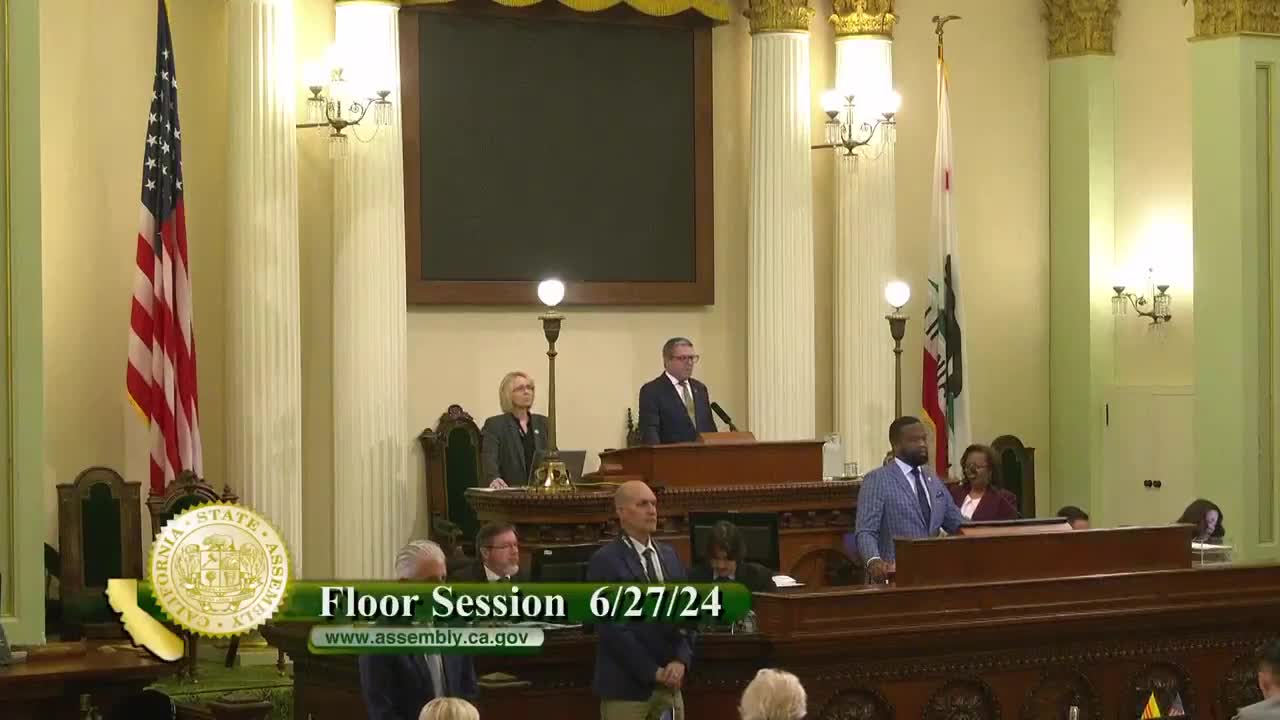
| Jun 27, 2024 | AB 3105 Flora Concurrence in Senate Amendments | Assembly Floor |
Passed |
|
| Jun 20, 2024 | Consent Calendar 2nd AB3105 Flora | Senate Floor |
Passed |
|
| Jun 5, 2024 | Do pass, but first be re-referred to the Committee on [Appropriations] with the recommendation: To Consent Calendar | Senate Standing Committee on Labor, Public Employment and Retirement |
Passed |
|
| Apr 25, 2024 | AB 3105 Flora Consent Calendar Second Day Regular Session | Assembly Floor |
Passed |
|
| Apr 17, 2024 | Do pass. To Consent Calendar. | Assembly Standing Committee on Appropriations |
Passed |
|
| Apr 3, 2024 | Do pass and be re-referred to the Committee on [Appropriations] with recommendation: To Consent Calendar | Assembly Standing Committee on Labor and Employment |
Passed |
This list shows positions taken on this bill by organizations on the date displayed, which is linked to the original source.
Positions by individuals are not included.
|
Organization
|
Position
|
Date
|
|---|---|---|
| Association of Independent California Colleges Universities | ** Support |
CONCURRENCE IN SENATE AMENDMENTS
CSA1 Bill Id:AB 3105
Author:(Flora)
As Amended Ver:May 28, 2024
Majority vote
SUMMARY
Clarifies that instructors employed at independent institutions of higher learning incorporated out of state prior to January 1, 2023 are exempt professionals from state wage and hour law.
Senate Amendments
State the provisions are declaratory of existing law.
COMMENTS
California's Industrial Welfare Commission (IWC) has issued 17 wage orders over the years covering various industries in order to establish minimum wage and other protections for employees. The IWC wage orders generally exempt three main categories of employees: administrative, executive, or professional. To qualify for a professional exemption, an employee must meet a "duties' test" that looks at the nature of the work they perform. The test generally requires that the work performed involves advanced study and is original, creative, or intellectual in nature.
The duties of an exempt professional are often not captured in a traditional eight hour work day. AB 736 (Irwin) Chapter 44, Statutes of 2020 clarified and provided that the professional exemption applies to adjunct faculty at private, nonprofit universities and colleges that satisfy the duties' test and meet certain hourly or monthly salary requirements. For the purposes of defining which entities' employees qualify, the law uses the same definition of "independent institutions of higher education" as is used in the Education Code, which specifies, in part, that the institutions must be formed as "nonprofit corporations in this state."
This current definition means that adjunct faculty at certain independent institutions of higher education that are incorporated out of state do not qualify for the professional exemption provided to other institutions incorporated in the state. One such entity that has been identified to the Committee is Antioch University.
This bill would also add the requirement that the independent institution of higher learning must be formed as a nonprofit corporation prior to January 1, 2023. The author's office has communicated to this Committee that the reason for this requirement is to prevent any independent institution of higher education from changing from for-profit to non-profit status to benefit from the exemption.
According to the Author
"AB 3105 would modify the definition of "independent institutions of higher education" to include the Education Code definition currently cross-referenced in the Labor Code, but not include the incorporated in this state language. As a result, it would include nonpublic higher education institutions that grant undergraduate degrees, graduate degrees, or both, and that are formed as nonprofit corporations and are accredited by an agency recognized by the United States Department of Education."
The author further states that, "This bill will allow more adjunct professors to be employed, which will increase educational opportunities for underserved and marginalized communities."
Arguments in Support
The Association of Independent California Colleges and Universities (AICCU) is in support and states "In 2020, AICCU partnered with SEIU California to co-sponsor Assembly Bill 736 (Irwin). That legislation allowed higher education institutions to treat adjunct faculty as exempt if certain conditions were met regarding how they are paid and how that pay is calculated. It addressed an issue in Labor Code that had forced multiple institutions to convert adjuncts to hourly employees to avoid costly litigation due to the typical compensation for part-time adjunct faculty. In short, AB 736 created an additional pathway within Labor Code that provided a competitive baseline compensation for adjunct faculty, allowed them to continue to be recognized as highly skilled professionals rather than hourly employees, and offered a way for colleges to compensate their adjunct faculty in a manner that no longer exposed them to costly litigation.
AB 3105 proposes a minor change to the definition of "independent institution of higher education." It continues to require that institutions utilizing this compensation pathway be nonprofit institutions that grant undergraduate degrees and/or graduate degrees, and that they be accredited by an agency recognized by the U.S. Department of Education. Most importantly, it does not amend any part of the actual compensation formula that AB 736 enacted. In practice, this modest change ensures that reputable nonprofit colleges and universities that operate in the state and employ Californians can utilize this compensation method for their adjunct faculty."
Arguments in Opposition
None on file.
FISCAL COMMENTS
According to the Senate Appropriations Committee pursuant to SR 28.8 negligible costs.
VOTES:
ASM LABOR AND EMPLOYMENT: 7-0-0
YES: Ortega, Flora, Alanis, Wendy Carrillo, Kalra, Ward, Zbur
ASM APPROPRIATIONS: 15-0-0
YES: Wicks, Sanchez, Arambula, Bryan, Calderon, Wendy Carrillo, Dixon, Mike Fong, Grayson, Haney, Hart, Jim Patterson, Pellerin, Ta, Villapudua
ASSEMBLY FLOOR: 75-0-5
YES: Addis, Aguiar-Curry, Alanis, Alvarez, Arambula, Bains, Bauer-Kahan, Bennett, Berman, Bonta, Bryan, Calderon, Juan Carrillo, Wendy Carrillo, Cervantes, Chen, Connolly, Davies, Dixon, Essayli, Flora, Mike Fong, Vince Fong, Friedman, Gabriel, Garcia, Gipson, Grayson, Haney, Holden, Hoover, Irwin, Jackson, Jones-Sawyer, Kalra, Lackey, Lee, Low, Lowenthal, Maienschein, McCarty, McKinnor, Muratsuchi, Stephanie Nguyen, Ortega, Pacheco, Papan, Jim Patterson, Joe Patterson, Pellerin, Petrie-Norris, Quirk-Silva, Ramos, Rendon, Reyes, Luz Rivas, Rodriguez, Blanca Rubio, Sanchez, Santiago, Schiavo, Soria, Ta, Ting, Valencia, Villapudua, Waldron, Wallis, Ward, Weber, Wicks, Wilson, Wood, Zbur, Robert Rivas
ABS, ABST OR NV: Boerner, Megan Dahle, Gallagher, Hart, Mathis
SENATE FLOOR: 36-0-4
YES: Archuleta, Ashby, Atkins, Becker, Blakespear, Bradford, Caballero, Cortese, Dahle, Dodd, Eggman, Glazer, Gonzalez, Hurtado, Jones, Laird, Limón, McGuire, Menjivar, Min, Newman, Nguyen, Niello, Ochoa Bogh, Padilla, Portantino, Roth, Rubio, Seyarto, Skinner, Smallwood-Cuevas, Stern, Umberg, Wahab, Wiener, Wilk
ABS, ABST OR NV: Allen, Alvarado-Gil, Durazo, Grove
UPDATED
VERSION: May 28, 2024
CONSULTANT: Erin Hickey / L. & E. / (916) 319-2091 FN: 0003558
SENATE RULES COMMITTEE Office of Senate Floor Analyses (916) 651-1520 Fax: (916) 327-4478 | AB 3105 |
CONSENT
Bill No: AB 3105
Author: Flora (R)
Amended: 5/28/24 in Senate
Vote: 21
SENATE LABOR, PUB. EMP. & RET. COMMITTEE: 5-0, 6/5/24
AYES: Smallwood-Cuevas, Wilk, Cortese, Durazo, Laird
SENATE APPROPRIATIONS COMMITTEE: Senate Rule 28.8
ASSEMBLY FLOOR: 75-0, 4/25/24 (Consent) - See last page for vote
SUBJECT: Employment: wages and hours: exemption for faculty at private institutions of higher education
SOURCE: Antioch University
DIGEST:
This bill clarifies that instructors employed at independent institutions of higher learning incorporated out of state prior to January 1, 2023 are included in an existing professional wage and hour law exemption.
ANALYSIS: Existing federal law provides that being paid on a “salary basis” means the employee regularly receives each pay period on a weekly, or less frequent basis, a predetermined amount constituting all or part of the employee’s compensation, which is not subject to reduction because of variations in the quality or quantity of the work performed. (29 Code of Federal Regulations 541.602)
Existing state law:
- Establishes within the Department of Industrial Relations (DIR) the Division of Labor Standards Enforcement (DLSE) under the direction of the Labor Commissioner (LC), and empowers the LC to ensure a just day’s pay in every work place and to promote justice through robust enforcement of labor laws. (Labor Code §79-107)
- Requires an employer, semimonthly or at the time of payment of wages, to furnish to their employee an accurate, itemized, written statement generally containing specified information regarding the amounts earned, hours worked, and the employee’s identity, among other things. An itemized wage statement furnished by an employer is not required to show total hours worked by the employee if, among other things, the employee is exempt from the payment of minimum wage and overtime. (Labor Code §226)
- Provides that eight hours of labor constitutes a day’s work. Any work in excess of eight hours in one workday and any work in excess of 40 hours in any one workweek and the first eight hours worked on the seventh day of work in any one workweek shall be compensated at the rate of no less than one and one-half times the regular rate of pay for an employee. (Labor Code §510)
- Prohibits, with limited exceptions, an employer from employing an employee for a work period of more than five hours per day without providing the employee with a meal period of not less than 30 minutes, except that if the total work period per day of the employee is no more than six hours, the meal period may be waived by mutual consent of both the employer and employee. An employer shall not employ an employee for a work period of more than 10 hours per day without providing the employee with a second meal period of not less than 30 minutes, except that if the total hours worked is no more than 12 hours, the second meal period may be waived by mutual consent of the employer and the employee only if the first meal period was not waived. (Labor Code §512)
- Creates the Industrial Welfare Commission (IWC), which promulgates industry-specific wage orders that set the wages, hours, and working conditions of employees. The IWC wage orders have the force of regulation and are enforced by DLSE. (Labor Code §§70, 1173, 1177, 1195 & 1197)
- Provides that an instructor at an independent institution of higher learning, as defined in subdivision (b) of Section 66010 of the Education Code, is an exempt professional, under Wage Order No. 4-2001 or under Wage Order No. 5-2001 of the IWC, if that person meets specified criteria. (Labor Code §515.7)
- Defines “independent institutions of higher education” as nonpublic higher education institutions that grant undergraduate degrees, graduate degrees, or both, and that are formed as nonprofit corporations in this state and are accredited by an agency recognized by the United States Department of Education. (Education Code §66010)
- Creates a specific professional duties’ test, which permits certain employees to be exempt from overtime and minimum wage requirements. The duties’ test requires the following:
- Work requiring knowledge of an advanced type in a field or science or learning customarily acquired by a prolonged course of specialized intellectual instruction and study; or
- Work that is original and creative in character in a recognized field of artistic endeavor, and the result of which depends primarily on the invention, imagination, or talent of the employee or work that is an essential part of or necessarily incident to any of the above work; and
- Whose work is predominantly intellectual and varied in character (as opposed to routine mental, manual, mechanical, or physical work) and is of such character that the output produced or the result accomplished cannot be standardized in relation to a given period of time. (IWC Wage Order 4-2001)
- Requires, in addition to meeting the duties’ test in 8) above, an exempt professional to earn a monthly salary of no less than twice the minimum wage for full time employment, or 40 hours in a workweek. (IWC Wage Order 4-2001)
- Provides that under Wage Order No. 5-2001 the “Public Housekeeping Industry” means any industry, business, or establishment which provides meals, housing, or maintenance services whether operated as a primary business or when incidental to other operations in an establishment not covered by an industry order of the Commission. (IWC Wage Order 5-2001)
Background
Industrial Welfare Commission (IWC). DIR established the IWC in 1913 to develop wage orders for various industries. These wage orders set the wages, hours of work, and working conditions of California employees. To date, 17 wage orders have been issued covering, among others, the manufacturing, canning, laundry, transportation, and broadcasting industries. The IWC wage orders generally exempt three main categories of employees: administrative, executive, and professional. To qualify for a professional exemption, an employee must meet a "duties' test" that looks at the nature of the work they perform. Generally, the work involves advanced study and is original, creative, or intellectual in nature. An employee must also earn a monthly salary equivalent to no less than two times the state minimum wage for full-time employment. Together, these requirements ensure only employees with responsibilities not easily captured in a traditional 8-hour workday are included in the exemption and removed from overtime and meal and rest break protections. Although the IWC was defunded in 2004, its wage orders remain enforceable.
Professional Exemptions, Private Adjunct Faculty, and AB 736. AB 736 (Irwin, Chapter 44, Statutes of 2020) clarified that the professional exemption applies to adjunct faculty at private, nonprofit universities and colleges that satisfy the duties' test and meet certain hourly or monthly salary requirements. Adjunct faculty must earn a monthly salary equivalent to twice the minimum wage, or when employed per course or laboratory a salary calculated on the basis of classroom hours, as specified, or when employed under a collective bargaining agreement, a salary pursuant to that collective bargaining agreement. The definition of “independent institution of higher education” included in AB 736 excluded nonprofits registered outside of the state.
This bill updates the definition of “independent institution of higher education” to include nonprofits formed both inside and outside of the state before January 1, 2023. The author’s stated reason for including this date is to prevent any independent institution of higher education from changing from for-profit to non-profit status to benefit from the exemption. The committee does note, however that the inclusion of this date may force future independent institutions of higher education, incorporated after 2023, to seek clarifying legislation to qualify for the professional exemption.
Related/Prior Legislation
AB 736 (Irwin, Chapter 44, Statutes of 2020) clarified that an adjunct instructor at an independent institution of higher learning qualifies as an exempt professional if that person meets specified criteria.
AB 1466 (Irwin, 2019) would have been similar to this bill and would have clarified when an adjunct instructor at an independent institution of higher learning qualifies as an exempt professional.
FISCAL EFFECT: Appropriation: No Fiscal Com.: Yes Local: No
SUPPORT: (Verified 6/17/24)
Antioch University (source)
Association of Independent California Colleges & Universities
OPPOSITION: (Verified 6/17/24)
None received
ARGUMENTS IN SUPPORT: According to Antioch University, the sponsors of this bill:
AB 736, which was signed in 2020 and codified at Labor Code §515.7, allows higher education institutions to treat adjuncts as exempt as long as certain conditions are met in terms of how much they are paid, how pay is calculated, etc. The problem is that it only applies to entities as defined by Education Code § 66010(b) which defines independent institutions of higher learning as ‘those nonpublic higher education institutions that grant undergraduate degrees, graduate degrees, or both, and that are formed as nonprofit corporations in this state and are accredited by an agency recognized by the United States Department of Education.’ (emphasis added.)
There is no justification for a requirement that the entity be incorporated in California as opposed to in another state. It, therefore, seems to us to be a purely protectionist measure. This bill would amend Section §515.7 to include institutions like Antioch that are (1) non-profit, (2) provide substantial access to higher education to low-income persons, non-traditional households (e.g., single-parent homes), and working individuals, (3) accredited by the state of California, and (4) are treated as in state for purposes of financial aid.
ASSEMBLY FLOOR: 75-0, 4/25/24
AYES: Addis, Aguiar-Curry, Alanis, Alvarez, Arambula, Bains, Bauer-Kahan, Bennett, Berman, Bonta, Bryan, Calderon, Juan Carrillo, Wendy Carrillo, Cervantes, Chen, Connolly, Davies, Dixon, Essayli, Flora, Mike Fong, Vince Fong, Friedman, Gabriel, Garcia, Gipson, Grayson, Haney, Holden, Hoover, Irwin, Jackson, Jones-Sawyer, Kalra, Lackey, Lee, Low, Lowenthal, Maienschein, McCarty, McKinnor, Muratsuchi, Stephanie Nguyen, Ortega, Pacheco, Papan, Jim Patterson, Joe Patterson, Pellerin, Petrie-Norris, Quirk-Silva, Ramos, Rendon, Reyes, Luz Rivas, Rodriguez, Blanca Rubio, Sanchez, Santiago, Schiavo, Soria, Ta, Ting, Valencia, Villapudua, Waldron, Wallis, Ward, Weber, Wicks, Wilson, Wood, Zbur, Robert Rivas
NO VOTE RECORDED: Boerner, Megan Dahle, Gallagher, Hart, Mathis
Prepared by: Emma Bruce / L., P.E. & R. / (916) 651-1556
6/18/24 15:49:23
**** END ****
SENATE COMMITTEE ON LABOR, PUBLIC EMPLOYMENT AND RETIREMENT
Senator Lola Smallwood-Cuevas, Chair
2023 - 2024 Regular
Bill No: AB 3105 Hearing Date: June 5, 2024
Author: | Flora | ||
Version: | May 28, 2024 | ||
Urgency: | No | Fiscal: | Yes |
Consultant: | Emma Bruce | ||
SUBJECT: Employment: wages and hours: exemption for faculty at private institutions of higher education
KEY ISSUE
This bill clarifies that instructors employed at independent institutions of higher learning incorporated out of state prior to January 1, 2023 are included in an existing professional wage and hour law exemption.
ANALYSIS
Existing federal law:
- Provides that being paid on a “salary basis” means the employee regularly receives each pay period on a weekly, or less frequent basis, a predetermined amount constituting all or part of the employee’s compensation, which is not subject to reduction because of variations in the quality or quantity of the work performed. (29 Code of Federal Regulations 541.602)
Existing state law:
- Establishes within the Department of Industrial Relations (DIR) the Division of Labor Standards Enforcement (DLSE) under the direction of the Labor Commissioner (LC), and empowers the LC to ensure a just day’s pay in every work place and to promote justice through robust enforcement of labor laws. (Labor Code §79-107)
- Requires an employer, semimonthly or at the time of payment of wages, to furnish to their employee an accurate, itemized, written statement generally containing specified information regarding the amounts earned, hours worked, and the employee’s identity, among other things. An itemized wage statement furnished by an employer is not required to show total hours worked by the employee if, among other things, the employee is exempt from the payment of minimum wage and overtime. (Labor Code §226)
- Provides that eight hours of labor constitutes a day’s work. Any work in excess of eight hours in one workday and any work in excess of 40 hours in any one workweek and the first eight hours worked on the seventh day of work in any one workweek shall be compensated at the rate of no less than one and one-half times the regular rate of pay for an employee. (Labor Code §510)
- Prohibits, with limited exceptions, an employer from employing an employee for a work period of more than five hours per day without providing the employee with a meal period of not less than 30 minutes, except that if the total work period per day of the employee is no more than six hours, the meal period may be waived by mutual consent of both the employer and employee. An employer shall not employ an employee for a work period of more than 10 hours per day without providing the employee with a second meal period of not less than 30 minutes, except that if the total hours worked is no more than 12 hours, the second meal period may be waived by mutual consent of the employer and the employee only if the first meal period was not waived. (Labor Code §512)
- Creates the Industrial Welfare Commission (IWC), which promulgates industry-specific wage orders that set the wages, hours, and working conditions of employees. The IWC wage orders have the force of regulation and are enforced by DLSE. (Labor Code §§70, 1173, 1177, 1195 & 1197)
- Provides that an instructor at an independent institution of higher learning, as defined in subdivision (b) of Section 66010 of the Education Code, is an exempt professional, under Wage Order No. 4-2001 or under Wage Order No. 5-2001 of the IWC, if that person meets specified criteria. (Labor Code §515.7)
- Defines “independent institutions of higher education” as nonpublic higher education institutions that grant undergraduate degrees, graduate degrees, or both, and that are formed as nonprofit corporations in this state and are accredited by an agency recognized by the United States Department of Education. (Education Code §66010)
- Creates a specific professional duties’ test, which permits certain employees to be exempt from overtime and minimum wage requirements. The duties’ test requires the following:
- Work requiring knowledge of an advanced type in a field or science or learning customarily acquired by a prolonged course of specialized intellectual instruction and study; or
- Work that is original and creative in character in a recognized field of artistic endeavor, and the result of which depends primarily on the invention, imagination, or talent of the employee or work that is an essential part of or necessarily incident to any of the above work; and
- Whose work is predominantly intellectual and varied in character (as opposed to routine mental, manual, mechanical, or physical work) and is of such character that the output produced or the result accomplished cannot be standardized in relation to a given period of time. (IWC Wage Order 4-2001)
- Requires, in addition to meeting the duties’ test in 8) above, an exempt professional to earn a monthly salary of no less than twice the minimum wage for full time employment, or 40 hours in a workweek. (IWC Wage Order 4-2001)
- Provides that under Wage Order No. 5-2001 the “Public Housekeeping Industry” means any industry, business, or establishment which provides meals, housing, or maintenance services whether operated as a primary business or when incidental to other operations in an establishment not covered by an industry order of the Commission. (IWC Wage Order 5-2001)
This bill:
- Defines, for purposes of the exemption referenced under existing law 6), an “independent institution of higher education” as a nonpublic, higher education institution that grants undergraduate degrees, graduate degrees, or both, and that is formed as a nonprofit corporation before January 1, 2023, and is accredited by an agency recognized by the United States Department of Education.
- Declares that the changes made by these provisions do not constitute a change in, but are declaratory of, existing law.
COMMENTS
1. Background:
Industrial Welfare Commission (IWC)
DIR established the IWC in 1913 to develop wage orders for various industries. These wage orders set the wages, hours of work, and working conditions of California employees. To date, 17 wage orders have been issued covering, among others, the manufacturing, canning, laundry, transportation, and broadcasting industries. The IWC wage orders generally exempt three main categories of employees: administrative, executive, and professional. To qualify for a professional exemption, an employee must meet a "duties' test" that looks at the nature of the work they perform. Generally, the work involves advanced study and is original, creative, or intellectual in nature. An employee must also earn a monthly salary equivalent to no less than two times the state minimum wage for full-time employment. Together, these requirements ensure only employees with responsibilities not easily captured in a traditional 8-hour workday are included in the exemption and removed from overtime and meal and rest break protections. Although the IWC was defunded in 2004, its wage orders remain enforceable.
Professional Exemptions, Private Adjunct Faculty, and AB 736
AB 736 (Irwin, Chapter 44, Statutes of 2020) clarified that the professional exemption applies to adjunct faculty at private, nonprofit universities and colleges that satisfy the duties' test and meet certain hourly or monthly salary requirements. Adjunct faculty must earn a monthly salary equivalent to twice the minimum wage, or when employed per course or laboratory a salary calculated on the basis of classroom hours, as specified, or when employed under a collective bargaining agreement, a salary pursuant to that collective bargaining agreement. The definition of “independent institution of higher education” included in AB 736 excluded nonprofits registered outside of the state.
AB 3105 would update the definition of “independent institution of higher education” to include nonprofits formed both inside and outside of the state before January 1, 2023. The author’s stated reason for including this date is to prevent any independent institution of higher education from changing from for-profit to non-profit status to benefit from the exemption. The committee does note, however that the inclusion of this date may force future independent institutions of higher education, incorporated after 2023, to seek clarifying legislation to qualify for the professional exemption.
2. Need for this bill?
The author’s office writes,
“This bill would modify the current wage and hour exemption for faculty at private institutions of higher education by making a minor modification to the definition of an institute of higher education.
This bill would modify the definition of an independent institution of higher education for purposes of this exemption by excluding those institutions formed as a nonprofit corporation on or after January 1, 2023, and would require the institution to be accredited by the U.S. Department of Education.”
3. Proponent Arguments
According to Antioch University, the sponsors of the measure,
“AB 736, which was signed in 2020 and codified at Labor Code §515.7, allows higher education institutions to treat adjuncts as exempt as long as certain conditions are met in terms of how much they are paid, how pay is calculated, etc. The problem is that it only applies to entities as defined by Education Code § 66010(b) which defines independent institutions of higher learning as ‘those nonpublic higher education institutions that grant undergraduate degrees, graduate degrees, or both, and that are formed as nonprofit corporations in this state and are accredited by an agency recognized by the United States Department of Education.’ (emphasis added.)
There is no justification for a requirement that the entity be incorporated in
California as opposed to in another state. It, therefore, seems to us to be a purely
protectionist measure. This bill would amend Section §515.7 to include institutions like
Antioch that are (1) non-profit, (2) provide substantial access to higher education to low-income persons, non-traditional households (e.g., single-parent homes), and working
individuals, (3) accredited by the state of California, and (4) are treated as in state for
purposes of financial aid.”
4. Opponent Arguments:
None received.
5. Prior Legislation:
AB 102 (Ting, Chapter 38, Statutes of 2023), among other things, allocated money to the IWC to convene industry-specific wage boards and adopt orders specific to wages, hours, and working conditions in such industries. The commission shall prioritize for consideration industries in which more than 10 percent of workers are at or below the federal poverty level.
AB 736 (Irwin, Chapter 44, Statutes of 2020) clarified that an adjunct instructor at an independent institution of higher learning qualifies as an exempt professional if that person meets specified criteria.
AB 1466 (Irwin, 2019, Vetoed) of 2019 was similar to this bill and would have clarified when an adjunct instructor at an independent institution of higher learning qualifies as an exempt professional.
SUPPORT
Antioch University (Sponsor)
Association of Independent California Colleges & Universities
OPPOSITION
None received.
-- END --
Date of Hearing: April 17, 2024
ASSEMBLY COMMITTEE ON APPROPRIATIONS
Buffy Wicks, Chair
ABPCA Bill Id:AB 3105
Author:(Flora) – As Amended Ver:March 11, 2024
Policy Committee: | Labor and Employment | Vote: | 7 - 0 |
|
| ||
|
|
Urgency: No State Mandated Local Program: No Reimbursable: No
SUMMARY:
This bill modifies an existing definition to exclude an independent institution of higher learning that incorporated as an out-of-state, non-profit corporation before January 1, 2023, from specified state wage and hour laws.
FISCAL EFFECT:
No costs to the Division of Labor Standards Enforcement (DLSE). DLSE anticipates that any reduction in the number of potential employee claims will be offset by the increase in complexity of remaining claims, resulting in a neutral workload impact to staff.
COMMENTS:
- Purpose. According to the author, this bill modifies the definition of “independent institutions of higher education” so that an adjunct faculty member of an institution not incorporated in California also qualifies as an exempt professional, similar to an adjunct faculty member of an institution incorporated in California. This bill is supported by the Association of Independent California Colleges and Universities and Antioch University.
- Exempt Professionals. California’s Industrial Welfare Commission (IWC) wage orders generally exempt three main categories of employees – administrative, executive, or professional – from minimum wage and other employee protections. To qualify for the professional exemption, an employee must meet a “duties’ test” that generally requires work performed to involve advanced study and be original, creative, or intellectual in nature. The duties of an exempt professional are often not captured in a traditional eight hour work day,
AB 736 (Irwin), Chapter 44, Statutes of 2020, provided that the professional exemption applies to adjunct faculty at private, non-profit universities who satisfy the duties’ test and meet certain hourly or monthly salary requirements. AB 736 defined such qualified “independent institutions of higher education” with an Education Code cross-reference that specified such an institution must be incorporated in California. This bill revises the definition to remove reference to in-state incorporation and additionally require the institution to have formed as a non-profit corporation before January 1, 2023. As noted in the Assembly Labor Committee’s analysis of this bill, one such institution that will qualify for the exemption under this bill is Antioch University, and the author intends this bill’s incorporation deadline to prevent a for-profit institution from becoming a non-profit institution to benefit from the exemption. However, this bill’s language may exclude an otherwise-qualified, but newly incorporated non-profit higher education institution from the exemption.
Analysis Prepared by: Irene Ho / APPR. / (916) 319-2081
Date of Hearing: April 3, 2024
ASSEMBLY COMMITTEE ON LABOR AND EMPLOYMENT
Liz Ortega, Chair
ABPCA Bill Id:AB 3105 (
Author:Flora) – As Amended Ver:March 11, 2024
SUBJECT: Employment: wages and hours: exemption for faculty at private institutions of higher education
SUMMARY: Clarifies that instructors employed at independent institutions of higher learning incorporated out of state prior to January 1, 2023 are exempt professionals from state wage and hour law.
EXISTING STATE LAW:
- Establishes the LC within the Department of Industrial Relations (DIR) to enforce, among other things, wage and hour law, anti-retaliation provisions, and employer notice requirements. Labor Code §79 et seq.
- Requires any work in excess of eight hours in one workday and any work in excess of 40 hours in any one workweek to be compensated at the rate of no less than one and one-half times the regular rate of pay for an employee. Labor Code §510.
- Requires that an instructor at an independent institution of higher learning is an exempt professional if that person meets specified criteria. Labor Code §515.7.
- Defines “independent institutions of higher education” as nonpublic higher education institutions that grant undergraduate degrees, graduate degrees, or both, and that are formed as nonprofit corporations in this state and are accredited by an agency recognized by the United States Department of Education. Education Code §66010.
- Creates a specific professional duties’ test, which permits certain employees to be exempt from overtime and minimum wage requirements. The duties’ test requires the following:
- Work requiring knowledge of an advanced type in a field or science or learning customarily acquired by a prolonged course of specialized intellectual instruction and study; or
- Work that is original and creative in character in a recognized field of artistic endeavor, and the result of which depends primarily on the invention, imagination, or talent of the employee or work that is an essential part of or necessarily incident to any of the above work; and
- Whose work is predominantly intellectual and varied in character (as opposed to routine mental, manual, mechanical, or physical work) and is of such character that the output produced or the result accomplished cannot be standardized in relation to a given period of time. IWC Wage Order 4-2001.
- Requires, in addition to meeting the duties’ test in 5) above, an exempt professional to earn a monthly salary of no less than twice the minimum wage for full time employment, or 40 hours in a workweek. IWC Wage Order 4-2001.
- Increases the state’s minimum wage incrementally starting January 1, 2017, depending on the size of the employer and future economic conditions, to $15 per hour and ties annual minimum wage increases to the U.S. Consumer Price Index (CPI), which is a measure of inflation. Labor Code §1182.12.
EXISTING FEDERAL LAW:
Provides that being paid on a “salary basis” means that the employee regularly receives each pay period on a weekly, or less frequent basis, a predetermined amount constituting all or part of the employee's compensation, which amount is not subject to reduction because of variations in the quality or quantity of the work performed. 29 CFR 541.602.
FISCAL EFFECT: Unknown
COMMENTS: California's Industrial Welfare Commission (IWC) has issued 17 wage orders over the years covering various industries in order to establish minimum wage and other protections for employees. The IWC wage orders generally exempt three main categories of employees: administrative, executive, or professional. To qualify for a professional exemption, an employee must meet a "duties' test" that looks at the nature of the work they perform. The test generally requires that the work performed involves advanced study and is original, creative, or intellectual in nature.
The duties of an exempt professional are often not captured in a traditional eight hour work day. AB 736 (Irwin) of 2020 clarified and provided that the professional exemption applies to adjunct faculty at private, nonprofit universities and colleges that satisfy the duties' test and meet certain hourly or monthly salary requirements. For the purposes of defining which entities’ employees qualify, the law uses the same definition of “independent institutions of higher education” as is used in the Education Code, which specifies, in part, that the institutions must be formed as “nonprofit corporations in this state.”
This current definition means that adjunct faculty at certain independent institutions of higher education that are incorporated out of state do not qualify for the professional exemption provided to other institutions incorporated in the state. One such entity that has been identified to the Committee is Antioch University.
According to the author, “AB 3105 would modify the definition of “independent institutions of higher education” to include the Education Code definition currently cross-referenced in the Labor Code, but not include the incorporated in this state language. As a result, it would include nonpublic higher education institutions that grant undergraduate degrees, graduate degrees, or both, and that are formed as nonprofit corporations and are accredited by an agency recognized by the United States Department of Education.”
The author further states that, “This bill will allow more adjunct professors to be employed, which will increase educational opportunities for underserved and marginalized communities.”
AB 3105 would also add the requirement that the independent institution of higher learning must be formed as a nonprofit corporation prior to January 1, 2023. The author’s office has communicated to this Committee that the reason for this requirement is to prevent any independent institution of higher education from changing from for-profit to non-profit status to benefit from the exemption.
Arguments in Support
The Association of Independent California Colleges and Universities (AICCU) is in support and states “In 2020, AICCU partnered with SEIU California to co-sponsor Assembly Bill 736 (Irwin). That legislation allowed higher education institutions to treat adjunct faculty as exempt if certain conditions were met regarding how they are paid and how that pay is calculated. It addressed an issue in Labor Code that had forced multiple institutions to convert adjuncts to hourly employees to avoid costly litigation due to the typical compensation for part-time adjunct faculty. In short, AB 736 created an additional pathway within Labor Code that provided a competitive baseline compensation for adjunct faculty, allowed them to continue to be recognized as highly skilled professionals rather than hourly employees, and offered a way for colleges to compensate their adjunct faculty in a manner that no longer exposed them to costly litigation.
AB 3105 proposes a minor change to the definition of “independent institution of higher education.” It continues to require that institutions utilizing this compensation pathway be nonprofit institutions that grant undergraduate degrees and/or graduate degrees, and that they be accredited by an agency recognized by the U.S. Department of Education. Most importantly, it does not amend any part of the actual compensation formula that AB 736 enacted. In practice, this modest change ensures that reputable nonprofit colleges and universities that operate in the state and employ Californians can utilize this compensation method for their adjunct faculty.”
Arguments in Opposition
None on file.
Prior Legislation
AB 736 (Irwin) Chapter 44, Statutes of 2020 clarified that an adjunct instructor at an independent institution of higher learning qualifies as an exempt professional if that person meets specified criteria.
AB 1466 (Irwin) of 2019 would have clarified when an adjunct instructor at an independent institution of higher learning qualifies as an exempt professional. AB 1466 was vetoed by Governor Newsom.
REGISTERED SUPPORT / OPPOSITION:
Support
Association of Independent California Colleges & Universities
Opposition
None on file.
Analysis Prepared by: Erin Hickey / L. & E. /
Bill Author
Bill Co-Author(s):