AB 3119: Physicians and surgeons, nurse practitioners, and physician assistants: continuing medical education: infection-associated chronic conditions.
- Session Year: 2023-2024
- House: Assembly
- Latest Version Date: 2024-09-22
Current Status:
Passed
(2024-09-22: Chaptered by Secretary of State - Chapter 433, Statutes of 2024.)
Introduced
In Committee
First Chamber
In Committee
Second Chamber
Enacted
Existing law, the Medical Practice Act, establishes the Medical Board of California for the licensure and regulation of physicians and surgeons. Existing law, the Osteopathic Act, establishes the Osteopathic Medical Board of California for the licensure and regulation of osteopathic physicians and surgeons. Those boards are required to adopt and administer standards for the continuing education of those licensees, and each licensee is required to demonstrate satisfaction of the continuing education requirements at specified intervals.
Existing law, the Nursing Practice Act, provides for the certification and regulation of nurse practitioners by the Board of Registered Nursing, and requires the board to establish standards for continuing education, as specified. Existing law, the Physician Assistant Practice Act, establishes the Physician Assistant Board to license and regulate physician assistants, and authorizes the Physician Assistant Board to require a licensed physician assistant to complete continuing education as a condition of license renewal.
This bill would require the Medical Board of California, the Osteopathic Medical Board of California, the Board of Registered Nursing, and the Physician Assistant Board to consider including in their continuing education requirements for the licensees specified above a course in infection-associated chronic conditions, including, but not limited to, long COVID.
Existing law, the Medical Practice Act, establishes the Medical Board of California for the licensure and regulation of physicians and surgeons. Existing law, the Osteopathic Act, establishes the Osteopathic Medical Board of California for the licensure and regulation of osteopathic physicians and surgeons. Those boards are required to adopt and administer standards for the continuing education of those licensees, and each licensee is required to demonstrate satisfaction of the continuing education requirements at specified intervals.
Existing law, the Nursing Practice Act, provides for the certification and regulation of nurse practitioners by the Board of Registered Nursing, and requires the board to establish standards for continuing education, as specified. Existing law, the Physician Assistant Practice Act, establishes the Physician Assistant Board to license and regulate physician assistants, and authorizes the Physician Assistant Board to require a licensed physician assistant to complete continuing education as a condition of license renewal.
This bill would require the Medical Board of California, the Osteopathic Medical Board of California, the Board of Registered Nursing, and the Physician Assistant Board to consider including in their continuing education requirements for the licensees specified above a course in infection-associated chronic conditions, including post-COVID conditions. long COVID.
Existing law, the Medical Practice Act, establishes the Medical Board of California for the licensure and regulation of physicians and surgeons. The act requires the board Existing law, the Osteopathic Act, establishes the Osteopathic Medical Board of California for the licensure and regulation of osteopathic physicians and surgeons. Those boards are required to adopt and administer standards for the continuing education of licensed physicians and surgeons and requires the board to require each licensed physician and surgeon those licensees, and each licensee is required to demonstrate satisfaction of the continuing education requirements at specified intervals. The act requires the board, in determining its continuing education requirements, to consider including courses on specified matters.
Existing law, the Nursing Practice Act, provides for the certification and regulation of nurse practitioners by the Board of Registered Nursing, and requires the board to establish standards for continuing education, as specified. Existing law, the Physician Assistant Practice Act, establishes the Physician Assistant Board to license and regulate physician assistants, and authorizes the Physician Assistant Board to require a licensed physician assistant to complete continuing education as a condition of license renewal.
This bill would require the board Medical Board of California, the Osteopathic Medical Board of California, the Board of Registered Nursing, and the Physician Assistant Board to consider including in its their continuing education requirements a course in Long COVID. for the licensees specified above a course in infection-associated chronic conditions, including post-COVID conditions.
Existing law, the Medical Practice Act, establishes the Medical Board of California for the licensure and regulation of physicians and surgeons. The act requires the board to adopt and administer standards for the continuing education of licensed physicians and surgeons and requires the board to require each licensed physician and surgeon to demonstrate satisfaction of the continuing education requirements at specified intervals. The act requires the board, in determining its continuing education requirements, to consider including courses on specified matters.
This bill would require the board to consider including in its continuing education requirements a course in Long COVID.
Under existing law, the Department of Consumer Affairs is comprised of various boards, bureaus, commissions, committees, and similarly constituted agencies that license and regulate the practice of various professions and vocations. Existing law authorizes the Director of the Department of Consumer Affairs to create an interdepartmental committee to assist and advise the director in the implementation of the directors duties, as provided.This bill would make nonsubstantive changes to that provision.Under existing law, the Department of Consumer Affairs is comprised of various boards, bureaus, commissions, committees, and similarly constituted agencies that license and regulate the practice of various professions and vocations. Existing law authorizes the Director of the Department of Consumer Affairs to create an interdepartmental committee to assist and advise the director in the implementation of the directors duties, as provided.
This bill would make nonsubstantive changes to that provision.
In determining its continuing education requirements, the board shall consider including a course in infection-associated chronic conditions, including, but not limited to, long COVID, as defined by the United States Department of Health and Human Services, myalgic encephalomyelitis, and dysautonomia.
SEC. 2.Section 2454.6 is added to the Business and Professions Code, to read:2454.6.In determining its continuing education requirements, the board shall consider including a course in infection-associated chronic conditions, including, but not limited to, long COVID, as defined by the United States Department of Health and Human Services, myalgic encephalomyelitis, and dysautonomia.
SEC. 3.Section 2836.5 is added to the Business and Professions Code, to read:2836.5.In determining its continuing education requirements, the board shall consider including a course in infection-associated chronic conditions, including, but not limited to, long COVID, as defined by the United States Department of Health and Human Services, myalgic encephalomyelitis, and dysautonomia.
SEC. 4.Section 3524.7 is added to the Business and Professions Code, to read:3524.7.In determining its continuing education requirements, the board shall consider including a course in infection-associated chronic conditions, including, but not limited to, long COVID, as defined by the United States Department of Health and Human Services, myalgic encephalomyelitis, and dysautonomia.
In determining its continuing education requirements, the board shall consider including a course in infection-associated chronic conditions, including, but not limited to, post-COVID conditions, long COVID, as defined by the United States Department of Health and Human Services, myalgic encephalomyelitis, and dysautonomia.
SEC. 2.Section 2454.6 is added to the Business and Professions Code, to read:2454.6.In determining its continuing education requirements, the board shall consider including a course in infection-associated chronic conditions, including, but not limited to, post-COVID conditions, long COVID, as defined by the United States Department of Health and Human Services, myalgic encephalomyelitis, and dysautonomia.
SEC. 3.Section 2836.5 is added to the Business and Professions Code, to read:2836.5.In determining its continuing education requirements, the board shall consider including a course in infection-associated chronic conditions, including, but not limited to, post-COVID conditions, long COVID, as defined by the United States Department of Health and Human Services, myalgic encephalomyelitis, and dysautonomia.
SEC. 4.Section 3524.7 is added to the Business and Professions Code, to read:3524.7.In determining its continuing education requirements, the board shall consider including a course in infection-associated chronic conditions, including, but not limited to, post-COVID conditions, long COVID, as defined by the United States Department of Health and Human Services, myalgic encephalomyelitis, and dysautonomia.
In determining its continuing education requirements, the board shall consider including a course in Long COVID. in infection-associated chronic conditions, including, but not limited to, post-COVID conditions, as defined by the United States Department of Health and Human Services, myalgic encephalomyelitis, and dysautonomia.
SEC. 2.Section 2454.6 is added to the Business and Professions Code, to read:2454.6.In determining its continuing education requirements, the board shall consider including a course in infection-associated chronic conditions, including, but not limited to, post-COVID conditions, as defined by the United States Department of Health and Human Services, myalgic encephalomyelitis, and dysautonomia.
SEC. 3.Section 2836.5 is added to the Business and Professions Code, to read:2836.5.In determining its continuing education requirements, the board shall consider including a course in infection-associated chronic conditions, including, but not limited to, post-COVID conditions, as defined by the United States Department of Health and Human Services, myalgic encephalomyelitis, and dysautonomia.
SEC. 4.Section 3524.7 is added to the Business and Professions Code, to read:3524.7.In determining its continuing education requirements, the board shall consider including a course in infection-associated chronic conditions, including, but not limited to, post-COVID conditions, as defined by the United States Department of Health and Human Services, myalgic encephalomyelitis, and dysautonomia.
In determining its continuing education requirements, the board shall consider including a course in Long COVID.
SECTION 1.Section 311 of the Business and Professions Code is amended to read:311.The director may create an interdepartmental committee to assist and advise the director in the implementation of the directors duties. The members of the committee shall consist of the heads of state departments, or their designees. Members of the committee shall serve without compensation, but shall be reimbursed for the expenses actually and necessarily incurred by them in the performance of their duties.The director may create an interdepartmental committee to assist and advise him the director in the implementation of his the directors duties. The members of such the committee shall consist of the heads of state departments, or their designees. Members of such the committee shall serve without compensation compensation, but shall be reimbursed for the expenses actually and necessarily incurred by them in the performance of their duties.
|
Date
|
Status
|
|---|---|
| Sep 22, 2024 | Chaptered by Secretary of State - Chapter 433, Statutes of 2024. |
| Sep 22, 2024 | Approved by the Governor. |
| Sep 3, 2024 | Enrolled and presented to the Governor at 3:30 p.m. |
| Aug 26, 2024 | Senate amendments concurred in. To Engrossing and Enrolling. (Ayes 77. Noes 0. Page 6555.). |
| Aug 20, 2024 | In Assembly. Concurrence in Senate amendments pending. May be considered on or after August 22 pursuant to Assembly Rule 77. |
| Aug 19, 2024 | Read third time. Passed. Ordered to the Assembly. (Ayes 40. Noes 0. Page 5206.). |
| Aug 7, 2024 | Read second time. Ordered to third reading. |
| Aug 6, 2024 | Read third time and amended. Ordered to second reading. |
| Jul 2, 2024 | Read second time. Ordered to third reading. |
| Jul 1, 2024 | From committee: Be ordered to second reading pursuant to Senate Rule 28.8. |
| Jun 17, 2024 | From committee: Do pass and re-refer to Com. on APPR. (Ayes 12. Noes 0.) (June 17). Re-referred to Com. on APPR. |
| Jun 10, 2024 | From committee chair, with author's amendments: Amend, and re-refer to committee. Read second time, amended, and re-referred to Com. on B., P. & E. D. |
| May 15, 2024 | Referred to Com. on B., P. & E. D. |
| May 2, 2024 | In Senate. Read first time. To Com. on RLS. for assignment. |
| May 2, 2024 | Read third time. Passed. Ordered to the Senate. (Ayes 73. Noes 0. Page 5090.) |
| Apr 25, 2024 | Read second time. Ordered to Consent Calendar. |
| Apr 24, 2024 | From committee: Do pass. To Consent Calendar. (Ayes 14. Noes 0.) (April 24). |
| Apr 9, 2024 | From committee: Do pass and re-refer to Com. on APPR. with recommendation: To Consent Calendar. (Ayes 18. Noes 0.) (April 9). Re-referred to Com. on APPR. |
| Mar 19, 2024 | Re-referred to Com. on B. & P. |
| Mar 18, 2024 | Referred to Com. on B. & P. |
| Mar 18, 2024 | From committee chair, with author's amendments: Amend, and re-refer to Com. on B. & P. Read second time and amended. |
| Feb 17, 2024 | From printer. May be heard in committee March 18. |
| Feb 16, 2024 | Read first time. To print. |
|
Date
|
Description
|
Location
|
Votes
|
|
|---|---|---|---|---|
| Aug 26, 2024 | AB 3119 Low Concurrence in Senate Amendments | Assembly Floor |
Passed |
|
| Aug 19, 2024 | Assembly 3rd Reading AB3119 Low By Becker | Senate Floor |
Passed |
|
| Jun 17, 2024 | Do pass, but first be re-referred to the Committee on [Appropriations] | Senate Standing Committee on Business, Professions and Economic Development |
Passed |
|
| May 2, 2024 | AB 3119 Low Consent Calendar Second Day Regular Session | Assembly Floor |
Passed |
|
| Apr 24, 2024 | Do pass. To Consent Calendar. | Assembly Standing Committee on Appropriations |
Passed |
|
| Apr 9, 2024 | Do pass and be re-referred to the Committee on [Appropriations] with recommendation: To Consent Calendar | Assembly Standing Committee on Business and Professions |
Passed |
This list shows positions taken on this bill by organizations on the date displayed, which is linked to the original source.
Positions by individuals are not included.
|
Organization
|
Position
|
Date
|
|---|---|---|
| Solve M.E. Initiative | ** Support |
CONCURRENCE IN SENATE AMENDMENTS
CSA1 Bill Id:AB 3119
Author:(Low)
As Amended Ver:August 6, 2024
Majority vote
SUMMARY
Requires the Medical Board of California (MBC), the Osteopathic Medical Board of California (OMBC), the Board of Registered Nursing (BRN), and the Physician Assistant Board (PAB) to consider requiring licensees to take a continuing education (CE) course related to infection-associated chronic conditions, including, but not limited to, long COVID, as defined by the United States Department of Health and Human Services, myalgic encephalomyelitis, and dysautonomia.
Senate Amendments
- Expanded the conditions to be considered to be open ended and include conditions related to long COVID.
- Added the OMBC, BRN, and PAB.
COMMENTS
Continuing Medical Education for Physicians. Physicians and surgeons licensed by the MBC and the OMBC are required to complete 50 hours of approved CE every two years as a condition of license renewal. Though existing law also requires the MBC to consider requiring CE related to various topics (e.g. nutrition), there are only two subject-specific CE requirements in statute. Most physicians and surgeons are required to complete a one-time, 12-hour training in either the pain management and treatment of terminally ill and dying patients or the treatment and management of opiate-dependent patients. Additionally, general internists and family physicians who have a patient population of which over 25 percent are 65 years of age or older must complete at least 20% of their mandatory CE in the field of geriatric medicine. Physicians are otherwise afforded great latitude in choosing which CE courses to take to satisfy their 50 hours.
Both the MBC and the OMBC require CE courses to be accredited or approved by specified organizations such as the American Medical Association and the Accreditation Council for Continuing Medical Education. Osteopathic physician and surgeons specifically are required to complete a minimum of 20 CE hours certified by the American Osteopathic Association.
Long COVID. Approximately 7.2 percent of adults in California are currently experiencing Long COVID, which the Centers for Disease Control and Prevention (CDC) refers to as "the new, returning, or ongoing health problems people can experience four or more weeks after initial infection with the SARS-CoV-2 virus." Long COVID can include an array of health conditions and potentially affect multiple systems of the body. People with Long COVID commonly report experiencing fatigue, fever, cough, chest pain, brain fog, changes in smell or taste, diarrhea, stomach pain, joint or muscle pain, rash, or changes in menstrual cycles, among other symptoms. The CDC reports that some people have unexplained symptoms that healthcare providers do not understand which can delay diagnosis and treatment.
This bill would require the MBC, OMBC, BRN, and PAB to consider requiring its licensees (i.e. physicians, nurses, and physician assistants) to take CE related to Long COVID, which the author anticipates would bolster medical comprehension of Long COVID for doctors to better assist their patients. The Assembly Business and Professions Committee is aware of at least two Long COVID-CE courses available to physicians and other health care providers.
According to the Author
Although the COVID pandemic has ended, numerous Californians who contracted the virus still endure persistent neurological, cardiovascular, respiratory, and mental health symptoms. [This bill] requires the Medical Board of California to consider incorporating a long COVID course into its continuing education requirements to empower doctors to enhance their comprehension and proficiency in supporting and treating individuals with long COVID.
Arguments in Support
The Solve M.E. Initiative writes in support, "[this bill] will ensure that physicians are better equipped to recognize, diagnose, and treat patients suffering from these debilitating illnesses, improving quality of life and for many, mitigating the progression of their condition to allow many Long COVID patients to work and live at a greater capacity. By improving the management of [infection-associated chronic conditions (IACCs)], the healthcare system can reduce unnecessary medical visits, diagnostic tests, and hospitalizations, ultimately lowering healthcare costs.
Arguments in Opposition
No opposition in file.
FISCAL COMMENTS
According to the Senate Appropriations Committee, pursuant to Senate Rule 28.8, no significant state costs anticipated.
VOTES:
ASM BUSINESS AND PROFESSIONS: 18-0-0
YES: Berman, Flora, Alanis, Bains, Juan Carrillo, Chen, Dixon, Grayson, Irwin, Jackson, Low, Lowenthal, McKinnor, Stephanie Nguyen, Pellerin, Sanchez, Soria, Zbur
ASM APPROPRIATIONS: 14-0-1
YES: Wicks, Sanchez, Arambula, Bryan, Calderon, Wendy Carrillo, Dixon, Mike Fong, Grayson, Haney, Hart, Jim Patterson, Pellerin, Ta
ABS, ABST OR NV: Villapudua
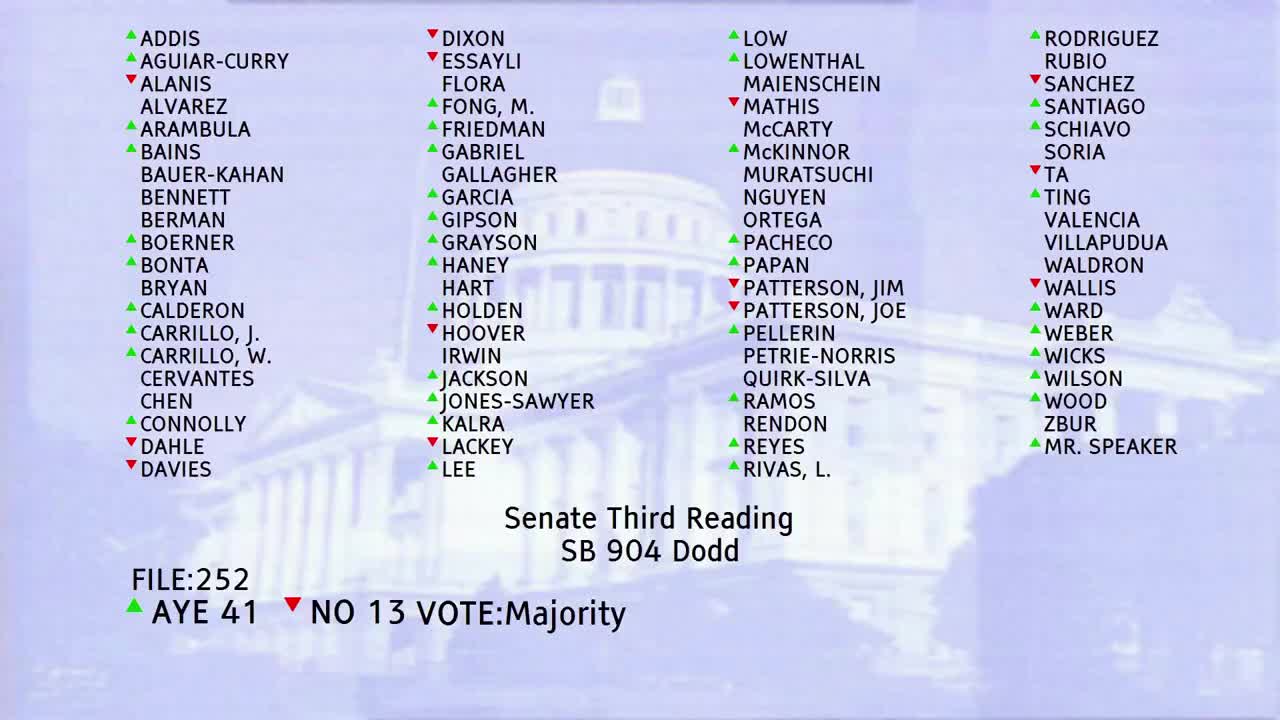
ASSEMBLY FLOOR: 73-0-7
YES: Addis, Aguiar-Curry, Alanis, Alvarez, Arambula, Bains, Bauer-Kahan, Bennett, Berman, Boerner, Bonta, Bryan, Juan Carrillo, Wendy Carrillo, Cervantes, Chen, Connolly, Davies, Dixon, Essayli, Mike Fong, Vince Fong, Friedman, Gabriel, Gallagher, Garcia, Gipson, Grayson, Haney, Hart, Holden, Hoover, Irwin, Jackson, Jones-Sawyer, Kalra, Lackey, Lee, Lowenthal, Maienschein, McCarty, McKinnor, Muratsuchi, Stephanie Nguyen, Ortega, Pacheco, Papan, Jim Patterson, Joe Patterson, Pellerin, Petrie-Norris, Quirk-Silva, Ramos, Rendon, Reyes, Luz Rivas, Rodriguez, Blanca Rubio, Sanchez, Santiago, Schiavo, Soria, Ta, Ting, Valencia, Villapudua, Waldron, Wallis, Ward, Wicks, Wilson, Wood, Zbur
ABS, ABST OR NV: Calderon, Megan Dahle, Flora, Low, Mathis, Weber, Robert Rivas
SENATE FLOOR: 40-0-0
YES: Allen, Alvarado-Gil, Archuleta, Ashby, Atkins, Becker, Blakespear, Bradford, Caballero, Cortese, Dahle, Dodd, Durazo, Eggman, Glazer, Gonzalez, Grove, Hurtado, Jones, Laird, Limón, McGuire, Menjivar, Min, Newman, Nguyen, Niello, Ochoa Bogh, Padilla, Portantino, Roth, Rubio, Seyarto, Skinner, Smallwood-Cuevas, Stern, Umberg, Wahab, Wiener, Wilk
UPDATED
VERSION: August 6, 2024
CONSULTANT: Vince Chee / B. & P. / (916) 319-3301 FN: 0004218
SENATE RULES COMMITTEE Office of Senate Floor Analyses (916) 651-1520 Fax: (916) 327-4478 | AB 3119 |
THIRD READING
Bill No: AB 3119
Author: Low (D)
Amended: 8/6/24 in Senate
Vote: 21
SENATE BUS., PROF. & ECON. DEV. COMMITTEE: 12-0, 6/17/24
AYES: Ashby, Nguyen, Alvarado-Gil, Archuleta, Becker, Eggman, Glazer, Menjivar, Niello, Roth, Smallwood-Cuevas, Wilk
NO VOTE RECORDED: Dodd
SENATE APPROPRIATIONS COMMITTEE: Senate Rule 28.8
ASSEMBLY FLOOR: 73-0, 5/2/24 (Consent) - See last page for vote
SUBJECT: Physicians and surgeons, nurse practitioners, and physician assistants: continuing medical education: infection-associated chronic conditions
SOURCE: Author
DIGEST:
This bill requires various health professional licensing boards to consider including a course in infection-associated chronic conditions in their continuing education requirements (CE).
Senate Floor Amendments of 8/6/24 strike reference to “post-COVID conditions” and replace the term throughout the bill with “long COVID”.
ANALYSIS:
Existing law:
- Establishes various practice acts in the Business and Professions Code (BPC) governed by various boards within the Department of Consumer Affairs (DCA) which provide for the licensing and regulation of health care professionals including physicians and surgeons under the Medical Practice Act by (MBC), osteopathic physicians and surgeons under the Osteopathic Medical Practice Act by the Osteopathic Medical Board of California (OMBC) nurses under the Nursing Practice Act by the Board of Registered Nursing (BRN), and physician assistants (PAs) under the Physician Assistant Practice Act by the Physician Assistant Board (PAB), among others.
- Requires all general internists and family physicians who have a patient population of which over 25 percent are 65 years of age or older to complete at least 20 percent of all mandatory continuing medical education (CME) hours in a course in the field of geriatric medicine or the care of older patients. (BPC § 2190.3)
- Requires all physicians and surgeons to complete a course in pain management and the treatment of terminally ill and dying patients, which must include the subject of the risks associated with the use of Schedule II drugs. Authorizes a physician and surgeon to complete a one-time course in the subjects of treatment and management of opiate-dependent patients as an alternative to the required course in pain management. (BPC §§ 2190.5 and 2190.6)
- Requires MBC, in determining CME requirements, to consider including a course in various topics. (BPC § 2190.1)
- Requires OMBC to adopt and administer standards for the continuing education (CE) of OMBC licensed osteopathic physician and required licensees to demonstrate satisfaction of the CE as a condition for the renewal of a license at intervals of not less than one year nor more than two years. OMBC requires each licensed osteopathic physician and surgeon to complete a minimum of 50 hours of American Osteopathic Association CE hours during each two-year cycle, of which 20 hours shall be completed in American Osteopathic Association Category 1 CE hours and the remaining 30 hours shall be either American Osteopathic Association or American Medical Association accredited as a condition for renewal of an active license. Requires OMBC licensed osteopathic physicians and surgeons to complete a course on the risks of addiction associated with the use of Schedule II drugs. (BPC § 2454.5)
- Requires the BRN to, by regulation, establish standards for CE, as specified. (BPC § 2811.5(c))
- Requires registered nurses to complete 30 hours of CE approved by the BRN every two years as a condition of license renewal. (California Code of Regulations, Title 16, § 1451)
- In establishing standards for CE, requires the BRN to consider including a course in the special needs care of individuals and their families, including, but not limited to: pain and symptom management; the psychosocial dynamics of death; dying and bereavement; and hospice care. (BPC § 2811.5(f)
- Requires the BRN to adopt regulations requiring all CE courses to contain curriculum related to implicit bias. (BPC § 2736.5)
- Requires the BRN to encourage CE in spousal or partner abuse detection and treatment. (BPC § 2811.5(e))
- Authorizes the PAB to require a licensee to complete CE as a condition of license renewal, but not more than 50 hours every two years. (BPC § 3524.5(a))
- Requires the PAB to adopt regulations that require all CE courses to contain curriculum related to implicit bias. (BPC § 3524.5(b))
- Requires specified PAs to complete, as part of their CE requirements, a course that covers Schedule II controlled substances and the risks of addiction associated with their use. (BPC § 3502.1(e)(3))
This bill requires MBC, OMBC, BRN, and PAB, in determining CE requirements, to consider including a course in infection-associated chronic conditions, including, but not limited to, post-COVID conditions, as defined by the United States Department of Health and Human Services, myalgic encephalomyelitis, and dysautonomia.
Background
Continuing Medical Education for Physicians. All physicians and surgeons licensed by the MBC must complete a minimum of 50 hours of approved CME during each two-year license renewal cycle. CME requirements can be met by taking a variety of approved courses. The only exception to this requirement is for a physician who takes and passes a certifying or recertifying examination administered by a recognized specialty board; the individual can be granted credit for four consecutive years of CME credit for purposes of licensure renewal. Upon renewal, physicians are required to self-certify under penalty of perjury that they have met each of the CME requirements, that they have met the conditions exempting them from all or part of the requirements, or that they hold a permanent CME waiver. MBC is authorized to audit a random sample of physicians who have reported compliance with the CME requirements for verification purposes. MBC reports that it currently audits approximately one percent of the total number of renewing physicians per year.
Approved CME consists of courses or programs designated by the American Medical Association or the Institute for Medical Quality/California Medical Association related to patient care, community health or public health, preventive medicine, quality assurance or improvement, risk management, health facility standards, the legal aspects of clinical medicine, bioethics, professional ethics or improvement of the physician-patient relationship.
The only specifically required courses are a one-time, 12-hour training in pain management and the treatment of terminally ill patients, and a requirement that general internists and family physicians whose patient populations are over 25% 65 years of age and older must take at least 20% of their continuing education in the field of geriatric medicine. However, all approved courses must contain curriculum that includes cultural and linguistic competency in the practice of medicine and the understanding of implicit bias.
Osteopathic physicians and surgeons licensed by OMBC are required to complete a minimum of 50 hours of American Osteopathic Association CE hours during each two-year cycle, of which 20 hours shall be completed in American Osteopathic Association Category 1 CE hours and the remaining 30 hours shall be either American Osteopathic Association or American Medical Association accredited as a condition for renewal of an active license. Licensed osteopathic physicians and surgeons are also required to complete a course on the risks of addiction associated with the use of Schedule II drugs.
Continuing Education for Registered Nurses. All nurses licensed by BRN are required to complete 30 hours of CE during each two-year renewal cycle to ensure continued competence. Courses must be related to either the scientific knowledge or technical skills required for the practice of nursing, or to direct or indirect patient care. Courses approved by appropriate state, regional and national health professional associations as well as other professional health and licensing boards in and out of California can be acceptable, so long as the content meets the BRN's requirements.
Continuing Medical Education for Physician Assistants. Physician assistants are required to complete 50 hours of CME every two years as a condition of license renewal. Continuing education requirements may be deemed satisfied if the physician assistant is certified by the National Commission on Certification of Physician Assistants at the time of renewal. CME courses must be Category I (Preapproved) by the American Academy of Physician Assistants, the American Medical Association, the American Osteopathic Association Council on Continuing Medical Education, the American Academy of Family Physicians, the Accreditation Council for Continuing Medical Education (ACCME), or a state medical society recognized by the ACCME.
FISCAL EFFECT: Appropriation: No Fiscal Com.: Yes Local: No
SUPPORT: (Verified 8/5/24)
Solve M.E. Initiative
OPPOSITION: (Verified 8/5/24)
None received
ARGUMENTS IN SUPPORT: The Solve M.E. Initative write that “The lack of knowledge and understanding among healthcare providers often leads to misdiagnoses, delayed treatments, and inadequate care, exacerbating the suffering of patients. A healthcare workforce educated in diagnosing and treating IACCs would significantly improve patient outcomes, reduce the burden on the healthcare system, and enhance the well-being and mental health of countless individuals.”
ASSEMBLY FLOOR: 73-0, 5/2/24
AYES: Addis, Aguiar-Curry, Alanis, Alvarez, Arambula, Bains, Bauer-Kahan, Bennett, Berman, Boerner, Bonta, Bryan, Juan Carrillo, Wendy Carrillo, Cervantes, Chen, Connolly, Davies, Dixon, Essayli, Mike Fong, Vince Fong, Friedman, Gabriel, Gallagher, Garcia, Gipson, Grayson, Haney, Hart, Holden, Hoover, Irwin, Jackson, Jones-Sawyer, Kalra, Lackey, Lee, Lowenthal, Maienschein, McCarty, McKinnor, Muratsuchi, Stephanie Nguyen, Ortega, Pacheco, Papan, Jim Patterson, Joe Patterson, Pellerin, Petrie-Norris, Quirk-Silva, Ramos, Rendon, Reyes, Luz Rivas, Rodriguez, Blanca Rubio, Sanchez, Santiago, Schiavo, Soria, Ta, Ting, Valencia, Villapudua, Waldron, Wallis, Ward, Wicks, Wilson, Wood, Zbur
NO VOTE RECORDED: Calderon, Megan Dahle, Flora, Low, Mathis, Weber, Robert Rivas
Prepared by: Sarah Mason / B., P. & E.D. /
8/7/24 17:59:27
**** END ****
SENATE RULES COMMITTEE Office of Senate Floor Analyses (916) 651-1520 Fax: (916) 327-4478 | AB 3119 |
THIRD READING
Bill No: AB 3119
Author: Low (D)
Amended: 6/10/24 in Senate
Vote: 21
SENATE BUS., PROF. & ECON. DEV. COMMITTEE: 12-0, 6/17/24
AYES: Ashby, Nguyen, Alvarado-Gil, Archuleta, Becker, Eggman, Glazer, Menjivar, Niello, Roth, Smallwood-Cuevas, Wilk
NO VOTE RECORDED: Dodd
SENATE APPROPRIATIONS COMMITTEE: Senate Rule 28.8
ASSEMBLY FLOOR: 73-0, 5/2/24 (Consent) - See last page for vote
SUBJECT: Physicians and surgeons, nurse practitioners, and physician assistants: continuing medical education: infection-associated chronic conditions
SOURCE: Author
DIGEST:
This bill requires various health professional licensing boards to consider including a course in infection-associated chronic conditions in their continuing education requirements (CE).
ANALYSIS:
Existing law:
- Establishes various practice acts in the Business and Professions Code (BPC) governed by various boards within the Department of Consumer Affairs (DCA) which provide for the licensing and regulation of health care professionals including physicians and surgeons under the Medical Practice Act by (MBC), osteopathic physicians and surgeons under the Osteopathic Medical Practice Act by the Osteopathic Medical Board of California (OMBC) nurses under the Nursing Practice Act by the Board of Registered Nursing (BRN), and physician assistants (PAs) under the Physician Assistant Practice Act by the Physician Assistant Board (PAB), among others.
- Requires all general internists and family physicians who have a patient population of which over 25 percent are 65 years of age or older to complete at least 20 percent of all mandatory continuing medical education (CME) hours in a course in the field of geriatric medicine or the care of older patients. (BPC § 2190.3)
- Requires all physicians and surgeons to complete a course in pain management and the treatment of terminally ill and dying patients, which must include the subject of the risks associated with the use of Schedule II drugs. Authorizes a physician and surgeon to complete a one-time course in the subjects of treatment and management of opiate-dependent patients as an alternative to the required course in pain management. (BPC §§ 2190.5 and 2190.6)
- Requires MBC, in determining CME requirements, to consider including a course in various topics. (BPC § 2190.1)
- Requires OMBC to adopt and administer standards for the continuing education (CE) of OMBC licensed osteopathic physician and required licensees to demonstrate satisfaction of the CE as a condition for the renewal of a license at intervals of not less than one year nor more than two years. OMBC requires each licensed osteopathic physician and surgeon to complete a minimum of 50 hours of American Osteopathic Association CE hours during each two-year cycle, of which 20 hours shall be completed in American Osteopathic Association Category 1 CE hours and the remaining 30 hours shall be either American Osteopathic Association or American Medical Association accredited as a condition for renewal of an active license. Requires OMBC licensed osteopathic physicians and surgeons to complete a course on the risks of addiction associated with the use of Schedule II drugs. (BPC § 2454.5)
- Requires the BRN to, by regulation, establish standards for CE, as specified. (BPC § 2811.5(c))
- Requires registered nurses to complete 30 hours of CE approved by the BRN every two years as a condition of license renewal. (California Code of Regulations, Title 16, § 1451)
- In establishing standards for CE, requires the BRN to consider including a course in the special needs care of individuals and their families, including, but not limited to: pain and symptom management; the psychosocial dynamics of death; dying and bereavement; and hospice care. (BPC § 2811.5(f)
- Requires the BRN to adopt regulations requiring all CE courses to contain curriculum related to implicit bias. (BPC § 2736.5)
- Requires the BRN to encourage CE in spousal or partner abuse detection and treatment. (BPC § 2811.5(e))
- Authorizes the PAB to require a licensee to complete CE as a condition of license renewal, but not more than 50 hours every two years. (BPC § 3524.5(a))
- Requires the PAB to adopt regulations that require all CE courses to contain curriculum related to implicit bias. (BPC § 3524.5(b))
- Requires specified PAs to complete, as part of their CE requirements, a course that covers Schedule II controlled substances and the risks of addiction associated with their use. (BPC § 3502.1(e)(3))
This bill requires MBC, OMBC, BRN, and PAB, in determining CE requirements, to consider including a course in infection-associated chronic conditions, including, but not limited to, post-COVID conditions, as defined by the United States Department of Health and Human Services, myalgic encephalomyelitis, and dysautonomia.
Background
Continuing Medical Education for Physicians. All physicians and surgeons licensed by the MBC must complete a minimum of 50 hours of approved CME during each two-year license renewal cycle. CME requirements can be met by taking a variety of approved courses. The only exception to this requirement is for a physician who takes and passes a certifying or recertifying examination administered by a recognized specialty board; the individual can be granted credit for four consecutive years of CME credit for purposes of licensure renewal. Upon renewal, physicians are required to self-certify under penalty of perjury that they have met each of the CME requirements, that they have met the conditions exempting them from all or part of the requirements, or that they hold a permanent CME waiver. MBC is authorized to audit a random sample of physicians who have reported compliance with the CME requirements for verification purposes. MBC reports that it currently audits approximately one percent of the total number of renewing physicians per year.
Approved CME consists of courses or programs designated by the American Medical Association or the Institute for Medical Quality/California Medical Association related to patient care, community health or public health, preventive medicine, quality assurance or improvement, risk management, health facility standards, the legal aspects of clinical medicine, bioethics, professional ethics or improvement of the physician-patient relationship.
The only specifically required courses are a one-time, 12-hour training in pain management and the treatment of terminally ill patients, and a requirement that general internists and family physicians whose patient populations are over 25% 65 years of age and older must take at least 20% of their continuing education in the field of geriatric medicine. However, all approved courses must contain curriculum that includes cultural and linguistic competency in the practice of medicine and the understanding of implicit bias.
Osteopathic physicians and surgeons licensed by OMBC are required to complete a minimum of 50 hours of American Osteopathic Association CE hours during each two-year cycle, of which 20 hours shall be completed in American Osteopathic Association Category 1 CE hours and the remaining 30 hours shall be either American Osteopathic Association or American Medical Association accredited as a condition for renewal of an active license. Licensed osteopathic physicians and surgeons are also required to complete a course on the risks of addiction associated with the use of Schedule II drugs.
Continuing Education for Registered Nurses. All nurses licensed by BRN are required to complete 30 hours of CE during each two-year renewal cycle to ensure continued competence. Courses must be related to either the scientific knowledge or technical skills required for the practice of nursing, or to direct or indirect patient care. Courses approved by appropriate state, regional and national health professional associations as well as other professional health and licensing boards in and out of California can be acceptable, so long as the content meets the BRN's requirements.
Continuing Medical Education for Physician Assistants. Physician assistants are required to complete 50 hours of CME every two years as a condition of license renewal. Continuing education requirements may be deemed satisfied if the physician assistant is certified by the National Commission on Certification of Physician Assistants at the time of renewal. CME courses must be Category I (Preapproved) by the American Academy of Physician Assistants, the American Medical Association, the American Osteopathic Association Council on Continuing Medical Education, the American Academy of Family Physicians, the Accreditation Council for Continuing Medical Education (ACCME), or a state medical society recognized by the ACCME.
FISCAL EFFECT: Appropriation: No Fiscal Com.: Yes Local: No
SUPPORT: (Verified 7/2/24)
None received
OPPOSITION: (Verified 7/2/24)
None received
ASSEMBLY FLOOR: 73-0, 5/2/24
AYES: Addis, Aguiar-Curry, Alanis, Alvarez, Arambula, Bains, Bauer-Kahan, Bennett, Berman, Boerner, Bonta, Bryan, Juan Carrillo, Wendy Carrillo, Cervantes, Chen, Connolly, Davies, Dixon, Essayli, Mike Fong, Vince Fong, Friedman, Gabriel, Gallagher, Garcia, Gipson, Grayson, Haney, Hart, Holden, Hoover, Irwin, Jackson, Jones-Sawyer, Kalra, Lackey, Lee, Lowenthal, Maienschein, McCarty, McKinnor, Muratsuchi, Stephanie Nguyen, Ortega, Pacheco, Papan, Jim Patterson, Joe Patterson, Pellerin, Petrie-Norris, Quirk-Silva, Ramos, Rendon, Reyes, Luz Rivas, Rodriguez, Blanca Rubio, Sanchez, Santiago, Schiavo, Soria, Ta, Ting, Valencia, Villapudua, Waldron, Wallis, Ward, Wicks, Wilson, Wood, Zbur
NO VOTE RECORDED: Calderon, Megan Dahle, Flora, Low, Mathis, Weber, Robert Rivas
Prepared by: Sarah Mason / B., P. & E.D. /
7/2/24 15:16:50
**** END ****
SENATE COMMITTEE ON
BUSINESS, PROFESSIONS AND ECONOMIC DEVELOPMENT
Senator Angelique Ashby, Chair
2023 - 2024 Regular
Bill No: Hearing Date: June 17, 2024
Author: | |||
Version: | June 10, 2024 | ||
Urgency: | No | Fiscal: | Yes |
Consultant: | Sarah Mason | ||
Subject:
SUMMARY:
Requires various health professional licensing boards to consider including a course in infection-associated chronic conditions in their continuing education requirements (CE).
Existing law:
- Establishes various practice acts in the Business and Professions Code (BPC) governed by various boards within the Department of Consumer Affairs (DCA) which provide for the licensing and regulation of health care professionals including physicians and surgeons (under the Medical Practice Act by MBC), osteopathic physicians and surgeons (under the Osteopathic Medical Practice Act by the Osteopathic Medical Board of California (OMBC)) nurses (under the Nursing Practice Act by the Board of Registered Nursing (BRN), and physician assistants (PAs) (under the Physician Assistant Practice Act by the Physician Assistant Board (PAB)), among others.
- Requires all general internists and family physicians who have a patient population of which over 25 percent are 65 years of age or older to complete at least 20 percent of all mandatory continuing medical education (CME) hours in a course in the field of geriatric medicine or the care of older patients. (BPC § 2190.3)
- Requires all physicians and surgeons to complete a course in pain management and the treatment of terminally ill and dying patients, which must include the subject of the risks associated with the use of Schedule II drugs. Authorizes a physician and surgeon to complete a one-time course in the subjects of treatment and management of opiate-dependent patients as an alternative to the required course in pain management. (BPC §§ 2190.5 and 2190.6)
- Requires MBC, in determining CME requirements, to consider including a course in: (BPC § 2190.1)
- Human sexuality and nutrition to be taken by those licensees whose practices may require knowledge in those areas.
- Child abuse detection and treatment to be taken by those licensees whose practices are of a nature that there is a likelihood of contact with abused or neglected children.
- Acupuncture to be taken by those licensees whose practices may require knowledge in the area of acupuncture and whose education has not included instruction in acupuncture.
- Nutrition, for every physician and surgeon, as part of his or her CME particularly a physician and surgeon involved in primary care.
- Elder abuse detection and treatment to be taken by those licensees whose practices are of a nature that there is a likelihood of contact with abused or neglected persons 65 years of age and older.
- The early detection and treatment of substance abusing pregnant women to be taken by those licensees whose practices are of a nature that there is a likelihood of contact with these women.
- The special care needs of drug addicted infants to be taken by those licensees whose practices are of a nature that there is a likelihood of contact with these infants.
- Guidelines on how to routinely screen for signs exhibited by abused women, particularly for physicians and surgeons in emergency, surgical, primary care, pediatric, prenatal, and mental health settings. In the event the MBC establishes a requirement for continuing education coursework in spousal or partner abuse detection or treatment, that requirement shall be met by each licensee within no more than four years from the date the requirement is imposed.
- The special care needs of individuals and their families facing end-of-life issues, including, but not limited to, pain and symptom management, the psycho-social dynamics of death, dying and bereavement and hospice care.
- Pain management and the risks of addiction associated with the use of Schedule II drugs.
- Geriatric care for emergency room physicians and surgeons.
- Integrating HIV/AIDS pre-exposure prophylaxis and post-exposure prophylaxis medication maintenance and counseling in primary care settings.
- Integrating mental and physical health care in primary care settings, especially as it pertains to early identification of mental health issues in children and young adults and their appropriate care and treatment.
- Maternal mental health, which shall address best practices in screening for maternal mental health disorders, including cultural competency and unintended bias as a means to build trust with mothers; the range of maternal mental health disorders; the range of evidence-based treatment options, including the importance of allowing a mother to be involved in developing the treatment plan and; when an obstetrician or a primary care doctor should consult with a psychiatrist versus making a referral.
- Prohibits educational activities that are not directed toward the practice of medicine, or are directed primarily toward the business aspects of medical practice, including, but not limited to, medical office management, billing and coding, and marketing from meeting the CME standards for physicians and surgeons. (BPC § 2190.1(f))
- Requires OMBC to adopt and administer standards for the continuing education (CE) of OMBC licensed osteopathic physician and required licensees to demonstrate satisfaction of the CE as a condition for the renewal of a license at intervals of not less than one year nor more than two years. OMBC requires each licensed osteopathic physician and surgeon to complete a minimum of 50 hours of American Osteopathic Association CE hours during each two-year cycle, of which 20 hours shall be completed in American Osteopathic Association Category 1 CE hours and the remaining 30 hours shall be either American Osteopathic Association or American Medical Association accredited as a condition for renewal of an active license. Requires OMBC licensed osteopathic physicians and surgeons to complete a course on the risks of addiction associated with the use of Schedule II drugs. (BPC § 2454.5)
- Requires the BRN to, by regulation, establish standards for CE, as specified. (BPC § 2811.5(c))
- Requires registered nurses to complete 30 hours of CE approved by the BRN every two years as a condition of license renewal. (California Code of Regulations, Title 16, § 1451)
- In establishing standards for CE, requires the BRN to consider including a course in the special needs care of individuals and their families, including, but not limited to: pain and symptom management; the psychosocial dynamics of death; dying and bereavement; and hospice care. (BPD § 2811.5(f)
- Requires the BRN to adopt regulations requiring all CE courses to contain curriculum related to implicit bias. (BPC § 2736.5)
- Requires the BRN to encourage CE in spousal or partner abuse detection and treatment. (BPC § 2811.5(e))
- Authorizes the PAB to require a licensee to complete CE as a condition of license renewal, but not more than 50 hours every two years. (BPC § 3524.5(a))
- Requires the PAB to adopt regulations that require all CE courses to contain curriculum related to implicit bias. (BPC § 3524.5(b))
- Requires specified PAs to complete, as part of their CE requirements, a course that covers Schedule II controlled substances and the risks of addiction associated with their use. (BPC § 3502.1(e)(3))
This bill requires MBC, OMBC, BRN, and PAB, in determining CE requirements, to consider including a course in infection-associated chronic conditions, including, but not limited to, post-COVID conditions, as defined by the United States Department of Health and Human Services, myalgic encephalomyelitis, and dysautonomia.
FISCAL EFFECT:
Unknown. This bill is keyed fiscal by Legislative Counsel.
COMMENTS:
- Purpose. The Author is the Sponsor of this bill. According to the Author, “Although the COVID-19 pandemic has waned, a staggering 17.5 million Americans grapple with the lingering effects of long COVID. This condition knows no bounds, affecting individuals of all ages and backgrounds, yet its underlying causes remain elusive. Long COVID occurs when patients still have symptoms at least four weeks after they have cleared the infection. In some cases, symptoms can be experienced for months or years. Symptoms vary and can include fatigue, difficulty breathing, headaches, brain fog, joint and muscle pain and continued loss of taste and smell, according to the Centers for Disease Control and Prevention (CDC). In some cases, long COVID can be extremely debilitating thus long COVID was recognized as a disability under the Americans with Disabilities Act. Last year, President Biden issued the Presidential Memorandum and Fact Sheet directing the Secretary of Health and Human Services to coordinate a whole-of-government response to the longer-term effects of COVID-19, including long COVID. There is now an Office of Long COVID within HHS. While strides have been made to understand long COVID, there is still much to unravel. This bill will ensure our medical professionals are educated on how to adequately diagnose long COVID-19 and how to provide appropriate care to people experiencing long COVID—especially those communities hardest-hit by COVID-19”
- Background.
Continuing Medical Education for Physicians. All physicians and surgeons licensed by the MBC must complete a minimum of 50 hours of approved CME during each two-year license renewal cycle. CME requirements can be met by taking a variety of approved courses. The only exception to this requirement is for a physician who takes and passes a certifying or recertifying examination administered by a recognized specialty board; the individual can be granted credit for four consecutive years of CME credit for purposes of licensure renewal. Upon renewal, physicians are required to self-certify under penalty of perjury that they have met each of the CME requirements, that they have met the conditions exempting them from all or part of the requirements, or that they hold a permanent CME waiver. MBC is authorized to audit a random sample of physicians who have reported compliance with the CME requirements for verification purposes. MBC reports that it currently audits approximately one percent of the total number of renewing physicians per year.
Approved CME consists of courses or programs designated by the American Medical Association or the Institute for Medical Quality/California Medical Association related to patient care, community health or public health, preventive medicine, quality assurance or improvement, risk management, health facility standards, the legal aspects of clinical medicine, bioethics, professional ethics or improvement of the physician-patient relationship.
The only specifically required courses are a one-time, 12-hour training in pain management and the treatment of terminally ill patients, and a requirement that general internists and family physicians whose patient populations are over 25% 65 years of age and older must take at least 20% of their continuing education in the field of geriatric medicine. However, all approved courses must contain curriculum that includes cultural and linguistic competency in the practice of medicine and the understanding of implicit bias.
Osteopathic physicians and surgeons licensed by OMBC are required to complete a minimum of 50 hours of American Osteopathic Association CE hours during each two-year cycle, of which 20 hours shall be completed in American Osteopathic Association Category 1 CE hours and the remaining 30 hours shall be either American Osteopathic Association or American Medical Association accredited as a condition for renewal of an active license. Licensed osteopathic physicians and surgeons are also required to complete a course on the risks of addiction associated with the use of Schedule II drugs.
Continuing Education for Registered Nurses. All nurses licensed by BRN are required to complete 30 hours of CE during each two-year renewal cycle to ensure continued competence. Courses must be related to either the scientific knowledge or technical skills required for the practice of nursing, or to direct or indirect patient care. Courses approved by appropriate state, regional and national health professional associations as well as other professional health and licensing boards in and out of California can be acceptable, so long as the content meets the BRN's requirements.
Continuing Medical Education for Physician Assistants. Physician assistants are required to complete 50 hours of CME every two years as a condition of license renewal. Continuing education requirements may be deemed satisfied if the physician assistant is certified by the National Commission on Certification of Physician Assistants at the time of renewal. CME courses must be Category I (Preapproved) by the American Academy of Physician Assistants, the American Medical Association, the American Osteopathic Association Council on Continuing Medical Education, the American Academy of Family Physicians, the Accreditation Council for Continuing Medical Education (ACCME), or a state medical society recognized by the ACCME.
SUPPORT AND OPPOSITION:
Support:
None received
Opposition:
None received
-- END --
Date of Hearing: April 24, 2024
ASSEMBLY COMMITTEE ON APPROPRIATIONS
Buffy Wicks, Chair
ABPCA Bill Id:AB 3119
Author:(Low) – As Amended Ver:March 18, 2024
Policy Committee: | Business and Professions | Vote: | 18 - 0 |
|
| ||
|
|
Urgency: No State Mandated Local Program: No Reimbursable: No
SUMMARY:
This bill requires the Medical Board of California (MBC) to consider requiring licensed physicians to take a continuing education (CE) course on long COVID.
FISCAL EFFECT:
No state costs.
COMMENTS:
- Purpose. This bill is author-sponsored. According to the author:
Although the COVID pandemic has ended, numerous Californians who contracted the virus still endure persistent neurological, cardiovascular, respiratory, and mental health symptoms. [This bill] requires the Medical Board of California to consider incorporating a long COVID course into its continuing education requirements to empower doctors to enhance their comprehension and proficiency in supporting and treating individuals with long COVID.
- Background.
CE. Physicians licensed by the MBC and the Osteopathic Medical Board of California (OMBC) are required to complete 50 hours of approved CE every two years as a condition of license renewal. Most physicians are required to complete a one-time, 12-hour training in either the pain management and treatment of terminally ill and dying patients or the treatment and management of opiate-dependent patients. Physicians generally have great latitude in choosing which CE courses to take to satisfy their 50 hours.
Long COVID. Long COVID symptoms may include fatigue, fever, cough, chest pain, brain fog, changes in smell or taste, diarrhea, stomach pain, joint or muscle pain, rash, changes in menstrual cycles, and other symptoms. The U.S. Centers for Disease Control and Prevention reports that some people have unexplained symptoms that healthcare providers do not understand. According to February and March 2024 data from the National Center for Health Statistics, approximately 7% of adults in California report they are currently experiencing long COVID, which was defined as “new, returning, or ongoing health problems people can experience four or more weeks after initial infection with the SARS-CoV-2 virus.”
- Related Legislation.
- AB 2270 (Maienschein) requires MBC, OMBC, Board of Registered Nursing, Physician Assistants Board, Board of Psychology, and the Board of Behavioral Sciences to consider, in determining CE requirements, coursework on menopausal health. AB 2270 is pending in this committee.
- AB 2581 (Maienschein) requires the same boards referenced in AB 2270 to consider, in determining CE requirements, coursework on maternal mental health. AB 2581 is pending in this committee.
- AB 2270 (Maienschein) requires MBC, OMBC, Board of Registered Nursing, Physician Assistants Board, Board of Psychology, and the Board of Behavioral Sciences to consider, in determining CE requirements, coursework on menopausal health. AB 2270 is pending in this committee.
- Prior Legislation.
- AB 845 (Maienschein), Chapter 220, Statutes of 2019, requires MBC to consider including a course in maternal mental health in CE requirements for physicians.
- AB 1791 (Waldron), Chapter 122, Statutes of 2018, requires MBC to consider including among CE requirements for physicians a course relating to the integration of HIV/AIDS pre-exposure prophylaxis (PrEP) and post-exposure prophylaxis (PEP) medication maintenance and counseling in primary care settings.
- AB 1340 (Maienschein), Chapter 759, Statutes of 2017, requires MBC to consider including among CE requirement for physicians a course integrating mental and physical health care in primary care settings.
- AB 845 (Maienschein), Chapter 220, Statutes of 2019, requires MBC to consider including a course in maternal mental health in CE requirements for physicians.
Analysis Prepared by: Allegra Kim / APPR. / (916) 319-2081
Date of Hearing:
ASSEMBLY COMMITTEE ON BUSINESS AND PROFESSIONS
Marc Berman, Chair
ABPCA Bill Id:AB 3119
Author:(Low) – As Amended Ver:March 18, 2024
SUBJECT: Physicians and surgeons: continuing medical education: Long COVID.
SUMMARY: Requires the Medical Board of California (MBC) to consider requiring licensed physicians and surgeons to take a continuing education (CE) course related to Long COVID.
EXISTING LAW:
- Establishes the Medical Practice Act, which provides for the state’s licensure and regulation of physicians and surgeons, and the Osteopathic Act, which provides for the state’s licensure and regulation of osteopathic physicians and surgeons. (Business and Professions Code (BPC) § 2000 et seq.)
- Establishes the MBC within the Department of Consumer Affairs for purposes of implementing and enforcing the Medical Practice Act. (BPC § 2001)
- Establishes the Osteopathic Medical Board of California (OMBC) for purposes of implementing and enforcing the Osteopathic Act and the Medical Practice Act, when applicable. (BPC § 2701)
- Specifies that references to the MBC in the Medical Practice Act also refer to the OMBC, as specified. (BPC § 2451)
- Requires the MBC to adopt and administer standards for the CE of its licensees; authorizes the MBC to set content standards for any education regarding the prevention and treatment of a chronic disease; and mandates that the MBC require each licensed physician and surgeon to demonstrate satisfaction of CE requirements at intervals of not less than four nor more than six years. (BPC § 2190)
- Authorizes the MBC’s Division of Licensing to establish continuing medical education standards for courses that serve to maintain, develop, or increase the knowledge, skills, and professional performance that a physician and surgeon uses to provide care, or to improve the quality of care provided to patients. (BPC § 2190.1)
- Requires a physician and surgeon to complete not less than 50 hours of approved CE during every two years as a condition of license renewal. (California Code of Regulations. Title 16, § 1336)
- In determining its CE requirements, requires the MBC to consider including courses related to numerous specified subjects. (BPC §§ 2191, 2191.4, 2191.5, 2196.9)
- Requires most physicians and surgeons to complete a one-time CE course in pain management and the treatment of terminally ill and dying patients, which must include the subject of the risks associated with the use of Schedule II drugs. (BPC § 2190.5)
- Authorizes a physician and surgeon to complete a one-time CE course on the treatment and management of opiate-dependent patients as an alternative to the required course in pain management. (BPC § 2190.6)
- Requires the OMBC to adopt and administer standards for CE of osteopathic physician and surgeons. (BPC § 2454.5)
- Mandates that the OMBC require each licensed osteopathic physician and surgeon to complete a minimum of 50 hours of American Osteopathic Association CE hours, as specified, and demonstrate satisfaction of CE requirements every two years as a condition of license renewal. (BPC § 2454.5)
- Requires osteopathic physician and surgeons to complete a course on the risks of addiction associated with the use of Schedule II drugs. (BPC § 2454.5)
THIS BILL:
- Would require the MBC, in determining its CE requirements, to consider including a course in Long COVID.
FISCAL EFFECT: Unknown. This bill is keyed fiscal by Legislative Counsel.
COMMENTS:
Purpose. This bill is author-sponsored. According to the author:
Although the COVID pandemic has ended, numerous Californians who contracted the virus still endure persistent neurological, cardiovascular, respiratory, and mental health symptoms. [This bill] requires the Medical Board of California to consider incorporating a long COVID course into its continuing education requirements to empower doctors to enhance their comprehension and proficiency in supporting and treating individuals with long COVID.
Background.
Continuing Medical Education for Physicians. Physicians and surgeons licensed by the MBC and the OMBC are required to complete 50 hours of approved CE every two years as a condition of license renewal. Though existing law also requires the MBC to consider requiring CE related to various topics (e.g. nutrition), there are only two subject-specific CE requirements in statute. Most physicians and surgeons are required to complete a one-time, 12-hour training in either the pain management and treatment of terminally ill and dying patients or the treatment and management of opiate-dependent patients.[1] Additionally, general internists and family physicians who have a patient population of which over 25 percent are 65 years of age or older must complete at least 20 percent of their mandatory CE in the field of geriatric medicine. Physicians are otherwise afforded great latitude in choosing which CE courses to take to satisfy their 50 hours.
Both the MBC and the OMBC require CE courses to be accredited or approved by specified organizations such as the American Medical Association and the Accreditation Council for Continuing Medical Education. Osteopathic physician and surgeons specifically are required to complete a minimum of 20 CE hours certified by the American Osteopathic Association.[2]
Long COVID. Approximately 7.2 percent of adults in California are currently experiencing Long COVID,[3] which the Centers for Disease Control and Prevention (CDC) refers to as “the new, returning, or ongoing health problems people can experience four or more weeks after initial infection with the SARS-CoV-2 virus.” Long COVID can include an array of health conditions and potentially affect multiple systems of the body. People with Long COVID commonly report experiencing fatigue, fever, cough, chest pain, brain fog, changes in smell or taste, diarrhea, stomach pain, joint or muscle pain, rash, or changes in menstrual cycles, among other symptoms. The CDC reports that some people have unexplained symptoms that healthcare providers do not understand which can delay diagnosis and treatment.
This bill would require the MBC and OMBC to consider requiring its licensees (i.e. physicians) to take CE related to Long COVID, which the author anticipates would bolster medical comprehension of Long COVID for doctors to better assist their patients. This committee is currently aware of at least two Long COVID-CE courses available to physicians and other health care providers.[4] [5]
Current Related Legislation.
AB 2270 (Maienschein) of 2024 would require licensees of the MBC, OMBC, Board of Registered Nursing, Physician Assistants Board, Board of Psychology, and the Board of Behavioral Sciences to have the option to take coursework on menopausal mental or physical health within the scope of their practice to satisfy CE requirements. AB 2270 is pending in this committee.
AB 2581 (Maienschein) of 2024 would require licensees of the MBC, OMBC, Board of Registered Nursing, Physician Assistants Board, Board of Psychology, and the Board of Behavioral Sciences to have the option of taking coursework on maternal mental health to satisfy CE requirements. AB 2581 is pending in this committee.
Prior Related Legislation.
AB 845 (Maienschein), Chapter 220, Statutes of 2019, requires the MBC, in determining its CE requirements for licensed physicians and surgeons, to consider including a course in maternal mental health.
AB 1791 (Waldron), Chapter 122, Statutes of 2018, requires the MBC, in determining its CE requirements, to consider including a course relating to the integration of HIV/AIDS pre-exposure prophylaxis (PrEP) and post-exposure prophylaxis (PEP) medication maintenance and counseling in primary care settings.
AB 1340 (Maienschein), Chapter 759, Statutes of 2017, requires the MBC to, when determining its CE requirements, consider including a course in integrating mental and physical health care in primary care settings.
REGISTERED SUPPORT:
None on file
REGISTERED OPPOSITION:
None on file
Analysis Prepared by: Kaitlin Curry / B. & P. / (916) 319-3301
Pathologists and radiologists are exempt from this requirement. ↑
Osteopathic Medical Board of California Continuing Medical Education ↑
Discussed in Hearing
 40SEC
Assembly Floor
 46SEC
Senate Floor
 4MIN
Senate Standing Committee on Business, Professions and Economic Development
Bill Author

Bill Co-Author(s):