AB 3148: Deferred deposit transactions: assessments.
- Session Year: 2023-2024
- House: Assembly
- Latest Version Date: 2024-09-14
Current Status:
Passed
(2024-09-14: Chaptered by Secretary of State - Chapter 252, Statutes of 2024.)
Introduced
In Committee
First Chamber
In Committee
Second Chamber
Enacted
The California Deferred Deposit Transaction Law (CDDTL) generally provides for the licensure and regulation by the Commissioner of Financial Protection and Innovation of a person who engages in the business of making deferred deposit transactions whereby a person defers depositing a customers personal check until a specific date pursuant to a written agreement for a fee or other charge. Existing law requires each licensee to pay to the commissioner its pro rata share of all costs and expenses reasonably incurred in the administration of the CDDTL, as estimated by the commissioner, for the ensuing year and any deficit actually incurred or anticipated in the administration of the program in the year in which the assessment is made. Existing law requires this assessment to be based on the number of locations.
This bill, instead of requiring the assessment to be based on the number of locations, would require the pro rata share to be the proportion that a licensees total dollar amount of deferred deposit transactions made bears to the aggregate total dollar amount of deferred deposit transactions made by all licensees as shown by specified annual reports to the commissioner, except that the bill would prohibit a licensee from being assessed or paying less than $500 per licensed location per year.
The California Deferred Deposit Transaction Law (CDDTL) generally provides for the licensure and regulation by the Commissioner of Financial Protection and Innovation of a person who engages in the business of making deferred deposit transactions whereby a person defers depositing a customers personal check until a specific date pursuant to a written agreement for a fee or other charge. Existing law requires each licensee to pay to the commissioner its pro rata share of all costs and expenses reasonably incurred in the administration of the CDDTL, as estimated by the commissioner, for the ensuing year and any deficit actually incurred or anticipated in the administration of the program in the year in which the assessment is made. Existing law requires this assessment to be based on the number of locations.
This bill, instead of requiring the assessment to be based on the number of locations, would require the pro rata share to be the proportion that a licensees total dollar amount of deferred deposit transactions made bears to the aggregate total dollar amount of deferred deposit transactions made by all licensees as shown by specified annual reports to the commissioner, except that the bill would prohibit a licensee from being assessed or paying less than $500 per licensed location per year.
The California Deferred Deposit Transaction Law (CDDTL) generally provides for the licensure and regulation by the Commissioner of Financial Protection and Innovation of a person who engages in the business of making deferred deposit transactions whereby a person defers depositing a customers personal check until a specific date pursuant to a written agreement for a fee or other charge. Existing law requires each licensee to pay to the commissioner its pro rata share of all costs and expenses reasonably incurred in the administration of the CDDTL, as estimated by the commissioner, for the ensuing year and any deficit actually incurred or anticipated in the administration of the program in the year in which the assessment is made. Existing law requires this assessment to be based on the number of locations.
This bill, instead of requiring the assessment to be based on the number of locations, would require the pro rata share to be the proportion that a licensees total dollar amount of deferred deposit transactions made bears to the aggregate total dollar amount of deferred deposit transactions made by all licensees as shown by specified annual reports to the commissioner, except that the bill would prohibit a licensee from being assessed or paying less than $250 $500 per licensed location per year.
The California Deferred Deposit Transaction Law (CDDTL) generally provides for the licensure and regulation by the Commissioner of Financial Protection and Innovation of a person who engages in the business of making deferred deposit transactions whereby a person defers depositing a customers personal check until a specific date pursuant to a written agreement for a fee or other charge. Existing law requires each licensee to pay to the commissioner its pro rata share of all costs and expenses reasonably incurred in the administration of the CDDTL, as estimated by the commissioner, for the ensuing year and any deficit actually incurred or anticipated in the administration of the program in the year in which the assessment is made. Existing law requires this assessment to be based on the number of locations.
This bill, instead of requiring the assessment to be based on the number of locations, would require the pro rata share to be the proportion that a licensees total dollar amount of deferred deposit transactions made bears to the aggregate total dollar amount of deferred deposit transactions made by all licensees as shown by specified annual reports to the commissioner, except that the bill would prohibit a licensee from being assessed or paying less than $250 per licensed location per year.
The California Consumer Financial Protection Law requires the Commissioner of Financial Protection and Innovation to prepare and publish on the Department of Financial Protection and Innovations internet website an annual report detailing actions taken during the prior year under the law and requires the report to include information on actions taken with respect to, among other things, the activities of the Financial Technology Innovation Office.This bill would additionally require the report to include information on actions taken with respect to the Office of the Ombuds.The California Consumer Financial Protection Law requires the Commissioner of Financial Protection and Innovation to prepare and publish on the Department of Financial Protection and Innovations internet website an annual report detailing actions taken during the prior year under the law and requires the report to include information on actions taken with respect to, among other things, the activities of the Financial Technology Innovation Office.
This bill would additionally require the report to include information on actions taken with respect to the Office of the Ombuds.
(a)(1)Each licensee shall pay to the commissioner its pro rata share of all costs and expenses reasonably incurred in the administration of this division, as estimated by the commissioner, for the ensuing year and any deficit actually incurred or anticipated in the administration of the program in the year in which the assessment is made.
(2)The pro rata share shall be the proportion that a licensees total dollar amount of deferred deposit transactions made bears to the aggregate total dollar amount of deferred deposit transactions made by all licensees as shown by the annual reports to the commissioner pursuant to Section 23026.
(3)Notwithstanding paragraph (2), a licensee shall neither be assessed for nor be permitted to pay less than five hundred dollars ($500) per licensed location per year.
(b)On or before the 20th day of May in each year, the commissioner shall notify each licensee by mail of the amount assessed and levied against it and that amount shall be paid within 30 days thereafter. If payment is not made within 30 days, the commissioner may assess and collect a penalty, in addition to the assessment, of 1 percent of the assessment for each month or part of a month that the payment is delayed or withheld.
(c)If a licensee fails to pay the assessment on or before the 30th day of June following the day upon which payment is due, the commissioner may by order summarily suspend or revoke the certificate issued to the licensee. If, after an order is made, a request for hearing is filed in writing within 30 days, and a hearing is not held within 60 days thereafter, the order is deemed rescinded as of its effective date. During any period when its certificate is revoked or suspended, a licensee shall not conduct business pursuant to this division except as may be permitted by order of the commissioner. However, the revocation, suspension, or surrender of a certificate shall not affect the powers of the commissioner as provided in this division.
(a)(1)Each licensee shall pay to the commissioner its pro rata share of all costs and expenses reasonably incurred in the administration of this division, as estimated by the commissioner, for the ensuing year and any deficit actually incurred or anticipated in the administration of the program in the year in which the assessment is made.
(2)The pro rata share shall be the proportion that a licensees total dollar amount of deferred deposit transactions made bears to the aggregate total dollar amount of deferred deposit transactions made by all licensees as shown by the annual reports to the commissioner pursuant to Section 23026.
(3)Notwithstanding paragraph (2), a licensee shall neither be assessed for nor be permitted to pay less than five hundred dollars ($500) per licensed location per year.
(b)On or before the 20th day of May in each year, the commissioner shall notify each licensee by mail of the amount assessed and levied against it and that amount shall be paid within 30 days thereafter. If payment is not made within 30 days, the commissioner may assess and collect a penalty, in addition to the assessment, of 1 percent of the assessment for each month or part of a month that the payment is delayed or withheld.
(c)If a licensee fails to pay the assessment on or before the 30th day of June following the day upon which payment is due, the commissioner may by order summarily suspend or revoke the certificate issued to the licensee. If, after an order is made, a request for hearing is filed in writing within 30 days, and a hearing is not held within 60 days thereafter, the order is deemed rescinded as of its effective date. During any period when its certificate is revoked or suspended, a licensee shall not conduct business pursuant to this division except as may be permitted by order of the commissioner. However, the revocation, suspension, or surrender of a certificate shall not affect the powers of the commissioner as provided in this division.
(a)(1)Each licensee shall pay to the commissioner its pro rata share of all costs and expenses reasonably incurred in the administration of this division, as estimated by the commissioner, for the ensuing year and any deficit actually incurred or anticipated in the administration of the program in the year in which the assessment is made.
(2)The pro rata share shall be the proportion that a licensees total dollar amount of deferred deposit transactions made bears to the aggregate total dollar amount of deferred deposit transactions made by all licensees as shown by the annual reports to the commissioner pursuant to Section 23026.
(3)Notwithstanding paragraph (2), a licensee shall neither be assessed for nor be permitted to pay less than two hundred fifty dollars ($250) five hundred dollars ($500) per licensed location per year.
(b)On or before the 20th day of May in each year, the commissioner shall notify each licensee by mail of the amount assessed and levied against it and that amount shall be paid within 30 days thereafter. If payment is not made within 30 days, the commissioner may assess and collect a penalty, in addition to the assessment, of 1 percent of the assessment for each month or part of a month that the payment is delayed or withheld.
(c)If a licensee fails to pay the assessment on or before the 30th day of June following the day upon which payment is due, the commissioner may by order summarily suspend or revoke the certificate issued to the licensee. If, after an order is made, a request for hearing is filed in writing within 30 days, and a hearing is not held within 60 days thereafter, the order is deemed rescinded as of its effective date. During any period when its certificate is revoked or suspended, a licensee shall not conduct business pursuant to this division except as may be permitted by order of the commissioner. However, the revocation, suspension, or surrender of a certificate shall not affect the powers of the commissioner as provided in this division.
(a)(1)Each licensee shall pay to the commissioner its pro rata share of all costs and expenses reasonably incurred in the administration of this division, as estimated by the commissioner, for the ensuing year and any deficit actually incurred or anticipated in the administration of the program in the year in which the assessment is made. The assessment will be based on the number of locations.
(2)The pro rata share shall be the proportion that a licensees total dollar amount of deferred deposit transactions made bears to the aggregate total dollar amount of deferred deposit transactions made by all licensees as shown by the annual reports to the commissioner pursuant to Section 23026.
(3)Notwithstanding paragraph (2), a licensee shall neither be assessed for nor be permitted to pay less than two hundred fifty dollars ($250) per licensed location per year.
(b)On or before the 20th day of May in each year, the commissioner shall notify each licensee by mail of the amount assessed and levied against it and that amount shall be paid within 30 days thereafter. If payment is not made within 30 days, the commissioner may assess and collect a penalty, in addition to the assessment, of 1 percent of the assessment for each month or part of a month that the payment is delayed or withheld.
(c)If a licensee fails to pay the assessment on or before the 30th day of June following the day upon which payment is due, the commissioner may by order summarily suspend or revoke the certificate issued to the licensee. If, after an order is made, a request for hearing is filed in writing within 30 days, and a hearing is not held within 60 days thereafter, the order is deemed rescinded as of its effective date. During any period when its certificate is revoked or suspended, a licensee shall not conduct business pursuant to this division except as may be permitted by order of the commissioner. However, the revocation, suspension, or surrender of a certificate shall not affect the powers of the commissioner as provided in this division.
SECTION 1.Section 90018 of the Financial Code is amended to read:90018.(a)The commissioner shall prepare and publish on the departments internet website an annual report detailing actions taken during the prior year under this law.(b)The report described in subdivision (a) shall include, but not be limited to, information on actions taken with respect to all of the following:(1)Rulemaking, enforcement, oversight, consumer complaints and resolutions, education, and research.(2)The activities of the Financial Technology Innovation Office.(3)The activities of the Office of the Ombuds.(c)The report may include recommendations, including those intended to result in improved oversight, greater transparency, or increased availability of beneficial financial products and services in the marketplace.(a)The commissioner shall prepare and publish on the departments internet website an annual report detailing actions taken during the prior year under this law.
(b)The report described in subdivision (a) shall include, but not be limited to, information on actions taken with respect to all of the following:
(1)Rulemaking, enforcement, oversight, consumer complaints and resolutions, education, and research.
(2)The activities of the Financial Technology Innovation Office.
(3)The activities of the Office of the Ombuds.
(c)The report may include recommendations, including those intended to result in improved oversight, greater transparency, or increased availability of beneficial financial products and services in the marketplace.
|
Date
|
Status
|
|---|---|
| Sep 14, 2024 | Chaptered by Secretary of State - Chapter 252, Statutes of 2024. |
| Sep 14, 2024 | Approved by the Governor. |
| Sep 6, 2024 | Enrolled and presented to the Governor at 4 p.m. |
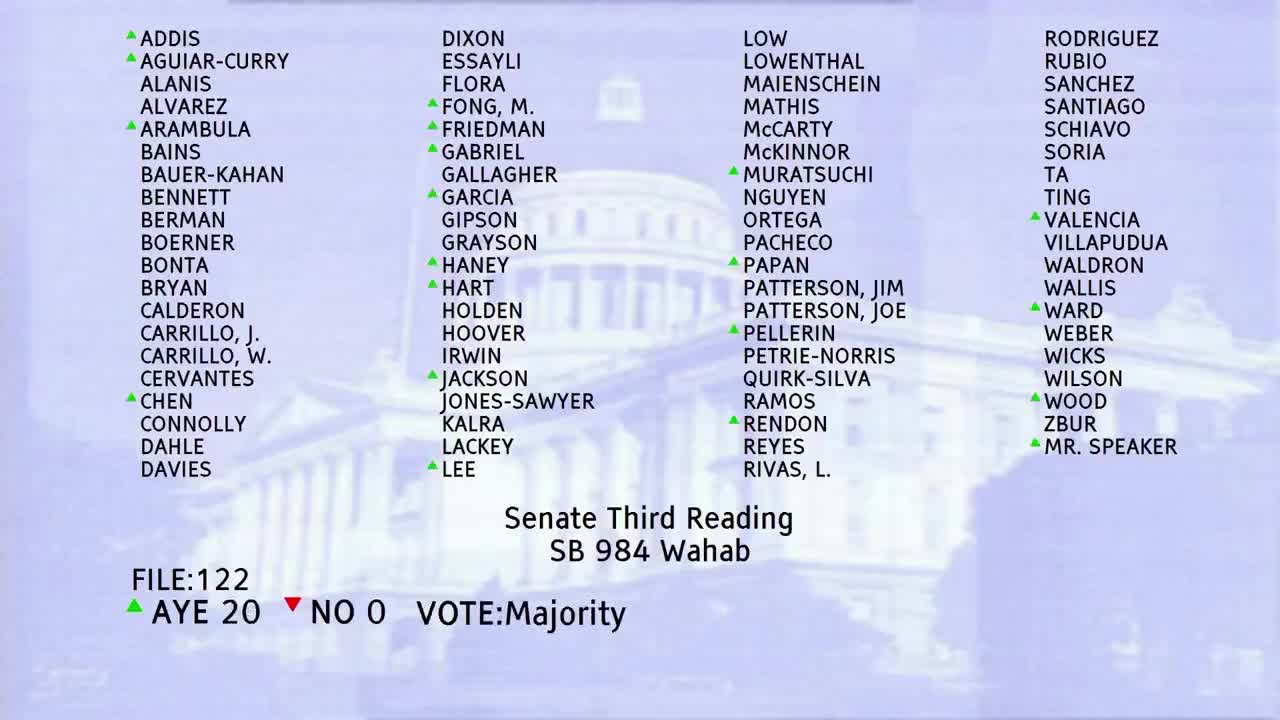
| Aug 28, 2024 | Senate amendments concurred in. To Engrossing and Enrolling. (Ayes 77. Noes 0.). |
| Aug 27, 2024 | From committee: That the Senate amendments be concurred in. (Ayes 8. Noes 0.) (August 27). |
| Aug 22, 2024 | Re-referred to Com. on B. & F. pursuant to Assembly Rule 77.2. |
| Aug 21, 2024 | In Assembly. Concurrence in Senate amendments pending. May be considered on or after August 23 pursuant to Assembly Rule 77. |
| Aug 21, 2024 | Read third time. Passed. Ordered to the Assembly. (Ayes 33. Noes 0. Page 5271.). |
| Aug 13, 2024 | Read second time. Ordered to third reading. |
| Aug 12, 2024 | From committee: Be ordered to second reading pursuant to Senate Rule 28.8. |
| Aug 5, 2024 | From committee chair, with author's amendments: Amend, and re-refer to committee. Read second time, amended, and re-referred to Com. on APPR. |
| Jul 29, 2024 | In committee: Hearing postponed by committee. |
| Jun 20, 2024 | From committee: Do pass and re-refer to Com. on APPR. (Ayes 6. Noes 0.) (June 19). Re-referred to Com. on APPR. |
| Jun 10, 2024 | From committee chair, with author's amendments: Amend, and re-refer to committee. Read second time, amended, and re-referred to Com. on B. & F.I. |
| May 1, 2024 | Referred to Com. on B. & F.I. |
| Apr 18, 2024 | In Senate. Read first time. To Com. on RLS. for assignment. |
| Apr 18, 2024 | Read third time. Passed. Ordered to the Senate. (Ayes 72. Noes 0.) |
| Apr 11, 2024 | Read second time. Ordered to Consent Calendar. |
| Apr 10, 2024 | From committee: Do pass. To Consent Calendar. (Ayes 14. Noes 0.) (April 10). |
| Apr 2, 2024 | From committee: Do pass and re-refer to Com. on APPR. with recommendation: To Consent Calendar. (Ayes 8. Noes 0.) (April 1). Re-referred to Com. on APPR. |
| Mar 11, 2024 | Referred to Com. on B. & F. |
| Feb 17, 2024 | From printer. May be heard in committee March 18. |
| Feb 16, 2024 | Read first time. To print. |
|
Date
|
Description
|
Location
|
Votes
|
|
|---|---|---|---|---|
| Aug 28, 2024 | AB 3148 Chen Concurrence in Senate Amendments | Assembly Floor |
Passed |
|
| Aug 27, 2024 | With recommendation: That Senate amendments be concurred in. | Assembly Standing Committee on Banking and Finance |
Passed |
|
| Aug 21, 2024 | Assembly 3rd Reading AB3148 Chen By Niello | Senate Floor |
Passed |
|
| Jun 19, 2024 | Do pass, but first be re-referred to the Committee on [Appropriations] | Senate Standing Committee on Banking and Financial Institutions |
Passed |
|
| Apr 18, 2024 | AB 3148 Chen Consent Calendar Second Day Regular Session | Assembly Floor |
Passed |
|
| Apr 10, 2024 | Do pass. To Consent Calendar. | Assembly Standing Committee on Appropriations |
Passed |
|
| Apr 1, 2024 | Do pass and be re-referred to the Committee on [Appropriations] with recommendation: To Consent Calendar | Assembly Standing Committee on Banking and Finance |
Passed |
This list shows positions taken on this bill by organizations on the date displayed, which is linked to the original source.
Positions by individuals are not included.
|
Organization
|
Position
|
Date
|
|---|---|---|
| California Financial Service Providers | ** Support | |
| Consumer Federation California | * Indeterminate | Jun 19, 2024 |
CONCURRENCE IN SENATE AMENDMENTS
CSA2 Bill Id:AB 3148
Author:(Chen)
As Amended Ver:August 5, 2024
Majority vote
SUMMARY
Original Committee of Reference: B. & F.
Modifies the formula for the annual assessment paid by California Deferred Deposit Transaction Law (CDDTL) licensees
Senate Amendments
Current Committee Recommendation: Concur
Delete the Assembly version of this bill and instead:
- Change the cost allocation methodology for CDDTL licensees from assessments based on the number of licensed locations to assessments based on the pro rata volume of deferred deposit transactions made by a licensee.
- Establish a minimum assessment of $500 per licensed location per year.
COMMENTS
- Background: Payday lending in California
A deferred deposit transaction, commonly known as a payday loan, involves the consumer giving the lender (referred to as an originator under the CDDTL) a personal check for the desired amount. The lender provides the consumer with the funds, minus an agreed-upon fee, and defers depositing the check for a specified period.
Under the CDDTL, the personal check cannot exceed $300, and the lender's fee cannot exceed 15% of the check amount. For instance, if a borrower gives a $300 check and the lender charges the maximum fee of 15%, the borrower will receive $255. The payday loan term cannot exceed 31 days.
The payday lending industry has seen a consistent decline over the last decade or so. According to the Department of Financial Protection and Innovation (DFPI's) annual report, the number of licensed locations has dropped 65.1%, from 2,058 locations in 2013 to 719 in 2022. While nearly half of payday loans issued in California are now made online, which can help explain the reduced number of locations, the number of issued loans is also declining. Between 2013 and 2022, the number of originated loans declined from 12.2 million to 5.4 million.
- Background: Role of annual assessments
The DFPI typically does not receive support from the state General Fund and relies heavily on revenue collected directly from licensees through annual assessments and cost recoveries. DFPI's licensees, including state-chartered banks and credit unions, money transmitters, mortgage lenders, and debt collectors, all contribute to the costs of regulation, though the specific formula for each licensee type may vary.
The CDDTL's formula is based on the number of licensed locations. Currently, this cost allocation method favors online-only lenders over those with physical locations in the state. Online-only payday lenders, which operate without brick-and-mortar locations, hold just one license. In contrast, lenders with physical locations must obtain a separate license for each site. As a result, lenders with physical locations face higher regulatory costs, even if they issue fewer loans than online lenders.
- What does AB 3148 do?
This bill was gut-and-amended in the Senate to propose a new formula for payday lender assessments. Under the new formula, the volume of lending activity would determine the assessment amount versus the number of licensed locations. This is similar in concept to the assessment for licensees under the California Financing Law (CFL), whose annual assessment is based on the gross income received from CFL-related activities rather than the number of locations in California.
This bill would significantly change who bears the costs of DFPI's payday licensing program. According to data provided by DFPI staff, in 2022-23 total assessment revenue equaled roughly $1.7 million, with each location paying around $2,300. Under the new formula, assessments would depend instead on loan activity, which in theory would better align licensee assessments with DFPI's workload requirements. AB 3148 does not increase overall assessments or otherwise modify the amount of revenue collected, since assessments are based on DFPI's reasonable costs of administering the CDDTL.
According to the Author
"AB 3148 creates fairness by basing payday lender license fees on the volume of business they conduct in California, as opposed to the number of locations the licensee operates. As the number of brick-and-mortar locations has decreased, it is only fair that fees are assessed by the volume of business conducted in state."
Arguments in Support
The California Financial Service Providers writes:
"Current law requires fees for CDDTL licensees to be paid based on the number of locations the licensee has in the state of California. While CDDTL transactions have decreased overall, the number of brick-and-mortar locations for CDDTL transactions has significantly declined over the last several years, while online transactions have continued to grow over the same period.
At the same time, DFPI costs to administer the CDDTL program have continued to rise. The current fee structure has led to an increase in fees for licensees with brick-and-mortar locations, regardless of the volume of business conducted at each of these locations, as compared to the number of transactions conducted via online.
AB 3148 addresses the issue described above by requiring DFPI to assess fees to CDDTL licensees based on the volume of business conducted by the licensee in the state versus the number of locations the licensee may have."
Arguments in Opposition
None received.
FISCAL COMMENTS
Minor state costs.
VOTES
ASM BANKING AND FINANCE: 8-0-1
YES: Grayson, Chen, Dixon, Mike Fong, Maienschein, Petrie-Norris, Blanca Rubio, Soria
ABS, ABST OR NV: Cervantes
ASM APPROPRIATIONS: 14-0-1
YES: Wicks, Sanchez, Arambula, Bryan, Calderon, Dixon, Mike Fong, Grayson, Haney, Hart, Jim Patterson, Pellerin, Ta, Villapudua
ABS, ABST OR NV: Wendy Carrillo
ASSEMBLY FLOOR: 72-0-8
YES: Addis, Aguiar-Curry, Alanis, Alvarez, Bains, Bauer-Kahan, Bennett, Berman, Calderon, Juan Carrillo, Wendy Carrillo, Chen, Connolly, Davies, Dixon, Flora, Mike Fong, Vince Fong, Friedman, Gabriel, Gallagher, Garcia, Gipson, Grayson, Haney, Hart, Holden, Hoover, Irwin, Jackson, Jones-Sawyer, Kalra, Lackey, Lee, Low, Lowenthal, Maienschein, McCarty, McKinnor, Muratsuchi, Stephanie Nguyen, Ortega, Pacheco, Papan, Jim Patterson, Joe Patterson, Pellerin, Petrie-Norris, Quirk-Silva, Ramos, Rendon, Reyes, Luz Rivas, Rodriguez, Blanca Rubio, Sanchez, Santiago, Schiavo, Soria, Ta, Ting, Valencia, Villapudua, Waldron, Wallis, Ward, Weber, Wicks, Wilson, Wood, Zbur, Robert Rivas
ABS, ABST OR NV: Arambula, Boerner, Bonta, Bryan, Cervantes, Megan Dahle, Essayli, Mathis
SENATE FLOOR: 33-0-7
YES: Allen, Alvarado-Gil, Archuleta, Ashby, Blakespear, Caballero, Cortese, Dahle, Dodd, Durazo, Eggman, Glazer, Gonzalez, Grove, Hurtado, Jones, Laird, Limón, McGuire, Min, Newman, Nguyen, Niello, Ochoa Bogh, Padilla, Portantino, Roth, Rubio, Seyarto, Stern, Umberg, Wiener, Wilk
ABS, ABST OR NV: Atkins, Becker, Bradford, Menjivar, Skinner, Smallwood-Cuevas, Wahab
ASM BANKING AND FINANCE: 8-0-1
YES: Grayson, Chen, Dixon, Mike Fong, Maienschein, Petrie-Norris, Blanca Rubio, Soria
ABS, ABST OR NV: Cervantes
UPDATED
VERSION: August 5, 2024
CONSULTANT: Luke Reidenbach / B. & F. / (916) 319-3081 FN: 0004780
Date of Hearing: August 27, 2024
ASSEMBLY COMMITTEE ON BANKING AND FINANCE
Timothy Grayson, Chair
ABPCA Bill Id:AB 3148 (
Author:Chen) – As Amended Ver:August 5, 2024
SUBJECT: Deferred deposit transactions: assessments
SUMMARY: Modifies the formula for the annual assessment paid by California Deferred Deposit Transaction Law (CDDTL) licensees.
Specifically, this bill:
- Changes the cost allocation methodology for CDDTL licensees from assessments based on the number of licensed locations to assessments based on the pro rata volume of deferred deposit transactions made by a licensee.
- Establishes a minimum assessment of $500 per licensed location per year.
EXISTING LAW:
- Provides the CDDTL, a licensing framework administered by the Department of Financial Protection and Innovation (DFPI) that regulates the provision of deferred deposit transactions (more commonly known as “payday loans”). (Division 10 of the Financial Code, commencing with Section 23000)
- Requires each licensee to pay its pro rata share of all costs and expenses incurred by DFPI in administering the DDTL, as specified. Provides that the assessment is based on the number of locations. (Financial Code Section 23016)
FISCAL EFFECT: Unknown. This bill is keyed Fiscal.
COMMENTS:
- Purpose
According to the author:
AB 3148 creates fairness by basing payday lender license fees on the volume of business they conduct in California, as opposed to the number of locations the licensee operates. As the number of brick-and-mortar locations has decreased, it is only fair that fees are assessed by the volume of business conducted in state.
- Background: Payday lending in California
A deferred deposit transaction, commonly known as a payday loan, involves the consumer giving the lender (referred to as an originator under the CDDTL) a personal check for the desired amount. The lender provides the consumer with the funds, minus an agreed-upon fee, and defers depositing the check for a specified period.
Under the CDDTL, the personal check cannot exceed $300, and the lender's fee cannot exceed 15% of the check amount. For instance, if a borrower gives a $300 check and the lender charges the maximum fee of 15 percent, the borrower will receive $255. The payday loan term cannot exceed 31 days.
The payday lending industry has seen a consistent decline over the last decade or so. According to DFPI’s annual report, the number of licensed locations has dropped 65.1%, from 2,058 locations in 2013 to 719 in 2022. While nearly half of payday loans issued in California are now made online, which can help explain the reduced number of locations, the number of issued loans is also declining. Between 2013 and 2022, the number of originated loans declined from 12.2 million to 5.4 million.
- Background: Role of annual assessments
The DFPI typically does not receive support from the state General Fund and relies heavily on revenue collected directly from licensees through annual assessments and cost recoveries. DFPI’s licensees, including state-chartered banks, credit unions, money transmitters, mortgage lenders, and debt collectors, all contribute to the costs of regulation, though the specific formula for each licensee type may vary.
The CDDTL’s formula is based on the number of licensed locations. According to data provided by DFPI staff, in 2022-23 total assessment revenue equaled roughly $1.7 million, with each location paying around $2,300. Currently, this cost allocation method favors online-only lenders over those with physical locations in the state. Online-only payday lenders, which operate without brick-and-mortar locations, hold just one license. In contrast, lenders with physical locations must obtain a separate license for each site. As a result, lenders with physical locations face higher regulatory costs, even if they issue fewer loans than online lenders.
- What does AB 3148 do?
AB 3148 was gut-and-amended in the Senate to replace the bill’s prior contents with a new proposed formula for payday lender assessments. Under this new formula, the volume of lending activity would determine the assessment instead of the number of licensed locations. For example, a licensee with just one physical location issuing $10 million in payday loans would pay a greater share of DFPI’s administrative costs than a lender with five locations issuing $1 million in payday loans across all five locations. This new formula raises a number of policy considerations:
- Fairness. AB 3148, by redistributing which licensees pay more in assessments, will result in winners and losers. A key consideration is whether this is a fair and defensible outcome. There are a number of factors that suggest AB 3148’s new formula will result in an acceptable distribution of costs for CDDTL licensees.
First, other programs administered by DFPI already use formulas similar to what AB 3148 proposes. For example, California Financing Law (CFL) licensees pay an assessment based on the gross income received from their CFL-related activities, an assessment that reflects overall lending activity.
Second, this new formula will lead to higher costs for those licensees with a greater ability to pay. Simply put, loan volume is a better indicator of a licensee’s resources, whereas the number of locations is not. Many lenders relying on physical storefronts generate fewer payday loans than online-only lenders, yet they pay more in annual assessments.
- DFPI budget. AB 3148 does not increase aggregate assessment levels or otherwise modify the amount of revenue allowed to be collected, since assessments are based on DFPI’s reasonable costs of administering the CDDTL. However, given that one stated rationale for this measure is that increasing program costs are leading to higher assessments for small licensees, an important consideration is why DFPI costs are not going down as the payday lending industry shrinks. After all, DFPI now oversees an industry that is less than half the size it was ten years ago.
One explanation is that across all its programs, DFPI’s programmatic costs have increased in recent years due to higher personnel costs. However, the Legislature may in the future want to explore whether the consistent annual decline in the number of licensees and loan volume calls for a shift in department resources toward other programs, especially those with an operating deficit.
- Arguments in support
The California Financial Service Providers writes:
[CFSP] represents approximately 60% of all CDDTL licensed locations including both storefront and online providers. CFSP members deliver critical products and services – including small-dollar consumer loans, check cashing, pre-paid cards, money transfers, and electronic bill payments, among others – to meet California's consumers’ ever-changing needs and expectations.
Current law requires fees for CDDTL licensees to be paid based on the number of locations the licensee has in the state of California. While CDDTL transactions have decreased overall, the number of brick-and-mortar locations for CDDTL transactions has significantly declined over the last several years, while online transactions have continued to grow over the same period.
At the same time, DFPI costs to administer the CDDTL program have continued to rise. The current fee structure has led to an increase in fees for licensees with brick-and-mortar locations, regardless of the volume of business conducted at each of these locations, as compared to the number of transactions conducted via online.
AB 3148 addresses the issue described above by requiring DFPI to assess fees to CDDTL licensees based on the volume of business conducted by the licensee in the state versus the number of locations the licensee may have.
REGISTERED SUPPORT / OPPOSITION:
Support
California Financial Service Providers
Opposition
None on file.
Analysis Prepared by: Luke Reidenbach / B. & F. / (916) 319-3081
CONCURRENCE IN SENATE AMENDMENTS
CSA1 Bill Id:AB 3148
Author:(Chen)
As Amended Ver:August 5, 2024
Majority vote
SUMMARY
Modifies the formula for the annual assessment paid by California Deferred Deposit Transaction Law (CDDTL) licensees
Senate Amendments
Delete the Assembly version of this bill and instead:
- Change the cost allocation methodology for CDDTL licensees from assessments based on the number of licensed locations to assessments based on the pro rata volume of deferred deposit transactions made by a licensee.
- Establish a minimum assessment of $500 per licensed location per year.
COMMENTS
- Background: Payday lending in California
A deferred deposit transaction, commonly known as a payday loan, involves the consumer giving the lender (referred to as an originator under the CDDTL) a personal check for the desired amount. The lender provides the consumer with the funds, minus an agreed-upon fee, and defers depositing the check for a specified period.
Under the CDDTL, the personal check cannot exceed $300, and the lender's fee cannot exceed 15% of the check amount. For instance, if a borrower gives a $300 check and the lender charges the maximum fee of 15%, the borrower will receive $255. The payday loan term cannot exceed 31 days.
The payday lending industry has seen a consistent decline over the last decade or so. According to DFPI's annual report, the number of licensed locations has dropped 65.1%, from 2,058 locations in 2013 to 719 in 2022. While nearly half of payday loans issued in California are now made online, which can help explain the reduced number of locations, the number of issued loans is also declining. Between 2013 and 2022, the number of originated loans declined from 12.2 million to 5.4 million.
- Background: Role of annual assessments
The DFPI typically does not receive support from the state General Fund and relies heavily on revenue collected directly from licensees through annual assessments and cost recoveries. DFPI's licensees, including state-chartered banks and credit unions, money transmitters, mortgage lenders, and debt collectors, all contribute to the costs of regulation, though the specific formula for each licensee type may vary.
The CDDTL's formula is based on the number of licensed locations. Currently, this cost allocation method favors online-only lenders over those with physical locations in the state. Online-only payday lenders, which operate without brick-and-mortar locations, hold just one license. In contrast, lenders with physical locations must obtain a separate license for each site. As a result, lenders with physical locations face higher regulatory costs, even if they issue fewer loans than online lenders.
- What does AB 3148 do?
AB 3148 was gut-and-amended in the Senate to propose a new formula for payday lender assessments. Under the new formula, the volume of lending activity would determine the assessment amount versus the number of licensed locations. This is similar in concept to the assessment for licensees under the California Financing Law (CFL), whose annual assessment is based on the gross income received from CFL-related activities rather than the number of locations in California.
AB 3148 would significantly change who bears the costs of DFPI's payday licensing program. According to data provided by DFPI staff, in 2022-23 total assessment revenue equaled roughly $1.7 million, with each location paying around $2,300. Under the new formula, assessments would depend instead on loan activity, which in theory would better align licensee assessments with DFPI's workload requirements. AB 3148 does not increase overall assessments or otherwise modify the amount of revenue collected, since assessments are based on DFPI's reasonable costs of administering the CDDTL.
According to the Author
"AB 3148 creates fairness by basing payday lender license fees on the volume of business they conduct in California, as opposed to the number of locations the licensee operates. As the number of brick-and-mortar locations has decreased, it is only fair that fees are assessed by the volume of business conducted in state."
Arguments in Support
The California Financial Service Providers writes:
"Current law requires fees for CDDTL licensees to be paid based on the number of locations the licensee has in the state of California. While CDDTL transactions have decreased overall, the number of brick-and-mortar locations for CDDTL transactions has significantly declined over the last several years, while online transactions have continued to grow over the same period.
At the same time, DFPI costs to administer the CDDTL program have continued to rise. The current fee structure has led to an increase in fees for licensees with brick-and-mortar locations, regardless of the volume of business conducted at each of these locations, as compared to the number of transactions conducted via online.
AB 3148 addresses the issue described above by requiring DFPI to assess fees to CDDTL licensees based on the volume of business conducted by the licensee in the state versus the number of locations the licensee may have."
Arguments in Opposition
None received.
FISCAL COMMENTS
Minor state costs.
VOTES:
ASM BANKING AND FINANCE: 8-0-1
YES: Grayson, Chen, Dixon, Mike Fong, Maienschein, Petrie-Norris, Blanca Rubio, Soria
ABS, ABST OR NV: Cervantes
ASM APPROPRIATIONS: 14-0-1
YES: Wicks, Sanchez, Arambula, Bryan, Calderon, Dixon, Mike Fong, Grayson, Haney, Hart, Jim Patterson, Pellerin, Ta, Villapudua
ABS, ABST OR NV: Wendy Carrillo
ASSEMBLY FLOOR: 72-0-8
YES: Addis, Aguiar-Curry, Alanis, Alvarez, Bains, Bauer-Kahan, Bennett, Berman, Calderon, Juan Carrillo, Wendy Carrillo, Chen, Connolly, Davies, Dixon, Flora, Mike Fong, Vince Fong, Friedman, Gabriel, Gallagher, Garcia, Gipson, Grayson, Haney, Hart, Holden, Hoover, Irwin, Jackson, Jones-Sawyer, Kalra, Lackey, Lee, Low, Lowenthal, Maienschein, McCarty, McKinnor, Muratsuchi, Stephanie Nguyen, Ortega, Pacheco, Papan, Jim Patterson, Joe Patterson, Pellerin, Petrie-Norris, Quirk-Silva, Ramos, Rendon, Reyes, Luz Rivas, Rodriguez, Blanca Rubio, Sanchez, Santiago, Schiavo, Soria, Ta, Ting, Valencia, Villapudua, Waldron, Wallis, Ward, Weber, Wicks, Wilson, Wood, Zbur, Robert Rivas
ABS, ABST OR NV: Arambula, Boerner, Bonta, Bryan, Cervantes, Megan Dahle, Essayli, Mathis
SENATE FLOOR: 33-0-7
YES: Allen, Alvarado-Gil, Archuleta, Ashby, Blakespear, Caballero, Cortese, Dahle, Dodd, Durazo, Eggman, Glazer, Gonzalez, Grove, Hurtado, Jones, Laird, Limón, McGuire, Min, Newman, Nguyen, Niello, Ochoa Bogh, Padilla, Portantino, Roth, Rubio, Seyarto, Stern, Umberg, Wiener, Wilk
ABS, ABST OR NV: Atkins, Becker, Bradford, Menjivar, Skinner, Smallwood-Cuevas, Wahab
UPDATED
VERSION: August 5, 2024
CONSULTANT: Luke Reidenbach / B. & F. / (916) 319-3081 FN: 0004367
SENATE RULES COMMITTEE Office of Senate Floor Analyses (916) 651-1520 Fax: (916) 327-4478 | AB 3148 |
THIRD READING
Bill No: AB 3148
Author: Chen (R)
Amended: 8/5/24 in Senate
Vote: 21
SENATE BANKING & F.I. COMMITTEE: 6-0, 6/19/24
AYES: Limón, Niello, Caballero, Min, Nguyen, Portantino
NO VOTE RECORDED: Bradford
SENATE APPROPRIATIONS COMMITTEE: Senate Rule 28.8
ASSEMBLY FLOOR: 72-0, 4/18/24 (Consent) - See last page for vote
SUBJECT: Deferred deposit transactions: assessments
SOURCE: California Financial Service Providers
DIGEST:
This bill changes the cost allocation methodology for licensees under the Deferred Deposit Transaction Law from assessments based on the number of licensed locations to assessments based on the pro rata volume of deferred deposit transactions made by a licensee.
ANALYSIS:
Existing law:
- Provides the California Deferred Deposit Transaction Law (DDTL), a licensing framework administered by the Department of Financial Protection and Innovation (DFPI) that regulates the provision of deferred deposit transactions (more commonly known as “payday loans”). (Division 10 of the Financial Code, commencing with Section 23000)
- Requires each licensee to pay its pro rata share of all costs and expenses incurred by DFPI in administering the DDTL, as specified. Provides that the assessment is based on the number of locations. (Financial Code Section 23016)
This bill
- Deletes the requirement that the pro rata assessment be based on the number of locations of a DDTL licensee. Instead, provides that the pro rata share is the proportion that a licensee’s total dollar amount of deferred deposit transactions made bears to the aggregate total dollar amount of deferred deposit transactions made by all DDTL licensees, as specified.
- Provides a minimum assessment amount of $500 per licensed location per year.
Background
The Department of Financial Protection and Innovation (DFPI) licenses and oversees a variety of businesses in the financial services industry, such as state-chartered banks and credit unions, money transmitters, nonbank lenders, mortgage lenders, debt collectors, and payday lenders. The costs incurred by DFPI in regulating these businesses are recovered through fees and assessments charged to licensed businesses. Rather than requiring the General Fund to cover these expenses, the regulated entities bear the costs.
The cost allocation method for payday lenders differs from other DFPI licensing programs. Typically, the assessments charged to licensees under a given licensing program are allocated pro rata based on the licensee’s share of assets, loan volume, or revenue, relative to all licensees under the licensing program. The licensing law for payday lenders, however, allocates costs based on a licensee’s share of licensed locations.
The current cost allocation method for payday lenders favors online-only lenders over lenders who have physical locations in the state. Some payday lenders offer loans exclusively online, having no brick-and-mortar locations in the state, meaning that they hold only one license, while lenders who have physical locations are required to have a license for each location. This means that the lenders with physical locations bear higher regulatory costs, even if they make far fewer loans than an online lender. While this methodology may have been more reasonable in 2002 when nearly all payday loans were made in physical locations, payday lending activity has shifted away from brick-and-mortar storefronts and towards online channels. In 2022 49% of payday loans were made online, according to a report published by DFPI.[1]
This bill is fair, but will have distributional effects. The proposed change in calculating each lender’s assessment under the DDTL is reasonable and brings the DDTL into conformance with cost allocation methodologies in other licensing laws administered by DFPI. By basing the assessment on a lender’s loan volume, the cost of regulation will be more closely tied to the revenue earned by the lender, which better reflects the benefit the lender receives from participating in the regulated market.
If enacted, this bill will likely increase regulatory costs for a small number of online-only payday lenders, potentially quite substantially. But the distributional effects of the proposed cost allocation change are unknown. Given that the language in this bill was only made public on June 10, 2024, there has been little time for public feedback or information from the regulator. Committee staff contacted DFPI seeking data about the magnitude of change that these licensees may face, but the department did not respond before this analysis was published. However, the policy change proposed by this bill appears more fair and reasonable than existing law, in spite of the unknown distributional effects across licensees.
Comments
Purpose of the bill. According to the author, “AB 3148 proposes to adjust California Deferred Deposit Transaction Law licensee fees paid to the California Department of Financial Protection and Innovation to be paid based on each licensee’s total dollar amount of deferred deposit transactions versus based on the number of each licensee’s number of locations.”
FISCAL EFFECT: Appropriation: No Fiscal Com.: Yes Local: No
SUPPORT: (Verified 8/12/24)
California Financial Service Providers (source)
OPPOSITION: (Verified 8/12/24)
None received
ARGUMENTS IN SUPPORT:
The California Financial Service Providers write, as sponsors:
[CFSP] represents approximately 60% of all CDDTL licensed locations including both storefront and online providers. CFSP members deliver critical products and services – including small-dollar consumer loans, check cashing, pre-paid cards, money transfers, and electronic bill payments, among others – to meet California's consumers’ ever-changing needs and expectations.
Current law requires fees for CDDTL licensees to be paid based on the number of locations the licensee has in the state of California. While CDDTL transactions have decreased overall, the number of brick-and-mortar locations for CDDTL transactions has significantly declined over the last several years, while online transactions have continued to grow over the same period.
At the same time, DFPI costs to administer the CDDTL program have continued to rise. The current fee structure has led to an increase in fees for licensees with brick-and-mortar locations, regardless of the volume of business conducted at each of these locations, as compared to the number of transactions conducted via online.
AB 3148 addresses the issue described above by requiring DFPI to assess fees to CDDTL licensees based on the volume of business conducted by the licensee in the state versus the number of locations the licensee may have.
ASSEMBLY FLOOR: 72-0, 4/18/24
AYES: Addis, Aguiar-Curry, Alanis, Alvarez, Bains, Bauer-Kahan, Bennett, Berman, Calderon, Juan Carrillo, Wendy Carrillo, Chen, Connolly, Davies, Dixon, Flora, Mike Fong, Vince Fong, Friedman, Gabriel, Gallagher, Garcia, Gipson, Grayson, Haney, Hart, Holden, Hoover, Irwin, Jackson, Jones-Sawyer, Kalra, Lackey, Lee, Low, Lowenthal, Maienschein, McCarty, McKinnor, Muratsuchi, Stephanie Nguyen, Ortega, Pacheco, Papan, Jim Patterson, Joe Patterson, Pellerin, Petrie-Norris, Quirk-Silva, Ramos, Rendon, Reyes, Luz Rivas, Rodriguez, Blanca Rubio, Sanchez, Santiago, Schiavo, Soria, Ta, Ting, Valencia, Villapudua, Waldron, Wallis, Ward, Weber, Wicks, Wilson, Wood, Zbur, Robert Rivas
NO VOTE RECORDED: Arambula, Boerner, Bonta, Bryan, Cervantes, Megan Dahle, Essayli, Mathis
Prepared by: Michael Burdick / B. & F.I. /
8/13/24 12:59:41
**** END ****
SENATE COMMITTEE ON
BANKING AND FINANCIAL INSTITUTIONS
Senator Monique Limón, Chair
2023 - 2024 Regular
Bill No: AB 3148 Hearing Date: June 19, 2024
Author: | Chen | ||
Version: | June 10, 2024 Amended | ||
Urgency: | No | Fiscal: | Yes |
Consultant: | Michael Burdick | ||
Subject: Deferred deposit transactions: assessments
SUMMARY
This bill changes the cost allocation methodology for licensees under the Deferred Deposit Transaction Law from assessments based on the number of licensed locations to assessments based on the pro rata volume of deferred deposit transactions made by a licensee.
EXISTING LAW
- Provides the California Deferred Deposit Transaction Law (DDTL), a licensing framework administered by the Department of Financial Protection and Innovation (DFPI) that regulates the provision of deferred deposit transactions (more commonly known as “payday loans”). (Division 10 of the Financial Code, commencing with Section 23000)
- Requires each licensee to pay its pro rata share of all costs and expenses incurred by DFPI in administering the DDTL, as specified. Provides that the assessment is based on the number of locations. (Financial Code Section 23016)
THIS BILL
- Deletes the requirement that the pro rata assessment be based on the number of locations of a DDTL licensee. Instead, provides that the pro rata share is the proportion that a licensee’s total dollar amount of deferred deposit transactions made bears to the aggregate total dollar amount of deferred deposit transactions made by all DDTL licensees, as specified.
- Provides a minimum assessment amount of $250 per licensed location per year.
COMMENTS
- PURPOSE
According to the author:
AB 3148 proposes to adjust California Deferred Deposit Transaction Law licensee fees paid to the California Department of Financial Protection and Innovation to be paid based on each licensee’s total dollar amount of deferred deposit transactions versus based on the number of each licensee’s number of locations.
- BACKGROUND
The Department of Financial Protection and Innovation (DFPI) licenses and oversees a variety of businesses in the financial services industry, such as state-chartered banks and credit unions, money transmitters, nonbank lenders, mortgage lenders, debt collectors, and payday lenders. The costs incurred by DFPI in regulating these businesses are recovered through fees and assessments charged to licensed businesses. Rather than requiring the General Fund to cover these expenses, the regulated entities bear the costs.
The cost allocation method for payday lenders differs from other DFPI licensing programs. Typically, the assessments charged to licensees under a given licensing program are allocated pro rata based on the licensee’s share of assets, loan volume, or revenue, relative to all licensees under the licensing program. The licensing law for payday lenders, however, allocates costs based on a licensee’s share of licensed locations.
The current cost allocation method for payday lenders favors online-only lenders over lenders who have physical locations in the state. Some payday lenders offer loans exclusively online, having no brick-and-mortar locations in the state, meaning that they hold only one license, while lenders who have physical locations are required to have a license for each location. This means that the lenders with physical locations bear higher regulatory costs, even if they make far fewer loans than an online lender. While this methodology may have been more reasonable in 2002 when nearly all payday loans were made in physical locations, payday lending activity has shifted away from brick-and-mortar storefronts and towards online channels. In 2022 49% of payday loans were made online, according to a report published by DFPI.[1]
- THIS BILL IS FAIR, BUT WILL HAVE DISTRIBUTIONAL EFFECTS
The proposed change in calculating each lender’s assessment under the DDTL is reasonable and brings the DDTL into conformance with cost allocation methodologies in other licensing laws administered by DFPI. By basing the assessment on a lender’s loan volume, the cost of regulation will be more closely tied to the revenue earned by the lender, which better reflects the benefit the lender receives from participating in the regulated market.
If enacted, this bill will likely increase regulatory costs for a small number of online-only payday lenders, potentially quite substantially. But the distributional effects of the proposed cost allocation change are unknown. Given that the language in this bill was only made public on June 10, 2024, there has been little time for public feedback or information from the regulator. Committee staff contacted DFPI seeking data about the magnitude of change that these licensees may face, but the department did not respond before this analysis was published. However, the policy change proposed by this bill appears more fair and reasonable than existing law, in spite of the unknown distributional effects across licensees.
- ARGUMENTS IN SUPPORT
The California Financial Service Providers write, as sponsors:
[CFSP] represents approximately 60% of all CDDTL licensed locations including both storefront and online providers. CFSP members deliver critical products and services – including small-dollar consumer loans, check cashing, pre-paid cards, money transfers, and electronic bill payments, among others – to meet California's consumers’ ever-changing needs and expectations.
Current law requires fees for CDDTL licensees to be paid based on the number of locations the licensee has in the state of California. While CDDTL transactions have decreased overall, the number of brick-and-mortar locations for CDDTL transactions has significantly declined over the last several years, while online transactions have continued to grow over the same period.
At the same time, DFPI costs to administer the CDDTL program have continued to rise. The current fee structure has led to an increase in fees for licensees with brick-and-mortar locations, regardless of the volume of business conducted at each of these locations, as compared to the number of transactions conducted via online.
AB 3148 addresses the issue described above by requiring DFPI to assess fees to CDDTL licensees based on the volume of business conducted by the licensee in the state versus the number of locations the licensee may have.
LIST OF REGISTERED SUPPORT/OPPOSITION
Support
California Financial Service Providers (sponsor)
Opposition
None received
-- END --
Date of Hearing: April 10, 2024
ASSEMBLY COMMITTEE ON APPROPRIATIONS
Buffy Wicks, Chair
ABPCA Bill Id:AB 3148
Author:(Chen) – As Introduced Ver:February 16, 2024
Policy Committee: | Banking and Finance | Vote: | 8 - 0 |
|
| ||
|
|
Urgency: No State Mandated Local Program: No Reimbursable: No
SUMMARY:
This bill requires an annual report prepared by the Department of Financial Protection and Innovation (DFPI) commissioner to include information regarding the activities of the Office of the Ombuds (Office).
FISCAL EFFECT:
Minor and absorbable costs to DFPI to add Office activities to an existing annual report.
COMMENTS:
- Purpose. According to the author, including activities of the Office in DFPI’s annual report detailing actions taken under the California Consumer Financial Protection Law (CCFPL) will help ensure DFPI is accountable and responsible to the public.
- CCFPL and the Office. Amongst other provisions, the CCFPL authorizes DFPI to oversee providers of consumer financial products or services that are not licensed by DFPI. DFPI must produce an annual report detailing CCFPL-related activities, including rulemaking, enforcement, oversight, consumer complaints and resolutions, education, and research.
Although not enacted in statute, the Office was established within DFPI as part of the department’s 2020 reorganization that also gave rise to the CCFPL. The Office serves as an independent and confidential resource for licensees and consumers, ensuring any complaints about DFPI staff or actions undergo a thorough and impartial review. While the Office cannot independently resolve complaints or change regulations, the Office’s work generally informs DFPI’s policies and procedures. This bill requires DFPI to additionally report on the Office’s activities as part of DFPI’s annual report on CCFPL implementation.
- Related Legislation. AB 1296 (Grayson) requires, until January 1, 2028, DFPI’s annual CCFPL report to separate out specified information related to crypto assets in a standalone section. AB 1296 is pending hearing in the Senate Banking and Financial Institutions Committee.
Analysis Prepared by: Irene Ho / APPR. / (916) 319-2081
Date of Hearing: April 1, 2024
ASSEMBLY COMMITTEE ON BANKING AND FINANCE
Timothy Grayson, Chair
ABPCA Bill Id:AB 3148 (
Author:Chen) – As Introduced Ver:February 16, 2024
SUBJECT: Commissioner of Financial Protection and Innovation: report: Office of the Ombuds
SUMMARY: This bill requires the Department of Financial Protection and Innovation (DFPI) to include in its annual California Consumer Financial Protection Law (CCFPL) report information about the activities of the Office of the Ombuds.
EXISTING LAW:
- Requires that all state agencies provide a method or form on the Internet through which individuals can register complaints or comments relating to the performance of that department/agency (Government Code Sections 8330-8332).
- Pursuant to the CCFPL, authorizes DFPI to require covered persons to register with the department (Financial Code Section 90009).
- Defines “covered person” as a person that engages in offering or providing a consumer financial product or service to a resident of this state and affiliates or service providers, as specified (Financial Code Section 90005(f)).
- Requires DFPI to publish an annual report on the following activities of the department pursuant to the CCFPL (Financial Code Section 90018):
- Rulemaking, enforcement, oversight, consumer complaints, and resolutions, education, and research.
- The activities of the Financial Technology Innovation Office.
FISCAL EFFECT: Unknown. This bill is keyed Fiscal by Legislative Counsel.
COMMENTS:
- Background: Office of the Ombuds
An ombuds, also known as an ombudsman or ombudsperson, assists in resolving issues between parties through informal meetings and mediation. In government, the ombuds typically handles complaints directed at governmental bodies and officials.
The Office of the Ombuds (Office) within DFPI acts as an independent and confidential resource for stakeholders, ensuring that complaints about DFPI staff or actions undergo a thorough and impartial review. Anyone, including consumers, licensees, trade groups, or applicants, can submit a complaint, and the Office provides a confidential process for resolving problems. While the Office cannot independently resolve complaints or change policy, its work generally informs DFPI's policies and procedures.
The Office was recently established as part of the department's transition from the Department of Business Oversight (DBO) to DFPI. In 2020, the Governor proposed a name change and a budget enhancement beginning in Fiscal Year 2020-21, alongside language that expanded the department's oversight authority. AB 1864 (Limón), Chapter 157, Statutes of 2020, established the CCFPL and expanded the department's new oversight authority over a wider array of consumer financial products and services. AB 1864 also created the Office of Financial Technology Innovation (OFTI), intended to provide industry constituencies with early guidance.
DFPI’s 2020 Budget Change Proposal (BCP) for the department’s reorganization includes additional information about the creation of the Office. The BCP states:
The Ombudsperson will promote responsiveness and accountability at DBO by identifying and solving the underlying causes of complaints received. The Ombudsperson will make sure that complaints are addressed as thoroughly and as quickly as possible and that recommendations are sound and capable of being implemented.
- Background: CCFPL Report
AB 1864 also requires DFPI to produce an annual report detailing the department’s CCFPL-related activities. This report must summarize the department’s activities on rulemaking, enforcement, oversight, consumer complaints, and resolutions, education, and research, as well as the activities of the OFTI.
As an example of the type of information provided in this report, in 2022, OFTI hosted 247 meetings with 161 different external stakeholders to discuss emerging products and services. Moreover, more than 25 organizations met with OFTI staff as part of OFTI’s weekly office hours to share their story with the DFPI and to understand the DFPI’s expectations.
- Purpose
AB 3148 will update the CCFPL’s report requirements to include additional information about the activities of the Office. Because the Office was created along with the OFTI as part of the larger department reorganization, the author argues it is appropriate to include its activities to help ensure that DFPI is accountable and responsible to the public.
REGISTERED SUPPORT / OPPOSITION:
Support
None on file.
Opposition
None on file.
Analysis Prepared by: Luke Reidenbach / B. & F. / (916) 319-3081
Discussed in Hearing
 35SEC
Assembly Floor
 6MIN
Assembly Standing Committee on Banking and Finance
 1MIN
Senate Floor
 5MIN
Senate Standing Committee on Banking and Financial Institutions
Bill Author

Bill Co-Author(s):