AB 3227: California Environmental Quality Act: exemption: stormwater facilities: routine maintenance.
- Session Year: 2023-2024
- House: Assembly
- Latest Version Date: 2024-09-27
Current Status:
Passed
(2024-09-27: Chaptered by Secretary of State - Chapter 761, Statutes of 2024.)
Introduced
In Committee
First Chamber
In Committee
Second Chamber
Enacted
What does this bill do?
This bill allows public agencies to skip CEQA environmental review for routine maintenance of public stormwater facilities that are fully concrete or that carry less than a 100‑year storm, if the work does not increase the channel’s capacity, the agency has adopted rules to limit construction pollution, and the work is not likely to harm tribal cultural resources. In cities with at least 1,000,000 people, decisions by unelected agency bodies that those routine projects are not subject to CEQA cannot be appealed to the agency’s elected decisionmaking body.
The summary is provided by generative AI which can make mistakes. For original language, please view the details in the table below.
The California Environmental Quality Act (CEQA) requires a lead agency, as defined, to prepare, or cause to be prepared, and certify the completion of an environmental impact report on a project that it proposes to carry out or approve that may have a significant effect on the environment or to adopt a negative declaration if it finds that the project will not have that effect. CEQA also requires a lead agency to prepare a mitigated negative declaration for a project that may have a significant effect on the environment if revisions in the project would avoid or mitigate that effect and there is no substantial evidence that the project, as revised, would have a significant effect on the environment.
This bill would, if certain conditions are met, exempt from the provisions of CEQA the routine maintenance of public stormwater facilities that are fully concrete or that have a conveyance capacity of less than a 100-year storm event. The bill would, if the lead agency determines that a project is not subject to CEQA pursuant to these provisions and determines to approve or carry out the project, require the lead agency to file a notice with the State Clearinghouse in the Office of Planning and Research and with the county clerk in the county in which the project will be located, as provided, thereby imposing a state-mandated local program. Because a lead agency would be required to determine whether a project qualifies for this exemption, the bill would impose a state-mandated local program.
This bill would repeal these provisions on January 1, 2030.
CEQA provides that, if a nonelected decisionmaking body of a local lead agency certifies an environmental impact report, approves a negative declaration or mitigated negative declaration, or determines that a project is not subject to CEQA, the certification, approval, or determination may be appealed to the agencys elected decisionmaking body.
This bill would prohibit the appeal of determinations by nonelected decisionmaking bodies of cities with a population of at least 1,000,000 that those routine maintenance projects of certain public stormwater facilities are exempt from CEQA to the agencys elected decisionmaking body.
This bill would repeal these provisions on January 1, 2030.
The California Constitution requires the state to reimburse local agencies and school districts for certain costs mandated by the state. Statutory provisions establish procedures for making that reimbursement.
This bill would provide that no reimbursement is required by this act for a specified reason.
This bill would declare that it is to take effect immediately as an urgency statute.
The California Environmental Quality Act (CEQA) requires a lead agency, as defined, to prepare, or cause to be prepared, and certify the completion of an environmental impact report on a project that it proposes to carry out or approve that may have a significant effect on the environment or to adopt a negative declaration if it finds that the project will not have that effect. CEQA also requires a lead agency to prepare a mitigated negative declaration for a project that may have a significant effect on the environment if revisions in the project would avoid or mitigate that effect and there is no substantial evidence that the project, as revised, would have a significant effect on the environment.
This bill would, if certain conditions are met, exempt from the provisions of CEQA the routine maintenance of stormwater facilities that are fully concrete or that have a conveyance capacity of less than a 100-year storm event. The bill would, if the lead agency determines that a project is not subject to CEQA pursuant to these provisions and determines to approve or carry out the project, require the lead agency to file a notice with the State Clearinghouse in the Office of Planning and Research and with the county clerk in the county in which the project will be located, as provided, thereby imposing a state-mandated local program. Because a lead agency would be required to determine whether a project qualifies for this exemption, the bill would impose a state-mandated local program.
CEQA provides that that, if a nonelected decisionmaking body of a local lead agency certifies an environmental impact report, approves a negative declaration or mitigated negative declaration, or determines that a project is not subject to CEQA, that the certification, approval, or determination may be appealed to the agencys elected decisionmaking body.
This bill would prohibit the appeal of determinations by nonelected decisionmaking bodies of cities with a population of at least 1,000,000 that those routine maintenance projects of certain stormwater facilities are exempt from CEQA to the agencys elected decisionmaking body.
This bill would repeal these provisions on January 1, 2030.
The California Constitution requires the state to reimburse local agencies and school districts for certain costs mandated by the state. Statutory provisions establish procedures for making that reimbursement.
This bill would provide that no reimbursement is required by this act for a specified reason.
This bill would declare that it is to take effect immediately as an urgency statute.
The California Environmental Quality Act (CEQA) requires a lead agency, as defined, to prepare, or cause to be prepared, and certify the completion of an environmental impact report on a project that it proposes to carry out or approve that may have a significant effect on the environment or to adopt a negative declaration if it finds that the project will not have that effect. CEQA also requires a lead agency to prepare a mitigated negative declaration for a project that may have a significant effect on the environment if revisions in the project would avoid or mitigate that effect and there is no substantial evidence that the project, as revised, would have a significant effect on the environment. Existing law exempts from the requirements of CEQA specific actions necessary to prevent or mitigate an emergency.
This bill would specify that this exemption includes would, if certain conditions are met, exempt from the provisions of CEQA the routine maintenance of stormwater facilities that are fully concrete or that have a conveyance capacity of less than a 100-year storm event. The bill would, if the lead agency determines that a project is not subject to CEQA pursuant to these provisions and determines to approve or carry out the project, require the lead agency to file a notice with the State Clearinghouse in the Office of Planning and Research and with the county clerk in the county in which the project will be located, as provided, thereby imposing a state-mandated local program. Because a lead agency would be required to determine whether a project qualifies for this exemption, the bill would impose a state-mandated local program.
CEQA provides that if a nonelected decisionmaking body of a local lead agency certifies an environmental impact report, approves a negative declaration or mitigated negative declaration, or determines that a project is not subject to CEQA, that the certification, approval, or determination may be appealed to the agencys elected decisionmaking body.
This bill would prohibit the appeal of determinations by a nonelected decisionmaking body of a local lead agency that certain emergency repairs to public service facilities and specified actions necessary to prevent or mitigate an emergency nonelected decisionmaking bodies of cities with a population of at least 1,000,000 that those routine maintenance projects of certain stormwater facilities are exempt from CEQA from being appealed to the agencys elected decisionmaking body.
Existing law prohibits an entity from substantially diverting or obstructing the natural flow of, or substantially changing or using any material from the bed, channel, or bank of, any river, stream, or lake, or from depositing or disposing of certain material where it may pass into any river, stream, or lake, unless prescribed requirements are met, including written notification to the Department of Fish and Wildlife regarding the proposed activity. Existing law requires the department to determine whether the activity may substantially adversely affect an existing fish and wildlife resource and, if so, to provide a draft lake or streambed alteration agreement to the entity, and prescribes the procedures for entering into a final agreement. Existing law requires the draft agreement to describe the fish and wildlife resources that the department has determined the activity may substantially adversely affect and to include measures to protect those resources.This bill would provide that any measures to protect fish and wildlife resources pursuant to those provisions shall supersede, and not be in addition to, any measures previously approved by the entity, including those measures in an environmental impact report.This bill would repeal these provisions on January 1, 2030.
The California Constitution requires the state to reimburse local agencies and school districts for certain costs mandated by the state. Statutory provisions establish procedures for making that reimbursement.
This bill would provide that no reimbursement is required by this act for a specified reason.
The California Environmental Quality Act (CEQA) requires a lead agency, as defined, to prepare, or cause to be prepared, and certify the completion of an environmental impact report on a project that it proposes to carry out or approve that may have a significant effect on the environment or to adopt a negative declaration if it finds that the project will not have that effect. CEQA also requires a lead agency to prepare a mitigated negative declaration for a project that may have a significant effect on the environment if revisions in the project would avoid or mitigate that effect and there is no substantial evidence that the project, as revised, would have a significant effect on the environment. Existing law exempts from the requirements of CEQA specific actions necessary to prevent or mitigate an emergency.
This bill would specify that this exemption includes routine maintenance of stormwater facilities that are fully concrete or that have a conveyance capacity of less than a 100-year storm event. Because a lead agency would be required to determine whether a project qualifies for this exemption, the bill would impose a state-mandated local program.
CEQA provides that if a nonelected decisionmaking body of a local lead agency certifies an environmental impact report, approves a negative declaration or mitigated negative declaration, or determines that a project is not subject to CEQA, that the certification, approval, or determination may be appealed to the agencys elected decisionmaking body.
This bill would prohibit determinations by a nonelected decisionmaking body of a local lead agency that certain emergency repairs to public service facilities and specified actions necessary to prevent or mitigate an emergency are exempt from CEQA from being appealed to the agencys elected decisionmaking body.
Existing law prohibits an entity from substantially diverting or obstructing the natural flow of, or substantially changing or using any material from the bed, channel, or bank of, any river, stream, or lake, or from depositing or disposing of certain material where it may pass into any river, stream, or lake, unless prescribed requirements are met, including written notification to the Department of Fish and Wildlife regarding the proposed activity. Existing law requires the department to determine whether the activity may substantially adversely affect an existing fish and wildlife resource and, if so, to provide a draft lake or streambed alteration agreement to the entity, and prescribes the procedures for entering into a final agreement. Existing law requires the draft agreement to describe the fish and wildlife resources that the department has determined the activity may substantially adversely affect and to include measures to protect those resources.
This bill would provide that any measures to protect fish and wildlife resources pursuant to those provisions shall supersede, and not be in addition to, any measures previously approved by the entity, including those measures in an environmental impact report.
The California Constitution requires the state to reimburse local agencies and school districts for certain costs mandated by the state. Statutory provisions establish procedures for making that reimbursement.
This bill would provide that no reimbursement is required by this act for a specified reason.
Existing law establishes the State Board of Education consisting of 11 members appointed by the Governor with the advice and consent of 2/3 of the Senate, as provided.This bill would make a nonsubstantive change to that provision.Existing law establishes the State Board of Education consisting of 11 members appointed by the Governor with the advice and consent of 2/3 of the Senate, as provided.
This bill would make a nonsubstantive change to that provision.
(a)This division does not apply to routine maintenance of public stormwater facilities that are fully concrete or have a conveyance capacity of less than a 100-year storm event if all of the following conditions are met:
(1)The project does not increase the designed conveyance capacity of the stormwater facility.
(2)The project is undertaken or approved by a public agency that has adopted, by ordinance, procedures that apply to the project to minimize the impacts of construction equipment, debris, sediment, and other pollutants.
(3)The project is not likely to result in adverse impacts to tribal cultural resources.
(b)Notwithstanding subdivision (c) of Section 21151, a determination that a project is not subject to this division pursuant to this section shall not be eligible for appeal to the agencys elected decisionmaking body if the project is approved by the nonelected decisionmaking body of a city with a population of at least 1,000,000.
(c)If the lead agency determines that a project is not subject to this division pursuant to this section and it determines to approve or carry out the project, the lead agency shall file a notice with the State Clearinghouse in the Office of Planning and Research and with the county clerk in the county in which the project will be located in the manner specified in subdivisions (b), (c), and (d) of Section 21152.
(d)This section shall remain in effect only until January 1, 2030, and as of that date is repealed.
SEC. 2.No reimbursement is required by this act pursuant to Section 6 of Article XIIIB of the California Constitution because a local agency or school district has the authority to levy service charges, fees, or assessments sufficient to pay for the program or level of service mandated by this act, within the meaning of Section 17556 of the Government Code.
SEC. 3.This act is an urgency statute necessary for the immediate preservation of the public peace, health, or safety within the meaning of Article IV of the California Constitution and shall go into immediate effect. The facts constituting the necessity are:
In order to allow for speedy maintenance of stormwater channels to prevent devastating floods like the one that occurred in January 2024, it is necessary that this act take effect immediately.
(a)This division does not apply to routine maintenance of public stormwater facilities that are fully concrete or have a conveyance capacity of less than a 100-year storm event if all of the following conditions are met:
(1)The project does not increase the designed conveyance capacity of the stormwater facility.
(2)The project is undertaken or approved by a public agency that has adopted, by ordinance, procedures that apply to the project to minimize the impacts of construction equipment, debris, sediment, and other pollutants.
(3)The project is not likely to result in adverse impacts to tribal cultural resources.
(b)Notwithstanding subdivision (c) of Section 21151, a determination that a project is not subject to this division pursuant to this section shall not be eligible for appeal to the agencys elected decisionmaking body if the project is approved by the nonelected decisionmaking body of a city with a population of at least 1,000,000.
(c)If the lead agency determines that a project is not subject to this division pursuant to this section and it determines to approve or carry out the project, the lead agency shall file a notice with the State Clearinghouse in the Office of Planning and Research and with the county clerk in the county in which the project will be located in the manner specified in subdivisions (b), (c), and (d) of Section 21152.
(d)This section shall remain in effect only until January 1, 2030, and as of that date is repealed.
SEC. 4.SEC. 2.No reimbursement is required by this act pursuant to Section 6 of Article XIIIB of the California Constitution because a local agency or school district has the authority to levy service charges, fees, or assessments sufficient to pay for the program or level of service mandated by this act, within the meaning of Section 17556 of the Government Code.
(a)After the notification is complete, the department shall determine whether the activity may substantially adversely affect an existing fish and wildlife resource. If the department determines that the activity may have that effect, the department shall provide a draft agreement to the entity within 60 days after the notification is complete. The draft agreement shall describe the fish and wildlife resources that the department has determined the activity may substantially adversely affect and include measures to protect those resources. The departments description of the affected resources shall be specific and detailed, and the department shall make available, upon request, the information upon which its determination of substantial adverse effect is based. Within 30 days of the date of receipt of the draft agreement, the entity shall notify the department whether the measures to protect fish and wildlife resources in that draft agreement are acceptable. If the departments measures are not acceptable, the entity shall so notify the department in writing and specify the measures that are not acceptable. Upon written request, the department shall meet with the entity within 14 days of the date the department receives the request for the purpose of resolving any disagreement regarding those measures. If the entity fails to respond, in writing, within 90 days of receiving the draft agreement, the department may withdraw that agreement, and require the entity to resubmit a notification to the department before commencing the activity.
(b)If mutual agreement is not reached at any meeting held pursuant to subdivision (a), the entity may request, in writing, the appointment of a panel of arbitrators to resolve the disagreement. A panel of arbitrators shall be appointed within 14 days of receipt of the written request. The panel of arbitrators shall be comprised of three persons, as follows: one representative selected by the department; one representative selected by the affected entity; and a third person mutually agreed upon by the department and the entity, who shall serve as the panel chair. If the department and the entity cannot agree on the third person within that 14-day period, the third person shall be appointed in the manner provided by Section 1281.6 of the Code of Civil Procedure. The third person shall have scientific expertise relevant to the fish and wildlife resources that may be substantially adversely affected by the activity proposed by the entity and to the measures proposed by the department to protect those resources. The authority of the panel of arbitrators is limited to resolving disagreements regarding the measures specified in subdivision (a), and subdivisions (b) and (g) of Section 1605, and, in the case of an extension, whether or not the agreement needs to be modified to protect fish and wildlife resources. Any decision by the panel of arbitrators shall be issued within 14 days from the date the panel was established, shall be binding on the department and the affected entity, shall be based on the best scientific information reasonably available at the time of the arbitration, and, except for a decision to extend an agreement without modification, shall be made in the form of a final agreement. The final agreement issued by the panel shall also include, without modification, all measures that were not subject to arbitration. Each party shall pay the expenses of their selected representative and pay one-half the expenses of the third person.
(c)Any measures to protect fish and wildlife resources pursuant to this section shall supersede, and not be in addition to, any measures previously approved by the entity, including those measures in an environmental impact report.
SEC. 2.Section 21080 of the Public Resources Code is amended to read:21080.(a)Except as otherwise provided in this division, this division shall apply to discretionary projects proposed to be carried out or approved by public agencies, including, but not limited to, the enactment and amendment of zoning ordinances, the issuance of zoning variances, the issuance of conditional use permits, and the approval of tentative subdivision maps unless the project is exempt from this division.
(b)This division does not apply to any of the following activities:
(1)Ministerial projects proposed to be carried out or approved by public agencies.
(2)Emergency repairs to public service facilities necessary to maintain service.
(3)Projects undertaken, carried out, or approved by a public agency to maintain, repair, restore, demolish, or replace property or facilities damaged or destroyed as a result of a disaster in a disaster-stricken area in which a state of emergency has been proclaimed by the Governor pursuant to Chapter 7 (commencing with Section 8550) of Division 1 of Title 2 of the Government Code.
(4)Specific actions necessary to prevent or mitigate an emergency. emergency, including routine maintenance of stormwater facilities that are fully concrete or that have a conveyance capacity of less than a 100-year storm event.
(5)Projects which that a public agency rejects or disapproves.
(6)Actions undertaken by a public agency relating to any thermal powerplant site or facility, including the expenditure, obligation, or encumbrance of funds by a public agency for planning, engineering, or design purposes, or for the conditional sale or purchase of equipment, fuel, water (except groundwater), steam, or power for a thermal powerplant, if the powerplant site and related facility will be the subject of an environmental impact report, negative declaration, or other document, prepared pursuant to a regulatory program certified pursuant to Section 21080.5, which that will be prepared by the State Energy Resources Conservation and Development Commission, by the Public Utilities Commission, or by the city or county in which the powerplant and related facility would be located if the environmental impact report, negative declaration, or document includes the environmental impact, if any, of the action described in this paragraph.
(7)Activities or approvals necessary to the bidding for, hosting or staging of, and funding or carrying out of, an Olympic games under the authority of the International Olympic Committee, except for the construction of facilities necessary for the Olympic games.
(8)The establishment, modification, structuring, restructuring, or approval of rates, tolls, fares, or other charges by public agencies which that the public agency finds are for the purpose of (A) meeting operating expenses, including employee wage rates and fringe benefits, (B) purchasing or leasing supplies, equipment, or materials, (C) meeting financial reserve needs and requirements, (D) obtaining funds for capital projects necessary to maintain service within existing service areas, or (E) obtaining funds necessary to maintain those intracity transfers as are authorized by city charter. The public agency shall incorporate written findings in the record of any proceeding in which an exemption under this paragraph is claimed setting forth with specificity the basis for the claim of exemption.
(9)All classes of projects designated pursuant to Section 21084.
(10)A project for the institution or increase of passenger or commuter services on rail or highway rights-of-way already in use, including modernization of existing stations and parking facilities. For purposes of this paragraph, highway shall have the same meaning as defined in Section 360 of the Vehicle Code.
(11)A project for the institution or increase of passenger or commuter service on high-occupancy vehicle lanes already in use, including the modernization of existing stations and parking facilities.
(12)Facility extensions not to exceed four miles in length which that are required for the transfer of passengers from or to exclusive public mass transit guideway or busway public transit services.
(13)A project for the development of a regional transportation improvement program, the state transportation improvement program, or a congestion management program prepared pursuant to Section 65089 of the Government Code.
(14)Any A project or portion thereof of a project located in another state which that will be subject to environmental impact review pursuant to the National Environmental Policy Act of 1969 (42 U.S.C. Sec. 4321 et seq.) or similar state laws of that state. Any emissions or discharges that would have a significant effect on the environment in this state are subject to this division.
(15)Projects A project undertaken by a local agency to implement a rule or regulation imposed by a state agency, board, or commission under a certified regulatory program pursuant to Section 21080.5. Any site-specific effect of the project which that was not analyzed as a significant effect on the environment in the plan or other written documentation required by Section 21080.5 is subject to this division.
(c)If a lead agency determines that a proposed project, not otherwise exempt from this division, would not have a significant effect on the environment, the lead agency shall adopt a negative declaration to that effect. The negative declaration shall be prepared for the proposed project in either of the following circumstances:
(1)There is no substantial evidence, in light of the whole record before the lead agency, that the project may have a significant effect on the environment.
(2)An initial study identifies potentially significant effects on the environment, but (A) revisions in the project plans or proposals made by, or agreed to by, the applicant before the proposed negative declaration and initial study are released for public review would avoid the effects or mitigate the effects to a point where clearly no significant effect on the environment would occur, and (B) there is no substantial evidence, in light of the whole record before the lead agency, that the project, as revised, may have a significant effect on the environment.
(d)If there is substantial evidence, in light of the whole record before the lead agency, that the project may have a significant effect on the environment, an environmental impact report shall be prepared.
(e)(1)For the purposes of this section and this division, substantial evidence includes fact, a reasonable assumption predicated upon fact, or expert opinion supported by fact.
(2)Substantial evidence is not argument, speculation, unsubstantiated opinion or narrative, evidence that is clearly inaccurate or erroneous, or evidence of social or economic impacts that do not contribute to, or are not caused by, physical impacts on the environment.
(f)As a result of the public review process for a mitigated negative declaration, including administrative decisions and public hearings, the lead agency may conclude that certain mitigation measures identified pursuant to paragraph (2) of subdivision (c) are infeasible or otherwise undesirable. In those circumstances, the lead agency, prior to before approving the project, may delete those mitigation measures and substitute for them other mitigation measures that the lead agency finds, after holding a public hearing on the matter, are equivalent or more effective in mitigating significant effects on the environment to a less than significant level and that do not cause any potentially significant effect on the environment. If those new mitigation measures are made conditions of project approval or are otherwise made part of the project approval, the deletion of the former measures and the substitution of the new mitigation measures shall not constitute an action or circumstance requiring recirculation of the mitigated negative declaration.
(g)Nothing in this section shall This section does not preclude a project applicant or any other person from challenging, in an administrative or judicial proceeding, the legality of a condition of project approval imposed by the lead agency. If, however, any condition of project approval set aside by either an administrative body or court was necessary to avoid or lessen the likelihood of the occurrence of a significant effect on the environment, the lead agencys approval of the negative declaration and project shall be invalid and a new environmental review process shall be conducted before the project can be reapproved, unless the lead agency substitutes a new condition that the lead agency finds, after holding a public hearing on the matter, is equivalent to, or more effective in, lessening or avoiding significant effects on the environment and that does not cause any potentially significant effect on the environment.
SEC. 3.Section 21151 of the Public Resources Code is amended to read:21151.(a)All local agencies shall prepare, or cause to be prepared by contract, and certify the completion of, an environmental impact report on any project that they intend to carry out or approve which that may have a significant effect on the environment. When a report is required by Section 65402 of the Government Code, the environmental impact report may be submitted as a part of that report.
(b)For purposes of this section, any significant effect on the environment shall be limited to substantial, or potentially substantial, adverse changes in physical conditions which that exist within the area as defined in Section 21060.5.
(c)(1)If a nonelected decisionmaking body of a local lead agency certifies an environmental impact report, approves a negative declaration or mitigated negative declaration, or determines that a project is not subject to this division, that certification, approval, or determination may be appealed to the agencys elected decisionmaking body, if any.
(2)A determination that a project is not subject to this division pursuant to paragraph (2) or (4) of subdivision (b) of Section 21080 shall not be eligible for appeal to the agencys elected decisionmaking body.
SEC. 4.No reimbursement is required by this act pursuant to Section 6 of Article XIIIB of the California Constitution because a local agency or school district has the authority to levy service charges, fees, or assessments sufficient to pay for the program or level of service mandated by this act, within the meaning of Section 17556 of the Government Code.
SECTION 1.Section 33000 of the Education Code is amended to read:33000.There is established in the state government a State Board of Education, consisting of 10 members, who are appointed by the Governor with the advice and consent of two-thirds of the Senate.There is established in the state government a State Board of Education, consisting of 10 members, who are appointed by the Governor with the advice and consent of two-thirds of the Senate.
|
Date
|
Status
|
|---|---|
| Sep 27, 2024 | Chaptered by Secretary of State - Chapter 761, Statutes of 2024. |
| Sep 27, 2024 | Approved by the Governor. |
| Sep 6, 2024 | Enrolled and presented to the Governor at 4 p.m. |
| Aug 28, 2024 | In Assembly. Ordered to Engrossing and Enrolling. |
| Aug 28, 2024 | Read third time. Urgency clause adopted. Passed. Ordered to the Assembly. (Ayes 40. Noes 0.). |
| Aug 6, 2024 | Read second time. Ordered to third reading. |
| Aug 5, 2024 | From committee: Be ordered to second reading pursuant to Senate Rule 28.8. |
| Jun 26, 2024 | From committee: Do pass and re-refer to Com. on APPR. (Ayes 10. Noes 0.) (June 25). Re-referred to Com. on APPR. |
| Jun 19, 2024 | From committee: Do pass and re-refer to Com. on N.R. & W. with recommendation: To Consent Calendar. (Ayes 7. Noes 0.) (June 19). Re-referred to Com. on N.R. & W. |
| May 29, 2024 | Referred to Coms. on E.Q. and N.R. & W. |
| May 16, 2024 | In Senate. Read first time. To Com. on RLS. for assignment. |
| May 16, 2024 | Read third time. Urgency clause adopted. Passed. Ordered to the Senate. (Ayes 71. Noes 0.). |
| May 9, 2024 | Read second time. Ordered to Consent Calendar. |
| May 8, 2024 | From committee: Do pass. To Consent Calendar. (Ayes 15. Noes 0.) (May 8). |
| Apr 25, 2024 | Re-referred to Com. on APPR. |
| Apr 24, 2024 | Read second time and amended. |
| Apr 23, 2024 | From committee: Amend, and do pass as amended and re-refer to Com. on APPR. (Ayes 11. Noes 0.) (April 22). |
| Apr 16, 2024 | Re-referred to Com. on NAT. RES. |
| Apr 15, 2024 | From committee chair, with author's amendments: Amend, and re-refer to Com. on NAT. RES. Read second time and amended. |
| Apr 2, 2024 | Re-referred to Com. on NAT. RES. |
| Apr 1, 2024 | Referred to Coms. on NAT. RES. and W., P., & W. |
| Apr 1, 2024 | From committee chair, with author's amendments: Amend, and re-refer to Com. on NAT. RES. Read second time and amended. |
| Feb 17, 2024 | From printer. May be heard in committee March 18. |
| Feb 16, 2024 | Read first time. To print. |
|
Date
|
Description
|
Location
|
Votes
|
|
|---|---|---|---|---|
| Aug 28, 2024 | Assembly 3rd Reading AB3227 Alvarez By Atkins Urgency Clause | Senate Floor |
Passed |
|
| Jun 25, 2024 | Do pass, but first be re-referred to the Committee on [Appropriations] | Senate Standing Committee on Natural Resources and Water |
Passed |
|
| Jun 19, 2024 | Do pass, but first be re-referred to the Committee on [Natural Resources and Water] with the recommendation: To Consent Calendar | Senate Standing Committee on Environmental Quality |
Passed |
|
| May 16, 2024 | AB 3227 Alvarez Consent Calendar Second Day Regular Session | Assembly Floor |
Passed |
|
| May 8, 2024 | Do pass. To Consent Calendar. | Assembly Standing Committee on Appropriations |
Passed |
|
| Apr 22, 2024 | Do pass as amended and be re-referred to the Committee on [Appropriations] | Assembly Standing Committee on Natural Resources |
Passed |
This list shows positions taken on this bill by organizations on the date displayed, which is linked to the original source.
Positions by individuals are not included.
|
Organization
|
Position
|
Date
|
|---|---|---|
| City Of San Diego | ** Support |
SENATE RULES COMMITTEE Office of Senate Floor Analyses (916) 651-1520 Fax: (916) 327-4478 | AB 3227 |
THIRD READING
Bill No: AB 3227
Author: Alvarez (D)
Amended: 4/24/24 in Assembly
Vote: 27 - Urgency
SENATE ENVIRONMENTAL QUALITY COMMITTEE: 7-0, 6/19/24
AYES: Allen, Dahle, Gonzalez, Hurtado, Menjivar, Nguyen, Skinner
SENATE NATURAL RES. & WATER COMMITTEE: 10-0, 6/25/24
AYES: Min, Seyarto, Allen, Dahle, Eggman, Grove, Hurtado, Laird, Padilla, Stern
NO VOTE RECORDED: Limón
SENATE APPROPRIATIONS COMMITTEE: Senate Rule 28.8
ASSEMBLY FLOOR: 71-0, 5/16/24 (Consent) - See last page for vote
SUBJECT: California Environmental Quality Act: exemption: stormwater facilities: routine maintenance
SOURCE: City of San Diego
DIGEST:
This bill establishes an exemption from the California Environmental Quality Act (CEQA) for routine maintenance of public stormwater facilities. This bill has an urgency clause.
ANALYSIS:
Existing law:
- Under CEQA, a lead agency determines whether a project is exempt from CEQA, or if it must do an initial study to determine if a project will have significant effects on the environment. If a project has no effect on the environment or effects that can be mitigated, the lead agency prepares a negative declaration (ND) or mitigated ND (MND). If the project will have significant impacts, the lead agency prepares an environmental impact report (EIR) to evaluate and propose mitigation measures for any effects on the environment, including impacts or likely impacts to land, air, water, minerals, flora, fauna, ambient noise, and historic or aesthetic significance. (Public Resources Code (PRC) §§21000 et seq.)
- CEQA includes statutory exemptions for emergency projects, as follows:
- Emergency repairs to public service facilities necessary to maintain service.
- Projects undertaken, carried out, or approved by a public agency to maintain, repair, restore, demolish, or replace property or facilities damaged or destroyed as a result of a disaster in a disaster-stricken area in which a state of emergency has been proclaimed by the Governor.
- Specific actions necessary to prevent or mitigate an emergency. (PRC 21080)
- The CEQA Guidelines include an exemption for maintenance of existing facilities involving negligible or no expansion of existing or former use. (CEQA Guidelines 15301)
- Establishes the federal Clean Water Act (CWA) to regulate discharges of pollutants into the waters of the United States and to regulate quality standards for surface waters. (33 United States Code (USC) § 1251 et seq.)
- Establishes the National Pollution Discharge Elimination System (NPDES) permit program to prescribe waste discharge requirements which, among other things, regulate the discharge of pollutants in stormwater, including municipal stormwater systems; authorizes states to administer their own NPDES permit programs if specified conditions are met. (33 USC § 1342)
This bill:
- Creates a CEQA exemption with a sunset date of January 1, 2030, for the routine maintenance of public stormwater facilities that are fully concrete or have a conveyance capacity of less than a 100-year storm event if all of the following conditions are met:
- The project does not increase the designed conveyance capacity of the stormwater facility.
- The project is undertaken or approved by a public agency that has adopted, by ordinance, procedures that apply to the project to minimize the impacts of construction equipment, debris, sediment, and other pollutants.
- The project is not likely to result in adverse impacts on tribal cultural resources.
- Specifies that a determination to use this stormwater maintenance exemption is not eligible for appeal to the agency’s elected decision-making body if the project is approved by the nonelected decision-making body of a city with a population of at least one million.
- Requires the lead agency claiming exemption to file a notice with the State Clearinghouse in the Office of Planning and Research (OPR) and with the county clerk of the county in which the project is located.
Background
- The A, B, C’s of CEQA. CEQA is designed to (a) make government agencies and the public aware of the environmental impacts of a proposed project, (b) ensure the public can take part in the review process, and (c) identify and implement measures to mitigate or eliminate any negative impact the project may have on the environment. CEQA is enforced by civil lawsuits that can challenge any project’s environmental review. Nonprofits, private individuals, public agencies, advocacy groups, and other organizations can all file lawsuits under CEQA.
Under CEQA, projects (unless they have a specific exemption) must undergo environmental analysis. This process starts with an initial study which determines what level of further environmental review is needed for a given project. If a project has no significant effects on the environment, or if those effects can be fully mitigated, the project can move forward with a negative declaration (ND) or mitigated negative declaration (MND). If the initial study finds that the project has potentially significant effects on the environment, then a full EIR is conducted. An EIR provides a thorough environmental review of a proposed project, includes proposed mitigation measures for any significant effects that it identifies, and considers alternatives to the proposed project.
- CEQA exemptions. Some projects may be eligible for CEQA exemptions. If a project is exempt from CEQA, the lead agency simply identifies which exemption the project is eligible for, and no further environmental review or public engagement is required. There are two types of CEQA exemptions— statutory and categorical. Statutory exemptions are created by the Legislature and apply even if a project has the potential to significantly affect the environment. In contrast, categorical exemptions, which are developed by the Office of Planning and Research and approved by the Secretary of the Natural Resources Agency as part of the CEQA guidelines, generally do not apply if there are significant environmental impacts associated with the project. There are over 120 statutory CEQA exemptions in the Public Resources Code, Water Code, Government Code, Health and Safety Code. There are also 33 categorical CEQA exemptions listed in the CEQA guidelines.
These include exemptions for repairs to public service facilities, for maintenance of existing facilities, for projects to prevent and mitigate disasters, or to repair, restore, or replace facilities that were damaged in a disaster.
- Stormwater discharge permitting. Stormwater is defined by the United States Environmental Protection Agency (US EPA) as the runoff from rain and snowmelt flows over land or impervious surfaces instead of percolating into the ground. In most cases, stormwater flows through sewer systems into bodies of water. Stormwater can be a major source of pollution to rivers, lakes, and the ocean.
Stormwater discharge in California is regulated through National Pollutant Discharge Elimination System (NPDES) permits. As authorized by the federal CWA, the NPDES Permit Program controls water pollution by regulating point sources that discharge pollutants into waters of the United States. Industrial, municipal, and other facilities must obtain an NPDES permit to discharge into surface water. In California, implementation of the NPDES Permit Program has been delegated to the State Water Board and nine Regional Water Boards. The Regional Water Boards issue the vast majority of NPDES permits in the state and ensure compliance with their permits through inspections, monitoring report reviews, and enforcement actions. Municipal storm sewer systems serving a population of 100,000 or more people are regulated by the Regional Water Boards, which adopt NPDES permits to regulate stormwater.
Comments
- Purpose of the bill. According to the author, “On January 22, 2024, the City of San Diego experienced catastrophic flooding from nearly 3 inches of rain in less than 8 hours, which impacted over 800 households with over five feet of floodwaters in low-lying areas. The cause of the flooding was largely due to stormwater channels that had not been maintained, in part because of administrative delay.
“AB 3227 proposes specific exemptions to CEQA for routine maintenance of storm water channels and facilities that are fully concrete or have a conveyance capacity of less than a 100-year storm event. Given the increasing frequency and intensity of rain events in AB 3227 Page 3 California, it is imperative to minimize administrative delays in channel maintenance to prevent catastrophic flooding. This bill will not only ensure the safety and well-being of communities but also facilitate local agencies’ ability to perform required municipal services.
“Local agencies would still be responsible for completing required mitigation to offset impacts as required by CEQA, this measure would simply allow for clearing to occur when notice of a severe storm event is present to better prepare against disasters.”
- Skipping the administrative remedy. This bill stems from litigation against the City of San Diego dating back more than 10 years when the City was challenged for approving the use of a CEQA exemption for a stormwater maintenance project. Though the litigation was ultimately settled, the lawsuit extended the time on the review and approval process for these maintenance projects, which combined with a lack of attention and funding over the years, has led to a significant backlog in maintenance of stormwater facilities. According to information provided by the author, the city of San Diego is now facing damage claims from flood victims for failure to properly maintain its stormwater facilities as a result of these delays.
To address this historic issue, this bill changes the law in two ways: it creates a narrow and explicit CEQA exemption for routine stormwater maintenance to add legal certainty for lead agencies applying for a CEQA exemption for these projects. It also specifies that the lead agency’s decision to use a CEQA exemption cannot be appealed by the agency’s elected decision-making body for cities with a population of at least 1 million. There are three cities where this limit on appeals could apply: San Diego, Los Angeles, and San Jose.
The elected bodies’ ability to appeal the use of a CEQA exemption can be an important administrative remedy before a challenge to a decision is escalated to a judicial remedy in the courts. However, limiting the administrative appeal process can also reduce the overall review time by moving the challenge straight to the courts.
- Are stormwater exemptions water under the bridge? Routine maintenance of public stormwater facilities may be eligible for several existing CEQA exemptions, including the Class 1 categorical “existing facilities” exemption. A review of CEQAnet, the State database of CEQA documents, finds that a number of routine stormwater maintenance projects have proceeded under Class 1 “existing facilities” exemption. However, the database also contains a number of stormwater management projects that have proceeded with NDs or MNDs. Given that some projects proceed under CEQA exemptions and others do not, creating a specific CEQA exemption with set eligibility requirements may add clarity for lead agencies on when a CEQA exemption is appropriate for stormwater maintenance projects.
FISCAL EFFECT: Appropriation: No Fiscal Com.: Yes Local: Yes
SUPPORT: (Verified 8/6/24)
City of San Diego (source)
OPPOSITION: (Verified 8/6/24)
None received
ASSEMBLY FLOOR: 71-0, 5/16/24
AYES: Aguiar-Curry, Alanis, Arambula, Bains, Bauer-Kahan, Bennett, Berman, Boerner, Bonta, Bryan, Calderon, Juan Carrillo, Wendy Carrillo, Chen, Connolly, Davies, Dixon, Essayli, Mike Fong, Friedman, Gabriel, Gallagher, Garcia, Grayson, Haney, Hart, Holden, Hoover, Jackson, Jones-Sawyer, Kalra, Lackey, Lee, Low, Lowenthal, Maienschein, McCarty, McKinnor, Muratsuchi, Stephanie Nguyen, Ortega, Pacheco, Papan, Jim Patterson, Joe Patterson, Pellerin, Petrie-Norris, Quirk-Silva, Ramos, Rendon, Reyes, Luz Rivas, Rodriguez, Blanca Rubio, Sanchez, Santiago, Schiavo, Soria, Ta, Ting, Valencia, Villapudua, Waldron, Wallis, Ward, Weber, Wicks, Wilson, Wood, Zbur, Robert Rivas
NO VOTE RECORDED: Addis, Alvarez, Cervantes, Megan Dahle, Flora, Vince Fong, Gipson, Irwin, Mathis
Prepared by:
8/7/24 14:34:46
**** END ****
SENATE COMMITTEE ON NATURAL RESOURCES AND WATER
Senator Dave Min, Chair
2023 - 2024 Regular
Bill No: AB 3227 Hearing Date: June 25, 2024
Author: | |||
Version: | Amended | ||
Urgency: | Fiscal: | ||
Consultant: | |||
Subject: California Environmental Quality Act: exemption: stormwater facilities: routine maintenance
SUMMARY
This bill would establish an exemption from the California Environmental Quality Act (CEQA) for routine maintenance of public stormwater facilities, as specified.
BACKGROUND AND EXISTING LAW
Background:
CEQA. CEQA provides a process for evaluating the environmental effects of applicable projects undertaken or approved by public agencies. If a project is not exempt from CEQA, an initial study is prepared to determine whether the project may have a significant effect on the environment. If the initial study shows that the project would not have a significant effect on the environment, the lead agency must prepare a negative declaration. If the initial study shows that the project may have a significant effect, the lead agency must prepare an Environmental Impact Report (EIR).
Generally, an EIR must accurately describe the proposed project, identify and analyze each significant environmental impact expected to result from the proposed project, identify mitigation measures to reduce those impacts to the extent feasible, and evaluate a range of reasonable alternatives to the proposed project. Prior to approving any project that has received environmental review, an agency must make certain findings. If mitigation measures are required or incorporated into a project, the agency must adopt a reporting or monitoring program to ensure compliance with those measures.
Existing law:
- CEQA requires lead agencies with the principal responsibility for carrying out or approving a proposed project to prepare a negative declaration, mitigated negative declaration, or EIR for this action, unless the project is exempt from CEQA. Public Resources Code (PRC) §§21000 et seq..
- CEQA includes statutory exemptions for emergency projects, as follows:
- Emergency repairs to public service facilities necessary to maintain service;
- Projects undertaken, carried out, or approved by a public agency to maintain, repair, restore, demolish, or replace property or facilities damaged or destroyed as a result of a disaster in a disaster-stricken area in which a state of emergency has been proclaimed by the Governor; and
- Specific actions necessary to prevent or mitigate an emergency. PRC §21080.
- The CEQA Guidelines include a “categorical” exemption for maintenance of existing facilities involving negligible or no expansion of existing or former use. CEQA Guidelines §15301.
- This exemption does not apply for activities where there is a reasonable possibility that the activity will have a significant effect on the environment due to unusual circumstances. CEQA Guidelines §15300.2.
PROPOSED LAW
This bill would:
- Provide that CEQA does not apply to routine maintenance of public stormwater facilities that are fully concrete or have a conveyance capacity of less than a 100-year storm event if all of the following conditions are met:
- The project does not increase the designed conveyance capacity of the stormwater facility;
- The project is undertaken or approved by a public agency that has adopted, by ordinance, procedures that apply to the project to minimize the impacts of construction equipment, debris, sediment, and other pollutants; and
- The project is not likely to result in adverse impacts to tribal cultural resources.
- Provide that a determination that a stormwater maintenance project is exempt is not eligible for appeal to the agency’s elected decisionmaking body if the project is approved by the nonelected decisionmaking body of a city with a population of at least 1,000,000.
- Require the lead agency claiming exemption to file a notice with the State Clearinghouse in the Office of Planning and Research and with the county clerk of the county in which the project is located.
- Sunset the exemption January 1, 2030.
ARGUMENTS IN SUPPORT
According to the author, “On January 22, 2024, the City of San Diego experienced catastrophic flooding from nearly 3 inches of rain in less than 8 hours, which impacted over 800 households with over five-plus feet of floodwaters in low-lying areas. The cause of the flooding was largely due to storm water channels that had not been maintained, in part because of administrative delays.”
“AB 3227 proposes specific exemptions to CEQA for routine maintenance of storm water channels and facilities that are fully concrete or have a conveyance capacity of less than a 100-year storm event. Given the increasing frequency and intensity of rain events in California, it is imperative to minimize administrative delays in channel maintenance to prevent catastrophic flooding.”
“This bill will not only ensure the safety and well-being of communities but also facilitate local agencies’ ability to perform required municipal services. Local agencies would still be responsible for completing required mitigation to offset impacts as required by CEQA, this measure would simply allow for clearing to occur when notice of a severe storm event is present to better prepare against disasters.”
ARGUMENTS IN OPPOSITION
None Received
COMMENTS
Dual referral. This bill was referred to the Senate Environmental Quality Committee and this Committee. The former committee passed the bill 7-0 on June 19, 2024, without amendments on the consent calendar.
Stormwater facility wetlands. According to the US Environmental Protection Agency, stormwater wetlands (or constructed wetlands) are structural post-construction stormwater controls similar to wet ponds whose design incorporates shallow zones and vegetation. As stormwater flows through the wetland, it removes pollutants through settling and biological uptake. Wetlands are among the most effective postconstruction stormwater controls in terms of pollutant removal and also offer aesthetic and habitat value. Stormwater wetlands are fundamentally different from natural wetland systems. Engineers design them specifically to treat stormwater, and they typically have less biodiversity than natural wetlands in terms of both plant and animal life. Several variations of stormwater wetlands exist, differing in relative amounts of dry, shallow and deep water zones.
An exception to an exemption. While most of the projects covered by this bill would likely be categorically exempt through the CEQA Guidelines, a categorical exemption is not absolute and can be denied or challenged if certain exceptions apply. These are known as “exceptions to the exemption.” If an exception applies, the project is ineligible for the categorical exemption and CEQA applies. One such exception is when there is a reasonable possibility that the activity would result in a significant effect on the environment due to unusual circumstances. In the context of this bill, this exception likely applies when the stormwater facilities are connected to constructed wetlands. Litigation against the City of San Diego dating back more than 10 years has led to a significant backlog in maintenance of stormwater facilities. This bill would statutorily exempt these maintenance activities if certain conditions are met, for a limited time, so the City could address these essential activities in a timely manner. However, unlike categorical exemptions, statutory exemptions do not contain “exceptions.” If the statutory exemption applies, the activity is exempt from CEQA along with its requirement to mitigate significant environmental impacts. Thus, statutorily exempting these maintenance activities could leave constructed wetlands that are associated with stormwater facilities vulnerable to significant impacts. It is noted that the bill does require, in order for the exemption to apply, that the public agency has adopted procedures that would minimize the impacts of construction equipment, debris, sediment, and other pollutants. However, generally-adopted procedures may not be as effective in mitigating significant environmental impacts as specifically-tailored mitigation measures that would have otherwise been required under CEQA.
Protecting constructed wetlands. The author’s statement indicates that “Local agencies would still be responsible for completing required mitigation to offset impacts as required by CEQA, this measure would simply allow for clearing to occur when notice of a severe storm event is present to better prepare against disasters.” However, it is not clear that the bill supports this statement. The Committee may wish to ask the author to clarify how the conditions in the bill will protect potential impacts to constructed wetlands associated with stormwater facilities.
SUPPORT
City of San Diego (sponsor)
Councilmember Vivian Moreno, City of San Diego, Council District 8
OPPOSITION
None Received
-- END --
SENATE COMMITTEE ON ENVIRONMENTAL QUALITY
Senator Allen, Chair
2023 - 2024 Regular
Bill No. | AB 3227 | Hearing Date: | 6/19/2024 |
Author: | Alvarez | ||
Version: | 4/24/2024 | ||
Urgency: | Yes | Fiscal: | Yes |
Consultant: | Brynn Cook | ||
SUBJECT: California Environmental Quality Act: exemption: stormwater facilities: routine maintenance
DIGEST: Establishes an exemption from the California Environmental Quality Act (CEQA) for routine maintenance of public stormwater facilities.
ANALYSIS:
Existing law:
- Under CEQA, a lead agency determines whether a project is exempt from CEQA, or if it must do an initial study to determine if a project will have significant effects on the environment. If a project has no effect on the environment or effects that can be mitigated, the lead agency prepares a negative declaration (ND) or mitigated ND (MND). If the project will have significant impacts, the lead agency prepares an environmental impact report (EIR) to evaluate and propose mitigation measures for any effects on the environment, including impacts or likely impacts to land, air, water, minerals, flora, fauna, ambient noise, and historic or aesthetic significance. (Public Resources Code (PRC) §§21000 et seq.)
- CEQA includes statutory exemptions for emergency projects, as follows:
- Emergency repairs to public service facilities necessary to maintain service.
- Projects undertaken, carried out, or approved by a public agency to maintain, repair, restore, demolish, or replace property or facilities damaged or destroyed as a result of a disaster in a disaster-stricken area in which a state of emergency has been proclaimed by the Governor.
- Specific actions necessary to prevent or mitigate an emergency. (PRC 21080)
- The CEQA Guidelines include an exemption for maintenance of existing facilities involving negligible or no expansion of existing or former use. (CEQA Guidelines 15301)
- Establishes the federal Clean Water Act (CWA) to regulate discharges of pollutants into the waters of the United States and to regulate quality standards for surface waters. (33 United States Code (USC) § 1251 et seq.)
- Establishes the National Pollution Discharge Elimination System (NPDES) permit program to prescribe waste discharge requirements which, among other things, regulate the discharge of pollutants in stormwater, including municipal stormwater systems; authorizes states to administer their own NPDES permit programs if specified conditions are met. (33 USC § 1342)
This bill:
- Creates a CEQA exemption with a sunset date of January 1, 2030, for the routine maintenance of public stormwater facilities that are fully concrete or have a conveyance capacity of less than a 100-year storm event if all of the following conditions are met:
- The project does not increase the designed conveyance capacity of the stormwater facility.
- The project is undertaken or approved by a public agency that has adopted, by ordinance, procedures that apply to the project to minimize the impacts of construction equipment, debris, sediment, and other pollutants.
- The project is not likely to result in adverse impacts on tribal cultural resources.
- Specifies that a determination to use this stormwater maintenance exemption is not eligible for appeal to the agency’s elected decision-making body if the project is approved by the nonelected decision-making body of a city with a population of at least one million.
- Requires the lead agency claiming exemption to file a notice with the State Clearinghouse in the Office of Planning and Research (OPR) and with the county clerk of the county in which the project is located.
Background
- The A, B, C’s of CEQA. CEQA is designed to (a) make government agencies and the public aware of the environmental impacts of a proposed project, (b) ensure the public can take part in the review process, and (c) identify and implement measures to mitigate or eliminate any negative impact the project may have on the environment. CEQA is enforced by civil lawsuits that can challenge any project’s environmental review. Nonprofits, private individuals, public agencies, advocacy groups, and other organizations can all file lawsuits under CEQA.
Under CEQA, projects (unless they have a specific exemption) must undergo environmental analysis. This process starts with an initial study which determines what level of further environmental review is needed for a given project. If a project has no significant effects on the environment, or if those effects can be fully mitigated, the project can move forward with a negative declaration (ND) or mitigated negative declaration (MND). If the initial study finds that the project has potentially significant effects on the environment, then a full EIR is conducted. An EIR provides a thorough environmental review of a proposed project, includes proposed mitigation measures for any significant effects that it identifies, and considers alternatives to the proposed project.
- CEQA exemptions. Some projects may be eligible for CEQA exemptions. If a project is exempt from CEQA, the lead agency simply identifies which exemption the project is eligible for, and no further environmental review or public engagement is required. There are two types of CEQA exemptions— statutory and categorical. Statutory exemptions are created by the Legislature and apply even if a project has the potential to significantly affect the environment. In contrast, categorical exemptions, which are developed by the Office of Planning and Research and approved by the Secretary of the Natural Resources Agency as part of the CEQA guidelines, generally do not apply if there are significant environmental impacts associated with the project. There are over 120 statutory CEQA exemptions in the Public Resources Code, Water Code, Government Code, Health and Safety Code. There are also 33 categorical CEQA exemptions listed in the CEQA guidelines.
These include exemptions for repairs to public service facilities, for maintenance of existing facilities, for projects to prevent and mitigate disasters, or to repair, restore, or replace facilities that were damaged in a disaster.
- Stormwater discharge permitting. Stormwater is defined by the United States Environmental Protection Agency (US EPA) as the runoff from rain and snowmelt flows over land or impervious surfaces instead of percolating into the ground. In most cases, stormwater flows through sewer systems into bodies of water. Stormwater can be a major source of pollution to rivers, lakes, and the ocean.
Stormwater discharge in California is regulated through National Pollutant Discharge Elimination System (NPDES) permits. As authorized by the federal CWA, the NPDES Permit Program controls water pollution by regulating point sources that discharge pollutants into waters of the United States. Industrial, municipal, and other facilities must obtain an NPDES permit to discharge into surface water. In California, implementation of the NPDES Permit Program has been delegated to the State Water Board and nine Regional Water Boards. The Regional Water Boards issue the vast majority of NPDES permits in the state and ensure compliance with their permits through inspections, monitoring report reviews, and enforcement actions. Municipal storm sewer systems serving a population of 100,000 or more people are regulated by the Regional Water Boards, which adopt NPDES permits to regulate stormwater.
Comments
- Purpose of Bill. According to the author, “On January 22, 2024, the City of San Diego experienced catastrophic flooding from nearly 3 inches of rain in less than 8 hours, which impacted over 800 households with over five feet of floodwaters in low-lying areas. The cause of the flooding was largely due to stormwater channels that had not been maintained, in part because of administrative delay.
“AB 3227 proposes specific exemptions to CEQA for routine maintenance of storm water channels and facilities that are fully concrete or have a conveyance capacity of less than a 100-year storm event. Given the increasing frequency and intensity of rain events in AB 3227 Page 3 California, it is imperative to minimize administrative delays in channel maintenance to prevent catastrophic flooding. This bill will not only ensure the safety and well-being of communities but also facilitate local agencies’ ability to perform required municipal services.
Local agencies would still be responsible for completing required mitigation to offset impacts as required by CEQA, this measure would simply allow for clearing to occur when notice of a severe storm event is present to better prepare against disasters.”
- Skipping the administrative remedy. AB 3227 stems from litigation against the City of San Diego dating back more than 10 years when the City was challenged for approving the use of a CEQA exemption for a stormwater maintenance project. Though the litigation was ultimately settled, the lawsuit extended the time on the review and approval process for these maintenance projects, which combined with a lack of attention and funding over the years, has led to a significant backlog in maintenance of stormwater facilities. According to information provided by the author, the city of San Diego is now facing damage claims from flood victims for failure to properly maintain its stormwater facilities as a result of these delays.
To address this historic issue, AB 3227 changes the law in two ways: it creates a narrow and explicit CEQA exemption for routine stormwater maintenance to add legal certainty for lead agencies applying for a CEQA exemption for these projects. It also specifies that the lead agency’s decision to use a CEQA exemption cannot be appealed by the agency’s elected decision-making body for cities with a population of at least 1 million. There are three cities where this limit on appeals could apply: San Diego, Los Angeles, and San Jose.
The elected bodies’ ability to appeal the use of a CEQA exemption can be an important administrative remedy before a challenge to a decision is escalated to a judicial remedy in the courts. However, limiting the administrative appeal process can also reduce the overall review time by moving the challenge straight to the courts. The author and committee may wish to clarify that removing the option for administrative appeal does not limit the ability of any person to challenge the application of a CEQA exemption.
- Are stormwater exemptions water under the bridge? Routine maintenance of public stormwater facilities may be eligible for several existing CEQA exemptions, including the Class 1 categorical “existing facilities” exemption. A review of CEQAnet, the State database of CEQA documents, finds that a number of routine stormwater maintenance projects have proceeded under Class 1 “existing facilities” exemption. However, the database also contains a number of stormwater management projects that have proceeded with NDs or MNDs. Given that some projects proceed under CEQA exemptions and others do not, creating a specific CEQA exemption with set eligibility requirements may add clarity for lead agencies on when a CEQA exemption is appropriate for stormwater maintenance projects.
DOUBLE REFERRAL:
If this measure is approved by the Senate Environmental Quality Committee, the do pass motion must include the action to re-refer the bill to the Senate Natural Resources and Water Committee.
SOURCE:
City of San Diego
SUPPORT:
City of San Diego
OPPOSITION:
None received
Positions reflect letters received by noon one week prior to the hearing.
-- END –
Date of Hearing: May 8, 2024
ASSEMBLY COMMITTEE ON APPROPRIATIONS
Buffy Wicks, Chair
ABPCA Bill Id:AB 3227
Author:(Alvarez) – As Amended Ver:April 24, 2024
Policy Committee: | Natural Resources | Vote: | 11 - 0 |
|
| ||
|
|
Urgency: Yes State Mandated Local Program: Yes Reimbursable: No
SUMMARY:
This bill establishes an exemption from the California Environmental Quality Act (CEQA) for routine maintenance of public stormwater facilities, as specified.
Specifically, this bill:
- Provides that CEQA does not apply to routine maintenance of public stormwater facilities that are fully concrete or have a conveyance capacity of less than a 100-year storm event if all of the following conditions are met:
- The project does not increase the designed conveyance capacity of the stormwater facility.
- The project is undertaken or approved by a public agency that has adopted, by ordinance, procedures that apply to the project to minimize the impacts of construction equipment, debris, sediment, and other pollutants.
- The project is not likely to result in adverse impacts to tribal cultural resources.
- Provides that a determination that a stormwater maintenance project is exempt is not eligible for appeal to the agency’s elected decisionmaking body if the project is approved by the nonelected decisionmaking body of a city with a population of at least one million.
- Requires the lead agency claiming exemption to file a notice with the State Clearinghouse in the Office of Planning and Research and with the county clerk of the county in which the project is located.
- Sunsets the exemption on January 1, 2030.
FISCAL EFFECT:
Negligible, if any, state costs.
COMMENTS:
1) Purpose. According to the author:
On January 22, 2024, the City of San Diego experienced catastrophic flooding from nearly 3 inches of rain in less than 8 hours, which impacted over 800 households with over five feet of floodwaters in low-lying areas. The cause of the flooding was largely due to storm water channels that had not been maintained, in part because of administrative delays. AB 3227 proposes specific exemptions to CEQA for routine maintenance of storm water channels and facilities that are fully concrete or have a conveyance capacity of less than a 100-year storm event. Given the increasing frequency and intensity of rain events in California, it is imperative to minimize administrative delays in channel maintenance to prevent catastrophic flooding.
2) Background. CEQA provides a process for evaluating the environmental effects of applicable projects undertaken or approved by public agencies. If a project is not exempt from CEQA, the lead agency prepares an initial study to determine whether the project may have a significant effect on the environment. If the initial study shows the project would not have a significant effect on the environment, the lead agency must prepare a negative declaration. If the initial study shows that project may have a significant effect, the lead agency must prepare an environmental impact report (EIR).
Generally, an EIR must accurately describe the proposed project, identify and analyze each significant environmental impact expected to result from the proposed project, identify mitigation measures to reduce those impacts to the extent feasible, and evaluate a range of reasonable alternatives to the proposed project. Prior to approving any project that has received environmental review, the lead agency must make certain findings. If mitigation measures are required or incorporated into a project, the lead agency must adopt a reporting or monitoring program to ensure compliance with those measures.
According to the Assembly Natural Resources Committee analysis of this bill, this bill stems from litigation against the City of San Diego dating back more than 10 years, which challenged the city’s approval of stormwater maintenance projects via a CEQA exemption. Though the litigation was ultimately settled, the result was a lengthier review and approval process for these maintenance projects, which combined with a lack of attention and funding over the years, has led to a significant backlog in maintenance of stormwater facilities. Now the city is facing damage claims from flood victims for failure to properly maintain its stormwater facilities. The City of San Diego writes in support of this bill:
This measure provides a solution to this pressing issue by eliminating time-consuming administrative delays and providing clear and certain mitigation requirements. AB 3227 will not only ensure the safety and well-being of our communities but also facilitate local agencies' ability to perform required municipal services. This legislation is a proactive step towards protecting our state from the adverse impacts of climate change and improving the overall resilience of our storm water infrastructure.
Analysis Prepared by: Nikita Koraddi / APPR. / (916) 319-2081
Date of Hearing: April 22, 2024
ASSEMBLY COMMITTEE ON NATURAL RESOURCES
Isaac G. Bryan, Chair
ABPCA Bill Id:AB 3227 (
Author:Alvarez) – As Amended Ver:April 15, 2024
SUBJECT: California Environmental Quality Act: exemption: stormwater facilities: routine maintenance
SUMMARY: Establishes an exemption from the California Environmental Quality Act (CEQA) for routine maintenance of public stormwater facilities, as specified.
EXISTING LAW:
- CEQA requires lead agencies with the principal responsibility for carrying out or approving a proposed project to prepare a negative declaration, mitigated negative declaration, or environmental impact report (EIR) for this action, unless the project is exempt from CEQA. (Public Resources Code (PRC) 21000 et seq.)
- CEQA includes statutory exemptions for emergency projects, as follows:
- Emergency repairs to public service facilities necessary to maintain service.
- Projects undertaken, carried out, or approved by a public agency to maintain, repair, restore, demolish, or replace property or facilities damaged or destroyed as a result of a disaster in a disaster-stricken area in which a state of emergency has been proclaimed by the Governor.
- Specific actions necessary to prevent or mitigate an emergency.
(PRC 21080)
- The CEQA Guidelines include an exemption for maintenance of existing facilities involving negligible or no expansion of existing or former use. (CEQA Guidelines 15301)
THIS BILL:
- Provides that CEQA does not apply to routine maintenance of public stormwater facilities that are fully concrete or have a conveyance capacity of less than a 100-year storm event if all of the following conditions are met:
- The project does not increase the designed conveyance capacity of the stormwater facility.
- The project is undertaken or approved by a public agency that has adopted, by ordinance, procedures that apply to the project to minimize the impacts of construction equipment, debris, sediment, and other pollutants.
- The project is not likely to result in adverse impacts to tribal cultural resources.
- Provides that a determination that a stormwater maintenance project is exempt is not eligible for appeal to the agency’s elected decisionmaking body if the project is approved by the nonelected decisionmaking body of a city with a population of at least 1,000,000.
- Requires the lead agency claiming exemption to file a notice with the State Clearinghouse in the Office of Planning and Research and with the county clerk of the county in which the project is located.
- Sunsets the exemption January 1, 2030.
FISCAL EFFECT: Unknown
COMMENTS:
- Background. CEQA provides a process for evaluating the environmental effects of applicable projects undertaken or approved by public agencies. If a project is not exempt from CEQA, an initial study is prepared to determine whether the project may have a significant effect on the environment. If the initial study shows that the project would not have a significant effect on the environment, the lead agency must prepare a negative declaration. If the initial study shows that the project may have a significant effect, the lead agency must prepare an EIR.
Generally, an EIR must accurately describe the proposed project, identify and analyze each significant environmental impact expected to result from the proposed project, identify mitigation measures to reduce those impacts to the extent feasible, and evaluate a range of reasonable alternatives to the proposed project. Prior to approving any project that has received environmental review, an agency must make certain findings. If mitigation measures are required or incorporated into a project, the agency must adopt a reporting or monitoring program to ensure compliance with those measures.
This bill stems from litigation against the City of San Diego dating back more than 10 years, which challenged the City’s approval of stormwater maintenance projects via exemption. Though the litigation was ultimately settled, the result was a lengthier review and approval process for these maintenance projects, which combined with a lack of attention and funding over the years, has led to a significant backlog in maintenance of stormwater facilities. Now the City is facing damage claims from flood victims for failure to properly maintain its stormwater facilities.
- Author’s statement:
On January 22, 2024, the City of San Diego experienced catastrophic flooding from nearly 3 inches of rain in less than 8 hours, which impacted over 800 households with over five feet of floodwaters in low-lying areas. The cause of the flooding was largely due to storm water channels that had not been maintained, in part because of administrative delays.
AB 3227 proposes specific exemptions to CEQA for routine maintenance of storm water channels and facilities that are fully concrete or have a conveyance capacity of less than a 100-year storm event. Given the increasing frequency and intensity of rain events in California, it is imperative to minimize administrative delays in channel maintenance to prevent catastrophic flooding.
This bill will not only ensure the safety and well-being of communities but also facilitate local agencies’ ability to perform required municipal services. Local agencies would still be responsible for completing required mitigation to offset impacts at required by CEQA, this measure would simply allow for clearing to occur when notice of a severe storm event is present to better prepare against disasters.
- Urgency please. Pending approval by the Rules Committee, the author proposes to add an urgency clause to this bill.
REGISTERED SUPPORT / OPPOSITION:
Support
City of San Diego (sponsor)
Opposition
None on file
Analysis Prepared by: Lawrence Lingbloom / NAT. RES. /
Discussed in Hearing
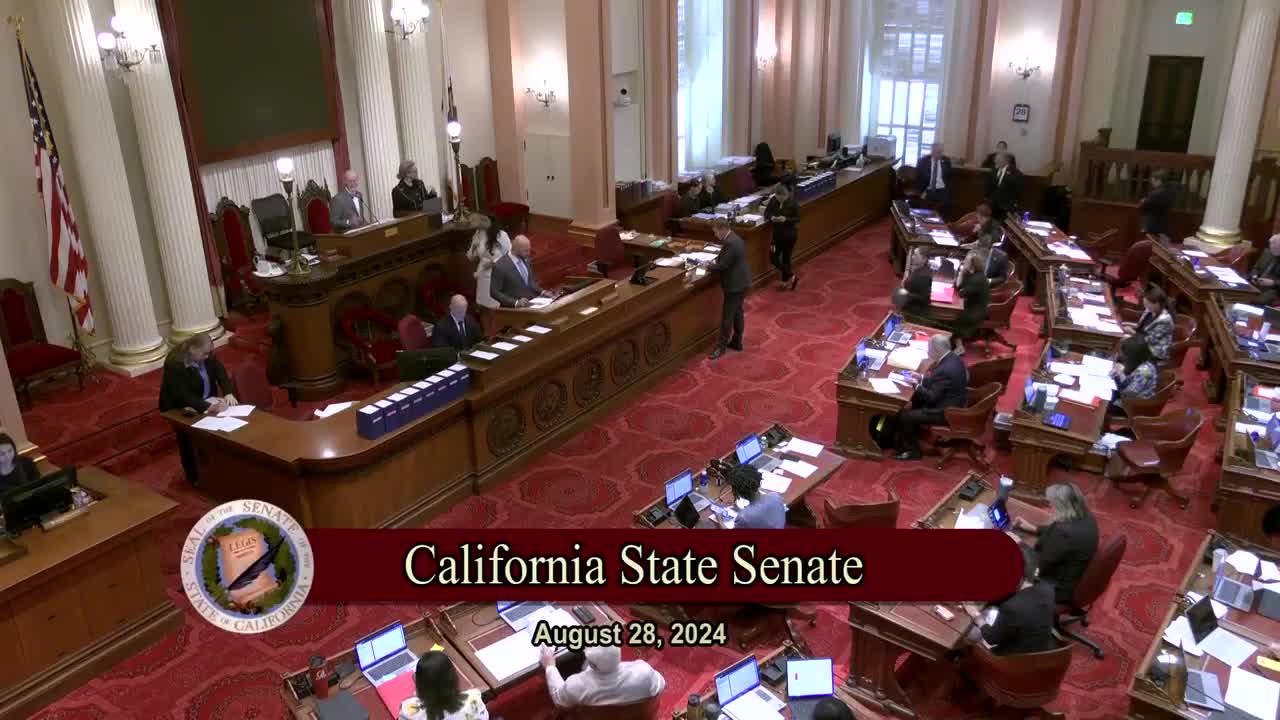 1MIN
Senate Floor
 5MIN
Senate Standing Committee on Natural Resources and Water
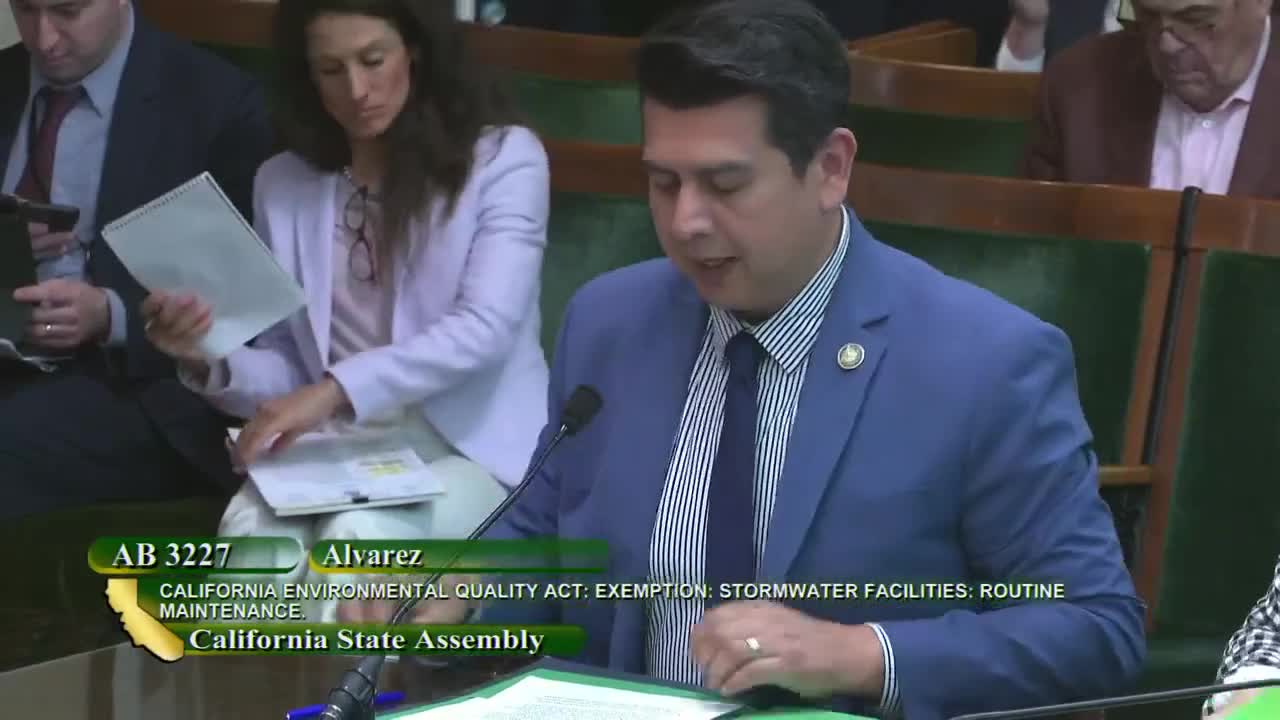 5MIN
Assembly Standing Committee on Natural Resources
 1MIN
Assembly Standing Committee on Natural Resources
Bill Author

Bill Co-Author(s):