AB 3234: Employers: social compliance audit.
- Session Year: 2023-2024
- House: Assembly
- Latest Version Date: 2024-09-22
Current Status:
Passed
(2024-09-22: Chaptered by Secretary of State - Chapter 438, Statutes of 2024.)
Introduced
In Committee
First Chamber
In Committee
Second Chamber
Enacted
Existing law establishes the Division of Labor Standards Enforcement within the Department of Industrial Relations and authorizes the division to enforce the provisions of the Labor Code and all labor laws of the state which are not specifically vested in any other officer, board, or commission. Existing law regulates the wages, hours, and working conditions of any man, woman, and minor employed in any occupation, trade, or industry, whether compensation is measured by time, piece, or otherwise, except as specified.
This bill would require an employer who has voluntarily subjected itself to a social compliance audit, whether the audit is conducted in part, or in whole, to determine if child labor is involved in the employers operations or practices, to post a clear and conspicuous link on its internet website to a report detailing the findings of its compliance with child labor laws. The bill would define the term social compliance audit to mean a voluntary, nongovernmental inspection or assessment of an employers operations or practices to evaluate whether the operations or practices are in compliance with state and federal labor laws, including wage and hour and health and safety regulations, including those regarding child labor. The bill would require that report to include, among other things, whether the employer did or did not engage in, or support the use of, child labor and a copy of any written policies and procedures the employer has and had regarding child employees.
Existing law establishes the Division of Labor Standards Enforcement within the Department of Industrial Relations and authorizes the division to enforce the provisions of the Labor Code and all labor laws of the state which are not specifically vested in any other officer, board, or commission. Existing law regulates the wages, hours, and working conditions of any man, woman, and minor employed in any occupation, trade, or industry, whether compensation is measured by time, piece, or otherwise, except as specified.
This bill would require an employer who has voluntarily subjected itself to a social compliance audit, whether the audit is conducted in part, or in whole, to determine if child labor is involved in the employers operations or practices, to post a clear and conspicuous link on its internet website to a report detailing the findings of its compliance with child labor laws. The bill would define the term social compliance audit to mean a voluntary, nongovernmental inspection or assessment of an employers operations or practices to determine evaluate whether the operations or practices are in compliance with state and federal labor laws, including wage and hour and health and safety regulations, including those regarding child labor. The bill would require that report to include, among other things, whether the employer did or did not engage in, or support the use of, child labor and a copy of any written policies and procedures the employer has and had regarding child employees.
Existing law establishes the Division of Labor Standards Enforcement within the Department of Industrial Relations and authorizes the division to enforce the provisions of the Labor Code and all labor laws of the state which are not specifically vested in any other officer, board, or commission. Existing law regulates the wages, hours, and working conditions of any man, woman, and minor employed in any occupation, trade, or industry, whether compensation is measured by time, piece, or otherwise, except as specified.
This bill would require an employer who has voluntarily subjected itself to a social compliance audit, whether the audit is conducted in part, or in whole, to determine if child labor is involved in the employers operations or practices, to post a clear and conspicuous link on its internet website to a report detailing the findings of its compliance with child labor laws. The bill would define the term social compliance audit to mean an a voluntary, nongovernmental inspection or assessment of an employers operations or practices to determine whether the operations or practices are in compliance with state and federal labor laws, including wage and hour and health and safety regulations, including those regarding child labor. The bill would require that report to include, among other things, whether the employer did or did not engage in, or support the use of, child labor and a copy of any written policies and procedures the employer has and had regarding child employees.
Existing law establishes the Division of Labor Standards Enforcement within the Department of Industrial Relations and authorizes the division to enforce the provisions of the Labor Code and all labor laws of the state which are not specifically vested in any other officer, board, or commission. Existing law regulates the wages, hours, and working conditions of any man, woman, and minor employed in any occupation, trade, or industry, whether compensation is measured by time, piece, or otherwise, except as specified.
This bill would require an employer who has voluntarily subjected itself to a social compliance audit, whether the audit is conducted in part, or in whole, to determine if child labor is involved in the employers operations or practices, to post a clear and conspicuous link on its internet website to a report detailing the findings of its most recent social compliance audit on the internet website for their business, if the employer has voluntarily subjected that business to a social compliance audit. compliance with child labor laws. The bill would define the term social compliance audit to mean an inspection of any production house, factory, farm, or packaging facility of a business to verify whether it complies with social and ethical responsibilities, or assessment of an employers operations or practices to determine whether the operations or practices are in compliance with state and federal labor laws, including wage and hour and health and safety regulations, and labor laws, including those regarding child labor. The bill would require that report to include, among other things, whether the business does or does employer did or did not engage in, or support the use of, child labor and a copy of any written policies and procedures the business has employer has and had regarding child employees.
Existing law establishes the Division of Labor Standards Enforcement within the Department of Industrial Relations and authorizes the division to enforce the provisions of the Labor Code and all labor laws of the state which are not specifically vested in any other officer, board, or commission. Existing law regulates the wages, hours, and working conditions of any man, woman, and minor employed in any occupation, trade, or industry, whether compensation is measured by time, piece, or otherwise, except as specified.
This bill would require an employer to post a clear and conspicuous link to a report detailing the findings of its most recent child labor social compliance audit on the internet website for their business, if the employer has voluntarily subjected that business to a child labor social compliance audit. The bill would define the term child labor social social compliance audit to mean an inspection of any production house, factory, farm, or packaging facility of a business to verify whether it complies with social and ethical responsibilities, health and safety regulations, and labor laws laws, including those regarding child labor. The bill would require that report to include, among other things, whether the business does or does not engage in, or support the use of, child labor and a copy of any written policies and procedures the business has regarding child employees.
Existing law establishes the Division of Labor Standards Enforcement within the Department of Industrial Relations and authorizes the division to enforce the provisions of the Labor Code and all labor laws of the state which are not specifically vested in any other officer, board, or commission. Existing law regulates the wages, hours, and working conditions of any man, woman, and minor employed in any occupation, trade, or industry, whether compensation is measured by time, piece, or otherwise, except as specified.
This bill would require an employer to post a clear and conspicuous link to a report detailing the findings of its most recent child labor social compliance audit on the internet website for their business, if the employer has voluntarily subjected that business to a child labor social compliance audit. The bill would define the term child labor social compliance audit to mean an inspection of any production house, factory, farm, or packaging facility of a business to verify whether it complies with social and ethical responsibilities, health and safety regulations, and labor laws regarding child labor. The bill would require that report to include, among other things, whether the business does or does not engage in, or support the use of, child labor and a copy of any written policies and procedures the business has regarding child employees.
For purposes of this chapter, the following definitions apply:
(a)Child means a natural person under 18 years of age.
(b)Child labor means any work performed by a child in violation of state or federal law.
(c)Clear and conspicuous means in larger type than the surrounding text, or in contrasting type, font, or color to the surrounding text of the same size, or set off from the surrounding text of the same size by symbols or other marks that call attention to the language.
(d)Social compliance audit means a voluntary, nongovernmental inspection or assessment of an employers operations or practices to evaluate whether the operations or practices are in compliance with state and federal labor laws, including, but not limited to, wage and hour and health and safety regulations, including those regarding child labor.
1251.(a)An employer who has voluntarily subjected itself to a social compliance audit, whether the audit is conducted in part, or in whole, to determine if child labor is involved in the employers operations or practices, shall post a clear and conspicuous link on its internet website to a report detailing the findings of the employers compliance with child labor laws.
(b)A report described in subdivision (a) shall contain all of the following:
(1)The year, month, day, and time the audit was conducted, and whether the audit was conducted during a day shift or night shift.
(2)Whether the employer did or did not engage in, or support the use of, child labor.
(3)A copy of any written policies and procedures the employer has and had regarding child employees.
(4)Whether the employer exposed children to any workplace situations that were hazardous or unsafe to their physical and mental health and development.
(5)Whether children worked within or outside regular school hours, or during night hours, for the employer.
(6)A statement that the auditing company is not a government agency and is not authorized to verify compliance with state and federal labor laws or other health and safety regulations.
For purposes of this chapter, the following definitions apply:
(a)Child means a natural person under 18 years of age.
(b)Child labor means any work performed by a child in violation of state or federal law.
(c)Clear and conspicuous means in larger type than the surrounding text, or in contrasting type, font, or color to the surrounding text of the same size, or set off from the surrounding text of the same size by symbols or other marks that call attention to the language.
(d)Social compliance audit means a voluntary, nongovernmental inspection or assessment of an employers operations or practices to determine evaluate whether the operations or practices are in compliance with state and federal labor laws, including, but not limited to, wage and hour and health and safety regulations, including those regarding child labor.
1251.(a)An employer who has voluntarily subjected itself to a social compliance audit, whether the audit is conducted in part, or in whole, to determine if child labor is involved in the employers operations or practices, shall post a clear and conspicuous link on its internet website to a report detailing the findings of the employers compliance with child labor laws.
(b)A report described in subdivision (a) shall contain all of the following:
(1)The year, month, day, and time the audit was conducted, and whether the audit was conducted during a day shift or night shift.
(2)Whether the employer did or did not engage in, or support the use of, child labor.
(3)A copy of any written policies and procedures the employer has and had regarding child employees.
(4)Whether the employer exposed children to any workplace situations that were hazardous or unsafe to their physical and mental health and development.
(5)Whether children worked within or outside regular school hours, or during night hours, for the employer.
(6)A statement that the auditing company is not a government agency and is not authorized to verify compliance with state and federal labor laws or other health and safety regulations.
For purposes of this chapter, the following definitions apply:
(a)Child means a natural person under 18 years of age.
(b)Child labor means any work performed by a child in violation of state or federal law.
(c)Clear and conspicuous means in larger type than the surrounding text, or in contrasting type, font, or color to the surrounding text of the same size, or set off from the surrounding text of the same size by symbols or other marks that call attention to the language.
(d)Social compliance audit means an a voluntary, nongovernmental inspection or assessment of an employers operations or practices to determine whether the operations or practices are in compliance with state and federal labor laws, including, but not limited to, wage and hour and health and safety regulations, including those regarding child labor.
1251.(a)An employer who has voluntarily subjected itself to a social compliance audit, whether the audit is conducted in part, or in whole, to determine if child labor is involved in the employers operations or practices, shall post a clear and conspicuous link on its internet website to a report detailing the findings of the employers compliance with child labor laws.
(b)A report described in subdivision (a) shall contain all of the following:
(1)The year, month, day, and time the audit was conducted, and whether the audit was conducted during a day shift or night shift.
(2)Whether the employer did or did not engage in, or support the use of, child labor.
(3)A copy of any written policies and procedures the employer has and had regarding child employees.
(4)Whether the employer exposed children to any workplace situations that were hazardous or unsafe to their physical and mental health and development.
(5)Whether children worked within or outside regular school hours, or during night hours, for the employer.
For purposes of this chapter, the following definitions apply:
(a)Child means a natural person under 18 years of age.
(b)Child labor means any work performed by a child in violation of state or federal law.
(c)Clear and conspicuous means in larger type than the surrounding text, or in contrasting type, font, or color to the surrounding text of the same size, or set off from the surrounding text of the same size by symbols or other marks that call attention to the language.
(d)Social compliance audit means an inspection of any production house, factory, farm, or packaging facility of a business to verify whether it complies with social and ethical responsibilities, or assessment of an employers operations or practices to determine whether the operations or practices are in compliance with state and federal labor laws, including, but not limited to, wage and hour and health and safety regulations, and labor laws, including those regarding child labor.
1251.(a)An employer who has voluntarily subjected itself to a social compliance audit, whether the audit is conducted in part, or in whole, to determine if child labor is involved in the employers operations or practices, shall post a clear and conspicuous link on its internet website to a report detailing the findings of its most recent social compliance audit on the internet website for their business, if the employer has voluntarily subjected that business to a social compliance audit. the employers compliance with child labor laws.
(b)A report described in subdivision (a) shall contain all of the following:
(1)The year, month, day, and time the audit was conducted, and whether the audit was conducted during a day shift or night shift.
(2)Whether the employer did or did not engage in, or support the use of, child labor.
(3)A copy of any written policies and procedures the employer has and had regarding child employees.
(4)Whether the employer exposed children to any workplace situations that were hazardous or unsafe to their physical and mental health and development.
(5)Whether children worked within or outside regular school hours, or during night hours, for the employer.
1252.A report detailing the findings of a social compliance audit shall contain at least all of the following:(a)The year, month, day, and time the audit was conducted, and whether the audit was conducted during a day shift or night shift.(b)Whether the business does or does not engage in, or support the use of, child labor.(c)A copy of any written policies and procedures the business has regarding child employees.(d)Whether the business exposes children to any workplace situations that are hazardous or unsafe to their physical and mental health and development.(e)Whether children work within or outside regular school hours, or during night hours, for the business.For purposes of this chapter, the following definitions apply:
(a)Child means a natural person under 18 years of age.
(b)Child labor means any work performed by a child in violation of state or federal law.
(c)Child labor social compliance audit means an inspection of any production house, factory, farm, or packaging facility of a business to verify whether it complies with social and ethical responsibilities, health and safety regulations, and labor laws regarding child labor. (d)(c)Clear and conspicuous means in larger type than the surrounding text, or in contrasting type, font, or color to the surrounding text of the same size, or set off from the surrounding text of the same size by symbols or other marks that call attention to the language.
(d)Social compliance audit means an inspection of any production house, factory, farm, or packaging facility of a business to verify whether it complies with social and ethical responsibilities, health and safety regulations, and labor laws, including those regarding child labor.
1251.An employer shall post a clear and conspicuous link to a report detailing the findings of its most recent child labor social compliance audit on the internet website for their business, if the employer has voluntarily subjected that business to a child labor social compliance audit.
1252.A report detailing the findings of a child labor social compliance audit shall contain at least all of the following:
(a)The year, month, day, and time the audit was conducted, and whether the audit was conducted during a day shift or night shift.
(b)Whether the business does or does not engage in, or support the use of, child labor.
(c)A copy of any written policies and procedures the business has regarding child employees.
(d)Whether the business exposes children to any workplace situations that are hazardous or unsafe to their physical and mental health and development.
(e)Whether children work within or outside regular school hours, or during night hours, for the business.
For purposes of this chapter, the following definitions apply:
(a)Child means a natural person under 18 years of age.
(b)Child labor means any work performed by a child in violation of state or federal law.
(c)Child labor social compliance audit means an inspection of any production house, factory, farm, or packaging facility of a business to verify whether it complies with social and ethical responsibilities, health and safety regulations, and labor laws regarding child labor.
(d)Clear and conspicuous means in larger type than the surrounding text, or in contrasting type, font, or color to the surrounding text of the same size, or set off from the surrounding text of the same size by symbols or other marks that call attention to the language.
1251.An employer shall post a clear and conspicuous link to a report detailing the findings of its most recent child labor social compliance audit on the internet website for their business, if the employer has voluntarily subjected that business to a child labor social compliance audit.
1252.A report detailing the findings of a child labor social compliance audit shall contain at least all of the following:
(a)The year, month, day, and time the audit was conducted, and whether the audit was conducted during a day shift or night shift.
(b)Whether the business does or does not engage in, or support the use of, child labor.
(c)A copy of any written policies and procedures the business has regarding child employees.
(d)Whether the business exposes children to any workplace situations that are hazardous or unsafe to their physical and mental health and development.
(e)Whether children work within or outside regular school hours, or during night hours, for the business.
|
Date
|
Status
|
|---|---|
| Sep 22, 2024 | Chaptered by Secretary of State - Chapter 438, Statutes of 2024. |
| Sep 22, 2024 | Approved by the Governor. |
| Sep 3, 2024 | Enrolled and presented to the Governor at 3:30 p.m. |
| Aug 26, 2024 | Senate amendments concurred in. To Engrossing and Enrolling. (Ayes 77. Noes 0. Page 6563.). |
| Aug 20, 2024 | In Assembly. Concurrence in Senate amendments pending. May be considered on or after August 22 pursuant to Assembly Rule 77. |
| Aug 20, 2024 | Read third time. Passed. Ordered to the Assembly. (Ayes 36. Noes 0. Page 5241.). |
| Aug 15, 2024 | Read second time. Ordered to third reading. |
| Aug 14, 2024 | Read third time and amended. Ordered to second reading. |
| Aug 7, 2024 | Read second time. Ordered to third reading. |
| Aug 6, 2024 | Read third time and amended. Ordered to second reading. |
| Jun 18, 2024 | Read second time. Ordered to third reading. |
| Jun 17, 2024 | From committee: Be ordered to second reading pursuant to Senate Rule 28.8. |
| Jun 5, 2024 | From committee: Do pass and re-refer to Com. on APPR. (Ayes 5. Noes 0.) (June 5). Re-referred to Com. on APPR. |
| May 28, 2024 | From committee chair, with author's amendments: Amend, and re-refer to committee. Read second time, amended, and re-referred to Com. on L., P.E. & R. |
| May 22, 2024 | Referred to Com. on L., P.E. & R. |
| May 9, 2024 | In Senate. Read first time. To Com. on RLS. for assignment. |
| May 9, 2024 | Read third time. Passed. Ordered to the Senate. (Ayes 65. Noes 0. Page 5162.) |
| May 2, 2024 | Read second time. Ordered to Consent Calendar. |
| May 1, 2024 | From committee: Do pass. To Consent Calendar. (Ayes 14. Noes 0.) (May 1). |
| Apr 4, 2024 | From committee: Do pass and re-refer to Com. on APPR. with recommendation: To Consent Calendar. (Ayes 7. Noes 0.) (April 3). Re-referred to Com. on APPR. |
| Apr 2, 2024 | Re-referred to Com. on L. & E. |
| Apr 1, 2024 | From committee chair, with author's amendments: Amend, and re-refer to Com. on L. & E. Read second time and amended. |
| Mar 11, 2024 | Referred to Com. on L. & E. |
| Feb 17, 2024 | From printer. May be heard in committee March 18. |
| Feb 16, 2024 | Read first time. To print. |
|
Date
|
Description
|
Location
|
Votes
|
|
|---|---|---|---|---|
| Aug 26, 2024 | AB 3234 Ortega Concurrence in Senate Amendments By KALRA | Assembly Floor |
Passed |
|
| Aug 20, 2024 | Assembly 3rd Reading AB3234 Ortega By Cortese | Senate Floor |
Passed |
|
| Jun 5, 2024 | Do pass, but first be re-referred to the Committee on [Appropriations] | Senate Standing Committee on Labor, Public Employment and Retirement |
Passed |
|
| May 9, 2024 | AB 3234 Ortega Consent Calendar Second Day Regular Session | Assembly Floor |
Passed |
|
| May 1, 2024 | Do pass. To Consent Calendar. | Assembly Standing Committee on Appropriations |
Passed |
|
| Apr 3, 2024 | Do pass and be re-referred to the Committee on [Appropriations] with recommendation: To Consent Calendar | Assembly Standing Committee on Labor and Employment |
Passed |
This list shows positions taken on this bill by organizations on the date displayed, which is linked to the original source.
Positions by individuals are not included.
CONCURRENCE IN SENATE AMENDMENTS
CSA1 Bill Id:AB 3234
Author:(Ortega)
As Amended Ver:August 14, 2024
Majority vote
SUMMARY
Requires an employer that voluntarily subjects its business to a social compliance audit, whether the audit is conducted in part, or in whole, to determine if child labor is involved in the employer's operations or practices, to post to the business' website a report detailing the audit's findings of the employer's compliance with child labor laws.
Senate Amendments
- Revise the definition of "social compliance audit" to mean a voluntary, nongovernmental inspection or assessment of an employer's operations or practices to evaluate whether the operations or practices are in compliance with state and federal labor laws, including, but not limited to, wage and hour and health and safety regulations, including those regarding child labor.
- Expand the list of requirements for the report to include a statement that the auditing company is not a governmental agency and is not authorized to verify compliance with health and safety regulations or labor laws.
- Make clarifying and technical changes.
COMMENTS
Social compliance audits are nongovernmental audits that review a facility to ensure that an employer is compliant with all applicable labor laws. Oftentimes companies voluntarily hire private firms to conduct these audits at their facilities in response to negative press, or to otherwise help consumers gain confidence in their business. In recent years, these audits have turned into a nearly $80 billion industry. Due to historic staffing shortages at the U.S. Department of Labor and California's Department of Industrial Relations, these private audits are often the only audit companies ever receive.
Recent reporting by the New York Times and others have pointed out flaws in this audit process, including that oftentimes auditors certify a company as being compliant, despite that auditor not investigating all parts of the supply chain or all shifts of work performed. This has led to reports of auditors missing instances of child labor because they oftentimes only inspect during regular business hours and not the night shifts, for example.
According to the Author
"AB 3234 simply requires that employers publicly post the findings of an audit that they have voluntarily participated in. This bill provides transparency, allowing consumers to support companies that follow labor laws and company shareholders to know how they are performing and where they may need to improve."
The author also states, "AB 3234 promotes equity by increasing transparency and allowing all consumers to "shop smart” and support ethical businesses that follow labor laws."
Arguments in Support
None on file.
Arguments in Opposition
None on file.
FISCAL COMMENTS
According to the Senate Appropriations Committee pursuant to SR 28.8 negligible costs.
VOTES:
ASM LABOR AND EMPLOYMENT: 7-0-0
YES: Ortega, Flora, Alanis, Wendy Carrillo, Kalra, Ward, Zbur
ASM APPROPRIATIONS: 14-0-1
YES: Wicks, Sanchez, Arambula, Bryan, Calderon, Wendy Carrillo, Dixon, Mike Fong, Grayson, Haney, Hart, Pellerin, Ta, Villapudua
ABS, ABST OR NV: Jim Patterson
ASSEMBLY FLOOR: 65-0-15
YES: Addis, Aguiar-Curry, Alanis, Alvarez, Arambula, Bauer-Kahan, Bennett, Berman, Boerner, Bonta, Bryan, Calderon, Juan Carrillo, Wendy Carrillo, Chen, Connolly, Davies, Dixon, Essayli, Mike Fong, Vince Fong, Friedman, Gallagher, Garcia, Gipson, Hart, Holden, Hoover, Irwin, Jackson, Jones-Sawyer, Kalra, Lackey, Lee, Lowenthal, Maienschein, McCarty, McKinnor, Muratsuchi, Ortega, Pacheco, Papan, Jim Patterson, Joe Patterson, Pellerin, Quirk‑Silva, Ramos, Rendon, Reyes, Rodriguez, Blanca Rubio, Sanchez, Santiago, Soria, Ta, Valencia, Villapudua, Waldron, Ward, Weber, Wicks, Wilson, Wood, Zbur, Robert Rivas
ABS, ABST OR NV: Bains, Cervantes, Megan Dahle, Flora, Gabriel, Grayson, Haney, Low, Mathis, Stephanie Nguyen, Petrie-Norris, Luz Rivas, Schiavo, Ting, Wallis
SENATE FLOOR: 36-0-4
YES: Allen, Archuleta, Ashby, Atkins, Becker, Blakespear, Bradford, Caballero, Cortese, Dodd, Durazo, Eggman, Glazer, Gonzalez, Grove, Hurtado, Jones, Laird, Limón, McGuire, Menjivar, Min, Newman, Nguyen, Niello, Padilla, Portantino, Roth, Rubio, Skinner, Smallwood‑Cuevas, Stern, Umberg, Wahab, Wiener, Wilk
ABS, ABST OR NV: Alvarado-Gil, Dahle, Ochoa Bogh, Seyarto
UPDATED
VERSION: May 28, 2024
CONSULTANT: Erin Hickey / L. & E. / (916) 319-2091 FN: 0003885
SENATE RULES COMMITTEE Office of Senate Floor Analyses (916) 651-1520 Fax: (916) 327-4478 | AB 3234 |
THIRD READING
Bill No: AB 3234
Author: Ortega (D)
Amended: 8/14/24 in Senate
Vote: 21
SENATE LABOR, PUB. EMP. & RET. COMMITTEE: 5-0, 6/5/24
AYES: Smallwood-Cuevas, Wilk, Cortese, Durazo, Laird
SENATE APPROPRIATIONS COMMITTEE: Senate Rule 28.8
ASSEMBLY FLOOR: 65-0, 5/9/24 (Consent) - See last page for vote
SUBJECT: Employers: social compliance audit
SOURCE: Author
DIGEST:
This bill requires an employer that voluntarily subjects itself to a social compliance audit, to post on its business website a report detailing the findings of that audit, including specific findings regarding child labor.
Senate Floor Amendments of 8/14/24 modify the bill’s definition of “social compliance audit” to specify that the audit “evaluates” rather than “determines” compliance with labor law. Amendments also require an employer to include a statement that the auditing company is not a government agency when posting the findings of an audit.
ANALYSIS:
Existing law:
- Establishes within the Department of Industrial Relations (DIR) the Division of Labor Standards Enforcement (DLSE) under the direction of the Labor Commissioner (LC), and empowers the LC to ensure a just day’s pay in every work place and to promote justice through robust enforcement of labor laws. (Labor Code §79-107)
- Authorizes, under the California Occupational Safety and Health Act assures safe and healthful working conditions for all California workers, the enforcement of effective standards, assisting and encouraging employers to maintain safe and healthful working conditions, and by providing for research, information, education, training, and enforcement in the field of occupational safety and health. (Labor Code §6300)
- Provides that specified school district, charter school, and private school officials may issue a minor a work permit if requested by the minor’s parent, guardian, foster parent, or caregiver. Any principal issuing a work permit must provide a self-certification that he or she understands the requirements in existing law for issuing a work permit and submit a copy of each work permit he or she issues along with a copy of the application for each work permit to the superintendent of the school district in which the school is located. (Education Code §49110)
- Prohibits any employer employing a minor 15 years of age or younger for more than eight hours in one day or more than 40 hours in one week, or before seven am or after seven pm. Prohibits an employer from employing a minor 16 or 17 years of age for more than eight hours in one day or more than 48 hours in one week or before five am or after 10 pm on any day preceding a school day. (Labor Code §1391)
- Prohibits minors under the age of 16 from working in any capacity in operating or assisting in operating certain types of machines, including circular or band saws, wood shapers, picker machines, printing presses, corner-staying machines in paper-box factories, dough brakes or cracker machinery, wire or iron straightening machinery. (Labor Code §1293)
- Prohibits minors under the age of 16 from working in certain occupations including, among others, upon any railroad, upon any vessel or boat engaged in commerce within California’s jurisdiction, in occupations causing dust in injurious quantities, on scaffolding, or in any occupation dangerous to the life or limb, or injurious to the health or morals of the minor. (Labor Code §1294)
- Provides that DLSE may, after a hearing, determine whether any particular trade, process of manufacture, or occupation, in which employment of minors is not already forbidden by law, or whether any particular method of carrying on the trade, process of manufacture, or occupation is sufficiently dangerous to the lives or limbs or injurious to the health or morals of minors to justify their exclusion therefrom. (Labor Code §1296)
- Provides that any person, including a parent or guardian, employing either directly or indirectly through third persons, or who employs, or permits any minor to be employed in violation of the law, is guilty of a misdemeanor, punishable by a fine of not less than one thousand dollars ($1,000) nor more than five thousand dollars ($5,000) or imprisonment in the county jail for not more than six months, or both. (Labor Code §1303)
This bill:
- Defines “child” as a natural person under 18 years of age.
- Defines “child labor” as any work performed in violation of state or federal law.
- Defines “clear and conspicuous” as larger type than the surrounding text, or in contrasting type, font, or color to the surrounding text of the same size, or set off from the surrounding text of the same size by symbols or other marks that call attention to the language.
- Defines “social compliance audit” as a voluntary, nongovernmental inspection or assessment of an employer’s operations or practices to evaluate whether the operations or practices are in compliance with state and federal labor laws.
- Requires an employer who has voluntarily subjected itself to a social compliance audit, whether the audit is conducted in part, or in whole, to determine if child labor is involved in the employer’s operations or practices, to post a clear and conspicuous link on its internet website to a report detailing the findings of the employer’s compliance with child labor laws.
- Provides that the posted report shall contain all of the following:
- The year, month, day, and time the audit was conducted, and whether the audit was conducted during a day shift or night shift.
- Whether the employer did or did not engage in, or support the use of, child labor.
- A copy of any written policies and procedures the employer has and had regarding child employees.
- Whether the employer exposed children to any workplace situations that were hazardous or unsafe to their physical and mental health and development.
- Whether children worked within or outside regular school hours, or during night hours, for the employer.
- A statement that the auditing company is not a government agency and is not authorized to verify compliance with state and federal labor laws or other health and safety regulations.
Background
- Social Compliance Audits. The US Department of Labor (DOL) defines a social compliance audit as an inspection done by an internal, external, or independent auditor who gathers data at the worker, supplier, and supply chain levels to identify compliance patterns across the supply chain and risk trends among workers. A thorough audit should recommend specific changes to strengthen compliance and assign accountability for addressing any identified issues. The DOL identifies several skills auditors should be trained in, including, but not limited to how to interact with children, how to provide victims of child labor and forced labor immediate services, and how to identify the time when code violations are most likely to occur. Trade or professional organizations, like the Association of Professional Compliance Auditors (APSCA), accredit auditors. For the most part, social auditing is a useful tool to assess compliance at a particular point in time.
In the past two decades, social compliance auditing has expanded dramatically, growing into a nearly $80 billion industry. This expansion is largely in response to staffing shortages at the DOL. Staffing levels are so low that it would take “more than 100 years for inspectors to visit every workplace in the department’s jurisdiction once.”[1] Therefore, it is common for businesses to turn to private compliance audits when confronted with public relations scandals. Rather than wait for the DOL to intervene, private auditors are hired to attest that any reported abuses have been eliminated.
Social compliance audits are meaningless if the businesses that employ them as a tool disregard their findings. When businesses rush auditors through facilities or censor reports, they use audits to preserve their reputation and not to address real concerns.
- New York Times Reporting. Recent investigative reporting by the New York Times found that private audits performed at 20 production facilities used by some of the nation’s most recognizable brands missed the use of child labor[2]. Auditors schedule plant inspections weeks in advance, giving factories plenty of time to conceal any blatant labor law violations. When plants are inspected, auditors often arrive early in the morning and stay for around seven hours, leaving well before the night shift workers arrive. This inspection schedule is not representative of facilities that operate 24/7. It is during these night shifts when children, many of whom are migrants, report to work. Auditors face competing pressures from their independent employers, the corporations they work with, and the suppliers that pay for their inspections. This can make it difficult for auditors to do anything other than complete a cursory review that misses labor violations. Despite this, corporations claim auditors thoroughly review their supply chain and tout an audit’s findings.
Comments
According to the Author “Many companies voluntarily hire private firms to conduct “social compliance audits” at their facilities. A social compliance audit is a nongovernmental audit that reviews an employer’s operations to ensure that the employer is compliant with laws or social standards, including but not limited to social and ethical responsibilities, health and safety regulations, and labor laws.
“Social compliance audits have ballooned into a nearly $80 billion industry in recent years. Oftentimes employers will conduct these audits in response to negative press or to otherwise help the public gain confidence in their business. Given historic staffing shortages at the U.S. Department of Labor and Cal/OSHA, these private audits may be the only audit many companies ever receive.
“In 2023, New York Times reporting exposed flaws in these audits, including auditors sometimes certifying a business as being compliant with labor laws, despite not investigating all parts of the supply chain or all shifts of work. The New York Times reporting describes situations of audits missing instances of child labor because auditors often conduct inspections during regular business hours and not during the night shifts, as one example.
“AB 3234 requires that employers post a clear and conspicuous link to a report detailing the findings of its most recent social compliance audit pertaining to compliance with child labor laws.”
This bill requires employers to post a report on a commissioned social compliance audit to their internet website, as specified. Nothing in the language details when the report must be posted or if employers face consequences for noncompliance.
Related/Prior Legislation
AB 800 (Ortega, Chapter 271, Statutes of 2023) designated, among other things, the week of each year that includes April 28 as “Workplace Readiness Week” and required schools to provide students seeking a work permit with a document that clearly explains basic labor rights, as specified.
FISCAL EFFECT: Appropriation: No Fiscal Com.: Yes Local: No
SUPPORT: (Verified 8/14/24)
None received
OPPOSITION: (Verified 8/14/24)
None received
ASSEMBLY FLOOR: 65-0, 5/9/24
AYES: Addis, Aguiar-Curry, Alanis, Alvarez, Arambula, Bauer-Kahan, Bennett, Berman, Boerner, Bonta, Bryan, Calderon, Juan Carrillo, Wendy Carrillo, Chen, Connolly, Davies, Dixon, Essayli, Mike Fong, Vince Fong, Friedman, Gallagher, Garcia, Gipson, Hart, Holden, Hoover, Irwin, Jackson, Jones-Sawyer, Kalra, Lackey, Lee, Lowenthal, Maienschein, McCarty, McKinnor, Muratsuchi, Ortega, Pacheco, Papan, Jim Patterson, Joe Patterson, Pellerin, Quirk-Silva, Ramos, Rendon, Reyes, Rodriguez, Blanca Rubio, Sanchez, Santiago, Soria, Ta, Valencia, Villapudua, Waldron, Ward, Weber, Wicks, Wilson, Wood, Zbur, Robert Rivas
NO VOTE RECORDED: Bains, Cervantes, Megan Dahle, Flora, Gabriel, Grayson, Haney, Low, Mathis, Stephanie Nguyen, Petrie-Norris, Luz Rivas, Schiavo, Ting, Wallis
Prepared by: Emma Bruce / L., P.E. & R. / (916) 651-1556
8/16/24 12:47:40
**** END ****
Hannah Drier, “They’re Paid Billions to Root Out Child Labor in the U.S. Why Do They Fail?,” New York Times, December 28, 2023, https://www.nytimes.com/2023/12/28/us/migrant-child-labor-audits.html?smid=url-share ↑
Hannah Drier, “They’re Paid Billions to Root Out Child Labor in the U.S. Why Do They Fail?,” New York Times, December 28, 2023, https://www.nytimes.com/2023/12/28/us/migrant-child-labor-audits.html?smid=url-share ↑
SENATE RULES COMMITTEE Office of Senate Floor Analyses (916) 651-1520 Fax: (916) 327-4478 | AB 3234 |
CONSENT
Bill No: AB 3234
Author: Ortega (D)
Amended: 8/6/24 in Senate
Vote: 21
SENATE LABOR, PUB. EMP. & RET. COMMITTEE: 5-0, 6/5/24
AYES: Smallwood-Cuevas, Wilk, Cortese, Durazo, Laird
SENATE APPROPRIATIONS COMMITTEE: Senate Rule 28.8
ASSEMBLY FLOOR: 65-0, 5/9/24 (Consent) - See last page for vote
SUBJECT: Employers: social compliance audit
SOURCE: Author
DIGEST:
This bill requires an employer that voluntarily subjects itself to a social compliance audit, to post on its business website a report detailing the findings of that audit, including specific findings regarding child labor.
Senate Floor Amendments of 8/6/24 modify the bill’s definition of “social compliance audit” to specify that the audits are voluntary and nongovernmental.
ANALYSIS:
Existing law:
- Establishes within the Department of Industrial Relations (DIR) the Division of Labor Standards Enforcement (DLSE) under the direction of the Labor Commissioner (LC), and empowers the LC to ensure a just day’s pay in every work place and to promote justice through robust enforcement of labor laws. (Labor Code §79-107)
- Under the California Occupational Safety and Health Act assures safe and healthful working conditions for all California workers by authorizing the enforcement of effective standards, assisting and encouraging employers to maintain safe and healthful working conditions, and by providing for research, information, education, training, and enforcement in the field of occupational safety and health. (Labor Code §6300)
- Provides that specified school district, charter school, and private school officials may issue a minor a work permit if requested by the minor’s parent, guardian, foster parent, or caregiver. Any principal issuing a work permit must provide a self-certification that he or she understands the requirements in existing law for issuing a work permit and submit a copy of each work permit he or she issues along with a copy of the application for each work permit to the superintendent of the school district in which the school is located. (Education Code §49110)
- Prohibits any employer employing a minor 15 years of age or younger for more than eight hours in one day or more than 40 hours in one week, or before seven am or after seven pm. Prohibits an employer from employing a minor 16 or 17 years of age for more than eight hours in one day or more than 48 hours in one week or before five am or after 10 pm on any day preceding a school day. (Labor Code §1391)
- Prohibits minors under the age of 16 from working in any capacity in operating or assisting in operating certain types of machines, including circular or band saws, wood shapers, picker machines, printing presses, corner-staying machines in paper-box factories, dough brakes or cracker machinery, wire or iron straightening machinery. (Labor Code §1293)
- Prohibits minors under the age of 16 from working in certain occupations including, among others, upon any railroad, upon any vessel or boat engaged in commerce within California’s jurisdiction, in occupations causing dust in injurious quantities, on scaffolding, or in any occupation dangerous to the life or limb, or injurious to the health or morals of the minor. (Labor Code §1294)
- Provides that DLSE may, after a hearing, determine whether any particular trade, process of manufacture, or occupation, in which employment of minors is not already forbidden by law, or whether any particular method of carrying on the trade, process of manufacture, or occupation is sufficiently dangerous to the lives or limbs or injurious to the health or morals of minors to justify their exclusion therefrom. (Labor Code §1296)
- Provides that any person, including a parent or guardian, employing either directly or indirectly through third persons, or who employs, or permits any minor to be employed in violation of the law, is guilty of a misdemeanor, punishable by a fine of not less than one thousand dollars ($1,000) nor more than five thousand dollars ($5,000) or imprisonment in the county jail for not more than six months, or both. (Labor Code §1303)
This bill:
- Defines “child” as a natural person under 18 years of age.
- Defines “child labor” as any work performed in violation of state or federal law.
- Defines “clear and conspicuous” as larger type than the surrounding text, or in contrasting type, font, or color to the surrounding text of the same size, or set off from the surrounding text of the same size by symbols or other marks that call attention to the language.
- Defines “social compliance audit” as a voluntary, nongovernmental inspection or assessment of an employer’s operations or practices to determine whether the operations or practices are in compliance with state and federal labor laws.
- Requires an employer who has voluntarily subjected itself to a social compliance audit, whether the audit is conducted in part, or in whole, to determine if child labor is involved in the employer’s operations or practices, to post a clear and conspicuous link on its internet website to a report detailing the findings of the employer’s compliance with child labor laws.
- Provides that the posted report shall contain all of the following:
- The year, month, day, and time the audit was conducted, and whether the audit was conducted during a day shift or night shift.
- Whether the employer did or did not engage in, or support the use of, child labor.
- A copy of any written policies and procedures the employer has and had regarding child employees.
- Whether the employer exposed children to any workplace situations that were hazardous or unsafe to their physical and mental health and development.
- Whether children worked within or outside regular school hours, or during night hours, for the employer.
Background
Social Compliance Audits. The US Department of Labor (DOL) defines a social compliance audit as an inspection done by an internal, external, or independent auditor who gathers data at the worker, supplier, and supply chain levels to identify compliance patterns across the supply chain and risk trends among workers. A thorough audit should recommend specific changes to strengthen compliance and assign accountability for addressing any identified issues. The DOL identifies several skills auditors should be trained in, including, but not limited to how to interact with children, how to provide victims of child labor and forced labor immediate services, and how to identify the time when code violations are most likely to occur. Trade or professional organizations, like the Association of Professional Compliance Auditors (APSCA), accredit auditors. For the most part, social auditing is a useful tool to assess compliance at a particular point in time.
In the past two decades, social compliance auditing has expanded dramatically, growing into a nearly $80 billion industry. This expansion is largely in response to staffing shortages at the DOL. Staffing levels are so low that it would take “more than 100 years for inspectors to visit every workplace in the department’s jurisdiction once.”[1] Therefore, it is common for businesses to turn to private compliance audits when confronted with public relations scandals. Rather than wait for the DOL to intervene, private auditors are hired to attest that any reported abuses have been eliminated.
Social compliance audits are meaningless if the businesses that employ them as a tool disregard their findings. When businesses rush auditors through facilities or censor reports, they use audits to preserve their reputation and not to address real concerns.
New York Times Reporting. Recent investigative reporting by the New York Times found that private audits performed at 20 production facilities used by some of the nation’s most recognizable brands missed the use of child labor[2]. Auditors schedule plant inspections weeks in advance, giving factories plenty of time to conceal any blatant labor law violations. When plants are inspected, auditors often arrive early in the morning and stay for around seven hours, leaving well before the night shift workers arrive. This inspection schedule is not representative of facilities that operate 24/7. It is during these night shifts when children, many of whom are migrants, report to work. Auditors face competing pressures from their independent employers, the corporations they work with, and the suppliers that pay for their inspections. This can make it difficult for auditors to do anything other than complete a cursory review that misses labor violations. Despite this, corporations claim auditors thoroughly review their supply chain and tout an audit’s findings.
Comments
This bill requires employers to post a report on a commissioned social compliance audit to their internet website, as specified. Nothing in the current language details when the report must be posted or if employers face consequences for noncompliance.
FISCAL EFFECT: Appropriation: No Fiscal Com.: Yes Local: No
SUPPORT: (Verified 8/5/24)
None received.
OPPOSITION: (Verified 8/5/24)
None received.
ASSEMBLY FLOOR: 65-0, 5/9/24
AYES: Addis, Aguiar-Curry, Alanis, Alvarez, Arambula, Bauer-Kahan, Bennett, Berman, Boerner, Bonta, Bryan, Calderon, Juan Carrillo, Wendy Carrillo, Chen, Connolly, Davies, Dixon, Essayli, Mike Fong, Vince Fong, Friedman, Gallagher, Garcia, Gipson, Hart, Holden, Hoover, Irwin, Jackson, Jones-Sawyer, Kalra, Lackey, Lee, Lowenthal, Maienschein, McCarty, McKinnor, Muratsuchi, Ortega, Pacheco, Papan, Jim Patterson, Joe Patterson, Pellerin, Quirk-Silva, Ramos, Rendon, Reyes, Rodriguez, Blanca Rubio, Sanchez, Santiago, Soria, Ta, Valencia, Villapudua, Waldron, Ward, Weber, Wicks, Wilson, Wood, Zbur, Robert Rivas
NO VOTE RECORDED: Bains, Cervantes, Megan Dahle, Flora, Gabriel, Grayson, Haney, Low, Mathis, Stephanie Nguyen, Petrie-Norris, Luz Rivas, Schiavo, Ting, Wallis
Prepared by: Emma Bruce / L., P.E. & R. / (916) 651-1556
8/7/24 17:59:28
Hannah Drier, “They’re Paid Billions to Root Out Child Labor in the U.S. Why Do They Fail?,” New York Times, December 28, 2023, https://www.nytimes.com/2023/12/28/us/migrant-child-labor-audits.html?smid=url-share ↑
Hannah Drier, “They’re Paid Billions to Root Out Child Labor in the U.S. Why Do They Fail?,” New York Times, December 28, 2023, https://www.nytimes.com/2023/12/28/us/migrant-child-labor-audits.html?smid=url-share ↑
SENATE RULES COMMITTEE Office of Senate Floor Analyses (916) 651-1520 Fax: (916) 327-4478 | AB 3234 |
CONSENT
Bill No: AB 3234
Author: Ortega (D)
Amended: 5/28/24 in Senate
Vote: 21
SENATE LABOR, PUB. EMP. & RET. COMMITTEE: 5-0, 6/5/24
AYES: Smallwood-Cuevas, Wilk, Cortese, Durazo, Laird
SENATE APPROPRIATIONS COMMITTEE: Senate Rule 28.8
ASSEMBLY FLOOR: 65-0, 5/9/24 (Consent) - See last page for vote
SUBJECT: Employers: social compliance audit
SOURCE: Author
DIGEST:
This bill requires an employer that voluntarily subjects itself to a social compliance audit, to post on its business website a report detailing the findings of that audit, including specific findings regarding child labor.
ANALYSIS:
Existing law:
- Establishes within the Department of Industrial Relations (DIR) the Division of Labor Standards Enforcement (DLSE) under the direction of the Labor Commissioner (LC), and empowers the LC to ensure a just day’s pay in every work place and to promote justice through robust enforcement of labor laws. (Labor Code §79-107)
- Under the California Occupational Safety and Health Act assures safe and healthful working conditions for all California workers by authorizing the enforcement of effective standards, assisting and encouraging employers to maintain safe and healthful working conditions, and by providing for research, information, education, training, and enforcement in the field of occupational safety and health. (Labor Code §6300)
- Provides that specified school district, charter school, and private school officials may issue a minor a work permit if requested by the minor’s parent, guardian, foster parent, or caregiver. Any principal issuing a work permit must provide a self-certification that he or she understands the requirements in existing law for issuing a work permit and submit a copy of each work permit he or she issues along with a copy of the application for each work permit to the superintendent of the school district in which the school is located. (Education Code §49110)
- Prohibits any employer employing a minor 15 years of age or younger for more than eight hours in one day or more than 40 hours in one week, or before seven am or after seven pm. Prohibits an employer from employing a minor 16 or 17 years of age for more than eight hours in one day or more than 48 hours in one week or before five am or after 10 pm on any day preceding a school day. (Labor Code §1391)
- Prohibits minors under the age of 16 years from working in or in connection with any manufacturing establishment or other place of labor or employment, except as specified. (Labor Code §1290)
- Prohibits minors under the age of 16 from working in any capacity in operating or assisting in operating certain types of machines, including circular or band saws, wood shapers, picker machines, printing presses, corner-staying machines in paper-box factories, dough brakes or cracker machinery, wire or iron straightening machinery. (Labor Code §1293)
- Prohibits minors under the age of 16 from working in certain occupations including, among others, upon any railroad, upon any vessel or boat engaged in commerce within California’s jurisdiction, in occupations causing dust in injurious quantities, on scaffolding, or in any occupation dangerous to the life or limb, or injurious to the health or morals of the minor. (Labor Code §1294)
- Provides that DLSE may, after a hearing, determine whether any particular trade, process of manufacture, or occupation, in which employment of minors is not already forbidden by law, or whether any particular method of carrying on the trade, process of manufacture, or occupation is sufficiently dangerous to the lives or limbs or injurious to the health or morals of minors to justify their exclusion therefrom. (Labor Code §1296)
- Provides that any person, including a parent or guardian, employing either directly or indirectly through third persons, or who employs, or permits any minor to be employed in violation of the law, is guilty of a misdemeanor, punishable by a fine of not less than one thousand dollars ($1,000) nor more than five thousand dollars ($5,000) or imprisonment in the county jail for not more than six months, or both. (Labor Code §1303)
This bill:
- Defines “child” as a natural person under 18 years of age.
- Defines “child labor” as any work performed in violation of state or federal law.
- Defines “clear and conspicuous” as larger type than the surrounding text, or in contrasting type, font, or color to the surrounding text of the same size, or set off from the surrounding text of the same size by symbols or other marks that call attention to the language.
- Defines “social compliance audit” as an inspection or assessment of an employer’s operations or practices to determine whether the operations or practices comply with state and federal labor laws.
- Requires an employer who has voluntarily subjected itself to a social compliance audit, whether the audit is conducted in part, or in whole, to determine if child labor is involved in the employer’s operations or practices, to post a clear and conspicuous link on its internet website to a report detailing the findings of the employer’s compliance with child labor laws.
- Provides that the posted report shall contain all of the following:
- The year, month, day, and time the audit was conducted, and whether the audit was conducted during a day shift or night shift.
- Whether the employer did or did not engage in, or support the use of, child labor.
- A copy of any written policies and procedures the employer has and had regarding child employees.
- Whether the employer exposed children to any workplace situations that were hazardous or unsafe to their physical and mental health and development.
- Whether children worked within or outside regular school hours, or during night hours, for the employer.
Background
- Social Compliance Audits. The US Department of Labor (DOL) defines a social compliance audit as an inspection done by an internal, external, or independent auditor who gathers data at the worker, supplier, and supply chain levels to identify compliance patterns across the supply chain and risk trends among workers. A thorough audit should recommend specific changes to strengthen compliance and assign accountability for addressing any identified issues. The DOL identifies several skills auditors should be trained in, including, but not limited to how to interact with children, how to provide victims of child labor and forced labor immediate services, and how to identify the time when code violations are most likely to occur. Trade or professional organizations, like the Association of Professional Compliance Auditors (APSCA), accredit auditors. For the most part, social auditing is a useful tool to assess compliance at a particular point in time.
In the past two decades, social compliance auditing has expanded dramatically, growing into a nearly $80 billion industry. This expansion is largely in response to staffing shortages at the DOL. Staffing levels are so low that it would take “more than 100 years for inspectors to visit every workplace in the department’s jurisdiction once.”[1] Therefore, it is common for businesses to turn to private compliance audits when confronted with public relations scandals. Rather than wait for the DOL to intervene, private auditors are hired to attest that any reported abuses have been eliminated.
Social compliance audits are meaningless if the businesses that employ them as a tool disregard their findings. When businesses rush auditors through facilities or censor reports, they use audits to preserve their reputation and not to address real concerns.
- New York Times Reporting. Recent investigative reporting by the New York Times found that private audits performed at 20 production facilities used by some of the nation’s most recognizable brands missed the use of child labor[2]. Auditors schedule plant inspections weeks in advance, giving factories plenty of time to conceal any blatant labor law violations. When plants are inspected, auditors often arrive early in the morning and stay for around seven hours, leaving well before the night shift workers arrive. This inspection schedule is not representative of facilities that operate 24/7. It is during these night shifts when children, many of whom are migrants, report to work. Auditors face competing pressures from their independent employers, the corporations they work with, and the suppliers that pay for their inspections. This can make it difficult for auditors to do anything other than complete a cursory review that misses labor violations. Despite this, corporations claim auditors thoroughly review their supply chain and tout an audit’s findings.
Comments
This bill requires employers to post a report on a commissioned social compliance audit to their internet website, as specified. Nothing in the current language details when the report must be posted or if employers face consequences for noncompliance.
FISCAL EFFECT: Appropriation: No Fiscal Com.: Yes Local: No
SUPPORT: (Verified 6/17/24)
None received
OPPOSITION: (Verified 6/17/24)
None received
ARGUMENTS IN SUPPORT:
According to the author, “Many companies voluntarily hire private firms to conduct “social compliance audits” at their facilities. A social compliance audit is a nongovernmental audit that reviews an employer’s operations to ensure that the employer is compliant with laws or social standards, including but not limited to social and ethical responsibilities, health and safety regulations, and labor laws.
“Social compliance audits have ballooned into a nearly $80 billion industry in recent years. Oftentimes employers will conduct these audits in response to negative press or to otherwise help the public gain confidence in their business. Given historic staffing shortages at the U.S. Department of Labor and Cal/OSHA, these private audits may be the only audit many companies ever receive…
“AB 3234 requires that employers post a clear and conspicuous link to a report detailing the findings of its most recent social compliance audit pertaining to compliance with child labor laws.”
ASSEMBLY FLOOR: 65-0, 5/9/24
AYES: Addis, Aguiar-Curry, Alanis, Alvarez, Arambula, Bauer-Kahan, Bennett, Berman, Boerner, Bonta, Bryan, Calderon, Juan Carrillo, Wendy Carrillo, Chen, Connolly, Davies, Dixon, Essayli, Mike Fong, Vince Fong, Friedman, Gallagher, Garcia, Gipson, Hart, Holden, Hoover, Irwin, Jackson, Jones-Sawyer, Kalra, Lackey, Lee, Lowenthal, Maienschein, McCarty, McKinnor, Muratsuchi, Ortega, Pacheco, Papan, Jim Patterson, Joe Patterson, Pellerin, Quirk-Silva, Ramos, Rendon, Reyes, Rodriguez, Blanca Rubio, Sanchez, Santiago, Soria, Ta, Valencia, Villapudua, Waldron, Ward, Weber, Wicks, Wilson, Wood, Zbur, Robert Rivas
NO VOTE RECORDED: Bains, Cervantes, Megan Dahle, Flora, Gabriel, Grayson, Haney, Low, Mathis, Stephanie Nguyen, Petrie-Norris, Luz Rivas, Schiavo, Ting, Wallis
Prepared by: Emma Bruce / L., P.E. & R. / (916) 651-1556
6/18/24 10:59:48
**** END ****
Hannah Drier, “They’re Paid Billions to Root Out Child Labor in the U.S. Why Do They Fail?,” New York Times, December 28, 2023, https://www.nytimes.com/2023/12/28/us/migrant-child-labor-audits.html?smid=url-share ↑
Hannah Drier, “They’re Paid Billions to Root Out Child Labor in the U.S. Why Do They Fail?,” New York Times, December 28, 2023, https://www.nytimes.com/2023/12/28/us/migrant-child-labor-audits.html?smid=url-share ↑
SENATE COMMITTEE ON LABOR, PUBLIC EMPLOYMENT AND RETIREMENT
Senator Lola Smallwood-Cuevas, Chair
2023 - 2024 Regular
Bill No: AB 3234 Hearing Date: June 5, 2024
Author: | Ortega | ||
Version: | May 28, 2024 | ||
Urgency: | No | Fiscal: | Yes |
Consultant: | Emma Bruce | ||
SUBJECT: Employers: social compliance audit
KEY ISSUE
This bill requires an employer that voluntarily subjects itself to a social compliance audit, to post on its business website a report detailing the findings of that audit, including specific findings regarding child labor.
ANALYSIS
Existing law:
- Establishes within the Department of Industrial Relations (DIR) the Division of Labor Standards Enforcement (DLSE) under the direction of the Labor Commissioner (LC), and empowers the LC to ensure a just day’s pay in every work place and to promote justice through robust enforcement of labor laws. (Labor Code §79-107)
- Under the California Occupational Safety and Health Act assures safe and healthful working conditions for all California workers by authorizing the enforcement of effective standards, assisting and encouraging employers to maintain safe and healthful working conditions, and by providing for research, information, education, training, and enforcement in the field of occupational safety and health. (Labor Code §6300)
- Provides that specified school district, charter school, and private school officials may issue a minor a work permit if requested by the minor’s parent, guardian, foster parent, or caregiver. Any principal issuing a work permit must provide a self-certification that he or she understands the requirements in existing law for issuing a work permit and submit a copy of each work permit he or she issues along with a copy of the application for each work permit to the superintendent of the school district in which the school is located. (Education Code §49110)
- Prohibits any employer employing a minor 15 years of age or younger for more than 8 hours in one day or more than 40 hours in one week, or before 7 am or after 7 pm. Prohibits an employer from employing a minor 16 or 17 years of age for more than 8 hours in one day or more than 48 hours in one week or before 5 am or after 10 pm on any day preceding a school day. (Labor Code §1391)
- Prohibits minors under the age of 16 years from working in or in connection with any manufacturing establishment or other place of labor or employment, except as specified. (Labor Code §1290)
- Prohibits minors under the age of 16 from working in any capacity in operating or assisting in operating certain types of machines, including circular or band saws, wood shapers, picker machines, printing presses, corner-staying machines in paper-box factories, dough brakes or cracker machinery, wire or iron straightening machinery. (Labor Code §1293)
- Prohibits minors under the age of 16 from working in certain occupations including, among others, upon any railroad, upon any vessel or boat engaged in commerce within California’s jurisdiction, in occupations causing dust in injurious quantities, on scaffolding, or in any occupation dangerous to the life or limb, or injurious to the health or morals of the minor. (Labor Code §1294)
- Provides that DLSE may, after a hearing, determine whether any particular trade, process of manufacture, or occupation, in which employment of minors is not already forbidden by law, or whether any particular method of carrying on the trade, process of manufacture, or occupation is sufficiently dangerous to the lives or limbs or injurious to the health or morals of minors to justify their exclusion therefrom. (Labor Code §1296)
- Provides that any person, including a parent or guardian, employing either directly or indirectly through third persons, or who employs, or permits any minor to be employed in violation of the law, is guilty of a misdemeanor, punishable by a fine of not less than one thousand dollars ($1,000) nor more than five thousand dollars ($5,000) or imprisonment in the county jail for not more than six months, or both. (Labor Code §1303)
This bill:
- Defines “child” as a natural person under 18 years of age.
- Defines “child labor” as any work performed in violation of state or federal law.
- Defines “clear and conspicuous” as larger type than the surrounding text, or in contrasting type, font, or color to the surrounding text of the same size, or set off from the surrounding text of the same size by symbols or other marks that call attention to the language.
- Defines “social compliance audit” as an inspection or assessment of an employer’s operations or practices to determine whether the operations or practices comply with state and federal labor laws.
- Requires an employer who has voluntarily subjected itself to a social compliance audit, whether the audit is conducted in part, or in whole, to determine if child labor is involved in the employer’s operations or practices, to post a clear and conspicuous link on its internet website to a report detailing the findings of the employer’s compliance with child labor laws.
- Provides that the posted report shall contain all of the following:
- The year, month, day, and time the audit was conducted, and whether the audit was conducted during a day shift or night shift.
- Whether the employer did or did not engage in, or support the use of, child labor.
- A copy of any written policies and procedures the employer has and had regarding child employees.
- Whether the employer exposed children to any workplace situations that were hazardous or unsafe to their physical and mental health and development.
- Whether children worked within or outside regular school hours, or during night hours, for the employer.
COMMENTS
- Background:
Social Compliance Audits
The US Department of Labor (DOL) defines a social compliance audit as an inspection done by an internal, external, or independent auditor who gathers data at the worker, supplier, and supply chain levels to identify compliance patterns across the supply chain and risk trends among workers. A thorough audit should recommend specific changes to strengthen compliance and assign accountability for addressing any identified issues. The DOL identifies several skills auditors should be trained in, including, but not limited to how to interact with children, how to provide victims of child labor and forced labor immediate services, and how to identify the time when code violations are most likely to occur. Trade or professional organizations, like the Association of Professional Compliance Auditors (APSCA), accredit auditors. For the most part, social auditing is a useful tool to assess compliance at a particular point in time.
In the past two decades, social compliance auditing has expanded dramatically, growing into a nearly $80 billion industry. This expansion is largely in response to staffing shortages at the DOL. Staffing levels are so low that it would take “more than 100 years for inspectors to visit every workplace in the department’s jurisdiction once.”[1] Therefore, it is common for businesses to turn to private compliance audits when confronted with public relations scandals. Rather than wait for the DOL to intervene, private auditors are hired to attest that any reported abuses have been eliminated.
Social compliance audits are meaningless if the businesses that employ them as a tool disregard their findings. When businesses rush auditors through facilities or censor reports, they use audits to preserve their reputation and not to address real concerns.
New York Times Reporting
Recent investigative reporting by the New York Times found that private audits performed at 20 production facilities used by some of the nation’s most recognizable brands missed the use of child labor[2]. Auditors schedule plant inspections weeks in advance, giving factories plenty of time to conceal any blatant labor law violations. When plants are inspected, auditors often arrive early in the morning and stay for around seven hours, leaving well before the night shift workers arrive. This inspection schedule is not representative of facilities that operate 24/7. It is during these night shifts when children, many of whom are migrants, report to work. Auditors face competing pressures from their independent employers, the corporations they work with, and the suppliers that pay for their inspections. This can make it difficult for auditors to do anything other than complete a cursory review that misses labor violations. Despite this, corporations claim auditors thoroughly review their supply chain and tout an audit’s findings.
- Committee Comments:
This bill requires employers to post a report on a commissioned social compliance audit to their internet website, as specified. Nothing in the current language details when the report must be posted or if employers face consequences for noncompliance. The author may wish to consider amending the bill to include some sort of tracking and compliance mechanism.
- Need for this bill?
According to the author:
“Many companies voluntarily hire private firms to conduct “social compliance audits” at their facilities. A social compliance audit is a nongovernmental audit that reviews an employer’s operations to ensure that the employer is compliant with laws or social standards, including but not limited to social and ethical responsibilities, health and safety regulations, and labor laws.
Social compliance audits have ballooned into a nearly $80 billion industry in recent years. Oftentimes employers will conduct these audits in response to negative press or to otherwise help the public gain confidence in their business. Given historic staffing shortages at the U.S. Department of Labor and Cal/OSHA, these private audits may be the only audit many companies ever receive.
In 2023, New York Times reporting exposed flaws in these audits, including auditors sometimes certifying a business as being compliant with labor laws, despite not investigating all parts of the supply chain or all shifts of work. The New York Times reporting describes situations of audits missing instances of child labor because auditors often conduct inspections during regular business hours and not during the night shifts, as one example.
AB 3234 requires that employers post a clear and conspicuous link to a report detailing the findings of its most recent social compliance audit pertaining to compliance with child labor laws.”
2. Proponent Arguments
None received.
3. Opponent Arguments:
None received.
4. Prior Legislation:
AB 800 (Ortega, Chapter 271, Statutes of 2023) among other things, designated the week of each year that includes April 28 as “Workplace Readiness Week” and required schools to provide students seeking a work permit with a document that clearly explains basic labor rights, as specified.
SUPPORT
None received
OPPOSITION
None received
-- END --
Hannah Drier, “They’re Paid Billions to Root Out Child Labor in the U.S. Why Do They Fail?,” New York Times, December 28, 2023, https://www.nytimes.com/2023/12/28/us/migrant-child-labor-audits.html?smid=url-share ↑
Hannah Drier, “They’re Paid Billions to Root Out Child Labor in the U.S. Why Do They Fail?,” New York Times, December 28, 2023, https://www.nytimes.com/2023/12/28/us/migrant-child-labor-audits.html?smid=url-share ↑
Date of Hearing: May 1, 2024
ASSEMBLY COMMITTEE ON APPROPRIATIONS
Buffy Wicks, Chair
ABPCA Bill Id:AB 3234
Author:(Ortega) – As Amended Ver:April 1, 2024
Policy Committee: | Labor and Employment | Vote: | 7 - 0 |
|
| ||
|
|
Urgency: No State Mandated Local Program: No Reimbursable: No
SUMMARY:
This bill requires, if an employer voluntarily subjects to a social compliance audit, the employer to post a clear and conspicuous link on its website to a report detailing the findings of the most recent audit.
This bill defines a “social compliance audit” to mean an inspection of any production house, factory, farm, or packaging facility of a business to verify whether the employer’s business complies with social and ethical responsibilities, health and safety regulations, and labor laws, including those regarding child labor.
The report of the audit must specify: (a) the timeframe the audit was conducted, (b) whether the business does or does not engage in, or support the use of, child labor, (c) a copy of any written policies the business has regarding child employees, (d) whether the business exposes children to any workplace situations that are hazardous or unsafe to their physical and mental health and development, and (e) whether children work within or outside regular school hours, or during night hours, for the business.
FISCAL EFFECT:
Costs of an unknown, but likely absorbable, amount to the Division of Labor Standards Enforcement to oversee reporting requirements, when applicable.
COMMENTS:
- Purpose. According to the author:
AB 3234 simply requires that employers publicly post the findings of an audit that they have voluntarily participated in. This bill provides transparency, allowing consumers to support companies that follow labor laws and company shareholders to know how they are performing and where they may need to improve.
- Social Compliance Audits. Social compliance audits are non-governmental audits that review a facility to ensure that an employer is compliant with all applicable labor laws. Companies voluntarily hire private firms to conduct these audits, oftentimes in response to negative press or to help consumers gain confidence in the business. In recent years, performance of these audits have become a nearly $80 billion industry.
This bill does not require an employer to undergo such an audit, but requires an employer that voluntarily undergoes such an audit to post a link to a report of the audit, not the audit itself, on the employer’s website. This bill requires the report to detail specific findings regarding the use of child labor, thus indirectly requiring a social compliance audit to delve into such specifics. However, an employer may not have to comply with this bill’s report requirement if the “social compliance audit” commissioned does not exactly match the definition put forth by this bill. The author may wish to revise the audit definition or the report requirement to clarify the scope of this bill.
Analysis Prepared by: Irene Ho / APPR. / (916) 319-2081
Date of Hearing: April 3, 2024
ASSEMBLY COMMITTEE ON LABOR AND EMPLOYMENT
Liz Ortega, Chair
ABPCA Bill Id:AB 3234 (
Author:Ortega) – As Amended Ver:April 1, 2024
SUBJECT: Employers: social compliance audit
SUMMARY: Requires an employer that voluntarily subjects its business to a social compliance audit to post to the business’ website a report detailing the findings of that audit, including specific findings related to child labor.
Specifically, this bill:
- Requires an employer to post a clear and conspicuous link to a report detailing the findings of its most recent social compliance audit on its internet website for its business, if the employer has voluntarily subjected that business to a social compliance audit.
- Requires the report detailing the findings of the social compliance audit to include at least all of the following:
- The year, month, day, and time the audit was conducted, and whether the audit was conducted during a day shift or night shift.
- Whether the business does or does not engage in, or support the use of, child labor.
- A copy of any written policies and procedures the business has regarding child employees.
- Whether the business exposes children to any workplace situations that are hazardous or unsafe to their physical and mental health and development.
- Whether children work within or outside regular school hours, or during night hours, for the business.
- Defines “child” to mean a natural person under 18 years of age.
- Defines “child labor” to mean any work performed by a child in violation of state or federal law.
- Defines “social compliance audit” to mean an inspection of any production house, factory, farm, or packaging facility of a business to verify whether it complies with social and ethical responsibilities, health and safety regulations, and labor laws, including those regarding child labor.
- Defines “clear and conspicuous” to mean in larger type than the surrounding text, or in contrasting type, font, or color to the surrounding text of the same size, or set off from the surrounding text of the same size by symbols or other marks that call attention to the language.
EXISTING LAW:
- Establishes the Division of Labor Standards Enforcement within the Department of Industrial Relations to enforce, among other things, wage and hour law, anti-retaliation provisions, and employer notice requirements. Labor Code §79 et seq.
- Prohibits minors under the age of 16 years from working in or in connection with any manufacturing establishment or other place of labor or employment except as specified. Labor Code § 1290.
- Prohibits minors under the age of 16 from working in any capacity in operating or assisting in operating certain types of machines, including circular or band saws, wood shapers, picker machines, printing presses, corner-staying machines in paper-box factories, dough brakes or cracker machinery, wire or iron straightening machinery. Labor Code § 1293.
- Prohibits minors under the age of 16 from working in certain occupations including, among others, upon any railroad, upon any vessel or boat engaged in commerce within California’s jurisdiction, in occupations causing dust in injurious quantities, on scaffolding, or in any occupation dangerous to the life or limb, or injurious to the health or morals of the minor. Labor Code § 1294.
- Prohibits minors under the age of 16 from working in any occupation declared particularly hazardous for the employment of minors under the age of 16, as specified. Labor Code § 1294.1.
FISCAL EFFECT: Unknown
COMMENTS: Social compliance audits are nongovernmental audits that review a facility to ensure that an employer is compliant with all applicable labor laws. Oftentimes companies voluntarily hire private firms to conduct these audits at their facilities in response to negative press, or to otherwise help consumers gain confidence in their business. In recent years, these audits have turned into a nearly $80 billion industry. Due to historic staffing shortages at the U.S. Department of Labor and California’s Department of Industrial Relations, these private audits are often the only audit companies ever receive.
Recent reporting by the New York Times and others have pointed out flaws in this audit process, including that oftentimes auditors certify a company as being compliant, despite that auditor not investigating all parts of the supply chain or all shifts of work performed. This has led to reports of auditors missing instances of child labor because they oftentimes only inspect during regular business hours and not the night shifts, for example.
According to the author, “AB 3234 simply requires that employers publicly post the findings of an audit that they have voluntarily participated in. This bill provides transparency, allowing consumers to support companies that follow labor laws and company shareholders to know how they are performing and where they may need to improve.”
The author also states, “AB 3234 promotes equity by increasing transparency and allowing all consumers to “shop smart” and support ethical businesses that follow labor laws.”
REGISTERED SUPPORT / OPPOSITION:
Support
None on file.
Opposition
None on file.
Analysis Prepared by: Erin Hickey / L. & E. /
Discussed in Hearing
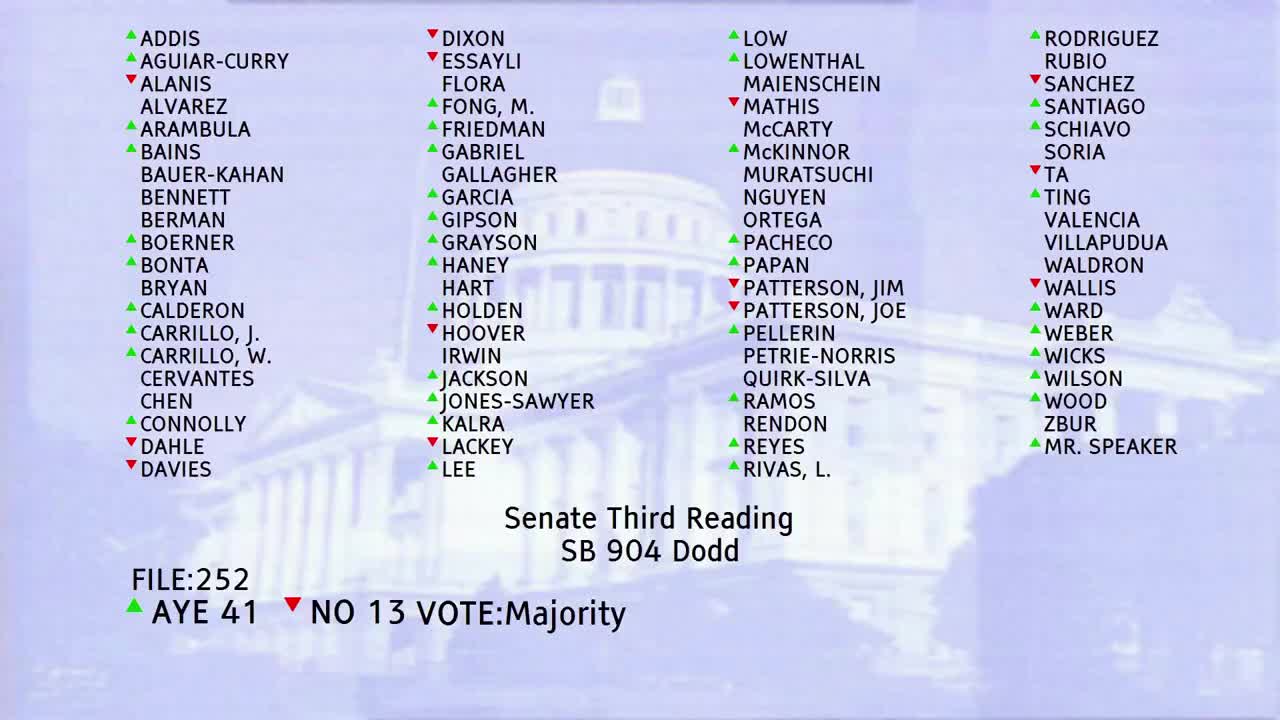 1MIN
Assembly Floor
 2MIN
Senate Floor
 3MIN
Senate Standing Committee on Labor, Public Employment and Retirement
Bill Author

Bill Co-Author(s):