AB 3255: Vocational nursing and psychiatric technicians: sunset: licensure.
- Session Year: 2023-2024
- House: Assembly
- Latest Version Date: 2024-09-25
Current Status:
Passed
(2024-09-25: Chaptered by Secretary of State - Chapter 590, Statutes of 2024.)
Introduced
In Committee
First Chamber
In Committee
Second Chamber
Enacted
Existing law establishes the Board of Vocational Nursing and Psychiatric Technicians of the State of California within the Department of Consumer Affairs and, until January 1, 2025, tasks the board with various licensing, regulatory, and disciplinary functions related to vocational nurses and psychiatric technicians under the Vocational Nursing Practice Act and the Psychiatric Technicians Law, respectively. Existing law, until January 1, 2025, requires the board to select an executive officer to perform duties as are delegated by the board, as specified. Existing law makes a violation of either the Vocational Nursing Practice Act or the Psychiatric Technicians Law a misdemeanor.
This bill would extend the operation of the above provisions to January 1, 2029. By extending the operation of an existing crime, the bill would impose a state-mandated local program.
Existing law requires the board to annually elect from its members a president, vice president, and other officers as it may deem necessary.
This bill would instead require the board to biennially elect those officers from its members.
Existing law, until January 1, 2025, sets forth an approval process for a vocational nursing school or program or a school or program for psychiatric technicians to be consistent with specified timelines. Under that timeline, existing law requires the board, upon receipt of a letter of intent to submit an application for approval as a school or program of licensed vocational nursing or a school or program for psychiatric technicians, to notify the proposed school or program of the steps in the approval process and provide an estimated wait time until active assignment to a nursing education consultant. Existing law requires a school or program seeking board approval to respond to the board within 2 weeks of each inquiry or request during all phases. Existing law designates a school or program as inactive if it does not respond within 2 weeks or fails to pay the required fees.
This bill would extend the operation of those provisions setting forth the approval process to January 1, 2029. The bill would clarify the above-described board notification requirement is contingent on the board receiving a letter of intent that is complete. If a vocational nursing school or program or a school or program for psychiatric technicians fails to submit a complete letter of intent, as specified, the bill would require the school or program to be taken out of consideration and would prohibit it from reapplying for 6 months. The bill would also clarify that the requirement that the school or program seeking board approval respond, within 2 weeks, to the boards inquiries or requests is applicable during all phases of the application process after the school or program has submitted an initial application for approval, as specified. The bill would expand the grounds on which a school or program is designated as inactive to include failing to submit documentation required by the board in time.
Existing law requires the board to inspect or review all schools of vocational nursing and psychiatric technician schools in this state, as specified, and to approve schools that meet the requirements provided by the board. If the board determines that any approved school is not maintaining the standard required by the board, existing law requires the board to immediately give notice in writing specifying the defect. Existing law authorizes the removal of the school from the approved list if the school does not correct the defect within a reasonable time.
This bill would authorize the board, after establishing regulations for this purpose, to issue a citation and assess a fine, as specified, if a vocational nursing school or program or a school or program for psychiatric technicians is not maintaining the required standard. If a school or program does not remit the assessed fine within 30 days, the bill would authorize the board to place it on provisional approval for up to 6 months or remove it from the approved school or program list, as specified. The bill would prohibit a school or program that is removed from the approved list from applying for approval for 12 months. The bill would clarify that these provisions apply to any vocational nursing school or program.
Existing law prescribes various fees in connection with the issuance of licenses under the Vocational Nursing Practice Act and Psychiatric Technicians Law. Existing law makes a license under the Vocational Nursing Practice Act expire after 2 years if not renewed, and makes a license under the Psychiatric Technicians Law expire each year on the date prescribed by the board if not renewed. Existing law under both the Vocational Nursing Practice Act and Psychiatric Technicians Law authorizes an expired license to be renewed at any time within 4 years after its expiration upon filing of an application for renewal and payment of certain fees, as specified.
This bill would, upon application and payment of a prescribed fee, require the board to issue a retired license to a licensee under either the Vocational Nursing Practice Act or the Psychiatric Technicians Law if the licensee holds an unrestricted license on the date of application. The bill would exempt a retired licensee from continuing education requirements and would prohibit a retired licensee from being entitled to practice vocational nursing or to practice as a psychiatric technician. The bill would authorize the board to reinstate a retired license to active status if the retired licensee fulfills certain requirements for renewal of a license, including furnishing fingerprints, paying renewal fees, and providing evidence of certain qualifications.
The California Constitution requires the state to reimburse local agencies and school districts for certain costs mandated by the state. Statutory provisions establish procedures for making that reimbursement.
This bill would provide that no reimbursement is required by this act for a specified reason.
Existing law, the Vocational Nursing Practice Act, law establishes the Board of Vocational Nursing and Psychiatric Technicians of the State of California, which, California within the Department of Consumer Affairs and, until January 1, 2025, is charged tasks the board with various licensing, regulatory, and disciplinary functions related to vocational nursing. nurses and psychiatric technicians under the Vocational Nursing Practice Act and the Psychiatric Technicians Law, respectively. Existing law, until January 1, 2025, requires the board to select an executive officer to perform duties as are delegated by the board, as specified. Existing law makes a violation of the act either the Vocational Nursing Practice Act or the Psychiatric Technicians Law a misdemeanor.
This bill would extend the operation of the above provisions to January 1, 2029. By extending the operation of an existing crime, the bill would impose a state-mandated local program.
Existing law requires the board to annually elect from its members a president, vice president, and other officers as it may deem necessary.
This bill would instead require the board to biennially elect those officers from its members.
Existing law, until January 1, 2025, sets forth an approval process for a vocational nursing school or program or a school or program for psychiatric technicians to be consistent with specified timelines. Under that timeline, existing law requires the board, upon receipt of a letter of intent to submit an application for approval as a school or program of licensed vocational nursing, nursing or a school or program for psychiatric technicians to notify the proposed school or program of the steps in the approval process and provide an estimated wait time until active assignment to a nursing education consultant. Existing law requires a vocational nursing school or program seeking board approval to respond to the board within 2 weeks of each inquiry or request during all phases. Existing law designates a school or program as inactive if it does not respond within 2 weeks or fails to pay the required fees.
This bill would extend the operation of those provisions setting forth the approval process to January 1, 2029. The bill would clarify the above-described board notification requirement is contingent on the board receiving a letter of intent that is complete. If a vocational nursing school or program or a school or program for psychiatric technicians fails to submit a complete letter of intent, as specified, the bill would require the school or program to be taken out of consideration and would prohibit it from reapplying for 6 months. The bill would also clarify that the requirement that the school or program seeking board approval respond, within 2 weeks, to the boards inquiries or requests is applicable during all phases of the application process after the school or program has submitted an initial application for approval, as specified. The bill would expand the grounds on which a school or program is designated as inactive to include failing to submit documentation required by the board in time.
Existing law requires the board to inspect or review all schools of vocational nursing and psychiatric technician schools in this state, as specified, and to approve schools that meet the requirements provided by the board. If the board determines that any approved school is not maintaining the standard required by the board, existing law requires the board to immediately give notice in writing specifying the defect. Existing law authorizes the removal of the school from the approved list if the school does not correct the defect within a reasonable time.
This bill would authorize the board, after establishing regulations for this purpose, to issue a citation and assess a fine, as specified, if a vocational nursing school or program or a school or program for psychiatric technicians is not maintaining the required standard. If a school or program does not remit the assessed fine within 30 days, the bill would authorize the board to place it on provisional approval for up to 6 months or remove it from the approved school or program list, as specified. The bill would prohibit a school or program that is removed from the approved list from applying for approval for 12 months. The bill would clarify that these provisions apply to any vocational nursing school or program.
Existing law prescribes various fees in connection with the issuance of licenses under the act, Vocational Nursing Practice Act and Psychiatric Technicians Law. Existing law makes a license under the Vocational Nursing Practice Act expire after 2 years if not renewed, and makes a license under the Psychiatric Technicians Law expire each year on the date prescribed by the board if not renewed. Existing law under both the Vocational Nursing Practice Act and Psychiatric Technicians Law authorizes an expired license to be renewed at any time within 4 years after its expiration upon filing of an application for renewal and payment of certain fees, as specified.
This bill would, upon application and payment of a prescribed fee, require the board to issue a retired license to a licensee under either the Vocational Nursing Practice Act or the Psychiatric Technicians Law if the licensee holds an unrestricted license on the date of application. The bill would exempt a retired licensee from continuing education requirements and would prohibit a retired licensee from being entitled to practice vocational nursing. The bill would authorize the board to reinstate a retired license to active status if the retired licensee fulfills certain requirements for renewal of a license, including furnishing fingerprints, paying renewal fees, and providing evidence of certain qualifications.
The California Constitution requires the state to reimburse local agencies and school districts for certain costs mandated by the state. Statutory provisions establish procedures for making that reimbursement.
This bill would provide that no reimbursement is required by this act for a specified reason.
Existing law, the Vocational Nursing Practice Act, establishes the Board of Vocational Nursing and Psychiatric Technicians of the State of California, which, until January 1, 2025, is charged with various licensing, regulatory, and disciplinary functions related to vocational nursing. Existing law, until January 1, 2025, requires the board to select an executive officer to perform duties as are delegated by the board, as specified. Existing law makes a violation of the act a misdemeanor.
This bill would extend the operation of the above provisions to January 1, 2029. By extending the operation of an existing crime, the bill would impose a state-mandated local program.
Existing law requires the board to annually elect from its members a president, vice president, and other officers as it may deem necessary.
This bill would instead require the board to biennially elect those officers from its members.
Existing law, until January 1, 2025, sets forth an approval process for a vocational nursing school or program to be consistent with specified timelines. Under that timeline, existing law requires the board, upon receipt of a letter of intent to submit an application for approval as a school or program of licensed vocational nursing, to notify the proposed school or program of the steps in the approval process and provide an estimated wait time until active assignment to a nursing education consultant. Existing law requires a vocational nursing school or program seeking board approval to respond to the board within 2 weeks of each inquiry or request during all phases. Existing law designates a school or program as inactive if it does not respond within 2 weeks or fails to pay the required fees.
This bill would extend the operation of those provisions setting forth the approval process to January 1, 2029. The bill would clarify the above-described board notification requirement is contingent on the board receiving a letter of intent that is complete. If a vocational nursing school or program fails to submit a complete letter of intent, as specified, the bill would require the school or program to be taken out of consideration and would prohibit it from reapplying for 6 months. The bill would also clarify that the requirement that the school or program seeking board approval respond, within 2 weeks, to the boards inquiries or requests is applicable during all phases of the application process after the school or program has submitted an initial application for approval, as specified. The bill would expand the grounds on which a school or program is designated as inactive to include failing to submit documentation required by the board in time.
Existing law requires the board to inspect or review all schools of vocational nursing in this state, as specified, and to approve schools that meet the requirements provided by the board. If the board determines that any approved school is not maintaining the standard required by the board, existing law requires the board to immediately give notice in writing specifying the defect. Existing law authorizes the removal of the school from the approved list if the school does not correct the defect within a reasonable time.
This bill would authorize the board, after establishing regulations for this purpose, to issue a citation and assess a fine, as specified, if a school or program is not maintaining the required standard. If a school or program does not remit the assessed fine within 30 days, the bill would authorize the board to place it on provisional approval for up to 6 months or remove it from the approved school or program list, as specified. The bill would prohibit a school or program that is removed from the approved list from applying for approval for 12 months. The bill would clarify that these provisions apply to any vocational nursing school or program.
Existing law prescribes various fees in connection with the issuance of licenses under the act, makes a license expire after 2 years if not renewed, and authorizes an expired license to be renewed at any time within 4 years after its expiration upon filing of an application for renewal and payment of certain fees, as specified.
This bill would, upon application and payment of a prescribed fee, require the board to issue a retired license to a licensee if the licensee holds an unrestricted license on the date of application. The bill would exempt a retired licensee from continuing education requirements and would prohibit a retired licensee from being entitled to practice vocational nursing. The bill would authorize the board to reinstate a retired license to active status if the retired licensee fulfills certain requirements for renewal of a license, including furnishing fingerprints, paying renewal fees, and providing evidence of certain qualifications.
The California Constitution requires the state to reimburse local agencies and school districts for certain costs mandated by the state. Statutory provisions establish procedures for making that reimbursement.
This bill would provide that no reimbursement is required by this act for a specified reason.
Existing law, the Vocational Nursing Practice Act, establishes the Board of Vocational Nursing and Psychiatric Technicians of the State of California, which which, until January 1, 2025, is charged with various licensing, regulatory, and disciplinary functions related to vocational nursing. Existing law law, until January 1, 2025, requires the board to select an executive officer to perform duties as are delegated by the board, as specified. Existing law makes a violation of the act a misdemeanor.
This bill would extend the operation of the above provisions to January 1, 2029. By extending the operation of an existing crime, the bill would impose a state-mandated local program.
Existing law requires the board to annually elect from its members a president, vice president, and such other officers as it may deem necessary.
This bill would instead require the board to biennially elect those officers from its members.
Existing law, until January 1, 2025, sets forth an approval process for a vocational nursing school or program to be consistent with specified timelines. Under that timeline, existing law requires the board, upon receipt of a letter of intent to submit an application for approval as a school or program of licensed vocational nursing, to notify the proposed school or program of the steps in the approval process and provide an estimated wait time until active assignment to a nursing education consultant. Existing law requires a vocational nursing school or program seeking board approval to respond to the board within 2 weeks of each inquiry or request during all phases.
This bill would extend the operation of the approval process to January 1, 2029. The bill would clarify the above-described board notification requirement is contingent on the board receiving a letter of intent that is complete. The bill would also clarify that the requirement that the school or program seeking board approval respond, within 2 weeks, to the boards inquiries or requests is applicable during all phases of the application process after the school or program has submitted an initial application for approval, as specified.
Existing law prescribes various fees in connection with the issuance of licenses under the act, makes a license expire after 2 years if not renewed, and authorizes an expired license to be renewed at any time within 4 years after its expiration upon filing of an application for renewal and payment of certain fees, as specified.
This bill would, upon application and payment of a prescribed fee, require the board to issue a retired license to a licensee if the licensee holds an unrestricted license on the date of application. The bill would exempt a retired licensee from continuing education requirements and would prohibit a retired licensee from being entitled to practice vocational nursing. The bill would authorize the board to reinstate a retired license to active status if the retired licensee fulfills certain requirements for renewal of a license, including furnishing fingerprints, paying renewal fees, and providing evidence of certain qualifications.
The California Constitution requires the state to reimburse local agencies and school districts for certain costs mandated by the state. Statutory provisions establish procedures for making that reimbursement.
This bill would provide that no reimbursement is required by this act for a specified reason.
Existing law, the Vocational Nursing Practice Act, establishes the Board of Vocational Nursing and Psychiatric Technicians of the State of California, which is charged with various licensing, regulatory, and disciplinary functions related to vocational nursing. Existing law requires the board to annually elect from its members a president, vice president, and such other officers as it may deem necessary.
This bill would instead require the board to biennially elect those officers from its members.
(a)There is in the Department of Consumer Affairs a Board of Vocational Nursing and Psychiatric Technicians of the State of California, which consists of 11 members.
(b)As used in this chapter, board means the Board of Vocational Nursing and Psychiatric Technicians of the State of California.
(c)This section shall remain in effect only until January 1, 2029, and as of that date is repealed.
SEC. 2.Section 2846 of the Business and Professions Code is amended to read:2846.The board at its first meeting after appointment, and biennially thereafter at its first meeting in every second year, shall elect from its members a president, vice president, and such other officers as it may deem necessary. The officers of the board shall hold their respective positions during its pleasure.
SEC. 3.Section 2847.1 of the Business and Professions Code is amended to read:2847.1.(a)Except as provided in subdivision (f), the board shall select an executive officer who shall perform duties as are delegated by the board and who shall be responsible to it for the accomplishment of those duties.
(b)The executive officer shall not be a member of the board.
(c)With the approval of the Director of Finance, the board shall fix the salary of the executive officer.
(d)The executive officer shall be entitled to traveling and other necessary expenses in the performance of their duties. The executive officer shall make a statement, certified before a duly authorized person, that the expenses have been actually incurred.
(e)Commencing January 1, 2018, the executive officer appointed by the board pursuant to subdivision (a) is abolished. Thereafter, until January 1, 2022, the executive officer shall be appointed as set forth in Section 2847.3.
(f)Commencing January 1, 2022, the executive officer shall, again, be selected by the board as set forth in subdivision (a), except that any executive officer in office on December 31, 2021, shall continue in the position as executive officer of the board until the position is vacated or the board selects another executive officer.
(g)This section shall remain in effect only until January 1, 2029, and as of that date is repealed.
SEC. 4.Section 2881.2 of the Business and Professions Code is amended to read:2881.2.(a)The approval process for a school or program shall be consistent with the following timelines:
(1)(A)Upon receipt of a complete letter of intent to submit an application for approval as a school or program of licensed vocational nursing, the board shall notify the proposed school or program of the steps in the approval process and provide an estimated wait time until active assignment to a nursing education consultant.
(B)A vocational nursing school or program that fails to submit a complete letter of intent within 30 days from the date the board notifies the school or program of deficiencies shall be taken out of consideration for approval as a new school or program and may only reapply after six months.
(C)Upon active assignment of a nursing education consultant, the school or program shall submit an initial application for approval within 60 days.
(2)(A)Within 30 days of the date the board receives an initial application for approval, the board shall notify the school or program whether the application is complete.
(B)A notice that an initial application is not complete shall specify what additional documents or payment of fees the school or program is required to submit to the board to make the application complete.
(3)Within 60 days from the date the board notifies the school or program that the initial application is not complete, the school or program shall provide the missing information. If a school or program fails to submit the required information, the board shall take the application out of consideration consistent with subdivision (c) of Section 2881.3.
(4)Within six months of the date the board receives an initial application for approval as a school or program, the board shall approve the school or program, deny approval, or notify the school or program that corrective action is required.
(b)A school or program of vocational nursing seeking approval by the board shall remit to the board for deposit in the Vocational Nursing and Psychiatric Technicians Fund fees in accordance with the following schedule:
(1)The nonrefundable initial application fee shall be in an amount equal to the reasonable costs incurred by the board in reviewing and processing the application up to five thousand dollars ($5,000).
(2)(A)Except as provided in subparagraph (B), the final approval fee shall be in an amount equal to the reasonable costs incurred by the board in the application approval process up to fifteen thousand dollars ($15,000).
(B)The final approval fee for an applicant program that meets both of the following criteria shall be in an amount equal to the reasonable costs incurred by the board in the application approval process up to five thousand dollars ($5,000):
(i)The program is affiliated with an approved school or program that is in good standing.
(ii)The program utilizes the curriculum and policies approved by the board for the approved school or program.
(3)The continuing approval fee shall be in an amount equal to the reasonable costs incurred by the board in providing oversight and review of a school or program up to five thousand dollars ($5,000) once every four years.
(c)If the board makes an initial determination that the cost of providing oversight and review of a school or program under this section is less than the amount of any fees required to be paid by that school or program, the board shall decrease the fees applicable to that institution to an amount that is proportional to the boards reasonable costs associated with that school or program.
(d)The board may reduce the continuing approval fees, by no more than one-half of the established fee, for a program that experiences a reduction in enrollment capacity that directly leads to a reduction in state funding. The board shall require a program to provide documentation for the purposes of issuing the fee reduction.
(e)This section shall remain in effect only until January 1, 2029, and as of that date is repealed.
SEC. 5.Section 2881.3 of the Business and Professions Code is amended to read:2881.3.(a)The board shall maintain a list of inactive vocational nursing schools and programs seeking board approval.
(b)A vocational nursing school or program seeking board approval shall respond to the board within two weeks of each inquiry or request during all phases of the application process after the school or program has submitted an initial application for approval pursuant to Section 2881.2. A school or program that does not respond within two weeks, fails to submit documentation required by the board in time, or fails to pay the required fees, shall be designated as inactive.
(c)A vocational nursing school or program seeking board approval that has been on the inactive list for 90 days over the course of the application period shall be taken out of consideration for a new school or program and may only reapply after six months.
SEC. 6.Section 2883 of the Business and Professions Code is amended to read:2883.(a)It shall be the duty of the board, through an official representative, to inspect or review all vocational nursing schools or programs in this state at such times as the board shall deem necessary. Written reports of the inspection or review shall be made to the board, which shall thereupon approve the schools or programs that meet the requirements provided by the board.
(b)(1)Upon receiving the report of the representative, if the board determines that any vocational nursing school or program is not maintaining the standard required by the board, notice thereof in writing specifying the defect or defects shall be immediately given to the school or program. If the defects are not corrected within a reasonable time, the school or program may be issued a citation and assessed a fine as specified under subdivision (c) or removed from the approved list and notice thereof in writing given to it.
(2)Until the board establishes regulations pursuant to subdivision (c), a school or program may only be removed from the approved list if defects are not corrected within a reasonable time.
(c)(1)The board may issue a citation, which may contain an order of abatement or an order to pay an administrative fine, if it has established, by regulation, a system for the issuance of citations to a vocational nursing school or program that is consistent with Section 125.9.
(2)In the event that the school or program does not remit the assessed fine within 30 days, the board may place the school or program on provisional approval for up to six months or remove it from the approved school or program list and give it written notice of the removal.
(d)A vocational nursing school or program removed from the approved list may apply for approval after 12 months from the date of their removal.
SEC. 7.Section 2892.8 is added to the Business and Professions Code, to read:2892.8.(a)The board, upon application and payment of the fee established pursuant to subdivision (h), shall issue a retired license to a licensee if the licensee holds an unrestricted license on the date of application.
(b)An applicant may elect to retire upon renewal or upon submission of an application to the board as required.
(c)A retired licensee shall be exempt from continuing education requirements.
(d)A retired licensee shall utilize their professional title only with the unabbreviated word retired directly preceding or directly following the professional title.
(e)A retired licensee shall not be entitled to practice vocational nursing.
(f)The board may investigate potential violations or take action against a retired license for a violation of this chapter.
(g)The board may reinstate a retired license to active status if the retired licensee fulfills the requirements for renewal of a license, including furnishing fingerprints, paying renewal fees, and providing evidence of the following, as applicable:
(1)For a retired licensee who has been retired for four years or fewer, the amount of continuing education required for the renewal of an active license.
(2)For a retired licensee who has been retired for more than four years, either a current valid active and clear registered nurse license, vocational nurse license, or an equivalent license in another state, a United States territory, or Canada, or passing the current examination for licensure.
(h)The fee to be paid upon filing the application for a retired license shall be fifty dollars ($50) unless a higher fee, not to exceed one hundred dollars ($100), is established by the board.
SEC. 8.Section 4501 of the Business and Professions Code is amended to read:4501.(a)As used in this chapter, board means the Board of Vocational Nursing and Psychiatric Technicians of the State of California.
(b)This section shall remain in effect only until January 1, 2029, and as of that date is repealed.
SEC. 9.Section 4503 of the Business and Professions Code is amended to read:4503.(a)The board shall administer and enforce the provisions of this chapter.
(b)This section shall remain in effect only until January 1, 2029, and as of that date is repealed.
SEC. 10.Section 4531.1 of the Business and Professions Code is amended to read:4531.1.(a)The approval process for a school or program shall be consistent with the following timelines:
(1)(A)Upon receipt of a complete letter of intent to submit an application for approval as a school or program for psychiatric technicians, the board shall notify the proposed school or program of the steps in the approval process and provide an estimated wait time until active assignment to a nursing education consultant.
(B)A school or program for psychiatric technicians that fails to submit a complete letter of intent within 30 days from the date the board notifies the school or program of deficiencies shall be taken out of consideration for approval as a new school or program and may only reapply after six months.
(C)Upon active assignment of a nursing education consultant, the school or program shall submit an initial application for approval within 60 days.
(2)(A)Within 30 days of the date the board receives an initial application for approval, the board shall notify the school or program whether the application is complete.
(B)A notice that an initial application is not complete shall specify what additional documents or payment of fees the school or program is required to submit to the board to make the application complete.
(3)Within 60 days from the date the board notifies the school or program that the initial application is not complete, the school or program shall provide the missing information. If a school or program fails to submit the required information, the board shall take the application out of consideration consistent with subdivision (c) of Section 4531.2.
(4)Within six months of the date the board receives an initial application for approval as a school or program, the board shall approve the school or program, deny approval, or notify the school or program that corrective action is required.
(b)A school or program for psychiatric technicians seeking approval by the board shall remit to the board for deposit in the Vocational Nursing and Psychiatric Technicians Fund fees in accordance with the following schedule:
(1)The nonrefundable initial application fee shall be in an amount equal to the reasonable costs incurred by the board in reviewing and processing the application up to five thousand dollars ($5,000).
(2)(A)Except as provided in subparagraph (B), the final approval fee shall be in an amount equal to the reasonable costs incurred by the board in the application approval process up to fifteen thousand dollars ($15,000).
(B)The final approval fee for an applicant program that meets both of the following criteria shall be in an amount equal to the reasonable costs incurred by the board in the application approval process up to five thousand dollars ($5,000):
(i)The program is affiliated with an approved school or program that is in good standing.
(ii)The program utilizes the curriculum and policies approved by the board for the approved school or program.
(3)The continuing approval fee shall be in an amount equal to the reasonable costs incurred by the board in providing oversight and review of a school or program up to five thousand dollars ($5,000) once every four years.
(c)If the board makes an initial determination that the cost of providing oversight and review of a school or program under this section is less than the amount of any fees required to be paid by that school or program, the board shall decrease the fees applicable to that institution to an amount that is proportional to the boards reasonable costs associated with that school or program.
(d)The board may reduce the continuing approval fees, by no more than one-half of the established fee, for a program that experiences a reduction in enrollment capacity that directly leads to a reduction in state funding. The board shall require a program to provide documentation for the purposes of issuing the fee reduction.
(e)This section shall remain in effect only until January 1, 2029, and as of that date is repealed.
SEC. 11.Section 4531.2 of the Business and Professions Code is amended to read:4531.2.(a)The board shall maintain a list of inactive schools and programs for psychiatric technicians seeking board approval.
(b)A school or program for psychiatric technicians seeking board approval shall respond to the board within two weeks of each inquiry or request during all phases of the application process after the school or program has submitted an initial application for approval pursuant to Section 4531.1. A school or program that does not respond within two weeks, fails to submit documentation required by the board in time, or fails to pay the required fees, shall be designated as inactive.
(c)A school or program for psychiatric technicians seeking board approval that has been on the inactive list for 90 days over the course of the application period shall be taken out of consideration for a new school or program and may only reapply after six months.
SEC. 12.Section 4532 of the Business and Professions Code is amended to read:4532.(a)It shall be the duty of the board, through an official representative, to inspect or review all schools or programs for psychiatric technicians in this state at such times as the board shall deem necessary. Written reports of the inspection or review shall be made to the board, which shall then approve the schools or programs that meet the requirements provided by the board.
(b)(1)Upon receiving the report of the representative, if the board determines that any school or program for psychiatric technicians is not maintaining the standard required by the board, notice thereof in writing specifying the defect or defects shall be immediately given to the school or program. If the defects are not corrected within a reasonable time, the school or program may be issued a citation and assessed a fine as specified under subdivision (c) or removed from the approved list and notice thereof in writing given to it.
(2)Until the board establishes regulations pursuant to subdivision (c), a school or program may only be removed from the approved list if defects are not corrected within a reasonable time.
(c)(1)The board may issue a citation, which may contain an order of abatement or an order to pay an administrative fine, if it has established, by regulation, a system for the issuance of citations to a psychiatric technician school or program that is consistent with Section 125.9.
(2)In the event that the school or program does not remit the assessed fine within 30 days, the board may place the school or program on provisional approval for up to six months or remove it from the approved school or program list and give it written notice of the removal.
(d)A school or program for psychiatric technicians removed from the approved list may apply for approval after 12 months from the date of their removal.
SEC. 13.Section 4545.4 is added to the Business and Professions Code, to read:4545.4.(a)The board, upon application and payment of the fee established pursuant to subdivision (h), shall issue a retired license to a licensee if the licensee holds an unrestricted license on the date of application.
(b)An applicant may elect to retire upon renewal or upon submission of an application to the board as required.
(c)A retired licensee shall be exempt from continuing education requirements.
(d)A retired licensee shall utilize their professional title only with the unabbreviated word retired directly preceding or directly following the professional title.
(e)A retired licensee shall not be entitled to practice as a psychiatric technician.
(f)The board may investigate potential violations or take action against a retired license for a violation of this chapter.
(g)The board may reinstate a retired license to active status if the retired licensee fulfills the requirements for renewal of a license, including furnishing fingerprints, paying renewal fees, and providing evidence of the following, as applicable:
(1)For a retired licensee who has been retired for four years or fewer, the amount of continuing education required for the renewal of an active license.
(2)For a retired licensee who has been retired for more than four years, either a current valid active and clear registered nurse license, psychiatric technician license, or an equivalent license in another state, a United States territory, or Canada, or passing the current examination for licensure.
(h)The fee to be paid upon filing the application for a retired license shall be fifty dollars ($50) unless a higher fee, not to exceed one hundred dollars ($100), is established by the board.
SEC. 14.No reimbursement is required by this act pursuant to Section 6 of Article XIIIB of the California Constitution because the only costs that may be incurred by a local agency or school district will be incurred because this act creates a new crime or infraction, eliminates a crime or infraction, or changes the penalty for a crime or infraction, within the meaning of Section 17556 of the Government Code, or changes the definition of a crime within the meaning of Section 6 of Article XIIIB of the California Constitution.
(a)There is in the Department of Consumer Affairs a Board of Vocational Nursing and Psychiatric Technicians of the State of California, which consists of 11 members.
(b)As used in this chapter, board means the Board of Vocational Nursing and Psychiatric Technicians of the State of California.
(c)This section shall remain in effect only until January 1, 2029, and as of that date is repealed.
SEC. 2.Section 2846 of the Business and Professions Code is amended to read:2846.The board at its first meeting after appointment, and biennially thereafter at its first meeting in every second year, shall elect from its members a president, vice president, and such other officers as it may deem necessary. The officers of the board shall hold their respective positions during its pleasure.
SEC. 3.Section 2847.1 of the Business and Professions Code is amended to read:2847.1.(a)Except as provided in subdivision (f), the board shall select an executive officer who shall perform duties as are delegated by the board and who shall be responsible to it for the accomplishment of those duties.
(b)The executive officer shall not be a member of the board.
(c)With the approval of the Director of Finance, the board shall fix the salary of the executive officer.
(d)The executive officer shall be entitled to traveling and other necessary expenses in the performance of their duties. The executive officer shall make a statement, certified before a duly authorized person, that the expenses have been actually incurred.
(e)Commencing January 1, 2018, the executive officer appointed by the board pursuant to subdivision (a) is abolished. Thereafter, until January 1, 2022, the executive officer shall be appointed as set forth in Section 2847.3.
(f)Commencing January 1, 2022, the executive officer shall, again, be selected by the board as set forth in subdivision (a), except that any executive officer in office on December 31, 2021, shall continue in the position as executive officer of the board until the position is vacated or the board selects another executive officer.
(g)This section shall remain in effect only until January 1, 2029, and as of that date is repealed.
SEC. 4.Section 2881.2 of the Business and Professions Code is amended to read:2881.2.(a)The approval process for a school or program shall be consistent with the following timelines:
(1)(A)Upon receipt of a complete letter of intent to submit an application for approval as a school or program of licensed vocational nursing, the board shall notify the proposed school or program of the steps in the approval process and provide an estimated wait time until active assignment to a nursing education consultant.
(B)A vocational nursing school or program that fails to submit a complete letter of intent within 30 days from the date the board notifies the school or program of deficiencies shall be taken out of consideration for approval as a new school or program and may only reapply after six months.
(C)Upon active assignment of a nursing education consultant, the school or program shall submit an initial application for approval within 60 days.
(2)(A)Within 30 days of the date the board receives an initial application for approval, the board shall notify the school or program whether the application is complete.
(B)A notice that an initial application is not complete shall specify what additional documents or payment of fees the school or program is required to submit to the board to make the application complete.
(3)Within 60 days from the date the board notifies the school or program that the initial application is not complete, the school or program shall provide the missing information. If a school or program fails to submit the required information, the board shall take the application out of consideration consistent with subdivision (c) of Section 2881.3.
(4)Within six months of the date the board receives an initial application for approval as a school or program, the board shall approve the school or program, deny approval, or notify the school or program that corrective action is required.
(b)A school or program of vocational nursing seeking approval by the board shall remit to the board for deposit in the Vocational Nursing and Psychiatric Technicians Fund fees in accordance with the following schedule:
(1)The nonrefundable initial application fee shall be in an amount equal to the reasonable costs incurred by the board in reviewing and processing the application up to five thousand dollars ($5,000).
(2)(A)Except as provided in subparagraph (B), the final approval fee shall be in an amount equal to the reasonable costs incurred by the board in the application approval process up to fifteen thousand dollars ($15,000).
(B)The final approval fee for an applicant program that meets both of the following criteria shall be in an amount equal to the reasonable costs incurred by the board in the application approval process up to five thousand dollars ($5,000):
(i)The program is affiliated with an approved school or program that is in good standing.
(ii)The program utilizes the curriculum and policies approved by the board for the approved school or program.
(3)The continuing approval fee shall be in an amount equal to the reasonable costs incurred by the board in providing oversight and review of a school or program up to five thousand dollars ($5,000) once every four years.
(c)If the board makes an initial determination that the cost of providing oversight and review of a school or program under this section is less than the amount of any fees required to be paid by that school or program, the board shall decrease the fees applicable to that institution to an amount that is proportional to the boards reasonable costs associated with that school or program.
(d)The board may reduce the continuing approval fees, by no more than one-half of the established fee, for a program that experiences a reduction in enrollment capacity that directly leads to a reduction in state funding. The board shall require a program to provide documentation for the purposes of issuing the fee reduction.
(e)(1)Notwithstanding Chapter 3.5 (commencing with Section 11340) of Part 1 of Division 3 of Title 2 of the Government Code, the board shall, without taking any further regulatory action, implement, interpret, or make specific this section by means of provider bulletins or similar instructions until emergency regulations are adopted pursuant to paragraph (2). The board shall provide written notice 30 days prior to the adoption of any instruction under this paragraph and post the notice on its internet website. It is the intent of the Legislature that the board have temporary authority as necessary to implement program changes until completion of the regulatory process.(2)The board shall adopt emergency regulations no later than June 30, 2022. The adoption of regulations shall be deemed an emergency and necessary to avoid serious harm to the public peace, health, safety, or general welfare within the meaning of Section 11342.545 of the Government Code, and the board need not make a written finding of emergency as required by Section 11346.1 of the Government Code. Notwithstanding subdivisions (e) and (h) of Section 11346.1 of the Government Code, the board may annually readopt any emergency regulation authorized by this section that is the same as or substantially equivalent to an emergency regulation previously adopted pursuant to this section until January 1, 2024.(3)The initial adoption of emergency regulations and the readoption of emergency regulations authorized by this section shall be submitted to the Office of Administrative Law for filing with the Secretary of State. The emergency regulations shall remain in effect for no more than one year from the date any regulation became effective as an emergency regulation. (f)(e)This section shall remain in effect only until January 1, 2029, and as of that date is repealed.
SEC. 5.Section 2881.3 of the Business and Professions Code is amended to read:2881.3.(a)The board shall maintain a list of inactive vocational nursing schools and programs seeking board approval.
(b)A vocational nursing school or program seeking board approval shall respond to the board within two weeks of each inquiry or request during all phases of the application process after the school or program has submitted an initial application for approval pursuant to Section 2881.2. A school or program that does not respond within two weeks, fails to submit documentation required by the board in time, or fails to pay the required fees, shall be designated as inactive.
(c)A vocational nursing school or program seeking board approval that has been on the inactive list for 90 days over the course of the application period shall be taken out of consideration for a new school or program and may only reapply after six months.
SEC. 6.Section 2883 of the Business and Professions Code is amended to read:2883.(a)It shall be the duty of the board, through an official representative, to inspect or review all vocational nursing schools or programs in this state at such times as the board shall deem necessary. Written reports of the inspection or review shall be made to the board, which shall thereupon approve the schools or programs that meet the requirements provided by the board.
(b)(1)Upon receiving the report of the representative, if the board determines that any vocational nursing school or program is not maintaining the standard required by the board, notice thereof in writing specifying the defect or defects shall be immediately given to the school or program. If the defects are not corrected within a reasonable time, the school or program may be issued a citation and assessed a fine as specified under subdivision (c) or removed from the approved list and notice thereof in writing given to it.
(2)Until the board establishes regulations pursuant to subdivision (c), a school or program may only be removed from the approved list if defects are not corrected within a reasonable time.
(c)(1)The board may issue a citation, which may contain an order of abatement or an order to pay an administrative fine, if it has established, by regulation, a system for the issuance of citations to a vocational nursing school or program that is consistent with Section 125.9.
(2)In the event that the school or program does not remit the assessed fine within 30 days, the board may place the school or program on provisional approval for up to six months or remove it from the approved school or program list and give it written notice of the removal.
(d)A vocational nursing school or program removed from the approved list may apply for approval after 12 months from the date of their removal.
SEC. 7.Section 2892.8 is added to the Business and Professions Code, to read:2892.8.(a)The board, upon application and payment of the fee established pursuant to subdivision (h), shall issue a retired license to a licensee if the licensee holds an unrestricted license on the date of application.
(b)An applicant may elect to retire upon renewal or upon submission of an application to the board as required.
(c)A retired licensee shall be exempt from continuing education requirements.
(d)A retired licensee shall utilize their professional title only with the unabbreviated word retired directly preceding or directly following the professional title.
(e)A retired licensee shall not be entitled to practice vocational nursing.
(f)The board may investigate potential violations or take action against a retired license for a violation of this chapter.
(g)The board may reinstate a retired license to active status if the retired licensee fulfills the requirements for renewal of a license, including furnishing fingerprints, paying renewal fees, and providing evidence of the following, as applicable:
(1)For a retired licensee who has been retired for four years or fewer, the amount of continuing education required for the renewal of an active license.
(2)For a retired licensee who has been retired for more than four years, either a current valid active and clear registered nurse license license, vocational nurse license, or an equivalent license in another state, a United States territory, or Canada, or passing the current examination for licensure.
(h)The fee to be paid upon filing the application for a retired license shall be fifty dollars ($50) unless a higher fee, not to exceed one hundred dollars ($100), is established by the board.
SEC. 8.Section 4501 of the Business and Professions Code is amended to read:4501.(a)As used in this chapter, board means the Board of Vocational Nursing and Psychiatric Technicians of the State of California.
(b)This section shall remain in effect only until January 1, 2025, 2029, and as of that date is repealed.
SEC. 9.Section 4503 of the Business and Professions Code is amended to read:4503.(a)The board shall administer and enforce the provisions of this chapter.
(b)This section shall remain in effect only until January 1, 2025, 2029, and as of that date is repealed.
SEC. 10.Section 4531.1 of the Business and Professions Code is amended to read:4531.1.(a)The approval process for a school or program shall be consistent with the following timelines:
(1)(A)Upon receipt of a complete letter of intent to submit an application for approval as a school or program for psychiatric technicians, the board shall notify the proposed school or program of the steps in the approval process and provide an estimated wait time until active assignment to a nursing education consultant.
(B)A school or program for psychiatric technicians that fails to submit a complete letter of intent within 30 days from the date the board notifies the school or program of deficiencies shall be taken out of consideration for approval as a new school or program and may only reapply after six months.
(B)(C)Upon active assignment of a nursing education consultant, the school or program shall submit an initial application for approval within 60 days.
(2)(A)Within 30 days of the date the board receives an initial application for approval, the board shall notify the school or program whether the application is complete.
(B)A notice that an initial application is not complete shall specify what additional documents or payment of fees the school or program is required to submit to the board to make the application complete.
(3)Within 60 days from the date the board notifies the school or program that the initial application is not complete, the school or program shall provide the missing information. If a school or program fails to submit the required information, the board shall take the application out of consideration consistent with subdivision (c) of Section 4531.2. The board may provide a school or program with an additional 30 days to complete its application.
(4)Within six months of the date the board receives an initial application for approval as a school or program, the board shall approve the school or program, deny approval, or notify the school or program that corrective action is required.
(b)A school or program for psychiatric technicians seeking approval by the board shall remit to the board for deposit in the Vocational Nursing and Psychiatric Technicians Fund fees in accordance with the following schedule:
(1)The nonrefundable initial application fee shall be in an amount equal to the reasonable costs incurred by the board in reviewing and processing the application up to five thousand dollars ($5,000).
(2)(A)Except as provided in subparagraph (B), the final approval fee shall be in an amount equal to the reasonable costs incurred by the board in the application approval process up to fifteen thousand dollars ($15,000).
(B)The final approval fee for an applicant program that meets both of the following criteria shall be in an amount equal to the reasonable costs incurred by the board in the application approval process up to five thousand dollars ($5,000):
(i)The program is affiliated with an approved school or program that is in good standing.
(ii)The program utilizes the curriculum and policies approved by the board for the approved school or program.
(3)The continuing approval fee shall be in an amount equal to the reasonable costs incurred by the board in providing oversight and review of a school or program up to five thousand dollars ($5,000) once every four years.
(c)If the board makes an initial determination that the cost of providing oversight and review of a school or program under this section is less than the amount of any fees required to be paid by that school or program, the board shall decrease the fees applicable to that institution to an amount that is proportional to the boards reasonable costs associated with that school or program.
(d)The board may reduce the continuing approval fees, by no more than one-half of the established fee, for a program that experiences a reduction in enrollment capacity that directly leads to a reduction in state funding. The board shall require a program to provide documentation for the purposes of issuing the fee reduction.
(e)(1)Notwithstanding Chapter 3.5 (commencing with Section 11340) of Part 1 of Division 3 of Title 2 of the Government Code, the board shall, without taking any further regulatory action, implement, interpret, or make specific this section by means of provider bulletins or similar instructions until emergency regulations are adopted pursuant to paragraph (2). The board shall provide written notice 30 days prior to the adoption of any instruction under this paragraph and post the notice on its internet website. It is the intent of the Legislature that the board have temporary authority as necessary to implement program changes until completion of the regulatory process.(2)The board shall adopt emergency regulations no later than June 30, 2022. The adoption of regulations shall be deemed an emergency and necessary to avoid serious harm to the public peace, health, safety, or general welfare within the meaning of Section 11342.545 of the Government Code, and the board need not make a written finding of emergency as required by Section 11346.1 of the Government Code. Notwithstanding subdivisions (e) and (h) of Section 11346.1 of the Government Code, the board may annually readopt any emergency regulation authorized by this section that is the same as or substantially equivalent to an emergency regulation previously adopted pursuant to this section until January 1, 2024.(3)The initial adoption of emergency regulations and the readoption of emergency regulations authorized by this section shall be submitted to the Office of Administrative Law for filing with the Secretary of State. The emergency regulations shall remain in effect for no more than one year from the date any regulation became effective as an emergency regulation. (f)(e)This section shall remain in effect only until January 1, 2025, 2029, and as of that date is repealed.
SEC. 11.Section 4531.2 of the Business and Professions Code is amended to read:4531.2.(a)The board shall maintain a list of inactive schools or and programs for psychiatric technicians seeking board approval.
(b)A school or program for psychiatric technicians seeking board approval shall respond to the board within two weeks of each inquiry or request during all phases. phases of the application process after the school or program has submitted an initial application for approval pursuant to Section 4531.1. A school or program that does not respond within two weeks, fails to submit documentation required by the board in time, or fails to pay the required fees, shall be designated as inactive.
(c)A school or program for psychiatric technicians seeking board approval that remains has been on the inactive list for 90 days over the course of the application period shall be taken out of consideration for a new school or program and may only reapply after six months.
SEC. 12.Section 4532 of the Business and Professions Code is amended to read:4532.The board shall provide for the periodic inspection or review of all psychiatric technician schools in this state. (a)It shall be the duty of the board, through an official representative, to inspect or review all schools or programs for psychiatric technicians in this state at such times as the board shall deem necessary. Written reports of the inspection or review shall be made to the board, which shall then approve the psychiatric technician schools schools or programs that meet the standards prescribed by it. requirements provided by the board.
If the board determines from a report that any approved school is not maintaining its prescribed standards, it shall immediately give the school a notice in writing specifying the defect. If the defect is not corrected the board shall, after written notice, remove the school from the approved list.(b)(1)Upon receiving the report of the representative, if the board determines that any school or program for psychiatric technicians is not maintaining the standard required by the board, notice thereof in writing specifying the defect or defects shall be immediately given to the school or program. If the defects are not corrected within a reasonable time, the school or program may be issued a citation and assessed a fine as specified under subdivision (c) or removed from the approved list and notice thereof in writing given to it.
(2)Until the board establishes regulations pursuant to subdivision (c), a school or program may only be removed from the approved list if defects are not corrected within a reasonable time.
(c)(1)The board may issue a citation, which may contain an order of abatement or an order to pay an administrative fine, if it has established, by regulation, a system for the issuance of citations to a psychiatric technician school or program that is consistent with Section 125.9.
(2)In the event that the school or program does not remit the assessed fine within 30 days, the board may place the school or program on provisional approval for up to six months or remove it from the approved school or program list and give it written notice of the removal.
(d)A school or program for psychiatric technicians removed from the approved list may apply for approval after 12 months from the date of their removal.
SEC. 13.Section 4545.4 is added to the Business and Professions Code, to read:4545.4.(a)The board, upon application and payment of the fee established pursuant to subdivision (h), shall issue a retired license to a licensee if the licensee holds an unrestricted license on the date of application.
(b)An applicant may elect to retire upon renewal or upon submission of an application to the board as required.
(c)A retired licensee shall be exempt from continuing education requirements.
(d)A retired licensee shall utilize their professional title only with the unabbreviated word retired directly preceding or directly following the professional title.
(e)A retired licensee shall not be entitled to practice as a psychiatric technician.
(f)The board may investigate potential violations or take action against a retired license for a violation of this chapter.
(g)The board may reinstate a retired license to active status if the retired licensee fulfills the requirements for renewal of a license, including furnishing fingerprints, paying renewal fees, and providing evidence of the following, as applicable:
(1)For a retired licensee who has been retired for four years or fewer, the amount of continuing education required for the renewal of an active license.
(2)For a retired licensee who has been retired for more than four years, either a current valid active and clear registered nurse license, psychiatric technician license, or an equivalent license in another state, a United States territory, or Canada, or passing the current examination for licensure.
(h)The fee to be paid upon filing the application for a retired license shall be fifty dollars ($50) unless a higher fee, not to exceed one hundred dollars ($100), is established by the board.
SEC. 8.SEC. 14.No reimbursement is required by this act pursuant to Section 6 of Article XIIIB of the California Constitution because the only costs that may be incurred by a local agency or school district will be incurred because this act creates a new crime or infraction, eliminates a crime or infraction, or changes the penalty for a crime or infraction, within the meaning of Section 17556 of the Government Code, or changes the definition of a crime within the meaning of Section 6 of Article XIIIB of the California Constitution.
(a)There is in the Department of Consumer Affairs a Board of Vocational Nursing and Psychiatric Technicians of the State of California, which consists of 11 members.
(b)As used in this chapter, board means the Board of Vocational Nursing and Psychiatric Technicians of the State of California.
(c)This section shall remain in effect only until January 1, 2029, and as of that date is repealed.
SEC. 2.Section 2846 of the Business and Professions Code is amended to read:2846.The board at its first meeting after appointment, and biennially thereafter at its first meeting in every second year, shall elect from its members a president, vice president, and such other officers as it may deem necessary. The officers of the board shall hold their respective positions during its pleasure.
SEC. 3.Section 2847.1 of the Business and Professions Code is amended to read:2847.1.(a)Except as provided in subdivision (f), the board shall select an executive officer who shall perform duties as are delegated by the board and who shall be responsible to it for the accomplishment of those duties.
(b)The executive officer shall not be a member of the board.
(c)With the approval of the Director of Finance, the board shall fix the salary of the executive officer.
(d)The executive officer shall be entitled to traveling and other necessary expenses in the performance of their duties. The executive officer shall make a statement, certified before a duly authorized person, that the expenses have been actually incurred.
(e)Commencing January 1, 2018, the executive officer appointed by the board pursuant to subdivision (a) is abolished. Thereafter, until January 1, 2022, the executive officer shall be appointed as set forth in Section 2847.3.
(f)Commencing January 1, 2022, the executive officer shall, again, be selected by the board as set forth in subdivision (a), except that any executive officer in office on December 31, 2021, shall continue in the position as executive officer of the board until the position is vacated or the board selects another executive officer.
(g)This section shall remain in effect only until January 1, 2029, and as of that date is repealed.
SEC. 4.Section 2881.2 of the Business and Professions Code is amended to read:2881.2.(a)The approval process for a school or program shall be consistent with the following timelines:
(1)(A)Upon receipt of a complete letter of intent to submit an application for approval as a school or program of licensed vocational nursing, the board shall notify the proposed school or program of the steps in the approval process and provide an estimated wait time until active assignment to a nursing education consultant.
(B)A vocational nursing school or program that fails to submit a complete letter of intent within 30 days from the date the board notifies the school or program of deficiencies shall be taken out of consideration for a new school or program and may only reapply after six months.
(B)(C)Upon active assignment of a nursing education consultant, the school or program shall submit an initial application for approval within 60 days.
(2)(A)Within 30 days of the date the board receives an initial application for approval, the board shall notify the school or program whether the application is complete.
(B)A notice that an initial application is not complete shall specify what additional documents or payment of fees the school or program is required to submit to the board to make the application complete.
(3)Within 60 days from the date the board notifies the school or program that the initial application is not complete, the school or program shall provide the missing information. If a school or program fails to submit the required information, the board shall take the application out of consideration consistent with subdivision (c) of Section 2881.3. The board may provide a school or program with an additional 30 days to complete its application.
(4)Within six months of the date the board receives an initial application for approval as a school or program, the board shall approve the school or program, deny approval, or notify the school or program that corrective action is required.
(b)A school or program of vocational nursing seeking approval by the board shall remit to the board for deposit in the Vocational Nursing and Psychiatric Technicians Fund fees in accordance with the following schedule:
(1)The nonrefundable initial application fee shall be in an amount equal to the reasonable costs incurred by the board in reviewing and processing the application up to five thousand dollars ($5,000).
(2)(A)Except as provided in subparagraph (B), the final approval fee shall be in an amount equal to the reasonable costs incurred by the board in the application approval process up to fifteen thousand dollars ($15,000).
(B)The final approval fee for an applicant program that meets both of the following criteria shall be in an amount equal to the reasonable costs incurred by the board in the application approval process up to five thousand dollars ($5,000):
(i)The program is affiliated with an approved school or program that is in good standing.
(ii)The program utilizes the curriculum and policies approved by the board for the approved school or program.
(3)The continuing approval fee shall be in an amount equal to the reasonable costs incurred by the board in providing oversight and review of a school or program up to five thousand dollars ($5,000) once every four years.
(c)If the board makes an initial determination that the cost of providing oversight and review of a school or program under this section is less than the amount of any fees required to be paid by that school or program, the board shall decrease the fees applicable to that institution to an amount that is proportional to the boards reasonable costs associated with that school or program.
(d)The board may reduce the continuing approval fees, by no more than one-half of the established fee, for a program that experiences a reduction in enrollment capacity that directly leads to a reduction in state funding. The board shall require a program to provide documentation for the purposes of issuing the fee reduction.
(e)(1)Notwithstanding Chapter 3.5 (commencing with Section 11340) of Part 1 of Division 3 of Title 2 of the Government Code, the board shall, without taking any further regulatory action, implement, interpret, or make specific this section by means of provider bulletins or similar instructions until emergency regulations are adopted pursuant to paragraph (2). The board shall provide written notice 30 days prior to the adoption of any instruction under this paragraph and post the notice on its internet website. It is the intent of the Legislature that the board have temporary authority as necessary to implement program changes until completion of the regulatory process.
(2)The board shall adopt emergency regulations no later than June 30, 2022. The adoption of regulations shall be deemed an emergency and necessary to avoid serious harm to the public peace, health, safety, or general welfare within the meaning of Section 11342.545 of the Government Code, and the board need not make a written finding of emergency as required by Section 11346.1 of the Government Code. Notwithstanding subdivisions (e) and (h) of Section 11346.1 of the Government Code, the board may annually readopt any emergency regulation authorized by this section that is the same as or substantially equivalent to an emergency regulation previously adopted pursuant to this section until January 1, 2024.
(3)The initial adoption of emergency regulations and the readoption of emergency regulations authorized by this section shall be submitted to the Office of Administrative Law for filing with the Secretary of State. The emergency regulations shall remain in effect for no more than one year from the date any regulation became effective as an emergency regulation.
(f)This section shall remain in effect only until January 1, 2029, and as of that date is repealed.
SEC. 5.Section 2881.3 of the Business and Professions Code is amended to read:2881.3.(a)The board shall maintain a list of inactive vocational nursing schools and programs seeking board approval.
(b)A vocational nursing school or program seeking board approval shall respond to the board within two weeks of each inquiry or request during all phases of the application process after the school or program has submitted an initial application for approval pursuant to Section 2881.2. A school or program that does not respond within two weeks, fails to submit documentation required by the board in time, or fails to pay the required fees, shall be designated as inactive.
(c)A vocational nursing school or program seeking board approval that remains has been on the inactive list for 90 days over the course of the application period shall be taken out of consideration for a new school or program and may only reapply after six months.
SEC. 6.Section 2883 of the Business and Professions Code is amended to read:2883.(a)It shall be the duty of the board, through an official representative, to inspect or review all schools of vocational nursing vocational nursing schools or programs in this state at such times as the board shall deem necessary. Written reports of the inspection or review shall be made to the board, which shall thereupon approve the schools of vocational nursing or programs that meet the requirements provided by the board.
Upon(b)(1)Upon receiving the report of the representative, if the board determines that any approved school of vocational nursing vocational nursing school or program is not maintaining the standard required by the board, notice thereof in writing specifying the defect or defects shall be immediately given to the school. school or program. If the defects are not corrected within a reasonable time, the school of nursing or program may be issued a citation and assessed a fine as specified under subdivision (c) or removed from the approved list and notice thereof in writing given to it.
(2)Until the board establishes regulations pursuant to subdivision (c), a school or program may only be removed from the approved list if defects are not corrected within a reasonable time.
(c)(1)The board may issue a citation, which may contain an order of abatement or an order to pay an administrative fine, if it has established, by regulation, a system for the issuance of citations to a vocational nursing school or program that is consistent with Section 125.9.
(2)In the event that the school or program does not remit the assessed fine within 30 days, the board may place the school or program on provisional approval for up to six months or remove it from the approved school or program list and give it written notice of the removal.
(d)A vocational nursing school or program removed from the approved list may apply for approval after 12 months from the date of their removal.
SEC. 6.SEC. 7.Section 2892.8 is added to the Business and Professions Code, to read:2892.8.(a)The board, upon application and payment of the fee established pursuant to subdivision (h), shall issue a retired license to a licensee if the licensee holds an unrestricted license on the date of application.
(b)An applicant may elect to retire upon renewal or upon submission of an application to the board as required.
(c)A retired licensee shall be exempt from continuing education requirements.
(d)A retired licensee shall utilize their professional title only with the unabbreviated word retired directly preceding or directly following the professional title.
(e)A retired licensee shall not be entitled to practice vocational nursing.
(f)The board may investigate potential violations or take action against a retired license for a violation of this chapter.
(g)The board may reinstate a retired license to active status if the retired licensee fulfills the requirements for renewal of a license, including furnishing fingerprints, paying renewal fees, and providing evidence of the following, as applicable:
(1)For a retired licensee who has been retired for four years or fewer, the amount of continuing education required for the renewal of an active license.
(2)For a retired licensee who has been retired for more than four years, either a current valid active and clear registered nurse license in another state, a United States territory, or Canada, or passing the current examination for licensure.
(h)The fee to be paid upon filing the application for a retired license shall be fifty dollars ($50) unless a higher fee, not to exceed one hundred dollars ($100), is established by the board.
SEC. 7.SEC. 8.No reimbursement is required by this act pursuant to Section 6 of Article XIIIB of the California Constitution because the only costs that may be incurred by a local agency or school district will be incurred because this act creates a new crime or infraction, eliminates a crime or infraction, or changes the penalty for a crime or infraction, within the meaning of Section 17556 of the Government Code, or changes the definition of a crime within the meaning of Section 6 of Article XIIIB of the California Constitution.
(a)There is in the Department of Consumer Affairs a Board of Vocational Nursing and Psychiatric Technicians of the State of California, which consists of 11 members.
(b)As used in this chapter, board means the Board of Vocational Nursing and Psychiatric Technicians of the State of California.
(c)This section shall remain in effect only until January 1, 2025, 2029, and as of that date is repealed.
SECTION 1.SEC. 2.Section 2846 of the Business and Professions Code is amended to read:2846.The board at its first meeting after appointment, and biennially thereafter at its first meeting in every second year, shall elect from its members a president, vice president, and such other officers as it may deem necessary. The officers of the board shall hold their respective positions during its pleasure.
SEC. 3.Section 2847.1 of the Business and Professions Code is amended to read:2847.1.(a)Except as provided in subdivision (f), the board shall select an executive officer who shall perform duties as are delegated by the board and who shall be responsible to it for the accomplishment of those duties.
(b)The executive officer shall not be a member of the board.
(c)With the approval of the Director of Finance, the board shall fix the salary of the executive officer.
(d)The executive officer shall be entitled to traveling and other necessary expenses in the performance of their duties. The executive officer shall make a statement, certified before a duly authorized person, that the expenses have been actually incurred.
(e)Commencing January 1, 2018, the executive officer appointed by the board pursuant to subdivision (a) is abolished. Thereafter, until January 1, 2022, the executive officer shall be appointed as set forth in Section 2847.3.
(f)Commencing January 1, 2022, the executive officer shall, again, be selected by the board as set forth in subdivision (a), except that any executive officer in office on December 31, 2021, shall continue in the position as executive officer of the board until the position is vacated or the board selects another executive officer.
(g)This section shall remain in effect only until January 1, 2025, 2029, and as of that date is repealed.
SEC. 4.Section 2881.2 of the Business and Professions Code is amended to read:2881.2.(a)The approval process for a school or program shall be consistent with the following timelines:
(1)(A)Upon receipt of a complete letter of intent to submit an application for approval as a school or program of licensed vocational nursing, the board shall notify the proposed school or program of the steps in the approval process and provide an estimated wait time until active assignment to a nursing education consultant.
(B)Upon active assignment of a nursing education consultant, the school or program shall submit an initial application for approval within 60 days.
(2)(A)Within 30 days of the date the board receives an initial application for approval, the board shall notify the school or program whether the application is complete.
(B)A notice that an initial application is not complete shall specify what additional documents or payment of fees the school or program is required to submit to the board to make the application complete.
(3)Within 60 days from the date the board notifies the school or program that the initial application is not complete, the school or program shall provide the missing information. If a school or program fails to submit the required information, the board shall take the application out of consideration consistent with subdivision (c) of Section 2881.3. The board may provide a school or program with an additional 30 days to complete its application.
(4)Within six months of the date the board receives an initial application for approval as a school or program, the board shall approve the school or program, deny approval, or notify the school or program that corrective action is required.
(b)A school or program of vocational nursing seeking approval by the board shall remit to the board for deposit in the Vocational Nursing and Psychiatric Technicians Fund fees in accordance with the following schedule:
(1)The nonrefundable initial application fee shall be in an amount equal to the reasonable costs incurred by the board in reviewing and processing the application up to five thousand dollars ($5,000).
(2)(A)Except as provided in subparagraph (B), the final approval fee shall be in an amount equal to the reasonable costs incurred by the board in the application approval process up to fifteen thousand dollars ($15,000).
(B)The final approval fee for an applicant program that meets all both of the following criteria shall be in an amount equal to the reasonable costs incurred by the board in the application approval process up to five thousand dollars ($5,000):
(i)The program is affiliated with an approved school or program that is in good standing.
(ii)The program utilizes the curriculum and policies approved by the board for the approved school or program.
(3)The continuing approval fee shall be in an amount equal to the reasonable costs incurred by the board in providing oversight and review of a school or program up to five thousand dollars ($5,000) once every four years.
(c)If the board makes an initial determination that the cost of providing oversight and review of a school or program under this section is less than the amount of any fees required to be paid by that school or program, the board shall decrease the fees applicable to that institution to an amount that is proportional to the boards reasonable costs associated with that school or program.
(d)The board may reduce the continuing approval fees, by no more than one-half of the established fee, for a program that experiences a reduction in enrollment capacity that directly leads to a reduction in state funding. The board shall require a program to provide documentation for the purposes of issuing the fee reduction.
(e)(1)Notwithstanding Chapter 3.5 (commencing with Section 11340) of Part 1 of Division 3 of Title 2 of the Government Code, the board shall, without taking any further regulatory action, implement, interpret, or make specific this section by means of provider bulletins or similar instructions until emergency regulations are adopted pursuant to paragraph (2). The board shall provide written notice 30 days prior to the adoption of any instruction under this paragraph and post the notice on its internet website. It is the intent of the Legislature that the board have temporary authority as necessary to implement program changes until completion of the regulatory process.
(2)The board shall adopt emergency regulations no later than June 30, 2022. The adoption of regulations shall be deemed an emergency and necessary to avoid serious harm to the public peace, health, safety, or general welfare within the meaning of Section 11342.545 of the Government Code, and the board need not make a written finding of emergency as required by Section 11346.1 of the Government Code. Notwithstanding subdivisions (e) and (h) of Section 11346.1 of the Government Code, the board may annually readopt any emergency regulation authorized by this section that is the same as or substantially equivalent to an emergency regulation previously adopted pursuant to this section until January 1, 2024.
(3)The initial adoption of emergency regulations and the readoption of emergency regulations authorized by this section shall be submitted to the Office of Administrative Law for filing with the Secretary of State. The emergency regulations shall remain in effect for no more than one year from the date any regulation became effective as an emergency regulation.
(f)This section shall remain in effect only until January 1, 2025, 2029, and as of that date is repealed.
SEC. 5.Section 2881.3 of the Business and Professions Code is amended to read:2881.3.(a)The board shall maintain a list of inactive vocational nursing schools and programs seeking board approval.
(b)A vocational nursing school or program seeking board approval shall respond to the board within two weeks of each inquiry or request during all phases. phases of the application process after the school or program has submitted an initial application for approval pursuant to Section 2881.2. A school or program that does not respond within two weeks, or fails to pay the required fees, shall be designated as inactive.
(c)A vocational nursing school or program seeking board approval that remains on the inactive list for 90 days shall be taken out of consideration for a new program and may only reapply after six months.
SEC. 6.Section 2892.8 is added to the Business and Professions Code, to read:2892.8.(a)The board, upon application and payment of the fee established pursuant to subdivision (h), shall issue a retired license to a licensee if the licensee holds an unrestricted license on the date of application.
(b)An applicant may elect to retire upon renewal or upon submission of an application to the board as required.
(c)A retired licensee shall be exempt from continuing education requirements.
(d)A retired licensee shall utilize their professional title only with the unabbreviated word retired directly preceding or directly following the professional title.
(e)A retired licensee shall not be entitled to practice vocational nursing.
(f)The board may investigate potential violations or take action against a retired license for a violation of this chapter.
(g)The board may reinstate a retired license to active status if the retired licensee fulfills the requirements for renewal of a license, including furnishing fingerprints, paying renewal fees, and providing evidence of the following, as applicable:
(1)For a retired licensee who has been retired for four years or fewer, the amount of continuing education required for the renewal of an active license.
(2)For a retired licensee who has been retired for more than four years, either a current valid active and clear registered nurse license in another state, a United States territory, or Canada, or passing the current examination for licensure.
(h)The fee to be paid upon filing the application for a retired license shall be fifty dollars ($50) unless a higher fee, not to exceed one hundred dollars ($100), is established by the board.
SEC. 7.No reimbursement is required by this act pursuant to Section 6 of Article XIIIB of the California Constitution because the only costs that may be incurred by a local agency or school district will be incurred because this act creates a new crime or infraction, eliminates a crime or infraction, or changes the penalty for a crime or infraction, within the meaning of Section 17556 of the Government Code, or changes the definition of a crime within the meaning of Section 6 of Article XIIIB of the California Constitution.
The board at its first meeting after appointment, and annually biennially thereafter at its first meeting in each every second year, shall elect from its members a president, vice president, and such other officers as it may deem necessary. The officers of the board shall hold their respective positions during its pleasure.
|
Date
|
Status
|
|---|---|
| Sep 25, 2024 | Chaptered by Secretary of State - Chapter 590, Statutes of 2024. |
| Sep 25, 2024 | Approved by the Governor. |
| Sep 16, 2024 | Enrolled and presented to the Governor at 3:30 p.m. |
| Aug 31, 2024 | Senate amendments concurred in. To Engrossing and Enrolling. (Ayes 77. Noes 0.). |
| Aug 30, 2024 | In Assembly. Concurrence in Senate amendments pending. |
| Aug 30, 2024 | Read third time. Passed. Ordered to the Assembly. (Ayes 40. Noes 0.). |
| Aug 26, 2024 | Ordered to special consent calendar. |
| Aug 19, 2024 | Read second time. Ordered to third reading. |
| Aug 15, 2024 | Read second time and amended. Ordered returned to second reading. |
| Aug 15, 2024 | From committee: Amend, and do pass as amended. (Ayes 7. Noes 0.) (August 15). |
| Aug 5, 2024 | In committee: Referred to suspense file. |
| Jul 1, 2024 | From committee: Do pass and re-refer to Com. on APPR. (Ayes 13. Noes 0.) (July 1). Re-referred to Com. on APPR. |
| Jun 25, 2024 | From committee chair, with author's amendments: Amend, and re-refer to committee. Read second time, amended, and re-referred to Com. on B., P. & E. D. |
| Jun 5, 2024 | Referred to Com. on B., P. & E. D. |
| May 23, 2024 | In Senate. Read first time. To Com. on RLS. for assignment. |
| May 22, 2024 | Read third time. Passed. Ordered to the Senate. (Ayes 71. Noes 0. Page 5534.) |
| May 20, 2024 | Read second time. Ordered to third reading. |
| May 16, 2024 | From committee: Do pass. (Ayes 15. Noes 0.) (May 16). |
| May 8, 2024 | In committee: Set, first hearing. Referred to APPR. suspense file. |
| Apr 25, 2024 | Re-referred to Com. on APPR. |
| Apr 24, 2024 | Read second time and amended. |
| Apr 23, 2024 | From committee: Amend, and do pass as amended and re-refer to Com. on APPR. (Ayes 17. Noes 0.) (April 23). |
| Mar 11, 2024 | Referred to Com. on B. & P. |
| Feb 17, 2024 | From printer. May be heard in committee March 18. |
| Feb 16, 2024 | Read first time. To print. |
|
Date
|
Description
|
Location
|
Votes
|
|
|---|---|---|---|---|
| Aug 31, 2024 | AB 3255 Berman Concurrence in Senate Amendments | Assembly Floor |
Passed |
|
| Aug 30, 2024 | Special Consent AB3255 Berman et al. By Ashby | Senate Floor |
Passed |
|
| Aug 15, 2024 | Do pass as amended | Senate Standing Committee on Appropriations |
Passed |
|
| Aug 5, 2024 | Placed on suspense file | Senate Standing Committee on Appropriations |
Passed |
|
| Jul 1, 2024 | Do pass, but first be re-referred to the Committee on [Appropriations] | Senate Standing Committee on Business, Professions and Economic Development |
Passed |
|
| May 22, 2024 | AB 3255 Business and Professions Assembly Third Reading By BERMAN | Assembly Floor |
Passed |
|
| May 16, 2024 | Do pass. | Assembly Standing Committee on Appropriations |
Passed |
|
| Apr 23, 2024 | Do pass as amended and be re-referred to the Committee on [Appropriations] | Assembly Standing Committee on Business and Professions |
Passed |
This list shows positions taken on this bill by organizations on the date displayed, which is linked to the original source.
Positions by individuals are not included.
CONCURRENCE IN SENATE AMENDMENTS
CSA1 Bill Id:AB 3255
Author:(Berman)
As Amended Ver:August 15, 2024
Majority vote
SUMMARY
Extends the operation of the Board of Vocational Nursing and Psychiatric Technicians (BVNPT) by four years to January 1, 2029, and makes other changes recommended as part of the BVNPT's sunset review, including changes and clarifications to the school approval process and establishing a "retired" license category.
Senate Amendments
- Make further changes and clarifications to the school approval process and timelines.
- Clarify that the BVNPT may establish a system of citations in regulations for approved schools, in lieu of removing a school's approval entirely, and establishes timelines related to any established system of citation.
- Make conforming changes to the Psychiatric Technician Law.
- Delete obsolete provisions.
COMMENTS
Background. Each year, the Assembly Committee on Business and Professions and the Senate Committee on Business, Professions and Economic Development hold joint sunset review oversight hearings to review the licensing boards under the Department of Consumer Affairs (DCA). The DCA boards are responsible for protecting consumers and the public and regulating the professionals they license. The sunset review process provides an opportunity for the Legislature, DCA, boards, and stakeholders to discuss the performance of the boards and make recommendations for improvements.
Each board subject to review has an enacting statute that has a repeal date, which means each board requires an extension before the repeal date. This bill is one of the "sunset" bills that are intended to extend the repeal date of the boards undergoing sunset review, as well as include the recommendations from the sunset review oversight hearings.
This year, there are five sunset review bills authored by the Assembly Committee on Business and Professions and five sunset review bills authored by the Chair of the Senate Business, Professions and Economic Development Committee.
BVNPT. The BVNPT is the licensing entity within the DCA responsible for administering and enforcing both the Vocational Nursing Practice Act and the Psychiatric Technicians Law. Those laws establish the BVNPT and outline two distinct licensure programs, each with a separate regulatory framework for the practice, licensing, education, and discipline of Licensed Vocational Nurses (LVNs) and Psychiatric Technicians (PTs). The BVNPT also approves educational programs for both licenses.
LVNs utilize technical and manual skills to provide basic nursing care under the direction of a licensed physician or registered nurse. PTs utilize technical and manual skills to provide care to clients diagnosed with mental disorders or developmental disabilities under the direction of a physician and surgeon, psychiatrist, psychologist, rehabilitation therapist, social worker, registered nurse, or other professional personnel.
The BVNPT reported a total of 117,576 active, in-state licensees at the end of Fiscal Year (FY) 2022-23, including 108,905 LVNs and 8,671 PTs. It also reported 168 approved LVN and PT educational programs in California, including 157 LVN programs and 11 PT programs.
The BVNPT's mission statement, as stated in its 2020-2025 Strategic Plan, is:
The Board serves and protects the public by licensing qualified and competent vocational nurses and psychiatric technicians through ongoing educational oversight, regulation, and enforcement.
Sunset Recommendations. This bill incorporates recommendations from the BVNPT's sunset review, however discussions are still ongoing. For a detailed description of the recommendations as they relate to this bill, please refer to the policy committee analysis.
According to the Author
This bill is the sunset review bill for the BVNPT, authored by the Assembly Business and Professions Committee. This bill is intended to extend the sunset date for the BVNPT and enact technical changes, statutory improvements, and policy reforms in response to issues raised during the BVNPT's sunset review oversight process.
Arguments in Support
No support on file.
Arguments in Opposition
No opposition on file.
FISCAL COMMENTS
According to the Senate Appropriations Committee:
The 2024-25 Budget provides approximately $18.46 million (Vocational Nursing and Psychiatric Technicians Fund) and 73.4 positions to support the continued operation of the board's licensing and enforcement activities.
The BVNPT reports:
- Absorbable costs for workload associated with administering the new retired license, researching and analyzing the existing cite and fine programs relating to school requirements, and developing a rule-making package.
- Unknown, likely minor increase in fee revenue from new retired licensees. The bill establishes a $50 fee for the new license type. However, the board does not anticipate many licensees to elect for a retired license.
- One-time IT cost of $14,000, which is considered absorbable through the redirection of existing IT maintenance resources.
VOTES:
ASM BUSINESS AND PROFESSIONS: 17-0-1
YES: Berman, Flora, Alanis, Bains, Juan Carrillo, Chen, Dixon, Aguiar-Curry, Irwin, Jackson, Lowenthal, McKinnor, Stephanie Nguyen, Pellerin, Sanchez, Soria, Zbur
ABS, ABST OR NV: Low
ASM APPROPRIATIONS: 15-0-0
YES: Wicks, Sanchez, Arambula, Bryan, Calderon, Wendy Carrillo, Dixon, Mike Fong, Grayson, Haney, Hart, Jim Patterson, Pellerin, Ta, Villapudua
ASSEMBLY FLOOR: 71-0-9
YES: Addis, Aguiar-Curry, Alanis, Alvarez, Arambula, Bains, Bauer-Kahan, Bennett, Berman, Boerner, Bonta, Bryan, Juan Carrillo, Wendy Carrillo, Chen, Connolly, Davies, Dixon, Flora, Mike Fong, Vince Fong, Gabriel, Gallagher, Garcia, Gipson, Grayson, Haney, Hart, Hoover, Irwin, Jackson, Jones-Sawyer, Kalra, Lackey, Lee, Low, Lowenthal, Maienschein, McCarty, McKinnor, Muratsuchi, Stephanie Nguyen, Ortega, Pacheco, Papan, Jim Patterson, Pellerin, Petrie-Norris, Quirk-Silva, Ramos, Rendon, Reyes, Rodriguez, Blanca Rubio, Sanchez, Santiago, Schiavo, Soria, Ta, Ting, Valencia, Villapudua, Waldron, Wallis, Ward, Weber, Wicks, Wilson, Wood, Zbur, Robert Rivas
ABS, ABST OR NV: Calderon, Cervantes, Megan Dahle, Essayli, Friedman, Holden, Mathis, Joe Patterson, Luz Rivas
UPDATED
VERSION: August 15, 2024
CONSULTANT: Vincent Chee / B. & P. / (916) 319-3301 FN: 0003039
SENATE RULES COMMITTEE Office of Senate Floor Analyses (916) 651-1520 Fax: (916) 327-4478 | AB 3255 |
THIRD READING
Bill No: AB 3255
Author: Berman (D), et al.
Amended: 8/15/24 in Senate
Vote: 21
SENATE BUS., PROF. & ECON. DEV. COMMITTEE: 13-0, 7/1/24
AYES: Ashby, Nguyen, Alvarado-Gil, Archuleta, Becker, Dodd, Eggman, Glazer, Menjivar, Niello, Roth, Smallwood-Cuevas, Wilk
SENATE APPROPRIATIONS COMMITTEE: 7-0, 8/15/24
AYES: Caballero, Jones, Ashby, Becker, Bradford, Seyarto, Wahab
ASSEMBLY FLOOR: 71-0, 5/22/24 - See last page for vote
SUBJECT: Vocational nursing and psychiatric technicians: sunset: licensure
SOURCE: Author
DIGEST:
This bill extends the sunset date of the Board of Vocational Nursing and Psychiatric Technicians (BVNPT or Board) to January 1, 2029, and makes additional statutory improvements and policy reforms in response to issues raised during the Board's sunset review.
ANALYSIS:
Existing law
- Establishes the BVNPT within the Department of Consumer Affairs (DCA) through January 1, 2025, to license and regulate licensed vocational nurses (LVNs) and psychiatric technicians (PTs) and administer the Vocational Nursing Practice Act (Act) and the Psychiatric Technicians Law. (Business and Professions Code (BPC) §§ 2840-2895.5 and §§ 4500-4548)
- Requires the Board to annually elect from its members a president, vice president, and such other officers as it may deem necessary. (BPC § 2846)
- Authorizes the Board to select an executive officer who shall continue in the position as executive officer of the Board until the position is vacated or the Board selects another executive officer, effective January 1, 2022. (BPC § 2841.1(f))
- Establishes a school approval procedure that must meet various timelines and milestones, including:
- The Board must notify the proposed school or program of the steps in the approval process and provide an estimated wait time until active assignment to a nursing education consultant;
- Upon active assignment of a nursing education consultant, the school or program shall submit an initial application for approval within 60 days;
- Within 30 days of the date the Board receives an initial application for approval, the Board shall notify the school or program whether the application is complete;
- A notice that an initial application is not complete shall specify what additional documents or payment of fees the school or program is required to submit to the Board to make the application complete;
- Within 60 days from the date the Board must notify the school or program that the initial application is not complete, the school or program shall provide the missing information. If a school or program fails to submit the required information, the Board shall take the application out of consideration consistent with subdivision (c) of Section 2881.3. The Board may provide a school or program with an additional 30 days to complete its application; and
- Within six months of the date the Board receives an initial application for approval as a school or program, the Board shall approve the school or program, deny approval, or notify the school or program that corrective action is required. (BPC § 2881.2(a))
- The Board must notify the proposed school or program of the steps in the approval process and provide an estimated wait time until active assignment to a nursing education consultant;
- Requires a school or program of vocational nursing seeking approval by the Board to remit to the Board for deposit in the Vocational Nursing and Psychiatric Technicians Fund fees in accordance with the following schedule:
- The nonrefundable initial application fee shall be in an amount equal to the reasonable costs incurred by the Board in reviewing and processing the application up to five thousand dollars ($5,000).
- Except as provided in c) below, the final approval fee shall be in an amount equal to the reasonable costs incurred by the Board in the application approval process up to fifteen thousand dollars ($15,000).
- The final approval fee for an applicant program that meets all of the following criteria shall be in an amount equal to the reasonable costs incurred by the Board in the application approval process up to five thousand dollars ($5,000):
- The program is affiliated with an approved school or program that is in good standing; and
- The program utilizes the curriculum and policies approved by the Board for the approved school or program. (BPC § 2881.2(b))
- The program is affiliated with an approved school or program that is in good standing; and
- The nonrefundable initial application fee shall be in an amount equal to the reasonable costs incurred by the Board in reviewing and processing the application up to five thousand dollars ($5,000).
- Requires BVNPT to maintain a list of inactive vocational nursing schools and programs seeking Board approval. (BPC § 2881.3(a))
- Requires a vocational nursing school or program seeking Board approval to respond to the Board within two weeks of each inquiry or request during all phases or be designated as inactive. (BPC § 2881.3(b))
- Requires the Board to inspect or review all schools of vocational nursing as necessary, and report any defect(s) to the school for correction within a reasonable timeframe. (BPC § 2883 (a))
This bill:
- Extends the BVNPT sunset date by four years to January 1, 2029.
- Revises Board requirements to elect from its members a president, vice president, and such other officers as it may deem necessary from annual to biennially.
- Requires a complete letter of intent to be submitted before the Board must notify the proposed school or program of the steps in the approval process and provide an estimated wait time until active assignment to a nursing education consultant.
- Clarifies a point in the school approval timeline that a vocational nursing school or program that fails to submit a complete letter of intent within 30 days from the date the Board notifies the school or program of deficiencies will be taken out of consideration for a new school or program and may only reapply after six months.
- Requires a vocational nursing school or program seeking Board approval to respond to the Board within two weeks of each inquiry or request during all phases of the application process after the school or program has submitted an initial application for approval, as specified..
- Authorizes the Board to take the following action when a school or program fails to correct a defect(s) identified during a BVNPT inspection within a reasonable timeframe:
- Issue a citation and assess a fine;
- Remove that school or program from the approved list until the Board establishes regulations; and
- Issue a citation containing an order of abatement.
- Issue a citation and assess a fine;
- Requires a vocational nursing school or program removed from the approved list to apply for approval 12 months after the date of their removal.
- Requires the Board, upon application and payment of the fee established, as specified, to issue a retired license to a licensee if the licensee holds an unrestricted license on the date of application and establishes the follows for retired licenses:
- Authorizes an applicant to elect to retire upon renewal or upon submission of an application to the Board as required;
- Exempts a retired licensee from continuing education requirements;
- Limits licensees to utilizing their professional title only with the unabbreviated word “retired” directly preceding or directly following the professional title;
- Prohibits retired licensee from the practice of vocational nursing;
- Authorizes the Board to investigate potential violations or take action against a retired license for a violation of the Act;
- Allows the Board to reinstate a retired license to active status if the retired licensee fulfills the requirements for renewal of a license, including:
- furnishing fingerprints, paying renewal fees, and providing evidence of the following, as applicable:
- For a retired licensee who has been retired for four years or fewer, the amount of continuing education required for the renewal of an active license.
- For a retired licensee who has been retired for more than four years, either a current valid active and clear registered nurse license in another state, a United States territory, or Canada, or passing the current examination for licensure; and
- furnishing fingerprints, paying renewal fees, and providing evidence of the following, as applicable:
- Sets the fee to be paid upon filing the application for a retired license at fifty dollars ($50) unless a higher fee, not to exceed one hundred dollars ($100), is established by the Board.
- Authorizes an applicant to elect to retire upon renewal or upon submission of an application to the Board as required;
- Makes technical and clarifying amendments to the Vocational Nursing Practice Act.
Background
The BVNPT is the licensing entity within the DCA responsible for administering and enforcing the Vocational Nursing Practice Act and the Psychiatric Technicians Law. These laws establish the BVNPT and outline two distinct licensure programs, each with a separate regulatory framework for the practice, licensing, education, and discipline of LVNs and PTs. Additionally, BVNPT approves vocational nursing and psychiatric technician schools and programs based on reports prepared by the BVNPT’s Nursing Education Consultants (NECs) after the NECs have worked with the applicants to develop and verify all the required documents, secure all necessary resources, and inspect the schools through paper surveys, site visits, or both.
The BVNPT reports a total of 117,576 active, in-state licensees at the end of Fiscal Year (FY) 2022/23, including 108,905 LVNs and 8,671 PTs. It also reports 168 approved LVN and PT educational programs in California, including 157 LVN programs and 11 PT programs.
In March 2024, the Senate Business, Professions and Economic Development Committee and the Assembly Business and Professions Committee (Committees) began their comprehensive sunset review oversight of ten regulatory entities, including the BPELSG, over two oversight hearings. This bill and the accompanying sunset bills are intended to implement legislative changes as recommended by staff of the Committees, which are reflected in the Background Papers prepared by Committee staff for each agency and program reviewed this year. Following are issues pertaining to the BPELSG, along with background information concerning the particular issues raised in each entity’s background paper and raised during the BPELSG sunset review hearing on March 12, 2024, which are addressed by this bill.
Education Cite and Fine. The BVNPT does not have authority to issue citations or fines to approved educational programs when violations occur. Instead, the BVNPT is currently authorized to place programs that do not meet required standards on provisional approval. If a program fails to meet requirements at the end of the provisional program’s approval period, the BVNPT may either extend the provisional approval period or revoke the provisional approval. However, there are benefits, such as cost savings, when violations can be addressed by an order of abatement, which is a required element of a citation. Cite and fine authority would help ensure timely, complete, and cost-effective remediation of violations by allowing programs to comply rather than be placed on provisional approval. This bill provides BVNPT authority to issue a citation with a fine and/or an order of abatement to schools and programs that do not correct defects identified by BVNPT during an inspection.
Technical Amendments. The Board proposed technical changes to the BVNPT practice acts to enhance or clarify the practice act or assist with consumer protection. For example, the BVNPT has requested technical changes relating to the timing of Board member per diem payments and clarification of requirements for inactive education programs.
Additionally, under current law, LVNs may only allow their licenses to lapse (become delinquent, expire, or cancel), or be placed in an inactive status, all of which require the licensee to continue to pay license fees. BPC § 464 authorizes boards to establish a retired category of licensure for its licensees who are not actively engaged in the practice of their profession through regulation. The proposed amendments would instead codify establishment of a retired status for BVNPT licensees that mirrors language enacted by AB 633 (Patterson, Chapter 449, Statutes of 2023), which created a retired license status for registered nurses licensed by the Board of Registered Nursing. This bill includes a one-time minimal fee to place a license in retired status. This bill includes technical and non-controversial updates, including clarifications to Board officer terms and the school approval process. Amendments also create authorization for the Board to apply a retired status to a license upon application and payment of a fee, relieve the licensee of continued education requirements, create a method to reinstate a retired license, and other related amendments.
Sunset Extension. The BVNPT and its staff continue to work well with the Legislature in implementing its consumer protection mission. This is demonstrated by its implementation of prior committee recommendations, including the educational program approval changes, and its proactive efforts to address ongoing issues. This bill extends the BVNPT by four years to January 1, 2029.
FISCAL EFFECT: Appropriation: No Fiscal Com.: Yes Local: Yes
According to the Senate Appropriations Committee, the 2024-25 Budget provides approximately $18.46 million (Vocational Nursing and Psychiatric Technicians Fund) and 73.4 positions to support the continued operation of the board’s licensing and enforcement activities. The BVNPT reports the following costs as a result of this bill:
• Absorbable costs for workload associated with administering the new retired license, researching and analyzing the existing cite and fine programs relating to school requirements, and developing a rule-making package.
• Unknown, likely minor increase in fee revenue from new retired licensees. The bill establishes a $50 fee for the new license type. However, the board does not anticipate many licensees to elect for a retired license.
• One-time IT cost of $14,000, which is considered absorbable through the redirection of existing IT maintenance resources.
SUPPORT: (Verified 8/16/24)
None received
OPPOSITION: (Verified 8/16/24)
None received
ASSEMBLY FLOOR: 71-0, 5/22/24
AYES: Addis, Aguiar-Curry, Alanis, Alvarez, Arambula, Bains, Bauer-Kahan, Bennett, Berman, Boerner, Bonta, Bryan, Juan Carrillo, Wendy Carrillo, Chen, Connolly, Davies, Dixon, Flora, Mike Fong, Vince Fong, Gabriel, Gallagher, Garcia, Gipson, Grayson, Haney, Hart, Hoover, Irwin, Jackson, Jones-Sawyer, Kalra, Lackey, Lee, Low, Lowenthal, Maienschein, McCarty, McKinnor, Muratsuchi, Stephanie Nguyen, Ortega, Pacheco, Papan, Jim Patterson, Pellerin, Petrie-Norris, Quirk-Silva, Ramos, Rendon, Reyes, Rodriguez, Blanca Rubio, Sanchez, Santiago, Schiavo, Soria, Ta, Ting, Valencia, Villapudua, Waldron, Wallis, Ward, Weber, Wicks, Wilson, Wood, Zbur, Robert Rivas
NO VOTE RECORDED: Calderon, Cervantes, Megan Dahle, Essayli, Friedman, Holden, Mathis, Joe Patterson, Luz Rivas
Prepared by: Yeaphana La Marr / B., P. & E.D. /
8/19/24 17:46:34
**** END ****
SENATE COMMITTEE ON
Senator Anna Caballero, Chair
2023 - 2024 Regular Session
AB 3255 (Berman) - Vocational nursing: sunset: licensure
Version: | Policy Vote: |
Urgency: | Mandate: |
Hearing Date: | Consultant: |
Bill Summary:
AB 3255 is the sunset bill for the Board of Vocational Nursing and Psychiatric Technicians (BVNPT) and makes changes recommended during the joint sunset review of the board.
*********** ANALYSIS ADDENDUM – SUSPENSE FILE ***********
The following information is revised to reflect amendments
adopted by the committee on August 15, 2024
Fiscal Impact:
The 2024-25 Budget provides approximately $18.46 million (Vocational Nursing and Psychiatric Technicians Fund) and 73.4 positions to support the continued operation of the board’s licensing and enforcement activities.
The BVNPT reports:
- Absorbable costs for workload associated with administering the new retired license, researching and analyzing the existing cite and fine programs relating to school requirements, and developing a rule-making package.
- Unknown, likely minor increase in fee revenue from new retired licensees. The bill establishes a $50 fee for the new license type. However, the board does not anticipate many licensees to elect for a retired license.
- One-time IT cost of $14,000, which is considered absorbable through the redirection of existing IT maintenance resources.
Author Amendments:
Make technical and conforming changes to the Psychiatric Technicians Law.
-- END --
SENATE COMMITTEE ON
Senator Anna Caballero, Chair
2023 - 2024 Regular Session
AB 3255 (Berman) - Vocational nursing: sunset: licensure
Version: | Policy Vote: |
Urgency: | Mandate: |
Hearing Date: | Consultant: |
Bill Summary:
AB 3255 is the sunset bill for the Board of Vocational Nursing and Psychiatric Technicians (BVNPT) and makes changes recommended during the joint sunset review of the board.
Fiscal Impact:
The 2024-25 Budget provides approximately $18.46 million (Vocational Nursing and Psychiatric Technicians Fund) and 73.4 positions to support the continued operation of the board’s licensing and enforcement activities.
The BVNPT reports:
- Absorbable costs for workload associated with administering the new retired license, researching and analyzing the existing cite and fine programs relating to school requirements, and developing a rule-making package.
- Unknown, likely minor increase in fee revenue from new retired licensees. The bill establishes a $50 fee for the new license type. However, the board does not anticipate many licensees to elect for a retired license.
- One-time IT cost of $14,000, which is considered absorbable through the redirection of existing IT maintenance resources.
Background:
The BVNPT is the licensing entity within the DCA responsible for administering and enforcing the Vocational Nursing Practice Act and the Psychiatric Technicians Law. These laws establish the BVNPT and outline two distinct licensure programs, each with a separate regulatory framework for the practice, licensing, education, and discipline of licensed vocational nurses (LVNs) and psychiatric technicians (PTs). The BVNPT also approves educational programs for both licenses.
Proposed Law:
- Extends the BVNPT sunset date by four years to January 1, 2029.
- Revises Board requirements to elect from its members a president, vice president, and such other officers as it may deem necessary from annual to biennially.
- Requires a complete letter of intent to be submitted before the Board must notify the proposed school or program of the steps in the approval process and provide an estimated wait time until active assignment to a nursing education consultant.
- Clarifies a point in the school approval timeline that a vocational nursing school or program that fails to submit a complete letter of intent within 30 days from the date the Board notifies the school or program of deficiencies will be taken out of consideration for a new school or program and may only reapply after six months.
- Requires a vocational nursing school or program seeking Board approval to respond to the Board within two weeks of each inquiry or request during all phases of the application process after the school or program has submitted an initial application for approval, as specified.
- Authorizes the Board to take the following action when a school or program fails to correct a defect(s) identified during a BVNPT inspection within a reasonable timeframe:
- Issue a citation and assess a fine;
- Remove that school or program from the approved list until the Board establishes regulations; and
- Issue a citation containing an order of abatement.
- Requires a vocational nursing school or program removed from the approved list to apply for approval 12 months after the date of their removal.
- Requires the Board, upon application and payment of the fee established, as specified, to issue a retired license to a licensee if the licensee holds an unrestricted license on the date of application and establishes the follows for retired licenses:
- Authorizes an applicant to elect to retire upon renewal or upon submission of an application to the Board as required;
- Exempts a retired licensee from continuing education requirements;
- Limits licensees to utilizing their professional title only with the unabbreviated word “retired” directly preceding or directly following the professional title;
- Prohibits retired licensee from the practice of vocational nursing;
- Authorizes the Board to investigate potential violations or take action against a retired license for a violation of the Act;
- Allows the Board to reinstate a retired license to active status if the retired licensee fulfills the requirements for renewal of a license, including:
- furnishing fingerprints, paying renewal fees, and providing evidence of the following, as applicable:
- For a retired licensee who has been retired for four years or fewer, the amount of continuing education required for the renewal of an active license.
- For a retired licensee who has been retired for more than four years, either a current valid active and clear registered nurse license in another state, a United States territory, or Canada, or passing the current examination for licensure; and
- Sets the fee to be paid upon filing the application for a retired license at fifty dollars ($50) unless a higher fee, not to exceed one hundred dollars ($100), is established by the Board.
- Makes technical and clarifying amendments to the Vocational Nursing Practice Act.
Related Legislation:
SB 1452 (Ashby, 2024) is the California Architects Board and Landscape Architects Technical Committee sunset bill. SB 1452 is pending in the Assembly Appropriations Committee.
SB 1453 (Ashby, 2024) is the Dental Board of California sunset bill. SB 1453 is pending the Assembly Appropriations Committee.
SB 1454 (Ashby, 2024) is the Bureau of Security and Investigative Services sunset bill. SB 1454 is pending in the Assembly Appropriations Committee.
SB 1455 (Ashby, 2024) is the Contractors State License Board sunset bill. SB 1455 is pending in the Assembly Appropriations Committee.
SB 1456 (Ashby, 2024) is the California State Athletic Commission sunset bill. SB 1456 is pending in the Assembly Appropriations Committee.
AB 3251 (Berman, 2024) is the Board of Accountancy sunset bill. AB 3251 is pending in this committee.
AB 3252 (Berman, 2024) is the Court Reporters Board sunset bill. AB 3252 is pending in this committee.
AB 3253 (Berman, 2024) is the Board for Professional Engineers, Land Surveyors and Geologists sunset bill. AB 3253 is pending in this committee.
AB 3254 (Berman, 2024) is the Cemetery and Funeral Bureau sunset bill. AB 3254 is pending in this committee.
-- END --
SENATE COMMITTEE ON
BUSINESS, PROFESSIONS AND ECONOMIC DEVELOPMENT
Senator Angelique Ashby, Chair
2023 - 2024 Regular
Bill No: Hearing Date: July 1, 2024
Author: | Berman | ||
Version: | June 25, 2024 | ||
Urgency: | No | Fiscal: | Yes |
Consultant: | Yeaphana La Marr | ||
Subject:
SUMMARY:
Extends the sunset date of the Board of Vocational Nursing and Psychiatric Technicians (BVNPT or Board) to January 1, 2029, and makes additional statutory improvements and policy reforms in response to issues raised during the Board's sunset review.
Existing law:
- Establishes the BVNPT within the Department of Consumer Affairs (DCA) through January 1, 2025, to license and regulate licensed vocational nurses (LVNs) and psychiatric technicians (PTs) and administer the Vocational Nursing Practice Act (Act) and the Psychiatric Technicians Law. (Business and Professions Code (BPC) §§ 2840-2895.5 and §§ 4500-4548)
- Requires the Board to annually elect from its members a president, vice president, and such other officers as it may deem necessary. (BPC § 2846)
- Authorizes the Board to select an executive officer who shall continue in the position as executive officer of the Board until the position is vacated or the Board selects another executive officer, effective January 1, 2022. (BPC § 2841.1(f))
- Establishes a school approval procedure that must meet various timelines and milestones, including:
- The Board must notify the proposed school or program of the steps in the approval process and provide an estimated wait time until active assignment to a nursing education consultant;
- Upon active assignment of a nursing education consultant, the school or program shall submit an initial application for approval within 60 days;
- Within 30 days of the date the Board receives an initial application for approval, the Board shall notify the school or program whether the application is complete;
- A notice that an initial application is not complete shall specify what additional documents or payment of fees the school or program is required to submit to the Board to make the application complete;
- Within 60 days from the date the Board must notify the school or program that the initial application is not complete, the school or program shall provide the missing information. If a school or program fails to submit the required information, the Board shall take the application out of consideration consistent with subdivision (c) of Section 2881.3. The Board may provide a school or program with an additional 30 days to complete its application; and
- Within six months of the date the Board receives an initial application for approval as a school or program, the Board shall approve the school or program, deny approval, or notify the school or program that corrective action is required. (BPC § 2881.2(a))
- The Board must notify the proposed school or program of the steps in the approval process and provide an estimated wait time until active assignment to a nursing education consultant;
- Requires a school or program of vocational nursing seeking approval by the Board to remit to the Board for deposit in the Vocational Nursing and Psychiatric Technicians Fund fees in accordance with the following schedule:
- The nonrefundable initial application fee shall be in an amount equal to the reasonable costs incurred by the Board in reviewing and processing the application up to five thousand dollars ($5,000).
- Except as provided in c) below, the final approval fee shall be in an amount equal to the reasonable costs incurred by the Board in the application approval process up to fifteen thousand dollars ($15,000).
- The final approval fee for an applicant program that meets all of the following criteria shall be in an amount equal to the reasonable costs incurred by the Board in the application approval process up to five thousand dollars ($5,000):
- The nonrefundable initial application fee shall be in an amount equal to the reasonable costs incurred by the Board in reviewing and processing the application up to five thousand dollars ($5,000).
(i) The program is affiliated with an approved school or program that is in good standing; and
(ii) The program utilizes the curriculum and policies approved by the Board for the approved school or program. (BPC § 2881.2(b))
- Requires BVNPT to maintain a list of inactive vocational nursing schools and programs seeking Board approval. (BPC § 2881.3(a))
- Requires a vocational nursing school or program seeking Board approval to respond to the Board within two weeks of each inquiry or request during all phases or be designated as inactive. (BPC § 2881.3(b))
- Requires the Board to inspect or review all schools of vocational nursing as necessary, and report any defect(s) to the school for correction within a reasonable timeframe. (BPC § 2883 (a))
This bill:
- Extends the BVNPT sunset date by four years to January 1, 2029.
- Revises Board requirements to elect from its members a president, vice president, and such other officers as it may deem necessary from annual to biennially.
- Requires a complete letter of intent to be submitted before the Board must notify the proposed school or program of the steps in the approval process and provide an estimated wait time until active assignment to a nursing education consultant.
- Clarifies a point in the school approval timeline that a vocational nursing school or program that fails to submit a complete letter of intent within 30 days from the date the Board notifies the school or program of deficiencies will be taken out of consideration for a new school or program and may only reapply after six months.
- Requires a vocational nursing school or program seeking Board approval to respond to the Board within two weeks of each inquiry or request during all phases of the application process after the school or program has submitted an initial application for approval, as specified..
- Authorizes the Board to take the following action when a school or program fails to correct a defect(s) identified during a BVNPT inspection within a reasonable timeframe:
- Issue a citation and assess a fine;
- Remove that school or program from the approved list until the Board establishes regulations; and
- Issue a citation containing an order of abatement.
- Issue a citation and assess a fine;
- Requires a vocational nursing school or program removed from the approved list to apply for approval 12 months after the date of their removal.
- Requires the Board, upon application and payment of the fee established, as specified, to issue a retired license to a licensee if the licensee holds an unrestricted license on the date of application and establishes the follows for retired licenses:
- Authorizes an applicant to elect to retire upon renewal or upon submission of an application to the Board as required;
- Exempts a retired licensee from continuing education requirements;
- Limits licensees to utilizing their professional title only with the unabbreviated word “retired” directly preceding or directly following the professional title;
- Prohibits retired licensee from the practice of vocational nursing;
- Authorizes the Board to investigate potential violations or take action against a retired license for a violation of the Act;
- Allows the Board to reinstate a retired license to active status if the retired licensee fulfills the requirements for renewal of a license, including:
- furnishing fingerprints, paying renewal fees, and providing evidence of the following, as applicable:
- For a retired licensee who has been retired for four years or fewer, the amount of continuing education required for the renewal of an active license.
- For a retired licensee who has been retired for more than four years, either a current valid active and clear registered nurse license in another state, a United States territory, or Canada, or passing the current examination for licensure; and
- furnishing fingerprints, paying renewal fees, and providing evidence of the following, as applicable:
- Sets the fee to be paid upon filing the application for a retired license at fifty dollars ($50) unless a higher fee, not to exceed one hundred dollars ($100), is established by the Board.
- Authorizes an applicant to elect to retire upon renewal or upon submission of an application to the Board as required;
- Makes technical and clarifying amendments to the Vocational Nursing Practice Act.
FISCAL EFFECT:
This bill is keyed fiscal by Legislative Counsel. According to the Assembly Committee on Appropriations, the bill will result in ongoing special fund costs of approximately $18 million to $19 million annually for the continued operation of the Board. Additionally, the Board has identified an absorbable workload associated with the new retired license option, as they do not anticipate many licensees to elect for a retired license. The Department of Consumer Affairs (DCA) Office of Information Services has determined this bill will require new transactions in its electronic licensing system and NURSYS license verification system interface, as well as additional governing rules, letters, and email notifications. The cost of $14,000 is absorbable.”
COMMENTS:
- Purpose. The Author is the sponsor of this bill. This bill is a result of the joint committee sunset review process.
- Oversight Hearings and Sunset Review of Licensing Boards and Programs. In March 2024, the Senate Business, Professions and Economic Development Committee and the Assembly Committee on Business and Professions (Committees) began their comprehensive sunset review oversight of ten regulatory entities including the BVNPT. The Committees conducted two oversight hearings. This bill and the accompanying sunset bills are intended to implement legislative changes as recommended by staff of the Committees, and which are reflected in the Background Papers prepared by Committee staff for each agency and program reviewed this year.
Each year, the Senate Committee on Business, Professions and Economic Development and the Assembly Committee on Business and Professions hold joint sunset review oversight hearings to review the licensing boards under the DCA. The DCA boards are responsible for protecting consumers and the public and regulating the professions they license. The sunset review process provides an opportunity for the Legislature, DCA, boards, and stakeholders to discuss the performance of the boards and make recommendations for improvements.
Each board subject to review has an enacting statute that has a repeal date, which requires extension before the repeal date. This bill is one of the “sunset” bills that are intended to extend the repeal date of the boards undergoing sunset review, as well as include the recommendations from the sunset review oversight hearings.
This year, there are five sunset extension bills authored by the Assembly Committee on Business and Professions and five sunset extension bills authored by the Chair of the Senate Committee on Business, Professions and Economic Development.
- Background on the Board of Vocational Nursing & Psychiatric Technicians.
Board of Vocational Nursing and Psychiatric Technicians. The BVNPT is the licensing entity within the DCA responsible for administering and enforcing the Vocational Nursing Practice Act and the Psychiatric Technicians Law. These laws establish the BVNPT and outline two distinct licensure programs, each with a separate regulatory framework for the practice, licensing, education, and discipline of LVNs PTs. The BVNPT also approves educational programs for both licenses.
LVNs utilize technical and manual skills to provide basic nursing care under the direction of a licensed physician or registered nurse. PTs utilize technical and manual skills to provide care to clients diagnosed with mental disorders or developmental disabilities under the direction of a physician and surgeon, psychiatrist, psychologist, rehabilitation therapist, social worker, registered nurse, or other professional personnel. (BPC § 2859.)
PTs implement procedures and techniques that involve understanding of cause and effect and that are used in the care, treatment, and rehabilitation of mentally ill or emotionally disturbed persons, or persons with intellectual disabilities, and who has one or more of the following: 1) direct responsibility for administering or implementing specific therapeutic procedures, techniques, treatments, or medications with the aim of enabling recipients or patients to make optimal use of their therapeutic regime, their social and personal resources, and their residential care and/or 2) direct responsibility for the application of interpersonal and technical skills in the observation and recognition of symptoms and reactions of recipients or patients, for the accurate recording of these symptoms and reactions, and for the carrying out of treatments and medications as prescribed by a licensed physician and surgeon or a psychiatrist. (BPC § 4502.)
Additionally, BVNPT approves vocational nursing and psychiatric technician schools and programs based on reports prepared by the BVNPT’s Nursing Education Consultants (NECs) after the NECs have worked with the applicants to develop and verify all the required documents, secure all necessary resources, and inspect the schools through paper surveys, site visits, or both. This process has been in effect since June 27, 2022, and was implemented pursuant to emergency regulations adopted under the authority set forth in BPC §§ 2881.2 and 4531.1, which were enacted through the Board’s prior sunset bill, SB 1536 (Committee on Business, Professions and Economic Development, Chapter 632, Statutes of 2021).
The BVNPT reports a total of 117,576 active, in-state licensees at the end of Fiscal Year (FY) 2022/23, including 108,905 LVNs and 8,671 PTs. It also reports 168 approved LVN and PT educational programs in California, including 157 LVN programs and 11 PT programs.
The BVNPT’s mission statement, as stated in its 2020-2025 Strategic Plan, is:
The Board serves and protects the public by licensing qualified and competent vocational nurses and psychiatric technicians through ongoing educational oversight, regulation, and enforcement.
- Review of BVNPT. The BVNPT was reviewed through sunset review oversight in 2017 and 2021. Due to the constraints of the COVID-19 pandemic on legislative business, the legislature extended the BVNPT’s sunset date by one year, to January 1, 2025, to allow for a comprehensive review schedule. Following are select issues pertaining to the BVNPT, along with background information concerning the particular issue. Recommendations noted by Committee staff regarding the particular issue areas that needed to be addressed include the following:
- Sunset Issue # 7: Education Cite and Fine.
Background. Currently, the BVNPT does not have authority to issue citations or fines to approved educational programs. Instead, it is authorized to place programs that do not meet the required standards on provisional approval. If a program fails to meet the requirements at the end of the provisional program’s approval period, the BVNPT may either extend the provisional approval period or revoke the provisional approval.
BVNPT staff notes that there may be benefits, such as cost savings associated with a cite and fine program, particularly for minor violations that can be fixed with an order of abatement. Staff also notes that, while it works closely with the BPPE, there are situations where it is unclear where the jurisdictional lines end, such as when there are substantive issues with a program’s curriculum. In addition, the BPPE only oversees private programs.
Recommendation and Proposed Statutory Change. The Act should be amended to give BVNPT authority to issue a citation with a fine and/or an order of abatement to schools and programs that do not correct defects identified by BVNPT during an inspection. The BVNPT believes that cite and fine authority would provide a critical tool to work with programs in resolving serious health and safety issues and other regulatory noncompliance. Most programs cooperate quickly and fully with the notices of violation issued as part of program reviews but there are exceptions. Cite and fine authority would help ensure timely, complete, and cost-effective remediation of violations by allowing programs to comply rather than be placed on provisional approval. This bill provides that authority.
- Sunset Issue # 13: Technical Amendments.
Background. There are technical changes to the BVNPT practice acts that enhance or clarify the practice act or assist with consumer protection. For example, the BVNPT has requested technical changes relating to the timing of Board member per diem payments, clarification of requirements for inactive education programs, and retired licenses.
Adding a retired license status complies with existing law, and is non-controversial. Currently, LVNs can only allow their licenses to lapse (become delinquent, expire, or cancel), or be placed in an inactive status, all of which require the licensee to continue to pay license fees. BPC § 464 authorizes boards to establish a retired category of licensure for its licensees who are not actively engaged in the practice of their profession through regulation. The proposed amendments would instead codify establishment of a retired status for BVNPT licensees that mirrors language enacted by AB 633 (Patterson, Chapter 449, Statutes of 2023) that created a retired license status for registered nurses licensed by the Board of Registered Nursing. This bill includes a one-time minimal fee to place a license in retired status. By providing a process to obtain a retired status, LVNs or PTs who are no longer practicing can avoid the possible stigma in their professional community from having a license placed in a “delinquent” or “cancelled status” and would also be relieved from the expense of continued renewal fees and continuing education requirements for a license they are no longer using. Finally, allowing nurses to officially retire their licenses would reduce the possibility of fraudulent use of a license by unqualified individuals.
Recommendation and Proposed Statutory Change. This bill includes technical and non-controversial updates, including clarifications around the Board officer terms and the school approval process. Amendments also create authorization for the Board to apply a retired status to a license upon application and payment of a fee, relieve the licensee of continued education requirements, create a method to reinstate a retired license, and other related amendments.
- Sunset Issue # 14: Sunset Extension
Background. The BVNPT and its staff continue to work well with the Legislature in implementing its consumer protection mission. This is demonstrated by its implementation of prior committee recommendations, including the educational program approval changes, and its proactive efforts to address ongoing issues.
Recommendation and Proposed Statutory Change. The BVNPT’s current regulation of LVNs and PTs should be continued and reviewed again in four years. This bill extends the BVNPT by four years to January 1, 2029.
SUPPORT AND OPPOSITION:
Support:
None received
Opposition:
None received
-- END --
ASSEMBLY THIRD READING
ATR Bill Id:AB 3255
Author:(Committee on Business and Professions)
As Amended Ver:April 24, 2024
Majority vote
SUMMARY
Extends the operation of the Board of Vocational Nursing and Psychiatric Technicians (BVNPT) by four years to January 1, 2029, and makes other changes recommended as part of the BVNPT's sunset review.
Major Provisions
- Extend the sunset date for the BVNPT from January 1, 2025, to January 1, 2029.
- Require the BVNPT to elect from its members a president, vice president, and other officers biennially instead of annually.
- Clarify that the letter of intent submitted by a school or program seeking BVNPT approval must be complete before active assignment to a nursing education consultant.
- Clarify that the timelines for inactive schools or programs only apply after active assignment, not after submitting a letter of intent.
- Establish a "retired" category of license that allows the use of professional titles that include the word "retired" but grants no practice privileges.
COMMENTS
Background. Each year, the Assembly Committee on Business and Professions and the Senate Committee on Business, Professions and Economic Development hold joint sunset review oversight hearings to review the licensing boards under the Department of Consumer Affairs (DCA). The DCA boards are responsible for protecting consumers and the public and regulating the professionals they license. The sunset review process provides an opportunity for the Legislature, DCA, boards, and stakeholders to discuss the performance of the boards and make recommendations for improvements.
Each board subject to review has an enacting statute that has a repeal date, which means each board requires an extension before the repeal date. This bill is one of the "sunset" bills that are intended to extend the repeal date of the boards undergoing sunset review, as well as include the recommendations from the sunset review oversight hearings.
This year, there are five sunset review bills authored by the Assembly Committee on Business and Professions and five sunset review bills authored by the Chair of the Senate Business, Professions and Economic Development Committee.
BVNPT. The BVNPT is the licensing entity within the DCA responsible for administering and enforcing both the Vocational Nursing Practice Act and the Psychiatric Technicians Law. Those laws establish the BVNPT and outline two distinct licensure programs, each with a separate regulatory framework for the practice, licensing, education, and discipline of Licensed Vocational Nurses (LVNs) and Psychiatric Technicians (PTs). The BVNPT also approves educational programs for both licenses.
LVNs utilize technical and manual skills to provide basic nursing care under the direction of a licensed physician or registered nurse. PTs utilize technical and manual skills to provide care to clients diagnosed with mental disorders or developmental disabilities under the direction of a physician and surgeon, psychiatrist, psychologist, rehabilitation therapist, social worker, registered nurse, or other professional personnel.
The BVNPT reported a total of 117,576 active, in-state licensees at the end of Fiscal Year (FY) 2022-23, including 108,905 LVNs and 8,671 PTs. It also reported 168 approved LVN and PT educational programs in California, including 157 LVN programs and 11 PT programs.
The BVNPT’s mission statement, as stated in its 2020-2025 Strategic Plan, is:
The Board serves and protects the public by licensing qualified and competent vocational nurses and psychiatric technicians through ongoing educational oversight, regulation, and enforcement.
Sunset Recommendations. This bill incorporates recommendations from the BVNPT’s sunset review, however discussions are still ongoing. For a detailed description of the recommendations as they relate to this bill, please refer to the policy committee analysis.
Current Related Legislation. AB 3251 (Committee on Business and Professions) is the sunset bill for the California Board of Accountancy. AB 3251 is pending Assembly third reading.
AB 3252 (Committee on Business and Professions) is the sunset bill for the Court Reporters Board. AB 3252 is pending Assembly third reading.
AB 3253 (Committee on Business and Professions) is the sunset bill for the Board for Professional Engineers, Land Surveyors, and Geologists. AB 3252 is pending Assembly third reading.
AB 3254 (Committee on Business and Professions) is the sunset bill for the Cemetery and Funeral Bureau. AB 3254 is pending Assembly third reading.
SB 1452 (Ashby) is the sunset bill for the California Architects Board and the Landscape Architects Technical Committee. SB 1452 is pending Senate third reading.
SB 1453 (Ashby) is the sunset bill for the Dental Board of California. SB 1453 is pending Senate third reading.
SB 1454 (Ashby) is the sunset bill for the Bureau of Security and Investigative Services. SB 1454 is pending in the Senate.
SB 1455 (Ashby) is the sunset bill for the Contractors’ State License Board. SB 1455 is pending in the Senate.
According to the Author
This bill is the sunset review bill for the BVNPT, authored by the Assembly Business and Professions Committee. This bill is intended to extend the sunset date for the BVNPT and enact technical changes, statutory improvements, and policy reforms in response to issues raised during the BVNPT’s sunset review oversight process.
Arguments in Support
None on file
Arguments in Opposition
None on file
FISCAL COMMENTS
According to the Assembly Appropriations Committee, ongoing special fund costs of approximately $18 million to $19 million annually (Vocational Nursing and Psychiatric Technicians Fund) for the continued operation of the Board. Operations of the Board are self-funded with license fee revenues (65.2% for renewals and 9.4% for initial licenses), application fees (8.8%), and reexamination fees (6.2%). The Board is currently operating at a surplus, with 12.7 months of reserve projected for fiscal year (FY) 2024-25.
The Board has identified an absorbable workload associated with the new retired license option, as they do not anticipate many licensees to elect for a retired license.
The Department of Consumer Affairs (DCA) Office of Information Services (OIS) has determined this bill will require new transactions in its electronic licensing system and NURSYS license verification system interface, as well as additional governing rules, letters, and email notifications. The cost of $14,000 is absorbable.
VOTES
ASM BUSINESS AND PROFESSIONS: 17-0-1
YES: Berman, Flora, Alanis, Bains, Juan Carrillo, Chen, Dixon, Aguiar-Curry, Irwin, Jackson, Lowenthal, McKinnor, Stephanie Nguyen, Pellerin, Sanchez, Soria, Zbur
ABS, ABST OR NV: Low
ASM APPROPRIATIONS: 15-0-0
YES: Wicks, Sanchez, Arambula, Bryan, Calderon, Wendy Carrillo, Dixon, Mike Fong, Grayson, Haney, Hart, Jim Patterson, Pellerin, Ta, Villapudua
UPDATED
VERSION: April 24, 2024
CONSULTANT: Vincent Chee / B. & P. / (916) 319-3301 FN: 0003039
Date of Hearing: May 8, 2024
ASSEMBLY COMMITTEE ON APPROPRIATIONS
Buffy Wicks, Chair
ABPCA Bill Id:AB 3255
Author:(Committee on Business and Professions) – As Amended Ver:April 24, 2024
Policy Committee: | Business and Professions | Vote: | 17 - 0 |
|
| ||
|
|
Urgency: No State Mandated Local Program: Yes Reimbursable: No
SUMMARY:
This bill is the Board of Vocational Nursing and Psychiatric Technicians (Board) sunset bill, which extends operation and appropriation authority through January 1, 2029. The bill also includes a new retired license option for licensees at a fee of $50 and requires the Board to elect from its members a president, vice president, and other officers every two years instead of annually.
FISCAL EFFECT:
Ongoing special fund costs of approximately $18 million to $19 million annually (Vocational Nursing and Psychiatric Technicians Fund) for the continued operation of the Board. Operations of the Board are self-funded with license fee revenues (65.2% for renewals and 9.4% for initial licenses), application fees (8.8%), and reexamination fees (6.2%). The Board is currently operating at a surplus, with 12.7 months of reserve projected for fiscal year (FY) 2024-25.
The Board has identified an absorbable workload associated with the new retired license option, as they do not anticipate many licensees to elect for a retired license.
The Department of Consumer Affairs (DCA) Office of Information Services (OIS) has determined this bill will require new transactions in its electronic licensing system and NURSYS license verification system interface, as well as additional governing rules, letters, and email notifications. The cost of $14,000 is absorbable.
COMMENTS:
- Purpose. The Board’s mission statement, as stated in its 2020-2025 Strategic Plan, is:
The Board serves and protects the public by licensing qualified and competent vocational nurses and psychiatric technicians through ongoing educational oversight, regulation, and enforcement.
- Background. The Board is a licensing entity within DCA and is responsible for administering and enforcing both the Vocational Nursing Practice Act and the Psychiatric Technicians Law. Those laws establish the Board and outline two distinct licensure programs, each with a separate regulatory framework for the practice, licensing, education, and discipline of licensed vocational nurses (LVNs) or psychiatric technicians (PTs). The Board also approves educational programs for both licenses.
LVNs use technical and manual skills to provide basic nursing care under the direction of a licensed physician or registered nurse. PTs utilize technical and manual skills to provide care to clients diagnosed with mental disorders or developmental disabilities under the direction of a physician, psychiatrist, psychologist, rehabilitation therapist, social worker, registered nurse, or other professional personnel.
The Board reported 117,576 active, in-state licensees at the end of FY 2022-23, including 108,905 LVNs and 8,671 PTs. It also reported 168 approved LVN and PT educational programs in California, including 157 LVN programs and 11 PT programs. - Prior Legislation.
- AB 1536 (Committee on Business and Professions), Chapter 632, Statutes of 2021, extended the Board by three years, delegated the authority to issue default decisions and stipulated surrenders of licenses to its executive officer, required the Board follow a timeline for approving schools, established fees for schools seeking approval, and made other non-substantive and technical changes.
- SB 606 (Glazer), Chapter 375, Statutes of 2019, extended the Governor’s authority to appoint the Board’s executive officer until January 1, 2021, among other things.
- AB 1229 (Low), Chapter 586, Statutes of 2017, extended the operation of the Board until January 1, 2021; authorized the Governor to appoint an executive officer until January 1, 2020; authorized the director of the DCA to assume the duties of the Board if the Board becomes inoperative or is repealed; required the Board to submit specified reports to the Legislature until 2020; authorized the DCA director to evaluate the Board’s licensing program; required Board staff to meet periodically with the DCA’s Division of Investigation; and authorized the DCA director to determine the need for and to implement necessary changes to the Board’s enforcement program.
- AB 1536 (Committee on Business and Professions), Chapter 632, Statutes of 2021, extended the Board by three years, delegated the authority to issue default decisions and stipulated surrenders of licenses to its executive officer, required the Board follow a timeline for approving schools, established fees for schools seeking approval, and made other non-substantive and technical changes.
Analysis Prepared by: Allegra Kim / APPR. / (916) 319-2081
Date of Hearing: April 23, 2024
ASSEMBLY COMMITTEE ON BUSINESS AND PROFESSIONS
Marc Berman, Chair
ABPCA Bill Id:AB 3255
Author:(Committee on Business and Professions) – As Introduced Ver:February 16, 2024
SUBJECT: Vocational nursing.
SUMMARY: Requires the Board of Vocational Nursing and Psychiatric Technicians (BVNPT) to elect from its members a president, vice president, and other officers biennially instead of annually.
EXISTING LAW:
- Establishes the BVNPT within the Department of Consumer Affairs (DCA) until January 1, 2025, to license and regulate licensed vocational nurses (LVNs) and psychiatric technicians (PTs) and administer the Vocational Nursing Practice Act and the Psychiatric Technicians Law. (Business and Professions Code (BPC) §§ 2840-2895.5 and §§ 4500-4548)
FISCAL EFFECT: Unknown. This bill is keyed fiscal by the Legislative Counsel.
COMMENTS:
Purpose. This bill is the sunset review bill for the BVNPT, authored by the Assembly Business and Professions Committee. This bill is intended to extend the sunset date for the BVNPT and enact technical changes, statutory improvements, and policy reforms in response to issues raised during the BVNPT’s sunset review oversight process.
Background. Each year, the Assembly Committee on Business and Professions and the Senate Committee on Business, Professions and Economic Development hold joint sunset review oversight hearings to review the licensing boards under the Department of Consumer Affairs (DCA). The DCA boards are responsible for protecting consumers and the public and regulating the professionals they license. The sunset review process provides an opportunity for the Legislature, DCA, boards, and stakeholders to discuss the performance of the boards and make recommendations for improvements.
Each board subject to review has an enacting statute that has a repeal date, which means each board requires an extension before the repeal date. This bill is one of the “sunset” bills that are intended to extend the repeal date of the boards undergoing sunset review, as well as include the recommendations from the sunset review oversight hearings.
This year, there are five sunset review bills authored by the Assembly Committee on Business and Professions and five sunset review bills authored by the Chair of the Senate Business, Professions and Economic Development Committee.
BVNPT. The BVNPT is the licensing entity within the DCA responsible for administering and enforcing both the Vocational Nursing Practice Act and the Psychiatric Technicians Law. Those laws establish the BVNPT and outline two distinct licensure programs, each with a separate regulatory framework for the practice, licensing, education, and discipline of Licensed Vocational Nurses (LVNs) and Psychiatric Technicians (PTs). The BVNPT also approves educational programs for both licenses.
LVNs utilize technical and manual skills to provide basic nursing care under the direction of a licensed physician or registered nurse. PTs utilize technical and manual skills to provide care to clients diagnosed with mental disorders or developmental disabilities under the direction of a physician and surgeon, psychiatrist, psychologist, rehabilitation therapist, social worker, registered nurse, or other professional personnel.
The BVNPT reported a total of 117,576 active, in-state licensees at the end of Fiscal Year (FY) 2022-23, including 108,905 LVNs and 8,671 PTs. It also reported 168 approved LVN and PT educational programs in California, including 157 LVN programs and 11 PT programs.
The BVNPT’s mission statement, as stated in its 2020-2025 Strategic Plan, is:
The Board serves and protects the public by licensing qualified and competent vocational nurses and psychiatric technicians through ongoing educational oversight, regulation, and enforcement.
Current Related Legislation. AB 3251 (Committee on Business and Professions) is the sunset bill for the California Board of Accountancy. This bill is pending in this committee.
AB 3252 (Committee on Business and Professions) is the sunset bill for the Court Reporters Board. This bill is pending in this committee.
AB 3253 (Committee on Business and Professions) is the sunset bill for the Board for Professional Engineers, Land Surveyors, and Geologists. This bill is pending in this committee.
AB 3254 (Committee on Business and Professions) is the sunset bill for the Cemetery and Funeral Bureau. This bill is pending in this committee.
SB 1452 (Ashby) is the sunset bill for the California Architects Board and the Landscape Architects Technical Committee. This bill is pending in the Senate Committee on Judiciary.
SB 1453 (Ashby) is the sunset bill for the Dental Board of California. This bill is pending in the Senate Committee on Business, Professions, and Economic Development.
SB 1454 (Ashby) is the sunset bill for the Bureau of Security and Investigative Services. This bill is pending in the Senate Committee on Judiciary.
SB 1455 (Ashby) is the sunset bill for the Contractors’ State License Board. This bill is pending in the Senate Committee on Business, Professions, and Economic Development.
Prior Related Legislation. AB 1536 (Committee on Business and Professions), Chapter 632, Statutes of 2021, extended the BVNPT by three years, delegated the authority to issue default decisions and stipulated surrenders of licenses to its executive officer, required the BVNPT follow a timeline for approving schools, established fees for schools seeking approval, and made other non-substantive and technical changes.
SB 1474 (Senate Committee on Business, Professions and Economic Development), Chapter 312, Statutes of 2020, extended various DCA boards and bureaus set to sunset this year by one year, including the BVNPT and the Governor’s authority to appoint the BVNPT’s executive officer until January 1, 2022.
SB 606 (Glazer), Chapter 375, Statutes of 2019, among other things, extended the Governor’s authority to appoint the BVNPT’s executive officer until January 1, 2021.
AB 888 (Low), Chapter 575, Statutes of 2018, would have required the BVNPT to delegate the authority to issue default decisions and stipulated surrenders of licenses to its executive officer but was substantially amended to address a different topic in the Senate.
AB 1229 (Low), Chapter 586, Statutes of 2017, extended the operation of the BVNPT until January 1, 2021; authorized the Governor to appoint an executive officer until January 1, 2020; specified that, if the BVNPT becomes inoperative or is repealed, the director of the DCA is authorized to assume the duties of the BVNPT; required the BVNPT to submit specified reports to the Legislature until 2020; authorized the DCA director to evaluate the BVNPT’s licensing program; required BVNPT staff to meet periodically with the DCA’s Division of Investigation; and authorized the DCA director to determine the need for and to implement necessary changes to the BVNPT’s enforcement program.
AB 178 (Bonilla), Chapter 429, Statutes of 2015, was an urgent bill that removed the requirement that the BVNPT’s executive officer be a licensed vocational nurse, registered nurse, or psychiatric technician to open the candidate pool for executive officers.
AB 179 (Bonilla), Chapter 510, Statutes of 2015, required the DCA internal audit unit to review the BVNPT’s finances, required the DCA to appoint a third-party contractor to monitor and evaluate the BVNPT’s administrative and enforcement processes, gave the BVNPT a protracted two-year extension until January 1, 2018, and merged the LVN and PT funds to avoid the need for an immediate fee increase.
ARGUMENTS IN SUPPORT:
None on file
ARGUMENTS IN OPPOSITION:
None on file
SUNSET ISSUES FOR CONSIDERATION:
In preparation for the sunset hearings, committee staff publishes background papers that identify outstanding issues relating to the entity being reviewed. The background papers are available on the Committee’s website: https://abp.assembly.ca.gov/jointsunsethearings. While all of the issues identified in the background paper remain available for discussion, the following are currently being addressed in the amendments to this bill or otherwise actively discussed:
- Issue #4: Alternate Pathways to Licensure. The BVNPT is one of the few boards that offer pathways to licensure through education or experience outside of a typical educational program. Applicants who do not graduate from California-approved pre-licensure training programs have the option of requesting an evaluation of their alternate education and experience (known as “Method 3”) or their experience only (“Method 5”), although both Method 3 and Method 5 applicants must complete a 54-hour pharmacology course. This has resulted in significant processing timelines for these applications.
The BVNPT reports the following equivalency application timelines in days:
LVNs | PTs | |
FY 2019-20 | 232 | 25 |
FY 2020-21 | 209 | 493 |
FY 2021-22 | 87 | 342 |
FY 2022-23 | 79 | 187 |
To accommodate as many applicants as possible, the requirements to qualify are relatively open-ended. However, the open-endedness also results in a lack of clarity for applicants as to what might qualify, resulting in larger and more detailed applications. This generates more work for board staff, who may have to go through a significant amount of back-and-forth with the applicant or third parties regarding requirements and application deficiencies.
One stakeholder has complained that the significant timelines and lack of clarity are unfair to applicants. Specifically, they complain that applicants have been unable to qualify because of the following:
- Work experience with a specific employer that may have qualified in the past no longer qualifies.
- In the BVNPT’s regulations (CCR, tit. 16, § 2516(b)(3)) regarding verification of work experience, it is unclear that the “R.N.” (registered nurse) in “R.N. director or supervisor” applies to both directors and supervisors.
- The BVNPT has been sending follow-up verification emails to supervisors who have already signed the application form.
- The BVNPT does not accept employment verification forms that are not in sealed business envelopes, even if the employer does not have letterhead or business envelopes.
- The verification of work form requires “diabetic urine testing,” but the regulations (CCR, tit. 16, § 2516(b)(3)(A)5.) specify “diabetic testing” generally.
- The BVNPT has required work experience to be in a “general acute care facility approved by the Board,” when the regulations (CCR, tit. 16, § 2516(b)(1)) say “clinical facility).”
BVNPT staff acknowledge that the lack of clarity often leads to the need for additional information. However, staff also note that the need for additional information verification does not mean an application is rejected. As noted above, there will continue to be back and forth with the applicant and additional opportunities to correct any deficiencies. Still, BVNPT staff agrees that additional clarifications may be beneficial to both the BVNPT and future applicants.
Staff Recommendation: The BVNPT should update the Committees on its plans to clarify its regulations and work with committee staff on any potential statutory changes.
Board Response: The BVNPT is strongly committed to ensuring alternate pathways to licensure, but must be vigilant to prevent fraud, and to ensure that only qualified individuals advance in the processes. In addition to clarifying code and regulations, the BVNPT suggests consideration of statutory and regulatory changes to expand authority to review, approve and regulate teaching and educational materials at programs that offer assistance to prospective Method 3 and Method 5 applicants. This expanded authority would, however, create a significantly increased workload in Education, Licensing and Enforcement.
Sunset Recommendation: None at this time—BVNPT staff have requested additional time to review the proposal.
- Issue #5: Program Hours of Instruction. In the October 31, 2023, Federal Register, the U.S. Department of Education promulgated regulations that impact the eligibility requirements for gainful employment programs that receive federal funding under Title IV of the Higher Education Act. The regulations go into effect July 1, 2024.
Stakeholders are specifically concerned about program participation agreement language under § 668.14(b)(26)(ii), which seeks to ensure that gainful employment programs do not engage in “course stretching,” a practice where the program adds education requirements that exceed the state’s minimum requirement for admission into an occupation or profession. While the rule is not intended to include degree programs, many licenses require education that may not confer a degree, including LVN and PT programs.
133 of the 168 BVNPT-approved programs exceed the state minimum requirements of 1,530 hours and would therefore need to obtain approval to change their programs by July 1, 2024, if the effective date is not amended or if the minimum hours are not changed in statute. Stakeholders are concerned that if the programs are not able to obtain approval to change their programs in time, they will lose their Title IV funding.
Staff Recommendation: The BVNPT should update the Committees on any plans to address this issue, including any recommended alternatives to the minimum number of program hours requirement.
Board Response: At this writing, the BVNPT has requested that the US Department of Education (USDOE) delay implementation of the regulatory change for 18-months and is awaiting a response to its request. The Board has also been working to communicate with schools, stakeholders, the National Council for State Boards of Nursing (NCSBN), other states similarly impacted, other DCA Boards similarly impacted and elected officials.
Several programs whose curriculum hours are only slightly in excess of 1530 hours have already begun to work on changes and reductions with their assigned NECs.
The BVNPT hopes for some direction from the USDOE soon and appreciates the support from the DCA and the Committees in discussions for statutory and regulatory changes.
Sunset Recommendation: None at this time—it is not clear that this problem can be resolved via the sunset review process.
- Issue #6: Examination Retake Limit. Currently there is no limit on the number of times a student may retake the NCLEX- PN. According to the BVNPT, “an applicant’s skills and knowledge decrease sharply after they complete the training programs, and their possible success taking the NCLEX decreases similarly. Schools and programs are held accountable for the rate of NCLEX passage for their graduates. Many provide assistance but are not always able to contact individuals who graduated more than a few years ago, especially if the program has changed ownership and/or management. Establishing a reasonable time limit for an individual to test before being required to enroll in remedial courses would save the Board staff time and resources.”
Therefore, the BVNPT has suggested requiring applicants who would like to retake the NCLEX- PN five years after their first authorization to complete a remedial course from a board-approved program or CE course provider.
Staff Recommendation: The BVNPT should provide the Committees with the number of individuals who have applied to retake the NCLEX five years after their first authorization and provide a description of available remedial courses or, if none exist, what the BVNPT would require in a remedial course.
Board Response: The BVNPT will gather and analyze repeat test-taker information for California and other comparable states and will provide the Committees with findings and recommendations. In addition, staff will research existing assessment and remedial resources in use and recommend best practices to the Board.
Sunset Recommendation: None at this time—BVNPT staff will provide additional information.
- Issue #7: Education Cite and Fine. This is a continuation of Issue # 15 from the BVNPT’s 2021 sunset review. Currently, the BVNPT does not have the authority to issue citations or fines to approved educational programs. Instead, it is authorized to place programs that do not meet the required standards on provisional approval. If a program fails to meet the requirements at the end of the provisional program’s approval period, the BVNPT may either extend the provisional approval period or revoke the provisional approval.
BVNPT staff notes that there may still be benefits and cost savings associated with a cite and fine program, particularly for minor violations that can be fixed with an order of abatement. Staff also notes that, while it works closely with the BPPE, there are situations where it is unclear where the jurisdictional lines end, such as when there are substantive issues with a program’s curriculum. In addition, the BPPE only oversees private programs.
Staff Recommendation: The BVNPT should continue to work with the Committees and the BPPE to determine whether cite and fine authority for educational programs is necessary and whether there are alternatives to cite and fine, such as a provisional approval fee.
Board Response: The BVNPT believes that cite and fine authority would provide a critical tool to work with programs in resolving serious health and safety issues and other regulatory noncompliance. Most programs cooperate quickly and fully with the notices of violation issued as part of program reviews but there are exceptions. Cite and fine authority would help ensure timely, complete, and costeffective remediation of violations not warranting programs being placed on provisional approval.
Sunset Recommendation: None at this time—discussions with the BVNPT and schools are ongoing.
- Issue #9: Audits of CE Providers. All licensees are required to complete 30 hours of continuing education (CE) every two years to renew their license with an active status. The purpose of CE is to ensure that licensees maintain ongoing competence as healthcare evolves to ensure patient safety. As a result, the competency requirements for courses must be related to the scientific knowledge or technical, manual skills required for VN or PT practice; related to direct or indirect client care; and provide learning experiences expected to enhance the knowledge of the VN or PT at a level above that required for initial licensure.
While the BVNPT approves providers and their continuing education courses for VNs and PTs, it reports that it does not currently have the staff or resources to audit CE providers. As an alternative, it may be more cost-effective to include some additional review of approved CE providers at the time of renewal.
Staff Recommendation: The BVNPT should continue to work with the Committees to discuss the possibility of auditing or reviewing CE providers going forward.
Board Response: The need for this regulatory authority, plus cite and fine authority is similar to the need for cite and fine authority over the schools and programs. While BVNPT has some authority over CE providers, these would be critical tools to work with programs in resolving serious regulatory noncompliance, before taking action to remove approval.
BVNPT also regulates providers of the IV and Blood Withdrawal post licensure certification programs. Auditing these providers would protect consumers by ensuring that programs were thorough, applicable, and legitimate, and that the certificated VNs and PTs were safe practitioners.
This expanded authority (audit and cite and fine) would require additional staff
Sunset Recommendation: None at this time—discussions are still ongoing with BVNPT staff.
- Issue #13: Technical Edits. There may be technical changes to the BVNPT Practice Act that are necessary to enhance or clarify the Practice Act or assist with consumer protection. For example, the BVNPT has requested technical changes relating to the timing of board member per diem payments, clarification of requirements for inactive education programs, and retired licenses.
Staff Recommendation: The BVNPT should continue to work with the Committees on potential changes.
Board Response: The BVNPT appreciates the Committees’ consideration of the changes suggested in the Report, including those already mentioned in this document. The Board will provide updated proposed bill language to the Committees.
Sunset Recommendation: Include uncontroversial technical issues, including clarifications around the school approval process and retiree licenses, but continue to discuss the remainder of the requests with BVNPT staff and interested stakeholders. For the retired licensees, amend the request to match the relevant aspects of the authority of the Board of Registered Nursing for consistency.
- Issue #14: Sunset Extension. The BVNPT and its staff continue to work well with the Legislature in implementing its consumer protection mission. This is demonstrated by its implementation of prior committee recommendations, including the educational program approval changes, and its proactive efforts to address ongoing issues. While the outstanding issues noted in this background paper still need to be addressed, the BVNPT and its staff are aware and communicating with the Committees and their staff on next steps.
Staff Recommendation: The BVNPT’s current regulation of LVNs and PTs should be continued and reviewed again on a future date to be determined.
Board Response: BVNPT thanks the Committees and their staff and looks forward to continuing to work together in the coming years.
Sunset Recommendation: Extend the BVNPT by four years.
AMENDMENTS:
- Issue #14: Sunset Extension. To extend the BVNPT by four years, amend the bill as follows:
On page 1, before line one insert:
2841. (a) There is in the Department of Consumer Affairs a Board of Vocational Nursing and Psychiatric Technicians of the State of California, which consists of 11 members.
(b) As used in this chapter, “board” means the Board of Vocational Nursing and Psychiatric Technicians of the State of California.
(c) This section shall remain in effect only until January 1, 2025, 2029, and as of that date is repealed.
- Issue # 13: Technical Edits. To incorporate the technical edits described above, amend the bill as follows:
On page 2, after line 2, insert:
SEC. X. Section 2881.2 of the Business and Professions Code is amended to read:
2881.2. (a) The approval process for a school or program shall be consistent with the following timelines:
(1) (A) Upon receipt of a complete letter of intent to submit an application for approval as a school or program of licensed vocational nursing, the board shall notify the proposed school or program of the steps in the approval process and provide an estimated wait time until active assignment to a nursing education consultant.
(B) Upon active assignment of a nursing education consultant, the school or program shall submit an initial application for approval within 60 days.
(2) (A) Within 30 days of the date the board receives an initial application for approval, the board shall notify the school or program whether the application is complete.
(B) A notice that an initial application is not complete shall specify what additional documents or payment of fees the school or program is required to submit to the board to make the application complete.
(3) Within 60 days from the date the board notifies the school or program that the initial application is not complete, the school or program shall provide the missing information. If a school or program fails to submit the required information, the board shall take the application out of consideration consistent with subdivision (c) of Section 2881.3. The board may provide a school or program with an additional 30 days to complete its application.
SEC. X. Section 2881.3 of the Business and Professions Code is amended to read:
2881.3. (a) The board shall maintain a list of inactive vocational nursing schools and
programs seeking board approval.
(b) A vocational nursing school or program seeking board approval shall respond to the board within two weeks of each inquiry or request during all phases of the application process. A school or program that does not respond within two weeks, or fails to pay the required fees, shall be designated as inactive.
(c) A vocational nursing school or program seeking board approval that remains on the inactive list for 90 days shall be taken out of consideration for a new program and may only reapply after six months.
SEC. X. Section 2892.8 is added to the Business and Professions Code, to read:
2892.8. (a) The board, upon application and payment of the fee established pursuant to subdivision (h), shall issue a retired license to a licensee, if the licensee holds an unrestricted license on the date of application.
(b) An applicant may elect to retire upon renewal or upon submission of an application to the board as required.
(c) A retired licensee shall be exempt from continuing education requirements.
(d) A retired licensee shall utilize their professional title only with the unabbreviated word “retired” directly preceding or directly following the professional title.
(e) A retired licensee shall not be entitled to practice vocational nursing.
(f) The board may investigate potential violations or take action against a retired license for a violation of this chapter.
(g) The board may reinstate a retired license to active status if the retired licensee fulfills the requirements for renewal of a license, including furnishing fingerprints, paying renewal fees, and providing evidence of the following, as applicable:
(1) For a retired licensee who has been retired for four years or less, the amount of continuing education required for the renewal of an active license.
(2) For a retired licensee who has been retired for more than four years, either a current valid active and clear registered nurse license in another state, a United States territory, or Canada, or passing the current examination for licensure.
(h) The fee to be paid upon filing the application for a retired license shall be fifty dollars ($50.00) unless a higher fee, not to exceed one hundred dollars ($100) is established by the board
REGISTERED SUPPORT:
None on file
REGISTERED OPPOSITION:
None on file
Analysis Prepared by: Vincent Chee / B. & P. / (916) 319-3301
Discussed in Hearing
 48SEC
Assembly Floor
 34SEC
Senate Standing Committee on Appropriations
 1MIN
Senate Standing Committee on Business, Professions and Economic Development
 1MIN
Assembly Floor
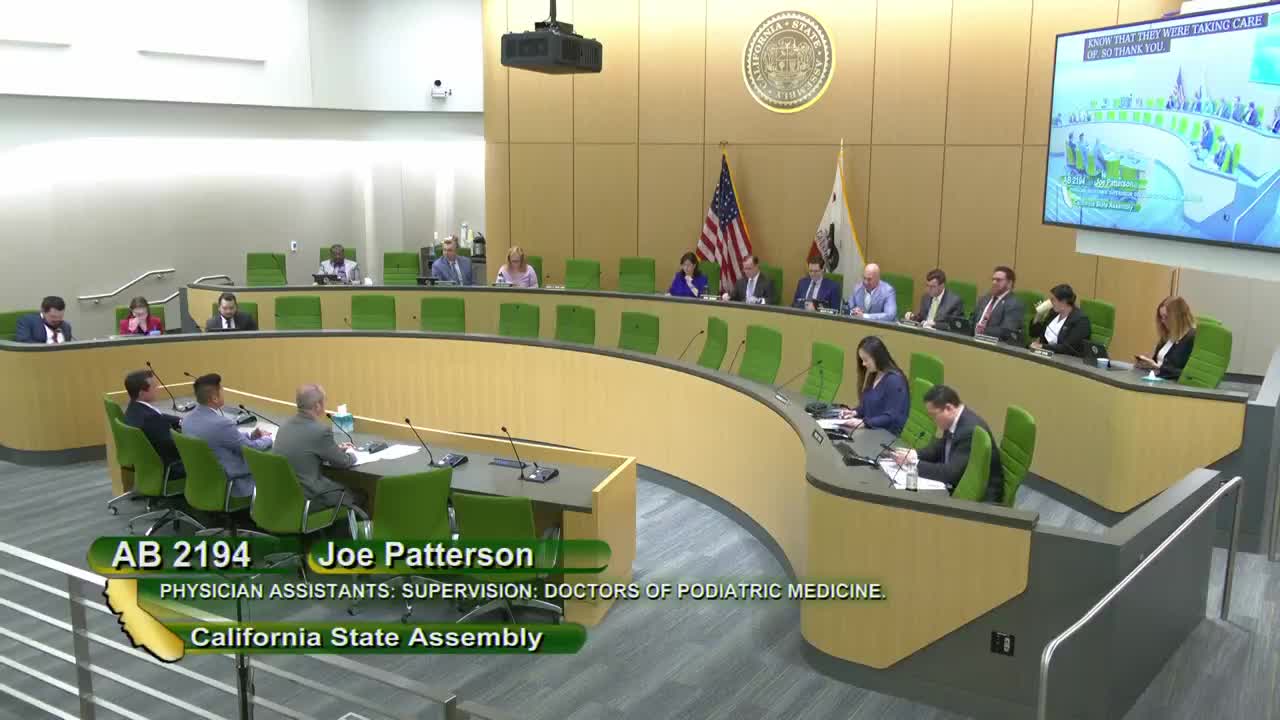 2MIN
Assembly Standing Committee on Business and Professions
47SEC
Assembly Standing Committee on Business and Professions
Bill Author

Bill Co-Author(s):