AB 3276: Tribal gaming: compact ratification.
- Session Year: 2023-2024
- House: Assembly
- Latest Version Date: 2024-09-20
Current Status:
Passed
(2024-09-20: Chaptered by Secretary of State - Chapter 319, Statutes of 2024.)
Introduced
In Committee
First Chamber
In Committee
Second Chamber
Enacted
The existing federal Indian Gaming Regulatory Act provides for the negotiation and execution of tribal-state gaming compacts for the purpose of authorizing certain types of gaming on Indian lands within a state. The California Constitution authorizes the Governor to negotiate and conclude tribal-state gaming compacts, subject to ratification by the Legislature. Existing law expressly ratifies a number of tribal-state gaming compacts, and amendments of tribal-state gaming compacts, between the State of California and specified Indian tribes.
The California Environmental Quality Act (CEQA) requires a lead agency to prepare, or cause to be prepared, and certify the completion of, an environmental impact report on a project, as defined, that it proposes to carry out or approve that may have a significant effect on the environment, as defined, or to adopt a negative declaration if it finds that the project will not have that effect.
This bill would ratify the tribal-state gaming compact entered into between the State of California and the Tule River Indian Tribe of California, executed on June 25, 2024. The bill would provide that, in deference to tribal sovereignty, certain actions related to this compact are not projects for purposes of CEQA.
This bill would declare that it is to take effect immediately as an urgency statute.
Existing law, the Mitigation Fee Act, imposes certain requirements on a local agency if the local agency requires payment of a fee, as a condition of approval of a development project, that is imposed to provide for an improvement to be constructed to serve the development project, or a fee for public improvements, as specified. In this regard, the Mitigation Fee Act requires the local agency to deposit the fee in a separate capital facilities account or fund, and to make certain information about the account or fund for the fiscal year available to the public within 180 days after the last day of each fiscal year. The Mitigation Fee Act requires this information to include, among other things, a brief description of the type of fee in the account or fund, the identification of each public improvement on which fees were expended, and the amount of fee refunds, as specified. The Mitigation Fee Act also requires a local agency to provide a person paying the fee a link to the page on the local agencys internet website where this information is available for review.This bill, if a local agency has an internet website, on or before the last day of the 202930 fiscal year and on or before the last day of every 5th fiscal year thereafter, would additionally require the local agency to post this information with respect to each separate account or fund, established as described above, for the preceding 5 years on the local agencys internet website. By imposing new duties on local agencies, this bill would impose a state-mandated local program.The California Constitution requires the state to reimburse local agencies and school districts for certain costs mandated by the state. Statutory provisions establish procedures for making that reimbursement.This bill would provide that no reimbursement is required by this act for a specified reason.Existing law, the Mitigation Fee Act, imposes certain requirements on a local agency that imposes if the local agency requires payment of a fee fee, as a condition of approval of a development project project, that is imposed to provide for an improvement to be constructed to serve the development project, or a fee for public improvements, as specified. In this regard, the Mitigation Fee Act requires the local agency to deposit the fee in a separate capital facilities account or fund, and to make certain information about the account or fund for the fiscal year available to the public within 180 days after the last day of each fiscal year. The Mitigation Fee Act requires that this information to include, among other things, a brief description of the type of fee in the account or fund, the identification of each public improvement on which fees were expended, and the amount of fee refunds, as specified. The Mitigation Fee Act also requires a local agency to provide a person paying the fee a link to the page on the local agencys internet website where this information is available for review.
This bill, if a local agency has an internet website, on or before the last day of the 202930 fiscal year and on or before the last day of every 5th fiscal year thereafter, would additionally require a the local agency to post this information with respect to each separate account or fund, established as described above, for the preceding 5 years on the local agencys internet website. By imposing new duties on local agencies, this bill would impose a state-mandated local program.
The California Constitution requires the state to reimburse local agencies and school districts for certain costs mandated by the state. Statutory provisions establish procedures for making that reimbursement.
This bill would provide that no reimbursement is required by this act for a specified reason.
Existing law, the Mitigation Fee Act, imposes certain requirements on a local agency that imposes a fee as a condition of approval of a development project that is imposed to provide for an improvement to be constructed to serve the development project, or a fee for public improvements, as specified. In this regard, the Mitigation Fee Act requires the local agency to deposit the fee in a separate capital facilities account or fund, and to make certain information about the account or fund for the fiscal year available to the public within 180 days after the last day of each fiscal year. The Mitigation Fee Act requires that information to include, among other things, a brief description of the type of fee in the account or fund, the identification of each public improvement on which fees were expended, and the amount of fee refunds, as specified.
This bill, on or before the last day of the 202930 fiscal year and on or before the last day of every 5th fiscal year thereafter, would additionally require a local agency to post this information with respect to each separate account or fund, established as described above, for the preceding 5 years on the local agencys internet website. By imposing new duties on local agencies, this bill would impose a state-mandated local program.
The California Constitution requires the state to reimburse local agencies and school districts for certain costs mandated by the state. Statutory provisions establish procedures for making that reimbursement.
This bill would provide that no reimbursement is required by this act for a specified reason.
Existing property tax law defines property to include all matters and things, real, personal, and mixed, that are capable of private ownership.This bill would make nonsubstantive changes to this provision.Existing property tax law defines property to include all matters and things, real, personal, and mixed, that are capable of private ownership.
This bill would make nonsubstantive changes to this provision.
(a)The tribal-state gaming compact entered into in accordance with the federal Indian Gaming Regulatory Act of 1988 (18 U.S.C. Secs. 1166 to 1168, inclusive, and 25 U.S.C. Sec. 2701 et seq.) between the State of California and the Tule River Indian Tribe of California, executed on June 25, 2024, is hereby ratified.
(b)(1)In deference to tribal sovereignty, none of the following shall be deemed a project for purposes of the California Environmental Quality Act (Division 13 (commencing with Section 21000) of the Public Resources Code):
(A)The execution of the tribal-state gaming compact ratified by this section.
(B)The execution of an amendment to the tribal-state gaming compact ratified by this section.
(C)The execution of an intergovernmental agreement between the tribe and a county or city government negotiated pursuant to the express authority of, or as expressly referenced in, the tribal-state gaming compact ratified by this section.
(D)The execution of an intergovernmental agreement between the tribe and the Department of Transportation, or other state agency, negotiated pursuant to the express authority of, or as expressly referenced in, the tribal-state gaming compact ratified by this section.
(E)The on-reservation impacts of compliance with the terms of the tribal-state gaming compact ratified by this section.
(2)Except as expressly provided in this section, this subdivision does not exempt a city, county, or city and county, or the Department of Transportation, or any state agency or local jurisdiction, from the requirements of the California Environmental Quality Act.
SEC. 2.This act is an urgency statute necessary for the immediate preservation of the public peace, health, or safety within the meaning of Article IV of the California Constitution and shall go into immediate effect. The facts constituting the necessity are:
In order to enhance the economic development, stability, and self-sufficiency of the Tule River Indian Tribe of California, and to protect the interests of the tribe and its members, the surrounding communities, and the California public at the earliest possible time, it is necessary that this act take effect immediately.
SECTION 1.Section 66006 of the Government Code is amended to read:66006.(a)If a local agency requires the payment of a fee specified in subdivision (c) in connection with the approval of a development project, the local agency receiving the fee shall deposit it with the other fees for the improvement in a separate capital facilities account or fund in a manner to avoid any commingling of the fees with other revenues and funds of the local agency, except for temporary investments, and expend those fees solely for the purpose for which the fee was collected. Any interest income earned by moneys in the capital facilities account or fund shall also be deposited in that account or fund and shall be expended only for the purpose for which the fee was originally collected.(b)(1)For each separate account or fund established pursuant to subdivision (a), the local agency shall, within 180 days after the last day of each fiscal year, make available to the public the following information for the fiscal year:(A)A brief description of the type of fee in the account or fund.(B)The amount of the fee.(C)The beginning and ending balance of the account or fund.(D)The amount of the fees collected and the interest earned.(E)An identification of each public improvement on which fees were expended and the amount of the expenditures on each improvement, including the total percentage of the cost of the public improvement that was funded with fees.(F)(i)An identification of an approximate date by which the construction of the public improvement will commence if the local agency determines that sufficient funds have been collected to complete financing on an incomplete public improvement, as identified in paragraph (2) of subdivision (a) of Section 66001, and the public improvement remains incomplete.(ii)An identification of each public improvement identified in a previous report pursuant to clause (i) and whether construction began on the approximate date noted in the previous report.(iii)For a project identified pursuant to clause (ii) for which construction did not commence by the approximate date provided in the previous report, the reason for the delay and a revised approximate date that the local agency will commence construction.(G)A description of each interfund transfer or loan made from the account or fund, including the public improvement on which the transferred or loaned fees will be expended, and, in the case of an interfund loan, the date on which the loan will be repaid, and the rate of interest that the account or fund will receive on the loan.(H)The amount of refunds made pursuant to subdivision (e) of Section 66001, the number of persons or entities identified to receive those refunds, and any allocations pursuant to subdivision (f) of Section 66001.(2)The local agency shall review the information made available to the public pursuant to paragraph (1) at the next regularly scheduled public meeting not less than 15 days after this information is made available to the public, as required by this subdivision. Notice of the time and place of the meeting, including the address where this information may be reviewed, shall be mailed, at least 15 days prior to the meeting, to any interested party who files a written request with the local agency for mailed notice of the meeting. Any written request for mailed notices shall be valid for one year from the date on which it is filed unless a renewal request is filed. Renewal requests for mailed notices shall be filed on or before April 1 of each year. The legislative body may establish a reasonable annual charge for sending notices based on the estimated cost of providing the service.(c)For purposes of this section, fee means any fee imposed to provide for an improvement to be constructed to serve a development project, or which is a fee for public improvements within the meaning of subdivision (b) of Section 66000, and that is imposed by the local agency as a condition of approving the development project.(d)Any person may request an audit of any local agency fee or charge that is subject to Section 66023, including fees or charges of school districts, in accordance with that section.(e)(1)A local agency shall inform a person paying a fee subject to this section of both of the following:(A)The persons right to request an audit pursuant to Section 66023.(B)The persons right, pursuant to paragraph (1) of subdivision (b), to file a written request for mailed notice of the local agencys meeting to review the information made public pursuant to paragraph (1) of subdivision (b).(2)A local agency shall provide a person paying a fee subject to this section a link to the page on the local agencys internet website where the information made public pursuant to paragraph (1) of subdivision (b) is available for review.(f)The Legislature finds and declares that untimely or improper allocation of development fees hinders economic growth and is, therefore, a matter of statewide interest and concern. It is, therefore, the intent of the Legislature that this section shall supersede all conflicting local laws and shall apply in charter cities.(g)At the time the local agency imposes a fee for public improvements on a specific development project, it shall identify the public improvement that the fee will be used to finance.(h)If the local agency has an internet website, for each separate account or fund established pursuant to subdivision (a), on or before the last day of the 202930 fiscal year, and on or before the last day of each fifth fiscal year thereafter, the local agency shall post on its internet website the information described in paragraph (1) of subdivision (b) for the preceding five years.SEC. 2.No reimbursement is required by this act pursuant to Section 6 of Article XIIIB of the California Constitution because a local agency or school district has the authority to levy service charges, fees, or assessments sufficient to pay for the program or level of service mandated by this act, within the meaning of Section 17556 of the Government Code.(a)If a local agency requires the payment of a fee specified in subdivision (c) in connection with the approval of a development project, the local agency receiving the fee shall deposit it with the other fees for the improvement in a separate capital facilities account or fund in a manner to avoid any commingling of the fees with other revenues and funds of the local agency, except for temporary investments, and expend those fees solely for the purpose for which the fee was collected. Any interest income earned by moneys in the capital facilities account or fund shall also be deposited in that account or fund and shall be expended only for the purpose for which the fee was originally collected.
(b)(1)For each separate account or fund established pursuant to subdivision (a), the local agency shall, within 180 days after the last day of each fiscal year, make available to the public the following information for the fiscal year:
(A)A brief description of the type of fee in the account or fund.
(B)The amount of the fee.
(C)The beginning and ending balance of the account or fund.
(D)The amount of the fees collected and the interest earned.
(E)An identification of each public improvement on which fees were expended and the amount of the expenditures on each improvement, including the total percentage of the cost of the public improvement that was funded with fees.
(F)(i)An identification of an approximate date by which the construction of the public improvement will commence if the local agency determines that sufficient funds have been collected to complete financing on an incomplete public improvement, as identified in paragraph (2) of subdivision (a) of Section 66001, and the public improvement remains incomplete.
(ii)An identification of each public improvement identified in a previous report pursuant to clause (i) and whether construction began on the approximate date noted in the previous report.
(iii)For a project identified pursuant to clause (ii) for which construction did not commence by the approximate date provided in the previous report, the reason for the delay and a revised approximate date that the local agency will commence construction.
(G)A description of each interfund transfer or loan made from the account or fund, including the public improvement on which the transferred or loaned fees will be expended, and, in the case of an interfund loan, the date on which the loan will be repaid, and the rate of interest that the account or fund will receive on the loan.
(H)The amount of refunds made pursuant to subdivision (e) of Section 66001, the number of persons or entities identified to receive those refunds, and any allocations pursuant to subdivision (f) of Section 66001.
(2)The local agency shall review the information made available to the public pursuant to paragraph (1) at the next regularly scheduled public meeting not less than 15 days after this information is made available to the public, as required by this subdivision. Notice of the time and place of the meeting, including the address where this information may be reviewed, shall be mailed, at least 15 days prior to the meeting, to any interested party who files a written request with the local agency for mailed notice of the meeting. Any written request for mailed notices shall be valid for one year from the date on which it is filed unless a renewal request is filed. Renewal requests for mailed notices shall be filed on or before April 1 of each year. The legislative body may establish a reasonable annual charge for sending notices based on the estimated cost of providing the service.
(c)For purposes of this section, fee means any fee imposed to provide for an improvement to be constructed to serve a development project, or which is a fee for public improvements within the meaning of subdivision (b) of Section 66000, and that is imposed by the local agency as a condition of approving the development project.
(d)Any person may request an audit of any local agency fee or charge that is subject to Section 66023, including fees or charges of school districts, in accordance with that section.
(e)(1)A local agency shall inform a person paying a fee subject to this section of both of the following:
(A)The persons right to request an audit pursuant to Section 66023.
(B)The persons right, pursuant to paragraph (1) of subdivision (b), to file a written request for mailed notice of the local agencys meeting to review the information made public pursuant to paragraph (1) of subdivision (b).
(2)A local agency shall provide a person paying a fee subject to this section a link to the page on the local agencys internet website where the information made public pursuant to paragraph (1) of subdivision (b) is available for review.
(f)The Legislature finds and declares that untimely or improper allocation of development fees hinders economic growth and is, therefore, a matter of statewide interest and concern. It is, therefore, the intent of the Legislature that this section shall supersede all conflicting local laws and shall apply in charter cities.
(g)At the time the local agency imposes a fee for public improvements on a specific development project, it shall identify the public improvement that the fee will be used to finance.
(h)For If the local agency has an internet website, for each separate account or fund established pursuant to subdivision (a), on or before the last day of the 202930 fiscal year, and on or before the last day of each fifth fiscal year thereafter, the local agency shall post on its internet website the information described in paragraph (1) of subdivision (b) for the preceding five years.
SEC. 2.No reimbursement is required by this act pursuant to Section 6 of Article XIIIB of the California Constitution because a local agency or school district has the authority to levy service charges, fees, or assessments sufficient to pay for the program or level of service mandated by this act, within the meaning of Section 17556 of the Government Code.
(a)If a local agency requires the payment of a fee specified in subdivision (c) in connection with the approval of a development project, the local agency receiving the fee shall deposit it with the other fees for the improvement in a separate capital facilities account or fund in a manner to avoid any commingling of the fees with other revenues and funds of the local agency, except for temporary investments, and expend those fees solely for the purpose for which the fee was collected. Any interest income earned by moneys in the capital facilities account or fund shall also be deposited in that account or fund and shall be expended only for the purpose for which the fee was originally collected.
(b)(1)For each separate account or fund established pursuant to subdivision (a), the local agency shall, within 180 days after the last day of each fiscal year, make available to the public the following information for the fiscal year:
(A)A brief description of the type of fee in the account or fund.
(B)The amount of the fee.
(C)The beginning and ending balance of the account or fund.
(D)The amount of the fees collected and the interest earned.
(E)An identification of each public improvement on which fees were expended and the amount of the expenditures on each improvement, including the total percentage of the cost of the public improvement that was funded with fees.
(F)(i)An identification of an approximate date by which the construction of the public improvement will commence if the local agency determines that sufficient funds have been collected to complete financing on an incomplete public improvement, as identified in paragraph (2) of subdivision (a) of Section 66001, and the public improvement remains incomplete.
(ii)An identification of each public improvement identified in a previous report pursuant to clause (i) and whether construction began on the approximate date noted in the previous report.
(iii)For a project identified pursuant to clause (ii) for which construction did not commence by the approximate date provided in the previous report, the reason for the delay and a revised approximate date that the local agency will commence construction.
(G)A description of each interfund transfer or loan made from the account or fund, including the public improvement on which the transferred or loaned fees will be expended, and, in the case of an interfund loan, the date on which the loan will be repaid, and the rate of interest that the account or fund will receive on the loan.
(H)The amount of refunds made pursuant to subdivision (e) of Section 66001, the number of persons or entities identified to receive those refunds, and any allocations pursuant to subdivision (f) of Section 66001.
(2)The local agency shall review the information made available to the public pursuant to paragraph (1) at the next regularly scheduled public meeting not less than 15 days after this information is made available to the public, as required by this subdivision. Notice of the time and place of the meeting, including the address where this information may be reviewed, shall be mailed, at least 15 days prior to the meeting, to any interested party who files a written request with the local agency for mailed notice of the meeting. Any written request for mailed notices shall be valid for one year from the date on which it is filed unless a renewal request is filed. Renewal requests for mailed notices shall be filed on or before April 1 of each year. The legislative body may establish a reasonable annual charge for sending notices based on the estimated cost of providing the service.
(c)For purposes of this section, fee means any fee imposed to provide for an improvement to be constructed to serve a development project, or which is a fee for public improvements within the meaning of subdivision (b) of Section 66000, and that is imposed by the local agency as a condition of approving the development project.
(d)Any person may request an audit of any local agency fee or charge that is subject to Section 66023, including fees or charges of school districts, in accordance with that section.
(e)(1)A local agency shall inform a person paying a fee subject to this section of both of the following:
(A)The persons right to request an audit pursuant to Section 66023.
(B)The persons right, pursuant to paragraph (1) of subdivision (b), to file a written request for mailed notice of the local agencys meeting to review the information made public pursuant to paragraph (1) of subdivision (b).
(2)A local agency shall provide a person paying a fee subject to this section a link to the page on the local agencys internet website where the information made public pursuant to paragraph (1) of subdivision (b) is available for review.
(f)The Legislature finds and declares that untimely or improper allocation of development fees hinders economic growth and is, therefore, a matter of statewide interest and concern. It is, therefore, the intent of the Legislature that this section shall supersede all conflicting local laws and shall apply in charter cities.
(g)At the time the local agency imposes a fee for public improvements on a specific development project, it shall identify the public improvement that the fee will be used to finance.
(h)For each separate account or fund established pursuant to subdivision (a), on or before the last day of the 202930 fiscal year, and on or before the last day of each fifth fiscal year thereafter, the local agency shall post on its internet website the information described in paragraph (1) of subdivision (b) for the preceding five years.
SEC. 2.No reimbursement is required by this act pursuant to Section 6 of Article XIIIB of the California Constitution because a local agency or school district has the authority to levy service charges, fees, or assessments sufficient to pay for the program or level of service mandated by this act, within the meaning of Section 17556 of the Government Code.
SECTION 1.Section 103 of the Revenue and Taxation Code is amended to read:103.Property includes all those matters and things, real, personal, and mixed, that are capable of private ownership.Property includes all those matters and things, real, personal, and mixed, that are capable of private ownership.
|
Date
|
Status
|
|---|---|
| Sep 20, 2024 | Chaptered by Secretary of State - Chapter 319, Statutes of 2024. |
| Sep 20, 2024 | Approved by the Governor. |
| Sep 3, 2024 | Enrolled and presented to the Governor at 3:30 p.m. |
| Aug 26, 2024 | Urgency clause adopted. Senate amendments concurred in. To Engrossing and Enrolling. (Ayes 77. Noes 0. Page 6571.). |
| Aug 21, 2024 | In Assembly. Concurrence in Senate amendments pending. May be considered on or after August 23 pursuant to Assembly Rule 77. |
| Aug 21, 2024 | Read third time. Urgency clause adopted. Passed. Ordered to the Assembly. (Ayes 33. Noes 0. Page 5271.). |
| Aug 14, 2024 | Read second time. Ordered to third reading. |
| Aug 13, 2024 | Withdrawn from committee. |
| Aug 13, 2024 | Ordered to second reading. |
| Aug 6, 2024 | Read second time. Ordered to third reading. |
| Aug 6, 2024 | Re-referred to Com. on RLS. |
| Aug 5, 2024 | Read third time and amended. Ordered to second reading. |
| Jun 27, 2024 | Ordered to third reading. |
| Jun 27, 2024 | From Consent Calendar. |
| Jun 25, 2024 | Read second time. Ordered to Consent Calendar. |
| Jun 24, 2024 | From committee: Be ordered to second reading file pursuant to Senate Rule 28.8 and ordered to Consent Calendar. |
| Jun 12, 2024 | Read second time and amended. Re-referred to Com. on APPR. |
| Jun 11, 2024 | From committee: Amend, and do pass as amended and re-refer to Com. on APPR with recommendation: To Consent Calendar. (Ayes 7. Noes 0.) (June 11). |
| May 29, 2024 | Referred to Com. on L. GOV. |
| May 16, 2024 | In Senate. Read first time. To Com. on RLS. for assignment. |
| May 16, 2024 | Read third time. Passed. Ordered to the Senate. (Ayes 71. Noes 0.) |
| May 9, 2024 | Read second time. Ordered to Consent Calendar. |
| May 8, 2024 | From committee: Do pass. To Consent Calendar. (Ayes 15. Noes 0.) (May 8). |
| Apr 24, 2024 | From committee: Do pass and re-refer to Com. on APPR. with recommendation: To Consent Calendar. (Ayes 9. Noes 0.) (April 24). Re-referred to Com. on APPR. |
| Apr 18, 2024 | From committee: Do pass and re-refer to Com. on H. & C.D. (Ayes 9. Noes 0.) (April 17). Re-referred to Com. on H. & C.D. |
| Apr 15, 2024 | Assembly Rule 56 suspended. (Page 4775.) |
| Apr 15, 2024 | (Pending re-refer to Com. on H. & C.D.) |
| Apr 1, 2024 | Re-referred to Com. on L. GOV. |
| Mar 21, 2024 | Referred to Coms. on L. GOV. and H. & C.D. |
| Mar 21, 2024 | From committee chair, with author's amendments: Amend, and re-refer to Com. on L. GOV. Read second time and amended. |
| Feb 17, 2024 | From printer. May be heard in committee March 18. |
| Feb 16, 2024 | Read first time. To print. |
|
Date
|
Description
|
Location
|
Votes
|
|
|---|---|---|---|---|
| Aug 26, 2024 | AB 3276 Ramos Concurrence - Urgency Added | Assembly Floor |
Passed |
|
| Aug 21, 2024 | Assembly 3rd Reading AB3276 Ramos By Hurtado Urgency Clause | Senate Floor |
Passed |
|
| Jun 11, 2024 | Do pass as amended, but first amend, and re-refer to the Committee on [Appropriations] with the recommendation: To Consent Calendar | Senate Standing Committee on Local Government |
Passed |
|
| May 16, 2024 | AB 3276 Ramos Consent Calendar Second Day Regular Session | Assembly Floor |
Passed |
|
| May 8, 2024 | Do pass. To Consent Calendar. | Assembly Standing Committee on Appropriations |
Passed |
|
| Apr 24, 2024 | Do pass and be re-referred to the Committee on [Appropriations] with recommendation: To Consent Calendar | Assembly Standing Committee on Housing and Community Development |
Passed |
|
| Apr 17, 2024 | Do pass and be re-referred to the Committee on [Housing and Community Development] | Assembly Standing Committee on Local Government |
Passed |
This list shows positions taken on this bill by organizations on the date displayed, which is linked to the original source.
Positions by individuals are not included.
|
Organization
|
Position
|
Date
|
|---|---|---|
| California Apartment Association | ** Support |
CONCURRENCE IN SENATE AMENDMENTS
CSA1 Bill Id:AB 3276
Author:(Ramos)
As Amended Ver:August 5, 2024
2/3 vote. Urgency
SUMMARY
This bill would ratify the Amended and Restated Tribal-State Compact between the State of California and the Tule River Indian Tribe of California (Tribe) was executed on June 25, 2024.
Senate Amendments
- Ratifies the Amended and Restated Tribal-State Compact between the State of California and the Tribe, executed on June 25, 2024.
- Provides that, in deference to tribal sovereignty, certain actions are not deemed projects for purposes of the California Environmental Quality Act (CEQA); and, stipulate, except as expressly provided, that none of the provisions shall be construed to exempt a city, county, or city and county, or the Department of Transportation, or any state agency or local jurisdiction, from CEQA requirements.
- Contains an urgency clause.
COMMENTS
Background:
On August 14, 2024, the Assembly Governmental Organization Committee held an informational hearing on tribal-state gaming compact between the State of California and the Tule River Indian Tribe of California.
General Compact Overview:
The Compact authorizes the Tribe to operate a maximum of 2,500 slot machines at no more than two gaming facilities, one of which shall have no more than 500 slot machines, located on eligible Indian lands held in trust for the Tribe, and located within the boundaries of the Tribe’s reservation.
The Tribe has agreed to pay the State its pro rata share of costs the State incurs for the performance of its duties under the Compact. If the Tribe operates more than 350 gaming devices at any time in a given calendar year, it shall thereafter, including in that calendar year, pay to the State Gaming Agency, for deposit into the Revenue Sharing Trust Fund (RSTF) or the Tribal Nation Grant Fund (TNGF), 6.0% of its Net Win from its operation of gaming devices in excess of 350.
Specifically, from its payments to the RSTF or the TNGF, the Tribe may take annual credits for up to 100% of the required payments, if the Tribe operates greater than or equal to 350 and less than or equal to 1,200 gaming devices; Annual credits for up to 80% of the payments required, if the Tribe operates greater than 1,200 and less than or equal to 1,800 gaming devices; Annual credits for up to 60% of the payments required, if the Tribe operates greater than 1,800 and less than or equal to 2,500) gaming devices, for in-kind contributions made to the County, local jurisdictions, and non-profit and civic organizations operating facilities or providing services within the County for improved fire, emergency medical services, law enforcement, public transit, education, tourism, health care, transit, road improvements, and other specified payments.
If the Tribe operates more than 349 slot machines the Compact requires the Tribe to pay 0.5% of Net Win to neighboring jurisdictions, public agencies, and local charitable organizations to mitigate impacts upon those entities resulting from the operation of the gaming facility, or other purposes as the Tribe may see fit, consistent with the request of a recipient.
Certain terms of the Compact related to licensing, regulatory, patron protection, and public health provisions are substantially the same as recent compacts. Specifically, the Compact includes a Tribal Labor Relations Ordinance (TLRO), which provides that gaming may commence only after the Tribe has adopted a TLRO that allows for a secret ballot election and union neutrality.
This Compact amends the Tribe's 2020 Compact (SB 869, Chapter 171) provisions relating to specified definitions contained in Sec. 2.0. (gaming employee, gaming facility, and gaming operation), removed specified environmental review and economic impacts and replaces it with local mitigation (above 349 gaming devices, the Tribe distributes 0.5% net win to local governments and charitable organizations to mitigate local impacts), scales tort provisions back to patrons and visitors, with the same $10 million liability insurance, and deletes recognition of state spousal and child support orders.
On January 7, 2020 the Tulare County Board of Supervisors approved a memorandum of understanding and intergovernmental agreement with the Tribe to address local impacts related to the relocation of the Eagle Mountain Casino to land adjacent to the Porterville Airport.
The Compact's preamble notes that the Tribe and the State have concluded that this compact protects the interests of the Tribe and its members, the surrounding community, and the California public, and will promote and secure long-term stability, mutual respect, and mutual benefit.
Once effective (legislative ratification and federal approval required), this Compact will be in full force and effect for 25 years following the effective date.
Brief History of the Tribe. The Tule River Indian Tribe of California is a federally recognized Indian Tribe located in Tulare County, California. The Tribe historically inhabited lands in Central California occupying the territory along the rivers and creeks flowing from the Sierras and around Tulare Lake. The Tribe's reservation was established in 1873 and encompasses over 90 square miles of land. Today the Tribe has approximately 2,000 members, about half of whom live on the Reservation.
Many of the stories told by the elders of the Tule River Indian Reservation have been handed down from generation to generation. Almost all of these stories reflect the ways and life of the Tule River Tribe. All of the stories however, carry a strong message to the youth and adults in the region. Significant historical facts on these stories come from Painted Rock. This is a formation located next to the Tule River on the reservation. At one time, there were many different dialects spoken amongst the original inhabitants on the Tribe's reservation. Today, some members still teach and practice their Tribe’s dialect to continue the culture.
The Tribe is governed by an elected council consisting of nine members. Members of the Tribe vote for each member. The elected officials then decide who will perform the duties of chairperson, vice chairperson, secretary and treasurer.
The Tribe operates many programs to serve its members including a health clinic, a childcare center, an adult and vocational education center, a college scholarship program, a housing authority, and a chemical dependency treatment center. The Tule River Indian Health Center is a 501 (c)(3) non-profit organization founded in 1973 and dedicated to meeting the healthcare and health education needs of the Native American communities in Tulare County. An Advisory Board composed of local tribal members from the Tribe governs the Health Center. The Tribe's Eagle Feather Trading Post is one of the largest convenience stores in Tulare County, located on Hwy 190 just above Lake Success.
It should be noted that due to water shortages on the reservation, the Tribe has had to issue a building moratorium, preventing the further construction of buildings, including homes for the 200 tribal members on the Tribe's housing waiting list.
The Tribe currently operates the new Eagle Mountain Casino near the Porterville Airport, off Highway 65. The relocated casino, which opened in May 2023, is located at 1850 West St. in Porterville, sits on 40 acres of land that was purchased by the Tribe more than 30 years ago with the hopes to relocate the original casino location — approximately 15 miles east of Porterville — to a location more accessible for local residents and employees. The relocation was made in accordance with the ratification of a new tribal-state gaming compact in 2020. The casino offers more than 1,750 slot machines, along with 20 table games. Approximately 700 employees work at the casino. The casino has four restaurants, including the Acorn Diner, and the Redwood Taphouse, which features 65 televisions and a full bar.
The completion and opening of the casino, however, is only stage one of a three-stage project. The Tribe hopes to see groundbreaking on a 250-room hotel and convention center as well as an entertainment complex. The former casino on the reservation was converted into Tribal government offices and will expand existing Tribal schools and health services to Tribal members. Some food options will also be retained for Tribal members.
Key Provisions of the Compact:
Scope of Class III Gaming Authorized. The Tribe is authorized to operate up to 2,500 slot machines, banking or percentage card games, and any devices or games that are authorized under state law to the California State Lottery, provided that the Tribe will not offer such games through use of the Internet unless others in the state not affiliated with or licensed by the California State Lottery are permitted to do so under state and federal law. The Tribe can operate off-track wagering on horse races at a satellite wagering facility pursuant to the requirements outlined in the Compact. The Tribe shall not engage in Class III gaming that is not expressly authorized in the Compact.
Authorized Gaming Facility. The Tribe may establish and operate no more than two gaming facilities, one of which shall have no more than 500 slot machines, and engage in Class III gaming only on eligible Indian lands held in trust for the Tribe, located within the boundaries of the Tribe's reservation.
Payments to the Special Distribution Fund (SDF). The Tribe shall pay to the State, on a pro rata basis, the costs the State incurs for the performance of all its duties under this Compact, as established by the monies appropriated in the annual Budget Act for the performance of their duties under the Class III gaming compacts. The Compact provides that the Tribe is eligible for a reduction or elimination of its SDF pro rata contribution if the Tribe remains a limited-gaming tribe and there are sufficient funds in the SDF.
Payments to the RSTF or the TNGF. If the Tribe operates more than 350 gaming devices at any time in a given calendar year, it shall thereafter, including in that calendar year, pay to the State Gaming Agency, for deposit into the RSTF or the TNGF, 6.0% of its Net Win from its operation of gaming devices in excess of 350.
Distribution to Local Governments. If the Tribe operates more than 349 slot machines the Compact requires the Tribe to pay 0.5% of Net Win to neighboring jurisdictions, public agencies, and local charitable organizations to mitigate impacts upon those entities resulting from the operation of the gaming facility, or other purposes as the Tribe may see fit, consistent with the request of a recipient.
Credits Applied to the RSTF or the TNGF. Specifically, from its payments to the RSTF or the TNGF, the Tribe may take annual credits for up to 100% of the required payments, if the Tribe operates greater than or equal to 350 and less than or equal to 1,200 gaming devices; Annual credits for up to 80% of the payments required, if the Tribe operates greater than 1,200 and less than or equal to 1,800 gaming devices; Annual credits for up to 60% of the payments required, if the Tribe operates greater than 1,800 and less than or equal to 2,500) gaming devices, for in-kind contributions made to the County, local jurisdictions, and non-profit and civic organizations operating facilities or providing services within the County for improved fire, emergency medical services, law enforcement, public transit, education, tourism, health care, transit, road improvements, and other specified payments.
Labor Provisions. The Tribe has entered into an agreement under the federal Labor Management Relations Act and has maintained the TLRO from its 2012 compact. Under the TLRO, if the Tribe employs 250 or more persons in a tribal casino facility, then the provisions of the TLRO become effective. The TLRO makes it clear that employees shall have the right to self-organization, to form, to join, or assist employee organizations, to bargain collectively through representatives of their own choosing. The TLRO provides for a secret ballot election and union neutrality. After verification that 30% of the eligible employees in a bargaining unit have expressed an interest in the union, a notice of election shall be issued and the election shall be concluded within 30 calendar days thereafter. Union representation requires a majority of all votes cast.
According to the Author
The Compact's preamble notes that gaming operation will celebrate its 28th anniversary in 2024, is one of the largest employers in Tulare County, and contributes revenue to fund critical tribal government services including healthcare, education, public safety, public works, social services, cultural, elder, youth and veteran's programs.
The Compact's preamble further notes that this Compact will afford the Tribe primary responsibility over the regulation of its gaming facility and will enhance the Tribe's economic development and self-sufficiency.
Arguments in Support
None on file.
Arguments in Opposition
None on file.
FISCAL COMMENTS
Unknown.
VOTES:
ASM LOCAL GOVERNMENT: 9-0-0
YES: Juan Carrillo, Waldron, Alanis, Haney, Kalra, Pacheco, Ramos, Ward, Wilson
ASM HOUSING AND COMMUNITY DEVELOPMENT: 9-0-0
YES: Ward, Joe Patterson, Grayson, Kalra, Lee, Quirk-Silva, Reyes, Sanchez, Wilson
ASM APPROPRIATIONS: 15-0-0
YES: Wicks, Sanchez, Arambula, Bryan, Calderon, Wendy Carrillo, Dixon, Mike Fong, Friedman, Haney, Hart, Jim Patterson, Pellerin, Ta, Villapudua
ASSEMBLY FLOOR: 71-0-9
YES: Aguiar-Curry, Alanis, Arambula, Bains, Bauer-Kahan, Bennett, Berman, Boerner, Bonta, Bryan, Calderon, Juan Carrillo, Wendy Carrillo, Chen, Connolly, Davies, Dixon, Essayli, Mike Fong, Friedman, Gabriel, Gallagher, Garcia, Grayson, Haney, Hart, Holden, Hoover, Jackson, Jones-Sawyer, Kalra, Lackey, Lee, Low, Lowenthal, Maienschein, McCarty, McKinnor, Muratsuchi, Stephanie Nguyen, Ortega, Pacheco, Papan, Jim Patterson, Joe Patterson, Pellerin, Petrie-Norris, Quirk-Silva, Ramos, Rendon, Reyes, Luz Rivas, Rodriguez, Blanca Rubio, Sanchez, Santiago, Schiavo, Soria, Ta, Ting, Valencia, Villapudua, Waldron, Wallis, Ward, Weber, Wicks, Wilson, Wood, Zbur, Robert Rivas
ABS, ABST OR NV: Addis, Alvarez, Cervantes, Megan Dahle, Flora, Vince Fong, Gipson, Irwin, Mathis
SENATE FLOOR: 33-0-7
YES: Allen, Alvarado-Gil, Archuleta, Ashby, Blakespear, Caballero, Cortese, Dahle, Dodd, Durazo, Eggman, Glazer, Gonzalez, Grove, Hurtado, Jones, Laird, Limón, McGuire, Min, Newman, Nguyen, Niello, Ochoa Bogh, Padilla, Portantino, Roth, Rubio, Seyarto, Stern, Umberg, Wiener, Wilk
ABS, ABST OR NV: Atkins, Becker, Bradford, Menjivar, Skinner, Smallwood-Cuevas, Wahab
UPDATED
VERSION: August 5, 2024
CONSULTANT: Eric Johnson / G.O. / (916) 319-2531 FN: 0004444
SENATE RULES COMMITTEE Office of Senate Floor Analyses (916) 651-1520 Fax: (916) 327-4478 | AB 3276 |
THIRD READING
Bill No: AB 3276
Author: Ramos (D)
Amended: 8/5/24 in Senate
Vote: 27- Urgency
SENATE LOCAL GOVERNMENT COMMITTEE: 7-0, 6/11/24
AYES: Durazo, Seyarto, Dahle, Glazer, Skinner, Wahab, Wiener
SENATE APPROPRIATIONS COMMITTEE: Senate Rule 28.8
ASSEMBLY FLOOR: 71-0, 5/16/24 (Consent) - See last page for vote
SUBJECT: Tribal gaming: compact ratification
SOURCE: Author
DIGEST:
This bill requires local agencies to post certain impact fee information on their websites by the end of the 2029-30 fiscal year for the previous five years, which it must do every five years thereafter.
Senate Floor Amendments of 8/5/24 delete the current language in the bill and instead ratify the tribal-state gaming compact between the State of California and the Tule River Indian Tribe of California, executed on June 25, 2024.
ANALYSIS:
Existing law:
- Allows local governments to require applicants for development projects to pay fees to mitigate the project’s effects, known as mitigation or development impact fees.
- Requires, under the Mitigation Fee Act, local officials that are establishing, increasing, or imposing a fee as a condition of approving a development project to:
- Identify the fee's purpose.
- Identify the fee's use, including the public facilities to be financed.
- Determine a reasonable relationship between the fee's use and the development.
- Determine a reasonable relationship between the public facility's need and the development.
- Determine a reasonable relationship between the fee's amount and the cost of the public facility.
- Hold at least one open and public meeting prior to levying a new fee or increasing an existing one.
- If they decide to adopt capital improvement plans, indicate the approximate location, size, time of availability, and estimates of cost for all facilities or improvements to be financed with the fees.
- Deposit and spend the fees within five years of collecting them.
- Refund fees or make specific findings on when and how the fees will be spent for construction, if the fees aren’t spent within five years of collection.
- Requires local agencies to deposit mitigation fees to fund a capital improvement associated with a development in a separate account or fund.
- Requires local agencies that impose mitigation fees to produce an annual report within 180 days of the end of the fiscal year that includes specified information.
- Requires a city, county, or special district that has an internet website to post and update on their websites specified information, including a current schedule of housing development project costs, zoning ordinances and development standards, annual impact fee reports, and an archive of specified impact fee nexus studies.
- Requires local agencies to conduct and adopt a nexus study prior to the adoption of an impact fee, and specified standards and practices.
- Provides that cities and counties cannot collect impact fees before they conduct the final inspection or issue a certificate of occupancy, whichever occurs first. However, utilities can collect impact fees at the time the utility receives an application for service, which can happen before a final inspection.
This bill requires a local agency that has a website to post specified information on how it spent mitigation fee revenue in each separate account or fund in which it deposits the revenue for the preceding five years on or before the last day of the 2029-30 fiscal year, and on or before the last day of each fifth fiscal year thereafter.
Comments
- Purpose of the bill. According to the author, “AB 3276 will provide communities and business with greater sense of transparency into what their local governments are spending on using the money they collected from the collection of Mitigation Fees. This bill would ensure that the people have easy access to this information and that local agencies do their due diligence to maintain a level of transparency that is expected of them by the people of California.”
- No free lunch. This bill imposes new requirements on local agencies that impose fees without any additional resources to help them comply with new requirements. Absent additional resources, local agencies may have to increase fees if they need additional resources to satisfy new requirements. So, while fees may be more transparent, they could end up higher than they were before. In the case of this bill, local agencies only have to post information online they already must make publicly available, which may not require significant additional resources. However, if a local agency must make more significant updates to its website to comply with these requirements, the agency would face more significant pressure to increase their fees.
FISCAL EFFECT: Appropriation: No Fiscal Com.: Yes Local: Yes
SUPPORT: (Verified 6/25/24)
California Apartment Association
OPPOSITION: (Verified 6/25/24)
None received
ASSEMBLY FLOOR: 71-0, 5/16/24
AYES: Aguiar-Curry, Alanis, Arambula, Bains, Bauer-Kahan, Bennett, Berman, Boerner, Bonta, Bryan, Calderon, Juan Carrillo, Wendy Carrillo, Chen, Connolly, Davies, Dixon, Essayli, Mike Fong, Friedman, Gabriel, Gallagher, Garcia, Grayson, Haney, Hart, Holden, Hoover, Jackson, Jones-Sawyer, Kalra, Lackey, Lee, Low, Lowenthal, Maienschein, McCarty, McKinnor, Muratsuchi, Stephanie Nguyen, Ortega, Pacheco, Papan, Jim Patterson, Joe Patterson, Pellerin, Petrie-Norris, Quirk-Silva, Ramos, Rendon, Reyes, Luz Rivas, Rodriguez, Blanca Rubio, Sanchez, Santiago, Schiavo, Soria, Ta, Ting, Valencia, Villapudua, Waldron, Wallis, Ward, Weber, Wicks, Wilson, Wood, Zbur, Robert Rivas
NO VOTE RECORDED: Addis, Alvarez, Cervantes, Megan Dahle, Flora, Vince Fong, Gipson, Irwin, Mathis
Prepared by: Jonathan Peterson / L. GOV. / (916) 651-4119
8/14/24 15:50:43
**** END ****
SENATE RULES COMMITTEE Office of Senate Floor Analyses (916) 651-1520 Fax: (916) 327-4478 | AB 3276 |
THIRD READING
Bill No: AB 3276
Author: Ramos (D)
Amended: 8/5/24 in Senate
Vote: 27 - Urgency
PRIOR VOTES NOT RELEVANT
NOTE: On August 13, 2024, the Senate Governmental Organization Committee held an informational hearing on the tribal-state gaming compact between the State of California and the Tule River Indian Tribe of California.
SUBJECT: Tribal gaming: compact ratification
SOURCE: Author
DIGEST:
This bill ratifies the tribal-state gaming compact between the State of California and the Tule River Indian Tribe of California (Tribe).
ANALYSIS:
Existing law:
- Provides, under the Indian Gaming Regulatory Act (IGRA), for the negotiation and conclusion of compacts between federally recognized Indian tribes and the State for the purpose of conducting Class III gaming activities on Indian lands within a State as a means of promoting tribal economic development, self-sufficiency, and strong tribal governments.
- Authorizes expressly a number of tribal-state gaming compacts between the State of California and specified Indian tribes.
- Authorizes the conduct of Class III gaming activities to the extent such activities are permitted by state law, a gaming compact has been concluded by a federally recognized tribe and the State, and the compact has been approved by the Secretary of the Interior.
- Limits the operation of Class III gaming activities to Indian lands acquired on or before October 17, 1988. Provides, for certain exceptions to conduct gaming activities on Indian lands acquired after October 17, 1988.
- Defines “Indian lands” to mean all lands within the limits of any Indian reservation, and any lands title to which is either held in trust by the United States for the benefit of any Indian tribe, or individual, or held by any Indian tribe or individual subject to restriction by the U.S. against alienation and over which an Indian tribe exercises governmental power.
- Requires the State to negotiate to conclude a compact in good faith with an Indian tribe having jurisdiction over the Indian lands upon which the Class III gaming activity is to be conducted. Provides the U.S. district courts with jurisdiction over any cause of action initiated by a tribal government alleging that the State failed to negotiate in good faith to conclude a compact. Prescribes the remedy, mediation supervised by the courts, if it is found that the State failed to negotiate in good faith to conclude a compact.
- Authorizes the Governor, under the California Constitution, to negotiate and conclude compacts, subject to ratification by the Legislature.
This bill:
- Ratifies the tribal-state gaming compact between the State of California and the Tribe.
- Provides that, in deference to tribal sovereignty, certain actions are not deemed projects for purposes of the California Environmental Quality Act (CEQA); and, stipulate, except as expressly provided, that none of the provisions shall be construed to exempt a city, county, or city and county, or the Department of Transportation, or any state agency or local jurisdiction, from CEQA requirements.
- Contains an urgency clause.
Background
- The Compact authorizes the Tribe to operate a maximum of 2,500 slot machines at no more than two gaming facilities, one of which shall have no more than 500 slot machines, located on eligible Indian lands held in trust for the Tribe, and located within the boundaries of the Tribe’s reservation.
The Tribe has agreed to pay the State its pro rata share of costs the State incurs for the performance of its duties under the Compact. If the Tribe operates more than 350 gaming devices at any time in a given calendar year, it shall thereafter, including in that calendar year, pay to the State Gaming Agency, for deposit into the Revenue Sharing Trust Fund (RSTF) or the Tribal Nation Grant Fund (TNGF), 6.0% of its Net Win from its operation of gaming devices in excess of 350.
Specifically, from its payments to the RSTF or the TNGF, the Tribe may take annual credits for up to 100% of the required payments, if the Tribe operates greater than or equal to 350 and less than or equal to 1,200 gaming devices; Annual credits for up to 80% of the payments required, if the Tribe operates greater than 1,200 and less than or equal to 1,800 gaming devices; Annual credits for up to 60% of the payments required, if the Tribe operates greater than 1,800 and less than or equal to 2,500) gaming devices, for in-kind contributions made to the County, local jurisdictions, and non-profit and civic organizations operating facilities or providing services within the County for improved fire, emergency medical services, law enforcement, public transit, education, tourism, health care, transit, road improvements, and other specified payments.
If the Tribe operates more than 349 slot machines the Compact requires the Tribe to pay 0.5% of Net Win to neighboring jurisdictions, public agencies, and local charitable organizations to mitigate impacts upon those entities resulting from the operation of the Gaming Facility, or other purposes as the Tribe may see fit, consistent with the request of a recipient.
- Certain terms of the Compact related to licensing, regulatory, patron protection, and public health provisions are substantially the same as recent compacts. Specifically, the Compact includes a Tribal Labor Relations Ordinance (TLRO), which provides that gaming may commence only after the Tribe has adopted a TLRO that allows for a secret ballot election and union neutrality.
The Compact’s preamble notes that the Tribe and the State have concluded that this compact protects the interests of the Tribe and its members, the surrounding community, and the California public, and will promote and secure long-term stability, mutual respect, and mutual benefit. The Tule River Indian Tribe of California is a federally recognized tribe in Tulare County, California. The Tule River Indian Reservation was established in 1873 and covers approximately 85,000 acres. The Tribe operates the Eagle Mountain Casino and boasts 100,000-square feet of gaming floor featuring over 1,750 new and classic slot machines, along with 20 table games.
On January 7, 2020, the Tulare County Board of Supervisors approved a memorandum of understanding (MOU) and intergovernmental agreement with the Tule River Indian Tribe to address local impacts related to the proposed relocation of the Eagle Mountain Casino to land adjacent to the Porterville Airport. Tule River Tribal Council adopted the MOU at their meeting on Dec. 30, 2019 meeting.
Under the agreement, the tribe agrees to pay $3.5 million for Sheriff’s law enforcement services, with $1 million due within 30 days of opening and rest paid in 12 quarterly payments beginning on second anniversary of opening day. The tribe also agrees to a one-time payment of $196,000 towards a fire engine and related equipment to be housed at Tulare County Fire Station 19 in Porterville. The proposed relocation project will also include a new tertiary water treatment facility and a fire station at the casino site with the capability to assist the City and County on emergency calls. If a fire station is not constructed, the tribe will make annual payments of $48,667 for fire service. The tribe will also pay an additional $550,000 per year for ongoing public safety equipment and maintenance, road maintenance and traffic control costs, and mental health services costs. The agreement also includes fair share contributions toward road projects including intersection improvements, traffic signals and roundabouts. Once effective (legislative ratification and federal approval required), this Compact will be in full force and effect for 25 years following the effective date.
- Brief History of the Tribe. The original inhabitants of the San Joaquin Valley were the Yokut-speaking tribes – about 50 dialect groups occupying the territory along the rivers and creeks flowing from the Sierras and around the Tulare Lake. Their descendants today on the Tule River Indian Reservation continue to have the goal of self-government and self-sufficiency on the land. Many of the stories told by the Elders of the Tule River Indian Tribe have been handed down from generation to generation. Almost all these stories reflect the ways and life of the Tule River Tribes. All of the stories however, carry a strong message to the youth and adults in the region.
At one time, there were many different dialects spoken amongst the original inhabitants on Tule River Indian Reservation. Today, some Tule River Tribal members still teach and practice their Tribe’s dialect to continue the culture. In the old days, basket weaving was not only a common practice but a necessity of everyday life. Today, basket weaving has been a revived skill that is practiced amongst various Tule River Tribal members.
The Tribe is governed by a nine-member council. Each member is voted for by the Tule River Tribal members. The elected officials then decide who will perform functions of Chair, Vice Chair, Secretary, and Treasurer. On January 9, 2023, the Tule River Tribe celebrated 150 years. After being uprooted twice, once from Sebastian Reservation right below Bakersfield, and then from Madden Farm in East Porterville, the Tribe found a home on the Tule River Reservation. The Tribe operates the Eagle Mountain Casino and boasts 100,000-square feet of gaming floor featuring over 1,750 new and classic slot machines, along with 20 table games. The casino includes the Shōkanas Gift Shop with a wide selection of native merchandise.
According to the tribal casino internet website, the “Tule River Indian Tribe of California is a proud sovereign nation that is committed to improving the livelihood of its members and surrounding communities through culture and economic development. The tribe has a rich cultural history that it strives to preserve and maintain. They work to ensure that their traditions, customs, and beliefs are passed down to future generations, helping to keep their community strong and connected. The Tule River Indian Tribe’s dedication to their community and heritage is a testament to their resilience and strength as a sovereign nation.”
- Scope of Class III Gaming Authorized. The Tribe is authorized to operate up to 2,500 slot machines, banking or percentage card games, and any devices or games that are authorized under state law to the California State Lottery, provided that the Tribe will not offer such games through use of the Internet unless others in the state not affiliated with or licensed by the California State Lottery are permitted to do so under state and federal law. The Tribe can operate off-track wagering on horse races at a satellite wagering facility pursuant to the requirements outlined in the Compact. The Tribe shall not engage in Class III Gaming that is not expressly authorized in the Compact.
- Authorized Gaming Facility. The Tribe may establish and operate no more than two gaming facilities, one of which shall have no more than 500 slot machines, and engage in Class III gaming only on eligible Indian lands held in trust for the Tribe, located within the boundaries of the Tribe’s reservation.
- Payments to the Special Distribution Fund (SDF). The Tribe shall pay to the State, on a pro rata basis, the costs the State incurs for the performance of all its duties under this Compact, as established by the monies appropriated in the annual Budget Act for the performance of their duties under the Class III Gaming Compacts. The Compact provides that the Tribe is eligible for a reduction or elimination of its SDF pro rata contribution if the Tribe remains a limited-gaming tribe and there are sufficient funds in the SDF.
- Payments to the RSTF or the TNGF. If the Tribe operates more than 350 gaming devices at any time in a given calendar year, it shall thereafter, including in that calendar year, pay to the State Gaming Agency, for deposit into the Revenue Sharing Trust Fund or the Tribal Nation Grant Fund, 6.0% of its Net Win from its operation of gaming devices in excess of 350.
- Distribution to Local Governments. If the Tribe operates more than 349 slot machines the Compact requires the Tribe to pay 0.5% of Net Win to neighboring jurisdictions, public agencies, and local charitable organizations to mitigate impacts upon those entities resulting from the operation of the Gaming Facility, or other purposes as the Tribe may see fit, consistent with the request of a recipient.
- Credits Applied to the RSTF or the TNGF. Specifically, from its payments to the RSTF or the TNGF, the Tribe may take annual credits for up to 100% of the required payments, if the Tribe operates greater than or equal to 350 and less than or equal to 1,200 gaming devices; Annual credits for up to 80% of the payments required, if the Tribe operates greater than 1,200 and less than or equal to 1,800 gaming devices; Annual credits for up to 60% of the payments required, if the Tribe operates greater than 1,800 and less than or equal to 2,500) gaming devices, for in-kind contributions made to the County, local jurisdictions, and non-profit and civic organizations operating facilities or providing services within the County for improved fire, emergency medical services, law enforcement, public transit, education, tourism, health care, transit, road improvements, and other specified payments.
- Labor Provisions. The Tribe has entered into an agreement under the federal Labor Management Relations Act and has maintained the TLRO from its 2012 compact. Under the TLRO, if the tribe employs 250 or more persons in a tribal casino facility, then the provisions of the TLRO become effective. The TLRO makes it clear that employees shall have the right to self-organization, to form, to join, or assist employee organizations, to bargain collectively through representatives of their own choosing. The TLRO provides for a secret ballot election and union neutrality. After verification that 30% of the eligible employees in a bargaining unit have expressed an interest in the union, a notice of election shall be issued and the election shall be concluded within 30 calendar days thereafter. Union representation requires a majority of all votes cast.
FISCAL EFFECT: Appropriation: No Fiscal Com.: Yes Local: No
SUPPORT: (Verified 8/13/24)
None received
OPPOSITION: (Verified 8/13/24)
None received
Prepared by: Felipe Lopez / G.O. / (916) 651-1530
8/13/24 16:25:22
**** END ****
SENATE RULES COMMITTEE Office of Senate Floor Analyses (916) 651-1520 Fax: (916) 327-4478 | AB 3276 |
THIRD READING
Bill No: AB 3276
Author: Ramos (D)
Amended: 6/12/24 in Senate
Vote: 21
SENATE LOCAL GOVERNMENT COMMITTEE: 7-0, 6/11/24
AYES: Durazo, Seyarto, Dahle, Glazer, Skinner, Wahab, Wiener
SENATE APPROPRIATIONS COMMITTEE: Senate Rule 28.8
ASSEMBLY FLOOR: 71-0, 5/16/24 (Consent) - See last page for vote
SUBJECT: Mitigation Fee Act: reports
SOURCE: Author
DIGEST:
This bill requires local agencies to post certain impact fee information on their websites by the end of the 2029-30 fiscal year for the previous five years, which it must do every five years thereafter.
ANALYSIS:
Existing law:
- Allows local governments to require applicants for development projects to pay fees to mitigate the project’s effects, known as mitigation or development impact fees.
- Requires, under the Mitigation Fee Act, local officials that are establishing, increasing, or imposing a fee as a condition of approving a development project to:
- Identify the fee's purpose.
- Identify the fee's use, including the public facilities to be financed.
- Determine a reasonable relationship between the fee's use and the development.
- Determine a reasonable relationship between the public facility's need and the development.
- Determine a reasonable relationship between the fee's amount and the cost of the public facility.
- Hold at least one open and public meeting prior to levying a new fee or increasing an existing one.
- If they decide to adopt capital improvement plans, indicate the approximate location, size, time of availability, and estimates of cost for all facilities or improvements to be financed with the fees.
- Deposit and spend the fees within five years of collecting them.
- Refund fees or make specific findings on when and how the fees will be spent for construction, if the fees aren’t spent within five years of collection.
- Requires local agencies to deposit mitigation fees to fund a capital improvement associated with a development in a separate account or fund.
- Requires local agencies that impose mitigation fees to produce an annual report within 180 days of the end of the fiscal year that includes specified information.
- Requires a city, county, or special district that has an internet website to post and update on their websites specified information, including a current schedule of housing development project costs, zoning ordinances and development standards, annual impact fee reports, and an archive of specified impact fee nexus studies.
- Requires local agencies to conduct and adopt a nexus study prior to the adoption of an impact fee, and specified standards and practices.
- Provides that cities and counties cannot collect impact fees before they conduct the final inspection or issue a certificate of occupancy, whichever occurs first. However, utilities can collect impact fees at the time the utility receives an application for service, which can happen before a final inspection.
This bill requires a local agency that has a website to post specified information on how it spent mitigation fee revenue in each separate account or fund in which it deposits the revenue for the preceding five years on or before the last day of the 2029-30 fiscal year, and on or before the last day of each fifth fiscal year thereafter.
Comments
- Purpose of the bill. According to the author, “AB 3276 will provide communities and business with greater sense of transparency into what their local governments are spending on using the money they collected from the collection of Mitigation Fees. This bill would ensure that the people have easy access to this information and that local agencies do their due diligence to maintain a level of transparency that is expected of them by the people of California.”
- No free lunch. This bill imposes new requirements on local agencies that impose fees without any additional resources to help them comply with new requirements. Absent additional resources, local agencies may have to increase fees if they need additional resources to satisfy new requirements. So, while fees may be more transparent, they could end up higher than they were before. In the case of this bill, local agencies only have to post information online they already must make publicly available, which may not require significant additional resources. However, if a local agency must make more significant updates to its website to comply with these requirements, the agency would face more significant pressure to increase their fees.
FISCAL EFFECT: Appropriation: No Fiscal Com.: Yes Local: Yes
SUPPORT: (Verified 6/25/24)
California Apartment Association
OPPOSITION: (Verified 6/25/24)
None received
ASSEMBLY FLOOR: 71-0, 5/16/24
AYES: Aguiar-Curry, Alanis, Arambula, Bains, Bauer-Kahan, Bennett, Berman, Boerner, Bonta, Bryan, Calderon, Juan Carrillo, Wendy Carrillo, Chen, Connolly, Davies, Dixon, Essayli, Mike Fong, Friedman, Gabriel, Gallagher, Garcia, Grayson, Haney, Hart, Holden, Hoover, Jackson, Jones-Sawyer, Kalra, Lackey, Lee, Low, Lowenthal, Maienschein, McCarty, McKinnor, Muratsuchi, Stephanie Nguyen, Ortega, Pacheco, Papan, Jim Patterson, Joe Patterson, Pellerin, Petrie-Norris, Quirk-Silva, Ramos, Rendon, Reyes, Luz Rivas, Rodriguez, Blanca Rubio, Sanchez, Santiago, Schiavo, Soria, Ta, Ting, Valencia, Villapudua, Waldron, Wallis, Ward, Weber, Wicks, Wilson, Wood, Zbur, Robert Rivas
NO VOTE RECORDED: Addis, Alvarez, Cervantes, Megan Dahle, Flora, Vince Fong, Gipson, Irwin, Mathis
Prepared by: Jonathan Peterson / L. GOV. / (916) 651-4119
6/27/24 15:38:58
**** END ****
SENATE RULES COMMITTEE Office of Senate Floor Analyses (916) 651-1520 Fax: (916) 327-4478 | AB 3276 |
CONSENT
Bill No: AB 3276
Author: Ramos (D)
Amended: 6/12/24 in Senate
Vote: 21
SENATE LOCAL GOVERNMENT COMMITTEE: 7-0, 6/11/24
AYES: Durazo, Seyarto, Dahle, Glazer, Skinner, Wahab, Wiener
SENATE APPROPRIATIONS COMMITTEE: Senate Rule 28.8
ASSEMBLY FLOOR: 71-0, 5/16/24 (Consent) - See last page for vote
SUBJECT: Mitigation Fee Act: reports
SOURCE: Author
DIGEST:
This bill requires local agencies to post certain impact fee information on their websites by the end of the 2029-30 fiscal year for the previous five years, which it must do every five years thereafter.
Existing law:
- Allows local governments to require applicants for development projects to pay fees to mitigate the project’s effects, known as mitigation or development impact fees.
- Requires, under the Mitigation Fee Act, local officials that are establishing, increasing, or imposing a fee as a condition of approving a development project to:
- Identify the fee's purpose.
- Identify the fee's use, including the public facilities to be financed.
- Determine a reasonable relationship between the fee's use and the development.
- Determine a reasonable relationship between the public facility's need and the development.
- Determine a reasonable relationship between the fee's amount and the cost of the public facility.
- Hold at least one open and public meeting prior to levying a new fee or increasing an existing one.
- If they decide to adopt capital improvement plans, indicate the approximate location, size, time of availability, and estimates of cost for all facilities or improvements to be financed with the fees.
- Deposit and spend the fees within five years of collecting them.
- Refund fees or make specific findings on when and how the fees will be spent for construction, if the fees aren’t spent within five years of collection.
- Requires local agencies to deposit mitigation fees to fund a capital improvement associated with a development in a separate account or fund.
- Requires local agencies that impose mitigation fees to produce an annual report within 180 days of the end of the fiscal year that includes specified information.
- Requires a city, county, or special district that has an internet website to post and update on their websites specified information, including a current schedule of housing development project costs, zoning ordinances and development standards, annual impact fee reports, and an archive of specified impact fee nexus studies.
- Requires local agencies to conduct and adopt a nexus study prior to the adoption of an impact fee, and specified standards and practices.
- Provides that cities and counties cannot collect impact fees before they conduct the final inspection or issue a certificate of occupancy, whichever occurs first. However, utilities can collect impact fees at the time the utility receives an application for service, which can happen before a final inspection.
This bill requires a local agency that has a website to post specified information on how it spent mitigation fee revenue in each separate account or fund in which it deposits the revenue for the preceding five years on or before the last day of the 2029-30 fiscal year, and on or before the last day of each fifth fiscal year thereafter.
ANALYSIS:
- Purpose of the bill. According to the author, “AB 3276 will provide communities and business with greater sense of transparency into what their local governments are spending on using the money they collected from the collection of Mitigation Fees. This bill would ensure that the people have easy access to this information and that local agencies do their due diligence to maintain a level of transparency that is expected of them by the people of California.”
- No free lunch. This bill imposes new requirements on local agencies that impose fees without any additional resources to help them comply with new requirements. Absent additional resources, local agencies may have to increase fees if they need additional resources to satisfy new requirements. So, while fees may be more transparent, they could end up higher than they were before. In the case of AB 3276, local agencies only have to post information online they already must make publicly available, which may not require significant additional resources. However, if a local agency must make more significant updates to its website to comply with these requirements, the agency would face more significant pressure to increase their fees.
FISCAL EFFECT: Appropriation: No Fiscal Com.: Yes Local: Yes
SUPPORT: (Verified 6/25/24)
California Apartment Association
OPPOSITION: (Verified 6/25/24)
None received
ASSEMBLY FLOOR: 71-0, 5/16/24
AYES: Aguiar-Curry, Alanis, Arambula, Bains, Bauer-Kahan, Bennett, Berman, Boerner, Bonta, Bryan, Calderon, Juan Carrillo, Wendy Carrillo, Chen, Connolly, Davies, Dixon, Essayli, Mike Fong, Friedman, Gabriel, Gallagher, Garcia, Grayson, Haney, Hart, Holden, Hoover, Jackson, Jones-Sawyer, Kalra, Lackey, Lee, Low, Lowenthal, Maienschein, McCarty, McKinnor, Muratsuchi, Stephanie Nguyen, Ortega, Pacheco, Papan, Jim Patterson, Joe Patterson, Pellerin, Petrie-Norris, Quirk-Silva, Ramos, Rendon, Reyes, Luz Rivas, Rodriguez, Blanca Rubio, Sanchez, Santiago, Schiavo, Soria, Ta, Ting, Valencia, Villapudua, Waldron, Wallis, Ward, Weber, Wicks, Wilson, Wood, Zbur, Robert Rivas
NO VOTE RECORDED: Addis, Alvarez, Cervantes, Megan Dahle, Flora, Vince Fong, Gipson, Irwin, Mathis
Prepared by: Jonathan Peterson / L. GOV. / (916) 651-4119
6/26/24 13:53:48
**** END ****
SENATE COMMITTEE ON LOCAL GOVERNMENT
Senator María Elena Durazo, Chair
2023 - 2024 Regular
Bill No: | AB 3276 | Hearing Date: | 6/11/24 |
Author: | Ramos | Fiscal: | Yes |
Version: | 3/21/24 | Consultant: | Peterson |
Mitigation Fee Act: reports
Requires local agencies to post certain impact fee information on their websites by the end of the 2029-30 fiscal year for the previous five years, which it must do every five years thereafter.
Background
Local government finance after Proposition 13. A series of propositions have drastically cut into local revenue sources, requiring local governments to look elsewhere to fund services that the public demands. First, Proposition 13 (1978) capped property tax rates at 1% of assessed value (which only changes upon new construction or when ownership changes) and required 2/3 voter approval for special taxes; as a result local governments turned to general taxes to avoid the higher voter threshold. When Proposition 62 (1986) required majority voter approval of general taxes, local agencies imposed assessments that were more closely tied to the benefit that an individual property owner receives. Subsequently, Proposition 218 (1996) required voter approval of parcel taxes, assessments, and property-related fees.
In response to the reduction in property tax revenues from Proposition 13 and the difficulty of raising taxes, local agencies have turned to other sources of funds for general operations, including sales taxes and transient occupancy taxes, also known as hotel taxes. Commercial enterprises generate sales tax and hotel tax revenue, and simultaneously pay property taxes and demand relatively few services (such as public safety or parks). Residential developments, by contrast, do not directly generate sales or hotel tax revenue, and the new residents demand a wider variety of more intensive services. As a result, cities and counties face a disincentive to approve housing because of the higher net fiscal cost of residential development, particularly if they have the option to instead permit commercial development that may produce net fiscal benefits, also known as the fiscalization of land use.
Since they cannot impose broad-based taxes without great difficulty, cities and counties follow a simple principle: new developments should pay for the impacts they have on the community and the burden they impose on public services.
Mitigation Fee Act. When approving development projects, counties and cities can require the applicants to mitigate the project's effects by paying fees—known as mitigation fees, impact fees, or developer fees. The California courts have upheld impact fees for sidewalks, parks, school construction, and many other public purposes.
When establishing, increasing, or imposing a fee as a condition of approving a development project, the Mitigation Fee Act requires local officials to:
- Identify the fee’s purpose;
- Identify the fee’s use, including the public facilities to be financed;
- Determine a reasonable relationship between the fee’s use and the development; and
- Determine a reasonable relationship between the public facility’s need and the development.
When imposing a fee as a condition of approving a development project, the Mitigation Fee Act also requires local officials to determine a reasonable relationship between the fee’s amount and the cost of the public facility. In its 1987 Nollan decision, the U.S. Supreme Court said there must be an “essential nexus” between a project's impacts and the conditions for approval. In the 1994 Dolan decision, the U.S. Supreme Court said that conditions on development must have a "rough proportionality" to a project's impacts.
In the 1996 Ehrlich decision, the California Supreme Court distinguished between “legislatively enacted” conditions that apply to all projects and “ad hoc” conditions imposed on a project-by- project basis. Ehrlich applied the “essential nexus” test from Nollan and the “rough proportionality” test from Dolan to “ad hoc’ conditions. The Court did not apply the Nollan and Dolan tests to the conditions that were “legislatively enacted.” In other words, local officials face greater scrutiny when they impose conditions on a project-by-project basis.
As a result of these decisions and the Mitigation Fee Act, local agencies must conduct a nexus study to ensure any proposed impact fees meet these legal tests for most impact fees. Other requirements in the Mitigation Fee Act ensure that impact fees are appropriately levied and spent, including that a local agency must:
- Hold at least one open and public meeting prior to levying a new fee or increasing an existing one;
- If it decides to adopt capital improvement plans, indicate the approximate location, size, time of availability, and estimates of cost for all facilities or improvements to be financed with the fees;
- Deposit and spend the fees within five years of collecting them; and
- Refund fees or make specific findings on when and how the fees will be spent for construction, if the fees are not spent within five years of collection.
If a local agency levies an impact fee to fund a capital improvement associated with a development, it must deposit the fees with any other fees for that improvement in a separate account or fund.
Local officials must also produce an annual report within 180 days of the end of the fiscal year that includes information on the fee amounts, how they used the revenue, and any unspent funds, broken up by each separate fund. The local agency must review this information at the next regularly scheduled public meeting at least 15 days from when it makes the information available to public. It must also provide notice to the public at least 15 days prior to the meeting.
Impact fee audit requirements. Any person may request an independent audit of how the impact fees have been collected and spent, including an assessment of whether the fees exceed the amount reasonably necessary to cover the costs of the stated projects or services. If a person makes that request, the local agency retains an independent auditor to conduct the audit, provided that an audit has not been performed on the same fee within the previous 12 months and the requestor deposits funds necessary to cover the estimated cost for the audit with the local agency. A local agency must adjust its fees if the audit finds that the fees are set too high.
Impact fee transparency legislation. To increase transparency around impact fees, the Legislature enacted AB 1483 (Grayson, 2019). AB 1483 requires cities and counties to post specified housing-related information on their web sites and requires HCD to establish a workgroup, as specified, to develop a strategy for state housing data.
AB 1483 also requires a city, county, or special district that has an internet website to post on their websites the following information, as applicable:
- A current schedule of mitigation fees, exactions, and affordability requirements imposed by the city, county, or special district, including any dependent special districts of the city or county, applicable to a housing development project, in a manner that clearly identifies the fees that apply to each parcel.
- All zoning ordinances and development standards, including which standards apply to each parcel.
- A list that cities and counties must develop under existing law of projects located within military use airspace or low-level flight path.
- The current and five previous annual fee reports or the current and five previous annual financial reports that local agencies must compile under to existing law.
- An archive of impact fee nexus studies, cost of service studies, or equivalent, conducted by the city, county, or special district on or after January 1, 2018.
A city, county, or special district must update this information on their website within 30 days of any change. The measure also required cities and counties to request the total amount of fees and exactions associated with the project from a developer after construction, but the developer does not have to respond. The city or county must post this information on its internet website, and update it at least twice per year.
Nexus studies. Subsequently, AB 602 (Grayson, 2021) added new impact fee requirements. This bill amended the law to require the preparation of nexus studies to follow certain standards and practices including:
- When applicable, identify the existing level of service and proposed new level of service, explain the metric being used, and include an explanation of why the new level of service is necessary;
- In calculating the fee, require the fee to be proportionate to the square footage of the proposed units, unless the local agency makes a finding that another standard is more appropriate. Local agencies can still establish different fees for different types of developments;
- Adopt a capital improvement plan in jurisdictions located in counties with over 250,000 residents;
- Adopt studies at a public hearing with at least 30 days’ notice, which must be provided to members of the public that request it;
- Calculate fees using standards that comply with existing law, including, but not limited to, vehicle miles traveled; and
- Update studies every eight years, from the period beginning on January 1, 2022.
Importantly, AB 602 exempted sewer and water connection fees and capacity charges. The next year AB 2536 (Grayson, 2022) imposed new requirements when a local agency imposes a connection fee or capacity charge. Prior to levying a new connection fee or capacity charge, the local agency must evaluate the amount of the fee or charge, which must include evidence the fee or charge amount does not exceed the estimated reasonable cost of providing service. The local agency must make all the information included in the evaluation available at least 14 days prior to the public meeting it must hold. The measure also provided it must not be construed to relieve a local agency of complying with existing law, the Constitution, or applicable case law.
The author wants to increase impact fee transparency.
Proposed Law
Assembly Bill 3276 requires for each separate account or fund, on or before the last day of the 2029-30 fiscal year, and on or before the last day of each fifth fiscal year thereafter, the local agency to post on its internet website the information for the preceding five years.
Comments
1. Purpose of the bill. According to the author, “AB 3276 will provide communities and business with greater sense of transparency into what their local governments are spending on using the money they collected from the collection of Mitigation Fees. This bill would ensure that the people have easy access to this information and that local agencies do their due diligence to maintain a level of transparency that is expected of them by the people of California.”
2. No free lunch. AB 3276 imposes new requirements on local agencies that impose fees without any additional resources to help them comply with new requirements. Absent additional resources, local agencies may have to increase fees if they need additional resources to satisfy new requirements. So, while fees may be more transparent, they could end up higher than they were before. In the case of AB 3276, local agencies only have to post information online they already must make publicly available, which may not require significant additional resources. However, if a local agency must make more significant updates to its website to comply with these requirements, the agency would face more significant pressure to increase their fees.
3. What website? While most local agencies have websites, not all of them do. Specifically, SB 929 (McGuire, 2018) exempted special districts from a requirement to have a website if the district adopts a resolution declaring its determination that a hardship exists that prevents the district from establishing or maintaining a website. A special district that has adopted such a resolution would have to create a website to comply with AB 3276’s requirements. The Committee may wish to consider amending the bill to exempt these local agencies that do not have a website.
4. Choppy waters ahead? The U.S. Supreme Court recently decided Sheetz vs. County of El Dorado. In this case, an El Dorado County resident challenged the county’s legislatively enacted traffic impact mitigation fee arguing the county should only charge him based on the impact associated with his specific parcel. In other words, legislatively enacted fees should be subject to the same standards as ad hoc fees. The decision concluded the federal constitution does not distinguish between legislatively enacted and ad hoc fees, and remanded the case back to the California Court of Appeals’ Third District for a decision in line with its holding. Should the Committee consider Mitigation Fee Act legislation before the California Court of Appeals makes its final decision?
5. Mandate. The California Constitution requires the state to reimburse local governments for the costs of new or expanded state mandated local programs. Because AB 3276 adds to the duties of local officials, Legislative Counsel says the bill imposes a new state mandate. AB 3276 disclaims the state’s responsibility for providing reimbursement by citing local governments’ authority to charge for the costs of implementing the bill's provisions.
6. The song that never ends. The Legislature is considering several other pieces of legislation concerning the Mitigation Fee Act:
- SB 937 (Wiener, 2024), which this Committee approved on a 6-0 vote at its April 3rd hearing, makes various changes to the process for local agencies to collect development impact fees, and extends development entitlements. The measure is awaiting referral in the Assembly.
- SB 1210 (Skinner, 2024), which this Committee approved on a 5-2 vote at its April 17th hearing, requires electrical, gas, sewer, and water service utilities to post fee schedules and estimated timeframes for new service connections and capacity upgrades needed to connect new housing construction projects. The measure is awaiting referral in the Assembly.
- AB 1820 (Schiavo, 2024) requires a city or county to provide an estimate of fees and exactions for the project within 30 days of receiving a preliminary application for a housing development project upon a request from the project applicant for an estimate. The measure is also scheduled for this Committee’s June 11th hearing.
- AB 2553 (Friedman, 2024) redefines “major transit stop” for purposes of exempting housing developments within ½ mile of a major transit stop from specified impact fees. The measure is also scheduled for this Committee’s June 11th hearing.
- AB 2663 (Grayson, 2024) requires local agencies to post certain information regarding affordable housing impact fees on their websites. The measure is also scheduled for this Committee’s June 11th hearing.
- AB 2729 (Joe Patterson, 2024) removes the requirement on local agencies that fees must be paid prior to the date of final inspection or issuance of the certificate of occupancy, whichever occurs first. The measure is also scheduled for this Committee’s June 11th hearing.
- AB 3012 (Grayson, 2024) requires cities and counties to create a fee estimate tool the public can use to calculate an estimate of fees and exactions for a proposed housing development project available on its internet website. It also requires the Department of Housing and Community Development to create a fee schedule template, develop best practices for displaying fees, and gives the department the option to create a fee estimate tool. The measure is also scheduled for this Committee’s June 11th hearing.
- AB 3177 (W. Carrillo, 2024) prohibits land dedications for the purpose of mitigating vehicular traffic on housing developments. The measure is also scheduled for this Committee’s June 11th hearing.
Assembly Actions
Assembly Local Government Committee: 9-0
Assembly Housing and Community Development Committee: 9-0
Assembly Appropriations Committee: 15-0
Assembly Floor: 71-0
Support and Opposition
(6/7/24)
Support: California Apartment Association
Opposition: None submitted.
-- END --
Date of Hearing: May 8, 2024
ASSEMBLY COMMITTEE ON APPROPRIATIONS
Buffy Wicks, Chair
ABPCA Bill Id:AB 3276
Author:(Ramos) – As Amended Ver:March 21, 2024
Policy Committee: | Local Government | Vote: | 9 - 0 |
Housing and Community Development | 9 - 0 | ||
|
|
Urgency: No State Mandated Local Program: Yes Reimbursable: No
SUMMARY:
This bill requires a local agency, by the last day of the 2029-30 fiscal year and each fifth fiscal year thereafter, to post information it must otherwise make available to the public pursuant to the Mitigation Fee Act on its internet website. The local agency must do so for each separate account or fund for the preceding five years.
FISCAL EFFECT:
No state costs. Local costs resulting from this bill are not reimbursable by the state because local agencies have general authority to charge and adjust planning and permitting fees to cover their administrative expenses associated with new planning mandates.
COMMENTS:
- Purpose. The author seeks to improve transparency regarding fees collected pursuant to the Mitigation Fee Act. According to the author:
[This bill] will provide communities and business with greater sense of transparency into what their local governments are spending on using the money they collected from the collection of Mitigation Fees. This bill would ensure that the people have easy access to this information and that local agencies do their due diligence to maintain a level of transparency that is expected of them by the people of California.
- Background. The Mitigation Fee Act governs fees a local agency may levy on a development project to mitigate the project's effects on the local community. These fees are commonly known as mitigation fees, impact fees, or developer fees.
The Mitigation Fee Act requires local officials, when establishing, increasing, or imposing a fee as a condition of approving a development project, to identify the fee's purpose, identify the fee's use, including the public facilities to be financed, determine a reasonable relationship between the fee's use and the development, and determine a reasonable relationship between the public facility's need and the development. The Mitigation Fee Act requires the local agency to deposit the fee in a separate capital facilities account or fund, and to make certain information about the account or fund for the fiscal year available to the public within 180 days after the last day of each fiscal year.
This bill additionally requires a local agency, once every five years, to post this information for each account or fund for the preceding five years on the local agency’s website.
Since 2019, in an effort to improve local fee transparency, the Legislature has enacted a variety of laws requiring local agencies to post information regarding fees and other development standards on their websites.
Analysis Prepared by: Jennifer Swenson / APPR. / (916) 319-2081
Date of Hearing: April 24, 2024
ASSEMBLY COMMITTEE ON HOUSING AND COMMUNITY DEVELOPMENT
Christopher M. Ward, Chair
ABPCA Bill Id:AB 3276 (
Author:Ramos) – As Amended Ver:March 21, 2024
SUBJECT: Mitigation Fee Act: reports
SUMMARY: Requires local agencies to post on their internet websites specified information they must already provide to the public pursuant to the Mitigation Fee Act. Specifically, this bill:
- Requires a local agency to post on its internet website the information it must provide to the public pursuant to the Mitigation Fee Act for each separate account or fund that a local agency establishes for the payment of development fees. This information includes the following, for the preceding five years:
- A brief description of the type of fee in the account or fund;
- The amount of the fee;
- The beginning and ending balance of the account or fund;
- The amount of the fees collected and the interest earned;
- An identification of each public improvement on which fees were expended and the amount of the expenditures on each improvement, including the total percentage of the cost of the public improvement that was funded with fees; and
- Specified information on incomplete public improvements, interfund transfers or loans, and specified refunds.
- Requires the information that must be posted on a local agency’s website pursuant to 1), to be posted on or before the last day of the 2029–30 fiscal year, and on or before the last day of each fifth fiscal year thereafter.
EXISTING LAW:
- Establishes the Mitigation Fee Act, which governs fees local agencies may levy on development projects. (Government Code (GOV) Section 66000-66025)
- Requires local agencies to deposit fees they collect with the other fees for the improvement in a separate capital facilities account or fund in a manner to avoid any commingling of the fees with other revenues and funds of the local agency, except for temporary investments, and expend those fees solely for the purpose for which the fee was collected. Any interest income earned by moneys in the capital facilities account or fund shall also be deposited in that account or fund and shall be expended only for the purpose for which the fee was originally collected. (GOV 66006)
- Requires a local agency to make the following information publicly available within 180 days of the last day of each fiscal year, and on or before the last day of each fiscal year: (GOV 66006)
- A brief description of the type of fee in the account or fund;
- The amount of the fee;
- The beginning and ending balance of the account or fund;
- The amount of the fees collected and the interest earned; and,
- An identification of each public improvement on which fees were expended and the amount of the expenditures on each improvement, including the total percentage of the cost of the public improvement that was funded with fees.
- Requires a city, county, or special district that has an internet website to make information available on its internet website, including the current schedule of fees, exactions, and affordability requirements that will be imposed by that city, county, or special district, applicable to housing development projects. (GOV 65940.1)
- Requires a city or county to request from a development proponent, upon certificate of occupancy or final inspection, whichever occurs last, the total amount of fees and exactions associated with the project, and post that information on its internet website. (GOV 65940.1)
FISCAL EFFECT: Unknown.
COMMENTS:
Author’s Statement: According to the author, “AB 3276 will provide communities and business with greater sense of transparency into what their local governments are spending on using the money they collected from the collection of Mitigation Fees. This bill would ensure that the people have easy access to this information and that local agencies do their due diligence to maintain a level of transparency that is expected of them by the people of California.”
The Mitigation Fee Act: Development fees serve many purposes and can be broadly divided into two categories: service fees and impact fees. Service fees cover staff hours and overhead, and are used to fund the local agency’s role in the development process such as paying for plan reviews, permit approvals, inspections, and any other services related to a project moving through various local departments. Impact fees refer generally to fees that offset the public costs of new infrastructure incurred by the larger community. In the wake of the passage of Proposition 13 in 1978 and the loss of significant property tax revenue, local governments have also turned to development fees as a means to pay for new infrastructure. According to the UC Berkeley Terner Center for Housing Innovation, between 2008 and 2015, California fees rose 2.5%, while the national average decreased by 1.2%.[1] Development fees can comprise 17% of the total development costs of new housing, and in California in 2015, impact fees were nearly three times the national average.[2]
The Mitigation Fee Act governs the imposition, collection, and use of impact fees collected by local governments when reviewing and approving development proposals.
Key aspects of the Mitigation Fee Act include:
- Nexus Requirement: The Act requires a clear "nexus" or connection between the fee charged and the impact created by the development, typically established via a nexus study. This means that the fees collected must be used to address the specific impacts that the new development is expected to have on public facilities and services.
- Proportionality: The fees charged must be proportional to the impact of the development.
- Accountability: Local governments are required to establish separate accounts for the fees collected and to use the funds solely for the intended purposes. They must also provide annual reports on the status of the fees, including the balance and how the funds have been used.
- Timing of Fee Payment: The Act specifies when fees can be collected, generally at the time of final inspection or when certificate of occupancy is issued, with some exceptions, as specified below in the “Collection of Impact Fees” section. This bill would remove those exceptions.
- Refunds: If the fees collected are not used within five years, and specific findings are not made, the Act provides for the refund of the fees.
When imposing a fee as a condition of approving a development project, the Mitigation Fee Act also requires local officials to determine a reasonable relationship between the fee’s amount and the cost of the public facility. In its 1987 Nollan decision, the U.S. Supreme Court said there must be an “essential nexus” between a project's impacts and the conditions for approval. In the 1994 Dolan decision, the U.S. Supreme Court said that conditions on development must have a "rough proportionality" to a project's impacts.
In the 1996 Ehrlich decision, the California Supreme Court distinguished between “legislatively enacted” conditions that apply to all projects and “ad hoc” conditions imposed on a project-by- project basis. Ehrlich applied the “essential nexus” test from Nollan and the “rough proportionality” test from Dolan to “ad hoc’ conditions. The Court did not apply the Nollan and Dolan tests to the conditions that were “legislatively enacted.” In other words, local officials face greater scrutiny when they impose conditions on a project-by-project basis.
However, in an April 2024 ruling in Sheetz v. El Dorado County, the U.S. Supreme Court ruled that exactions imposed legislatively are also subject to the Nollan/Dolan tests. This means that the court ruled that legislatively enacted conditions must also have an “essential nexus” between the proposed project’s impact and the associated exactions, and be “roughly proportional” to the impact.
Fee Transparency: In response to a 2019 Terner Center for Housing Innovation report that studied fee transparency, among other issues, AB 1483 (Grayson), Chapter 662, Statutes of 2019, required cities, counties, and special districts to post specified housing related information on their websites. This information included the following:
- A current schedule of fees, exactions, and affordability requirements imposed by the city, county, or special district, including any dependent special districts, of the city or county applicable to a proposed housing development project, which must be presented in a manner that clearly identifies the fees, exactions, and affordability requirements that apply to each parcel.
- All zoning ordinances and development standards, which must specify the zoning, design, and development standards that apply to each parcel.
- A list that cities and counties must develop under existing law of projects located within military use airspace or a low-level flight path.
- Specified annual fee reports or specified annual financial reports.
- An archive of impact fee nexus studies, cost of service studies, or equivalent, conducted by the city, county, or special district on or after January 1, 2018.
Since the passage of AB 1483, the information required to be posted on a local agency’s website has changed. SB 1473 (Senate Committee on Governance and Finance), Chapter 371, Statutes of 2020, required local agencies to separately post their schedule for connection fees and capacity charges, without being tied to specific parcels, and made technical fixes to ensure that special districts were properly accounted for by AB 1483. Additionally, AB 602 (Grayson), Chapter 347, Statutes of 2021, required local agencies, among other things, to do the following:
- Post a written fee schedule or a link directly to the written fee schedule on its internet website.
- Request from a development proponent, upon issuance of a certificate of occupancy or the final inspection, whichever occurs last, the total amount of fees and exactions associated with the project for which the certificate was issued. The city or county must post this information on its website, and update it at least twice per year. A city or county is not responsible for the accuracy of the information received by the development proponent.
Impact Fee Audit Requirements: Any person may request an independent audit of how impact fees have been collected and spent, including an assessment of whether the fees exceed the amount reasonably necessary to cover the costs of the stated projects or services. If a person makes that request, the local agency must retain an independent auditor to conduct the audit, provided that an audit has not been performed for the same fee within the previous 12 months and the requestor deposits the estimated cost for the audit with the local agency. A local agency must adjust its fees if the audit finds that the fees are set too high.
In response to reports of some local agencies not filing the annual impact fee reports in a timely fashion, the Legislature enacted SB 1202 (Stone) Chapter 357, Statutes of 2018, which required local agencies that do not complete their impact fee annual reports for three consecutive years to pay the costs of any requested audits.
This bill would require local agencies to post on their internet websites specified information they must already track and make available to the public pursuant to the Mitigation Fee Act. Making it a requirement for local governments to include this information on their website would help to increase transparency and clarity at the local level regarding the use of development impact fees, to ensure that the fees collected are used promptly, effectively, and appropriately.
Arguments in Support: None on file.
Arguments in Opposition: None on file.
Double Referred: This bill is double referred. It was heard in the Assembly Committee on Local Government and passed on a vote of 9-0 on April 17, 2024.
REGISTERED SUPPORT / OPPOSITION:
Support
None on file.
Opposition
None on file.
Analysis Prepared by: Dori Ganetsos / H. & C.D. / (916) 319-2085
Date of Hearing: April 17, 2024
ASSEMBLY COMMITTEE ON LOCAL GOVERNMENT
Juan Carrillo, Chair
ABPCA Bill Id:AB 3276 (
Author:Ramos) – As Amended Ver:March 21, 2024
SUBJECT: Mitigation Fee Act: reports
SUMMARY: Requires local agencies to post on their internet websites specified information they must already provide to the public pursuant to the Mitigation Fee Act. Specifically, this bill:
- Requires, for each separate account or fund that a local agency must establish if it requires the payment of development fees, as specified, the local agency to post on its internet website the information it must provide to the public pursuant to the Mitigation Fee Act. This information includes the following, for the preceding five years:
- A brief description of the type of fee in the account or fund.
- The amount of the fee.
- The beginning and ending balance of the account or fund.
- The amount of the fees collected and the interest earned.
- An identification of each public improvement on which fees were expended and the amount of the expenditures on each improvement, including the total percentage of the cost of the public improvement that was funded with fees.
- Specified information on incomplete public improvements, interfund transfers or loans, and specified refunds.
- Requires the information that must be posted on a local agency’s website pursuant to 1), above, to be posted on or before the last day of the 2029–30 fiscal year, and on or before the last day of each fifth fiscal year thereafter.
- Provides that no reimbursement is required by this bill pursuant to Section 6 of Article XIII B of the California Constitution because a local agency or school district has the authority to levy service charges, fees, or assessments sufficient to pay for the program or level of service mandated by this bill, within the meaning of Section 17556 of the Government Code.
EXISTING LAW:
- Establishes the Mitigation Fee Act, which governs fees local agencies may levy on development projects. [Government Code (GOV) § 66000-66025]
- Requires local agencies to deposit fees they collect with the other fees for the improvement in a separate capital facilities account or fund in a manner to avoid any commingling of the fees with other revenues and funds of the local agency, except for temporary investments, and expend those fees solely for the purpose for which the fee was collected. Any interest income earned by moneys in the capital facilities account or fund shall also be deposited in that account or fund and shall be expended only for the purpose for which the fee was originally collected. (GOV §6606)
- Requires a local agency to make the following information publicly available within 180 days of the last day of each fiscal year, and on or before the last day of each fiscal year (GOV §6606):
- A brief description of the type of fee in the account or fund.
- The amount of the fee.
- The beginning and ending balance of the account or fund.
- The amount of the fees collected and the interest earned.
- An identification of each public improvement on which fees were expended and the amount of the expenditures on each improvement, including the total percentage of the cost of the public improvement that was funded with fees.
FISCAL EFFECT: This bill is keyed fiscal and contains a state-mandated local program.
COMMENTS:
- Bill Summary and Author’s Statement. This bill requires local agencies to post on their internet websites specified information they must already provide to the public pursuant to the Mitigation Fee Act.
According to the author, “AB 3276 will provide communities and business with greater sense of transparency into what their local governments are spending on using the money they collected from the collection of Mitigation Fees. This bill would ensure that the people have easy access to this information and that local agencies do their due diligence to maintain a level of transparency that is expected of them by the people of California.”
- Mitigation Fee Act. When approving development projects, counties and cities can require the applicants to mitigate the project's effects by paying fees-known as mitigation fees, impact fees, or developer fees. The California courts have upheld impact fees for sidewalks, parks, school construction, and many other public purposes.
When establishing, increasing, or imposing a fee as a condition of approving a development project, the Mitigation Fee Act requires local officials to:- Identify the fee's purpose.
- Identify the fee's use, including the public facilities to be financed.
- Determine a reasonable relationship between the fee's use and the development.
- Determine a reasonable relationship between the public facility's need and the development.
When imposing a fee as a condition of approving a development project, the Mitigation Fee Act also requires local officials to determine a reasonable relationship between the fee's amount and the cost of the public facility. In its 1987 Nollan decision, the U.S. Supreme Court said there must be an "essential nexus" between a project's impacts and the conditions for approval. In the 1994 Dolan decision, the U.S. Supreme Court said that conditions on development must have a "rough proportionality" to a project's impacts.
In the 1996 Ehrlich decision, the California Supreme Court distinguished between "legislatively enacted" conditions that apply to all projects and "ad hoc" conditions imposed on a project-by- project basis. Ehrlich applied the "essential nexus" test from Nollan and the "rough proportionality" test from Dolan to "ad hoc' conditions. The Court did not apply the Nollan and Dolan tests to the conditions that were "legislatively enacted." In other words, local officials have generally faced greater scrutiny when they impose conditions on a project-by-project basis. As a result of these decisions and the Mitigation Fee Act, local agencies have conducted nexus studies to ensure any proposed impact fees meet these legal tests for most impact fees. Other requirements in the Mitigation Fee Act ensure that impact fees are appropriately levied and spent.
On April 12 of this year, the United States Supreme Court decided Sheetz v. County of El Dorado, California. The case involved the takings clause of the Fifth Amendment to the U.S. Constitution. An El Dorado County resident challenged the county's legislatively enacted traffic impact mitigation fee, arguing the county should only charge him based on the impact associated with his specific parcel. The main question was whether or not the same standards of "essential nexus" and "rough proportionality" apply to legislatively enacted fees as they do to ad-hoc fees.
In the Sheetz decision, the Court stated, "A legislative exception to the Nollan/Dolan test 'conflicts with the rest of our takings jurisprudence,' which does not otherwise distinguish between legislation and other official acts. Knick v. Township of Scott, 588 U. S. 180, 185 (2019)." The Court also proclaimed that, "...as we have explained, a legislative exception to the ordinary takings rules finds no support in constitutional text, history, or precedent. We do not address the parties' other disputes over the validity of the traffic impact fee, including whether a permit condition imposed on a class of properties must be tailored with the same degree of specificity as a permit condition that targets a particular development. The California Court of Appeal did not consider this point-or any of the parties' other nuanced arguments-because it proceeded from the erroneous premise that legislative permit conditions are categorically exempt from the requirements of Nollan and Dolan. Whether the parties' other arguments are preserved and how they bear on Sheetz's legal challenge are for the state courts to consider in the first instance."
In addition, Justice Kavanaugh filed a concurring opinion, in which Justices Kagan and Jackson joined saying that, "I join the Court's opinion. I write separately to underscore that the Court has not previously decided-and today explicitly declines to decide-whether 'a permit condition imposed on a class of properties must be tailored with the same degree of specificity as a permit condition that targets a particular development.' Ante, at 10-11. Importantly, therefore, today's decision does not address or prohibit the common government practice of imposing permit conditions, such as impact fees, on new developments through reasonable formulas or schedules that assess the impact of classes of development rather than the impact of specific parcels of property. Moreover, as is apparent from the fact that today's decision expressly leaves the question open, no prior decision of this Court has addressed or prohibited that longstanding government practice."
- Fee Transparency. In response to a 2019 Terner Center for Housing Innovation report that studied fee transparency, among other issues, AB 1483 (Grayson), Chapter 662, Statutes of 2019, required cities, counties, and special districts to post specified housing related information on their websites. This information included the following:
- A current schedule of fees, exactions, and affordability requirements imposed by the city, county, or special district, including any dependent special districts, of the city or county applicable to a proposed housing development project, which must be presented in a manner that clearly identifies the fees, exactions, and affordability requirements that apply to each parcel.
- All zoning ordinances and development standards, which must specify the zoning, design, and development standards that apply to each parcel.
- A list that cities and counties must develop under existing law of projects located within military use airspace or a low-level flight path.
- Specified annual fee reports or specified annual financial reports.
- An archive of impact fee nexus studies, cost of service studies, or equivalent, conducted by the city, county, or special district on or after January 1, 2018.
- A current schedule of fees, exactions, and affordability requirements imposed by the city, county, or special district, including any dependent special districts, of the city or county applicable to a proposed housing development project, which must be presented in a manner that clearly identifies the fees, exactions, and affordability requirements that apply to each parcel.
Since the passage of AB 1483, the information required to be posted on a local agency’s website has changed. AB 1473 (Senate Committee on Governance and Finance), Chapter 371, Statutes of 2020, required local agencies to separately post their connection fees and capacity charges, without being tied to specific parcels, and made technical fixes to ensure that special districts were properly accounted for by AB 1483. Additionally, AB 602 (Grayson), Chapter 347, Statutes of 2021, required local agencies, among other things, to do the following:
- Post a written fee schedule or a link directly to the written fee schedule on its internet website.
- Request from a development proponent, upon issuance of a certificate of occupancy or the final inspection, whichever occurs last, the total amount of fees and exactions associated with the project for which the certificate was issued. The city or county must post this information on its website, and update it at least twice per year. A city or county is not responsible for the accuracy of the information received by the development proponent.
- Post a written fee schedule or a link directly to the written fee schedule on its internet website.
- Impact Fee Audit Requirements. Any person may request an independent audit of how the impact fees have been collected and spent, including an assessment of whether the fees exceed the amount reasonably necessary to cover the costs of the stated projects or services. If a person makes that request, the local agency retains an independent auditor to conduct the audit, provided that an audit has not been performed for the same fee within the previous 12 months and the requestor deposits the estimated cost for the audit with the local agency. A local agency must adjust its fees if the audit finds that the fees are set too high.
In response to reports of some local agencies not filing the annual impact fee reports in a timely fashion, the Legislature enacted SB 1202 (Stone) Chapter 357, Statutes of 2018, which required local agencies that do not complete their impact fee annual reports for three consecutive years to pay the costs of any requested audits.
- Previous Legislation. SB 602 (Grayson), Chapter 347, Statutes of 2021, added new requirements to impact fee nexus studies, required local agencies to request certain information from development proponents and required the Department of Housing and Community Development to develop a nexus study template.
SB 319 (Melendez), Chapter 385, Statutes of 2021, required that, when a local agency fails to comply with impact fee reporting requirements, as specified, a local agency must cover the cost of a requested audit that covers each year they failed to report.
AB 1473 (Senate Committee on Governance and Finance), Chapter 371, Statutes of 2020, required local agencies to separately post their connection fees and capacity charges, without being tied to specific parcels, and made technical fixes to ensure that special districts were properly accounted for by AB 1483.
AB 1483 (Grayson), Chapter 662, Statues of 2019, required local jurisdiction to disseminate publicly information about its zoning ordinances, development standards, fees, exactions, and affordability requirements, and required the Department of Housing and Community Development to develop and update a 10-year housing data strategy.
SB 1202 (Stone) Chapter 357, Statutes of 2018, required local agencies that do not complete their impact fee annual reports for three consecutive years to pay the costs of any requested audits.
- Arguments in Support. None on file.
- Arguments in Opposition. None on file.
- Double-Referral. This bill is double referred to the Assembly Housing and Community Development Committee.
REGISTERED SUPPORT / OPPOSITION:
Support
None on file.
Opposition
None on file.
Analysis Prepared by: Linda Rios / L. GOV. / (916) 319-3958
Discussed in Hearing
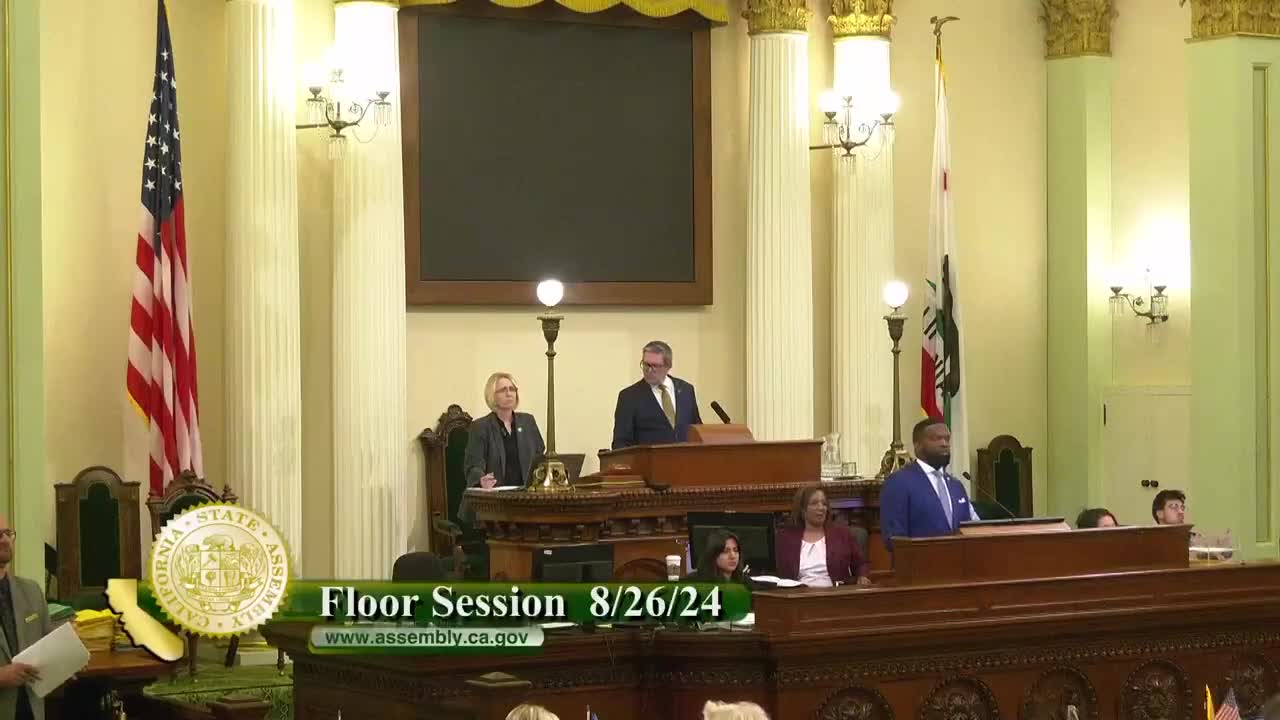 51SEC
Assembly Floor
 1MIN
Senate Floor
 2MIN
Assembly Standing Committee on Local Government
Bill Author

Bill Co-Author(s):