AB 414: Communications: Digital Equity Bill of Rights.
- Session Year: 2023-2024
- House: Assembly
- Latest Version Date: 2023-10-08
Current Status:
Passed
(2023-10-08: Chaptered by Secretary of State - Chapter 436, Statutes of 2023.)
Introduced
In Committee
First Chamber
In Committee
Second Chamber
Enacted
What does this bill do?
This bill creates the Digital Equity Bill of Rights, declaring that California residents should have access to reliable, affordable high‑speed broadband that is widely available and supports education, public safety, jobs, health care, research, and participation in democracy. It also says subscribers should have equal opportunity to get comparable service within a provider’s service area, but it does not let people sue the state to enforce these principles and does not require the state to enforce them.
The summary is provided by generative AI which can make mistakes. For original language, please view the details in the table below.
The California Internet Consumer Protection and Net Neutrality Act of 2018 prohibits fixed and mobile internet service providers, as defined, that provide broadband internet access service, as defined, from engaging in specified actions concerning the treatment of internet traffic. The act also prohibits fixed and mobile internet service providers from offering or providing services other than broadband internet access service that are delivered over the same last-mile connection as the broadband internet access service, if those services have the purpose or effect of evading the above-described prohibitions or negatively affect the performance of broadband internet access service.
This bill, the Digital Equity Bill of Rights, would state that it is the principle of the state, to ensure digital equity for all residents of the state, that residents shall have access to broadband that meets specific requirements, and that it is the policy of the state that, to the extent technically feasible, broadband internet subscribers benefit from equal access to broadband internet service within the service area of a broadband provider, as those terms are defined. The bill would also state that it does not create an obligation for the state to enforce that principle or policy and does not create a private right of action against the state to enforce the bill. The bill would make related legislative findings and declarations.
The California Internet Consumer Protection and Net Neutrality Act of 2018 prohibits fixed and mobile internet service providers, as defined, that provide broadband internet access service, as defined, from engaging in specified actions concerning the treatment of internet traffic. The act also prohibits fixed and mobile internet service providers from offering or providing services other than broadband internet access service that are delivered over the same last-mile connection as the broadband internet access service, if those services have the purpose or effect of evading the above-described prohibitions or negatively affect the performance of broadband internet access service.
This bill, the Digital Equity Bill of Rights, would state that it is the principle of the state, to ensure digital equity for all residents of the state, that residents shall have access to broadband that meets specific requirements, and that it is the policy of the state that, to the extent technically feasible, broadband internet subscribers benefit from equal access to broadband, broadband internet service within the service area of a broadband provider, as those terms are defined. The bill would also state that it does not create an obligation for the state to enforce that principle or policy and does not create a private right of action against the state to enforce the bill. The bill would make related legislative findings and declarations.
The California Internet Consumer Protection and Net Neutrality Act of 2018 prohibits fixed and mobile internet service providers, as defined, that provide broadband internet access service, as defined, from engaging in specified actions concerning the treatment of internet traffic. The act also prohibits fixed and mobile internet service providers from offering or providing services other than broadband internet access service that are delivered over the same last-mile connection as the broadband internet access service, if those services have the purpose or effect of evading the above-described prohibitions or negatively affect the performance of broadband internet access service.
This bill, the Digital Equity Bill of Rights, would state that it is the policy principle of the state, to ensure digital equity for all residents of the state, that residents shall have the right access to broadband that meets specific requirements, and that broadband internet subscribers benefit from equal access to broadband internet service. broadband, as those terms are defined. The bill would make related legislative findings and declarations.
The California Internet Consumer Protection and Net Neutrality Act of 2018 prohibits fixed and mobile internet service providers, as defined, that provide broadband internet access service, as defined, from engaging in specified actions concerning the treatment of internet traffic. The act also prohibits fixed and mobile internet service providers from offering or providing services other than broadband internet access service that are delivered over the same last-mile connection as the broadband internet access service, if those services have the purpose or effect of evading the above-described prohibitions or negatively affect the performance of broadband internet access service.
This bill, the Digital Equity Bill of Rights, would state that it is the policy of the state, to ensure digital equity for all residents of the state, that residents shall have the right to broadband that meets specific requirements, and that broadband internet subscribers benefit from equal access to broadband internet service.
Existing law establishes the Department of Technology within the Government Operations Agency, which is supervised by the Director of Technology. Existing law charges the director and the department with various duties in creating and managing the information technology policy of the state. Existing law requires the department, by January 1, 2024, to develop a state digital equity plan.This bill would state that it is the intent of the Legislature to enact legislation to create digital equity for all Californians.Existing law establishes the Department of Technology within the Government Operations Agency, which is supervised by the Director of Technology. Existing law charges the director and the department with various duties in creating and managing the information technology policy of the state. Existing law requires the department, by January 1, 2024, to develop a state digital equity plan.
This bill would state that it is the intent of the Legislature to enact legislation to create digital equity for all Californians.
This title shall be known, and may be cited, as the Digital Equity Bill of Rights.
3121.The Legislature finds and declares that digital equity, in which all individuals and communities have the information technology capacity needed for full participation in society, democracy, and the economy, is necessary for civic and cultural participation, employment, lifelong learning, and to access essential services. The Legislature further finds and declares that digital equity requires deployment and adoption of information technologies enabled by access to high-speed internet infrastructure, including wireline and wireless technologies.
3122.(a)It is the principle of the state, to ensure digital equity for all its residents, that residents shall have access to all of the following:
(1)Broadband that is sufficient and reliable, with internet speeds that are sufficient to meet the growing demand and reliance on access to education, government, public safety, economic prosperity, and health care through high-speed internet access. Determining minimum speeds for high-speed internet infrastructure should be performance based to support online educational opportunities, telehealth, and remote working by a majority of households online simultaneously with an increasing need for symmetrical network speeds.
(2)Broadband that is ubiquitous by ensuring that sufficient and reliable broadband access is available throughout the state, from the most rural areas, including tribal lands, to the most populated urban areas, including all low-income neighborhoods. Public broadband investments should be prioritized to connect entire communities and address digital redlining in historically unserved and underserved communities.
(3)Broadband that is affordable by ensuring that internet service plans are affordable for all residents of the state, regardless of their geographic location or household income.
(4)Broadband that provides educational opportunities and supports digital skills proficiency by providing residents of the state with access to opportunities to develop the skills needed to thrive in a digital world.
(5)Broadband that ensures public safety and maintains the peace of mind of the residents of the state that comes with knowing they have reliable access to emergency response services and emergency alert systems in the event of emergencies or catastrophic disasters.
(6)Broadband that improves quality of life by advancing economic status with access to educational opportunities, new job opportunities, and health care.
(7)Broadband that supports economic prosperity by ensuring that all workers, employers, businesses, entrepreneurs, startups, and enterprises, regardless of size, and including agriculture, have high-speed internet access that optimizes the value of their contributions to the economy to ensure global competitiveness.
(8)Broadband that attracts capital investment because ubiquitous high-speed internet infrastructure is essential to ensuring that the state continues to attract its fair share of global capital investment to support and enhance economic prosperity.
(9)Broadband that supports innovation and research by ensuring that high-speed internet infrastructure connects all research institutions to sustain world-class research and innovation that drives economic productivity.
(10)Broadband that empowers and enables participation in the democratic process so that all residents of the state are connected to the internet with sufficient speeds to participate in government, online educational opportunities, and telehealth for quality of life and public safety.
(b)It is the policy of the state that, to the extent technically feasible, broadband internet subscribers benefit from equal access to broadband internet service within the service area of a broadband provider.
(c)For purposes of this title, the following definitions apply:
(1)Equal access means the equal opportunity to subscribe to an offered service that provides comparable speeds, capacities, latency, and other quality-of-service metrics in a given geographical area, for comparable terms and conditions.
(2)Broadband means Broadband Internet access service as defined in subdivision (b) of Section 3100.
3123.(a)This title does not create a private right of action against the state to enforce this title.
(b)This title does not create an obligation of the state to enforce the principle or policy established by this title.
This title shall be known, and may be cited, as the Digital Equity Bill of Rights.
3121.The Legislature finds and declares that digital equity, in which all individuals and communities have the information technology capacity needed for full participation in society, democracy, and the economy, is necessary for civic and cultural participation, employment, lifelong learning, and to access essential services. The Legislature further finds and declares that digital equity requires deployment and adoption of information technologies enabled by access to high-speed internet infrastructure, including wireline and wireless technologies.
3122.(a)It is the principle of the state, to ensure digital equity for all residents of the state, its residents, that residents shall have access to all of the following:
(1)Broadband that is sufficient and reliable, with internet speeds that are sufficient to meet the growing demand and reliance on access to education, government, public safety, economic prosperity, and health care through high-speed internet access. Determining minimum speeds for high-speed internet infrastructure should be performance based to support online educational opportunities, telehealth, and remote working by a majority of households online simultaneously with an increasing need for symmetrical network speeds.
(2)Broadband that is ubiquitous by ensuring that sufficient and reliable broadband access is available throughout the state, from the most rural areas, including tribal lands, to the most populated urban areas, including all low-income neighborhoods. Public broadband investments should be prioritized to connect entire communities and address digital redlining in historically unserved and underserved communities.
(3)Broadband that is affordable by ensuring that internet service plans are affordable for all residents of the state, regardless of their geographic location or household income.
(4)Broadband that provides educational opportunities and supports digital skills proficiency by providing residents of the state with access to opportunities to develop the skills needed to thrive in a digital world.
(5)Broadband that ensures public safety and maintains the peace of mind of the residents of the state that comes with knowing they have reliable access to emergency response services and emergency alert systems in the event of emergencies or catastrophic disasters.
(6)Broadband that improves quality of life by advancing economic status with access to educational opportunities, new job opportunities, and health care.
(7)Broadband that supports economic prosperity by ensuring that all workers, employers, businesses, entrepreneurs, startups, and enterprises, regardless of size, and including agriculture, have high-speed internet access that optimizes the value of their contributions to the economy to ensure global competitiveness.
(8)Broadband that attracts capital investment because ubiquitous high-speed internet infrastructure is essential to ensuring that the state continues to attract its fair share of global capital investment to support and enhance economic prosperity.
(9)Broadband that supports innovation and research by ensuring that high-speed internet infrastructure connects all research institutions to sustain world-class research and innovation that drives economic productivity.
(10)Broadband that empowers and enables participation in the democratic process so that all residents of the state are connected to the internet with sufficient speeds to participate in government, online educational opportunities, and telehealth for quality of life and public safety.
(b)It is the policy of the state that, to the extent technically feasible, broadband internet subscribers benefit from equal access to broadband internet service within the service area of a broadband provider.
(c)For purposes of this title, the following definitions apply:
(1)Equal access means the equal opportunity to subscribe to an offered service that provides comparable speeds, capacities, latency, and other quality-of-service metrics in a given geographical area, for comparable terms and conditions.
(2)Broadband means Broadband Internet access service as defined in subdivision (b) of Section 3100.
3123.(a)This title does not create a private right of action against the state to enforce this title.
(b)This title does not create an obligation of the state to enforce the principle or policy established by this title.
This title shall be known, and may be cited, as the Digital Equity Bill of Rights.
3121.The Legislature finds and declares that digital equity, in which all individuals and communities have the information technology capacity needed for full participation in society, democracy, and the economy, is necessary for civic and cultural participation, employment, lifelong learning, and to access essential services. The Legislature further finds and declares that digital equity requires deployment and adoption of information technologies enabled by access to high-speed internet infrastructure, including wireline and wireless technologies.
3122.(a)It is the principle of the state, to ensure digital equity for all residents of the state, that residents shall have access to all of the following:
(1)Broadband that is sufficient and reliable, with internet speeds that are sufficient to meet the growing demand and reliance on access to education, government, public safety, economic prosperity, and health care through high-speed internet access. Determining minimum speeds for high-speed internet infrastructure should be performance based to support online educational opportunities, telehealth, and remote working by a majority of households online simultaneously with an increasing need for symmetrical network speeds.
(2)Broadband that is ubiquitous by ensuring that sufficient and reliable broadband access is available throughout the state, from the most rural areas, including tribal lands, to the most populated urban areas, including all low-income neighborhoods. Public broadband investments should be prioritized to connect entire communities and address digital redlining in historically unserved and underserved communities.
(3)Broadband that is affordable by ensuring that internet service plans are affordable for all residents of the state, regardless of their geographic location or household income.
(4)Broadband that provides educational opportunities and supports digital skills proficiency by providing residents of the state with access to opportunities to develop the skills needed to thrive in a digital world.
(5)Broadband that ensures public safety and maintains the peace of mind of the residents of the state that comes with knowing they have reliable access to emergency response services and emergency alert systems in the event of emergencies or catastrophic disasters.
(6)Broadband that improves quality of life by advancing economic status with access to educational opportunities, new job opportunities, and health care.
(7)Broadband that supports economic prosperity by ensuring that all workers, employers, businesses, entrepreneurs, startups, and enterprises, regardless of size, and including agriculture, have high-speed internet access that optimizes the value of their contributions to the economy to ensure global competitiveness.
(8)Broadband that attracts capital investment because ubiquitous high-speed internet infrastructure is essential to ensuring that the state continues to attract its fair share of global capital investment to support and enhance economic prosperity.
(9)Broadband that supports innovation and research by ensuring that high-speed internet infrastructure connects all research institutions to sustain world-class research and innovation that drives economic productivity.
(10)Broadband that empowers and enables participation in the democratic process so that all residents of the state are connected to the internet with sufficient speeds to participate in government, online educational opportunities, and telehealth for quality of life and public safety.
(b)It is the policy of the state that, to the extent technically feasible, broadband internet subscribers benefit from equal access to broadband internet service within the service area of a broadband provider.
(c)For purposes of this title, the following definitions apply:
(1)Equal access means the equal opportunity to subscribe to an offered service that provides comparable speeds, capacities, latency, and other quality-of-service metrics in a given geographical area, for comparable terms and conditions.
(2)Broadband means Broadband Internet access service as defined in subdivision (b) of Section 3100.
3123.(a)This title does not create a private right of action against the state to enforce this title.
(b)This title does not create an obligation of the state to enforce the principle or policy established by this title.
This title shall be known, and may be cited, as the Digital Equity Bill of Rights.
3121.The Legislature finds and declares that digital equity, in which all individuals and communities have the information technology capacity needed for full participation in society, democracy, and the economy, is necessary for civic and cultural participation, employment, lifelong learning, and to access essential services. The Legislature further finds and declares that digital equity requires deployment and adoption of information technologies enabled by access to high-speed internet infrastructure, including wireline and wireless technologies.
3122.(a)It is the policy principle of the state, to ensure digital equity for all residents of the state, that residents have the right shall have access to all of the following:
(1)Broadband that is sufficient and reliable, with internet speeds that are sufficient to meet the growing demand and reliance on access to education, government, public safety, economic prosperity, and health care through high-speed internet access. Determining minimum speeds for high-speed internet infrastructure should be performance based to support online educational opportunities, telehealth, and remote working by a majority of households online simultaneously with an increasing need for symmetrical network speeds.
(2)Broadband that is ubiquitous by ensuring that sufficient and reliable broadband access is available throughout the state, from the most rural areas, including tribal lands, to the most populated urban areas, including all low-income neighborhoods. Public broadband investments should be prioritized to connect entire communities and address digital redlining in historically unserved and underserved communities.
(3)Broadband that is affordable by ensuring that internet service plans are affordable for all residents of the state, regardless of their geographic location or household income.
(4)Broadband that provides educational opportunities and supports digital skills proficiency by providing residents of the state with access to opportunities to develop the skills needed to thrive in a digital world.
(5)Broadband that ensures public safety and maintains the peace of mind of the residents of the state that comes with knowing they have reliable access to emergency response services and emergency alert systems in the event of emergencies or catastrophic disasters.
(6)Broadband that improves quality of life by advancing economic status with access to educational opportunities, new job opportunities, and health care.
(7)Broadband that supports economic prosperity by ensuring that all workers, employers, businesses, entrepreneurs, startups, and enterprises, regardless of size, and including agriculture, have high-speed internet access that optimizes the value of their contributions to the economy to ensure global competitiveness.
(8)Broadband that attracts capital investment because ubiquitous high-speed internet infrastructure is essential to ensuring that the state continues to attract its fair share of global capital investment to support and enhance economic prosperity.
(9)Broadband that supports innovation and research by ensuring that high-speed internet infrastructure connects all research institutions to sustain world-class research and innovation that drives economic productivity.
(10)Broadband that empowers and enables participation in the democratic process so that all residents of the state are connected to the internet with sufficient speeds to participate in government, online educational opportunities, and telehealth for quality of life and public safety.
(b)(1)It is the policy of the state that, to the extent technically feasible, broadband internet subscribers benefit from equal access to broadband internet service within the service area of a broadband provider.
(c)For purposes of this title, the following definitions apply:
(2)For purposes of this section, equal(1)Equal access means the equal opportunity to subscribe to an offered service that provides comparable speeds, capacities, latency, and other quality-of-service metrics in a given geographical area, for comparable terms and conditions.
(2)Broadband means Broadband Internet access service as defined in subdivision (b) of Section 3100.
This title shall be known, and may be cited, as the Digital Equity Bill of Rights.
3121.The Legislature finds and declares that digital equity, in which all individuals and communities have the information technology capacity needed for full participation in society, democracy, and the economy, is necessary for civic and cultural participation, employment, lifelong learning, and to access essential services. The Legislature further finds and declares that digital equity requires deployment and adoption of information technologies enabled by access to high-speed internet infrastructure, including wireline and wireless technologies.
3122.(a)It is the policy of the state, to ensure digital equity for all residents of the state, that residents have the right to all of the following:
(1)Broadband that is sufficient and reliable, with internet speeds that are sufficient to meet the growing demand and reliance on access to education, government, public safety, economic prosperity, and health care through high-speed internet access. Determining minimum speeds for high-speed internet infrastructure should be performance based to support online educational opportunities, telehealth, and remote working by a majority of households online simultaneously with an increasing need for symmetrical network speeds.
(2)Broadband that is ubiquitous by ensuring that sufficient and reliable broadband access is available throughout the state, from the most rural areas, including tribal lands, to the most populated urban areas, including all low-income neighborhoods. Public broadband investments should be prioritized to connect entire communities and address digital redlining in historically unserved and underserved communities.
(3)Broadband that is affordable by ensuring that internet service plans are affordable for all residents of the state, regardless of their geographic location or household income.
(4)Broadband that provides educational opportunities and supports digital skills proficiency by providing residents of the state with access to opportunities to develop the skills needed to thrive in a digital world.
(5)Broadband that ensures public safety and maintains the peace of mind of the residents of the state that comes with knowing they have reliable access to emergency response services and emergency alert systems in the event of emergencies or catastrophic disasters.
(6)Broadband that improves quality of life by advancing economic status with access to educational opportunities, new job opportunities, and health care.
(7)Broadband that supports economic prosperity by ensuring that all workers, employers, businesses, entrepreneurs, startups, and enterprises, regardless of size, and including agriculture, have high-speed internet access that optimizes the value of their contributions to the economy to ensure global competitiveness.
(8)Broadband that attracts capital investment because ubiquitous high-speed internet infrastructure is essential to ensuring that the state continues to attract its fair share of global capital investment to support and enhance economic prosperity.
(9)Broadband that supports innovation and research by ensuring that high-speed internet infrastructure connects all research institutions to sustain world-class research and innovation that drives economic productivity.
(10)Broadband that empowers and enables participation in the democratic process so that all residents of the state are connected to the internet with sufficient speeds to participate in government, online educational opportunities, and telehealth for quality of life and public safety.
(b)(1)It is the policy of the state that, to the extent technically feasible, broadband internet subscribers benefit from equal access to broadband internet service within the service area of a broadband provider.
(2)For purposes of this section, equal access means the equal opportunity to subscribe to an offered service that provides comparable speeds, capacities, latency, and other quality-of-service metrics in a given geographical area, for comparable terms and conditions.
SECTION 1.It is the intent of the Legislature to enact legislation to create digital equity for all Californians.It is the intent of the Legislature to enact legislation to create digital equity for all Californians.
|
Date
|
Status
|
|---|---|
| Oct 8, 2023 | Chaptered by Secretary of State - Chapter 436, Statutes of 2023. |
| Oct 8, 2023 | Approved by the Governor. |
| Sep 13, 2023 | Enrolled and presented to the Governor at 3 p.m. |
| Sep 7, 2023 | Senate amendments concurred in. To Engrossing and Enrolling. (Ayes 69. Noes 0. Page 3035.). |
| Sep 5, 2023 | In Assembly. Concurrence in Senate amendments pending. May be considered on or after September 7 pursuant to Assembly Rule 77. |
| Sep 5, 2023 | Read third time. Passed. Ordered to the Assembly. (Ayes 35. Noes 0. Page 2377.). |
| Aug 21, 2023 | Read second time. Ordered to third reading. |
| Aug 17, 2023 | Read third time and amended. Ordered to second reading. |
| Jun 22, 2023 | Read second time. Ordered to third reading. |
| Jun 21, 2023 | Withdrawn from committee. |
| Jun 21, 2023 | Ordered to second reading. |
| Jun 20, 2023 | From committee: Do pass and re-refer to Com. on APPR. (Ayes 16. Noes 0.) (June 20). Re-referred to Com. on APPR. |
| Jun 7, 2023 | Referred to Com. on E., U. & C. |
| May 26, 2023 | In Senate. Read first time. To Com. on RLS. for assignment. |
| May 25, 2023 | Read third time. Passed. Ordered to the Senate. (Ayes 63. Noes 0. Page 1796.) |
| May 22, 2023 | Read second time. Ordered to third reading. |
| May 18, 2023 | Read second time and amended. Ordered returned to second reading. |
| May 18, 2023 | From committee: Amend, and do pass as amended. (Ayes 11. Noes 0.) (May 18). |
| May 3, 2023 | In committee: Set, first hearing. Referred to APPR. suspense file. |
| Apr 4, 2023 | Re-referred to Com. on APPR. |
| Apr 3, 2023 | Read second time and amended. |
| Apr 3, 2023 | From committee: Amend, and do pass as amended and re-refer to Com. on APPR. (Ayes 11. Noes 0.) (March 29). |
| Mar 13, 2023 | Re-referred to Com. on C. & C. |
| Mar 9, 2023 | Referred to Com. on C. & C. |
| Mar 9, 2023 | From committee chair, with author's amendments: Amend, and re-refer to Com. on C. & C. Read second time and amended. |
| Feb 3, 2023 | From printer. May be heard in committee March 5. |
| Feb 2, 2023 | Read first time. To print. |
|
Date
|
Description
|
Location
|
Votes
|
|
|---|---|---|---|---|
| Sep 7, 2023 | AB 414 Reyes Concurrence in Senate Amendments | Assembly Floor |
Passed |
|
| Sep 5, 2023 | Assembly 3rd Reading AB414 Reyes et al. By Wilk | Senate Floor |
Passed |
|
| Jun 20, 2023 | Do pass, but first be re-referred to the Committee on [Appropriations] | Senate Standing Committee on Energy, Utilities and Communications |
Passed |
|
| May 25, 2023 | AB 414 Reyes Assembly Third Reading | Assembly Floor |
Passed |
|
| May 18, 2023 | Do pass as amended. | Assembly Standing Committee on Appropriations |
Passed |
|
| Mar 29, 2023 | Do pass as amended and be re-referred to the Committee on [Appropriations] | Assembly Standing Committee on Communications and Conveyance |
Passed |
This list shows positions taken on this bill by organizations on the date displayed, which is linked to the original source.
Positions by individuals are not included.
|
Organization
|
Position
|
Date
|
|---|---|---|
| AARP | ** Support | |
| American Gi Forum Education Foundation of Santa Maria, CA | ** Support | |
| An individual | ** Support | |
| Beehive Technology Solutions | ** Support | |
| BizFed Institute | ** Support | |
| Broadband Consortium Pacific Coast | ** Support | |
| Cal broadband | * Indeterminate | Mar 29, 2023 |
| California Chamber Of Commerce | ** Against | |
| California Child Care Resource and Referral Network | ** Support | |
| California Emerging Technology Fund | ** Support | |
| California Health+ Advocates | ** Support | |
| California Human Development | ** Support | |
| California School Boards Association | ** Support | |
| California Telehealth Policy Coalition | ** Support | |
| California Wic Association | ** Support | |
| Center for Employment and Training | ** Support | |
| Center for Employment Training | ** Support | |
| Central Valley Opportunity Center | ** Support | |
| Chapa-De Indian Health | ** Support | |
| Children's Council of San Francisco | ** Support | |
| Coalición de la Buena Salud y Bienestar | ** Support | |
| Community Clinic Association of Los Angeles | ** Support | |
| Community Living Campaign | ** Support | |
| Corporation For Education Network Initiatives In California | ** Support | |
| County of Sonoma Area Agency on Aging | ** Support | |
| Economic Development Collaborative | ** Support | |
| EveryoneOn | ** Support | |
| Farmworker Institute Of Education & Leadership Development | ** Support | |
| First Day Foundation | ** Support | |
| Fresno State Connect Initiative | ** Support | |
| Independent Living Center of Southern California | ** Support | |
| Inland Coalition for Immigrant Justice | ** Support | |
| Inland Empire Regional Broadband Consortium | ** Support | |
| la Cooperativa Campesina de California | ** Support | |
| LeadingAge California | ** Support | |
| Los Amigos de la Comunidad | ** Support | |
| Los Angeles Unified School District | ** Support | |
| Los Angeles/Orange County Regional Broadband Collaborative | ** Support | |
| Los Rios Community College District | * Support | Mar 29, 2023 |
| Lucile Packard Children's Hospital_stanford Children's Health | ** Support | |
| MADIA Tech Launch | ** Support | |
| Manchester Community Technologies | ** Support | |
| Media Alliance | ** Support | |
| Mercy Housing California | ** Support | |
| Newstart Housing Corporation | ** Support | |
| North Bay-North Coast Broadband Consortium | ** Support | |
| North State Planning & Development Collective | ** Support | |
| Northeastern & Upstate California Connect Consortia | ** Support | |
| Office of Supervisor Nora Vargas, County of San Diego | ** Support | |
| Orange County Business Council | ** Support | |
| Partners in Care Foundation | ** Support | |
| Proteus, Inc. | ** Support | |
| Sacramento Native American Health Center | ** Support | |
| San Bernardino Community Service Center, Inc. | ** Support | |
| San Francisco Tech Council | ** Support | |
| San Joaquin Valley Regional Broadband Consortium | ** Support | |
| Santa Barbara Foundation | ** Support | |
| Scenic | * Support | Mar 29, 2023 |
| Senior Coastsiders | ** Support | |
| Sierra Business Council | ** Support | |
| Southeast Community Development Corporation | ** Support | |
| Southern Border Broadband Consortium | ** Support | |
| Tarana Wireless | ** Support | |
| Tech Exchange | ** Support | |
| The Utility Reform Network, if amended | ** Support | |
| US Telecom | * Neutral | Mar 29, 2023 |
| Valley Vision | ** Support |
CONCURRENCE IN SENATE AMENDMENTS
CSA1 Bill Id:AB 414
Author:(Reyes)
As Amended Ver:August 17, 2023
Majority vote
SUMMARY
This bill establishes the Digital Equity Bill of Rights, which establishes the principle of the state to ensure digital equity for all its residents and that residents shall have access to broadband in various forms and functions. This bill also establishes the policy of the state that broadband internet subscribers benefit from equal access to service, as defined.
Senate Amendments
1) Make technical and clarifying changes.
2) Add co-authors.
COMMENTS
- This bill would establish principles and rights. While this bill is titled the "Digital Equity Bill of Rights", it does not establish an enforceable right to broadband. Instead, this bill declares the principle of the state that all its residents shall have access to broadband, specifically in ten specific forms and functions. Using the word "principle" instead of "right" was an amendment adopted in Assembly Communications & Conveyance Committee to avoid potential legal liability to the state from establishing a right to broadband. Further amendments were adopted in Assembly Appropriations Committee to clarify that this bill does not create a private right of action against the state or obligate the state to take any action to enforce this bill’s provision. Nonetheless, this bill does establish the right of equal access to broadband service for subscribers of broadband service.
- Establishing that residents shall have access to broadband would complement and is consistent with existing state law. This bill establishes that residents of the state shall have access to broadband in the ten specific forms and functions enumerated in the bill. For example, this bill provides that residents of the state shall have access to broadband that is sufficient and reliable, ubiquitous, affordable, capable of providing educational opportunities and supports digital skills proficiency, ensures public safety, improves the quality of life, supports economic prosperity, attracts capital investments, supports innovation, and broadband that empowers and enables participation in the democratic process. While all of these principles are certainly worthy goals, they are sweeping and highly specific. No other state in the United State has adopted such a sweeping policy, especially with such specificity as to what the broadband should enable; however, California has been at the forefront of civil rights before. For example, in 2012 California was the first state in the nation to legislatively recognize the human right to water. Although the language in this bill is much more prescriptive than the statute establishing the right to water, both recognize accessibility and affordability as key tenets.
Additionally, pursuant to the Moore Universal Telephone Service Act, it has long been the goal of the state that high-quality basic telephone service at affordable rates are offered to the greatest number of citizens. At the time this legislation was passed in 1983 broadband did not yet exist; however, the Legislature acknowledged that universal access to telecommunications services had social benefits such as improving the quality of life of residents, expanding access to education, training and commerce, and assisting in bridging the digital divide. To that end, portions of this bill establishing that residents shall have access to broadband would complement and are consistent with existing law regarding water and telephone service. For example, the CPUC currently administers several universal service programs aimed to expand universal access to telecommunications services and broadband. The existing universal service programs include:
- California Lifeline Program, to provide telephone and data services to low-income households.
- California Advanced Services Fund, to fund broadband projects for unserved households.
- California High Cost Funds A and B, to provide rate relief in high-cost telephone service areas.
- California Teleconnect Fund, to provide discounted broadband service to educational, community-based, and government operated facilities.
- Deaf and Disabled Telecommunications Program, to provide telecommunications devices and services to individuals with disabilities and hearing and speech limitations.
- Establishing a right to equal access is consistent with federal law. In November 2021, Congress passed and President Biden signed into law the Infrastructure Investment and Jobs Act (IIJA). Although the IIJA was primarily about funding infrastructure, the IIJA also included policies regarding digital discrimination and funding for digital equity purposes. For example, the IIJA established a right to equal access to broadband in federal law and directed the FCC to adopt policies to prevent digital discrimination. This bill would establish a right to equal access to broadband in state law, and thus may serve to strengthen consumer protections for broadband customers within the state.
According to the Author
"As time moves forward, access to affordable and reliable broadband technology is going to become a staple in modern society. California needs to ensure that all of our residents are able to reasonably participate in this new digital world. AB 414 would make it the policy of the state for broadband to be sufficient, reliable, affordable, and ubiquitous. It would ensure that broadband provides educational, economic, public safety, and democratic benefits to all residents in California. Digital inequities became incredibly apparent for historically under resourced communities during the pandemic and will continue to occur if we don’t take bold proactive steps to resolve them. Digital access is a 21st century civil right and should be treated as such."
Arguments in Support
Various consumer and equity focused organizations view a need for this bill because of the large number of households that lack access to broadband service within the state, and the corresponding struggles that imposes. For example, households and individuals that do not have reliable and affordable access to broadband service may experience a loss of education and economic opportunities. Additionally, the California Emerging Technology Fund, argues that more than 5,000 individuals have signed a petition to support the enactment of their similar Digital Equity Bill of Rights, which this bill is modeled from.
Arguments in Opposition
No opposition on file.
FISCAL COMMENTS
According to the Assembly Appropriations Committee, this bill would result in no direct state costs.
VOTES:
ASM COMMUNICATIONS AND CONVEYANCE: 11-0-2
YES: Boerner Horvath, Bonta, Garcia, Holden, Hoover, Low, Maienschein, Papan, Luz Rivas, Rodriguez, Weber
ABS, ABST OR NV: Jim Patterson, Davies
ASM APPROPRIATIONS: 11-0-5
YES: Holden, Bryan, Calderon, Wendy Carrillo, Mike Fong, Hart, Lowenthal, Papan, Pellerin, Weber, Ortega
ABS, ABST OR NV: Megan Dahle, Dixon, Mathis, Robert Rivas, Sanchez
ASSEMBLY FLOOR: 63-0-17
YES: Addis, Alanis, Alvarez, Arambula, Bains, Bauer-Kahan, Berman, Boerner, Bonta, Bryan, Calderon, Juan Carrillo, Wendy Carrillo, Cervantes, Connolly, Mike Fong, Friedman, Gabriel, Garcia, Gipson, Grayson, Haney, Hart, Holden, Hoover, Irwin, Jackson, Jones-Sawyer, Kalra, Lee, Low, Lowenthal, Maienschein, McCarty, McKinnor, Muratsuchi, Stephanie Nguyen, Ortega, Pacheco, Pellerin, Petrie-Norris, Quirk-Silva, Ramos, Reyes, Luz Rivas, Robert Rivas, Rodriguez, Blanca Rubio, Santiago, Schiavo, Soria, Ting, Valencia, Villapudua, Waldron, Wallis, Ward, Weber, Wicks, Wilson, Wood, Zbur, Rendon
ABS, ABST OR NV: Aguiar-Curry, Bennett, Chen, Megan Dahle, Davies, Dixon, Essayli, Flora, Vince Fong, Gallagher, Lackey, Mathis, Papan, Jim Patterson, Joe Patterson, Sanchez, Ta
SENATE FLOOR: 35-0-5
YES: Allen, Alvarado-Gil, Archuleta, Ashby, Atkins, Becker, Blakespear, Bradford, Caballero, Cortese, Dodd, Durazo, Eggman, Glazer, Gonzalez, Grove, Hurtado, Laird, Limón, McGuire, Menjivar, Min, Newman, Niello, Ochoa Bogh, Portantino, Roth, Rubio, Skinner, Smallwood‑Cuevas, Stern, Umberg, Wahab, Wiener, Wilk
ABS, ABST OR NV: Dahle, Jones, Nguyen, Padilla, Seyarto
UPDATED
VERSION: August 17, 2023
CONSULTANT: Emilio Perez / C. & C. / (916) 319-2637 FN: 0001779
SENATE RULES COMMITTEE Office of Senate Floor Analyses (916) 651-1520 Fax: (916) 327-4478 | AB 414 |
THIRD READING
Bill No: AB 414
Author: Reyes (D), et al.
Amended: 8/17/23 in Senate
Vote: 21
SENATE ENERGY, U. & C. COMMITTEE: 16-0, 6/20/23
AYES: Bradford, Ashby, Becker, Caballero, Dodd, Durazo, Eggman, Gonzalez, Grove, McGuire, Min, Newman, Rubio, Skinner, Stern, Wilk
NO VOTE RECORDED: Dahle, Seyarto
ASSEMBLY FLOOR: 63-0, 5/25/23 - See last page for vote
SUBJECT: Communications: Digital Equity Bill of Rights
SOURCE: California Emerging Technology Fund
DIGEST:
This bill defines equal access to broadband service and establishes a state policy of supporting subscribers’ equal access to broadband services.
Senate Floor Amendments of 8/17/23 add coauthors and make a technical, clarifying edit.
ANALYSIS:
Existing law:
- Establishes California’s universal telecommunications service policy, which specifies that it is the state’s policy to provide affordable and accessible high-quality telecommunications services to all Californians. This policy also encourages the closure of the digital divide and the removal of barriers to market competition and greater consumer choice. (Public Utilities Code §709)
- Defines broadband internet access service as a mass market retail communications service capable of transmitting data to and from all Internet endpoints, including any functional equivalent of broadband service. Existing law specifies that this definition does not include dial-up Internet access service. (Civil Code §3100)
- Establishes net neutrality requirements by prohibiting internet service providers (ISPs) from engaging in blocking or throttling internet traffic, requiring consideration to transmit internet traffic, engaging in paid prioritization, and zero-rating certain internet content. (Civil Code §3101)
This bill:
- Defines “equal access” as the opportunity to subscribe to an offered service that provides comparable speeds, capacities, latency, and other quality-of-service metrics in a given geographical area, for comparable terms and conditions.
- States that it is the policy of the state that broadband internet subscribers benefit from equal access to broadband service within a broadband provider’s given service territory.
- Specifies that nothing in this bill establishes a private right of action against the state to enforce digital equity rights, and nothing in this bill establishes an obligation of the state to enforce this bill’s principles or policies.
- States that it is the principle of state that residents shall have access to broadband service that meets specified characteristics, including, but not limited to broadband that has speeds capable of reliably supporting online educational, telehealth, and remote working opportunities.
Background
- This bill is consistent with federal law prohibiting digital discrimination. The federal Infrastructure Investment and Jobs Act (IIJA) established various provisions aimed at preventing digital discrimination. These provisions included establishing a definition “equal access” for the purposes of broadband service and requiring the Federal Communications Commission (FCC) to adopt rules to facilitate equal access of broadband services. This bill adopts a definition of equal access that is substantially similar to the definition on federal law.
- California’s existing telecommunications policy supports universal service. Both federal and state law have adopted policies supporting universal telecommunications service; however, existing state and federal law do not establish a right to broadband service or create a regulatory framework in which broadband is more strictly regulated as a utility. Under existing federal regulations, broadband service is considered an “information” service, which is distinct from “common carrier” utilities. Generally, common carriers are distinguished from other services by an obligation to serve any customer that requests service and more strict oversight and regulation by regulatory bodies. To encourage the growth of broadband services and the provision of essential telecommunications services to low-income Californians, California has adopted the following universal service programs, which are administered by the California Public Utilities Commission (CPUC) and funded by surcharges on in-state telecommunications services:
- California Lifeline Program provides phone services to low-income households.
- California Advanced Services Fund funds broadband projects for unserved households.
- California High Cost Funds A and B provides rate relief in high-cost telephone service areas
- California Teleconnect Fund provides discounted broadband service to educational, community-based, and government operated facilities.
- Deaf and Disabled Telecommunications Program provides telecommunications devices and services to individuals with disabilities and hearing and speech limitations.
This bill differs from existing state telecommunications policy by focusing on establishing rights specific to broadband service outside the CPUC’s universal service policy. This bill more closely aligns its Digital Equity Bill of Rights to California’s net neutrality laws, which are enforced by the Attorney General.
- Bill establishes policy, but it does not require enforcement. While federal law requires the FCC to adopt rules to prevent digital discrimination, this bill does not require the CPUC to take similar steps. At this time, it is unclear what rules the FCC will adopt to prevent digital discrimination. The FCC has opened a rulemaking and convened a task force to address the IIJA’s requirements. To the extent that the FCC adopts rules to address digital discrimination at the federal level, states may be able to align their actions to those of the FCC. Alternatively, some state actions may be preempted by federal rules.
Related/Prior Legislation
AB 41 (Holden, 2023) makes various changes to cable franchise requirements, including prohibiting a cable franchise from denying equal access to services to any type of subscriber in the franchise’s service territory. The bill does not define the term “equal access;” however, it defines the terms “equal” and “access” separately and requires the CPUC to enforce equal access to cable services. The bill is pending before the Senate Appropriations Committee.
AB 2748 (Holden, 2022) would have made various changes to cable franchise requirements, including prohibiting cable franchises from denying consumers within their service territories equal access to services on the basis of the consumers’ incomes. The bill also would have established a definition of “equal access” that is substantially similar to the definition in this bill. The bill died in the Senate Energy, Utilities and Communications Committee.
AB 2753 (Reyes, 2022) would have contained certain provisions substantially similar to those in this bill. The bill would have established a Digital Equity Bill of Rights, allowed individuals to petition for relief under these rights, and required the CPUC to adopt rules to facilitate equal access to broadband services. The bill died in the Assembly Appropriations Committee.
SB 822 (Weiner, Chapter 976, Statutes of 2018) defined broadband internet access service and established California’s net neutrality policy by prohibiting ISPs from engaging in certain acts that limit internet traffic and favor certain applications over others.
FISCAL EFFECT: Appropriation: No Fiscal Com.: No Local: No
SUPPORT: (Verified 8/17/23)
California Emerging Technology Fund (source)
AARP
BizFed Institute
Broadband Consortium Pacific Coast
California Health+ Advocates
California Human Development
California School Boards Association
California Telehealth Policy Coalition
California WIC Association
Center for Employment and Training
Central Valley Opportunity Center
Chapa-De Indian Health
Coalición de la Buena Salud y Bienestar
Community Clinic Association of Los Angeles
Corporation for Education Network Initiatives in California
Economic Development Collaborative
EveryoneOn
Farmworkers Institute of Education & Leadership Development
First Day Foundation
Inland Coalition for Immigrant Justice
Inland Empire Regional Broadband Consortium
La Cooperativa Campesina de California
Los Amigos de la Comunidad
Los Angeles Unified School District
Los Angeles/Orange County Regional Broadband Collaborative
MADIA Tech Launch
Manchester Community Technologies
Media Alliance
Mercy Housing California
North Bay/North Coast Broadband Consortium
North State Planning & Development Collective
Northeastern & Upstate California Connect Consortia
Orange County Business Council
Partners in Care Foundation
Proteus, Inc.
San Bernardino Community Service Center, Inc.
San Joaquin Valley Regional Broadband Consortium
Santa Barbara Foundation
Sierra Business Council
Southeast Community Development Corporation
Southern Border Broadband Consortium
Tarana Wireless
Tech Exchange
Valley Vision
One Individual
OPPOSITION: (Verified 8/17/23)
None received
ARGUMENTS IN SUPPORT: According to the author:
As time moves forward, access to affordable and reliable broadband technology is going to become a staple in modern society. California needs to ensure that all of our residents are able to reasonably participate in this new digital world.
AB 414 would make it the policy of the state for broadband to be sufficient, reliable, affordable, and ubiquitous. It would ensure that broadband provides educational, economic, public safety, and democratic benefits to all residents in California. Digital inequities became incredibly apparent for historically under resourced communities during the pandemic and will continue to occur if we don’t take bold proactive steps to resolve them. Digital access is a 21st century civil right and should be treated as such.
ASSEMBLY FLOOR: 63-0, 5/25/23
AYES: Addis, Alanis, Alvarez, Arambula, Bains, Bauer-Kahan, Berman, Boerner, Bonta, Bryan, Calderon, Juan Carrillo, Wendy Carrillo, Cervantes, Connolly, Mike Fong, Friedman, Gabriel, Garcia, Gipson, Grayson, Haney, Hart, Holden, Hoover, Irwin, Jackson, Jones-Sawyer, Kalra, Lee, Low, Lowenthal, Maienschein, McCarty, McKinnor, Muratsuchi, Stephanie Nguyen, Ortega, Pacheco, Pellerin, Petrie-Norris, Quirk-Silva, Ramos, Reyes, Luz Rivas, Robert Rivas, Rodriguez, Blanca Rubio, Santiago, Schiavo, Soria, Ting, Valencia, Villapudua, Waldron, Wallis, Ward, Weber, Wicks, Wilson, Wood, Zbur, Rendon
NO VOTE RECORDED: Aguiar-Curry, Bennett, Chen, Megan Dahle, Davies, Dixon, Essayli, Flora, Vince Fong, Gallagher, Lackey, Mathis, Papan, Jim Patterson, Joe Patterson, Sanchez, Ta
Prepared by: Sarah Smith / E., U. & C. / (916) 651-4107
9/1/23 16:27:07
**** END ****
SENATE COMMITTEE ON ENERGY, UTILITIES AND COMMUNICATIONS
Senator Steven Bradford, Chair
2023 - 2024 Regular
Bill No: Hearing Date: 6/20/2023
Author: | |||
Version: | Amended | ||
Urgency: | Fiscal: | ||
Consultant: | |||
SUBJECT:
DIGEST: This bill defines equal access to broadband service and establishes a state policy of supporting subscribers’ equal access to broadband services.
ANALYSIS:
Existing law:
- Establishes California’s universal telecommunications service policy, which specifies that it is the state’s policy to provide affordable and accessible high-quality telecommunications services to all Californians. This policy also encourages the closure of the digital divide and the removal of barriers to market competition and greater consumer choice. (Public Utilities Code §709)
- Defines broadband internet access service as a mass market retail communications service capable of transmitting data to and from all Internet endpoints, including any functional equivalent of broadband service. Existing law specifies that this definition does not include dial-up Internet access service. (Civil Code §3100)
- Establishes net neutrality requirements by prohibiting internet service providers (ISPs) from engaging in blocking or throttling internet traffic, requiring consideration to transmit internet traffic, engaging in paid prioritization, and zero-rating certain internet content. (Civil Code §3101)
This bill:
- Defines “equal access” as the opportunity to subscribe to an offered service that provides comparable speeds, capacities, latency, and other quality-of-service metrics in a given geographical area, for comparable terms and conditions.
- States that it is the policy of the state that broadband internet subscribers benefit from equal access to broadband service within a broadband provider’s given service territory.
- Specifies that nothing in this bill establishes a private right of action against the state to enforce digital equity rights, and nothing in this bill establishes an obligation of the state to enforce this bill’s principles or policies.
- States that it is the principle of state that residents shall have access to broadband service that meets specified characteristics, including, but not limited to broadband that has speeds capable of reliably supporting online educational, telehealth, and remote working opportunities.
Background
Bill is consistent with federal law prohibiting digital discrimination. The federal Infrastructure Investment and Jobs Act (IIJA) established various provisions aimed at preventing digital discrimination. These provisions included establishing a definition “equal access” for the purposes of broadband service and requiring the Federal Communications Commission (FCC) to adopt rules to facilitate equal access of broadband services. This bill adopts a definition of equal access that is substantially similar to the definition on federal law.
California’s existing telecommunications policy supports universal service. Both federal and state law have adopted policies supporting universal telecommunications service; however, existing state and federal law do not establish a right to broadband service or create a regulatory framework in which broadband is more strictly regulated as a utility. Under existing federal regulations, broadband service is considered an “information” service, which is distinct from “common carrier” utilities. Generally, common carriers are distinguished from other services by an obligation to serve any customer that requests service and more strict oversight and regulation by regulatory bodies. To encourage the growth of broadband services and the provision of essential telecommunications services to low-income Californians, California has adopted the following universal service programs, which are administered by the California Public Utilities Commission (CPUC) and funded by surcharges on in-state telecommunications services.
- California Lifeline Program: provides phone services to low-income households.
- California Advanced Services Fund: funds broadband projects for unserved households.
- California High Cost Funds A and B: provides rate relief in high-cost telephone service areas
- California Teleconnect Fund: provides discounted broadband service to educational, community-based, and government operated facilities.
- Deaf and Disabled Telecommunications Program: provides telecommunications devices and services to individuals with disabilities and hearing and speech limitations.
This bill differs from existing state telecommunications policy by focusing on establishing rights specific to broadband service outside the CPUC’s universal service policy. This bill more closely aligns its Digital Equity Bill of Rights to California’s net neutrality laws, which are enforced by the Attorney General.
Bill establishes policy, but it does not require enforcement. While federal law requires the FCC to adopt rules to prevent digital discrimination, this bill does not require the CPUC to take similar steps. At this time, it is unclear what rules the FCC will adopt to prevent digital discrimination. The FCC has opened a rulemaking and convened a task force to address the IIJA’s requirements. To the extent that the FCC adopts rules to address digital discrimination at the federal level, states may be able to align their actions to those of the FCC. Alternatively, some state actions may be preempted by federal rules.
Prior/Related Legislation
AB 41 (Holden, 2023) would make various changes to cable franchise requirements, including prohibiting a cable franchise from denying equal access to services to any type of subscriber in the franchise’s service territory. The bill does not define the term “equal access;” however, it defines the terms “equal” and “access” separately and requires the CPUC to enforce equal access to cable services. The bill is pending before this committee.
AB 2748 (Holden 2022) would have made various changes to cable franchise requirements, including prohibiting cable franchises from denying consumers within their service territories equal access to services on the basis of the consumers’ incomes. The bill also would have established a definition of “equal access” that is substantially similar to the definition in this bill. The bill died in this committee.
AB 2753 (Reyes, 2022) contained certain provisions substantially similar to those in this bill. The bill would have established a Digital Equity Bill of Rights, allowed individuals to petition for relief under these rights, and required the CPUC to adopt rules to facilitate equal access to broadband services. The bill died in the Assembly Appropriations Committee.
SB 822 (Weiner, Chapter 976, Statutes of 2018) defined broadband internet access service and established California’s net neutrality policy by prohibiting ISPs from engaging in certain acts that limit internet traffic and favor certain applications over others.
FISCAL EFFECT: Appropriation: Fiscal Com.: Local:
SUPPORT:
California Emerging Technology Fund, Sponsor
AARP
BizFed Institute
Broadband Consortium Pacific Coast
California Health+ Advocates
California Human Development
California School Boards Association
California Telehealth Policy Coalition
California WIC Association
Center for Employment and Training
Central Valley Opportunity Center
Chapa-De Indian Health
Coalición de la Buena Salud y Bienestar
Community Clinic Association of Los Angeles
Corporation for Education Network Initiatives in California
Economic Development Collaborative
EveryoneOn
Farmworkers Institute of Education & Leadership Development
First Day Foundation
Inland Coalition for Immigrant Justice
Inland Empire Regional Broadband Consortium
La Cooperativa Campesina de California
Los Amigos de la Comunidad
Los Angeles/Orange County Regional Broadband Collaborative
Los Angeles Unified School District
MADIA Tech Launch
Manchester Community Technologies
Media Alliance
Mercy Housing California
North Bay/North Coast Broadband Consortium
Northeastern & Upstate California Connect Consortia
North State Planning & Development Collective
Orange County Business Council
Partners in Care Foundation
Proteus, Inc.
San Bernardino Community Service Center, Inc.
San Joaquin Valley Regional Broadband Consortium
Santa Barbara Foundation
Sierra Business Council
Southeast Community Development Corporation
Southern Border Broadband Consortium
Tech Exchange
The Utility Reform Network, if amended
Valley Vision
An Individual
OPPOSITION:
None received
ARGUMENTS IN SUPPORT: According to the author:
As time moves forward, access to affordable and reliable broadband technology is going to become a staple in modern society. California needs to ensure that all of our residents are able to reasonably participate in this new digital world.
AB 414 would make it the policy of the state for broadband to be sufficient, reliable, affordable, and ubiquitous. It would ensure that broadband provides educational, economic, public safety, and democratic benefits to all residents in California. Digital inequities became incredibly apparent for historically under resourced communities during the pandemic and will continue to occur if we don’t take bold proactive steps to resolve them. Digital access is a 21st century civil right and should be treated as such.
-- END --
ASSEMBLY THIRD READING
ATR Bill Id:AB 414
Author:(Reyes)
As Amended Ver:May 18, 2023
Majority vote
SUMMARY
This bill establishes the Digital Equity Bill of Rights, which establishes that it is the principle of the state to ensure digital equity for all residents of the state and that residents shall have access to broadband in various forms and functions. The bill also establishes the policy of the state that broadband internet subscribers benefit from equal access to service.
Major Provisions
- Makes findings and declarations regarding digital equity, including that digital equity requires the deployment and adoption of information technologies enabled by high-speed internet infrastructure.
- Establishes the principle of the state that California residents shall have access to broadband in ten specific forms and functions to ensure digital equity for all residents of the state.
- Establishes the policy of the state that broadband internet subscribers benefit from equal access to broadband internet service.
- Defines "equal access" to mean the equal opportunity to subscribe to an offered service that provides comparable speeds, capacities, latency, and other quality-of-life metrics in a given geographical area, for comparable terms and conditions.
- Defines “broadband” to mean “Broadband internet access service” as defined in Civil Code Section 3100 subdivision (b).
- Clarifies that this bill does not create a private right of action against the state to enforce this bill, or otherwise create an obligation of the state to enforce the principle or policy established by this bill.
COMMENTS
- Hundreds of thousands of households in California lack access to broadband service. According to the most recent data from the California Public Utilities Commission (CPUC), there are about 900,000 unserved households in California, households for which no broadband service providers are capable of providing broadband service that support minimum service levels as defined by the CPUC. While the largest proportion of unserved households on a per-county basis are in rural counties, in raw numbers urban counties have the most unserved households. The lack of access to broadband service is even more severe when considering that many households may technically have service available, but do not subscribe to service due to affordability concerns.
- This bill would establish principles and rights. While this bill is titled the "Digital Equity Bill of Rights", it does not establish an enforceable right to broadband. Instead, this bill declares the principle of the state that all residents shall have access to broadband, specifically in ten specific forms and functions discussed below. Using the word "principle" instead of "right" was an amendment adopted in Assembly Communications & Conveyance Committee to avoid potential legal liability to the state from establishing a right to broadband. Further amendments were adopted in Assembly Appropriations Committee to clarify that the bill does not create a private right of action against the state or obligate the state to take any action to enforce the bill’s provision. Nonetheless, the bill does establish the right of equal access to broadband service for subscribers of broadband service.
- Establishing that residents shall have access to broadband would complement and is consistent with existing state law. This bill establishes that residents of the state shall have access to broadband in the ten specific forms and functions enumerated in the bill. For example, this bill provides that residents of the state shall have access to broadband that is sufficient and reliable, ubiquitous, affordable, capable of providing educational opportunities and supports digital skills proficiency, ensures public safety, improves the quality of life, supports economic prosperity, attracts capital investments, supports innovation, and broadband that empowers and enables participation in the democratic process. While all of these principles are certainly worthy goals, they are sweeping and highly specific. No other state in the United State has adopted such a sweeping policy, especially with such specificity as to what the broadband should enable; however, California has been at the forefront of civil rights before. For example, in 2012 California was the first state in the nation to legislatively recognize the human right to water. Although the language in this bill is much more prescriptive than the statute establishing the right to water, both recognize accessibility and affordability as key tenets.
Additionally, pursuant to the Moore Universal Telephone Service Act, it has long been the goal of the state that high-quality basic telephone service at affordable rates are offered to the greatest number of citizens. At the time this legislation was passed in 1983 broadband did not yet exist; however, the Legislature acknowledged that universal access to telecommunications services had social benefits such as improving the quality of life of residents, expanding access to education, training and commerce, and assisting in bridging the digital divide. To that end, portions of this bill establishing that residents shall have access to broadband would complement and are consistent with existing law regarding water and telephone service.
- Establishing a right to equal access to broadband would mirror federal law. In November 2021, Congress passed and President Biden signed into law the Infrastructure Investment and Jobs Act (IIJA). Although the IIJA was primarily about funding infrastructure, the IIJA also included policies regarding digital discrimination and funding for digital equity purposes. For example, the IIJA established a right to equal access to broadband in federal law and directed the FCC to adopt policies to prevent digital discrimination. This bill would establish a right to equal access to broadband in state law, and thus may serve to strengthen consumer protections for broadband customers within the state.
According to the Author
"As time moves forward, access to affordable and reliable broadband technology is going to become a staple in modern society. California needs to ensure that all of our residents are able to reasonably participate in this new digital world. AB 414 would make it the policy of the state for broadband to be sufficient, reliable, affordable, and ubiquitous. It would ensure that broadband provides educational, economic, public safety, and democratic benefits to all residents in California. Digital inequities became incredibly apparent for historically under resourced communities during the pandemic and will continue to occur if we don’t take bold proactive steps to resolve them. Digital access is a 21st century civil right and should be treated as such."
Arguments in Support
Various consumer and equity focused organizations view a need for this bill because of the large number of households that lack access to broadband service within the state, and the corresponding struggles that imposes. For example, households and individuals that do not have reliable and affordable access to broadband service may experience a loss of education and economic opportunities. Additionally, the California Emerging Technology Fund, argues that more than 5,000 individuals have signed a petition to support the enactment of their similar Digital Equity Bill of Rights, which this bill is modeled from.
Arguments in Opposition
The California Video & Broadband Association (CalBroadband) argues that creating a right to broadband that a state agency is required to guarantee can give rise to lawsuits against the state. CalBroadband notes that subjecting the state to lawsuits would only delay important work the state and federal government have started to close the digital divide.
FISCAL COMMENTS
According to the Assembly Appropriations Committee:
No direct state costs, because the bill requires nothing directly of any state agency.
VOTES
ASM COMMUNICATIONS AND CONVEYANCE: 11-0-2
YES: Boerner Horvath, Bonta, Garcia, Holden, Hoover, Low, Maienschein, Papan, Luz Rivas, Rodriguez, Weber
ABS, ABST OR NV: Jim Patterson, Davies
ASM APPROPRIATIONS: 11-0-5
YES: Holden, Bryan, Calderon, Wendy Carrillo, Mike Fong, Hart, Lowenthal, Papan, Pellerin, Weber, Ortega
ABS, ABST OR NV: Megan Dahle, Dixon, Mathis, Robert Rivas, Sanchez
UPDATED
VERSION: May 18, 2023
CONSULTANT: Emilio Perez / C. & C. / (916) 319-2637 FN: 0000958
Date of Hearing: May 3, 2023
ASSEMBLY COMMITTEE ON APPROPRIATIONS
Chris Holden, Chair
ABPCA Bill Id:AB 414
Author:(Reyes) – As Amended Ver:April 3, 2023
Policy Committee: | Communications and Conveyance | Vote: | 11 - 0 |
|
| ||
|
|
Urgency: No State Mandated Local Program: No Reimbursable: No
SUMMARY:
This bill establishes the “Digital Equity Bill of Rights.”
Specifically, this bill:
- States that the Legislature finds and declares that digital equity, in which all individuals and communities have the information technology capacity needed for full participation in society, democracy, and the economy, is necessary for civic and cultural participation, employment, lifelong learning, and to access essential services; and further finds and declares that digital equity requires deployment and adoption of information technologies enabled by access to high-speed internet infrastructure, including wireline and wireless technologies.
- Declares it “the principle” of the state to ensure digital equity for all residents of the state, that residents shall have access to broadband internet access service that is, among other things, (a) sufficient and reliable; (b) ubiquitous; (c) affordable for all residents of the state; (d) provides educational opportunities and supports digital skills proficiency; (e) ensures public safety and maintains the peace of mind of the residents of the state; (f) improves quality of life by advancing economic status with access to educational opportunities, new job opportunities and health care; (g) supports economic prosperity; (h) attracts capital investment; (i) supports innovation and research; and (j) empowers and enables participation in the democratic process.
In addition, the bill declares it “the policy” of the state that, to the extent technically feasible, broadband internet subscribers benefit from equal access to broadband internet service within the service area of a broadband provider, and advises that public broadband investments should be prioritized to connect entire communities and address digital redlining in historically unserved and underserved communities.
FISCAL EFFECT:
- No direct state costs. This is because the bill requires nothing directly of any state agency. It is possible some state agency, in response to this bill, may alter its behavior by, for example, prioritizing connection of entire communities in a way the agency would not prioritized such connection, absent this bill.
However, two of the state agencies most directly and significantly involved in enabling and regulating broadband service—the California Public Utilities Commission (CPUC) and the Department of Technology (CDT)—each indicate they would do nothing different, if this bill were to become law. CDT contends this is because the bill is “largely consistent with the existing Broadband Action Plan,” developed pursuant to executive order. CPUC notes it may, when issuing decisions, reference the policy this bill establishes, but that the CPUC struggles to identify anything it would do “substantially differently” in response to this bill becoming law.
- Exposure to costs of an unknown, but potentially substantial amount, should a person or entity successfully petition the state for relief for not effectuating the Digital Equity Bill of Rights or its principles and policies.
COMMENTS:
- Background. SB 1193 (Padilla), Chapter 393, Statutes of 2008, established the California Advanced Services Fund (CASF) and gave the CPUC authority to assess a surcharge on communication service ratepayers (wireline, wireless and voice over internet protocol customers) receiving intrastate telecommunication services. The purpose of this CPUC sponsored legislation was to fund deployment of broadband infrastructure in unserved areas of the state. The statutory goal of the program is to provide broadband access to no less than 98% of California households in each “consortium” (regional umbrella organizations made up of public, private and community-based organizations that coordinate efforts to promote deployment, access and adoption of broadband technology).
The California Broadband Council was created by statute (SB 1462 (Padilla), Chapter 338, Statutes of 2010) to promote broadband deployment in unserved and underserved areas of the state, as defined by the CPUC, and broadband adoption throughout the state for the benefit of all Californians. In 2020, the Broadband Council released a report titled the Broadband for All Action Plan. In the plan, the Broadband Council, like this bill, declares broadband internet access “is a critical service, not a luxury” and illustrates its assertion with the following points:
- Broadband access enables individuals to work, study, communicate, apply for government services, operate home-based businesses, receive emergency information, and access health care.
- Broadband powers the state’s most critical systems, from its electrical grid to its water supply systems, its public safety and emergency response networks. Broadband underpins modern life.
- Broadband has helped ensure California’s ability to compete on the world stage for years.
- Broadband enables communities to build thriving economies by attracting talent and businesses. It powers California’s advancement and success in industries from higher education to manufacturing and agriculture, and in the service economy.
The action plan estimates that 23% of California housing units do not have broadband subscriptions. The plan identifies five challenges that prevent Californians from adopting or accessing broadband high-speed internet: availability (speed and reliability), affordability, access to devices, digital skills and data.
The Budget Act of 2021 invested $6 billion into broadband infrastructure. $3.25 billion will be used to create a state-owned, open access, middle-mile network to reduce the upfront infrastructure costs for providers to expand services to unserved and underserved areas, while $2 billion will fund last-mile network construction projects in rural and urban areas of California, prioritizing unserved and underserved residents.
Last year, the author introduced AB 2753. Like this bill, AB 2753 would have created the Digital Equity Bill of Rights. However, AB 2753 declared it the policy of the state, to ensure digital equity for all residents of the state, that residents have the right to broadband that has certain characteristics and achieves certain goals. Notably, AB 2753 expressly provided that a person or entity has the right to petition the state for relief if the state fails to act in good faith and pursue all reasonable measures to effectuate the Digital Equity Bill of Rights, and provided a rebuttable presumption that the state did act in good faith and pursue all reasonable measures if it took specific, discrete actions, as defined by the bill. The committee identified exposure to costs arising from the possibility a person or entity, empowered by AB 2753, successfully petitioned the state for relief for not effectuating the Digital Equity Bill of Rights. The committee held AB 2753 on its suspense file.
In contrast, this bill removes many of AB 2753’s reference to rights. Instead, this bill declares the “principle” of the state that residents have access to broadband that has the same characteristics and achieves the same goals as those listed in AB 2753, and makes it the “policy” of the state, to the extent technically feasible, that broadband internet subscribers benefit from equal access to broadband internet service within the service area of a broadband provider. Notably, the bill makes no mention of a right to petition the state for relief if the state fails to act in good faith and pursue all reasonable measures to effectuate the Digital Equity Bill of Rights.
A bill of rights, as Thomas Jefferson envisioned it, “is what the people are entitled to against every government on earth, general or particular, and what no just government should refuse.” Admittedly, a person or entity seeking relief from the state for its failure to ensure digital equity pursuant to this bill would be in a much weaker legal position that if the same person or entity sought relief under the provisions of AB 2753. Therefore, this bill exposes the state to considerably less financial risk than did AB 2753. That does not mean, however, the state will face no financial risk as a result of enactment of this bill, should a court be empowered to determine the state’s obligations under the Digital Bill of Rights, as placed in statute by the Legislature.
- Prior Legislation. AB 2753 (Reyes), similar to this bill, would have established in law the Digital Bill of Rights, but, differing from this bill, AB 2753 would have, among other things, explicitly created a private right of action by which a person or entity could have petitioned the state for relief, if the state failed to act in good faith and pursue all reasonable measures to effectuate the bill’s provisions. AB 2753 was held on suspense in this committee.
Analysis Prepared by: Jay Dickenson / APPR. / (916) 319-2081
Date of Hearing: March 29, 2023
ASSEMBLY COMMITTEE ON COMMUNICATIONS AND CONVEYANCE
Tasha Boerner Horvath, Chair
ABPCA Bill Id:AB 414 (
Author:Reyes) – As Amended Ver:March 9, 2023
SUBJECT: Communications: Digital Equity Bill of Rights
SUMMARY: This bill establishes the Digital Equity Bill of Rights, which provides that it is the policy of the state to ensure digital equity for all residents of the state, that residents have the right to broadband in various forms and functions, and that broadband internet subscribers benefit from equal access to service. Specifically, this bill:
- Makes findings and declarations regarding digital equity, including that digital equity requires the deployment and adoption of information technologies enabled by high-speed internet infrastructure.
- Establishes that California residents have a right to broadband in various specified forms and functions to ensure digital equity for all residents of the state.
- Establishes the policy of the state that broadband internet subscribers benefit from equal access to broadband internet service.
- Defines “equal access” to mean the equal opportunity to subscribe to an offered service that provides comparable speeds, capacities, latency, and other quality-of-life metrics in a given geographical area, for comparable terms and conditions.
EXISTING LAW:
- Establishes the policy of the United States that, insofar as technically and economically feasible, broadband internet subscribers should benefit from equal access to broadband internet service. (Infrastructure Investment and Jobs Act § 60506 – Public Law 117-58)
- Declares that the offering of high-quality basic telephone service at affordable rates to the greatest number of citizens has been a longstanding goal of the state. (Public Utilities Code § 871.5)
- Requires the CPUC to require telephone corporations to provide customer service to telecommunications customers that includes reasonable statewide service quality standards. (Public Utilities Code § 2896)
- Directs the CPUC to adopt customer service requirements for a holder of a state franchise and adjudicate any customer complaints. (Public Utilities Code § 5895(b))
- Establishes the policy of the state that every human being has the right to safe, clean, affordable, and accessible water adequate for human consumption, cooking, and sanitary purposes. (Water Code § 106.3(a))
FISCAL EFFECT: Unknown. This bill is keyed non-fiscal by the Legislative Counsel.
COMMENTS:
- Establishing a right to broadband would complement and is consistent with existing state law. This bill declares the policy of the state that all residents have the right to broadband, specifically in the various forms and functions enumerated in the bill. For example, a right to broadband that is reliable, affordable, ubiquitous, ensures public safety, and supports economic prosperity. No other state in the United State has adopted such a policy, especially with such specificity as to what the broadband should enable; however, California has been at the forefront of civil rights before. For example, in 2012 California was the first state in the nation to legislatively recognize the human right to water. Although the language in this bill concerning broadband is much more prescriptive than the statute establishing the right to water, both recognize accessibility and affordability as key tenets.
Further, pursuant to the Moore Universal Telephone Service Act, it has long been the goal of the state that high-quality basic telephone service at affordable rates are offered to the greatest number of citizens. At the time this legislation was passed in 1983 broadband did not yet exist; however, the Legislature acknowledged that universal access to telecommunications services had social benefits such as improving the quality of life of residents, expanding access to education, training and commerce, and assisting in bridging the digital divide. To that end, portions of this bill establishing a right to broadband would complement and are consistent with existing law regarding water and other telecommunications services.
- A right to broadband poses legal liability to the state. Establishing a right to broadband as provided in this bill would pose a large legal liability to the state if the state failed to meet its obligation under this bill. For example, there are hundreds of thousands of households that are unserved by any broadband service provider. Considering the potential liability, two points bear mentioning.
The first point, some of the rights established by this bill are concrete and verifiable (e.g., “Broadband that is affordable by ensuring that internet service plans are affordable for all residents of the state, regardless of their geographic location or household income.”), while others are set forth in a manner susceptible to varied subjective interpretations (e.g., “Broadband that improves quality of life by advancing economic status with access to educational opportunities, new job opportunities, and health care.”). It would be difficult for a court to determine whether a violation of the latter has been properly pled, much less proven.
Second, the bill does not define or enumerate tangible examples of relief that an individual may receive. Without clear guidance to the court about appropriate remedies, relief may take many forms, some of which may not necessarily result in broadband access and could have unintended consequences. For example, if the court found that the state failed to act in good faith to effectuate the Digital Equity Bill of Rights because it did not provide adequate access to a rural county, it may order the state to rewrite the Broadband for All Action Plan to more reasonably provide for rural county access, or else exempt rural counties altogether. Alternatively (and more closely aligned with the bill’s intent), the court could direct state funding to be used or prioritized in the rural county immediately, though this may divert funding streams from other important projects. The court might also direct a provider that contracts with the State to prioritize building broadband infrastructure in that rural county. Due to the range of possibilities, the author may wish to consider defining the forms of relief that may be sought in a civil action against the State to ensure that relief appropriately addresses the bill’s intent and the author’s goals. Despite the potential liability to the state, this bill has been keyed non-fiscal by the Legislative Counsel.
- The federal Infrastructure Investment and Jobs Act established a right to equal access to broadband service. In November 2021, Congress passed and President Biden signed into law the Infrastructure Investment and Jobs Act (IIJA). The IIJA is a sweeping piece of legislation broadly focused on improving the nation’s infrastructure through billions of dollars of funding to state and federal agencies for various infrastructure projects, including broadband infrastructure. In addition to infrastructure funding, the IIJA also included novel policies regarding digital discrimination and funding specifically for digital equity purposes. Portions of this bill regarding digital discrimination borrow directly from the text of the IIJA, particularly the definition of equal access in the context of broadband service. Further, the IIJA also directed the Federal Communications Commission (FCC) to adopt rules to prevent digital discrimination, including model policies for local governments. This bill would direct the CPUC to do something similar.
- Requirements of this bill could complement federal efforts. This bill would require the CPUC to adopt rules that facilitate equal access to broadband service by January 2025, something the FCC has already begun working on. In March 2022, the FCC opened a new proceeding on how to prevent and eliminate digital discrimination to ensure that all Americans have equal access to broadband internet access service[1]. As part of that process, the FCC is fielding comments from the public on how to promote equal access to broadband regardless of income level, ethnicity, race, religion, or national origin. In addition to the proceeding, the FCC Chairwoman formed a cross-agency task force that will oversee the development of model policies and best practices that states and local governments can adopt to ensure ISPs do not engage in digital discrimination. In accordance with the IIJA, both initiatives must be completed by November 2023.
- Arguments in support. Various organizations expressing support for this legislation view the need for this bill through the experience of too many Californians during the COVID-19 pandemic. Households and individuals that did not have reliable and affordable access to broadband service may have experienced a loss of education and economic opportunities as the world transitioned to digital work and school to accommodate social distancing. Additionally, the California Emerging Technology Fund, in their letter of support note that more than 5,000 individuals have signed a petition to support the enactment of their similar Digital Equity Bill of Rights, which this bill is modeled from.
- Arguments in opposition. The California Video & Broadband Association (CalBroadband) argues that creating a right to broadband that a state agency is required to guarantee can give rise to lawsuits against the state. CalBroadband notes that subjecting the state to lawsuits would only delay important work the state and federal government have started to close the digital divide.
- Related/similar legislation.
- AB 41 (Holden, 2023) proposes various comprehensive reforms to Digital Infrastructure and Video Competition Act, including strengthening existing anti-discrimination standards and expanding the role of the CPUC in reviewing cable franchise applications. Coincidentally, cable companies are among the largest broadband service providers in the state. This bill is pending in this committee.
- AB 1588 (Wilson, 2023) would establish the Affordable Internet and Net Equality Act of 2022. The bill would require the state to only do business with internet service providers offering affordable home internet service, as provided. This bill is pending in this committee.
- AB 2750 (Bonta, 2022) directed the California Department of Technology, in consultation with the California Public Utilities Commission, to develop a statewide digital equity plan for purposes of leveraging federal digital equity funding established through the IIJA.
- Committee amendments. The Chair recommends the following amendments:
- The protect the state from potential liability arising from creating a civil right to broadband, the Chair recommends changing the objective of the bill to establish the “goal”, not “policy”, of the state that residents have “access” to broadband, not a “right” to broadband.
- The Chair recommends adding a definition of “broadband”, as defined in subdivision (b) of Section 3100 of the Civil Code.
REGISTERED SUPPORT / OPPOSITION:
Support
American Gi Forum Education Foundation of Santa Maria, CA
Beehive Technology Solutions
Bizfed Institute
California Child Care Resource and Referral Network
California Emerging Technology Fund
California Human Development
Center for Employment Training
Central Valley Opportunity Center (CVOC)
Children's Council of San Francisco
Community Living Campaign
Corporation for Education Network Initiatives in California
County of Sonoma Area Agency on Aging
Farmworker Institute of Education & Leadership Development
First Day Foundation
Fresno State Connect Initiative
Independent Living Center of Southern California
Inland Coalition for Immigrant Justice
Inland Empire Regional Broadband Consortium
LA Cooperativa Campesina De California
Leadingage California
Los Amigos De LA Comunidad, Imperial Valley
Lucile Packard Children's Hospital_stanford Children's Health
Media Alliance
Newstart Housing Corporation
North Bay North Coast Broadband Consortium
Office of Supervisor Nora Vargas, County of San Diego
Partners in Care Foundation (UNREG)
Proteus, INC.
Sacramento Native American Health Center
San Francisco Tech Council
Senior Coastsiders
Southern Border Broadband Consortium
Valley Vision
Opposition
California Broadband & Video Association
California Chamber of Commerce
United States Telecom Association Dba Ustelecom - the Broadband Association
Analysis Prepared by: Emilio Perez / C. & C. / (916) 319-2637
FCC-22-21. Implementing the Infrastructure Investment and Jobs Act: Prevention and Elimination of Digital Discrimination. https://www.fcc.gov/document/fcc-initiates-inquiry-preventing-digital-discrimination ↑
Discussed in Hearing
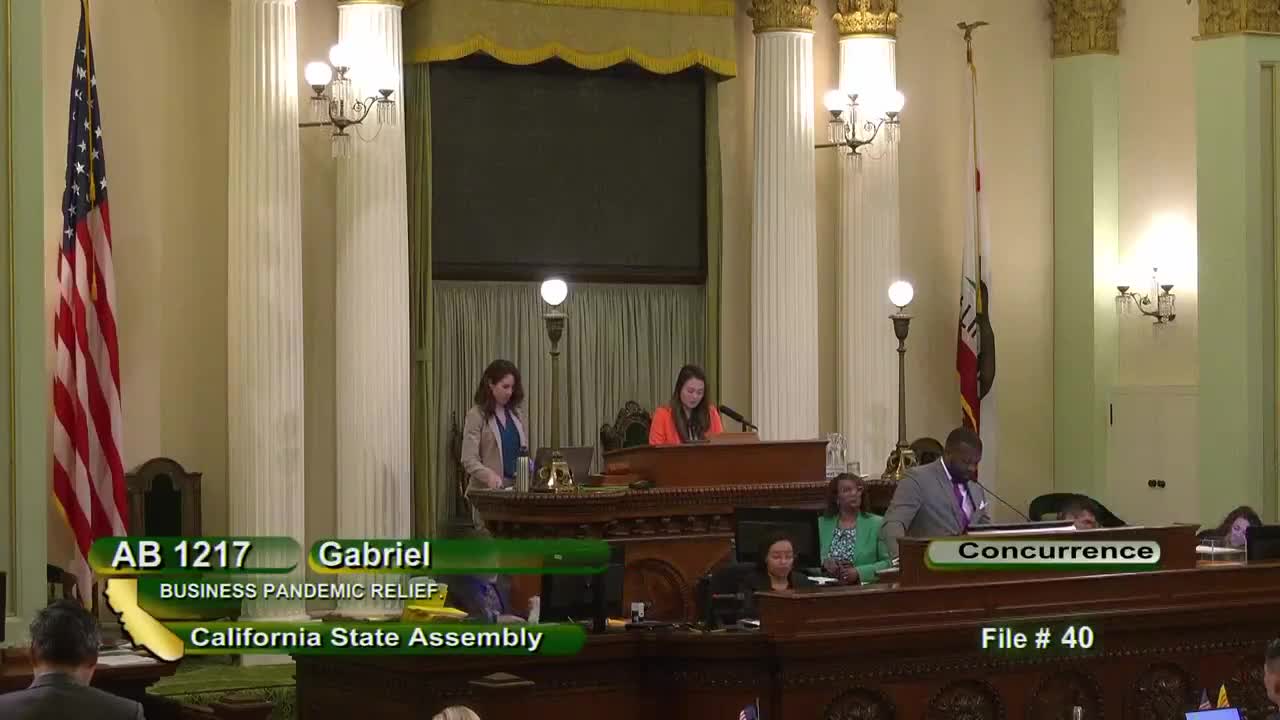 48SEC
Assembly Floor
 2MIN
Senate Floor
 8MIN
Senate Standing Committee on Energy, Utilities and Communications
 1MIN
Assembly Floor
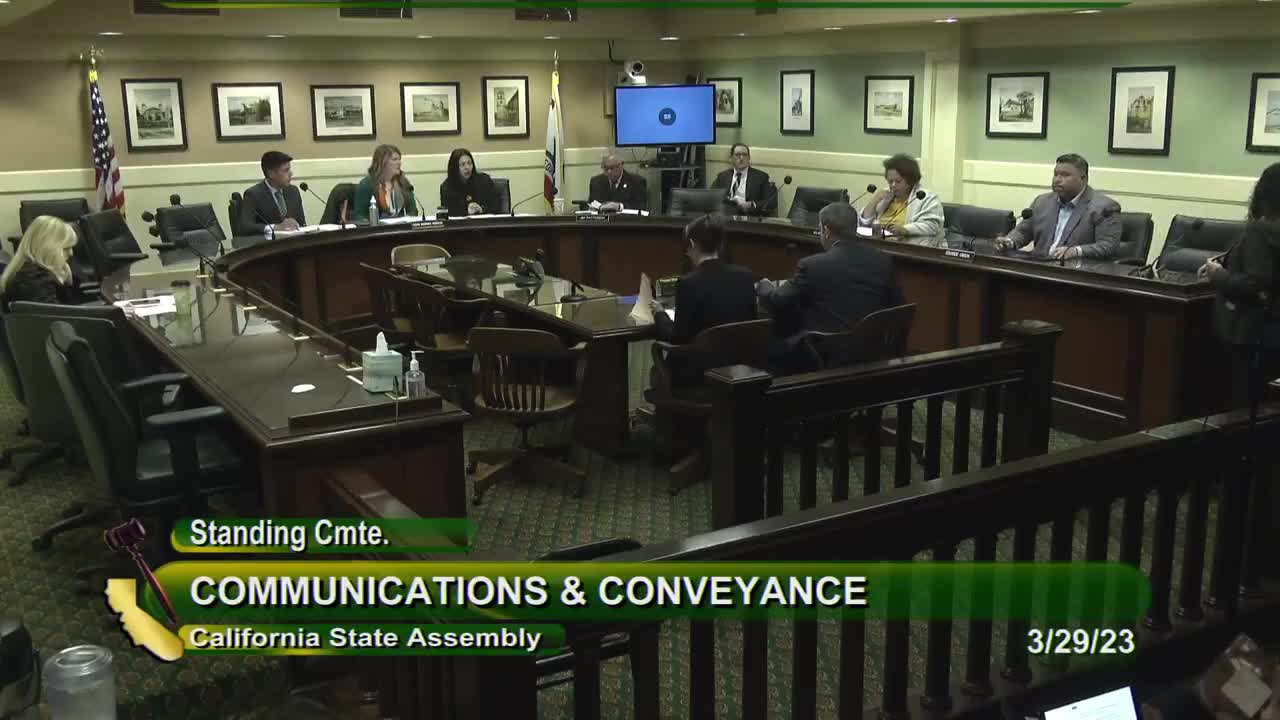 12MIN
Assembly Standing Committee on Communications and Conveyance
Bill Author