AB 418: The California Food Safety Act.
- Session Year: 2023-2024
- House: Assembly
- Latest Version Date: 2023-10-07
Current Status:
Passed
(2023-10-07: Chaptered by Secretary of State - Chapter 328, Statutes of 2023.)
Introduced
In Committee
First Chamber
In Committee
Second Chamber
Enacted
Existing law provides for the regulation of the safety of food products, including adulterated and misbranded food, wholesale food, and food in retail food facilities.
This bill, commencing January 1, 2027, would prohibit a person or entity from manufacturing, selling, delivering, distributing, holding, or offering for sale, in commerce a food product for human consumption that contains any specified substance, including, among others, brominated vegetable oil and red dye 3. The bill would make a violation of these provisions punishable by a civil penalty not to exceed $5,000 for a first violation and not to exceed $10,000 for each subsequent violation, upon an action brought by the Attorney General, a city attorney, a county counsel, or a district attorney.
Existing law provides for the regulation of the safety of food products, including adulterated and misbranded food, wholesale food, and food in retail food facilities.
This bill, commencing January 1, 2025, 2027, would prohibit a person or entity from manufacturing, selling, delivering, distributing, holding, or offering for sale, in commerce a food product for human consumption that contains any specified substance, including, among others, brominated vegetable oil and red dye 3. The bill would make a violation of these provisions punishable by a civil penalty not to exceed $5,000 for a first violation and not to exceed $10,000 for each subsequent violation, upon an action brought by the Attorney General, a city attorney, a county counsel, or a district attorney.
Existing law provides for the regulation of the safety of food products, including adulterated and misbranded food, wholesale food, and food in retail food facilities.
This bill, commencing January 1, 2025, would prohibit a person or entity from manufacturing, selling, delivering, distributing, holding, or offering for sale, in commerce a food product for human consumption that contains any specified substance, including, among others, brominated vegetable oil and red dye 3. The bill would make a violation of these provisions punishable by a civil penalty not to exceed $5,000 for a first violation and not to exceed $10,000 for each subsequent violation, upon an action brought by the Attorney General, a city attorney, a county counsel, or a district attorney.
Existing law provides for the regulation of the safety of food products, including adulterated and misbranded food, wholesale food, and food in retail food facilities.
This bill, commencing January 1, 2025, would prohibit a person or entity from manufacturing, selling, delivering, distributing, holding, or offering for sale, in commerce a food product that contains any specified substance, including, among others, brominated vegetable oil and red dye 3. The bill would make a violation of these provisions punishable by a civil penalty not to exceed $5,000 for a first violation and not to exceed $10,000 for each subsequent violation, upon an action brought by the Attorney General, a city attorney, a county counsel, or a district attorney.
Existing law provides for the regulation of the safety of food products, including adulterated and misbranded food, wholesale food, and food in retail food facilities.
This bill, commencing January 1, 2025, would prohibit a person or entity from manufacturing, selling, delivering, distributing, holding, or offering for sale, in commerce a food product that contains any specified substance, including, among others, brominated vegetable oil and red dye 3.
This act shall be known, and may be cited, as the California Food Safety Act.
SEC. 2.Chapter 17 (commencing with Section 109025) is added to Part 3 of Division 104 of the Health and Safety Code, to read:17.Food Safety109025.(a)Commencing January 1, 2027, a person or entity shall not manufacture, sell, deliver, distribute, hold, or offer for sale, in commerce a food product for human consumption that contains any of the following substances:
(1)Brominated vegetable oil (CAS no. 8016-94-2).
(2)Potassium bromate (CAS no. 7758-01-2).
(3)Propylparaben (CAS no. 94-13-3).
(4)Red dye 3 (CAS no. 16423-68-0).
(b)(1)Upon an action brought by the Attorney General, a city attorney, a county counsel, or a district attorney, a person or entity that violates subdivision (a) shall be liable for a civil penalty not to exceed five thousand dollars ($5,000) for a first violation, and not to exceed ten thousand dollars ($10,000) for each subsequent violation.
(2)This section does not impair or impede any other rights, causes of action, claims, or defenses available under any other law. The remedies provided in this section are cumulative with any other remedies available under any other law.
This act shall be known, and may be cited, as the California Food Safety Act.
SECTION 1.SEC. 2.Chapter 17 (commencing with Section 109025) is added to Part 3 of Division 104 of the Health and Safety Code, to read:17.Food Safety109025.(a)Commencing January 1, 2027, a person or entity shall not manufacture, sell, deliver, distribute, hold, or offer for sale, in commerce a food product for human consumption that contains any of the following substances:
(1)Brominated vegetable oil (CAS no. 8016-94-2).
(2)Potassium bromate (CAS no. 7758-01-2).
(3)Propylparaben (CAS no. 94-13-3).
(4)Red dye 3 (CAS no. 16423-68-0).
(5)Titanium dioxide (CAS no. 13463-67-7).(b)(1)Upon an action brought by the Attorney General, a city attorney, a county counsel, or a district attorney, a person or entity that violates subdivision (a) shall be liable for a civil penalty not to exceed five thousand dollars ($5,000) for a first violation, and not to exceed ten thousand dollars ($10,000) for each subsequent violation.
(2)This section does not impair or impede any other rights, causes of action, claims, or defenses available under any other law. The remedies provided in this section are cumulative with any other remedies available under any other law.
(a)Commencing January 1, 2025, 2027, a person or entity shall not manufacture, sell, deliver, distribute, hold, or offer for sale, in commerce a food product for human consumption that contains any of the following substances:
(1)Brominated vegetable oil (CAS no. 8016-94-2).
(2)Potassium bromate (CAS no. 7758-01-2).
(3)Propylparaben (CAS no. 94-13-3).
(4)Red dye 3 (CAS no. 16423-68-0).
(5)Titanium dioxide (CAS no. 13463-67-7).
(b)(1)Upon an action brought by the Attorney General, a city attorney, a county counsel, or a district attorney, a person or entity that violates subdivision (a) shall be liable for a civil penalty not to exceed five thousand dollars ($5,000) for a first violation, and not to exceed ten thousand dollars ($10,000) for each subsequent violation.
(2)This section does not impair or impede any other rights, causes of action, claims, or defenses available under any other law. The remedies provided in this section are cumulative with any other remedies available under any other law.
(a)Commencing January 1, 2025, a person or entity shall not manufacture, sell, deliver, distribute, hold, or offer for sale, in commerce a food product for human consumption that contains any of the following substances:
(1)Brominated vegetable oil (CAS no. 8016-94-2).
(2)Potassium bromate (CAS no. 7758-01-2).
(3)Propylparaben (CAS no. 94-13-3).
(4)Red dye 3 (CAS no. 16423-68-0).
(5)Titanium dioxide (CAS no. 13463-67-7).
(b)(1)Upon an action brought by the Attorney General, a city attorney, a county counsel, or a district attorney, a person or entity that violates subdivision (a) shall be liable for a civil penalty not to exceed five thousand dollars ($5,000) for a first violation, and not to exceed ten thousand dollars ($10,000) for each subsequent violation.
(2)This section does not impair or impede any other rights, causes of action, claims, or defenses available under any other law. The remedies provided in this section are cumulative with any other remedies available under any other law.
(a)Commencing January 1, 2025, a person or entity shall not manufacture, sell, deliver, distribute, hold, or offer for sale, in commerce a food product that contains any of the following substances:
(a)(1)Brominated vegetable oil (CAS no. 8016-94-2).
(b)(2)Potassium bromate (CAS no. 7758-01-2).
(c)(3)Propylparaben (CAS no. 94-13-3).
(d)(4)Red dye 3 (CAS no. 16423-68-0).
(e)(5)Titanium dioxide (CAS no. 13463-67-7).
(b)(1)Upon an action brought by the Attorney General, a city attorney, a county counsel, or a district attorney, a person or entity that violates subdivision (a) shall be liable for a civil penalty not to exceed five thousand dollars ($5,000) for a first violation, and not to exceed ten thousand dollars ($10,000) for each subsequent violation.
(2)This section does not impair or impede any other rights, causes of action, claims, or defenses available under any other law. The remedies provided in this section are cumulative with any other remedies available under any other law.
REVISIONS: HeadingLine 2.Commencing January 1, 2025, a person or entity shall not manufacture, sell, deliver, distribute, hold, or offer for sale, in commerce a food product that contains any of the following substances:
(a)Brominated vegetable oil (CAS no. 8016-94-2).
(b)Potassium bromate (CAS no. 7758-01-2).
(c)Propylparaben (CAS no. 94-13-3).
(d)Red dye 3 (CAS no. 16423-68-0).
(e)Titanium dioxide (CAS no. 13463-67-7).
|
Date
|
Status
|
|---|---|
| Oct 7, 2023 | Chaptered by Secretary of State - Chapter 328, Statutes of 2023. |
| Oct 7, 2023 | Approved by the Governor. |
| Sep 19, 2023 | Enrolled and presented to the Governor at 4 p.m. |
| Sep 12, 2023 | Senate amendments concurred in. To Engrossing and Enrolling. (Ayes 65. Noes 6. Page 3243.). |
| Sep 12, 2023 | Assembly Rule 77 suspended. (Page 3228.) |
| Sep 11, 2023 | In Assembly. Concurrence in Senate amendments pending. May be considered on or after September 13 pursuant to Assembly Rule 77. |
| Sep 11, 2023 | Read third time. Passed. Ordered to the Assembly. (Ayes 33. Noes 3. Page 2564.). |
| Sep 5, 2023 | Read second time. Ordered to third reading. |
| Sep 1, 2023 | Read third time and amended. Ordered to second reading. |
| Aug 15, 2023 | Read second time. Ordered to third reading. |
| Aug 14, 2023 | From committee: Be ordered to second reading pursuant to Senate Rule 28.8. |
| Jul 12, 2023 | From committee: Do pass and re-refer to Com. on APPR. (Ayes 5. Noes 1.) (July 12). Re-referred to Com. on APPR. |
| Jul 3, 2023 | Read second time and amended. Re-referred to Com. on E.Q. |
| Jun 29, 2023 | From committee: Amend, and do pass as amended and re-refer to Com. on E.Q. (Ayes 10. Noes 0.) (June 28). |
| May 26, 2023 | From committee chair, with author's amendments: Amend, and re-refer to committee. Read second time, amended, and re-referred to Com. on HEALTH. |
| May 24, 2023 | Referred to Coms. on HEALTH and E.Q. |
| May 16, 2023 | In Senate. Read first time. To Com. on RLS. for assignment. |
| May 15, 2023 | Read third time. Passed. Ordered to the Senate. (Ayes 54. Noes 12. Page 1551.) |
| May 4, 2023 | Read second time. Ordered to third reading. |
| May 3, 2023 | From committee: Do pass. (Ayes 12. Noes 3.) (May 3). |
| May 3, 2023 | Coauthors revised. |
| Apr 19, 2023 | From committee: Do pass and re-refer to Com. on APPR. (Ayes 7. Noes 1.) (April 18). Re-referred to Com. on APPR. |
| Apr 17, 2023 | Re-referred to Com. on E.S. & T.M. |
| Apr 13, 2023 | From committee chair, with author's amendments: Amend, and re-refer to Com. on E.S. & T.M. Read second time and amended. |
| Apr 12, 2023 | From committee: Do pass and re-refer to Com. on E.S. & T.M. (Ayes 12. Noes 1.) (April 11). Re-referred to Com. on E.S. & T.M. |
| Feb 17, 2023 | Referred to Coms. on HEALTH and E.S. & T.M. |
| Feb 3, 2023 | From printer. May be heard in committee March 5. |
| Feb 2, 2023 | Read first time. To print. |
|
Date
|
Description
|
Location
|
Votes
|
|
|---|---|---|---|---|
| Sep 12, 2023 | AB 418 Gabriel Concurrence in Senate Amendments | Assembly Floor |
Passed |
|
| Sep 11, 2023 | Assembly 3rd Reading AB418 Gabriel et al. By Menjivar | Senate Floor |
Passed |
|
| Jul 12, 2023 | Do pass, but first be re-referred to the Committee on [Appropriations] | Senate Standing Committee on Environmental Quality |
Passed |
|
| Jun 28, 2023 | Do pass as amended, but first amend, and re-refer to the Committee on [Environmental Quality] | Senate Standing Committee on Health |
Passed |
|
| May 15, 2023 | AB 418 Gabriel Assembly Third Reading | Assembly Floor |
Passed |
|
| May 3, 2023 | Do pass. | Assembly Standing Committee on Appropriations |
Passed |
|
| Apr 18, 2023 | Do pass and be re-referred to the Committee on [Appropriations] | Assembly Standing Committee on Environmental Safety and Toxic Materials |
Passed |
|
| Apr 11, 2023 | Do pass and be re-referred to the Committee on [Environmental Safety and Toxic Materials] | Assembly Standing Committee on Health |
Passed |
This list shows positions taken on this bill by organizations on the date displayed, which is linked to the original source.
Positions by individuals are not included.
|
Organization
|
Position
|
Date
|
|---|---|---|
| A Voice for Choice Advocacy | ** Support | |
| Actum Ca Opco LLC | * Support | Jul 12, 2023 |
| Alliance of Nurses for Healthy Environments | ** Support | |
| AMERICAN BANKERS ASSOCIATION | ** Against | |
| American Beverage Association | ** Against | |
| American Chemistry Council | ** Against | |
| American College Of Obstetricians And Gynecologists District Ix | ** Support | |
| american nurses association - california | ** Support | |
| As You Sow | ** Support | |
| Ban Single Use Plastic | ** Support | |
| Beyond Pesticides | ** Support | |
| Beyond Plastics | ** Support | |
| Breast Cancer Action | ** Support | |
| Breast Cancer Over Time | ** Support | |
| Breast Cancer Prevention Partners | ** Support | |
| California Advocates, Inc. | * Against | Jul 12, 2023 |
| California Association Of Environmental Health Administrators (Caeha) | * Support | Apr 18, 2023 |
| California Business Roundtable | * Against | Jul 12, 2023 |
| California Chamber Of Commerce | ** Against | |
| California Federation Of Teachers | ** Support | |
| California Fuels And Convenience Alliance | ** Against | |
| California Grocers Association | ** Against | |
| California Health Coalition Advocacy | ** Support | |
| California League of Food Producers | ** Against | |
| California Manufacturers & Technology Association | ** Against | |
| California Nurses for Environmental Health and Justice | ** Support | |
| California Public Interest Research Group | ** Support | |
| California Resident | * Support | Jun 28, 2023 |
| California Retailers Association | ** Against | |
| California State Council of Service Employees International Union | ** Support | |
| Center for Community Action and Environmental Justice | ** Support | |
| Center for Democratic and Environmental Rights | ** Support | |
| Center For Environmental Health | ** Support | |
| Center For Food Safety | ** Support | |
| Center for Progressive Reform | ** Support | |
| Chemical Industry Council Of California | ** Against | |
| Children Now | ** Support | |
| Childrens Environmental Health Network | ** Support | |
| CleanEarth4Kids | ** Support | |
| Community Union | ** Support | |
| Community Union, INC. | ** Support | |
| Consumer Brands Association | ** Against | |
| Consumer Healthcare Products Association | * Indeterminate | Jun 28, 2023 |
| Consumer Reports | ** Support | |
| Council For Responsible Nutrition | ** Against | |
| Defend Our Health | ** Support | |
| Environmental Working Group | ** Support | |
| Families Advocating for Chemical and Toxics Safety | ** Support | |
| Food and Water Watch | ** Support | |
| Food Chain Workers Alliance | ** Support | |
| Food Safe | * Support | Jun 28, 2023 |
| Friends Committee On Legislation Of California | ** Support | |
| Friends Of The Earth | ** Support | |
| GMO Science | ** Support | |
| Grassroots Environmental Education | ** Support | |
| Green Science Policy Institute | ** Support | |
| Healthy Babies Bright Futures | ** Support | |
| International Association of Color Manufacturers | ** Against | |
| International Association Of Color Manufacturers | * Against | Jun 28, 2023 |
| International Dairy Foods Association | ** Against | |
| John Burton Advocates for Youth | ** Support | |
| Jonas Children's Environmental Health | ** Support | |
| Jonas Philantropies | * Support | Jul 12, 2023 |
| Kellison Company Inc | * Against | Jul 12, 2023 |
| Learning Disabilities Association of America | ** Support | |
| Long Beach Gray Panthers | ** Support | |
| Manatt Phelps Phillips LLP | * Against | Jul 12, 2023 |
| Maternal and Child Health Access | ** Support | |
| MySafetyNEST.org | ** Support | |
| National Association of Pediatric Nurse Practitioners | ** Support | |
| National Confectioners Association | ** Against | |
| National Stewardship Council | ** Support | |
| Nontoxic Neighborhoods | ** Support | |
| Nontoxic Schools | ** Support | |
| North American Millers' Association | ** Against | |
| North County Equity and Justice Coalition | * Support | Jul 12, 2023 |
| OFW Law | * Against | Apr 18, 2023 |
| Pesticide Action Network | ** Support | |
| Pesticide Free Zone | ** Support | |
| Placer County | * Support | Jun 28, 2023 |
| Poison Free Malibu | ** Support | |
| Progressives for Democracy in America | ** Support | |
| Public Health Advocates | ** Support | |
| Public Policy Advocates LLC | * Against | Jul 12, 2023 |
| recolte energy | ** Support | |
| Resource Renewal Institute | ** Support | |
| Rgs Consulting And Advocacy LLC | * Support | Jul 12, 2023 |
| SafetyNEST | ** Support | |
| Samson Advisors | * Against | Jul 12, 2023 |
| San Fernando Valley | * Support | Jun 28, 2023 |
| San Francisco Bay Area Physicians for Social Responsibility | ** Support | |
| See | ** Support | |
| Shaw Yoder Antwih Schmelzer Lange | * Support | Jul 12, 2023 |
| Sierra Club California | ** Support | |
| Sloat Higgins Jensen And Associates LLC | * Against | Jul 12, 2023 |
| Social Eco Education | ** Support | |
| Sonoma Safe Agriculture Safe Schools | ** Support | |
| Stories Matter Media | ** Support | |
| The Latino Cancer Institute | ** Support | |
| United Nurses Associations Of California/Union Of Health Care Professionals | ** Support | |
| University of California, San Francisco | * Support | Jul 12, 2023 |
| USC Schwarzenegger Institute | ** Support | |
| Women's Voices for the Earth | ** Support |
CONCURRENCE IN SENATE AMENDMENTS
CSA1 Bill Id:AB 418
Author:(Gabriel and Wicks)
As Amended Ver:September 1, 2023
Majority vote
SUMMARY
Prohibits a person or entity, commencing January 1, 2027, from manufacturing, selling, delivering, distributing, holding, or offering for sale, in commerce a food product for human consumption that contains any of the following substances:
- Brominated vegetable oil (BVO);
- Potassium bromate;
- Propylparaben; or,
- Red dye 3.
Makes a violation of these provisions punishable by a civil penalty not to exceed $5,000 for a first violation and not to exceed $10,000 for each subsequent violation, upon an action brought by the Attorney General, a city attorney, a county counsel, or a district attorney.
Senate Amendments
Delay implementation to January 1, 2027 and delete titanium dioxide from the provisions of this bill.
COMMENTS
According to the United States (U.S.). Food and Drug Administration (FDA), there are thousands of ingredients used to make foods, and it maintains a list of over 3,000 ingredients in its database "Everything added to Food in the United States." These ingredients include food and/or color additives.
Food Additives. A food additive is a substance added to food or "any substance the intended use of which results or may reasonably be expected to result, directly or indirectly, in its becoming a component or otherwise affecting the characteristics of any food." This includes any substance used in the production, processing, treatment, packaging, transportation or storage of food. The purpose of this definition is to impose a premarket approval requirement, unless the ingredient's use is generally recognized as safe (GRAS) then no government approval is necessary (further discussion below).
Color Additives. A color additive is any dye, pigment or substance which when added or applied to a food, drug, or cosmetic, or to the human body, is capable of imparting color. The FDA regulates all color additives to ensure that foods containing color additives are safe to eat, contain only approve ingredients and are accurately labeled. Color additives are either subject to certification or exempt from certification. Certified colors are synthetically produced (human made) and there are nine certified color additives approved for use in the U.S.: FD&C Blue No. 1 (confections, beverages, cereals, frozen dairy desserts, popsicles, frostings & icings); FD&C Blue No. 2 (baked goods, cereals, snack foods, ice cream, confections, and yogurt); FD&C Green No. 3 (cereal, ice cream, sherbet, drink mixers, and baked goods); Orange B (only approved for use in hot dog and sausage casings); Citrus Red No. 2 (only approved for use to color orange peels); FD&C Red No. 3 (confections, beverages, cereals, ice cream cones, frozen dairy desserts, popsicles, frostings & icings); FD&C Red No. 40 (cereal, beverages, gelatins, puddings, dairy products, and confections); FD&C Yellow No. 5 (confections, cereals, snack foods, beverages, condiments, baked goods, and yogurt); and, FD&C Yellow No. 6 (cereals, snack foods, baked goods, gelatins, beverages, dessert powders, crackers, and sauces). Colors that are exempt from certification include pigments derived from natural sources such as vegetables, minerals, or animals.
California Environmental Protection Agency, the Office of Environmental Health Hazard Assessment (OEHHA) Risk Assessment. In the 2018-2019 State budget, OEHHA received funding to review the scientific literature and conduct a risk assessment, as data allow, on the potential impacts of synthetic food dyes on children, including Red Dye No. 3. According to OEHHA, the percentage of American children and adolescents diagnosed with Attention Deficit/Hyperactivity Disorder (ADHD) has increased from an estimated 6.1% to 10.2% during the last 20 years. Concerns about increasing rates of ADHD and other behavioral disorders prompted the California Legislature to ask OEHHA to conduct the food dye assessment.
The dyes that were studied are added to many foods, beverages, over-the-counter medications, and vitamins in the United States, especially those intended for children. The report is the product of a two-year, multifaceted evaluation of seven synthetic food dyes that have been approved by the FDA. OEHHA extensively reviewed existing studies of the effects of these dyes on both humans and laboratory animals.
The report found that consumption of synthetic food dyes can result in hyperactivity and other neurobehavioral problems in some children, and that children vary in their sensitivity to synthetic food dyes. The report also found that current federal levels for safe intake of synthetic food dyes may not sufficiently protect children's behavioral health. The levels were established by the FDA decades ago and do not reflect newer research.
According to the report, overall, human studies indicate that synthetic food dyes are associated with adverse neurobehavioral outcomes in children, and that children vary in their sensitivity to synthetic food dyes. "Challenge studies" placed the children on a dye-free diet for several weeks and measured their behavior. The children were then given food or drinks with dyes added, and measures of their behavior were recorded by a number of standardized methods. These studies demonstrated clearly that some children are likely to be more adversely affected by synthetic food dyes than others. Animal studies indicate synthetic food dyes affect activity, memory and learning, cause changes in the neurotransmitters (chemicals that carry signals from one nerve to the next) in the brain, and cause microscopic changes in brain structure.
Researchers also found that all of the FDA's Acceptable Daily Intake levels (ADIs) for synthetic food dyes are based on 35- to 70-year-old studies that were not designed to detect the types of behavioral effects that have been observed in children. Comparisons with newer studies indicate that the current ADIs may not adequately protect children from behavioral effects. For some of the dyes, these comparisons indicate that updated levels would be much lower. The research team found that children are exposed to multiple dyes in a day, and that the highest exposures are usually from juice drinks and soft drinks. They also found that common exposures to Red No. 3 from a few foods may exceed the existing ADI. If revised ADIs were to be based on newer studies, common exposures to food dyes in foods would exceed the revised guidance.
According to the Author
The government does not proactively regulate chemicals used in manufactured and packaged foods, and even allows food manufacturers to decide if a chemical is safe for public consumption. As a result, some harmful chemicals, such as the ones listed in this bill, end up in food that all of us, including our children, consume every day. Californians should not have to worry that the food they buy in their neighborhood grocery store might be full of dangerous additives or toxic chemicals. The author concludes this bill will correct for a concerning lack of federal oversight and help protect our kids, public health, and the safety of our food supply.
Arguments in Support
Supporters such as the Environmental Working Group (EWG), Consumer Reports, and Breast Cancer Prevention Partners state the chemicals this bill prohibits are chemicals associated with serious health risks, such as increased risk of cancer, harm to the reproductive system, and harm to the immune system. But because of the FDA's inaction and regulatory loopholes, these chemicals are found in many food products, such as snacks, candy, and soda consumed by children in California and the United States.
EWG and Consumer Reports also state:
- This bill does not interfere with ongoing federal regulation of food additives and federal law does not preempt state action on these additives;
- Federal review of food additives are neither comprehensive nor active and regularly allow hazardous additives to be sold to consumers. The GRAS loophole, originally meant for common ingredients, is exploited by companies who appoint industry-favoring panelists to designate chemicals as safe;
- The FDA regularly fails to respond to petitions and meet other federal statutory requirements to restrict additives that pose public health risks. For example, Red dye no. 3 has been banned from cosmetics since 1990 and yet it continues to be allowed in food;
- Existing California law does not restrict these toxic chemicals in food; and,
- Ingredient and warning labels are insufficient alone to protect consumers.
Arguments in Opposition
A coalition of opposition that includes the Consumer Brands Association, the International Association of Color Manufacturers, National Confectioners Association, and the American Bakers Association oppose this bill. The opposition indicates the federal government has a comprehensive food safety process that reviews food additives. In addition, California has several laws that require removing chemicals from foods, attaching warning labels, and checking alternatives if those food additives are unsafe or expose consumers to allergies. All five of these additives have been thoroughly reviewed by the federal and state systems and many international scientific bodies and continue to be deemed safe. They also claim that the food safety process is active and should be allowed to continue the appropriate review of these five and all additives. Several substances this bill proposes to ban are subject to petitions to these government entities initiated by many organizations supporting this bill. Scientific regulators work through these processes and make determinations to establish recognized safe thresholds. Then, when appropriate and supported by peer-reviewed scientific evaluations, they require additional labels or removal from the market. Additionally, the opposition points out that there is a comprehensive system that requires ingredient labeling allowing consumers to make informed decisions. The opposition concludes that the federal government and California have developed one of the world's most robust and protective systems for food safety.
FISCAL COMMENTS
According to the Senate Appropriations Committee, pursuant to Senate Rule 28.8, negligible costs.
VOTES:
ASM HEALTH: 12-1-2
YES: Wood, Waldron, Aguiar-Curry, Arambula, Boerner Horvath, Wendy Carrillo, Maienschein, McCarty, Rodriguez, Santiago, Villapudua, Weber
NO: Vince Fong
ABS, ABST OR NV: Flora, Joe Patterson
ASM ENVIRONMENTAL SAFETY AND TOXIC MATERIALS: 7-1-1
YES: Lee, Arambula, Bauer-Kahan, Connolly, McKinnor, Pacheco, Zbur
NO: Ta
ABS, ABST OR NV: Hoover
ASM APPROPRIATIONS: 12-3-1
YES: Holden, Bryan, Calderon, Wendy Carrillo, Mike Fong, Hart, Lowenthal, Papan, Pellerin, Robert Rivas, Weber, Wilson
NO: Megan Dahle, Mathis, Sanchez
ABS, ABST OR NV: Dixon
ASSEMBLY FLOOR: 54-12-14
YES: Addis, Aguiar-Curry, Alvarez, Arambula, Bains, Bauer-Kahan, Bennett, Berman, Boerner, Bonta, Bryan, Calderon, Juan Carrillo, Wendy Carrillo, Cervantes, Connolly, Mike Fong, Gabriel, Garcia, Gipson, Grayson, Haney, Hart, Holden, Irwin, Jackson, Jones‑Sawyer, Kalra, Lee, Low, Lowenthal, Maienschein, McCarty, McKinnor, Muratsuchi, Ortega, Papan, Pellerin, Petrie-Norris, Quirk-Silva, Reyes, Luz Rivas, Robert Rivas, Rodriguez, Santiago, Schiavo, Ting, Ward, Weber, Wicks, Wilson, Wood, Zbur, Rendon
NO: Alanis, Megan Dahle, Davies, Essayli, Flora, Vince Fong, Gallagher, Jim Patterson, Joe Patterson, Sanchez, Ta, Wallis
ABS, ABST OR NV: Chen, Dixon, Friedman, Hoover, Lackey, Mathis, Stephanie Nguyen, Pacheco, Ramos, Blanca Rubio, Soria, Valencia, Villapudua, Waldron
SENATE FLOOR: 33-3-4
YES: Allen, Alvarado-Gil, Archuleta, Ashby, Atkins, Becker, Blakespear, Bradford, Cortese, Dodd, Durazo, Eggman, Glazer, Gonzalez, Grove, Laird, Limón, McGuire, Menjivar, Min, Newman, Ochoa Bogh, Padilla, Portantino, Roth, Rubio, Skinner, Smallwood-Cuevas, Stern, Umberg, Wahab, Wiener, Wilk
NO: Jones, Niello, Seyarto
ABS, ABST OR NV: Caballero, Dahle, Hurtado, Nguyen
UPDATED
VERSION: September 1, 2023
CONSULTANT: Kristene Mapile / HEALTH / (916) 319-2097 FN: 0001766
SENATE RULES COMMITTEE Office of Senate Floor Analyses (916) 651-1520 Fax: (916) 327-4478 | AB 418 |
THIRD READING
Bill No: AB 418
Author: Gabriel (D) and Wicks (D), et al.
Amended: 9/1/23 in Senate
Vote: 21
SENATE HEALTH COMMITTEE: 10-0, 6/28/23
AYES: Eggman, Glazer, Gonzalez, Hurtado, Limón, Menjivar, Roth, Rubio, Wahab, Wiener
NO VOTE RECORDED: Nguyen, Grove
SENATE ENVIRONMENTAL QUALITY COMMITTEE: 5-1, 7/12/23
AYES: Allen, Gonzalez, Hurtado, Menjivar, Skinner
NOES: Dahle
NO VOTE RECORDED: Nguyen
SENATE APPROPRIATIONS COMMITTEE: Senate Rule 28.8
ASSEMBLY FLOOR: 54-12, 5/15/23 - See last page for vote
SUBJECT: The California Food Safety Act
SOURCE: Consumer Reports & Environmental Working Group
DIGEST:
This bill prohibits any food product, beginning on January 1, 2027, from containing the following substances: brominated vegetable oil, potassium bromate, propylparaben, or red dye 3.
Senate Floor Amendments of 9/1/23 delete titanium dioxide from the provisions of this bill, and add a title so that the bill will be known as the California Food Safety Act.
ANALYSIS:
Existing law:
- Enacts the Sherman Food, Drug and Cosmetic Law, enforced by the California Department of Public Health (CDPH), which provides broad authority for CDPH to enforce food safety requirements, including that food is not adulterated, misbranded, or falsely advertised. Food labeling requirements generally adopt federal food labeling laws as the state requirement, including nutrition labeling and allergen labeling, but CDPH is permitted, by regulation, to adopt additional food labeling regulations. [HSC §109875, et seq.]
- Prohibits a person from manufacturing, selling, or distributing in commerce any bottle or cup that contains bisphenol A (BPA) if the bottle or cup is designed to be filled with any liquid, food, or beverage intended for consumption from that bottle or cup by children three years of age or younger. [HSC §108940]
- Prohibits, commencing January 1, 2025, a person or entity from manufacturing, selling, delivering, holding, or offering for sale in commerce any cosmetic product that contains 13 chemical ingredients banned from use in cosmetics by the European Union (EU). [HSC §108980]
- Prohibits, under the federal Food Drug and Cosmetic Act, any food additive from being deemed to be safe if it is found to induce cancer when ingested (known as the Delaney Clause). [21USC §348(c)(3)]
This bill:
- Enacts the California Food Safety Act to prohibit, beginning on January 1, 2027, an entity from manufacturing, selling, delivering, distributing, holding, or offering for sale, a food product for human consumption that contains any of the following substances:
- Brominated vegetable oil;
- Potassium bromate;
- Propylparaben; or,
- Red dye 3.
- Requires an entity that violates 1) above to be liable, in an action brought by the Attorney General, a city attorney, a county counsel, or a district attorney, for a civil penalty of up to $5,000 for a first violation, and up to $10,000 for each subsequent violation.
- Prohibits the provisions of this bill from impairing or impeding any other rights, causes of action, claims, or defenses available under any other law, and specifies that the remedies provided by this bill are cumulative with any other remedies available under any other law.
Comments
- Author’s statement. According to the author, our government does not proactively regulate chemicals used in manufactured and packaged foods, and even allows food manufacturers to decide if a chemical is safe for public consumption. As a result, some harmful chemicals, such as the ones listed in this bill, end up in food that all of us, including our children, consume every day. Californians shouldn’t have to worry that the food they buy in their neighborhood grocery store might be full of dangerous additives or toxic chemicals. This bill will correct for a concerning lack of federal oversight and help protect our kids, public health, and the safety of our food supply.
- What are these substances?
- Brominated vegetable oil (BVO) is a vegetable oil that has bromine added to it. It is used in small amounts to keep the citrus flavoring from floating to the top in some beverages. It is regulated as a food additive, and approved for use as a stabilizer for flavoring oils used in fruit-flavored beverages, in an amount not to exceed 15 parts per million in the finished beverage. The FDA states that over the years, many beverage makers have reformulated their products to replace BVO with an alternative ingredient, and few beverages in the U.S. today contain BVO. In addition to being prohibited for use in foods in the 27 countries of the EU, proponents state that Australia/New Zealand, China, Singapore, and Japan also prohibit BVO.
- Potassium bromate is an oxidizing agent that helps develop strong gluten bonds in bread doughs and other baked products. The FDA regulates potassium bromate as a food additive, and regulations permit 0.0075 parts potassium bromate for every 100 parts by weight of flour used or roughly one teaspoon per 800 cups of flour. It has been prohibited in foods in the EU since 1990, and according to proponents, is also prohibited in China, South Korea, Sri Lanka, Canada, Australia/New Zealand (except for germination control in malting), Brazil, Peru, India, Columbia, and Singapore.
- Propylparaben, also written as propyl paraben, is used as an antimicrobial preservative in foods, drugs and cosmetics. It was initially added to as a food ingredient through the “general recognized as safe” (GRAS) process, and later affirmed in regulations adopted in 1977 as GRAS when used at a level not to exceed good manufacturing practices, which at the time of the adoption of regulations was set at no more than 0.1% of food. It has been prohibited from use in food in the EU since 2006, and according to proponents, is also prohibited in Japan, China, Sri Lanka, and Singapore.
- Red dye 3, also known as erythrosine and Red No. 3, is a synthetic dye made from petroleum that gives foods a bright, cherry-red color. It is permitted to be used in food and ingested drugs, but has been prohibited by the FDA since 1990 from use in cosmetics, externally applied drugs, and in food when in the form of “lakes” (which are formed by chemically reacting straight colors with an aluminum salt to make the dye insoluble in water). The EU restricted its use in food to only candied cherries and cocktail cherries in 1994. Australia/New Zealand also restricts its use to just cocktail cherries and frosting.
- Pending petitions and other regulatory action on two of the four substances. In May of this year, the FDA published on article on its website entitled, “How FDA’s New Approach to Reviewing Chemicals Added to Food Will Strengthen Food Safety.” In this article, the FDA stated that “reassessing the safety of food ingredients and substances as new, relevant data become available, is a key part of their food safety mission in the post-market context.” The FDA stated that in light of this need to continue to assess the safety of food ingredients, it is embarking on a more modernized, systematic reassessment of chemicals with a focus on post-market review. The FDA states there are currently two ways it reviews chemicals used as food ingredients after they are on the market: the first one is through petitions or notifications, which is a way for stakeholders to ask the FDA to take action. Below is a description of a petition that has been submitted on Red No. 3. The other ways is through its own initiative as part of their ongoing commitment to oversee the safety of the food supply. As an examples of this, the FDA pointed to its work to remove the use of per- and polyfluoroalkyl substances (PFAS) from certain types of food packaging, and also to its current effort to reassess brominated vegetable oil (described below). However, FDA states that it is working to develop new approaches to mine existing data more efficiently and prioritize substances for in-depth review based on risk. To fully build this framework, the FDA states it needs resources, including new staff, expanded regulatory authority, and support from stakeholders and well as Congress to achieve its vision. Below are currently pending FDA actions on two of the four substances in this bill:
- Red No 3. In November of 2022, the Center for Science in the Public Interest (CSPI) submitted a petition to the FDA requesting the agency prohibit the use of Red No. 3 in all foods, dietary supplements, and ingested drugs. The FDA set a deadline for comments of April 18, 2023, and more than 30,000 comments have been submitted related to this petition. It is unclear when FDA will complete its response to this petition. In addition to this federal petition, CSPI, along with a number of partner organizations such as the Center for Food Safety, the Children’s Advocacy Institute, and the Environmental Working Group, also submitted a petition to CDPH requesting that the department promulgate regulations requiring warning labels on food and dietary supplement products that contain synthetic food dyes, which would include Red No. 3. The label would require the following text: “WARNING: Product contains synthetic food dyes which the State of California has determined can result in hyperactivity and other neurobehavioral problems in some children.” This petition was filed on December 8, 2022, and as required in response, CDPH held a public hearing on this petition on Tuesday, April 11, 2023, and set a deadline of May 12, 2023, for written public comments. It is unclear when CDPH will make a decision on this petition.
- BVO. According to the FDA, it evaluates the safe use of any food ingredient, and continues to evaluate information about BVO as it becomes available. In May of 2022, the FDA published a study in the journal Food and Chemical Toxicology that evaluated potential health effects related to BVO consumption in rodents. Data from this study suggest that oral exposure to BVO is associated with increased tissue levels of bromine and that at high levels of exposure the thyroid is a target organ of potential negative health effects in rodents. According to the FDA, it is working on a proposed rule to amend the regulations to remove the authorization of BVO as a food ingredient.
[NOTE: For a more complete analysis of this bill, see the Senate Health Committee analysis.]
FISCAL EFFECT: Appropriation: No Fiscal Com.: Yes Local: No
SUPPORT: (Verified 9/1/23)
Consumer Reports (co-source)
Environmental Working Group (co-source)
A Voice for Choice Advocacy
Alliance of Nurses for Healthy Environments
American College of Obstetricians and Gynecologists District IX
American Nurses Association - California
As You Sow
Ban Single Use Plastics
Beyond Pesticides
Beyond Plastics
Breast Cancer Action
Breast Cancer Over Time
Breast Cancer Prevention Partners
California Federation of Teachers
California Health Coalition Advocacy
California Nurses for Environmental Health and Justice
California Public Interest Research Group
California State Council of Service Employees International Union
Center for Community Action and Environmental Justice
Center for Democratic and Environmental Rights
Center for Environmental Health
Center for Food Safety
Center for Progressive Reform
Children Now
Childrens Environmental Health Network
CleanEarth4Kids
Community Union
Defend Our Health
Families Advocating for Chemical and Toxics Safety
Food and Water Watch
Food Chain Workers Alliance
Friends Committee on Legislation of California
Friends of the Earth
GMO Science
Grassroots Environmental Education
Green Science Policy Institute
Healthy Babies Bright Futures
John Burton Advocates for Youth
Jonas Children's Environmental Health
Learning Disabilities Association of America
Long Beach Gray Panthers
Maternal and Child Health Access
National Association of Pediatric Nurse Practitioners
National Stewardship Council
Non-Toxic Neighborhoods
Non-Toxic Schools
Pesticide Action Network
Pesticide Free Zone
Poison Free Malibu
Progressives for Democracy in America
Public Health Advocates
Recolte Energy
Resource Renewal Institute
SafetyNEST
San Francisco Bay Area Physicians for Social Responsibility
Sierra Club California
Social Eco Education
Sonoma Safe Agriculture Safe Schools
Stories Matter Media
The Latino Cancer Institute
United Nurses Associations of California/Union of Health Care Professionals
USC Schwarzenegger Institute
Women's Voices for the Earth
OPPOSITION: (Verified 9/1/23)
American Bakers Association
California Fuels and Convenience Alliance
California Grocers Association
California League of Food Producers
California Manufacturers & Technology Association
California Retailers Association
Chemical Industry Council of California
Consumer Brands Association
International Association of Color Manufacturers
International Dairy Foods Association
National Confectioners Association
North American Millers' Association
ARGUMENTS IN SUPPORT: This bill is co-sponsored by Consumer Reports and the Environmental Working Group, and is supported by a long list of environmental and consumer advocacy organizations. According to supporters, the five chemicals in this bill are banned from food sold in the EU, but are allowed in foods our children eat regularly. All of these chemicals are associated with serious health risks, such as increased risk of cancer, harm to the reproductive system, and harm to the immune system, but because of the FDA’s inaction and regulatory loopholes, these chemicals are found in many food products such as snacks, candy, and soda. With regard to Red No. 3, supporters state it has been linked to cancer and behavioral problems in children. The dye is found in more than 2,000 food products, including many candies, cookies, and other foods marketed to children. In 1990, the FDA banned many uses of Red No. 3, citing cancer risks, and the EU has disallowed the use of Red No. 3, except for candied cherries and cocktail cherries, since 1994. With regard to BVO, supporters state this has not been reviewed for safety by the FDA since 1984, and that BVO can build up in the body and has been linked to several health harms, including harm to the nervous system. It is used in citrus-flavored sodas to keep flavor oils from separating. While it has been banned in processed foods in the EU, and both PepsiCO and Coca-Cola have reformulated away from BVO, 71 store brands continue to use BVO. With regard to potassium bromate, supporters state it has not been review for safety by the FDA since 1973 and has been linked to cancer. It has been prohibited from processed food in the EU since 1990, and has been on California’s Proposition 65 list since 1990 for cancer risks. Potassium bromate is still used in more than 100 products in the U.S. to help leavening and texture in baked goods. With regard to propylparaben, supporters state that this chemical has not been thoroughly reviewed for safety by the FDA, and has been linked to harm to the hormone and reproductive systems, including decreased sperm counts. Propylparaben has been prohibited from use in food in the EU since 2006 but is still used as a preservative in more than 50 baked goods and tortillas offered for sale in the U.S. Supporters states that several retails exclude propylparaben from their store brands, including Albertsons, Safeway, Trader Joe’s, Food Lion, and Aldi.
ARGUMENTS IN OPPOSITION: A large coalition of food product producers, retailers, and other business organizations submitted a joint letter of opposition. Opponents argue that the federal government has a comprehensive food safety process that reviews food additives. In addition, California has several laws that require removing chemicals from food, attaching warning labels, and checking alternatives if those food additives are unsafe or expose consumers to allergies. Opponents state that all four of these additives have been thoroughly reviewed by the federal and state systems and many international scientific bodies and continue to be deemed safe. Opponents state that the food safety process is active and should be allowed to continue the appropriate review of these four and all additives. Several substances in this bill are subject to at least two active petitions to government entities, initiated by many organizations supporting this bill. Scientific regulators work through these processes and make determinations to establish recognized safe threshold. When appropriate and supported by peer-reviewed scientific evaluations, they require additional labels or removal from the market. Opponents state that examples of the comprehensive food safety system and regulatory actions to determine the safety of additives in this bill include the petition to the FDA filed in November of 2022 to remove Red No. 3, with petition comments closing in May and action pending. Additionally, the Center for Science in the Public Interest petition CDPH to require a warning label on foods containing synthetic dyes, and a hearing occurred on April 11, 2023. Opponents state that the current regulatory environment provides significant scientific oversight where qualified regulators review hazards and risks, and these scientifically based regulatory processes should be allowed to continue without second guessing their outcomes.
ASSEMBLY FLOOR: 54-12, 5/15/23
AYES: Addis, Aguiar-Curry, Alvarez, Arambula, Bains, Bauer-Kahan, Bennett, Berman, Boerner, Bonta, Bryan, Calderon, Juan Carrillo, Wendy Carrillo, Cervantes, Connolly, Mike Fong, Gabriel, Garcia, Gipson, Grayson, Haney, Hart, Holden, Irwin, Jackson, Jones-Sawyer, Kalra, Lee, Low, Lowenthal, Maienschein, McCarty, McKinnor, Muratsuchi, Ortega, Papan, Pellerin, Petrie-Norris, Quirk-Silva, Reyes, Luz Rivas, Robert Rivas, Rodriguez, Santiago, Schiavo, Ting, Ward, Weber, Wicks, Wilson, Wood, Zbur, Rendon
NOES: Alanis, Megan Dahle, Davies, Essayli, Flora, Vince Fong, Gallagher, Jim Patterson, Joe Patterson, Sanchez, Ta, Wallis
NO VOTE RECORDED: Chen, Dixon, Friedman, Hoover, Lackey, Mathis, Stephanie Nguyen, Pacheco, Ramos, Blanca Rubio, Soria, Valencia, Villapudua, Waldron
Prepared by: Vincent D. Marchand / HEALTH / (916) 651-4111
9/6/23 16:24:12
**** END ****
SENATE COMMITTEE ON ENVIRONMENTAL QUALITY
Senator Allen, Chair
2023 - 2024 Regular
Bill No. | AB 418 | Hearing Date: | 7/12/2023 |
Author: | Gabriel | ||
Version: | 7/03/2023 | ||
Urgency: | No | Fiscal: | Yes |
Consultant: | Theresa Keates | ||
SUBJECT: Food product safety
DIGEST: Prohibits, beginning on January 1, 2027, an entity from manufacturing, selling, delivering, distributing, holding, or offering for sale a food product for human consumption that contains brominated vegetable oil, potassium bromate, propylparaben, red dye 3, or titanium dioxide.
ANALYSIS:
Existing federal law, under the federal Food, Drug, and Cosmetic Act (United States Code Title 21 Chapter 9):
- Authorizes the Food and Drug Administration (FDA) to demand evidence of safety for new drugs, issue standards for food, and conduct factory inspections.
- Prohibits any food additive from being deemed to be safe if it is found to induce cancer when ingested (known as the Delaney Clause).
Existing state law:
- Establishes the Sherman Food, Drug, and Cosmetic Law enforced by the California Department of Public Health (CDPH), which provides broad authority for CDPH to enforce food safety requirements, including that food is not adulterated, misbranded, or falsely advertised. (Health and Safety Code (HSC) § 109875 et seq.)
- Provides that it is unlawful for any person to manufacture, sell, deliver, hold, or offer for sale any food that is adulterated, where any food is adulterated if it bears or contains any poisonous or deleterious substance that may render it injurious to health of man or any other animal that may consume it.
- Establishes the Office of Environmental Health Hazard Assessment (OEHHA), and permits OEHHA to perform specified activities relating to assessment of human health risks of chemicals, including studies, demonstrations of innovative methods, and dissemination of information. (HSC § 59000 et seq.)
- Under the California Safe Drinking Water and Toxic Enforcement Act of 1986 (Proposition 65) (HSC § 25249.5 et seq.):
- Prohibits a person, in the course of doing business, from knowingly discharging or releasing a chemical known to the state to cause cancer or reproductive toxicity into water or onto or into land where such chemical passes or probably will pass into any source of drinking water.
- Prohibits a person, in the course of doing business, from knowingly and intentionally exposing any individual to a chemical known to the state to cause cancer or reproductive toxicity without first giving clear and reasonable warning to such individual.
- Requires the Governor to publish a list of chemicals known to cause cancer or reproductive toxicity and to annually revise the list.
This bill:
- Prohibits, beginning on January 1, 2027, a person or entity from manufacturing, selling, delivering, distributing, holding, or offering for sale, in commerce a food product for human consumption that contains any of the following substances:
- Brominated vegetable oil;
- Potassium bromate;
- Propylparaben;
- Red dye 3; or,
- Titanium dioxide.
- Provides that a person or entity in violation of this prohibition shall be liable, upon an action brought by the Attorney General, a city attorney, a county counsel, or a district attorney, for a civil penalty of up to $5,000 for a first violation, and up to $10,000 for each subsequent violation.
- Provides that the provisions of this bill do not impair or impede any other rights, causes of action, claims, or defenses available under any other law, and specifies that the remedies provided by this bill are cumulative with any other remedies available under any other law.
Background
- Who regulates food additives? The federal FDA is responsible for protecting the public health by, among other tasks, ensuring the safety of the nation's food supply. Its Office of Food Additive Safety is responsible for reviewing safety information for food ingredients and food packaging. In 1958, Congress enacted the Food Additives Amendment to the Federal Food, Drug, and Cosmetic Act, which required premarket approval for new uses of food additives, and established a standard of review, the standard of safety, and formal rulemaking procedures for food additives.
CDPH administers the Sherman Food, Drug, and Cosmetic Law (Sherman Law), which ensures that food, drugs, and medical devices are safe and not adulterated, misbranded or falsely advertised, and that drugs and medical devices are effective.
Regulation of some chemicals occurs under the Safe Drinking Water and Toxic Enforcement Act of 1986, commonly referred to as Proposition 65. Proposition 65 requires the state to publish a list of chemicals known to cause cancer or birth defects or other reproductive harm. OEHHA administers the Proposition 65 program, which includes an evaluation of all currently available scientific information on substances considered for placement on the Proposition 65 list. The list contains a wide range of naturally occurring and synthetic chemicals and must be updated at least once a year. This list currently includes approximately 900 chemicals, including two of the five food additives that would be banned by this bill.
- Food Additives 101. This bill would ban five food additives whose uses, health concerns, existing regulations, and potential alternatives are described below.
- Brominated vegetable oil (BVO) is a vegetable oil that has bromine added to it. It is used in small amounts to keep the citrus flavoring from floating to the top in some beverages, mainly sodas and sports drinks. Health concerns associated with BVO stem from one of its ingredients, bromine. Bromine can irritate the skin and mucous membranes (the moist lining of the nose, mouth, lungs, and stomach). Long-term exposure can cause neurologic symptoms such as headache, memory loss, and impaired balance or coordination. Additional health risks include harm to the nervous system, thyroid, and reproductive system. Many beverage makers have reformulated or plan to reformulate their products to replace BVO with an alternative ingredient, including Coca-Cola and PepsiCo. However, many store brands continue to use BVO. According to proponents, BVO is prohibited in food in the European Union (EU), Australia, New Zealand, China, Singapore, and Japan. Alternatives to BVO may include natural hydrocolloids, sucrose acetate isobutyrate, and glycerol ester of wood rosin (also known as ester gum).
- Potassium bromate is an oxidizing agent that helps develop strong gluten bonds in bread doughs and other baked products. It is used as a dough conditioner to strengthen the dough and increase rising. Repeated exposure to potassium bromate may affect the nervous system causing headaches, irritability, impaired thinking, and personality changes. Potassium bromate can also damage the kidneys. Potassium bromate has been included on the Proposition 65 list since 1990 due to cancer risk. According to proponents, potassium bromate is prohibited in food in the EU, China, South Korea, Sri Lanka, Canada, Australia and New Zealand (except for germination control in malting), Brazil, Peru, India, Columbia, and Singapore. Alternatives to potassium bromate may include sodium and calcium stearoyl lactylate, enzyme-based replacers, and ascorbic acid (Vitamin C).
- Propylparaben is used as a preservative and is found in processed foods including tortillas and other baked goods as well as personal care products and pharmaceuticals. Potential health risks include endocrine disruption and reproductive effects. According to proponents, is prohibited in food in the EU, Japan, China, Sri Lanka, and Singapore. Alternatives to propylparaben may include potassium sorbate, calcium propionate, and sorbic acid.
- Red dye 3, also known as erythrosine and Red No. 3, is a synthetic dye made from petroleum that gives foods a bright, cherry-red color. It is found in candies and other processed foods. Health risks of red dye 3 include cancer and neurobehavioral changes in children. OEHHA published a risk assessment of the potential impacts of synthetic food dyes on children in 2021, which concluded that the evidence to date indicated an association between exposure to food dyes and behavioral impacts in some children based on data in animals and limited data in humans. Red dye 3 is prohibited by the FDA from use in cosmetics. The EU restricts its use in food to only candied/cocktail cherries and Australia and New Zealand restrict its use to cocktail cherries and frosting. Alternatives to red dye 3 may include plant-derived colorants including those from various vegetables such as beets and carrots.
- Titanium dioxide is a powder that is used as a white pigment in a variety of products, including sunscreens and cosmetics. It can be found in candy, coffee creamer, some dairy products, decorations on baked goods, and white sauces. Exposure to titanium dioxide can irritate the eyes, nose, throat, and lungs. Repeated exposure may cause bronchitis to develop with coughing, phlegm, and/or shortness of breath. Titanium dioxide in the form of airborne particles has been on the Proposition 65 list since 2011 as causing cancer. An EU safety assessment of titanium dioxide in 2021 determined that DNA damage could not be ruled out, so the European Food Safety Authority concluded that titanium dioxide could no longer be considered safe as a food additive and the EU banned titanium dioxide in food in 2022. Following this EU assessment, the United Kingdom, Canada, and New Zealand did not opt for a similar precautionary approach. According to this bill’s proponents, titanium dioxide is also banned in Saudi Arabia, Yemen, Qatar, Israel, Turkey, Jordan, and is restricted to decorative uses in Singapore. Alternatives to titanium dioxide may include calcium carbonate and products made from rice and corn starches and flours.
Comments
- Purpose of Bill. According to the author, “Our government does not proactively regulate chemicals used in manufactured and packaged foods, and even allows food manufacturers to decide if a chemical is safe for public consumption. As a result, some harmful chemicals, such as the ones listed in this bill, end up in food that all of us, including our children, consume every day. Californians shouldn’t have to worry that the food they buy in their neighborhood grocery store might be full of dangerous additives or toxic chemicals. AB 418 will correct for a concerning lack of federal oversight and help protect our kids, public health, and the safety of our food supply.”
- Existing system not enough? Ideally, determinations about the safety of food additives would be made by qualified experts following vigorous scientific review. Proponents of the bill assert that the existing mechanisms by which food additives are regulated are not adequately protecting Californian consumers.
Under the federal Food, Drug, and Cosmetic Act, there is a mechanism by which if a substance is “generally recognized as safe” (GRAS) for its intended use, it does not require premarket approval as a food additive. Critics contend that the law did not adequately specify who is allowed to make a GRAS determination, so companies were able to do it themselves. Further, companies report this designation on a voluntary basis. A 2022 study by the Environmental Working Group, a co-sponsor of this bill, found that 98.7 % of new chemicals added to the U.S. food supply since 2000 did so through a GRAS designation. The report points to this as a demonstration of lack of thorough FDA review. Of the food additives in this bill, only propylparaben was added through the GRAS process.
Concerns about the efficacy of the FDA’s process are echoed elsewhere too. The United States Government Accountability Office (GAO) released a report in November 2022 entitled “FDA Oversight of Substances Used in Manufacturing, Packaging, and Transporting Food Could Be Strengthened.” In the report, GAO found that FDA’s postmarket review process has limitations that may impede its ability to implement a more risk-informed approach. It recommended that the FDA track the dates of the last reviews for all food contact substances to allow quick identification of substances that may warrant postmarket review and that the FDA request legal authority to compel companies to provide information needed to reassess the safety of substances.
The FDA stated in May 2023 that it is embarking on a more modernized, systematic reassessment of chemicals with a focus on post-market review. To fully build this framework, the FDA states it needs resources, including new staff, expanded regulatory authority, and support from stakeholders and well as Congress.
The bill’s sponsors assert that the FDA has not meaningfully reviewed the food additives in this bill for safety in decades, during which time significant new research has been done, and that the lack of periodic FDA review is in contrast to pesticides, which the Environmental Protection Agency must review for safety every 15 years. Opposition to the bill argues that the federal and California state governments have a robust and protective system for food safety and are currently reviewing food additives in this bill.
The FDA states there are currently two ways it reviews chemicals used as food ingredients after they are on the market: the first one is through petitions or notifications, which is a way for stakeholders to ask the FDA to take action. The other way is through its own initiative. Public health advocacy groups, including the Environmental Working Group, a co-sponsor of this bill, have filed petitions within the last year regarding red dye 3 to the FDA and to CDPH and regarding titanium dioxide to the FDA. Proponents of the bill argue this is a demonstration that the FDA’s and CDPH’s internal processes are not proactive enough, and note that there are no deadlines for regulatory actions following these petitions. In June 2023, the FDA announced a proposed rule to remove the authorization of BVO as a food ingredient. This means BVO may be a rulemaking priority, but there is no set date for such an action.
- European regulation. All five of the food additives in this bill are prohibited in food in the EU (with the exception of red dye 3 being permitted in cocktail cherries). Supporters of the bill assert that alternatives to these additives are available and that food manufacturers who sell products in the EU have already reformulated to meet the standards of the European market. Opposition indicates not all of these additives have drop-in alternatives that are readily available. Amendments taken in the Senate Health Committee extended the implementation date of this bill by two years to January 1, 2027, which may provide more time for product reformulation.
The Legislature has previously aligned chemical bans in California with EU regulations. AB 2762 (Muratsuchi, Chapter 314, Statutes of 2020) banned 24 chemicals from cosmetics that are banned in the EU. This Committee passed AB 496 (Friedman, 2023) in June of this year, which would ban an additional 26 EU-banned chemicals.
- No agency in charge. Many chemical prohibition bills, including this one, are placed in a unique location in the California Codes, sometimes referred to as the “orphan codes.” In these code sections, no state agency is designated to provide oversight of the provisions of the law. The only current option for enforcement of the prohibitions in the “orphan codes” is for a district attorney or the state Attorney General to bring an action against a manufacturer under the Unfair Competition Law (UCL), unless specified otherwise. This requires a member of the public to pay for the testing of a product for the presence of a prohibited chemical, and then the Attorney General or district attorney must have the resources and ability to prioritize action on these complaints. To the knowledge of this and prior Committees that have considered this bill, this kind of enforcement has not happened, nor has any comprehensive report or investigation been done on compliance with the prohibitions in the “orphan code.”
This bill takes a step forward on statutory chemical prohibitions by adding civil penalties for violations of the restrictions in the bill. These penalty provisions are in addition to the authority to enforce under the UCL, and are consistent with existing statutory penalties relating to PFAS in firefighting foam (SB 1044, Allen, Chapter 308, Statutes of 2020). These provisions are also in the current version of bills that would ban PFAS in menstrual products (AB 246, Papan), cleaning products (AB 727, Weber), and artificial turf (AB 1423, Schiavo).
Related/Prior Legislation
AB 496 (Friedman) would prohibit, commencing January 1, 2027, a person or entity from manufacturing, selling, delivering, holding or offering for sale in commerce any cosmetic product that contains any of the 26 intentionally added ingredients specified in this bill. This bill is currently eligible for a Senate Floor vote.
AB 727 (Weber) would prohibit, beginning January 1, 2026, a person from manufacturing, selling, delivering, distributing, holding, or offering for sale, a cleaning product that contains intentionally-added PFAS or PFAS at or above 50 ppm, on January 1, 2027, a cleaning product that contains PFAS at or above 25 ppm, and on January 1, 2028, 10 ppm. This bill is pending before the Senate Appropriations Committee.
AB 246 (Papan) would prohibit, commencing January 1, 2025, a person from manufacturing, distributing, selling, or offering for sale in the state any menstrual products that contain intentionally added PFAS or, commencing January 1, 2027, concentrations of PFAS above 10 parts per million. This bill is pending before the Senate Appropriations Committee.
AB 1423 (Schiavo) would prohibit, commencing January 1, 2024, a public entity or educational institution, as specified, from purchasing or installing a covered surface that contains intentionally added PFAS or PFAS at a concentration at or above 20 parts per million and would require manufacturers or installers to notify recipients of artificial turf that meet these PFAS criteria. Commencing January 1, 2026, this bill would prohibit a person or entity from manufacturing, distributing, selling, or offering for sale in the state any covered surface meeting these PFAS criteria. This bill is pending before the Senate Governance and Finance Committee.
AB 2762 (Muratsuchi, Chapter 314, Statutes of 2020) prohibits, beginning January 1, 2025, the manufacture, sale, delivery, holding, or offering for sale in commerce of any cosmetic product containing specified intentionally added ingredients.
SB 1044 (Allen, Chapter 308, Statutes of 2020) prohibits the manufacture, sale, distribution, and use of firefighting foam containing intentionally added PFAS chemicals by January 1, 2022, with some exceptions, and requires notification of the presence of intentionally added PFAS in the protective equipment of firefighters.
DOUBLE REFERRAL:
This measure was heard in Senate Health Committee on June 28, 2023, and passed out of committee with a vote of 10-0.
SOURCE:
Environmental Working Group
Consumer Reports
SUPPORT:
A Voice for Choice Advocacy
Alliance of Nurses for Healthy Environments
American College of Obstetricians and Gynecologists District IX
American Nurses Association - California
As You Sow
Ban Sup (Single Use Plastic)
Beyond Pesticides
Breast Cancer Over Time
Breast Cancer Prevention Partners
California Federation of Teachers AFL-CIO
California Health Coalition Advocacy
California Nurses for Environmental Health and Justice
Calpirg
Center for Community Action and Environmental Justice
Center for Democratic and Environmental Rights
Center for Environmental Health
Center for Food Safety; the
Center for Progressive Reform
Children Now
Childrens Environmental Health Network
Clean Earth 4 Kids
Cleanearth4kids.org
Community Union, INC.
Consumer Reports
Defend Our Health
Environmental Working Group
Facts: Families Advocating for Chemical & Toxics Safety
Food and Water Watch
Food Chain Workers Alliance
Friends Committee on Legislation of California
Friends of The Earth
GMO Science
Grassroots Environmental Education
Green Science Policy Institute
Healthy Babies Bright Futures
Jonas Philanthropies
Learning Disabilities Association of America
Long Beach Gray Panthers
Maternal and Child Health Access
Mysafetynest.org
National Stewardship Action Council
Nontoxic Neighborhoods
Nontoxic Schools
Pesticide Action Network
Pesticide Free Zone
Poison Free Malibu
Progressives for Democracy in America
Public Health Advocates
Resource Renewal Institute
San Francisco Bay Physicians for Social Responsibility
SEE (Social Eco Education)
Sierra Club California
Sonoma Safe Agriculture Safe Schools (Sonoma Sass)
Stories Matter Media
USC Schwarzenegger Institute
Women's Voices for The Earth
OPPOSITION:
American Bakers Association
American Beverage Association
American Chemistry Council
California Chamber of Commerce
California Fuels and Convenience Alliance (CFCA)
California Grocers Association (CGA)
California League of Food Producers
California Manufacturers & Technology Association (CMTA)
California Retailers Association
Chemical Industry Council of California (CICC)
Consumer Brands Association (CBA)
Council for Responsible Nutrition (CRN)
International Association of Color Manufacturers (IACM)
International Dairy Foods Association (IDFA)
National Confectioners Association
North American Millers' Association
ARGUMENTS IN SUPPORT:
According to a coalition of 52 health and environmental organizations, “All of these chemicals are associated with serious health risks, such as increased risk of cancer, harm to the reproductive system, and harm to the immune system. But because of the US Food and Drug Administration’s inaction and regulatory loopholes, these chemicals are found in many food products, such as snacks, candy, and soda, consumed by children in California and the United States. As mentioned above, food chemicals are largely unregulated by the FDA. Funding constraints and competing priorities indicate that stronger federal regulation of food chemicals is unlikely to happen anytime soon. But while the federal government’s effort to properly regulate food additives stalls, consumers express concerns about the safety of food chemicals. In 2022, 54 percent of consumers answering an annual industry survey expressed dissatisfaction with efforts to protect them from carcinogens in food. Californians want to be protected from harmful chemicals -- especially toxic food ingredients that are not allowed in food sold in many other countries.
ARGUMENTS IN OPPOSITION:
According to a coalition of 16 business and manufacturing organizations, “The current regulatory environment provides significant scientific oversight where qualified regulators review hazards and risks. These regulatory bodies with scientific professionals have responsibility over all food additives, and these scientifically based regulatory processes should be allowed to continue without second guessing their outcomes. This coalition supports initiatives to promote food safety and actively engages in the regulatory processes to ensure a safe and wholesome food supply. As a result, the federal government and the state of California have developed one of the world's most robust and protective systems for food safety. In short, we encourage the Legislature to allow that system to do this critical work.”
-- END --
SENATE COMMITTEE ON HEALTH
Senator Dr. Susan Talamantes Eggman, Chair
BILL NO: AB 418
AUTHOR: | Gabriel, Wicks | ||
VERSION: | May 26, 2023 | ||
HEARING DATE: | June 28, 2023 | ||
CONSULTANT: | Vincent D. Marchand | ||
SUBJECT: Food product safety
SUMMARY:
Prohibits any food product, beginning on January 1, 2025, from containing the following substances: brominated vegetable oil, potassium bromate, propylparaben, red dye 3, or titanium dioxide.
Existing law:
- Enacts the Sherman Food, Drug and Cosmetic Law, enforced by the California Department of Public Health (CDPH), which provides broad authority for CDPH to enforce food safety requirements, including that food is not adulterated, misbranded, or falsely advertised. Food labeling requirements generally adopt federal food labeling laws as the state requirement, including nutrition labeling and allergen labeling, but CDPH is permitted, by regulation, to adopt additional food labeling regulations. [HSC §109875, et seq.]
- Establishes the Office of Environmental Health Hazard Assessment (OEHHA), and permits OEHHA to perform specified activities relating to assessment of human health risks of chemicals, including studies, demonstrations of innovative methods, and dissemination of information, and permits OEHHA to either perform the activities directly or enter into contracts for the performance of the activities. [HSC §59017]
- Establishes the Green Chemistry program, which requires the California Department of Toxic Substances Control (DTSC) to adopt regulations to establish a process to identify and prioritize those chemicals or chemical ingredients in consumer products that may be considered as being a chemical of concern. Requires these regulations to consider the volume of the chemical in commerce in this state, the potential for exposure to the chemical in a consumer product, and the potential effects on sensitive subpopulations, including infants and children. However, food is specifically excluded from the definition of “consumer product,” and so is not part of the Green Chemistry program. [HSC §25252]
- Prohibits a person from manufacturing, selling, or distributing in commerce any bottle or cup that contains bisphenol A (BPA) if the bottle or cup is designed to be filled with any liquid, food, or beverage intended primarily for consumption from that bottle or cup by children three years of age or younger. [HSC §108940]
- Requires, pursuant to the Safe Consumer Cosmetic Act, a manufacturer of a cosmetic that is subject to regulation by the federal Food and Drug Administration (FDA) to submit to CDPH a list of its cosmetic products sold in California that contain any ingredient that is a chemical identified as causing cancer or reproductive toxicity. [HSC §111792]
- Prohibits, commencing January 1, 2025, a person or entity from manufacturing, selling, delivering, holding, or offering for sale in commerce any cosmetic product that contains 13 chemical ingredients banned from use in cosmetics by the European Union (EU). [HSC §108980]
- Prohibits, pursuant to the Safe Drinking Water and Toxic Enforcement Act of 1986 (Proposition 65), a person, in the course of doing business, from knowingly and intentionally exposing any individual to a chemical known to the state to cause cancer or reproductive toxicity without first giving clear and reasonable warning to such individual. [HSC §25249.6]
- Prohibits, under the federal Food Drug and Cosmetic Act, any food additive from being deemed to be safe if it is found to induce cancer when ingested (known as the Delaney Clause). [21USC §348(c)(3)]
This bill:
- Prohibits, beginning on January 1, 2025, an entity from manufacturing, selling, delivering, distributing, holding, or offering for sale, a food product for human consumption that contains any of the following substances:
- Brominated vegetable oil;
- Potassium bromate;
- Propylparaben;
- Red dye 3; or,
- Titanium dioxide.
- Requires an entity that violates 1) above to be liable, in an action brought by the Attorney General, a city attorney, a county counsel, or a district attorney, for a civil penalty of up to $5,000 for a first violation, and up to $10,000 for each subsequent violation.
- Prohibits the provisions of this bill from impairing or impeding any other rights, causes of action, claims, or defenses available under any other law, and specifies that the remedies provided by this bill are cumulative with any other remedies available under any other law.
FISCAL EFFECT:
According to the Assembly Appropriations Committee, the Department of Justice (DOJ) anticipates minor and absorbable costs as a result of this bill but notes as numerous bills this session may result in no significant impact to DOJ, should an aggregate of these bills become law, DOJ would need to request additional resources to process the increase to its workload.
PRIOR VOTES:
Assembly Floor: | 54-12 |
Assembly Appropriations Committee: | 12-3 |
Assembly ESTM Committee: | 7-1 |
Assembly Health Committee: 12-1
COMMENTS:
- Author’s statement. According to the author, our government does not proactively regulate chemicals used in manufactured and packaged foods, and even allows food manufacturers to decide if a chemical is safe for public consumption. As a result, some harmful chemicals, such as the ones listed in this bill, end up in food that all of us, including our children, consume every day. Californians shouldn’t have to worry that the food they buy in their neighborhood grocery store might be full of dangerous additives or toxic chemicals. This bill will correct for a concerning lack of federal oversight and help protect our kids, public health, and the safety of our food supply.
- Federal regulation of food additives and the history of “general recognized as safe.” According to information on the FDA’s website, its Center for Food Safety and Applied Nutrition has an Office of Food Additive Safety that is responsible for reviewing safety information for food ingredients and food packaging. In 1958, Congress enacted the Food Additives Amendment to the Federal Food, Drug, and Cosmetic Act, which required premarket approval for new uses of food additives, and established a standard of review, the standard of safety, and formal rulemaking procedures for food additives. Under this Act, however, “substances that are generally recognized, among experts qualified by scientific training and experience to evaluate their safety as having been adequately shown to be safe under the conditions of their intended use” are excluded from the definition of a food additive. In other words, if a substance is “generally recognized as safe” (GRAS) for its intended use, it is not a food additive and does not require premarket approval. If the substance was used in food before 1958, a GRAS determination can be made based on the common use in food if there is a substantial history of consumption of the substance in food. According to the FDA, for a substance to be GRAS, the scientific data and information about the use of a substance must be widely known and there must be a consensus among qualified experts that the substance is safe under the conditions of its intended use. However, of the five substances banned by this bill, only propylparaben was added through the GRAS process, and it was later subject to FDA review in the 1970s when the FDA conducted a review of a number of GRAS food additives. The other four substances are all regulated food additives that were added during the normal regulatory process.
- What are these substances?
- Brominated vegetable oil (BVO) is a vegetable oil that has bromine added to it. It is used in small amounts to keep the citrus flavoring from floating to the top in some beverages. It is regulated as a food additive, and approved for use as a stabilizer for flavoring oils used in fruit-flavored beverages, in an amount not to exceed 15 parts per million in the finished beverage. The FDA states that over the years, many beverage makers have reformulated their products to replace BVO with an alternative ingredient, and few beverages in the U.S. today contain BVO. In addition to being prohibited for use in foods in the 27 countries of the EU, proponents state that Australia/New Zealand, China, Singapore, and Japan also prohibit BVO.
- Potassium bromate is an oxidizing agent that helps develop strong gluten bonds in bread doughs and other baked products. The FDA regulates potassium bromate as a food additive, and regulations permit 0.0075 parts potassium bromate for every 100 parts by weight of flour used or roughly one teaspoon per 800 cups of flour. It has been prohibited in foods in the EU since 1990, and according to proponents, is also prohibited in China, South Korea, Sri Lanka, Canada, Australia/New Zealand (except for germination control in malting), Brazil, Peru, India, Columbia, and Singapore.
- Propylparaben, also written as propyl paraben, is used as an antimicrobial preservative in foods, drugs and cosmetics. It was initially added to as a food ingredient through the GRAS process, and later affirmed in regulations adopted in 1977 as GRAS when used at a level not to exceed good manufacturing practices, which at the time of the adoption of regulations was set at no more than 0.1% of food. It has been prohibited from use in food in the EU since 2006, and according to proponents, is also prohibited in Japan, China, Sri Lanka, and Singapore.
- Red dye 3, also known as erythrosine and Red No. 3, is a synthetic dye made from petroleum that gives foods a bright, cherry-red color. It is permitted to be used in food and ingested drugs, but has been prohibited by the FDA since 1990 from use in cosmetics, externally applied drugs, and in food when in the form of “lakes” (which are formed by chemically reacting straight colors with an aluminum salt to make the dye insoluble in water). The EU restricted its use in food to only candied cherries and cocktail cherries in 1994. Australia/New Zealand also restricts its use to just cocktail cherries and frosting.
- Titanium dioxide is a powder that is used as a white pigment in a variety of products, including sunscreens and cosmetics. It can boost and brighten white opacity because of how well it scatters light. In food and drugs, this additive is known as E171, and can be found in candy, coffee creamer, baking and cake decorations, and white sauces. It is regulated as a color additive for coloring foods, as long as the quantity does not exceed 1% by weight of the food. In January of 2022, the EU published a regulation prohibiting titanium dioxide in food. According to this bill’s proponents, titanium dioxide is also banned in Saudi Arabia, Yemen, Qatar, Israel, Turkey, Jordan, and is restricted to decorative uses in Singapore.
- Pending petitions and other regulatory action on three of the five substances. In May of this year, the FDA published on article on its website entitled, “How FDA’s New Approach to Reviewing Chemicals Added to Food Will Strengthen Food Safety.” In this article, the FDA stated that “reassessing the safety of food ingredients and substances as new, relevant data become available, is a key part of their food safety mission in the post-market context.” The FDA stated that in light of this need to continue to assess the safety of food ingredients, it is embarking on a more modernized, systematic reassessment of chemicals with a focus on post-market review. The FDA states there are currently two ways it reviews chemicals used as food ingredients after they are on the market: the first one is through petitions or notifications, which is a way for stakeholders to ask the FDA to take action. Below are descriptions of two petitions that have been submitted on Red No. 3 and titanium dioxide. The other ways is through its own initiative as part of their ongoing commitment to oversee the safety of the food supply. As an examples of this, the FDA pointed to its work to remove the use of per- and polyfluoroalkyl substances (PFAS) from certain types of food packaging, and also to its current effort to reassess brominated vegetable oil (described below). However, FDA states that it is working to develop new approaches to mine existing data more efficiently and prioritize substances for in-depth review based on risk. To fully build this framework, the FDA states it needs resources, including new staff, expanded regulatory authority, and support from stakeholders and well as Congress to achieve its vision. Below are currently pending FDA actions on three of the five substances in this bill:
- Red No 3. In November of 2022, the Center for Science in the Public Interest (CSPI) submitted a petition to the FDA requesting the agency prohibit the use of Red No. 3 in all foods, dietary supplements, and ingested drugs. The FDA set a deadline for comments of April 18, 2023, and more than 30,000 comments have been submitted related to this petition. It is unclear when FDA will complete its response to this petition. In addition to this federal petition, CSPI, along with a number of partner organizations such as the Center for Food Safety, the Children’s Advocacy Institute, and the Environmental Working Group, also submitted a petition to CDPH requesting that the department promulgate regulations requiring warning labels on food and dietary supplement products that contain synthetic food dyes, which would include Red No. 3. The label would require the following text: “WARNING: Product contains synthetic food dyes which the State of California has determined can result in hyperactivity and other neurobehavioral problems in some children.” This petition was filed on December 8, 2022, and as required in response, CDPH held a public hearing on this petition on Tuesday, April 11, 2023, and set a deadline of May 12, 2023, for written public comments. It is unclear when CDPH will make a decision on this petition.
- Titanium dioxide. On April 14, 2023, the Environmental Defense Fund and a number of organizations including CSPI and the Environmental Working Group, submitted a petition to the FDA to prohibit the use of titanium dioxide as a food additive. The petitioners stated that it no longer met safety standards, and cited the opinion published by the European Food Safety Authority in 2021. The comment period opened in late April, and comments must be submitted by July 3rd. There are currently only six comments that have been submitted. It is unknown when the FDA will complete its response to this petition.
- BVO. According to the FDA, it evaluates the safe use of any food ingredient, and continues to evaluate information about BVO as it becomes available. In May of 2022, the FDA published a study in the journal Food and Chemical Toxicology that evaluated potential health effects related to BVO consumption in rodents. Data from this study suggest that oral exposure to BVO is associated with increased tissue levels of bromine and that at high levels of exposure the thyroid is a target organ of potential negative health effects in rodents. According to the FDA, it is working on a proposed rule to amend the regulations to remove the authorization of BVO as a food ingredient.
- Red Dye No. 3: long history of controversy. In 1990, the FDA found that long-term feeding studies of Red No. 3 cause rats to develop cancer, concluding that the dye was an animal carcinogen when administered in the diet. As there was a pending petition by the cosmetics industry to permanently list Red No. 3 for use in cosmetics and externally applied drugs, based on the Delaney Clause, which prohibits any additive from being deemed safe if it is known to cause cancer, the FDA denied the petition, thereby banning its use in cosmetics and externally applied drugs. As this bill’s proponents point out, the same Delaney Clause should have led the FDA to ban the use of the dye as a food additive, which was already listed as an approved food additive, but the FDA has never taken action to de-list Red No. 3. In an article in the New York Times on January 30, 1990, the day the FDA denied the use of the dye in cosmetics, the then-Secretary of Health and Human Services Agency was quoted as saying “The actual risk posed by Red No. 3 is extremely small. However, federal law in this area is clear. There have been laboratory studies which showed that very high doses of Red No. 3, administered directly in the diet, caused cancer in rats. In these circumstances, small as the risk is, we have no choice under the law but to end the provisional listing of this product.” The FDA was quoted as saying that the risk of getting cancer from Red No. 3 is no larger than 1 in 100,000 over a lifetime of consumption. Proponents point to studies done since 1990 that support and confirm that Red No. 3 causes cancer, while opponents argue that the main study showing cancer was conducted at high doses, above the maximum dose that was tolerated by the animal, and that it has not been replicated in more recent studies.
As a synthetic food dye, Red No. 3 is also part of a long-standing argument that synthetic food colorings are linked to behavioral and/or learning problems in children. As discussed in 8) below, OEHHA reviewed the scientific literature and conducted a risk assessment on synthetic dyes. While Red No. 3 was included in this review, the report noted that most of the studies on synthetic dyes administered multiple dyes at the same time, so it was difficult to separate the risks for specific dyes. Only one dye, Yellow No. 5, was assessed as a single dye in human studies. However, the report did note that multiple studies observed effects on neurobehavioral measurements in animal models after dosing with Red No. 3. Additionally, based on animal studies, if the acceptable daily intake (ADI) set by the FDA were based on more modern studies that observed neurobehavioral effects, the ADI would be considerably lower. - Titanium dioxide: re-evaluation leads European Union to prohibit its use in food, but other countries not convinced. In 2008, the EU enacted legislation requiring regulators to reconsider the safety of all food chemicals authorized for use in food offered for sale in the EU prior to 2009. Under this program, the European Food Safety Authority (EFSA) conducted an evaluation of titanium dioxide in 2016. The scientific panel tasked to do the evaluation concluded at the time that the absorption of orally administered titanium dioxide is extremely low and low bioavailability of the chemical appears to be independent of particle size. The panel concluded in 2016 that the use of titanium dioxide as a food additive does not raise a genotoxic concern. The panel did note that possible adverse effects in the reproductive system were identified in some studies conducted with material which was either non-food-grade or inadequately characterized nanomaterial, which is not the food additive form of titanium dioxide. However, the panel stated that there were no such indications in the available, albeit limited, database on reproductive endpoints for the food additive form. In 2021, EFSA released an updated safety assessment of titanium dioxide, which reversed the 2016 evaluation, stating that: “Taking into account all available scientific studies and data, the panel concluded that titanium dioxide can no long be consider safe as a food additive. A critical element in reaching this conclusion is that we could not exclude genotoxicity concerns after consumption of titanium dioxide particles.” For this review, experts applied a 2018 EFSA Scientific Committee Guidance on Nanotechnology. EFSA found that after oral ingestion, the absorption of titanium dioxide particles is low; however, they can accumulate in the body due to their long half-life. While studies on general and organ toxicity did not indicate adverse effects, and no effects on reproductive and developmental toxicity were observed, some findings regarding immunotoxicity and inflammation, as well as neurotoxicity with titanium dioxide nano-particles, may be indicative of adverse effects. The opinion stated that combining the available lines of evidence on genotoxicity, titanium dioxide particles have the potential to induce DNA strand breaks and chromosomal damage, but not gene mutations. Overall, on the basis of all currently available evidence along with the uncertainties, in particular the fact that genotoxicity concern could not be ruled out, the panel concluded that titanium dioxide can no longer be considered safe.
Other countries disagreed with this assessment. Following publication of EFSA’s opinion, the United Kingdom directed its Food Safety Agency to review the opinion, and it’s scientific panel stated that the evidence did not allow definitive conclusions to be drawn and therefore they did not agree with the overall EFSA conclusions on the genotoxicity of titanium dioxide. The UK evaluation stated that EFSA seemed to put a lot of emphasis on the evidence of studies investigating nano-sized particles when only a small fraction of titanium dioxide is made up of nanoparticles. The UK stated that the wording of EFSA’s conclusion was not helpful from a risk communication perspective, and were not justiciable based on the available evidence and this may create unnecessary concern for the public. In June of 2022, Health Canada published a “state of the science” concerning the safety of titanium dioxide. Health Canada came to the conclusion that adverse effects associated with oral exposure to titanium dioxide are largely derived from non-standard studies that are administered stable, homogenized suspensions of ultrasonically dispersed particles, and while these intensive sample preparation steps are necessary and appropriate for particle characterization and hazard identification for nanoscale materials in general, they do not fully represent exposure to titanium dioxide as a constituent of food. Overall, Health Canada did not identify any compelling concerns for the use of titanium dioxide as a food additive, and that while some uncertainties in the database were identified that would benefit from further research, the weight of available evidence suggests these data gaps are not significant enough to warrant a more precautionary approach at this time. Opponents also highlighted a review from Food Standards Australia New Zealand published in September of 2022, which found there was currently no evidence to suggest dietary exposure to food-grade titanium dioxide is a concern for human health. Finally, in December 2022 article in FoodNavigator-USA, a spokesperson for the FDA stated the following: “The FDA reviewed the findings of EFSA’s 2021 Opinion on titanium dioxide and notes that EFSA continued to affirm no general and organ toxicity, as well as no effects on reproductive and developmental toxicity. In its 2021 Opinion, EFSA noted it could not rule out genotoxicity and included genotoxicity tests on titanium dioxide nanomaterials. Some of the genotoxicity tests included test materials not representative of the color additive, and some tests included administration routes not relevant to human dietary exposure. The available studies do not demonstrate safety concerns connected to the use of titanium dioxide as a color additive.” - OEHHA risk assessment on synthetic dyes. In the 2018-2019 Budget Act, funds were appropriated to OEHHA to review the scientific literature and conduct a risk assessment on the potential impacts of synthetic food dyes on children. This assessment, Potential Neurobehavioral Effects of Synthetic Dyes in Children, was published in April of 2021. In reviewing the epidemiological research, OEHHA identified 27 clinical trials that met the criteria for inclusion, all but three of which were published in 1994 or earlier. Overall, OEHHA found a wide disparity in the results in the studies it identified, although the majority of studies reported at least some evidence of an association. Associations were more likely to be reported based on parent reports than teacher reports. OEHHA stated that although the findings in the studies it reviewed were not entirely consistent from one study to the next, the current human epidemiologic evidence “supports a relationship between food dye exposure and adverse behavioral outcomes in some children, both with and without pre-existing behavioral disorders.” After looking at animal toxicology studies, OEHHA stated that animal evidence is suggestive of effects of synthetic food dyes on behavior, although the effects are transient or short-term in nature. OEHHA stated that mechanistic studies provide evidence for potential roles of oxidative stress, and interaction with many neuronal targets such as neurotransmitter systems including receptors and key enzymes, and systems that exert influence on the brain. In terms of which individual food dyes are responsible for adverse impacts on neurobehavior in children, most human studies involved administering multiple dyes at the same time so no single offending agent could be identified. Yellow No. 5 was shown to affect children in several studies in which it was administered as the single dye. More evidence is currently available from animal studies for Red No. 3, Red No. 40, and Yellow No. 5 relative to other dyes reviewed. OEHHA identified gaps in research that, if filled, will help in the understanding of the mechanistic underpinnings of response to the synthetic dyes. More research is needed on the pharmacokinetics (the absorption, distribution, metabolism, and excretion) of ingested dyes, which is currently very limited. OEHHA concludes that the evidence to date indicates an association between exposure to food dyes and behavioral impacts in some children, which cannot be explained by bias or confounding. OEHHA states that there is some, albeit limited, evidence of mechanistic possibilities by which food dyes may exert neurobehavioral effects on children, and therefore, new research, while encouraged, should not be the reason to delay appropriate actions to reduce exposure. Finally, OEHHA states that comparison of recent animal studies and the single-dye human studies on neurotoxicological outcomes with the older studies that serve as the basis for FDA’s Acceptable Daily Intakes may not provide adequate protection from neurobehavioral impacts in children.
- Related legislation. AB 660 requires food manufacturers, processors, and retailers responsible for the labeling of food products, beginning January 1, 2025, to use “BEST if Used by” to indicate quality, and “Use by” to indicate safety of a product, and prohibits the use of the term “sell by.” AB 660 passed the Senate Health Committee by a vote of 9-0 on June 21, 2023.
AB 899 (Muratsuchi) requires in-state and out-of-state manufacturers of infant formula or baby food to test a representative sample of final product, as specified, and to disclose information to consumers about the name and levels of toxic heavy metals present in each final product, stating that the product meets federal guidance for that toxic heavy metal. Prohibits the sale, manufacture, or distribution of products in the state that do not comply with the requirements in this bill. AB 899 is set to be heard on June 28, 2023 in this Committee.
AB 496 (Friedman) prohibits, commencing January 1, 2027, a person or entity from manufacturing, selling, delivering, holding or offering for sale in commerce any cosmetic product that contains any of 26 intentionally added ingredients, as specified in the bill, that are classified as carcinogenic, mutagenic, or toxic for reproduction. AB 496 passed the Senate Committee on Environmental Quality by a vote of 6-0 on June 7, 2023. - Prior legislation. SB 651 (Wieckowski of 2021) would have required food containing synthetic dyes to have the following label: SAFETY WARNING: Synthetic dyes may cause or worsen behavioral problems in children. SB 651 was not heard in the Senate Health Committee.
AB 1200 (Ting, Chapter 503, Statutes of 2021) prohibits food packaging comprised in substantial part of paper or other materials originally derived from plant fibers from containing intentionally added perfluoroalkyl substances (PFAS), requires cookware that contains chemicals designated on the Green Chemistry list of chemicals of concern to list those chemicals on the product label, and prohibits cookware manufacturers from claiming that cookware is free of any specific chemical on the list if the chemical belongs to the same chemical group or class.
SB 312 (Leyva, Chapter 315, Statutes of 2020) established the Cosmetic Fragrance and Flavor Ingredient Right to Know Act of 2020, which requires disclosure of specified flavor and fragrance ingredients that are found in cosmetic products that are on any of the authoritative lists as specified in the bill to CDPH, which is then required to post on its existing database of cosmetic product information a list of those fragrance and flavor ingredients and their associated health hazards.
AB 1989 (Garcia, Chapter 272, Statutes of 2020) established the Menstrual Products Right to Know Act of 2020, which requires the disclosure of ingredients in menstrual products on the product label and on a website, starting January 1, 2023.
AB 2762 (Muratsuchi, Chapter 314, Statutes of 2020) prohibits, commencing on January 1, 2025, a list of specified ingredients from cosmetics products consistent with the EU's Annex II of regulation No 1223/2009, which lists the substances prohibited in cosmetic products sold in the EU.
SB 347 (Monning of 2019) would have established the Sugar-Sweetened Beverages Health Warning Act, to be administered by CDPH, and required a safety warning on all sealed sugar-sweetened beverage containers, as specified. SB 347 would have required the warning label to be posted in a place that is easily visible at the point-of-purchase of an establishment where a beverage container is not filled by the consumer. SB 300 (Monning of 2017), SB 203 (Monning, of 2015), and SB 1000 (Monning of 2014) were all substantially similar to SB 347. SB 347 was not heard in Assembly Health Committee, SB 300 was not heard in Senate Health Committee, SB 203 failed passage in the Senate Health Committee, and SB 1000 failed passage in the Assembly Health Committee.
SB 258 (Lara, Chapter 830, Statutes of 2017) established the Cleaning Product Right to Know Act of 2017, which requires manufacturers of cleaning products to disclose chemical ingredients that are found in any of the authoritative lists identified in the bill on the product label and on the manufacturer’s website.
SB 504 (Wieckowski of 2017), as introduced, was substantially similar to SB 651, but prior to the hearing in Senate Health Committee, it was amended to require OEHHA to review existing scientific literature on the risks, if any, to children who consume synthetic food dyes, and to issue a report on whether synthetic dyes adversely affect some children’s behavior, and if so, what risk management options are available to the Legislature. SB 504 was held on the Senate Appropriations Committee suspense file, but funding for OEHHA to complete this assessment was included in the 2018-2019 Budget Act.
SB 1381 (Evans of 2014), would have enacted “The California Right to Know Genetically Engineered Food Act” to require the labeling of all genetically engineered foods sold within California. SB 1381 failed passage on the Senate Floor.
- Double referral. This bill is double-referred. Should it pass out of this committee, it will be referred to the Senate Committee on Environmental Quality.
- Support. This bill is co-sponsored by Consumer Reports and the Environmental Working Group, and is supported by a long list of environmental and consumer advocacy organizations. According to supporters, the five chemicals in this bill are banned from food sold in the EU, but are allowed in foods our children eat regularly. All of these chemicals are associated with serious health risks, such as increased risk of cancer, harm to the reproductive system, and harm to the immune system, but because of the FDA’s inaction and regulatory loopholes, these chemicals are found in many food products such as snacks, candy, and soda. With regard to Red No. 3, supporters state it has been linked to cancer and behavioral problems in children. The dye is found in more than 2,000 food products, including many candies, cookies, and other foods marketed to children. In 1990, the FDA banned many uses of Red No. 3, citing cancer risks, and the EU has disallowed the use of Red No. 3, except for candied cherries and cocktail cherries, since 1994. With regard to BVO, supporters state this has not been reviewed for safety by the FDA since 1984, and that BVO can build up in the body and has been linked to several health harms, including harm to the nervous system. It is used in citrus-flavored sodas to keep flavor oils from separating. While it has been banned in processed foods in the EU, and both PepsiCO and Coca-Cola have reformulated away from BVO, 71 store brands continue to use BVO. With regard to potassium bromate, supporters state it has not been review for safety by the FDA since 1973 and has been linked to cancer. It has been prohibited from processed food in the EU since 1990, and has been on California’s Proposition 65 list since 1990 for cancer risks. Potassium bromate is still used in more than 100 products in the U.S. to help leavening and texture in baked goods. With regard to propylparaben, supporters state that this chemical has not been thoroughly reviewed for safety by the FDA, and has been linked to harm to the hormone and reproductive systems, including decreased sperm counts. Propylparaben has been prohibited from use in food in the EU since 2006 but is still used as a preservative in more than 50 baked goods and tortillas offered for sale in the U.S. Supporters states that several retails exclude propylparaben from their store brands, including Albertsons, Safeway, Trader Joe’s, Food Lion, and Aldi. Finally, with regard to titanium dioxide, supporters state it has not been meaningfully reviewed for safety by the FDA since 1996 and has been linked to damage to our DNA and harm to the immune system. Titanium dioxide is a white pigment used in food as a color in more than 3,000 products, including candy. Titanium dioxide was prohibited from use in food in the EU in 2022.
- Opposition. A large coalition of food product producers, retailers, and other business organizations submitted a joint letter of opposition. Opponents argue that the federal government has a comprehensive food safety process that reviews food additives. In addition, California has several laws that require removing chemicals from food, attaching warning labels, and checking alternatives if those food additives are unsafe or expose consumers to allergies. Opponents state that all five of these additives have been thoroughly reviewed by the federal and state systems and many international scientific bodies and continue to be deemed safe. Opponents state that the food safety process is active and should be allowed to continue the appropriate review of these five and all additives. Several substances in this bill are subject to at least three active petitions to government entities, initiated by many organizations supporting this bill. Scientific regulators work through these processes and make determinations to establish recognized safe threshold. When appropriate and supported by peer-reviewed scientific evaluations, they require additional labels or removal from the market. Opponents state that examples of the comprehensive food safety system and regulatory actions to determine the safety of additives in this bill include the petition to the FDA filed in November of 2022 to remove Red No. 3, with petition comments closing in May and action pending; a similar petition to remove titanium dioxide was filed on April 14, 2023, and the FDA has set a comment deadline of July 3, 2023. Additionally, the Center for Science in the Public Interest petition CDPH to require a warning label on foods containing synthetic dyes, and a hearing occurred on April 11, 2023. Opponents state that the current regulatory environment provides significant scientific oversight where qualified regulators review hazards and risks, and these scientifically based regulatory processes should be allowed to continue without second guessing their outcomes.
- Amendments. The author has agreed to extend the implementation date of this bill to January 1, 2027, to permit the industry sufficient time to reformulate and make necessary supply chain adjustments and changes to manufacturing processes, and to allow time for products manufactured prior to those changes to be sold before the ban takes effect.
SUPPORT AND OPPOSITION:
Support: Consumer Reports (co-sponsor)
Environmental Working Group (co-sponsor)
A Voice for Choice Advocacy
Alliance of Nurses for Healthy Environments
American College of Obstetricians and Gynecologists District Ix
American Nurses Association - California
As You Sow
Ban Single Use Plastics
Beyond Pesticides
Breast Cancer Action
Breast Cancer Over Time
Breast Cancer Prevention Partners
California Federation of Teachers
California Health Coalition Advocacy
California Nurses for Environmental Health and Justice
California Public Interest Research Group
Center for Community Action and Environmental Justice
Center for Democratic and Environmental Rights
Center for Environmental Health
Center for Food Safety
Center for Progressive Reform
Children Now
Childrens Environmental Health Network
CleanEarth4Kids
Community Union
Defend Our Health
Families Advocating for Chemical and Toxics Safety
Food and Water Watch
Food Chain Workers Alliance
Friends Committee on Legislation of California
Friends of The Earth
GMO Science
Grassroots Environmental Education
Green Science Policy Institute
Healthy Babies Bright Futures
John Burton Advocates for Youth
Jonas Children's Environmental Health
Learning Disabilities Association of America
Long Beach Gray Panthers
Maternal and Child Health Access
National Association of Pediatric Nurse Practitioners
National Stewardship Council
Non-Toxic Neighborhoods
Non-Toxic Schools
Pesticide Action Network
Pesticide Free Zone
Poison Free Malibu
Progressives for Democracy in America
Public Health Advocates
Recolte Energy
Resource Renewal Institute
SafetyNEST
San Francisco Bay Area Physicians for Social Responsibility
SEIU California
Sierra Club California
Social Eco Education
Sonoma Safe Agriculture Safe Schools
Stories Matter Media
The Latino Cancer Institute
USC Schwarzenegger Institute
United Nurses Associations of California/Union of Health Care Professionals
Women's Voices for The Earth
Oppose: American Bakers Association
American Beverage Association
American Chemistry Council
California Chamber of Commerce
California Fuels and Convenience Alliance
California Grocers Association
California League of Food Producers
California Manufacturers & Technology Association
California Retailers Association
Chemical Industry Council of California
Consumer Brands Association
Council for Responsible Nutrition
International Association of Color Manufacturers
International Dairy Foods Association
National Confectioners Association
North American Millers' Association
-- END --
SENATE COMMITTEE ON HEALTH
Senator Dr. Susan Talamantes Eggman, Chair
BILL NO: AB 418
AUTHOR: | Gabriel, Wicks | ||
VERSION: | May 26, 2023 | ||
HEARING DATE: | June 28, 2023 | ||
CONSULTANT: | Vincent D. Marchand | ||
SUBJECT: Food product safety
SUMMARY:
Prohibits any food product, beginning on January 1, 2025, from containing the following substances: brominated vegetable oil, potassium bromate, propylparaben, red dye 3, or titanium dioxide.
Existing law:
- Enacts the Sherman Food, Drug and Cosmetic Law, enforced by the California Department of Public Health (CDPH), which provides broad authority for CDPH to enforce food safety requirements, including that food is not adulterated, misbranded, or falsely advertised. Food labeling requirements generally adopt federal food labeling laws as the state requirement, including nutrition labeling and allergen labeling, but CDPH is permitted, by regulation, to adopt additional food labeling regulations. [HSC §109875, et seq.]
- Establishes the Office of Environmental Health Hazard Assessment (OEHHA), and permits OEHHA to perform specified activities relating to assessment of human health risks of chemicals, including studies, demonstrations of innovative methods, and dissemination of information, and permits OEHHA to either perform the activities directly or enter into contracts for the performance of the activities. [HSC §59017]
- Establishes the Green Chemistry program, which requires the California Department of Toxic Substances Control (DTSC) to adopt regulations to establish a process to identify and prioritize those chemicals or chemical ingredients in consumer products that may be considered as being a chemical of concern. Requires these regulations to consider the volume of the chemical in commerce in this state, the potential for exposure to the chemical in a consumer product, and the potential effects on sensitive subpopulations, including infants and children. However, food is specifically excluded from the definition of “consumer product,” and so is not part of the Green Chemistry program. [HSC §25252]
- Prohibits a person from manufacturing, selling, or distributing in commerce any bottle or cup that contains bisphenol A (BPA) if the bottle or cup is designed to be filled with any liquid, food, or beverage intended primarily for consumption from that bottle or cup by children three years of age or younger. [HSC §108940]
- Requires, pursuant to the Safe Consumer Cosmetic Act, a manufacturer of a cosmetic that is subject to regulation by the federal Food and Drug Administration (FDA) to submit to CDPH a list of its cosmetic products sold in California that contain any ingredient that is a chemical identified as causing cancer or reproductive toxicity. [HSC §111792]
- Prohibits, commencing January 1, 2025, a person or entity from manufacturing, selling, delivering, holding, or offering for sale in commerce any cosmetic product that contains 13 chemical ingredients banned from use in cosmetics by the European Union (EU). [HSC §108980]
- Prohibits, pursuant to the Safe Drinking Water and Toxic Enforcement Act of 1986 (Proposition 65), a person, in the course of doing business, from knowingly and intentionally exposing any individual to a chemical known to the state to cause cancer or reproductive toxicity without first giving clear and reasonable warning to such individual. [HSC §25249.6]
- Prohibits, under the federal Food Drug and Cosmetic Act, any food additive from being deemed to be safe if it is found to induce cancer when ingested (known as the Delaney Clause). [21USC §348(c)(3)]
This bill:
- Prohibits, beginning on January 1, 2025, an entity from manufacturing, selling, delivering, distributing, holding, or offering for sale, a food product for human consumption that contains any of the following substances:
- Brominated vegetable oil;
- Potassium bromate;
- Propylparaben;
- Red dye 3; or,
- Titanium dioxide.
- Requires an entity that violates 1) above to be liable, in an action brought by the Attorney General, a city attorney, a county counsel, or a district attorney, for a civil penalty of up to $5,000 for a first violation, and up to $10,000 for each subsequent violation.
- Prohibits the provisions of this bill from impairing or impeding any other rights, causes of action, claims, or defenses available under any other law, and specifies that the remedies provided by this bill are cumulative with any other remedies available under any other law.
FISCAL EFFECT:
According to the Assembly Appropriations Committee, the Department of Justice (DOJ) anticipates minor and absorbable costs as a result of this bill but notes as numerous bills this session may result in no significant impact to DOJ, should an aggregate of these bills become law, DOJ would need to request additional resources to process the increase to its workload.
PRIOR VOTES:
Assembly Floor: | 54-12 |
Assembly Appropriations Committee: | 12-3 |
Assembly ESTM Committee: | 7-1 |
Assembly Health Committee: 12-1
COMMENTS:
- Author’s statement. According to the author, our government does not proactively regulate chemicals used in manufactured and packaged foods, and even allows food manufacturers to decide if a chemical is safe for public consumption. As a result, some harmful chemicals, such as the ones listed in this bill, end up in food that all of us, including our children, consume every day. Californians shouldn’t have to worry that the food they buy in their neighborhood grocery store might be full of dangerous additives or toxic chemicals. This bill will correct for a concerning lack of federal oversight and help protect our kids, public health, and the safety of our food supply.
- Federal regulation of food additives and the history of “general recognized as safe.” According to information on the FDA’s website, its Center for Food Safety and Applied Nutrition has an Office of Food Additive Safety that is responsible for reviewing safety information for food ingredients and food packaging. In 1958, Congress enacted the Food Additives Amendment to the Federal Food, Drug, and Cosmetic Act, which required premarket approval for new uses of food additives, and established a standard of review, the standard of safety, and formal rulemaking procedures for food additives. Under this Act, however, “substances that are generally recognized, among experts qualified by scientific training and experience to evaluate their safety as having been adequately shown to be safe under the conditions of their intended use” are excluded from the definition of a food additive. In other words, if a substance is “generally recognized as safe” (GRAS) for its intended use, it is not a food additive and does not require premarket approval. If the substance was used in food before 1958, a GRAS determination can be made based on the common use in food if there is a substantial history of consumption of the substance in food. According to the FDA, for a substance to be GRAS, the scientific data and information about the use of a substance must be widely known and there must be a consensus among qualified experts that the substance is safe under the conditions of its intended use. However, of the five substances banned by this bill, only propylparaben was added through the GRAS process, and it was later subject to FDA review in the 1970s when the FDA conducted a review of a number of GRAS food additives. The other four substances are all regulated food additives that were added during the normal regulatory process.
- What are these substances?
- Brominated vegetable oil (BVO) is a vegetable oil that has bromine added to it. It is used in small amounts to keep the citrus flavoring from floating to the top in some beverages. It is regulated as a food additive, and approved for use as a stabilizer for flavoring oils used in fruit-flavored beverages, in an amount not to exceed 15 parts per million in the finished beverage. The FDA states that over the years, many beverage makers have reformulated their products to replace BVO with an alternative ingredient, and few beverages in the U.S. today contain BVO. In addition to being prohibited for use in foods in the 27 countries of the EU, proponents state that Australia/New Zealand, China, Singapore, and Japan also prohibit BVO.
- Potassium bromate is an oxidizing agent that helps develop strong gluten bonds in bread doughs and other baked products. The FDA regulates potassium bromate as a food additive, and regulations permit 0.0075 parts potassium bromate for every 100 parts by weight of flour used or roughly one teaspoon per 800 cups of flour. It has been prohibited in foods in the EU since 1990, and according to proponents, is also prohibited in China, South Korea, Sri Lanka, Canada, Australia/New Zealand (except for germination control in malting), Brazil, Peru, India, Columbia, and Singapore.
- Propylparaben, also written as propyl paraben, is used as an antimicrobial preservative in foods, drugs and cosmetics. It was initially added to as a food ingredient through the GRAS process, and later affirmed in regulations adopted in 1977 as GRAS when used at a level not to exceed good manufacturing practices, which at the time of the adoption of regulations was set at no more than 0.1% of food. It has been prohibited from use in food in the EU since 2006, and according to proponents, is also prohibited in Japan, China, Sri Lanka, and Singapore.
- Red dye 3, also known as erythrosine and Red No. 3, is a synthetic dye made from petroleum that gives foods a bright, cherry-red color. It is permitted to be used in food and ingested drugs, but has been prohibited by the FDA since 1990 from use in cosmetics, externally applied drugs, and in food when in the form of “lakes” (which are formed by chemically reacting straight colors with an aluminum salt to make the dye insoluble in water). The EU restricted its use in food to only candied cherries and cocktail cherries in 1994. Australia/New Zealand also restricts its use to just cocktail cherries and frosting.
- Titanium dioxide is a powder that is used as a white pigment in a variety of products, including sunscreens and cosmetics. It can boost and brighten white opacity because of how well it scatters light. In food and drugs, this additive is known as E171, and can be found in candy, coffee creamer, baking and cake decorations, and white sauces. It is regulated as a color additive for coloring foods, as long as the quantity does not exceed 1% by weight of the food. In January of 2022, the EU published a regulation prohibiting titanium dioxide in food. According to this bill’s proponents, titanium dioxide is also banned in Saudi Arabia, Yemen, Qatar, Israel, Turkey, Jordan, and is restricted to decorative uses in Singapore.
- Pending petitions and other regulatory action on three of the five substances. In May of this year, the FDA published on article on its website entitled, “How FDA’s New Approach to Reviewing Chemicals Added to Food Will Strengthen Food Safety.” In this article, the FDA stated that “reassessing the safety of food ingredients and substances as new, relevant data become available, is a key part of their food safety mission in the post-market context.” The FDA stated that in light of this need to continue to assess the safety of food ingredients, it is embarking on a more modernized, systematic reassessment of chemicals with a focus on post-market review. The FDA states there are currently two ways it reviews chemicals used as food ingredients after they are on the market: the first one is through petitions or notifications, which is a way for stakeholders to ask the FDA to take action. Below are descriptions of two petitions that have been submitted on Red No. 3 and titanium dioxide. The other ways is through its own initiative as part of their ongoing commitment to oversee the safety of the food supply. As an examples of this, the FDA pointed to its work to remove the use of per- and polyfluoroalkyl substances (PFAS) from certain types of food packaging, and also to its current effort to reassess brominated vegetable oil (described below). However, FDA states that it is working to develop new approaches to mine existing data more efficiently and prioritize substances for in-depth review based on risk. To fully build this framework, the FDA states it needs resources, including new staff, expanded regulatory authority, and support from stakeholders and well as Congress to achieve its vision. Below are currently pending FDA actions on three of the five substances in this bill:
- Red No 3. In November of 2022, the Center for Science in the Public Interest (CSPI) submitted a petition to the FDA requesting the agency prohibit the use of Red No. 3 in all foods, dietary supplements, and ingested drugs. The FDA set a deadline for comments of April 18, 2023, and more than 30,000 comments have been submitted related to this petition. It is unclear when FDA will complete its response to this petition. In addition to this federal petition, CSPI, along with a number of partner organizations such as the Center for Food Safety, the Children’s Advocacy Institute, and the Environmental Working Group, also submitted a petition to CDPH requesting that the department promulgate regulations requiring warning labels on food and dietary supplement products that contain synthetic food dyes, which would include Red No. 3. The label would require the following text: “WARNING: Product contains synthetic food dyes which the State of California has determined can result in hyperactivity and other neurobehavioral problems in some children.” This petition was filed on December 8, 2022, and as required in response, CDPH held a public hearing on this petition on Tuesday, April 11, 2023, and set a deadline of May 12, 2023, for written public comments. It is unclear when CDPH will make a decision on this petition.
- Titanium dioxide. On April 14, 2023, the Environmental Defense Fund and a number of organizations including CSPI and the Environmental Working Group, submitted a petition to the FDA to prohibit the use of titanium dioxide as a food additive. The petitioners stated that it no longer met safety standards, and cited the opinion published by the European Food Safety Authority in 2021. The comment period opened in late April, and comments must be submitted by July 3rd. There are currently only six comments that have been submitted. It is unknown when the FDA will complete its response to this petition.
- BVO. According to the FDA, it evaluates the safe use of any food ingredient, and continues to evaluate information about BVO as it becomes available. In May of 2022, the FDA published a study in the journal Food and Chemical Toxicology that evaluated potential health effects related to BVO consumption in rodents. Data from this study suggest that oral exposure to BVO is associated with increased tissue levels of bromine and that at high levels of exposure the thyroid is a target organ of potential negative health effects in rodents. According to the FDA, it is working on a proposed rule to amend the regulations to remove the authorization of BVO as a food ingredient.
- Red Dye No. 3: long history of controversy. In 1990, the FDA found that long-term feeding studies of Red No. 3 cause rats to develop cancer, concluding that the dye was an animal carcinogen when administered in the diet. As there was a pending petition by the cosmetics industry to permanently list Red No. 3 for use in cosmetics and externally applied drugs, based on the Delaney Clause, which prohibits any additive from being deemed safe if it is known to cause cancer, the FDA denied the petition, thereby banning its use in cosmetics and externally applied drugs. As this bill’s proponents point out, the same Delaney Clause should have led the FDA to ban the use of the dye as a food additive, which was already listed as an approved food additive, but the FDA has never taken action to de-list Red No. 3. In an article in the New York Times on January 30, 1990, the day the FDA denied the use of the dye in cosmetics, the then-Secretary of Health and Human Services Agency was quoted as saying “The actual risk posed by Red No. 3 is extremely small. However, federal law in this area is clear. There have been laboratory studies which showed that very high doses of Red No. 3, administered directly in the diet, caused cancer in rats. In these circumstances, small as the risk is, we have no choice under the law but to end the provisional listing of this product.” The FDA was quoted as saying that the risk of getting cancer from Red No. 3 is no larger than 1 in 100,000 over a lifetime of consumption. Proponents point to studies done since 1990 that support and confirm that Red No. 3 causes cancer, while opponents argue that the main study showing cancer was conducted at high doses, above the maximum dose that was tolerated by the animal, and that it has not been replicated in more recent studies.
As a synthetic food dye, Red No. 3 is also part of a long-standing argument that synthetic food colorings are linked to behavioral and/or learning problems in children. As discussed in 8) below, OEHHA reviewed the scientific literature and conducted a risk assessment on synthetic dyes. While Red No. 3 was included in this review, the report noted that most of the studies on synthetic dyes administered multiple dyes at the same time, so it was difficult to separate the risks for specific dyes. Only one dye, Yellow No. 5, was assessed as a single dye in human studies. However, the report did note that multiple studies observed effects on neurobehavioral measurements in animal models after dosing with Red No. 3. Additionally, based on animal studies, if the acceptable daily intake (ADI) set by the FDA were based on more modern studies that observed neurobehavioral effects, the ADI would be considerably lower. - Titanium dioxide: re-evaluation leads European Union to prohibit its use in food, but other countries not convinced. In 2008, the EU enacted legislation requiring regulators to reconsider the safety of all food chemicals authorized for use in food offered for sale in the EU prior to 2009. Under this program, the European Food Safety Authority (EFSA) conducted an evaluation of titanium dioxide in 2016. The scientific panel tasked to do the evaluation concluded at the time that the absorption of orally administered titanium dioxide is extremely low and low bioavailability of the chemical appears to be independent of particle size. The panel concluded in 2016 that the use of titanium dioxide as a food additive does not raise a genotoxic concern. The panel did note that possible adverse effects in the reproductive system were identified in some studies conducted with material which was either non-food-grade or inadequately characterized nanomaterial, which is not the food additive form of titanium dioxide. However, the panel stated that there were no such indications in the available, albeit limited, database on reproductive endpoints for the food additive form. In 2021, EFSA released an updated safety assessment of titanium dioxide, which reversed the 2016 evaluation, stating that: “Taking into account all available scientific studies and data, the panel concluded that titanium dioxide can no long be consider safe as a food additive. A critical element in reaching this conclusion is that we could not exclude genotoxicity concerns after consumption of titanium dioxide particles.” For this review, experts applied a 2018 EFSA Scientific Committee Guidance on Nanotechnology. EFSA found that after oral ingestion, the absorption of titanium dioxide particles is low; however, they can accumulate in the body due to their long half-life. While studies on general and organ toxicity did not indicate adverse effects, and no effects on reproductive and developmental toxicity were observed, some findings regarding immunotoxicity and inflammation, as well as neurotoxicity with titanium dioxide nano-particles, may be indicative of adverse effects. The opinion stated that combining the available lines of evidence on genotoxicity, titanium dioxide particles have the potential to induce DNA strand breaks and chromosomal damage, but not gene mutations. Overall, on the basis of all currently available evidence along with the uncertainties, in particular the fact that genotoxicity concern could not be ruled out, the panel concluded that titanium dioxide can no longer be considered safe.
Other countries disagreed with this assessment. Following publication of EFSA’s opinion, the United Kingdom directed its Food Safety Agency to review the opinion, and it’s scientific panel stated that the evidence did not allow definitive conclusions to be drawn and therefore they did not agree with the overall EFSA conclusions on the genotoxicity of titanium dioxide. The UK evaluation stated that EFSA seemed to put a lot of emphasis on the evidence of studies investigating nano-sized particles when only a small fraction of titanium dioxide is made up of nanoparticles. The UK stated that the wording of EFSA’s conclusion was not helpful from a risk communication perspective, and were not justiciable based on the available evidence and this may create unnecessary concern for the public. In June of 2022, Health Canada published a “state of the science” concerning the safety of titanium dioxide. Health Canada came to the conclusion that adverse effects associated with oral exposure to titanium dioxide are largely derived from non-standard studies that are administered stable, homogenized suspensions of ultrasonically dispersed particles, and while these intensive sample preparation steps are necessary and appropriate for particle characterization and hazard identification for nanoscale materials in general, they do not fully represent exposure to titanium dioxide as a constituent of food. Overall, Health Canada did not identify any compelling concerns for the use of titanium dioxide as a food additive, and that while some uncertainties in the database were identified that would benefit from further research, the weight of available evidence suggests these data gaps are not significant enough to warrant a more precautionary approach at this time. Opponents also highlighted a review from Food Standards Australia New Zealand published in September of 2022, which found there was currently no evidence to suggest dietary exposure to food-grade titanium dioxide is a concern for human health. Finally, in December 2022 article in FoodNavigator-USA, a spokesperson for the FDA stated the following: “The FDA reviewed the findings of EFSA’s 2021 Opinion on titanium dioxide and notes that EFSA continued to affirm no general and organ toxicity, as well as no effects on reproductive and developmental toxicity. In its 2021 Opinion, EFSA noted it could not rule out genotoxicity and included genotoxicity tests on titanium dioxide nanomaterials. Some of the genotoxicity tests included test materials not representative of the color additive, and some tests included administration routes not relevant to human dietary exposure. The available studies do not demonstrate safety concerns connected to the use of titanium dioxide as a color additive.” - OEHHA risk assessment on synthetic dyes. In the 2018-2019 Budget Act, funds were appropriated to OEHHA to review the scientific literature and conduct a risk assessment on the potential impacts of synthetic food dyes on children. This assessment, Potential Neurobehavioral Effects of Synthetic Dyes in Children, was published in April of 2021. In reviewing the epidemiological research, OEHHA identified 27 clinical trials that met the criteria for inclusion, all but three of which were published in 1994 or earlier. Overall, OEHHA found a wide disparity in the results in the studies it identified, although the majority of studies reported at least some evidence of an association. Associations were more likely to be reported based on parent reports than teacher reports. OEHHA stated that although the findings in the studies it reviewed were not entirely consistent from one study to the next, the current human epidemiologic evidence “supports a relationship between food dye exposure and adverse behavioral outcomes in some children, both with and without pre-existing behavioral disorders.” After looking at animal toxicology studies, OEHHA stated that animal evidence is suggestive of effects of synthetic food dyes on behavior, although the effects are transient or short-term in nature. OEHHA stated that mechanistic studies provide evidence for potential roles of oxidative stress, and interaction with many neuronal targets such as neurotransmitter systems including receptors and key enzymes, and systems that exert influence on the brain. In terms of which individual food dyes are responsible for adverse impacts on neurobehavior in children, most human studies involved administering multiple dyes at the same time so no single offending agent could be identified. Yellow No. 5 was shown to affect children in several studies in which it was administered as the single dye. More evidence is currently available from animal studies for Red No. 3, Red No. 40, and Yellow No. 5 relative to other dyes reviewed. OEHHA identified gaps in research that, if filled, will help in the understanding of the mechanistic underpinnings of response to the synthetic dyes. More research is needed on the pharmacokinetics (the absorption, distribution, metabolism, and excretion) of ingested dyes, which is currently very limited. OEHHA concludes that the evidence to date indicates an association between exposure to food dyes and behavioral impacts in some children, which cannot be explained by bias or confounding. OEHHA states that there is some, albeit limited, evidence of mechanistic possibilities by which food dyes may exert neurobehavioral effects on children, and therefore, new research, while encouraged, should not be the reason to delay appropriate actions to reduce exposure. Finally, OEHHA states that comparison of recent animal studies and the single-dye human studies on neurotoxicological outcomes with the older studies that serve as the basis for FDA’s Acceptable Daily Intakes may not provide adequate protection from neurobehavioral impacts in children.
- Related legislation. AB 660 requires food manufacturers, processors, and retailers responsible for the labeling of food products, beginning January 1, 2025, to use “BEST if Used by” to indicate quality, and “Use by” to indicate safety of a product, and prohibits the use of the term “sell by.” AB 660 passed the Senate Health Committee by a vote of 9-0 on June 21, 2023.
AB 899 (Muratsuchi) requires in-state and out-of-state manufacturers of infant formula or baby food to test a representative sample of final product, as specified, and to disclose information to consumers about the name and levels of toxic heavy metals present in each final product, stating that the product meets federal guidance for that toxic heavy metal. Prohibits the sale, manufacture, or distribution of products in the state that do not comply with the requirements in this bill. AB 899 is set to be heard on June 28, 2023 in this Committee.
AB 496 (Friedman) prohibits, commencing January 1, 2027, a person or entity from manufacturing, selling, delivering, holding or offering for sale in commerce any cosmetic product that contains any of 26 intentionally added ingredients, as specified in the bill, that are classified as carcinogenic, mutagenic, or toxic for reproduction. AB 496 passed the Senate Committee on Environmental Quality by a vote of 6-0 on June 7, 2023. - Prior legislation. SB 651 (Wieckowski of 2021) would have required food containing synthetic dyes to have the following label: SAFETY WARNING: Synthetic dyes may cause or worsen behavioral problems in children. SB 651 was not heard in the Senate Health Committee.
AB 1200 (Ting, Chapter 503, Statutes of 2021) prohibits food packaging comprised in substantial part of paper or other materials originally derived from plant fibers from containing intentionally added perfluoroalkyl substances (PFAS), requires cookware that contains chemicals designated on the Green Chemistry list of chemicals of concern to list those chemicals on the product label, and prohibits cookware manufacturers from claiming that cookware is free of any specific chemical on the list if the chemical belongs to the same chemical group or class.
SB 312 (Leyva, Chapter 315, Statutes of 2020) established the Cosmetic Fragrance and Flavor Ingredient Right to Know Act of 2020, which requires disclosure of specified flavor and fragrance ingredients that are found in cosmetic products that are on any of the authoritative lists as specified in the bill to CDPH, which is then required to post on its existing database of cosmetic product information a list of those fragrance and flavor ingredients and their associated health hazards.
AB 1989 (Garcia, Chapter 272, Statutes of 2020) established the Menstrual Products Right to Know Act of 2020, which requires the disclosure of ingredients in menstrual products on the product label and on a website, starting January 1, 2023.
AB 2762 (Muratsuchi, Chapter 314, Statutes of 2020) prohibits, commencing on January 1, 2025, a list of specified ingredients from cosmetics products consistent with the EU's Annex II of regulation No 1223/2009, which lists the substances prohibited in cosmetic products sold in the EU.
SB 347 (Monning of 2019) would have established the Sugar-Sweetened Beverages Health Warning Act, to be administered by CDPH, and required a safety warning on all sealed sugar-sweetened beverage containers, as specified. SB 347 would have required the warning label to be posted in a place that is easily visible at the point-of-purchase of an establishment where a beverage container is not filled by the consumer. SB 300 (Monning of 2017), SB 203 (Monning, of 2015), and SB 1000 (Monning of 2014) were all substantially similar to SB 347. SB 347 was not heard in Assembly Health Committee, SB 300 was not heard in Senate Health Committee, SB 203 failed passage in the Senate Health Committee, and SB 1000 failed passage in the Assembly Health Committee.
SB 258 (Lara, Chapter 830, Statutes of 2017) established the Cleaning Product Right to Know Act of 2017, which requires manufacturers of cleaning products to disclose chemical ingredients that are found in any of the authoritative lists identified in the bill on the product label and on the manufacturer’s website.
SB 504 (Wieckowski of 2017), as introduced, was substantially similar to SB 651, but prior to the hearing in Senate Health Committee, it was amended to require OEHHA to review existing scientific literature on the risks, if any, to children who consume synthetic food dyes, and to issue a report on whether synthetic dyes adversely affect some children’s behavior, and if so, what risk management options are available to the Legislature. SB 504 was held on the Senate Appropriations Committee suspense file, but funding for OEHHA to complete this assessment was included in the 2018-2019 Budget Act.
SB 1381 (Evans of 2014), would have enacted “The California Right to Know Genetically Engineered Food Act” to require the labeling of all genetically engineered foods sold within California. SB 1381 failed passage on the Senate Floor.
- Double referral. This bill is double-referred. Should it pass out of this committee, it will be referred to the Senate Committee on Environmental Quality.
- Support. This bill is co-sponsored by Consumer Reports and the Environmental Working Group, and is supported by a long list of environmental and consumer advocacy organizations. According to supporters, the five chemicals in this bill are banned from food sold in the EU, but are allowed in foods our children eat regularly. All of these chemicals are associated with serious health risks, such as increased risk of cancer, harm to the reproductive system, and harm to the immune system, but because of the FDA’s inaction and regulatory loopholes, these chemicals are found in many food products such as snacks, candy, and soda. With regard to Red No. 3, supporters state it has been linked to cancer and behavioral problems in children. The dye is found in more than 2,000 food products, including many candies, cookies, and other foods marketed to children. In 1990, the FDA banned many uses of Red No. 3, citing cancer risks, and the EU has disallowed the use of Red No. 3, except for candied cherries and cocktail cherries, since 1994. With regard to BVO, supporters state this has not been reviewed for safety by the FDA since 1984, and that BVO can build up in the body and has been linked to several health harms, including harm to the nervous system. It is used in citrus-flavored sodas to keep flavor oils from separating. While it has been banned in processed foods in the EU, and both PepsiCO and Coca-Cola have reformulated away from BVO, 71 store brands continue to use BVO. With regard to potassium bromate, supporters state it has not been review for safety by the FDA since 1973 and has been linked to cancer. It has been prohibited from processed food in the EU since 1990, and has been on California’s Proposition 65 list since 1990 for cancer risks. Potassium bromate is still used in more than 100 products in the U.S. to help leavening and texture in baked goods. With regard to propylparaben, supporters state that this chemical has not been thoroughly reviewed for safety by the FDA, and has been linked to harm to the hormone and reproductive systems, including decreased sperm counts. Propylparaben has been prohibited from use in food in the EU since 2006 but is still used as a preservative in more than 50 baked goods and tortillas offered for sale in the U.S. Supporters states that several retails exclude propylparaben from their store brands, including Albertsons, Safeway, Trader Joe’s, Food Lion, and Aldi. Finally, with regard to titanium dioxide, supporters state it has not been meaningfully reviewed for safety by the FDA since 1996 and has been linked to damage to our DNA and harm to the immune system. Titanium dioxide is a white pigment used in food as a color in more than 3,000 products, including candy. Titanium dioxide was prohibited from use in food in the EU in 2022.
- Opposition. A large coalition of food product producers, retailers, and other business organizations submitted a joint letter of opposition. Opponents argue that the federal government has a comprehensive food safety process that reviews food additives. In addition, California has several laws that require removing chemicals from food, attaching warning labels, and checking alternatives if those food additives are unsafe or expose consumers to allergies. Opponents state that all five of these additives have been thoroughly reviewed by the federal and state systems and many international scientific bodies and continue to be deemed safe. Opponents state that the food safety process is active and should be allowed to continue the appropriate review of these five and all additives. Several substances in this bill are subject to at least three active petitions to government entities, initiated by many organizations supporting this bill. Scientific regulators work through these processes and make determinations to establish recognized safe threshold. When appropriate and supported by peer-reviewed scientific evaluations, they require additional labels or removal from the market. Opponents state that examples of the comprehensive food safety system and regulatory actions to determine the safety of additives in this bill include the petition to the FDA filed in November of 2022 to remove Red No. 3, with petition comments closing in May and action pending; a similar petition to remove titanium dioxide was filed on April 14, 2023, and the FDA has set a comment deadline of July 3, 2023. Additionally, the Center for Science in the Public Interest petition CDPH to require a warning label on foods containing synthetic dyes, and a hearing occurred on April 11, 2023. Opponents state that the current regulatory environment provides significant scientific oversight where qualified regulators review hazards and risks, and these scientifically based regulatory processes should be allowed to continue without second guessing their outcomes.
- Amendments. The author has agreed to extend the implementation date of this bill to January 1, 2027, to permit the industry sufficient time to reformulate and make necessary supply chain adjustments and changes to manufacturing processes, and to allow time for products manufactured prior to those changes to be sold before the ban takes effect.
SUPPORT AND OPPOSITION:
Support: Consumer Reports (co-sponsor)
Environmental Working Group (co-sponsor)
A Voice for Choice Advocacy
Alliance of Nurses for Healthy Environments
American College of Obstetricians and Gynecologists District Ix
American Nurses Association - California
As You Sow
Ban Single Use Plastics
Beyond Pesticides
Breast Cancer Action
Breast Cancer Over Time
Breast Cancer Prevention Partners
California Federation of Teachers
California Health Coalition Advocacy
California Nurses for Environmental Health and Justice
California Public Interest Research Group
Center for Community Action and Environmental Justice
Center for Democratic and Environmental Rights
Center for Environmental Health
Center for Food Safety
Center for Progressive Reform
Children Now
Childrens Environmental Health Network
CleanEarth4Kids
Community Union
Defend Our Health
Families Advocating for Chemical and Toxics Safety
Food and Water Watch
Food Chain Workers Alliance
Friends Committee on Legislation of California
Friends of The Earth
GMO Science
Grassroots Environmental Education
Green Science Policy Institute
Healthy Babies Bright Futures
John Burton Advocates for Youth
Jonas Children's Environmental Health
Learning Disabilities Association of America
Long Beach Gray Panthers
Maternal and Child Health Access
National Association of Pediatric Nurse Practitioners
National Stewardship Council
Non-Toxic Neighborhoods
Non-Toxic Schools
Pesticide Action Network
Pesticide Free Zone
Poison Free Malibu
Progressives for Democracy in America
Public Health Advocates
Recolte Energy
Resource Renewal Institute
SafetyNEST
San Francisco Bay Area Physicians for Social Responsibility
SEIU California
Sierra Club California
Social Eco Education
Sonoma Safe Agriculture Safe Schools
Stories Matter Media
The Latino Cancer Institute
United Nurses Associations of California/Union of Health Care Professionals
Women's Voices for The Earth
Oppose: American Bakers Association
American Beverage Association
American Chemistry Council
California Chamber of Commerce
California Fuels and Convenience Alliance
California Grocers Association
California League of Food Producers
California Manufacturers & Technology Association
California Retailers Association
Chemical Industry Council of California
Consumer Brands Association
Council for Responsible Nutrition
International Association of Color Manufacturers
International Dairy Foods Association
National Confectioners Association
North American Millers' Association
-- END --
ASSEMBLY THIRD READING
ATR Bill Id:AB 418
Author:(Gabriel and Wicks)
As Amended Ver:April 13, 2023
Majority vote
SUMMARY
Prohibits a person or entity, commencing January 1, 2025, from manufacturing, selling, delivering, distributing, holding, or offering for sale, in commerce a food product that contains any of the following substances:
- Brominated vegetable oil (BVO);
- Potassium bromate;
- Propylparaben;
- Red dye 3; or,
- Titanium dioxide.
Makes a violation of these provisions punishable by a civil penalty not to exceed $5,000 for a first violation and not to exceed $10,000 for each subsequent violation, upon an action brought by the Attorney General, a city attorney, a county counsel, or a district attorney.
Major Provisions
COMMENTS
According to the United States (U.S.). Food and Drug Administration (FDA), there are thousands of ingredients used to make foods, and it maintains a list of over 3,000 ingredients in its database "Everything added to Food in the United States." These ingredients include food and/or color additives.
Food Additives. A food additive is a substance added to food or "any substance the intended use of which results or may reasonably be expected to result, directly or indirectly, in its becoming a component or otherwise affecting the characteristics of any food." This includes any substance used in the production, processing, treatment, packaging, transportation or storage of food. The purpose of this definition is to impose a premarket approval requirement, unless the ingredient's use is generally recognized as safe (GRAS) then no government approval is necessary (further discussion below).
Color Additives. A color additive is any dye, pigment or substance which when added or applied to a food, drug, or cosmetic, or to the human body, is capable of imparting color. The FDA regulates all color additives to ensure that foods containing color additives are safe to eat, contain only approve ingredients and are accurately labeled. Color additives are either subject to certification or exempt from certification. Certified colors are synthetically produced (human made) and there are nine certified color additives approved for use in the U.S.: FD&C Blue No. 1 (confections, beverages, cereals, frozen dairy desserts, popsicles, frostings & icings); FD&C Blue No. 2 (baked goods, cereals, snack foods, ice cream, confections, and yogurt); FD&C Green No. 3 (cereal, ice cream, sherbet, drink mixers, and baked goods); Orange B (only approved for use in hot dog and sausage casings); Citrus Red No. 2 (only approved for use to color orange peels); FD&C Red No. 3 (confections, beverages, cereals, ice cream cones, frozen dairy desserts, popsicles, frostings & icings); FD&C Red No. 40 (cereal, beverages, gelatins, puddings, dairy products, and confections); FD&C Yellow No. 5 (confections, cereals, snack foods, beverages, condiments, baked goods, and yogurt); and, FD&C Yellow No. 6 (cereals, snack foods, baked goods, gelatins, beverages, dessert powders, crackers, and sauces). Colors that are exempt from certification include pigments derived from natural sources such as vegetables, minerals, or animals.
California Environmental Protection Agency, the Office of Environmental Health Hazard Assessment (OEHHA) Risk Assessment. In the 2018-2019 State budget, OEHHA received funding to review the scientific literature and conduct a risk assessment, as data allow, on the potential impacts of synthetic food dyes on children, including Red Dye No. 3. According to OEHHA, the percentage of American children and adolescents diagnosed with Attention Deficit/Hyperactivity Disorder (ADHD) has increased from an estimated 6.1% to 10.2% during the last 20 years. Concerns about increasing rates of ADHD and other behavioral disorders prompted the California Legislature to ask OEHHA to conduct the food dye assessment.
The dyes that were studied are added to many foods, beverages, over-the-counter medications, and vitamins in the United States, especially those intended for children. The report is the product of a two-year, multifaceted evaluation of seven synthetic food dyes that have been approved by the FDA. OEHHA extensively reviewed existing studies of the effects of these dyes on both humans and laboratory animals.
The report found that consumption of synthetic food dyes can result in hyperactivity and other neurobehavioral problems in some children, and that children vary in their sensitivity to synthetic food dyes. The report also found that current federal levels for safe intake of synthetic food dyes may not sufficiently protect children's behavioral health. The levels were established by the FDA decades ago and do not reflect newer research.
According to the report, overall, human studies indicate that synthetic food dyes are associated with adverse neurobehavioral outcomes in children, and that children vary in their sensitivity to synthetic food dyes. "Challenge studies" placed the children on a dye-free diet for several weeks and measured their behavior. The children were then given food or drinks with dyes added, and measures of their behavior were recorded by a number of standardized methods. These studies demonstrated clearly that some children are likely to be more adversely affected by synthetic food dyes than others. Animal studies indicate synthetic food dyes affect activity, memory and learning, cause changes in the neurotransmitters (chemicals that carry signals from one nerve to the next) in the brain, and cause microscopic changes in brain structure.
Researchers also found that all of the FDA's Acceptable Daily Intake levels (ADIs) for synthetic food dyes are based on 35- to 70-year-old studies that were not designed to detect the types of behavioral effects that have been observed in children. Comparisons with newer studies indicate that the current ADIs may not adequately protect children from behavioral effects. For some of the dyes, these comparisons indicate that updated levels would be much lower. The research team found that children are exposed to multiple dyes in a day, and that the highest exposures are usually from juice drinks and soft drinks. They also found that common exposures to Red No. 3 from a few foods may exceed the existing ADI. If revised ADIs were to be based on newer studies, common exposures to food dyes in foods would exceed the revised guidance.
According to the Author
The government does not proactively regulate chemicals used in manufactured and packaged foods, and even allows food manufacturers to decide if a chemical is safe for public consumption. As a result, some harmful chemicals, such as the ones listed in this bill, end up in food that all of us, including our children, consume every day. Californians should not have to worry that the food they buy in their neighborhood grocery store might be full of dangerous additives or toxic chemicals. The author concludes this bill will correct for a concerning lack of federal oversight and help protect our kids, public health, and the safety of our food supply.
Arguments in Support
Supporters such as the EWG, Consumer Reports, and Breast Cancer Prevention Partners state the chemicals this bill prohibits are chemicals associated with serious health risks, such as increased risk of cancer, harm to the reproductive system, and harm to the immune system. But because of the FDA's inaction and regulatory loopholes, these chemicals are found in many food products, such as snacks, candy, and soda consumed by children in California and the United States.
EWG and Consumer Reports also state:
- This bill does not interfere with ongoing federal regulation of food additives and federal law does not preempt state action on these additives;
- Federal review of food additives are neither comprehensive nor active and regularly allow hazardous additives to be sold to consumers. The GRAS loophole, originally meant for common ingredients, is exploited by companies who appoint industry-favoring panelists to designate chemicals as safe;
- The FDA regularly fails to respond to petitions and meet other federal statutory requirements to restrict additives that pose public health risks. For example, Red dye no. 3 has been banned from cosmetics since 1990 and yet it continues to be allowed in food;
- Existing California law does not restrict these toxic chemicals in food; and,
- Ingredient and warning labels are insufficient alone to protect consumers.
Arguments in Opposition
A coalition of opposition that includes the Consumer Brands Association, the International Association of Color Manufacturers, National Confectioners Association, and the American Bakers Association oppose this bill. The opposition indicates the federal government has a comprehensive food safety process that reviews food additives. In addition, California has several laws that require removing chemicals from foods, attaching warning labels, and checking alternatives if those food additives are unsafe or expose consumers to allergies. All five of these additives have been thoroughly reviewed by the federal and state systems and many international scientific bodies and continue to be deemed safe. They also claim that the food safety process is active and should be allowed to continue the appropriate review of these five and all additives. Several substances this bill proposes to ban are subject to petitions to these government entities initiated by many organizations supporting this bill. Scientific regulators work through these processes and make determinations to establish recognized safe thresholds. Then, when appropriate and supported by peer-reviewed scientific evaluations, they require additional labels or removal from the market. Additionally, the opposition points out that there is a comprehensive system that requires ingredient labeling allowing consumers to make informed decisions. The opposition concludes that the federal government and California have developed one of the world's most robust and protective systems for food safety.
FISCAL COMMENTS
According to the Assembly Appropriations Committee, the Department of Justice (DOJ) anticipates minor and absorbable costs as a result of this bill but notes as numerous bills this session may result in no significant impact to DOJ, should an aggregate of these bills become law, DOJ would need to request additional resources to process the increase to its workload.
VOTES
ASM HEALTH: 12-1-2
YES: Wood, Waldron, Aguiar-Curry, Arambula, Boerner Horvath, Wendy Carrillo, Maienschein, McCarty, Rodriguez, Santiago, Villapudua, Weber
NO: Vince Fong
ABS, ABST OR NV: Flora, Joe Patterson
ASM ENVIRONMENTAL SAFETY AND TOXIC MATERIALS: 7-1-1
YES: Lee, Arambula, Bauer-Kahan, Connolly, McKinnor, Pacheco, Zbur
NO: Ta
ABS, ABST OR NV: Hoover
ASM APPROPRIATIONS: 12-3-1
YES: Holden, Bryan, Calderon, Wendy Carrillo, Mike Fong, Hart, Lowenthal, Papan, Pellerin, Robert Rivas, Weber, Wilson
NO: Megan Dahle, Mathis, Sanchez
ABS, ABST OR NV: Dixon
UPDATED
VERSION: April 13, 2023
CONSULTANT: Rosielyn Pulmano / HEALTH / (916) 319-2097 FN: 0000301
Date of Hearing: May 3, 2023
ASSEMBLY COMMITTEE ON APPROPRIATIONS
Chris Holden, Chair
ABPCA Bill Id:AB 418
Author:(Gabriel) – As Amended Ver:April 13, 2023
Policy Committee: | Health | Vote: | 12 - 1 |
Environmental Safety and Toxic Materials | 7 - 1 | ||
|
|
Urgency: No State Mandated Local Program: No Reimbursable: No
SUMMARY:
This bill bans five specified chemicals in food products.
Specifically, this bill:
- Prohibits, commencing January 1, 2025, a person or entity from manufacturing, selling, delivering, distributing, holding, or offering for sale, in commerce a food product that contains any of the following substances: brominated vegetable oil, potassium bromate, propylparaben, red dye 3, and titanium dioxide.
- Provides that, upon an action brought by the Attorney General, a city attorney, a county counsel, or a district attorney, a person or entity that violates the provisions of this bill shall be liable for a civil penalty not to exceed $5,000 for a first violation, and not to exceed $10,000 for each subsequent violation.
- Provides that these penalty provisions do not impair or impede any other rights, causes of action, claims, or defenses available under any other law. Provides that the remedies provided in this bill are cumulative with any other remedies available under any other law.
FISCAL EFFECT:
The Department of Justice (DOJ) anticipates minor and absorbable costs as a result of this bill but notes as numerous bills this session may result in no significant impact to DOJ, should an aggregate of these bills become law, DOJ would need to request additional resources to process the increase to its workload.
COMMENTS:
1) Purpose. According to the author:
Our government does not proactively regulate chemicals used in manufactured and packaged foods, and even allows food manufacturers to decide if a chemical is safe for public consumption. As a result, some harmful chemicals, such as the ones listed in this bill, end up in food that all of us, including our children, consume every day. Californians should not have to worry that the food they buy in their neighborhood grocery store might be full of dangerous additives or toxic chemicals. AB 418 will correct for a concerning lack of federal oversight and help protect our kids, public health, and the safety of our food supply.
2) Background. This bill bans the use of five chemicals in food products sold in California. Some of these chemicals have been on the state's Proposition 65 list for decades due to their cancer-causing properties. They have all been fully or partially banned in the European Union (EU) for use in food, they all have negative health effects, and they all have alternatives. For a detailed description of the additives this bill seeks to ban, their uses, associated health risks, status in the EU and United States, examples of entities that have removed or limited their uses in their products, alternatives, and cost of alternatives, please see the policy committee analyses of this bill.
Enforcement. Like this bill, most of the state’s chemical prohibition bills are placed in what is sometimes referred to as the "orphan codes." In these code sections, no state agency is designated to provide oversight of the provisions of the law. As a result, there is no compliance program, no guidance for manufacturers seeking to comply with these laws, no related information for consumers, and no state entity investigating complaints, testing products for compliance, or bringing enforcement actions against violators. This bill and the bills listed under “related legislation” include provisions that provide the Attorney General (AG) and local government attorneys with specified civil penalties to bring against violators of the law. These penalty provisions are in addition to the AG’s existing authority to enforce this and related product safety bills, such as through the Unfair Competition Law (UCL), although this committee and the policy committee are not aware of any enforcement actions taken by the AG or a district attorney under the UCL, or any other law, to enforce the chemical prohibition laws under the "orphan codes." The authors of these bills, committee staff, and stakeholders are continuing to discuss what a more comprehensive enforcement program might look like for laws regulating dangerous chemicals in consumer products.
Support and Opposition. Writing in support, a coalition of organizations writes:
All of these chemicals are associated with serious health risks, such as increased risk of cancer, harm to the reproductive system, and harm to the immune system. But because of the US Food and Drug Administration’s inaction and regulatory loopholes, these chemicals are found in many food products, such as snacks, candy, and soda, consumed by children in California and the United States…Funding constraints and competing priorities indicate that stronger federal regulation of food chemicals is unlikely to happen anytime soon. But while the federal government’s effort to properly regulate food additives stalls, consumers express concerns about the safety of food chemicals.
Writing in opposition, a coalition of organizations writes:
The United States Federal Government has a comprehensive food safety process that reviews food additives. In addition, California has several laws that require removing chemicals from foods, attaching warning labels, and checking alternatives if those food additives are unsafe or expose consumers to allergies. All five of these additives have been thoroughly reviewed by the federal and state systems and many international scientific bodies and continue to be deemed safe… The current regulatory environment provides significant scientific oversight where qualified regulators review hazards and risks. These regulatory bodies with scientific professionals have responsibility over all food additives, and these scientifically based regulatory processes should be allowed to continue without second guessing their outcomes
3) Related Legislation. AB 246 (Papan) prohibits, commencing January 1, 2025, a person from manufacturing, distributing, selling, or offering for sale in the state any menstrual products that contain regulated perfluoroalkyl and polyfluoroalkyl substances (PFAS). AB 246 is pending in this committee.
AB 727 (Weber) prohibits, beginning January 1, 2025, a person from manufacturing, selling, delivering, distributing, holding, or offering for sale, a cleaning product that contains intentionally added PFAS or PFAS at or above 50 parts per million (PPM), and on January 1, 2027, a cleaning product that contains PFAS at or above 25 PPM. AB 727 is pending in this committee.
AB 1423 (Schiavo) prohibits, commencing January 1, 2025, the manufacturing or sale of artificial turf that contains PFAS, and, commencing January 1, 2024, a public entity, a public or private school, or a public or private institution of higher learning, from purchasing or installing artificial turf that contains PFAS. AB 1423 is pending in this committee.
Analysis Prepared by: Nikita Koraddi / APPR. / (916) 319-2081
Date of Hearing: April 18, 2023
ASSEMBLY COMMITTEE ON ENVIRONMENTAL SAFETY AND TOXIC MATERIALS
Alex Lee, Chair
ABPCA Bill Id:AB 418 (
Author:Gabriel) – As Amended Ver:April 13, 2023
SUBJECT: Food product safety
SUMMARY: Prohibits, commencing January 1, 2025, a person or entity from manufacturing, selling, delivering, distributing, holding, or offering for sale, in commerce a food product that contains any of several specified substances. Specifically, this bill:
- Prohibits, commencing January 1, 2025, a person or entity from manufacturing, selling, delivering, distributing, holding, or offering for sale, in commerce a food product that contains any of the following substances: brominated vegetable oil, potassium bromate, propylparaben, red dye 3, and titanium dioxide.
- Provides that upon an action brought by the Attorney General, a city attorney, a county counsel, or a district attorney a person or entity that violates the provisions of this bill shall be liable for a civil penalty not to exceed five thousand dollars ($5,000) for a first violation, and not to exceed ten thousand dollars ($10,000) for each subsequent violation.
- Provides that these penalty provisions do not impair or impede any other rights, causes of action, claims, or defenses available under any other law. Provides that the remedies delineated in the bill are cumulative with any other remedies available under any other law.
EXISTING LAW:
- Prohibits, pursuant to the federal Food, Drug & Cosmetic Act (FD&C Act), the movement in interstate commerce of adulterated and misbranded food, drugs, devices, and cosmetics. (21 Code of Federal Regulations § 701.3)
- Establishes the Sherman Food, Drug, and Cosmetic Law (Sherman Law). (Health and Safety Code (HSC) § 109875)
- Defines "food" as any article, including a component of any article, used or intended for use for food, drink, confection, condiment, or chewing gum by man or other animal. (HSC § 109935)
- Defines "person" as any individual, firm, partnership, trust, corporation, limited liability company, company, estate, public or private institution, association, organization, group, city, county, city and county, political subdivision of this state, other governmental agency within the state, and any representative, agent, or agency of any of the foregoing. (HSC § 109995)
- Defines "food additive" as any substance, the intended use of which results or may reasonably be expected to result, directly or indirectly, in the substance becoming a component of the food or otherwise affecting characteristics of the food. This includes any substance or radiation source intended for use in producing, manufacturing, packing, treating, packaging, transporting, or holding any food. (HSC § 109940)
- Defines "manufacture" as the preparation, compounding, propagation, processing, or fabrication of any food, drug, device, or cosmetic. The term "manufacture" includes repackaging or otherwise changing the container, wrapper, or labeling of any food, drug, device, or cosmetic in furtherance of the distribution of the food, drug, device, or cosmetic. The term "manufacture" does not include repackaging from a bulk container by a retailer at the time of sale to its ultimate consumer. (HSC § 109970)
- Provides that it is unlawful for any person to manufacture, sell, deliver, hold, or offer for sale any food that is adulterated. (HSC § 110620)
- Provides that any food is adulterated if it bears or contains any poisonous or deleterious substance that may render it injurious to health of man or any other animal that may consume it. The food is not considered adulterated if the substance is a naturally occurring substance and if the quantity of the substance in the food does not render it injurious to health. (HSC § 110545)
- Creates the Food Safety Fund as a special fund in the State Treasury for use by the California Department of Public Health (CDPH), upon appropriation by the Legislature, for the purposes of providing funds necessary to carry out and implement the inspection provisions of the Sherman Law relating to food, licensing, inspection, enforcement, and to carry out and implement the provisions of the California Retail Food Code. (HSC § 110050)
10) Authorizes CDPH, upon the request of a health officer, to authorize the local health department of a city, county, city and county, or local health district to enforce the Sherman Law, and the regulations adopted pursuant to the Sherman Law that pertain to retail food establishments, as defined by regulation, if the department determines that the local health department has sufficient personnel with adequate training to do so. (HSC § 111020)
11) Authorizes a local health department that is authorized by CDPH to enforce the Sherman Law, to make inspections, take samples, make laboratory examinations, impose and remove embargoes, hold informal hearings, certify facts to the district attorney, and institute proceedings for the forfeiture, condemnation, and destruction of food found to be adulterated or misbranded. (HSC § 111030)
12) Authorizes the Attorney General or any district attorney, on behalf of CDPH, to bring an action in superior court; specifies that the court shall have jurisdiction upon hearing and for cause shown, to grant a temporary or permanent injunction restraining any person from violating any provision of the Sherman Law. (HSC § 111900)
13) In addition to the injunctive relief provided in law, or as a nonpunitive alternative, the court, after finding any person has violated the Sherman Law, shall award to CDPH all reasonable costs incurred by CDPH in investigating and prosecuting the action, including, but not limited to, the costs of storage and testing, as determined by the court. The award shall be paid to CDPH by the person found by the court to have violated the Sherman Law. (HSC § 111905)
14) Establishes the Unfair Competition Law (UCL). (Business and Professions Code § 17200 et seq.)
15) Under the California Safe Drinking Water and Toxic Enforcement Act of 1986 (Proposition 65):
- Prohibits a person, in the course of doing business, from knowingly discharging or releasing a chemical known to the state to cause cancer or reproductive toxicity into water or onto or into land where such chemical passes or probably will pass into any source of drinking water. (HSC § 25249.5)
- Prohibits a person, in the course of doing business, from knowingly and intentionally exposing any individual to a chemical known to the state to cause cancer or reproductive toxicity without first giving clear and reasonable warning to such individual. (HSC § 25249.6)
- Requires the Governor to publish a list of chemicals known to cause cancer or reproductive toxicity and to annually revise the list. The Office of Environmental Health Hazard Assessment (OEHHA) has listed perfluorooctanoic acid (PFOA) and perfluorooctane sulfonate (PFOS), which are members of the PFAS class, as chemicals known to the state to cause developmental toxicity. (HSC § 25249.8)
FISCAL EFFECT: Unknown.
COMMENTS:
Need for the bill: According to the author, "Our government does not proactively regulate chemicals used in manufactured and packaged foods, and even allows food manufacturers to decide if a chemical is safe for public consumption. As a result, some harmful chemicals, such as the ones listed in this bill, end up in food that all of us, including our children, consume every day. Californians should not have to worry that the food they buy in their neighborhood grocery store might be full of dangerous additives or toxic chemicals. AB 418 will correct for a concerning lack of federal oversight and help protect our kids, public health, and the safety of our food supply."
Sherman Food, Drug, and Cosmetic Law (Sherman Law): The Sherman law, administered by CDPH, ensures that food, drugs, and medical devices are safe and not adulterated, misbranded or falsely advertised, and that drugs and medical devices are effective. CDPH analyzes food, drugs, cosmetics, and other consumer products for chemical adulterations. Common analytes include toxic metals, seafood toxins, carcinogens, prescription drug ingredients, food additives and preservatives.
Proposition 65: In 1986, California voters approved a ballot initiative, the Safe Drinking Water and Toxic Enforcement Act of 1986, commonly referred to as Proposition 65, to address their concern that "hazardous chemicals pose a serious potential threat to their health and well-being, [and] that state government agencies have failed to provide them with adequate protection…" Proposition 65 requires the state to publish a list of chemicals known to cause cancer or birth defects or other reproductive harm. This list, which must be updated at least once a year, currently includes approximately 900 chemicals. The Office of Environmental Health Hazard Assessment (OEHHA) administers the Proposition 65 program, including an evaluation of all currently available scientific information on substances considered for placement on the Proposition 65 list. The list contains a wide range of naturally occurring and synthetic chemicals that are known to cause cancer or birth defects or other reproductive harm. These chemicals include additives or ingredients in pesticides, common household products, food, drugs, dyes, or solvents. Listed chemicals may also be used in manufacturing and construction, or they may be byproducts of chemical processes, such as motor vehicle exhaust.
History of product safety related legislation: Over the past twenty years, the Legislature has enacted a variety of product safety-related legislation dealing with chemicals in products, similar to what is contained in AB 418. Below is a sample of some of these laws. These laws all have one thing in common: none of them have any state entity in charge of enforcement, compliance, or providing guidance for the regulated industry.
Polybrominated Diphenyl Ethers: AB 302 (Chan, Chapter 205, Statutes of 2003) prohibits a person from manufacturing, processing, or distributing in commerce a product, or a flame-retarded part of a product, containing more than 0.1% pentaBDE or octaBDE on and after January 1, 2008. (An early version of this bill required the California Environmental Protection Agency to develop regulations. However that was amended out of the bill and the bill was subsequently keyed non-fiscal and not heard in the Appropriations Committees.)
Phthalates in products for young children: AB 1108 (Ma, Chapter 672, Statutes of 2007) prohibits the use of phthalates in toys and childcare products designed for babies and children under three years of age. Requires manufacturers to use the least toxic alternative when replacing phthalates.
Product safety: bisphenol A: AB 1319 (Butler, Chapter 467, Statutes of 2011) prohibits the sale, manufacture or distribution of a bottle or cup or a liquid, food or beverage in a can, jar or plastic bottle that contains bisphenol A (BPA) if the item is primarily intended for children three years of age or younger. Requires manufacturers to use the least toxic alternative when replacing BPA in containers. The bill provides that if DTSC adopts a regulatory response regarding the use of BPA in a product that is prohibited by this bill, then this law shall not apply to that product.
Cosmetic products: safety: AB 2762 (Muratsuchi, Chapter 314, Statutes of 2020) prohibits, beginning January 1, 2025, the manufacture, sale, delivery, holding, or offering for sale in commerce of any cosmetic product containing specified intentionally added ingredients.
Regrettable substitutes: While each of the laws above has banned a chemical that has been suspected of or found to be toxic or hazardous, as enacted nothing in the laws prevents a manufacturer from replacing the banned chemical with another harmful chemical, or even potentially a chemical more harmful than the one banned.
Enforcement and compliance for these product safety laws: These product safety laws and AB 418 are placed in a unique place in the California Codes where there is no state agency overseeing them, sometimes referred to as the "orphan codes." As a result there is no direct enforcement and no state entity to provide guidance to manufacturers seeking to comply with these laws. The only option for enforcement is for a district attorney or the state attorney general to bring an action against a manufacturer, under the UCL. For the laws that have penalties, the Attorney General or a district attorney can add those penalties to the penalties under the UCL. Additionally for the laws under these "orphan codes", manufacturers have no state entity to turn to for questions regarding compliance, whether a particular product is actually included or not.
There are more than 10 different laws on the books in these "orphan codes" that prohibit specific chemicals or require ingredient disclosure, some as old as 20 years. It is unclear if any of the laws within these "orphan codes" are actually being followed. To date, the Committee is not aware of a single enforcement action taken or a single entity regularly sampling and testing products for compliance, under any of the existing product safety laws within these "orphan codes".
Unfair Competition Law (UCL): The UCL is one of the primary tools currently available to government attorneys to protect the public from "any unlawful, unfair or fraudulent business act or practice and unfair, deceptive, untrue or misleading advertising" (Business and Professions Code Section 17200.). As recently summarized by the California Supreme Court:
"The statute’s purpose is to protect both consumers and competitors by promoting fair competition in commercial markets for goods and services. In service of that purpose, the Legislature framed the UCL’s substantive provisions in broad, sweeping language to reach anything that can properly be called a business practice and that at the same time is forbidden by law. By proscribing any unlawful business practice, section 17200 borrows violations of other laws and treats them as unlawful practices that the unfair competition law makes independently actionable. [T]he Legislature…intended by this sweeping language to permit tribunals to enjoin on-going wrongful business conduct in whatever context such activity might occur. To that end, the Legislature has created a scheme of overlapping enforcement authority. While the UCL provides for both public and private enforcement, authorized public prosecutors have an additional tool to enforce the state's consumer protection laws: civil penalties." (Abbott Laboratories v. Superior Court (2020) 9 Cal. 5th 642, 651-52 [internal citations and quotations omitted.])
Remedies under the UCL include injunctive relief, restitution, and civil penalties. It is important to note that even though a district attorney or the Attorney General can take an action to enforce these product safety laws using the UCL, considerable costs are incurred even before a case is filed. Costs include purchasing the products and sending them to a certified laboratory to test for the banned chemical.
To date, the Committee is not aware of any action taken by the Attorney General or a District Attorney under the UCL to enforce any of the product safety laws under the "orphan codes".
This bill: AB 418 prohibits a person or entity from manufacturing, selling, delivering, distributing, holding, or offering for sale, in commerce a food product that contains any of the following substances: brominated vegetable oil, potassium bromate, propylparaben, red dye 3, and titanium dioxide. As noted below, some of these chemicals have been on the state's Proposition 65 list for decades due to their cancer-causing properties, all of them have been fully or partially banned in the European Union for use in food, they all have negative health effects, and they all have alternatives. It is important to also note that these chemicals have been removed by some retailers and brands and many of these retailers/brands are not very accessible to low-income communities. Many of these low-income communities are already over-burdened with pollution and greatly rely upon the actions of government, including the actions proposed in AB 418, for the protection of their health and their children's health.
Brominated vegetable oil (BVO): BVO is used primarily to help emulsify citrus-flavored soft drinks, preventing them from separating during distribution. BVOs are found in sodas and sports drinks, primarily in fruity/citrus-flavored drinks. On May 5, 2014, Coca-Cola and PepsiCo said they would remove BVO from their products. As of 2020, Mountain Dew, manufactured by Pepsi, no longer uses BVO in their main line of beverages.
While it is still allowable in the U.S., BVO is banned as a food additive in some regions and countries, including the European Union, India, and Japan.
Health concerns about BVO stem from one of its ingredients, bromine. Bromine can irritate the skin and mucous membranes (the moist lining of the nose, mouth, lungs, and stomach). Long-term exposure can cause neurologic symptoms such as headache, memory loss, and impaired balance, or coordination. In the past, these symptoms were seen with chronic use of bromide salts as sleep medications. Fortunately, these drugs are no longer widely available in the U.S. Additional health risks include harm to the nervous system, thyroid, and reproductive system.
Alternatives to BVO include sucrose acetate isobutyrate and glycerol ester of wood rosin (aka ester gum).
Potassium bromate: Potassium-bromate is a white crystalline (sand-like) powder. It is used as a laboratory reagent, oxidizing agent, and food additive. Specifically in food, it is used as a dough conditioner to strengthen the dough and increase rising. Potassium-bromate has been included on the Proposition 65 list since 1990 as causing cancer. Potassium-bromate's impacts can result from inhalation or absorption through the skin. Repeated exposure may affect the nervous system causing headache, irritability, impaired thinking, and personality changes. Potassium-bromate can also damage the kidneys. Potassium-bromate is not permitted in the European Union and is also banned in food in Argentina, Brazil, Nigeria, South Korea, Peru, Sri Lanka, China, and India. Alternatives to potassium-bromate include sodium and calcium stearoyl lactylate, enzyme-based replacers, and ascorbic acid (Vitamin C).
Propylparaben: Parabens are preservatives commonly used in personal care products, pharmaceuticals, and foods. Propylparaben is used as a preservative and found in processed foods including tortillas and other baked goods. Health effects include endocrine disruption and reproductive effects. Some alternatives to propylparaben include:
- In baked goods, common preservatives include sorbic acid, potassium sorbate, calcium propionate, and phosphoric acid.
- Cultured dextrose is sold as a natural preservative, marketed for use in various foods including baked goods.
- Potassium sorbate and sorbic acid are two preservatives traditionally found in tortillas.
Red dye 3: Red dye 3 is a synthetic dye that is derived from petroleum and can be found in candies and other processed foods. Health risks of red dye 3 include cancer and neurobehavioral changes in children. It is banned in food in the European Union except in cocktail/candied cherries. Alternatives include plant-derived colorants including those from various vegetables (beets, carrots, marigold, etc.)
According to the article, "Toxicology of food dyes" published in 2012 in the International Journal of Occupational and Environmental Health:
"This review finds that all of the nine currently US-approved dyes raise health concerns of varying degrees. Red 3 causes cancer in animals, and there is evidence that several other dyes also are carcinogenic. The inadequacy of much of the testing and the evidence for carcinogenicity, genotoxicity, and hypersensitivity, coupled with the fact that dyes do not improve the safety or nutritional quality of foods, indicates that all of the currently used dyes should be removed from the food supply and replaced, if at all, by safer colorings. It is recommended that regulatory authorities require better and independent toxicity testing, exercise greater caution regarding continued approval of these dyes, and in the future approve only well-tested, safe dyes."
In April 2021, OEHHA released the report, "Health Effects Assessment: Potential Neurobehavioral Effects of Synthetic Food Dyes in Children." Excerpts from the report include the following:
"CalEPA’s Office of Environmental Health Hazard Assessment (OEHHA) evaluated the scientific literature and conducted a risk assessment of the impact of synthetic food dyes on children, particularly on whether the dyes are associated with hyperactivity and other behavioral changes in children….
OEHHA conducted a multifaceted evaluation of the FD&C "batch-certified" synthetic food dyes, focusing on seven of the nine food dyes that have been approved by the US FD&C: FD&C Blue No. 1; FD&C Blue No. 2; FD&C Green No. 3; FD&C Red No. 3; FD&C Red No. 40; FD&C Yellow No. 5; and FD&C Yellow No. 6. These seven dyes contribute the greatest exposure to synthetic food dyes for the general US public….
The body of evidence from human studies indicates that synthetic food dyes are associated with adverse neurobehavioral outcomes in children, and that children vary in their sensitivity to synthetic food dyes….
Metaanalyses (combining results of multiple studies) indicate effects on children’s behavior from exposure to synthetic food dyes. Overall, our review of human studies suggests that synthetic food dyes are associated with adverse neurobehavioral effects, such as inattentiveness, hyperactivity and restlessness in sensitive children. The evidence supports a relationship between food dye exposure and adverse behavioral outcomes in children, both with and without pre-existing behavioral disorders. Animal studies indicate effects of exposure to synthetic food dyes on activity, memory and learning, changes in neurotransmitter systems in the brain, and microscopic changes in brain structure. Developmental toxicology studies demonstrated effects on the activity of offspring when either Red No. 3, Red No. 40, Yellow No. 5, or Blue No. 1 was administered in utero, through lactation and into adulthood."
Titanium dioxide: Titanium-dioxide has been included on the Proposition 65 list since 2011 as causing cancer. Titanium-dioxide is an odorless, white powder. It is used in paints, cosmetics, plastics, paper and food. In food it is used as a white colorant, either on its own or to brighten other colors, and, sometimes used to enhance texture. Exposure can irritate the eyes, nose and throat, and titanium-dioxide can irritate the lungs following inhalation. Repeated exposure may cause bronchitis to develop with coughing, phlegm, and/or shortness of breath. Titanium-dioxide has been banned in the European Union since 2022 and alternatives include products made from rice and corn starches and flours.
According to the article "Safety assessment of titanium dioxide (E171) as a food additive," published by European Food Safety Authority in May 2021:
"The present opinion deals with an updated safety assessment of the food additive titanium dioxide (E 171) based on new relevant scientific evidence considered to be reliable to the Panel. Based on all the evidence available, a concern for genotoxicity could not be ruled out, and given the many uncertainties, the Panel concluded that E 171 can no longer be considered as safe when used as a food additive."
Technical considerations: As previously mentioned, this bill is placed in what is referred to as the "orphan code". As a result several terms in the bill will not be automatically linked to definitions for similar terms in existing law unless the bill cites to these definitions or explicitly defines them for the purposes of the bill. If this bill were to be included under the Sherman Law, the term "food" is defined. Furthermore, regarding the term "food" (which is not defined in the bill), there are multiple state and federal definitions of "food," some of which include a reference to animal or pet food and some do not. As the bill moves through the legislative process, the author may wish to consider defining the term "food." Other terms the author may wish to consider defining include "manufacture" and "person," – both of which have multiple definitions in state law.
Additionally, the author may wish to consider strengthening the enforcement provisions of the bill. The author has added provisions that provide pubic attorneys with civil penalty options to bring against violators of the law. The author and stakeholders may wish to engage the Administration in a discussion of placing the language of AB 418 under the Sherman Law and discuss what that could mean for enforcement.
Arguments in support:
According to a coalition in support of the bill: "We are writing to express our support for AB 418, a bill that prohibits the use of five chemicals in food products sold in California. These chemicals are banned from food sold in the European Union, but are allowed in foods our children eat regularly.
Beginning on January 1, 2025, Assembly Bill 418 prohibits persons or entities from manufacturing, selling, delivering, distributing, holding, or offering for sale any food product in California containing Red Dye No. 3, Brominated Vegetable Oil, Potassium Bromate, Propyl Paraben, or Titanium Dioxide.
All of these chemicals are associated with serious health risks, such as increased risk of cancer, harm to the reproductive system, and harm to the immune system. But because of the US Food and Drug Administration’s inaction and regulatory loopholes, these chemicals are found in many food products, such as snacks, candy, and soda, consumed by children in California and the United States.
As mentioned above, food chemicals are largely unregulated by the FDA. Funding constraints and competing priorities indicate that stronger federal regulation of food chemicals is unlikely to happen anytime soon. But while the federal government’s effort to properly regulate food additives stalls, consumers express concerns about the safety of food chemicals. In 2022, 54 percent of consumers answering an annual industry survey expressed dissatisfaction with efforts to protect them from carcinogens in food.
Californians want to be protected from harmful chemicals -- especially toxic food ingredients that are not allowed in food sold in many other countries."
Arguments in opposition:
According to a coalition in opposition:
"Food safety is a paramount concern to us and our members; however, this measure usurps the comprehensive food safety and approval system for these five additives and predetermines ongoing evaluations.
The United States Federal Government has a comprehensive food safety process that reviews food additives. In addition, California has several laws that require removing chemicals from foods, attaching warning labels, and checking alternatives if those food additives are unsafe or expose consumers to allergies. All five of these additives have been thoroughly reviewed by the federal and state systems and many international scientific bodies and continue to be deemed safe.
The food safety process is active and should be allowed to continue the appropriate review of these five and all additives. Several substances this bill proposes to ban are subject to petitions to these government entities initiated by many organizations supporting this measure. Scientific regulators work through these processes and make determinations to establish recognized safe thresholds. Then, when appropriate and supported by peer-reviewed scientific evaluations, they require additional labels or removal from the market. Additionally, our comprehensive system requires ingredient labeling allowing consumers to make informed decisions."
Related legislation:
1) AB 246 (Papan). Prohibits, beginning January 1, 2025, a person from manufacturing, distributing, selling, or offering for sale a menstrual product that contains intentionally-added PFAS. This bill is pending before the Assembly Environmental Safety and Toxic Materials Committee.
2) AB 727 (Weber). Prohibits, beginning January 1, 2025, a person from manufacturing, selling, delivering, distributing, holding, or offering for sale, a cleaning product that contains intentionally-added PFAS. This bill is pending before the Assembly Environmental Safety and Toxic Materials Committee.
3) AB 1423 (Schiavo). Prohibits, starting January 1, 2025, a person from manufacturing, distributing, selling, or offering for sale artificial turf that contains PFAS above specified levels. This bill is pending before the Assembly Environmental Safety and Toxic Materials Committee.
REGISTERED SUPPORT / OPPOSITION:
Support
Consumer Reports (Co-Sponsor)
Environmental Working Group (Co-Sponsor)
A Voice for Choice Advocacy
Alliance of Nurses for Healthy Environments
American College of Obstetricians and Gynecologists District IX
American Nurses Association - California
As You Sow
Ban Sup (Single Use Plastic)
Beyond Pesticides
Breast Cancer Action
Breast Cancer Over Time
Breast Cancer Prevention Partners
California Federation of Teachers
California Health Coalition Advocacy
California Nurses for Environmental Health and Justice
California State Council of Service Employees International Union (seiu California)
CALPIRG
Center for Community Action and Environmental Justice
Center for Democratic and Environmental Rights
Center for Environmental Health
Center for Food Safety; the
Center for Progressive Reform
Children Now
Childrens Environmental Health Network
Cleanearth4kids.org
Community Union, INC.
Defend Our Health
Facts Families Advocating for Chemical and Toxics Safety
Food and Water Watch
Food Chain Workers Alliance
Friends Committee on Legislation of California
Friends of The Earth
GMO Science
Grassroots Environmental Education
Green Science Policy Institute
Healthy Babies Bright Futures
John Burton Advocates for Youth
Jonas Philanthropies
Learning Disabilities Association of America
Long Beach Gray Panthers
Maternal and Child Health Access
Mysafetynest.org
Nontoxic Neighborhoods
Nontoxic Schools
Pesticide Action Network
Pesticide Free Zone
Poison Free Malibu
Progressives for Democracy in America
Public Health Advocates
Recolte Energy
Resource Renewal Institute
San Francisco Bay Area Physicians for Social Responsibility
See (Social Eco Education)
SEIU California
Sierra Club California
Sonoma Safe Agriculture Safe Schools (Sonoma Sass)
Stories Matter Media
The Latino Cancer Institute
United Nurses Associations of California/Union of Health Care Professionals
Women's Voices for The Earth
Opposition
American Bakers Association
American Beverage Association
American Chemistry Council
California Chamber of Commerce
California Grocers Association
California League of Food Producers
California Manufacturers & Technology Association
California Retailers Association
Chemical Industry Council of California
Consumer Brands Association
Council for Responsible Nutrition
International Association of Color Manufacturers
National Confectioners Association
North American Millers' Association
Analysis Prepared by: Josh Tooker / E.S. & T.M. /
Date of Hearing: April 11, 2023
ASSEMBLY COMMITTEE ON HEALTH
Jim Wood, Chair
ABPCA Bill Id:AB 418
Author:((Gabriel) – As Introduced Ver:February 2, 2023
SUBJECT: Food product safety.
SUMMARY: Prohibits a person or entity, commencing January 1, 2025, from manufacturing, selling, delivering, distributing, holding, or offering for sale, in commerce a food product that contains any of the following substances:
- Brominated vegetable oil (BVO);
- Potassium bromate;
- Propylparaben;
- Red dye 3; or,
- Titanium dioxide.
EXISTING STATE LAW:
- Establishes the Sherman Food, Drug and Cosmetics Law, administered by the California Department of Public Health (DPH), which regulates the packaging, labeling, and advertising of drugs and devices, including dietary supplements. [Health & Safety Code (HSC) § 109875-111929.4]
- Defines food as:
- Any article used or intended for use for food, drink, confection, condiment, or chewing gum by man or other animal;
- Any article used or intended for use as a component of any article designated in a) above. [HSC § 109935].
- Defines color additive as a substance that satisfies both of the following requirements: a) it is a dye, pigment, or other substance made by a process of synthesis or similar artifice, or extracted, isolated, or otherwise derived, with or without intermediate or final change of identity, from a vegetable, animal, mineral, or other source; and, b) when added or applied to a food, drug, device, or cosmetic, or to the human body or any part of the body, it is capable, alone or through reaction with any other substance, of imparting color to the food, drug, device, or cosmetic, or to the human body or the part of the human body, to which it is added or applied. [HSC § 109895]
- Defines food additive as any substance, the intended use of which results or may reasonably be expected to result, directly or indirectly, in the substance becoming a component of the food or otherwise affecting characteristics of the food. [HSC § 109940]
- Permits DPH whenever public health or other considerations in this state require, to adopt, upon its own motion, or upon the petition of any interested party, regulations that prescribe tolerances, included but not limited to zero tolerances, for poisonous or deleterious substances, food additives, pesticide chemicals, or color additives. Authorizes DPH to prescribe the conditions under which a food additive or a color additive may be safely used and may grant exemptions for a food additive or color additive when it is to be used solely for investigational or experimental purposes. Requires a petitioner to furnish data, as specified. [HSC § 110070]
- Requires DPH, in adopting regulations under 5) above, to consider specified factors, including the probable consumption and effect of the substance in the diet of man or any other animal and safety factors, as specified. [HSC § 110075]
- Requires all food additive regulations and any amendments to the regulations adopted pursuant to the federal act in effect on November 23, 1970, or adopted on or after that date, are the food additive regulations of this state. Permits DPH, by regulation, to prescribe conditions under which a food additive may be used in this state whether or not these conditions are in accordance with the regulations adopted pursuant to the federal act. [HSC § 110085]
- Prohibits, commencing January 1, 2009, a person or entity from manufacturing, selling, or distribution of any toy or child care article that contains specified phthalates. Prohibits, commencing January 1, 2009, a person or entity from manufacturing, selling, or distributing in commerce any toy or child care article intended for use by a child under three years of age if the product can be placed in the child’s mouth and contains specified phthalates, in concentrations exceeding 0.1% [HSC §108935 et.seq.]
- Prohibits, commencing January 1, 2025, the manufacture, sale, delivery or offering for sale any cosmetic product that contains specific intentionally added ingredients, including specified phthalates, formaldehyde, mercury, parabens, and specified polyfluoroalkyl substances (PFAS). [HSC § 108980-108982]
- Prohibits the sale, manufacture, or exchange any toy that is contaminated with any toxic substance or that is coated with paints and lacquers with lead compounds, as specified. [HSC § 108555]
- Specifies that on or after June 1, 2006, no person may manufacture, process, or distribute in commerce a product, or a flame-retarded part of a product, containing more than one-tenth of 1% of pentaBDE (pentabrominated diphenyl ether), or octaBDE, as specified. [HSC § 108922]
- Prohibits the manufacture, sale, or distribution of any toy or child care article that contain phthalates, in concentrations exceeding 0.1%, as specified. [HSC § 108935-108939]
- Prohibits, on or after July 1, 2023, the manufacture, sale or distribution of any new juvenile product that contains regulated PFAS chemicals. Defines juvenile product as a product that is designed for use by infants and children under 12 years of age, including pillows, highchair, play yard, stroller, and mattress, as specified. [HSC § 108944-108947].
- Establishes within the California Environmental Protection Agency, the Office of Environmental Health Hazard Assessment (OEHHA) to protect and enhance the health of Californians and the state’s environment through scientific evaluations that inform, support and guide regulatory and other actions. [HSC §59000 et. seq.]
- Establishes, through the initiative process, Proposition 65, commonly known as the Safe Drinking Water and Toxic Enforcement Act of 1986, which requires businesses to provide warnings to Californians about significant exposures to chemicals that cause cancer, birth defects, or other reproductive harm. Specifies that these chemicals can be in the products that Californians purchase, in their homes or workplaces, or that are released into the environment. Proposition 65 also prohibits California businesses from knowingly discharging significant amounts of listed chemicals into sources of drinking water. Proposition 65 requires California to publish a list of chemicals known to cause cancer, birth defects or other reproductive harm. This list, which must be updated at least once a year, has grown to include approximately 900 chemicals since it was first published in 1987. [HSC § 25249.5 - 25249.14]
EXISTING FEDERAL LAW:
- Establishes the federal Food, Drug, and Cosmetic Act, which among various functions regulates food, dietary supplements, and cosmetics. [21 United States Code §310 et.seq.]
- Defines food additive as any substance the intended use of which results or may reasonably be expected to result, directly or indirectly, in its becoming a component or otherwise affecting the characteristic of any food (including any substance intended for use in producing, manufacturing, packing, processing, preparing, treating, packaging, transporting, or holding food; and including any source of radiation intended for any such use); if such substance is not generally recognized as safe (GRAS) or sanctioned prior to 1958 or otherwise excluded from the definition of food additives, as specified. [Title 21 Code of Federal Regulations (CFR) §170.3]
- Defines color additive as any material that is a dye, pigment or other substance that when added or applied to a food, drug, or cosmetic or to the human body that imparts color. [Title 21 CFR §70.3]
FISCAL EFFECT: Unknown. This has not yet been analyzed by a fiscal committee.
COMMENTS:
- PURPOSE OF THIS BILL. According to the author, the government does not proactively regulate chemicals used in manufactured and packaged foods, and even allows food manufacturers to decide if a chemical is safe for public consumption. As a result, some harmful chemicals, such as the ones listed in this bill, end up in food that all of us, including our children, consume every day. Californians should not have to worry that the food they buy in their neighborhood grocery store might be full of dangerous additives or toxic chemicals. The author concludes this bill will correct for a concerning lack of federal oversight and help protect our kids, public health, and the safety of our food supply
- BACKGROUND. According to the U.S. Food and Drug Administration (FDA), there are thousands of ingredients used to make foods, and it maintains a list of over 3,000 ingredients in its database “Everything Added to Food in the United States.” These ingredients include food and/or color additives.
Food Additives. A food additive is a substance added to food or “any substance the intended use of which results or may reasonably be expected to result, directly or indirectly, in its becoming a component or otherwise affecting the characteristics of any food.” This includes any substance used in the production, processing, treatment, packaging, transportation or storage of food. The purpose of this definition is to impose a premarket approval requirement, unless the ingredient’s use is GRAS then no government approval is necessary (further discussed below).
Color Additives. A color additive is any dye, pigment or substance which when added or applied to a food, drug, or cosmetic, or to the human body, is capable of imparting color. The FDA regulates all color additives to ensure that foods containing color additives are safe to eat, contain only approve ingredients and are accurately labeled. Color additives are either subject to certification or exempt from certification. Certified colors are synthetically produced (human made) and there are nine certified color additives approved for use in the US: FD&C Blue No. 1 (confections, beverages, cereals, frozen dairy desserts, popsicles, frostings & icings); FD&C Blue No. 2 (baked goods, cereals, snack foods, ice cream, confections, and yogurt); FD&C Green No. 3 (cereal, ice cream, sherbet, drink mixers, and baked goods); Orange B (only approved for use in hot dog and sausage casings); Citrus Red No. 2 (only approved for use to color orange peels); FD&C Red No. 3 (confections, beverages, cereals, ice cream cones, frozen dairy desserts, popsicles, frostings & icings); FD&C Red No. 40 (cereal, beverages, gelatins, puddings, dairy products, and confections); FD&C Yellow No. 5 (confections, cereals, snack foods, beverages, condiments, baked goods, and yogurt); and, FD&C Yellow No. 6 (cereals, snack foods, baked goods, gelatins, beverages, dessert powders, crackers, and sauces). Colors that are exempt from certification include pigments derived from natural sources such as vegetables, minerals or animals.
- GRAS. As specified above, a manufacturer of a new food or color additive must first petition the FDA for approval which was codified in 1958 as the Food Additives Amendment to the Federal Food, Drug, and Cosmetic Act. Prior to 1958, a substance added to food was presumed safe until someone (usually the government through the FDA) could prove it otherwise; after 1958, FDA approval of safety was required prior to use. Because this change in the law would have placed an unmanageable burden on the manufacturers to conduct the tests required to prove the safety of the many hundreds of substances then added to foods, the definition of “food additive” was modified for regulatory purposes to exclude many classes of substances. The term now covers approximately 400 of the 2,600 to 2,700 substances intentionally added to foods. Not included are approximately 500 food ingredients termed GRAS substances; about 100 other “unpublished GRAS substances;” approximately 1,650 flavoring agents, most of which are classified as GRAS; prior-sanctioned food ingredients, consisting of about 100 substances approved by the U.S. Department of Agriculture or the FDA prior to 1958; and approximately 30 color additives.
According to the Environmental Working Group (EWG), the sponsor of this bill, the GRAS loophole was originally intended to apply to common ingredients like sugar, vinegar, and baking soda but has become the primary way new chemicals are added in food because GRAS allows manufacturer to self-certify that a new food additive is safe for consumption, instead of undergoing FDA approval for safety. - Description of Additives. Below are descriptions of the additives this bill seeks to ban, their uses, associated health risks, status in the European Union (EU) and United States, examples of entities that have removed or limited their uses in their products, alternatives, and cost of alternatives (data was provided by the author and sponsor).
- BVO. BVO is used primarily to help emulsify citrus-flavored soft drinks, preventing them from separating during distribution. BVOs are found in sodas and sports drinks, primarily in fruity/citrus-flavored drinks. On May 5, 2014, Coca-Cola and PepsiCo said they would remove BVO from their products. As of 2020, Mountain Dew, manufactured by Pepsi no longer uses BVO in their main line of beverages.
Found in: H-E-B (store brand) Pure Cane Sugar Orange Burst Soda, Food Lion (store brand) Diet Omazing Orange Soda, Refreshe (Safeway brand) Punch, and Sun Drop Citrus Soda.
Health Risks: Harm to the nervous system, thyroid, and reproduction.
EU Status: not permitted. India and Japan are other examples of other countries that have banned BVO.
US Status: allowed since 1977, but may be phased out.
Example of entities or food products without or limited their use: Panera (all foods), Whole Foods (all foods), Kroger (all foods), H-E-B (Select Ingredients brand), Harris Teeter (Free From shelf-label (not a brand)), Wild Oats (all foods), Publix (GreenWise brand and Made Without shelf label), Aldi (Simply Nature brand), ShopRite (Wholesome Pantry brand), and Target - Good & Gather brand.
Alternatives and Costs: sucrose acetate isobutyrate (SAIB), glycerol ester of wood rosin (aka ester gum). In the EU, beverage companies commonly use glycerol ester of wood rosin or locust bean gum as an alternative to BVO. The table below shows costs.
- BVO. BVO is used primarily to help emulsify citrus-flavored soft drinks, preventing them from separating during distribution. BVOs are found in sodas and sports drinks, primarily in fruity/citrus-flavored drinks. On May 5, 2014, Coca-Cola and PepsiCo said they would remove BVO from their products. As of 2020, Mountain Dew, manufactured by Pepsi no longer uses BVO in their main line of beverages.
- GRAS. As specified above, a manufacturer of a new food or color additive must first petition the FDA for approval which was codified in 1958 as the Food Additives Amendment to the Federal Food, Drug, and Cosmetic Act. Prior to 1958, a substance added to food was presumed safe until someone (usually the government through the FDA) could prove it otherwise; after 1958, FDA approval of safety was required prior to use. Because this change in the law would have placed an unmanageable burden on the manufacturers to conduct the tests required to prove the safety of the many hundreds of substances then added to foods, the definition of “food additive” was modified for regulatory purposes to exclude many classes of substances. The term now covers approximately 400 of the 2,600 to 2,700 substances intentionally added to foods. Not included are approximately 500 food ingredients termed GRAS substances; about 100 other “unpublished GRAS substances;” approximately 1,650 flavoring agents, most of which are classified as GRAS; prior-sanctioned food ingredients, consisting of about 100 substances approved by the U.S. Department of Agriculture or the FDA prior to 1958; and approximately 30 color additives.
BVO | Alternatives |
$21.51-47.85/lb (FCC, Spectrum Chemical Manuf., 200L-4L (converted using olive oil density)) | Ester gum $3.64/lb (ester gum, Made-In-China, 25kg) $10.44/lb (ester gum solution, NF, Nature's Flavors, 1 gal (converted using olive oil density)) SAIB-100 (100% SAIB) $4.55-9.09/lb (Made-In-China, 1kg) |
- Potassium Bromate. Used in flour as a dough conditioner to strengthen the dough and increase rising. Found in flour-containing goods (mostly bread). A warning label is required when brominated flour is used in California under Proposition 65
Found in: Liscio Hamburger Rolls, Reineker's Bobka or Paska Bread, Teixeira's Bakery French Bread, and Walnut Creek Foods White Dinner Rolls.
Health Risks: Cancer; classified as category 2B carcinogen by the International Agency for Research on Cancer as “possibly carcinogenic to humans.”
EU Status: Not permitted. It has also been banned from food products in Argentina, Brazil, Nigeria, South Korea, Peru, Sri Lanka, China, and India.
US Status: allowed in flours and standardized breads, and malted barley, with certain requirements. The FDA has not reviewed since 1973.
Example of entities or food products without or limited their use: Whole Foods (all foods), Kroger (all foods), H-E-B (Select Ingredients brand), Harris Teeter (Free From shelf label (not a brand)), Wild Oats (all foods), Aldi (Simply Nature brand), Publix (GreenWise brand and Made Without shelf label), Wegmans (Food You Feel Good About brand), ShopRite (Wholesome Pantry brand), Supervalu (Wild Harvest brand), Meijer (True Goodness brand), Food Lion/Giant (Nature's Promise brand (fka Nature's Place)), Hy-Vee (Hy-Vee brand items with Simple Source label), Panera (all foods).
Alternatives and Costs: Alternatives include sodium and calcium stearoyl lactylate (SSL and CSL), enzyme-based replacers, and ascorbic acid (Vitamin C). The table below shows costs.
- Potassium Bromate. Used in flour as a dough conditioner to strengthen the dough and increase rising. Found in flour-containing goods (mostly bread). A warning label is required when brominated flour is used in California under Proposition 65
Potassium Bromate | Alternatives |
$1.82 - 9.09/lb (Shanghai Zoran New Material Co. (on Alibaba), volume dependent) $135.92/lb (FCC, Advance Scientific & Chemical, 2.5kg) $145.03/lb (FCC, Avantor, 2.5kg) $161.36/lb (FCC, Spectrum Chemical, 2.5kg) | SSL $5.55/lb (Ingredients to Die For, 50lb) $6.06/lb (FCC, Ingredi.com, 50lb) CSL $0.14 - $13.64 (multiple suppliers on Made-in-China, volume dependent) $1.02/lb (Echemi, 1000kg) |
- Propylparaben: Used as a Preservative and found in: processed foods including tortillas and other baked goods, and shelf-stable icing.
Found in: Signature Select (Safeway brand) Gourmet Club Chicken Enchiladas, Mi Panchito Mexican White Corn Tortilla, and Betty Crocker Decorating Icing.
Health Risks: Endocrine disruption and reproductive effects at all levels tested.
EU Status: Banned from food in 2006.
US Status: Affirmed GRAS in 1977.
Example of entities or food products without or limited their use: Whole Foods (all foods), Trader Joe's (Trader Joe's brand (no "artificial preservatives" except sulfur dioxide and potassium sorbate)), Kroger (all foods), H-E-B (Select Ingredients brand), Harris Teeter (Free From shelf-label (not a brand)), Wild Oats (all foods), Aldi (Simply Nature brand), Publix (GreenWise brand and Made Without shelf label), ShopRite (Wholesome Pantry brand), and Target - Good & Gather brand.
Alternatives and Costs: In baked goods, common preservatives include sorbic acid, potassium sorbate, calcium propionate, and phosphoric acid. Cultured dextrose is sold as a natural preservative, marketed for use in various foods including baked goods as a replacer for sorbates and benzoates. Potassium sorbate and sorbic acid are two preservatives traditionally found in tortillas.
Many tortilla products also do not contain added preservatives. (example: products from Tortilla Land, Whole Foods brand, Mi Rancho). Other tortilla brands use different types of preservatives (ex: phosphoric, benzoic, and propionic acids in Guerrero tortillas, calcium propionate and sorbic acid in Mission tortillas). The table below shows costs:
- Propylparaben: Used as a Preservative and found in: processed foods including tortillas and other baked goods, and shelf-stable icing.
Propylparaben | Alternatives |
$10/lb (USP-NF, Level 7 Chemical Supply, 55lbs) $97.10/lb (FCC, Grainger, 2.5kg (analytical reagent) | Sorbic acid (antimicrobial used in many different foods, including baked goods) $5.75/lb (FCC, ChemCentral Marketplace, 50lb) $9.50/lb (FCC, Level 7 Chemical & Supply, 1000lb) Potassium sorbate (used in various foods including baked goods) $9.31/lb (FCC, ChemCentral Marketplace, 50lb) $10.90/lb (FCC/USP, Lab Alley, 50lb) Calcium propionate (used in various foods including baked goods) $2.54/lb (Baker's Authority, 50lb) Phosphoric acid (used in various foods including baked goods) $2.35/lb (NSF, Ingredi, 70lb) Cultured dextrose $5.95/lb (Mezzoni Foods, 50 lb)" |
- Red Dye No. 3. A synthetic dye derived from petroleum, Red dye no. 3 is used for coloring.
Found in: Candies and other processed foods, including Brach’s Pumpkin Mellowcreme Candy, Pez Cherry candy, Favorite Day (Target brand) Hand-Decorated Sugar Cookie, and Betty Crocker Red Decorating Icing."
Health Risks: Cancer, neurobehavioral changes in children.
EU Status: Not allowed in food except cocktail/candied cherries.
US Status: Allowed in food, but has been banned in cosmetics and externally-applied drugs since 1990. Red dye no. 3 has not been reviewed by the FDA since 1982.
Example of entities or food products without or limited their use: Trader Joe's (Trader Joe's brands), Whole Foods (all foods), H-E-B (Select Ingredients brand), Harris Teeter (Free From shelf-label (not a brand)), Wild Oats (all foods), Publix (GreenWise brand and Made Without shelf label), Aldi (exclusive brand foods), Wegmans (Food You Feel Good About brand), ShopRite (Wholesome Pantry brand), Target (Good & Gather brand), Supervalu (Wild Harvest brand), Meijer (True Goodness brand), Food Lion/Giant (Nature's Promise brand/Nature's Place)), Hy-Vee (Hy-Vee brand items with Simple Source label), Papa John's (all foods), Chipotle (no artificial colors), and Panera (all foods).
Alternatives and Cost: Plant-derived colorants, including those from various vegetables (beets, carrots, marigold, annato, saffron, turmeric, chlorophyll, and gardenia). The table below shows costs:
Red Dye | Alternatives |
FD&C Red 3 (granular) $0.14 - 0.28/lb (multiple suppliers, Made-in-China, 1kg) 115.98/lb (Olivenation (at Walmart), 8oz) $253.34/lb (Spectrum Chemical, 5kg) | Beet powder $6.49/lb (North Bay Trading, 50lb) Carminic Acid (CAS 1260-17-9) $10-100/kg (multiple suppliers, Made-in-China, 10kg) |
- Titanium Dioxide. Used as a white colorant either on its own or to brighten other colors; and, sometimes used to enhance texture.
Found in: Variety of processed foods, including Mars Skittles, Kraft Cheddar Shredded Cheese, and Little Secrets Peppermint Dark Chocolate Pieces.
Health Risks: Nanoparticles (often present in titanium dioxide) can damage the DNA, which can lead to cancer.
EU Status: Banned from food in 2022.
US Status: Allowed color additive; has not been meaningfully reviewed by the FDA since 1966.
Example of entities or food products without or limited titanium dioxide: Wild Oats (all foods), Supervalu (Wild Harvest brand), Food Lion/Giant (Nature's Promise brand (fka Nature's Place)), Papa John's (all foods), Panera (all foods), and Dunkin' Donuts (removed titanium dioxide from powdered donuts in 2015).
Alternatives and Costs. Alternatives include products made from rice and corn starches and flours, products made from other minerals such as calcium carbonate. Proprietary products marketed as titanium dioxide replacers exist, such as Avalanche products from Sensient. The table below shows costs:
Titanium Dioxide | Alternatives & Cost |
$12.27/lb (USP, Ingredient Depot, 3kg) | Calcium carbonate: |
- Red Dye No. 3. Red Dye No. 3 has been banned in cosmetics since 1990. According to news reports, in 2015 and 2016, Mars, Incorporated, General Mills and Kellogg all committed to removing artificial flavors and colors from their products — which comprise brightly colored offerings including Skittles, M&Ms, Lucky Charms, Trix and Froot Loops. But, the companies all stepped away from their pledges, citing reasons including that U.S. consumers were not as concerned with artificial colors, and were less willing to buy products made with more dull natural colors. Below are recent actions relating to Red Dye No. 3.
OEHHA Risk Assessment. In the 2018-2019 State budget, OEHHA received funding to review the scientific literature and conduct a risk assessment, as data allow, on the potential impacts of synthetic food dyes on children, including Red Dye No. 3. According to OEHHA, the percentage of American children and adolescents diagnosed with Attention Deficit/Hyperactivity Disorder (ADHD) has increased from an estimated 6.1% to 10.2% during the last 20 years. Concerns about increasing rates of ADHD and other behavioral disorders prompted the California Legislature to ask OEHHA to conduct the food dye assessment.
The dyes that were studied are added to many foods, beverages, over-the-counter medications, and vitamins in the US, especially those intended for children. The report is the product of a two-year, multifaceted evaluation of seven synthetic food dyes that have been approved by the FDA. OEHHA extensively reviewed existing studies of the effects of these dyes on both humans and laboratory animals.
The report found that consumption of synthetic food dyes can result in hyperactivity and other neurobehavioral problems in some children, and that children vary in their sensitivity to synthetic food dyes. The report also found that current federal levels for safe intake of synthetic food dyes may not sufficiently protect children’s behavioral health. The levels were established by the FDA decades ago and do not reflect newer research.
According to the report, overall, human studies indicate that synthetic food dyes are associated with adverse neurobehavioral outcomes in children, and that children vary in their sensitivity to synthetic food dyes. “Challenge studies” placed the children on a dye-free diet for several weeks and measured their behavior. The children were then given food or drinks with dyes added, and measures of their behavior were recorded by a number of standardized methods. These studies demonstrated clearly that some children are likely to be more adversely affected by synthetic food dyes than others. Animal studies indicate synthetic food dyes affect activity, memory and learning, cause changes in the neurotransmitters (chemicals that carry signals from one nerve to the next) in the brain, and cause microscopic changes in brain structure.
Researchers also found that all of the FDA’s Acceptable Daily Intake levels (ADIs) for synthetic food dyes are based on 35- to 70-year-old studies that were not designed to detect the types of behavioral effects that have been observed in children. Comparisons with newer studies indicate that the current ADIs may not adequately protect children from behavioral effects. For some of the dyes, these comparisons indicate that updated levels would be much lower. The research team found that children are exposed to multiple dyes in a day, and that the highest exposures are usually from juice drinks and soft drinks. They also found that common exposures to Red No. 3 from a few foods may exceed the existing ADI. If revised ADIs were to be based on newer studies, common exposures to food dyes in foods would exceed the revised guidance.
- Red Dye No. 3. Red Dye No. 3 has been banned in cosmetics since 1990. According to news reports, in 2015 and 2016, Mars, Incorporated, General Mills and Kellogg all committed to removing artificial flavors and colors from their products — which comprise brightly colored offerings including Skittles, M&Ms, Lucky Charms, Trix and Froot Loops. But, the companies all stepped away from their pledges, citing reasons including that U.S. consumers were not as concerned with artificial colors, and were less willing to buy products made with more dull natural colors. Below are recent actions relating to Red Dye No. 3.
Center for Science in the Public Interest (CSPI) Petition to the FDA. In October 2022, CSPI and 23 other organizations petitioned the FDA to remove Red Dye No. 3 from the list of approved color additives in foods, dietary supplements, and oral medicines. They state that experimental data show that Red Dye No. 3 induces cancer when fed to rats and that the FDA concluded such in 1990. They also state that subsequent studies and reviews have reinforced FDA's conclusion. As evidence, data and information from the National Toxicology Program, the Joint Expert Committee on Food Additives, and the European Commission's Scientific Committee for Food (which was later replaced by the European Food Safety Authority) were provided. CSPI and the other organizations also state that there is widespread exposure to U.S. consumers, particularly children, and that very young children have the highest exposures to the color additive.
The FDA is inviting comments, additional scientific data, and other information related to the issues raised by CSPI’s petition and this comment period was originally supposed to end on April 18, 2023 but news reports indicate this has been extended to May.
CSPI Petition to DPH on synthetic food dyes. In December 2022, CSPI, EWG and other organizations submitted a petition to DPH to promulgate regulations requiring warning labels on food and dietary supplement products that contain synthetic food dyes subject to batch certification by the FDA. The food dyes subject to this petition are those that were assessed by OEHHA (discussed above). DPH will conduct a hearing on this petition on April 11, 2023. This petition requests the following warning labels:
Warning for packaged, unpackaged, & bulk foods/supplements containing synthetic dyes:
WARNING: Product contains synthetic food dyes which the State of California has determined can result in hyperactivity and other neurobehavioral problems in some children.
Warning for restaurant foods containing synthetic dyes:
WARNING: Items indicated with [insert food dye warning icon] contain synthetic food dyes which the State of California has determined can result in hyperactivity and other neurobehavioral problems in some children.
- EU’s GENERAL FOOD LAW PRINCIPLES. This bills seeks to ban five substances that are currently banned in the EU. The author and sponsors state that since the FDA is not taking a proactive approach in reviewing substances added to food, there is heavy reliance on the EU’s actions to ensure consumer protection. This reliance is also borne out of frustration with the FDA for its inaction and reliance on the industry to police itself. To understand how the EU adopts measures relating to food and feed, it may be helpful to specify the general principles that underpins the EU’s policies relating to food and feed (for animals).
In the EU, the general objectives of food and feed law are as follows:
- EU’s GENERAL FOOD LAW PRINCIPLES. This bills seeks to ban five substances that are currently banned in the EU. The author and sponsors state that since the FDA is not taking a proactive approach in reviewing substances added to food, there is heavy reliance on the EU’s actions to ensure consumer protection. This reliance is also borne out of frustration with the FDA for its inaction and reliance on the industry to police itself. To understand how the EU adopts measures relating to food and feed, it may be helpful to specify the general principles that underpins the EU’s policies relating to food and feed (for animals).
- Guarantee a high level of protection of human life and health and the protection of consumers’ interests. Also guarantee fair practices in food trade, taking into account animal health and welfare, plant health and the environment;
- Ensure free movement of food and feed manufactured and marketed in the EU, in accordance with the General Food Law Regulation (food law regulation); and,
- Facilitate global trade of safe feed and safe, wholesome food by taking into account international standards and agreements when developing EU legislation, except where this might undermine the high level of consumer protection pursued by the EU.
The food law regulation also establishes the principle of risk analysis which establishes the structures and mechanisms for the scientific and technical evaluations of food and feed. This risk analysis looks at three components: risk assessment, risk management, and risk communication.
The precautionary principle is another fundamental principle of the food law regulation, which deals with the mitigation of risks from products and processes which have the potential to be harmful to the environment and human health. The precautionary principle refers to specific situations where:
- There are reasonable grounds for concern that are an unacceptable level of risk to health exists; and,
- The available supporting information and data are not sufficiently complete to enable a comprehensive risk assessment to be made.
The precautionary principle attempts to balance the freedom and rights of individuals, industry and organizations with the need to reduce the risk of adverse effects to the environment, human, animal or plant health.
- DOUBLE-REFERRAL. This bill is double referred; upon passage in this Committee, this bill will be referred to the Assembly Environmental Safety and Toxic Materials Committee.
- SUPPORT. Supporters such as the EWG, Consumer Reports, and Breast Cancer Prevention Partners state the chemicals this bill prohibits are chemicals associated with serious health risks, such as increased risk of cancer, harm to the reproductive system, and harm to the immune system. But because of the FDA’s inaction and regulatory loopholes, these chemicals are found in many food products, such as snacks, candy, and soda consumed by children in California and the United States.
EWG and Consumer Reports also state:- This bill does not interfere with ongoing federal regulation of food additives and federal law does not preempt state action on these additives;
- Federal review of food additives are neither comprehensive nor active and regularly allow hazardous additives to be sold to consumers. The GRAS loophole, originally meant for common ingredients, is exploited by companies who appoint industry-favoring panelists to designate chemicals as safe;
- The FDA regularly fails to respond to petitions and meet other federal statutory requirements to restrict additives that pose public health risks. For example, Red dye no. 3 has been banned from cosmetics since 1990 and yet it continues to be allowed in food;
- Existing California law does not restrict these toxic chemicals in food; and,
- Ingredient and warning labels are insufficient alone to protect consumers.
- OPPOSITION. A coalition of opposition that includes the Consumer Brands Association, the International Association of Color Manufacturers, National Confectioners Association, and the American Bakers Association oppose this bill. The opposition indicates the federal government has a comprehensive food safety process that reviews food additives. In addition, California has several laws that require removing chemicals from foods, attaching warning labels, and checking alternatives if those food additives are unsafe or expose consumers to allergies. All five of these additives have been thoroughly reviewed by the federal and state systems and many international scientific bodies and continue to be deemed safe. They also claim that the food safety process is active and should be allowed to continue the appropriate review of these five and all additives. Several substances this bill proposes to ban are subject to petitions to these government entities initiated by many organizations supporting this bill. Scientific regulators work through these processes and make determinations to establish recognized safe thresholds. Then, when appropriate and supported by peer-reviewed scientific evaluations, they require additional labels or removal from the market. Additionally, the opposition points out that there is a comprehensive system that requires ingredient labeling allowing consumers to make informed decisions. The opposition concludes that the federal government and California have developed one of the world’s most robust and protective systems for food safety.
- RELATED LEGISLATION.
- AB 496 (Friedman) prohibits, commencing January 1, 2027, a person or entity from manufacturing, selling, delivering, holding or offering for sale in commerce any cosmetic product that contains specified ingredients. AB 496 in pending referral in Senate Rules Committee.
- AB 657 (Jackson) enacts the Mental Health Services Funding Act by imposing a tax of $0.05 on the distribution of each untaxed candy, as defined, by a distributor. AB 657 is pending a hearing in Assembly Health Committee.
- AB 899 (Muratsuchi) requires in-state or out-of-state manufacturers of infant formula or baby food sold or distributed in this state to: i) test their infant formula or baby food products for toxic heavy metals, including levels of lead, mercury, cadmium, and arsenic; ii) post on their website the name and level of toxic heavy metals in the final infant formula or baby food product; and, iii) include a label on the product that it has been tested. AB 899 is pending in Assembly Appropriations Committee.
- PREVIOUS LEGISLATION.
- AB 2762 (Muratsuchi), Chapter 314, Statutes of 2020, prohibits, beginning January 1, 2025, the manufacture, sale, delivery, holding, or offering for sale in commerce of any cosmetic product containing specified intentionally added ingredients.
- AB 495 (Muratsuchi) of 2019 would have enacted the Toxic-Free Cosmetics Act, which defines a cosmetic as adulterated if it contains specific ingredients, including any amount of asbestos, lead above a de minimis amount, formaldehyde, isobutyl or isopropylparaben, dibutyl phthalate, diethylhexyl phthalate, and specified PFAs. AB 495 failed passage in Assembly Health Committee.
- POLICY COMMENTS.
- Food safety. Food safety and consumer protection are of paramount concern to the Legislature. Federal law establishes specific obligations on the FDA to ensure food safety but the FDA has not reviewed nor revisited scientific evidence of harm on the substances this bill seeks to prohibit. t should be noted that there is nothing in federal law that prevents the state from legislating on food safety. In evaluating this bill, a fundamental policy consideration for the Committee is whether this bill strikes the balance between consumer/food safety and innovation. Manufacturers are already successfully manufacturing and selling food products in the EU without the five substances this bill seeks to prohibit, and it is not clear what burden this bill imposes on manufacturers. Even assuming that there are burdens associated with this bill, the Committee ought to consider whether these burdens outweigh the health risks associated with these substances.
- Implementation date. This bill has an implementation date of January 1, 2025 but it is not clear how food products that are already in the market before this bill’s implementation would be treated. As this bill moves forward, the author may wish to consider whether food products that are already in the market prior to this bill’s implementation should be grandfathered.
REGISTERED SUPPORT / OPPOSITION:
Support
Environmental Working Group (cosponsor)
Consumer Reports (cosponsor)
A Voice for Choice Advocacy
Alliance of Nurses for Healthy Environments
American College of Obstetricians and Gynecologists District Ix
American Nurses Association - California
As You Sow
Ban SUP (Single Use Plastic)
Beyond Pesticides
Breast Cancer Over Time
Breast Cancer Prevention Partners
California Health Coalition Advocacy
California Nurses for Environmental Health and Justice
California State Council of Service Employees International Union (SEIU California)
CALPIRG
Center for Community Action and Environmental Justice
Center for Democratic and Environmental Rights
Center for Environmental Health
Center for Food Safety; the
Center for Progressive Reform
Children Now
Childrens Environmental Health Network
CleanEarth4Kids.org
Community Union, INC.
Defend Our Health
Facts: Families Advocating for Chemical & Toxics Safety
Food & Water Watch
Food Chain Workers Alliance
Friends Committee on Legislation of California
Friends of The Earth
GMO Science
Grassroots Environmental Education
Green Science Policy Institute
Healthy Babies Bright Futures
John Burton Advocates for Youth
Jonas Philanthropies
Learning Disabilities Association of America
Long Beach Gray Panthers
Maternal and Child Health Access
MySafetyNEST.org
National Stewardship Action Council
Non-toxic Neighborhoods
Nontoxic Schools
Pesticide Action Network
Pesticide Free Zone
Poison Free Malibu
Progressives for Democracy in America
Public Health Advocates
Recolte Energy
Resource Renewal Institute
San Francisco Bay Physicians for Social Responsibility
See (Social Eco Education)
Sierra Club California
Sonoma Safe Agriculture Safe Schools (Sonoma Sass)
Stories Matter Media
The Latino Cancer Institute
United Nurses Associations of California/Union of Health Care Professionals
Womens Voices for The Earth
Opposition
American Bakers Association
American Beverage Association
American Chemistry Council
California Chamber of Commerce
California Grocers Association
California League of Food Producers
California Manufacturers & Technology Association
California Retailers Association
Chemical Industry Council of California
Consumer Brands Association
Council for Responsible Nutrition
International Association of Color Manufacturers
National Confectioners Association
Analysis Prepared by: Rosielyn Pulmano / HEALTH / (916) 319-2097
Discussed in Hearing
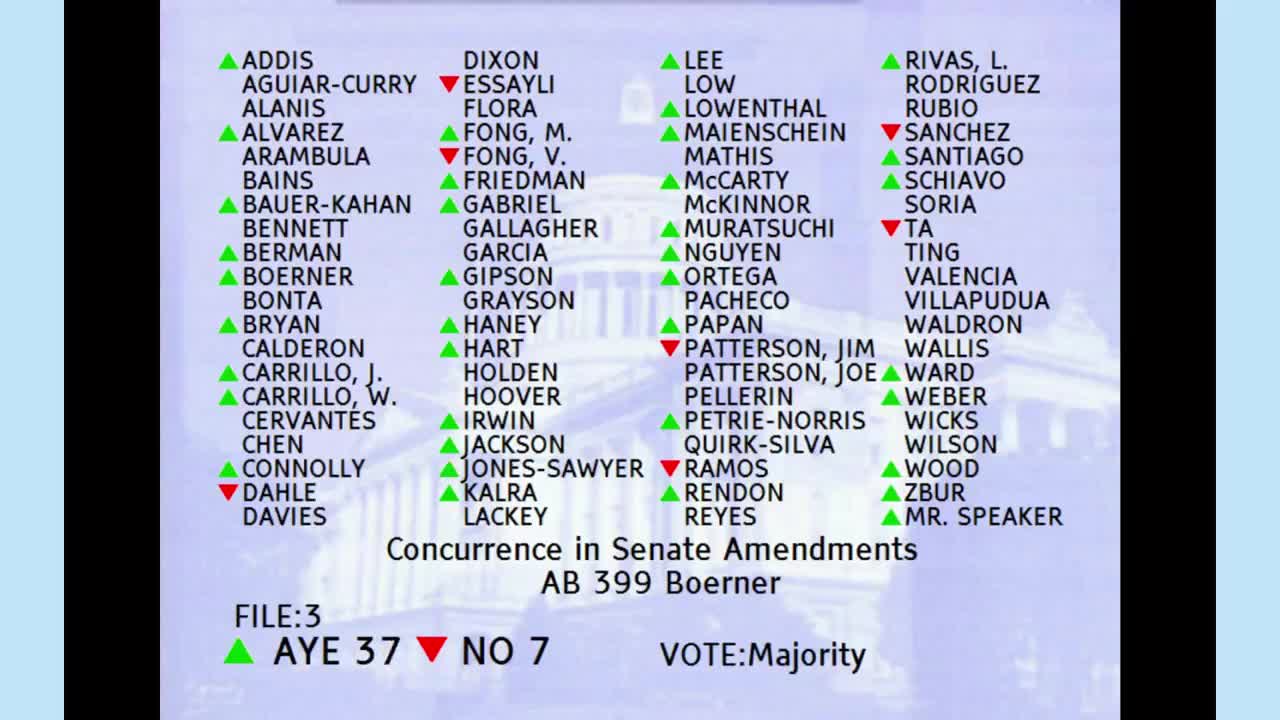 2MIN
Assembly Floor
 5MIN
Senate Floor
 19MIN
Senate Standing Committee on Environmental Quality
 37MIN
Senate Standing Committee on Health
 8MIN
Assembly Floor
 29MIN
Assembly Standing Committee on Environmental Safety and Toxic Materials
 48MIN