AB 589: Homeless youth: transitional housing.
- Session Year: 2023-2024
- House: Assembly
- Latest Version Date: 2023-09-12
Current Status:
Failed
(2024-01-25: Consideration of Governor's veto stricken from file.)
Introduced
In Committee
First Chamber
In Committee
Second Chamber
Enacted
What does this bill do?
Creates a three-year pilot program that funds community-based organizations to provide transitional housing and place volunteer host families for homeless LGBTQ+ young adults ages 18 to 24 in San Diego and Sacramento counties who are homeless due to family rejection, aiming to reunify them with their families when possible. Host family adults must pass background checks and provide trauma‑informed crisis support. Providers must follow Housing First rules (prioritizing immediate housing without requiring sobriety or program participation) and submit regular reports to the state.
The summary is provided by generative AI which can make mistakes. For original language, please view the details in the table below.
Existing law establishes homeless youth emergency service pilot projects in the City of Los Angeles and the City and County of San Francisco providing services to homeless minors, including food and access to an overnight shelter and counseling to address immediate emotional crises or problems. Existing law also requires similar programs to be established in the Counties of San Diego and Santa Clara, and all of these programs to be operated by an agency in accordance with a grant award agreement with the Office of Emergency Services.
Existing law requires the Governor to create the California Interagency Council on Homelessness and specifies the duties of the council. Existing law requires agencies and departments administering state programs to collaborate with the council to adopt guidelines and regulations to incorporate core components of Housing First, which include, among other things, a tenant screening process that accepts applicants regardless of sobriety, not rejecting applicants based on poor credit or financial history, and prohibiting participation in services or program compliance from being a requirement for permanent housing.
This bill, until January 1, 2027, and upon appropriation by the Legislature for these purposes, would require the Department of Housing and Community Development to establish the Unicorn Homes Transitional Housing for Homeless LGBTQ+ Youth Program, to be administered by local community-based organizations that provide a majority of its services to the LGBTQ+ community. The bill would require the department to fund community-based organizations in the participating Counties of San Diego and Sacramento that provide transitional housing for LGBTQ+ youth, 18 to 24 years of age, inclusive, experiencing homelessness due to family rejection, with the ultimate goal of reunification with the youths original family. The bill would require the community-based organization to place eligible youth with volunteer host families who meet specified criteria, pursuant to the results of a background check, and who are able to provide crisis intervention with a trauma-informed approach, as defined, to their care. The bill would also require the program to comply with the existing core components of Housing First.
The bill would require each community-based organization to prepare and submit an annual report to the department, with the first report due on or before December 1, 2024, and a final report due on or before June 30, 2026, which would be required to include specified information, including the number of times the organization was contacted by youths, how many of those contacts became participants in the program, and how many of those initial contacts became repeat contacts. The bill would also require the department to compile the annual reports into a final report, to be submitted to the Legislature on or before December 31, 2026.
Existing law establishes homeless youth emergency service pilot projects in the City of Los Angeles and the City and County of San Francisco providing services to homeless minors, including food and access to an overnight shelter and counseling to address immediate emotional crises or problems. Existing law also requires similar programs to be established in the Counties of San Diego and Santa Clara, and all of these programs to be operated by an agency in accordance with a grant award agreement with the Office of Emergency Services.
Existing law requires the Governor to create the California Interagency Council on Homelessness and specifies the duties of the council. Existing law requires agencies and departments administering state programs to collaborate with the council to adopt guidelines and regulations to incorporate core components of Housing First, which include, among other things, a tenant screening process that accepts applicants regardless of sobriety, not rejecting applicants based on poor credit or financial history, and prohibiting participation in services or program compliance from being a requirement for permanent housing.
This bill, until January 1, 2029, 2027, and upon appropriation by the Legislature for these purposes, would require the Department of Housing and Community Development to establish the Unicorn Homes Transitional Housing for Homeless LGBTQ+ Youth Program, to be administered by local community-based organizations that provide a majority of its services to the LGBTQ+ community. The bill would require the department to fund community-based organizations in the participating Counties of San Diego, Los Angeles, San Diego and Sacramento that provide transitional housing for LGBTQ+ youth, 18 to 24 years of age, inclusive, experiencing homelessness due to family rejection, with the ultimate goal of reunification with the youths original family. The bill would require the community-based organization to place eligible youth with volunteer host families who meet specified criteria, pursuant to the results of a background check, and who are able to provide crisis intervention with a trauma-informed approach, as defined, to their care. The bill would also require the program to comply with the existing core components of Housing First.
The bill would require each community-based organization to prepare and submit an annual report to the department, with the first report due on or before December 1, 2024, and a final report due on or before June 30, 2028, 2026, which would be required to include specified information, including the number of times the organization was contacted by youths, how many of those contacts became participants in the program, and how many of those initial contacts became repeat contacts. The bill would also require the department to compile the annual reports into a final report, to be submitted to the Legislature on or before December 31, 2028. 2026.
Existing law establishes homeless youth emergency service pilot projects in the City of Los Angeles and the City and County of San Francisco providing services to homeless minors, including food and access to an overnight shelter and counseling to address immediate emotional crises or problems. Existing law also requires similar programs to be established in the Counties of San Diego and Santa Clara, and all of these programs to be operated by an agency in accordance with a grant award agreement with the Office of Emergency Services.
Existing law requires the Governor to create the California Interagency Council on Homelessness and specifies the duties of the council. Existing law requires agencies and departments administering state programs to collaborate with the council to adopt guidelines and regulations to incorporate core components of Housing First, which include, among other things, a tenant screening process that accepts applicants regardless of sobriety, not rejecting applicants based on poor credit or financial history, and prohibiting participation in services or program compliance from being a requirement for permanent housing.
This bill, until January 1, 2029, and upon appropriation by the Legislature for these purposes, would require the Department of Housing and Community Development to establish the Unicorn Homes Transitional Housing for Homeless LGBTQ+ Youth Program, to be administered by local community-based organizations chosen by each participating county that provides that provide a majority of its services to the LGBTQ+ community. The bill would require the department to fund community-based organizations in the participating Counties of San Diego, Los Angeles, and Sacramento that provide transitional housing for LGBTQ+ youth, 18 to 24 years of age, inclusive, experiencing homelessness due to family rejection, with the ultimate goal of reunification with the youths original family. The bill would require the community-based organization to place eligible youth with volunteer host families who meet specified criteria criteria, pursuant to the results of a background check, and who are able to provide crisis intervention with a trauma-informed approach, as defined, to their care. The bill would also require the program to comply with the existing core components of Housing First.
The bill would require each community-based organization to prepare and submit an annual report to the Legislature, department, with the first report due on or before December 1, 2024, and a final report due on or before December 31, June 30, 2028, which would be required to include specified information, including the number of times the organization was contacted by youths, how many of those contacts became participants in the program, and how many of those initial contacts became repeat contacts. The bill would also require the department to compile the annual reports into a final report, to be submitted to the Legislature on or before December 31, 2028.
By imposing a new duty on participating counties, this bill would impose a state-mandated local program.The California Constitution requires the state to reimburse local agencies and school districts for certain costs mandated by the state. Statutory provisions establish procedures for making that reimbursement.This bill would provide that no reimbursement is required by this act for a specified reason.Existing law establishes homeless youth emergency service pilot projects in the City of Los Angeles and the City and County of San Francisco providing services to homeless minors, including food and access to an overnight shelter and counseling to address immediate emotional crises or problems. Existing law also requires similar programs to be established in the Counties of San Diego and Santa Clara, and all of these programs to be operated by an agency in accordance with a grant award agreement with the Office of Emergency Services.
Existing law requires the Governor to create the California Interagency Council on Homelessness and specifies the duties of the council. Existing law requires agencies and departments administering state programs to collaborate with the council to adopt guidelines and regulations to incorporate core components of Housing First, which include, among other things, a tenant screening process that accepts applicants regardless of sobriety, not rejecting applicants based on poor credit or financial history, and prohibiting participation in services or program compliance from being a requirement for permanent housing.
This bill, until January 1, 2029, and upon appropriation by the Legislature for these purposes, would require the Department of Housing and Community Development to establish the Unicorn Homes Transitional Housing for Homeless LGBTQ+ Youth Program, to be administered by local community-based organizations chosen by each participating county that provides a majority of its services to the LGBTQ+ community. The bill would require the department to fund community-based organizations in the participating Counties of San Diego, Los Angeles, and Sacramento that provide transitional housing for LGBTQ+ youth, 18 to 24 years of age, inclusive, experiencing homelessness due to family rejection, with the ultimate goal of reunification with the youths original family. The bill would require the community-based organization to place eligible youth with volunteer host families who meet specified criteria and who are able to provide crisis intervention with a trauma-informed approach, as defined, to their care. The bill would also require the program to comply with the existing core components of Housing First.
The bill would require each community-based organization to prepare and submit an annual report to the Legislature, with the first report due on or before December 1, 2024, and a final report due on or before December 31, 2028, which would be required to include specified information, including the number of times the organization was contacted by youths, how many of those contacts became participants in the program, and how many of those initial contacts became repeat contacts.
By imposing a new duty on participating counties, this bill would impose a state-mandated local program.
The California Constitution requires the state to reimburse local agencies and school districts for certain costs mandated by the state. Statutory provisions establish procedures for making that reimbursement.
This bill would provide that no reimbursement is required by this act for a specified reason.
Existing law establishes homeless youth emergency service pilot projects in the City of Los Angeles and the City and County of San Francisco providing services to homeless minors, including food and access to an overnight shelter and counseling to address immediate emotional crises or problems. Existing law also requires similar programs to be established in the Counties of San Diego and Santa Clara, and all of these programs to be operated by an agency in accordance with a grant award agreement with the Office of Emergency Services.
This bill, until January 1, 2029, and upon appropriation by the Legislature for these purposes, would require the County of San Diego Department of Housing and Community Development to establish the Unicorn Homes Transitional Housing for Homeless LGBTQ+ Youth Program, to be administered by a local community-based organization organizations chosen by the each participating county that provides a majority of its services to the LGBTQ+ community. The bill would require the community-based organization to department to fund community-based organizations in the participating Counties of San Diego, Los Angeles, and Sacramento that provide transitional housing for LGBTQ+ youth, 18 to 24 years of age, inclusive, experiencing homelessness due to family rejection, with the ultimate goal of reunification with the youths original family. The bill would require the community-based organization to place eligible youth with volunteer host families who meet specified criteria and who are able to provide crisis intervention with trauma-informed practices. a trauma-informed approach, as defined, to their care.
The bill would require the each community-based organization to prepare and submit a an annual report to the Legislature on or before December 31, 2028, Legislature, with the first report due on or before December 1, 2024, and a final report due on or before December 31, 2028, which would be required to include specified information, including the number of times the organization was contacted by youths, how many of those contacts became participants in the program, and how many of those initial contacts became repeat contacts.
By imposing a new duty on the County of San Diego, participating counties, this bill would impose a state-mandated local program.
The California Constitution requires the state to reimburse local agencies and school districts for certain costs mandated by the state. Statutory provisions establish procedures for making that reimbursement.
This bill would provide that no reimbursement is required by this act for a specified reason.
Existing law establishes homeless youth emergency service pilot projects in the City of Los Angeles and the City and County of San Francisco providing services to homeless minors, including food and access to an overnight shelter and counseling to address immediate emotional crises or problems. Existing law also requires similar programs to be established in the Counties of San Diego and Santa Clara, and all of these programs to be operated by an agency in accordance with a grant award agreement with the Office of Emergency Services.
This bill, until January 1, 2029, and upon appropriation by the Legislature for these purposes, would require the County of San Diego to establish the Unicorn Homes Transitional Housing for Homeless LGBTQ+ Youth Program, to be administered by a local community-based organization chosen by the county that provides a majority of its services to the LGBTQ+ community. The bill would require the community-based organization to provide transitional housing for LGBTQ+ youth, 18 to 24 years of age, inclusive, experiencing homelessness due to family rejection, with the ultimate goal of reunification with the youths original family. The bill would require the community-based organization to place eligible youth with volunteer host families who meet specified criteria and who are able to provide crisis intervention with trauma-informed practices.
The bill would require the community-based organization to prepare and submit a report to the Legislature on or before December 31, 2028, which would be required to include specified information, including the number of times the organization was contacted by youths, how many of those contacts became participants in the program, and how many of those initial contacts became repeat contacts.
By imposing a new duty on the County of San Diego, this bill would impose a state-mandated local program.
The California Constitution requires the state to reimburse local agencies and school districts for certain costs mandated by the state. Statutory provisions establish procedures for making that reimbursement.
This bill would provide that no reimbursement is required by this act for a specified reason.
Existing law, the Homeless Youth Act of 2018, requires the California Interagency Council on Homelessness to set and measure progress towards goals to prevent and end homelessness among youth in the state. Existing law establishes various homelessness assistance programs, some of which are administered by the State Department of Social Services and local partners, such as the Bringing Families Home Program, and certain others by the Department of Housing and Community Development and local partners, such as the Emergency Housing and Assistance Program, which in part targets transitional housing. Existing law sets forth various provisions on the establishment of, or access to, homeless shelters.Under existing law, the State Department of Social Services licenses and regulates youth homelessness prevention centers as group homes, and transitional housing placement providers for purposes of operating transitional housing placement programs for minor foster children or nonminor dependents, as defined. Under existing law, transitional housing units include a host family, a staffed site, or a remote site for independent living, as specified.This bill would state the intent of the Legislature to enact legislation that would create a transitional housing program for homeless youth.Existing law, the Homeless Youth Act of 2018, requires the California Interagency Council on Homelessness to set and measure progress towards goals to prevent and end homelessness among youth in the state. Existing law establishes various homelessness assistance programs, some of which are administered by the State Department of Social Services and local partners, such as the Bringing Families Home Program, and certain others by the Department of Housing and Community Development and local partners, such as the Emergency Housing and Assistance Program, which in part targets transitional housing. Existing law sets forth various provisions on the establishment of, or access to, homeless shelters.
Under existing law, the State Department of Social Services licenses and regulates youth homelessness prevention centers as group homes, and transitional housing placement providers for purposes of operating transitional housing placement programs for minor foster children or nonminor dependents, as defined. Under existing law, transitional housing units include a host family, a staffed site, or a remote site for independent living, as specified.
This bill would state the intent of the Legislature to enact legislation that would create a transitional housing program for homeless youth.
To the extent that an appropriation is made by the Legislature for these purposes, the Department of Housing and Community Development shall establish the Unicorn Homes Transitional Housing for Homeless LGBTQ+ Youth Program as a three-year pilot program. The program shall be administered by local community-based organizations providing a majority of their services to the LGBTQ+ community in the Counties of San Diego and Sacramento.
13711.The program shall meet all of the following requirements:
(a)Fund the community-based organizations providing emergency transitional housing for LGBTQ+ youth between 18 and 24 years of age, inclusive, experiencing homelessness due to family rejection, with the ultimate goal of the program being reunification with the youths family when possible.
(b)Place eligible youths with volunteer host families. Any individual in the host family who is 18 years of age or older and with whom the youth would be living shall meet all of the following criteria, pursuant to the results of a background check conducted via Live Scan:
(1)Has not been convicted of driving under the influence within the past 10 years.
(2)Has not been convicted of a crime for which registration is required under Section 290 of the Penal Code.
(3)Has not been convicted of domestic violence, child abuse, or human trafficking.
(4)Has not been convicted of a violent felony as defined in subdivision (c) of Section 667.5 of the Penal Code.
(c)Place eligible youths with families who are able to provide crisis intervention with a trauma-informed approach to their care.
(d)Comply with the core components of Housing First outlined in subdivision (b) of Section 8255.
(e)For purposes of this section, a trauma-informed approach includes all of the following:
(1)Ensuring the physical and emotional safety of the youth by understanding, recognizing, and responding to the effects of trauma.
(2)Preventing retraumatization to ensure that the youths feel physically, psychologically, and emotionally safe in their placement with a host family.
(3)Demonstrating trustworthiness and transparency when making decisions with the aim to build and maintain trust between the host family and the youth placed in their care.
(4)Leveling power differences for shared decisionmaking by ensuring that those impacted by decisions have a voice in the decisionmaking process.
(5)Empowering the youths to build on their strengths and identify strategies that will help them heal from trauma.
13712.(a)Each community-based organization that receives funding shall prepare an annual report, to be submitted to the Department of Housing and Community Development on or before December 31, 2024, and December 31, 2025, with the final report due on or before June 30, 2026. The report shall contain the following information, to the extent available:
(1)The number of times the community-based organization was contacted by an LGBTQ+ youth potentially eligible for the program created by this chapter.
(2)How many of those initial contacts became participants in the program.
(3)How many of those initial contacts became repeat contacts.
(4)How many of those initial contacts were referred to other resources and services.
(5)How many of those initial contacts left the program for permanent housing.
(b)The Department of Housing and Community Development shall compile the annual reports into a final report to be submitted to the Legislature on or before December 31, 2026. A report to be submitted under this section shall be submitted in compliance with Section 9795 of the Government Code.
13713.This chapter shall remain in effect only until January 1, 2027, and as of that date is repealed.
To the extent that an appropriation is made by the Legislature for these purposes, the Department of Housing and Community Development shall establish the Unicorn Homes Transitional Housing for Homeless LGBTQ+ Youth Program as a three-year pilot program. The program shall be administered by local community-based organizations providing a majority of their services to the LGBTQ+ community in the Counties of San Diego and Sacramento.
13711.The program shall meet all of the following requirements:
(a)Fund the community-based organizations providing emergency transitional housing for LGBTQ+ youth between 18 and 24 years of age, inclusive, experiencing homelessness due to family rejection, with the ultimate goal of the program being reunification with the youths family when possible.
(b)Place eligible youths with volunteer host families. Any individual in the host family who is 18 years of age or older and with whom the youth would be living shall meet all of the following criteria, pursuant to the results of a background check conducted via Live Scan:
(1)Has not been convicted of driving under the influence within the past 10 years.
(2)Has not been convicted of a crime for which registration is required pursuant to under Section 290 of the Penal Code.
(3)Has not been convicted of domestic violence, child abuse, or human trafficking.
(4)Has not been convicted of a violent felony as defined in subdivision (c) of Section 667.5 of the Penal Code.
(c)Place eligible youths with families who are able to provide crisis intervention with a trauma-informed approach to their care.
(d)Comply with the core components of Housing First outlined in subdivision (b) of Section 8255.
(e)For purposes of this section, a trauma-informed approach includes all of the following:
(1)Ensuring the physical and emotional safety of the youth by understanding, recognizing, and responding to the effects of trauma.
(2)Preventing retraumatization to ensure that the youths feel physically, psychologically, and emotionally safe in their placement with a host family.
(3)Demonstrating trustworthiness and transparency when making decisions with the aim to build and maintain trust between the host family and the youth placed in their care.
(4)Leveling power differences for shared decisionmaking by ensuring that those impacted by decisions have a voice in the decisionmaking process.
(5)Empowering the youths to build on their strengths and identify strategies that will help them heal from trauma.
13712.(a)Each community-based organization that receives funding shall prepare an annual report, to be submitted to the Department of Housing and Community Development on or before December 31, 2024, and December 31, 2025, with the final report due on or before June 30, 2026. The report shall contain the following information, to the extent available:
(1)The number of times the community-based organization was contacted by an LGBTQ+ youth potentially eligible for the program created by this chapter.
(2)How many of those initial contacts became participants in the program.
(3)How many of those initial contacts became repeat contacts.
(4)How many of those initial contacts were referred to other resources and services.
(5)How many of those initial contacts left the program for permanent housing.
(b)The Department of Housing and Community Development shall compile the annual reports into a final report to be submitted to the Legislature on or before December 31, 2026. A report to be submitted pursuant to under this section shall be submitted in compliance with Section 9795 of the Government Code.
13713.This chapter shall remain in effect only until January 1, 2027, and as of that date is repealed.
To the extent that an appropriation is made by the Legislature for these purposes, the Department of Housing and Community Development shall establish the Unicorn Homes Transitional Housing for Homeless LGBTQ+ Youth Program as a five-year three-year pilot program. The program shall be administered by local community-based organizations providing a majority of their services to the LGBTQ+ community in each of the Counties of San Diego, Los Angeles, San Diego and Sacramento.
13711.The program shall meet all of the following requirements:
(a)Fund the community-based organizations providing emergency transitional housing for LGBTQ+ youth between 18 and 24 years of age, inclusive, experiencing homelessness due to family rejection, with the ultimate goal of the program being reunification with the youths family when possible.
(b)Place eligible youths with volunteer host families. Any individual in the host family who is 18 years of age or older and with whom the youth would be living shall meet all of the following criteria, pursuant to the results of a background check conducted via Live Scan:
(1)Has not been convicted of driving under the influence within the past 10 years.
(2)Has not been convicted of a crime for which registration is required pursuant to Section 290 of the Penal Code.
(3)Has not been convicted of domestic violence, child abuse, or human trafficking.
(4)Has not been convicted of a violent felony as defined in subdivision (c) of Section 667.5 of the Penal Code.
(c)Place eligible youths with families who are able to provide crisis intervention with a trauma-informed approach to their care.
(d)Comply with the core components of Housing First outlined in subdivision (b) of Section 8255.
(e)For purposes of this section, a trauma-informed approach includes all of the following:
(1)Ensuring the physical and emotional safety of the youth by understanding, recognizing, and responding to the effects of trauma.
(2)Preventing retraumatization to ensure that the youths feel physically, psychologically, and emotionally safe in their placement with a host family.
(3)Demonstrating trustworthiness and transparency when making decisions with the aim to build and maintain trust between the host family and the youth placed in their care.
(4)Leveling power differences for shared decisionmaking by ensuring that those impacted by decisions have a voice in the decisionmaking process.
(5)Empowering the youths to build on their strengths and identify strategies that will help them heal from trauma.
13712.(a)Each community-based organization that receives funding shall prepare an annual report, to be submitted to the Department of Housing and Community Development on or before December 31, 2024, and every December 31 thereafter, December 31, 2025, with the final report due on or before June 30, 2028. 2026. The report shall contain the following information, to the extent available:
(1)The number of times the community-based organization was contacted by an LGBTQ+ youth potentially eligible for the program created by this chapter.
(2)How many of those initial contacts became participants in the program.
(3)How many of those initial contacts became repeat contacts.
(4)How many of those initial contacts were referred to other resources and services.
(5)How many of those initial contacts left the program for permanent housing.
(b)The Department of Housing and Community Development shall compile the annual reports into a final report to be submitted to the Legislature on or before December 31, 2028. 2026. A report to be submitted pursuant to this section shall be submitted in compliance with Section 9795 of the Government Code.
13713.This chapter shall remain in effect only until January 1, 2029, 2027, and as of that date is repealed.
To the extent that an appropriation is made by the Legislature for these purposes, the Department of Housing and Community Development shall establish the Unicorn Homes Transitional Housing for Homeless LGBTQ+ Youth Program as a five-year pilot program. The program shall be administered by a local community-based organization, organizations providing a majority of their services to the LGBTQ+ community in each of the Counties of San Diego, Los Angeles, and Sacramento chosen by each of those participating counties, that provides a majority of its services to the LGBTQ+ community. Sacramento.
13711.(a)The program shall meet all of the following requirements:
(1)(a)Fund the community-based organizations providing emergency transitional housing for LGBTQ+ youth between 18 and 24 years of age, inclusive, experiencing homelessness due to family rejection, with the ultimate goal of the program being reunification with the youths family when possible.
(2)(b)Place eligible youths with volunteer host families. Any individual in the host family who is 18 years of age or older and with whom the youth would be living shall meet all of the following criteria: criteria, pursuant to the results of a background check conducted via Live Scan:
(A)(1)Has not been convicted of driving under the influence within the past 10 years.
(B)(2)Has not been convicted of a crime for which registration is required pursuant to Section 290 of the Penal Code.
(C)(3)Has not been convicted of domestic violence, child abuse, or human trafficking.
(D)Has successfully passed a Live Scan background check.(3)(c)Place eligible youths with families who are able to provide crisis intervention with a trauma-informed approach to their care.
(4)(d)Comply with the core components of Housing First outlined in subdivision (b) of Section 8255.
(5)(e)For purposes of this section, a trauma-informed approach includes all of the following:
(A)(1)Ensuring the physical and emotional safety of the youth by understanding, recognizing, and responding to the effects of trauma.
(B)(2)Preventing retraumatization to ensure that the youths feel physically, psychologically, and emotionally safe in their placement with a host family.
(C)(3)Demonstrating trustworthiness and transparency when making decisions with the aim to build and maintain trust between the host family and the youth placed in their care.
(D)(4)Leveling power differences for shared decisionmaking by ensuring that those impacted by decisions have a voice in the decisionmaking process.
(E)(5)Empowering the youths to build on their strengths and identify strategies that will help them heal from trauma.
(b)The department shall make funding available to the Counties of San Diego, Los Angeles, and Sacramento.13712.(a)Each community-based organization that receives funding shall prepare an annual report, to be submitted to the Legislature Department of Housing and Community Development on or before December 31, 2024, and every December 31 thereafter, with the final report due on or before December 31, 2028. June 30, 2028. The report shall contain the following information, to the extent available:
(1)The number of times the community-based organization was contacted by an LGBTQ+ youth potentially eligible for the program created by this chapter.
(2)How many of those initial contacts became participants in the program.
(3)How many of those initial contacts became repeat contacts.
(4)How many of those initial contacts were referred to other resources and services.
(5)How many of those initial contacts left the program for permanent housing.
(b)The Department of Housing and Community Development shall compile the annual reports into a final report to be submitted to the Legislature on or before December 31, 2028. A report to be submitted pursuant to this section shall be submitted in compliance with Section 9795 of the Government Code.
13713.This chapter shall remain in effect only until January 1, 2029, and as of that date is repealed.
SEC. 2.To the extent that this act has an overall effect of increasing the costs already borne by a local agency for programs or levels of service mandated by the 2011 Realignment Legislation within the meaning of Section 36 of Article XIII of the California Constitution, it shall apply to local agencies only to the extent that the state provides annual funding for the cost increase. Any new program or higher level of service provided by a local agency pursuant to this act above the level for which funding has been provided shall not require a subvention of funds by the state or otherwise be subject to Section 6 of Article XIIIB of the California Constitution.To the extent that an appropriation is made by the Legislature for these purposes, the Department of Housing and Community Development shall establish the Unicorn Homes Transitional Housing for Homeless LGBTQ+ Youth Program as a five-year pilot program. The program shall be administered by a local community-based organization, in each of the Counties of San Diego, Los Angeles, and Sacramento chosen by each of those participating counties, that provides a majority of its services to the LGBTQ+ community.
13711.(a)The program shall meet all of the following requirements:
(1)Fund the community-based organizations providing emergency transitional housing for LGBTQ+ youth between 18 and 24 years of age, inclusive, experiencing homelessness due to family rejection, with the ultimate goal of the program being reunification with the youths family when possible.
(2)Place eligible youths with volunteer host families. Any individual in the host family who is 18 years of age or older and with whom the youth would be living shall meet all of the following criteria:
(A)Has not been convicted of driving under the influence within the past 10 years.
(B)Has not been convicted of a crime for which registration is required pursuant to Section 290 of the Penal Code.
(C)Has not been convicted of domestic violence, child abuse, or human trafficking.
(D)Has successfully passed a Live Scan background check.
(3)Place eligible youths with families who are able to provide crisis intervention with a trauma-informed approach to their care.
(4)Comply with the core components of Housing First outlined in subdivision (b) of Section 8255.
(4)(5)For purposes of this section, a trauma-informed approach includes all of the following:
(A)Ensuring the physical and emotional safety of the youth by understanding, recognizing, and responding to the effects of trauma.
(B)Preventing retraumatization to ensure that the youths feel physically, psychologically, and emotionally safe in their placement with a host family.
(C)Demonstrating trustworthiness and transparency when making decisions with the aim to build and maintain trust between the host family and the youth placed in their care.
(D)Leveling power differences for shared decisionmaking by ensuring that those impacted by decisions have a voice in the decisionmaking process.
(E)Empowering the youths to build on their strengths and identify strategies that will help them heal from trauma.
(b)The department shall make funding available to the Counties of San Diego, Los Angeles, and Sacramento.
13712.(a)Each community-based organization that receives funding shall prepare an annual report, to be submitted to the Legislature on or before December 31, 2024, and every December 31 thereafter, with the final report due on or before December 31, 2028. The report shall contain the following information, to the extent available:
(1)The number of times the community-based organization was contacted by an LGBTQ+ youth potentially eligible for the program created by this chapter.
(2)How many of those initial contacts became participants in the program.
(3)How many of those initial contacts became repeat contacts.
(4)How many of those initial contacts were referred to other resources and services.
(5)How many of those initial contacts left the program for permanent housing.
(b)A report to be submitted pursuant to this section shall be submitted in compliance with Section 9795 of the Government Code.
13713.This chapter shall remain in effect only until January 1, 2029, and as of that date is repealed.
SEC. 2.To the extent that this act has an overall effect of increasing the costs already borne by a local agency for programs or levels of service mandated by the 2011 Realignment Legislation within the meaning of Section 36 of Article XIII of the California Constitution, it shall apply to local agencies only to the extent that the state provides annual funding for the cost increase. Any new program or higher level of service provided by a local agency pursuant to this act above the level for which funding has been provided shall not require a subvention of funds by the state or otherwise be subject to Section 6 of Article XIIIB of the California Constitution.
CORRECTIONS: HeadingLine 1. DigestPage 1.To the extent that an appropriation is made by the Legislature for these purposes, the County of San Diego Department of Housing and Community Development shall establish the Unicorn Homes Transitional Housing for Homeless LGBTQ+ Youth Program as a five-year pilot project expansion of the Unicorn Homes program within the North County LGBTQ Resource Center. program. The program shall be administered by a local community-based organization, in each of the Counties of San Diego, Los Angeles, and Sacramento chosen by the county, each of those participating counties, that provides a majority of its services to the LGBTQ+ community.
13711.(a)The program shall meet all of the following requirements:
(a)The community-based organization shall provide(1)Fund the community-based organizations providing emergency transitional housing for LGBTQ+ youth between 18 and 24 years of age, inclusive, experiencing homelessness due to family rejection, with the ultimate goal of the program being reunification with the youths family. family when possible.
(b)(2)Place eligible youths with volunteer host families. Any individual in the host family who is 18 years of age or older and with whom the youth would be living shall meet all of the following criteria:
(1)(A)Has not been convicted of driving under the influence. influence within the past 10 years.
(2)(B)Has not been convicted of a crime for which registration is required pursuant to Section 290 of the Penal Code.
(3)(C)Has not been convicted of domestic violence or any other anger-related crimes. violence, child abuse, or human trafficking.
(4)(D)Has successfully passed a Live Scan background check.
(c)(3)Place eligible youths with families who are able to provide crisis intervention with trauma-informed practices. a trauma-informed approach to their care.
(4)For purposes of this section, a trauma-informed approach includes all of the following:
(A)Ensuring the physical and emotional safety of the youth by understanding, recognizing, and responding to the effects of trauma.
(B)Preventing retraumatization to ensure that the youths feel physically, psychologically, and emotionally safe in their placement with a host family.
(C)Demonstrating trustworthiness and transparency when making decisions with the aim to build and maintain trust between the host family and the youth placed in their care.
(D)Leveling power differences for shared decisionmaking by ensuring that those impacted by decisions have a voice in the decisionmaking process.
(E)Empowering the youths to build on their strengths and identify strategies that will help them heal from trauma.
(b)The department shall make funding available to the Counties of San Diego, Los Angeles, and Sacramento.
13712.(a)The Each community-based organization that receives funding shall prepare a report, to be submitted to the Legislature on or before December 31, 2028. an annual report, to be submitted to the Legislature on or before December 31, 2024, and every December 31 thereafter, with the final report due on or before December 31, 2028. The report shall contain the following information, to the extent available:
(1)The number of times the community-based organization was contacted by an LGBTQ+ youth potentially eligible for the program created by this chapter.
(2)How many of those initial contacts became participants in the program.
(3)How many of those initial contacts became repeat contacts.
(4)How many of those initial contacts were referred to other resources and services.
(5)How many of those initial contacts left the program for permanent housing.
(b)A report to be submitted pursuant to this section shall be submitted in compliance with Section 9795 of the Government Code.
13713.This chapter shall remain in effect only until January 1, 2029, and as of that date is repealed.
SEC. 2.To the extent that this act has an overall effect of increasing the costs already borne by a local agency for programs or levels of service mandated by the 2011 Realignment Legislation within the meaning of Section 36 of Article XIII of the California Constitution, it shall apply to local agencies only to the extent that the state provides annual funding for the cost increase. Any new program or higher level of service provided by a local agency pursuant to this act above the level for which funding has been provided shall not require a subvention of funds by the state or otherwise be subject to Section 6 of Article XIIIB of the California Constitution.
To the extent that an appropriation is made by the Legislature for these purposes, the County of San Diego shall establish the Unicorn Homes Transitional Housing for Homeless LGBTQ+ Youth Program as a five-year pilot project expansion of the Unicorn Homes program within the North County LGBTQ Resource Center. The program shall be administered by a local community-based organization, chosen by the county, that provides a majority of its services to the LGBTQ+ community.
13711.The program shall meet all of the following requirements:
(a)The community-based organization shall provide emergency transitional housing for LGBTQ+ youth between 18 and 24 years of age, inclusive, experiencing homelessness due to family rejection, with the ultimate goal of the program being reunification with the youths family.
(b)Place eligible youths with volunteer host families. Any individual in the host family who is 18 years of age or older and with whom the youth would be living shall meet all of the following criteria:
(1)Has not been convicted of driving under the influence.
(2)Has not been convicted of a crime for which registration is required pursuant to Section 290 of the Penal Code.
(3)Has not been convicted of domestic violence or any other anger-related crimes.
(4)Has successfully passed a Live Scan background check.
(c)Place eligible youths with families who are able to provide crisis intervention with trauma-informed practices.
13712.(a)The community-based organization shall prepare a report, to be submitted to the Legislature on or before December 31, 2028. The report shall contain the following information, to the extent available:
(1)The number of times the community-based organization was contacted by an LGBTQ+ youth potentially eligible for the program created by this chapter.
(2)How many of those initial contacts became participants in the program.
(3)How many of those initial contacts became repeat contacts.
(4)How many of those initial contacts were referred to other resources and services.
(b)A report to be submitted pursuant to this section shall be submitted in compliance with Section 9795 of the Government Code.
13713.This chapter shall remain in effect only until January 1, 2029, and as of that date is repealed.
SEC. 2.To the extent that this act has an overall effect of increasing the costs already borne by a local agency for programs or levels of service mandated by the 2011 Realignment Legislation within the meaning of Section 36 of Article XIII of the California Constitution, it shall apply to local agencies only to the extent that the state provides annual funding for the cost increase. Any new program or higher level of service provided by a local agency pursuant to this act above the level for which funding has been provided shall not require a subvention of funds by the state or otherwise be subject to Section 6 of Article XIIIB of the California Constitution.
SECTION 1.It is the intent of the Legislature to enact legislation that would create a transitional housing program for homeless youth.It is the intent of the Legislature to enact legislation that would create a transitional housing program for homeless youth.
|
Date
|
Status
|
|---|---|
| Jan 25, 2024 | Consideration of Governor's veto stricken from file. |
| Jan 3, 2024 | Consideration of Governor's veto pending. |
| Oct 7, 2023 | Vetoed by Governor. |
| Sep 15, 2023 | Enrolled and presented to the Governor at 4 p.m. |
| Sep 11, 2023 | Senate amendments concurred in. To Engrossing and Enrolling. (Ayes 71. Noes 0. Page 3191.). |
| Sep 7, 2023 | In Assembly. Concurrence in Senate amendments pending. May be considered on or after September 9 pursuant to Assembly Rule 77. |
| Sep 7, 2023 | Read third time. Passed. Ordered to the Assembly. (Ayes 38. Noes 0. Page 2454.). |
| Sep 5, 2023 | Read second time. Ordered to third reading. |
| Sep 1, 2023 | From committee: Do pass. (Ayes 5. Noes 0.) (September 1). |
| Aug 14, 2023 | In committee: Referred to APPR suspense file. |
| Jul 5, 2023 | From committee: Do pass and re-refer to Com. on APPR. (Ayes 5. Noes 0.) (July 3). Re-referred to Com. on APPR. |
| Jun 26, 2023 | From committee chair, with author's amendments: Amend, and re-refer to committee. Read second time, amended, and re-referred to Com. on HUMAN S. |
| Jun 21, 2023 | From committee: Do pass and re-refer to Com. on HUMAN S. (Ayes 9. Noes 0.) (June 20). Re-referred to Com. on HUMAN S. |
| Jun 14, 2023 | Referred to Coms. on HOUSING and HUMAN S. |
| Jun 1, 2023 | In Senate. Read first time. To Com. on RLS. for assignment. |
| May 31, 2023 | Read third time. Passed. Ordered to the Senate. (Ayes 71. Noes 0. Page 1991.) |
| May 22, 2023 | Read second time. Ordered to third reading. |
| May 18, 2023 | Read second time and amended. Ordered returned to second reading. |
| May 18, 2023 | From committee: Amend, and do pass as amended. (Ayes 13. Noes 0.) (May 18). |
| May 10, 2023 | In committee: Set, first hearing. Referred to APPR. suspense file. |
| May 1, 2023 | Re-referred to Com. on APPR. |
| Apr 27, 2023 | Read second time and amended. |
| Apr 26, 2023 | From committee: Amend, and do pass as amended and re-refer to Com. on APPR. (Ayes 7. Noes 0.) (April 25). |
| Apr 20, 2023 | Measure version as amended on April 19 corrected. |
| Apr 20, 2023 | Re-referred to Com. on HUM. S. |
| Apr 19, 2023 | From committee: Do pass and re-refer to Com. on HUM. S. (Ayes 6. Noes 0.) (April 19). Re-referred to Com. on HUM. S. |
| Apr 19, 2023 | From committee chair, with author's amendments: Amend, and re-refer to Com. on HUM. S. Read second time and amended. |
| Apr 17, 2023 | Re-referred to Com. on H. & C.D. |
| Apr 12, 2023 | From committee chair, with author's amendments: Amend, and re-refer to Com. on H. & C.D. Read second time and amended. |
| Mar 27, 2023 | Re-referred to Com. on H. & C.D. |
| Mar 23, 2023 | Referred to Coms. on H. & C.D. and HUM. S. |
| Mar 23, 2023 | From committee chair, with author's amendments: Amend, and re-refer to Com. on H. & C.D. Read second time and amended. |
| Feb 10, 2023 | From printer. May be heard in committee March 12. |
| Feb 9, 2023 | Read first time. To print. |
|
Date
|
Description
|
Location
|
Votes
|
|
|---|---|---|---|---|
| Sep 11, 2023 | AB 589 Boerner Concurrence in Senate Amendments | Assembly Floor |
Passed |
|
| Sep 7, 2023 | Assembly 3rd Reading AB589 Boerner et al. By Wiener | Senate Floor |
Passed |
|
| Sep 1, 2023 | Do pass | Senate Standing Committee on Appropriations |
Passed |
|
| Aug 14, 2023 | Placed on suspense file | Senate Standing Committee on Appropriations |
Passed |
|
| Jul 3, 2023 | Do pass, but first be re-referred to the Committee on [Appropriations] | Senate Standing Committee on Human Services |
Passed |
|
| Jun 20, 2023 | Do pass, but first be re-referred to the Committee on [Human Services] | Senate Standing Committee on Housing |
Passed |
|
| May 31, 2023 | AB 589 Boerner Assembly Third Reading | Assembly Floor |
Passed |
|
| May 18, 2023 | Do pass as amended. | Assembly Standing Committee on Appropriations |
Passed |
|
| Apr 25, 2023 | Do pass as amended and be re-referred to the Committee on [Appropriations] | Assembly Standing Committee on Human Services |
Passed |
|
| Apr 19, 2023 | Do pass and be re-referred to the Committee on [Human Services] | Assembly Standing Committee on Housing and Community Development |
Passed |
This list shows positions taken on this bill by organizations on the date displayed, which is linked to the original source.
Positions by individuals are not included.
|
Organization
|
Position
|
Date
|
|---|---|---|
| AdvoKids | ** Support | |
| California Academy of Child and Adolescent Psychiatry | * Support | Jul 3, 2023 |
| City of Oceanside | ** Support | |
| City Of San Diego | ** Support | |
| Equality California | ** Support | |
| north county lgbtq resource center | ** Support | |
| North County LGBTQ Resource Center | * Support | Apr 25, 2023 |
| Point Source Youth | ** Support | |
| Sacramento LGBT Community Center | ** Support | |
| San Diego LGBT Community Center | ** Support |
GOVERNOR'S VETO
GV Bill Id:AB 589
Author:(Boerner)
As Enrolled Ver:September 12, 2023
2/3 vote
SUMMARY
Requires, to the extent that funding is made available, the Department of Housing and Community Development (HCD) to establish the Unicorn Homes Transitional Housing for Homeless LGBTQ+ Youth Program (the program) as a five-year pilot program.
Senate Amendments:
Minor and technical.
Governor’s Veto Message
This bill, until January 1, 2027 and upon appropriation by the Legislature, would require the Department of Housing and Community Development (HCD) to establish the Unicorn Homes Transitional Housing for Homeless LGBTQ+ Youth Program (Unicorn Program) as a pilot to be administered by local community based organizations in Sacramento and San Diego Counties.
While I appreciate the author's commitment to providing housing for homeless LGBTQ+ youth, AB 589 creates an unfunded grant program that must be considered in the annual budget in the context of all state funding priorities.
In partnership with the Legislature, we enacted a budget that closed a shortfall of more than $30 billion through balanced solutions that avoided deep program cuts and protected education, health care, climate , public safety, and social service programs that are relied on by millions of Californians. This year, however, the Legislature sent me bills outside of this budget process that, if all enacted, would add nearly $19 billion of unaccounted costs in the budget, of which $1 l billion would be ongoing.
With our state facing continuing economic risk and revenue uncertainty, it is important to remain disciplined when considering bills with significant fiscal implications, such as this measure.
COMMENTS
Youth Homelessness in California: In 2022, there were approximately 9,046 unaccompanied youth between the ages of 18 and 24 experiencing homelessness in California. Studies show that unaccompanied youth living on the streets are more likely to suffer from violence; victimization, such as commercial sexual exploitation; engage in risky behaviors, such as survival sex to find shelter or food; use illegal substances; and are more likely to suffer from poorer health outcomes later in life as a result of trauma and toxic stress. California is home to the largest population of foster youth in the nation, serving nearly 60,000 children and youth. Each year, nearly 3,500 of these youth "age out" of the foster care system, meaning they must leave the foster care system because they were never adopted and are too old to stay in care. Unfortunately, many of these youth remain unstably housed or become homeless after exiting the foster care system.
Unicorn Homes Transitional Housing for Homeless LGBTQ+ Youth Program: This bill would create a pilot program in three counties – San Diego, Los Angeles, and Sacramento – to fund community-based organizations providing emergency transitional housing for LGBTQ+ youth between 18 and 24 years of age, experiencing homelessness due to family rejection, with the ultimate goal of reunification with the youth’s family when possible. Funds would be used to place youth with host families. Families would be required provide crisis intervention with a trauma-informed approach to their care of youth living with them. Community-based organization that receive funding would be required to provide a report to the legislature on program outcomes.
Housing First: Decades of research demonstrate that evidence-based approaches like supportive housing – affordable housing coupled with wrap-around services – resolves homelessness for most individuals. In addition, the state has a policy of Housing First, which is an approach that prioritizes providing permanent housing to people experiencing homelessness, thus ending their homelessness and serving as a platform from which they can pursue personal goals and improve their quality of life. Over more than a decade, dozens of studies conducted across the country
demonstrate that the costs of delivering supportive housing using a Housing First model are offset in large part by reductions in the use of crisis services, including shelters, jails, ambulances, and hospitals. Many state and local programs effectively utilize these evidence-based approaches to address homelessness, however, the number of people falling into homelessness continues to overwhelm the response system and surpasses the affordable housing stock in many communities. These factors lead to persistently high rates of homelessness despite recent state and local investments. Other strategies, such as rental assistance and help with identifying and securing housing (housing navigation) can also help with those individuals who need prevention tools to avoid homelessness.
Despite the overwhelming data and evidence that Housing First works to end homelessness, there is a growing national movement to roll back Housing First policies. This short-sighted and misleading push fails to recognize that Housing First is not the root cause of continued increases in homelessness; rather, it is the lack of affordable housing for lower income households. The federal government recently reasserted its commitment to Housing First in "All In: the Federal Strategic Plan to End Homelessness" and emphasized the need to focus on data-driven solutions like permanent housing linked to wrap-around services that end homelessness.
In 2018, the state required that all programs that serve people experiencing homelessness comply with Housing First. Any new program, including the one created by this bill is required to comply with Housing First. The committee may wish to consider amending this bill to require that this program comply with Housing First.
According to the Author
"Stable and affirming housing plays an important role in the safety of all youth, especially youth identifying as LGBTQ+ who may not feel supported in their self-identity. AB 589 creates the Unicorn Homes Transitional Housing for Homeless LGBTQ+ Youth Program pilot project in the Counties of San Diego and Sacramento that would help identify, screen, and train LGBTQ+ affirming households who are willing to host LGBTQ+ identifying youth who are experiencing homelessness due to family rejection with a safe place to stay. The bill promotes housing stability and a positive support system that helps transition LGBTQ+ youth experiencing homelessness to permanent housing either as independent adults, or by reuniting with family."
Arguments in Support
Supporters believe this program will allow homelessness LGBTQ+ youth are accepted and seen as a holistic and valuable human beings.
Arguments in Opposition
None on file.
FISCAL COMMENTS
According to the Assembly Committee on Appropriations:
- Ongoing General Fund (GF) cost pressures of an unknown amount, but likely in the low-millions of dollars annually over three years, to fund the program.
- HCD estimates ongoing GF costs of up to $576,000 annually for three years, for up to three staff positions to implement the program, conduct an evaluation, and compile and provide a final report to the Legislature.
VOTES
ASM HOUSING AND COMMUNITY DEVELOPMENT: 6-0-2
YES: Wicks, Wendy Carrillo, Zbur, Kalra, Quirk-Silva, Ward
ABS, ABST OR NV: Joe Patterson, Sanchez
ASM HUMAN SERVICES: 7-0-1
YES: Jackson, Alanis, Arambula, Bonta, Bryan, Calderon, Garcia
ABS, ABST OR NV: Sanchez
ASM APPROPRIATIONS: 13-0-3
YES: Holden, Bryan, Calderon, Wendy Carrillo, Dixon, Mike Fong, Hart, Lowenthal, Mathis, Papan, Pellerin, Weber, Ortega
ABS, ABST OR NV: Megan Dahle, Robert Rivas, Sanchez
ASSEMBLY FLOOR: 71-0-9
YES: Addis, Aguiar-Curry, Alanis, Alvarez, Arambula, Bains, Bauer-Kahan, Bennett, Berman, Boerner, Bonta, Bryan, Calderon, Juan Carrillo, Wendy Carrillo, Cervantes, Chen, Connolly, Davies, Dixon, Flora, Mike Fong, Friedman, Gabriel, Garcia, Gipson, Grayson, Haney, Hart, Holden, Hoover, Irwin, Jackson, Jones-Sawyer, Kalra, Lee, Low, Lowenthal, Maienschein, Mathis, McCarty, McKinnor, Muratsuchi, Stephanie Nguyen, Ortega, Pacheco, Papan, Pellerin, Petrie-Norris, Quirk-Silva, Ramos, Reyes, Luz Rivas, Robert Rivas, Rodriguez, Blanca Rubio, Santiago, Schiavo, Soria, Ting, Valencia, Villapudua, Waldron, Wallis, Ward, Weber, Wicks, Wilson, Wood, Zbur, Rendon
ABS, ABST OR NV: Megan Dahle, Essayli, Vince Fong, Gallagher, Lackey, Jim Patterson, Joe Patterson, Sanchez, Ta
SENATE FLOOR: 38-0-2
YES: Allen, Alvarado-Gil, Archuleta, Ashby, Atkins, Becker, Blakespear, Bradford, Caballero, Cortese, Dahle, Dodd, Durazo, Eggman, Glazer, Gonzalez, Grove, Hurtado, Laird, Limón, McGuire, Menjivar, Min, Newman, Niello, Ochoa Bogh, Padilla, Portantino, Roth, Rubio, Seyarto, Skinner, Smallwood‑Cuevas, Stern, Umberg, Wahab, Wiener, Wilk
ABS, ABST OR NV: Jones, Nguyen
ASSEMBLY FLOOR: 71-0-9
YES: Addis, Aguiar-Curry, Alanis, Alvarez, Arambula, Bains, Bauer-Kahan, Bennett, Berman, Boerner, Bonta, Bryan, Calderon, Juan Carrillo, Wendy Carrillo, Cervantes, Chen, Connolly, Davies, Dixon, Flora, Mike Fong, Friedman, Gabriel, Garcia, Gipson, Grayson, Haney, Hart, Holden, Hoover, Irwin, Jackson, Jones-Sawyer, Kalra, Lee, Low, Lowenthal, Maienschein, Mathis, McCarty, McKinnor, Muratsuchi, Stephanie Nguyen, Ortega, Pacheco, Papan, Pellerin, Petrie-Norris, Quirk-Silva, Ramos, Reyes, Luz Rivas, Robert Rivas, Rodriguez, Blanca Rubio, Santiago, Schiavo, Soria, Ting, Valencia, Villapudua, Waldron, Wallis, Ward, Weber, Wicks, Wilson, Wood, Zbur, Rendon
ABS, ABST OR NV: Megan Dahle, Essayli, Vince Fong, Gallagher, Lackey, Jim Patterson, Joe Patterson, Sanchez, Ta
UPDATED
VERSION: September 12, 2023
CONSULTANT: Lisa Engel / H. & C.D. / (916) 319-2085 FN: 0002567
CONCURRENCE IN SENATE AMENDMENTS
CSA1 Bill Id:AB 589
Author:(Boerner)
As Amended Ver:June 26, 2023
Majority vote
SUMMARY
Requires, to the extent that funding is made available, the Department of Housing and Community Development (HCD) to establish the Unicorn Homes Transitional Housing for Homeless LGBTQ+ Youth Program (the program) as a five-year pilot program.
Senate Amendments
Minor and technical.
COMMENTS
Youth Homelessness in California: In 2022, there were approximately 9,046 unaccompanied youth between the ages of 18 and 24 experiencing homelessness in California. Studies show that unaccompanied youth living on the streets are more likely to suffer from violence; victimization, such as commercial sexual exploitation; engage in risky behaviors, such as survival sex to find shelter or food; use illegal substances; and are more likely to suffer from poorer health outcomes later in life as a result of trauma and toxic stress. California is home to the largest population of foster youth in the nation, serving nearly 60,000 children and youth. Each year, nearly 3,500 of these youth "age out" of the foster care system, meaning they must leave the foster care system because they were never adopted and are too old to stay in care. Unfortunately, many of these youth remain unstably housed or become homeless after exiting the foster care system.
Unicorn Homes Transitional Housing for Homeless LGBTQ+ Youth Program: This bill would create a pilot program in three counties – San Diego, Los Angeles, and Sacramento – to fund community-based organizations providing emergency transitional housing for LGBTQ+ youth between 18 and 24 years of age, experiencing homelessness due to family rejection, with the ultimate goal of reunification with the youth's family when possible. Funds would be used to place youth with host families. Families would be required provide crisis intervention with a trauma-informed approach to their care of youth living with them. Community-based organization that receive funding would be required to provide a report to the legislature on program outcomes.
Housing First: Decades of research demonstrate that evidence-based approaches like supportive housing – affordable housing coupled with wrap-around services – resolves homelessness for most individuals. In addition, the state has a policy of Housing First, which is an approach that prioritizes providing permanent housing to people experiencing homelessness, thus ending their homelessness and serving as a platform from which they can pursue personal goals and improve their quality of life. Over more than a decade, dozens of studies conducted across the country demonstrate that the costs of delivering supportive housing using a Housing First model are offset in large part by reductions in the use of crisis services, including shelters, jails, ambulances, and hospitals. Many state and local programs effectively utilize these evidence-based approaches to address homelessness, however, the number of people falling into homelessness continues to overwhelm the response system and surpasses the affordable housing stock in many communities. These factors lead to persistently high rates of homelessness despite recent state and local investments. Other strategies, such as rental assistance and help with identifying and securing housing (housing navigation) can also help with those individuals who need prevention tools to avoid homelessness.
Despite the overwhelming data and evidence that Housing First works to end homelessness, there is a growing national movement to roll back Housing First policies. This short-sighted and misleading push fails to recognize that Housing First is not the root cause of continued increases in homelessness; rather, it is the lack of affordable housing for lower income households. The federal government recently reasserted its commitment to Housing First in "All In: the Federal Strategic Plan to End Homelessness" and emphasized the need to focus on data-driven solutions like permanent housing linked to wrap-around services that end homelessness.
In 2018, the state required that all programs that serve people experiencing homelessness comply with Housing First. Any new program, including the one created by this bill is required to comply with Housing First. The committee may wish to consider amending this bill to require that this program comply with Housing First.
According to the Author
"Stable and affirming housing plays an important role in the safety of all youth, especially youth identifying as LGBTQ+ who may not feel supported in their self-identity. AB 589 creates the Unicorn Homes Transitional Housing for Homeless LGBTQ+ Youth Program pilot project in the Counties of San Diego and Sacramento that would help identify, screen, and train LGBTQ+ affirming households who are willing to host LGBTQ+ identifying youth who are experiencing homelessness due to family rejection with a safe place to stay. The bill promotes housing stability and a positive support system that helps transition LGBTQ+ youth experiencing homelessness to permanent housing either as independent adults, or by reuniting with family."
Arguments in Support
Supporters believe this program will allow homelessness LGBTQ+ youth are accepted and seen as a holistic and valuable human beings.
Arguments in Opposition
None on file.
FISCAL COMMENTS
According to the Assembly Appropriations Committee:
- Ongoing General Fund (GF) cost pressures of an unknown amount, but likely in the low-millions of dollars annually over three years, to fund the program.
- HCD estimates ongoing GF costs of up to $576,000 annually for three years, for up to three staff positions to implement the program, conduct an evaluation, and compile and provide a final report to the Legislature.
VOTES:
ASM HOUSING AND COMMUNITY DEVELOPMENT: 6-0-2
YES: Wicks, Wendy Carrillo, Zbur, Kalra, Quirk-Silva, Ward
ABS, ABST OR NV: Joe Patterson, Sanchez
ASM HUMAN SERVICES: 7-0-1
YES: Jackson, Alanis, Arambula, Bonta, Bryan, Calderon, Garcia
ABS, ABST OR NV: Sanchez
ASM APPROPRIATIONS: 13-0-3
YES: Holden, Bryan, Calderon, Wendy Carrillo, Dixon, Mike Fong, Hart, Lowenthal, Mathis, Papan, Pellerin, Weber, Ortega
ABS, ABST OR NV: Megan Dahle, Robert Rivas, Sanchez
ASSEMBLY FLOOR: 71-0-9
YES: Addis, Aguiar-Curry, Alanis, Alvarez, Arambula, Bains, Bauer-Kahan, Bennett, Berman, Boerner, Bonta, Bryan, Calderon, Juan Carrillo, Wendy Carrillo, Cervantes, Chen, Connolly, Davies, Dixon, Flora, Mike Fong, Friedman, Gabriel, Garcia, Gipson, Grayson, Haney, Hart, Holden, Hoover, Irwin, Jackson, Jones-Sawyer, Kalra, Lee, Low, Lowenthal, Maienschein, Mathis, McCarty, McKinnor, Muratsuchi, Stephanie Nguyen, Ortega, Pacheco, Papan, Pellerin, Petrie-Norris, Quirk-Silva, Ramos, Reyes, Luz Rivas, Robert Rivas, Rodriguez, Blanca Rubio, Santiago, Schiavo, Soria, Ting, Valencia, Villapudua, Waldron, Wallis, Ward, Weber, Wicks, Wilson, Wood, Zbur, Rendon
ABS, ABST OR NV: Megan Dahle, Essayli, Vince Fong, Gallagher, Lackey, Jim Patterson, Joe Patterson, Sanchez, Ta
SENATE FLOOR: 38-0-2
YES: Allen, Alvarado-Gil, Archuleta, Ashby, Atkins, Becker, Blakespear, Bradford, Caballero, Cortese, Dahle, Dodd, Durazo, Eggman, Glazer, Gonzalez, Grove, Hurtado, Laird, Limón, McGuire, Menjivar, Min, Newman, Niello, Ochoa Bogh, Padilla, Portantino, Roth, Rubio, Seyarto, Skinner, Smallwood-Cuevas, Stern, Umberg, Wahab, Wiener, Wilk
ABS, ABST OR NV: Jones, Nguyen
UPDATED
VERSION: June 26, 2023
CONSULTANT: Lisa Engel / H. & C.D. / (916) 319-2085 FN: 0001961
SENATE RULES COMMITTEE Office of Senate Floor Analyses (916) 651-1520 Fax: (916) 327-4478 | AB 589 |
THIRD READING
Bill No: AB 589
Author: Boerner (D), et al.
Amended: 6/26/23 in Senate
Vote: 21
SENATE HOUSING COMMITTEE: 9-0, 6/20/23
AYES: Wiener, Ochoa Bogh, Blakespear, Caballero, Cortese, McGuire, Padilla, Skinner, Wahab
NO VOTE RECORDED: Seyarto, Umberg
SENATE HUMAN SERVICES COMMITTEE: 5-0, 7/3/23
AYES: Alvarado-Gil, Ochoa Bogh, Hurtado, Menjivar, Wahab
SENATE APPROPRIATIONS COMMITTEE: 5-0, 9/1/23
AYES: Portantino, Ashby, Bradford, Wahab, Wiener
ASSEMBLY FLOOR: 71-0, 5/31/23 - See last page for vote
SUBJECT: Homeless youth: transitional housing
SOURCE: Author
DIGEST:
This bill requires, upon appropriation by the Legislature, the Department of Housing and Community Development (HCD) to establish the Unicorn Homes Transitional Housing for Homeless LGBTQ+ Youth Program (the program) as a three-year pilot program.
ANALYSIS:
Existing law:
- Establishes the California Interagency Council on Homelessness (Cal-ICH), formerly known as the Homelessness Coordinating and Financing Council (HCFC), to oversee and coordinate the implementation of the Housing First guidelines and regulations in California and identify resources and services that can be accessed to prevent and end homelessness in California.
- Defines the core components of Housing First to include tenant screening and selection practices that promote accepting applicants regardless of their sobriety or use of substances, completion of treatment, or participation in services, and offers services that are informed by a harm-reduction philosophy, where tenants are engaged in nonjudgmental communication regarding drug and alcohol use, and where tenants are offered education regarding how to avoid risky behaviors and engage in safer practices, as well as connected to evidence-based treatment if the tenant so chooses.
- Establishes homeless youth emergency service pilot projects in the City of Los Angeles, and the City and County of San Francisco in order to provide services to homeless minors.
- Establishes HCD under the Business, Consumer Services and Housing Agency (BCSH) to, among other responsibilities, administer programs that assist in creating housing for people experiencing homelessness.
- Establishes several programs administered by HCD and Cal-ICH targeted at supporting transition-aged youth (TAY) who may be housing insecure or at-risk of homelessness, or experiencing homelessness including THP-Plus Housing Program (THP-Plus), Housing Navigators Program (HNP), and Homeless Housing, Assistance, and Prevention Program (HHAP).
- Requires homeless youth projects to provide services that include, but are not limited to, food and access to an overnight shelter, counseling to address immediate emotional crises or problems, and linkage to other services offered by public and private agencies, among others.
- Defines in federal law homeless children and youth as individuals who lack a fixed, regular, and adequate nighttime residence, and includes children and youths who are sharing the housing of other persons; children and youths who have a primary nighttime residence that is a public or private place not designed for or ordinarily used as a regular sleeping accommodation for human beings; children and youths who are living in cars, parks, public spaces, abandoned buildings, substandard housing, bus or train stations, or similar settings; and migratory children, as specified, who qualify as homeless because the children are living in certain circumstances.
- Establishes the United States Interagency Council on Homelessness (USICH) to coordinate a federal response to homelessness and create a national partnership at every level of government and with the private sector to end homelessness.
This bill:
- Requires HCD to establish the program as a three-year pilot administered by community-based organizations (CBOs) providing a majority of their services to the LGBTQ+ community in the Counties of San Diego and Sacramento upon appropriation by the Legislature.
- Provides the program must meet all of the following requirements:
- Fund the CBOs providing emergency transitional housing for LGBTQ+ youth between 18 and 24 years of age who are experiencing homelessness due to family rejection, with the ultimate goal of the program being reunification with the youth’s family when possible.
- Place eligible youths with volunteer host families. Any individual in the host family who is 18 years of age or older and with whom the youth would be living shall meet specified criteria, pursuant to the results of a background check conducted via Live Scan.
- Place eligible youths with families who are able to provide crisis intervention with a trauma-informed approach to their care.
- Comply with the core components of Housing First.
- Defines “trauma-informed approach” to include all of the following:
- Ensuring the physical and emotional safety of the youth by understanding, recognizing, and responding to the effects of trauma.
- Preventing re-traumatization to ensure that the youths feel physically, psychologically, and emotionally safe in their placement with a host family.
- Demonstrating trustworthiness and transparency when making decisions with the aim to build and maintain trust between the host family and the youth placed in their care.
- Leveling power differences for shared decision-making by ensuring that those impacted by decisions have a voice in the decision-making process.
- Empowering youths to build on their strengths and identify strategies that will help them heal from trauma.
- Requires the CBOs that receive funding for this pilot program to prepare an annual report to HCD with the final report due on or before June 30, 2026. The annual reports must contain the following information:
- The number of times the CBO was contacted by an LGBTQ+ youth potentially eligible for the program created by this chapter.
- How many of those initial contacts became participants in the program.
- How many of those initial contacts became repeat contacts.
- How many of those initial contacts were referred to resources and services.
- How many of those initial contacts left the program for permanent housing.
- Requires HCD to compile the annual reports into a final report to be submitted to the Legislature on or before December 31, 2026.
- Establishes a sunset date of January 1, 2027 for the program.
Background
LGBTQ+ youth homelessness. The 2022 Point-in-Time (PIT) Count conducted by the U.S. Department of Housing and Urban Development (HUD) reported, on a single night in 2022, there were 9,590 unaccompanied youth under the age of 25 experiencing homelessness in California. This is the largest number of unaccompanied youth in any state and accounts for more than a third of all unaccompanied youth nationally. California also accounted for 52% (6,752 youth) of all unsheltered unaccompanied youth. LGBTQ+ youth experiencing homelessness reported higher rates of mental health challenges, compared to their stably housed LGBTQ+ peers, according to a recent study conducted by the Trevor Project. The study also found that, overall, 28% of LGBTQ+ youth reported experiencing homelessness or housing instability at some point in their lives, and LGBTQ+ youth who reported experiencing homelessness or housing instability had higher rates of victimization, being in foster care, and food insecurity, compared to their stably housed LGBTQ peers. Additionally, the study found that lesbian, gay, and bisexual youth experiencing homelessness report higher rates of depression, post-traumatic stress disorder (PTSD), self-harm, suicidal ideation, and suicide attempts than their straight, cisgender peers experiencing homelessness.
Comments
- Author’s statement. “Stable and affirming housing plays an important role in the safety of all youth, especially youth identifying as LGBTQ+ who may not feel supported in their self-identity. AB 589 creates the Unicorn Homes Transitional Housing for Homeless LGBTQ+ Youth Program pilot project in the Counties of San Diego and Sacramento that would help identify, screen, and train LGBTQ+ affirming households who are willing to host LGBTQ+ identifying youth who are experiencing homelessness due to family rejection with a safe place to stay. The bill promotes housing stability and a positive support system that helps transition LGBTQ+ youth experiencing homelessness to permanent housing either as independent adults, or by reuniting with family.”
- Housing First. Cal-ICH was established in 2017 through the enactment of SB 1380 (Mitchell, Chapter 847, Statutes of 2016) as a way to coordinate the state’s response to homelessness and to oversee the implementation of “Housing First” policies, guidelines, and regulations to reduce the prevalence and duration of homelessness in California. Additionally, Cal-ICH, through SB 918 (Wiener), Chapter 841, Statutes of 2018, established the Homeless Youth Act of 2018 to better serve the state’s homeless youth population and required Cal-ICH to take on additional related responsibilities focused on addressing the needs of youth experiencing homelessness.
“Housing First” means the evidence-based model that uses housing as a tool, rather than a reward, for recovery and that centers on providing or connecting homeless people to permanent housing as quickly as possible. Housing First providers offer services as needed and requested on a voluntary basis and that do not make housing contingent on participation in services. Programs offering time-limited, supportive services serving homeless youth under the age of 25 are encouraged to use a positive youth development model that is culturally competent to work with the youth to engage in family reunification efforts, where appropriate and when in the best interest of the youth. This bill would require the pilot program to comply with the core components of Housing First.
- Existing programs for TAY. The state offers several programs targeted specifically at youth between the ages of 18 and 25 who may be housing insecure or at risk of homelessness or experiencing homelessness.
THP-Plus Housing Program (THP-Plus): California provides transitional housing, up to 24 months, to former foster youth who age out of the system through THP-Plus and specialized federal Housing Choice Vouchers. THP-Plus provides transitional housing for former foster youth who exited foster care (including those supervised by probation) between the ages of 18 and 24. THP-Plus programs are certified by the county social services agency. Youth can live in apartments, single-family dwellings, condominiums, college dormitories, and host family models (living with people you know).
Housing Navigators Program (HNP): The 2019-20 budget appropriated $5 million to HCD to create HNP to provide grants to counties to support housing navigators to help youth up to 25 years of age and including former foster youth secure and maintain housing, with priority given to young adults in the foster care system. HNP funds housing navigators for county child welfare agencies. The role of a housing navigator is to act as a housing specialist to assist young adults with their pursuits of locating available housing.
Homeless Housing, Assistance, and Prevention Program (HHAP): Provides funding to big cities, counties, and Continuums of Care to address the immediate unsheltered homelessness population. The Homeless Emergency Aid Program (HEAP) and subsequently HHAP requires applicants to use a percent of their allocation to assist homeless youth. A total of $276 million from both programs is required to be used by local jurisdictions to address youth homelessness. The John Burton Foundation analyzed the impact these funds had regionally on the reducing the number of homelessness youth by comparting the 2020 PIT count to the 2022 PIT count. They found a 21% reduction in homelessness among unaccompanied youth. California's decrease in youth homelessness is 2.6 times greater than the reduction in all other states – all other states decreased by 8%.
- Unicorn Homes. According to the author, existing programs are failing to meet the specific needs of unhoused LGBTQ+ youth. Currently, the North County LGBTQ resource center operates the Unicorn Homes program, which aims to provide housing stability to youth with the ultimate goal of reuniting youth with families and, where possible, addressing the underlying problems that led to separation in the first place. Unicorn Homes also connects youth with mental health resources, and provides job readiness services, life coaching, and independent living skills.
This bill requires HCD to establish a three-year pilot program similar to the existing Unicorn Homes project in San Diego. The bill requires the program to be administered by a local CBO in the counties of San Diego and Sacramento. Funds would be used to place youth with host families who would be required to provide crisis intervention with a trauma-informed approach, as defined, to their care of the youth living with them.
FISCAL EFFECT: Appropriation: No Fiscal Com.: Yes Local: No
According to the Senate Appropriations Committee:
- HCD estimates costs of approximately $576,000 annually for 3.0 PY of staff for the three-year duration of the pilot program to establish and administer the Unicorn Program. Specific duties include conducting stakeholder engagement, developing and adopting guidelines, preparing a Notice of Funding Availability (NOFA), providing technical assistance, developing training materials, performing compliance site visits, and receiving, reviewing, and compiling reports for submittal to the Legislature. (General Fund)
- Unknown, significant cost pressures, likely in the mid- to high millions of dollars annually for three years to provide funding for the Unicorn Program for the duration of the pilot. Staff notes there would be additional significant cost pressures for ongoing staff and program funding, likely in the tens of millions annually, should the pilot prove successful and eventually get extended statewide to other communities. (General Fund)
SUPPORT: (Verified 9/1/23)
Advokids
City of Oceanside
City of San Diego
Equality California
North County LGBTQ Resource Center
Point Source Youth
San Diego LGBT Community Center
OPPOSITION: (Verified 9/1/23)
None received
ASSEMBLY FLOOR: 71-0, 5/31/23
AYES: Addis, Aguiar-Curry, Alanis, Alvarez, Arambula, Bains, Bauer-Kahan, Bennett, Berman, Boerner, Bonta, Bryan, Calderon, Juan Carrillo, Wendy Carrillo, Cervantes, Chen, Connolly, Davies, Dixon, Flora, Mike Fong, Friedman, Gabriel, Garcia, Gipson, Grayson, Haney, Hart, Holden, Hoover, Irwin, Jackson, Jones-Sawyer, Kalra, Lee, Low, Lowenthal, Maienschein, Mathis, McCarty, McKinnor, Muratsuchi, Stephanie Nguyen, Ortega, Pacheco, Papan, Pellerin, Petrie-Norris, Quirk-Silva, Ramos, Reyes, Luz Rivas, Robert Rivas, Rodriguez, Blanca Rubio, Santiago, Schiavo, Soria, Ting, Valencia, Villapudua, Waldron, Wallis, Ward, Weber, Wicks, Wilson, Wood, Zbur, Rendon
NO VOTE RECORDED: Megan Dahle, Essayli, Vince Fong, Gallagher, Lackey, Jim Patterson, Joe Patterson, Sanchez, Ta
Prepared by: Aiyana Cortez / HOUSING / (916) 651-4124
9/2/23 14:07:42
**** END ****
SENATE COMMITTEE ON
Senator Anthony Portantino, Chair
2023 - 2024 Regular Session
AB 589 (Boerner) - Homeless youth: transitional housing
Version: | Policy Vote: |
Urgency: | Mandate: |
Hearing Date: | Consultant: |
Bill Summary:
SB 589 would require the Department of Housing and Community Development (HCD), upon appropriation of funds by the Legislature, to establish the Unicorn Homes Transitional Housing for Homeless LGBTQ+ Youth Program (Unicorn Program), a three-year pilot program to fund local community based organizations (CBOs) providing emergency transitional housing to LGBTQ+ youths experiencing homelessness in San Diego and Sacramento Counties, as specified.
Fiscal Impact:
- HCD estimates costs of approximately $576,000 annually for 3.0 PY of staff for the three-year duration of the pilot program to establish and administer the Unicorn Program. Specific duties include conducting stakeholder engagement, developing and adopting guidelines, preparing a Notice of Funding Availability (NOFA), providing technical assistance, developing training materials, performing compliance site visits, and receiving, reviewing, and compiling reports for submittal to the Legislature. (General Fund)
- Unknown, significant cost pressures, likely in the mid- to high millions of dollars annually for three years to provide funding for the Unicorn Program for the duration of the pilot. Staff notes there would be additional significant cost pressures for ongoing staff and program funding, likely in the tens of millions annually, should the pilot prove successful and eventually get extended statewide to other communities. (General Fund)
Background:
The 2022 Point-in-Time Count conducted by the U.S. Department of Housing and Urban Development (HUD) reported, on a single night in 2022, there were 9,590 unaccompanied youth under the age of 25 experiencing homelessness in California. This is the largest number of unaccompanied youth in any state and accounts for more than a third of all unaccompanied youth nationally. California also accounted for 52% (6,752 youth) of all unsheltered unaccompanied youth.
LGBTQ+ youth experiencing homelessness reported higher rates of mental health challenges, compared to their stably housed LGBTQ+ peers, according to a recent study conducted by the Trevor Project. The study also found that, overall, 28% of LGBTQ+ youth reported experiencing homelessness or housing instability at some point in their lives, and LGBTQ+ youth who reported experiencing homelessness or housing instability had higher rates of victimization, being in foster care, and food insecurity, compared to their stably housed LGBTQ peers. Additionally, the study found that lesbian, gay, and bisexual youth experiencing homelessness report higher rates of depression, post-traumatic stress disorder, self-harm, suicidal ideation, and suicide attempts than their straight, cisgender peers experiencing homelessness.
Existing law establishes several programs administered by HCD and the California Interagency Council on Homelessness that provide assistance to youth between the ages of 18 and 25 who may be housing insecure or experiencing homelessness, including the following:
- The THP-Plus Housing Program, which provides transitional housing to former foster youth.
- The Housing Navigators Program, which provides grants to counties to support housing navigators to assist youth under the age of 25, including former foster youth, to secure and maintain housing.
- The Homeless Housing, Assistance, and Prevention Program, which provides funding to cities, counties, and Continuums of Care to address the immediate unsheltered housing population, and requires a portion of the funding to be used top assist homeless youth.
Proposed Law:
SB 589 would require HCD to establish the Unicorn Program as a three-year pilot program, upon appropriation of funds by the Legislature, to provide emergency transitional housing for LGBTQ+ youth experiencing homelessness due to family rejection. Specifically, this bill would:
- Require the program to be administered by local CBOs providing a majority of their services to the LGBTQ+ community in the Counties of San Diego and Sacramento.
- Require the program to fund CBOs providing emergency transitional housing to LGBTQ+ youths experiencing homelessness due to family rejection, with the goal of reunification with the youth’s family when possible, and to comply with the core components of Housing First, as specified.
- Require the program to place youths with volunteer host families who are able to provide crisis intervention with a trauma-informed approach to their care, as specified.
- Require any individual in a host family who is 18 years of age or older to have a background check that shows they have not been convicted of driving under the influence in the previous 10 years, a crime requiring registration as a sex offender, a violent felony, domestic violence, child abuse, or human trafficking.
- Require each CBO that receives program funding to submit an annual report to HCD by specified dates that includes the following information, if available:
- The number of times the CBO was contacted by an LGBTQ+ youth potentially eligible for the program.
- How many of those initial contacts became program participants.
- How many of those initial contacts became repeat contacts.
- How many of those initial contacts were referred to other resources and services.
- How many of those initial contacts left the program for permanent housing.
- Require HCD to compile the annual reports and submit a final report to the Legislature by December 31, 2026.
- Sunset the bill’s provisions on January 1, 2027.
Related Legislation:
AB 2663 (Ramos), which was vetoed by the Governor last year, would have required the Department of Social Services to establish a voluntary, five-year pilot program, the Youth Acceptance Project, in up to five counties to increase permanency outcomes for LGBTQ+ and gender-expansive youth, upon appropriation of funding by the Legislature, as specified. The veto message included the following:
I support the author's efforts to prevent youth homelessness by increasing acceptance of LGBTQ+ children among parents/caregivers, foster parents, adoptive parents, extended family members, social workers and others involved in a child's care. However, this bill would require millions of dollars to successfully implement the proposed pilot program and these ongoing resources are not accounted for in the budget.
AB 592 (Friedman), Chap 702/2021, expanded the housing options for extended foster youth, particularly with respect to LGBTQ+ youth.
Staff Comments:
While the state administers several programs that provide assistance form homeless youth, the author notes that none are specifically focused on the needs of unhoused LGBTQ+ youth. The program proposed by this bill is modeled after the Unicorn Homes program, which is operated by the North County LGBTQ resource center in San Diego County. This program aims to provide housing stability to youth with the ultimate goal of reuniting youth with families and, where possible, addressing the underlying problems that led to separation in the first place. Unicorn Homes also connects youth with mental health resources, and provides job readiness services, life coaching, and independent living skills.
-- END --
SENATE COMMITTEE ON HUMAN SERVICES
Senator Alvarado-Gil, Chair
2023 - 2024 Regular
Bill No: | AB 589 | ||
Author: | Boerner | ||
Version: | June 26, 2023 | Hearing Date: | July 3, 2023 |
Urgency: | No | Fiscal: | Yes |
Consultant: | Heather Hopkins | ||
Subject: Homeless youth: transitional housing
SUMMARY
This bill requires, the Department of Housing and Community Development (HCD) to establish the Unicorn Homes Transitional Housing for Homeless LGBTQ+ Youth Program (“Unicorn Program”) as a three-year pilot program to be administered by local community-based organizations providing a majority of their services to the LGBTQ+ community in the counties of San Diego and Sacramento.
ABSTRACT
Existing Law:
- Establishes the "California Interagency Council on Homelessness" (Cal-ICH) formerly known as the "Homelessness Coordinating and Financing Council" (HCFC), to oversee and coordinate the implementation of the Housing First guidelines and regulations in California and identify resources and services that can be accessed to prevent and end homelessness in California. (WIC 8255 et seq.)
- Defines the core components of Housing First to include tenant screening and selection practices that promote accepting applicants regardless of their sobriety or use of substances, completion of treatment, or participation in services, and offers services that are informed by a harm-reduction philosophy, where tenants are engaged in nonjudgmental communication regarding drug and alcohol use, and where tenants are offered education regarding how to avoid risky behaviors and engage in safer practices, as well as connected to evidence-based treatment if the tenant so chooses. (WIC 8255(b))
- Establishes homeless youth emergency service pilot projects in the City of Los Angeles, and the City and County of San Francisco in order to provide services to homeless minors. (WIC 13700)
- Requires homeless youth projects to provide services that include, but are not limited to, food and access to an overnight shelter, counseling to address immediate emotional crises or problems, and linkage to other services offered by public and private agencies, among others. (WIC 13701)
- Defines in federal law homeless children and youth as individuals who lack a fixed, regular, and adequate nighttime residence, and includes children and youths who are sharing the housing of other persons; children and youths who have a primary nighttime residence that is a public or private place not designed for or ordinarily used as a regular sleeping accommodation for human beings; children and youths who are living in cars, parks, public spaces, abandoned buildings, substandard housing, bus or train stations, or similar settings; and migratory children, as specified, who qualify as homeless because the children are living in certain circumstances. (42 U.S.C. 11301 et seq.)
- Establishes the United States Interagency Council on Homelessness to coordinate a federal response to homelessness and create a national partnership at every level of government and with the private sector to end homelessness. (42 U.S.C. 11311)
This Bill:
- Provides, subject to an appropriation, the HCD shall establish the Unicorn Homes Transitional Housing for Homeless LGBTQ+ Youth Program (“Unicorn Program”) as a three-year pilot program.
- Provides that the Unicorn Program shall be administered by local community-based organizations providing a majority of their services to the LGBTQ+ community in the Counties of San Diego and Sacramento.
- Requires the Unicorn Program meet all the following requirements:
- Fund the community-based organizations providing emergency transitional housing for LGBTQ+ youth between 18 and 24 years of age, inclusive, experiencing homelessness due to family rejection, with the ultimate goal of the program being reunification with the youth’s family when possible.
- Place eligible youths with volunteer host families. Any individual in the host family who is 18 years of age or older and with whom the youth would be living shall meet all of the following criteria, pursuant to the results of a background check conducted via Live Scan:
- Has not been convicted of driving under the influence within the past 10 years.
- Has not been convicted of a crime for which registration is required pursuant to Section 290 of the Penal Code.
- Has not been convicted of domestic violence, child abuse, or human trafficking.
- Has not been convicted of a violent felony
- Has not been convicted of driving under the influence within the past 10 years.
- Place eligible youths with families who are able to provide crisis intervention with a trauma-informed approach to their care.
- Comply with the core components of Housing First
- For purposes of this section, a “trauma-informed approach” includes all of the following:
- Ensuring the physical and emotional safety of the youth by understanding, recognizing, and responding to the effects of trauma.
- Preventing retraumatization to ensure that the youths feel physically, psychologically, and emotionally safe in their placement with a host family.
- Demonstrating trustworthiness and transparency when making decisions with the aim to build and maintain trust between the host family and the youth placed in their care.
- Leveling power differences for shared decision-making by ensuring that those impacted by decisions have a voice in the decision-making process.
- Empowering the youths to build on their strengths and identify strategies that will help them heal from trauma.
- Ensuring the physical and emotional safety of the youth by understanding, recognizing, and responding to the effects of trauma.
- Fund the community-based organizations providing emergency transitional housing for LGBTQ+ youth between 18 and 24 years of age, inclusive, experiencing homelessness due to family rejection, with the ultimate goal of the program being reunification with the youth’s family when possible.
- Provides that each community-based organization that receives funding shall prepare an annual report, to be submitted to the Department of Housing and Community Development on or before December 31, 2024, and December 31, 2025, with the final report due on or before June 30, 2026. The report shall contain the following information, to the extent available:
- The number of times the community-based organization was contacted by an LGBTQ+ youth potentially eligible for the program created by this chapter.
- How many of those initial contacts became participants in the program.
- How many of those initial contacts became repeat contacts.
- How many of those initial contacts were referred to other resources and services.
- How many of those initial contacts left the program for permanent housing.
- The number of times the community-based organization was contacted by an LGBTQ+ youth potentially eligible for the program created by this chapter.
- Requires HCD to compile the annual reports into a final report to be submitted to the Legislature on or before December 31, 2026.
- Provides that this chapter shall remain in effect only until January 1, 2027, and as of that date is repealed.
FISCAL IMPACT
The Assembly Appropriations Committee estimated ongoing General Fund (GF) cost pressures of an unknown amount, but likely in the low millions of dollars annually over five years, to fund the program. HCD estimates ongoing GF costs of $576,000 annually for five years, for three staff positions to implement the program, conduct an evaluation, and compile and provide a final report to the Legislature.
BACKGROUND AND DISCUSSION
Purpose of the Bill:
According to the author, “Stable and affirming housing plays an important role in the safety of all youth, especially youth identifying as LGBTQ+ who may not feel supported in their self-identity. AB 589 creates the Unicorn Homes Transitional Housing for Homeless LGBTQ+ Youth Program pilot project in the Counties of San Diego and Sacramento that would help identify, screen, and train LGBTQ+ affirming households who are willing to host LGBTQ+ identifying youth who are experiencing homelessness due to family rejection with a safe place to stay. The bill promotes housing stability and a positive support system that helps transition LGBTQ+ youth experiencing homelessness to permanent housing either as independent adults, or by reuniting with their family.”
California Homelessness Data
Since 2016, homelessness in America, and particularly in California, has been growing at an increasing rate. Homelessness has been correlated with a number of negative effects, including high rates of chronic disease and acute illness, a broad range of mental health and substance use issues, greater exposure to violence, malnutrition, extreme weather, and criminal charges. The health, personal, and economic challenges that chronically homeless individuals and families face and the lack of effective, coordinated services to address these problems often lead to a cycle of housing instability and health deterioration. Persistent homelessness impedes access to needed health and employment services. Additionally, the conditions of homelessness often make it more difficult to exit homelessness, by creating barriers to the resources necessary to obtain income through training, education, and employment.
Each January, the U.S. Department of Housing and Urban Development (HUD) has local community Continuums of Care (CoCs) conduct a Point in Time (PIT) count of people experiencing homelessness. HUD defines homelessness as either “sheltered” or “unsheltered”. Sheltered homelessness is when a person is living in a temporary place, such as a temporary shelter and unsheltered homelessness is living out in the open or in places not designated for, or ordinarily used as, a regular sleeping accommodation for people (i.e. the streets, vehicles, or parks). The PIT count is required by HUD as a condition of receiving federal funding. According to the 2022 PIT count, 171,521 people experienced homelessness in California, representing 30 percent of the nation’s homeless population. Additionally, California accounted for 50 percent of all people experiencing unsheltered homelessness in the nation (115,491 people), more than nine times the number of unsheltered people in the state with the next highest number, Washington (12,668). The PIT count also showed:
- Major city CoCs had the largest percentage of people experiencing homelessness in unsheltered locations, 43 percent, followed by largely rural CoCs, 41 percent.
- In all categories of CoCs, nearly all unaccompanied youth experiencing homelessness (88-93 percent) were between the ages of 18 and 24. Largely rural CoCs had the highest percentage of unaccompanied youth experiencing homelessness under the age of 18 (12 percent).
- Nationwide, between 2020 and 2022, 35 states experienced an increase in the number of individuals with chronic patterns of homelessness, including California with an increase of 18.3 percent (8,948 individuals).
- More than two thirds of all people experiencing homelessness in the U.S. (72 percent) did so in households without children present.
Stakeholders typically feel the annual PIT count is limited, because while these numbers provide a snapshot of the state’s homeless population during a single night, they likely underestimate the scope of the crisis because: (1) the HUD PIT count only measures the homeless population on one day of the year, and (2) it does not capture everyone experiencing homelessness, as some do not wish to be counted, while others cannot be counted because their location is not known to the counters. These shortcomings were further highlighted by the Covid-19 pandemic related limitations on data collection efforts and resulting focus on sheltered homelessness in 2021. Additionally, as many of the Covid-19 restrictions on congregate care settings were relaxed in 2022, and later ended in 2023, we will likely see a continued increase in sheltered homelessness as capacity limitations are lifted at emergency shelters.
Youth Homelessness
Under federal law, homeless children and youth are defined under the McKinney-Vento Homeless Assistance Act of 2011 as minors younger than 18 or young adults between the ages of 18 and 24 years who “lack a fixed, regular, and adequate nighttime residence.” The U.S. Department of Housing and Urban Development (HUD) reported in its Annual Homeless Assessment Report (Report) that on a single night in 2022, 582,462 people experienced homelessness across the United States. Of that total, approximately 34,210 of the counted individuals were unaccompanied youth, and 43 percent of those youth were unsheltered. HUD further reported that California had the largest number of unaccompanied youth experiencing homelessness, with 9,590 homeless youth being counted – representing over one-third of all unaccompanied youth experiencing homelessness in the country. The Report notes that between 2017 and 2022 there has been a 21 percent decline in the overall number of unaccompanied youth in California, which in large part may be due to increase in state and federal funding aimed at preventing youth from experiencing homelessness.
A 2020 report by UCLA’s Center for the Transformation of Schools found that within California’s K-12th grade school system approximately 269,269 students in the 2018-2019 school year were experiencing homelessness, a number that has increased by over 48 percent in the past decade. The report also said that students experiencing homelessness and housing insecurity tended to be disproportionately Latinx and African American and faced poorer academic outcomes than their housing secure peers. These poor outcomes included: higher chronic absenteeism, lower graduation rates, reduced higher education readiness and increased suspension rates. They found that “Young people seeking services at homeless drop-in centers struggle to identify trusted adults in their lives, and share common challenges around having their basic needs met, including a predictable income, housing, clean clothes, and food.” The study also discussed policy implications for the rise in children experiencing homelessness and provided several suggestions, namely that better outcomes can only occur by both increasing coordination among the different entities that students experiencing homelessness interact with and improving access to targeted resources and services for children and families. For the 2021-22 school year, CDE’s notes that cumulatively 224,191 (3 percent) of California’s students were experiencing homelessness.
LGBTQ+ and Gender-Expansive Youth
While individuals experience different paths in accepting and understanding their sexuality and gender expression, research shows that most LGBTQ+ and gender-expansive youth are aware of their sexual orientation and gender identity by the start of adolescence. According to a Human Rights Campaign Foundation survey, "on average, California youth who participated in the survey first understood their sexual orientation by age 12." For many LGBTQ+ and gender-expansive youth, the process of self-discovery at a young age is the first step in affirming their sexuality and gender expression; however, the support of family and loved ones is often the determining factor in a youth's development of high self-esteem.
Studies on the impact of family attitudes and beliefs show that LGBTQ+ and gender-expansive youth whose loved ones are supportive and accepting have more positive health outcomes, greater self-esteem, and a lower risk of depression and substance use. A report from the Family Acceptance Project at San Francisco State University explored the impact of families and friend support on a LGBTQ+ youth's well-being and self-acceptance. The report identified more than 100 behaviors that families and caregivers use to react to their child coming out to them and measured their behaviors to find the impact of their support. LGBTQ+ and gender-expansive youth that were rejected by their families showed lower self-esteem, were more isolated, and were at higher risk for physical and mental health problems as they grew into adults. When compared to their peers that were shown accepting behaviors by their families, data showed LGBTQ+ youth in unsupportive environments were more than eight times as likely to attempt suicide, nearly six times as likely to report high levels of depression, and more than three times as likely to struggle with substance use.
LGBTQ+ and Gender-Expansive Youth’s Overrepresentation in Youth Homelessness
Research shows that LGBTQ+ and gender-expansive youth are overrepresented in California’s homeless youth population. According to the Trevor Project, a nationwide survey of LGBTQ+ youth revealed 28 percent of all LGBTQ+ youth reported experiencing homelessness of housing instability at some point in their lives. Those LGBTQ+ youth who reported such experiences, were also found to be two to four times more likely to report experiencing depression, anxiety, self-harm, suicidal ideation, or suicide attempts when compared to their LGBTQ+ peers with stable housing. Additionally, the Trevor Project reports that housing instability rates were greater among gender-expansive youth, with rates of homelessness among transgender and nonbinary youth being higher than their LGBQ peers. These survey results found 38 percent of transgender girls/women, 39 percent of transgender boys/men, and 35 percent of nonbinary youth experienced homelessness. Additionally, the survey found 16 percent of the 28 percent of the LGBTQ youth who reported experiencing homelessness had run away from home, with 55 percent of those reporting they ran away due to mistreatment or fear of mistreatment due to their LGBTQ+ or gender-expansive identity.
Related/Prior Legislation:
AB 2663 (Ramos, 2022) would have required the California Department of Social Services to establish a five-year pilot program to increase permanency outcomes for LGBTQ+ and gender-expansive youth and their families. AB 2663 was vetoed by Governor Newsom due to costs.
AB 592 (Friedman, Chapter 702, Statutes of 2021) expanded the housing options for extended foster youth, particularly as it related to LGBTQ youth.
AB 1979 (Friedman, Chapter 141, Statutes of 2020) expanded the definition of a Supervised Independent Living Setting to include a transitional livings setting approved by the county to support youth entering or reentering care or transitioning between placements, and required counties to examine their ability to meet the emergency housing needs of nonminor dependents.
AB 531 (Friedman, 2019) would have permitted certain approved caregivers of NMDs to convert to a host family without additional certification, would have required counties to examine their ability to meet the emergency housing needs of NMDs, and would have allowed counties to request funds for the purpose of providing housing navigation services to youth. AB 531 was held in the Senate Appropriations Committee.
SB 918 (Wiener, Chapter 841, Statutes of 2018) established the Homeless Youth Act of 2018 to better serve the state’s homeless youth population and required HCFC to take on additional related responsibilities, including setting goals to prevent and end homelessness among youth in the state, defining outcome measures, and gathering data related to those goals.
COMMENTS
This bill creates a three-year pilot program to serve homeless LGBTQ+ youth in San Diego and Sacramento counties. LGBTQ+ youth are overrepresented in the homeless population and programs that help to address this are certainly beneficial. However, of the 58 counties in California, this bill focuses on two of the top ten most populous counties in the state. These two counties are also highly urban. The lessons learned from such populous urban counties may not be useful to the rural counties in California who face similar youth homelessness issues. The author may wish to include language to ensure San Diego and Sacramento are obtaining data from the more rural sections of their respective counties so that the pilot program data may be useful to all of California’s counties, both rural and urban.
PRIOR VOTES
Senate Housing Committee: | 9 - 0 |
Assembly Floor: | 71 - 0 |
Assembly Appropriations Committee: | 13 - 0 |
Assembly Human Services Committee: | 7 - 0 |
Assembly Housing and Community Development Committee: | 6 - 0 |
POSITIONS
Support:
Advokids
City of Oceanside
City of San Diego
Equality California
North County LGBTQ Resource Center
Point Source Youth
San Diego LGBT Community Center
Oppose:
None received
-- END --
SENATE COMMITTEE ON HOUSING
Senator Scott Wiener, Chair
2023 - 2024 Regular
Bill No: AB 589 Hearing Date: 6/20/2023
Author: | Boerner | ||
Version: | 5/18/2023 | ||
Urgency: | No | Fiscal: | Yes |
Consultant: | Aiyana Cortez | ||
SUBJECT: Homeless youth: transitional housing
DIGEST: This bill requires, upon appropriation by the Legislature, the Department of Housing and Community Development (HCD) to establish the Unicorn Homes Transitional Housing for Homeless LGBTQ+ Youth Program (the program) as a three-year pilot program.
ANALYSIS:
Existing law:
- Establishes the California Interagency Council on Homelessness (Cal-ICH), formerly known as the Homelessness Coordinating and Financing Council (HCFC), to oversee and coordinate the implementation of the Housing First guidelines and regulations in California and identify resources and services that can be accessed to prevent and end homelessness in California.
- Defines the core components of Housing First to include tenant screening and selection practices that promote accepting applicants regardless of their sobriety or use of substances, completion of treatment, or participation in services, and offers services that are informed by a harm-reduction philosophy, where tenants are engaged in nonjudgmental communication regarding drug and alcohol use, and where tenants are offered education regarding how to avoid risky behaviors and engage in safer practices, as well as connected to evidence-based treatment if the tenant so chooses.
- Establishes homeless youth emergency service pilot projects in the City of Los Angeles, and the City and County of San Francisco in order to provide services to homeless minors.
- Establishes HCD under the Business, Consumer Services and Housing Agency (BCSH) to, among other responsibilities, administer programs that assist in creating housing for people experiencing homelessness.
- Establishes several programs administered by HCD and Cal-ICH targeted at supporting transition-aged youth (TAY) who may be housing insecure or at-risk of homelessness, or experiencing homelessness including THP-Plus Housing Program (THP-Plus), Housing Navigators Program (HNP), and Homeless Housing, Assistance, and Prevention Program (HHAP).
- Requires homeless youth projects to provide services that include, but are not limited to, food and access to an overnight shelter, counseling to address immediate emotional crises or problems, and linkage to other services offered by public and private agencies, among others.
- Defines in federal law homeless children and youth as individuals who lack a fixed, regular, and adequate nighttime residence, and includes children and youths who are sharing the housing of other persons; children and youths who have a primary nighttime residence that is a public or private place not designed for or ordinarily used as a regular sleeping accommodation for human beings; children and youths who are living in cars, parks, public spaces, abandoned buildings, substandard housing, bus or train stations, or similar settings; and migratory children, as specified, who qualify as homeless because the children are living in certain circumstances.
- Establishes the United States Interagency Council on Homelessness (USICH) to coordinate a federal response to homelessness and create a national partnership at every level of government and with the private sector to end homelessness.
This bill:
- Requires HCD to establish the program as a three-year pilot administered by community-based organizations (CBOs) providing a majority of their services to the LGBTQ+ community in the Counties of San Diego and Sacramento upon appropriation by the Legislature.
- The program must meet all of the following requirements:
- Fund the CBOs providing emergency transitional housing for LGBTQ+ youth between 18 and 24 years of age who are experiencing homelessness due to family rejection, with the ultimate goal of the program being reunification with the youth’s family when possible.
- Place eligible youths with volunteer host families. Any individual in the host family who is 18 years of age or older and with whom the youth would be living shall meet specified criteria, pursuant to the results of a background check conducted via Live Scan.
- Place eligible youths with families who are able to provide crisis intervention with a trauma-informed approach to their care.
- Comply with the core components of Housing First.
- Defines “trauma-informed approach” to include all of the following:
- Ensuring the physical and emotional safety of the youth by understanding, recognizing, and responding to the effects of trauma.
- Preventing re-traumatization to ensure that the youths feel physically, psychologically, and emotionally safe in their placement with a host family.
- Demonstrating trustworthiness and transparency when making decisions with the aim to build and maintain trust between the host family and the youth placed in their care.
- Leveling power differences for shared decision-making by ensuring that those impacted by decisions have a voice in the decision-making process.
- Empowering youths to build on their strengths and identify strategies that will help them heal from trauma.
- Requires the CBOs that receive funding for this pilot program to prepare an annual report to HCD with the final report due on or before June 30, 2026. The annual reports must contain the following information:
- The number of times the CBO was contacted by an LGBTQ+ youth potentially eligible for the program created by this chapter.
- How many of those initial contacts became participants in the program.
- How many of those initial contacts became repeat contacts.
- How many of those initial contacts were referred to other resources and services.
- How many of those initial contacts left the program for permanent housing.
- Requires HCD to compile the annual reports into a final report to be submitted to the Legislature on or before December 31, 2026.
- Establishes a sunset date of January 1, 2027 for the program.
COMMENTS:
- Author’s statement. “Stable and affirming housing plays an important role in the safety of all youth, especially youth identifying as LGBTQ+ who may not feel supported in their self-identity. AB 589 creates the Unicorn Homes Transitional Housing for Homeless LGBTQ+ Youth Program pilot project in the Counties of San Diego and Sacramento that would help identify, screen, and train LGBTQ+ affirming households who are willing to host LGBTQ+ identifying youth who are experiencing homelessness due to family rejection with a safe place to stay. The bill promotes housing stability and a positive support system that helps transition LGBTQ+ youth experiencing homelessness to permanent housing either as independent adults, or by reuniting with their family.”
- LGBTQ+ youth homelessness. The 2022 Point-in-Time (PIT) Count conducted by the U.S. Department of Housing and Urban Development (HUD) reported, on a single night in 2022, there were 9,590 unaccompanied youth under the age of 25 experiencing homelessness in California. This is the largest number of unaccompanied youth in any state and accounts for more than a third of all unaccompanied youth nationally. California also accounted for 52% (6,752 youth) of all unsheltered unaccompanied youth.
LGBTQ+ youth experiencing homelessness reported higher rates of mental health challenges, compared to their stably housed LGBTQ+ peers, according to a recent study conducted by the Trevor Project. The study also found that, overall, 28% of LGBTQ+ youth reported experiencing homelessness or housing instability at some point in their lives, and LGBTQ+ youth who reported experiencing homelessness or housing instability had higher rates of victimization, being in foster care, and food insecurity, compared to their stably housed LGBTQ peers. Additionally, the study found that lesbian, gay, and bisexual youth experiencing homelessness report higher rates of depression, post-traumatic stress disorder (PTSD), self-harm, suicidal ideation, and suicide attempts than their straight, cisgender peers experiencing homelessness.
- Housing First. Cal-ICH was established in 2017 through the enactment of SB 1380 (Mitchell, Chapter 847, Statutes of 2016) as a way to coordinate the state’s response to homelessness and to oversee the implementation of “Housing First” policies, guidelines, and regulations to reduce the prevalence and duration of homelessness in California. Additionally, Cal-ICH, through SB 918 (Wiener), Chapter 841, Statutes of 2018, established the Homeless Youth Act of 2018 to better serve the state’s homeless youth population and required Cal-ICH to take on additional related responsibilities focused on addressing the needs of youth experiencing homelessness.
“Housing First” means the evidence-based model that uses housing as a tool, rather than a reward, for recovery and that centers on providing or connecting homeless people to permanent housing as quickly as possible. Housing First providers offer services as needed and requested on a voluntary basis and that do not make housing contingent on participation in services. Programs offering time-limited, supportive services serving homeless youth under the age of 25 are encouraged to use a positive youth development model that is culturally competent to work with the youth to engage in family reunification efforts, where appropriate and when in the best interest of the youth. This bill would require the pilot program to comply with the core components of Housing First.
- Existing programs for TAY. The state offers several programs targeted specifically at youth between the ages of 18 and 25 who may be housing insecure or at risk of homelessness or experiencing homelessness.
THP-Plus Housing Program (THP-Plus): California provides transitional housing, up to 24 months, to former foster youth who age out of the system through THP-Plus and specialized federal Housing Choice Vouchers. THP-Plus provides transitional housing for former foster youth who exited foster care (including those supervised by probation) between the ages of 18 and 24. THP-Plus programs are certified by the county social services agency. Youth can live in apartments, single-family dwellings, condominiums, college dormitories, and host family models (living with people you know).
Housing Navigators Program (HNP): The 2019-20 budget appropriated $5 million to HCD to create HNP to provide grants to counties to support housing navigators to help youth up to 25 years of age and including former foster youth secure and maintain housing, with priority given to young adults in the foster care system. HNP funds housing navigators for county child welfare agencies. The role of a housing navigator is to act as a housing specialist to assist young adults with their pursuits of locating available housing.
Homeless Housing, Assistance, and Prevention Program (HHAP): Provides funding to big cities, counties, and Continuums of Care to address the immediate unsheltered homelessness population. The Homeless Emergency Aid Program (HEAP) and subsequently HHAP requires applicants to use a percent of their allocation to assist homeless youth. A total of $276 million from both programs is required to be used by local jurisdictions to address youth homelessness. The John Burton Foundation analyzed the impact these funds had regionally on the reducing the number of homelessness youth by comparting the 2020 PIT count to the 2022 PIT count. They found a 21% reduction in homelessness among unaccompanied youth. California's decrease in youth homelessness is 2.6 times greater than the reduction in all other states – all other states decreased by 8%.
- Unicorn Homes. According to the author, existing programs are failing to meet the specific needs of unhoused LGBTQ+ youth. Currently, the North County LGBTQ resource center operates the Unicorn Homes program, which aims to provide housing stability to youth with the ultimate goal of reuniting youth with families and, where possible, addressing the underlying problems that led to separation in the first place. Unicorn Homes also connects youth with mental health resources, and provides job readiness services, life coaching, and independent living skills.
This bill requires HCD to establish a three-year pilot program similar to the existing Unicorn Homes project in San Diego. The bill requires the program to be administered by a local CBO in the counties of San Diego and Sacramento. Funds would be used to place youth with host families who would be required to provide crisis intervention with a trauma-informed approach, as defined, to their care of the youth living with them.
- Double-referral. This bill was double-referred to the Senate Human Services Committee.
Related Legislation:
AB 2663 (Ramos, 2022) — would have required the California Department of Social Services to establish a five-year pilot program to increase permanency outcomes for LGBTQ+ and gender-expansive youth and their families. This bill was vetoed by Governor Newsom due to costs.
AB 592 (Friedman, Chapter 702, Statutes of 2021) — expanded the housing options for extended foster youth, particularly as it related to LGBTQ youth.
AB 1979 (Friedman, Chapter 141, Statutes of 2020) — expanded the definition of a Supervised Independent Living Setting to include a transitional livings setting approved by the county to support youth entering or reentering care or transitioning between placements, and required counties to examine their ability to meet the emergency housing needs of nonminor dependents (NMDs).
AB 531 (Friedman, 2019) — would have permitted certain approved caregivers of NMDs to convert to a host family without additional certification, would have required counties to examine their ability to meet the emergency housing needs of NMDs, and would have allowed counties to request funds for the purpose of providing housing navigation services to youth. This bill was held on the Senate Appropriations Committee suspense file.
SB 918 (Wiener, Chapter 841, Statutes of 2018) — established the Homeless Youth Act of 2018 to better serve the state’s homeless youth population and required HCFC to take on additional related responsibilities, including setting goals to prevent and end homelessness among youth in the state, defining outcome measures, and gathering data related to those goals.
SB 1380 (Mitchell, Chapter 847, Statutes of 2016) — created the HCFC to coordinate the state’s response to homelessness.
FISCAL EFFECT: Appropriation: No Fiscal Com.: Yes Local: No
POSITIONS: (Communicated to the committee before noon on Wednesday,
June 14, 2023.)
SUPPORT:
City of Oceanside
City of San Diego
Equality California
North County LGBTQ Resource Center
Point Source Youth
Sacramento LGBT Community Center
San Diego LGBT Community Center
OPPOSITION:
None received.
-- END --
ASSEMBLY THIRD READING
ATR Bill Id:AB 589
Author:(Boerner)
As Amended Ver:May 18, 2023
Majority vote
SUMMARY
Requires, to the extent that funding is made available, the Department of Housing and Community Development (HCD) to establish the Unicorn Homes Transitional Housing for Homeless LGBTQ+ Youth Program (the program) as a five-year pilot program.
Major Provisions
- Requires the program to be administered by a local community-based organization in San Diego and Sacramento counties that provides a majority of its services to the LGBTQ+ community and is chosen by each of those participating counties.
- Requires the program to meet the following requirements:
- Fund the community-based organizations providing emergency transitional housing for LGBTQ+ youth between 18 and 24 years of age experiencing homelessness due to family rejection, with the ultimate goal of reunification with the youth's family when possible;
- Place eligible youths with volunteer host families. Requires any individual in the host family who is 18 years of age or older and with whom the youth would be living to meet all of the following criteria:
- Has not been convicted of driving under the influence within the past 10 years;
- Has not been convicted of a crime for which registration is required pursuant to Penal Code Section 290;
- Has not been convicted of domestic violence, child abuse, or human trafficking;
- Has successfully passed a Live Scan background check; and
- Complies with Housing First Core Principals.
- Place eligible youths with families who are able to provide crisis intervention with a trauma-informed approach to their care.
- Provides that a "trauma-informed approach" includes all of the following:
- Ensuring the physical and emotional safety of the youth by understanding, recognizing, and responding to the effects of trauma;
- Preventing retraumatization to ensure that the youths feel physically, psychologically, and emotionally safe in their placement with a host family;
- Demonstrating trustworthiness and transparency when making decisions with the aim to build and maintain trust between the host family and the youth placed in their care;
- Leveling power differences for shared decisionmaking by ensuring that those impacted by decisions have a voice in the decisionmaking process; and
- Empowering the youths to build on their strengths and identify strategies that will help them heal from trauma.
- Requires each community-based organization that receives funding to prepare an annual report, to be submitted to the Legislature by December 31, 2024, and every December 31 thereafter for the duration of the program, that contains the following information, to the extent available:
- The number of times the community-based organization was contacted by an LGBTQ+ youth potentially eligible for the program created by this bill;
- How many of those initial contacts became participants in the program;
- How many of those initial contacts became repeat contacts;
- How many of those initial contacts were referred to other resources and services; and
- How many of those initial contacts left the program for permanent housing.
- Includes a sunset date of January 1, 2027.
COMMENTS
Youth Homelessness in California: In 2022, there were approximately 9,046 unaccompanied youth between the ages of 18 and 24 experiencing homelessness in California. Studies show that unaccompanied youth living on the streets are more likely to suffer from violence; victimization, such as commercial sexual exploitation; engage in risky behaviors, such as survival sex to find shelter or food; use illegal substances; and are more likely to suffer from poorer health outcomes later in life as a result of trauma and toxic stress. California is home to the largest population of foster youth in the nation, serving nearly 60,000 children and youth. Each year, nearly 3,500 of these youth "age out" of the foster care system, meaning they must leave the foster care system because they were never adopted and are too old to stay in care. Unfortunately, many of these youth remain unstably housed or become homeless after exiting the foster care system.
Existing Programs to Address Youth Homelessness: The state offers several programs targeted specifically at youth between the ages of 18 and 25 who may be housing insecure or at risk of homelessness or experiencing homelessness.
THP-Plus Housing Program (THP-Plus): California provides transitional housing, up to 24 months, to former foster youth who age out of the system through THP-Plus and specialized federal Housing Choice Vouchers. THP-Plus provides transitional housing for former foster youth, those who exited foster care (including those supervised by probation) between the ages of 18 and 24. THP-Plus programs are certified by the county social services agency. Youth can live in apartments, single-family dwellings, condominiums, college dormitories, and host family models (living with people you know).
Housing Navigators Program (HNP): The 2019-20 budget appropriated $5 million to HCD to create HNP to provide grants to counties to support housing navigators to help youth up to 25 years of age and including former foster youth secure and maintain housing, with priority given to young adults in the foster care system. HNP funds housing navigators for county child welfare agencies. The role of a housing navigator is to act as a housing specialist to assist young adults with their pursuits of locating available housing.
Homeless Housing, Assistance, and Prevention Program (HHAP): Provides funding to big cities, counties and Continuums of Care to address the immediate unsheltered homelessness population. The Homeless Emergency Aid Program (HEAP) and subsequently HHAP requires applicants to use a percent of their allocation to assist homeless youth. A total of $276 million from both programs is required to be used by local jurisdictions to address youth homelessness. The John Burton Foundation analyzed the impact these funds had regionally on the reducing the number of homelessness youth by comparting the 2020 point-in-time-count (PIT) to the 2022 PIT. They found a 21 percent reduction in homelessness among unaccompanied youth. California's decrease in youth homelessness is 2.6 times greater than the reduction in all other states – all other states decreased by 8 percent.
Unicorn Homes Transitional Housing for Homeless LGBTQ+ Youth Program: This bill would create a pilot program in three counties – San Diego, Los Angeles, and Sacramento – to fund community-based organizations providing emergency transitional housing for LGBTQ+ youth between 18 and 24 years of age, experiencing homelessness due to family rejection, with the ultimate goal of reunification with the youth's family when possible. Funds would be used to place youth with host families. Families would be required provide crisis intervention with a trauma-informed approach to their care of youth living with them. Community-based organization that receive funding would be required to provide a report to the legislature on program outcomes.
Housing First: Decades of research demonstrate that evidence-based approaches like supportive housing – affordable housing coupled with wrap-around services – resolves homelessness for most individuals. In addition, the state has a policy of Housing First, which is an approach that prioritizes providing permanent housing to people experiencing homelessness, thus ending their homelessness and serving as a platform from which they can pursue personal goals and improve their quality of life. Over more than a decade, dozens of studies conducted across the country
demonstrate that the costs of delivering supportive housing using a Housing First model are offset in large part by reductions in the use of crisis services, including shelters, jails, ambulances, and hospitals. Many state and local programs effectively utilize these evidence-based approaches to address homelessness, however, the number of people falling into homelessness continues to overwhelm the response system and surpasses the affordable housing stock in many communities. These factors lead to persistently high rates of homelessness despite recent state and local investments. Other strategies, such as rental assistance and help with identifying and securing housing (housing navigation) can also help with those individuals who need prevention tools to avoid homelessness.
Despite the overwhelming data and evidence that Housing First works to end homelessness, there is a growing national movement to roll back Housing First policies. This short-sighted and misleading push fails to recognize that Housing First is not the root cause of continued increases in homelessness; rather, it is the lack of affordable housing for lower income households. The federal government recently reasserted its commitment to Housing First in "All In: the Federal Strategic Plan to End Homelessness" and emphasized the need to focus on data-driven solutions like permanent housing linked to wrap-around services that end homelessness.
In 2018, the state required that all programs that serve people experiencing homelessness comply with Housing First. Any new program, including the one created by this bill is required to comply with Housing First. The committee may wish to consider amending this bill to require that this program comply with Housing First.
According to the Author
"Stable and affirming housing plays an important role in the safety of all youth, especially youth identifying as LGBTQ+ who may not feel supported in their self-identity. AB 589 creates the Unicorn Homes Transitional Housing for Homeless LGBTQ+ Youth Program pilot project in the County of San Diego that would help identify, screen, and train LGBTQ+ affirming households who are willing to host LGBTQ+ identifying youth who are experiencing homelessness due to family rejection with a safe place to stay. The bill promotes housing stability and a positive support system that helps transition LGBTQ+ youth experiencing homelessness to permanent housing either as independent adults, or by reuniting with their family."
Arguments in Support
Supporters believe this program will allow homelessness LGBTQ+ youth are accepted and seen as a holistic and valuable human beings.
Arguments in Opposition
None on file.
FISCAL COMMENTS
According to the Assembly Appropriations Committee:
- Ongoing General Fund (GF) cost pressures of an unknown amount, but likely in the low-millions of dollars annually over three years, to fund the program.
- HCD estimates ongoing GF costs of up to $576,000 annually for three years, for up to three staff positions to implement the program, conduct an evaluation, and compile and provide a final report to the Legislature.
VOTES
ASM HOUSING AND COMMUNITY DEVELOPMENT: 6-0-2
YES: Wicks, Wendy Carrillo, Zbur, Kalra, Quirk-Silva, Ward
ABS, ABST OR NV: Joe Patterson, Sanchez
ASM HUMAN SERVICES: 7-0-1
YES: Jackson, Alanis, Arambula, Bonta, Bryan, Calderon, Garcia
ABS, ABST OR NV: Sanchez
ASM APPROPRIATIONS: 13-0-3
YES: Holden, Bryan, Calderon, Wendy Carrillo, Dixon, Mike Fong, Hart, Lowenthal, Mathis, Papan, Pellerin, Weber, Ortega
ABS, ABST OR NV: Megan Dahle, Robert Rivas, Sanchez
UPDATED
VERSION: May 18, 2023
CONSULTANT: Lisa Engel / H. & C.D. / (916) 319-2085 FN: 0000585
Date of Hearing: May 10, 2023
ASSEMBLY COMMITTEE ON APPROPRIATIONS
Chris Holden, Chair
ABPCA Bill Id:AB 589
Author:(Boerner) – As Amended Ver:April 27, 2023
Policy Committee: | Housing and Community Development | Vote: | 6 - 0 |
Human Services | 7 - 0 | ||
|
|
Urgency: No State Mandated Local Program: No Reimbursable: No
SUMMARY:
This bill requires the California Department of Housing and Community Development (HCD) to establish a five-year pilot program in three counties to provide emergency transitional housing for LGBTQ+ youth experiencing homelessness due to family rejection.
Specifically, this bill:
- Requires HCD, subject to appropriation by the Legislature, to establish the Unicorn Homes Transitional Housing for Homeless LGBTQ+ Youth Program (pilot program) as a five-year pilot program in the counties of San Diego, Los Angeles, and Sacramento.
- Requires the pilot program to do the following:
- Be administered in each county by a local community based organization (CBO) providing a majority of their services to the LGBTQ+ community.
- Fund the CBOs providing emergency transitional housing for LGBTQ+ youth between 18 and 24 years of age, inclusive, experiencing homelessness due to family rejection, with the ultimate goal of the program being reunification with the youth’s family, and to comply with the core components of Housing First as outlined in existing law.
- Place eligible youth with volunteer host families, and further requires any individual in the host family who is 18 years of age or older and with whom the youth would be living to meet specified criteria pursuant to the results of a background check conducted via Live Scan.
- Place eligible youth with families who are able to provide crisis intervention with a trauma-informed approach to their care.
- Requires each CBO receiving funding to prepare and submit an annual report to HCD by December 31, 2024, and every December 31 thereafter, with the final report due June 30, 2028.
- Requires HCD to compile the annual reports into a final report to the Legislature by December 31, 2028.
- Repeals these provisions as of January 1, 2029.
FISCAL EFFECT:
- Ongoing General Fund (GF) cost pressures of an unknown amount, but likely in the low-millions of dollars annually over five years, to fund the program.
- HCD estimates ongoing GF costs of $576,000 annually for five years, for three staff positions to implement the program, conduct an evaluation, and compile and provide a final report to the Legislature.
COMMENTS:
- Purpose. The author of this bill seeks to provide additional housing resources and mental health supports for LGBTQ+ youth in San Diego, Los Angeles, and Sacramento Counties. According to the author:
Stable and affirming housing plays an important role in the safety of all youth, especially youth identifying as LGBTQ+ who may not feel supported in their self-identity. [This bill] creates a pilot project that would help identify, screen, and train LGBTQ+ affirming households who are willing to host LGBTQ+ identifying youth who are experiencing homelessness due to family rejection with a safe place to stay. This bill promotes housing stability and a positive support system that helps transition LGBTQ+ youth experiencing homelessness to permanent housing either as independent adults, or by reuniting with their family.
- Youth Homelessness. The 2022 Point-in-Time Count conducted by the U.S. Department of Housing and Urban Development (HUD) reported, on a single night in 2022, there were 9,590 unaccompanied youth under the age of 25 experiencing homelessness in California. This is the largest number of unaccompanied youth in any state and accounts for more than a third of all unaccompanied youth nationally. California also accounted for 52% (6,752 youth) of all unsheltered unaccompanied youth.
LGBTQ+ youth experiencing homelessness reported higher rates of mental health challenges, compared to their stably housed LGBTQ+ peers, according to a recent study conducted by the Trevor Project. The study also found that, overall, 28% of LGBTQ+ youth reported experiencing homelessness or housing instability at some point in their lives, and LGBTQ+ youth who reported experiencing homelessness or housing instability had higher rates of victimization, being in foster care, and food insecurity, compared to their stably housed LGBTQ peers. Additionally, the study found that lesbian, gay, and bisexual youth experiencing homelessness report higher rates of depression, post-traumatic stress disorder (PTSD), self-harm, suicidal ideation, and suicide attempts than their straight, cisgender peers experiencing homelessness.
- Unicorn Homes. Currently, the North County LGBTQ resource center operates the Unicorn Homes program, which aims to provide housing stability to youth with the ultimate goal of reuniting youth with families and, where possible, addressing the underlying problems that led to separation in the first place. Unicorn Homes also connects youth with mental health resources, and provides job readiness services, life coaching, and independent living skills.
This bill requires HCD to establish a five-year pilot program similar to the existing Unicorn Homes project in San Diego. The bill requires the program to be administered by a local CBO in the counties of San Diego, Los Angeles, and Sacramento. Funds would be used to place youth with host families who would be required provide crisis intervention with a trauma-informed approach to their care of youth living with them.
Analysis Prepared by: Jennifer Swenson / APPR. / (916) 319-2081
Date of Hearing: April 25, 2023
ASSEMBLY COMMITTEE ON HUMAN SERVICES
Corey A. Jackson, Chair
ABPCA Bill Id:AB 589 (
Author:Boerner) – As Amended Ver:April 19, 2023
SUBJECT: Homeless youth: transitional housing
SUMMARY: Requires, subject to an appropriation, the California Department of Housing and Community Development (HCD) to establish a five-year pilot program in three counties to provide emergency transitional housing for LGBTQ+ youth experiencing homelessness due to family rejection. Further, requires the pilot program to be administered by local community-based organizations (CBOs) as selected by the counties, and requires the CBOs to submit an annual report to the Legislature detailing specified program outcomes. Specifically, this bill:
- Requires, subject to appropriation, HCD to make funding available to establish the Unicorn Homes Transitional Housing for Homeless LGBTQ+ Youth Program (pilot program) as a five-year pilot program in the counties of San Diego, Los Angeles, and Sacramento.
- Requires the pilot program be administered by a local CBO, selected by each of the participating counties, that provides a majority of its services to the LGBTQ+ community.
- Requires the pilot program to:
- Fund the CBOs providing emergency transitional housing for LGBTQ+ youth between 18 and 24 years of age, inclusive, experiencing homelessness due to family rejection, with the ultimate goal of the program being reunification with the youth’s family;
- Comply with the core components of Housing First as outlined in existing law;
- Place eligible youth with volunteer host families, and, further, requires any individual in the host family who is 18 years of age or older and with whom the youth would be living to meet the following criteria:
- Has not been convicted of driving under the influence within the past 10 years;
- Has not been convicted of a crime for which registration as a sex offender is required pursuant to existing law;
- Has not been convicted of domestic violence, child abuse, or human trafficking; and,
- Has successfully passed a Live Scan background check.
- Place eligible youth with families who are able to provide crisis intervention with a trauma-informed approach to their care.
- Defines “trauma-informed approach” as:
- Ensuring the physical and emotional safety of the youth by understanding, recognizing, and responding to the effects of trauma;
- Preventing re-traumatization to ensure that the youth feel physically, psychologically, and emotionally safe in their placement with a host family;
- Demonstrating trustworthiness and transparency when making decisions with the aim to build and maintain trust between the host family and the youth placed in their care;
- Leveling power differences for shared decision-making by ensuring that those impacted by decisions have a voice in the decision-making process; and,
- Empowering the youth to build on their strengths and identify strategies that will help them heal from trauma.
- Requires each CBO receiving funding to prepare a report to be submitted to the Legislature no later than December 31, 2024, and every December 31 thereafter, with the final report due on or before December 31, 2028.
- Requires the report to include the following information, to the extent available:
- The number of times the CBO was contacted by an LGBTQ+ youth potentially eligible for the pilot program;
- How many of those initial contacts became participants in the program;
- How many of those initial contacts became repeat contacts;
- How many of those initial contacts were referred to other resources and services; and,
- How many of those initial contacts left the program for permanent housing.
- Makes inoperative and repeals the provisions of this bill as of January 1, 2029.
EXISTING LAW:
- Establishes the "California Interagency Council on Homelessness" (Cal-ICH) formerly known as the "Homelessness Coordinating and Financing Council" (HCFC), to oversee and coordinate the implementation of the Housing First guidelines and regulations in California and identify resources and services that can be accessed to prevent and end homelessness in California. (Welfare and Institutions Code Section [WIC] 8255 et seq.)
- Defines the core components of Housing First to include tenant screening and selection practices that promote accepting applicants regardless of their sobriety or use of substances, completion of treatment, or participation in services, and offers services that are informed by a harm-reduction philosophy, where tenants are engaged in nonjudgmental communication regarding drug and alcohol use, and where tenants are offered education regarding how to avoid risky behaviors and engage in safer practices, as well as connected to evidence-based treatment if the tenant so chooses. (WIC 8255(b))
- Establishes homeless youth emergency service pilot projects in the City of Los Angeles, and the City and County of San Francisco in order to provide services to homeless minors. (WIC 13700)
- Requires homeless youth projects to provide services that include, but are not limited to, food and access to an overnight shelter, counseling to address immediate emotional crises or problems, and linkage to other services offered by public and private agencies, among others. (WIC 13701)
- Defines in federal law homeless children and youth as individuals who lack a fixed, regular, and adequate nighttime residence, and includes children and youths who are sharing the housing of other persons; children and youths who have a primary nighttime residence that is a public or private place not designed for or ordinarily used as a regular sleeping accommodation for human beings; children and youths who are living in cars, parks, public spaces, abandoned buildings, substandard housing, bus or train stations, or similar settings; and migratory children, as specified, who qualify as homeless because the children are living in certain circumstances. (42 United States Code [U.S.C.] 11301 et seq.)
- Establishes the United States Interagency Council on Homelessness to coordinate a federal response to homelessness and create a national partnership at every level of government and with the private sector to end homelessness. (42 U.S.C. 11311)
FISCAL EFFECT: Unknown, this bill has not been analyzed by a fiscal committee.
COMMENTS:
Background: Homelessness in California. The United States Department of Housing and Urban Development (HUD) conducts an annual report using data from local Continuums of Care (CoCs), known as the Point in Time (PIT) count. CoCs provide data to HUD regarding the number of individuals experiencing homeless on any given night, including individuals experiencing homelessness who are "sheltered" and living in temporary shelters and those who are "unsheltered" or living out in the open. In the 2022 Annual Homelessness Assessment Report (AHAR), HUD found that 145,983 individuals experiencing homelessness lived in California, and of those, 111,206 were unsheltered. The impacts of homelessness are substantial and lasting. Housing insecurity is correlated with adverse health effects, including high rates of chronic disease, illness, and a broad range of mental health and substance use issues. The health, personal, and economic challenges that homeless individual’s face and the lack of coordinated services to address these problems often lead to a cycle of housing instability and health deterioration. These compounded factors only make it more difficult to exit homelessness and create barriers to the resources necessary for self-sufficiency.
California Interagency Council on Homelessness, formerly known as HCFC, was established in 2017 through the enactment of SB 1380 (Mitchell), Chapter 847, Statutes of 2016, as a way to coordinate the state’s response to homelessness and to oversee the implementation of “Housing First” policies, guidelines, and regulations to reduce the prevalence and duration of homelessness in California. Additionally, Cal-ICH, through SB 918 (Wiener), Chapter 841, Statutes of 2018, established the Homeless Youth Act of 2018 to better serve the state’s homeless youth population and required HCFC to take on additional related responsibilities focused on addressing the needs of youth experiencing homelessness.
“Housing First” means the evidence-based model that uses housing as a tool, rather than a reward, for recovery and that centers on providing or connecting homeless people to permanent housing as quickly as possible. Housing First providers offer services as needed and requested on a voluntary basis and that do not make housing contingent on participation in services. Programs offering time-limited, supportive services serving homeless youth under the age of 25 are encouraged to use a positive youth development model that is culturally competent to work with the youth to engage in family reunification efforts, where appropriate and when in the best interest of the youth.
This bill would require the pilot program to comply with the core components of Housing First which include all of the following:
- Tenant screening and selection practices that promote accepting applicants regardless of their sobriety or use of substances, completion of treatment, or participation in services.
- Applicants are not rejected on the basis of poor credit or financial history, poor or lack of rental history, criminal convictions unrelated to tenancy, or behaviors that indicate a lack of “housing readiness”.
- Acceptance of referrals directly from shelters, street outreach, drop-in centers, and other parts of crisis response systems frequented by vulnerable people experiencing homelessness.
- Supportive services that emphasize engagement and problem solving over therapeutic goals and service plans that are highly tenant-driven without predetermined goals.
- Participation in services or program compliance is not a condition of permanent housing tenancy.
- Tenants have a lease and all the rights and responsibilities of tenancy, as outlined in California’s Civil, Health and Safety, and Government codes.
- The use of alcohol or drugs in and of itself, without other lease violations, is not a reason for eviction.
- In communities with coordinated assessment and entry systems, incentives for funding promote tenant selection plans for supportive housing that prioritize eligible tenants based on criteria other than “first-come-first-serve”, including, but not limited to, the duration or chronicity of homelessness, vulnerability to early mortality, or high utilization of crisis services. Prioritization may include triage tools, developed through local data, to identify high-cost, high-need homeless residents.
- Case managers and service coordinators who are trained in and actively employ evidence-based practices for client engagement, including, but not limited to, motivational interviewing and client-centered counseling.
- Services are informed by a harm-reduction philosophy that recognizes drug and alcohol use and addiction as a part of tenants’ lives, where tenants are engaged in nonjudgmental communication regarding drug and alcohol use, and where tenants are offered education regarding how to avoid risky behaviors and engage in safer practices, as well as connected to evidence-based treatment if the tenant so chooses.
- The project and specific apartment may include special physical features that accommodate disabilities, reduce harm, and promote health and community and independence among tenants.
Homelessness among youth. The federal government defines homeless youth as minors younger than 18 or young adults between 18 and 24 years old who live independently without shelter. In the 2022 AHAR, HUD found that 9,950 unaccompanied youth – 32% of the nationwide total – resided in California. At 52% (6,762 people), California also had the largest share of unsheltered unaccompanied youth.
Youth who experience homelessness are also at a greater risk for poorer health outcomes, such as influenza, hepatitis, sexually transmitted infections, diabetes, and dental problems, among others; concerns related to confidentiality, lack of health insurance, and fears of police or social services involvement exacerbate these issues for youth experiencing homeless. Due to increased stress levels resulting from living on the streets, homeless youth also experience mental health issues such as post-traumatic stress, depression, anxiety, and psychosis; studies demonstrate that the presence of psychiatric disorders is twice as high among homeless youth as it is among youth who are stably housed. Research also indicates that alcohol consumption and drug use among homeless youth is prevalent; studies indicate that between 70-90% of homeless youth engage in substance use. Youth who are experiencing homelessness are also more vulnerable to violence and exploitation, and there is a significant overlap between homelessness and commercial sexual exploitation. The term “survival sex” refers to trading sexual activity in exchange for shelter and food, and studies indicate that nearly 1 in 5 homeless youth have participated in survival sex activities.
LGBTQ+ youth experiencing homelessness reported higher rates of mental health challenges, compared to their stably housed LGBTQ+ peers, according to a recent study conducted by the Trevor Project on homelessness and housing instability among LGBTQ+ youth. The study also found that, overall, 28% of LGBTQ+ youth reported experiencing homelessness or housing instability at some point in their lives, and LGBTQ+ youth who reported experiencing homelessness or housing instability had higher rates of victimization, being in foster care, and food insecurity, compared to their stably housing LGBTQ peers. Additionally, the study found that lesbian, gay, and bisexual youth experiencing homelessness report higher rates of depression, post-traumatic stress disorder (PTSD), self-harm, suicidal ideation, or suicide attempts than their straight, cisgender peers experiencing homelessness.
Unicorn Homes. Currently, the North County LGBTQ resource center operates the Unicorn Homes program, which aims to provide housing stability to youth with the ultimate goal of reuniting youth with families and, where possible, addressing the underlying problems that led to separation in the first place. Unicorn Homes also connects youth with mental health resources, and provides job readiness services, life coaching, and independent living skills. The provisions of this bill would require HCD, upon appropriation of the Legislature, to establish the “Unicorn Homes Transitional Housing for Homeless LGBTQ+ Youth Program” as a five-year pilot program expansion to the existing Unicorn Homes project. This bill would require the program to be administered by a local CBO in the counties of San Diego, Los Angeles, and Sacramento, and enumerates the program requirements with which the CBO must comply.
Author’s Statement: According to the author, “Stable and affirming housing plays an important role in the safety of all youth, especially youth identifying as LGBTQ+ who may not feel supported in their self-identity. [This bill] creates the Unicorn Homes Transitional Housing for Homeless LGBTQ+ Youth Program pilot project in the County of San Diego that would help identify, screen, and train LGBTQ+ affirming households who are willing to host LGBTQ+ identifying youth who are experiencing homelessness due to family rejection with a safe place to stay. This bill promotes housing stability and a positive support system that helps transition LGBTQ+ youth experiencing homelessness to permanent housing either as independent adults, or by reuniting with their family.”
Need for this bill: The provisions of this bill seek to provide stable housing and supportive services to LGBTQ+ youth between the ages of 18 and 24 by requiring HCD, upon appropriation, to establish the “Unicorn Homes Transitional Housing for Homeless LGBTQ+ Youth Program” as a five-year pilot project. The provisions of this bill would require the program to meet certain requirements, including provision of emergency transitional housing for youth, and placing eligible youth with volunteer host families.
Equity Implications: The provisions of this bill seek to address equity by addressing the needs of youth experiencing homelessness, particularly those who are LGBTQ+. As previously discussed, youth who experience homelessness are more likely to experience adverse health outcomes, such as chronic illness and substance use, as well as worse mental health outcomes such as depression, anxiety, and psychosis. Youth who are LGBTQ+ and experiencing homelessness are more likely than their non-LGBTQ+ peers experiencing homelessness to be victimized, engage in survival sex, and have higher rates of suicidal ideation, self-harm and PTSD. By requiring HCD to establish a five-year pilot program, the provisions of this bill seek to reduce barriers and provide additional housing resources and mental health supports for youth who are LGBTQ+ in San Diego, Los Angeles, and Sacramento Counties.
Policy Considerations. This bill requires CBOs receiving funding to each individually submit a report to the Legislature. CBOs who are most qualified to provide trauma-informed transitional housing are not always the best entities to collect and analyze data to report to the Legislature. For these reasons, the vast majority of reporting to the Legislature comes from entities who have the skill set to compile, analyze, and write reports based on information collected from the specified project. In order for the Legislature to receive the best possible report and to alleviate an unnecessary burden to a CBO that may not be equipped to perform such analysis, the Author may wish to amend the reporting requirements to allow CBOs to focus solely on delivering the services as required in this bill.
This bill requires funding to be appropriated to HCD, then for that same funding to be made available to the specified counties that are participating in the pilot program. In order to streamline these efforts, the author may wish to consider eliminating the counties from the funding stream and have HCD make the funding be available to the CBOs.
This bill requires volunteer host families to successfully pass a Live Scan background check. Because there are different requirements based on the type of employment to achieve passage of a background check, the author may wish to consider a more generalized approach to the results of the Live Scan.
Relatedly, this bill includes criteria for the pilot program to meet, including prohibiting a host family from being convicted of certain offenses that would require registration as a sex offender. The author may wish to consider which crimes should cause restriction on becoming a host family.
Proposed amendments. The Committee proposes amendments to address some of the policy considerations stated above, the Committee proposes amendments to do the following:
- The Committee suggests striking the requirement that host families successfully pass a LiveScan background check, and instead require that any individual in the host family who is 18 years of age or older and with whom the youth would be living meet all of the specified criteria pursuant to the results of a background check conducted via Live Scan.
- The Committee suggests requiring CBOs to individually report annually to HCD and requiring CBOs to submit their final report on June 30, 2028, so that HCD can compile and submit the final report to the Legislature on or before December 21, 2028.
- The Committee suggests amending the grant money pass through to go directly from HCD to the CBO.
Double referral: This bill was heard by the Assembly Housing and Community Development Committee on April 19, 2024, and passed out on a 6-0 vote.
RELATED AND PRIOR LEGISLATION:
AB 2663 (Ramos) of 2022, would have required the California Department of Social Services to establish a five-year pilot program to increase permanency outcomes for LGBTQ+ and gender-expansive youth and their families. AB 2663 was vetoed by Governor Newsom due to costs.
AB 592 (Friedman), Chapter 702, Statutes of 2021, expanded the housing options for extended foster youth, particularly as it related to LGBTQ youth.
AB 1979 (Friedman), Chapter 141, Statutes of 2020, expanded the definition of a Supervised Independent Living Setting to include a transitional livings setting approved by the county to support youth entering or reentering care or transitioning between placements, and required counties to examine their ability to meet the emergency housing needs of nonminor dependents (NMDs).
AB 531 (Friedman) of 2019, would have permitted certain approved caregivers of NMDs to convert to a host family without additional certification, would have required counties to examine their ability to meet the emergency housing needs of NMDs, and would have allowed counties to request funds for the purpose of providing housing navigation services to youth. AB 531 was held on the Senate Appropriations Committee suspense file.
SB 918 (Wiener), Chapter 841, Statutes of 2018, established the Homeless Youth Act of 2018 to better serve the state’s homeless youth population and required HCFC to take on additional related responsibilities, including setting goals to prevent and end homelessness among youth in the state, defining outcome measures, and gathering data related to those goals.
SB 1380 (Mitchell), Chapter 847, Statutes of 2016, created the HCFC to coordinate the state’s response to homelessness.
REGISTERED SUPPORT / OPPOSITION:
Support
None on file
Opposition
None on file
Analysis Prepared by: Jessica Langtry / HUM. S. / (916) 319-2089
Date of Hearing: April 19, 2023
ASSEMBLY COMMITTEE ON HOUSING AND COMMUNITY DEVELOPMENT
Buffy Wicks, Chair
ABPCA Bill Id:AB 589 (
Author:Boerner Horvath) – As Amended Ver:April 12, 2023
SUBJECT: Homeless youth: transitional housing
SUMMARY: Requires, to the extent that funding is made available, the Department of Housing and Community Development (HCD) to establish the Unicorn Homes Transitional Housing for Homeless LGBTQ+ Youth Program (the program) as a five-year pilot program. Specifically, this bill:
- Requires the program to be administered by a local community-based organization in San Diego, Los Angeles, and Sacramento counties that provides a majority of its services to the LGBTQ+ community and is chosen by each of those participating counties.
- Requires the program to meet the following requirements:
- Fund the community-based organizations providing emergency transitional housing for LGBTQ+ youth between 18 and 24 years of age experiencing homelessness due to family rejection, with the ultimate goal of reunification with the youth’s family when possible;
- Place eligible youths with volunteer host families. Requires any individual in the host family who is 18 years of age or older and with whom the youth would be living to meet all of the following criteria:
- Has not been convicted of driving under the influence within the past 10 years;
- Has not been convicted of a crime for which registration is required pursuant to Section 290 of the Penal Code;
- Has not been convicted of domestic violence, child abuse, or human trafficking; and
- Has successfully passed a Live Scan background check.
- Place eligible youths with families who are able to provide crisis intervention with a trauma-informed approach to their care.
- Provides that a “trauma-informed approach” includes all of the following:
- Ensuring the physical and emotional safety of the youth by understanding, recognizing, and responding to the effects of trauma;
- Preventing retraumatization to ensure that the youths feel physically, psychologically, and emotionally safe in their placement with a host family;
- Demonstrating trustworthiness and transparency when making decisions with the aim to build and maintain trust between the host family and the youth placed in their care;
- Leveling power differences for shared decisionmaking by ensuring that those impacted by decisions have a voice in the decisionmaking process; and
- Empowering the youths to build on their strengths and identify strategies that will help them heal from trauma.
- Requires each community-based organization that receives funding to prepare an annual report, to be submitted to the Legislature by December 31, 2024, and every December 31 thereafter for the duration of the program, that contains the following information, to the extent available:
- The number of times the community-based organization was contacted by an LGBTQ+ youth potentially eligible for the program created by this bill;
- How many of those initial contacts became participants in the program;
- How many of those initial contacts became repeat contacts;
- How many of those initial contacts were referred to other resources and services; and
- How many of those initial contacts left the program for permanent housing.
- Includes a sunset date of January 1, 2029.
EXISTING LAW:
- Directs HCD, subject to an appropriation in the annual budget, to provide funding to counties for child welfare agencies to help young adults who are 18 to 24 secure and maintain housing, with priority given to youth who were part of the foster care system or probation systems. (Health and Safety Code (HSC) Section 50807)
- Requires the Transitional Housing Program-Plus to provide transitional housing services to eligible former foster youth who have exited from the foster care system on or after their 18th birthday. Requires service providers to be paid a monthly rate that is 70 percent of the average foster care expenditures for foster youth 16 to 18 years of age, inclusive, in group home care in the county in which the program operates. (Welfare and Institutions Code (WIC) Section 11403.3)
- Defines “Housing First” as the evidence-based model that uses housing as a tool, rather than a reward for recovery. It connects homeless people to housing as quickly as possible and does not make housing contingent on participation in services. Housing First includes time-limited rental or services assistance, so long as the housing and service provider assists the recipient in accessing permanent housing and in securing longer-term rental assistance, income assistance, or employment. (WIC 8255)
- Defines “Core Components of Housing First” to mean all of the following:
- Tenant screening and selection practices that promote accepting applicants regardless of their sobriety or use of substances, completion of treatment, or participation in services;
- Applicants are not rejected on the basis of poor credit or financial history, poor or lack of rental history, criminal convictions unrelated to tenancy, or behaviors that indicate a lack of “housing readiness;”
- Acceptance of referrals directly from shelters, street outreach, drop-in centers, and other parts of crisis response systems frequented by vulnerable people experiencing homelessness;
- Supportive services that emphasize engagement and problem-solving over therapeutic goals and service plans that are highly tenant-driven without predetermined goals;
- Participation in services or program compliance is not a condition of permanent housing tenancy;
- Tenants have a lease and all the rights and responsibilities of tenancy, as outlined in the Civil Code, Health and Safety Code, and Government codes;
- The use of alcohol or drugs in and of itself, without other lease violations, is not grounds for eviction;
- In communities with coordinated assessment with entry systems, incentives for funding promote tenant selection plans for supportive housing that prioritize eligible tenants based on criteria other than “first-come-first-serve,” including, but not limited to, the duration or frequency of homelessness, vulnerability to early mortality, or high utilization of crisis services. Prioritization may include triage tools, developed through local data, to identify high-cost, high-need homeless residents;
- Case managers and service coordinators who are trained in and actively employ evidence-based practices;
- Services are informed by a harm-reduction philosophy that recognizes drug and alcohol use and addiction as part of tenants’ lives, where tenants are engaged in non-judgmental communication regarding drug and alcohol use, and where tenants are offered education regarding how to avoid risky behaviors and engage in safer practices, as well as participating in evidence-based treatment if the tenant so chooses; and
- The project and specific apartment may include special features that accommodate disabilities, reduce harm, and promote health and community and independence among tenants. (WIC 8255)
FISCAL EFFECT: Unknown.
COMMENTS:
Author’s Statement: According to the author, “Stable and affirming housing plays an important role in the safety of all youth, especially youth identifying as LGBTQ+ who may not feel supported in their self-identity. AB 589 creates the Unicorn Homes Transitional Housing for Homeless LGBTQ+ Youth Program pilot project in the County of San Diego that would help identify, screen, and train LGBTQ+ affirming households who are willing to host LGBTQ+ identifying youth who are experiencing homelessness due to family rejection with a safe place to stay. The bill promotes housing stability and a positive support system that helps transition LGBTQ+ youth experiencing homelessness to permanent housing either as independent adults, or by reuniting with their family.”
Youth Homelessness in California: In 2022, there were approximately 9,046 unaccompanied youth between the ages of 18 and 24 experiencing homelessness in California. Studies show that unaccompanied youth living on the streets are more likely to suffer from violence; victimization, such as commercial sexual exploitation; engage in risky behaviors, such as survival sex to find shelter or food; use illegal substances; and are more likely to suffer from poorer health outcomes later in life as a result of trauma and toxic stress. California is home to the largest population of foster youth in the nation, serving nearly 60,000 children and youth. Each year, nearly 3,500 of these youth “age out” of the foster care system, meaning they must leave the foster care system because they were never adopted and are too old to stay in care. Unfortunately, many of these youth remain unstably housed or become homeless after exiting the foster care system.
Existing Programs to Address Youth Homelessness: The state offers several programs targeted specifically at youth between the ages of 18 and 25 who may be housing insecure or at risk of homelessness or experiencing homelessness.
THP-Plus Housing Program (THP-Plus): California provides transitional housing, up to 24 months, to former foster youth who age out of the system through THP-Plus and specialized federal Housing Choice Vouchers. THP-Plus provides transitional housing for former foster youth, those who exited foster care (including those supervised by probation) between the ages of 18 and 24. THP-Plus programs are certified by the county social services agency. Youth can live in apartments, single-family dwellings, condominiums, college dormitories, and host family models (living with people you know).
Housing Navigators Program (HNP): The 2019-20 budget appropriated $5 million to HCD to create HNP to provide grants to counties to support housing navigators to help youth up to 25 years of age and including former foster youth secure and maintain housing, with priority given to young adults in the foster care system. HNP funds housing navigators for county child welfare agencies. The role of a housing navigator is to act as a housing specialist to assist young adults with their pursuits of locating available housing.
Homeless Housing, Assistance, and Prevention Program (HHAP): Provides funding to big cities, counties and Continuums of Care to address the immediate unsheltered homelessness population. The Homeless Emergency Aid Program (HEAP) and subsequently HHAP requires applicants to use a percent of their allocation to assist homeless youth. A total of $276 million from both programs is required to be used by local jurisdictions to address youth homelessness. The John Burton Foundation analyzed the impact these funds had regionally on the reducing the number of homelessness youth by comparting the 2020 point-in-time-count (PIT) to the 2022 PIT. They found a 21 percent reduction in homelessness among unaccompanied youth. California’s decrease in youth homelessness is 2.6 times greater than the reduction in all other states – all other states decreased by 8 percent.
Unicorn Homes Transitional Housing for Homeless LGBTQ+ Youth Program: This bill would create a pilot program in three counties – San Diego, Los Angeles, and Sacramento – to fund community-based organizations providing emergency transitional housing for LGBTQ+ youth between 18 and 24 years of age, experiencing homelessness due to family rejection, with the ultimate goal of reunification with the youth’s family when possible. Funds would be used to place youth with host families. Families would be required provide crisis intervention with a trauma-informed approach to their care of youth living with them.Community-based organization that receive funding would be required to provide a report to the legislature on program outcomes.
Housing First: Decades of research demonstrate that evidence-based approaches like supportive housing – affordable housing coupled with wrap-around services – resolves homelessness for most individuals. In addition, the state has a policy of Housing First, which is an approach that prioritizes providing permanent housing to people experiencing homelessness, thus ending their homelessness and serving as a platform from which they can pursue personal goals and improve their quality of life. Over more than a decade, dozens of studies conducted across the country
demonstrate that the costs of delivering supportive housing using a Housing First model are offset in large part by reductions in the use of crisis services, including shelters, jails, ambulances, and hospitals. Many state and local programs effectively utilize these evidence-based approaches to address homelessness, however, the number of people falling into homelessness continues to overwhelm the response system and surpasses the affordable housing stock in many communities. These factors lead to persistently high rates of homelessness despite recent state and local investments. Other strategies, such as rental assistance and help with identifying and securing housing (housing navigation) can also help with those individuals who need prevention tools to avoid homelessness.
Despite the overwhelming data and evidence that Housing First works to end homelessness, there is a growing national movement to roll back Housing First policies. This short-sighted and misleading push fails to recognize that Housing First is not the root cause of continued increases in homelessness; rather, it is the lack of affordable housing for lower income households. The federal government recently reasserted its commitment to Housing First in “All In: the Federal Strategic Plan to End Homelessness” and emphasized the need to focus on data-driven solutions like permanent housing linked to wrap-around services that end homelessness.
In 2018, the state required that all programs that serve people experiencing homelessness comply with Housing First. Any new program, including the one created by this bill is required to comply with Housing First. The committee may wish to consider amending this bill to require that this program comply with Housing First.
Arguments in Support: None on file.
Arguments in Opposition: None on file.
Committee Amendments: The committee may wish to require that the community based-programs administering the program funds comply with the “core components of Housing First” in WIC 8255.
Double Referred: This bill was also referred to the Assembly Committee on Human Services where it will be heard should it pass out of this committee.
REGISTERED SUPPORT / OPPOSITION:
Support
None on file.
Opposition
None on file.
Analysis Prepared by: Lisa Engel / H. & C.D. / (916) 319-2085
Discussed in Hearing
 38SEC
Assembly Floor
 2MIN
Senate Floor
 1MIN
Senate Standing Committee on Appropriations
 14MIN
Senate Standing Committee on Human Services
 7MIN
Senate Standing Committee on Housing
 1MIN
Assembly Floor
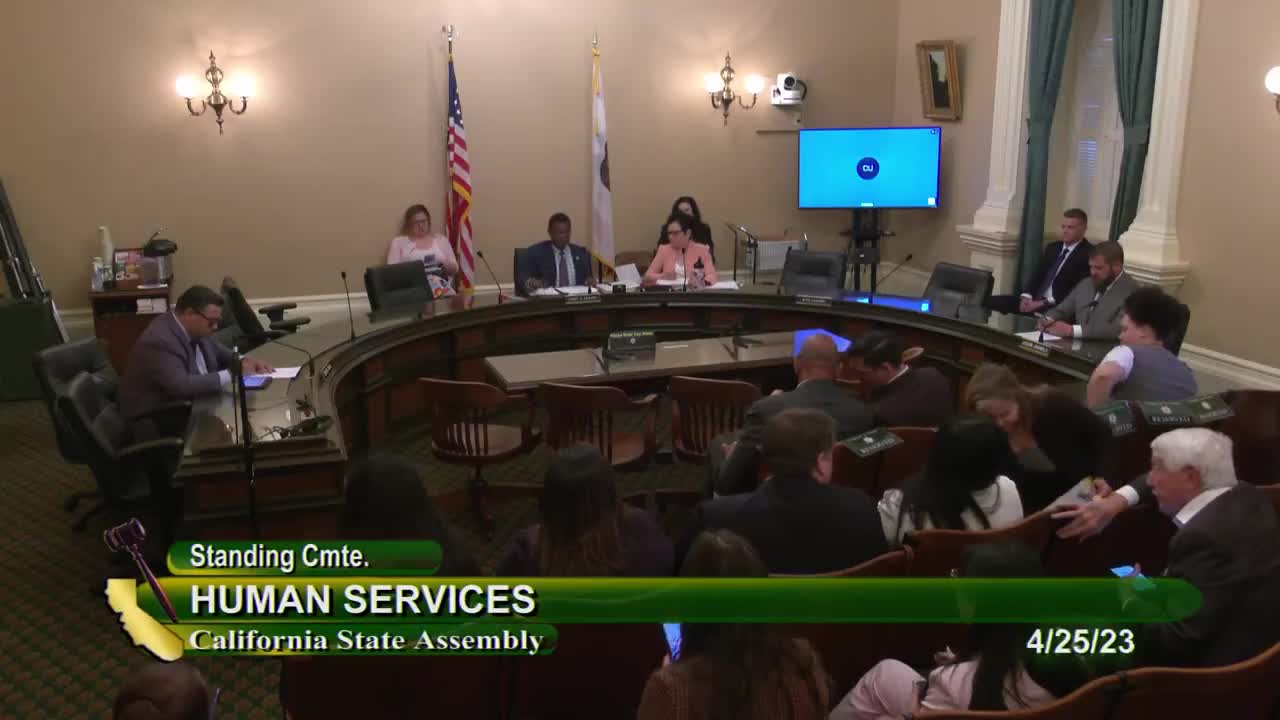 8MIN
Assembly Standing Committee on Human Services
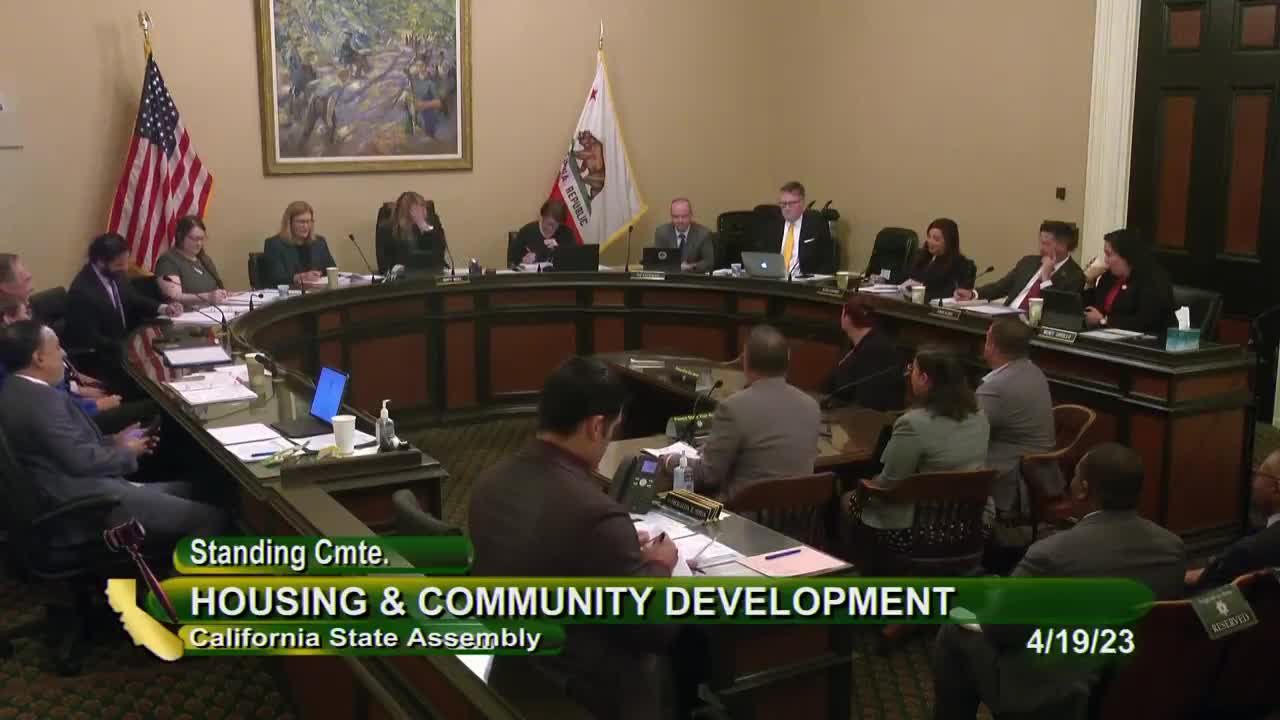 10MIN
Assembly Standing Committee on Housing and Community Development
Bill Author