AB 623: Cannabis: THC testing variances.
- Session Year: 2023-2024
- House: Assembly
- Latest Version Date: 2023-09-30
Current Status:
Passed
(2023-09-30: Chaptered by Secretary of State - Chapter 267, Statutes of 2023.)
Introduced
In Committee
First Chamber
In Committee
Second Chamber
Enacted
Existing law, the Control, Regulate and Tax Adult Use of Marijuana Act (AUMA), approved by the voters at the November 8, 2016, statewide general election, regulates the cultivation, distribution, transport, storage, manufacturing, testing, processing, sale, and use of marijuana for nonmedical purposes by people 21 years of age and older. The existing Medicinal and Adult-Use Cannabis Regulation and Safety Act (MAUCRSA), among other things, consolidates the licensure and regulation of commercial medicinal and adult-use cannabis activities.
MAUCRSA prohibits cannabis and cannabis products from being sold unless a representative sample of specified batches has been tested by a licensed testing laboratory. MAUCRSA requires the testing laboratory to issue a certificate of analysis for selected lots of each batch to report specified information, including whether the chemical profile of the sample conforms to the labeled content of compounds. Existing law, for edible cannabis products, requires the certificate of analysis to report that the milligrams of THC per serving does not exceed 10 milligrams per serving, plus or minus 10%.
This bill would require the Department of Cannabis Control to establish regulations to adjust testing variances for edible cannabis products that include less than 5 milligrams of THC in total.
Existing law, the Medicinal and Adult-Use Cannabis Regulation and Safety Act (MAUCRSA), provides that the actions of a licensee, its employees, and its agents are not unlawful under state law and shall not be an offense subject to arrest, prosecution, or other sanction under state law, or be subject to a civil fine or be a basis for seizure or forfeiture of assets when those actions are permitted pursuant to a state license, permitted pursuant to a local authorization, license, or permit issued by a local jurisdiction, if any, and conducted in accordance with the requirements of the MAUCRSA and regulations adopted pursuant to that act. Existing law also provides that the actions of a person who allows their property to be used by a licensee, its employees, and its agents, as specified, are not unlawful under state law and shall not be an offense subject to arrest, prosecution, or other sanction under state law, or be subject to a civil fine or be a basis for seizure or forfeiture of assets.This bill would make a nonsubstantive change to this provision.Existing law, the Medicinal and Adult-Use Cannabis Regulation and Safety Act (MAUCRSA), provides that the actions of a licensee, its employees, and its agents are not unlawful under state law and shall not be an offense subject to arrest, prosecution, or other sanction under state law, or be subject to a civil fine or be a basis for seizure or forfeiture of assets when those actions are permitted pursuant to a state license, permitted pursuant to a local authorization, license, or permit issued by a local jurisdiction, if any, and conducted in accordance with the requirements of the MAUCRSA and regulations adopted pursuant to that act. Existing law also provides that the actions of a person who allows their property to be used by a licensee, its employees, and its agents, as specified, are not unlawful under state law and shall not be an offense subject to arrest, prosecution, or other sanction under state law, or be subject to a civil fine or be a basis for seizure or forfeiture of assets.
This bill would make a nonsubstantive change to this provision.
(a)Except as otherwise provided by law, cannabis or cannabis products shall not be sold pursuant to a license provided for under this division unless a representative sample of the cannabis or cannabis products has been tested by a licensed testing laboratory.
(b)The department shall develop criteria to determine which batches shall be tested. All testing of the samples shall be performed on the final form in which the cannabis or cannabis product will be consumed or used.
(c)Testing of batches to meet the requirements of this division shall only be conducted by a licensed testing laboratory.
(d)For each batch tested, the testing laboratory shall issue a certificate of analysis for selected lots at a frequency determined by the department with supporting data, to report both of the following:
(1)Whether the chemical profile of the sample conforms to the labeled content of compounds, including, but not limited to, all of the following, unless limited through regulation by the department:
(A)Tetrahydrocannabinol (THC).
(B)Tetrahydrocannabinolic Acid (THCA).
(C)Cannabidiol (CBD).
(D)Cannabidiolic Acid (CBDA).
(E)The terpenes required by the department in regulation.
(F)Cannabigerol (CBG).
(G)Cannabinol (CBN).
(H)Other compounds or contaminants required by the department.
(2)That the presence of contaminants does not exceed the levels established by the department. In establishing the levels, the department shall consider the American Herbal Pharmacopoeia monograph, guidelines set by the Department of Pesticide Regulation pursuant to subdivision (c) of Section 26060, and any other relevant sources. For purposes of this paragraph, contaminants includes, but is not limited to, all of the following:
(A)Residual solvent or processing chemicals.
(B)Foreign material, including, but not limited to, hair, insects, or similar or related adulterant.
(C)Microbiological impurities as identified by the department in regulation.
(3)For edible cannabis products, that the milligrams per serving of THC does not exceed 10 milligrams per serving, plus or minus 12 percent. After January 1, 2022, the milligrams of THC per serving shall not deviate from 10 milligrams by more than 10 percent.
(4)Notwithstanding paragraph (3), the department shall establish regulations to adjust testing variances for edible cannabis products that include less than five milligrams of THC in total.
(e)A testing laboratory may amend a certificate of analysis to correct minor errors, as defined by the department.
(f)(1)Standards for residual levels of volatile organic compounds shall be established by the department.
(2)On or before January 1, 2023, the department shall establish a standard cannabinoids test method, including standardized operating procedures, that shall be utilized by all testing laboratories. The department may establish more than one method for use by testing laboratories and these standards may be developed through a reference laboratory.
(g)The testing laboratory shall conduct all testing required by this section in a manner consistent with general requirements for the competence of testing and calibrations activities, including sampling and using verified methods.
(h)All testing laboratories performing tests pursuant to this section shall obtain and maintain ISO/IEC 17025 accreditation as required by the department in regulation.
(i)(1)If a test result falls outside the specifications authorized by law or regulation, the testing laboratory shall follow a standard operating procedure to confirm or refute the original result.
(2)If a test result falls outside the specifications authorized by law or regulation, the testing laboratory may retest the sample if both of the following occur:
(A)The testing laboratory notifies the department, in writing, that the test was compromised due to equipment malfunction, staff error, or other circumstances allowed by the department.
(B)The department authorizes the testing laboratory to retest the sample.
(j)A testing laboratory shall destroy the remains of the sample of cannabis or cannabis product upon completion of the analysis, as determined by the department through regulations.
(k)Presale inspection, testing transfer, or transportation of cannabis or cannabis products pursuant to this section shall conform to a specified chain of custody protocol and any other requirements imposed under this division.
(l)This division does not prohibit a licensee from performing testing on the licensees premises for the purposes of quality control of the product in conjunction with reasonable business operations. This division also does not prohibit a licensee from performing testing on the licensees premises of cannabis or cannabis products obtained from another licensee. Onsite testing by the licensee shall not be certified by the department and does not exempt the licensee from the requirements of compliance testing at a testing laboratory pursuant to this section.
SECTION 1.Section 26032 of the Business and Professions Code is amended to read:26032.(a)The actions of a licensee, its employees, and its agents are not unlawful under state law and shall not be an offense subject to arrest, prosecution, or other sanction under state law, or be subject to a civil fine or be a basis for seizure or forfeiture of assets under state law if they are all of the following:(1)Permitted pursuant to a state license.(2)Permitted pursuant to a local authorization, license, or permit issued by the local jurisdiction, if any.(3)Conducted in accordance with the requirements of this division and regulations adopted pursuant to this division.(b)The actions of a person who, in good faith, allows their property to be used by a licensee, its employees, and its agents, as permitted pursuant to a state license and, if required by the applicable local ordinances, a local license or permit, are not unlawful under state law and shall not be an offense subject to arrest, prosecution, or other sanction under state law, or be subject to a civil fine or be a basis for seizure or forfeiture of assets under state law.(a)The actions of a licensee, its employees, and its agents are not unlawful under state law and shall not be an offense subject to arrest, prosecution, or other sanction under state law, or be subject to a civil fine or be a basis for seizure or forfeiture of assets under state law if they are all of the following:
(1)Permitted pursuant to a state license.
(2)Permitted pursuant to a local authorization, license, or permit issued by the local jurisdiction, if any.
(3)Conducted in accordance with the requirements of this division and regulations adopted pursuant to this division.
(b)The actions of a person who, in good faith, allows his or her their property to be used by a licensee, its employees, and its agents, as permitted pursuant to a state license and, if required by the applicable local ordinances, a local license or permit, are not unlawful under state law and shall not be an offense subject to arrest, prosecution, or other sanction under state law, or be subject to a civil fine or be a basis for seizure or forfeiture of assets under state law.
|
Date
|
Status
|
|---|---|
| Sep 30, 2023 | Chaptered by Secretary of State - Chapter 267, Statutes of 2023. |
| Sep 30, 2023 | Approved by the Governor. |
| Sep 13, 2023 | Enrolled and presented to the Governor at 3 p.m. |
| Sep 7, 2023 | In Assembly. Ordered to Engrossing and Enrolling. |
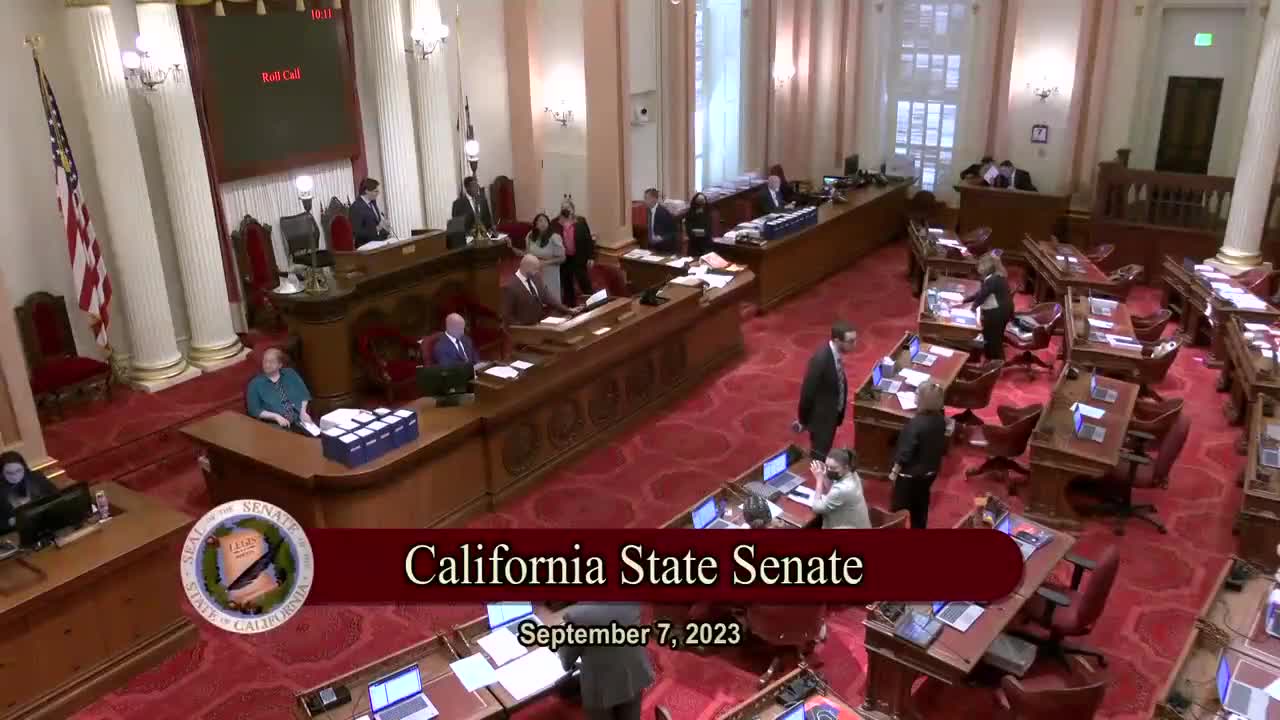
| Sep 7, 2023 | Read third time. Passed. Ordered to the Assembly. (Ayes 40. Noes 0. Page 2484.). |
| Aug 15, 2023 | Read second time. Ordered to third reading. |
| Aug 14, 2023 | From committee: Be ordered to second reading pursuant to Senate Rule 28.8. |
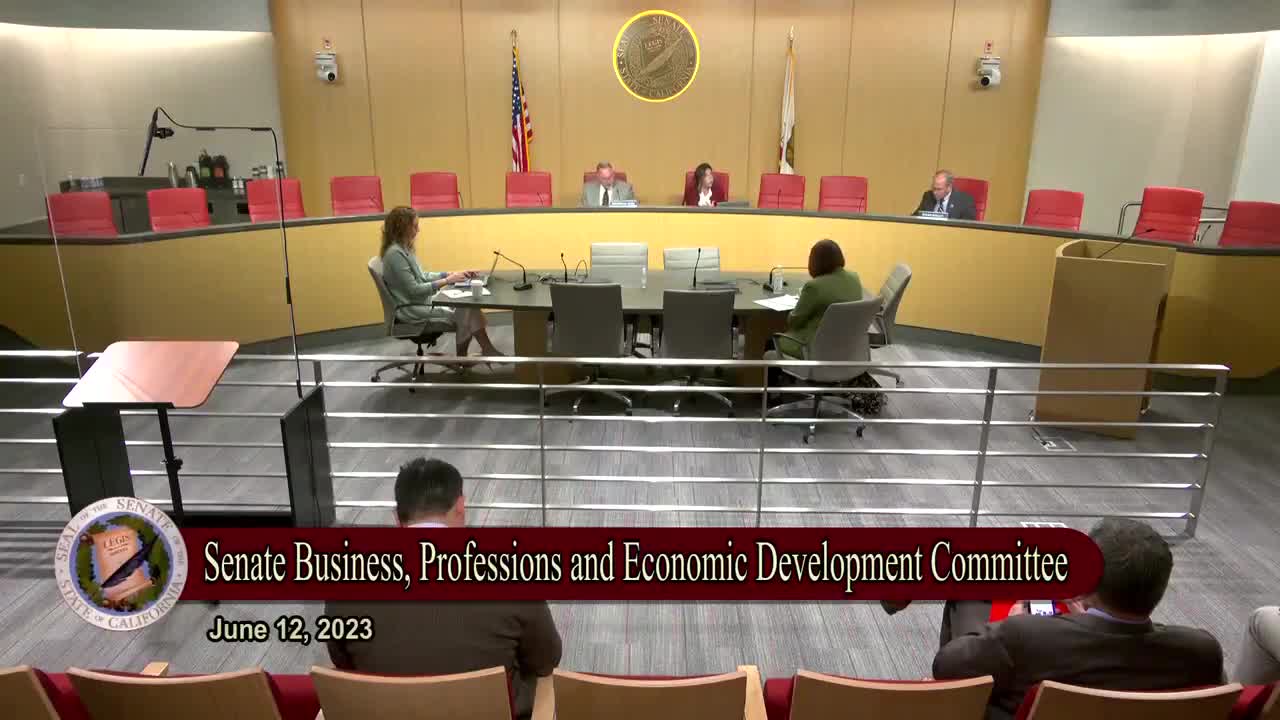
| Jun 12, 2023 | From committee: Do pass and re-refer to Com. on APPR. (Ayes 11. Noes 0.) (June 12). Re-referred to Com. on APPR. |
| May 31, 2023 | Referred to Com. on B., P. & E. D. |
| May 18, 2023 | In Senate. Read first time. To Com. on RLS. for assignment. |
| May 18, 2023 | Read third time. Passed. Ordered to the Senate. (Ayes 74. Noes 0. Page 1595.) |
| May 11, 2023 | Read second time. Ordered to Consent Calendar. |
| May 10, 2023 | From committee: Do pass. To Consent Calendar. (Ayes 14. Noes 0.) (May 10). |
| May 3, 2023 | In committee: Hearing postponed by committee. |
| Apr 18, 2023 | From committee: Do pass and re-refer to Com. on APPR. with recommendation: To Consent Calendar. (Ayes 17. Noes 0.) (April 18). Re-referred to Com. on APPR. |
| Mar 20, 2023 | Re-referred to Com. on B. & P. |
| Mar 16, 2023 | Referred to Com. on B. & P. |
| Mar 16, 2023 | From committee chair, with author's amendments: Amend, and re-refer to Com. on B. & P. Read second time and amended. |
| Feb 10, 2023 | From printer. May be heard in committee March 12. |
| Feb 9, 2023 | Read first time. To print. |
|
Date
|
Description
|
Location
|
Votes
|
|
|---|---|---|---|---|
| Sep 7, 2023 | Assembly 3rd Reading AB623 Chen By Newman | Senate Floor |
Passed |
|
| Jun 12, 2023 | Do pass, but first be re-referred to the Committee on [Appropriations] | Senate Standing Committee on Business, Professions and Economic Development |
Passed |
|
| May 18, 2023 | AB 623 Chen Consent Calendar Second Day Regular Session | Assembly Floor |
Passed |
|
| May 10, 2023 | Do pass. To Consent Calendar. | Assembly Standing Committee on Appropriations |
Passed |
|
| Apr 18, 2023 | Do pass and be re-referred to the Committee on [Appropriations] with recommendation: To Consent Calendar | Assembly Standing Committee on Business and Professions |
Passed |
This list shows positions taken on this bill by organizations on the date displayed, which is linked to the original source.
Positions by individuals are not included.
|
Organization
|
Position
|
Date
|
|---|---|---|
| Abstrax Tech | ** Support | |
| Anresco Laboratories | ** Support | |
| Cannabis Beverage Association | ** Support | |
| Cannagram | ** Support | |
| Happi Co. | ** Support | |
| Harmony Craft Beverages | ** Support | |
| Sands Lane | ** Support | |
| Sands Lane Ventures | ** Support | |
| SoRSE Technology | ** Support | |
| Sorse Technology INC. | ** Support | |
| Spacestation | ** Support | |
| Vertosa | ** Support |
SENATE RULES COMMITTEE Office of Senate Floor Analyses (916) 651-1520 Fax: (916) 327-4478 | AB 623 |
THIRD READING
Bill No: AB 623
Author: Chen (R)
Amended: 3/16/23 in Assembly
Vote: 21
SENATE BUS., PROF. & ECON. DEV. COMMITTEE: 11-0, 6/12/23
AYES: Roth, Alvarado-Gil, Archuleta, Ashby, Becker, Dodd, Glazer, Niello, Smallwood-Cuevas, Wahab, Wilk
NO VOTE RECORDED: Nguyen, Eggman
SENATE APPROPRIATIONS COMMITTEE: Senate Rule 28.8
ASSEMBLY FLOOR: 74-0, 5/18/23 (Consent) - See last page for vote
SUBJECT: Cannabis: THC testing variances
SOURCE: Cannabis Beverage Association
DIGEST:
This bill requires the Department of Cannabis Control (DCC) to establish regulations to adjust testing variances for edible cannabis products that include less than five milligrams of tetrahydrocannabinol (THC) in total.
ANALYSIS:
Existing law:
- Establishes DCC responsible for the licensure and regulation of the cannabis industry. (Business and Professions Code (BPC) § 26010)
- Prohibits cannabis or cannabis products from being sold, pursuant to a license, unless a representative sample of the cannabis or cannabis products has been tested by a licensed testing laboratory. (BPC § 26100(b))
- Provides that the DCC is responsible for developing testing criteria to determine which batches must be tested, and all testing of the samples is to be in the final form in which the cannabis or cannabis product will be consumed. (BPC § 26100(b))
- Requires testing of all batches to only be conducted by a licensed testing laboratory. (BPC § 26100(c))
- Prohibits a testing laboratory from being licensed by DCC unless the laboratory meets all of the following:
- Complies with any other requirements specified by the department.
- Notifies the department within one business day after the receipt of notice of any kind that its accreditation has been denied, suspended, or revoked.
- Has established standard operating procedures that provide for adequate chain of custody controls for samples transferred to the testing laboratory for testing. (BPC § 26102)
- Defines “edible cannabis product” to mean means a cannabis product that is intended to be used, in whole or in part, for human consumption, as specified. (BPC § 26001(v))
- Defines “cannabis beverage” as a form of edible cannabis product that is intended to be consumed in its final state as a beverage. (BPC § 26001(g))
- Prohibits an edible cannabis product from containing more than 10 milligrams THC per serving and 100 milligrams THC per package, unless it is a packaging containing an edible product that is orally dissolving product, such as sublingual lozenges or mouth strips, which may contain up to 500 milligrams of THC per package if only for Medical Use Only and discrete servings of no more than 10 milligrams THC per piece, as specified. (4, CCR § 17304(a)(b))
This bill requires the DCC to establish regulations to adjust testing variances for edible cannabis products that include less than five milligrams of THC in total.
Background
The DCC has both licensing and enforcement authority related to commercial cannabis in California, including authority to take action against unlicensed cannabis activities. The DCC is required to convene an advisory committee with designated members of the cannabis industry including labor, health experts, local and state agencies, among others, to make recommendations to the DCC on the development of standards including best practices and guidelines that protect public health and safety while ensuring a safe and regulated market that does perpetuate the illicit market.
The Medicinal and Adult-Use Cannabis Regulation and Safety Act requires cannabis in its final form to be laboratory tested prior to sale. Cannabis testing laboratories are required to evaluate the levels of contaminants of cannabis samples, including residual solvent, processing chemicals, moisture content and water activity, foreign material (such as hair and insects) and microbiological impurities. Testing also determines the concentrations of active chemicals and ensure compliance with safety standards. Licensed testing laboratories report results on a “Certificate of Analysis” (COA), The COA states whether the batch passes or fails testing for each substance. Licensed labs can only issue COAs and results after they finish all tests. Labs cannot change them after they are issued without permission from DCC.
In addition to information pertaining to the product’s chemical profiles and contaminants, the COA documents administrative information about the laboratory, the distributor or microbusiness, dates and signatures, and other non-testing data, which can be subject to simple data entry mistakes. Once issued, current law prohibits amending a COA or retesting samples, and the cannabis must be either remediated or destroyed. Testing laboratories must obtain and maintain accreditation from ISO/ISE 17025 accreditation.
In addition to demonstrating and meeting safety standards for cannabis and cannabis products, laboratory testing also ensures the allowable amount of THC is contained in each product and that the product does not contain more than what is legally allowed and does not contain less so that a consumer is paying for the appropriate product. Under current law BPC Section 26100, specifically for edible cannabis products, the milligrams per serving of THC may not exceed 10 milligrams per serving and that the product does not deviate from the 10 milligrams by more than 10 percent.
Edible cannabis products are those that can be consumed by mouth and resemble traditional food and beverages including baked goods, candies and sweets, mints, drink additives and drinks. To help ensure that edible products are safe to consume and stay out of the hands of children, current law provides the following related to edible cannabis products including that all edible cannabis products be:
- Not designed to be appealing to children or easily confused with commercially sold candy or foods that do not contain cannabis.
- Produced and sold with a standardized concentration of cannabinoids not to exceed 10 milligrams of THC per serving.
- Delineated or scored into standardized serving sizes if the cannabis product contains more than one serving and is an edible cannabis product in solid form.
- Homogenized to ensure uniform disbursement of cannabinoids throughout the product.
- Manufactured and sold under sanitation standards established by DCC that are similar to the standards for the preparation, storage, handling, and sale of food products.
- Provided to customers with sufficient information to enable the informed consumption of the product, including the potential effects of the cannabis product and directions as to how to consume the cannabis product, as necessary.
- Marked with a universal symbol.
As part of the wide variety of edible cannabis products in California, beverage products containing cannabis are included. Cannabis beverages can include teas, sodas, non-alcoholic beer or wine, energy drinks, or other drinks that are made with cannabis. All of cannabis beverage products are to be non-alcoholic. According to data from Headset, beverage consumption is still relatively low compared with other methods of consumer cannabis; however, the market for cannabis beverages is expected to increase.
As noted by the sponsor, Cannabis Beverage Association, the amount of THC or CBD included in a beverage may be significantly lower than that of an edible food item. The lower levels of THC in a beverage product may not conform with current testing standards currently specified in existing law. Existing law currently prohibits edible cannabis products from containing more than 10 milligrams of THC per serving, plus or minus 10 percent. This is to account for natural variance within products. Products that exceed the allowed variance must be destroyed. The author and sponsor contend that edible cannabis products with low levels of THC potency of THC fail a test and are required to be thrown out because the amount of variance allowed is less for products with lower potency levels of THC.
Ultimately, this bill tasks the DCC with the responsibility to determine what the appropriate testing variances should be for those products with a lower level of THC than what is currently specified in statute as 10 milligrams to ensure that testing standards are consistent, accurate and appropriate for smaller dosing sizes. This bill requires the DCC to establish these standards through the regulatory process, which would likely include public comment and participation from industry, laboratory experts and other stakeholders who wish to partake in the regulatory process.
FISCAL EFFECT: Appropriation: No Fiscal Com.: Yes Local: No
SUPPORT: (Verified 8/15/23)
Cannabis Beverage Association (source)
Abstrax Tech
Anresco Laboratories
Cannagram
Happi Co.
Harmony Craft Beverages
Sands Lane
Sands Lane Ventures
SoRSE Technology Inc.
Spacestation
Vertosa
OPPOSITION: (Verified 8/15/23)
None received
ARGUMENTS IN SUPPORT: Supporters note, “AB 623 level the playing field between cannabis beverages and edible cannabis products for those under 5 milligrams. Current regulations simply do not reflect optimal conditions for the cannabis industry, it is critical that the Legislature rewards those who play by the rules within the legal cannabis market.”
ASSEMBLY FLOOR: 74-0, 5/18/23
AYES: Addis, Aguiar-Curry, Alanis, Alvarez, Arambula, Bains, Bauer-Kahan, Bennett, Berman, Boerner, Bonta, Bryan, Calderon, Juan Carrillo, Wendy Carrillo, Chen, Connolly, Megan Dahle, Davies, Dixon, Essayli, Flora, Mike Fong, Gabriel, Gallagher, Garcia, Gipson, Grayson, Haney, Hart, Holden, Hoover, Irwin, Jackson, Jones-Sawyer, Kalra, Lackey, Lee, Low, Lowenthal, Maienschein, Mathis, McCarty, McKinnor, Muratsuchi, Stephanie Nguyen, Ortega, Pacheco, Papan, Jim Patterson, Joe Patterson, Pellerin, Petrie-Norris, Quirk-Silva, Ramos, Reyes, Luz Rivas, Robert Rivas, Rodriguez, Blanca Rubio, Sanchez, Santiago, Schiavo, Soria, Ta, Ting, Valencia, Wallis, Ward, Weber, Wicks, Wood, Zbur, Rendon
NO VOTE RECORDED: Cervantes, Vince Fong, Friedman, Villapudua, Waldron, Wilson
Prepared by: Elissa Silva / B., P. & E.D. / 916-651-4104
8/16/23 14:04:46
**** END ****
SENATE COMMITTEE ON
BUSINESS, PROFESSIONS AND ECONOMIC DEVELOPMENT
Senator Richard Roth, Chair
2023 - 2024 Regular
Bill No: Hearing Date: June 12, 2023
Author: | |||
Version: | March 16, 2023 | ||
Urgency: | No | Fiscal: | Yes |
Consultant: | Elissa Silva | ||
Subject:
SUMMARY:
Requires the Department of Cannabis Control (DCC) to establish regulations to adjust testing variances for edible cannabis products that include less than five milligrams of tetrahydrocannabinol (THC) in total.
Existing law:
- Establishes DCC responsible for the licensure and regulation of the cannabis industry. (Business and Professions Code (BPC) § 26010)
- Requires DCC to make and prescribe reasonable rules and regulations as may be necessary to implement, administer, and enforce its duties under the Medicinal and Adult-Use Cannabis Regulation and Safety Act (MAUCRSA). (BPC § 26010)
- Provides for 20 cannabis license types including a Type 8 testing laboratory license. (BPC § 26050)
- Prohibits cannabis or cannabis products from being sold, pursuant to a license, unless a representative sample of the cannabis or cannabis products has been tested by a licensed testing laboratory. (BPC § 26100(b))
- Provides that the DCC is responsible for developing testing criteria to determine which batches must be tested, and all testing of the samples is to be in the final form in which the cannabis or cannabis product will be consumed. (BPC § 26100(b))
- Requires testing of all batches to only be conducted by a licensed testing laboratory. (BPC § 26100(c))
- Requires for each batch tested, the testing laboratory issue a certificate of analysis, as specified, to report both of the following:
- Whether the chemical profile of the sample conforms to the labeled content of compounds; and,
- That the presence of contaminants does not exceed the levels established by the DCC, as specified, and that for edible cannabis products, the milligrams per serving of THC does not exceed 10 milligrams per serving, and the milligrams must not deviate from 10 milligrams by more than 10 percent. (BPC § 26100(d)(1)(3))
- Authorizes a testing laboratory to amend a certificate of analysis to correct minor errors, as defined by the DCC. (BPC § 26100(2))
- Prohibits a testing laboratory from being licensed by DCC unless the laboratory meets all of the following:
- Complies with any other requirements specified by the department.
- Notifies the department within one business day after the receipt of notice of any kind that its accreditation has been denied, suspended, or revoked.
- Has established standard operating procedures that provide for adequate chain of custody controls for samples transferred to the testing laboratory for testing. (BPC § 26102)
- Defines “edible cannabis product” to mean means a cannabis product that is intended to be used, in whole or in part, for human consumption, as specified. (BPC § 26001(v))
- Defines “cannabis beverage” as a form of edible cannabis product that is intended to be consumed in its final state as a beverage. (BPC § 26001(g))
- Requires the licensed laboratory to develop and implement a sampling standard operating procedure that describes the laboratory’s method for obtaining representative samples of cannabis and cannabis products. (Title 4, California Code of Regulations (CCR) § 15704)
- Requires the licensed laboratory to obtain and analyze only those samples from cannabis product batches that are in final form. (4, CCR § 15705(b))
- Requires each licensed laboratory to develop, implement, and validate test methods for the analyses of samples, as required and must conform to specified guidelines. (4, CCR § 15712(b))
- Prohibits an edible cannabis product from containing more than 10 milligrams THC per serving and 100 milligrams THC per package, unless it is a packaging containing an edible product that is orally dissolving product, such as sublingual lozenges or mouth strips, which may contain up to 500 milligrams of THC per package if only for Medical Use Only and discrete servings of no more than 10 milligrams THC per piece, as specified. (4, CCR § 17304(a)(b))
This bil requires the DCC to establish regulations to adjust testing variances for edible cannabis products that include less than five milligrams of THC in total.
FISCAL EFFECT:
This bill is keyed fiscal by Legislative Counsel. According to the Assembly Committee on Appropriations, DCC reports minor and absorbable costs to implement this bill.
COMMENTS:
- Purpose. The Cannabis Beverage Association is the sponsor of this bill. According to the author, “Section 26100 of the Business and Professions Code states “For edible cannabis products, that the milligrams per serving of THC does not exceed 10 milligrams per serving, plus or minus 12 percent. After January 1, 2022, the milligrams of THC per serving shall not deviate from 10 milligrams by more than 10 percent.” This has had significant unintended consequences.
This model was drawn from higher assay product forms such as concentrates, flower and other high dose formats where over exposure is a real possibility. Additionally, when containment parameters are applied their sensitivity must be practical for measuring device and measurement. For example, with concentrates and other high dose formats which are delivering 100 to 1,000 mg per package. A plus or minus range of 10 percent is very appropriate and well within the measurement system (in this case, High Pressure Liquid Chromatography or HPLC). For low dose platforms such as beverages where cannabinoid assays range between 2 mg and 10 mg per unit the variation inherent in the measurement system (HPLC) begins to overshadow the permitted 10% range allowance.”
- Background.
Cannabis Regulation and the DCC. In 2015, Governor Brown signed three bills into law that created a comprehensive state licensing and regulatory framework governing the commercial cultivation, manufacture, retail sale, transport, distribution, delivery, and testing of medical cannabis in California. AB 243 (Wood, Chapter 688, Statutes of 2015), AB 266 (Bonta, Chapter 689, Statutes of 2015), and SB 643 (McGuire, Chapter 719, Statutes of 2015) collectively established the Medical Marijuana Regulation and Safety Act (later renamed to the Medical Cannabis Regulation and Safety Act (MCRSA)), to be administered by a number of state agencies: a Bureau of Cannabis Control within the Department of Consumer Affairs; the California Department of Public Health; and the California Department of Food and Agriculture.
Shortly following the passage of MCRSA, in November 2016, California voters passed Proposition 64, the “Control, Regulate and Tax Adult Use of Marijuana Act” (Prop 64), which decriminalized and legalized adult-use cannabis. Less than a year later in June 2017, the California State Legislature passed a budget trailer bill, SB 94 (Committee on Budget and Fiscal Review, Chapter 27, Statutes of 2017), that integrated MCRSA with Prop 64 to MAUCRSA, the current regulatory structure for both medicinal and adult-use cannabis.
In 2021, consolidation efforts eliminated the need for separate regulatory entities to administer MAUCRSA and DCC became the regulatory authority for licensing, regulatory and enforcement authority. DCC was designed to centralize and align critical licensing, compliance and enforcement responsibilities to help build a sustainable and successful legal cannabis market by creating a single point of contact for cannabis applicant, licensees and local governments. The goal was to ultimately simplify and centralize state regulatory efforts; improve coordination, including enforcement; reduce barriers to participation in the legal market; and incentivize greater local participation.
The DCC has both licensing and enforcement authority related to commercial cannabis in California, including authority to take action against unlicensed cannabis activities. The DCC is required to convene an advisory committee with designated members of the cannabis industry including labor, health experts, local and state agencies, among others, to make recommendations to the DCC on the development of standards including best practices and guidelines that protect public health and safety while ensuring a safe and regulated market that does perpetuate the illicit market. This includes the licensing authority of the 20 different cannabis license types. Prop 64 included very specific requirements for the regulatory program for cannabis and cannabis products, including that cannabis products be tested to ensure product safety through a licensed testing laboratory.
Cannabis Testing and Testing Laboratories. MAUCRSA requires cannabis in its final form to be laboratory tested prior to sale. Cannabis testing laboratories are required to evaluate the levels of contaminants of cannabis samples, including residual solvent, processing chemicals, moisture content and water activity, foreign material (such as hair and insects) and microbiological impurities. Testing also determines the concentrations of active chemicals and to ensure compliance with safety standards. Licensed testing laboratories report results on a “Certificate of Analysis” (COA), The COA states whether the batch passes or fails testing for each substance. Licensed labs can only issue COAs and results after they finish all tests. Labs cannot change them after they’re issued without permission from DCC.
In addition to information pertaining to the product’s chemical profiles and contaminants, the COA documents administrative information about the laboratory, the distributor or microbusiness, dates and signatures, and other non-testing data which can be subject to simple data entry mistakes. Once issued, current law prohibits amending a COA or retesting samples, and the cannabis must be either remediated or destroyed. Testing laboratories must obtain and maintain accreditation from ISO/ISE 17025 accreditation.
In addition to demonstrating and meeting safety standards for cannabis and cannabis products, laboratory testing also ensures the allowable amount of THC is contained in each product and that the product does not contain more than what is legally allowed and does not contain less so that a consumer is paying for the appropriate product. Under current law, BPC § 26100, specifically for edible cannabis products, the milligrams per serving of THC may not exceed 10 milligrams per serving and that the product does not deviate from the 10 milligrams by more than 10 percent.
Edible Cannabis Products. Edible cannabis products are those that can be consumed by mouth and resemble traditional food and beverages including baked goods, candies and sweets, mints, drink additives and drinks. To help ensure that edible products are safe to consume and stay out of the hands of children, current law provides the following related to edible cannabis products including that all edible cannabis products be:
- Not designed to be appealing to children or easily confused with commercially sold candy or foods that do not contain cannabis.
- Produced and sold with a standardized concentration of cannabinoids not to exceed 10 milligrams of THC per serving.
- Delineated or scored into standardized serving sizes if the cannabis product contains more than one serving and is an edible cannabis product in solid form.
- Homogenized to ensure uniform disbursement of cannabinoids throughout the product.
- Manufactured and sold under sanitation standards established by DCC that are similar to the standards for the preparation, storage, handling, and sale of food products.
- Provided to customers with sufficient information to enable the informed consumption of the product, including the potential effects of the cannabis product and directions as to how to consume the cannabis product, as necessary.
- Marked with a universal symbol.
Cannabis Beverages. As part of the wide variety of edible cannabis products in California, beverage products which contain cannabis are included. Cannabis beverages can include teas, sodas, non-alcoholic beer or wine, energy drinks, or other drinks that are made with cannabis. All of cannabis beverage products are to be non-alcoholic. According to data from Headset, beverage consumption is still relatively low compared with other methods of consumer cannabis; however, the market for cannabis beverages is expected to increase.
As noted by the sponsor, the amount of THC or CBD included in a beverage may be significantly lower than that of an edible food item. The lower levels of THC in a beverage product may not conform with the testing standards currently specified in existing law. Existing law currently prohibits edible cannabis products from containing more than 10 milligrams of THC per serving, plus or minus 10 percent. This is to account for natural variance within products. Products that exceed the allowed variance must be destroyed. The author and sponsor contend that edible cannabis products with low levels of THC potency of THC fail a test and are required to be thrown out because the amount of variance allowed is less for products with lower potency levels of THC.
Ultimately, this bill tasks the DCC with the responsibility to determine what the appropriate testing variances should be for those products with a lower level of THC than what is currently specified in statute as 10 milligrams to ensure that testing standards are consistent, accurate and appropriate for smaller dosing sizes. This bill requires the DCC to establish these standards through the regulatory process, which would likely include public comment and participation from industry, laboratory experts and other stakeholders who wish to partake in the regulatory process.
- Arguments in Support. Supporters note that AB 623 levels the playing field between cannabis beverages and edible cannabis products for those under 5 milligrams. Current regulations simply do not reflect optimal conditions for the cannabis industry, it is critical that the Legislature rewards those who play by the rules within the legal cannabis market.
SUPPORT AND OPPOSITION:
Support:
Cannabis Beverage Association (Sponsor)
Anresco Laboratories
Cannagram
Happi Co.
Harmony Craft Beverages
Sands Lane Ventures
Sorse Technology INC.
Vertosa
Opposition:
None received
-- END --
Date of Hearing: May 10, 2023
ASSEMBLY COMMITTEE ON APPROPRIATIONS
Chris Holden, Chair
ABPCA Bill Id:AB 623
Author:(Chen) – As Amended Ver:March 16, 2023
Policy Committee: | Business and Professions | Vote: | 17 - 0 |
|
| ||
|
|
Urgency: No State Mandated Local Program: No Reimbursable: No
SUMMARY:
This bill requires the Department of Cannabis Control (DCC) to establish regulations to adjust testing variances for edible cannabis products that include less than five milligrams (mg) of tetrahydrocannabinol (THC) in total.
FISCAL EFFECT:
DCC reports minor and absorbable costs to implement this bill.
COMMENTS:
This bill is sponsored by the Cannabis Beverage Association.
State law prohibits edible cannabis products from containing more than 10 mg of THC per serving, plus or minus 10% to allow for natural variance within products. The absolute amount of variance allowed is less for products with lower potency levels of THC. For example, an edible product with 10 mg of THC per serving is permitted to have nine to 11 mg (a two-mg range) of THC per serving, whereas an edible product with two mg of THC per serving may have only have 1.8 mg to 2.2 mg (a .4-mg range) of THC per serving. The author contends this model was drawn from product forms with higher concentrations of THC, such as concentrates, flower and other high dose formats, where over exposure is a real possibility. With concentrates and other high dose formats delivering 100 to 1,000 mg per package, a plus or minus range of 10% is very appropriate and well within the limits of the measurement technique.
The author argues that, for low-dose platforms such as beverages, where cannabinoid assays range between 2 mg and 10 mg per unit, the variation inherent in the measurement technique begins to overshadow the permitted 10% range allowance. For beverages, the author contends, it is much more practical to have one-sided, maximum requirements with the 10% tolerance. For example, for beverages containing 5 mg of THC, the stated label would represent a maximum loading with an allowable 10% percent overage, rather than plus or minus 10% of the stated assay on the package. The author argues this is how the alcohol content in low dose products, such as beer, is handled.
Analysis Prepared by: Allegra Kim / APPR. / (916) 319-2081
Date of Hearing: April 18, 2023
ASSEMBLY COMMITTEE ON BUSINESS AND PROFESSIONS
Marc Berman, Chair
ABPCA Bill Id:AB 623
Author:(Chen) – As Amended Ver:March 16, 2023
SUBJECT: Cannabis: THC testing variances.
SUMMARY: Requires the Department of Cannabis Control (DCC) to establish regulations to adjust testing variances for edible cannabis products that include less than five milligrams of tetrahydrocannabinol (THC) in total.
EXISTING LAW:
- Enacts the Medicinal and Adult-Use Cannabis Regulation and Safety Act (MAUCRSA) to provide for a comprehensive regulatory framework for the cultivation, distribution, transport, storage, manufacturing, processing, and sale of medicinal and adult-use cannabis. (Business and Professions Code (BPC) §§ 26000-26325)
- Establishes the DCC within the Business, Consumer Services, and Housing Agency for purposes of administering and enforcing MAUCRSA. (BPC § 26010)
- Requires licensed sellers of cannabis or cannabis products to have a representative sample tested by a licensed testing laboratory. (BPC § 26100(a))
- Requires DCC to develop criteria to determine which batches shall be tested, where all testing of the samples shall be performed on the final form in which the cannabis or cannabis product will be consumed or used. (BPC § 26100(b))
- Requires a testing laboratory to issue a certificate of analysis (COA) where the chemical profile of the sample conforms to the labeled content of specified compounds, and where the presence of contaminants does not exceed the level established by DCC, as specified. (BPC § 26100(d))
- Specifies that for edible cannabis products, the milligrams of THC per serving shall deviate from 10 milligrams by more than 10 percent. (BPC § 26100(d)(3)).
- Allows a testing laboratory to amend a COA to correct minor errors, as defined by DCC. (BPC § 26100(e)).
- Requires that standard for residual levels of volatile organic compounds be established by DCC. (BPC § 26100(f)(1))
- Requires DCC, on or before January 1, 2023, to establish one or more standard cannabinoid test methods, including standardized operating procedures that must be used by all testing laboratories. (BPC § 26100(f)(2))
- Requires the testing laboratory to conduct all testing in a manner consistent with general requirements for the competence of testing and calibration activities, including sampling and using verified methods. (BPC § 26100(g))
- Requires all testing laboratories performing tests to obtain and maintain ISO/IEC 17025 accreditation as required by DCC in regulation. (BPC § 26100(h))
- Specifies that if a test result falls outside the specifications authorized by law or regulation, the testing laboratory shall follow a standard operating procedure to confirm or refute the original result. (BPC § 26100(i)(1))
- Authorizes a testing laboratory to retest the sample if both the testing laboratory notifies DCC in writing, that the test was compromised due to equipment malfunction, staff error, or other circumstances allowed by DCC and DCC authorizes the testing laboratory to retest the sample. (BPC § 26100(i)(2))
- Requires a testing laboratory to destroy the remains of the sample of cannabis or cannabis product upon completion of the analysis, as determined by DCC through regulations. (BPC § 26100(j))
- Prohibits a testing laboratory from being licensed by DCC unless the laboratory meets all of the following:
- Complies with any other requirements specified by the department.
- Notifies the department within one business day after the receipt of notice of any kind that its accreditation has been denied, suspended, or revoked.
- Has established standard operating procedures that provide for adequate chain of custody controls for samples transferred to the testing laboratory for testing. (BPC § 26102)
- Prohibits, except as provided, a testing laboratory from acquiring or receiving cannabis or cannabis products except from a licensee or from distributing, selling, or dispensing cannabis or cannabis products from the licensed premises from which the cannabis or cannabis products were acquired or received. (BPC § 26104(c))
- Defines “edible cannabis product” to mean means a cannabis product that is intended to be used, in whole or in part, for human consumption, as specified. (BPC § 26001(v))
- Defines “cannabis beverage” as a form of edible cannabis product that is intended to be consumed in its final state as a beverage. (BPC § 26001(g))
THIS BILL:
- Requires DCC to establish regulations to adjust testing variances for edible cannabis products that include less than five milligrams of THC in total.
FISCAL EFFECT: Unknown. This bill is keyed fiscal by Legislative Counsel.
COMMENTS:
Purpose. This bill is sponsored by the Cannabis Beverage Association. According to the author,
[This bill] is a critical step forward in regulation of the legal cannabis industry, keeping consumer safety and accurate label declaration for content in the forefront while ensuring testing requirements are science based. In this way, unneeded scrap and rework does become part of product costs, which are ultimately passed on to the consumer. This legislation will level the playing field between cannabis beverages and edible cannabis products for those under 10 milligrams. This bill is another important step to ensure fairness and efficiency in an industry that is still taking shape here in California. Current regulations simply do not reflect optimal conditions for the cannabis industry, it is critical that the Legislature rewards those who play by the rules within the legal cannabis market.
Background.
Department of Cannabis Control. Since July 1, 2021, the DCC has been the single entity responsible for administering and enforcing the majority of California’s cannabis laws, collectively known as MAUCRSA. The DCC is additionally responsible for licensing and regulating cannabis businesses, including the cultivation, manufacture, testing, transportation, labeling, and sale of cannabis and cannabis products in this state.[1]
Cannabis Beverages and Other Edible Products. “Edible cannabis product” is defined in statute as a cannabis product that is intended to be used, in whole or in part, for human consumption (including chewing gum).[2] This broad definition captures both solid edibles (e.g., cookies or gummies) as well as liquid edibles (i.e. cannabis beverages).
Existing law includes a number of provisions aimed primarily at ensuring that manufactured products are safe for consumers and unappealing to children. Specifically, MAUCRSA requires that all edible cannabis products be:
(1) Not designed to be appealing to children or easily confused with commercially sold candy or foods that do not contain cannabis.
(2) Produced and sold with a standardized concentration of cannabinoids not to exceed 10 milligrams of THC per serving.
(3) Delineated or scored into standardized serving sizes if the cannabis product contains more than one serving and is an edible cannabis product in solid form.
(4) Homogenized to ensure uniform disbursement of cannabinoids throughout the product.
(5) Manufactured and sold under sanitation standards established by DCC that are similar to the standards for the preparation, storage, handling, and sale of food products.
(6) Provided to customers with sufficient information to enable the informed consumption of the product, including the potential effects of the cannabis product and directions as to how to consume the cannabis product, as necessary.
(7) Marked with a universal symbol.[3]
Cannabis testing. Cannabis products are required to be tested before they can be sold to ensure that they are free of contaminants (e.g., pesticides) and labeled with accurate amounts of cannabinoids and terpenes.[4] Results are reported on a Certificate of Analysis (COA), which is required to be uploaded to DCC’s track and trace system and emailed directly to DCC[5]. If cannabis products fail a test, the entire batch of goods must be destroyed by the distributor or remediated by a manufacturer.[6] Remediation is the process of removing contaminants from a product and must be approved by DCC in advance.[7] After remediation, the cannabis goods are re-tested. If they pass, then the goods can be sold.[8]
Cannabis testing laboratories must be licensed by DCC, maintain ISO accreditation, use standardized operating procedures, develop a laboratory quality assurance program, and participate in a proficiency testing program.[9]
Existing law currently prohibits edible cannabis products from containing more than 10 milligrams of THC per serving, plus or minus 10 percent.[10] This is to account for natural variance within products. Products that exceed the allowed variance must be destroyed. The author and sponsor contend that edible cannabis products with low levels of THC potency of THC fail a test and are required to be thrown out because the amount of variance allowed is less for products with lower potency levels of THC. For example, an edible product with 10 milligrams of THC per serving, is permitted to have nine to 11 milligrams (a two-milligram range) of THC per serving, whereas an edible product with 2 milligrams of THC per serving, could only have 1.8 milligrams to 2.2 milligrams (a .4-milligram range) of THC per serving. This bill would require DCC to modify the testing variances for edible cannabis products containing less than five milligrams of THC in total, thereby accounting for differences in actual variance allowed for edible products with less THC compared to edible products with high amounts of THC.
Current Related Legislation.
AB 1610 (Jones-Sawyer) would 1) require DCC to list cannabis product recall orders on its website; 2) subject testing laboratories to blind proficiency testing; 3) require DCC by January 1, 2025, to establish a standard laboratory blind proficiency test method for use by all testing laboratories; 4) require DCC to audit testing laboratories annually and to publish the results of those audits, including any record of a violation, on its website; 5) require DCC by January 1, 2025, to establish standard operating procedures for conducting audits, including frequency, manner, and notification requirements; and require DCC by January 1, 2025, to establish quality assurance standards and testing procedures for products available for retail sale. Pending in this committee.
Prior Related Legislation.
SB 544 (Laird) Chapter 547, Statutes of 2021, required DCC to establish standardized cannabinoid test methods to be used by all testing laboratories by January 1, 2023.
AB 1646 (Chen), Chapter 388, Statutes of 2022, allowed cannabis beverages to be packaged in containers made of any material that is clear or any color.
AB 2155 (Villapudua) Chapter 33, Statutes of 2022, defined “cannabis beverage” as a form of edible cannabis product that is intended to be consumed in its final state as a beverage.
AB 1222 (Chen), Chapter 532, Statutes of 2021, provided that cannabis beverages may be packaged in glass containers that are clear or any color.
ARGUMENTS IN SUPPORT:
The sponsor of this bill, the Cannabis Beverage Association, writes in support:
[This bill] will level the playing field for cannabis beverages and edible cannabis products which are under the threshold of 5 milligrams by requiring the Department of Cannabis Control (DCC) to establish regulations to adjust testing variances for edible and beverage cannabis products that include less than 5 milligrams of THC. This bill recognizes that with different quantities of THC, should come different rules, a one size fits all approach serves neither the distributor nor the consumer.
ARGUMENTS IN OPPOSITION:
None on file.
REGISTERED SUPPORT:
Cannabis Beverage Association (sponsor)
SoRSE Technology
REGISTERED OPPOSITION:
None on file.
Analysis Prepared by: Kaitlin Curry / B. & P. / (916) 319-3301
Department of Cannabis Control. (n.d.). About the Department of Cannabis Control. Department of Cannabis Control. Retrieved April 6, 2023, from https://cannabis.ca.gov/about-us/about-dcc/ ↑
BPC § 26001(h) ↑
BPC § 26130(c) ↑
Department of Cannabis Control. (n.d.). Testing laboratories. Department of Cannabis Control. Retrieved April 12, 2023, from https://cannabis.ca.gov/licensees/testing-laboratories/ ↑
Ibid. ↑
Ibid. ↑
Ibid. ↑
Ibid. ↑
Ibid. ↑
BPC § 26100(d)(3) ↑
Discussed in Hearing
 2MIN
Senate Floor
 5MIN
Senate Standing Committee on Business, Professions and Economic Development
Bill Author

Bill Co-Author(s):