AB 854: Tribal gaming: compact ratification.
- Session Year: 2023-2024
- House: Assembly
- Latest Version Date: 2023-09-30
Current Status:
Passed
(2023-09-30: Chaptered by Secretary of State - Chapter 272, Statutes of 2023.)
Introduced
In Committee
First Chamber
In Committee
Second Chamber
Enacted
The existing federal Indian Gaming Regulatory Act of 1988 provides for the negotiation and execution of tribal-state gaming compacts for the purpose of authorizing certain types of gaming on Indian lands within a state. The California Constitution authorizes the Governor to negotiate and conclude tribal-state gaming compacts, subject to ratification by the Legislature. Existing law expressly ratifies a number of tribal-state gaming compacts between the State of California and specified Indian tribes.
The California Environmental Quality Act (CEQA) requires a lead agency to prepare, or cause to be prepared, and certify the completion of, an environmental impact report on a project, as defined, that it proposes to carry out or approve that may have a significant effect on the environment, as defined, or to adopt a negative declaration if it finds that the project will not have that effect.
This bill would ratify the tribal-state gaming compact entered into between the State of California and the Redding Rancheria, California, executed on March 30, 2023. The bill would provide that, in deference to tribal sovereignty, certain actions related to this compact are not projects for purposes of CEQA.
This bill would declare that it is to take effect immediately as an urgency statute.
The existing federal Indian Gaming Regulatory Act of 1988 provides for the negotiation and execution of tribal-state gaming compacts for the purpose of authorizing certain types of gaming on Indian lands within a state. The California Constitution authorizes the Governor to negotiate and conclude tribal-state gaming compacts, subject to ratification by the Legislature. Existing law expressly ratifies a number of tribal-state gaming compacts between the State of California and specified Indian tribes.
The California Environmental Quality Act (CEQA) requires a lead agency to prepare, or cause to be prepared, and certify the completion of, an environmental impact report on a project, as defined, that it proposes to carry out or approve that may have a significant effect on the environment, as defined, or to adopt a negative declaration if it finds that the project will not have that effect.
This bill would ratify the tribal-state gaming compact entered into between the State of California and the Redding Rancheria, California, executed on March 30, 2023. The bill would provide that, in deference to tribal sovereignty, certain actions related to this compact are not projects for purposes of CEQA.
Under existing law, the California Horse Racing Board has all powers necessary to carry out the purposes of the Horse Racing Law, such as adopting rules and regulations to protect the public, allocating dates for, and controlling, horse racing and parimutuel wagering, and enforcing all rules and regulations. Existing law requires that, whenever a fair conducts a program of horse races on which there is parimutuel wagering, the fair, so far as practicable, provide a program of racing that includes thoroughbred racing, quarter horse racing, Arabian racing, and Appaloosa racing, if a sufficient number of horses is available to provide competition in one or more races. Under existing law, parimutuel wagering may be conducted on barrel races, show jumping races, and steeplechase races at any public or private facility that has been approved and licensed by the board.This bill would require that, whenever a fair conducts a program of horse races on which there is parimutuel wagering, the fair, so far as practicable, provide a program of racing that includes, in addition to the types of racing included under existing law, steeplechase racing, barrel racing, and show jumping racing.Under existing law, the California Horse Racing Board has all powers necessary to carry out the purposes of the Horse Racing Law, such as adopting rules and regulations to protect the public, allocating dates for, and controlling, horse racing and parimutuel wagering, and enforcing all rules and regulations. Existing law requires that, whenever a fair conducts a program of horse races on which there is parimutuel wagering, the fair, so far as practicable, provide a program of racing that includes thoroughbred racing, quarter horse racing, Arabian racing, and Appaloosa racing, if a sufficient number of horses is available to provide competition in one or more races. Under existing law, parimutuel wagering may be conducted on barrel races, show jumping races, and steeplechase races at any public or private facility that has been approved and licensed by the board.
This bill would require that, whenever a fair conducts a program of horse races on which there is parimutuel wagering, the fair, so far as practicable, provide a program of racing that includes, in addition to the types of racing included under existing law, steeplechase racing, barrel racing, and show jumping racing.
(a)The tribal-state gaming compact entered into in accordance with the federal Indian Gaming Regulatory Act of 1988 (18 U.S.C. Secs. 1166 to 1168, inclusive, and 25 U.S.C. Sec. 2701 et seq.) between the State of California and the Redding Rancheria, California, executed on March 30, 2023, is hereby ratified.
(b)(1) In deference to tribal sovereignty, none of the following shall be deemed a project for purposes of the California Environmental Quality Act (Division 13 (commencing with Section 21000) of the Public Resources Code):
(A)The execution of the tribal-state gaming compact ratified by this section.
(B)The execution of an amendment to the tribal-state gaming compact ratified by this section.
(C)The execution of an intergovernmental agreement between the tribe and a county or city government negotiated pursuant to the express authority of, or as expressly referenced in, the tribal-state gaming compact ratified by this section.
(D)The execution of an intergovernmental agreement between the tribe and the Department of Transportation, or other state agency, negotiated pursuant to the express authority of, or as expressly referenced in, the tribal-state gaming compact ratified by this section.
(E)The on-reservation impacts of compliance with the terms of the tribal-state gaming compact ratified by this section.
(2)Except as expressly provided in this section, this subdivision does not exempt a city, county, or city and county, or the Department of Transportation, or any state agency or local jurisdiction, from the requirements of the California Environmental Quality Act.
SEC. 2.This act is an urgency statute necessary for the immediate preservation of the public peace, health, or safety within the meaning of Article IV of the California Constitution and shall go into immediate effect. The facts constituting the necessity are:
In order to enhance the economic development, stability, and self-sufficiency of the Redding Rancheria, California, and to protect the interests of the tribe and its members, the surrounding communities, and the California public at the earliest possible time, it is necessary that this act take effect immediately.
(a)The tribal-state gaming compact entered into in accordance with the federal Indian Gaming Regulatory Act of 1988 (18 U.S.C. Secs. 1166 to 1168, inclusive, and 25 U.S.C. Sec. 2701 et seq.) between the State of California and the Redding Rancheria, California California, executed on March 30, 2023, is hereby ratified.
(b)(1) In deference to tribal sovereignty, none of the following shall be deemed a project for purposes of the California Environmental Quality Act (Division 13 (commencing with Section 21000) of the Public Resources Code):
(A)The execution of the tribal-state gaming compact ratified by this section.
(B)The execution of an amendment to the tribal-state gaming compact ratified by this section.
(C)The execution of an intergovernmental agreement between the tribe and a county or city government negotiated pursuant to the express authority of, or as expressly referenced in, the tribal-state gaming compact ratified by this section.
(D)The execution of an intergovernmental agreement between the tribe and the Department of Transportation, or other state agency, negotiated pursuant to the express authority of, or as expressly referenced in, the tribal-state gaming compact ratified by this section.
(E)The on-reservation impacts of compliance with the terms of the tribal-state gaming compact ratified by this section.
(2)Except as expressly provided in this section, this subdivision does not exempt a city, county, or city and county, or the Department of Transportation, or any state agency or local jurisdiction, from the requirements of the California Environmental Quality Act.
SEC. 2.This act is an urgency statute necessary for the immediate preservation of the public peace, health, or safety within the meaning of Article IV of the California Constitution and shall go into immediate effect. The facts constituting the necessity are:
In order to enhance the economic development, stability, and self-sufficiency of the Redding Rancheria, California, and to protect the interests of the tribe and its members, the surrounding communities, and the California public at the earliest possible time, it is necessary that this act take effect immediately.
(a)The tribal-state gaming compact entered into in accordance with the federal Indian Gaming Regulatory Act of 1988 (18 U.S.C. Secs. 1166 to 1168, inclusive, and 25 U.S.C. Sec. 2701 et seq.) between the State of California and the Redding Rancheria, California executed on March 30, 2023, is hereby ratified.
(b)(1) In deference to tribal sovereignty, none of the following shall be deemed a project for purposes of the California Environmental Quality Act (Division 13 (commencing with Section 21000) of the Public Resources Code):
(A)The execution of the tribal-state gaming compact ratified by this section.
(B)The execution of an amendment to the tribal-state gaming compact ratified by this section.
(C)The execution of an intergovernmental agreement between the tribe and a county or city government negotiated pursuant to the express authority of, or as expressly referenced in, the tribal-state gaming compact ratified by this section.
(D)The execution of an intergovernmental agreement between the tribe and the Department of Transportation, or other state agency, negotiated pursuant to the express authority of, or as expressly referenced in, the tribal-state gaming compact ratified by this section.
(E)The on-reservation impacts of compliance with the terms of the tribal-state gaming compact ratified by this section.
(2)Except as expressly provided in this section, this subdivision does not exempt a city, county, or city and county, or the Department of Transportation, or any state agency or local jurisdiction, from the requirements of the California Environmental Quality Act.
SECTION 1.Section 19540 of the Business and Professions Code is amended to read:19540.In order to encourage and develop the racing of all horses in California, regardless of breed, whenever a fair conducts a program of horse races on which there is parimutuel wagering, the fair, so far as practicable, shall provide a program of racing that includes thoroughbred racing, quarter horse racing, Arabian racing, Appaloosa racing, steeplechase racing, barrel racing, and show jumping racing, if a sufficient number of horses is available to provide competition in one or more races.In order to encourage and develop the racing of all horses in California, regardless of breed, whenever a fair conducts a program of horse races on which there is parimutuel wagering, the fair, so far as practicable, shall provide a program of racing that includes thoroughbred racing, quarter horse racing, Arabian racing, and Appaloosa racing, steeplechase racing, barrel racing, and show jumping racing, if a sufficient number of horses is available to provide competition in one or more races.
|
Date
|
Status
|
|---|---|
| Sep 30, 2023 | Chaptered by Secretary of State - Chapter 272, Statutes of 2023. |
| Sep 30, 2023 | Approved by the Governor. |
| Sep 13, 2023 | Enrolled and presented to the Governor at 3 p.m. |
| Sep 6, 2023 | In Assembly. Ordered to Engrossing and Enrolling. |
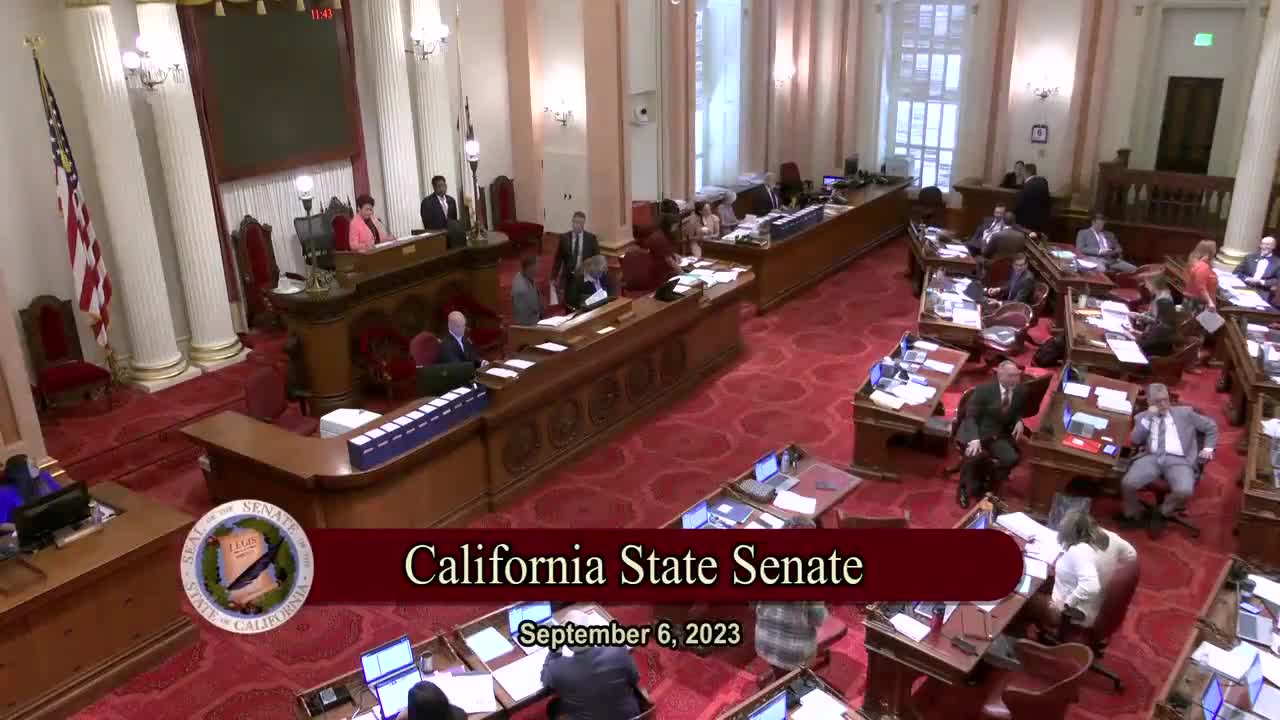
| Sep 6, 2023 | Read third time. Urgency clause adopted. Passed. Ordered to the Assembly. (Ayes 38. Noes 0. Page 2398.). |
| Aug 30, 2023 | Read second time. Ordered to third reading. |
| Aug 29, 2023 | Withdrawn from committee. |
| Aug 29, 2023 | Ordered to second reading. |
| Aug 29, 2023 | In Senate. Read first time. To Com. on RLS. for assignment. |
| Aug 28, 2023 | Read third time. Urgency clause adopted. Passed. Ordered to the Senate. (Ayes 74. Noes 0. Page 2826.). |
| May 15, 2023 | Read third time and amended. Ordered to third reading. (Page 1544.) |
| May 15, 2023 | Read second time. Ordered to third reading. |
| May 11, 2023 | Withdrawn from committee. |
| May 11, 2023 | Ordered to second reading. |
| May 11, 2023 | Assembly Rule 96 suspended. (Page 1514.) |
| May 4, 2023 | Re-referred to Com. on G.O. |
| May 3, 2023 | From committee chair, with author's amendments: Amend, and re-refer to Com. on G.O. Read second time and amended. |
| Feb 23, 2023 | Referred to Com. on G.O. |
| Feb 15, 2023 | From printer. May be heard in committee March 17. |
| Feb 14, 2023 | Read first time. To print. |
|
Date
|
Description
|
Location
|
Votes
|
|
|---|---|---|---|---|
| Sep 6, 2023 | Assembly 3rd Reading AB854 Ramos et al. By Dodd Urgency Clause | Senate Floor |
Passed |
|
| Aug 28, 2023 | AB 854 Ramos Third Reading Urgency | Assembly Floor |
Passed |
This list shows positions taken on this bill by organizations on the date displayed, which is linked to the original source.
Positions by individuals are not included.
|
Organization
|
Position
|
Date
|
|---|---|---|
| Agua Caliente Band Of Cahuilla Indians | ** Support | |
| California Tribal Business Alliance | ** Support | |
| cher-ae heights indian community of the trinidad rancheria | ** Support | |
| Elk Valley Rancheria, California | ** Support | |
| Enterprise Rancheria | ** Support | |
| Jamul Indian Village of California | ** Support | |
| Northern California Tribal Chairpersons Association | ** Support | |
| Paskenta Band Of Nomlaki Indians | ** Against | |
| Pechanga Band of Indians | ** Support | |
| Redding Rancheria | ** Support | |
| Speak Up Shasta | ** Against | |
| Unite Here | ** Support |
SENATE RULES COMMITTEE Office of Senate Floor Analyses (916) 651-1520 Fax: (916) 327-4478 | AB 854 |
THIRD READING
Bill No: AB 854
Author: Ramos (D), et al.
Amended: 5/15/23 in Assembly
Vote: 27 - Urgency
NOTE: On June 13, 2023, the Senate Governmental Organization Committee held an informational hearing on the tribal-state gaming compact between the State of California and the Redding Rancheria, California.
ASSEMBLY FLOOR: 74-0, 8/28/23 - See last page for vote
SUBJECT: Tribal gaming: compact ratification
SOURCE: Author
DIGEST:
This bill ratifies the tribal-state gaming compact between the State of California and the Redding Rancheria, California that on March 30, 2023.
ANALYSIS:
Existing law:
- Provides, under the Indian Gaming Regulatory Act (IGRA), for the negotiation and conclusion of compacts between federally recognized Indian tribes and the State for the purpose of conducting Class III gaming activities on Indian lands within a State as a means of promoting tribal economic development, self-sufficiency, and strong tribal governments.
- Authorizes expressly a number of tribal-state gaming compacts between the State of California and specified Indian tribes.
- Authorizes the conduct of Class III gaming activities to the extent such activities are permitted by state law, a gaming compact has been concluded by a federally recognized tribe and the State, and the compact has been approved by the Secretary of the Interior.
- Limits the operation of Class III gaming activities to Indian lands acquired on or before October 17, 1988. Provides, for certain exceptions to conduct gaming activities on Indian lands acquired after October 17, 1988.
- Defines “Indian lands” to mean all lands within the limits of any Indian reservation, and any lands title to which is either held in trust by the United States for the benefit of any Indian tribe, or individual, or held by any Indian tribe or individual subject to restriction by the U.S. against alienation and over which an Indian tribe exercises governmental power.
- Requires the State to negotiate to conclude a compact in good faith with an Indian tribe having jurisdiction over the Indian lands upon which the Class III gaming activity is to be conducted. Provides the U.S. district courts with jurisdiction over any cause of action initiated by a tribal government alleging that the State failed to negotiate in good faith to conclude a compact. Prescribes the remedy, mediation supervised by the courts, if it is found that the State failed to negotiate in good faith to conclude a compact.
- Authorizes the Governor, under the California Constitution, to negotiate and conclude compacts, subject to ratification by the Legislature.
This bill:
- Ratifies the tribal-state gaming compact between the State of California and the Redding Rancheria, California executed on March 30, 2023.
- Provides that, in deference to tribal sovereignty, certain actions are not deemed projects for purposes of the California Environmental Quality Act (CEQA); and, stipulate, except as expressly provided, that none of the provisions shall be construed to exempt a city, county, or city and county, or the Department of Transportation, or any state agency or local jurisdiction, from CEQA requirements.
- Contains an urgency clause.
Background
The Tribal-State Gaming Compact (hereafter “Compact”) between the State of California and the Redding Rancheria, California (hereafter “Tribe”) was executed on March 30, 2023.
The Compact authorizes the Tribe to operate a maximum of 1,200 slot machines. The Tribe is authorized to operate no more than two gaming facilities and engage in Class III gaming on eligible land held in trust for the Tribe that is located within the boundaries of the Redding Rancheria or on those lands identified as “Strawberry Fields” once those lands have been taken into trust for the Tribe for purposes of gaming. The Compact provides that, if and when, the Tribe commences gaming on Strawberry Fields, it may no longer conduct gaming on the current location of their casino.
The Tribe has agreed to pay the State its pro rata share of costs the State incurs for the performance of its duties under the Compact. The Compact does not require the Tribe to pay into the Revenue Sharing Trust Fund (RSTF) or the Tribal Nation Grant Fund (TNGF). The Compact requires the Tribe to pay 1.0% of Net Win to neighboring jurisdictions to mitigate impacts upon those entities resulting from the operation of the Gaming Facility.
Certain terms of the Compact related to licensing, regulatory, patron protection, and public health provisions are substantially the same as recent compacts. Specifically, the Compact includes a Tribal Labor Relations Ordinance (TLRO), which provides that gaming may commence only after the Tribe has adopted a TLRO that allows for a secret ballot election and union neutrality.
The Compact’s preamble notes that the Tribe and the State have concluded that this compact protects the interests of the Tribe and its members, the surrounding community, and the California public, and will promote and secure long-term stability, mutual respect, and mutual benefit.
The Redding Rancheria is a federally recognized Indian tribe located just outside of Redding, California. The Tribe currently operates the Win-River Resort & Casino under a gaming compact that expires at the end of 2023. To that end, the Tribe and the Governor's office have spent several years finalizing the terms of this new Compact.
Once effective (legislative ratification and federal approval required), this Compact will be in full force and effect for 25 years following the effective date.
Brief History of the Redding Rancheria, California. The Redding Rancheria is a federally recognized Indian tribe located just outside of Redding, California. The original Redding Rancheria was purchased by the Bureau of Indian Affairs in 1922 and consisted of approximately 31 acres. The Tribe’s status as a federal recognized Indian tribe was terminated in 1959 and then restored through litigation in 1983. In 1999, the Tribe and the State entered into a tribal-state gaming compact that enabled the Tribe, through revenue generated by its gaming operation, to improve the governance, environment, education, health, safety, and general welfare of its citizens, and to promote a strong tribal government, self-sufficiency, and to provide essential services to its citizens.
As a sovereign nation, the Tribe's organizational structure begins with the general membership, which includes all adult Tribal members, and is responsible for establishing broad Tribal priorities. The Tribal Council is an elected body of seven voting members and three alternates that is responsible for giving policy direction to the various governmental and business units of the Tribe.
The Tribe's Cultural Department is involved with monitoring and protecting the cultural/spiritual sites and repatriation of ancestral remains of the Wintu, Pit River, and Yana people. It supports and assists the Tribe's members and Native American Community members in traditional/cultural activities and traditional health practices.
The Tribe currently operates the Win-River Resort & Casino under a gaming compact that expires at the end of 2023. To that end, the Tribe and the Governor's office have spent several years finalizing the terms of this new Compact.
KEY PROVISIONS OF THE COMPACT
Scope of Class III Gaming Authorized. The Tribe is authorized to operate up to 1,200 slot machines, banking or percentage card games, and any devices or games that are authorized under state law to the California State Lottery, provided that the Tribe will not offer such games through use of the Internet unless others in the state not affiliated with or licensed by the California State Lottery are permitted to do so under state and federal law. The Tribe can operate off-track wagering on horse races at a satellite wagering facility pursuant to the requirements outlined in the Compact. The Tribe shall not engage in Class III Gaming that is not expressly authorized in the Compact. The compact includes provisions that would require the Tribe to request the State to enter into negotiations for a modification regarding the increase in slot machines.
Strawberry Fields Provision. The compact includes a provision that would allow the Tribe to conduct gaming on lands known as “Strawberry Fields” if the land is taken into trust for purposes of gaming. The Tribe originally submitted a request for the US Department of the Interior (DOI) to take Strawberry Fields into trust in 2003. In 2016, DOI and the Tribe signed a Memorandum of Understanding (MOU) that DOI would process Strawberry Fields under IGRA’s restored lands exception to the general prohibition against gaming on lands taken into trust after 1988. In 2021, DOI withdrew from the MOU and said that rather than the restored lands exception, IGRA’s two-part process was the appropriate route to process the tribe’s application for gaming on Strawberry Fields. In September 2021, DOI published notice that it was resuming preparation of the environmental impact study for the tribe’s application to have Strawberry Fields taken into trust and to relocate its gaming from the Win-River casino to Strawberry Fields.
It is unclear how DOI will process the Tribe’s fee-to-trust application for this parcel. The compact language takes no position and does not commit the Governor to any decision should the application be processed as a two-part determination. If the Strawberry Fields parcel is taken into trust for the purpose of gaming, the Tribe would be able to conduct Class III gaming on Strawberry Fields but only if it stopped gaming at the Win-River site.
While the history for this land is unique, its inclusion in the compact has parallels in other compacts. For example, Agua Caliente’s 2016 compact entitles the tribe to game on certain identified lands that may be taken into trust for gaming after the execution of the compact. The 2016 San Manuel compact provides another approach. For lands taken into trust for gaming after 1988, San Manuel is required to notify the state before siting a gaming facility on the lands and the state can dispute that determination. Other compacts, such as the 2018 Mechoopda and 2023 Santa Rosa Tachi compacts, entitle a tribe to request negotiations to include after-acquired trust lands for gaming.
Authorized Gaming Facility. The Tribe may establish and operate no more than two gaming facilities and engage in Class III gaming on eligible lands held in trust for the Tribe that is located within the boundaries of the Redding Rancheria or on those lands identified as “Strawberry Fields” once those lands have been taken into trust for the Tribe for purposes of gaming. The Compact provides that, if and when, the Tribe commences gaming on Strawberry Fields, it may no longer conduct gaming on the current location of their casino.
Payments to the Special Distribution Fund (SDF). The Tribe shall pay to the State, on a pro rata basis, the costs the State incurs for the performance of all its duties under this Compact, as established by the monies appropriated in the annual Budget Act for the performance of their duties under the Class III Gaming Compacts.
Payments to the RSTF or the TNGF. The Compact does not require the Tribe to pay into either the RSTF or the TNGF.
Distribution by Tribe to Local Governments. The Compact requires the Tribe to pay 1.0% of Net Win to neighboring jurisdictions to mitigate impacts upon those entities resulting from the operation of the Gaming Facility, or other purposes as the Tribe may see fit, consistent with the request of a recipient.
Labor Provisions. The Compact provides that the gaming activities authorized by this Compact may only commence after the Tribe has adopted an ordinance identical to the TRLO, referenced as Appendix D of the Compact, and the gaming activities may only continue as long as the Tribe maintains the ordinance. If the Tribe employs 250 or more persons in a tribal casino facility, then the provisions of the TLRO become effective. The TLRO makes it clear that employees shall have the right to self-organization, to form, to join, or assist employee organizations, to bargain collectively through representatives of their own choosing. The TLRO provides for a secret ballot election and union neutrality. After the certification that 30% of the eligible employees in a bargaining unit have expressed an interest in the union, a notice of election shall be issued and the election shall be concluded within 30 calendar days thereafter. Employees may mail in ballots provided they are received by election day. Union representation requires an affirmative vote of 50% plus one of all votes cast.
ADDITIONAL BACKGROUND INFORMATION
Indian Gaming Regulatory Act. In 1988, Congress enacted IGRA to provide a statutory basis for the operation and regulation of gaming on Indian lands. IGRA provides that an Indian tribe may conduct gaming activity on Indian lands if the activity “is not specifically prohibited by federal law and is conducted within a State which does not prohibit such gaming activity.”
IGRA distinguishes between three classes of gaming (Class I, Class II, and Class III) and provides for different forms of regulation for each class. Class I gaming includes “social games” for minor prizes or “traditional forms of Indian gaming.” Class II gaming is defined to include bingo and card games that are explicitly authorized by the laws of the state, or that are not explicitly prohibited by the laws of the state and are played at any location in the State, so long as the card games are played in conformity with those laws and regulations. Class III gaming includes such things as slot machines, casino games, and banked card games such as black jack and baccarat. Class III gaming may only be conducted under terms of a compact negotiated between an Indian tribe and a State.
IGRA was enacted against a legal background in which Indian tribes and individuals generally are exempt from state taxation within their own territory. IGRA provides that with the exception of assessments permitted under the statute, to defray the State’s costs of regulating gaming activity, IGRA shall not be interpreted as conferring upon a State authority to impose any tax, fee, charge, or other assessment upon an Indian tribe to engage in Class III activity. Nor may a State refuse to enter into negotiations based on the lack of authority to impose such a tax, fee, charge, or other assessment.
When a tribe requests negotiations for a Class III compact, IGRA requires the State to negotiate with the Indian tribe in good faith. IGRA provides a comprehensive process to prevent an impasse in compact negotiations, which is triggered when a tribe files suit alleging that the State has refused to negotiate or has failed to negotiate in good faith.
Before 2000, the California Constitution prohibited Class III gaming. In 2000, California voters approved Proposition 1A, which had been proposed by the Governor and passed by the Legislature. Proposition 1A amended the California Constitution to permit the State to negotiate compacts with federally recognized Indian tribes for certain Class III gaming activities. Because non-Indian parties were still forbidden from operating gaming facilities, Proposition 1A granted Indian tribes a “constitutionally protected monopoly on most types of Class III games in California.”
Revenue Sharing Trust Fund. Existing law creates in the State Treasury the RSTF for the receipt and deposit of moneys derived from gaming device license fees that are paid into the RSTF pursuant to the terms of specified tribal-state gaming compacts for the purpose of making distributions to non-compacted California tribes (e.g., federally-recognized non-gaming tribes and tribes that operate casinos with fewer than 350 slot machines).
Revenue in the RSTF is available to the California Gambling Control Commission, upon appropriation by the Legislature, for making distributions of $1.1 million annually to non-compact tribes. The RSTF was created as part of the 1999 compacts, which, in conjunction with the passage of Proposition 1A, created gaming compacts with approximately 60 California tribes. Non-compact tribes are considered third-party beneficiaries of the 1999 compacts.
Tribal Nation Grant Fund. This particular fund was created to complement the RSTF and provides for the distribution of funds to non-gaming tribes, upon application of such tribes for purposes related to effective self-governance, self-determined community, and economic development. Payments from this fund are intended to be made to non-gaming tribes on a “need” basis, upon application.
FISCAL EFFECT: Appropriation: No Fiscal Com.: Yes Local: No
SUPPORT: (Verified 8/29/23)
Agua Caliente Band of Cahuilla Indians
California Tribal Business Alliance
Cher-Ae Heights Indian Community of the Trinidad Rancheria
Elk Valley Rancheria, California
Enterprise Rancheria
Jamul Indian Village of California
Northern California Tribal Chairpersons Association
Pechanga Band of Indians
Redding Rancheria
UNITE HERE
OPPOSITION: (Verified 8/29/29)
Paskenta Band of Nomlaki Indians
Speak Up! Shasta
ARGUMENTS IN SUPPORT: According to the Redding Rancheria, “the Redding Rancheria’s economic impact from 2019-2021 was $349 million dollars for salaries, benefits, payroll taxes, and vendor payments. Since 2002, the Redding Rancheria has donated upwards of $4 million dollars to community funded charitable projects. Ratifying this compact secures the continuing and enhanced positive economic impacts tribal gaming will have on its tribal, local and state communities.”
ARGUMENTS IN OPPOSITION: According to the Paskenta Band of Nomlaki Indians, “non-trust lands like Strawberry Fields have no place in a state gaming compact. By IGRA’s design, the Secretary of the Interior is in charge of that process. The proposed compact’s references to Class III gaming at Strawberry Fields therefore short-circuit the Secretary’s Two-Part Determination and effectively bypass the requirements that affected local and tribal governments have a say in whether Class III gaming would be “detrimental to the surrounding community.”
ASSEMBLY FLOOR: 74-0, 8/28/23
AYES: Addis, Aguiar-Curry, Alanis, Alvarez, Arambula, Bains, Bauer-Kahan, Bennett, Boerner, Bonta, Bryan, Calderon, Juan Carrillo, Wendy Carrillo, Chen, Connolly, Davies, Dixon, Flora, Mike Fong, Vince Fong, Friedman, Gabriel, Gallagher, Garcia, Gipson, Grayson, Haney, Hart, Holden, Hoover, Irwin, Jackson, Jones-Sawyer, Kalra, Lackey, Lee, Low, Lowenthal, Maienschein, Mathis, McKinnor, Muratsuchi, Stephanie Nguyen, Ortega, Pacheco, Papan, Jim Patterson, Joe Patterson, Pellerin, Petrie-Norris, Quirk-Silva, Ramos, Reyes, Luz Rivas, Rodriguez, Blanca Rubio, Sanchez, Santiago, Schiavo, Soria, Ta, Ting, Valencia, Villapudua, Waldron, Wallis, Ward, Weber, Wicks, Wilson, Wood, Zbur, Robert Rivas
NO VOTE RECORDED: Berman, Cervantes, Megan Dahle, Essayli, McCarty, Rendon
Prepared by: Felipe Lopez / G.O. / (916) 651-1530
8/31/23 11:06:39
**** END ****
ASSEMBLY THIRD READING
ATR Bill Id:AB 854
Author:(Ramos)
As Amended Ver:May 15, 2023
2/3 vote. Urgency
SUMMARY
This bill ratifies a tribal-state gaming compact entered into between the State of California and the Redding Rancheria, California (Tribe) pursuant to the Indian Gaming Regulatory Act of 1988 (IGRA) that was executed on March 30, 2023.
Major Provisions
- Ratifies the tribal-state gaming compact (Compact) between the State of California and the Redding Rancheria, California, executed on March 30, 2023.
- Provides that, in deference to tribal sovereignty, certain actions are not deemed projects for purposes of the California Environmental Quality Act (CEQA); and, stipulate, except as expressly provided, that none of the provisions shall be construed to exempt a city, county, or city and county, or the Department of Transportation, or any state agency or local jurisdiction, from CEQA requirements.
- Provides the Tribe may operate up to 1,200 gaming devices at two facilities, with an entitlement to request negotiations to increase the number of gaming devices.
- Provides the Tribe may conduct gaming either at its existing casino site within the Rancheria, or on lands known as Strawberry Fields, but only if the Strawberry Fields parcels are taken into trust by the federal government and are deemed eligible for gaming, as defined and attached hereto as Appendix B.
- States that the Tribe shall not engage in Class III gaming that is not expressly authorized in the Compact, as defined.
- Provides that Tribe will reimburse the State for its regulatory costs on a pro rata basis by making payments into the Indian Gaming Special Distribution Fund (IGSDF).
- Provides that the Tribe shall have no obligation to pay any amount into the Revenue Sharing Trust Fund or the Tribal Nation Grant Fund.
- Provides that the Tribe shall withhold one percent (1%) of Net Win for deposit into the Impact Mitigation Fund and distribute those funds to neighboring jurisdictions to mitigate impacts upon those jurisdictions resulting from the operation of the casino, or other purposes as the Tribe and a neighboring jurisdiction may agree. The Tribe may apply large one-time payments towards future obligations for up to five years.
- Provides, once effective (legislative ratification and federal approval required), the compact will be in full force and effect for 25 years following the effective date.
EXISTING LAW:
- Provides, under the IGRA, for the negotiation and conclusion of compacts between federally recognized Indian tribes and the State for the purpose of conducting Class III gaming activities on Indian lands within a State as a means of promoting tribal economic development, self-sufficiency, and strong tribal governments
- Authorizes expressly a number of tribal-state gaming compacts between the State and specified Indian tribes.
- Authorizes the conduct of Class III gaming activities to the extent such activities are permitted by state law, a gaming compact has been concluded by a federally recognized tribe and the State, and the compact has been approved by the Secretary of the Interior.
- Limits the operation of Class III gaming activities to Indian lands acquired on or before October 17, 1988. Provides exceptions to conduct gaming activities on Indian lands acquired after October 17, 1988.
- Defines Indian lands to mean all lands within the limits of any Indian reservation, and any lands title to which is either held in trust by the United States (U.S.) for the benefit of any Indian tribe, or individual, or held by any Indian tribe or individual subject to restriction by the U.S. against alienation and over which an Indian tribe exercises governmental power.
- Requires the State to negotiate to conclude a compact in good faith with an Indian tribe having jurisdiction over the Indian lands upon which the Class III gaming activity is to be conducted. Provides the U.S. district courts with jurisdiction over any cause of action initiated by a tribal government alleging that the State failed to negotiate in good faith to conclude a compact. Prescribes the remedy, mediation supervised by the courts, if it is found that the State failed to negotiate in good faith to conclude a compact.
- Authorizes the Governor, under the California Constitution, to negotiate and conclude compacts, subject to ratification by the Legislature.
COMMENTS
On August 16, 2023, the Assembly Governmental Organization Committee held informational hearing on the tribal-state gaming compact between the State of California and the Redding Rancheria, California.
Brief History and Background:
The Redding Rancheria is a federally recognized Indian tribe located just outside of Redding, California. The original Redding Rancheria was purchased by the Bureau of Indian Affairs in 1922 and consisted of approximately 31 acres. The Tribe's status as a federal recognized Indian tribe was terminated in 1959 and then restored through litigation in 1983. In 1987 the restored Redding Rancheria tribe formally adopted its Constitution. Since the Tribe's restoration to federally-recognized status, the Tribe has been re-acquiring parcels within the original Rancheria boundaries.
In 1999, the Tribe and the state of California entered into a tribal-state gaming compact for the purpose of establishing a mutually respectful government-to-government relationship through developing and implementing a regulatory framework for Class III gaming in accordance with the IGRA. The 1999 compact authorizes a maximum of two gaming facilities, limited to lands held in trust for the Tribe, and outlines, among other things, the scope of Class III gaming; licensing requirements; procedures regarding the enforcement of compact provisions; regulations for the operation and management of the tribal gaming operation; and revenue distribution. The gaming compact has enabled the Tribe, through revenue generated by its gaming operation, to improve the governance, environment, education, health, safety, and general welfare of its citizens, and to promote a strong tribal government, self-sufficiency, and to provide essential services to its citizens.
As a sovereign nation, the Tribe's organizational structure begins with the general membership, which includes all adult Tribal members, and is responsible for establishing broad Tribal priorities. The Tribal Council is an elected body of seven voting members and three alternates that is responsible for giving policy direction to the various governmental and business units of the Tribe. The Tribe's Cultural Department is involved with monitoring and protecting the cultural/spiritual sites and repatriation of ancestral remains of the Wintu, Pit River, and Yana people. It supports and assists the Tribe's members and Native American Community members in traditional/cultural activities and traditional health practices.
Redding Rancheria's Win-River Resort & Casino along California State Route 273, near Interstate 5 between Redding and Anderson, features slot machines, table games, bingo, video slots, poker room, gift shop, live entertainment, hotel, and RV Park. In addition, the resort offers a number of dining establishments, a spa, and an outdoor heated pool. The Tribe's gaming operation has generated significant revenue, enabling capital payments to each member.
The Redding Rancheria Economic Development Corporation (RREDCO) was established in 1995. It has continued to serve the best interests of the Tribe, its members and businesses by protecting the political integrity, economic security, health and welfare of the Tribe and its members. The Mission of RREDCO is to create economic and employment opportunities, to further the Tribe's interest in self-determination and self-sufficiency, ensuring pride and profitability for present and future generations.
The Tribe's Sharing Fund consists of funds that are directly set aside each year by Win River Resort & Casino. The Tribe makes it a priority to implement services and programs that support self-sufficiency among its members as well as larger Native American Community. The Fund provides the following assistance on a case-by-case basis to eligible individuals and families: youth activity support fees, burial expenses, food clothing, elder disability, domestic violence support services, and catastrophes (fire and flood victims).
In 1991, the Tribe opened the Redding Rancheria Tribal Health Center. The modern mobile health center offers top-notch medical care to the American Indian community in Trinity County and the western two-thirds of Shasta County.
Key Provisions of the Compact:
Scope of Class III Gaming Authorized. The Tribe is authorized to operate up to 1,200 slot machines, banking or percentage card games, and any devices or games that are authorized under state law to the California State Lottery, provided that the Tribe will not offer such games through use of the Internet unless others in the state not affiliated with or licensed by the California State Lottery are permitted to do so under state and federal law. The Tribe can operate off-track wagering on horse races at a satellite wagering facility pursuant to the requirements outlined in the Compact. The Tribe shall not engage in Class III gaming that is not expressly authorized in the Compact. The compact includes provisions that would require the Tribe to request the State to enter into negotiations for a modification regarding the increase in slot machines.
Authorized Gaming Facility. The Tribe may establish and operate no more than two gaming facilities and engage in Class III gaming on eligible lands held in trust for the Tribe that is located within the boundaries of the Redding Rancheria or on those lands (Appendix B) identified as "Strawberry Fields" once those lands have been taken into trust for the Tribe for purposes of gaming. The Compact provides that, if and when, the Tribe commences gaming on Strawberry Fields, it may no longer conduct gaming on the current location of their casino.
Strawberry Fields Provision. The Compact includes a provision that would allow the Tribe to conduct gaming on lands known as "Strawberry Fields" if the land is taken into trust for purposes of gaming. The Tribe currently owns the Strawberry Fields Site parcels (232 acres) in fee. Fee to Trust land acquisitions, also called "land into trust," transfer a land title to the United States of America to be held in trust for the benefit of an individual Indian or Tribe. Trust status can only be conferred by an Act of Congress, a court decision or settlement, or, most commonly, through an application through the U.S. Department of Interior. The proposed gaming project at Strawberry Fields would replace the Tribe's existing casino, and the Tribe would convert the existing casino buildings to a different tribal use. The new facility would include a casino, hotel, event/convention center, outdoor amphitheater, retail center, and associated parking/infrastructure. According to the Tribe the purpose of the proposed action is to promote the economic development and self-sufficiency of the Tribe.
In 2003, the Tribe submitted a request for trust acquisition and a determination for 152 acres from the Department of the Interior (DOI) that designated lands referred to as "Strawberry Fields" be eligible for gaming purposes. It amended this original request in 2010 to include an additional 80 acres. The parcels are located in an unincorporated part of Shasta County. California and are approximately 1.6 miles from the Redding Rancheria, approximately 3.7 miles by road. In 2010, the DOI determined that the Strawberry Fields parcel was not eligible for gaming under the IGRA because the Tribe was operating its Win River facility on another trust parcel. The Tribe challenged the Department's decision in federal court. In 2015, the Ninth Circuit Court of Appeals affirmed in part the district court's judgement in favor of the Department, but remanded the Department's decision for further consideration of the Tribe's proposal to close the Win River facility before gaming on the Strawberry Fields parcels. Redding Rancheria v. Jewell, No. 12-15817 (9th Cir. 2015). In 2016, DOI and the Tribe signed a Memorandum of Understanding (MOU) that DOI would process Strawberry Fields under IGRA's restored lands exception to the general prohibition against gaming on lands taken into trust after 1988. In 2021, DOI withdrew from the MOU and said that rather than the restored lands exception, IGRA's two-part determination process was the appropriate route to process the tribe's application for gaming on Strawberry Fields. In September 2021, DOI published notice that it was resuming preparation of the environmental impact study for the tribe's application to have Strawberry Fields taken into trust and to relocate its gaming from the Win-River casino to Strawberry Fields. The fee-to-trust application submitted by Redding Rancheria lists at least seven possible development scenarios, from the fully proposed project to a no-action alternative for the property.
Generally, the IGRA generally prevents gaming on land acquired in trust after October 17, 1988, subject to several exceptions. However, Section 20 of IGRA contains an exception for tribes that were restored to federal recognition. As noted above, after being terminated illegally by the federal government, the Redding Rancheria was restored to recognition in 1983 pursuant to Tillie Hardwick et al. v. United States decision. When the acquisition is intended for gaming, consideration of the requirements of Section 20 of IGRA apply before an Indian tribe can engage in gaming on the trust parcel. Section 20 of IGRA does not provide authority to take land into trust for Indian tribes. Rather, it is a separate and independent requirement to be considered before gaming activities can be conducted on land taken into trust after October 17, 1988.
Section 20 provides that if lands are acquired in trust after October 17, 1988, the lands may not be used for gaming, unless one of the following statutory exceptions applies:
- The lands are located within or contiguous to the boundaries of the tribe's reservation as it existed on October 17, 1988;
- The tribe has no reservation on October 17, 1988, and "the lands are located within the Indian tribe's last recognized reservation within the state or states where the tribe is presently located;"
- The "lands are taken into trust as part of: (i) the settlement of a land claim; (ii) the initial reservation of and Indian tribe acknowledged by the Secretary under the Federal acknowledgment process; or (iii) the restoration of lands for an Indian tribe that is restored to Federal recognition."
An Indian tribe may also conduct gaming activities on after-acquired trust land (land taken into trust after 1988 that does not meet one of the above exceptions) if it meets the requirements of Section 20(b)(1)(A) of IGRA, the "Secretarial Determination" or "two-part determination" exception. Under IGRA, gaming can occur on the land if the Secretary, after consultation with appropriate state and local officials, and officials of nearby tribes, determines that a gaming establishment on newly-acquired land will be in the best interest of the tribe and its members, and not detrimental to the surrounding community. The Governor of the state in which the gaming activities are to occur must concur with the Secretary's determination.
It is unclear how DOI will process the Tribe's fee-to-trust application for this parcel. The Compact language does not commit the Governor to any decision should the application be processed as a two-part determination. If the Strawberry Fields parcel is taken into trust for the purpose of gaming, the Tribe would be able to conduct Class III gaming on Strawberry Fields but only if it stopped gaming at the Win-River site. One important point to keep in mind is that the DOI does not have a fixed timeline for reviewing and approving fee-to-trust applications.
While the history for this land is unique, its inclusion in the Compact has parallels to other gaming compacts that have been ratified by the California legislature and approved by DOI. For example, Agua Caliente's 2016 compact entitles the tribe to game on certain identified lands that may be taken into trust for gaming after the execution of the compact. The 2016 San Manuel compact provides another approach. For lands taken into trust for gaming after 1988, San Manuel is required to notify the state before siting a gaming facility on the lands and the state can dispute that determination. Other compacts, such as the 2018 Mechoopda and 2023 Santa Rosa Tachi compacts, entitle a tribe to request negotiations to include after-acquired trust lands for gaming.
Exclusivity. Provides that in the event the exclusive right of Indian tribes to operate Class III gaming in California pursuant to the California Constitution is abrogated by the enactment, amendment, or repeal of a state statute or constitutional provision or the conclusive and dispositive judicial construction of a statute or the State Constitution by a California appellate court after the effective date of this Compact, that gaming devices may lawfully be operated by non-Indian entities, the Tribe shall have the right to terminate this Compact, as specified.
Payments to the Special Distribution Fund (SDF). The Tribe shall pay to the State, on a pro rata basis, the costs the State incurs for the performance of all its duties under this Compact, as established by the monies appropriated in the annual Budget Act for the performance of their duties under the Class III gaming compacts.
Payments to the RSTF or the TNGF. The Compact does not require the Tribe to pay into either the RSTF or the TNGF.
Distribution by Tribe to Local Governments. The Compact requires the Tribe to pay 1.0% of Net Win to neighboring jurisdictions to mitigate impacts upon those entities resulting from the operation of the gaming facility, or other purposes as the Tribe may see fit, consistent with the request of a recipient.
Labor Provisions. Provides that the gaming activities authorized by this Compact may only commence after the Tribe has adopted an ordinance identical to the TRLO, referenced as Appendix D of the Compact, and the gaming activities may only continue as long as the Tribe maintains the ordinance. If the Tribe employs 250 or more persons in a tribal casino facility, then the provisions of the TLRO become effective. The TLRO makes it clear that employees shall have the right to self-organization, to form, to join, or assist employee organizations, to bargain collectively through representatives of their own choosing. The TLRO provides for a secret ballot election and union neutrality. After the certification that 30% of the eligible employees in a bargaining unit have expressed an interest in the union, a notice of election shall be issued and the election shall be concluded within 30 calendar days thereafter. Employees may mail in ballots provided they are received by election day. Union representation requires an affirmative vote of 50% plus one of all votes cast.
Dispute Resolution. Provides that in recognition of the government-government relationship of the Tribe and the State, the parties shall make their best efforts to resolve disputes that arise under this Compact, including failure to maintain the TLRO, by good faith negotiations whenever possible. Other than the right of either party to seek injunctive relief against the other when circumstances are deemed to require immediate relief, the Tribe and the State shall seek to resolve disputes by first meeting and conferring in good faith in order to foster a spirit of cooperation and efficiency in the administration and monitoring of the performance and compliance of the terms, provisions, and conditions of the Compact. If that is unsuccessful, then the tribe and the State can agree to have the dispute decided by arbitration.
If the Tribe or the State does not agree to arbitration, and the allegedly breaching party has been given 30 days to cure the alleged breach, then the other party can file in federal court for a ruling that there has been a material breach. If the breaching party still has not cured within 30 days of a final court order, then the non-breaching party can ask the court to order termination of the tribal-state compact. A tribe expressly agrees in the Compact to waive its sovereign immunity for these court proceedings.
Additional Compact Components:
Gaming Ordinance and Regulations. All gaming activities conducted under this Compact shall, at a minimum, comply with a gaming ordinance duly adopted by the Tribe and approved in accordance with IGRA and all applicable rules, regulations, procedures, specifications, and standards duly adopted by the National Indian Gaming Commission (NIGC), the Tribal Gaming Agency, and the State Gaming Agency, and with the provisions of this Compact, as specified.
Prohibitions Regarding Minors. The Tribe shall prohibit persons under the age of 21 years from being present in any room or area in which gaming activities are being conducted unless the person is en route to a non-gaming area of the gaming facility, or is employed at the gaming facility in a capacity other than as a gaming employee. If the Tribe permits the consumption of alcoholic beverages in the gaming facility, the Tribe shall prohibit persons under the age of 21 from purchasing, consuming, or possessing alcoholic beverages. The Tribe shall also prohibit persons under the age of 21 from being present in any room or area, in which alcoholic beverages may be consumed, except to the extent permitted by the gaming facility's California Department of Alcoholic Beverage Control license.
Licensing Requirements and Procedures. All persons in any way connected with the gaming operation or gaming facility who are required to be licensed or to submit to a background investigation under IGRA, and any others required to be licensed under this Compact, including, without limitation, all gaming employees, gaming resource suppliers, financial sources, and any other person having a significant influence over the gaming operation, must be licensed by the Tribal Gaming Agency. Also, every gaming employee must obtain, and thereafter maintain current, a valid tribal gaming license, as specified.
Minimum Internal Control Standards (MICS). The Tribe must conduct its gaming activities pursuant to an internal control system that implements MICS that are no less stringent than those contained in the MICS of the federal NIGC standards, as specified. It requires gaming to operate pursuant to a written internal control system that reasonably assures that assets are safeguarded and accountability over assets is maintained; liabilities are properly recorded and contingent liabilities are properly disclosed; financial records are accurate and reliable; transactions are performed in accordance with the Tribal Gaming Agency's authorization; access to assets is permitted only in accordance with the Tribal Gaming Agency's approved procedures; recorded accountability for assets is compared with actual assets; and, functions, duties and responsibilities are appropriately segregated and performed by qualified personnel. The Tribe is required to provide the California Gambling Control Commission (CGCC), upon written request, a copy of the independent certified public accountant agreed-upon procedures report conducted annually for submission to the NIGC pursuant to federal law. This report verifies that the gaming operation is in compliance with the NIGC's MICS.
Problem Gambling. The gaming operation must establish a program, approved by the Tribal Gaming Agency, to mitigate pathological and problem gaming by implementing specified measures.
Patron Disputes. The Tribal Gaming Agency must promulgate regulations governing patron disputes over the play or operation of any game, including any refusal to pay to a patron any alleged winnings from any gaming activities that includes specified minimum standards.
Public and Workplace Liability. Before the effective date of this Compact, the Tribe shall establish written procedures for the disposition of tort claims arising from personal injury or property damage alleged to have been suffered by any person who is a patron of the gaming facility or who is otherwise lawfully on the premises of the gaming facility. The gaming operation shall maintain a policy of commercial general liability insurance consistent with industry standards for non-tribal casinos in the United States that provides coverage of no less than ten million dollars ($10,000,000) per occurrence.
Compliance Enforcement. It is the responsibility of the Tribal Gaming Agency to conduct on-site gaming regulation and control in order to enforce the terms of this Compact, IGRA, NIGC gaming regulations, state gaming agency regulations, and the gaming ordinance, to protect the integrity of gaming activities and the gaming operation for honesty and fairness, and to maintain the confidence of patrons that tribal governmental gaming in California meets the highest standards of fairness and internal controls. To meet those responsibilities, the tribal gaming agency shall promulgate rules and regulations for these purposes.
Workers' Compensation. The Tribe agrees to participate in the State's workers' compensation program with respect to employees at the casino. In lieu of participation in the State's system, a Tribe may create and maintain a system through self-insurance, which includes specified provisions, including hearings before an independent tribunal. All disputes arising from the workers' compensation laws shall be heard by the State Workers' Compensation Appeals Board pursuant to the California Labor Code. The Tribe acknowledges the jurisdiction of the Board in such manners. In lieu of participation in the State's system, the Tribe may create and maintain a system through self-insurance, which includes specified provisions, including hearings before an independent tribunal. Furthermore, the Tribe agrees that it will participate in the State's unemployment compensation program for providing benefits and unemployment compensation disability benefits to employees at the casino. The Tribe shall withhold all taxes due to the State, except for Tribal members living on the Tribe's reservation, and forward such amounts to the State.
Emergency Services Accessibility and Possession of Firearms. The Tribe must make reasonable provisions for adequate emergency fire, medical, and related relief and disaster services for patrons and employees. Additionally, the Compact prohibits the possession of firearms by any person in the gaming facility at all times except for federal, state, or local law enforcement personnel, or tribal law enforcement or security personnel, as authorized.
Changes in the Law. If a federal or State court decides that, as a result of a change in the law, a provision of the Compact is invalid or inoperable but also decides that the Compact remains valid and the court's judgment is not stayed pending appeal, the parties shall meet and negotiate in good faith a replacement for that Compact provision and other appropriate related amendments. The parties shall meet within thirty days after the ruling of invalidity or inoperability becomes effective.
Force Majeure Clause. The Compact states that in the event of a force majeure beyond the Tribe's control that cause the Tribe's gaming facility to be inoperable or operate at significantly less capacity, the Tribe and the State agree to meet and confer for the purposes of discussing the event and appropriate actions. In the instance that a force majeure event impacts more than 50% of tribal gaming operations located in California, the State and the Tribe agree to allow the State to elect to meet and confer with several or all tribes that have been impacted by the force majeure event for the purpose of discussing the event and appropriate actions, given the circumstances.
Amendment by Agreement. The terms and conditions of this Compact may be amended at any time by the mutual and written agreement of both parties, provided that each party voluntarily consents to such negotiations in writing. Any amendments to this Compact shall be deemed to supersede, supplant and extinguish all previous understandings and agreements on the subject.
Effective Date. This Compact shall not be effective unless and until all of the following have occurred: the Compact is ratified by statute in accordance with state law and notice of approval or constructive approval is published in the Federal Register. Once effective, this Compact shall be in full force and effect for 25 years following the effective date.
According to the Author
According to the Governor's office, the State and the Tribe agree that all terms of this Compact are intended to be binding and enforceable. This Compact will enable the Tribe, through revenues generated by its casino, to improve the governance, environment, education, health, safety, and general welfare of its citizens, and to promote a strong tribal government, self-sufficiency, and to provide essential government services to its citizens.
Arguments in Support
The Redding Rancheria writes, "Tribal-State compacts are best when they acknowledge, and do not infringe upon tribal sovereignty, while also providing the state with a well-funded regulatory system that addresses off-reservation impacts of tribal gaming and provides economic support for non-gaming tribes. The Compact to be ratified exemplifies these values and is a model for cooperative government-to-government negotiations between the various tribes and the state."
The Agua Caliente Band of Cahuilla Indians "supports the right of Redding Rancheria to engage in government-to-to government negotiations with the state, in order to reach an agreement that Redding Rancheria believes provides the most benefit for its tribal government, its members, and the local communities that surround the reservation. Redding Rancheria has generated a substantial positive economic impact for the region in recent years. Ratifying this Compact secures the continuing and enhanced positive economic impacts tribal gaming will have on both tribal and local communities."
Arguments in Opposition
The Paskenta Band of Nomlaki Indians, whose gaming casino is situated in the neighboring county (Tehama County), opposes the Compact. The tribe "is asking that the State and Tribal leaders to oppose the proposed gaming compact unless references to Class III gaming on lands identified as "Strawberry Fields," which such gaming is currently prohibited, are removed. The Tribe states that eliminating such a reference is simple and will not prejudice the Redding Rancheria or the state in the event Class III gaming at Strawberry Fields becomes a legal option. Leaving it in, however, effectively endorses illegal gaming before these critical IGRA requirements are met. This would be unprecedented; it should not happen in this or any other compact."
Speak Up Shasta, a coalition of nearly 7,000 Shasta County residents writes in opposition, "There would be little to no controversy if this Compact were simply a renewal and expansion at the current site of the Win-River Casino, but this proposed relocation would negatively affect the surrounding community. We urge you to pause this Compact while the federal government considers the relocation." The coalition argues that the project will create more traffic congestion, noise pollution, and environmental damage, and that it does not consider the needs and interests of the local community.
FISCAL COMMENTS
Unknown.
VOTES
Not relevant.
UPDATED
VERSION: May 15, 2023
CONSULTANT: Eric Johnson / G.O. / (916) 319-2531 FN: 0001284
Discussed in Hearing
 2MIN
Senate Floor
 2MIN
Assembly Floor
 45SEC
Assembly Floor
 12MIN
Assembly Floor

Bill Co-Author(s):