AB 938: Education finance: classified and certificated staff salaries.
- Session Year: 2023-2024
- House: Assembly
- Latest Version Date: 2024-09-22
Current Status:
Passed
(2024-09-22: Chaptered by Secretary of State - Chapter 345, Statutes of 2024.)
Introduced
In Committee
First Chamber
In Committee
Second Chamber
Enacted
What does this bill do?
The bill requires schools to report yearly salary and benefit data for both teachers and other certificated staff and for classified staff using an expanded Form J90. Classified staff covered include support workers like secretaries or administrative assistants, custodians, bus drivers, school food service workers, and instructional aides. The Department of Education must send the Legislature an annual report showing how those salaries and total pay have changed over time and how they compare to inflation.
The summary is provided by generative AI which can make mistakes. For original language, please view the details in the table below.
Existing law, commencing with the 201314 fiscal year, establishes a public school financing system that requires state funding for county superintendents of schools, school districts, and charter schools to be calculated pursuant to a local control funding formula, as specified.
This bill would require the State Department of Education, by July 1, 2025, to update a salary and benefit schedule form, as described, to include salary data collection for classified school staff assigned to a schoolsite or sites in the same manner as that data is collected for certificated staff assigned to a schoolsite or sites, and to call this updated form the Salary and Benefit Schedule for the Bargaining Units (Form J90). The bill would require school districts, county offices of education, and direct-funded charter schools, by January 31, 2026, and annually thereafter, to complete the Form J90 for specified classified and certificated staff assigned to a schoolsite or sites and report the Form J90 to the department, and would authorize those local educational agencies to complete and report the Form J-90 for prior fiscal years, as provided. By imposing new duties on local educational agencies, the bill would impose a state-mandated local program. The bill would require the department, by August 31, 2026, and annually thereafter, to report to the Legislature on the progress of school districts, county offices of education, and charter schools in increasing salaries for classified and certificated staff assigned to a schoolsite or sites, as provided.
The California Constitution requires the state to reimburse local agencies and school districts for certain costs mandated by the state. Statutory provisions establish procedures for making that reimbursement.
This bill would provide that, if the Commission on State Mandates determines that the bill contains costs mandated by the state, reimbursement for those costs shall be made pursuant to the statutory provisions noted above.
Existing law, commencing with the 201314 fiscal year, establishes a public school financing system that requires state funding for county superintendents of schools, school districts, and charter schools to be calculated pursuant to a local control funding formula, as specified.
(6)ThisThis bill would require the State Department of Education, by July 1, 2024, 2025, to update a salary and benefit schedule form, as described, to include salary data collection for classified school staff assigned to a schoolsite or sites in the same manner as that data is collected for certificated staff assigned to a schoolsite or sites, and to call this updated form the Salary and Benefit Schedule for the Bargaining Units (Form J90). The bill would require school districts, county offices of education, and direct-funded charter schools, by September 1, 2024, January 31, 2026, and annually thereafter, to complete the Form J90 for specified classified and certificated staff assigned to a schoolsite or sites and report the Form J90 to the department, and would authorize those local educational agencies to complete and report the Form J-90 for prior fiscal years, as provided. By imposing new duties on local educational agencies, the bill would impose a state-mandated local program. The bill would require the department, by January 31, 2025, August 31, 2026, and annually thereafter, to report to the Legislature on the progress of school districts, county offices of education, and charter schools in increasing salaries for classified and certificated staff assigned to a schoolsite or sites, as provided.
The California Constitution requires the state to reimburse local agencies and school districts for certain costs mandated by the state. Statutory provisions establish procedures for making that reimbursement.
This bill would provide that, if the Commission on State Mandates determines that the bill contains costs mandated by the state, reimbursement for those costs shall be made pursuant to the statutory provisions noted above.
(1)Existing law, commencing with the 201314 fiscal year, establishes a public school financing system that requires state funding for county superintendents of schools, school districts, and charter schools to be calculated pursuant to a local control funding formula, as specified. Existing law requires the Superintendent of Public Instruction to annually calculate a county local control funding formula for each county superintendent of schools that includes, among other components, a county office of education operations grant composed of (A) $655,920, as adjusted each fiscal year for inflation; (B) $109,320 per school district under the county office of educations jurisdiction, as adjusted each fiscal year for inflation; (C) $70 per unit of countywide average daily attendance up to 30,000 units, $60 per unit for 30,001 to 60,000 units, $50 per unit for 60,001 to 140,000 units, and $40 per unit above 140,000 units, as adjusted each fiscal year for inflation; and (D) commencing with the 202223 fiscal year, add-ons of (i) $175,000 to the per-school district amount and (ii) $14 to each per-unit amount.
This bill, commencing with the 203031 fiscal year, would increase each of those inflation-adjusted amounts to instead be $1,208,859, $201,475, $129, $111, $92, and $74, respectively, and would retain the requirement to adjust those amounts for inflation each fiscal year. The bill, commencing with the 203031 fiscal year, would increase the per-school district and per-unit add-on amounts to instead be $262,500 and $21, respectively.
(2)Existing law requires the county office of education local control funding formula to also include, among other things, an alternative education base grant that includes, among its own components, a base grant equal to the grade span-adjusted base grant for average daily attendance in grades 9 to 12, inclusive, for the 202223 fiscal year, multiplied by 1.33, as specified. Existing law requires that amount to be adjusted for inflation each fiscal year.
This bill, commencing with the 203031 fiscal year, would require the inflation-adjusted base grant component of the alternative education grant to instead be $20,674 and would retain the requirement to adjust that amount for inflation each fiscal year.
(3)Existing law provides for the funding of necessary small schools and high schools, as specified. Existing law requires that funding to include, among other things, various specified per-pupil and per-teacher amounts for different tiers of numbers of pupils and teachers, as specified. Existing law requires those amounts to be adjusted for inflation each fiscal year.
This bill, commencing with the 203031 fiscal year, would increase those various per-pupil and per-teacher inflation-adjusted amounts, as specified, and would retain the requirement to adjust that amount for inflation each fiscal year.
(4)Existing law, commencing with the 201314 fiscal year, requires school district and charter school funding pursuant to the local control funding formula to include, among other things, a base grant based on average daily attendance in kindergarten and grades 1 to 3, inclusive, grades 4 to 6, inclusive, grades 7 and 8, and grades 9 to 12, inclusive, of $6,485, $6,947, $7,154, and $8,289 per pupil, respectively. Existing law requires those amounts to be adjusted for inflation each fiscal year.
This bill, commencing with the 203031 fiscal year, would increase those inflation-adjusted base grant amounts to instead be $13,749, $13,956, $14,370, and $16,653 per pupil, respectively, and would retain the requirement to adjust those amounts for inflation each fiscal year.
(5)Existing law requires funding pursuant to the local control funding formula to include, in addition to the base grant, supplemental and concentration grant add-ons that are based on the percentage of unduplicated pupils, as specified, served by the school district or charter school. In addition to the base, supplemental, and concentration grants of the local control funding formula, existing law, commencing with the 202223 school year, requires the Superintendent to compute an additional add-on of $2,813 multiplied by the then current fiscal years average daily attendance in transitional kindergarten, as specified, and requires that add-on to be annually adjusted for inflation.
This bill, commencing with the 203031 fiscal year, would increase that inflation-adjusted add-on based on attendance in transitional kindergarten to instead be equal to $4,220 multiplied by the then current fiscal years average daily attendance in transitional kindergarten for the school district or charter school, as specified, and would retain the requirement to adjust that amount for inflation each fiscal year.
(6)This bill would require the State Department of Education, by July 1, 2024, to update a salary and benefit schedule form, as described, to include salary data collection for classified school staff assigned to a schoolsite or sites in the same manner as that data is collected for certificated staff assigned to a schoolsite or sites, and to call this updated form the Salary and Benefit Schedule for the Bargaining Units (Form J90). The bill would require school districts, county offices of education, and direct-funded charter schools, by September 1, 2024, and annually thereafter, to complete the Form J90 for specified classified and certificated staff assigned to a schoolsite or sites and report the Form J90 to the department, and would authorize those local educational agencies to complete and report the Form J-90 for prior fiscal years, as provided. By imposing new duties on local educational agencies, the bill would impose a state-mandated local program. The bill would require the department, by January 31, 2025, and annually thereafter, to report to the Legislature on the progress of school districts, county offices of education, and charter schools in increasing salaries for classified and certificated staff assigned to a schoolsite or sites, as provided.
The California Constitution requires the state to reimburse local agencies and school districts for certain costs mandated by the state. Statutory provisions establish procedures for making that reimbursement.
This bill would provide that, if the Commission on State Mandates determines that the bill contains costs mandated by the state, reimbursement for those costs shall be made pursuant to the statutory provisions noted above.
(1)Existing law, commencing with the 201314 fiscal year, establishes a public school financing system that requires state funding for county superintendents of schools, school districts, and charter schools to be calculated pursuant to a local control funding formula, as specified. Existing law requires the Superintendent of Public Instruction to annually calculate a county local control funding formula for each county superintendent of schools that includes, among other components, a county office of education operations grant composed of (A) $655,920, as adjusted each fiscal year for inflation; (B) $109,320 per school district under the county office of educations jurisdiction, as adjusted each fiscal year for inflation; (C) $70 per unit of countywide average daily attendance up to 30,000 units, $60 per unit for 30,001 to 60,000 units, $50 per unit for 60,001 to 140,000 units, and $40 per unit above 140,000 units, as adjusted each fiscal year for inflation; and (D) commencing with the 202223 fiscal year, add-ons of (i) $175,000 to the per-school district amount and (ii) $14 to each per-unit amount.
This bill, commencing with the 203031 fiscal year, would increase each of those inflation-adjusted amounts to instead be $1,208,859, $201,475, $129, $111, $92, and $74, respectively, and would retain the requirement to adjust those amounts for inflation each fiscal year. The bill, commencing with the 203031 fiscal year, would increase the per-school district and per-unit add-on amounts to instead be $262,500 and $21, respectively.
(2)Existing law requires the county office of education local control funding formula to also include, among other things, an alternative education base grant that includes, among its own components, a base grant equal to the 201213 per pupil undeficited statewide average juvenile court school base revenue limit, grade span-adjusted base grant for average daily attendance in grades 9 to 12, inclusive, for the 202223 fiscal year, multiplied by 1.33, as specified. Existing law requires that amount to be adjusted for inflation each fiscal year.
This bill, commencing with the 203031 fiscal year, would increase require the inflation-adjusted base grant component of the alternative education grant to instead be $20,674 and would retain the requirement to adjust that amount for inflation each fiscal year.
(3)Existing law provides for the funding of necessary small schools and high schools, as specified. Existing law requires that funding to include, among other things, various specified per-pupil and per-teacher amounts for different tiers of numbers of pupils and teachers, as specified. Existing law requires those amounts to be adjusted for inflation each fiscal year.
This bill, commencing with the 203031 fiscal year, would increase those various per-pupil and per-teacher inflation-adjusted amounts, as specified, and would retain the requirement to adjust that amount for inflation each fiscal year.
(4)Existing law, commencing with the 201314 fiscal year, requires school district and charter school funding pursuant to the local control funding formula to include, among other things, a base grant based on average daily attendance in kindergarten and grades 1 to 3, inclusive, grades 4 to 6, inclusive, grades 7 and 8, and grades 9 to 12, inclusive, of $6,485, $6,947, $7,154, and $8,289 per pupil, respectively. Existing law requires those amounts to be adjusted for inflation each fiscal year.
This bill, commencing with the 203031 fiscal year, would increase those inflation-adjusted base grant amounts to instead be $13,749, $13,956, $14,370, and $16,653 per pupil, respectively, and would retain the requirement to adjust those amounts for inflation each fiscal year.
(5)Existing law requires funding pursuant to the local control funding formula to include, in addition to the base grant, supplemental and concentration grant add-ons that are based on the percentage of unduplicated pupils, as specified, served by the school district or charter school. In addition to the base, supplemental, and concentration grants of the local control funding formula, existing law, commencing with the 202223 school year, requires the Superintendent to compute an additional add-on of $2,813 multiplied by the then current fiscal years average daily attendance in transitional kindergarten, as specified, and requires that add-on to be annually adjusted for inflation.
This bill, commencing with the 203031 fiscal year, would increase that inflation-adjusted add-on based on attendance in transitional kindergarten to instead be equal to $4,220 multiplied by the then current fiscal years average daily attendance in transitional kindergarten for the school district or charter school, as specified, and would retain the requirement to adjust that amount for inflation each fiscal year.
(6)This bill would require the State Department of Education, by July 1, 2024, to update a salary and benefit schedule form, as described, to include salary data collection for classified school staff assigned to a schoolsite or sites in the same manner as that data is collected for certificated staff assigned to a schoolsite or sites, and to call this updated form the Salary and Benefit Schedule for the Bargaining Units (Form J90). The bill would require school districts, county offices of education, and direct-funded charter schools, by September 1, 2024, and annually thereafter, to complete the Form J90 for specified classified and certificated staff assigned to a schoolsite or sites and report the Form J90 to the department, and would authorize those local educational agencies to complete and report the Form J-90 for prior fiscal years, as provided. By imposing new duties on local educational agencies, the bill would impose a state-mandated local program. The bill would require the department, by January 31, 2025, and annually thereafter, to report to the Legislature on the progress of school districts, county offices of education, and charter schools in increasing salaries for classified and certificated staff assigned to a schoolsite or sites, as provided.
The California Constitution requires the state to reimburse local agencies and school districts for certain costs mandated by the state. Statutory provisions establish procedures for making that reimbursement.
This bill would provide that, if the Commission on State Mandates determines that the bill contains costs mandated by the state, reimbursement for those costs shall be made pursuant to the statutory provisions noted above.
(1)Existing law, commencing with the 201314 fiscal year, establishes a public school financing system that requires state funding for county superintendents of schools, school districts, and charter schools to be calculated pursuant to a local control funding formula, as specified. Existing law requires the Superintendent of Public Instruction to annually calculate a county local control funding formula for each county superintendent of schools that includes, among other components, a county office of education operations grant composed of (A) $655,920, as adjusted each fiscal year for inflation; (B) $109,320 per school district under the county office of educations jurisdiction, as adjusted each fiscal year for inflation; (C) $70 per unit of countywide average daily attendance up to 30,000 units, $60 per unit for 30,001 to 60,000 units, $50 per unit for 60,001 to 140,000 units, and $40 per unit above 140,000 units, as adjusted each fiscal year for inflation; and (D) commencing with the 202223 fiscal year, add-ons of (i) $175,000 to the per-school district amount and (ii) $14 to each per-unit amount.
This bill, commencing with the 203031 fiscal year, would increase each of those inflation-adjusted amounts to instead be $1,208,859, $201,475, $129, $111, $92, and $74, respectively, and would retain the requirement to adjust those amounts for inflation each fiscal year. The bill, commencing with the 203031 fiscal year, would increase the per-school district and per-unit add-on amounts to instead be $262,500 and $21, respectively.
(2)Existing law requires the county office of education local control funding formula to also include, among other things, an alternative education base grant that includes, among its own components, a base grant equal to the 201213 per pupil undeficited statewide average juvenile court school base revenue limit, as specified. Existing law requires that amount to be adjusted for inflation each fiscal year.
This bill, commencing with the 203031 fiscal year, would increase the inflation-adjusted base grant component of the alternative education grant to instead be $20,674 and would retain the requirement to adjust that amount for inflation each fiscal year.
(3)Existing law provides for the funding of necessary small schools and high schools, as specified. Existing law requires that funding to include, among other things, various specified per-pupil and per-teacher amounts for different tiers of numbers of pupils and teachers, as specified. Existing law requires those amounts to be adjusted for inflation each fiscal year.
This bill, commencing with the 203031 fiscal year, would increase those various per-pupil and per-teacher inflation-adjusted amounts, as specified, and would retain the requirement to adjust that amount for inflation each fiscal year.
(4)Existing law, commencing with the 201314 fiscal year, requires school district and charter school funding pursuant to the local control funding formula to include, among other things, a base grant based on average daily attendance in kindergarten and grades 1 to 3, inclusive, grades 4 to 6, inclusive, grades 7 and 8, and grades 9 to 12, inclusive, of $6,485, $6,947, $7,154, and $8,289 per pupil, respectively. Existing law requires those amounts to be adjusted for inflation each fiscal year.
This bill, commencing with the 203031 fiscal year, would increase those inflation-adjusted base grant amounts to instead be $13,749, $13,956, $14,370, and $16,653 per pupil, respectively, and would retain the requirement to adjust those amounts for inflation each fiscal year.
(5)Existing law requires funding pursuant to the local control funding formula to include, in addition to the base grant, supplemental and concentration grant add-ons that are based on the percentage of unduplicated pupils, as specified, served by the school district or charter school. In addition to the base, supplemental, and concentration grants of the local control funding formula, existing law, commencing with the 202223 school year, requires the Superintendent to compute an additional add-on of $2,813 multiplied by the then current fiscal years average daily attendance in transitional kindergarten, as specified, and requires that add-on to be annually adjusted for inflation.
This bill, commencing with the 203031 fiscal year, would increase that inflation-adjusted add-on based on attendance in transitional kindergarten to instead be equal to $4,220 multiplied by the then current fiscal years average daily attendance in transitional kindergarten for the school district or charter school, as specified, and would retain the requirement to adjust that amount for inflation each fiscal year.
(6)This bill would require the State Department of Education, by July 1, 2024, to update a salary and benefit schedule form, as described, to include salary data collection for classified school staff assigned to a schoolsite or sites in the same manner as that data is collected for certificated staff assigned to a schoolsite or sites, and to call this updated form the Salary and Benefit Schedule for the Bargaining Units (Form J90). The bill would require school districts, county offices of education, and direct-funded charter schools, by September 1, 2024, and annually thereafter, to complete the Form J90 for specified classified and certificated staff assigned to a schoolsite or sites and report the Form J90 to the department, and would authorize those local educational agencies to complete and report the Form J-90 for prior fiscal years, as provided. By imposing new duties on local educational agencies, the bill would impose a state-mandated local program. The bill would require the department, by November 1, 2024, January 31, 2025, and annually thereafter, to report to the Legislature on the progress of school districts, county offices of education, and charter schools in increasing salaries for classified and certificated staff assigned to a schoolsite or sites, as provided.
The California Constitution requires the state to reimburse local agencies and school districts for certain costs mandated by the state. Statutory provisions establish procedures for making that reimbursement.
This bill would provide that, if the Commission on State Mandates determines that the bill contains costs mandated by the state, reimbursement for those costs shall be made pursuant to the statutory provisions noted above.
(1)Existing law, commencing with the 201314 fiscal year, establishes a public school financing system that requires state funding for county superintendents of schools, school districts, and charter schools to be calculated pursuant to a local control funding formula, as specified. Existing law requires the Superintendent of Public Instruction to annually calculate a county local control funding formula for each county superintendent of schools that includes, among other components, a county office of education operations grant composed of (A) $655,920, as adjusted each fiscal year for inflation; (B) $109,320 per school district under the county office of educations jurisdiction, as adjusted each fiscal year for inflation; (C) $70 per unit of countywide average daily attendance up to 30,000 units, $60 per unit for 30,001 to 60,000 units, $50 per unit for 60,001 to 140,000 units, and $40 per unit above 140,000 units, as adjusted each fiscal year for inflation; and (D) commencing with the 202223 fiscal year, add-ons of (i) $175,000 to the per-school district amount and (ii) $14 to each per-unit amount.
This bill, commencing with the 203031 fiscal year, would increase each of those inflation-adjusted amounts to instead be $1,208,859, $201,475, $129, $111, $92, and $74, respectively, and would retain the requirement to adjust those amounts for inflation each fiscal year. The bill, commencing with the 203031 fiscal year, would increase the per-school district and per-unit add-on amounts to instead be $262,500 and $21, respectively.
(2)Existing law requires the county office of education local control funding formula to also include, among other things, an alternative education base grant that includes, among its own components, a base grant equal to the 201213 per pupil undeficited statewide average juvenile court school base revenue limit, as specified. Existing law requires that amount to be adjusted for inflation each fiscal year.
This bill, commencing with the 203031 fiscal year, would increase the inflation-adjusted base grant component of the alternative education grant to instead be $20,674 and would retain the requirement to adjust that amount for inflation each fiscal year.
(3)Existing law provides for the funding of necessary small schools and high schools, as specified. Existing law requires that funding to include, among other things, various specified per-pupil and per-teacher amounts for different tiers of numbers of pupils and teachers, as specified. Existing law requires those amounts to be adjusted for inflation each fiscal year.
This bill, commencing with the 203031 fiscal year, would increase those various per-pupil and per-teacher inflation-adjusted amounts, as specified, and would retain the requirement to adjust that amount for inflation each fiscal year.
(4)Existing law, commencing with the 201314 fiscal year, requires school district and charter school funding pursuant to the local control funding formula to include, among other things, a base grant based on average daily attendance in kindergarten and grades 1 to 3, inclusive, grades 4 to 6, inclusive, grades 7 and 8, and grades 9 to 12, inclusive, of $6,485, $6,947, $7,154, and $8,289 per pupil, respectively. Existing law requires those amounts to be adjusted for inflation each fiscal year.
This bill, commencing with the 203031 fiscal year, would increase those inflation-adjusted base grant amounts to instead be $13,749, $13,956, $14,370, and $16,653 per pupil, respectively, and would retain the requirement to adjust those amounts for inflation each fiscal year.
(5)Existing law requires funding pursuant to the local control funding formula to include, in addition to the base grant, supplemental and concentration grant add-ons that are based on the percentage of unduplicated pupils, as specified, served by the school district or charter school. In addition to the base, supplemental, and concentration grants of the local control funding formula, existing law, commencing with the 202223 school year, requires the Superintendent to compute an additional add-on of $2,813 multiplied by the then current fiscal years average daily attendance in transitional kindergarten, as specified, and requires that add-on to be annually adjusted for inflation.
This bill, commencing with the 203031 fiscal year, would increase that inflation-adjusted add-on based on attendance in transitional kindergarten to instead be equal to $4,220 multiplied by the then current fiscal years average daily attendance in transitional kindergarten for the school district or charter school, as specified, and would retain the requirement to adjust that amount for inflation each fiscal year.
(5)(6)This bill would require the State Department of Education, by July 1, 2024, to update a salary and benefit schedule form, as described, to include salary data collection for classified school staff assigned to a schoolsite or sites in the same manner as that data is collected for certificated staff assigned to a schoolsite or sites, and to call this updated form the Salary and Benefit Schedule for the Bargaining Units (Form J90). The bill would require school districts, county offices of education, and charter schools, by September 1, 2024, and annually thereafter, to complete the Form J90 for specified classified and certificated staff assigned to a schoolsite or sites and report the Form J90 to the department, and would authorize those local educational agencies to complete and report the Form J-90 for prior fiscal years, as provided. By imposing new duties on local educational agencies, the bill would impose a state-mandated local program. The bill would require the department, by November 1, 2024, and annually thereafter, to report to the Legislature on the progress of school districts, county offices of education, and charter schools in increasing salaries for classified and certificated staff assigned to a schoolsite or sites, as provided.
The California Constitution requires the state to reimburse local agencies and school districts for certain costs mandated by the state. Statutory provisions establish procedures for making that reimbursement.
This bill would provide that, if the Commission on State Mandates determines that the bill contains costs mandated by the state, reimbursement for those costs shall be made pursuant to the statutory provisions noted above.
(1)Existing law, commencing with the 201314 fiscal year, establishes a public school financing system that requires state funding for county superintendents of schools, school districts, and charter schools to be calculated pursuant to a local control funding formula, as specified. Existing law requires school the Superintendent of Public Instruction to annually calculate a county local control funding formula for each county superintendent of schools that includes, among other components, a county office of education operations grant composed of (A) $655,920, as adjusted each fiscal year for inflation; (B) $109,320 per school district under the county office of educations jurisdiction, as adjusted each fiscal year for inflation; (C) $70 per unit of countywide average daily attendance up to 30,000 units, $60 per unit for 30,001 to 60,000 units, $50 per unit for 60,001 to 140,000 units, and $40 per unit above 140,000 units, as adjusted each fiscal year for inflation; and (D) commencing with the 202223 fiscal year, add-ons of (i) $175,000 to the per-school district amount and (ii) $14 to each per-unit amount.
This bill, commencing with the 203031 fiscal year, would increase each of those inflation-adjusted amounts to $1,208,859, $201,475, $129, $111, $92, and $74, respectively, and would retain the requirement to adjust those amounts for inflation each fiscal year. The bill, commencing with the 203031 fiscal year, would increase the per-school district and per-unit add-on amounts to $262,500 and $21, respectively.
(2)Existing law requires the county office of education local control funding formula to also include, among other things, an alternative education base grant that includes, among its own components, a base grant equal to the 201213 per pupil undeficited statewide average juvenile court school base revenue limit, as specified. Existing law requires that amount to be adjusted for inflation each fiscal year.
This bill, commencing with the 203031 fiscal year, would increase the inflation-adjusted base grant component of the alternative education grant to $20,674 and would retain the requirement to adjust that amount for inflation each fiscal year.
(3)Existing law provides for the funding of necessary small schools and high schools, as specified. Existing law requires that funding to include, among other things, various specified per-pupil and per-teacher amounts for different tiers of numbers of pupils and teachers, as specified. Existing law requires those amounts to be adjusted for inflation each fiscal year.
This bill, commencing with the 203031 fiscal year, would increase those various per-pupil and per-teacher inflation-adjusted amounts, as specified, and would retain the requirement to adjust that amount for inflation each fiscal year.
(4)Existing law, commencing with the 201314 fiscal year, requires school district and charter school funding pursuant to the local control funding formula to include, among other things, a base grant of specified amounts based on average daily attendance in kindergarten and grades 1 to 3, inclusive, grades 4 to 6, inclusive, grades 7 and 8, and grades 9 to 12, inclusive, as provided. of $6,485, $6,947, $7,154, and $8,289 per pupil, respectively. Existing law requires those amounts to be adjusted for inflation each fiscal year.
This bill would, bill, commencing with the 203031 fiscal year, would increase the base grant amount based on average daily attendance for school districts and charter schools, as provided. The bill those inflation-adjusted base grant amounts to $13,749, $13,956, $14,370, and $16,653 per pupil, respectively, and would retain the requirement to adjust those amounts for inflation each fiscal year.
(5)This bill would also require the State Department of Education, by July 1, 2024, to update a salary and benefit schedule form, as described, to include salary data collection for classified school staff assigned to a schoolsite or sites in the same manner as that data is collected for certificated staff assigned to a schoolsite or sites, and to call this updated form the Salary and Benefit Schedule for the Bargaining Units (Form J90). The bill would require school districts, county offices of education, and charter schools, by September 1, 2024, and annually thereafter, to complete the Form J90 for specified classified and certificated staff assigned to a schoolsite or sites and report the Form J90 to the department. department, and would authorize those local educational agencies to complete and report the Form J-90 for prior fiscal years, as provided. By imposing new duties on local educational agencies, the bill would impose a state-mandated local program. The bill would require the department, by November 1, 2024, and annually thereafter, to report to the Legislature on the progress of school districts, county offices of education, and charter schools in increasing salaries for classified and certificated staff assigned to a schoolsite or sites, as provided.
The California Constitution requires the state to reimburse local agencies and school districts for certain costs mandated by the state. Statutory provisions establish procedures for making that reimbursement.
This bill would provide that, if the Commission on State Mandates determines that the bill contains costs mandated by the state, reimbursement for those costs shall be made pursuant to the statutory provisions noted above.
Existing law establishes a public school financing system that requires state funding for county superintendents of schools, school districts, and charter schools to be calculated pursuant to a local control funding formula, as specified. Existing law requires school district and charter school funding pursuant to the local control funding formula to include, among other things, a base grant of specified amounts based on average daily attendance in kindergarten and grades 1 to 3, inclusive, grades 4 to 6, inclusive, grades 7 and 8, and grades 9 to 12, inclusive, as provided.
This bill would, commencing with the 203031 fiscal year, increase the base grant amount based on average daily attendance for school districts and charter schools, as provided. The bill would also require the State Department of Education, by July 1, 2024, to update a salary and benefit schedule form, as described, to include salary data collection for classified school staff assigned to a schoolsite or sites in the same manner as that data is collected for certificated staff assigned to a schoolsite or sites, and to call this updated form the Salary and Benefit Schedule for the Bargaining Units (Form J90). The bill would require school districts, county offices of education, and charter schools, by September 1, 2024, and annually thereafter, to complete the Form J90 for classified and certificated staff assigned to a schoolsite or sites and report the Form J90 to the department. By imposing new duties on local educational agencies, the bill would impose a state-mandated local program. The bill would require the department, by November 1, 2024, and annually thereafter, to report to the Legislature on the progress of school districts, county offices of education, and charter schools in increasing salaries for classified and certificated staff assigned to a schoolsite or sites, as provided.
The California Constitution requires the state to reimburse local agencies and school districts for certain costs mandated by the state. Statutory provisions establish procedures for making that reimbursement.
This bill would provide that, if the Commission on State Mandates determines that the bill contains costs mandated by the state, reimbursement for those costs shall be made pursuant to the statutory provisions noted above.
Existing law establishes a system of public elementary and secondary education in this state. Under this system, local educational agencies throughout the state provide instruction and other services to pupils in kindergarten and in grades 1 to 12, inclusive. Existing law establishes various state commissions and committees with responsibilities relating to this system, including the Educational Management and Evaluation Commission. Existing law establishes the commission to assist and advise the State Board of Education in the evaluation of the program achievement of educational programs, in the determination of the relative cost-effectiveness of educational programs, and in the making of recommendations concerning the expanded use, modification, or replacement of educational programs so as to produce a higher degree of program achievement and cost-effectiveness.This bill would eliminate the commission.Existing law establishes a system of public elementary and secondary education in this state. Under this system, local educational agencies throughout the state provide instruction and other services to pupils in kindergarten and in grades 1 to 12, inclusive. Existing law establishes various state commissions and committees with responsibilities relating to this system, including the Educational Management and Evaluation Commission. Existing law establishes the commission to assist and advise the State Board of Education in the evaluation of the program achievement of educational programs, in the determination of the relative cost-effectiveness of educational programs, and in the making of recommendations concerning the expanded use, modification, or replacement of educational programs so as to produce a higher degree of program achievement and cost-effectiveness.
This bill would eliminate the commission.
(a)The Legislature finds and declares all of the following:
(1)According to 2023 findings from the Economic Policy Institute (EPI), inflation-adjusted average weekly wages of teachers have been relatively flat since 1996, finding that the average weekly wages of public school teachers (adjusted only for inflation) increased just twenty-nine dollars ($29) from 1996 to 2021, from one thousand three hundred nineteen dollars ($1,319) to one thousand three hundred forty-eight dollars ($1,348) (in 2021 dollars), where, in contrast, inflation-adjusted weekly wages of other college graduates rose from one thousand five hundred sixty-four dollars ($1,564) to two thousand nine dollars ($2,009) over the same period a four hundred forty-five-dollar ($445) increase.(2)The EPI also found that the teacher wage penalty, when comparing wages of teachers to other professions with similar educational and certification requirements, grew to a record high in 2021 at 23.5 percent nationally and 17.6 percent in California, up from 6.1 percent in 1996.(3)Even when taking other benefits into account, the teacher total compensation penalty grew by 11.5 percentage points from 1993 to 2021.(4)When Proposition 98 was approved by voters in 1988, it set as a target for school spending per pupil to equal or exceed the average annual expenditure per student of the 10 states with the highest annual expenditures per student for elementary and high schools. This target is embedded in Section 8.5 of Article XVI of the California Constitution.
(b)Therefore, it is the intent of the Legislature to establish a public education transparency and accountability lens to better inform the Members of the Legislature as to the impacts of the state budget on the pay and benefits of the education workforce by reporting salary and benefits data of certificated and classified employees and the impacts on the professional respect and competitiveness of pay and benefits for classified and certificated employees.
SEC. 2.Section 42238.016 is added to the Education Code, immediately following Section 42238.015, to read:42238.016.(a)The department shall, by July 1, 2025, update the Salary and Benefits Schedule for the Certificated Bargaining Unit (Form J90) to include salary data collection for classified school staff assigned to a schoolsite or sites, in the same manner as collected for certificated staff assigned to a schoolsite or sites, for the following classifications:
(1)Secretaries or administrative assistants.
(2)Custodians.
(3)Bus drivers.
(4)School food service workers.
(5)Instructional aides.
(b)The Salary and Benefits Schedule for the Certificated Bargaining Unit (Form J90) updated pursuant to subdivision (a) shall be known as the Salary and Benefit Schedule for the Bargaining Units (Form J90).
(c)(1)On or before January 31, 2026, and annually thereafter, school districts, county offices of education, and direct-funded charter schools as described in Section 47651 shall complete the Salary and Benefit Schedule for the Bargaining Units (Form J90) for classified and certificated staff assigned to a schoolsite or sites and report the Form J90 to the department. A school district that is the chartering authority or designated oversight agency of a locally funded charter school as described in Section 47651 shall complete and report the Form J90 to the department for the locally funded charter school.
(2)School districts, county offices of education, and direct-funded charter schools may, for prior fiscal years not required pursuant to paragraph (1), complete the Form J90 for classified and certificated staff assigned to a schoolsite or sites and report the Form J90 to the department.
(d)On or before August 31, 2026, and annually thereafter, the department shall report to the Legislature, in compliance with Section 9795 of the Government Code, on the progress of school districts, county offices of education, and charter schools in increasing salaries for classified staff assigned to a schoolsite or sites and certificated staff assigned to a schoolsite or sites. This report shall include the following:
(1)The change in salary rates for certificated staff as compared to the 10 prior fiscal years or whichever year the Form J90 was filed for first.
(2)The change in salary rates for classified staff as compared to the 10 prior fiscal years or whichever year the Form J90 was filed for first.
(3)The salary rate changes year over year.
(4)The rate of salary change compared to the rate of yearly inflation as measured by the percentage change in the annual average value of the Implicit Price Deflator for State and Local Government Purchases of Goods and Services for the United States, as published by the United States Department of Commerce for the 12-month period ending in the third quarter of the prior fiscal year.
(5)The rate of total compensation changes year over year.
SEC. 3.If the Commission on State Mandates determines that this act contains costs mandated by the state, reimbursement to local agencies and school districts for those costs shall be made pursuant to Part 7 (commencing with Section 17500) of Division 4 of Title 2 of the Government Code.
(a)The Legislature finds and declares all of the following:
(1)According to 2023 findings from the Economic Policy Institute (EPI), inflation-adjusted average weekly wages of teachers have been relatively flat since 1996, finding that the average weekly wages of public school teachers (adjusted only for inflation) increased just twenty-nine dollars ($29) from 1996 to 2021, from one thousand three hundred nineteen dollars ($1,319) to one thousand three hundred forty-eight dollars ($1,348) (in 2021 dollars), where, in contrast, inflation-adjusted weekly wages of other college graduates rose from one thousand five hundred sixty-four dollars ($1,564) to two thousand nine dollars ($2,009) over the same period a four hundred forty-five-dollar ($445) increase.(2)The EPI also found that the teacher wage penalty, when comparing wages of teachers to other professions with similar educational and certification requirements, grew to a record high in 2021 at 23.5 percent nationally and 17.6 percent in California, up from 6.1 percent in 1996.(3)Even when taking other benefits into account, the teacher total compensation penalty grew by 11.5 percentage points from 1993 to 2021.(4)The relative teacher wage penalty pushes educator jobs to the bottom of the market since graduates are able to obtain higher wage jobs virtually anywhere else, leaving pupils with fewer veteran educators and larger class sizes, which are the two largest factors that increase pupil performance, according to the Learning Policy Institute.(5)(4)When Proposition 98 was approved by voters in 1988, it set as a target for school spending per pupil to equal or exceed the average annual expenditure per student of the 10 states with the highest annual expenditures per student for elementary and high schools. This target is embedded in Section 8.5 of Article XVI of the California Constitution.
(b)(1)Therefore, it is the intent of the Legislature to establish new local control funding formula (LCFF) target grade span-adjusted base grant funding levels for school districts, charter schools, and county offices of education to raise wages by 50 percent, in recognition that the LCFF funding targets established in Assembly Bill 97 of the 201314 Regular Session (Chapter 47 of the Statutes of 2013) that were met in the 201819 fiscal year did not provide the funding necessary to close the pay gap for educators and schoolsite staff. These aspirational funding levels will continue to support local educational agencies efforts to improve recruitment and retention of schoolsite staff and improve educational opportunities for pupils.(2)It is the intent of the Legislature to fully fund the LCFF target base grants over seven years, with full implementation in the 203031 fiscal year. It is further the intent of the Legislature to use the funds in order to increase salaries for classified and certificated staff working at schoolsites in school districts, county offices of education, and charter schools to close the wage gap and improve recruitment and retention of school site staff. This legislative intent does not apply to basic aid school districts.(3)It is the intent of the Legislature that sufficient funding be appropriated for the state special schools for the deaf and the blind to enable comparable wage increases as school districts, county offices of education, and charter schools.(b)Therefore, it is the intent of the Legislature to establish a public education transparency and accountability lens to better inform the Members of the Legislature as to the impacts of the state budget on the pay and benefits of the education workforce by reporting salary and benefits data of certificated and classified employees and the impacts on the professional respect and competitiveness of pay and benefits for classified and certificated employees.
SEC. 3.SEC. 2.Section 42238.016 is added to the Education Code, immediately following Section 42238.015, to read:42238.016.(a)The department shall, by July 1, 2024, 2025, update the Salary and Benefits Schedule for the Certificated Bargaining Unit (Form J90) to include salary data collection for classified school staff assigned to a schoolsite or sites, in the same manner as collected for certificated staff assigned to a schoolsite or sites, for the following classifications:
(1)Secretaries or administrative assistants.
(2)Custodians.
(3)Bus drivers.
(4)School food service workers.
(5)Instructional aides.
(b)The Salary and Benefits Schedule for the Certificated Bargaining Unit (Form J90) updated pursuant to subdivision (a) shall be known as the Salary and Benefit Schedule for the Bargaining Units (Form J90).
(c)(1)On or before September 1, 2024, January 31, 2026, and annually thereafter, school districts, county offices of education, and direct-funded charter schools as described in Section 47651 shall complete the Salary and Benefit Schedule for the Bargaining Units (Form J90) for classified and certificated staff assigned to a schoolsite or sites and report the Form J90 to the department. A school district that is the chartering authority or designated oversight agency of a locally funded charter school as described in Section 47651 shall complete and report the Form J90 to the department for the locally funded charter school.
(2)School districts, county offices of education, and direct-funded charter schools may, for prior fiscal years not required pursuant to paragraph (1), complete the Form J90 for classified and certificated staff assigned to a schoolsite or sites and report the Form J90 to the department.
(d)On or before January 31, 2025, August 31, 2026, and annually thereafter, the department shall report to the Legislature, in compliance with Section 9795 of the Government Code, on the progress of school districts, county offices of education, and charter schools in increasing salaries for classified staff assigned to a schoolsite or sites and certificated staff assigned to a schoolsite or sites. This report shall include the following:
(1)The change in salary rates for certificated staff as compared to the 202021 fiscal year or the 202324 fiscal year, or for 10 prior fiscal years or whichever year the Form J90 was filed for first.
(2)The change in salary rates for classified staff as compared to the 202324 fiscal year, or for 10 prior fiscal years or whichever year the Form J90 was filed for first.
(3)The salary rate changes year over year.
(4)The rate of salary change compared to the rate of yearly inflation as measured by the percentage change in the annual average value of the Implicit Price Deflator for State and Local Government Purchases of Goods and Services for the United States, as published by the United States Department of Commerce for the 12-month period ending in the third quarter of the prior fiscal year.
(5)The rate of total compensation changes year over year.
SEC. 4.Section 42238.02 of the Education Code is amended to read:42238.02.(a)The amount computed pursuant to this section shall be known as the school district and charter school local control funding formula.(b)(1)For purposes of this section unduplicated pupil means a pupil enrolled in a school district or a charter school who is either classified as an English learner, eligible for a free or reduced-price meal, or is a foster youth. A pupil shall be counted only once for purposes of this section if any of the following apply:(A)The pupil is classified as an English learner and is eligible for a free or reduced-price meal.(B)The pupil is classified as an English learner and is a foster youth.(C)The pupil is eligible for a free or reduced-price meal and is classified as a foster youth.(D)The pupil is classified as an English learner, is eligible for a free or reduced-price meal, and is a foster youth.(2)Under procedures and timeframes established by the Superintendent, commencing with the 201314 fiscal year, a school district or charter school shall annually submit its enrolled free and reduced-price meal eligibility, foster youth, and English learner pupil-level records for enrolled pupils to the Superintendent using the California Longitudinal Pupil Achievement Data System.(3)(A)Commencing with the 201314 fiscal year, a county office of education shall review and validate certified aggregate English learner, foster youth, and free or reduced-price meal eligible pupil data for school districts and charter schools under its jurisdiction to ensure the data is reported accurately. The Superintendent shall provide each county office of education with appropriate access to school district and charter school data reports in the California Longitudinal Pupil Achievement Data System for purposes of ensuring data reporting accuracy.(B)The Controller shall include the instructions necessary to enforce paragraph (2) in the audit guide required by Section 14502.1. The instructions shall include, but are not necessarily limited to, procedures for determining if the English learner, foster youth, and free or reduced-price meal eligible pupil counts are consistent with the school districts or charter schools English learner, foster youth, and free or reduced-price meal eligible pupil records.(4)The Superintendent shall make the calculations pursuant to this section using the data submitted by local educational agencies, including charter schools, through the California Longitudinal Pupil Achievement Data System. Under timeframes and procedures established by the Superintendent, school districts and charter schools may review and revise their submitted data on English learner, foster youth, and free or reduced-price meal eligible pupil counts to ensure the accuracy of data reflected in the California Longitudinal Pupil Achievement Data System.(5)The Superintendent shall annually compute the percentage of unduplicated pupils for each school district and charter school by dividing the enrollment of unduplicated pupils in a school district or charter school by the total enrollment in that school district or charter school pursuant to all of the following:(A)For the 201314 fiscal year, divide the sum of unduplicated pupils for the 201314 fiscal year by the sum of the total pupil enrollment for the 201314 fiscal year.(B)For the 201415 fiscal year, divide the sum of unduplicated pupils for the 201314 and 201415 fiscal years by the sum of the total pupil enrollment for the 201314 and 201415 fiscal years.(C)For the 201516 fiscal year and each fiscal year thereafter, divide the sum of unduplicated pupils for the current fiscal year and the two prior fiscal years by the sum of the total pupil enrollment for the current fiscal year and the two prior fiscal years.(D)(i)For purposes of the quotients determined pursuant to subparagraphs (B) and (C), the Superintendent shall use a school districts or charter schools enrollment of unduplicated pupils and total pupil enrollment in the 201415 fiscal year instead of the enrollment of unduplicated pupils and total pupil enrollment in the 201314 fiscal year if doing so would yield an overall greater percentage of unduplicated pupils.(ii)It is the intent of the Legislature to review each school district and charter schools enrollment of unduplicated pupils for the 201314 and 201415 fiscal years and provide one-time funding, if necessary, for a school district or charter school with higher enrollment of unduplicated pupils in the 201415 fiscal year as compared to the 201314 fiscal year.(E)(i)Notwithstanding any other law, for purposes of subparagraph (C), the unduplicated pupils and total pupil enrollment in prior fiscal years shall be the following:(I)For a transferred charter school, the counts shall be equal to the counts reported for the original charter school.(II)For an acquiring charter school, the counts shall be equal to the counts reported for the original charter school. This subclause shall become inoperative on July 1, 2026, unless its operation is extended by the Legislature.(III)For the restructured portions of a divided charter school, the counts shall be zero.(IV)For the remaining portion of a divided charter school, the counts shall be equal to the counts reported for the original charter school.(ii)The definitions in Section 47654 apply for the purposes of this subparagraph.(6)Notwithstanding subdivision (a) of Section 14002, the data used to determine the percentage of unduplicated pupils shall be final once that data is no longer used in the current fiscal year calculation of the percentage of unduplicated pupils. This paragraph does not apply to a change that is the result of an audit exception, as described in paragraph (2) of subdivision (a) of Section 41341.(c)Commencing with the 201314 fiscal year and each fiscal year thereafter, the Superintendent shall annually calculate a local control funding formula grant for each school district and charter school in the state pursuant to this section.(d)The Superintendent shall compute a grade span adjusted base grant equal to the total of the following amounts:(1)(A)For the 201314 fiscal year, a base grant of:(i)Six thousand eight hundred forty-five dollars ($6,845) for average daily attendance in kindergarten and grades 1 to 3, inclusive.(ii)Six thousand nine hundred forty-seven dollars ($6,947) for average daily attendance in grades 4 to 6, inclusive.(iii)Seven thousand one hundred fifty-four dollars ($7,154) for average daily attendance in grades 7 and 8.(iv)Eight thousand two hundred eighty-nine dollars ($8,289) for average daily attendance in grades 9 to 12, inclusive.(B)(i)Notwithstanding subparagraph (A), commencing with the 203031 fiscal year, a base grant of:(I)Thirteen thousand seven hundred forty-nine dollars ($13,749) for average daily attendance in kindergarten and grades 1 to 3, inclusive.(II)Thirteen thousand nine hundred fifty-six dollars ($13,956) for average daily attendance in grades 4 to 6, inclusive.(III)Fourteen thousand three hundred seventy dollars ($14,370) for average daily attendance in grades 7 and 8.(IV)Sixteen thousand six hundred fifty-three dollars ($16,653) for average daily attendance in grades 9 to 12, inclusive.(ii)It is the intent of the Legislature to fully fund the local control funding formula target base grants in those years preceding the 203031 fiscal year and to spend those funds in the manner described in paragraph (2) of subdivision (b) of Section 42238.015.(2)In each year the grade span adjusted base grants in paragraph (1) shall be adjusted by the percentage change in the annual average value of the Implicit Price Deflator for State and Local Government Purchases of Goods and Services for the United States, as published by the United States Department of Commerce for the 12-month period ending in the third quarter of the prior fiscal year. This percentage change shall be determined using the latest data available as of May 10 of the preceding fiscal year compared with the annual average value of the same deflator for the 12-month period ending in the third quarter of the second preceding fiscal year, using the latest data available as of May 10 of the preceding fiscal year, as reported by the Department of Finance.(3)(A)The Superintendent shall compute an additional adjustment to the kindergarten and grades 1 to 3, inclusive, base grant as adjusted pursuant to paragraphs (2) and (5) equal to 10.4 percent. The additional grant shall be calculated by multiplying the kindergarten and grades 1 to 3, inclusive, base grant, as adjusted by paragraphs (2) and (5), by 10.4 percent.(B)Until paragraph (4) of subdivision (b) of Section 42238.03 is effective, as a condition of the receipt of funds in this paragraph, a school district shall make progress toward maintaining an average class enrollment of not more than 24 pupils for each schoolsite in kindergarten and grades 1 to 3, inclusive, unless a collectively bargained alternative annual average class enrollment for each schoolsite in those grades is agreed to by the school district, pursuant to the following calculation:(i)Determine a school districts average class enrollment for each schoolsite for kindergarten and grades 1 to 3, inclusive, in the prior year. For the 201314 fiscal year, this amount shall be the average class enrollment for each schoolsite for kindergarten and grades 1 to 3, inclusive, in the 201213 fiscal year.(ii)Determine a school districts proportion of total need pursuant to paragraph (2) of subdivision (b) of Section 42238.03.(iii)Determine the percentage of the need calculated in clause (ii) that is met by funding provided to the school district pursuant to paragraph (3) of subdivision (b) of Section 42238.03.(iv)Determine the difference between the amount computed pursuant to clause (i) and an average class enrollment of not more than 24 pupils.(v)Calculate a current year average class enrollment adjustment for each schoolsite for kindergarten and grades 1 to 3, inclusive, equal to the adjustment calculated in clause (iv) multiplied by the percentage determined pursuant to clause (iii).(C)School districts that have an average class enrollment for each schoolsite for kindergarten and grades 1 to 3, inclusive, of 24 pupils or less for each schoolsite in the 201213 fiscal year, shall be exempt from the requirements of subparagraph (B) so long as the school district continues to maintain an average class enrollment for each schoolsite for kindergarten and grades 1 to 3, inclusive, of not more than 24 pupils, unless a collectively bargained alternative ratio is agreed to by the school district.(D)(i)Upon full implementation of the local control funding formula, as a condition of the receipt of funds in this paragraph, all school districts shall maintain an average class enrollment for each schoolsite for kindergarten and grades 1 to 3, inclusive, of not more than 24 pupils for each schoolsite in kindergarten and grades 1 to 3, inclusive, unless a collectively bargained alternative ratio is agreed to by the school district.(ii)Notwithstanding clause (i), for purposes of meeting the requirements of paragraph (1) of subdivision (g) of Section 48000, a school district shall maintain an average transitional kindergarten class enrollment of not more than 24 pupils for each schoolsite.(E)The average class enrollment requirement for each schoolsite for kindergarten and grades 1 to 3, inclusive, established pursuant to this paragraph shall not be subject to waiver by the state board pursuant to Section 33050 or by the Superintendent.(F)The Controller shall include the instructions necessary to enforce this paragraph in the audit guide required by Section 14502.1. The instructions shall include, but are not necessarily limited to, procedures for determining if the average class enrollment for each schoolsite for kindergarten and grades 1 to 3, inclusive, exceeds 24 pupils, or an alternative average class enrollment for each schoolsite pursuant to a collectively bargained alternative ratio. The procedures for determining average class enrollment for each schoolsite shall include criteria for employing sampling.(4)The Superintendent shall compute an additional adjustment to the base grant for grades 9 to 12, inclusive, as adjusted pursuant to paragraphs (2) and (5), equal to 2.6 percent. The additional grant shall be calculated by multiplying the base grant for grades 9 to 12, inclusive, as adjusted by paragraphs (2) and (5) by 2.6 percent.(5)For the 202223 fiscal year, the Superintendent shall increase the base grants for kindergarten and grades 1 to 12, inclusive, by 6.7 percent. This adjustment shall be calculated by multiplying the grade span-adjusted base grants calculated pursuant to paragraph (2) for the 202122 fiscal year by 6.7 percent. The adjustment shall be included in grade span-adjusted base grants amounts for purposes of the adjustment pursuant to paragraph (2) commencing with the 202324 fiscal year.(e)The Superintendent shall compute a supplemental grant add-on equal to 20 percent of the base grants as specified in paragraph (1) of subdivision (d), as adjusted by paragraphs (2) to (5), inclusive, of subdivision (d), for each school districts or charter schools percentage of unduplicated pupils calculated pursuant to paragraph (5) of subdivision (b). The supplemental grant shall be calculated by multiplying the base grants as specified in paragraph (1), as adjusted by paragraphs (2) to (5), inclusive, of subdivision (d), by 20 percent and by the percentage of unduplicated pupils calculated pursuant to paragraph (5) of subdivision (b) in that school district or charter school. The supplemental grant shall be expended in accordance with the regulations adopted pursuant to Section 42238.07.(f)(1)(A)The Superintendent shall compute a concentration grant add-on equal to 50 percent of the base grants as specified in paragraph (1) of subdivision (d), as adjusted by paragraphs (2) to (5), inclusive, of subdivision (d), for each school districts or charter schools percentage of unduplicated pupils calculated pursuant to paragraph (5) of subdivision (b) in excess of 55 percent of the school districts or charter schools total enrollment. The concentration grant shall be calculated by multiplying the base grants as specified in paragraph (1) of subdivision (d), as adjusted by paragraphs (2) to (5), inclusive, of subdivision (d), by 50 percent and by the percentage of unduplicated pupils calculated pursuant to paragraph (5) of subdivision (b) in excess of 55 percent of the total enrollment in that school district or charter school.(B)Commencing with the 202122 fiscal year, the concentration grant add-on referenced in subparagraph (A) shall instead be equal to 65 percent of the base grants as specified in paragraph (1) of subdivision (d), as adjusted by paragraphs (2) to (5), inclusive, of subdivision (d), for each school districts or charter schools percentage of unduplicated pupils calculated pursuant to paragraph (5) of subdivision (b) in excess of 55 percent of the school districts or charter schools total enrollment. The concentration grant shall be calculated by multiplying the base grants as specified in paragraph (1) of subdivision (d), as adjusted by paragraphs (2) to (5), inclusive, of subdivision (d), by 65 percent and by the percentage of unduplicated pupils calculated pursuant to paragraph (5) of subdivision (b) in excess of 55 percent of the total enrollment in that school district or charter school.(2)(A)For a charter school physically located in only one school district, the percentage of unduplicated pupils calculated pursuant to paragraph (5) of subdivision (b) in excess of 55 percent used to calculate concentration grants shall not exceed the percentage of unduplicated pupils calculated pursuant to paragraph (5) of subdivision (b) in excess of 55 percent of the school district in which the charter school is physically located. For a charter school physically located in more than one school district, the charter schools percentage of unduplicated pupils calculated pursuant to paragraph (5) of subdivision (b) in excess of 55 percent used to calculate concentration grants shall not exceed that of the school district with the highest percentage of unduplicated pupils calculated pursuant to paragraph (5) of subdivision (b) in excess of 55 percent of the school districts in which the charter school has a school facility. The concentration grant shall be expended in accordance with the regulations adopted pursuant to Section 42238.07.(B)For purposes of this paragraph and subparagraph (A) of paragraph (1) of subdivision (f) of Section 42238.03, a charter school shall report its physical location to the department under timeframes established by the department. For a charter school authorized by a school district, the department shall include the authorizing school district in the departments determination of physical location. For a charter school authorized on appeal pursuant to subdivision (k) of Section 47605, the department shall include the school district that initially denied the petition in the departments determination of physical location. Notwithstanding subdivision (a) of Section 14002, the reported physical location of the charter school shall be considered final as of the second principal apportionment for that fiscal year, and, for purposes of this paragraph, the percentage of unduplicated pupils of the school district associated with the charter school pursuant to subparagraph (A) shall be considered final as of the second principal apportionment for that fiscal year.(g)(1)The Superintendent shall compute an add-on to the total sum of a school districts or charter schools base, supplemental, and concentration grants equal to the amount of funding a school district or charter school received from funds allocated pursuant to the Targeted Instructional Improvement Block Grant program, as set forth in Article 6 (commencing with Section 41540) of Chapter 3.2, for the 201213 fiscal year, as that article read on January 1, 2013. A school district or charter school shall not receive a total funding amount from this add-on greater than the total amount of funding received by the school district or charter school from that program in the 201213 fiscal year. The amount computed pursuant to this subdivision shall reflect the reduction specified in paragraph (2) of subdivision (a) of Section 42238.03.(2)(A)Notwithstanding Section 42238.05, for the 202223 to 202930 fiscal years, inclusive, the Superintendent shall compute an add-on to the total sum of a school districts or charter schools base, supplemental, and concentration grants equal to two thousand eight hundred thirteen dollars ($2,813) multiplied by the then current fiscal years second principal apportionment period average daily attendance in transitional kindergarten, as adjusted each fiscal year pursuant to subparagraph (C).(B)Notwithstanding Section 42238.05, commencing with the 203031 fiscal year and for each fiscal year thereafter, the Superintendent shall compute an add-on to the total sum of a school districts or charter schools base, supplemental, and concentration grants equal to four thousand two hundred twenty dollars ($4,220) multiplied by the then current fiscal years second principal apportionment period average daily attendance in transitional kindergarten, as adjusted each fiscal year pursuant to subparagraph (C).(C)Commencing with the 202324 fiscal year, the add-on computed pursuant to subparagraph (A) or (B), as applicable, shall be adjusted by the percentage change applied pursuant to paragraph (2) of subdivision (d).(D)It is the intent of the Legislature that the costs to meet the requirements of paragraph (2) of subdivision (g) of Section 48000 be supported by the add-on computed pursuant to this paragraph.(h)(1)The Superintendent shall compute an add-on to the total sum of a school districts or charter schools base, supplemental, and concentration grants equal to the amount of funding a school district or charter school received from funds allocated pursuant to the Home-to-School Transportation program, as set forth in former Article 2 (commencing with Section 39820) of Chapter 1 of Part 23.5, former Article 10 (commencing with Section 41850) of Chapter 5, and the Small School District Transportation program, as set forth in former Article 4.5 (commencing with Section 42290), as those articles read on January 1, 2013, for the 201213 fiscal year. A school district or charter school shall not receive a total funding amount from this add-on greater than the total amount received by the school district or charter school for those programs in the 201213 fiscal year. The amount computed pursuant to this subdivision shall reflect the reduction specified in paragraph (2) of subdivision (a) of Section 42238.03.(2)If a home-to-school transportation joint powers agency, established pursuant to Article 1 (commencing with Section 6500) of Chapter 5 of Division 7 of Title 1 of the Government Code for purposes of providing pupil transportation, received an apportionment directly from the Superintendent from any of the funding sources specified in paragraph (1) for the 201213 fiscal year, the joint powers agency may identify the member local educational agencies and transfer entitlement to that funding to any of those member local educational agencies by reporting to the Superintendent, on or before September 30, 2015, the reassignment of a specified amount of the joint powers agencys 201213 fiscal year entitlement to the member local educational agency. Commencing with the 201516 fiscal year, the Superintendent shall compute an add-on to the total sum of a school districts or charter schools base, supplemental, and concentration grants equal to the amount of the entitlement to funding transferred by the joint powers agency to the member school district or charter school.(3)Commencing in the 202324 fiscal year, the add-on amounts referenced in paragraphs (1) and (2) shall receive the annual cost-of-living adjustment specified in paragraph (2) of subdivision (d).(i)(1)The sum of the local control funding formula rates computed pursuant to subdivisions (c) to (f), inclusive, shall be multiplied by:(A)For school districts, the average daily attendance of the school district in the corresponding grade level ranges computed pursuant to Section 42238.05, excluding the average daily attendance computed pursuant to paragraph (2) of subdivision (a) of Section 42238.05 for purposes of the computation specified in subdivision (d).(B)For charter schools, the total current year average daily attendance in the corresponding grade level ranges.(2)The amount computed pursuant to Article 4 (commencing with Section 42280) shall be added to the amount computed pursuant to paragraphs (1) to (4), inclusive, of subdivision (d), as multiplied by subparagraph (A) or (B) of paragraph (1), as appropriate.(j)The Superintendent shall adjust the sum of each school districts or charter schools amount determined in subdivisions (g) to (i), inclusive, pursuant to the calculation specified in Section 42238.03, less the sum of the following:(1)(A)For school districts, the property tax revenue received pursuant to Chapter 3.5 (commencing with Section 75) and Chapter 6 (commencing with Section 95) of Part 0.5 of Division 1 of the Revenue and Taxation Code.(B)For charter schools, the in-lieu property tax amount provided to a charter school pursuant to Section 47635.(2)The amount, if any, received pursuant to Part 18.5 (commencing with Section 38101) of Division 2 of the Revenue and Taxation Code.(3)The amount, if any, received pursuant to Chapter 3 (commencing with Section 16140) of Part 1 of Division 4 of Title 2 of the Government Code.(4)Prior years taxes and taxes on the unsecured roll.(5)Fifty percent of the amount received pursuant to Section 41603.(6)The amount, if any, received pursuant to the Community Redevelopment Law (Part 1 (commencing with Section 33000) of Division 24 of the Health and Safety Code), less any amount received pursuant to Section 33401 or 33676 of the Health and Safety Code that is used for land acquisition, facility construction, reconstruction, or remodeling, or deferred maintenance and that is not an amount received pursuant to Section 33492.15, or paragraph (4) of subdivision (a) of Section 33607.5, or Section 33607.7 of the Health and Safety Code that is allocated exclusively for educational facilities.(7)The amount, if any, received pursuant to Sections 34177, 34179.5, 34179.6, 34183, and 34188 of the Health and Safety Code.(8)Revenue received pursuant to subparagraph (B) of paragraph (3) of subdivision (e) of Section 36 of Article XIII of the California Constitution.(k)A school district shall annually transfer to each of its charter schools funding in lieu of property taxes pursuant to Section 47635.(l)(1)This section does not authorize a school district that receives funding on behalf of a charter school pursuant to Section 47651 to redirect this funding for another purpose unless otherwise authorized in law pursuant to paragraph (2) or pursuant to an agreement between the charter school and its chartering authority.(2)A school district that received funding on behalf of a locally funded charter school in the 201213 fiscal year pursuant to paragraph (2) of subdivision (b) of Section 42605, Section 42606, and subdivision (b) of Section 47634.1, as those sections read on January 1, 2013, or a school district that was required to pass through funding to a conversion charter school in the 201213 fiscal year pursuant to paragraph (2) of subdivision (b) of Section 42606, as that section read on January 1, 2013, may annually redirect for another purpose a percentage of the amount of the funding received on behalf of that charter school. The percentage of funding that may be redirected shall be determined pursuant to the following computation:(A)(i)Determine the sum of the need fulfilled for that charter school pursuant to paragraph (3) of subdivision (b) of Section 42238.03 in the then current fiscal year for the charter school.(ii)Determine the sum of the need fulfilled in every fiscal year before the then current fiscal year pursuant to paragraph (3) of subdivision (b) of Section 42238.03 adjusted for changes in average daily attendance pursuant to paragraph (3) of subdivision (a) of Section 42238.03 for the charter school.(iii)Subtract the amount computed pursuant to paragraphs (1) to (3), inclusive, of subdivision (a) of Section 42238.03 from the amount computed for that charter school under the local control funding formula entitlement computed pursuant to subdivision (i) of this section.(iv)Compute a percentage by dividing the sum of the amounts computed pursuant to clauses (i) and (ii) by the amount computed pursuant to clause (iii).(B)Multiply the percentage computed pursuant to subparagraph (A) by the amount of funding the school district received on behalf of the charter school in the 201213 fiscal year pursuant to paragraph (2) of subdivision (b) of Section 42605, Section 42606, and subdivision (b) of Section 47634.1, as those sections read on January 1, 2013.(C)The maximum amount that may be redirected shall be the lesser of the amount of funding the school district received on behalf of the charter school in the 201213 fiscal year pursuant to paragraph (2) of subdivision (b) of Section 42605, Section 42606, and subdivision (b) of Section 47634.1, as those sections read on January 1, 2013, or the amount computed pursuant to subparagraph (B).(3)Commencing with the 201314 fiscal year, a school district operating one or more affiliated charter schools shall provide each affiliated charter school schoolsite with no less than the amount of funding the schoolsite received pursuant to the charter school block grant in the 201213 fiscal year.(m)Any calculations in law that are used for purposes of determining if a local educational agency is an excess tax school entity or basic aid school district, including, but not limited to, this section and Sections 41544, 42238.03, 47632, 47660, 47663, 48310, and 48359.5, and Section 95 of the Revenue and Taxation Code, shall exclude the revenue received pursuant to subparagraph (B) of paragraph (3) of subdivision (e) of Section 36 of Article XIII of the California Constitution.(n)The funds apportioned pursuant to this section and Section 42238.03 shall be available to implement the activities required pursuant to Article 4.5 (commencing with Section 52059.5) of Chapter 6.1 of Part 28 of Division 4.(o)A school district that does not receive an apportionment of state funds pursuant to this section, as implemented pursuant to Section 42238.03, excluding funds apportioned pursuant to the requirements of subparagraph (A) of paragraph (2) of subdivision (e) of Section 42238.03, shall be considered a basic aid school district or an excess tax entity.SEC. 5.Section 42282 of the Education Code is amended to read:42282.(a)For the 202223 to 202930 fiscal years, inclusive, for each school district, on account of each necessary small school, as defined in Section 42283, the Superintendent shall make the following computations, as adjusted each fiscal year pursuant to Section 42287:(1)For each necessary small school that has an average daily attendance during the fiscal year of less than 25, excluding pupils attending the 7th and 8th grades of a junior high school, and for which school at least one teacher was hired full time, the Superintendent shall compute for the school district two hundred thirty-two thousand seven hundred dollars ($232,700).(2)For each necessary small school that has an average daily attendance during the fiscal year of 25 or more and less than 49, excluding pupils attending the 7th and 8th grades of a junior high school, and for which school at least two teachers were hired full time for more than one-half of the days schools were maintained, the Superintendent shall compute for the school district four hundred sixty thousand five hundred dollars ($460,500).(3)For each necessary small school that has an average daily attendance during the fiscal year of 49 or more, but less than 73, excluding pupils attending the 7th and 8th grades of a junior high school, and for which school three teachers were hired full time for more than one-half of the days schools were maintained, the Superintendent shall compute for the school district six hundred eighty-eight thousand five hundred dollars ($688,500).(4)For each necessary small school that has an average daily attendance during the fiscal year of 73 or more and less than 97, excluding pupils attending the 7th and 8th grades of a junior high school, and for which school four teachers were hired full time for more than one-half of the days schools were maintained, the Superintendent shall compute for the school district nine hundred sixteen thousand three hundred dollars ($916,300).(b)Commencing with the 203031 fiscal year, for each school district, on account of each necessary small school, as defined in Section 42283, the Superintendent shall make the following computations, as adjusted each fiscal year pursuant to Section 42287:(1)For each necessary small school that has an average daily attendance during the fiscal year of less than 25, excluding pupils attending the 7th and 8th grades of a junior high school, and for which school at least one teacher was hired full time, the Superintendent shall compute for the school district three hundred seventy-one thousand nine hundred forty-eight dollars ($371,948).(2)For each necessary small school that has an average daily attendance during the fiscal year of 25 or more and less than 49, excluding pupils attending the 7th and 8th grades of a junior high school, and for which school at least two teachers were hired full time for more than one-half of the days schools were maintained, the Superintendent shall compute for the school district seven hundred thirty-six thousand sixty-four dollars ($736,064).(3)For each necessary small school that has an average daily attendance during the fiscal year of 49 or more, but less than 73, excluding pupils attending the 7th and 8th grades of a junior high school, and for which school three teachers were hired full time for more than one-half of the days schools were maintained, the Superintendent shall compute for the school district one million one hundred thousand four hundred ninety-nine dollars ($1,100,499).(4)For each necessary small school that has an average daily attendance during the fiscal year of 73 or more and less than 97, excluding pupils attending the 7th and 8th grades of a junior high school, and for which school four teachers were hired full time for more than one-half of the days schools were maintained, the Superintendent shall compute for the school district one million four hundred sixty-four thousand six hundred fourteen dollars ($1,464,614).(c)It is the intent of the Legislature to fully fund the necessary small school targets in those years preceding the 203031 fiscal year and to spend those funds in the manner described in paragraph (2) of subdivision (b) of Section 42238.015.SEC. 6.Section 42284 of the Education Code is amended to read:42284.(a)For the 202223 to 202930 fiscal years, inclusive, for each school district with fewer than 2,501 units of average daily attendance, on account of each necessary small high school, the Superintendent shall make one of the following computations selected with regard only to the number of certificated employees employed or average daily attendance, whichever provides the lesser amount, as adjusted each fiscal year pursuant to Section 42287: Average daily attendanceMinimum number of certificated employeesAmount to be computed per teacher1191$196,1001192$279,5901193$621,06020384$760,85539575$900,65058716$1,040,44572867$1,180,240871008$1,320,0351011149$1,459,83011512910$1,599,62513014311$1,739,42014417112$1,879,21517221013$2,250,09521124814$2,656,34524928615$3,062,600(b)Commencing with the 203031 fiscal year and for each school district with fewer than 2,501 units of average daily attendance, on account of each necessary small high school, the Superintendent shall make one of the following computations selected with regard only to the number of certificated employees employed or average daily attendance, whichever provides the lesser amount, as adjusted each fiscal year pursuant to Section 42287: Average daily attendanceMinimum number of certificated employeesAmount to be computed per teacher1191$313,4461192$446,8971193$992,70320384$1,216,15139575$1,439,60058716$1,663,04772867$1,886,496871008$2,109,9441011149$2,333,39311512910$2,556,84013014311$2,780,28914417112$3,003,73817221013$3,596,55221124814$4,245,90224928615$4,895,261(c)For purposes of this section, a certificated employee means an equivalent full-time position of an individual holding a credential authorizing service and providing service in any of grades 9 to 12, inclusive, in any secondary school. Any fraction of an equivalent full-time position remaining after all equivalent full-time positions for certificated employees within the school district have been calculated shall be deemed to be a full-time position.(d)It is the intent of the Legislature to fully fund the necessary small school targets in those years preceding the 203031 fiscal year and to spend those funds in the manner described in paragraph (2) of subdivision (b) of Section 42238.015.SEC. 7.SEC. 3.If the Commission on State Mandates determines that this act contains costs mandated by the state, reimbursement to local agencies and school districts for those costs shall be made pursuant to Part 7 (commencing with Section 17500) of Division 4 of Title 2 of the Government Code.
For the 201314 fiscal year and for each fiscal year thereafter, the Superintendent annually shall calculate a county local control funding formula for each county superintendent of schools as follows:
(a)Compute a county office of education operations grant equal to the sum of each of the following amounts:
(1)(A)Six hundred fifty-five thousand nine hundred twenty dollars ($655,920).
(B)Notwithstanding subparagraph (A), commencing with the 203031 fiscal year and for each fiscal year thereafter, one million two hundred eight thousand eight hundred fifty-nine dollars ($1,208,859), as adjusted each fiscal year pursuant to paragraph (4).
(2)(A)One hundred nine thousand three hundred twenty dollars ($109,320) multiplied by the number of school districts for which the county superintendent of schools has jurisdiction pursuant to Section 1253.
(B)Notwithstanding subparagraph (A), commencing with the 203031 fiscal year and for each fiscal year thereafter, two hundred one thousand four hundred seventy-five dollars ($201,475) multiplied by the number of school districts for which the county superintendent of schools has jurisdiction pursuant to Section 1253, as adjusted each fiscal year pursuant to paragraph (4).
(3)(A)(i)Seventy dollars ($70) multiplied by the number of units of countywide average daily attendance, up to a maximum of 30,000 units.
(ii)Notwithstanding clause (i), commencing with the 203031 fiscal year and for each fiscal year thereafter, one hundred twenty-nine dollars ($129) multiplied by the number of units of countywide average daily attendance, up to a maximum of 30,000 units, as adjusted each fiscal year pursuant to paragraph (4).
(B)(i)Sixty dollars ($60) multiplied by the number of units of countywide average daily attendance for the portion of countywide average daily attendance, if any, above 30,000 units, up to a maximum of 60,000 units.
(ii)Notwithstanding clause (i), commencing with the 203031 fiscal year and for each fiscal year thereafter, one hundred eleven dollars ($111) multiplied by the number of units of countywide average daily attendance for the portion of countywide average daily attendance, if any, above 30,000 units, up to a maximum of 60,000 units, as adjusted each fiscal year pursuant to paragraph (4).
(C)(i)Fifty dollars ($50) multiplied by the number of units of countywide average daily attendance for the portion of countywide average daily attendance, if any, above 60,000 units, up to a maximum of 140,000 units.
(ii)Notwithstanding clause (i), commencing with the 203031 fiscal year and for each fiscal year thereafter, ninety-two dollars ($92) multiplied by the number of units of countywide average daily attendance for the portion of countywide average daily attendance, if any, above 60,000 units, up to a maximum of 140,000 units, as adjusted each fiscal year pursuant to paragraph (4).
(D)(i)Forty dollars ($40) multiplied by the number of units of countywide average daily attendance for the portion of countywide average daily attendance, if any, above 140,000 units.
(ii)Notwithstanding clause (i), commencing with the 203031 fiscal year and for each fiscal year thereafter, seventy-four dollars ($74) multiplied by the number of units of countywide average daily attendance for the portion of countywide average daily attendance, if any, above 140,000 units, as adjusted each fiscal year pursuant to paragraph (4).
(E)For purposes of this section, countywide average daily attendance means the aggregate number of annual units of average daily attendance within the county attributable to all school districts for which the county superintendent of schools has jurisdiction pursuant to Section 1253, charter schools authorized by school districts for which the county superintendent of schools has jurisdiction, and charter schools authorized by the county superintendent of schools.
(4)For the 201415 fiscal year and each fiscal year thereafter, adjust each of the rates provided in the prior year pursuant to paragraphs (1), (2), and (3) by the percentage change in the annual average value of the Implicit Price Deflator for State and Local Government Purchases of Goods and Services for the United States, as published by the United States Department of Commerce for the 12-month period ending in the third quarter of the prior fiscal year. This percentage change shall be determined using the latest data available as of May 10 of the preceding fiscal year compared with the annual average value of the same deflator for the 12-month period ending in the third quarter of the second preceding fiscal year, using the latest data available as of May 10 of the preceding fiscal year, as reported by the Department of Finance.
(5)(A)For the 202223 fiscal year to the 202930 fiscal year, inclusive, add one hundred seventy-five thousand dollars ($175,000) to the amount specified in paragraph (2), as that rate was adjusted pursuant to paragraph (4).
(B)Commencing with the 203031 fiscal year and for each fiscal year thereafter, add two hundred sixty-two thousand five hundred dollars ($262,500) to the amount specified in paragraph (2), as that rate was adjusted pursuant to paragraph (4).
(6)(A)For the 202223 fiscal year to the 202930 fiscal year, inclusive, add fourteen dollars ($14) to each of the amounts specified in subparagraphs (A) to (D), inclusive, of paragraph (3), as those rates were adjusted pursuant to paragraph (4).
(B)Commencing with the 203031 fiscal year and for each fiscal year thereafter, add twenty-one dollars ($21) to each of the amounts specified in subparagraphs (A) to (D), inclusive, of paragraph (3), as those rates were adjusted pursuant to paragraph (4).
(b)Determine the enrollment percentage of unduplicated pupils pursuant to the following:
(1)(A)For the 201314 fiscal year, divide the enrollment of unduplicated pupils in all schools operated by a county superintendent of schools in the 201314 fiscal year by the total enrollment in those schools in the 201314 fiscal year.
(B)For the 201415 fiscal year, divide the sum of the enrollment of unduplicated pupils in all schools operated by a county superintendent of schools in the 201314 and 201415 fiscal years by the sum of the total enrollment in those schools in the 201314 and 201415 fiscal years.
(C)For the 201516 fiscal year and each fiscal year thereafter, divide the sum of the enrollment of unduplicated pupils in all schools operated by a county superintendent of schools in the current fiscal year and the two prior fiscal years by the sum of the total enrollment in those schools in the current fiscal year and the two prior fiscal years.
(D)(i)For purposes of the quotients determined pursuant to subparagraphs (B) and (C), the Superintendent shall use a county superintendent of schools enrollment of unduplicated pupils and total pupil enrollment in the 201415 fiscal year instead of the enrollment of unduplicated pupils and total pupil enrollment in the 201314 fiscal year if doing so would yield an overall greater percentage of unduplicated pupils.
(ii)It is the intent of the Legislature to review each county office of educations enrollment of unduplicated pupils for the 201314 and 201415 fiscal years and provide one-time funding, if necessary, for a county office of education with higher enrollment of unduplicated pupils in the 201415 fiscal year as compared to the 201314 fiscal year.
(E)For purposes of determining the enrollment percentage of unduplicated pupils pursuant to this subdivision, enrollment in schools or classes established pursuant to Article 2.5 (commencing with Section 48645) of Chapter 4 of Part 27 of Division 4 of Title 2 and the enrollment of pupils other than the pupils identified in clauses (i) to (iii), inclusive, of subparagraph (A) of paragraph (4) of subdivision (c), shall be excluded from the calculation of the enrollment percentage of unduplicated pupils.
(F)The data used to determine the percentage of unduplicated pupils shall be final once that data is no longer used in the current fiscal year calculation of the percentage of unduplicated pupils. This subparagraph does not apply to a change that is the result of an audit that has been appealed pursuant to Section 41344.
(2)For purposes of this section, an unduplicated pupil is a pupil who is classified as an English learner, eligible for a free or reduced-price meal, or a foster youth. For purposes of this section, the definitions in Section 42238.01 of an English learner, a pupil eligible for a free or reduced-price meal, and foster youth shall apply. A pupil shall be counted only once for purposes of this section if any of the following apply:
(A)The pupil is classified as an English learner and is eligible for a free or reduced-price meal.
(B)The pupil is classified as an English learner and is a foster youth.
(C)The pupil is eligible for a free or reduced-price meal and is classified as a foster youth.
(D)The pupil is classified as an English learner, is eligible for a free or reduced-price meal, and is a foster youth.
(3)(A)Under procedures and timeframes established by the Superintendent, commencing with the 201314 fiscal year, a county superintendent of schools annually shall report the enrollment of unduplicated pupils, pupils classified as English learners, pupils eligible for free and reduced-price meals, and foster youth in schools operated by the county superintendent of schools to the Superintendent using the California Longitudinal Pupil Achievement Data System.
(B)The Superintendent shall make the calculations pursuant to this section using the data submitted through the California Longitudinal Pupil Achievement Data System.
(C)The Controller shall include instructions, as appropriate, in the audit guide required by subdivision (a) of Section 14502.1, for determining if the data reported by a county superintendent of schools using the California Longitudinal Pupil Achievement Data System is consistent with pupil data records maintained by the county office of education.
(c)Compute an alternative education grant equal to the sum of the following:
(1)(A)(i)For the 201314 fiscal year to the 202223 fiscal year, inclusive, a base grant equal to the 201213 per pupil undeficited statewide average juvenile court school base revenue limit calculated pursuant to Article 3 (commencing with Section 2550) of Chapter 12, as that article read on January 1, 2013, and as adjusted each fiscal year pursuant to subparagraph (B). For purposes of this subparagraph, the 201213 statewide average juvenile court school base revenue limit shall be considered final as of the annual apportionment for the 201213 fiscal year, as calculated for purposes of the certification required on or before February 20, 2014, pursuant to Sections 41332 and 41339.
(ii)For the 202324 fiscal year, a base grant equal to the grade span-adjusted base grant for average daily attendance in grades 9 to 12, inclusive, calculated pursuant to subdivision (d) of Section 42238.02, for the 202223 fiscal year, multiplied by 1.33, and then adjusted pursuant to subparagraph (B) for the 202324 fiscal year.
(iii)For the 202425 fiscal year to the 202930 fiscal year, inclusive, a base grant equal to the amount calculated pursuant to clause (ii) and as adjusted each year pursuant to subparagraph (B).
(iv)Commencing with the 203031 fiscal year and for each fiscal year thereafter, a base grant equal to twenty thousand six hundred seventy-four dollars ($20,674), as adjusted each fiscal year pursuant to subparagraph (B).
(B)Commencing with the 201314 fiscal year, the per pupil base grant shall be adjusted by the percentage change in the annual average value of the Implicit Price Deflator for State and Local Government Purchases of Goods and Services for the United States, as published by the United States Department of Commerce for the 12-month period ending in the third quarter of the prior fiscal year. This percentage change shall be determined using the latest data available as of May 10 of the preceding fiscal year compared with the annual average value of the same deflator for the 12-month period ending in the third quarter of the second preceding fiscal year, using the latest data available as of May 10 of the preceding fiscal year, as reported by the Department of Finance.
(2)A supplemental grant equal to 35 percent of the base grant described in paragraph (1) multiplied by the enrollment percentage calculated in subdivision (b). The supplemental grant shall be expended in accordance with the regulations adopted pursuant to Section 42238.07.
(3)(A)A concentration grant equal to 35 percent of the base grant described in paragraph (1) multiplied by the greater of either of the following:
(i)The enrollment percentage calculated in subdivision (b) less 50 percent.
(ii)Zero.
(B)The concentration grant shall be expended in accordance with the regulations adopted pursuant to Section 42238.07.
(4)(A)Multiply the sum of paragraphs (1), (2), and (3) by the total number of units of average daily attendance for pupils attending schools operated by a county office of education, excluding units of average daily attendance for pupils attending schools or classes established pursuant to Article 2.5 (commencing with Section 48645) of Chapter 4 of Part 27 of Division 4 of Title 2, who are enrolled pursuant to any of the following:
(i)Probation-referred pursuant to Sections 300, 601, 602, and 654 of the Welfare and Institutions Code.
(ii)On probation or parole and not in attendance in a school.
(iii)Expelled for any of the reasons specified in subdivision (a) or (c) of Section 48915.
(B)Multiply the number of units of average daily attendance for pupils attending schools or classes established pursuant to Article 2.5 (commencing with Section 48645) of Chapter 4 of Part 27 of Division 4 of Title 2 by the sum of the base grant calculated pursuant to paragraph (1), a supplemental grant equal to 35 percent of the base grant calculated pursuant to paragraph (1), and a concentration grant equal to 17.5 percent of the base grant calculated pursuant to paragraph (1). Funds provided for the supplemental and concentration grants pursuant to this calculation shall be expended in accordance with the regulations adopted pursuant to Section 42238.07.
(C)Add the amounts calculated in subparagraphs (A) and (B).
(5)Notwithstanding any other law, commencing with the 202324 fiscal year, and for purposes of this subdivision, average daily attendance shall be the sum of both of the following:
(A)The average daily attendance reported by the county superintendent of schools for the annual reporting period for the current fiscal year, or the prior fiscal year if the prior year total is greater, or the average of the three most recent prior fiscal years if the average total is greater than both the current year and the prior year.
(B)If applicable, the average daily attendance reported by a charter school in the county established pursuant to Section 47605.5 for the annual reporting period for the current fiscal year.
(d)Add the amount calculated in subdivision (a) to the amount calculated in subparagraph (C) of paragraph (4) of subdivision (c).
(e)Add all of the following to the amount calculated in subdivision (d):
(1)The amount of funding a county superintendent of schools received for the 201213 fiscal year from funds allocated pursuant to the Targeted Instructional Improvement Block Grant program, as set forth in Article 6 (commencing with Section 41540) of Chapter 3.2 of Part 24 of Division 3 of Title 2, as that article read on January 1, 2013.
(2)(A)The amount of funding a county superintendent of schools received for the 201213 fiscal year from funds allocated pursuant to the Home-to-School Transportation program, as set forth in former Article 2 (commencing with Section 39820) of Chapter 1 of Part 23.5 of Division 3 of Title 2, former Article 10 (commencing with Section 41850) of Chapter 5 of Part 24 of Division 3 of Title 2, and the Small School District Transportation program, as set forth in former Article 4.5 (commencing with Section 42290) of Chapter 7 of Part 24 of Division 3 of Title 2, as those articles read on January 1, 2013.
(B)If a home-to-school transportation joint powers agency, established pursuant to Article 1 (commencing with Section 6500) of Chapter 5 of Division 7 of Title 1 of the Government Code for purposes of providing pupil transportation, received an apportionment directly from the Superintendent pursuant to Item 6110-111-0001 of Section 2.00 of the Budget Act of 2012, as identified in clause (i) of subparagraph (A) of paragraph (2) of subdivision (a) of Section 2575, the joint powers agency may identify the member local educational agencies and transfer entitlement to that funding to any of those member local educational agencies by reporting to the Superintendent, on or before September 30, 2015, the reassignment of a specified amount of the joint powers agencys 201213 fiscal year entitlement to the member local educational agency. Commencing with the 201516 fiscal year, the Superintendent shall add the reassigned amounts to the amounts calculated pursuant to this paragraph.
(C)Commencing in the 202324 fiscal year, the add-on amounts referenced in subparagraphs (A) and (B) shall receive the annual cost-of-living adjustment specified in subparagraph (B) of paragraph (1) of subdivision (c).
(3)Commencing with the 202324 fiscal year, two hundred thousand dollars ($200,000) for each county office of education operating at least one juvenile court school pursuant to Article 2.5 (commencing with Section 48645) of Chapter 4 of Part 27 of Division 4 of Title 2, including a county office of education that authorized a charter school for that purpose pursuant to Section 47605.5.
(4)Commencing with the 202324 fiscal year, two hundred thousand dollars ($200,000) for each county office of education operating at least one county community school pursuant to Chapter 6.5 (commencing with Section 1980), including a county office of education that authorized a charter school for that purpose pursuant to Section 47605.5.
(f)(1)It is the intent of the Legislature that the funds allocated pursuant to paragraphs (3) and (4) of subdivision (e) be included in the local control and accountability plan template pursuant to Section 52064.
(2)It is the intent of the Legislature to fully fund the county office of education local control funding formula target county operations grants and alternative education base grants in those years preceding the 203031 fiscal year and to spend those funds in the manner described in paragraph (2) of subdivision (b) of Section 42238.015.
SEC. 2.Section 42238.015 is added to the Education Code, immediately following Section 42238.01, to read:42238.015.(a)The Legislature finds and declares all of the following:
(1)According to 2023 findings from the Economic Policy Institute (EPI), inflation-adjusted average weekly wages of teachers have been relatively flat since 1996, finding that the average weekly wages of public school teachers (adjusted only for inflation) increased just twenty-nine dollars ($29) from 1996 to 2021, from one thousand three hundred nineteen dollars ($1,319) to one thousand three hundred forty-eight dollars ($1,348) (in 2021 dollars), where, in contrast, inflation-adjusted weekly wages of other college graduates rose from one thousand five hundred sixty-four dollars ($1,564) to two thousand nine dollars ($2,009) over the same period a four hundred forty-five-dollar ($445) increase.
(2)The EPI also found that the teacher wage penalty, when comparing wages of teachers to other professions with similar educational and certification requirements, grew to a record high in 2021 at 23.5 percent nationally and 17.6 percent in California, up from 6.1 percent in 1996.
(3)Even when taking other benefits into account, the teacher total compensation penalty grew by 11.5 percentage points from 1993 to 2021.
(4)The relative teacher wage penalty pushes educator jobs to the bottom of the market since graduates are able to obtain higher wage jobs virtually anywhere else, leaving pupils with fewer veteran educators and larger class sizes, which are the two largest factors that increase pupil performance, according to the Learning Policy Institute.
(5)When Proposition 98 was approved by voters in 1988, it set as a target for school spending per pupil to equal or exceed the average annual expenditure per student of the 10 states with the highest annual expenditures per student for elementary and high schools. This target is embedded in Section 8.5 of Article XVI of the California Constitution.
(b)(1)Therefore, it is the intent of the Legislature to establish new local control funding formula (LCFF) target grade span-adjusted base grant funding levels for school districts, charter schools, and county offices of education to raise wages by 50 percent, in recognition that the LCFF funding targets established in Assembly Bill 97 of the 201314 Regular Session (Chapter 47 of the Statutes of 2013) that were met in the 201819 fiscal year did not provide the funding necessary to close the pay gap for educators and schoolsite staff. These aspirational funding levels will continue to support local educational agencies efforts to improve recruitment and retention of schoolsite staff and improve educational opportunities for pupils.
(2)It is the intent of the Legislature to fully fund the LCFF target base grants over seven years, with full implementation in the 203031 fiscal year. It is further the intent of the Legislature to use the funds in order to increase salaries for classified and certificated staff working at schoolsites in school districts, county offices of education, and charter schools to close the wage gap and improve recruitment and retention of school site staff. This legislative intent does not apply to basic aid school districts.
(3)It is the intent of the Legislature that sufficient funding be appropriated for the state special schools for the deaf and the blind to enable comparable wage increases as school districts, county offices of education, and charter schools.
SEC. 3.Section 42238.016 is added to the Education Code, immediately following Section 42238.015, to read:42238.016.(a)The department shall, by July 1, 2024, update the Salary and Benefits Schedule for the Certificated Bargaining Unit (Form J90) to include salary data collection for classified school staff assigned to a schoolsite or sites, in the same manner as collected for certificated staff assigned to a schoolsite or sites, for the following classifications:
(1)Secretaries or administrative assistants.
(2)Custodians.
(3)Bus drivers.
(4)School food service workers.
(5)Instructional aides.
(b)The Salary and Benefits Schedule for the Certificated Bargaining Unit (Form J90) updated pursuant to subdivision (a) shall be known as the Salary and Benefit Schedule for the Bargaining Units (Form J90).
(c)(1)On or before September 1, 2024, and annually thereafter, school districts, county offices of education, and direct-funded charter schools as described in Section 47651 shall complete the Salary and Benefit Schedule for the Bargaining Units (Form J90) for classified and certificated staff assigned to a schoolsite or sites and report the Form J90 to the department. A school district that is the chartering authority or designated oversight agency of a locally funded charter school as described in Section 47651 shall complete and report the Form J90 to the department for the locally funded charter school.
(2)School districts, county offices of education, and direct-funded charter schools may, for prior fiscal years not required pursuant to paragraph (1), complete the Form J90 for classified and certificated staff assigned to a schoolsite or sites and report the Form J90 to the department.
(d)On or before January 31, 2025, and annually thereafter, the department shall report to the Legislature, in compliance with Section 9795 of the Government Code, on the progress of school districts, county offices of education, and charter schools in increasing salaries for classified staff assigned to a schoolsite or sites and certificated staff assigned to a schoolsite or sites. This report shall include the following:
(1)The change in salary rates for certificated staff as compared to the 202021 fiscal year or the 202324 fiscal year, or for whichever year the Form J90 was filed for first.
(2)The change in salary rates for classified staff as compared to the 202324 fiscal year, or for whichever year the Form J90 was filed for first.
(3)The salary rate changes year over year.
(4)The rate of salary change compared to the rate of yearly inflation as measured by the percentage change in the annual average value of the Implicit Price Deflator for State and Local Government Purchases of Goods and Services for the United States, as published by the United States Department of Commerce for the 12-month period ending in the third quarter of the prior fiscal year.
(5)The rate of total compensation changes year over year.
SEC. 4.Section 42238.02 of the Education Code is amended to read:42238.02.(a)The amount computed pursuant to this section shall be known as the school district and charter school local control funding formula.
(b)(1)For purposes of this section unduplicated pupil means a pupil enrolled in a school district or a charter school who is either classified as an English learner, eligible for a free or reduced-price meal, or is a foster youth. A pupil shall be counted only once for purposes of this section if any of the following apply:
(A)The pupil is classified as an English learner and is eligible for a free or reduced-price meal.
(B)The pupil is classified as an English learner and is a foster youth.
(C)The pupil is eligible for a free or reduced-price meal and is classified as a foster youth.
(D)The pupil is classified as an English learner, is eligible for a free or reduced-price meal, and is a foster youth.
(2)Under procedures and timeframes established by the Superintendent, commencing with the 201314 fiscal year, a school district or charter school shall annually submit its enrolled free and reduced-price meal eligibility, foster youth, and English learner pupil-level records for enrolled pupils to the Superintendent using the California Longitudinal Pupil Achievement Data System.
(3)(A)Commencing with the 201314 fiscal year, a county office of education shall review and validate certified aggregate English learner, foster youth, and free or reduced-price meal eligible pupil data for school districts and charter schools under its jurisdiction to ensure the data is reported accurately. The Superintendent shall provide each county office of education with appropriate access to school district and charter school data reports in the California Longitudinal Pupil Achievement Data System for purposes of ensuring data reporting accuracy.
(B)The Controller shall include the instructions necessary to enforce paragraph (2) in the audit guide required by Section 14502.1. The instructions shall include, but are not necessarily limited to, procedures for determining if the English learner, foster youth, and free or reduced-price meal eligible pupil counts are consistent with the school districts or charter schools English learner, foster youth, and free or reduced-price meal eligible pupil records.
(4)The Superintendent shall make the calculations pursuant to this section using the data submitted by local educational agencies, including charter schools, through the California Longitudinal Pupil Achievement Data System. Under timeframes and procedures established by the Superintendent, school districts and charter schools may review and revise their submitted data on English learner, foster youth, and free or reduced-price meal eligible pupil counts to ensure the accuracy of data reflected in the California Longitudinal Pupil Achievement Data System.
(5)The Superintendent shall annually compute the percentage of unduplicated pupils for each school district and charter school by dividing the enrollment of unduplicated pupils in a school district or charter school by the total enrollment in that school district or charter school pursuant to all of the following:
(A)For the 201314 fiscal year, divide the sum of unduplicated pupils for the 201314 fiscal year by the sum of the total pupil enrollment for the 201314 fiscal year.
(B)For the 201415 fiscal year, divide the sum of unduplicated pupils for the 201314 and 201415 fiscal years by the sum of the total pupil enrollment for the 201314 and 201415 fiscal years.
(C)For the 201516 fiscal year and each fiscal year thereafter, divide the sum of unduplicated pupils for the current fiscal year and the two prior fiscal years by the sum of the total pupil enrollment for the current fiscal year and the two prior fiscal years.
(D)(i)For purposes of the quotients determined pursuant to subparagraphs (B) and (C), the Superintendent shall use a school districts or charter schools enrollment of unduplicated pupils and total pupil enrollment in the 201415 fiscal year instead of the enrollment of unduplicated pupils and total pupil enrollment in the 201314 fiscal year if doing so would yield an overall greater percentage of unduplicated pupils.
(ii)It is the intent of the Legislature to review each school district and charter schools enrollment of unduplicated pupils for the 201314 and 201415 fiscal years and provide one-time funding, if necessary, for a school district or charter school with higher enrollment of unduplicated pupils in the 201415 fiscal year as compared to the 201314 fiscal year.
(E)(i)Notwithstanding any other law, for purposes of subparagraph (C), the unduplicated pupils and total pupil enrollment in prior fiscal years shall be the following:
(I)For a transferred charter school, the counts shall be equal to the counts reported for the original charter school.
(II)For an acquiring charter school, the counts shall be equal to the counts reported for the original charter school. This subclause shall become inoperative on July 1, 2026, unless its operation is extended by the Legislature.
(III)For the restructured portions of a divided charter school, the counts shall be zero.
(IV)For the remaining portion of a divided charter school, the counts shall be equal to the counts reported for the original charter school.
(ii)The definitions in Section 47654 apply for the purposes of this subparagraph.
(6)Notwithstanding subdivision (a) of Section 14002, the data used to determine the percentage of unduplicated pupils shall be final once that data is no longer used in the current fiscal year calculation of the percentage of unduplicated pupils. This paragraph does not apply to a change that is the result of an audit exception, as described in paragraph (2) of subdivision (a) of Section 41341.
(c)Commencing with the 201314 fiscal year and each fiscal year thereafter, the Superintendent shall annually calculate a local control funding formula grant for each school district and charter school in the state pursuant to this section.
(d)The Superintendent shall compute a grade span adjusted base grant equal to the total of the following amounts:
(1)(A)For the 201314 fiscal year, a base grant of:
(i)Six thousand eight hundred forty-five dollars ($6,845) for average daily attendance in kindergarten and grades 1 to 3, inclusive.
(ii)Six thousand nine hundred forty-seven dollars ($6,947) for average daily attendance in grades 4 to 6, inclusive.
(iii)Seven thousand one hundred fifty-four dollars ($7,154) for average daily attendance in grades 7 and 8.
(iv)Eight thousand two hundred eighty-nine dollars ($8,289) for average daily attendance in grades 9 to 12, inclusive.
(B)(i)Notwithstanding subparagraph (A), commencing with the 203031 fiscal year, a base grant of:
(I)Thirteen thousand seven hundred forty-nine dollars ($13,749) for average daily attendance in kindergarten and grades 1 to 3, inclusive.
(II)Thirteen thousand nine hundred fifty-six dollars ($13,956) for average daily attendance in grades 4 to 6, inclusive.
(III)Fourteen thousand three hundred seventy dollars ($14,370) for average daily attendance in grades 7 and 8.
(IV)Sixteen thousand six hundred fifty-three dollars ($16,653) for average daily attendance in grades 9 to 12, inclusive.
(ii)It is the intent of the Legislature to fully fund the local control funding formula target base grants in those years preceding the 203031 fiscal year and to spend those funds in the manner described in paragraph (2) of subdivision (b) of Section 42238.015.
(2)In each year the grade span adjusted base grants in paragraph (1) shall be adjusted by the percentage change in the annual average value of the Implicit Price Deflator for State and Local Government Purchases of Goods and Services for the United States, as published by the United States Department of Commerce for the 12-month period ending in the third quarter of the prior fiscal year. This percentage change shall be determined using the latest data available as of May 10 of the preceding fiscal year compared with the annual average value of the same deflator for the 12-month period ending in the third quarter of the second preceding fiscal year, using the latest data available as of May 10 of the preceding fiscal year, as reported by the Department of Finance.
(3)(A)The Superintendent shall compute an additional adjustment to the kindergarten and grades 1 to 3, inclusive, base grant as adjusted pursuant to paragraphs (2) and (5) equal to 10.4 percent. The additional grant shall be calculated by multiplying the kindergarten and grades 1 to 3, inclusive, base grant, as adjusted by paragraphs (2) and (5), by 10.4 percent.
(B)Until paragraph (4) of subdivision (b) of Section 42238.03 is effective, as a condition of the receipt of funds in this paragraph, a school district shall make progress toward maintaining an average class enrollment of not more than 24 pupils for each schoolsite in kindergarten and grades 1 to 3, inclusive, unless a collectively bargained alternative annual average class enrollment for each schoolsite in those grades is agreed to by the school district, pursuant to the following calculation:
(i)Determine a school districts average class enrollment for each schoolsite for kindergarten and grades 1 to 3, inclusive, in the prior year. For the 201314 fiscal year, this amount shall be the average class enrollment for each schoolsite for kindergarten and grades 1 to 3, inclusive, in the 201213 fiscal year.
(ii)Determine a school districts proportion of total need pursuant to paragraph (2) of subdivision (b) of Section 42238.03.
(iii)Determine the percentage of the need calculated in clause (ii) that is met by funding provided to the school district pursuant to paragraph (3) of subdivision (b) of Section 42238.03.
(iv)Determine the difference between the amount computed pursuant to clause (i) and an average class enrollment of not more than 24 pupils.
(v)Calculate a current year average class enrollment adjustment for each schoolsite for kindergarten and grades 1 to 3, inclusive, equal to the adjustment calculated in clause (iv) multiplied by the percentage determined pursuant to clause (iii).
(C)School districts that have an average class enrollment for each schoolsite for kindergarten and grades 1 to 3, inclusive, of 24 pupils or less for each schoolsite in the 201213 fiscal year, shall be exempt from the requirements of subparagraph (B) so long as the school district continues to maintain an average class enrollment for each schoolsite for kindergarten and grades 1 to 3, inclusive, of not more than 24 pupils, unless a collectively bargained alternative ratio is agreed to by the school district.
(D)(i)Upon full implementation of the local control funding formula, as a condition of the receipt of funds in this paragraph, all school districts shall maintain an average class enrollment for each schoolsite for kindergarten and grades 1 to 3, inclusive, of not more than 24 pupils for each schoolsite in kindergarten and grades 1 to 3, inclusive, unless a collectively bargained alternative ratio is agreed to by the school district.
(ii)Notwithstanding clause (i), for purposes of meeting the requirements of paragraph (1) of subdivision (g) of Section 48000, a school district shall maintain an average transitional kindergarten class enrollment of not more than 24 pupils for each schoolsite.
(E)The average class enrollment requirement for each schoolsite for kindergarten and grades 1 to 3, inclusive, established pursuant to this paragraph shall not be subject to waiver by the state board pursuant to Section 33050 or by the Superintendent.
(F)The Controller shall include the instructions necessary to enforce this paragraph in the audit guide required by Section 14502.1. The instructions shall include, but are not necessarily limited to, procedures for determining if the average class enrollment for each schoolsite for kindergarten and grades 1 to 3, inclusive, exceeds 24 pupils, or an alternative average class enrollment for each schoolsite pursuant to a collectively bargained alternative ratio. The procedures for determining average class enrollment for each schoolsite shall include criteria for employing sampling.
(4)The Superintendent shall compute an additional adjustment to the base grant for grades 9 to 12, inclusive, as adjusted pursuant to paragraphs (2) and (5), equal to 2.6 percent. The additional grant shall be calculated by multiplying the base grant for grades 9 to 12, inclusive, as adjusted by paragraphs (2) and (5) by 2.6 percent.
(5)For the 202223 fiscal year, the Superintendent shall increase the base grants for kindergarten and grades 1 to 12, inclusive, by 6.7 percent. This adjustment shall be calculated by multiplying the grade span-adjusted base grants calculated pursuant to paragraph (2) for the 202122 fiscal year by 6.7 percent. The adjustment shall be included in grade span-adjusted base grants amounts for purposes of the adjustment pursuant to paragraph (2) commencing with the 202324 fiscal year.
(e)The Superintendent shall compute a supplemental grant add-on equal to 20 percent of the base grants as specified in paragraph (1) of subdivision (d), as adjusted by paragraphs (2) to (5), inclusive, of subdivision (d), for each school districts or charter schools percentage of unduplicated pupils calculated pursuant to paragraph (5) of subdivision (b). The supplemental grant shall be calculated by multiplying the base grants as specified in paragraph (1), as adjusted by paragraphs (2) to (5), inclusive, of subdivision (d), by 20 percent and by the percentage of unduplicated pupils calculated pursuant to paragraph (5) of subdivision (b) in that school district or charter school. The supplemental grant shall be expended in accordance with the regulations adopted pursuant to Section 42238.07.
(f)(1)(A)The Superintendent shall compute a concentration grant add-on equal to 50 percent of the base grants as specified in paragraph (1) of subdivision (d), as adjusted by paragraphs (2) to (5), inclusive, of subdivision (d), for each school districts or charter schools percentage of unduplicated pupils calculated pursuant to paragraph (5) of subdivision (b) in excess of 55 percent of the school districts or charter schools total enrollment. The concentration grant shall be calculated by multiplying the base grants as specified in paragraph (1) of subdivision (d), as adjusted by paragraphs (2) to (5), inclusive, of subdivision (d), by 50 percent and by the percentage of unduplicated pupils calculated pursuant to paragraph (5) of subdivision (b) in excess of 55 percent of the total enrollment in that school district or charter school.
(B)Commencing with the 202122 fiscal year, the concentration grant add-on referenced in subparagraph (A) shall instead be equal to 65 percent of the base grants as specified in paragraph (1) of subdivision (d), as adjusted by paragraphs (2) to (5), inclusive, of subdivision (d), for each school districts or charter schools percentage of unduplicated pupils calculated pursuant to paragraph (5) of subdivision (b) in excess of 55 percent of the school districts or charter schools total enrollment. The concentration grant shall be calculated by multiplying the base grants as specified in paragraph (1) of subdivision (d), as adjusted by paragraphs (2) to (5), inclusive, of subdivision (d), by 65 percent and by the percentage of unduplicated pupils calculated pursuant to paragraph (5) of subdivision (b) in excess of 55 percent of the total enrollment in that school district or charter school.
(2)(A)For a charter school physically located in only one school district, the percentage of unduplicated pupils calculated pursuant to paragraph (5) of subdivision (b) in excess of 55 percent used to calculate concentration grants shall not exceed the percentage of unduplicated pupils calculated pursuant to paragraph (5) of subdivision (b) in excess of 55 percent of the school district in which the charter school is physically located. For a charter school physically located in more than one school district, the charter schools percentage of unduplicated pupils calculated pursuant to paragraph (5) of subdivision (b) in excess of 55 percent used to calculate concentration grants shall not exceed that of the school district with the highest percentage of unduplicated pupils calculated pursuant to paragraph (5) of subdivision (b) in excess of 55 percent of the school districts in which the charter school has a school facility. The concentration grant shall be expended in accordance with the regulations adopted pursuant to Section 42238.07.
(B)For purposes of this paragraph and subparagraph (A) of paragraph (1) of subdivision (f) of Section 42238.03, a charter school shall report its physical location to the department under timeframes established by the department. For a charter school authorized by a school district, the department shall include the authorizing school district in the departments determination of physical location. For a charter school authorized on appeal pursuant to subdivision (k) of Section 47605, the department shall include the school district that initially denied the petition in the departments determination of physical location. Notwithstanding subdivision (a) of Section 14002, the reported physical location of the charter school shall be considered final as of the second principal apportionment for that fiscal year, and, for purposes of this paragraph, the percentage of unduplicated pupils of the school district associated with the charter school pursuant to subparagraph (A) shall be considered final as of the second principal apportionment for that fiscal year.
(g)(1)The Superintendent shall compute an add-on to the total sum of a school districts or charter schools base, supplemental, and concentration grants equal to the amount of funding a school district or charter school received from funds allocated pursuant to the Targeted Instructional Improvement Block Grant program, as set forth in Article 6 (commencing with Section 41540) of Chapter 3.2, for the 201213 fiscal year, as that article read on January 1, 2013. A school district or charter school shall not receive a total funding amount from this add-on greater than the total amount of funding received by the school district or charter school from that program in the 201213 fiscal year. The amount computed pursuant to this subdivision shall reflect the reduction specified in paragraph (2) of subdivision (a) of Section 42238.03.
(2)(A)Notwithstanding Section 42238.05, for the 202223 to 202930 fiscal years, inclusive, the Superintendent shall compute an add-on to the total sum of a school districts or charter schools base, supplemental, and concentration grants equal to two thousand eight hundred thirteen dollars ($2,813) multiplied by the then current fiscal years second principal apportionment period average daily attendance in transitional kindergarten, as adjusted each fiscal year pursuant to subparagraph (C).
(B)Notwithstanding Section 42238.05, commencing with the 203031 fiscal year and for each fiscal year thereafter, the Superintendent shall compute an add-on to the total sum of a school districts or charter schools base, supplemental, and concentration grants equal to four thousand two hundred twenty dollars ($4,220) multiplied by the then current fiscal years second principal apportionment period average daily attendance in transitional kindergarten, as adjusted each fiscal year pursuant to subparagraph (C).
(C)Commencing with the 202324 fiscal year, the add-on computed pursuant to subparagraph (A) or (B), as applicable, shall be adjusted by the percentage change applied pursuant to paragraph (2) of subdivision (d).
(D)It is the intent of the Legislature that the costs to meet the requirements of paragraph (2) of subdivision (g) of Section 48000 be supported by the add-on computed pursuant to this paragraph.
(h)(1)The Superintendent shall compute an add-on to the total sum of a school districts or charter schools base, supplemental, and concentration grants equal to the amount of funding a school district or charter school received from funds allocated pursuant to the Home-to-School Transportation program, as set forth in former Article 2 (commencing with Section 39820) of Chapter 1 of Part 23.5, former Article 10 (commencing with Section 41850) of Chapter 5, and the Small School District Transportation program, as set forth in former Article 4.5 (commencing with Section 42290), as those articles read on January 1, 2013, for the 201213 fiscal year. A school district or charter school shall not receive a total funding amount from this add-on greater than the total amount received by the school district or charter school for those programs in the 201213 fiscal year. The amount computed pursuant to this subdivision shall reflect the reduction specified in paragraph (2) of subdivision (a) of Section 42238.03.
(2)If a home-to-school transportation joint powers agency, established pursuant to Article 1 (commencing with Section 6500) of Chapter 5 of Division 7 of Title 1 of the Government Code for purposes of providing pupil transportation, received an apportionment directly from the Superintendent from any of the funding sources specified in paragraph (1) for the 201213 fiscal year, the joint powers agency may identify the member local educational agencies and transfer entitlement to that funding to any of those member local educational agencies by reporting to the Superintendent, on or before September 30, 2015, the reassignment of a specified amount of the joint powers agencys 201213 fiscal year entitlement to the member local educational agency. Commencing with the 201516 fiscal year, the Superintendent shall compute an add-on to the total sum of a school districts or charter schools base, supplemental, and concentration grants equal to the amount of the entitlement to funding transferred by the joint powers agency to the member school district or charter school.
(3)Commencing in the 202324 fiscal year, the add-on amounts referenced in paragraphs (1) and (2) shall receive the annual cost-of-living adjustment specified in paragraph (2) of subdivision (d).
(i)(1)The sum of the local control funding formula rates computed pursuant to subdivisions (c) to (f), inclusive, shall be multiplied by:
(A)For school districts, the average daily attendance of the school district in the corresponding grade level ranges computed pursuant to Section 42238.05, excluding the average daily attendance computed pursuant to paragraph (2) of subdivision (a) of Section 42238.05 for purposes of the computation specified in subdivision (d).
(B)For charter schools, the total current year average daily attendance in the corresponding grade level ranges.
(2)The amount computed pursuant to Article 4 (commencing with Section 42280) shall be added to the amount computed pursuant to paragraphs (1) to (4), inclusive, of subdivision (d), as multiplied by subparagraph (A) or (B) of paragraph (1), as appropriate.
(j)The Superintendent shall adjust the sum of each school districts or charter schools amount determined in subdivisions (g) to (i), inclusive, pursuant to the calculation specified in Section 42238.03, less the sum of the following:
(1)(A)For school districts, the property tax revenue received pursuant to Chapter 3.5 (commencing with Section 75) and Chapter 6 (commencing with Section 95) of Part 0.5 of Division 1 of the Revenue and Taxation Code.
(B)For charter schools, the in-lieu property tax amount provided to a charter school pursuant to Section 47635.
(2)The amount, if any, received pursuant to Part 18.5 (commencing with Section 38101) of Division 2 of the Revenue and Taxation Code.
(3)The amount, if any, received pursuant to Chapter 3 (commencing with Section 16140) of Part 1 of Division 4 of Title 2 of the Government Code.
(4)Prior years taxes and taxes on the unsecured roll.
(5)Fifty percent of the amount received pursuant to Section 41603.
(6)The amount, if any, received pursuant to the Community Redevelopment Law (Part 1 (commencing with Section 33000) of Division 24 of the Health and Safety Code), less any amount received pursuant to Section 33401 or 33676 of the Health and Safety Code that is used for land acquisition, facility construction, reconstruction, or remodeling, or deferred maintenance and that is not an amount received pursuant to Section 33492.15, or paragraph (4) of subdivision (a) of Section 33607.5, or Section 33607.7 of the Health and Safety Code that is allocated exclusively for educational facilities.
(7)The amount, if any, received pursuant to Sections 34177, 34179.5, 34179.6, 34183, and 34188 of the Health and Safety Code.
(8)Revenue received pursuant to subparagraph (B) of paragraph (3) of subdivision (e) of Section 36 of Article XIII of the California Constitution.
(k)A school district shall annually transfer to each of its charter schools funding in lieu of property taxes pursuant to Section 47635.
(l)(1)This section does not authorize a school district that receives funding on behalf of a charter school pursuant to Section 47651 to redirect this funding for another purpose unless otherwise authorized in law pursuant to paragraph (2) or pursuant to an agreement between the charter school and its chartering authority.
(2)A school district that received funding on behalf of a locally funded charter school in the 201213 fiscal year pursuant to paragraph (2) of subdivision (b) of Section 42605, Section 42606, and subdivision (b) of Section 47634.1, as those sections read on January 1, 2013, or a school district that was required to pass through funding to a conversion charter school in the 201213 fiscal year pursuant to paragraph (2) of subdivision (b) of Section 42606, as that section read on January 1, 2013, may annually redirect for another purpose a percentage of the amount of the funding received on behalf of that charter school. The percentage of funding that may be redirected shall be determined pursuant to the following computation:
(A)(i)Determine the sum of the need fulfilled for that charter school pursuant to paragraph (3) of subdivision (b) of Section 42238.03 in the then current fiscal year for the charter school.
(ii)Determine the sum of the need fulfilled in every fiscal year before the then current fiscal year pursuant to paragraph (3) of subdivision (b) of Section 42238.03 adjusted for changes in average daily attendance pursuant to paragraph (3) of subdivision (a) of Section 42238.03 for the charter school.
(iii)Subtract the amount computed pursuant to paragraphs (1) to (3), inclusive, of subdivision (a) of Section 42238.03 from the amount computed for that charter school under the local control funding formula entitlement computed pursuant to subdivision (i) of this section.
(iv)Compute a percentage by dividing the sum of the amounts computed pursuant to clauses (i) and (ii) by the amount computed pursuant to clause (iii).
(B)Multiply the percentage computed pursuant to subparagraph (A) by the amount of funding the school district received on behalf of the charter school in the 201213 fiscal year pursuant to paragraph (2) of subdivision (b) of Section 42605, Section 42606, and subdivision (b) of Section 47634.1, as those sections read on January 1, 2013.
(C)The maximum amount that may be redirected shall be the lesser of the amount of funding the school district received on behalf of the charter school in the 201213 fiscal year pursuant to paragraph (2) of subdivision (b) of Section 42605, Section 42606, and subdivision (b) of Section 47634.1, as those sections read on January 1, 2013, or the amount computed pursuant to subparagraph (B).
(3)Commencing with the 201314 fiscal year, a school district operating one or more affiliated charter schools shall provide each affiliated charter school schoolsite with no less than the amount of funding the schoolsite received pursuant to the charter school block grant in the 201213 fiscal year.
(m)Any calculations in law that are used for purposes of determining if a local educational agency is an excess tax school entity or basic aid school district, including, but not limited to, this section and Sections 41544, 42238.03, 47632, 47660, 47663, 48310, and 48359.5, and Section 95 of the Revenue and Taxation Code, shall exclude the revenue received pursuant to subparagraph (B) of paragraph (3) of subdivision (e) of Section 36 of Article XIII of the California Constitution.
(n)The funds apportioned pursuant to this section and Section 42238.03 shall be available to implement the activities required pursuant to Article 4.5 (commencing with Section 52059.5) of Chapter 6.1 of Part 28 of Division 4.
(o)A school district that does not receive an apportionment of state funds pursuant to this section, as implemented pursuant to Section 42238.03, excluding funds apportioned pursuant to the requirements of subparagraph (A) of paragraph (2) of subdivision (e) of Section 42238.03, shall be considered a basic aid school district or an excess tax entity.
SEC. 5.Section 42282 of the Education Code is amended to read:42282.(a)For the 202223 to 202930 fiscal years, inclusive, for each school district, on account of each necessary small school, as defined in Section 42283, the Superintendent shall make the following computations, as adjusted each fiscal year pursuant to Section 42287:
(1)For each necessary small school that has an average daily attendance during the fiscal year of less than 25, excluding pupils attending the 7th and 8th grades of a junior high school, and for which school at least one teacher was hired full time, the Superintendent shall compute for the school district two hundred thirty-two thousand seven hundred dollars ($232,700).
(2)For each necessary small school that has an average daily attendance during the fiscal year of 25 or more and less than 49, excluding pupils attending the 7th and 8th grades of a junior high school, and for which school at least two teachers were hired full time for more than one-half of the days schools were maintained, the Superintendent shall compute for the school district four hundred sixty thousand five hundred dollars ($460,500).
(3)For each necessary small school that has an average daily attendance during the fiscal year of 49 or more, but less than 73, excluding pupils attending the 7th and 8th grades of a junior high school, and for which school three teachers were hired full time for more than one-half of the days schools were maintained, the Superintendent shall compute for the school district six hundred eighty-eight thousand five hundred dollars ($688,500).
(4)For each necessary small school that has an average daily attendance during the fiscal year of 73 or more and less than 97, excluding pupils attending the 7th and 8th grades of a junior high school, and for which school four teachers were hired full time for more than one-half of the days schools were maintained, the Superintendent shall compute for the school district nine hundred sixteen thousand three hundred dollars ($916,300).
(b)Commencing with the 203031 fiscal year, for each school district, on account of each necessary small school, as defined in Section 42283, the Superintendent shall make the following computations, as adjusted each fiscal year pursuant to Section 42287:
(1)For each necessary small school that has an average daily attendance during the fiscal year of less than 25, excluding pupils attending the 7th and 8th grades of a junior high school, and for which school at least one teacher was hired full time, the Superintendent shall compute for the school district three hundred seventy-one thousand nine hundred forty-eight dollars ($371,948).
(2)For each necessary small school that has an average daily attendance during the fiscal year of 25 or more and less than 49, excluding pupils attending the 7th and 8th grades of a junior high school, and for which school at least two teachers were hired full time for more than one-half of the days schools were maintained, the Superintendent shall compute for the school district seven hundred thirty-six thousand sixty-four dollars ($736,064).
(3)For each necessary small school that has an average daily attendance during the fiscal year of 49 or more, but less than 73, excluding pupils attending the 7th and 8th grades of a junior high school, and for which school three teachers were hired full time for more than one-half of the days schools were maintained, the Superintendent shall compute for the school district one million one hundred thousand four hundred ninety-nine dollars ($1,100,499).
(4)For each necessary small school that has an average daily attendance during the fiscal year of 73 or more and less than 97, excluding pupils attending the 7th and 8th grades of a junior high school, and for which school four teachers were hired full time for more than one-half of the days schools were maintained, the Superintendent shall compute for the school district one million four hundred sixty-four thousand six hundred fourteen dollars ($1,464,614).
(c)It is the intent of the Legislature to fully fund the necessary small school targets in those years preceding the 203031 fiscal year and to spend those funds in the manner described in paragraph (2) of subdivision (b) of Section 42238.015.
SEC. 6.Section 42284 of the Education Code is amended to read:42284.(a)For the 202223 to 202930 fiscal years, inclusive, for each school district with fewer than 2,501 units of average daily attendance, on account of each necessary small high school, the Superintendent shall make one of the following computations selected with regard only to the number of certificated employees employed or average daily attendance, whichever provides the lesser amount, as adjusted each fiscal year pursuant to Section 42287:
| Minimum number | Amount to be |
119 | 1 | $196,100 |
119 | 2 | $279,590 |
119 | 3 | $621,060 |
2038 | 4 | $760,855 |
3957 | 5 | $900,650 |
5871 | 6 | $1,040,445 |
7286 | 7 | $1,180,240 |
87100 | 8 | $1,320,035 |
101114 | 9 | $1,459,830 |
115129 | 10 | $1,599,625 |
130143 | 11 | $1,739,420 |
144171 | 12 | $1,879,215 |
172210 | 13 | $2,250,095 |
211248 | 14 | $2,656,345 |
249286 | 15 | $3,062,600 |
(b)Commencing with the 203031 fiscal year and for each school district with fewer than 2,501 units of average daily attendance, on account of each necessary small high school, the Superintendent shall make one of the following computations selected with regard only to the number of certificated employees employed or average daily attendance, whichever provides the lesser amount, as adjusted each fiscal year pursuant to Section 42287:
| Minimum number | Amount to be |
119 | 1 | $313,446 |
119 | 2 | $446,897 |
119 | 3 | $992,703 |
2038 | 4 | $1,216,151 |
3957 | 5 | $1,439,600 |
5871 | 6 | $1,663,047 |
7286 | 7 | $1,886,496 |
87100 | 8 | $2,109,944 |
101114 | 9 | $2,333,393 |
115129 | 10 | $2,556,840 |
130143 | 11 | $2,780,289 |
144171 | 12 | $3,003,738 |
172210 | 13 | $3,596,552 |
211248 | 14 | $4,245,902 |
249286 | 15 | $4,895,261 |
(c)For purposes of this section, a certificated employee means an equivalent full-time position of an individual holding a credential authorizing service and providing service in any of grades 9 to 12, inclusive, in any secondary school. Any fraction of an equivalent full-time position remaining after all equivalent full-time positions for certificated employees within the school district have been calculated shall be deemed to be a full-time position.
(d)It is the intent of the Legislature to fully fund the necessary small school targets in those years preceding the 203031 fiscal year and to spend those funds in the manner described in paragraph (2) of subdivision (b) of Section 42238.015.
SEC. 7.If the Commission on State Mandates determines that this act contains costs mandated by the state, reimbursement to local agencies and school districts for those costs shall be made pursuant to Part 7 (commencing with Section 17500) of Division 4 of Title 2 of the Government Code.
For the 201314 fiscal year and for each fiscal year thereafter, the Superintendent annually shall calculate a county local control funding formula for each county superintendent of schools as follows:
(a)Compute a county office of education operations grant equal to the sum of each of the following amounts:
(1)(A)Six hundred fifty-five thousand nine hundred twenty dollars ($655,920).
(B)Notwithstanding subparagraph (A), commencing with the 203031 fiscal year and for each fiscal year thereafter, one million two hundred eight thousand eight hundred fifty-nine dollars ($1,208,859), as adjusted each fiscal year pursuant to paragraph (4).
(2)(A)One hundred nine thousand three hundred twenty dollars ($109,320) multiplied by the number of school districts for which the county superintendent of schools has jurisdiction pursuant to Section 1253.
(B)Notwithstanding subparagraph (A), commencing with the 203031 fiscal year and for each fiscal year thereafter, two hundred one thousand four hundred seventy-five dollars ($201,475) multiplied by the number of school districts for which the county superintendent of schools has jurisdiction pursuant to Section 1253, as adjusted each fiscal year pursuant to paragraph (4).
(3)(A)(i)Seventy dollars ($70) multiplied by the number of units of countywide average daily attendance, up to a maximum of 30,000 units.
(ii)Notwithstanding clause (i), commencing with the 203031 fiscal year and for each fiscal year thereafter, one hundred twenty-nine dollars ($129) multiplied by the number of units of countywide average daily attendance, up to a maximum of 30,000 units, as adjusted each fiscal year pursuant to paragraph (4).
(B)(i)Sixty dollars ($60) multiplied by the number of units of countywide average daily attendance for the portion of countywide average daily attendance, if any, above 30,000 units, up to a maximum of 60,000 units.
(ii)Notwithstanding clause (i), commencing with the 203031 fiscal year and for each fiscal year thereafter, one hundred eleven dollars ($111) multiplied by the number of units of countywide average daily attendance for the portion of countywide average daily attendance, if any, above 30,000 units, up to a maximum of 60,000 units, as adjusted each fiscal year pursuant to paragraph (4).
(C)(i)Fifty dollars ($50) multiplied by the number of units of countywide average daily attendance for the portion of countywide average daily attendance, if any, above 60,000, 60,000 units, up to a maximum of 140,000 units.
(ii)Notwithstanding clause (i), commencing with the 203031 fiscal year and for each fiscal year thereafter, ninety-two dollars ($92) multiplied by the number of units of countywide average daily attendance for the portion of countywide average daily attendance, if any, above 60,000 units, up to a maximum of 140,000 units, as adjusted each fiscal year pursuant to paragraph (4).
(D)(i)Forty dollars ($40) multiplied by the number of units of countywide average daily attendance for the portion of countywide average daily attendance, if any, above 140,000 units.
(ii)Notwithstanding clause (i), commencing with the 203031 fiscal year and for each fiscal year thereafter, seventy-four dollars ($74) multiplied by the number of units of countywide average daily attendance for the portion of countywide average daily attendance, if any, above 140,000 units, as adjusted each fiscal year pursuant to paragraph (4).
(E)For purposes of this section, countywide average daily attendance means the aggregate number of annual units of average daily attendance within the county attributable to all school districts for which the county superintendent of schools has jurisdiction pursuant to Section 1253, charter schools authorized by school districts for which the county superintendent of schools has jurisdiction, and charter schools authorized by the county superintendent of schools.
(4)For the 201415 fiscal year and each fiscal year thereafter, adjust each of the rates provided in the prior year pursuant to paragraphs (1), (2), and (3) by the percentage change in the annual average value of the Implicit Price Deflator for State and Local Government Purchases of Goods and Services for the United States, as published by the United States Department of Commerce for the 12-month period ending in the third quarter of the prior fiscal year. This percentage change shall be determined using the latest data available as of May 10 of the preceding fiscal year compared with the annual average value of the same deflator for the 12-month period ending in the third quarter of the second preceding fiscal year, using the latest data available as of May 10 of the preceding fiscal year, as reported by the Department of Finance.
(5)Commencing with (A)For the 202223 fiscal year, fiscal year to the 202930 fiscal year, inclusive, add one hundred seventy-five thousand dollars ($175,000) to the amount specified in paragraph (2), as that rate was adjusted pursuant to paragraph (4).
(B)Commencing with the 203031 fiscal year and for each fiscal year thereafter, add two hundred sixty-two thousand five hundred dollars ($262,500) to the amount specified in paragraph (2), as that rate was adjusted pursuant to paragraph (4).
(6)Commencing with (A)For the 202223 fiscal year, fiscal year to the 202930 fiscal year, inclusive, add fourteen dollars ($14) to each of the amounts specified in subparagraphs (A) to (D), inclusive, of paragraph (3), as those rates were adjusted pursuant to paragraph (4).
(B)Commencing with the 203031 fiscal year and for each fiscal year thereafter, add twenty-one dollars ($21) to each of the amounts specified in subparagraphs (A) to (D), inclusive, of paragraph (3), as those rates were adjusted pursuant to paragraph (4).
(b)Determine the enrollment percentage of unduplicated pupils pursuant to the following:
(1)(A)For the 201314 fiscal year, divide the enrollment of unduplicated pupils in all schools operated by a county superintendent of schools in the 201314 fiscal year by the total enrollment in those schools in the 201314 fiscal year.
(B)For the 201415 fiscal year, divide the sum of the enrollment of unduplicated pupils in all schools operated by a county superintendent of schools in the 201314 and 201415 fiscal years by the sum of the total enrollment in those schools in the 201314 and 201415 fiscal years.
(C)For the 201516 fiscal year and each fiscal year thereafter, divide the sum of the enrollment of unduplicated pupils in all schools operated by a county superintendent of schools in the current fiscal year and the two prior fiscal years by the sum of the total enrollment in those schools in the current fiscal year and the two prior fiscal years.
(D)(i)For purposes of the quotients determined pursuant to subparagraphs (B) and (C), the Superintendent shall use a county superintendent of schools enrollment of unduplicated pupils and total pupil enrollment in the 201415 fiscal year instead of the enrollment of unduplicated pupils and total pupil enrollment in the 201314 fiscal year if doing so would yield an overall greater percentage of unduplicated pupils.
(ii)It is the intent of the Legislature to review each county office of educations enrollment of unduplicated pupils for the 201314 and 201415 fiscal years and provide one-time funding, if necessary, for a county office of education with higher enrollment of unduplicated pupils in the 201415 fiscal year as compared to the 201314 fiscal year.
(E)For purposes of determining the enrollment percentage of unduplicated pupils pursuant to this subdivision, enrollment in schools or classes established pursuant to Article 2.5 (commencing with Section 48645) of Chapter 4 of Part 27 of Division 4 of Title 2 and the enrollment of pupils other than the pupils identified in clauses (i) to (iii), inclusive, of subparagraph (A) of paragraph (4) of subdivision (c), shall be excluded from the calculation of the enrollment percentage of unduplicated pupils.
(F)The data used to determine the percentage of unduplicated pupils shall be final once that data is no longer used in the current fiscal year calculation of the percentage of unduplicated pupils. This subparagraph does not apply to a change that is the result of an audit that has been appealed pursuant to Section 41344.
(2)For purposes of this section, an unduplicated pupil is a pupil who is classified as an English learner, eligible for a free or reduced-price meal, or a foster youth. For purposes of this section, the definitions in Section 42238.01 of an English learner, a pupil eligible for a free or reduced-price meal, and foster youth shall apply. A pupil shall be counted only once for purposes of this section if any of the following apply:
(A)The pupil is classified as an English learner and is eligible for a free or reduced-price meal.
(B)The pupil is classified as an English learner and is a foster youth.
(C)The pupil is eligible for a free or reduced-price meal and is classified as a foster youth.
(D)The pupil is classified as an English learner, is eligible for a free or reduced-price meal, and is a foster youth.
(3)(A)Under procedures and timeframes established by the Superintendent, commencing with the 201314 fiscal year, a county superintendent of schools annually shall report the enrollment of unduplicated pupils, pupils classified as English learners, pupils eligible for free and reduced-price meals, and foster youth in schools operated by the county superintendent of schools to the Superintendent using the California Longitudinal Pupil Achievement Data System.
(B)The Superintendent shall make the calculations pursuant to this section using the data submitted through the California Longitudinal Pupil Achievement Data System.
(C)The Controller shall include instructions, as appropriate, in the audit guide required by subdivision (a) of Section 14502.1, for determining if the data reported by a county superintendent of schools using the California Longitudinal Pupil Achievement Data System is consistent with pupil data records maintained by the county office of education.
(c)Compute an alternative education grant equal to the sum of the following:
(1)(A)(i)For the 201314 fiscal year to the 202223 fiscal year, inclusive, a base grant equal to the 201213 per pupil undeficited statewide average juvenile court school base revenue limit calculated pursuant to Article 3 (commencing with Section 2550) of Chapter 12, as that article read on January 1, 2013, and as adjusted each fiscal year pursuant to subparagraph (B). For purposes of this subparagraph, the 201213 statewide average juvenile court school base revenue limit shall be considered final as of the annual apportionment for the 201213 fiscal year, as calculated for purposes of the certification required on or before February 20, 2014, pursuant to Sections 41332 and 41339.
(ii)For the 202324 fiscal year, a base grant equal to the grade span-adjusted base grant for average daily attendance in grades 9 to 12, inclusive, calculated pursuant to subdivision (d) of Section 42238.02, for the 202223 fiscal year, multiplied by 1.33, and then adjusted pursuant to subparagraph (B) for the 202324 fiscal year.
(iii)Commencing with For the 202425 fiscal year, and each fiscal year thereafter, fiscal year to the 202930 fiscal year, inclusive, a base grant equal to the amount calculated pursuant to clause (ii) and as adjusted each year pursuant to subparagraph (B).
(iv)Commencing with the 203031 fiscal year and for each fiscal year thereafter, a base grant equal to twenty thousand six hundred seventy-four dollars ($20,674), as adjusted each fiscal year pursuant to subparagraph (B).
(B)Commencing with the 201314 fiscal year, the per pupil base grant shall be adjusted by the percentage change in the annual average value of the Implicit Price Deflator for State and Local Government Purchases of Goods and Services for the United States, as published by the United States Department of Commerce for the 12-month period ending in the third quarter of the prior fiscal year. This percentage change shall be determined using the latest data available as of May 10 of the preceding fiscal year compared with the annual average value of the same deflator for the 12-month period ending in the third quarter of the second preceding fiscal year, using the latest data available as of May 10 of the preceding fiscal year, as reported by the Department of Finance.
(2)A supplemental grant equal to 35 percent of the base grant described in paragraph (1) multiplied by the enrollment percentage calculated in subdivision (b). The supplemental grant shall be expended in accordance with the regulations adopted pursuant to Section 42238.07.
(3)(A)A concentration grant equal to 35 percent of the base grant described in paragraph (1) multiplied by the greater of either of the following:
(i)The enrollment percentage calculated in subdivision (b) less 50 percent.
(ii)Zero.
(B)The concentration grant shall be expended in accordance with the regulations adopted pursuant to Section 42238.07.
(4)(A)Multiply the sum of paragraphs (1), (2), and (3) by the total number of units of average daily attendance for pupils attending schools operated by a county office of education, excluding units of average daily attendance for pupils attending schools or classes established pursuant to Article 2.5 (commencing with Section 48645) of Chapter 4 of Part 27 of Division 4 of Title 2, who are enrolled pursuant to any of the following:
(i)Probation-referred pursuant to Sections 300, 601, 602, and 654 of the Welfare and Institutions Code.
(ii)On probation or parole and not in attendance in a school.
(iii)Expelled for any of the reasons specified in subdivision (a) or (c) of Section 48915.
(B)Multiply the number of units of average daily attendance for pupils attending schools or classes established pursuant to Article 2.5 (commencing with Section 48645) of Chapter 4 of Part 27 of Division 4 of Title 2 by the sum of the base grant calculated pursuant to paragraph (1), a supplemental grant equal to 35 percent of the base grant calculated pursuant to paragraph (1), and a concentration grant equal to 17.5 percent of the base grant calculated pursuant to paragraph (1). Funds provided for the supplemental and concentration grants pursuant to this calculation shall be expended in accordance with the regulations adopted pursuant to Section 42238.07.
(C)Add the amounts calculated in subparagraphs (A) and (B).
(5)Notwithstanding any other law, commencing with the 202324 fiscal year, and for purposes of this subdivision, average daily attendance shall be the sum of both of the following:
(A)The average daily attendance reported by the county superintendent of schools for the annual reporting period for the current fiscal year, or the prior fiscal year if the prior year total is greater, or the average of the three most recent prior fiscal years if the average total is greater than both the current year and the prior year.
(B)If applicable, the average daily attendance reported by a charter school in the county established pursuant to Section 47605.5 for the annual reporting period for the current fiscal year.
(d)Add the amount calculated in subdivision (a) to the amount calculated in subparagraph (C) of paragraph (4) of subdivision (c).
(e)Add all of the following to the amount calculated in subdivision (d):
(1)The amount of funding a county superintendent of schools received for the 201213 fiscal year from funds allocated pursuant to the Targeted Instructional Improvement Block Grant program, as set forth in Article 6 (commencing with Section 41540) of Chapter 3.2 of Part 24 of Division 3 of Title 2, as that article read on January 1, 2013.
(2)(A)The amount of funding a county superintendent of schools received for the 201213 fiscal year from funds allocated pursuant to the Home-to-School Transportation program, as set forth in former Article 2 (commencing with Section 39820) of Chapter 1 of Part 23.5 of Division 3 of Title 2, former Article 10 (commencing with Section 41850) of Chapter 5 of Part 24 of Division 3 of Title 2, and the Small School District Transportation program, as set forth in former Article 4.5 (commencing with Section 42290) of Chapter 7 of Part 24 of Division 3 of Title 2, as those articles read on January 1, 2013.
(B)If a home-to-school transportation joint powers agency, established pursuant to Article 1 (commencing with Section 6500) of Chapter 5 of Division 7 of Title 1 of the Government Code for purposes of providing pupil transportation, received an apportionment directly from the Superintendent pursuant to Item 6110-111-0001 of Section 2.00 of the Budget Act of 2012, as identified in clause (i) of subparagraph (A) of paragraph (2) of subdivision (a) of Section 2575, the joint powers agency may identify the member local educational agencies and transfer entitlement to that funding to any of those member local educational agencies by reporting to the Superintendent, on or before September 30, 2015, the reassignment of a specified amount of the joint powers agencys 201213 fiscal year entitlement to the member local educational agency. Commencing with the 201516 fiscal year, the Superintendent shall add the reassigned amounts to the amounts calculated pursuant to this paragraph.
(C)Commencing in the 202324 fiscal year, the add-on amounts referenced in subparagraphs (A) and (B) shall receive the annual cost-of-living adjustment specified in subparagraph (B) of paragraph (1) of subdivision (c).
(3)Commencing with the 202324 fiscal year, two hundred thousand dollars ($200,000) for each county office of education operating at least one juvenile court school pursuant to Article 2.5 (commencing with Section 48645) of Chapter 4 of Part 27 of Division 4 of Title 2, including a county office of education that authorized a charter school for that purpose pursuant to Section 47605.5.
(4)Commencing with the 202324 fiscal year, two hundred thousand dollars ($200,000) for each county office of education operating at least one county community school pursuant to Chapter 6.5 (commencing with Section 1980), including a county office of education that authorized a charter school for that purpose pursuant to Section 47605.5.
(f)(1)It is the intent of the Legislature that the funds allocated pursuant to paragraphs (3) and (4) of subdivision (e) be included in the local control and accountability plan template pursuant to Section 52064.
(2)It is the intent of the Legislature to fully fund the county office of education local control funding formula target county operations grants and alternative education base grants in those years preceding the 203031 fiscal year and to spend those funds in the manner described in paragraph (2) of subdivision (b) of Section 42238.015.
SEC. 2.Section 42238.015 is added to the Education Code, immediately following Section 42238.01, to read:42238.015.(a)The Legislature finds and declares all of the following:
(1)According to 2023 findings from the Economic Policy Institute (EPI), inflation-adjusted average weekly wages of teachers have been relatively flat since 1996, finding that the average weekly wages of public school teachers (adjusted only for inflation) increased just twenty-nine dollars ($29) from 1996 to 2021, from one thousand three hundred nineteen dollars ($1,319) to one thousand three hundred forty-eight dollars ($1,348) (in 2021 dollars), where, in contrast, inflation-adjusted weekly wages of other college graduates rose from one thousand five hundred sixty-four dollars ($1,564) to two thousand nine dollars ($2,009) over the same period a four hundred forty-five-dollar ($445) increase.
(2)The EPI also found that the teacher wage penalty, when comparing wages of teachers to other professions with similar educational and certification requirements, grew to a record high in 2021 at 23.5 percent nationally and 17.6 percent in California, up from 6.1 percent in 1996.
(3)Even when taking other benefits into account, the teacher total compensation penalty grew by 11.5 percentage points from 1993 to 2021.
(4)The relative teacher wage penalty pushes educator jobs to the bottom of the market since graduates are able to obtain higher wage jobs virtually anywhere else, leaving pupils with fewer veteran educators and larger class sizes, which are the two largest factors that increase pupil performance, according to the Learning Policy Institute.
(5)When Proposition 98 was approved by voters in 1988, it set as a target for school spending per pupil to equal or exceed the average annual expenditure per student of the 10 states with the highest annual expenditures per student for elementary and high schools. This target is embedded in Section 8.5 of Article XVI of the California Constitution.
(b)(1)Therefore, it is the intent of the Legislature to establish new local control funding formula (LCFF) target grade span-adjusted base grant funding levels for school districts, charter schools, and county offices of education to raise wages by 50 percent, in recognition that the LCFF funding targets established in Assembly Bill 97 of the 201314 Regular Session (Chapter 47 of the Statutes of 2013) that were met in the 201819 fiscal year did not provide the funding necessary to close the pay gap for educators and schoolsite staff. These aspirational funding levels will continue to support local educational agencies efforts to improve recruitment and retention of schoolsite staff and improve educational opportunities for pupils.
(2)It is the intent of the Legislature to fully fund the LCFF target base grants over seven years, with full implementation in the 203031 fiscal year. It is further the intent of the Legislature to use the funds in order to increase salaries for classified and certificated staff working at schoolsites in school districts, county offices of education, and charter schools to close the wage gap and improve recruitment and retention of school site staff. This legislative intent does not apply to basic aid school districts.
(3)It is the intent of the Legislature that sufficient funding be appropriated for the state special schools for the deaf and the blind to enable comparable wage increases as school districts, county offices of education, and charter schools.
SEC. 3.Section 42238.016 is added to the Education Code, immediately following Section 42238.015, to read:42238.016.(a)The department shall, by July 1, 2024, update the Salary and Benefits Schedule for the Certificated Bargaining Unit (Form J90) to include salary data collection for classified school staff assigned to a schoolsite or sites, in the same manner as collected for certificated staff assigned to a schoolsite or sites, for the following classifications:
(1)Secretaries or administrative assistants.
(2)Custodians.
(3)Bus drivers.
(4)School food service workers.
(5)Instructional aides.
(b)The Salary and Benefits Schedule for the Certificated Bargaining Unit (Form J90) updated pursuant to subdivision (a) shall be known as the Salary and Benefit Schedule for the Bargaining Units (Form J90).
(c)(1)On or before September 1, 2024, and annually thereafter, school districts, county offices of education, and direct-funded charter schools as described in Section 47651 shall complete the Salary and Benefit Schedule for the Bargaining Units (Form J90) for classified and certificated staff assigned to a schoolsite or sites and report the Form J90 to the department. A school district that is the chartering authority or designated oversight agency of a locally funded charter school as described in Section 47651 shall complete and report the Form J90 to the department for the locally funded charter school.
(2)School districts, county offices of education, and direct-funded charter schools may, for prior fiscal years not required pursuant to paragraph (1), complete the Form J90 for classified and certificated staff assigned to a schoolsite or sites and report the Form J90 to the department.
(d)On or before January 31, 2025, and annually thereafter, the department shall report to the Legislature, in compliance with Section 9795 of the Government Code, on the progress of school districts, county offices of education, and charter schools in increasing salaries for classified staff assigned to a schoolsite or sites and certificated staff assigned to a schoolsite or sites. This report shall include the following:
(1)The change in salary rates for certificated staff as compared to the 202021 fiscal year or the 202324 fiscal year, or for whichever year the Form J90 was filed for first.
(2)The change in salary rates for classified staff as compared to the 202324 fiscal year, or for whichever year the Form J90 was filed for first.
(3)The salary rate changes year over year.
(4)The rate of salary change compared to the rate of yearly inflation as measured by the percentage change in the annual average value of the Implicit Price Deflator for State and Local Government Purchases of Goods and Services for the United States, as published by the United States Department of Commerce for the 12-month period ending in the third quarter of the prior fiscal year.
(5)The rate of total compensation changes year over year.
SEC. 4.Section 42238.02 of the Education Code is amended to read:42238.02.(a)The amount computed pursuant to this section shall be known as the school district and charter school local control funding formula.(b)(1)For purposes of this section unduplicated pupil means a pupil enrolled in a school district or a charter school who is either classified as an English learner, eligible for a free or reduced-price meal, or is a foster youth. A pupil shall be counted only once for purposes of this section if any of the following apply:(A)The pupil is classified as an English learner and is eligible for a free or reduced-price meal.(B)The pupil is classified as an English learner and is a foster youth.(C)The pupil is eligible for a free or reduced-price meal and is classified as a foster youth.(D)The pupil is classified as an English learner, is eligible for a free or reduced-price meal, and is a foster youth.(2)Under procedures and timeframes established by the Superintendent, commencing with the 201314 fiscal year, a school district or charter school shall annually submit its enrolled free and reduced-price meal eligibility, foster youth, and English learner pupil-level records for enrolled pupils to the Superintendent using the California Longitudinal Pupil Achievement Data System.(3)(A)Commencing with the 201314 fiscal year, a county office of education shall review and validate certified aggregate English learner, foster youth, and free or reduced-price meal eligible pupil data for school districts and charter schools under its jurisdiction to ensure the data is reported accurately. The Superintendent shall provide each county office of education with appropriate access to school district and charter school data reports in the California Longitudinal Pupil Achievement Data System for purposes of ensuring data reporting accuracy.(B)The Controller shall include the instructions necessary to enforce paragraph (2) in the audit guide required by Section 14502.1. The instructions shall include, but are not necessarily limited to, procedures for determining if the English learner, foster youth, and free or reduced-price meal eligible pupil counts are consistent with the school districts or charter schools English learner, foster youth, and free or reduced-price meal eligible pupil records.(4)The Superintendent shall make the calculations pursuant to this section using the data submitted by local educational agencies, including charter schools, through the California Longitudinal Pupil Achievement Data System. Under timeframes and procedures established by the Superintendent, school districts and charter schools may review and revise their submitted data on English learner, foster youth, and free or reduced-price meal eligible pupil counts to ensure the accuracy of data reflected in the California Longitudinal Pupil Achievement Data System.(5)The Superintendent shall annually compute the percentage of unduplicated pupils for each school district and charter school by dividing the enrollment of unduplicated pupils in a school district or charter school by the total enrollment in that school district or charter school pursuant to all of the following:(A)For the 201314 fiscal year, divide the sum of unduplicated pupils for the 201314 fiscal year by the sum of the total pupil enrollment for the 201314 fiscal year.(B)For the 201415 fiscal year, divide the sum of unduplicated pupils for the 201314 and 201415 fiscal years by the sum of the total pupil enrollment for the 201314 and 201415 fiscal years.(C)For the 201516 fiscal year and each fiscal year thereafter, divide the sum of unduplicated pupils for the current fiscal year and the two prior fiscal years by the sum of the total pupil enrollment for the current fiscal year and the two prior fiscal years.(D)(i)For purposes of the quotients determined pursuant to subparagraphs (B) and (C), the Superintendent shall use a school districts or charter schools enrollment of unduplicated pupils and total pupil enrollment in the 201415 fiscal year instead of the enrollment of unduplicated pupils and total pupil enrollment in the 201314 fiscal year if doing so would yield an overall greater percentage of unduplicated pupils.(ii)It is the intent of the Legislature to review each school district and charter schools enrollment of unduplicated pupils for the 201314 and 201415 fiscal years and provide one-time funding, if necessary, for a school district or charter school with higher enrollment of unduplicated pupils in the 201415 fiscal year as compared to the 201314 fiscal year.(E)(i)Notwithstanding any other law, for purposes of subparagraph (C), the unduplicated pupils and total pupil enrollment in prior fiscal years shall be the following:(I)For a transferred charter school, the counts shall be equal to the counts reported for the original charter school.(II)For an acquiring charter school, the counts shall be equal to the counts reported for the original charter school. This subclause shall become inoperative on July 1, 2025, unless its operation is extended by the Legislature.(III)For the restructured portions of a divided charter school, the counts shall be zero.(IV)For the remaining portion of a divided charter school, the counts shall be equal to the counts reported for the original charter school.(ii)The definitions in Section 47654 apply for purposes of this subparagraph.(6)Notwithstanding subdivision (a) of Section 14002, the data used to determine the percentage of unduplicated pupils shall be final once that data is no longer used in the current fiscal year calculation of the percentage of unduplicated pupils. This paragraph does not apply to a change that is the result of an audit exception, as described in paragraph (2) of subdivision (a) of Section 41341.(c)Commencing with the 201314 fiscal year and each fiscal year thereafter, the Superintendent shall annually calculate a local control funding formula grant for each school district and charter school in the state pursuant to this section.(d)The Superintendent shall compute a grade span-adjusted base grant equal to the total of the following amounts:(1)(A)For the 201314 fiscal year, a base grant of:(i)Six thousand eight hundred forty-five dollars ($6,845) for average daily attendance in kindergarten and grades 1 to 3, inclusive.(ii)Six thousand nine hundred forty-seven dollars ($6,947) for average daily attendance in grades 4 to 6, inclusive.(iii)Seven thousand one hundred fifty-four dollars ($7,154) for average daily attendance in grades 7 and 8.(iv)Eight thousand two hundred eighty-nine dollars ($8,289) for average daily attendance in grades 9 to 12, inclusive.(B)(i)Notwithstanding subparagraph (A), commencing with the 203031 fiscal year, a base grant of:(I)Thirteen thousand seven hundred fortynine dollars ($13,749) for average daily attendance in kindergarten and grades 1 to 3, inclusive.(II)Thirteen thousand nine hundred fifty-six dollars ($13,956) for average daily attendance in grades 4 to 6, inclusive.(III)Fourteen thousand three hundred seventy dollars ($14,370) for average daily attendance in grades 7 and 8.(IV)Sixteen thousand six hundred fifty-three dollars ($16,653) for average daily attendance in grades 9 to 12, inclusive.(ii)It is the intent of the Legislature to fully fund the local control funding formula target base grants in those years preceding the 203031 fiscal year and to spend those funds in the manner described in paragraph (2) of subdivision (b) of Section 42238.015.(2)In each year the grade span-adjusted base grants in paragraph (1) shall be adjusted by the percentage change in the annual average value of the Implicit Price Deflator for State and Local Government Purchases of Goods and Services for the United States, as published by the United States Department of Commerce for the 12-month period ending in the third quarter of the prior fiscal year. This percentage change shall be determined using the latest data available as of May 10 of the preceding fiscal year compared with the annual average value of the same deflator for the 12-month period ending in the third quarter of the second preceding fiscal year, using the latest data available as of May 10 of the preceding fiscal year, as reported by the Department of Finance.(3)(A)The Superintendent shall compute an additional adjustment to the kindergarten and grades 1 to 3, inclusive, base grant as adjusted pursuant to paragraphs (2) and (5) equal to 10.4 percent. The additional grant shall be calculated by multiplying the kindergarten and grades 1 to 3, inclusive, base grant, as adjusted by paragraphs (2) and (5), by 10.4 percent.(B)Until paragraph (4) of subdivision (b) of Section 42238.03 is effective, as a condition of the receipt of funds in this paragraph, a school district shall make progress toward maintaining an average class enrollment of not more than 24 pupils for each schoolsite in kindergarten and grades 1 to 3, inclusive, unless a collectively bargained alternative annual average class enrollment for each schoolsite in those grades is agreed to by the school district, pursuant to the following calculation:(i)Determine a school districts average class enrollment for each schoolsite for kindergarten and grades 1 to 3, inclusive, in the prior year. For the 201314 fiscal year, this amount shall be the average class enrollment for each schoolsite for kindergarten and grades 1 to 3, inclusive, in the 201213 fiscal year.(ii)Determine a school districts proportion of total need pursuant to paragraph (2) of subdivision (b) of Section 42238.03.(iii)Determine the percentage of the need calculated in clause (ii) that is met by funding provided to the school district pursuant to paragraph (3) of subdivision (b) of Section 42238.03.(iv)Determine the difference between the amount computed pursuant to clause (i) and an average class enrollment of not more than 24 pupils.(v)Calculate a current year average class enrollment adjustment for each schoolsite for kindergarten and grades 1 to 3, inclusive, equal to the adjustment calculated in clause (iv) multiplied by the percentage determined pursuant to clause (iii).(C)School districts that have an average class enrollment for each schoolsite for kindergarten and grades 1 to 3, inclusive, of 24 pupils or less for each schoolsite in the 201213 fiscal year, shall be exempt from the requirements of subparagraph (B) so long as the school district continues to maintain an average class enrollment for each schoolsite for kindergarten and grades 1 to 3, inclusive, of not more than 24 pupils, unless a collectively bargained alternative ratio is agreed to by the school district.(D)(i)Upon full implementation of the local control funding formula, as a condition of the receipt of funds in this paragraph, all school districts shall maintain an average class enrollment for each schoolsite for kindergarten and grades 1 to 3, inclusive, of not more than 24 pupils for each schoolsite in kindergarten and grades 1 to 3, inclusive, unless a collectively bargained alternative ratio is agreed to by the school district.(ii)Notwithstanding clause (i), for purposes of meeting the requirements of paragraph (1) of subdivision (g) of Section 48000, a school district shall maintain an average transitional kindergarten class enrollment of not more than 24 pupils for each schoolsite.(E)The average class enrollment requirement for each schoolsite for kindergarten and grades 1 to 3, inclusive, established pursuant to this paragraph shall not be subject to waiver by the state board pursuant to Section 33050 or by the Superintendent.(F)The Controller shall include the instructions necessary to enforce this paragraph in the audit guide required by Section 14502.1. The instructions shall include, but are not necessarily limited to, procedures for determining if the average class enrollment for each schoolsite for kindergarten and grades 1 to 3, inclusive, exceeds 24 pupils, or an alternative average class enrollment for each schoolsite pursuant to a collectively bargained alternative ratio. The procedures for determining average class enrollment for each schoolsite shall include criteria for employing sampling.(4)The Superintendent shall compute an additional adjustment to the base grant for grades 9 to 12, inclusive, as adjusted pursuant to paragraphs (2) and (5), equal to 2.6 percent. The additional grant shall be calculated by multiplying the base grant for grades 9 to 12, inclusive, as adjusted by paragraphs (2) and (5) by 2.6 percent.(5)For the 202223 fiscal year, the Superintendent shall increase the base grants for kindergarten and grades 1 to 12, inclusive, by 6.7 percent. This adjustment shall be calculated by multiplying the grade span-adjusted base grants calculated pursuant to paragraph (2) for the 202122 fiscal year by 6.7 percent. The adjustment shall be included in grade span-adjusted base grants amounts for purposes of the adjustment pursuant to paragraph (2) commencing with the 202324 fiscal year.(e)The Superintendent shall compute a supplemental grant add-on equal to 20 percent of the base grants as specified in paragraph (1) of subdivision (d), as adjusted by paragraphs (2) to (5), inclusive, of subdivision (d), for each school districts or charter schools percentage of unduplicated pupils calculated pursuant to paragraph (5) of subdivision (b). The supplemental grant shall be calculated by multiplying the base grants as specified in paragraph (1), as adjusted by paragraphs (2) to (5), inclusive, of subdivision (d), by 20 percent and by the percentage of unduplicated pupils calculated pursuant to paragraph (5) of subdivision (b) in that school district or charter school. The supplemental grant shall be expended in accordance with the regulations adopted pursuant to Section 42238.07.(f)(1)(A)The Superintendent shall compute a concentration grant add-on equal to 50 percent of the base grants as specified in paragraph (1) of subdivision (d), as adjusted by paragraphs (2) to (5), inclusive, of subdivision (d), for each school districts or charter schools percentage of unduplicated pupils calculated pursuant to paragraph (5) of subdivision (b) in excess of 55 percent of the school districts or charter schools total enrollment. The concentration grant shall be calculated by multiplying the base grants as specified in paragraph (1) of subdivision (d), as adjusted by paragraphs (2) to (5), inclusive, of subdivision (d), by 50 percent and by the percentage of unduplicated pupils calculated pursuant to paragraph (5) of subdivision (b) in excess of 55 percent of the total enrollment in that school district or charter school.(B)Commencing with the 202122 fiscal year, the concentration grant add-on referenced in subparagraph (A) shall instead be equal to 65 percent of the base grants as specified in paragraph (1) of subdivision (d), as adjusted by paragraphs (2) to (5), inclusive, of subdivision (d), for each school districts or charter schools percentage of unduplicated pupils calculated pursuant to paragraph (5) of subdivision (b) in excess of 55 percent of the school districts or charter schools total enrollment. The concentration grant shall be calculated by multiplying the base grants as specified in paragraph (1) of subdivision (d), as adjusted by paragraphs (2) to (5), inclusive, of subdivision (d), by 65 percent and by the percentage of unduplicated pupils calculated pursuant to paragraph (5) of subdivision (b) in excess of 55 percent of the total enrollment in that school district or charter school.(2)(A)For a charter school physically located in only one school district, the percentage of unduplicated pupils calculated pursuant to paragraph (5) of subdivision (b) in excess of 55 percent used to calculate concentration grants shall not exceed the percentage of unduplicated pupils calculated pursuant to paragraph (5) of subdivision (b) in excess of 55 percent of the school district in which the charter school is physically located. For a charter school physically located in more than one school district, the charter schools percentage of unduplicated pupils calculated pursuant to paragraph (5) of subdivision (b) in excess of 55 percent used to calculate concentration grants shall not exceed that of the school district with the highest percentage of unduplicated pupils calculated pursuant to paragraph (5) of subdivision (b) in excess of 55 percent of the school districts in which the charter school has a school facility. The concentration grant shall be expended in accordance with the regulations adopted pursuant to Section 42238.07.(B)For purposes of this paragraph and subparagraph (A) of paragraph (1) of subdivision (f) of Section 42238.03, a charter school shall report its physical location to the department under timeframes established by the department. For a charter school authorized by a school district, the department shall include the authorizing school district in the departments determination of physical location. For a charter school authorized on appeal pursuant to subdivision (k) of Section 47605, the department shall include the school district that initially denied the petition in the departments determination of physical location. Notwithstanding subdivision (a) of Section 14002, the reported physical location of the charter school shall be considered final as of the second principal apportionment for that fiscal year, and, for purposes of this paragraph, the percentage of unduplicated pupils of the school district associated with the charter school pursuant to subparagraph (A) shall be considered final as of the second principal apportionment for that fiscal year.(g)(1)The Superintendent shall compute an add-on to the total sum of a school districts or charter schools base, supplemental, and concentration grants equal to the amount of funding a school district or charter school received from funds allocated pursuant to the Targeted Instructional Improvement Block Grant program, as set forth in Article 6 (commencing with Section 41540) of Chapter 3.2, for the 201213 fiscal year, as that article read on January 1, 2013. A school district or charter school shall not receive a total funding amount from this add-on greater than the total amount of funding received by the school district or charter school from that program in the 201213 fiscal year. The amount computed pursuant to this subdivision shall reflect the reduction specified in paragraph (2) of subdivision (a) of Section 42238.03.(2)(A)Notwithstanding Section 42238.05, for the 202223 to 202930 fiscal years, inclusive, the Superintendent shall compute an add-on to the total sum of a school districts or charter schools base, supplemental, and concentration grants equal to two thousand eight hundred thirteen dollars ($2,813) multiplied by the then current fiscal years second principal apportionment period average daily attendance in transitional kindergarten, as adjusted each fiscal year pursuant to subparagraph (C).(B)Notwithstanding Section 42238.05, commencing with the 203031 fiscal year and for each fiscal year thereafter, the Superintendent shall compute an add-on to the total sum of a school districts or charter schools base, supplemental, and concentration grants equal to four thousand two hundred twenty dollars ($4,220) multiplied by the then current fiscal years second principal apportionment period average daily attendance in transitional kindergarten, as adjusted each fiscal year pursuant to subparagraph (C).(C)Commencing with the 202324 fiscal year, the add-on computed pursuant to subparagraph (A) or (B), as applicable, shall be adjusted by the percentage change applied pursuant to paragraph (2) of subdivision (d).(D)It is the intent of the Legislature that the costs to meet the requirements of paragraph (2) of subdivision (g) of Section 48000 be supported by the add-on computed pursuant to this paragraph.(h)(1)The Superintendent shall compute an add-on to the total sum of a school districts or charter schools base, supplemental, and concentration grants equal to the amount of funding a school district or charter school received from funds allocated pursuant to the Home-to-School Transportation program, as set forth in former Article 2 (commencing with Section 39820) of Chapter 1 of Part 23.5, former Article 10 (commencing with Section 41850) of Chapter 5, and the Small School District Transportation program, as set forth in former Article 4.5 (commencing with Section 42290), as those articles read on January 1, 2013, for the 201213 fiscal year. A school district or charter school shall not receive a total funding amount from this add-on greater than the total amount received by the school district or charter school for those programs in the 201213 fiscal year. The amount computed pursuant to this subdivision shall reflect the reduction specified in paragraph (2) of subdivision (a) of Section 42238.03.(2)If a home-to-school transportation joint powers agency, established pursuant to Article 1 (commencing with Section 6500) of Chapter 5 of Division 7 of Title 1 of the Government Code for purposes of providing pupil transportation, received an apportionment directly from the Superintendent from any of the funding sources specified in paragraph (1) for the 201213 fiscal year, the joint powers agency may identify the member local educational agencies and transfer entitlement to that funding to any of those member local educational agencies by reporting to the Superintendent, on or before September 30, 2015, the reassignment of a specified amount of the joint powers agencys 201213 fiscal year entitlement to the member local educational agency. Commencing with the 201516 fiscal year, the Superintendent shall compute an add-on to the total sum of a school districts or charter schools base, supplemental, and concentration grants equal to the amount of the entitlement to funding transferred by the joint powers agency to the member school district or charter school.(3)Commencing in the 202324 fiscal year, the add-on amounts referenced in paragraphs (1) and (2) shall receive the annual cost-of-living adjustment specified in paragraph (2) of subdivision (d).(i)(1)The sum of the local control funding formula rates computed pursuant to subdivisions (c) to (f), inclusive, shall be multiplied by:(A)For school districts, the average daily attendance of the school district in the corresponding grade level ranges computed pursuant to Section 42238.05, excluding the average daily attendance computed pursuant to paragraph (2) of subdivision (a) of Section 42238.05 for purposes of the computation specified in subdivision (d).(B)For charter schools, the total current year average daily attendance in the corresponding grade level ranges.(2)The amount computed pursuant to Article 4 (commencing with Section 42280) shall be added to the amount computed pursuant to paragraphs (1) to (4), inclusive, of subdivision (d), as multiplied by subparagraph (A) or (B) of paragraph (1), as appropriate.(j)The Superintendent shall adjust the sum of each school districts or charter schools amount determined in subdivisions (g) to (i), inclusive, pursuant to the calculation specified in Section 42238.03, less the sum of the following:(1)(A)For school districts, the property tax revenue received pursuant to Chapter 3.5 (commencing with Section 75) and Chapter 6 (commencing with Section 95) of Part 0.5 of Division 1 of the Revenue and Taxation Code.(B)For charter schools, the in-lieu property tax amount provided to a charter school pursuant to Section 47635.(2)The amount, if any, received pursuant to Part 18.5 (commencing with Section 38101) of Division 2 of the Revenue and Taxation Code.(3)The amount, if any, received pursuant to Chapter 3 (commencing with Section 16140) of Part 1 of Division 4 of Title 2 of the Government Code.(4)Prior years taxes and taxes on the unsecured roll.(5)Fifty percent of the amount received pursuant to Section 41603.(6)The amount, if any, received pursuant to the Community Redevelopment Law (Part 1 (commencing with Section 33000) of Division 24 of the Health and Safety Code), less any amount received pursuant to Section 33401 or 33676 of the Health and Safety Code that is used for land acquisition, facility construction, reconstruction, or remodeling, or deferred maintenance and that is not an amount received pursuant to Section 33492.15, or paragraph (4) of subdivision (a) of Section 33607.5, or Section 33607.7 of the Health and Safety Code that is allocated exclusively for educational facilities.(7)The amount, if any, received pursuant to Sections 34177, 34179.5, 34179.6, 34183, and 34188 of the Health and Safety Code.(8)Revenue received pursuant to subparagraph (B) of paragraph (3) of subdivision (e) of Section 36 of Article XIII of the California Constitution.(k)A school district shall annually transfer to each of its charter schools funding in lieu of property taxes pursuant to Section 47635.(l)(1)This section does not authorize a school district that receives funding on behalf of a charter school pursuant to Section 47651 to redirect this funding for another purpose unless otherwise authorized in law pursuant to paragraph (2) or pursuant to an agreement between the charter school and its chartering authority.(2)A school district that received funding on behalf of a locally funded charter school in the 201213 fiscal year pursuant to paragraph (2) of subdivision (b) of Section 42605, Section 42606, and subdivision (b) of Section 47634.1, as those sections read on January 1, 2013, or a school district that was required to pass through funding to a conversion charter school in the 201213 fiscal year pursuant to paragraph (2) of subdivision (b) of Section 42606, as that section read on January 1, 2013, may annually redirect for another purpose a percentage of the amount of the funding received on behalf of that charter school. The percentage of funding that may be redirected shall be determined pursuant to the following computation:(A)(i)Determine the sum of the need fulfilled for that charter school pursuant to paragraph (3) of subdivision (b) of Section 42238.03 in the then current fiscal year for the charter school.(ii)Determine the sum of the need fulfilled in every fiscal year before the then current fiscal year pursuant to paragraph (3) of subdivision (b) of Section 42238.03 adjusted for changes in average daily attendance pursuant to paragraph (3) of subdivision (a) of Section 42238.03 for the charter school.(iii)Subtract the amount computed pursuant to paragraphs (1) to (3), inclusive, of subdivision (a) of Section 42238.03 from the amount computed for that charter school under the local control funding formula entitlement computed pursuant to subdivision (i) of this section.(iv)Compute a percentage by dividing the sum of the amounts computed pursuant to clauses (i) and (ii) by the amount computed pursuant to clause (iii).(B)Multiply the percentage computed pursuant to subparagraph (A) by the amount of funding the school district received on behalf of the charter school in the 201213 fiscal year pursuant to paragraph (2) of subdivision (b) of Section 42605, Section 42606, and subdivision (b) of Section 47634.1, as those sections read on January 1, 2013.(C)The maximum amount that may be redirected shall be the lesser of the amount of funding the school district received on behalf of the charter school in the 201213 fiscal year pursuant to paragraph (2) of subdivision (b) of Section 42605, Section 42606, and subdivision (b) of Section 47634.1, as those sections read on January 1, 2013, or the amount computed pursuant to subparagraph (B).(3)Commencing with the 201314 fiscal year, a school district operating one or more affiliated charter schools shall provide each affiliated charter school schoolsite with no less than the amount of funding the schoolsite received pursuant to the charter school block grant in the 201213 fiscal year.(m)Any calculations in law that are used for purposes of determining if a local educational agency is an excess tax school entity or basic aid school district, including, but not limited to, this section and Sections 41544, 42238.03, 47632, 47660, 47663, 48310, and 48359.5, and Section 95 of the Revenue and Taxation Code, shall exclude the revenue received pursuant to subparagraph (B) of paragraph (3) of subdivision (e) of Section 36 of Article XIII of the California Constitution.(n)The funds apportioned pursuant to this section and Section 42238.03 shall be available to implement the activities required pursuant to Article 4.5 (commencing with Section 52059.5) of Chapter 6.1 of Part 28 of Division 4.(o)A school district that does not receive an apportionment of state funds pursuant to this section, as implemented pursuant to Section 42238.03, excluding funds apportioned pursuant to the requirements of subparagraph (A) of paragraph (2) of subdivision (e) of Section 42238.03, shall be considered a basic aid school district or an excess tax entity.SEC. 4.Section 42238.02 of the Education Code is amended to read:42238.02.(a)The amount computed pursuant to this section shall be known as the school district and charter school local control funding formula.
(b)(1)For purposes of this section unduplicated pupil means a pupil enrolled in a school district or a charter school who is either classified as an English learner, eligible for a free or reduced-price meal, or is a foster youth. A pupil shall be counted only once for purposes of this section if any of the following apply:
(A)The pupil is classified as an English learner and is eligible for a free or reduced-price meal.
(B)The pupil is classified as an English learner and is a foster youth.
(C)The pupil is eligible for a free or reduced-price meal and is classified as a foster youth.
(D)The pupil is classified as an English learner, is eligible for a free or reduced-price meal, and is a foster youth.
(2)Under procedures and timeframes established by the Superintendent, commencing with the 201314 fiscal year, a school district or charter school shall annually submit its enrolled free and reduced-price meal eligibility, foster youth, and English learner pupil-level records for enrolled pupils to the Superintendent using the California Longitudinal Pupil Achievement Data System.
(3)(A)Commencing with the 201314 fiscal year, a county office of education shall review and validate certified aggregate English learner, foster youth, and free or reduced-price meal eligible pupil data for school districts and charter schools under its jurisdiction to ensure the data is reported accurately. The Superintendent shall provide each county office of education with appropriate access to school district and charter school data reports in the California Longitudinal Pupil Achievement Data System for purposes of ensuring data reporting accuracy.
(B)The Controller shall include the instructions necessary to enforce paragraph (2) in the audit guide required by Section 14502.1. The instructions shall include, but are not necessarily limited to, procedures for determining if the English learner, foster youth, and free or reduced-price meal eligible pupil counts are consistent with the school districts or charter schools English learner, foster youth, and free or reduced-price meal eligible pupil records.
(4)The Superintendent shall make the calculations pursuant to this section using the data submitted by local educational agencies, including charter schools, through the California Longitudinal Pupil Achievement Data System. Under timeframes and procedures established by the Superintendent, school districts and charter schools may review and revise their submitted data on English learner, foster youth, and free or reduced-price meal eligible pupil counts to ensure the accuracy of data reflected in the California Longitudinal Pupil Achievement Data System.
(5)The Superintendent shall annually compute the percentage of unduplicated pupils for each school district and charter school by dividing the enrollment of unduplicated pupils in a school district or charter school by the total enrollment in that school district or charter school pursuant to all of the following:
(A)For the 201314 fiscal year, divide the sum of unduplicated pupils for the 201314 fiscal year by the sum of the total pupil enrollment for the 201314 fiscal year.
(B)For the 201415 fiscal year, divide the sum of unduplicated pupils for the 201314 and 201415 fiscal years by the sum of the total pupil enrollment for the 201314 and 201415 fiscal years.
(C)For the 201516 fiscal year and each fiscal year thereafter, divide the sum of unduplicated pupils for the current fiscal year and the two prior fiscal years by the sum of the total pupil enrollment for the current fiscal year and the two prior fiscal years.
(D)(i)For purposes of the quotients determined pursuant to subparagraphs (B) and (C), the Superintendent shall use a school districts or charter schools enrollment of unduplicated pupils and total pupil enrollment in the 201415 fiscal year instead of the enrollment of unduplicated pupils and total pupil enrollment in the 201314 fiscal year if doing so would yield an overall greater percentage of unduplicated pupils.
(ii)It is the intent of the Legislature to review each school district and charter schools enrollment of unduplicated pupils for the 201314 and 201415 fiscal years and provide one-time funding, if necessary, for a school district or charter school with higher enrollment of unduplicated pupils in the 201415 fiscal year as compared to the 201314 fiscal year.
(E)(i)Notwithstanding any other law, for purposes of subparagraph (C), the unduplicated pupils and total pupil enrollment in prior fiscal years shall be the following:
(I)For a transferred charter school, the counts shall be equal to the counts reported for the original charter school.
(II)For an acquiring charter school, the counts shall be equal to the counts reported for the original charter school. This subclause shall become inoperative on July 1, 2026, unless its operation is extended by the Legislature.
(III)For the restructured portions of a divided charter school, the counts shall be zero.
(IV)For the remaining portion of a divided charter school, the counts shall be equal to the counts reported for the original charter school.
(ii)The definitions in Section 47654 apply for purposes of this subparagraph.
(6)Notwithstanding subdivision (a) of Section 14002, the data used to determine the percentage of unduplicated pupils shall be final once that data is no longer used in the current fiscal year calculation of the percentage of unduplicated pupils. This paragraph does not apply to a change that is the result of an audit exception, as described in paragraph (2) of subdivision (a) of Section 41341.
(c)Commencing with the 201314 fiscal year and each fiscal year thereafter, the Superintendent shall annually calculate a local control funding formula grant for each school district and charter school in the state pursuant to this section.
(d)The Superintendent shall compute a grade span adjusted base grant equal to the total of the following amounts:
(1)(A)For the 201314 fiscal year, a base grant of:
(A)(i)Six thousand eight hundred forty-five dollars ($6,845) for average daily attendance in kindergarten and grades 1 to 3, inclusive.
(B)(ii)Six thousand nine hundred forty-seven dollars ($6,947) for average daily attendance in grades 4 to 6, inclusive.
(C)(iii)Seven thousand one hundred fifty-four dollars ($7,154) for average daily attendance in grades 7 and 8.
(D)(iv)Eight thousand two hundred eighty-nine dollars ($8,289) for average daily attendance in grades 9 to 12, inclusive.
(B)(i)Notwithstanding subparagraph (A), commencing with the 203031 fiscal year, a base grant of:
(I)Thirteen thousand seven hundred forty-nine dollars ($13,749) for average daily attendance in kindergarten and grades 1 to 3, inclusive.
(II)Thirteen thousand nine hundred fifty-six dollars ($13,956) for average daily attendance in grades 4 to 6, inclusive.
(III)Fourteen thousand three hundred seventy dollars ($14,370) for average daily attendance in grades 7 and 8.
(IV)Sixteen thousand six hundred fifty-three dollars ($16,653) for average daily attendance in grades 9 to 12, inclusive.
(ii)It is the intent of the Legislature to fully fund the local control funding formula target base grants in those years preceding the 203031 fiscal year and to spend those funds in the manner described in paragraph (2) of subdivision (b) of Section 42238.015.
(2)In each year the grade span adjusted base grants in paragraph (1) shall be adjusted by the percentage change in the annual average value of the Implicit Price Deflator for State and Local Government Purchases of Goods and Services for the United States, as published by the United States Department of Commerce for the 12-month period ending in the third quarter of the prior fiscal year. This percentage change shall be determined using the latest data available as of May 10 of the preceding fiscal year compared with the annual average value of the same deflator for the 12-month period ending in the third quarter of the second preceding fiscal year, using the latest data available as of May 10 of the preceding fiscal year, as reported by the Department of Finance.
(3)(A)The Superintendent shall compute an additional adjustment to the kindergarten and grades 1 to 3, inclusive, base grant as adjusted pursuant to paragraphs (2) and (5) equal to 10.4 percent. The additional grant shall be calculated by multiplying the kindergarten and grades 1 to 3, inclusive, base grant, as adjusted by paragraphs (2) and (5), by 10.4 percent.
(B)Until paragraph (4) of subdivision (b) of Section 42238.03 is effective, as a condition of the receipt of funds in this paragraph, a school district shall make progress toward maintaining an average class enrollment of not more than 24 pupils for each schoolsite in kindergarten and grades 1 to 3, inclusive, unless a collectively bargained alternative annual average class enrollment for each schoolsite in those grades is agreed to by the school district, pursuant to the following calculation:
(i)Determine a school districts average class enrollment for each schoolsite for kindergarten and grades 1 to 3, inclusive, in the prior year. For the 201314 fiscal year, this amount shall be the average class enrollment for each schoolsite for kindergarten and grades 1 to 3, inclusive, in the 201213 fiscal year.
(ii)Determine a school districts proportion of total need pursuant to paragraph (2) of subdivision (b) of Section 42238.03.
(iii)Determine the percentage of the need calculated in clause (ii) that is met by funding provided to the school district pursuant to paragraph (3) of subdivision (b) of Section 42238.03.
(iv)Determine the difference between the amount computed pursuant to clause (i) and an average class enrollment of not more than 24 pupils.
(v)Calculate a current year average class enrollment adjustment for each schoolsite for kindergarten and grades 1 to 3, inclusive, equal to the adjustment calculated in clause (iv) multiplied by the percentage determined pursuant to clause (iii).
(C)School districts that have an average class enrollment for each schoolsite for kindergarten and grades 1 to 3, inclusive, of 24 pupils or less for each schoolsite in the 201213 fiscal year, shall be exempt from the requirements of subparagraph (B) so long as the school district continues to maintain an average class enrollment for each schoolsite for kindergarten and grades 1 to 3, inclusive, of not more than 24 pupils, unless a collectively bargained alternative ratio is agreed to by the school district.
(D)(i)Upon full implementation of the local control funding formula, as a condition of the receipt of funds in this paragraph, all school districts shall maintain an average class enrollment for each schoolsite for kindergarten and grades 1 to 3, inclusive, of not more than 24 pupils for each schoolsite in kindergarten and grades 1 to 3, inclusive, unless a collectively bargained alternative ratio is agreed to by the school district.
(ii)Notwithstanding clause (i), for purposes of meeting the requirements of paragraph (1) of subdivision (g) of Section 48000, a school district shall maintain an average transitional kindergarten class enrollment of not more than 24 pupils for each schoolsite.
(E)The average class enrollment requirement for each schoolsite for kindergarten and grades 1 to 3, inclusive, established pursuant to this paragraph shall not be subject to waiver by the state board pursuant to Section 33050 or by the Superintendent.
(F)The Controller shall include the instructions necessary to enforce this paragraph in the audit guide required by Section 14502.1. The instructions shall include, but are not necessarily limited to, procedures for determining if the average class enrollment for each schoolsite for kindergarten and grades 1 to 3, inclusive, exceeds 24 pupils, or an alternative average class enrollment for each schoolsite pursuant to a collectively bargained alternative ratio. The procedures for determining average class enrollment for each schoolsite shall include criteria for employing sampling.
(4)The Superintendent shall compute an additional adjustment to the base grant for grades 9 to 12, inclusive, as adjusted pursuant to paragraphs (2) and (5), equal to 2.6 percent. The additional grant shall be calculated by multiplying the base grant for grades 9 to 12, inclusive, as adjusted by paragraphs (2) and (5) by 2.6 percent.
(5)For the 202223 fiscal year, the Superintendent shall increase the base grants for kindergarten and grades 1 to 12, inclusive, by 6.7 percent. This adjustment shall be calculated by multiplying the grade span-adjusted base grants calculated pursuant to paragraph (2) for the 202122 fiscal year by 6.7 percent. The adjustment shall be included in grade span-adjusted base grants amounts for purposes of the adjustment pursuant to paragraph (2) commencing with the 202324 fiscal year.
(e)The Superintendent shall compute a supplemental grant add-on equal to 20 percent of the base grants as specified in subparagraphs (A) to (D), inclusive, of paragraph (1) of subdivision (d), as adjusted by paragraphs (2) to (5), inclusive, of subdivision (d), for each school districts or charter schools percentage of unduplicated pupils calculated pursuant to paragraph (5) of subdivision (b). The supplemental grant shall be calculated by multiplying the base grants as specified in subparagraphs (A) to (D), inclusive, of paragraph (1), as adjusted by paragraphs (2) to (5), inclusive, of subdivision (d), by 20 percent and by the percentage of unduplicated pupils calculated pursuant to paragraph (5) of subdivision (b) in that school district or charter school. The supplemental grant shall be expended in accordance with the regulations adopted pursuant to Section 42238.07.
(f)(1)(A)The Superintendent shall compute a concentration grant add-on equal to 50 percent of the base grants as specified in subparagraphs (A) to (D), inclusive, of paragraph (1) of subdivision (d), as adjusted by paragraphs (2) to (5), inclusive, of subdivision (d), for each school districts or charter schools percentage of unduplicated pupils calculated pursuant to paragraph (5) of subdivision (b) in excess of 55 percent of the school districts or charter schools total enrollment. The concentration grant shall be calculated by multiplying the base grants as specified in subparagraphs (A) to (D), inclusive, of paragraph (1) of subdivision (d), as adjusted by paragraphs (2) to (5), inclusive, of subdivision (d), by 50 percent and by the percentage of unduplicated pupils calculated pursuant to paragraph (5) of subdivision (b) in excess of 55 percent of the total enrollment in that school district or charter school.
(B)Commencing with the 202122 fiscal year, the concentration grant add-on referenced in subparagraph (A) shall instead be equal to 65 percent of the base grants as specified in subparagraphs (A) to (D), inclusive, of paragraph (1) of subdivision (d), as adjusted by paragraphs (2) to (5), inclusive, of subdivision (d), for each school districts or charter schools percentage of unduplicated pupils calculated pursuant to paragraph (5) of subdivision (b) in excess of 55 percent of the school districts or charter schools total enrollment. The concentration grant shall be calculated by multiplying the base grants as specified in subparagraphs (A) to (D), inclusive, of paragraph (1) of subdivision (d), as adjusted by paragraphs (2) to (5), inclusive, of subdivision (d), by 65 percent and by the percentage of unduplicated pupils calculated pursuant to paragraph (5) of subdivision (b) in excess of 55 percent of the total enrollment in that school district or charter school.
(2)(A)For a charter school physically located in only one school district, the percentage of unduplicated pupils calculated pursuant to paragraph (5) of subdivision (b) in excess of 55 percent used to calculate concentration grants shall not exceed the percentage of unduplicated pupils calculated pursuant to paragraph (5) of subdivision (b) in excess of 55 percent of the school district in which the charter school is physically located. For a charter school physically located in more than one school district, the charter schools percentage of unduplicated pupils calculated pursuant to paragraph (5) of subdivision (b) in excess of 55 percent used to calculate concentration grants shall not exceed that of the school district with the highest percentage of unduplicated pupils calculated pursuant to paragraph (5) of subdivision (b) in excess of 55 percent of the school districts in which the charter school has a school facility. The concentration grant shall be expended in accordance with the regulations adopted pursuant to Section 42238.07.
(B)For purposes of this paragraph and subparagraph (A) of paragraph (1) of subdivision (f) of Section 42238.03, a charter school shall report its physical location to the department under timeframes established by the department. For a charter school authorized by a school district, the department shall include the authorizing school district in the departments determination of physical location. For a charter school authorized on appeal pursuant to subdivision (k) of Section 47605, the department shall include the school district that initially denied the petition in the departments determination of physical location. Notwithstanding subdivision (a) of Section 14002, the reported physical location of the charter school shall be considered final as of the second principal apportionment for that fiscal year, and, for purposes of this paragraph, the percentage of unduplicated pupils of the school district associated with the charter school pursuant to subparagraph (A) shall be considered final as of the second principal apportionment for that fiscal year.
(g)(1)The Superintendent shall compute an add-on to the total sum of a school districts or charter schools base, supplemental, and concentration grants equal to the amount of funding a school district or charter school received from funds allocated pursuant to the Targeted Instructional Improvement Block Grant program, as set forth in Article 6 (commencing with Section 41540) of Chapter 3.2, for the 201213 fiscal year, as that article read on January 1, 2013. A school district or charter school shall not receive a total funding amount from this add-on greater than the total amount of funding received by the school district or charter school from that program in the 201213 fiscal year. The amount computed pursuant to this subdivision shall reflect the reduction specified in paragraph (2) of subdivision (a) of Section 42238.03.
(2)(A)Notwithstanding Section 42238.05, commencing with for the 202223 fiscal year, to 202930 fiscal years, inclusive, the Superintendent shall compute an add-on to the total sum of a school districts or charter schools base, supplemental, and concentration grants equal to two thousand eight hundred thirteen dollars ($2,813) multiplied by the then current fiscal years second principal apportionment period average daily attendance in transitional kindergarten. Commencing with the 202324 fiscal year, the add-on computed pursuant to this paragraph shall be adjusted by the percentage change applied pursuant to paragraph (2) of subdivision (d). It is the intent of the Legislature that the costs to meet the requirements of paragraph (2) of subdivision (g) of Section 48000 be supported by the add-on computed pursuant to this paragraph. kindergarten, as adjusted each fiscal year pursuant to subparagraph (C).
(B)Notwithstanding Section 42238.05, commencing with the 203031 fiscal year and for each fiscal year thereafter, the Superintendent shall compute an add-on to the total sum of a school districts or charter schools base, supplemental, and concentration grants equal to four thousand two hundred twenty dollars ($4,220) multiplied by the then current fiscal years second principal apportionment period average daily attendance in transitional kindergarten, as adjusted each fiscal year pursuant to subparagraph (C).
(C)Commencing with the 202324 fiscal year, the add-on computed pursuant to subparagraph (A) or (B), as applicable, shall be adjusted by the percentage change applied pursuant to paragraph (2) of subdivision (d).
(D)It is the intent of the Legislature that the costs to meet the requirements of paragraph (2) of subdivision (g) of Section 48000 be supported by the add-on computed pursuant to this paragraph.
(h)(1)The Superintendent shall compute an add-on to the total sum of a school districts or charter schools base, supplemental, and concentration grants equal to the amount of funding a school district or charter school received from funds allocated pursuant to the Home-to-School Transportation program, as set forth in former Article 2 (commencing with Section 39820) of Chapter 1 of Part 23.5, former Article 10 (commencing with Section 41850) of Chapter 5, and the Small School District Transportation program, as set forth in former Article 4.5 (commencing with Section 42290), as those articles read on January 1, 2013, for the 201213 fiscal year. A school district or charter school shall not receive a total funding amount from this add-on greater than the total amount received by the school district or charter school for those programs in the 201213 fiscal year. The amount computed pursuant to this subdivision shall reflect the reduction specified in paragraph (2) of subdivision (a) of Section 42238.03.
(2)If a home-to-school transportation joint powers agency, established pursuant to Article 1 (commencing with Section 6500) of Chapter 5 of Division 7 of Title 1 of the Government Code for purposes of providing pupil transportation, received an apportionment directly from the Superintendent from any of the funding sources specified in paragraph (1) for the 201213 fiscal year, the joint powers agency may identify the member local educational agencies and transfer entitlement to that funding to any of those member local educational agencies by reporting to the Superintendent, on or before September 30, 2015, the reassignment of a specified amount of the joint powers agencys 201213 fiscal year entitlement to the member local educational agency. Commencing with the 201516 fiscal year, the Superintendent shall compute an add-on to the total sum of a school districts or charter schools base, supplemental, and concentration grants equal to the amount of the entitlement to funding transferred by the joint powers agency to the member school district or charter school.
(3)Commencing in the 202324 fiscal year, the add-on amounts referenced in paragraphs (1) and (2) shall receive the annual cost-of-living adjustment specified in paragraph (2) of subdivision (d).
(i)(1)The sum of the local control funding formula rates computed pursuant to subdivisions (c) to (f), inclusive, shall be multiplied by:
(A)For school districts, the average daily attendance of the school district in the corresponding grade level ranges computed pursuant to Section 42238.05, excluding the average daily attendance computed pursuant to paragraph (2) of subdivision (a) of Section 42238.05 for purposes of the computation specified in subdivision (d).
(B)For charter schools, the total current year average daily attendance in the corresponding grade level ranges.
(2)The amount computed pursuant to Article 4 (commencing with Section 42280) shall be added to the amount computed pursuant to paragraphs (1) to (4), inclusive, of subdivision (d), as multiplied by subparagraph (A) or (B) of paragraph (1), as appropriate.
(j)The Superintendent shall adjust the sum of each school districts or charter schools amount determined in subdivisions (g) to (i), inclusive, pursuant to the calculation specified in Section 42238.03, less the sum of the following:
(1)(A)For school districts, the property tax revenue received pursuant to Chapter 3.5 (commencing with Section 75) and Chapter 6 (commencing with Section 95) of Part 0.5 of Division 1 of the Revenue and Taxation Code.
(B)For charter schools, the in-lieu property tax amount provided to a charter school pursuant to Section 47635.
(2)The amount, if any, received pursuant to Part 18.5 (commencing with Section 38101) of Division 2 of the Revenue and Taxation Code.
(3)The amount, if any, received pursuant to Chapter 3 (commencing with Section 16140) of Part 1 of Division 4 of Title 2 of the Government Code.
(4)Prior years taxes and taxes on the unsecured roll.
(5)Fifty percent of the amount received pursuant to Section 41603.
(6)The amount, if any, received pursuant to the Community Redevelopment Law (Part 1 (commencing with Section 33000) of Division 24 of the Health and Safety Code), less any amount received pursuant to Section 33401 or 33676 of the Health and Safety Code that is used for land acquisition, facility construction, reconstruction, or remodeling, or deferred maintenance and that is not an amount received pursuant to Section 33492.15, or paragraph (4) of subdivision (a) of Section 33607.5, or Section 33607.7 of the Health and Safety Code that is allocated exclusively for educational facilities.
(7)The amount, if any, received pursuant to Sections 34177, 34179.5, 34179.6, 34183, and 34188 of the Health and Safety Code.
(8)Revenue received pursuant to subparagraph (B) of paragraph (3) of subdivision (e) of Section 36 of Article XIII of the California Constitution.
(k)A school district shall annually transfer to each of its charter schools funding in lieu of property taxes pursuant to Section 47635.
(l)(1)This section does not authorize a school district that receives funding on behalf of a charter school pursuant to Section 47651 to redirect this funding for another purpose unless otherwise authorized in law pursuant to paragraph (2) or pursuant to an agreement between the charter school and its chartering authority.
(2)A school district that received funding on behalf of a locally funded charter school in the 201213 fiscal year pursuant to paragraph (2) of subdivision (b) of Section 42605, Section 42606, and subdivision (b) of Section 47634.1, as those sections read on January 1, 2013, or a school district that was required to pass through funding to a conversion charter school in the 201213 fiscal year pursuant to paragraph (2) of subdivision (b) of Section 42606, as that section read on January 1, 2013, may annually redirect for another purpose a percentage of the amount of the funding received on behalf of that charter school. The percentage of funding that may be redirected shall be determined pursuant to the following computation:
(A)(i)Determine the sum of the need fulfilled for that charter school pursuant to paragraph (3) of subdivision (b) of Section 42238.03 in the then current fiscal year for the charter school.
(ii)Determine the sum of the need fulfilled in every fiscal year before the then current fiscal year pursuant to paragraph (3) of subdivision (b) of Section 42238.03 adjusted for changes in average daily attendance pursuant to paragraph (3) of subdivision (a) of Section 42238.03 for the charter school.
(iii)Subtract the amount computed pursuant to paragraphs (1) to (3), inclusive, of subdivision (a) of Section 42238.03 from the amount computed for that charter school under the local control funding formula entitlement computed pursuant to subdivision (i) of this section.
(iv)Compute a percentage by dividing the sum of the amounts computed pursuant to clauses (i) and (ii) by the amount computed pursuant to clause (iii).
(B)Multiply the percentage computed pursuant to subparagraph (A) by the amount of funding the school district received on behalf of the charter school in the 201213 fiscal year pursuant to paragraph (2) of subdivision (b) of Section 42605, Section 42606, and subdivision (b) of Section 47634.1, as those sections read on January 1, 2013.
(C)The maximum amount that may be redirected shall be the lesser of the amount of funding the school district received on behalf of the charter school in the 201213 fiscal year pursuant to paragraph (2) of subdivision (b) of Section 42605, Section 42606, and subdivision (b) of Section 47634.1, as those sections read on January 1, 2013, or the amount computed pursuant to subparagraph (B).
(3)Commencing with the 201314 fiscal year, a school district operating one or more affiliated charter schools shall provide each affiliated charter school schoolsite with no less than the amount of funding the schoolsite received pursuant to the charter school block grant in the 201213 fiscal year.
(m)Any calculations in law that are used for purposes of determining if a local educational agency is an excess tax school entity or basic aid school district, including, but not limited to, this section and Sections 41544, 42238.03, 47632, 47660, 47663, 48310, and 48359.5, and Section 95 of the Revenue and Taxation Code, shall exclude the revenue received pursuant to subparagraph (B) of paragraph (3) of subdivision (e) of Section 36 of Article XIII of the California Constitution.
(n)The funds apportioned pursuant to this section and Section 42238.03 shall be available to implement the activities required pursuant to Article 4.5 (commencing with Section 52059.5) of Chapter 6.1 of Part 28 of Division 4.
(o)A school district that does not receive an apportionment of state funds pursuant to this section, as implemented pursuant to Section 42238.03, excluding funds apportioned pursuant to the requirements of subparagraph (A) of paragraph (2) of subdivision (e) of Section 42238.03, shall be considered a basic aid school district or an excess tax entity.
SEC. 5.Section 42282 of the Education Code is amended to read:42282.(a)For the 202223 to 202930 fiscal years, inclusive, for each school district, on account of each necessary small school, as defined in Section 42283, the Superintendent shall make the following computations, as adjusted each fiscal year pursuant to Section 42287:
(1)For each necessary small school that has an average daily attendance during the fiscal year of less than 25, excluding pupils attending the 7th and 8th grades of a junior high school, and for which school at least one teacher was hired full time, the Superintendent shall compute for the school district two hundred thirty-two thousand seven hundred dollars ($232,700).
(2)For each necessary small school that has an average daily attendance during the fiscal year of 25 or more and less than 49, excluding pupils attending the 7th and 8th grades of a junior high school, and for which school at least two teachers were hired full time for more than one-half of the days schools were maintained, the Superintendent shall compute for the school district four hundred sixty thousand five hundred dollars ($460,500).
(3)For each necessary small school that has an average daily attendance during the fiscal year of 49 or more, but less than 73, excluding pupils attending the 7th and 8th grades of a junior high school, and for which school three teachers were hired full time for more than one-half of the days schools were maintained, the Superintendent shall compute for the school district six hundred eighty-eight thousand five hundred dollars ($688,500).
(4)For each necessary small school that has an average daily attendance during the fiscal year of 73 or more and less than 97, excluding pupils attending the 7th and 8th grades of a junior high school, and for which school four teachers were hired full time for more than one-half of the days schools were maintained, the Superintendent shall compute for the school district nine hundred sixteen thousand three hundred dollars ($916,300).
(b)Commencing with the 203031 fiscal year, for each school district, on account of each necessary small school, as defined in Section 42283, the Superintendent shall make the following computations, as adjusted each fiscal year pursuant to Section 42287:
(1)For each necessary small school that has an average daily attendance during the fiscal year of less than 25, excluding pupils attending the 7th and 8th grades of a junior high school, and for which school at least one teacher was hired full time, the Superintendent shall compute for the school district three hundred seventy-one thousand nine hundred forty-eight dollars ($371,948).
(2)For each necessary small school that has an average daily attendance during the fiscal year of 25 or more and less than 49, excluding pupils attending the 7th and 8th grades of a junior high school, and for which school at least two teachers were hired full time for more than one-half of the days schools were maintained, the Superintendent shall compute for the school district seven hundred thirty-six thousand sixty-four dollars ($736,064).
(3)For each necessary small school that has an average daily attendance during the fiscal year of 49 or more, but less than 73, excluding pupils attending the 7th and 8th grades of a junior high school, and for which school three teachers were hired full time for more than one-half of the days schools were maintained, the Superintendent shall compute for the school district one million one hundred thousand four hundred ninety-nine dollars ($1,100,499).
(4)For each necessary small school that has an average daily attendance during the fiscal year of 73 or more and less than 97, excluding pupils attending the 7th and 8th grades of a junior high school, and for which school four teachers were hired full time for more than one-half of the days schools were maintained, the Superintendent shall compute for the school district one million four hundred sixty-four thousand six hundred fourteen dollars ($1,464,614).
(c)It is the intent of the Legislature to fully fund the necessary small school targets in those years preceding the 203031 fiscal year and to spend those funds in the manner described in paragraph (2) of subdivision (b) of Section 42238.015.
SEC. 6.Section 42284 of the Education Code is amended to read:42284.(a)For the 202223 to 202930 fiscal years, inclusive, for each school district with fewer than 2,501 units of average daily attendance, on account of each necessary small high school, the Superintendent shall make one of the following computations selected with regard only to the number of certificated employees employed or average daily attendance, whichever provides the lesser amount, as adjusted each fiscal year pursuant to Section 42287:
| Minimum number | Amount to be |
119 | 1 | $196,100 |
119 | 2 | $279,590 |
119 | 3 | $621,060 |
2038 | 4 | $760,855 |
3957 | 5 | $900,650 |
5871 | 6 | $1,040,445 |
7286 | 7 | $1,180,240 |
87100 | 8 | $1,320,035 |
101114 | 9 | $1,459,830 |
115129 | 10 | $1,599,625 |
130143 | 11 | $1,739,420 |
144171 | 12 | $1,879,215 |
172210 | 13 | $2,250,095 |
211248 | 14 | $2,656,345 |
249286 | 15 | $3,062,600 |
(b)Commencing with the 203031 fiscal year and for each school district with fewer than 2,501 units of average daily attendance, on account of each necessary small high school, the Superintendent shall make one of the following computations selected with regard only to the number of certificated employees employed or average daily attendance, whichever provides the lesser amount, as adjusted each fiscal year pursuant to Section 42287:
| Minimum number | Amount to be |
119 | 1 | $313,446 |
119 | 2 | $446,897 |
119 | 3 | $992,703 |
2038 | 4 | $1,216,151 |
3957 | 5 | $1,439,600 |
5871 | 6 | $1,663,047 |
7286 | 7 | $1,886,496 |
87100 | 8 | $2,109,944 |
101114 | 9 | $2,333,393 |
115129 | 10 | $2,556,840 |
130143 | 11 | $2,780,289 |
144171 | 12 | $3,003,738 |
172210 | 13 | $3,596,552 |
211248 | 14 | $4,245,902 |
249286 | 15 | $4,895,261 |
(c)For purposes of this section, a certificated employee means an equivalent full-time position of an individual holding a credential authorizing service and providing service in any of grades 9 to 12, inclusive, in any secondary school. Any fraction of an equivalent full-time position remaining after all equivalent full-time positions for certificated employees within the school district have been calculated shall be deemed to be a full-time position.
(d)It is the intent of the Legislature to fully fund the necessary small school targets in those years preceding the 203031 fiscal year and to spend those funds in the manner described in paragraph (2) of subdivision (b) of Section 42238.015.
SEC. 7.If the Commission on State Mandates determines that this act contains costs mandated by the state, reimbursement to local agencies and school districts for those costs shall be made pursuant to Part 7 (commencing with Section 17500) of Division 4 of Title 2 of the Government Code.
For the 201314 fiscal year and for each fiscal year thereafter, the Superintendent annually shall calculate a county local control funding formula for each county superintendent of schools as follows:
(a)Compute a county office of education operations grant equal to the sum of each of the following amounts:
(1)(A)Six hundred fifty-five thousand nine hundred twenty dollars ($655,920).
(B)Notwithstanding subparagraph (A), commencing with the 203031 fiscal year and for each fiscal year thereafter, one million two hundred eight thousand eight hundred fifty-nine dollars ($1,208,859), as adjusted each fiscal year pursuant to paragraph (4).
(2)(A)One hundred nine thousand three hundred twenty dollars ($109,320) multiplied by the number of school districts for which the county superintendent of schools has jurisdiction pursuant to Section 1253.
(B)Notwithstanding subparagraph (A), commencing with the 203031 fiscal year and for each fiscal year thereafter, two hundred one thousand four hundred seventy-five dollars ($201,475) multiplied by the number of school districts for which the county superintendent of schools has jurisdiction pursuant to Section 1253, as adjusted each fiscal year pursuant to paragraph (4).
(3)(A)(i)Seventy dollars ($70) multiplied by the number of units of countywide average daily attendance, up to a maximum of 30,000 units.
(ii)Notwithstanding clause (i), commencing with the 203031 fiscal year and for each fiscal year thereafter, one hundred twenty-nine dollars ($129) multiplied by the number of units of countywide average daily attendance, up to a maximum of 30,000 units, as adjusted each fiscal year pursuant to paragraph (4).
(B)(i)Sixty dollars ($60) multiplied by the number of units of countywide average daily attendance for the portion of countywide average daily attendance, if any, above 30,000 units, up to a maximum of 60,000 units.
(ii)Notwithstanding clause (i), commencing with the 203031 fiscal year and for each fiscal year thereafter, one hundred eleven dollars ($111) multiplied by the number of units of countywide average daily attendance for the portion of countywide average daily attendance, if any, above 30,000 units, up to a maximum of 60,000 units, as adjusted each fiscal year pursuant to paragraph (4).
(C)(i)Fifty dollars ($50) multiplied by the number of units of countywide average daily attendance for the portion of countywide average daily attendance, if any, above 60,000 units, up to a maximum of 140,000 units.
(ii)Notwithstanding clause (i), commencing with the 203031 fiscal year and for each fiscal year thereafter, ninety-two dollars ($92) multiplied by the number of units of countywide average daily attendance for the portion of countywide average daily attendance, if any, above 60,000 units, up to a maximum of 140,000 units, as adjusted each fiscal year pursuant to paragraph (4).
(D)(i)Forty dollars ($40) multiplied by the number of units of countywide average daily attendance for the portion of countywide average daily attendance, if any, above 140,000 units.
(ii)Notwithstanding clause (i), commencing with the 203031 fiscal year and for each fiscal year thereafter, seventy-four dollars ($74) multiplied by the number of units of countywide average daily attendance for the portion of countywide average daily attendance, if any, above 140,000 units, as adjusted each fiscal year pursuant to paragraph (4).
(E)For purposes of this section, countywide average daily attendance means the aggregate number of annual units of average daily attendance within the county attributable to all school districts for which the county superintendent of schools has jurisdiction pursuant to Section 1253, charter schools authorized by school districts for which the county superintendent of schools has jurisdiction, and charter schools authorized by the county superintendent of schools.
(4)For the 201415 fiscal year and each fiscal year thereafter, adjust each of the rates provided in the prior year pursuant to paragraphs (1), (2), and (3) by the percentage change in the annual average value of the Implicit Price Deflator for State and Local Government Purchases of Goods and Services for the United States, as published by the United States Department of Commerce for the 12-month period ending in the third quarter of the prior fiscal year. This percentage change shall be determined using the latest data available as of May 10 of the preceding fiscal year compared with the annual average value of the same deflator for the 12-month period ending in the third quarter of the second preceding fiscal year, using the latest data available as of May 10 of the preceding fiscal year, as reported by the Department of Finance.
(5)(A)For the 202223 to 202930 fiscal years, inclusive, add one hundred seventy-five thousand dollars ($175,000) to the amount specified in paragraph (2), as that rate was adjusted pursuant to paragraph (4).
(B)Commencing with the 203031 fiscal year and for each fiscal year thereafter, add two hundred sixty-two thousand five hundred dollars ($262,500) to the amount specified in paragraph (2), as that rate was adjusted pursuant to paragraph (4).
(6)(A)For the 202223 to 202930 fiscal years, inclusive, add fourteen dollars ($14) to each of the amounts specified in subparagraphs (A) to (D), inclusive, of paragraph (3), as those rates were adjusted pursuant to paragraph (4).
(B)Commencing with the 203031 fiscal year and for each fiscal year thereafter, add twenty-one dollars ($21) to each of the amounts specified in subparagraphs (A) to (D), inclusive, of paragraph (3), as those rates were adjusted pursuant to paragraph (4).
(b)Determine the enrollment percentage of unduplicated pupils pursuant to the following:
(1)(A)For the 201314 fiscal year, divide the enrollment of unduplicated pupils in all schools operated by a county superintendent of schools in the 201314 fiscal year by the total enrollment in those schools in the 201314 fiscal year.
(B)For the 201415 fiscal year, divide the sum of the enrollment of unduplicated pupils in all schools operated by a county superintendent of schools in the 201314 and 201415 fiscal years by the sum of the total enrollment in those schools in the 201314 and 201415 fiscal years.
(C)For the 201516 fiscal year and each fiscal year thereafter, divide the sum of the enrollment of unduplicated pupils in all schools operated by a county superintendent of schools in the current fiscal year and the two prior fiscal years by the sum of the total enrollment in those schools in the current fiscal year and the two prior fiscal years.
(D)(i)For purposes of the quotients determined pursuant to subparagraphs (B) and (C), the Superintendent shall use a county superintendent of schools enrollment of unduplicated pupils and total pupil enrollment in the 201415 fiscal year instead of the enrollment of unduplicated pupils and total pupil enrollment in the 201314 fiscal year if doing so would yield an overall greater percentage of unduplicated pupils.
(ii)It is the intent of the Legislature to review each county office of educations enrollment of unduplicated pupils for the 201314 and 201415 fiscal years and provide one-time funding, if necessary, for a county office of education with higher enrollment of unduplicated pupils in the 201415 fiscal year as compared to the 201314 fiscal year.
(E)For purposes of determining the enrollment percentage of unduplicated pupils pursuant to this subdivision, enrollment in schools or classes established pursuant to Article 2.5 (commencing with Section 48645) of Chapter 4 of Part 27 of Division 4 of Title 2 and the enrollment of pupils other than the pupils identified in clauses (i) to (iii), inclusive, of subparagraph (A) of paragraph (4) of subdivision (c), shall be excluded from the calculation of the enrollment percentage of unduplicated pupils.
(F)The data used to determine the percentage of unduplicated pupils shall be final once that data is no longer used in the current fiscal year calculation of the percentage of unduplicated pupils. This subparagraph does not apply to a change that is the result of an audit that has been appealed pursuant to Section 41344.
(2)For purposes of this section, an unduplicated pupil is a pupil who is classified as an English learner, eligible for a free or reduced-price meal, or a foster youth. For purposes of this section, the definitions in Section 42238.01 of an English learner, a pupil eligible for a free or reduced-price meal, and foster youth shall apply. A pupil shall be counted only once for purposes of this section if any of the following apply:
(A)The pupil is classified as an English learner and is eligible for a free or reduced-price meal.
(B)The pupil is classified as an English learner and is a foster youth.
(C)The pupil is eligible for a free or reduced-price meal and is classified as a foster youth.
(D)The pupil is classified as an English learner, is eligible for a free or reduced-price meal, and is a foster youth.
(3)(A)Under procedures and timeframes established by the Superintendent, commencing with the 201314 fiscal year, a county superintendent of schools annually shall report the enrollment of unduplicated pupils, pupils classified as English learners, pupils eligible for free and reduced-price meals, and foster youth in schools operated by the county superintendent of schools to the Superintendent using the California Longitudinal Pupil Achievement Data System.
(B)The Superintendent shall make the calculations pursuant to this section using the data submitted through the California Longitudinal Pupil Achievement Data System.
(C)The Controller shall include instructions, as appropriate, in the audit guide required by subdivision (a) of Section 14502.1, for determining if the data reported by a county superintendent of schools using the California Longitudinal Pupil Achievement Data System is consistent with pupil data records maintained by the county office of education.
(c)Compute an alternative education grant equal to the sum of the following:
(1)(A)(i)For the 201314 to 202930 fiscal years, inclusive, a base grant equal to the 201213 per pupil undeficited statewide average juvenile court school base revenue limit calculated pursuant to Article 3 (commencing with Section 2550) of Chapter 12, as that article read on January 1, 2013. For purposes of this subparagraph, the 201213 statewide average juvenile court school base revenue limit shall be considered final as of the annual apportionment for the 201213 fiscal year, as calculated for purposes of the certification required on or before February 20, 2014, pursuant to Sections 41332 and 41339, as adjusted each fiscal year pursuant to subparagraph (B).
(ii)Commencing with the 203031 fiscal year and for each fiscal year thereafter, a base grant equal to twenty thousand six hundred seventy-four dollars ($20,674), as adjusted each fiscal year pursuant to subparagraph (B).
(B)Commencing with the 201314 fiscal year, the per pupil base grant shall be adjusted by the percentage change in the annual average value of the Implicit Price Deflator for State and Local Government Purchases of Goods and Services for the United States, as published by the United States Department of Commerce for the 12-month period ending in the third quarter of the prior fiscal year. This percentage change shall be determined using the latest data available as of May 10 of the preceding fiscal year compared with the annual average value of the same deflator for the 12-month period ending in the third quarter of the second preceding fiscal year, using the latest data available as of May 10 of the preceding fiscal year, as reported by the Department of Finance.
(2)A supplemental grant equal to 35 percent of the base grant described in paragraph (1) multiplied by the enrollment percentage calculated in subdivision (b). The supplemental grant shall be expended in accordance with the regulations adopted pursuant to Section 42238.07.
(3)(A)A concentration grant equal to 35 percent of the base grant described in paragraph (1) multiplied by the greater of either of the following:
(i)The enrollment percentage calculated in subdivision (b) less 50 percent.
(ii)Zero.
(B)The concentration grant shall be expended in accordance with the regulations adopted pursuant to Section 42238.07.
(4)(A)Multiply the sum of paragraphs (1), (2), and (3) by the total number of units of average daily attendance for pupils attending schools operated by a county office of education, excluding units of average daily attendance for pupils attending schools or classes established pursuant to Article 2.5 (commencing with Section 48645) of Chapter 4 of Part 27 of Division 4 of Title 2, who are enrolled pursuant to any of the following:
(i)Probation-referred pursuant to Sections 300, 601, 602, and 654 of the Welfare and Institutions Code.
(ii)On probation or parole and not in attendance in a school.
(iii)Expelled for any of the reasons specified in subdivision (a) or (c) of Section 48915.
(B)Multiply the number of units of average daily attendance for pupils attending schools or classes established pursuant to Article 2.5 (commencing with Section 48645) of Chapter 4 of Part 27 of Division 4 of Title 2 by the sum of the base grant calculated pursuant to paragraph (1), a supplemental grant equal to 35 percent of the base grant calculated pursuant to paragraph (1), and a concentration grant equal to 17.5 percent of the base grant calculated pursuant to paragraph (1). Funds provided for the supplemental and concentration grants pursuant to this calculation shall be expended in accordance with the regulations adopted pursuant to Section 42238.07.
(C)Add the amounts calculated in subparagraphs (A) and (B).
(d)Add the amount calculated in subdivision (a) to the amount calculated in subparagraph (C) of paragraph (4) of subdivision (c).
(e)Add all of the following to the amount calculated in subdivision (d):
(1)The amount of funding a county superintendent of schools received for the 201213 fiscal year from funds allocated pursuant to the Targeted Instructional Improvement Block Grant program, as set forth in Article 6 (commencing with Section 41540) of Chapter 3.2 of Part 24 of Division 3 of Title 2, as that article read on January 1, 2013.
(2)(A)The amount of funding a county superintendent of schools received for the 201213 fiscal year from funds allocated pursuant to the Home-to-School Transportation program, as set forth in former Article 2 (commencing with Section 39820) of Chapter 1 of Part 23.5 of Division 3 of Title 2, former Article 10 (commencing with Section 41850) of Chapter 5 of Part 24 of Division 3 of Title 2, and the Small School District Transportation program, as set forth in former Article 4.5 (commencing with Section 42290) of Chapter 7 of Part 24 of Division 3 of Title 2, as those articles read on January 1, 2013.
(B)If a home-to-school transportation joint powers agency, established pursuant to Article 1 (commencing with Section 6500) of Chapter 5 of Division 7 of Title 1 of the Government Code for purposes of providing pupil transportation, received an apportionment directly from the Superintendent pursuant to Item 6110-111-0001 of Section 2.00 of the Budget Act of 2012, as identified in clause (i) of subparagraph (A) of paragraph (2) of subdivision (a) of Section 2575, the joint powers agency may identify the member local educational agencies and transfer entitlement to that funding to any of those member local educational agencies by reporting to the Superintendent, on or before September 30, 2015, the reassignment of a specified amount of the joint powers agencys 201213 fiscal year entitlement to the member local educational agency. Commencing with the 201516 fiscal year, the Superintendent shall add the reassigned amounts to the amounts calculated pursuant to this paragraph.
(C)Commencing in the 202324 fiscal year, the add-on amounts referenced in subparagraphs (A) and (B) shall receive the annual cost-of-living adjustment specified in subparagraph (B) of paragraph (1) of subdivision (c).
(f)It is the intent of the Legislature to fully fund the county office of education local control funding formula target county operations grants and alternative education base grants in those years preceding the 203031 fiscal year and to spend those funds in the manner described in paragraph (2) of subdivision (b) of Section 42238.015.
SEC. 2.Section 42238.015 is added to the Education Code, immediately following Section 42238.01, to read:42238.015.(a)The Legislature finds and declares all of the following:
(1)According to 2023 findings from the Economic Policy Institute (EPI), inflation-adjusted average weekly wages of teachers have been relatively flat since 1996, finding that the average weekly wages of public school teachers (adjusted only for inflation) increased just twenty-nine dollars ($29) from 1996 to 2021, from one thousand three hundred nineteen dollars ($1,319) to one thousand three hundred forty-eight dollars ($1,348) (in 2021 dollars), where, in contrast, inflation-adjusted weekly wages of other college graduates rose from one thousand five hundred sixty-four dollars ($1,564) to two thousand nine dollars ($2,009) over the same period a four hundred forty-five-dollar ($445) increase.
(2)The EPI also found that the teacher wage penalty, when comparing wages of teachers to other professions with similar educational and certification requirements, grew to a record high in 2021 at 23.5 percent nationally and 17.6 percent in California, up from 6.1 percent in 1996.
(3)Even when taking other benefits into account, the teacher total compensation penalty grew by only 11.5 percentage points from 1993 to 2021.
(4)The relative teacher wage penalty pushes educator jobs to the bottom of the market since graduates are able to obtain higher wage jobs virtually anywhere else, leaving pupils with fewer veteran educators and larger class sizes, which are the two largest factors that increase pupil performance, according to the Learning Policy Institute.
(5)When Proposition 98 was approved by voters in 1988, it set as a target for school spending per pupil to equal or exceed the average annual expenditure per student of the 10 states with the highest annual expenditures per student for elementary and high schools. This target is embedded in Section 8.5 of Article XVI of the California Constitution.
(b)(1)Therefore, it is the intent of the Legislature to establish new local control funding formula (LCFF) target grade span-adjusted base grant funding levels for school districts, charter schools, and county offices of education to raise wages by 50 percent, in recognition that the LCFF funding targets established in Assembly Bill 97 of the 201314 Regular Session (Chapter 47 of the Statutes of 2013) that were met in the 201819 fiscal year did not provide the funding necessary to close the pay gap for educators and schoolsite staff. These aspirational funding levels will continue to support local educational agencies efforts to improve recruitment and retention of schoolsite staff and improve educational opportunities for pupils.
(2)It is the intent of the Legislature to fully fund the LCFF target base grants over seven years, with full implementation in the 203031 fiscal year. It is further the intent of the Legislature to use the funds in order to increase salaries for classified and certificated staff working at schoolsites in school districts, county offices of education, and charter schools to close the wage gap and improve recruitment and retention of school site staff. This legislative intent does not apply to basic aid school districts.
(3)It is the intent of the Legislature that sufficient funding be appropriated for the state special schools for the deaf and the blind to enable comparable wage increases as school districts, county offices of education, and charter schools.
SEC. 3.Section 42238.016 is added to the Education Code, immediately following Section 42238.015, to read:42238.016.(a)The department shall, by July 1, 2024, update the Salary and Benefits Schedule for the Certificated Bargaining Unit (Form J90) to include salary data collection for classified school staff assigned to a schoolsite or sites, in the same manner as collected for certificated staff assigned to a schoolsite or sites, for the following classifications:
(1)Secretaries or administrative assistants.
(2)Custodians.
(3)Bus drivers.
(4)School food service workers.
(5)Instructional aides.
(b)The Salary and Benefits Schedule for the Certificated Bargaining Unit (Form J90) updated pursuant to subdivision (a) shall be known as the Salary and Benefit Schedule for the Bargaining Units (Form J90).
(c)(1)On or before September 1, 2024, and annually thereafter, school districts, county offices of education, and direct-funded charter schools as described in Section 47651 shall complete the Salary and Benefit Schedule for the Bargaining Units (Form J90) for classified and certificated staff assigned to a schoolsite or sites and report the Form J90 to the department. A school district that is the chartering authority or designated oversight agency of a locally funded charter school as described in Section 47651 shall complete and report the Form J90 to the department for the locally funded charter school.
(2)School districts, county offices of education, and direct-funded charter schools may, for prior fiscal years not required pursuant to paragraph (1), complete the Form J90 for classified and certificated staff assigned to a schoolsite or sites and report the Form J90 to the department.
(d)On or before November 1, 2024, January 31, 2025, and annually thereafter, the department shall report to the Legislature, in compliance with Section 9795 of the Government Code, on the progress of school districts, county offices of education, and charter schools in increasing salaries for classified staff assigned to a schoolsite or sites and certificated staff assigned to a schoolsite or sites. This report shall include the following:
(1)The change in salary rates for certificated staff as compared to the 202021 fiscal year or the 202324 fiscal year, or for whichever year the Form J90 was filed for first.
(2)The change in salary rates for classified staff as compared to the 202324 fiscal year, or for whichever year the Form J90 was filed for first.
(3)The salary rate changes year over year.
(4)The rate of salary change compared to the rate of yearly inflation as measured by the percentage change in the annual average value of the Implicit Price Deflator for State and Local Government Purchases of Goods and Services for the United States, as published by the United States Department of Commerce for the 12-month period ending in the third quarter of the prior fiscal year.
(5)The rate of total compensation changes year over year.
SEC. 4.Section 42238.02 of the Education Code is amended to read:42238.02.(a)The amount computed pursuant to this section shall be known as the school district and charter school local control funding formula.
(b)(1)For purposes of this section unduplicated pupil means a pupil enrolled in a school district or a charter school who is either classified as an English learner, eligible for a free or reduced-price meal, or is a foster youth. A pupil shall be counted only once for purposes of this section if any of the following apply:
(A)The pupil is classified as an English learner and is eligible for a free or reduced-price meal.
(B)The pupil is classified as an English learner and is a foster youth.
(C)The pupil is eligible for a free or reduced-price meal and is classified as a foster youth.
(D)The pupil is classified as an English learner, is eligible for a free or reduced-price meal, and is a foster youth.
(2)Under procedures and timeframes established by the Superintendent, commencing with the 201314 fiscal year, a school district or charter school shall annually submit its enrolled free and reduced-price meal eligibility, foster youth, and English learner pupil-level records for enrolled pupils to the Superintendent using the California Longitudinal Pupil Achievement Data System.
(3)(A)Commencing with the 201314 fiscal year, a county office of education shall review and validate certified aggregate English learner, foster youth, and free or reduced-price meal eligible pupil data for school districts and charter schools under its jurisdiction to ensure the data is reported accurately. The Superintendent shall provide each county office of education with appropriate access to school district and charter school data reports in the California Longitudinal Pupil Achievement Data System for purposes of ensuring data reporting accuracy.
(B)The Controller shall include the instructions necessary to enforce paragraph (2) in the audit guide required by Section 14502.1. The instructions shall include, but are not necessarily limited to, procedures for determining if the English learner, foster youth, and free or reduced-price meal eligible pupil counts are consistent with the school districts or charter schools English learner, foster youth, and free or reduced-price meal eligible pupil records.
(4)The Superintendent shall make the calculations pursuant to this section using the data submitted by local educational agencies, including charter schools, through the California Longitudinal Pupil Achievement Data System. Under timeframes and procedures established by the Superintendent, school districts and charter schools may review and revise their submitted data on English learner, foster youth, and free or reduced-price meal eligible pupil counts to ensure the accuracy of data reflected in the California Longitudinal Pupil Achievement Data System.
(5)The Superintendent shall annually compute the percentage of unduplicated pupils for each school district and charter school by dividing the enrollment of unduplicated pupils in a school district or charter school by the total enrollment in that school district or charter school pursuant to all of the following:
(A)For the 201314 fiscal year, divide the sum of unduplicated pupils for the 201314 fiscal year by the sum of the total pupil enrollment for the 201314 fiscal year.
(B)For the 201415 fiscal year, divide the sum of unduplicated pupils for the 201314 and 201415 fiscal years by the sum of the total pupil enrollment for the 201314 and 201415 fiscal years.
(C)For the 201516 fiscal year and each fiscal year thereafter, divide the sum of unduplicated pupils for the current fiscal year and the two prior fiscal years by the sum of the total pupil enrollment for the current fiscal year and the two prior fiscal years.
(D)(i)For purposes of the quotients determined pursuant to subparagraphs (B) and (C), the Superintendent shall use a school districts or charter schools enrollment of unduplicated pupils and total pupil enrollment in the 201415 fiscal year instead of the enrollment of unduplicated pupils and total pupil enrollment in the 201314 fiscal year if doing so would yield an overall greater percentage of unduplicated pupils.
(ii)It is the intent of the Legislature to review each school district and charter schools enrollment of unduplicated pupils for the 201314 and 201415 fiscal years and provide one-time funding, if necessary, for a school district or charter school with higher enrollment of unduplicated pupils in the 201415 fiscal year as compared to the 201314 fiscal year.
(E)(i)Notwithstanding any other law, for purposes of subparagraph (C), the unduplicated pupils and total pupil enrollment in prior fiscal years shall be the following:
(I)For a transferred charter school, the counts shall be equal to the counts reported for the original charter school.
(II)For an acquiring charter school, the counts shall be equal to the counts reported for the original charter school. This subclause shall become inoperative on July 1, 2025, unless its operation is extended by the Legislature.
(III)For the restructured portions of a divided charter school, the counts shall be zero.
(IV)For the remaining portion of a divided charter school, the counts shall be equal to the counts reported for the original charter school.
(ii)The definitions in Section 47654 apply for purposes of this subparagraph.
(6)Notwithstanding subdivision (a) of Section 14002, the data used to determine the percentage of unduplicated pupils shall be final once that data is no longer used in the current fiscal year calculation of the percentage of unduplicated pupils. This paragraph does not apply to a change that is the result of an audit exception, as described in paragraph (2) of subdivision (a) of Section 41341.
(c)Commencing with the 201314 fiscal year and each fiscal year thereafter, the Superintendent shall annually calculate a local control funding formula grant for each school district and charter school in the state pursuant to this section.
(d)The Superintendent shall compute a grade span-adjusted base grant equal to the total of the following amounts:
(1)(A)For the 201314 fiscal year, a base grant of:
(i)Six thousand eight hundred forty-five dollars ($6,845) for average daily attendance in kindergarten and grades 1 to 3, inclusive.
(ii)Six thousand nine hundred forty-seven dollars ($6,947) for average daily attendance in grades 4 to 6, inclusive.
(iii)Seven thousand one hundred fifty-four dollars ($7,154) for average daily attendance in grades 7 and 8.
(iv)Eight thousand two hundred eighty-nine dollars ($8,289) for average daily attendance in grades 9 to 12, inclusive.
(B)(i)Notwithstanding subparagraph (A), commencing with the 203031 fiscal year, a base grant of:
(I)Thirteen thousand seven hundred fortynine dollars ($13,749) for average daily attendance in kindergarten and grades 1 to 3, inclusive.
(II)Thirteen thousand nine hundred fifty-six dollars ($13,956) for average daily attendance in grades 4 to 6, inclusive.
(III)Fourteen thousand three hundred seventy dollars ($14,370) for average daily attendance in grades 7 and 8.
(IV)Sixteen thousand six hundred fifty-three dollars ($16,653) for average daily attendance in grades 9 to 12, inclusive.
(ii)It is the intent of the Legislature to fully fund the local control funding formula target base grants in those years preceding the 203031 fiscal year and to spend those funds in the manner described in paragraph (2) of subdivision (b) of Section 42238.015.
(2)In each year the grade span-adjusted base grants in paragraph (1) shall be adjusted by the percentage change in the annual average value of the Implicit Price Deflator for State and Local Government Purchases of Goods and Services for the United States, as published by the United States Department of Commerce for the 12-month period ending in the third quarter of the prior fiscal year. This percentage change shall be determined using the latest data available as of May 10 of the preceding fiscal year compared with the annual average value of the same deflator for the 12-month period ending in the third quarter of the second preceding fiscal year, using the latest data available as of May 10 of the preceding fiscal year, as reported by the Department of Finance.
(3)(A)The Superintendent shall compute an additional adjustment to the kindergarten and grades 1 to 3, inclusive, base grant as adjusted pursuant to paragraphs (2) and (5) equal to 10.4 percent. The additional grant shall be calculated by multiplying the kindergarten and grades 1 to 3, inclusive, base grant, as adjusted by paragraphs (2) and (5), by 10.4 percent.
(B)Until paragraph (4) of subdivision (b) of Section 42238.03 is effective, as a condition of the receipt of funds in this paragraph, a school district shall make progress toward maintaining an average class enrollment of not more than 24 pupils for each schoolsite in kindergarten and grades 1 to 3, inclusive, unless a collectively bargained alternative annual average class enrollment for each schoolsite in those grades is agreed to by the school district, pursuant to the following calculation:
(i)Determine a school districts average class enrollment for each schoolsite for kindergarten and grades 1 to 3, inclusive, in the prior year. For the 201314 fiscal year, this amount shall be the average class enrollment for each schoolsite for kindergarten and grades 1 to 3, inclusive, in the 201213 fiscal year.
(ii)Determine a school districts proportion of total need pursuant to paragraph (2) of subdivision (b) of Section 42238.03.
(iii)Determine the percentage of the need calculated in clause (ii) that is met by funding provided to the school district pursuant to paragraph (3) of subdivision (b) of Section 42238.03.
(iv)Determine the difference between the amount computed pursuant to clause (i) and an average class enrollment of not more than 24 pupils.
(v)Calculate a current year average class enrollment adjustment for each schoolsite for kindergarten and grades 1 to 3, inclusive, equal to the adjustment calculated in clause (iv) multiplied by the percentage determined pursuant to clause (iii).
(C)School districts that have an average class enrollment for each schoolsite for kindergarten and grades 1 to 3, inclusive, of 24 pupils or less for each schoolsite in the 201213 fiscal year, shall be exempt from the requirements of subparagraph (B) so long as the school district continues to maintain an average class enrollment for each schoolsite for kindergarten and grades 1 to 3, inclusive, of not more than 24 pupils, unless a collectively bargained alternative ratio is agreed to by the school district.
(D)(i)Upon full implementation of the local control funding formula, as a condition of the receipt of funds in this paragraph, all school districts shall maintain an average class enrollment for each schoolsite for kindergarten and grades 1 to 3, inclusive, of not more than 24 pupils for each schoolsite in kindergarten and grades 1 to 3, inclusive, unless a collectively bargained alternative ratio is agreed to by the school district.
(ii)Notwithstanding clause (i), for purposes of meeting the requirements of paragraph (1) of subdivision (g) of Section 48000, a school district shall maintain an average transitional kindergarten class enrollment of not more than 24 pupils for each schoolsite.
(E)The average class enrollment requirement for each schoolsite for kindergarten and grades 1 to 3, inclusive, established pursuant to this paragraph shall not be subject to waiver by the state board pursuant to Section 33050 or by the Superintendent.
(F)The Controller shall include the instructions necessary to enforce this paragraph in the audit guide required by Section 14502.1. The instructions shall include, but are not necessarily limited to, procedures for determining if the average class enrollment for each schoolsite for kindergarten and grades 1 to 3, inclusive, exceeds 24 pupils, or an alternative average class enrollment for each schoolsite pursuant to a collectively bargained alternative ratio. The procedures for determining average class enrollment for each schoolsite shall include criteria for employing sampling.
(4)The Superintendent shall compute an additional adjustment to the base grant for grades 9 to 12, inclusive, as adjusted pursuant to paragraphs (2) and (5), equal to 2.6 percent. The additional grant shall be calculated by multiplying the base grant for grades 9 to 12, inclusive, as adjusted by paragraphs (2) and (5) by 2.6 percent.
(5)For the 202223 fiscal year, the Superintendent shall increase the base grants for kindergarten and grades 1 to 12, inclusive, by 6.7 percent. This adjustment shall be calculated by multiplying the grade span-adjusted base grants calculated pursuant to paragraph (2) for the 202122 fiscal year by 6.7 percent. The adjustment shall be included in grade span-adjusted base grants amounts for purposes of the adjustment pursuant to paragraph (2) commencing with the 202324 fiscal year.
(e)The Superintendent shall compute a supplemental grant add-on equal to 20 percent of the base grants as specified in paragraph (1) of subdivision (d), as adjusted by paragraphs (2) to (5), inclusive, of subdivision (d), for each school districts or charter schools percentage of unduplicated pupils calculated pursuant to paragraph (5) of subdivision (b). The supplemental grant shall be calculated by multiplying the base grants as specified in paragraph (1), as adjusted by paragraphs (2) to (5), inclusive, of subdivision (d), by 20 percent and by the percentage of unduplicated pupils calculated pursuant to paragraph (5) of subdivision (b) in that school district or charter school. The supplemental grant shall be expended in accordance with the regulations adopted pursuant to Section 42238.07.
(f)(1)(A)The Superintendent shall compute a concentration grant add-on equal to 50 percent of the base grants as specified in paragraph (1) of subdivision (d), as adjusted by paragraphs (2) to (5), inclusive, of subdivision (d), for each school districts or charter schools percentage of unduplicated pupils calculated pursuant to paragraph (5) of subdivision (b) in excess of 55 percent of the school districts or charter schools total enrollment. The concentration grant shall be calculated by multiplying the base grants as specified in paragraph (1) of subdivision (d), as adjusted by paragraphs (2) to (5), inclusive, of subdivision (d), by 50 percent and by the percentage of unduplicated pupils calculated pursuant to paragraph (5) of subdivision (b) in excess of 55 percent of the total enrollment in that school district or charter school.
(B)Commencing with the 202122 fiscal year, the concentration grant add-on referenced in subparagraph (A) shall instead be equal to 65 percent of the base grants as specified in paragraph (1) of subdivision (d), as adjusted by paragraphs (2) to (5), inclusive, of subdivision (d), for each school districts or charter schools percentage of unduplicated pupils calculated pursuant to paragraph (5) of subdivision (b) in excess of 55 percent of the school districts or charter schools total enrollment. The concentration grant shall be calculated by multiplying the base grants as specified in paragraph (1) of subdivision (d), as adjusted by paragraphs (2) to (5), inclusive, of subdivision (d), by 65 percent and by the percentage of unduplicated pupils calculated pursuant to paragraph (5) of subdivision (b) in excess of 55 percent of the total enrollment in that school district or charter school.
(2)(A)For a charter school physically located in only one school district, the percentage of unduplicated pupils calculated pursuant to paragraph (5) of subdivision (b) in excess of 55 percent used to calculate concentration grants shall not exceed the percentage of unduplicated pupils calculated pursuant to paragraph (5) of subdivision (b) in excess of 55 percent of the school district in which the charter school is physically located. For a charter school physically located in more than one school district, the charter schools percentage of unduplicated pupils calculated pursuant to paragraph (5) of subdivision (b) in excess of 55 percent used to calculate concentration grants shall not exceed that of the school district with the highest percentage of unduplicated pupils calculated pursuant to paragraph (5) of subdivision (b) in excess of 55 percent of the school districts in which the charter school has a school facility. The concentration grant shall be expended in accordance with the regulations adopted pursuant to Section 42238.07.
(B)For purposes of this paragraph and subparagraph (A) of paragraph (1) of subdivision (f) of Section 42238.03, a charter school shall report its physical location to the department under timeframes established by the department. For a charter school authorized by a school district, the department shall include the authorizing school district in the departments determination of physical location. For a charter school authorized on appeal pursuant to subdivision (k) of Section 47605, the department shall include the school district that initially denied the petition in the departments determination of physical location. Notwithstanding subdivision (a) of Section 14002, the reported physical location of the charter school shall be considered final as of the second principal apportionment for that fiscal year, and, for purposes of this paragraph, the percentage of unduplicated pupils of the school district associated with the charter school pursuant to subparagraph (A) shall be considered final as of the second principal apportionment for that fiscal year.
(g)(1)The Superintendent shall compute an add-on to the total sum of a school districts or charter schools base, supplemental, and concentration grants equal to the amount of funding a school district or charter school received from funds allocated pursuant to the Targeted Instructional Improvement Block Grant program, as set forth in Article 6 (commencing with Section 41540) of Chapter 3.2, for the 201213 fiscal year, as that article read on January 1, 2013. A school district or charter school shall not receive a total funding amount from this add-on greater than the total amount of funding received by the school district or charter school from that program in the 201213 fiscal year. The amount computed pursuant to this subdivision shall reflect the reduction specified in paragraph (2) of subdivision (a) of Section 42238.03.
(2)(A)Notwithstanding Section 42238.05, for the 202223 to 202930 fiscal years, inclusive, the Superintendent shall compute an add-on to the total sum of a school districts or charter schools base, supplemental, and concentration grants equal to two thousand eight hundred thirteen dollars ($2,813) multiplied by the then current fiscal years second principal apportionment period average daily attendance in transitional kindergarten, as adjusted each fiscal year pursuant to subparagraph (C).
(B)Notwithstanding Section 42238.05, commencing with the 203031 fiscal year and for each fiscal year thereafter, the Superintendent shall compute an add-on to the total sum of a school districts or charter schools base, supplemental, and concentration grants equal to four thousand two hundred twenty dollars ($4,220) multiplied by the then current fiscal years second principal apportionment period average daily attendance in transitional kindergarten, as adjusted each fiscal year pursuant to subparagraph (C).
(C)Commencing with the 202324 fiscal year, the add-on computed pursuant to subparagraph (A) or (B), as applicable, shall be adjusted by the percentage change applied pursuant to paragraph (2) of subdivision (d).
(D)It is the intent of the Legislature that the costs to meet the requirements of paragraph (2) of subdivision (g) of Section 48000 be supported by the add-on computed pursuant to this paragraph.
(h)(1)The Superintendent shall compute an add-on to the total sum of a school districts or charter schools base, supplemental, and concentration grants equal to the amount of funding a school district or charter school received from funds allocated pursuant to the Home-to-School Transportation program, as set forth in former Article 2 (commencing with Section 39820) of Chapter 1 of Part 23.5, former Article 10 (commencing with Section 41850) of Chapter 5, and the Small School District Transportation program, as set forth in former Article 4.5 (commencing with Section 42290), as those articles read on January 1, 2013, for the 201213 fiscal year. A school district or charter school shall not receive a total funding amount from this add-on greater than the total amount received by the school district or charter school for those programs in the 201213 fiscal year. The amount computed pursuant to this subdivision shall reflect the reduction specified in paragraph (2) of subdivision (a) of Section 42238.03.
(2)If a home-to-school transportation joint powers agency, established pursuant to Article 1 (commencing with Section 6500) of Chapter 5 of Division 7 of Title 1 of the Government Code for purposes of providing pupil transportation, received an apportionment directly from the Superintendent from any of the funding sources specified in paragraph (1) for the 201213 fiscal year, the joint powers agency may identify the member local educational agencies and transfer entitlement to that funding to any of those member local educational agencies by reporting to the Superintendent, on or before September 30, 2015, the reassignment of a specified amount of the joint powers agencys 201213 fiscal year entitlement to the member local educational agency. Commencing with the 201516 fiscal year, the Superintendent shall compute an add-on to the total sum of a school districts or charter schools base, supplemental, and concentration grants equal to the amount of the entitlement to funding transferred by the joint powers agency to the member school district or charter school.
(3)Commencing in the 202324 fiscal year, the add-on amounts referenced in paragraphs (1) and (2) shall receive the annual cost-of-living adjustment specified in paragraph (2) of subdivision (d).
(i)(1)The sum of the local control funding formula rates computed pursuant to subdivisions (c) to (f), inclusive, shall be multiplied by:
(A)For school districts, the average daily attendance of the school district in the corresponding grade level ranges computed pursuant to Section 42238.05, excluding the average daily attendance computed pursuant to paragraph (2) of subdivision (a) of Section 42238.05 for purposes of the computation specified in subdivision (d).
(B)For charter schools, the total current year average daily attendance in the corresponding grade level ranges.
(2)The amount computed pursuant to Article 4 (commencing with Section 42280) shall be added to the amount computed pursuant to paragraphs (1) to (4), inclusive, of subdivision (d), as multiplied by subparagraph (A) or (B) of paragraph (1), as appropriate.
(j)The Superintendent shall adjust the sum of each school districts or charter schools amount determined in subdivisions (g) to (i), inclusive, pursuant to the calculation specified in Section 42238.03, less the sum of the following:
(1)(A)For school districts, the property tax revenue received pursuant to Chapter 3.5 (commencing with Section 75) and Chapter 6 (commencing with Section 95) of Part 0.5 of Division 1 of the Revenue and Taxation Code.
(B)For charter schools, the in-lieu property tax amount provided to a charter school pursuant to Section 47635.
(2)The amount, if any, received pursuant to Part 18.5 (commencing with Section 38101) of Division 2 of the Revenue and Taxation Code.
(3)The amount, if any, received pursuant to Chapter 3 (commencing with Section 16140) of Part 1 of Division 4 of Title 2 of the Government Code.
(4)Prior years taxes and taxes on the unsecured roll.
(5)Fifty percent of the amount received pursuant to Section 41603.
(6)The amount, if any, received pursuant to the Community Redevelopment Law (Part 1 (commencing with Section 33000) of Division 24 of the Health and Safety Code), less any amount received pursuant to Section 33401 or 33676 of the Health and Safety Code that is used for land acquisition, facility construction, reconstruction, or remodeling, or deferred maintenance and that is not an amount received pursuant to Section 33492.15, or paragraph (4) of subdivision (a) of Section 33607.5, or Section 33607.7 of the Health and Safety Code that is allocated exclusively for educational facilities.
(7)The amount, if any, received pursuant to Sections 34177, 34179.5, 34179.6, 34183, and 34188 of the Health and Safety Code.
(8)Revenue received pursuant to subparagraph (B) of paragraph (3) of subdivision (e) of Section 36 of Article XIII of the California Constitution.
(k)A school district shall annually transfer to each of its charter schools funding in lieu of property taxes pursuant to Section 47635.
(l)(1)This section does not authorize a school district that receives funding on behalf of a charter school pursuant to Section 47651 to redirect this funding for another purpose unless otherwise authorized in law pursuant to paragraph (2) or pursuant to an agreement between the charter school and its chartering authority.
(2)A school district that received funding on behalf of a locally funded charter school in the 201213 fiscal year pursuant to paragraph (2) of subdivision (b) of Section 42605, Section 42606, and subdivision (b) of Section 47634.1, as those sections read on January 1, 2013, or a school district that was required to pass through funding to a conversion charter school in the 201213 fiscal year pursuant to paragraph (2) of subdivision (b) of Section 42606, as that section read on January 1, 2013, may annually redirect for another purpose a percentage of the amount of the funding received on behalf of that charter school. The percentage of funding that may be redirected shall be determined pursuant to the following computation:
(A)(i)Determine the sum of the need fulfilled for that charter school pursuant to paragraph (3) of subdivision (b) of Section 42238.03 in the then current fiscal year for the charter school.
(ii)Determine the sum of the need fulfilled in every fiscal year before the then current fiscal year pursuant to paragraph (3) of subdivision (b) of Section 42238.03 adjusted for changes in average daily attendance pursuant to paragraph (3) of subdivision (a) of Section 42238.03 for the charter school.
(iii)Subtract the amount computed pursuant to paragraphs (1) to (3), inclusive, of subdivision (a) of Section 42238.03 from the amount computed for that charter school under the local control funding formula entitlement computed pursuant to subdivision (i) of this section.
(iv)Compute a percentage by dividing the sum of the amounts computed pursuant to clauses (i) and (ii) by the amount computed pursuant to clause (iii).
(B)Multiply the percentage computed pursuant to subparagraph (A) by the amount of funding the school district received on behalf of the charter school in the 201213 fiscal year pursuant to paragraph (2) of subdivision (b) of Section 42605, Section 42606, and subdivision (b) of Section 47634.1, as those sections read on January 1, 2013.
(C)The maximum amount that may be redirected shall be the lesser of the amount of funding the school district received on behalf of the charter school in the 201213 fiscal year pursuant to paragraph (2) of subdivision (b) of Section 42605, Section 42606, and subdivision (b) of Section 47634.1, as those sections read on January 1, 2013, or the amount computed pursuant to subparagraph (B).
(3)Commencing with the 201314 fiscal year, a school district operating one or more affiliated charter schools shall provide each affiliated charter school schoolsite with no less than the amount of funding the schoolsite received pursuant to the charter school block grant in the 201213 fiscal year.
(m)Any calculations in law that are used for purposes of determining if a local educational agency is an excess tax school entity or basic aid school district, including, but not limited to, this section and Sections 41544, 42238.03, 47632, 47660, 47663, 48310, and 48359.5, and Section 95 of the Revenue and Taxation Code, shall exclude the revenue received pursuant to subparagraph (B) of paragraph (3) of subdivision (e) of Section 36 of Article XIII of the California Constitution.
(n)The funds apportioned pursuant to this section and Section 42238.03 shall be available to implement the activities required pursuant to Article 4.5 (commencing with Section 52059.5) of Chapter 6.1 of Part 28 of Division 4.
(o)A school district that does not receive an apportionment of state funds pursuant to this section, as implemented pursuant to Section 42238.03, excluding funds apportioned pursuant to the requirements of subparagraph (A) of paragraph (2) of subdivision (e) of Section 42238.03, shall be considered a basic aid school district or an excess tax entity.
SEC. 5.Section 42282 of the Education Code is amended to read:42282.(a)For the 202223 to 202930 fiscal years, inclusive, for each school district, on account of each necessary small school, as defined in Section 42283, the Superintendent shall make the following computations, as adjusted each fiscal year pursuant to Section 42287:
(1)For each necessary small school that has an average daily attendance during the fiscal year of less than 25, excluding pupils attending the 7th and 8th grades of a junior high school, and for which school at least one teacher was hired full time, the Superintendent shall compute for the school district two hundred thirty-two thousand seven hundred dollars ($232,700).
(2)For each necessary small school that has an average daily attendance during the fiscal year of 25 or more and less than 49, excluding pupils attending the 7th and 8th grades of a junior high school, and for which school at least two teachers were hired full time for more than one-half of the days schools were maintained, the Superintendent shall compute for the school district four hundred sixty thousand five hundred dollars ($460,500).
(3)For each necessary small school that has an average daily attendance during the fiscal year of 49 or more, but less than 73, excluding pupils attending the 7th and 8th grades of a junior high school, and for which school three teachers were hired full time for more than one-half of the days schools were maintained, the Superintendent shall compute for the school district six hundred eighty-eight thousand five hundred dollars ($688,500).
(4)For each necessary small school that has an average daily attendance during the fiscal year of 73 or more and less than 97, excluding pupils attending the 7th and 8th grades of a junior high school, and for which school four teachers were hired full time for more than one-half of the days schools were maintained, the Superintendent shall compute for the school district nine hundred sixteen thousand three hundred dollars ($916,300).
(b)Commencing with the 203031 fiscal year, for each school district, on account of each necessary small school, as defined in Section 42283, the Superintendent shall make the following computations, as adjusted each fiscal year pursuant to Section 42287:
(1)For each necessary small school that has an average daily attendance during the fiscal year of less than 25, excluding pupils attending the 7th and 8th grades of a junior high school, and for which school at least one teacher was hired full time, the Superintendent shall compute for the school district three hundred seventy-one thousand nine hundred forty-eight dollars ($371,948).
(2)For each necessary small school that has an average daily attendance during the fiscal year of 25 or more and less than 49, excluding pupils attending the 7th and 8th grades of a junior high school, and for which school at least two teachers were hired full time for more than one-half of the days schools were maintained, the Superintendent shall compute for the school district seven hundred thirty-six thousand sixty-four dollars ($736,064).
(3)For each necessary small school that has an average daily attendance during the fiscal year of 49 or more, but less than 73, excluding pupils attending the 7th and 8th grades of a junior high school, and for which school three teachers were hired full time for more than one-half of the days schools were maintained, the Superintendent shall compute for the school district one million one hundred thousand four hundred ninety-nine dollars ($1,100,499).
(4)For each necessary small school that has an average daily attendance during the fiscal year of 73 or more and less than 97, excluding pupils attending the 7th and 8th grades of a junior high school, and for which school four teachers were hired full time for more than one-half of the days schools were maintained, the Superintendent shall compute for the school district one million four hundred sixty-four thousand six hundred fourteen dollars ($1,464,614).
(c)It is the intent of the Legislature to fully fund the necessary small school targets in those years preceding the 203031 fiscal year and to spend those funds in the manner described in paragraph (2) of subdivision (b) of Section 42238.015.
SEC. 6.Section 42284 of the Education Code is amended to read:42284.(a)For the 202223 to 202930 fiscal years, inclusive, for each school district with fewer than 2,501 units of average daily attendance, on account of each necessary small high school, the Superintendent shall make one of the following computations selected with regard only to the number of certificated employees employed or average daily attendance, whichever provides the lesser amount, as adjusted each fiscal year pursuant to Section 42287:
| Minimum number | Amount to be |
119 | 1 | $196,100 |
119 | 2 | $279,590 |
119 | 3 | $621,060 |
2038 | 4 | $760,855 |
3957 | 5 | $900,650 |
5871 | 6 | $1,040,445 |
7286 | 7 | $1,180,240 |
87100 | 8 | $1,320,035 |
101114 | 9 | $1,459,830 |
115129 | 10 | $1,599,625 |
130143 | 11 | $1,739,420 |
144171 | 12 | $1,879,215 |
172210 | 13 | $2,250,095 |
211248 | 14 | $2,656,345 |
249286 | 15 | $3,062,600 |
(b)Commencing with the 203031 fiscal year and for each school district with fewer than 2,501 units of average daily attendance, on account of each necessary small high school, the Superintendent shall make one of the following computations selected with regard only to the number of certificated employees employed or average daily attendance, whichever provides the lesser amount, as adjusted each fiscal year pursuant to Section 42287:
| Minimum number | Amount to be |
119 | 1 | $313,446 |
119 | 2 | $446,897 |
119 | 3 | $992,703 |
2038 | 4 | $1,216,151 |
3957 | 5 | $1,439,600 |
5871 | 6 | $1,663,047 |
7286 | 7 | $1,886,496 |
87100 | 8 | $2,109,944 |
101114 | 9 | $2,333,393 |
115129 | 10 | $2,556,840 |
130143 | 11 | $2,780,289 |
144171 | 12 | $3,003,738 |
172210 | 13 | $3,596,552 |
211248 | 14 | $4,245,902 |
249286 | 15 | $4,895,261 |
(c)For purposes of this section, a certificated employee means an equivalent full-time position of an individual holding a credential authorizing service and providing service in any of grades 9 to 12, inclusive, in any secondary school. Any fraction of an equivalent full-time position remaining after all equivalent full-time positions for certificated employees within the school district have been calculated shall be deemed to be a full-time position.
(d)It is the intent of the Legislature to fully fund the necessary small school targets in those years preceding the 203031 fiscal year and to spend those funds in the manner described in paragraph (2) of subdivision (b) of Section 42238.015.
SEC. 7.If the Commission on State Mandates determines that this act contains costs mandated by the state, reimbursement to local agencies and school districts for those costs shall be made pursuant to Part 7 (commencing with Section 17500) of Division 4 of Title 2 of the Government Code.
For the 201314 fiscal year and for each fiscal year thereafter, the Superintendent annually shall calculate a county local control funding formula for each county superintendent of schools as follows:
(a)Compute a county office of education operations grant equal to the sum of each of the following amounts:
(1)(A)Six hundred fifty-five thousand nine hundred twenty dollars ($655,920).
(B)Notwithstanding subparagraph (A), commencing with the 203031 fiscal year and for each fiscal year thereafter, one million two hundred eight thousand eight hundred fifty-nine dollars ($1,208,859), as adjusted each fiscal year pursuant to paragraph (4).
(2)(A)One hundred nine thousand three hundred twenty dollars ($109,320) multiplied by the number of school districts for which the county superintendent of schools has jurisdiction pursuant to Section 1253.
(B)Notwithstanding subparagraph (A), commencing with the 203031 fiscal year and for each fiscal year thereafter, two hundred one thousand four hundred seventy-five dollars ($201,475) multiplied by the number of school districts for which the county superintendent of schools has jurisdiction pursuant to Section 1253, as adjusted each fiscal year pursuant to paragraph (4).
(3)(A)(i)Seventy dollars ($70) multiplied by the number of units of countywide average daily attendance, up to a maximum of 30,000 units.
(ii)Notwithstanding clause (i), commencing with the 203031 fiscal year and for each fiscal year thereafter, one hundred twenty-nine dollars ($129) multiplied by the number of units of countywide average daily attendance, up to a maximum of 30,000 units, as adjusted each fiscal year pursuant to paragraph (4).
(B)(i)Sixty dollars ($60) multiplied by the number of units of countywide average daily attendance for the portion of countywide average daily attendance, if any, above 30,000 units, up to a maximum of 60,000 units.
(ii)Notwithstanding clause (i), commencing with the 203031 fiscal year and for each fiscal year thereafter, one hundred eleven dollars ($111) multiplied by the number of units of countywide average daily attendance for the portion of countywide average daily attendance, if any, above 30,000 units, up to a maximum of 60,000 units, as adjusted each fiscal year pursuant to paragraph (4).
(C)(i)Fifty dollars ($50) multiplied by the number of units of countywide average daily attendance for the portion of countywide average daily attendance, if any, above 60,000 units, up to a maximum of 140,000 units.
(ii)Notwithstanding clause (i), commencing with the 203031 fiscal year and for each fiscal year thereafter, ninety-two dollars ($92) multiplied by the number of units of countywide average daily attendance for the portion of countywide average daily attendance, if any, above 60,000 units, up to a maximum of 140,000 units, as adjusted each year fiscal year pursuant to paragraph (4).
(D)(i)Forty dollars ($40) multiplied by the number of units of countywide average daily attendance for the portion of countywide average daily attendance, if any, above 140,000 units.
(ii)Notwithstanding clause (i), commencing with the 203031 fiscal year and for each fiscal year thereafter, seventy-four dollars ($74) multiplied by the number of units of countywide average daily attendance for the portion of countywide average daily attendance, if any, above 140,000 units, as adjusted each year fiscal year pursuant to paragraph (4).
(E)For purposes of this section, countywide average daily attendance means the aggregate number of annual units of average daily attendance within the county attributable to all school districts for which the county superintendent of schools has jurisdiction pursuant to Section 1253, charter schools authorized by school districts for which the county superintendent of schools has jurisdiction, and charter schools authorized by the county superintendent of schools.
(4)For the 201415 fiscal year and each fiscal year thereafter, adjust each of the rates provided in the prior year pursuant to paragraphs (1), (2), and (3) by the percentage change in the annual average value of the Implicit Price Deflator for State and Local Government Purchases of Goods and Services for the United States, as published by the United States Department of Commerce for the 12-month period ending in the third quarter of the prior fiscal year. This percentage change shall be determined using the latest data available as of May 10 of the preceding fiscal year compared with the annual average value of the same deflator for the 12-month period ending in the third quarter of the second preceding fiscal year, using the latest data available as of May 10 of the preceding fiscal year, as reported by the Department of Finance.
(5)(A)For the 202223 to 202930 fiscal years, inclusive, add one hundred seventy-five thousand dollars ($175,000) to the amount specified in paragraph (2), as that rate was adjusted pursuant to paragraph (4).
(B)Commencing with the 203031 fiscal year and for each fiscal year thereafter, add two hundred sixty-two thousand five hundred dollars ($262,500) to the amount specified in paragraph (2), as that rate was adjusted pursuant to paragraph (4).
(6)(A)For the 202223 to 202930 fiscal years, inclusive, add fourteen dollars ($14) to each of the amounts specified in subparagraphs (A) to (D), inclusive, of paragraph (3), as those rates were adjusted pursuant to paragraph (4).
(B)Commencing with the 203031 fiscal year and for each fiscal year thereafter, add twenty-one dollars ($21) to each of the amounts specified in subparagraphs (A) to (D), inclusive, of paragraph (3), as those rates were adjusted pursuant to paragraph (4).
(b)Determine the enrollment percentage of unduplicated pupils pursuant to the following:
(1)(A)For the 201314 fiscal year, divide the enrollment of unduplicated pupils in all schools operated by a county superintendent of schools in the 201314 fiscal year by the total enrollment in those schools in the 201314 fiscal year.
(B)For the 201415 fiscal year, divide the sum of the enrollment of unduplicated pupils in all schools operated by a county superintendent of schools in the 201314 and 201415 fiscal years by the sum of the total enrollment in those schools in the 201314 and 201415 fiscal years.
(C)For the 201516 fiscal year and each fiscal year thereafter, divide the sum of the enrollment of unduplicated pupils in all schools operated by a county superintendent of schools in the current fiscal year and the two prior fiscal years by the sum of the total enrollment in those schools in the current fiscal year and the two prior fiscal years.
(D)(i)For purposes of the quotients determined pursuant to subparagraphs (B) and (C), the Superintendent shall use a county superintendent of schools enrollment of unduplicated pupils and total pupil enrollment in the 201415 fiscal year instead of the enrollment of unduplicated pupils and total pupil enrollment in the 201314 fiscal year if doing so would yield an overall greater percentage of unduplicated pupils.
(ii)It is the intent of the Legislature to review each county office of educations enrollment of unduplicated pupils for the 201314 and 201415 fiscal years and provide one-time funding, if necessary, for a county office of education with higher enrollment of unduplicated pupils in the 201415 fiscal year as compared to the 201314 fiscal year.
(E)For purposes of determining the enrollment percentage of unduplicated pupils pursuant to this subdivision, enrollment in schools or classes established pursuant to Article 2.5 (commencing with Section 48645) of Chapter 4 of Part 27 of Division 4 of Title 2 and the enrollment of pupils other than the pupils identified in clauses (i) to (iii), inclusive, of subparagraph (A) of paragraph (4) of subdivision (c), shall be excluded from the calculation of the enrollment percentage of unduplicated pupils.
(F)The data used to determine the percentage of unduplicated pupils shall be final once that data is no longer used in the current fiscal year calculation of the percentage of unduplicated pupils. This subparagraph does not apply to a change that is the result of an audit that has been appealed pursuant to Section 41344.
(2)For purposes of this section, an unduplicated pupil is a pupil who is classified as an English learner, eligible for a free or reduced-price meal, or a foster youth. For purposes of this section, the definitions in Section 42238.01 of an English learner, a pupil eligible for a free or reduced-price meal, and foster youth shall apply. A pupil shall be counted only once for purposes of this section if any of the following apply:
(A)The pupil is classified as an English learner and is eligible for a free or reduced-price meal.
(B)The pupil is classified as an English learner and is a foster youth.
(C)The pupil is eligible for a free or reduced-price meal and is classified as a foster youth.
(D)The pupil is classified as an English learner, is eligible for a free or reduced-price meal, and is a foster youth.
(3)(A)Under procedures and timeframes established by the Superintendent, commencing with the 201314 fiscal year, a county superintendent of schools annually shall report the enrollment of unduplicated pupils, pupils classified as English learners, pupils eligible for free and reduced-price meals, and foster youth in schools operated by the county superintendent of schools to the Superintendent using the California Longitudinal Pupil Achievement Data System.
(B)The Superintendent shall make the calculations pursuant to this section using the data submitted through the California Longitudinal Pupil Achievement Data System.
(C)The Controller shall include instructions, as appropriate, in the audit guide required by subdivision (a) of Section 14502.1, for determining if the data reported by a county superintendent of schools using the California Longitudinal Pupil Achievement Data System is consistent with pupil data records maintained by the county office of education.
(c)Compute an alternative education grant equal to the sum of the following:
(1)(A)(i)For the 201314 to 202930 fiscal years, inclusive, a base grant equal to the 201213 per pupil undeficited statewide average juvenile court school base revenue limit calculated pursuant to Article 3 (commencing with Section 2550) of Chapter 12, as that article read on January 1, 2013. For purposes of this subparagraph, the 201213 statewide average juvenile court school base revenue limit shall be considered final as of the annual apportionment for the 201213 fiscal year, as calculated for purposes of the certification required on or before February 20, 2014, pursuant to Sections 41332 and 41339, as adjusted each fiscal year pursuant to subparagraph (B).
(ii)Commencing with the 203031 fiscal year and for each fiscal year thereafter, a base grant equal to twenty thousand six hundred seventy-four dollars ($20,674), as adjusted each fiscal year pursuant to subparagraph (B).
(B)Commencing with the 201314 fiscal year, the per pupil base grant shall be adjusted by the percentage change in the annual average value of the Implicit Price Deflator for State and Local Government Purchases of Goods and Services for the United States, as published by the United States Department of Commerce for the 12-month period ending in the third quarter of the prior fiscal year. This percentage change shall be determined using the latest data available as of May 10 of the preceding fiscal year compared with the annual average value of the same deflator for the 12-month period ending in the third quarter of the second preceding fiscal year, using the latest data available as of May 10 of the preceding fiscal year, as reported by the Department of Finance.
(2)A supplemental grant equal to 35 percent of the base grant described in paragraph (1) multiplied by the enrollment percentage calculated in subdivision (b). The supplemental grant shall be expended in accordance with the regulations adopted pursuant to Section 42238.07.
(3)(A)A concentration grant equal to 35 percent of the base grant described in paragraph (1) multiplied by the greater of either of the following:
(i)The enrollment percentage calculated in subdivision (b) less 50 percent.
(ii)Zero.
(B)The concentration grant shall be expended in accordance with the regulations adopted pursuant to Section 42238.07.
(4)(A)Multiply the sum of paragraphs (1), (2), and (3) by the total number of units of average daily attendance for pupils attending schools operated by a county office of education, excluding units of average daily attendance for pupils attending schools or classes established pursuant to Article 2.5 (commencing with Section 48645) of Chapter 4 of Part 27 of Division 4 of Title 2, who are enrolled pursuant to any of the following:
(i)Probation-referred pursuant to Sections 300, 601, 602, and 654 of the Welfare and Institutions Code.
(ii)On probation or parole and not in attendance in a school.
(iii)Expelled for any of the reasons specified in subdivision (a) or (c) of Section 48915.
(B)Multiply the number of units of average daily attendance for pupils attending schools or classes established pursuant to Article 2.5 (commencing with Section 48645) of Chapter 4 of Part 27 of Division 4 of Title 2 by the sum of the base grant calculated pursuant to paragraph (1), a supplemental grant equal to 35 percent of the base grant calculated pursuant to paragraph (1), and a concentration grant equal to 17.5 percent of the base grant calculated pursuant to paragraph (1). Funds provided for the supplemental and concentration grants pursuant to this calculation shall be expended in accordance with the regulations adopted pursuant to Section 42238.07.
(C)Add the amounts calculated in subparagraphs (A) and (B).
(d)Add the amount calculated in subdivision (a) to the amount calculated in subparagraph (C) of paragraph (4) of subdivision (c).
(e)Add all of the following to the amount calculated in subdivision (d):
(1)The amount of funding a county superintendent of schools received for the 201213 fiscal year from funds allocated pursuant to the Targeted Instructional Improvement Block Grant program, as set forth in Article 6 (commencing with Section 41540) of Chapter 3.2 of Part 24 of Division 3 of Title 2, as that article read on January 1, 2013.
(2)(A)The amount of funding a county superintendent of schools received for the 201213 fiscal year from funds allocated pursuant to the Home-to-School Transportation program, as set forth in former Article 2 (commencing with Section 39820) of Chapter 1 of Part 23.5 of Division 3 of Title 2, former Article 10 (commencing with Section 41850) of Chapter 5 of Part 24 of Division 3 of Title 2, and the Small School District Transportation program, as set forth in former Article 4.5 (commencing with Section 42290) of Chapter 7 of Part 24 of Division 3 of Title 2, as those articles read on January 1, 2013.
(B)If a home-to-school transportation joint powers agency, established pursuant to Article 1 (commencing with Section 6500) of Chapter 5 of Division 7 of Title 1 of the Government Code for purposes of providing pupil transportation, received an apportionment directly from the Superintendent pursuant to Item 6110-111-0001 of Section 2.00 of the Budget Act of 2012, as identified in clause (i) of subparagraph (A) of paragraph (2) of subdivision (a) of Section 2575, the joint powers agency may identify the member local educational agencies and transfer entitlement to that funding to any of those member local educational agencies by reporting to the Superintendent, on or before September 30, 2015, the reassignment of a specified amount of the joint powers agencys 201213 fiscal year entitlement to the member local educational agency. Commencing with the 201516 fiscal year, the Superintendent shall add the reassigned amounts to the amounts calculated pursuant to this paragraph.
(C)Commencing in the 202324 fiscal year, the add-on amounts referenced in subparagraphs (A) and (B) shall receive the annual cost-of-living adjustment specified in subparagraph (B) of paragraph (1) of subdivision (c).
(f)It is the intent of the Legislature to fully fund the county office of education local control funding formula target county operations grants and alternative education base grants in those years preceding the 203031 fiscal year and to spend those funds in the manner described in paragraph (2) of subdivision (b) of Section 42238.015.
SEC. 2.Section 42238.015 is added to the Education Code, immediately following Section 42238.01, to read:42238.015.(a)The Legislature finds and declares all of the following:
(1)According to 2023 findings from the Economic Policy Institute (EPI), inflation-adjusted average weekly wages of teachers have been relatively flat since 1996, finding that the average weekly wages of public school teachers (adjusted only for inflation) increased just twenty-nine dollars ($29) from 1996 to 2021, from one thousand three hundred nineteen dollars ($1,319) to one thousand three hundred forty-eight dollars ($1,348) (in 2021 dollars), where, in contrast, inflation-adjusted weekly wages of other college graduates rose from one thousand five hundred sixty-four dollars ($1,564) to two thousand nine dollars ($2,009) over the same period a four hundred forty-five-dollar ($445) increase.
(2)The EPI also found that the teacher wage penalty, when comparing wages of teachers to other professions with similar educational and certification requirements, grew to a record high in 2021 at 23.5 percent nationally and 17.6 percent in California, up from 6.1 percent in 1996.
(3)Even when taking other benefits into account, the teacher total compensation penalty grew by only 11.5 percentage points from 1993 to 2021.
(4)The relative teacher wage penalty pushes educator jobs to the bottom of the market since graduates are able to obtain higher wage jobs virtually anywhere else, leaving pupils with fewer veteran educators and larger class sizes, which are the two largest factors that increase pupil performance, according to the Learning Policy Institute.
(5)When Proposition 98 was approved by voters in 1988, it set as a target for school spending per pupil to equal or exceed the average annual expenditure per student of the 10 states with the highest annual expenditures per student for elementary and high schools. This target is embedded in Section 8.5 of Article XVI of the California Constitution.
(b)(1)Therefore, it is the intent of the Legislature to establish new local control funding formula (LCFF) target grade span-adjusted base grant funding levels for school districts, charter schools, and county offices of education to raise wages by 50 percent, in recognition that the LCFF funding targets established in Assembly Bill 97 of the 201314 Regular Session (Chapter 47 of the Statutes of 2013) that were met in the 201819 fiscal year did not provide the funding necessary to close the pay gap for educators and schoolsite staff. These aspirational funding levels will continue to support local educational agencies efforts to improve recruitment and retention of schoolsite staff and improve educational opportunities for pupils.
(2)It is the intent of the Legislature to fully fund the LCFF target base grants over seven years, with full implementation in the 203031 fiscal year. It is further the intent of the Legislature to use the funds in order to increase salaries for classified and certificated staff working at schoolsites in school districts, county offices of education, and charter schools to close the wage gap and improve recruitment and retention of school site staff. This Legislative legislative intent does not apply to basic aid school districts.
(3)It is the intent of the Legislature that sufficient funding be appropriated for the state special schools for the deaf and the blind to enable comparable wage increases as school districts, county offices of education, and charter schools.
SEC. 3.Section 42238.016 is added to the Education Code, immediately following Section 42238.015, to read:42238.016.(a)The department shall, by July 1, 2024, update the Salary and Benefits Schedule for the Certificated Bargaining Unit (Form J90) to include salary data collection for classified school staff assigned to a schoolsite or sites, in the same manner as collected for certificated staff assigned to a schoolsite or sites, for the following classifications:
(1)Secretaries or administrative assistants.
(2)Custodians.
(3)Bus drivers.
(4)School food service workers.
(5)Instructional aides.
(b)The Salary and Benefits Schedule for the Certificated Bargaining Unit (Form J90) updated pursuant to subdivision (a) shall be known as the Salary and Benefit Schedule for the Bargaining Units (Form J90).
(c)(1)On or before September 1, 2024, and annually thereafter, school districts, county offices of education, and charter schools shall complete the Salary and Benefit Schedule for the Bargaining Units (Form J90) for classified and certificated staff assigned to a schoolsite or sites and report the Form J90 to the department.
(2)School districts, county offices of education, and charter schools may, for prior fiscal years not required pursuant to paragraph (1), complete the Form J90 for classified and certificated staff assigned to a schoolsite or sites and report the Form J90 to the department.
(d)On or before November 1, 2024, and annually thereafter, the department shall report to the Legislature, in compliance with Section 9795 of the Government Code, on the progress of school districts, county offices of education, and charter schools in increasing salaries for classified staff assigned to a schoolsite or sites and certificated staff assigned to a schoolsite or sites. This report shall include the following:
(1)The change in salary rates for certificated staff as compared to the 202021 fiscal year or the 202324 fiscal year, or for whichever year the Form J90 was filed for first.
(2)The change in salary rates for classified staff as compared to the 202324 fiscal year, or for whichever year the Form J90 was filed for first.
(3)The salary rate changes year over year.
(4)The rate of salary change compared to the rate of yearly inflation as measured by the percentage change in the annual average value of the Implicit Price Deflator for State and Local Government Purchases of Goods and Services for the United States, as published by the United States Department of Commerce for the 12-month period ending in the third quarter of the prior fiscal year.
(5)The rate of total compensation changes year over year.
SEC. 4.Section 42238.02 of the Education Code is amended to read:42238.02.(a)The amount computed pursuant to this section shall be known as the school district and charter school local control funding formula.
(b)(1)For purposes of this section unduplicated pupil means a pupil enrolled in a school district or a charter school who is either classified as an English learner, eligible for a free or reduced-price meal, or is a foster youth. A pupil shall be counted only once for purposes of this section if any of the following apply:
(A)The pupil is classified as an English learner and is eligible for a free or reduced-price meal.
(B)The pupil is classified as an English learner and is a foster youth.
(C)The pupil is eligible for a free or reduced-price meal and is classified as a foster youth.
(D)The pupil is classified as an English learner, is eligible for a free or reduced-price meal, and is a foster youth.
(2)Under procedures and timeframes established by the Superintendent, commencing with the 201314 fiscal year, a school district or charter school shall annually submit its enrolled free and reduced-price meal eligibility, foster youth, and English learner pupil-level records for enrolled pupils to the Superintendent using the California Longitudinal Pupil Achievement Data System.
(3)(A)Commencing with the 201314 fiscal year, a county office of education shall review and validate certified aggregate English learner, foster youth, and free or reduced-price meal eligible pupil data for school districts and charter schools under its jurisdiction to ensure the data is reported accurately. The Superintendent shall provide each county office of education with appropriate access to school district and charter school data reports in the California Longitudinal Pupil Achievement Data System for purposes of ensuring data reporting accuracy.
(B)The Controller shall include the instructions necessary to enforce paragraph (2) in the audit guide required by Section 14502.1. The instructions shall include, but are not necessarily limited to, procedures for determining if the English learner, foster youth, and free or reduced-price meal eligible pupil counts are consistent with the school districts or charter schools English learner, foster youth, and free or reduced-price meal eligible pupil records.
(4)The Superintendent shall make the calculations pursuant to this section using the data submitted by local educational agencies, including charter schools, through the California Longitudinal Pupil Achievement Data System. Under timeframes and procedures established by the Superintendent, school districts and charter schools may review and revise their submitted data on English learner, foster youth, and free or reduced-price meal eligible pupil counts to ensure the accuracy of data reflected in the California Longitudinal Pupil Achievement Data System.
(5)The Superintendent shall annually compute the percentage of unduplicated pupils for each school district and charter school by dividing the enrollment of unduplicated pupils in a school district or charter school by the total enrollment in that school district or charter school pursuant to all of the following:
(A)For the 201314 fiscal year, divide the sum of unduplicated pupils for the 201314 fiscal year by the sum of the total pupil enrollment for the 201314 fiscal year.
(B)For the 201415 fiscal year, divide the sum of unduplicated pupils for the 201314 and 201415 fiscal years by the sum of the total pupil enrollment for the 201314 and 201415 fiscal years.
(C)For the 201516 fiscal year and each fiscal year thereafter, divide the sum of unduplicated pupils for the current fiscal year and the two prior fiscal years by the sum of the total pupil enrollment for the current fiscal year and the two prior fiscal years.
(D)(i)For purposes of the quotients determined pursuant to subparagraphs (B) and (C), the Superintendent shall use a school districts or charter schools enrollment of unduplicated pupils and total pupil enrollment in the 201415 fiscal year instead of the enrollment of unduplicated pupils and total pupil enrollment in the 201314 fiscal year if doing so would yield an overall greater percentage of unduplicated pupils.
(ii)It is the intent of the Legislature to review each school district and charter schools enrollment of unduplicated pupils for the 201314 and 201415 fiscal years and provide one-time funding, if necessary, for a school district or charter school with higher enrollment of unduplicated pupils in the 201415 fiscal year as compared to the 201314 fiscal year.
(E)(i)Notwithstanding any other law, for purposes of subparagraph (C), the unduplicated pupils and total pupil enrollment in prior fiscal years shall be the following:
(I)For a transferred charter school, the counts shall be equal to the counts reported for the original charter school.
(II)For an acquiring charter school, the counts shall be equal to the counts reported for the original charter school. This subclause shall become inoperative on July 1, 2025, unless its operation is extended by the Legislature.
(III)For the restructured portions of a divided charter school, the counts shall be zero.
(IV)For the remaining portion of a divided charter school, the counts shall be equal to the counts reported for the original charter school.
(ii)The definitions in Section 47654 apply for purposes of this subparagraph.
(6)Notwithstanding subdivision (a) of Section 14002, the data used to determine the percentage of unduplicated pupils shall be final once that data is no longer used in the current fiscal year calculation of the percentage of unduplicated pupils. This paragraph does not apply to a change that is the result of an audit exception, as described in paragraph (2) of subdivision (a) of Section 41341.
(c)Commencing with the 201314 fiscal year and each fiscal year thereafter, the Superintendent shall annually calculate a local control funding formula grant for each school district and charter school in the state pursuant to this section.
(d)The Superintendent shall compute a grade span-adjusted base grant equal to the total of the following amounts:
(1)(A)For the 201314 fiscal year, a base grant of:
(i)Six thousand eight hundred forty-five dollars ($6,845) for average daily attendance in kindergarten and grades 1 to 3, inclusive.
(ii)Six thousand nine hundred forty-seven dollars ($6,947) for average daily attendance in grades 4 to 6, inclusive.
(iii)Seven thousand one hundred fifty-four dollars ($7,154) for average daily attendance in grades 7 and 8.
(iv)Eight thousand two hundred eighty-nine dollars ($8,289) for average daily attendance in grades 9 to 12, inclusive.
(B)(i)Notwithstanding subparagraph (A), commencing with the 203031 fiscal year, a base grant of:
(I)Thirteen thousand seven hundred fortynine dollars ($13,749) for average daily attendance in kindergarten and grades 1 to 3, inclusive.
(II)Thirteen thousand nine hundred fifty-six dollars ($13,956) for average daily attendance in grades 4 to 6, inclusive.
(III)Fourteen thousand three hundred seventy dollars ($14,370) for average daily attendance in grades 7 and 8.
(IV)Sixteen thousand six hundred fifty-three dollars ($16,653) for average daily attendance in grades 9 to 12, inclusive.
(ii)It is the intent of the Legislature to fully fund the local control funding formula target base grants in those years preceding the 203031 fiscal year and to spend those funds in the manner described in paragraph (2) of subdivision (b) of Section 42238.015.
(2)In each year the grade span-adjusted base grants in paragraph (1) shall be adjusted by the percentage change in the annual average value of the Implicit Price Deflator for State and Local Government Purchases of Goods and Services for the United States, as published by the United States Department of Commerce for the 12-month period ending in the third quarter of the prior fiscal year. This percentage change shall be determined using the latest data available as of May 10 of the preceding fiscal year compared with the annual average value of the same deflator for the 12-month period ending in the third quarter of the second preceding fiscal year, using the latest data available as of May 10 of the preceding fiscal year, as reported by the Department of Finance.
(3)(A)The Superintendent shall compute an additional adjustment to the kindergarten and grades 1 to 3, inclusive, base grant as adjusted pursuant to paragraphs (2) and (5) equal to 10.4 percent. The additional grant shall be calculated by multiplying the kindergarten and grades 1 to 3, inclusive, base grant, as adjusted by paragraphs (2) and (5), by 10.4 percent.
(B)Until paragraph (4) of subdivision (b) of Section 42238.03 is effective, as a condition of the receipt of funds in this paragraph, a school district shall make progress toward maintaining an average class enrollment of not more than 24 pupils for each schoolsite in kindergarten and grades 1 to 3, inclusive, unless a collectively bargained alternative annual average class enrollment for each schoolsite in those grades is agreed to by the school district, pursuant to the following calculation:
(i)Determine a school districts average class enrollment for each schoolsite for kindergarten and grades 1 to 3, inclusive, in the prior year. For the 201314 fiscal year, this amount shall be the average class enrollment for each schoolsite for kindergarten and grades 1 to 3, inclusive, in the 201213 fiscal year.
(ii)Determine a school districts proportion of total need pursuant to paragraph (2) of subdivision (b) of Section 42238.03.
(iii)Determine the percentage of the need calculated in clause (ii) that is met by funding provided to the school district pursuant to paragraph (3) of subdivision (b) of Section 42238.03.
(iv)Determine the difference between the amount computed pursuant to clause (i) and an average class enrollment of not more than 24 pupils.
(v)Calculate a current year average class enrollment adjustment for each schoolsite for kindergarten and grades 1 to 3, inclusive, equal to the adjustment calculated in clause (iv) multiplied by the percentage determined pursuant to clause (iii).
(C)School districts that have an average class enrollment for each schoolsite for kindergarten and grades 1 to 3, inclusive, of 24 pupils or less for each schoolsite in the 201213 fiscal year, shall be exempt from the requirements of subparagraph (B) so long as the school district continues to maintain an average class enrollment for each schoolsite for kindergarten and grades 1 to 3, inclusive, of not more than 24 pupils, unless a collectively bargained alternative ratio is agreed to by the school district.
(D)(i)Upon full implementation of the local control funding formula, as a condition of the receipt of funds in this paragraph, all school districts shall maintain an average class enrollment for each schoolsite for kindergarten and grades 1 to 3, inclusive, of not more than 24 pupils for each schoolsite in kindergarten and grades 1 to 3, inclusive, unless a collectively bargained alternative ratio is agreed to by the school district.
(ii)Notwithstanding clause (i), for purposes of meeting the requirements of paragraph (1) of subdivision (g) of Section 48000, a school district shall maintain an average transitional kindergarten class enrollment of not more than 24 pupils for each schoolsite.
(E)The average class enrollment requirement for each schoolsite for kindergarten and grades 1 to 3, inclusive, established pursuant to this paragraph shall not be subject to waiver by the state board pursuant to Section 33050 or by the Superintendent.
(F)The Controller shall include the instructions necessary to enforce this paragraph in the audit guide required by Section 14502.1. The instructions shall include, but are not necessarily limited to, procedures for determining if the average class enrollment for each schoolsite for kindergarten and grades 1 to 3, inclusive, exceeds 24 pupils, or an alternative average class enrollment for each schoolsite pursuant to a collectively bargained alternative ratio. The procedures for determining average class enrollment for each schoolsite shall include criteria for employing sampling.
(4)The Superintendent shall compute an additional adjustment to the base grant for grades 9 to 12, inclusive, as adjusted pursuant to paragraphs (2) and (5), equal to 2.6 percent. The additional grant shall be calculated by multiplying the base grant for grades 9 to 12, inclusive, as adjusted by paragraphs (2) and (5) by 2.6 percent.
(5)For the 202223 fiscal year, the Superintendent shall increase the base grants for kindergarten and grades 1 to 12, inclusive, by 6.7 percent. This adjustment shall be calculated by multiplying the grade span-adjusted base grants calculated pursuant to paragraph (2) for the 202122 fiscal year by 6.7 percent. The adjustment shall be included in grade span-adjusted base grants amounts for purposes of the adjustment pursuant to paragraph (2) commencing with the 202324 fiscal year.
(e)The Superintendent shall compute a supplemental grant add-on equal to 20 percent of the base grants as specified in paragraph (1) of subdivision (d), as adjusted by paragraphs (2) to (5), inclusive, of subdivision (d), for each school districts or charter schools percentage of unduplicated pupils calculated pursuant to paragraph (5) of subdivision (b). The supplemental grant shall be calculated by multiplying the base grants as specified in paragraph (1), as adjusted by paragraphs (2) to (5), inclusive, of subdivision (d), by 20 percent and by the percentage of unduplicated pupils calculated pursuant to paragraph (5) of subdivision (b) in that school district or charter school. The supplemental grant shall be expended in accordance with the regulations adopted pursuant to Section 42238.07.
(f)(1)(A)The Superintendent shall compute a concentration grant add-on equal to 50 percent of the base grants as specified in paragraph (1) of subdivision (d), as adjusted by paragraphs (2) to (5), inclusive, of subdivision (d), for each school districts or charter schools percentage of unduplicated pupils calculated pursuant to paragraph (5) of subdivision (b) in excess of 55 percent of the school districts or charter schools total enrollment. The concentration grant shall be calculated by multiplying the base grants as specified in paragraph (1) of subdivision (d), as adjusted by paragraphs (2) to (5), inclusive, of subdivision (d), by 50 percent and by the percentage of unduplicated pupils calculated pursuant to paragraph (5) of subdivision (b) in excess of 55 percent of the total enrollment in that school district or charter school.
(B)Commencing with the 202122 fiscal year, the concentration grant add-on referenced in subparagraph (A) shall instead be equal to 65 percent of the base grants as specified in paragraph (1) of subdivision (d), as adjusted by paragraphs (2) to (5), inclusive, of subdivision (d), for each school districts or charter schools percentage of unduplicated pupils calculated pursuant to paragraph (5) of subdivision (b) in excess of 55 percent of the school districts or charter schools total enrollment. The concentration grant shall be calculated by multiplying the base grants as specified in paragraph (1) of subdivision (d), as adjusted by paragraphs (2) to (5), inclusive, of subdivision (d), by 65 percent and by the percentage of unduplicated pupils calculated pursuant to paragraph (5) of subdivision (b) in excess of 55 percent of the total enrollment in that school district or charter school.
(2)(A)For a charter school physically located in only one school district, the percentage of unduplicated pupils calculated pursuant to paragraph (5) of subdivision (b) in excess of 55 percent used to calculate concentration grants shall not exceed the percentage of unduplicated pupils calculated pursuant to paragraph (5) of subdivision (b) in excess of 55 percent of the school district in which the charter school is physically located. For a charter school physically located in more than one school district, the charter schools percentage of unduplicated pupils calculated pursuant to paragraph (5) of subdivision (b) in excess of 55 percent used to calculate concentration grants shall not exceed that of the school district with the highest percentage of unduplicated pupils calculated pursuant to paragraph (5) of subdivision (b) in excess of 55 percent of the school districts in which the charter school has a school facility. The concentration grant shall be expended in accordance with the regulations adopted pursuant to Section 42238.07.
(B)For purposes of this paragraph and subparagraph (A) of paragraph (1) of subdivision (f) of Section 42238.03, a charter school shall report its physical location to the department under timeframes established by the department. For a charter school authorized by a school district, the department shall include the authorizing school district in the departments determination of physical location. For a charter school authorized on appeal pursuant to subdivision (k) of Section 47605, the department shall include the school district that initially denied the petition in the departments determination of physical location. Notwithstanding subdivision (a) of Section 14002, the reported physical location of the charter school shall be considered final as of the second principal apportionment for that fiscal year, and, for purposes of this paragraph, the percentage of unduplicated pupils of the school district associated with the charter school pursuant to subparagraph (A) shall be considered final as of the second principal apportionment for that fiscal year.
(g)(1)The Superintendent shall compute an add-on to the total sum of a school districts or charter schools base, supplemental, and concentration grants equal to the amount of funding a school district or charter school received from funds allocated pursuant to the Targeted Instructional Improvement Block Grant program, as set forth in Article 6 (commencing with Section 41540) of Chapter 3.2, for the 201213 fiscal year, as that article read on January 1, 2013. A school district or charter school shall not receive a total funding amount from this add-on greater than the total amount of funding received by the school district or charter school from that program in the 201213 fiscal year. The amount computed pursuant to this subdivision shall reflect the reduction specified in paragraph (2) of subdivision (a) of Section 42238.03.
(2)(A)Notwithstanding Section 42238.05, commencing with for the 202223 to 202930 fiscal year, years, inclusive, the Superintendent shall compute an add-on to the total sum of a school districts or charter schools base, supplemental, and concentration grants equal to two thousand eight hundred thirteen dollars ($2,813) multiplied by the then current fiscal years second principal apportionment period average daily attendance in transitional kindergarten. Commencing with the 202324 fiscal year, the add-on computed pursuant to this paragraph shall be adjusted by the percentage change applied pursuant to paragraph (2) of subdivision (d). It is the intent of the Legislature that the costs to meet the requirements of paragraph (2) of subdivision (g) of Section 48000 be supported by the add-on computed pursuant to this paragraph. kindergarten, as adjusted each fiscal year pursuant to subparagraph (C).
(B)Notwithstanding Section 42238.05, commencing with the 203031 fiscal year and for each fiscal year thereafter, the Superintendent shall compute an add-on to the total sum of a school districts or charter schools base, supplemental, and concentration grants equal to four thousand two hundred twenty dollars ($4,220) multiplied by the then current fiscal years second principal apportionment period average daily attendance in transitional kindergarten, as adjusted each fiscal year pursuant to subparagraph (C).
(C)Commencing with the 202324 fiscal year, the add-on computed pursuant to subparagraph (A) or (B), as applicable, shall be adjusted by the percentage change applied pursuant to paragraph (2) of subdivision (d).
(D)It is the intent of the Legislature that the costs to meet the requirements of paragraph (2) of subdivision (g) of Section 48000 be supported by the add-on computed pursuant to this paragraph.
(h)(1)The Superintendent shall compute an add-on to the total sum of a school districts or charter schools base, supplemental, and concentration grants equal to the amount of funding a school district or charter school received from funds allocated pursuant to the Home-to-School Transportation program, as set forth in former Article 2 (commencing with Section 39820) of Chapter 1 of Part 23.5, former Article 10 (commencing with Section 41850) of Chapter 5, and the Small School District Transportation program, as set forth in former Article 4.5 (commencing with Section 42290), as those articles read on January 1, 2013, for the 201213 fiscal year. A school district or charter school shall not receive a total funding amount from this add-on greater than the total amount received by the school district or charter school for those programs in the 201213 fiscal year. The amount computed pursuant to this subdivision shall reflect the reduction specified in paragraph (2) of subdivision (a) of Section 42238.03.
(2)If a home-to-school transportation joint powers agency, established pursuant to Article 1 (commencing with Section 6500) of Chapter 5 of Division 7 of Title 1 of the Government Code for purposes of providing pupil transportation, received an apportionment directly from the Superintendent from any of the funding sources specified in paragraph (1) for the 201213 fiscal year, the joint powers agency may identify the member local educational agencies and transfer entitlement to that funding to any of those member local educational agencies by reporting to the Superintendent, on or before September 30, 2015, the reassignment of a specified amount of the joint powers agencys 201213 fiscal year entitlement to the member local educational agency. Commencing with the 201516 fiscal year, the Superintendent shall compute an add-on to the total sum of a school districts or charter schools base, supplemental, and concentration grants equal to the amount of the entitlement to funding transferred by the joint powers agency to the member school district or charter school.
(3)Commencing in the 202324 fiscal year, the add-on amounts referenced in paragraphs (1) and (2) shall receive the annual cost-of-living adjustment specified in paragraph (2) of subdivision (d).
(i)(1)The sum of the local control funding formula rates computed pursuant to subdivisions (c) to (f), inclusive, shall be multiplied by:
(A)For school districts, the average daily attendance of the school district in the corresponding grade level ranges computed pursuant to Section 42238.05, excluding the average daily attendance computed pursuant to paragraph (2) of subdivision (a) of Section 42238.05 for purposes of the computation specified in subdivision (d).
(B)For charter schools, the total current year average daily attendance in the corresponding grade level ranges.
(2)The amount computed pursuant to Article 4 (commencing with Section 42280) shall be added to the amount computed pursuant to paragraphs (1) to (4), inclusive, of subdivision (d), as multiplied by subparagraph (A) or (B) of paragraph (1), as appropriate.
(j)The Superintendent shall adjust the sum of each school districts or charter schools amount determined in subdivisions (g) to (i), inclusive, pursuant to the calculation specified in Section 42238.03, less the sum of the following:
(1)(A)For school districts, the property tax revenue received pursuant to Chapter 3.5 (commencing with Section 75) and Chapter 6 (commencing with Section 95) of Part 0.5 of Division 1 of the Revenue and Taxation Code.
(B)For charter schools, the in-lieu property tax amount provided to a charter school pursuant to Section 47635.
(2)The amount, if any, received pursuant to Part 18.5 (commencing with Section 38101) of Division 2 of the Revenue and Taxation Code.
(3)The amount, if any, received pursuant to Chapter 3 (commencing with Section 16140) of Part 1 of Division 4 of Title 2 of the Government Code.
(4)Prior years taxes and taxes on the unsecured roll.
(5)Fifty percent of the amount received pursuant to Section 41603.
(6)The amount, if any, received pursuant to the Community Redevelopment Law (Part 1 (commencing with Section 33000) of Division 24 of the Health and Safety Code), less any amount received pursuant to Section 33401 or 33676 of the Health and Safety Code that is used for land acquisition, facility construction, reconstruction, or remodeling, or deferred maintenance and that is not an amount received pursuant to Section 33492.15, or paragraph (4) of subdivision (a) of Section 33607.5, or Section 33607.7 of the Health and Safety Code that is allocated exclusively for educational facilities.
(7)The amount, if any, received pursuant to Sections 34177, 34179.5, 34179.6, 34183, and 34188 of the Health and Safety Code.
(8)Revenue received pursuant to subparagraph (B) of paragraph (3) of subdivision (e) of Section 36 of Article XIII of the California Constitution.
(k)A school district shall annually transfer to each of its charter schools funding in lieu of property taxes pursuant to Section 47635.
(l)(1)This section does not authorize a school district that receives funding on behalf of a charter school pursuant to Section 47651 to redirect this funding for another purpose unless otherwise authorized in law pursuant to paragraph (2) or pursuant to an agreement between the charter school and its chartering authority.
(2)A school district that received funding on behalf of a locally funded charter school in the 201213 fiscal year pursuant to paragraph (2) of subdivision (b) of Section 42605, Section 42606, and subdivision (b) of Section 47634.1, as those sections read on January 1, 2013, or a school district that was required to pass through funding to a conversion charter school in the 201213 fiscal year pursuant to paragraph (2) of subdivision (b) of Section 42606, as that section read on January 1, 2013, may annually redirect for another purpose a percentage of the amount of the funding received on behalf of that charter school. The percentage of funding that may be redirected shall be determined pursuant to the following computation:
(A)(i)Determine the sum of the need fulfilled for that charter school pursuant to paragraph (3) of subdivision (b) of Section 42238.03 in the then current fiscal year for the charter school.
(ii)Determine the sum of the need fulfilled in every fiscal year before the then current fiscal year pursuant to paragraph (3) of subdivision (b) of Section 42238.03 adjusted for changes in average daily attendance pursuant to paragraph (3) of subdivision (a) of Section 42238.03 for the charter school.
(iii)Subtract the amount computed pursuant to paragraphs (1) to (3), inclusive, of subdivision (a) of Section 42238.03 from the amount computed for that charter school under the local control funding formula entitlement computed pursuant to subdivision (i) of this section.
(iv)Compute a percentage by dividing the sum of the amounts computed pursuant to clauses (i) and (ii) by the amount computed pursuant to clause (iii).
(B)Multiply the percentage computed pursuant to subparagraph (A) by the amount of funding the school district received on behalf of the charter school in the 201213 fiscal year pursuant to paragraph (2) of subdivision (b) of Section 42605, Section 42606, and subdivision (b) of Section 47634.1, as those sections read on January 1, 2013.
(C)The maximum amount that may be redirected shall be the lesser of the amount of funding the school district received on behalf of the charter school in the 201213 fiscal year pursuant to paragraph (2) of subdivision (b) of Section 42605, Section 42606, and subdivision (b) of Section 47634.1, as those sections read on January 1, 2013, or the amount computed pursuant to subparagraph (B).
(3)Commencing with the 201314 fiscal year, a school district operating one or more affiliated charter schools shall provide each affiliated charter school schoolsite with no less than the amount of funding the schoolsite received pursuant to the charter school block grant in the 201213 fiscal year.
(m)Any calculations in law that are used for purposes of determining if a local educational agency is an excess tax school entity or basic aid school district, including, but not limited to, this section and Sections 41544, 42238.03, 47632, 47660, 47663, 48310, and 48359.5, and Section 95 of the Revenue and Taxation Code, shall exclude the revenue received pursuant to subparagraph (B) of paragraph (3) of subdivision (e) of Section 36 of Article XIII of the California Constitution.
(n)The funds apportioned pursuant to this section and Section 42238.03 shall be available to implement the activities required pursuant to Article 4.5 (commencing with Section 52059.5) of Chapter 6.1 of Part 28 of Division 4.
(o)A school district that does not receive an apportionment of state funds pursuant to this section, as implemented pursuant to Section 42238.03, excluding funds apportioned pursuant to the requirements of subparagraph (A) of paragraph (2) of subdivision (e) of Section 42238.03, shall be considered a basic aid school district or an excess tax entity.
SEC. 5.Section 42282 of the Education Code is amended to read:42282.(a)For the 202223 to 202930 fiscal years, inclusive, for each school district, on account of each necessary small school, as defined in Section 42283, the Superintendent shall make the following computations, as adjusted each fiscal year pursuant to Section 42287:
(1)For each necessary small school that has an average daily attendance during the fiscal year of less than 25, excluding pupils attending the 7th and 8th grades of a junior high school, and for which school at least one teacher was hired full time, the Superintendent shall compute for the school district two hundred thirty-two thousand seven hundred dollars ($232,700).
(2)For each necessary small school that has an average daily attendance during the fiscal year of 25 or more and less than 49, excluding pupils attending the 7th and 8th grades of a junior high school, and for which school at least two teachers were hired full time for more than one-half of the days schools were maintained, the Superintendent shall compute for the school district four hundred sixty thousand five hundred dollars ($460,500).
(3)For each necessary small school that has an average daily attendance during the fiscal year of 49 or more, but less than 73, excluding pupils attending the 7th and 8th grades of a junior high school, and for which school three teachers were hired full time for more than one-half of the days schools were maintained, the Superintendent shall compute for the school district six hundred eighty-eight thousand five hundred dollars ($688,500).
(4)For each necessary small school that has an average daily attendance during the fiscal year of 73 or more and less than 97, excluding pupils attending the 7th and 8th grades of a junior high school, and for which school four teachers were hired full time for more than one-half of the days schools were maintained, the Superintendent shall compute for the school district nine hundred sixteen thousand three hundred dollars ($916,300).
(b)Commencing with the 203031 fiscal year, for each school district, on account of each necessary small school, as defined in Section 42283, the Superintendent shall make the following computations, as adjusted each fiscal year pursuant to Section 42287:
(1)For each necessary small school that has an average daily attendance during the fiscal year of less than 25, excluding pupils attending the 7th and 8th grades of a junior high school, and for which school at least one teacher was hired full time, the Superintendent shall compute for the school district three hundred seventy-one thousand nine hundred forty-eight dollars ($371,948).
(2)For each necessary small school that has an average daily attendance during the fiscal year of 25 or more and less than 49, excluding pupils attending the 7th and 8th grades of a junior high school, and for which school at least two teachers were hired full time for more than one-half of the days schools were maintained, the Superintendent shall compute for the school district seven hundred thirty-six thousand sixty-four dollars ($736,064).
(3)For each necessary small school that has an average daily attendance during the fiscal year of 49 or more, but less than 73, excluding pupils attending the 7th and 8th grades of a junior high school, and for which school three teachers were hired full time for more than one-half of the days schools were maintained, the Superintendent shall compute for the school district one million one hundred thousand four hundred ninety-nine dollars ($1,100,499).
(4)For each necessary small school that has an average daily attendance during the fiscal year of 73 or more and less than 97, excluding pupils attending the 7th and 8th grades of a junior high school, and for which school four teachers were hired full time for more than one-half of the days schools were maintained, the Superintendent shall compute for the school district one million four hundred sixty-four thousand six hundred fourteen dollars ($1,464,614).
(c)It is the intent of the Legislature to fully fund the necessary small school targets in those years preceding the 203031 fiscal year and to spend those funds in the manner described in paragraph (2) of subdivision (b) of Section 42238.015.
SEC. 6.Section 42284 of the Education Code is amended to read:42284.(a)For the 202223 to 202930 fiscal years, inclusive, for each school district with fewer than 2,501 units of average daily attendance, on account of each necessary small high school, the Superintendent shall make one of the following computations selected with regard only to the number of certificated employees employed or average daily attendance, whichever provides the lesser amount, as adjusted each fiscal year pursuant to Section 42287:
| Minimum number | Amount to be |
119 | 1 | $196,100 |
119 | 2 | $279,590 |
119 | 3 | $621,060 |
2038 | 4 | $760,855 |
3957 | 5 | $900,650 |
5871 | 6 | $1,040,445 |
7286 | 7 | $1,180,240 |
87100 | 8 | $1,320,035 |
101114 | 9 | $1,459,830 |
115129 | 10 | $1,599,625 |
130143 | 11 | $1,739,420 |
144171 | 12 | $1,879,215 |
172210 | 13 | $2,250,095 |
211248 | 14 | $2,656,345 |
249286 | 15 | $3,062,600 |
(b)Commencing with the 203031 fiscal year and for each school district with fewer than 2,501 units of average daily attendance, on account of each necessary small high school, the Superintendent shall make one of the following computations selected with regard only to the number of certificated employees employed or average daily attendance, whichever provides the lesser amount, as adjusted each fiscal year pursuant to Section 42287:
| Minimum number | Amount to be |
119 | 1 | $313,446 |
119 | 2 | $446,897 |
119 | 3 | $992,703 |
2038 | 4 | $1,216,151 |
3957 | 5 | $1,439,600 |
5871 | 6 | $1,663,047 |
7286 | 7 | $1,886,496 |
87100 | 8 | $2,109,944 |
101114 | 9 | $2,333,393 |
115129 | 10 | $2,556,840 |
130143 | 11 | $2,780,289 |
144171 | 12 | $3,003,738 |
172210 | 13 | $3,596,552 |
211248 | 14 | $4,245,902 |
249286 | 15 | $4,895,261 |
(c)For purposes of this section, a certificated employee means an equivalent full-time position of an individual holding a credential authorizing service and providing service in any of grades 9 to 12, inclusive, in any secondary school. Any fraction of an equivalent full-time position remaining after all equivalent full-time positions for certificated employees within the school district have been calculated shall be deemed to be a full-time position.
(d)It is the intent of the Legislature to fully fund the necessary small school targets in those years preceding the 203031 fiscal year and to spend those funds in the manner described in paragraph (2) of subdivision (b) of Section 42238.015.
SEC. 7.If the Commission on State Mandates determines that this act contains costs mandated by the state, reimbursement to local agencies and school districts for those costs shall be made pursuant to Part 7 (commencing with Section 17500) of Division 4 of Title 2 of the Government Code.
For the 201314 fiscal year and for each fiscal year thereafter, the Superintendent annually shall calculate a county local control funding formula for each county superintendent of schools as follows:
(a)Compute a county office of education operations grant equal to the sum of each of the following amounts:
(1)(A)Six hundred fifty-five thousand nine hundred twenty dollars ($655,920).
(B)Notwithstanding subparagraph (A), commencing with the 203031 fiscal year and for each fiscal year thereafter, one million two hundred eight thousand eight hundred fifty-nine dollars ($1,208,859), as adjusted each fiscal year pursuant to paragraph (4).
(2)(A)One hundred nine thousand three hundred twenty dollars ($109,320) multiplied by the number of school districts for which the county superintendent of schools has jurisdiction pursuant to Section 1253.
(B)Notwithstanding subparagraph (A), commencing with the 203031 fiscal year and for each fiscal year thereafter, two hundred one thousand four hundred seventy-five dollars ($201,475) multiplied by the number of school districts for which the county superintendent of schools has jurisdiction pursuant to Section 1253, as adjusted each fiscal year pursuant to paragraph (4).
(3)(A)(i)Seventy dollars ($70) multiplied by the number of units of countywide average daily attendance, up to a maximum of 30,000 units.
(ii)Notwithstanding clause (i), commencing with the 203031 fiscal year and for each fiscal year thereafter, one hundred twenty-nine dollars ($129) multiplied by the number of units of countywide average daily attendance, up to a maximum of 30,000 units, as adjusted each fiscal year pursuant to paragraph (4).
(B)(i)Sixty dollars ($60) multiplied by the number of units of countywide average daily attendance for the portion of countywide average daily attendance, if any, above 30,000 units, up to a maximum of 60,000 units.
(ii)Notwithstanding clause (i), commencing with the 203031 fiscal year and for each fiscal year thereafter, one hundred eleven dollars ($111) multiplied by the number of units of countywide average daily attendance for the portion of countywide average daily attendance, if any, above 30,000 units, up to a maximum of 60,000 units, as adjusted each fiscal year pursuant to paragraph (4).
(C)(i)Fifty dollars ($50) multiplied by the number of units of countywide average daily attendance for the portion of countywide average daily attendance, if any, above 60,000, 60,000 units, up to a maximum of 140,000 units.
(ii)Notwithstanding clause (i), commencing with the 203031 fiscal year and for each fiscal year thereafter, ninety-two dollars ($92) multiplied by the number of units of countywide average daily attendance for the portion of countywide average daily attendance, if any, above 60,000 units, up to a maximum of 140,000 units, as adjusted each year fiscal year pursuant to paragraph (4).
(D)(i)Forty dollars ($40) multiplied by the number of units of countywide average daily attendance for the portion of countywide average daily attendance, if any, above 140,000 units.
(ii)Notwithstanding clause (i), commencing with the 203031 fiscal year and for each fiscal year thereafter, seventy-four dollars ($74) multiplied by the number of units of countywide average daily attendance for the portion of countywide average daily attendance, if any, above 140,000 units, as adjusted each year fiscal year pursuant to paragraph (4).
(E)For purposes of this section, countywide average daily attendance means the aggregate number of annual units of average daily attendance within the county attributable to all school districts for which the county superintendent of schools has jurisdiction pursuant to Section 1253, charter schools authorized by school districts for which the county superintendent of schools has jurisdiction, and charter schools authorized by the county superintendent of schools.
(4)For the 201415 fiscal year and each fiscal year thereafter, adjust each of the rates provided in the prior year pursuant to paragraphs (1), (2), and (3) by the percentage change in the annual average value of the Implicit Price Deflator for State and Local Government Purchases of Goods and Services for the United States, as published by the United States Department of Commerce for the 12-month period ending in the third quarter of the prior fiscal year. This percentage change shall be determined using the latest data available as of May 10 of the preceding fiscal year compared with the annual average value of the same deflator for the 12-month period ending in the third quarter of the second preceding fiscal year, using the latest data available as of May 10 of the preceding fiscal year, as reported by the Department of Finance.
(5)Commencing with (A)For the 202223 fiscal year, to 202930 fiscal years, inclusive, add one hundred seventy-five thousand dollars ($175,000) to the amount specified in paragraph (2), as that rate was adjusted pursuant to paragraph (4).
(B)Commencing with the 203031 fiscal year and for each fiscal year thereafter, add two hundred sixty-two thousand five hundred dollars ($262,500) to the amount specified in paragraph (2), as that rate was adjusted pursuant to paragraph (4).
(6)Commencing with (A)For the 202223 fiscal year, to 202930 fiscal years, inclusive, add fourteen dollars ($14) to each of the amounts specified in subparagraphs (A) to (D), inclusive, of paragraph (3), as those rates were adjusted pursuant to paragraph (4).
(B)Commencing with the 203031 fiscal year and for each fiscal year thereafter, add twenty-one dollars ($21) to each of the amounts specified in subparagraphs (A) to (D), inclusive, of paragraph (3), as those rates were adjusted pursuant to paragraph (4).
(b)Determine the enrollment percentage of unduplicated pupils pursuant to the following:
(1)(A)For the 201314 fiscal year, divide the enrollment of unduplicated pupils in all schools operated by a county superintendent of schools in the 201314 fiscal year by the total enrollment in those schools in the 201314 fiscal year.
(B)For the 201415 fiscal year, divide the sum of the enrollment of unduplicated pupils in all schools operated by a county superintendent of schools in the 201314 and 201415 fiscal years by the sum of the total enrollment in those schools in the 201314 and 201415 fiscal years.
(C)For the 201516 fiscal year and each fiscal year thereafter, divide the sum of the enrollment of unduplicated pupils in all schools operated by a county superintendent of schools in the current fiscal year and the two prior fiscal years by the sum of the total enrollment in those schools in the current fiscal year and the two prior fiscal years.
(D)(i)For purposes of the quotients determined pursuant to subparagraphs (B) and (C), the Superintendent shall use a county superintendent of schools enrollment of unduplicated pupils and total pupil enrollment in the 201415 fiscal year instead of the enrollment of unduplicated pupils and total pupil enrollment in the 201314 fiscal year if doing so would yield an overall greater percentage of unduplicated pupils.
(ii)It is the intent of the Legislature to review each county office of educations enrollment of unduplicated pupils for the 201314 and 201415 fiscal years and provide one-time funding, if necessary, for a county office of education with higher enrollment of unduplicated pupils in the 201415 fiscal year as compared to the 201314 fiscal year.
(E)For purposes of determining the enrollment percentage of unduplicated pupils pursuant to this subdivision, enrollment in schools or classes established pursuant to Article 2.5 (commencing with Section 48645) of Chapter 4 of Part 27 of Division 4 of Title 2 and the enrollment of pupils other than the pupils identified in clauses (i) to (iii), inclusive, of subparagraph (A) of paragraph (4) of subdivision (c), shall be excluded from the calculation of the enrollment percentage of unduplicated pupils.
(F)The data used to determine the percentage of unduplicated pupils shall be final once that data is no longer used in the current fiscal year calculation of the percentage of unduplicated pupils. This subparagraph does not apply to a change that is the result of an audit that has been appealed pursuant to Section 41344.
(2)For purposes of this section, an unduplicated pupil is a pupil who is classified as an English learner, eligible for a free or reduced-price meal, or a foster youth. For purposes of this section, the definitions in Section 42238.01 of an English learner, a pupil eligible for a free or reduced-price meal, and foster youth shall apply. A pupil shall be counted only once for purposes of this section if any of the following apply:
(A)The pupil is classified as an English learner and is eligible for a free or reduced-price meal.
(B)The pupil is classified as an English learner and is a foster youth.
(C)The pupil is eligible for a free or reduced-price meal and is classified as a foster youth.
(D)The pupil is classified as an English learner, is eligible for a free or reduced-price meal, and is a foster youth.
(3)(A)Under procedures and timeframes established by the Superintendent, commencing with the 201314 fiscal year, a county superintendent of schools annually shall report the enrollment of unduplicated pupils, pupils classified as English learners, pupils eligible for free and reduced-price meals, and foster youth in schools operated by the county superintendent of schools to the Superintendent using the California Longitudinal Pupil Achievement Data System.
(B)The Superintendent shall make the calculations pursuant to this section using the data submitted through the California Longitudinal Pupil Achievement Data System.
(C)The Controller shall include instructions, as appropriate, in the audit guide required by subdivision (a) of Section 14502.1, for determining if the data reported by a county superintendent of schools using the California Longitudinal Pupil Achievement Data System is consistent with pupil data records maintained by the county office of education.
(c)Compute an alternative education grant equal to the sum of the following:
(1)(A)(i)For the 201314 fiscal year, to 202930 fiscal years, inclusive, a base grant equal to the 201213 per pupil undeficited statewide average juvenile court school base revenue limit calculated pursuant to Article 3 (commencing with Section 2550) of Chapter 12, as that article read on January 1, 2013. For purposes of this subparagraph, the 201213 statewide average juvenile court school base revenue limit shall be considered final as of the annual apportionment for the 201213 fiscal year, as calculated for purposes of the certification required on or before February 20, 2014, pursuant to Sections 41332 and 41339. 41339, as adjusted each fiscal year pursuant to subparagraph (B).
(ii)Commencing with the 203031 fiscal year and for each fiscal year thereafter, a base grant equal to twenty thousand six hundred seventy-four dollars ($20,674), as adjusted each fiscal year pursuant to subparagraph (B).
(B)Commencing with the 201314 fiscal year, the per pupil base grant shall be adjusted by the percentage change in the annual average value of the Implicit Price Deflator for State and Local Government Purchases of Goods and Services for the United States, as published by the United States Department of Commerce for the 12-month period ending in the third quarter of the prior fiscal year. This percentage change shall be determined using the latest data available as of May 10 of the preceding fiscal year compared with the annual average value of the same deflator for the 12-month period ending in the third quarter of the second preceding fiscal year, using the latest data available as of May 10 of the preceding fiscal year, as reported by the Department of Finance.(2)A supplemental grant equal to 35 percent of the base grant described in paragraph (1) multiplied by the enrollment percentage calculated in subdivision (b). The supplemental grant shall be expended in accordance with the regulations adopted pursuant to Section 42238.07.
(3)(A)A concentration grant equal to 35 percent of the base grant described in paragraph (1) multiplied by the greater of either of the following:
(i)The enrollment percentage calculated in subdivision (b) less 50 percent.
(ii)Zero.
(B)The concentration grant shall be expended in accordance with the regulations adopted pursuant to Section 42238.07.
(4)(A)Multiply the sum of paragraphs (1), (2), and (3) by the total number of units of average daily attendance for pupils attending schools operated by a county office of education, excluding units of average daily attendance for pupils attending schools or classes established pursuant to Article 2.5 (commencing with Section 48645) of Chapter 4 of Part 27 of Division 4 of Title 2, who are enrolled pursuant to any of the following:
(i)Probation-referred pursuant to Sections 300, 601, 602, and 654 of the Welfare and Institutions Code.
(ii)On probation or parole and not in attendance in a school.
(iii)Expelled for any of the reasons specified in subdivision (a) or (c) of Section 48915.
(B)Multiply the number of units of average daily attendance for pupils attending schools or classes established pursuant to Article 2.5 (commencing with Section 48645) of Chapter 4 of Part 27 of Division 4 of Title 2 by the sum of the base grant calculated pursuant to paragraph (1), a supplemental grant equal to 35 percent of the base grant calculated pursuant to paragraph (1), and a concentration grant equal to 17.5 percent of the base grant calculated pursuant to paragraph (1). Funds provided for the supplemental and concentration grants pursuant to this calculation shall be expended in accordance with the regulations adopted pursuant to Section 42238.07.
(C)Add the amounts calculated in subparagraphs (A) and (B).
(d)Add the amount calculated in subdivision (a) to the amount calculated in subparagraph (C) of paragraph (4) of subdivision (c).
(e)Add all of the following to the amount calculated in subdivision (d):
(1)The amount of funding a county superintendent of schools received for the 201213 fiscal year from funds allocated pursuant to the Targeted Instructional Improvement Block Grant program, as set forth in Article 6 (commencing with Section 41540) of Chapter 3.2 of Part 24 of Division 3 of Title 2, as that article read on January 1, 2013.
(2)(A)The amount of funding a county superintendent of schools received for the 201213 fiscal year from funds allocated pursuant to the Home-to-School Transportation program, as set forth in former Article 2 (commencing with Section 39820) of Chapter 1 of Part 23.5 of Division 3 of Title 2, former Article 10 (commencing with Section 41850) of Chapter 5 of Part 24 of Division 3 of Title 2, and the Small School District Transportation program, as set forth in former Article 4.5 (commencing with Section 42290) of Chapter 7 of Part 24 of Division 3 of Title 2, as those articles read on January 1, 2013.
(B)If a home-to-school transportation joint powers agency, established pursuant to Article 1 (commencing with Section 6500) of Chapter 5 of Division 7 of Title 1 of the Government Code for purposes of providing pupil transportation, received an apportionment directly from the Superintendent pursuant to Item 6110-111-0001 of Section 2.00 of the Budget Act of 2012, as identified in clause (i) of subparagraph (A) of paragraph (2) of subdivision (a) of Section 2575, the joint powers agency may identify the member local educational agencies and transfer entitlement to that funding to any of those member local educational agencies by reporting to the Superintendent, on or before September 30, 2015, the reassignment of a specified amount of the joint powers agencys 201213 fiscal year entitlement to the member local educational agency. Commencing with the 201516 fiscal year, the Superintendent shall add the reassigned amounts to the amounts calculated pursuant to this paragraph.
(C)Commencing in the 202324 fiscal year, the add-on amounts referenced in subparagraphs (A) and (B) shall receive the annual cost-of-living adjustment specified in subparagraph (B) of paragraph (1) of subdivision (c).
(f)It is the intent of the Legislature to fully fund the county office of education local control funding formula target county operations grants and alternative education base grants in those years preceding the 203031 fiscal year and to spend those funds in the manner described in paragraph (2) of subdivision (b) of Section 42238.015.
SECTION 1.SEC. 2.Section 42238.015 is added to the Education Code, immediately following Section 42238.01, to read:42238.015.(a)(1)The Legislature finds and declares all of the following:
(A)(1)According to 2023 findings from the Economic Policy Institute (EPI), (EPI), inflation-adjusted average weekly wages of teachers have been relatively flat since 1996, finding that the average weekly wages of public school teachers (adjusted only for inflation) increased just twenty-nine dollars ($29) from 1996 to 2021, from one thousand three hundred nineteen dollars ($1,319) to one thousand three hundred forty-eight dollars ($1,348) (in 2021 dollars), where, in contrast, inflation-adjusted weekly wages of other college graduates rose from one thousand five hundred sixty-four dollars ($1,564) to two thousand nine dollars ($2,009) over the same period a four hundred forty-five-dollar ($445) increase.
(B)(2)The EPI also found that the teacher wage penalty, when comparing wages of teachers to other professions with similar educational and certification requirements, grew to a record high in 2021 at 23.5 percent nationally and 17.6 percent in California, up from 6.1 percent in 1996.
(C)(3)Even when taking other benefits into account, the teacher total compensation penalty grew by only 11.5 percentage points from 1993 to 2021.
(D)(4)The relative teacher wage penalty pushes educator jobs to the bottom of the market since graduates are able to obtain higher wage jobs virtually anywhere else, leaving pupils with fewer veteran educators and larger class sizes, which are the two largest factors that increase pupil performance, according to the Learning Policy Institute.
(E)(5)When Proposition 98 was approved by voters in 1988, it set as a target for school spending per pupil to equal or exceed the average annual expenditure per student of the 10 states with the highest annual expenditures per student for elementary and high schools. This target is embedded in Section 8.5 of Article XVI of the California Constitution.
(2)(A)Therefore,(b)(1)Therefore, it is the intent of the Legislature to establish new local control funding formula (LCFF) target grade span-adjusted base grant funding levels for school districts, charter schools, and county offices of education to raise wages by 50 percent, in recognition that the LCFF funding targets established in Assembly Bill 97 of the 201314 Regular Session (Chapter 47 of the Statutes of 2013) that were met in the 201819 fiscal year did not provide the funding necessary to close the pay gap for educators and schoolsite staff. These aspirational funding levels will continue to support local educational agencies efforts to improve recruitment and retention of schoolsite staff and improve educational opportunities for pupils.
(B)It(2)It is the intent of the Legislature to fully fund the LCFF target base grants over seven years, with full implementation in the 203031 fiscal year. It is further the intent of the Legislature to use the funds in order to increase salaries for classified and certificated staff working at schoolsites in school districts, county offices of education, and charter schools by 50 percent by the 203031 fiscal year, as compared to the 202021 fiscal year or the 202324 fiscal year for certificated staff, whichever year the Form J90 was filed for first, and as compared to the 202324 fiscal year for classified staff. to close the wage gap and improve recruitment and retention of school site staff. This Legislative intent does not apply to basic aid school districts.
(b)(1)The department shall, by July 1, 2024, update the Salary and Benefits Schedule for the Certificated Bargaining Unit (Form J90) to include salary data collection for classified school staff assigned to a schoolsite or sites, in the same manner as collected for certificated staff assigned to a schoolsite or sites.(2)The Salary and Benefits Schedule for the Certificated Bargaining Unit (Form J90) shall be known as the Salary and Benefit Schedule for the Bargaining Units (Form J90).(3)On or before September 1, 2024, and annually thereafter, school districts, county offices of education, and charter schools shall complete the Salary and Benefit Schedule for the Bargaining Units (Form J90) for classified and certificated staff assigned to a schoolsite or sites and report the Form J90 to the department.(4)On or before November 1, 2024, and annually thereafter, the department shall report to the Legislature, in compliance with Section 9795 of the Government Code, on the progress of school districts, county offices of education, and charter schools in increasing salaries for classified staff assigned to a schoolsite or sites and certificated staff assigned to a schoolsite or sites. This report shall include the following:(A)The change in salary rates for certificated staff as compared to the 202021 fiscal year or the 202324 fiscal year, whichever year the Form J90 was filed for first.(B)The change in salary rates for classified staff as compared to the 202324 fiscal year.(C)The salary rate changes year over year.(D)The rate of salary change compared to the rate of yearly inflation as measured by the percentage change in the annual average value of the Implicit Price Deflator for State and Local Government Purchases of Goods and Services for the United States, as published by the United States Department of Commerce for the 12-month period ending in the third quarter of the prior fiscal year.SEC. 3.Section 42238.016 is added to the Education Code, immediately following Section 42238.015, to read:42238.016.(a)The department shall, by July 1, 2024, update the Salary and Benefits Schedule for the Certificated Bargaining Unit (Form J90) to include salary data collection for classified school staff assigned to a schoolsite or sites, in the same manner as collected for certificated staff assigned to a schoolsite or sites, for the following classifications:
(1)Secretaries or administrative assistants.
(2)Custodians.
(3)Bus drivers.
(4)School food service workers.
(5)Instructional aides.
(b)The Salary and Benefits Schedule for the Certificated Bargaining Unit (Form J90) updated pursuant to subdivision (a) shall be known as the Salary and Benefit Schedule for the Bargaining Units (Form J90).
(c)(1)On or before September 1, 2024, and annually thereafter, school districts, county offices of education, and charter schools shall complete the Salary and Benefit Schedule for the Bargaining Units (Form J90) for classified and certificated staff assigned to a schoolsite or sites and report the Form J90 to the department.
(2)School districts, county offices of education, and charter schools may, for prior fiscal years not required pursuant to paragraph (1), complete the Form J90 for classified and certificated staff assigned to a schoolsite or sites and report the Form J90 to the department.
(d)On or before November 1, 2024, and annually thereafter, the department shall report to the Legislature, in compliance with Section 9795 of the Government Code, on the progress of school districts, county offices of education, and charter schools in increasing salaries for classified staff assigned to a schoolsite or sites and certificated staff assigned to a schoolsite or sites. This report shall include the following:
(1)The change in salary rates for certificated staff as compared to the 202021 fiscal year or the 202324 fiscal year, or for whichever year the Form J90 was filed for first.
(2)The change in salary rates for classified staff as compared to the 202324 fiscal year, or for whichever year the Form J90 was filed for first.
(3)The salary rate changes year over year.
(4)The rate of salary change compared to the rate of yearly inflation as measured by the percentage change in the annual average value of the Implicit Price Deflator for State and Local Government Purchases of Goods and Services for the United States, as published by the United States Department of Commerce for the 12-month period ending in the third quarter of the prior fiscal year.
(5)The rate of total compensation changes year over year.
SEC. 2.SEC. 4.Section 42238.02 of the Education Code is amended to read:42238.02.(a)The amount computed pursuant to this section shall be known as the school district and charter school local control funding formula.
(b)(1)For purposes of this section unduplicated pupil means a pupil enrolled in a school district or a charter school who is either classified as an English learner, eligible for a free or reduced-price meal, or is a foster youth. A pupil shall be counted only once for purposes of this section if any of the following apply:
(A)The pupil is classified as an English learner and is eligible for a free or reduced-price meal.
(B)The pupil is classified as an English learner and is a foster youth.
(C)The pupil is eligible for a free or reduced-price meal and is classified as a foster youth.
(D)The pupil is classified as an English learner, is eligible for a free or reduced-price meal, and is a foster youth.
(2)Under procedures and timeframes established by the Superintendent, commencing with the 201314 fiscal year, a school district or charter school shall annually submit its enrolled free and reduced-price meal eligibility, foster youth, and English learner pupil-level records for enrolled pupils to the Superintendent using the California Longitudinal Pupil Achievement Data System.
(3)(A)Commencing with the 201314 fiscal year, a county office of education shall review and validate certified aggregate English learner, foster youth, and free or reduced-price meal eligible pupil data for school districts and charter schools under its jurisdiction to ensure the data is reported accurately. The Superintendent shall provide each county office of education with appropriate access to school district and charter school data reports in the California Longitudinal Pupil Achievement Data System for purposes of ensuring data reporting accuracy.
(B)The Controller shall include the instructions necessary to enforce paragraph (2) in the audit guide required by Section 14502.1. The instructions shall include, but are not necessarily limited to, procedures for determining if the English learner, foster youth, and free or reduced-price meal eligible pupil counts are consistent with the school districts or charter schools English learner, foster youth, and free or reduced-price meal eligible pupil records.
(4)The Superintendent shall make the calculations pursuant to this section using the data submitted by local educational agencies, including charter schools, through the California Longitudinal Pupil Achievement Data System. Under timeframes and procedures established by the Superintendent, school districts and charter schools may review and revise their submitted data on English learner, foster youth, and free or reduced-price meal eligible pupil counts to ensure the accuracy of data reflected in the California Longitudinal Pupil Achievement Data System.
(5)The Superintendent shall annually compute the percentage of unduplicated pupils for each school district and charter school by dividing the enrollment of unduplicated pupils in a school district or charter school by the total enrollment in that school district or charter school pursuant to all of the following:
(A)For the 201314 fiscal year, divide the sum of unduplicated pupils for the 201314 fiscal year by the sum of the total pupil enrollment for the 201314 fiscal year.
(B)For the 201415 fiscal year, divide the sum of unduplicated pupils for the 201314 and 201415 fiscal years by the sum of the total pupil enrollment for the 201314 and 201415 fiscal years.
(C)For the 201516 fiscal year and each fiscal year thereafter, divide the sum of unduplicated pupils for the current fiscal year and the two prior fiscal years by the sum of the total pupil enrollment for the current fiscal year and the two prior fiscal years.
(D)(i)For purposes of the quotients determined pursuant to subparagraphs (B) and (C), the Superintendent shall use a school districts or charter schools enrollment of unduplicated pupils and total pupil enrollment in the 201415 fiscal year instead of the enrollment of unduplicated pupils and total pupil enrollment in the 201314 fiscal year if doing so would yield an overall greater percentage of unduplicated pupils.
(ii)It is the intent of the Legislature to review each school district and charter schools enrollment of unduplicated pupils for the 201314 and 201415 fiscal years and provide one-time funding, if necessary, for a school district or charter school with higher enrollment of unduplicated pupils in the 201415 fiscal year as compared to the 201314 fiscal year.
(E)(i)Notwithstanding any other law, for purposes of subparagraph (C), the unduplicated pupils and total pupil enrollment in prior fiscal years shall be the following:
(I)For a transferred charter school, the counts shall be equal to the counts reported for the original charter school.
(II)For an acquiring charter school, the counts shall be equal to the counts reported for the original charter school. This subclause shall become inoperative on July 1, 2025, unless its operation is extended by the Legislature.
(III)For the restructured portions of a divided charter school, the counts shall be zero.
(IV)For the remaining portion of a divided charter school, the counts shall be equal to the counts reported for the original charter school.
(ii)The definitions in Section 47654 apply for purposes of this subparagraph.
(6)Notwithstanding subdivision (a) of Section 14002, the data used to determine the percentage of unduplicated pupils shall be final once that data is no longer used in the current fiscal year calculation of the percentage of unduplicated pupils. This paragraph does not apply to a change that is the result of an audit exception, as described in paragraph (2) of subdivision (a) of Section 41341.
(c)Commencing with the 201314 fiscal year and each fiscal year thereafter, the Superintendent shall annually calculate a local control funding formula grant for each school district and charter school in the state pursuant to this section.
(d)The Superintendent shall compute a grade span adjusted span-adjusted base grant equal to the total of the following amounts:
(1)(A)For the 201314 fiscal year, a base grant of:
(i)Six thousand eight hundred forty-five dollars ($6,845) for average daily attendance in kindergarten and grades 1 to 3, inclusive.
(ii)Six thousand nine hundred forty-seven dollars ($6,947) for average daily attendance in grades 4 to 6, inclusive.
(iii)Seven thousand one hundred fifty-four dollars ($7,154) for average daily attendance in grades 7 and 8.
(iv)Eight thousand two hundred eighty-nine dollars ($8,289) for average daily attendance in grades 9 to 12, inclusive.
(B)(i)Notwithstanding subparagraph (A), commencing with the 203031 fiscal year, a base grant of:
(I)Thirteen thousand seven hundred fortynine dollars ($13,749) for average daily attendance in kindergarten and grades 1 to 3, inclusive.
(II)Thirteen thousand nine hundred fifty-six dollars ($13,956) for average daily attendance in grades 4 to 6, inclusive.
(III)Fourteen thousand three hundred seventy dollars ($14,370) for average daily attendance in grades 7 and 8.
(IV)Sixteen thousand six hundred fifty-three dollars ($16,653) for average daily attendance in grades 9 to 12, inclusive.
(ii)It is the intent of the Legislature to fully fund the LCFF local control funding formula target base grants in those years preceding the 203031 fiscal year and to spend those funds in the manner described in subparagraph (B) of paragraph (2) of subdivision (a) (b) of Section 42238.015.
(2)In each year the grade span adjusted span-adjusted base grants in paragraph (1) shall be adjusted by the percentage change in the annual average value of the Implicit Price Deflator for State and Local Government Purchases of Goods and Services for the United States, as published by the United States Department of Commerce for the 12-month period ending in the third quarter of the prior fiscal year. This percentage change shall be determined using the latest data available as of May 10 of the preceding fiscal year compared with the annual average value of the same deflator for the 12-month period ending in the third quarter of the second preceding fiscal year, using the latest data available as of May 10 of the preceding fiscal year, as reported by the Department of Finance.
(3)(A)The Superintendent shall compute an additional adjustment to the kindergarten and grades 1 to 3, inclusive, base grant as adjusted pursuant to paragraphs (2) and (5) equal to 10.4 percent. The additional grant shall be calculated by multiplying the kindergarten and grades 1 to 3, inclusive, base grant, as adjusted by paragraphs (2) and (5), by 10.4 percent.
(B)Until paragraph (4) of subdivision (b) of Section 42238.03 is effective, as a condition of the receipt of funds in this paragraph, a school district shall make progress toward maintaining an average class enrollment of not more than 24 pupils for each schoolsite in kindergarten and grades 1 to 3, inclusive, unless a collectively bargained alternative annual average class enrollment for each schoolsite in those grades is agreed to by the school district, pursuant to the following calculation:
(i)Determine a school districts average class enrollment for each schoolsite for kindergarten and grades 1 to 3, inclusive, in the prior year. For the 201314 fiscal year, this amount shall be the average class enrollment for each schoolsite for kindergarten and grades 1 to 3, inclusive, in the 201213 fiscal year.
(ii)Determine a school districts proportion of total need pursuant to paragraph (2) of subdivision (b) of Section 42238.03.
(iii)Determine the percentage of the need calculated in clause (ii) that is met by funding provided to the school district pursuant to paragraph (3) of subdivision (b) of Section 42238.03.
(iv)Determine the difference between the amount computed pursuant to clause (i) and an average class enrollment of not more than 24 pupils.
(v)Calculate a current year average class enrollment adjustment for each schoolsite for kindergarten and grades 1 to 3, inclusive, equal to the adjustment calculated in clause (iv) multiplied by the percentage determined pursuant to clause (iii).
(C)School districts that have an average class enrollment for each schoolsite for kindergarten and grades 1 to 3, inclusive, of 24 pupils or less for each schoolsite in the 201213 fiscal year, shall be exempt from the requirements of subparagraph (B) so long as the school district continues to maintain an average class enrollment for each schoolsite for kindergarten and grades 1 to 3, inclusive, of not more than 24 pupils, unless a collectively bargained alternative ratio is agreed to by the school district.
(D)(i)Upon full implementation of the local control funding formula, as a condition of the receipt of funds in this paragraph, all school districts shall maintain an average class enrollment for each schoolsite for kindergarten and grades 1 to 3, inclusive, of not more than 24 pupils for each schoolsite in kindergarten and grades 1 to 3, inclusive, unless a collectively bargained alternative ratio is agreed to by the school district.
(ii)Notwithstanding clause (i), for purposes of meeting the requirements of paragraph (1) of subdivision (g) of Section 48000, a school district shall maintain an average transitional kindergarten class enrollment of not more than 24 pupils for each schoolsite.
(E)The average class enrollment requirement for each schoolsite for kindergarten and grades 1 to 3, inclusive, established pursuant to this paragraph shall not be subject to waiver by the state board pursuant to Section 33050 or by the Superintendent.
(F)The Controller shall include the instructions necessary to enforce this paragraph in the audit guide required by Section 14502.1. The instructions shall include, but are not necessarily limited to, procedures for determining if the average class enrollment for each schoolsite for kindergarten and grades 1 to 3, inclusive, exceeds 24 pupils, or an alternative average class enrollment for each schoolsite pursuant to a collectively bargained alternative ratio. The procedures for determining average class enrollment for each schoolsite shall include criteria for employing sampling.
(4)The Superintendent shall compute an additional adjustment to the base grant for grades 9 to 12, inclusive, as adjusted pursuant to paragraphs (2) and (5), equal to 2.6 percent. The additional grant shall be calculated by multiplying the base grant for grades 9 to 12, inclusive, as adjusted by paragraphs (2) and (5) by 2.6 percent.
(5)For the 202223 fiscal year, the Superintendent shall increase the base grants for kindergarten and grades 1 to 12, inclusive, by 6.7 percent. This adjustment shall be calculated by multiplying the grade span-adjusted base grants calculated pursuant to paragraph (2) for the 202122 fiscal year by 6.7 percent. The adjustment shall be included in grade span-adjusted base grants amounts for purposes of the adjustment pursuant to paragraph (2) commencing with the 202324 fiscal year.
(e)The Superintendent shall compute a supplemental grant add-on equal to 20 percent of the base grants as specified in paragraph (1) of subdivision (d), as adjusted by paragraphs (2) to (5), inclusive, of subdivision (d), for each school districts or charter schools percentage of unduplicated pupils calculated pursuant to paragraph (5) of subdivision (b). The supplemental grant shall be calculated by multiplying the base grants as specified in paragraph (1), as adjusted by paragraphs (2) to (5), inclusive, of subdivision (d), by 20 percent and by the percentage of unduplicated pupils calculated pursuant to paragraph (5) of subdivision (b) in that school district or charter school. The supplemental grant shall be expended in accordance with the regulations adopted pursuant to Section 42238.07.
(f)(1)(A)The Superintendent shall compute a concentration grant add-on equal to 50 percent of the base grants as specified in paragraph (1) of subdivision (d), as adjusted by paragraphs (2) to (5), inclusive, of subdivision (d), for each school districts or charter schools percentage of unduplicated pupils calculated pursuant to paragraph (5) of subdivision (b) in excess of 55 percent of the school districts or charter schools total enrollment. The concentration grant shall be calculated by multiplying the base grants as specified in paragraph (1) of subdivision (d), as adjusted by paragraphs (2) to (5), inclusive, of subdivision (d), by 50 percent and by the percentage of unduplicated pupils calculated pursuant to paragraph (5) of subdivision (b) in excess of 55 percent of the total enrollment in that school district or charter school.
(B)Commencing with the 202122 fiscal year, the concentration grant add-on referenced in subparagraph (A) shall instead be equal to 65 percent of the base grants as specified in paragraph (1) of subdivision (d), as adjusted by paragraphs (2) to (5), inclusive, of subdivision (d), for each school districts or charter schools percentage of unduplicated pupils calculated pursuant to paragraph (5) of subdivision (b) in excess of 55 percent of the school districts or charter schools total enrollment. The concentration grant shall be calculated by multiplying the base grants as specified in paragraph (1) of subdivision (d), as adjusted by paragraphs (2) to (5), inclusive, of subdivision (d), by 65 percent and by the percentage of unduplicated pupils calculated pursuant to paragraph (5) of subdivision (b) in excess of 55 percent of the total enrollment in that school district or charter school.
(2)(A)For a charter school physically located in only one school district, the percentage of unduplicated pupils calculated pursuant to paragraph (5) of subdivision (b) in excess of 55 percent used to calculate concentration grants shall not exceed the percentage of unduplicated pupils calculated pursuant to paragraph (5) of subdivision (b) in excess of 55 percent of the school district in which the charter school is physically located. For a charter school physically located in more than one school district, the charter schools percentage of unduplicated pupils calculated pursuant to paragraph (5) of subdivision (b) in excess of 55 percent used to calculate concentration grants shall not exceed that of the school district with the highest percentage of unduplicated pupils calculated pursuant to paragraph (5) of subdivision (b) in excess of 55 percent of the school districts in which the charter school has a school facility. The concentration grant shall be expended in accordance with the regulations adopted pursuant to Section 42238.07.
(B)For purposes of this paragraph and subparagraph (A) of paragraph (1) of subdivision (f) of Section 42238.03, a charter school shall report its physical location to the department under timeframes established by the department. For a charter school authorized by a school district, the department shall include the authorizing school district in the departments determination of physical location. For a charter school authorized on appeal pursuant to subdivision (k) of Section 47605, the department shall include the school district that initially denied the petition in the departments determination of physical location. Notwithstanding subdivision (a) of Section 14002, the reported physical location of the charter school shall be considered final as of the second principal apportionment for that fiscal year, and, for purposes of this paragraph, the percentage of unduplicated pupils of the school district associated with the charter school pursuant to subparagraph (A) shall be considered final as of the second principal apportionment for that fiscal year.
(g)(1)The Superintendent shall compute an add-on to the total sum of a school districts or charter schools base, supplemental, and concentration grants equal to the amount of funding a school district or charter school received from funds allocated pursuant to the Targeted Instructional Improvement Block Grant program, as set forth in Article 6 (commencing with Section 41540) of Chapter 3.2, for the 201213 fiscal year, as that article read on January 1, 2013. A school district or charter school shall not receive a total funding amount from this add-on greater than the total amount of funding received by the school district or charter school from that program in the 201213 fiscal year. The amount computed pursuant to this subdivision shall reflect the reduction specified in paragraph (2) of subdivision (a) of Section 42238.03.
(2)Notwithstanding Section 42238.05, commencing with the 202223 fiscal year, the Superintendent shall compute an add-on to the total sum of a school districts or charter schools base, supplemental, and concentration grants equal to two thousand eight hundred thirteen dollars ($2,813) multiplied by the then current fiscal years second principal apportionment period average daily attendance in transitional kindergarten. Commencing with the 202324 fiscal year, the add-on computed pursuant to this paragraph shall be adjusted by the percentage change applied pursuant to paragraph (2) of subdivision (d). It is the intent of the Legislature that the costs to meet the requirements of paragraph (2) of subdivision (g) of Section 48000 be supported by the add-on computed pursuant to this paragraph.
(h)(1)The Superintendent shall compute an add-on to the total sum of a school districts or charter schools base, supplemental, and concentration grants equal to the amount of funding a school district or charter school received from funds allocated pursuant to the Home-to-School Transportation program, as set forth in former Article 2 (commencing with Section 39820) of Chapter 1 of Part 23.5, former Article 10 (commencing with Section 41850) of Chapter 5, and the Small School District Transportation program, as set forth in former Article 4.5 (commencing with Section 42290), as those articles read on January 1, 2013, for the 201213 fiscal year. A school district or charter school shall not receive a total funding amount from this add-on greater than the total amount received by the school district or charter school for those programs in the 201213 fiscal year. The amount computed pursuant to this subdivision shall reflect the reduction specified in paragraph (2) of subdivision (a) of Section 42238.03.
(2)If a home-to-school transportation joint powers agency, established pursuant to Article 1 (commencing with Section 6500) of Chapter 5 of Division 7 of Title 1 of the Government Code for purposes of providing pupil transportation, received an apportionment directly from the Superintendent from any of the funding sources specified in paragraph (1) for the 201213 fiscal year, the joint powers agency may identify the member local educational agencies and transfer entitlement to that funding to any of those member local educational agencies by reporting to the Superintendent, on or before September 30, 2015, the reassignment of a specified amount of the joint powers agencys 201213 fiscal year entitlement to the member local educational agency. Commencing with the 201516 fiscal year, the Superintendent shall compute an add-on to the total sum of a school districts or charter schools base, supplemental, and concentration grants equal to the amount of the entitlement to funding transferred by the joint powers agency to the member school district or charter school.
(3)Commencing in the 202324 fiscal year, the add-on amounts referenced in paragraphs (1) and (2) shall receive the annual cost-of-living adjustment specified in paragraph (2) of subdivision (d).
(i)(1)The sum of the local control funding formula rates computed pursuant to subdivisions (c) to (f), inclusive, shall be multiplied by:
(A)For school districts, the average daily attendance of the school district in the corresponding grade level ranges computed pursuant to Section 42238.05, excluding the average daily attendance computed pursuant to paragraph (2) of subdivision (a) of Section 42238.05 for purposes of the computation specified in subdivision (d).
(B)For charter schools, the total current year average daily attendance in the corresponding grade level ranges.
(2)The amount computed pursuant to Article 4 (commencing with Section 42280) shall be added to the amount computed pursuant to paragraphs (1) to (4), inclusive, of subdivision (d), as multiplied by subparagraph (A) or (B) of paragraph (1), as appropriate.
(j)The Superintendent shall adjust the sum of each school districts or charter schools amount determined in subdivisions (g) to (i), inclusive, pursuant to the calculation specified in Section 42238.03, less the sum of the following:
(1)(A)For school districts, the property tax revenue received pursuant to Chapter 3.5 (commencing with Section 75) and Chapter 6 (commencing with Section 95) of Part 0.5 of Division 1 of the Revenue and Taxation Code.
(B)For charter schools, the in-lieu property tax amount provided to a charter school pursuant to Section 47635.
(2)The amount, if any, received pursuant to Part 18.5 (commencing with Section 38101) of Division 2 of the Revenue and Taxation Code.
(3)The amount, if any, received pursuant to Chapter 3 (commencing with Section 16140) of Part 1 of Division 4 of Title 2 of the Government Code.
(4)Prior years taxes and taxes on the unsecured roll.
(5)Fifty percent of the amount received pursuant to Section 41603.
(6)The amount, if any, received pursuant to the Community Redevelopment Law (Part 1 (commencing with Section 33000) of Division 24 of the Health and Safety Code), less any amount received pursuant to Section 33401 or 33676 of the Health and Safety Code that is used for land acquisition, facility construction, reconstruction, or remodeling, or deferred maintenance and that is not an amount received pursuant to Section 33492.15, or paragraph (4) of subdivision (a) of Section 33607.5, or Section 33607.7 of the Health and Safety Code that is allocated exclusively for educational facilities.
(7)The amount, if any, received pursuant to Sections 34177, 34179.5, 34179.6, 34183, and 34188 of the Health and Safety Code.
(8)Revenue received pursuant to subparagraph (B) of paragraph (3) of subdivision (e) of Section 36 of Article XIII of the California Constitution.
(k)A school district shall annually transfer to each of its charter schools funding in lieu of property taxes pursuant to Section 47635.
(l)(1)This section does not authorize a school district that receives funding on behalf of a charter school pursuant to Section 47651 to redirect this funding for another purpose unless otherwise authorized in law pursuant to paragraph (2) or pursuant to an agreement between the charter school and its chartering authority.
(2)A school district that received funding on behalf of a locally funded charter school in the 201213 fiscal year pursuant to paragraph (2) of subdivision (b) of Section 42605, Section 42606, and subdivision (b) of Section 47634.1, as those sections read on January 1, 2013, or a school district that was required to pass through funding to a conversion charter school in the 201213 fiscal year pursuant to paragraph (2) of subdivision (b) of Section 42606, as that section read on January 1, 2013, may annually redirect for another purpose a percentage of the amount of the funding received on behalf of that charter school. The percentage of funding that may be redirected shall be determined pursuant to the following computation:
(A)(i)Determine the sum of the need fulfilled for that charter school pursuant to paragraph (3) of subdivision (b) of Section 42238.03 in the then current fiscal year for the charter school.
(ii)Determine the sum of the need fulfilled in every fiscal year before the then current fiscal year pursuant to paragraph (3) of subdivision (b) of Section 42238.03 adjusted for changes in average daily attendance pursuant to paragraph (3) of subdivision (a) of Section 42238.03 for the charter school.
(iii)Subtract the amount computed pursuant to paragraphs (1) to (3), inclusive, of subdivision (a) of Section 42238.03 from the amount computed for that charter school under the local control funding formula entitlement computed pursuant to subdivision (i) of this section.
(iv)Compute a percentage by dividing the sum of the amounts computed pursuant to clauses (i) and (ii) by the amount computed pursuant to clause (iii).
(B)Multiply the percentage computed pursuant to subparagraph (A) by the amount of funding the school district received on behalf of the charter school in the 201213 fiscal year pursuant to paragraph (2) of subdivision (b) of Section 42605, Section 42606, and subdivision (b) of Section 47634.1, as those sections read on January 1, 2013.
(C)The maximum amount that may be redirected shall be the lesser of the amount of funding the school district received on behalf of the charter school in the 201213 fiscal year pursuant to paragraph (2) of subdivision (b) of Section 42605, Section 42606, and subdivision (b) of Section 47634.1, as those sections read on January 1, 2013, or the amount computed pursuant to subparagraph (B).
(3)Commencing with the 201314 fiscal year, a school district operating one or more affiliated charter schools shall provide each affiliated charter school schoolsite with no less than the amount of funding the schoolsite received pursuant to the charter school block grant in the 201213 fiscal year.
(m)Any calculations in law that are used for purposes of determining if a local educational agency is an excess tax school entity or basic aid school district, including, but not limited to, this section and Sections 41544, 42238.03, 47632, 47660, 47663, 48310, and 48359.5, and Section 95 of the Revenue and Taxation Code, shall exclude the revenue received pursuant to subparagraph (B) of paragraph (3) of subdivision (e) of Section 36 of Article XIII of the California Constitution.
(n)The funds apportioned pursuant to this section and Section 42238.03 shall be available to implement the activities required pursuant to Article 4.5 (commencing with Section 52059.5) of Chapter 6.1 of Part 28 of Division 4.
(o)A school district that does not receive an apportionment of state funds pursuant to this section, as implemented pursuant to Section 42238.03, excluding funds apportioned pursuant to the requirements of subparagraph (A) of paragraph (2) of subdivision (e) of Section 42238.03, shall be considered a basic aid school district or an excess tax entity.
SEC. 5.Section 42282 of the Education Code is amended to read:42282.Commencing with (a)For the 202223 fiscal year, to 202930 fiscal years, inclusive, for each school district, on account of each necessary small school, as defined in Section 42283, the Superintendent shall make the following computations: computations, as adjusted each fiscal year pursuant to Section 42287:
(a)(1)For each necessary small school that has an average daily attendance during the fiscal year of less than 25, excluding pupils attending the 7th and 8th grades of a junior high school, and for which school at least one teacher was hired full time, the Superintendent shall compute for the school district two hundred thirty-two thousand seven hundred dollars ($232,700).
(b)(2)For each necessary small school that has an average daily attendance during the fiscal year of 25 or more and less than 49, excluding pupils attending the 7th and 8th grades of a junior high school, and for which school at least two teachers were hired full time for more than one-half of the days schools were maintained, the Superintendent shall compute for the school district four hundred sixty thousand five hundred dollars ($460,500).
(c)(3)For each necessary small school that has an average daily attendance during the fiscal year of 49 or more, but less than 73, excluding pupils attending the 7th and 8th grades of a junior high school, and for which school three teachers were hired full time for more than one-half of the days schools were maintained, the Superintendent shall compute for the school district six hundred eighty-eight thousand five hundred dollars ($688,500).
(d)(4)For each necessary small school that has an average daily attendance during the fiscal year of 73 or more and less than 97, excluding pupils attending the 7th and 8th grades of a junior high school, and for which school four teachers were hired full time for more than one-half of the days schools were maintained, the Superintendent shall compute for the school district nine hundred sixteen thousand three hundred dollars ($916,300).
(b)Commencing with the 203031 fiscal year, for each school district, on account of each necessary small school, as defined in Section 42283, the Superintendent shall make the following computations, as adjusted each fiscal year pursuant to Section 42287:
(1)For each necessary small school that has an average daily attendance during the fiscal year of less than 25, excluding pupils attending the 7th and 8th grades of a junior high school, and for which school at least one teacher was hired full time, the Superintendent shall compute for the school district three hundred seventy-one thousand nine hundred forty-eight dollars ($371,948).
(2)For each necessary small school that has an average daily attendance during the fiscal year of 25 or more and less than 49, excluding pupils attending the 7th and 8th grades of a junior high school, and for which school at least two teachers were hired full time for more than one-half of the days schools were maintained, the Superintendent shall compute for the school district seven hundred thirty-six thousand sixty-four dollars ($736,064).
(3)For each necessary small school that has an average daily attendance during the fiscal year of 49 or more, but less than 73, excluding pupils attending the 7th and 8th grades of a junior high school, and for which school three teachers were hired full time for more than one-half of the days schools were maintained, the Superintendent shall compute for the school district one million one hundred thousand four hundred ninety-nine dollars ($1,100,499).
(4)For each necessary small school that has an average daily attendance during the fiscal year of 73 or more and less than 97, excluding pupils attending the 7th and 8th grades of a junior high school, and for which school four teachers were hired full time for more than one-half of the days schools were maintained, the Superintendent shall compute for the school district one million four hundred sixty-four thousand six hundred fourteen dollars ($1,464,614).
(c)It is the intent of the Legislature to fully fund the necessary small school targets in those years preceding the 203031 fiscal year and to spend those funds in the manner described in paragraph (2) of subdivision (b) of Section 42238.015.
SEC. 6.Section 42284 of the Education Code is amended to read:42284.(a)Commencing with For the 202223 fiscal year, to 202930 fiscal years, inclusive, for each school district with fewer than 2,501 units of average daily attendance, on account of each necessary small high school, the Superintendent shall make one of the following computations selected with regard only to the number of certificated employees employed or average daily attendance, whichever provides the lesser amount: amount, as adjusted each fiscal year pursuant to Section 42287:
| Minimum number | Amount to be |
119 | 1 | $196,100 |
119 | 2 | $279,590 |
119 | 3 | $621,060 |
2038 | 4 | $760,855 |
3957 | 5 | $900,650 |
5871 | 6 | $1,040,445 |
7286 | 7 | $1,180,240 |
87100 | 8 | $1,320,035 |
101114 | 9 | $1,459,830 |
115129 | 10 | $1,599,625 |
130143 | 11 | $1,739,420 |
144171 | 12 | $1,879,215 |
172210 | 13 | $2,250,095 |
211248 | 14 | $2,656,345 |
249286 | 15 | $3,062,600 |
(b)Commencing with the 203031 fiscal year and for each school district with fewer than 2,501 units of average daily attendance, on account of each necessary small high school, the Superintendent shall make one of the following computations selected with regard only to the number of certificated employees employed or average daily attendance, whichever provides the lesser amount, as adjusted each fiscal year pursuant to Section 42287:
| Minimum number | Amount to be |
119 | 1 | $313,446 |
119 | 2 | $446,897 |
119 | 3 | $992,703 |
2038 | 4 | $1,216,151 |
3957 | 5 | $1,439,600 |
5871 | 6 | $1,663,047 |
7286 | 7 | $1,886,496 |
87100 | 8 | $2,109,944 |
101114 | 9 | $2,333,393 |
115129 | 10 | $2,556,840 |
130143 | 11 | $2,780,289 |
144171 | 12 | $3,003,738 |
172210 | 13 | $3,596,552 |
211248 | 14 | $4,245,902 |
249286 | 15 | $4,895,261 |
(c)For purposes of this section, a certificated employee means an equivalent full-time position of an individual holding a credential authorizing service and providing service in any of grades 9 to 12, inclusive, in any secondary school. Any fraction of an equivalent full-time position remaining after all equivalent full-time positions for certificated employees within the school district have been calculated shall be deemed to be a full-time position.
(d)It is the intent of the Legislature to fully fund the necessary small school targets in those years preceding the 203031 fiscal year and to spend those funds in the manner described in paragraph (2) of subdivision (b) of Section 42238.015.
SEC. 3.SEC. 7.If the Commission on State Mandates determines that this act contains costs mandated by the state, reimbursement to local agencies and school districts for those costs shall be made pursuant to Part 7 (commencing with Section 17500) of Division 4 of Title 2 of the Government Code.
(a)(1)The Legislature finds and declares all of the following:
(A)According to 2023 findings from the Economic Policy Institute (EPI), inflation-adjusted average weekly wages of teachers have been relatively flat since 1996, finding that the average weekly wages of public school teachers (adjusted only for inflation) increased just twenty-nine dollars ($29) from 1996 to 2021, from one thousand three hundred nineteen dollars ($1,319) to one thousand three hundred forty-eight dollars ($1,348) (in 2021 dollars), where, in contrast, inflation-adjusted weekly wages of other college graduates rose from one thousand five hundred sixty-four dollars ($1,564) to two thousand nine dollars ($2,009) over the same period a four hundred forty-five-dollar ($445) increase.
(B)The EPI also found that the teacher wage penalty, when comparing wages of teachers to other professions with similar educational and certification requirements, grew to a record high in 2021 at 23.5 percent nationally and 17.6 percent in California, up from 6.1 percent in 1996.
(C)Even when taking other benefits into account, the teacher total compensation penalty grew by only 11.5 percentage points from 1993 to 2021.
(D)The relative teacher wage penalty pushes educator jobs to the bottom of the market since graduates are able to obtain higher wage jobs virtually anywhere else, leaving pupils with fewer veteran educators and larger class sizes, which are the two largest factors that increase pupil performance, according to the Learning Policy Institute.
(E)When Proposition 98 was approved by voters in 1988, it set as a target for school spending per pupil to equal or exceed the average annual expenditure per student of the 10 states with the highest annual expenditures per student for elementary and high schools. This target is embedded in Section 8.5 of Article XVI of the California Constitution.
(2)(A)Therefore, it is the intent of the Legislature to establish new local control funding formula (LCFF) target grade span-adjusted base grant funding levels for school districts, charter schools, and county offices of education to raise wages by 50 percent, in recognition that the LCFF funding targets established in Assembly Bill 97 of the 201314 Regular Session (Chapter 47 of the Statutes of 2013) that were met in the 201819 fiscal year did not provide the funding necessary to close the pay gap for educators and schoolsite staff. These aspirational funding levels will continue to support local educational agencies efforts to improve recruitment and retention of schoolsite staff and improve educational opportunities for pupils.
(B)It is the intent of the Legislature to fully fund the LCFF target base grants over seven years, with full implementation in the 203031 fiscal year. It is further the intent of the Legislature to use the funds in order to increase salaries for classified and certificated staff working at schoolsites in school districts, county offices of education, and charter schools by 50 percent by the 203031 fiscal year, as compared to the 202021 fiscal year or the 202324 fiscal year for certificated staff, whichever year the Form J90 was filed for first, and as compared to the 202324 fiscal year for classified staff.
(b)(1)The department shall, by July 1, 2024, update the Salary and Benefits Schedule for the Certificated Bargaining Unit (Form J90) to include salary data collection for classified school staff assigned to a schoolsite or sites, in the same manner as collected for certificated staff assigned to a schoolsite or sites.
(2)The Salary and Benefits Schedule for the Certificated Bargaining Unit (Form J90) shall be known as the Salary and Benefit Schedule for the Bargaining Units (Form J90).
(3)On or before September 1, 2024, and annually thereafter, school districts, county offices of education, and charter schools shall complete the Salary and Benefit Schedule for the Bargaining Units (Form J90) for classified and certificated staff assigned to a schoolsite or sites and report the Form J90 to the department.
(4)On or before November 1, 2024, and annually thereafter, the department shall report to the Legislature, in compliance with Section 9795 of the Government Code, on the progress of school districts, county offices of education, and charter schools in increasing salaries for classified staff assigned to a schoolsite or sites and certificated staff assigned to a schoolsite or sites. This report shall include the following:
(A)The change in salary rates for certificated staff as compared to the 202021 fiscal year or the 202324 fiscal year, whichever year the Form J90 was filed for first.
(B)The change in salary rates for classified staff as compared to the 202324 fiscal year.
(C)The salary rate changes year over year.
(D)The rate of salary change compared to the rate of yearly inflation as measured by the percentage change in the annual average value of the Implicit Price Deflator for State and Local Government Purchases of Goods and Services for the United States, as published by the United States Department of Commerce for the 12-month period ending in the third quarter of the prior fiscal year.
SEC. 2.Section 42238.02 of the Education Code is amended to read:42238.02.(a)The amount computed pursuant to this section shall be known as the school district and charter school local control funding formula.
(b)(1)For purposes of this section unduplicated pupil means a pupil enrolled in a school district or a charter school who is either classified as an English learner, eligible for a free or reduced-price meal, or is a foster youth. A pupil shall be counted only once for purposes of this section if any of the following apply:
(A)The pupil is classified as an English learner and is eligible for a free or reduced-price meal.
(B)The pupil is classified as an English learner and is a foster youth.
(C)The pupil is eligible for a free or reduced-price meal and is classified as a foster youth.
(D)The pupil is classified as an English learner, is eligible for a free or reduced-price meal, and is a foster youth.
(2)Under procedures and timeframes established by the Superintendent, commencing with the 201314 fiscal year, a school district or charter school shall annually submit its enrolled free and reduced-price meal eligibility, foster youth, and English learner pupil-level records for enrolled pupils to the Superintendent using the California Longitudinal Pupil Achievement Data System.
(3)(A)Commencing with the 201314 fiscal year, a county office of education shall review and validate certified aggregate English learner, foster youth, and free or reduced-price meal eligible pupil data for school districts and charter schools under its jurisdiction to ensure the data is reported accurately. The Superintendent shall provide each county office of education with appropriate access to school district and charter school data reports in the California Longitudinal Pupil Achievement Data System for purposes of ensuring data reporting accuracy.
(B)The Controller shall include the instructions necessary to enforce paragraph (2) in the audit guide required by Section 14502.1. The instructions shall include, but are not necessarily limited to, procedures for determining if the English learner, foster youth, and free or reduced-price meal eligible pupil counts are consistent with the school districts or charter schools English learner, foster youth, and free or reduced-price meal eligible pupil records.
(4)The Superintendent shall make the calculations pursuant to this section using the data submitted by local educational agencies, including charter schools, through the California Longitudinal Pupil Achievement Data System. Under timeframes and procedures established by the Superintendent, school districts and charter schools may review and revise their submitted data on English learner, foster youth, and free or reduced-price meal eligible pupil counts to ensure the accuracy of data reflected in the California Longitudinal Pupil Achievement Data System.
(5)The Superintendent shall annually compute the percentage of unduplicated pupils for each school district and charter school by dividing the enrollment of unduplicated pupils in a school district or charter school by the total enrollment in that school district or charter school pursuant to all of the following:
(A)For the 201314 fiscal year, divide the sum of unduplicated pupils for the 201314 fiscal year by the sum of the total pupil enrollment for the 201314 fiscal year.
(B)For the 201415 fiscal year, divide the sum of unduplicated pupils for the 201314 and 201415 fiscal years by the sum of the total pupil enrollment for the 201314 and 201415 fiscal years.
(C)For the 201516 fiscal year and each fiscal year thereafter, divide the sum of unduplicated pupils for the current fiscal year and the two prior fiscal years by the sum of the total pupil enrollment for the current fiscal year and the two prior fiscal years.
(D)(i)For purposes of the quotients determined pursuant to subparagraphs (B) and (C), the Superintendent shall use a school districts or charter schools enrollment of unduplicated pupils and total pupil enrollment in the 201415 fiscal year instead of the enrollment of unduplicated pupils and total pupil enrollment in the 201314 fiscal year if doing so would yield an overall greater percentage of unduplicated pupils.
(ii)It is the intent of the Legislature to review each school district and charter schools enrollment of unduplicated pupils for the 201314 and 201415 fiscal years and provide one-time funding, if necessary, for a school district or charter school with higher enrollment of unduplicated pupils in the 201415 fiscal year as compared to the 201314 fiscal year.
(E)(i)Notwithstanding any other law, for purposes of subparagraph (C), the unduplicated pupils and total pupil enrollment in prior fiscal years shall be the following:
(I)For a transferred charter school, the counts shall be equal to the counts reported for the original charter school.
(II)For an acquiring charter school, the counts shall be equal to the counts reported for the original charter school. This subclause shall become inoperative on July 1, 2025, unless its operation is extended by the Legislature.
(III)For the restructured portions of a divided charter school, the counts shall be zero.
(IV)For the remaining portion of a divided charter school, the counts shall be equal to the counts reported for the original charter school.
(ii)The definitions in Section 47654 apply for purposes of this subparagraph.
(6)Notwithstanding subdivision (a) of Section 14002, the data used to determine the percentage of unduplicated pupils shall be final once that data is no longer used in the current fiscal year calculation of the percentage of unduplicated pupils. This paragraph does not apply to a change that is the result of an audit exception, as described in paragraph (2) of subdivision (a) of Section 41341.
(c)Commencing with the 201314 fiscal year and each fiscal year thereafter, the Superintendent shall annually calculate a local control funding formula grant for each school district and charter school in the state pursuant to this section.
(d)The Superintendent shall compute a grade span adjusted base grant equal to the total of the following amounts:
(1)(A)For the 201314 fiscal year, a base grant of:
(A)(i)Six thousand eight hundred forty-five dollars ($6,845) for average daily attendance in kindergarten and grades 1 to 3, inclusive.
(B)(ii)Six thousand nine hundred forty-seven dollars ($6,947) for average daily attendance in grades 4 to 6, inclusive.
(C)(iii)Seven thousand one hundred fifty-four dollars ($7,154) for average daily attendance in grades 7 and 8.
(D)(iv)Eight thousand two hundred eighty-nine dollars ($8,289) for average daily attendance in grades 9 to 12, inclusive.
(B)(i)Notwithstanding subparagraph (A), commencing with the 203031 fiscal year, a base grant of:
(I)Thirteen thousand seven hundred fortynine dollars ($13,749) for average daily attendance in kindergarten and grades 1 to 3, inclusive.
(II)Thirteen thousand nine hundred fifty-six dollars ($13,956) for average daily attendance in grades 4 to 6, inclusive.
(III)Fourteen thousand three hundred seventy dollars ($14,370) for average daily attendance in grades 7 and 8.
(IV)Sixteen thousand six hundred fifty-three dollars ($16,653) for average daily attendance in grades 9 to 12, inclusive.
(ii)It is the intent of the Legislature to fully fund the LCFF target base grants in those years preceding the 203031 fiscal year and to spend those funds in the manner described in subparagraph (B) of paragraph (2) of subdivision (a) of Section 42238.015.
(2)In each year the grade span adjusted base grants in paragraph (1) shall be adjusted by the percentage change in the annual average value of the Implicit Price Deflator for State and Local Government Purchases of Goods and Services for the United States, as published by the United States Department of Commerce for the 12-month period ending in the third quarter of the prior fiscal year. This percentage change shall be determined using the latest data available as of May 10 of the preceding fiscal year compared with the annual average value of the same deflator for the 12-month period ending in the third quarter of the second preceding fiscal year, using the latest data available as of May 10 of the preceding fiscal year, as reported by the Department of Finance.
(3)(A)The Superintendent shall compute an additional adjustment to the kindergarten and grades 1 to 3, inclusive, base grant as adjusted pursuant to paragraphs (2) and (5) equal to 10.4 percent. The additional grant shall be calculated by multiplying the kindergarten and grades 1 to 3, inclusive, base grant, as adjusted by paragraphs (2) and (5), by 10.4 percent.
(B)Until paragraph (4) of subdivision (b) of Section 42238.03 is effective, as a condition of the receipt of funds in this paragraph, a school district shall make progress toward maintaining an average class enrollment of not more than 24 pupils for each schoolsite in kindergarten and grades 1 to 3, inclusive, unless a collectively bargained alternative annual average class enrollment for each schoolsite in those grades is agreed to by the school district, pursuant to the following calculation:
(i)Determine a school districts average class enrollment for each schoolsite for kindergarten and grades 1 to 3, inclusive, in the prior year. For the 201314 fiscal year, this amount shall be the average class enrollment for each schoolsite for kindergarten and grades 1 to 3, inclusive, in the 201213 fiscal year.
(ii)Determine a school districts proportion of total need pursuant to paragraph (2) of subdivision (b) of Section 42238.03.
(iii)Determine the percentage of the need calculated in clause (ii) that is met by funding provided to the school district pursuant to paragraph (3) of subdivision (b) of Section 42238.03.
(iv)Determine the difference between the amount computed pursuant to clause (i) and an average class enrollment of not more than 24 pupils.
(v)Calculate a current year average class enrollment adjustment for each schoolsite for kindergarten and grades 1 to 3, inclusive, equal to the adjustment calculated in clause (iv) multiplied by the percentage determined pursuant to clause (iii).
(C)School districts that have an average class enrollment for each schoolsite for kindergarten and grades 1 to 3, inclusive, of 24 pupils or less for each schoolsite in the 201213 fiscal year, shall be exempt from the requirements of subparagraph (B) so long as the school district continues to maintain an average class enrollment for each schoolsite for kindergarten and grades 1 to 3, inclusive, of not more than 24 pupils, unless a collectively bargained alternative ratio is agreed to by the school district.
(D)(i)Upon full implementation of the local control funding formula, as a condition of the receipt of funds in this paragraph, all school districts shall maintain an average class enrollment for each schoolsite for kindergarten and grades 1 to 3, inclusive, of not more than 24 pupils for each schoolsite in kindergarten and grades 1 to 3, inclusive, unless a collectively bargained alternative ratio is agreed to by the school district.
(ii)Notwithstanding clause (i), for purposes of meeting the requirements of paragraph (1) of subdivision (g) of Section 48000, a school district shall maintain an average transitional kindergarten class enrollment of not more than 24 pupils for each schoolsite.
(E)The average class enrollment requirement for each schoolsite for kindergarten and grades 1 to 3, inclusive, established pursuant to this paragraph shall not be subject to waiver by the state board pursuant to Section 33050 or by the Superintendent.
(F)The Controller shall include the instructions necessary to enforce this paragraph in the audit guide required by Section 14502.1. The instructions shall include, but are not necessarily limited to, procedures for determining if the average class enrollment for each schoolsite for kindergarten and grades 1 to 3, inclusive, exceeds 24 pupils, or an alternative average class enrollment for each schoolsite pursuant to a collectively bargained alternative ratio. The procedures for determining average class enrollment for each schoolsite shall include criteria for employing sampling.
(4)The Superintendent shall compute an additional adjustment to the base grant for grades 9 to 12, inclusive, as adjusted pursuant to paragraphs (2) and (5), equal to 2.6 percent. The additional grant shall be calculated by multiplying the base grant for grades 9 to 12, inclusive, as adjusted by paragraphs (2) and (5) by 2.6 percent.
(5)For the 202223 fiscal year, the Superintendent shall increase the base grants for kindergarten and grades 1 to 12, inclusive, by 6.7 percent. This adjustment shall be calculated by multiplying the grade span-adjusted base grants calculated pursuant to paragraph (2) for the 202122 fiscal year by 6.7 percent. The adjustment shall be included in grade span-adjusted base grants amounts for purposes of the adjustment pursuant to paragraph (2) commencing with the 202324 fiscal year.
(e)The Superintendent shall compute a supplemental grant add-on equal to 20 percent of the base grants as specified in subparagraphs (A) to (D), inclusive, of paragraph (1) of subdivision (d), as adjusted by paragraphs (2) to (5), inclusive, of subdivision (d), for each school districts or charter schools percentage of unduplicated pupils calculated pursuant to paragraph (5) of subdivision (b). The supplemental grant shall be calculated by multiplying the base grants as specified in subparagraphs (A) to (D), inclusive, of paragraph (1), as adjusted by paragraphs (2) to (5), inclusive, of subdivision (d), by 20 percent and by the percentage of unduplicated pupils calculated pursuant to paragraph (5) of subdivision (b) in that school district or charter school. The supplemental grant shall be expended in accordance with the regulations adopted pursuant to Section 42238.07.
(f)(1)(A)The Superintendent shall compute a concentration grant add-on equal to 50 percent of the base grants as specified in subparagraphs (A) to (D), inclusive, of paragraph (1) of subdivision (d), as adjusted by paragraphs (2) to (5), inclusive, of subdivision (d), for each school districts or charter schools percentage of unduplicated pupils calculated pursuant to paragraph (5) of subdivision (b) in excess of 55 percent of the school districts or charter schools total enrollment. The concentration grant shall be calculated by multiplying the base grants as specified in subparagraphs (A) to (D), inclusive, of paragraph (1) of subdivision (d), as adjusted by paragraphs (2) to (5), inclusive, of subdivision (d), by 50 percent and by the percentage of unduplicated pupils calculated pursuant to paragraph (5) of subdivision (b) in excess of 55 percent of the total enrollment in that school district or charter school.
(B)Commencing with the 202122 fiscal year, the concentration grant add-on referenced in subparagraph (A) shall instead be equal to 65 percent of the base grants as specified in subparagraphs (A) to (D), inclusive, of paragraph (1) of subdivision (d), as adjusted by paragraphs (2) to (5), inclusive, of subdivision (d), for each school districts or charter schools percentage of unduplicated pupils calculated pursuant to paragraph (5) of subdivision (b) in excess of 55 percent of the school districts or charter schools total enrollment. The concentration grant shall be calculated by multiplying the base grants as specified in subparagraphs (A) to (D), inclusive, of paragraph (1) of subdivision (d), as adjusted by paragraphs (2) to (5), inclusive, of subdivision (d), by 65 percent and by the percentage of unduplicated pupils calculated pursuant to paragraph (5) of subdivision (b) in excess of 55 percent of the total enrollment in that school district or charter school.
(2)(A)For a charter school physically located in only one school district, the percentage of unduplicated pupils calculated pursuant to paragraph (5) of subdivision (b) in excess of 55 percent used to calculate concentration grants shall not exceed the percentage of unduplicated pupils calculated pursuant to paragraph (5) of subdivision (b) in excess of 55 percent of the school district in which the charter school is physically located. For a charter school physically located in more than one school district, the charter schools percentage of unduplicated pupils calculated pursuant to paragraph (5) of subdivision (b) in excess of 55 percent used to calculate concentration grants shall not exceed that of the school district with the highest percentage of unduplicated pupils calculated pursuant to paragraph (5) of subdivision (b) in excess of 55 percent of the school districts in which the charter school has a school facility. The concentration grant shall be expended in accordance with the regulations adopted pursuant to Section 42238.07.
(B)For purposes of this paragraph and subparagraph (A) of paragraph (1) of subdivision (f) of Section 42238.03, a charter school shall report its physical location to the department under timeframes established by the department. For a charter school authorized by a school district, the department shall include the authorizing school district in the departments determination of physical location. For a charter school authorized on appeal pursuant to subdivision (k) of Section 47605, the department shall include the school district that initially denied the petition in the departments determination of physical location. Notwithstanding subdivision (a) of Section 14002, the reported physical location of the charter school shall be considered final as of the second principal apportionment for that fiscal year, and, for purposes of this paragraph, the percentage of unduplicated pupils of the school district associated with the charter school pursuant to subparagraph (A) shall be considered final as of the second principal apportionment for that fiscal year.
(g)(1)The Superintendent shall compute an add-on to the total sum of a school districts or charter schools base, supplemental, and concentration grants equal to the amount of funding a school district or charter school received from funds allocated pursuant to the Targeted Instructional Improvement Block Grant program, as set forth in Article 6 (commencing with Section 41540) of Chapter 3.2, for the 201213 fiscal year, as that article read on January 1, 2013. A school district or charter school shall not receive a total funding amount from this add-on greater than the total amount of funding received by the school district or charter school from that program in the 201213 fiscal year. The amount computed pursuant to this subdivision shall reflect the reduction specified in paragraph (2) of subdivision (a) of Section 42238.03.
(2)Notwithstanding Section 42238.05, commencing with the 202223 fiscal year, the Superintendent shall compute an add-on to the total sum of a school districts or charter schools base, supplemental, and concentration grants equal to two thousand eight hundred thirteen dollars ($2,813) multiplied by the then current fiscal years second principal apportionment period average daily attendance in transitional kindergarten. Commencing with the 202324 fiscal year, the add-on computed pursuant to this paragraph shall be adjusted by the percentage change applied pursuant to paragraph (2) of subdivision (d). It is the intent of the Legislature that the costs to meet the requirements of paragraph (2) of subdivision (g) of Section 48000 be supported by the add-on computed pursuant to this paragraph.
(h)(1)The Superintendent shall compute an add-on to the total sum of a school districts or charter schools base, supplemental, and concentration grants equal to the amount of funding a school district or charter school received from funds allocated pursuant to the Home-to-School Transportation program, as set forth in former Article 2 (commencing with Section 39820) of Chapter 1 of Part 23.5, former Article 10 (commencing with Section 41850) of Chapter 5, and the Small School District Transportation program, as set forth in former Article 4.5 (commencing with Section 42290), as those articles read on January 1, 2013, for the 201213 fiscal year. A school district or charter school shall not receive a total funding amount from this add-on greater than the total amount received by the school district or charter school for those programs in the 201213 fiscal year. The amount computed pursuant to this subdivision shall reflect the reduction specified in paragraph (2) of subdivision (a) of Section 42238.03.
(2)If a home-to-school transportation joint powers agency, established pursuant to Article 1 (commencing with Section 6500) of Chapter 5 of Division 7 of Title 1 of the Government Code for purposes of providing pupil transportation, received an apportionment directly from the Superintendent from any of the funding sources specified in paragraph (1) for the 201213 fiscal year, the joint powers agency may identify the member local educational agencies and transfer entitlement to that funding to any of those member local educational agencies by reporting to the Superintendent, on or before September 30, 2015, the reassignment of a specified amount of the joint powers agencys 201213 fiscal year entitlement to the member local educational agency. Commencing with the 201516 fiscal year, the Superintendent shall compute an add-on to the total sum of a school districts or charter schools base, supplemental, and concentration grants equal to the amount of the entitlement to funding transferred by the joint powers agency to the member school district or charter school.
(3)Commencing in the 202324 fiscal year, the add-on amounts referenced in paragraphs (1) and (2) shall receive the annual cost-of-living adjustment specified in paragraph (2) of subdivision (d).
(i)(1)The sum of the local control funding formula rates computed pursuant to subdivisions (c) to (f), inclusive, shall be multiplied by:
(A)For school districts, the average daily attendance of the school district in the corresponding grade level ranges computed pursuant to Section 42238.05, excluding the average daily attendance computed pursuant to paragraph (2) of subdivision (a) of Section 42238.05 for purposes of the computation specified in subdivision (d).
(B)For charter schools, the total current year average daily attendance in the corresponding grade level ranges.
(2)The amount computed pursuant to Article 4 (commencing with Section 42280) shall be added to the amount computed pursuant to paragraphs (1) to (4), inclusive, of subdivision (d), as multiplied by subparagraph (A) or (B) of paragraph (1), as appropriate.
(j)The Superintendent shall adjust the sum of each school districts or charter schools amount determined in subdivisions (g) to (i), inclusive, pursuant to the calculation specified in Section 42238.03, less the sum of the following:
(1)(A)For school districts, the property tax revenue received pursuant to Chapter 3.5 (commencing with Section 75) and Chapter 6 (commencing with Section 95) of Part 0.5 of Division 1 of the Revenue and Taxation Code.
(B)For charter schools, the in-lieu property tax amount provided to a charter school pursuant to Section 47635.
(2)The amount, if any, received pursuant to Part 18.5 (commencing with Section 38101) of Division 2 of the Revenue and Taxation Code.
(3)The amount, if any, received pursuant to Chapter 3 (commencing with Section 16140) of Part 1 of Division 4 of Title 2 of the Government Code.
(4)Prior years taxes and taxes on the unsecured roll.
(5)Fifty percent of the amount received pursuant to Section 41603.
(6)The amount, if any, received pursuant to the Community Redevelopment Law (Part 1 (commencing with Section 33000) of Division 24 of the Health and Safety Code), less any amount received pursuant to Section 33401 or 33676 of the Health and Safety Code that is used for land acquisition, facility construction, reconstruction, or remodeling, or deferred maintenance and that is not an amount received pursuant to Section 33492.15, or paragraph (4) of subdivision (a) of Section 33607.5, or Section 33607.7 of the Health and Safety Code that is allocated exclusively for educational facilities.
(7)The amount, if any, received pursuant to Sections 34177, 34179.5, 34179.6, 34183, and 34188 of the Health and Safety Code.
(8)Revenue received pursuant to subparagraph (B) of paragraph (3) of subdivision (e) of Section 36 of Article XIII of the California Constitution.
(k)A school district shall annually transfer to each of its charter schools funding in lieu of property taxes pursuant to Section 47635.
(l)(1)This section does not authorize a school district that receives funding on behalf of a charter school pursuant to Section 47651 to redirect this funding for another purpose unless otherwise authorized in law pursuant to paragraph (2) or pursuant to an agreement between the charter school and its chartering authority.
(2)A school district that received funding on behalf of a locally funded charter school in the 201213 fiscal year pursuant to paragraph (2) of subdivision (b) of Section 42605, Section 42606, and subdivision (b) of Section 47634.1, as those sections read on January 1, 2013, or a school district that was required to pass through funding to a conversion charter school in the 201213 fiscal year pursuant to paragraph (2) of subdivision (b) of Section 42606, as that section read on January 1, 2013, may annually redirect for another purpose a percentage of the amount of the funding received on behalf of that charter school. The percentage of funding that may be redirected shall be determined pursuant to the following computation:
(A)(i)Determine the sum of the need fulfilled for that charter school pursuant to paragraph (3) of subdivision (b) of Section 42238.03 in the then current fiscal year for the charter school.
(ii)Determine the sum of the need fulfilled in every fiscal year before the then current fiscal year pursuant to paragraph (3) of subdivision (b) of Section 42238.03 adjusted for changes in average daily attendance pursuant to paragraph (3) of subdivision (a) of Section 42238.03 for the charter school.
(iii)Subtract the amount computed pursuant to paragraphs (1) to (3), inclusive, of subdivision (a) of Section 42238.03 from the amount computed for that charter school under the local control funding formula entitlement computed pursuant to subdivision (i) of this section.
(iv)Compute a percentage by dividing the sum of the amounts computed pursuant to clauses (i) and (ii) by the amount computed pursuant to clause (iii).
(B)Multiply the percentage computed pursuant to subparagraph (A) by the amount of funding the school district received on behalf of the charter school in the 201213 fiscal year pursuant to paragraph (2) of subdivision (b) of Section 42605, Section 42606, and subdivision (b) of Section 47634.1, as those sections read on January 1, 2013.
(C)The maximum amount that may be redirected shall be the lesser of the amount of funding the school district received on behalf of the charter school in the 201213 fiscal year pursuant to paragraph (2) of subdivision (b) of Section 42605, Section 42606, and subdivision (b) of Section 47634.1, as those sections read on January 1, 2013, or the amount computed pursuant to subparagraph (B).
(3)Commencing with the 201314 fiscal year, a school district operating one or more affiliated charter schools shall provide each affiliated charter school schoolsite with no less than the amount of funding the schoolsite received pursuant to the charter school block grant in the 201213 fiscal year.
(m)Any calculations in law that are used for purposes of determining if a local educational agency is an excess tax school entity or basic aid school district, including, but not limited to, this section and Sections 41544, 42238.03, 47632, 47660, 47663, 48310, and 48359.5, and Section 95 of the Revenue and Taxation Code, shall exclude the revenue received pursuant to subparagraph (B) of paragraph (3) of subdivision (e) of Section 36 of Article XIII of the California Constitution.
(n)The funds apportioned pursuant to this section and Section 42238.03 shall be available to implement the activities required pursuant to Article 4.5 (commencing with Section 52059.5) of Chapter 6.1 of Part 28 of Division 4.
(o)A school district that does not receive an apportionment of state funds pursuant to this section, as implemented pursuant to Section 42238.03, excluding funds apportioned pursuant to the requirements of subparagraph (A) of paragraph (2) of subdivision (e) of Section 42238.03, shall be considered a basic aid school district or an excess tax entity.
SEC. 3.If the Commission on State Mandates determines that this act contains costs mandated by the state, reimbursement to local agencies and school districts for those costs shall be made pursuant to Part 7 (commencing with Section 17500) of Division 4 of Title 2 of the Government Code.
SECTION 1.Article 4 (commencing with Section 33550) of Chapter 4 of Part 20 of Division 2 of Title 2 of the Education Code is repealed.|
Date
|
Status
|
|---|---|
| Sep 22, 2024 | Chaptered by Secretary of State - Chapter 345, Statutes of 2024. |
| Sep 22, 2024 | Approved by the Governor. |
| Sep 10, 2024 | Enrolled and presented to the Governor at 4:30 p.m. |
| Aug 28, 2024 | Senate amendments concurred in. To Engrossing and Enrolling. (Ayes 76. Noes 0.). |
| Aug 28, 2024 | In Assembly. Concurrence in Senate amendments pending. May be considered on or after August 30 pursuant to Assembly Rule 77. |
| Aug 28, 2024 | Assembly Rule 77 suspended. |
| Aug 27, 2024 | Read third time. Passed. Ordered to the Assembly. (Ayes 39. Noes 0.). |
| Aug 26, 2024 | Read second time. Ordered to third reading. |
| Aug 23, 2024 | Read second time and amended. Ordered returned to second reading. |
| Aug 23, 2024 | From inactive file. |
| Aug 23, 2024 | Ordered to second reading. |
| Sep 7, 2023 | Ordered to inactive file at the request of Senator Newman. |
| Sep 5, 2023 | Read second time. Ordered to third reading. |
| Sep 1, 2023 | Read second time and amended. Ordered returned to second reading. |
| Sep 1, 2023 | From committee: Amend, and do pass as amended. (Ayes 6. Noes 0.) (September 1). |
| Aug 21, 2023 | In committee: Referred to APPR suspense file. |
| Aug 15, 2023 | From committee chair, with author's amendments: Amend, and re-refer to committee. Read second time, amended, and re-referred to Com. on APPR. |
| Jul 13, 2023 | Read second time and amended. Re-referred to Com. on APPR. |
| Jul 12, 2023 | From committee: Amend, and do pass as amended and re-refer to Com. on APPR. (Ayes 4. Noes 0.) (July 12). |
| Jul 5, 2023 | From committee: Do pass and re-refer to Com. on L., P.E. & R. (Ayes 5. Noes 0.) (July 5). Re-referred to Com. on L., P.E. & R. |
| Jun 26, 2023 | In committee: Hearing postponed by committee. |
| Jun 21, 2023 | From committee chair, with author's amendments: Amend, and re-refer to committee. Read second time, amended, and re-referred to Com. on ED. |
| Jun 14, 2023 | Referred to Coms. on ED. and L., P.E. & R. |
| Jun 1, 2023 | In Senate. Read first time. To Com. on RLS. for assignment. |
| Jun 1, 2023 | Read third time. Passed. Ordered to the Senate. (Ayes 77. Noes 0. Page 2126.) |
| May 18, 2023 | From committee: Do pass. (Ayes 13. Noes 0.) (May 18). |
| May 18, 2023 | Read second time. Ordered to third reading. |
| May 10, 2023 | In committee: Set, first hearing. Referred to APPR. suspense file. |
| May 2, 2023 | Re-referred to Com. on APPR. |
| May 1, 2023 | Read second time and amended. |
| Apr 27, 2023 | From committee: Amend, and do pass as amended and re-refer to Com. on APPR. (Ayes 6. Noes 0.) (April 26). |
| Apr 10, 2023 | Re-referred to Com. on ED. |
| Apr 7, 2023 | From committee chair, with author's amendments: Amend, and re-refer to Com. on ED. Read second time and amended. |
| Feb 23, 2023 | Referred to Com. on ED. |
| Feb 15, 2023 | From printer. May be heard in committee March 17. |
| Feb 14, 2023 | Read first time. To print. |
|
Date
|
Description
|
Location
|
Votes
|
|
|---|---|---|---|---|
| Aug 28, 2024 | AB 938 Muratsuchi Concurrence in Senate Amendments | Assembly Floor |
Passed |
|
| Aug 27, 2024 | Assembly 3rd Reading AB938 Muratsuchi et al. By Newman | Senate Floor |
Passed |
|
| Sep 1, 2023 | Do pass as amended | Senate Standing Committee on Appropriations |
Passed |
|
| Aug 21, 2023 | Placed on suspense file | Senate Standing Committee on Appropriations |
Passed |
|
| Jul 12, 2023 | Do pass as amended, but first amend, and re-refer to the Committee on [Appropriations] | Senate Standing Committee on Labor, Public Employment and Retirement |
Passed |
|
| Jul 5, 2023 | Do pass, but first be re-referred to the Committee on [Labor, Public Employment and Retirement ] | Senate Standing Committee on Education |
Passed |
|
| Jun 1, 2023 | AB 938 Muratsuchi Assembly Third Reading | Assembly Floor |
Passed |
|
| May 18, 2023 | Do pass. | Assembly Standing Committee on Appropriations |
Passed |
|
| Apr 26, 2023 | Do pass as amended and be re-referred to the Committee on [Appropriations] | Assembly Standing Committee on Education |
Passed |
This list shows positions taken on this bill by organizations on the date displayed, which is linked to the original source.
Positions by individuals are not included.
|
Organization
|
Position
|
Date
|
|---|---|---|
| American Federation of State, County, and Municipal Employees | ** Support | |
| American River College | * Support | Apr 26, 2023 |
| Association Of California School Administrators | ** Support | |
| Bakersfield California | * Support | Apr 26, 2023 |
| Berkeley Unified School District | * Support | Apr 26, 2023 |
| Board of Supervisors for the City and County of San Francisco | ** Support | |
| Cabrillo College Federation of Teachers | * Support | Apr 26, 2023 |
| California Association Of School Business Officials | * For If Amend | Jul 12, 2023 |
| California Association of School Officials | * Against Unless Amend | Apr 26, 2023 |
| California Association Of Suburban School Districts | * Against Unless Amend | Apr 26, 2023 |
| California Federation Of Teachers | ** Support | |
| California Labor Federation | ** Support | |
| California Parents for Public Virtual Education | ** Support | |
| California School Employees Association | ** Support | |
| California School Funding Coalition | * For If Amend | Apr 26, 2023 |
| California State Council Of Service Employees | * Support | Jul 12, 2023 |
| California State Council of Service Employees International Union | ** Support | |
| California Teachers Association | ** Support | |
| Castro Valley Unified School District | * Support | Apr 26, 2023 |
| Children Now | ** Support | |
| Chino Valley Unified School District | * Support | Apr 26, 2023 |
| City of Berkeley | * Support | Apr 26, 2023 |
| City of Hesperia | * Support | Apr 26, 2023 |
| Cragmont Elementary | * Support | Apr 26, 2023 |
| Dodson Middle School | * Support | Apr 26, 2023 |
| East Side Union High School District | * Support | Apr 26, 2023 |
| El Rancho Unified School District | * Support | Apr 26, 2023 |
| Fairfield-Suisun Unified School District | * Support | Apr 26, 2023 |
| Lawndale Federation of Classified Employees | * Support | Apr 26, 2023 |
| Local 2219 | * Support | Apr 26, 2023 |
| Lodi Education Association | * Support | Apr 26, 2023 |
| Lodi Education Association | * Support | Apr 26, 2023 |
| Los Angeles California Community College | * Support | Apr 26, 2023 |
| Los Angeles City College | * Support | Apr 26, 2023 |
| Los Angeles Unified School District | * Support | Apr 26, 2023 |
| Natomas teachers Association | * Support | Apr 26, 2023 |
| North Monterey County Unified School District | * Support | Apr 26, 2023 |
| Placer County | * Against | Apr 26, 2023 |
| Redwood High School | * Support | Apr 26, 2023 |
| Rescue Union School District | * Support | Apr 26, 2023 |
| Sacramento City College | * Support | Apr 26, 2023 |
| Sacramento County | * Support | Apr 26, 2023 |
| Salinas Union High School District | * Support | Apr 26, 2023 |
| San Diego Unified School District | ** Support | |
| San Joaquin County Office Of Education | * Support | Apr 26, 2023 |
| Santa Cruz City Schools | * Support | Apr 26, 2023 |
| Santa Fell City Schools | * Support | Apr 26, 2023 |
| Shaw Yoder Antwih Schmelzer Lange Inc | * Support | Jul 12, 2023 |
| State Superintendent of Public Instruction Tony Thurmond | ** Support | |
| Tustin Unified School District | * Support | Apr 26, 2023 |
| United Educators of San Francisco | * Support | Apr 26, 2023 |
| Westmore High School | * Support | Jul 12, 2023 |
| Woodland Education Association | * Support | Apr 26, 2023 |
CONCURRENCE IN SENATE AMENDMENTS
CSA1 Bill Id:AB 938
Author:(Muratsuchi)
As Amended Ver:August 23, 2024
Majority vote
SUMMARY
Requires schools to report certificated and classified staff salaries annually; and requires the California Department of Education (CDE) to report the changes in school staff wages over time to the Legislature.
Senate Amendments
Delete the Local Control Funding Formula (LCFF) funding target levels for the 2030-31 fiscal year.
COMMENTS
What does this bill do? This bill requires school districts, charter schools and county offices of education (COEs) to submit both classified and certificated salary data on the Form J-90 annually. Additionally, the bill requires CDE to report changes in salary data to the Legislature annually.
The wage gap. Research indicates that teachers earn 23.5% less than comparable college graduates. This percentage represents the wage gap between teachers and similarly educated peers. Over time, this wage gap has increased, and as a result, teacher salaries are falling further and further behind. This bill is intended to close the school employee wage gap. Below are key findings from research conducted by Sylvia Allegretto and published by the Economic Policy Institute in 2022:
- Inflation-adjusted average weekly wages of teachers have been relatively flat since 1996. The average weekly wages of public school teachers (adjusted only for inflation) increased just $29 from 1996 to 2021, from $1,319 to $1,348 (in 2021 dollars). In contrast, inflation-adjusted weekly wages of other college graduates rose from $1,564 to $2,009 over the same period—a $445 increase;
- The relative teacher wage penalty grew to a record high in 2021. It was 23.5% in 2021, up from 6.1% in 1996. The penalty for men rose from 15.1% to 35.2% over that period. Women had a negligible wage penalty of 0.1% in 1996 but faced a wage penalty of 17.1% in 2021; and
- The benefits advantage for teachers has not been enough to offset the growing wage penalty. The teacher total compensation penalty was 14.2% in 2021 (a 23.5% wage penalty offset by a 9.3% benefits advantage). The bottom line is that the teacher total compensation penalty grew by 11.5% from 1993 to 2021.
- The relative teacher wage penalty exceeds 20% in 28 states. Teacher weekly wage penalties estimated for each state range from 3.4% in Rhode Island to 35.9% in Colorado. In 28 states, teachers are paid less than 80 cents on the dollar earned by similar college-educated workers in those states.
Lack of interest in entering the teaching profession. Research indicates that the most significant reason that students are not interested in teaching is salary. Nearly two-thirds (63%) of those not interested in teaching cited pay as one of the top three reasons they were not interested in teaching. Other frequently cited reasons included limited opportunity for career advancement (43%), and concern that they would not be good at teaching (40%). The concern about salary was also expressed by those "potentially" interested in teaching. When asked what would increase their interest, 72% of this group cited better pay as one of their top three reasons. (Croft, Guffy and Vitale 2018)
According to the Author
"California is experiencing a severe school workforce crisis among both certificated and classified employees. This workforce crisis is exacerbated by the lack of interest in college students pursuing a career in teaching. AB 938 would create transparency for school staff salaries and require the CDE to report the changes in school staff wages over time to the Legislature. School employees face a wage gap compared to similarly educated professionals in other fields. This wage gap has widened in the past decade.
In countries such as Finland, Australia, Canada, and Singapore teaching is a competitive field. Teacher salaries are commensurate with other fields like engineering, law and business. In Finland, teaching is the most desired profession, and competition for slots is intense, with only 1 in 4 applicants to teacher training accepted overall, including only 1 in 10 for primary school teacher preparation. AB 938 will inform the Members of the Legislature as to the impacts of the state budget on the pay and benefits of the education workforce by reporting salary and benefits data of certificated and classified employees."
Arguments in Support
The California Federation of Teachers states, "California is experiencing a severe school workforce crisis among both certificated and classified employees. Education workers constantly are providing support and services for California's students - the next generation of leaders, entrepreneurs, and the backbone of our economy. The work performed by education workers is often back-breaking, emotional, and runs workers through a gauntlet of challenges. Educators not only must pass certification and other licensing challenges, but also step into other roles for student safety and success. These roles are similar to therapists, mentors, emergency health providers, public safety officers, and now have been pushed to the limits in political defense of academic freedom and providing non-secular education. Today's workforce crisis is exacerbated by the lack of interest in the workforce to pursue a career in education. Research shows the overwhelming reason that the incoming workforce is not interested in teaching is salary. Nearly two-thirds (63%) of those not interested in teaching cited pay as one of the top three reasons they were not interested in teaching.
Further, research indicates that nationally, teachers earn 23.5% less than comparable college graduates, and 17% less than others in California. This percentage represents the wage gap between teachers and similarly educated peers. Over time this wage gap has increased, therefore, teacher salaries are falling further and further behind. Additionally, studies conducted both in the U.S. and abroad link the importance of teacher salary to teaching effectiveness and retention. Research shows that low teacher salary affects teacher motivation, teaching quality, and increases teacher attrition."
Arguments in Opposition
None.
FISCAL COMMENTS
According to the Senate Appropriations Committee, on the September 1, 2023 version:
- While this bill would not impact the Proposition 98 calculation or the amount that the Legislature must appropriate for education, it could result in significant cost pressures to fund the new aspirational LCFF base grant targets. At full implementation, depending on what cost of living adjustments (COLAs) are provided between the bill's operative date and the 2030-31 fiscal year, this bill could result in additional Proposition 98 General Fund costs in the billions of dollars each year to increase LCFF entitlements.
- The CDE estimates ongoing General Fund costs $1.6 million each year to comply with the bill's requirements. Of this amount, $900,000 would be for software and technology costs to develop and maintain the data collection application and $668,000 would be for 5.0 positions to administer the data collection.
- There could be additional, unknown Proposition 98 General Fund costs for LEAs to begin reporting the specified information to the CDE.
- This bill could result in additional General Fund costs to increase contributions to the California State Teachers' Retirement System. The exact amounts are unknown and would depend on the increases in salaries that result from this measure.
VOTES:
ASM EDUCATION: 6-0-1
YES: Muratsuchi, Juan Carrillo, Hoover, Lee, McCarty, Quirk-Silva
ABS, ABST OR NV: Megan Dahle
ASM APPROPRIATIONS: 13-0-3
YES: Holden, Bryan, Calderon, Wendy Carrillo, Mike Fong, Hart, Lowenthal, Mathis, Papan, Pellerin, Sanchez, Weber, Ortega
ABS, ABST OR NV: Megan Dahle, Dixon, Robert Rivas
ASSEMBLY FLOOR: 77-0-3
YES: Addis, Aguiar-Curry, Alanis, Alvarez, Arambula, Bains, Bauer-Kahan, Bennett, Berman, Boerner, Bonta, Bryan, Calderon, Juan Carrillo, Wendy Carrillo, Cervantes, Chen, Connolly, Megan Dahle, Davies, Essayli, Flora, Mike Fong, Vince Fong, Friedman, Gallagher, Garcia, Gipson, Grayson, Haney, Hart, Holden, Hoover, Irwin, Jackson, Jones-Sawyer, Kalra, Lee, Low, Lowenthal, Maienschein, Mathis, McCarty, McKinnor, Muratsuchi, Stephanie Nguyen, Ortega, Pacheco, Papan, Jim Patterson, Joe Patterson, Pellerin, Petrie-Norris, Quirk-Silva, Ramos, Reyes, Luz Rivas, Robert Rivas, Rodriguez, Blanca Rubio, Sanchez, Santiago, Schiavo, Soria, Ta, Ting, Valencia, Villapudua, Waldron, Wallis, Ward, Weber, Wicks, Wilson, Wood, Zbur, Rendon
ABS, ABST OR NV: Dixon, Gabriel, Lackey
SENATE FLOOR: 40-0-0
YES: Allen, Alvarado-Gil, Archuleta, Ashby, Atkins, Becker, Blakespear, Bradford, Caballero, Cortese, Dahle, Dodd, Durazo, Eggman, Glazer, Gonzalez, Grove, Hurtado, Jones, Laird, Limón, McGuire, Menjivar, Min, Newman, Nguyen, Niello, Ochoa Bogh, Padilla, Portantino, Roth, Rubio, Seyarto, Skinner, Smallwood-Cuevas, Stern, Umberg, Wahab, Wiener, Wilk
UPDATED
VERSION: August 23, 2024
CONSULTANT: Chelsea Kelley / ED. / (916) 319-2087 FN: 0004874
SENATE RULES COMMITTEE Office of Senate Floor Analyses (916) 651-1520 Fax: (916) 327-4478 | AB 938 |
THIRD READING
Bill No: AB 938
Author: Muratsuchi (D), et al.
Amended: 8/23/24 in Senate
Vote: 21
SENATE EDUCATION COMMITTEE: 5-0, 7/5/23
AYES: Newman, Cortese, Glazer, McGuire, Smallwood-Cuevas
NO VOTE RECORDED: Ochoa Bogh, Wilk
SENATE LABOR, PUB. EMP. & RET. COMMITTEE: 4-0, 7/12/23
AYES: Cortese, Durazo, Laird, Smallwood-Cuevas
NO VOTE RECORDED: Wilk
SENATE APPROPRIATIONS COMMITTEE: 6-0, 9/1/23
AYES: Portantino, Jones, Ashby, Bradford, Wahab, Wiener
NO VOTE RECORDED: Seyarto
ASSEMBLY FLOOR: 77-0, 6/1/23 - See last page for vote
SUBJECT: Education finance: classified and certificated staff salaries
SOURCE: California Federation of Teachers
California Labor Federation
DIGEST:
This bill requires local educational agencies (LEAs) to submit employee salary data to the California Department of Education (CDE) annually.
Senate Floor Amendments of 8/23/24: (1) remove the creation of new local control funding formula (LCFF) funding targets; (2) extend the deadline for CDE to update the Salary and Benefits Schedule (Form J-90) from July 1, 2024, to July 1, 2025; (3) extend the deadline for LEAs to begin annually submitting the Form J-90 form from September 1, 2024, to January 31, 2026; (4) extend the deadline for CDE to begin annually reporting to the Legislature on LEA salary increases from January 31, 2025, to August 31, 2026, and (5) change the salary comparison period included in CDE’s report to the Legislature from specified fiscal years to the previous 10 fiscal years.
ANALYSIS: Existing law provides that Proposition 8, approved by the voters in November 1988, amended Section 8 of Article XVI of the California Constitution. Specifically, Proposition 98—commonly referred to as the minimum guarantee—added constitutional provisions setting forth rules for calculating a minimum annual funding level for K–14 education. The state meets the guarantee using both state General Fund and local property tax revenue.
In 2013, the LCFF was enacted. The LCFF establishes per-pupil funding targets, with adjustments for different student grade levels, and includes supplemental funding for LEAs serving students who are low-income, English learners, or foster youth. The LCFF replaced almost all sources of state funding for LEAs, including most categorical programs, with general purpose funding including few spending restrictions.
This bill:
- Requires the CDE to, by July 1, 2025, update the Salary and Benefits Schedule for the Certificated Bargaining Unit (Form J–90) to include salary data collection for classified school staff assigned to a schoolsite or sites, in the same manner as collected for certificated staff assigned to a schoolsite or sites; and rename the form as the Salary and Benefit Schedule for the Bargaining Units (Form J–90).
- Requires, on or before January 31, 2026, and annually thereafter, school districts, county offices of education (COE), and charter schools to complete the Form J–90 for classified and certificated staff assigned to a schoolsite or sites and report the Form J–90 to the CDE.
- Requires, on or before August 31, 2026, and annually thereafter, the CDE to report to the Legislature on the progress of school districts, COEs, and charter schools in increasing salaries for classified staff assigned to a schoolsite or sites and certificated staff assigned to a schoolsite or sites. Requires this report to include the following:
- The change in salary rates for certificated staff as compared to the previous 10 fiscal years or whichever year the Form J–90 was filed for first;
- The change in salary rates for classified staff as compared to the 10 prior fiscal years or whichever year the Form J-90 was filed for first;
- The salary rate changes year over year; and
- The rate of salary change compared to the rate of yearly inflation as measured by the percentage change in the annual average value of the Implicit Price Deflator for State and Local Government Purchases of Goods and Services for the United States, as published by the United States Department of Commerce for the 12-month period ending in the third quarter of the prior fiscal year.
Comments
- Need for the bill. According to the author, “California is experiencing a severe school workforce crisis among both certificated and classified employees. This workforce crisis is exacerbated by the lack of interest in college students pursuing a career in teaching. AB 938 will raise school staff salaries to close the existing wage gap that exists between teachers and similarly educated college graduates in other fields. This wage gap has widened in the past decade and raising school employee salaries will correct a long standing inequity.
“In countries such as Finland, Australia, Canada, and Singapore teaching is a competitive field. Teacher salaries are commensurate with other fields like engineering, law and business. In Finland, teaching is the most desired profession, and competition for slots is intense, with only 1 in 4 applicants to teacher training accepted overall, including only 1 in 10 for primary school teacher preparation. AB 938 will achieve equitable school site staff salaries by closing the wage gap, and help California recruit and retain qualified school site staff, both certificated and classified.”
- Already weak teaching pipeline further damaged by COVID-19 education disruptions. A March 2021 report by the Learning Policy Institute (LPI) raised concerns about the effects of the COVID-19 pandemic on the teacher shortage in California:
- Teacher shortages remain a critical problem. Most districts have found teachers to be in short supply, especially for math, science, special education, and bilingual education. Shortages are especially concerning as a return to in-person instruction will require even more teachers to accommodate physical distancing requirements. Most districts are filling hiring needs with teachers on substandard credentials and permits, reflecting a statewide trend of increasing reliance on underprepared teachers.
- Teacher pipeline problems are exacerbated by teacher testing policies and inadequate financial aid for completing preparation. Many districts attributed shortages to having a limited pool of fully credentialed applicants, with more than half reporting that testing requirements and lack of financial support for teacher education pose barriers to entry into teaching.
- Teacher workload and burnout are major concerns. The transition to online and hybrid learning models has had a steep learning curve and poses ongoing challenges that have been a primary contributor to some teachers’ decisions to retire earlier than previously planned. With district leaders estimating that teacher workloads have at least doubled, many were concerned that the stressors of managing the challenges of the pandemic on top of the challenges of an increased workload could lead to teacher burnout and increased turnover rates.
- Growing retirements and resignations further reduce supply. In some districts, retirements and resignations are contributing to shortages, while in others, these retirements and resignations offset the need for anticipated layoffs due to expected budget cuts this school year. District leaders anticipate higher retirement rates next year, which could exacerbate teacher shortages.
FISCAL EFFECT: Appropriation: No Fiscal Com.: Yes Local: Yes
According to the Senate Appropriations Committee:
- The CDE estimates ongoing General Fund costs $1.6 million each year to comply with the bill’s requirements. Of this amount, $900,000 would be for software and technology costs to develop and maintain the data collection application and $668,000 would be for 5.0 positions to administer the data collection.
- There could be additional, unknown Proposition 98 General Fund costs for LEAs to begin reporting the specified information to the CDE.
- This bill could result in additional General Fund costs to increase contributions to the California State Teachers’ Retirement System. The exact amounts are unknown and would depend on the increases in salaries that result from this measure.
SUPPORT: (Verified 8/23/24)
California Federation of Teachers (co-source)
California Labor Federation (co-source)
State Superintendent of Public Instruction Tony Thurmond
American Federation of State, County, and Municipal Employees
Association of California School Administrators
Board of Supervisors for the City and County of San Francisco
California School Employees Association
California Teachers Association
San Diego Unified School District
1 individual
OPPOSITION: (Verified 8/23/24)
None received
ASSEMBLY FLOOR: 77-0, 6/1/23
AYES: Addis, Aguiar-Curry, Alanis, Alvarez, Arambula, Bains, Bauer-Kahan, Bennett, Berman, Boerner, Bonta, Bryan, Calderon, Juan Carrillo, Wendy Carrillo, Cervantes, Chen, Connolly, Megan Dahle, Davies, Essayli, Flora, Mike Fong, Vince Fong, Friedman, Gallagher, Garcia, Gipson, Grayson, Haney, Hart, Holden, Hoover, Irwin, Jackson, Jones-Sawyer, Kalra, Lee, Low, Lowenthal, Maienschein, Mathis, McCarty, McKinnor, Muratsuchi, Stephanie Nguyen, Ortega, Pacheco, Papan, Jim Patterson, Joe Patterson, Pellerin, Petrie-Norris, Quirk-Silva, Ramos, Reyes, Luz Rivas, Robert Rivas, Rodriguez, Blanca Rubio, Sanchez, Santiago, Schiavo, Soria, Ta, Ting, Valencia, Villapudua, Waldron, Wallis, Ward, Weber, Wicks, Wilson, Wood, Zbur, Rendon
NO VOTE RECORDED: Dixon, Gabriel, Lackey
Prepared by: Ian Johnson / ED. / (916) 651-4105
8/26/24 21:34:18
**** END ****
SENATE RULES COMMITTEE Office of Senate Floor Analyses (916) 651-1520 Fax: (916) 327-4478 | AB 938 |
THIRD READING
Bill No: AB 938
Author: Muratsuchi (D), et al.
Amended: 9/1/23 in Senate
Vote: 21
SENATE EDUCATION COMMITTEE: 5-0, 7/5/23
AYES: Newman, Cortese, Glazer, McGuire, Smallwood-Cuevas
NO VOTE RECORDED: Ochoa Bogh, Wilk
SENATE LABOR, PUB. EMP. & RET. COMMITTEE: 4-0, 7/12/23
AYES: Cortese, Durazo, Laird, Smallwood-Cuevas
NO VOTE RECORDED: Wilk
SENATE APPROPRIATIONS COMMITTEE: 6-0, 9/1/23
AYES: Portantino, Jones, Ashby, Bradford, Wahab, Wiener
NO VOTE RECORDED: Seyarto
ASSEMBLY FLOOR: 77-0, 6/1/23 - See last page for vote
SUBJECT: Education finance: local control funding formula: base grants: classified and certificated staff salaries
SOURCE: California Federation of Teachers
California Labor Federation
DIGEST:
This bill creates new Local Control Funding Formula (LCFF) funding targets for the 2030-31 fiscal year and requires local educational agencies (LEAs) to submit employee salary data to the California Department of Education (CDE) annually.
ANALYSIS: Existing law, Proposition 8, approved by the voters in November 1988, amended Section 8 of Article XVI of the California Constitution. Specifically, Proposition 98—commonly referred to as the minimum guarantee—added constitutional provisions setting forth rules for calculating a minimum annual funding level for K–14 education. The state meets the guarantee using both state General Fund and local property tax revenue.
In 2013, the LCFF was enacted. The LCFF establishes per-pupil funding targets, with adjustments for different student grade levels, and includes supplemental funding for LEAs serving students who are low-income, English learners, or foster youth. The LCFF replaced almost all sources of state funding for LEAs, including most categorical programs, with general purpose funding including few spending restrictions.
The largest component of the LCFF is a base grant generated by each student. Current law establishes base grant target amounts for the 2013-14 fiscal year, which are increased each year by the Implicit Price Deflator for State and Local Government Purchases of Goods and Services for the United States.
The base grant target rates for each grade span for the 2022-23 fiscal year are as follows:
1) $10,119 for grades K-3 (includes a 10.4 percent adjustment for class size reduction);
2) $9,304 for grades 4-6;
3) $9,580 for grades 7-8;
4) $11,391 for grades 9-12 (includes a 2.6 percent adjustment for career technical education).
For each disadvantaged student (low-income, English leaner, or foster youth), a district receives a supplemental grant equal to 20 percent of its adjusted base grant. A district serving a student population with more than 55 percent of disadvantaged students receives concentration grant funding equal to 50 percent of the adjusted base grant for each disadvantaged student above the 55 percent threshold.
Beginning in the 2022-23 fiscal year, school districts and charter schools receive an add-on to their LCFF entitlement equal to the Transitional Kindergarten (TK) add-on rate ($2,813) multiplied by the LEA's current year TK average daily attendance (ADA).
The LCFF funds LEAs based on their ADA. Total ADA is defined as the total days of student attendance divided by the total days of instruction.
This bill:
- Establishes new LCFF base and add-on grant targets for fiscal year 2030-31 and states that it is the intent of the Legislature to fully fund the LCFF target base grants in the years preceding the 2030–31 fiscal year and to spend those funds to increase schoolsite staff salaries to close the wage gap at LEAs.
- Requires the CDE to, by July 1, 2024, update the Salary and Benefits Schedule for the Certificated Bargaining Unit (Form J–90) to include salary data collection for classified school staff assigned to a schoolsite or sites, in the same manner as collected for certificated staff assigned to a schoolsite or sites; and rename the form as the Salary and Benefit Schedule for the Bargaining Units (Form J–90).
- Requires, on or before September 1, 2024, and annually thereafter, school districts, county offices of education (COE), and charter schools to complete the Form J–90 for classified and certificated staff assigned to a schoolsite or sites and report the Form J–90 to the CDE.
- Requires, on or before January 31, 2025, and annually thereafter, the CDE to report to the Legislature on the progress of school districts, COEs, and charter schools in increasing salaries for classified staff assigned to a schoolsite or sites and certificated staff assigned to a schoolsite or sites. Requires this report to include the following:
- The change in salary rates for certificated staff as compared to the 2020–21 fiscal year or the 2023–24 fiscal year, whichever year the Form J–90 was filed for first;
- The change in salary rates for classified staff as compared to the 2023–24 fiscal year;
- The salary rate changes year over year; and
- The rate of salary change compared to the rate of yearly inflation as measured by the percentage change in the annual average value of the Implicit Price Deflator for State and Local Government Purchases of Goods and Services for the United States, as published by the United States Department of Commerce for the 12-month period ending in the third quarter of the prior fiscal year.
Comments
- Need for the bill. According to the author, “California is experiencing a severe school workforce crisis among both certificated and classified employees. This workforce crisis is exacerbated by the lack of interest in college students pursuing a career in teaching. AB 938 will raise school staff salaries to close the existing wage gap that exists between teachers and similarly educated college graduates in other fields. This wage gap has widened in the past decade and raising school employee salaries will correct a long standing inequity.
In countries such as Finland, Australia, Canada, and Singapore teaching is a competitive field. Teacher salaries are commensurate with other fields like engineering, law and business. In Finland, teaching is the most desired profession, and competition for slots is intense, with only 1 in 4 applicants to teacher training accepted overall, including only 1 in 10 for primary school teacher preparation. AB 938 will achieve equitable school site staff salaries by closing the wage gap, and help California recruit and retain qualified school site staff, both certificated and classified.”
- Does this bill provide more funding for education? While the LCFF establishes the formula by which LEAs receive state funding, the Proposition 98 minimum guarantee constitutionally governs the amount of state funding provided to public schools (including community colleges). Moreover, this bill only changes the statutory calculation of LCFF targets for LEAs—not LEA’s annual LCFF entitlement—and expresses the intent of the Legislature to fully fund these targets over seven years to raise teacher wages by 50 percent and improve educational opportunities for pupils.
Therefore, this bill creates significant cost pressure to the LCFF, which, in turn, creates pressure to crowd out other education programs within Proposition 98, but would not result in additional funding for education.
- Would significantly increasing the funding targets dissuade fiscal prudency by LEAs as state revenues slow and school attendance remains stagnant? While increasing the LCFF targets for LEAs could be interpreted by some as the beginning of a second, multi-year transition to a new targeted level of funding for LEAs, significant uncertainties about the future political and fiscal climate remain.
Specifically, at the March 2, 2023 hearing of the Senate Budget Subcommittee No. 1 on Education Finance, the Fiscal Crisis Management and Assistance Team (FCMAT) shared their observation of the following trends that will threaten the fiscal solvency of LEAs in the short-term and long-term:
- Declining enrollment and continued low ADA yields;
- Spend down or expiring of one-time pandemic-related funds;
- Slowing state revenues in near term years;
- Employer contribution rates for the California Public Employee Retirement System (CalPERS) increasing in 2023-24;
- Inflationary pressures on the cost side; and
- Significant increase in liability claims against LEAs, impacting risk pools and eventually causing costs to flow to LEAs;
To the extent that increasing the LCFF targets would discourage LEAs from managing their multi-year budgets prudently—by signaling that these targets will be funded in the near future—this bill could result in less fiscal stability among LEAs (not more). The Legislature should consider the importance of ensuring that the amount by which LCFF targets are raised matches the amount of available future state resources currently and in future years.
- Already weak teaching pipeline further damaged by COVID-19 education disruptions. A March 2021 report by the Learning Policy Institute (LPI) raised concerns about the effects of the COVID-19 pandemic on the teacher shortage in California:
- Teacher shortages remain a critical problem. Most districts have found teachers to be in short supply, especially for math, science, special education, and bilingual education. Shortages are especially concerning as a return to in-person instruction will require even more teachers to accommodate physical distancing requirements. Most districts are filling hiring needs with teachers on substandard credentials and permits, reflecting a statewide trend of increasing reliance on underprepared teachers.
- Teacher pipeline problems are exacerbated by teacher testing policies and inadequate financial aid for completing preparation. Many districts attributed shortages to having a limited pool of fully credentialed applicants, with more than half reporting that testing requirements and lack of financial support for teacher education pose barriers to entry into teaching.
- Teacher workload and burnout are major concerns. The transition to online and hybrid learning models has had a steep learning curve and poses ongoing challenges that have been a primary contributor to some teachers’ decisions to retire earlier than previously planned. With district leaders estimating that teacher workloads have at least doubled, many were concerned that the stressors of managing the challenges of the pandemic on top of the challenges of an increased workload could lead to teacher burnout and increased turnover rates.
- Growing retirements and resignations further reduce supply. In some districts, retirements and resignations are contributing to shortages, while in others, these retirements and resignations offset the need for anticipated layoffs due to expected budget cuts this school year. District leaders anticipate higher retirement rates next year, which could exacerbate teacher shortages.
FISCAL EFFECT: Appropriation: No Fiscal Com.: Yes Local: Yes
According to the Senate Appropriations Committee:
- While this bill would not impact the Proposition 98 calculation or the amount that the Legislature must appropriate for education, it could result in significant cost pressures to fund the new aspirational LCFF base grant targets. At full implementation, depending on what cost of living adjustments (COLAs) are provided between this bill’s operative date and the 2030-31 fiscal year, this bill could result in additional Proposition 98 General Fund costs in the billions of dollars each year to increase LCFF entitlements.
- The CDE estimates ongoing General Fund costs $1.6 million each year to comply with the bill’s requirements. Of this amount, $900,000 would be for software and technology costs to develop and maintain the data collection application and $668,000 would be for 5.0 positions to administer the data collection.
- There could be additional, unknown Proposition 98 General Fund costs for LEAs to begin reporting the specified information to the CDE.
- This bill could result in additional General Fund costs to increase contributions to the California State Teachers' Retirement System. The exact amounts are unknown and would depend on the increases in salaries that result from this measure.
SUPPORT: (Verified 9/1/23)
California Federation of Teachers (co-source)
California Labor Federation (co-source)
State Superintendent of Public Instruction Tony Thurmond
American Federation of State, County and Municipal Employees
Association of California School Administrators
Board of Supervisors for the City and County of San Francisco
California School Employees Association
California Teachers Association
San Diego Unified School District
OPPOSITION: (Verified 9/1/23)
None received
ASSEMBLY FLOOR: 77-0, 6/1/23
AYES: Addis, Aguiar-Curry, Alanis, Alvarez, Arambula, Bains, Bauer-Kahan, Bennett, Berman, Boerner, Bonta, Bryan, Calderon, Juan Carrillo, Wendy Carrillo, Cervantes, Chen, Connolly, Megan Dahle, Davies, Essayli, Flora, Mike Fong, Vince Fong, Friedman, Gallagher, Garcia, Gipson, Grayson, Haney, Hart, Holden, Hoover, Irwin, Jackson, Jones-Sawyer, Kalra, Lee, Low, Lowenthal, Maienschein, Mathis, McCarty, McKinnor, Muratsuchi, Stephanie Nguyen, Ortega, Pacheco, Papan, Jim Patterson, Joe Patterson, Pellerin, Petrie-Norris, Quirk-Silva, Ramos, Reyes, Luz Rivas, Robert Rivas, Rodriguez, Blanca Rubio, Sanchez, Santiago, Schiavo, Soria, Ta, Ting, Valencia, Villapudua, Waldron, Wallis, Ward, Weber, Wicks, Wilson, Wood, Zbur, Rendon
NO VOTE RECORDED: Dixon, Gabriel, Lackey
Prepared by: Ian Johnson / ED. / (916) 651-4105
9/4/23 9:19:24
**** END ****
SENATE COMMITTEE ON
Senator Anthony Portantino, Chair
2023 - 2024 Regular Session
AB 938 (Muratsuchi) - Education finance: local control funding formula: base grants: classified and certificated staff salaries
Version: | Policy Vote: |
Urgency: | Mandate: |
Hearing Date: | Consultant: |
Bill Summary:
This bill creates new Local Control Funding Formula (LCFF) funding targets for the 2030-31 fiscal year and requires local educational agencies (LEAs) to submit employee salary data to the California Department of Education (CDE) annually.
*********** ANALYSIS ADDENDUM – SUSPENSE FILE ***********
The following information is revised to reflect amendments
adopted by the committee on September 1, 2023
Fiscal Impact:
- While this bill would not impact the Proposition 98 calculation or the amount that the Legislature must appropriate for education, it could result in significant cost pressures to fund the new aspirational LCFF base grant targets. At full implementation, depending on what cost of living adjustments (COLAs) are provided between the bill’s operative date and the 2030-31 fiscal year, this bill could result in additional Proposition 98 General Fund costs in the billions of dollars each year to increase LCFF entitlements.
- The CDE estimates ongoing General Fund costs $1.6 million each year to comply with the bill’s requirements. Of this amount, $900,000 would be for software and technology costs to develop and maintain the data collection application and $668,000 would be for 5.0 positions to administer the data collection.
- There could be additional, unknown Proposition 98 General Fund costs for LEAs to begin reporting the specified information to the CDE.
- This bill could result in additional General Fund costs to increase contributions to the California State Teachers' Retirement System. The exact amounts are unknown and would depend on the increases in salaries that result from this measure.
Committee Amendments:
Add Senator Portantino as a principal coauthor.
-- END --
SENATE COMMITTEE ON
Senator Anthony Portantino, Chair
2023 - 2024 Regular Session
AB 938 (Muratsuchi) - Education finance: local control funding formula: base grants: classified and certificated staff salaries
Version: | Policy Vote: |
Urgency: | Mandate: |
Hearing Date: | Consultant: |
Bill Summary:
This bill creates new Local Control Funding Formula (LCFF) funding targets for the 2030-31 fiscal year and requires local educational agencies (LEAs) to submit employee salary data to the California Department of Education (CDE) annually.
Fiscal Impact:
- While this bill would not impact the Proposition 98 calculation or the amount that the Legislature must appropriate for education, it could result in significant cost pressures to fund the new aspirational LCFF base grant targets. At full implementation, depending on what cost of living adjustments (COLAs) are provided between the bill’s operative date and the 2030-31 fiscal year, this bill could result in additional Proposition 98 General Fund costs in the billions of dollars each year to increase LCFF entitlements.
- The CDE estimates ongoing General Fund costs $1.6 million each year to comply with the bill’s requirements. Of this amount, $900,000 would be for software and technology costs to develop and maintain the data collection application and $668,000 would be for 5.0 positions to administer the data collection.
- There could be additional, unknown Proposition 98 General Fund costs for LEAs to begin reporting the specified information to the CDE.
- This bill could result in additional General Fund costs to increase contributions to the California State Teachers' Retirement System. The exact amounts are unknown and would depend on the increases in salaries that result from this measure.
Background:
The LCFF establishes per-pupil funding targets, with adjustments for different student grade levels, and includes supplemental funding for LEAs serving students who are low-income, English learners, or foster youth. The LCFF replaced almost all sources of state funding for LEAs, including most categorical programs, with general purpose funding including few spending restrictions.
The largest component of the LCFF is a base grant generated by each student. Current law establishes base grant target amounts which are increased each year by the Implicit Price Deflator for State and Local Government Purchases of Goods and Services for the United States. The base grant target rates for each grade span for the 2022-23 fiscal year are as follows:
1) $10,119 for grades K-3 (includes a 10.4 percent adjustment for class size reduction);
2) $9,304 for grades 4-6;
3) $9,580 for grades 7-8;
4) $11,391 for grades 9-12 (includes a 2.6 percent adjustment for career technical education).
For each disadvantaged student, a district receives a supplemental grant equal to 20 percent of its base grant. A district serving a student population with more than 55 percent of disadvantaged students receives a concentration grant funding equal to 50 percent of the base grant for each disadvantaged student above the 55 percent threshold. Beginning in the 2022-23 fiscal year, school districts and charter schools receive an add-on to their LCFF entitlement equal to the Transitional Kindergarten (TK) add-on rate ($2,813) multiplied by the LEA's current year TK average daily attendance (ADA). The LCFF funds LEAs based on their ADA which is defined as the total days of student attendance divided by the total days of instruction.
Proposed Law:
This bill establishes new LCFF base and add-on grant targets for fiscal year 2030-31 and states that it is the intent of the Legislature to fully fund the LCFF target base grants in the years preceding the 2030–31 fiscal year and to spend those funds to increase schoolsite staff salaries to close the wage gap at LEAs.
This bill requires the CDE to, by July 1, 2024, update the Salary and Benefits Schedule for the Certificated Bargaining Unit (Form J–90) to include salary data collection for classified school staff assigned to a schoolsite or sites, in the same manner as collected for certificated staff assigned to a schoolsite or sites; and rename the form as the Salary and Benefit Schedule for the Bargaining Units (Form J–90). The bill also requires, on or before September 1, 2024, and annually thereafter, school districts, county offices of education (COE), and direct-funded charter schools to complete the Form J–90 for classified and certificated staff assigned to a schoolsite or sites and report the Form J–90 to the CDE.
This bill requires, on or before January 31, 2025, and annually thereafter, the CDE to report to the Legislature on the progress of school districts, COEs, and charter schools in increasing salaries for classified staff assigned to a schoolsite or sites and certificated staff assigned to a schoolsite or sites. Requires this report to include the following:
- The change in salary rates for certificated staff as compared to the 2020–21 fiscal year or the 2023–24 fiscal year, whichever year the Form J–90 was filed for first;
- The change in salary rates for classified staff as compared to the 2023–24 fiscal year;
- The salary rate changes year over year; and
- The rate of salary change compared to the rate of yearly inflation as measured by the percentage change in the annual average value of the Implicit Price Deflator for State and Local Government Purchases of Goods and Services for the United States, as published by the United States Department of Commerce for the 12-month period ending in the third quarter of the prior fiscal year.
Related Legislation:
AB 1948 (Ting, 2022) would have required numerous changes to the calculation of the LCFF. The bill was held in the Senate Education Committee.
AB 39 (Muratsuchi, 2020) would have increased the school district and charter school LCFF base grant funding targets and created a new grant-add on. The bill was held on the Senate Floor.
Staff Comments:
While the LCFF establishes the formula by which LEAs receive state funding, the Proposition 98 minimum guarantee constitutionally governs the amount of state funding provided to public schools (including community colleges). Additionally, this bill does not change the operative statutory calculation of LCFF targets for LEAs. Rather, it expresses the intent of the Legislature to provide funding to LEAs through the LCFF beyond these statutory targets. However, establishing legislative intent to increase the base grant targets could be interpreted as the beginning of a multi-year transition to a new targeted level of funding for LEAs. To the extent that these new, aspirational base-grants are fully implemented, there would be ongoing Proposition 98 General Fund costs in the billions of dollars each year.
-- END --
SENATE COMMITTEE ON LABOR, PUBLIC EMPLOYMENT AND RETIREMENT
Senator Dave Cortese, Chair
2023 - 2024 Regular
Bill No: AB 938 Hearing Date: July 12, 2023
Author: | Muratsuchi | ||
Version: | June 21, 2023 | ||
Urgency: | No | Fiscal: | Yes |
Consultant: | Glenn Miles | ||
SUBJECT: Education finance: local control funding formula: base grants: classified and certificated staff salaries
KEY ISSUE
Should the California Department of Education do the following:
- Update the Salary and Benefits Schedule for the Certificated Bargaining Unit (Form J–90) to include salary data collection for classified school staff, as specified, in the same manner as collected for certificated staff; and,
- Report, as specified, to the Legislature on school employers’ progress in closing the gap between these targets and actual salary scales for classified employees?[1]
ANALYSIS
Existing law:
- Provides funding to local education agencies (LEAs) principally through the Local Control Funding Formula, which reformed education finance as part of the 2013 Budget Act and was intended simplify how state funding is provided to LEAs and to increase local control of K-12 education, to ensure that student needs drive the allocation of resources, and to increase transparency in school funding. The LCFF also included new requirements for local planning and accountability and a new system of support and intervention for underperforming school districts that do not meet their goals for improving student outcomes. (Education Code § 2574 et seq.)
- Provides collective bargaining for public school employees through the Educational Employment Relations Act (Government Code 3540 et seq.)
This bill:
- Establishes new LCFF base and add-on grant targets for fiscal year 2030-31 and states that it is the intent of the Legislature to fully fund the LCFF target base grants in the years preceding the 2030–31 fiscal year and to spend those funds to increase schoolsite staff salaries to close the wage gap at LEAs.
- Requires the California Department of Education (CDE) to, by July 1, 2024, update the Salary and Benefits Schedule for the Certificated Bargaining Unit (Form J–90) to include salary data collection for classified school staff assigned to a schoolsite or sites, in the same manner as collected for certificated staff assigned to a schoolsite or sites; and rename the form as the Salary and Benefit Schedule for the Bargaining Units (Form J–90).
- Requires, on or before September 1, 2024, and annually thereafter, school districts, county offices of education (COE), and charter schools to complete the Form J–90 for classified and certificated staff assigned to a schoolsite or sites and report the Form J–90 to the CDE.
- Requires, on or before November 1, 2024, and annually thereafter, the CDE to report to the Legislature on the progress of school districts, COEs, and charter schools in increasing salaries for classified staff assigned to a schoolsite or sites and certificated staff assigned to a schoolsite or sites. Requires this report to include the following:
- The change in salary rates for certificated staff as compared to the 2020–21 fiscal year or the 2023–24 fiscal year, whichever year the Form J–90 was filed for first;
- The change in salary rates for classified staff as compared to the 2023–24 fiscal year;
- The salary rate changes year over year; and
- The rate of salary change compared to the rate of yearly inflation as measured by the percentage change in the annual average value of the Implicit Price Deflator for State and Local Government Purchases of Goods and Services for the United States, as published by the United States Department of Commerce for the 12-month period ending in the third quarter of the prior fiscal year.
COMMENTS
1. Need for this bill?
According to the author,
“AB 938 creates Local Control Funding Formula (LCFF) funding goals with the specific intent of increasing school site staff salaries, in order to close the wage gap that school employees’ face compared to similarly educated professionals in other fields, by the 2030-31 school year. AB 938 further expresses legislative intent to establish new LCFF targets to increase school staff salaries by 50% over time.
To ensure this funding is accomplishing the intended goal, the bill will require school employers to report the changes in wages over time.
AB 938 will achieve equitable school site staff salaries by closing the wage gap, and help California recruit and retain qualified school site staff, both certificated and classified, at school districts, charter schools and county offices of education.”
2. Proponent Arguments
According to the California Labor Federation,
“AB 938 will achieve equitable school staff salaries by closing the wage gap to help California recruit and retain qualified certificated and classified staff at school districts, charter schools and county offices of education.”
3. Opponent Arguments:
None received.
4. Dual Referral: The Senate Rules Committee referred this bill to the Senate Education Committee and the Senate Labor, Public Employment and Retirement Committee.
5. Senate Education Committee Amendments:
The author agreed in the Senate Education Committee to take the following amendments in this committee:
(1) Change the due date for the annual legislative report on the progress of LEAs increasing staff salaries from November 1 to January 31, and (2) specify that the Form J-90 reporting requirement applies to direct-funded charter schools, and not locally-funded charter schools since the latter are assumed to be schools of a district.
6. Prior Legislation:
AB 1607 (Muratsuchi) of the 2021-22 Session would have, commencing with the 2022-23 school year, required any calculation of ADA for school districts, COE and charter schools to be based on the quotient of the sum of the ADA for the current fiscal year and each of the previous two fiscal years, divided by three. This bill was held in the Assembly Education Committee.
AB 1609 (Muratsuchi) of the 2021-22 Session would have required for the 2022-23 school year, the CDE to use the greater of the ADA from fiscal years 2019-20, 2020-21, 2021-22, or 2022-23 for purposes of apportionment under the LCFF for school districts, COEs, and charter schools.
AB 1614 (Muratsuchi) of the 2021-22 Session would have increased the LCFF base grant amounts, as specified, commencing with the 2022-23 fiscal year. This bill was held in the Assembly Education Committee.
AB 1948 (Ting) of the 2021-22 Session would require, commencing with the 2022–23 fiscal year, numerous changes to the calculation of the LCFF. This bill was held in the Senate Education Committee.
AB 39 (Muratsuchi) of the 2019-20 Session would have increased the school district and charter school LCFF base grant funding targets, and would have created a new grant-add on. This bill was held on the Senate Floor.
SUPPORT
California Federation of Teachers (Co-sponsor)
California Labor Federation (Co-sponsor)
American Federation of State, County and Municipal Employees
Board of Supervisors for The City and County of San Francisco
California Parents for Public Virtual Education
California School Employees Association
California State Council of Service Employees International Union
California Teachers Association
Children Now
San Diego Unified School District
Individual Letters: 1
OPPOSITION
None received
-- END --
These are the bill’s issues for purposes of SLPER jurisdiction. Most of the bill deals with matters under the jurisdiction of the Senate Education Committee. ↑
SENATE COMMITTEE ON EDUCATION
Senator Josh Newman, Chair
2023 - 2024 Regular
Bill No: Hearing Date: July 5, 2023
Author: | Muratsuchi | ||
Version: |
| ||
Urgency: | Fiscal: | ||
Consultant: | |||
Subject: .
NOTE: This bill has been referred to the Committees on Education and Labor, Public Employment, and Retirement. A "do pass" motion should include referral to the Committee on Labor, Public Employment, and Retirement.
SUMMARY
This bill creates new Local Control Funding Formula (LCFF) funding targets for the 2030-31 fiscal year and requires local educational agencies (LEAs) to submit employee salary data to the California Department of Education (CDE) annually.
BACKGROUND
Approved by the voters in November 1988, Proposition 98 amended Section 8 of Article XVI of the California Constitution. Specifically, Proposition 98—commonly referred to as the minimum guarantee—added constitutional provisions setting forth rules for calculating a minimum annual funding level for K–14 education. The state meets the guarantee using both state General Fund and local property tax revenue.
In 2013, the LCFF was enacted. The LCFF establishes per-pupil funding targets, with adjustments for different student grade levels, and includes supplemental funding for LEAs serving students who are low-income, English learners, or foster youth. The LCFF replaced almost all sources of state funding for LEAs, including most categorical programs, with general purpose funding including few spending restrictions.
The largest component of the LCFF is a base grant generated by each student. Current law establishes base grant target amounts for the 2013-14 fiscal year, which are increased each year by the Implicit Price Deflator for State and Local Government Purchases of Goods and Services for the United States.
The base grant target rates for each grade span for the 2022-23 fiscal year are as follows:
1) $10,119 for grades K-3 (includes a 10.4 percent adjustment for class size reduction);
2) $9,304 for grades 4-6;
3) $9,580 for grades 7-8;
4) $11,391 for grades 9-12 (includes a 2.6 percent adjustment for career technical education).
For each disadvantaged student (low-income, English leaner, or foster youth), a district receives a supplemental grant equal to 20 percent of its adjusted base grant. A district serving a student population with more than 55 percent of disadvantaged students receives concentration grant funding equal to 50 percent of the adjusted base grant for each disadvantaged student above the 55 percent threshold.
Beginning in the 2022-23 fiscal year, school districts and charter schools receive an add-on to their LCFF entitlement equal to the Transitional Kindergarten (TK) add-on rate ($2,813) multiplied by the LEA's current year TK average daily attendance (ADA).
The LCFF funds LEAs based on their ADA. Total ADA is defined as the total days of student attendance divided by the total days of instruction.
ANALYSIS
This bill:
- Establishes new LCFF base and add-on grant targets for fiscal year 2030-31 and states that it is the intent of the Legislature to fully fund the LCFF target base grants in the years preceding the 2030–31 fiscal year and to spend those funds to increase schoolsite staff salaries to close the wage gap at LEAs.
- Requires the CDE to, by July 1, 2024, update the Salary and Benefits Schedule for the Certificated Bargaining Unit (Form J–90) to include salary data collection for classified school staff assigned to a schoolsite or sites, in the same manner as collected for certificated staff assigned to a schoolsite or sites; and rename the form as the Salary and Benefit Schedule for the Bargaining Units (Form J–90).
- Requires, on or before September 1, 2024, and annually thereafter, school districts, county offices of education (COE), and charter schools to complete the Form J–90 for classified and certificated staff assigned to a schoolsite or sites and report the Form J–90 to the CDE.
- Requires, on or before November 1, 2024, and annually thereafter, the CDE to report to the Legislature on the progress of school districts, COEs, and charter schools in increasing salaries for classified staff assigned to a schoolsite or sites and certificated staff assigned to a schoolsite or sites. Requires this report to include the following:
- The change in salary rates for certificated staff as compared to the 2020–21 fiscal year or the 2023–24 fiscal year, whichever year the Form J–90 was filed for first;
- The change in salary rates for classified staff as compared to the 2023–24 fiscal year;
- The salary rate changes year over year; and
- The rate of salary change compared to the rate of yearly inflation as measured by the percentage change in the annual average value of the Implicit Price Deflator for State and Local Government Purchases of Goods and Services for the United States, as published by the United States Department of Commerce for the 12-month period ending in the third quarter of the prior fiscal year.
STAFF COMMENTS
- Need for the bill. According to the author, “California is experiencing a severe school workforce crisis among both certificated and classified employees. This workforce crisis is exacerbated by the lack of interest in college students pursuing a career in teaching. AB 938 will raise school staff salaries to close the existing wage gap that exists between teachers and similarly educated college graduates in other fields. This wage gap has widened in the past decade and raising school employee salaries will correct a long standing inequity.
In countries such as Finland, Australia, Canada, and Singapore teaching is a competitive field. Teacher salaries are commensurate with other fields like engineering, law and business. In Finland, teaching is the most desired profession, and competition for slots is intense, with only 1 in 4 applicants to teacher training accepted overall, including only 1 in 10 for primary school teacher preparation. AB 938 will achieve equitable school site staff salaries by closing the wage gap, and help California recruit and retain qualified school site staff, both certificated and classified.”
- Does this bill provide more funding for education? While the LCFF establishes the formula by which LEAs receive state funding, the Proposition 98 minimum guarantee constitutionally governs the amount of state funding provided to public schools (including community colleges). Moreover, this bill only changes the statutory calculation of LCFF targets for LEAs—not LEA’s annual LCFF entitlement—and expresses the intent of the Legislature to fully fund these targets over seven years to raise teacher wages by 50 percent and improve educational opportunities for pupils.
Therefore, this bill creates significant cost pressure to the LCFF, which, in turn, creates pressure to crowd out other education programs within Proposition 98, but would not result in additional funding for education.
- Would significantly increasing the funding targets dissuade fiscal prudency by LEAs as state revenues slow and school attendance remains stagnant? While increasing the LCFF targets for LEAs could be interpreted by some as the beginning of a second, multi-year transition to a new targeted level of funding for LEAs, significant uncertainties about the future political and fiscal climate remain.
Specifically, at the March 2, 2023 hearing of the Senate Budget Subcommittee No. 1 on Education Finance, the Fiscal Crisis Management and Assistance Team (FCMAT) shared their observation of the following trends that will threaten the fiscal solvency of LEAs in the short-term and long-term:
- Declining enrollment and continued low ADA yields;
- Spend down or expiring of one-time pandemic-related funds;
- Slowing state revenues in near term years;
- Employer contribution rates for the California Public Employee Retirement System (CalPERS) increasing in 2023-24;
- Inflationary pressures on the cost side;
- Significant increase in liability claims against LEAs, impacting risk pools and eventually causing costs to flow to LEAs;
To the extent that increasing the LCFF targets would discourage LEAs from managing their multi-year budgets prudently—by signaling that these targets will be funded in the near future—this bill could result in less fiscal stability among LEAs (not more). The Committee should consider the importance of ensuring that the amount by which LCFF targets are raised matches the amount of available future state resources currently and in future years.
- Fiscal Impact. According to the Assembly Appropriations Committee, this bill would have the following state fiscal effects:
- Ongoing Proposition 98 General Fund cost increases of between $2 billion and $14 billion to roughly double the LCFF base rates by the 2030-31 school year and make other aspirational changes to the LCFF. This estimate takes into account that the state is statutorily required to provide annual cost of living adjustments (COLAs) to the LCFF, so the estimate is the differential from increasing the 2022-23 LCFF base funding rates by 50% and the compounded COLA increases from the 2024-25 school year through the 2030-31 school year. (The 50% LCFF increase to the 2022-23 LCFF base funding rates would total about $36 billion.) The lower estimate assumes out-year projections of COLAs being around 4.3% year over year. The higher estimate assumes out-year COLAs that grow at the historical average of about 2.8% year over year. The actual cost will vary based on changes in student attendance and the annual COLAs the Legislature provides between now and the 2030-31 school year. In addition, this estimate holds student attendance flat throughout the implementation period.
- Ongoing General Fund costs of an unknown amount, but potentially in the hundreds of millions, to increase contributions to California State Teachers' Retirement System, depending on how much this bill increases salaries relative to how much salaries would have increased otherwise.
- Ongoing General Fund costs to CDE of about $1.6 million annually, of this, $900,000 annually for software and technology costs, $668,000 annually for personnel costs. CDE indicates it has concerns about the feasibility of developing the software and meeting reporting requirements deadlines set in the bill.
- Ongoing Proposition 98 General Fund costs to LEAs to begin reporting certain information to CDE. If the Commission on State Mandates determines the bill’s requirements to be a reimbursable state mandate, the state would need to reimburse these costs to LEAs or provide funding through the K-12 Mandate Block Grant.
- Already weak teaching pipeline further damaged by COVID-19 education disruptions. A March 2021 report by the Learning Policy Institute (LPI) raised concerns about the effects of the COVID-19 pandemic on the teacher shortage in California:
- Teacher shortages remain a critical problem. Most districts have found teachers to be in short supply, especially for math, science, special education, and bilingual education. Shortages are especially concerning as a return to in-person instruction will require even more teachers to accommodate physical distancing requirements. Most districts are filling hiring needs with teachers on substandard credentials and permits, reflecting a statewide trend of increasing reliance on underprepared teachers.
- Teacher pipeline problems are exacerbated by teacher testing policies and inadequate financial aid for completing preparation. Many districts attributed shortages to having a limited pool of fully credentialed applicants, with more than half reporting that testing requirements and lack of financial support for teacher education pose barriers to entry into teaching.
- Teacher workload and burnout are major concerns. The transition to online and hybrid learning models has had a steep learning curve and poses ongoing challenges that have been a primary contributor to some teachers’ decisions to retire earlier than previously planned. With district leaders estimating that teacher workloads have at least doubled, many were concerned that the stressors of managing the challenges of the pandemic on top of the challenges of an increased workload could lead to teacher burnout and increased turnover rates.
- Growing retirements and resignations further reduce supply. In some districts, retirements and resignations are contributing to shortages, while in others, these retirements and resignations offset the need for anticipated layoffs due to expected budget cuts this school year. District leaders anticipate higher retirement rates next year, which could exacerbate teacher shortages.
- Arguments in support. The California Federation of Teachers states, "California is experiencing a severe school workforce crisis among both certificated and classified employees. Education workers constantly are providing support and services for California's students - the next generation of leaders, entrepreneurs, and the backbone of our economy. The work performed by education workers is often back-breaking, emotional, and runs workers through a gauntlet of challenges. Educators not only must pass certification and other licensing challenges, but also step into other roles for student safety and success. These roles are similar to therapists, mentors, emergency health providers, public safety officers, and now have been pushed to the limits in political defense of academic freedom and providing non-secular education. Today's workforce crisis is exacerbated by the lack of interest in the workforce to pursue a career in education. Research shows the overwhelming reason that the incoming workforce is not interested in teaching is salary. Nearly two-thirds (63%) of those not interested in teaching cited pay as one of the top three reasons they were not interested in teaching.
Further, research indicates that nationally, teachers earn 23.5% less than comparable college graduates, and 17% less than others in California. This percentage represents the wage gap between teachers and similarly educated peers. Over time this wage gap has increased, therefore, teacher salaries are falling further and further behind. This bill will close the school employee wage gap. Additionally, studies conducted both in the U.S. and abroad link the importance of teacher salary to teaching effectiveness and retention. Research shows that low teacher salary affects teacher motivation, teaching quality, and increases teacher attrition."
- Committee amendments (to be taken in Labor Committee). The CDE has expressed concerns that: (1) the November 1 due date for the annual legislative report on the progress of LEAs increasing staff salaries does not give sufficient preparation time, and (2) locally-funded charter schools, as opposed to direct-funded charter schools, would not be able to comply with the Form J–90 reporting requirement to CDE because they are assumed to be schools of a district.
To address these concerns, staff recommends amending the bill to: (1) change the due date for the annual legislative report on the progress of LEAs increasing staff salaries to January 31, and (2) specify that the Form J-90 reporting requirement applies to direct-funded charter schools, and not locally-funded charter schools.
This bill was double-referred and will go to the Committee on Labor, Public Employment, and Retirement next. Due to timing issues, these amendments will be processed in Labor Committee.
SUPPORT
California Federation of Teachers (co-sponsor)
California Labor Federation (co-sponsor)
American Federation of State, County and Municipal Employees
Board of Supervisors for the City and County of San Francisco
California School Employees Association
California Teachers Association
OPPOSITION
None received
-- END --
ASSEMBLY THIRD READING
ATR Bill Id:AB 938
Author:(Muratsuchi)
As Amended Ver:May 1, 2023
Majority vote
SUMMARY
Establishes Local Control Funding Formula (LCFF) funding target levels for the 2030-31 fiscal year with the purpose of increasing schoolsite employee salaries to close the wage gap by that year.
Major Provisions
- Establishes new LCFF base grant targets for fiscal year (FY) 2030-31 and states that it is the intent of the Legislature to fully fund the LCFF target base grants in the years preceding the 2030–31 fiscal year and to spend those funds to increase schoolsite staff salaries to close the wage gap at school districts, county offices of education (COEs), charter schools and necessary small schools.
- Requires the California Department of Education (CDE) to, by July 1, 2024, update the Salary and Benefits Schedule for the Certificated Bargaining Unit (Form J–90) to include salary data collection for classified school staff assigned to a schoolsite or sites, in the same manner as collected for certificated staff assigned to a schoolsite or sites; and rename the form the Salary and Benefit Schedule for the Bargaining Units (Form J–90).
- Requires, on or before September 1, 2024, and annually thereafter, school districts, COEs, and charter schools to complete the Salary and Benefit Schedule for the Bargaining Units (Form J–90) for classified and certificated staff assigned to a schoolsite or sites and report the Form J–90 to the CDE.
COMMENTS
What does this bill do? This bill would create new LCFF funding targets to increase both classified and certificated schoolsite staff salaries by 50% and close the wage gap by 2030-31 at school districts, COEs, charter schools and necessary small schools. Further, the bill would require school districts, charter schools and COEs to submit both classified and certificated salary data on the Form J-90 annually. Additionally, the bill requires CDE to report changes in salary data to the Legislature annually.
The wage gap. Research indicates that teachers earn 23.5% less than comparable college graduates. This percentage represents the wage gap between teachers and similarly educated peers. Over time this wage gap has increased, and as a result, teacher salaries are falling further and further behind. This bill is intended to close the school employee wage gap. Below are key findings from research conducted by Sylvia Allegretto and published by the Economic Policy Institute in 2022:
- Inflation-adjusted average weekly wages of teachers have been relatively flat since 1996. The average weekly wages of public school teachers (adjusted only for inflation) increased just $29 from 1996 to 2021, from $1,319 to $1,348 (in 2021 dollars). In contrast, inflation-adjusted weekly wages of other college graduates rose from $1,564 to $2,009 over the same period—a $445 increase;
- The relative teacher wage penalty grew to a record high in 2021. It was 23.5% in 2021, up from 6.1% in 1996. The penalty for men rose from 15.1% to 35.2% over that period. Women had a negligible wage penalty of 0.1% in 1996 but faced a wage penalty of 17.1% in 2021; and
- The benefits advantage for teachers has not been enough to offset the growing wage penalty. The teacher total compensation penalty was 14.2% in 2021 (a 23.5% wage penalty offset by a 9.3% benefits advantage). The bottom line is that the teacher total compensation penalty grew by 11.5% from 1993 to 2021.
- The relative teacher wage penalty exceeds 20% in 28 states. Teacher weekly wage penalties estimated for each state range from 3.4% in Rhode Island to 35.9% in Colorado. In 28 states, teachers are paid less than 80 cents on the dollar earned by similar college-educated workers in those states.
(Source: Allegretto, 2022)
Lack of interest in entering the teaching profession. Research indicates that the most significant reason that students are not interested in teaching is salary. Nearly two-thirds (63%) of those not interested in teaching cited pay as one of the top three reasons they were not interested in teaching. Other frequently cited reasons included limited opportunity for career advancement (43%) and concern that they would not be good at teaching (40%). The concern about salary was also expressed by those "potentially" interested in teaching. When asked what would increase their interest, 72% of this group cited better pay as one of their top three reasons. (Croft, Guffy and Vitale 2018)
According to the Author
"California is experiencing a severe school workforce crisis among both certificated and classified employees. This workforce crisis is exacerbated by the lack of interest in college students pursuing a career in teaching. AB 938 would raise school staff salaries to close the existing wage gap that exists between teachers and similarly educated college graduates in other fields. This wage gap has widened in the past decade and raising school employee salaries will correct a long standing inequity.
In countries such as Finland, Australia, Canada, and Singapore teaching is a competitive field. Teacher salaries are commensurate with other fields like engineering, law and business. In Finland, teaching is the most desired profession, and competition for slots is intense, with only 1 in 4 applicants to teacher training accepted overall, including only 1 in 10 for primary school teacher preparation. AB 938 would achieve equitable schoolsite staff salaries by closing the wage gap, and help California recruit and retain qualified schoolsite staff, both certificated and classified."
Arguments in Support
The California Federation of Teachers states, "California is experiencing a severe school workforce crisis among both certificated and classified employees. Education workers constantly are providing support and services for California's students - the next generation of leaders, entrepreneurs, and the backbone of our economy. The work performed by education workers is often back-breaking, emotional, and runs workers through a gauntlet of challenges. Educators not only must pass certification and other licensing challenges, but also step into other roles for student safety and success. These roles are similar to therapists, mentors, emergency health providers, public safety officers, and now have been pushed to the limits in political defense of academic freedom and providing non-secular education. Today's workforce crisis is exacerbated by the lack of interest in the workforce to pursue a career in education. Research shows the overwhelming reason that the incoming workforce is not interested in teaching is salary. Nearly two-thirds (63%) of those not interested in teaching cited pay as one of the top three reasons they were not interested in teaching.
Further, research indicates that nationally, teachers earn 23.5% less than comparable college graduates, and 17% less than others in California. This percentage represents the wage gap between teachers and similarly educated peers. Over time this wage gap has increased, therefore, teacher salaries are falling further and further behind. This bill will close the school employee wage gap. Additionally, studies conducted both in the U.S. and abroad link the importance of teacher salary to teaching effectiveness and retention. Research shows that low teacher salary affects teacher motivation, teaching quality, and increases teacher attrition."
Arguments in Opposition
None on file.
FISCAL COMMENTS
According to the Assembly Appropriations Committee,
- Ongoing Proposition 98 General Fund cost increases of between $2 billion and $14 billion to roughly double the LCFF base rates by the 2030-31 school year and make other aspirational changes to the LCFF. This estimate takes into account that the state is statutorily required to provide annual cost of living adjustments (COLAs) to the LCFFs, so the estimate is the differential from increasing the 2022-23 LCFF base funding rates by 50% and the compounded COLA increases from the 2024-25 school year through the 2030-31 school year. (The 50% LCFF increase to the 2022-23 LCFF base funding rates would total about $36 billion.) The lower estimate assumes out-year projections of COLAs being around 4.3% year over year. The higher estimate assumes out-year COLAs that grow at the historical average of about 2.8% year over year. The actual cost will vary based on changes in student attendance and the annual COLAs the Legislature provides between now and the 2030-31 school year. In addition, this estimate holds student attendance flat throughout the implementation period.
- Ongoing General Fund costs of an unknown amount, but potentially in the hundreds of millions, to increase contributions to California State Teachers' Retirement System, depending on how much this bill increases salaries relative to how much salaries would have increased otherwise.
- Ongoing General Fund costs to CDE of about $1.6 million annually, of this, $900,000 annually for software and technology costs, $668,000 annually for personnel costs. CDE indicates it has concerns about the feasibility of developing the software and meeting reporting requirements deadlines set in the bill.
- Ongoing Proposition 98 General Fund costs to LEAs to begin reporting certain information to CDE. If the Commission on State Mandates determines the bill's requirements to be a reimbursable state mandate, the state would need to reimburse these costs to LEAs or provide funding through the K-12 Mandate Block Grant.
VOTES
ASM EDUCATION: 6-0-1
YES: Muratsuchi, Juan Carrillo, Hoover, Lee, McCarty, Quirk-Silva
ABS, ABST OR NV: Megan Dahle
ASM APPROPRIATIONS: 13-0-3
YES: Holden, Bryan, Calderon, Wendy Carrillo, Mike Fong, Hart, Lowenthal, Mathis, Papan, Pellerin, Sanchez, Weber, Ortega
ABS, ABST OR NV: Megan Dahle, Dixon, Robert Rivas
UPDATED
VERSION: May 1, 2023
CONSULTANT: Chelsea Kelley / ED. / (916) 319-2087 FN: 0000805
Date of Hearing: May 10, 2023
ASSEMBLY COMMITTEE ON APPROPRIATIONS
Chris Holden, Chair
ABPCA Bill Id:AB 938
Author:(Muratsuchi) – As Amended Ver:May 1, 2023
Policy Committee: | Education | Vote: | 6 - 0 |
|
| ||
|
|
Urgency: No State Mandated Local Program: Yes Reimbursable: Yes
SUMMARY:
This bill sets aspirational Local Control Funding Formula (LCFF) funding targets for K-12 schools and expresses the Legislature’s intent to fully fund the targets over seven years, with full implementation in the 2030-31 fiscal year. The bill roughly doubles the statutory base funding rate for the LCFF and makes other changes to increase funding for the LCFF. The bill further expresses the Legislature’s intent to use the funds to increase the salaries of classified and certificated staff working at schoolsites.
The bill also requires the California Department of Education (CDE), by July 1, 2024, to update a salary and benefit schedule form to include salary data collection for classified school staff assigned to a schoolsite in the same manner as that data is collected for certificated staff assigned to a schoolsite. The bill further requires local educational agencies (LEAs), by September 1, 2024, and annually thereafter, to complete the form and report it to CDE. The bill requires CDE, beginning November 1, 2024, and annually thereafter, to report to the Legislature on LEAs’ progress toward increasing the salaries for classified and certificated staff.
FISCAL EFFECT:
- Ongoing Proposition 98 General Fund cost increases of between $2 billion and $14 billion to roughly double the LCFF base rates by the 2030-31 school year and make other aspirational changes to the LCFF. This estimate takes into account that the state is statutorily required to provide annual cost of living adjustments (COLAs) to the LCFFs, so the estimate is the differential from increasing the 2022-23 LCFF base funding rates by 50% and the compounded COLA increases from the 2024-25 school year through the 2030-31 school year. (The 50% LCFF increase to the 2022-23 LCFF base funding rates would total about $36 billion.) The lower estimate assumes out-year projections of COLAs being around 4.3% year over year. The higher estimate assumes out-year COLAs that grow at the historical average of about 2.8% year over year. The actual cost will vary based on changes in student attendance and the annual COLAs the Legislature provides between now and the 2030-31 school year. In addition, this estimate holds student attendance flat throughout the implementation period.
- Ongoing General Fund costs of an unknown amount, but potentially in the hundreds of millions, to increase contributions to California State Teachers' Retirement System, depending on how much this bill increases salaries relative to how much salaries would have increased otherwise.
- Ongoing General Fund costs to CDE of about $1.6 million annually, of this, $900,000 annually for software and technology costs, $668,000 annually for personnel costs. CDE indicates it has concerns about the feasibility of developing the software and meeting reporting requirements deadlines set in the bill.
- Ongoing Proposition 98 General Fund costs to LEAs to begin reporting certain information to CDE. If the Commission on State Mandates determines the bill’s requirements to be a reimbursable state mandate, the state would need to reimburse these costs to LEAs or provide funding through the K-12 Mandate Block Grant.
COMMENTS:
- Background. The state enacted the LCFF in the 2013-14 school year. Previously, the state allocated school funding through a combination of general purpose grants and more than 40 state categorical programs. In the 2013-14 fiscal year, the state eliminated most categorical programs, replacing previous program-specific funding formulas with the LCFF. LCFF is general purpose funding, which provides flexible funding to schools to address their district’s needs.
The largest component of LCFF is a base grant generated by each student. Base rates vary across the grade spans, with students in higher grades generally generating more funding than those in lower grades. In addition to the base grant, districts receive funding for serving a disadvantaged student, defined as a student that is an English-learner, low-income or a foster youth. Specifically, for each disadvantaged student, a district receives a supplemental grant equal to 20% of its base grant. A district serving a student population with more than 55% disadvantaged students receives a concentration grant equal to 65% of the base grant for each disadvantaged student above the 55% threshold.
In the initial year of implementation, the state set aspirational per-student base rates and has, every year since, increased LCFF funding to get closer to those targets. In the 2018-19 school year, the LCFF rates were fully funded for the first time. In the 2022-23 school year, total LCFF funding is to be about $75 billion, according to the Legislative Analyst’s Office.
Increasing LCFF funding targets does not increase the state’s overall funding for schools. The state determines funding for schools through the amount of Proposition 98 General Fund available in a given year. Proposition 98 guarantees the state will provide schools a minimum level of funding each year (roughly 40% of the General Fund budget, with a portion of this going to support community colleges). Long-term growth in the Proposition 98 guarantee generally approximates growth in per-capita personal income, which has averaged about 3% over the past 30 years.
- Prior Legislation. AB 1948 (Ting), of the 2021-22 Legislative Session, would have required, commencing with the 2022-23 fiscal year, numerous changes to the calculation of the LCFF. The bill was held in the Senate Education Committee.
AB 39 (Muratsuchi), of the 2019-20 Legislative Session, would have increased the school district and charter school LCFF base grant funding targets, and would have created a new grant-add on. The bill was held on the Senate Floor.
AB 2808 (Muratsuchi), of the 2017-18 Legislative Session, set new LCFF aspirational targets when it was heard in this committee. The bill later was amended to intent language and ultimately was ordered to inactive file at the request of the author.
Analysis Prepared by: Natasha Collins / APPR. / (916) 319-2081
Date of Hearing: April 26, 2023
ASSEMBLY COMMITTEE ON EDUCATION
Al Muratsuchi, Chair
ABPCA Bill Id:AB 938 (
Author:Muratsuchi) – As Amended Ver:April 7, 2023
SUBJECT: Education finance: local control funding formula: base grants: classified and certificated staff salaries.
SUMMARY: Establishes Local Control Funding Formula (LCFF) funding target levels for the 2030-31 fiscal year with the purpose of increasing school site employee salaries by 50% by that year. Specifically, this bill:
- Establishes new LCFF base grant targets for Fiscal Year (FY) 2030-31 and states that it is the intent of the Legislature to fully fund the LCFF target base grants in the years preceding the 2030–31 fiscal year and to spend those funds to increase school site staff salaries by 50% at school districts, county offices of education (COEs) and charter schools, as follows:
- $13,749 for average daily attendance (ADA) in kindergarten and grades 1 to 3, inclusive;
- $13,956 for ADA in grades 4 to 6, inclusive;
- $14,370 for ADA in grades 7 and 8; and
- $16,653 for ADA in grades 9 to 12, inclusive.
- Requires the California Department of Education (CDE) to, by July 1, 2024, update the Salary and Benefits Schedule for the Certificated Bargaining Unit (Form J–90) to include salary data collection for classified school staff assigned to a schoolsite or sites, in the same manner as collected for certificated staff assigned to a schoolsite or sites; and rename the form as the Salary and Benefit Schedule for the Bargaining Units (Form J–90).
- Requires, on or before September 1, 2024, and annually thereafter, school districts, COE, and charter schools to complete the Salary and Benefit Schedule for the Bargaining Units (Form J–90) for classified and certificated staff assigned to a schoolsite or sites and report the Form J–90 to the CDE.
- Requires, on or before November 1, 2024, and annually thereafter, the CDE to report to the Legislature on the progress of school districts, COEs, and charter schools in increasing salaries for classified staff assigned to a schoolsite or sites and certificated staff assigned to a schoolsite or sites. Requires this report to include the following:
- The change in salary rates for certificated staff as compared to the 2020–21 fiscal year or the 2023–24 fiscal year, whichever year the Form J–90 was filed for first;
- The change in salary rates for classified staff as compared to the 2023–24 fiscal year;
- The salary rate changes year over year; and
- The rate of salary change compared to the rate of yearly inflation as measured by the percentage change in the annual average value of the Implicit Price Deflator for State and Local Government Purchases of Goods and Services for the United States, as published by the United States Department of Commerce for the 12-month period ending in the third quarter of the prior fiscal year.
- States that it is the intent of the Legislature to establish new LCFF target grade span-adjusted base grant funding levels for school districts, charter schools, and COEs to raise wages by 50%, in recognition that the LCFF funding targets established in AB 97 (Committee on Budget), Chapter 47, Statutes of 2013, that were met in the 2018–19 fiscal year did not provide the funding necessary to close the pay gap for educators and schoolsite staff. These aspirational funding levels will continue to support local educational agencies’ efforts to improve recruitment and retention of schoolsite staff and improve educational opportunities for pupils.
- States that it is the intent of the Legislature to fully fund the LCFF target base grants over seven years, with full implementation in the 2030–31 fiscal year. States the intent of the Legislature to use the funds in order to increase salaries for classified and certificated staff working at schoolsites in school districts, COEs, and charter schools by 50% by the 2030–31 fiscal year, as compared to the 2020–21 fiscal year or the 2023–24 fiscal year for certificated staff, whichever year the Form J–90 was filed for first, and as compared to the 2023–24 fiscal year for classified staff.
- Makes findings and declarations regarding the 2023 findings from the Economic Policy Institute (EPI), that the teacher wage penalty, when comparing wages of teachers to other professions with similar educational and certification requirements, grew to a record high in 2021 at 23.5% nationally and 17.6% in California, up from 6.1% in 1996; and, that the relative teacher wage penalty pushes educator jobs to the bottom of the market since graduates are able to obtain higher wage jobs virtually anywhere else, leaving pupils with fewer veteran educators and larger class sizes, which are the two largest factors that increase pupil performance, according to the Learning Policy Institute (LPI).
EXISTING LAW establishes the LCFF, which, for school districts and charter schools, is comprised of the following components:
- A base grant of the following amounts per average daily attendance (ADA) in 2021-22:
- $8,935 for grades K-3, which includes a 10.4% grade span adjustment for class size reduction;
- $8,215 for grades 4-6;
- $8, 458 for grades 7-8; and
- $10,057 for grades 9-12, which includes a 2.6% grade span adjustment for college and career readiness.
- A supplemental grant equal to 20% of the base grant for each pupil identified as either low income, an English learner, or in foster care (unduplicated pupils).
- A concentration grant based on the number of unduplicated pupils in excess of 65% of the district or charter school total enrollment.
- Requires, upon full implementation of the LCFF, as a condition of receiving funds, school districts to maintain an average class enrollment for each schoolsite for kindergarten and grades 1 to 3, inclusive, of not more than 24 pupils, unless a collectively bargained alternative ratio is agreed to by the district. (Education Code 42238.02)
FISCAL EFFECT: Unknown
COMMENTS:
Need for the bill. According to the author, “California is experiencing a severe school workforce crisis among both certificated and classified employees. This workforce crisis is exacerbated by the lack of interest in college students pursuing a career in teaching. AB 938 will raise school staff salaries to close the existing wage gap that exists between teachers and similarly educated college graduates in other fields. This wage gap has widened in the past decade and raising school employee salaries will correct a long standing inequity.
In countries such as Finland, Australia, Canada, and Singapore teaching is a competitive field. Teacher salaries are commensurate with other fields like engineering, law and business. In Finland, teaching is the most desired profession, and competition for slots is intense, with only 1 in 4 applicants to teacher training accepted overall, including only 1 in 10 for primary school teacher preparation. AB 938 will achieve equitable school site staff salaries by closing the wage gap, and help California recruit and retain qualified school site staff, both certificated and classified.”
What does this bill do? This bill creates new LCFF funding targets to increase both classified and certificated school site staff salaries by 50% by 2030-31 at school districts and charter schools. The author intends to add in the same LCFF targets for COEs. Further, the bill requires school districts, charter schools and COEs to submit both classified and certificated salary data on the Form J-90 annually. Additionally, the bill requires CDE to report changes in salary data to the Legislature annually.
The wage gap. Research indicates that teachers earn 23.5% less than comparable college graduates. This percentage represents the wage gap between teachers and similarly educated peers. Over time this wage gap has increased, and as a result, teacher salaries are falling further and further behind. This bill is intended to close the school employee wage gap. Below are key findings from research conducted by Sylvia Allegretto and published by the Economic Policy Institute in 2022:
- Inflation-adjusted average weekly wages of teachers have been relatively flat since 1996. The average weekly wages of public school teachers (adjusted only for inflation) increased just $29 from 1996 to 2021, from $1,319 to $1,348 (in 2021 dollars). In contrast, inflation-adjusted weekly wages of other college graduates rose from $1,564 to $2,009 over the same period—a $445 increase.
- The relative teacher wage penalty grew to a record high in 2021. It was 23.5% in 2021, up from 6.1% in 1996. The penalty for men rose from 15.1% to 35.2% over that period. Women had a negligible wage penalty of 0.1% in 1996 but faced a wage penalty of 17.1% in 2021.
The benefits advantage for teachers has not been enough to offset the growing wage penalty. The teacher total compensation penalty was 14.2% in 2021 (a 23.5% wage penalty offset by a 9.3% benefits advantage). The bottom line is that the teacher total compensation penalty grew by 11.5 percentage points from 1993 to 2021.
- The relative teacher wage penalty exceeds 20% in 28 states. Teacher weekly wage penalties estimated for each state range from 3.4% in Rhode Island to 35.9% in Colorado. In 28 states, teachers are paid less than 80 cents on the dollar earned by similar college-educated workers in those states.
(Source: Allegretto, 2022)
Lack of interest in entering the teaching profession. Research indicates that the most significant reason that students are not interested in teaching is salary. Nearly two-thirds (63%) of those not interested in teaching cited pay as one of the top three reasons they were not interested in teaching. Other frequently cited reasons included limited opportunity for career advancement (43%) and concern that they would not be good at teaching (40%). The concern about salary was also expressed by those “potentially” interested in teaching. When asked what would increase their interest, 72% of this group cited better pay as one of their top three reasons. (Croft, Guffy and Vitale 2018)
Top three reasons cited by survey respondents for reporting a lack of interest in becoming a K–12 teacher.
Teacher salary has long been a focus of debate in the U.S. In 1996, the National Commission on Teaching and America's Future (NCTAF) recommended reforming the teacher compensation system to reward them for their knowledge and skills demonstrated through a National Board certificate or licenses in multiple subject areas (NCTAF, 1996). In 2003, the NCTAF further pointed out the low salary level of teachers compared with that of the other professions with similar education and training levels and recommended a flexible compensation system that rewards teachers for improved practice, for teaching in shortage subject areas and hard-to-staff schools, and for taking on additional roles and responsibilities (NCTAF, 2003).
In the U.S., empirical studies found that higher salary is associated with lower attrition rates in Wisconsin (Imazeki, 2005), New York State (Brewer, 1996), Texas (Kirby et al., 1999), and across the country based on national data (Kelly, 2004; Stockard & Lehman, 2004). Using data from the 1990-1991 Schools and Staffing Survey (SASS) and the 1992 Teacher Followup Survey (TFS), Kelly (2004) found that increasing teacher salary by $4,000 leads to a 3.8% increase in the probability of staying in the same school for at least 10 years. These studies conducted both in the U.S. and abroad support the importance of teacher salary for teaching effectiveness and retention. If low teacher salary affects their motivation and teaching quality and increases teacher attrition, it also is likely that low teacher salary eventually affects student learning opportunities. (Akiba, Chiu, Shimizu, Liang, 2012)
What are other countries doing regarding teacher salaries? In Finland, preparation is fully funded by the government, and candidates earn a living stipend or a salary while they are in training. All candidates receive uniformly high-quality preparation. Among young Finns, teaching is the most desired profession, and competition for slots is intense, with only 1 in 4 applicants to teacher training accepted overall, including only 1 in 10 for primary school teacher preparation.
Similarly, in Singapore, generous support for teaching candidates (the equivalent of $30,000–$50,000 per year in salary, plus tuition, books, and laptop computers) is part of an agreement with the government to teach for 3–5 years, depending on the kind of program completed. If the service requirement is not fulfilled, this funding must be repaid. This structure, along with the supportive induction program, enhances retention as well as recruitment. Salaries are commensurate with other fields like engineering, law, and business.
In Australia and Canada, a major portion of candidates’ cost of teacher preparation is underwritten by the government. Canadian applicant numbers are so high that there is a strong demand for places in teacher education programs and this has enabled teacher education institutions to maintain high admission requirements. Virtually all require high grade point averages, and some also require interviews, portfolios and volunteer work in the schools. (Darling-Hammond, 2017)
Most recent data on the status of the teacher workforce. A March 2023 LPI report shows, “In the two years following 2018–19, when many of the new state investments were beginning to be implemented, the number of fully prepared new entrants increased by about 3,300, while the number of emergency-style permits decreased by about 2,500. This increase represents a break from prior trends, in which the number of newly credentialed teachers had been dropping for over 10 years. Nationally, the number of individuals completing teacher preparation programs decreased by 22% between 2012–13 and 2018–19, and California was one of only eight states with increases during that period. The chart below illustrates these data.
Teacher shortage further worsened by COVID-19 pandemic. In the years following the Great Recession, California experienced a dramatic teacher shortage. According to the LPI, the number of substandard credentials and permits issued in California nearly tripled from 2012–13 to 2019–20, numbering more than 13,000 annually. Enrollment in teacher preparation programs had begun to increase modestly in the years immediately preceding the COVID-19 pandemic. The pandemic, however, has exacerbated the shortage, due to several factors:
- Teacher shortages remain a critical problem. Most districts have found teachers to be in short supply, especially for math, science, special education, and bilingual education. Most districts are filling hiring needs with teachers on substandard credentials and permits, reflecting a statewide trend of increasing reliance on underprepared teachers.
- New positions from federal and state funding. According to the LPI, a further contributing factor was the creation of additional positions enabled by federal recovery funds. These funds were appropriated to address needs associated with the pandemic, but they had to be used at least in part to support learning recovery, which in turn increased staffing needs. LPI cited as an example the Los Angeles Unified School District, which used these funds to offer 4x4 block schedules for the 2021–22 school year, a model which requires about 25% more teachers than the traditional 6-period schedule. Other districts used funds to create intervention positions which then needed to be filled by qualified staff. The expansion of transitional kindergarten in upcoming years will also increase the demand for credentialed teachers.
- Enrollment in teacher preparation. According to the American Association of Colleges of Teacher Education, in both fall 2020 and 2021, the majority of educator preparation programs reported the pandemic had either no impact or a minimal impact on enrollment (defined as a decline of less than 10%). However, for a sizable minority of institutions, COVID-19 had a significant effect on undergraduate enrollment in educator preparation programs. In both fall 2020 and fall 2021, 20% of institutions reported that the pandemic resulted in a decline in new undergraduate enrollment of 11% or more. The impact on graduate student enrollment is somewhat less dramatic, with 13% of respondents reporting significant declines in the number of new graduate students due to the pandemic.
- Staffing crisis fueling attrition. While it is unclear how widespread and temporary this factor may be, there is suggestion that in some areas with severe shortages, staff shortages are becoming a cause of staff shortages in and of themselves. As noted in the NEA survey of reasons for teacher resignations, 80% of respondents reported “unfilled job openings leading to more work for remaining staff” as a serious problem. The shortage of substitute teachers presents a particular workload challenge to current teachers.
- Growing retirements and resignations. In a 2022 report of survey data from large and small school districts serving a total of 20% of California students, the LPI found that the pandemic caused an increase in teacher resignations. In one large district, resignations increased by about two-thirds, and leaves of absence increased by about 50%. This is consistent with a nationally representative survey of 3,600 teachers published by the National Education Association (NEA) in 2022, which found that, among school employees (including classified employees), 55% of educators were considering leaving the profession earlier than they had planned, an increase from 37% from 2021, with higher rates for African American and Latino employees. 86% of respondents said that they have seen more educators leaving the profession or retiring early since the start of the pandemic in 2020. Among the most commonly cited reasons for leaving the profession or retiring early were burnout and general stress from the pandemic.
Statewide data on the diversity of teacher preparation programs (TPPs). According to the LPI’s March 2023 report Educating Teachers in California, which analyzed teacher credentialing program completer surveys, the number of Latino/a candidates has more than doubled between 2016–17 and 2020–21, as shown in the table below. As of 2020– 21, 53% of survey respondents were teachers of color, compared to 39% in 2016–17. Nationally, just 27% of recent completers identified as people of color.
Clinical Pathway by Credential Type and Race/Ethnicity
The LPI report further noted, “not all completers reported equal access to the preparation experiences associated with higher ratings of program effectiveness and more positive perceptions of preparedness. Notably, access to preservice clinical experiences (i.e., student teaching or residency programs) varied considerably by race/ethnicity and credential type. As shown in Figure 3, only 46% of Black and 50% of Native American completers reported participating in student teaching or residencies, compared to at least two thirds of all other racial/ethnic groups. Fewer than one third of education specialists (i.e., special education teachers) participated in student teaching or residencies, as compared to about 7 in 10 multiple subject completers (i.e., elementary teachers) and single subject completers (i.e., secondary teachers). Education specialists were also more likely to report limited student teaching hours or low levels of clinical support from their TPPs.”
School district employee compensation information collected by the California Department of Education (CDE). Current law requires the Superintendent of Public Instruction (SPI) to provide annually to each school district, for use in the School Accountability Report Card (SARC), the statewide salary averages for teachers and administrators and the statewide percentage of expenditures spent on personnel in the following categories:
- Beginning, midrange, and highest salary paid to teachers;
- Salaries of school-site principals;
- Salaries of district superintendents;
- Percentage of expenditures allocated to teacher salaries; and
- Percentage of expenditures allocated to administrative personnel salaries.
Each spring, California school districts and COEs are given the opportunity to complete an optional form entitled, “2021–22 Salary and Benefit Schedule for the Certificated Bargaining Unit (Form J-90).” This form requests salary schedule information, employee placement on the salary schedules by full-time equivalents, bargaining unit bonuses paid for selected services, salaries and days of service for school principals and superintendents, and health and welfare benefits by carrier with amounts paid by the district or county office per employee. The CDE annually compiles this information and provides it to the public on their website.
Although participation in the survey is voluntary, each school district with an ADA of greater than 500 which did not originally respond to the request was telephoned a minimum of two times and encouraged to complete the survey. The 2021-22 report includes 831 district and COE responses, and includes information from 76.41% of school districts and COEs, representing 96% of the state's non-charter ADA. The information collected through Form J-90 is aggregated and not specific to individual employees, and only pertains to certificated staff.
According to the Form J-90 filings, the following was reported for beginning teacher salaries in 2021-22.
Statewide Averages | Small | Medium | Large |
Beginning Teacher Annual Salary | $46,844 | $51,591 | $52,641 |
(Source: CDE)
Local Control Funding Formula. This bill increases the LCFF base grants by 50% by 2030-31. The LCFF was established in the 2013-14 fiscal year to address the achievement gap by providing more equitable funding among LEAs by providing a higher level of funding to LEAs that enroll larger numbers of unduplicated pupils so they could provide those pupils with additional services and support. The LCFF consists of a base grant for school districts and charter schools of the following amounts in 2021-22:
- $8,935 for grades K-3, which includes a 10.4% grade span adjustment for class size reduction;
- $8,215 for grades 4-6;
- $8,458 for grades 7-8; and
- $10,057 for grades 9-12, which includes a 2.6% grade span adjustment for college and career readiness.
The base grant for each school district and charter school, including the grade span adjustment, is multiplied by units of ADA. For school districts, funded ADA is equal to the greater of current or prior year ADA.
In addition to the base grant, school districts and charter schools also receive funding for each enrolled pupil who is either an English learner, low income (as determined by eligibility for free- or reduced-price meals), or in foster care. These are referred to as "unduplicated" pupils, because pupils who fall into more than one of these categories are counted only once for LCFF purposes. Districts and charter schools receive an additional 20% of the base grant amount for each unduplicated pupil.
The concentration grant is provided to districts and charter schools that have a significant concentration of unduplicated pupils. The concentration grant is provided whenever the enrollment of unduplicated pupils exceeds 55% of total enrollment. For each grade span, the grant is calculated by multiplying the base grant per ADA, times the total funded ADA, times the portion (if any) of unduplicated pupil percentage that exceeds 55%, times 65%. Note that AB 130 (Chapter 44, Statutes of 2021) increased the concentration grant factor to 65%.
Where California ranks in per pupil funding. The publication EdWeek issues an annual ranking of per-pupil spending that adjusts for regional differences in cost-of-living. In the 2021 report, California’s regionally adjusted per pupil ranking was 21st of all states and Washington, D.C., up from 44th in the 2018 report. Due to lags in data, and the COVID-19 pandemic, the 2021 report is based on data from 2018. In that year, California's regionally-adjusted per pupil spending was $11,269, which was $2,410 below the national average of $13,679. For 2022, this figure rose, given the increases to K-12 public school spending during the COVID-19 pandemic.
What is the funding goal for public education? Although most advocates for public education believe additional funding is needed to support schools, there is little consensus regarding the ultimate goal. Is the goal for California to be one of the top 10 states in K-12 education funding? Is the goal for California to provide funding for K-12 at the national average? Is the funding goal related to adequacy? According to the technical report, Getting Down to Facts II: Adequacy and State Funding Formulas: What Can California Learn From the Research and National Context? “The cost of an adequate education is…the minimum cost to achieve a targeted outcome that has been deemed “adequate” by analysts, policymakers or, in some cases, a state constitution.” The Committee may wish to consider these policy questions.
Total school funding is determined by Proposition 98, not by the LCFF. Increasing the LCFF funding targets does not increase school funding. Rather, school funding is determined by Proposition 98, which requires a minimum level of funding, but has also, in practice, served as a funding ceiling. Accordingly, the increased targets established by this bill are aspirational, just as the original LCFF targets were.
Competing demands for ongoing funding. One objective of increasing the LCFF targets is to help ensure that funding increases generated by Proposition 98 that are in excess of what is needed to fully fund the statutory cost-of-living adjustments will be applied to the formula. However, there are other demands for increased funding, such as for pensions, special education and home-to-school transportation programs. Competing demands for on-going K-12 funding will continue to be determined through the annual budget process.
Recommended Committee Amendments. Staff recommends the bill be amended to:
- Specify that COEs and necessary small schools shall receive the same 50% LCFF funding increase.
- Require schools to report the total compensation (salary & benefits) on the form J-90.
- Clarify that the intent language does not apply to community funded school districts.
- Require classified salary reporting on the Form J-90 for the following classifications:
- Custodian
- Nutrition services worker
- Instructional aide
- Secretary/administrative assistant
- Bus driver
- Delete the intent language regarding raising school site staff salaries by 50% and instead specify that it is the intent of the Legislature to close the wage gap for classified and certificated school site staff in order to recruit and retain school site staff.
Related legislation. AB 1607 (Muratsuchi) of the 2021-22 Session would have, commencing with the 2022-23 school year, required any calculation of ADA for school districts, COE and charter schools to be based on the quotient of the sum of the ADA for the current fiscal year and each of the previous two fiscal years, divided by three. This bill was held in the Assembly Education Committee.
AB 1609 (Muratsuchi) of the 2021-22 Session would have required for the 2022-23 school year, the CDE to use the greater of the ADA from fiscal years 2019-20, 2020-21, 2021-22, or 2022-23 for purposes of apportionment under the LCFF for school districts, COEs, and charter schools.
AB 1614 (Muratsuchi) of the 2021-22 Session would have increased the LCFF base grant amounts, as specified, commencing with the 2022-23 fiscal year. This bill was held in the Assembly Education Committee.
AB 1948 (Ting) of the 2021-22 Session would require, commencing with the 2022–23 fiscal year, numerous changes to the calculation of the LCFF. This bill was held in the Senate Education Committee.
AB 39 (Muratsuchi) of the 2019-20 Session would have increased the school district and charter school LCFF base grant funding targets, and would have created a new grant-add on. This bill was held on the Senate Floor.
REGISTERED SUPPORT / OPPOSITION:
Support
California Federation of Teachers Afl-cio
California School Employees Association
California Teachers Association
Children Now
Opposition
None on file
Analysis Prepared by: Chelsea Kelley / ED. / (916) 319-2087
Discussed in Hearing
 1MIN
Assembly Floor
 1MIN
Senate Floor
 1MIN
Senate Standing Committee on Appropriations
 9MIN
Senate Standing Committee on Labor, Public Employment and Retirement
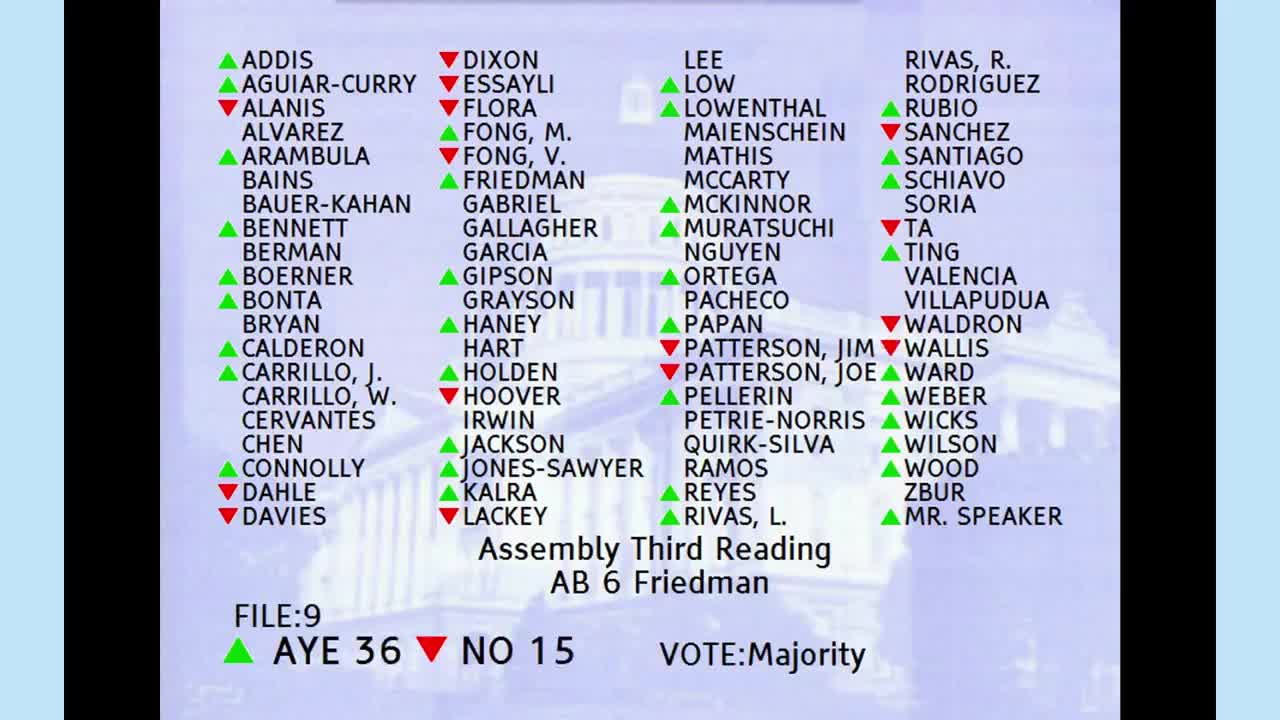 2MIN
Assembly Floor
 24MIN
Assembly Standing Committee on Education
Bill Author



