AB 985: San Joaquin Valley Unified Air Pollution Control District: emission reduction credit system.
- Session Year: 2023-2024
- House: Assembly
- Latest Version Date: 2023-07-06
Current Status:
Failed
(2023-09-13: Motion to reconsider made by Assembly Member Arambula.)
Introduced
In Committee
First Chamber
In Committee
Second Chamber
Enacted
What does this bill do?
The bill requires the State Air Resources Board to review every emission reduction credit listed by the San Joaquin Valley air district, remove credits found to have been issued in violation of laws, and, if removing credits causes a credit bank to fail its federal equivalency test, require credits in that bank to be valued when they are used. It also requires the San Joaquin Valley district to publish on its website details about permits issued from 2004–2020 that used credits, including the permit applicant and scope, facility and reduction-site locations, estimated emissions, and required pollution controls.
The summary is provided by generative AI which can make mistakes. For original language, please view the details in the table below.
Existing law imposes various limitations on emissions of air contaminants for the control of air pollution from vehicular and nonvehicular sources. Existing law generally designates the State Air Resources Board as the state agency with the primary responsibility for the control of vehicular air pollution and air pollution control and air quality management districts with the primary responsibility for the control of air pollution from all sources other than vehicular sources.
Existing law requires the board of every air district to establish by regulation a system by which all reductions in the emission of air contaminants that are to be used to offset certain future increases in the emission of air contaminants be banked prior to use to offset future increases in emissions, except as specified. Existing law requires the state board to develop and adopt a methodology for use by air districts to calculate the value of credits issued for emission reductions from stationary, mobile, indirect, and areawide sources when those credits are used interchangeably, consistent with certain requirements. Existing law also requires the state board to periodically update the methodology as it applies to future transactions, if necessary.
Existing law provides for the establishment of the San Joaquin Valley Unified Air Pollution Control District vested with the authority to regulate air emissions from stationary sources located in the San Joaquin Valley Air Basin.
This bill would require the district to revise the regulation establishing its emission reduction credit system to specify a time period by which existing and future emission reduction credits will expire. The bill would provide that this revision of the emission reduction credit system is subject to disapproval by the state board within 60 days after adoption by the district.This bill would require the state board, except as provided, to conduct an analysis of each credit identified in the San Joaquin Valley Unified Air Pollution Control Districts ledger of available emission reduction credit banks for certain pollutants credits to determine if any credits were issued in violation of state, local, or district laws, rules, regulations, or procedures in place at the time of original issuance, and to complete the analysis no later than January 1, 2027. As part of the analysis, the bill would require the state board to ensure that emission reduction credits are deemed invalid if they were issued in violation of state, local, or district laws, rules, regulations, or procedures in place at the time of original issuance. If the invalidation of those credits leads, or would have led, to the districts program failing to meet applicable federal emission reduction requirements, the bill would require current and future credits to be valued at the time of use. The bill would also require the state board to conduct a stationary source analysis for all permits in the district that use a credit for oxides of nitrogen (NOx), volatile organic compounds (VOCs), or a pollutant for which the invalidation of credits leads, or would have led, to the failure to meet federal requirements, as provided. The bill would require, upon completion of the analyses, analysis, the state board to submit a report to the Legislature that includes a summary of the results of the analyses. analysis.
ByThis bill would require the district to aggregate and make publicly available on its internet website specified information regarding permits issued during a specified time period that require or required the use of one or more emission reduction credits. By adding to the duties of the district, this bill would impose a state-mandated local program.
This bill would make legislative findings and declarations as to the necessity of a special statute for the San Joaquin Valley Air Basin.
The California Constitution requires the state to reimburse local agencies and school districts for certain costs mandated by the state. Statutory provisions establish procedures for making that reimbursement.
This bill would provide that no reimbursement is required by this act for a specified reason.
Existing law imposes various limitations on emissions of air contaminants for the control of air pollution from vehicular and nonvehicular sources. Existing law generally designates the State Air Resources Board as the state agency with the primary responsibility for the control of vehicular air pollution and air pollution control and air quality management districts with the primary responsibility for the control of air pollution from all sources other than vehicular sources.
Existing law requires the board of every air district to establish by regulation a system by which all reductions in the emission of air contaminants that are to be used to offset certain future increases in the emission of air contaminants be banked prior to use to offset future increases in emissions, except as specified. Existing law requires the state board to develop and adopt a methodology for use by air districts to calculate the value of credits issued for emission reductions from stationary, mobile, indirect, and areawide sources when those credits are used interchangeably, consistent with certain requirements. Existing law also requires the state board to periodically update the methodology as it applies to future transactions, if necessary.
Existing law provides for the establishment of the San Joaquin Valley Unified Air Pollution Control District vested with the authority to regulate air emissions from stationary sources located in the San Joaquin Valley Air Basin.
This bill would require the district to revise the regulation establishing its emission reduction credit system to require specify a time period by which existing and future emission reduction credits to expire after a specified time period. will expire. The bill would provide that this revision of the emission reduction credit system is subject to disapproval by the state board within 60 days after adoption by the district.
This bill would require the state board, except as provided, to conduct an analysis of the San Joaquin Valley Unified Air Pollution Control Districts emission reduction credit banks for particulate matter below 10 microns (PM10), carbon monoxide (CO), and oxides of sulfur (SOx) certain pollutants and to complete the analysis no later than January 1, 2027. As part of the analysis, the bill would require the state board to ensure that emission reduction credits are deemed invalid if they were issued in violation of state, local, or district laws, rules, regulations, or procedures in place at the time of original issuance. If the invalidation of those credits leads, or would have led, to the districts program failing to meet applicable federal emission reduction requirements, the bill would require current and future credits to be valued at the time of use. The bill would also require the state board to conduct a stationary source analysis for all permits in the district that use a credit for oxides of nitrogen (NOx) or (NOx), volatile organic compounds (VOCs), or a pollutant for which the invalidation of credits leads, or would have led, to the failure to meet federal requirements, as provided. The bill would require, upon completion of the analyses, the state board to submit a report to the Legislature that includes a summary of the results of the analyses.
By adding to the duties of the district, this bill would impose a state-mandated local program.
This bill would make legislative findings and declarations as to the necessity of a special statute for the San Joaquin Valley Air Basin.
The California Constitution requires the state to reimburse local agencies and school districts for certain costs mandated by the state. Statutory provisions establish procedures for making that reimbursement.
This bill would provide that no reimbursement is required by this act for a specified reason.
Existing law imposes various limitations on emissions of air contaminants for the control of air pollution from vehicular and nonvehicular sources. Existing law generally designates the State Air Resources Board as the state agency with the primary responsibility for the control of vehicular air pollution and air pollution control and air quality management districts with the primary responsibility for the control of air pollution from all sources other than vehicular sources.
Existing law requires the board of every air district to establish by regulation a system by which all reductions in the emission of air contaminants that are to be used to offset certain future increases in the emission of air contaminants be banked prior to use to offset future increases in emissions, except as specified. Existing law requires the state board to develop and adopt a methodology for use by air districts to calculate the value of credits issued for emission reductions from stationary, mobile, indirect, and areawide sources when those credits are used interchangeably, consistent with certain requirements. Existing law also requires the state board to periodically update the methodology as it applies to future transactions, if necessary.
Existing law provides for the establishment of the San Joaquin Valley Unified Air Pollution Control District vested with the authority to regulate air emissions from stationary sources located in the San Joaquin Valley Air Basin.
This bill would require the district to revise the regulation establishing its emission reduction credit system by requiring to require existing and future emission reduction credits to expire after a specified time period and by requiring an emission reduction credit to be valued at its time of use. period. The bill would provide that this revision of the emission reduction credit system is subject to disapproval by the state board within 60 days after adoption by the district.
This bill would require the state board and the district, in collaboration with community groups and the federal Environmental Protection Agency, to conduct an analysis of each emission reduction credit included in the districts registry. As part of the analysis, the bill would require the state board to ensure that emission reduction credits are deemed invalid if they do not meet certain requirements. The bill would require the analysis to be completed no later than January 1, 2027, and would require, upon completion of the analysis, the state board to submit a report to the Legislature that includes a summary of the results of the analysis and other specified information.This bill would require the district to prepare a map of, and make available on a publicly accessible and searchable database, the locations of the original source of emissions of all active emission reduction credits in its registry.This bill would require the state board, except as provided, to conduct an analysis of the San Joaquin Valley Unified Air Pollution Control Districts emission reduction credit banks for particulate matter below 10 microns (PM10), carbon monoxide (CO), and oxides of sulfur (SOx) and to complete the analysis no later than January 1, 2027. As part of the analysis, the bill would require the state board to ensure that emission reduction credits are deemed invalid if they were issued in violation of state, local, or district laws, rules, regulations, or procedures in place at the time of original issuance. If the invalidation of those credits leads, or would have led, to the districts program failing to meet applicable federal emission reduction requirements, the bill would require current and future credits to be valued at the time of use. The bill would also require the state board to conduct a stationary source analysis for all permits in the district that use a credit for oxides of nitrogen (NOx) or volatile organic compounds (VOCs), as provided. The bill would require, upon completion of the analyses, the state board to submit a report to the Legislature that includes a summary of the results of the analyses.
By adding to the duties of the district, this bill would impose a state-mandated local program.
This bill would make legislative findings and declarations as to the necessity of a special statute for the San Joaquin Valley Air Basin.
The California Constitution requires the state to reimburse local agencies and school districts for certain costs mandated by the state. Statutory provisions establish procedures for making that reimbursement.
This bill would provide that no reimbursement is required by this act for a specified reason.
Existing law imposes various limitations on emissions of air contaminants for the control of air pollution from vehicular and nonvehicular sources. Existing law generally designates the State Air Resources Board as the state agency with the primary responsibility for the control of vehicular air pollution and air pollution control and air quality management districts with the primary responsibility for the control of air pollution from all sources other than vehicular sources.
Existing law requires the board of every air district to establish by regulation a system by which all reductions in the emission of air contaminants that are to be used to offset certain future increases in the emission of air contaminants be banked prior to use to offset future increases in emissions, except as specified. Existing law requires the state board to develop and adopt a methodology for use by air districts to calculate the value of credits issued for emission reductions from stationary, mobile, indirect, and areawide sources when those credits are used interchangeably, consistent with certain requirements. Existing law also requires the state board to periodically update the methodology as it applies to future transactions, if necessary.
Existing law provides for the establishment of the San Joaquin Valley Unified Air Pollution Control District vested with the authority to regulate air emissions from stationary sources located in the San Joaquin Valley Air Basin.
This bill would state the intent of the Legislature to enact subsequent legislation to examine potential solutions to reduce or eliminate stationary and mobile sources of air pollution. require the district to revise the regulation establishing its emission reduction credit system by requiring existing and future emission reduction credits to expire after a specified time period and by requiring an emission reduction credit to be valued at its time of use. The bill would provide that this revision of the emission reduction credit system is subject to disapproval by the state board within 60 days after adoption by the district.
This bill would require the state board and the district, in collaboration with community groups and the federal Environmental Protection Agency, to conduct an analysis of each emission reduction credit included in the districts registry. As part of the analysis, the bill would require the state board to ensure that emission reduction credits are deemed invalid if they do not meet certain requirements. The bill would require the analysis to be completed no later than January 1, 2027, and would require, upon completion of the analysis, the state board to submit a report to the Legislature that includes a summary of the results of the analysis and other specified information.
This bill would require the district to prepare a map of, and make available on a publicly accessible and searchable database, the locations of the original source of emissions of all active emission reduction credits in its registry.
By adding to the duties of the district, this bill would impose a state-mandated local program.
This bill would make legislative findings and declarations as to the necessity of a special statute for the San Joaquin Valley Air Basin.
The California Constitution requires the state to reimburse local agencies and school districts for certain costs mandated by the state. Statutory provisions establish procedures for making that reimbursement.
This bill would provide that no reimbursement is required by this act for a specified reason.
Existing law imposes various limitations on emissions of air contaminants for the control of air pollution from vehicular and nonvehicular sources. Existing law generally designates the State Air Resources Board as the state agency with the primary responsibility for the control of vehicular air pollution and air pollution control and air quality management districts with the primary responsibility for the control of air pollution from all sources other than vehicular sources.
This bill would state the intent of the Legislature to enact subsequent legislation to examine potential solutions to reduce or eliminate stationary and mobile sources of air pollution.
The Legislature finds and declares all of the following:
(a)Poor air quality is intimately linked with negative health impacts, including respiratory illness and premature deaths, with recent studies estimating air pollution as the cause of over 100,000 premature deaths in the United States in 2011. However, the distribution of premature deaths is not equal.
(b)Rural communities, farmworker communities, disadvantaged communities, tribal nations, young people, and those living at or below the poverty level often live adjacent to transportation corridors or commercial and industrial facilities with highly localized and severe pollution levels and are at the highest risk of adverse health outcomes.
(c)The United States Environmental Protection Agency is responsible for establishing national ambient air quality standards for a number of criteria pollutants, including oxides of nitrogen (NOx), volatile organic compounds (VOCs), carbon monoxide (CO), oxides of sulfur (SOx), and particulate matter below 10 microns (PM10).
(d)When facilities voluntarily control emissions to levels beyond current or future regulatory requirements, they earn emission reduction credits that new sources of pollution purchase to offset the pollution resulting from their operations. Unused emission reduction credits are stored by the San Joaquin Valley Unified Air Pollution Control District in banks organized by pollutant.
(e)In 2020, the State Air Resources Board discovered errors that invalidated some of the credits within the banks for oxides of nitrogen (NOx), and volatile organic compounds (VOCs). This caused the San Joaquin Valley Unified Air Pollution Control District to fail the equivalency demonstrations for these two banks and triggered the federal requirement that all credits in these two banks be valued at the time of use.
(f)It is likely that a similar analysis of the San Joaquin Valley Unified Air Pollution Control Districts other emission reduction credit banks and permits issued with those credits will reveal similar errors and should be reviewed.
SEC. 2.Section 40714 is added to the Health and Safety Code, to read:40714.(a)The district shall revise its regulation adopted pursuant to Section 40709 to specify a time period by which existing and future emission reduction credits in all banks will expire.(b)The revision of the system made pursuant to subdivision (a) shall be subject to disapproval by the state board pursuant to Chapter 1 (commencing with Section 41500) of Part 4 within 60 days after adoption by the district.(c)For purposes of this section, district means the San Joaquin Valley Unified Air Pollution Control District.SEC. 3.Section 40714.2 is added to the Health and Safety Code, to read:40714.2.SEC. 2.Section 40714 is added to the Health and Safety Code, to read:40714.(a)(1)Except as provided in subdivision (c), the The state board, building on the June 2020 report, board shall conduct an analysis of all of each credit identified in the districts ledger of available emission reduction credit banks credits established pursuant to Section 40709, other than the banks for oxides of nitrogen (NOx) and volatile organic compounds (VOCs), 40709 to determine if any credits for those pollutants were issued in violation of state, local, or district laws, rules, regulations, or procedures in place at the time of original issuance. The analysis shall be completed no later than January 1, 2027.
(2)For purposes of the analysis described in paragraph (1), the state board shall use the same statistical sampling methods used in the June 2020 report.(b)As part of the analysis conducted pursuant to subdivision (a), the state board shall ensure all of the following:(1)An emission reduction credit issued in violation of state, local, or district laws, rules, regulations, or procedures in place at the time of original issuance shall be deemed invalid.(2)If an emission reduction credit is deemed invalid pursuant to paragraph (1), the credit shall be removed from the bank.(3)If removal of credits from the banks for the pollutants analyzed pursuant to subdivision (a) leads, or would have led, to failing an equivalency demonstration for any of these banks, current and future credits in the bank or banks with the failed equivalency demonstration shall be valued at the time of use.(c)The state board is not required to conduct the analysis described in subdivision (a) for a particular pollutant if the state board requires the district to value at the time of use all current and future emission reduction credits in the bank established pursuant to Section 40709 for that pollutant.(d)(1)The state board shall conduct a stationary source analysis for all permits in the district that use a credit for oxides of nitrogen (NOx), or volatile organic compounds (VOCs). The analysis shall include information on the permit issued, including, but not limited to, all of the following:(2)Notwithstanding paragraph (1), the state board is not required to analyze any available emission reduction credit that was reviewed as part of the June 2020 report.
(b)For all permits in the district issued between January 1, 2004, and December 31, 2020, that require or required the use of one or more emission reduction credits, the district shall aggregate and make publicly available on its internet website information regarding those permits that includes, but is limited to, all of the following information:
(A)(1)Permit applicant information. information, including information sufficient to identify the scope of the permitted project.
(B)(2)Facility name and reduction site location information for all relevant credits. credits used in conjunction with the permitted project.
(C)(3)Estimated permitted emissions by type and quantity.
(D)(4)Any best available control technology, best available retrofit control technology, or other emissions control measures identified as a requirement of the permit.
(2)If removal of credits from the banks for the pollutants analyzed pursuant to subdivision (a) leads, or would have led, to failing an equivalency demonstration pursuant to paragraph (3) of subdivision (b), the state board shall conduct a stationary source analysis pursuant to paragraph (1) for all permits in the district that use a credit for the pollutant with the failed equivalency demonstration.(e)(c)(1)Upon completion of the analyses analysis pursuant to subdivision (a) and subdivision (d), (a), the state board shall submit a report to the Legislature summarizing the results of the analyses. analysis.
(2)The report to be submitted pursuant to this subdivision shall be submitted in compliance with Section 9795 of the Government Code.
(f)(d)For purposes of this section, the following definitions apply:
(1)June 2020 report means the report published by the state board on June 4, 2020, reviewing the districts emission reduction credit system.
(2)District means the San Joaquin Valley Unified Air Pollution Control District.
SEC. 4.SEC. 3.The Legislature finds and declares that a special statute is necessary and that a general statute cannot be made applicable within the meaning of Section 16 of Article IV of the California Constitution because of the unique need to address air pollution and environmental injustices in the San Joaquin Valley Air Basin.
SEC. 5.SEC. 4.No reimbursement is required by this act pursuant to Section 6 of Article XIIIB of the California Constitution because a local agency or school district has the authority to levy service charges, fees, or assessments sufficient to pay for the program or level of service mandated by this act, within the meaning of Section 17556 of the Government Code.
The Legislature finds and declares all of the following:
(a)Poor air quality is intimately linked with negative health impacts, including respiratory illness and premature deaths, with recent studies estimating air pollution as the cause of over 100,000 premature deaths in the United States in 2011. However, the distribution of premature deaths is not equal.
(b)Rural communities, farmworker communities, disadvantaged communities, tribal nations, young people, and those living at or below the poverty level often live adjacent to transportation corridors or commercial and industrial facilities with highly localized and severe pollution levels and are at the highest risk of adverse health outcomes.
(c)The United States Environmental Protection Agency is responsible for establishing national ambient air quality standards for a number of criteria pollutants, including oxides of nitrogen (NOx), (NOx), volatile organic compounds (VOCs), carbon monoxide (CO), oxides of sulfur (SOx), (SOx), and particulate matter below 10 microns (PM10).
(d)When facilities voluntarily control emissions to levels beyond current or future regulatory requirements, they earn emission reduction credits that new sources of pollution purchase to offset the pollution resulting from their operations. Unused emission reduction credits are stored by the San Joaquin Valley Unified Air Pollution Control District in banks organized by pollutant.
(e)In 2020, the State Air Resources Board discovered errors that invalidated some of the credits within the banks for oxides of nitrogen (NOx) (NOx), and volatile organic compounds (VOCs). This caused the San Joaquin Valley Unified Air Pollution Control District to fail the equivalency demonstrations for these two banks and triggered the federal requirement that all credits in these two banks be valued at the time of use.
(f)It is likely that a similar analysis of the other three major banks, which are for particulate matter below 10 microns (PM10), carbon monoxide (CO), and oxides of sulfur (SOx), San Joaquin Valley Unified Air Pollution Control Districts other emission reduction credit banks will reveal similar errors and should be reviewed.
SEC. 2.Section 40714 is added to the Health and Safety Code, to read:40714.(a)The district shall revise its regulation adopted pursuant to Section 40709 to require specify a time period by which existing and future emission reduction credits in all banks to expire after a time period that is equal to, or less than, the shortest expiration period in effect as of January 1, 2024, for emission reduction credits issued by any state or any other district. will expire.
(b)The revision of the system made pursuant to subdivision (a) shall be subject to disapproval by the state board pursuant to Chapter 1 (commencing with Section 41500) of Part 4 within 60 days after adoption by the district.
(c)For purposes of this section, district means the San Joaquin Valley Unified Air Pollution Control District.
SEC. 3.Section 40714.2 is added to the Health and Safety Code, to read:40714.2.(a)(1)Except as provided in subdivision (c), the state board, building on the June 2020 report, shall conduct an analysis of all of the districts emission reduction credit banks for particulate matter below 10 microns (PM10), carbon monoxide (CO), and oxides of sulfur (SOx) established pursuant to Section 40709 40709, other than the banks for oxides of nitrogen (NOx) and volatile organic compounds (VOCs), to determine if any credits for those pollutants were issued in violation of state, local, or district laws, rules, regulations, or procedures in place at the time of original issuance. The analysis shall be completed no later than January 1, 2027.
(2)For purposes of the analysis described in paragraph (1), the state board shall use the same statistical sampling methods used in the June 2020 report.
(b)As part of the analysis conducted pursuant to subdivision (a), the state board shall ensure all of the following:
(1)An emission reduction credit issued in violation of state, local, or district laws, rules, regulations, or procedures in place at the time of original issuance shall be deemed invalid.
(2)If an emission reduction credit is deemed invalid pursuant to paragraph (1), the credit shall be removed from the bank.
(3)If removal of credits from the banks for particulate matter below 10 microns (PM10), carbon monoxide (CO), or oxides of sulfur (SOx) the pollutants analyzed pursuant to subdivision (a) leads, or would have led, to failing an equivalency demonstration for any of these banks, current and future credits in the bank or banks with the failed equivalency demonstration shall be valued at the time of use.
(c)The state board is not required to conduct the analysis described in subdivision (a) if it for a particular pollutant if the state board requires the district to value at the time of use all current and future emission reduction credits in the banks bank established pursuant to Section 40709 for particulate matter below 10 microns (PM10), carbon monoxide (CO), and oxides of sulfur (SOx). that pollutant.
(d)(1)The state board shall conduct a stationary source analysis for all permits in the district that use a credit for oxides of nitrogen (NOx) (NOx), or volatile organic compounds (VOCs). The review shall identify analysis shall include information on the permit issued, including, but not limited to, all of the following:
(1)The amount and source of emissions of oxides of nitrogen (NOx) and volatile organic compounds (VOCs).(2)The type of pollution control equipment currently being used at each source.(3)The emission reduction opportunities at each source, including the availability of a retrofit using best available retrofit control technology, and the cost.(A)Permit applicant information.
(B)Facility name and reduction site location information for all relevant credits.
(C)Estimated permitted emissions by type and quantity.
(D)Any best available control technology, best available retrofit control technology, or other emissions control measures identified as a requirement of the permit.
(2)If removal of credits from the banks for the pollutants analyzed pursuant to subdivision (a) leads, or would have led, to failing an equivalency demonstration pursuant to paragraph (3) of subdivision (b), the state board shall conduct a stationary source analysis pursuant to paragraph (1) for all permits in the district that use a credit for the pollutant with the failed equivalency demonstration.
(e)(1)Upon completion of the analyses pursuant to subdivision (a) and subdivision (d), the state board shall submit a report to the Legislature summarizing the results of the analyses.
(2)The report to be submitted pursuant to this subdivision shall be submitted in compliance with Section 9795 of the Government Code.
(f)For purposes of this section, the following definitions apply:
(1)June 2020 report means the report published by the state board on June 4, 2020, reviewing the districts emission reduction credit system.
(2)District means the San Joaquin Valley Unified Air Pollution Control District.
SEC. 4.The Legislature finds and declares that a special statute is necessary and that a general statute cannot be made applicable within the meaning of Section 16 of Article IV of the California Constitution because of the unique need to address air pollution and environmental injustices in the San Joaquin Valley Air Basin.
SEC. 5.No reimbursement is required by this act pursuant to Section 6 of Article XIIIB of the California Constitution because a local agency or school district has the authority to levy service charges, fees, or assessments sufficient to pay for the program or level of service mandated by this act, within the meaning of Section 17556 of the Government Code.
The Legislature finds and declares all of the following:
(a)Poor air quality is intimately linked with negative health impacts, including respiratory illness and premature deaths, with recent studies estimating air pollution as the cause of over 100,000 premature deaths in the United States in 2011. However, the distribution of premature deaths is not equal.
(b)Rural communities, farmworker communities, disadvantaged communities, tribal nations, young people, and those living at or below the poverty level often live adjacent to transportation corridors or commercial and industrial facilities with highly localized and severe pollution levels and are at the highest risk of adverse health outcomes.
(c)The United States Environmental Protection Agency is responsible for establishing national ambient air quality standards for a number of criteria pollutants, including oxides of nitrogen (NOx), volatile organic compounds (VOCs), carbon monoxide (CO), oxides of sulfur (SOx), and particulate matter below 10 microns (PM10).
(d)When facilities voluntarily control emissions to levels beyond current or future regulatory requirements, they earn emission reduction credits that new sources of pollution purchase to offset the pollution resulting from their operations. Unused emission reduction credits are stored by the San Joaquin Valley Unified Air Pollution Control District in banks organized by pollutant.
(e)In 2020, the State Air Resources Board discovered errors that invalidated some of the credits within the banks for oxides of nitrogen (NOx) and volatile organic compounds (VOCs). This caused the San Joaquin Valley Unified Air Pollution Control District to fail the equivalency demonstrations for these two banks and triggered the federal requirement that all credits in these two banks be valued at the time of use.
(f)It is likely that a similar analysis of the other three major banks, which are for particulate matter below 10 microns (PM10), carbon monoxide (CO), and oxides of sulfur (SOx), will reveal similar errors and should be reviewed.
SEC. 2.Section 40714 is added to the Health and Safety Code, to read:40714.(a)The Valley district shall revise its regulation adopted pursuant to Section 40709 by doing both of the following:
(1)Requiring 40709 to require existing and future emission reduction credits in all banks to expire after a time period that is equal to, or less than, the shortest expiration period in effect as of January 1, 2024, for emission reduction credits issued by any state or any other district.
(2)Requiring an emission reduction credit to be valued at its time of use rather than its time of issuance.(b)The revision of the system made pursuant to subdivision (a) shall be subject to disapproval by the state board pursuant to Chapter 1 (commencing with Section 41500) of Part 4 within 60 days after adoption by the Valley district.
(c)The Valley district shall prepare a map of, and make available on a publicly accessible and searchable database, the locations of the original source of emissions of all active emission reduction credits in its registry.(d)(c)For purposes of this section, Valley district district means the San Joaquin Valley Unified Air Pollution Control District.
SEC. 3.Section 40714.2 is added to the Health and Safety Code, to read:40714.2.(a)The state board and the Valley district, in collaboration with community groups and the federal Environmental Protection Agency, Except as provided in subdivision (c), the state board, building on the June 2020 report, shall conduct an analysis of each emission reduction credit included in the Valley districts registry established pursuant to Section 40709. the districts emission reduction credit banks for particulate matter below 10 microns (PM10), carbon monoxide (CO), and oxides of sulfur (SOx) established pursuant to Section 40709 to determine if any credits for those pollutants were issued in violation of state, local, or district laws, rules, regulations, or procedures in place at the time of original issuance. The analysis shall be completed no later than January 1, 2027.
(b)As part of the analysis conducted pursuant to subdivision (a), the state board shall ensure all of the following:
(1)An emission reduction credit issued in violation of state, local, or district laws, rules, regulations, or procedures in place at the time of original issuance shall be deemed invalid.
(2)If an emission reduction credit cannot be traced back to its original source of emission reduction, then the credit shall be deemed invalid.(3)If an emission reduction credit is deemed invalid pursuant to paragraph (1) or (2), the credit shall be permanently removed from the Valley districts registry.(2)If an emission reduction credit is deemed invalid pursuant to paragraph (1), the credit shall be removed from the bank.
(3)If removal of credits from the banks for particulate matter below 10 microns (PM10), carbon monoxide (CO), or oxides of sulfur (SOx) leads, or would have led, to failing an equivalency demonstration for any of these banks, current and future credits in the bank or banks with the failed equivalency demonstration shall be valued at the time of use.
(c)The state board is not required to conduct the analysis described in subdivision (a) if it requires the district to value at the time of use all current and future emission reduction credits in the banks established pursuant to Section 40709 for particulate matter below 10 microns (PM10), carbon monoxide (CO), and oxides of sulfur (SOx).
(d)The state board shall conduct a stationary source analysis for all permits in the district that use a credit for oxides of nitrogen (NOx) or volatile organic compounds (VOCs). The review shall identify all of the following:
(1)The amount and source of emissions of oxides of nitrogen (NOx) and volatile organic compounds (VOCs).
(2)The type of pollution control equipment currently being used at each source.
(3)The emission reduction opportunities at each source, including the availability of a retrofit using best available retrofit control technology, and the cost.
(c)(e)(1)Upon completion of the analysis, analyses pursuant to subdivision (a) and subdivision (d), the state board shall submit a report to the Legislature summarizing the results of the analysis. The report shall also include, but is not limited to, information regarding the quantification of additional emissions caused by overvalued or fake credits, including credits issued during the timeframe when the banks for oxides of nitrogen and volatile organic compounds would have failed the equivalency demonstrations if the emission reduction credit system had been managed properly, which resulted in permits being issued that used emission reduction credits at an inflated value. analyses.
(2)The report to be submitted pursuant to this subdivision shall be submitted in compliance with Section 9795 of the Government Code.
(d)(f)For purposes of this section, the following definitions apply:
(1)June 2020 report means the report published by the state board in on June 4, 2020, reviewing the Valley districts emission reduction credit system.
(2)Valley district District means the San Joaquin Valley Unified Air Pollution Control District.
SEC. 4.The Legislature finds and declares that a special statute is necessary and that a general statute cannot be made applicable within the meaning of Section 16 of Article IV of the California Constitution because of the unique need to address air pollution and environmental injustices in the San Joaquin Valley Air Basin.
SEC. 5.No reimbursement is required by this act pursuant to Section 6 of Article XIIIB of the California Constitution because a local agency or school district has the authority to levy service charges, fees, or assessments sufficient to pay for the program or level of service mandated by this act, within the meaning of Section 17556 of the Government Code.
The Legislature finds and declares all of the following:
(a)The United States Environmental Protection Agency is responsible for establishing national ambient air quality standards for a number of pollutants, including ozone and particulate matter below 10 microns (PM10) and below 2.5 microns (PM2.5) in size.
(b)Poor air quality is intimately linked with negative health impacts, including respiratory illness and premature deaths, with recent studies estimating air pollution as the cause of over 100,000 premature deaths in the United States in 2011.
(c)The distribution of premature deaths is not equal. Low-socioeconomic status communities are at higher risk than higher income communities. Additionally, Hispanic, Asian, and Black individuals experience higher risk of premature death than White individuals.
(d)Specific to PM2.5, research has found that for elderly individuals enrolled in Medicare, it is estimated that reaching the World Health Organizations standards, which are only slightly more stringent than the most recent national standards, would prevent nearly 140,000 early deaths of elderly individuals over the next decade. For the San Joaquin Valley, data suggests that PM2.5 exposure is responsible for 1,200 cases of premature death in the valley each year.
(e)Addressing this problem continues to be elusive. The San Joaquin Valley Unified Air Pollution Control District (district) is sandwiched among mountains that trap pollutants and weaken the flow of air and dispersion of pollution, has a growing population, and is crisscrossed by major transportation routes.
(f)In the midst of intensive industrial and agricultural development, socioeconomic vulnerability and health exposure hazards are interlinked and persistent.
(g)According to the district, the primary causes of the regions particle and ozone pollution are motor vehicles, plant and animal agriculture, oil production, wood burning, and fugitive dust.
(h)While oil and gas production is on a downward trend in both California and the district, operators continue to drill, plan for more production, and hope that shifting market forces will work in their favor going forward.
(i)As persistently poor air quality and the push for more industrial development converge in the San Joaquin Valley, the effectiveness of voluntary emission reduction credits in actually reducing pollution is increasingly debated.
(j)The primary goal is to support companies wishing to pursue industrial projects, not to prohibit the creation of pollution.
(k)The volume of emissions offset is based on estimates developed for the purpose of obtaining a permit, which may or may not represent a facilitys actual emissions.
(l)Emission reduction credit banking is based on a static view of air quality and its impacts, with the volume of reduction at one point in time or in one location carried over to the future or a different location, regardless of actual, changing conditions or localized impacts.
(m)Emission reduction credits allow operators to release pollution even in areas where air quality standards are not being met.
(n)Despite an active emission reduction credit program, localized pollution impacts and regional pollution problems can persist and even increase.
SEC. 2.Section 40714 is added to the Health and Safety Code, to read:40714.(a)The Valley district shall revise its regulation adopted pursuant to Section 40709 by doing both of the following:
(1)Requiring existing and future emission reduction credits to expire after a time period that is equal to, or less than, the shortest expiration period in effect as of January 1, 2024, for emission reduction credits issued by any state or any other district.
(2)Requiring an emission reduction credit to be valued at its time of use rather than its time of issuance.
(b)The revision of the system made pursuant to subdivision (a) shall be subject to disapproval by the state board pursuant to Chapter 1 (commencing with Section 41500) of Part 4 within 60 days after adoption by the Valley district.
(c)The Valley district shall prepare a map of, and make available on a publicly accessible and searchable database, the locations of the original source of emissions of all active emission reduction credits in its registry.
(d)For purposes of this section, Valley district means the San Joaquin Valley Unified Air Pollution Control District.
SEC. 3.Section 40714.2 is added to the Health and Safety Code, to read:40714.2.(a)The state board and the Valley district, in collaboration with community groups and the federal Environmental Protection Agency, building on the June 2020 report, shall conduct an analysis of each emission reduction credit included in the Valley districts registry established pursuant to Section 40709. The analysis shall be completed no later than January 1, 2027.
(b)As part of the analysis conducted pursuant to subdivision (a), the state board shall ensure all of the following:
(1)An emission reduction credit issued in violation of state, local, or district laws, rules, regulations, or procedures in place at the time of original issuance shall be deemed invalid.
(2)If an emission reduction credit cannot be traced back to its original source of emission reduction, then the credit shall be deemed invalid.
(3)If an emission reduction credit is deemed invalid pursuant to paragraph (1) or (2), the credit shall be permanently removed from the Valley districts registry.
(c)(1)Upon completion of the analysis, the state board shall submit a report to the Legislature summarizing the results of the analysis. The report shall also include, but is not limited to, information regarding the quantification of additional emissions caused by overvalued or fake credits, including credits issued during the timeframe when the banks for oxides of nitrogen and volatile organic compounds would have failed the equivalency demonstrations if the emission reduction credit system had been managed properly, which resulted in permits being issued that used emission reduction credits at an inflated value.
(2)The report to be submitted pursuant to this subdivision shall be submitted in compliance with Section 9795 of the Government Code.
(d)For purposes of this section, the following definitions apply:
(1)June 2020 report means the report published by the state board in June 4, 2020, reviewing the Valley districts emission reduction credit system.
(2)Valley district means the San Joaquin Valley Unified Air Pollution Control District.
SEC. 4.The Legislature finds and declares that a special statute is necessary and that a general statute cannot be made applicable within the meaning of Section 16 of Article IV of the California Constitution because of the unique need to address air pollution and environmental injustices in the San Joaquin Valley Air Basin.
SEC. 5.No reimbursement is required by this act pursuant to Section 6 of Article XIIIB of the California Constitution because a local agency or school district has the authority to levy service charges, fees, or assessments sufficient to pay for the program or level of service mandated by this act, within the meaning of Section 17556 of the Government Code.
SECTION 1.It is the intent of the Legislature to enact subsequent legislation to examine potential solutions to reduce or eliminate stationary and mobile sources of air pollution.It is the intent of the Legislature to enact subsequent legislation to examine potential solutions to reduce or eliminate stationary and mobile sources of air pollution.
|
Date
|
Status
|
|---|---|
| Sep 13, 2023 | Motion to reconsider made by Assembly Member Arambula. |
| Sep 13, 2023 | Assembly refused to concur in Senate amendments. (Ayes 38. Noes 21. Page 3481.) |
| Sep 12, 2023 | In Assembly. Concurrence in Senate amendments pending. |
| Sep 12, 2023 | Read third time. Passed. Ordered to the Assembly. (Ayes 28. Noes 8. Page 2620.). |
| Sep 5, 2023 | Read second time. Ordered to third reading. |
| Sep 1, 2023 | From committee: Do pass. (Ayes 5. Noes 2.) (September 1). |
| Aug 21, 2023 | In committee: Referred to APPR suspense file. |
| Jul 6, 2023 | Read second time and amended. Re-referred to Com. on APPR. |
| Jul 5, 2023 | From committee: Amend, and do pass as amended and re-refer to Com. on APPR. (Ayes 5. Noes 2.) (July 5). |
| Jun 14, 2023 | Referred to Com. on E.Q. |
| Jun 1, 2023 | In Senate. Read first time. To Com. on RLS. for assignment. |
| May 31, 2023 | Read third time. Passed. Ordered to the Senate. (Ayes 45. Noes 21. Page 2031.) |
| May 22, 2023 | Read second time. Ordered to third reading. |
| May 18, 2023 | Read second time and amended. Ordered returned to second reading. |
| May 18, 2023 | From committee: Amend, and do pass as amended. (Ayes 11. Noes 4.) (May 18). |
| May 10, 2023 | In committee: Set, first hearing. Referred to APPR. suspense file. |
| Apr 25, 2023 | From committee: Do pass and re-refer to Com. on APPR. (Ayes 8. Noes 3.) (April 24). Re-referred to Com. on APPR. |
| Apr 11, 2023 | Re-referred to Com. on NAT. RES. |
| Apr 10, 2023 | From committee chair, with author's amendments: Amend, and re-refer to Com. on NAT. RES. Read second time and amended. |
| Mar 27, 2023 | Re-referred to Com. on NAT. RES. |
| Mar 23, 2023 | Referred to Com. on NAT. RES. |
| Mar 23, 2023 | From committee chair, with author's amendments: Amend, and re-refer to Com. on NAT. RES. Read second time and amended. |
| Feb 16, 2023 | From printer. May be heard in committee March 18. |
| Feb 15, 2023 | Read first time. To print. |
|
Date
|
Description
|
Location
|
Votes
|
|
|---|---|---|---|---|
| Sep 13, 2023 | AB 985 Arambula Concurrence in Senate Amendments | Assembly Floor |
Failed |
|
| Sep 12, 2023 | Assembly 3rd Reading AB985 Arambula et al. By Laird | Senate Floor |
Passed |
|
| Sep 1, 2023 | Do pass | Senate Standing Committee on Appropriations |
Passed |
|
| Aug 21, 2023 | Placed on suspense file | Senate Standing Committee on Appropriations |
Passed |
|
| Jul 5, 2023 | Do pass as amended, but first amend, and re-refer to the Committee on [Appropriations] | Senate Standing Committee on Environmental Quality |
Passed |
|
| May 31, 2023 | AB 985 Arambula Assembly Third Reading | Assembly Floor |
Passed |
|
| May 18, 2023 | Do pass as amended. | Assembly Standing Committee on Appropriations |
Passed |
|
| Apr 24, 2023 | Do pass and be re-referred to the Committee on [Appropriations] | Assembly Standing Committee on Natural Resources |
Passed |
This list shows positions taken on this bill by organizations on the date displayed, which is linked to the original source.
Positions by individuals are not included.
|
Organization
|
Position
|
Date
|
|---|---|---|
| 350 Humboldt | ** Support | |
| African American Farmers of California | ** Against | |
| Agricultural Council Of California | ** Against | |
| Almond Alliance of California | ** Against | |
| Azul | ** Support | |
| Ban Single Use Plastic | ** Support | |
| Bizfed Central Valley | ** Against | |
| California Air Pollution Control Officers Association | ** Against | |
| California Association Of Sanitation Agencies | ** Against | |
| California Association Of Winegrape Growers | ** Against | |
| California Chamber Of Commerce | ** Against | |
| California Compost Coalition | ** Against | |
| California Cotton Growers Association | * Against | Jul 5, 2023 |
| California Council For Environmental & Economic Balance | ** Against | |
| California Environmental Voters | ** Support | |
| California Farm Bureau Federation | ** Against | |
| California Fresh Fruit Association | ** Against | |
| California League of Food Producers | ** Against | |
| California Manufacturers & Technology Association | ** Against | |
| California Nurses for Environmental Health and Justice | ** Support | |
| California State Association Of Counties | ** Against | |
| California Walnut Commission | ** Against | |
| California Women for Agriculture | ** Against | |
| Center on Race Poverty and the Environment | * Support | Jul 5, 2023 |
| Central California Asthma Collaborative | ** Support | |
| Central California Environmental Justice Network | ** Support | |
| Central Valley Air Quality Coalition | ** Support | |
| city of avenal | ** Against | |
| City of Riverbank | ** Against | |
| City Of Waterford | ** Against | |
| Clean Water Action | ** Support | |
| CleanEarth4Kids | ** Support | |
| Climate Action California | ** Support | |
| Coalition For Clean Air | ** Support | |
| County of Fresno | ** Against | |
| County Of Kern | ** Against | |
| County of Merced | ** Against | |
| County of San Joaquin | ** Against | |
| County Of Stanislaus | ** Against | |
| Earthjustice | ** Support | |
| Elders Climate Action Norcal Chapter | ** Support | |
| Elders Climate Action Socal Chapter | ** Support | |
| Environmental Working Group | ** Support | |
| Facts: Families Advocating for Chemical & Toxics Safety | ** Support | |
| Far West Equipment Dealers Association | ** Against | |
| Leadership Counsel for Justice and Accountability | ** Support | |
| Little Manila Rising | ** Support | |
| Los Angeles County Business Federation | ** Against | |
| Los Angeles County Sanitation Districts | ** Against | |
| Madera County | ** Against | |
| Madera County of Supervisors | ** Against | |
| Manufacturers Council of the Central Valley | ** Against | |
| Merced County Board of Supervisors | ** Against | |
| Mi Familia Vota | ** Support | |
| Milk Producers Council | ** Against | |
| Natural Resources Defense Council | ** Support | |
| Navy Region Southwest | * Against Unless Amend | Jul 5, 2023 |
| Nielsen Merksamer | * Against | Apr 24, 2023 |
| Nisei Farmers League | ** Against | |
| NRDC | * Support | Jul 5, 2023 |
| Pesticide Action Network | ** Support | |
| Public Health Advocates | ** Support | |
| Rural County Representative of California | * Against Unless Amend | Jul 5, 2023 |
| Sacramento Area Congregations Together | ** Support | |
| San Joaquin County Board of Supervisors | ** Against | |
| San Joaquin Valley Policy Council | ** Against | |
| San Joaquin Valley Unified Air Pollution Control District | ** Against | |
| Santa Cruz Climate Action Network | ** Support | |
| Shaw Yoder Antwih Schmelzer Lange | * Against | Apr 24, 2023 |
| Sierra Club California | ** Support | |
| South Coast Air Quality Management District | ** Against | |
| Stanislaus County Board of Supervisors | ** Against | |
| The Climate Center | ** Support | |
| Urban Counties of California | ** Against | |
| Valley Improvement Projects | ** Support | |
| Vector Environmental, INC. | ** Against | |
| Vote Solar | ** Support | |
| Western Agricultural Processors Association | ** Against | |
| Western Growers Association | ** Against | |
| Western Plant Health Association | ** Against | |
| Western States Petroleum Association | ** Against | |
| Wine Institute | ** Against |
CONCURRENCE IN SENATE AMENDMENTS
CSA1 Bill Id:AB 985
Author:(Arambula)
As Amended Ver:July 6, 2023
Majority vote
SUMMARY
Requires the Air Resources Board (ARB) to conduct an analysis of the San Joaquin Valley Unified Air Pollution Control District's (District) emission reduction credit (ERC) banks for air pollutants by January 1, 2027.
Senate Amendments
- Delete the requirement for the District to revise its ERC regulation to specify a time period by which existing and future ERCs will expire.
- Clarify that the bill requires ARB to conduct an analysis of each credit identified in the District's ledger of available ERCs to determine if any credits were issued in violation of state, local, or district laws, rules, regulations, or procedures in place at the time of original issuance.
- Delete the requirement for ARB to ensure that the ERCs are deemed invalid if they were issued in violation of state, local, or district laws, rules, regulations, or procedures in place at the time of original issuance.
Delete the requirement for ARB to conduct a stationary source analysis for all permits in the district that use a credit for oxides of nitrogen (NOx), volatile organic compounds (VOCs), or a pollutant for which the invalidation of credits leads, or would have led, to the failure to meet federal requirements, as provided.
- Provide that ARB is not required to analyze any available ERC that was reviewed as part of the June 2020 report.
- Require the District to aggregate and make publicly available on its internet website specified information regarding permits issued during a specified time period that require or required the use of one or more ERCs.
COMMENTS
The U.S. Environmental Protection Agency's health-based limits for particulate matter (PM), ozone, NOx, sulfur oxides (Sox), carbon monoxide (CO), and lead require states and local governments to take steps to reduce emissions to attain the standards. Geographic areas within each state that do not meet a standard are called non-attainment for that air pollutant. The designation of an area as non-attainment triggers the regulatory requirements for banking and use of emission reductions credits.
All air districts in California are authorized by the federal Clean Air Act to operate ERC programs within their jurisdictions. These programs function similarly to cap-and-trade. If a polluter reduces emissions beyond what is currently required, they can earn a credit. In order for a credit to be issued, the qualifying source emissions must be "quantifiable, enforceable, permanent, and surplus." These credits can then be sold to polluters that need to offset anticipated future emissions in order to obtain a permit. Credits are stored in "banks" managed by the air districts. There are ten credit banks at the District, each comprised of a list of credits that are available for sale to offset a different criteria pollutant. Once a credit is used by a permit, it is permanently removed from its bank.
The San Joaquin Valley is prone to one of the most challenging air quality problems in the nation and is designated as an attainment area for the federal lead, NOx, SOx, and CO under the National Ambient Air Quality Standards, but the Valley is designated as a nonattainment area for the federal 1997 annual and 2006/2012 PM2.5 standards and the federal 8-hour ozone standards. The American Lung Association's 2022 State of the Air report gave the Valley an 'F' for Ozone, an 'F' for particle pollution in a 24-hour period, and a failing grade for particle pollution annually.
On January 24th, 2019, ARB conducted a review of the District's ERC program. The resultant report discovered errors that invalidated some of the credits within the banks for NOx and VOCs. This caused the District to fail the equivalency demonstrations for these two banks and triggered the federal requirement that all credits in these two banks be valued at the time of use.
The author states concern that it is likely that a similar analysis of the other major banks, which are for PM10, CO, and SOx, may reveal similar errors and should be reviewed. Thus, AB 985 would require ARB to analyze the District's ERC banks for each air pollutant by January 1, 2027.
According to the Author
Issues with the District's credits and banks have allowed the oil industry and other major polluters to release more pollution over the past decades than should have been allowed. This must be fully assessed and addressed. Local, state, and federal regulators have admitted to these and other issues within the Air District's credit banking system. To restore public confidence and to stop harming vulnerable people for economic benefit, the state must take corrective action. The state must require the District to address the disproportionate burden on vulnerable communities it has allowed under its watch.
Arguments in Support
The Central Valley Air Quality Coalition writes, "The [District] has been mismanaging their Emissions Reduction Credit system for decades, resulting in more pollution concentrated in environmental justice neighborhoods allowing the oil industry and other major pollution sources to use old credits that were overvalued or never should have been issued instead of cleaning up their pollution on site … To restore clean air to the Valley and address the disproportionate burden on communities of color and low income communities, issues with the credits, banks, and permits used by the oil industry and other major pollution sources must be fully assessed and addressed."
Arguments in Opposition
The League of California Cities writes, "AB 985 would create an effective moratorium on permitting projects for a wide range of essential public services. The significant time, staffing, and costs required to meet the provisions of this bill will not provide improved air quality and could instead be better invested in other activities like providing incentives for much-needed reductions in mobile source emissions which make up the majority of emissions in the San Joaquin Valley and other parts of California."
FISCAL COMMENTS
According to the Senate Appropriations Committee, this bill will result in ongoing costs of $4.5 million annually for at least five years (Air Pollution Control Fund) for ARB to review each ERC and report to the Legislature.
VOTES:
ASM NATURAL RESOURCES: 8-3-0
YES: Luz Rivas, Addis, Friedman, Muratsuchi, Pellerin, Ward, Wood, Zbur
NO: Flora, Hoover, Mathis
ASM APPROPRIATIONS: 11-4-1
YES: Holden, Bryan, Calderon, Wendy Carrillo, Mike Fong, Hart, Lowenthal, Papan, Pellerin, Weber, Ortega
NO: Megan Dahle, Dixon, Mathis, Sanchez
ABS, ABST OR NV: Robert Rivas
ASSEMBLY FLOOR: 45-21-14
YES: Addis, Alvarez, Arambula, Bauer-Kahan, Bennett, Boerner, Bonta, Bryan, Calderon, Wendy Carrillo, Cervantes, Connolly, Mike Fong, Friedman, Garcia, Gipson, Haney, Hart, Holden, Jackson, Jones-Sawyer, Kalra, Lee, Low, Lowenthal, McCarty, McKinnor, Muratsuchi, Ortega, Papan, Pellerin, Petrie-Norris, Ramos, Reyes, Luz Rivas, Rodriguez, Santiago, Schiavo, Ting, Ward, Weber, Wicks, Wood, Zbur, Rendon
NO: Alanis, Bains, Chen, Megan Dahle, Davies, Dixon, Essayli, Flora, Vince Fong, Gallagher, Hoover, Lackey, Mathis, Jim Patterson, Joe Patterson, Sanchez, Soria, Ta, Villapudua, Waldron, Wallis
ABS, ABST OR NV: Aguiar-Curry, Berman, Juan Carrillo, Gabriel, Grayson, Irwin, Maienschein, Stephanie Nguyen, Pacheco, Quirk-Silva, Robert Rivas, Blanca Rubio, Valencia, Wilson
UPDATED
VERSION: July 6, 2023
CONSULTANT: Paige Brokaw / NAT. RES. / (916)319-2092 FN: 0001852
SENATE RULES COMMITTEE Office of Senate Floor Analyses (916) 651-1520 Fax: (916) 327-4478 | AB 985 |
THIRD READING
Bill No: AB 985
Author: Arambula (D), et al.
Amended: 7/6/23 in Senate
Vote: 21
SENATE ENVIRONMENTAL QUALITY COMMITTEE: 5-2, 7/5/23
AYES: Allen, Gonzalez, Hurtado, Menjivar, Skinner
NOES: Dahle, Nguyen
SENATE APPROPRIATIONS COMMITTEE: 5-2, 9/1/23
AYES: Portantino, Ashby, Bradford, Wahab, Wiener
NOES: Jones, Seyarto
ASSEMBLY FLOOR: 45-21, 5/31/23 - See last page for vote
SUBJECT: San Joaquin Valley Unified Air Pollution Control District: emission reduction credit system
SOURCE: Author
DIGEST:
This bill requires the California Air Resources Board to analyze all the San Joaquin Valley Air Pollution Control District’s banked Emission Reduction Credits, as defined that they had not in the June 2020 Report, as defined. This bill also requires the District to provide information regarding the location and utilization of credits over the last twenty years.
ANALYSIS:
Existing law:
- Sets, through the Federal Clean Air Act (FCAA) and its implementing regulations, National Ambient Air Quality Standards (NAAQS) for six criteria pollutants, designates air basins that do not achieve NAAQS as nonattainment, allows only California to set emissions standards stricter than the federal government, and require states with nonattainment areas to submit a State Implementation Plan (SIP) detailing how they will achieve compliance with NAAQS. (42 U.S.C. §7401 et seq.)
- Establishes the California Air Resources Board (CARB) as the air pollution control agency in California and requires CARB, among other things, to control emissions from a wide array of mobile sources and coordinate, encourage, and review the efforts of all levels of government as they affect air quality. (Health and Safety Code (HSC) § 39500 et seq.)
- Requires, subject to the powers and duties of CARB, local air pollution control districts and air quality management districts (air districts) to adopt and enforce rules and regulations to achieve and maintain the state standards and NAAQS in all areas affected by emission sources under their jurisdiction, and to enforce all applicable provisions of state and federal law. (HSC § 40001)
- Requires CARB to develop and adopt a methodology for use by air districts to calculate the value of credits issued for emission reductions from stationary, mobile, indirect, and area-wide sources when those credits are used interchangeably, consistent with certain requirements. Requires CARB to periodically update the methodology as it applies to future transactions, if necessary. (HSC § 40716)
This bill:
- Makes findings and declarations regarding air pollution, NAAQS, and the history of controversy around emission reduction credits (ERCs) in the District.
- Requires CARB to, by January 1, 2027, except for where already analyzed as part of the June 2020 report, as defined, analyze the District’s ERC banks (exempting already-reviewed oxides of nitrogen (NOx) and volatile organic compounds (VOCs)), to determine if any of the credits were issued in violation of state, local, or district laws, rules, regulations, or procedures in place at the time of original issuance.
- Requires the District to, for all permits issued between January 1, 2004 and December 31, 2020, that required the use of one or more ERCs, to aggregate and make publicly available specified information regarding those permits including the permit applicant, the facility name, the permitted emissions by type and quantity, and any of several specified pollution control measures that were used.
Background
- The San Joaquin Valley’s air quality is uniquely bad due to uniquely difficult geographic, meteorological, and industrial conditions. The San Joaquin Valley (Valley) is surrounded by mountain ranges which trap air pollutants within the air basin. The Valley’s weather conditions include frequent periods of high pressure, temperature inversions, long, hot summers, and stagnant, foggy winters, all of which are conducive to the formation and retention of air pollutants. This problem is exacerbated by high levels of pollution emission from heavy vehicle traffic along I-5 and highway 99, locomotive traffic, tractors and irrigation pumps from the agriculture industry, flares from fossil fuel extraction, and smoke from wood-burning stoves and fireplaces. These factors have led to the air quality in the Valley consistently being ranked among the worst in the country by such groups as the World Health Organization, the American Lung Association, and the United States Environmental Protection Agency (US EPA).
- Having pollutant level above a NAAQS can lead to severe health impacts, particularly in disadvantaged communities. The NAAQS are the result of an intensive science assessment process and risk exposure assessments to determine levels that will protect human and environmental health. Numerous scientific studies have linked exposure to air pollution to increased severity of asthma attacks, development of chronic bronchitis, decreased lung function in children, respiratory and cardiovascular hospitalizations and even premature death in people with existing heart or lung disease.
The health burden of air pollution depends on several key factors including exposure to the pollutant, susceptibility to its effects, access to healthcare, and psychological stress. Because of historic practices of redlining and other discriminatory practices and policies, people of color are disproportionally located in areas closer to sources of air pollution. There is also evidence that having low income also increases risk from air pollution due to having fewer resources to relocate away from sources as well as less access to quality and affordable healthcare.
- Emissions reduction credits (ERCs). All air districts in California are authorized by the federal Clean Air Act and by the state to operate ERC programs within their jurisdictions. These programs function not unlike cap-and-trade. If a polluter reduces emissions beyond what is currently required, they can earn a credit. In order for a credit to be issued, the qualifying source emissions must be “quantifiable, enforceable, permanent, and surplus.” These credits can then be sold to polluters that need to offset anticipated future emissions in order to obtain a permit.
Credits are stored in “banks” managed by the air districts. There are ten credit banks at the District, and each consists of a list of credits that are available for sale to offset a different criteria pollutant. Once a credit is used by a permit, it is permanently removed from its bank.
Also not unlike cap-and-trade, there has been an abundance of controversy around ERC’s implementation, impacts on pollution-burdened communities, and lack of behavioral change induced in industrial polluters.
- June 2020 report. In November 2018, Earthworks released the report Undeserved Credit: Why emissions banking in California’s San Joaquin Valley puts air quality at risk, which was a catalyst for CARB’s 2020 review. The Earthworks report made the following findings and conclusions, among others: “a significant proportion of [credits] in the District’s bank appear to be invalid;” “ARB should audit the District [credit] system;” “equivalency should be questioned;” and, “ARB should not allow [credits] to last forever.”
On January 24th, 2019, CARB conducted a review of the District’s Emission Reduction Credit program. The resultant Review of the San Joaquin Valley Air Pollution Control District Emission Reduction Credit System discovered errors that invalidated some of the credits within the banks for NOx and VOCs. This caused the District to fail the equivalency demonstrations for these two banks and triggered the federal requirement that all credits in these two banks be valued at the time of use.
[NOTE: For a more comprehensive background and analysis of AB 985, please refer to the Senate Environmental Quality Committee analysis of 7/3/2023.]
Comments
- Purpose of Bill. According to the author, “The San Joaquin Valley is home to some of the most disenfranchised people in the state. This includes those in rural or farmworker communities, Disadvantaged Communities, Tribal nations, young people, and those living at or below the poverty level. These people live adjacent to transportation corridors or stationary sources of pollution with extremely localized and severe pollution levels.
“Poor air quality has numerous negative impacts on health, including the development of asthma and other respiratory illnesses in children as well as increased risk of cancer and cardiovascular disease in adults. Exposure to air pollution can also slow and stunt lung development in growing children, harming their health now and reducing their lung function as adults. It also leads to premature death. However, the distribution of premature deaths is not equal as disadvantaged communities are at a disproportionately higher risk. People of color additionally are more likely to be exposed to air pollution and more likely to suffer harm to their health from air pollution than white people.
“Issues with the Air District’s credits and banks have allowed the oil industry and other major polluters to release more pollution over the past decades than should have been allowed. This must be fully assessed and addressed. Local, state, and federal regulators have admitted to these and other issues within the Air District’s credit banking system. To restore public confidence and to stop harming vulnerable people for economic benefit, the state must take corrective action. The state must require the Air District to address the disproportionate burden on vulnerable communities it has allowed under its watch.”
- Balancing costs and impacts. This is a thorny issue, and both sides raise valid and important concerns. On one hand, it is helpful to remember that ERCs are not just abstract numbers to be bought and sold. Fundamentally, they are an instrument that guarantees residents the air is getting cleaner, even while economic activity continues and expands. If ERCs are found to be invalid, this is not just an academic issue; it is a matter of residents trusting their air district to protect them and that trust being betrayed. Thus, the author and supporters are fighting to address the root issue, even if that upsets a precariously balanced status quo.
On the other hand, the air districts and any of the myriad air district permit-holders who oppose this bill do so with good cause as well. Becoming unable to obtain economical permits for their operations could lead many facilities to fold or leave the Valley. There is no splitting the “bad” polluters from the “good” with the ERC system, unfortunately; constraining the supply of available ERCs makes it much harder for everyone to get permits, including some essential operations. Particularly in light of the fact that the majority of the air pollution burden facing the San Joaquin Valley comes from mobile sources, it becomes increasingly challenging to justify the massive economic impacts this clamping down on stationary source permits may cause.
Nevertheless, just because it may be intractable to tackle this whole issue in one fell swoop, more transparency could help guide future actions, be they subsequent legislation or local engagement. Thus, amendments taken in the Senate Environmental Quality Committee narrowed the scope of th bill considerably, while still providing valuable information to residents and advocates in the Valley.
As amended, AB 985 no longer affects the pricing or availability of ERCs, on which so many of the entities originally opposed to this bill depend. The bill still has CARB analyze all the credits they had not in the June 2020 Report, and it would require the District to provide information that will map where ERCs are claimed and used. Taken together, this information will allow residents and policymakers to gain a better understanding of which ERCs may not be truly linked to the pollution reductions they claim, and to better know where the use of those ERCs may be disproportionately burdening certain Valley communities.
FISCAL EFFECT: Appropriation: No Fiscal Com.: Yes Local: Yes
According to the Senate Appropriations Committee, CARB estimates ongoing costs of $4.5 million annually for at least five years (Air Pollution Control Fund [APCF]) to review each ERC and report to the Legislature.
SUPPORT: (Verified 9/1/23)
350 Humboldt
Azul
Ban Single Use Plastic
California Environmental Voters
California Nurses for Environmental Health and Justice
Central California Asthma Collaborative
Central California Environmental Justice Network
Central Valley Air Quality Coalition
Clean Water Action
Cleanearth4kids
Climate Action California
Coalition for Clean Air
Earthjustice
Elders Climate Action NorCal Chapter
Elders Climate Action SoCal Chapter
Environmental Working Group
Facts: Families Advocating for Chemical & Toxics Safety
Leadership Counsel for Justice and Accountability
Little Manila Rising
Mi Familia Vota
Natural Resources Defense Council
Pesticide Action Network
Public Health Advocates
Sacramento Area Congregations Together
Santa Cruz Climate Action Network
Sierra Club California
The Climate Center
Valley Improvement Projects
Vote Solar
OPPOSITION: (Verified 9/1/23)
African American Farmers of California
Agricultural Council of California
Almond Alliance of California
BizFed Central Valley
California Air Pollution Control Officers Association
California Association of Sanitation Agencies
California Association of Winegrape Growers
California Chamber of Commerce
California Compost Coalition
California Council for Environmental & Economic Balance
California Farm Bureau Federation
California Fresh Fruit Association
California League of Food Producers
California Manufacturers & Technology Association
California State Association of Counties
California Walnut Commission
California Women for Agriculture
City of Riverbank
City of Waterford
County of Fresno
County of Kern
County of Merced
County of San Joaquin
County of Stanislaus
Far West Equipment Dealers Association
Los Angeles County Business Federation
Los Angeles County Sanitation Districts
Madera County
Madera County of Supervisors
Manufacturers Council of the Central Valley
Merced County Board of Supervisors
Milk Producers Council
Nisei Farmers League
San Joaquin County Board of Supervisors
San Joaquin Valley Policy Council
San Joaquin Valley Unified Air Pollution Control District
South Coast Air Quality Management District
Stanislaus County Board of Supervisors
Vector Environmental, Inc.
Western Agricultural Processors Association
Western Growers Association
Western Plant Health Association
Western States Petroleum Association
Wine Institute
ARGUMENTS IN SUPPORT: According to a coalition of environmental and environmental justice groups, “The Valley Air District’s ERC system is clearly corrupt and needs to be corrected. Community groups and advocates have engaged for years with the District to seek changes to this system to no avail. For almost two years, representatives of Central Valley Air Quality Coalition, Clean Water Action, and Earthjustice were active members of the Emission Reduction Credit (ERC) Public Advisory Workgroup (PAW) that was tasked to address CARB’s findings. These representatives ultimately resigned the PAW as a result of being disappointed in the lack of constructive dialogue and real outcomes.
“To restore clean air to the Valley and address the disproportionate burden on communities of color and low income communities, issues with the credits, banks, and permits used by the oil industry and other major pollution sources must be fully assessed and addressed. Communities across the San Joaquin Valley deserve answers as to the implications of these findings for existing permits and clean-up plans that rely on incorrect information.”
ARGUMENTS IN OPPOSITION: According to the California Air Pollution Control Officers Association (CAPCOA), AB 985 “…would require an extremely resource-intensive review of emission reduction credits (ERCs) used in permitting actions in the San Joaquin Valley Air Pollution Control District’s (SJVAPCD or District) offsets program, which creates a costly unfunded state mandate that will not result in improved air quality and instead divert limited air district resources away from efforts that actually improve public health…
“AB 985 would require CARB to conduct an extensive analysis of the SJVAPCD’s ERC banks as well as a costly and extremely resource-intensive review of permits that utilize ERCs. This requirement does not recognize that the air district is in attainment for PM10 and CO emissions, that ERC banking actions and permits that trigger ERC requirements are both publicly noticed, and that CARB and US EPA review and approve every ERC project prior to their issuance. Repeating work that has already taken place will not improve air quality. Consistent with existing state and federal regulations, the District is already required to constantly re-evaluate emission reduction opportunities to satisfy Best Available Control Technologies (BACT), Best Available Control Measures (BACM), and Most Stringent Measures (MSM). As a result of these efforts, CARB and US EPA have repeatedly found that the District’s rules and regulations not only meet these requirements but are among the most stringent requirements in the nation. AB 985 imposes a new unfunded state mandate on the SJVAPCD; the significant amount of air district resources in time, staffing, and costs required to meet these new provisions will not provide improved air quality and could instead be better invested in other activities like incentivizing clean transportation which will provide much needed emissions reductions in the District.”
ASSEMBLY FLOOR: 45-21, 5/31/23
AYES: Addis, Alvarez, Arambula, Bauer-Kahan, Bennett, Boerner, Bonta, Bryan, Calderon, Wendy Carrillo, Cervantes, Connolly, Mike Fong, Friedman, Garcia, Gipson, Haney, Hart, Holden, Jackson, Jones-Sawyer, Kalra, Lee, Low, Lowenthal, McCarty, McKinnor, Muratsuchi, Ortega, Papan, Pellerin, Petrie-Norris, Ramos, Reyes, Luz Rivas, Rodriguez, Santiago, Schiavo, Ting, Ward, Weber, Wicks, Wood, Zbur, Rendon
NOES: Alanis, Bains, Chen, Megan Dahle, Davies, Dixon, Essayli, Flora, Vince Fong, Gallagher, Hoover, Lackey, Mathis, Jim Patterson, Joe Patterson, Sanchez, Soria, Ta, Villapudua, Waldron, Wallis
NO VOTE RECORDED: Aguiar-Curry, Berman, Juan Carrillo, Gabriel, Grayson, Irwin, Maienschein, Stephanie Nguyen, Pacheco, Quirk-Silva, Robert Rivas, Blanca Rubio, Valencia, Wilson
Prepared by: Eric Walters / E.Q. / (916) 651-4108
9/2/23 15:01:38
**** END ****
SENATE COMMITTEE ON
Senator Anthony Portantino, Chair
2023 - 2024 Regular Session
AB 985 (Arambula) - San Joaquin Valley Unified Air Pollution Control District: emission reduction credit system
Version: | Policy Vote: |
Urgency: | Mandate: |
Hearing Date: | Consultant: |
Bill Summary:
This bill would require the California Air Resources Board (CARB) to analyze each credit identified in the San Joaquin Valley Unified Air Pollution Control District (District) ledger of available emission reduction credits (ERCs) and report to the Legislature, as specified.
Fiscal Impact:
- CARB estimates ongoing costs of $4.5 million annually for at least five years (Air Pollution Control Fund [APCF]) to review each ERC and report to the Legislature.
Background:
The San Joaquin Valley’s air quality is uniquely bad due to uniquely difficult geographic, meteorological, and industrial conditions. The San Joaquin Valley (Valley) is surrounded by mountain ranges which trap air pollutants within the air basin. The Valley’s weather conditions include frequent periods of high pressure, temperature inversions, long, hot summers, and stagnant, foggy winters, all of which are conducive to the formation and retention of air pollutants. This problem is exacerbated by high levels of pollution emission from heavy vehicle traffic along I-5 and highway 99, locomotive traffic, tractors and irrigation pumps from the agriculture industry, flares from fossil fuel extraction, and smoke from wood-burning stoves and fireplaces. These factors have led to the air quality in the Valley consistently being ranked among the worst in the country by such groups as the World Health Organization, the American Lung Association, and the United States Environmental Protection Agency (US EPA).
Having pollutant level above a NAAQS can lead to severe health impacts, particularly in disadvantaged communities. The NAAQS are the result of an intensive science assessment process and risk exposure assessments to determine levels that will protect human and environmental health. Numerous scientific studies have linked exposure to air pollution to increased severity of asthma attacks, development of chronic bronchitis, decreased lung function in children, respiratory and cardiovascular hospitalizations and even premature death in people with existing heart or lung disease.
The health burden of air pollution depends on several key factors including exposure to the pollutant, susceptibility to its effects, access to healthcare, and psychological stress. Because of historic practices of redlining and other discriminatory practices and policies people of color are disproportionality located in areas closer to sources of air pollution. There is also evidence that having low income also increases risk from air pollution due to having fewer resources to relocate away from sources as well as less access to quality and affordable healthcare.
Emissions reduction credits (ERCs). All air districts in California are authorized by the federal Clean Air Act and by the state to operate ERC programs within their jurisdictions. These programs function not unlike cap-and-trade. If a polluter reduces emissions beyond what is currently required, they can earn a credit. In order for a credit to be issued, the qualifying source emissions must be “quantifiable, enforceable, permanent, and surplus.” These credits can then be sold to polluters that need to offset anticipated future emissions in order to obtain a permit.
Credits are stored in “banks” managed by the air districts. There are ten credit banks at the District, and each consists of a list of credits that are available for sale to offset a different criteria pollutant. Once a credit is used by a permit, it is permanently removed from its bank.
Also not unlike cap-and-trade, there has been an abundance of controversy around ERC’s implementation, impacts on pollution-burdened communities, and lack of behavioral change induced in industrial polluters.
Surplus at time-of-issuance versus at time-of-use. As stated above, ERCs are only issued for reductions that are quantifiable, enforceable, permanent, and surplus. The question of whether an emission reduction is surplus or not is more complicated than it first appears. Suppose a facility was regulated to meet a standard of 50 parts per million (ppm) for a pollutant. If they chose to reduce their emissions further to 30 ppm, they would receive a bankable ERC for the 20 ppm of “surplus” reduction beyond what was required at the time the credit was issued.
Now, suppose that same credit were used in the future by a different project to offset its emissions of that same pollutant, and the regulatory standard had since been strengthened to 40 ppm. While that credit was 20 ppm surplus beyond the 50 ppm required level at the time it was issued, it is now only 10 ppm surplus of the 40 ppm required level at time-of-use. In other words, the value of credit decreases over time as regulations become more stringent. As a specific example, the District estimated in 2016 that banked NOx credits, when valued at time-of-use, were worth about 18% of the time-of-issuance value because of more stringent NOx regulations.
The federal Environmental Protection Agency (EPA) values ERC at time-of-use, but air districts may opt to use time-of-issuance valuation, provided they justify their actions with a so-called “equivalency demonstration.” These extremely complicated and technical documents make the case that the district, despite using a less stringent ERC valuation (i.e. time-of-issuance rather than time-of-use), still meets or exceeds federal emission requirements overall.
The San Joaquin Valley Unified Air Pollution Control District has chosen to continue using time-of-issuance ERC valuation (as is their right), but as such must submit equivalency demonstrations for each bank each year. This is with the extremely notable exceptions of NOx and VOCs, which, after a 2020 report from CARB found inconsistencies and inaccuracies in those banks, failed their equivalency demonstrations and were thus required to use time-of-use valuation. This bill would require similar assessments be made of the other eight ERC banks, which could well have the effect of triggering failed equivalency demonstrations and subsequent time-of-use ERC valuation too.
June 2020 report. In November 2018, Earthworks released the report Undeserved Credit: Why emissions banking in California’s San Joaquin Valley puts air quality at risk, which was a catalyst for CARB’s 2020 review. The Earthworks report made the following findings and conclusions, among others: “a significant proportion of [credits] in the District’s bank appear to be invalid;” “ARB should audit the District [credit] system;” “equivalency should be questioned;” and, “ARB should not allow [credits] to last forever.”
On January 24th, 2019, CARB conducted a review of the District’s Emission Reduction Credit program. The resultant Review of the San Joaquin Valley Air Pollution Control District Emission Reduction Credit System discovered errors that invalidated some of the credits within the banks for NOx and VOCs. This caused the District to fail the equivalency demonstrations for these two banks and triggered the federal requirement that all credits in these two banks be valued at the time of use.
Specifically, CARB found that the District should make adjustments to how it implements its rule for the timeliness of credit application submittals, and could be more rigorous in its determination of surplus reductions in individual credits. For example, in 15 of the 52 credit projects reviewed, the District granted credits, generated by facility shutdowns, in which emissions ceased more than 180 days before submission of the credit application. In addition, in four of the 52 credit projects reviewed, CARB determined that it was unclear whether the emission reductions were surplus of every federal, state, or district law, rule, order, permit, or regulation. This benefitted the applicant by providing a greater face value to the credit. But, as a result, the District had to find additional reductions to cover the non-surplus credits.
CARB notes in the report that many of their findings—regarding the issuance of individual credits, the time of issuance valuation of credits, and others—“relate to decisions made decades ago. Since these decisions were made, conditions have changed. Air quality has improved substantially, but ambient air quality standards have increased in stringency. Even though these decisions were made decades ago, they generate implications for air quality today.”
Proposed Law:
This bill would:
- Require the District to revise its ERC regulation to specify an expiration date for existing and future banked ERCs, subject to disapproval from CARB, as specified.
- Require CARB to, by January 1, 2027, analyze each credit identified in the District’s ledger of available emission reduction credits, as specified, to determine if any credits were issued in violation of state, local, or district laws, rules, regulations or procedures in place at the time of original issuance.
- Require CARB, upon completion of the analysis, to report to the Legislature a summary of the analysis results.
- Require the District to aggregate and make publicly available on its internet website specified information regarding permits issued during a specified time period that require or required the use of one or more emission reduction credits.
- Make findings and declarations regarding air pollution, NAAQS, and the history of controversy around ERCs in the District.
Related Legislation:
AB 2550 (Arambula, 2022) would have required CARB, if the District did not receive a determination of attainment from the federal Environmental Protection Agency by the appropriate deadline, to coordinate with the district and community-based organizations to identify gaps in the state and district implementation plan, and would have required CARB to develop a program, rules, or regulations that they deem necessary to enable the district to attain and maintain the NAAQS and authorizes those solutions to have the same force and effect as a program, rule or regulation adopted by the district. AB 2550 was vetoed by Governor Newsom.
-- END --
SENATE COMMITTEE ON ENVIRONMENTAL QUALITY
Senator Allen, Chair
2023 - 2024 Regular
Bill No. | AB 985 | Hearing Date: | 7/5/2023 |
Author: | Arambula | ||
Version: | 5/18/2023 | ||
Urgency: | No | Fiscal: | Yes |
Consultant: | Eric Walters | ||
SUBJECT: San Joaquin Valley Unified Air Pollution Control District: emission reduction credit system
DIGEST: This bill requires the San Joaquin Valley Unified Air Pollution Control District (District) to develop an expiration standard for all Emission Reduction Credits (ERCs) banked by the District. It also requires the California Air Resources Board (CARB) to conduct an analysis, building upon a 2020 CARB study, to review the other eight pollutant ERC banks maintained by the District, and potentially make adjustments as specified.
ANALYSIS:
Existing law:
- Sets, through the Federal Clean Air Act (FCAA) and its implementing regulations, National Ambient Air Quality Standards (NAAQS) for six criteria pollutants, designates air basins that do not achieve NAAQS as nonattainment, allows only California to set emissions standards stricter than the federal government, and require states with nonattainment areas to submit a State Implementation Plan (SIP) detailing how they will achieve compliance with NAAQS. (42 U.S.C. §7401 et seq.)
- Establishes the California Air Resources Board (CARB) as the air pollution control agency in California and requires CARB, among other things, to control emissions from a wide array of mobile sources and coordinate, encourage, and review the efforts of all levels of government as they affect air quality. (Health and Safety Code (HSC) § 39500 et seq.)
- Requires, subject to the powers and duties of CARB, local air pollution control districts and air quality management districts (air districts) to adopt and enforce rules and regulations to achieve and maintain the state standards and NAAQS in all areas affected by emission sources under their jurisdiction, and to enforce all applicable provisions of state and federal law. (HSC § 40001)
- Requires the board of every air district to establish, by regulation, a system by which all reductions in the emission of air contaminants that are to be used to offset certain future increases in the emission of air contaminants be banked prior to use to offset future increases in emissions. (HSC § 40709)
- Requires CARB to develop and adopt a methodology for use by air districts to calculate the value of credits issued for emission reductions from stationary, mobile, indirect, and area-wide sources when those credits are used interchangeably, consistent with certain requirements. Requires CARB to periodically update the methodology as it applies to future transactions, if necessary. (HSC § 40716)
- Establishes the San Joaquin Valley Unified Air Pollution Control District (District) and vests it with the authority to regulate air emissions from stationary sources located in the San Joaquin Valley Air Basin. (HSC § 40600)
This bill:
- Makes findings and declarations regarding air pollution, NAAQS, and the history of controversy around ERCs in the District.
- Requires the District to revise its ERC regulation to specify an expiration date for existing and future banked ERCs, subject to disapproval from CARB, as specified.
- Requires CARB to, by January 1, 2027, build upon the June 2020 report, as defined, to analyze eight of the District’s ERC credit banks (exempting oxides of nitrogen (NOx) and volatile organic compounds (VOCs)), to determine if any of the credits for those pollutants were issued in violation of state, local, or district laws, rules, regulations, or procedures in place at the time of original issuance.
- Specifies numerous details for the required CARB report to align with and differentiate from the June 2020 report, including:
- Using the same statistical sampling methods used in the June 2020 report;
- Requiring CARB to ensure:
- Certain ERCs will be deemed invalid and removed from the bank; and
- That if removing the ERC from the bank causes an equivalency demonstration to fail, then that and certain future credits will be required to be valued at time-of-use;
- Allowing CARB to avoid analyzing a certain pollutant’s bank if CARB requires the District to value the ERCs at time-of-use; and
- Requiring CARB to do a stationary source analysis for all permits in the District that use ERCs for NOx or VOCs, as specified, and expands this requirement to any of the other eight banks that may fail an equivalency demonstration.
Background
- The San Joaquin Valley’s air quality is uniquely bad due to uniquely difficult geographic, meteorological, and industrial conditions. The San Joaquin Valley (Valley) is surrounded by mountain ranges which trap air pollutants within the air basin. The Valley’s weather conditions include frequent periods of high pressure, temperature inversions, long, hot summers, and stagnant, foggy winters, all of which are conducive to the formation and retention of air pollutants. This problem is exacerbated by high levels of pollution emission from heavy vehicle traffic along I-5 and highway 99, locomotive traffic, tractors and irrigation pumps from the agriculture industry, flares from fossil fuel extraction, and smoke from wood-burning stoves and fireplaces. These factors have led to the air quality in the Valley consistently being ranked among the worst in the country by such groups as the World Health Organization, the American Lung Association, and the United States Environmental Protection Agency (US EPA).
- Having pollutant level above a NAAQS can lead to severe health impacts, particularly in disadvantaged communities. The NAAQS are the result of an intensive science assessment process and risk exposure assessments to determine levels that will protect human and environmental health. Numerous scientific studies have linked exposure to air pollution to increased severity of asthma attacks, development of chronic bronchitis, decreased lung function in children, respiratory and cardiovascular hospitalizations and even premature death in people with existing heart or lung disease.
The health burden of air pollution depends on several key factors including exposure to the pollutant, susceptibility to its effects, access to healthcare, and psychological stress. Because of historic practices of redlining and other discriminatory practices and policies people of color are disproportionality located in areas closer to sources of air pollution. There is also evidence that having low income also increases risk from air pollution due to having fewer resources to relocate away from sources as well as less access to quality and affordable healthcare.
- Emissions reduction credits (ERCs). All air districts in California are authorized by the federal Clean Air Act and by the state to operate ERC programs within their jurisdictions. These programs function not unlike cap-and-trade. If a polluter reduces emissions beyond what is currently required, they can earn a credit. In order for a credit to be issued, the qualifying source emissions must be “quantifiable, enforceable, permanent, and surplus.” These credits can then be sold to polluters that need to offset anticipated future emissions in order to obtain a permit.
Credits are stored in “banks” managed by the air districts. There are ten credit banks at the District, and each consists of a list of credits that are available for sale to offset a different criteria pollutant. Once a credit is used by a permit, it is permanently removed from its bank.
Also not unlike cap-and-trade, there has been an abundance of controversy around ERC’s implementation, impacts on pollution-burdened communities, and lack of behavioral change induced in industrial polluters. - Surplus at time-of-issuance versus at time-of-use. As stated above, ERCs are only issued for reductions that are quantifiable, enforceable, permanent, and surplus. The question of whether an emission reduction is surplus or not is more complicated than it first appears. Suppose a facility was regulated to meet a standard of 50 parts per million (ppm) for a pollutant. If they chose to reduce their emissions further to 30 ppm, they would receive a bankable ERC for the 20 ppm of “surplus” reduction beyond what was required at the time the credit was issued.
Now, suppose that same credit were used in the future by a different project to offset its emissions of that same pollutant, and the regulatory standard had since been strengthened to 40 ppm. While that credit was 20 ppm surplus beyond the 50 ppm required level at the time it was issued, it is now only 10 ppm surplus of the 40 ppm required level at time-of-use. In other words, the value of credit decreases over time as regulations become more stringent. As a specific example, the District estimated in 2016 that banked NOx credits, when valued at time-of-use, were worth about 18% of the time-of-issuance value because of more stringent NOx regulations.
The federal Environmental Protection Agency (EPA) values ERC at time-of-use, but air districts may opt to use time-of-issuance valuation, provided they justify their actions with a so-called “equivalency demonstration.” These extremely complicated and technical documents make the case that the district, despite using a less stringent ERC valuation (i.e. time-of-issuance rather than time-of-use), still meets or exceeds federal emission requirements overall.
The San Joaquin Valley Unified Air Pollution Control District has chosen to continue using time-of-issuance ERC valuation (as is their right), but as such must submit equivalency demonstrations for each bank each year. This is with the extremely notable exceptions of NOx and VOCs, which, after a 2020 report from CARB found inconsistencies and inaccuracies in those banks, failed their equivalency demonstrations and were thus required to use time-of-use valuation. This bill would require similar assessments be made of the other eight ERC banks, which could well have the effect of triggering failed equivalency demonstrations and subsequent time-of-use ERC valuation too. - June 2020 report. In November 2018, Earthworks released the report Undeserved Credit: Why emissions banking in California’s San Joaquin Valley puts air quality at risk, which was a catalyst for CARB’s 2020 review. The Earthworks report made the following findings and conclusions, among others: “a significant proportion of [credits] in the District’s bank appear to be invalid;” “ARB should audit the District [credit] system;” “equivalency should be questioned;” and, “ARB should not allow [credits] to last forever.”
On January 24th, 2019, CARB conducted a review of the District’s Emission Reduction Credit program. The resultant Review of the San Joaquin Valley Air Pollution Control District Emission Reduction Credit System discovered errors that invalidated some of the credits within the banks for NOx and VOCs. This caused the District to fail the equivalency demonstrations for these two banks and triggered the federal requirement that all credits in these two banks be valued at the time of use.
Specifically, CARB found that the District should make adjustments to how it implements its rule for the timeliness of credit application submittals, and could be more rigorous in its determination of surplus reductions in individual credits. For example, in 15 of the 52 credit projects reviewed, the District granted credits, generated by facility shutdowns, in which emissions ceased more than 180 days before submission of the credit application. In addition, in four of the 52 credit projects reviewed, CARB determined that it was unclear whether the emission reductions were surplus of every federal, state, or district law, rule, order, permit, or regulation. This benefitted the applicant by providing a greater face value to the credit. But, as a result, the District had to find additional reductions to cover the non-surplus credits.
CARB notes in the report that many of their findings—regarding the issuance of individual credits, the time of issuance valuation of credits, and others—“relate to decisions made decades ago. Since these decisions were made, conditions have changed. Air quality has improved substantially, but ambient air quality standards have increased in stringency. Even though these decisions were made decades ago, they generate implications for air quality today.”
Comments
- Purpose of Bill. According to the author, “The San Joaquin Valley is home to some of the most disenfranchised people in the state. This includes those in rural or farmworker communities, Disadvantaged Communities, Tribal nations, young people, and those living at or below the poverty level. These people live adjacent to transportation corridors or stationary sources of pollution with extremely localized and severe pollution levels.
“Poor air quality has numerous negative impacts on health, including the development of asthma and other respiratory illnesses in children as well as increased risk of cancer and cardiovascular disease in adults. Exposure to air pollution can also slow and stunt lung development in growing children, harming their health now and reducing their lung function as adults. It also leads to premature death. However, the distribution of premature deaths is not equal as disadvantaged communities are at a disproportionately higher risk. People of color additionally are more likely to be exposed to air pollution and more likely to suffer harm to their health from air pollution than white people.
“Issues with the Air District’s credits and banks have allowed the oil industry and other major polluters to release more pollution over the past decades than should have been allowed. This must be fully assessed and addressed. Local, state, and federal regulators have admitted to these and other issues within the Air District’s credit banking system. To restore public confidence and to stop harming vulnerable people for economic benefit, the state must take corrective action. The state must require the Air District to address the disproportionate burden on vulnerable communities it has allowed under its watch.” - Something needs to change. Every year that passes without reaching attainment is another year that the approximately four million people who live in the San Joaquin Valley are exposed to hazardously high levels of pollution. The burdens are felt heaviest by disadvantaged communities, especially communities of color, and the continued pushing back of attainment deadlines deepens experiences of betrayal and feelings of mistrust of the air district. Solving this problem quickly would require large changes beyond the already strict regulations in place, like radically changing the transportation patterns and industrial sectors of the Valley to eliminate emissions sources, expansions of incentive programs to replace polluting vehicles, and investment in forest management practices to reduce the amount of wildfire smoke that becomes trapped in the Valley.
While this bill does not make those radical changes, it does endeavor to reckon with the questionable accounting that has allowed the situation to reach this point. - 99 problems, and stationary sources are one. The San Joaquin Valley has the worst air quality in the nation, and that dubious honor is the result of many interrelated factors, including its geography, meteorology, and topography; goods movement along Interstate 5 and Highway 99 and other emissions sources; and a fast growing population. Surrounded by mountains and frequently impacted by high pressure, strong inversion, and high heat conditions, the Valley’s unique conditions require a substantially greater level of emissions reductions to meet clean air targets than other regions that have more favorable conditions and relatively better air quality even with significantly greater emissions per square mile as compared to the Valley.
According to information provided by the District, the region has achieved a 93% reduction in stationary source emissions since 1980. Moreover, the majority of air pollution (including over 80% of the remaining NOx emissions) come from mobile sources, which are the purview of CARB rather than the air districts. In other words, even if every stationary source of pollution in the region were shuttered tomorrow, the Valley would still face considerable air pollution challenges due to its geography and mobile source emissions.
This bill addresses the ERC system, which is one part of the permitting review processes conducted by the District for stationary sources. As such, it would only directly impact the ability of stationary pollution sources to begin and continue operating, and it would have no direct impact on mobile emissions.
Stationary sources of air pollution vary significantly, both in terms of local air quality impacts, their contributions to and impact on the community. Regardless, any facility that has to go through a new source review under the FCAA would be affected by any change in ERC prices that results from this bill (or other reforms). These sources range from refineries and other fossil fuel operations, to compost facilities, hospitals, utilities, and a naval air station, among many others. The cost impacts on these operations may be significant, depending on the impact on ERC supply that results from taking action. - Everything, everywhere, all at once. There is no doubt that more must be done to improve the air the San Joaquin Valley’s residents breathe; the region fails to achieve multiple Federal Clean Air Act standards. Even though stationary sources of air pollution are not the largest contributor to the Valley’s air quality woes, the author and supporters of this bill contend that the ERC program—long the subject of significant concern—needs reform and further review. The opposition to this bill believes that stationary sources in general, and the ERC program specifically, are the wrong focus for legislation, given the relative contributions of mobile versus stationary sources and the economic impacts of shrinking the ERC banks.
The presence of a bigger problem does not eliminate a smaller problem, however. It likely provides little comfort to residents living next to an oil refinery to learn that, actually, the freeway on the other side of them has an even bigger regional impact on air quality. Particularly when that refinery is able to obtain a permit to operate on the shaky justification provided by decades-old ERCs, community members are justifiably upset. To create an environmentally just California, we must endeavor to reduce emissions from mobile and stationary sources to the best of our ability. - Relying on invalid ERCs. There is no question that the ERC system—as it is currently operated by the District—has allowed businesses to comply with air district permitting regulations while still supporting and expanding the region’s economy. Understandably, there is trepidation about changing that system for fear it may affect the region’s businesses. But, if that system is built upon using invalid ERCs to obtain permits, then it is understandable why the author would want to address that underlying issue, not avoid it for fear of disrupting the status quo.
Despite the issues raised by the opposition that establishing an expiration date for ERCs would be unfair towards credit-generators, this is an established practice. Examples include other major oil and gas-producing states: Texas limits credits to five years after the time of reductions that occurred after January 2001, Pennsylvania limits credits to ten years from the time of reduction, Louisiana limits the use of credits to ten years from the date of emission reduction, and Colorado’s ERC program requires that credits expire after seven years from the date of certification.
All air districts are authorized to operate ERC banks under the Federal Clean Air Act, and this bill would not eliminate the program for the District. It would, however, be expected to considerably constrain the supply of available ERCs, which would be expected to affect their price and availability accordingly. It bears repeating, however: if the current price of ERCs is artificially low because of an abundance of inexpensive banked credits that do not reflect real-world, comparable reductions, then it is understandable why the author would want to address the underlying problem, even though there may be cost impacts to businesses for doing so. - Balancing costs and impacts. This is a thorny issue, and both sides raise valid and important concerns.
On one hand, it is helpful to remember that ERCs are not just abstract numbers to be bought and sold. Fundamentally, they are an instrument that guarantees residents the air is getting cleaner, even while economic activity continues and expands. If ERCs are found to be invalid, this is not just an academic issue; it is a matter of residents trusting their air district to protect them and that trust being betrayed. Thus, the author and supporters are fighting to address the root issue, even if that upsets a precariously balanced status quo.
On the other hand, the air districts and any of the myriad air district permit-holders who oppose this bill do so with good cause as well. Becoming unable to obtain economical permits for their operations could lead many facilities to fold or leave the Valley. There is no splitting the “bad” polluters from the “good” with the ERC system, unfortunately; constraining the supply of available ERCs makes it much harder for everyone to get permits, including some essential operations. Particularly in light of the fact that the majority of the air pollution burden facing the San Joaquin Valley comes from mobile sources, it becomes increasingly challenging to justify the massive economic impacts this clamping down on stationary source permits may cause.
Nevertheless, just because it may be intractable to tackle this whole issue in one fell swoop, it is the opinion of committee staff that more transparency could help guide future actions, be they subsequent legislation or local engagement. Thus, the pieces of this bill that provide a clearer picture of where ERCs come from and what permits lay claim to them could still provide significant value.
To aid the affected communities in working towards an ERC system that upholds health protections while recognizing the important services provided by air district permit-holders (and thus the importance of the ERCs they rely on), the committee may wish to amend the bill significantly to:- Remove Section 2 in its entirety, which would have created an expiration date for ERCs;
- Remove all of the elements of Section 3 that would have required certain ERCs to be valued at time-of-use or invalidated under certain circumstances;
- Clarify that CARB’s analysis of the District’s ERC banks include only ERCs that were not part of the June 2020 report;
- Remove the requirement for CARB to conduct a stationary source analysis for all permits in the district that used an ERC for NOx or VOCs; and to instead
- Require the District to aggregate and make available information (the information that had previously been required of CARB in their stationary source analysis) regarding all permits issued between January 1, 2004 and December 31, 2020 that used one or more ERCs.
This will narrow the scope of the bill considerably, while still providing valuable information to residents and advocates in the Valley. As proposed to be amended, AB 985 would no longer affect the pricing or availability of ERCs, on which so many of the entities opposed to this bill depend. The bill would still have CARB analyze all the credits they had not in the June 2020 Report, and it would require the District to provide information that will map where ERCs are claimed and used. Taken together, this information will allow residents and policymakers to gain a better understanding of which ERCs may not be truly linked to the pollution reductions they claim, and to better know where the use of those ERCs may be disproportionately burdening certain Valley communities.
Related/Prior Legislation
AB 2550 (Arambula, 2022) would have required CARB, if the District did not receive a determination of attainment from the federal Environmental Protection Agency by the appropriate deadline, to coordinate with the district and community-based organizations to identify gaps in the state and district implementation plan, and would have required CARB to develop a program, rules, or regulations that they deem necessary to enable the district to attain and maintain the NAAQS and authorizes those solutions to have the same force and effect as a program, rule or regulation adopted by the district. AB 2550 was vetoed by Governor Newsom.
SOURCE:
Author
SUPPORT:
350 Humboldt
Azul
Ban Single Use Plastic (SUP)
California Environmental Voters
California Environmental Voters (formerly Clcv)
California Nurses for Environmental Health and Justice
Central California Asthma Collaborative
Central California Environmental Justice Network
Central Valley Air Quality Coalition (CVAQ)
Clean Water Action
Climate Action California
Coalition for Clean Air
Earthjustice
Elders Climate Action Norcal Chapter
Elders Climate Action Socal Chapter
Environmental Working Group
Facts: Families Advocating for Chemical & Toxics Safety
Leadership Counsel for Justice and Accountability
Little Manila Rising
Mi Familia Vota
Natural Resources Defense Council
Natural Resources Defense Council (NRDC)
Pesticide Action Network
Public Health Advocates
Sacramento Area Congregations Together
Santa Cruz Climate Action Network
Sierra Club California
The Climate Center
Valley Improvement Projects (VIP)
Vote Solar
OPPOSITION:
African American Farmers of California
Agricultural Council of California
Almond Alliance of California
Bizfed Central Valley
California Air Pollution Control Officers Association
California Association of Sanitation Agencies
California Association of Winegrape Growers
California Chamber of Commerce
California Compost Coalition
California Council for Environmental & Economic Balance (CCEEB)
California Farm Bureau Federation
California Fresh Fruit Association
California League of Food Producers
California Manufacturers & Technology Association
California State Association of Counties (CSAC)
California Walnut Commission
California Women for Agriculture
City of Riverbank
City of Waterford
County of Fresno
County of Kern
County of Merced
County of San Joaquin
County of Stanislaus
Far West Equipment Dealers Association
Los Angeles County Business Federation (BIZFED)
Los Angeles County Sanitation Districts
Madera County
Manufacturers Council of The Central Valley
Milk Producers Council
Nisei Farmers League
San Joaquin Valley Policy Council
San Joaquin Valley Unified Air Pollution Control District
South Coast Air Quality Management District
Vector Environmental, INC.
Western Agricultural Processors Association
Western Growers Association
Western Plant Health Association
Western States Petroleum Association
Wine Institute
ARGUMENTS IN SUPPORT:
According to a coalition of environmental and environmental justice groups, “The Valley Air District’s ERC system is clearly corrupt and needs to be corrected. Community groups and advocates have engaged for years with the District to seek changes to this system to no avail. For almost two years, representatives of Central Valley Air Quality Coalition, Clean Water Action, and Earthjustice were active members of the Emission Reduction Credit (ERC) Public Advisory Workgroup (PAW) that was tasked to address CARB’s findings. These representatives ultimately resigned the PAW as a result of being disappointed in the lack of constructive dialogue and real outcomes.
“To restore clean air to the Valley and address the disproportionate burden on communities of color and low income communities, issues with the credits, banks, and permits used by the oil industry and other major pollution sources must be fully assessed and addressed. Communities across the San Joaquin Valley deserve answers as to the implications of these findings for existing permits and clean-up plans that rely on incorrect information.”
ARGUMENTS IN OPPOSITION:
According to a coalition of business and agricultural groups, “ERC use does not negate the responsibility of the project seeking a permit to use the best available control technology, conduct an Ambient Air Quality Analyses, conduct public noticing, and comply with the California Environmental Quality Act and all state and District rules. Meeting all of these standards and exceeding the District’s current emission standards come at significant costs and financial risk, making banking and repurposing credits for current and/or future work. The San Joaquin Valley’s permitting program, including the accompanying ERC program, ensures that new emissions are controlled, prevents the permitting of any operation that will cause a significant health impact, and assists the District more expeditiously and effectively achieve attainment.
“AB 985 would dismantle this ERC program and require all existing and future emission reduction credits in all banks to expire as of January 1, 2024. Per the conditions noted above, the Air Resources Board has reviewed the District’s ERC program and determined that further changes are unnecessary. AB 985 is also a substantial overreach, eroding local control offered to jurisdictions, including the District, to take meaningful, locally approved steps to improve air quality. It also sets a dangerous precedent that can be expected to apply in the near future to all other air quality districts. Finally, the impact of dismantling the District’s ERC program cannot be overstated—in short, it will be extreme. The ERC expiration requirement would eliminate nearly all credits in the Valley’s registry, and in proposing to value the credit at the time of use for all sources and projects, AB 985 would serve as a de facto prohibition on all permitting projects for a wide array of projects and service industries such as wastewater management, composting facilities, and renewable energy projects.”
-- END --
ASSEMBLY THIRD READING
ATR Bill Id:AB 985
Author:(Arambula)
As Amended Ver:May 18, 2023
Majority vote
SUMMARY
Requires the Air Resources Board (ARB) to conduct an analysis of the San Joaquin Valley Unified Air Pollution Control District's (District) emission reduction credit banks for specified air pollutants by January 1, 2027. Requires the District to revise the regulation establishing its emission reduction credit system to require existing and future emission reduction credits to expire after a specified time period.
Major Provisions
- Requires the District to revise its regulation to specify a time period by which future and existing emission reduction credits in all banks will expire. Requires the revision of the system to be subject to disapproval by ARB within 60 days after adoption by the district.
- Requires ARB, building on the June 2020 report, to conduct an analysis using the same statistical sampling methods, of all of the District's emission reduction credit banks, other than the banks for oxides of nitrogen (NOx) and volatile organic compounds (VOCs), to determine if any credits for those pollutants were issued in violation of state, local, or district laws, rules, regulations, or procedures in place at the time of original issuance. Requires the analysis to be completed no later than January 1, 2027. Establishes conditions on the ARB analysis.
- Requires ARB, upon completion of the analyses, to submit a report to the Legislature summarizing the results of the analyses. Requires the report to be submitted in compliance with state law, as specified.
COMMENTS
The U.S. Environmental Protection Agency's health-based limits for particulate matter (PM), ozone, NOx, oxides of sulfur (Sox), carbon monoxide (CO), and lead require states and local governments to take steps to reduce emissions to attain the standards. Geographic areas within each state that do not meet a standard are called non-attainment for that air pollutant. The designation of an area as non-attainment triggers the regulatory requirements for banking and use of emission reductions credits.
All air districts in California are authorized by the federal Clean Air Act to operate emission reduction credit programs within their jurisdictions. These programs function similarly to cap-and-trade. If a polluter reduces emissions beyond what is currently required, they can earn a credit. In order for a credit to be issued, the qualifying source emissions must be "quantifiable, enforceable, permanent, and surplus." These credits can then be sold to polluters that need to offset anticipated future emissions in order to obtain a permit. Credits are stored in "banks" managed by the air districts. There are ten credit banks at the District, each comprised of a list of credits that are available for sale to offset a different criteria pollutant. Once a credit is used by a permit, it is permanently removed from its bank.
The San Joaquin Valley is prone to one of the most challenging air quality problems in the nation and is designated as an attainment area for the federal Lead (Pb), Nitrogen Dioxide (NO2), Sulfur Dioxide (SO2), and CO NAAQS, but the Valley is designated as a nonattainment area for the federal 1997 annual and 2006/2012 PM2.5 standards and the federal eight-hour ozone standards. The American Lung Association's 2022 State of the Air report gave the Valley an 'F' for Ozone, an 'F' for particle pollution in a 24-hour period, and a failing grade for particle pollution annually.
On January 24th, 2019, ARB conducted a review of the District's Emission Reduction Credit program. The resultant report discovered errors that invalidated some of the credits within the banks for NOx and VOCs. This caused the District to fail the equivalency demonstrations for these two banks and triggered the federal requirement that all credits in these two banks be valued at the time of use.
The author states concern that it is likely that a similar analysis of the other major banks, which are for particulate matter below 10 microns (PM10), CO, and SOx, may reveal similar errors and should be reviewed. Thus, AB 985 would require ARB to analyze the District's emission reduction credit banks for specified air pollutants by January 1, 2027.
According to the Author
Issues with the District's credits and banks have allowed the oil industry and other major polluters to release more pollution over the past decades than should have been allowed. This must be fully assessed and addressed. Local, state, and federal regulators have admitted to these and other issues within the Air District's credit banking system. To restore public confidence and to stop harming vulnerable people for economic benefit, the state must take corrective action. The state must require the District to address the disproportionate burden on vulnerable communities it has allowed under its watch.
Arguments in Support
The Central Valley Air Quality Coalition writes, "The [District] has been mismanaging their Emissions Reduction Credit system for decades, resulting in more pollution concentrated in environmental justice neighborhoods allowing the oil industry and other major pollution sources to use old credits that were overvalued or never should have been issued instead of cleaning up their pollution on site … To restore clean air to the Valley and address the disproportionate burden on communities of color and low income communities, issues with the credits, banks, and permits used by the oil industry and other major pollution sources must be fully assessed and addressed."
Arguments in Opposition
The League of California Cities writes, "AB 985 would create an effective moratorium on permitting projects for a wide range of essential public services. The significant time, staffing, and costs required to meet the provisions of this bill will not provide improved air quality and could instead be better invested in other activities like providing incentives for much-needed reductions in mobile source emissions which make up the majority of emissions in the San Joaquin Valley and other parts of California."
FISCAL COMMENTS
According to the Assembly Appropriations Committee, this bill would result in estimated ongoing annual costs for ARB of approximately $6.2 million for 27 positions and legal, administrative, and legislative costs (Air Pollution Control Fund).
VOTES
ASM NATURAL RESOURCES: 8-3-0
YES: Luz Rivas, Addis, Friedman, Muratsuchi, Pellerin, Ward, Wood, Zbur
NO: Flora, Hoover, Mathis
ASM APPROPRIATIONS: 11-4-1
YES: Holden, Bryan, Calderon, Wendy Carrillo, Mike Fong, Hart, Lowenthal, Papan, Pellerin, Weber, Ortega
NO: Megan Dahle, Dixon, Mathis, Sanchez
ABS, ABST OR NV: Robert Rivas
UPDATED
VERSION: May 18, 2023
CONSULTANT: Paige Brokaw / NAT. RES. / (916) 319-2092 FN: 0000930
Date of Hearing: May 10, 2023
ASSEMBLY COMMITTEE ON APPROPRIATIONS
Chris Holden, Chair
ABPCA Bill Id:AB 985
Author:(Arambula) – As Amended Ver:April 10, 2023
Policy Committee: | Natural Resources | Vote: | 8 - 3 |
|
| ||
|
|
Urgency: No State Mandated Local Program: Yes Reimbursable: No
SUMMARY:
This bill requires the Air Resources Board (ARB), by January 1, 2027, to conduct an analysis of the San Joaquin Valley Unified Air Pollution Control District’s (District) emission reduction credit banks for specified air pollutants and requires the District to revise the regulation establishing its emission reduction credit system to require existing and future emission reduction credits to expire after a specified time period.
Specifically, this bill:
- Requires the District to revise its regulation establishing its emission reduction credit system – subject to disapproval by ARB within 60 days after adoption by the district – to require existing and future emission reduction credits in all banks to expire after a time period that is equal to, or less than, the shortest expiration period in effect as of January 1, 2024, for emission reduction credits issued by any state or any other air district.
- Requires ARB, by January 1, 2027, building on a previous report, to conduct an analysis of the District’s emission reduction credit banks for particulate matter below 10 microns (PM10), carbon monoxide (CO), and oxides of sulfur (SOx) to determine if any credits for those pollutants were issued in violation of state, local, or district laws, rules, regulations, or procedures in place at the time of original issuance.
- Provides that ARB is not required to conduct the analysis if it requires the District to value at the time of use all current and future emission reduction credits in the banks for PM10, CO, and SOx.
- Requires ARB to conduct a stationary source analysis, as specified, for all permits in the District that use a credit for oxides of nitrogen (NOx) or volatile organic compounds (VOCs), and requires ARB, upon completion of the analyses, to submit a report to the Legislature summarizing the results.
FISCAL EFFECT:
ARB estimates ongoing annual costs of approximately $6.2 million for 27 positions and legal, administrative, and legislative costs (Air Pollution Control Fund) to conduct an analysis of the district’s PM10, CO, and SOx banks, train new staff on permitting and emission reduction credits (ERCs), evaluate an unspecified number of ERCs, evaluate approximately 8,000 permits, and conduct an analysis of each permit that used VOC or NOx ERCs, and complete reporting requirements.
ARB notes that in its original ERC review, ARB reviewed 54 projects, and with 11 staff (three full-time and eight half-time), it took an average of 10 days to evaluate each ERC. Based on this previous workload, with six staff, ARB could review 216 projects per year, totaling 864 projects in four years, which is the majority of the 1,077 ERCs currently in the bank for CO, PM10, and SOx.
For the permit review requirement, ARB notes each permit includes control equipment at each facility, permitted emissions, and information on credits used. ARB notes that requiring each staff to complete one permit review each day results in 260 per year per staff. With 12 staff reviewing permits over four years, ARB could review approximately 8,000 permits.
COMMENTS:
1) Purpose. According to the author:
For the San Joaquin Valley, data suggest that PM2.5 exposure is responsible for 1,200 cases of premature death in the Valley each year. However, the distribution of premature deaths is not equal as disadvantaged communities are at a disproportionately higher risk…Issues with the District’s credits and banks have allowed the oil industry and other major polluters to release more pollution over the past decades than should have been allowed. This must be fully assessed and addressed. Local, state, and federal regulators have admitted to these and other issues within the Air District’s credit banking system. To restore public confidence and to stop harming vulnerable people for economic benefit, the state must take corrective action.
2) Background. According to ARB, the San Joaquin Valley has the worst particulate matter pollution in California — and the worst in the nation for annual federal standards. Fine particulate pollution, or PM2.5, exposure is responsible for about 1,200 cases of premature death in the Valley each year. Despite progress, PM2.5 emissions are expected to rise as the population in the region grows.
Emissions Trading System. The federal Clean Air Act and state law authorize every air district in California to operate ERC programs. These programs function similarly to cap-and-trade. If a polluter reduces emissions beyond what is currently required, they can earn a credit. In order for a credit to be issued, the qualifying source emissions must be “quantifiable, enforceable, permanent, and surplus.” These credits can then be sold to polluters that need to offset anticipated future emissions in order to obtain a permit. Credits are stored in “banks” managed by the air districts. There are ten credit banks at the District, each comprised of a list of credits that are available for sale to offset a different criteria pollutant. Once a credit is used, it is permanently removed from its bank.
Federal law requires a credit to be valued at time-of-use, meaning that if a regulation would have reduced emissions from a source granted a credit, that credit must be discounted when used as an offset to reflect emissions after required controls from the regulation. The value of a credit will always be the same or lower at time-of-use than at time of issuance. The current District credit bank contains nearly 11 million pounds per year of NOx credits when valued at time of issuance, more than 80% of which were generated more than 20 years ago. However, over the years, the District’s regulatory program has become more stringent, and the District estimated in 2016 that these NOx credits, when valued at time-of-use, were worth about 18% of the time of issuance value. This reduction in time of issuance value is directly related to the stringency of the District’s regulatory program.
In 2019, the Central Valley Air Quality Coalition (CVAQC) petitioned ARB to conduct a review of the District’s ERC bank. In support of the petition, CVAQC included a report prepared by Earthworks, which questioned the validity of selected older ERCs, the annual federal offset equivalency demonstration, and made a number of recommendations, including that ARB review the ERC program. In June 2020, ARB released its review of the District’s ERC program, which documented a number of issues with the program. For example, in 15 of the 52 ERC projects reviewed, ARB found that the District granted credits, generated by facility shutdowns, in which emissions ceased more than 180 days before submission of the credit application. In addition, in four of the projects reviewed, ARB determined that it was unclear whether the emission reductions were surplus of every federal, state, or district law, rule, order, permit, or regulation. This benefitted the applicant by providing a greater face value to the credit. But, as a result, the District had to find additional reductions to cover the non-surplus credits.
The author contends it is likely that a similar analysis of the other major banks for PM10, CO, and SOx may reveal similar errors and should be reviewed. This bill requires ARB to analyze the District’s ERC banks for specified air pollutants and requires the District to revise the regulation for its ERC system to require existing and future emission reduction credits to expire after a specified period.
ARB notes this bill requires a review of the ERC bank that is redundant to its previous review, in which no ERCs were invalidated. It is unclear to ARB what an additional review would provide with respect to the integrity of the program or federal Clean Air Act compliance. ARB notes the District already has a rule to address the banks’ failing of an equivalency demonstration. If such a failure occurs, the ERCs must become time-of-use.
ARB does not have the authority to require the District to value ERCs at time-of-use.
Generally, ARB believes neither ARB nor the District have the authority to invalidate or change a permit based on the bill's retrospective permit analysis.
Writing in support, a coalition of organizations states:
The health-related impacts of air pollution in California’s San Joaquin Valley drains the region’s economy of $6 billion every year…Despite these dire circumstances, the San Joaquin Valley Air Pollution Control District (Valley Air District) has been mismanaging their Emissions Reduction Credit (ERC) system for decades, resulting in more pollution concentrated in environmental justice neighborhoods allowing the oil industry and other major pollution sources to use old credits that were overvalued or never should have been issued instead of cleaning up their pollution on site.
Writing in opposition, a coalition of organization states:
ERC use does not negate the responsibility of the project seeking a permit to use the best available control technology, conduct an Ambient Air Quality Analyses, conduct public noticing, and comply with the California Environmental Quality Act and all state and District rules. Meeting all of these standards and exceeding the District’s current emission standards come at significant costs and financial risk, making banking and repurposing credits for current and/or future work critical. The San Joaquin Valley’s permitting program, including the accompanying ERC program, ensures that new emissions are controlled, prevents the permitting of any operation that will cause a significant health impact, and assists the District more expeditiously and effectively achieve attainment.
Analysis Prepared by: Nikita Koraddi / APPR. / (916) 319-2081
Date of Hearing: April 24, 2023
ASSEMBLY COMMITTEE ON NATURAL RESOURCES
Luz Rivas, Chair
ABPCA Bill Id:AB 985 (
Author:Arambula) – As Amended Ver:April 10, 2023
SUBJECT: San Joaquin Valley Unified Air Pollution Control District: emission reduction credit system
SUMMARY: Requires the Air Resources Board (ARB) to conduct an analysis of the San Joaquin Valley Unified Air Pollution Control District’s (District) emission reduction credit banks for specified air pollutants by January 1, 2027. Requires the District to revise the regulation establishing its emission reduction credit system to require existing and future emission reduction credits to expire after a specified time period.
EXISTING LAW:
- Establishes the Federal Clean Air Act to regulate, reduce, and control air pollution nationwide, including national ambient air quality standards for major air pollutants, hazardous air pollutants standards, state attainment plans, stationary source emissions standards and permits, and enforcement provisions. (42 United States Code 7401)
- Designates ARB as the state agency with the primary responsibility for the control of vehicular air pollution and air pollution control and air quality management districts with the primary responsibility for the control of air pollution from all sources other than vehicular sources. (Health and Safety Code (HSC) 39500 et seq.)
- Requires the board of every air district to establish, by regulation, a system by which all reductions in the emission of air contaminants that are to be used to offset certain future increases in the emission of air contaminants be banked prior to use to offset future increases in emissions, except as specified. (HSC 40709)
- Requires ARB to develop and adopt a methodology for use by air districts to calculate the value of credits issued for emission reductions from stationary, mobile, indirect, and area-wide sources when those credits are used interchangeably, consistent with certain requirements. Requires ARB to periodically update the methodology as it applies to future transactions, if necessary. (HSC 40716)
- Establishes the San Joaquin Valley Unified Air Pollution Control District and vests it with the authority to regulate air emissions from stationary sources located in the San Joaquin Valley Air Basin. (HSC 40600)
THIS BILL:
- Requires the District to revise its regulation adopted pursuant to Section 40709 to require existing and future emission reduction credits in all banks to expire after a time period that is equal to, or less than, the shortest expiration period in effect as of January 1, 2024, for emission reduction credits issued by any state or any other air quality management control district.
- Requires the revision of the system to be subject to disapproval by ARB within 60 days after adoption by the district.
- Requires ARB, building on the June 2020 report, to conduct an analysis of the District’s emission reduction credit banks for particulate matter below 10 microns (PM10), carbon monoxide (CO), and oxides of sulfur (SOx) to determine if any credits for those pollutants were issued in violation of state, local, or district laws, rules, regulations, or procedures in place at the time of original issuance. Requires the analysis to be completed no later than January 1, 2027.
- Requires ARB, as part of the analysis, to ensure all of the following:
- An emission reduction credit issued in violation of state, local, or district laws, rules, regulations, or procedures in place at the time of original issuance shall be deemed invalid;
- If an emission reduction credit is deemed invalid, the credit shall be removed from the bank; and,
- If removal of credits from the banks for PM10, CO, or SOx leads, or would have led, to failing an equivalency demonstration for any of these banks, current and future credits in the bank or banks with the failed equivalency demonstration shall be valued at the time of use.
- Provides that ARB is not required to conduct the analysis if it requires the District to value at the time of use all current and future emission reduction credits in the banks for PM10, CO, and SOx.
- Requires ARB to conduct a stationary source analysis for all permits in the District that use a credit for oxides of nitrogen (NOx) or volatile organic compounds (VOCs). Requires the review to identify all of the following:
- The amount and source of emissions of NOx and VOCs;
- The type of pollution control equipment currently being used at each source; and,
- The emission reduction opportunities at each source, including the availability of a retrofit using best available retrofit control technology, and the cost.
- Requires ARB, upon completion of the analyses, to submit a report to the Legislature summarizing the results of the analyses. Requires the report to be submitted in compliance with state law, as specified.
- Defines the following terms:
- “June 2020 report” as the report published by the state board on June 4, 2020, reviewing the District’s emission reduction credit system.
- “District” means the San Joaquin Valley Unified Air Pollution Control District.
- Finds and declares that a special statute is necessary and that a general statute cannot be made applicable within the meaning the California Constitution because of the unique need to address air pollution and environmental injustices in the San Joaquin Valley Air Basin.
- Provides that no reimbursement is required by this act pursuant to the California Constitution.
FISCAL EFFECT: Unknown
COMMENTS:
- Author’s statement:
The San Joaquin Valley is home to some of the most disenfranchised people in the state. These people live adjacent to transportation corridors or stationary sources of pollution with extremely localized and severe pollution levels.
For the San Joaquin Valley, data suggest that PM2.5 exposure is responsible for 1,200 cases of premature death in the Valley each year. However, the distribution of premature deaths is not equal as disadvantaged communities are at a disproportionately higher risk. People of color additionally are more likely to be exposed to air pollution and more likely to suffer harm to their health from air pollution than white people.
Issues with the District’s credits and banks have allowed the oil industry and other major polluters to release more pollution over the past decades than should have been allowed. This must be fully assessed and addressed. Local, state, and federal regulators have admitted to these and other issues within the Air District’s credit banking system. To restore public confidence and to stop harming vulnerable people for economic benefit, the state must take corrective action. The state must require the District to address the disproportionate burden on vulnerable communities it has allowed under its watch.
- Air quality standards. The federal Clean Air Act requires the U.S. Environmental Protection Agency (US EPA) to set health-based limits, called National Ambient Air Quality Standards (NAAQS), for six dangerous outdoor air pollutants: particulate matter (PM), ozone, NOx, SOx, CO, and lead. The NAAQS identify what is considered a safe level of each pollutant to breathe based on the most recent health and medical science, including an adequate margin of safety for those most at risk. These standards require states and local governments to take steps to reduce emissions to attain the standards.
Geographic areas within each state that do not meet a standard are called non-attainment for that air pollutant. The designation of an area as non-attainment triggers the regulatory requirements for banking and use of emission reductions credits.
- San Joaquin Valley air quality. The San Joaquin Valley covers an area of 23,490 square miles, is home to more than four million people, and is prone to one of the most challenging air quality problems in the nation. The San Joaquin Valley Air Basin is approximately 250 miles long and is shaped like a narrow bowl. The sides and southern boundary of the "bowl" are bordered by mountain ranges. The bowl-shaped Valley collects and holds emissions caused by the activities of the Valley’s residents, vehicular traffic on Highway 99 and Interstate 5, and weather conditions that are conducive to the formation and retention of air pollutants.
The Valley is designated as an attainment area for the federal Lead (Pb), Nitrogen Dioxide (NO2), Sulfur Dioxide (SO2), and CO NAAQS, but the Valley is designated as a nonattainment area for the federal 1997 annual and 2006/2012 PM2.5 standards and the federal 8-hour ozone standards. The American Lung Association's 2022 State of the Air report gave the Valley an ‘F’ for Ozone, an ‘F’ for particle pollution in a 24-hour period, and a failing grade for particle pollution annually. The report also indicates that 13,971 kids and 52,942 adults in San Joaquin County are at risk of developing asthma, and it reports that San Joaquin County has experienced an increase in dangerous “high particle days” every year since 2014, culminating in a record 25 high particle days in 2020.
Despite these successes to reduce criteria air pollutants with more stringent source-specific regulations, the San Joaquin Valley continues to face major air quality challenges with the worst air quality in the nation.
The District was formed in 1992 as a public health agency to regulate regional air quality by the unification of eight individual county districts and is made up of eight counties in California’s Central Valley: San Joaquin, Stanislaus, Merced, Madera, Fresno, Kings, Tulare, and the San Joaquin Valley Air Basin portion of Kern.
- Emissions trading system. All air districts in California are authorized by the federal Clean Air Act and by the state to operate emission reduction credit programs within their jurisdictions. These programs function similarly to cap-and-trade. If a polluter reduces emissions beyond what is currently required, they can earn a credit. In order for a credit to be issued, the qualifying source emissions must be “quantifiable, enforceable, permanent, and surplus.” These credits can then be sold to polluters that need to offset anticipated future emissions in order to obtain a permit.
Credits are stored in “banks” managed by the air districts. There are ten credit banks at the District, each comprised of a list of credits that are available for sale to offset a different criteria pollutant. Once a credit is used by a permit, it is permanently removed from its bank.
Federal law requires a credit to be valued at time-of-use, meaning that if a regulation would have reduced emissions from a source granted a credit, that credit must be discounted when used as an offset to reflect emissions after required controls from the regulation. The value of a credit will always be the same or lower at time-of-use than time of issuance. The current District credit bank contains nearly 11 million pounds per year of NOx credits when valued at time of issuance, more than 80% of which were generated more than 20 years ago. However, over the years, the District’s regulatory program has become more stringent, and the District estimated in 2016 that these NOx credits, when valued at time-of-use, were worth about 18% of the time of issuance value. This reduction in time of issuance value is directly related to the stringency of the District’s regulatory program.
- June 2020 report. In November 2018, Earthworks released the report Undeserved Credit: Why emissions banking in California’s San Joaquin Valley puts air quality at risk, which was a catalyst for ARB’s 2020 review. The Earthworks report made the following findings and conclusions, among others: “a significant proportion of [credits] in the District’s bank appear to be invalid;” “ARB should audit the District [credit] system;” “equivalency should be questioned;” and, “ARB should not allow [credits] to last forever.”
On January 24th, 2019, ARB conducted a review of the District’s Emission Reduction Credit program. The resultant Review of the San Joaquin Valley Air Pollution Control District Emission Reduction Credit System discovered errors that invalidated some of the credits within the banks for NOx and VOCs. This caused the District to fail the equivalency demonstrations for these two banks and triggered the federal requirement that all credits in these two banks be valued at the time of use.
Specifically, ARB found that the District should make adjustments to how it implements its rule for the timeliness of credit application submittals, and could be more rigorous in its determination of surplus reductions in individual credits. For example, in 15 of the 52 credit projects reviewed, the District granted credits, generated by facility shutdowns, in which emissions ceased more than 180 days before submission of the credit application. In addition, in four of the 52 credit projects reviewed, ARB determined that it was unclear whether the emission reductions were surplus of every federal, state, or district law, rule, order, permit, or regulation. This benefitted the applicant by providing a greater face value to the credit. But, as a result, the District had to find additional reductions to cover the non-surplus credits.
Additionally, ARB identified issues in the District’s equivalency demonstration. The District relies on electrification projects, generated through the Agricultural Internal Combustion Engine (AG-ICE) incentive program, to demonstrate NOx equivalency with federal requirements. In calculating and claiming credit for these projects, the District used an incorrect load factor, resulting in an overvaluing of reductions in the equivalency demonstration. While the reductions are real, they were not sufficiently documented to have resulted from a permitting action nor could ARB identify documentation showing that they were permanent and enforceable. ARB also concluded that potentially half of the credited projects appeared to be funded in part through the Carl Moyer program.
ARB notes in the report that many of their findings - regarding the issuance of individual credits, the time of issuance valuation of credits, the use of electrification projects from the AG-ICE program, and others – “relate to decisions made decades ago. Since these decisions were made, conditions have changed. Air quality has improved substantially, but ambient air quality standards have increased in stringency. Even though these decisions were made decades ago, they generate implications for air quality today.”
The author states concern that it is likely that a similar analysis of the other major banks, which are for PM10, CO, and SOx, may reveal similar errors and should be reviewed. Thus, AB 985 would require ARB to analyze the District’s emission reduction credit banks for specified air pollutants by January 1, 2027.
- Revising the District’s credit regulation. The bill also requires the District to revise the regulation for its emission reduction credit system to require existing and future emission reduction credits to expire after a specified time period that is equal to, or less than, the shortest expiration period in effect as of January 1, 2024, for emission reduction credits issued by any state or any other district.
Per federal and state law, new source review rules must include a no-net increase stationary source control program, which is satisfied through the use of offsets. This requirement can help ensure that emissions continue to be reduced over time while still allowing for the construction and operation of critical public infrastructure like hospitals, public safety facilities, wastewater treatment plants, landfills, and power plants, which will be needed as the state transitions to a zero-emissions future.
The author argues, however, that “many of the credits currently held in the District’s credit banks are decades old because the District’s credit system does not include expiration dates in issued certificates. When compounded by the facts that the District doesn’t discount the volume of emissions represented by older credits at the time they are used and the discovery by ARB of VOC and NOx credits that should never have been issued, the beneficial impact of older credits on actual air quality conditions should be questioned and reevaluated.
“There is also an important distinction between local pollutants and greenhouse gas emissions. A ton of PM 2.5 reduced 30 years ago, for example, doesn’t do much to help local communities now who will then be faced with the currently released emissions allowed because of the old credit. A credit for a greenhouse gas, for example, could be argued to hold its value for longer because the real-world benefit of that surplus emission avoided also last much longer in the real world. These distinctions, both between pollutants and between pollutants and greenhouse gases, should be considered when determining an expiration standard for each of the credit banks.”
The District expresses concern that “AB 985’s requirement for [credits] to expire after an arbitrary time period that is based on other states’ or air districts’ rules will likely result in very few if any [credits] being available so that the critical infrastructure mentioned above cannot be permitted. Layering a misfit expiration requirement that is based on another air agency’s unique and highly specific control strategy will not result in additional emissions reductions and instead impede the Valley’s ability to build critical infrastructure or provide jobs for its residents.”
Air districts develop their regulations based on the unique characteristics of their jurisdictions (i.e., meteorology, geography, industry, transit, etc.), and comparing the expiration of credits to another air district might not be a workable copy & paste.
The author may wish to consider striking the reference to emission reduction credits issued by any state or any other air quality management control district from Sec. 40714 to avoid frustrating the District’s credit system with timelines that don’t work for the Valley.
REGISTERED SUPPORT / OPPOSITION:
Support
350 Humboldt
Ban Single Use Plastic
California Environmental Voters
California Environmental Voters
Central California Environmental Justice Network
Central Valley Air Quality Coalition
Clean Water Action
Climate Action California
Coalition for Clean Air
Elders Climate Action Norcal Chapter
Elders Climate Action Socal Chapter
Families Advocating for Chemical and Toxics Safety
Leadership Counsel for Justice and Accountability
Little Manila Rising
Mi Familia Vota
Pesticide Action Network
Public Health Advocates
Santa Cruz Climate Action Network
The Climate Center
Valley Improvement Projects
Opposition
California Air Pollution Control Officers Association
California State Association of Counties
City of Avenal
County of Fresno
County of Merced
County of Stanislaus
Madera County
Rural County Representatives of California
San Joaquin County Board of Supervisors
San Joaquin Valley Air Pollution Control District
Urban Counties of California
Vector Environmental, INC.
Western States Petroleum Association
Analysis Prepared by: Paige Brokaw / NAT. RES. /
Discussed in Hearing
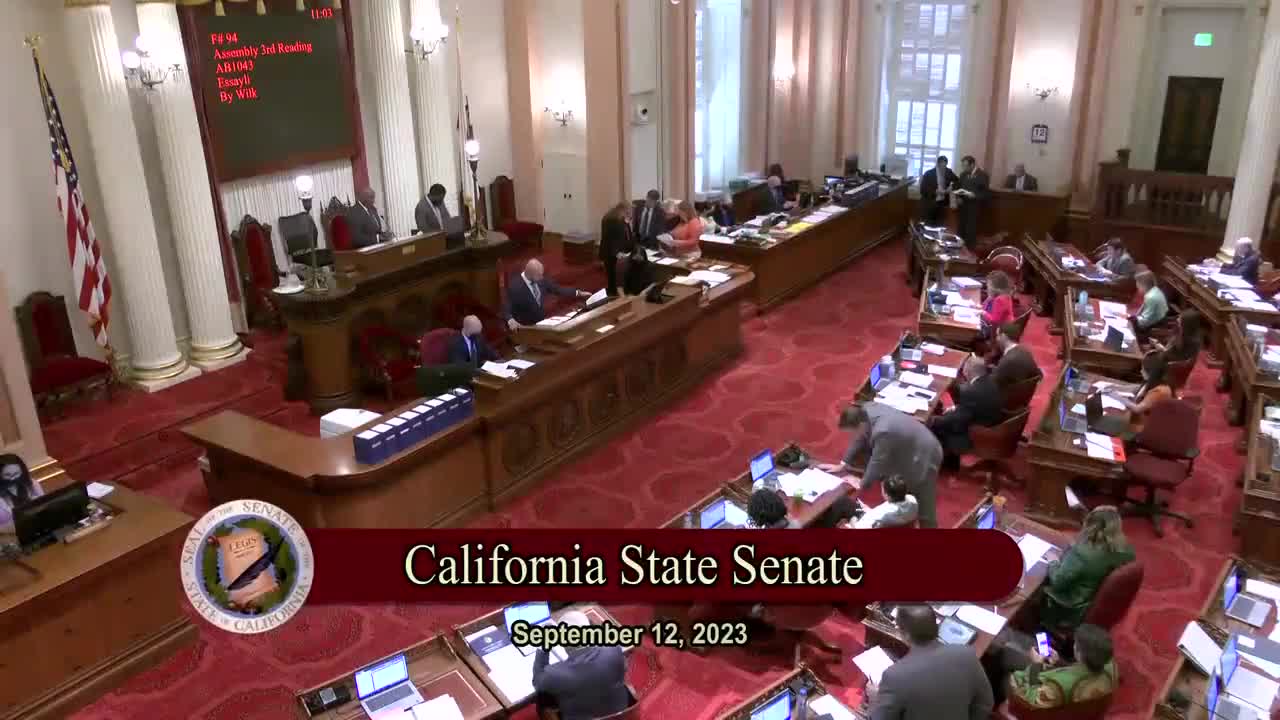 3MIN
Senate Floor
 2MIN
Senate Standing Committee on Appropriations
 22MIN
Senate Standing Committee on Environmental Quality
 13MIN
Assembly Floor
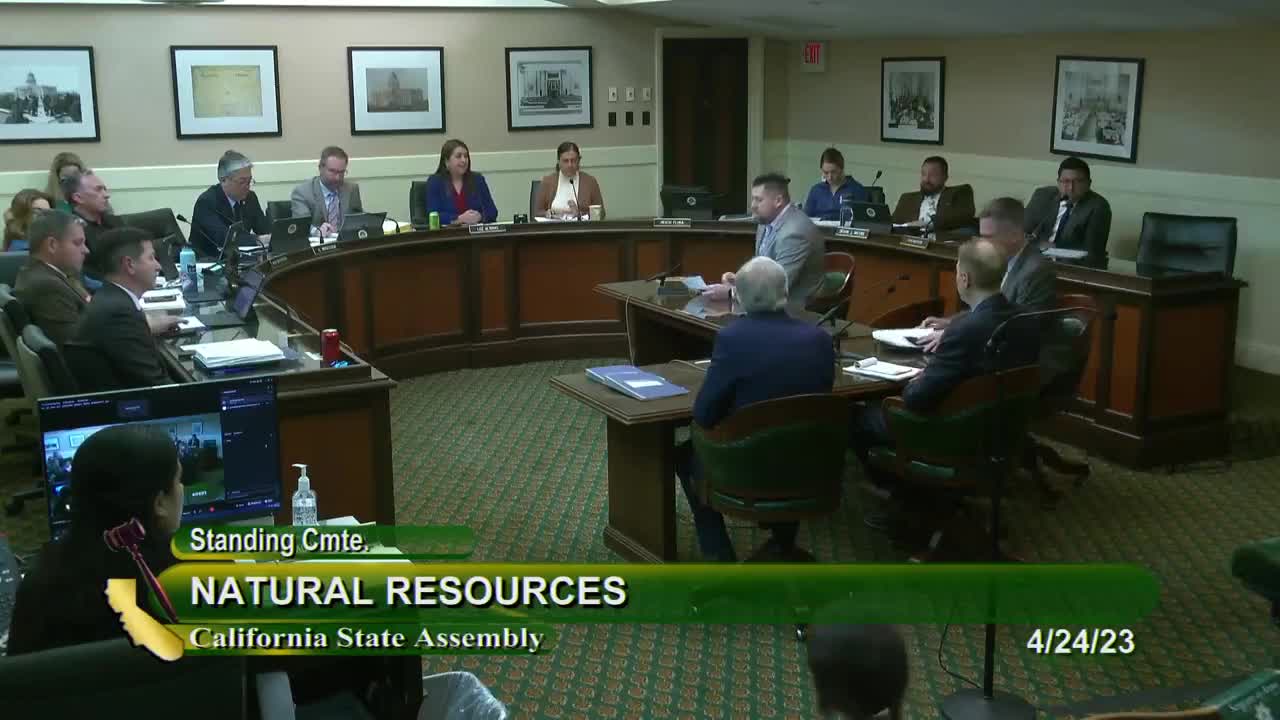 27MIN
Assembly Standing Committee on Natural Resources
Bill Author

Bill Co-Author(s):
