AB 98: Planning and zoning: logistics use: truck routes.
- Session Year: 2023-2024
- House: Assembly
- Latest Version Date: 2024-09-29
Current Status:
Passed
(2024-09-29: Chaptered by Secretary of State - Chapter 931, Statutes of 2024.)
Introduced
In Committee
First Chamber
In Committee
Second Chamber
Enacted
What does this bill do?
The bill sets statewide design, siting, and operational rules for new or expanded warehouses and logistics facilities and requires cities and counties to map truck routes to keep heavy trucks away from homes, schools, daycares, hospitals, and parks. It requires energy‑efficient, EV‑ready buildings (including charging and solar panels), skylights or efficient lighting, zero‑emission forklifts and small engines where feasible, buffers and minimum loading‑bay setbacks, anti‑idling signs, facility truck‑routing plans that operators must enforce, and directs the South Coast air district to deploy mobile monitors in parts of Riverside and San Bernardino and get community input on penalty spending.
The summary is provided by generative AI which can make mistakes. For original language, please view the details in the table below.
(1)Existing law, the Planning and Zoning Law, sets forth various requirements relating to the review of development project permit applications and the issuance of development permits for specified classes of development projects.
This bill, beginning January 1, 2026, would prescribe various statewide warehouse design and build standards for any proposed new or expanded logistics use developments, as specified, including, among other things, standards for building design and location, parking, truck loading bays, landscaping buffers, entry gates, and signage. The bill would except from those design and build standards certain existing logistics use developments, proposed expansions of a logistics use development, and property currently in a local entitlement process to become a logistics use, under prescribed conditions. The bill would require a facility operator, prior to the issuance of a certificate of occupancy, to establish and submit for approval by a city, county, or city and county a truck routing plan to and from the state highway system based on the latest truck route map of the city, county, or city and county, as prescribed. The bill would require a facility operator to enforce the plan. The bill would provide for the revision of the plan in specified circumstances.
The bill would prohibit a city, county, or city and county from approving development of a logistics use that does not meet or exceed the standards outlined in the bill. The bill would require a city, county, or city and county to condition approval of a logistics use on 2-to-1 replacement of any demolished housing unit that was occupied within the last 10 years unless the housing unit was declared substandard by a building official, as specified, and payments to displaced tenants if residential dwellings are affected through purchase, as prescribed. The bill would define terms for these purposes.
(2)The Planning and Zoning Law requires the legislative body of each county and city to adopt a comprehensive, long-term general plan for the physical development of the county or city and specified land outside its boundaries that includes, among other specified mandatory elements, a circulation element consisting of the general location and extent of existing and proposed major thoroughfares, transportation routes, terminals, any military airports and ports, and other local public utilities and facilities, all correlated with the land use element of the plan. Existing law requires, upon any substantive revision of the circulation element, that the legislative body modify the element to address specified additional issues.
This bill would require a county or city, by January 1, 2028, except as provided, to update its circulation element, as prescribed, including identifying and establishing specific travel routes for the transport of goods, materials, or freight for storage, transfer, or redistribution to safely accommodate additional truck traffic and avoid residential areas and concentrations of sensitive receptors, as defined. The bill would establish specific standards for truck routes. The bill would require a county or city to provide for posting of conspicuous signage to identify truck routes and additional signage for truck parking and appropriate idling facility locations. The bill would require a county or city to make truck routes publicly available and share maps of the truck routes with warehouse operators, fleet operators, and truck drivers. The bill would authorize the Attorney General to enforce these provisions, as provided, including by imposition of a fine of up to $50,000 every 6 months if the required updates have not been made.
(3)Existing law provides for the creation of the South Coast Air Quality Management District in those portions of the Counties of Los Angeles, Orange, Riverside, and San Bernardino included within the area of the South Coast Air Basin, as specified. Existing law provides that the south coast district is governed by a board consisting of 13 members and requires the district to adopt rules and regulations to carry out the south coast district air quality management plan that are not in conflict with state and federal laws and rules and regulations.
This bill would require the south coast district to establish a process for receiving community input on how any penalties assessed and collected for violation of the Warehouse Indirect Source Rule are spent, as specified. The bill would require the south coast district, subject to an appropriation for this express purpose, to, beginning on January 1, 2026, and until January 1, 2032, deploy mobile air monitoring systems within the Counties of Riverside and San Bernardino to collect air pollution measurements in communities that are near operational logistics use developments. The bill would require the south coast district to use the data collected to conduct an air modeling analysis to evaluate the impact of air pollution on sensitive receptors from logistics use development operations and to submit its findings to the Legislature on or before January 1, 2033. The bill would also require the district to submit an interim report to the Legislature on or before January 1, 2028, to evaluate the impact of air pollution on sensitive receptors, as defined, from logistics use development operations in the Counties of Riverside and San Bernardino, as provided.
(4)By modifying the duties of local agencies with regard to the approval of logistics use development and requiring the revision of the circulation element of a general plan, the bill would impose a state-mandated local program.
(5)The bill would include findings that changes proposed by this bill address a matter of statewide concern rather than a municipal affair and, therefore, apply to all cities, including charter cities.
(6)The California Constitution requires the state to reimburse local agencies and school districts for certain costs mandated by the state. Statutory provisions establish procedures for making that reimbursement.
This bill would provide that no reimbursement is required by this act for a specified reason.
Existing law provides procedures for the formation of pest abatement districts for the purpose of pest control or abatement. The Cotton Pests Abatement District Act authorizes the organization and establishment of cotton pests abatement districts by the boards of supervisors of the Counties of Imperial, Los Angeles, Orange, Riverside, San Bernardino, San Diego, and Ventura.This bill would remove the authority to establish these districts in the Counties of Orange, San Diego, and Ventura.Existing law provides procedures for the formation of pest abatement districts for the purpose of pest control or abatement. The Cotton Pests Abatement District Act authorizes the organization and establishment of cotton pests abatement districts by the boards of supervisors of the Counties of Imperial, Los Angeles, Orange, Riverside, San Bernardino, San Diego, and Ventura.
This bill would remove the authority to establish these districts in the Counties of Orange, San Diego, and Ventura.
As used in this chapter:
(a)21st century warehouse means a logistics use that meets all of the following:
(1)Complies with or exceeds all requirements of the most current building energy efficiency standards specified in Part 6 (commencing with Section 100) of Title 24 of the California Code of Regulations and the California Green Building Standards Code (Part 11 of Title 24 of the California Code of Regulations), including, but not limited to, the following requirements related to:
(A)Photovoltaic system installation and associated battery storage.
(B)Cool roofing.
(C)Medium- and heavy-duty vehicle charging readiness.
(D)Light-duty electric vehicle charging readiness and installed charging stations.
(2)Has skylights in at least 1 percent of the roof area, or equivalent LED efficient lighting.
(3)Provides conduits and electrical hookups at all loading bays serving cold storage. Idling or use of auxiliary truck engine power to power climate control equipment shall be prohibited if the truck is capable of plugging in at the loading bay.
(4)Ensures that any heating, ventilation, and air-conditioning is high-efficiency.
(5)(A)Ensures that all classes of forklifts used on site, pursuant to State Air Resources Boards Zero-Emission Forklifts regulation, as drafted, shall be zero-emission by January 1, 2030, to the extent operationally feasible, commercially off-the shelf available, and adequate power available on site.
(B)(i)If not operationally feasible, commercially off-the shelf available, or if there is inadequate power available on site, the cleanest technology commercially available shall be used.
(ii)Cost shall not be a factor in determining operational feasibility pursuant to this subparagraph.
(6)(A)Ensures that equipment used on site utilizing small off-road engines shall be zero-emission, to the extent operationally feasible, commercially off-the shelf available, and adequate power available on site.
(B)(i)If not operationally feasible, commercially off-the shelf available, or if there is inadequate power available on site, the cleanest technology commercially available shall be used.
(ii)Cost shall not be a factor in determining operational feasibility pursuant to this subparagraph.
(C)Should any equipment used on site utilizing small off-road engines be contracted out, the logistics use facility shall preferentially contract for services utilizing zero-emission small off-road engines.
(b)Expansion of an existing logistics use means the expansion of an existing logistics use by 20 percent or more of the existing square footage. Office space shall not be included as part of the existing square footage or in the square footage for the 20-percent expansion threshold.
(c)Heavy-duty truck means a class 7 or class 8 truck. As used in this subdivision:
(1)Class 7 truck means a truck with a gross vehicle weight rating of 26,001 to 33,000 pounds.
(2)Class 8 truck means a truck with a gross vehicle weight rating of greater than 33,000 pounds.
(d)Logistics use means a building in which cargo, goods, or products are moved or stored for later distribution to business or retail customers, or both, that does not predominantly serve retail customers for onsite purchases, and heavy-duty trucks are primarily involved in the movement of the cargo, goods, or products. Logistics use does not include any of the following:
(1)Facilities where food or household goods are sold directly to consumers and are accessible to the public.
(2)A building primarily served by rail to move cargo goods or product.
(3)(A)A Strategic Intermodal Facility.
(B)For purposes of this subdivision, Strategic Intermodal Facility means a project that satisfies all of the following requirements:
(i)Logistics facilities, including warehousing and transloading facilities, served by rail.
(ii)Intermodal freight transport services.
(iii)All facility structures and related rail operations are located within a single site footprint.
(e)Sensitive receptor means one or more of the following:
(1)A residence, including, but not limited to, a private home, apartment, condominium unit, group home, dormitory unit, or retirement home.
(2)A school, including, but not limited to, a preschool, prekindergarten, or school maintaining kindergarten or any of grades 1 to 12, inclusive.
(3)A daycare facility, including, but not limited to, in-home daycare.
(4)Publicly owned parks, playgrounds, and recreational areas or facilities primarily used by children, unless the development of the park and recreation areas are included as a condition of approval for the development of a logistics use.
(5)Nursing homes, long-term care facilities, hospices, convalescent facilities, or similar live-in housing.
(6)Hospitals, as defined in Section 128700 of the Health and Safety Code.
(f)Small off-road engines means spark-ignition engines rated at or below 19 kilowatts.
(g)Tier 1 21st century warehouse means a logistics use that meets all of the following:
(1)Complies with or exceeds all requirements of the most current building energy efficiency standards specified in Part 6 (commencing with Section 100) of Title 24 of the California Code of Regulations and the California Green Building Standards Code (Part 11 of Title 24 of the California Code of Regulations), including, but not limited to, the following requirements related to:
(A)(i)Photovoltaic system installation and associated battery storage.
(ii)For purposes of the photovoltaic system installation requirement in clause (i), all warehouse square footage should be considered conditioned space.
(B)Cool roofing.
(C)Medium- and heavy-duty vehicle charging readiness.
(D)Light-duty electric vehicle charging readiness and installed charging stations.
(2)Has skylights in at least one percent of the roof area, or equivalent LED efficient lighting.
(3)Has a microgrid-ready switchgear system capable of supporting distributed energy resources.
(4)Is advanced smart metering ready.
(5)Has a minimum of 50 percent of all passenger vehicle parking spaces preinstalled with conduit and all necessary physical infrastructure to support future charging of electric vehicles.
(6)Has a minimum of 10 percent of all passenger vehicle parking spaces installed with electric vehicle charging stations.
(7)Provides conduits and electrical hookups at all loading bays serving cold storage. Idling or use of auxiliary truck engine power to power climate control equipment shall be prohibited if the truck is capable of plugging in at the loading bay.
(8)Ensures that any heating, ventilation, and air-conditioning is high-efficiency.
(9)(A)Ensures that all classes of forklifts used on site, pursuant to State Air Resources Boards Zero-Emission Forklifts regulation, as drafted, shall be zero-emission by January 1, 2028, to the extent operationally feasible, commercially off-the shelf available, and adequate power available on site.
(B)(i)If not operationally feasible, commercially off-the shelf available, or if there is inadequate power available on site, the cleanest technology commercially available shall be used.
(ii)Cost shall not be a factor in determining operational feasibility pursuant to this subparagraph.
(10)(A)Ensures that equipment used on site utilizing small off-road engines shall be zero-emission, to the extent operationally feasible, commercially off-the shelf available, and adequate power available on site.
(B)(i)If not operationally feasible, commercially off-the shelf available, or if there is inadequate power available on site, the cleanest technology commercially available shall be used.
(ii)Cost shall not be a factor in determining operational feasibility pursuant to this subparagraph.
(C)Should any equipment used on site utilizing small off-road engines be contracted out, the logistics use facility shall preferentially contract for services utilizing zero-emission small off-road engines.
(h)Warehouse concentration region includes the Counties of Riverside and San Bernardino and the Cities of Chino, Colton, Fontana, Jurupa Valley, Moreno Valley, Ontario, Perris, Rancho Cucamonga, Redlands, Rialto, Riverside, and San Bernardino.
65098.1.(a)Commencing January 1, 2026, any proposed new or expanded logistics use development 250,000 square feet or more where the loading bay is within 900 feet of a sensitive receptor that is utilizing a site zoned for industrial use or any site where an application was submitted to the jurisdiction by September 30, 2024, to rezone as industrial and the rezone to industrial was ultimately approved shall comply with all of the following:
(1)Include all Tier 1 21st century warehouse design elements described in subdivision (g) of Section 65098.
(2)Orient truck loading bays on the opposite side of the logistics use development away from sensitive receptors, to the extent feasible.
(3)Locate truck loading bays a minimum of 300 feet from the property line of the nearest sensitive receptor to the nearest truck loading bay opening using a direct straight-line method.
(4)Have a separate entrance for heavy-duty trucks accessible via a truck route, arterial road, major thoroughfare, or a local road that predominantly serves commercial oriented uses.
(5)Locate truck entry, exit, and internal circulation away from sensitive receptors. Heavy-duty diesel truck drive aisles shall be prohibited from being used on sides of the building that are directly adjacent to a sensitive receptor property line.
(6)Include buffering and screening to mitigate for light and noise, as described in Section 65098.2.
(b)Commencing January 1, 2026, except as provided for in subdivision (c), any proposed new or expanded logistics use development that is on land that is not zoned industrial, whether developed or undeveloped, or land that needs to be rezoned, where the loading bay is within 900 feet of a sensitive receptor, shall comply with all of the following:
(1)If the logistics use development is 250,000 square feet or more it shall include all Tier 1 21st century warehouse design elements described in subdivision (g) of Section 65098. If the logistics use development is less than 250,000 square feet it shall include all 21st century warehouse design elements described in subdivision (a) of Section 65098.
(2)Orient truck loading bays on the opposite side of the logistics use development away from sensitive receptors, to the extent feasible.
(3)Locate truck loading bays a minimum of 500 feet from the property line of the nearest sensitive receptor to the nearest truck loading bay opening using a direct straight-line method.
(4)Have a separate entrance for heavy-duty trucks accessible via a truck route, arterial road, major thoroughfare, or a local road that predominantly serves commercial oriented uses.
(5)Locate truck entry, exit, and internal circulation away from sensitive receptors. Heavy-duty diesel truck drive aisles shall be prohibited from being used on sides of the building that are directly adjacent to a sensitive receptor property line.
(6)Include buffering and screening to mitigate for light and noise, as described in Section 65098.2.
(c)Commencing January 1, 2026, any proposed new or expanded logistics use development that is on land that is not zoned industrial, whether developed or undeveloped, or land that needs to be rezoned, and is located in the warehouse concentration region, shall comply with all of the following:
(1)If the logistics use development is 250,000 square feet or more it shall include all Tier 1 21st century warehouse design elements described in subdivision (g) of Section 65098. If the logistics use development is less than 250,000 square feet it shall include all 21st century warehouse design elements described in subdivision (a) of Section 65098.
(2)Orient truck loading bays on the opposite side of the logistics use development away from sensitive receptors, to the extent feasible.
(3)Locate truck loading bays a minimum of 500 feet from the property line of the nearest sensitive receptor to the nearest truck loading bay opening using a direct straight-line method.
(4)Have a separate entrance for heavy-duty trucks accessible via a truck route, arterial road, major thoroughfare, or a local road that predominantly serves commercial oriented uses.
(5)Locate truck entry, exit, and internal circulation away from sensitive receptors. Heavy-duty diesel truck drive aisles shall be prohibited from being used on sides of the building that are directly adjacent to a sensitive receptor property line.
(6)Include buffering and screening to mitigate for light and noise, as described in Section 65098.2.
(d)Commencing January 1, 2026, any proposed new or expanded logistics use development less than 250,000 square feet where the loading bay is within 900 feet of a sensitive receptor that is utilizing a site zoned for industrial use or any site where an application was submitted to the jurisdiction by September 30, 2024, to rezone as industrial and the rezone to industrial was ultimately approved shall comply with all of the following:
(1)Orient truck loading bays on the opposite side of the logistics use development away from sensitive receptors, to the extent feasible.
(2)Locate truck entry, exit, and internal circulation away from sensitive receptors. Heavy-duty diesel truck drive aisles shall be prohibited from being used on sides of the building that are directly adjacent to a sensitive receptor property line.
(3)Include buffering and screening to mitigate for light and noise, as described in Section 65098.2.
(4)Complies with or exceeds all requirements of the most current building energy efficiency standards specified in Part 6 (commencing with Section 100) of Title 24 of the California Code of Regulations and the California Green Building Standards Code (Part 11 of Title 24 of the California Code of Regulations), including, but not limited to, the following requirements related to:
(A)Photovoltaic system installation and associated battery storage.
(B)Cool roofing.
(C)Medium- and heavy-duty vehicle charging readiness.
(D)Light-duty electric vehicle charging readiness and installed charging stations.
(5)Provides conduits at loading bays equal to one truck per every loading bay serving cold storage. Idling or use of auxiliary truck engine power to power climate control equipment shall be prohibited if the truck is capable of plugging in at the loading bay.
(6)Ensures that any heating, ventilation, and air-conditioning is high-efficiency.
(7)Have a separate entrance for heavy-duty trucks accessible via a truck route, arterial road, major thoroughfare, or a local road that predominantly serves commercial oriented uses.
(e)(1)Except as provided in paragraph (2), on or before January 1, 2028, a city, county, or city and county shall update its circulation element to include truck routes, as specified in Section 65302.02.
(2)On or before January 1, 2026, all cities and counties in the warehouse concentration region shall update its circulation element to include truck routes, as specified in Section 65302.02.
65098.1.5.(a)(1)Notwithstanding any other provision of law, any existing logistics use development in existence as of September 30, 2024, shall not be subject to the requirements described in paragraph (3) of subdivision (a) of, paragraph (3) of subdivision (b) of, or paragraph (3) of subdivision (c) of Section 65098.1, as applicable, if a new sensitive receptor is constructed, established, or permitted after the effective date of this chapter.
(2)Notwithstanding any other provision of law, if, by September 30, 2024, a proposed expansion of a logistics use development is in a local entitlement process, then the proposed expansion shall not be subject to the requirements described in paragraph (3) of subdivision (a) of, paragraph (3) of subdivision (b) of, or paragraph (3) of subdivision (c) of Section 65098.1, as applicable, if a sensitive receptor is constructed, established, or permitted after the effective date of this chapter.
(3)Notwithstanding any other provision of law, if, by September 30, 2024, a property is currently in a local entitlement process to become a logistics use, then the proposed logistics use development shall not be subject to the requirements described in paragraph (3) of subdivision (a) of, paragraph (3) of subdivision (b) of, or paragraph (3) of subdivision (c) of Section 65098.1, as applicable, if a sensitive receptor is constructed, established, or permitted after the effective date of this chapter.
(b)(1)Any new logistics use developments that require the rezoning of land and must undergo a municipal entitlement process shall not be subject to the requirements described in paragraph (3) of subdivision (a) of, paragraph (3) of subdivision (b) of, or paragraph (3) of subdivision (c) of Section 65098.1, as applicable, if the start of the entitlement process for the logistics use began before any sensitive receptor started its own entitlement or permitting process, unless the proposed sensitive receptor was an existing allowable use according to local zoning regulations.
(2)During a logistics use developments entitlement process for a new or expanded logistics use, if a new sensitive receptor is proposed or established within the distances required by paragraph (3) of subdivision (a) of, paragraph (3) of subdivision (b) of, or paragraph (3) of subdivision (c) of Section 65098.1, as applicable, then those distance requirements shall not apply to the logistics use development so long as the logistics use development was not already subject to those requirements prior to the new sensitive receptor being proposed or established.
(c)This chapter shall not apply to any logistics projects that were subject to a commenced local entitlement process prior to September 30, 2024.
(d)The protection afforded by this section shall remain in effect from the time of the initial application submission through the completion of the entitlement process, including any necessary rezoning actions and through the development period. If no development activity occurs within five years of entitlement approvals, the protections shall be waived.
(e)This chapter shall not apply to a logistics project that received an approval by a local agency prior to the effective date of this chapter. For purposes of this subdivision, approval shall have the same meaning as set forth in subdivision (a) of Section 15352 of Chapter 3 of Division 6 of Title 14 of the California Code of Regulations.
65098.2.(a)Any new logistics use facility within 900 feet of a sensitive receptor shall have a buffer as follows:
(1)If the logistics use development is subject to the requirements of subdivision (a) or (d) of Section 65098.1, the buffer shall be 50 feet in width measured from the property line of all adjacent sensitive receptors that fully screen the project from the sensitive receptor.
(2)If the logistics use development is subject to either subdivision (b) or subdivision (c) of Section 65098.1, the buffer shall be 100 feet in width measured from the property line of all adjacent sensitive receptors that fully screen the project from the sensitive receptor.
(b)Buffer areas shall include a solid decorative wall, landscaped berm and wall, or landscaped berm 10 feet or more in height, drought tolerant natural ground landscaping with proper irrigation, and solid-screen buffering trees as described in subdivision (c).
(c)Trees shall be used as part of a solid-screen buffering treatment and planted in two rows along the length of the property line adjacent to the sensitive receptor. Trees used for this purpose shall be evergreen, drought tolerant, to the extent feasible, composed of species with low biogenic emissions, of a minimum 36-inch box size at planting, and spaced at no greater distance than 40 feet on center. Palm trees shall not be utilized.
65098.2.5.The entry gates into the loading truck court for a new or expanded logistics use facility shall be positioned after a minimum of 50 feet of total available stacking depth inside the property line. The stacking depth shall be increased by 70 feet for every 20 loading bays beyond 50 loading bays, to the extent feasible.
65098.2.7.(a)The purpose of this section is to ensure that logistics use developments, beginning January 1, 2026, are sited in locations that minimize adverse impacts on residential communities and enhance transportation efficiency. This is achieved by restricting logistics use development to roadways that are suited to handle the associated traffic and that predominantly serve commercial uses.
(b)(1)Any new logistics use development shall be sited on roadways that meet the following classifications:
(A)Arterial roads.
(B)Collector roads.
(C)Major thoroughfares.
(D)Local roads that predominantly serve commercial uses.
(2)For purposes of this chapter, local roads shall be considered to predominantly serve commercial uses if more than 50 percent of the properties fronting the road within 1000 feet are designed for commercial or industrial use according to the local zoning ordinance.
(c)A waiver may be granted where siting on the designated roadways pursuant to subdivision (b) is impractical due to unique geographic, economic, or infrastructure-related reasons. The waiver shall be approved by the city, county, or city and county, provided that the applicant demonstrates all of the following:
(1)There is no feasible alternative site that exists within the designated roadways.
(2)A traffic analysis has been completed and submitted to the local approving authority.
(3)The site is an existing industrial zone.
(4)The proposed site will incorporate mitigations to minimize traffic and environmental impacts on residential areas to the greatest extent feasible.
65098.3.(a)Anti-idling signs indicating a three-minute heavy-duty truck engine idling restriction shall be posted at logistics use developments along entrances to the site and at the truck loading bays.
(b)Signs shall be installed at all heavy-duty truck exit driveways directing truck drivers to the truck route as indicated in the truck routing plan, as described in Section 65098.4, and in the state highway system.
65098.4.Prior to the issuance of a certificate of occupancy, a facility operator shall establish and submit for approval to the planning director or equivalent position for the city, county, or city and county a truck routing plan to and from the state highway system based on the latest truck route map of the city, county, or city and county. The truck routing plan shall describe the operational characteristics of the use of the facility operator, including, but not limited to, hours of operation, types of items to be stored within the building, and proposed truck routing to and from the facility to designated truck routes that, to the greatest extent possible, avoid passing sensitive receptors. The truck routing plan shall include measures, such as signage and pavement markings, queuing analysis, and enforcement, for preventing truck queuing, circling, stopping, and parking on public streets. The facility operator shall be responsible for enforcement of the truck routing plan. A revised truck routing plan shall be submitted to the planning director or equivalent position prior to a business license being issued by the city, county, or city and county for any new tenant of the property. The planning director or equivalent position shall have discretion to determine if changes to the truck routing plan are necessary, including, but not limited to, any additional measures to alleviate truck routing and parking issues that may arise during the life of the facility.
65098.5.(a)A city, county, or city and county shall not approve development of a logistics use that does not meet or exceed the standards outlined in this chapter.
(b)This section shall not be construed to restrict the existing authority of a city, county, or city and county to deny a logistics use facility altogether.
65098.6.A city, county, or city and county shall condition approval of a logistics use on the following:
(a)Two-to-one replacement of any demolished housing unit that was occupied within the last 10 years, unless the housing unit was declared substandard by a building official, pursuant to Section 17920.3 of the Health and Safety Code, prior to purchase by the developer. For each housing unit demolished, regardless of market value of the unit, two units of affordable housing for persons and families of low or moderate income, as defined in Section 50093 of the Health and Safety Code, that are deed-restricted shall be built within the jurisdiction. Funds from any fee imposed for the replacement of demolished housing units shall be placed in a housing-specific set-aside account and shall be used for housing within three years of collection.
(b)If residential dwellings are affected through purchase, the developer shall be required to provide any displaced tenant with an amount equivalent to 12 months rent at the current rate.
65098.7.Nothing in this chapter shall be construed to supersede mitigation measures required by the California Environmental Quality Act (Division 13 (commencing with Section 21000) of the Public Resources Code).
65098.8.The Legislature finds and declares that the movement and storage of freight and the impact of this activity on public health and communities across the state as set forth in this chapter is a matter of statewide concern and is not a municipal affair as that term is used in Section 5 of Article XI of the California Constitution. Therefore, this chapter applies to all cities, including charter cities.
65098.9.The provisions of this chapter shall not apply to a logistics use development if it meets both of the following:
(a)The logistics use development is a mixed-use development that may create sensitive receptors on the site of the new logistics use development.
(b)There are no existing sensitive receptors within 900 feet of the loading bay.
SEC. 2.Section 65302.02 is added to the Government Code, to read:65302.02.By January 1, 2028, except as provided for in subdivision (h), a county or city shall update its circulation element, as required by subdivision (b) of Section 65302, to do all of the following:
(a)Identify and establish specific travel routes for the transport of goods, materials, or freight for storage, transfer, or redistribution to safely accommodate additional truck traffic and avoid residential areas and sensitive receptors, as defined by Section 65098.
(b)Maximize the use of interstate or state divided highways as preferred routes for truck routes. The county or city shall also maximize use of arterial roads, major thoroughfares, and predominantly commercially oriented local streets when state or interstate highways are not utilized. Truck routes shall comply with the following:
(1)Major or minor collector streets and roads that predominantly serve commercially oriented uses shall be used for truck routes only when strictly necessary to reach existing industrial zones.
(2)Trucks shall be routed via transportation arteries that minimize exposure to sensitive receptors.
(3)On and after January 1, 2028, all proposed development of a logistics use development, as defined in subdivision (d) of Section 65098, shall be accessible via arterial roads, major thoroughfares, or roads that predominantly serve commercially oriented uses.
(A)The purpose of this section is to ensure that logistics use developments are sited in locations that minimize adverse impacts on residential communities and enhance transportation efficiency. This is achieved by restricting logistics use developments to roadways that are suited to handle the associated traffic and that predominantly serve commercial uses.
(B)For purposes of this section, local roads shall be considered to predominantly serve commercial uses if more than 50 percent of the properties fronting the road within 1000 feet are designated for commercial or industrial use according to the local zoning ordinance.
(c)The county or city may consult with the Department of Transportation and the California Freight Advisory Committee for technical assistance.
(d)The county or city shall provide for posting of conspicuous signage to identify truck routes and additional signage for truck parking and appropriate idling facility locations.
(e)The county or city shall make truck routes publicly available in geographic information system (GIS) format and share GIS maps of the truck routes with warehouse operators, fleet operators, and truck drivers.
(f)The city or county shall provide opportunities for the involvement of citizens, California Native American Indian tribes, public agencies, public utility companies, and civic, educational, and other community groups through public hearings and any other means the planning agency deems appropriate, consistent with Section 65351.
(g)The city or county shall make a diligent effort to achieve public participation of all economic segments of the community in the development of the changes required pursuant to this section.
(h)The warehouse concentration region, as defined in Section 65098, shall implement the provisions of this section by January 1, 2026.
(i)The Attorney General may enforce this section.
(1)The Attorney General may impose a fine against a jurisdiction that is in violation of this section of up to fifty thousand dollars ($50,000) every six months if the required updates have not been made.
(2)Upon appropriation by the Legislature, any fines collected shall be distributed by the Attorney General and returned to the local air quality management district in which the fine was imposed and be used for the districts efforts to improve air quality.
SEC. 3.Section 40458.5 is added to the Health and Safety Code, to read:40458.5.(a)Subject to an appropriation for this express purpose, the south coast district shall, beginning on January 1, 2026, and until January 1, 2032, deploy mobile air monitoring systems within the Counties of Riverside and San Bernardino to collect air pollution measurements in communities that are near operational logistics use developments.
(b)The south coast district shall use the data collected pursuant to subdivision (a) to conduct an air modeling analysis to evaluate the impact of air pollution on sensitive receptors, as defined in Section 65098 of the Government Code, from logistics use development operations in the Counties of Riverside and San Bernardino, including relative pollution concentrations from logistics use developments at varying distances from sensitive receptors.
(c)The south coast district shall submit its findings to the Legislature on or before January 1, 2033. On or before January 1, 2028, the south coast district shall submit an interim report to evaluate the impact of air pollution on sensitive receptors, as defined in Section 65098 of the Government Code, from logistics use development operations in the Counties of Riverside and San Bernardino, including relative pollution concentrations from logistics use developments at varying distances from sensitive receptors. This report shall be used to assess the effectiveness of setbacks on public health.
(d)(1)The requirement for submitting a report imposed pursuant to subdivision (c) is inoperative on January 1, 2040, pursuant to Section 10231.5 of the Government Code.
(2)A report to be submitted pursuant to subdivision (c) shall be submitted in compliance with Section 9795 of the Government Code.
SEC. 4.Section 40522.7 is added to the Health and Safety Code, to read:40522.7.The south coast district shall establish a process for receiving community input on how any penalties assessed and collected for violations of the Warehouse Indirect Source Rule are spent. The south coast district shall ensure a wide range of community groups are included in the process and that groups represent the geographic areas where there are high numbers of warehouse facilities.
SEC. 5.No reimbursement is required by this act pursuant to Section 6 of Article XIIIB of the California Constitution because a local agency or school district has the authority to levy service charges, fees, or assessments sufficient to pay for the program or level of service mandated by this act, within the meaning of Section 17556 of the Government Code.
SECTION 1.Section 6051 of the Food and Agricultural Code is amended to read:6051.(a)Cotton pests abatement districts may be organized and established by the boards of supervisors of the Counties of Imperial, Los Angeles, Riverside, and San Bernardino, pursuant to the provisions of this chapter, and may exercise the powers expressly granted, or necessarily implied, by those provisions. (b)The cotton pests abatement district may include land in more than one of the counties listed in this section with the consent of the boards of supervisors of the counties affected. The county that includes the majority of acreage in the district shall be designated the principal county. The agricultural commissioner and county officers in the principal county shall perform the acts required by the provisions of this chapter. District funds shall be deposited in the treasury of the principal county.(c)Chapter 6.6 (commencing with Section 54773) of Part 1 of Division 2 of the Government Code and the District Reorganization Act of 1965 do not apply to cotton pests abatement districts organized pursuant to this chapter.(a)Cotton pests abatement districts may be organized and established by the board boards of supervisors of the Counties of Imperial, Los Angeles, Orange, Riverside, and San Bernardino, San Diego, and Ventura, pursuant to the provisions of this chapter, and may exercise the powers expressly granted, or necessarily implied, by those provisions.
The(b)The cotton pests abatement district may include land in more than one of the counties listed in this section with the consent of the board boards of supervisors of the counties affected. The county which that includes the majority of acreage in the district shall be designated the principal county. The agricultural commissioner and county officers in the principal county shall perform the acts required by the provisions of this chapter. District funds shall be deposited in the treasury of the principal county.
Chapter(c)Chapter 6.6 (commencing with Section 54773) of Part 1 of Division 2 of the Government Code and the District Reorganization Act of 1965 do not apply to cotton pests abatement districts organized pursuant to this chapter.
|
Date
|
Status
|
|---|---|
| Sep 29, 2024 | Chaptered by Secretary of State - Chapter 931, Statutes of 2024. |
| Sep 29, 2024 | Approved by the Governor. |
| Sep 12, 2024 | Enrolled and presented to the Governor at 4 p.m. |
| Aug 31, 2024 | Senate amendments concurred in. To Engrossing and Enrolling. (Ayes 46. Noes 17.). |
| Aug 31, 2024 | In Assembly. Concurrence in Senate amendments pending. |
| Aug 31, 2024 | Read third time. Passed. Ordered to the Assembly. (Ayes 22. Noes 16.). |
| Aug 30, 2024 | Read second time. Ordered to third reading. |
| Aug 30, 2024 | From committee: Do pass. (Ayes 5. Noes 1.) (August 30). |
| Aug 29, 2024 | From committee: Do pass and re-refer to Com. on APPR. (Ayes 4. Noes 2.) (August 29). Re-referred to Com. on APPR. |
| Aug 28, 2024 | Read third time and amended. Ordered to second reading. |
| Aug 28, 2024 | Re-referred to Com. on RLS pursuant to Senate Rule 29.10(c). |
| Aug 28, 2024 | Re-referred to Com. on L. GOV. |
| Aug 28, 2024 | Joint Rules 61 and 62(a) suspended. (Ayes 31. Noes 9.) |
| Aug 21, 2024 | Read second time. Ordered to third reading. |
| Aug 20, 2024 | Ordered to second reading. |
| Aug 20, 2024 | From inactive file. |
| Jun 27, 2023 | Ordered to inactive file at the request of Senator McGuire. |
| Jun 27, 2023 | From Consent Calendar. |
| Jun 22, 2023 | Read second time. Ordered to Consent Calendar. |
| Jun 21, 2023 | From committee: Do pass. To Consent Calendar. (Ayes 8. Noes 0.) (June 21). |
| May 3, 2023 | Referred to Com. on GOV. & F. |
| Mar 23, 2023 | In Senate. Read first time. To Com. on RLS. for assignment. |
| Mar 23, 2023 | Read third time. Passed. Ordered to the Senate. (Ayes 74. Noes 0. Page 891.) |
| Mar 20, 2023 | Read second time. Ordered to Consent Calendar. |
| Mar 16, 2023 | From committee: Do pass. To Consent Calendar. (Ayes 8. Noes 0.) (March 15). |
| Jan 26, 2023 | Referred to Com. on AGRI. |
| Jan 10, 2023 | From printer. May be heard in committee February 9. |
| Jan 9, 2023 | Read first time. To print. |
|
Date
|
Description
|
Location
|
Votes
|
|
|---|---|---|---|---|
| Aug 31, 2024 | AB 98 Juan Carrillo Concurrence in Senate Amendments | Assembly Floor |
Passed |
|
| Aug 31, 2024 | AB 98 Juan Carrillo Concurrence in Senate Amendments Move The Previous Question By AGUIAR-CURRY | Assembly Floor |
Passed |
|
| Aug 31, 2024 | Assembly 3rd Reading AB98 Juan Carrillo et al. By Limón | Senate Floor |
Passed |
|
| Aug 30, 2024 | Do pass | Senate Standing Committee on Appropriations |
Passed |
|
| Aug 29, 2024 | Do pass, but first be re-referred to the Committee on [Appropriations] | Senate Standing Committee on Local Government |
Passed |
|
| Jun 21, 2023 | Do pass and be ordered to the Consent Calendar | Senate Standing Committee on Governance and Finance |
Passed |
|
| Mar 23, 2023 | AB 98 Aguiar-Curry Consent Calendar Second Day Regular Session | Assembly Floor |
Passed |
|
| Mar 15, 2023 | Do pass. To Consent Calendar. | Assembly Standing Committee on Agriculture |
Passed |
This list shows positions taken on this bill by organizations on the date displayed, which is linked to the original source.
Positions by individuals are not included.
|
Organization
|
Position
|
Date
|
|---|---|---|
| Active San Gabriel Valley | ** Against | |
| Air Quality Monitoring and Exposure Lab | ** Against | |
| Alliance for Community Empowerment | ** Against | |
| Alliance Of Californians For Community Empowerment | ** Against | |
| American Planning Association, California Chapter | ** Against | |
| Associated General Contractors Of California | ** Support | |
| Associated General Contractors-San Diego Chapter | ** Support | |
| Atmospheric Modeling Lab | ** Against | |
| Building Owners and Managers Association of California | ** Against | |
| California Association For Local Economic Development | ** Against | |
| California Building Officials | ** Against | |
| California Business Properties Association | ** Against | |
| California Business Roundtable | ** Against | |
| California Environmental Justice Alliance Action | ** Against | |
| California Federation of Labor Unions, Afl-cio | ** Support | |
| California Federation Of Teachers | ** Support | |
| California Grocers Association | ** Against | |
| California Hispanic Chamber Of Commerce | ** Against | |
| California Hospital Association | ** Support | |
| California Manufacturers & Technology Association | ** Against | |
| California Nurses Association | ** Support | |
| California State Association Of Counties | ** Against | |
| California State Council Of Laborers | ** Support | |
| California Taxpayers Association | ** Against | |
| California Teachers Association | ** Support | |
| Can Manufacturers Institute | ** Against | |
| Center for Community Action & Environmental Justice | ** Against | |
| Center on Race, Poverty & the Environment | ** Against | |
| Central California Asthma Collaborative | ** Against | |
| Central California Environmental Justice Network | ** Against | |
| Central Valley Air Quality Coalition | ** Against | |
| City of Bakersfield | ** Against | |
| City Of Beaumont | ** Against | |
| City of Chino | ** Against | |
| City of Colton | ** Against | |
| City of Corona | ** Against | |
| city of Cypress | ** Against | |
| City Of Eastvale | ** Against | |
| City of Fontana | ** Against | |
| City of Gustine | ** Against | |
| City of Hesperia | ** Against | |
| City of Indio | ** Against | |
| City Of Inglewood | ** Against | |
| City of Kernan | ** Against | |
| City of Lakewood | ** Against | |
| City Of Merced | ** Against | |
| City Of Oakley | ** Against | |
| City Of Ontario | ** Against | |
| City of Pico Rivera | ** Against | |
| City of Rancho Cucamonga | ** Against | |
| City of Rocklin | ** Against | |
| City of Roseville | ** Against | |
| City Of San Bernardino | ** Against | |
| City Of San Diego | ** Against | |
| City of Shafter | ** Against | |
| City of Stockton | ** Against | |
| City Of Visalia | ** Against | |
| City of Woodland | ** Against | |
| Clean Water Action | ** Against | |
| cleanearth4kids.org | ** Against | |
| Communities for a Better Environment | ** Against | |
| Community Alliance With Family Farmers | ** Against | |
| Concerned Neighbors of Bloomington | ** Against | |
| County Of Kern | ** Against | |
| County Of Placer | ** Against | |
| county of sacramento | ** Against | |
| County of San Bernardino | ** Against | |
| County of Tulare | ** Against | |
| Cultiva La Salud | ** Against | |
| Decolonial Praxis Collective | ** Against | |
| Earthjustice | ** Against | |
| East Yard Communities for Environmental Justice | ** Against | |
| Environmental Justice Coalition for Water | ** Against | |
| Faith in the Valley | ** Against | |
| Family Business Association of California | ** Against | |
| fresno building healthy communities | ** Against | |
| friends of calwa | ** Against | |
| Greenhouse Gas Emissions Lab | ** Against | |
| Inland Empire Economic Partnership | ** Against | |
| Inland Valley Alliance for Environmental Justice | ** Against | |
| Invest Fresno | ** Against | |
| Leadership Counsel for Justice and Accountability | ** Against | |
| League Of California Cities | ** Against | |
| Los Angeles Area Chamber Of Commerce | ** Against | |
| Mead Valley Coalition for Clean Air | ** Against | |
| Naiop California | ** Against | |
| National Federation of Small Business | ** Against | |
| Orange County Business Council | ** Against | |
| People's Collective for Environmental Justice | ** Against | |
| People’s Collective for Environmental Justice | ** Against | |
| Perris Neighbors in Action | ** Against | |
| Physicians for Social Responsibility - Los Angeles | ** Against | |
| Planning And Conservation League | ** Against | |
| Powerca Action | ** Against | |
| Public Health Institute | ** Against | |
| Real Estate Development Associates | ** Against | |
| Riverside Neighbors Opposing Warehouses | ** Against | |
| Rural County Representatives of California | ** Against | |
| San Joaquin County Board of Supervisors | ** Against | |
| san joaquin partnership | ** Against | |
| See | ** Against | |
| Several individuals | ** Against | |
| Sierra Club | ** Against | |
| Southern California Contractors Association | ** Support | |
| Southern California Leadership Council | ** Against | |
| The Institute of Real Estate Management | ** Against | |
| Town of Apple Valley | ** Against | |
| Unite for Colton | ** Against | |
| United Domestic Workers/AFSCME, Local 3930 | ** Support | |
| United Food And Commercial Workers, Western States Council | ** Support | |
| United Nurses Association of California | ** Support | |
| Urban Counties of California | ** Against | |
| Valley Improvement Projects | ** Against | |
| Warehouse Worker Resource Center | ** Against |
SENATE RULES COMMITTEE Office of Senate Floor Analyses (916) 651-1520 Fax: (916) 327-4478 | AB 98 |
THIRD READING
Bill No: AB 98
Author: Juan Carrillo (D) and Reyes (D)
Amended: 8/28/24 in Senate
Vote: 21
SENATE LOCAL GOVERNMENT COMMITTEE: 4-2, 8/29/24
AYES: Durazo, Skinner, Wahab, Wiener
NOES: Seyarto, Dahle
NO VOTE RECORDED: Glazer
SENATE APPROPRIATIONS COMMITTEE: 5-1, 8/30/24
AYES: Caballero, Ashby, Becker, Bradford, Wahab
NOES: Seyarto
NO VOTE RECORDED: Jones
SUBJECT: Planning and zoning: logistics use: truck routes
SOURCE: Author
DIGEST:
This bill prohibits, commencing January 1, 2026, cities and counties from approving new or expanded logistics uses unless they meet specified standards, requires cities and counties to update their circulation elements to include truck routes, and imposes study requirements on the South Coast Air Quality Management District (AQMD).
Senate Floor Amendments of 8/28/24 delete the contents of the bill and insert the current provisions pertaining to logistics uses.
ANALYSIS:
Existing law:
- Allows a city or a county to “make and enforce within its limits, all local, police, sanitary and other ordinances and regulations not in conflict with general laws.” It is from this fundamental power (commonly called the police power) that cities and counties derive their authority to regulate behavior to preserve the health, safety, and welfare of the public, including land use authority.
- Requires, pursuant to Planning and Zoning Law, every city and county to adopt a general plan that sets out planned uses for all of the area covered by the plan, and requires the general plan to include seven mandatory elements, including a circulation element consisting of the general location and extent of existing and proposed major thoroughfares, transportation routes, terminals, any military airports and ports, and other local public utilities and facilities.
- Requires, pursuant to the California Environmental Quality Act (CEQA) lead agencies with the principal responsibility for carrying out or approving a proposed project to prepare a negative declaration, mitigated negative declaration, or an environmental impact report (EIR) for this action, unless the project is exempt from CEQA.
This bill establishes standards that new or expanded logistics uses must meet beginning January 1, 2026, requires cities and counties to update their circulation elements to include truck routes, and imposes study requirements on the South Coast AQMD. Specifically, this bill:
- Prohibits, commencing January 1, 2026, a local agency from approving development of a logistics use that does not meet or exceed specified standards, described below.
- Defines the following terms:
- “Logistics use” to mean a building in which cargo, goods, or products are moved or stored for later distribution to business or retail customers, or both, that does not predominantly serve retail customers for onsite purchases, and heavy-duty trucks are primarily involved in the movement of the cargo, goods, or products, with specified exceptions.
- “Sensitive receptors” are defined to mean a residence, school, daycare facility, recreational facilities primarily used by children, nursing homes and similar facilities, and hospitals.
- “Warehouse concentration region” (WCR) to include the Counties of San Bernardino and the Cities of Chino, Colton, Fontana, Jurupa Valley, Moreno Valley, Ontario, Perris, Rancho Cucamonga, Redlands, Rialto, Riverside, and San Bernardino.
- Establishes siting criteria:
- Requires any new logistics use development must be sited on roadways that meet the following classifications:
- Arterial roads;
- Collector roads;
- Major thoroughfares; or
- Local roads that predominantly serve commercial uses, which mean 50 percent of the properties fronting the road within 1,000 feet are designed for commercial or industrial use according to the local zoning ordinance.
- However, a waiver may be granted where siting on these roadways is impractical due to unique geographic, economic, or infrastructure-related reasons. The waiver shall be approved by the city, county, or city and county, provided that the applicant demonstrates all of the following:
- There is no feasible alternative site that exists within the designated roadways;
- A traffic analysis has been completed and submitted to the local approving authority;
- The site is an existing industrial zone; and
- The proposed site will incorporate mitigations to minimize traffic and environmental impacts on residential areas to the greatest extent feasible.
- Requires any new logistics use development must be sited on roadways that meet the following classifications:
- Establishes requirements for buffers:
- Any new logistics use facility within 900 feet of a sensitive receptor must include a buffer that fully screens all adjacent sensitive receptors and include a solid decorative wall, landscaped berm and wall, or landscaped berm 10 or more feet in height, drought tolerant natural ground landscaping with proper irrigation, and specified types of trees (excluding palm trees) planted in two rows along the length of the property line with specified spacing. The buffer must meet the following widths, measured from the property line of all adjacent sensitive receptors:
- 50 feet if the logistics use is located in an industrial area; or
- 100 feet if the logistics use is located in a non-industrial area.
- Any new logistics use facility within 900 feet of a sensitive receptor must include a buffer that fully screens all adjacent sensitive receptors and include a solid decorative wall, landscaped berm and wall, or landscaped berm 10 or more feet in height, drought tolerant natural ground landscaping with proper irrigation, and specified types of trees (excluding palm trees) planted in two rows along the length of the property line with specified spacing. The buffer must meet the following widths, measured from the property line of all adjacent sensitive receptors:
- Requires new or expanded logistics uses to meet certain requirements for setbacks from sensitive receptors, design and construction standards, and electrification requirements, as follows:
- Requires new “Tier 1 21st Century warehouse standards” (Tier 1 standards) and a less stringent set of “21st century warehouse standards” (base standards), as specified.
- Requires, for new or expanded logistics uses that have a loading bay within 900 feet of a sensitive receptor and are located on industrial land (whether in the WCR or not):
- A logistics use that includes 250,000 or more square feet must have loading bays set back at least 300 feet from the property line of the nearest sensitive receptor and meet Tier 1 standards.
- Smaller logistics uses have no setback requirement and must meet a set of standards that incorporate some, but not all of the requirements in the base standards, specifically no requirement for zero emissions forklifts, and the conduit at loading bays must be equal to one truck per every loading bay serving cold storage.
- For new or expanded logistics uses that have a loading bay within 900 feet of a sensitive receptor and are located on non-industrial land, as specified, loading bays must be set back 500 feet from the property line of the nearest sensitive receptor. If the use is 250,000 square feet or more, it must meet the Tier 1 standards, or the base standards if smaller than that.
- If the use is located in the WCR, all new or expanded logistics uses on nonindustrial land, regardless of whether there are sensitive receptors within 900 feet, must have a 500-foot setback. If the use is 250,000 square feet or more, the Tier 1 standards apply; if below that, then the base standards apply. Logistics uses on industrial land in the WCR are treated the same as uses on industrial land in the rest of the state.
- Requires all logistics uses subject to any of the above requirements must also meet the following design standards:
- Orient truck loading bays on the opposite side of the logistics use development away from sensitive receptors, to the extent feasible;
- Have a separate entrance for heavy-duty trucks accessible via a truck route, arterial road, major thoroughfare, or a local road that predominantly serves commercial oriented uses;
- Locate truck entry, exit, and internal circulation away from sensitive receptors. Heavy-duty diesel truck drive aisles shall be prohibited from being used on sides of the building that are directly adjacent to a sensitive receptor property line.
- All new or expanded logistics uses, regardless of size or location, must position entry gates into the loading truck court after a minimum of 40 feet of total available stacking depth inside the property line. This stacking depth must be increased by 70 feet for every 20 loading bays beyond 50 loading bays to the extent feasible.
- Requires two new units of affordable housing for each unit of housing demolished to build a logistics use, as specified, and if residential dwellings are affected through purchase, the developer must provide any displaced tenant with an amount equivalent to 12 months’ rent at the current rate.
- Requires submission of a truck routing plan, as follows:
- Prior to the issuance of a certificate of occupancy, a facility operator must establish and submit for approval to the planning director or equivalent position for the city or county a truck routing plan, as specified, to and from the state highway system based on the latest truck route map of the city or county.
- Exempts from the above requirements any logistics projects that:
- Are subject to a commenced local entitlement process prior to September 30, 2024;
- Receive an approval by a local agency prior to the effective date of the bill; or
- Are a mixed use development that may create sensitive receptors on the site of the new logistics use development, and there are no existing sensitive receptors within 900 feet of the loading bay.
- Exempts from the setback requirements (but not the other requirements of the bill) any of the following developments even if a new sensitive receptor is constructed, permitted, or established after the bill goes into effect:
- Any logistics use development already in existence as of September 30, 2024;
- Development of a property for a logistics use or a proposed expansion of a logistics use that is in the entitlement process as of September 30, 2024;
- New logistics use developments that require rezoning of land, if the start of the entitlement process for the logistics use began before any sensitive receptor started its own entitlement process, unless the proposed sensitive receptor was an existing allowable use according to local zoning regulations;
- A logistics use in the entitlement process if it wasn’t already subject to the setback requirements because of the presence of a sensitive receptor.
- Provides that the bill does not supersede mitigation measures required by CEQA, and does not affect the ability of a local government to deny a logistics use.
- Requires changes to the circulation element of a general plan, as follows:
- Requires cities and counties to update their circulation elements to include the following requirements regarding truck routes. Cities and counties in the WCZ must update their circulation elements by January 1, 2026; all remaining cities and counties have an additional two years, until January 1, 2028.
- The update to the circulation element must do all of the following:
- Identify and establish specific travel routes for the transport of goods, materials, or freight for storage, transfer, or redistribution to safely accommodate additional truck traffic and avoid residential areas and sensitive receptors; and
- Maximize the use of interstate or state divided highways as preferred routes for truck routes. The county or city must also maximize use of arterial roads, major thoroughfares, and predominantly commercially oriented local streets when state or interstate highways are not utilized.
- Requires truck routes to comply with the following:
- Major or minor collector streets and roads that predominantly serve commercially oriented uses must be used for truck routes only when strictly necessary to reach existing industrial zones;
- Trucks must be routed via transportation arteries that minimize exposure to sensitive receptors; and
- On and after January 1, 2028, all proposed development of a logistics use development must be accessible via arterial roads, major thoroughfares, or roads that predominantly serve commercially oriented uses. For purposes of the circulation element, local roads shall be considered to predominantly serve commercial uses if more than 50 percent of the properties fronting the road within 1,000 feet are designated for commercial or industrial use according to the local zoning ordinance.
- Requires a county or city to:
- Provide for posting of conspicuous signage to identify truck routes and additional signage for truck parking and appropriate idling facility locations;
- Make truck routes publicly available in geographic information system (GIS) format and share GIS maps of the truck routes with warehouse operators, fleet operators, and truck drivers;
- Include public participation as specified.
- Allows the Attorney General to enforce the circulation element requirements and subjects a city or county that fails to comply to a penalty of up to $50,000 every six months if the required updates have not been made. Upon appropriation by the Legislature, any fines collected must be distributed by the Attorney General and returned to the local AQMD in which the fine was imposed and be used for the district’s efforts to improve air quality.
- Anti-idling signs indicating a three-minute heavy-duty truck engine idling restriction must be posted at logistics use developments along entrances to the site and at the truck loading bays. These signs must be installed at all heavy-duty truck exit driveways directing truck drivers to the truck route as indicated in the truck routing plan and in the state highway system.
- Subject to an appropriation for this express purpose, requires South Coast AQMD, beginning on January 1, 2026, and until January 1, 2032, deploy mobile air monitoring systems within the Counties of Riverside and San Bernardino to collect air pollution measurements in communities that are near operational logistics use developments.
- Requires South Coast AQMD to use the data collected to conduct an air modeling analysis to evaluate the impact of air pollution on sensitive receptors from logistics use development operations in the Counties of Riverside and San Bernardino, including relative pollution concentrations from logistics use developments at varying distances from sensitive receptors.
- Requires South Coast AQMD to submit its findings to the Legislature on or before January 1, 2033, and on or before January 1, 2028, it must submit an interim report. This report must be used to assess the effectiveness of setbacks on public health.
- Requires South Coast AQMD to establish a process for receiving community input on how any penalties assessed and collected for violations of the Warehouse Indirect Source Rule are spent. The South Coast AQMD must ensure a wide range of community groups are included in the process and that groups represent the geographic areas where there are high numbers of warehouse facilities.
- Defines additional terms and includes findings and declarations to support its purposes.
Background
Warehouses and other logistics uses. The proliferation of e-commerce and consumer expectations for rapid shipping contributed to a boom in warehouse development in California. The Environmental Justice Bureau at the California Attorney General’s Office notes that in the Inland Empire alone, 150 million square feet of new industrial space was developed from 2009-2019, and that 21 of the largest 100 logistics leases signed in 2019 were located in the Inland Empire.
Warehouse impacts. Numerous studies have correlated the presence of warehouses with negative health effects on nearby communities, due primarily to the truck traffic associated with the warehouses. Under Attorney General Xavier Becerra, the Office of the Attorney General (OAG) adopted a guidance memo titled Warehouse Projects: Best Practices and Mitigation Measures to Comply with the California Environmental Quality Act. The memo notes: “among other pollutants, diesel trucks visiting warehouses emit nitrogen oxide (NOx)—a primary precursor to smog formation and a significant factor in the development of respiratory problems like asthma, bronchitis, and lung irritation—and diesel particulate matter (a subset of fine particular matter that is smaller than 2.5 micrometers)—a contributor to cancer, heart disease, respiratory illnesses, and premature death. Trucks and on-site loading activities can also be loud, bringing disruptive noise levels during 24/7 operation that can cause hearing damage after prolonged exposure.”
A staff report from the South Coast Air Quality Management District (South Coast AQMD) analyzed the impacts of warehouses at different distances and found that:
- Communities within ½ mile of large warehouses had scored more poorly on measures of environmental health than the basin as a whole;
- These communities have significantly higher proportions of Hispanic residents than the basin as a whole;
- Risks posed from particulate matter are also higher for populations located within ½ mile of warehousing facilities; and
- Measures of environmental health improve the further communities are from warehouses.
Warehouse mitigation measures. The OAG’s memo identifies best practices for avoiding and mitigating impacts associated with warehouse development. The memo relies heavily on research prepared by the California Air Resources Board (CARB) in 2005. Among the recommendations proposed in the memo related to the siting and design of warehouses the memo notes that a best practice includes: “Per CARB guidance, siting warehouse facilities so that their property lines are at least 1,000 feet from the property lines of the nearest sensitive receptors.” Sensitive receptors are areas that children, the elderly, and other vulnerable populations congregate, such as residences or schools. The underlying data the memo cites in support of this recommendation found an 80 percent drop off in the concentration of diesel particulate matter emissions from distribution centers, and associated cancer risk, at approximately 1,000 feet. CARB and South Coast AQMD analyses indicate that providing a separation of 1,000 feet substantially reduces diesel particulate matter concentrations and public exposure downwind of a distribution center.
The Attorney General also intervened in a recent warehouse development, reaching a settlement with the City of Fontana in April 2022 resolving allegations that the city violated CEQA by approving a 205,000 square foot warehouse project that borders a public high school and is located in a low-income neighborhood. As part of the settlement, the warehouse developer must implement mitigation measures and the city adopted an ordinance that requires new warehouse developments of greater than 400,000 square feet to be powered by solar energy, use zero emission (ZE) equipment on site, and set loading docks back by at least 300 feet from sensitive receptors, such as residences or schools. The author wants to establish minimum mitigation measures for new logistics uses.
Comments
- Purpose of the bill. According to the author, “For more than a decade, the Legislature has heard outcries from communities where local governments have prioritized economic development over the quality of life and health of their communities. AB 98 is the product of months of discussion and collaborations from environmental advocates, leaders in industry, labor, and dedicated public health advocates to raise the standards of warehouse development. This bill requires warehouse operators and developers to build a better product, operate responsibly, and be good neighbors to the communities they set up shop in. AB 98 also requires local agencies to make responsible decisions that promote economic development while maintaining or improving the quality of life for their constituencies. AB 98 provides protections for disadvantaged communities from bad actors while allowing leaders of industry to operate. This bill is a necessary compromise for communities and business entities alike.”
- Getting the number right. This bill establishes a set of standards at the state level that apply to new or expanded logistics uses across the state to protect nearby residents from the impacts of those uses. Among the most critical protections for residents are setbacks between the uses and homes, daycares, and other sites that have sensitive receptors. If sufficiently large, setbacks can reduce pollution and noise impacts, and reduce conflicts over truck traffic with other road users and pedestrians, by pushing logistics uses away from populated areas. This bill applies 300-foot setbacks from the loading bay in industrial areas, and 500-foot setbacks in non-industrial areas. These are relatively small setbacks compared to the OAG best practice that recommends 1,000-foot setbacks from property line to property line.
Additionally, it is unclear how frequently the 500-foot setback will apply. This bill applies a 500-foot setback to warehouses proposed on land that isn’t zoned industrial. This means that if a developer submits an application for a project that also includes a rezoning to industrial, they would have to meet that requirement. However, if the local government rezones independently of an application for a project, or rezones at the request of a developer, but the developer doesn’t propose a project until after the rezoning is complete, the 300-foot setbacks apply. The Legislature may wish to consider whether this bill’s setback requirements are sufficiently protective.
- Unintended consequences. When taken together, the requirements in this bill may reduce available sites for new or expanded logistics uses. A coalition of logistics developers and business entities argue that the buffer zones and mandatory truck route provisions would severely limit the availability of land suitable for logistics uses. They argue that this could push logistics uses further from population centers, increasing the distance that trucks must travel. This could increase the cost of transportation and the emissions from truck traffic. They also state that the bill could hinder efforts to redevelop blighted areas and reduce economic opportunities, particularly in the Inland Empire where logistics uses are a significant driver of economic growth.
On the other hand, the bill provides numerous offramps that relax its rules if they are found infeasible. For example, if the forklift or small engine electrification requirements are found infeasible for various reasons, then they don’t apply. Similarly, the requirement to orient truck bays away from sensitive receptors only applies to the extent feasible, and if siting a warehouse on larger roads is impractical, the developer of a logistics use can receive a waiver if they make certain findings. Environmental justice advocates are concerned that these offramps and other provisions negate the protections of the bill. The Legislature may wish to consider how this bill balances the impact on the logistics industry and nearby communities.
FISCAL EFFECT: Appropriation: No Fiscal Com.: Yes Local: Yes
According to the Senate Appropriations Committee:
- Unknown, major one-time local mandated costs, likely in the range of tens of millions to potentially the hundreds of millions of dollars in the aggregate, for 483 cities and 58 counties to update circulation elements by 2026 or 2028, as applicable, and to post specified signage and make specified geographic information system (GIS) data and maps publicly available. Local costs related to circulation element updates would generally not be state-reimbursable because cities and counties have general authority to charge and adjust planning and permitting fees to cover their administrative expenses associated with new local planning mandates, but local costs to post signage and make GIS truck route data publicly available may be reimbursable from the General Fund, subject to a determination by the Commission on State Mandates. (local funds, General Fund)
- Staff estimates that the Attorney General (AG) would incur unknown, likely significant costs for attorney workload to conduct enforcement actions and impose fines against local agencies that fail to update their circulation elements by January 1, 2026 or by January 1, 2028, as applicable. (General Fund)
- Unknown, potentially significant penalty revenue gains. The bill allows the AG to impose a fine of up to $50,000 against a jurisdiction every six months if the updates to the circulation element have not been made, and requires penalty revenues, upon appropriation by the Legislature, to be distributed by the AG to local air districts for air quality improvement efforts. The bill does not specify a fund or account to receive deposits of penalty revenues, and from which appropriations would be made.
- Unknown significant one-time cost pressures in 2025-26, likely in the low millions, to provide an appropriation of state funds for the South Coast District to deploy mobile air monitoring systems in Riverside and San Bernardino Counties to collect air pollution measurements in communities that are near operational logistics use developments, to conduct air modeling analysis, and report findings to the Legislature. (General Fund)
- Unknown, likely minor costs for the Department of Transportation to provide consultation and technical assistance to local agencies regarding the mandatory circulation element updates. (State Highway Account)
SUPPORT: (Verified 8/30/24)
Associated General Contractors of California
Associated General Contractors-san Diego Chapter
California Federation of Labor Unions, Afl-cio
California Federation of Teachers
California Hospital Association
California Nurses Association
California State Council of Laborers
California Teachers Association
Southern California Contractors Association
United Domestic Workers/AFSCME Local 3930
United Food and Commercial Workers, Western States Council
United Nurses Association of California
OPPOSITION: (Verified 8/30/24)
Active San Gabriel Valley
Air Quality Monitoring and Exposure Lab
Alliance for Community Empowerment
Alliance of Californians for Community Empowerment
American Planning Association, California Chapter
Atmospheric Modeling Lab
Building Owners and Managers Association of California
California Association for Local Economic Development
California Building Officials
California Business Properties Association
California Business Roundtable
California Environmental Justice Alliance Action
California Grocers Association
California Hispanic Chamber of Commerce
California Manufacturers & Technology Association
California State Association of Counties
California Taxpayers Association
Can Manufacturers Institute
Center for Community Action & Environmental Justice
Center on Race, Poverty & the Environment
Central California Asthma Collaborative
Central California Environmental Justice Network
Central Valley Air Quality Coalition
City of Bakersfield
City of Beaumont
City of Chino
City of Colton
City of Corona
City of Cypress
City of Eastvale
City of Fontana
City of Gustine
City of Hesperia
City of Indio
City of Inglewood
City of Kernan
City of Lakewood
City of Merced
City of Oakley
City of Ontario
City of Pico Rivera
City of Rancho Cucamonga
City of Rocklin
City of Roseville
City of San Bernardino
City of San Diego
City of Shafter
City of Stockton
City of Visalia
City of Woodland
Clean Water Action
Cleanearth4kids.org
Communities for A Better Environment
Community Alliance With Family Farmers
Concerned Neighbors of Bloomington
County of Kern
County of Placer
County of Sacramento
County of San Bernardino
County of Tulare
Cultiva LA Salud
Decolonial Praxis Collective
Earthjustice
East Yard Communities for Environmental Justice
Environmental Justice Coalition for Water
Faith in The Valley
Family Business Association of California
Fresno Building Healthy Communities
Friends of Calwa
Greenhouse Gas Emissions Lab
Inland Empire Economic Partnership
Inland Valley Alliance for Environmental Justice
Invest Fresno
Leadership Counsel for Justice and Accountability
League of California Cities
Los Angeles Area Chamber of Commerce
Mead Valley Coalition for Clean Air
Naiop California
National Federation of Small Businesses
Orange County Business Council
People's Collective for Environmental Justice
Perris Neighbors in Action
Physicians for Social Responsibility - Los Angeles
Planning and Conservation League
Powerca Action
Public Health Institute
Real Estate Development Associates
Riverside Neighbors Opposing Warehouses
Rural County Representatives of California
San Joaquin County Board of Supervisors
San Joaquin Partnership
See
Several Individuals
Sierra Club
Southern California Leadership Council
The Institute of Real Estate Management
Town of Apple Valley
Unite for Colton
Urban Counties of California
Valley Improvement Projects
Warehouse Worker Resource Center
Prepared by: Anton Favorini-Csorba / L. GOV. / (916) 651-4119
8/31/24 12:40:32
**** END ****
CONCURRENCE IN SENATE AMENDMENTS
CSA1 Bill Id:AB 98
Author:(Juan Carrillo and Reyes)
As Amended Ver:August 28, 2024
Majority vote
SUMMARY
Establishes warehouse standards, requires local agencies to update their circulation elements to include truck routes, and requires the South Coast Air Quality Management District to collect air pollution data near operational logistic use developments in the Counties of San Bernardino and Riverside.
Senate Amendments
- Establish standards for new and expanded warehouses or "logistics uses," as outlined below.
- Define the following:
- "21st century warehouse" means a logistics use that meets all of the following:
- Complies with or exceeds all requirements of the most current building energy efficiency standards specified in the Energy Code and the California Green Building Standards Code, as specified, including, but not limited to, the following requirements related to:
- Photovoltaic system installation and associated battery storage.
- Cool roofing.
- Medium- and heavy-duty vehicle charging readiness.
- Light-duty electric vehicle charging readiness and installed charging stations.
- Has skylights in at least 1% of the roof area, or equivalent LED efficient lighting.
- Provides conduits and electrical hookups at all loading bays serving cold storage. Idling or use of auxiliary truck engine power to power climate control equipment shall be prohibited if the truck is capable of plugging in at the loading bay.
- Ensures that any heating, ventilation, and air-conditioning is high-efficiency.
- Ensures that all classes of forklifts used on site, pursuant to State Air Resources Board's Zero-Emission Forklifts regulation, as drafted, shall be zero-emission by January 1, 2030, to the extent operationally feasible, commercially off-the shelf available, and adequate power available on site.
- If not operationally feasible, commercially off-the shelf available, or if there is inadequate power available on site, the cleanest technology commercially available shall be used.
- Cost shall not be a factor in determining operational feasibility.
- Ensures that equipment used on site utilizing small off-road engines shall be zero-emission, to the extent operationally feasible, commercially off-the shelf available, and adequate power available on site.
- If not operationally feasible, commercially off-the shelf available, or if there is inadequate power available on site, the cleanest technology commercially available shall be used. Cost shall not be a factor in determining operational feasibility.
- Should any equipment used on site utilizing small off-road engines be contracted out, the logistics use facility shall preferentially contract for services utilizing zero-emission small off-road engines.
- Complies with or exceeds all requirements of the most current building energy efficiency standards specified in the Energy Code and the California Green Building Standards Code, as specified, including, but not limited to, the following requirements related to:
- "Tier 1 21st century warehouse" means a logistics use that meets the definition of "21st Century Warehouse," with the following additions:
- For purposes of the photovoltaic system installation requirement, all warehouse square footage should be considered conditioned space.
- Has a microgrid-ready switchgear system capable of supporting distributed energy resources.
- Is advanced smart metering ready.
- Has a minimum of 50% of all passenger vehicle parking spaces preinstalled with conduit and all necessary physical infrastructure to support future charging of electric vehicles.
- Has a minimum of 10% of all passenger vehicle parking spaces installed with electric vehicle charging stations.
- Applies the forklift requirements for 21st century warehouses two years earlier, by January 1, 2028.
- "Expansion of an existing logistics use" means the expansion of an existing logistics use by 20% or more of the existing square footage. Office space shall not be included as part of the existing square footage or in the square footage for the 20% expansion threshold.
- "Heavy-duty truck" means a class 7 or class 8 truck, defined as:
- "Class 7 truck" means a truck with a gross vehicle weight rating of 26,001 to 33,000 pounds.
- "Class 8 truck" means a truck with a gross vehicle weight rating of greater than 33,000 pounds.
- "Logistics use" means a building in which cargo, goods, or products are moved or stored for later distribution to business or retail customers, or both, that does not predominantly serve retail customers for onsite purchases, and heavy-duty trucks are primarily involved in the movement of the cargo, goods, or products. "Logistics use" does not include any of the following:
- Facilities where food or household goods are sold directly to consumers and are accessible to the public.
- A building primarily served by rail to move cargo goods or product.
- A Strategic Intermodal Facility, which is a project that satisfies all of the following requirements:
- Logistics facilities, including warehousing and transloading facilities, served by rail.
- Intermodal freight transport services.
- All facility structures and related rail operations are located within a single site footprint.
- "Sensitive receptor" means one or more of the following:
- A residence, including, but not limited to, a private home, apartment, condominium unit, group home, dormitory unit, or retirement home.
- A school, including, but not limited to, a preschool, prekindergarten, or school maintaining kindergarten or any of grades one to 12, inclusive.
- A daycare facility, including, but not limited to, in-home daycare.
- Publicly owned parks, playgrounds, and recreational areas or facilities primarily used by children, unless the development of the park and recreation areas are included as a condition of approval for the development of a logistics use.
- Nursing homes, long-term care facilities, hospices, convalescent facilities, or similar live-in housing.
- Hospitals, as defined in Section 128700 of the Health and Safety Code.
- "Small off-road engines" means spark-ignition engines rated at or below 19 kilowatts.
- "Warehouse concentration region" includes the Counties of Riverside and San Bernardino and the Cities of Chino, Colton, Fontana, Jurupa Valley, Moreno Valley, Ontario, Perris, Rancho Cucamonga, Redlands, Rialto, Riverside, and San Bernardino.
- "21st century warehouse" means a logistics use that meets all of the following:
- Require, beginning January 1, 2026, any proposed new or expanded logistics use development 250,000 square feet or more where the loading bay is within 900 feet of a sensitive receptor that is utilizing a site zoned for industrial use or any site where an application was submitted to the jurisdiction by September 30, 2024, to rezone as industrial and the rezone to industrial was ultimately approved to comply with all of the following:
- Include all Tier 1 21st century warehouse design elements, as specified.
- Orient truck loading bays on the opposite side of the logistics use development away from sensitive receptors, to the extent feasible.
- Locate truck loading bays a minimum of 300 feet from the property line of the nearest sensitive receptor to the nearest truck loading bay opening using a direct straight-line method.
- Have a separate entrance for heavy-duty trucks accessible via a truck route, arterial road, major thoroughfare, or a local road that predominantly serves commercial oriented uses.
- Locate truck entry, exit, and internal circulation away from sensitive receptors. Heavy-duty diesel truck drive aisles shall be prohibited from being used on sides of the building that are directly adjacent to a sensitive receptor property line.
- Include buffering and screening to mitigate for light and noise, as specified.
- Require, beginning January 1, 2026, except as provided in 5), below, any proposed new or expanded logistics use development that is on land that is not zoned industrial, whether developed or undeveloped, or land that needs to be rezoned, where the loading bay is within 900 feet of a sensitive receptor, to comply with all of the following:
- A logistics use development that is 250,000 square feet or more shall include all Tier 1 21st century warehouse design elements, as specified. If the logistics use development is less than 250,000 square feet, it shall include all 21st century warehouse design elements, as specified.
- Orient truck loading bays on the opposite side of the logistics use development away from sensitive receptors, to the extent feasible.
- Locate truck loading bays a minimum of 500 feet from the property line of the nearest sensitive receptor to the nearest truck loading bay opening using a direct straight-line method.
- Have a separate entrance for heavy-duty trucks accessible via a truck route, arterial road, major thoroughfare, or a local road that predominantly serves commercial oriented uses.
- Locate truck entry, exit, and internal circulation away from sensitive receptors. Heavy-duty diesel truck drive aisles shall be prohibited from being used on sides of the building that are directly adjacent to a sensitive receptor property line.
- Include buffering and screening to mitigate for light and noise, as specified.
- Require, beginning January 1, 2026, any proposed new or expanded logistics use development that is on land that is not zoned industrial, whether developed or undeveloped, or land that needs to be rezoned, and is located in the warehouse concentration region, to comply with all of the following:
- If the logistics use development is 250,000 square feet or more it shall include all Tier 1 21st century warehouse design elements, as specified. If the logistics use development is less than 250,000 square feet it shall include all 21st century warehouse design elements, as specified.
- Orient truck loading bays on the opposite side of the logistics use development away from sensitive receptors, to the extent feasible.
- Locate truck loading bays a minimum of 500 feet from the property line of the nearest sensitive receptor to the nearest truck loading bay opening using a direct straight-line method.
- Have a separate entrance for heavy-duty trucks accessible via a truck route, arterial road, major thoroughfare, or a local road that predominantly serves commercial oriented uses.
- Locate truck entry, exit, and internal circulation away from sensitive receptors. Heavy-duty diesel truck drive aisles shall be prohibited from being used on sides of the building that are directly adjacent to a sensitive receptor property line.
- Include buffering and screening to mitigate for light and noise, as specified.
- Require, beginning January 1, 2026, any proposed new or expanded logistics use development less than 250,000 square feet where the loading bay is within 900 feet of a sensitive receptor that is utilizing a site zoned for industrial use or any site where an application was submitted to the jurisdiction by September 30, 2024, to rezone as industrial and the rezone to industrial was ultimately approved shall comply with all of the following:
- Orient truck loading bays on the opposite side of the logistics use development away from sensitive receptors, to the extent feasible.
- Locate truck entry, exit, and internal circulation away from sensitive receptors. Heavy-duty diesel truck drive aisles shall be prohibited from being used on sides of the building that are directly adjacent to a sensitive receptor property line.
- Include buffering and screening to mitigate for light and noise, as specified.
- Comply with or exceed all requirements of the most current building energy efficiency standards specified in the Energy Code and the California Green Building Standards Code, as specified, including, but not limited to, the following requirements related to:
- Photovoltaic system installation and associated battery storage.
- Cool roofing.
- Medium- and heavy-duty vehicle charging readiness.
- Light-duty electric vehicle charging readiness and installed charging stations.
- Provide conduits at loading bays equal to one truck per every loading bay serving cold storage. Idling or use of auxiliary truck engine power to power climate control equipment shall be prohibited if the truck is capable of plugging in at the loading bay.
- Ensures that any heating, ventilation, and air-conditioning is high-efficiency.
- Have a separate entrance for heavy-duty trucks accessible via a truck route, arterial road, major thoroughfare, or a local road that predominantly serves commercial oriented uses.
- Require a city, county, or city and county to update its circulation element to include truck routes by January 1, 2028, as specified. Cities and counties in the warehouse concentration region must complete this requirement by January 1, 2026.
- Provide that the following are not subject to the specified setback requirements of this bill:
- Any existing logistics use development in existence as of September 30, 2024, if a new sensitive receptor is constructed, established, or permitted after the effective date of this bill.
- A proposed expansion of a logistics use development if it is in a local entitlement process by September 30, 2024, if a sensitive receptor is constructed, established, or permitted after the effective date of this bill.
- A property that is in a local entitlement process by September 30, 2024, to become a logistics use if a sensitive receptor is constructed, established, or permitted after the effective date of this bill.
- Any new logistics use developments that require the rezoning of land and must undergo a municipal entitlement process if the start of the entitlement process for the logistics use began before any sensitive receptor started its own entitlement or permitting process, unless the proposed sensitive receptor was an existing allowable use according to local zoning regulations.
- Provide that, during a logistics use development's entitlement process for a new or expanded logistics use, if a new sensitive receptor is proposed or established within the setbacks specified in this bill, then those setbacks shall not apply to the logistics use development so long as the logistics use development was not already subject to those requirements prior to the new sensitive receptor being proposed or established.
- Provide that this bill shall not apply to any logistic projects that were subject to a commenced local entitlement process prior to September 30, 2024.
- Provide that the provisions outlined in 8) through 10), above, shall remain in effect from the time of the initial application submission through the completion of the entitlement process, including any necessary rezoning actions and through the development period. If no development activity occurs within five years of entitlement approvals, the protections shall be waived.
- Provide that this bill's standards shall not apply to a logistics project that received an approval by a local agency prior to the effective date of this bill, as specified.
- Require any new logistics use facility within 900 feet of a sensitive receptor to have a buffer as follows:
- If the logistics use development is subject to the requirements outlined in 3) or 6), above, the buffer shall be 50 feet in width measured from the property line of all adjacent sensitive receptors that fully screen the project from the sensitive receptor.
- If the logistics use development is subject to the requirements outlined in 4) or 5), above, the buffer shall be 100 feet in width measured from the property line of all adjacent sensitive receptors that fully screen the project from the sensitive receptor.
- Require buffer areas to include a solid decorative wall, landscaped berm and wall, or landscaped berm 10 feet or more in height, drought tolerant natural ground landscaping with proper irrigation, and solid-screen buffering trees as described in 15), below.
- Require trees to be used as part of a solid-screen buffering treatment and planted in two rows along the length of the property line adjacent to the sensitive receptor. Trees used for this purpose shall be evergreen, drought tolerant, to the extent feasible, composed of species with low biogenic emissions, of a minimum 36-inch box size at planting, and spaced at no greater distance than 40 feet on center. Palm trees shall not be utilized.
- Require the entry gates into the loading truck court for a new or expanded logistics use facility to be positioned after a minimum of 50 feet of total available stacking depth inside the property line. Require that the stacking depth be increased by 70 feet for every 20 loading bays beyond 50 loading bays, to the extent feasible.
- State that the purpose of this bill is to ensure that logistics use developments, beginning January 1, 2026, are sited in locations that minimize adverse impacts on residential communities and enhance transportation efficiency. This is achieved by restricting logistics use development to roadways that are suited to handle the associated traffic and that predominantly serve commercial uses.
- Require any new logistics use development to be sited on roadways that meet the following classifications:
- Arterial roads.
- Collector roads.
- Major thoroughfares.
- Local roads that predominantly serve commercial uses.
- Require, for purposes of this bill's standards, local roads to be considered to predominantly serve commercial uses if more than 50% of the properties fronting the road within 1000 feet are designed for commercial or industrial use according to the local zoning ordinance.
- Allow a waiver to be granted where siting on the designated roadways pursuant to 18) and 19), above, is impractical due to unique geographic, economic, or infrastructure-related reasons. The waiver shall be approved by the city, county, or city and county, if the applicant demonstrates all of the following:
- There is no feasible alternative site that exists within the designated roadways.
- A traffic analysis has been completed and submitted to the local approving authority.
- The site is an existing industrial zone.
- The proposed site will incorporate mitigations to minimize traffic and environmental impacts on residential areas to the greatest extent feasible.
- Require anti-idling signs indicating a three-minute heavy-duty truck engine idling restriction to be posted at logistics use developments along entrances to the site and at the truck loading bays.
- Require signs to be installed at all heavy-duty truck exit driveways directing truck drivers to the truck route as indicated in the truck routing plan, as specified, and in the state highway system.
- Require a facility operator to establish and submit for approval to the planning director or equivalent position for the city, county, or city and county a truck routing plan to and from the state highway system based on the latest truck route map of the city, county, or city and county, prior to the issuance of a certificate of occupancy.
- Require the truck routing plan to include all of the following:
- Descriptions of the operational characteristics of the use of the facility operator, including, but not limited to, hours of operation, types of items to be stored within the building, and proposed truck routing to and from the facility to designated truck routes that, to the greatest extent possible, avoid passing sensitive receptors.
- Prevention measures, such as signage and pavement markings, queuing analysis, and enforcement, for preventing truck queuing, circling, stopping, and parking on public streets.
- Require the facility operator to enforce the truck routing plan.
- Require a revised truck routing plan to be submitted to the planning director or equivalent position prior to a business license being issued by the city, county, or city and county for any new tenant of the property. Authorize the planning director or equivalent position to have discretion to determine if changes to the truck routing plan are necessary, including, but not limited to, any additional measures to alleviate truck routing and parking issues that may arise during the life of the facility.
- Prohibit a city, county, or city and county from approving the development of a logistics use that does not meet or exceed the standards outlined by this bill.
- Clarify that this bill does not restrict a city, county, or city and county's authority to deny a logistics use facility altogether.
- Require a city, county, or city and county to condition approval of a logistics use on the following:
- Two-to-one replacement of any demolished housing unit that was occupied within the last 10 years, unless the housing unit was declared substandard by a building official, as specified, prior to purchase by the developer.
- Require that for each housing unit demolished, regardless of market value of the unit, two units of affordable housing for persons and families of low or moderate income, as specified, that are deed-restricted shall be built within the jurisdiction. Funds from any fee imposed for the replacement of demolished housing units shall be placed in a housing-specific set-aside account and shall be used for housing within three years of collection.
- Require a developer to provide any displaced tenant with an amount equivalent to 12 months' rent at the current rate if residential dwellings are affected through purchase.
- Two-to-one replacement of any demolished housing unit that was occupied within the last 10 years, unless the housing unit was declared substandard by a building official, as specified, prior to purchase by the developer.
- Clarify that this bill does not superseded mitigation measures required by the California Environmental Quality Act (CEQA).
- Find and declare that the movement and storage of freight and the impact of this activity on public health and communities across the state is a matter of statewide concern and is not a municipal affair and, therefore, the provisions of this bill apply to all cities, including charter cities.
- Provide that the provisions of this bill do not apply to a logistics use development if it meets both of the following:
- The logistics use development is a mixed-use development that may create sensitive receptors on the site of the new logistics use development.
- There are no existing sensitive receptors within 900 feet of the loading bay.
- Require a city or county to update its circulation element by January 1, 2028, to do all of the following:
- Identify and establish specific travel routes for the transport of goods, materials, or freight for storage, transfer, or redistribution to safely accommodate additional truck traffic and avoid residential areas and sensitive receptors, as specified.
- Maximize the use of interstate or state divided highways as preferred routes for truck routes. The county or city shall also maximize use of arterial roads, major thoroughfares, and predominantly commercially oriented local streets when state or interstate highways are not utilized. Truck routes shall comply with the following:
- Major or minor collector streets and roads that predominantly serve commercially oriented uses shall be used for truck routes only when strictly necessary to reach existing industrial zones.
- Trucks shall be routed via transportation arteries that minimize exposure to sensitive receptors.
- On and after January 1, 2028, all proposed development of a logistics use development, as defined by this bill, shall be accessible via arterial roads, major thoroughfares, or roads that predominantly serve commercially oriented uses.
- State that the purpose of this bill's circulation update requirement is to ensure that logistics use developments are sited in locations that minimize adverse impacts on residential communities and enhance transportation efficiency. This is achieved by restricting logistics use developments to roadways that are suited to handle the associated traffic and that predominantly serve commercial uses.
- Require, for purposes of this bill's circulation update requirement, local roads to be considered to predominantly serve commercial uses if more than 50% of the properties fronting the road within 1000 feet are designated for commercial or industrial use according to the local zoning ordinance.
- Allow the county or city to consult with the Department of Transportation and the California Freight Advisory Committee for technical assistance.
- Require the county or city to post conspicuous signage identifying truck routes and additional signage for truck parking and appropriate idling facility locations.
- Require the county or city to make truck routes publicly available in geographic information system (GIS) format and share GIS maps of the truck routes with warehouse operators, fleet operators, and truck drivers.
- Require the city or county to provide opportunities for the involvement of citizens, California Native American Indian tribes, public agencies, public utility companies, and civic, educational, and other community groups through public hearings and any other means the planning agency deems appropriate, as specified.
- Require the city or county to make a diligent effort to achieve public participation of all economic segments of the community in the development of the circulation element update.
- Require the warehouse concentration region, as specified, to update the circulation element by January 1, 2026.
- Authorize the Attorney General to enforce the circulation element update requirements of this bill, and further provides that:
- The Attorney General may impose a fine against a jurisdiction that is in violation of the bill of up to fifty thousand dollars ($50,000) every six months if the required updates have not been made.
- Upon appropriation by the Legislature, any fines collected shall be distributed by the Attorney General and returned to the local air quality management district in which the fine was imposed and be used for the district's efforts to improve air quality.
- Require, upon appropriation for this purpose, the South Coast Air Quality Management District (SCAQMD) to deploy mobile air monitoring systems within the Counties of Riverside and San Bernardino to collect air pollution measurements in communities that are near operational logistic use developments beginning on January 1, 2026 until January 1, 2032.
- Require SCAQMD to conduct an air modeling analysis with the data collected pursuant to 34), above, to evaluate the impact of air pollution on sensitive receptors, as specified, from logistics use development operations in the Counties of Riverside and San Bernardino, including relative pollution concentrations form logistics use developments at varying distances from sensitive receptors.
- Require SCAQMD to submit its findings to the Legislature on or before January 1, 2033. SCAQMD must also submit an interim report to the Legislature by January 1, 2028, to evaluate the impact of air pollution on sensitive receptors from logistic use development operations in the Counties of San Bernardino and Riverside, including relative pollution concentrations from logistic use developments at varying distances from sensitive receptors. This report shall be used to assess the effectiveness of setbacks on the public health.
- Provide that the requirements related to reporting, as specified in 36) above, are inoperative on January 1, 2040, and are subject to specified existing law governing reports submitted to the Legislature.
- Require SCAQMD to establish a process for receiving community input on how penalties assessed and collected for violation of the Warehouse Indirect Source Rule are spent. Require SCAQMD to ensure that a wide range of community groups are included in the process and that groups represent the geographic areas where there are high numbers of warehouse facilities.
- Provide that no reimbursement is required pursuant to the California Constitution because a local agency or school district has the authority to levy service charges, fees, or assessments sufficient to pay for the program or level of service mandated by this bill, as specified.
COMMENTS
- Logistics Development in California. The proliferation of e-commerce and consumer expectations for rapid shipping contributed to a boom in warehouse development in California. The Environmental Justice Bureau at the Department of Justice (DOJ) notes that in the Inland Empire alone, 150 million square feet of new industrial space was developed from 2009-2019, and that 21 of the largest 100 logistics leases signed in 2019 were located in the Inland Empire.
- Best Practices and Mitigation Measures. DOJ adopted a guidance memo titled Warehouse Projects: Best Practices and Mitigation Measures to Comply with the California Environmental Quality Act, last updated September 2022. The memo identifies best practices for avoiding and mitigating impacts associated with warehouse development. The memo relies heavily on research prepared by the CARB. Among the recommendations proposed in the memo related to the siting and design of warehouses, the memo notes that a best practice includes "Per CARB guidance, siting warehouse facilities so that their property lines are at least 1,000 feet from the property lines of the nearest sensitive receptors." The underlying data the memo cites in support of this recommendation found an 80% drop off in the concentration of diesel particulate matter emissions from distribution centers at approximately 1,000 feet. CARB and the South Coast Air Quality Management District analyses indicate that providing a separation of 1,000 feet would substantially reduce diesel particulate matter concentrations and public exposure downwind of a distribution center.
- CEQA and Local Approval. CEQA requires public agencies to study and mitigate, to the extent feasible, the environmental impacts of proposed projects, providing a key protection for the environment and residents of California. Under CEQA, a local agency carrying out a discretionary project must first determine if the project may have a significant effect on the environment. If a local agency finds that the potential for significant environmental impacts exists, CEQA requires the agency to prepare and certify the completion of an EIR.
A lead agency may approve a project with unavoidable (unmitigated) adverse environmental impacts. When doing so, CEQA requires the agency to make a statement in the record of its views on the ultimate balancing of the merits of approving the project despite the environmental impacts in a "statement of overriding considerations." Approval of discretionary projects such as warehouse facilities is subject to CEQA and the lead agency must prepare an EIR if the project may have potentially significant environmental impacts.
In practice, cities and counties may exercise this authority to approve projects that may significantly impact local residents. For example, the City of Perris prepared a Statement of Facts and Findings and Overriding Considerations for a proposed logistics development involving more than 1.7 million square feet of warehouse space. The City found in the Final EIR that the proposed project, located 300 feet from existing residents, would create long-term operational emission and cumulative criteria pollutants that constituted significant and unavoidable impacts. However, the City found such unmitigated effects were acceptable in view of specified overriding considerations. Among the overriding considerations cited were the creation of 685 new jobs and an estimated increase of $215,000 in additional city tax revenue.
- Stockton and Fontana Warehouse Settlement Agreements. In 2022, DOJ reached two separate settlement agreements with the City of Fontana and the City of Stockton relative to their approval of warehouse developments. In both settlements, DOJ intervened during the CEQA process where the city was acting as the lead agency approving a warehouse development. In the City of Fontana, DOJ filed a lawsuit against the city in July of 2021 challenging its approval of the project and arguing that Fontana's limited environmental review violated CEQA. In the City of Stockton, DOJ submitted letters to the city outlining concerns that its environmental review of the proposed warehouse project failed to adopt all feasible mitigation measures as required by CEQA. In April of 2022, DOJ announced a settlement agreement with the City of Fontana, the warehouse developer, and other litigants in the case. In December of 2022, DOJ announced a settlement agreement with the City of Stockton regarding its approval of warehouse developments.
- CARB Clean Truck Rules. In 2020, CARB adopted the Advanced Clean Truck (ACT) regulation to accelerate a large-scale transition to zero-emission medium-and heavy-duty vehicles from Class 2b to Class 8. One component of the regulation is a manufacturer sales requirement. Manufacturers who certify Class 2b-8 chassis or complete vehicles with combustion engines would be required to sell zero-emission trucks as an increasing percentage of their annual California sales from 2024 to 2035. By 2035, zero-emission truck/chassis sales would need to be 55% of Class 2b– 3 truck sales, 75% of Class 4 – 8 straight truck sales, and 40% of truck tractor sales.
To further the transition to a zero-emission fleet, at the end of 2020, Governor Newsom issued Executive Order (EO) N-79-20, which requires 100% of medium- and heavy-duty vehicles in the state be zero-emission by 2045 for all operations where feasible and by 2035 for drayage trucks. EO N-79-20 charges CARB with developing and proposing medium- and heavy-duty vehicle regulations requiring increasing volumes of new zero-emission trucks and buses sold and operated in the state towards that goal. CARB has finalized the Advanced Clean Fleet regulation, which sets a schedule for light-duty, medium-duty, and heavy-duty vehicles to meet zero-emission goals.
- South Coast Indirect Source Rule (ISR). In 2021, the South Coast Air Quality Management District (SCAQMD) adopted the Warehouse ISR, which requires warehouses greater than 100,000 square feet to directly reduce nitrogen oxide (NOx) and diesel particulate matter (PM) emissions, or to otherwise reduce emissions and exposure of these pollutants in nearby communities.
As part of the rule, warehouse operators will need to earn a specified number of points annually. These points can be earned by completing actions from a menu that includes acquiring and using natural gas near-zero and/or zero-emission on-road trucks, zero-emission cargo handling equipment, solar panels, or zero-emission charging and fueling infrastructure and more. As alternatives to the points system, warehouse operators can prepare and implement a custom plan specific to their site or choose to pay a mitigation fee. Funds from mitigation fees will be used to incentivize the purchase of cleaner trucks and charging/fueling infrastructure in communities near the warehouse that paid the mitigation fee.
- General Plans. State law provides additional powers and duties for cities and counties regarding land use. Each city and county must prepare and periodically update a comprehensive, long-range general plan to guide future planning decisions. The general plan has seven mandatory elements: land use, circulation, housing, conservation, open-space, noise, and safety. General plans must also either include an eighth element on environmental justice, or incorporate environmental justice concerns throughout the other elements. Cities and counties may adopt optional elements that address issues of their choosing, and once adopted, those elements have the same legal force as the mandatory elements. The general plan must be "internally consistent," which means the various elements cannot have conflicting information or assumptions.
Although state law spells out the plans' minimum contents, it also says local officials can address these topics to the extent to which they exist in their cities and counties, and with a specificity and level of detail reflecting local circumstances. Similarly, state law does not require cities and counties to regularly revise their general plans (except for the housing element, which must generally be revised every eight years).
- Circulation Element. The circulation element identifies the general location and extent of existing and proposed major thoroughfares, transportation routes, terminals, and other local public utilities and facilities. Generally, this element contains detailed maps, standards for operation, policies, and financing plans. It serves as an infrastructure plan and must correlate with the land use element.
According to the Author
"For more than a decade, the Legislature has heard outcries from communities where local governments have prioritized economic development over the quality of life and health of their communities. AB 98 is the product of months of discussion and collaborations from environmental advocates, leaders in industry, committed representatives from labor, and dedicated public health advocates to raise the standards of warehouse development. This bill requires warehouse operators and developers to build a better product, operate responsibly, and be good neighbors to the communities they set up shop in. AB 98 also requires local agencies to make responsible decisions that promote economic development while maintaining or improving the quality of life for their constituencies.
"AB 98 provides protections for disadvantaged communities from bad actors while allowing leaders of industry to operate. This bill is a necessary compromise for communities and business entities alike."
Arguments in Support
LiUNA writes in support, "California's ports and distribution centers are critical to our local, state, and national economies and it is imperative that our policy makers develop comprehensive solutions that improve the environments, spur economic growth, and support goods movement. AB 98 brings innovative solutions to tackle immediate are quality, safety, and supply chain issues while also bringing our distribution processes into the 21st century. The work associated with industrial warehouse construction has provided the opportunity for thousands of hardworking laborers to purchase homes and build for their family's future in the very communities in which they work. AB 98 is a well-thought-out compromise that will continue to grow the state's economy and drive down poverty, while accomplishing the primary goal of making the industrial warehouse industry more community friendly…
"AB 98 balances the important of redevelopment that logistics project provide to communities and California's priority to improve the existing housing crisis. Under this bill, any housing demolished by an approved logistics development would trigger a two-to-one ratio of in-lieu fees paid by the developer when certain broad conditions are met."
Arguments in Opposition
The Center for Community Action and Environmental Justice and a coalition of environmental justice groups write in opposition, "Warehouse development comes with a range of pollution and risks for kids, seniors, and adults living, playing, working, and praying in the shadows of those warehouses, including air pollution from trucks, heat island effects, wear and tear on roads, and sound and light nuisances. Unfortunately, the late gut-and-amend will not achieve what we can and must achieve to promote health and well-being in parts of the state that are bearing the impacts of warehouse development. We cannot, in the last week of session, give any meaningful feedback or amendments to the bill, and while the bill includes elements that could be beneficial, it includes language that would be actively harmful for our work to protect people from the impacts of warehousing…
"For the sake of time, we have laid out five examples of concerns that are most alarming: 1. Includes toothless setbacks that would set a harmful precedent in California; 2. Fails to address cumulative impacts from warehouse growth and development; 3.Fails to adequately address harms from truck traffic; 4.Omits requirements for smaller warehouses and delivery trucks; 5. Sets different standards for different communities."
FISCAL COMMENTS
According to the Senate Appropriations Committee:
- "Unknown, major one-time local mandated costs, likely in the range of tens of millions to potentially the hundreds of millions of dollars in the aggregate, for 483 cities and 58 counties to update circulation elements by 2026 or 2028, as applicable, and to post specified signage and make specified geographic information system (GIS) data and maps publicly available.
- "Local costs related to circulation element updates would generally not be state-reimbursable because cities and counties have general authority to charge and adjust planning and permitting fees to cover their administrative expenses associated with new local planning mandates, but local costs to post signage and make GIS truck route data publicly available may be reimbursable from the General Fund, subject to a determination by the Commission on State Mandates. See Staff Comments. (local funds, General Fund)
- "Staff estimates that the Attorney General (AG) would incur unknown, likely significant costs for attorney workload to conduct enforcement actions and impose fines against local agencies that fail to update their circulation elements by January 1, 2026 or by January 1, 2028, as applicable. See Staff Comments. (General Fund)
- "Unknown, potentially significant penalty revenue gains. The bill allows the AG to impose a fine of up to $50,000 against a jurisdiction every six months if the updates to the circulation element have not been made, and requires penalty revenues, upon appropriation by the Legislature, to be distributed by the AG to local air districts for air quality improvement efforts. The bill does not specify a fund or account to receive deposits of penalty revenues, and from which appropriations would be made. See Staff Comments.
- "Unknown significant one-time cost pressures in 2025-26, likely in the low millions, to provide an appropriation of state funds for the South Coast District to deploy mobile air monitoring systems in Riverside and San Bernardino Counties to collect air pollution measurements in communities that are near operational logistics use developments, to conduct air modeling analysis, and report findings to the Legislature. (General Fund)
- "Unknown, likely minor costs for the Department of Transportation to provide consultation and technical assistance to local agencies regarding the mandatory circulation element updates. (State Highway Account)"
VOTES:
ASM AGRICULTURE: 8-0-3
YES: Mathis, Aguiar-Curry, Alanis, Connolly, Irwin, Soria, Villapudua, Wood
ABS, ABST OR NV: Flora, Jones-Sawyer, Robert Rivas
ASSEMBLY FLOOR: 74-0-6
YES: Addis, Aguiar-Curry, Alanis, Alvarez, Arambula, Bains, Bauer-Kahan, Bennett, Berman, Boerner Horvath, Bonta, Bryan, Calderon, Juan Carrillo, Connolly, Megan Dahle, Davies, Dixon, Essayli, Flora, Mike Fong, Vince Fong, Friedman, Gabriel, Gallagher, Garcia, Gipson, Grayson, Haney, Hart, Holden, Hoover, Irwin, Jackson, Jones-Sawyer, Kalra, Lackey, Lee, Low, Lowenthal, McKinnor, Muratsuchi, Stephanie Nguyen, Ortega, Pacheco, Papan, Jim Patterson, Joe Patterson, Pellerin, Petrie-Norris, Quirk-Silva, Ramos, Reyes, Luz Rivas, Robert Rivas, Rodriguez, Blanca Rubio, Sanchez, Santiago, Schiavo, Soria, Ta, Ting, Valencia, Villapudua, Waldron, Wallis, Ward, Weber, Wicks, Wilson, Wood, Zbur, Rendon
ABS, ABST OR NV: Wendy Carrillo, Cervantes, Chen, Maienschein, Mathis, McCarty
UPDATED
VERSION: August 28, 2024
CONSULTANT: Linda Rios / L. GOV. / (916) 319-3958 FN: 0005071
SENATE COMMITTEE ON
Senator Anna Caballero, Chair
2023 - 2024 Regular Session
AB 98 (Juan Carrillo) - Planning and zoning: logistics use: truck routes
Version: | Policy Vote: |
Urgency: | Mandate: |
Hearing Date: | Consultant: |
Bill Summary:
AB 98 would: (1) prescribe statewide warehouse standards for new or expanded logistics use developments to minimize impacts on certain “sensitive receptors,” as specified; (2) prohibit cities and counties from approving new or expanded logistics use developments unless they meet specified standards; (3) require cities and counties to update their circulation elements by January 1, 2028 to include specified truck routes, except that certain local agencies in the Inland Empire must comply with this requirement by January 1, 2026; (4) provide for enforcement of circulation update requirements by the Attorney General (AG); (5) and require the South Coast Air Quality Management District (South Coast District), subject to an appropriation by the Legislature, to deploy air monitoring systems in Riverside and San Bernardino Counties to measure air pollution near logistics use developments, conduct air modeling analysis, and report findings, as specified.
Fiscal Impact:
- Unknown, major one-time local mandated costs, likely in the range of tens of millions to potentially the hundreds of millions of dollars in the aggregate, for 483 cities and 58 counties to update circulation elements by 2026 or 2028, as applicable, and to post specified signage and make specified geographic information system (GIS) data and maps publicly available. Local costs related to circulation element updates would generally not be state-reimbursable because cities and counties have general authority to charge and adjust planning and permitting fees to cover their administrative expenses associated with new local planning mandates, but local costs to post signage and make GIS truck route data publicly available may be reimbursable from the General Fund, subject to a determination by the Commission on State Mandates. See Staff Comments. (local funds, General Fund)
- Staff estimates that the Attorney General (AG) would incur unknown, likely significant costs for attorney workload to conduct enforcement actions and impose fines against local agencies that fail to update their circulation elements by January 1, 2026 or by January 1, 2028, as applicable. See Staff Comments. (General Fund)
- Unknown, potentially significant penalty revenue gains. The bill allows the AG to impose a fine of up to $50,000 against a jurisdiction every six months if the updates to the circulation element have not been made, and requires penalty revenues, upon appropriation by the Legislature, to be distributed by the AG to local air districts for air quality improvement efforts. The bill does not specify a fund or account to receive deposits of penalty revenues, and from which appropriations would be made. See Staff Comments.
- Unknown significant one-time cost pressures in 2025-26, likely in the low millions, to provide an appropriation of state funds for the South Coast District to deploy mobile air monitoring systems in Riverside and San Bernardino Counties to collect air pollution measurements in communities that are near operational logistics use developments, to conduct air modeling analysis, and report findings to the Legislature. (General Fund)
- Unknown, likely minor costs for the Department of Transportation to provide consultation and technical assistance to local agencies regarding the mandatory circulation element updates. (State Highway Account)
Background:
The Planning and Zoning Law requires every county and city to adopt a general plan that sets out planned uses for all of the area covered by the plan. A general plan must include seven mandatory elements: land use, circulation, housing, conservation, open space, noise, and safety. The general plan must be “internally consistent,” meaning the elements cannot have conflicting information or assumptions. With the exception of the housing element, which must generally be updated every eight years, cities and counties are not required to regularly update the general plan. Existing law also requires the Governor’s Office of Planning and Research (OPR) to adopt and periodically revise guidelines for the preparation and content of local general plans.
The circulation element consists of the general location and extent of existing and proposed major thoroughfares, transportation routes, terminals, any military airports and ports, and other local public utilities and facilities, all correlated with the land use element of the general plan. Existing law, commencing January 1, 2011, upon any substantive revision to the element, to plan for a balanced, multimodal transportation network that meets the needs of all users of streets, roads, and highways (including bicyclists, children, seniors, pedestrians, transit users, as well as motorists) for safe and convenient travel in a manner that is suitable to the rural, suburban, or urban context of the general plan. Existing law also requires local agencies, upon any substantive revision of the circulation element on or after January 1, 2025, to incorporate certain principles and policies into the element that aim to eliminate fatal and serious injuries for all road users, and to develop and implement bicycle plans, pedestrian plans, and traffic calming plans, as specified.
The proliferation of e-commerce and consumer expectations for rapid shipping contributed to a boom in warehouse development in California. The Environmental Justice Bureau at the AG’s Office notes that in the Inland Empire alone, 150 million square feet of new industrial space was developed from 2009-2019, and that 21 of the largest 100 logistics leases signed in 2019 were located in the Inland Empire. Numerous studies have correlated the presence of warehouses with negative health effects on nearby communities, due primarily to the truck traffic associated with the warehouses. For instance, a staff report from the South Coast District analyzed the impacts of warehouses at different distances and found that:
- Communities within ½ mile of large warehouses had scored more poorly on measures of environmental health than the basin as a whole;
- These communities have significantly higher proportions of Hispanic residents than the basin as a whole;
- Risks posed from particulate matter are also higher for populations located within ½ mile of warehousing facilities; and
- Measures of environmental health improve the further communities are from warehouses.
Under Attorney General Xavier Becerra, the Office of the Attorney General (OAG) adopted a guidance memo titled Warehouse Projects: Best Practices and Mitigation Measures to Comply with the California Environmental Quality Act. The memo notes: “among other pollutants, diesel trucks visiting warehouses emit nitrogen oxide (NOx)—a primary precursor to smog formation and a significant factor in the development of respiratory problems like asthma, bronchitis, and lung irritation—and diesel particulate matter (a subset of fine particular matter that is smaller than 2.5 micrometers)—a contributor to cancer, heart disease, respiratory illnesses, and premature death. Trucks and on-site loading activities can also be loud, bringing disruptive noise levels during 24/7 operation that can cause hearing damage after prolonged exposure.”
The OAG’s memo identifies best practices for avoiding and mitigating impacts associated with warehouse development, relying heavily on research prepared by the California Air Resources Board (CARB) in 2005. Among the proposed recommendations related to the siting and design of warehouses the memo notes that a best practice includes: “Per CARB guidance, siting warehouse facilities so that their property lines are at least 1,000 feet from the property lines of the nearest sensitive receptors.” Sensitive receptors are areas that children, the elderly, and other vulnerable populations congregate, such as residences or schools. The underlying data the memo cites in support of this recommendation found an 80 percent drop off in the concentration of diesel particulate matter emissions from distribution centers, and associated cancer risk, at approximately 1,000 feet. CARB and South Coast District analyses indicate that providing a separation of 1,000 feet substantially reduces diesel particulate matter concentrations and public exposure downwind of a distribution center.
The AG has also intervened in several recent warehouse developments, reaching a settlement with the City of Fontana in April 2022 resolving allegations that the city violated CEQA by approving a 205,000 square foot warehouse project that borders a public high school and is located in a low-income neighborhood. As part of the settlement, the warehouse developer must implement mitigation measures and the city adopted an ordinance that requires new warehouse developments of greater than 400,000 square feet to be powered by solar energy, use zero emission (ZE) equipment on site, and set loading docks back by at least 300 feet from sensitive receptors, such as residences or schools.
Proposed Law:
AB 98 would:
- Define “logistics use” as a building in which cargo, goods, or products are moved or stored for later distribution to business or retail customers, or both, that does not predominantly serve retail customers for onsite purchases, and heavy-duty trucks are primarily involved in the movement of the cargo, goods, or products, with certain exclusions, as specified.
- Define a “sensitive receptor” as a residence, school, daycare facility, recreational facilities primarily used by children, nursing homes and similar facilities, and hospitals.
- Define “warehouse concentration region” (WCR) to include the Counties of San Bernardino and the Cities of Chino, Colton, Fontana, Jurupa Valley, Moreno Valley, Ontario, Perris, Rancho Cucamonga, Redlands, Rialto, Riverside, and San Bernardino.
- Prescribe statewide warehouse standards for new or expanded logistics use developments to minimize impacts on sensitive receptors, as specified.
- Prohibit cities and counties from approving new or expanded logistics use developments unless they meet specified standards.
(For a thorough description of the bill’s prescribed standards for new and expanded logistics use developments and local agency requirements and restrictions on approving those developments, please see the Senate Local Government Committee’s analysis of this bill).
Relative to the fiscal impacts, AB 98 would require cities and counties to update their circulation elements to include truck routes, as specified, provide for enforcement of circulation element update requirements by the AG, and require the South Coast District, subject to an appropriation by the Legislature, to deploy air monitoring systems in Riverside and San Bernardino Counties to measure air pollution near logistics use developments, conduct air modeling analysis, and report findings to the Legislature. Specifically, this bill would do the following:
Circulation element. AB 98 requires cities and counties to update their circulation elements to include the following requirements regarding truck routes. Cities and counties in the WCZ must update their circulation elements by January 1, 2026; all remaining cities and counties have an additional two years, until January 1, 2028. The update to the circulation element must do all of the following:
- Identify and establish specific travel routes for the transport of goods, materials, or freight for storage, transfer, or redistribution to safely accommodate additional truck traffic and avoid residential areas and sensitive receptors; and
- Maximize the use of interstate or state divided highways as preferred routes for truck routes. The county or city must also maximize use of arterial roads, major thoroughfares, and predominantly commercially oriented local streets when state or interstate highways are not utilized.
Truck routes must comply with the following:
- Major or minor collector streets and roads that predominantly serve commercially oriented uses must be used for truck routes only when strictly necessary to reach existing industrial zones;
- Trucks must be routed via transportation arteries that minimize exposure to sensitive receptors; and
- On and after January 1, 2028, all proposed development of a logistics use development must be accessible via arterial roads, major thoroughfares, or roads that predominantly serve commercially oriented uses. For purposes of the circulation element, local roads shall be considered to predominantly serve commercial uses if more than 50 percent of the properties fronting the road within 1,000 feet are designated for commercial or industrial use according to the local zoning ordinance.
The bill allows cities and counties to consult with the Department of Transportation and the California Freight Advisory Committee for technical assistance.
AB 98 also requires cities and counties to:
- Provide for posting of conspicuous signage to identify truck routes and additional signage for truck parking and appropriate idling facility locations;
- Make truck routes publicly available in GIS format and share GIS maps of the truck routes with warehouse operators, fleet operators, and truck drivers;
- Provide opportunities for the involvement of citizens, California Native American Indian tribes, public agencies, public utility companies, and civic, educational, and other community groups through public hearings and any other means the planning agency deems appropriate; and
- Make a diligent effort to achieve public participation of all economic segments of the community in the development of the changes required by the bill.
AB 98 allows the AG to enforce the circulation element requirements and subjects a city or county that fails to comply to a penalty of up to $50,000 every six months if the required updates have not been made. Upon appropriation by the Legislature, any fines collected must be distributed by the AG and returned to the local air quality management district in which the fine was imposed and be used for the district’s efforts to improve air quality.
Air quality requirements. Subject to an appropriation for this express purpose, the South Coast District must, beginning on January 1, 2026, and until January 1, 2032, deploy mobile air monitoring systems within Riverside and San Bernardino Counties to collect air pollution measurements in communities that are near operational logistics use developments. The South Coast District must use the data collected to conduct an air modeling analysis to evaluate the impact of air pollution on sensitive receptors from logistics use development operations in Riverside and San Bernardino Counties, including relative pollution concentrations from logistics use developments at varying distances from sensitive receptors. The South Coast District must submit its findings to the Legislature on or before January 1, 2033, and to submit an interim report by January 1, 2028. This report must be used to assess the effectiveness of setbacks on public health.
AB 98 also requires the South Coast District to establish a process for receiving community input on how any penalties assessed and collected for violations of the Warehouse Indirect Source Rule are spent. The South Coast District must ensure that a wide range of community groups are included in the process and that groups represent the geographic areas where there are high numbers of warehouse facilities.
Related Legislation:
AB 2840 (Reyes), which died in the Senate Governance and Finance Committee without a vote in 2022, would have required cities and counties within Riverside and San Bernardino Counties, for new or expanded logistics use developments, to impose setbacks of 1,000 feet from residences, schools, and other sensitive receptors, or equivalently protective alternative measures, as specified.
AB 1000 (Reyes), which failed passage in the Assembly Local Government Committee in 2023, contained similar provisions to AB 2840, but would have allowed setbacks as low as 500 feet if specified mitigation requirements were met.
AB 1748 (Ramos), which died without a hearing in the Assembly Appropriations Committee in 2023, would have required specified local agencies to impose a 300-foot setback requirement on parcels that are adjacent to sensitive receptors and include a warehouse that is larger than 400,000 square feet unless the local agency adopts specified alternative policies.
SB 932 (Portantino), Chap. 710/2022, requires local agencies, upon any substantive revision of the circulation element on or after January 1, 2025, to incorporate certain principles and policies into the element that aim to eliminate fatal and serious injuries for all road users, and to develop and implement bicycle plans, pedestrian plans, and traffic calming plans, as specified.
Staff Comments:
This bill imposes a state-mandated local program on cities and counties by requiring updates to local circulation elements by January 1, 2026 for local agencies in the WCR, or by January 1, 2028 for all other cities and countie, as applicable. Total one-time costs for all 58 counties and 483 cities to update circulation elements are unknown, but could range from the tens of millions and potentially into the hundreds of millions of dollars in the aggregate. In addition, staff notes that the bill would trigger additional local requirements imposed by SB 932 (Portantino, 2022) for local agencies to develop and implement bicycle plans, pedestrian plans, and traffic calming plans to reduce or eliminate fatal and serious injuries to road users when revising the circulation element on or after January 1, 2025, as specified. While the costs associated with these additional requirements are not attributable to this bill, they would compound the fiscal impacts imposed on local agencies.
This bill’s mandated local planning costs related to updating circulation elements would generally not be subject to state reimbursement because local agencies have the authority to charge and adjust planning and permitting fees as necessary to cover administrative costs. Existing law authorizes planning and zoning fees to “include the costs reasonably necessary to prepare and revise the plans and policies that a local agency is required to adopt before it can make any necessary findings and determinations.” Case law and previous decisions by the Commission on State Mandates support the position that local governments’ planning costs are not reimbursable when the state imposes new planning mandates. Staff notes, however, that certain local requirements in the bill may not fall under a strict definition of a planning mandate, the costs of which may be recovered through planning and zoning fees. Specifically, the bill’s requirements for cities and counties to provide for posting of conspicuous signage to identify truck routes, truck parking, and idling facility locations, and to make truck routes publicly available in GIS format, and share GIS maps of truck routes with warehouse operators, fleet operators, and truck drivers may be considered a higher level of service imposed on cities and counties that could be subject to reimbursement. Ultimately, whether any of the local costs resulting from the bill are state-reimbursable would be subject to a determination by the Commission on State Mandates, should a city or county file a claim for reimbursement.
AB 98 authorizes the AG to enforce the requirement for local agencies to update their circulation elements, including the imposition of a fine of up to $50,000 against a local agency that is in violation of these requirements every six months if the circulation element updates have not been made. Staff notes that AG enforcement is typically conducted through a civil action brought by the AG in Superior Court, which can subject a local agency that is found to be in violation of a statutory requirement to a civil penalty. The Committee may wish to consider whether AG enforcement should be conducted through a civil action filed with the courts with associated due process requirements rather than through the imposition of an administrative fine.
In addition, the bill requires that any fines collected by the AG are to be returned to the specified local air district, upon appropriation by the Legislature, and used for the district’s efforts to improve air quality. However, the bill does not specify a state fund or account for the deposit of any fines imposed upon a local agency found to be in violation of the bill’s requirements, and from which the Legislature would appropriate the funds for use by air districts. The Committee may wish to consider whether the bill should designate a new or existing fund in which to deposit penalty revenues and from which the Legislature may appropriate moneys for specified air district uses.
Staff notes that a previous version of this bill that would have repealed the authority for certain counties to establish a Cotton Pests Abatement District was referred to the inactive file on the Senate Floor last year. The bill was removed from the inactive file last week and amended on August 28, 2024 to remove contents of the previous bill, insert the current provisions, and change the author.
-- END –
SENATE RULES COMMITTEE Office of Senate Floor Analyses (916) 651-1520 Fax: (916) 327-4478 | AB 98 |
THIRD READING
Bill No: AB 98
Author: Juan Carrillo (D) and Reyes (D)
Amended: 8/28/24 in Senate
Vote: 21
SENATE LOCAL GOVERNMENT COMMITTEE: 4-2, 8/29/24
AYES: Durazo, Skinner, Wahab, Wiener
NOES: Seyarto, Dahle
NO VOTE RECORDED: Glazer
SENATE APPROPRIATIONS COMMITTEE: 5-1, 8/30/24
AYES: Caballero, Ashby, Becker, Bradford, Wahab
NOES: Seyarto
NO VOTE RECORDED: Jones
SUBJECT: Planning and zoning: logistics use: truck routes
SOURCE: Author
DIGEST:
This bill prohibits, commencing January 1, 2026, cities and counties from approving new or expanded logistics uses unless they meet specified standards, requires cities and counties to update their circulation elements to include truck routes, and imposes study requirements on the South Coast Air Quality Management District (AQMD).
Senate Floor Amendments of 8/28/24 delete the contents of the bill and insert the current provisions pertaining to logistics uses.
ANALYSIS:
Existing law:
- Allows a city or a county to “make and enforce within its limits, all local, police, sanitary and other ordinances and regulations not in conflict with general laws.” It is from this fundamental power (commonly called the police power) that cities and counties derive their authority to regulate behavior to preserve the health, safety, and welfare of the public, including land use authority.
- Requires, pursuant to Planning and Zoning Law, every city and county to adopt a general plan that sets out planned uses for all of the area covered by the plan, and requires the general plan to include seven mandatory elements, including a circulation element consisting of the general location and extent of existing and proposed major thoroughfares, transportation routes, terminals, any military airports and ports, and other local public utilities and facilities.
- Requires, pursuant to the California Environmental Quality Act (CEQA) lead agencies with the principal responsibility for carrying out or approving a proposed project to prepare a negative declaration, mitigated negative declaration, or an environmental impact report (EIR) for this action, unless the project is exempt from CEQA.
This bill establishes standards that new or expanded logistics uses must meet beginning January 1, 2026, requires cities and counties to update their circulation elements to include truck routes, and imposes study requirements on the South Coast AQMD. Specifically, this bill:
- Prohibits, commencing January 1, 2026, a local agency from approving development of a logistics use that does not meet or exceed specified standards, described below.
- Defines the following terms:
- “Logistics use” to mean a building in which cargo, goods, or products are moved or stored for later distribution to business or retail customers, or both, that does not predominantly serve retail customers for onsite purchases, and heavy-duty trucks are primarily involved in the movement of the cargo, goods, or products, with specified exceptions.
- “Sensitive receptors” are defined to mean a residence, school, daycare facility, recreational facilities primarily used by children, nursing homes and similar facilities, and hospitals.
- “Warehouse concentration region” (WCR) to include the Counties of San Bernardino and the Cities of Chino, Colton, Fontana, Jurupa Valley, Moreno Valley, Ontario, Perris, Rancho Cucamonga, Redlands, Rialto, Riverside, and San Bernardino.
- Establishes siting criteria:
- Requires any new logistics use development must be sited on roadways that meet the following classifications:
- Arterial roads;
- Collector roads;
- Major thoroughfares; or
- Local roads that predominantly serve commercial uses, which mean 50 percent of the properties fronting the road within 1,000 feet are designed for commercial or industrial use according to the local zoning ordinance.
- However, a waiver may be granted where siting on these roadways is impractical due to unique geographic, economic, or infrastructure-related reasons. The waiver shall be approved by the city, county, or city and county, provided that the applicant demonstrates all of the following:
- There is no feasible alternative site that exists within the designated roadways;
- A traffic analysis has been completed and submitted to the local approving authority;
- The site is an existing industrial zone; and
- The proposed site will incorporate mitigations to minimize traffic and environmental impacts on residential areas to the greatest extent feasible.
- Requires any new logistics use development must be sited on roadways that meet the following classifications:
- Establishes requirements for buffers:
- Any new logistics use facility within 900 feet of a sensitive receptor must include a buffer that fully screens all adjacent sensitive receptors and include a solid decorative wall, landscaped berm and wall, or landscaped berm 10 or more feet in height, drought tolerant natural ground landscaping with proper irrigation, and specified types of trees (excluding palm trees) planted in two rows along the length of the property line with specified spacing. The buffer must meet the following widths, measured from the property line of all adjacent sensitive receptors:
- 50 feet if the logistics use is located in an industrial area; or
- 100 feet if the logistics use is located in a non-industrial area.
- Any new logistics use facility within 900 feet of a sensitive receptor must include a buffer that fully screens all adjacent sensitive receptors and include a solid decorative wall, landscaped berm and wall, or landscaped berm 10 or more feet in height, drought tolerant natural ground landscaping with proper irrigation, and specified types of trees (excluding palm trees) planted in two rows along the length of the property line with specified spacing. The buffer must meet the following widths, measured from the property line of all adjacent sensitive receptors:
- Requires new or expanded logistics uses to meet certain requirements for setbacks from sensitive receptors, design and construction standards, and electrification requirements, as follows:
- Requires new “Tier 1 21st Century warehouse standards” (Tier 1 standards) and a less stringent set of “21st century warehouse standards” (base standards), as specified.
- Requires, for new or expanded logistics uses that have a loading bay within 900 feet of a sensitive receptor and are located on industrial land (whether in the WCR or not):
- A logistics use that includes 250,000 or more square feet must have loading bays set back at least 300 feet from the property line of the nearest sensitive receptor and meet Tier 1 standards.
- Smaller logistics uses have no setback requirement and must meet a set of standards that incorporate some, but not all of the requirements in the base standards, specifically no requirement for zero emissions forklifts, and the conduit at loading bays must be equal to one truck per every loading bay serving cold storage.
- For new or expanded logistics uses that have a loading bay within 900 feet of a sensitive receptor and are located on non-industrial land, as specified, loading bays must be set back 500 feet from the property line of the nearest sensitive receptor. If the use is 250,000 square feet or more, it must meet the Tier 1 standards, or the base standards if smaller than that.
- If the use is located in the WCR, all new or expanded logistics uses on nonindustrial land, regardless of whether there are sensitive receptors within 900 feet, must have a 500-foot setback. If the use is 250,000 square feet or more, the Tier 1 standards apply; if below that, then the base standards apply. Logistics uses on industrial land in the WCR are treated the same as uses on industrial land in the rest of the state.
- Requires all logistics uses subject to any of the above requirements must also meet the following design standards:
- Orient truck loading bays on the opposite side of the logistics use development away from sensitive receptors, to the extent feasible;
- Have a separate entrance for heavy-duty trucks accessible via a truck route, arterial road, major thoroughfare, or a local road that predominantly serves commercial oriented uses;
- Locate truck entry, exit, and internal circulation away from sensitive receptors. Heavy-duty diesel truck drive aisles shall be prohibited from being used on sides of the building that are directly adjacent to a sensitive receptor property line.
- All new or expanded logistics uses, regardless of size or location, must position entry gates into the loading truck court after a minimum of 40 feet of total available stacking depth inside the property line. This stacking depth must be increased by 70 feet for every 20 loading bays beyond 50 loading bays to the extent feasible.
- Requires two new units of affordable housing for each unit of housing demolished to build a logistics use, as specified, and if residential dwellings are affected through purchase, the developer must provide any displaced tenant with an amount equivalent to 12 months’ rent at the current rate.
- Requires submission of a truck routing plan, as follows:
- Prior to the issuance of a certificate of occupancy, a facility operator must establish and submit for approval to the planning director or equivalent position for the city or county a truck routing plan, as specified, to and from the state highway system based on the latest truck route map of the city or county.
- Exempts from the above requirements any logistics projects that:
- Are subject to a commenced local entitlement process prior to September 30, 2024;
- Receive an approval by a local agency prior to the effective date of the bill; or
- Are a mixed use development that may create sensitive receptors on the site of the new logistics use development, and there are no existing sensitive receptors within 900 feet of the loading bay.
- Exempts from the setback requirements (but not the other requirements of the bill) any of the following developments even if a new sensitive receptor is constructed, permitted, or established after the bill goes into effect:
- Any logistics use development already in existence as of September 30, 2024;
- Development of a property for a logistics use or a proposed expansion of a logistics use that is in the entitlement process as of September 30, 2024;
- New logistics use developments that require rezoning of land, if the start of the entitlement process for the logistics use began before any sensitive receptor started its own entitlement process, unless the proposed sensitive receptor was an existing allowable use according to local zoning regulations;
- A logistics use in the entitlement process if it wasn’t already subject to the setback requirements because of the presence of a sensitive receptor.
- Provides that the bill does not supersede mitigation measures required by CEQA, and does not affect the ability of a local government to deny a logistics use.
- Requires changes to the circulation element of a general plan, as follows:
- Requires cities and counties to update their circulation elements to include the following requirements regarding truck routes. Cities and counties in the WCZ must update their circulation elements by January 1, 2026; all remaining cities and counties have an additional two years, until January 1, 2028.
- The update to the circulation element must do all of the following:
- Identify and establish specific travel routes for the transport of goods, materials, or freight for storage, transfer, or redistribution to safely accommodate additional truck traffic and avoid residential areas and sensitive receptors; and
- Maximize the use of interstate or state divided highways as preferred routes for truck routes. The county or city must also maximize use of arterial roads, major thoroughfares, and predominantly commercially oriented local streets when state or interstate highways are not utilized.
- Requires truck routes to comply with the following:
- Major or minor collector streets and roads that predominantly serve commercially oriented uses must be used for truck routes only when strictly necessary to reach existing industrial zones;
- Trucks must be routed via transportation arteries that minimize exposure to sensitive receptors; and
- On and after January 1, 2028, all proposed development of a logistics use development must be accessible via arterial roads, major thoroughfares, or roads that predominantly serve commercially oriented uses. For purposes of the circulation element, local roads shall be considered to predominantly serve commercial uses if more than 50 percent of the properties fronting the road within 1,000 feet are designated for commercial or industrial use according to the local zoning ordinance.
- Requires a county or city to:
- Provide for posting of conspicuous signage to identify truck routes and additional signage for truck parking and appropriate idling facility locations;
- Make truck routes publicly available in geographic information system (GIS) format and share GIS maps of the truck routes with warehouse operators, fleet operators, and truck drivers;
- Include public participation as specified.
- Allows the Attorney General to enforce the circulation element requirements and subjects a city or county that fails to comply to a penalty of up to $50,000 every six months if the required updates have not been made. Upon appropriation by the Legislature, any fines collected must be distributed by the Attorney General and returned to the local AQMD in which the fine was imposed and be used for the district’s efforts to improve air quality.
- Anti-idling signs indicating a three-minute heavy-duty truck engine idling restriction must be posted at logistics use developments along entrances to the site and at the truck loading bays. These signs must be installed at all heavy-duty truck exit driveways directing truck drivers to the truck route as indicated in the truck routing plan and in the state highway system.
- Subject to an appropriation for this express purpose, requires South Coast AQMD, beginning on January 1, 2026, and until January 1, 2032, deploy mobile air monitoring systems within the Counties of Riverside and San Bernardino to collect air pollution measurements in communities that are near operational logistics use developments.
- Requires South Coast AQMD to use the data collected to conduct an air modeling analysis to evaluate the impact of air pollution on sensitive receptors from logistics use development operations in the Counties of Riverside and San Bernardino, including relative pollution concentrations from logistics use developments at varying distances from sensitive receptors.
- Requires South Coast AQMD to submit its findings to the Legislature on or before January 1, 2033, and on or before January 1, 2028, it must submit an interim report. This report must be used to assess the effectiveness of setbacks on public health.
- Requires South Coast AQMD to establish a process for receiving community input on how any penalties assessed and collected for violations of the Warehouse Indirect Source Rule are spent. The South Coast AQMD must ensure a wide range of community groups are included in the process and that groups represent the geographic areas where there are high numbers of warehouse facilities.
- Defines additional terms and includes findings and declarations to support its purposes.
Background
Warehouses and other logistics uses. The proliferation of e-commerce and consumer expectations for rapid shipping contributed to a boom in warehouse development in California. The Environmental Justice Bureau at the California Attorney General’s Office notes that in the Inland Empire alone, 150 million square feet of new industrial space was developed from 2009-2019, and that 21 of the largest 100 logistics leases signed in 2019 were located in the Inland Empire.
Warehouse impacts. Numerous studies have correlated the presence of warehouses with negative health effects on nearby communities, due primarily to the truck traffic associated with the warehouses. Under Attorney General Xavier Becerra, the Office of the Attorney General (OAG) adopted a guidance memo titled Warehouse Projects: Best Practices and Mitigation Measures to Comply with the California Environmental Quality Act. The memo notes: “among other pollutants, diesel trucks visiting warehouses emit nitrogen oxide (NOx)—a primary precursor to smog formation and a significant factor in the development of respiratory problems like asthma, bronchitis, and lung irritation—and diesel particulate matter (a subset of fine particular matter that is smaller than 2.5 micrometers)—a contributor to cancer, heart disease, respiratory illnesses, and premature death. Trucks and on-site loading activities can also be loud, bringing disruptive noise levels during 24/7 operation that can cause hearing damage after prolonged exposure.”
A staff report from the South Coast Air Quality Management District (South Coast AQMD) analyzed the impacts of warehouses at different distances and found that:
- Communities within ½ mile of large warehouses had scored more poorly on measures of environmental health than the basin as a whole;
- These communities have significantly higher proportions of Hispanic residents than the basin as a whole;
- Risks posed from particulate matter are also higher for populations located within ½ mile of warehousing facilities; and
- Measures of environmental health improve the further communities are from warehouses.
Warehouse mitigation measures. The OAG’s memo identifies best practices for avoiding and mitigating impacts associated with warehouse development. The memo relies heavily on research prepared by the California Air Resources Board (CARB) in 2005. Among the recommendations proposed in the memo related to the siting and design of warehouses the memo notes that a best practice includes: “Per CARB guidance, siting warehouse facilities so that their property lines are at least 1,000 feet from the property lines of the nearest sensitive receptors.” Sensitive receptors are areas that children, the elderly, and other vulnerable populations congregate, such as residences or schools. The underlying data the memo cites in support of this recommendation found an 80 percent drop off in the concentration of diesel particulate matter emissions from distribution centers, and associated cancer risk, at approximately 1,000 feet. CARB and South Coast AQMD analyses indicate that providing a separation of 1,000 feet substantially reduces diesel particulate matter concentrations and public exposure downwind of a distribution center.
The Attorney General also intervened in a recent warehouse development, reaching a settlement with the City of Fontana in April 2022 resolving allegations that the city violated CEQA by approving a 205,000 square foot warehouse project that borders a public high school and is located in a low-income neighborhood. As part of the settlement, the warehouse developer must implement mitigation measures and the city adopted an ordinance that requires new warehouse developments of greater than 400,000 square feet to be powered by solar energy, use zero emission (ZE) equipment on site, and set loading docks back by at least 300 feet from sensitive receptors, such as residences or schools. The author wants to establish minimum mitigation measures for new logistics uses.
Comments
- Purpose of the bill. According to the author, “For more than a decade, the Legislature has heard outcries from communities where local governments have prioritized economic development over the quality of life and health of their communities. AB 98 is the product of months of discussion and collaborations from environmental advocates, leaders in industry, labor, and dedicated public health advocates to raise the standards of warehouse development. This bill requires warehouse operators and developers to build a better product, operate responsibly, and be good neighbors to the communities they set up shop in. AB 98 also requires local agencies to make responsible decisions that promote economic development while maintaining or improving the quality of life for their constituencies. AB 98 provides protections for disadvantaged communities from bad actors while allowing leaders of industry to operate. This bill is a necessary compromise for communities and business entities alike.”
- Getting the number right. This bill establishes a set of standards at the state level that apply to new or expanded logistics uses across the state to protect nearby residents from the impacts of those uses. Among the most critical protections for residents are setbacks between the uses and homes, daycares, and other sites that have sensitive receptors. If sufficiently large, setbacks can reduce pollution and noise impacts, and reduce conflicts over truck traffic with other road users and pedestrians, by pushing logistics uses away from populated areas. This bill applies 300-foot setbacks from the loading bay in industrial areas, and 500-foot setbacks in non-industrial areas. These are relatively small setbacks compared to the OAG best practice that recommends 1,000-foot setbacks from property line to property line.
Additionally, it is unclear how frequently the 500-foot setback will apply. This bill applies a 500-foot setback to warehouses proposed on land that isn’t zoned industrial. This means that if a developer submits an application for a project that also includes a rezoning to industrial, they would have to meet that requirement. However, if the local government rezones independently of an application for a project, or rezones at the request of a developer, but the developer doesn’t propose a project until after the rezoning is complete, the 300-foot setbacks apply. The Legislature may wish to consider whether this bill’s setback requirements are sufficiently protective.
- Unintended consequences. When taken together, the requirements in this bill may reduce available sites for new or expanded logistics uses. A coalition of logistics developers and business entities argue that the buffer zones and mandatory truck route provisions would severely limit the availability of land suitable for logistics uses. They argue that this could push logistics uses further from population centers, increasing the distance that trucks must travel. This could increase the cost of transportation and the emissions from truck traffic. They also state that the bill could hinder efforts to redevelop blighted areas and reduce economic opportunities, particularly in the Inland Empire where logistics uses are a significant driver of economic growth.
On the other hand, the bill provides numerous offramps that relax its rules if they are found infeasible. For example, if the forklift or small engine electrification requirements are found infeasible for various reasons, then they don’t apply. Similarly, the requirement to orient truck bays away from sensitive receptors only applies to the extent feasible, and if siting a warehouse on larger roads is impractical, the developer of a logistics use can receive a waiver if they make certain findings. Environmental justice advocates are concerned that these offramps and other provisions negate the protections of the bill. The Legislature may wish to consider how this bill balances the impact on the logistics industry and nearby communities.
FISCAL EFFECT: Appropriation: No Fiscal Com.: Yes Local: Yes
According to the Senate Appropriations Committee:
- Unknown, major one-time local mandated costs, likely in the range of tens of millions to potentially the hundreds of millions of dollars in the aggregate, for 483 cities and 58 counties to update circulation elements by 2026 or 2028, as applicable, and to post specified signage and make specified geographic information system (GIS) data and maps publicly available. Local costs related to circulation element updates would generally not be state-reimbursable because cities and counties have general authority to charge and adjust planning and permitting fees to cover their administrative expenses associated with new local planning mandates, but local costs to post signage and make GIS truck route data publicly available may be reimbursable from the General Fund, subject to a determination by the Commission on State Mandates. (local funds, General Fund)
- Staff estimates that the Attorney General (AG) would incur unknown, likely significant costs for attorney workload to conduct enforcement actions and impose fines against local agencies that fail to update their circulation elements by January 1, 2026 or by January 1, 2028, as applicable. (General Fund)
- Unknown, potentially significant penalty revenue gains. The bill allows the AG to impose a fine of up to $50,000 against a jurisdiction every six months if the updates to the circulation element have not been made, and requires penalty revenues, upon appropriation by the Legislature, to be distributed by the AG to local air districts for air quality improvement efforts. The bill does not specify a fund or account to receive deposits of penalty revenues, and from which appropriations would be made.
- Unknown significant one-time cost pressures in 2025-26, likely in the low millions, to provide an appropriation of state funds for the South Coast District to deploy mobile air monitoring systems in Riverside and San Bernardino Counties to collect air pollution measurements in communities that are near operational logistics use developments, to conduct air modeling analysis, and report findings to the Legislature. (General Fund)
- Unknown, likely minor costs for the Department of Transportation to provide consultation and technical assistance to local agencies regarding the mandatory circulation element updates. (State Highway Account)
SUPPORT: (Verified 8/30/24)
Associated General Contractors of California
Associated General Contractors-san Diego Chapter
California Federation of Labor Unions, Afl-cio
California Federation of Teachers
California Hospital Association
California Nurses Association
California State Council of Laborers
California Teachers Association
Southern California Contractors Association
United Domestic Workers/AFSCME Local 3930
United Food and Commercial Workers, Western States Council
United Nurses Association of California
OPPOSITION: (Verified 8/30/24)
Active San Gabriel Valley
Air Quality Monitoring and Exposure Lab
Alliance for Community Empowerment
Alliance of Californians for Community Empowerment
American Planning Association, California Chapter
Atmospheric Modeling Lab
Building Owners and Managers Association of California
California Association for Local Economic Development
California Building Officials
California Business Properties Association
California Business Roundtable
California Environmental Justice Alliance Action
California Grocers Association
California Hispanic Chamber of Commerce
California Manufacturers & Technology Association
California State Association of Counties
California Taxpayers Association
Can Manufacturers Institute
Center for Community Action & Environmental Justice
Center on Race, Poverty & the Environment
Central California Asthma Collaborative
Central California Environmental Justice Network
Central Valley Air Quality Coalition
City of Bakersfield
City of Beaumont
City of Chino
City of Colton
City of Corona
City of Cypress
City of Eastvale
City of Fontana
City of Gustine
City of Hesperia
City of Indio
City of Inglewood
City of Kernan
City of Lakewood
City of Merced
City of Oakley
City of Pico Rivera
City of Rancho Cucamonga
City of Rocklin
City of Roseville
City of San Bernardino
City of San Diego
City of Shafter
City of Stockton
City of Visalia
City of Woodland
Clean Water Action
Cleanearth4kids.org
Communities for A Better Environment
Community Alliance With Family Farmers
Concerned Neighbors of Bloomington
County of Kern
County of Placer
County of Sacramento
County of San Bernardino
County of Tulare
Cultiva LA Salud
Decolonial Praxis Collective
Earthjustice
East Yard Communities for Environmental Justice
Environmental Justice Coalition for Water
Faith in The Valley
Family Business Association of California
Fresno Building Healthy Communities
Friends of Calwa
Greenhouse Gas Emissions Lab
Inland Empire Economic Partnership
Inland Valley Alliance for Environmental Justice
Invest Fresno
Leadership Counsel for Justice and Accountability
League of California Cities
Los Angeles Area Chamber of Commerce
Mead Valley Coalition for Clean Air
Naiop California
National Federation of Small Businesses
Orange County Business Council
People's Collective for Environmental Justice
Perris Neighbors in Action
Physicians for Social Responsibility - Los Angeles
Planning and Conservation League
Powerca Action
Public Health Institute
Real Estate Development Associates
Riverside Neighbors Opposing Warehouses
Rural County Representatives of California
San Joaquin County Board of Supervisors
San Joaquin Partnership
See
Several Individuals
Sierra Club
Southern California Leadership Council
The Institute of Real Estate Management
Town of Apple Valley
Unite for Colton
Urban Counties of California
Valley Improvement Projects
Warehouse Worker Resource Center
Prepared by: Anton Favorini-Csorba / L. GOV. / (916) 651-4119
8/30/24 17:26:59
**** END ****
SENATE COMMITTEE ON LOCAL GOVERNMENT
Senator María Elena Durazo, Chair
2023 - 2024 Regular
Pursuant to Rule 29.10(c)
Bill No: | AB 98 | Hearing Date: | 8/29/24 |
Author: | Juan Carrillo | Fiscal: | Yes |
Version: | 8/28/24 Amended | Consultant: | Favorini-Csorba |
Planning and zoning: logistics use: truck routes
Prohibits cities and counties from approving new or expanded logistics uses unless they meet specified standards, requires cities and counties to update their circulation elements to include truck routes, and imposes study requirements on the South Coast AQMD.
Background
Land use planning. The California Constitution allows cities and counties to “make and enforce within its limits, all local, police, sanitary and other ordinances and regulations not in conflict with general laws.” It is from this fundamental power (commonly called the police power) that cities and counties derive their authority to regulate behavior to preserve the health, safety, and welfare of the public—including land use authority.
Planning and Zoning Law. State law provides additional powers and duties for cities and counties regarding land use. The Planning and Zoning Law requires every county and city to adopt a general plan that sets out planned uses for all of the area covered by the plan. A general plan must include specified mandatory “elements,” including a land use element that specifies that general types and intensities of use that are allowed in different areas covered by the general plan. Cities’ and counties’ major land use decisions—including most zoning ordinances and other aspects of development permitting—must be consistent with their general plans.
Local governments use their police power to enact zoning ordinances that shape the physical form of development and the allowable activities in an area. These ordinances can also include conditions on development to address aesthetics, community impacts, or other particular site-specific considerations.
The California Environmental Quality Act (CEQA) requires the state and local governments to study and mitigate, to the extent feasible, the environmental impacts of proposed projects, providing a key protection for the environment and residents of California. Under CEQA, a local agency carrying out a discretionary project must first determine if the project may have a significant effect on the environment. Projects can include jurisdiction-wide efforts such as the update of a general plan, approval of jurisdiction-wide contracts (e.g., waste hauling contracts or water service), and zoning ordinance amendments. A project can also include individual development actions such as the approval of warehouses, stadiums, gas storage facilities, and other types of developments. In the case of any discretionary project, if a local agency finds that the potential for significant environmental impacts exists, CEQA requires the agency to prepare and certify the completion of an environmental impact report (EIR).
CEQA places the burden on the approving agency to affirmatively show that it has considered feasible mitigation and alternatives that can lessen or avoid identified impacts through a statement of findings for each identified significant impact. A lead agency may approve a project with unavoidable (unmitigated) adverse environmental impacts. When doing so, CEQA requires the agency to make a statement in the record of its views on the ultimate balancing of the merits of approving the project despite the environmental impacts in a “statement of overriding considerations.”
Warehouses and other logistics uses. The proliferation of e-commerce and consumer expectations for rapid shipping contributed to a boom in warehouse development in California. The Environmental Justice Bureau at the California Attorney General’s Office notes that in the Inland Empire alone, 150 million square feet of new industrial space was developed from 2009-2019, and that 21 of the largest 100 logistics leases signed in 2019 were located in the Inland Empire.
Supply chain challenges. According to a recent publication by the Legislative Analyst’s Office, “In order for businesses to produce and deliver goods and services to the consumer, goods must be transported from one place to another. Businesses often use ports, freight rail, and commercial trucks to move goods across international and state lines. For example, about 40 percent of U.S. imports and 25 percent of U.S. exports pass through the Ports of Los Angeles and Long Beach, which are both situated on San Pedro Bay…. In recent months, ports have experienced higher than normal levels of congestion. This is in part due to greater consumer demand for goods, which has resulted in a record volume of cargo at many ports. For example, in 2021, the San Pedro Bay ports processed 14.3 percent more cargo than in 2018. As a result, there is a growing backlog of ships waiting to offload and pick up goods at ports… Across all goods and services purchased by U.S. consumers, prices have risen by 7 percent over the past year, a considerably faster rate than recent history. Rising consumer prices primarily arise from a surge in the amount of goods consumers want to buy met with businesses struggling to produce and deliver those goods. One result of this dynamic is a dramatic increase in ocean freight costs, which businesses may pass on to consumers through higher prices. Port congestion appears to be a key driver of rising freight costs. Port congestion also may reduce the availability of some goods to retailers, which could increase the prices of some consumer goods.”
Warehouse impacts. Numerous studies have correlated the presence of warehouses with negative health effects on nearby communities, due primarily to the truck traffic associated with the warehouses. Under Attorney General Xavier Becerra, the Office of the Attorney General (OAG) adopted a guidance memo titled Warehouse Projects: Best Practices and Mitigation Measures to Comply with the California Environmental Quality Act. The memo notes: “among other pollutants, diesel trucks visiting warehouses emit nitrogen oxide (NOx)—a primary precursor to smog formation and a significant factor in the development of respiratory problems like asthma, bronchitis, and lung irritation—and diesel particulate matter (a subset of fine particular matter that is smaller than 2.5 micrometers)—a contributor to cancer, heart disease, respiratory illnesses, and premature death. Trucks and on-site loading activities can also be loud, bringing disruptive noise levels during 24/7 operation that can cause hearing damage after prolonged exposure.”
A staff report from the South Coast Air Quality Management District (South Coast AQMD) analyzed the impacts of warehouses at different distances and found that:
- Communities within ½ mile of large warehouses had scored more poorly on measures of environmental health than the basin as a whole;
- These communities have significantly higher proportions of Hispanic residents than the basin as a whole;
- Risks posed from particulate matter are also higher for populations located within ½ mile of warehousing facilities; and
- Measures of environmental health improve the further communities are from warehouses.
Warehouse mitigation measures. The OAG’s memo identifies best practices for avoiding and mitigating impacts associated with warehouse development. The memo relies heavily on research prepared by the California Air Resources Board (CARB) in 2005. Among the recommendations proposed in the memo related to the siting and design of warehouses the memo notes that a best practice includes: “Per CARB guidance, siting warehouse facilities so that their property lines are at least 1,000 feet from the property lines of the nearest sensitive receptors.” Sensitive receptors are areas that children, the elderly, and other vulnerable populations congregate, such as residences or schools. The underlying data the memo cites in support of this recommendation found an 80 percent drop off in the concentration of diesel particulate matter emissions from distribution centers, and associated cancer risk, at approximately 1,000 feet. CARB and South Coast AQMD analyses indicate that providing a separation of 1,000 feet substantially reduces diesel particulate matter concentrations and public exposure downwind of a distribution center.
The Attorney General also intervened in a recent warehouse development, reaching a settlement with the City of Fontana in April 2022 resolving allegations that the city violated CEQA by approving a 205,000 square foot warehouse project that borders a public high school and is located in a low-income neighborhood. As part of the settlement, the warehouse developer must implement mitigation measures and the city adopted an ordinance that requires new warehouse developments of greater than 400,000 square feet to be powered by solar energy, use zero emission (ZE) equipment on site, and set loading docks back by at least 300 feet from sensitive receptors, such as residences or schools.
The author wants to establish minimum mitigation measures for new logistics uses.
Proposed Law
AB 98 establishes standards that new or expanded logistics uses must meet, requires cities and counties to update their circulation elements to include truck routes, and imposes study requirements on the South Coast AQMD.
Standards for new logistics uses. AB 98 prohibits a local agency from approving development of a logistics use that does not meet or exceed specified standards, described below.
Definitions. The bill defines “logistics use” to mean a building in which cargo, goods, or products are moved or stored for later distribution to business or retail customers, or both, that does not predominantly serve retail customers for onsite purchases, and heavy-duty trucks are primarily involved in the movement of the cargo, goods, or products. However, it excludes all of the following:
- Facilities where food or household goods are sold directly to consumers and are accessible to the public;
- A building primarily served by rail to move cargo goods or product; and
- Certain types of intermodal facilities.
“Sensitive receptors” are defined to mean a residence, school, daycare facility, recreational facilities primarily used by children, nursing homes and similar facilities, and hospitals.
The bill also defines “warehouse concentration region” (WCR) to include the Counties of San Bernardino and the Cities of Chino, Colton, Fontana, Jurupa Valley, Moreno Valley, Ontario, Perris, Rancho Cucamonga, Redlands, Rialto, Riverside, and San Bernardino.
Siting criteria. Any new logistics use development must be sited on roadways that meet the following classifications:
- Arterial roads;
- Collector roads;
- Major thoroughfares; or
- Local roads that predominantly serve commercial uses, which mean 50 percent of the properties fronting the road within 1,000 feet are designed for commercial or industrial use according to the local zoning ordinance.
However, a waiver may be granted where siting on these roadways is impractical due to unique geographic, economic, or infrastructure-related reasons. The waiver shall be approved by the city, county, or city and county, provided that the applicant demonstrates all of the following:
- There is no feasible alternative site that exists within the designated roadways;
- A traffic analysis has been completed and submitted to the local approving authority;
- The site is an existing industrial zone; and
- The proposed site will incorporate mitigations to minimize traffic and environmental impacts on residential areas to the greatest extent feasible.
Buffers. Any new logistics use facility within 900 feet of a sensitive receptor must include a buffer that fully screens all adjacent sensitive receptors and include a solid decorative wall, landscaped berm and wall, or landscaped berm 10 or more feet in height, drought tolerant natural ground landscaping with proper irrigation, and specified types of trees (excluding palm trees) planted in two rows along the length of the property line with specified spacing. The buffer must meet the following widths, measured from the property line of all adjacent sensitive receptors:
- 50 feet if the logistics use is located in an industrial area; or
- 100 feet if the logistics use is located in a non-industrial area.
Setbacks, design and construction standards, and electrification requirements. AB 98 requires new or expanded logistics uses to meet certain requirements for setbacks from sensitive receptors, design and construction standards, and electrification requirements. These requirements vary based on the size of the use, the site’s zoning, and its geographic location.
The bill establishes “Tier 1 21st Century warehouse standards” (Tier 1 standards) and a less stringent set of “21st century warehouse standards” (base standards). The base standards include requirements that the logistics use:
- Complies with the building code;
- Includes skylights in at least one percent of the roof area, or equivalent LED efficient lighting;
- Provides conduits and electrical hookups at all loading bays serving cold storage. Idling or use of auxiliary truck engine power to power climate control equipment must be prohibited if the truck is capable of plugging in at the loading bay;
- Ensures that any heating, ventilation, and air-conditioning is high-efficiency; and
- Ensures that all classes of forklifts used on site, pursuant to State Air Resources Board’s Zero-Emission Forklifts regulation, as drafted, are zero-emission by January 1, 2030, and equipment using small off-road engines are zero-emission. These requirements apply to the extent that they are operationally feasible, commercially off-the shelf available, and adequate power available on site. If not operationally feasible, commercially off-the shelf available, or if there is inadequate power available on site, the cleanest technology commercially available shall be used. Cost cannot be a factor in determining operational feasibility.
Tier 1 standards include all of the base standards plus requirements that the logistics use:
- Has a microgrid-ready switchgear system capable of supporting distributed energy resources;
- Is advanced smart metering ready;
- Has a minimum of 50 percent of all passenger vehicle parking spaces preinstalled with conduit and all necessary physical infrastructure to support future charging of electric vehicles;
- Has a minimum of 10 percent of all passenger vehicle parking spaces installed with electric vehicle charging stations;
- Ensures that the forklift requirements in the base standards are met two years earlier, by January 1, 2028.
For logistics uses that have a loading bay within 900 feet of a sensitive receptor and are located on industrial land (whether in the WCR or not):
- A logistics use that includes 250,000 or more square feet must have loading bays set back at least 300 feet from the property line of the nearest sensitive receptor and meet Tier 1 standards.
- Smaller logistics uses have no setback requirement and must meet a set of standards that incorporate some, but not all of the requirements in the base standards, specifically no requirement for zero emissions forklifts, and the conduit at loading bays must be equal to one truck per every loading bay serving cold storage.
For new or expanded logistics uses that have a loading bay within 900 feet of a sensitive receptor and are located on non-industrial land, as specified, loading bays must be set back 500 feet from the property line of the nearest sensitive receptor. If the use is 250,000 square feet or more, it must meet the Tier 1 standards, or the base standards if smaller than that.
If the use is located in the WCR, all new or expanded logistics uses on nonindustrial land, regardless of whether there are sensitive receptors within 900 feet, must have a 500-foot setback. If the use is 250,000 square feet or more, the Tier 1 standards apply; if below that, then the base standards apply. Logistics uses on industrial land in the WCR are treated the same as uses on industrial land in the rest of the state.
All logistics uses subject to any of the above requirements must also meet the following design standards:
- Orient truck loading bays on the opposite side of the logistics use development away from sensitive receptors, to the extent feasible;
- Have a separate entrance for heavy-duty trucks accessible via a truck route, arterial road, major thoroughfare, or a local road that predominantly serves commercial oriented uses;
- Locate truck entry, exit, and internal circulation away from sensitive receptors. Heavy-duty diesel truck drive aisles shall be prohibited from being used on sides of the building that are directly adjacent to a sensitive receptor property line.
All new or expanded logistics uses, regardless of size or location, must position entry gates into the loading truck court after a minimum of 40 feet of total available stacking depth inside the property line. This stacking depth must be increased by 70 feet for every 20 loading bays beyond 50 loading bays to the extent feasible.
Housing replacement. If a logistics use demolishes any housing unit that was occupied in the last 10 years, it must replace those units with two units of moderate- or low-income housing per one housing unit demolished, as specified. If residential dwellings are affected through purchase, the developer must provide any displaced tenant with an amount equivalent to 12 months’ rent at the current rate.
Truck routing plan. Prior to the issuance of a certificate of occupancy, a facility operator must establish and submit for approval to the planning director or equivalent position for the city or county a truck routing plan to and from the state highway system based on the latest truck route map of the city or county. The truck routing plan must describe the operational characteristics of the use of the facility operator, including, but not limited to, hours of operation, types of items to be stored within the building, and proposed truck routing to and from the facility to designated truck routes that, to the greatest extent possible, avoid passing sensitive receptors.
The truck routing plan must also include measures, such as signage and pavement markings, queuing analysis, and enforcement, for preventing truck queuing, circling, stopping, and parking on public streets. The facility operator must be responsible for enforcement of the truck routing plan. A revised truck routing plan must be submitted prior to a business license being issued by the city, county, or city and county for any new tenant of the property. The planning director has the discretion to determine if changes to the truck routing plan are necessary, including, but not limited to, any additional measures to alleviate truck routing and parking issues that may arise during the life of the facility.
Exemptions. AB 98 exempts from these requirements any logistics projects that:
- Are subject to a commenced local entitlement process prior to September 30, 2024;
- Receive an approval by a local agency prior to the effective date of the bill; or
- Are a mixed use development that may create sensitive receptors on the site of the new logistics use development, and there are no existing sensitive receptors within 900 feet of the loading bay.
Additionally, AB 98 exempts from the setback requirements (but not the other requirements of the bill) any of the following developments even if a new sensitive receptor is constructed, permitted, or established after the bill goes into effect:
- Any logistics use development already in existence as of September 30, 2024;
- Development of a property for a logistics use or a proposed expansion of a logistics use that is in the entitlement process as of September 30, 2024;
- New logistics use developments that require rezoning of land, if the start of the entitlement process for the logistics use began before any sensitive receptor started its own entitlement process, unless the proposed sensitive receptor was an existing allowable use according to local zoning regulations;
- A logistics use in the entitlement process if it wasn’t already subject to the setback requirements because of the presence of a sensitive receptor.
These protections remain in effect from the time of the initial application submission through the completion of the entitlement process, including any necessary rezoning actions and through the development period. If no development activity occurs within five years of entitlement approvals, the protections are waived.
Additional provisions regarding approval and mitigation. The bill provides that it does not supersede mitigation measures required by CEQA, and does not affect the ability of a local government to deny a logistics use.
Circulation element. AB 98 requires cities and counties to update their circulation elements to include the following requirements regarding truck routes. Cities and counties in the WCZ must update their circulation elements by January 1, 2026; all remaining cities and counties have an additional two years, until January 1, 2028.
The update to the circulation element must do all of the following:
- Identify and establish specific travel routes for the transport of goods, materials, or freight for storage, transfer, or redistribution to safely accommodate additional truck traffic and avoid residential areas and sensitive receptors; and
- Maximize the use of interstate or state divided highways as preferred routes for truck routes. The county or city must also maximize use of arterial roads, major thoroughfares, and predominantly commercially oriented local streets when state or interstate highways are not utilized.
Truck routes must comply with the following:
- Major or minor collector streets and roads that predominantly serve commercially oriented uses must be used for truck routes only when strictly necessary to reach existing industrial zones;
- Trucks must be routed via transportation arteries that minimize exposure to sensitive receptors; and
- On and after January 1, 2028, all proposed development of a logistics use development must be accessible via arterial roads, major thoroughfares, or roads that predominantly serve commercially oriented uses. For purposes of the circulation element, local roads shall be considered to predominantly serve commercial uses if more than 50 percent of the properties fronting the road within 1,000 feet are designated for commercial or industrial use according to the local zoning ordinance.
The bill allows the county or city to consult with the Department of Transportation and the California Freight Advisory Committee for technical assistance.
AB 98 requires, through the circulation element, a county or city to:
- Provide for posting of conspicuous signage to identify truck routes and additional signage for truck parking and appropriate idling facility locations;
- Make truck routes publicly available in geographic information system (GIS) format and share GIS maps of the truck routes with warehouse operators, fleet operators, and truck drivers;
- Provide opportunities for the involvement of citizens, California Native American Indian tribes, public agencies, public utility companies, and civic, educational, and other community groups through public hearings and any other means the planning agency deems appropriate; and
- Make a diligent effort to achieve public participation of all economic segments of the community in the development of the changes required by the bill.
AB 98 allows the Attorney General to enforce the circulation element requirements and subjects a city or county that fails to comply to a penalty of up to $50,000 every six months if the required updates have not been made. Upon appropriation by the Legislature, any fines collected must be distributed by the Attorney General and returned to the local AQMD in which the fine was imposed and be used for the district’s efforts to improve air quality.
Anti-idling signs indicating a three-minute heavy-duty truck engine idling restriction must be posted at logistics use developments along entrances to the site and at the truck loading bays. These signs must be installed at all heavy-duty truck exit driveways directing truck drivers to the truck route as indicated in the truck routing plan and in the state highway system.
Air quality requirements. Subject to an appropriation for this express purpose, South Coast AQMD must, beginning on January 1, 2026, and until January 1, 2032, deploy mobile air monitoring systems within the Counties of Riverside and San Bernardino to collect air pollution measurements in communities that are near operational logistics use developments. South Coast AQMD must use the data collected to conduct an air modeling analysis to evaluate the impact of air pollution on sensitive receptors from logistics use development operations in the Counties of Riverside and San Bernardino, including relative pollution concentrations from logistics use developments at varying distances from sensitive receptors. South Coast AQMD must submit its findings to the Legislature on or before January 1, 2033, and on or before January 1, 2028, it must submit an interim report. This report must be used to assess the effectiveness of setbacks on public health.
AB 98 also requires South Coast AQMD to establish a process for receiving community input on how any penalties assessed and collected for violations of the Warehouse Indirect Source Rule are spent. The South Coast AQMD must ensure a wide range of community groups are included in the process and that groups represent the geographic areas where there are high numbers of warehouse facilities.
AB 98 defines additional terms and includes findings and declarations to support its purposes.
Comments
1. Purpose of the bill. According to the author, “For more than a decade, the Legislature has heard outcries from communities where local governments have prioritized economic development over the quality of life and health of their communities. AB 98 is the product of months of discussion and collaborations from environmental advocates, leaders in industry, labor, and dedicated public health advocates to raise the standards of warehouse development. This bill requires warehouse operators and developers to build a better product, operate responsibly, and be good neighbors to the communities they set up shop in. AB 98 also requires local agencies to make responsible decisions that promote economic development while maintaining or improving the quality of life for their constituencies. AB 98 provides protections for disadvantaged communities from bad actors while allowing leaders of industry to operate. This bill is a necessary compromise for communities and business entities alike.
2. Getting the number right. AB 98 establishes a set of standards at the state level that apply to new or expanded logistics uses across the state to protect nearby residents from the impacts of those uses. Among the most critical protections for residents are setbacks between the uses and homes, daycares, and other sites that have sensitive receptors. If sufficiently large, setbacks can reduce pollution and noise impacts, and reduce conflicts over truck traffic with other road users and pedestrians, by pushing logistics uses away from populated areas. AB 98 applies 300-foot setbacks from the loading bay in industrial areas, and 500-foot setbacks in non-industrial areas. These are relatively small setbacks compared to the OAG best practice that recommends 1,000-foot setbacks from property line to property line.
Additionally, it is unclear how frequently the 500-foot setback will apply. AB 98 applies a 500-foot setback to warehouses proposed on land that isn’t zoned industrial. This means that if a developer submits an application for a project that also includes a rezoning to industrial, they would have to meet that requirement. However, if the local government rezones independently of an application for a project, or rezones at the request of a developer, but the developer doesn’t propose a project until after the rezoning is complete, the 300-foot setbacks apply. The Committee may wish to consider whether AB 98’s setback requirements are sufficiently protective.
3. But wait, there’s more! AB 98 includes numerous additional provisions beyond the setbacks intended to reduce impacts from logistics uses on residents, including to:
- Site new uses along larger roads or those predominantly serving commercial uses;
- Orient loading bays and entryways away from sensitive receptors;
- Require the developer of the logistics use to maintain and enforce truck routing plans that direct truck traffic away from sensitive receptors along designated routes; and
- Mandate that local governments update their circulation elements so that there are viable truck routes that avoid residential areas to the extent feasible.
These provisions may help ensure that truck traffic has a lesser impact on nearby communities in such a way that reduce the importance of the setback requirements. The bill also accelerates and increases some electrification requirements relative to requirements under other laws, which may further reduce emissions.
4. Unintended consequences. When taken together, the requirements in AB 98 may reduce available sites for new or expanded logistics uses. A coalition of logistics developers and business entities argue that the buffer zones and mandatory truck route provisions would severely limit the availability of land suitable for logistics uses. They argue that this could push logistics uses further from population centers, increasing the distance that trucks must travel. This could increase the cost of transportation and the emissions from truck traffic. They also state that the bill could hinder efforts to redevelop blighted areas and reduce economic opportunities, particularly in the Inland Empire where logistics uses are a significant driver of economic growth.
On the other hand, the bill provides numerous offramps that relax its rules if they are found infeasible. For example, if the forklift or small engine electrification requirements are found infeasible for various reasons, then they don’t apply. Similarly, the requirement to orient truck bays away from sensitive receptors only applies to the extent feasible, and if siting a warehouse on larger roads is impractical, the developer of a logistics use can receive a waiver if they make certain findings. Environmental justice advocates are concerned that these offramps and other provisions negate the protections of the bill. The Committee may wish to consider how AB 98 balances the impact on the logistics industry and nearby communities.
5. One size fits all. The California Constitution grants local city councilmembers and boards of supervisors broad authority to protect the welfare of their residents. One key way local officials exert this authority is through land use decisions—general plan elements and zoning ordinances that allow certain uses in particular areas, and impose requirements on those uses to offset their impacts and balance competing needs in the community. New warehouses and other logistics uses are constructed pursuant to these policies. In adopting these ordinances, local governments go through the CEQA process to identify impacts and adopt mitigation measures. Local officials also approve specific projects, and discretionary approvals of individual projects also must comply with CEQA. On the other hand, CEQA authorizes lead agencies to prepare a “statement of overriding considerations,” which allows a city, county, or other public agency to approve a project with unmitigated or unavoidable impacts. In practice, some cities and counties have exercised this authority to approve projects that may significantly impact local residents, including through air pollution, citing the creation of local jobs or increased revenues. AB 98 removes some discretion from local officials by mandating that they impose specified setbacks and other standards on logistics uses, even if those officials believe that their communities as a whole would benefit from lesser measures that enable more development. AB 98 does allow local governments to impose requirements that exceed the bill’s provisions. However, by setting a statewide standard for setbacks and other requirements, it may encourage local governments to gravitate to these standards instead of setting their own that might in some cases be more protective of public health. Should decisions about the standards that apply to logistics uses be left up to local officials?
6. Where will the money come from? AB 98 requires a significant update of the circulation element, which will be costly for local governments. Because the circulation element is part of the general plan, the cost is likely to be funded by increases in general plan permitting fees that fall on new development, including housing. In recent years, the Legislature has been concerned about the effect of fees on the development of housing. AB 98 may exacerbate that concern. Moreover, AB 98’s planning requirements apply statewide, even in jurisdictions that are unlikely to see any new logistics use developments. Jurisdictions that don’t comply face being fined by the Attorney General. Finally, even if jurisdictions find the resources to comply, they still face the costs of upgrading their road infrastructure to manage the truck traffic. The Committee may wish to consider whether the cost of AB 98’s requirements on local governments exceed the benefits.
7. Let’s be clear. AB 98 includes numerous provisions that would benefit from additional clarity:
- AB 98 uses a variety of different terms for the uses that are subject to the bill’s requirements. For example, the setback and construction requirements, including the requirement that the entrance for heavy duty vehicles be on a truck route, arterial, major thoroughfare, or predominantly commercial road apply to new or expanded logistics uses, but the buffer requirements and the requirement that a facility be located on those streets apply to new logistics uses. Meanwhile, the requirement for anti-idling signs to be posted does not include any qualifiers, and so appear to apply to both new developments and expansions. These distinctions raise questions regarding whether all or only some of the bills requirements apply to expansions of warehouses.
- The bill uses two slightly different definitions of “local road serving predominantly commercial uses,” and in both definitions does not specify where the measurement for the 1,000 feet of frontage begins or ends.
- The bill requires cities and counties, through the circulation element, to post signage for truck routes, but also includes other signage requirements for idling without specifying which entity (for example, a city or a logistics use operator) is responsible for posting that signage.
- It is unclear whether local governments are required to issue a waiver of the requirement to site logistics uses on larger roads, or if they can choose not to issue the waiver.
8. Mandate. The California Constitution requires the state to reimburse local governments for the costs of new or expanded state mandated local programs. Because AB 98 imposes new duties on local officials, Legislative Counsel says that it imposes a new state mandate. AB 98 disclaims the state's responsibility for providing reimbursement by citing local governments’ authority to charge for the costs of implementing the bill’s provisions.
9. Charter city. The California Constitution allows cities that adopt charters to control their own “municipal affairs.” In all other matters, charter cities must follow the general, statewide laws. Because the Constitution doesn't define “municipal affairs,” the courts determine whether a topic is a municipal affair or whether it's an issue of statewide concern. AB 98 says that it applies to charter cities and includes findings and declarations to support this statement.
10. Gut and amend. As introduced in January 2023, AB 98 repealed the authority for Orange, San Diego, and Ventura counties to establish Cotton Pests Abatement Districts. On August 28, 2024, the author amended the bill to remove those contents, insert its current provisions, and change the author. Because the amendments create a new bill, the Senate Rules Committee referred the amended bill to the Senate Local Government Committee pursuant to Rule 29.10(c).
11. Related legislation. The Legislature has considered three measures on logistics use and their impacts in recent years:
- AB 2840 (Reyes, 2022), which died in the Senate Governance and Finance Committee, would have required cities and counties within the Counties of Riverside and San Bernardino to impose setbacks of 1,000 feet from residences, schools, and other sensitive receptors, or equivalently protective alternative measures, as specified.
- AB 1000 (Reyes, 2023), which died in the Assembly Local Government Committee, contained similar provisions to AB 2840, but would have allowed setbacks as low as 500 feet if specified mitigation requirements were met.
- AB 1748 (Ramos, 2023), which died in the Assembly Appropriations Committee, would have required specified local agencies to impose a 300-foot setback requirement on parcels that are adjacent to sensitive receptors and include a warehouse that is larger than 400,000 square feet unless the local agency adopts specified alternative policies.
Assembly Actions
Not relevant to this version of the bill.
Support and Opposition
(8/28/24)
Support: California Hospital Association
California State Council of Laborers
United Food and Commercial Workers, Western States Council
Opposition: Active San Gabriel Valley
Air Quality Monitoring and Exposure Lab
Alliance for Community Empowerment
Alliance of Californians for Community Empowerment
American Planning Association, California Chapter
Atmospheric Modeling Lab
Building Owners and Managers Association of California
California Association for Local Economic Development (CALED)
California Business Properties Association
California Business Roundtable
California Environmental Justice Alliance (CEJA) Action
California Grocers Association
California Manufacturers & Technology Association
California State Association of Counties (CSAC)
California Taxpayers Association (CALTAX)
Can Manufacturers Institute
Center for Community Action & Environmental Justice
Center on Race, Poverty & the Environment
Central California Asthma Collaborative
Central California Environmental Justice Network
Central Valley Air Quality Coalition (CVAQ)
City of Bakersfield
City of Beaumont
City of Corona
City of Cypress
City of Eastvale
City of Merced
City of Rancho Cucamonga
City of Shafter
Clean Water Action
Cleanearth4kids.org
Communities for A Better Environment
Community Alliance With Family Farmers
Concerned Neighbors of Bloomington
County of Kern
County of San Bernardino
Cultiva LA Salud
Decolonial Praxis Collective
Earthjustice
East Yard Communities for Environmental Justice
Environmental Justice Coalition for Water
Faith in The Valley
Fresno Building Healthy Communities
Friends of Calwa
Greenhouse Gas Emissions Lab
Inland Empire Economic Partnership (IEEP)
Inland Valley Alliance for Environmental Justice
Invest Fresno
Leadership Counsel for Justice and Accountability
League of California Cities
Los Angeles Area Chamber of Commerce
Mead Valley Coalition for Clean Air
Naiop California
Orange County Business Council
People's Collective for Environmental Justice
Perris Neighbors in Action
Physicians for Social Responsibility - Los Angeles
Planning and Conservation League
Powerca Action
Public Health Institute
Real Estate Development Associates
Riverside Neighbors Opposing Warehouses
Rural County Representatives of California (RCRC)
San Joaquin County Board of Supervisors
See (social Eco Education)
Sierra Club
Southern California Leadership Council
The Institute of Real Estate Management
Town of Apple Valley
Unite for Colton
Valley Improvement Projects (VIP)
Warehouse Worker Resource Center
Several Individuals
-- END --
SENATE RULES COMMITTEE Office of Senate Floor Analyses (916) 651-1520 Fax: (916) 327-4478 | AB 98 |
CONSENT
Bill No: AB 98
Author: Aguiar-Curry (D)
Introduced: 1/9/23
Vote: 21
SENATE GOVERNANCE & FIN. COMMITTEE: 8-0, 6/21/23
AYES: Caballero, Seyarto, Blakespear, Dahle, Durazo, Glazer, Skinner, Wiener
ASSEMBLY FLOOR: 74-0, 3/23/23 (Consent) - See last page for vote
SUBJECT: Agriculture: cotton pests abatement districts: organization and establishment: authorized counties
SOURCE: Author
DIGEST:
This bill removes the authority for Orange, San Diego, and Ventura counties to establish Cotton Pests Abatement Districts.
ANALYSIS:
Existing law:
- Authorizes the boards of supervisors in Imperial, Los Angeles, Orange, Riverside, San Bernardino, San Diego, and Ventura counties to form their own cotton pests abatement district. A primary purpose was to protect cotton from harmful pests such as the pink bollworm, an invasive insect from Asia that causes damage to cotton crops.
- Allows cotton pests abatement districts to be established by a petition signed by 25% of the cotton growers or by 25 cotton growers in the proposed district, whichever is less, along with a determination by the Board of Supervisors. Upon the formation of the district, the Board of Supervisors appoints a board of five directors to manage the district’s affairs.
- Gives cotton pests abatement districts the powers to:
- Take actions to eradicate, remove, or prevent the spread of any disease, insect, or other pest injurious to cotton.
- Take actions to eradicate, eliminate, remove, or destroy any cotton plants except those being grown under the conditions established by a valid permit.
- Prohibit the planting, growing, or maintenance of cotton plants if it determines such a prohibition is necessary for pest control.
- Charge fees for permits to plant cotton.
- Make contracts and employ all persons, firms, and corporations necessary to carry out the purposes and the powers of the district.
This bill removes the authority for Orange, San Diego, and Ventura counties to establish cotton pests abatement districts.
Background
According to the California Special Districts Association, Imperial County established the Imperial Valley Cotton Pests Abatement District prior to 2003. However, the District’s board voted to dissolve the district in 2012, out of concerns that collecting funds from cotton growers for the district’s operations would be detrimental to the cotton growing industry. The pink bollworm was eliminated from California in 2018, though cotton fields in California continue to face the threat of pests like the pink bollworm returning.
According to the California Department of Food and Agriculture’s (CDFA) 2022 California Agricultural Statistics Review, cotton is planted and harvested in Fresno, Kern, Merced, Riverside, and Tulare counties. These counties each have a representative on the California Cotton Pest Control Board (CCPCB), which oversees the statewide Cotton Pest Control Program under the CDFA. Assessments on growers fund the program, which conducts cotton mapping to track changes to cotton fields throughout growing season, and also monitors and surveys for cotton pests. CDFA states that the Program’s activities are important to ensure pests such as the pink bollworm and cotton bollweevil do not return to infest California’s cotton fields.
While Orange, San Diego, and Ventura counties can form cotton pests abatement districts, none of those counties reference cotton in their 2021 crop and livestock reports. CDFA states large commercial cotton acreage is not commonly grown in San Diego, Orange, and Ventura counties, though small growers and hobbyists must adhere to plowing requirements that prevent pests. The author wants to remove the ability of Orange, San Diego, and Ventura counties to create cotton pests abatement districts to ensure only counties where cotton pests can be found have the authority to create these districts.
Comments
- Purpose of the bill. According to the author, “California is the second largest producer of cotton in the nation, with a majority of the state’s cotton grown in and around the San Joaquin Valley. Currently, the Board of Supervisors in seven Southern California counties can authorize the creation and organization of cotton pests abatement districts to protect the integrity of the cotton grown in California. Pest abatement districts serve an important role in preventing, mitigating, and controlling agricultural pests. The pink bollworm, a pest that harms cotton crops, was declared eradicated from California in 2018. However, ongoing monitoring is still conducted to detect and trap the pink bollworm in order to provide the industry with sufficient warning in case the pink bollworm is reintroduced to California. AB 98 simply clarifies and corrects an outdated authority in three counties which no longer cultivate cotton as a crop and allows entomologists to accurately identify areas of the state that no longer need monitoring.”
- Necessary? The state has a robust infrastructure for addressing cotton pests that has been successful in eliminating major pests such as the pink bollworm. Cotton pests abatement districts do not currently appear to be an important part of this infrastructure. Furthermore, it does not appear that Orange, San Diego, or Ventura County commonly grow commercial cotton. As a result, these counties have no clear reason to create a cotton pests abatement district. The Legislature may wish to consider whether repealing this authority is necessary given none of these three counties have attempted to create such a district.
FISCAL EFFECT: Appropriation: No Fiscal Com.: No Local: No
SUPPORT: (Verified 6/22/23)
None received
OPPOSITION: (Verified 6/22/23)
None received
ASSEMBLY FLOOR: 74-0, 3/23/23
AYES: Addis, Aguiar-Curry, Alanis, Alvarez, Arambula, Bains, Bauer-Kahan, Bennett, Berman, Boerner Horvath, Bonta, Bryan, Calderon, Juan Carrillo, Connolly, Megan Dahle, Davies, Dixon, Essayli, Flora, Mike Fong, Vince Fong, Friedman, Gabriel, Gallagher, Garcia, Gipson, Grayson, Haney, Hart, Holden, Hoover, Irwin, Jackson, Jones-Sawyer, Kalra, Lackey, Lee, Low, Lowenthal, McKinnor, Muratsuchi, Stephanie Nguyen, Ortega, Pacheco, Papan, Jim Patterson, Joe Patterson, Pellerin, Petrie-Norris, Quirk-Silva, Ramos, Reyes, Luz Rivas, Robert Rivas, Rodriguez, Blanca Rubio, Sanchez, Santiago, Schiavo, Soria, Ta, Ting, Valencia, Villapudua, Waldron, Wallis, Ward, Weber, Wicks, Wilson, Wood, Zbur, Rendon
NO VOTE RECORDED: Wendy Carrillo, Cervantes, Chen, Maienschein, Mathis, McCarty
Prepared by: Jonathan Peterson / GOV. & F. / (916) 651-4119
6/23/23 12:28:58
**** END ****
SENATE COMMITTEE ON GOVERNANCE AND FINANCE
Senator Anna M. Caballero, Chair
2023 - 2024 Regular
Bill No: | AB 98 | Hearing Date: | 6/21/23 |
Author: | Aguiar-Curry | Tax Levy: | No |
Version: | 1/9/23 | Fiscal: | No |
Consultant: | Krueger | ||
Agriculture: cotton pests abatement districts: organization and establishment: authorized counties
Removes the authority for Orange, San Diego, and Ventura counties to establish Cotton Pests Abatement Districts.
Background
A special district is an independent government body with a specialized purpose, holding administrative and fiscal independence from other government entities. A pest abatement district generally refers to a special district organized for the purpose of pest reduction.
AB 2445 (Kelley, 1982) authorized the boards of supervisors in Imperial, Los Angeles, Orange, Riverside, San Bernardino, San Diego, and Ventura counties to form their own cotton pests abatement district. A primary purpose was to protect cotton from harmful pests such as the pink bollworm, an invasive insect from Asia that causes damage to cotton crops.
Cotton pests abatement districts may be established by a petition signed by 25% of the cotton growers or by 25 cotton growers in the proposed district, whichever is less, along with a determination by the Board of Supervisors. Upon the formation of the district, the Board of Supervisors appoints a board of five directors to manage the district’s affairs.
Cotton pests abatement districts have the powers to:
- Take actions to eradicate, remove, or prevent the spread of any disease, insect, or other pest injurious to cotton.
- Take actions to eradicate, eliminate, remove, or destroy any cotton plants except those being grown under the conditions established by a valid permit.
- Prohibit the planting, growing, or maintenance of cotton plants if it determines such a prohibition is necessary for pest control.
- Charge fees for permits to plant cotton.
- Make contracts and employ all persons, firms, and corporations necessary to carry out the purposes and the powers of the district.
According to the California Special Districts Association, Imperial County established the Imperial Valley Cotton Pests Abatement District prior to 2003. However, the District’s board voted to dissolve the district in 2012, out of concerns that collecting funds from cotton growers for the district’s operations would be detrimental to the cotton growing industry. The pink bollworm was eliminated from California in 2018, though cotton fields in California continue to face the threat of pests like the pink bollworm returning.
According to the California Department of Food and Agriculture’s (CDFA) 2022 California Agricultural Statistics Review, cotton is planted and harvested in Fresno, Kern, Merced, Riverside, and Tulare counties. These counties each have a representative on the California Cotton Pest Control Board (CCPCB), which oversees the statewide Cotton Pest Control Program under the CDFA. Assessments on growers fund the program, which conducts cotton mapping to track changes to cotton fields throughout growing season, and also monitors and surveys for cotton pests. CDFA states that the Program’s activities are important to ensure pests such as the pink bollworm and cotton bollweevil do not return to infest California’s cotton fields.
While Orange, San Diego, and Ventura counties can form cotton pests abatement districts, none of those counties reference cotton in their 2021 crop and livestock reports. CDFA states large commercial cotton acreage is not commonly grown in San Diego, Orange, and Ventura counties, though small growers and hobbyists must adhere to plowing requirements that prevent pests. The author wants to remove the ability of Orange, San Diego, and Ventura counties to create cotton pests abatement districts to ensure only counties where cotton pests can be found have the authority to create these districts.
Proposed Law
Assembly Bill 98 removes the authority for Orange, San Diego, and Ventura counties to establish cotton pests abatement districts.
State Revenue Impact
No estimate.
Comments
1. Purpose of the bill. According to the author, “Cotton pests abatement districts were first established in 1982 to help fight the pink bollworm. The pink bollworm is a type of moth and is one of the most destructive cotton plant pests. Currently, the Board of Supervisors in seven Southern California counties can authorize the creation and organization of cotton pests abatement districts to protect the integrity of the cotton grown in California. However, this authority is outdated in three counties that no longer cultivate cotton as a crop. Orange, San Diego, and Ventura Counties are no longer growing, or in need of, the authority to establish a cotton pests abatement districts. AB 98 will clean up existing law granting authority to create cotton pests abatement districts to reflect where the pink bollworm or other cotton plant pests may actually be found in California.”
2. Necessary? The state has a robust infrastructure for addressing cotton pests that has been successful in eliminating major pests such as the pink bollworm. Cotton pests abatement districts do not currently appear to be an important part of this infrastructure. Furthermore, it does not appear that Orange, San Diego, or Ventura County commonly grow commercial cotton. As a result, these counties have no clear reason to create a cotton pests abatement district. The Committee may wish to consider whether repealing this authority is necessary given none of these three counties have attempted to create such a district.
Assembly Actions
Assembly Agriculture Committee 8-0
Assembly Floor 74-0
Support and Opposition
(6/16/23)
Support: None received.
Opposition: None received.
-- END --
Date of Hearing: March 15, 2023
ASSEMBLY COMMITTEE ON AGRICULTURE
Robert Rivas, Chair
ABPCA Bill Id:AB 98 (
Author:Aguiar-Curry) – As Introduced Ver:January 9, 2023
SUBJECT: Agriculture: cotton pests abatement districts: organization and establishment: authorized counties
SUMMARY: This bill deletes the authority to establish Cotton Pests Abatement Districts (CPAD) in the Counties of Orange, San Diego, and Ventura.
EXISTING LAW: Provides procedures for the formation of pest abatement districts for the purpose of pest control or abatement. The CPAD Act authorizes the organization and establishment of CPAD by the boards of supervisors of the Counties of Imperial, Los Angeles, Orange, Riverside, San Bernardino, San Diego, and Ventura. (Food and Agriculture Code (FAC) 6051 – 6085)
FISCAL EFFECT: Unknown
COMMENTS: CPADs were first established in 1982 to help fight the pink bollworm. The pink bollworm is a type of moth, and is one of the most destructive cotton plant pests. The first reported cotton infestation in the Unites States (U.S.) by the pink bollworm occurred in 1917. By 1963, the pink bollworm had spread throughout the southwestern U.S. and Southern California.
Currently, the board of supervisors in seven Southern California counties can authorize the creation and organization of CPADs to protect the integrity of the cotton grown in California. However, this authority is outdated in three counties that no longer cultivate cotton as a crop. Orange, San Diego, and Ventura Counties are no longer operating, or in need of, the authority to establish a CPAD because of this change in their local agriculture.
To protect agricultural production, state and local governments help coordinate and operate pest control activities. Pest abatement districts are local government organizations that prevent, mitigate, and control agricultural pests, while also seeking to reduce the use of chemical pesticides. “Pests” can include plants, animals, insects, or other threats that are harmful to the agricultural industry in the State.
According to the author, after 50 years of effort and integrated pest management work, the pink bollworm was declared eradicated from California in 2018. Because of this, it is appropriate to clean up existing law granting authority to create CPAD to reflect where the pink bollworm or other cotton plant pests may actually be found in California. Since cotton has not been grown for many years in Orange, San Diego, or Ventura Counties, this bill is necessary to reflect the progress made on the pink bollworm and the realistic need for CPAD in California law.
This bill removes the authority to establish CPAD from Orange, San Diego, and Ventura Counties, because in these three counties the authority is outdated and no longer needed.
REGISTERED SUPPORT / OPPOSITION:
Support
None on file
Opposition
None on file
Analysis Prepared by: Victor Francovich / AGRI. / (916) 319-2084
Discussed in Hearing
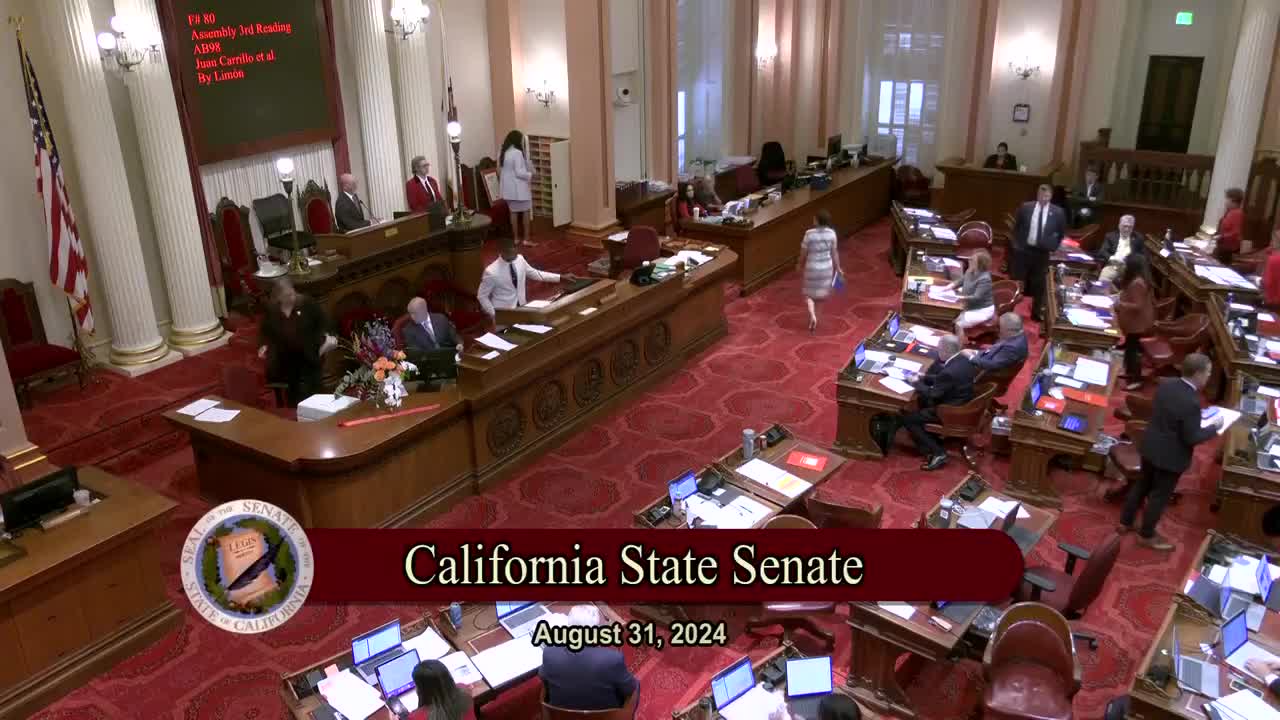 48MIN
Senate Floor
 6MIN
Assembly Floor
 27MIN
Senate Standing Committee on Appropriations
 1H
Senate Standing Committee on Local Government



Bill Co-Author(s):