ACR 16: Needs of opportunity youth.
- Session Year: 2023-2024
- House: Assembly
- Latest Version Date: 2023-08-22
Current Status:
Passed
(2023-08-22: Chaptered by Secretary of State - Res. Chapter 130, Statutes of 2023.)
Introduced
In Committee
First Chamber
In Committee
Second Chamber
Enacted
This measure would declare that the Legislature recognizes the importance of creating pathways to success for Californias opportunity youth and the need to develop a statewide comprehensive plan that will reduce persistent economic inequities endured by Californias opportunity youth.
This measure would declare that the Legislature recognizes the importance of creating pathways to success for Californias opportunity youth and the need to develop a statewide comprehensive plan that will reduce persistent economic inequities endured by Californias opportunity youth.
This measure would declare that the Legislature recognizes the importance of creating pathways to success for Californias opportunity youth and the need to develop a statewide comprehensive plan that will reduce persistent economic inequities endured by Californias opportunity youth.
WHEREAS, Californias economy is the largest in the United States; however, according to the Public Policy Institute of California (PPIC), more than one-third of Californians are living in or near poverty and sizable inequality and disparities remain, especially for Californias disconnected youth; and
WHEREAS, Opportunity youth are individuals between 16 and 24 years of age who are neither in school nor working, as well as teens and young adults involved with the foster care, juvenile justice, and homelessness systems; and
WHEREAS, Opportunity youth facing socioeconomic and systemic barriers are oftentimes disconnected from education and workforce training opportunities, preventing young people of color especially from accessing Californias prosperity; and
WHEREAS, The cost of failing young people at this critical juncture of their lives has significant long-term costs to them as individuals and to society at large; and
WHEREAS, The White House Council for Community Solutions commissioned a study entitled The Economic Value of Opportunity Youth estimating that in the year 2011 alone, taxpayers shouldered more than $93 billion to compensate for lost taxes and direct costs to support young people disengaged from both education and work, while the long-term societal costs were projected to be $4.7 trillion over their lifetimes; and
WHEREAS, Data collected from the 2021 American Community Survey (ACS) of the United States Census shows that in California, there were 572,756 youth 16 to 24 years of age who were neither in school nor at work (12.5 percent disconnection rate); and
WHEREAS, The latest ACS data indicated that in 2021, 15 percent (307,954) of youth 16 to 19 years of age were not in school in the previous three months and 38.4 percent of young adults 20 to 24 years of age were either unemployed (8.9 percent; 225,942) or not in the labor force at all (29.5 percent; 745,214); and
WHEREAS, In California in 2021, a greater proportion of opportunity youth were living in poverty relative to their connected peers (37.1 percent and 22.9 percent, respectively) and over one-half of the states opportunity youth (19 to 24 years of age) had no education beyond a high school diploma, relative to their connected peers (50.7 percent and 28.5 percent, respectively); and
WHEREAS, Opportunity youth face unique employment, education, and training barriers that often do not align with efforts that center adults; and
WHEREAS, In California, 2021 ACS data indicated that the disconnection rate of Black teens and young adults (16 to 24 years of age) was more than twice that of their White peers (22.3 percent and 10.9 percent, respectively); and
WHEREAS, Black and Latinx adolescents not only are disproportionately more likely to come from low-income households and have experienced past trauma, but are also faced with discrimination that can derail their physical and mental well-being; and
WHEREAS, Despite declines in youth incarceration, significant gaps remain as youth of color are overrepresented in our criminal justice system; and
WHEREAS, Prioritizing opportunity youth will not only expand their education and workforce opportunities but also expand the pool of talent that employers can access to meet their workforce needs while averting the societal costs associated with disconnection; now, therefore be it
Resolved by the Assembly of the State of California, the Senate thereof concurring, That the Legislature hereby declares the importance of creating pathways to success for Californias opportunity youth and the need to develop a statewide comprehensive plan that will reduce persistent economic inequities, and prioritize: (1) funding for education and workforce training programs that center opportunity youth and create pathways to good jobs; (2) expansion of innovative earn and learn opportunities, including apprenticeships, preapprenticeships, and other work-based learning opportunities; (3) advancement of dual enrollment implementation, which will allow opportunity youth to earn college credit while earning their high school equivalency; (4) ensure inclusivity of opportunity youth in the California Cradle-to-Career Data System; and (5) protection and expansion of social safety net investments for opportunity youth that support basic needs such as food, housing, internet access, transportation, childcare, health and mental health care, enabling them to complete their education and training goals, including removing barriers to access student financial aid programs; and be it further
Resolved, That the Chief Clerk of the Assembly transmit copies of this resolution to the author for appropriate distribution.
|
Date
|
Status
|
|---|---|
| Aug 22, 2023 | Chaptered by Secretary of State - Res. Chapter 130, Statutes of 2023. |
| Aug 22, 2023 | Enrolled and filed with the Secretary of State at 3:30 p.m. |
| Aug 14, 2023 | In Assembly. Ordered to Engrossing and Enrolling. |
| Aug 14, 2023 | Adopted and to Assembly. (Ayes 37. Noes 0. Page 2098.) |
| Apr 19, 2023 | From committee: Ordered to third reading. |
| Apr 10, 2023 | In Senate. To Com. on RLS. |
| Mar 30, 2023 | Adopted and to Senate. (Ayes 65. Noes 0. Page 1010.) |
| Mar 30, 2023 | Coauthors revised. |
| Mar 23, 2023 | Coauthors revised. |
| Mar 23, 2023 | From committee: Be adopted. To Consent Calendar. (Ayes 7. Noes 0.) (March 22). |
| Feb 17, 2023 | Referred to Com. on ED. |
| Feb 15, 2023 | From printer. |
| Feb 14, 2023 | Introduced. To print. |
|
Date
|
Description
|
Location
|
Votes
|
|
|---|---|---|---|---|
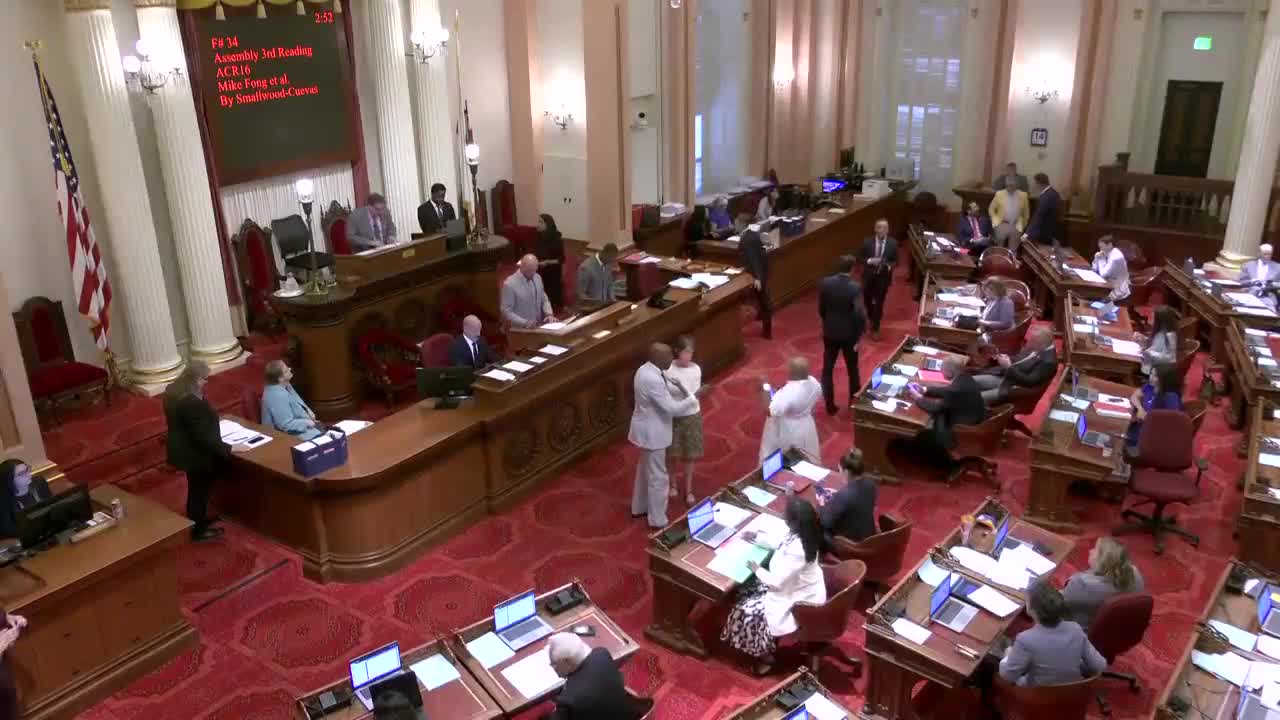
| Aug 14, 2023 | Assembly 3rd Reading ACR16 Mike Fong et al. By Smallwood-Cuevas | Senate Floor |
Passed |
|
| Mar 30, 2023 | ACR 16 Mike Fong Consent Calendar Second Day Regular Session | Assembly Floor |
Passed |
|
| Mar 22, 2023 | Be adopted. To Consent Calendar. | Assembly Standing Committee on Education |
Passed |
This list shows positions taken on this bill by organizations on the date displayed, which is linked to the original source.
Positions by individuals are not included.
|
Organization
|
Position
|
Date
|
|---|---|---|
| Alliance for Children's Rights | ** Support | |
| Bill Wilson Center | ** Support | |
| California Alliance of Boys & Girls Clubs | ** Support | |
| California Children's Trust | ** Support | |
| California EDGE Coalition | ** Support | |
| California Forward Action Fund | ** Support | |
| California Hospital Association | ** Support | |
| california opportunity youth network | ** Support | |
| California Workforce Association | ** Support | |
| California Youth Empowerment Network | ** Support | |
| Center for Employment Training | ** Support | |
| Children Now | ** Support | |
| City of San Jose | ** Support | |
| Civicorps | ** Support | |
| Coalition for Humane Immigrant Rights | ** Support | |
| Coalition for Responsible Community Development | ** Support | |
| Entrenous Youth Empowerment Services | ** Support | |
| Envision Your Pathway | ** Support | |
| Excite Credit Union | ** Support | |
| Foster Care Counts | ** Support | |
| Foster Greatness | ** Support | |
| Go Public Schools | ** Support | |
| Goodwill Southern California | ** Support | |
| Groundwork Social Sector Consulting | ** Support | |
| Growing Big Ideas | ** Support | |
| iFoster | ** Support | |
| John Burton Advocates for Youth | ** Support | |
| Juma Ventures | ** Support | |
| Kids in Common | ** Support | |
| Lighthouse Silicon Valley | ** Support | |
| Linked Learning Alliance | ** Support | |
| Mental Health America of California | ** Support | |
| New Door Ventures | ** Support | |
| New Ways to Work, INC | ** Support | |
| Pivotal | ** Support | |
| Regional Economic Association Leaders Coalition | ** Support | |
| San Diego Workforce Partnership | ** Support | |
| San Jose Conservation Corps & Charter School | ** Support | |
| Santa Clara County Youth Action Board | ** Support | |
| Seen & Heard | ** Support | |
| Small Business Majority | ** Support | |
| Soledad Enrichment Action, INC. | ** Support | |
| The Rightway Foundation | ** Support | |
| Unite-LA | ** Support | |
| Urban Strategies Council | ** Support | |
| Voices | ** Support | |
| Youth Will | ** Support |
SENATE RULES COMMITTEE Office of Senate Floor Analyses (916) 651-1520 Fax: (916) 327-4478 | ACR 16 |
THIRD READING
Bill No: ACR 16
Author: Mike Fong (D), et al.
Introduced: 2/14/23
Vote: 21
ASSEMBLY FLOOR: 60-0, 3/30/23 (Consent) - See last page for vote
SUBJECT: Needs of opportunity youth
SOURCE: Author
DIGEST:
This resolution declares the importance of creating pathways to success for California’s opportunity youth and the need to develop a statewide comprehensive plan that will reduce persistent economic inequities.
ANALYSIS: This resolution makes the following legislative findings:
- California’s economy is the largest in the United States; however, according to the Public Policy Institute of California (PPIC), more than one-third of Californians are living in or near poverty and sizable inequality and disparities remain, especially for California’s disconnected youth.
- Opportunity youth are individuals between 16 and 24 years of age who are neither in school nor working, as well as teens and young adults involved with the foster care, juvenile justice, and homelessness systems. Opportunity youth facing socioeconomic and systemic barriers are oftentimes disconnected from education and workforce training opportunities, preventing young people of color especially from accessing California’s prosperity.
- Data collected from the 2021 American Community Survey (ACS) of the United States Census shows that in California, there were 572,756 youth 16 to 24 years of age who were neither in school nor at work (12.5 percent disconnection rate).
- In California in 2021, a greater proportion of opportunity youth were living in poverty relative to their connected peers (37.1 percent and 22.9 percent, respectively) and over one-half of the state’s opportunity youth (19 to 24 years of age) had no education beyond a high school diploma, relative to their connected peers (50.7 percent and 28.5 percent, respectively).
- Opportunity youth face unique employment, education, and training barriers that often do not align with efforts that center adults. In California, 2021 ACS data indicated that the disconnection rate of Black teens and young adults (16 to 24 years of age) was more than twice that of their White peers (22.3 percent and 10.9 percent, respectively).
- Black and Latinx adolescents not only are disproportionately more likely to come from low-income households and have experienced past trauma, but are also faced with discrimination that can derail their physical and mental well-being.
- Prioritizing opportunity youth will not only expand their education and workforce opportunities but also expand the pool of talent that employers can access to meet their workforce needs while averting the societal costs associated with disconnection.
This resolution declares the importance of creating pathways to success for California’s opportunity youth and the need to develop a statewide comprehensive plan that will reduce persistent economic inequities, and prioritize:
- Funding for education and workforce training programs that center opportunity youth and create pathways to good jobs;
- Expansion of innovative “earn and learn” opportunities, including apprenticeships, preapprenticeships, and other work-based learning opportunities;
- Advancement of dual enrollment implementation, which will allow opportunity youth to earn college credit while earning their high school equivalency;
- Ensure inclusivity of opportunity youth in the California Cradle-to-Career Data System; and
- Protection and expansion of social safety net investments for opportunity youth that support basic needs such as food, housing, internet access, transportation, childcare, health and mental health care, enabling them to complete their education and training goals, including removing barriers to access student financial aid programs.
Comments
According to the author, “Many of California’s youth face unique barriers that stand in the way of their career and educational development. Because efforts designed to reach adults do not always align with young adults, existing programs are unable to meet the needs of this critical population.
“ACR 16 highlights the diversity of California’s opportunity youth and the systemic barriers that can prevent them from reaching their career and educational goals. It also emphasizes the importance of creating pathways for their success and calls for a statewide comprehensive plan to connect the opportunity youth population to critical career, educational, and social safety net opportunities.”
FISCAL EFFECT: Appropriation: No Fiscal Com.: No Local: No
SUPPORT: (Verified 4/17/23)
Alliance for Children's Rights
Bill Wilson Center
California Alliance of Boys & Girls Clubs
California Children's Trust
California Edge Coalition
California Forward Action Fund
California Hospital Association
California Opportunity Youth Network
California Workforce Association
California Youth Empowerment Network
Center for Employment Training
Children Now
City of San Jose
Civicorps
Coalition for Humane Immigrant Rights
Coalition for Responsible Community Development
Entrenous Youth Empowerment Services
Envision Your Pathway
Excite Credit Union
Foster Care Counts
Foster Greatness
Go Public Schools
Goodwill Southern California
Groundwork Social Sector Consulting
Growing Big Ideas
Ifoster
John Burton Advocates for Youth
Juma Ventures
Kids in Common
Lighthouse Silicon Valley
Linked Learning Alliance
Mental Health America of California
New Door Ventures
New Ways to Work, INC
Pivotal
Regional Economic Association Leaders Coalition
San Diego Workforce Partnership
San Jose Conservation Corps & Charter School
Santa Clara County Youth Action Board
Seen & Heard
Small Business Majority
Soledad Enrichment Action, Inc.
The Rightway Foundation
Unite-la
Urban Strategies Council
Voices
Youth Will
OPPOSITION: (Verified 4/17/23)
None received
ARGUMENTS IN SUPPORT: According to the California EDGE Coalition, a co-sponsor of the measure, “Opportunity Youth (OY) are individuals between the ages of 16 and 24 that are not in school or working, including youth and young adults involved with the foster care, juvenile justice, and homelessness systems of care. They face unique employment, education, and training barriers that often do not align with efforts that center adults. Opportunity Youth facing socio-economic and systemic barriers are oftentimes disconnected from education and workforce training opportunities, preventing young people of color from accessing our state’s prosperity.”
“ACR 16 encourages the State of California to create pathways to success for OY and the need to develop a statewide comprehensive plan that will reduce persistent economic inequities, and prioritize: (1) investments in education and workforce training programs that create pathways to good jobs; (2) expand innovative earn and learn opportunities such as apprenticeships, pre-apprenticeships, and work-based learning opportunities; (3) advance dual enrollment implementation to allow OY to earn college credit while earning their high school equivalency; (4) ensure inclusivity of OY in the Cradle-to-Career Data System; remove barriers to access student financial aid programs; and (5) protect social safety net investments that support basic needs such as food, housing, internet access, transportation, childcare, health, and mental health care – enabling OY to complete their education and training goals. In order to achieve and surpass our state’s economic, workforce and sustainability goals, it is crucial to prioritize and engage our youth, especially those who have become disconnected from education and employment opportunities.”
ASSEMBLY FLOOR: 60-0, 3/30/23
AYES: Addis, Aguiar-Curry, Alanis, Arambula, Bains, Bennett, Berman, Boerner Horvath, Juan Carrillo, Wendy Carrillo, Cervantes, Connolly, Megan Dahle, Davies, Essayli, Flora, Mike Fong, Vince Fong, Friedman, Gallagher, Gipson, Haney, Hart, Holden, Hoover, Jackson, Jones-Sawyer, Lackey, Lee, Low, Lowenthal, Maienschein, McKinnor, Muratsuchi, Stephanie Nguyen, Pacheco, Jim Patterson, Joe Patterson, Petrie-Norris, Ramos, Reyes, Luz Rivas, Robert Rivas, Rodriguez, Blanca Rubio, Sanchez, Santiago, Schiavo, Ta, Ting, Valencia, Villapudua, Waldron, Wallis, Weber, Wicks, Wilson, Wood, Zbur, Rendon
NO VOTE RECORDED: Alvarez, Bauer-Kahan, Bonta, Bryan, Calderon, Chen, Dixon, Gabriel, Garcia, Grayson, Irwin, Kalra, Mathis, McCarty, Ortega, Papan, Pellerin, Quirk-Silva, Soria, Ward
Prepared by: Jonas Austin / SFA / (916) 651-1520
4/19/23 15:18:20
**** END ****
Date of Hearing: March 22, 2023
ASSEMBLY COMMITTEE ON EDUCATION
Al Muratsuchi, Chair
ABPCA Bill Id:ACR 16 (
Author:Mike Fong) – As Introduced Ver:February 14, 2023
SUBJECT: Needs of opportunity youth
SUMMARY: Declares the importance of creating pathways to success for California’s opportunity youth and the need to develop a statewide comprehensive plan that will reduce persistent economic inequities. Specifically, this resolution:
- Declares the importance of creating pathways to success for California’s opportunity youth and the need to develop a statewide comprehensive plan that will reduce persistent economic inequities and prioritize:
- Funding for education and workforce training programs that center opportunity youth and create pathways to good jobs;
- Expansion of innovative “earn and learn” opportunities, including apprenticeships, pre-apprenticeships, and other work-based learning opportunities;
- Advancement of dual enrollment implementation, which will allow opportunity youth to earn college credit while earning their high school equivalency;
- Ensure inclusivity of opportunity youth in the California Cradle-to-Career Data System; and
- Protection and expansion of social safety net investments for opportunity youth that support basic needs such as food, housing, internet access, transportation, childcare, health and mental health care, enabling them to complete their education and training goals, including removing barriers to access student financial aid programs.
- Expresses findings regarding the challenges and promises of opportunity youth.
EXISTING LAW:
- Defines “at-promise” as having the same meaning as “at-risk” as that term is generally understood and consistent with federal law. (Education Code (EC) 96).
- Expresses the intent of the Legislature that school districts operating community day schools cooperate with county office of education (COE), law enforcement, probation, and human service agency personnel who work with at-promise youth. (EC 48660.1)
- Finds that partnership academies are in the forefront of school efforts to integrate academic and career technical education or STEM, and that they can be effective in providing an integrated learning program and high motivation toward pursuing skilled occupational fields to pupils at risk of dropping out of school and to pupils not motivated by the regular educational curriculum. Defines “at-promise pupil” as a pupil enrolled in high school who is at risk of dropping out of school. (EC 54960)
- Finds that middle college high schools have proven to be a highly effective collaborative effort between local school districts and community colleges. The goal of the middle college high school is to select at-promise high school pupils who are performing below their academic potential and place them in an alternative high school located on a community college campus in order to reduce the likelihood that they will drop out of school before graduation. (EC 11300)
FISCAL EFFECT: This bill has been keyed non-fiscal by the Office of Legislative Counsel.
COMMENTS:
Need for the resolution. According to the author, “Many of California’s youth face unique barriers that stand in the way of their career and educational development. Because efforts designed to reach adults do not always align with young adults, existing programs are unable to meet the needs of this critical population.
ACR 16 highlights the diversity of California’s opportunity youth and the systemic barriers that can prevent them from reaching their career and educational goals. It also emphasizes the importance of creating pathways for their success and calls for a statewide comprehensive plan to connect the opportunity youth population to critical career, educational, and social safety net opportunities.”
California has a significant population of opportunity youth. The 2022 California Opportunity Youth Data Report (California Opportunity Youth Network, 2022), defines opportunity youth as young adults between the ages of 16 to 24 who are not currently enrolled in school or employed. The report notes that in 2020, there were 4.7 million young adults between the ages of 16 to 24 living in California and 11% or over 535,000 of these were not in school nor at work. This represents over one in 10 of the disconnected youth in the U.S. The data also showed that Hispanic, Black, and Native American youth were disconnected at significantly higher rates than their Asian and White counterparts, as shown in the table below:
Table 1: Disconnection by race and ethnicity (16-24 year olds) 2020
Ethnicity | % of Population | % Disconnected |
Hispanic/Latino | 49.2% | 12.7% |
Non-Hispanic Latino | 50.8% | 9.9% |
Race: | ||
Black (only) | 8.0% | 17.1% |
White (only) | 60.6% | 11.0% |
Asian (only) | 15.5% | 6.5% |
Native American/Alaskan Native | 2.3% | 12.9% |
Source: 2022 California Opportunity Youth Data Report
Arguments in support. According to the California EDGE Coalition, a co-sponsor of the measure, “Opportunity Youth (OY) are individuals between the ages of 16 and 24 that are not in school or working, including youth and young adults involved with the foster care, juvenile justice, and homelessness systems of care. They face unique employment, education, and training barriers that often do not align with efforts that center adults. Opportunity Youth facing socio-economic and systemic barriers are oftentimes disconnected from education and workforce training opportunities, preventing young people of color from accessing our state’s prosperity.
ACR 16 encourages the State of California to create pathways to success for OY and the need
to develop a statewide comprehensive plan that will reduce persistent economic inequities,
and prioritize: (1) investments in education and workforce training programs that create pathways to good jobs; (2) expand innovative earn and learn opportunities such as apprenticeships, pre-apprenticeships, and work-based learning opportunities; (3) advance dual enrollment implementation to allow OY to earn college credit while earning their high school
equivalency; (4) ensure inclusivity of OY in the Cradle-to-Career Data System; remove barriers to access student financial aid programs; and (5) protect social safety net investments that support basic needs such as food, housing, internet access, transportation, childcare, health, and mental health care – enabling OY to complete their education and training goals. In order to achieve and surpass our state’s economic, workforce and sustainability goals, it is crucial to prioritize and engage our youth, especially those who have become disconnected from education and employment opportunities.”
Related legislation. SB 425 (Archuleta) of the 2021-22 Session would have specified the criteria for a school to meet the definition of an opportunity school and defined the categories of pupils who would be eligible to attend an opportunity school. This bill would have authorized COEs to establish opportunity schools in lieu of meeting requirements to establish continuation schools. This bill was held in the Senate Education Committee.
AB 1015 (Gipson) of the 2019-20 Session would have required the SPI to apportion funding to (local educational agencies) LEAs based upon the number of reengaged opportunity youth enrolled in that LEA. LEAs would have been required to use the funding to provide services for reenaged opportunity youth, including implementing agreements with government agencies, workforce development boards, community-based organizations, and public postsecondary educational institutions, to provide educational services, workforce preparation services, counseling services, substance abuse treatment services, family preservation services, referrals to agencies dealing with homelessness, access to transportation, and leadership and civic engagement activities. This bill was held in the Assembly Education Committee.
ACR 102 (E. Garcia) Chapter 141, Resolutions of 2017, recognizes the month of August 2017 as Opportunity Youth Reengagement Month, and states the intent of the Legislature to encourage the expansion of schools authorized to specifically reengage “opportunity youth” 16 to 24 years of age by developing recommendations for a statewide student reengagement strategy and identifying the cost of the strategy compared to the cost of inaction; authorizing systems for accountability to students, parents, and families through transparency, active engagement, and outreach strategies; and highlighting, promoting, and uplifting evidence-based practices for successful student reengagement efforts that maintain multiple measures for evaluation of student success.
AB 3063 (Weber) of the 2017-18 Session would have established the Opportunity Youth Reengagement Program to provide services to LEAs serving reengaged youth, funded by a portion of the LEA’s Local Control Funding Formula (LCFF) apportionment, as specified. This bill was held in the Assembly Education Committee.
REGISTERED SUPPORT / OPPOSITION:
Support
Alliance for Children's Rights
Bill Wilson Center
California Alliance of Boys & Girls Clubs
California Children's Trust
California Edge Coalition
California Forward Action Fund
California Hospital Association
California Opportunity Youth Network
California Workforce Association
California Youth Empowerment Network
Center for Employment Training
Children Now
City of San Jose
Civicorps
Coalition for Humane Immigrant Rights
Coalition for Responsible Community Development
Entrenous Youth Empowerment Services
Envision Your Pathway
Excite Credit Union
Foster Care Counts
Foster Greatness
Go Public Schools
Goodwill Southern California
Groundwork Social Sector Consulting
Growing Big Ideas
Ifoster
John Burton Advocates for Youth
Juma Ventures
Kids in Common
Lighthouse Silicon Valley
Linked Learning Alliance
Mental Health America of California
New Door Ventures
New Ways to Work, INC
Pivotal
Regional Economic Association Leaders Coalition
San Diego Workforce Partnership
San Jose Conservation Corps & Charter School
Santa Clara County Youth Action Board
Seen & Heard
Small Business Majority
Soledad Enrichment Action, INC.
The Rightway Foundation
Unite-la
Urban Strategies Council
Voices
Youth Will
Opposition
None on file
Analysis Prepared by: Debbie Look / ED. / (916) 319-2087
Bill Author

Bill Co-Author(s):