ACR 52: Dr. Martin Luther King, Jr.: 55th anniversary of assassination.
- Session Year: 2023-2024
- House: Assembly
- Latest Version Date: 2023-05-24
Current Status:
Passed
(2023-05-24: Chaptered by Secretary of State - Res. Chapter 63, Statutes of 2023.)
Introduced
In Committee
First Chamber
In Committee
Second Chamber
Enacted
This measure would recognize Dr. Martin Luther King, Jr., on April 4, 2023, the 55th anniversary of his assassination, for his numerous accomplishments and contributions to the nation and the long-lasting influence that his words and legacy continue to have globally.
This measure would recognize Dr. Martin Luther King, Jr., on April 4, 2023, the 55th anniversary of his assassination, for his numerous accomplishments and contributions to the nation and the long-lasting influence that his words and legacy continue to have globally.
This measure would recognize Dr. Martin Luther King, Jr., on April 4, 2023, the 55th anniversary of his assassination, for his numerous accomplishments and contributions to the nation and the long-lasting influence that his words and legacy continue to have globally.
WHEREAS, Dr. Martin Luther King, Jr. was assassinated 55 years ago in Memphis, Tennessee, on April 4, 1968; and
WHEREAS, His sacrifice continues to reverberate throughout the nation in large and small ways, and our nation is still trying to recover from Dr. Kings death, to seize opportunities for racial equality, economic justice, and peace, and to create what Dr. King referred to as a beloved community, which seemed to recede in the aftermath of his death; and
WHEREAS, Dr. Martin Luther King, Jr. was a Baptist minister and founder of the Southern Christian Leadership Conference (SCLC), who had led the civil rights movement since the mid-1950s, using a combination of impassioned speeches and nonviolent protests to fight segregation and achieve significant civil rights advances for African Americans; and
WHEREAS, His sacrifice led to an outpouring of anger among Black Americans, as well as a period of national mourning that helped speed the way for an equal housing bill that would be the last significant legislative achievement of the civil rights era; and
WHEREAS, In the last years of his life, Dr. King sought to widen his appeal beyond his own race, speaking out publicly against the Vietnam War and working to form a coalition of poor AmericansBlack and White aliketo address such issues as poverty and unemployment; and
WHEREAS, In the spring of 1968, while preparing for a planned march to Washington to lobby Congress on behalf of the poor, Dr. King was called to Memphis, Tennessee, to support a sanitation workers strike and on the night of April 3, Dr. King gave a speech at the Mason Temple Church in Memphis; and
WHEREAS, In his speech, Dr. King seemed to foreshadow his own untimely passing, or at least to strike a particularly reflective note, ending with these now-historic words: And Ive seen the promised land. I may not get there with you. But I want you to know tonight, that we, as a people, will get to the promised land. And so Im happy, tonight. Im not worried about anything. Im not fearing any man. Mine eyes have seen the glory of the coming of the Lord.; and
WHEREAS, Just after 6 p.m. the following day, Dr. King was standing on the second-floor balcony of the Lorraine Motel, where he and his associates were staying, when a snipers bullet struck him in the neck. He was rushed to a hospital, where he was pronounced dead about an hour later, at the age of 39; and
WHEREAS, Shock and distress over the news of Dr. Kings death sparked rioting in more than 100 cities around the country, including burning and looting, and amid a wave of national mourning, President Lyndon B. Johnson urged Americans to reject the blind violence that had killed Dr. King, whom he called the apostle of nonviolence; and
WHEREAS, He also called on the United States Congress to speedily pass the civil rights legislation then entering the House of Representatives for debate, calling it a fitting legacy of Dr. King and his lifes work, and on April 11, President Johnson signed the Fair Housing Act, a major piece of civil rights legislation; and
WHEREAS, Dr. King has remained the most widely known African American leader of his era, and the most public face of the civil rights movement, along with its most eloquent voice; and
WHEREAS, A campaign to establish a national holiday in Dr. Kings honor began almost immediately after his death, to honor his life and accomplishment; now, therefore, be it
Resolved by the Assembly of the State of California, the Senate thereof concurring, That the Legislature hereby further recognizes Dr. Martin Luther King, Jr., on April 4, 2023, the 55th anniversary of his assassination, for his numerous accomplishments and contributions to our nation and the long-lasting influence that his words and legacy continues to have globally; and be it further
Resolved, That the Chief Clerk of the Assembly transmit copies of this resolution to the author for appropriate distribution.
|
Date
|
Status
|
|---|---|
| May 24, 2023 | Chaptered by Secretary of State - Res. Chapter 63, Statutes of 2023. |
| May 24, 2023 | Enrolled and filed with the Secretary of State at 2:30 p.m. |
| May 18, 2023 | In Assembly. Ordered to Engrossing and Enrolling. |
| May 18, 2023 | Adopted and to Assembly. (Ayes 38. Noes 0. Page 1104.) |
| May 16, 2023 | Ordered to special consent calendar. |
| May 10, 2023 | From committee: Ordered to third reading. |
| May 1, 2023 | In Senate. To Com. on RLS. |
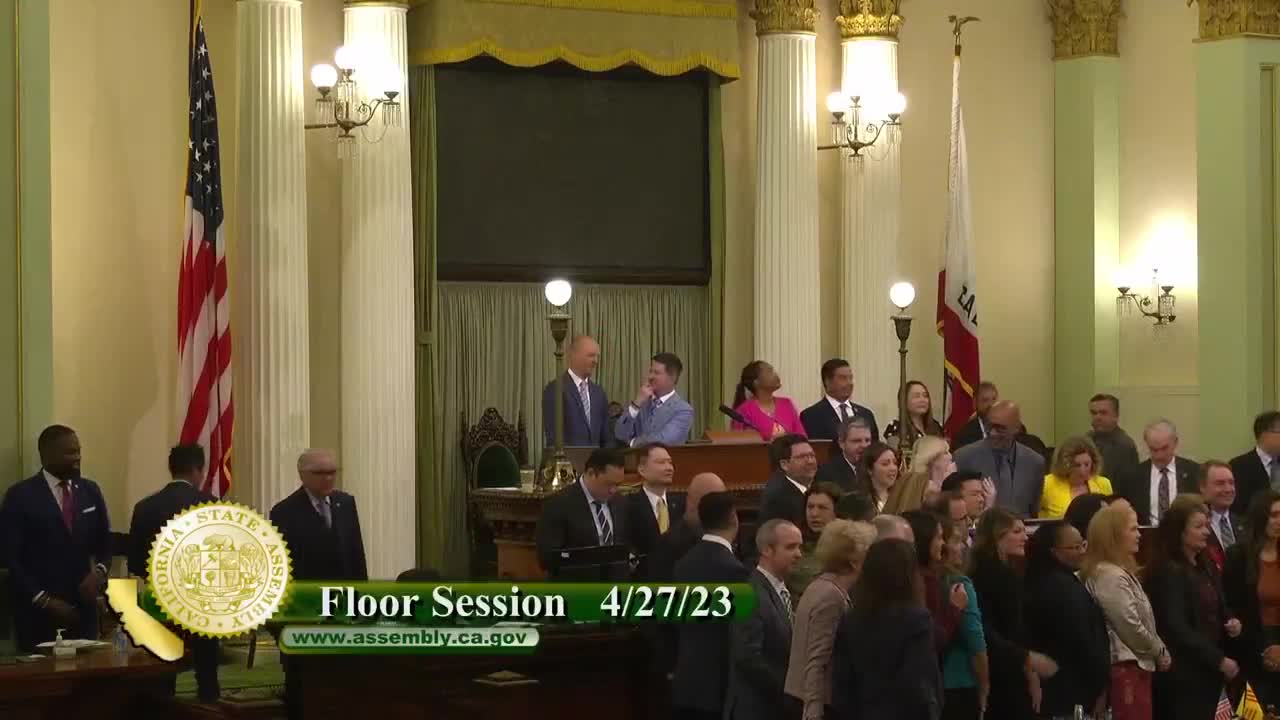
| Apr 27, 2023 | Adopted and to Senate. (Page 1358.) |
| Apr 27, 2023 | Coauthors revised. |
| Apr 13, 2023 | From committee: Be adopted. Ordered to Third Reading. (Ayes 13. Noes 0.) (April 13). |
| Apr 13, 2023 | Referred to Com. on RLS. |
| Apr 1, 2023 | From printer. |
| Mar 30, 2023 | Introduced. To print. |
|
Date
|
Description
|
Location
|
Votes
|
|
|---|---|---|---|---|
| May 18, 2023 | Special Consent ACR52 Jones-Sawyer et al. | Senate Floor |
Passed |
|
| Apr 13, 2023 | Be adopted. To third reading. | Assembly Standing Committee on Rules |
Passed |
This list shows positions taken on this bill by organizations on the date displayed, which is linked to the original source.
Positions by individuals are not included.
SENATE RULES COMMITTEE Office of Senate Floor Analyses (916) 651-1520 Fax: (916) 327-4478 | ACR 52 |
THIRD READING
Bill No: ACR 52
Author: Jones-Sawyer (D), et al.
Introduced: 3/30/23
Vote: 21
ASSEMBLY FLOOR: Read and adopted, 4/27/23
SUBJECT: Dr. Martin Luther King, Jr.: 55th anniversary of assassination
SOURCE: Author
DIGEST:
This resolution recognizes April 4, 2023, as the 55th anniversary of the assassination of Dr. Martin Luther King, Jr.; and, recognizes his numerous accomplishments and contributions to the nation and the long-lasting influence that his words and legacy continue to have globally.
ANALYSIS: This resolution makes the following legislative findings:
- Dr. Martin Luther King, Jr. was assassinated 55 years ago in Memphis, Tennessee, on April 4, 1968.
- In the spring of 1968, Dr. King was called to Memphis, Tennessee, to support a sanitation workers' strike and on the night of April 3, Dr. King gave a speech at the Mason Temple Church in Memphis.
- In his speech, Dr. King seemed to foreshadow his own untimely passing, or at least to strike a particularly reflective note, ending with these now-historic words: "And I've seen the promised land. I may not get there with you. But I want you to know tonight, that we, as a people, will get to the promised land. And so I'm happy, tonight. I'm not worried about anything."
- His sacrifice continues to reverberate throughout the nation in large and small ways, and our nation is still trying to recover from Dr. King's death, to seize opportunities for racial equality, economic justice, and peace, and to create what Dr. King referred to as a "beloved community," which seemed to recede in the aftermath of his death.
- His sacrifice led to an outpouring of anger among Black Americans, as well as a period of national mourning that helped speed the way for an equal housing bill that would be the last significant legislative achievement of the civil rights era.
- Dr. King has remained the most widely known African American leader of his era, and the most public face of the civil rights movement, along with its most eloquent voice.
This resolution recognizes April 4, 2023, as the 55th anniversary of the assassination of Dr. Martin Luther King, Jr.; and, recognizes his numerous accomplishments and contributions to the nation and the long-lasting influence that his words and legacy continue to have globally.
Comments
According to the author, Dr. Martin Luther King, Jr. was a Baptist minister and founder of the Southern Christian Leadership Conference, who led the civil rights movement through impassioned speeches and nonviolent protest in response to rampant racism and segregation. On April 4, 1968, Dr. Martin Luther King, Jr. was assassinated and his sacrifice continues to serve as a beacon of hope through his message of unity and equality for all. We honor him posthumously by commemorating a life cut short, and do so with the hope that one day his dream of respect and dignity for all will be achieved.
FISCAL EFFECT: Appropriation: No Fiscal Com.: No Local: No
SUPPORT: (Verified 5/8/23)
None received
OPPOSITION: (Verified 5/8/23)
None received
Prepared by: Jonas Austin / SFA / (916) 651-1520
5/10/23 15:19:56
**** END ****
ASSEMBLY THIRD READING
ATR Bill Id:ACR 52
Author:(Jones-Sawyer)
As Introduced Ver:March 30, 2023
Majority vote
SUMMARY
Recognizes April 4, 2023, as the 55th anniversary of the assassination of Dr. Martin Luther King, Jr.; and, recognizes his numerous accomplishments and contributions to the nation and the long-lasting influence that his words and legacy continue to have globally.
Major Provisions
- Dr. Martin Luther King, Jr. was assassinated 55 years ago in Memphis, Tennessee, on April 4, 1968.
- In the spring of 1968, Dr. King was called to Memphis, Tennessee, to support a sanitation workers' strike and on the night of April 3, Dr. King gave a speech at the Mason Temple Church in Memphis.
- In his speech, Dr. King seemed to foreshadow his own untimely passing, or at least to strike a particularly reflective note, ending with these now-historic words: "And I've seen the promised land. I may not get there with you. But I want you to know tonight, that we, as a people, will get to the promised land. And so I'm happy, tonight. I'm not worried about anything."
- His sacrifice continues to reverberate throughout the nation in large and small ways, and our nation is still trying to recover from Dr. King's death, to seize opportunities for racial equality, economic justice, and peace, and to create what Dr. King referred to as a "beloved community," which seemed to recede in the aftermath of his death.
- His sacrifice led to an outpouring of anger among Black Americans, as well as a period of national mourning that helped speed the way for an equal housing bill that would be the last significant legislative achievement of the civil rights era.
- Dr. King has remained the most widely known African American leader of his era, and the most public face of the civil rights movement, along with its most eloquent voice.
COMMENTS
According to the Author
Dr. Martin Luther King, Jr. was a Baptist minister and founder of the Southern Christian Leadership Conference, who led the civil rights movement through impassioned speeches and nonviolent protest in response to rampant racism and segregation. On April 4, 1968, Dr. Martin Luther King, Jr. was assassinated and his sacrifice continues to serve as a beacon of hope through his message of unity and equality for all. We honor him posthumously by commemorating a life cut short, and do so with the hope that one day his dream of respect and dignity for all will be achieved.
Arguments in Support
None on file
Arguments in Opposition
None on file
FISCAL COMMENTS
None. This resolution is keyed non-fiscal by Legislative Counsel.
VOTES
ASM RULES: 13-0-0
YES: Ramos, Waldron, Addis, Juan Carrillo, Essayli, Flora, Low, Ortega, Pacheco, Papan, Pellerin, Blanca Rubio, Valencia
UPDATED
VERSION: March 30, 2023
CONSULTANT: Michael Erke / RLS. / (916) 319-2800 FN: 0000204
Date of Hearing: April 13, 2023
ASSEMBLY COMMITTEE ON RULES
James Ramos, Chair
ABPCA Bill Id:ACR 52 (
Author:Jones-Sawyer) – As Introduced Ver:March 30, 2023
SUBJECT: Dr. Martin Luther King, Jr.: 55th anniversary of assassination.
SUMMARY: Recognizes April 4, 2023, as the 55th anniversary of the assassination of Dr. Martin Luther King, Jr.; and, recognizes his numerous accomplishments and contributions to the nation and the long-lasting influence that his words and legacy continue to have globally. Specifically, this resolution makes the following legislative findings:
- Dr. Martin Luther King, Jr. was assassinated 55 years ago in Memphis, Tennessee, on April 4, 1968.
- In the spring of 1968, Dr. King was called to Memphis, Tennessee, to support a sanitation workers’ strike and on the night of April 3, Dr. King gave a speech at the Mason Temple Church in Memphis.
- In his speech, Dr. King seemed to foreshadow his own untimely passing, or at least to strike a particularly reflective note, ending with these now-historic words: “And I’ve seen the promised land. I may not get there with you. But I want you to know tonight, that we, as a people, will get to the promised land. And so I’m happy, tonight. I’m not worried about anything.”
- His sacrifice continues to reverberate throughout the nation in large and small ways, and our nation is still trying to recover from Dr. King’s death, to seize opportunities for racial equality, economic justice, and peace, and to create what Dr. King referred to as a “beloved community,” which seemed to recede in the aftermath of his death.
- His sacrifice led to an outpouring of anger among Black Americans, as well as a period of national mourning that helped speed the way for an equal housing bill that would be the last significant legislative achievement of the civil rights era.
- Dr. King has remained the most widely known African American leader of his era, and the most public face of the civil rights movement, along with its most eloquent voice.
FISCAL EFFECT: None
REGISTERED SUPPORT / OPPOSITION:
Support
None on file
Opposition
None on file
Analysis Prepared by: Michael Erke / RLS. / (916) 319-2800
Bill Author

Bill Co-Author(s):