SB 145: Environmental mitigation: Department of Transportation.
- Session Year: 2023-2024
- House: Senate
- Latest Version Date: 2023-07-10
Current Status:
Passed
(2023-07-10: Chaptered by Secretary of State. Chapter 57, Statutes of 2023.)
Introduced
In Committee
First Chamber
In Committee
Second Chamber
Enacted
What does this bill do?
The bill lets the state Department of Transportation buy, hold, or transfer land for environmental mitigation, purchase mitigation credits (units used to offset environmental harm) through streamlined methods, and create endowments or agreements to fund the creation, restoration, and long‑term upkeep of habitat for highway projects. It also says highway funding is presumed to cover long‑term upkeep of wildlife crossing structures but requires project sponsors to provide an endowment for the habitat on or around those structures, and it requires the department to ensure three wildlife crossings are built if an intercity passenger rail line is constructed in the Interstate 15 corridor, allowing the department to contract with the rail builder to design and build them.
The summary is provided by generative AI which can make mistakes. For original language, please view the details in the table below.
(1)The California Endangered Species Act (CESA) requires the Fish and Game Commission to establish a list of endangered species and a list of threatened species and to add or remove species from either list if it finds, upon the receipt of sufficient scientific information, as specified, that the action is warranted. CESA prohibits the taking of an endangered, threatened, or candidate species, except as specified. Under the act, the Department of Fish and Wildlife may authorize the take of listed species if the take is incidental to an otherwise lawful activity, the impacts are minimized and fully mitigated, and the applicant ensures adequate funding for implementing the mitigation measures and for monitoring compliance with, and the effectiveness of, those measures.
This bill would specify that any transportation funding identified in the State Highway System Management Plan for purposes of these provisions is presumed to provide adequate funding for the long-term maintenance of a habitat connectivity or wildlife corridor structure on the state highway system, but not for the habitat on or around the structure, and would require an applicant to provide an endowment.
(2)Existing law vests the Department of Transportation with full possession and control of the state highways and associated properties. Existing law authorizes the department to acquire any real property that it considers necessary for state highway purposes.
This bill would authorize the department to purchase property for specified environmental mitigation purposes, to be called environmental mitigation property, and to transfer that property to specified governmental and nongovernmental entities, or to purchase the property in the name of those entities.
This bill would authorize the department to create an endowment or enter into an agreement with the transferee of an environmental mitigation property or another party to provide funding for the establishment, preservation, restoration, and maintenance of the property consistent with certain permit conditions or mitigation requirements. The bill would authorize the department to enter into a cooperative agreement with certain other parties to hold, manage, and invest an endowment for an environmental mitigation property and disburse payments from the endowment to the holder of the property consistent with the fund agreement. The bill would repeal these provisions on December 31, 2033.
This bill would also authorize the department to purchase, exempt from specified advertising or bidding requirements, environmental mitigation credits in a mitigation credit agreement or from a mitigation bank, conservation bank, in-lieu fee program, or from another mitigation credit provider in certain circumstances. The bill would authorize the department to purchase, exempt from those same advertising or bidding requirements, environmental mitigation credits from a mitigation bank, conservation bank, in-lieu fee program, mitigation credit agreement, or from another mitigation credit provider for the purpose of fulfilling mitigation responsibilities for natural resources or for advance mitigation purposes, using an alternative solicitation method, as specified. The bill would authorize the department to enter into agreements with governmental, nonprofit, and for-profit entities for the purpose of mitigating environmental impacts caused by transportation projects or for advance mitigation purposes. The bill would repeal these provisions on December 31, 2033.
This bill would require, by July 1, 2025, and annually thereafter until July 1, 2033, the department to provide a written report to the relevant legislative policy and budget committees that includes specified information related to its environmental mitigation program.
(3)Existing law authorizes the Department of Transportation to make and enter into any contracts in the manner provided by law that are required for the performance of its duties. Existing law, the State Contract Act, governs the bidding and award of public works contracts by specific state departments, including the Department of Transportation.
This bill would, if an intercity passenger rail project is constructed within the Interstate 15 right-of-way, require the department to ensure the construction of 3 wildlife crossings and appurtenances at 3 priority locations, as provided. The bill would authorize the department to solicit proposals for, accept unsolicited proposals for, negotiate, or enter into an agreement with a rail entity, as defined, to develop and construct the wildlife crossings and appurtenances, as specified. The bill would establish parameters for this authorization.
(4)This bill would declare that it is to take effect immediately as an urgency statute.
This bill would express the intent of the Legislature to enact statutory changes relating to the Budget Act of 2023.This bill would express the intent of the Legislature to enact statutory changes relating to the Budget Act of 2023.
The department may authorize acts that are otherwise prohibited pursuant to Section 2080, as follows:
(a)Through permits or memorandums of understanding, the department may authorize individuals, public agencies, universities, zoological gardens, and scientific or educational institutions, to import, export, take, or possess any endangered species, threatened species, or candidate species for scientific, educational, or management purposes.
(b)The department may authorize, by permit, the take of endangered species, threatened species, and candidate species if all of the following conditions are met:
(1)The take is incidental to an otherwise lawful activity.
(2)The impacts of the authorized take shall be minimized and fully mitigated. The measures required to meet this obligation shall be roughly proportional in extent to the impact of the authorized taking on the species. Where various measures are available to meet this obligation, the measures required shall maintain the applicants objectives to the greatest extent possible. All required measures shall be capable of successful implementation. For purposes of this section only, impacts of taking include all impacts on the species that result from any act that would cause the proposed taking.
(3)(A)The applicant shall ensure adequate funding to implement the measures required by paragraph (2), and for monitoring compliance with, and effectiveness of, those measures.
(B)For purposes of this section, transportation funding identified in the State Highway System Management Plan shall be presumed to ensure adequate funding for the long-term maintenance of a habitat connectivity or wildlife corridor structure on the state highway system, but not for the habitat on or around the structure. To ensure adequate funding to maintain the habitat on or around the structure, the applicant shall provide an endowment.
(c)No permit may be issued pursuant to subdivision (b) if issuance of the permit would jeopardize the continued existence of the species. The department shall make this determination based on the best scientific and other information that is reasonably available, and shall include consideration of the species capability to survive and reproduce, and any adverse impacts of the taking on those abilities in light of (1) known population trends; (2) known threats to the species; and (3) reasonably foreseeable impacts on the species from other related projects and activities.
(d)The department shall adopt regulations to aid in the implementation of subdivision (b) and the requirements of Division 13 (commencing with Section 21000) of the Public Resources Code, with respect to authorization of take. The department may seek certification pursuant to Section 21080.5 of the Public Resources Code to implement subdivision (b).
(e)Commencing January 1, 2019, the department shall post each new permit issued pursuant to subdivision (b) on its internet website within 15 days of the effective date of the permit.
SEC. 2.Section 104 of the Streets and Highways Code is amended to read:104.The department may acquire, either in fee or in any lesser estate or interest, any real property that it considers necessary for state highway purposes. Real property for these purposes includes, but is not limited to, real property considered necessary for any of the following purposes:
(a)For rights-of-way, including those necessary for state highways within cities.
(b)For purposes of exchanging the same for other real property to be used for rights-of-way.
(c)For rock quarries, gravel pits, or sand or earth borrow pits.
(d)For offices, shops, or storage yards.
(e)For parks adjoining or near a state highway.
(f)For the culture and support of trees that benefit a state highway by aiding in the maintenance and preservation of the roadbed, or that aid in the maintenance of the attractiveness of the scenic beauties of a state highway.
(g)For drainage in connection with a state highway.
(h)For the maintenance of an unobstructed view of any portion of a state highway so as to promote the safety of the traveling public.
(i)For the construction and maintenance of stock trails.
(j)For the construction and maintenance of nonmotorized transportation facilities, as defined in Section 887.
(k)(1)(A)For environmental mitigation property, which the department may transfer to, purchase for transfer to, or purchase in the name of a, governmental entity, special district, nonprofit organization, for-profit entity, person, or other entity in accordance with Chapter 4.6 (commencing with Section 65965) of Division 1 of Title 7 of the Government Code, as applicable.
(B)Where feasible, a governmental entity holding property pursuant to subparagraph (A) shall have the principal responsibility for natural resource protection or conservation. A governmental entity holding property pursuant to this section shall be approved through the due diligence process set forth in Section 65967 of the Government Code.
(2)For purposes of this section, environmental mitigation property means property that is required by state or federal law, or by permit conditions imposed by a state or federal agency, to be preserved or restored and maintained as natural habitat to offset the environmental impacts caused by the construction and operation of a state highway improvement project or for advance mitigation purposes as provided in Section 800.6.
SEC. 3.Section 104.1 is added to the Streets and Highways Code, to read:104.1.(a)(1)For purposes of environmental mitigation pursuant to subdivision (k) of Section 104, the department may create an endowment or enter one or more agreements with the transferee of an environmental mitigation property or another party or parties to provide funding for the establishment, preservation, restoration, and maintenance of the property consistent with any permit conditions, mitigation requirements imposed by state or federal law, conditions imposed by a state or federal agency, or advance mitigation requirements. This authority includes, but is not limited to, the requirements of Chapter 4.6 (commencing with Section 65965) of Division 1 of Title 7 of the Government Code, as applicable.
(2)Where feasible, a governmental entity holding property pursuant to paragraph (1) shall have the principal responsibility for natural resource protection or conservation. A governmental entity holding property pursuant to this section shall be approved through the due diligence process set forth in Section 65967 of the Government Code. For federally imposed mitigation requirements, the department is subject to Chapter 4.6 (commencing with Section 65965) of Division 1 of Title 7 of the Government Code, as applicable, to the extent not in conflict with federal law or regulation.
(b)(1)This section shall remain in effect only until December 31, 2033, and as of that date is repealed.
(2)Endowments or agreements entered into pursuant to this section before December 31, 2033, shall remain in effect beyond that date.
SEC. 4.Section 126 is added to the Streets and Highways Code, to read:126.(a)Notwithstanding the advertising and bidding provisions of Part 2 (commencing with Section 10100) of Division 2 of the Public Contract Code or Article 6 (commencing with Section 999) of Chapter 6 of Division 4 of the Military and Veterans Code, the department may enter into an agreement for the purchase of environmental mitigation credits in a mitigation credit agreement, or from a mitigation bank, conservation bank, or an in-lieu fee program, or other mitigation credit provider, if a state or federal regulatory agency requires the department to purchase credits from a particular mitigation credit provider.
(b)Notwithstanding the advertising and bidding provisions of Part 2 (commencing with Section 10100) of Division 2 of the Public Contract Code or Article 6 (commencing with Section 999) of Chapter 6 of Division 4 of the Military and Veterans Code, the department may use an alternative method to purchase environmental mitigation credits from a mitigation bank, conservation bank, or in-lieu fee program, mitigation credit agreement, or other mitigation credit provider for the purpose of fulfilling mitigation responsibilities for natural resources or for advance mitigation purposes, as specified in Section 800.6, if the environmental mitigation credits are solicited through a process, as determined by the department in cooperation with the Department of General Services, that includes a solicitation or evaluation of cost and the availability of environmental mitigation credits.
(c)The department and a governmental entity, a special district, a nonprofit organization, a community foundation, or a congressionally chartered foundation may enter into a cooperative agreement at any time to hold, manage, and invest an endowment for an environmental mitigation property, as defined in subdivision (k) of Section 104, and disburse payments from the endowment to the holder of the property consistent with the fund agreement.
(d)For purposes of this section, the following definitions apply:
(1)Community foundation has the same meaning as defined in Section 65965 of the Government Code.
(2)Congressionally chartered foundation has the same meaning as defined in Section 65965 of the Government Code.
(3)Environmental mitigation credit means a unit of mitigation as determined in a mitigation or conservation bank enabling instrument, as defined in Section 1797.5 of the Fish and Game Code, in-lieu fee program instrument, mitigation credit agreement, or other agreement approved by a state or federal regulatory agency.
(4)In-lieu fee program has the same meaning as provided in Section 332.2 of Title 33 of the Code of Federal Regulations or Section 230.92 of Title 40 of the Code of Federal Regulations.
(5)Mitigation bank or conservation bank means an entity as defined in subdivision (d) or (f) of Section 1797.5 of the Fish and Game Code or as defined as a mitigation bank in Section 332.2 of Title 33 to the Code of Federal Regulations or Section 230.92 of Title 40 of the Code of Federal Regulations.
(6)Mitigation credit agreement means a mitigation credit agreement approved by the Department of Fish and Wildlife pursuant to Chapter 9 (commencing with Section 1850) of Division 2 of the Fish and Game Code.
(7)Nonprofit organization has the same meaning as defined in Section 65965 of the Government Code.
(e)(1)This section shall remain in effect only until December 31, 2033, and as of that date is repealed.
(2)Endowments or other agreements entered into pursuant to this section before December 31, 2033, shall remain in effect beyond that date.
SEC. 5.Section 126.1 is added to the Streets and Highways Code, to read:126.1.(a)The department may enter into agreements, which shall provide funding as necessary, with governmental, nonprofit, and for-profit entities for the purpose of mitigating environmental impacts caused by transportation projects, for maintaining environmental mitigation property, as defined in Section 104, or for advance mitigation purposes, as provided in Section 800.6. These agreements may provide for the advancement of funds as necessary.
(b)(1)This section shall remain in effect only until December 31, 2033, and as of that date is repealed.
(2)Agreements entered into pursuant to this section before December 31, 2033, shall remain in effect beyond that date.
SEC. 6.Section 126.2 is added to the Streets and Highways Code, to read:126.2.(a)(1)Agreements between the department and governmental, nonprofit, and for-profit entities pursuant to subdivision (c) of Section 126 and Section 126.1 shall be in accordance, as applicable, with the requirements of Chapter 4.6 (commencing with Section 65965) of Division 1 of Title 7 of the Government Code. For federally imposed requirements, the department is subject to Chapter 4.6 (commencing with Section 65965) of Division 1 of Title 7 of the Government Code, as applicable, to the extent not in conflict with federal law or regulation.
(2)Where feasible, a governmental entity holding property pursuant to paragraph (1) shall have the principal responsibility for natural resource protection or conservation. A governmental entity holding property pursuant to this section shall be approved through the due diligence process set forth in Section 65967 of the Government Code.
(b)(1)This section shall remain in effect only until December 31, 2033, and as of that date is repealed.
(2)Agreements entered into pursuant to this section before December 31, 2033, shall remain in effect beyond that date.
SEC. 7.Section 126.3 is added to the Streets and Highways Code, to read:126.3.(a)By July 1, 2025, and annually thereafter until July 1, 2033, the department shall provide a written report to the relevant legislative policy and budget committees that includes at least the following information about its environmental mitigation program:
(1)The total number of endowments and new endowments, the amount of funds held in endowments and new endowments, the holder of each endowment, and the moneys disbursed for each endowment, in the preceding calendar year.
(2)The environmental mitigation properties purchased or transferred, and the status of each environmental mitigation property, in the preceding calendar year.
(3)A summary of each of the mitigation and advanced mitigation agreements entered into by the department in the preceding calendar year.
(4)Recommendations to address any identified barriers to implementation of the environmental mitigation program.
(b)If any information required to be reported in subdivision (a) is also provided in the report required by subdivision (f) of Section 800.6, reference to the latter is sufficient to comply with the reporting requirements of this section.
(c)This section shall remain in effect only until December 31, 2033, and as of that date is repealed.
SEC. 8.Section 143.2 is added to the Streets and Highways Code, to read:143.2.(a)For the purposes of this section, the following definitions apply:
(1)Authorized agreement means either of the following types of agreements:
(A)An agreement whereby the rail entity assists the department in defining a feasible project and negotiates fair and reasonable terms for implementing the project.
(B)An agreement whereby the rail entity assumes responsibility for designing, procuring, delivering, improving, or constructing an eligible facility in accordance with established specifications and payment terms.
(2)Eligible facility means any wildlife crossing and appurtenance thereto developed, operated, or held in accordance with this section, and includes the wildlife crossings and appurtenances described in paragraph (1) of subdivision (b).
(3)Quantifiable environmental benefits means documented, ongoing, positive, and quantifiable benefits to the environment and environmental quality, including to wildlife.
(4)Rail entity means a person, entity, or organization that is not the federal government or any other public agency and that is undertaking an intercity passenger rail construction project within the Interstate 15 right-of-way.
(5)State-Rail agreement means the Agreement to Implement Wildlife Overcrossings Over Interstate 15 executed on January 11, 2023, by and among DesertXpress Enterprises, LLC, the department, and the Department of Fish and Wildlife.
(b)(1)If an intercity passenger rail project is constructed within the segment of the Interstate 15 right-of-way at the segment described in Recital B of the State-Rail agreement, the department shall ensure the construction of three wildlife crossings and appurtenances at three priority locations.
(2)The department may use an authorized agreement to comply with paragraph (1).
(3)The department shall consult with the Department of Fish and Wildlife and with entities with expertise in the development, design, and construction of wildlife crossing structures as part of the development, design, and construction of the three wildlife crossing structures described in paragraph (1).
(4)After construction, the department shall own the wildlife overcrossings, and the department, in consultation with, and the support of, the Department of Fish and Wildlife, shall maintain and operate the wildlife overcrossings, including the maintenance of habitat, consistent with Section 2.2.6 and 2.3.6 of the State-Rail agreement.
(5)The department may enter into an agreement, which shall provide permanent funding as necessary, for the purpose of maintaining habitat on an eligible facility.
(c)Notwithstanding any other law, but subject to this section, the department may solicit proposals for, accept unsolicited proposals for, negotiate, or enter into, an authorized agreement with a rail entity to develop and construct concurrently with the rail entitys project an eligible facility that is described in paragraph (1) of subdivision (b).
(d)The department may enter into an authorized agreement for purposes of paragraph (2) of subdivision (b) if the authorized agreement will provide quantifiable environmental benefits for the region and for wildlife and if the department deems the authorized agreement to be in the best interest of the state.
(e)(1)The department may include in an authorized agreement to develop, design, and construct an eligible facility for purposes of paragraph (2) of subdivision (b), any provision the department determines necessary or appropriate, including, but not limited to, the following:
(A)Provisions addressing how the department and rail entity will share development costs and allocate and manage project risks.
(B)Provisions allowing the department to grant or otherwise disburse state or federal funds to the rail entity for the costs to develop and construct an eligible facility, excluding any costs associated with the design of an eligible facility.
(C)Provisions addressing the acquisition of rights-of-way and other property interests that may be required, including for the granting of necessary easements and for the issuance of permits or other authorizations.
(D)Provisions identifying any technical specifications concerning the eligible facility that must be satisfied by the rail entity.
(E)Provisions specifying events of default, remedies available to the rail entity and department, and dispute resolution procedures, including arbitration and other alternative dispute resolution procedures.
(F)Provisions regarding the maintenance and auditing of the rail entitys books and records.
(G)Provisions specifying that the rail entity will comply with all applicable legal requirements related to the use of state or federal funds.
(H)Provisions specifying that the rail entity will obtain errors and omissions insurance coverage for the design elements of the project.
(I)Provisions specifying that the rail entity will require payment and performance bonding, liability insurance, and errors and omissions insurance of its contractors and consultants.
(2)An authorized agreement shall include indemnity, defense, and hold harmless provisions agreed to by the department and the rail entity, including provisions for indemnifying the State of California from any claims or losses resulting or accruing from the performance of the rail entity.
(f)(1)The department may use any lawful source of funding or financing, either previously appropriated or upon appropriation, for the development or construction of an eligible facility under this section, including funding described in paragraph (2).
(2)The department may accept from the United States or any of its agencies any funds or credit assistance as are available to it for carrying out the purposes of this section, whether the funds are made available by grant, loan, or other financing arrangement.
(g)The department shall apply for a competitive grant from federal grant programs to fund activities associated with construction of the wildlife crossing structures described in paragraph (1) of subdivision (b).
(h)(1)Before executing an authorized agreement pursuant to this section, the department shall submit a draft of the agreement to the Department of Finance for review.
(2)An authorized agreement may only be executed under this section before January 1, 2025.
(3)If the department has not executed an authorized agreement pursuant to this section on or before July 1, 2024, the department shall notify the Joint Legislative Budget Committee and submit a progress report on entering into an authorized agreement to the budget committees of the Legislature.
(i)The department shall exercise the authority under this section in consultation with the Department of Fish and Wildlife.
(j)Nothing in this section affects, expands, alters, or limits any other rights or remedies otherwise available at law.
(k)On or before January 1, 2024, and at least annually thereafter, the department shall submit a written status report to the relevant policy committee and budget committee of the Legislature on the implementation of this section.
SEC. 9.This act is an urgency statute necessary for the immediate preservation of the public peace, health, or safety within the meaning of Article IV of the California Constitution and shall go into immediate effect. The facts constituting the necessity are:
To promote environmental protection and safeguard economic development of Californias diverse public resources and people, and enhance the states ability to maximize federal funding to support those efforts, it is necessary for this act to take effect immediately.
The department may authorize acts that are otherwise prohibited pursuant to Section 2080, as follows:
(a)Through permits or memorandums of understanding, the department may authorize individuals, public agencies, universities, zoological gardens, and scientific or educational institutions, to import, export, take, or possess any endangered species, threatened species, or candidate species for scientific, educational, or management purposes.
(b)The department may authorize, by permit, the take of endangered species, threatened species, and candidate species if all of the following conditions are met:
(1)The take is incidental to an otherwise lawful activity.
(2)The impacts of the authorized take shall be minimized and fully mitigated. The measures required to meet this obligation shall be roughly proportional in extent to the impact of the authorized taking on the species. Where various measures are available to meet this obligation, the measures required shall maintain the applicants objectives to the greatest extent possible. All required measures shall be capable of successful implementation. For purposes of this section only, impacts of taking include all impacts on the species that result from any act that would cause the proposed taking.
(3)(A)The applicant shall ensure adequate funding to implement the measures required by paragraph (2), and for monitoring compliance with, and effectiveness of, those measures.
(B)For purposes of this section, transportation funding identified in the State Highway System Management Plan shall be presumed to ensure adequate funding for the long-term maintenance of a habitat connectivity or wildlife corridor structure on the state highway system, but not for the habitat on or around the structure. To ensure adequate funding to maintain the habitat on or around the structure, the applicant shall provide an endowment.
(c)No permit may be issued pursuant to subdivision (b) if issuance of the permit would jeopardize the continued existence of the species. The department shall make this determination based on the best scientific and other information that is reasonably available, and shall include consideration of the species capability to survive and reproduce, and any adverse impacts of the taking on those abilities in light of (1) known population trends; (2) known threats to the species; and (3) reasonably foreseeable impacts on the species from other related projects and activities.
(d)The department shall adopt regulations to aid in the implementation of subdivision (b) and the requirements of Division 13 (commencing with Section 21000) of the Public Resources Code, with respect to authorization of take. The department may seek certification pursuant to Section 21080.5 of the Public Resources Code to implement subdivision (b).
(e)Commencing January 1, 2019, the department shall post each new permit issued pursuant to subdivision (b) on its Internet Web site internet website within 15 days of the effective date of the permit.
SEC. 2.Section 104 of the Streets and Highways Code is amended to read:104.The department may acquire, either in fee or in any lesser estate or interest, any real property which that it considers necessary for state highway purposes. Real property for such these purposes includes, but is not limited to, real property considered necessary for any of the following purposes:
(a)For rights-of-way, including those necessary for state highways within cities.
(b)For the purposes of exchanging the same for other real property to be used for rights-of-way.
(c)For rock quarries, gravel pits, or sand or earth borrow pits.
(d)For offices, shops, or storage yards.
(e)For parks adjoining or near any a state highway.
(f)For the culture and support of trees which that benefit any a state highway by aiding in the maintenance and preservation of the roadbed, or which that aid in the maintenance of the attractiveness of the scenic beauties of such a state highway.
(g)For drainage in connection with any a state highway.
(h)For the maintenance of an unobstructed view of any portion of a state highway so as to promote the safety of the traveling public.
(i)For the construction and maintenance of stock trails.
(j)For the construction and maintenance of nonmotorized transportation facilities, as defined in Section 156. 887.
(k)(1)(A)For environmental mitigation property, which the department may transfer to, purchase for transfer to, or purchase in the name of a, governmental entity, special district, nonprofit organization, for-profit entity, person, or other entity in accordance with Chapter 4.6 (commencing with Section 65965) of Division 1 of Title 7 of the Government Code, as applicable.
(B)Where feasible, a governmental entity holding property pursuant to subparagraph (A) shall have the principal responsibility for natural resource protection or conservation. A governmental entity holding property pursuant to this section shall be approved through the due diligence process set forth in Section 65967 of the Government Code.
(2)For purposes of this section, environmental mitigation property means property that is required by state or federal law, or by permit conditions imposed by a state or federal agency, to be preserved or restored and maintained as natural habitat to offset the environmental impacts caused by the construction and operation of a state highway improvement project or for advance mitigation purposes as provided in Section 800.6.
SEC. 3.Section 104.1 is added to the Streets and Highways Code, to read:104.1.(a)(1)For purposes of environmental mitigation pursuant to subdivision (k) of Section 104, the department may create an endowment or enter one or more agreements with the transferee of an environmental mitigation property or another party or parties to provide funding for the establishment, preservation, restoration, and maintenance of the property consistent with any permit conditions, mitigation requirements imposed by state or federal law, conditions imposed by a state or federal agency, or advance mitigation requirements. This authority includes, but is not limited to, the requirements of Chapter 4.6 (commencing with Section 65965) of Division 1 of Title 7 of the Government Code, as applicable.
(2)Where feasible, a governmental entity holding property pursuant to paragraph (1) shall have the principal responsibility for natural resource protection or conservation. A governmental entity holding property pursuant to this section shall be approved through the due diligence process set forth in Section 65967 of the Government Code. For federally imposed mitigation requirements, the department is subject to Chapter 4.6 (commencing with Section 65965) of Division 1 of Title 7 of the Government Code, as applicable, to the extent not in conflict with federal law or regulation.
(b)(1)This section shall remain in effect only until December 31, 2033, and as of that date is repealed.
(2)Endowments or agreements entered into pursuant to this section before December 31, 2033, shall remain in effect beyond that date.
SEC. 4.Section 126 is added to the Streets and Highways Code, to read:126.(a)Notwithstanding the advertising and bidding provisions of Part 2 (commencing with Section 10100) of Division 2 of the Public Contract Code or Article 6 (commencing with Section 999) of Chapter 6 of Division 4 of the Military and Veterans Code, the department may enter into an agreement for the purchase of environmental mitigation credits in a mitigation credit agreement, or from a mitigation bank, conservation bank, or an in-lieu fee program, or other mitigation credit provider, if a state or federal regulatory agency requires the department to purchase credits from a particular mitigation credit provider.
(b)Notwithstanding the advertising and bidding provisions of Part 2 (commencing with Section 10100) of Division 2 of the Public Contract Code or Article 6 (commencing with Section 999) of Chapter 6 of Division 4 of the Military and Veterans Code, the department may use an alternative method to purchase environmental mitigation credits from a mitigation bank, conservation bank, or in-lieu fee program, mitigation credit agreement, or other mitigation credit provider for the purpose of fulfilling mitigation responsibilities for natural resources or for advance mitigation purposes, as specified in Section 800.6, if the environmental mitigation credits are solicited through a process, as determined by the department in cooperation with the Department of General Services, that includes a solicitation or evaluation of cost and the availability of environmental mitigation credits.
(c)The department and a governmental entity, a special district, a nonprofit organization, a community foundation, or a congressionally chartered foundation may enter into a cooperative agreement at any time to hold, manage, and invest an endowment for an environmental mitigation property, as defined in subdivision (k) of Section 104, and disburse payments from the endowment to the holder of the property consistent with the fund agreement.
(d)For purposes of this section, the following definitions apply:
(1)Community foundation has the same meaning as defined in Section 65965 of the Government Code.
(2)Congressionally chartered foundation has the same meaning as defined in Section 65965 of the Government Code.
(3)Environmental mitigation credit means a unit of mitigation as determined in a mitigation or conservation bank enabling instrument, as defined in Section 1797.5 of the Fish and Game Code, in-lieu fee program instrument, mitigation credit agreement, or other agreement approved by a state or federal regulatory agency.
(4)In-lieu fee program has the same meaning as provided in Section 332.2 of Title 33 of the Code of Federal Regulations or Section 230.92 of Title 40 of the Code of Federal Regulations.
(5)Mitigation bank or conservation bank means an entity as defined in subdivision (d) or (f) of Section 1797.5 of the Fish and Game Code or as defined as a mitigation bank in Section 332.2 of Title 33 to the Code of Federal Regulations or Section 230.92 of Title 40 of the Code of Federal Regulations.
(6)Mitigation credit agreement means a mitigation credit agreement approved by the Department of Fish and Wildlife pursuant to Chapter 9 (commencing with Section 1850) of Division 2 of the Fish and Game Code.
(7)Nonprofit organization has the same meaning as defined in Section 65965 of the Government Code.
(e)(1)This section shall remain in effect only until December 31, 2033, and as of that date is repealed.
(2)Endowments or other agreements entered into pursuant to this section before December 31, 2033, shall remain in effect beyond that date.
SEC. 5.Section 126.1 is added to the Streets and Highways Code, to read:126.1.(a)The department may enter into agreements, which shall provide funding as necessary, with governmental, nonprofit, and for-profit entities for the purpose of mitigating environmental impacts caused by transportation projects, for maintaining environmental mitigation property, as defined in Section 104, or for advance mitigation purposes, as provided in Section 800.6. These agreements may provide for the advancement of funds as necessary.
(b)(1)This section shall remain in effect only until December 31, 2033, and as of that date is repealed.
(2)Agreements entered into pursuant to this section before December 31, 2033, shall remain in effect beyond that date.
SEC. 6.Section 126.2 is added to the Streets and Highways Code, to read:126.2.(a)(1)Agreements between the department and governmental, nonprofit, and for-profit entities pursuant to subdivision (c) of Section 126 and Section 126.1 shall be in accordance, as applicable, with the requirements of Chapter 4.6 (commencing with Section 65965) of Division 1 of Title 7 of the Government Code. For federally imposed requirements, the department is subject to Chapter 4.6 (commencing with Section 65965) of Division 1 of Title 7 of the Government Code, as applicable, to the extent not in conflict with federal law or regulation.
(2)Where feasible, a governmental entity holding property pursuant to paragraph (1) shall have the principal responsibility for natural resource protection or conservation. A governmental entity holding property pursuant to this section shall be approved through the due diligence process set forth in Section 65967 of the Government Code.
(b)(1)This section shall remain in effect only until December 31, 2033, and as of that date is repealed.
(2)Agreements entered into pursuant to this section before December 31, 2033, shall remain in effect beyond that date.
SEC. 7.Section 126.3 is added to the Streets and Highways Code, to read:126.3.(a)By July 1, 2025, and annually thereafter until July 1, 2033, the department shall provide a written report to the relevant legislative policy and budget committees that includes at least the following information about its environmental mitigation program:
(1)The total number of endowments and new endowments, the amount of funds held in endowments and new endowments, the holder of each endowment, and the moneys disbursed for each endowment, in the preceding calendar year.
(2)The environmental mitigation properties purchased or transferred, and the status of each environmental mitigation property, in the preceding calendar year.
(3)A summary of each of the mitigation and advanced mitigation agreements entered into by the department in the preceding calendar year.
(4)Recommendations to address any identified barriers to implementation of the environmental mitigation program.
(b)If any information required to be reported in subdivision (a) is also provided in the report required by subdivision (f) of Section 800.6, reference to the latter is sufficient to comply with the reporting requirements of this section.
(c)This section shall remain in effect only until December 31, 2033, and as of that date is repealed.
SEC. 8.Section 143.2 is added to the Streets and Highways Code, to read:143.2.(a)For the purposes of this section, the following definitions apply:
(1)Authorized agreement means either of the following types of agreements:
(A)An agreement whereby the rail entity assists the department in defining a feasible project and negotiates fair and reasonable terms for implementing the project.
(B)An agreement whereby the rail entity assumes responsibility for designing, procuring, delivering, improving, or constructing an eligible facility in accordance with established specifications and payment terms.
(2)Eligible facility means any wildlife crossing and appurtenance thereto developed, operated, or held in accordance with this section, and includes the wildlife crossings and appurtenances described in paragraph (1) of subdivision (b).
(3)Quantifiable environmental benefits means documented, ongoing, positive, and quantifiable benefits to the environment and environmental quality, including to wildlife.
(4)Rail entity means a person, entity, or organization that is not the federal government or any other public agency and that is undertaking an intercity passenger rail construction project within the Interstate 15 right-of-way.
(5)State-Rail agreement means the Agreement to Implement Wildlife Overcrossings Over Interstate 15 executed on January 11, 2023, by and among DesertXpress Enterprises, LLC, the department, and the Department of Fish and Wildlife.
(b)(1)If an intercity passenger rail project is constructed within the segment of the Interstate 15 right-of-way at the segment described in Recital B of the State-Rail agreement, the department shall ensure the construction of three wildlife crossings and appurtenances at three priority locations.
(2)The department may use an authorized agreement to comply with paragraph (1).
(3)The department shall consult with the Department of Fish and Wildlife and with entities with expertise in the development, design, and construction of wildlife crossing structures as part of the development, design, and construction of the three wildlife crossing structures described in paragraph (1).
(4)After construction, the department shall own the wildlife overcrossings, and the department, in consultation with, and the support of, the Department of Fish and Wildlife, shall maintain and operate the wildlife overcrossings, including the maintenance of habitat, consistent with Section 2.2.6 and 2.3.6 of the State-Rail agreement.
(5)The department may enter into an agreement, which shall provide permanent funding as necessary, for the purpose of maintaining habitat on an eligible facility.
(c)Notwithstanding any other law, but subject to this section, the department may solicit proposals for, accept unsolicited proposals for, negotiate, or enter into, an authorized agreement with a rail entity to develop and construct concurrently with the rail entitys project an eligible facility that is described in paragraph (1) of subdivision (b).
(d)The department may enter into an authorized agreement for purposes of paragraph (2) of subdivision (b) if the authorized agreement will provide quantifiable environmental benefits for the region and for wildlife and if the department deems the authorized agreement to be in the best interest of the state.
(e)(1)The department may include in an authorized agreement to develop, design, and construct an eligible facility for purposes of paragraph (2) of subdivision (b), any provision the department determines necessary or appropriate, including, but not limited to, the following:
(A)Provisions addressing how the department and rail entity will share development costs and allocate and manage project risks.
(B)Provisions allowing the department to grant or otherwise disburse state or federal funds to the rail entity for the costs to develop and construct an eligible facility, excluding any costs associated with the design of an eligible facility.
(C)Provisions addressing the acquisition of rights-of-way and other property interests that may be required, including for the granting of necessary easements and for the issuance of permits or other authorizations.
(D)Provisions identifying any technical specifications concerning the eligible facility that must be satisfied by the rail entity.
(E)Provisions specifying events of default, remedies available to the rail entity and department, and dispute resolution procedures, including arbitration and other alternative dispute resolution procedures.
(F)Provisions regarding the maintenance and auditing of the rail entitys books and records.
(G)Provisions specifying that the rail entity will comply with all applicable legal requirements related to the use of state or federal funds.
(H)Provisions specifying that the rail entity will obtain errors and omissions insurance coverage for the design elements of the project.
(I)Provisions specifying that the rail entity will require payment and performance bonding, liability insurance, and errors and omissions insurance of its contractors and consultants.
(2)An authorized agreement shall include indemnity, defense, and hold harmless provisions agreed to by the department and the rail entity, including provisions for indemnifying the State of California from any claims or losses resulting or accruing from the performance of the rail entity.
(f)(1)The department may use any lawful source of funding or financing, either previously appropriated or upon appropriation, for the development or construction of an eligible facility under this section, including funding described in paragraph (2).
(2)The department may accept from the United States or any of its agencies any funds or credit assistance as are available to it for carrying out the purposes of this section, whether the funds are made available by grant, loan, or other financing arrangement.
(g)The department shall apply for a competitive grant from federal grant programs to fund activities associated with construction of the wildlife crossing structures described in paragraph (1) of subdivision (b).
(h)(1)Before executing an authorized agreement pursuant to this section, the department shall submit a draft of the agreement to the Department of Finance for review.
(2)An authorized agreement may only be executed under this section before January 1, 2025.
(3)If the department has not executed an authorized agreement pursuant to this section on or before July 1, 2024, the department shall notify the Joint Legislative Budget Committee and submit a progress report on entering into an authorized agreement to the budget committees of the Legislature.
(i)The department shall exercise the authority under this section in consultation with the Department of Fish and Wildlife.
(j)Nothing in this section affects, expands, alters, or limits any other rights or remedies otherwise available at law.
(k)On or before January 1, 2024, and at least annually thereafter, the department shall submit a written status report to the relevant policy committee and budget committee of the Legislature on the implementation of this section.
SEC. 9.This act is an urgency statute necessary for the immediate preservation of the public peace, health, or safety within the meaning of Article IV of the California Constitution and shall go into immediate effect. The facts constituting the necessity are:
To promote environmental protection and safeguard economic development of Californias diverse public resources and people, and enhance the states ability to maximize federal funding to support those efforts, it is necessary for this act to take effect immediately.
SECTION 1.It is the intent of the Legislature to enact statutory changes relating to the Budget Act of 2023. REVISIONS: HeadingLine 2.It is the intent of the Legislature to enact statutory changes relating to the Budget Act of 2023.
|
Date
|
Status
|
|---|---|
| Jul 10, 2023 | Chaptered by Secretary of State. Chapter 57, Statutes of 2023. |
| Jul 10, 2023 | Approved by the Governor. |
| Jul 5, 2023 | Enrolled and presented to the Governor at 4 p.m. |
| Jul 5, 2023 | Urgency clause adopted. |
| Jul 5, 2023 | Assembly amendments concurred in. (Ayes 38. Noes 0. Page 1894.) Ordered to engrossing and enrolling. |
| Jul 3, 2023 | In Senate. Concurrence in Assembly amendments pending. |
| Jun 29, 2023 | Read third time. Urgency clause adopted. Passed. (Ayes 73. Noes 0. Page 2483.) Ordered to the Senate. |
| Jun 29, 2023 | From committee: Do pass. (Ayes 14. Noes 0.) (June 29). |
| Jun 29, 2023 | Assembly Rule 63 suspended. (Ayes 57. Noes 15. Page 2472.) |
| Jun 27, 2023 | Joint Rule 62(a) suspended. |
| Jun 27, 2023 | Re-referred to Com. on TRANS. pursuant to Assembly Rule 96. |
| Jun 26, 2023 | From committee with author's amendments. Read second time and amended. Re-referred to Com. on BUDGET. |
| Jun 26, 2023 | Coauthors revised. |
| Mar 30, 2023 | Referred to Com. on BUDGET. |
| Mar 27, 2023 | In Assembly. Read first time. Held at Desk. |
| Mar 27, 2023 | Read third time. Passed. (Ayes 29. Noes 8. Page 500.) Ordered to the Assembly. |
| Mar 20, 2023 | Read second time. Ordered to third reading. |
| Mar 16, 2023 | Withdrawn from committee. (Ayes 28. Noes 8. Page 357.) |
| Mar 16, 2023 | Ordered to second reading. |
| Jan 25, 2023 | Referred to Com. on B. & F.R. |
| Jan 19, 2023 | From printer. May be acted upon on or after February 18. |
| Jan 18, 2023 | Introduced. Read first time. To Com. on RLS. for assignment. To print. |
|
Date
|
Description
|
Location
|
Votes
|
|
|---|---|---|---|---|
| Jul 5, 2023 | Unfinished Business SB145 Newman et al. Urgency Clause Concurrence | Senate Floor |
Passed |
|
| Jun 29, 2023 | SB 145 Newman Third Reading Urgency By RIVAS, L. | Assembly Floor |
Passed |
|
| Jun 29, 2023 | Do pass. | Assembly Standing Committee on Transportation |
Passed |
|
| Mar 27, 2023 | Senate 3rd Reading SB145 B. & F.R. (Skinner) | Senate Floor |
Passed |
This list shows positions taken on this bill by organizations on the date displayed, which is linked to the original source.
Positions by individuals are not included.
|
Organization
|
Position
|
Date
|
|---|---|---|
| California Construction And Industrial Materials Association | * Support | Jun 29, 2023 |
| Los Angeles County Business Federation | * Support | Jun 29, 2023 |
| National Parks Conservation Association | * For If Amend | Jun 29, 2023 |
| State Association of Electrical Workers | * Support | Jun 29, 2023 |
SENATE RULES COMMITTEE Office of Senate Floor Analyses (916) 651-1520 Fax: (916) 327-4478 | SB 145 |
UNFINISHED BUSINESS
Bill No: SB 145
Author: Newman (D) and Friedman (D)
Amended: 6/26/23
Vote: 27 - Urgency
SENATE FLOOR: Not relevant
ASSEMBLY FLOOR: 73-0, 6/29/23 - See last page for vote
SUBJECT: Environmental mitigation: Department of Transportation
SOURCE: Author
DIGEST:
This bill requires the Department of Transportation (Caltrans) to ensure the construction of three wildlife crossings over Interstate 15 (I-15) if an intercity passenger rail projects is constructed, as specified; and authorizes Caltrans to take several actions related to its environmental mitigation or advanced environmental mitigation.
Assembly Amendments
delete the Senate version of this bill and instead add the current language.
ANALYSIS:
Existing law:
- Requires, under the California Endangered Species Act (CESA), the Fish and Game Commission to establish a list of endangered species and a list of threatened species and to add or remove species from either list if it finds, upon the receipt of sufficient scientific information, as specified, that the action is warranted. CESA prohibits the taking of an endangered, threatened, or candidate species, except as specified. Under the Act, the Department of Fish and Wildlife may authorize the take of listed species if the take is incidental to an otherwise lawful activity, the impacts are minimized and fully mitigated, and the applicant ensures adequate funding for implementing the mitigation measures and for monitoring compliance with, and the effectiveness of, those measures.
- Vests Caltrans with full possession and control of the state highways and associated properties. Existing law authorizes Caltrans to acquire any real property that it considers necessary for state highway purposes.
- Authorizes Caltrans to make and enter into any contracts in the manner provided by law that are required for the performance of its duties.
This bill:
- Establishes certain conditions and parameters for an authorized agreement implementing the wildlife crossings, including that there be environmental benefits.
- Requires Caltrans to submit an authorized agreement to the Department of Finance for review prior to executing it.
- Requires an authorized agreement to be executed prior to January 1, 2025.
- Requires Caltrans to submit a legislative report annually starting January 1, 2024.
- Authorizes Caltrans to acquire environmental mitigation property for the state highway system to be preserved, restored and maintained as natural habitat to offset environmental impacts caused by the system, or for advance mitigation purposes and to transfer or purchase the property, as provided.
- Authorizes Caltrans to create an endowment and enter into agreements, as provided, for an environmental mitigation property to fund the establishment and maintenance of the property.
- Authorizes Caltrans to enter into an agreement for the purchase of, or use an alternative method to purchase environmental mitigation credits for mitigation responsibilities or advance mitigation purposes, as provided.
- Authorizes Caltrans to enter into a cooperative agreement to hold, manage, and invest in an endowment for an environmental mitigation property and disburse payments from the endowment, as provided.
- Authorizes Caltrans to enter into agreements with certain public and private entities for the purpose of mitigating the environmental impacts of transportation projects or for advance mitigation including the advancement of funds, as necessary.
- Requires, beginning July 1, 2025, Caltrans to provide an annual written report to the Legislature with information about its environmental mitigation program.
- Sunsets the environmental mitigation provisions January 1, 2034, although any agreements, including endowments, remain in effect.
- States that Caltrans will provide an endowment for the habitat on any structures required to satisfy certain mitigation requirements under the California Endangered Species Act.
- Contains an urgency clause.
Comments
- Purpose of the Bill. This bill requires Caltrans to construct wildlife crossings at three, already-identified priority locations if the Brightline West High Speed Rail project within the I-15 transportation corridor is constructed.
There are protected areas on either side of the I-15 transportation corridor that provide important habitat for iconic and protected species such as bighorn sheep and mountain lions.
Evidence suggests that wildlife cross the I-15 transportation corridor, and planned construction of an intercity passenger rail project in the right-of-way will eliminate the existing connectivity between the habitat on either side of the corridor thus necessitating sufficient quality wildlife crossing improvements therein.
The purpose of this bill is to ensure that wildlife crossings will be constructed when the applicable segment of rail project is constructed, not subsequently.
- I-15 Wildlife Crossing. In January 2023, a three-way agreement was reached between a private rail developer, Caltrans, and the Department of Fish and Wildlife to work together to provide three wildlife crossings over a proposed rail line between southern California and Nevada. The location and design of the proposed high speed rail line on the I-15 median will stop the ability of wildlife to cross I-15. There are protected lands on either side of the I-15 providing habitat and range for numerous species including bighorn sheep, and mountain lions, among others, and it has been documented that animals cross the I-15 with some frequency. There is a general consensus that constructing the wildlife overcrossings at the same time as the rail line is being built is likely to be the most efficient and cost-effective approach.
- Environmental Mitigation. SB 1 (Beall, Chapter 5, Statutes of 2017) established the Advance Mitigation Program at Caltrans authorizing Caltrans to plan and implement advance mitigation solutions for its future transportation projects. According to Caltrans, the primary goal of the Advance Mitigation Program is to address “longer-term future environmental mitigation needs resulting in improved environmental, economic and project delivery outcomes. By consolidating the forecasted mitigation needs of multiple future transportation projects, Caltrans can potentially provide strategically placed and environmentally sound replacement habitat and shorten project delivery timelines, resulting in both time and cost savings. Ultimately, the [Advance Mitigation] Program aims to help Caltrans meet conservation goals in addition to regulatory requirements.” State law authorizes the creation and transfer of endowments by certain state or local government entities to third parties to fund the management and maintenance of mitigation or other conservation properties. This bill explicitly authorizes Caltrans to fund endowments, as provided.
FISCAL EFFECT: Appropriation: No Fiscal Com.: Yes Local: No
SUPPORT: (Verified 6/26/23)
None received
OPPOSITION: (Verified 6/26/23)
None received
ASSEMBLY FLOOR: 73-0, 6/29/23
AYES: Addis, Aguiar-Curry, Alanis, Alvarez, Arambula, Bains, Bauer-Kahan, Bennett, Berman, Boerner, Bonta, Calderon, Juan Carrillo, Wendy Carrillo, Cervantes, Chen, Connolly, Megan Dahle, Davies, Dixon, Mike Fong, Vince Fong, Gabriel, Gallagher, Garcia, Gipson, Grayson, Haney, Hart, Holden, Hoover, Irwin, Jackson, Jones-Sawyer, Kalra, Lackey, Lee, Low, Lowenthal, Maienschein, Mathis, McCarty, McKinnor, Muratsuchi, Stephanie Nguyen, Ortega, Pacheco, Papan, Jim Patterson, Pellerin, Petrie-Norris, Quirk-Silva, Ramos, Reyes, Luz Rivas, Robert Rivas, Rodriguez, Blanca Rubio, Sanchez, Santiago, Schiavo, Soria, Ta, Ting, Valencia, Waldron, Wallis, Ward, Weber, Wicks, Wood, Zbur, Rendon
NO VOTE RECORDED: Bryan, Essayli, Flora, Friedman, Joe Patterson, Villapudua, Wilson
Prepared by: Joanne Roy / B. & F.R. / (916) 651-4103
7/3/23 16:13:18
**** END ****
(Without Reference to File)
SENATE THIRD READING
STR Bill Id:SB 145
Author:(Newman and Friedman)
As Amended Ver:June 26, 2023
2/3 vote. Urgency
SUMMARY
Contains provisions related to environmental mitigation on the State Highway System and wildlife crossings over Interstate 15.
Major Provisions
Environmental Mitigation
- Requires transportation funding identified in the State Highway System Management Plan (SHSMP) to be presumed to ensure adequate funding for the long-term maintenance of a habitat connectivity or wildlife corridor structure on the state highway system, but not for the habitat on or around the structure.
- Requires the project applicant to provide an endowment to ensure adequate funding to maintain the habitat on or around the structure.
- Allows the California Department of Transportation (Caltrans) to acquire property for environmental mitigation, and permits Caltrans to transfer to, purchase for transfer to, or purchase in the name of governmental entity, special district, nonprofit organization, for-profit entity, person, or other entity currently eligible for mitigation property under state law.
- Requires, where feasible, a governmental entity holding environmental mitigation property to have the principal responsibility for natural resource protection or conservation.
- Defines "environmental mitigation property" as property that is required by state or federal law, or by permit conditions imposed by a state or federal agency, to be preserved or restored and maintained as natural habitat to offset the environmental impacts caused by the construction and operation of a state highway improvement project or for advance mitigation.
- Allows Caltrans to create an endowment, or enter one or more agreements, with the transferee of an environmental mitigation property, or another party or parties, to provide funding for the establishment, preservation, restoration, and maintenance of the property. Repeals these provisions December 31, 2033 and requires endowments or agreements entered into pursuant to this section prior to December 31, 2033 to remain in effect beyond that date.
- Allows Caltrans to enter into an agreement for the purchase of environmental mitigation credits in a mitigation credit agreement, or from a mitigation bank, conservation bank, or an in-lieu fee program, or other mitigation credit provider, if a state or federal regulatory agency requires the department to purchase credits from a particular mitigation credit provider.
- Allows Caltrans to use an alternative method to purchase environmental mitigation credits from a mitigation bank, conservation bank, or in-lieu fee program, mitigation credit agreement, or other mitigation credit provider for the purpose of fulfilling mitigation responsibilities for natural resources or for advance mitigation purposes, if the environmental mitigation credits are solicited through a process, as determined by Caltrans in cooperation with the Department of General Services, which includes a solicitation or evaluation of cost and the availability of environmental mitigation credits.
- Allows Caltrans and a governmental entity, a special district, a nonprofit organization, a community foundation, or a congressionally chartered foundation to enter into a cooperative agreement at any time to hold, manage, and invest an endowment for an environmental mitigation property, and disburse payments from the endowment to the holder of the property consistent with the fund agreement.
- Allows Caltrans to enter into agreements, which ensure funding, with governmental, nonprofit, and for-profit entities for the purpose of mitigating environmental impacts caused by transportation projects, for maintaining environmental mitigation property, or for advance mitigation purposes, and allows these agreements to provide for the advancement of funds as necessary. Repeals these provisions December 31, 2033, and requires endowments or agreements entered into pursuant to this section prior to December 31, 2033 to remain in effect beyond that date.
- Requires Caltrans to provide a written report to the relevant legislative policy and budget committees by July 1, 2025, and annually thereafter, until July 1, 2033, that includes at least the following information about its environmental mitigation program:
- Total number of endowments and new endowments, the amount of funds held in each, the holder of each endowment, and the moneys disbursed for each endowment, in the preceding calendar year;
- Environmental mitigation properties purchased or transferred, and the status of each environmental mitigation property, in the preceding calendar year;
- A summary of each of the mitigation and advanced mitigation agreements entered into by the department in the preceding calendar year; and,
- Recommendations to address any identified barriers to implementation of the environmental mitigation program.
Wildlife Crossings over Interstate 15
- Defines the "State-Rail agreement" as the "Agreement to Implement Wildlife Overcrossings Over Interstate 15" executed on January 11, 2023, by and among DesertXpress Enterprises, LLC, Caltrans, and the Department of Fish and Wildlife (DFW).
- Requires Caltrans to ensure that if an intercity passenger rail project is constructed within the the Interstate 15 right-of-way at the segment described in Recital B of the State-Rail agreement, three wildlife crossings and appurtenances will be constructed at three priority locations.
- Requires Caltrans to consult with CDFW and with entities with expertise in the development, design, and construction of wildlife crossing structures as part of the development, design, and construction of the three wildlife crossing structures.
- Requires Caltrans, after construction, to own the wildlife overcrossings, and in consultation with, and support of, CDFW, maintain and operate the wildlife overcrossings, including the maintenance of habitat, consistent with Section 2.2.6 and 2.3.6 of the State-Rail agreement.
- Permits Caltrans to enter into an agreement, which shall provide permanent funding as necessary, for the purpose of maintaining habitat on an eligible facility.
- Authorizes Caltrans to solicit proposals for, accept unsolicited proposals for, negotiate, or enter into, an authorized agreement with a rail entity to develop and construct concurrently with the rail entity's project three wildlife crossings.
- Permits Caltrans to enter into an agreement to construct the crossings if the authorized agreement will provide quantifiable environmental benefits for the region and for wildlife and if the department deems the authorized agreement to be in the best interest of the state.
- Permits Caltrans to include in the agreement contracting provisions that include allocation of costs and project risks, acquisition of right-of-way, technical specifications, and bonding and liability insurance.
- Requires Caltrans to apply for a competitive grant from federal grant programs to fund activities associated with construction of the wildlife crossings.
- Requires Caltrans to submit a draft of the agreement to the Department of Finance for review prior to execution and states that an agreement may only be executed before January 1, 2025 and requires that if Caltrans has not entered into an authorized agreement by July 1, 2024 it shall notify the Joint Legislative Budget Committee and submit a progress report on the agreement to the budget committees of the Legislature.
- Requires Caltrans on or before January 1, 2024, and at least annually thereafter, to submit a written status report to the relevant legislative policy and budget committees on the implementation of this section.
COMMENTS
Environmental Mitigation
Environmental mitigation is the process by which project proponents apply measures to avoid, minimize, or compensate for the adverse effects and environmental impacts resulting from their projects. The California Environmental Quality Act (CEQA) mandates mitigation whenever a project may result in a significant impact to the environment.
To address environmental impacts, transportation projects must comply with applicable environmental laws and regulations that include the California Endangered Species Act, the federal Clean Water Act, and the California Coastal Act. Compliance with these laws and regulations often results in the need for environmental mitigation.
The California Department of Fish and Wildlife (CDFW) and Caltrans currently employ a mitigation bank strategy for certain projects, whereby, for wildlife habitat damaged by transportation infrastructure, Caltrans can pay an in-lieu fee, or purchase habitat for conservation, as environmental mitigation.
Caltrans' Advance Mitigation Program (Program) was established by the Road Repair and Accountability Act of 2017 (SB 1 (Beall), Chapter 5, Statutes of 2017), authorizing Caltrans to implement advance mitigation solutions for its transportation projects. This allows Caltrans to reduce project delays by proactively obtaining environmental mitigation in advance. The stated goal of the program is to address longer-term future environmental mitigation needs resulting in improved environmental, economic, and project delivery outcomes. Ultimately, the program aims to help Caltrans meet conservation goals and regulatory requirements. Planning and implementation of the program is a collaborative process primarily between Caltrans, its twelve districts, and CDFW.
Mitigation banks are formed through the acquisition and protection of land by purchasing land or a conservation easement in excess of what is currently required by any specific development project. The excess land or conservation easement that is available for use to mitigate for other projects is the "mitigation bank." Mitigation banking can be private or public. Examples of private banking include economic incentives to protect natural resources, consolidating sites into large contiguous wildlife sites, and providing long-term protection and management of habitat. Examples of public banking include the public agency sponsoring advance mitigation for large projects for multiple years of operation and maintenance.
Wildlife Crossings over Interstate 15
A private company is constructing the Brightline West (BLW) project which will provide electrified, passenger high-speed rail service along Interstate 15 from Rancho Cucamonga to Las Vegas, Nevada on a fully grade-separated line. The project has been in the planning and design phase for the last decade and is anticipated to break ground for construction by the end of 2023.
Caltrans, CDFW, and BLW staff have been working to mitigate the project's impacts to wildlife connectivity, and for animals crossing the highway. In particular, these animals include Desert bighorn sheep which are designated as a Fully Projected Mammal under state law and mountain lions which are a candidate for listing as threatened under the California Endangered Species Act. In addition, the desert tortoise was listed as threatened in California and in October 2020 was upgraded to endangered status. There are numerous culverts and undercrossings now that can be used by smaller sensitive species including the desert tortoise, but CDFW is concerned that as the infrastructure is built it may render some or all of them nonfunctional.
Caltrans, CDFW, and BLW entered into an agreement on January 11, 2023 to build three dedicated wildlife overcrossings to provide a sustainable and safe path for wildlife connectivity over the existing northbound and southbound highway lanes and the future high-speed rail built in the median of I-15. Efficiencies are available that will improve the feasibility of constructing the wildlife overcrossings if they are constructed concurrently with the construction schedule of the BLW project. Early estimates of the capital cost of the crossings are $125 million. These costs, in addition to design and maintenance of the wildlife crossings, likely will be funded from a combination of contributions from BLW, Caltrans, CDFW, and the federal government.
The agreement stipulates that BLW will provide to the maximum extent possible design services for the wildlife overcrossings at no cost to Caltrans or CDFW. Design services will include preparation of a preliminary estimate of the cost of construction.
Arguments in Support
The El Dorado Water Agency writing in support, states "I am writing to express strong support for the Newsom Administration’s proposed infrastructure package to accelerate critical clean infrastructure projects that meet state social, climate, and economic goals. These proposals maintain the integrity of appropriate environmental review, government transparency, and community engagement."
Arguments in Opposition
None on file
FISCAL COMMENTS
Unknown
VOTES
SENATE FLOOR: 29-8-3
YES: Allen, Alvarado-Gil, Archuleta, Atkins, Becker, Blakespear, Bradford, Caballero, Cortese, Dodd, Durazo, Eggman, Glazer, Gonzalez, Hurtado, Laird, Limón, McGuire, Menjivar, Min, Newman, Padilla, Portantino, Roth, Skinner, Smallwood-Cuevas, Umberg, Wahab, Wiener
NO: Dahle, Grove, Jones, Nguyen, Niello, Ochoa Bogh, Seyarto, Wilk
ABS, ABST OR NV: Ashby, Rubio, Stern
UPDATED
VERSION: June 26, 2023
CONSULTANT: Farra Bracht / TRANS. / (916) 319-2093 FN: 0001161
Date of Hearing: June 29, 2023
ASSEMBLY COMMITTEE ON TRANSPORTATION
Laura Friedman, Chair
SBPCA Bill Id:SB 145
Author:(Newman, Friedman) – As Amended Ver:June 26, 2023
SENATE VOTE: Not applicable
SUBJECT: Environmental mitigation: Department of Transportation.
SUMMARY: Contains provisions related to environmental mitigation on the State Highway System and wildlife crossings over Interstate 15. Specifically, this bill, an urgency bill:
Environmental Mitigation
- Requires transportation funding identified in the State Highway System Management Plan (SHSMP) to be presumed to ensure adequate funding for the long-term maintenance of a habitat connectivity or wildlife corridor structure on the state highway system, but not for the habitat on or around the structure.
- Requires the project applicant to provide an endowment to ensure adequate funding to maintain the habitat on or around the structure.
- Allows the California Department of Transportation (Caltrans) to acquire property for environmental mitigation, and permits Caltrans to transfer to, purchase for transfer to, or purchase in the name of governmental entity, special district, nonprofit organization, for-profit entity, person, or other entity currently eligible for mitigation property under state law.
- Requires, where feasible, a governmental entity holding environmental mitigation property to have the principal responsibility for natural resource protection or conservation.
- Defines “environmental mitigation property” as property that is required by state or federal law, or by permit conditions imposed by a state or federal agency, to be preserved or restored and maintained as natural habitat to offset the environmental impacts caused by the construction and operation of a state highway improvement project or for advance mitigation.
- Allows Caltrans to create an endowment, or enter one or more agreements, with the transferee of an environmental mitigation property, or another party or parties, to provide funding for the establishment, preservation, restoration, and maintenance of the property. Repeals these provisions December 31, 2033 and requires endowments or agreements entered into pursuant to this section prior to December 31, 2033 to remain in effect beyond that date.
- Allows Caltrans to enter into an agreement for the purchase of environmental mitigation credits in a mitigation credit agreement, or from a mitigation bank, conservation bank, or an in-lieu fee program, or other mitigation credit provider, if a state or federal regulatory agency requires the department to purchase credits from a particular mitigation credit provider.
- Allows Caltrans to use an alternative method to purchase environmental mitigation credits from a mitigation bank, conservation bank, or in-lieu fee program, mitigation credit agreement, or other mitigation credit provider for the purpose of fulfilling mitigation responsibilities for natural resources or for advance mitigation purposes, if the environmental mitigation credits are solicited through a process, as determined by Caltrans in cooperation with the Department of General Services, which includes a solicitation or evaluation of cost and the availability of environmental mitigation credits.
- Allows Caltrans and a governmental entity, a special district, a nonprofit organization, a community foundation, or a congressionally chartered foundation to enter into a cooperative agreement at any time to hold, manage, and invest an endowment for an environmental mitigation property, and disburse payments from the endowment to the holder of the property consistent with the fund agreement.
- Defines “environmental mitigation credit” as a unit of mitigation as determined in a mitigation or conservation bank enabling instrument, in-lieu fee program instrument, mitigation credit agreement, or other agreement approved by a state or federal regulatory agency.
- Allows Caltrans to enter into agreements, which ensure funding, with governmental, nonprofit, and for-profit entities for the purpose of mitigating environmental impacts caused by transportation projects, for maintaining environmental mitigation property, or for advance mitigation purposes, and allows these agreements to provide for the advancement of funds as necessary. Repeals these provisions December 31, 2033 and requires endowments or agreements entered into pursuant to this section prior to December 31, 2033 to remain in effect beyond that date.
- Requires Caltrans to provide a written report to the relevant legislative policy and budget committees by July 1, 2025, and annually thereafter, until July 1, 2033, that includes at least the following information about its environmental mitigation program:
- Total number of endowments and new endowments, the amount of funds held in each, the holder of each endowment, and the moneys disbursed for each endowment, in the preceding calendar year;
- Environmental mitigation properties purchased or transferred, and the status of each environmental mitigation property, in the preceding calendar year;
- A summary of each of the mitigation and advanced mitigation agreements entered into by the department in the preceding calendar year; and,
- Recommendations to address any identified barriers to implementation of the environmental mitigation program.
Wildlife Crossings over Interstate 15
- Defines the “State-Rail agreement” as the “Agreement to Implement Wildlife Overcrossings Over Interstate 15” executed on January 11, 2023, by and among DesertXpress Enterprises, LLC, Caltrans, and the Department of Fish and Wildlife (DFW).
- Requires Caltrans to ensure that if an intercity passenger rail project is constructed within the segment of the Interstate 15 right-of-way at the segment described in Recital B of the State-Rail agreement, three wildlife crossings and appurtenances will be constructed at three priority locations.
- Requires Caltrans to consult with CDFW and with entities with expertise in the development, design, and construction of wildlife crossing structures as part of the development, design, and construction of the three wildlife crossing structures.
- Requires Caltrans, after construction, to own the wildlife overcrossings, and in consultation with, and support of, CDFW, maintain and operate the wildlife overcrossings, including the maintenance of habitat, consistent with Section 2.2.6 and 2.3.6 of the State-Rail agreement.
- Permits Caltrans to into an agreement, which shall provide permanent funding as necessary, for the purpose of maintaining habitat on an eligible facility.
- Authorizes Caltrans to solicit proposals for, accept unsolicited proposals for, negotiate, or enter into, an authorized agreement with a rail entity to develop and construct concurrently with the rail entity’s project three wildlife crossings.
- Permits Caltrans to enter into an agreement to construct the crossings if the authorized agreement will provide quantifiable environmental benefits for the region and for wildlife and if the department deems the authorized agreement to be in the best interest of the state.
- Permits Caltrans to include in the agreement to construct the crossings various contracting provisions that include allocation of costs and project risks, acquisition of right-of-way, technical specifications, and bonding and liability insurance.
- Requires Caltrans to apply for a competitive grant from federal grant programs to fund activities associated with construction of the wildlife crossings.
- Requires Caltrans to submit a draft of the agreement to the Department of Finance for review prior to execution and states that an agreement may only be executed before January 1, 2025 and requires that if Caltrans has not entered into an authorized agreement by July 1, 2024 it shall notify the Joint Legislative Budget Committee and submit a progress report on the agreement to the budget committees of the Legislature.
- Requires Caltrans on or before January 1, 2024, and at least annually thereafter, to submit a written status report to the relevant legislative policy and budget committees on the implementation of this section.
EXISTING LAW:
- Vests Caltrans with full possession and control of the state highway system, and requires Caltrans to make improvements to and maintain the state highway system, including to acquire any real property that it considers necessary for state highway purposes. (Streets and Highways Code (SHC) Section 90)
- Creates the Advance Mitigation Program (AMP) in Caltrans to enhance communications between Caltrans and stakeholders to protect natural resources through project mitigation, to meet or exceed applicable environmental requirements, to accelerate project delivery, and to mitigate, to the maximum extent required by law, environmental impacts from transportation infrastructure projects. (SHC Section 800, et seq.)
- Creates the Advance Mitigation Account (account) and continuously appropriates moneys in the account for purposes of the AMP. Authorizes funds in the account to be used for specified activities, including, among others things, for purchasing, or funding the purchase of, credits from mitigation banks, conservation banks, or in-lieu fee programs approved by one or more regulatory agencies and, under certain circumstances, for implementing, or funding the implementation of, advance mitigation.
- Requires the DFW to investigate, study, and identify those areas in the state that are essential to wildlife movement and habitat connectivity and that are threatened by specified factors. (SHC Section 158, et seq.)
- Requires the DFW, in coordination with Caltrans, to establish a wildlife connectivity action plan (action plan) on or before January 1, 2024, and to update the action plan at least once every five years thereafter. Allows the DFW to amend the action plan before a full update, as needed.
- Requires Caltrans, in consultation with the DFW, to prioritize the implementation of projects on the project list based on specified factors, including, among others, the project’s ability to enhance connectivity and permeability within a connectivity area or natural landscape area identified in the action plan.
- Requires Caltrans to develop a programmatic environmental review process with appropriate state and federal regulatory agencies for remediating barriers to wildlife movement that will streamline the permitting process for wildlife crossing projects.
FISCAL EFFECT: Unknown
COMMENTS:
Environmental Mitigation
Environmental mitigation is the process by which project proponents apply measures to avoid, minimize, or compensate for the adverse effects and environmental impacts resulting from their projects. The California Environmental Quality Act (CEQA) mandates mitigation whenever a project may result in a significant impact to the environment.
To address environmental impacts, transportation projects must comply with applicable environmental laws and regulations; examples include the California Endangered Species Act, the federal Clean Water Act, and the California Coastal Act, among others. Compliance with these laws and regulations often results in the need for environmental mitigation properties which is an additional cost.
The California Department of Fish and Wildlife (CDFW) and Caltrans currently employ a mitigation bank strategy for certain projects, whereby, for wildlife habitat damaged by transportation infrastructure, Caltrans can pay an in-lieu fee, or purchase habitat for conservation, as environmental mitigation.
Caltrans Advance Mitigation Program (Program) was established by the Road Repair and Accountability Act of 2017 (SB 1), authorizing Caltrans to plan and implement advance mitigation solutions for its transportation projects. This business practice allows Caltrans to reduce project delays by proactively obtaining environmental mitigation in advance for transportation projects. The stated goal of the program is to address longer-term future environmental mitigation needs resulting in improved environmental, economic and project delivery outcomes. Ultimately, the program aims to help Caltrans meet conservation goals in addition to regulatory requirements. Planning and implementation of the program is a collaborative process primarily between Caltrans and its twelve districts, as well as CDFW.
Mitigation banks are formed through the acquisition and protection of land by purchasing land or a conservation easement in excess of what is currently required by any specific development project. The excess land or conservation easement that is available for use to mitigate for other projects is the “mitigation bank.” Mitigation banking can be private or public. Examples of private banking include economic incentives to protect natural resources, consolidating sites into large contiguous wildlife sites, and providing long-term protection and management of habitat. Examples of public banking include the public agency sponsoring advance mitigation for large projects for multiple years of operation and maintenance.
Wildlife Crossings over Interstate 15
The Brightline West (BLW) project is being constructed by a private company and will provide electrified, passenger high-speed rail service along Interstate 15 (I-15) from Rancho Cucamonga to Las Vegas, Nevada on a fully grade-separated line. The project has been in the planning and design phase for the last decade and it is estimated that it will break ground for construction by the end of 2023.
Caltrans, CDFW, and BLW staff have been working to mitigate the project’s impacts to wildlife connectivity, and for animals crossing the highway. In particular, these animals include Desert bighorn sheep which are designated as a Fully Projected Mammal under state law and mountain lions which are a candidate for listing as threatened under the California Endangered Species Act. In addition, the desert tortoise was listed as threatened in California and in October 2020 was upgraded to endangered status. There are numerous culverts and undercrossings now that can be used by smaller sensitive species including the desert tortoise, but CDFW is concerned that as the infrastructure is built it may render some or all of them nonfunctional.
Caltrans, CDFW, and BLW entered into an agreement on January 11, 2023 to build three dedicated wildlife overcrossings. These would provide a sustainable and safe path for wildlife connectivity over the existing northbound and southbound highway lanes and the future high-speed rail corridor to be built in the median. The determination was made that efficiencies are available that will improve the feasibility of constructing the Wildlife Overcrossings if they are constructed concurrently with the current construction implementation schedule of the BLW System. At this time the cost of the project is unknown, but early estimates are $125 million for the capital cost of construction. These costs, in addition to design and maintenance of the Wildlife Overcrossings, will be funded from a combination of cooperative contributions from BLW, Caltrans, CDFW, and the federal government.
The agreement stipulates that BLW will provide to the maximum extent possible design services for a design package (for either a design-bid-build or design-build delivery method) for the Wildlife Overcrossings at no cost to Caltrans or CDFW. The Wildlife Overcrossings will be designed to accommodate the BLW System, and BLW will not be required to modify the design of the BLW System for the Wildlife Overcrossings. Any design services will include preparation of a preliminary estimate of cost of construction under construction conditions anticipated to involve federal or state funding requirements.
REGISTERED SUPPORT / OPPOSITION:
Support
None on file
Opposition
None on file
Analysis Prepared by: Farra Bracht / TRANS. / (916) 319-2093
SENATE RULES COMMITTEE Office of Senate Floor Analyses (916) 651-1520 Fax: (916) 327-4478 | SB 145 |
THIRD READING
Bill No: SB 145
Author: Committee on Budget and Fiscal Review
Introduced: 1/18/23
Vote: 21
SOURCE: Author
DIGEST:
This bill expresses the intent of the Legislature to enact statutory changes relating to the Budget Act of 2023.
ANALYSIS: Senate Bills 100 through 219, inclusive, are to be considered as vehicles for the 2023-24 Budget Trailer Bills.
FISCAL EFFECT: Appropriation: No Fiscal Com.: No Local: No
SUPPORT: (Verified 3/21/23)
None received
OPPOSITION: (Verified 3/21/23)
None received
Prepared by: Jonas Austin / SFA / (916) 651-1520
3/22/23 14:01:39
**** END ****
Discussed in Hearing
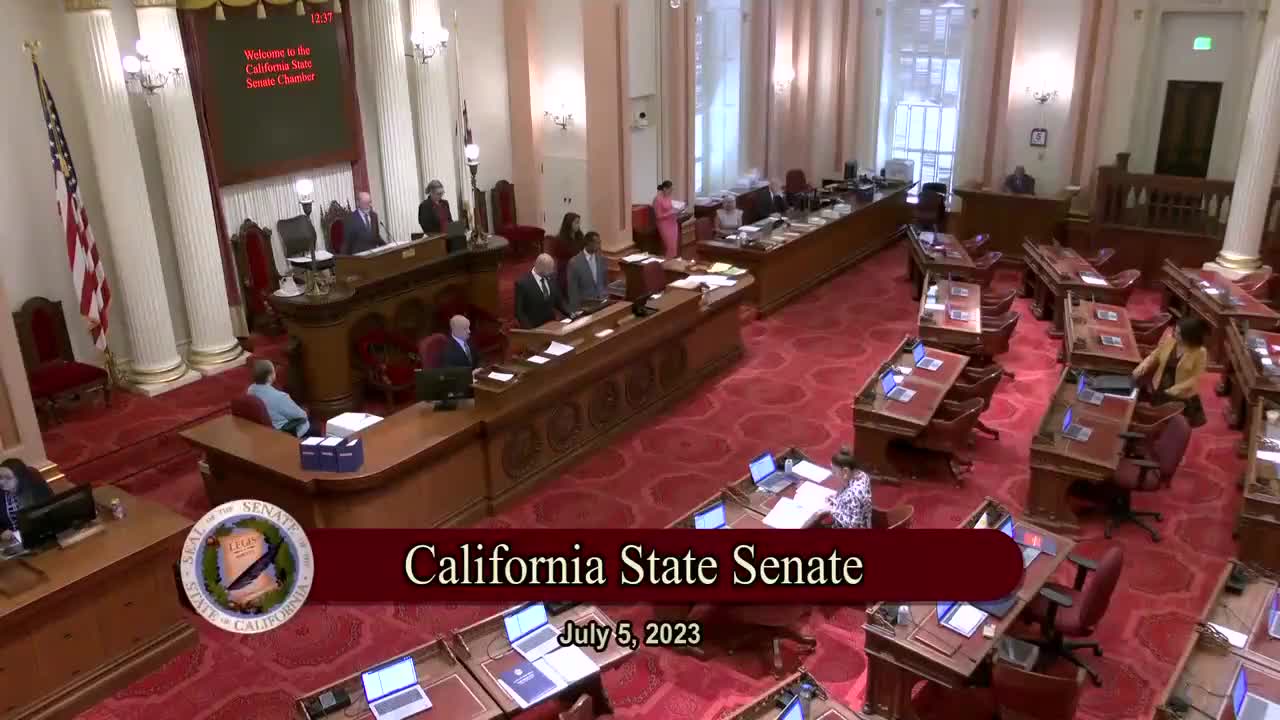 5MIN
Senate Floor
 10MIN
Assembly Standing Committee on Transportation
 3MIN
Assembly Floor


Bill Co-Author(s):