SB 149: California Environmental Quality Act: administrative and judicial procedures: record of proceedings: judicial streamlining.
- Session Year: 2023-2024
- House: Senate
- Latest Version Date: 2023-07-10
Current Status:
Passed
(2023-07-10: Chaptered by Secretary of State. Chapter 60, Statutes of 2023.)
Introduced
In Committee
First Chamber
In Committee
Second Chamber
Enacted
The California Environmental Quality Act (CEQA) requires a lead agency, as defined, to prepare, or cause to be prepared, and certify the completion of an environmental impact report (EIR) on a project that it proposes to carry out or approve that may have a significant effect on the environment or to adopt a negative declaration if it finds that the project will not have that effect. CEQA also requires a lead agency to prepare a mitigated negative declaration for a project that may have a significant effect on the environment if revisions in the project would avoid or mitigate that effect and there is no substantial evidence that the project, as revised, would have a significant effect on the environment.
CEQA provides that, in certain specified actions or proceedings, the plaintiff or petitioner may elect to prepare the record of proceedings, subject to certification of its accuracy by the public agency. CEQA requires that a copy of the certified record of proceedings be lodged with the court.
This bill would authorize the public agency to deny the request of the plaintiff or petitioner to prepare the record of proceedings, as provided, in which case the bill would require the public agency or the real party in interest to bear the costs of preparation and certification of the record of proceedings and would prohibit the recovery of those costs from the plaintiff or petitioner. The bill would require the court to schedule a case management conference within 30 days of the filing of an action to review the scope, timing, and cost of the record of proceedings. The bill would require that an electronic copy of the certified record of proceedings be lodged with the court.
The Jobs and Economic Improvement Through Environmental Leadership Act of 2021 (Leadership Act) authorizes the Governor, before January 1, 2024, to certify projects that meet specified requirements for streamlining benefits related to CEQA, including the requirement that judicial actions challenging the action of a lead agency for projects certified by the Governor be resolved, to the extent feasible, within 270 days after the filing of the record of proceedings with the court, and a requirement that the applicant agrees to pay the costs of preparing the record of proceedings for the project concurrent with review and consideration of the project, as specified. The Leadership Act provides that if a lead agency fails to approve a project certified by the Governor before January 1, 2025, the certification is no longer valid. The Leadership Act provides that it is repealed on January 1, 2026.
This bill would extend the Governors authority to certify a project to before January 1, 2032. The bill would expressly provide that the cost of preparing the record of proceedings for the project is not recoverable from the plaintiff or petitioner before, during, or after any litigation. The bill would provide that if a lead agency fails to approve a project certified by the Governor before January 1, 2033, the certification is no longer valid. The bill would repeal the Leadership Act on January 1, 2034. Because the bill would extend the duties of the lead agency under the Leadership Act, this bill would impose a state-mandated local program.
This bill would establish procedures for the preparation of the record of proceedings for projects that are certified by the Governor as an infrastructure project, as defined. The bill would require an action or proceeding challenging the certification of an EIR for those projects or the granting of any project approvals, including any potential appeals to the court of appeal or the Supreme Court, to be resolved, to the extent feasible, within 270 days of the filing of the record of proceedings with the court. The bill would authorize a project applicant to apply to the Governor for the certification of a project as an infrastructure project. The bill would require the lead agency, within 10 days of the certification of a project, to provide a public notice of the certification, as provided. Because the bill would impose additional duties on a lead agency in conducting the environmental review of a certified project, this bill would impose a state-mandated local program. If a lead agency fails to approve a project certified as an infrastructure project before January 1, 2033, the bill would specify that the certification is no longer valid. The bill would repeal the above provisions on January 1, 2034.
This bill would appropriate $1,000,000 from the General Fund to the Judicial Council for judicial officer training for implementation of the above provisions.
The California Constitution requires the state to reimburse local agencies and school districts for certain costs mandated by the state. Statutory provisions establish procedures for making that reimbursement.
This bill would provide that no reimbursement is required by this act for a specified reason.
This bill would declare that it is to take effect immediately as an urgency statute.
The California Environmental Quality Act (CEQA) requires a lead agency, as defined, to prepare, or cause to be prepared, and certify the completion of an environmental impact report (EIR) on a project that it proposes to carry out or approve that may have a significant effect on the environment or to adopt a negative declaration if it finds that the project will not have that effect. CEQA also requires a lead agency to prepare a mitigated negative declaration for a project that may have a significant effect on the environment if revisions in the project would avoid or mitigate that effect and there is no substantial evidence that the project, as revised, would have a significant effect on the environment.
CEQA provides that that, in certain specified actions or proceedings, the plaintiff or petitioner may elect to prepare the record of proceedings, subject to certification of its accuracy by the public agency. CEQA requires that a copy of the certified record of proceedings be lodged with the court.
This bill would authorize the public agency to deny the request of the plaintiff or petitioner to prepare the record of proceedings, as provided, in which case the bill would require the public agency or the real party in interest to bear the costs of preparation and certification of the record of proceedings and would prohibit the recovery of those costs from the plaintiff or petitioner. The bill would require the court to schedule a case management conference within 30 days of the filing of an action to review the scope, timing, and cost of the record of proceedings. The bill would require that an electronic copy of the certified record of proceedings be lodged with the court.
The Jobs and Economic Improvement Through Environmental Leadership Act of 2021 (Leadership Act) authorizes the Governor, before January 1, 2024, to certify projects that meet specified requirements for streamlining benefits related to CEQA, including the requirement that judicial actions challenging the action of a lead agency for projects certified by the Governor be resolved, to the extent feasible, within 270 days after the filing of the record of proceedings with the court, and a requirement that the applicant agrees to pay the costs of preparing the record of proceedings for the project concurrent with review and consideration of the project, as specified. The Leadership Act provides that if a lead agency fails to approve a project certified by the Governor before January 1, 2025, the certification is no longer valid. The Leadership Act provides that it is repealed on January 1, 2026.
This bill would extend the Governors authority to certify a project to before January 1, 2032. The bill would expressly provide that the cost of preparing the record of proceedings for the project is not recoverable from the plaintiff or petitioner before, during, or after any litigation. The bill would provide that if a lead agency fails to approve a project certified by the Governor before January 1, 2033, the certification is no longer valid. The bill would repeal the Leadership Act on January 1, 2034. Because the bill would extend the duties of the lead agency under the Leadership Act, this bill would impose a state-mandated local program.
This bill would establish procedures for the preparation of the record of proceedings for projects that are certified by the Governor as an infrastructure project, as defined. The bill would require an action or proceeding challenging the certification of an EIR for those projects or the granting of any project approvals, including any potential appeals to the court of appeal or the Supreme Court, to be resolved, to the extent feasible, within 270 days of the filing of the record of proceedings with the court. The bill would authorize a project applicant to apply to the Governor for the certification of a project as an infrastructure project. The bill would require the lead agency, within 10 days of the certification of a project, to provide a public notice of the certification, as provided. Because the bill would impose additional duties on a lead agency in conducting the environmental review of a certified project, this bill would impose a state-mandated local program. If a lead agency fails to approve a project certified as an infrastructure project before January 1, 2033, the bill would specify that the certification is no longer valid. The bill would repeal the above provisions on January 1, 2034.
This bill would appropriate $1,000,000 from the General Fund to the Judicial Council for judicial officer training for implementation of the above provisions.
The California Constitution requires the state to reimburse local agencies and school districts for certain costs mandated by the state. Statutory provisions establish procedures for making that reimbursement.
This bill would provide that no reimbursement is required by this act for a specified reason.
This bill would declare that it is to take effect immediately as an urgency statute.
The California Environmental Quality Act (CEQA) requires a lead agency, as defined, to prepare, or cause to be prepared, and certify the completion of an environmental impact report (EIR) on a project that it proposes to carry out or approve that may have a significant effect on the environment or to adopt a negative declaration if it finds that the project will not have that effect. CEQA also requires a lead agency to prepare a mitigated negative declaration for a project that may have a significant effect on the environment if revisions in the project would avoid or mitigate that effect and there is no substantial evidence that the project, as revised, would have a significant effect on the environment.
CEQA provides that in certain specified actions or proceedings, the plaintiff or petitioner may elect to prepare the record of proceedings, subject to certification of its accuracy by the public agency. CEQA requires that a copy of the certified record of proceedings be lodged with the court.
This bill would authorize the public agency to deny the request of the plaintiff or petitioner to prepare the record of proceedings, as provided, in which case the bill would require the public agency or the real party in interest to bear the costs of preparation and certification of the record of proceedings and would prohibit the recovery of those costs from the plaintiff or petitioner. The bill would require the court to schedule a case management conference within 30 days of the filing of an action to review the scope, timing, and cost of the record of proceedings. The bill would require that an electronic copy of the certified record of proceedings be lodged with the court.
The Jobs and Economic Improvement Through Environmental Leadership Act of 2021 (Leadership Act) authorizes the Governor, before January 1, 2024, to certify projects that meet specified requirements for streamlining benefits related to CEQA, including the requirement that judicial actions challenging the action of a lead agency for projects certified by the Governor be resolved, to the extent feasible, within 270 days after the filing of the record of proceedings with the court, and a requirement that the applicant agrees to pay the costs of preparing the record of proceedings for the project concurrent with review and consideration of the project, as specified. The Leadership Act provides that if a lead agency fails to approve a project certified by the Governor before January 1, 2025, the certification is no longer valid. The Leadership Act provides that it is repealed on January 1, 2026.
This bill would extend the Governors authority to certify a project to before January 1, 2032. The bill would expressly provide that the cost of preparing the record of proceedings for the project is not recoverable from the plaintiff or petitioner before, during, or after any litigation. The bill would provide that if a lead agency fails to approve a project certified by the Governor before January 1, 2033, the certification is no longer valid. The bill would repeal the Leadership Act on January 1, 2034. Because the bill would extend the duties of the lead agency under the Leadership Act, this bill would impose a state-mandated local program.
This bill would establish procedures for the preparation of the record of proceedings for projects that are certified by the Governor as an infrastructure project, as defined. The bill would require an action or proceeding challenging the certification of an EIR for those projects or the granting of any project approvals, including any potential appeals to the court of appeal or the Supreme Court, to be resolved, to the extent feasible, within 270 days of the filing of the record of proceedings with the court. The bill would authorize a project applicant to apply to the Governor for the certification of a project as an infrastructure project. The bill would require the lead agency, within 10 days of the certification of a project, to provide a public notice of the certification, as provided. Because the bill would impose additional duties on a lead agency in conducting the environmental review of a certified project, this bill would impose a state-mandated local program. If a lead agency fails to approve a project certified as an infrastructure project before January 1, 2033, the bill would specify that the certification is no longer valid. The bill would repeal the above provisions on January 1, 2034.
This bill would appropriate $1,000,000 from the General Fund to the Judicial Council for judicial officer training for implementation of the above provisions.
The California Constitution requires the state to reimburse local agencies and school districts for certain costs mandated by the state. Statutory provisions establish procedures for making that reimbursement.
This bill would provide that no reimbursement is required by this act for a specified reason.
This bill would declare that it is to take effect immediately as an urgency statute.
This bill would express the intent of the Legislature to enact statutory changes relating to the Budget Act of 2023.This bill would express the intent of the Legislature to enact statutory changes relating to the Budget Act of 2023.
Notwithstanding any other law, in all actions or proceedings brought pursuant to Section 21167, except as provided in Section 21167.6.2 or those involving the Public Utilities Commission, all of the following shall apply:
(a)At the time that the action or proceeding is filed, the plaintiff or petitioner shall file a request that the respondent public agency prepare the record of proceedings relating to the subject of the action or proceeding. The request, together with the complaint or petition, shall be served personally upon the public agency not later than 10 business days from the date that the action or proceeding was filed.
(b)(1)(A)The public agency shall prepare and certify the record of proceedings not later than 60 days from the date that the request specified in subdivision (a) was served upon the public agency. Upon certification, the public agency shall lodge an electronic copy of the record of proceedings with the court and shall serve on the parties notice that the record of proceedings has been certified and lodged with the court. The parties shall pay any reasonable costs or fees imposed for the preparation of the record of proceedings in conformance with any law or rule of court.
(B)The court shall schedule a case management conference within 30 days of the filing of the complaint or petition pursuant to this division to review the scope, timing, and cost of the record of proceedings. The parties may stipulate to a partial record of proceedings that does not contain all the documents listed in subdivision (e) if approved by the court.
(2)The plaintiff or petitioner may elect to prepare the record of proceedings by providing a notice of the election to the public agency, or the parties may agree to an alternative method of preparation of the record of proceedings, subject to certification of its accuracy by the public agency, within the 60-day time limit specified in this subdivision.
(3)Notwithstanding paragraph (2), the public agency, within five business days of the receipt of the notice specified in paragraph (2), may deny the request of the plaintiff or petitioner to prepare the record of proceedings, in which case the public agency or the real party in interest shall bear the costs of preparation and certification of the record of proceedings, and those costs shall not be recoverable from the plaintiff or petitioner.
(c)The time limit established by subdivision (b) may be extended only upon the stipulation of all parties who have been properly served in the action or proceeding or upon order of the court. Extensions shall be liberally granted by the court when the size of the record of proceedings renders infeasible compliance with that time limit. There is no limit on the number of extensions that may be granted by the court, but no single extension shall exceed 60 days unless the court determines that a longer extension is in the public interest.
(d)If the public agency fails to prepare and certify the record of proceedings within the time limit established in paragraph (1) of subdivision (b), or any continuances of that time limit, the plaintiff or petitioner may move for sanctions, and the court may, upon that motion, grant appropriate sanctions.
(e)The record of proceedings shall include, but is not limited to, all of the following items:
(1)All project application materials.
(2)All staff reports and related documents prepared by the respondent public agency with respect to its compliance with the substantive and procedural requirements of this division and with respect to the action on the project.
(3)All staff reports and related documents prepared by the respondent public agency and written testimony or documents submitted by any person relevant to any findings or statement of overriding considerations adopted by the respondent agency pursuant to this division.
(4)Any transcript or minutes of the proceedings at which the decisionmaking body of the respondent public agency heard testimony on, or considered any environmental document on, the project, and any transcript or minutes of proceedings before any advisory body to the respondent public agency that were presented to the decisionmaking body before action on the environmental documents or on the project.
(5)All notices issued by the respondent public agency to comply with this division or with any other law governing the processing and approval of the project.
(6)All written comments received in response to, or in connection with, environmental documents prepared for the project, including responses to the notice of preparation.
(7)All written evidence or correspondence submitted to, or transferred from, the respondent public agency with respect to compliance with this division or with respect to the project.
(8)Any proposed decisions or findings submitted to the decisionmaking body of the respondent public agency by its staff, or the project proponent, project opponents, or other persons.
(9)The documentation of the final public agency decision, including the final environmental impact report, mitigated negative declaration, or negative declaration, and all documents, in addition to those referenced in paragraph (3), cited or relied on in the findings or in a statement of overriding considerations adopted pursuant to this division.
(10)Any other written materials relevant to the respondent public agencys compliance with this division or to its decision on the merits of the project, including the initial study, any drafts of any environmental document, or portions thereof, that have been released for public review, and copies of studies or other documents relied upon in any environmental document prepared for the project and either made available to the public during the public review period or included in the respondent public agencys files on the project, and all internal agency communications, including staff notes and memoranda related to the project or to compliance with this division, but not including communications that are of a logistical nature, such as meeting invitations and scheduling communications, except that any material that is subject to privileges contained in the Evidence Code, or exemptions contained in the California Public Records Act (Division 10 (commencing with Section 7920.000) of Title 1 of the Government Code) shall not be included in the record of proceedings under this paragraph, consistent with existing law.
(11)The full written record before any inferior administrative decisionmaking body whose decision was appealed to a superior administrative decisionmaking body before the filing of litigation.
(f)In preparing the record of proceedings, the party preparing the record of proceedings shall strive to do so at reasonable cost in light of the scope of the record of proceedings.
(g)The clerk of the superior court shall prepare and certify the clerks transcript on appeal not later than 60 days from the date that the notice designating the papers or records to be included in the clerks transcript was filed with the superior court, if the party or parties pay any costs or fees for the preparation of the clerks transcript imposed in conformance with any law or rules of court. Nothing in this subdivision precludes an election to proceed by appendix, as provided in Rule 8.124 of the California Rules of Court.
(h)Extensions of the period for the filing of any brief on appeal may be allowed only by stipulation of the parties or by order of the court for good cause shown. Extensions for the filing of a brief on appeal shall be limited to one 30-day extension for the preparation of an opening brief and one 30-day extension for the preparation of a responding brief, except that the court may grant a longer extension or additional extensions if it determines that there is a substantial likelihood of settlement that would avoid the necessity of completing the appeal.
(i)At the completion of the filing of briefs on appeal, the appellant shall notify the court of the completion of the filing of briefs, whereupon the clerk of the reviewing court shall set the appeal for hearing on the first available calendar date.
SEC. 2.Section 21181 of the Public Resources Code is amended to read:21181.This chapter does not apply to a project if the Governor does not certify the project as an environmental leadership development project eligible for streamlining under this chapter before January 1, 2032.
SEC. 3.Section 21183 of the Public Resources Code is amended to read:21183.The Governor may certify a leadership project for streamlining before a lead agency certifies a final environmental impact report for a project under this chapter if all the following conditions are met:
(a)(1)Except as provided in paragraph (2), the project will result in a minimum investment of one hundred million dollars ($100,000,000) in California upon completion of construction.
(2)Paragraph (1) does not apply to a leadership project described in paragraph (4) of subdivision (b) of Section 21180.
(b)The project creates high-wage, highly skilled jobs that pay prevailing wages and living wages, provides construction jobs and permanent jobs for Californians, helps reduce unemployment, and promotes apprenticeship training. For purposes of this subdivision, a project is deemed to create jobs that pay prevailing wages, create highly skilled jobs, and promote apprenticeship training if the applicant demonstrates to the satisfaction of the Governor that the project will comply with Section 21183.5.
(c)(1)For a project described in paragraph (1), (2), or (3) of subdivision (b) of Section 21180, the project does not result in any net additional emission of greenhouse gases, including greenhouse gas emissions from employee transportation. For purposes of this paragraph, a project is deemed to meet the requirements of this paragraph if the applicant demonstrates to the satisfaction of the Governor that the project will comply with Section 21183.6.
(2)For a project described in paragraph (4) of subdivision (b) of Section 21180, the project does not result in any net additional emission of greenhouse gases, including greenhouse gas emissions from employee transportation.
(d)The applicant demonstrates compliance with the requirements of Chapter 12.8 (commencing with Section 42649) and Chapter 12.9 (commencing with Section 42649.8) of Part 3 of Division 30, as applicable.
(e)The applicant has entered into a binding and enforceable agreement that all mitigation measures required under this division to certify the project under this chapter shall be conditions of approval of the project, and those conditions will be fully enforceable by the lead agency or another agency designated by the lead agency. In the case of environmental mitigation measures, the applicant agrees, as an ongoing obligation, that those measures will be monitored and enforced by the lead agency for the life of the obligation.
(f)The applicant agrees to pay the costs of the trial court and the court of appeal in hearing and deciding any case challenging a lead agencys action on a certified project under this division, including payment of the costs for the appointment of a special master if deemed appropriate by the court, in a form and manner specified by the Judicial Council, as provided in the California Rules of Court adopted by the Judicial Council under Section 21185.
(g)The applicant agrees to pay the costs of preparing the record of proceedings for the project concurrent with review and consideration of the project under this division, in a form and manner specified by the lead agency for the project. The cost of preparing the record of proceedings for the project shall not be recoverable from the plaintiff or petitioner before, during, or after any litigation.
(h)For a project for which environmental review has commenced, the applicant demonstrates that the record of proceedings is being prepared in accordance with Section 21186.
SEC. 4.Section 21189.1 of the Public Resources Code is amended to read:21189.1.If, before January 1, 2033, a lead agency fails to approve a project certified by the Governor under this chapter, then the certification expires and is no longer valid.
SEC. 5.Section 21189.3 of the Public Resources Code is amended to read:21189.3.This chapter shall remain in effect until January 1, 2034, and as of that date is repealed unless a later enacted statute extends or repeals that date.
SEC. 6.Chapter 7 (commencing with Section 21189.80) is added to Division 13 of the Public Resources Code, to read:7.Infrastructure Projects21189.80.The Legislature finds and declares all of the following:
(a)This division requires that the environmental impacts of development projects be identified and mitigated.
(b)This division also guarantees the public an opportunity to review and comment on the environmental impacts of a project and to participate meaningfully in the development of mitigation measures for potentially significant environmental impacts.
(c)Historic federal and state investments in infrastructure will lead to the development of numerous transportation-related, water-related, technology, and energy facilities across the state that would further Californias commitments to reducing emissions of greenhouse gases and protecting its people from the worst extremes of climate change while also leveraging federal resources to increase access to quality jobs in our communities.
(d)These projects will further generate full-time jobs during construction and additional jobs once the projects are constructed and operating.
(e)The transportation-related projects would help state, regional, and local agencies more quickly meet the goals of advancing safety, rehabilitating the aging transportation infrastructure, and addressing the impacts of climate change.
(f)The transportation-related projects will accelerate critical state, regional, and local fix it first projects supported by a historic federal and state partnership through Chapter 5 of the Statutes of 2017, and the federal Infrastructure Investment and Jobs Act (Public Law 117-58).
(g)The purpose of this chapter is to provide unique streamlining benefits under this division for critical state, regional, and local investments in climate resiliency, safety, and infrastructure maintenance while maintaining the environmental and public engagement benefits of this division for projects that provide the public benefits, including environmental and climate-related benefits, described above and to both achieve those benefits and put people to work as soon as possible.
21189.81.For purposes of this chapter, the following definitions apply:
(a)Applicant means a public or private entity or its affiliates, or a person or entity that undertakes a public works project, that proposes a project and its successors, heirs, and assignees.
(b)Disadvantaged community means an area identified by the California Environmental Protection Agency pursuant to Section 39711 of the Health and Safety Code or an area identified as a disadvantaged unincorporated community pursuant to Section 65302.10 of the Government Code.
(c)Electrical transmission facility project means a project for the construction and operation of an electrical transmission facility the meets either of the following:
(1)An electrical transmission facility project identified by the Independent System Operator in its annual transmission planning process that meets either of the following criteria:
(A)The project will facilitate delivery of electricity from renewable energy resources or zero-carbon resources.
(B)The project will facilitate delivery of electricity from energy storage projects.
(2)An electrical transmission facility project identified by a local publicly owned electric utility that would satisfy a transmission expansion need approved by the governing body of the local publicly owned electric utility and that meets either of the following criteria:
(A)The project will facilitate delivery of electricity from renewable energy resources or zero-carbon resources.
(B)The project will facilitate delivery of electricity from energy storage projects.
(d)(1)Energy infrastructure project means any of the following:
(A)An eligible renewable energy resource, as defined in Section 399.12 of the Public Utilities Code, excluding resources that utilize biomass fuels.
(B)New energy storage systems of 20 megawatts or more, that are capable of discharging for at least two hours, provided that a pumped hydro facility may qualify only if it is less than or equal to 500 megawatts and has been directly appropriated funding by the state before January 1, 2023.
(C)A project for which the applicant has certified that a capital investment of at least two hundred fifty million dollars ($250,000,000) made over a period of five years and the project is for either of the following:
(i)The manufacture, production, or assembly of an energy storage system or component manufacturing, wind system or component manufacturing, and solar photovoltaic energy system or component manufacturing.
(ii)The manufacture, production, or assembly of specialized products, components, or systems that are integral to renewable energy or energy storage technologies.
(D)An electric transmission facility project, provided that nothing in this chapter affects the jurisdiction of the California Coastal Commission pursuant to Division 20 (commencing with Section 30000) to regulate such projects if located in the coastal zone.
(E)An energy infrastructure project does not include projects utilizing hydrogen as a fuel.
(2)Any project to develop a facility within the meaning of subdivision (b) of Section 25545 shall meet the requirements of Sections 25545.3.3 and 25545.3.5, except that those requirements shall also apply to solar photovoltaic and terrestrial wind electrical generating power plants with a generating capacity of between 20 and 50 megawatts and energy storage projects capable of storing between 80 and 200 megawatt hours of electrical energy.
(e)Infrastructure project means a project that is certified pursuant to Sections 21189.82 and 21189.83 as any of the following:
(1)An energy infrastructure project.
(2)A semiconductor or microelectronic project.
(3)A transportation-related project.
(4)A water-related project.
(f)Semiconductor or microelectronic project means a project that meets the requirements related to investment in new or expanded facilities and is awarded funds under the federal Creating Helpful Incentives to Produce Semiconductors Act of 2022 (Public Law 117-167), commonly known as the CHIPS Act of 2022, and the requirements of Section 21183.5.
(g)(1)Transportation-related project means a transportation infrastructure project that advances one or more of, and does not conflict with, the following goals related to the Climate Action Plan for Transportation Infrastructure adopted by the Transportation Agency:
(A)Build toward an integrated, statewide rail and transit network.
(B)Invest in networks of safe and accessible bicycle and pedestrian infrastructure.
(C)Include investments in light-, medium-, and heavy-duty zero-emission vehicle infrastructure.
(D)Develop a zero-emission freight transportation system.
(E)Reduce public health and economic harms and maximize community benefits.
(F)Make safety improvements to reduce fatalities and severe injuries of all users towards zero.
(G)Assess and integrate assessments of physical climate risk.
(H)Promote projects that do not significantly increase passenger vehicle travel.
(I)Promote compact infill development while protecting residents and businesses from displacement.
(J)Protect natural and working lands.
(2)Transportation-related projects are public works for the purposes of Section 1720 of the Labor Code and shall comply with the applicable provisions of Chapter 1 (commencing with Section 1720) of Part 7 of Division 2 of the Labor Code.
(h)(1)Water-related project means any of the following:
(A)A project that is approved to implement a groundwater sustainability plan that the Department of Water Resources has determined is in compliance with Sections 10727.2 and 10727.4 of the Water Code or to implement an interim groundwater sustainability plan adopted pursuant to Section 10735.6 of the Water Code.
(B)(i)A water storage project funded by the California Water Commission pursuant to Chapter 8 (commencing with Section 79750) of Division 26.7 of the Water Code.
(ii)In addition to clause (i), the applicant shall demonstrate that the project will minimize the intake or diversion of water except during times of surplus water and prioritizes the discharge of water for ecological benefits or to mitigate an emergency, including, but not limited to, dam repair, levee repair, wetland restoration, marshland restoration, or habitat preservation, or other public benefits described in Section 79753 of the Water Code.
(C)Projects for the development of recycled water, as defined in Section 13050 of the Water Code.
(D)Contaminant and salt removal projects, including groundwater desalination and associated treatment, storage, conveyance, and distribution facilities. This shall not include seawater desalination.
(E)Projects exclusively for canal or other conveyance maintenance and repair.
(2)Water-related projects are public works for the purposes of Section 1720 of the Labor Code and shall comply with the applicable provisions of Chapter 1 (commencing with Section 1720) of Part 7 of Division 2 of the Labor Code.
(3)Water-related project does not include the design or construction of through-Delta conveyance facilities of the Sacramento-San Joaquin Delta.
21189.82.(a)(1)(A)The Governor may certify a project as an energy infrastructure project for purposes of this chapter if the project meets the requirements of subdivision (d) of Section 21189.81.
(B)In addition to subparagraph (A), if the applicant is not the lead agency, the Governor shall ensure all of the following:
(i)The applicant agrees to pay the costs of the trial court and the court of appeal in hearing and deciding any case challenging a lead agencys action on a certified project under this division, including payment of the costs for the appointment of a special master if deemed appropriate by the court, in a form and manner as provided in the rule of court adopted by the Judicial Council under Section 21189.85.
(ii)The applicant agrees to pay the costs of preparing the record of proceedings for the project concurrent with the review and consideration of the project under this division, in a form and manner specified by the lead agency for the project.
(iii)For a project for which environmental review has commenced, the applicant demonstrates that the record of proceedings is being prepared in accordance with Section 21189.86.
(2)(A)The Governor may certify a project as a semiconductor or microelectronic project for purposes of this chapter if the project meets the requirements of subdivision (f) of Section 21189.81.
(B)In addition to subparagraph (A), if the applicant is not the lead agency, the Governor shall ensure all of the following:
(i)The applicant agrees to pay the costs of the trial court and the court of appeal in hearing and deciding any case challenging a lead agencys action on a certified project under this division, including payment of the costs for the appointment of a special master if deemed appropriate by the court, in a form and manner as provided in the rule of court adopted by the Judicial Council under Section 21189.85.
(ii)The applicant agrees to pay the costs of preparing the record of proceedings for the project concurrent with the review and consideration of the project under this division, in a form and manner specified by the lead agency for the project.
(iii)For a project for which environmental review has commenced, the applicant demonstrates that the record of proceedings is being prepared in accordance with Section 21189.86.
(3)The Governor may certify up to 20 transportation-related projects for purposes of this chapter, including up to 10 state projects proposed by the Department of Transportation and up to 10 local or regional projects, that meet the requirements of subdivision (g) of Section 21189.81.
(4)(A)The Governor may certify a project as a water-related project for purposes of this chapter if the project meets the requirements of subdivision (h) of Section 21189.81.
(B)In addition to subparagraph (A), the Governor shall ensure all of the following:
(i)The applicant agrees to pay the costs of the trial court and the court of appeal in hearing and deciding any case challenging a lead agencys action on a certified project under this division, including payment of the costs for the appointment of a special master if deemed appropriate by the court, in a form and manner as provided in the rule of court adopted by the Judicial Council under Section 21189.85.
(ii)The applicant agrees to pay the costs of preparing the record of proceedings for the project concurrent with the review and consideration of the project under this division, in a form and manner specified by the lead agency for the project.
(iii)For a project for which environmental review has commenced, the applicant demonstrates that the record of proceedings is being prepared in accordance with Section 21189.86.
(C)In addition to subparagraphs (A) and (B), the Governor may certify a project as a water-related project for purposes of this chapter only if the Governor finds that greenhouse gas emissions resulting from the project will be mitigated to the extent feasible.
(b)The Office of Planning and Research may consult with other state agencies on and may issue guidelines regarding applications for and the certification of projects under this chapter. Any guidelines issued under this subdivision are not subject to the rulemaking provisions of the Administrative Procedure Act (Chapter 3.5 (commencing with Section 11340) of Part 1 of Division 3 of Title 2 of the Government Code).
(c)An applicant for certification of an infrastructure project under this chapter shall do all of the following:
(1)Avoid or minimize significant environmental impacts in any disadvantaged community.
(2)If measures are required pursuant to this division to mitigate significant environmental impacts in a disadvantaged community, mitigate those impacts consistent with this division, including Section 21002. Mitigation measures required under this subdivision shall be undertaken in, and directly benefit, the affected community.
(3)Enter into a binding and enforceable agreement to comply with this subdivision in its application to the Governor and to the lead agency prior to the agencys certification of the environmental impact report for the project.
(d)The Office of Planning and Research shall make evidence and materials submitted for the certification of a project available to the public on its internet website at least 15 days before the certification of the project.
(e)The Governors decision to certify a project shall not be subject to judicial review.
21189.83.(a)In addition to the requirements of Section 21189.82, with respect to any energy infrastructure project or semiconductor or microelectronic project proposed by a private entity, the Governor may certify the project pursuant to this chapter only if the project does not result in any net additional emission of greenhouse gases, including greenhouse gas emissions from employee transportation. For purposes of this section, a project is deemed to meet the requirements of this section if the applicant demonstrates to the satisfaction of the Governor that the applicant has a binding commitment that it will mitigate impacts resulting from the emission of greenhouse gases, if any, in accordance with Section 21183.6.
(b)In addition to the requirements of Section 21189.82, with respect to any transportation-related project, the Governor may certify the project pursuant to this chapter only if the project does not result in any net additional emission of greenhouse gases, excluding greenhouse gas emissions from employee transportation. For purposes of this section, a project is deemed to meet the requirements of this section if the applicant demonstrates to the satisfaction of the Governor that the applicant has a binding commitment that it will mitigate impacts resulting from the emission of greenhouse gases, if any, preferably through direct emissions reductions where feasible, but where not feasible, then through the use of offsets that are real, permanent, verifiable, and enforceable, and that provide a specific, quantifiable, and direct environmental and public health benefit to the same air pollution control district or air quality management district in which the project is located, but if all of the project impacts cannot be feasibly and fully mitigated in the same air pollution control district or air quality management district, then remaining unmitigated impacts shall be mitigated through the use of offsets that provide a specific, quantifiable, and direct environmental and public health benefit to the region in which the project is located.
(c)The applicant shall be responsible for the costs of preparing an analysis of the emission of greenhouse gases resulting from the project.
21189.84.(a)This chapter applies to a project that is certified by the Governor as an infrastructure project.
(b)An applicant may apply to the Governor for certification and shall provide evidence and materials deemed necessary by the Governor in making a decision on the application for certification.
(c)The Governor shall submit the Governors proposed certification, and any supporting information, to the Joint Legislative Budget Committee for review and concurrence or nonconcurrence. Within 30 days of receiving the determination, the Joint Legislative Budget Committee shall concur or nonconcur in writing on the certification. If the Joint Legislative Budget Committee fails to concur or nonconcur on a certification within 30 days of the submittal, the project is deemed to be certified.
(d)The Office of Planning and Research may charge a fee to an applicant seeking certification under this chapter for the costs incurred by the Governors office in implementing this chapter.
21189.85.(a)An action or proceeding brought to attack, review, set aside, void, or annul the certification of an environmental impact report for an infrastructure project subject to this chapter or the granting of any project approvals, including any potential appeals to the court of appeal or the Supreme Court, shall be resolved, to the extent feasible, within 270 days of the filing of the certified record of proceedings with the court.
(b)On or before December 31, 2023, the Judicial Council shall adopt a rule of court to implement this section.
21189.86.Notwithstanding any other law, the preparation and certification of the record of proceedings for an infrastructure project shall be performed in the following manner:
(a)The lead agency for the project shall prepare the record of proceedings under this division concurrently with the administrative process.
(b)All documents and other materials placed in the record of proceedings shall be posted on, and be downloadable from, an internet website maintained by the lead agency commencing with the date of the release of the draft environmental impact report.
(c)The lead agency shall make available to the public in a readily accessible electronic format the draft environmental impact report and all other documents submitted to, or relied on by, the lead agency in preparing the draft environmental impact report.
(d)Any document prepared by the lead agency or submitted by the applicant after the date of the release of the draft environmental impact report that is a part of the record of proceedings shall be made available to the public in a readily accessible electronic format within five days after the document is released or received by the lead agency.
(e)The lead agency shall encourage written comments on the project to be submitted in a readily accessible electronic format, and shall make any comment available to the public in a readily accessible electronic format within five days of its receipt.
(f)Within seven days after the receipt of any comment that is not in an electronic format, the lead agency shall convert that comment into a readily accessible electronic format and make it available to the public in that format.
(g)Notwithstanding subdivisions (b) to (f), inclusive, documents submitted to or relied on by the lead agency that were not prepared specifically for the project and are copyright protected are not required to be made readily accessible in an electronic format. For those copyright-protected documents, the lead agency shall make an index of these documents available in an electronic format no later than the date of the release of the draft environmental impact report, or within five days if the document is received or relied on by the lead agency after the release of the draft environmental impact report. The index shall specify the libraries or lead agency offices in which hardcopies of the copyrighted materials are available for public review.
(h)The lead agency shall certify the final record of proceedings within five days of its approval of the project.
(i)Any dispute arising from the record of proceedings shall be resolved by the superior court. Unless the superior court directs otherwise, a party disputing the content of the record of proceedings shall file a motion to augment the record of proceedings at the time it files its initial brief.
(j)The contents of the record of proceedings shall be as set forth in subdivision (e) of Section 21167.6.
(k)The applicant shall pay the costs of preparing the record of proceedings for the project concurrent with review and consideration of the project under this division, in a form and manner specified by the lead agency for the project. The cost of preparing the record of proceedings for the project shall not be recoverable from the plaintiff or petitioner before, during, or after any litigation.
21189.87.(a)Within 10 days of the certification of a project pursuant to Section 21189.82, the lead agency shall, at the applicants expense, if applicable, issue a public notice in no less than 12-point type stating the following:
THE APPLICANT HAS ELECTED TO PROCEED UNDER CHAPTER 7 (COMMENCING WITH SECTION 21189.80) OF DIVISION 13 OF THE PUBLIC RESOURCES CODE, WHICH PROVIDES, AMONG OTHER THINGS, THAT ANY JUDICIAL ACTION CHALLENGING THE CERTIFICATION OF THE ENVIRONMENTAL IMPACT REPORT (EIR) OR THE APPROVAL OF THE PROJECT DESCRIBED IN THE EIR IS SUBJECT TO THE PROCEDURES SET FORTH IN SECTIONS 21189.85 AND 21189.86
OF THE PUBLIC RESOURCES CODE. A COPY OF CHAPTER 7 (COMMENCING WITH SECTION 21189.80) OF
DIVISION 13 OF THE PUBLIC RESOURCES CODE IS INCLUDED BELOW.
(b)The public notice shall be distributed by the lead agency as required for public notices issued under paragraph (3) of subdivision (b) of Section 21092.
21189.88.Except as otherwise provided expressly in this chapter, this chapter does not affect the duty of any party to comply with this division.
21189.89.The provisions of this chapter are severable. If any provision of this chapter or its application is held invalid, that invalidity shall not affect other provisions or applications that can be given effect without the invalid provision or application.
21189.90.If before January 1, 2033, a lead agency fails to approve an infrastructure project, then the certification is no longer valid.
21189.91.This chapter shall remain in effect only until January 1, 2034, and as of that date is repealed.
SEC. 7.The sum of one million dollars ($1,000,000) is hereby appropriated from the General Fund to the Judicial Council for judicial officer training for implementation of this act. These funds are available for expenditure through June 30, 2025.
SEC. 8.No reimbursement is required by this act pursuant to Section 6 of Article XIIIB of the California Constitution because a local agency or school district has the authority to levy service charges, fees, or assessments sufficient to pay for the program or level of service mandated by this act, within the meaning of Section 17556 of the Government Code.
SEC. 9.This act is an urgency statute necessary for the immediate preservation of the public peace, health, or safety within the meaning of Article IV of the California Constitution and shall go into immediate effect. The facts constituting the necessity are:
To promote environmental protection and safeguard economic development of Californias diverse public resources and people, and enhance the states ability to maximize federal funding to support those efforts, it is necessary for this act to take effect immediately.
Notwithstanding any other law, in all actions or proceedings brought pursuant to Section 21167, except as provided in Section 21167.6.2 or those involving the Public Utilities Commission, all of the following shall apply:
(a)At the time that the action or proceeding is filed, the plaintiff or petitioner shall file a request that the respondent public agency prepare the record of proceedings relating to the subject of the action or proceeding. The request, together with the complaint or petition, shall be served personally upon the public agency not later than 10 business days from the date that the action or proceeding was filed.
(b)(1)(A)The public agency shall prepare and certify the record of proceedings not later than 60 days from the date that the request specified in subdivision (a) was served upon the public agency. Upon certification, the public agency shall lodge an electronic copy of the record of proceedings with the court and shall serve on the parties notice that the record of proceedings has been certified and lodged with the court. The parties shall pay any reasonable costs or fees imposed for the preparation of the record of proceedings in conformance with any law or rule of court.
(B)The court shall schedule a case management conference within 30 days of the filing of the complaint or petition pursuant to this division to review the scope, timing, and cost of the record of proceedings. The parties may stipulate to a partial record of proceedings that does not contain all the documents listed in subdivision (e) if approved by the court.
(2)The plaintiff or petitioner may elect to prepare the record of proceedings by providing a notice of the election to the public agency, or the parties may agree to an alternative method of preparation of the record of proceedings, subject to certification of its accuracy by the public agency, within the 60-day time limit specified in this subdivision.
(3)Notwithstanding paragraph (2), the public agency, within five business days of the receipt of the notice specified in paragraph (2), may deny the request of the plaintiff or petitioner to prepare the record of proceedings, in which case the public agency or the real party in interest shall bear the costs of preparation and certification of the record of proceedings, and those costs shall not be recoverable from the plaintiff or petitioner.
(c)The time limit established by subdivision (b) may be extended only upon the stipulation of all parties who have been properly served in the action or proceeding or upon order of the court. Extensions shall be liberally granted by the court when the size of the record of proceedings renders infeasible compliance with that time limit. There is no limit on the number of extensions that may be granted by the court, but no single extension shall exceed 60 days unless the court determines that a longer extension is in the public interest.
(d)If the public agency fails to prepare and certify the record of proceedings within the time limit established in paragraph (1) of subdivision (b), or any continuances of that time limit, the plaintiff or petitioner may move for sanctions, and the court may, upon that motion, grant appropriate sanctions.
(e)The record of proceedings shall include, but is not limited to, all of the following items:
(1)All project application materials.
(2)All staff reports and related documents prepared by the respondent public agency with respect to its compliance with the substantive and procedural requirements of this division and with respect to the action on the project.
(3)All staff reports and related documents prepared by the respondent public agency and written testimony or documents submitted by any person relevant to any findings or statement of overriding considerations adopted by the respondent agency pursuant to this division.
(4)Any transcript or minutes of the proceedings at which the decisionmaking body of the respondent public agency heard testimony on, or considered any environmental document on, the project, and any transcript or minutes of proceedings before any advisory body to the respondent public agency that were presented to the decisionmaking body before action on the environmental documents or on the project.
(5)All notices issued by the respondent public agency to comply with this division or with any other law governing the processing and approval of the project.
(6)All written comments received in response to, or in connection with, environmental documents prepared for the project, including responses to the notice of preparation.
(7)All written evidence or correspondence submitted to, or transferred from, the respondent public agency with respect to compliance with this division or with respect to the project.
(8)Any proposed decisions or findings submitted to the decisionmaking body of the respondent public agency by its staff, or the project proponent, project opponents, or other persons.
(9)The documentation of the final public agency decision, including the final environmental impact report, mitigated negative declaration, or negative declaration, and all documents, in addition to those referenced in paragraph (3), cited or relied on in the findings or in a statement of overriding considerations adopted pursuant to this division.
(10)Any other written materials relevant to the respondent public agencys compliance with this division or to its decision on the merits of the project, including the initial study, any drafts of any environmental document, or portions thereof, that have been released for public review, and copies of studies or other documents relied upon in any environmental document prepared for the project and either made available to the public during the public review period or included in the respondent public agencys files on the project, and all internal agency communications, including staff notes and memoranda related to the project or to compliance with this division, but not including communications that are of a logistical nature, such as meeting invitations and scheduling communications, except that any material that is subject to privileges contained in the Evidence Code, or exemptions contained in the California Public Records Act (Division 10 (commencing with Section 7920.000) of Title 1 of the Government Code) shall not be included in the record of proceedings under this paragraph, consistent with existing law.
(11)The full written record before any inferior administrative decisionmaking body whose decision was appealed to a superior administrative decisionmaking body before the filing of litigation.
(f)In preparing the record of proceedings, the party preparing the record of proceedings shall strive to do so at reasonable cost in light of the scope of the record of proceedings.
(g)The clerk of the superior court shall prepare and certify the clerks transcript on appeal not later than 60 days from the date that the notice designating the papers or records to be included in the clerks transcript was filed with the superior court, if the party or parties pay any costs or fees for the preparation of the clerks transcript imposed in conformance with any law or rules of court. Nothing in this subdivision precludes an election to proceed by appendix, as provided in Rule 8.124 of the California Rules of Court.
(h)Extensions of the period for the filing of any brief on appeal may be allowed only by stipulation of the parties or by order of the court for good cause shown. Extensions for the filing of a brief on appeal shall be limited to one 30-day extension for the preparation of an opening brief and one 30-day extension for the preparation of a responding brief, except that the court may grant a longer extension or additional extensions if it determines that there is a substantial likelihood of settlement that would avoid the necessity of completing the appeal.
(i)At the completion of the filing of briefs on appeal, the appellant shall notify the court of the completion of the filing of briefs, whereupon the clerk of the reviewing court shall set the appeal for hearing on the first available calendar date.
SEC. 2.Section 21181 of the Public Resources Code is amended to read:21181.This chapter does not apply to a project if the Governor does not certify the project as an environmental leadership development project eligible for streamlining under this chapter before January 1, 2032.
SEC. 3.Section 21183 of the Public Resources Code is amended to read:21183.The Governor may certify a leadership project for streamlining before a lead agency certifies a final environmental impact report for a project under this chapter if all the following conditions are met:
(a)(1)Except as provided in paragraph (2), the project will result in a minimum investment of one hundred million dollars ($100,000,000) in California upon completion of construction.
(2)Paragraph (1) does not apply to a leadership project described in paragraph (4) of subdivision (b) of Section 21180.
(b)The project creates high-wage, highly skilled jobs that pay prevailing wages and living wages, provides construction jobs and permanent jobs for Californians, helps reduce unemployment, and promotes apprenticeship training. For purposes of this subdivision, a project is deemed to create jobs that pay prevailing wages, create highly skilled jobs, and promote apprenticeship training if the applicant demonstrates to the satisfaction of the Governor that the project will comply with Section 21183.5.
(c)(1)For a project described in paragraph (1), (2), or (3) of subdivision (b) of Section 21180, the project does not result in any net additional emission of greenhouse gases, including greenhouse gas emissions from employee transportation. For purposes of this paragraph, a project is deemed to meet the requirements of this paragraph if the applicant demonstrates to the satisfaction of the Governor that the project will comply with Section 21183.6.
(2)For a project described in paragraph (4) of subdivision (b) of Section 21180, the project does not result in any net additional emission of greenhouse gases, including greenhouse gas emissions from employee transportation.
(d)The applicant demonstrates compliance with the requirements of Chapter 12.8 (commencing with Section 42649) and Chapter 12.9 (commencing with Section 42649.8) of Part 3 of Division 30, as applicable.
(e)The applicant has entered into a binding and enforceable agreement that all mitigation measures required under this division to certify the project under this chapter shall be conditions of approval of the project, and those conditions will be fully enforceable by the lead agency or another agency designated by the lead agency. In the case of environmental mitigation measures, the applicant agrees, as an ongoing obligation, that those measures will be monitored and enforced by the lead agency for the life of the obligation.
(f)The applicant agrees to pay the costs of the trial court and the court of appeal in hearing and deciding any case challenging a lead agencys action on a certified project under this division, including payment of the costs for the appointment of a special master if deemed appropriate by the court, in a form and manner specified by the Judicial Council, as provided in the California Rules of Court adopted by the Judicial Council under Section 21185.
(g)The applicant agrees to pay the costs of preparing the record of proceedings for the project concurrent with review and consideration of the project under this division, in a form and manner specified by the lead agency for the project. The cost of preparing the record of proceedings for the project shall not be recoverable from the plaintiff or petitioner before, during, or after any litigation.
(h)For a project for which environmental review has commenced, the applicant demonstrates that the record of proceedings is being prepared in accordance with Section 21186.
SEC. 4.Section 21189.1 of the Public Resources Code is amended to read:21189.1.If, before January 1, 2033, a lead agency fails to approve a project certified by the Governor under this chapter, then the certification expires and is no longer valid.
SEC. 5.Section 21189.3 of the Public Resources Code is amended to read:21189.3.This chapter shall remain in effect until January 1, 2034, and as of that date is repealed unless a later enacted statute extends or repeals that date.
SEC. 6.Chapter 7 (commencing with Section 21189.80) is added to Division 13 of the Public Resources Code, to read:7.Infrastructure Projects21189.80.The Legislature finds and declares all of the following:
(a)This division requires that the environmental impacts of development projects be identified and mitigated.
(b)This division also guarantees the public an opportunity to review and comment on the environmental impacts of a project and to participate meaningfully in the development of mitigation measures for potentially significant environmental impacts.
(c)Historic federal and state investments in infrastructure will lead to the development of numerous transportation-related, water-related, technology, and energy facilities across the state that would further Californias commitments to reducing emissions of greenhouse gases and protecting its people from the worst extremes of climate change while also leveraging federal resources to increase access to quality jobs in our communities.
(d)These projects will further generate full-time jobs during construction and additional jobs once the projects are constructed and operating.
(e)The transportation-related projects would help state, regional, and local agencies more quickly meet the goals of advancing safety, rehabilitating the aging transportation infrastructure, and addressing the impacts of climate change.
(f)The transportation-related projects will accelerate critical state, regional, and local fix it first projects supported by a historic federal and state partnership through Chapter 5 of the Statutes of 2017, and the federal Infrastructure Investment and Jobs Act (Public Law 117-58).
(g)The purpose of this chapter is to provide unique streamlining benefits under this division for critical state, regional, and local investments in climate resiliency, safety, and infrastructure maintenance while maintaining the environmental and public engagement benefits of this division for projects that provide the public benefits, including environmental and climate-related benefits, described above and to both achieve those benefits and put people to work as soon as possible.
21189.81.For purposes of this chapter, the following definitions apply:
(a)Applicant means a public or private entity or its affiliates, or a person or entity that undertakes a public works project, that proposes a project and its successors, heirs, and assignees.
(b)Disadvantaged community means an area identified by the California Environmental Protection Agency pursuant to Section 39711 of the Health and Safety Code or an area identified as a disadvantaged unincorporated community pursuant to Section 65302.10 of the Government Code.
(c)Electrical transmission facility project means a project for the construction and operation of an electrical transmission facility the meets either of the following:
(1)An electrical transmission facility project identified by the Independent System Operator in its annual transmission planning process that meets either of the following criteria:
(A)The project will facilitate delivery of electricity from renewable energy resources or zero-carbon resources.
(B)The project will facilitate delivery of electricity from energy storage projects.
(2)An electrical transmission facility project identified by a local publicly owned electric utility that would satisfy a transmission expansion need approved by the governing body of the local publicly owned electric utility and that meets either of the following criteria:
(A)The project will facilitate delivery of electricity from renewable energy resources or zero-carbon resources.
(B)The project will facilitate delivery of electricity from energy storage projects.
(d)(1)Energy infrastructure project means any of the following:
(A)An eligible renewable energy resource, as defined in Section 399.12 of the Public Utilities Code, excluding resources that utilize biomass fuels.
(B)New energy storage systems of 20 megawatts or more, that are capable of discharging for at least two hours, provided that a pumped hydro facility may qualify only if it is less than or equal to 500 megawatts and has been directly appropriated funding by the state before January 1, 2023.
(C)A project for which the applicant has certified that a capital investment of at least two hundred fifty million dollars ($250,000,000) made over a period of five years and the project is for either of the following:
(i)The manufacture, production, or assembly of an energy storage system or component manufacturing, wind system or component manufacturing, and solar photovoltaic energy system or component manufacturing.
(ii)The manufacture, production, or assembly of specialized products, components, or systems that are integral to renewable energy or energy storage technologies.
(D)An electric transmission facility project, provided that nothing in this chapter affects the jurisdiction of the California Coastal Commission pursuant to Division 20 (commencing with Section 30000) to regulate such projects if located in the coastal zone.
(E)An energy infrastructure project does not include projects utilizing hydrogen as a fuel.
(2)Any project to develop a facility within the meaning of subdivision (b) of Section 25545 shall meet the requirements of Sections 25545.3.3 and 25545.3.5, except that those requirements shall also apply to solar photovoltaic and terrestrial wind electrical generating power plants with a generating capacity of between 20 and 50 megawatts and energy storage projects capable of storing between 80 and 200 megawatt hours of electrical energy.
(e)Infrastructure project means a project that is certified pursuant to Sections 21189.82 and 21189.83 as any of the following:
(1)An energy infrastructure project.
(2)A semiconductor or microelectronic project.
(3)A transportation-related project.
(4)A water-related project.
(f)Semiconductor or microelectronic project means a project that meets the requirements related to investment in new or expanded facilities and is awarded funds under the federal Creating Helpful Incentives to Produce Semiconductors Act of 2022 (Public Law 117-167), commonly known as the CHIPS Act of 2022, and the requirements of Section 21183.5.
(g)(1)Transportation-related project means a transportation infrastructure project that advances one or more of, and does not conflict with, the following goals related to the Climate Action Plan for Transportation Infrastructure adopted by the Transportation Agency:
(A)Build toward an integrated, statewide rail and transit network.
(B)Invest in networks of safe and accessible bicycle and pedestrian infrastructure.
(C)Include investments in light-, medium-, and heavy-duty zero-emission vehicle infrastructure.
(D)Develop a zero-emission freight transportation system.
(E)Reduce public health and economic harms and maximize community benefits.
(F)Make safety improvements to reduce fatalities and severe injuries of all users towards zero.
(G)Assess and integrate assessments of physical climate risk.
(H)Promote projects that do not significantly increase passenger vehicle travel.
(I)Promote compact infill development while protecting residents and businesses from displacement.
(J)Protect natural and working lands.
(2)Transportation-related projects are public works for the purposes of Section 1720 of the Labor Code and shall comply with the applicable provisions of Chapter 1 (commencing with Section 1720) of Part 7 of Division 2 of the Labor Code.
(h)(1)Water-related project means any of the following:
(A)A project that is approved to implement a groundwater sustainability plan that the Department of Water Resources has determined is in compliance with Sections 10727.2 and 10727.4 of the Water Code or to implement an interim groundwater sustainability plan adopted pursuant to Section 10735.6 of the Water Code.
(B)(i)A water storage project funded by the California Water Commission pursuant to Chapter 8 (commencing with Section 79750) of Division 26.7 of the Water Code.
(ii)In addition to clause (i), the applicant shall demonstrate that the project will minimize the intake or diversion of water except during times of surplus water and prioritizes the discharge of water for ecological benefits or to mitigate an emergency, including, but not limited to, dam repair, levee repair, wetland restoration, marshland restoration, or habitat preservation, or other public benefits described in Section 79753 of the Water Code.
(C)Projects for the development of recycled water, as defined in Section 13050 of the Water Code.
(D)Contaminant and salt removal projects, including groundwater desalination and associated treatment, storage, conveyance, and distribution facilities. This shall not include seawater desalination.
(E)Projects exclusively for canal or other conveyance maintenance and repair.
(2)Water-related projects are public works for the purposes of Section 1720 of the Labor Code and shall comply with the applicable provisions of Chapter 1 (commencing with Section 1720) of Part 7 of Division 2 of the Labor Code.
(3)Water-related project does not include the design or construction of through-Delta conveyance facilities of the Sacramento-San Joaquin Delta.
21189.82.(a)(1)(A)The Governor may certify a project as an energy infrastructure project for purposes of this chapter if the project meets the requirements of subdivision (d) of Section 21189.81.
(B)In addition to subparagraph (A), if the applicant is not the lead agency, the Governor shall ensure all of the following:
(i)The applicant agrees to pay the costs of the trial court and the court of appeal in hearing and deciding any case challenging a lead agencys action on a certified project under this division, including payment of the costs for the appointment of a special master if deemed appropriate by the court, in a form and manner as provided in the rule of court adopted by the Judicial Council under Section 21189.85.
(ii)The applicant agrees to pay the costs of preparing the record of proceedings for the project concurrent with the review and consideration of the project under this division, in a form and manner specified by the lead agency for the project.
(iii)For a project for which environmental review has commenced, the applicant demonstrates that the record of proceedings is being prepared in accordance with Section 21189.86.
(2)(A)The Governor may certify a project as a semiconductor or microelectronic project for purposes of this chapter if the project meets the requirements of subdivision (f) of Section 21189.81.
(B)In addition to subparagraph (A), if the applicant is not the lead agency, the Governor shall ensure all of the following:
(i)The applicant agrees to pay the costs of the trial court and the court of appeal in hearing and deciding any case challenging a lead agencys action on a certified project under this division, including payment of the costs for the appointment of a special master if deemed appropriate by the court, in a form and manner as provided in the rule of court adopted by the Judicial Council under Section 21189.85.
(ii)The applicant agrees to pay the costs of preparing the record of proceedings for the project concurrent with the review and consideration of the project under this division, in a form and manner specified by the lead agency for the project.
(iii)For a project for which environmental review has commenced, the applicant demonstrates that the record of proceedings is being prepared in accordance with Section 21189.86.
(3)The Governor may certify up to 20 transportation-related projects for purposes of this chapter, including up to 10 state projects proposed by the Department of Transportation and up to 10 local or regional projects, that meet the requirements of subdivision (g) of Section 21189.81.
(4)(A)The Governor may certify a project as a water-related project for purposes of this chapter if the project meets the requirements of subdivision (h) of Section 21189.81.
(B)In addition to subparagraph (A), the Governor shall ensure all of the following:
(i)The applicant agrees to pay the costs of the trial court and the court of appeal in hearing and deciding any case challenging a lead agencys action on a certified project under this division, including payment of the costs for the appointment of a special master if deemed appropriate by the court, in a form and manner as provided in the rule of court adopted by the Judicial Council under Section 21189.85.
(ii)The applicant agrees to pay the costs of preparing the record of proceedings for the project concurrent with the review and consideration of the project under this division, in a form and manner specified by the lead agency for the project.
(iii)For a project for which environmental review has commenced, the applicant demonstrates that the record of proceedings is being prepared in accordance with Section 21189.86.
(C)In addition to subparagraphs (A) and (B), the Governor may certify a project as a water-related project for purposes of this chapter only if the Governor finds that greenhouse gas emissions resulting from the project will be mitigated to the extent feasible.
(b)The Office of Planning and Research may consult with other state agencies on and may issue guidelines regarding applications for and the certification of projects under this chapter. Any guidelines issued under this subdivision are not subject to the rulemaking provisions of the Administrative Procedure Act (Chapter 3.5 (commencing with Section 11340) of Part 1 of Division 3 of Title 2 of the Government Code).
(c)An applicant for certification of an infrastructure project under this chapter shall do all of the following:
(1)Avoid or minimize significant environmental impacts in any disadvantaged community.
(2)If measures are required pursuant to this division to mitigate significant environmental impacts in a disadvantaged community, mitigate those impacts consistent with this division, including Section 21002. Mitigation measures required under this subdivision shall be undertaken in, and directly benefit, the affected community.
(3)Enter into a binding and enforceable agreement to comply with this subdivision in its application to the Governor and to the lead agency prior to the agencys certification of the environmental impact report for the project.
(d)The Office of Planning and Research shall make evidence and materials submitted for the certification of a project available to the public on its internet website at least 15 days before the certification of the project.
(e)The Governors decision to certify a project shall not be subject to judicial review.
21189.83.(a)In addition to the requirements of Section 21189.82, with respect to any energy infrastructure project or semiconductor or microelectronic project proposed by a private entity, the Governor may certify the project pursuant to this chapter only if the project does not result in any net additional emission of greenhouse gases, including greenhouse gas emissions from employee transportation. For purposes of this section, a project is deemed to meet the requirements of this section if the applicant demonstrates to the satisfaction of the Governor that the applicant has a binding commitment that it will mitigate impacts resulting from the emission of greenhouse gases, if any, in accordance with Section 21183.6.
(b)In addition to the requirements of Section 21189.82, with respect to any transportation-related project, the Governor may certify the project pursuant to this chapter only if the project does not result in any net additional emission of greenhouse gases, excluding greenhouse gas emissions from employee transportation. For purposes of this section, a project is deemed to meet the requirements of this section if the applicant demonstrates to the satisfaction of the Governor that the applicant has a binding commitment that it will mitigate impacts resulting from the emission of greenhouse gases, if any, preferably through direct emissions reductions where feasible, but where not feasible, then through the use of offsets that are real, permanent, verifiable, and enforceable, and that provide a specific, quantifiable, and direct environmental and public health benefit to the same air pollution control district or air quality management district in which the project is located, but if all of the project impacts cannot be feasibly and fully mitigated in the same air pollution control district or air quality management district, then remaining unmitigated impacts shall be mitigated through the use of offsets that provide a specific, quantifiable, and direct environmental and public health benefit to the region in which the project is located.
(c)In addition to the requirements of Section 21189.82, with respect to any project that is located in whole or in part in a disadvantaged community, the Governor may certify the project pursuant to this chapter only if the project minimizes negative environmental or public health impacts on the disadvantaged community and benefits the disadvantaged community. A project is deemed to meet the requirements of this section if the applicant demonstrates to the satisfaction of the Governor that the applicant has a binding commitment that it will minimize the environmental burdens in any disadvantaged community.(d)(c)The applicant shall be responsible for the costs of preparing an analysis of the emission of greenhouse gases or the impacts on a disadvantaged community resulting from the project.
21189.84.(a)This chapter applies to a project that is certified by the Governor as an infrastructure project.
(b)An applicant may apply to the Governor for certification and shall provide evidence and materials deemed necessary by the Governor in making a decision on the application for certification.
(c)The Governor shall submit the Governors proposed certification, and any supporting information, to the Joint Legislative Budget Committee for review and concurrence or nonconcurrence. Within 30 days of receiving the determination, the Joint Legislative Budget Committee shall concur or nonconcur in writing on the certification. If the Joint Legislative Budget Committee fails to concur or nonconcur on a certification within 30 days of the submittal, the project is deemed to be certified.
(d)The Office of Planning and Research may charge a fee to an applicant seeking certification under this chapter for the costs incurred by the Governors office in implementing this chapter.
21189.85.(a)An action or proceeding brought to attack, review, set aside, void, or annul the certification of an environmental impact report for an infrastructure project subject to this chapter or the granting of any project approvals, including any potential appeals to the court of appeal or the Supreme Court, shall be resolved, to the extent feasible, within 270 days of the filing of the certified record of proceedings with the court.
(b)On or before December 31, 2023, the Judicial Council shall adopt a rule of court to implement this section.
21189.86.Notwithstanding any other law, the preparation and certification of the record of proceedings for an infrastructure project shall be performed in the following manner:
(a)The lead agency for the project shall prepare the record of proceedings under this division concurrently with the administrative process.
(b)All documents and other materials placed in the record of proceedings shall be posted on, and be downloadable from, an internet website maintained by the lead agency commencing with the date of the release of the draft environmental impact report.
(c)The lead agency shall make available to the public in a readily accessible electronic format the draft environmental impact report and all other documents submitted to, or relied on by, the lead agency in preparing the draft environmental impact report.
(d)Any document prepared by the lead agency or submitted by the applicant after the date of the release of the draft environmental impact report that is a part of the record of proceedings shall be made available to the public in a readily accessible electronic format within five days after the document is released or received by the lead agency.
(e)The lead agency shall encourage written comments on the project to be submitted in a readily accessible electronic format, and shall make any comment available to the public in a readily accessible electronic format within five days of its receipt.
(f)Within seven days after the receipt of any comment that is not in an electronic format, the lead agency shall convert that comment into a readily accessible electronic format and make it available to the public in that format.
(g)Notwithstanding subdivisions (b) to (f), inclusive, documents submitted to or relied on by the lead agency that were not prepared specifically for the project and are copyright protected are not required to be made readily accessible in an electronic format. For those copyright-protected documents, the lead agency shall make an index of these documents available in an electronic format no later than the date of the release of the draft environmental impact report, or within five days if the document is received or relied on by the lead agency after the release of the draft environmental impact report. The index shall specify the libraries or lead agency offices in which hardcopies of the copyrighted materials are available for public review.
(h)The lead agency shall certify the final record of proceedings within five days of its approval of the project.
(i)Any dispute arising from the record of proceedings shall be resolved by the superior court. Unless the superior court directs otherwise, a party disputing the content of the record of proceedings shall file a motion to augment the record of proceedings at the time it files its initial brief.
(j)The contents of the record of proceedings shall be as set forth in subdivision (e) of Section 21167.6.
(k)The applicant shall pay the costs of preparing the record of proceedings for the project concurrent with review and consideration of the project under this division, in a form and manner specified by the lead agency for the project. The cost of preparing the record of proceedings for the project shall not be recoverable from the plaintiff or petitioner before, during, or after any litigation.
21189.87.(a)Within 10 days of the certification of a project pursuant to Section 21189.82, the lead agency shall, at the applicants expense, if applicable, issue a public notice in no less than 12-point type stating the following:
THE APPLICANT HAS ELECTED TO PROCEED UNDER CHAPTER 7 (COMMENCING WITH SECTION 21189.80) OF DIVISION 13 OF THE PUBLIC RESOURCES CODE, WHICH PROVIDES, AMONG OTHER THINGS, THAT ANY JUDICIAL ACTION CHALLENGING THE CERTIFICATION OF THE ENVIRONMENTAL IMPACT REPORT (EIR) OR THE APPROVAL OF THE PROJECT DESCRIBED IN THE EIR IS SUBJECT TO THE PROCEDURES SET FORTH IN SECTIONS 21189.85 AND 21189.86
OF THE PUBLIC RESOURCES CODE. A COPY OF CHAPTER 7 (COMMENCING WITH SECTION 21189.80) OF
DIVISION 13 OF THE PUBLIC RESOURCES CODE IS INCLUDED BELOW.
(b)The public notice shall be distributed by the lead agency as required for public notices issued under paragraph (3) of subdivision (b) of Section 21092.
21189.88.Except as otherwise provided expressly in this chapter, this chapter does not affect the duty of any party to comply with this division.
21189.89.The provisions of this chapter are severable. If any provision of this chapter or its application is held invalid, that invalidity shall not affect other provisions or applications that can be given effect without the invalid provision or application.
21189.90.If before January 1, 2033, a lead agency fails to approve an infrastructure project, then the certification is no longer valid.
21189.91.This chapter shall remain in effect only until January 1, 2034, and as of that date is repealed.
SEC. 7.The sum of one million dollars ($1,000,000) is hereby appropriated from the General Fund to the Judicial Council for judicial officer training for implementation of this act. These funds are available for expenditure through June 30, 2025.
SEC. 8.No reimbursement is required by this act pursuant to Section 6 of Article XIIIB of the California Constitution because a local agency or school district has the authority to levy service charges, fees, or assessments sufficient to pay for the program or level of service mandated by this act, within the meaning of Section 17556 of the Government Code.
SEC. 9.This act is an urgency statute necessary for the immediate preservation of the public peace, health, or safety within the meaning of Article IV of the California Constitution and shall go into immediate effect. The facts constituting the necessity are:
To promote environmental protection and safeguard economic development of Californias diverse public resources and people, and enhance the states ability to maximize federal funding to support those efforts, it is necessary for this act to take effect immediately.
Notwithstanding any other law, in all actions or proceedings brought pursuant to Section 21167, except as provided in Section 21167.6.2 or those involving the Public Utilities Commission, all of the following shall apply:
(a)At the time that the action or proceeding is filed, the plaintiff or petitioner shall file a request that the respondent public agency prepare the record of proceedings relating to the subject of the action or proceeding. The request, together with the complaint or petition, shall be served personally upon the public agency not later than 10 business days from the date that the action or proceeding was filed.
(b)(1)(A)The public agency shall prepare and certify the record of proceedings not later than 60 days from the date that the request specified in subdivision (a) was served upon the public agency. Upon certification, the public agency shall lodge a an electronic copy of the record of proceedings with the court and shall serve on the parties notice that the record of proceedings has been certified and lodged with the court. The parties shall pay any reasonable costs or fees imposed for the preparation of the record of proceedings in conformance with any law or rule of court.
(B)The court shall schedule a case management conference within 30 days of the filing of the complaint or petition pursuant to this division to review the scope, timing, and cost of the record of proceedings. The parties may stipulate to a partial record of proceedings that does not contain all the documents listed in subdivision (e) if approved by the court.
(2)The plaintiff or petitioner may elect to prepare the record of proceedings by providing a notice of the election to the public agency, or the parties may agree to an alternative method of preparation of the record of proceedings, subject to certification of its accuracy by the public agency, within the 60-day time limit specified in this subdivision.
(3)Notwithstanding paragraph (2), the public agency, within five business days of the receipt of the notice specified in paragraph (2), may deny the request of the plaintiff or petitioner to prepare the record of proceedings, in which case the public agency or the real party in interest shall bear the costs of preparation and certification of the record of proceedings, and those costs shall not be recoverable from the plaintiff or petitioner.
(c)The time limit established by subdivision (b) may be extended only upon the stipulation of all parties who have been properly served in the action or proceeding or upon order of the court. Extensions shall be liberally granted by the court when the size of the record of proceedings renders infeasible compliance with that time limit. There is no limit on the number of extensions that may be granted by the court, but no single extension shall exceed 60 days unless the court determines that a longer extension is in the public interest.
(d)If the public agency fails to prepare and certify the record of proceedings within the time limit established in paragraph (1) of subdivision (b), or any continuances of that time limit, the plaintiff or petitioner may move for sanctions, and the court may, upon that motion, grant appropriate sanctions.
(e)The record of proceedings shall include, but is not limited to, all of the following items:
(1)All project application materials.
(2)All staff reports and related documents prepared by the respondent public agency with respect to its compliance with the substantive and procedural requirements of this division and with respect to the action on the project.
(3)All staff reports and related documents prepared by the respondent public agency and written testimony or documents submitted by any person relevant to any findings or statement of overriding considerations adopted by the respondent agency pursuant to this division.
(4)Any transcript or minutes of the proceedings at which the decisionmaking body of the respondent public agency heard testimony on, or considered any environmental document on, the project, and any transcript or minutes of proceedings before any advisory body to the respondent public agency that were presented to the decisionmaking body prior to before action on the environmental documents or on the project.
(5)All notices issued by the respondent public agency to comply with this division or with any other law governing the processing and approval of the project.
(6)All written comments received in response to, or in connection with, environmental documents prepared for the project, including responses to the notice of preparation.
(7)All written evidence or correspondence submitted to, or transferred from, the respondent public agency with respect to compliance with this division or with respect to the project.
(8)Any proposed decisions or findings submitted to the decisionmaking body of the respondent public agency by its staff, or the project proponent, project opponents, or other persons.
(9)The documentation of the final public agency decision, including the final environmental impact report, mitigated negative declaration, or negative declaration, and all documents, in addition to those referenced in paragraph (3), cited or relied on in the findings or in a statement of overriding considerations adopted pursuant to this division.
(10)Any other written materials relevant to the respondent public agencys compliance with this division or to its decision on the merits of the project, including the initial study, any drafts of any environmental document, or portions thereof, that have been released for public review, and copies of studies or other documents relied upon in any environmental document prepared for the project and either made available to the public during the public review period or included in the respondent public agencys files on the project, and all internal agency communications, including staff notes and memoranda related to the project or to compliance with this division. division, but not including communications that are of a logistical nature, such as meeting invitations and scheduling communications, except that any material that is subject to privileges contained in the Evidence Code, or exemptions contained in the California Public Records Act (Division 10 (commencing with Section 7920.000) of Title 1 of the Government Code) shall not be included in the record of proceedings under this paragraph, consistent with existing law.
(11)The full written record before any inferior administrative decisionmaking body whose decision was appealed to a superior administrative decisionmaking body prior to before the filing of litigation.
(f)In preparing the record of proceedings, the party preparing the record of proceedings shall strive to do so at reasonable cost in light of the scope of the record. record of proceedings.
(g)The clerk of the superior court shall prepare and certify the clerks transcript on appeal not later than 60 days from the date that the notice designating the papers or records to be included in the clerks transcript was filed with the superior court, if the party or parties pay any costs or fees for the preparation of the clerks transcript imposed in conformance with any law or rules of court. Nothing in this subdivision precludes an election to proceed by appendix, as provided in Rule 8.124 of the California Rules of Court.
(h)Extensions of the period for the filing of any brief on appeal may be allowed only by stipulation of the parties or by order of the court for good cause shown. Extensions for the filing of a brief on appeal shall be limited to one 30-day extension for the preparation of an opening brief and one 30-day extension for the preparation of a responding brief, except that the court may grant a longer extension or additional extensions if it determines that there is a substantial likelihood of settlement that would avoid the necessity of completing the appeal.
(i)At the completion of the filing of briefs on appeal, the appellant shall notify the court of the completion of the filing of briefs, whereupon the clerk of the reviewing court shall set the appeal for hearing on the first available calendar date.
SEC. 2.Section 21181 of the Public Resources Code is amended to read:21181.This chapter does not apply to a project if the Governor does not certify the project as an environmental leadership development project eligible for streamlining under this chapter before January 1, 2024. 2032.
SEC. 3.Section 21183 of the Public Resources Code is amended to read:21183.The Governor may certify a leadership project for streamlining before a lead agency certifies a final environmental impact report for a project under this chapter if all the following conditions are met:
(a)(1)Except as provided in paragraph (2), the project will result in a minimum investment of one hundred million dollars ($100,000,000) in California upon completion of construction.
(2)Paragraph (1) does not apply to a leadership project described in paragraph (4) of subdivision (b) of Section 21180.
(b)The project creates high-wage, highly skilled jobs that pay prevailing wages and living wages, provides construction jobs and permanent jobs for Californians, helps reduce unemployment, and promotes apprenticeship training. For purposes of this subdivision, a project is deemed to create jobs that pay prevailing wages, create highly skilled jobs, and promote apprenticeship training if the applicant demonstrates to the satisfaction of the Governor that the project will comply with Section 21183.5.
(c)(1)For a project described in paragraph (1), (2), or (3) of subdivision (b) of Section 21180, the project does not result in any net additional emission of greenhouse gases, including greenhouse gas emissions from employee transportation. For purposes of this paragraph, a project is deemed to meet the requirements of this paragraph if the applicant demonstrates to the satisfaction of the Governor that the project will comply with Section 21183.6.
(2)For a project described in paragraph (4) of subdivision (b) of Section 21180, the project does not result in any net additional emission of greenhouse gases, including greenhouse gas emissions from employee transportation.
(d)The applicant demonstrates compliance with the requirements of Chapter 12.8 (commencing with Section 42649) and Chapter 12.9 (commencing with Section 42649.8) of Part 3 of Division 30, as applicable.
(e)The applicant has entered into a binding and enforceable agreement that all mitigation measures required under this division to certify the project under this chapter shall be conditions of approval of the project, and those conditions will be fully enforceable by the lead agency or another agency designated by the lead agency. In the case of environmental mitigation measures, the applicant agrees, as an ongoing obligation, that those measures will be monitored and enforced by the lead agency for the life of the obligation.
(f)The applicant agrees to pay the costs of the trial court and the court of appeal in hearing and deciding any case challenging a lead agencys action on a certified project under this division, including payment of the costs for the appointment of a special master if deemed appropriate by the court, in a form and manner specified by the Judicial Council, as provided in the California Rules of Court adopted by the Judicial Council under Section 21185.
(g)The applicant agrees to pay the costs of preparing the record of proceedings for the project concurrent with review and consideration of the project under this division, in a form and manner specified by the lead agency for the project. The cost of preparing the record of proceedings for the project shall not be recoverable from the plaintiff or petitioner before, during, or after any litigation.
(h)For a project for which environmental review has commenced, the applicant demonstrates that the record of proceedings is being prepared in accordance with Section 21186.
SEC. 4.Section 21189.1 of the Public Resources Code is amended to read:21189.1.If, before January 1, 2025, 2033, a lead agency fails to approve a project certified by the Governor under this chapter, then the certification expires and is no longer valid.
SEC. 5.Section 21189.3 of the Public Resources Code is amended to read:21189.3.This chapter shall remain in effect until January 1, 2026, 2034, and as of that date is repealed unless a later enacted statute extends or repeals that date.
SEC. 6.Chapter 7 (commencing with Section 21189.80) is added to Division 13 of the Public Resources Code, to read:7.Infrastructure Projects21189.80.The Legislature finds and declares all of the following:
(a)This division requires that the environmental impacts of development projects be identified and mitigated.
(b)This division also guarantees the public an opportunity to review and comment on the environmental impacts of a project and to participate meaningfully in the development of mitigation measures for potentially significant environmental impacts.
(c)Historic federal and state investments in infrastructure will lead to the development of numerous transportation-related, water-related, technology, and energy facilities across the state that would further Californias commitments to reducing emissions of greenhouse gases and protecting its people from the worst extremes of climate change while also leveraging federal resources to increase access to quality jobs in our communities.
(d)These projects will further generate full-time jobs during construction and additional jobs once the projects are constructed and operating.
(e)The transportation-related projects would help state, regional, and local agencies more quickly meet the goals of advancing safety, rehabilitating the aging transportation infrastructure, and addressing the impacts of climate change.
(f)The transportation-related projects will accelerate critical state, regional, and local fix it first projects supported by a historic federal and state partnership through Chapter 5 of the Statutes of 2017, and the federal Infrastructure Investment and Jobs Act (Public Law 117-58).
(g)The purpose of this chapter is to provide unique streamlining benefits under this division for critical state, regional, and local investments in climate resiliency, safety, and infrastructure maintenance while maintaining the environmental and public engagement benefits of this division for projects that provide the public benefits, including environmental and climate-related benefits, described above and to both achieve those benefits and put people to work as soon as possible.
21189.81.For purposes of this chapter, the following definitions apply:
(a)Applicant means a public or private entity or its affiliates, or a person or entity that undertakes a public works project, that proposes a project and its successors, heirs, and assignees.
(b)Disadvantaged community means an area identified by the California Environmental Protection Agency pursuant to Section 39711 of the Health and Safety Code or an area identified as a disadvantaged unincorporated community pursuant to Section 65302.10 of the Government Code.
(c)Electrical transmission facility project means a project for the construction and operation of an electrical transmission facility the meets either of the following:
(1)An electrical transmission facility project identified by the Independent System Operator in its annual transmission planning process that meets either of the following criteria:
(A)The project will facilitate delivery of electricity from renewable energy resources or zero-carbon resources.
(B)The project will facilitate delivery of electricity from energy storage projects.
(2)An electrical transmission facility project identified by a local publicly owned electric utility that would satisfy a transmission expansion need approved by the governing body of the local publicly owned electric utility and that meets either of the following criteria:
(A)The project will facilitate delivery of electricity from renewable energy resources or zero-carbon resources.
(B)The project will facilitate delivery of electricity from energy storage projects.
(d)(1)Energy infrastructure project means any of the following:
(A)An eligible renewable energy resource, as defined in Section 399.12 of the Public Utilities Code, excluding resources that utilize biomass fuels.
(B)New energy storage systems of 20 megawatts or more, that are capable of discharging for at least two hours, provided that a pumped hydro facility may qualify only if it is less than or equal to 500 megawatts and has been directly appropriated funding by the state before January 1, 2023.
(C)A project for which the applicant has certified that a capital investment of at least two hundred fifty million dollars ($250,000,000) made over a period of five years and the project is for either of the following:
(i)The manufacture, production, or assembly of an energy storage system or component manufacturing, wind system or component manufacturing, and solar photovoltaic energy system or component manufacturing.
(ii)The manufacture, production, or assembly of specialized products, components, or systems that are integral to renewable energy or energy storage technologies.
(D)An electric transmission facility project, provided that nothing in this chapter affects the jurisdiction of the California Coastal Commission pursuant to Division 20 (commencing with Section 30000) to regulate such projects if located in the coastal zone.
(E)An energy infrastructure project does not include projects utilizing hydrogen as a fuel.
(2)Any project to develop a facility within the meaning of subdivision (b) of Section 25545 shall meet the requirements of Sections 25545.3.3 and 25545.3.5, except that those requirements shall also apply to solar photovoltaic and terrestrial wind electrical generating power plants with a generating capacity of between 20 and 50 megawatts and energy storage projects capable of storing between 80 and 200 megawatt hours of electrical energy.
(e)Infrastructure project means a project that is certified pursuant to Sections 21189.82 and 21189.83 as any of the following:
(1)An energy infrastructure project.
(2)A semiconductor or microelectronic project.
(3)A transportation-related project.
(4)A water-related project.
(f)Semiconductor or microelectronic project means a project that meets the requirements related to investment in new or expanded facilities and is awarded funds under the federal Creating Helpful Incentives to Produce Semiconductors Act of 2022 (Public Law 117-167), commonly known as the CHIPS Act of 2022, and the requirements of Section 21183.5.
(g)(1)Transportation-related project means a transportation infrastructure project that advances one or more of, and does not conflict with, the following goals related to the Climate Action Plan for Transportation Infrastructure adopted by the Transportation Agency:
(A)Build toward an integrated, statewide rail and transit network.
(B)Invest in networks of safe and accessible bicycle and pedestrian infrastructure.
(C)Include investments in light-, medium-, and heavy-duty zero-emission vehicle infrastructure.
(D)Develop a zero-emission freight transportation system.
(E)Reduce public health and economic harms and maximize community benefits.
(F)Make safety improvements to reduce fatalities and severe injuries of all users towards zero.
(G)Assess and integrate assessments of physical climate risk.
(H)Promote projects that do not significantly increase passenger vehicle travel.
(I)Promote compact infill development while protecting residents and businesses from displacement.
(J)Protect natural and working lands.
(2)Transportation-related projects are public works for the purposes of Section 1720 of the Labor Code and shall comply with the applicable provisions of Chapter 1 (commencing with Section 1720) of Part 7 of Division 2 of the Labor Code.
(h)(1)Water-related project means any of the following:
(A)A project that is approved to implement a groundwater sustainability plan that the Department of Water Resources has determined is in compliance with Sections 10727.2 and 10727.4 of the Water Code or to implement an interim groundwater sustainability plan adopted pursuant to Section 10735.6 of the Water Code.
(B)(i)A water storage project funded by the California Water Commission pursuant to Chapter 8 (commencing with Section 79750) of Division 26.7 of the Water Code.
(ii)In addition to clause (i), the applicant shall demonstrate that the project will minimize the intake or diversion of water except during times of surplus water and prioritizes the discharge of water for ecological benefits or to mitigate an emergency, including, but not limited to, dam repair, levee repair, wetland restoration, marshland restoration, or habitat preservation, or other public benefits described in Section 79753 of the Water Code.
(C)Projects for the development of recycled water, as defined in Section 13050 of the Water Code.
(D)Contaminant and salt removal projects, including groundwater desalination and associated treatment, storage, conveyance, and distribution facilities. This shall not include seawater desalination.
(E)Projects exclusively for canal or other conveyance maintenance and repair.
(2)Water-related projects are public works for the purposes of Section 1720 of the Labor Code and shall comply with the applicable provisions of Chapter 1 (commencing with Section 1720) of Part 7 of Division 2 of the Labor Code.
(3)Water-related project does not include the design or construction of through-Delta conveyance facilities of the Sacramento-San Joaquin Delta.
21189.82.(a)(1)(A)The Governor may certify a project as an energy infrastructure project for purposes of this chapter if the project meets the requirements of subdivision (d) of Section 21189.81.
(B)In addition to subparagraph (A), if the applicant is not the lead agency, the Governor shall ensure all of the following:
(i)The applicant agrees to pay the costs of the trial court and the court of appeal in hearing and deciding any case challenging a lead agencys action on a certified project under this division, including payment of the costs for the appointment of a special master if deemed appropriate by the court, in a form and manner as provided in the rule of court adopted by the Judicial Council under Section 21189.85.
(ii)The applicant agrees to pay the costs of preparing the record of proceedings for the project concurrent with the review and consideration of the project under this division, in a form and manner specified by the lead agency for the project.
(iii)For a project for which environmental review has commenced, the applicant demonstrates that the record of proceedings is being prepared in accordance with Section 21189.86.
(2)(A)The Governor may certify a project as a semiconductor or microelectronic project for purposes of this chapter if the project meets the requirements of subdivision (f) of Section 21189.81.
(B)In addition to subparagraph (A), if the applicant is not the lead agency, the Governor shall ensure all of the following:
(i)The applicant agrees to pay the costs of the trial court and the court of appeal in hearing and deciding any case challenging a lead agencys action on a certified project under this division, including payment of the costs for the appointment of a special master if deemed appropriate by the court, in a form and manner as provided in the rule of court adopted by the Judicial Council under Section 21189.85.
(ii)The applicant agrees to pay the costs of preparing the record of proceedings for the project concurrent with the review and consideration of the project under this division, in a form and manner specified by the lead agency for the project.
(iii)For a project for which environmental review has commenced, the applicant demonstrates that the record of proceedings is being prepared in accordance with Section 21189.86.
(3)The Governor may certify up to 20 transportation-related projects for purposes of this chapter, including up to 10 state projects proposed by the Department of Transportation and up to 10 local or regional projects, that meet the requirements of subdivision (g) of Section 21189.81.
(4)(A)The Governor may certify a project as a water-related project for purposes of this chapter if the project meets the requirements of subdivision (h) of Section 21189.81.
(B)In addition to subparagraph (A), the Governor shall ensure all of the following:
(i)The applicant agrees to pay the costs of the trial court and the court of appeal in hearing and deciding any case challenging a lead agencys action on a certified project under this division, including payment of the costs for the appointment of a special master if deemed appropriate by the court, in a form and manner as provided in the rule of court adopted by the Judicial Council under Section 21189.85.
(ii)The applicant agrees to pay the costs of preparing the record of proceedings for the project concurrent with the review and consideration of the project under this division, in a form and manner specified by the lead agency for the project.
(iii)For a project for which environmental review has commenced, the applicant demonstrates that the record of proceedings is being prepared in accordance with Section 21189.86.
(C)In addition to subparagraphs (A) and (B), the Governor may certify a project as a water-related project for purposes of this chapter only if the Governor finds that greenhouse gas emissions resulting from the project will be mitigated to the extent feasible.
(b)The Office of Planning and Research may consult with other state agencies on and may issue guidelines regarding applications for and the certification of projects under this chapter. Any guidelines issued under this subdivision are not subject to the rulemaking provisions of the Administrative Procedure Act (Chapter 3.5 (commencing with Section 11340) of Part 1 of Division 3 of Title 2 of the Government Code).
(c)An applicant for certification of an infrastructure project under this chapter shall do all of the following:
(1)Avoid or minimize significant environmental impacts in any disadvantaged community.
(2)If measures are required pursuant to this division to mitigate significant environmental impacts in a disadvantaged community, mitigate those impacts consistent with this division, including Section 21002. Mitigation measures required under this subdivision shall be undertaken in, and directly benefit, the affected community.
(3)Enter into a binding and enforceable agreement to comply with this subdivision in its application to the Governor and to the lead agency prior to the agencys certification of the environmental impact report for the project.
(d)The Office of Planning and Research shall make evidence and materials submitted for the certification of a project available to the public on its internet website at least 15 days before the certification of the project.
(e)The Governors decision to certify a project shall not be subject to judicial review.
21189.83.(a)In addition to the requirements of Section 21189.82, with respect to any energy infrastructure project or semiconductor or microelectronic project proposed by a private entity, the Governor may certify the project pursuant to this chapter only if the project does not result in any net additional emission of greenhouse gases, including greenhouse gas emissions from employee transportation. For purposes of this section, a project is deemed to meet the requirements of this section if the applicant demonstrates to the satisfaction of the Governor that the applicant has a binding commitment that it will mitigate impacts resulting from the emission of greenhouse gases, if any, in accordance with Section 21183.6.
(b)In addition to the requirements of Section 21189.82, with respect to any transportation-related project, the Governor may certify the project pursuant to this chapter only if the project does not result in any net additional emission of greenhouse gases, excluding greenhouse gas emissions from employee transportation. For purposes of this section, a project is deemed to meet the requirements of this section if the applicant demonstrates to the satisfaction of the Governor that the applicant has a binding commitment that it will mitigate impacts resulting from the emission of greenhouse gases, if any, preferably through direct emissions reductions where feasible, but where not feasible, then through the use of offsets that are real, permanent, verifiable, and enforceable, and that provide a specific, quantifiable, and direct environmental and public health benefit to the same air pollution control district or air quality management district in which the project is located, but if all of the project impacts cannot be feasibly and fully mitigated in the same air pollution control district or air quality management district, then remaining unmitigated impacts shall be mitigated through the use of offsets that provide a specific, quantifiable, and direct environmental and public health benefit to the region in which the project is located.
(c)In addition to the requirements of Section 21189.82, with respect to any project that is located in whole or in part in a disadvantaged community, the Governor may certify the project pursuant to this chapter only if the project minimizes negative environmental or public health impacts on the disadvantaged community and benefits the disadvantaged community. A project is deemed to meet the requirements of this section if the applicant demonstrates to the satisfaction of the Governor that the applicant has a binding commitment that it will minimize the environmental burdens in any disadvantaged community.
(d)The applicant shall be responsible for the costs of preparing an analysis of the emission of greenhouse gases or the impacts on a disadvantaged community resulting from the project.
21189.84.(a)This chapter applies to a project that is certified by the Governor as an infrastructure project.
(b)An applicant may apply to the Governor for certification and shall provide evidence and materials deemed necessary by the Governor in making a decision on the application for certification.
(c)The Governor shall submit the Governors proposed certification, and any supporting information, to the Joint Legislative Budget Committee for review and concurrence or nonconcurrence. Within 30 days of receiving the determination, the Joint Legislative Budget Committee shall concur or nonconcur in writing on the certification. If the Joint Legislative Budget Committee fails to concur or nonconcur on a certification within 30 days of the submittal, the project is deemed to be certified.
(d)The Office of Planning and Research may charge a fee to an applicant seeking certification under this chapter for the costs incurred by the Governors office in implementing this chapter.
21189.85.(a)An action or proceeding brought to attack, review, set aside, void, or annul the certification of an environmental impact report for an infrastructure project subject to this chapter or the granting of any project approvals, including any potential appeals to the court of appeal or the Supreme Court, shall be resolved, to the extent feasible, within 270 days of the filing of the certified record of proceedings with the court.
(b)On or before December 31, 2023, the Judicial Council shall adopt a rule of court to implement this section.
21189.86.Notwithstanding any other law, the preparation and certification of the record of proceedings for an infrastructure project shall be performed in the following manner:
(a)The lead agency for the project shall prepare the record of proceedings under this division concurrently with the administrative process.
(b)All documents and other materials placed in the record of proceedings shall be posted on, and be downloadable from, an internet website maintained by the lead agency commencing with the date of the release of the draft environmental impact report.
(c)The lead agency shall make available to the public in a readily accessible electronic format the draft environmental impact report and all other documents submitted to, or relied on by, the lead agency in preparing the draft environmental impact report.
(d)Any document prepared by the lead agency or submitted by the applicant after the date of the release of the draft environmental impact report that is a part of the record of proceedings shall be made available to the public in a readily accessible electronic format within five days after the document is released or received by the lead agency.
(e)The lead agency shall encourage written comments on the project to be submitted in a readily accessible electronic format, and shall make any comment available to the public in a readily accessible electronic format within five days of its receipt.
(f)Within seven days after the receipt of any comment that is not in an electronic format, the lead agency shall convert that comment into a readily accessible electronic format and make it available to the public in that format.
(g)Notwithstanding subdivisions (b) to (f), inclusive, documents submitted to or relied on by the lead agency that were not prepared specifically for the project and are copyright protected are not required to be made readily accessible in an electronic format. For those copyright-protected documents, the lead agency shall make an index of these documents available in an electronic format no later than the date of the release of the draft environmental impact report, or within five days if the document is received or relied on by the lead agency after the release of the draft environmental impact report. The index shall specify the libraries or lead agency offices in which hardcopies of the copyrighted materials are available for public review.
(h)The lead agency shall certify the final record of proceedings within five days of its approval of the project.
(i)Any dispute arising from the record of proceedings shall be resolved by the superior court. Unless the superior court directs otherwise, a party disputing the content of the record of proceedings shall file a motion to augment the record of proceedings at the time it files its initial brief.
(j)The contents of the record of proceedings shall be as set forth in subdivision (e) of Section 21167.6.
(k)The applicant shall pay the costs of preparing the record of proceedings for the project concurrent with review and consideration of the project under this division, in a form and manner specified by the lead agency for the project. The cost of preparing the record of proceedings for the project shall not be recoverable from the plaintiff or petitioner before, during, or after any litigation.
21189.87.(a)Within 10 days of the certification of a project pursuant to Section 21189.82, the lead agency shall, at the applicants expense, if applicable, issue a public notice in no less than 12-point type stating the following:
THE APPLICANT HAS ELECTED TO PROCEED UNDER CHAPTER 7 (COMMENCING WITH SECTION 21189.80) OF DIVISION 13 OF THE PUBLIC RESOURCES CODE, WHICH PROVIDES, AMONG OTHER THINGS, THAT ANY JUDICIAL ACTION CHALLENGING THE CERTIFICATION OF THE ENVIRONMENTAL IMPACT REPORT (EIR) OR THE APPROVAL OF THE PROJECT DESCRIBED IN THE EIR IS SUBJECT TO THE PROCEDURES SET FORTH IN SECTIONS 21189.85 AND 21189.86 OF THE PUBLIC RESOURCES CODE. A COPY OF CHAPTER 7 (COMMENCING WITH SECTION 21189.80) OF
DIVISION 13 OF THE PUBLIC RESOURCES CODE IS INCLUDED BELOW.
(b)The public notice shall be distributed by the lead agency as required for public notices issued under paragraph (3) of subdivision (b) of Section 21092.
21189.88.Except as otherwise provided expressly in this chapter, this chapter does not affect the duty of any party to comply with this division.
21189.89.The provisions of this chapter are severable. If any provision of this chapter or its application is held invalid, that invalidity shall not affect other provisions or applications that can be given effect without the invalid provision or application.
21189.90.If before January 1, 2033, a lead agency fails to approve an infrastructure project, then the certification is no longer valid.
21189.91.This chapter shall remain in effect only until January 1, 2034, and as of that date is repealed.
SEC. 7.The sum of one million dollars ($1,000,000) is hereby appropriated from the General Fund to the Judicial Council for judicial officer training for implementation of this act. These funds are available for expenditure through June 30, 2025.
SEC. 8.No reimbursement is required by this act pursuant to Section 6 of Article XIIIB of the California Constitution because a local agency or school district has the authority to levy service charges, fees, or assessments sufficient to pay for the program or level of service mandated by this act, within the meaning of Section 17556 of the Government Code.
SEC. 9.This act is an urgency statute necessary for the immediate preservation of the public peace, health, or safety within the meaning of Article IV of the California Constitution and shall go into immediate effect. The facts constituting the necessity are:
To promote environmental protection and safeguard economic development of Californias diverse public resources and people, and enhance the states ability to maximize federal funding to support those efforts, it is necessary for this act to take effect immediately.
SECTION 1.It is the intent of the Legislature to enact statutory changes relating to the Budget Act of 2023.It is the intent of the Legislature to enact statutory changes relating to the Budget Act of 2023.
|
Date
|
Status
|
|---|---|
| Jul 10, 2023 | Chaptered by Secretary of State. Chapter 60, Statutes of 2023. |
| Jul 10, 2023 | Approved by the Governor. |
| Jul 5, 2023 | Enrolled and presented to the Governor at 4 p.m. |
| Jul 5, 2023 | Urgency clause adopted. |
| Jul 5, 2023 | Assembly amendments concurred in. (Ayes 39. Noes 0. Page 1897.) Ordered to engrossing and enrolling. |
| Jul 3, 2023 | In Senate. Concurrence in Assembly amendments pending. |
| Jul 3, 2023 | Read third time. Urgency clause adopted. Passed. (Ayes 68. Noes 0. Page 2540.) Ordered to the Senate. |
| Jul 3, 2023 | Amendments by Assembly Member Davies tabled on motion by Assembly Member Reyes. (Ayes 56. Noes 13. Page 2539.) |
| Jun 30, 2023 | Read second time. Ordered to third reading. |
| Jun 29, 2023 | From committee: Do pass. (Ayes 9. Noes 0.) (June 29). |
| Jun 28, 2023 | From committee with author's amendments. Read second time and amended. Re-referred to Com. on NAT. RES. |
| Jun 27, 2023 | Re-referred to Com. on NAT. RES. pursuant to Assembly Rule 96. |
| Jun 27, 2023 | Joint Rule 62(a) suspended. |
| Jun 26, 2023 | From committee with author's amendments. Read second time and amended. Re-referred to Com. on BUDGET. |
| Mar 30, 2023 | Referred to Com. on BUDGET. |
| Mar 27, 2023 | In Assembly. Read first time. Held at Desk. |
| Mar 27, 2023 | Read third time. Passed. (Ayes 29. Noes 8. Page 501.) Ordered to the Assembly. |
| Mar 20, 2023 | Read second time. Ordered to third reading. |
| Mar 16, 2023 | Withdrawn from committee. (Ayes 28. Noes 8. Page 357.) |
| Mar 16, 2023 | Ordered to second reading. |
| Jan 25, 2023 | Referred to Com. on B. & F.R. |
| Jan 19, 2023 | From printer. May be acted upon on or after February 18. |
| Jan 18, 2023 | Introduced. Read first time. To Com. on RLS. for assignment. To print. |
|
Date
|
Description
|
Location
|
Votes
|
|
|---|---|---|---|---|
| Jul 5, 2023 | Unfinished Business SB149 Caballero et al. Urgency Clause Concurrence | Senate Floor |
Passed |
|
| Jul 3, 2023 | SB 149 Caballero Third Reading Urgency By BAUER-KAHAN | Assembly Floor |
Passed |
|
| Jul 3, 2023 | SB 149 Caballero Third Reading Urgency Amend By DAVIES Set #1 Motion to Lay on the Table By REYES | Assembly Floor |
Passed |
|
| Jun 29, 2023 | Do pass. | Assembly Standing Committee on Natural Resources |
Passed |
|
| Mar 27, 2023 | Senate 3rd Reading SB149 B. & F.R. (Skinner) | Senate Floor |
Passed |
This list shows positions taken on this bill by organizations on the date displayed, which is linked to the original source.
Positions by individuals are not included.
|
Organization
|
Position
|
Date
|
|---|---|---|
| California Municipal Utilities Association | ** Support |
SENATE RULES COMMITTEE Office of Senate Floor Analyses (916) 651-1520 Fax: (916) 327-4478 | SB 149 |
UNFINISHED BUSINESS
Bill No: SB 149
Author: Caballero (D), Becker (D) and Robert Rivas (D)
Amended: 6/28/23
Vote: 27 - Urgency
SENATE FLOOR: Not relevant
ASSEMBLY FLOOR: 68-0, 7/3/23 - See last page for vote
SUBJECT: California Environmental Quality Act: administrative and judicial procedures: record of proceedings: judicial streamlining
SOURCE: Author
DIGEST:
This bill makes various changes to the California Environmental Quality Act (CEQA).
Assembly Amendments
delete the Senate version of this bill and instead add the current language.
ANALYSIS:
Existing law:
- Provides that, under CEQA, in certain specified actions or proceedings, the plaintiff or petitioner may elect to prepare the record of proceedings, subject to certification of its accuracy by the public agency. CEQA requires that a copy of the certified record of proceedings be lodged with the court.
- Authorizes, under the Jobs and Economic Improvement Through Environmental Leadership Act of 2021 (Leadership Act), the Governor, before January 1, 2024, to certify projects that meet specified requirements for streamlining benefits related to CEQA, including the requirement that judicial actions challenging the action of a lead agency for projects certified by the Governor be resolved, to the extent feasible, within 270 days after the filing of the record of proceedings with the court, and a requirement that the applicant agrees to pay the costs of preparing the record of proceedings for the project concurrent with review and consideration of the project, as specified. The Leadership Act provides that if a lead agency fails to approve a project certified by the Governor before January 1, 2025, the certification is no longer valid. The Leadership Act provides that it is repealed on January 1, 2026.
This bill:
- Environmental Leadership Development Projects (ELDP). Extends the sunset of the Leadership Act, which was most recently updated in SB 7 (Atkins, Chapter 19, Statutes of 2021). This bill extends the date by which an ELDP may be certified by the Governor from January 1, 2024, to January 1, 2032. This bill extends the date a certified project must be approved by the lead agency from January 1, 2025, to January 1, 2034, and repeals these provisions on January 1, 2034.
- Administrative Record. Shortens the record by removing internal communications on non-substantive materials, e.g. meeting invitations. Allows a public agency to deny a request by a petitioner or plaintiff to prepare the record of proceedings. Specifies that if a public agency denies a request by a petitioner or plaintiff to prepare the record of proceedings, the cost of preparing the record shall not be recoverable from the plaintiff or petitioner before, during, or after any litigation.
- Judicial Streamlining. Allows energy, transportation, water, and semiconductor projects, as specified, to be eligible for expedited judicial review under CEQA.
- Contains an urgency clause.
Comments
- Purpose of the Bill. Among other things, this bill establishes new and enhanced GHG and mitigation requirements for infrastructure projects subject to judicial streamlining and located in disadvantaged communities.
This bill clarifies contents of the administrative record/record of proceedings for all CEQA proceedings to ensure only substantive communications are included, and in a manner consistent with existing law, to be narrowly construed to ensure CEQA transparency is maximized.
- Environmental Leadership Development Projects (ELDP). In 2011, the Legislature established the Jobs and Economic Improvement through Environmental Leadership Act, which offers judicial streamlining under CEQA for certain projects that are certified as environmental and labor leaders. Through the Act, certified projects are required to prepare the administrative record, concurrently, rather than sequentially, with preparation of the environmental review document. Concurrent preparation of the record for a project of which an environmental review has commenced, the applicant demonstrates that the record of proceedings is being prepared in accordance with Public Resources Code Section 21186.
In addition, certified projects are given expedited judicial review requiring that the CEQA case be heard in 270 days, including all appeals, as feasible.
- Administrative Record. The administrative record is the comprehensive paper trail on which CEQA cases are argued. As such, it includes all the materials that might be important to address questions and concerns that could arise when the judge considers a CEQA case. Relevant documents can include, but are not limited to: studies, analyses, transcripts of meeting for proceedings, all environmental review documents, reports , and public comments related to the environmental review of the project, Internal staff emails about the project and staff notes are also included in the record of proceedings. This bill clarifies the scope of internal agency communications that must be included in the record of proceedings, to exclude non-substantive communications of a logistical nature, such as scheduling emails and calendar invitations.
- Judicial Streamlining. The Administration states that the impetus to expand CEQA streamlining to an array of energy, water, transportation, and semiconductor projects is primarily to make California more competitive for funding from the federal Inflation Reduction Act (approximately $239 billion for energy and climate change projects), the Creating Helpful Incentives to Produce Semiconductors Act of 2022 (Public Law 117-167), commonly known as the CHIPS and Science Act ($280 billion), and the Infrastructure Investment and Jobs Act of 2021, also known as the Bipartisan Infrastructure Law.
FISCAL EFFECT: Appropriation: Yes Fiscal Com.: Yes Local: Yes
SUPPORT: (Verified 6/26/23)
None received
OPPOSITION: (Verified 6/26/23)
None received
ASSEMBLY FLOOR: 68-0, 7/3/23
AYES: Aguiar-Curry, Alanis, Alvarez, Arambula, Bauer-Kahan, Bennett, Berman, Bonta, Bryan, Juan Carrillo, Wendy Carrillo, Cervantes, Chen, Connolly, Megan Dahle, Davies, Dixon, Essayli, Mike Fong, Vince Fong, Friedman, Gabriel, Garcia, Gipson, Grayson, Haney, Hart, Holden, Hoover, Irwin, Jackson, Jones-Sawyer, Kalra, Lackey, Lee, Low, Maienschein, Mathis, McCarty, McKinnor, Muratsuchi, Stephanie Nguyen, Ortega, Pacheco, Papan, Jim Patterson, Pellerin, Petrie-Norris, Quirk-Silva, Ramos, Reyes, Luz Rivas, Rodriguez, Blanca Rubio, Santiago, Schiavo, Soria, Ta, Ting, Valencia, Villapudua, Waldron, Ward, Wicks, Wilson, Wood, Zbur, Robert Rivas
NO VOTE RECORDED: Addis, Bains, Boerner, Calderon, Flora, Gallagher, Lowenthal, Joe Patterson, Rendon, Sanchez, Wallis, Weber
Prepared by: Joanne Roy / B. & F.R. / (916) 651-4103
7/3/23 16:13:20
**** END ****
SENATE THIRD READING
STR Bill Id:SB 149
Author:(Caballero, et al.)
As Amended Ver:June 28, 2023
2/3 vote. Urgency
SUMMARY
Revises procedures regarding the California Environmental Quality Act (CEQA) administrative record to make preparation and certification of the record more efficient, without compromising the content of the record. Extends existing expedited administrative and judicial review procedures (i.e., requiring the courts to resolve CEQA litigation within 270 days, to the extent feasible) for environmental leadership development projects (ELDPs) for eight years, permitting ELDP certification by the governor until January 1, 2032. Establishes new expedited (270 days, if feasible) judicial review procedures for four categories of public and private "infrastructure" projects, subject to eligible projects being certified by the governor, approved by the lead agency on or before January 1, 2033, and meeting specified environmental and labor requirements.
Major Provisions
Administrative record (Section 1):
- Requires the agency-certified administrative record lodged with the court to be in electronic form.
- Requires the court to schedule a case management conference within 30 days to review the scope, timing, and cost of the record, and permits the parties to stipulate to a partial record, subject to approval by the court.
- Authorizes the agency to deny the request of the plaintiff to prepare the record, within five days of the plaintiff's request, in which case the agency or real party in interest (i.e., project applicant) must pay for preparation of the record and those costs are not recoverable from the plaintiff.
- Revises materials required to be included in the record to exclude "communications that are of a logistical nature, such as meeting invitations and scheduling communications, except that any material that is subject to privileges contained in the Evidence Code, or exemptions contained in the California Public Records Act shall not be included in the record of proceedings under this paragraph, consistent with existing law."
8-year ELDP extension (Sections 2-5):
- Extends the deadline for governor certification from 2024 to 2032, the deadline for lead agency approval of a certified project from 2025 to 2033, and the sunset from 2026 to 2034.
- Prohibits recovery of the costs incurred by the project applicant to prepare the record from the plaintiff before, during, or after any litigation.
Expedited judicial review for infrastructure projects (Section 6):
- Establishes procedures for expedited administrative review (i.e., concurrent preparation) and judicial review (i.e., requiring the courts to resolve lawsuits within 270 days, to the extent feasible) for the following four categories of public and private "infrastructure" projects:
- Energy infrastructure project: Renewable energy generation eligible under the Renewables Portfolio Standard (excluding resources that utilize biomass fuels); new energy storage systems of 20 megawatts or more (excluding specified pumped hydro facilities); manufacture, production, or assembly of specified energy storage and renewable energy components; electric transmission facilities (with projects in the Coastal Zone subject to regulation by the Coastal Commission). Explicitly excludes projects utilizing hydrogen as a fuel. Applies the labor requirements enacted by AB 205 (Budget Committee), Chapter 61, Statutes of 2022, including skilled and trained, to most eligible energy projects.
- Semiconductor or microelectronic project: A project that meets the requirements related to investment in new or expanded facilities and is awarded funds under the federal Creating Helpful Incentives to Produce Semiconductors (CHIPS) Act of 2022, and the labor requirements from SB 7 (Atkins), Chapter 19, Statutes of 2021, including skilled and trained.
- Transportation-related project: A project that advances one or more of, and does not conflict with, the following goals related to the Climate Action Plan for Transportation Infrastructure (CAPTI) adopted by the Transportation Agency:
- Build toward an integrated, statewide rail and transit network.
- Invest in networks of safe and accessible bicycle and pedestrian infrastructure.
- Include investments in light-, medium-, and heavy-duty zero-emission vehicle infrastructure.
- Develop a zero-emission freight transportation system.
- Reduce public health and economic harms and maximize community benefits.
- Make safety improvements to reduce fatalities and severe injuries of all users towards zero.
- Assess and integrate assessments of physical climate risk.
- Promote projects that do not significantly increase passenger vehicle travel.
- Promote compact infill development while protecting residents and businesses from displacement.
- Protect natural and working lands.
Transportation-related projects are public works for the purposes of Labor Code 1720, which means they are required to pay prevailing wage, but not required to employ a skilled and trained workforce.
- Water-related project:
- A project that is approved to implement a groundwater sustainability plan that the Department of Water Resources (DWR) has determined is in compliance with specified provisions of the Sustainable Groundwater Management Act (SGMA). This may include a wide range of projects including, groundwater recharge, land fallowing, agricultural water use efficiency (e.g., drip irrigation), canals or pipelines to convey water, and water trades or transfers.
- A water storage project funded by the California Water Commission pursuant to Proposition 1, provided the applicant demonstrates that the project will minimize the intake or diversion of water except during times of surplus water and prioritizes the discharge of water for ecological benefits or to mitigate an emergency, including, but not limited to, dam repair, levee repair, wetland restoration, marshland restoration, or habitat preservation, or other public benefits described in Water Code 79753. Projects funded by Proposition 1 include:
- Chino Basin Conjunctive Use Environmental Water Storage/Exchange Program
- Harvest Water Program (water recycling program in Sacramento County)
- Kern Fan Groundwater Storage Project
- Los Vaqueros Reservoir Expansion Project (surface storage expansion)
- Pacheco Reservoir Expansion Project (surface storage expansion)
- Sites Project (new surface storage)
- Willow Springs Water Bank Conjunctive Use Project
- Projects for the development of recycled water, defined as "water which, as a result of treatment of waste, is suitable for a direct beneficial use or a controlled use that would not otherwise occur and is therefor considered a valuable resource."
- Contaminant and salt removal projects, including groundwater desalination and associated treatment, storage, conveyance, and distribution facilities (excluding seawater desalination).
- Projects exclusively for canal or other conveyance maintenance and repair.
- Water-related project:
Water-related projects are public works for the purposes of Labor Code 1720, which means they are required to pay prevailing wage, but not required to employ a skilled and trained workforce.
"Water-related project" does not include the design or construction of through-Delta conveyance facilities of the Sacramento-San Joaquin Delta. This exclusion captures the Delta Conveyance Project proposed by the DWR, and described elsewhere in statute as "facilities that convey water directly from the Sacramento River to the State Water Project or the federal Central Valley Project pumping facilities in the south Delta" (i.e., Water Code 79702). It also excludes design or construction of other, non-tunnel facilities that would facilitate conveyance of water through the Delta.
- Authorizes the governor to certify each of the four project types, provided the applicant agrees to pay the costs of the trial court and the court of appeal in hearing and deciding any case challenging a lead agency's action on a certified project (except for transportation-related projects, for which there is no requirement to pay court costs).
- For a water-related project, requires the governor to find that greenhouse gas (GHG) emissions resulting from the project will be mitigated to the extent feasible.
- Requires the following additional GHG mitigation for energy infrastructure, semiconductor/microelectronic, and transportation-related projects:
- For energy infrastructure and semiconductor/microelectronic projects, the project does not result in any net additional GHG emissions, including employee transportation. A project is deemed to meet the requirements of this section if the applicant demonstrates to the satisfaction of the governor that the applicant has a binding commitment that it will mitigate impacts resulting from the emission of greenhouse gases, if any, in accordance with PRC 21183.6 (i.e., the GHG mitigation requirements of SB 7).
- For transportation-related projects, the project does not result in any net additional GHG emissions, excluding employee transportation. A project is deemed to meet the requirements of this section if the applicant demonstrates to the satisfaction of the governor that the applicant has a binding commitment that it will mitigate impacts resulting from GHG emissions, if any, preferably through direct emissions reductions where feasible, but where not feasible, then through the use of offsets that are real, permanent, verifiable, and enforceable, and that provide a specific, quantifiable, and direct environmental and public health benefit to the same air pollution control district or air quality management district in which the project is located, but if all of the project impacts cannot be feasibly and fully mitigated in the same air pollution control district or air quality management district, then remaining unmitigated impacts shall be mitigated through the use of offsets that provide a specific, quantifiable, and direct environmental and public health benefit to the region in which the project is located.
- Requires the applicant to pay the costs of preparing an analysis of the GHG emissions resulting from the project.
- Requires an applicant for certification of an infrastructure project to do all of the following:
- Avoid or minimize significant environmental impacts in any disadvantaged community, as defined.
- If measures are required pursuant to CEQA to mitigate significant environmental impacts in a disadvantaged community, mitigate those impacts consistent with CEQA. Requires mitigation measures to be undertaken in, and directly benefit, the affected community.
- Enter into a binding and enforceable agreement to comply with these community mitigation requirements in its application to the Governor and to the lead agency prior to the agency's certification of the environmental impact report (EIR) for the project.
- Authorizes the Office of Planning and Research (OPR) to issue guidelines regarding applications for and the certification of infrastructure projects, which are not subject to the rulemaking provisions of the Administrative Procedure Act.
- Requires OPR to make evidence and materials submitted for the certification of a project available to the public on its internet website at least 15 days before the certification of the project.
- Authorizes OPR to charge a fee to an applicant seeking certification for the costs incurred.
- Provides that the governor's decision to certify a project shall not be subject to judicial review.
- Requires the governor to submit the proposed certification, and any supporting information, to the Joint Legislative Budget Committee (JLBC) for review and concurrence or non-concurrence. Requires the JLBC to concur or non-concur in writing within 30 days, or the project is deemed to be certified.
- Requires an action or proceeding brought to attack, review, set aside, void, or annul the certification of an EIR for a certified infrastructure project, or the granting of any project approvals, including any potential appeals to the court of appeal or the Supreme Court, to be resolved, to the extent feasible, within 270 days of the filing of the certified record of proceedings with the court.
- Requires the Judicial Council to adopt a rule of court to implement this requirement on or before December 31, 2023.
- Requires all infrastructure projects to follow specified procedures for the administrative record, with the lead agency preparing the record concurrently with the administrative process, posting all record documents online (with exceptions for copyright-protected materials), certifying the final record within five days of its approval of the project, and requiring the applicant to pay the costs of preparing the record, which costs are not recoverable from the plaintiff or petitioner before, during, or after any litigation.
- Provides that certification of an infrastructure project expires and is no longer valid if the lead agency fails to approve the project prior to January 1, 2033.
- Sunsets the infrastructure project chapter January 1, 2034.
- Establishes related findings and definitions.
Other provisions:
- Appropriates $1 million from the General Fund to the Judicial Council for judicial officer training for implementation of the bill, available for expenditure through June 30, 2025.
- Is an urgency statute.
COMMENTS
Background. CEQA provides a process for evaluating the environmental effects of applicable projects undertaken or approved by public agencies. If a project is not exempt from CEQA, an initial study is prepared to determine whether the project may have a significant effect on the environment. If the initial study shows that there would not be a significant effect on the environment, the lead agency must prepare a negative declaration. If the initial study shows that the project may have a significant effect on the environment, the lead agency must prepare an EIR.
An EIR must accurately describe the proposed project, identify and analyze each significant environmental impact expected to result from the proposed project, identify mitigation measures to reduce those impacts to the extent feasible, and evaluate a range of reasonable alternatives to the proposed project. If mitigation measures are required or incorporated into a project, the agency must adopt a reporting or monitoring program to ensure compliance with those measures.
Generally, CEQA actions taken by public agencies can be challenged in superior court once the agency approves or determines to carry out the project. CEQA appeals are subject to unusually short statutes of limitations. Under current law, court challenges of CEQA decisions generally must be filed within 30-35 days, depending on the type of decision. The courts are required to give CEQA actions preference over all other civil actions. However, the schedules for briefing, hearing, and decision are less definite. The petitioner must request a hearing within 90 days of filing the petition and, generally, briefing must be completed within 90 days of the request for hearing. There is no deadline specified for the court to render a decision.
In 2011, AB 900 (Buchanan), Chapter 354, Statutes of 2011 and SB 292 (Padilla), Chapter 353, Statutes of 2011, established expedited CEQA judicial review procedures for a limited number of projects. For AB 900, it was large-scale projects meeting extraordinary environmental standards and providing significant jobs and investment. For SB 292, it was a proposed downtown Los Angeles football stadium and convention center project achieving specified traffic and air quality mitigations. For these eligible projects, the bills provided for original jurisdiction by the Court of Appeal and a compressed schedule requiring the court to render a decision on any lawsuit within 175 days. This promised to reduce the existing judicial review timeline by 100 days or more, while creating new burdens for the courts and litigants to meet the compressed schedule. AB 900's provision granting original jurisdiction to the Court of Appeal was invalidated in 2013 by a decision in Alameda Superior Court in Planning and Conservation League v. State of California. AB 900 was subsequently revised to restore jurisdiction to superior courts and require resolution of lawsuits within 270 days, to the extent feasible.
As part of their expedited judicial review procedures, these bills required the lead agency to prepare and certify the record of proceedings concurrently with the administrative process and required the applicant to pay for it. It was commonly agreed that this would expedite preparation of the record for trial. Since 2011, several additional bills have provided similar project-specific concurrent preparation procedures. In addition, SB 122 (Jackson), Chapter 476, Statutes of 2016, established an optional concurrent preparation procedure for any CEQA project, subject to the lead agency agreeing, and the applicant paying the agency's costs.
To date, approximately 30 projects have been eligible for expedited review under AB 900 and the several project-specific bills enacted since 2011. Many of these projects have not proceeded to final approval and construction, and only four projects have been challenged in court. Of those four cases, two were high-profile arena projects, one was a luxury condominium tower, and one is the reconstruction of the Capitol Annex. A review by the Senate Office of Research indicates the following timelines for final resolution of three of the cases:
- Golden1 Center (Sacramento Kings arena): 243 business days/352 calendar days.
- Chase Center (Golden State Warriors arena): 257 business days/376 calendar days.
- 8150 Sunset Boulevard (Hollywood condo tower): 395 business days/578 calendar days.
Whether calendar days or business days, "to the extent feasible," as well as the inherent authority of the independent judicial branch, provides a court discretion, and no direct consequence, if it is unable to meet the 270-day deadline.
Supersizing expedited judicial review. This bill proposes to offer expedited judicial review to a broad range, and unlimited number, of infrastructure projects falling into four categories – energy, transportation, water, and semiconductor/microelectronic.
In light of the staff and cost pressures the 270-day timeline creates on the judicial branch, project applicants are required to pay the costs of the trial court and court of appeal related to the courts hearing and adjudicating any expedited CEQA lawsuit (except, inexplicably, transportation project applicants are not required to pay court costs).
CEQA litigation already enjoys significant preferences and protections for project proponents and lead agencies. For example, affordable housing projects challenged under CEQA can seek the imposition of financial assurances from plaintiffs to ensure the project is not harmed by frivolous litigation. Additionally, the existing civil litigation calendaring preferences means that CEQA litigation takes priority over all other civil cases, including those involving elderly or terminally-ill plaintiffs, eviction and other housing related matters, labor and back wage disputes, and cases in which person's civil rights and liberties are at stake. Unlike many of the above described cases that directly impact the lives of ordinary Californians, CEQA litigation frequently involves private developers or large government agencies.
CEQA cases can be highly complex, and in order to facilitate proper review of the cases staff assets may be pulled from other judicial departments. This bill may dramatically expand the number of cases that seek judicial streamlining. While the courts successfully managed the few cases that have been fast-tracked since 2011, should this bill result in an influx of streamlined cases, the courts may become overwhelmed. If the trial courts are presented with multiple cases, the feasibility of resolving each case in time may diminish, as will the benefit of the bill for the project applicant.
In the event CEQA cases overwhelm civil departments, significant impacts may occur. First, most courts maintain only a handful of departments with specialized CEQA experience. Should those departments become inundated with streamlined CEQA cases, other CEQA cases may be diverted to civil departments lacking the requisite knowledge of the intricacies of CEQA to properly evaluate a case. This may then result, despite the best effort of judicial officers and court staff, in inconsistent or otherwise substandard decisions as a result of the lack of specialized knowledge in CEQA. Even more problematic would be the diversion of court resources away from other civil matters. Prioritizing and expediting CEQA cases will deny justice to everyday Californians as their cases are put on hold while CEQA cases proceed. Furthermore, should CEQA cases overburden limited court resources, the quality of decisions in other civil matters may suffer due to the over extension of court resources. While this measure requires most project proponents to pay for court costs, the inconsistency of such funding would likely preclude the courts from being able to adequately anticipate ongoing revenues and augment staffing levels.
Shotgun approach. While the bill is part of a package advertised as advancing clean energy and climate goals, some eligible project types are likely to increase GHG emissions in construction, operation, or both, as well as have a range of other significant environmental impacts. Reducing GHG emissions, or consistency with climate or other environmental policies, does not appear to be the primary criteria by which project types were selected for this bill. Mitigation of GHG emissions is required for all projects, but to varying degrees, and in some cases (i.e., water projects) apparently no more than CEQA already requires. There is no requirement that any eligible project results in GHG emissions benefits.
Likewise, the bill includes project types that are not commonly understood to be "infrastructure." While the bill does not define "infrastructure," the term has a well-established common meaning, e.g., basic physical and organizational structures and facilities needed for the operation of a society or enterprise.
Private manufacturing of products that are largely exported may be good for investors and the California economy, but it isn't infrastructure that is accessible to, or otherwise provides a general public benefit for, California residents. For example, a private semiconductor manufacturing plant, which is a large consumer of electricity and water, does not seem to be an infrastructure project needed to meet climate goals.
Real-world CEQA review and litigation burdens also does not seem to be a factor in selection of project types. In fact, many of the project types eligible under this bill are eligible for other CEQA streamlining, protected from litigation, or outright exempt from CEQA. For example, wind, solar, and clean energy manufacturing projects are eligible for ELDP certification under current law. Renewable generation, energy storage, transmission lines, and renewable energy manufacturing projects are eligible for CEQA review and permitting by the California Energy Commission under AB 205, which includes 270-day review. Public Utilities Commission (PUC) jurisdictional transmission projects have a very low litigation rate, as they are effectively protected from litigation due to the practical and legal limitations on judicial review of the PUC decisions. Finally, many transportation project types are eligible for existing categorical and/or statutory exemptions.
Does this bill establish the right incentive for climate-friendly transportation infrastructure? Transportation represents the largest sector, and biggest challenge, in achieving California's climate goals. Public transportation infrastructure is both the problem and the solution in terms of efforts to reduce vehicle GHG emissions.
This bill defines a transportation-related project as a project that meets, and does not conflict with, any of the goals outlined in CAPTI. Regarding highway projects, the 2021 CAPTI Final Report recommends, "(promote) projects that do not significantly increase passenger vehicle travel, particularly in congested urbanized settings where other mobility options can be provided and where projects are shown to induce significant auto travel. These projects should generally aim to reduce vehicle miles traveled (VMT) and not induce significant VMT growth. When addressing congestion, consider alternatives to highway capacity expansion, such as providing multimodal options in the corridor, employing pricing strategies, and using technology to optimize operations."
CAPTI does not exclude highway expansions, and so the bill may facilitate a streamlined judicial review of highway expansion projects across the state. However, an eligible project may not conflict with the CAPTI goal "do not significantly increase passenger vehicle travel." This appears to exclude projects that induce increased VMT.
Though the CAPTI goals listed in the bill sound good, because some project types are already exempt from CEQA, certification is more likely to be sought for the larger, more controversial projects with significant environmental impacts. The bill does require all transportation projects to achieve net-zero GHG emissions, though the quality of mitigation required falls short of the SB 7 standard approved by the Legislature in 2021. And, considering the likely continued progression of GHG mitigation practice and requirements, these GHG mitigation requirements may be outdated in the later stages of this bill's life.
In addition, transportation projects may exclude GHG emissions from employee transportation, so the GHG emissions from the project's employees in both the construction and operation phase will not be accounted for in the certification process. However, this bill does not relieve the applicant from complying with CEQA, so all GHG emissions attributable to a project's construction and operation would have to be accounted for in the lead agency's CEQA review.
Inconsistent requirements regarding GHG mitigation, construction labor, and court costs. As noted above, this bill applies inconsistent requirements for GHG mitigation, construction labor, and payment of court costs to different project types. No justification has been offered for these inconsistencies.
According to the Author
No statement provided.
Arguments in Support
According to the California Municipal Utilities Association, SB 149 will allow certain clean energy and water projects to be certified for expedited judicial review if a project is challenged on the grounds of the CEQA. This back-end process improvement provides important certainty to project developers that litigation will be resolved in a timely manner and preserves the process of preparing an EIR.
Arguments in Opposition
None received.
FISCAL COMMENTS
Unknown
VOTES
SENATE FLOOR: 29-8-3
YES: Allen, Alvarado-Gil, Archuleta, Atkins, Becker, Blakespear, Bradford, Caballero, Cortese, Dodd, Durazo, Eggman, Glazer, Gonzalez, Hurtado, Laird, Limón, McGuire, Menjivar, Min, Newman, Padilla, Portantino, Roth, Skinner, Smallwood-Cuevas, Umberg, Wahab, Wiener
NO: Dahle, Grove, Jones, Nguyen, Niello, Ochoa Bogh, Seyarto, Wilk
ABS, ABST OR NV: Ashby, Rubio, Stern
ASM NATURAL RESOURCES: 9-0-2
YES: Luz Rivas, Friedman, Hoover, Mathis, Muratsuchi, Pellerin, Ward, Wood, Zbur
ABS, ABST OR NV: Flora, Addis
UPDATED
VERSION: June 28, 2023
CONSULTANT: Lawrence Lingbloom / NAT. RES. /(916) 319-2092 FN: 0001173
Date of Hearing: June 29, 2023
ASSEMBLY COMMITTEE ON NATURAL RESOURCES
Luz Rivas, Chair
SBPCA Bill Id:SB 149
Author:(Caballero) – As Amended Ver:June 28, 2023
SENATE VOTE: 29-8 (not relevant)
SUBJECT: California Environmental Quality Act: administrative and judicial procedures: record of proceedings: judicial streamlining. (Urgency)
SUMMARY: Revises procedures regarding the California Environmental Quality Act (CEQA) administrative record to make preparation and certification of the record more efficient, without compromising the content of the record. Extends existing expedited administrative and judicial review procedures (i.e., requiring the courts to resolve CEQA litigation within 270 days, to the extent feasible) for environmental leadership development projects (ELDPs) for eight years, permitting ELDP certification by the governor until January 1, 2032. Establishes new expedited (270 days, if feasible) judicial review procedures for four categories of public and private “infrastructure” projects, subject to eligible projects being certified by the governor, approved by the lead agency on or before January 1, 2033, and meeting specified environmental and labor requirements.
EXISTING LAW:
CEQA administrative record and judical review:
- CEQA requires lead agencies with the principal responsibility for carrying out or approving a proposed project to prepare a negative declaration, mitigated negative declaration, or environmental impact report (EIR) for this action, unless the project is exempt from CEQA (CEQA includes various statutory exemptions, as well as categorical exemptions in the CEQA guidelines). (Public Resources Code (PRC) 21000 et seq.)
- Prohibits a lead agency from approving a project for which an EIR has been certified which identifies one or more significant effects on the environment unless both of the following occur:
- The agency makes one or more of the following findings with respect to each significant effect:
- Changes or alterations have been required in, or incorporated into, the project which mitigate or avoid the significant effects on the environment.
- Those changes or alterations are within the responsibility and jurisdiction of another public agency and have been, or can and should be, adopted by that other agency.
- Specific economic, legal, social, technological, or other considerations, including considerations for the provision of employment opportunities for highly trained workers, make infeasible the mitigation measures or alternatives identified in the EIR, and the agency finds that specific overriding economic, legal, social, technological, or other benefits of the project outweigh the significant effects on the environment.
- The agency makes one or more of the following findings with respect to each significant effect:
(PRC 21081)
- Defines “feasible” for purposes of CEQA, including this bill, as “capable of being accomplished in a successful manner within a reasonable period of time, taking into account economic, environmental, social, and technological factors.” (PRC 21061.1)
- Authorizes judicial review of CEQA actions taken by public agencies, following the agency's decision to carry out or approve the project. Challenges alleging improper determination that a project may have a significant effect on the environment, or alleging an EIR does not comply with CEQA, must be filed in the superior court within 30 days of filing of the notice of approval. The courts are required to give CEQA actions preference over all other civil actions. Requires the court to regulate the briefing schedule so that, to the extent feasible, hearings commence within one year of the filing of the appeal. Requires the plaintiff to request a hearing within 90 days of filing the petition. Requires the court to establish a briefing schedule and a hearing date, requires briefing to be completed within 90 days of the plaintiff’s request for hearing, and requires the hearing, to the extent feasible, to be held within 30 days thereafter. (PRC 21167, et seq.)
- Establishes a procedure for the preparation, certification, and lodging of the record of proceedings, which includes, but is not limited to, all application materials, staff reports, transcripts or minutes of public proceedings, notices, written comments, and written correspondence prepared by or submitted to the public agency regarding the proposed project. Specifically:
- Requires the plaintiff to file a request that the respondent public agency prepare the record of proceedings, and serve this request, together with the complaint or petition, personally upon the public agency within 10 days of the date the action or proceeding was filed.
- Requires the respondent public agency to prepare and certify the record of proceedings not later than 60 days from the date that plaintiff served the request; lodge a copy of the certified record with the court; and serve on the parties a notice that the record of proceedings has been certified and lodged with the court.
- Authorizes the plaintiff to elect to prepare the record subject to certification by the respondent public agency, or the parties may agree to an alternative method of preparing the record of proceedings, within the time limits specified in the law.
- Requires the parties to pay any reasonable costs or fees imposed for the preparation of the record of proceedings in conformance with any law or rule of court.
- Authorizes the plaintiff to move the court for sanctions, and the court to grant the plaintiff’s motion for sanctions, if the public agency fails to prepare and certify the record within the time limits specified in the law.
(PRC 21167.6)
- Requires the plaintiff to file a request that the respondent public agency prepare the record of proceedings, and serve this request, together with the complaint or petition, personally upon the public agency within 10 days of the date the action or proceeding was filed.
- Establishes an alternative, optional procedure for concurrent preparation and certification of the record in electronic form, as follows:
- Requires the lead agency, upon written request by a project applicant and with consent of the lead agency, to concurrently prepare the record of proceedings with the administrative process.
- Requires all documents and other materials placed in the record of proceedings to be posted on a Web site maintained by the lead agency.
- Requires the lead agency to make publicly available, in electronic format, the draft environmental document, and associated documents, for the project.
- Requires the lead agency to make any comment publicly available electronically within five days of its receipt.
- Requires the lead agency to certify the record of proceedings within 30 days after filing notice of determination or approval.
- Requires certain environmental review documents to include a notice, as specified, stating that the document is subject to this section.
- Requires the applicant to pay for the lead agency’s cost of concurrently preparing and certifying the record of proceedings.
(PRC 21167.6.2)
- Requires a court, upon finding a public agency's actions are not in compliance with CEQA, to order one or more of the following:
- A mandate that the determination, finding, or decision be voided by the public agency, in whole or in part;
- If the court finds that a specific project activity or activities will prejudice the consideration or implementation of particular mitigation measures or alternatives to the project, a mandate that the public agency and any real parties in interest suspend any or all specific project activity or activities, pursuant to the determination, finding, or decision, that could result in an adverse change or alteration to the physical environment, until the public agency has taken any actions that may be necessary to bring the determination, finding, or decision into compliance with this division; and
- A mandate that the public agency take specific action as may be necessary to bring the determination, finding, or decision into compliance with CEQA.
Any order shall include only those mandates which are necessary to achieve compliance with CEQA and only those specific project activities in noncompliance with CEQA. (PRC 21168.9)
- Authorizes a court, upon motion, to award attorneys’ fees to a prevailing party in any action that has resulted in the enforcement of an important right affecting the public interest, if the following conditions are met: (1) a significant benefit, whether pecuniary or nonpecuniary, has been conferred on the general public or a large class of persons; (2) the necessity and financial burden of private enforcement, or of enforcement by one public entity against another public entity, are such as to make the award appropriate; and (3) those fees should not in the interest of justice be paid out of the recovery, if any. (Code of Civil Procedure 1021.5)
ELDP requirements and procedures for expedited administrative and judicial review (originally enacted by AB 900 (Buchanan), Chapter 354, Statutes of 2011 and most recently revised and reenacted by SB 7 (Atkins), Chapter 19, Statutes of 2021):
- Establishes procedures for expedited administrative and judicial review (i.e., limiting public comments, requiring preparation of the record concurrently with the administrative process, and requiring the courts to resolve lawsuits challenging CEQA or other approvals within 270 days from the date the certified record is filed with the court, to the extent feasible) for ELDPs certified by the governor and meeting specified conditions, including Leadership in Energy and Environmental Design (LEED) gold-certified infill site projects, clean renewable energy projects, clean energy manufacturing projects, and infill housing projects, as specified.
- Defines ELDP as a project that is one of the following:
- A residential, retail, commercial, sports, cultural, entertainment, or recreational use project that is certified as LEED gold or better by the United States Green Building Council and, where applicable, that achieves a 15% greater standard for transportation efficiency than for comparable projects.
- Requires that these projects be located on an infill site.
- Requires a project that is within a metropolitan planning organization for which a sustainable communities strategy (SCS) or alternative planning strategy (APS) is in effect, to be consistent with specified policies in either the SCS or APS.
- A clean renewable energy project that generates electricity exclusively through wind or solar, but not including waste incineration or conversion.
- A clean energy manufacturing project that manufactures products, equipment, or components used for renewable energy generation, energy efficiency, or for the production of clean alternative fuel vehicles.
- A housing project on an infill site that will result in a minimum investment of $15 million, but less than $100 million, provided at least 15% of the project is affordable to lower income households and the project is not used as a short-term rental.
- A residential, retail, commercial, sports, cultural, entertainment, or recreational use project that is certified as LEED gold or better by the United States Green Building Council and, where applicable, that achieves a 15% greater standard for transportation efficiency than for comparable projects.
- Authorizes a person proposing to construct an ELDP to apply to the governor for certification that the ELDP is eligible for streamlining. Requires the person to supply evidence and materials that the governor deems necessary to make a decision on the application. Requires any evidence or materials be made available to the public at least 15 days before the governor certifies a project.
- Authorizes the governor to certify an ELDP if the governor finds the project meets all of the following conditions:
- The project will result in a minimum investment of $100 million in California upon completion of construction.
- Requires ELDP projects to use a “skilled and trained” workforce for all construction work.
- Requires contractors and subcontractors to pay to all construction workers employed in the execution of the project at least the general prevailing rate of per diem wages.
- Provides that this obligation may be enforced by the Labor Commissioner through the issuance of a civil wage and penalty assessment pursuant to relevant provisions of the Labor Code, unless all contractors and subcontractors performing work on the project are subject to a project labor agreement that requires the payment of prevailing wages and provides for enforcement through an arbitration procedure.
- The project does not result in any net additional greenhouse gas (GHG) emissions, including emissions from employee transportation. Specifies procedures for the quantification and mitigation of GHG emissions for eligible projects, except for housing projects from $15-100 million. Requires the baseline for GHG emissions be established based upon the physical conditions at the project site at the time the application is submitted. Prioritizes on-site and local direct GHG emissions reductions over offsets.
- A multifamily residential project provides unbundled parking, such that private vehicle parking spaces are priced and rented or purchased separately from dwelling units, except for units subject to affordability restrictions in law that prescribe rent or sale prices, where the cost of parking spaces cannot be unbundled from the cost of dwelling units.
- The project applicant has entered into a binding and enforceable agreement that all mitigation measures required under CEQA shall be conditions of approval of the project, and those conditions will be fully enforceable by the lead agency or another agency designated by the lead agency. In the case of environmental mitigation measures, the applicant agrees, as an ongoing obligation, that those measures will be monitored and enforced by the lead agency for the life of the obligation.
- The project applicant agrees to pay the costs of the trial court and the Court of Appeal in hearing and deciding any case, including payment of the costs for the appointment of a special master if deemed appropriate by the court, in a form and manner specified by the Judicial Council.
- The project applicant agrees to pay the costs of preparing the administrative record for the project concurrent with review and consideration of the project pursuant to CEQA, in a form and manner specified by the lead agency for the project.
- Requires the governor, prior to certifying a project, to make a determination that each of the conditions specified above has been met. Provides that these findings are not subject to judicial review.
- Requires the governor to submit the ELDP eligibility determination, and any supporting information, to the Joint Legislative Budget Committee (JLBC) for review and concurrence or non-concurrence.
- Requires the JLBC to concur or non-concur in writing within 30 days of receiving the governor's determination.
- Deems the ELDP certified if the JLBC fails to concur or non-concur on a determination by the governor within 30 days of the submittal.
- Authorizes the governor to issue guidelines regarding application and certification of projects, which are not subject to the rulemaking provisions of the Administrative Procedure Act (APA).
- Authorizes the Office of Planning and Research (OPR) to charge an applicant fee.
- Requires the Judicial Council to adopt a rule of court to establish procedures that require resolution, to the extent feasible, within 270 days, including any appeals, of a lawsuit challenging the certification of the EIR or any project approvals for a certified ELDP.
- Prohibits ELDP procedures from applying if the applicant fails to notify a lead agency prior to the release of the draft EIR for public comment.
- Requires the draft and final EIR to include a specified notice in no less than 12-point type regarding the draft and final EIR being subject to ELDP procedures.
- Provides that the provisions of the ELDP chapter are severable.
- Provides that nothing in the ELDP chapter affects the duty of any party to comply with CEQA, except as otherwise provided in the ELDP chapter.
- Prohibits ELDP procedures from applying to a project if the governor does not certify the project prior to January 1, 2024.
- Provides that certification of the ELDP expires and is no longer valid if the lead agency fails to approve the project prior to January 1, 2025.
- Sunsets the ELDP chapter January 1, 2026.
- Defines ELDP as a project that is one of the following:
(PRC 21178, et seq.)
THIS BILL:
Administrative record (Section 1):
- Requires the agency-certified administrative record lodged with the court to be in electronic form.
- Requires the court to schedule a case management conference within 30 days to review the scope, timing, and cost of the record, and permits the parties to stipulate to a partial record, subject to approval by the court.
- Authorizes the agency to deny the request of the plaintiff to prepare the record, within five days of the plaintiff’s request, in which case the agency or real party in interest (i.e., project applicant) must pay for preparation of the record and those costs are not recoverable from the plaintiff.
- Revises materials required to be included in the record to exclude “communications that are of a logistical nature, such as meeting invitations and scheduling communications, except that any material that is subject to privileges contained in the Evidence Code, or exemptions contained in the California Public Records Act shall not be included in the record of proceedings under this paragraph, consistent with existing law.”
8-year ELDP extension (Sections 2-5):
- Extends the deadline for governor certification from 2024 to 2032, the deadline for lead agency approval of a certified project from 2025 to 2033, and the sunset from 2026 to 2034.
- Prohibits recovery of the costs incurred by the project applicant to prepare the record from the plaintiff before, during, or after any litigation.
Expedited judicial review for infrastructure projects (Section 6):
- Establishes procedures for expedited administrative review (i.e., concurrent preparation) and judicial review (i.e., requiring the courts to resolve lawsuits within 270 days, to the extent feasible) for the following four categories of public and private “infrastructure” projects:
- Energy infrastructure project: Renewable energy generation eligible under the Renewables Portfolio Standard (excluding resources that utilize biomass fuels); new energy storage systems of 20 megawatts or more (excluding specified pumped hydro facilities); manufacture, production, or assembly of specified energy storage and renewable energy components; electric transmission facilities (with projects in the Coastal Zone subject to regulation by the Coastal Commission). Explicitly excludes projects utilizing hydrogen as a fuel. Applies the labor requirements enacted by AB 205 (Budget Committee), Chapter 61, Statutes of 2022, including skilled and trained, to most eligible energy projects.
- Semiconductor or microelectronic project: A project that meets the requirements related to investment in new or expanded facilities and is awarded funds under the federal Creating Helpful Incentives to Produce Semiconductors (CHIPS) Act of 2022, and SB 7’s labor requirements, including skilled and trained.
- Transportation-related project: A project that advances one or more of, and does not conflict with, the following goals related to the Climate Action Plan for Transportation Infrastructure (CAPTI) adopted by the Transportation Agency:
- Build toward an integrated, statewide rail and transit network.
- Invest in networks of safe and accessible bicycle and pedestrian infrastructure.
- Include investments in light-, medium-, and heavy-duty zero-emission vehicle infrastructure.
- Develop a zero-emission freight transportation system.
- Reduce public health and economic harms and maximize community benefits.
- Make safety improvements to reduce fatalities and severe injuries of all users towards zero.
- Assess and integrate assessments of physical climate risk.
- Promote projects that do not significantly increase passenger vehicle travel.
- Promote compact infill development while protecting residents and businesses from displacement.
- Protect natural and working lands.
Transportation-related projects are public works for the purposes of Labor Code 1720, which means they are required to pay prevailing wage, but not required to employ a skilled and trained workforce.
- Water-related project:
- A project that is approved to implement a groundwater sustainability plan that the Department of Water Resources (DWR) has determined is in compliance with specified provisions of the Sustainable Groundwater Management Act (SGMA). This may include a wide range of projects including, groundwater recharge, land fallowing, agricultural water use efficiency (e.g., drip irrigation), canals or pipelines to convey water, and water trades or transfers.
- A water storage project funded by the California Water Commission pursuant to Proposition 1, provided the applicant demonstrates that the project will minimize the intake or diversion of water except during times of surplus water and prioritizes the discharge of water for ecological benefits or to mitigate an emergency, including, but not limited to, dam repair, levee repair, wetland restoration, marshland restoration, or habitat preservation, or other public benefits described in Water Code 79753. Projects funded by Proposition 1 include:
- Chino Basin Conjunctive Use Environmental Water Storage/Exchange Program
- Harvest Water Program (water recycling program in Sacramento County)
- Kern Fan Groundwater Storage Project
- Los Vaqueros Reservoir Expansion Project (surface storage expansion)
- Pacheco Reservoir Expansion Project (surface storage expansion)
- Sites Project (new surface storage)
- Willow Springs Water Bank Conjunctive Use Project
- Projects for the development of recycled water, defined as “water which, as a result of treatment of waste, is suitable for a direct beneficial use or a controlled use that would not otherwise occur and is therefor considered a valuable resource.”
- Contaminant and salt removal projects, including groundwater desalination and associated treatment, storage, conveyance, and distribution facilities (excluding seawater desalination).
- Projects exclusively for canal or other conveyance maintenance and repair.
- Water-related project:
Water-related projects are public works for the purposes of Labor Code 1720, which means they are required to pay prevailing wage, but not required to employ a skilled and trained workforce.
“Water-related project” does not include the design or construction of through-Delta conveyance facilities of the Sacramento-San Joaquin Delta. This exclusion captures the Delta Conveyance Project proposed by the DWR, and described elsewhere in statute as “facilities that convey water directly from the Sacramento River to the State Water Project or the federal Central Valley Project pumping facilities in the south Delta” (i.e., Water Code 79702). It also excludes design or construction of other, non-tunnel facilities that would facilitate conveyance of water through the Delta.
- Authorizes the governor to certify each of the four project types, provided the applicant agrees to pay the costs of the trial court and the court of appeal in hearing and deciding any case challenging a lead agency’s action on a certified project (except for transportation-related projects, for which there is no requirement to pay court costs).
- For a water-related project, requires the governor to find that GHG emissions resulting from the project will be mitigated to the extent feasible.
- Requires the following additional GHG mitigation for energy infrastructure, semiconductor/microelectronic, and transportation-related projects:
- For energy infrastructure and semiconductor/microelectronic projects, the project does not result in any net additional GHG emissions, including employee transportation. A project is deemed to meet the requirements of this section if the applicant demonstrates to the satisfaction of the governor that the applicant has a binding commitment that it will mitigate impacts resulting from the emission of greenhouse gases, if any, in accordance with PRC 21183.6 (i.e., the GHG mitigation requirements of SB 7).
- For transportation-related projects, the project does not result in any net additional GHG emissions, excluding employee transportation. A project is deemed to meet the requirements of this section if the applicant demonstrates to the satisfaction of the governor that the applicant has a binding commitment that it will mitigate impacts resulting from GHG emissions, if any, preferably through direct emissions reductions where feasible, but where not feasible, then through the use of offsets that are real, permanent, verifiable, and enforceable, and that provide a specific, quantifiable, and direct environmental and public health benefit to the same air pollution control district or air quality management district in which the project is located, but if all of the project impacts cannot be feasibly and fully mitigated in the same air pollution control district or air quality management district, then remaining unmitigated impacts shall be mitigated through the use of offsets that provide a specific, quantifiable, and direct environmental and public health benefit to the region in which the project is located.
- Requires the applicant to pay the costs of preparing an analysis of the GHG emissions resulting from the project.
- Requires an applicant for certification of an infrastructure project to do all of the following:
- Avoid or minimize significant environmental impacts in any disadvantaged community, as defined.
- If measures are required pursuant to CEQA to mitigate significant environmental impacts in a disadvantaged community, mitigate those impacts consistent with CEQA. Requires mitigation measures to be undertaken in, and directly benefit, the affected community.
- Enter into a binding and enforceable agreement to comply with these community mitigation requirements in its application to the Governor and to the lead agency prior to the agency’s certification of the EIR for the project.
- Authorizes OPR to issue guidelines regarding applications for and the certification of infrastructure projects, which are not subject to the rulemaking provisions of the APA.
- Requires OPR to make evidence and materials submitted for the certification of a project available to the public on its internet website at least 15 days before the certification of the project.
- Authorizes OPR to charge a fee to an applicant seeking certification for the costs incurred.
- Provides that the governor’s decision to certify a project shall not be subject to judicial review.
- Requires the governor to submit the proposed certification, and any supporting information, to the JLBC for review and concurrence or non-concurrence. Requires the JLBC to concur or non-concur in writing within 30 days, or the project is deemed to be certified.
- Requires an action or proceeding brought to attack, review, set aside, void, or annul the certification of an EIR for a certified infrastructure project, or the granting of any project approvals, including any potential appeals to the court of appeal or the Supreme Court, to be resolved, to the extent feasible, within 270 days of the filing of the certified record of proceedings with the court.
- Requires the Judicial Council to adopt a rule of court to implement this requirement on or before December 31, 2023.
- Requires all infrastructure projects to follow specified procedures for the administrative record, with the lead agency preparing the record concurrently with the administrative process, posting all record documents online (with exceptions for copyright-protected materials), certifying the final record within five days of its approval of the project, and requiring the applicant to pay the costs of preparing the record, which costs are not recoverable from the plaintiff or petitioner before, during, or after any litigation.
- Provides that certification of an infrastructure project expires and is no longer valid if the lead agency fails to approve the project prior to January 1, 2033.
- Sunsets the infrastructure project chapter January 1, 2034.
- Establishes related findings and definitions.
Other provisions:
- Appropriates $1 million from the General Fund to the Judicial Council for judicial officer training for implementation of the bill, available for expenditure through June 30, 2025.
- Is an urgency statute.
FISCAL EFFECT: Unknown
COMMENTS:
- Background. CEQA provides a process for evaluating the environmental effects of applicable projects undertaken or approved by public agencies. If a project is not exempt from CEQA, an initial study is prepared to determine whether the project may have a significant effect on the environment. If the initial study shows that there would not be a significant effect on the environment, the lead agency must prepare a negative declaration. If the initial study shows that the project may have a significant effect on the environment, the lead agency must prepare an EIR.
An EIR must accurately describe the proposed project, identify and analyze each significant environmental impact expected to result from the proposed project, identify mitigation measures to reduce those impacts to the extent feasible, and evaluate a range of reasonable alternatives to the proposed project. If mitigation measures are required or incorporated into a project, the agency must adopt a reporting or monitoring program to ensure compliance with those measures.
Generally, CEQA actions taken by public agencies can be challenged in superior court once the agency approves or determines to carry out the project. CEQA appeals are subject to unusually short statutes of limitations. Under current law, court challenges of CEQA decisions generally must be filed within 30-35 days, depending on the type of decision. The courts are required to give CEQA actions preference over all other civil actions. However, the schedules for briefing, hearing, and decision are less definite. The petitioner must request a hearing within 90 days of filing the petition and, generally, briefing must be completed within 90 days of the request for hearing. There is no deadline specified for the court to render a decision.
In 2011, AB 900 and SB 292 (Padilla), Chapter 353, Statutes of 2011, established expedited CEQA judicial review procedures for a limited number of projects. For AB 900, it was large-scale projects meeting extraordinary environmental standards and providing significant jobs and investment. For SB 292, it was a proposed downtown Los Angeles football stadium and convention center project achieving specified traffic and air quality mitigations. For these eligible projects, the bills provided for original jurisdiction by the Court of Appeal and a compressed schedule requiring the court to render a decision on any lawsuit within 175 days. This promised to reduce the existing judicial review timeline by 100 days or more, while creating new burdens for the courts and litigants to meet the compressed schedule. AB 900’s provision granting original jurisdiction to the Court of Appeal was invalidated in 2013 by a decision in Alameda Superior Court in Planning and Conservation League v. State of California. AB 900 was subsequently revised to restore jurisdiction to superior courts and require resolution of lawsuits within 270 days, to the extent feasible.
As part of their expedited judicial review procedures, these bills required the lead agency to prepare and certify the record of proceedings concurrently with the administrative process and required the applicant to pay for it. It was commonly agreed that this would expedite preparation of the record for trial. Since 2011, several additional bills have provided similar project-specific concurrent preparation procedures. In addition, SB 122 (Jackson), Chapter 476, Statutes of 2016, established an optional concurrent preparation procedure for any CEQA project, subject to the lead agency agreeing, and the applicant paying the agency’s costs.
To date, approximately 30 projects have been eligible for expedited review under AB 900 and the several project-specific bills enacted since 2011. Many of these projects have not proceeded to final approval and construction, and only four projects have been challenged in court. Of those four cases, two were high-profile arena projects, one was a luxury condominium tower, and one is the reconstruction of the Capitol Annex. A review by the Senate Office of Research indicates the following timelines for final resolution of three of the cases:
- Golden1 Center (Sacramento Kings arena): 243 business days/352 calendar days.
- Chase Center (Golden State Warriors arena): 257 business days/376 calendar days.
- 8150 Sunset Boulevard (Hollywood condo tower): 395 business days/578 calendar days.
Whether calendar days or business days, “to the extent feasible,” as well as the inherent authority of the independent judicial branch, provides a court discretion, and no direct consequence, if it is unable to meet the 270-day deadline.
- Authors’ statement:
- Supersizing expedited judicial review. This bill proposes to offer expedited judicial review to a broad range, and unlimited number, of infrastructure projects falling into four categories – energy, transportation, water, and semiconductor/microelectronic.
In light of the staff and cost pressures the 270-day timeline creates on the judicial branch, project applicants are required to pay the costs of the trial court and court of appeal related to the courts hearing and adjudicating any expedited CEQA lawsuit (except, inexplicably, transportation project applicants are not required to pay court costs).
CEQA litigation already enjoys significant preferences and protections for project proponents and lead agencies. For example, affordable housing projects challenged under CEQA can seek the imposition of financial assurances from plaintiffs to ensure the project is not harmed by frivolous litigation. Additionally, the existing civil litigation calendaring preferences means that CEQA litigation takes priority over all other civil cases, including those involving elderly or terminally-ill plaintiffs, eviction and other housing related matters, labor and back wage disputes, and cases in which person’s civil rights and liberties are at stake. Unlike many of the above described cases that directly impact the lives of ordinary Californians, CEQA litigation frequently involves private developers or large government agencies.
CEQA cases can be highly complex, and in order to facilitate proper review of the cases staff assets may be pulled from other judicial departments. This bill may dramatically expand the number of cases that seek judicial streamlining. While the courts successfully managed the few cases that have been fast-tracked since 2011, should this bill result in an influx of streamlined cases, the courts may become overwhelmed. If the trial courts are presented with multiple cases, the feasibility of resolving each case in time may diminish, as will the benefit of the bill for the project applicant.
In the event CEQA cases overwhelm civil departments, significant impacts may occur. First, most courts maintain only a handful of departments with specialized CEQA experience. Should those departments become inundated with streamlined CEQA cases, other CEQA cases may be diverted to civil departments lacking the requisite knowledge of the intricacies of CEQA to properly evaluate a case. This may then result, despite the best effort of judicial officers and court staff, in inconsistent or otherwise substandard decisions as a result of the lack of specialized knowledge in CEQA. Even more problematic would be the diversion of court resources away from other civil matters. Prioritizing and expediting CEQA cases will deny justice to everyday Californians as their cases are put on hold while CEQA cases proceed. Furthermore, should CEQA cases overburden limited court resources, the quality of decisions in other civil matters may suffer due to the over extension of court resources. While this measure requires most project proponents to pay for court costs, the inconsistency of such funding would likely preclude the courts from being able to adequately anticipate ongoing revenues and augment staffing levels.
- Shotgun approach. While the bill is part of a package advertised as advancing clean energy and climate goals, some eligible project types are likely to increase GHG emissions in construction, operation, or both, as well as have a range of other significant environmental impacts. Reducing GHG emissions, or consistency with climate or other environmental policies, does not appear to be the primary criteria by which project types were selected for this bill. Mitigation of GHG emissions is required for all projects, but to varying degrees, and in some cases (i.e., water projects) apparently no more than CEQA already requires. There is no requirement that any eligible project results in GHG emissions benefits.
Likewise, the bill includes project types that are not commonly understood to be “infrastructure.” While the bill does not define “infrastructure,” the term has a well-established common meaning, e.g., basic physical and organizational structures and facilities needed for the operation of a society or enterprise.
Private manufacturing of products that are largely exported may be good for investors and the California economy, but it isn’t infrastructure that is accessible to, or otherwise provides a general public benefit for, California residents. For example, a private semiconductor manufacturing plant, which is a large consumer of electricity and water, does not seem to be an infrastructure project needed to meet climate goals.
Real-world CEQA review and litigation burdens also does not seem to be a factor in selection of project types. In fact, many of the project types eligible under this bill are eligible for other CEQA streamlining, protected from litigation, or outright exempt from CEQA. For example, wind, solar, and clean energy manufacturing projects are eligible for ELDP certification under current law. Renewable generation, energy storage, transmission lines, and renewable energy manufacturing projects are eligible for CEQA review and permitting by the California Energy Commission under AB 205, which includes 270-day review. Public Utilities Commission (PUC) jurisdictional transmission projects have a very low litigation rate, as they are effectively protected from litigation due to the practical and legal limitations on judicial review of the PUC decisions. Finally, many transportation project types are eligible for existing categorical and/or statutory exemptions.
- Does this bill establish the right incentive for climate-friendly transportation infrastructure? Transportation represents the largest sector, and biggest challenge, in achieving California’s climate goals. Public transportation infrastructure is both the problem and the solution in terms of efforts to reduce vehicle GHG emissions.
This bill defines a transportation-related project as a project that meets, and does not conflict with, any of the goals outlined in CAPTI. Regarding highway projects, the 2021 CAPTI Final Report recommends, “(promote) projects that do not significantly increase passenger vehicle travel, particularly in congested urbanized settings where other mobility options can be provided and where projects are shown to induce significant auto travel. These projects should generally aim to reduce vehicle miles traveled (VMT) and not induce significant VMT growth. When addressing congestion, consider alternatives to highway capacity expansion, such as providing multimodal options in the corridor, employing pricing strategies, and using technology to optimize operations."
CAPTI does not exclude highway expansions, and so the bill may facilitate a streamlined judicial review of highway expansion projects across the state. However, an eligible project may not conflict with the CAPTI goal “do not significantly increase passenger vehicle travel.” This appears to exclude projects that induce increased VMT.
Though the CAPTI goals listed in the bill sound good, because some project types are already exempt from CEQA, certification is more likely to be sought for the larger, more controversial projects with significant environmental impacts. The bill does require all transportation projects to achieve net-zero GHG emissions, though the quality of mitigation required falls short of the SB 7 standard approved by the Legislature in 2021. And, considering the likely continued progression of GHG mitigation practice and requirements, these GHG mitigation requirements may be outdated in the later stages of this bill’s life.
In addition, transportation projects may exclude GHG emissions from employee transportation, so the GHG emissions from the project’s employees in both the construction and operation phase will not be accounted for in the certification process. However, this bill does not relieve the applicant from complying with CEQA, so all GHG emissions attributable to a project’s construction and operation would have to be accounted for in the lead agency’s CEQA review.
- Inconsistent requirements regarding GHG mitigation, construction labor, and court costs. As noted above, this bill applies inconsistent requirements for GHG mitigation, construction labor, and payment of court costs to different project types. No justification has been offered for these inconsistencies.
REGISTERED SUPPORT / OPPOSITION:
Support
California Municipal Utilities Association
Opposition
None on file
Analysis Prepared by: Lawrence Lingbloom / NAT. RES. /
SENATE RULES COMMITTEE Office of Senate Floor Analyses (916) 651-1520 Fax: (916) 327-4478 | SB 149 |
THIRD READING
Bill No: SB 149
Author: Committee on Budget and Fiscal Review
Introduced: 1/18/23
Vote: 21
SOURCE: Author
DIGEST:
This bill expresses the intent of the Legislature to enact statutory changes relating to the Budget Act of 2023.
ANALYSIS: Senate Bills 100 through 219, inclusive, are to be considered as vehicles for the 2023-24 Budget Trailer Bills.
FISCAL EFFECT: Appropriation: No Fiscal Com.: No Local: No
SUPPORT: (Verified 3/21/23)
None received
OPPOSITION: (Verified 3/21/23)
None received
Prepared by: Jonas Austin / SFA / (916) 651-1520
3/22/23 14:01:43
**** END ****
Discussed in Hearing
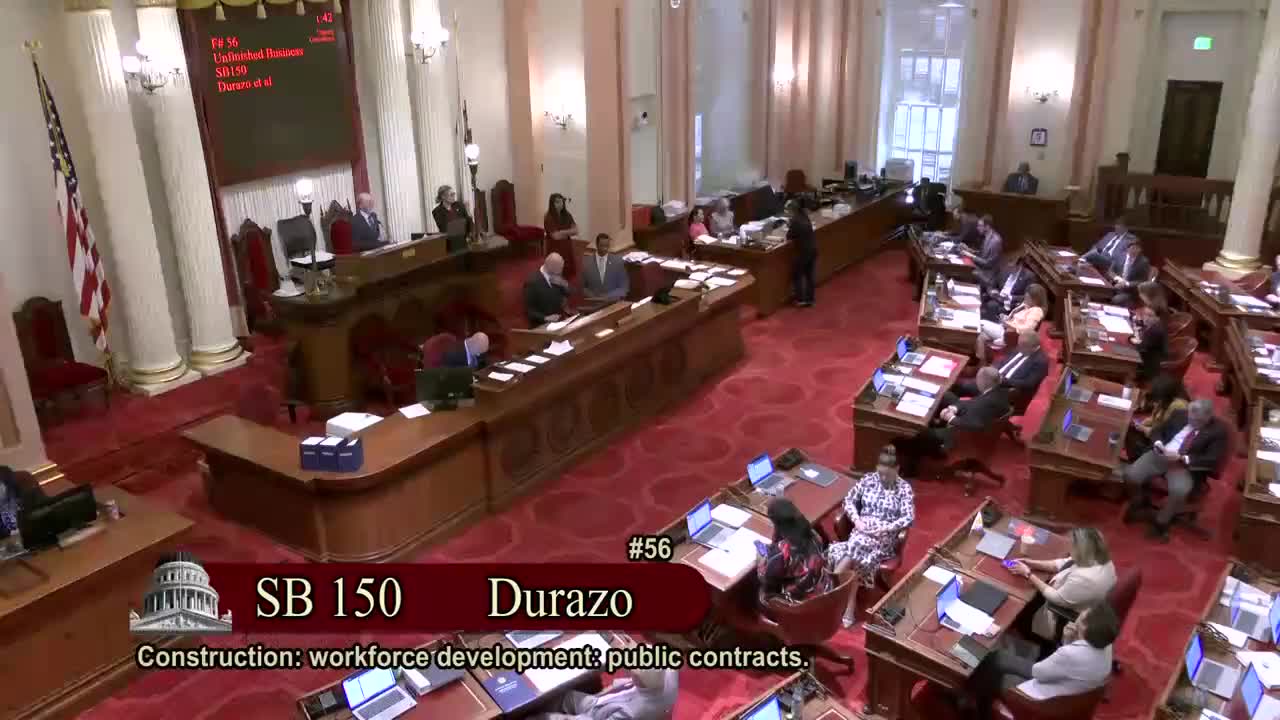 18MIN
Senate Floor
 11MIN
Assembly Floor
 32MIN
Assembly Standing Committee on Natural Resources



Bill Co-Author(s):