SB 286: Offshore wind energy projects.
- Session Year: 2023-2024
- House: Senate
- Latest Version Date: 2023-10-07
Current Status:
Passed
(2023-10-07: Chaptered by Secretary of State. Chapter 386, Statutes of 2023.)
Introduced
In Committee
First Chamber
In Committee
Second Chamber
Enacted
(1)Existing law, the California Coastal Act of 1976, requires anyone wishing to perform or undertake any development in the coastal zone, except as specified, in addition to obtaining any other permit required by law from any local government or from any state, regional, or local agency, to obtain a coastal development permit from the California Coastal Commission or a local government with a certified local coastal program, as provided. The act authorizes the commission to process and act upon a consolidated coastal development permit application if a proposed project requires a coastal development permit from both a local government with a certified local coastal program and the commission and if the applicant, the local government, and the commission consent to consolidate the permit action.
This bill would require the commission to process a consolidated coastal development permit for any new development that requires a coastal development permit and that is associated with, appurtenant to, or necessary for the construction and operation of offshore wind energy projects, and transmission facilities needed for those projects, located in the coastal zone, provided that public participation is not substantially impaired by the review of the consolidated coastal development permit, as provided. The bill would require the commission to forward an application for a consolidated coastal development permit to local governmental agencies having land use and related jurisdiction in the area in which the project would occur and would authorize those local governmental agencies to review and comment on the application, as provided.
(2)The California Environmental Quality Act (CEQA) requires a lead agency, as defined, to prepare, or cause to be prepared, and certify the completion of an environmental impact report on a project that it proposes to carry out or approve that may have a significant effect on the environment or to adopt a negative declaration if it finds that the project will not have that effect. CEQA also requires a lead agency to prepare a mitigated negative declaration for a project that may have a significant effect on the environment if revisions in the project would avoid or mitigate that effect and there is no substantial evidence that the project, as revised, would have a significant effect on the environment.
This bill would require the State Lands Commission to be the lead agency for purposes of CEQA for offshore wind energy projects and to prepare, or cause to be prepared, all environmental documents required by law. The bill would require the California Coastal Commission and the State Lands Commission to coordinate with relevant local, state, and federal agencies to encourage and facilitate the preparation of joint environmental documents pursuant to CEQA and the federal National Environmental Policy Act of 1969 for proposed offshore wind energy projects.
(3)Existing law requires the State Energy Resources Conservation and Development Commission (Energy Commission), in coordination with specified state entities and other relevant federal, state, and local agencies, to develop a strategic plan for offshore wind energy developments installed off the California coast in federal waters, and requires the Energy Commission to submit the strategic plan to the Natural Resources Agency and the Legislature on or before June 30, 2023.
This bill would establish the California Offshore Wind Energy Fisheries Working Group, composed of representatives of the California Coastal Commission, the Department of Fish and Wildlife, the State Lands Commission, the Ocean Protection Council, representatives of the commercial and recreational fishing industries, the offshore wind energy industry, representatives of relevant federal agencies, representatives of California Native American tribes with affected tribal fisheries, and other stakeholders, as determined by the California Coastal Commission. The bill would require the California Coastal Commission, in coordination with the Department of Fish and Wildlife, to convene the working group on or before January 1, 2025, for the purpose of developing a statewide strategy for ensuring that offshore wind energy projects avoid and minimize impacts to ocean fisheries to the maximum extent possible, avoid, minimize, and mitigate impacts to fishing and fisheries in a manner that prioritizes fishery productivity, viability, and long-term resilience, and fairly and reasonably compensate persons engaged in the commercial and recreational fishing industries and tribal fisheries for economic impacts to ocean fisheries resulting from offshore wind energy projects. The bill would require the statewide strategy to include best practices for addressing impacts to the commercial and recreational fishing industries, tribal fisheries, and environmental resources associated with offshore wind energy projects, as specified, and to be completed on or before January 1, 2026. The bill would require the California Coastal Commission to adopt the statewide strategy on or before May 1, 2026, and to review the statewide strategy as needed to determine if changes are necessary. The bill would require an applicant seeking approval or concurrence from a state agency for an offshore wind energy project to comply with the terms, recommendations, and best practices established in the statewide strategy.
The bill would require the working group to develop a framework for reasonable compensatory mitigation for unavoidable impacts associated with offshore wind energy projects, including a payment structure to reasonably compensate commercial, tribal, and recreational fisheries and impacted commercial fish processors. The bill would require the payment structure to include, among other things, investments in fleet improvements to promote resiliency, reasonable compensation for the commercial fishing industry for personal property losses caused by offshore wind energy projects, and reasonable compensation for lost commercial and tribal revenue due to reduced fishing grounds, as specified. The bill would require the State Lands Commission or a local trustee of granted public trust lands to consider including within a lease for an offshore wind energy project reasonable compensatory mitigation for unavoidable impacts to fishing and tribal interests. The bill would create the Offshore Wind Energy Resiliency Fund and would require the State Lands Commission to deposit revenue generated from an offshore wind energy project lease in the fund. The bill would make moneys in the fund available, upon appropriation by the Legislature, for reasonable compensatory mitigation for unavoidable impacts associated with offshore wind energy projects.
(1)Existing law, the California Coastal Act of 1976, requires anyone wishing to perform or undertake any development in the coastal zone, except as specified, in addition to obtaining any other permit required by law from any local government or from any state, regional, or local agency, to obtain a coastal development permit from the California Coastal Commission or a local government with a certified local coastal program, as provided. The act authorizes the commission to process and act upon a consolidated coastal development permit application if a proposed project requires a coastal development permit from both a local government with a certified local coastal program and the commission and if the applicant, the local government, and the commission consent to consolidate the permit action.
This bill would require the commission to process a consolidated coastal development permit for any new development that requires a coastal development permit and that is associated with, appurtenant to, or necessary for the construction and operation of offshore wind energy projects, and transmission facilities needed for those projects, located in the coastal zone, provided that public participation is not substantially impaired by the review of the consolidated coastal development permit, as provided. The bill would require the commission to forward an application for a consolidated coastal development permit to local governmental agencies having land use and related jurisdiction in the area in which the project would occur and would require authorize those local governmental agencies to review and comment on the application, as provided. By imposing new duties on local governmental agencies, the bill would create a state-mandated local program.
(2)The California Environmental Quality Act (CEQA) requires a lead agency, as defined, to prepare, or cause to be prepared, and certify the completion of an environmental impact report on a project that it proposes to carry out or approve that may have a significant effect on the environment or to adopt a negative declaration if it finds that the project will not have that effect. CEQA also requires a lead agency to prepare a mitigated negative declaration for a project that may have a significant effect on the environment if revisions in the project would avoid or mitigate that effect and there is no substantial evidence that the project, as revised, would have a significant effect on the environment.
This bill would require the State Lands Commission to be the lead agency for purposes of CEQA for offshore wind energy projects and to prepare, or cause to be prepared, all environmental documents required by law. The bill would require the California Coastal Commission and the State Lands Commission to coordinate with relevant local, state, and federal agencies to encourage and facilitate the preparation of joint environmental documents pursuant to CEQA and the federal National Environmental Policy Act of 1969 for proposed offshore wind energy projects.
(3)Existing law requires the State Energy Resources Conservation and Development Commission (Energy Commission), in coordination with specified state entities and other relevant federal, state, and local agencies, to develop a strategic plan for offshore wind energy developments installed off the California coast in federal waters, and requires the Energy Commission to submit the strategic plan to the Natural Resources Agency and the Legislature on or before June 30, 2023.
This bill would establish the California Offshore Wind Energy Fisheries Working Group, composed of representatives of the California Coastal Commission, the Department of Fish and Wildlife, the State Lands Commission, the Ocean Protection Council, representatives of the commercial and recreational fishing industries, the offshore wind energy industry, representatives of relevant federal agencies, representatives of California Native American tribes with affected tribal fisheries, and other stakeholders, as determined by the commission. The bill would require the California Coastal Commission, in coordination with the Department of Fish and Wildlife, to convene the working group on or before January 1, 2025, for the purpose of developing a statewide strategy for ensuring that offshore wind energy projects avoid and minimize impacts to ocean fisheries to the maximum extent possible, avoid, minimize, and mitigate impacts to fishing and fisheries in a manner that prioritizes fishery productivity, viability, and long-term resilience, and fairly and reasonably compensate persons engaged in the commercial and recreational fishing industries and tribal fisheries for economic impacts to ocean fisheries resulting from offshore wind energy projects. The bill would require the statewide strategy to include best practices for addressing impacts to the commercial and recreational fishing industries, tribal fisheries, and environmental resources associated with offshore wind energy projects, as specified, and to be completed on or before January 1, 2026. The bill would require the California Coastal Commission to adopt the statewide strategy on or before May 1, 2026, and to review the statewide strategy as needed to determine if changes are necessary. The bill would require an applicant seeking approval or concurrence from a state agency for an offshore wind energy project to comply with the terms, recommendations, and best practices established in the statewide strategy.
The bill would require the working group to develop a framework for reasonable compensatory mitigation for unavoidable impacts associated with offshore wind energy projects, including a payment structure to reasonably compensate commercial, tribal, and recreational fisheries and impacted commercial fish processors. The bill would require the payment structure to include, among other things, investments in fleet improvements to promote resiliency, reasonable compensation for the commercial fishing industry for personal property losses caused by offshore wind energy projects, and reasonable compensation for lost commercial and tribal revenue due to reduced fishing grounds, as specified. The bill would require the State Lands Commission or a local trustee of granted public trust lands to consider including within a lease for an offshore wind energy project reasonable compensatory mitigation for unavoidable impacts to fishing and tribal interests. The bill would create the Offshore Wind Energy Resiliency Fund and would require the State Lands Commission to deposit revenue generated from an offshore wind energy project lease in the fund. The bill would make moneys in the fund available, upon appropriation by the Legislature, for reasonable compensatory mitigation for unavoidable impacts associated with offshore wind energy projects.
(4)The California Constitution requires the state to reimburse local agencies and school districts for certain costs mandated by the state. Statutory provisions establish procedures for making that reimbursement.This bill would provide that, if the Commission on State Mandates determines that the bill contains costs mandated by the state, reimbursement for those costs shall be made pursuant to the statutory provisions noted above.(1)Existing law, the California Coastal Act of 1976, requires anyone wishing to perform or undertake any development in the coastal zone, except as specified, in addition to obtaining any other permit required by law from any local government or from any state, regional, or local agency, to obtain a coastal development permit from the California Coastal Commission or a local government with a certified local coastal program, as provided. The act authorizes the commission to process and act upon a consolidated coastal development permit application if a proposed project requires a coastal development permit from both a local government with a certified local coastal program and the commission and if the applicant, the local government, and the commission consent to consolidate the permit action.
This bill would require the commission to process a consolidated coastal development permit for any new development that requires a coastal development permit and that is associated with, appurtenant to, or necessary for the construction and operation of offshore wind energy projects, and transmission facilities needed for those projects, located in the coastal zone, provided that public participation is not substantially impaired by the review of the consolidated coastal development permit, as provided. The bill would require the commission to forward an application for a consolidated coastal development permit to local governmental agencies having land use and related jurisdiction in the area in which the project would occur and would require those local governmental agencies to review and comment on the application, as provided. By imposing new duties on local governmental agencies, the bill would create a state-mandated local program.
(2)The California Environmental Quality Act (CEQA) requires a lead agency, as defined, to prepare, or cause to be prepared, and certify the completion of an environmental impact report on a project that it proposes to carry out or approve that may have a significant effect on the environment or to adopt a negative declaration if it finds that the project will not have that effect. CEQA also requires a lead agency to prepare a mitigated negative declaration for a project that may have a significant effect on the environment if revisions in the project would avoid or mitigate that effect and there is no substantial evidence that the project, as revised, would have a significant effect on the environment.
This bill would require the State Lands Commission to be the lead agency for purposes of CEQA for offshore wind energy projects and to prepare, or cause to be prepared, all environmental documents required by law. The bill would require the California Coastal Commission and the State Lands Commission to coordinate with relevant local, state, and federal agencies to encourage and facilitate the preparation of joint environmental documents pursuant to CEQA and the federal National Environmental Policy Act of 1969 for proposed offshore wind energy projects.
(3)Existing law requires the State Energy Resources Conservation and Development Commission (Energy Commission), in coordination with specified state entities and other relevant federal, state, and local agencies, to develop a strategic plan for offshore wind energy developments installed off the California coast in federal waters, and requires the Energy Commission to submit the strategic plan to the Natural Resources Agency and the Legislature on or before June 30, 2023.
This bill would establish the California Offshore Wind Energy Fisheries Working Group, composed of representatives of the California Coastal Commission, the Department of Fish and Wildlife, the State Lands Commission, the Ocean Protection Council, representatives of the commercial and recreational fishing industries, the offshore wind energy industry, representatives of relevant federal agencies, representatives of California Native American tribes with affected tribal fisheries, and other stakeholders, as determined by the commission. The bill would require the California Coastal Commission, in coordination with the Department of Fish and Wildlife, to convene the working group on or before January 1, 2025, for the purpose of developing a statewide strategy for ensuring that offshore wind energy projects avoid and minimize impacts to ocean fisheries to the maximum extent possible, avoid, minimize, and mitigate impacts to fishing and fisheries in a manner that prioritizes fishery productivity, viability, and long-term resilience, and fairly and reasonably compensate persons engaged in the commercial and recreational fishing industries and tribal fisheries for economic impacts to ocean fisheries resulting from offshore wind energy projects. The bill would require the statewide strategy to include best practices for addressing impacts to the commercial and recreational fishing industries, tribal fisheries, and environmental resources associated with offshore wind energy projects, as specified, and to be completed on or before January 1, 2026. The bill would require the California Coastal Commission to adopt the statewide strategy on or before May 1, 2026, and to review the statewide strategy as needed to determine if changes are necessary. The bill would require an applicant seeking approval or concurrence from a state agency for an offshore wind energy project to comply with the terms, recommendations, and best practices established in the statewide strategy.
The bill would require the working group to develop a framework for reasonable compensatory mitigation for unavoidable impacts associated with offshore wind energy projects, including a payment structure to reasonably compensate commercial, tribal, and recreational fisheries and impacted commercial fish processors. The bill would require the payment structure to include, among other things, investments in fleet improvements to promote resiliency, reasonable compensation for the commercial fishing industry for personal property losses caused by offshore wind energy projects, and reasonable compensation for lost commercial and tribal revenue due to reduced fishing grounds, as specified. The bill would require the State Lands Commission or a local trustee of granted public trust lands to consider including within a lease for an offshore wind energy project reasonable compensatory mitigation for unavoidable impacts to fishing and tribal interests. The bill would create the Offshore Wind Energy Resiliency Fund and would require the State Lands Commission to deposit revenue generated from an offshore wind energy project lease in the fund. The bill would make moneys in the fund available, upon appropriation by the Legislature, for reasonable compensatory mitigation for unavoidable impacts associated with offshore wind energy projects.
(4)The California Constitution requires the state to reimburse local agencies and school districts for certain costs mandated by the state. Statutory provisions establish procedures for making that reimbursement.
This bill would provide that, if the Commission on State Mandates determines that the bill contains costs mandated by the state, reimbursement for those costs shall be made pursuant to the statutory provisions noted above.
(1)Existing law, the California Coastal Act of 1976, requires anyone wishing to perform or undertake any development in the coastal zone, except as specified, in addition to obtaining any other permit required by law from any local government or from any state, regional, or local agency, to obtain a coastal development permit from the California Coastal Commission or a local government with a certified local coastal program, as provided. The act authorizes the commission to process and act upon a consolidated coastal development permit application if a proposed project requires a coastal development permit from both a local government with a certified local coastal program and the commission and if the applicant, the local government, and the commission consent to consolidate the permit action.
This bill would require the commission to process a consolidated coastal development permit for any new development that requires a coastal development permit and that is associated with, appurtenant to, or necessary for the construction and operation of offshore wind energy projects projects, and transmission facilities needed for those projects, as specified. located in the coastal zone, provided that public participation is not substantially impaired by the review of the consolidated coastal development permit, as provided. The bill would require the commission to forward an application for a consolidated coastal development permit to local governmental agencies having land use and related jurisdiction in the area in which the project would occur and would require those local governmental agencies to review and comment on the application, as provided. By imposing new duties on local governmental agencies, the bill would create a state-mandated local program.
(2)The California Environmental Quality Act (CEQA) requires a lead agency, as defined, to prepare, or cause to be prepared, and certify the completion of an environmental impact report on a project that it proposes to carry out or approve that may have a significant effect on the environment or to adopt a negative declaration if it finds that the project will not have that effect. CEQA also requires a lead agency to prepare a mitigated negative declaration for a project that may have a significant effect on the environment if revisions in the project would avoid or mitigate that effect and there is no substantial evidence that the project, as revised, would have a significant effect on the environment.
This bill would require the State Lands Commission to be the lead agency for purposes of CEQA for offshore wind energy projects and to prepare, or cause to be prepared, all environmental documents required by law. The bill would require the California Coastal Commission and the State Lands Commission to coordinate with relevant local, state, and federal agencies to encourage and facilitate the preparation of joint environmental documents pursuant to CEQA and the federal National Environmental Policy Act of 1969 for proposed offshore wind energy projects.
(3)Existing law requires the State Energy Resources Conservation and Development Commission (Energy Commission), in coordination with specified state entities and other relevant federal, state, and local agencies, to develop a strategic plan for offshore wind energy developments installed off the California coast in federal waters, and requires the Energy Commission to submit the strategic plan to the Natural Resources Agency and the Legislature on or before June 30, 2023.
This bill would establish the California Offshore Wind Energy Fisheries Working Group, composed of representatives of the California Coastal Commission, the Department of Fish and Wildlife, the State Lands Commission, the Ocean Protection Council, representatives of the commercial and recreational fishing industries, the offshore wind energy industry, representatives of relevant federal agencies, representatives of California Native American tribes with affected tribal fisheries, and other stakeholders, as determined by the commission. The bill would require the California Coastal Commission, in coordination with the Department of Fish and Wildlife, to convene the working group on or before January 1, 2025, for the purpose of developing a statewide strategy for ensuring that offshore wind energy projects avoid and minimize impacts to ocean fisheries to the maximum extent possible, avoid, minimize, and mitigate impacts to fishing and fisheries in a manner that prioritizes fishery productivity, viability, and long-term resilience, and fairly compensate persons engaged in the commercial and recreational fishing industries and tribal fisheries for economic impacts to ocean fisheries resulting from offshore wind energy projects. The bill would require the statewide strategy to include best practices for addressing impacts to the commercial and recreational fishing industries, tribal fisheries, and environmental resources associated with offshore wind energy projects, as specified, and to be completed on or before January 1, 2026. The bill would require the California Coastal Commission to adopt the statewide strategy on or before May 1, 2026, and to review the statewide strategy as needed to determine if changes are necessary. The bill would require an applicant seeking approval or concurrence from a state agency for an offshore wind energy project to comply with the terms, recommendations, and best practices established in the statewide strategy.
The bill would require the working group to develop a framework for compensatory mitigation for unavoidable impacts associated with offshore wind energy projects, including a payment structure to compensate commercial, tribal, and recreational fisheries and impacted commercial fish processors. The bill would require the payment structure to include, among other things, investments in fleet improvements to promote resiliency, compensation for the commercial fishing industry for personal property losses caused by offshore wind energy projects, and compensation for lost commercial and tribal revenue due to reduced fishing grounds, as specified. The bill would require the State Lands Commission or a local trustee of granted public trust lands to consider including within a lease for an offshore wind energy project compensatory mitigation for unavoidable impacts to fishing and tribal interests. The bill would create the Offshore Wind Energy Resiliency Fund and would require the State Lands Commission to deposit revenue generated from an offshore wind energy project lease in the fund. The bill would make moneys in the fund available, upon appropriation by the Legislature, for compensatory mitigation for unavoidable impacts associated with offshore wind energy projects.
(4)The California Constitution requires the state to reimburse local agencies and school districts for certain costs mandated by the state. Statutory provisions establish procedures for making that reimbursement.
This bill would provide that, if the Commission on State Mandates determines that the bill contains costs mandated by the state, reimbursement for those costs shall be made pursuant to the statutory provisions noted above.
(1)Existing law, the California Coastal Act of 1976, requires anyone wishing to perform or undertake any development in the coastal zone, except as specified, in addition to obtaining any other permit required by law from any local government or from any state, regional, or local agency, to obtain a coastal development permit from the California Coastal Commission or a local government with a certified local coastal program, as provided. The act authorizes the commission to process and act upon a consolidated coastal development permit application if a proposed project requires a coastal development permit from both a local government with a certified local coastal program and the commission and if the applicant, the local government, and the commission consent to consolidate the permit action.
This bill would require the commission to process a consolidated coastal development permit for any new development that requires a coastal development permit and that is associated with, appurtenant to, or necessary for the construction and operation of offshore wind energy projects and transmission facilities needed for those projects. projects, as specified. The bill would require the commission to forward an application for a consolidated coastal development permit to local governmental agencies having land use and related jurisdiction in the area in which the project would occur and would require those local governmental agencies to review and comment on the application, as provided. By imposing new duties on local governmental agencies, the bill would create a state-mandated local program.
(2)The California Environmental Quality Act (CEQA) requires a lead agency, as defined, to prepare, or cause to be prepared, and certify the completion of an environmental impact report on a project that it proposes to carry out or approve that may have a significant effect on the environment or to adopt a negative declaration if it finds that the project will not have that effect. CEQA also requires a lead agency to prepare a mitigated negative declaration for a project that may have a significant effect on the environment if revisions in the project would avoid or mitigate that effect and there is no substantial evidence that the project, as revised, would have a significant effect on the environment.
This bill would require the State Lands Commission to be the lead agency for purposes of CEQA for offshore wind energy projects and to prepare, or cause to be prepared, all environmental documents required by law. The bill would require the California Coastal Commission and the State Lands Commission to coordinate with relevant local, state, and federal agencies to encourage and facilitate the preparation of joint environmental documents pursuant to CEQA and the federal National Environmental Policy Act of 1969 for proposed offshore wind energy projects.
(3)Existing law requires the State Energy Resources Conservation and Development Commission (Energy Commission), in coordination with specified state entities and other relevant federal, state, and local agencies, to develop a strategic plan for offshore wind energy developments installed off the California coast in federal waters, and requires the Energy Commission to submit the strategic plan to the Natural Resources Agency and the Legislature on or before June 30, 2023.
This bill would establish the California Offshore Wind Energy Fisheries Working Group, composed of representatives of the California Coastal Commission and representatives of specified governmental, industry, and tribal groups, Commission, the Department of Fish and Wildlife, the State Lands Commission, the Ocean Protection Council, representatives of the commercial and recreational fishing industries, the offshore wind energy industry, representatives of relevant federal agencies, representatives of California Native American tribes with affected tribal fisheries, and other stakeholders, as determined by the commission. The bill would require the California Coastal Commission, in coordination with the Department of Fish and Wildlife, to convene the working group on or before January 1, 2025, for the purpose of developing a statewide strategy for ensuring that offshore wind energy projects avoid and minimize impacts to ocean fisheries to the maximum extent possible, fully mitigate unavoidable impacts, avoid, minimize, and mitigate impacts to fishing and fisheries in a manner that prioritizes fishery productivity, viability, and long-term resilience, and fairly compensate persons engaged in the commercial and recreational fishing industries and tribal interests fisheries for economic impacts to ocean fisheries resulting from offshore wind energy projects. The bill would require the statewide strategy to include best practices for addressing impacts to the commercial and recreational fisheries, fishing industries, tribal interests, fisheries, and environmental resources associated with offshore wind energy projects, as specified, and to be completed on or before January 1, 2026. The bill would require the California Coastal Commission to adopt the statewide strategy on or before May 1, 2026, and to review the statewide strategy not less than every 3 years as needed to determine if changes are necessary. The bill would require an applicant seeking approval or concurrence from a state agency for an offshore wind energy project to comply with the terms, recommendations, and best practices established in the statewide strategy.
The bill would require the working group to develop a framework for compensatory mitigation for unavoidable impacts associated with offshore wind energy projects, including a payment structure to compensate commercial, tribal, and recreational fisheries and impacted commercial fish processors. The bill would require the payment structure to include, among other things, support for one-time investments for fishers to strengthen the existing fleet to make it more resilient, investments in fleet improvements to promote resiliency, compensation for the commercial fishers fishing industry for personal property losses caused by offshore wind energy projects and for lost economic activity projects, and compensation for lost commercial and tribal revenue due to reduced fishing grounds, and financial assistance for coastal cities and counties and tribal communities, as specified. The bill would require the State Lands Commission or a local trustee of granted public trust lands to consider including within a lease for an offshore wind energy project compensatory mitigation for unavoidable impacts to fishing and tribal interests. The bill would create the Offshore Wind Energy Resiliency Fund and would require the State Lands Commission to deposit revenue generated from an offshore wind energy project lease in the fund. The bill would make moneys in the fund available, upon appropriation by the Legislature, for compensatory mitigation for unavoidable impacts associated with offshore wind energy projects.
(4)The California Constitution requires the state to reimburse local agencies and school districts for certain costs mandated by the state. Statutory provisions establish procedures for making that reimbursement.
This bill would provide that, if the Commission on State Mandates determines that the bill contains costs mandated by the state, reimbursement for those costs shall be made pursuant to the statutory provisions noted above.
(1)Existing law, the California Coastal Act of 1976, requires anyone wishing to perform or undertake any development in the coastal zone, except as specified, in addition to obtaining any other permit required by law from any local government or from any state, regional, or local agency, to obtain a coastal development permit from the California Coastal Commission or a local government with a certified local coastal program, as provided. The act authorizes the commission to process and act upon a consolidated coastal development permit application if a proposed project requires a coastal development permit from both a local government with a certified local coastal program and the commission and if the applicant, the local government, and the commission consent to consolidate the permit action.
This bill would require the commission to process a consolidated coastal development permit for any new development that requires a coastal development permit and that is associated with, appurtenant to, or necessary for the construction and operation of offshore wind energy projects and transmission facilities needed for those projects.
(2)The California Environmental Quality Act (CEQA) requires a lead agency, as defined, to prepare, or cause to be prepared, and certify the completion of an environmental impact report on a project that it proposes to carry out or approve that may have a significant effect on the environment or to adopt a negative declaration if it finds that the project will not have that effect. CEQA also requires a lead agency to prepare a mitigated negative declaration for a project that may have a significant effect on the environment if revisions in the project would avoid or mitigate that effect and there is no substantial evidence that the project, as revised, would have a significant effect on the environment.
This bill would require the State Lands Commission to be the lead agency for purposes of CEQA for offshore wind energy projects and to prepare, or cause to be prepared, all environmental documents required by law. The bill would require the California Coastal Commission and the State Lands Commission to coordinate with relevant federal agencies to encourage and facilitate the preparation of joint environmental documents pursuant to CEQA and the federal National Environmental Policy Act of 1969 for proposed offshore wind energy projects.
(3)Existing law requires the State Energy Resources Conservation and Development Commission (Energy Commission), in coordination with specified state entities and other relevant federal, state, and local agencies, to develop a strategic plan for offshore wind energy developments installed off the California coast in federal waters, and requires the Energy Commission to submit the strategic plan to the Natural Resources Agency and the Legislature on or before June 30, 2023.
This bill would establish the California Offshore Wind Energy Fisheries Working Group and would require the working group to be Group, composed of the California Coastal Commission, representatives of the Department of Fish and Wildlife, the State Lands Commission, the Ocean Protection Council, representatives of the commercial fishing industry, representatives of the offshore wind energy industry, representatives of labor organizations for the construction workforce, representatives of relevant federal agencies, representatives of California Native American tribes, and other stakeholders as appropriate. Commission and representatives of specified governmental, industry, and tribal groups, and other stakeholders, as determined by the commission. The bill would require the California Coastal Commission, in coordination with the Department of Fish and Wildlife, to convene the working group on or before January 1, 2025, for the purpose of developing a statewide strategy for ensuring that offshore wind energy projects avoid and minimize impacts to ocean fisheries to the maximum extent possible, fully mitigate unavoidable impacts, and fairly compensate persons engaged in commercial fishing and tribal interests for economic impacts to ocean fisheries resulting from offshore wind energy projects. The bill would require the statewide strategy to include best practices for addressing impacts to commercial and recreational fisheries, tribal interests, and environmental resources associated with offshore wind energy projects, as specified, and to be completed on or before January 1, 2026. The bill would require the California Coastal Commission to adopt the statewide strategy on or before May 1, 2026, and to review the statewide strategy not less than every 3 years to determine if changes are necessary. The bill would require an applicant seeking approval or concurrence from a state agency for an offshore wind energy project to comply with the terms, recommendations, and best practices established in the statewide strategy.
The bill would require the working group to develop a framework for compensatory mitigation for unavoidable impacts on commercial fisheries, tribal interests, impacted commercial fish processors, and the public associated with offshore wind energy projects, including specified payments to compensate members of the commercial fishing industry and the public for lost revenues and other impacts of the project. associated with offshore wind energy projects, including a payment structure to compensate commercial, tribal, and recreational fisheries and impacted commercial fish processors. The bill would require these payments the payment structure to include, among other things, support for one-time investments for fishers to strengthen the existing fleet to make it more resilient, compensation for commercial fishers for personal property losses caused by offshore wind energy projects and for lost economic activity due to reduced fishing grounds, and financial assistance for coastal cities and counties and tribal communities, as specified. The bill would prohibit the State Lands Commission from leasing land under its jurisdiction for purposes of an offshore wind energy project unless these payments are incorporated within the rent charged to the lessee. The bill would require the State Lands Commission or a local trustee of granted public trust lands to consider including within a lease for an offshore wind energy project compensatory mitigation for unavoidable impacts to fishing and tribal interests. The bill would create the Offshore Wind Energy Resiliency Fund and would require the State Lands Commission to deposit the portion of rent paid by a lessee of state lands for an offshore wind energy project that is derived from the above-described payments revenue generated from an offshore wind energy project lease in the fund. The bill would make moneys in the fund available, upon appropriation by the Legislature, for the purposes for which the payments are made. compensatory mitigation for unavoidable impacts associated with offshore wind energy projects.
(1)Existing law, the California Coastal Act of 1976, requires anyone wishing to perform or undertake any development in the coastal zone, except as specified, in addition to obtaining any other permit required by law from any local government or from any state, regional, or local agency, to obtain a coastal development permit from the California Coastal Commission or a local government with a certified local coastal program, as provided. The act authorizes the commission to process and act upon a consolidated coastal development permit application if a proposed project requires a coastal development permit from both a local government with a certified local coastal program and the commission and if the applicant, the local government, and the commission consent to consolidate the permit action.
This bill would require the commission to process a consolidated coastal development permit for any new development that requires a coastal development permit and that is associated with, appurtenant to, or necessary for the construction and operation of offshore wind energy projects and transmission facilities needed for those projects.
(2)The California Environmental Quality Act (CEQA) requires a lead agency, as defined, to prepare, or cause to be prepared, and certify the completion of an environmental impact report on a project that it proposes to carry out or approve that may have a significant effect on the environment or to adopt a negative declaration if it finds that the project will not have that effect. CEQA also requires a lead agency to prepare a mitigated negative declaration for a project that may have a significant effect on the environment if revisions in the project would avoid or mitigate that effect and there is no substantial evidence that the project, as revised, would have a significant effect on the environment.
This bill would require the State Lands Commission to be the lead agency for purposes of CEQA for offshore wind energy projects and to prepare, or cause to be prepared, all environmental documents required by law. The bill would require the California Coastal Commission and the State Lands Commission to coordinate with relevant federal agencies to encourage and facilitate the preparation of joint environmental documents pursuant to CEQA and the federal National Environmental Policy Act of 1969 for proposed offshore wind energy projects.
(3)Existing law requires the State Energy Resources Conservation and Development Commission (Energy Commission), in coordination with specified state entities and other relevant federal, state, and local agencies, to develop a strategic plan for offshore wind energy developments installed off the California coast in federal waters, and requires the Energy Commission to submit the strategic plan to the Natural Resources Agency and the Legislature on or before June 30, 2023.
This bill would establish the California Offshore Wind Energy Fisheries Working Group and would require the working group to be composed of the California Coastal Commission, representatives of the Department of Fish and Wildlife, the State Lands Commission, the Ocean Protection Council, representatives of the commercial fishing industry, representatives of the offshore wind energy industry, representatives of labor organizations for the construction workforce, representatives of relevant federal agencies, representatives of California Native American tribes, and other stakeholders as appropriate. The bill would require the California Coastal Commission, in coordination with the Department of Fish and Wildlife, to convene the working group on or before January 1, 2025, for the purpose of developing a statewide strategy for ensuring that offshore wind energy projects avoid and minimize impacts to ocean fisheries to the maximum extent possible, fully mitigate unavoidable impacts, and fairly compensate persons engaged in commercial and recreational fishing and tribal interests for economic impacts to ocean fisheries resulting from offshore wind energy projects. The bill would require the statewide strategy to include best practices for addressing impacts to commercial and recreational fisheries fisheries, tribal interests, and environmental resources associated with offshore wind energy projects, as specified, and to be completed on or before January 1, 2026. The bill would require the California Coastal Commission to review the statewide strategy not less than every 3 years to determine if changes are necessary. The bill would require an applicant seeking approval or concurrence from a state agency for an offshore wind energy project to comply with the terms, recommendations, and best practices established in the statewide strategy.
The bill would require the working group to develop a framework for compensatory mitigation for unavoidable impacts on commercial and recreational fisheries fisheries, tribal interests, impacted commercial fish processors, and the public associated with offshore wind energy projects, including specified payments to compensate members of the commercial fishing industry and the public for lost revenues and other impacts of the project. The bill would require these payments to include, among other things, support for one-time investments for fishermen fishers to strengthen the existing fleet to make it more resilient, compensation for commercial fishermen fishers for personal property losses caused by offshore wind energy projects and for lost economic activity due to reduced fishing grounds, and financial assistance for coastal cities and counties and tribal communities, as specified. The bill would prohibit the State Lands Commission from leasing land under its jurisdiction for purposes of an offshore wind energy project unless these payments are incorporated within the rent charged to the lessee. The bill would create the Offshore Wind Energy Resiliency Fund and would require the State Lands Commission to deposit the portion of rent paid by a lessee of state lands for an offshore wind energy project that is derived from the above-described payments in the fund. The bill would make moneys in the fund available, upon appropriation by the Legislature, for the purposes for which the payments are made.
(1)Existing law, the California Coastal Act of 1976, requires anyone wishing to perform or undertake any development in the coastal zone, except as specified, in addition to obtaining any other permit required by law from any local government or from any state, regional, or local agency, to obtain a coastal development permit from the California Coastal Commission or a local government with a certified local coastal program, as provided. The act authorizes the commission to process and act upon a consolidated coastal development permit application if a proposed project requires a coastal development permit from both a local government with a certified local coastal program and the commission and if the applicant, the local government, and the commission consent to consolidate the permit action.
This bill would require the commission to process a consolidated coastal development permit for any new development that requires a coastal development permit and that is associated with, appurtenant to, or necessary for the construction and operation of offshore wind energy projects and transmission facilities needed for those projects.
(2)The California Environmental Quality Act (CEQA) requires a lead agency, as defined, to prepare, or cause to be prepared, and certify the completion of an environmental impact report on a project that it proposes to carry out or approve that may have a significant effect on the environment or to adopt a negative declaration if it finds that the project will not have that effect. CEQA also requires a lead agency to prepare a mitigated negative declaration for a project that may have a significant effect on the environment if revisions in the project would avoid or mitigate that effect and there is no substantial evidence that the project, as revised, would have a significant effect on the environment.
This bill would require the State Lands Commission to be the lead agency for purposes of CEQA for offshore wind energy projects and to prepare, or cause to be prepared, all environmental documents required by law. The bill would require the California Coastal Commission and the State Lands Commission to coordinate with relevant federal agencies to encourage and facilitate the preparation of joint environmental documents pursuant to CEQA and the federal National Environmental Policy Act of 1969 for proposed offshore wind energy projects.
(3)Existing law requires the State Energy Resources Conservation and Development Commission (Energy Commission), in coordination with specified state entities and other relevant federal, state, and local agencies, to develop a strategic plan for offshore wind energy developments installed off the California coast in federal waters, and requires the Energy Commission to submit the strategic plan to the Natural Resources Agency and the Legislature on or before June 30, 2023.
This bill would establish the California Offshore Wind Energy Fisheries Working Group and would require the working group to be composed of the California Coastal Commission, representatives of the Department of Fish and Wildlife, the State Lands Commission, the Ocean Protection Council, representatives of the commercial fishing industry, representatives of the offshore wind energy industry, representatives of relevant federal agencies, and other stakeholders as appropriate. The bill would require the California Coastal Commission, in coordination with the Department of Fish and Wildlife, to convene the working group on or before January 1, 2025, for the purpose of developing a statewide strategy for ensuring that offshore wind energy projects avoid and minimize impacts to ocean fisheries to the maximum extent possible, fully mitigate unavoidable impacts, and fairly compensate persons engaged in commercial and recreational fishing for economic impacts to ocean fisheries resulting from offshore wind energy projects. The bill would require the statewide strategy to include best practices for addressing impacts to commercial and recreational fisheries associated with offshore wind energy projects, as specified, and to be completed on or before January 1, 2026. The bill would require an applicant seeking approval or concurrence from a state agency for an offshore wind energy project to comply with the terms, recommendations, and best practices established in the statewide strategy.
The bill would require the working group to develop a framework for compensatory mitigation for unavoidable impacts on commercial and recreational fisheries and the public associated with offshore wind energy projects, including specified payments to compensate members of the commercial fishing industry and the public for lost revenues and other impacts of the project. The bill would require these payments to include, among other things, support for one-time investments for fishermen to strengthen the existing fleet to make it more resilient, compensation for commercial fishermen for personal property losses caused by offshore wind energy projects and for lost economic activity due to reduced fishing grounds, and financial assistance for coastal cities and counties and tribal communities, as specified. The bill would prohibit the State Lands Commission from leasing land under its jurisdiction for purposes of an offshore wind energy project unless these payments are incorporated within the rent charged to the lessee. The bill would create the Offshore Wind Energy Resiliency Fund and would require the State Lands Commission to deposit the portion of rent paid by a lessee of state lands for an offshore wind energy project that is derived from the above-described payments in the fund. The bill would make moneys in the fund available, upon appropriation by the Legislature, for the purposes for which the payments are made.
Existing law requires the State Energy Resources Conservation and Development Commission to evaluate and quantify the maximum feasible capacity of offshore wind to achieve reliability, ratepayer, employment, and decarbonization benefits and to establish megawatt offshore wind planning goals for 2030 and 2045, as specified.This bill would express the intent of the Legislature to enact future legislation relating to offshore wind generation.Existing law requires the State Energy Resources Conservation and Development Commission to evaluate and quantify the maximum feasible capacity of offshore wind to achieve reliability, ratepayer, employment, and decarbonization benefits and to establish megawatt offshore wind planning goals for 2030 and 2045, as specified.
This bill would express the intent of the Legislature to enact future legislation relating to offshore wind generation.
(a)Notwithstanding Section 6217, the commission shall deposit revenue generated from an offshore wind energy project lease in the Offshore Wind Energy Resiliency Fund, which is hereby created in the State Treasury. Moneys in the fund shall be available, upon appropriation by the Legislature, for the purposes described in paragraph (7) of subdivision (c) of Section 30616.
(b)The commission or a local trustee of granted public trust lands, when issuing a lease for purposes of an offshore wind energy project, shall consider including within the lease reasonable compensatory mitigation for unavoidable impacts to fishing and tribal interests pursuant to Section 30616. In considering the inclusion of reasonable compensatory mitigation, the commission or a local trustee of granted public trust lands shall consider the recommendations for reasonable compensatory mitigation made by the California Offshore Wind Energy Fisheries Working Group established pursuant to Section 30616, including the working groups recommendations for a payment structure to reasonably compensate commercial, tribal, and recreational fisheries and impacted commercial fish processors for unavoidable impacts associated with offshore wind energy projects.
SEC. 2.Section 30001.3 is added to the Public Resources Code, to read:30001.3.The Legislature finds and declares all of the following:
(a)Offshore wind energy generation is an important component of Californias renewable energy portfolio.
(b)While offshore wind energy generation can provide significant climate and economic benefits, industrial scale development and deployment of offshore wind energy will also have impacts on coastal and ocean resources, fisheries, and coastal communities that are not yet fully understood.
(c)The urgency of the climate crisis and the importance of ocean health to maintaining a livable planet necessitate the expeditious development of offshore wind energy generation facilities and associated infrastructure in a manner that also avoids, minimizes, and mitigates impacts to ocean and coastal resources to the maximum extent practicable.
(d)Through science-based monitoring and mitigation, meaningful engagement with affected communities, adaptive management, and equitable workforce development, California can be a world leader in the rapid, just, and environmentally sustainable generation of renewable energy from offshore wind.
SEC. 3.Section 30601.4 is added to the Public Resources Code, to read:30601.4.(a)(1)The commission shall process a consolidated coastal development permit for any new development that requires a coastal development permit and that is associated with, appurtenant to, or necessary for the construction and operation of offshore wind energy projects, and transmission facilities needed for those projects, located in the coastal zone, as defined in this division. Section 30601.3 applies to a consolidated coastal development permit pursuant to this section, except that paragraph (2) of subdivision (a) of Section 30601.3 does not apply, and provided that public participation is not substantially impaired by the review of the consolidated coastal development permit.
(2)Upon receipt of an application for purposes of this subdivision, the commission shall forward the application to local governmental agencies having land use and related jurisdiction in the area in which the project would occur. The local governmental agencies may review the application and submit comments on, among other things, applicable provisions of the local coastal program and other appropriate aspects of the design, construction, or operation of the proposed site and related facility.
(3)The commission shall coordinate with affected local governmental agencies to incorporate or otherwise address their recommendations in the final consolidated coastal development permit, including measures to address impacts from offshore wind development and respond to community needs, consistent with this division.
(4)The commission shall engage with federally recognized and nonfederally recognized California Native American tribes with fisheries that could be affected by future development associated with a lease for an offshore wind energy project on all elements of the lessees project development process, including measures to address impacts from offshore wind development and respond to community needs, consistent with the commissions tribal consultation policy.
(5)To avoid duplication and to increase regulatory efficiency, the commission and the State Lands Commission shall coordinate with relevant local, state, and federal agencies to encourage and facilitate the preparation of joint environmental documents pursuant to the California Environmental Quality Act (Division 13 (commencing with Section 21000)) and the federal National Environmental Policy Act of 1969 (42 U.S.C. Sec. 4321 et seq.) for projects proposed pursuant to this section.
(b)(1)The State Lands Commission shall be the lead agency for purposes of the California Environmental Quality Act for offshore wind energy projects pursuant to this division and shall prepare, or cause to be prepared, all environmental documents required by law.
(2)Paragraph (1) does not affect the determination of which entity shall serve as a lead agency for the purposes of the California Environmental Quality Act for projects undertaken pursuant to Chapter 8 (commencing with Section 30700).
SEC. 4.Section 30616 is added to the Public Resources Code, to read:30616.(a)(1)The California Offshore Wind Energy Fisheries Working Group is hereby established. The working group shall be composed of representatives of the commission, the Department of Fish and Wildlife, the State Lands Commission, the Ocean Protection Council, representatives of the commercial and recreational fishing industries, the offshore wind energy industry, representatives of relevant federal agencies, representatives of California Native American tribes with affected tribal fisheries, and other stakeholders as appropriate, as determined by the commission.
(2)The number of representatives in the working group representing the commercial and recreational fishing industries, the offshore wind energy industry, California Native American tribes with affected tribal fisheries, and any other stakeholders included in the working group, as specified in paragraph (1), shall be determined by the commission.
(b)On or before January 1, 2025, the commission, in coordination with the Department of Fish and Wildlife, shall convene the working group for the purpose of developing a statewide strategy for ensuring that offshore wind energy projects avoid and minimize impacts to ocean fisheries to the maximum extent possible, avoid, minimize, and mitigate impacts to fishing and fisheries in a manner that prioritizes fishery productivity, viability, and long-term resilience, and fairly and reasonably compensate persons engaged in the commercial and recreational fishing industries and tribal fisheries for economic impacts to ocean fisheries resulting from offshore wind energy projects.
(c)The statewide strategy developed pursuant to this section shall include best practices for addressing impacts to the commercial and recreational fishing industries, tribal fisheries, and environmental resources associated with offshore wind energy projects, including, but not limited to, the following:
(1)Protocols for communication among impacted parties.
(2)A methodology for a comprehensive project-level socioeconomic analysis of direct and indirect impacts to commercial and recreational fishing industries and tribal fisheries.
(3)Best practices for offshore surveys and data collection to assess impacts.
(4)Best practices for avoidance and minimization of impacts, including the use of evidence-informed adaptive management.
(5)A template for a fishing agreement that includes all relevant elements of the statewide strategy.
(6)A template for an agreement addressing tribal fishing interests that includes all relevant elements of the statewide strategy.
(7)(A)A framework for reasonable compensatory mitigation for unavoidable impacts to the commercial and recreational fishing industries and tribal fisheries.
(B)The framework for reasonable compensatory mitigation shall include a payment structure to reasonably compensate commercial, tribal, and recreational fisheries and impacted commercial fish processors for unavoidable impacts associated with offshore wind energy projects, including for all of the following:
(i)Investments in fleet improvements to promote resiliency.
(ii)Reasonable compensation for the commercial fishing industry for personal property losses caused by offshore wind energy projects. The working group shall ensure that payments for purposes of this clause provide sufficient funds for the entire lifetime of the offshore wind energy project to reasonably compensate the commercial fishing industry for all lost personal property.
(iii)Reasonable compensation for lost commercial and tribal revenue due to reduced fishing grounds.
(iv)Funding for robust monitoring and evaluation of offshore wind turbines and their impact on fisheries and the surrounding environment.
(v)A proportionate amount from each lessee that is sufficient to cover state costs pursuant to this section, including, but not limited to, the costs of the working groups activities and other administrative expenses.
(8)A recognition of locally negotiated agreements between the fishing industry and offshore wind energy leaseholders.
(d)(1)The working group shall complete the statewide strategy, including the framework for reasonable compensatory mitigation for unavoidable impacts, on or before January 1, 2026.
(2)The commission shall review for consistency with Chapter 3 (commencing with Section 30200), modify as necessary, and adopt, the statewide strategy, including the framework for reasonable compensatory mitigation for unavoidable impacts, on or before May 1, 2026.
(3)(A)An applicant seeking approval or concurrence from a state agency for an offshore wind energy project shall comply with the terms, recommendations, and best practices established in the statewide strategy, as adopted by the commission.
(B)The commission shall ensure that the terms, recommendations, and best practices established in the statewide strategy, as adopted by the commission, are implemented.
(4)The commission shall review the statewide strategy as needed to determine if any changes are necessary. At a regularly noticed public hearing, the commission shall present the outcome of any review pursuant to this paragraph and may, by resolution, authorize the reconvening of the working group.
(e)Representatives of the commercial fishing industry, recreational fishing industry, and California Native American tribes who participate in the working group shall be compensated for expenses reasonably incurred for approved working group activities, including attendance at meetings, at a rate of fifty dollars ($50) per hour, up to no more than five hundred dollars ($500) per day. Representatives of the commercial fishing industry, recreational fishing industry, and California Native American tribes may also receive reimbursement for reasonable travel expenses. Funds used to compensate representatives of the commercial fishing industry, recreational fishing industry, and California Native American tribes pursuant to this subdivision shall be paid from the Offshore Wind Energy Resiliency Fund to the extent funds are available pursuant to subdivision (b) of Section 7100.
SEC. 5.Section 30617 is added to the Public Resources Code, to read:30617.As part of the commissions federal consistency process, when reviewing a workforce development plan submitted to the federal Bureau of Ocean Energy Management consistent with conditions 5 and 6 of the commissions Consistency Determination CD-0001-22 and Consistency Determination CD-0004-22 and existing statutory requirements, the commission shall consult with representatives of labor organizations for the construction trades and maritime and longshore workforce in furtherance of providing for career and workforce training and retraining for individuals whose livelihoods are disrupted by the development of offshore wind energy projects.
SEC. 6.The provisions of this act are severable. If any provision of this act or its application is held invalid, that invalidity shall not affect other provisions or applications that can be given effect without the invalid provision or application.
(a)Notwithstanding Section 6217, the commission shall deposit revenue generated from an offshore wind energy project lease in the Offshore Wind Energy Resiliency Fund, which is hereby created in the State Treasury. Moneys in the fund shall be available, upon appropriation by the Legislature, for the purposes described in paragraph (7) of subdivision (c) of Section 30616.
(b)The commission or a local trustee of granted public trust lands, when issuing a lease for purposes of an offshore wind energy project, shall consider including within the lease reasonable compensatory mitigation for unavoidable impacts to fishing and tribal interests pursuant to Section 30616. In considering the inclusion of reasonable compensatory mitigation, the commission or a local trustee of granted public trust lands shall consider the recommendations for reasonable compensatory mitigation made by the California Offshore Wind Energy Fisheries Working Group established pursuant to Section 30616, including the working groups recommendations for a payment structure to reasonably compensate commercial, tribal, and recreational fisheries and impacted commercial fish processors for unavoidable impacts associated with offshore wind energy projects.
SEC. 2.Section 30001.3 is added to the Public Resources Code, to read:30001.3.The Legislature finds and declares all of the following:
(a)Offshore wind energy generation is an important component of Californias renewable energy portfolio.
(b)While offshore wind energy generation can provide significant climate and economic benefits, industrial scale development and deployment of offshore wind energy will also have impacts on coastal and ocean resources, fisheries, and coastal communities that are not yet fully understood.
(c)The urgency of the climate crisis and the importance of ocean health to maintaining a livable planet necessitate the expeditious development of offshore wind energy generation facilities and associated infrastructure in a manner that also avoids, minimizes, and mitigates impacts to ocean and coastal resources to the maximum extent practicable.
(d)Through science-based monitoring and mitigation, meaningful engagement with affected communities, adaptive management, and equitable workforce development, California can be a world leader in the rapid, just, and environmentally sustainable generation of renewable energy from offshore wind.
SEC. 3.Section 30601.4 is added to the Public Resources Code, to read:30601.4.(a)(1)The commission shall process a consolidated coastal development permit for any new development that requires a coastal development permit and that is associated with, appurtenant to, or necessary for the construction and operation of offshore wind energy projects, and transmission facilities needed for those projects, located in the coastal zone, as defined in this division. Section 30601.3 applies to a consolidated coastal development permit pursuant to this section, except that paragraph (2) of subdivision (a) of Section 30601.3 does not apply, and provided that public participation is not substantially impaired by the review of the consolidated coastal development permit.
(2)Upon receipt of an application for purposes of this subdivision, the commission shall forward the application to local governmental agencies having land use and related jurisdiction in the area in which the project would occur. The local governmental agencies shall may review the application and submit comments on, among other things, applicable provisions of the local coastal program and other appropriate aspects of the design, construction, or operation of the proposed site and related facility.
(3)The commission shall coordinate with affected local governmental agencies to incorporate or otherwise address their recommendations in the final consolidated coastal development permit, including measures to address impacts from offshore wind development and respond to community needs, consistent with this division.
(4)The commission shall engage with federally recognized and nonfederally recognized California Native American tribes with fisheries that could be affected by future development associated with a lease for an offshore wind energy project on all elements of the lessees project development process, including measures to address impacts from offshore wind development and respond to community needs, consistent with the commissions tribal consultation policy.
(5)To avoid duplication and to increase regulatory efficiency, the commission and the State Lands Commission shall coordinate with relevant local, state, and federal agencies to encourage and facilitate the preparation of joint environmental documents pursuant to the California Environmental Quality Act (Division 13 (commencing with Section 21000)) and the federal National Environmental Policy Act of 1969 (42 U.S.C. Sec. 4321 et seq.) for projects proposed pursuant to this section.
(b)(1)The State Lands Commission shall be the lead agency for purposes of the California Environmental Quality Act for offshore wind energy projects pursuant to this division and shall prepare, or cause to be prepared, all environmental documents required by law.
(2)Paragraph (1) does not affect the determination of which entity shall serve as a lead agency for the purposes of the California Environmental Quality Act for projects undertaken pursuant to Chapter 8 (commencing with Section 30700).
SEC. 4.Section 30616 is added to the Public Resources Code, to read:30616.(a)(1)The California Offshore Wind Energy Fisheries Working Group is hereby established. The working group shall be composed of representatives of the commission, the Department of Fish and Wildlife, the State Lands Commission, the Ocean Protection Council, representatives of the commercial and recreational fishing industries, the offshore wind energy industry, representatives of relevant federal agencies, representatives of California Native American tribes with affected tribal fisheries, and other stakeholders as appropriate, as determined by the commission.
(2)The number of representatives in the working group representing the commercial and recreational fishing industries, the offshore wind energy industry, California Native American tribes with affected tribal fisheries, and any other stakeholders included in the working group, as specified in paragraph (1), shall be determined by the commission.
(b)On or before January 1, 2025, the commission, in coordination with the Department of Fish and Wildlife, shall convene the working group for the purpose of developing a statewide strategy for ensuring that offshore wind energy projects avoid and minimize impacts to ocean fisheries to the maximum extent possible, avoid, minimize, and mitigate impacts to fishing and fisheries in a manner that prioritizes fishery productivity, viability, and long-term resilience, and fairly and reasonably compensate persons engaged in the commercial and recreational fishing industries and tribal fisheries for economic impacts to ocean fisheries resulting from offshore wind energy projects.
(c)The statewide strategy developed pursuant to this section shall include best practices for addressing impacts to the commercial and recreational fishing industries, tribal fisheries, and environmental resources associated with offshore wind energy projects, including, but not limited to, the following:
(1)Protocols for communication among impacted parties.
(2)A methodology for a comprehensive project-level socioeconomic analysis of direct and indirect impacts to commercial and recreational fishing industries and tribal fisheries.
(3)Best practices for offshore surveys and data collection to assess impacts.
(4)Best practices for avoidance and minimization of impacts, including the use of evidence-informed adaptive management.
(5)A template for a fishing agreement that includes all relevant elements of the statewide strategy.
(6)A template for an agreement addressing tribal fishing interests that includes all relevant elements of the statewide strategy.
(7)(A)A framework for reasonable compensatory mitigation for unavoidable impacts to the commercial and recreational fishing industries and tribal fisheries.
(B)The framework for reasonable compensatory mitigation shall include a payment structure to reasonably compensate commercial, tribal, and recreational fisheries and impacted commercial fish processors for unavoidable impacts associated with offshore wind energy projects, including for all of the following:
(i)Investments in fleet improvements to promote resiliency.
(ii)Reasonable compensation for the commercial fishing industry for personal property losses caused by offshore wind energy projects. The working group shall ensure that payments for purposes of this clause provide sufficient funds for the entire lifetime of the offshore wind energy project to reasonably compensate the commercial fishing industry for all lost personal property.
(iii)Reasonable compensation for lost commercial and tribal revenue due to reduced fishing grounds.
(iv)Funding for robust monitoring and evaluation of offshore wind turbines and their impact on fisheries and the surrounding environment.
(v)A proportionate amount from each lessee that is sufficient to cover state costs pursuant to this section, including, but not limited to, the costs of the working groups activities and other administrative expenses.
(8)A recognition of locally negotiated agreements between the fishing industry and offshore wind energy leaseholders.
(d)(1)The working group shall complete the statewide strategy, including the framework for reasonable compensatory mitigation for unavoidable impacts, on or before January 1, 2026.
(2)The commission shall review for consistency with Chapter 3 (commencing with Section 30200), modify as necessary, and adopt, the statewide strategy, including the framework for reasonable compensatory mitigation for unavoidable impacts, on or before May 1, 2026.
(3)(A)An applicant seeking approval or concurrence from a state agency for an offshore wind energy project shall comply with the terms, recommendations, and best practices established in the statewide strategy, as adopted by the commission.
(B)The commission shall ensure that the terms, recommendations, and best practices established in the statewide strategy, as adopted by the commission, are implemented.
(4)The commission shall review the statewide strategy as needed to determine if any changes are necessary. At a regularly noticed public hearing, the commission shall present the outcome of any review pursuant to this paragraph and may, by resolution, authorize the reconvening of the working group.
(e)Representatives of the commercial fishing industry, recreational fishing industry, and California Native American tribes who participate in the working group shall be compensated for expenses reasonably incurred for approved working group activities, including attendance at meetings, at a rate of fifty dollars ($50) per hour, up to no more than five hundred dollars ($500) per day. Representatives of the commercial fishing industry, recreational fishing industry, and California Native American tribes may also receive reimbursement for reasonable travel expenses. Funds used to compensate representatives of the commercial fishing industry, recreational fishing industry, and California Native American tribes pursuant to this subdivision shall be paid from the Offshore Wind Energy Resiliency Fund to the extent funds are available pursuant to subdivision (b) of Section 7100.
SEC. 5.Section 30617 is added to the Public Resources Code, to read:30617.As part of the commissions federal consistency process, when reviewing a workforce development plan submitted to the federal Bureau of Ocean Energy Management consistent with conditions 5 and 6 of the commissions Consistency Determination CD-0001-22 and Consistency Determination CD-0004-22 and existing statutory requirements, the commission shall consult with representatives of labor organizations for the construction trades and maritime and longshore workforce in furtherance of providing for career and workforce training and retraining for individuals whose livelihoods are disrupted by the development of offshore wind energy projects.
SEC. 6.The provisions of this act are severable. If any provision of this act or its application is held invalid, that invalidity shall not affect other provisions or applications that can be given effect without the invalid provision or application.
SEC. 7.If the Commission on State Mandates determines that this act contains costs mandated by the state, reimbursement to local agencies and school districts for those costs shall be made pursuant to Part 7 (commencing with Section 17500) of Division 4 of Title 2 of the Government Code.(a)Notwithstanding Section 6217, the commission shall deposit revenue generated from an offshore wind energy project lease in the Offshore Wind Energy Resiliency Fund, which is hereby created in the State Treasury. Moneys in the fund shall be available, upon appropriation by the Legislature, for the purposes described in paragraph (7) of subdivision (c) of Section 30616.
(b)The commission or a local trustee of granted public trust lands, when issuing a lease for purposes of an offshore wind energy project, shall consider including within the lease reasonable compensatory mitigation for unavoidable impacts to fishing and tribal interests pursuant to Section 30616. In considering the inclusion of reasonable compensatory mitigation, the commission or a local trustee of granted public trust lands shall consider the recommendations for reasonable compensatory mitigation made by the California Offshore Wind Energy Fisheries Working Group established pursuant to Section 30616, including the working groups recommendations for a payment structure to reasonably compensate commercial, tribal, and recreational fisheries and impacted commercial fish processors for unavoidable impacts associated with offshore wind energy projects.
SEC. 2.Section 30001.3 is added to the Public Resources Code, to read:30001.3.The Legislature finds and declares all of the following:
(a)Offshore wind energy generation is an important component of Californias renewable energy portfolio.
(b)While offshore wind energy generation can provide significant climate and economic benefits, industrial scale development and deployment of offshore wind energy will also have impacts on coastal and ocean resources, fisheries, and coastal communities that are not yet fully understood.
(c)The urgency of the climate crisis and the importance of ocean health to maintaining a livable planet necessitate the expeditious development of offshore wind energy generation facilities and associated infrastructure in a manner that also avoids, minimizes, and mitigates impacts to ocean and coastal resources to the maximum extent practicable.
(d)Through science-based monitoring and mitigation, meaningful engagement with affected communities, adaptive management, and equitable workforce development, California can be a world leader in the rapid, just, and environmentally sustainable generation of renewable energy from offshore wind.
SEC. 3.Section 30601.4 is added to the Public Resources Code, to read:30601.4.(a)(1)The commission shall process a consolidated coastal development permit for any new development that requires a coastal development permit and that is associated with, appurtenant to, or necessary for the construction and operation of offshore wind energy projects, and transmission facilities needed for those projects, located in the coastal zone, as defined in this division. Section 30601.3 applies to a consolidated coastal development permit pursuant to this section, except that paragraph (2) of subdivision (a) of Section 30601.3 does not apply, and provided that public participation is not substantially impaired by the review of the consolidated coastal development permit.
(2)Upon receipt of an application for purposes of this subdivision, the commission shall forward the application to local governmental agencies having land use and related jurisdiction in the area in which the project would occur. The local governmental agencies shall review the application and submit comments on, among other things, applicable provisions of the local coastal program and other appropriate aspects of the design, construction, or operation of the proposed site and related facility.
(3)The commission shall coordinate with affected local governmental agencies to incorporate or otherwise address their recommendations in the final consolidated coastal development permit, including measures to address impacts from offshore wind development and respond to community needs, consistent with this division.
(4)The commission shall engage with federally recognized and nonfederally recognized California Native American tribes with fisheries that could be affected by future development associated with a lease for an offshore wind energy project on all elements of the lessees project development process, including measures to address impacts from offshore wind development and respond to community needs, consistent with the commissions tribal consultation policy.
(5)To avoid duplication and to increase regulatory efficiency, the commission and the State Lands Commission shall coordinate with relevant local, state, and federal agencies to encourage and facilitate the preparation of joint environmental documents pursuant to the California Environmental Quality Act (Division 13 (commencing with Section 21000)) and the federal National Environmental Policy Act of 1969 (42 U.S.C. Sec. 4321 et seq.) for projects proposed pursuant to this section.
(b)(1)The State Lands Commission shall be the lead agency for purposes of the California Environmental Quality Act for offshore wind energy projects pursuant to this division and shall prepare, or cause to be prepared, all environmental documents required by law.
(2)Paragraph (1) does not affect the determination of which entity shall serve as a lead agency for the purposes of the California Environmental Quality Act for projects undertaken pursuant to Chapter 8 (commencing with Section 30700).
SEC. 4.Section 30616 is added to the Public Resources Code, to read:30616.(a)(1)The California Offshore Wind Energy Fisheries Working Group is hereby established. The working group shall be composed of representatives of the commission, the Department of Fish and Wildlife, the State Lands Commission, the Ocean Protection Council, representatives of the commercial and recreational fishing industries, the offshore wind energy industry, representatives of relevant federal agencies, representatives of California Native American tribes with affected tribal fisheries, and other stakeholders as appropriate, as determined by the commission.
(2)The number of representatives in the working group representing the commercial and recreational fishing industries, the offshore wind energy industry, California Native American tribes with affected tribal fisheries, and any other stakeholders included in the working group, as specified in paragraph (1), shall be determined by the commission.
(b)On or before January 1, 2025, the commission, in coordination with the Department of Fish and Wildlife, shall convene the working group for the purpose of developing a statewide strategy for ensuring that offshore wind energy projects avoid and minimize impacts to ocean fisheries to the maximum extent possible, avoid, minimize, and mitigate impacts to fishing and fisheries in a manner that prioritizes fishery productivity, viability, and long-term resilience, and fairly and reasonably compensate persons engaged in the commercial and recreational fishing industries and tribal fisheries for economic impacts to ocean fisheries resulting from offshore wind energy projects.
(c)The statewide strategy developed pursuant to this section shall include best practices for addressing impacts to the commercial and recreational fishing industries, tribal fisheries, and environmental resources associated with offshore wind energy projects, including, but not limited to, the following:
(1)Protocols for communication among impacted parties.
(2)A methodology for a comprehensive project-level socioeconomic analysis of direct and indirect impacts to commercial and recreational fishing industries and tribal fisheries.
(3)Best practices for offshore surveys and data collection to assess impacts.
(4)Best practices for avoidance and minimization of impacts, including the use of evidence-informed adaptive management.
(5)A template for a fishing agreement that includes all relevant elements of the statewide strategy.
(6)A template for an agreement addressing tribal fishing interests that includes all relevant elements of the statewide strategy.
(7)(A)A framework for reasonable compensatory mitigation for unavoidable impacts to the commercial and recreational fishing industries and tribal fisheries.
(B)The framework for reasonable compensatory mitigation shall include a payment structure to reasonably compensate commercial, tribal, and recreational fisheries and impacted commercial fish processors for unavoidable impacts associated with offshore wind energy projects, including for all of the following:
(i)Investments in fleet improvements to promote resiliency.
(ii)Compensation Reasonable compensation for the commercial fishing industry for personal property losses caused by offshore wind energy projects. The working group shall ensure that payments for purposes of this clause provide sufficient funds for the entire lifetime of the offshore wind energy project to reasonably compensate the commercial fishing industry for all lost personal property.
(iii)Compensation Reasonable compensation for lost commercial and tribal revenue due to reduced fishing grounds.
(iv)Funding for robust monitoring and evaluation of offshore wind turbines and their impact on fisheries and the surrounding environment.
(v)A proportionate amount from each lessee that is sufficient to cover state costs pursuant to this section, including, but not limited to, the costs of the working groups activities and other administrative expenses.
(8)A recognition of locally negotiated agreements between the fishing industry and offshore wind energy leaseholders.
(d)(1)The working group shall complete the statewide strategy, including the framework for reasonable compensatory mitigation for unavoidable impacts, on or before January 1, 2026.
(2)The commission shall review for consistency with Chapter 3 (commencing with Section 30200), modify as necessary, and adopt, the statewide strategy, including the framework for reasonable compensatory mitigation for unavoidable impacts, on or before May 1, 2026.
(3)(A)An applicant seeking approval or concurrence from a state agency for an offshore wind energy project shall comply with the terms, recommendations, and best practices established in the statewide strategy, as adopted by the commission.
(B)The commission shall ensure that the terms, recommendations, and best practices established in the statewide strategy, as adopted by the commission, are implemented.
(4)The commission shall review the statewide strategy as needed to determine if any changes are necessary. At a regularly noticed public hearing, the commission shall present the outcome of any review pursuant to this paragraph and may, by resolution, authorize the reconvening of the working group.
(e)Representatives of the commercial fishing industry, recreational fishing industry, and California Native American tribes who participate in the working group shall be compensated for expenses reasonably incurred for approved working group activities, including attendance at meetings, at a rate of fifty dollars ($50) per hour, up to no more than five hundred dollars ($500) per day. Representatives of the commercial fishing industry, recreational fishing industry, and California Native American tribes may also receive reimbursement for reasonable travel expenses. Funds used to compensate representatives of the commercial fishing industry, recreational fishing industry, and California Native American tribes pursuant to this subdivision shall be paid from the Offshore Wind Energy Resiliency Fund to the extent funds are available pursuant to subdivision (b) of Section 7100.
SEC. 5.Section 30617 is added to the Public Resources Code, to read:30617.As part of the commissions federal consistency process, when reviewing a workforce development plan submitted to the federal Bureau of Ocean Energy Management consistent with conditions 5 and 6 of the commissions Consistency Determination CD-0001-22 and Consistency Determination CD-0004-22 and existing statutory requirements, the commission shall consult with representatives of labor organizations for the construction trades and maritime and longshore workforce in furtherance of providing for career and workforce training and retraining for individuals whose livelihoods are disrupted by the development of offshore wind energy projects.
SEC. 6.The provisions of this act are severable. If any provision of this act or its application is held invalid, that invalidity shall not affect other provisions or applications that can be given effect without the invalid provision or application.
SEC. 7.If the Commission on State Mandates determines that this act contains costs mandated by the state, reimbursement to local agencies and school districts for those costs shall be made pursuant to Part 7 (commencing with Section 17500) of Division 4 of Title 2 of the Government Code.
(a)Notwithstanding Section 6217, the commission shall deposit revenue generated from an offshore wind energy project lease in the Offshore Wind Energy Resiliency Fund, which is hereby created in the State Treasury. Moneys in the fund shall be available, upon appropriation by the Legislature, for the purposes described in paragraph (7) of subdivision (c) of Section 30616.
(b)The commission or a local trustee of granted public trust lands, when issuing a lease for purposes of an offshore wind energy project, shall consider including within the lease compensatory mitigation for unavoidable impacts to fishing and tribal interests pursuant to Section 30616. In considering the inclusion of compensatory mitigation, the commission or a local trustee of granted public trust lands shall consider the recommendations for compensatory mitigation made by the California Offshore Wind Energy Fisheries Working Group established pursuant to Section 30616, including the working groups recommendations for a payment structure to compensate commercial, tribal, and recreational fisheries and impacted commercial fish processors for unavoidable impacts associated with offshore wind energy projects.
SEC. 2.Section 30001.3 is added to the Public Resources Code, to read:30001.3.The Legislature finds and declares all of the following:
(a)Offshore wind energy generation is an important component of Californias renewable energy portfolio.
(b)While offshore wind energy generation can provide significant climate and economic benefits, industrial scale development and deployment of offshore wind energy will also have impacts on coastal and ocean resources, fisheries, and coastal communities that are not yet fully understood.
(c)The urgency of the climate crisis and the importance of ocean health to maintaining a livable planet necessitate the expeditious development of offshore wind energy generation facilities and associated infrastructure in a manner that also avoids, minimizes, and mitigates impacts to ocean and coastal resources to the maximum extent practicable.
(d)Through science-based monitoring and mitigation, meaningful engagement with affected communities, adaptive management, and equitable workforce development, California can be a world leader in the rapid, just, and environmentally sustainable generation of renewable energy from offshore wind.
SEC. 3.Section 30601.4 is added to the Public Resources Code, to read:30601.4.(a)(1)The commission shall process a consolidated coastal development permit for any new development that requires a coastal development permit and that is associated with, appurtenant to, or necessary for the construction and operation of offshore wind energy projects projects, and transmission facilities needed for those projects. projects, located in the coastal zone, as defined in this division. Section 30601.3 applies to a consolidated coastal development permit pursuant to this section, except that paragraph (2) of subdivision (a) of Section 30601.3 does not apply. apply, and provided that public participation is not substantially impaired by the review of the consolidated coastal development permit.
(2)Upon receipt of an application for purposes of this subdivision, the commission shall forward the application to local governmental agencies having land use and related jurisdiction in the area in which the project would occur. The local governmental agencies shall review the application and submit comments on, among other things, applicable provisions of the local coastal program and other appropriate aspects of the design, construction, or operation of the proposed site and related facility.
(3)The commission shall coordinate with affected local governmental agencies to incorporate or otherwise address their recommendations in the final consolidated coastal development permit, including measures to address impacts from offshore wind development and respond to community needs, consistent with this division.
(4)The commission shall engage with federally recognized and nonfederally recognized California Native American tribes with fisheries that could be affected by future development associated with a lease for an offshore wind energy project on all elements of the lessees project development process, including measures to address impacts from offshore wind development and respond to community needs, consistent with the commissions tribal consultation policy.
(5)To avoid duplication and to increase regulatory efficiency, the commission and the State Lands Commission shall coordinate with relevant local, state, and federal agencies to encourage and facilitate the preparation of joint environmental documents pursuant to the California Environmental Quality Act (Division 13 (commencing with Section 21000)) and the federal National Environmental Policy Act of 1969 (42 U.S.C. Sec. 4321 et seq.) for projects proposed pursuant to this section.
(b)(1)The State Lands Commission shall be the lead agency for purposes of the California Environmental Quality Act for offshore wind energy projects pursuant to this division and shall prepare, or cause to be prepared, all environmental documents required by law.
(2)Paragraph (1) does not affect the determination of which entity shall serve as a lead agency for the purposes of the California Environmental Quality Act for projects undertaken pursuant to Chapter 8 (commencing with Section 30700).
SEC. 4.Section 30616 is added to the Public Resources Code, to read:30616.(a)(1)The California Offshore Wind Energy Fisheries Working Group is hereby established. The working group shall be composed of representatives of the commission, the Department of Fish and Wildlife, the State Lands Commission, the Ocean Protection Council, representatives of the commercial and recreational fishing industries, the offshore wind energy industry, representatives of relevant federal agencies, representatives of California Native American tribes with affected tribal fisheries, and other stakeholders as appropriate, as determined by the commission.
(2)The number of representatives in the working group representing the commercial and recreational fishing industries, the offshore wind energy industry, California Native American tribes with affected tribal fisheries, and any other stakeholders included in the working group, as specified in paragraph (1), shall be determined by the commission.
(b)On or before January 1, 2025, the commission, in coordination with the Department of Fish and Wildlife, shall convene the working group for the purpose of developing a statewide strategy for ensuring that offshore wind energy projects avoid and minimize impacts to ocean fisheries to the maximum extent possible, avoid, minimize, and mitigate impacts to fishing and fisheries in a manner that prioritizes fishery productivity, viability, and long-term resilience, and fairly compensate persons engaged in the commercial and recreational fishing industries and tribal fisheries for economic impacts to ocean fisheries resulting from offshore wind energy projects.
(c)The statewide strategy developed pursuant to this section shall include best practices for addressing impacts to the commercial and recreational fishing industries, tribal fisheries, and environmental resources associated with offshore wind energy projects, including, but not limited to, the following:
(1)Protocols for communication among impacted parties.
(2)A methodology for a comprehensive project-level socioeconomic analysis of direct and indirect impacts to commercial and recreational fishing industries and tribal fisheries.
(3)Best practices for offshore surveys and data collection to assess impacts.
(4)Best practices for avoidance and minimization of impacts, including the use of evidence-informed adaptive management.
(5)A template for a fishing agreement that includes all relevant elements of the statewide strategy.
(6)A template for an agreement addressing tribal fishing interests that includes all relevant elements of the statewide strategy.
(7)(A)A framework for compensatory mitigation for unavoidable impacts to the commercial and recreational fishing industries and tribal fisheries.
(B)The framework for compensatory mitigation shall include a payment structure to compensate commercial, tribal, and recreational fisheries and impacted commercial fish processors for unavoidable impacts associated with offshore wind energy projects, including for all of the following:
(i)Investments in fleet improvements to promote resiliency.
(ii)Compensation for the commercial fishing industry for personal property losses caused by offshore wind energy projects. The working group shall ensure that payments for purposes of this clause provide sufficient funds for the entire lifetime of the offshore wind energy project to compensate the commercial fishing industry for all lost personal property.
(iii)Compensation for lost commercial and tribal revenue due to reduced fishing grounds.
(iv)Funding for robust monitoring and evaluation of offshore wind turbines and their impact on fisheries and the surrounding environment.
(v)A proportionate amount from each lessee that is sufficient to cover state costs pursuant to this section, including, but not limited to, the costs of the working groups activities and other administrative expenses.
(8)A recognition of locally negotiated agreements between the fishing industry and offshore wind energy leaseholders.
(d)(1)The working group shall complete the statewide strategy, including the framework for compensatory mitigation for unavoidable impacts, on or before January 1, 2026.
(2)The commission shall review for consistency with Chapter 3 (commencing with Section 30200), modify as necessary, and adopt, the statewide strategy, including the framework for compensatory mitigation for unavoidable impacts, on or before May 1, 2026.
(3)(A)An applicant seeking approval or concurrence from a state agency for an offshore wind energy project shall comply with the terms, recommendations, and best practices established in the statewide strategy, as adopted by the commission.
(B)The commission shall ensure that the terms, recommendations, and best practices established in the statewide strategy, as adopted by the commission, are implemented.
(4)The commission shall review the statewide strategy as needed to determine if any changes are necessary. At a regularly noticed public hearing, the commission shall present the outcome of any review pursuant to this paragraph and may, by resolution, authorize the reconvening of the working group.
(e)Representatives of the commercial fishing industry, recreational fishing industry, and California Native American tribes who participate in the working group shall be compensated for expenses reasonably incurred for approved working group activities, including attendance at meetings, at a rate of fifty dollars ($50) per hour, up to no more than five hundred dollars ($500) per day. Representatives of the commercial fishing industry, recreational fishing industry, and California Native American tribes may also receive reimbursement for reasonable travel expenses. Funds used to compensate representatives of the commercial fishing industry, recreational fishing industry, and California Native American tribes pursuant to this subdivision shall be paid from the Offshore Wind Energy Resiliency Fund to the extent funds are available pursuant to subdivision (b) of Section 7100.
SEC. 5.Section 30617 is added to the Public Resources Code, to read:30617.As part of the commissions federal consistency process, when reviewing a workforce development plan submitted to the federal Bureau of Ocean Energy Management consistent with conditions 5 and 6 of the commissions Consistency Determination CD-0001-22 and Consistency Determination CD-0004-22 and existing statutory requirements, the commission shall consult with representatives of labor organizations for the construction trades and maritime and longshore workforce in furtherance of providing for career and workforce training and retraining for individuals whose livelihoods are disrupted by the development of offshore wind energy projects.
SEC. 6.The provisions of this act are severable. If any provision of this act or its application is held invalid, that invalidity shall not affect other provisions or applications that can be given effect without the invalid provision or application.
SEC. 7.If the Commission on State Mandates determines that this act contains costs mandated by the state, reimbursement to local agencies and school districts for those costs shall be made pursuant to Part 7 (commencing with Section 17500) of Division 4 of Title 2 of the Government Code.
(a)Notwithstanding Section 6217, the commission shall deposit revenue generated from an offshore wind energy project lease in the Offshore Wind Energy Resiliency Fund, which is hereby created in the State Treasury. Moneys in the fund shall be available, upon appropriation by the Legislature, for the purposes described in paragraph (7) of subdivision (c) of Section 30616.
(b)The commission or a local trustee of granted public trust lands, when issuing a lease for purposes of an offshore wind energy project, shall consider including within the lease compensatory mitigation for unavoidable impacts to fishing and tribal interests pursuant to Section 30616. In considering the inclusion of compensatory mitigation, the commission or a local trustee of granted public trust lands shall consider the recommendations for compensatory mitigation made by the California Offshore Wind Energy Fisheries Working Group established pursuant to Section 30616, including the working groups recommendations for a payment structure to compensate commercial, tribal, and recreational fisheries and impacted commercial fish processors for unavoidable impacts associated with offshore wind energy projects.
SEC. 2.Article 7.5 (commencing with Section 30266) is added to Chapter 3 of Division 20 of the Public Resources Code, to read:7.5.Offshore Wind Energy30266.The Legislature finds and declares all of the following:(a)Offshore wind energy generation is an important component of Californias renewable energy portfolio.(b)While offshore wind energy generation can provide significant climate and economic benefits, industrial scale development and deployment of offshore wind energy will also have impacts on coastal and ocean resources, fisheries, and coastal communities that are not yet fully understood.(c)The urgency of the climate crisis and the importance of ocean health to maintaining a livable planet necessitate the expeditious development of offshore wind energy generation facilities and associated infrastructure in a manner that also avoids, minimizes, and mitigates impacts to ocean and coastal resources to the maximum extent practicable.(d)Through science-based monitoring and mitigation, meaningful engagement with affected communities, and adaptive management, California can be a world leader in the rapid, just, and environmentally sustainable generation of renewable energy from offshore wind.30267.(a)The commission shall process a consolidated coastal development permit for any new development that requires a coastal development permit and that is associated with, appurtenant to, or necessary for the construction and operation of offshore wind energy projects and transmission facilities needed for those projects. Section 30601.3 applies to a consolidated coastal development permit pursuant to this section, except that paragraph (2) of subdivision (a) of Section 30601.3 does not apply.(b)The State Lands Commission shall be the lead agency for purposes of the California Environmental Quality Act (Division 13 (commencing with Section 21000)) for offshore wind energy projects pursuant to this division and shall prepare, or cause to be prepared, all environmental documents required by law.(c)To avoid duplication and to increase regulatory efficiency, the commission and the State Lands Commission shall coordinate with relevant federal agencies to encourage and facilitate the preparation of joint environmental documents pursuant to the California Environmental Quality Act and the federal National Environmental Policy Act of 1969 (42 U.S.C. Sec. 4321 et seq.) for projects proposed pursuant to this article.SEC. 2.Section 30001.3 is added to the Public Resources Code, to read:30001.3.The Legislature finds and declares all of the following:
(a)Offshore wind energy generation is an important component of Californias renewable energy portfolio.
(b)While offshore wind energy generation can provide significant climate and economic benefits, industrial scale development and deployment of offshore wind energy will also have impacts on coastal and ocean resources, fisheries, and coastal communities that are not yet fully understood.
(c)The urgency of the climate crisis and the importance of ocean health to maintaining a livable planet necessitate the expeditious development of offshore wind energy generation facilities and associated infrastructure in a manner that also avoids, minimizes, and mitigates impacts to ocean and coastal resources to the maximum extent practicable.
(d)Through science-based monitoring and mitigation, meaningful engagement with affected communities, adaptive management, and equitable workforce development, California can be a world leader in the rapid, just, and environmentally sustainable generation of renewable energy from offshore wind.
SEC. 3.Section 30601.4 is added to the Public Resources Code, to read:30601.4.(a)(1)The commission shall process a consolidated coastal development permit for any new development that requires a coastal development permit and that is associated with, appurtenant to, or necessary for the construction and operation of offshore wind energy projects and transmission facilities needed for those projects. Section 30601.3 applies to a consolidated coastal development permit pursuant to this section, except that paragraph (2) of subdivision (a) of Section 30601.3 does not apply.
(2)Upon receipt of an application for purposes of this subdivision, the commission shall forward the application to local governmental agencies having land use and related jurisdiction in the area in which the project would occur. The local governmental agencies shall review the application and submit comments on, among other things, applicable provisions of the local coastal program and other appropriate aspects of the design, construction, or operation of the proposed site and related facility.
(3)The commission shall coordinate with affected local governmental agencies to incorporate or otherwise address their recommendations in the final consolidated coastal development permit, including measures to address impacts from offshore wind development and respond to community needs, consistent with this division.
(4)The commission shall engage with federally recognized and nonfederally recognized California Native American tribes with fisheries that could be affected by future development associated with a lease for an offshore wind energy project on all elements of the lessees project development process, including measures to address impacts from offshore wind development and respond to community needs, consistent with the commissions tribal consultation policy.
(5)To avoid duplication and to increase regulatory efficiency, the commission and the State Lands Commission shall coordinate with relevant local, state, and federal agencies to encourage and facilitate the preparation of joint environmental documents pursuant to the California Environmental Quality Act (Division 13 (commencing with Section 21000)) and the federal National Environmental Policy Act of 1969 (42 U.S.C. Sec. 4321 et seq.) for projects proposed pursuant to this section.
(b)(1)The State Lands Commission shall be the lead agency for purposes of the California Environmental Quality Act for offshore wind energy projects pursuant to this division and shall prepare, or cause to be prepared, all environmental documents required by law.
(2)Paragraph (1) does not affect the determination of which entity shall serve as a lead agency for the purposes of the California Environmental Quality Act for projects undertaken pursuant to Chapter 8 (commencing with Section 30700).
SEC. 3.SEC. 4.Section 30616 is added to the Public Resources Code, to read:30616.(a)The California Offshore Wind Energy Fisheries Working Group is hereby established. The working group shall be composed of representatives of the commission, representatives of the Department of Fish and Wildlife, the State Lands Commission, the Ocean Protection Council, representatives of the commercial fishing industry, representatives of and recreational fishing industries, the offshore wind energy industry, representatives of labor organizations for the construction workforce, representatives of relevant federal agencies, representatives of California Native American tribes, tribes with affected tribal fisheries, and other stakeholders as appropriate, as determined by the commission.
(b)On or before January 1, 2025, the commission, in coordination with the Department of Fish and Wildlife, shall convene the working group for the purpose of developing a statewide strategy for ensuring that offshore wind energy projects avoid and minimize impacts to ocean fisheries to the maximum extent possible, fully mitigate unavoidable impacts, avoid, minimize, and mitigate impacts to fishing and fisheries in a manner that prioritizes fishery productivity, viability, and long-term resilience, and fairly compensate persons engaged in the commercial and recreational fishing industries and tribal interests fisheries for economic impacts to ocean fisheries resulting from offshore wind energy projects.
(c)The statewide strategy developed pursuant to this section shall include best practices for addressing impacts to the commercial and recreational fisheries, fishing industries, tribal interests, fisheries, and environmental resources associated with offshore wind energy projects, including, but not limited to, the following:
(1)Protocols for communication among impacted parties.
(2)A methodology for a comprehensive project-level socioeconomic analysis of direct and indirect impacts to commercial and recreational fishing industries and tribal interests. fisheries.
(3)Best practices for offshore surveys and data collection to assess impacts.
(4)Best practices for avoidance and minimization of impacts, including the use of evidence-informed adaptive management.
(5)A template for a fishing agreement that includes all relevant elements of the statewide strategy.
(6)A template for an agreement addressing tribal fishing interests that includes all relevant elements of the statewide strategy.
(7)(A)A framework for compensatory mitigation for unavoidable impacts to fishing and tribal interests. the commercial and recreational fishing industries and tribal fisheries.
(B)The framework for compensatory mitigation shall include a payment structure to compensate commercial, tribal, and recreational fisheries and impacted commercial fish processors for unavoidable impacts associated with offshore wind energy projects. The payment structure shall include projects, including for all of the following:
(i)Support for one-time investments for fishers to strengthen the existing fleet to make it more resilient as offshore wind energy projects begin operation.(i)Investments in fleet improvements to promote resiliency.
(ii)Compensation for the commercial fishers fishing industry for personal property losses caused by offshore wind energy projects. The working group shall ensure that payments for purposes of this clause provide sufficient funds for the entire lifetime of the offshore wind energy project to compensate the commercial fishers fishing industry for all lost personal property.
(iii)Compensation for commercial fishers for lost economic activity commercial and tribal revenue due to reduced fishing grounds.
(iv)Funding for robust monitoring and evaluation of offshore wind turbines and their impact on fisheries and the surrounding environment.
(v)Financial assistance for coastal cities and counties for the purpose of designing, constructing, and improving climate-resilient critical infrastructure needed to facilitate offshore wind energy generation and deployment.(vi)Financial assistance for tribal communities impacted by offshore wind energy generation and deployment.(vii)Support for career and workforce training and retraining for individuals whose livelihoods are disrupted by the development of offshore wind energy resources.(viii)(v)A proportionate amount from each lessee that is sufficient to cover state costs pursuant to this section, including, but not limited to, the costs of the working groups activities and other administrative expenses.
(8)A recognition and incorporation of locally negotiated agreements between the fishing industry and the offshore wind energy industry. leaseholders.
(d)(1)The working group shall complete the statewide strategy, including the framework for compensatory mitigation for unavoidable impacts, on or before January 1, 2026.
(2)The commission shall review for consistency with Chapter 3 (commencing with Section 30200), modify as necessary, and adopt, the statewide strategy, including the framework for compensatory mitigation for unavoidable impacts, on or before May 1, 2026.
(3)(A)An applicant seeking approval or concurrence from a state agency for an offshore wind energy project shall comply with the terms, recommendations, and best practices established in the statewide strategy. strategy, as adopted by the commission.
(B)The commission shall ensure that the terms, recommendations, and best practices established in the statewide strategy strategy, as adopted by the commission, are implemented.
(4)The commission shall review the statewide strategy not less than every three years as needed to determine if any changes are necessary. At a regularly noticed public hearing, the commission shall present the outcome of any review pursuant to this paragraph and may, by resolution, authorize the reconvening of the working group.
(e)A representative Representatives of the commercial fishing industry industry, recreational fishing industry, and a California Native American tribe tribes who participates participate in the working group shall be compensated for expenses reasonably incurred for approved working group activities, including attendance at meetings, at a rate of fifty dollars ($50) per hour, up to no more than five hundred dollars ($500) per day. A representative Representatives of the commercial fishing industry industry, recreational fishing industry, and a California Native American tribe tribes may also receive reimbursement for reasonable travel expenses. Funds used to compensate representatives of the commercial fishing industry industry, recreational fishing industry, and California Native American tribes pursuant to this subdivision shall be derived from the payments made pursuant to paragraph (3) of subdivision (c) of Section 30616.5, and funds used to compensate representatives of a California Native American tribe pursuant to this subdivision shall be derived from the payments made pursuant to paragraph (6) of subdivision (c) of Section 30616.5. paid from the Offshore Wind Energy Resiliency Fund to the extent funds are available pursuant to subdivision (b) of Section 7100.
SEC. 5.Section 30617 is added to the Public Resources Code, to read:30617.As part of the commissions federal consistency process, when reviewing a workforce development plan submitted to the federal Bureau of Ocean Energy Management consistent with conditions 5 and 6 of the commissions Consistency Determination CD-0001-22 and Consistency Determination CD-0004-22 and existing statutory requirements, the commission shall consult with representatives of labor organizations for the construction trades and maritime and longshore workforce in furtherance of providing for career and workforce training and retraining for individuals whose livelihoods are disrupted by the development of offshore wind energy projects.
SEC. 4.SEC. 6.The provisions of this act are severable. If any provision of this act or its application is held invalid, that invalidity shall not affect other provisions or applications that can be given effect without the invalid provision or application.
SEC. 7.If the Commission on State Mandates determines that this act contains costs mandated by the state, reimbursement to local agencies and school districts for those costs shall be made pursuant to Part 7 (commencing with Section 17500) of Division 4 of Title 2 of the Government Code.
(a)Notwithstanding Section 6217, the commission shall deposit revenue generated from an offshore wind energy project lease in the Offshore Wind Energy Resiliency Fund, which is hereby created in the State Treasury. Moneys in the fund shall be available, upon appropriation by the Legislature, for the purposes described in paragraph (7) of subdivision (c) of Section 30616.
(b)The commission or a local trustee of granted public trust lands, when issuing a lease for purposes of an offshore wind energy project, shall consider including within the lease compensatory mitigation for unavoidable impacts to fishing and tribal interests pursuant to Section 30616. In considering the inclusion of compensatory mitigation, the commission or a local trustee of granted public trust lands shall consider the recommendations for compensatory mitigation made by the California Offshore Wind Energy Fisheries Working Group established pursuant to Section 30616, including the working groups recommendations for a payment structure to compensate commercial, tribal, and recreational fisheries and impacted commercial fish processors for unavoidable impacts associated with offshore wind energy projects.
SECTION 1.SEC. 2.Article 7.5 (commencing with Section 30266) is added to Chapter 3 of Division 20 of the Public Resources Code, to read:7.5.Offshore Wind Energy30266.The Legislature finds and declares all of the following:
(a)Offshore wind energy generation is an important component of Californias renewable energy portfolio.
(b)While offshore wind energy generation can provide significant climate and economic benefits, industrial scale development and deployment of offshore wind energy will also have impacts on coastal and ocean resources, fisheries, and coastal communities that are not yet fully understood.
(c)The urgency of the climate crisis and the importance of ocean health to maintaining a livable planet necessitate the expeditious development of offshore wind energy generation facilities and associated infrastructure in a manner that also avoids, minimizes, and mitigates impacts to ocean and coastal resources to the maximum extent practicable.
(d)Through science-based monitoring and mitigation, meaningful engagement with affected communities, and adaptive management, California can be a world leader in the rapid, just, and environmentally sustainable generation of renewable energy from offshore wind.
30267.(a)The commission shall process a consolidated coastal development permit for any new development that requires a coastal development permit and that is associated with, appurtenant to, or necessary for the construction and operation of offshore wind energy projects and transmission facilities needed for those projects. Section 30601.3 applies to a consolidated coastal development permit pursuant to this section, except that paragraph (2) of subdivision (a) of Section 30601.3 does not apply.
(b)The State Lands Commission shall be the lead agency for purposes of the California Environmental Quality Act (Division 13 (commencing with Section 21000)) for offshore wind energy projects pursuant to this division and shall prepare, or cause to be prepared, all environmental documents required by law.
(c)To avoid duplication and to increase regulatory efficiency, the commission and the State Lands Commission shall coordinate with relevant federal agencies to encourage and facilitate the preparation of joint environmental documents pursuant to the California Environmental Quality Act and the federal National Environmental Policy Act of 1969 (42 U.S.C. Sec. 4321 et seq.) for projects proposed pursuant to this article.
SEC. 2.SEC. 3.Section 30616 is added to the Public Resources Code, to read:30616.(a)The California Offshore Wind Energy Fisheries Working Group is hereby established. The working group shall be composed of the commission, representatives of the Department of Fish and Wildlife, the State Lands Commission, the Ocean Protection Council, representatives of the commercial fishing industry, representatives of the offshore wind energy industry, representatives of labor organizations for the construction workforce, representatives of relevant federal agencies, representatives of California Native American tribes, and other stakeholders as appropriate, as determined by the commission.
(b)On or before January 1, 2025, the commission, in coordination with the Department of Fish and Wildlife, shall convene the working group for the purpose of developing a statewide strategy for ensuring that offshore wind energy projects avoid and minimize impacts to ocean fisheries to the maximum extent possible, fully mitigate unavoidable impacts, and fairly compensate persons engaged in commercial fishing and tribal interests for economic impacts to ocean fisheries resulting from offshore wind energy projects.
(c)The statewide strategy developed pursuant to this section shall include best practices for addressing impacts to commercial and recreational fisheries, tribal interests, and environmental resources associated with offshore wind energy projects, including, but not limited to, the following:
(1)Protocols for communication among impacted parties.
(2)A methodology for a comprehensive project-level socioeconomic analysis of direct and indirect impacts to commercial fishing and tribal interests.
(3)Best practices for offshore surveys and data collection to assess impacts.
(4)Best practices for avoidance and minimization of impacts, including the use of evidence-informed adaptive management.
(5)A template for a fishing agreement that includes all relevant elements of the statewide strategy.
(6)A template for an agreement addressing tribal interests that includes all relevant elements of the statewide strategy.
(7)(A)A framework for compensatory mitigation for unavoidable impacts to fishing and tribal interests pursuant to Section 30616.5. interests.
(B)The framework for compensatory mitigation shall include a payment structure to compensate commercial, tribal, and recreational fisheries and impacted commercial fish processors for unavoidable impacts associated with offshore wind energy projects. The payment structure shall include all of the following:
(i)Support for one-time investments for fishers to strengthen the existing fleet to make it more resilient as offshore wind energy projects begin operation.
(ii)Compensation for commercial fishers for personal property losses caused by offshore wind energy projects. The working group shall ensure that payments for purposes of this clause provide sufficient funds for the entire lifetime of the offshore wind energy project to compensate commercial fishers for all lost personal property.
(iii)Compensation for commercial fishers for lost economic activity due to reduced fishing grounds.
(iv)Funding for robust monitoring and evaluation of offshore wind turbines and their impact on fisheries and the surrounding environment.
(v)Financial assistance for coastal cities and counties for the purpose of designing, constructing, and improving climate-resilient critical infrastructure needed to facilitate offshore wind energy generation and deployment.
(vi)Financial assistance for tribal communities impacted by offshore wind energy generation and deployment.
(vii)Support for career and workforce training and retraining for individuals whose livelihoods are disrupted by the development of offshore wind energy resources.
(viii)A proportionate amount from each lessee that is sufficient to cover state costs pursuant to this section, including, but not limited to, the costs of the working groups activities and other administrative expenses.
(8)A recognition and incorporation of locally negotiated agreements between the fishing industry and the offshore wind energy industry.
(d)(1)The working group shall complete the statewide strategy, including the framework for compensatory mitigation for unavoidable impacts, on or before January 1, 2026.
(2)The commission shall review for consistency with Chapter 3 (commencing with Section 30200), and adopt, the statewide strategy, including the framework for compensatory mitigation for unavoidable impacts, on or before May 1, 2026.
(2)(3)(A)An applicant seeking approval or concurrence from a state agency for an offshore wind energy project shall comply with the terms, recommendations, and best practices established in the statewide strategy.
(B)The commission shall ensure that the terms, recommendations, and best practices established in the statewide strategy are implemented.
(3)(4)The commission shall review the statewide strategy not less than every three years to determine if any changes are necessary. At a regularly noticed public hearing, the commission shall present the outcome of any review pursuant to this paragraph and may, by resolution, authorize the reconvening of the working group.
(e)A representative of the commercial fishing industry and a California Native American tribe who participates in the working group shall be compensated for expenses reasonably incurred for approved working group activities, including attendance at meetings, at a rate of fifty dollars ($50) per hour, up to no more than five hundred dollars ($500) per day. A representative of the commercial fishing industry and a California Native American tribe may also receive reimbursement for reasonable travel expenses. Funds used to compensate representatives of the commercial fishing industry pursuant to this subdivision shall be derived from the payments made pursuant to paragraph (3) of subdivision (c) of Section 30616.5, and funds used to compensate representatives of a California Native American tribe pursuant to this subdivision shall be derived from the payments made pursuant to paragraph (6) of subdivision (c) of Section 30616.5.
SEC. 3.Section 30616.5 is added to the Public Resources Code, to read:30616.5.(a)The California Offshore Wind Energy Fisheries Working Group shall develop a framework for compensatory mitigation for unavoidable impacts on commercial fisheries, tribal interests, impacted commercial fish processors, and the public associated with offshore wind energy projects. The working group shall include the payments described in subdivision (c) in the framework.(b)(1)The State Lands Commission shall not lease land under its jurisdiction for purposes of an offshore wind energy project pursuant to its authority under Chapter 1 (commencing with Section 6501) of Part 2 of Division 6 or any other law unless the payments described in subdivision (c) are incorporated within the rent charged to the lessee.(2)A grantee of tide or submerged lands shall not lease land under its jurisdiction for purposes of an offshore wind energy project pursuant to its authority under Chapter 2 (commencing with Section 6701) of Part 2 of Division 6 or any other law unless the payments described in subdivision (c) are incorporated within the rent charged by the State Lands Commission pursuant to paragraph (1).(3)A lease issued pursuant to this subdivision is subject to termination if payments due pursuant to subdivision (c) are not made.(c)The working group shall set forth payments that a lessee of state lands for an offshore wind energy project is required to pay, as part of the rent the lessee pays for use of the state lands, to compensate commercial fisheries, tribal interests, and impacted commercial fish processors for lost revenues and to mitigate other impacts of the project on the public. The payments shall include all of the following:(1)Support for one-time investments for fishers to strengthen the existing fleet to make it more resilient as offshore wind energy projects begin operation.(2)Compensation for commercial fishers for personal property losses caused by offshore wind energy projects. The working group shall ensure that payments for purposes of this paragraph provide sufficient funds for the entire lifetime of the offshore wind energy project to compensate commercial fishers for all lost personal property.(3)Compensation for commercial fishers for lost economic activity due to reduced fishing grounds.(4)Funding for robust monitoring and evaluation of offshore wind turbines and their impact on fisheries and the surrounding environment.(5)Financial assistance for coastal cities and counties for the purpose of designing, constructing, and improving climate-resilient critical infrastructure needed to facilitate offshore wind energy generation and deployment.(6)Financial assistance for tribal communities impacted by offshore wind energy generation and deployment.(7)Support for career and workforce training and retraining for individuals whose livelihoods are disrupted by the development of offshore wind energy resources.(8)A proportionate amount from each lessee that is sufficient to cover state costs pursuant to this section and Section 30616, including, but not limited to, the costs of the working groups activities and other administrative expenses.(d)Notwithstanding Section 6217, the State Lands Commission shall deposit the portion of rent paid by a lessee of state lands for an offshore wind energy project that is derived from the payments described in subdivision (c) in the Offshore Wind Energy Resiliency Fund, which is hereby created in the State Treasury. Moneys in the fund shall be available, upon appropriation by the Legislature, for the purposes described in subdivision (c).SEC. 4.The provisions of this act are severable. If any provision of this act or its application is held invalid, that invalidity shall not affect other provisions or applications that can be given effect without the invalid provision or application.
The Legislature finds and declares all of the following:
(a)Offshore wind energy generation is an important component of Californias renewable energy portfolio.
(b)While offshore wind energy generation can provide significant climate and economic benefits, industrial scale development and deployment of offshore wind energy will also have impacts on coastal and ocean resources, fisheries, and coastal communities that are not yet fully understood.
(c)The urgency of the climate crisis and the importance of ocean health to maintaining a livable planet necessitate the expeditious development of offshore wind energy generation facilities and associated infrastructure in a manner that also avoids, minimizes, and mitigates impacts to ocean and coastal resources to the maximum extent practicable.
(d)Through science-based monitoring and mitigation, meaningful engagement with affected communities, and adaptive management, California can be a world leader in the rapid, just, and environmentally sustainable generation of renewable energy from offshore wind.
30267.(a)The commission shall process a consolidated coastal development permit for any new development that requires a coastal development permit and that is associated with, appurtenant to, or necessary for the construction and operation of offshore wind energy projects and transmission facilities needed for those projects. Section 30601.3 applies to a consolidated coastal development permit pursuant to this section, except that paragraph (2) of subdivision (a) of Section 30601.3 does not apply.
(b)The State Lands Commission shall be the lead agency for purposes of the California Environmental Quality Act (Division 13 (commencing with Section 21000)) for offshore wind energy projects pursuant to this division and shall prepare, or cause to be prepared, all environmental documents required by law.
(c)To avoid duplication and to increase regulatory efficiency, the commission and the State Lands Commission shall coordinate with relevant federal agencies to encourage and facilitate the preparation of joint environmental documents pursuant to the California Environmental Quality Act and the federal National Environmental Policy Act of 1969 (42 U.S.C. Sec. 4321 et seq.) for projects proposed pursuant to this article.
SEC. 2.Section 30616 is added to the Public Resources Code, to read:30616.(a)The California Offshore Wind Energy Fisheries Working Group is hereby established. The working group shall be composed of the commission, representatives of the Department of Fish and Wildlife, the State Lands Commission, the Ocean Protection Council, representatives of the commercial fishing industry, representatives of the offshore wind energy industry, representatives of labor organizations for the construction workforce, representatives of relevant federal agencies, representatives of California Native American tribes, and other stakeholders as appropriate, as determined by the commission.
(b)On or before January 1, 2025, the commission, in coordination with the Department of Fish and Wildlife, shall convene the working group for the purpose of developing a statewide strategy for ensuring that offshore wind energy projects avoid and minimize impacts to ocean fisheries to the maximum extent possible, fully mitigate unavoidable impacts, and fairly compensate persons engaged in commercial fishing and tribal interests for economic impacts to ocean fisheries resulting from offshore wind energy projects.
(c)The statewide strategy developed pursuant to this section shall include best practices for addressing impacts to commercial and recreational fisheries, tribal interests, and environmental resources associated with offshore wind energy projects, including, but not limited to, the following:
(1)Protocols for communication among impacted parties.
(2)A methodology for a comprehensive project-level socioeconomic analysis of direct and indirect impacts to commercial fishing and tribal interests.
(3)Best practices for offshore surveys and data collection to assess impacts.
(4)Best practices for avoidance and minimization of impacts, including the use of evidence-informed adaptive management.
(5)A template for a fishing agreement that includes all relevant elements of the statewide strategy.
(6)A template for an agreement addressing tribal interests that includes all relevant elements of the statewide strategy.
(7)A framework for compensatory mitigation for unavoidable impacts to fishing and tribal interests pursuant to Section 30616.5.
(8)A recognition and incorporation of locally negotiated agreements between the fishing industry and the offshore wind energy industry.
(d)(1)The working group shall complete the statewide strategy, including the framework for compensatory mitigation for unavoidable impacts, on or before January 1, 2026.
(2)An applicant seeking approval or concurrence from a state agency for an offshore wind energy project shall comply with the terms, recommendations, and best practices established in the statewide strategy.
(3)The commission shall review the statewide strategy not less than every three years to determine if any changes are necessary. At a regularly noticed public hearing, the commission shall present the outcome of any review pursuant to this paragraph and may, by resolution, authorize the reconvening of the working group.
(e)A representative of the commercial fishing industry and a California Native American tribe who participates in the working group shall be compensated for expenses reasonably incurred for approved working group activities, including attendance at meetings, at a rate of fifty dollars ($50) per hour, up to no more than five hundred dollars ($500) per day. A representative of the commercial fishing industry and a California Native American tribe may also receive reimbursement for reasonable travel expenses. Funds used to compensate representatives of the commercial fishing industry pursuant to this subdivision shall be derived from the payments made pursuant to paragraph (3) of subdivision (c) of Section 30616.5, and funds used to compensate representatives of a California Native American tribe pursuant to this subdivision shall be derived from the payments made pursuant to paragraph (6) of subdivision (c) of Section 30616.5.
SEC. 3.Section 30616.5 is added to the Public Resources Code, to read:30616.5.(a)The California Offshore Wind Energy Fisheries Working Group shall develop a framework for compensatory mitigation for unavoidable impacts on commercial fisheries, tribal interests, impacted commercial fish processors, and the public associated with offshore wind energy projects. The working group shall include the payments described in subdivision (c) in the framework.
(b)(1)The State Lands Commission shall not lease land under its jurisdiction for purposes of an offshore wind energy project pursuant to its authority under Chapter 1 (commencing with Section 6501) of Part 2 of Division 6 or any other law unless the payments described in subdivision (c) are incorporated within the rent charged to the lessee.
(2)A grantee of tide or submerged lands shall not lease land under its jurisdiction for purposes of an offshore wind energy project pursuant to its authority under Chapter 2 (commencing with Section 6701) of Part 2 of Division 6 or any other law unless the payments described in subdivision (c) are incorporated within the rent charged by the State Lands Commission pursuant to paragraph (1).
(3)A lease issued pursuant to this subdivision is subject to termination if payments due pursuant to subdivision (c) are not made.
(c)The working group shall set forth payments that a lessee of state lands for an offshore wind energy project is required to pay, as part of the rent the lessee pays for use of the state lands, to compensate commercial fisheries, tribal interests, and impacted commercial fish processors for lost revenues and to mitigate other impacts of the project on the public. The payments shall include all of the following:
(1)Support for one-time investments for fishers to strengthen the existing fleet to make it more resilient as offshore wind energy projects begin operation.
(2)Compensation for commercial fishers for personal property losses caused by offshore wind energy projects. The working group shall ensure that payments for purposes of this paragraph provide sufficient funds for the entire lifetime of the offshore wind energy project to compensate commercial fishers for all lost personal property.
(3)Compensation for commercial fishers for lost economic activity due to reduced fishing grounds.
(4)Funding for robust monitoring and evaluation of offshore wind turbines and their impact on fisheries and the surrounding environment.
(5)Financial assistance for coastal cities and counties for the purpose of designing, constructing, and improving climate-resilient critical infrastructure needed to facilitate offshore wind energy generation and deployment.
(6)Financial assistance for tribal communities impacted by offshore wind energy generation and deployment.
(7)Support for career and workforce training and retraining for individuals whose livelihoods are disrupted by the development of offshore wind energy resources.
(8)A proportionate amount from each lessee that is sufficient to cover state costs pursuant to this section and Section 30616, including, but not limited to, the costs of the working groups activities and other administrative expenses.
(d)Notwithstanding Section 6217, the State Lands Commission shall deposit the portion of rent paid by a lessee of state lands for an offshore wind energy project that is derived from the payments described in subdivision (c) in the Offshore Wind Energy Resiliency Fund, which is hereby created in the State Treasury. Moneys in the fund shall be available, upon appropriation by the Legislature, for the purposes described in subdivision (c).
SEC. 4.The provisions of this act are severable. If any provision of this act or its application is held invalid, that invalidity shall not affect other provisions or applications that can be given effect without the invalid provision or application.
SECTION 1.Division 24.5 (commencing with Section 34500) is added to the Public Resources Code, to read:24.5.OFFSHORE WIND ENERGY34500.The Legislature finds and declares all of the following:(a)Offshore wind energy generation is an important component of Californias renewable energy portfolio.(b)While offshore wind energy generation can provide significant climate and economic benefits, industrial scale development and deployment of offshore wind energy will also have impacts on coastal and ocean resources, fisheries, and coastal communities that are not yet fully understood.(c)The urgency of the climate crisis and the importance of ocean health to maintaining a livable planet necessitate the expeditious development of offshore wind energy generation facilities and associated infrastructure in a manner that also avoids, minimizes, and mitigates impacts to ocean and coastal resources to the maximum extent practicable.(d)Through science-based monitoring and mitigation, meaningful engagement with affected communities, and adaptive management, California can be a world leader in the rapid, just, and environmentally sustainable generation of renewable energy from offshore wind.34501.(a)The California Coastal Commission shall process a consolidated coastal development permit pursuant to Division 20 (commencing with Section 30000) for any new development that requires a coastal development permit and that is associated with, appurtenant to, or necessary for the construction and operation of offshore wind energy projects and transmission facilities needed for those projects. Section 30601.3 applies to a consolidated coastal development permit pursuant to this section, except that paragraph (2) of subdivision (a) of Section 30601.3 does not apply.(b)The State Lands Commission shall be the lead agency for purposes of the California Environmental Quality Act (Division 13 (commencing with Section 21000)) for offshore wind energy projects pursuant to this division and shall prepare, or cause to be prepared, all environmental documents required by law.(c)To avoid duplication and to increase regulatory efficiency, the California Coastal Commission and the State Lands Commission shall coordinate with relevant federal agencies to encourage and facilitate the preparation of joint environmental documents pursuant to the California Environmental Quality Act and the federal National Environmental Policy Act of 1969 (42 U.S.C. Sec. 4321 et seq.) for projects proposed pursuant to this division.34502.(a)The California Offshore Wind Energy Fisheries Working Group is hereby established. The working group shall be composed of the California Coastal Commission, representatives of the Department of Fish and Wildlife, the State Lands Commission, the Ocean Protection Council, representatives of the commercial fishing industry, representatives of the offshore wind energy industry, representatives of relevant federal agencies, and other stakeholders as appropriate.(b)On or before January 1, 2025, the California Coastal Commission, in coordination with the Department of Fish and Wildlife, shall convene the working group for the purpose of developing a statewide strategy for ensuring that offshore wind energy projects avoid and minimize impacts to ocean fisheries to the maximum extent possible, fully mitigate unavoidable impacts, and fairly compensate persons engaged in commercial and recreational fishing for economic impacts to ocean fisheries resulting from offshore wind energy projects.(c)The statewide strategy developed pursuant to this section shall include best practices for addressing impacts to commercial and recreational fisheries associated with offshore wind energy projects, including all of the following:(1)Protocols for communication.(2)A methodology for a comprehensive project-level socioeconomic analysis of direct and indirect impacts to fishing.(3)Best practices for offshore surveys and data collection.(4)Best practices for avoidance and minimization of impacts.(5)A template for a fishing agreement that memorializes the elements of the statewide strategy.(6)A framework for compensatory mitigation for unavoidable impacts pursuant to Section 34503.(d)(1)The working group shall complete the statewide strategy, including the framework for compensatory mitigation for unavoidable impacts, on or before January 1, 2026.(2)An applicant seeking approval or concurrence from a state agency for an offshore wind energy project shall comply with the terms, recommendations, and best practices established in the statewide strategy.(e)A representative of the commercial fishing industry who participates in the working group shall be compensated for expenses reasonably incurred for approved working group activities, including attendance at meetings, at a rate of fifty dollars ($50) per hour, up to no more than five hundred dollars ($500) per day. A representative of the commercial fishing industry may also receive reimbursement for reasonable travel expenses. Funds used for purposes of this subdivision shall be derived from the payments made pursuant to paragraph (3) of subdivision (c) of Section 34503.34503.(a)The California Offshore Wind Energy Fisheries Working Group shall develop a framework for compensatory mitigation for unavoidable impacts on commercial and recreational fisheries and the public associated with offshore wind energy projects. The working group shall include the payments described in subdivision (c) in the framework.(b)The State Lands Commission shall not lease land under its jurisdiction for purposes of an offshore wind energy project unless the payments described in subdivision (c) are incorporated within the rent charged to the lessee.(c)The working group shall set forth payments that a lessee of state lands for an offshore wind energy project is required to make, as part of the rent the lessee pays for use of the state lands, to compensate members of the commercial fishing industry and the public for lost revenues and other impacts of the project. The payments shall include all of the following:(1)Support for one-time investments for fishermen to strengthen the existing fleet to make it more resilient as offshore wind energy projects begin operation.(2)Compensation for commercial fishermen for personal property losses caused by offshore wind energy projects. The working group shall ensure that payments for purposes of this paragraph provide sufficient funds for the lifecycle of the offshore wind energy project to compensate commercial fishermen for all lost personal property.(3)Compensation for commercial fishermen for lost economic activity due to reduced fishing grounds.(4)Support for robust monitoring and evaluation of offshore wind turbines and their impact on fisheries and the surrounding environment.(5)Financial assistance for coastal cities and counties for the purpose of designing, constructing, and improving climate-resilient critical infrastructure needed to facilitate offshore energy generation and deployment.(6)Financial assistance for tribal communities impacted by offshore energy generation and deployment.(7)Support for career and workforce training and retraining for individuals whose livelihoods are disrupted by the development of offshore energy resources.(8)A proportionate amount from each lessee that is sufficient to cover state costs pursuant to this division, including, but not limited to, the costs of the working groups activities.(d)Notwithstanding Section 6217, the State Lands Commission shall deposit the portion of rent paid by a lessee of state lands for an offshore wind energy project that is derived from the payments described in subdivision (c) in the Offshore Wind Energy Resiliency Fund, which is hereby created in the State Treasury. Moneys in the fund shall be available, upon appropriation by the Legislature, for the purposes described in subdivision (c).The Legislature finds and declares all of the following:
(a)Offshore wind energy generation is an important component of Californias renewable energy portfolio.
(b)While offshore wind energy generation can provide significant climate and economic benefits, industrial scale development and deployment of offshore wind energy will also have impacts on coastal and ocean resources, fisheries, and coastal communities that are not yet fully understood.
(c)The urgency of the climate crisis and the importance of ocean health to maintaining a livable planet necessitate the expeditious development of offshore wind energy generation facilities and associated infrastructure in a manner that also avoids, minimizes, and mitigates impacts to ocean and coastal resources to the maximum extent practicable.
(d)Through science-based monitoring and mitigation, meaningful engagement with affected communities, and adaptive management, California can be a world leader in the rapid, just, and environmentally sustainable generation of renewable energy from offshore wind.
34501.(a)The California Coastal Commission shall process a consolidated coastal development permit pursuant to Division 20 (commencing with Section 30000) for any new development that requires a coastal development permit and that is associated with, appurtenant to, or necessary for the construction and operation of offshore wind energy projects and transmission facilities needed for those projects. Section 30601.3 applies to a consolidated coastal development permit pursuant to this section, except that paragraph (2) of subdivision (a) of Section 30601.3 does not apply.
(b)The State Lands Commission shall be the lead agency for purposes of the California Environmental Quality Act (Division 13 (commencing with Section 21000)) for offshore wind energy projects pursuant to this division and shall prepare, or cause to be prepared, all environmental documents required by law.
(c)To avoid duplication and to increase regulatory efficiency, the California Coastal Commission and the State Lands Commission shall coordinate with relevant federal agencies to encourage and facilitate the preparation of joint environmental documents pursuant to the California Environmental Quality Act and the federal National Environmental Policy Act of 1969 (42 U.S.C. Sec. 4321 et seq.) for projects proposed pursuant to this division.
34502.(a)The California Offshore Wind Energy Fisheries Working Group is hereby established. The working group shall be composed of the California Coastal Commission, representatives of the Department of Fish and Wildlife, the State Lands Commission, the Ocean Protection Council, representatives of the commercial fishing industry, representatives of the offshore wind energy industry, representatives of relevant federal agencies, and other stakeholders as appropriate.
(b)On or before January 1, 2025, the California Coastal Commission, in coordination with the Department of Fish and Wildlife, shall convene the working group for the purpose of developing a statewide strategy for ensuring that offshore wind energy projects avoid and minimize impacts to ocean fisheries to the maximum extent possible, fully mitigate unavoidable impacts, and fairly compensate persons engaged in commercial and recreational fishing for economic impacts to ocean fisheries resulting from offshore wind energy projects.
(c)The statewide strategy developed pursuant to this section shall include best practices for addressing impacts to commercial and recreational fisheries associated with offshore wind energy projects, including all of the following:
(1)Protocols for communication.
(2)A methodology for a comprehensive project-level socioeconomic analysis of direct and indirect impacts to fishing.
(3)Best practices for offshore surveys and data collection.
(4)Best practices for avoidance and minimization of impacts.
(5)A template for a fishing agreement that memorializes the elements of the statewide strategy.
(6)A framework for compensatory mitigation for unavoidable impacts pursuant to Section 34503.
(d)(1)The working group shall complete the statewide strategy, including the framework for compensatory mitigation for unavoidable impacts, on or before January 1, 2026.
(2)An applicant seeking approval or concurrence from a state agency for an offshore wind energy project shall comply with the terms, recommendations, and best practices established in the statewide strategy.
(e)A representative of the commercial fishing industry who participates in the working group shall be compensated for expenses reasonably incurred for approved working group activities, including attendance at meetings, at a rate of fifty dollars ($50) per hour, up to no more than five hundred dollars ($500) per day. A representative of the commercial fishing industry may also receive reimbursement for reasonable travel expenses. Funds used for purposes of this subdivision shall be derived from the payments made pursuant to paragraph (3) of subdivision (c) of Section 34503.
34503.(a)The California Offshore Wind Energy Fisheries Working Group shall develop a framework for compensatory mitigation for unavoidable impacts on commercial and recreational fisheries and the public associated with offshore wind energy projects. The working group shall include the payments described in subdivision (c) in the framework.
(b)The State Lands Commission shall not lease land under its jurisdiction for purposes of an offshore wind energy project unless the payments described in subdivision (c) are incorporated within the rent charged to the lessee.
(c)The working group shall set forth payments that a lessee of state lands for an offshore wind energy project is required to make, as part of the rent the lessee pays for use of the state lands, to compensate members of the commercial fishing industry and the public for lost revenues and other impacts of the project. The payments shall include all of the following:
(1)Support for one-time investments for fishermen to strengthen the existing fleet to make it more resilient as offshore wind energy projects begin operation. The amount a lessee of state lands for an offshore wind energy project shall pay pursuant to this paragraph shall equal at least 10 percent of the amount of rent, excluding the amount of the payments described in this section, charged to the lessee.
(2)Compensation for commercial fishermen for personal property losses caused by offshore wind energy projects. The working group shall ensure that payments for purposes of this paragraph provide sufficient funds for the lifecycle of the offshore wind energy project to compensate commercial fishermen for all lost personal property.
(3)Compensation for commercial fishermen for lost economic activity due to reduced fishing grounds. A lessee of state lands for an offshore wind energy project shall annually pay at least one million dollars ($1,000,000) for purposes of this paragraph, and shall make a one-time payment of an additional one million dollars ($1,000,000) for each floating offshore wind energy project in operation.
(4)Support for robust monitoring and evaluation of offshore wind turbines and their impact on fisheries and the surrounding environment.
(5)Financial assistance for coastal cities and counties for the purpose of designing, constructing, and improving climate-resilient critical infrastructure needed to facilitate offshore energy generation and deployment.
(6)Financial assistance for tribal communities impacted by offshore energy generation and deployment.
(7)Support for career and workforce training and retraining for individuals whose livelihoods are disrupted by the development of offshore energy resources.
(8)A proportionate amount from each lessee that is sufficient to cover state costs pursuant to this division, including, but not limited to, the costs of the working groups activities.
(d)Notwithstanding Section 6217, the State Lands Commission shall deposit the portion of rent paid by a lessee of state lands for an offshore wind energy project that is derived from the payments described in subdivision (c) in the Offshore Wind Energy Resiliency Fund, which is hereby created in the State Treasury. Moneys in the fund shall be available, upon appropriation by the Legislature, for the purposes described in subdivision (c).
The Legislature finds and declares all of the following:
(a)Offshore wind energy generation is an important component of Californias renewable energy portfolio.
(b)While offshore wind energy generation can provide significant climate and economic benefits, industrial scale development and deployment of offshore wind energy will also have impacts on coastal and ocean resources, fisheries, and coastal communities that are not yet fully understood.
(c)The urgency of the climate crisis and the importance of ocean health to maintaining a livable planet necessitate the expeditious development of offshore wind energy generation facilities and associated infrastructure in a manner that also avoids, minimizes, and mitigates impacts to ocean and coastal resources to the maximum extent practicable.
(d)Through science-based monitoring and mitigation, meaningful engagement with affected communities, and adaptive management, California can be a world leader in the rapid, just, and environmentally sustainable generation of renewable energy from offshore wind.
34501.(a)The California Coastal Commission shall process a consolidated coastal development permit pursuant to Division 20 (commencing with Section 30000) for any new development that requires a coastal development permit and that is associated with, appurtenant to, or necessary for the construction and operation of offshore wind energy projects and transmission facilities needed for those projects. Section 30601.3 applies to a consolidated coastal development permit pursuant to this section, except that paragraph (2) of subdivision (a) of Section 30601.3 does not apply.
(b)The State Lands Commission shall be the lead agency for purposes of the California Environmental Quality Act (Division 13 (commencing with Section 21000)) for offshore wind energy projects pursuant to this division and shall prepare, or cause to be prepared, all environmental documents required by law.
(c)To avoid duplication and to increase regulatory efficiency, the California Coastal Commission and the State Lands Commission shall coordinate with relevant federal agencies to encourage and facilitate the preparation of joint environmental documents pursuant to the California Environmental Quality Act and the federal National Environmental Policy Act of 1969 (42 U.S.C. Sec. 4321 et seq.) for projects proposed pursuant to this division.
34502.(a)The California Offshore Wind Energy Fisheries Working Group is hereby established. The working group shall be composed of the California Coastal Commission, representatives of the Department of Fish and Wildlife, the State Lands Commission, the Ocean Protection Council, representatives of the commercial fishing industry, representatives of the offshore wind energy industry, representatives of relevant federal agencies, and other stakeholders as appropriate.
(b)On or before January 1, 2025, the California Coastal Commission, in coordination with the Department of Fish and Wildlife, shall convene the working group for the purpose of developing a statewide strategy for ensuring that offshore wind energy projects avoid and minimize impacts to ocean fisheries to the maximum extent possible, fully mitigate unavoidable impacts, and fairly compensate persons engaged in commercial and recreational fishing for economic impacts to ocean fisheries resulting from offshore wind energy projects.
(c)The statewide strategy developed pursuant to this section shall include best practices for addressing impacts to commercial and recreational fisheries associated with offshore wind energy projects, including all of the following:
(1)Protocols for communication.
(2)A methodology for a comprehensive project-level socioeconomic analysis of direct and indirect impacts to fishing.
(3)Best practices for offshore surveys and data collection.
(4)Best practices for avoidance and minimization of impacts.
(5)A template for a fishing agreement that memorializes the elements of the statewide strategy.
(6)A framework for compensatory mitigation for unavoidable impacts pursuant to Section 34503.
(d)(1)The working group shall complete the statewide strategy, including the framework for compensatory mitigation for unavoidable impacts, on or before January 1, 2026.
(2)An applicant seeking approval or concurrence from a state agency for an offshore wind energy project shall comply with the terms, recommendations, and best practices established in the statewide strategy.
(e)A representative of the commercial fishing industry who participates in the working group shall be compensated for expenses reasonably incurred for approved working group activities, including attendance at meetings, at a rate of fifty dollars ($50) per hour, up to no more than five hundred dollars ($500) per day. A representative of the commercial fishing industry may also receive reimbursement for reasonable travel expenses. Funds used for purposes of this subdivision shall be derived from the payments made pursuant to paragraph (3) of subdivision (c) of Section 34503.
34503.(a)The California Offshore Wind Energy Fisheries Working Group shall develop a framework for compensatory mitigation for unavoidable impacts on commercial and recreational fisheries and the public associated with offshore wind energy projects. The working group shall include the payments described in subdivision (c) in the framework.
(b)The State Lands Commission shall not lease land under its jurisdiction for purposes of an offshore wind energy project unless the payments described in subdivision (c) are incorporated within the rent charged to the lessee.
(c)The working group shall set forth payments that a lessee of state lands for an offshore wind energy project is required to make, as part of the rent the lessee pays for use of the state lands, to compensate members of the commercial fishing industry and the public for lost revenues and other impacts of the project. The payments shall include all of the following:
(1)Support for one-time investments for fishermen to strengthen the existing fleet to make it more resilient as offshore wind energy projects begin operation. The amount a lessee of state lands for an offshore wind energy project shall pay pursuant to this paragraph shall equal at least 10 percent of the amount of rent, excluding the amount of the payments described in this section, charged to the lessee.
(2)Compensation for commercial fishermen for personal property losses caused by offshore wind energy projects. The working group shall ensure that payments for purposes of this paragraph provide sufficient funds for the lifecycle of the offshore wind energy project to compensate commercial fishermen for all lost personal property.
(3)Compensation for commercial fishermen for lost economic activity due to reduced fishing grounds. A lessee of state lands for an offshore wind energy project shall annually pay at least one million dollars ($1,000,000) for purposes of this paragraph, and shall make a one-time payment of an additional one million dollars ($1,000,000) for each floating offshore wind energy project in operation.
(4)Support for robust monitoring and evaluation of offshore wind turbines and their impact on fisheries and the surrounding environment.
(5)Financial assistance for coastal cities and counties for the purpose of designing, constructing, and improving climate-resilient critical infrastructure needed to facilitate offshore energy generation and deployment.
(6)Financial assistance for tribal communities impacted by offshore energy generation and deployment.
(7)Support for career and workforce training and retraining for individuals whose livelihoods are disrupted by the development of offshore energy resources.
(8)A proportionate amount from each lessee that is sufficient to cover state costs pursuant to this division, including, but not limited to, the costs of the working groups activities.
(d)Notwithstanding Section 6217, the State Lands Commission shall deposit the portion of rent paid by a lessee of state lands for an offshore wind energy project that is derived from the payments described in subdivision (c) in the Offshore Wind Energy Resiliency Fund, which is hereby created in the State Treasury. Moneys in the fund shall be available, upon appropriation by the Legislature, for the purposes described in subdivision (c).
SECTION 1.It is the intent of the Legislature to enact future legislation relating to offshore wind generation.It is the intent of the Legislature to enact future legislation relating to offshore wind generation.
|
Date
|
Status
|
|---|---|
| Oct 7, 2023 | Chaptered by Secretary of State. Chapter 386, Statutes of 2023. |
| Oct 7, 2023 | Approved by the Governor. |
| Sep 21, 2023 | Enrolled and presented to the Governor at 4 p.m. |
| Sep 14, 2023 | Assembly amendments concurred in. (Ayes 32. Noes 8. Page 2832.) Ordered to engrossing and enrolling. |
| Sep 13, 2023 | In Senate. Concurrence in Assembly amendments pending. |
| Sep 13, 2023 | Read third time. Passed. (Ayes 76. Noes 0. Page 3397.) Ordered to the Senate. |
| Sep 7, 2023 | Assembly Rule 69 suspended. |
| Sep 7, 2023 | Ordered to third reading. |
| Sep 7, 2023 | Read third time and amended. |
| Sep 5, 2023 | Read second time. Ordered to third reading. |
| Sep 1, 2023 | Read second time and amended. Ordered to second reading. |
| Sep 1, 2023 | From committee: Do pass as amended. (Ayes 11. Noes 0.) (September 1). |
| Aug 23, 2023 | August 23 set for first hearing. Placed on suspense file. |
| Aug 14, 2023 | Read second time and amended. Re-referred to Com. on APPR. |
| Jul 13, 2023 | From committee: Do pass as amended and re-refer to Com. on APPR. (Ayes 14. Noes 0.) (July 12). |
| Jun 28, 2023 | Read second time and amended. Re-referred to Com. on U. & E. |
| Jun 27, 2023 | From committee: Do pass as amended and re-refer to Com. on U. & E. (Ayes 11. Noes 0.) (June 26). |
| Jun 5, 2023 | From committee with author's amendments. Read second time and amended. Re-referred to Com. on NAT. RES. |
| Jun 1, 2023 | Referred to Coms. on NAT. RES. and U. & E. |
| May 25, 2023 | In Assembly. Read first time. Held at Desk. |
| May 24, 2023 | Read third time. Passed. (Ayes 32. Noes 5. Page 1279.) Ordered to the Assembly. |
| May 22, 2023 | Read second time. Ordered to third reading. |
| May 18, 2023 | Read second time and amended. Ordered to second reading. |
| May 18, 2023 | From committee: Do pass as amended. (Ayes 7. Noes 0. Page 1163.) (May 18). |
| May 16, 2023 | Set for hearing May 18. |
| May 15, 2023 | May 15 hearing: Placed on APPR suspense file. |
| May 5, 2023 | Set for hearing May 15. |
| May 1, 2023 | Read second time and amended. Re-referred to Com. on APPR. |
| Apr 27, 2023 | From committee: Do pass as amended and re-refer to Com. on APPR. (Ayes 16. Noes 0. Page 870.) (April 24). |
| Apr 12, 2023 | Set for hearing April 24. |
| Apr 11, 2023 | From committee: Do pass and re-refer to Com. on E., U. & C. (Ayes 9. Noes 0. Page 657.) (April 11). Re-referred to Com. on E., U. & C. |
| Mar 30, 2023 | Set for hearing April 11. |
| Mar 29, 2023 | Re-referred to Coms. on N.R. & W. and E., U. & C. |
| Mar 22, 2023 | From committee with author's amendments. Read second time and amended. Re-referred to Com. on RLS. |
| Feb 15, 2023 | Referred to Com. on RLS. |
| Feb 3, 2023 | From printer. May be acted upon on or after March 5. |
| Feb 2, 2023 | Introduced. Read first time. To Com. on RLS. for assignment. To print. |
|
Date
|
Description
|
Location
|
Votes
|
|
|---|---|---|---|---|
| Sep 14, 2023 | Unfinished Business SB286 McGuire et al. Concurrence | Senate Floor |
Passed |
|
| Sep 13, 2023 | SB 286 McGuire Senate Third Reading By Wood | Assembly Floor |
Passed |
|
| Sep 1, 2023 | Do pass as amended. | Assembly Standing Committee on Appropriations |
Passed |
|
| Jul 12, 2023 | Do pass as amended and be re-referred to the Committee on [Appropriations] | Assembly Standing Committee on Utilities and Energy |
Passed |
|
| Jun 26, 2023 | Do pass as amended and be re-referred to the Committee on [Utilities and Energy] | Assembly Standing Committee on Natural Resources |
Passed |
|
| May 24, 2023 | Senate 3rd Reading SB286 McGuire et al. | Senate Floor |
Passed |
|
| May 18, 2023 | Do pass as amended | Senate Standing Committee on Appropriations |
Passed |
|
| May 15, 2023 | Placed on suspense file | Senate Standing Committee on Appropriations |
Passed |
|
| Apr 24, 2023 | Do pass as amended, but first amend, and re-refer to the Committee on [Appropriations] | Senate Standing Committee on Energy, Utilities and Communications |
Passed |
|
| Apr 11, 2023 | Do pass, but first be re-referred to the Committee on [Energy, Utilities and Communications] | Senate Standing Committee on Natural Resources and Water |
Passed |
This list shows positions taken on this bill by organizations on the date displayed, which is linked to the original source.
Positions by individuals are not included.
|
Organization
|
Position
|
Date
|
|---|---|---|
| 350 Humboldt: Grass Roots Climate Action | ** Support | |
| Alliance of Communities for Sustainable Fisheries | ** Support | |
| American Clean Power-California | ** Support | |
| Bodega Bay Fisherman’s Marketing Association | ** Support | |
| Bodega Bay Fishermen's Marketing Association | ** Support | |
| California Coastal Commission | ** Support | |
| California Coastal Protection Network | ** Support | |
| California Fishermen’s Resiliency Association | ** Support | |
| California Nevada Conference of Operating Engineers | * Support | Jun 26, 2023 |
| California Wetfish Producers Association | ** Support | |
| Climate Action California | * Support | Jul 12, 2023 |
| Coastal Commission | ** Support | |
| Coastal Environmental Rights Foundation | ** Support | |
| Commercial Fishermen of Santa Barbara | ** Support | |
| Department Of Finance | ** Against | |
| Fishermen's Marketing Association | ** Support | |
| Governmental Advocates Inc | * Support | Jun 26, 2023 |
| Humboldt Fishermen's Marketing Association | ** Support | |
| International Brotherhood of Electrical Workers, Local 1245 | * Support | Apr 24, 2023 |
| Morro Bay Commercial Fishermen’s Organization | ** Support | |
| Offshore Wind California | ** Support | |
| Pacific Coast Federation of Fishermen’s Associations | ** Support | |
| Pacific Merchant Shipping Association | ** Support | |
| Port of Long Beach | * Neutral | Jun 26, 2023 |
| Responsible Offshore Development Alliance | ** Support | |
| Santa Cruz Climate Action Network | ** Support | Jul 12, 2023 |
| Shaw Yoder Antwih Schmelzer Lange | * For If Amend | Apr 11, 2023 |
| State Building & Construction Trades Council Of California, Afl-Cio | ** Support | |
| Surfrider Foundation | ** Support |
SENATE RULES COMMITTEE Office of Senate Floor Analyses (916) 651-1520 Fax: (916) 327-4478 | SB 286 |
UNFINISHED BUSINESS
Bill No: SB 286
Author: McGuire (D), et al.
Amended: 9/7/23
Vote: 21
SENATE NATURAL RES. & WATER COMMITTEE: 9-0, 4/11/23
AYES: Min, Seyarto, Allen, Becker, Eggman, Hurtado, Laird, Limón, Padilla
NO VOTE RECORDED: Dahle, Grove
SENATE ENERGY, U. & C. COMMITTEE: 16-0, 4/24/23
AYES: Bradford, Ashby, Becker, Caballero, Dodd, Durazo, Eggman, Gonzalez, McGuire, Min, Newman, Rubio, Seyarto, Skinner, Stern, Wilk
NO VOTE RECORDED: Dahle, Grove
SENATE APPROPRIATIONS COMMITTEE: 7-0, 5/18/23
AYES: Portantino, Jones, Ashby, Bradford, Seyarto, Wahab, Wiener
SENATE FLOOR: 32-5, 5/24/23
AYES: Allen, Alvarado-Gil, Archuleta, Ashby, Atkins, Becker, Blakespear, Bradford, Caballero, Cortese, Dodd, Durazo, Eggman, Glazer, Gonzalez, Hurtado, Laird, Limón, McGuire, Menjivar, Min, Newman, Padilla, Portantino, Roth, Rubio, Skinner, Smallwood-Cuevas, Stern, Umberg, Wahab, Wiener
NOES: Dahle, Grove, Jones, Nguyen, Niello
NO VOTE RECORDED: Ochoa Bogh, Seyarto, Wilk
ASSEMBLY FLOOR: 76-0, 9/13/23 - See last page for vote
SUBJECT: Offshore wind energy projects
SOURCE: Author
DIGEST:
This bill establishes the California Offshore Wind Energy Fisheries Working Group (Working Group) to address offshore wind energy project impacts to certain fisheries and related interests, including the development of a statewide strategy to minimize impacts to ocean fisheries and providing for reasonable compensation to those affected, and requires the California Coastal Commission (Coastal Commission) to process a consolidated coastal development permit for new development associated with offshore wind energy projects and related transmission facilities, among other things.
Assembly Amendments
revise the State Lands Commission’s (SLC’s) offshore wind energy-related leasing requirements and require the SLC to consider including reasonable compensatory mitigation for unavoidable impacts within a lease, as provided; clarify the California Coastal Commission’s (Coastal Commission’s) procedure for assessing a consolidated coastal development permit, including tribal engagement, as provided; revise the membership of the Working Group; authorize the Coastal Commission to adopt a statewide strategy, including the framework, on or before Mary 1, 2026; require the Coastal Commission to consult with representatives of labor organizations when reviewing a workforce development plan submitted to the federal government, as provided; and make additional technical and clarifying changes.
ANALYSIS:
Existing law:
- Authorizes the United States Secretary of the Interior, in consultation with other federal agencies, with the granting of leases, easements, or rights-of-way on the outer Continental Shelf for offshore energy development. (Energy Policy Act of 2005, Title 42, United States Code, §388)
- Establishes the Coastal Commission.
- The California Coastal Act of 1976 (Coastal Act)(PRC §§30000 et seq.) provides for the planning and regulation of development within the coastal zone. A person planning to perform or undertake any development in the coastal zone is required to obtain a coastal development permit (CDP) from the Coastal Commission or local government enforcing a local coastal program certified by the Coastal Commission. (PRC §30600)
- The Coastal Commission is authorized to process and act upon a consolidated CDP application if a proposed project requires a CDP from both a local government with a certified local coastal program and the Coastal Commission and if the applicant, the local government, and the Coastal Commission consent to consolidate the permit action.
- The Coastal Commission has the primary responsibility for the implementation of the provisions of the Coastal Act, and is designated as the state coastal zone planning and management agency, and may exercise the powers set forth in the Federal Coastal Zone Management Act of 1972 (Title 16, United States Code, §§1451 et seq.) that relates to the planning or management of the coastal zone, as provided. (PRC §30330)
- Establishes the State Lands Commission (SLC).
- The SLC is vested with jurisdiction over certain public and sovereign lands, including tidelands and submerged lands. (PRC §§6101 et seq.) The SLC administers these lands pursuant to statute and the public trust doctrine, a common law doctrine which, among other things, provides for the protection of maritime or water-dependent commerce.
- The SLC is authorized to enter into leases for commercial, industrial, and recreational purposes, among other things. Each form of lease shall contain such terms and conditions as the SLC deems to be for the best interests of the state. (PRC §6501.2)
- Requires a lead agency, as defined, under the California Environmental Quality Act (CEQA), to prepare, or cause to be prepared, and certify the completion of an environmental impact report on a project that it proposed to carry out or approve that may have a significant effect on the environment or to adopt a mitigated negative declaration, or negative declaration, as appropriate. (PRC §§21000 et seq.)
- Requires the State Energy Resources Conservation and Development Commission (California Energy Commission (CEC)), in coordination with specified state entities and other relevant federal, state, and local agencies, to develop a strategic plan for offshore wind energy developed or installed off the California coast in federal waters, and requires the CEC to submit the strategic plan to the Natural Resources Agency and the Legislature on or before June 30, 2023. (PRC §§25991 et seq.)
- Establishes the 100 Percent Clean Energy Act of 2018 as a policy of the state that eligible renewable energy resources and zero-carbon resources supply 100 percent of retail sales of electricity to California end-use customers 90 percent of all retail sales of electricity to California end-use customers by December 31, 2035, 95 percent of all retail sales of electricity to California end-use customers by December 31, 2040, 100 percent of all retail sales of electricity to California end-use customers by December 31, 2045, and 100 percent of electricity procured to serve all state agencies by December 31, 2035. Requires the California Public Utilities Commission (CPUC), CEC, and California Air Resources Board (CARB) to, as part of a public process, issue a joint report to the Legislature by January 1, 2021, and every four years thereafter that includes specified information relating to the implementation of the policy. (Public Utilities Code §454.53)
This bill establishes the California Offshore Wind Energy Fisheries Working Group (Working Group) to address offshore wind energy project impacts to certain fisheries and related interests, including the development of a statewide strategy to minimize impacts to ocean fisheries and providing for reasonable compensation to those affected, and requires the Coastal Commission to process a consolidated coastal development permit for new development associated with offshore wind energy projects and related transmission facilities, among other things.
Specifically, this bill:
- Requires the Coastal Commission to process a consolidated CDP for any new development that is associated with, appurtenant to, or necessary for the construction and operation of offshore wind energy projects and related transmission facilities, as provided. Requires the Coastal Commission to forward an application to local governmental agencies, to coordinate with affected local government agencies, and to engage with Native American tribes, as specified.
- Requires the SLC to be the CEQA lead agency for offshore wind projects, as specified. Require the Coastal Commission and the SLC to coordinate with federal agencies for any projects requiring joint environmental documents, as provided.
- Establishes the Working Group.
- Requires that the Working Group membership includes the Coastal Commission, the Department of Fish and Wildlife, the SLC, the Ocean Protection Council, commercial and recreational fishing industry, offshore wind energy industry, California Native American tribes, relevant federal agencies, and other stakeholders, as provided.
- Requires the Coastal Commission, on or before January 1, 2025, to convene the Working Group to develop a statewide strategy for ensuring that offshore wind energy projects avoid and minimize impacts to ocean fisheries to the maximum extent possible; avoid, minimize and mitigate impacts to fishing and fisheries; and reasonably compensate those engaged in commercial and recreational fishing and tribal interests for economic impacts to ocean fisheries resulting from offshore wind energy projects.
- Requires the statewide strategy to include best practices for addressing impacts to commercial and recreational fisheries, tribal fisheries, and environmental resources associated with offshore wind energy projects, including:
- Protocols for communication;
- A methodology for comprehensive project-level socioeconomic analysis of direct and indirect impacts to fishing and tribal interests;
- Best practices for offshore surveys and data collection to assess impacts;
- Best practices for the avoidance and minimization of impacts, including evidence-informed adaptive management;
- A template for a fishing agreement;
- A template for an agreement addressing tribal fishing interests; and
- A framework for reasonable compensatory mitigation for unavoidable impacts to the commercial and recreational fishing industries and tribal fisheries, as provided.
- Requires the framework for reasonable compensatory mitigation to include a payment structure to reasonably compensate certain affected parties for unavoidable impacts, including all of the following:
- Investments in resilient fleet improvements;
- Reasonable compensation for personal property losses, as provided;
- Reasonable compensation for lost revenue due to reduced fishing grounds;
- Funding for robust monitoring and evaluation of offshore wind turbines;
- A proportionate amount from each lessee sufficient to cover state costs, including the cost of the Working Group; and
- Recognition of locally negotiated agreement between the fishing industry and offshore wind energy leaseholders.
- Requires the Coastal Commission to review the statewide strategy, as needed, to determine if any changes are necessary, and authorizes the Coastal Commission at a public meeting to present the review, and reconvene the Working Group, as provided.
- Requires the Working Group to complete the statewide strategy by January 1, 2026. Requires the Coastal Commission to review the statewide strategy for consistency with Coastal Act policies, and modify and adopt it on or before May 1, 2026.
- Requires an applicant seeking approval or concurrence from a state entity for an offshore wind energy project to comply with the terms, recommendation, and best practices established in the statewide strategy. Requires the Coastal Commission to ensure the statewide strategy’s terms, recommendations, and best practices are implemented.
- Requires that representatives of the commercial and recreational fishing industries, and of California Native American tribes who participates in the Working Group be compensated up to $500 per day and receive reimbursement of travel expenses, as provided.
- Requires the Coastal Commission to consult with labor organization representatives when reviewing a workforce development plan submitted pursuant to the Coastal Commission’s existing federal consistency determinations, as specified.
- Requires the SLC or a local trustee of granted public lands when issuing a lease for an offshore wind energy project to consider including reasonable compensatory mitigation for unavoidable impacts to fishing and tribal interests within the lease, as provided.
- Requires the SLC to deposit revenue from an offshore wind energy project lease in the Offshore Wind Energy Resiliency Fund (Fund). Upon appropriation, monies in the Fund are available to fund the framework, as provided.
- Makes various relevant legislative findings and declarations. States that the provisions of this act are severable, as provided.
Background
In December 2022, the federal agency with leasing authority – the Bureau of Ocean Energy Management (BOEM) – held a wind energy auction for five leases off the coast of California. This was the first federal offshore wind energy area lease in the Pacific. The leases sold for $757.1 million and covered 373,268 acres located approximately 20 miles offshore of central (San Luis Obispo County) and northern (Humboldt County) California. These lease areas have the potential to generate up to 4.6 GW of offshore wind energy.
The Coastal Commission reviewed BOEM’s potential lease sales for Humboldt County (April 2022) and San Luis Obispo County (May 2022) and concurred in the federal consistency determination with California’s Coastal Management Program (CCMP). The CCMP consists of enforceable policies of Chapter 3 of the Coastal Act (Public Resources Code (PRC) §§30200 et seq.). The Coastal Commission’s concurrence covers lease and lease exploration activities.
The Coastal Commission found in its federal consistency determination for both leases that the proposed activities had the potential for adverse impacts to marine resources, commercial and recreational fishing, environmental justice communities, and tribal cultural resources, among other things.
Additional information and discussion of this bill can be found in the bill analyses prepared by the Senate Natural Resources and Water, and Senate Energy, Utilities, and Communication Committees.
FISCAL EFFECT: Appropriation: No Fiscal Com.: Yes Local: No
According to the Assembly Appropriations Committee:
- CCC estimates costs of approximately $631,000 for one limited-term senior environmental scientist to staff the Working Group through January 1, 2026. CCC additionally estimates ongoing annual costs of between $2.5 million and $3 million for 10 to 12 permanent positions to manage the entire OWE regulatory process, including pre-planning, federal consistency determinations on the wind energy areas, stakeholder engagement with lessees, permitting, and post-construction monitoring, both for current and future leases (General fund, special fund, permit fees).
- SLC estimates ongoing annual costs of approximately $446,000 (General Fund) for two positions to manage SLC's new CEQA workload.
- DFW notes its costs are minor and absorbable (General Fund and Fish and Game Preservation Fund).
- Ocean Protection Council and CEC note their costs are minor and absorbable.
- Future cost pressure of an unknown but significant amount, possibly in the tens of millions to hundreds of millions of dollars, to provide reasonable compensatory mitigation to fisheries (Resiliency Fund). This bill requires OWE project lease revenues to cover these costs. It is not clear if the state will have access to or control over revenue generated from leases issued by BOEM, if revenue generated from leases issued by SLC will be sufficient to fully cover the costs of compensation as envisioned in this bill, or if state funds will be implicated in the future.
SUPPORT: (Verified 9/11/23)
350 Humboldt: Grassroots Climate Action
American Clean Power-California
Alliance of Communities for Sustainable Fisheries
Bodega Bay Fisherman’s Marketing Association
California Coastal Commission
California Coastal Protection Network
California Fishermen’s Resiliency Association
California Wetfish Producers Association
Coastal Environmental Rights Foundation
Commercial Fishermen of Santa Barbara
Fishermen’s Marketing Association
Humboldt Fishermen’s Marketing Association
Morro Bay Commercial Fishermen’s Organization
Offshore Wind California
Pacific Coast Federation of Fishermen’s Associations
Responsible Offshore Development Alliance
State Building and Construction Trades Council of California, AFL-CIO
Surfrider Foundation
OPPOSITION: (Verified 9/11/23)
Department of Finance
ARGUMENTS IN SUPPORT: According to the author, “Offshore wind is an essential tool in California’s fight against climate change, but we cannot ignore the potential impacts its development may have on our coastal communities and fishermen. SB 286 will expedite the offshore wind permitting process while ensuring environmental safeguards remain. SB 286 will create a collaborative framework with offshore wind and fishing stakeholders to bring forward a California to ensure both groups thrive in the Golden State.”
In a joint sign-on letter, the Pacific Coast Federation of Fishermen’s Association, states that “This bill ensures California’s commercial fishermen and women will have a seat at the table as the state pursues offshore wind to achieve its climate objectives.”
ARGUMENTS IN OPPOSITION: The Department of Finance is opposed because this bill “results in significant ongoing General Fund costs.” In addition, “This bill results in General Fund cost pressures to the extent that the revenues deposited in the Fund are insufficient to cover specified costs, including the implementation of the framework for compensatory mitigation. Finance notes uncertainty with the magnitude of compensatory mitigation for the purposes specified in this bill, but anticipates that compensation for lost commercial and tribal revenue or personal property losses resulting from offshore wind energy could be significant.”
ASSEMBLY FLOOR: 76-0, 9/13/23
AYES: Addis, Aguiar-Curry, Alanis, Alvarez, Arambula, Bains, Bauer-Kahan, Bennett, Berman, Boerner, Bonta, Bryan, Calderon, Juan Carrillo, Wendy Carrillo, Cervantes, Chen, Connolly, Megan Dahle, Davies, Dixon, Flora, Mike Fong, Vince Fong, Friedman, Gabriel, Gallagher, Garcia, Gipson, Grayson, Haney, Hart, Holden, Hoover, Irwin, Jackson, Jones-Sawyer, Kalra, Lee, Low, Lowenthal, Maienschein, Mathis, McCarty, McKinnor, Muratsuchi, Stephanie Nguyen, Ortega, Pacheco, Papan, Jim Patterson, Joe Patterson, Pellerin, Petrie-Norris, Quirk-Silva, Ramos, Rendon, Reyes, Luz Rivas, Rodriguez, Blanca Rubio, Sanchez, Santiago, Schiavo, Soria, Ting, Valencia, Waldron, Wallis, Ward, Weber, Wicks, Wilson, Wood, Zbur, Robert Rivas
NO VOTE RECORDED: Essayli, Lackey, Ta, Villapudua
Prepared by: Katharine Moore / N.R. & W. / (916) 651-4116
9/14/23 10:29:59
**** END ****
SENATE THIRD READING
STR Bill Id:SB 286
Author:(McGuire)
As Amended Ver:September 7, 2023
Majority vote
SUMMARY
Establishes the California Offshore Wind Energy Fisheries Working Group (Working Group) to address offshore wind energy (OWE) project impacts to certain fisheries and other interests, including providing for compensation to those affected; requires the California Coastal Commission (Coastal Commission) to process a consolidated coastal development permit (CDP) for new development associated with OWE projects and related transmission facilities in the coastal zone; and requires the State Lands Commission (SLC) to be the lead agency for purposes of environmental review for OWE projects, among other things.
Major Provisions
- Requires, by January 1, 2025, the Coastal Commission, in coordination with the Department of Fish and Wildlife (DFW), to convene the Working Group to develop a statewide strategy by January 1, 2026, to address the impacts of OWE development on ocean fisheries, including a framework for reasonable compensatory mitigation for unavoidable impacts to the commercial and recreational fishing industries and tribal fisheries (framework).
- Requires the framework to include a payment structure to compensate commercial, recreational, and tribal fisheries and impacted commercial fish processors with specified categories of funding, including a proportionate amount from each lessee sufficient to cover state costs pursuant to a specified section of the bill, including the costs of the Working Group's activities and other administrative expenses.
- Requires an applicant seeking approval or concurrence from a state agency for an OWE project to comply with the terms, recommendations, and best practices in the statewide strategy, and requires the Coastal Commission to ensure the requirements in the statewide strategy are implemented.
- Creates the OWE Resiliency Fund (Resiliency Fund) in the State Treasury and requires SLC to deposit revenue generated from an OWE project lease into the Resiliency Fund.
- Requires SLC or a local trustee of granted public trust lands, when issuing a lease for purposes of an OWE project, to consider including within the lease reasonable compensatory mitigation for unavoidable impacts to fishing and tribal interests and, in so doing, consider the framework.
- Requires the Coastal Commission to process a consolidated CDP for any new development that requires a CDP and is necessary for the construction and operation of OWE projects and associated transmission facilities located in the coastal zone. Specifies procedures for state and local government coordination on the consolidated CDP.
- Requires SLC to be the lead agency for purposes of the California Environmental Quality Act (CEQA) review for OWE projects, and requires SLC to coordinate with relevant local, state, and federal agencies to facilitate the preparation of joint environmental documents pursuant to CEQA and the federal National Environmental Policy Act for OWE projects.
COMMENTS
The 100 Percent Clean Energy Act of 2018 (SB 100, De León, Chapter 321, Statutes of 2018) increased California's RPS goal to 60% by 2030 and requires RPS-eligible resources and zero-carbon resources to supply 100% of California's electricity retail sales and electricity procured to serve state agencies by 2045.
Based on a joint analysis by the California Energy Commission (CEC), the Public Utilities Commission, and the California Air Resources Board, an estimated six gigawatts (GW) of renewable energy and storage resources needs to come online annually to meet the state's 2045 carbon neutrality goal. To meet these bold renewable energy targets, California's offshore waters are quickly emerging as a prime location for new floating offshore wind projects.
The Coastal Commission implements the Coastal Zone Management Act, which provides the Coastal Commission with the ability to review federal activities or permits outside the coastal zone, including offshore wind projects that could influence California's coastal resources. This bill would require the Coastal Commission to process a consolidated CDP for any new development that requires a CDP and that is associated with, appurtenant to, or necessary for the construction and operation of OWE projects and transmission facilities needed for those projects.
The Coastal Commission, in its Consistency Determination for a federal Bureau of Ocean Energy Management (BOEM) lease sale off the coast of San Luis Obispo County for offshore wind development (CD-0004-22), recommended the development of a working group consisting of fishing organizations and representatives to "develop a statewide strategy for avoidance, minimization and mitigation of impacts to fishing and fisheries" and "a methodology for comprehensive socioeconomic analysis of direct and indirect impacts to fishing, a framework for reasonable compensatory mitigation for unavoidable impacts." The Coastal Commission is building the Working Group now. The Ocean Protection Council (OPC) is providing funds to cover the cost of compensating the fishermen who are participating in the Working Group, and for hiring a facilitator to lead the meetings, and the Coastal Commission is providing the primary staff for the Working Group.
SB 286 would codify an iteration of that recommendation by establishing the Working Group at the Coastal Commission to develop a statewide strategy for ensuring that OWE projects avoid and minimize impacts to ocean fisheries to the maximum extent possible, fully mitigate unavoidable impacts, and fairly compensate persons engaged in commercial fishing and tribal interests for economic impacts to ocean fisheries resulting from OWE projects.
Commercial fishing is a valuable industry to the state economy and an industry vulnerable to changes in coastal resources and fish stock. OWE development could exacerbate the challenges to the commercial fishing industry. Supporting that industry with compensation for the likely impacts of OWE may be necessary to preserve the survival of the industry.
However, it will be some time before fisheries see any impacts from OWE. To deploy offshore wind, it is going to take considerable planning, development of our ports, workforce development, assembly of the turbine components, infrastructure for grid connectivity, and likely more state and local policies to facilitate all of those complex parts to make OWE come to fruition. California is likely 10+ years from seeing a robust OWE economy. (BOEM's energy approval process timeline could take up to 10 years to complete — beginning with initiation of the leasing process and ending with an operating wind energy project.) By then, the needs of the state's fisheries could be different than what they are today.
Creating the Working Group now allows time for careful and strategic forethought, and the bill requires the Coastal Commission to review the statewide strategy for compensation at least every three years to determine if any changes are necessary, thus allowing flexibility to adapt the strategy.
According to the Author
Offshore wind is an essential tool in California's fight against climate change, but we cannot ignore the potential impacts its development may have on our coastal communities and fishermen. SB 286 will expedite the offshore wind permitting process while ensuring environmental safeguards remain. SB 286 will create a collaborative framework with offshore wind and fishing stakeholders to ensure both groups thrive in the Golden State.
Arguments in Support
The Pacific Coast Federation of Fishermen's Associations writes, "This bill ensures California's commercial fishermen and women will have a seat at the table as the state pursues offshore wind to achieve its climate objectives."
Arguments in Opposition
None on file
FISCAL COMMENTS
According to the Assembly Appropriations Committee:
- CCC estimates costs of approximately $631,000 for one limited-term senior environmental scientist to staff the Working Group through January 1, 2026. CCC additionally estimates ongoing annual costs of between $2.5 million and $3 million for 10 to 12 permanent positions to manage the entire OWE regulatory process, including pre-planning, federal consistency determinations on the wind energy areas, stakeholder engagement with lessees, permitting, and post-construction monitoring, both for current and future leases (General fund, special fund, permit fees).
- SLC estimates ongoing annual costs of approximately $446,000 (General Fund) for two positions to manage SLC's new CEQA workload.
- DFW notes its costs are minor and absorbable (General Fund and Fish and Game Preservation Fund).
- Ocean Protection Council and CEC note their costs are minor and absorbable.
- Future cost pressure of an unknown but significant amount, possibly in the tens of millions to hundreds of millions of dollars, to provide reasonable compensatory mitigation to fisheries (Resiliency Fund). This bill requires OWE project lease revenues to cover these costs. It is not clear if the state will have access to or control over revenue generated from leases issued by BOEM, if revenue generated from leases issued by SLC will be sufficient to fully cover the costs of compensation as envisioned in this bill, or if state funds will be implicated in the future.
VOTES
SENATE FLOOR: 32-5-3
YES: Allen, Alvarado-Gil, Archuleta, Ashby, Atkins, Becker, Blakespear, Bradford, Caballero, Cortese, Dodd, Durazo, Eggman, Glazer, Gonzalez, Hurtado, Laird, Limón, McGuire, Menjivar, Min, Newman, Padilla, Portantino, Roth, Rubio, Skinner, Smallwood-Cuevas, Stern, Umberg, Wahab, Wiener
NO: Dahle, Grove, Jones, Nguyen, Niello
ABS, ABST OR NV: Ochoa Bogh, Seyarto, Wilk
ASM NATURAL RESOURCES: 11-0-0
YES: Luz Rivas, Flora, Addis, Friedman, Hoover, Mathis, Muratsuchi, Pellerin, Ward, Wood, Zbur
ASM UTILITIES AND ENERGY: 14-0-1
YES: Jim Patterson, Bauer-Kahan, Wendy Carrillo, Chen, Connolly, Hart, Mathis, Muratsuchi, Reyes, Santiago, Schiavo, Ting, Wallis, Wood
ABS, ABST OR NV: Garcia
ASM APPROPRIATIONS: 11-0-5
YES: Holden, Bryan, Calderon, Wendy Carrillo, Mike Fong, Hart, Lowenthal, Papan, Pellerin, Weber, Wilson
ABS, ABST OR NV: Megan Dahle, Dixon, Mathis, Sanchez, Soria
UPDATED
VERSION: September 7, 2023
CONSULTANT: Paige Brokaw / NAT. RES. / (916) 319-2092 FN: 0001952
SENATE THIRD READING
STR Bill Id:SB 286
Author:(McGuire)
As Amended Ver:September 1, 2023
Majority vote
SUMMARY
Establishes the California Offshore Wind Energy Fisheries Working Group (Working Group) to address offshore wind energy (OWE) project impacts to certain fisheries and other interests, including providing for compensation to those affected; requires the California Coastal Commission (Coastal Commission) to process a consolidated coastal development permit (CDP) for new development associated with OWE projects and related transmission facilities in the coastal zone; and requires the State Lands Commission (SLC) to be the lead agency for purposes of environmental review for OWE projects, among other things.
Major Provisions
- Requires, by January 1, 2025, the Coastal Commission, in coordination with the Department of Fish and Wildlife (DFW), to convene the Working Group to develop a statewide strategy by January 1, 2026, to address the impacts of OWE development on ocean fisheries, including a framework for reasonable compensatory mitigation for unavoidable impacts to the commercial and recreational fishing industries and tribal fisheries (framework).
- Requires the framework to include a payment structure to compensate commercial, recreational, and tribal fisheries and impacted commercial fish processors with specified categories of funding, including a proportionate amount from each lessee sufficient to cover state costs pursuant to a specified section of the bill, including the costs of the Working Group's activities and other administrative expenses.
- Requires an applicant seeking approval or concurrence from a state agency for an OWE project to comply with the terms, recommendations, and best practices in the statewide strategy, and requires the Coastal Commission to ensure the requirements in the statewide strategy are implemented.
- Creates the OWE Resiliency Fund (Resiliency Fund) in the State Treasury and requires SLC to deposit revenue generated from an OWE project lease into the Resiliency Fund.
- Requires SLC or a local trustee of granted public trust lands, when issuing a lease for purposes of an OWE project, to consider including within the lease reasonable compensatory mitigation for unavoidable impacts to fishing and tribal interests and, in so doing, consider the framework.
- Requires the Coastal Commission to process a consolidated CDP for any new development that requires a CDP and is necessary for the construction and operation of OWE projects and associated transmission facilities located in the coastal zone. Specifies procedures for state and local government coordination on the consolidated CDP.
- Requires SLC to be the lead agency for purposes of the California Environmental Quality Act (CEQA) review for OWE projects, and requires SLC to coordinate with relevant local, state, and federal agencies to facilitate the preparation of joint environmental documents pursuant to CEQA and the federal National Environmental Policy Act for OWE projects.
COMMENTS
The 100% Clean Energy Act of 2018 (SB 100 (De León), Chapter 321, Statutes of 2018) increased California's RPS goal to 60% by 2030 and requires RPS-eligible resources and zero-carbon resources to supply 100% of California's electricity retail sales and electricity procured to serve state agencies by 2045.
Based on a joint analysis by the California Energy Commission (CEC), the Public Utilities Commission, and the California Air Resources Board, an estimated six gigawatts (GW) of renewable energy and storage resources needs to come online annually to meet the state's 2045 carbon neutrality goal. To meet these bold renewable energy targets, California's offshore waters are quickly emerging as a prime location for new floating offshore wind projects.
The Coastal Commission implements the Coastal Zone Management Act, which provides the Coastal Commission with the ability to review federal activities or permits outside the coastal zone, including offshore wind projects that could influence California's coastal resources. This bill would require the Coastal Commission to process a consolidated CDP for any new development that requires a CDP and that is associated with, appurtenant to, or necessary for the construction and operation of OWE projects and transmission facilities needed for those projects.
The Coastal Commission, in its Consistency Determination for a federal Bureau of Ocean Energy Management (BOEM) lease sale off the coast of San Luis Obispo County for offshore wind development (CD-0004-22), recommended the development of a working group consisting of fishing organizations and representatives to "develop a statewide strategy for avoidance, minimization and mitigation of impacts to fishing and fisheries" and "a methodology for comprehensive socioeconomic analysis of direct and indirect impacts to fishing, a framework for reasonable compensatory mitigation for unavoidable impacts." The Coastal Commission is building the Working Group now. The Ocean Protection Council (OPC) is providing funds to cover the cost of compensating the fishermen who are participating in the Working Group, and for hiring a facilitator to lead the meetings, and the Coastal Commission is providing the primary staff for the Working Group.
This bill would codify an iteration of that recommendation by establishing the Working Group at the Coastal Commission to develop a statewide strategy for ensuring that OWE projects avoid and minimize impacts to ocean fisheries to the maximum extent possible, fully mitigate unavoidable impacts, and fairly compensate persons engaged in commercial fishing and tribal interests for economic impacts to ocean fisheries resulting from OWE projects.
Commercial fishing is a valuable industry to the state economy and an industry vulnerable to changes in coastal resources and fish stock. OWE development could exacerbate the challenges to the commercial fishing industry. Supporting that industry with compensation for the likely impacts of OWE may be necessary to preserve the survival of the industry.
However, it will be some time before fisheries see any impacts from OWE. To deploy offshore wind, it is going to take considerable planning, development of our ports, workforce development, assembly of the turbine components, infrastructure for grid connectivity, and likely more state and local policies to facilitate all of those complex parts to make OWE come to fruition. California is likely 10+ years from seeing a robust OWE economy. (BOEM's energy approval process timeline could take up to 10 years to complete — beginning with initiation of the leasing process and ending with an operating wind energy project.) By then, the needs of the state's fisheries could be different than what they are today.
Creating the Working Group now allows time for careful and strategic forethought, and the bill requires the Coastal Commission to review the statewide strategy for compensation at least every three years to determine if any changes are necessary, thus allowing flexibility to adapt the strategy.
According to the Author
Offshore wind is an essential tool in California's fight against climate change, but we cannot ignore the potential impacts its development may have on our coastal communities and fishermen. SB 286 will expedite the offshore wind permitting process while ensuring environmental safeguards remain. SB 286 will create a collaborative framework with offshore wind and fishing stakeholders to ensure both groups thrive in the Golden State.
Arguments in Support
The Pacific Coast Federation of Fishermen's Associations writes, "This bill ensures California's commercial fishermen and women will have a seat at the table as the state pursues offshore wind to achieve its climate objectives."
Arguments in Opposition
None on file
FISCAL COMMENTS
According to the Assembly Appropriations Committee:
- CCC estimates costs of approximately $631,000 for one limited-term senior environmental scientist to staff the Working Group through January 1, 2026. CCC additionally estimates ongoing annual costs of between $2.5 million and $3 million for 10 to 12 permanent positions to manage the entire OWE regulatory process, including pre-planning, federal consistency determinations on the wind energy areas, stakeholder engagement with lessees, permitting, and post-construction monitoring, both for current and future leases (General fund, special fund, permit fees).
- SLC estimates ongoing annual costs of approximately $446,000 (General Fund) for two positions to manage SLC's new CEQA workload.
- DFW notes its costs are minor and absorbable (General Fund and Fish and Game Preservation Fund).
- Ocean Protection Council and CEC note their costs are minor and absorbable.
- Future cost pressure of an unknown but significant amount, possibly in the tens of millions to hundreds of millions of dollars, to provide reasonable compensatory mitigation to fisheries (Resiliency Fund). This bill requires OWE project lease revenues to cover these costs. It is not clear if the state will have access to or control over revenue generated from leases issued by BOEM, if revenue generated from leases issued by SLC will be sufficient to fully cover the costs of compensation as envisioned in this bill, or if state funds will be implicated in the future.
VOTES
SENATE FLOOR: 32-5-3
YES: Allen, Alvarado-Gil, Archuleta, Ashby, Atkins, Becker, Blakespear, Bradford, Caballero, Cortese, Dodd, Durazo, Eggman, Glazer, Gonzalez, Hurtado, Laird, Limón, McGuire, Menjivar, Min, Newman, Padilla, Portantino, Roth, Rubio, Skinner, Smallwood-Cuevas, Stern, Umberg, Wahab, Wiener
NO: Dahle, Grove, Jones, Nguyen, Niello
ABS, ABST OR NV: Ochoa Bogh, Seyarto, Wilk
ASM NATURAL RESOURCES: 11-0-0
YES: Luz Rivas, Flora, Addis, Friedman, Hoover, Mathis, Muratsuchi, Pellerin, Ward, Wood, Zbur
ASM UTILITIES AND ENERGY: 14-0-1
YES: Jim Patterson, Bauer-Kahan, Wendy Carrillo, Chen, Connolly, Hart, Mathis, Muratsuchi, Reyes, Santiago, Schiavo, Ting, Wallis, Wood
ABS, ABST OR NV: Garcia
ASM APPROPRIATIONS: 11-0-5
YES: Holden, Bryan, Calderon, Wendy Carrillo, Mike Fong, Hart, Lowenthal, Papan, Pellerin, Weber, Wilson
ABS, ABST OR NV: Megan Dahle, Dixon, Mathis, Sanchez, Soria
UPDATED
VERSION: September 1, 2023
CONSULTANT: Paige Brokaw / NAT. RES. / (916) 319-2092 FN: 0001652
Date of Hearing: August 23, 2023
ASSEMBLY COMMITTEE ON APPROPRIATIONS
Chris Holden, Chair
SBPCA Bill Id:SB 286
Author:(McGuire) – As Amended Ver:August 14, 2023
Policy Committee: | Natural Resources | Vote: | 11 - 0 |
Utilities and Energy | 14 - 0 | ||
|
|
Urgency: No State Mandated Local Program: Yes Reimbursable: No
SUMMARY:
This bill establishes the California Offshore Wind Energy Fisheries Working Group (Working Group) to address offshore wind energy (OWE) project impacts to certain fisheries and other interests, including providing for compensation to those affected; requires the California Coastal Commission (CCC) to process a consolidated coastal development permit (CDP) for new development associated with OWE projects and related transmission facilities in the coastal zone; and requires the State Lands Commission (SLC) to be the lead agency for purposes of environmental review for OWE projects, among other things.
Specifically, this bill, among other things:
- Requires, by January 1, 2025, CCC, in coordination with the Department of Fish and Wildlife (DFW), to convene the Working Group to develop a statewide strategy by January 1, 2026, to address the impacts of OWE development on ocean fisheries, including a framework for compensatory mitigation for unavoidable impacts to the commercial and recreational fishing industries and tribal fisheries (framework).
- Requires the framework to include a payment structure to compensate commercial, recreational, and tribal fisheries and impacted commercial fish processors with specified categories of funding, including a proportionate amount from each lessee sufficient to cover state costs pursuant to a specified section of the bill, including the costs of the working group’s activities and other administrative expenses.
- Requires an applicant seeking approval or concurrence from a state agency for an OWE project to comply with the terms, recommendations, and best practices in the statewide strategy, and requires CCC to ensure the requirements in the statewide strategy are implemented.
- Creates the Offshore Wind Energy Resiliency Fund (Resiliency Fund) in the State Treasury and requires SLC to deposit revenue generated from an OWE project lease into the Resiliency Fund. Makes moneys in the Resiliency Fund available, upon appropriation, to fund the implementation of the framework.
- Requires SLC or a local trustee of granted public trust lands, when issuing a lease for purposes of an OWE project, to consider including within the lease compensatory mitigation for unavoidable impacts to fishing and tribal interests and, in so doing, consider the framework.
- Requires representatives of the commercial fishing industry, recreational fishing industry, and tribes who participate in the Working Group to be compensated at a rate of $50 per hour, up to no more than $500 per day, and to receive reimbursement for travel expenses, paid from the Resiliency Fund, to the extent funds are available.
- Requires CCC to process a consolidated CDP for any new development that requires a CDP and is necessary for the construction and operation of OWE projects and associated transmission facilities located in the coastal zone. Specifies procedures for state and local government coordination on the consolidated CDP.
- Requires SLC to be the lead agency for purposes of the California Environmental Quality Act (CEQA) review for OWE projects, and requires SLC to coordinate with relevant local, state, and federal agencies to facilitate the preparation of joint environmental documents pursuant to CEQA and the federal National Environmental Policy Act (NEPA) for OWE projects.
FISCAL EFFECT:
1) CCC estimates costs of approximately $631,000 for one limited-term senior environmental scientist to staff the Working Group through January 1, 2026. CCC additionally estimates ongoing annual costs of between $2.5 million and $3 million for 10 to 12 permanent positions to manage the entire OWE regulatory process, including pre-planning, federal consistency determinations on the wind energy areas, stakeholder engagement with lessees, permitting, and post-construction monitoring, both for current and future leases (General fund, special fund, permit fees). See comments below.
2) SLC estimates ongoing annual costs of approximately $446,000 (General Fund) for two positions to manage SLC’s new CEQA workload. However, project applicants would pay for the majority of SLC’s CEQA costs through reimbursement agreements, consistent with other proposed projects on state lands.
3) DFW notes its costs are minor and absorbable (General Fund and Fish and Game Preservation Fund). Existing staff would participate in the Working Group and facilitate communication between fishing communities and other state and federal agencies.
4) Ocean Protection Council and CEC note their costs are minor and absorbable.
5) By requiring local governments to, as part of a consolidated CDP process, review applications and submit comments to CCC, this bill creates a state-mandated local program. However, the Coastal Act provides that for a local government that has been delegated the authority to issue CDPs, any new costs incurred by the local government shall be recovered from fees charged to individual permit applicants, subject to specified criteria. Most, if not all, local governments with certified local coastal plans (LCPs) collect permit fees. Therefore, this analysis concludes this bill does not create a reimbursable state mandate.
6) Future cost pressure of an unknown but significant amount, possibly in the tens of millions to hundreds of millions of dollars, to provide compensatory mitigation to fisheries (Resiliency Fund). This bill requires OWE project lease revenues to cover these costs. It is not clear if the state will have access to or control over revenue generated from leases issued by BOEM, if revenue generated from leases issued by SLC will be sufficient to fully cover the costs of compensation as envisioned in this bill, or if state funds will be implicated in the future. Because these projects are still in the preliminary stages of development, there are many unknowns about how much rent SLC can reasonably collect from lessees and how much compensation may be required of affected entities.
This bill states that a proportionate amount shall be collected from the holders of offshore wind leases sufficient to cover state costs pursuant to section 30616 of the bill, including the costs of the Working Group’s activities and “other administrative expenses”. How the amount required to cover state costs is collected proportionally from leaseholders will be determined first by the Working Group and then reviewed, and potentially modified, by CCC.
COMMENTS:
1) Purpose. According to the author:
Offshore wind is an essential tool in California’s fight against climate change, but we cannot ignore the potential impacts its development may have on our coastal communities and fishermen. SB 286 will expedite the offshore wind permitting process while ensuring environmental safeguards remain. SB 286 will create a collaborative framework with offshore wind and fishing stakeholders to ensure both groups thrive in the Golden State.
2) Background. Nearly all OWE project proposals in the US are for fixed foundation projects sited in federal waters and fall under the jurisdiction of the federal Bureau of Ocean Energy Management (BOEM). In December 2022, BOEM held an OWE energy auction for five leases off the coast of California. The leases sold for $757.1 million and covered 373,268 acres located approximately 20 miles offshore of central (San Luis Obispo (SLO) County) and northern (Humboldt County) California. These lease areas have the potential to generate up to 4.6 gigawatts of OWE capacity. CEC has established planning goals for OWE of between 2,000 megawatts (MW) and 5,000 MW for 2030 and 25,000 MW for 2045. While there is significant potential for OWE development off the California coast, considerable challenges remain, including necessary transmission buildout and competing uses of coastal areas, including shipping, fishing, recreation, marine conservation, and Department of Defense activities.
Compensatory Mitigation and Proportionate Response. This bill establishes a pathway for compensatory mitigation for the “unavoidable impacts” of OWE projects through a multistep process in which the Working Group determines a mitigation framework which is then reviewed, and potentially modified, by the CCC. This bill requires SLC or a local trustee of granted public trust lands, when issuing a lease for purposes of an OSW project, to consider including within the lease compensatory mitigation, and requires all SLC-collected lease revenue from offshore wind projects to go into the Resiliency Fund for compensation to various entities, upon appropriation of the Legislature. The bill provides that compensation will cover, among other things, personal property losses caused by OWE projects for the entire lifetime of the project, lost commercial and tribal revenue due to reduced fishing grounds, and funding for monitoring and evaluation of offshore wind turbines and their impact on fisheries and the surrounding environment.
While much of the OWE projects serving California are likely to be composed of very large floating wind turbines anchored to the sea floor in federal waters offshore, projects will include components and infrastructure in state waters, such as cables transporting the energy onshore, vessels transiting state waters to serve the projects, and docking and support facilities onshore. The cables located on the California sea floor will require right-of-way leases from SLC. SLC will likely enter a rulemaking process to establish rent for these components of OWE projects, as they are not specified in statute. For infrastructure associated with OWE projects in state waters, such as cables, SLC will likely charge rent for surface occupation.
Permitting and CEQA. This bill requires CCC to process a consolidated CDP for any new development that requires a CDP and that is associated with, appurtenant to, or necessary for the construction and operation of OWE projects and transmission facilities needed for those projects. When a project straddles the jurisdictions of CCC and a local government with a certified local coastal plan (LCP), the Coastal Act authorizes CCC to process a consolidated CDP if all parties agree. This eliminates the need for separate CDPs using different standards of review and potentially simplifies the application review and hearing process. This bill also requires SLC to be the lead agency for purposes of CEQA review for OWE projects and requires SLC to coordinate with relevant agencies to facilitate the preparation of joint environmental documents pursuant to CEQA and NEPA for OWE projects.
AB 525 (Chiu), Chapter 231, Statutes of 2021, required CEC to produce a variety of reports regarding the development of OWE, culminating in a strategic plan to be published in 2023, comprehensively outlining the potential for OWE development off the coast of California. The strategic plan – which will contain a final “permitting roadmap” – is still pending. It is possible the recommendations made in CEC’s permitting roadmap may conflict with the permitting structure and processes established by this bill.
Broader Funding Needs. CCC notes permit fees for OWE project applications would cover some, but not all, of CCC’s costs, as much of this work needs to be undertaken prior to filing the first permit application and will continue after the turbines are installed. However, CCC contends some of its costs associated with this bill reflect existing workload demands. CCC has only one full-time position currently dedicated to offshore wind. A single temporary staff person appears to be a clear mismatch for the sizable CCC workload generated over recent years. Furthermore, future OWE development currently planned could add to this discrepancy. Regardless of whether this bill becomes law, CCC will be responsible for reviewing federal consistency certifications for project components in federal waters, issuing CDPs for project components in state waters and on state tidelands, responding to appeals of local CDPs, and issuing consolidated CDPs under existing law. Therefore, it is somewhat difficult to parse out CEC’s costs that are attributable solely to this bill from the broader issue of the overall state budget for OWE development.
The fiscal year 2021-22 budget allocated approximately $20 million for an interagency approach to OWE. SB 122 (Committee on Budget and Fiscal Review), Chapter 51, Statutes of 2023, the public resources trailer bill associated with the fiscal year 2023-24 budget, expresses the intent of the Legislature that the administration conduct an assessment of OWE permitting and related resource needs across applicable state entities, including CCC, SLC, and CEC. The language notes:
The assessment may include, but is not limited to, reviewing existing offshore wind energy-related positions and funding available at the applicable state entities, and potential additional needs and timeline of needs to support future offshore wind energy projects. The outcomes of the assessment may be considered as part of a future budget.
3) Related Legislation. AB 3 (Zbur), requires CEC, in consultation with SLC and CCC, to develop a seaport readiness strategy for OWE development, and to study the feasibility of achieving certain in-state assembly and manufacturing thresholds for OWE projects, among other things. This bill is pending on the Senate Appropriations Committee’s suspense file.
AB 80 (Addis), establishes the West Coast Offshore Wind Science Entity to assess the environmental impacts of offshore wind energy development. This bill is pending on the Senate Appropriations Committee’s suspense file.
AB 1373 (Garcia), among other provisions, establishes the Offshore Wind Workforce Development Fund in the State Treasury, for which monies may be used upon legislative appropriation to award grants for educating, training, maintaining, and strengthening the workforce needed for OWE development. This bill is pending in the Senate Energy, Utilities, and Communications Committee.
Analysis Prepared by: Nikita Koraddi / APPR. / (916) 319-2081
Date of Hearing: July 12, 2023
ASSEMBLY COMMITTEE ON UTILITIES AND ENERGY
Eduardo Garcia, Chair
SBPCA Bill Id:SB 286
Author:(McGuire) – As Amended Ver:June 28, 2023
SENATE VOTE: 32-5
SUBJECT: Offshore wind energy projects
SUMMARY: Requires the California Coastal Commission (CCC) to process a consolidated coastal development permit (CDP) for new development associated with offshore wind energy (OWE) projects and related transmission facilities, requires the State Lands Commission (SLC) to be the lead agency for purposes of environmental review for offshore wind energy projects, and establishes the California Offshore Wind Energy Fisheries Working Group (Working Group) to address offshore wind energy project impacts to certain fisheries and other interests, including providing for compensation to those affected.
Specifically, this bill:
- Requires the CCC to process a consolidated CDP for any new development that requires a CDP and is necessary for the construction and operation of OWE projects and associated transmission facilities.
- Requires the SLC to be the lead agency for purposes of the California Environmental Quality Act (CEQA) review for OWE projects.
- Requires the SLC to coordinate with relevant local, state, and federal agencies to facilitate the preparation of joint environmental documents pursuant to CEQA and the federal National Environmental Policy Act (NEPA) for proposed OWE projects.
- Requires that the CCC, when reviewing a workforce development plan submitted to the Bureau of Ocean Energy Management (BOEM) during a federal consistency process, consult with representatives of labor organizations for the construction trades and maritime and longshore workforce in furtherance of providing for career and workforce training and retraining for individuals whose livelihoods are disrupted by the development of OWE projects.
- Establishes the Working Group to be composed of representatives of the following entities: the CCC, the SLC, the Department of Fish and Wildlife (DFW), the Ocean Protection Council (OPC), and relevant federal agencies, as well as representatives of the commercial and recreational fishing industries, representatives of California Native American tribes with affected fisheries, representatives of the OWE industry, and other stakeholders as appropriate, as determined by the CCC.
- Requires, on or before January 1, 2025, the CCC, in coordination with DFW, to convene the Working Group to develop a statewide strategy to address the impacts of OWE development on ocean fisheries.
- Requires the statewide strategy to include best practices for addressing impacts to commercial and recreational fishing industries, tribal fisheries, and environmental resources associated with OWE projects including, among other guidance and best practices, a framework for compensatory mitigation for unavoidable impacts to the commercial and recreational fishing industries and tribal fisheries (framework).
- Requires the framework to include a payment structure to compensate commercial, recreational, and tribal fisheries, as well as impacted commercial fish processors, for unavoidable impacts associated with OWE projects through a compensatory payment structure which includes all of the following:
- Investments in fleet improvements to promote resiliency.
- Compensation for the commercial fishing industry for personal property losses caused by OWE projects for the entire lifetime of the projects.
- Compensation for lost commercial and tribal revenue due to reduced fishing grounds.
- Funding for robust monitoring of offshore wind turbines and their impact on the surrounding environment, including fisheries.
- An amount sufficient to cover related state costs.
- Requires the Working Group to complete the statewide strategy by January 1, 2026.
- Requires the CCC to review for consistency with the coastal resource planning under the Coastal Act, modify if necessary, and adopt the statewide strategy by May 1, 2026, and review the strategy as needed to determine if changes are necessary.
- Requires an applicant seeking approval or concurrence from a state agency for an OWE project to comply with the terms, recommendations, and best practices established in the statewide strategy, and requires the CCC to ensure that the requirements in the statewide strategy are implemented.
- Creates the Offshore Wind Energy Resiliency Fund (Resiliency Fund) in the State Treasury and requires SLC to deposit revenue generated from an OWE project lease.
- States that moneys in the Resiliency Fund shall be available, upon appropriation by the Legislature, to fund the implementation of the framework.
- Requires the SLC or a local trustee of granted public trust lands, when issuing a lease for purposes of an OWE project, to consider including within the lease compensatory mitigation for unavoidable impacts to fishing and tribal interests and, in so doing, consider the framework.
- Requires that representatives of the commercial fishing industry, recreational fishing industry, and California Native American tribes who participate in the Working Group be compensated at a specified rate, as well as receive reimbursement for travel expenses, paid from the Resiliency Fund.
EXISTING LAW:
- Authorizes the United States Secretary of the Interior, in consultation with other federal agencies, with the granting of leases, easements, or rights-of-way on the outer Continental Shelf for offshore energy development. (Energy Policy Act of 2005, 42 U.S.C. § 388)
- Requires the State Energy Resources Conservation and Development Commission (also known as the California Energy Commission (CEC)), in coordination with specified state entities and other relevant federal, state, and local agencies, to develop a strategic plan for offshore wind (OWE) energy developments installed off the California coast in federal waters, and requires the CEC to submit the strategic plan to the Natural Resources Agency and the Legislature on or before June 30, 2023. (Public Resources Code § 25991 et seq.)
- Establishes the policy of the state that eligible renewable energy resources and zero-carbon resources supply 90% of all retail sales of electricity to California end-use customers by December 31, 2035, 95% of all retail sales of electricity to California end-use customers by December 31, 2040, 100% of all retail sales of electricity to California end-use customers by December 31, 2045, and 100% of electricity procured to serve all state agencies by December 31, 2035. (Public Utilities Code § 454.53)
- Requires the California Public Utilities Commission (CPUC), CEC, and California Air Resources Board (CARB) to, as part of a public process, issue a joint report to the Legislature by January 1, 2021, and every four years thereafter that includes specified information relating to the implementation of the policy. (Public Utilities Code § 454.53)
- Pursuant to the California Coastal Act of 1976 (Coastal Act), requires any person wishing to perform or undertake any development in the coastal zone, in addition to obtaining any other permit required by law from any local government or from any state, regional, or local agency, to obtain a CDP. (Public Resources Code § 30600)
- Authorizes the Coastal Commission to process and act upon a consolidated CDP application if a proposed project requires a CDP from both a local government with a certified local coastal program (LCP) and the Coastal Commission, and the applicant, the appropriate local government, and the Coastal Commission consent to consolidate the permit action, provided that public participation is not substantially impaired by that review consolidation. (Public Resources Code § 30601.3)
- Requires, as part of CEQA, a lead agency to prepare, or cause to be prepared, and certify the completion of an environmental impact report on a project that it proposes to carry out or approve that may have a significant effect on the environment or to adopt a negative declaration if it finds that the project will not have that effect. CEQA also requires a lead agency to prepare a mitigated negative declaration for a project that may have a significant effect on the environment if revisions in the project would avoid or mitigate that effect and there is no substantial evidence that the project, as revised, would have a significant effect on the environment. (Public Resources Code § 21000 et seq.)
- Establishes the Voluntary Offshore Wind and Coastal Resources Protection Program to fund assessments, studies of impacts, comprehensive environmental impacts monitoring, adaptive management, and to fulfill infrastructure readiness commitments, among other activities, with the overall goal of avoiding and minimizing impacts to coastal resources from floating offshore wind. (Public Resources Code § 25992)
- Establishes that the SLC is the steward and manager of the state's public trust lands. SLC has direct administrative control over the state's public trust lands and oversight authority over public trust lands granted by the Legislature to local public agencies (granted lands). (Public Resources Code § 6009)
- Authorizes SLC to enter into an exchange, with any person or any private or public entity, of filled or reclaimed tide and submerged lands or beds of navigable waterways, or interests in these lands, that are subject to the public trust for commerce, navigation, and fisheries, for other lands or interests in lands, if specified conditions are met. (Public Resources Code § 6307)
FISCAL EFFECT: According to the Senate Committee on Appropriations, the costs of implementing this bill are unknown but may be significant for the CCC and DFW, and the SLC estimates ongoing costs of about $446,000 annually for its CEQA-related workload.
BACKGROUND:
SB 100’s Joint Agency Report – In 2018, the Legislature adopted SB 100 (De León, Chapter 312, Statutes of 2018), which established a target for renewable and zero-carbon resources to supply 100% of retail sales and electricity serving all state agencies by 2045. Last year, this target was updated for state agencies to 2035 under SB 1020 (Laird, Chapter 361, Statutes of 2022). The statute calls upon the CPUC, CEC, and CARB (collectively, the Joint Agencies) to use programs under existing law to achieve this policy and issue a joint policy report. In March of 2021, the Joint Agencies issued the report, noting it “is intended to be a first step in an iterative and ongoing effort to assess barriers and opportunities to implementing the 100% clean electricity policy.”[1] Unlike the CPUC’s Integrated Resources Plan (IRP) process, which forecasts system needs out for 10 years, the first Joint Agency report forecasted system needs out 24 years, to 2045. However, the report noted “the preliminary findings are intended to inform state planning and are not intended as a comprehensive nor prescriptive roadmap to 2045…future work will delve deeper into critical topics such as system reliability and land use and further address energy equity and workforce needs.”[2]
OWE generation was included as part of the core scenario in the Joint Agency report. The OWE system availability was limited to 10 GW over four resource zones: Morro Bay, Diablo Canyon, Humboldt Bay, and Cape Mendocino. The model was given an input assumption of 2030 as the first available year for bringing OWE online, given the current California Independent System Operator (CAISO) interconnection queue and resource development needs of OWE, with cost estimates for the different zones. Given these input assumptions, nearly all 10 GW of OWE was selected when made available in the model.
Tilting at Windmills – Although California has no commercial OWE generation, the National Renewable Energy Laboratory has identified 200 gigawatts (GW) of OWE technical potential for California. Fixed-bottom wind turbines, which account for the overwhelming majority of OWE generation deployed globally, typically exhibit a maximum usable water depth of 50 to 60 meters; beyond this depth, fixed wind designs are generally neither economically nor technically feasible. Approximately 96% of the potential identified off of California is located in water deeper than 60 meters, where the mature, fixed-bottom turbine technology is not technically feasible.[3] Off the coast of California, a steep continental shelf and increased wind speeds combine to make floating turbines the primary technically feasible option. Floating turbines employ mooring cables and an anchored substructure underwater which steadies a platform and allows for operation at depths between 60 and 1,300 meters.
In the United States, OWE development is driven by a collection of eight East Coast states which account for at least 22.5 GW of project commitments through 2035.[4] The federal government has taken action to spur OWE development, including establishing a national target to deploy 30 GW of OWE by 2030,[5] investing $230 million for port and related infrastructure projects,[6] providing access for OWE projects to the Department of Energy’s loan programs office, and funding research projects to study the impacts and challenges of OWE. Nearly all project proposals in the United States are for fixed foundation projects sited in federal waters – which start three nautical miles from shore out to 200 nautical miles – and fall under the jurisdiction of the federal BOEM. BOEM has designated 13 active call areas[7], including three in California: the Humboldt Call Area, the Morro Bay Call Area, and the Diablo Canyon Call Area. While there is significant potential for OWE development off the California coast, considerable challenges remain, including necessary transmission buildout and competing uses of coastal areas, including shipping, fishing, recreation, marine conservation, and Department of Defense activities.
West Coast Wind – The BOEM–California Intergovernmental Renewable Energy Task Force was created in 2016 as a partnership of state, local, and federal agencies, as well as tribal governments. The Task Force promotes coordination and communication among these entities on potential offshore leases for research or commercial development off the California coast. In 2019, the CEC’s Energy Research and Development Division began to assess research, development, and deployment opportunities to support cost-effective wind development off the California coast. A CEC report, released in August 2020, focused on identifying opportunities to remove or reduce technological, manufacturing, logistics, and supply chain barriers to deployment, lower the development risk of offshore energy projects, and identify opportunities for early pilot demonstration projects.
California’s exploration of potential OWE development was codified in 2021 with the passage of AB 525 (Chiu, Chapter 231, Statutes of 2021), which required the CEC to produce a variety of reports regarding the development of OWE, culminating in a strategic plan in to be published in 2023, comprehensively outlining the potential for OWE development off the coast of California. In August 2022, per the requirements of AB 525, the CEC established MW planning goals for offshore wind of 2,000 MW–5,000 MW for 2030 and 25,000 MW for 2045.[8] Reaching these targets for offshore wind will require a substantial transmission capacity in certain coastal areas of California. The CAISO has identified areas where existing transmission infrastructure may be repurposed to support offshore wind generation, but a significant buildout of transmission lines will be necessary to effectively realize California’s planning goals for offshore wind.[9] In December 2022, BOEM held an OWE energy auction for five leases off the coast of California. The leases sold for $757.1 million and covered 373,268 acres located approximately 20 miles offshore of central (San Luis Obispo County) and northern (Humboldt County) California.[10] These lease areas have the potential to generate up to 4.6 GW of OWE capacity.[11]
Weather Permitting – The two agencies most closely involved with permitting pertaining to coastal development are the CCC and the SLC. The CCC implements the California Coastal Act and the federal Coastal Zone Management Act (CZMA). The California Coastal Act requires CCC review and authorize all development within the state’s Coastal Zone. CCC’s coastal program uses a variety of planning, permitting, and non-regulatory mechanisms to manage coastal resources. CCC implements a permitting and planning program, including issuing CDPs, reviewing local governments’ LCPs, reviewing appeals of locally permitted CDPs and, under the CZMA, federal consistency reviews of federal agency, federally permitted, and federally funded activities. The CZMA gives the CCC authority to review and authorize activities in federal waters.
The SLC manages lands owned by the state, including navigable waterways and submerged lands up to three nautical miles offshore. SLC considers applications for leases to use state lands, such as applications for offshore wind development in state waters. SLC is vested with jurisdiction over certain public and sovereign lands, including tidelands and submerged lands. SLC administers these lands pursuant to statute and the public trust doctrine, a common law doctrine which, among other things, provides for the protection of maritime or water-dependent commerce. SLC is authorized to enter into leases for commercial, industrial, and recreational purposes, among others.
AB 525 requires the CEC, in collaboration with the CCC and other agencies, to undertake specified studies to support the deployment of OWE off the coast of California, including the creation of an Offshore Wind Energy Permitting Roadmap. The roadmap was published in April, 2023. As detailed in the roadmap, OWE technologies deployed in state or federal waters would likely require either a coastal development permit or a federal consistency determination by the CCC, as well as a tidelands lease of some form issued by the SLC.[12] In addition, DFW would have an important role in addressing site-specific mitigation. Permitting issues have stymied past efforts to develop coastal energy in California. A high-profile instance of permitting issues occurred nearly 15 years ago when the Federal Energy Regulatory Commission (FERC) granted preliminary permits for wave and tidal energy near-shore waters off much of the coast in California and Oregon without informing state and local officials.[13] Commercial fishers, environmentalists and others opposed the FERC permits, and FERC’s failure to include the SLC in the process ultimately resulted in the project failing to proceed.
COMMENTS:
- Author’s Statement. According to the author, “Offshore wind is an essential tool in California’s fight against climate change, but we cannot ignore the potential impacts its development may have on our coastal communities and fishermen. SB 286 will expedite the offshore wind permitting process while ensuring environmental safeguards remain. SB 286 will create a collaborative framework with offshore wind and fishing stakeholders to ensure both groups thrive in the Golden State.”
- Impact and Compensatory Mitigation. The environmental impact of OWE off the California coast is uncertain. However, a recent CCC staff report evaluating federal leasing for OWE development identified potential impacts including “seafloor disturbance; turbine strikes; increased entanglement risk; marine species displacement, avoidance or attraction; increased ship strike risk; elevated levels of underwater sound; fish aggregation and the artificial reef effect; invasive species; weakened upwelling, and electromagnetic fields.”[14] The report also noted the potential impacts on commercial and recreational fishers, California Native American tribes, environmental justice communities, and other stakeholders. The development of OWE may impact the commercial, recreational, and tribal fishing industries directly by causing equipment to be lost (e.g., crab pots tangled in floating mooring cables), or indirectly by contributing to the depletion of fish stocks, reducing catch, or forcing members of the fishing industry to range further from shore, which would increase travel time, fuel costs, and perhaps necessitate refrigeration upgrades to transport fish catch over longer distances.
This bill establishes a pathway for compensatory mitigation for these fisheries impacts through a multistep process in which a Working Group determines a mitigation framework which is then reviewed, and potentially modified, by the CCC, and funded with revenue collected by the SLC from OWE lessees upon appropriation of the legislature. SLC will likely enter a rulemaking process to establish rent and royalties for OWE projects, as they are not specified in statute. For infrastructure associated with wind energy projects in federal waters, such as cables, rent will be charged for surface occupation under SLC regulations.[15]
- Funds, Funds, Funds. This bill outlines a process for creating a mitigation framework to compensate stakeholders for negative economic impacts of OWE, to be funded, upon appropriation of the legislature, through an Offshore Wind Energy Resilience Fund housed in the State Treasury. This process bears similarity to a provision proposed in AB 1373 (Garcia, 2023) which establishes the Offshore Wind Workforce Development Fund in the State Treasury. That fund would be used, upon legislative appropriation, to award grants for educating, training, maintaining, and strengthening the workforce needed for offshore wind energy development. While one compensates for lost economic productivity and the other promotes workforce development, both are responses to the emergence of OWE, and it is likely that both funds would apply to many of the same stakeholders should both bills become law. Given the potential overlap between these funds, maximizing their complementarity while minimizing redundancy may be prudent for effective implementation.
Relatedly, this bill requires the CCC to, during the federal consistency process, consult with representatives of labor organizations for the construction trades, the members of which will be assembling the turbines required for OWE generation, as well as members of the maritime and longshore workforce, who will be instrumental in transporting the structures to their installation locations. The rationale presented in the bill is that this will help provide robust career and workforce training opportunities for individuals whose livelihoods have been impacted by OWE development. How the outcomes of such consultation may complement the Offshore Wind Workforce Development Fund proposed in AB 1373 (Garcia, 2023) is unclear.
- Proportional Response. The bill states that a proportionate amount shall be collected from the holders of offshore wind leases but does not specify how a proportional amount shall be measured. This could conceivably be interpreted as applying an equal charge to each leaseholder. Alternatively, this could be applied proportionally to a variety of other factors: proportional for each leaseholder to their bid on the lease, or proportional to the physical dimensions of the lease area. How the amount required to cover state costs is collected proportionally from the leaseholders will be determined first by the Working Group and then reviewed, and potentially modified, by the CCC, affording the commission substantial latitude in determining the manner in which to recoup costs.
- Streamlined Permitting. The CCC, through its authority under the CZMA, reviews federal activities or permits outside the coastal zone, including OWE projects. This bill would require the CCC to process a consolidated CDP for any new development related to OWE or associated transmission facilities that require a CDP. When a project straddles the jurisdictions of the CCC and a local government with a certified LCP, the Coastal Act authorizes the CCC, if all parties agree, to forego processing multiple separate CDPs in favor of a single, consolidated CDP. In addition to simplifying the application review and hearing process, it would also eliminate a potential appeal process associated with a local CDP. However, the bill as written also removes protections for public participation in the permitting process. The interests of accelerating the implementation of energy generation projects, including offshore wind, should be delicately balanced with the interests of the public. As such, the author and committee may wish to consider amendments to specify that public participation will not be substantially impaired by permit consolidation.
- Working on the Working Group. The CCC, in its Consistency Determination for a BOEM lease sale off the coast of San Luis Obispo County for OWE development, recommended the development of a Working Group consisting of fishing organizations and representatives to “develop a statewide strategy for avoidance, minimization and mitigation of impacts to fishing and fisheries” and “a methodology for comprehensive socioeconomic analysis of direct and indirect impacts to fishing, a framework for compensatory mitigation for unavoidable impacts.”[16] The CCC is already in the process of assembling the Working Group. This bill would codify that process, along with specific requirements for the representation of different stakeholders, as well as reimbursement for certain representatives. Perhaps most importantly, this bill would codify the central purpose of the Working Group: to develop a statewide strategy for ensuring that OWE projects avoid or minimize impacts to ocean fisheries, fully mitigate unavoidable impacts, and compensate persons impacted by any detrimental effect of OWE development on ocean fisheries.
The current bill language includes a list of groups that should be represented in the Working Group. It does not, however, specify the number of representatives of each group. It is unclear, as currently written, whether the CCC has the authority to determine the number of representatives of each stakeholder group or merely the authority to determine whether any additional stakeholder groups should be represented. This interpretation may present an issue given the reimbursements described elsewhere in the bill, as any number of people acting as representatives of a listed stakeholder group may attend meetings and be statutorily entitled to compensation, even if their contribution to the group was minimal. As such, the author and committee may wish to consider amendments to specify that the Coastal Commission has the authority to determine the number of representatives from each stakeholder group included in the Working Group.
- Staying Close to the Coast. The bill authorizes CCC to process a consolidated CDP for any new development related to OWE or associated transmission facilities. CDPs are statutorily limited to the coastal zone, which ranges from few hundred feet inland in certain areas to several miles inland in others,[17] which in theory keeps the expanded authority of the CCC to permit transmission projects geographically constrained. However, the language in this bill is not clear in this constraint. Broadly, the permitting of transmission projects in California is within the jurisdiction of the CPUC. Due to the scale of the transmission buildout necessary to realize the potential of OWE and the degree to which transmission infrastructure directly tied to OWE generation may need to be built far inland to serve load centers throughout the state, the language in this bill may need to better clarify the author’s intent regarding the authority of the CCC to permit transmission. As such, the author and committee may wish to consider amendments to specify that the authority of the Coastal Commission to permit transmission infrastructure is limited to the coastal zone.
- Related Legislation.
AB 3 (Zbur), would require the CEC to develop a plan for seaport readiness for offshore wind energy developments by December 31, 2026, and to conduct a study on the feasibility of achieving specified in-state assembly and manufacturing goals, as well as federal domestic content thresholds, in the development of offshore wind energy by December 31, 2027. Status: set for hearing in the Senate Committee on Natural Resources and Water on July 10, 2023, after passage in the Senate Committee on Energy, Utilities, and Communications on an 18-0 vote.
AB 80 (Addis), would require the Ocean Protection Council, upon an appropriation by the Legislature, to establish and oversee a West Coast Offshore Wind Science Entity to ensure that comprehensive baseline assessments and ongoing monitoring data related to the California ocean ecosystem are available to inform state and federal decision-making. Status: set for hearing in the Senate Committee on Natural Resources and Water on July 10, 2023.
AB 1373 (Garcia), would, among other provisions, establish the Offshore Wind Workforce Development Fund in the State Treasury, for which monies may be used upon legislative appropriation to award grants for educating, training, maintaining, and strengthening the workforce needed for offshore wind energy development. Status: pending hearing in the Senate Committee on Energy, Utilities, and Communications.
- Prior Legislation.
SB 1020 (Laird) establishes interim targets for the statewide 100% clean energy policy. Additionally requires state agencies to accelerate their 100% clean energy policy goal by 10 years. Status: Chapter 361, Statutes of 2022.
AB 525 (Chiu) required the CEC to establish, by June 1, 2022, planning goals for the years 2030 and 2045 from electricity generated by OWE. The bill also requires the CEC, in coordination with specified agencies, to develop a strategic plan for OWE developments and to submit the plan to the Natural Resources Agency and the Legislature by June 30, 2023. Status: Chapter 231, Statutes of 2021.
SB 100 (De León, Chapter 312, Statutes of 2018) established the 100% Clean Energy Act of 2017 which increases the Renewables Portfolio Standards (RPS) requirement from 50% by 2030 to 60%, and creates the policy of planning to meet all of the state's retail electricity supply with a mix of RPS-eligible and zero-carbon resources by December 31, 2045, for a total of 100% clean energy. Status: Chapter 312, Statutes of 2018.
- Double Referral. This bill was previously heard in the Assembly Committee on Natural Resources on June 26, 2023, where it passed with an 11-0-0 vote.
Support
Bodega Bay Fishermen's Marketing Association
California Coastal Protection Network
California Fishermen’s Resiliency Association
California Wetfish Producers Association
Coastal Commission
Coastal Environmental Rights Foundation
Commercial Fishermen of Santa Barbara
Fishermen’s Marketing Association
Humboldt Fishermen’s Marketing Association
Pacific Coast Federation of Fishermen's Associations
Pacific Coast Federation of Fishermen's Associations (PCFFA)
Pacific Merchant Shipping Association
State Building and Construction Trades Council of Ca
Surfrider Foundation
The Surfrider Foundation
Opposition
None on file.
Other
American Clean Power Association
Offshore Wind California
Analysis Prepared by: Samuel Mahanes / U. & E. / (916) 319-2083
Pg. 1; CEC, CPUC, and CARB; “2021 SB 100 Joint Agency Report”; March 2021. ↑
Pg. 1; CEC, CPUC, and CARB; “2021 SB 100 Joint Agency Report”; March 2021. ↑
CEC; “Research and Development Opportunities for Offshore Wind Energy in California”; August 2020. ↑
CEC; “Research and Development Opportunities for Offshore Wind Energy in California”; August 2020. ↑
U.S. Department of Energy; “DOE Releases Strategy to Accelerate and Expand Domestic Offshore Wind Deployment”; March 2023; https://www.energy.gov/articles/doe-releases-strategy-accelerate-and-expand-domestic-offshore-wind-deployment ↑
U.S. Department of Transportation; “U.S. Department of Transportation Announces Funding Availability for Port Infrastructure Development Program”; March 2021; https://www.maritime.dot.gov/newsroom/press-releases/us-department-transportation-announces-funding-availability-port-0 ↑
Regions of the ocean designated as potential areas for OWE development. ↑
CEC; “Offshore Wind Energy Development off the California Coast Maximum Feasible Capacity and Megawatt Planning Goals for 2030 and 2045”; August 2022. ↑
California Independent System Operator; “Offshore wind could boost California’s transition towards clean-energy future”; August 2022; http://www.caiso.com/about/Pages/Blog/Posts/Offshore-wind-could-boost-Californias-transition-towards-clean-energy-future.aspx ↑
BOEM; “California Activities”; https://www.boem.gov/renewable-energy/state-activities/california ↑
Utility Dive; “Biden administration opens up California coast for 4.6 GW of offshore wind development”; May 2021; https://www.utilitydive.com/news/biden-administration-opens-up-california-coast-for-46-gw-floating-offshore-wind/600820/ ↑
CEC; “Assembly Bill 525 Offshore Wind Energy Permitting Roadmap”; April 2023. ↑
Reuters; “U.S. cuts red tape on offshore renewable energy”; March 2009; https://www.reuters.com/article/btscenes-us-usa-renewables-offshore-idUKTRE52G50X20090317 ↑
Pg. 4-5; California Coastal Commission; “Staff Report for CD-0001-22”; March 2022. ↑
California Code of Regulations, Title 2, Section 2003. ↑
Pg. 5-6, California Coastal Commission; “Consistency Determination CD-0004-22”; July 2022. ↑
California Coastal Commission; “The California Coastal Commission's Legal Authority to Address Climate Change”; https://www.coastal.ca.gov/climate/whyinvolved.html ↑
Date of Hearing: June 26, 2023
ASSEMBLY COMMITTEE ON NATURAL RESOURCES
Luz Rivas, Chair
SBPCA Bill Id:SB 286
Author:(McGuire) – As Amended Ver:June 5, 2023
SENATE VOTE: 32-5
SUBJECT: Offshore wind energy projects.
SUMMARY: Establishes the California Offshore Wind Energy Fisheries Working Group (Working Group) to address offshore wind energy project impacts to certain fisheries and other interests, including providing for compensation to those affected, and requires the California Coastal Commission to process a consolidated coastal development permit for new development associated with offshore wind energy projects and related transmission facilities.
EXISTING LAW:
- Pursuant to the California Coastal Act of 1976 (Coastal Act), requires any person wishing to perform or undertake any development in the coastal zone, in addition to obtaining any other permit required by law from any local government or from any state, regional, or local agency, to obtain a coastal development permit (CDP). (Public Resources Code (PRC) 30600)
- Authorizes the Coastal Commission to process and act upon a consolidated CDP application if a proposed project requires a CDP from both a local government with a certified local coastal program (LCP) and the Coastal Commission, and the applicant, the appropriate local government, and the Coastal Commission consent to consolidate the permit action, provided that public participation is not substantially impaired by that review consolidation. (PRC 30601.3)
- Protects, pursuant to the common law doctrine of the public trust (Public Trust Doctrine), the public's right to use California's waterways for commerce, navigation, fishing, boating, natural habitat protection, and other water oriented activities. The Public Trust Doctrine provides that filled and unfilled tide and submerged lands and the beds of lakes, streams, and other navigable waterways (public trust lands) are to be held in trust by the state for the benefit of the people of California. (National Audubon Society v. Superior Court (1983) 33 Cal.3d 419)
- Establishes that the State Lands Commission (SLC) is the steward and manager of the state's public trust lands. SLC has direct administrative control over the state's public trust lands and oversight authority over public trust lands granted by the Legislature to local public agencies (granted lands). (PRC 6009)
- Authorizes SLC to enter into an exchange, with any person or any private or public entity, of filled or reclaimed tide and submerged lands or beds of navigable waterways, or interests in these lands, that are subject to the public trust for commerce, navigation, and fisheries, for other lands or interests in lands, if specified conditions are met. (PRC 6307)
THIS BILL:
- Creates the Offshore Wind Energy Resiliency Fund (Fund) in the State Treasury and requires SLC to deposit revenue generated from an offshore wind energy project lease. Moneys in the fund shall be available, upon appropriation by the Legislature.
- Requires the Coastal Commission or a local trustee of granted public trust lands, when issuing a lease for purposes of an offshore wind energy project, to consider including within the lease compensatory mitigation for unavoidable impacts to fishing and tribal interests. Requires the Coastal Commission or a local trustee of granted public trust lands to consider the recommendations for compensatory mitigation made by the Working Group, including the Working Group’s recommendations for a payment structure to compensate commercial, tribal, and recreational fisheries and impacted commercial fish processors for unavoidable impacts associated with offshore wind energy projects.
- Requires the Coastal Commission to process a consolidated CDP for any new development that requires a CDP and that is associated with, appurtenant to, or necessary for the construction and operation of offshore wind energy projects and transmission facilities needed for those projects.
- Requires the SLC to be the lead agency for purposes of the California Environmental Quality Act (CEQA) for offshore wind energy projects to prepare, or cause to be prepared, all environmental documents required by law.
- Requires the Coastal Commission and SLC to coordinate with relevant federal agencies to encourage and facilitate the preparation of joint environmental documents pursuant to CEQA and the federal National Environmental Policy Act for proposed offshore wind projects.
- Establishes the Working Group to be composed of the Coastal Commission, representatives of the Department of Fish and Wildlife (DFW), SLC, the Ocean Protection Council (OPC), representatives of the commercial fishing industry, representatives of the offshore wind energy industry, representatives of labor organizations for the construction workforce, representatives of relevant federal agencies, representatives of California Native American tribes, and other stakeholders as appropriate, as determined by the Coastal Commission.
- Requires, on or before January 1, 2025, the Coastal Commission, in coordination with the DFW, to convene the Working Group to develop a statewide strategy for ensuring that offshore wind energy projects avoid and minimize impacts to ocean fisheries to the maximum extent possible, fully mitigate unavoidable impacts, and fairly compensate persons engaged in commercial fishing and tribal interests for economic impacts to ocean fisheries resulting from offshore wind energy projects.
- Requires the statewide strategy to include best practices for addressing impacts to commercial and recreational fisheries, tribal interests, and environmental resources associated with offshore wind energy projects, including, but not limited to, the following:
- Protocols for communication among impacted parties;
- A methodology for a comprehensive project-level socioeconomic analysis of direct and indirect impacts to commercial fishing and tribal interests;
- Best practices for offshore surveys and data collection to assess impacts;
- Best practices for avoidance and minimization of impacts, including the use of evidence-informed adaptive management;
- A template for a fishing agreement that includes all relevant elements of the statewide strategy;
- A template for an agreement addressing tribal interests that includes all relevant elements of the statewide strategy; and,
- A framework for compensatory mitigation for unavoidable impacts to fishing and tribal interests;
- A recognition and incorporation of locally negotiated agreements between the fishing industry and the offshore wind energy industry. Requires the framework to include a payment structure to compensate commercial, tribal, and recreational fisheries and impacted commercial fish processors for unavoidable impacts associated with offshore wind energy projects. Requires the payment structure to include all of the following:
- Support for one-time investments for fishers to strengthen the existing fleet to make it more resilient as offshore wind energy projects begin operation;
- Compensation for commercial fishers for personal property losses caused by offshore wind energy projects. The working group shall ensure that payments for purposes of this clause provide sufficient funds for the entire lifetime of the offshore wind energy project to compensate commercial fishers for all lost personal property;
- Compensation for commercial fishers for lost economic activity due to reduced fishing grounds;
- Funding for robust monitoring and evaluation of offshore wind turbines and their impact on fisheries and the surrounding environment;
- Financial assistance for coastal cities and counties for the purpose of designing, constructing, and improving climate-resilient critical infrastructure needed to facilitate offshore wind energy generation and deployment;
- Financial assistance for tribal communities impacted by offshore wind energy generation and deployment;
- Support for career and workforce training and retraining for individuals whose livelihoods are disrupted by the development of offshore wind energy resources; and,
- A proportionate amount from each lessee that is sufficient to cover state costs pursuant to this section, including, but not limited to, the costs of the Working Group’s activities and other administrative expenses.
- A recognition and incorporation of locally negotiated agreements between the fishing industry and the offshore wind energy industry.
- Requires the Working Group to complete the statewide strategy, including the framework for compensatory mitigation for unavoidable impacts, on or before January 1, 2026.
- Requires the Coastal Commission to review for consistency with the coastal resource planning under the Coastal Act and adopt the statewide strategy, including the framework for compensatory mitigation for unavoidable impacts, on or before May 1, 2026.
- Requires an applicant seeking approval or concurrence from a state agency for an offshore wind energy project to comply with the terms, recommendations, and best practices established in the statewide strategy.
- Requires the Coastal Commission to ensure that the terms, recommendations, and best practices established in the statewide strategy are implemented.
- Requires the Coastal Commission to review the statewide strategy not less than every three years to determine if any changes are necessary. At a regularly noticed public hearing, the Coastal Commission shall present the outcome of any review pursuant to this paragraph and may, by resolution, authorize the reconvening of the Working Group.
- Requires a representative of the commercial fishing industry and a California Native American tribe who participates in the Working Group to be compensated for expenses reasonably incurred for approved working group activities, including attendance at meetings, at a rate of $50 per hour, up to no more than $500 per day. A representative of the commercial fishing industry and a California Native American tribe may also receive reimbursement for reasonable travel expenses.
- Requires funds used to compensate representatives of the commercial fishing industry to be derived from the payments made of commercial fishing industry to be derived from the payments made pursuant to a provision of the bill that has been removed. (This is a drafting error – see “Committee amendments” section below.)
- Provides that the provisions of the bill are severable.
FISCAL EFFECT: Unknown
COMMENTS:
- Author’s statement:
Offshore wind is an essential tool in California’s fight against climate change, but we cannot ignore the potential impacts its development may have on our coastal communities and fishermen. SB 286 will expedite the offshore wind permitting process while ensuring environmental safeguards remain. SB 286 will create a collaborative framework with offshore wind and fishing stakeholders to ensure both groups thrive in the Golden State.
- Clean energy goals. The 100 Percent Clean Energy Act of 2018 (SB 100, De León, Chapter 321, Statutes of 2018) increased California’s RPS goal to 60% by 2030 and requires RPS-eligible resources and zero-carbon resources to supply 100% of California’s electricity retail sales and electricity procured to serve state agencies by 2045.
Based on a joint analysis by the California Energy Commission (CEC), the Public Utilities Commission, and the California Air Resources Board, an estimated six gigawatts (GW) of renewable energy and storage resources needs to come online annually to meet the state’s 2045 carbon neutrality goal. To meet these bold renewable energy targets, California’s offshore waters are quickly emerging as a prime location for new floating offshore wind projects.
- California’s ocean is a special place to protect. California boasts the largest ocean-based economy in the United States. Valued at $45 billion annually, the ocean employs more than half a million people and supports a vast diversity of marine life, as well as fishing communities that depend on fish, shellfish, and seaweeds for their livelihoods. California’s aquaculture industry has a $200 million annual impact on the state economy, fisheries support 19,750 recreational fishing jobs, with the commercial fishing and seafood industry generating 155,258 jobs and $28.8 billion in sales in 2017. Coastal tourism and recreation industries in California are valued at approximately $27 billion annually. Professional surfers brought in $140 billion in surf tourism in California in 2018 alone. California's marine wildlife – including whales, dolphins, and the threatened southern sea otter – attract millions of visitors a year to our coastline. California’s coastline counties are home to 68% of the state, and millions of people visit California coastal state parks every year.
California’s world-leading clean energy goals are driving interest in exploring use of coastal resources to achieve those goals, including mineral mining for materials like lithium and assessing offshore wind capacity and feasibility. With such ambitious clean energy mandates and 1,100 miles of coast line with abundant resources, it is important to have a robust understanding of the impacts of achieving those goals through use of the ocean in order to preserve the cultural, recreational, economic, and environmental values of our coastal waters.
- Offshore wind. The advantage of offshore wind is that it is consistent, reliable, and energetic, with little of the topographic and small-scale variability typically seen with onshore wind. CEC offshore wind planning goals (pursuant to AB 525 (Chiu), Chapter 231, Statutes of 2021), are to achieve 2,000-5,000 megawatts (MW) of offshore wind by 2030 and 25,000 MW by 2045. The scale of the infrastructure needed to meet these goals will be significant and have impacts on coastal and cultural resources, fisheries, tourism and recreation, and coastal economies that remain to be understood.
- Streamlined permitting. The Coastal Commission implements the Coastal Zone Management Act, which provides the Coastal Commission with the ability to review federal activities or permits outside the coastal zone, including offshore wind projects that could influence California’s coastal resources.
This bill would require the Coastal Commission to process a consolidated CDP for any new development that requires a CDP and that is associated with, appurtenant to, or necessary for the construction and operation of offshore wind energy projects and transmission facilities needed for those projects.
When a project straddles the jurisdictions of the Coastal Commission and a local government (with a certified LCP), the Coastal Act authorizes the Coastal Commission to process a consolidated permit if all parties agree. This would eliminate the need for separate CDPs using different standards of review and instead result in a single CDP where the standard of review is the Coastal Act, with the LCP providing guidance. In addition to simplifying the application review and hearing process, it would also eliminate a potential appeal process associated with a local CDP and could avoid the need to process an LCP amendment if there is a conflict with LCP policies. The consolidated permit process is currently being implemented to reduce regulatory timelines in the Coastal Zone for the statewide Broadband Middle Mile Network project.
- Working group. The Coastal Commission, in its Consistency Determination for a federal Bureau of Ocean Energy Management (BOEM) lease sale off the coast of San Luis Obispo County for offshore wind development (CD-0004-22), recommended the development of a working group consisting of fishing organizations and representatives to “develop a statewide strategy for avoidance, minimization and mitigation of impacts to fishing and fisheries” and “a methodology for comprehensive socioeconomic analysis of direct and indirect impacts to fishing, a framework for compensatory mitigation for unavoidable impacts.” The Coastal Commission is building the Working Group now. OPC is providing funds to cover the cost of compensating the fishermen who are participating in the Working Group, and for hiring a facilitator to lead the meetings, and the Coastal Commission is providing the primary staff for the Working Group.
SB 286 would codify an iteration of that recommendation by establishing the Working Group at the Coastal Commission to develop a statewide strategy for ensuring that offshore wind energy projects avoid and minimize impacts to ocean fisheries to the maximum extent possible, fully mitigate unavoidable impacts, and fairly compensate persons engaged in commercial fishing and tribal interests for economic impacts to ocean fisheries resulting from offshore wind energy projects.
SB 286 expands the makeup and the charge of what the Coastal Commission recommended by broadening the Working Group to Native American tribes and labor (who have seats at the Working Group) and local governments. Since the Working Group would provide compensation to coastal local governments, representatives from local governments should arguably have a seat at the Working Group’s table as well, but that would only further deviate the bill from the Coastal Commission’s working group for fisheries and dilute the intent of codifying the recommendation made in the consistency determination. Straying from what the Coastal Commission is already working on can complicate that effort.
Further, laborers may not have the background to advise on the unavoidable impacts to fisheries or unavoidable impacts to Tribal resources. The unique needs of California’s workforce can be better suited elsewhere in the offshore wind development process.
To maintain the focus on fisheries, the Working Group should be tailored to address the unavoidable impacts to commercial and recreational fishing industries and Native American Tribal fisheries.
- California’s commercial fishing industry. Commercial fishing is a valuable industry to the state economy, as noted above, and a vulnerable industry in which to make a living given the variability of weather conditions, delicate fish stocks, and the average income is around $49,467 (where California is one of the most expensive state in which to live).
For 2023, DFW issued 11,940 commercial fishing licenses and permits, just about 6,500 fewer than were issued in 2018. With restaurants and supply chains disrupted due to the global COVID-19 pandemic, two-fifths of commercial fishermen surveyed from Maine through North Carolina did not go fishing in 2022, according to a Rutgers study. As is seen by the decline in fishing permits, California’s commercial fishing industry has also taken hits. Offshore wind development could exacerbate the challenges to the commercial fishing industry. Supporting that industry with compensation for the likely impacts of offshore wind may be necessary to preserve the survival of the industry.
However, it will be some time before fisheries see any impacts from offshore wind. To deploy offshore wind is going to take considerable planning, development of our ports, workforce development, assembly of the turbine components, infrastructure for grid connectivity, and likely more state and local policies to facilitate all of those complex parts to make offshore wind come to fruition. California is likely 10 years from seeing a robust offshore wind economy. (BOEM’s energy approval process timeline could take up to 10 years to complete — beginning with initiation of the leasing process and ending with an operating wind energy project.) By then, the needs of the state’s fisheries could be different than what they are today.
Warming ocean waters, ocean acidification, and hypoxia (low oxygen levels) from climate change could have unpredictable impacts on both fish species and fish stocks, changing the face of today’s commercial fishing economy. These disturbances can ripple through ocean food webs, affecting animals and ecosystems in ways scientists are just beginning to decipher. (Some scientists believe roughly 25% of fish species will go extinct under the conditions associated with climate change; 25% of species will thrive; and it remains unknown for the other 50%.)
Fish populations have plummeted nearly 70% off California’s coast over the last four decades, according to scientists who say the likely culprit is climate change. According to the Monterey Bay Aquarium, 90% of fish populations are currently fished at, or beyond, their sustainable limits. This year, Chinook salmon fishing was banned along California coast due to low population levels, a result of extremely dry conditions and low river flows. Commercial Dungeness crab fishing season was delayed because of migratory humpback whales; the increase in whale population seems to be related to a marine heat wave, the same that caused a spike in the anchovy population last summer.
Creating the Working Group now allows time for careful and strategic forethought, and the bill requires the Coastal Commission to review the statewide strategy for compensation at least every three years to determine if any changes are necessary, thus allowing flexibility to adapt the strategy.
- Using lease revenues for compensatory mitigation. Rent and royalties for offshore wind energy leases are not established in statute. This means that SLC will likely need to go through the rulemaking process to establish rent and royalties for these projects. For infrastructure associated with wind energy projects in federal waters, such as pipelines and cables, rent will be charged for surface occupation under their regulations (California Code of Regulations, Title 2, Section 2003).
This bill requires SLC or a local trustee of granted public trust lands, when issuing a lease for purposes of an offshore wind energy project, to consider including within the lease compensatory mitigation for unavoidable impacts to fishing and tribal interests, and requires all SLC-collected lease revenue from offshore wind projects to go into the Fund for compensation to various entities.
- Workforce development. The bill includes one provision in the framework requiring support for career and workforce training and retraining for individuals whose livelihoods are disrupted by the development of offshore wind energy resources.
It is unclear who would administer the workforce development/retraining, in what fields the fishing industry would get retrained, and what role the Workforce Development Board would play, if any, among other issues that would need to be sorted out.
BOEM, as part of the official offshore wind leases off California’s coast, requires leases to invest funds into a community benefit agreement, which will provide support to those who are directly or indirectly impacted by the floating offshore wind energy development. The community benefit agreement can assist fishing and related industries (including tribal fisheries) by supporting their resilience and ability to adapt to gear changes or any potential gear loss or damage; provide money for infrastructure to alleviate impacts from the projects; provide increased support to facilitate engagement as the projects are developed; and for mitigating potential impacts to cultural viewsheds or potential impacts on marine and land species. Additional contributions for workforce training and/or domestic supply chain development can be made in support of existing programs, or for the establishment of new programs or incentives associated with the planning, design, construction, operation, maintenance or decommissioning of U.S. floating offshore wind energy projects, or the manufacturing or assembling of their components in the United States.
The bill could be reorganized to instead require the Coastal Commission, when reviewing a workforce development plan submitted to BOEM consistent with the Coastal Commission’s Consistency Determinations conditions, to consult with representatives of labor organizations for the construction trades and maritime and longshore workforce, in furtherance of providing for career and workforce training and retraining for individuals whose livelihoods are disrupted by the development of offshore wind energy resources.
The State Building and Construction Trades Council of California, AFL-CIO, in partnership with local Building Trades Councils, advocated for the public policy and then the entitlements to support the utility-scale solar and onshore wind generation that made California a global leader in renewable power generation. SB 286, as proposed to be amended, will fold the skilled construction workers into the processes for offshore wind permitting between the state and federal governments.
- Double referral. This bill is double referred to the Assembly Utilities & Energy Committee.
- Committee amendments. The Committee may wish to consider the following amendments:
- Amend the Coastal Commission’s consolidated CDP provision to require the Coastal Commission to:
- Forward the application to local governmental agencies having land use and related jurisdiction in the area in which the project would occur to review and provide comments.
- Coordinate with affected local governmental agencies to incorporate or otherwise address their recommendations in the final consolidated coastal development permit.
- Engage with federally recognized and non-federally recognized California Native American Tribes with fisheries.
- Recognize ports with lead CEQA status.
- Require the Coastal Commission and the SLC to coordinate with local and state agencies in addition to federal agencies.
- To make it clearer that the Fund will be used to provide compensation, not to support the Working Group’s development of the framework, amend Sec. 30616 (c)(7) as follows:
- Amend the Coastal Commission’s consolidated CDP provision to require the Coastal Commission to:
(A) Dispensation of A framework for compensatory mitigation for unavoidable impacts to fishing and tribal interests per the framework.
- Offshore wind will have irreparable impacts to marine habitats, fish stocks, whale migration, waves, etc. in addition to fisheries, but fully mitigating the impacts is improbable, so the bill should appropriately recognize those impacts:
(b) On or before January 1, 2025, the commission, in coordination with the Department of Fish and Wildlife, shall convene the working group for the purpose of developing a statewide strategy for ensuring that offshore wind energy projects avoid and minimize impacts to ocean fisheries to the maximum extent possible, fully avoid, minimize, and mitigate impacts to fishing and fisheries that prioritizes fisheries productivity, viability, and long-term resilience unavoidable impacts, and fairly compensate persons engaged in commercial fishing and tribal interests for economic impacts to ocean fisheries resulting from offshore wind energy projects.
- Uniformly reference commercial and recreational fishing industries and tribal fisheries throughout the bill for consistency.
- Maintain the focus of the Working Group’s compensation strategy for fisheries by striking Sec. 30616 (c)(7)(B)(v), (vi), and (vii).
- The bill states in Sec. 30616 (e) that compensation to commercial fishing industry and Native American Tribes shall be paid from payments made pursuant to Sec. 30616.5, but Sec. 30616.5 was struck from the bill per the June 5 amendments. Therefore, that subdivision should be revised as follows:
(e) A representative of the commercial fishing industry and a California Native American tribe who participates in the working group shall be compensated for expenses reasonably incurred for approved working group activities, including attendance at meetings, at a rate of fifty dollars ($50) per hour, up to no more than five hundred dollars ($500) per day. A representative of the commercial fishing industry and a California Native American tribe may also receive reimbursement for reasonable travel expenses. Funds used to compensate representatives of the commercial fishing industry or a California Native American tribe pursuant to this subdivision shall be paid from the Offshore Wind Energy Resiliency Fund to the extent funds are available pursuant to subdivision (b) of section 7100. derived from the payments made pursuant to paragraph (3) of subdivision (c) of Section 30616.5, and funds used to compensate representatives of a California Native American tribe pursuant to this subdivision shall be derived from the payments made pursuant to paragraph (6) of subdivision (c) of Section 30616.5.
- Add a new section requiring the Coastal Commission to consult with labor organizations in regards to career and workforce training.
SEC. 4.
As part of the Commission’s federal consistency certification process, when reviewing a workforce development plan submitted to the federal Bureau of Ocean Energy Management consistent with conditions 5 and 6 of the Commission’s Consistency Determinations CD-0001-22 and CD-0004-22 and existing statutory requirements, the Commission shall consult with representatives of labor organizations for the construction trades and maritime and longshore workforce, in furtherance of providing for career and workforce training and retraining for individuals whose livelihoods are disrupted by the development of offshore wind energy resources.
- In an effort to appropriately update terminology, the bill refers to “commercial fisher” (as opposed to the colloquial “fishermen.” However, a fisher is a small, carnivorous mammal in the weasel family native to North America. To remain gender-neutral without stealing the fishers’ identify, the term used throughout Sec.30616 (c)(7)(B) bill should be revised to be the commercial fishing industry.
REGISTERED SUPPORT / OPPOSITION:
Support
Bodega Bay Fishermen's Marketing Association
California Fishermen’s Resiliency Association
California Wetfish Producers Association
Commercial Fishermen of Santa Barbara
Fishermen’s Marketing Association
Humboldt Fishermen’s Marketing Association
Pacific Coast Federation of Fishermen's Associations
Opposition
None on file
Analysis Prepared by: Paige Brokaw / NAT. RES. /
SENATE RULES COMMITTEE Office of Senate Floor Analyses (916) 651-1520 Fax: (916) 327-4478 | SB 286 |
THIRD READING
Bill No: SB 286
Author: McGuire (D), et al.
Amended: 5/18/23
Vote: 21
SENATE NATURAL RES. & WATER COMMITTEE: 9-0, 4/11/23
AYES: Min, Seyarto, Allen, Becker, Eggman, Hurtado, Laird, Limón, Padilla
NO VOTE RECORDED: Dahle, Grove
SENATE ENERGY, U. & C. COMMITTEE: 16-0, 4/24/23
AYES: Bradford, Ashby, Becker, Caballero, Dodd, Durazo, Eggman, Gonzalez, McGuire, Min, Newman, Rubio, Seyarto, Skinner, Stern, Wilk
NO VOTE RECORDED: Dahle, Grove
SENATE APPROPRIATIONS COMMITTEE: 7-0, 5/18/23
AYES: Portantino, Jones, Ashby, Bradford, Seyarto, Wahab, Wiener
SUBJECT: Offshore wind energy projects
SOURCE: Author
DIGEST:
This bill establishes the California Offshore Wind Energy Fisheries Working Group to address offshore wind energy project impacts to certain fisheries and other interests, including providing for compensation to those affected, and requires the California Coastal Commission to process a consolidated coastal development permit for new development associated with offshore wind energy projects and related transmission facilities, among other things.
ANALYSIS:
Existing law:
- Authorizes the United States Secretary of the Interior, in consultation with other federal agencies, with the granting of leases, easements, or rights-of-way on the outer Continental Shelf for offshore energy development. (Energy Policy Act of 2005, Title 42, United States Code, §388)
- Establishes the California Coastal Commission (Coastal Commission).
- The Coastal Act (PRC §§30000 et seq.) provides for the planning and regulation of development within the coastal zone. A person planning to perform or undertake any development in the coastal zone is required to obtain a coastal development permit (CDP) from the Coastal Commission or local government enforcing a local coastal program certified by the Coastal Commission. (PRC §30600)
- The Coastal commission is authorized to process and act upon a consolidated CDP application if a proposed project requires a CDP from both a local government with a certified local coastal program and the commission and if the applicant, the local government, and the commission consent to consolidate the permit action.
- The Coastal Commission has the primary responsibility for the implementation of the provisions of the Coastal Act, and is designated as the state coastal zone planning and management agency, and may exercise the powers set forth in the Federal Coastal Zone Management Act of 1972 (Title 16, United States Code, §§1451 et seq.) that relates to the planning or management of the coastal zone, as provided. (PRC §30330)
- Establishes the State Lands Commission.
- The State Lands Commission is vested with jurisdiction over certain public and sovereign lands, including tidelands and submerged lands. (PRC §§6101 et seq.) The State Lands Commission administers these lands pursuant to statute and the public trust doctrine, a common law doctrine which, among other things, provides for the protection of maritime or water-dependent commerce.
- The State Lands Commission is authorized to enter into leases for commercial, industrial, and recreational purposes, among other things. Each form of lease shall contain such terms and conditions as the State Lands Commission deems to be for the best interests of the state. (PRC §6501.2)
- Requires a lead agency, as defined, under the California Environmental Quality Act (CEQA), to prepare, or cause to be prepared, and certify the completion of an environmental impact report on a project that it proposed to carry out or approve that may have a significant effect on the environment or to adopt a mitigated negative declaration, or negative declaration, as appropriate. (PRC §§21000 et seq.)
- Requires the State Energy Resources Conservation and Development Commission (California Energy Commission (CEC)), in coordination with specified state entities and other relevant federal, state, and local agencies, to develop a strategic plan for offshore wind energy developed or installed off the California coast in federal waters, and requires the CEC to submit the strategic plan to the Natural Resources Agency and the Legislature on or before June 30, 2023. (PRC §§25991 et seq.)
- Establishes the 100 Percent Clean Energy Act of 2018 as a policy of the state that eligible renewable energy resources and zero-carbon resources supply 100 percent of retail sales of electricity to California end-use customers 90 percent of all retail sales of electricity to California end-use customers by December 31, 2035, 95 percent of all retail sales of electricity to California end-use customers by December 31, 2040, 100 percent of all retail sales of electricity to California end-use customers by December 31, 2045, and 100 percent of electricity procured to serve all state agencies by December 31, 2035. Requires the California Public Utilities Commission (CPUC), CEC, and California Air Resources Board (CARB) to, as part of a public process, issue a joint report to the Legislature by January 1, 2021, and every four years thereafter that includes specified information relating to the implementation of the policy. (Public Utilities Code §454.53)
This bill establishes the California Offshore Wind Energy Fisheries Working Group to address offshore wind energy project impacts to certain fisheries and other interests, including providing for compensation to those affected, and requires the Coastal Commission to process a consolidated CDP for new development associated with offshore wind energy projects and related transmission facilities, among other things. Specifically, this bill:
- Requires the Coastal Commission to process a consolidated CDP for any new development that is associated with, appurtenant to, or necessary for the construction and operation of offshore wind energy projects and related transmission facilities, as provided.
- Requires the State Lands Commission to be the CEQA lead agency for offshore wind projects, as specified. Require the Coastal Commission and the State Lands Commission to coordinate with federal agencies for any projects requiring joint environmental documents, as provided.
- Establishes the California Offshore Wind Energy Fisheries Working Group (Working Group).
- Working Group membership includes the Coastal Commission, the Department of Fish and Wildlife, the State Lands Commission, the Ocean Protection Council, commercial fishing industry, offshore wind energy industry, labor organizations, California Native American tribes, relevant federal agencies, and other stakeholders, as provided.
- Requires the Coastal Commission, on or before January 1, 2025, to convene the Working Group to develop a statewide strategy for ensuring that offshore wind energy projects avoid and minimize impacts to ocean fisheries to the maximum extent possible, fully mitigate unavoidable impacts, and fairly compensate those engaged in commercial fishing and tribal interests for economic impacts to ocean fisheries resulting from offshore wind energy projects.
- The statewide strategy is required to include best practices for addressing impacts to commercial and recreational fisheries, tribal interests, and environmental resources associated with offshore wind energy projects, including:
- Protocols for communication;
- A methodology for comprehensive socioeconomic analysis of direct and indirect impacts to fishing and tribal interests;
- Best practices for offshore surveys, data collection, and the avoidance and minimization of impacts, including evidence-informed adaptive management;
- A compensatory mitigation framework for unavoidable impacts;
- A template for a fishing agreement between certain stakeholders;
- A template for addressing tribal interests between certain stakeholders; and
- Recognition and incorporation of locally negotiated agreements between the fishing industry and the offshore wind energy industry.
- A representative of the commercial fishing industry or of a California Native American tribe who participates in the Working Group is required to be compensated up to $500 per day and receive reimbursement of travel expenses, as provided.
- The Coastal Commission is required to review the statewide strategy at least once every three years to determine if any changes are necessary, and is authorized at a public meeting to reconvene the Working Group to do so, as provided.
- The statewide strategy is required to be completed by January 1, 2026.
- The statewide strategy is required to include best practices for addressing impacts to commercial and recreational fisheries, tribal interests, and environmental resources associated with offshore wind energy projects, including:
- Requires an applicant seeking approval or concurrence from a state entity for an offshore wind energy project to comply with the terms, recommendation, and best practices established in the statewide strategy.
- Requires the Working Group to develop a compensatory mitigation framework for unavoidable impacts associated with offshore wind energy projects that includes the following:
- Career and workforce training and retraining for those whose livelihoods are disrupted.
- Funding for robust monitoring and evaluation of offshore wind turbines and their impact on fisheries and the surrounding environment.
- Compensation for commercial fishermen for personal property losses caused by offshore wind energy projects. Payments shall be sufficient for the lifetime of the project.
- Support for one-time investments for fishermen to strengthen the existing fishing fleet to make it more resilient, as provided.
- Compensation for commercial fisherman for lost economic activity due to reduced fishing grounds.
- Financial assistance for coastal cities and counties for critical infrastructure to facilitate offshore energy generation and deployment.
- Financial assistance for impacted tribal communities.
- A proportionate share of state costs to each lessee.
- Requires the Working Group to set forth payments that a lessee of state lands for an offshore wind energy project is required to pay as part of rent, as provided.
- Prohibits the State Lands Commission from leasing land under its jurisdiction for offshore wind energy projects unless the framework compensation payments are included in the rent charged.
- A grantee of tide or submerged lands is similarly prohibited from issuing a lease for offshore wind energy projects unless certain conditions are met, as specified.
- Any lease issued is subject to termination if compensatory payments are not made.
- Requires the State Lands Commission to deposit the portion of the rent charged pursuant to the compensatory framework in the Offshore Wind Energy Resiliency Fund.
- Makes various relevant legislative findings and declarations. States that the provisions of this act are severable, as provided.
Background
In August 2022, the CEC released ambitious targets for offshore wind energy generation off the coast of California. These include a goal of five gigawatts (GW) installed by 2030 and 25 GW by 2045. For context, one GW is estimated to be sufficient to provide electricity to 700,000 – 750,000 homes. Offshore wind energy generation is projected to be an important component of the state’s efforts to decarbonize energy generation and to achieve carbon neutrality by 2045.
Due to the water depth in areas with high ambient winds, much of the offshore wind energy projects serving California are likely to be composed of very large floating wind turbines anchored to the sea floor in federal waters (between 3 – 200 miles) offshore. These projects will include components in state waters, such as cables transporting the energy onshore, vessels transiting state waters to serve the projects, and docking and support facilities onshore. The cables located on the state seafloor will require right-of-way leases from the state.
In December 2022, the federal agency with leasing authority – the Bureau of Ocean Energy Management (BOEM) – held a wind energy auction for five leases off the coast of California. This was the first federal offshore wind energy area lease in the Pacific. The leases sold for $757.1 million and covered 373,268 acres located approximately 20 miles offshore of central (San Luis Obispo County) and northern (Humboldt County) California. These lease areas have the potential to generate up to 4.6 GW of offshore wind energy.
The Coastal Commission reviewed BOEM’s potential lease sales for Humboldt County (April 2022) and San Luis Obispo County (May 2022) and concurred in the federal consistency determination with California’s Coastal Management Program (CCMP). The CCMP consists of enforceable policies of Chapter 3 of the Coastal Act (Public Resources Code (PRC) §§30200 et seq.). The Coastal Commission’s concurrence covers lease and lease exploration activities.
The Coastal Commission found in its federal consistency determination for both leases that the proposed activities had the potential for adverse impacts to marine resources, commercial and recreational fishing, environmental justice communities, and tribal cultural resources, among other things.
Additional information and discussion of this bill can be found in the bill analyses prepared by the Senate Natural Resources and Water, and Senate Energy, Utilities, and Communication Committees.
FISCAL EFFECT: Appropriation: No Fiscal Com.: Yes Local: No
According to the Senate Appropriations Committee:
- Unknown, likely significant ongoing costs (General Fund) for the Coastal Commission to address OWE workload increases and implement the provisions of this bill.
- Unknown, potentially significant costs (General Fund or special fund) for the Department of Fish and Wildlife (DFW) to implement the provisions of this bill.
- The SLC estimates ongoing costs of about $446,000 annually (General Fund) for its CEQA-related workload.
- The Ocean Protection Council and California Energy Commission anticipate that any costs would be minor and absorbable.
SUPPORT: (Verified 5/19/23)
Alliance of Communities for Sustainable Fisheries
Bodega Bay Fisherman’s Marketing Association
California Coastal Commission
California Coastal Protection Network
California Fishermen’s Resiliency Association
California Wetfish Producers Association
Coastal Environmental Rights Foundation
Commercial Fishermen of Santa Barbara
Fishermen’s Marketing Association
Humboldt Fishermen’s Marketing Association
Morro Bay Commercial Fishermen’s Organization
Pacific Coast Federation of Fishermen’s Associations
Responsible Offshore Development Alliance
State Building and Construction Trades Council of California, AFL-CIO
Surfrider Foundation
OPPOSITION: (Verified 5/19/23)
None received
ARGUMENTS IN SUPPORT: According to the author, “Offshore wind is an essential tool in California’s fight against climate change, but we cannot ignore the potential impacts its development may have on our coastal communities and fishermen. SB 286 will expedite the offshore wind permitting process while ensuring environmental safeguards remain. SB 286 will create a collaborative framework with offshore wind and fishing stakeholders to bring forward a California to ensure both groups thrive in the Golden State.”
In a joint sign-on letter, the Pacific Coast Federation of Fishermen’s Association, states that “This bill ensures California’s commercial fishermen and women will have a seat at the table as the state pursues offshore wind to achieve its climate objectives.”
Prepared by: Katharine Moore / N.R. & W. / (916) 651-4116
5/23/23 10:16:00
**** END ****
SENATE COMMITTEE ON
Senator Anthony Portantino, Chair
2023 - 2024 Regular Session
SB 286 (McGuire) - Offshore wind energy projects
Version: | Policy Vote: |
Urgency: | Mandate: |
Hearing Date: | Consultant: |
Bill Summary:
This bill would, for all new development associated with offshore wind energy (OWE), direct the California Coastal Commission to streamline coastal development permits (CDPs) and designate the State Lands Commission (SLC) as the lead agency under the California Environmental Quality Act (CEQA). It would also establish the California Offshore Wind Energy Fisheries Working Group.
*********** ANALYSIS ADDENDUM – SUSPENSE FILE ***********
The following information is revised to reflect amendments
adopted by the committee on May 18, 2023
Fiscal Impact:
- Unknown, likely significant ongoing costs (General Fund) for the Coastal Commission to address OWE workload increases and implement the provisions of this bill.
- Unknown, potentially significant costs (General Fund or special fund) for the Department of Fish and Wildlife (DFW) to implement the provisions of this bill.
- The SLC estimates ongoing costs of about $446,000 annually (General Fund) for its CEQA-related workload.
- The Ocean Protection Council and California Energy Commission anticipate that any costs would be minor and absorbable.
Author Amendments:
These amendments would add labor and tribes to the working group, add addressing recreational fishery impacts to the strategy, and make other changes.
-- END --
SENATE COMMITTEE ON APPROPRIATIONS
Senator Anthony Portantino, Chair
2023 - 2024 Regular Session
SB 286 (McGuire) - Offshore wind energy projects
Version: May 1, 2023 | Policy Vote: N.R. & W. 9 - 0, E., U. & C. 16 - 0 |
Urgency: No | Mandate: No |
Hearing Date: May 15, 2023 | Consultant: Ashley Ames |
Bill Summary:
This bill would, for all new development associated with offshore wind energy (OWE), direct the California Coastal Commission to streamline coastal development permits (CDPs) and designate the State Lands Commission (SLC) as the lead agency under the California Environmental Quality Act (CEQA). It would also establish the California Offshore Wind Energy Fisheries Working Group.
Fiscal Impact:
- Unknown, likely significant ongoing costs (General Fund) for the Coastal Commission to address OWE workload increases and implement the provisions of this bill.
- Unknown, potentially significant costs (General Fund or special fund) for the Department of Fish and Wildlife (DFW) to implement the provisions of this bill.
- The SLC estimates ongoing costs of about $446,000 annually (General Fund) for its CEQA-related workload.
- The Ocean Protection Council and California Energy Commission anticipate that any costs would be minor and absorbable.
Background:
All wind turbines operate in the same basic manner. As the wind blows, it flows over the airfoil-shaped blades of wind turbines, causing the turbine blades to spin. The blades are connected to a drive shaft that turns an electric generator to produce electricity.
Offshore wind is a domestic energy resource that is located close to major coastal load centers. It provides an alternative to long-distance transmission or development of electricity generation on land-constrained regions. Offshore winds tend to blow harder and more uniformly than on land. Since the higher wind speeds can produce significantly more energy/electricity, developers are increasingly interested in pursuing OWE resources. OWE facility design and engineering depends on site-specific conditions, particularly water depth, seabed geology, and wave loading.
Potential environmental impacts of OWE. California is home to one of the most diverse coastal and ocean ecosystems in the world, with over 1,100 miles of coastline; and the protection of coastal and ocean resources remains an important value for the state as a steward of them.
According to NOAA, scientists around the world are still investigating the potential impacts of OWE development on marine life. Site assessment, construction, and operations could interact with marine life on the seabed, in the water, and at the surface. Offshore wind is a new use of marine waters, requiring substantial scientific exploration, regulatory review, and monitoring. It is critical to ensure that the planning, siting, and development of new projects to do not harm fisheries, fishing communities, aquatic wildlife such as marine mammals, endangered species, ecosystems, and critical habitat. Also, it is necessary to ensure that new projects are compatible with other ocean uses, including commercial, recreational, and tribal fishing.
Monitoring, mitigation, and adaptive management. There have been efforts made to assess/begin to assess the potential impacts of large-scale wind turbine installations off the shore of California to birds, fish, and other wildlife. While progress has been made, it is difficult to collect data for extended periods in the open ocean; and conditions offshore may be more variable due to climate change. In view of this, it is likely that only with the installation of the actual turbines and associated facilities offshore will the impacts become evident. Therefore, monitoring for impacts to wildlife should be an ongoing obligation of the installations and operation of any offshore wind facility.
Advancing environmental monitoring technologies for floating offshore wind energy. In August 2022, CEC released a competitive solicitation to fund projects that advance environmental monitoring technologies to support efforts by floating offshore wind operators, state agencies, and other relevant entities to better evaluate biological and ecological implications of floating offshore wind deployments. The CEC received eight proposals by October 2022.
In February 2023, CEC announced that there would be three awardees with a total of $8.9 million (Electric Program Investment Charge Interim Plan ($7.7 million) and the Electric Program Investment Charge 4 Program ($1.2 million)) to fund their projects. The three awardees are as follows:
- $3.5 million to Lawrence Berkeley National Laboratory: Integrated Monitoring of Cetacean and Ocean Environmental Impacts from Floating Offshore Wind Development on the Pacific Coast.
- $3.4 million to Integral Consulting, Inc.: Integrated, Real-Time, Multi-Scale System for Monitoring Seabird Interactions with Floating Offshore Wind Technologies.
- $2 million to Schafer Energy Research Center – Humboldt State University Sponsored Programs Foundation: Integrated Monitoring and Mitigation Approach to Reduce Entanglement Hazards for Floating Offshore Wind Developments.
Funding of proposed projects from this solicitation is contingent upon the approval of these projects at a publicly noticed CEC business meeting and execution of a grant agreement.
Fishing community impacts. There will be a need to make OWE compatible with fishing, aquaculture, and other ocean uses. The construction and operation of wind turbines could impact commercial, recreational, and tribal fishing in a variety of ways, including:
- Displacing fishermen from traditional fishing areas
- Changing the distribution, abundance, and species composition of fish in an area
- Causing economic losses
- Increasing vessel traffic and competition for support services on shore
- Disrupting vessel radar systems
- Damaging or destroying fishing gear
- Reducing safety at sea from increased vessel traffic and navigation challenges.
In particular, fishermen using trawl, dredge, and other mobile gear may have to significantly change their operations to avoid interacting with turbines and underwater cables. Longline, gillnet, and fixed gear fisheries could also be displaced by OWE projects or affected by ecosystem and navigation changes triggered by the operations.
Existing offshore wind turbine projects. As of 2020, there were 35.5 gigawatts (GW) of offshore wind power installed globally. Most of this development is for turbines anchored to the sea bed through a solid foundation. For deeper depths — beyond 165 feet or so — floating turbines are feasible. In these instances, the turbines are anchored to the sea bed via cables.
The vast majority of OWE development so far has occurred in the Atlantic Outer Continental Shelf. However, new OWE areas are being proposed along the East Coast, in the Gulf of Mexico, and in the Pacific waters. The White House has set a goal of significantly increasing the nation’s OWE capacity to 30 gigawatts by 2030.
There are at least two European projects utilizing floating offshore wind turbines — one of which is the 6 megawatt (MW) turbines used in the Hywind Scotland project off the coast of Scotland that have rotor diameters on the order of 154 meters (about 1.4 football fields in length including end zones).
California and OWE. In August 2022, the State Energy Resources Conservation and Development Commission (California Energy Commission or CEC) released ambitious targets for OWE generation off the coast of California. These include a goal of 5 GW installed by 2030 and 25 GW by 2045. For context, 1 GW is estimated to be sufficient to provide electricity to 700,000 – 750,000 residences. OWE generation is projected to be an important component of the state’s efforts to decarbonize energy generation and to achieve carbon neutrality by 2045. The US National Renewable Energy Laboratory has estimated that the state has the technical potential for 200 GW of offshore wind generation.
Due to the water depth in areas with high ambient winds, much of the OWE projects serving California are likely to be composed of very large floating wind turbines anchored to the sea floor in federal waters (3-200 miles) offshore. A Siemens 10 MW turbine has a rotor diameter of 193 meters (about 1.75 football fields), and the Coastal Commission estimates that a 15 MW turbine would have a maximum height at blade tip of about 889 feet and a rotor length of about 807 feet. These turbines would have to have about one mile distance between them in all directions for operation. These projects will include components in state waters, such as cables transporting the energy onshore, vessels transiting state waters to serve the projects, and docking and support facilities onshore. The cables located on the California sea floor will require right-of-way leases from the state.
OWE leases off the coast of California. In December 2022, the federal agency with leasing authority — the Bureau of Ocean Energy Management (BOEM) — held a wind energy auction for five leases off the coast of California. This was the first federal OWE leases in the Pacific. The leases sold for $757.1 million and covered 373,268 acres located approximately 20 miles offshore of central (San Luis Obispo County) and northern (Humboldt County) California. These lease areas have the potential to generate up to 4.6 GW of OWE.
The Coastal Commission found in its federal consistency determination for both leases that the proposed activities have the potential for adverse impacts to marine resources, commercial and recreational fishing, environmental justice communities, and tribal cultural resources, among other things. Examples of these adverse impacts include sea floor habitat disturbance, elevated levels of underwater sound, marine species displacement, invasive species, and an increased risk of vessel strikes to marine mammals. In view of these findings, the Coastal Commission made its concurrence contingent upon several conditions.
BOEM is also required to work with the Coastal Commission, the lessee, and other regulators to develop and facilitate a working group consisting of fishing organizations and representatives of different regions/ports representing different fisheries in both the commercial and recreational sectors. This working group will develop a statewide strategy for avoidance, minimization, and mitigation of impacts to fishing and fisheries that prioritizes fisheries productivity, viability, and long-term resilience.
AB 525 (Chiu). Among the several mandates, AB 525 (Chiu), Chapter 231, Statutes of 2021, required CEC, to develop and produce a coordinated, comprehensive, and efficient permitting roadmap for OWE facilities in federal waters off the coast of California (such as the identification of sea space and planning for the improvement of waterfront facilities), and associated electricity and transmission infrastructure. In December, 2022, CEC issued a draft conceptual permitting roadmap for OWE facilities originating in federal waters off the coast of California.
Intergovernmental Renewable Energy Task Force. Floating OWE projects are complex and will require close coordination between BOEM, the state, and other federal and local agencies and tribal governments. To help facilitate this coordination, the Intergovernmental Renewable Energy Task Force (Task Force) was established in 2016. The Task Force, which includes representatives from federal, state, local, and federally recognized tribal governments, work together to identify opportunities for renewable energy leasing and development off the coast of California. Through coordination with the Task Force, and stakeholder outreach and engagement process, BOEM is moving forward with further environmental review for the leasing two areas mentioned above for additional evaluation of floating OWE development.
State agency involvement. Several state agencies perform various roles related to OWE, including:
- The CEC is engaged in a range of initiatives to better understand the opportunities and actions for deploying floating offshore wind responsibly off the coast of the state, including the creating of the California Offshore Wind Energy Gateway. Current law requires CEC, in coordination with specified state entities and other relevant federal, state, and local agencies, to develop a strategic plan for OWE developed or installed off the California coast in federal waters, and requires CEC to submit the strategic plan to the California Natural Resources Agency and the Legislature on or before June 30, 2023.
- The Coastal Commission implements the California Coastal Act and the federal Coastal Zone Management Act (CZMA). The California Coastal Act requires CCC review and authorization of all development within the state’s Coastal Zone. CCC’s coastal program uses a variety of planning, permitting, and non-regulatory mechanisms to manage coastal resources. CCC implements a permitting and planning program, including issuing coastal development permits (CDPs), reviewing local governments’ Local Coastal Programs (LCPs), reviewing appeals of locally permitted CDPs, and under the CZMA, federal consistency reviews of federal agency, federally permitted, and federally funded (to state and local government) activities. The CZMA gives authority to CCC to review and authorize activities in federal waters. review of federal activities or permits outside of the coastal zone, including offshore wind projects, that could have an effect on the state’s coastal resources; and is the only state agency with the authority to review and authorize activities in federal waters under the federal CZMA.
- The Ocean Protection Council (OPC) advises the Governor and the Legislature on ocean and coastal issues and supports assessing the impacts of offshore wind to marine life, fisheries, tribal and cultural resources, and local economies. OPC’s Strategic Plan to Protect California’s Coast and Ocean 2020-2025 includes a goal to support sustainable commercial OWE development.
- SLC manages lands owned by the state, including navigable waterways and submerged lands up to three nautical miles offshore. SLC considers applications for leases to use state lands, such as applications for offshore wind development in state waters. SLC is vested with jurisdiction over certain public and sovereign lands, including tidelands and submerged lands. SLC administers these lands pursuant to statue and the public trust doctrine, a common law doctrine which, among other things, provides for the protection of maritime or water-dependent commerce. SLC is authorized to enter into leases for commercial, industrial, and recreational purposes, among other things. Each form of lease shall contain such terms and conditions as SLC deems to be in the best interests of the state.
- CDFW has jurisdiction over conservation, protection, and management of fish, wildlife, native plants, and habitats necessary for biologically sustainable populations of species. CDFW is also responsible for marine biodiversity protection in the state’s coastal marine waters. The Governor’s January Budget proposal for 2023-24 includes 25 permanent positions and $6.4 million for permitting energy projects, which helps prevent the mission level gaps in the most under resourced service areas identified in the Service-Based Budget Final Report from growing larger.
2021-22 Budget Act: Clean Resilient Energy Expenditure Plan. As part of the Administration’s Clean Resilient Energy Expenditure Plan, approximately $20 million was appropriated for an interagency approach to OWE:
- $6.5 million to OPC, CCC, and CDFW for interagency offshore wind environmental analyses. In March 2021, the Biden Administration announced a nationwide goals of 30 gigawatts of offshore wind by 2030. Developers hope to move though the permitting, procurement, and transmission milestones quickly enough to qualify for the Investment Tax Credit (ITC), which requires that they spend five percent of upfront project cost by December 2025. To meet the ITC deadline, environmental analyses must be prepared with BOEM, CDFW, and CCC, the latter of which cannot collect fees for this first-of-a-kind review process. The resources provided were meant to ensure that the initial environmental assessments of OWE establish a foundation for moving forwarded with OWE and protect the marine an coastal environment. This funding was meant to accelerate environmental assessment of potential offshore wind areas off the state’s coast such that the state would be positioned to evaluate proposed lease areas in a timely and sufficient manner, while positioning the potential projects to be able to complete the permitting process on time to qualify for the ITC. In coordination with CEC, OPC, CCC, and CDFW conduct environmental assessments that determine if floating offshore wind development would threatens coastal marine ecosystems. This includes assessing the impacts to the fishing industry and tribal communities.
- OPC ($2.125 million): The resources for environmental assessments will fulfill the state’s role in the federal leasing process. The assessments supported by these resources build upon the already $1 million in environmental assessments funded by the OPC and includes assessments of marine life, fisheries, cultural resources, and recreation.
- CCC ($0.875 million): The resources support a senior environmental scientist to synthesize information from OPC’s environmental assessments and other studies to inform a comprehensive siting-level analysis of potential impacts to coastal resources from offshore wind development in the North and Central Coast. This analysis is included in CCC’s federal consistency review of BOEM’s proposed wind energy lease areas.
- CDFW ($3.5 million): The resources support scientific and legal staff that provide information on potential impacts to habitats, species, fisheries, ocean users, endangered species, and California Environmental Quality Act (CEQA) and the California Endangered Species Act (CESA) review. The resources also give the department the capacity needed to inform CCC’s analysis of fishing information and data in their review of federal consistency with the Coastal Act.
- $2.2 million to CEC for OWE community outreach, engagement, and technical analysis. The resources allows CEC to lead an outreach process, supported by consultants to work with stakeholder groups such as commercial fishers, tribal governments, and ports.
- $11 million to CEC for Humboldt offshore wind port investments. Upgrades to the Humboldt port are necessary to any OWE project along the north coast. It is likely that this port will have a significant role to play for OWE projects along the central coast as well because of the availability of land around the port for storage, manufacturing and assembly. In recognition of the importance of this port, OPC funded a report assessing upgrades that would be needed at the port for OWE at various scales. In addition to the environmental and engineering work by Humboldt Bay Harbor, Recreation, and Conservation District (Harbor District).
Proposed Law:
This bill would, for all new development associated with OSW, direct the Coastal Commission to streamline CDPs and designate the SLC as the lead agency for CEQA, as well as establish the California Offshore Wind Energy Fisheries Working Group. Specifically, this bill would:
- Require the Coastal Commission to process a consolidated coastal development permit for any new development that requires a coastal development permit and that is associated with, appurtenant to, or necessary for the construction and operation of OSW energy projects and transmission facilities needed for those projects.
- Require the SLC to be the lead agency for purposes of CEQA for OSW energy projects and to prepare, or cause to be prepared, all environmental documents required by law. Require the Coastal Commission and the State Lands Commission to coordinate with relevant federal agencies to encourage and facilitate the preparation of joint environmental documents pursuant to CEQA and the federal National Environmental Policy Act of 1969 for proposed OSW energy projects.
- Establish the California Offshore Wind Energy Fisheries Working Group and require the working group to be composed of he California Coastal Commission, representatives of the Department of Fish and Wildlife, the State Lands Commission, the Ocean Protection Council, representatives of the commercial fishing industry, representatives of the offshore wind energy industry, representatives of relevant federal agencies, and other stakeholders as appropriate.
- Require the Coastal Commission, in coordination with the Department of Fish and Wildlife, to convene the working group on or before January 1, 2025, for the purpose of developing a statewide strategy for ensuring that OSW energy projects avoid and minimize impacts to ocean fisheries to the maximum extent possible, fully mitigate unavoidable impacts, and fairly compensate persons engaged in commercial and recreational fishing for economic impacts to ocean fisheries resulting from OSW energy projects.
- Require the statewide strategy to include best practices for addressing impacts to commercial and recreational fisheries associated with OSW energy projects and to be completed on or before January 1, 2026.
- Require an applicant seeking approval or concurrence from a state agency for an OSW energy project to comply with the terms, recommendations, and best practices established in the statewide strategy.
- Require the working group to develop a framework for compensatory mitigation for unavoidable impacts on commercial and recreational fisheries and the public associated with offshore wind energy projects, including specified payments to compensate members of the commercial fishing industry and the public for lost revenues and other impacts of the project. Require these payments to include, among other things:
- Support for one-time investments for fishermen to strengthen the existing fleet to make it more resilient,
- Compensation for commercial fishermen for personal property losses caused by offshore wind energy projects and for lost economic activity due to reduced fishing grounds, and
- Financial assistance for coastal cities and counties and tribal communities, as specified.
- Prohibit the SLC from leasing land under its jurisdiction for purposes of an OSW energy project unless these payments are incorporated within the rent charged to the lessee.
- Create the Offshore Wind Energy Resiliency Fund (OWERF) and require the SLC to deposit the portion of rent paid by a lessee of state lands for an OSW energy project that is derived from the payments in the fund.
- Make moneys in the fund available, upon appropriation by the Legislature, for the purposes specified.
Related Legislation:
SB 1020 (Laird, Chapter 361, Statutes of 2022) among its provisions, established interim targets to reach SB 100 clean energy goals and requires state agencies to purchase 100 percent zero carbon electricity by 2035 to serve their load, including obligations on State Water Project.
AB 525 (Chiu, Chapter 231, Statutes of 2021) required the CEC to establish, by June 1, 2022, planning goals, as specified, for the years 2030 and 2045 from electricity generated by OSW. The bill also required the CEC, in coordination with specified agencies, to develop a strategic plan for OSW developments and to submit the plan to the Natural Resources Agency and the Legislature by June 30, 2023.
SB 100 (De León, Chapter 312, Statutes of 2018) established the 100 Percent Clean Energy Act of 2017 which increases the Renewables Portfolio Standards (RPS) requirement from 50 percent by 2030 to 60 percent, and creates the policy of planning to meet all of the state's retail electricity supply with a mix of RPS-eligible and zero-carbon resources by December 31, 2045, for a total of 100 percent clean energy.
Staff Comments:
Overarching OWE issue that existing state resources are insufficient for meeting current and future workload. Implementation of this bill would likely require significant additional staff resources at the Coastal Commission and perhaps at other state entities as well. It is somewhat difficult to parse out the costs that would be attributable solely to this bill from the broader issue of the overall state budget for OWE development. Department costs are being driven by rapidly expanding OWE generation, and, at least in some instances, funding and staff have not gone up by a commensurate amount.
For example, the Coastal Commission has only one full-time position currently dedicated to OSW, and that position is limited-term. A single temporary staff person appears to be a clear mismatch for the sizable Coastal Commission workload generated over recent years. Furthermore, future OWE development currently planned could add to this discrepancy. Without any funding increases, insufficient resources to support OWE could delay or reduce deployment in California. If the funding shortfall becomes significant enough, it is possible that it could even undermine state efforts on renewable energy, environmental protection, and natural resource conservation.
Staff understands that the Senate Budget and Fiscal Review Committee (Subcommittee No. 2) will be holding a hearing in the near future to discuss various state permitting agencies’ OSE-related workload needs. Staff notes the hearing will be an opportunity for the Legislature to more comprehensively consider the appropriate levels and sources of state funding to support OWE development at the pace and scale desired.
DFW service level gaps. Similarly to the challenges discussed above for estimating Coastal Commission costs, isolating DFW costs attributable to this bill is complicated by overarching budgetary issues. DFW has experienced ongoing budget shortfalls frequently over the past several years if not for decades.The 2018-19 budget package included a requirement that DFW conduct a service-based budget (SBB) review by January 2021 and that the review include development of a new budget tracking system to inform ongoing and future fiscal decision-making processes.
CDFW recently completed this review, which identified the gaps between the department’s “mission” level of service (defined as the service standards and essential activities required for CDFW to meet its mission and statutory requirements) and its current service levels. CDFW determined that the number of staff hours currently being spent are far below what would be needed to meet mission levels in most service areas. Current services are less than one-third of mission levels in most areas. Existing service levels in the species and habitat conservation, permitting and environmental protection, law enforcement, and public use and enjoyment service areas each fall short of mission levels by at least 1.4 million hours a year.
Staff notes that the Governor’s January Budget proposed $10.2 million in 2023-24 and $9.6 million annually thereafter (General Fund) and 40 positions for DFW to expedite its environmental review workload. Of that amount, $6.4 million and 25 positions would be for permitting energy projects. This funding, if approved, would help prevent any increases to the mission level gaps identify through SBB.
-- END --
SENATE COMMITTEE ON ENERGY, UTILITIES AND COMMUNICATIONS
Senator Steven Bradford, Chair
2023 - 2024 Regular
Bill No: Hearing Date: 4/24/2023
Author: | |||
Version: | Amended | ||
Urgency: | Fiscal: | ||
Consultant: | |||
SUBJECT:
DIGEST: This bill would establish the California Offshore Wind Energy Fisheries Working Group to address impacts to certain fisheries from offshore wind energy projects, including providing specified compensation to affected fisher and other groups.
ANALYSIS:
Existing law:
- Authorizes the United States Secretary of the Interior, in consultation with other federal agencies, with the granting of leases, easements, or rights-of-way on the outer Continental Shelf for offshore energy development. (Energy Policy Act of 2005, 42 U.S.C. §388)
- Requires the State Energy Resources Conservation and Development Commission (also known as the California Energy Commission (CEC)), in coordination with specified state entities and other relevant federal, state, and local agencies, to develop a strategic plan for offshore wind (OSW) energy developments installed off the California coast in federal waters, and requires the CEC to submit the strategic plan to the Natural Resources Agency and the Legislature on or before June 30, 2023. (Public Resources Code §25991 et seq.)
- Establishes the 100 Percent Clean Energy Act of 2018 as a policy of the state that eligible renewable energy resources and zero-carbon resources supply 100 percent of retail sales of electricity to California end-use customers 90 percent of all retail sales of electricity to California end-use customers by December 31, 2035, 95 percent of all retail sales of electricity to California end-use customers by December 31, 2040, 100 percent of all retail sales of electricity to California end-use customers by December 31, 2045, and 100 percent of electricity procured to serve all state agencies by December 31, 2035. Requires the California Public Utilities Commission (CPUC), CEC, and California Air Resources Board (CARB) to, as part of a public process, issue a joint report to the Legislature by January 1, 2021, and every four years thereafter that includes specified information relating to the implementation of the policy. (Public Utilities Code §454.53)
- Establishes the California Coastal Act of 1976, which requires anyone wishing to perform or undertake any development in the coastal zone, except as specified, in addition to obtaining any other permit required by law from any local government or from any state, regional, or local agency, to obtain a coastal development permit from the California Coastal Commission (Coastal Commission) or a local government with a certified local coastal program, as provided. The act authorizes the Coastal Commission to process and act upon a consolidated coastal development permit application if a proposed project requires a coastal development permit from both a local government with a certified local coastal program and the Coastal Commission and if the applicant, the local government, and the Coastal Commission consent to consolidate the permit action. (Public Resources §30000 et seq.)
- Requires, as part of the California Environmental Quality Act (CEQA), a lead agency to prepare, or cause to be prepared, and certify the completion of an environmental impact report on a project that it proposes to carry out or approve that may have a significant effect on the environment or to adopt a negative declaration if it finds that the project will not have that effect. CEQA also requires a lead agency to prepare a mitigated negative declaration for a project that may have a significant effect on the environment if revisions in the project would avoid or mitigate that effect and there is no substantial evidence that the project, as revised, would have a significant effect on the environment. (Public Resources Code §21000 et seq.)
This bill:
- Requires the Coastal Commission to process a consolidated coastal development permit for any new development that requires a coastal development permit and that is associated with, appurtenant to, or necessary for the construction and operation of OSW energy projects and transmission facilities needed for those projects.
- Requires the State Lands Commission to be the lead agency for purposes of CEQA for OSW energy projects and to prepare, or cause to be prepared, all environmental documents required by law. Requires the Coastal Commission and the State Lands Commission to coordinate with relevant federal agencies to encourage and facilitate the preparation of joint environmental documents pursuant to CEQA and the federal National Environmental Policy Act of 1969 for proposed OSW energy projects.
- Establishes the California Offshore Wind Energy Fisheries Working Group and requires the working group to be composed of the Coastal Commission, representatives of the Department of Fish and Wildlife, the State Lands Commission, the Ocean Protection Council, representatives of the commercial fishing industry, representatives of the OSW energy industry, representatives of relevant federal agencies, and other stakeholders as appropriate. Requires the Coastal Commission, in coordination with the Department of Fish and Wildlife, to convene the working group on or before January 1, 2025, for the purpose of developing a statewide strategy for ensuring that OSW energy projects avoid and minimize impacts to ocean fisheries to the maximum extent possible, fully mitigate unavoidable impacts, and fairly compensate persons engaged in commercial and recreational fishing for economic impacts to ocean fisheries resulting from OSW energy projects.
- Requires the statewide strategy to include best practices for addressing impacts to commercial and recreational fisheries associated with OSW energy projects and to be completed on or before January 1, 2026.
- Requires an applicant seeking approval or concurrence from a state agency for an OSW energy project to comply with the terms, recommendations, and best practices established in the statewide strategy.
- Requires the working group to develop a framework for compensatory mitigation for unavoidable impacts on commercial and recreational fisheries and the public associated with offshore wind energy projects, including specified payments to compensate members of the commercial fishing industry and the public for lost revenues and other impacts of the project. Specifically: this bill proposes compensation for the following:
- Support for one-time investments, equal to at least 10 percent of the amount of rent, for fishermen to strengthen the existing fleet to make it more resilient.
- Compensation for commercial fishermen for personal property losses caused by OSW energy projects for the lifecycle of the project.
- Compensation for lost economic activity due to reduced fishing grounds financial assistance for coastal cities and counties and tribal communities of at least $1 million and a one-time payment of an additional $1 million for each floating OSW energy project.
- Financial assistance for coastal cities and counties to construct climate-resilient critical infrastructure needed to facilitate OSW generation.
- Financial assistance for tribal communities impacted by OSW.
- Support for career and workforce training and retraining.
- A proportionate amount from each lessee sufficient to cover state costs.
- Prohibits the State Lands Commission from leasing land under its jurisdiction for purposes of an OSW energy project unless these payments are incorporated within the rent charged to the lessee.
- Creates the Offshore Wind Energy Resiliency Fund and requires the State Lands Commission to deposit the portion of rent paid by a lessee of state lands for an OSW energy project that is derived from the payments in the fund.
- Makes moneys in the fund available, upon appropriation by the Legislature, for the purposes for which the payments are made.
Background
OSW energy potential. Although California has no commercial OSW generation, the National Renewable Energy Laboratory has identified 200 gigawatts (GW) of OSW technical potential for California. However, approximately 96 percent of this potential is located in water deeper than 60 meters, where the mature, fixed-bottom turbine technology is not technically feasible. Off the coast of California, a steep continental shelf and increased wind speeds combine to make floating turbines the primary technically feasible option. Floating turbines employ mooring (cabling) and an anchored substructure underwater which steadies a platform holding the wind turbine above water. The use of cabling to anchor the turbine allows floating platforms to operate at depths between 60 and 1,300 meters. Depending on the type of floating structure, some assemblage of floating turbines may need to occur offshore, requiring naval cranes and vessels to stabilize such operations, and port infrastructure and specific port water depths. In contrast, most of the development of OSW globally has occurred via fixed turbine technologies where the turbines are anchored to the seabed through a solid foundation. These designs prevent dynamic motion and do not allow the facility to move significantly in response to wave or wind pressures. Fixed foundations typically exhibit a maximum usable water depth of 50 to 60 meters; beyond this depth, fixed wind designs are generally not economically or technically feasible.
In the United States, OSW development is driven by a collection of eight East Coast states which account for at least 22.5 GW of project commitments through 2035. Nearly all project proposals in the United States are sited in federal waters – which start three nautical miles from shore out to 200 nautical miles – and fall under the jurisdiction of the federal Bureau of Ocean Energy Management (BOEM). They are all fixed foundation projects. In total, BOEM has designated 13 active call areas in the United States. Call areas are regions of the ocean designated by BOEM as potential areas for OSW development. In California, BOEM identified three call areas in 2018 as potentially suitable for OSW energy leasing: the Humboldt Call Area, the Morro Bay Call Area, and the Diablo Canyon Call Area. These three call areas are currently under consideration for OSW energy development. While there is a significant potential for OSW development off the California coast, considerable barriers remain. Among the challenges are significant transmission requirements and competing coastal uses, including shipping, fishing, recreation, marine conservation, and Department of Defense activities, especially those of the United States Navy.
Biden White House. The White House announced actions to spur the development of OSW energy projects. These actions include establishing a national target to deploy 30 GW of OSW by 2030; investing $230 million for port and infrastructure projects to bolster OSW development; providing access for OSW projects to the Department of Energy’s loan programs office; funding research and development projects to study the impacts and challenges of OSW; and establishing a new BOEM call area off the New York-New Jersey coast.
California action on OSW. The BOEM–California Intergovernmental Renewable Energy Task Force was created as a partnership of state, local, and federal agencies, including the CEC, BOEM, and tribal governments. The Task Force promotes coordination and communication among these entities on potential offshore leases for research or commercial development off the California coast. Many public meetings and workshops on OSW have been held by the CEC since the task force’s first meeting in 2017.
In 2019, the CEC’s Energy Research and Development Division began to assess research, development, and deployment opportunities to support cost-effective wind development off the California coast. A final report was released in August 2020 and focused on identifying opportunities to remove or reduce technological, manufacturing, logistics, and supply chain barriers to deployment; lower the development risk of offshore energy projects; and identify opportunities for early pilot demonstration projects. As part of the study, the project team developed a Research Database that aggregates publicly announced OSW research efforts. The majority of the projects in the database are funded by the federal government.
SB 100’s Joint Agency Report. In 2018, the Legislature adopted SB 100 (De León, Chapter 312, Statutes of 2018) that established a target for renewable and zero-carbon resources to supply 100 percent of retail sales and electricity serving all state agencies by 2045. The statute calls upon the CPUC, CEC, and CARB (collectively, the Joint Agencies) to use programs under existing law to achieve this policy and issue a joint policy report which notes the report “is intended to be a first step in an iterative and ongoing effort to assess barriers and opportunities to implementing the 100 percent clean electricity policy.” Unlike the CPUC Integrated Resources Plan process, which forecasts system needs out for 10 years, the Joint Agency report forecasts system needs out 24 years, to 2045. However, the report notes “the preliminary findings are intended to inform state planning and are not intended as a comprehensive nor prescriptive roadmap to 2045…future work will delve deeper into critical topics such as system reliability and land use and further address energy equity and workforce needs.” OSW was included as part of the core scenario in the Joint Agency report. The OSW system availability was limited to 10 GW over four resource zones: Morro Bay, Diablo Canyon, Humboldt Bay, and Cape Mendocino. The model was given an input assumption of 2030 as the first available year for bringing OSW online, given the current California Independent System Operator (CAISO) interconnection queue and resource development needs of OSW, with costs for the different zones estimated between $69 and $82 per MW hour (MWh) for 2030. Given these input assumptions, nearly all 10 GW of OSW was selected when made available in the model. But this selection only occurred after 2035, regardless of the scenario, with the full 10 GW selected only in 2045.
AB 525 (Chiu, Chapter 231, Statutes of 2021). AB 525 required the development of a strategic plan by June 30, 2023 in preparation for advancing the development of OSW on the coast of California. The strategic plan includes the relevant agencies and stakeholders – which are many from federal to multiple state agencies, to local agencies, industry, and the public. Last August, per the requirements of AB 525, the CEC released ambitious targets for OSW energy generation off the coast of California. These include a goal of five GW installed by 2030 and 25 GW by 2045.
OSW lease auction. In December 2022, the federal agency with leasing authority – the BOEM – held an OSW energy auction for five leases off the coast of California. This was the first federal OSW energy area lease in the Pacific. The leases sold for $757.1 million and covered 373,268 acres located approximately 20 miles offshore of central (San Luis Obispo County) and northern (Humboldt County) California. These lease areas have the potential to generate up to 4.6 GW of OSW energy.
Comments
Incoming. The bulk of this bill relates to issues best addressed by the Senate Committee on Natural Resources and Water regarding the interaction of natural resources agencies and the siting of OSW. As was noted in that committee’s analysis, this bill is a work in progress as it relates to those provisions. Relevant to this committee, this bill proposes a specified compensation framework, and in some cases specific dollar values, to compensate various entities, including commercial fisher, for the impacts of OSW. These impacts are usually addressed via siting processes, including environmental reviews. However, the author notes the need to ensure that commercial fisher are provided clear and explicit compensation from the OSW developments. However, it is unclear whether the specific dollar values proposed in this bill are adequate or justified. While we note conversations are still ongoing to address the framework and the compensation, it may be premature to prescribe specific dollar values. As such, the author and committee may wish to delete specific references to dollar values for compensation in this bill.
Dual referral: This bill passed out of the Senate Committee on Natural Resources and Water on April 11, 2023 with a vote of 9-0.
Prior/Related Legislation
SB 1020 (Laird, Chapter 361, Statutes of 2022) among its provisions, established interim targets to reach SB 100 clean energy goals and requires state agencies to purchase 100 percent zero carbon electricity by 2035 to serve their load, including obligations on State Water Project.
AB 525 (Chiu, Chapter 231, Statutes of 2021) required the CEC to establish, by June 1, 2022, planning goals, as specified, for the years 2030 and 2045 from electricity generated by OSW. The bill also requires the CEC, in coordination with specified agencies, to develop a strategic plan for OSW developments and to submit the plan to the Natural Resources Agency and the Legislature by June 30, 2023.
SB 100 (De León, Chapter 312, Statutes of 2018) established the 100 Percent Clean Energy Act of 2017 which increases the Renewables Portfolio Standards (RPS) requirement from 50 percent by 2030 to 60 percent, and creates the policy of planning to meet all of the state's retail electricity supply with a mix of RPS-eligible and zero-carbon resources by December 31, 2045, for a total of 100 percent clean energy.
FISCAL EFFECT: Appropriation: Fiscal Com.: Local:
SUPPORT:
Alliance of Communities for Sustainable Fisheries
Bodega Bay Fisherman’s Marketing Association
California Coastal Protection Network
California Fishermen’s Resiliency Association
California Wetfish Producers Association
Coastal Environmental Rights Foundation
Commercial Fishermen of Santa Barbara
Fishermen’s Marketing Association
Humboldt Fishermen’s Marketing Association
Morro Bay Commercial Fishermen’s Organization
Pacific Coast Federation of Fishermen’s Association
Pacific Merchant Shipping Association, if amended
Responsible Offshore Development Alliance
State Building and Construction Trades Council of California
Surfrider Foundation
OPPOSITION:
None received
ARGUMENTS IN SUPPORT: According to the author:
Offshore wind is an essential tool in California’s fight against climate change, but we cannot ignore the potential impacts its development may have on our coastal communities and fishermen. SB 286 will expedite the offshore wind permitting process while ensuring environmental safeguards remain. SB 286 will create a collaborative framework with offshore wind and fishing stakeholders to ensure both groups thrive in the Golden State.
-- END --
SENATE COMMITTEE ON NATURAL RESOURCES AND WATER
Senator Dave Min, Chair
2023 - 2024 Regular
Bill No: SB Hearing Date: April 11, 2023
Author: | |||
Version: | Amended | ||
Urgency: | Fiscal: | ||
Consultant: | |||
Subject: Offshore wind energy projects
BACKGROUND AND EXISTING LAW
Last August, the State Energy Resources Conservation and Development Commission (California Energy Commission or CEC) released ambitious targets for offshore wind energy generation off the coast of California. These include a goal of five gigawatts (GW) installed by 2030 and 25 GW by 2045. For context, one GW is estimated to be sufficient to provide electricity to 700,000 – 750,000 homes. Offshore wind energy generation is projected to be an important component of the state’s efforts to decarbonize energy generation and to achieve carbon neutrality by 2045.
California currently has no offshore wind energy projects in operation, but does have about six GW installed onshore. The US National Renewable Energy Laboratory has estimated that California has the technical potential for 200 GW of offshore wind generation.
Due to the water depth in areas with high ambient winds, much of the offshore wind energy projects serving California are likely to be composed of very large floating wind turbines anchored to the sea floor in federal waters (between 3 – 200 miles) offshore. These projects will include components in state waters, such as cables transporting the energy onshore, vessels transiting state waters to serve the projects, and docking and support facilities onshore. The cables located on the state seafloor will require right-of-way leases from the state.
In December 2022, the federal agency with leasing authority – the Bureau of Ocean Energy Management (BOEM) – held a wind energy auction for five leases off the coast of California. This was the first federal offshore wind energy area lease in the Pacific. The leases sold for $757.1 million and covered 373,268 acres located approximately 20 miles offshore of central (San Luis Obispo County) and northern (Humboldt County) California. These lease areas have the potential to generate up to 4.6 GW of offshore wind energy.
The California Coastal Commission (Coastal Commission) is the only state agency with the authority to review and authorize activities in federal waters under the federal Coastal Zone Management Act. The Coastal Commission reviewed BOEM’s potential lease sales for Humboldt County (April 2022) and San Luis Obispo County (May 2022) and concurred in the federal consistency determination with California’s Coastal Management Program (CCMP). The CCMP consists of enforceable policies of Chapter 3 of the Coastal Act (Public Resources Code (PRC) §§30200 et seq.) The Coastal Commission’s concurrence covers lease and lease exploration activities.
The Coastal Commission found in its federal consistency determination for both leases that the proposed activities had the potential for adverse impacts to marine resources, commercial and recreational fishing, environmental justice communities, and tribal cultural resources, among other things. Examples of these adverse impacts include seafloor habitat disturbance, elevated levels of underwater sound, marine species displacement, invasive species, and an increased risk of vessel strikes to marine mammals. In view of these findings, the Coastal Commission made its concurrence contingent upon seven conditions. These are:
- Plan review and coordination between BOEM, the Coastal Commission, lessees, and other state agencies to include communication, and taking marine wildlife protection and monitoring measures, among other things.
- No bottom contact for sensitive areas of the sea floor such as deep-sea coral/sponge habitat.
- Minimizing the risk of vessel strikes by reducing vessel speed.
- Safe navigation.
- Engagement with environmental justice and local communities.
- Engagement with California Native American Tribes
- Impacts to Fishing and Fishing communities.
On the last point, BOEM is required to have lessees have an independent fisheries liaison for coordination and communication of site activities affecting commercial and recreational fishing communities and harbor districts, and to coordinate activities and develop a process for reporting and remediating conflicts. Lessees are required to report on process, outreach, and outcomes of engagement with fishing communities and harbor districts.
BOEM is also required to work with the Coastal Commission, the lessee, and other regulators to develop and facilitate a working group consisting of fishing organizations and representatives of different regions/ports representing different fisheries in both the commercial and recreational sectors. This working group will develop a statewide strategy for avoidance, minimization, and mitigation of impacts to fishing and fisheries that prioritizes fisheries productivity, viability, and long-term resilience. The statewide strategy should include protocols for communication, best practices for survey and data collection, a methodology for a comprehensive socioeconomic analysis of direct and indirect impacts to fishing, a framework for compensatory mitigation for unavoidable impacts, and a fishing agreement template that memorializes the elements of the statewide strategy. The strategy should include specific consideration for those fisheries that are disproportionately and/or directly affected by offshore wind development.
Existing law:
- Authorizes the United States Secretary of the Interior, in consultation with other federal agencies, with the granting of leases, easements, or rights-of-way on the outer Continental Shelf for offshore energy development. (Energy Policy Act of 2005, Title 42, United States Code, §388)
- Establishes the Coastal Commission.
- The Coastal Act (PRC §§30000 et seq.) provides for the planning and regulation of development within the coastal zone. A person planning to perform or undertake any development in the coastal zone is required to obtain a coastal development permit (CDP) from the Coastal Commission or local government enforcing a local coastal program certified by the Coastal Commission. (PRC §30600)
- The Coastal commission is authorized to process and act upon a consolidated CDP application if a proposed project requires a CDP from both a local government with a certified local coastal program and the commission and if the applicant, the local government, and the commission consent to consolidate the permit action.
- The Coastal Commission has the primary responsibility for the implementation of the provisions of the Coastal Act, and is designated as the state coastal zone planning and management agency, and may exercise the powers set forth in the Federal Coastal Zone Management Act of 1972 (Title 16, United States Code, §§1451 et seq.) that relates to the planning or management of the coastal zone, as provided. (PRC §30330)
- Establishes the State Lands Commission.
- The State Lands Commission is vested with jurisdiction over certain public and sovereign lands, including tidelands and submerged lands. (PRC §§6101 et seq.) The State Lands Commission administers these lands pursuant to statute and the public trust doctrine, a common law doctrine which, among other things, provides for the protection of maritime or water-dependent commerce.
- The State Lands Commission is required, where it has discretion or permissive authority, to exercise that authority or discretion in the best interests of the state. (PRC §6005)
- The State Lands Commission is authorized to enter into leases for commercial, industrial, and recreational purposes, among other things. Each form of lease shall contain such terms and conditions as the State Lands Commission deems to be for the best interests of the state. (PRC §6501.2)
- Requires a lead agency, as defined, under the California Environmental Quality Act (CEQA), to prepare, or cause to be prepared, and certify the completion of an environmental impact report on a project that it proposed to carry out or approve that may have a significant effect on the environment or to adopt a mitigated negative declaration, or negative declaration, as appropriate. (PRC §§21000 et seq.)
- Requires the CEC, in coordination with specified state entities and other relevant federal, state, and local agencies, to develop a strategic plan for offshore wind energy developed or installed off the California coast in federal waters, and requires the CEC to submit the strategic plan to the Natural Resources Agency and the Legislature on or before June 30, 2023.
PROPOSED LAW
This bill would establish the California Offshore Wind Energy Fisheries Working Group to address offshore wind energy project impacts to certain fisheries, including providing for compensation to those affected, among other things.
Specifically, this bill would:
- Require the Coastal Commission to process a consolidated CDP for any new development that is associated with, appurtenant to, or necessary for the construction and operation of offshore wind energy projects and related transmission facilities, as provided.
- Require the State Lands Commission to be the CEQA lead agency for offshore wind projects, as specified. Require the Coastal Commission and the State Lands Commission to coordinate with federal agencies for any projects requiring joint environmental documents, as provided.
- Establish the California Offshore Wind Energy Fisheries Working Group (Working Group).
- Working Group membership includes the Coastal Commission, the Department of Fish and Wildlife, the State Lands Commission, the Ocean Protection Council, commercial fishing industry, offshore wind energy industry, relevant federal agencies, and other stakeholders, as provided.
- Require the Coastal Commission, on or before January 1, 2025, to convene the Working Group to develop a statewide strategy for ensuring that offshore wind energy projects avoid and minimize impacts to ocean fisheries to the maximum extent possible, fully mitigate unavoidable impacts, and fairly compensate those engaged in commercial and recreation fishing for economic impacts to ocean fisheries resulting from offshore wind energy projects.
- The statewide strategy is required to include best practices for addressing impacts to commercial and recreational fisheries associated with offshore wind energy projects, including protocols for communication; a methodology for comprehensive socioeconomic analysis of direct and indirect impacts to fishing; best practices for offshore surveys, data collection, and the avoidance and minimization of impacts; a compensatory mitigation framework for unavoidable impacts; and a template for a fishing agreement incorporating the statewide strategy.
- Provide compensation to representatives of the commercial fishing industry who participate in the Working Group for up to $500 per day and reimbursement of travel expenses, as provided.
- The statewide strategy is required to be completed by January 1, 2026.
- Require an applicant seeking approval or concurrence from a state entity for an offshore wind energy project to comply with the terms, recommendation, and best practices established in the statewide strategy.
- Require the Working Group to develop a compensation framework including the following:
- Career and workforce training and retraining for those whose livelihoods are disrupted by offshore energy resources.
- Support for robust monitoring and evaluation of offshore wind turbines and their impact on fisheries and the surround environment.
- Compensation for commercial fishermen for personal property losses caused by offshore wind energy projects. Payments shall be sufficient for the lifecycle of the project.
- Support for one-time investments for fishermen to strengthen the existing fishing fleet to make it more resilient. This shall be at least 10% of the amount of base rent charged, as provided.
- Compensation for commercial fisherman for lost economic activity due to reduced fishing grounds with annual payments of at least $1M per lessee and a one-time payment of at least $1M per floating turbine operating.
- Financial assistance for coastal cities and counties for critical infrastructure to facilitate offshore energy generation and deployment.
- Financial assistance for impacted tribal communities.
- A proportionate share of state costs to each lessee.
- Prohibit the State Lands Commission from leasing land under its jurisdiction for offshore wind energy projects unless the framework compensation payments are included in the rent charged.
- Require the State Lands Commission to deposit the portion of the rent charged pursuant to the compensatory framework in the Offshore Wind Energy Resiliency Fund.
- Make various relevant legislative findings and declarations.
ARGUMENTS IN SUPPORT
According to the author, “Offshore wind is an essential tool in California’s fight against climate change, but we cannot ignore the potential impacts its development may have on our coastal communities and fishermen. SB 286 will expedite the offshore wind permitting process while ensuring environmental safeguards remain. SB 286 will create a collaborative framework with offshore wind and fishing stakeholders to bring forward a California to ensure both groups thrive in the Golden State.”
In a joint sign-on letter, the Pacific Coast Federation of Fishermen’s Association, states that “This bill ensures California’s commercial fishermen and women will have a seat at the table as the state pursues offshore wind to achieve its climate objectives.”
ARGUMENTS IN OPPOSITION
None received
COMMENTS
This bill is double-referred. This bill is referred to both this Committee and the Senate Energy, Utilities and Communications Committee. Elements of this bill under the jurisdiction of the Senate Energy, Utilities and Communications Committee are included here for completeness and context only, and will be discussed before that Committee.
This bill is a work-in-progress. This bill seeks to codify part of the conditions the Coastal Commission required to concur in the federal consistency determination for the federal offshore wind lease sales, and uses the dependence of offshore wind projects on the State Lands Commission’s authority to issue right-of-way leases to provide compensation to certain fishers. Due to the relatively late and extensive amendments and the bill’s double-referral to two policy committees for hearing, the Committee may wish to ask the author to commit to continuing to work with Committee staff on addressing the following concerns in order to achieve the author’s goals as the bill moves forward:
- Structural framework. The bill relies to some degree on the Coastal Commission’s existing authority under Chapter 3 of the Coastal Act, and the State Lands Commission’s authority to issue leases. As currently drafted, the bill creates an entirely new division of law in the Public Resources Code. However, the goals of the author may be better served by grounding the language relevant to the Coastal Commission in appropriate provisions in the Coastal Act, and by doing the same for the State Lands Commission in the appropriate sections related to leasing. The language in the new Public Resources Code division can be revised to refer to the appropriate other sections, as needed. In addition, language related to leasing should incorporate the existing criteria – such as being in the best interests of the state – used by the State Lands Commission. It may be that the State Lands Commission’s existing authority to collect rent and royalties in certain situations will require modification. Further consideration of specific lease terms may be warranted.
- The bill’s targets. The bill’s current language variously mentions impacts to commercial fishers, recreational fishers, and the public. Consideration should be given to consistently identify and address those targeted by the bill, including the compensation framework, and how the statewide strategy will inform the compensation framework. Further, the author may wish to consider whether the specific factors requiring mitigation should be explicitly included. The bill’s language may also usefully be reviewed for consistency. For example, offshore wind and all offshore energy resources are not the same, but appear to be interchangeably used.
- The Working Group. The author may wish to consider whether the Working Group will be required to provide an opportunity for the public to participate in its efforts, and how the statewide strategy will be disseminated to the public and/or the Legislature. While the language describing the make-up of the Working Group is expansive, the author may wish to explicitly include California Native American Tribes given the cultural fishing traditions of many. Also relevant is whether compensation for participation in the Working Group should be more broadly available to participants.
- Appropriate payer. The existing bill language implies that the Working Group will arrange for the payments to commercial fishers from the Offshore Wind Energy Resiliency Fund. In addition to tightening up the payment language, the author may wish to consider whether an existing alternative organization – such as the Pacific State Marine Fisheries Commission (PSFMC) – may be more appropriate. The PSFMC is the organization that processes federal disaster aid to commercial fishers.
- AB 525. AB 525 (Chiu, Chapter 231, Statutes of 2021) requires the CEC in coordination with other stakeholders to address various issues related to offshore wind – such as the identification of sea space and planning for the improvement of waterfront facilities – that may helpfully inform this bill’s efforts, particularly the development of the statewide strategy.
- Grantees. In some instances, such as port areas, the Legislature has delegated the State Lands Commission’s leasing authority to local grantees. The author may wish to consider whether a grantee’s leasing authority could be used in lieu of the State Lands Commission’s leasing authority in some locations.
- Severability. The author may wish to consider whether the addition of a severability clause would be appropriate.
The Coastal Commission will make two federal consistency determinations for a given lease. In the event lessees submit construction and operation plans to develop a federal wind energy lease in the future, the federal environmental review process for specific projects would start. The lessees would need to seek and receive a consistency certification at this point from the Coastal Commission for the specific proposal.
Recent State Lands Commission right-of-way lease for subsea cables. In June 2020, the State Lands Commission issued a right-of-way lease for steel conduits and subsea fiber optic cables with a term of 25 years. Annual rent was almost $200,000 annually with inflation indexing and the state reserving the right to modify lease terms in the future. Insurance, contractor liability, and a surety bond were all required. Mitigation was identified and incorporated into the project, including specific requirements that the cable operator address potential disruption to commercial fishing by various methods, including what to do if fishing gear is lost on the cables, and contributions to fishing improvement funds, among other things.
Pending pilot offshore wind installations in state waters. While the focus has been on offshore wind opportunities in federal waters, an application has been submitted to the State Lands Commission for a floating offshore wind demonstration project in state waters off Vandenberg Air Force Base (Santa Barbara County). The CADEMO project application is complete, and a consultant for the Environmental Impact Report has been selected. The project proposes installing four 12 – 15 megawatt (MW) floating wind turbines.
Monitoring, mitigation, and adaptive management. There have been efforts made to assess/begin to assess the potential impact of large-scale wind turbine installations offshore California to birds, fish and other wildlife. While progress has been made, it is difficult to collect data for extended periods in the open ocean and conditions offshore may be more variable due to climate change. In view of this, it is likely that only with the installation of the actual turbines and associated facilities offshore will the impacts become evident. Therefore, monitoring for impacts to wildlife should be an ongoing obligation of the installation and operation of an offshore wind facility.
Existing offshore wind turbine projects. As of 2020, there were 35.5GW of offshore wind power installed globally. Most of this development is for turbines anchored to the sea bed through a solid foundation. For deeper depths – beyond 165 feet or so – floating turbines are feasible. In these instances, the turbines are anchored to the sea bed via cables.
There are at least two European projects utilizing floating offshore wind turbines. The six MW turbines used in the “Hywind” project off the coast of Scotland have rotor diameters on the order of 154 meters (about 1.4 football fields in length including endzones). A Siemens 10 MW turbine has a rotor diameter of 193 meters (about 1.75 football fields), and the Coastal Commission estimates that a 15 MW turbine would have a maximum height at blade tip of about 889 feet and a rotor length of about 807 feet. These turbines would have to have about one mile distance between them in all directions for operation.
Recent related legislation
SB 704 (Min, 2023) would provide that the Coastal Commission could seek expert scientific advice related to offshore wind, among other provisions. (This bill is pending before this Committee.)
SB 605 (Padilla, 2023) would require the CEC and the OPC to start a comprehensive study to evaluate the feasibility and benefits of using wave energy and tidal energy by February 1, 2024, among other things. (This bill is pending before the Senate Energy, Utilities and Communications Committee.)
AB 344 (Wood, 2023) would authorize electrical corporations, electric service providers, and community choice aggregators to jointly enter into agreements to procure electricity generated from offshore wind facilities. (This bill is pending before the Assembly Appropriations Committee.)
AB 80 (Addis, 2023) would require the OPC to establish and oversee a West Coast Offshore Wind Science Entity for the purpose of ensuring that comprehensive baseline monitoring of the California ocean ecosystem, as well as targeted research, are available and used to inform state and federal decisions, as provided. (This bill is pending before the Assembly Natural Resources Committee.)
AB 3 (Zbur, 2023) would require the CEC, in coordination or consultation with other entities, to undertake several different reports to address varies issues related to the deployment of offshore wind energy facilities, as provided. (This bill is pending before the Assembly Utilities and Energy Committee.)
AB 525 (Chiu, Chapter 231, Statutes of 2021) requires the CEC to develop a strategic plan for achieving 3,000 MW of offshore wind development off the California Coast by 2030, and at least 10,000 MW by 2040.
SB 100 (De León, Chapter 312, Statutes of 2018) established the 100 percent clean Energy Act of 2018 which increased the Renewable Portfolio Standard (RPS) requirement from 50 percent by 2030 to 60 percent, and created the policy of planning to meet all of the state’s retail electricity supply with a mix of RPS-eligible and zero-carbon resources by December 31, 2045, for a total of 100 percent clean energy.
SUGGESTED AMENDMENTS: none
SUPPORT
Alliance of Communities for Sustainable Fisheries
Bodega Bay Fisherman’s Marketing Association
California Fishermen’s Resiliency Association
California Wetfish Producers Association
Commercial Fishermen of Santa Barbara
Fishermen’s Marketing Association
Humboldt Fishermen’s Marketing Association
Morro Bay Commercial Fishermen’s Organization
Pacific Coast Federation of Fishermen’s Associations
Responsible Offshore Development Alliance
OPPOSITION
None Received
-- END --
Discussed in Hearing
 5MIN
Senate Floor
 1MIN
Assembly Floor
 5MIN
Assembly Standing Committee on Utilities and Energy
 8MIN
Assembly Standing Committee on Natural Resources
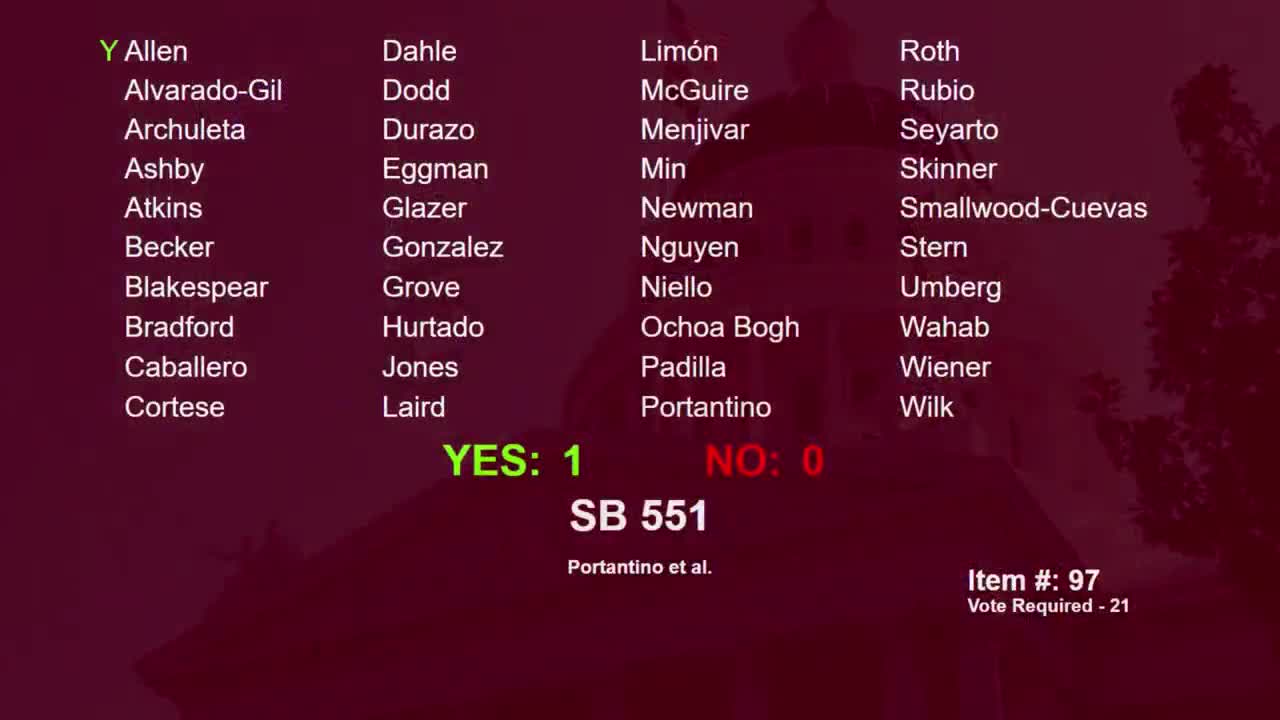 20MIN
Senate Floor
 10MIN
Senate Standing Committee on Energy, Utilities and Communications
 46MIN
Senate Standing Committee on Natural Resources and Water
Bill Author