SB 296: In-vehicle cameras.
- Session Year: 2023-2024
- House: Senate
- Latest Version Date: 2023-10-13
Current Status:
Passed
(2023-10-13: Chaptered by Secretary of State. Chapter 864, Statutes of 2023.)
Introduced
In Committee
First Chamber
In Committee
Second Chamber
Enacted
Existing law prohibits a person or entity from providing the operation of a voice recognition feature within this state without prominently informing, during the initial setup or installation of a connected television, either the user or the person designated by the user to perform the initial setup or installation of the connected television. Existing law further prohibits any actual recordings of spoken word collected through the operation of a voice recognition feature by the manufacturer of a connected television, or a third party contracting with a manufacturer of a connected television, from being sold or used for any advertising purpose. Existing law prohibits a person or entity from compelling a manufacturer or other entity providing the operation of a voice recognition feature to build specific features for the purpose of allowing an investigative or law enforcement officer to monitor communications through that feature. Existing law prohibits a waiver of these prohibitions and authorizes their enforcement by injunction or civil penalty in a court of competent jurisdiction by the Attorney General or a district attorney.
This bill would require a manufacturer of a new motor vehicle that is equipped with one or more in-vehicle cameras to disclose that fact, as specified. The bill would prohibit a dealer, as defined, from providing for the sale or lease of a new motor vehicle with one or more in-vehicle cameras in this state without prominently informing the user or the person designated by the user to purchase the vehicle, as specified, and would grant the buyer or lessee of a vehicle the right to review the owners manual or any other document, if any is provided by the manufacturer, prior to purchase to determine if an in-vehicle camera exists.
This bill would further prohibit any images or video recordings collected through the operation of an in-vehicle camera from being used for any advertising purpose or being sold to any third party. The bill would also prohibit these images or video recordings from being shared with third parties, except as provided. The bill would also prohibit any recording obtained through operation of an in-vehicle camera from being retained at any location other than the vehicle itself, or being downloaded, retrieved, or otherwise accessed by a person or entity other than the user, as defined, without affirmative prior consent, as defined, or unless the images and videos are accessed to diagnose, service, repair, or improve specified equipment and systems, except as provided. The bill would require a person or entity that provides the operation of an in-vehicle camera in this state to provide effective mechanisms for a consumer to revoke consent. The bill would provide an exception to the above prohibitions to comply with a lawful subpoena, court order, search warrant, or preservation request, as specified. The bill would prohibit a person or entity from compelling a manufacturer or other entity providing the operation of an in-vehicle camera to build specific features for the purpose of allowing an investigative or law enforcement officer to monitor images through that feature.
This bill would prohibit a waiver of the above protections, and would authorize their enforcement by injunction or civil penalty in a court of competent jurisdiction by the Attorney General or a district attorney. The bill would specify that those provisions do not apply to cameras installed in vehicles that are primarily for commercial use, as specified, and do not reduce the rights afforded to a consumer or the obligations imposed on a business under any applicable state or federal law, and that in the case of a conflict between these provisions and any other law, the law providing for the greater protection for the right of privacy for consumers controls.
Existing law prohibits a person or entity from providing the operation of a voice recognition feature within this state without prominently informing, during the initial setup or installation of a connected television, either the user or the person designated by the user to perform the initial setup or installation of the connected television. Existing law further prohibits any actual recordings of spoken word collected through the operation of a voice recognition feature by the manufacturer of a connected television, or a third party contracting with a manufacturer of a connected television, from being sold or used for any advertising purpose. Existing law prohibits a person or entity from compelling a manufacturer or other entity providing the operation of a voice recognition feature to build specific features for the purpose of allowing an investigative or law enforcement officer to monitor communications through that feature. Existing law prohibits a waiver of these prohibitions and authorizes their enforcement by injunction or civil penalty in a court of competent jurisdiction by the Attorney General or a district attorney.
This bill would require a manufacturer of a new motor vehicle that is equipped with one or more in-vehicle cameras to disclose that fact, as specified. The bill would prohibit a dealer, as defined, from providing for the sale or lease of a new motor vehicle with one or more in-vehicle cameras in this state without prominently informing the user or the person designated by the user to purchase the vehicle, as specified, and would grant the buyer or lessee of a vehicle the right to review the owners manual or any other document, if any is provided by the manufacturer, prior to purchase to determine if an in-vehicle camera exists.
This bill would further prohibit any images or video recordings collected through the operation of an in-vehicle camera from being used for any advertising purpose or being sold to any third party. The bill would also prohibit these images or video recordings from being shared with third parties, except as provided. The bill would also prohibit any recording obtained through operation of an in-vehicle camera from being retained at any location other than the vehicle itself, or being downloaded, retrieved, or otherwise accessed by a person or entity other than the user, as defined, without affirmative prior consent, as defined, or unless the images and videos are accessed to diagnose, service, repair, or improve specified equipment and systems, except as provided. The bill would require a person or entity that provides the operation of an in-vehicle camera in this state to provide effective mechanisms for a consumer to revoke consent. The bill would prohibit a person or entity from compelling a manufacturer or other entity providing the operation of an in-vehicle camera to build specific features for the purpose of allowing an investigative or law enforcement officer to monitor images through that feature.
This bill would prohibit a waiver of the above protections, and would authorize their enforcement by injunction or civil penalty in a court of competent jurisdiction by the Attorney General or a district attorney. The bill would specify that those provisions do not apply to cameras installed in vehicles that are primarily for commercial use, as specified, and do not reduce the rights afforded to a consumer or the obligations imposed on a business under any applicable state or federal law, and that in the case of a conflict between these provisions and any other law, the law providing for the greater protection for the right of privacy for consumers controls.
Existing law prohibits a person or entity from providing the operation of a voice recognition feature within this state without prominently informing, during the initial setup or installation of a connected television, either the user or the person designated by the user to perform the initial setup or installation of the connected television. Existing law further prohibits any actual recordings of spoken word collected through the operation of a voice recognition feature by the manufacturer of a connected television, or a third party contracting with a manufacturer of a connected television, from being sold or used for any advertising purpose. Existing law prohibits a person or entity from compelling a manufacturer or other entity providing the operation of a voice recognition feature to build specific features for the purpose of allowing an investigative or law enforcement officer to monitor communications through that feature. Existing law prohibits a waiver of these prohibitions and authorizes their enforcement by injunction or civil penalty in a court of competent jurisdiction by the Attorney General or a district attorney.
This bill would require a manufacturer of a new motor vehicle that is equipped with one or more in-vehicle cameras to disclose that fact, as specified. The bill would prohibit a person or entity dealer, as defined, from providing for the sale or lease of a new motor vehicle with one or more in-vehicle cameras in this state without prominently informing the user or the person designated by the user to purchase the vehicle, as specified, and would grant the buyer or lessee of a vehicle the right to review the owners manual or any other document, if any is provided by the manufacturer, prior to purchase to determine if an in-vehicle camera exists.
This bill would further prohibit any images or video recordings collected through the operation of an in-vehicle camera from being used for any advertising purpose or being sold to any third party. The bill would also prohibit these images or video recordings from being shared with third parties, except as provided. The bill would also prohibit any recording obtained through operation of an in-vehicle camera from being retained at any location other than the vehicle itself, or being downloaded, retrieved, or otherwise accessed by a person or entity other than the user, as defined, without affirmative prior consent, as defined, or unless the images and videos are accessed to diagnose, service, repair, or improve specified equipment and systems, except as provided. The bill would require a person or entity that provides the operation of an in-vehicle camera in this state to provide effective mechanisms for a consumer to revoke consent. The bill would prohibit a person or entity from compelling a manufacturer or other entity providing the operation of an in-vehicle camera to build specific features for the purpose of allowing an investigative or law enforcement officer to monitor images through that feature.
This bill would prohibit a waiver of the above protections, and would authorize their enforcement by injunction or civil penalty in a court of competent jurisdiction by the Attorney General or a district attorney. The bill would specify that those provisions do not apply to cameras installed in vehicles that are primarily for commercial use, as specified, and do not reduce the rights afforded to a consumer or the obligations imposed on a business under any applicable state or federal law, and that in the case of a conflict between these provisions and any other law, the law providing for the greater protection for the right of privacy for consumers controls.
Existing law prohibits a person or entity from providing the operation of a voice recognition feature within this state without prominently informing, during the initial setup or installation of a connected television, either the user or the person designated by the user to perform the initial setup or installation of the connected television. Existing law further prohibits any actual recordings of spoken word collected through the operation of a voice recognition feature by the manufacturer of a connected television, or a third party contracting with a manufacturer of a connected television, from being sold or used for any advertising purpose. Existing law prohibits a person or entity from compelling a manufacturer or other entity providing the operation of a voice recognition feature to build specific features for the purpose of allowing an investigative or law enforcement officer to monitor communications through that feature. Existing law prohibits a waiver of these prohibitions and authorizes their enforcement by injunction or civil penalty in a court of competent jurisdiction by the Attorney General or a district attorney.
This bill would require a manufacturer of a new motor vehicle that is equipped with one or more in-vehicle cameras to disclose that fact, as specified. The bill would prohibit a person or entity from providing for the sale or lease of a new motor vehicle with one or more in-vehicle cameras in this state without prominently informing the user or the person designated by the user to purchase the vehicle, as specified. The specified, and would grant the buyer or lessee of a vehicle the right to review the owners manual or any other document, if any is provided by the manufacturer, prior to purchase to determine if an in-vehicle camera exists.
This bill would further prohibit any images or video recordings collected through the operation of an in-vehicle camera from being used for any advertising purpose or being sold to any third party. The bill would also prohibit these images or video recordings from being shared with third parties, except as provided. The bill would also prohibit any recording obtained through operation of an in-vehicle camera from being retained at any location other than the vehicle itself, or being downloaded, retrieved, or otherwise accessed by a person or entity other than the user, as defined, without affirmative prior consent, as defined, except as provided. The bill would require a person or entity that provides the operation of an in-vehicle camera in this state to provide effective mechanisms for a consumer to revoke consent. The bill would prohibit a person or entity from compelling a manufacturer or other entity providing the operation of an in-vehicle camera to build specific features for the purpose of allowing an investigative or law enforcement officer to monitor images through that feature. The
This bill would prohibit a waiver of these the above protections, and would authorize their enforcement by injunction or civil penalty in a court of competent jurisdiction by the Attorney General or a district attorney. The bill would specify that these those provisions do not apply to cameras installed in vehicles that are primarily for commercial use, as specified, and do not reduce the rights afforded to a consumer or the obligations imposed on a business under any applicable state or federal law, and that in the case of a conflict between these provisions and any other law, the law providing for the greater protection for the right of privacy for consumers controls.
Existing law prohibits a person or entity from providing the operation of a voice recognition feature within this state without prominently informing, during the initial setup or installation of a connected television, either the user or the person designated by the user to perform the initial setup or installation of the connected television. Existing law further prohibits any actual recordings of spoken word collected through the operation of a voice recognition feature by the manufacturer of a connected television, or a third party contracting with a manufacturer of a connected television, from being sold or used for any advertising purpose. Existing law prohibits a person or entity from compelling a manufacturer or other entity providing the operation of a voice recognition feature to build specific features for the purpose of allowing an investigative or law enforcement officer to monitor communications through that feature. Existing law prohibits a waiver of these prohibitions and authorizes their enforcement by injunction or civil penalty in a court of competent jurisdiction by the Attorney General or a district attorney.
This bill would require a manufacturer of a new motor vehicle that is equipped with one or more in-vehicle cameras to disclose that fact, as specified. The bill would prohibit a person or entity from providing for the sale or lease of a new motor vehicle with one or more in-vehicle cameras in this state without prominently informing the user or the person designated by the user to purchase the vehicle, as specified. The bill would further prohibit any images or video recordings collected through the operation of an in-vehicle camera from being used for any advertising purpose or being sold to any third party. The bill would also prohibit these images or video recordings from being shared with third parties, except as provided. The bill would also prohibit any recording obtained through operation of an in-vehicle camera from being retained at any location other than the vehicle itself, or being downloaded, retrieved, or otherwise accessed by a person or entity other than the user, as defined, without affirmative prior consent, as defined, except as provided. The bill would require a person or entity that provides the operation of an in-vehicle camera in this state to provide effective mechanisms for a consumer to revoke consent. The bill would prohibit a person or entity from compelling a manufacturer or other entity providing the operation of an in-vehicle camera to build specific features for the purpose of allowing an investigative or law enforcement officer to monitor images through that feature. The bill would prohibit a waiver of these protections, and would authorize their enforcement by injunction or civil penalty in a court of competent jurisdiction by the Attorney General or a district attorney. The bill would specify that these provisions do not apply to cameras installed in vehicles that are primarily for commercial use, as specified, and do not reduce the rights afforded to a consumer or the obligations imposed on a business under any applicable state or federal law, and that in the case of a conflict between these provisions and any other law, the law providing for the greater protection for the right of privacy for consumers controls.
(a)A manufacturer of a new motor vehicle model that is equipped standard with one or more in-vehicle cameras that is sold or leased in this state shall disclose that fact in the owners manual for the vehicle. If a vehicle is equipped with one or more in-vehicle cameras and the camera does not come standard with the vehicle model, the manufacturer shall disclose that the vehicle is equipped with one or more in-vehicle cameras in a document sent to the dealer of the vehicle, which may include the vehicle specification sheet.
(b)(1)A dealer shall not provide for the sale or lease of a new motor vehicle equipped with one or more in-vehicle cameras in this state without prominently informing, during the purchase of the vehicle, and in accordance with the procedures of paragraphs (2) and (3), either the user or the person designated by the user to purchase the vehicle.
(2)Prior to the execution of the conditional sales contract for a vehicle, the dealer shall provide to the user, or the person designated by the user to purchase the vehicle, a separate disclosure, either written or electronic, acknowledging the existence and operation of an in-vehicle camera in the purchased vehicle, and shall obtain the written or electronic signature of the user or purchaser on that disclosure. The disclosure shall meet all of the following criteria:
(A)Be contained on a single document or single internet website that is separate from the conditional sales contract, purchase order, and any other document.
(B)Contain the following language, written in at least 20-point bold type:
This vehicle may be equipped with an in-vehicle camera capable of recording the driver and other individuals inside the vehicle. For more information about the in-vehicle camera please consult your automotive dealer, the vehicle manufacturer, or the vehicle owners manual. The manufacturer is required to notify the dealer about an in-vehicle camera in the owners manual, specification sheet, or other document. A buyer or lessee of a vehicle has a right to review the owners manual or any other provided document prior to purchase to determine if an in-vehicle camera exists. For more information about the in-vehicle camera, please consult your automotive dealer, the vehicle manufacturer, or the vehicle owners manual. If a manufacturer or other person or entity obtains or shares any video or photographs without your consent and in violation of law, they may be subject to legal action, including, but not limited to, via a county district attorney, the state attorney general, or otherwise as described in Sections 22948.51 and 22948.55 of the Business and Professions Code.
By law, signing this acknowledgment form does not waive any rights of the user or constitute consent to a manufacturer to share, sell, or retain any images or videos captured by the in-vehicle camera.
(C)Include a signature or acknowledgment box that the buyer or lessee, or their representative, has reviewed the disclosure language identified in subparagraph (B) and understands their right to review, before purchasing or leasing the vehicle, the vehicle owners manual and any other information provided by the manufacturer pertaining to in-vehicle cameras.
(3)A buyer or lessee of a vehicle has a right to review the owners manual or any other document, if any is provided by the manufacturer, prior to purchase to determine if an in-vehicle camera exists.
(c)A dealer shall not be held liable for a violation of subdivision (b) if the manufacturer of that vehicle is in violation of subdivision (a) with respect to that vehicle.
22948.51.(a)Any image or video recording collected or retained through the operation of an in-vehicle camera shall not be:
(1)Used for any advertising.
(2)Sold to a third party.
(3)Shared with a third party unless any of the following apply:
(A)The user has provided affirmative prior consent, and all of the following requirements are met:
(i)Recipients of images or video recordings shared pursuant to this subparagraph do not use the images or video recordings for any purpose other than a purpose affirmatively consented to by the consumer, do not share or transmit the images or video recordings, and do not retain the images or video recordings longer than reasonably necessary to fulfill the purpose for which they were shared.
(ii)The user receives clear, meaningful notice prior to the sharing of the images or video recordings, including the party or parties with whom the images or recordings will be shared, and the purpose for which the images or recordings will be shared.
(B)(i)The images or video recordings are shared with a third party only to the extent necessary to diagnose, service, or repair the in-vehicle camera or vehicle equipment that relies on or utilizes the in-vehicle camera, or improve portions of a vehicles safety system that rely on or utilize the in-vehicle camera.
(ii)Recipients of images or video recordings shared pursuant to this subparagraph do not use the images or video recordings for any purpose other than a purpose specified in clause (i), do not share or transmit the images or video recordings, and do not retain the images or video recordings longer than reasonably necessary to fulfill the purpose for which they were shared.
(C)The images or video recordings are shared with a third party in order to comply with a valid verifiable consumer request pursuant to Title 1.81.5 (commencing with Section 1798.100) of Part 4 of Division 3 of the Civil Code.
(D)The images or video recordings are shared with a third party pursuant to a records request, including, but not limited to, a request pursuant to subdivision (b) of Section 832.7 of the Penal Code or Section 7923.625 of the Government Code or Title 4 (commencing with Section 2016.010) of Part 4 of the Code of Civil Procedure.
(4)Retained at any location, other than the vehicle itself, unless either of the following apply:
(A)The user has provided affirmative prior consent.
(B)The images or video recordings are retained only to the extent necessary to diagnose, service, or repair the in-vehicle camera or vehicle equipment that relies on or utilizes the in-vehicle camera, or improve portions of a vehicles safety system that rely on or utilize the in-vehicle camera.
(5)Downloaded, retrieved, or otherwise accessed by a person or entity other than the user, unless either of the following apply:
(A)The user has provided affirmative prior consent.
(B)(i)Subject to clause (ii), the images or video recordings are retained only to the extent necessary to diagnose, service, or repair the in-vehicle camera or vehicle equipment that relies on or utilizes the in-vehicle camera, or improve portions of a vehicles safety system that rely on or utilize the in-vehicle camera.
(ii)The person or entity that downloads, retrieves, or otherwise accesses the images or recordings does not use the images or video recordings for any purpose other than the purpose specified in clause (i), does not share or transmit the images or video recordings, and does not retain the images or video recordings longer than reasonably necessary to fulfill the purpose for which they were shared.
(b)(1)A person or entity that provides the operation of an in-vehicle camera in this state shall provide effective mechanisms, without any cost, penalty, or unnecessary steps, for a consumer to revoke their consent pursuant to subparagraph (A) of paragraph (3) of subdivision (a), subparagraph (A) of paragraph (4) of subdivision (a), and subparagraph (A) of paragraph (5) of subdivision (a) after it is given. At least one of these mechanisms shall utilize the primary medium through which the person or entity communicates with users.
(2)A person or entity subject to paragraph (1) shall honor the users consent revocation, and shall delete from all locations other than the vehicle itself any image or recording associated with that user that has been collected, retained, downloaded, or retrieved by that person or entity under subparagraph (A) of paragraph (3) of subdivision (a), subparagraph (A) of paragraph (4) of subdivision (a), and subparagraph (A) of paragraph (5) of subdivision (a), as soon as practicable, but not later than 30 days after the user revokes consent.
(c)A person or entity shall not discriminate against a user because the user has exercised any of their rights under this chapter. Discriminatory acts shall include, but not be limited to, the following:
(1)Denying goods, services, or benefits to the user.
(2)Charging different prices or rates for goods or services, including through the use of discounts or other incentives or imposing penalties.
(3)Providing a different level or quality of goods, services, or benefits to the user.
(4)Suggesting that the user will receive a different price or rate for goods, services, or benefits, or a different level or quality of goods, services, or benefits.
(5)Considering the users exercise of rights under this chapter as a basis for suspicion of criminal wrongdoing or unlawful conduct.
(d)Images or video recordings retained through the operation of an in-vehicle camera may be retrieved or shared without the users permission if any of the following apply:
(1)In a court, arbitration, or other judicial or administrative authority, the video recordings are subject to the standards for admission into evidence required by that court, arbitrator, or other administrative authority.
(2)(A)The images or video recordings are retrieved pursuant to an investigation or inspection authorized under Section 1131(a) or 30166 of Title 49 of the United States Code, and the personal information of an owner or a lessee of the vehicle, including the vehicle identification number, is not disclosed in connection with the video recordings retrieved pursuant to this subparagraph.
(B)Notwithstanding subparagraph (A), a vehicle identification number may be disclosed to the manufacturer or other entity responsible for providing the images or video recordings pursuant to subparagraph (A).
(3)The images or video recordings are retrieved for the purpose of immediately determining the need for, or facilitating, emergency medical response to a motor vehicle crash.
(e)(1)Notwithstanding subdivisions (a) to (d), inclusive, any image or video recording collected or retained through the operation of an in-vehicle camera may be shared with a third party, retained at a location other than the vehicle, or downloaded, retrieved, or otherwise accessed by a person or entity other than the user to comply with a preservation request pursuant to Chapter 119 or 121 of Title 18 of the United States Code, or a lawful subpoena, court order, or search warrant.
(2)Paragraph (1) shall not be construed to relieve a person or entity from compliance with the California Electronic Communications Privacy Act (Chapter 3.6 (commencing with Section 1546) of Title 12 of Part 2 of the Penal Code), including, but not limited to, Section 1546.5 of the Penal Code.
22948.52.A person or entity shall not compel a manufacturer or other entity providing the operation of an in-vehicle camera to build specific features for the purpose of allowing an investigative or law enforcement officer to monitor communications through that feature.
22948.53.For purposes of this chapter, the following definitions shall apply:
(a)(1)Affirmative prior consent means a users freely given, informed, and unambiguous affirmative authorization for the prospective sharing or retention of their in-vehicle camera recordings or images, in accordance with the requirements of subdivision (a) of Section 22948.51, in one of the following forms:
(A)A page on the vehicle manufacturers internet website clearly dedicated to privacy where the user can acknowledge their consent to have their in-vehicle camera recordings or images shared or retained pursuant to subdivision (a) of Section 22948.51. This acknowledgment of consent shall not be given in combination with any other acknowledgment, consent, or agreement.
(B)A users response to a mail form sent by the vehicle manufacturer and returned by the user with their signature acknowledging their consent to have their in-vehicle camera recordings or images shared or retained pursuant to subdivision (a) of Section 22948.51.
(C)A users signature on a written or electronic form, at the time of the vehicle purchase, acknowledging their consent to have their in-vehicle camera recordings or images shared or retained pursuant to subdivision (a) of Section 22948.51. The form shall be contained on a single document or single internet page, written in at least 20-point bold font, that is separate from the conditional sales contract, purchase order, or any other document or internet page.
(D)A dedicated prompt displayed on a screen located on the vehicles center console which allows the user to acknowledge their consent to have their in-vehicle camera recordings or images shared or retained pursuant to subdivision (a) of Section 22948.51. The prompt shall meet all of the following criteria:
(i)Outline the limited sharing or retention for which the user may give consent under subdivision (a) of Section 22948.51, and provide a description of how the user may acknowledge or revoke consent in the future.
(ii)Only allow the user to give consent pursuant to the provisions of subdivision (a) of Section 22948.51, and shall not be used to provide consent for any other purpose or be used in conjunction with any other separate acknowledgment of consent.
(iii)Be displayed to the user only in any of the following instances:
(I)The initial setup of the vehicle during or after purchase.
(II)When diagnoses, service, or repair of the in-vehicle camera, or vehicle equipment that relies on or utilizes the in-vehicle camera, is required.
(III)When the user chooses, through a setting on the vehicles center console, to view the prompt for the purpose of acknowledging or revoking consent.
(2)Affirmative prior consent shall not include any of the following:
(A)Acceptance of a general or broad terms of use, or similar document, that contains descriptions of sharing or retention of in-vehicle camera recordings or images along with other, unrelated information.
(B)Hovering over, muting, pausing, or closing a given piece of content in an electronic format.
(C)Agreement obtained through a user interface designed or manipulated with the substantial effect of subverting or impairing user autonomy, decisionmaking, or choice.
(b)Dealer has the same meaning as set forth in Section 285 of the Vehicle Code.
(c)In-vehicle camera means any device included as part of a vehicle by the manufacturer that is designed to, or is capable of, recording images or video inside the cabin of the vehicle.
(d)Personal information means information that identifies, relates to, describes, is reasonably capable of being associated with, or could reasonably be linked, directly or indirectly, with a particular consumer, household, or consumer device.
(e)User means a person who originally purchases, leases, or takes ownership of a vehicle equipped with an in-vehicle camera. A person who is incidentally recorded when a vehicle is operated by a user shall not be deemed to be a user.
(f)Vehicle manufacturer or manufacturer has the same meaning as set forth in Section 672 of the Vehicle Code.
22948.54.Any waiver of the provisions of this chapter is contrary to public policy and void and unenforceable.
22948.55.(a)Actions for relief pursuant to this chapter may be prosecuted exclusively in a court of competent jurisdiction in a civil action brought in the name of the people of the State of California by the Attorney General or by any district attorney. This chapter shall not be deemed to create a private right of action, or limit any existing private right of action.
(b)A court may enjoin a person who engages, has engaged, or proposes to engage in a violation of this chapter. The court may make any orders or judgments as may be necessary to prevent a violation of this chapter.
(c)A person who knowingly engages, has engaged, or proposes to engage in a violation of this chapter shall be liable for a civil penalty not to exceed two thousand five hundred dollars ($2,500) for each vehicle equipped with an in-vehicle camera sold or leased in violation of this chapter. If the action is brought by the Attorney General, the penalty shall be deposited into the General Fund. If the action is brought by a district attorney, the penalty shall be paid to the treasurer of the county in which the judgment was entered.
22948.56.The remedies or penalties provided by this chapter are cumulative to each other and to the remedies or penalties available under all other laws of the state.
22948.57.(a)This chapter does not reduce the rights afforded to a consumer or the obligations imposed on a business pursuant to any applicable state or federal law for the protection of individual privacy.
(b)In the event of a conflict between this chapter and any other state law, the provisions of the law that afford the greatest protection for the right of privacy for consumers shall control.
(c)The rights afforded to consumers and the obligations imposed on any business pursuant to this chapter do not apply to the extent that they infringe on the noncommercial activities of a person or entity described in subdivision (b) of Section 2 of Article I of the California Constitution.
22948.58.(a)This chapter shall not apply to cameras installed in vehicles that are primarily for commercial use, including buses, as defined in Section 233 of the Vehicle Code, motortrucks, as defined in Section 410 of the Vehicle Code, and truck tractors, as defined in Section 655 of the Vehicle Code.
(b)Nothing in this chapter authorizes the sale or advertising for commercial use of any image or video depicting a commercial driver without their consent.
22948.59.The provisions of this chapter are severable. If any provision of this chapter or its application is held to be invalid, that invalidity shall not affect other provisions or applications that can be given effect without the invalid provision or application.
(a)A manufacturer of a new motor vehicle model that is equipped standard with one or more in-vehicle cameras that is sold or leased in this state shall disclose that fact in the owners manual for the vehicle. If a vehicle is equipped with one or more in-vehicle cameras and the camera does not come standard with the vehicle model, the manufacturer shall disclose that the vehicle is equipped with one or more in-vehicle cameras in a document sent to the dealer of the vehicle, which may include the vehicle specification sheet.
(b)(1)A dealer shall not provide for the sale or lease of a new motor vehicle equipped with one or more in-vehicle cameras in this state without prominently informing, during the purchase of the vehicle, and in accordance with the procedures of paragraphs (2) and (3), either the user or the person designated by the user to purchase the vehicle.
(2)Prior to the execution of the conditional sales contract for a vehicle, the dealer shall provide to the user, or the person designated by the user to purchase the vehicle, a separate disclosure, either written or electronic, acknowledging the existence and operation of an in-vehicle camera in the purchased vehicle, and shall obtain the written or electronic signature of the user or purchaser on that disclosure. The disclosure shall meet all of the following criteria:
(A)Be contained on a single document or single internet website that is separate from the conditional sales contract, purchase order, and any other document.
(B)Contain the following language, written in at least 20-point bold type:
This vehicle may be equipped with an in-vehicle camera capable of recording the driver and other individuals inside the vehicle. For more information about the in-vehicle camera please consult your automotive dealer, the vehicle manufacturer, or the vehicle owners manual. The manufacturer is required to notify the dealer about an in-vehicle camera in the owners manual, specification sheet, or other document. A buyer or lessee of a vehicle has a right to review the owners manual or any other provided document prior to purchase to determine if an in-vehicle camera exists. For more information about the in-vehicle camera, please consult your automotive dealer, the vehicle manufacturer, or the vehicle owners manual. If a manufacturer or other person or entity obtains or shares any video or photographs without your consent and in violation of law, you may have the right to take they may be subject to legal action, including, but not limited to, via a county district attorney, the state attorney general, or otherwise as described in Sections 22948.51 and 22948.55 of the Business and Professions Code.
By law, signing this acknowledgment form does not waive any rights of the user or constitute consent to a manufacturer to share, sell, or retain any images or videos captured by the in-vehicle camera.
(C)Include a signature or acknowledgment box that the buyer or lessee, or their representative, has reviewed the disclosure language identified in subparagraph (B) and understands their right to review, before purchasing or leasing the vehicle, the vehicle owners manual and any other information provided by the manufacturer pertaining to in-vehicle cameras.
(3)A buyer or lessee of a vehicle has a right to review the owners manual or any other document, if any is provided by the manufacturer, prior to purchase to determine if an in-vehicle camera exists.
(c)A dealer shall not be held liable for a violation of subdivision (b) if the manufacturer of that vehicle is in violation of subdivision (a) with respect to that vehicle.
22948.51.(a)Any image or video recording collected or retained through the operation of an in-vehicle camera shall not be:
(1)Used for any advertising.
(2)Sold to a third party.
(3)Shared with a third party unless any of the following apply:
(A)The user has provided affirmative prior consent, and all of the following requirements are met:
(i)Recipients of images or video recordings shared pursuant to this subparagraph do not use the images or video recordings for any purpose other than a purpose affirmatively consented to by the consumer, do not share or transmit the images or video recordings, and do not retain the images or video recordings longer than reasonably necessary to fulfill the purpose for which they were shared.
(ii)The user receives clear, meaningful notice prior to the sharing of the images or video recordings, including the party or parties with whom the images or recordings will be shared, and the purpose for which the images or recordings will be shared.
(B)(i)The images or video recordings are shared with a third party only to the extent necessary to diagnose, service, or repair the in-vehicle camera or vehicle equipment that relies on or utilizes the in-vehicle camera, or improve portions of a vehicles safety system that rely on or utilize the in-vehicle camera.
(ii)Recipients of images or video recordings shared pursuant to this subparagraph do not use the images or video recordings for any purpose other than a purpose specified in clause (i), do not share or transmit the images or video recordings, and do not retain the images or video recordings longer than reasonably necessary to fulfill the purpose for which they were shared.
(C)The images or video recordings are shared with a third party in order to comply with a valid verifiable consumer request pursuant to Title 1.81.5 (commencing with Section 1798.100) of Part 4 of Division 3 of the Civil Code.
(D)The images or video recordings are shared with a third party pursuant to a records request, including, but not limited to, a request pursuant to subdivision (b) of Section 832.7 of the Penal Code or Section 7923.625 of the Government Code or Title 4 (commencing with Section 2016.010) of Part 4 of the Code of Civil Procedure.
(4)Retained at any location, other than the vehicle itself, unless either of the following apply:
(A)The user has provided affirmative prior consent.
(B)The images or video recordings are retained only to the extent necessary to diagnose, service, or repair the in-vehicle camera or vehicle equipment that relies on or utilizes the in-vehicle camera, or improve portions of a vehicles safety system that rely on or utilize the in-vehicle camera.
(5)Downloaded, retrieved, or otherwise accessed by a person or entity other than the user, unless either of the following apply:
(A)The user has provided affirmative prior consent.
(B)(i)Subject to clause (ii), the images or video recordings are retained only to the extent necessary to diagnose, service, or repair the in-vehicle camera or vehicle equipment that relies on or utilizes the in-vehicle camera, or improve portions of a vehicles safety system that rely on or utilize the in-vehicle camera.
(ii)The person or entity that downloads, retrieves, or otherwise accesses the images or recordings does not use the images or video recordings for any purpose other than the purpose specified in clause (i), does not share or transmit the images or video recordings, and does not retain the images or video recordings longer than reasonably necessary to fulfill the purpose for which they were shared.
(b)(1)A person or entity that provides the operation of an in-vehicle camera in this state shall provide effective mechanisms, without any cost, penalty, or unnecessary steps, for a consumer to revoke their consent pursuant to subparagraph (A) of paragraph (3) of subdivision (a), subparagraph (A) of paragraph (4) of subdivision (a), and subparagraph (A) of paragraph (5) of subdivision (a) after it is given. At least one of these mechanisms shall utilize the primary medium through which the person or entity communicates with users.
(2)A person or entity subject to paragraph (1) shall honor the users consent revocation, and shall delete from all locations other than the vehicle itself any image or recording associated with that user that has been collected, retained, downloaded, or retrieved by that person or entity under subparagraph (A) of paragraph (3) of subdivision (a), subparagraph (A) of paragraph (4) of subdivision (a), and subparagraph (A) of paragraph (5) of subdivision (a), as soon as practicable, but not later than 30 days after the user revokes consent.
(c)A person or entity shall not discriminate against a user because the user has exercised any of their rights under this chapter. Discriminatory acts shall include, but not be limited to, the following:
(1)Denying goods, services, or benefits to the user.
(2)Charging different prices or rates for goods or services, including through the use of discounts or other incentives or imposing penalties.
(3)Providing a different level or quality of goods, services, or benefits to the user.
(4)Suggesting that the user will receive a different price or rate for goods, services, or benefits, or a different level or quality of goods, services, or benefits.
(5)Considering the users exercise of rights under this chapter as a basis for suspicion of criminal wrongdoing or unlawful conduct.
(d)Images or video recordings retained through the operation of an in-vehicle camera may be retrieved or shared without the users permission if any of the following apply:
(1)In a court, arbitration, or other judicial or administrative authority, the video recordings are subject to the standards for admission into evidence required by that court, arbitrator, or other administrative authority.
(2)(A)The images or video recordings are retrieved pursuant to an investigation or inspection authorized under Section 1131(a) or 30166 of Title 49 of the United States Code, and the personal information of an owner or a lessee of the vehicle, including the vehicle identification number, is not disclosed in connection with the video recordings retrieved pursuant to this subparagraph.
(B)Notwithstanding subparagraph (A), a vehicle identification number may be disclosed to the manufacturer or other entity responsible for providing the images or video recordings pursuant to subparagraph (A).
(3)The images or video recordings are retrieved for the purpose of immediately determining the need for, or facilitating, emergency medical response to a motor vehicle crash.
(e)(1)Notwithstanding subdivisions (a) to (d), inclusive, any image or video recording collected or retained through the operation of an in-vehicle camera may be shared with a third party, retained at a location other than the vehicle, or downloaded, retrieved, or otherwise accessed by a person or entity other than the user to comply with a preservation request pursuant to Chapter 119 or 121 of Title 18 of the United States Code, or a lawful subpoena, court order, or search warrant.
(2)Paragraph (1) shall not be construed to relieve a person or entity from compliance with the California Electronic Communications Privacy Act (Chapter 3.6 (commencing with Section 1546) of Title 12 of Part 2 of the Penal Code), including, but not limited to, Section 1546.5 of the Penal Code.
22948.52.A person or entity shall not compel a manufacturer or other entity providing the operation of an in-vehicle camera to build specific features for the purpose of allowing an investigative or law enforcement officer to monitor communications through that feature.
22948.53.For purposes of this chapter, the following definitions shall apply:
(a)(1)Affirmative prior consent means a users freely given, informed, and unambiguous affirmative authorization for the prospective sharing or retention of their in-vehicle camera recordings or images, in accordance with the requirements of subdivision (a) of Section 22948.51, in one of the following forms:
(A)A page on the vehicle manufacturers internet website clearly dedicated to privacy where the user can acknowledge their consent to have their in-vehicle camera recordings or images shared or retained pursuant to subdivision (a) of Section 22948.51. This acknowledgment of consent shall not be given in combination with any other acknowledgment, consent, or agreement.
(B)A users response to a mail form sent by the vehicle manufacturer and returned by the user with their signature acknowledging their consent to have their in-vehicle camera recordings or images shared or retained pursuant to subdivision (a) of Section 22948.51.
(C)A users signature on a written or electronic form, at the time of the vehicle purchase, acknowledging their consent to have their in-vehicle camera recordings or images shared or retained pursuant to subdivision (a) of Section 22948.51. The form shall be contained on a single document or single internet page, written in at least 20-point bold font, that is separate from the conditional sales contract, purchase order, or any other document or internet page.
(D)A dedicated prompt displayed on a screen located on the vehicles center console which allows the user to acknowledge their consent to have their in-vehicle camera recordings or images shared or retained pursuant to subdivision (a) of Section 22948.51. The prompt shall meet all of the following criteria:
(i)Outline the limited sharing or retention for which the user may give consent under subdivision (a) of Section 22948.51, and provide a description of how the user may acknowledge or revoke consent in the future.
(ii)Only allow the user to give consent pursuant to the provisions of subdivision (a) of Section 22948.51, and shall not be used to provide consent for any other purpose or be used in conjunction with any other separate acknowledgment of consent.
(iii)Be displayed to the user only in any of the following instances:
(I)The initial setup of the vehicle during or after purchase.
(II)When diagnoses, service, or repair of the in-vehicle camera, or vehicle equipment that relies on or utilizes the in-vehicle camera, is required.
(III)When the user chooses, through a setting on the vehicles center console, to view the prompt for the purpose of acknowledging or revoking consent.
(2)Affirmative prior consent shall not include any of the following:
(A)Acceptance of a general or broad terms of use, or similar document, that contains descriptions of sharing or retention of in-vehicle camera recordings or images along with other, unrelated information.
(B)Hovering over, muting, pausing, or closing a given piece of content in an electronic format.
(C)Agreement obtained through a user interface designed or manipulated with the substantial effect of subverting or impairing user autonomy, decisionmaking, or choice.
(b)Dealer has the same meaning as set forth in Section 285 of the Vehicle Code.
(c)In-vehicle camera means any device included as part of a vehicle by the manufacturer that is designed to, or is capable of, recording images or video inside the cabin of the vehicle.
(d)Personal information means information that identifies, relates to, describes, is reasonably capable of being associated with, or could reasonably be linked, directly or indirectly, with a particular consumer, household, or consumer device.
(e)User means a person who originally purchases, leases, or takes ownership of a vehicle equipped with an in-vehicle camera. A person who is incidentally recorded when a vehicle is operated by a user shall not be deemed to be a user.
(f)Vehicle manufacturer or manufacturer has the same meaning as set forth in Section 672 of the Vehicle Code.
22948.54.Any waiver of the provisions of this chapter is contrary to public policy and void and unenforceable.
22948.55.(a)Actions for relief pursuant to this chapter may be prosecuted exclusively in a court of competent jurisdiction in a civil action brought in the name of the people of the State of California by the Attorney General or by any district attorney. This chapter shall not be deemed to create a private right of action, or limit any existing private right of action.
(b)A court may enjoin a person who engages, has engaged, or proposes to engage in a violation of this chapter. The court may make any orders or judgments as may be necessary to prevent a violation of this chapter.
(c)A person who knowingly engages, has engaged, or proposes to engage in a violation of this chapter shall be liable for a civil penalty not to exceed two thousand five hundred dollars ($2,500) for each vehicle equipped with an in-vehicle camera sold or leased in violation of this chapter. If the action is brought by the Attorney General, the penalty shall be deposited into the General Fund. If the action is brought by a district attorney, the penalty shall be paid to the treasurer of the county in which the judgment was entered.
22948.56.The remedies or penalties provided by this chapter are cumulative to each other and to the remedies or penalties available under all other laws of the state.
22948.57.(a)This chapter does not reduce the rights afforded to a consumer or the obligations imposed on a business pursuant to any applicable state or federal law for the protection of individual privacy.
(b)In the event of a conflict between this chapter and any other state law, the provisions of the law that afford the greatest protection for the right of privacy for consumers shall control.
(c)The rights afforded to consumers and the obligations imposed on any business pursuant to this chapter do not apply to the extent that they infringe on the noncommercial activities of a person or entity described in subdivision (b) of Section 2 of Article I of the California Constitution.
22948.58.(a)This chapter shall not apply to cameras installed in vehicles that are primarily for commercial use, including buses, as defined in Section 233 of the Vehicle Code, motortrucks, as defined in Section 410 of the Vehicle Code, and truck tractors, as defined in Section 655 of the Vehicle Code.
(b)Nothing in this chapter authorizes the sale or advertising for commercial use of any image or video depicting a commercial driver without their consent.
22948.59.The provisions of this chapter are severable. If any provision of this chapter or its application is held to be invalid, that invalidity shall not affect other provisions or applications that can be given effect without the invalid provision or application.
(a)A manufacturer of a new motor vehicle model that is equipped standard with one or more in-vehicle cameras that is sold or leased in this state shall disclose that fact in the owners manual for the vehicle. If a vehicle is equipped with one or more in-vehicle cameras and the camera does not come standard with the vehicle model, the manufacturer shall disclose that the vehicle is equipped with one or more in-vehicle cameras in a document sent to the dealer of the vehicle, which may include the vehicle specification sheet.
(b)(1)A dealer shall not provide for the sale or lease of a new motor vehicle equipped with one or more in-vehicle cameras in this state without prominently informing, during the purchase of the vehicle, and in accordance with the procedures of paragraphs (2) and (3), either the user or the person designated by the user to purchase the vehicle.
(2)Prior to the execution of the conditional sales contract for a vehicle, the dealer shall provide to the user, or the person designated by the user to purchase the vehicle, a separate disclosure, either written or electronic, acknowledging the existence and operation of an in-vehicle camera in the purchased vehicle, and shall obtain the written or electronic signature of the user or purchaser on that disclosure. The disclosure shall meet all of the following criteria:
(A)Be contained on a single document or single internet website that is separate from the conditional sales contract, purchase order, and any other document.
(B)Contain the following language, written in at least 20-point bold type:
This vehicle may be equipped with an in-vehicle camera capable of recording the driver and other individuals inside the vehicle. For more information about the in-vehicle camera please consult your automotive dealer, the vehicle manufacturer, or the vehicle owners manual. The manufacturer is required to notify the dealer about an in-vehicle camera in the owners manual, specification sheet, or other document. A buyer or lessee of a vehicle has a right to review the owners manual or any other provided document prior to purchase to determine if an in-vehicle camera exists. For more information about the in-vehicle camera, please consult your automotive dealer, the vehicle manufacturer, or the vehicle owners manual. If a manufacturer or other person or entity obtains or shares any video or photographs without your consent and in violation of law, you may have the right to take legal action, including, but not limited to, via a county district attorney, the state attorney general, or otherwise as described in Sections 22948.51 and 22948.55 of the Business and Professions Code.
By law, signing this acknowledgment form does not waive any rights of the user or constitute consent to a manufacturer to share, sell, or retain any images or videos captured by the in-vehicle camera.
(C)Include a signature or acknowledgment box that the buyer or lessee, or their representative, has reviewed the disclosure language identified in subparagraph (B) and understands their right to review, before purchasing or leasing the vehicle, the vehicle owners manual and any other information provided by the manufacturer pertaining to in-vehicle cameras.
(3)A buyer or lessee of a vehicle has a right to review the owners manual or any other document, if any is provided by the manufacturer, prior to purchase to determine if an in-vehicle camera exists.
(c)A dealer shall not be held liable for a violation of subdivision (b) if the manufacturer of that vehicle is in violation of subdivision (a) with respect to that vehicle.
22948.51.(a)Any image or video recording collected or retained through the operation of an in-vehicle camera shall not be:
(1)Used for any advertising.
(2)Sold to a third party.
(3)Shared with a third party unless any of the following apply:
(A)The user has provided affirmative prior consent, and all of the following requirements are met:
(i)Recipients of images or video recordings shared pursuant to this subparagraph do not use the images or video recordings for any purpose other than a purpose affirmatively consented to by the consumer, do not share or transmit the images or video recordings, and do not retain the images or video recordings longer than reasonably necessary to fulfill the purpose for which they were shared.
(ii)The user receives clear, meaningful notice prior to the sharing of the images or video recordings, including the party or parties with whom the images or recordings will be shared, and the purpose for which the images or recordings will be shared.
(B)(i)The images or video recordings are shared with a third party only to the extent necessary to diagnose, service, or repair the in-vehicle camera or vehicle equipment that relies on or utilizes the in-vehicle camera, or improve portions of a vehicles safety system that rely on or utilize the in-vehicle camera.
(ii)Recipients of images or video recordings shared pursuant to this subparagraph do not use the images or video recordings for any purpose other than a purpose specified in clause (i), do not share or transmit the images or video recordings, and do not retain the images or video recordings longer than reasonably necessary to fulfill the purpose for which they were shared.
(C)The images or video recordings are shared with a third party in order to comply with a valid verifiable consumer request pursuant to Title 1.81.5 (commencing with Section 1798.100) of Part 4 of Division 3 of the Civil Code.
(D)The images or video recordings are shared with a third party pursuant to a records request, including, but not limited to, a request pursuant to subdivision (b) of Section 832.7 of the Penal Code or Section 7923.625 of the Government Code or Title 4 (commencing with Section 2016.010) of Part 4 of the Code of Civil Procedure.
(4)Retained at any location, other than the vehicle itself, unless either of the following apply:
(A)The user has provided affirmative prior consent.
(B)The images or video recordings are retained only to the extent necessary to diagnose, service, or repair the in-vehicle camera or vehicle equipment that relies on or utilizes the in-vehicle camera, or improve portions of a vehicles safety system that rely on or utilize the in-vehicle camera.
(5)Downloaded, retrieved, or otherwise accessed by a person or entity other than the user, unless either of the following apply:
(A)The user has provided affirmative prior consent.
(B)(i)Subject to clause (ii), the images or video recordings are retained only to the extent necessary to diagnose, service, or repair the in-vehicle camera or vehicle equipment that relies on or utilizes the in-vehicle camera, or improve portions of a vehicles safety system that rely on or utilize the in-vehicle camera.
(ii)The person or entity that downloads, retrieves, or otherwise accesses the images or recordings does not use the images or video recordings for any purpose other than the purpose specified in clause (i), does not share or transmit the images or video recordings, and does not retain the images or video recordings longer than reasonably necessary to fulfill the purpose for which they were shared.
(b)(1)A person or entity that provides the operation of an in-vehicle camera in this state shall provide effective mechanisms, without any cost, penalty, or unnecessary steps, for a consumer to revoke their consent pursuant to subparagraph (A) of paragraph (3) of subdivision (a), subparagraph (A) of paragraph (4) of subdivision (a), and subparagraph (A) of paragraph (5) of subdivision (a) after it is given. At least one of these mechanisms shall utilize the primary medium through which the person or entity communicates with users.
(2)A person or entity subject to paragraph (1) shall honor the users consent revocation, and shall delete from all locations other than the vehicle itself any image or recording associated with that user that has been collected, retained, downloaded, or retrieved by that person or entity under subparagraph (A) of paragraph (3) of subdivision (a), subparagraph (A) of paragraph (4) of subdivision (a), and subparagraph (A) of paragraph (5) of subdivision (a), as soon as practicable, but not later than 30 days after the user revokes consent.
(c)A person or entity shall not discriminate against a user because the user has exercised any of their rights under this chapter. Discriminatory acts shall include, but not be limited to, the following:
(1)Denying goods, services, or benefits to the user.
(2)Charging different prices or rates for goods or services, including through the use of discounts or other incentives or imposing penalties.
(3)Providing a different level or quality of goods, services, or benefits to the user.
(4)Suggesting that the user will receive a different price or rate for goods, services, or benefits, or a different level or quality of goods, services, or benefits.
(5)Considering the users exercise of rights under this chapter as a basis for suspicion of criminal wrongdoing or unlawful conduct.
(d)Images or video recordings retained through the operation of an in-vehicle camera may be retrieved or shared without the users permission if any of the following apply:
(1)In a court, arbitration, or other judicial or administrative authority, the video recordings are subject to the standards for admission into evidence required by that court, arbitrator, or other administrative authority.
(2)(A)The images or video recordings are retrieved pursuant to an investigation or inspection authorized under Section 1131(a) or 30166 of Title 49 of the United States Code, and the personal information of an owner or a lessee of the vehicle, including the vehicle identification number, is not disclosed in connection with the video recordings retrieved pursuant to this subparagraph.
(B)Notwithstanding subparagraph (A), a vehicle identification number may be disclosed to the manufacturer or other entity responsible for providing the images or video recordings pursuant to subparagraph (A).
(3)The images or video recordings are retrieved for the purpose of immediately determining the need for, or facilitating, emergency medical response to a motor vehicle crash.
22948.52.A person or entity shall not compel a manufacturer or other entity providing the operation of an in-vehicle camera to build specific features for the purpose of allowing an investigative or law enforcement officer to monitor communications through that feature.
22948.53.For purposes of this chapter, the following definitions shall apply:
(a)(1)Affirmative prior consent means a users freely given, informed, and unambiguous affirmative authorization for the prospective sharing or retention of their in-vehicle camera recordings or images, in accordance with the requirements of subdivision (a) of Section 22948.51, in one of the following forms:
(A)A dedicated page on the vehicle manufacturers internet website clearly dedicated to privacy where the user can acknowledge their consent to have their in-vehicle camera recordings or images shared or retained pursuant to subdivision (a) of Section 22948.51. This acknowledgment of consent shall not be given in combination with any other acknowledgment, consent, or agreement.
(B)A users response to a mail form sent by the vehicle manufacturer and returned by the user with their signature acknowledging their consent to have their in-vehicle camera recordings or images shared or retained pursuant to subdivision (a) of Section 22948.51.
(C)A users signature on a written or electronic form, at the time of the vehicle purchase, acknowledging their consent to have their in-vehicle camera recordings or images shared or retained pursuant to subdivision (a) of Section 22948.51. The form shall be contained on a single document or single internet page, written in at least 20-point bold font, that is separate from the conditional sales contract, purchase order, or any other document or internet page.
(D)A dedicated prompt displayed on a screen located on the vehicles center console which allows the user to acknowledge their consent to have their in-vehicle camera recordings or images shared or retained pursuant to subdivision (a) of Section 22948.51. The prompt shall meet all of the following criteria:
(i)Outline the limited sharing or retention for which the user may give consent under subdivision (a) of Section 22948.51, and provide a description of how the user may acknowledge or revoke consent in the future.
(ii)Only allow the user to give consent pursuant to the provisions of subdivision (a) of Section 22948.51, and shall not be used to provide consent for any other purpose or be used in conjunction with any other separate acknowledgment of consent.
(iii)Be displayed to the user only in any of the following instances:
(I)The initial setup of the vehicle during or after purchase.
(II)When diagnoses, service, or repair of the in-vehicle camera, or vehicle equipment that relies on or utilizes the in-vehicle camera, is required.
(III)When the user chooses, through a setting on the vehicles center console, to view the prompt for the purpose of acknowledging or revoking consent.
(2)Affirmative prior consent shall not include any of the following:
(A)Acceptance of a general or broad terms of use, or similar document, that contains descriptions of sharing or retention of in-vehicle camera recordings or images along with other, unrelated information.
(B)Hovering over, muting, pausing, or closing a given piece of content in an electronic format.
(C)Agreement obtained through a user interface designed or manipulated with the substantial effect of subverting or impairing user autonomy, decisionmaking, or choice.
(b)Dealer has the same meaning as set forth in Section 285 of the Vehicle Code.
(c)In-vehicle camera means any device included as part of a vehicle by the manufacturer that is designed to, or is capable of, recording images or video inside the cabin of the vehicle.
(d)Personal information means information that identifies, relates to, describes, is reasonably capable of being associated with, or could reasonably be linked, directly or indirectly, with a particular consumer, household, or consumer device.
(e)User means a person who originally purchases, leases, or takes ownership of a vehicle equipped with an in-vehicle camera. A person who is incidentally recorded when a vehicle is operated by a user shall not be deemed to be a user.
(f)Vehicle manufacturer or manufacturer has the same meaning as set forth in Section 672 of the Vehicle Code.
22948.54.Any waiver of the provisions of this chapter is contrary to public policy and void and unenforceable.
22948.55.(a)Actions for relief pursuant to this chapter may be prosecuted exclusively in a court of competent jurisdiction in a civil action brought in the name of the people of the State of California by the Attorney General or by any district attorney. This chapter shall not be deemed to create a private right of action, or limit any existing private right of action.
(b)A court may enjoin a person who engages, has engaged, or proposes to engage in a violation of this chapter. The court may make any orders or judgments as may be necessary to prevent a violation of this chapter.
(c)A person who knowingly engages, has engaged, or proposes to engage in a violation of this chapter shall be liable for a civil penalty not to exceed two thousand five hundred dollars ($2,500) for each vehicle equipped with an in-vehicle camera sold or leased in violation of this chapter. If the action is brought by the Attorney General, the penalty shall be deposited into the General Fund. If the action is brought by a district attorney, the penalty shall be paid to the treasurer of the county in which the judgment was entered.
22948.56.The remedies or penalties provided by this chapter are cumulative to each other and to the remedies or penalties available under all other laws of the state.
22948.57.(a)This chapter does not reduce the rights afforded to a consumer or the obligations imposed on a business pursuant to any applicable state or federal law for the protection of individual privacy.
(b)In the event of a conflict between this chapter and any other state law, the provisions of the law that afford the greatest protection for the right of privacy for consumers shall control.
(c)The rights afforded to consumers and the obligations imposed on any business pursuant to this chapter do not apply to the extent that they infringe on the noncommercial activities of a person or entity described in subdivision (b) of Section 2 of Article I of the California Constitution.
22948.58.(a)This chapter shall not apply to cameras installed in vehicles that are primarily for commercial use, including buses, as defined in Section 233 of the Vehicle Code, motortrucks, as defined in Section 410 of the Vehicle Code, and truck tractors, as defined in Section 655 of the Vehicle Code.
(b)Nothing in this chapter authorizes the sale or advertising for commercial use of any image or video depicting a commercial driver without their consent.
22948.59.The provisions of this chapter are severable. If any provision of this chapter or its application is held to be invalid, that invalidity shall not affect other provisions or applications that can be given effect without the invalid provision or application.
(a)A manufacturer of a new motor vehicle model that is equipped standard with one or more in-vehicle cameras that is sold or leased in this state shall disclose that fact in the owners manual for the vehicle. If a vehicle is equipped with one or more in-vehicle cameras and the camera does not come standard with the vehicle model, the manufacturer shall disclose that the vehicle is equipped with one or more in-vehicle cameras in a document sent to the seller or leaser dealer of the vehicle, which may include the vehicle specification sheet.
(b)(1)A person or entity dealer shall not provide for the sale or lease of a new motor vehicle equipped with one or more in-vehicle cameras in this state without prominently informing, during the purchase of the vehicle, and in accordance with the procedures of paragraphs (2) and (3), either the user or the person designated by the user to purchase the vehicle.
(2)Prior to the execution of the conditional sales contract for a vehicle, the seller dealer shall provide to the user, or the person designated by the user to purchase the vehicle, a separate disclosure, either written or electronic, acknowledging the existence and operation of an in-vehicle camera in the purchased vehicle, and shall obtain the written or electronic signature of the user or purchaser on that disclosure. The disclosure shall meet all of the following criteria:
(A)Be contained on a single document or single internet website that is separate from the conditional sales contract, purchase order, and any other document.
(B)Contain the following language, written in at least 20-point bold type:
This vehicle may be equipped with an in-vehicle camera capable of recording the driver and other individuals inside the vehicle. For more information about the in-vehicle camera please consult your automotive dealer, the vehicle manufacturer, or the vehicle owners manual. The manufacturer is required to notify the dealer about an in-vehicle camera in the owners manual, specification sheet, or other document. A buyer or lessee of a vehicle has a right to review the owners manual or any other provided document prior to purchase to determine if an in-vehicle camera exists. For more information about the in-vehicle camera, please consult your automotive dealer, the vehicle manufacturer, or the vehicle owners manual. If a manufacturer or other person or entity obtains or shares any video or photographs without your consent and in violation of law, you may have the right to take legal action, including, but not limited to, via a county district attorney, the state attorney general, or otherwise as described in Sections 22948.51 and 22948.55 of the Business and Professions Code.
By law, signing this acknowledgment form does not waive any rights of the user or constitute consent to a manufacturer to share, sell, or retain any images or videos captured by the in-vehicle camera.
(C)Include a signature or acknowledgment box that the buyer or lessee, or their representative, has either reviewed or waived review of the owners manual or other document, if any is provided by the manufacturer, indicating the existence of an in-vehicle camera. reviewed the disclosure language identified in subparagraph (B) and understands their right to review, before purchasing or leasing the vehicle, the vehicle owners manual and any other information provided by the manufacturer pertaining to in-vehicle cameras.
(3)A buyer or lessee of a vehicle has a right to review the owners manual or any other document, if any is provided by the manufacturer, prior to purchase to determine if an in-vehicle camera exists.
(c)A person or entity dealer shall not be held liable for a violation of subdivision (b) if the manufacturer of that vehicle is in violation of subdivision (a) with respect to that vehicle.
22948.51.(a)Any image or video recording collected or retained through the operation of an in-vehicle camera shall not be used for any of the following purposes: be:
(1)Any Used for any advertising.
(2)Sold to a third party.
(3)Shared with a third party unless any of the following apply:
(A)The user has provided affirmative prior consent, and all of the following requirements are met:
(i)Images and video recordings are shared only to the extent necessary to either improve or update portions of a vehicles safety system, including technology related to the detection of distracted drivers used in conjunction with driver assist features, which rely on or utilize the in-vehicle camera. (ii)(i)Recipients of images or video recordings shared pursuant to this subparagraph do not use the images or video recordings for any purpose other than the purpose specified in clause (i), a purpose affirmatively consented to by the consumer, do not share or transmit the images or video recordings, and do not retain the images or video recordings longer than reasonably necessary to fulfill the purpose for which they were shared.
(iii)(ii)The user receives clear, meaningful notice prior to the sharing of the images or video recordings, including the party or parties with whom the images or recordings will be shared, and the purpose pursuant to clause (i) for which the images or recordings will be shared.
(B)(i)The images or video recordings are shared with a third party only to the extent necessary to diagnose, service, or repair the in-vehicle camera or vehicle equipment that relies on or utilizes the in-vehicle camera. camera, or improve portions of a vehicles safety system that rely on or utilize the in-vehicle camera.
(ii)Recipients of images or video recordings shared pursuant to this subparagraph do not use the images or video recordings for any purpose other than the a purpose specified in clause (i), do not share or transmit the images or video recordings, and do not retain the images or video recordings longer than reasonably necessary to fulfill the purpose for which they were shared.
(C)The images or video recordings are shared with a third party in order to comply with a valid verifiable consumer request pursuant to Title 1.81.5 (commencing with Section 1798.100) of Part 4 of Division 3 of the Civil Code.
(D)The images or video recordings are shared with a third party pursuant to a public records request, including, but not limited to, a request pursuant to subdivision (b) of Section 832.7 of the Penal Code or Section 7923.625 of the Government Code. Code or Title 4 (commencing with Section 2016.010) of Part 4 of the Code of Civil Procedure.
(4)Retained at any location, other than the vehicle itself, unless the either of the following apply:
(A)The user has provided affirmative prior consent.
(B)The images or video recordings are retained only to the extent necessary to diagnose, service, or repair the in-vehicle camera or vehicle equipment that relies on or utilizes the in-vehicle camera, or improve portions of a vehicles safety system that rely on or utilize the in-vehicle camera.
(5)Downloaded, retrieved, or otherwise accessed by a person or entity other than the user, unless the either of the following apply:
(A)The user has provided affirmative prior consent.
(B)(i)Subject to clause (ii), the images or video recordings are retained only to the extent necessary to diagnose, service, or repair the in-vehicle camera or vehicle equipment that relies on or utilizes the in-vehicle camera, or improve portions of a vehicles safety system that rely on or utilize the in-vehicle camera.
(ii)The person or entity that downloads, retrieves, or otherwise accesses the images or recordings does not use the images or video recordings for any purpose other than the purpose specified in clause (i), does not share or transmit the images or video recordings, and does not retain the images or video recordings longer than reasonably necessary to fulfill the purpose for which they were shared.
(b)(1)A person or entity that provides the operation of an in-vehicle camera in this state shall provide effective mechanisms, without any cost, penalty, or unnecessary steps, for a consumer to revoke their consent pursuant to paragraphs (3), (4), and subparagraph (A) of paragraph (3) of subdivision (a), subparagraph (A) of paragraph (4) of subdivision (a), and subparagraph (A) of paragraph (5) of subdivision (a) after it is given. At least one of these mechanisms shall utilize the primary medium through which the person or entity communicates with users.
(2)A person or entity subject to paragraph (1) shall honor the users consent revocation, and shall delete from all locations other than the vehicle itself any image or recording associated with that user that has been collected, retained, downloaded, or retrieved by that person or entity, entity under subparagraph (A) of paragraph (3) of subdivision (a), subparagraph (A) of paragraph (4) of subdivision (a), and subparagraph (A) of paragraph (5) of subdivision (a), as soon as practicable, but not later than 30 days after the user revokes consent.
(c)A person or entity shall not discriminate against a user because the user has exercised any of their rights under this chapter. Discriminatory acts shall include, but not be limited to, the following:
(1)Denying goods, services, or benefits to the user.
(2)Charging different prices or rates for goods or services, including through the use of discounts or other incentives or imposing penalties.
(3)Providing a different level or quality of goods, services, or benefits to the user.
(4)Suggesting that the user will receive a different price or rate for goods, services, or benefits, or a different level or quality of goods, services, or benefits.
(5)Considering the users exercise of rights under this chapter as a basis for suspicion of criminal wrongdoing or unlawful conduct.
(d)Images or video recordings retained through the operation of an in-vehicle camera may be retrieved or shared without the users permission if any of the following apply:
(1)A court In a court, arbitration, or other judicial or administrative authority having jurisdiction authorizes the retrieval of the images or video recordings and, to the extent that there are retrieved images and video recordings, authority, the video recordings are subject to the standards for admission into evidence required by that court court, arbitrator, or other administrative authority.
(2)(A)The images or video recordings are retrieved pursuant to an investigation or inspection authorized under Section 1131(a) or 30166 of Title 49 of the United States Code, and the personal information of an owner or a lessee of the vehicle, including the vehicle identification number, is not disclosed in connection with the video recordings retrieved pursuant to this subparagraph.
(B)Notwithstanding subparagraph (A), a vehicle identification number may be disclosed to the manufacturer or other entity responsible for providing the images or video recordings pursuant to subparagraph (A).
(3)The images or video recordings are retrieved for the purpose of immediately determining the need for, or facilitating, emergency medical response to a motor vehicle crash.
22948.52.A person or entity shall not compel a manufacturer or other entity providing the operation of an in-vehicle camera to build specific features for the purpose of allowing an investigative or law enforcement officer to monitor communications through that feature.
22948.53.For purposes of this chapter, the following definitions shall apply:
(a)(1)Affirmative prior consent means a users freely given, informed, and unambiguous affirmative authorization for the prospective sharing or retention of their in-vehicle camera recordings or images, in accordance with the requirements of subdivision (a) of Section 22948.51, in one of the following forms:
(A)A dedicated page on the vehicle manufacturers internet website where the user can acknowledge their consent to have their in-vehicle camera recordings or images shared or retained pursuant to subdivision (a) of Section 22948.51.
(B)A users response to a mail form sent by the vehicle manufacturer and returned by the user with their signature acknowledging their consent to have their in-vehicle camera recordings or images shared or retained pursuant to subdivision (a) of Section 22948.51.
(C)A users signature on a written or electronic form, at the time of the vehicle purchase, acknowledging their consent to have their in-vehicle camera recordings or images shared or retained pursuant to subdivision (a) of Section 22948.51. The form shall be contained on a single document or single internet page, written in at least 20-point bold font, that is separate from the conditional sales contract, purchase order, or any other document or internet page.
(D)A dedicated prompt displayed on a screen located on the vehicles center console which allows the user to acknowledge their consent to have their in-vehicle camera recordings or images shared or retained pursuant to subdivision (a) of Section 22948.51. The prompt shall meet all of the following criteria:
(i)Outline the limited sharing or retention for which the user may give consent under subdivision (a) of Section 22948.51, and provide a description of how the user may acknowledge or revoke consent in the future.
(ii)Only allow the user to give consent pursuant to the provisions of subdivision (a) of Section 22948.51, and shall not be used to provide consent for any other purpose or be used in conjunction with any other separate acknowledgment of consent.
(iii)Be displayed to the user only in any of the following instances:
(I)The initial setup of the vehicle during or after purchase.
(II)When diagnoses, service, or repair of the in-vehicle camera, or vehicle equipment that relies on or utilizes the in-vehicle camera, is required.
(III)When the user chooses, through a setting on the vehicles center console, to view the prompt for the purpose of acknowledging or revoking consent.
(2)Affirmative prior consent shall not include any of the following:
(A)Acceptance of a general or broad terms of use, or similar document, that contains descriptions of sharing or retention of in-vehicle camera recordings or images along with other, unrelated information.
(B)Hovering over, muting, pausing, or closing a given piece of content in an electronic format.
(C)Agreement obtained through a user interface designed or manipulated with the substantial effect of subverting or impairing user autonomy, decisionmaking, or choice.
(b)Dealer has the same meaning as set forth in Section 285 of the Vehicle Code.
(b)(c)In-vehicle camera means any device included as part of a vehicle by the manufacturer that is designed to, or is capable of, recording images or video inside the cabin of the vehicle.
(c)(d)Personal information means information that identifies, relates to, describes, is reasonably capable of being associated with, or could reasonably be linked, directly or indirectly, with a particular consumer, household, or consumer device.
(d)(e)User means a person who originally purchases, leases, or takes ownership of a vehicle equipped with an in-vehicle camera. A person who is incidentally recorded when a vehicle is operated by a user shall not be deemed to be a user.
(f)Vehicle manufacturer or manufacturer has the same meaning as set forth in Section 672 of the Vehicle Code.
22948.54.Any waiver of the provisions of this chapter is contrary to public policy and void and unenforceable.
22948.55.(a)Actions for relief pursuant to this chapter may be prosecuted exclusively in a court of competent jurisdiction in a civil action brought in the name of the people of the State of California by the Attorney General or by any district attorney. This chapter shall not be deemed to create a private right of action, or limit any existing private right of action.
(b)A court may enjoin a person who engages, has engaged, or proposes to engage in a violation of this chapter. The court may make any orders or judgments as may be necessary to prevent a violation of this chapter.
(c)A person who knowingly engages, has engaged, or proposes to engage in a violation of this chapter shall be liable for a civil penalty not to exceed two thousand five hundred dollars ($2,500) for each vehicle equipped with an in-vehicle camera sold or leased in violation of this chapter. If the action is brought by the Attorney General, the penalty shall be deposited into the General Fund. If the action is brought by a district attorney, the penalty shall be paid to the treasurer of the county in which the judgment was entered.
22948.56.The remedies or penalties provided by this chapter are cumulative to each other and to the remedies or penalties available under all other laws of the state.
22948.57.(a)This chapter does not reduce the rights afforded to a consumer or the obligations imposed on a business pursuant to any applicable state or federal law for the protection of individual privacy.
(b)In the event of a conflict between this chapter and any other state law, the provisions of the law that afford the greatest protection for the right of privacy for consumers shall control.
(c)The rights afforded to consumers and the obligations imposed on any business pursuant to this chapter do not apply to the extent that they infringe on the noncommercial activities of a person or entity described in subdivision (b) of Section 2 of Article I of the California Constitution.
22948.58.(a)This chapter shall not apply to cameras installed in vehicles that are primarily for commercial use, including buses, as defined in Section 233 of the Vehicle Code, motortrucks, as defined in Section 410 of the Vehicle Code, and truck tractors, as defined in Section 655 of the Vehicle Code.
(b)Nothing in this chapter authorizes the sale or advertising for commercial use of any image or video depicting a commercial driver without their consent.
22948.59.The provisions of this chapter are severable. If any provision of this chapter or its application is held to be invalid, that invalidity shall not affect other provisions or applications that can be given effect without the invalid provision or application.
(a)A manufacturer of a new motor vehicle model that is equipped standard with one or more in-vehicle cameras that is sold or leased in this state shall disclose that fact in the owners manual for the vehicle. If a vehicle is equipped with one or more in-vehicle cameras and the camera does not come standard with the vehicle model, the manufacturer shall disclose that the vehicle is equipped with one or more in-vehicle cameras in a document sent to the seller or leaser of the vehicle, which may include the vehicle specification sheet.
(b)(1)A person or entity shall not provide for the sale or lease of a new motor vehicle equipped with one or more in-vehicle cameras in this state without prominently informing, during the purchase of the vehicle, and in accordance with the procedures of paragraph (2), paragraphs (2) and (3), either the user or the person designated by the user to purchase the vehicle.
(2)Prior to the execution of the conditional sales contract for a vehicle, the seller shall provide to the user, or the person designated by the user to purchase the vehicle, a separate disclosure, either written or electronic, acknowledging the existence and operation of an in-vehicle camera in the purchased vehicle, and shall obtain the written or electronic signature of the user or purchaser on that disclosure. The disclosure shall meet all of the following criteria:
(A)Be contained on a single document or single internet website that is separate from the conditional sales contract, purchase order, and any other document.
(B)Contain the following language, written in at least 20-point bold type:
This vehicle is may be equipped with an in-vehicle camera capable of recording the driver and other individuals inside the vehicle. For more information about the in-vehicle camera please consult your automotive dealer, the vehicle manufacturer, or the vehicle owners manual. The manufacturer is required to notify the dealer about an in-vehicle camera in the owners manual, specification sheet, or other document. A buyer or lessee of a vehicle has a right to review the owners manual or any other provided document prior to purchase to determine if an in-vehicle camera exists. For more information about the in-vehicle camera, please consult your automotive dealer, the vehicle manufacturer, or the vehicle owners manual. If a manufacturer or other person or entity obtains or shares any video or photographs without your consent and in violation of law, you may have the right to take legal action, including, but not limited to, via a county district attorney, the state attorney general, or otherwise as described in Sections 22948.51 and 22948.55 of the Business and Professions Code.
By law, signing this acknowledgment form does not waive any rights of the user or constitute consent to a manufacturer to share, sell, or retain any images or videos captured by the in-vehicle camera.
(C)Specify the rights and remedies available to the user pursuant to Sections 22948.51 and 22948.55, respectively.
(C)Include a signature or acknowledgment box that the buyer or lessee, or their representative, has either reviewed or waived review of the owners manual or other document, if any is provided by the manufacturer, indicating the existence of an in-vehicle camera.
(3)A buyer or lessee of a vehicle has a right to review the owners manual or any other document, if any is provided by the manufacturer, prior to purchase to determine if an in-vehicle camera exists.
(c)A person or entity shall not be held liable for a violation of subdivision (b) if the manufacturer of that vehicle is in violation of subdivision (a) with respect to that vehicle.
22948.51.(a)Any image or video recording collected or retained through the operation of an in-vehicle camera shall not be used for any of the following purposes:
(1)Any advertising.
(2)Sold to a third party.
(3)Shared with a third party unless any of the following apply:
(A)The user has provided affirmative prior consent, and all of the following requirements are met:
(i)Images and video recordings are shared only to the extent necessary to either improve or update portions of a vehicles safety system, including technology related to the detection of distracted drivers used in conjunction with driver assist features, which rely on or utilize the in-vehicle camera.
(ii)Recipients of images or video recordings shared pursuant to this subparagraph do not use the images or video recordings for any purpose other than the purpose specified in clause (i), do not share or transmit the images or video recordings, and do not retain the images or video recordings longer than reasonably necessary to fulfill the purpose for which they were shared.
(iii)The user receives clear, meaningful notice prior to the sharing of the images or video recordings, including the party or parties with whom the images or recordings will be shared, and the purpose pursuant to clause (i) for which the images or recordings will be shared.
(B)(i)The images or video recordings are shared with a third party only to the extent necessary to diagnose, service, or repair the in-vehicle camera or vehicle equipment that relies on or utilizes the in-vehicle camera.
(ii)Recipients of images or video recordings shared pursuant to this subparagraph do not use the images or video recordings for any purpose other than the purpose specified in clause (i), do not share or transmit the images or video recordings, and do not retain the images or video recordings longer than reasonably necessary to fulfill the purpose for which they were shared.
(C)The images or video recordings are shared with a third party in order to comply with a valid verifiable consumer request pursuant to Title 1.81.5 (commencing with Section 1798.100) of Part 4 of Division 3 of the Civil Code.
(D)The images or video recordings are shared with a third party pursuant to a public records request, including, but not limited to, a request pursuant to subdivision (b) of Section 832.7 of the Penal Code or Section 7923.625 of the Government Code.
(4)Retained at any location, other than the vehicle itself, unless the user has provided affirmative prior consent.
(5)Downloaded, retrieved, or otherwise accessed by a person or entity other than the user, unless the user has provided affirmative prior consent.
(b)(1)A person or entity that provides the operation of an in-vehicle camera in this state shall provide effective mechanisms, without any cost, penalty, or unnecessary steps, for a consumer to revoke their consent pursuant to paragraphs (3), (4), and (5) of subdivision (a) after it is given. At least one of these mechanisms shall utilize the primary medium through which the person or entity communicates with users.
(2)A person or entity subject to paragraph (1) shall honor the users consent revocation, and shall delete from all locations other than the vehicle itself any image or recording associated with that user that has been collected, retained, downloaded, or retrieved by that person or entity, as soon as practicable, but not later than 30 days after the user revokes consent.
(c)A person or entity shall not discriminate against a user because the user has exercised any of their rights under this chapter. Discriminatory acts shall include, but not be limited to, the following:
(1)Denying goods, services, or benefits to the user.
(2)Charging different prices or rates for goods or services, including through the use of discounts or other incentives or imposing penalties.
(3)Providing a different level or quality of goods, services, or benefits to the user.
(4)Suggesting that the user will receive a different price or rate for goods, services, or benefits, or a different level or quality of goods, services, or benefits.
(5)Considering the users exercise of rights under this chapter as a basis for suspicion of criminal wrongdoing or unlawful conduct.
(d)Images or video recordings retained through the operation of an in-vehicle camera may be retrieved or shared without the users permission if any of the following apply:
(1)A court or other judicial or administrative authority having jurisdiction authorizes the retrieval of the images or video recordings and, to the extent that there are retrieved images and video recordings, the video recordings are subject to the standards for admission into evidence required by that court or other administrative authority.
(2)(A)The images or video recordings are retrieved pursuant to an investigation or inspection authorized under Section 1131(a) or 30166 of Title 49 of the United States Code, and the personal information of an owner or a lessee of the vehicle, including the vehicle identification number, is not disclosed in connection with the video recordings retrieved pursuant to this subparagraph.
(B)Notwithstanding subparagraph (A), a vehicle identification number may be disclosed to the manufacturer or other entity responsible for providing the images or video recordings pursuant to subparagraph (A).
(3)The images or video recordings are retrieved for the purpose of immediately determining the need for, or facilitating, emergency medical response to a motor vehicle crash.
22948.52.A person or entity shall not compel a manufacturer or other entity providing the operation of an in-vehicle camera to build specific features for the purpose of allowing an investigative or law enforcement officer to monitor communications through that feature.
22948.53.For purposes of this chapter, the following definitions shall apply:
(a)(1)Affirmative prior consent means a users freely given, informed, and unambiguous affirmative authorization for the prospective sharing or retention of their in-vehicle camera recordings or images, in accordance with the requirements of subdivision (a) of Section 22948.51, in one of the following forms:
(A)A dedicated page on the vehicle manufacturers internet website where the user can acknowledge their consent to have their in-vehicle camera recordings or images shared or retained pursuant to subdivision (a) of Section 22948.51.
(B)A users response to a mail form sent by the vehicle manufacturer and returned by the user with their signature acknowledging their consent to have their in-vehicle camera recordings or images shared or retained pursuant to subdivision (a) of Section 22948.51.
(C)A users signature on a written or electronic form, at the time of the vehicle purchase, acknowledging their consent to have their in-vehicle camera recordings or images shared or retained pursuant to subdivision (a) of Section 22948.51. The form shall be contained on a single document or single internet page, written in at least 20-point bold font, that is separate from the conditional sales contract, purchase order, or any other document or internet page.
(D)A dedicated prompt displayed on a screen located on the vehicles center console which allows the user to acknowledge their consent to have their in-vehicle camera recordings or images shared or retained pursuant to subdivision (a) of Section 22948.51. The prompt shall meet all of the following criteria:
(i)Outline the limited sharing or retention for which the user may give consent under subdivision (a) of Section 22948.51, and provide a description of how the user may acknowledge or revoke consent in the future.
(ii)Only allow the user to give consent pursuant to the provisions of subdivision (a) of Section 22948.51, and shall not be used to provide consent for any other purpose or be used in conjunction with any other separate acknowledgment of consent.
(iii)Be displayed to the user only in any of the following instances:
(I)The initial setup of the vehicle during or after purchase.
(II)When diagnoses, service, or repair of the in-vehicle camera, or vehicle equipment that relies on or utilizes the in-vehicle camera, is required.
(III)When the user chooses, through a setting on the vehicles center console, to view the prompt for the purpose of acknowledging or revoking consent.
(2)Affirmative prior consent shall not include any of the following:
(A)Acceptance of a general or broad terms of use, or similar document, that contains descriptions of sharing or retention of in-vehicle camera recordings or images along with other, unrelated information.
(B)Hovering over, muting, pausing, or closing a given piece of content in an electronic format.
(C)Agreement obtained through a user interface designed or manipulated with the substantial effect of subverting or impairing user autonomy, decisionmaking, or choice.
(b)In-vehicle camera means any device included as part of a vehicle by the manufacturer that is designed to, or is capable of, recording images or video inside the cabin of the vehicle.
(c)Personal information means information that identifies, relates to, describes, is reasonably capable of being associated with, or could reasonably be linked, directly or indirectly, with a particular consumer, household, or consumer device.
(d)User means a person who originally purchases, leases, or takes ownership of a vehicle equipped with an in-vehicle camera. A person who is incidentally recorded when a vehicle is operated by a user shall not be deemed to be a user.
22948.54.Any waiver of the provisions of this chapter is contrary to public policy and void and unenforceable.
22948.55.(a)Actions for relief pursuant to this chapter may be prosecuted exclusively in a court of competent jurisdiction in a civil action brought in the name of the people of the State of California by the Attorney General or by any district attorney. This chapter shall not be deemed to create a private right of action, or limit any existing private right of action.
(b)A court may enjoin a person who engages, has engaged, or proposes to engage in a violation of this chapter. The court may make any orders or judgments as may be necessary to prevent a violation of this chapter.
(c)A person who knowingly engages, has engaged, or proposes to engage in a violation of this chapter shall be liable for a civil penalty not to exceed two thousand five hundred dollars ($2,500) for each vehicle equipped with an in-vehicle camera sold or leased in violation of this chapter. If the action is brought by the Attorney General, the penalty shall be deposited into the General Fund. If the action is brought by a district attorney, the penalty shall be paid to the treasurer of the county in which the judgment was entered.
22948.56.The remedies or penalties provided by this chapter are cumulative to each other and to the remedies or penalties available under all other laws of the state.
22948.57.(a)This chapter does not reduce the rights afforded to a consumer or the obligations imposed on a business pursuant to any applicable state or federal law for the protection of individual privacy.
(b)In the event of a conflict between this chapter and any other state law, the provisions of the law that afford the greatest protection for the right of privacy for consumers shall control.
(c)The rights afforded to consumers and the obligations imposed on any business pursuant to this chapter do not apply to the extent that they infringe on the noncommercial activities of a person or entity described in subdivision (b) of Section 2 of Article I of the California Constitution.
22948.58.(a)This chapter shall not apply to cameras installed in vehicles that are primarily for commercial use, including buses, as defined in Section 233 of the Vehicle Code, motortrucks, as defined in Section 410 of the Vehicle Code, and truck tractors, as defined in Section 655 of the Vehicle Code.
(b)Nothing in this chapter authorizes the sale or advertising for commercial use of any image or video depicting a commercial driver without their consent.
22948.59.The provisions of this chapter are severable. If any provision of this chapter or its application is held to be invalid, that invalidity shall not affect other provisions or applications that can be given effect without the invalid provision or application.
(a)A manufacturer of a new motor vehicle model that is equipped standard with one or more in-vehicle cameras that is sold or leased in this state shall disclose that fact in the owners manual for the vehicle. If a vehicle is equipped with one or more in-vehicle cameras and the camera does not come standard with the vehicle model, the manufacturer shall disclose that the vehicle is equipped with one or more in-vehicle cameras in a document sent to the seller or leaser of the vehicle, which may include the vehicle specification sheet.
(b)(1)A person or entity shall not provide for the sale or lease of a new motor vehicle equipped with one or more in-vehicle cameras in this state without prominently informing, during the purchase of the vehicle, and in accordance with the procedures of paragraph (2), either the user or the person designated by the user to purchase the vehicle.
(2)Prior to the execution of the conditional sales contract for a vehicle, the seller shall provide to the user, or the person designated by the user to purchase the vehicle, a separate disclosure, either written or electronic, acknowledging the existence and operation of an in-vehicle camera in the purchased vehicle, and shall obtain the written or electronic signature of the user or purchaser on that disclosure. The disclosure shall meet all of the following criteria:
(A)Be contained on a single document or single internet website that is separate from the conditional sales contract, purchase order, and any other document.
(B)Contain the following language, written in at least 20-point bold type:
This vehicle is equipped with an in-vehicle camera capable of recording the driver and other individuals inside the vehicle. For more information about the in-vehicle camera please consult your automotive dealer, the vehicle manufacturer, or the vehicle owners manual.
By law, signing this acknowledgment form does not waive any rights of the user or constitute consent to a manufacturer to share, sell, or retain any images or videos captured by the in-vehicle camera.
(C)Specify the rights and remedies available to the user pursuant to Sections 22948.51 and 22948.55, respectively.
(c)A person or entity shall not be held liable for a violation of subdivision (b) if the manufacturer of that vehicle is in violation of subdivision (a) with respect to that vehicle.
22948.51.(a)Any image or video recording collected or retained through the operation of an in-vehicle camera shall not be used for any of the following purposes:
(1)Any advertising.
(2)Sold to a third party.
(3)Shared with a third party unless any of the following apply:
(A)The user has provided affirmative prior consent, and all of the following requirements are met:
(i)Images and video recordings are shared only to the extent necessary to either improve or update portions of a vehicles safety system system, including technology related to the detection of distracted drivers used in conjunction with driver assist features, which rely on or utilize the in-vehicle camera.
(ii)Recipients of images or video recordings shared pursuant to this subparagraph do not use the images or video recordings for any purpose other than the purpose specified in clause (i), do not share or transmit the images or video recordings, and do not retain the images or video recordings longer than reasonably necessary to fulfill the purpose for which they were shared.
(iii)The user receives clear, meaningful notice prior to the sharing of the images or video recordings, including the party or parties with whom the images or recordings will be shared, and the purpose pursuant to clause (i) for which the images or recordings will be shared.
(B)(i)The images or video recordings are shared with a third party only to the extent necessary to diagnose, service, or repair the in-vehicle camera or vehicle equipment that relies on or utilizes the in-vehicle camera.
(ii)Recipients of images or video recordings shared pursuant to this subparagraph do not use the images or video recordings for any purpose other than the purpose specified in clause (i), do not share or transmit the images or video recordings, and do not retain the images or video recordings longer than reasonably necessary to fulfill the purpose for which they were shared.
(C)The images or video recordings are shared with a third party in order to comply with a valid verifiable consumer request pursuant to Title 1.81.5 (commencing with Section 1798.100) of Part 4 of Division 3 of the Civil Code.
(D)The images or video recordings are shared with a third party pursuant to a public records request, including, but not limited to, a request pursuant to subdivision (b) of Section 832.7 of the Penal Code or Section 7923.625 of the Government Code.
(4)Retained at any location, other than the vehicle itself, unless the user has provided affirmative prior consent.
(5)Downloaded, retrieved, or otherwise accessed by a person or entity other than the user, unless the user has provided affirmative prior consent.
(b)(1)A person or entity that provides the operation of an in-vehicle camera in this state shall provide effective mechanisms, without any cost, penalty, or unnecessary steps, for a consumer to revoke their consent pursuant to paragraphs (3), (4), and (5) of subdivision (a) after it is given. At least one of these mechanisms shall utilize the primary medium through which the person or entity communicates with users.
(2)A person or entity subject to paragraph (1) shall honor the users consent revocation, and shall delete from all locations other than the vehicle itself any image or recording associated with that user that has been collected, retained, downloaded, or retrieved by that person or entity, as soon as practicable, but not later than 30 days after the user revokes consent.
(c)A person or entity shall not discriminate against a user because the user has exercised any of their rights under this chapter. Discriminatory acts shall include, but not be limited to, the following:
(1)Denying goods, services, or benefits to the user.
(2)Charging different prices or rates for goods or services, including through the use of discounts or other incentives or imposing penalties.
(3)Providing a different level or quality of goods, services, or benefits to the user.
(4)Suggesting that the user will receive a different price or rate for goods, services, or benefits, or a different level or quality of goods, services, or benefits.
(5)Considering the users exercise of rights under this chapter as a basis for suspicion of criminal wrongdoing or unlawful conduct.
(d)Images or video recordings retained through the operation of an in-vehicle camera may be retrieved or shared without the users permission if any of the following apply:
(1)A court or other judicial or administrative authority having jurisdiction authorizes the retrieval of the images or video recordings and, to the extent that there are retrieved images and video recordings, the video recordings are subject to the standards for admission into evidence required by that court or other administrative authority.
(2)(A)The images or video recordings are retrieved pursuant to an investigation or inspection authorized under Section 1131(a) or 30166 of Title 49 of the United States Code, and the personal information of an owner or a lessee of the vehicle, including the vehicle identification number, is not disclosed in connection with the video recordings retrieved pursuant to this subparagraph.
(B)Notwithstanding subparagraph (A), a vehicle identification number may be disclosed to the manufacturer or other entity responsible for providing the images or video recordings pursuant to subparagraph (A).
(3)The images or video recordings are retrieved for the purpose of immediately determining the need for, or facilitating, emergency medical response to a motor vehicle crash.
22948.52.A person or entity shall not compel a manufacturer or other entity providing the operation of an in-vehicle camera to build specific features for the purpose of allowing an investigative or law enforcement officer to monitor communications through that feature.
22948.53.For purposes of this chapter, the following definitions shall apply:
(a)(1)Affirmative prior consent means a users freely given, informed, and unambiguous affirmative authorization for the prospective sharing or retention of their in-vehicle camera recordings or images, in accordance with the requirements of subdivision (a) of Section 22948.51, in one of the following forms:
(A)A dedicated page on the vehicle manufacturers internet website where the user can acknowledge their consent to have their in-vehicle camera recordings or images shared or retained pursuant to subdivision (a) of Section 22948.51.
(B)A users response to a mail form sent by the vehicle manufacturer and returned by the user with their signature acknowledging their consent to have their in-vehicle camera recordings or images shared or retained pursuant to subdivision (a) of Section 22948.51.
(C)A users signature on a written or electronic form, at the time of the vehicle purchase, acknowledging their consent to have their in-vehicle camera recordings or images shared or retained pursuant to subdivision (a) of Section 22948.51. The form shall be contained on a single document or single internet page, written in at least 20-point bold font, that is separate from the conditional sales contract, purchase order, or any other document or internet page.
(D)A dedicated prompt displayed on a screen located on the vehicles center console which allows the user to acknowledge their consent to have their in-vehicle camera recordings or images shared or retained pursuant to subdivision (a) of Section 22948.51. The prompt shall meet all of the following criteria:
(i)Outline the limited sharing or retention for which the user may give consent under subdivision (a) of Section 22948.51, and provide a description of how the user may acknowledge or revoke consent in the future.
(ii)Only allow the user to give consent pursuant to the provisions of subdivision (a) of Section 22948.51, and shall not be used to provide consent for any other purpose or be used in conjunction with any other separate acknowledgment of consent.
(iii)Be displayed to the user only in any of the following instances:
(I)The initial setup of the vehicle during or after purchase.
(II)When diagnoses, service, or repair of the in-vehicle camera, or vehicle equipment that relies on or utilizes the in-vehicle camera, is required.
(III)When the user chooses, through a setting on the vehicles center console, to view the prompt for the purpose of acknowledging or revoking consent.
(2)Affirmative prior consent shall not include any of the following:
(A)Acceptance of a general or broad terms of use, or similar document, that contains descriptions of sharing or retention of in-vehicle camera recordings or images along with other, unrelated information.
(B)Hovering over, muting, pausing, or closing a given piece of content in an electronic format.
(C)Agreement obtained through a user interface designed or manipulated with the substantial effect of subverting or impairing user autonomy, decisionmaking, or choice.
(b)In-vehicle camera means any device included as part of a vehicle by the manufacturer that is designed to, or is capable of, recording images or video inside the cabin of the vehicle.
(c)Personal information means information that identifies, relates to, describes, is reasonably capable of being associated with, or could reasonably be linked, directly or indirectly, with a particular consumer, household, or consumer device.
(d)User means a person who originally purchases, leases, or takes ownership of a vehicle equipped with an in-vehicle camera. A person who is incidentally recorded when a vehicle is operated by a user shall not be deemed to be a user.
22948.54.Any waiver of the provisions of this chapter is contrary to public policy and void and unenforceable.
22948.55.(a)Actions for relief pursuant to this chapter may be prosecuted exclusively in a court of competent jurisdiction in a civil action brought in the name of the people of the State of California by the Attorney General or by any district attorney. This chapter shall not be deemed to create a private right of action, or limit any existing private right of action.
(b)A court may enjoin a person who engages, has engaged, or proposes to engage in a violation of this chapter. The court may make any orders or judgments as may be necessary to prevent a violation of this chapter.
(c)A person who knowingly engages, has engaged, or proposes to engage in a violation of this chapter shall be liable for a civil penalty not to exceed two thousand five hundred dollars ($2,500) for each vehicle equipped with an in-vehicle camera sold or leased in violation of this chapter. If the action is brought by the Attorney General, the penalty shall be deposited into the General Fund. If the action is brought by a district attorney, the penalty shall be paid to the treasurer of the county in which the judgment was entered.
22948.56.The remedies or penalties provided by this chapter are cumulative to each other and to the remedies or penalties available under all other laws of the state.
22948.57.(a)This chapter does not reduce the rights afforded to a consumer or the obligations imposed on a business pursuant to any applicable state or federal law for the protection of individual privacy.
(b)In the event of a conflict between this chapter and any other state law, the provisions of the law that afford the greatest protection for the right of privacy for consumers shall control.
(c)The rights afforded to consumers and the obligations imposed on any business pursuant to this chapter do not apply to the extent that they infringe on the noncommercial activities of a person or entity described in subdivision (b) of Section 2 of Article I of the California Constitution.
22948.58.(a)This chapter shall not apply to cameras installed in vehicles that are primarily for commercial use, including buses, as defined in Section 233 of the Vehicle Code, motortrucks, as defined in Section 410 of the Vehicle Code, and truck tractors, as defined in Section 655 of the Vehicle Code.
(b)Nothing in this chapter authorizes the sale or advertising for commercial use of any image or video depicting a commercial driver without their consent.
22948.59.The provisions of this chapter are severable. If any provision of this chapter or its application is held to be invalid, that invalidity shall not affect other provisions or applications that can be given effect without the invalid provision or application.
(a)A manufacturer of a new motor vehicle model that is equipped standard with one or more in-vehicle cameras that is sold or leased in this state shall disclose that fact in the owners manual for the vehicle. If a vehicle is equipped with one or more in-vehicle cameras and the camera does not come standard with the vehicle model, the manufacturer shall disclose that the vehicle is equipped with one or more in-vehicle cameras in a document sent to the seller or leaser of the vehicle, which may include the vehicle specification sheet.
(b)(1)A person or entity shall not provide for the sale or lease of a new motor vehicle equipped with one or more in-vehicle cameras in this state without prominently informing, during the purchase of the vehicle, and in accordance with the procedures of paragraph (2), either the user or the person designated by the user to purchase the vehicle.
(2)Prior to the execution of the conditional sales contract for a vehicle, the seller shall provide to the user, or the person designated by the user to purchase the vehicle, a separate disclosure, either written or electronic, acknowledging the existence and operation of an in-vehicle camera in the purchased vehicle, and shall obtain the written or electronic signature of the user or purchaser on that disclosure. The disclosure shall meet all of the following criteria:
(A)Be contained on a single document or single internet website that is separate from the conditional sales contract, purchase order, and any other document.
(B)Contain the following language, written in at least 20-point bold type:
This vehicle is equipped with an in-vehicle camera capable of recording the driver and other individuals inside the vehicle. For more information about the in-vehicle camera please consult your automotive dealer, the vehicle manufacturer, or the vehicle owners manual.
By law, signing this acknowledgment form does not waive any rights of the user or constitute consent to a manufacturer to share, sell, or retain any images or videos captured by the in-vehicle camera.
(C)Specify the rights and remedies available to the user pursuant to Sections 22948.51 and 22948.55, respectively.
(c)A person or entity shall not be held liable for a violation of subdivision (b) if the manufacturer of that vehicle is in violation of subdivision (a) with respect to that vehicle.
22948.51.(a)Any image or video recording collected or retained through the operation of an in-vehicle camera shall not be used for any of the following purposes:
(1)Any advertising.
(2)Sold to a third party.
(3)Shared with a third party unless any of the following apply:
(A)The user has provided affirmative prior consent, and all of the following requirements are met:
(i)Images and video recordings are shared only to the extent necessary to either improve portions of a vehicles safety system which rely on or utilize the in-vehicle camera.
(ii)Recipients of images or video recordings shared pursuant to this subparagraph do not use the images or video recordings for any purpose other than the purpose specified in clause (i), do not share or transmit the images or video recordings, and do not retain the images or video recordings longer than reasonably necessary to fulfill the purpose for which they were shared.
(iii)The user receives clear, meaningful notice prior to the sharing of the images or video recordings, including the party or parties with whom the images or recordings will be shared, and the purpose pursuant to clause (i) for which the images or recordings will be shared.
(B)(i)The images or video recordings are shared with a third party only to the extent necessary to diagnose, service, or repair the in-vehicle camera or vehicle equipment that relies on or utilizes the in-vehicle camera.
(ii)Recipients of images or video recordings shared pursuant to this subparagraph do not use the images or video recordings for any purpose other than the purpose specified in clause (i), do not share or transmit the images or video recordings, and do not retain the images or video recordings longer than reasonably necessary to fulfill the purpose for which they were shared.
(C)The images or video recordings are shared with a third party in order to comply with a valid verifiable consumer request pursuant to Title 1.81.5 (commencing with Section 1798.100) of Part 4 of Division 3 of the Civil Code.
(D)The images or video recordings are shared with a third party pursuant to a public records request, including, but not limited to, a request pursuant to subdivision (b) of Section 832.7 of the Penal Code or Section 7923.625 of the Government Code.
(4)Retained at any location, other than the vehicle itself, unless the user has provided affirmative prior consent.
(5)Downloaded, retrieved, or otherwise accessed by a person or entity other than the user, unless the user has provided affirmative prior consent.
(b)(1)A person or entity that provides the operation of an in-vehicle camera in this state shall provide effective mechanisms, without any cost, penalty, or unnecessary steps, for a consumer to revoke their consent pursuant to paragraphs (3), (4), and (5) of subdivision (a) after it is given. At least one of these mechanisms shall utilize the primary medium through which the person or entity communicates with users.
(2)A person or entity subject to paragraph (1) shall honor the users consent revocation, and shall delete from all locations other than the vehicle itself any image or recording associated with that user that has been collected, retained, downloaded, or retrieved by that person or entity, as soon as practicable, but not later than 30 days after the user revokes consent.
(c)A person or entity shall not discriminate against a user because the user has exercised any of their rights under this chapter. Discriminatory acts shall include, but not be limited to, the following:
(1)Denying goods, services, or benefits to the user.
(2)Charging different prices or rates for goods or services, including through the use of discounts or other incentives or imposing penalties.
(3)Providing a different level or quality of goods, services, or benefits to the user.
(4)Suggesting that the user will receive a different price or rate for goods, services, or benefits, or a different level or quality of goods, services, or benefits.
(5)Considering the users exercise of rights under this chapter as a basis for suspicion of criminal wrongdoing or unlawful conduct.
(d)Images or video recordings retained through the operation of an in-vehicle camera may be retrieved or shared without the users permission if any of the following apply:
(1)A court or other judicial or administrative authority having jurisdiction authorizes the retrieval of the images or video recordings and, to the extent that there are retrieved images and video recordings, the video recordings are subject to the standards for admission into evidence required by that court or other administrative authority.
(2)(A)The images or video recordings are retrieved pursuant to an investigation or inspection authorized under Section 1131(a) or 30166 of Title 49 of the United States Code, and the personal information of an owner or a lessee of the vehicle, including the vehicle identification number, is not disclosed in connection with the video recordings retrieved pursuant to this subparagraph.
(B)Notwithstanding subparagraph (A), a vehicle identification number may be disclosed to the manufacturer or other entity responsible for providing the images or video recordings pursuant to subparagraph (A).
(3)The images or video recordings are retrieved for the purpose of immediately determining the need for, or facilitating, emergency medical response to a motor vehicle crash.
22948.52.A person or entity shall not compel a manufacturer or other entity providing the operation of an in-vehicle camera to build specific features for the purpose of allowing an investigative or law enforcement officer to monitor communications through that feature.
22948.53.For purposes of this chapter, the following definitions shall apply:
(a)(1)Affirmative prior consent means a users freely given, informed, and unambiguous affirmative authorization for the prospective sharing or retention of their in-vehicle camera recordings or images, in accordance with the requirements of subdivision (a) of Section 22948.51, in one of the following forms:
(A)A dedicated page on the vehicle manufacturers internet website where the user can acknowledge their consent to have their in-vehicle camera recordings or images shared or retained pursuant to subdivision (a) of Section 22948.51.
(B)A users response to a mail form sent by the vehicle manufacturer and returned by the user with their signature acknowledging their consent to have their in-vehicle camera recordings or images shared or retained pursuant to subdivision (a) of Section 22948.51.
(C)A users signature on a written or electronic form, at the time of the vehicle purchase, acknowledging their consent to have their in-vehicle camera recordings or images shared or retained pursuant to subdivision (a) of Section 22948.51. The form shall be contained on a single document or single internet page, written in at least 20-point bold font, that is separate from the conditional sales contract, purchase order, or any other document or internet page.
(D)A dedicated prompt displayed on a screen located on the vehicles center console which allows the user to acknowledge their consent to have their in-vehicle camera recordings or images shared or retained pursuant to subdivision (a) of Section 22948.51. The prompt shall meet all of the following criteria:
(i)Outline the limited sharing or retention for which the user may give consent under subdivision (a) of Section 22948.51, and provide a description of how the user may acknowledge or revoke consent in the future.
(ii)Only allow the user to give consent pursuant to the provisions of subdivision (a) of Section 22948.51, and shall not be used to provide consent for any other purpose or be used in conjunction with any other separate acknowledgment of consent.
(iii)Be displayed to the user only in any of the following instances:
(I)The initial setup of the vehicle during or after purchase.
(II)When diagnoses, service, or repair of the in-vehicle camera, or vehicle equipment that relies on or utilizes the in-vehicle camera, is required.
(III)When the user chooses, through a setting on the vehicles center console, to view the prompt for the purpose of acknowledging or revoking consent.
(2)Affirmative prior consent shall not include any of the following:
(A)Acceptance of a general or broad terms of use, or similar document, that contains descriptions of sharing or retention of in-vehicle camera recordings or images along with other, unrelated information.
(B)Hovering over, muting, pausing, or closing a given piece of content in an electronic format.
(C)Agreement obtained through a user interface designed or manipulated with the substantial effect of subverting or impairing user autonomy, decisionmaking, or choice.
(b)In-vehicle camera means any device included as part of a vehicle by the manufacturer that is designed to, or is capable of, recording images or video inside the cabin of the vehicle.
(c)Personal information means information that identifies, relates to, describes, is reasonably capable of being associated with, or could reasonably be linked, directly or indirectly, with a particular consumer, household, or consumer device.
(d)User means a person who originally purchases, leases, or takes ownership of a vehicle equipped with an in-vehicle camera. A person who is incidentally recorded when a vehicle is operated by a user shall not be deemed to be a user.
22948.54.Any waiver of the provisions of this chapter is contrary to public policy and void and unenforceable.
22948.55.(a)Actions for relief pursuant to this chapter may be prosecuted exclusively in a court of competent jurisdiction in a civil action brought in the name of the people of the State of California by the Attorney General or by any district attorney. This chapter shall not be deemed to create a private right of action, or limit any existing private right of action.
(b)A court may enjoin a person who engages, has engaged, or proposes to engage in a violation of this chapter. The court may make any orders or judgments as may be necessary to prevent a violation of this chapter.
(c)A person who knowingly engages, has engaged, or proposes to engage in a violation of this chapter shall be liable for a civil penalty not to exceed two thousand five hundred dollars ($2,500) for each vehicle equipped with an in-vehicle camera sold or leased in violation of this chapter. If the action is brought by the Attorney General, the penalty shall be deposited into the General Fund. If the action is brought by a district attorney, the penalty shall be paid to the treasurer of the county in which the judgment was entered.
22948.56.The remedies or penalties provided by this chapter are cumulative to each other and to the remedies or penalties available under all other laws of the state.
22948.57.(a)This chapter does not reduce the rights afforded to a consumer or the obligations imposed on a business pursuant to any applicable state or federal law for the protection of individual privacy.
(b)In the event of a conflict between this chapter and any other state law, the provisions of the law that afford the greatest protection for the right of privacy for consumers shall control.
(c)The rights afforded to consumers and the obligations imposed on any business pursuant to this chapter do not apply to the extent that they infringe on the noncommercial activities of a person or entity described in subdivision (b) of Section 2 of Article I of the California Constitution.
22948.58.(a)This chapter shall not apply to cameras installed in vehicles that are primarily for commercial use, including buses, as defined in Section 233 of the Vehicle Code, motortrucks, as defined in Section 410 of the Vehicle Code, and truck tractors, as defined in Section 655 of the Vehicle Code.
(b)Nothing in this chapter authorizes the sale or advertising for commercial use of any image or video depicting a commercial driver without their consent.
22948.59.The provisions of this chapter are severable. If any provision of this chapter or its application is held to be invalid, that invalidity shall not affect other provisions or applications that can be given effect without the invalid provision or application.
|
Date
|
Status
|
|---|---|
| Oct 13, 2023 | Chaptered by Secretary of State. Chapter 864, Statutes of 2023. |
| Oct 13, 2023 | Approved by the Governor. |
| Sep 18, 2023 | Enrolled and presented to the Governor at 3 p.m. |
| Sep 12, 2023 | Assembly amendments concurred in. (Ayes 39. Noes 0. Page 2672.) Ordered to engrossing and enrolling. |
| Sep 11, 2023 | In Senate. Concurrence in Assembly amendments pending. |
| Sep 11, 2023 | Read third time. Passed. (Ayes 79. Noes 0. Page 3154.) Ordered to the Senate. |
| Sep 7, 2023 | Read third time and amended. |
| Sep 7, 2023 | Ordered to third reading. |
| Sep 5, 2023 | Read second time. Ordered to third reading. |
| Sep 1, 2023 | From committee: Do pass. (Ayes 16. Noes 0.) (September 1). |
| Aug 23, 2023 | August 23 set for first hearing. Placed on suspense file. |
| Jul 11, 2023 | From committee: Do pass and re-refer to Com. on APPR. with recommendation: To consent calendar. (Ayes 11. Noes 0.) (July 11). Re-referred to Com. on APPR. |
| Jun 29, 2023 | From committee with author's amendments. Read second time and amended. Re-referred to Com. on JUD. |
| Jun 28, 2023 | From committee: Do pass and re-refer to Com. on JUD. (Ayes 9. Noes 0.) (June 27). Re-referred to Com. on JUD. |
| Jun 21, 2023 | From committee with author's amendments. Read second time and amended. Re-referred to Com. on P. & C.P. |
| Jun 15, 2023 | Referred to Coms. on P. & C.P. and JUD. |
| Jun 1, 2023 | In Assembly. Read first time. Held at Desk. |
| May 31, 2023 | Read third time. Passed. (Ayes 36. Noes 0. Page 1387.) Ordered to the Assembly. |
| May 22, 2023 | Read second time. Ordered to third reading. |
| May 18, 2023 | Read second time and amended. Ordered to second reading. |
| May 18, 2023 | From committee: Do pass as amended. (Ayes 6. Noes 0. Page 1164.) (May 18). |
| May 12, 2023 | Set for hearing May 18. |
| Apr 10, 2023 | April 10 hearing: Placed on APPR suspense file. |
| Apr 3, 2023 | Set for hearing April 10. |
| Mar 29, 2023 | From committee: Do pass and re-refer to Com. on APPR. (Ayes 8. Noes 0. Page 576.) (March 28). Re-referred to Com. on APPR. |
| Mar 20, 2023 | From committee with author's amendments. Read second time and amended. Re-referred to Com. on JUD. |
| Mar 14, 2023 | Set for hearing March 28. |
| Feb 15, 2023 | Referred to Com. on JUD. |
| Feb 3, 2023 | From printer. May be acted upon on or after March 5. |
| Feb 2, 2023 | Introduced. Read first time. To Com. on RLS. for assignment. To print. |
|
Date
|
Description
|
Location
|
Votes
|
|
|---|---|---|---|---|
| Sep 12, 2023 | Unfinished Business SB296 Dodd et al. Concurrence | Senate Floor |
Passed |
|
| Sep 11, 2023 | SB 296 Dodd Senate Third Reading By Connolly | Assembly Floor |
Passed |
|
| Sep 1, 2023 | Do pass. | Assembly Standing Committee on Appropriations |
Passed |
|
| Jul 11, 2023 | Do pass and be re-referred to the Committee on [Appropriations] with recommendation: To Consent Calendar | Assembly Standing Committee on Judiciary |
Passed |
|
| Jun 27, 2023 | Do pass and be re-referred to the Committee on [Judiciary] | Assembly Standing Committee on Privacy and Consumer Protection |
Passed |
|
| May 31, 2023 | Senate 3rd Reading SB296 Dodd et al. | Senate Floor |
Passed |
|
| May 18, 2023 | Do pass as amended | Senate Standing Committee on Appropriations |
Passed |
|
| Apr 10, 2023 | Placed on suspense file | Senate Standing Committee on Appropriations |
Passed |
|
| Mar 28, 2023 | Do pass, but first be re-referred to the Committee on [Appropriations] | Senate Standing Committee on Judiciary |
Passed |
This list shows positions taken on this bill by organizations on the date displayed, which is linked to the original source.
Positions by individuals are not included.
|
Organization
|
Position
|
Date
|
|---|---|---|
| Alliance For Automotive Innovation | ** Against | |
| California Association for Micro Enterprise Opportunity | ** Support | |
| California Chamber Of Commerce | ** Against | |
| Cameo - California Association for Micro Enterprise Opportunity | ** Support | |
| Civil Justice Association Of California | ** Against | |
| Consumer Attorneys Of California | ** Support | |
| Consumer Federation Of California | ** Support | |
| Consumer Watchdog | ** Support | |
| Consumers for Auto Reliability | ** Support | |
| Housing & Economic Right Advocates | ** Support | |
| Oakland Privacy | ** Support | |
| Omni Government Relations | * Against | Mar 28, 2023 |
| Technet | ** Against |
SENATE RULES COMMITTEE Office of Senate Floor Analyses (916) 651-1520 Fax: (916) 327-4478 | SB 296 |
UNFINISHED BUSINESS
Bill No: SB 296
Author: Dodd (D), et al.
Amended: 9/7/23
Vote: 21
SENATE JUDICIARY COMMITTEE: 8-0, 3/28/23
AYES: Umberg, Allen, Ashby, Caballero, Durazo, Laird, Min, Wiener
NO VOTE RECORDED: Wilk, Niello, Stern
SENATE APPROPRIATIONS COMMITTEE: 6-0, 5/18/23
AYES: Portantino, Jones, Ashby, Bradford, Wahab, Wiener
NO VOTE RECORDED: Seyarto
SENATE FLOOR: 36-0, 5/31/23
AYES: Allen, Alvarado-Gil, Archuleta, Ashby, Atkins, Becker, Blakespear, Bradford, Caballero, Cortese, Dahle, Dodd, Durazo, Eggman, Glazer, Gonzalez, Grove, Hurtado, Jones, Laird, Limón, McGuire, Menjivar, Min, Newman, Nguyen, Padilla, Portantino, Roth, Rubio, Skinner, Smallwood-Cuevas, Stern, Umberg, Wahab, Wiener
NO VOTE RECORDED: Niello, Ochoa Bogh, Seyarto, Wilk
ASSEMBLY FLOOR: 79-0, 9/11/23 - See last page for vote
SUBJECT: In-vehicle cameras
SOURCE: Consumer Federation of California
DIGEST:
This bill requires the disclosure of in-vehicle cameras installed by the manufacturer and places restrictions on what can be done with video recordings from such cameras and where such recordings can be retained. The bill prohibits compelling an entity to build specific features for the purpose of allowing the monitoring of communications.
Assembly Amendments
relax certain obligations and loosen the restrictions on what can be done with the recordings collected.
ANALYSIS:
Existing law:
- Prohibits a person or entity from providing the operation of a voice recognition feature within this state without prominently informing, during the initial setup or installation of a connected television, either the user or the person designated by the user to perform the initial setup or installation of a connected television. (Bus. & Prof. Code § 22948.20(a).)
- Provides that any actual recordings of spoken word collected through the operation of a voice recognition feature by the manufacturer of a connected television, or a third-party contractor, for the purpose of improving the voice recognition feature, including, but not limited to, the operation of an accessible user interface for people with disabilities, shall not be sold or used for any advertising purpose. (Bus. & Prof. Code § 22948.20(b), (c).)
- Prohibits a person or entity from compelling a manufacturer or other entity providing the operation of a voice recognition feature to build specific features for the purpose of allowing an investigative or law enforcement officer to monitor communications through that feature. (Bus. & Prof. Code § 22948.20(d).)
- Provides, pursuant to the California Constitution, that all people are by nature free and independent and have inalienable rights. Among these are enjoying and defending life and liberty, acquiring, possessing, and protecting property, and pursuing and obtaining safety, happiness, and privacy. (Cal. Const. art. I, § 1.)
- Permits a person to bring an action in tort for an invasion of privacy and provides that in order to state a claim for violation of the constitutional right to privacy, a plaintiff must establish the following three elements: (1) a legally-protected privacy interest; (2) a reasonable expectation of privacy in the circumstances; and (3) conduct by the defendant that constitutes a serious invasion of privacy. (Hill v. National Collegiate Athletic Assn. (1994) 7 Cal.4th 1, 40.)
- Renders an individual liable for constructive invasion of privacy when that individual attempts to capture, in a manner that is offensive to a reasonable person, any type of visual image, sound recording, or other physical impression of another engaging in a private, personal, or familial activity, through the use of any device, regardless of whether there is a physical trespass, if this image, sound recording, or other physical impression could not have been achieved without a trespass unless the device was used. (Civ. Code § 1708.8.)
- States that no person who owns, controls, operates, or manages a satellite or cable television corporation, or who leases channels on a satellite or cable system shall use any electronic device to record, transmit, or observe any events or listen to, record, or monitor any conversations that take place inside a subscriber’s residence, workplace, or place of business, without obtaining the express written consent of the subscriber, as specified. (Pen. Code § 637.5(a)(1).)
- Establishes the California Consumer Privacy Act of 2018 (CCPA), which grants consumers certain rights with regard to their personal information, including enhanced notice and disclosure of information collection and uses; the right to access the information; the right to delete it; the right to restrict the sale of information; and protection from discrimination for exercising these rights. It places attendant obligations on businesses to respect those rights. (Civ. Code § 1798.100 et seq.)
- Provides that a manufacturer of a new motor vehicle sold or leased in this state that is equipped with one or more recording devices commonly referred to as “event data recorders (EDR)” or “sensing and diagnostic modules (SDM),” shall disclose that fact in the owner’s manual for the vehicle. Data recorded on such recording devices may not be downloaded or otherwise retrieved by a person other than the registered owner of the motor vehicle, except under specified circumstances. (Veh. Code § 9951.)
This bill:
- Requires a manufacturer of a new motor vehicle model that is equipped with in-vehicle cameras that is sold or leased in California to disclose that fact in the owner’s manual. If a vehicle is equipped with in-vehicle cameras and the camera does not come standard with the vehicle model, the manufacturer shall disclose that the vehicle is so equipped in a document sent to the dealer of the vehicle.
- Requires prominent disclosure during the purchase of the vehicle of in-vehicle cameras to a user or another designated person before the sale or lease of a new motor vehicle equipped with in-vehicle cameras. This requires the dealer to provide the user with a separate disclosure that acknowledges the existence and operation of an in-vehicle camera in the purchased vehicle, and obtain the written or electronic signature of the user or purchaser on that disclosure. The disclosure shall meet all of the following criteria:
- Be contained on a single document or single internet website that is separate from the conditional sales contract, purchase order, and any other document;
- Include a signature or acknowledgment box that the buyer or lessee, or their representative, has reviewed the below disclosure language and understands the right to review, before purchasing or leasing the vehicle, the owner’s manual and other information provided by the manufacturer pertaining to an in-vehicle camera; and
- Contain the following language, written in at least 20-point bold type:
“This vehicle may be equipped with an in-vehicle camera capable of recording the driver and other individuals inside the vehicle. For more information about the in-vehicle camera please consult your automotive dealer, the vehicle manufacturer, or the vehicle owner’s manual. The manufacturer is required to notify the dealer about an in-vehicle camera in the owner’s manual, specification sheet, or other document. A buyer or lessee of a vehicle has a right to review the owner’s manual or any other provided document prior to purchase to determine if an in-vehicle camera exists. For more information about the in-vehicle camera, please consult your automotive dealer, the vehicle manufacturer, or the vehicle owner’s manual. If a manufacturer or other person or entity obtains or shares any video or photographs without your consent and in violation of law, they may be subject to legal action, including, but not limited to, via a county district attorney, the state attorney general, or otherwise as described in Sections 22948.51 and 22948.55 of the Business and Professions Code.
By law, signing this acknowledgment form does not waive any rights of the user or constitute consent to a manufacturer to share, sell, or retain any images or videos captured by the in-vehicle camera.”
- Provides that a buyer or lessee of a vehicle has a right to review the owner’s manual or any other document, if any is provided by the manufacturer, prior to purchase to determine if an in-vehicle camera exists.
- Provides that a dealer shall not be held liable for a violation of the above provision if the manufacturer of that vehicle is in violation of paragraph 1) with respect to that vehicle.
- Prohibits any image or video recording collected or retained through operation of an in-vehicle camera from being sold to a third party or being used for any advertising. Such image or recording can be shared with a third party only under certain conditions.
- Establishes restrictions on where such video recordings can be retained and requires certain circumstances to be met before they can be downloaded, retrieved, or otherwise accessed by a person or entity other than the user.
- Requires the person or entity that provides operation of the in-vehicle camera to provide effective mechanisms to revoke consent, as specified.
- Prohibits discrimination against a user for exercising their rights under the bill.
- Prohibits a person or entity from compelling a manufacturer or other entity providing the operation of an in-vehicle camera to build specific features for the purpose of allowing an investigative or law enforcement officer to monitor communications through that feature.
- Defines “in-vehicle camera” to mean any device included as part of a vehicle by the manufacturer that is designed to, or is capable of, recording images or video inside the cabin of the vehicle. A “user” is a person who originally purchases, leases, or takes ownership of a vehicle equipped with an in-vehicle camera, excluding a person who is incidentally recorded when a vehicle is operated by a user. The bill does not apply to cameras installed in vehicles that are primarily for commercial use.
- Provides for enforcement by the Attorney General or any district attorney. It provides for injunctive relief and a civil penalty not to exceed $2,500 per vehicle equipped with an in-vehicle camera knowingly sold or leased in violation of this bill.
- Provides that its remedies and penalties are cumulative, waiver of its protections is contrary to public policy, and the provisions of the bill are severable.
Background
In recent years, there has been an explosion of new technology placed in consumer vehicles. Arguably the most ubiquitous in newer vehicles are the many cameras built into them. Back up cameras provide a live picture as a driver backs out of the driveway or a parking spot. Newer camera blind-spot monitoring systems alert drivers to other vehicles or objects in proximity to the vehicle, often coupled with flashing lights or beeping. However, the latest trend has these camera systems facing inward. These can provide a variety of benefits for the driver and manufacturer. However, as with most technology, the benefits come with some potential drawbacks.
This bill addresses growing concerns regarding consumer privacy with respect to the installation of these inward-facing vehicle cameras and the recordings taken with them. This bill requires disclosure to a consumer of installed “in-vehicle cameras” at the time of purchase. It places guardrails around what can be done with the recordings taken by a camera installed by the manufacturer, including restrictions on using the recordings for advertising or selling them, and it prohibits certain features that allow for law enforcement to monitor communications. Certain conditions need to be met before the recordings can be retained at any location other than the vehicle itself. This bill is sponsored by the Consumer Federation of California and supported by other organizations, such as Consumers for Auto Reliability and Oakland Privacy. A coalition of industry groups, including the California Chamber of Commerce, is in opposition.
Comments
According to the author, “Increasingly in society today, we find ourselves being recorded or surveilled with no idea how the images are being used. This erosion of privacy is now happening inside our own cars. My bill would prevent the unwanted taking of video by in-vehicle cameras and give the consumer more control over their personal information.”
This bill establishes a series of straightforward protections to ensure consumers have baseline information, protections, and control over the happenings inside their own vehicles. This bill only applies to in-vehicle cameras that are placed there by the vehicle manufacturer and only those cameras that can record the interior of the cabin. Consumers then have some control over what they would like done with such recordings and where a manufacturer can store them.
This bill subjects violations to a modest enforcement scheme. Actions for relief can only be brought by the Attorney General or a district attorney. Persons who knowingly violate the statute are subject to civil penalties, capped at $2,500 for each vehicle in violation and injunctive relief. Courts are explicitly empowered to make whatever other orders or judgments are necessary to prevent violations.
FISCAL EFFECT: Appropriation: No Fiscal Com.: Yes Local: No
According to the Assembly Appropriations Committee:
- Costs (General Fund) to the Department of Justice (DOJ) of an unknown amount if the Attorney General brings civil actions as authorized by this bill. DOJ reports no significant fiscal impact resulting from this bill; however, if the Attorney General chooses to file civil actions in the future, DOJ would incur litigation and staffing costs.
- Costs (Trial Court Trust Fund, General Fund) of an unknown but potentially significant amount to the courts to adjudicate civil cases authorized by this action. This bill allows the Attorney General or any district attorney to file a civil action seeking relief for a violation of the bill’s provisions. It generally costs about $1,000 to operate a courtroom for one hour. Actual costs to the courts will depend on the number of civil actions filed and the amount of court time needed to resolve each action. Although the courts are not funded on the basis of workload, increased pressure on the Trial Court Trust Fund may create a need for increased funding for the courts from the General Fund. The 2023-24 budget includes $105 million from the General Fund to backfill declining revenue from the Trial Court Trust Fund.
SUPPORT: (Verified 9/11/23)
Consumer Federation of California (source)
California Association for Micro Enterprise Opportunity
Consumer Attorneys of California
Consumers for Auto Reliability
Oakland Privacy
OPPOSITION: (Verified 9/11/23)
Alliance for Automotive Innovation
California Chamber of Commerce
Civil Justice Association of California
TechNet
ARGUMENTS IN SUPPORT: The Consumer Federation of California writes:
Consumers spend a lot of time inside their vehicles running errands, commuting to work, or going on road trips and the increase of in-vehicle cameras installed in vehicles potentially puts consumer’s privacy at risk. The use of in-vehicle cameras to monitor a driver’s gaze, attentiveness, and to record sensitive data allows private companies to build composites of consumers’ habits and likes that can be used for targeted advertisement as well as data collection and monetization.
SB 296 enhances consumer control of their data and includes some situations where data sharing is prohibited. This would ensure that the private data and recordings of those cameras inside your vehicle’s interior are controlled by consumers, and not just another way in which consumer privacy is being eroded by corporations while they profit off of your personal information through selling, sharing and otherwise brokering information about consumer data and behavior.
ARGUMENTS IN OPPOSITION: A coalition of groups, including TechNet and the Civil Justice Association of California, write in opposition to this bill:
Some of our most pressing concerns include: (1) the bill provides a carve-out for in-vehicle cameras from the California Consumer Privacy Act (CCPA); and (2) the inability for industry to comply due to the conflict between the consent requirements and the anti-discrimination requirements.
In addition to these concerns, it remains unclear what problem the bill is trying to address and the basis for this remedy in existing law.
ASSEMBLY FLOOR: 79-0, 9/11/23
AYES: Addis, Aguiar-Curry, Alanis, Alvarez, Arambula, Bains, Bauer-Kahan, Bennett, Berman, Boerner, Bryan, Calderon, Juan Carrillo, Wendy Carrillo, Cervantes, Chen, Connolly, Megan Dahle, Davies, Dixon, Essayli, Flora, Mike Fong, Vince Fong, Friedman, Gabriel, Gallagher, Garcia, Gipson, Grayson, Haney, Hart, Holden, Hoover, Irwin, Jackson, Jones-Sawyer, Kalra, Lackey, Lee, Low, Lowenthal, Maienschein, Mathis, McCarty, McKinnor, Muratsuchi, Stephanie Nguyen, Ortega, Pacheco, Papan, Jim Patterson, Joe Patterson, Pellerin, Petrie-Norris, Quirk-Silva, Ramos, Rendon, Reyes, Luz Rivas, Rodriguez, Blanca Rubio, Sanchez, Santiago, Schiavo, Soria, Ta, Ting, Valencia, Villapudua, Waldron, Wallis, Ward, Weber, Wicks, Wilson, Wood, Zbur, Robert Rivas
NO VOTE RECORDED: Bonta
Prepared by: Christian Kurpiewski / JUD. / (916) 651-4113
9/11/23 19:44:47
**** END ****
SENATE THIRD READING
STR Bill Id:SB 296
Author:(Dodd)
As Amended Ver:September 7, 2023
Majority vote
SUMMARY
This bill requires vehicle manufacturers and dealers to disclose information about the presence of in-vehicle cameras to consumers and restricts the use, sale, sharing, and retention of video recordings captured by in-vehicle cameras.
Major Provisions
- Requires a manufacturer of a new motor vehicle model that is equipped with in-vehicle cameras that is sold or leased in California to disclose that fact in the owner's manual. If a vehicle is equipped with in-vehicle cameras and the camera does not come standard with the vehicle model, the manufacturer shall disclose that the vehicle is so equipped in a document sent to the dealer of the vehicle.
- Requires a dealer to prominently disclose to the buyer during the purchase of a vehicle the existence of in-vehicle cameras before the execution of a conditional sales contract. This requires the dealer to provide the user with a separate disclosure that acknowledges the existence and operation of an in-vehicle camera in the purchased vehicle, and obtain the written or electronic signature of the user or purchaser on that disclosure.
- Provides that a dealer shall not be held liable for a violation of the previous provision if the manufacturer of that vehicle is in violation of paragraph 1) with respect to that vehicle.
- Prohibits any image or video recording collected or retained through operation of an in-vehicle camera from being sold to a third party or being used for any advertising. Such an image or recording can be shared with a third party only with affirmative prior consent and as specified, except as provided.
- Provides that such images or video recordings can only be retained outside the vehicle if either of the following apply:
- The user first provides affirmative prior consent; or
- Images and video recordings are retained only to the extent necessary to diagnose, service, or repair the in-vehicle camera or equipment that relies on the camera, or to improve portions of the vehicle's safety system.
- Provides exception to the prohibition against collecting, storing or sharing video recordings or images with third parties in the case of a federal preservation request or a lawful subpoena, court order, or search warrant.
- Specifies that the exception in 6) does not relieve a person or entity from compliance with the California Electronic Communications Privacy Act, including, but not limited to the Act's prohibition against a California corporation or a corporation whose principal executive offices are located in California from complying with a warrant, subpoena or court order from another state that is related to that state's laws against obtaining an abortion or assisting someone in obtaining an abortion.
- Provides for enforcement by the Attorney General or any district attorney. The bill provides for injunctive relief and a civil penalty not to exceed $2,500 per vehicle equipped with an in-vehicle camera knowingly sold or leased in violation of this bill.
- Provides that the bill's remedies and penalties are cumulative, waiver of its protections is contrary to public policy, and its provisions are severable.
- Provides that this bill does not reduce the rights afforded to a consumer or the obligations imposed on a business pursuant to any applicable state or federal law for the protection of privacy.
COMMENTS
Purpose of the bill. This bill seeks to protect the privacy of drivers by ensuring that consumers are informed of the presence of in-vehicle cameras upon purchase or lease of a new motor vehicle and by providing drivers with additional control over the retention, use, and disclosure of data collected by in-vehicle cameras.
The bill largely mirrors last year's SB 346 (Wieckowski) of 2021, which was vetoed by Governor Newsom. In his veto message, the Governor stated:
This bill would place restrictions on what can be done with images and video recordings from in-vehicle cameras, and where such recordings can be retained.
I share the author's concern for consumer privacy and commitment to this issue, and I am supportive of placing strong limitations against selling, sharing, or using for advertising any images or video recordings collected from in-vehicle cameras.
However, the bill contains broad language that could unintentionally prohibit a vehicle manufacturer from updating or improving critical technology. In-vehicle cameras have the potential to detect impaired or distracted driving and, if used appropriately, could reduce the number of motor vehicle accidents and casualties.
It is important to advance balanced policies that protect consumers and their privacy without inadvertently impeding our ability to innovate and improve new technologies – especially when a technology has the potential to save lives.
In response, this author has made amendments to make clear that images and video recordings can be shared to not only improve, but also update, the vehicle's safety system, including technology related to the detection of distracted drivers used in conjunction with driver-assistance features.
What this bill does. Essentially, this bill does four significant things in order to protect the privacy of consumers who own cars with in-vehicle cameras:
- Requires car dealers to clearly inform buyers of their privacy rights when a car they are considering purchasing includes an in-vehicle camera.
- Establishes strict prohibitions against images or videos being used for advertising or sold to a third-party without first receiving affirmative prior consent from the car owner. In addition, the bill allows for the sharing of images or videos with a third-party only if necessary to diagnose, repair, or improve certain systems in the car.
- Requires that the images and video recordings can only be retained on the car technology itself and only downloaded with affirmative prior consent or if necessary for diagnosis, repairs, or improvements related to the cameras, the systems that require the cameras, or safety improvements. There are four exceptions to the consent requirement:
- If the video is needed as evidence in a legal proceeding.
- If the video is needed to determine whether or not emergency medical services are necessary in the event of an accident.
- If the video is necessary for a federal investigation related to an accident (in which case the owner's identifying information would not be included).
- If the video is necessary to comply with a federal preservation request or a lawful subpoena, court order, or search warrant.
- Requires that the manufacturer provide an effective method that allows people to revoke their consent to the use of their images and video.
Analysis. Recent revelations about Tesla employees inappropriately sharing video recordings of Tesla owners, who were unaware that they were being recorded, speak to the need for regulating the use of in-vehicle cameras. This experience of Tesla owners demonstrates the increasing encroachment of surveillance technology into spaces that people generally consider to be private and illustrates the need for lawmakers to vigilantly protect consumers against that encroachment. While this bill will not completely eliminate the potential for this type of invasion of privacy, it will ensure that car buyers are aware that an in-vehicle camera is present and its ability to capture intimate, private information. In addition, the bill will require, except in specific circumstances, that the images that are captured are stored with the car and not at another site where they can be easily downloaded and shared.
According to the Author
Increasingly in society today, we find ourselves being recorded or surveilled with no idea how the images are being used. This erosion of privacy is now happening inside our own cars. My bill would prevent the unwanted taking of video by in-vehicle cameras and give the consumer more control over their personal information.
Arguments in Support
Oakland Privacy writes in support of this bill:
Senate Bill 296 continues the Legislature's consideration of enhanced privacy protections for particularly sensitive personal information. For many of us, our vehicles are places where we spend a great deal of time and the inside of it is a physical space considered fundamentally private, much like the inside of our own homes. We may engage in conversations about family business or our health, or participate in sensitive business-related meetings or conversations. We do not act in the space of our own private vehicle as if we are being overheard by third parties.
Even more innocuous acts like the radio stations we choose to listen to, or the podcasts we select, are considered by the vehicle's occupants as fundamentally private choices. Essentially, in-vehicle cameras are much like smart speaker devices, in that they are repositories of information from Californian's private lives and activities. This is timely legislation.
With the growing trend towards installation of in-vehicle camera equipment in new cars, we cannot ignore the potential value of this material to third parties, including advertisers and data brokers, nor should we ignore the economic trends that can make alternative sources of income attractive to vehicle manufacturers. For data miners, this is a gold mine and in a free market, most products can find a price.
Arguments in Opposition
None
FISCAL COMMENTS
According to the Assembly Appropriations Committee:
- Costs (General Fund) to the Department of Justice (DOJ) of an unknown amount if the Attorney General brings civil actions as authorized by this bill. DOJ reports no significant fiscal impact resulting from this bill; however, if the Attorney General chooses to file civil actions in the future, DOJ would incur litigation and staffing costs.
- Costs (Trial Court Trust Fund, General Fund) of an unknown but potentially significant amount to the courts to adjudicate civil cases authorized by this action. This bill allows the Attorney General or any district attorney to file a civil action seeking relief for a violation of the bill's provisions. It generally costs about $1,000 to operate a courtroom for one hour. Actual costs to the courts will depend on the number of civil actions filed and the amount of court time needed to resolve each action. Although the courts are not funded on the basis of workload, increased pressure on the Trial Court Trust Fund may create a need for increased funding for the courts from the General Fund. The 2023-24 budget includes $105 million from the General Fund to backfill declining revenue from the Trial Court Trust Fund.
VOTES
SENATE FLOOR: 36-0-4
YES: Allen, Alvarado-Gil, Archuleta, Ashby, Atkins, Becker, Blakespear, Bradford, Caballero, Cortese, Dahle, Dodd, Durazo, Eggman, Glazer, Gonzalez, Grove, Hurtado, Jones, Laird, Limón, McGuire, Menjivar, Min, Newman, Nguyen, Padilla, Portantino, Roth, Rubio, Skinner, Smallwood-Cuevas, Stern, Umberg, Wahab, Wiener
ABS, ABST OR NV: Niello, Ochoa Bogh, Seyarto, Wilk
ASM PRIVACY AND CONSUMER PROTECTION: 9-0-2
YES: Gabriel, Bauer-Kahan, Bennett, Essayli, Hart, Irwin, Lowenthal, Papan, Wicks
ABS, ABST OR NV: Joe Patterson, Vince Fong
ASM JUDICIARY: 11-0-0
YES: Maienschein, Essayli, Connolly, Dixon, Haney, Kalra, Pacheco, Papan, Reyes, Sanchez, McKinnor
ASM APPROPRIATIONS: 16-0-0
YES: Holden, Megan Dahle, Bryan, Calderon, Wendy Carrillo, Dixon, Mike Fong, Hart, Lowenthal, Mathis, Papan, Pellerin, Sanchez, Soria, Weber, Wilson
UPDATED
VERSION: September 7, 2023
CONSULTANT: Julie Salley / P. & C.P. / (916) 319-2200 FN: 0001888
SENATE THIRD READING
STR Bill Id:SB 296
Author:(Dodd)
As Amended Ver:June 29, 2023
Majority vote
SUMMARY
This bill requires vehicle manufacturers and dealers to disclose information about the presence of in-vehicle cameras to consumers and restricts the use, sale, sharing, and retention of video recordings captured by in-vehicle cameras.
Major Provisions
- Requires a manufacturer of a new motor vehicle model that is equipped with in-vehicle cameras that is sold or leased in California to disclose that fact in the owner's manual. If a vehicle is equipped with in-vehicle cameras and the camera does not come standard with the vehicle model, the manufacturer shall disclose that the vehicle is so equipped in a document sent to the dealer of the vehicle.
- Requires a dealer to prominently disclose to the buyer during the purchase of a vehicle the existence of in-vehicle cameras before the execution of a conditional sales contract. This requires the dealer to provide the user with a separate disclosure that acknowledges the existence and operation of an in-vehicle camera in the purchased vehicle, and obtain the written or electronic signature of the user or purchaser on that disclosure.
- Provides that a dealer shall not be held liable for a violation of the previous provision if the manufacturer of that vehicle is in violation of paragraph 1) with respect to that vehicle.
- Prohibits any image or video recording collected or retained through operation of an in-vehicle camera from being sold to a third party or being used for any advertising. Such an image or recording can be shared with a third party only with affirmative prior consent and as specified, except as provided.
- Provides that such images or video recordings can only be retained outside the vehicle if either of the following apply:
- The user first provides affirmative prior consent; or
- Images and video recordings are retained only to the extent necessary to diagnose, service, or repair the in-vehicle camera or equipment that relies on the camera, or to improve portions of the vehicle's safety system.
- Provides for enforcement by the Attorney General or any district attorney. The bill provides for injunctive relief and a civil penalty not to exceed $2,500 per vehicle equipped with an in-vehicle camera knowingly sold or leased in violation of this bill.
- Provides that the bill's remedies and penalties are cumulative, waiver of its protections is contrary to public policy, and its provisions are severable.
- Provides that this bill does not reduce the rights afforded to a consumer or the obligations imposed on a business pursuant to any applicable state or federal law for the protection of privacy.
COMMENTS
Purpose of the bill. This bill seeks to protect the privacy of drivers by ensuring that consumers are informed of the presence of in-vehicle cameras upon purchase or lease of a new motor vehicle and by providing drivers with additional control over the retention, use, and disclosure of data collected by in-vehicle cameras.
The bill largely mirrors last year's SB 346 (Wieckowski) of 2021, which was vetoed by Governor Newsom. In his veto message, the Governor stated:
This bill would place restrictions on what can be done with images and video recordings from in-vehicle cameras, and where such recordings can be retained.
I share the author's concern for consumer privacy and commitment to this issue, and I am supportive of placing strong limitations against selling, sharing, or using for advertising any images or video recordings collected from in-vehicle cameras.
However, the bill contains broad language that could unintentionally prohibit a vehicle manufacturer from updating or improving critical technology. In-vehicle cameras have the potential to detect impaired or distracted driving and, if used appropriately, could reduce the number of motor vehicle accidents and casualties.
It is important to advance balanced policies that protect consumers and their privacy without inadvertently impeding our ability to innovate and improve new technologies – especially when a technology has the potential to save lives.
In response, this author has made amendments to make clear that images and video recordings can be shared to not only improve, but also update, the vehicle's safety system, including technology related to the detection of distracted drivers used in conjunction with driver-assistance features.
What this bill does. Essentially, this bill does four significant things in order to protect the privacy of consumers who own cars with in-vehicle cameras:
- Requires car dealers to clearly inform buyers of their privacy rights when a car they are considering purchasing includes an in-vehicle camera.
- Establishes strict prohibitions against images or videos being used for advertising or sold to a third-party without first receiving affirmative prior consent from the car owner. In addition, the bill allows for the sharing of images or videos with a third-party only if necessary to diagnose, repair, or improve certain systems in the car.
- Requires that the images and video recordings can only be retained on the car technology itself and only downloaded with affirmative prior consent or if necessary for diagnosis, repairs, or improvements related to the cameras, the systems that require the cameras, or safety improvements. There are three exceptions to the consent requirement:
- If the video is needed as evidence in a legal proceeding.
- If the video is needed to determine whether or not emergency medical services are necessary in the event of an accident.
- If the video is necessary for a federal investigation related to an accident (in which case the owner's identifying information would not be included).
- Requires that the manufacturer provide an effective method that allows people to revoke their consent to the use of their images and video.
Analysis. Recent revelations about Tesla employees inappropriately sharing video recordings of Tesla owners, who were unaware that they were being recorded, speak to the need for regulating the use of in-vehicle cameras. This experience of Tesla owners demonstrates the increasing encroachment of surveillance technology into spaces that people generally consider to be private and illustrates the need for lawmakers to vigilantly protect consumers against that encroachment. While this bill will not completely eliminate the potential for this type of invasion of privacy, it will ensure that car buyers are aware that an in-vehicle camera is present and its ability to capture intimate, private information. In addition, the bill will require, except in specific circumstances, that the images that are captured are stored with the car and not at another site where they can be easily downloaded and shared.
According to the Author
Increasingly in society today, we find ourselves being recorded or surveilled with no idea how the images are being used. This erosion of privacy is now happening inside our own cars. My bill would prevent the unwanted taking of video by in-vehicle cameras and give the consumer more control over their personal information.
Arguments in Support
Oakland Privacy writes in support of this bill:
Senate Bill 296 continues the Legislature's consideration of enhanced privacy protections for particularly sensitive personal information. For many of us, our vehicles are places where we spend a great deal of time and the inside of it is a physical space considered fundamentally private, much like the inside of our own homes. We may engage in conversations about family business or our health, or participate in sensitive business-related meetings or conversations. We do not act in the space of our own private vehicle as if we are being overheard by third parties.
Even more innocuous acts like the radio stations we choose to listen to, or the podcasts we select, are considered by the vehicle's occupants as fundamentally private choices. Essentially, in-vehicle cameras are much like smart speaker devices, in that they are repositories of information from Californian's private lives and activities. This is timely legislation.
With the growing trend towards installation of in-vehicle camera equipment in new cars, we cannot ignore the potential value of this material to third parties, including advertisers and data brokers, nor should we ignore the economic trends that can make alternative sources of income attractive to vehicle manufacturers. For data miners, this is a gold mine and in a free market, most products can find a price.
Arguments in Opposition
None
FISCAL COMMENTS
According to the Assembly Appropriations Committee:
- Costs (General Fund) to the Department of Justice (DOJ) of an unknown amount if the Attorney General brings civil actions as authorized by this bill. DOJ reports no significant fiscal impact resulting from this bill; however, if the Attorney General chooses to file civil actions in the future, DOJ would incur litigation and staffing costs.
- Costs (Trial Court Trust Fund, General Fund) of an unknown but potentially significant amount to the courts to adjudicate civil cases authorized by this action. This bill allows the Attorney General or any district attorney to file a civil action seeking relief for a violation of the bill's provisions. It generally costs about $1,000 to operate a courtroom for one hour. Actual costs to the courts will depend on the number of civil actions filed and the amount of court time needed to resolve each action. Although the courts are not funded on the basis of workload, increased pressure on the Trial Court Trust Fund may create a need for increased funding for the courts from the General Fund. The 2023-24 budget includes $105 million from the General Fund to backfill declining revenue from the Trial Court Trust Fund.
VOTES
SENATE FLOOR: 36-0-4
YES: Allen, Alvarado-Gil, Archuleta, Ashby, Atkins, Becker, Blakespear, Bradford, Caballero, Cortese, Dahle, Dodd, Durazo, Eggman, Glazer, Gonzalez, Grove, Hurtado, Jones, Laird, Limón, McGuire, Menjivar, Min, Newman, Nguyen, Padilla, Portantino, Roth, Rubio, Skinner, Smallwood-Cuevas, Stern, Umberg, Wahab, Wiener
ABS, ABST OR NV: Niello, Ochoa Bogh, Seyarto, Wilk
ASM PRIVACY AND CONSUMER PROTECTION: 9-0-2
YES: Gabriel, Bauer-Kahan, Bennett, Essayli, Hart, Irwin, Lowenthal, Papan, Wicks
ABS, ABST OR NV: Joe Patterson, Vince Fong
ASM JUDICIARY: 11-0-0
YES: Maienschein, Essayli, Connolly, Dixon, Haney, Kalra, Pacheco, Papan, Reyes, Sanchez, McKinnor
ASM APPROPRIATIONS: 16-0-0
YES: Holden, Megan Dahle, Bryan, Calderon, Wendy Carrillo, Dixon, Mike Fong, Hart, Lowenthal, Mathis, Papan, Pellerin, Sanchez, Soria, Weber, Wilson
UPDATED
VERSION: June 29, 2023
CONSULTANT: Julie Salley / P. & C.P. / (916) 319-2200 FN: 0001509
Date of Hearing: August 23, 2023
ASSEMBLY COMMITTEE ON APPROPRIATIONS
Chris Holden, Chair
SBPCA Bill Id:SB 296
Author:(Dodd) – As Amended Ver:June 29, 2023
Policy Committee: | Privacy and Consumer Protection | Vote: | 9 - 0 |
Judiciary | 11 - 0 | ||
|
|
Urgency: No State Mandated Local Program: No Reimbursable: No
SUMMARY:
This bill requires vehicle manufacturers and dealers to disclose information about the presence of in-vehicle cameras to consumers and restricts the use, sale, sharing, and retention of video recordings captured by in-vehicle cameras.
Specifically, among other provisions, this bill:
- Requires a manufacturer of a new motor vehicle that comes standard with an in-vehicle camera to disclose that fact in the owner’s manual, and if the camera does not come standard, to disclose the information in a document sent to the dealer.
- Prohibits a dealer from selling or leasing a new motor vehicle equipped with an in-vehicle camera without prominently informing the consumer and requires that a consumer must acknowledge the in-vehicle camera before a conditional sales contract may be executed.
- Prohibits any images or recordings collected or retained through the operation of the in-vehicle camera from being used for advertising or sold to a third party, and permits sharing of such images or recordings with a third party only under specified conditions.
- Prohibits retaining the images and recordings in any location other than the vehicle unless the consumer has provided prior affirmative consent or the images and recordings are retained only for specified diagnostic or safety improvement purposes.
- Prohibits a person or entity from discriminating against consumers who exercise their rights under the provisions of this bill. Discrimination includes, but is not limited to, denying services or benefits, charging higher prices, or providing a different level of services.
- Prohibits a person or entity from compelling a manufacturer or operator of the in-vehicle camera system to build specific features for the purpose of allowing an investigative or law enforcement officer to monitor communications through that feature.
- Allows the Attorney General or any district attorney to enforce a violation of this bill through a civil action and specifies the injunctive relief and civil penalties available in such an action.
FISCAL EFFECT:
- Costs (General Fund) to the Department of Justice (DOJ) of an unknown amount if the Attorney General brings civil actions as authorized by this bill. DOJ reports no significant fiscal impact resulting from this bill; however, if the Attorney General chooses to file civil actions in the future, DOJ would incur litigation and staffing costs.
- Costs (Trial Court Trust Fund, General Fund) of an unknown but potentially significant amount to the courts to adjudicate civil cases authorized by this action. This bill allows the Attorney General or any district attorney to file a civil action seeking relief for a violation of the bill’s provisions. It generally costs about $1,000 to operate a courtroom for one hour. Actual costs to the courts will depend on the number of civil actions filed and the amount of court time needed to resolve each action. Although the courts are not funded on the basis of workload, increased pressure on the Trial Court Trust Fund may create a need for increased funding for the courts from the General Fund. The 2023-24 budget includes $105 million from the General Fund to backfill declining revenue from the Trial Court Trust Fund.
COMMENTS:
- Purpose. According to the author:
Increasingly in society today, we find ourselves being recorded or surveilled with no idea how the images are being used. This erosion of privacy is now happening inside our own cars. My bill would prevent the unwanted taking of video by in-vehicle cameras and give the consumer more control over their personal information.
- Background. Many new vehicles are equipped with cameras that capture images and recordings both inside and outside the vehicle. As described in the analysis of this bill by the Assembly Committee on Privacy and Consume Protection, there is little information available about how the images captured by these in-vehicle cameras are stored and used. This phenomenon is particularly troubling because many new vehicles also have built-in internet connections that may make in-vehicle camera data available to the manufacturer or others without the consumer’s knowledge or consent. In a series of particularly egregious incidents, a recent class action lawsuit alleged that Tesla employees accessed in-vehicle footage of consumers in sensitive situations – including car crashes or when the consumers were naked – and shared them in employee group chats, turned them into memes, and added their own commentary about the consumers.
In light of these abuses and the general proliferation of in-vehicle cameras, this bill places limits on the uses of in-vehicle camera images and footage and requires car manufacturers and dealers to provide certain information to a consumer about the cameras equipped in each vehicle. The provisions of this bill are enforceable through civil actions that may be filed by the Attorney General or a district attorney.
- Prior Legislation. SB 346 (Wieckowski), of the 2021-2022 Legislative Session, would have established similar restrictions on in-vehicle camera images and video recordings. However, the bill was vetoed by Governor Newsom, who wrote:
I share the author’s concern for consumer privacy and commitment to this issue, and I am supportive of placing strong limitations against selling, sharing, or using for advertising any images or video recordings collected from in-vehicle cameras. However, the bill contains broad language that could unintentionally prohibit a vehicle manufacturer from updating or improving critical technology. In-vehicle cameras have the potential to detect impaired or distracted driving and, if used appropriately, could reduce the number of motor vehicle accidents and casualties. It is important to advance balanced policies that protect consumers and their privacy without inadvertently impeding our ability to innovate and improve new technologies - especially when a technology has the potential to save lives.
Unlike SB 346, this bill contains language clarifying that images and video recordings may be shared to not only improve, but also update, a vehicle’s safety system, including certain technology related to driver-assistance features.
Analysis Prepared by: Annika Carlson / APPR. / (916) 319-2081
Date of Hearing: July 11, 2023
ASSEMBLY COMMITTEE ON JUDICIARY
Brian Maienschein, Chair
SBPCA Bill Id:SB 296
Author:(Dodd) – As Amended Ver:June 29, 2023
SENATE VOTE: 36-0
SUBJECT: In-vehicle cameras
KEY ISSUE: should automobile manufacturers and dealers be required to disclose information to consumers about in-vehicle cameras, and should the law impose restrictions on how recordings from such cameras are used and retained?
SYNOPSIS
The California Consumer Privacy Act (CCPA) of 2018 requires certain businesses that collect personal information about a California resident to disclose the kinds and categories of information that it collects, the purpose for collecting the information, and any third parties to which the information is sold or shared. The CCPA gives consumers the right to request that the business delete their personal information, and requires the business to honor that request, unless it is necessary to complete a transaction or provide continued service to the consumer. The CCPA also allows a consumer to opt-out of the sale of their personal information to third parties. Finally, it prohibits a business from retaliating against a consumer who exercises their rights under the CCPA.
This bill provides similar rights to consumers who purchase, or consider purchasing, a vehicle equipped with an “in-vehicle camera,” meaning a camera that is capable of recording images or video from inside of the vehicle, including the images and sounds of the driver and any passengers. In order to better protect the consumer’s reasonable expectation of privacy within the confines of the vehicle, this bill would require manufacturers and dealers to disclose information about the existence and capabilities of the cameras to the buyer prior to purchase. The bill would also prohibit the manufacturer, or operator of the camera system, from using any of the images or recordings for advertising purposes or for sale to a third party. The bill would also prohibit the manufacturer or operator from sharing images or recordings with any third party without the buyer’s prior consent, and then only for the purposes to which the buyer consented or to the extent necessary to diagnose, service, repair, or improve the system. The bill authorizes the Attorney General or a district attorney to enforce the bill’s provisions by injunctive relief or a civil penalty of $2,500 for each vehicle sold or leased in violation of the bill’s provisions. The bill neither creates a private right of action, nor limits any existing private right of action. The bill does not apply to cameras in commercial vehicles.
The bill is sponsored by the Consumer Federation of California and supported by other consumer and privacy rights advocates. Recent amendments have removed all opposition to the bill. The bill passed out of the Assembly Privacy and Consumer Protection Committee on a 9-0 vote.
SUMMARY: Requires motor vehicle manufacturers and dealers to disclose information about the presence of in-vehicle cameras to consumers and places restrictions on the use, sale, sharing, and retention of video recordings captured by such cameras. Specifically, this bill:
- Requires a manufacturer of a new motor vehicle that comes standard with an in-vehicle camera, as defined, to disclose that fact in the owner’s manual, and if the camera does not come standard, to disclose the information in a document sent to the dealer.
- Prohibits a dealer from selling or leasing a new motor vehicle equipped with an in-vehicle camera without prominently informing the buyer or user (consumer), as specified. Requires that, prior to the execution of the conditional sales contract, the consumer must, by written or electronic means, acknowledge the existence and operation of the in-vehicle camera. Also specifies that the consumer has a right to inspect the owner’s manual prior to purchase.
- Prohibits any images or recordings collected or retained through the operation of the in-vehicle camera from being used for any advertising or sold to a third party.
- Permits sharing the information with a third party only if one the following apply:
- The consumer has provided prior consent and the following requirements are met: the third-party recipients of images or recordings do not use the images or recordings for any purpose other than the one affirmatively consented to by the consumer; the recipients do not further share or transmit the images or recordings; and the third party recipients do not retain the images or recordings for longer than reasonably necessary to fulfill the purpose for which they were shared; the consumer receives clear, meaningful, notice prior to the sharing of the images or recordings. Specifies that the consumer must be given an opportunity to revoke consent without cost, penalty, or unnecessary steps.
- The images or recordings are shared with a third party only to the extent necessary to diagnose, service, or repair the in-vehicle camera or system, or to improve portions of the vehicle safety system that rely upon or utilize the in-vehicle camera.
- Prohibits retaining the images and recordings in any location other than the vehicle unless the consumer has provided prior affirmative consent or the images and recordings are retained only for the purpose of diagnosing, servicing, or repairing the in-vehicle camera or system, or for improving portions of the vehicle safety system that rely upon or utilize the in-vehicle camera.
- Prohibits a person or entity from discriminating against consumers who exercise their rights under the provisions of this bill. Discrimination includes, but is not limited to, denying services or benefits, charging higher prices, or providing a different level of services.
- Provides that images or recordings retained through the operation of the in-vehicle camera system may be retrieved without the consumers consent for any of the following reasons:
- If required by a court, arbitrator, or other judicial or administrative authority for admission into evidence.
- If retrieved through pursuant to an investigation or inspection pursuant to federal law, as specified.
- If retrieved for purpose of immediately determining the need for, or facilitating, emergency medical response to a motor vehicle crash.
- Prohibits a person or entity from compelling a manufacturer or operator of the in-vehicle camera system to build specific features for the purpose of allowing an investigative or law enforcement officer to monitor communications through that feature.
- Defines terms related to the above provisions, including defining “in-vehicle camera” to mean any device included by the manufacturer that is designed to, or is capable of, recording images or video inside the cabin of the vehicle.
EXISTING LAW:
- Requires a manufacturer of a new motor vehicle sold or leased in this state that is equipped with one or more “event data recorders (EDRs)” or “sensing and diagnostic modules (SDMs),” to disclose that fact in the owner’s manual for the vehicle. Specifies that data recorded may not be downloaded or otherwise retrieved by a person other than the registered owner of the motor vehicle, except as provided, and prohibits any person authorized to download or otherwise retrieve data from releasing that data, except as provided. (Vehicle Code Section 9951 (a)-(d).)
- Prohibits a person or entity in the business of renting passenger vehicles to the public from using, accessing, or obtaining any information relating to the renter’s use of the rental vehicle that was obtained using electronic surveillance technology, except under specified circumstances. (Civil Code Section 1939.23 (a).)
- Prohibits, with exceptions, electronic eavesdropping or recording of private communications by telephone, radio telephone, cellular radio telephone, cable or any other device or in any other manner. Violation can result in penalties of up to $10,000 and imprisonment in county jail or state prison for up to one year. (Penal Code Section 630-638.)
- Prohibits actual recordings collected through the operation of a voice recognition feature by the manufacturer of a connected television, or by a third party contracting with a manufacturer, for the purpose of improving the voice recognition feature, from being sold or used for any advertising purpose. (Business and Professions Code Section 22948.20 (b).)
- Prohibits any person or entity from compelling a manufacturer or other entity providing the operation of a voice recognition feature to build specific features for the purpose of allowing an investigative or law enforcement officer to monitor communications through that feature. (Business and Professions Code Section 22948.20 (c).)
- Establishes the California Consumer Privacy Act (CCPA), which applies to for-profit entities that have gross annual revenues of over $25 million; buy, receive, or sell the personal information of 100,000 or more Californians, or derives 50% or more of its annual revenue from selling personal information. Grants the consumer, subject to certain exceptions, the following:
- The right to know the business or commercial purpose for collecting, selling, or sharing personal information and the categories of persons to whom the business discloses personal information.
- The right to request that a business disclose the specific pieces of information the business has collected about the consumer, and the categories of third parties to whom the personal information was disclosed.
- The right to request deletion of personal information that a business has collected from the consumer.
- The right to opt-out of the sale of the consumer’s personal information if the consumer is over 16 years of age. (Sale of the personal information of a consumer below the age of 16 is barred unless the minor opts-in to its sale.)
- The right to equal service and price, despite the consumer’s exercise of any of these rights, unless the difference in price is reasonably related to the value of the customer’s data. (Civil Code Sections 1798.100 et seq.)
- Defines “personal information” as information that identifies, relates to, describes, or is reasonably capable of being associated with a particular consumer or household. Specifies that personal information includes the following:
- Name, alias, postal address, unique personal identifier, online identifier, IP address, email address, account name, social security number, driver’s license number, passport number, or other identifier.
- Commercial information, including records of personal property, products or services purchased, obtained, or considered, or other purchasing or consuming histories or tendencies.
- Biometric information.
- Internet activity information, including browsing history and search history.
- Geolocation data.
- Professional or employment-related information. (Civil Code Section 1798.140 (v).)
- Prohibits a business from discriminating against a consumer because the consumer exercised any rights under the CCPA, including, but not limited to, by: denying goods or services to the consumer; charging different prices or rates for goods or services; providing a different level or quality of goods or services to the consumer; or suggesting that the consumer will receive a different price or rate for goods or services or a different level or quality of goods or services. (Civil Code Section 1798.125 (a).)
FISCAL EFFECT: As currently in print this bill is keyed fiscal.
COMMENTS: According to the author, “while the California Consumer Privacy Act [CCPA] addressed the general collection of data by businesses, and AB 213 (Leslie, Ch. 427, Stats. 2003) responded to the growing number of vehicle manufacturers installing recording devices in vehicles that may perform various functions, there are no current laws that address the in-vehicle cameras—which is a growing trend—and how the data from in-vehicle cameras are used.” The author believes that SB 296 “will prevent the unwanted taking of video by in-vehicle cameras and give the consumer more control over their personal information.”
This bill responds to the increasing use of “in-vehicle” or “in-cabin” cameras. Unlike cameras on the outside of the vehicle, which serve the function once served by rearview and side mirrors, “in-vehicle” cameras record images and voices inside of the vehicle. According to the manufacturers, these cameras serve important safety functions, such as warning drivers who appear to be falling asleep or who are otherwise distracted. The manufacturers and developers of these devices also claim that the cameras provide important information for developing additional safety features or providing critical information about the cause of a crash. While the images and recordings captured by the in-vehicle camera may indeed serve these and other useful purposes, they also raise privacy concerns because they can capture facial and bodily images, as well as private conversations between the driver and any passengers. According to the author and sponsor, people have a “reasonable expectation of privacy” within the interior of their vehicles. Therefore this bill seeks to ensure that consumers are fully informed about the cameras and camera systems inside their vehicles, and that manufacturers and system operators only use the images and recordings collected for legitimate purposes. Finally, the bill only applies to private, personal vehicles; it does not apply to the use of in-vehicle cameras in vehicles that are primarily used for commercial purposes.
Disclosure requirements. The bill imposes distinct disclosure requirements on both the automobile manufacturer and the automobile dealer. The bill requires the manufacturer of a new vehicle equipped with an in-vehicle camera to disclose that fact in its owner’s manual, if it is a standard feature of the vehicle. If the in-vehicle camera is not standard, but is nonetheless in a particular vehicle, the manufacturer must inform the dealer of its existence in a document provided to the dealer. The dealer is then prohibited from selling or leasing a new motor vehicle equipped with an in-vehicle camera without “prominently” informing the consumer prior to the execution of the conditional sales contract, and the consumer must acknowledge the existence and operation of the camera by written or electronic signature. The bill prescribes the exact language that must be provided to the consumer. The bill also specifies that the consumer has a right to inspect the owner’s manual prior to purchase, and the consumer must be informed of that right.
Use and retention limitations. In addition to requiring disclosure, the bill also imposes limitations on how the manufacturer (or any entity that operates the camera system once it is in place) may use the images and recordings collected. First, the bill prohibits the manufacturer or operator from selling the images and recordings or using them for advertising purposes. Second, the bill prohibits the manufacturer or operator from sharing the information with third parties, except under specified circumstances. Most notably, the manufacturer or operator can only share the information if the consumer consents and the information will only be used for the purposes to which the consumer has consented. The bill also specifies that the consumer must have a reasonable and cost-free means of withdrawing consent.
The bill also imposes limitations on the retention of any images or recordings collected by the camera. In brief, the bill provides that information can be retained only for a legitimate purpose and for only as long as is necessary to achieve that purpose. The bill has a number of reasonable exceptions to these limitations. For example, a manufacturer or operator may share or retain images and recordings if necessary for the purpose of diagnosing, servicing, or repairing the in-vehicle camera or system, or for improving portions of the vehicle safety system that rely upon or utilize the in-vehicle camera.
Similar Technology-Specific Regulations. Unlike the CCPA, this bill is not technology and industry-neutral; rather, it targets a specific technology and specific industry. In other words, while the CCPA provides consumer protection against any business or entity that collects the personal information of a California resident, the Legislature has previously imposed quite similar disclosure and use, sharing, and sales limitations on so-called “connected televisions” that have voice recognition features. (Business and Professions Code Section 22948.20.) Similarly, the Penal Code makes it a crime for cable or satellite television operators to monitor or record conversations in a subscriber’s residence, and prevents operators from sharing individually identifiable information on a subscriber’s viewing habits or other personal information without written consent. (Penal Code Section 637.5.) Existing law also requires a manufacturer of motor vehicles sold in this state that are equipped with one or more “event data recorders” or “sensing and diagnostic modules” to disclose that fact in the owner’s manual. (Vehicle Code Section 9951.) Finally, existing law prohibits rental car companies from using, accessing, or obtaining any information relating to the renter’s use of the rental vehicle that was obtained using electronic surveillance technology. (Civil Code Section 1939.23.)
Enforcement and civil penalty. The bill is before this Committee largely due its civil enforcement and civil penalty provisions. The bill limits enforcement to civil actions brought exclusively by the Attorney General or by a district attorney. At the same time, the bill expressly states that its provisions “shall not be deemed to create a private right action, or limit any existing private right of action.” In other words, the first clause – that it does not create a private right of action – follows logically from the language that gives the exclusive right to bring an action to the Attorney General and district attorneys. The second clause – that nothing in the bill limits an existing private right of action – means that someone harmed by the actions of the manufacturer or dealer could potentially bring a private action under another law, assuming that the plaintiff could satisfy the required elements of that other law.
The bill authorizes a court to issue injunctive relief against any person who violates or proposes to violate its provision, and would allow the court to issue orders if necessary to prevent a violation. Persons who violate the provisions of the bill shall be subject to a civil penalty not to exceed $2,500 for each vehicle sold or leased in violation of this bill’s provisions. The bill also specifies that remedies and penalties provided by the bill are “cumulative to each other and to the remedies and penalties available under other laws of the state.”
ARGUMENTS IN SUPPORT: The Consumer Federation of California (CFC), the bill’s sponsor, argues that SB 296 will “enhance consumer protections surrounding so called ‘in cabin’ cameras increasing in frequency in vehicles purchased by consumers.” CFC continues:
One of the growing trends in vehicle technology is that more and more vehicles are equipped within vehicle cabin cameras that look inside your car. Consumers spend a lot of time inside their vehicles running errands, commuting to work, or going on road trips and the increase of in vehicle cameras installed in vehicles potentially puts consumer’s privacy at risk. The use of in vehicle cameras to monitor a driver’s gaze, attentiveness, and to record sensitive data allows private companies to build composites of consumers’ habits and likes that can be used for targeted advertisement as well as data collection and monetization.
SB 296 enhances consumer control of their data and includes some situations where data sharing is prohibited. This would ensure that the private data and recordings of those cameras inside your vehicle’s interior are controlled by consumers, and not just another way in which consumer privacy is being eroded by corporations while they profit off of your personal information through selling, sharing and otherwise brokering information about consumer data and behavior.
REGISTERED SUPPORT / OPPOSITION:
Support
Consumer Federation of California (sponsor)
CAMEO - California Association for Micro Enterprise Opportunity
Consumer Attorneys of California
Consumer Watchdog
Consumers for Auto Reliability & Safety
Housing & Economic Right Advocates
Oakland Privacy
Opposition
None on file
Analysis Prepared by: Tom Clark / JUD. / (916) 319-2334
Date of Hearing: June 27, 2023
ASSEMBLY COMMITTEE ON PRIVACY AND CONSUMER PROTECTION
Jesse Gabriel, Chair
SBPCA Bill Id:SB 296
Author:(Dodd) – As Amended Ver:June 21, 2023
SENATE VOTE: 36-0
SUBJECT: In-vehicle cameras
SYNOPSIS
As supporters of this bill note, for many of us, our vehicles are places where we spend a great deal of time. As a result, the insides of our vehicles are a physical space considered fundamentally private, much like the insides of our own homes. We may engage in conversations about family matters or our health, or participate in sensitive business-related meetings or conversations. We do not act in the space of our private vehicles as if we are being overheard by third parties.
This bill, sponsored by the Consumer Federation of California, seeks to protect the privacy of individuals in their cars by responding to the growing ubiquity of sophisticated in-vehicle cameras. In-vehicle cameras can serve a variety of functions, ranging from using facial-recognition technology to automatically adjust seat and mirror settings for each driver, to detecting drowsy or distracted drivers and either alerting them or capping vehicle speed in response. In the United States, all new cars are required to have backup cameras to help drivers avoid accidents, and other countries have already expanded such safety requirements to include in-vehicle, driver-directed sensors and cameras. However, little is known about how data collected by these cameras is stored and used, and with most new cars sold in the United States, including all new Fords, GMs, and BMWs, and nearly all Toyotas and Volkswagens, coming with built-in internet connections, the possibility that such private data is being made immediately accessible to automobile manufacturers without the knowledge or consent of the driver arguably warrants specific protections.
Essentially, this bill does four significant things in order to protect the privacy of consumers who own cars with in-vehicle cameras:
- Requires car dealers to clearly inform buyers of their privacy rights when a car they are considering purchasing includes an in-vehicle camera.
- Establishes strict prohibitions against images or videos being used for advertising or sold to a third-party without first receiving informed prior consent from the car owner. In addition, the bill allows for the sharing of images or videos with a third-party without consent only if necessary to diagnose, repair, or improve certain systems in the car.
- Requires that images and video recordings can only be retained on the car technology itself and only downloaded with informed prior consent or if it is necessary for diagnosis, repairs, or improvements related to the cameras, the systems that require the cameras, or safety improvements.
- Requires that the manufacturer provide an effective method that allows people to revoke their consent to the use of their images and video.
This bill simply seeks to provide privacy protections for data collected by in-vehicle cameras consistent with the level of sensitivity California law has thus far assigned to similar, albeit arguably less sensitive, automobile data. In addition, this bill is in keeping with the intent of the California Consumer Privacy Act (CCPA), as amended by Proposition 24 (2020), the California Privacy Rights Act (CPRA). The privacy protections provided under the CCPA are intended to establish a floor, and not a ceiling, in terms of allowing the Legislature to adopt additional privacy protections. Specifically, the CPRA allowed for amendment by the Legislature with a majority vote of both houses and the signature of the Governor, as long as those amendments further the intent of the Act. This bill meets that requirement.
The bill is supported by a number of organizations including the Consumer Attorneys of California, Consumer Watchdog, and Oakland Privacy. A coalition made up of the Alliance for Automotive Innovation, Chamber of Commerce, the Civil Justice Association of California, and Technet have an “oppose unless amended” position.
If passed by this Committee, the bill will next be heard by the Assembly Judiciary Committee.
SUMMARY: Requires the disclosure of in-vehicle cameras installed by the manufacturer and places restrictions on what can be done with video recordings from such cameras and where such recordings can be retained. Specifically, this bill:
- Requires a manufacturer of a new motor vehicle model that is equipped with in-vehicle cameras that is sold or leased in California to disclose that fact in the owner’s manual. If a vehicle is equipped with in-vehicle cameras and the camera does not come standard with the vehicle model, the manufacturer shall disclose that the vehicle is so equipped in a document sent to the dealer of the vehicle.
- Requires a dealer to prominently disclose to the buyer during the purchase of a vehicle the existence of in-vehicle cameras before the execution of a conditional sales contract. This requires the dealer to provide the user with a separate disclosure that acknowledges the existence and operation of an in-vehicle camera in the purchased vehicle, and obtain the written or electronic signature of the user or purchaser on that disclosure. The disclosure must do all of the following:
- Be contained on a single document or single internet website that is separate from the conditional sales contract, purchase order, and any other document;
- Specify the rights and remedies available to the user, as specified; and
- Contain the following language, written in at least 20-point bold type:
“This vehicle is equipped with an in-vehicle camera capable of recording the driver and other individuals inside the vehicle. For more information about the in-vehicle camera please consult your automotive dealer, the vehicle manufacturer, or the vehicle owner’s manual.
By law, signing this acknowledgment form does not waive any rights of the user or constitute consent to a manufacturer to share, sell, or retain any images or videos captured by the in-vehicle camera.”
- Provides that a dealer shall not be held liable for a violation of the previous provision if the manufacturer of that vehicle is in violation of paragraph 1) with respect to that vehicle.
- Prohibits any image or video recording collected or retained through operation of an in-vehicle camera from being sold to a third party or being used for any advertising. Such an image or recording can be shared with a third party only with affirmative prior consent and as specified, except as provided.
- Provides that such images or video recordings can only be retained outside the vehicle if either of the following apply:
- The user first provides affirmative prior consent; or
- Images and video recordings are retained only to the extent necessary to diagnose, service, or repair the in-vehicle camera or equipment that relies on the camera, or to improve portions of the vehicle’s safety system.
- Requires either 5) a) or b) above before the image or video recording can be downloaded, retrieved, or otherwise accessed by a person or entity other than the user. In the case of b), the person or entity that downloads, retrieves or accesses the images or recordings cannot use them for any reason other than those specified in b). The person or entity in possession of the images or recordings is prohibited from sharing or retaining the images.
- Requires the person or entity that provides operation of the in-vehicle camera to provide effective mechanisms to revoke consent, as specified.
- Prohibits discrimination against a user for exercising their rights under the bill.
- States that discriminatory acts include, but are not limited to: denying goods, services or benefits; charging different prices or rates; providing a different level of quality goods or services; suggesting that the user will receive a different price or rate or a different level of quality; and considering the user’s exercise of rights as a basis for suspicion of criminal wrongdoing or unlawful conduct.
- Allows the retrieval and sharing of images or video recordings without consent if any of the following apply:
- The images or video recordings are admitted into evidence in a court, arbitration, or other judicial or administrative proceeding.
- Images or video recordings are necessary in the federal investigation of a motor vehicle accident and information on the owner is not disclosed.
- Images or video recordings are needed for the purpose of determining the need for emergency medical personnel response in the event of a motor vehicle crash.
- Prohibits a person or entity from compelling a manufacturer or other entity that provides the operation of an in-vehicle camera to build specific features for the purpose of allowing an investigative or law enforcement officer to monitor communications through that feature.
- Defines “affirmative prior consent” as a user’s freely given, informed, and unambiguous authorization, as specified. “Affirmative prior consent” is not acceptance of general or broad terms of use; hovering over, muting, pausing, or closing a piece of content in an administrative format; or agreement obtained through a user interface designed to subvert or impair user autonomy, decision making, or choice.
- Defines “in-vehicle camera” to mean any device included as part of a vehicle by the manufacturer that is designed to, or is capable of, recording images or video inside the cabin of the vehicle.
- Defines “user” as a person who originally purchases, leases, or takes ownership of a vehicle equipped with an in-vehicle camera, excluding a person who is incidentally recorded when a vehicle is operated by a user. The bill does not apply to cameras installed in vehicles that are primarily for commercial use.
- Defines “dealer” as having the same meaning set forth in Section 285 of the Vehicle Code.
- Defines “vehicle manufacturer” or “manufacturer” as having the same meaning set forth in Section 672 of the Vehicle Code.
- Provides for enforcement by the Attorney General or any district attorney. The bill provides for injunctive relief and a civil penalty not to exceed $2,500 per vehicle equipped with an in-vehicle camera knowingly sold or leased in violation of this bill.
- Provides that the bill’s remedies and penalties are cumulative, waiver of its protections is contrary to public policy, and its provisions are severable.
- Provides that this bill does not reduce the rights afforded to a consumer or the obligations imposed on a business pursuant to any applicable state or federal law for the protection of privacy.
- States that, in the event of a conflict between this bill and any other state law, the provisions of the law that afford the greatest protection for the right of privacy for consumers shall control.
- Provides that this bill does not apply to cameras installed in commercial vehicles, as defined.
- States that 20) does not authorize the sale or advertising for commercial use of any image or video depicting a commercial driver without their consent.
EXISTING LAW:
- Provides that, among other rights, all people have an inalienable right to pursue and obtain privacy. (Cal. Const., art.1, § 1.)
- Provides that a plaintiff alleging an invasion of privacy in violation of the state constitutional right to privacy must establish each of the following: (i) a legally-protected privacy interest; (ii) a reasonable expectation of privacy in the circumstances; and (iii) conduct by the defendant that constitutes a serious invasion of privacy. (Hill v. National Collegiate Athletic Assn. (1994) 7 Cal. 4th 1, 40.)
- Provides that there is a legitimate expectation of privacy in the interior of a car. (People v. Bell (1996) 43 Cal. App. 4th 754, 770.)
- Requires a manufacturer of a new motor vehicle sold or leased in this state that is equipped with one or more “event data recorders (EDRs)” or “sensing and diagnostic modules (SDMs),” to disclose that fact in the owner’s manual for the vehicle. (Veh. Code § 9951(a).)
- Provides that specified data recorded on a recording device subject to 4) may not be downloaded or otherwise retrieved by a person other than the registered owner of the motor vehicle, except under specified circumstances, and prohibits any person authorized to download or otherwise retrieve data from a recording device pursuant to one of those specified circumstances from releasing that data, except to specified parties and only if the identity of the registered owner or driver is not disclosed. Specified data includes: a) how fast and in which direction the motor vehicle is traveling; b) a history of where the motor vehicle travels; c) steering performance; d) brake performance, including but not limited to, whether brakes were applied before an accident; e) the driver’s seatbelt status; and f) information concerning an accident that can be transmitted to a central communications system. (Veh. Code § 9951(b)-(d).)
- Prohibits a person or entity in the business of renting passenger vehicles to the public from using, accessing, or obtaining any information relating to the renter’s use of the rental vehicle that was obtained using electronic surveillance technology, except under specified circumstances. (Civ. Code § 1939.23(a).)
- Prohibits, with exceptions, electronic eavesdropping or recording of private communications by telephone, radio telephone, cellular radio telephone, cable or any other device or in any other manner. Violation can result in penalties of up to $10,000 and imprisonment in county jail or state prison for up to one year. (Pen. Code § 630-638.)
- Prohibits cable and satellite television operators from monitoring or recording conversations in a subscriber’s residence, except as specified, or from sharing individually identifiable information on subscriber viewing habits or other personal information without written consent. (Pen. Code § 637.5.)
- Requires connected televisions, as defined, to prohibit any person or entity from providing the operation of a voice recognition feature within this state without prominently informing, during the initial setup or installation of a connected television, either the user or the person designated by the user to perform the initial setup or installation of the connected television. (Bus. & Prof. Code § 22948.20(a).)
- Prohibits actual recordings of spoken word collected through the operation of a voice recognition feature by the manufacturer of a connected television, or by a third party contracting with a manufacturer, for the purpose of improving the voice recognition feature, including, but not limited to, the operation of an accessible user interface for people with disabilities, from being sold or used for any advertising purpose. (Bus. & Prof. Code § 22948.20(b).)
- Prohibits any person or entity from compelling a manufacturer or other entity providing the operation of a voice recognition feature to build specific features for the purpose of allowing an investigative or law enforcement officer to monitor communications through that feature. (Bus. & Prof. Code § 22948.20(c).)
- Establishes the California Consumer Privacy Act (CCPA). (Civ. Code §§ 1798.100-1798.199.100.)
- Provides that the CCPA applies to any for-profit entity that collects consumers’ personal information, does business in California, and meets one or more of the following criteria:
- It had gross annual revenue of over $25 million in the previous calendar year.
- It buys, receives, or sells the personal information of 100,000 or more California residents, households, or devices annually.
- It derives 50% or more of its annual revenue from selling California residents’ personal information. (Civ. Code § 1798.140(d).)
- Defines “consumer” as a natural person who is a California resident. (Civ. Code § 1798.140(i).)
- Provides a consumer, subject to exemptions and qualifications, various rights, including the following:
- The right to know the business or commercial purpose for collecting, selling, or sharing personal information and the categories of persons to whom the business discloses personal information. (Civ. Code § 1798.110.)
- The right to request that a business disclose the specific pieces of information the business has collected about the consumer, and the categories of third parties to whom the personal information was disclosed. (Civ. Code § 1798.110.)
- The right to request deletion of personal information that a business has collected from the consumer. (Civ. Code § 1798.105.)
- The right to opt-out of the sale of the consumer’s personal information if the consumer is over 16 years of age. (Sale of the personal information of a consumer below the age of 16 is barred unless the minor opts-in to its sale.) (Civ. Code § 1798.120.)
- The right to equal service and price, despite the consumer’s exercise of any of these rights, unless the difference in price is reasonably related to the value of the customer’s data. (Civ. Code § 1798.125.)
- Defines “personal information” as information that identifies, relates to, describes, is reasonably capable of being associated with, or could reasonably be linked, directly or indirectly, with a particular consumer or household. Personal information includes such information as:
- Name, alias, postal address, unique personal identifier, online identifier, IP address, email address, account name, social security number, driver’s license number, passport number, or other identifier.
- Commercial information, including records of personal property, products or services purchased, obtained, or considered, or other purchasing or consuming histories or tendencies.
- Biometric information.
- Internet activity information, including browsing history and search history.
- Geolocation data.
- Professional or employment-related information. (Civ. Code § 1798.140(v).)
- Prohibits a business from discriminating against a consumer because the consumer exercised any rights under the CCPA, including, but not limited to, by: denying goods or services to the consumer; charging different prices or rates for goods or services; providing a different level or quality of goods or services to the consumer; or suggesting that the consumer will receive a different price or rate for goods or services or a different level or quality of goods or services. (Civ. Code § 1798.125(a)(1).)
- Defines “dealer” as a person who for commission, money, or other thing of value, sells, exchanges, buys, or offers for sale, negotiates or attempts to negotiate, a sale or exchange of an interest in, a vehicle, as specified. (Veh. Code § 285.)
- Defines “vehicle manufacturer” or “manufacturer” as any person who produces from raw materials or new basic components a vehicle, as specified. (Veh. Code § 672.)
FISCAL EFFECT: As currently in print this bill is keyed fiscal.
COMMENTS:
1) Purpose of the bill. This bill seeks to protect the privacy of drivers by ensuring that consumers are informed of the presence of in-vehicle cameras upon purchase or lease of a new motor vehicle and by providing drivers with additional control over the retention, use, and disclosure of data collected by in-vehicle cameras.
The bill largely mirrors last year’s SB 346 (Wieckowski, 2021), which was vetoed by Governor Newsom. In his veto message, the Governor stated:
This bill would place restrictions on what can be done with images and video recordings from in-vehicle cameras, and where such recordings can be retained.
I share the author’s concern for consumer privacy and commitment to this issue, and I am supportive of placing strong limitations against selling, sharing, or using for advertising any images or video recordings collected from in-vehicle cameras.
However, the bill contains broad language that could unintentionally prohibit a vehicle manufacturer from updating or improving critical technology. In-vehicle cameras have the potential to detect impaired or distracted driving and, if used appropriately, could reduce the number of motor vehicle accidents and casualties.
It is important to advance balanced policies that protect consumers and their privacy without inadvertently impeding our ability to innovate and improve new technologies—especially when a technology has the potential to save lives.
In response, this author has made amendments to make clear that images and video recordings can be shared to not only improve, but also update, the vehicle’s safety system, including technology related to the detection of distracted drivers used in conjunction with driver-assistance features.
2) Author’s statement. According to the author:
Increasingly in society today, we find ourselves being recorded or surveilled with no idea how the images are being used. This erosion of privacy is now happening inside our own cars. My bill would prevent the unwanted taking of video by in-vehicle cameras and give the consumer more control over their personal information.
3) What this bill does. Essentially, this bill does four significant things in order to protect the privacy of consumers who own cars with in-vehicle cameras:
- Requires car dealers to clearly inform buyers of their privacy rights when a car they are considering purchasing includes an in-vehicle camera.
- Establishes strict prohibitions against images or videos being used for advertising or sold to a third-party without first receiving affirmative prior consent from the car owner. In addition, the bill allows for the sharing of images or videos with a third-party only if necessary to diagnose, repair, or improve certain systems in the car.
- Requires that the images and video recordings can only be retained on the car technology itself and only downloaded with affirmative prior consent or if necessary for diagnosis, repairs, or improvements related to the cameras, the systems that require the cameras, or safety improvements. There are three exceptions to the consent requirement:
- If the video is needed as evidence in a legal proceeding.
- If the video is needed to determine whether or not emergency medical services are necessary in the event of an accident.
- If the video is necessary for a federal investigation related to an accident (in which case the owner’s identifying information would not be included).
- Requires that the manufacturer provide an effective method that allows people to revoke their consent to the use of their images and video.
4) Analysis. Recent revelations about Tesla employees inappropriately sharing video recordings of Tesla owners, who were unaware that they were being recorded, speak to the need for regulating the use of in-vehicle cameras. According to the complaint filed in federal court in April:
Since at least 2019, the cameras in Tesla vehicles captured highly-invasive videos and images of the cars’ owners, which Tesla employees were able to access—not for the stated purposes of communication, fulfillment of services, and enhancement of Tesla vehicle driving systems—but for the tasteless and tortious entertainment of Tesla employees, and perhaps those outside the company, and the humiliation of those surreptitiously recorded.
By virtue of this defective system, Tesla employees accessed and circulated recordings of Tesla customers in private and embarrassing situations, without their consent including, for example, video of a man approaching a Tesla vehicle completely naked, and video of vehicle crashes and road-rage incidents. Tesla employees also shared pictures of family pets, which were made into memes by embellishing them with captions or commentary before posting them in group chats. (Yeh v. Tesla, inc., No. 3:23-cv-01704 Class Action Complaint (2023) available at https://storage.courtlistener.com/recap/gov.uscourts.cand.410887/gov.uscourts.cand.410887.1.0.pdf )
The experience of Tesla owners demonstrates the increasing encroachment of surveillance technology into spaces that people generally consider to be private and illustrates the need for lawmakers to vigilantly protect consumers against that encroachment. While this bill will not completely eliminate the potential for this type of invasion of privacy, it will ensure that car buyers are aware that an in-vehicle camera is present and its ability to capture intimate, private information. In addition, the bill will require, except in specific circumstances, that the images that are captured are stored with the car and not at another site where they can be easily downloaded and shared. As discussed in detail below, consumers have a right to expect that, like their homes, their vehicles are private spaces where their privacy is protected.
Opponents of the bill argue:
The [California Consumer Privacy Act (CCPA)] currently provides broad consumer protections that are technology- and industry-neutral, as was the intent of the law. Contrastingly, SB 296 provides a technology and industry carve out for in-vehicle cameras and lacks critical provisions that ensure workability. The proponents state that technology is becoming more advanced and therefore the Legislature should preemptively restrict the use of this information; however, the law does not separately regulate cameras in TVs, smart phones, and other devices that are used in consumers’ homes where there is an equal if not even greater expectation of privacy. This ensures that any personal information that is collected, shares the same protections under the CCPA, regardless of the method by which it is collected.
As discussed in detail in the following two sections, despite the opponent’s assertions, this bill simply seeks to provide additional privacy protections for data collected by in-vehicle cameras that are consistent with the level of sensitivity California law has thus far assigned to similar, albeit arguably less sensitive, data. In addition, this bill is in keeping with the intent of the CCPA, as it was amended by Proposition 24 (2020), which established the California Privacy Rights Act (CPRA). The privacy protections provided under the CCPA are intended to establish a floor and not a ceiling in terms of allowing the Legislature to adopt additional privacy protections. Specifically, the CPRA allowed for amendment by the Legislature with a majority vote of both houses and the signature of the Governor, as long as those amendments further the intent of the Act. This bill, which requires that buyers receive information regarding an in-car camera and restricts where the video recordings are stored and how they are used, is not in conflict with and does not supplant the CCPA. However, out of an abundance of caution, the author has included clarifying language to that effect and the bill states that in the event there is ambiguity between this bill and other state and federal laws, that the law with the strictest privacy protections will supersede any other.
5) In-vehicle cameras and the reasonable expectation of privacy. In 1967, the United States Supreme Court held that private conversations secluded from the public are protected against government surveillance under the Fourth Amendment’s protections against unreasonable search and seizure. (Katz v. United States (1967) 389 U.S. 347.) The decision in that case relied heavily on affirming the existence of a reasonable societal expectation that private conversations in areas secluded from the public will be afforded privacy. Since then, the proliferation of so-called “smart” devices and vehicles, with the ability to both actively and passively collect various types of information, have redefined our understanding of this expectation.
The United States and California Supreme Courts have, on several occasions, affirmed that individuals possess a reasonable expectation of privacy inside their vehicles. (See, e.g., United States v. Jones (2012) 565 U.S. 400; People v. Xinos (2011) 192 Cal. App. 4th 637; People v. Bell (1996) 43. Cal. App. 4th 754.)
This Legislature has also previously recognized the particular need to regulate surveillance in vehicles. In 2003, the Governor signed into law AB 213 (Leslie, Chap. 427, Stats. 2003), which required motor vehicle manufacturers to disclose in the vehicle’s owner’s manual if a vehicle sold or leased in this state is equipped with one or more “event data recorders (EDRs)” or “sensing and diagnostic modules (SDMs),” recording devices that collect certain telematics from the operation of the vehicle. AB 213 also prohibited any person other than the owner of a vehicle from downloading or otherwise retrieving EDR or SDM data, except with the consent of the owner or under specified circumstances.
AB 213 responded to the growing number of vehicle manufacturers “installing recording devices in vehicles that may perform a variety of functions, from recording and transmitting accident data to recording a history of where the vehicle travels,” and provides that a manufacturer of a new motor vehicle sold or leased in this state may not download or otherwise retrieve any of the following data except under specified circumstances: recordings of how fast and in which direction the motor vehicle is traveling; recordings containing a history of where the motor vehicle travels; recordings of steering performance; recordings of brake performance, including, but not limited to, whether brakes were applied before an accident; recordings of the driver’s seatbelt status; and information concerning an accident in which the motor vehicle has been involved.
The specific circumstances in which EDR or SDM data can be downloaded or otherwise retrieved by a person other than the registered owner of the motor vehicle are similar to this bill: 1) the registered owner of the motor vehicle consents to the retrieval of the information; 2) in response to a court order; 3) for the purpose of improving motor vehicle safety, provided the identity of the registered owner or driver is not disclosed in connection with the retrieved data; or 4) the data is retrieved by a licensed new motor vehicle dealer or automotive technician for the purpose of diagnosing, servicing, or repairing the motor vehicle. In any one of these permitted circumstances, a person authorized to download or otherwise retrieve this data may not release that data, except to share among the motor vehicle safety and medical research communities to advance motor vehicle safety, and only if the identity of the registered owner or driver is not disclosed.
AB 2840 (Corbett, Chap. 317, Stats. 2004) established specific limitations governing the use of electronic surveillance technology by persons or entities in the business of renting passenger vehicles to the public. Specifically, under AB 2840, a rental company is prohibited from using, accessing, or obtaining any information relating to the renter’s use of the rental vehicle that was obtained using electronic surveillance technology, except under specified circumstances. For the purposes of that bill, “electronic surveillance technology” is defined to mean a technological method or system used to observe, monitor, or collect information, including telematics, GPS, wireless technology, or location-based technologies, but not including EDRs, SDMs, or other systems used for the purpose of identifying, diagnosing, or monitoring functions related to the potential need to repair, service, or perform maintenance on the rental vehicle, or as part of the vehicle’s airbag sensing and diagnostic system. Specified circumstances in which electronic surveillance technology can be used under AB 2840 are limited to locating a stolen, abandoned, or missing rental vehicle if it has not been returned following 72 hours after the contracted return date, has been discovered to have been stolen or abandoned, or is the subject of an AMBER alert. In those circumstances, the rental company must maintain a record of information relevant to the activation of that technology.
This bill seeks to protect the privacy of individuals in their cars by responding to the growing ubiquity of sophisticated in-vehicle cameras. In-vehicle cameras can serve a variety of functions, ranging from using facial-recognition technology to automatically adjust seat and mirror settings for each driver, to detecting drowsy or distracted drivers and either alerting them or capping vehicle speed. In the United States, all new cars are required to have backup cameras to help drivers avoid accidents, and other countries have already expanded such safety requirements to include in-vehicle, driver-directed sensors and cameras. However, little is known about how data collected by these cameras is stored and used, and with most new cars sold in the United States, including all new Fords, GMs, and BMWs, and nearly all Toyotas and Volkswagens, coming with built-in internet connections, the possibility that such private data is being made immediately accessible to automobile manufacturers without the knowledge or consent of the driver arguably warrants specific protections.
Images and video recordings including individuals are typically considered to be more sensitive than diagnostic information concerning the general state of a vehicle (i.e., data collected by EDRs and SDMs), and personal vehicles are typically considered to confer a greater expectation of privacy than rental vehicles, since the latter do not belong to the renter. Accordingly, protections for image and video recording data collected in a personal vehicle should arguably be at least as strong as protections for EDR and SDM data, and at least as strong as protections for electronic surveillance data in rental vehicles. From a public policy standpoint, the bill in print seems to provide protections that would be coherent with such existing laws, whereas defaulting to the protections of the CCPA, which place few limitations on the collection of personal information and provide only the right to opt out of the sharing or sale of that personal information, seemingly would not.
6) The California Consumer Privacy Act (CCPA). In 2018, California enacted landmark privacy legislation, the CCPA (AB 375, Chau, Ch. 55, Stats. 2018), giving consumers certain rights regarding their personal information, including: (1) the right to know what personal information is collected and sold about them; (2) the right to request the categories and specific pieces of personal information the business collects about them; and (3) the right to opt-out of the sale of their personal information, or opt-in in the case of minors under 16 years of age. The CCPA includes in its definition of personal information “audio, electronic, visual, thermal, olfactory, or similar information,” which would likely capture images and recordings captured by in-vehicle cameras. (Civ. Code § 1798.100, et seq.)
Accordingly, the protections provided by the CCPA are available with respect to recordings collected by in-vehicle cameras to the extent that the data are identifiable. The CCPA also provides a private right of action in the event a consumer’s nonencrypted and nonredacted personal information is subject to unauthorized access, theft, or disclosure, which would apply if the unauthorized access, theft, or disclosure was the result of negligence by the business. (Civ. Code Sec. 1798.150.)
The CCPA provides minimum protections for personal information generally, and as such, extends such protections to identifiable recordings collected by in-vehicle cameras, but it explicitly leaves room for further regulation in circumstances in which more extensive protection is necessary. Specifically, the CCPA includes provisions indicating that its protections for consumer privacy and data control should be interpreted broadly and should be in addition to, not in the place of, more specific consumer protections as circumstances demand. Section 1798.194 of the Civil Code, for instance, provides that the CCPA “shall be liberally construed to effectuate its purposes,” and Section 1798.175 of the Civil Code further provides:
[The CCPA] is intended to further the constitutional right to privacy and to supplement existing laws relating to consumers’ personal information […] Wherever possible, law relating to consumers’ personal information should be construed to harmonize with provisions of [the CCPA], but in the event of a conflict between other laws and provisions of [the CCPA], the provisions of the law that afford the greatest protection for the right of privacy for consumers shall control.
Furthermore, the California Privacy Rights Act (CPRA), passed by ballot initiative as Proposition 24 in 2020, which supplemented, and in some cases supplanted, the CCPA, explicitly provides for amendments of its general privacy provisions so long as those changes further the protection of consumer privacy. Specifically, the CPRA allowed for amendment by the Legislature with a majority vote of both houses and the signature of the Governor, but only if “such amendments are consistent with and further the purpose and intent of this Act[…]” which is “to further protect consumers’ rights, including the constitutional right of privacy.” (Ballot Pamphlet Primary Elect. (Nov. 3, 2020) Text of Proposed Laws, pp. 43-44, 74-75.)
Based on these provisions, it does not seem that privacy laws that supplement the protections provided in the CCPA in cases of particular sensitivity conflict with the purpose and intent of the CCPA, nor would such a law necessarily be construed to deprive consumers of the protections under the CCPA by expanding upon them.
7) Related legislation. AB 1262 (Cunningham, 2022) would have added smart speaker devices to the statutory scheme governing connected televisions. This bill was passed by the Legislature, but vetoed by the Governor. In his veto message, the Governor stated he shared the author’s concern but feared unintended consequences.
SB 346 (Wieckowski, 2021-22) a substantially similar bill was vetoed by the Governor. See Comment 1.
AB 375 (Chau, Chap. 55, Stats. 2018) enacted the California Consumer Privacy Act (CCPA) giving consumers certain rights regarding their personal information, including: (1) the right to know what personal information is collected and sold about them; (2) the right to request the categories and specific pieces of personal information the business collects about them; and (3) the right to opt-out of the sale of their personal information, or opt-in in the case of minors under 16 years of age.
AB 1116 (Assembly Committee on Privacy and Consumer Protection, Chap. 524, Stats. 2015) prohibited the collection and use of spoken words and conversations captured by Internet-connected televisions, commonly known as “connected televisions” or “smart TVs” without first informing the user, and prohibited using or selling for advertising purposes any spoken words or sounds collected through a connected television for purposes of improving the voice recognition feature.
AB 2840 (Corbett, Chap. 317, Stats. 2004) prohibited a rental car company from using, accessing, or obtaining any information relating to a renter’s use of the vehicle that was obtained using “electronic surveillance technology,” except under specified circumstances.
AB 213 (Leslie, Chap. 427, Stats. 2003) provides that a manufacturer of a new motor vehicle sold or leased in this state that is equipped with one or more recording devices commonly referred to as “event data recorders (EDR)” or “sensing and diagnostic modules (SDM),” shall disclose that fact in the owner’s manual for the vehicle.
ARGUMENTS IN SUPPORT. The Consumer Federation of California, the sponsor of the bill, makes the case for the bill:
Consumers spend a lot of time inside their vehicles running errands, commuting to work, or going on road trips and the increase of in-vehicle cameras installed in vehicles potentially puts consumer’s privacy at risk. The use of in-vehicle cameras to monitor a driver’s gaze, attentiveness, and to record sensitive data allows private companies to build composites of consumers’ habits and likes that can be used for targeted advertisement as well as data collection and monetization.
SB 296 enhances consumer control of their data and includes some situations where data sharing is prohibited. This would ensure that the private data and recordings of those cameras inside your vehicle’s interior are controlled by consumers, and not just another way in which consumer privacy is being eroded by corporations while they profit off of your personal information through selling, sharing and otherwise brokering information about consumer data and behavior.
Oakland Privacy writes in support:
Senate Bill 296 continues the Legislature's consideration of enhanced privacy protections for particularly sensitive personal information. For many of us, our vehicles are places where we spend a great deal of time and the inside of it is a physical space considered fundamentally private, much like the inside of our own homes. We may engage in conversations about family business or our health, or participate in sensitive business-related meetings or conversations. We do not act in the space of our own private vehicle as if we are being overheard by third parties.
Even more innocuous acts like the radio stations we choose to listen to, or the podcasts we select, are considered by the vehicle's occupants as fundamentally private choices. Essentially, in-vehicle cameras are much like smart speaker devices, in that they are repositories of information from Californian's private lives and activities. This is timely legislation.
ARGUMENTS IN OPPOSITION. A coalition of groups, including TechNet and the Civil Justice Association of California, write in opposition to the bill:
Some of our most pressing concerns include: (1) the bill provides a carve-out for in-vehicle cameras from the California Consumer Privacy Act (CCPA); and (2) the inability for industry to comply due to the conflict between the consent requirements and the anti-discrimination requirements. In addition to these concerns, it remains unclear what problem the bill is trying to address and the basis for this remedy in existing law.
REGISTERED SUPPORT / OPPOSITION:
Support
Consumer Federation of California (sponsor)
California Association for Micro Enterprise Opportunity
Consumer Attorneys of California
Consumer Watchdog
Consumers for Auto Reliability & Safety
Housing & Economic Right Advocates
Oakland Privacy
Opposition
Alliance for Automotive Innovation
California Chamber of Commerce
Civil Justice Association of California
Technet
Analysis Prepared by: Julie Salley / P. & C.P. / (916) 319-2200
SENATE RULES COMMITTEE Office of Senate Floor Analyses (916) 651-1520 Fax: (916) 327-4478 | SB 296 |
THIRD READING
Bill No: SB 296
Author: Dodd (D), et al.
Amended: 5/18/23
Vote: 21
SENATE JUDICIARY COMMITTEE: 8-0, 3/28/23
AYES: Umberg, Allen, Ashby, Caballero, Durazo, Laird, Min, Wiener
NO VOTE RECORDED: Wilk, Niello, Stern
SENATE APPROPRIATIONS COMMITTEE: 6-0, 5/18/23
AYES: Portantino, Jones, Ashby, Bradford, Wahab, Wiener
NO VOTE RECORDED: Seyarto
SUBJECT: In-vehicle cameras
SOURCE: Consumer Federation of California
DIGEST:
This bill requires the disclosure of in-vehicle cameras installed by the manufacturer and places restrictions on what can be done with video recordings from such cameras and where such recordings can be retained. The bill prohibits compelling an entity to build specific features for the purpose of allowing the monitoring of communications.
ANALYSIS:
Existing law:
- Prohibits a person or entity from providing the operation of a voice recognition feature within this state without prominently informing, during the initial setup or installation of a connected television, either the user or the person designated by the user to perform the initial setup or installation of a connected television. (Bus. & Prof. Code § 22948.20(a).)
- Provides that any actual recordings of spoken word collected through the operation of a voice recognition feature by the manufacturer of a connected television, or a third-party contractor, for the purpose of improving the voice recognition feature, including, but not limited to, the operation of an accessible user interface for people with disabilities, shall not be sold or used for any advertising purpose. (Bus. & Prof. Code § 22948.20(b), (c).)
- Prohibits a person or entity from compelling a manufacturer or other entity providing the operation of a voice recognition feature to build specific features for the purpose of allowing an investigative or law enforcement officer to monitor communications through that feature. (Bus. & Prof. Code § 22948.20(d).)
- Provides, pursuant to the California Constitution, that all people are by nature free and independent and have inalienable rights. Among these are enjoying and defending life and liberty, acquiring, possessing, and protecting property, and pursuing and obtaining safety, happiness, and privacy. (Cal. Const. art. I, § 1.)
- Permits a person to bring an action in tort for an invasion of privacy and provides that in order to state a claim for violation of the constitutional right to privacy, a plaintiff must establish the following three elements: (1) a legally-protected privacy interest; (2) a reasonable expectation of privacy in the circumstances; and (3) conduct by the defendant that constitutes a serious invasion of privacy. (Hill v. National Collegiate Athletic Assn. (1994) 7 Cal.4th 1, 40.)
- Renders an individual liable for constructive invasion of privacy when that individual attempts to capture, in a manner that is offensive to a reasonable person, any type of visual image, sound recording, or other physical impression of another engaging in a private, personal, or familial activity, through the use of any device, regardless of whether there is a physical trespass, if this image, sound recording, or other physical impression could not have been achieved without a trespass unless the device was used. (Civ. Code § 1708.8.)
- States that no person who owns, controls, operates, or manages a satellite or cable television corporation, or who leases channels on a satellite or cable system shall use any electronic device to record, transmit, or observe any events or listen to, record, or monitor any conversations that take place inside a subscriber’s residence, workplace, or place of business, without obtaining the express written consent of the subscriber, as specified. (Pen. Code § 637.5(a)(1).)
- Establishes the California Consumer Privacy Act of 2018 (CCPA), which grants consumers certain rights with regard to their personal information, including enhanced notice and disclosure of information collection and uses; the right to access the information; the right to delete it; the right to restrict the sale of information; and protection from discrimination for exercising these rights. It places attendant obligations on businesses to respect those rights. (Civ. Code § 1798.100 et seq.)
- Provides that a manufacturer of a new motor vehicle sold or leased in this state that is equipped with one or more recording devices commonly referred to as “event data recorders (EDR)” or “sensing and diagnostic modules (SDM),” shall disclose that fact in the owner’s manual for the vehicle. Data recorded on such recording devices may not be downloaded or otherwise retrieved by a person other than the registered owner of the motor vehicle, except under specified circumstances. (Veh. Code § 9951.)
This bill:
- Requires a manufacturer of a new motor vehicle model that is equipped with in-vehicle cameras that is sold or leased in California to disclose that fact in the owner’s manual. If a vehicle is equipped with in-vehicle cameras and the camera does not come standard with the vehicle model, the manufacturer shall disclose that the vehicle is so equipped in a document sent to the seller or leaser of the vehicle.
- Requires prominent disclosure during the purchase of the vehicle of in-vehicle cameras to a user or another designated person before the sale or lease of a new motor vehicle equipped with in-vehicle cameras. This requires the seller to provide the user with a separate disclosure that acknowledges the existence and operation of an in-vehicle camera in the purchased vehicle, and obtain the written or electronic signature of the user or purchaser on that disclosure. The disclosure shall meet all of the following criteria:
- Be contained on a single document or single internet website that is separate from the conditional sales contract, purchase order, and any other document;
- Include a signature or acknowledgment box that the buyer or lessee, or their representative, has either reviewed or waived review of the owner’s manual or other document, if any is provided by the manufacturer, indicating the existence of an in-vehicle camera; and
- Contain the following language, written in at least 20-point bold type:
“This vehicle may be equipped with an in-vehicle camera capable of recording the driver and other individuals inside the vehicle. For more information about the in-vehicle camera please consult your automotive dealer, the vehicle manufacturer, or the vehicle owner’s manual. The manufacturer is required to notify the dealer about an in-vehicle camera in the owner’s manual, specification sheet, or other document. A buyer or lessee of a vehicle has a right to review the owner’s manual or any other provided document prior to purchase to determine if an in-vehicle camera exists. For more information about the in-vehicle camera, please consult your automotive dealer, the vehicle manufacturer, or the vehicle owner’s manual. If a manufacturer or other person or entity obtains or shares any video or photographs without your consent and in violation of law, you may have the right to take legal action, including, but not limited to, via a county district attorney, the state attorney general, or otherwise as described in Sections 22948.51 and 22948.55 of the Business and Professions Code.
By law, signing this acknowledgment form does not waive any rights of the user or constitute consent to a manufacturer to share, sell, or retain any images or videos captured by the in-vehicle camera.”
- Provides that a buyer or lessee of a vehicle has a right to review the owner’s manual or any other document, if any is provided by the manufacturer, prior to purchase to determine if an in-vehicle camera exists.
- Provides that a person or entity shall not be held liable for a violation of the above provision if the manufacturer of that vehicle is in violation of paragraph 1) with respect to that vehicle.
- Prohibits any image or video recording collected or retained through operation of an in-vehicle camera from being sold to a third party or being used for any advertising. Such image or recording can be shared with a third party only with affirmative proper consent and as specified, except as provided.
- Provides that such video recordings can only be retained, outside the vehicle, when the user first provides affirmative prior consent. Such consent is also required before it can be downloaded, retrieved, or otherwise accessed by a person or entity other than the user.
- Requires the person or entity that provides operation of the in-vehicle camera to provide effective mechanisms to revoke consent, as specified.
- Prohibits discrimination against a user for exercising their rights under the bill.
- Prohibits a person or entity from compelling a manufacturer or other entity providing the operation of an in-vehicle camera to build specific features for the purpose of allowing an investigative or law enforcement officer to monitor communications through that feature.
- Defines “in-vehicle camera” to mean any device included as part of a vehicle by the manufacturer that is designed to, or is capable of, recording images or video inside the cabin of the vehicle. A “user” is a person who originally purchases, leases, or takes ownership of a vehicle equipped with an in-vehicle camera, excluding a person who is incidentally recorded when a vehicle is operated by a user. The bill does not apply to cameras installed in vehicles that are primarily for commercial use.
- Provides for enforcement by the Attorney General or any district attorney. It provides for injunctive relief and a civil penalty not to exceed $2,500 per vehicle equipped with an in-vehicle camera knowingly sold or leased in violation of this bill.
- Provides that its remedies and penalties are cumulative, waiver of its protections is contrary to public policy, and the provisions of the bill are severable.
Background
In recent years, there has been an explosion of new technology placed in consumer vehicles. Arguably the most ubiquitous in newer vehicles are the many cameras built into them. Back up cameras provide a live picture as a driver backs out of the driveway or a parking spot. Newer camera blind-spot monitoring systems alert drivers to other vehicles or objects in proximity to the vehicle, often coupled with flashing lights or beeping. However, the latest trend has these camera systems facing inward. These can provide a variety of benefits for the driver and manufacturer. However, as with most technology, the benefits come with some potential drawbacks.
This bill addresses growing concerns regarding consumer privacy with respect to the installation of these inward-facing vehicle cameras and the recordings taken with them. This bill requires clear disclosure to a consumer of installed “in-vehicle cameras” at the time of purchase. It places guardrails around what can be done with the recordings from a camera installed by the manufacturer, including restrictions on using the recordings for advertising or selling them, and it prohibits certain features that allow for law enforcement to monitor communications. “Users” must provide affirmative consent before the recordings can be retained at any location other than the vehicle itself. This bill is sponsored by the Consumer Federation of California and supported by other organizations, such as Consumers for Auto Reliability and Oakland Privacy. A coalition of industry groups, including the California Chamber of Commerce, is in opposition.
Comments
According to the author, “Increasingly in society today, we find ourselves being recorded or surveilled with no idea how the images are being used. This erosion of privacy is now happening inside our own cars. My bill would prevent the unwanted taking of video by in-vehicle cameras and give the consumer more control over their personal information.”
This bill establishes a series of straightforward protections to ensure consumers have baseline information, protections, and control over the happenings inside their own vehicles. This bill only applies to in-vehicle cameras that are placed there by the vehicle manufacturer and only those cameras that can record the interior of the cabin. Consumers then have control over what they would like done with such recordings and where a manufacturer can store them.
This bill subjects violations to a modest enforcement scheme. Actions for relief can only be brought by the Attorney General or a district attorney. Persons who knowingly violate the statute are subject to civil penalties, capped at $2,500 for each vehicle in violation and injunctive relief. Courts are explicitly empowered to make whatever other orders or judgments are necessary to prevent violations.
FISCAL EFFECT: Appropriation: No Fiscal Com.: Yes Local: No
According to the Senate Appropriations Committee:
- Judicial Branch: Unknown court workload cost pressures to adjudicate civil actions brought as a result of this bill (Trial Court Trust Fund, General Fund).
- DOJ: Likely minor and absorbable costs to the Department of Justice (DOJ) to enforce the provisions of this bill.
SUPPORT: (Verified 5/18/23)
Consumer Federation of California (source)
California Association for Micro Enterprise Opportunity
Consumer Attorneys of California
Consumers for Auto Reliability
Oakland Privacy
OPPOSITION: (Verified 5/18/23)
Alliance for Automotive Innovation
California Chamber of Commerce
Civil Justice Association of California
TechNet
ARGUMENTS IN SUPPORT: The Consumer Federation of California writes:
Consumers spend a lot of time inside their vehicles running errands, commuting to work, or going on road trips and the increase of in-vehicle cameras installed in vehicles potentially puts consumer’s privacy at risk. The use of in-vehicle cameras to monitor a driver’s gaze, attentiveness, and to record sensitive data allows private companies to build composites of consumers’ habits and likes that can be used for targeted advertisement as well as data collection and monetization.
SB 296 enhances consumer control of their data and includes some situations where data sharing is prohibited. This would ensure that the private data and recordings of those cameras inside your vehicle’s interior are controlled by consumers, and not just another way in which consumer privacy is being eroded by corporations while they profit off of your personal information through selling, sharing and otherwise brokering information about consumer data and behavior.
ARGUMENTS IN OPPOSITION: A coalition of groups, including TechNet and the Civil Justice Association of California, write in opposition to this bill:
Some of our most pressing concerns include: (1) the bill provides a carve-out for in-vehicle cameras from the California Consumer Privacy Act (CCPA); and (2) the inability for industry to comply due to the conflict between the consent requirements and the anti-discrimination requirements.
In addition to these concerns, it remains unclear what problem the bill is trying to address and the basis for this remedy in existing law.
Prepared by: Christian Kurpiewski / JUD. / (916) 651-4113
5/23/23 13:28:06
**** END ****
SENATE COMMITTEE ON APPROPRIATIONS
Senator Anthony Portantino, Chair
2023 - 2024 Regular Session
SB 296 (Dodd) - In-vehicle cameras
Version: March 20, 2023 | Policy Vote: JUD. 8 - 0 |
Urgency: No | Mandate: No |
Hearing Date: May 18, 2023 | Consultant: Matthew Fleming |
Bill Summary:
SB 296 would require the disclosure of in-vehicle cameras installed by the manufacturer, and would place restrictions on the use and storage of video recordings from those cameras.
*********** ANALYSIS ADDENDUM – SUSPENSE FILE ***********
The following information is revised to reflect amendments
adopted by the committee on May 18, 2023
Fiscal Impact:
- Judicial Branch: Unknown court workload cost pressures to adjudicate civil actions brought as a result of this bill (Trial Court Trust Fund, General Fund).
- DOJ: Likely minor and absorbable costs to the Department of Justice (DOJ) to enforce the provisions of this bill.
Author Amendments:
- Grant the buyer or lessee of a vehicle the right to review the owner’s manual or another other document, if any is provided by the manufacturer, prior to purchase to determine if an in-vehicle camera exists.
- Require a contract for sale or lease of a vehicle to include a signature or acknowledgment box that the buyer or lessee, or their representative, has either reviewed or waived review of the owner’s manual or other document, if any is provided by the manufacturer, indicating the existence of an in-vehicle camera.
-- END --
SENATE COMMITTEE ON APPROPRIATIONS
Senator Anthony Portantino, Chair
2023 - 2024 Regular Session
SB 296 (Dodd) - In-vehicle cameras
Version: March 20, 2023 | Policy Vote: JUD. 8 - 0 |
Urgency: No | Mandate: No |
Hearing Date: April 10, 2023 | Consultant: Matthew Fleming |
Bill Summary:
SB 296 would require the disclosure of in-vehicle cameras installed by the manufacturer, and would place restrictions on the use and storage of video recordings from those cameras.
Fiscal Impact:
- Judicial Branch: Unknown court workload cost pressures to adjudicate civil actions brought as a result of this bill (Trial Court Trust Fund, General Fund).*
- DOJ: Likely minor and absorbable costs to the Department of Justice (DOJ) to enforce the provisions of this bill.*
*See Staff Comments for additional detail.
Background:
In recent years, there has been an explosion of new technology placed in consumer vehicles. Arguably the most ubiquitous in newer vehicles are the many cameras built into them. Back up cameras provide a live picture as a driver backs out of the driveway or a parking spot. Newer camera blind-spot monitoring systems alert drivers to other vehicles or objects in proximity to the vehicle, often coupled with flashing lights or beeping. However, the latest trend has these camera systems facing inward. These can provide a variety of benefits for the driver and manufacturer. However, as with most technology, the benefits come with some potential drawbacks.
This bill responds to the growing privacy concerns by requiring prominent notice to the person taking ownership of a vehicle of such “in-vehicle cameras” during purchase. It further places restrictions on the video recordings collected or retained through operation of the cameras by the manufacturer. Such recordings cannot be used for advertising purposes and cannot be sold with third parties. They can only be shared with third parties under limited circumstances such as with the affirmative prior consent of the user and only then when certain additional criteria are met, including that the recordings or images are shared only to the extent necessary to improve or update portions of a vehicle’s safety system which rely on or utilize the in-vehicle camera. The recordings cannot be retained anywhere outside the vehicle itself without first securing the affirmative written or electronic consent of the user.
Proposed Law:
- Requires a manufacturer of a new motor vehicle model that is equipped with in-vehicle cameras that is sold or leased in California to disclose that fact in the owner’s manual. If a vehicle is equipped with in-vehicle cameras and the camera does not come standard with the vehicle model, the manufacturer shall disclose that the vehicle is so equipped in a document sent to the seller or leaser of the vehicle.
- Requires prominent disclosure during the purchase of the vehicle of in-vehicle cameras to a user or another designated person before the sale or lease of a new motor vehicle equipped with in-vehicle cameras. This requires the seller to provide the user with a separate disclosure that acknowledges the existence and operation of an in-vehicle camera in the purchased vehicle, and obtain the written or electronic signature of the user or purchaser on that disclosure. The disclosure shall meet all of the following criteria:
- be contained on a single document or single internet website that is separate from the conditional sales contract, purchase order, and any other document;
- specify the rights and remedies available to the user, as specified; and
- contain the following language, written in at least 20-point bold type:
- be contained on a single document or single internet website that is separate from the conditional sales contract, purchase order, and any other document;
“This vehicle is equipped with an in-vehicle camera capable of recording the driver and other individuals inside the vehicle. For more information about the in-vehicle camera please consult your automotive dealer, the vehicle manufacturer, or the vehicle owner’s manual.
By law, signing this acknowledgment form does not waive any rights of the user or constitute consent to a manufacturer to share, sell, or retain any images or videos captured by the in-vehicle camera.”
- Provides that a person or entity shall not be held liable for a violation of the previous provision if the manufacturer of that vehicle is in violation of paragraph (1) with respect to that vehicle.
- Prohibits any image or video recording collected or retained through operation of an in-vehicle camera from being sold to a third party or being used for any advertising. Such image or recording can be shared with a third party only with affirmative proper consent and as specified, except as provided.
- Provides that such video recordings can only be retained, outside the vehicle, when the user first provides affirmative prior consent. Such consent is also required before it can be downloaded, retrieved, or otherwise accessed by a person or entity other than the user.
- Requires the person or entity that provides operation of the in-vehicle camera to provide effective mechanisms to revoke consent, as specified.
- Prohibits discrimination against a user for exercising their rights under the bill.
- Prohibits a person or entity from compelling a manufacturer or other entity providing the operation of an in-vehicle camera to build specific features for the purpose of allowing an investigative or law enforcement officer to monitor communications through that feature.
- Defines “in-vehicle camera” to mean any device included as part of a vehicle by the manufacturer that is designed to, or is capable of, recording images or video inside the cabin of the vehicle. A “user” is a person who originally purchases, leases, or takes ownership of a vehicle equipped with an in-vehicle camera, excluding a person who is incidentally recorded when a vehicle is operated by a user. The bill does not apply to cameras installed in vehicles that are primarily for commercial use.
- Provides for enforcement by the Attorney General or any district attorney. It provides for injunctive relief and a civil penalty not to exceed $2,500 per vehicle equipped with an in-vehicle camera knowingly sold or leased in violation of this bill.
- Provides that its remedies and penalties are cumulative, waiver of its protections is contrary to public policy, and the provisions of the bill are severable.
Related Legislation:
SB 346 (Wieckowski, 2022) was substantially similar to this bill. SB 346 was vetoed by the Governor.
Staff Comments:
- Judicial Branch: It is unknown how many violations of SB 296 will adjudicated in court. However, it generally costs about $1,000 to operate a courtroom for one hour. Consequently, if the civil actions produced as a result of SB 296 combine to take 50 or more hours of court involvement across the State, the cost pressures of this measure would surpass the Suspense File threshold.
Although courts are not funded on the basis of workload, increased staff time and resources may create a need for increased funding for courts from the General Fund (GF) to perform existing duties. Numerous trial court operations are funded through the imposition and collection of criminal fines and fees. However, the Legislature has reduced and eliminated criminal fines and fees over the past decade. As a result, the 2023-24 proposed budget anticipates an ongoing annual allocation of $109.3 million from the GF to backfill declining revenue to the Trial Court Trust Fund.
- DOJ: This bill authorizes, but does not require the Attorney General to enforce its provisions. Local prosecutors may also enforce its provisions. Should the DOJ prioritize enforcement of SB 296 and go after numerous violators across the State, it could potentially require additional resources for staffing, possibly in the low hundreds of thousands for an additional deputy attorney general position and a legal secretary (General Fund). General Fund costs would be at least partially offset by the collection of civil penalties. Should the DOJ choose to defer many or most cases to local prosecutors, the costs of SB 296 to the DOJ are likely minor and absorbable.
-- END --
Senator Thomas Umberg, Chair
2023-2024 Regular Session
Bill No: SB 296 (Author:Dodd)
Version: March 20, 2023
Hearing Date: March 28, 2023
Fiscal: Yes
Urgency: No
Consultant: CK
SUBJECT
In-vehicle cameras
DIGEST
This bill requires the disclosure of in-vehicle cameras installed by the manufacturer and places restrictions on what can be done with video recordings from such cameras and where such recordings can be retained. The bill prohibits compelling an entity to build specific features for the purpose of allowing the monitoring of communications.
EXECUTIVE SUMMARY
In recent years, there has been an explosion of new technology placed in consumer vehicles. Arguably the most ubiquitous in newer vehicles are the many cameras built into them. Back up cameras provide a live picture as a driver backs out of the driveway or a parking spot. Newer camera blind-spot monitoring systems alert drivers to other vehicles or objects in proximity to the vehicle, often coupled with flashing lights or beeping. However, the latest trend has these camera systems facing inward. These can provide a variety of benefits for the driver and manufacturer. However, as with most technology, the benefits come with some potential drawbacks.
This bill addresses growing concerns regarding consumer privacy with respect to the installation of these inward-facing vehicle cameras and the recordings taken with them. The bill requires clear disclosure to a consumer of installed “in-vehicle cameras” at the time of purchase. It places guardrails around what can be done with the recordings from a camera installed by the manufacturer, including restrictions on using the recordings for advertising or selling them, and it prohibits certain features that allow for law enforcement to monitor communications. “Users” must provide affirmative consent before the recordings can be retained at any location other than the vehicle itself. This bill is sponsored by the Consumer Federation of California and supported by other organizations, such as Consumers for Auto Reliability and Oakland Privacy. A coalition of industry groups, including the California Chamber of Commerce, is in opposition.
PROPOSED CHANGES TO THE LAW
Existing law:
- Prohibits a person or entity from providing the operation of a voice recognition feature within this state without prominently informing, during the initial setup or installation of a connected television, either the user or the person designated by the user to perform the initial setup or installation of a connected television. (Bus. & Prof. Code § 22948.20(a).)
- Provides that any actual recordings of spoken word collected through the operation of a voice recognition feature by the manufacturer of a connected television, or a third-party contractor, for the purpose of improving the voice recognition feature, including, but not limited to, the operation of an accessible user interface for people with disabilities, shall not be sold or used for any advertising purpose. (Bus. & Prof. Code § 22948.20(b), (c).)
- Prohibits a person or entity from compelling a manufacturer or other entity providing the operation of a voice recognition feature to build specific features for the purpose of allowing an investigative or law enforcement officer to monitor communications through that feature. (Bus. & Prof. Code § 22948.20(d).)
- Provides, pursuant to the California Constitution, that all people are by nature free and independent and have inalienable rights. Among these are enjoying and defending life and liberty, acquiring, possessing, and protecting property, and pursuing and obtaining safety, happiness, and privacy. (Cal. Const. art. I, § 1.)
- Permits a person to bring an action in tort for an invasion of privacy and provides that in order to state a claim for violation of the constitutional right to privacy, a plaintiff must establish the following three elements: (1) a legally-protected privacy interest; (2) a reasonable expectation of privacy in the circumstances; and (3) conduct by the defendant that constitutes a serious invasion of privacy. (Hill v. National Collegiate Athletic Assn. (1994) 7 Cal.4th 1, 40.)
- Renders an individual liable for constructive invasion of privacy when that individual attempts to capture, in a manner that is offensive to a reasonable person, any type of visual image, sound recording, or other physical impression of another engaging in a private, personal, or familial activity, through the use of any device, regardless of whether there is a physical trespass, if this image, sound recording, or other physical impression could not have been achieved without a trespass unless the device was used. (Civ. Code § 1708.8.)
- States that no person who owns, controls, operates, or manages a satellite or cable television corporation, or who leases channels on a satellite or cable system shall use any electronic device to record, transmit, or observe any events or listen to, record, or monitor any conversations that take place inside a subscriber’s residence, workplace, or place of business, without obtaining the express written consent of the subscriber, as specified. (Pen. Code § 637.5(a)(1).)
- Establishes the California Consumer Privacy Act of 2018 (CCPA), which grants consumers certain rights with regard to their personal information, including enhanced notice and disclosure of information collection and uses; the right to access the information; the right to delete it; the right to restrict the sale of information; and protection from discrimination for exercising these rights. It places attendant obligations on businesses to respect those rights. (Civ. Code § 1798.100 et seq.)
- Provides that a manufacturer of a new motor vehicle sold or leased in this state that is equipped with one or more recording devices commonly referred to as “event data recorders (EDR)” or “sensing and diagnostic modules (SDM),” shall disclose that fact in the owner’s manual for the vehicle. Data recorded on such recording devices may not be downloaded or otherwise retrieved by a person other than the registered owner of the motor vehicle, except under specified circumstances. (Veh. Code § 9951.)
This bill:
- Requires a manufacturer of a new motor vehicle model that is equipped with in-vehicle cameras that is sold or leased in California to disclose that fact in the owner’s manual. If a vehicle is equipped with in-vehicle cameras and the camera does not come standard with the vehicle model, the manufacturer shall disclose that the vehicle is so equipped in a document sent to the seller or leaser of the vehicle.
- Requires prominent disclosure during the purchase of the vehicle of in-vehicle cameras to a user or another designated person before the sale or lease of a new motor vehicle equipped with in-vehicle cameras. This requires the seller to provide the user with a separate disclosure that acknowledges the existence and operation of an in-vehicle camera in the purchased vehicle, and obtain the written or electronic signature of the user or purchaser on that disclosure. The disclosure shall meet all of the following criteria:
- be contained on a single document or single internet website that is separate from the conditional sales contract, purchase order, and any other document;
- specify the rights and remedies available to the user, as specified; and
- contain the following language, written in at least 20-point bold type:
“This vehicle is equipped with an in-vehicle camera capable of recording the driver and other individuals inside the vehicle. For more information about the in-vehicle camera please consult your automotive dealer, the vehicle manufacturer, or the vehicle owner’s manual.
By law, signing this acknowledgment form does not waive any rights of the user or constitute consent to a manufacturer to share, sell, or retain any images or videos captured by the in-vehicle camera.”
- Provides that a person or entity shall not be held liable for a violation of the previous provision if the manufacturer of that vehicle is in violation of paragraph (1) with respect to that vehicle.
- Prohibits any image or video recording collected or retained through operation of an in-vehicle camera from being sold to a third party or being used for any advertising. Such image or recording can be shared with a third party only with affirmative proper consent and as specified, except as provided.
- Provides that such video recordings can only be retained, outside the vehicle, when the user first provides affirmative prior consent. Such consent is also required before it can be downloaded, retrieved, or otherwise accessed by a person or entity other than the user.
- Requires the person or entity that provides operation of the in-vehicle camera to provide effective mechanisms to revoke consent, as specified.
- Prohibits discrimination against a user for exercising their rights under the bill.
- Prohibits a person or entity from compelling a manufacturer or other entity providing the operation of an in-vehicle camera to build specific features for the purpose of allowing an investigative or law enforcement officer to monitor communications through that feature.
- Defines “in-vehicle camera” to mean any device included as part of a vehicle by the manufacturer that is designed to, or is capable of, recording images or video inside the cabin of the vehicle. A “user” is a person who originally purchases, leases, or takes ownership of a vehicle equipped with an in-vehicle camera, excluding a person who is incidentally recorded when a vehicle is operated by a user. The bill does not apply to cameras installed in vehicles that are primarily for commercial use.
- Provides for enforcement by the Attorney General or any district attorney. It provides for injunctive relief and a civil penalty not to exceed $2,500 per vehicle equipped with an in-vehicle camera knowingly sold or leased in violation of this bill.
- Provides that its remedies and penalties are cumulative, waiver of its protections is contrary to public policy, and the provisions of the bill are severable.
COMMENTS
- California’s commitment to privacy
California recognizes that the right to privacy is a fundamental right, and has enshrined that right along with other fundamental rights in section 1, article I of the California Constitution. The Legislature has continued to renew its commitment to this inviolable right as new technologies and ways of communicating become the norm.
In response to growing concerns about the privacy and safety of consumers’ data, proponents of the California Consumer Privacy Act, a statewide ballot initiative, began collecting signatures in order to qualify it for the November 2018 election. The goal was to empower consumers to find out what information businesses were collecting on them and give them the choice to tell businesses to stop selling their personal information. In response to the pending initiative, which was subsequently withdrawn, AB 375 (Chau, Ch. 55, Stats. 2018) was introduced, quickly shepherded through the legislative process, and signed into law. The outcome was the California Consumer Privacy Act of 2018 (CCPA), Civil Code Section 1798.100 et seq. It provides a number of new rights to consumers over their personal information. Namely, consumers have a right to certain disclosures about what information is being collected and the uses it is being put to. They have the right to access and to delete, as specified, the personal information held by businesses. Consumers also have the right to opt out of the sale of their information. Bolstering the law even further, the voters of California enacted a revamp of the CCPA, the California Privacy Rights Act of 2020 (CPRA), which takes full effect this year.
But even before the CCPA addressed the general collection of data by businesses, the State has grappled with specific intrusions into privacy that it felt necessary to respond to. AB 213 (Leslie, Ch. 427, Stats. 2003) responded to the growing number of vehicle manufacturers “installing recording devices in vehicles that may perform a variety of functions, from recording and transmitting accident data to recording a history of where a vehicle travels.”[1] AB 213 enacted Section 9951 of the Vehicle Code, which provides that a “manufacturer of a new motor vehicle sold or leased in this state that is equipped with one or more recording devices commonly referred to as ‘event data recorders (EDR)’ or ‘sensing and diagnostic modules (SDM),’ shall disclose that fact in the owner’s manual for the vehicle.” In addition to this disclosure, the statute also prohibits any person other than the owner from downloading or otherwise retrieving data recorded by one of these devices except under the following circumstances:
- the owner consents to retrieval;
- in response to a valid court order;
- for the purpose of improving motor vehicle safety, including medical research, where the identity of the owner is not disclosed; and
- for the purpose of diagnosing, servicing, or repairing the motor vehicle, as specified.
This bill addresses yet another growing trend, the placement of cameras inside vehicles. While back-up cameras and blind-spot monitoring cameras have become standard features, the placement of interior-facing cameras is starting to take off. There are estimates that the “global automotive camera market is expected to almost double in the next 6 years, increasing to a 15 billion-dollar industry.”[2] Models from Hyundai, BMW, and Cadillac have built in cameras to monitor drivers. Companies like Volvo and Tesla will soon have them in all of their vehicles. With the gaining ubiquity of such intrusive cameras comes serious concerns about privacy, as the cameras can record everything going on in a vehicle, and with advanced facial recognition technology and machine learning, it can detect a driver’s identity and even their mood.[3] The U.S. Supreme Court and the courts of this state have repeatedly noted the expectations of privacy individuals have in their vehicles.[4]
- Privacy in one’s own vehicle
According to the author:
Increasingly in society today, we find ourselves being recorded or surveilled with no idea how the images are being used. This erosion of privacy is now happening inside our own cars. My bill would prevent the unwanted taking of video by in-vehicle cameras and give the consumer more control over their personal information.
The Consumer Federation of California, the sponsor of the bill, makes the case for the bill:
Consumers spend a lot of time inside their vehicles running errands, commuting to work, or going on road trips and the increase of in-vehicle cameras installed in vehicles potentially puts consumer’s privacy at risk. The use of in-vehicle cameras to monitor a driver’s gaze, attentiveness, and to record sensitive data allows private companies to build composites of consumers’ habits and likes that can be used for targeted advertisement as well as data collection and monetization.
SB 296 enhances consumer control of their data and includes some situations where data sharing is prohibited. This would ensure that the private data and recordings of those cameras inside your vehicle’s interior are controlled by consumers, and not just another way in which consumer privacy is being eroded by corporations while they profit off of your personal information through selling, sharing and otherwise brokering information about consumer data and behavior.
This bill responds to the growing privacy concerns by requiring prominent notice to the person taking ownership of a vehicle of such “in-vehicle cameras” during purchase. It further places restrictions on the video recordings collected or retained through operation of the cameras by the manufacturer. Such recordings cannot be used for advertising purposes and cannot be sold with third parties. They can only be shared with third parties under limited circumstances such as with the affirmative prior consent of the user and only then when certain additional criteria are met, including that the recordings or images are shared only to the extent necessary to improve or update portions of a vehicle’s safety system which rely on or utilize the in-vehicle camera. The recordings cannot be retained anywhere outside the vehicle itself without first securing the affirmative written or electronic consent of the user.
The provisions of the bill are borrowed heavily from the statutory scheme dealing with connected televisions and the recording devices included therein as part of the voice recognition features.[5] That law was established by AB 1116 (Assembly Committee on Privacy and Consumer Protection, Ch. 524, Stats. 2015) as a response to concerns that consumers did not know such features were installed in their televisions and had no control over what was being done with the recordings.
Similar to this bill, AB 1116 prohibits a person or entity from providing the operation of such features without first “prominently informing” the user. It also includes complete prohibitions on using recordings for advertising or selling the recordings. This bill also borrows the following prohibition nearly verbatim from the connected television statute: “A person or entity shall not compel a manufacturer or other entity providing the operation of a voice recognition feature to build specific features for the purpose of allowing an investigative or law enforcement officer to monitor communications through that feature.”
This bill establishes a series of straightforward protections to ensure consumers have baseline information, protections, and control over the happenings inside their own vehicles. The bill only applies to in-vehicle cameras that are placed there by the vehicle manufacturer and only those cameras that can record the interior of the cabin. Consumers then have control over what they would like done with such recordings and where a manufacturer can store them.
The bill subjects violations to a modest enforcement scheme. Actions for relief can only be brought by the Attorney General or a district attorney. Persons who knowingly violate the statute are subject to civil penalties, capped at $2,500 for each vehicle in violation and injunctive relief. Courts are explicitly empowered to make whatever other orders or judgments are necessary to prevent violations. Therefore, consumers are unable to directly seek a remedy when they are harmed by violations of this bill. In response, the Consumer Attorneys of California urge stronger mechanisms in their support letter:
Bills that provide consumers with their own remedies give Californians an active role in enforcing their rights. Consumer legal rights are essential to ensure the important laws we pass in California are being followed since government enforcement is often limited due to resources. The enforcement in SB 296 is limited to the Attorney General, which may lead to minimal enforcement given state resources. We urge the author to consider providing consumers with a direct remedy to enforce their own rights through a private right of action.
- Responding to the veto
The bill largely mirrors SB 346 (Wieckowski, 2021), which was vetoed by Governor Newsom. In his veto message, the Governor stated:
This bill would place restrictions on what can be done with images and video recordings from in-vehicle cameras, and where such recordings can be retained.
I share the author's concern for consumer privacy and commitment to this issue, and I am supportive of placing strong limitations against selling, sharing, or using for advertising any images or video recordings collected from in-vehicle cameras.
However, the bill contains broad language that could unintentionally prohibit a vehicle manufacturer from updating or improving critical technology. In-vehicle cameras have the potential to detect impaired or distracted driving and, if used appropriately, could reduce the number of motor vehicle accidents and casualties.
It is important to advance balanced policies that protect consumers and their privacy without inadvertently impeding our ability to innovate and improve new technologies - especially when a technology has the potential to save lives.
In response, the author has made amendments that make clear images and video recordings can be shared to not only improve, but also update the vehicle’s safety system, including technology related to the detection of distracted drivers used in conjunction with driver-assist features.
- Stakeholder positions
Oakland Privacy writes in support:
Senate Bill 296 continues the Legislature's consideration of enhanced privacy protections for particularly sensitive personal information. For many of us, our vehicles are places where we spend a great deal of time and the inside of it is a physical space considered fundamentally private, much like the inside of our own homes. We may engage in conversations about family business or our health, or participate in sensitive business-related meetings or conversations. We do not act in the space of our own private vehicle as if we are being overheard by third parties.
Even more innocuous acts like the radio stations we choose to listen to, or the podcasts we select, are considered by the vehicle's occupants as fundamentally private choices. Essentially, in-vehicle cameras are much like smart speaker devices, in that they are repositories of information from Californian's private lives and activities. This is timely legislation.
A coalition of groups, including TechNet and the Civil Justice Association of California, write in opposition to the bill:
Some of our most pressing concerns include: (1) the bill provides a carve-out for in-vehicle cameras from the California Consumer Privacy Act (CCPA); and (2) the inability for industry to comply due to the conflict between the consent requirements and the anti-discrimination requirements. In addition to these concerns, it remains unclear what problem the bill is trying to address and the basis for this remedy in existing law.
SUPPORT
Consumer Federation of California (sponsor)
California Association for Micro Enterprise Opportunity
Consumer Attorneys of California
Consumers for Auto Reliability
Oakland Privacy
OPPOSITION
Alliance for Automotive Innovation
California Chamber of Commerce
Civil Justice Association of California
TechNet
RELATED LEGISLATION
Pending Legislation: None known.
Prior Legislation:
AB 1262 (Cunningham, 2022) would have added smart speaker devices to the statutory scheme governing connected televisions. This bill was passed by the Legislature, but vetoed by Governor Newsom. In his veto message, the Governor again stated he shared the author’s concern but feared unintended consequences.
SB 346 (Wieckowski, 2021) See Comment 2.
AB 375 (Chau, Ch. 55, Stats. 2018) See Comment 1.
AB 1116 (Assembly Committee on Privacy and Consumer Protection, Ch. 524, Stats. 2015) See Comment 2.
AB 213 (Leslie, Ch. 427, Stats. 2003) See Comment 1.
Senate Judiciary Committee, Analysis of AB 213 (Leslie, Ch. 427, Stats. 2003) (July 8, 2003). ↑
Dalvin Brown, Where are the cameras in your car and what are they looking for? (April 23, 2019) USA Today, https://www.usatoday.com/story/tech/2019/04/23/cameras-inside-outside-new-cars/3506205002/. All citations are current as of March 15, 2023. ↑
John R. Quain, Soon, Your Car May Be Able to Read Your Expressions (April 6, 2017) The New York Times, https://www.nytimes.com/2017/04/06/automobiles/wheels/cars-facial-recognition-expressions.html [as of Mar. 4, 2021]. ↑
United States v. Jones (2012) 132 S. Ct. 945, 956; People v. Xinos (2011) 192 Cal.App.4th 637, 659 [“We conclude that a motorist's subjective and reasonable expectation of privacy with regard to her or his own vehicle encompasses the digital data held in the vehicle's SDM.”]; People v. Bell (1996) 43 Cal.App.4th 754, 770 [“There is a legitimate expectation of privacy in the interior of a car.”].) ↑
Bus. & Prof. Code § 22948.20 et seq. ↑
Discussed in Hearing
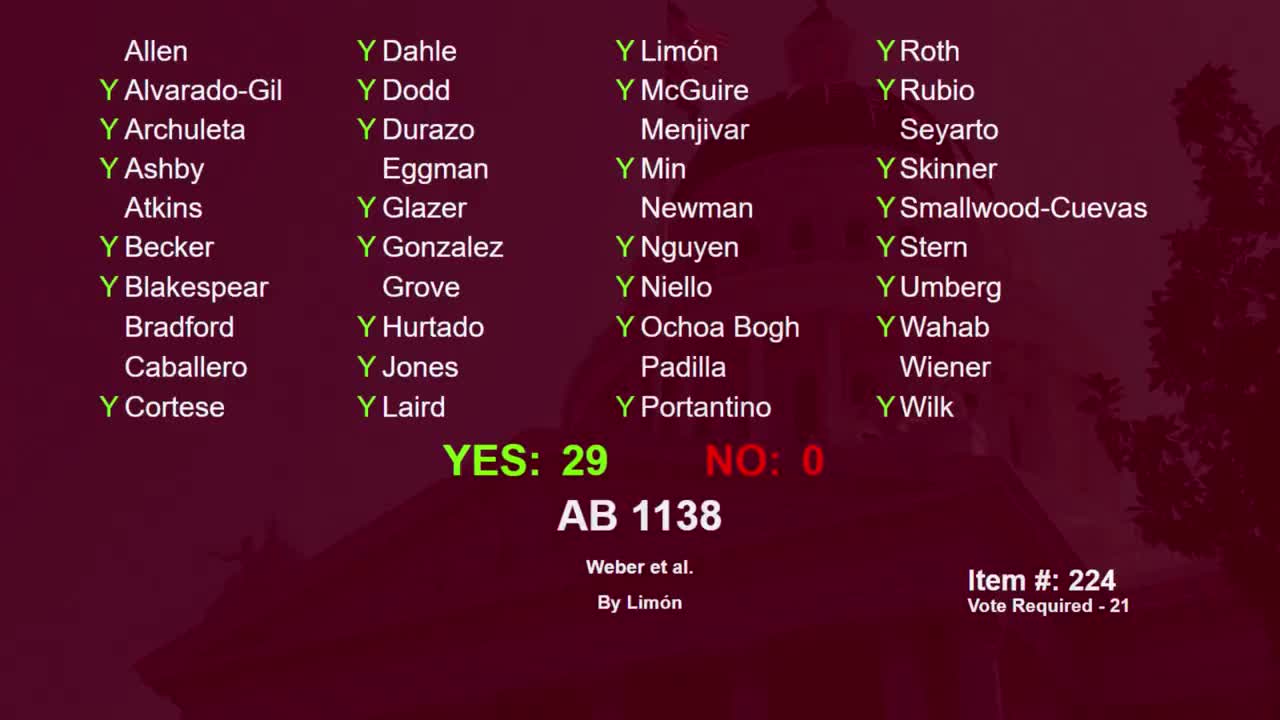 1MIN
Senate Floor
 1MIN
Assembly Floor
 42SEC
Assembly Floor
 7MIN
Assembly Standing Committee on Privacy and Consumer Protection
 2MIN
Senate Floor
 11MIN
Senate Standing Committee on Judiciary
Bill Author