SB 429: Transportation network companies: participating drivers: vehicle inspections.
- Session Year: 2023-2024
- House: Senate
- Latest Version Date: 2023-09-18
Current Status:
Failed
(2024-01-25: Veto sustained.)
Introduced
In Committee
First Chamber
In Committee
Second Chamber
Enacted
What does this bill do?
This bill requires ride‑hailing companies (transportation network companies) to make sure a vehicle meets the Public Utilities Commission’s inspection rules before a driver may use it to give paid rides, with inspections done by mechanics tied to Bureau of Automotive Repair‑licensed facilities and allowed to be on‑site, virtual, or remote. It also requires the company to pay a driver who completes their first 10 trips in the inspected vehicle within 28 days for reasonable time spent getting the inspection, at least 150% of the state minimum wage.
The summary is provided by generative AI which can make mistakes. For original language, please view the details in the table below.
The Passenger Charter-party Carriers Act provides for the regulation of transportation network companies by the Public Utilities Commission. The act defines transportation network company to mean an organization operating in California that provides prearranged transportation services for compensation using an online-enabled application or platform to connect passengers with drivers using a personal vehicle, as provided. The act defines personal vehicle as a vehicle that is used by a participating driver to provide prearranged transportation services for compensation and that meets certain requirements, including all inspection and other safety requirements imposed by the commission. The act requires a participating driver to possess a valid drivers license, as specified. Under existing law, a violation of the act is a crime.
This bill would require a transportation network company to require a vehicle to satisfy the vehicle inspection requirements established by the commission before allowing a participating driver to operate the vehicle as part of its service, as specified. The bill would require a transportation network company to compensate a participating driver who completes their first 10 trips in the inspected vehicle within 28 days of receiving the vehicle inspection for reasonable time spent completing the vehicle inspection at a rate of no less than 150% of the state-mandated minimum wage for all industries. Because a violation of these requirements under the act would be a crime, the bill would impose a state-mandated local program.
The California Constitution requires the state to reimburse local agencies and school districts for certain costs mandated by the state. Statutory provisions establish procedures for making that reimbursement.
This bill would provide that no reimbursement is required by this act for a specified reason.
The Passenger Charter-party Carriers Act provides for the regulation of transportation network companies by the Public Utilities Commission. The act defines transportation network company to mean an organization operating in California that provides prearranged transportation services for compensation using an online-enabled application or platform to connect passengers with drivers using a personal vehicle, as provided. The act defines personal vehicle as a vehicle that is used by a participating driver to provide prearranged transportation services for compensation and that meets certain requirements, including all inspection and other safety requirements imposed by the commission. The act requires a participating driver to possess a valid drivers license, as specified. Under existing law, a violation of the act is a crime.
This bill would require a transportation network company to require a vehicle to satisfy the vehicle inspection requirements established by the commission before allowing a participating driver to operate the vehicle as part of its service, as specified. The bill would require a transportation network company to compensate a participating driver who completes their first 10 trips in the inspected vehicle within 28 days of receiving the vehicle inspection for reasonable time spent completing the vehicle inspection. inspection at a rate of no less than 150% of the state-mandated minimum wage for all industries. Because a violation of these requirements under the act would be a crime, the bill would impose a state-mandated local program.
The California Constitution requires the state to reimburse local agencies and school districts for certain costs mandated by the state. Statutory provisions establish procedures for making that reimbursement.
This bill would provide that no reimbursement is required by this act for a specified reason.
The Passenger Charter-party Carriers Act provides for the regulation of transportation network companies by the Public Utilities Commission. The act defines transportation network company to mean an organization operating in California that provides prearranged transportation services for compensation using an online-enabled application or platform to connect passengers with drivers using a personal vehicle, as provided. The act defines personal vehicle as a vehicle that is used by a participating driver to provide prearranged transportation services for compensation and that meets certain requirements, including all inspection and other safety requirements imposed by the commission. The act requires a participating driver to possess a valid drivers license, as specified. Under existing law, a violation of the act is a crime.
This bill would require a transportation network company to require a vehicle to satisfy the vehicle inspection requirements established by the commission before allowing a participating driver to operate the vehicle as part of its service, and every 12 months or 50,000 in-app miles thereafter, whichever occurs first, as specified. The bill would require a transportation network company to compensate a participating driver for time spent completing the vehicle inspection. Because a violation of these requirements under the act would be a crime, the bill would impose a state-mandated local program.
The California Constitution requires the state to reimburse local agencies and school districts for certain costs mandated by the state. Statutory provisions establish procedures for making that reimbursement.
This bill would provide that no reimbursement is required by this act for a specified reason.
Existing law vests the Public Utilities Commission with regulatory authority over public utilities, including gas corporations. The California Global Warming Solutions Act of 2006 designates the State Air Resources Board as the state agency charged with monitoring and regulating sources of emissions of greenhouse gases. The act authorizes the state board to include the use of market-based compliance mechanisms in regulating those emissions. The implementing regulations adopted by the state board provide for the direct allocation of greenhouse gas allowances to electrical corporations and gas corporations pursuant to a market-based compliance mechanism. Existing law requires the commission, until June 30, 2023, to annually allocate $50,000,000 of the revenues received by gas corporations as a result of the direct allocation of greenhouse gas emissions allowances provided to gas corporations to fund the Building Initiative for Low-Emissions Development Program and the Technology and Equipment for Clean Heating Initiative.This bill would require the revenues, including any accrued interest, received by a gas corporation as a result of that allocation of allowances to be credited directly to the residential customers of the gas corporation. The bill would require the commission to annually direct gas corporations to distribute the credit, as specified.Under existing law, a violation of any order, decision, rule, direction, demand, or requirement of the commission is a crime.Because a violation of a commission action implementing this bills requirements would be a crime, the bill would impose a state-mandated local program.The California Constitution requires the state to reimburse local agencies and school districts for certain costs mandated by the state. Statutory provisions establish procedures for making that reimbursement.This bill would provide that no reimbursement is required by this act for a specified reason.Existing law vests the Public Utilities Commission with regulatory authority over public utilities, including gas corporations. The California Global Warming Solutions Act of 2006 designates the State Air Resources Board as the state agency charged with monitoring and regulating sources of emissions of greenhouse gases. The act authorizes the state board to include the use of market-based compliance mechanisms in regulating those emissions. The implementing regulations adopted by the state board provide for the direct allocation of greenhouse gas allowances to electrical corporations and gas corporations pursuant to a market-based compliance mechanism. Existing law requires the commission, until June 30, 2023, to annually allocate $50,000,000 of the revenues received by gas corporations as a result of the direct allocation of greenhouse gas emissions allowances provided to gas corporations to fund the Building Initiative for Low-Emissions Development Program and the Technology and Equipment for Clean Heating Initiative.
This bill would require the revenues, including any accrued interest, received by a gas corporation as a result of that allocation of allowances to be credited directly to the residential customers of the gas corporation. The bill would require the commission to annually direct gas corporations to distribute the credit, as specified.
Under existing law, a violation of any order, decision, rule, direction, demand, or requirement of the commission is a crime.
Because a violation of a commission action implementing this bills requirements would be a crime, the bill would impose a state-mandated local program.
The California Constitution requires the state to reimburse local agencies and school districts for certain costs mandated by the state. Statutory provisions establish procedures for making that reimbursement.
This bill would provide that no reimbursement is required by this act for a specified reason.
Existing law vests the Public Utilities Commission with regulatory authority over public utilities, including gas corporations. Existing law requires the commission to establish a surcharge to fund low-income assistance programs and cost-effective energy efficiency and conservation activities and public interest research and development not adequately provided by the competitive and regulated markets, as specified. Existing law requires the State Board of Equalization to transmit revenues from that surcharge to the Treasurer, and requires the Treasurer to deposit those revenues into the Gas Consumption Surcharge Fund, which is continuously appropriated.This bill would make a nonsubstantive change to that requirement on the Treasurer.Existing law vests the Public Utilities Commission with regulatory authority over public utilities, including gas corporations. Existing law requires the commission to establish a surcharge to fund low-income assistance programs and cost-effective energy efficiency and conservation activities and public interest research and development not adequately provided by the competitive and regulated markets, as specified. Existing law requires the State Board of Equalization to transmit revenues from that surcharge to the Treasurer, and requires the Treasurer to deposit those revenues into the Gas Consumption Surcharge Fund, which is continuously appropriated.
This bill would make a nonsubstantive change to that requirement on the Treasurer.
(a)A transportation network company shall require a vehicle to satisfy the vehicle inspection requirements established by the commission before allowing a participating driver to operate the vehicle as part of its service. Inspections shall be performed by a mechanic affiliated with a facility licensed by the Bureau of Automotive Repair on location, virtually, or remotely.
(b)A transportation network company shall compensate a participating driver who completes their first 10 trips in the inspected vehicle within 28 days of receiving the vehicle inspection required pursuant to subdivision (a) for reasonable time spent completing the vehicle inspection at a rate of no less than 150 percent of the state-mandated minimum wage for all industries.
SEC. 2.No reimbursement is required by this act pursuant to Section 6 of Article XIIIB of the California Constitution because the only costs that may be incurred by a local agency or school district will be incurred because this act creates a new crime or infraction, eliminates a crime or infraction, or changes the penalty for a crime or infraction, within the meaning of Section 17556 of the Government Code, or changes the definition of a crime within the meaning of Section 6 of Article XIIIB of the California Constitution.
(a)A transportation network company shall require a vehicle to satisfy the vehicle inspection requirements established by the commission before allowing a participating driver to operate the vehicle as part of its service. Inspections shall be performed by a mechanic affiliated with a facility licensed by the Bureau of Automotive Repair on location, virtually, or remotely.
(b)A transportation network company shall compensate a participating driver who completes their first 10 trips in the inspected vehicle within 28 days of receiving the vehicle inspection required pursuant to subdivision (a) for reasonable time spent completing the vehicle inspection required pursuant to subdivision (a). at a rate of no less than 150 percent of the state-mandated minimum wage for all industries.
SEC. 2.No reimbursement is required by this act pursuant to Section 6 of Article XIIIB of the California Constitution because the only costs that may be incurred by a local agency or school district will be incurred because this act creates a new crime or infraction, eliminates a crime or infraction, or changes the penalty for a crime or infraction, within the meaning of Section 17556 of the Government Code, or changes the definition of a crime within the meaning of Section 6 of Article XIIIB of the California Constitution.
(a)A transportation network company shall require a vehicle to satisfy the vehicle inspection requirements established by the commission before allowing a participating driver to operate the vehicle as part of its service, and every 12 months or 50,000 in-app miles thereafter, whichever occurs first. service. Inspections shall be performed by a mechanic affiliated with a facility licensed by the Bureau of Automotive Repair on location, virtually, or remotely.
(b)A transportation network company shall compensate a participating driver for time spent completing the vehicle inspection required pursuant to subdivision (a).
(c)Nothing in this section prohibits the commission from exercising its authority to adjust the mileage threshold for vehicle inspections for purposes of subdivision (a).SEC. 2.No reimbursement is required by this act pursuant to Section 6 of Article XIIIB of the California Constitution because the only costs that may be incurred by a local agency or school district will be incurred because this act creates a new crime or infraction, eliminates a crime or infraction, or changes the penalty for a crime or infraction, within the meaning of Section 17556 of the Government Code, or changes the definition of a crime within the meaning of Section 6 of Article XIIIB of the California Constitution.
(a)A transportation network company shall require a vehicle to satisfy the vehicle inspection requirements established by the commission before allowing a participating driver to operate the vehicle as part of its service, and every 12 months or 50,000 in-app miles thereafter, whichever occurs first. Inspections shall be performed by a mechanic affiliated with a facility licensed by the Bureau of Automotive Repair on location, virtually, or remotely.
(b)A transportation network company shall compensate a participating driver for time spent completing the vehicle inspection required pursuant to subdivision (a).
(c)Nothing in this section prohibits the commission from exercising its authority to adjust the mileage threshold for vehicle inspections for purposes of subdivision (a).
SEC. 2.No reimbursement is required by this act pursuant to Section 6 of Article XIIIB of the California Constitution because the only costs that may be incurred by a local agency or school district will be incurred because this act creates a new crime or infraction, eliminates a crime or infraction, or changes the penalty for a crime or infraction, within the meaning of Section 17556 of the Government Code, or changes the definition of a crime within the meaning of Section 6 of Article XIIIB of the California Constitution.
SECTION 1.Section 748.7 is added to the Public Utilities Code, to read:748.7.(a)The commission shall require revenues, including any accrued interest, received by a gas corporation as a result of the direct allocation of greenhouse gas allowances to gas utilities pursuant to subdivision (a) and paragraphs (2) and (3) of subdivision (d) of Section 95893 of Title 17 of the California Code of Regulations to be credited directly to the residential customers of the gas corporation.(b)Each year the commission shall direct gas corporations to distribute the credit described in subdivision (a) during the February utility billing cycle, so as to coincide with the highest usage gas utility bill during the year.(c)The commission may consider a gas corporations billing systems ability to distribute the credit described in subdivision (a) in February and may authorize the gas corporation to provide the credit as close to the February utility billing cycle as feasible.SEC. 2.No reimbursement is required by this act pursuant to Section 6 of Article XIIIB of the California Constitution because the only costs that may be incurred by a local agency or school district will be incurred because this act creates a new crime or infraction, eliminates a crime or infraction, or changes the penalty for a crime or infraction, within the meaning of Section 17556 of the Government Code, or changes the definition of a crime within the meaning of Section 6 of Article XIIIB of the California Constitution.(a)The commission shall require revenues, including any accrued interest, received by a gas corporation as a result of the direct allocation of greenhouse gas allowances to gas utilities pursuant to subdivision (a) and paragraphs (2) and (3) of subdivision (d) of Section 95893 of Title 17 of the California Code of Regulations to be credited directly to the residential customers of the gas corporation.
(b)Each year the commission shall direct gas corporations to distribute the credit described in subdivision (a) during the February utility billing cycle, so as to coincide with the highest usage gas utility bill during the year.
(c)The commission may consider a gas corporations billing systems ability to distribute the credit described in subdivision (a) in February and may authorize the gas corporation to provide the credit as close to the February utility billing cycle as feasible.
SEC. 2.No reimbursement is required by this act pursuant to Section 6 of Article XIIIB of the California Constitution because the only costs that may be incurred by a local agency or school district will be incurred because this act creates a new crime or infraction, eliminates a crime or infraction, or changes the penalty for a crime or infraction, within the meaning of Section 17556 of the Government Code, or changes the definition of a crime within the meaning of Section 6 of Article XIIIB of the California Constitution.
SECTION 1.Section 892 of the Public Utilities Code is amended to read:892.The revenue from the surcharge imposed pursuant to this article and collected by a public utility gas corporation shall be paid to the State Board of Equalization in the form of remittances. Persons consuming natural gas delivered by an interstate pipeline shall pay the surcharge to the State Board of Equalization in the form of remittances. The board shall transmit the payments to the Treasurer who shall deposit the payments into the Gas Consumption Surcharge Fund, which is hereby created in the State Treasury.The revenue from the surcharge imposed pursuant to this article and collected by a public utility gas corporation shall be paid to the State Board of Equalization in the form of remittances. Persons consuming natural gas delivered by an interstate pipeline shall pay the surcharge to the State Board of Equalization in the form of remittances. The board shall transmit the payments to the Treasurer who shall deposit the payments in into the Gas Consumption Surcharge Fund, which is hereby created in the State Treasury.
|
Date
|
Status
|
|---|---|
| Jan 25, 2024 | Veto sustained. |
| Jan 25, 2024 | Stricken from file. |
| Oct 8, 2023 | In Senate. Consideration of Governor's veto pending. |
| Oct 8, 2023 | Vetoed by the Governor. |
| Sep 21, 2023 | Enrolled and presented to the Governor at 4 p.m. |
| Sep 14, 2023 | Assembly amendments concurred in. (Ayes 28. Noes 2. Page 2839.) Ordered to engrossing and enrolling. |
| Sep 13, 2023 | From committee: That the Assembly amendments be concurred in. (Ayes 11. Noes 0. Page 2770.) |
| Sep 12, 2023 | From committee: Be re-referred to Com. on E., U. & C. pursuant to Senate Rule 29.10(d). (Ayes 4. Noes 0. Page 2683.) Re-referred to Com. on E., U. & C. |
| Sep 12, 2023 | Re-referred to Com. on RLS pursuant to Senate Rule 29.10(d). |
| Sep 12, 2023 | In Senate. Concurrence in Assembly amendments pending. |
| Sep 12, 2023 | Read third time. Passed. (Ayes 48. Noes 1. Page 3314.) Ordered to the Senate. |
| Sep 7, 2023 | Read third time and amended. |
| Sep 7, 2023 | Ordered to third reading. |
| Sep 7, 2023 | Assembly Rule 69 suspended. |
| Sep 5, 2023 | Read second time. Ordered to third reading. |
| Sep 1, 2023 | From committee: Do pass. (Ayes 14. Noes 1.) (September 1). |
| Jul 12, 2023 | Read second time and amended. Re-referred to Com. on APPR. |
| Jul 11, 2023 | From committee: Do pass as amended and re-refer to Com. on APPR. (Ayes 12. Noes 0.) (July 5). |
| Jun 22, 2023 | Re-referred to Com. on C. & C. pursuant to Assembly Rule 96. |
| Jun 19, 2023 | From committee with author's amendments. Read second time and amended. Re-referred to Com. on U. & E. |
| Jun 1, 2023 | Referred to Com. on U. & E. |
| May 25, 2023 | In Assembly. Read first time. Held at Desk. |
| May 24, 2023 | Read third time. Passed. (Ayes 38. Noes 0. Page 1247.) Ordered to the Assembly. |
| Apr 25, 2023 | Read second time. Ordered to third reading. |
| Apr 24, 2023 | From committee: Be ordered to second reading pursuant to Senate Rule 28.8. |
| Apr 14, 2023 | Set for hearing April 24. |
| Apr 11, 2023 | From committee: Do pass and re-refer to Com. on APPR. (Ayes 14. Noes 0. Page 637.) (April 10). Re-referred to Com. on APPR. |
| Apr 3, 2023 | Set for hearing April 10. |
| Mar 29, 2023 | Re-referred to Com. on E., U. & C. |
| Mar 20, 2023 | From committee with author's amendments. Read second time and amended. Re-referred to Com. on RLS. |
| Feb 22, 2023 | Referred to Com. on RLS. |
| Feb 14, 2023 | From printer. May be acted upon on or after March 16. |
| Feb 13, 2023 | Introduced. Read first time. To Com. on RLS. for assignment. To print. |
|
Date
|
Description
|
Location
|
Votes
|
|
|---|---|---|---|---|
| Sep 14, 2023 | Unfinished Business SB429 Bradford Concurrence | Senate Floor |
Passed |
|
| Sep 13, 2023 | That the Assembly amendments be concurred in | Senate Standing Committee on Energy, Utilities and Communications |
Passed |
|
| Sep 12, 2023 | SB 429 Bradford Senate Third Reading By Boerner | Assembly Floor |
Passed |
|
| Sep 1, 2023 | Do pass. | Assembly Standing Committee on Appropriations |
Passed |
|
| Jul 5, 2023 | Do pass as amended and be re-referred to the Committee on [Appropriations] | Assembly Standing Committee on Communications and Conveyance |
Passed |
|
| May 24, 2023 | Senate 3rd Reading SB429 Bradford | Senate Floor |
Passed |
|
| Apr 10, 2023 | Do pass, but first be re-referred to the Committee on [Appropriations] | Senate Standing Committee on Energy, Utilities and Communications |
Passed |
This list shows positions taken on this bill by organizations on the date displayed, which is linked to the original source.
Positions by individuals are not included.
|
Organization
|
Position
|
Date
|
|---|---|---|
| California Chamber Of Commerce | ** Support | |
| California Labor Federation, Afl-Cio | ** Against | |
| California Teamsters Public Affairs Council | ** Against | |
| Silicon Valley Leadership Group | ** Support | |
| Southern California Gas Company | ** Support | |
| Technet | ** Support | |
| United Food & Commercial Workers, Western States Council | ** Against |
SENATE RULES COMMITTEE Office of Senate Floor Analyses (916) 651-1520 Fax: (916) 327-4478 | SB 429 |
VETO
Bill No: SB 429
Author: Bradford (D)
Amended: 9/7/23
Vote: 27
PRIOR VOTES NOT RELEVANT
SENATE ENERGY, U. & C. COMMITTEE: 11-0, 9/13/23 (Pursuant to Senate Rule 29.10)
AYES: Bradford, Dahle, Ashby, Becker, Dodd, Eggman, Min, Newman, Rubio, Seyarto, Wilk
NO VOTE RECORDED: Caballero, Durazo, Gonzalez, Grove, McGuire, Skinner, Stern
SENATE FLOOR: 28-2, 9/14/23
AYES: Allen, Alvarado-Gil, Ashby, Atkins, Becker, Blakespear, Bradford, Caballero, Dahle, Dodd, Eggman, Glazer, Grove, Hurtado, Jones, Laird, Menjivar, Newman, Nguyen, Niello, Ochoa Bogh, Padilla, Portantino, Roth, Rubio, Seyarto, Umberg, Wilk
NOES: Archuleta, Cortese
NO VOTE RECORDED: Durazo, Gonzalez, Limón, McGuire, Min, Skinner, Smallwood-Cuevas, Stern, Wahab, Wiener
ASSEMBLY FLOOR: 48-1, 9/12/23 - See last page for vote
SUBJECT: Transportation network companies: participating drivers: vehicle inspections
SOURCE: Author
DIGEST:
This bill codifies vehicle inspection requirements for transportation network company (TNC) vehicles and requires TNCs to compensate certain drivers for their time spent completing a vehicle inspection.
ANALYSIS:
Existing law:
- Authorizes the California Public Utilities Commission (CPUC) to supervise and regulate every charter-party carrier of passengers. (Public Utilities Code §5381)
- Defines a charter-party carrier of passengers as every person engaged in the transportation of persons by motor vehicle for compensation over any public highway in this state, which includes any person or entity that provides a hired driver service using a rented vehicle. (Public Utilities Code §5360)
- Requires each charter-party carrier of passengers to demonstrate its ability and financial capacity to provide transportation services before the CPUC can issue or renew a license to operate. Prohibits the CPUC from issuing a license to any entity that fails to demonstrate that it meets licensure requirements. Specifies various criteria companies meet prior to licensure, including, but not limited to, providing a safety education and training program for all employees or contractors operating vehicles for hired transportation services. (Public Utilities Code §5374)
- Defines a TNC as an organization, including, but not limited to, a corporation, limited-liability company, partnership, sole proprietor, or any other entity, operating in California that provides prearranged transportation services for compensation using an online-enabled application or platform to connect passengers with drivers using a personal vehicle. (Public Utilities Code §5431)
- Authorizes the CPUC to establish requirements for TNC licensure, including inspection and safety requirements. (Public Utilities Code §5431)
- Establishes various requirements for TNC driver insurance requirements, background checks, and prohibitions on contracting with a driver convicted of certain crimes within the prior seven years, including, but not limited to domestic violence, assault, and driving under the influence of alcohol or drugs. (Public Utilities Code §5342 et. seq.)
This bill:
- Clarifies that TNCs must require vehicles to meet CPUC inspection requirements before allowing a driver to start providing services.
- Specifies that TNC vehicle inspection must be performed by a mechanic affiliated with a facility licensed by the Bureau of Automotive Repair (BAR).
- Clarifies that vehicle inspections may be completed on location, virtually, or remotely.
- Specifies that TNC drivers that complete their first 10 trips within 28 days of the vehicle inspection are eligible for compensation for time spent completing the inspection.
- Requires a TNC to compensate eligible drivers for the reasonable time spent completing a vehicle inspection at a rate of no less than 150 percent of the state-mandated minimum wage for all industries.
Background
This bill codifies several existing TNC vehicle inspection requirements. Existing law authorizes the CPUC to regulate TNCs and establish requirements for TNC drivers. The CPUC has adopted TNC vehicle inspection requirement through several decisions in its ongoing TNC rulemaking (R. 12-12-011). Under these decisions, the CPUC requires TNC vehicles to be inspected by a mechanic affiliated with facility licensed by BAR before a driver uses the car to provide rides and every 12 months or every 50,000 miles, depending on which occurs first. This bill codifies existing requirements for TNC vehicles to receive an inspection prior to being used to provide TNC services. This bill also requires these inspections to be conducted using a mechanic affiliated with a BAR-licensed car repair shop. Existing regulations do not prohibit remote or virtual vehicle inspections; however, it is unclear how existing CPUC rules could be applied to virtual and remote vehicle inspections. As a result, this bill may require the CPUC to revise its existing inspection requirements for TNCs and TNC drivers.
This bill requires TNCs to provide compensation to certain drivers for time completing inspections. This bill specifies that drivers who complete their first 10 rides within 28 days of their vehicle inspection are eligible for compensation for the reasonable time spent completing the vehicle inspection. This bill also requires TNCs to pay these eligible drivers at a rate no less than 150 percent of the state-mandated minimum wage for all industries. This compensation requirement may enable drivers who join a TNC after this bill’s passage to obtain payment for their time completing a vehicle inspection to become a TNC driver.
Disputes over TNC worker status pose challenges for compensation requirements. This bill attempts to provide new TNC drivers with compensation for their time spent completing a vehicle inspection required to become a TNC driver. However, disputes about the worker status of TNC drivers makes achieving consensus about fair compensation for TNC drivers challenging. Currently, TNC workers are considered independent contractors under Proposition 22; however, litigation regarding the status and rights of TNC workers is ongoing. This bill attempts to balance the desire to provide TNC drivers with additional compensation for vehicle inspections with their current status as independent contractors.
Related/Prior Legislation
AB 2716 (Grayson, 2022) would have established minimum TNC driver training requirements and required TNC to compensate drivers for completing the safety training. The bill was vetoed.
AB 880 (Obernolte, Chapter 618, Statutes of 2019) added human trafficking convictions to the list of felonies that disqualify a person from driving for a TNC and deleted outdated code.
AB 2986 (Cunningham, Chapter 286, Statutes of 2018) required TNCs to provide passengers with a driver’s first name and picture, an image of the make and model of the vehicle, and the license plate number on its app.
AB 1289 (Cooper, Chapter 740, Statutes of 2016) required TNCs to conduct background checks for drivers and codified specific offenses that disqualify an individual from driving for a TNC, if the driver is convicted.
FISCAL EFFECT: Appropriation: No Fiscal Com.: Yes Local: Yes
According to the Assembly Committee on Appropriations, the CPUC expects no significant costs as a result of this bill.
SUPPORT: (Verified 10/13/23)
California Chamber of Commerce
Silicon Valley Leadership Group
TechNet
Several individual rideshare drivers
OPPOSITION: (Verified 10/13/23)
California Labor Federation, AFL-CIO
California Teamsters Public Affairs Council
United Food & Commercial Workers, Western States Council
ARGUMENTS IN SUPPORT: According to the author:
Thousands of Californians choose to earn money as a driver for a TNC‘s—some on a regular basis—and many on an intermittent and flexible basis. Regardless of the frequency, all are required to receive a vehicle inspection from a Bureau of Automotive Repair (BAR) certified facility annually.
SB 429 will modernize the vehicle inspection requirement for TNC drivers. SB 429 would authorize drivers to meet existing vehicle inspection requirements by use of remote and virtual inspections, making work opportunities more accessible to drivers while ensuring drivers are compensated for the time taken to complete the inspection.
ARGUMENTS IN OPPOSITION: In opposition, the California Labor Federation, AFL-CIO states:
We appreciate that the author amended this bill to ensure compensation of drivers for their time for inspection if they meet certain criteria, which is an improvement on the current PUC requirements. However, the amendments fail to fully address our concerns that TNC drivers are denied the rights of employees. This bill fails to reimburse drivers for the biggest cost of all – the cost of the inspection – which can cost $40 or more.
GOVERNOR'S VETO MESSAGE:
This bill codifies vehicle inspection requirements for transportation network companies (TNCs) and requires TNCs to compensate certain drivers for their time spent completing a vehicle inspection. The bill also specifically authorized TNC vehicle inspections to be completed remotely or virtually.
While I appreciate the intent of the author to make it easier for drivers to comply with the existing vehicle inspection requirements, this bill may weaken these requirements, which are purposefully designed to protect public, driver and passenger safety.
Last year I vetoed legislation that would have authorized similar provisions. At that time, I encouraged the author of that bill to work with the CPUC to clearly identify and address any issues or safety improvements. I continue to believe that is the most appropriate approach for addressing these types of safety matters.
ASSEMBLY FLOOR: 48-1, 9/12/23
AYES: Aguiar-Curry, Alanis, Alvarez, Arambula, Bains, Bauer-Kahan, Berman, Boerner, Bryan, Juan Carrillo, Chen, Megan Dahle, Davies, Dixon, Essayli, Flora, Vince Fong, Gabriel, Gallagher, Gipson, Grayson, Holden, Hoover, Irwin, Low, Lowenthal, Stephanie Nguyen, Pacheco, Papan, Jim Patterson, Joe Patterson, Pellerin, Petrie-Norris, Rodriguez, Blanca Rubio, Sanchez, Soria, Ta, Ting, Valencia, Villapudua, Waldron, Wallis, Ward, Weber, Wilson, Wood, Robert Rivas
NOES: Mathis
NO VOTE RECORDED: Addis, Bennett, Bonta, Calderon, Wendy Carrillo, Cervantes, Connolly, Mike Fong, Friedman, Garcia, Haney, Hart, Jackson, Jones-Sawyer, Kalra, Lackey, Lee, Maienschein, McCarty, McKinnor, Muratsuchi, Ortega, Quirk-Silva, Ramos, Rendon, Reyes, Luz Rivas, Santiago, Schiavo, Wicks, Zbur
Prepared by: Sarah Smith / E., U. & C. / (916) 651-4107
10/19/23 11:12:57
**** END ****
SENATE COMMITTEE ON ENERGY, UTILITIES AND COMMUNICATIONS
Senator Steven Bradford, Chair
2023 - 2024 Regular
Bill No: Hearing Date: 9/13/2023
Author: | |||
Version: | Amended | ||
Urgency: | Fiscal: | ||
Consultant: | |||
SUBJECT:
DIGEST: This bill codifies vehicle inspection requirements for transportation network company (TNC) vehicles and requires TNCs to compensate certain drivers for their time spent completing a vehicle inspection.
ANALYSIS:
Existing law:
- Authorizes the California Public Utilities Commission (CPUC) to supervise and regulate every charter-party carrier of passengers. (Public Utilities Code §5381)
- Defines a charter-party carrier of passengers as every person engaged in the transportation of persons by motor vehicle for compensation over any public highway in this state. This definition includes any person or entity that provides a hired driver service using a rented vehicle. (Public Utilities Code §5360)
- Requires each charter-party carrier of passengers to demonstrate its ability and financial capacity to provide transportation services before the CPUC can issue or renew a license to operate. Existing law prohibits the CPUC from issuing a license to any entity that fails to demonstrate that it meets licensure requirements. Existing law also specifies various criteria companies meet prior to licensure, including, but not limited to, providing a safety education and training program for all employees or contractors operating vehicles for hired transportation services. (Public Utilities Code §5374)
- Defines a TNC as an organization, including, but not limited to, a corporation, limited-liability company, partnership, sole proprietor, or any other entity, operating in California that provides prearranged transportation services for compensation using an online-enabled application or platform to connect passengers with drivers using a personal vehicle. (Public Utilities Code §5431)
- Authorizes the CPUC to establish requirements for TNC licensure, including inspection and safety requirements. (Public Utilities Code §5431)
- Establishes various requirements for TNC driver insurance requirements, background checks, and prohibitions on contracting with a driver convicted of certain crimes within the prior seven years, including, but not limited to domestic violence, assault, and driving under the influence of alcohol or drugs. (Public Utilities Code §5342 et. seq.)
This bill:
- Clarifies that TNCs must require vehicles to meet CPUC inspection requirements before allowing a driver to start providing services.
- Specifies that TNC vehicle inspection must be performed by a mechanic affiliated with a facility licensed by the Bureau of Automotive Repair (BAR).
- Clarifies that vehicle inspections may be completed on location, virtually, or remotely.
- Specifies that TNC drivers that complete their first 10 trips within 28 days of the vehicle inspection are eligible for compensation for time spent completing the inspection.
- Requires a TNC to compensate eligible drivers for the reasonable time spent completing a vehicle inspection at a rate of no less than 150 percent of the state-mandated minimum wage for all industries.
Background
Bill codifies several existing TNC vehicle inspection requirements. Existing law authorizes the CPUC to regulate TNCs and establish requirements for TNC drivers. The CPUC has adopted TNC vehicle inspection requirement through several decisions in its ongoing TNC rulemaking (R. 12-12-011). Under these decisions, the CPUC requires TNC vehicles to be inspected by a mechanic affiliated with facility licensed by BAR before a driver uses the car to provide rides and every 12 months or every 50,000 mile, depending on which occurs first. This bill codifies existing requirements for TNC vehicles to receive an inspection prior to being used to provide TNC services. This bill also requires these inspections to be conducted using a mechanic affiliated with a BAR-licensed car repair shop. Existing regulations do not prohibit remote or virtual vehicle inspections; however, it is unclear how existing CPUC rules could be applied to virtual and remote vehicle inspections. As a result, this bill may require the CPUC to revise its existing inspection requirements for TNCs and TNC drivers.
Bill requires TNCs to provide compensation to certain drivers for time completing inspections. This bill specifies that drivers who complete their first 10 rides within 28 days of their vehicle inspection are eligible for compensation for the reasonable time spent completing the vehicle inspection. This bill also requires TNCs to pay these eligible drivers at a rate no less than 150 percent of the state-mandated minimum wage for all industries. This compensation requirement may enable drivers who join a TNC after this bill’s passage to obtain payment for their time completing a vehicle inspection to become a TNC driver.
Disputes over TNC worker status pose challenges for compensation requirements. This bill attempts to provide new TNC drivers with compensation for their time spent completing a vehicle inspection required to become a TNC driver. However, disputes about the worker status of TNC drivers makes achieving consensus about fair compensation for TNC drivers challenging. Currently, TNC workers are considered independent contractors under Proposition 22; however, litigation regarding the status and rights of TNC workers is ongoing. This bill attempts to balance the desire to provide TNC drivers with additional compensation for vehicle inspections with their current status as independent contractors.
Prior/Related Legislation
AB 2716 (Grayson, 2022) would have established minimum TNC driver training requirements and required TNC to compensate drivers for completing the safety training. The bill was vetoed.
AB 880 (Obernolte, Chapter 618, Statutes of 2019) added human trafficking convictions to the list of felonies that disqualify a person from driving for a TNC and deleted outdated code.
AB 2986 (Cunningham, Chapter 286, Statutes of 2018) required TNCs to provide passengers with a driver’s first name and picture, an image of the make and model of the vehicle, and the license plate number on its app.
AB 1289 (Cooper, Chapter 740, Statutes of 2016) required TNCs to conduct background checks for drivers and codified specific offenses that disqualify an individual from driving for a TNC, if the driver is convicted.
FISCAL EFFECT: Appropriation: Fiscal Com.: Local:
SUPPORT:
California Chamber of Commerce
Silicon Valley Leadership Group
TechNet
OPPOSITION:
California Labor Federation, AFL-CIO
California Teamsters Public Affairs Council
United Food & Commercial Workers, Western States Council
ARGUMENTS IN SUPPORT: According to the author:
Thousands of Californians choose to earn money as a driver for a TNC‘s—some on a regular basis—and many on an intermittent and flexible basis. Regardless of the frequency, all are required to receive a vehicle inspection from a Bureau of Automotive Repair (BAR) certified facility annually.
“SB 429 will modernize the vehicle inspection requirement for TNC drivers. SB 429 would authorize drivers to meet existing vehicle inspection requirements by use of remote and virtual inspections, making work opportunities more accessible to drivers while ensuring drivers are compensated for the time taken to complete the inspection.
ARGUMENTS IN OPPOSITION: In opposition, the California Labor Federation states:
We appreciate that the author amended the bill to ensure compensation of drivers for their time for inspection if they meet certain criteria, which is an improvement on the current PUC requirements. However, the amendments fail to fully address our concerns that TNC drivers are denied the rights of employees. The bill fails to reimburse drivers for the biggest cost of all – the cost of the inspection – which can cost $40 or more.
-- END --
SENATE RULES COMMITTEE Office of Senate Floor Analyses (916) 651-1520 Fax: (916) 327-4478 | SB 429 |
UNFINISHED BUSINESS
Bill No: SB 429
Author: Bradford (D)
Amended: 9/7/23
Vote: 21
PRIOR SENATE VOTES NOT RELEVANT
SENATE ENERGY, U. & C. COMMITTEE: 11-0, 9/13/23 (Pursuant to Senate Rule 29.10)
AYES: Bradford, Dahle, Ashby, Becker, Dodd, Eggman, Min, Newman, Rubio, Seyarto, Wilk
NO VOTE RECORDED: Caballero, Durazo, Gonzalez, Grove, McGuire, Skinner, Stern
ASSEMBLY FLOOR: 48-1, 9/12/23 - See last page for vote
SUBJECT: Transportation network companies: participating drivers: vehicle inspections
SOURCE: Author
DIGEST:
This bill codifies vehicle inspection requirements for transportation network company (TNC) vehicles and requires TNCs to compensate certain drivers for their time spent completing a vehicle inspection.
Assembly Amendments
delete the prior version of the bill and instead add language codifying TNC safety requirements and requiring TNCs to compensate certain drivers for their time completing a vehicle inspection.
ANALYSIS:
Existing law:
- Authorizes the California Public Utilities Commission (CPUC) to supervise and regulate every charter-party carrier of passengers. (Public Utilities Code §5381)
- Defines a charter-party carrier of passengers as every person engaged in the transportation of persons by motor vehicle for compensation over any public highway in this state, which includes any person or entity that provides a hired driver service using a rented vehicle. (Public Utilities Code §5360)
- Requires each charter-party carrier of passengers to demonstrate its ability and financial capacity to provide transportation services before the CPUC can issue or renew a license to operate. Prohibits the CPUC from issuing a license to any entity that fails to demonstrate that it meets licensure requirements. Specifies various criteria companies meet prior to licensure, including, but not limited to, providing a safety education and training program for all employees or contractors operating vehicles for hired transportation services. (Public Utilities Code §5374)
- Defines a TNC as an organization, including, but not limited to, a corporation, limited-liability company, partnership, sole proprietor, or any other entity, operating in California that provides prearranged transportation services for compensation using an online-enabled application or platform to connect passengers with drivers using a personal vehicle. (Public Utilities Code §5431)
- Authorizes the CPUC to establish requirements for TNC licensure, including inspection and safety requirements. (Public Utilities Code §5431)
- Establishes various requirements for TNC driver insurance requirements, background checks, and prohibitions on contracting with a driver convicted of certain crimes within the prior seven years, including, but not limited to domestic violence, assault, and driving under the influence of alcohol or drugs. (Public Utilities Code §5342 et. seq.)
This bill:
- Clarifies that TNCs must require vehicles to meet CPUC inspection requirements before allowing a driver to start providing services.
- Specifies that TNC vehicle inspection must be performed by a mechanic affiliated with a facility licensed by the Bureau of Automotive Repair (BAR).
- Clarifies that vehicle inspections may be completed on location, virtually, or remotely.
- Specifies that TNC drivers that complete their first 10 trips within 28 days of the vehicle inspection are eligible for compensation for time spent completing the inspection.
- Requires a TNC to compensate eligible drivers for the reasonable time spent completing a vehicle inspection at a rate of no less than 150 percent of the state-mandated minimum wage for all industries.
Background
This bill codifies several existing TNC vehicle inspection requirements. Existing law authorizes the CPUC to regulate TNCs and establish requirements for TNC drivers. The CPUC has adopted TNC vehicle inspection requirement through several decisions in its ongoing TNC rulemaking (R. 12-12-011). Under these decisions, the CPUC requires TNC vehicles to be inspected by a mechanic affiliated with facility licensed by BAR before a driver uses the car to provide rides and every 12 months or every 50,000 mile, depending on which occurs first. This bill codifies existing requirements for TNC vehicles to receive an inspection prior to being used to provide TNC services. This bill also requires these inspections to be conducted using a mechanic affiliated with a BAR-licensed car repair shop. Existing regulations do not prohibit remote or virtual vehicle inspections; however, it is unclear how existing CPUC rules could be applied to virtual and remote vehicle inspections. As a result, this bill may require the CPUC to revise its existing inspection requirements for TNCs and TNC drivers.
This bill requires TNCs to provide compensation to certain drivers for time completing inspections. This bill specifies that drivers who complete their first 10 rides within 28 days of their vehicle inspection are eligible for compensation for the reasonable time spent completing the vehicle inspection. This bill also requires TNCs to pay these eligible drivers at a rate no less than 150 percent of the state-mandated minimum wage for all industries. This compensation requirement may enable drivers who join a TNC after this bill’s passage to obtain payment for their time completing a vehicle inspection to become a TNC driver.
Disputes over TNC worker status pose challenges for compensation requirements. This bill attempts to provide new TNC drivers with compensation for their time spent completing a vehicle inspection required to become a TNC driver. However, disputes about the worker status of TNC drivers makes achieving consensus about fair compensation for TNC drivers challenging. Currently, TNC workers are considered independent contractors under Proposition 22; however, litigation regarding the status and rights of TNC workers is ongoing. This bill attempts to balance the desire to provide TNC drivers with additional compensation for vehicle inspections with their current status as independent contractors.
Related/Prior Legislation
AB 2716 (Grayson, 2022) would have established minimum TNC driver training requirements and required TNC to compensate drivers for completing the safety training. The bill was vetoed.
AB 880 (Obernolte, Chapter 618, Statutes of 2019) added human trafficking convictions to the list of felonies that disqualify a person from driving for a TNC and deleted outdated code.
AB 2986 (Cunningham, Chapter 286, Statutes of 2018) required TNCs to provide passengers with a driver’s first name and picture, an image of the make and model of the vehicle, and the license plate number on its app.
AB 1289 (Cooper, Chapter 740, Statutes of 2016) required TNCs to conduct background checks for drivers and codified specific offenses that disqualify an individual from driving for a TNC, if the driver is convicted.
FISCAL EFFECT: Appropriation: No Fiscal Com.: Yes Local: Yes
According to the Assembly Committee on Appropriations, the CPUC expects no significant costs as a result of this bill.
SUPPORT: (Verified 9/11/23)
California Chamber of Commerce
Silicon Valley Leadership Group
TechNet
OPPOSITION: (Verified 9/11/23)
California Labor Federation, AFL-CIO
California Teamsters Public Affairs Council
United Food & Commercial Workers, Western States Council
ARGUMENTS IN SUPPORT: According to the author:
Thousands of Californians choose to earn money as a driver for a TNC‘s—some on a regular basis—and many on an intermittent and flexible basis. Regardless of the frequency, all are required to receive a vehicle inspection from a Bureau of Automotive Repair (BAR) certified facility annually.
SB 429 will modernize the vehicle inspection requirement for TNC drivers. SB 429 would authorize drivers to meet existing vehicle inspection requirements by use of remote and virtual inspections, making work opportunities more accessible to drivers while ensuring drivers are compensated for the time taken to complete the inspection.
ARGUMENTS IN OPPOSITION: In opposition, the California Labor Federation states:
We appreciate that the author amended this bill to ensure compensation of drivers for their time for inspection if they meet certain criteria, which is an improvement on the current PUC requirements. However, the amendments fail to fully address our concerns that TNC drivers are denied the rights of employees. This bill fails to reimburse drivers for the biggest cost of all – the cost of the inspection – which can cost $40 or more.
ASSEMBLY FLOOR: 48-1, 9/12/23
AYES: Aguiar-Curry, Alanis, Alvarez, Arambula, Bains, Bauer-Kahan, Berman, Boerner, Bryan, Juan Carrillo, Chen, Megan Dahle, Davies, Dixon, Essayli, Flora, Vince Fong, Gabriel, Gallagher, Gipson, Grayson, Holden, Hoover, Irwin, Low, Lowenthal, Stephanie Nguyen, Pacheco, Papan, Jim Patterson, Joe Patterson, Pellerin, Petrie-Norris, Rodriguez, Blanca Rubio, Sanchez, Soria, Ta, Ting, Valencia, Villapudua, Waldron, Wallis, Ward, Weber, Wilson, Wood, Robert Rivas
NOES: Mathis
NO VOTE RECORDED: Addis, Bennett, Bonta, Calderon, Wendy Carrillo, Cervantes, Connolly, Mike Fong, Friedman, Garcia, Haney, Hart, Jackson, Jones-Sawyer, Kalra, Lackey, Lee, Maienschein, McCarty, McKinnor,
Muratsuchi, Ortega, Quirk-Silva, Ramos, Rendon, Reyes, Luz Rivas, Santiago,
Schiavo, Wicks, Zbur
Prepared by: Sarah Smith / E., U. & C. / (916) 651-4107
9/13/23 20:57:08
SENATE THIRD READING
STR Bill Id:SB 429
Author:(Bradford)
As Amended Ver:September 7, 2023
Majority vote
SUMMARY
This bill would codify in state law vehicle inspection requirements for vehicles used on a transportation network company (TNC) platform, and authorize those inspections to be conducted virtually.
Major Provisions
- Requires a TNC to require a vehicle to satisfy the vehicle inspection requirements established by the California Public Utilities Commission (CPUC)
- Requires the vehicle inspection to be performed by a mechanic affiliated with a facility licensed by the Bureau of Automotive Repair on location, virtually, or remotely.
- Requires a TNC to compensate a participating driver who completes their first ten (10) trips in the inspected vehicle within 28 days of receiving the vehicle inspection for reasonable time spent completing the vehicle inspection, at a rate of no less than 150% of the state-mandated minimum wage for all industries.
COMMENTS
- This bill would codify existing TNC vehicle inspection requirements. TNCs are companies that offer patrons prearranged transportation services through an app on their smartphone or computer. There are various TNCs authorized to operate in the state, however over 99.9% of all TNC trips occur through the Uber and Lyft platforms. Pursuant to existing law, the CPUC has adopted various safety requirements for TNCs, TNC drivers, and vehicles used on TNC platforms. This bill would codify in state law the requirement of a TNC to satisfy the vehicle inspection requirements established by the CPUC. The existing inspection requirements mirror the requirements proposed to be codified by this bill. For example, under existing regulations, TNCs are required to be inspected at specified intervals by a qualified facility licensed by the California Bureau of Automotive Repair.
- This bill would authorize virtual vehicle inspections. While existing regulations require a vehicle to receive an inspection prior to being deployed into service, the CPUC has not explicitly authorized virtual or remote inspections. The TNC industry has identified in-person inspection as a barrier to driver participation on the platforms. According to Uber, in-person vehicle inspections at an authorized facility is time consuming for drivers and creates a bottleneck for more vehicles being added to the platform. With the change proposed by this bill, drivers could more conveniently satisfy the vehicle inspection and in turn more quickly begin serving customers on the TNC platforms. While the CPUC could administratively choose to accept virtual inspections, the agency has not moved to do so. There is no known evidence that virtual inspections are any less safe or effective than in-person inspections. Additionally, there are existing qualified vendors that would be able to facilitate virtual inspections.
- This bill mandates driver compensation for drivers, as specified. Existing regulations require a TNC to ensure vehicles are inspected prior to being utilized on their platform. Given that TNC drivers are not considered employees of the TNC platforms, drivers are not currently compensated for the time or cost of undergoing a necessary vehicle inspection. This bill would require a TNC to compensate a driver who completes their first ten (10) trips in the inspected vehicle within 28 days of receiving the vehicle inspection. The driver would compensated for reasonable time spent completing the vehicle inspection, at a rate of no less than 150% of the state-mandated minimum wage for all industries. On one hand, this bill arguably improves the status-quo situation for drivers because a vehicle inspection is costly and time consuming. Instead, a virtual inspection could save time and money. Additionally, this bill would require a specified level of compensation as opposed to none. As a result, drivers could save time, money, and receive compensation. On the other hand, it may further entrench the pay and benefit inequality experienced by TNC drivers. For example, under this bill a TNC driver would need to complete a certain number of rides to be eligible for compensation, and the compensation is limited to a vague period of "reasonable" time. Further, this bill arguably avoids addressing the biggest cost of all – the cost of the inspection – which may run $40 or more per platform. Under this bill, as is the case with existing regulations, that cost would continue to be passed onto the driver. Ultimately, while this bill as written provides improvement for drivers, there is potentially an opportunity to go further to provide more concrete benefits for drivers.
According to the Author
"Thousands of Californians choose to earn money as a driver for a TNC's—some on a regular basis—and many on an intermittent and flexible basis. Regardless of the frequency, all are required to receive a vehicle inspection from a Bureau of Automotive Repair (BAR) certified facility annually. SB 429 will modernize the vehicle inspection requirement for TNC drivers. SB 429 would authorize drivers to meet existing vehicle inspection requirements by use of remote and virtual inspections, making work opportunities more accessible to drivers while ensuring drivers are compensated for the time taken to complete the inspection."
Arguments in Support
"TechNet, a technology business organization, argues that SB 429 "would ensure that the [existing] vehicle inspection requirement does not become a barrier to the driver community accessing work." Further, they posit that "the current requirement is deterring more than 10,000 Californians from accessing work and impacting differently across the state."
Arguments in Opposition
Several labor organizations oppose this bill unless amended, arguing that this bill would "shift the burden of maintaining a safe, serviceable fleet of vehicles from the companies onto the individual drivers."
FISCAL COMMENTS
According to the Assembly Appropriations Committee, the CPUC expects no significant costs as a result of this bill.
VOTES
SENATE FLOOR: 38-0-2
YES: Allen, Alvarado-Gil, Archuleta, Ashby, Atkins, Blakespear, Bradford, Caballero, Cortese, Dahle, Dodd, Durazo, Eggman, Glazer, Gonzalez, Grove, Hurtado, Jones, Laird, McGuire, Menjivar, Min, Newman, Nguyen, Niello, Ochoa Bogh, Padilla, Portantino, Roth, Rubio, Seyarto, Skinner, Smallwood-Cuevas, Stern, Umberg, Wahab, Wiener, Wilk
ABS, ABST OR NV: Becker, Limón
ASM COMMUNICATIONS AND CONVEYANCE: 12-0-1
YES: Boerner, Jim Patterson, Bonta, Davies, Garcia, Holden, Hoover, Low, Papan, Luz Rivas, Rodriguez, Weber
ABS, ABST OR NV: Maienschein
ASM APPROPRIATIONS: 14-1-1
YES: Holden, Megan Dahle, Bryan, Wendy Carrillo, Dixon, Mike Fong, Hart, Lowenthal, Papan, Pellerin, Sanchez, Soria, Weber, Wilson
NO: Mathis
ABS, ABST OR NV: Calderon
UPDATED
VERSION: September 7, 2023
CONSULTANT: Emilio Perez / C. & C. / (916) 319-2637 FN: 0002024
SENATE THIRD READING
STR Bill Id:SB 429
Author:(Bradford)
As Amended Ver:July 12, 2023
Majority vote
SUMMARY
This bill would codify in state law vehicle inspection requirements for vehicles used on a transportation network company (TNC) platform, and authorize those inspections to be conducted virtually.
Major Provisions
- Requires a TNC to require a vehicle to satisfy the vehicle inspection requirements established by the California Public Utilities Commission (CPUC)
- Requires the vehicle inspection to be performed by a mechanic affiliated with a facility licensed by the Bureau of Automotive Repair on location, virtually, or remotely.
- Requires a TNC to compensate a participating driver for time spent completing a vehicle inspection.
COMMENTS
- This bill would codify existing TNC vehicle inspection requirements. TNCs are companies that offer patrons prearranged transportation services through an app on their smartphone or computer. There are various TNCs authorized to operate in the state, however over 99.9% of all TNC trips occur through the Uber and Lyft platforms. Pursuant to existing law, the CPUC has adopted various safety requirements for TNCs, TNC drivers, and vehicles used on TNC platforms. This bill would codify in state law the requirement of a TNC to satisfy the vehicle inspection requirements established by the CPUC. The existing inspection requirements mirror the requirements proposed to be codified by this bill. For example, under existing regulations, TNCs are required to be inspected at specified intervals by a qualified facility licensed by the California Bureau of Automotive Repair.
- This bill would authorize virtual vehicle inspections. While existing regulations require a vehicle to receive an inspection prior to being deployed into service, the CPUC has not explicitly authorized virtual or remote inspections. The TNC industry has identified in-person inspection as a barrier to driver participation on the platforms. According to Uber, in-person vehicle inspections at an authorized facility is time consuming for drivers and creates a bottleneck for more vehicles being added to the platform. With the change proposed by this bill, drivers could more conveniently satisfy the vehicle inspection and in turn more quickly begin serving customers on the TNC platforms. While the CPUC could administratively choose to accept virtual inspections, the agency has not moved to do so. There is no known evidence that virtual inspections are any less safe or effective than in-person inspections. Additionally, there are existing qualified vendors that would be able to facilitate virtual inspections.
- This bill mandates driver compensation, but without any specifics. Existing regulations require a TNC to ensure vehicles are inspected prior to being utilized on their platform. Given that TNC drivers are not considered employees of the TNC platforms, drivers are not currently compensated for the time or cost of undergoing a necessary vehicle inspection. This bill would require a TNC to compensate a driver, although it does not specify a specific level of compensation. This bill also does not address whether the cost of the vehicle inspection would be borne by the driver or the TNC, which is currently absorbed by the driver. On one hand, this bill as a whole arguably improves the status-quo situation for drivers because a vehicle inspection is costly and time consuming. Instead, a virtual inspection could save time and money. Additionally, this bill would require some level of compensation as opposed to none. As a result, drivers could save time, money, and receive compensation. On the other hand, without firm guidance or requirements on the appropriate level of compensation this bill may further entrench the pay and benefit inequality experienced by TNC drivers. For example, under this bill a TNC could pay a driver less than minimum wage for the time taken for a vehicle inspection or a TNC may decide that appropriate compensation includes non-wage benefits. Further, this bill arguably avoids addressing the biggest cost of all – the cost of the inspection – which may run $40 or more per platform. Under this bill, as is the case with existing regulations, that cost would continue to be passed onto the driver. Ultimately, while this bill as written would at a minimum provide some improvement for drivers, there is potentially an opportunity to go further to provide more concrete benefits for drivers.
According to the Author
"Thousands of Californians choose to earn money as a driver for a TNC's – some on a regular basis – and many on an intermittent and flexible basis. Regardless of the frequency, all are required to receive a vehicle inspection from a Bureau of Automotive Repair (BAR) certified facility annually. SB 429 will modernize the vehicle inspection requirement for TNC drivers. SB 429 would authorize drivers to meet existing vehicle inspection requirements by use of remote and virtual inspections, making work opportunities more accessible to drivers while ensuring drivers are compensated for the time taken to complete the inspection."
Arguments in Support
TechNet, a technology business organization, argues that this bill "would ensure that the [existing] vehicle inspection requirement does not become a barrier to the driver community accessing work." Further, they posit that "the current requirement is deterring more than 10,000 Californians from accessing work and impacting differently across the state."
Arguments in Opposition
Several labor organizations oppose this bill unless amended, arguing that this bill would "shift the burden of maintaining a safe, serviceable fleet of vehicles from the companies onto the individual drivers." Further, the opposition notes that the required "compensation could be a flat dollar amount far below minimum wage, or not necessarily provided as monetary compensation."
FISCAL COMMENTS
According to the Assembly Appropriations Committee, the CPUC expects no significant costs as a result of this bill.
VOTES
SENATE FLOOR: 38-0-2
YES: Allen, Alvarado-Gil, Archuleta, Ashby, Atkins, Blakespear, Bradford, Caballero, Cortese, Dahle, Dodd, Durazo, Eggman, Glazer, Gonzalez, Grove, Hurtado, Jones, Laird, McGuire, Menjivar, Min, Newman, Nguyen, Niello, Ochoa Bogh, Padilla, Portantino, Roth, Rubio, Seyarto, Skinner, Smallwood-Cuevas, Stern, Umberg, Wahab, Wiener, Wilk
ABS, ABST OR NV: Becker, Limón
ASM COMMUNICATIONS AND CONVEYANCE: 12-0-1
YES: Boerner, Jim Patterson, Bonta, Davies, Garcia, Holden, Hoover, Low, Papan, Luz Rivas, Rodriguez, Weber
ABS, ABST OR NV: Maienschein
ASM APPROPRIATIONS: 14-1-1
YES: Holden, Megan Dahle, Bryan, Wendy Carrillo, Dixon, Mike Fong, Hart, Lowenthal, Papan, Pellerin, Sanchez, Soria, Weber, Wilson
NO: Mathis
ABS, ABST OR NV: Calderon
UPDATED
VERSION: July 12, 2023
CONSULTANT: Emilio Perez / C. & C. / (916) 319-2637 FN: 0001534
Date of Hearing: September 1, 2023
ASSEMBLY COMMITTEE ON APPROPRIATIONS
Chris Holden, Chair
SBPCA Bill Id:SB 429
Author:(Bradford) – As Amended Ver:July 12, 2023
Policy Committee: | Communications and Conveyance | Vote: | 12 - 0 |
|
| ||
|
|
Urgency: No State Mandated Local Program: Yes Reimbursable: No
SUMMARY:
This bill allows the inspection requirements established by the California Public Utilities Commission (CPUC) applicable to a vehicle used by a driver participating in a transportation network company (TNC) to be performed by a mechanic affiliated with a facility licensed by the Bureau of Automotive Repair on location, virtually or remotely.
In addition, the bill requires a TNC to compensate a participating driver for time spent completing the vehicle inspection.
FISCAL EFFECT:
The CPUC expects no significant costs as a result of this bill.
COMMENTS:
- Purpose. The author intends this bill to make the opportunity to work for a TNC more accessible for those who wish to do so. According to the author:
Thousands of Californians choose to earn money as a driver for a TNC‘s—some on a regular basis—and many on an intermittent and flexible basis. Regardless of the frequency, all are required to receive a vehicle inspection from a Bureau of Automotive Repair (BAR) certified facility annually. SB 429 will modernize the vehicle inspection requirement for TNC drivers. SB 429 would authorize drivers to meet existing vehicle inspection requirements by use of remote and virtual inspections, making work opportunities more accessible to drivers while ensuring drivers are compensated for the time taken to complete the inspection.
- Background. In California, the CPUC regulates TNCs, such as Uber and Lyft, as part of its regulation of charter party carriers. Pursuant to CPUC regulations, TNCs are required to: obtain a permit to operate from the CPUC, run criminal background checks for each driver, establish a driver training program, implement a zero-tolerance policy on drugs and alcohol, and require minimum levels of insurance coverage. Further, TNC vehicles must be inspected at appropriate 12-month or 50,000 mile marks by a qualified facility licensed by the California Bureau of Automotive Repair. Additionally, to ensure proper regulatory oversight of TNC operations, the CPUC requires each TNC to annually submit comprehensive reports covering a breadth of data including accident reports, law-enforcement citations, zero-tolerance violations and instances of assault or harassment.
A diver who uses a TNC’s online platform to arrange for passengers and payment is not considered an employee of the TNC. Rather, consistent with existing law, as established by Proposition 22 of 2022, a TNC driver is considered an independent contractor. Currently, the law does not require a TNC to compensate a drivers for the time it takes the driver to receive the periodic safety check the law requires. This bill requires a TNC to compensation a driver for the time spent on the required vehicle inspection. However, the bill is silent on the amount of that compensation. And the silence is deafening.
Representatives of TNC state they will compensate drivers as required by this bill, if it becomes law; however, representative of Uber assert it would be appropriate to do so on the basis of a fixed rate. In contrast, the California Labor Federation, AFL-CIO; the California Teamsters Public Affairs Council and the United Food & Commercial Workers, Western States Council together contend the bill could result in compensation below the minimum wage or to in a form other than money. These labor organizations call for the bill to specify the time spent by a driver on vehicle inspection be considered hours worked for purposes of the Labor Code and the Wage Orders of the Industrial Welfare Commission.
The California Supreme Court has agreed to hear a challenge to the constitutionality of Proposition 22. Uber expresses concern specify wage provisions in this bill could influence the court’s view of Proposition 22. The labor organizations, in expressing their opposition to the bill, as written, assert “The cost of operating a billion-dollar transportation company, like Uber and Lyft, should not fall on individual drivers who are already deprived basic rights like the minimum wage and overtime because of misclassification.”
The committee is unaware of opposition to the bill’s proposal to allow for remote vehicle inspection. Nonetheless, the CPUC warns “allowing remote inspections could jeopardize passenger safety by watering down the vehicle inspection process, which is an important function of the CPUC’s safety oversight to ensure TNC vehicles are safe for all passengers.”
Analysis Prepared by: Jay Dickenson / APPR. / (916) 319-2081
Date of Hearing: July 5, 2023
ASSEMBLY COMMITTEE ON COMMUNICATIONS AND CONVEYANCE
Tasha Boerner, Chair
SBPCA Bill Id:SB 429
Author:(Bradford) – As Amended Ver:June 19, 2023
SENATE VOTE: 38-0
SUBJECT: Transportation network companies: participating drivers: vehicle inspections
SUMMARY: This bill would establish vehicle inspection requirements for vehicles used on a transportation network company (TNC) platform. Specifically, this bill:
- Requires a TNC to require a vehicle to satisfy the vehicle inspection requirements established by the California Public Utilities Commission (CPUC) and every 12 months or 50,000 in-app miles thereafter, whichever occurs first.
- Requires the vehicle inspection to be performed by a mechanic affiliated with a facility licensed by the Bureau of Automotive Repair on location, virtually, or remotely.
- Requires a TNC to compensate a participating driver for time spent completing a vehicle inspection.
- Provides that nothing in this section prohibits the CPUC from exercising its authority to adjust the mileage threshold for vehicle inspections.
EXISTING LAW:
- Establishes definitions for relevant terms [Public Utilities Code § 5431]:
- Defines “participating driver” or “driver” to mean any person who uses a vehicle in connection with a TNC’s online-enabled application or platform to connect with passengers.
- Defines a “Transportation network company” to mean an organization, including, but not limited to, a corporation, limited liability company, partnership, sole proprietor, or any other entity, operating in California that provides prearranged transportation services for compensation using an online-enabled application or platform to connect passengers with drivers using a personal vehicle.
- Defines a “personal vehicle” to mean a vehicle that is used by a participating driver to provide prearranged transportation services for compensation that meets specific requiremetns, including meeting all inspection and other safety requiremetns imposed by the CPUC.
- Provides that violations of CPUC regulations by a TNC driver is subject to a penalty of not more than two thousand dollars ($2,000) for each offense. (Public Utilities Code § 5413)
FISCAL EFFECT: Unknown
COMMENTS:
- Author’s statement. “Thousands of Californians choose to earn money as a driver for a TNC‘s—some on a regular basis—and many on an intermittent and flexible basis. Regardless of the frequency, all are required to receive a vehicle inspection from a Bureau of Automotive Repair (BAR) certified facility annually. SB 429 will modernize the vehicle inspection requirement for TNC drivers. SB 429 would authorize drivers to meet existing vehicle inspection requirements by use of remote and virtual inspections, making work opportunities more accessible to drivers while ensuring drivers are compensated for the time taken to complete the inspection.”
- TNC Background. Pursuant to existing law under the Passenger Charter-Party Carriers Act, the California Public Utilities Commission has regulatory and safety oversight authority over TNCs. TNCs are companies that offer patrons prearranged transportation services through an app on their smartphone or computer. Although TNC service has become widely available in metropolitan areas, the TNC industry is still fairly young compared to other forms of transportation. It was only in 2013 that the CPUC adopted its first rules and regulations for TNCs, which were referred to then as “New Online Enabled Transportation Services”. There are various TNCs authorized to operate in the state, however over 99.9% of all TNC trips occur through the Uber and Lyft platforms.
- Overview of the CPUC’s Existing Safety Requirements and Rulemaking. Pursuant to statutory requirements and CPUC authority, the CPUC has adopted various safety requirements for TNCs, TNC drivers, and vehicles used on TNC platforms. For example, TNCs are required to obtain from the CPUC a permit to operate, criminal background checks for each driver, establish a driver training program, implement a zero-tolerance policy on drugs and alcohol, and require minimum levels of insurance coverage. Similarly, vehicles used on TNC platforms are also required to be inspected at specified intervals by a qualified facility licensed by the California Bureau of Automotive Repair. Additionally, to ensure proper regulatory oversight of TNC operations, the CPUC also requires each TNC to annually submit comprehensive reports covering a breadth of data including accident reports, law-enforcement citations, zero-tolerance violations, and instances of assault or harassment.
Additionally, in an ongoing and active rulemaking[1] the CPUC is currently addressing issues relevant to the operation of TNCs in California, including autonomous-vehicles. For example, the scope of the proceeding includes addressing TNC data confidentiality and sharing, transportation of minors, and general safety including insurance requirements, vehicle safety, driver safety, and passenger safety.
- This bill would establish vehicle inspections requirements that are different than existing requirements. CPUC General Order 157-E[2] requires a vehicle to undergo a 19-point vehicle inspection at a facility licensed by the California Bureau of Automotive Repair prior to initial operation and every 12 months or 50,000 thereafter. While the existing regulatory requirement is similar, it is different in two distinct and important ways.
The first difference is that this bill specifies that vehicle inspections must occur at an interval based on in-app miles, whereas the existing regulatory requirement does not account for whether the vehicle miles are in-app or off the application. The in-app inspection threshold proposed by this bill could, arguably, reduce the frequency of vehicle inspections and therefore safety. To illustrate this point, take the example of a TNC driver who drives a total of 55,000 miles per year on their personal vehicle, which is only occasionally used on a TNC platform. Under existing regulations, following the 50,000th mile the vehicle would be required to be inspected, regardless of whether those miles were in-app or off-app. Under this bill, an inspection after the 50,000th mile would not be required more frequently than every year if the total miles driver were not specifically while using the app. In turn, this may lead to vehicles being inspected less frequently. Lastly, the specification of in-app is more difficult to account for when considering that TNC drivers may use different platforms concurrently and therefore log in-app miles among various applications.
The second difference of this bill compared to existing regulations is the ability to inspect a vehicle remotely or virtually. Whereas the existing regulation requires a vehicle inspection at a facility licensed by the California Bureau of Automotive Repair, this bill specifies that a mechanic affiliated with such a facility may perform the inspection remotely or virtually. This distinction is the underlying rationale that supporters argue the change is necessary. According to Uber, in-person vehicle inspections at an authorized facility is time consuming for drivers and creates a bottleneck for more vehicles being added to the platform. With this change, drivers could more conveniently satisfy the vehicle inspection and in turn more quickly begin serving customers on the TNC platforms.
- Driver compensation for vehicle inspections. As was established above, existing regulations require a TNC to ensure vehicles are inspected prior to being utilized on the platform. Given that drivers are not considered employees of the TNC platforms, drivers are not currently compensated for the time or cost of undergoing a necessary vehicle inspection. This bill would require a TNC to compensate a driver, although it does not specify at what rate. The bill does not attempt to address whether the cost of the vehicle inspection would be borne by the driver or the TNC, which is currently absorbed by the driver. On one hand, the changes in this bill arguably improve the status-quo situation for drivers because a vehicle inspection is costly and time consuming. At a minimum, this bill would require some level of compensation and could reduce the time spent undergoing an inspection if it is completed virtually or remotely. While opponents of the bill argue that if the TNC drivers were employees the time spent undertaking a vehicle inspection would be compensated as wages, that is not necessarily accurate. For example, potential employees are not regularly compensated for the time it takes for a pre-employment drug screening, although typically the cost of such diagnostics are covered fully by the prospective employer. Similarly to the comparison of a pre-employment drug screening, a vehicle inspection is akin to a pre-employment requirement that is not typically compensated time.
Nonetheless, on the other hand, without firm guidance or requirements on the appropriate level of compensation this bill may further entrench the pay and benefit inequality experienced by TNC drivers. For example, under this bill a TNC could pay a driver less than minimum wage for the time taken for a vehicle inspection or a TNC may decide that appropriate compensation includes non-wage benefits. Further, the bill arguably avoids addressing the biggest cost of all – the cost of the inspection – which may run $40 or more per platform. Under this bill, as is the case with existing regulations, that cost would continue to be passed onto the driver. Ultimately, while the bill as written would at a minimum provide a marginal improvement for drivers, there is also an opportunity to go further to provide more concrete benefits for drivers.
- Prop 22 is the elephant in the room. Under Proposition 22, a ballot initiative passed by California voters in 2022, TNC drivers are considered independent contractors and not employees of the TNC platforms. While this bill does not purport to implicate the relevancy of the independent-contractor status of TNC drivers under the law, the subtext of the opposition’s position on driver benefits is that TNC drivers ought to be conferred the benefits of employee-status. If TNC drivers were employees, it is very likely the TNC would be liable to pay a TNC driver for the costs of the vehicle inspection and ongoing costs of the driver’s time. However, as independent contractors TNC drivers are not automatically entitled to those same rights and benefits. Instead, under existing law established by Prop 22, the relationship between a TNC driver and the platform is more akin to a business to business relationship. As such, while the costs of the inspection and time are not reimbursable to the driver by the TNC, those costs would be considered a business expense of the driver and could be written off as such on income tax filings. Notably, the California Supreme Court has agreed to hear a case supported by some drivers and labor unions challenging the constitutionality of the initiative. While the case is pending, drivers will continue to be considered independent contractors and the TNC platforms will continue to have the discretion to decide the appropriate level of compensation for the drivers as independent-contractors. If Prop 22 is ultimately overturned, the portions of this bill requiring a TNC to compensate a driver for a vehicle inspection would then need to be read under paradigm of an employee-employer relationship, and thus the compensation would be a more clearly defined benefit.
- Arguments in support. TechNet, a technology business organization, argues that SB 429 “would ensure that the [existing] vehicle inspection requirement does not become a barrier to the driver community accessing work.” Further, they posit that “the current requirement is deterring more than 10,000 Californians from accessing work and impacting differently across the state.”
- Arguments in opposition. Several labor organizations oppose this bill unless amended, arguing that this bill would “shift the burden of maintaining a safe, serviceable fleet of vehicles from the companies onto the individual drivers.” Further, the opposition notes that the required “compensation could be a flat dollar amount far below minimum wage, or not necessarily provided as monetary compensation.”
- Related/similar legislation. AB 2716 (Grayson, 2022) would have required drivers to complete a driver safety course every 2 years and required similar vehicle inspection requirements to this bill. The bill was vetoed by the Governor.
- Committee amendments. The committee recommends striking portions of this bill that specify the particular frequency of vehicle inspections, thus avoiding discrepancies between the existing regulatory requirements and the requirements of this bill. Secondly, the committee recommends striking the language clarifying the authority of the CPUC to adjust the inspection thresholds, as this clause is moot given the first committee amendment.
REGISTERED SUPPORT / OPPOSITION:
Support
California Chamber of Commerce
Silicon Valley Leadership Group
Technet-technology Network
Opposition
California Labor Federation, Afl-cio
California Teamsters Public Affairs Council
Ufcw - Western States Council
Analysis Prepared by: Emilio Perez / C. & C. / (916) 319-2637
Rulemaking R.12-12-011. Order Instituting Rulemaking on Regulations Relating to Passenger Carriers, Ridesharing, and New Online-Enabled Transportation Services. https://apps.cpuc.ca.gov/apex/f?p=401:56:0::NO:RP,57,RIR:P5_PROCEEDING_SELECT:R1212011 ↑
CPUC General Order 157-E. https://docs.cpuc.ca.gov/PublishedDocs/Published/G000/M322/K150/322150628.pdf ↑
SENATE RULES COMMITTEE Office of Senate Floor Analyses (916) 651-1520 Fax: (916) 327-4478 | SB 429 |
THIRD READING
Bill No: SB 429
Author: Bradford (D)
Amended: 3/20/23
Vote: 21
SENATE ENERGY, U. & C. COMMITTEE: 14-0, 4/10/23
AYES: Bradford, Dahle, Ashby, Dodd, Durazo, Eggman, Gonzalez, McGuire, Min, Newman, Rubio, Seyarto, Skinner, Wilk
NO VOTE RECORDED: Becker, Caballero, Grove, Stern
SENATE APPROPRIATIONS COMMITTEE: Senate Rule 28.8
SUBJECT: Natural gas: customer credit
SOURCE: Author
DIGEST:
This bill requires investor-owned natural gas utilities to provide customers with an annual credit (known as the California Climate Credit) to coincide with the highest usage month, on or as close to the February utility billing cycle, as feasible.
ANALYSIS:
Existing law:
- Establishes and vests the California Public Utilities Commission (CPUC) with regulatory authority over public utilities, including gas corporations. (California Constitution Article XII)
- Establishes the California Global Warming Solutions Act of 2006 and designates the California Air Resources Board (CARB) as the state agency charged with monitoring and regulating sources of emissions of greenhouse gases (GHGs). Authorizes CARB to include the use of market-based compliance mechanisms in regulating those emissions. (Health and Safety Code §38500 et seq.)
- Requires the CPUC, until June 30, 2023, to annually allocate $50,000,000 of the revenues received by gas corporations as a result of the direct allocation of GHGs emissions allowances provided to gas corporations to fund the Building Initiative for Low-Emissions Development (BUILD) Program and the Technology and Equipment for Clean Heating (TECH) Initiative. (Public Utilities Code §748.6)
- Requires the CPUC to allocate up to 15 percent of revenues received by an electrical corporation as a result of the direct allocation of GHG allowances to electrical distribution utilities to be used for clean energy and energy efficiency projects and otherwise requires revenues to be credited directly to residential, small business, and emission-intensive trade-exposed customers. (Public Utilities Code §748.5)
- Provides, pursuant to implementing regulations adopted by CARB, for the direct allocation of GHG allowances to electrical corporations and gas corporations pursuant to a market-based compliance mechanism. (California Code of Regulations Title 17 § 95893(a) and (d)(2) and (3))
This bill:
- Requires the revenues, including any accrued interest, received by a gas corporation as a result of the allocation of GHG emissions allowances to be credited directly to the residential customers of the gas corporation.
- Requires the CPUC to annually direct gas corporations to distribute the credit, during the February utility billing cycle, so as to coincide with the highest usage gas utility bill during the year.
- Authorizes the CPUC to consider a gas corporation’s billing system’s ability to distribute the credit in February and authorizes the gas corporation to provide the credit as close to the February utility billing cycle as feasible.
Background
California Climate Credit. Electric and natural gas investor-owned utilities (IOUs) are required to consign to auction a certain portion of the GHG allowances they receive as part of their compliance with the regulations adopted pursuant to the CARB cap-and-trade program. Utility allowance proceeds are to be used exclusively for the benefit of retail ratepayers per the requirements of the regulation. These proceeds are referred to as GHG allowance proceeds. For electric IOUs, these funds are returned to ratepayers via a credit on their utility bills, known as the California Climate Credit. State law requires 85 percent to be used for the Climate Credit for electric IOUs and permits the CPUC to allocate the remaining 15 percent for clean energy and energy efficiency projects. The CPUC ordered that natural gas GHG allowance proceeds be included in the annual Climate Credit and be returned to residential retail customers. In general, the natural gas Climate Credit is issued on gas utility bills in April and has ranged from $18 to $56 credit on customers’ natural gas utility bills, depending on the year and utility. Since the inception of the Climate Credit for natural gas IOUs, customers have received $162 to $208 total in credits on their utility bills, depending on the utility.
Winter 2022-23 wholesale natural gas prices skyrocket. Beginning in late November 2022 and continuing through January 2023, natural gas prices in the wholesale market skyrocketed. According the Energy Information Administration’s (EIA’s) December 22, 2022 Natural Gas Weekly Update, the daily spot market prices reached their highest levels in over two decades at major trading hubs that deliver natural gas into California. According to the CPUC’s fact sheets regarding utility rates, January 2023 natural gas procurement rate is over 300 percent more than the procurement rate in January 2022. These costs are passed through directly to utility customers – as utilities are prohibited from marking up the price of the commodity. As such, these higher prices have affected customers’ utility bills beginning in January’s billing cycle and continued through the February billing cycle. While a number of factors contributed to the price increases, including the rise in global demand for natural gas due to the impacts of Russia’s invasion of Ukraine, colder-than-normal temperatures, and limited pipeline and storage capacity, California and much of the West experienced disparate prices compared to the rest of the country. In response, there have been multiple calls for customer relief and investigations into the causes, including by the author of this bill, as well as constituent concerns and news stories about the impacts. While the CPUC and the Federal Energy Regulatory Commission (FERC) look into the causes, the CPUC also adopted an emergency measure proposed by Public Advocates Office, and supported by the author of this bill, to accelerate the Climate Credit for natural gas IOUs from April to earlier in the year. As a result, natural gas IOU customers received the credit at a time that coincided with a higher natural gas utility bill, as natural gas usage, generally, increases in the winter as the need for space heating increases with colder temperatures.
Current uses of natural gas allowance revenues. Unlike the electric IOUs’ which are directed by statute to return no less than 85 percent of GHG allowance proceeds to customers, the use of gas IOUs’ allowance proceeds were generally not controlled by statute. Instead, natural gas IOUs’ allowance proceeds are allocated by CPUC decisions (D.15-10-032 and D.18-03-017), within the parameters of CARB’s cap-and-trade regulation, which specifies they should benefit retail ratepayers. In 2017, the Legislature adopted SB 1477 (Stern, Chapter 378, Statutes of 2017) which requires an allocation of $50 million annually from July 1, 2019 through June 30, 2023 from natural gas IOUs’ GHG allowance revenues to fund the BUILD program and TECH initiative which provide incentive funding for low- and zero-emission technology to reduce GHGs from the building sector. Additionally, in decision (D. 20-05-012) related to the Self Generation Incentive Program (SGIP), the CPUC allocated one-time funding of $40 million from the 2023 natural gas IOUs’ GHG allowance revenues to augment funds for a load-shifting heat pump and water heating incentive program. In a separate decision from December 2020 (D. 20-12-03), the CPUC reserves $5 million of quarterly auction proceeds from 2022 through 2023 (for a total of $40 million) to fund monetary incentives for biomethane projects to interconnect to the natural gas IOU pipeline system.
SB 429. SB 429 places in statute a requirement that natural gas IOUs must issue the natural gas Climate Credit during the February utility billing cycle, or as close to February as the utility’s billing system allows. In doing so, customers of natural gas IOUs will benefit from the Climate Credit more closely, if not during, the time when their natural gas utility bill is more likely to be the highest during the year. In this regard, the potential loss of service may be avoided for customers who may be struggling to pay their bills and best help customers on limited incomes who may not have budgeted for a higher-than-expected utility bill. The credit can have some weakened effect on a price signal for conservation, as the actual cost of usage may not be fully reflected in the utility bill. However, there are many fixed costs associated with the transmission and distribution of natural gas that may also be impacting conservation price signals. Moreover, based on this winter’s experience, customers’ increased demand for natural gas fuel, especially for space and water heating due to the colder-than-normal temperatures, may have outweighed their ability to respond quickly to the dramatic change in the wholesale price of the fuel. By placing the requirement to issue credits to natural gas IOU customers in statute, the Legislature will have the authority to direct how these proceeds can be utilized, as any proposal to fund programs from these proceeds would require the adoption of subsequent legislative statute(s).
Related/Prior Legislation
SB 1477 (Stern, Chapter 378, Statutes of 2017) required the CPUC, from July 1, 2019 through June 30, 2023, to allocate $50 million annually from gas corporations' GHG emissions allowance revenues for the BUILD Program and the TECH Initiative established by this bill.
AB 693 (Eggman, Chapter 582, Statutes of 2015) created the Multifamily Affordable Housing Solar Roofs Program, to provide financial incentives for qualified solar installations at multifamily affordable housing properties funded from electric IOU’s GHG allowance revenues.
SB 1018 (Committee on Budget, Chapter 39, Statutes of 2012) required the CPUC to direct electric IOUs to credit residential, small business, and emissions intensive trade exposed industries the revenues from the GHG allowances. Authorized the CPUC to allocate up to 15 percent of the revenues to clean energy and energy efficiency projects.
FISCAL EFFECT: Appropriation: No Fiscal Com.: Yes Local: Yes
SUPPORT: (Verified 4/25/23)
Southern California Gas Company
OPPOSITION: (Verified 4/25/23)
None received
ARGUMENTS IN SUPPORT: According to the author:
Natural gas is a basic commodity with many residential and commercial uses. It can generate electricity, heat buildings, fuel vehicles, heat water, bake foods, power industrial furnaces, and run air conditioners. Unfortunately, due to compounding factors such as lower than average temperatures and supply chain bottlenecks customers have been caught off guard by higher than normal natural gas bills.
Pacific Gas and Electric customers’ average January bills went up 30 percent from last year, and Southern California Gas customers saw an enormous 240 percent increase to their bills.
Every spring and fall, millions of Californians receive credits on their electric and natural gas bills identified as the California Climate Credit. Usually, these credits are distributed twice a year, in April and October.
SB 429 moves the issuance date of the climate credit to the February utility cycle in order to help residential customers receive financial support at a time when it is most beneficial.
Prepared by: Nidia Bautista / E., U. & C. / (916) 651-4107
4/26/23 15:11:41
**** END ****
SENATE COMMITTEE ON ENERGY, UTILITIES AND COMMUNICATIONS
Senator Steven Bradford, Chair
2023 - 2024 Regular
Bill No: SB 429 Hearing Date: 4/10/2023
Author: | Bradford | ||
Version: | 3/20/2023 Amended | ||
Urgency: | No | Fiscal: | Yes |
Consultant: | Nidia Bautista | ||
SUBJECT: Natural gas: customer credit
DIGEST: This bill requires investor-owned natural gas utilities to provide customers with an annual credit (known as the California Climate Credit) to coincide with the highest usage month, on or as close to the February utility billing cycle, as feasible.
ANALYSIS:
Existing law:
- Establishes and vests the California Public Utilities Commission (CPUC) with regulatory authority over public utilities, including gas corporations. (California Constitution Article XII)
- Establishes the California Global Warming Solutions Act of 2006 and designates the California Air Resources Board (CARB) as the state agency charged with monitoring and regulating sources of emissions of greenhouse gases (GHGs). Authorizes CARB to include the use of market-based compliance mechanisms in regulating those emissions. (Health and Safety Code §38500 et seq.)
- Requires the CPUC, until June 30, 2023, to annually allocate $50,000,000 of the revenues received by gas corporations as a result of the direct allocation of GHGs emissions allowances provided to gas corporations to fund the Building Initiative for Low-Emissions Development (BUILD) Program and the Technology and Equipment for Clean Heating (TECH) Initiative. (Public Utilities Code §748.6)
- Requires the CPUC to allocate up to 15 percent of revenues received by an electrical corporation as a result of the direct allocation of GHG allowances to electrical distribution utilities to be used for clean energy and energy efficiency projects and otherwise requires revenues to be credited directly to residential, small business, and emission-intensive trade-exposed customers. (Public Utilities Code §748.5)
- Pursuant to implementing regulations adopted by CARB, provides for the direct allocation of GHG allowances to electrical corporations and gas corporations pursuant to a market-based compliance mechanism. (California Code of Regulations Title 17 § 95893(a) and (d)(2) and (3))
This bill:
- Requires the revenues, including any accrued interest, received by a gas corporation as a result of the allocation of GHG emissions allowances to be credited directly to the residential customers of the gas corporation.
- Requires the CPUC to annually direct gas corporations to distribute the credit, during the February utility billing cycle, so as to coincide with the highest usage gas utility bill during the year.
- Authorizes the CPUC to consider a gas corporation’s billing system’s ability to distribute the credit in February and authorizes the gas corporation to provide the credit as close to the February utility billing cycle as feasible.
Background
California Climate Credit. Electric and natural gas investor-owned utilities (IOUs) are required to consign to auction a certain portion of the GHG allowances they receive, with the proceeds to be used exclusively for the benefit of retail ratepayers. These proceeds are referred to as GHG allowance proceeds. For electric IOUs, these funds are returned to ratepayers via a credit on their utility bills, known as the California Climate Credit. State law requires 85 percent to be used for the Climate Credit for electric IOUs and permits the CPUC to allocate the remaining 15 percent for clean energy and energy efficiency projects. The CPUC ordered that natural gas GHG allowance proceeds be included in the annual Climate Credit and be returned to residential retail customers. In general, the natural gas Climate Credit is issued on gas utility bills in April and has ranged from $18 to $56 credit on customers’ natural gas utility bills, depending on the year and utility. Since its inception, customers have received $162 to $208 total credits on their utility bills, depending on the utility.
Current uses of natural gas allowance revenues. Unlike the electric IOUs’ GHG allowance revenues, the use of gas IOUs’ allowance revenues are generally not controlled by statute, but allocated by CPUC decisions (D.15-10-032 and D.18-03-017) established within the parameters of CARB’s cap-and-trade regulation which specifies they should benefit retail ratepayers, among other requirements. In 2017, the Legislature adopted SB 1477 (Stern, Chapter 378, Statutes of 2017) which requires an allocation of $50 million annually from July 1, 2019 through June 30, 2023 from natural gas IOUs’ GHG allowance revenues to fund the BUILD program and TECH initiative. The BUILD and TECH efforts provide incentive funding for low- and zero-emission technology to reduce GHGs from the building sector. Additionally, the CPUC in a decision (D. 20-05-012) related to the Self Generation Incentive Program (SGIP) allocated one-time funding of $40 million from the 2023 natural gas IOUs’ GHG allowance revenues to augment funds for a load-shifting heat pump and water heating incentive program.
Winter 2022-23 wholesale natural gas prices skyrocket. Beginning in late November 2022 and continuing through January 2023, natural gas prices in the wholesale market skyrocketed. According the Energy Information Administration’s (EIA’s) December 22, 2022 Natural Gas Weekly Update, the daily spot market prices reached their highest levels in over two decades at major trading hubs that deliver natural gas into California. According to the CPUC’s fact sheets regarding utility rates, January 2023 natural gas procurement rate is over 300 percent more than the procurement rate in January 2022. These costs are passed through directly to utility customers – as utilities are prohibited from marking up the price of the commodity. As such, these higher prices have affected customers’ utility bills beginning in January’s billing cycle and continued through the February billing cycle. While a number of factors contributed to the price increases, including the rise in global demand for natural gas due to the impacts of Russia’s invasion of Ukraine, colder-than-normal temperatures, and limited pipeline and storage capacity, California and much of the West experienced disparate prices compared to the rest of the country. In response, there have been multiple calls for customer relief and investigations into the causes, including by the author of this bill, as well as constituent concerns and news stories about the impacts. While the CPUC and the Federal Energy Regulatory Commission (FERC) look into the causes, the CPUC also adopted an emergency measure proposed by Public Advocates Office, and supported by the author of this bill, to accelerate the Climate Credit for natural gas IOUs from April to earlier in the year. As a result, natural gas IOU customers received the credit at a time that coincided with a higher natural gas utility bill, as natural gas usage, generally, increases in the winter as the need for space heating increases with colder temperatures.
SB 429. SB 429 would place in statute a requirement that natural gas IOUs must issue the natural gas Climate Credit during the February utility billing cycle, or as close to February as the utility’s billing system allows. In doing so, customers of natural gas IOUs will benefit from the Climate Credit more closely, if not during, the time when their natural gas utility bill is more likely to be the highest during the year. In this regard, the potential loss of service may be avoided for customers who may be struggling to pay their bills and best help customers on limited incomes who may not have budgeted for a higher utility bill. Although the credit may impact the price signal for conservation, based on this winter’s experience, the colder-than-normal temperatures and limited ability to respond to a dramatic change in prices may have limited the ability of a proper price signal that resonated with customers’ needs for service. By placing the requirement to issue credits to customers in statute, the Legislature will have the authority to direct how these revenues can be utilized, as any proposal to fund programs from these revenues would require the adoption of subsequent legislative statute(s).
Prior/Related Legislation
SB 1477 (Stern, Chapter 378, Statutes of 2017) the CPUC, from July 1, 2019 through June 30, 2023, to allocate $50 million annually from gas corporations' GHG emissions allowance revenues for the BUILD Program and the TECH Initiative established by this bill.
SB 1018 (Committee on Budget, Chapter 39, Statutes of 2012) requires the CPUC to direct electric IOUs to credit residential, small business, and emissions intensive trade exposed industries the revenues from the GHG allowances. Authorizes the CPUC to allocate up to 15 percent of the revenues to clean energy and energy efficiency projects.
FISCAL EFFECT: Appropriation: No Fiscal Com.: Yes Local: Yes
SUPPORT:
Southern California Gas Company
OPPOSITION:
None received
ARGUMENTS IN SUPPORT: According to the author:
Natural gas is a basic commodity with many residential and commercial uses. It can generate electricity, heat buildings, fuel vehicles, heat water, bake foods, power industrial furnaces, and run air conditioners. Unfortunately, due to compounding factors such as lower than average temperatures and supply chain bottlenecks customers have been caught off guard by higher than normal natural gas bills.
Pacific Gas and Electric customers’ average January bills went up 30 percent from last year, and Southern California Gas customers saw an enormous 240 percent increase to their bills.
Every spring and fall, millions of Californians receive credits on their electric and natural gas bills identified as the California Climate Credit. Usually, these credits are distributed twice a year, in April and October.
SB 429 moves the issuance date of the climate credit to the February utility cycle in order to help residential customers receive financial support at a time when it is most beneficial.
-- END --
Discussed in Hearing
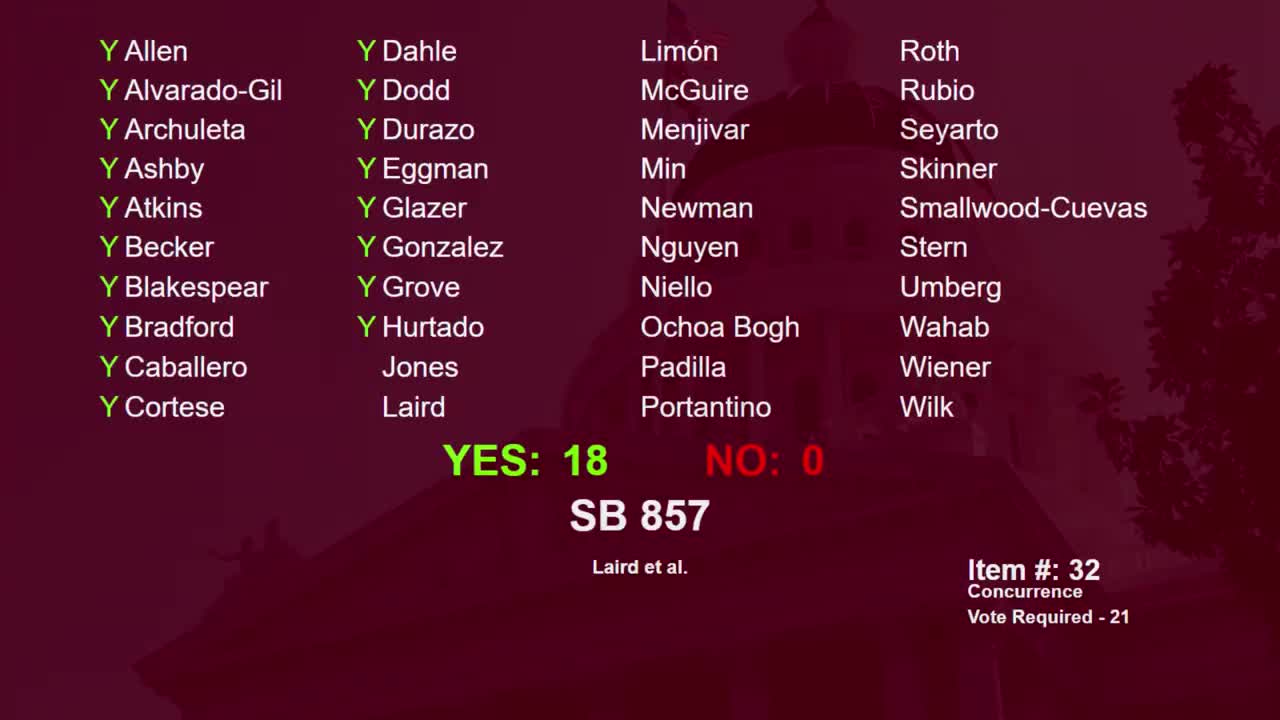 1MIN
Senate Floor
 8MIN
Senate Standing Committee on Energy, Utilities and Communications
 5MIN
Assembly Floor
 20MIN
Assembly Standing Committee on Communications and Conveyance
 5MIN
Senate Standing Committee on Energy, Utilities and Communications
Bill Author

Bill Co-Author(s):