SB 446: Nonprofit and cooperative corporations: ratification or validation of noncompliant corporate actions.
- Session Year: 2023-2024
- House: Senate
- Latest Version Date: 2023-09-01
Current Status:
Passed
(2023-09-01: Chaptered by Secretary of State. Chapter 151, Statutes of 2023.)
Introduced
In Committee
First Chamber
In Committee
Second Chamber
Enacted
The General Corporation Law regulates the organization of and operation of specified corporations. The Nonprofit Corporation Law regulates the organization and operation of nonprofit public benefit corporations, nonprofit mutual benefit corporations, and nonprofit religious corporations. The Cooperative Corporation Law governs the organization and operation of cooperative corporations.
The General Corporation Law requires the Secretary of State, upon receipt of any instrument for filing, to file and provide the date of endorsed filing, if that instrument conforms to law. The law permits an instrument that does not conform to law to be resubmitted in accordance with specified procedures. The law permits an agreement, certificate, or other instrument relating to a domestic or foreign corporation filed under the General Corporation Law to be corrected with respect to any misstatement of fact contained therein, as provided. The Nonprofit Corporation Law and the Cooperative Corporation Law contain similar provisions.
The General Corporation Law, except as provided, authorizes otherwise lawful corporate actions, as defined, not in compliance, or purportedly not in compliance, with the General Corporation Law or the articles, bylaws, or a plan or agreement to which the corporation is a party in effect at the time of a corporate action, to be ratified, or validated by the superior court, in conformity with certain procedures. The law requires, among other things, that the ratification of a corporate action pursuant to these provisions be approved by the board and, as applicable, approved by the shareholders or approved by the outstanding shares in accordance with the General Corporation Law and the articles, bylaws, and any plan or agreement to which the corporation is a party in effect at the time of ratification, except as specified. The law requires a corporation, if a corporate action ratified or validated would have required the filing of an instrument with the Secretary of State or if the ratification or validation would cause an instrument previously filed with the Secretary of State to be inaccurate or incomplete in any material respect, to file a certificate of ratification or certificate of validation to make, amend, or correct those instruments. Neither the Nonprofit Corporation Law nor the Cooperative Corporation Law contains similar provisions.
This bill would add similar provisions to the Nonprofit Corporation Law and the Cooperative Corporation Law. The bill would also make conforming changes.
(a)Upon receipt of any instrument by the Secretary of State for filing pursuant to this part, Part 2, Part 3, Part 4 or Part 5, if it conforms to law, it shall be filed by, and in the office of the Secretary of State and the date of filing endorsed thereon. Except for instruments filed pursuant to Section 6210, 8210, or 9660 the date of filing shall be the date the instrument is received by the Secretary of State unless the instrument provides that it is to be withheld from filing until a future date, other than instruments filed pursuant to Section 5017, or, unless in the judgment of the Secretary of State, the filing is intended to be coordinated with the filing of some other corporate document which cannot be filed. The Secretary of State shall file a document as of any requested future date not more than 90 days after its receipt, including a Saturday, Sunday or legal holiday, if the document is received in the Secretary of States office at least one business day prior to the requested date of filing. An instrument does not fail to conform to law because it is not accompanied by the full filing fee if the unpaid portion of the fee does not exceed the limits established by the policy of the Secretary of State for extending credit in these cases.
(b)If the Secretary of State determines that an instrument submitted for filing or otherwise submitted does not conform to law and returns it to the person submitting it, the instrument may be resubmitted accompanied by a written opinion of the member of the State Bar of California submitting the instrument, or representing the person submitting it, to the effect that the specific provision of the instrument objected to by the Secretary of State does conform to law and stating the points and authorities upon which the opinion is based. The Secretary of State shall rely, with respect to any disputed point of law, other than the application of Section 5122, 7122, or 9122, upon that written opinion in determining whether the instrument conforms to law. The date of filing in that case shall be the date the instrument is received on resubmission.
(c)Any instrument filed with respect to a corporation, other than original articles or instruments filed pursuant to Section 5017, may provide that it is to become effective not more than 90 days subsequent to its filing date. In case such a delayed effective date is specified, the instrument may be prevented from becoming effective by a certificate stating that by appropriate corporate action it has been revoked and is null and void, executed in the same manner as the original instrument and filed before the specified effective date. In the case of a merger agreement, the certificate revoking the earlier filing need only be executed on behalf of one of the constituent corporations. If no revocation certificate is filed, the instrument becomes effective on the date specified.
(d)Any instrument submitted to the Secretary of State for filing pursuant to this part, Part 2, Part 3, Part 4, or Part 5 by a domestic corporation or foreign corporation that is qualified to transact business in California under Section 2105 shall include the entity name and number as they exist on the Secretary of States records.
SEC. 2.Section 5017 is added to the Corporations Code, to read:5017.(a)(1)Otherwise lawful corporate actions not in compliance, or purportedly not in compliance, with this division or the articles, bylaws, or a plan or agreement to which the corporation is a party in effect at the time of the corporate action, may be ratified, or validated by the superior court, in accordance with the provisions of this section.
(2)Except as otherwise determined by the superior court pursuant to subdivision (e), a ratification or validation of a corporate action in accordance with this section is conclusive in the absence of fraud.
(3)This section does not limit the authority of the board, the members, or the corporation to effect any other lawful means of ratification or validation of a corporate action or correction of a record.
(4)No corporate action may be ratified under subdivision (b) by a dissolved corporation or a foreign corporation, and no petition may be filed under subdivision (e) in respect of any corporate action of such a corporation.
(5)This section shall not be used to ratify or validate any corporate action in respect of any of the following:
(A)Noncompliance with subdivision (a) of Section 5231, 7231, or 9241.
(B)Noncompliance with Section 5234, subdivision (a) or (b) of Section 7233, or Section 9244.
(C)Noncompliance with Section 5236 or 7235.
(D)Transactions covered by Section 5233.
(E)Transactions covered by Section 9243.
(b)(1)A ratification of a corporate action pursuant to this section, other than a ratification relating to the election of the initial directors pursuant to paragraph (2) of this subdivision, shall be approved by the board and, as applicable, approved by the members in accordance with any provision set forth in this division or the articles, bylaws, or a plan or agreement to which the corporation is a party that is applicable to the type of corporate action proposed to be ratified and in effect at the time of the ratification, unless there are no members entitled to vote on the ratification at the time of the ratification, in which case the ratification shall be approved solely by the board, or a higher approval standard that was or would have been applicable to the original taking or purported taking of the corporate action, in which case the ratification shall be approved in accordance with such higher approval standard. In order to approve a ratification of a corporate action pursuant to this paragraph, the board and, as applicable, the members shall adopt resolutions setting forth all of the following:
(A)Each corporate action to be ratified.
(B)The date when each such corporate action was purportedly taken, and the date any such corporate action shall be deemed to have become effective pursuant to this section if different than the date the corporate action was purportedly taken.
(C)The nature of the noncompliance or purported noncompliance of each such corporate action.
(D)A statement that the ratification of each such corporate action is approved.
(2)If the corporate action to be ratified relates to the election of the initial directors pursuant to Section 5134, 7134, or 9134, a majority of the persons who, at the time of the ratification, are exercising the powers of directors may approve that ratification by adopting resolutions setting forth all of the following:
(A)The name of the person or persons who first took action in the name of the corporation as the initial directors of the corporation.
(B)The earlier of the date on which such persons first took such action or were purported to have been elected as the initial directors, and the date on which such person or persons shall be deemed to have become the initial directors of the corporation pursuant to this section if different than the date of such first action or purported election, as applicable.
(C)That the ratification of the election of such person or persons as the initial directors is approved.
(c)Notice of any ratification of a corporate action pursuant to this section shall be given promptly after ratification pursuant to subdivision (b) to each member, regardless of whether approval of the members is required for the ratification. The notice shall be given as provided in subdivision (b) of Section 5511 or 7511 or subdivision (a) of Section 9411, as applicable, and shall include a copy of any resolutions adopted pursuant to subdivision (b) and a copy of this section.
(d)(1)If a corporate action ratified pursuant to this section would have required the filing of an instrument with the Secretary of State pursuant to the provisions of this division, or if such ratification would cause any instrument previously filed with the Secretary of State to be inaccurate or incomplete in any material respect after giving effect to the ratification, the corporation shall file a certificate of ratification to make, amend, or correct each such instrument. The certificate of ratification shall have the effect as specified therein, and shall be filed with the Secretary of State. A certificate of ratification shall consist of an officers certificate setting forth all of the following:
(A)The name of the corporation and the Secretary of States file number of the corporation.
(B)The title of any such instrument whose making, amendment, or correction is being effected by the certificate of ratification.
(C)The date any such instrument was filed with the Secretary of State, or a statement that any such instrument was not previously filed with the Secretary of State and, as applicable, a statement that the ratification approved pursuant to the resolutions set forth in the certificate of ratification would cause any such instrument to be inaccurate or incomplete in any material respect after giving effect to the ratification.
(D)The date any such instrument shall be deemed to have become effective pursuant to this section, which may be prior to or after the filing date.
(E)A statement that the certificate of ratification is making, amending, or correcting any such instrument, as applicable, and a copy of any such instrument containing all of the information required to be included under this division for such instrument to be so made, amended, or corrected. An instrument attached to a certificate of ratification pursuant to this subparagraph need not be separately executed and acknowledged and need not include any statement required by any other section of this division that such instrument has been approved and adopted in accordance with the provisions of such other section.
(F)A statement that the ratification has been approved pursuant to subdivision (b), a copy of the resolutions adopted pursuant to subdivision (b) in respect of the ratification.
(2)The office of the Secretary of State may, in its discretion, refuse to file any certificate of ratification if the instrument would render prior filings with the Secretary of State inaccurate, ambiguous, or unintelligible. Upon refusal of the Secretary of State to file a certificate of ratification pursuant to this subdivision, the corporation shall seek validation pursuant to subdivision (e).
(e)(1)Upon the filing of a petition by an authorized person, the superior court of the proper county shall have jurisdiction in equity to determine the validity of any corporate action (whether or not such corporate action is a ratification or has been the subject of any ratification), validate and declare effective any such corporate action, and declare the date any such corporate action shall be deemed to have become effective or valid, as applicable, pursuant to this section.
(2)This section does not prescribe or circumscribe the facts and circumstances the superior court may consider or which remedies the superior court may grant in exercising its jurisdiction under this section, except as described in this subdivision. The superior court may make any order concerning the corporate action as justice and equity may require.
(3)Any petition relating to a ratification taken or proposed to be taken pursuant to this section shall be filed not later than 180 days after the notice required by subdivision (c) is given, except this paragraph shall not apply to an action asserting that a ratification was not accomplished in accordance with this section or to any person to whom notice of the ratification was required to have been given pursuant to subdivision (c), but to whom such notice was not given.
(4)For purposes of this subdivision, the proper county shall be the county where the principal office of the corporation is located or, if the principal office is not located in this state, in the county in which the corporations agent for service of process is located.
(5)Service of the petition under paragraph (1) upon the registered agent of the corporation shall be deemed to be service upon the corporation, and no other party need be joined in order for the superior court to adjudicate the matter. The superior court may require notice of the action to be provided to other persons specified by the court and permit those other persons to intervene in the action.
(6)For purposes of this subdivision, authorized person means the corporation, any successor entity to the corporation, any director, any member, or any other person, so long as the other person claims to be substantially and adversely affected by the ratification of a corporate action pursuant to this section.
(7)Any petition seeking validation of a corporate action shall identify every pending legal proceeding of which the petitioner is aware and in which (A) the validity of the corporate action is being directly challenged or (B) the validation of the corporate action would result in the dismissal of the proceeding in whole or in part. If the petitioner becomes aware of any additional such legal proceeding, the petitioner shall amend, or, to the extent required by applicable rules, move for leave to amend, the petition within 10 court days to identify each such proceeding. Identification of a proceeding shall include the venue or forum in which the proceeding was filed, any case number or other unique identifier assigned to the proceeding in that venue or forum, the names of the parties to the proceeding, and the date on which the proceeding was filed.
(f)If a corporate action validated by the superior court pursuant to this section would have required the filing of an instrument with the Secretary of State pursuant to the provisions of this division, or if such validation would cause any instrument previously filed with the Secretary of State to be inaccurate or incomplete in any material respect after giving effect to the validation, the corporation shall file a certificate of validation to make, amend, or correct each such instrument. The certificate of validation shall have the effect as specified therein, and shall be filed with the Secretary of State. A certificate of validation shall consist of an officers certificate setting forth all of the following:
(1)The name of the corporation and the Secretary of States file number of the corporation.
(2)The title of any such instrument whose making, amendment, or correction is being effected by the certificate of validation.
(3)The date any such instrument was filed with the Secretary of State, or a statement that any such instrument was not previously filed with the Secretary of State and, as applicable, a statement that the validation ordered pursuant to the superior court order set forth in the certificate of validation would cause any such instrument to be inaccurate or incomplete in any material respect after giving effect to the validation.
(4)The date any such instrument shall be deemed to have become effective pursuant to this section, which may be prior to or after the filing date.
(5)A statement that the certificate of validation is making, amending, or correcting any such instrument, as applicable, and a copy of any such instrument containing all of the information required to be included under this division for such instrument to be so made, amended, or corrected. An instrument attached to a certificate of validation pursuant to this paragraph need not be separately executed and acknowledged and need not include any statement required by any other section of this division that such instrument has been approved and adopted in accordance with the provisions of such other section.
(6)A statement that the validation has been ordered pursuant to subdivision (e), and a copy of the superior court order issued pursuant to subdivision (e) in respect of such validation.
(g)Unless otherwise stated in resolutions adopted pursuant to subdivision (b) or determined by the superior court pursuant to subdivision (e), a corporate action or security of the corporation ratified or validated in accordance with this section relates back to the date of the original corporate action.
(h)As used in this section:
(1)Corporate action means any of the following:
(A)Any action or purported action of the board.
(B)Any action or purported action of the members.
(C)Any other action or transaction taken, or purportedly taken, by or on behalf of the corporation.
(2)Higher approval standard means any provision set forth in this division or the articles, bylaws, or a plan or agreement to which the corporation was a party in effect at the time of the original taking or purported taking of a corporate action:
(A)Requiring action of the board or members, at a meeting or by written consent, to be taken by a proportion greater than would have been required pursuant to this division or the articles, bylaws, or a plan or agreement to which the corporation is a party in effect at the time of the ratification of the corporate action pursuant to this section.
(B)Requiring a greater proportion of the directors or members to constitute a quorum for the transaction of business at a meeting than would have been required pursuant to this division or the articles, bylaws, or a plan or agreement to which the corporation is a party in effect at the time of the ratification of the corporate action pursuant to this section.
(C)Requiring, prohibiting, or prescribing conditions on action of the board or members at a meeting or by written consent, which would not have been required, prohibited, or prescribed pursuant to this division or the articles, bylaws, or a plan or agreement to which the corporation is a party in effect at the time of the ratification of the corporate action pursuant to this section.
(D)Requiring separate action of any specified person or persons, which would not have been required pursuant to this division or the articles, bylaws, or a plan or agreement to which the corporation is a party in effect at the time of the ratification of the corporate action pursuant to this section.
(i)The corporation shall retain all records related to the ratification or validation of a corporate action under this section in accordance with Section 6320, 8320, or 9510.
(j)If the corporation is a party to a pending legal proceeding in which (1) the validity of a corporate action sought to be ratified or validated pursuant to this section is at issue or (2) the ratification or validation of a corporate action pursuant to this section would result in the dismissal in whole or in part of the proceeding, the corporation shall notify the judge, arbitrator, or other person presiding over the proceeding at least 10 court days prior to adopting resolutions pursuant to subdivision (b) or filing a petition pursuant to subdivision (e) with respect to that corporate action. That person shall have power to stay the ratification or validation as justice and equity may require.
SEC. 3.Section 12214 of the Corporations Code is amended to read:12214.(a)Upon receipt of any instrument by the Secretary of State for filing pursuant to this part, if it conforms to law, it shall be filed by, and in the office of the Secretary of State and the date of filing endorsed thereon. Except for instruments filed pursuant to Section 12570 the date of filing shall be the date the instrument is received by the Secretary of State unless the instrument provides that it is to be withheld from filing until a future date, other than instruments filed pursuant to Section 12220.5, or, unless in the judgment of the Secretary of State, the filing is intended to be coordinated with the filing of some other corporate document which cannot be filed. The Secretary of State shall file a document as of any requested future date not more than 90 days after its receipt, including a Saturday, Sunday or legal holiday, if the document is received in the Secretary of States office at least one business day prior to the requested date of filing. An instrument does not fail to conform to law because it is not accompanied by the full filing fee if the unpaid portion of the fee does not exceed the limits established by the policy of the Secretary of State for extending credit in these cases.
(b)If the Secretary of State determines that an instrument submitted for filing or otherwise submitted does not conform to law and returns it to the person submitting it, the instrument may be resubmitted accompanied by a written opinion of the member of the State Bar of California submitting the instrument, or representing the person submitting it, to the effect that the specific provision of the instrument objected to by the Secretary of State does conform to law and stating the points and authorities upon which the opinion is based. The Secretary of State shall rely, with respect to any disputed point of law, other than the application of Section 12302, upon that written opinion in determining whether the instrument conforms to law. The date of filing in that case shall be the date the instrument is received on resubmission.
(c)Any instrument filed with respect to a corporation, other than original articles or instruments filed pursuant to Section 12220.5, may provide that it is to become effective not more than 90 days subsequent to its filing date. In case such a delayed effective date is specified, the instrument may be prevented from becoming effective by a certificate stating that by appropriate corporate action it has been revoked and is null and void, executed in the same manner as the original instrument and filed before the specified effective date. In the case of a merger agreement, the certificate revoking the earlier filing need only be executed on behalf of one of the constituent corporations. If no revocation certificate is filed, the instrument becomes effective on the date specified.
(d)Any instrument submitted to the Secretary of State for filing pursuant to this part by a domestic corporation or foreign corporation that is qualified to transact business in California under Section 2105 shall include the entity name and number as they exist on the Secretary of States records.
SEC. 4.Section 12220.5 is added to the Corporations Code, to read:12220.5.(a)(1)Otherwise lawful corporate actions not in compliance, or purportedly not in compliance, with this division or the articles, bylaws, or a plan or agreement to which the corporation is a party in effect at the time of the corporate action, may be ratified, or validated by the superior court, in accordance with the provisions of this section.
(2)Except as otherwise determined by the superior court pursuant to subdivision (e), a ratification or validation of a corporate action in accordance with this section is conclusive in the absence of fraud.
(3)This section does not limit the authority of the board, the members, or the corporation to effect any other lawful means of ratification or validation of a corporate action or correction of a record.
(4)No corporate action may be ratified under subdivision (b) by a dissolved corporation or a foreign corporation, and no petition may be filed under subdivision (e) in respect of any corporate action of such a corporation.
(5)This section shall not be used to ratify or validate any corporate action in respect of any of the following:
(A)Noncompliance with subdivision (a) of Section 12371.
(B)Noncompliance with subdivision (a) or (b) of Section 12373.
(C)Noncompliance with Section 12375.
(b)(1)A ratification of a corporate action pursuant to this section, other than a ratification relating to the election of the initial directors pursuant to paragraph (2) of this subdivision, shall be approved by the board and, as applicable, approved by the members in accordance with any provision set forth in this division or the articles, bylaws, or a plan or agreement to which the corporation is a party that is applicable to the type of corporate action proposed to be ratified and in effect at the time of the ratification, unless there are no members entitled to vote on the ratification at the time of the ratification, in which case the ratification shall be approved solely by the board, or a higher approval standard that was or would have been applicable to the original taking or purported taking of the corporate action, in which case the ratification shall be approved in accordance with such higher approval standard. In order to approve a ratification of a corporate action pursuant to this paragraph, the board and, as applicable, the members shall adopt resolutions setting forth all of the following:
(A)Each corporate action to be ratified.
(B)The date when each such corporate action was purportedly taken, and the date any such corporate action shall be deemed to have become effective pursuant to this section if different than the date the corporate action was purportedly taken.
(C)The nature of the noncompliance or purported noncompliance of each such corporate action.
(D)A statement that the ratification of each such corporate action is approved.
(2)If the corporate action to be ratified relates to the election of the initial directors pursuant to Section 12316, a majority of the persons who, at the time of the ratification, are exercising the powers of directors may approve that ratification by adopting resolutions setting forth all of the following:
(A)The name of the person or persons who first took action in the name of the corporation as the initial directors of the corporation.
(B)The earlier of the date on which such persons first took such action or were purported to have been elected as the initial directors, and the date on which such person or persons shall be deemed to have become the initial directors of the corporation pursuant to this section if different than the date of such first action or purported election, as applicable.
(C)That the ratification of the election of such person or persons as the initial directors is approved.
(c)Notice of any ratification of a corporate action pursuant to this section shall be given promptly after ratification pursuant to subdivision (b) to each member, regardless of whether approval of the members is required for the ratification. The notice shall be given as provided in subdivision (b) of Section 12461 and shall include a copy of any resolutions adopted pursuant to subdivision (b) and a copy of this section.
(d)(1)If a corporate action ratified pursuant to this section would have required the filing of an instrument with the Secretary of State pursuant to the provisions of this division, or if such ratification would cause any instrument previously filed with the Secretary of State to be inaccurate or incomplete in any material respect after giving effect to the ratification, the corporation shall file a certificate of ratification to make, amend, or correct each such instrument. The certificate of ratification shall have the effect as specified therein, and shall be filed with the Secretary of State. A certificate of ratification shall consist of an officers certificate setting forth all of the following:
(A)The name of the corporation and the Secretary of States file number of the corporation.
(B)The title of any such instrument whose making, amendment, or correction is being effected by the certificate of ratification.
(C)The date any such instrument was filed with the Secretary of State, or a statement that any such instrument was not previously filed with the Secretary of State and, as applicable, a statement that the ratification approved pursuant to the resolutions set forth in the certificate of ratification would cause any such instrument to be inaccurate or incomplete in any material respect after giving effect to the ratification.
(D)The date any such instrument shall be deemed to have become effective pursuant to this section, which may be prior to or after the filing date.
(E)A statement that the certificate of ratification is making, amending, or correcting any such instrument, as applicable, and a copy of any such instrument containing all of the information required to be included under this division for such instrument to be so made, amended, or corrected. An instrument attached to a certificate of ratification pursuant to this subparagraph need not be separately executed and acknowledged and need not include any statement required by any other section of this division that such instrument has been approved and adopted in accordance with the provisions of such other section.
(F)A statement that the ratification has been approved pursuant to subdivision (b), a copy of the resolutions adopted pursuant to subdivision (b) in respect of the ratification.
(2)The office of the Secretary of State may, in its discretion, refuse to file any certificate of ratification if the instrument would render prior filings with the Secretary of State inaccurate, ambiguous, or unintelligible. Upon refusal of the Secretary of State to file a certificate of ratification pursuant to this subdivision, the corporation shall seek validation pursuant to subdivision (e).
(e)(1)Upon the filing of a petition by an authorized person, the superior court of the proper county shall have jurisdiction in equity to determine the validity of any corporate action (whether or not such corporate action is a ratification or has been the subject of any ratification), validate and declare effective any such corporate action, and declare the date any such corporate action shall be deemed to have become effective or valid, as applicable, pursuant to this section.
(2)This section does not prescribe or circumscribe the facts and circumstances the superior court may consider or which remedies the superior court may grant in exercising its jurisdiction under this section, except as described in this subdivision. The superior court may make any order concerning the corporate action as justice and equity may require.
(3)Any petition relating to a ratification taken or proposed to be taken pursuant to this section shall be filed not later than 180 days after the notice required by subdivision (c) is given, except this paragraph shall not apply to an action asserting that a ratification was not accomplished in accordance with this section or to any person to whom notice of the ratification was required to have been given pursuant to subdivision (c), but to whom such notice was not given.
(4)For purposes of this subdivision, the proper county shall be the county where the principal office of the corporation is located or, if the principal office is not located in this state, in the county in which the corporations agent for service of process is located.
(5)Service of the petition under paragraph (1) upon the registered agent of the corporation shall be deemed to be service upon the corporation, and no other party need be joined in order for the superior court to adjudicate the matter. The superior court may require notice of the action to be provided to other persons specified by the court and permit those other persons to intervene in the action.
(6)For purposes of this subdivision, authorized person means the corporation, any successor entity to the corporation, any director, any member, or any other person, so long as the other person claims to be substantially and adversely affected by the ratification of a corporate action pursuant to this section.
(7)Any petition seeking validation of a corporate action shall identify every pending legal proceeding of which the petitioner is aware and in which (A) the validity of the corporate action is being directly challenged or (B) the validation of the corporate action would result in the dismissal of the proceeding in whole or in part. If the petitioner becomes aware of any additional such legal proceeding, the petitioner shall amend, or, to the extent required by applicable rules, move for leave to amend, the petition within 10 court days to identify each such proceeding. Identification of a proceeding shall include the venue or forum in which the proceeding was filed, any case number or other unique identifier assigned to the proceeding in that venue or forum, the names of the parties to the proceeding, and the date on which the proceeding was filed.
(f)If a corporate action validated by the superior court pursuant to this section would have required the filing of an instrument with the Secretary of State pursuant to the provisions of this division, or if such validation would cause any instrument previously filed with the Secretary of State to be inaccurate or incomplete in any material respect after giving effect to the validation, the corporation shall file a certificate of validation to make, amend, or correct each such instrument. The certificate of validation shall have the effect as specified therein, and shall be filed with the Secretary of State. A certificate of validation shall consist of an officers certificate setting forth all of the following:
(1)The name of the corporation and the Secretary of States file number of the corporation.
(2)The title of any such instrument whose making, amendment, or correction is being effected by the certificate of validation.
(3)The date any such instrument was filed with the Secretary of State, or a statement that any such instrument was not previously filed with the Secretary of State and, as applicable, a statement that the validation ordered pursuant to the superior court order set forth in the certificate of validation would cause any such instrument to be inaccurate or incomplete in any material respect after giving effect to the validation.
(4)The date any such instrument shall be deemed to have become effective pursuant to this section, which may be prior to or after the filing date.
(5)A statement that the certificate of validation is making, amending, or correcting any such instrument, as applicable, and a copy of any such instrument containing all of the information required to be included under this division for such instrument to be so made, amended, or corrected. An instrument attached to a certificate of validation pursuant to this paragraph need not be separately executed and acknowledged and need not include any statement required by any other section of this division that such instrument has been approved and adopted in accordance with the provisions of such other section.
(6)A statement that the validation has been ordered pursuant to subdivision (e), and a copy of the superior court order issued pursuant to subdivision (e) in respect of such validation.
(g)Unless otherwise stated in resolutions adopted pursuant to subdivision (b) or determined by the superior court pursuant to subdivision (e), a corporate action or security of the corporation ratified or validated in accordance with this section relates back to the date of the original corporate action.
(h)As used in this section:
(1)Corporate action means any of the following:
(A)Any action or purported action of the board.
(B)Any action or purported action of the members.
(C)Any other action or transaction taken, or purportedly taken, by or on behalf of the corporation.
(2)Higher approval standard means any provision set forth in this division or the articles, bylaws, or a plan or agreement to which the corporation was a party in effect at the time of the original taking or purported taking of a corporate action:
(A)Requiring action of the board or members, at a meeting or by written consent, to be taken by a proportion greater than would have been required pursuant to this division or the articles, bylaws, or a plan or agreement to which the corporation is a party in effect at the time of the ratification of the corporate action pursuant to this section.
(B)Requiring a greater proportion of the directors or members to constitute a quorum for the transaction of business at a meeting than would have been required pursuant to this division or the articles, bylaws, or a plan or agreement to which the corporation is a party in effect at the time of the ratification of the corporate action pursuant to this section.
(C)Requiring, prohibiting, or prescribing conditions on action of the board or members at a meeting or by written consent, which would not have been required, prohibited, or prescribed pursuant to this division or the articles, bylaws, or a plan or agreement to which the corporation is a party in effect at the time of the ratification of the corporate action pursuant to this section.
(D)Requiring separate action of any specified person or persons, which would not have been required pursuant to this division or the articles, bylaws, or a plan or agreement to which the corporation is a party in effect at the time of the ratification of the corporate action pursuant to this section.
(i)The corporation shall retain all records related to the ratification or validation of a corporate action under this section in accordance with Section 12590.
(j)If the corporation is a party to a pending legal proceeding in which (1) the validity of a corporate action sought to be ratified or validated pursuant to this section is at issue or (2) the ratification or validation of a corporate action pursuant to this section would result in the dismissal in whole or in part of the proceeding, the corporation shall notify the judge, arbitrator, or other person presiding over the proceeding at least 10 court days prior to adopting resolutions pursuant to subdivision (b) or filing a petition pursuant to subdivision (e) with respect to that corporate action. That person shall have power to stay the ratification or validation as justice and equity may require.
(a)Upon receipt of any instrument by the Secretary of State for filing pursuant to this part, Part 2, Part 3, Part 4 or Part 5, if it conforms to law, it shall be filed by, and in the office of the Secretary of State and the date of filing endorsed thereon. Except for instruments filed pursuant to Section 6210, 8210, or 9660 the date of filing shall be the date the instrument is received by the Secretary of State unless the instrument provides that it is to be withheld from filing until a future date or date, other than instruments filed pursuant to Section 5017, or, unless in the judgment of the Secretary of State State, the filing is intended to be coordinated with the filing of some other corporate document which cannot be filed. The Secretary of State shall file a document as of any requested future date not more than 90 days after its receipt, including a Saturday, Sunday or legal holiday, if the document is received in the Secretary of States office at least one business day prior to the requested date of filing. An instrument does not fail to conform to law because it is not accompanied by the full filing fee if the unpaid portion of such the fee does not exceed the limits established by the policy of the Secretary of State for extending credit in such these cases.
(b)If the Secretary of State determines that an instrument submitted for filing or otherwise submitted does not conform to law and returns it to the person submitting it, the instrument may be resubmitted accompanied by a written opinion of a the member of the State Bar of California submitting the instrument, or representing the person submitting it, to the effect that the specific provision of the instrument objected to by the Secretary of State does conform to law and stating the points and authorities upon which the opinion is based. The Secretary of State shall rely, with respect to any disputed point of law (other law, other than the application of Section 5122, 7122, or 9122), 9122, upon such that written opinion in determining whether the instrument conforms to law. The date of filing in such that case shall be the date the instrument is received on resubmission.
(c)Any instrument filed with respect to a corporation (other corporation, other than original articles) articles or instruments filed pursuant to Section 5017, may provide that it is to become effective not more than 90 days subsequent to its filing date. In case such a delayed effective date is specified, the instrument may be prevented from becoming effective by a certificate stating that by appropriate corporate action it has been revoked and is null and void, executed in the same manner as the original instrument and filed before the specified effective date. In the case of a merger agreement, such the certificate revoking the earlier filing need only be executed on behalf of one of the constituent corporations. If no such revocation certificate is filed, the instrument becomes effective on the date specified.
(d)Any instrument submitted to the Secretary of State for filing pursuant to this part, Part 2, Part 3, Part 4, or Part 5 by a domestic corporation or foreign corporation that is qualified to transact business in California under Section 2105 shall include the entity name and number as they exist on the Secretary of States records.
SEC. 2.Section 5017 is added to the Corporations Code, to read:5017.(a)(1)Otherwise lawful corporate actions not in compliance, or purportedly not in compliance, with this division or the articles, bylaws, or a plan or agreement to which the corporation is a party in effect at the time of the corporate action, may be ratified, or validated by the superior court, in accordance with the provisions of this section.
(2)Except as otherwise determined by the superior court pursuant to subdivision (e), a ratification or validation of a corporate action in accordance with this section is conclusive in the absence of fraud.
(3)This section does not limit the authority of the board, the members, or the corporation to effect any other lawful means of ratification or validation of a corporate action or correction of a record.
(4)No corporate action may be ratified under subdivision (b) by a dissolved corporation or a foreign corporation, and no petition may be filed under subdivision (e) in respect of any corporate action of such a corporation.
(5)This section shall not be used to ratify or validate any corporate action in respect of any of the following:
(A)Noncompliance with subdivision (a) of Section 5231, 7231, or 9241.
(B)Noncompliance with Section 5234, subdivision (a) or (b) of Section 7233, or Section 9244.
(C)Noncompliance with Section 5236 or 7235.
(D)Transactions covered by Section 5233.
(E)Transactions covered by Section 9243.
(b)(1)A ratification of a corporate action pursuant to this section, other than a ratification relating to the election of the initial directors pursuant to paragraph (2) of this subdivision, shall be approved by the board and, as applicable, approved by the members in accordance with any provision set forth in this division or the articles, bylaws, or a plan or agreement to which the corporation is a party that is applicable to the type of corporate action proposed to be ratified and in effect at the time of the ratification, unless there are no members entitled to vote on the ratification at the time of the ratification, in which case the ratification shall be approved solely by the board, or a higher approval standard that was or would have been applicable to the original taking or purported taking of the corporate action, in which case the ratification shall be approved in accordance with such higher approval standard. In order to approve a ratification of a corporate action pursuant to this paragraph, the board and, as applicable, the members shall adopt resolutions setting forth all of the following:
(A)Each corporate action to be ratified.
(B)The date when each such corporate action was purportedly taken, and the date any such corporate action shall be deemed to have become effective pursuant to this section if different than the date the corporate action was purportedly taken.
(C)The nature of the noncompliance or purported noncompliance of each such corporate action.
(D)A statement that the ratification of each such corporate action is approved.
(2)If the corporate action to be ratified relates to the election of the initial directors pursuant to Section 5134, 7134, or 9134, a majority of the persons who, at the time of the ratification, are exercising the powers of directors may approve that ratification by adopting resolutions setting forth all of the following:
(A)The name of the person or persons who first took action in the name of the corporation as the initial directors of the corporation.
(B)The earlier of the date on which such persons first took such action or were purported to have been elected as the initial directors, and the date on which such person or persons shall be deemed to have become the initial directors of the corporation pursuant to this section if different than the date of such first action or purported election, as applicable.
(C)That the ratification of the election of such person or persons as the initial directors is approved.
(c)Notice of any ratification of a corporate action pursuant to this section shall be given promptly after ratification pursuant to subdivision (b) to each member, regardless of whether approval of the members is required for the ratification. The notice shall be given as provided in subdivision (b) of Section 5511 or 7511 or subdivision (a) of Section 9411, as applicable, and shall include a copy of any resolutions adopted pursuant to subdivision (b) and a copy of this section.
(d)(1)If a corporate action ratified pursuant to this section would have required the filing of an instrument with the Secretary of State pursuant to the provisions of this division, or if such ratification would cause any instrument previously filed with the Secretary of State to be inaccurate or incomplete in any material respect after giving effect to the ratification, the corporation shall file a certificate of ratification to make, amend, or correct each such instrument. The certificate of ratification shall have the effect as specified therein, and shall be filed with the Secretary of State. A certificate of ratification shall consist of an officers certificate setting forth all of the following:
(A)The name of the corporation and the Secretary of States file number of the corporation.
(B)The title of any such instrument whose making, amendment, or correction is being effected by the certificate of ratification.
(C)The date any such instrument was filed with the Secretary of State, or a statement that any such instrument was not previously filed with the Secretary of State and, as applicable, a statement that the ratification approved pursuant to the resolutions set forth in the certificate of ratification would cause any such instrument to be inaccurate or incomplete in any material respect after giving effect to the ratification.
(D)The date any such instrument shall be deemed to have become effective pursuant to this section, which may be prior to or after the filing date.
(E)A statement that the certificate of ratification is making, amending, or correcting any such instrument, as applicable, and a copy of any such instrument containing all of the information required to be included under this division for such instrument to be so made, amended, or corrected. An instrument attached to a certificate of ratification pursuant to this subparagraph need not be separately executed and acknowledged and need not include any statement required by any other section of this division that such instrument has been approved and adopted in accordance with the provisions of such other section.
(F)A statement that the ratification has been approved pursuant to subdivision (b), a copy of the resolutions adopted pursuant to subdivision (b) in respect of the ratification.
(2)The office of the Secretary of State may, in its discretion, refuse to file any certificate of ratification if the instrument would render prior filings with the Secretary of State inaccurate, ambiguous, or unintelligible. Upon refusal of the Secretary of State to file a certificate of ratification pursuant to this subdivision, the corporation shall seek validation pursuant to subdivision (e).
(e)(1)Upon the filing of a petition by an authorized person, the superior court of the proper county shall have jurisdiction in equity to determine the validity of any corporate action (whether or not such corporate action is a ratification or has been the subject of any ratification), validate and declare effective any such corporate action, and declare the date any such corporate action shall be deemed to have become effective or valid, as applicable, pursuant to this section.
(2)This section does not prescribe or circumscribe the facts and circumstances the superior court may consider or which remedies the superior court may grant in exercising its jurisdiction under this section, except as described in this subdivision. The superior court may make any order concerning the corporate action as justice and equity may require.
(3)Any petition relating to a ratification taken or proposed to be taken pursuant to this section shall be filed not later than 180 days after the notice required by subdivision (c) is given, except this paragraph shall not apply to an action asserting that a ratification was not accomplished in accordance with this section or to any person to whom notice of the ratification was required to have been given pursuant to subdivision (c), but to whom such notice was not given.
(4)For purposes of this subdivision, the proper county shall be the county where the principal office of the corporation is located or, if the principal office is not located in this state, in the county in which the corporations agent for service of process is located.
(5)Service of the petition under paragraph (1) upon the registered agent of the corporation shall be deemed to be service upon the corporation, and no other party need be joined in order for the superior court to adjudicate the matter. The superior court may require notice of the action to be provided to other persons specified by the court and permit those other persons to intervene in the action.
(6)For purposes of this subdivision, authorized person means the corporation, any successor entity to the corporation, any director, any member, or any other person, so long as the other person claims to be substantially and adversely affected by the ratification of a corporate action pursuant to this section.
(7)Any petition seeking validation of a corporate action shall identify every pending legal proceeding of which the petitioner is aware and in which (A) the validity of the corporate action is being directly challenged or (B) the validation of the corporate action would result in the dismissal of the proceeding in whole or in part. If the petitioner becomes aware of any additional such legal proceeding, the petitioner shall amend, or, to the extent required by applicable rules, move for leave to amend, the petition within 10 court days to identify each such proceeding. Identification of a proceeding shall include the venue or forum in which the proceeding was filed, any case number or other unique identifier assigned to the proceeding in that venue or forum, the names of the parties to the proceeding, and the date on which the proceeding was filed.
(f)If a corporate action validated by the superior court pursuant to this section would have required the filing of an instrument with the Secretary of State pursuant to the provisions of this division, or if such validation would cause any instrument previously filed with the Secretary of State to be inaccurate or incomplete in any material respect after giving effect to the validation, the corporation shall file a certificate of validation to make, amend, or correct each such instrument. The certificate of validation shall have the effect as specified therein, and shall be filed with the Secretary of State. A certificate of validation shall consist of an officers certificate setting forth all of the following:
(1)The name of the corporation and the Secretary of States file number of the corporation.
(2)The title of any such instrument whose making, amendment, or correction is being effected by the certificate of validation.
(3)The date any such instrument was filed with the Secretary of State, or a statement that any such instrument was not previously filed with the Secretary of State and, as applicable, a statement that the validation ordered pursuant to the superior court order set forth in the certificate of validation would cause any such instrument to be inaccurate or incomplete in any material respect after giving effect to the validation.
(4)The date any such instrument shall be deemed to have become effective pursuant to this section, which may be prior to or after the filing date.
(5)A statement that the certificate of validation is making, amending, or correcting any such instrument, as applicable, and a copy of any such instrument containing all of the information required to be included under this division for such instrument to be so made, amended, or corrected. An instrument attached to a certificate of validation pursuant to this paragraph need not be separately executed and acknowledged and need not include any statement required by any other section of this division that such instrument has been approved and adopted in accordance with the provisions of such other section.
(6)A statement that the validation has been ordered pursuant to subdivision (e), and a copy of the superior court order issued pursuant to subdivision (e) in respect of such validation.
(g)Unless otherwise stated in resolutions adopted pursuant to subdivision (b) or determined by the superior court pursuant to subdivision (e), a corporate action or security of the corporation ratified or validated in accordance with this section relates back to the date of the original corporate action.
(h)As used in this section:
(1)Corporate action means any of the following:
(A)Any action or purported action of the board.
(B)Any action or purported action of the members.
(C)Any other action or transaction taken, or purportedly taken, by or on behalf of the corporation.
(2)Higher approval standard means any provision set forth in this division or the articles, bylaws, or a plan or agreement to which the corporation was a party in effect at the time of the original taking or purported taking of a corporate action:
(A)Requiring action of the board or members, at a meeting or by written consent, to be taken by a proportion greater than would have been required pursuant to this division or the articles, bylaws, or a plan or agreement to which the corporation is a party in effect at the time of the ratification of the corporate action pursuant to this section.
(B)Requiring a greater proportion of the directors or members to constitute a quorum for the transaction of business at a meeting than would have been required pursuant to this division or the articles, bylaws, or a plan or agreement to which the corporation is a party in effect at the time of the ratification of the corporate action pursuant to this section.
(C)Requiring, prohibiting, or prescribing conditions on action of the board or members at a meeting or by written consent, which would not have been required, prohibited, or prescribed pursuant to this division or the articles, bylaws, or a plan or agreement to which the corporation is a party in effect at the time of the ratification of the corporate action pursuant to this section.
(D)Requiring separate action of any specified person or persons, which would not have been required pursuant to this division or the articles, bylaws, or a plan or agreement to which the corporation is a party in effect at the time of the ratification of the corporate action pursuant to this section.
(i)The corporation shall retain all records related to the ratification or validation of a corporate action under this section in accordance with Section 6320, 8320, or 9510.
(j)If the corporation is a party to a pending legal proceeding in which (1) the validity of a corporate action sought to be ratified or validated pursuant to this section is at issue or (2) the ratification or validation of a corporate action pursuant to this section would result in the dismissal in whole or in part of the proceeding, the corporation shall notify the judge, arbitrator, or other person presiding over the proceeding at least 10 court days prior to adopting resolutions pursuant to subdivision (b) or filing a petition pursuant to subdivision (e) with respect to that corporate action. That person shall have power to stay the ratification or validation as justice and equity may require.
SEC. 3.Section 12214 of the Corporations Code is amended to read:12214.(a)Upon receipt of any instrument by the Secretary of State for filing pursuant to this part, if it conforms to law, it shall be filed by, and in the office of the Secretary of State and the date of filing endorsed thereon. Except for instruments filed pursuant to Section 12570 the date of filing shall be the date the instrument is received by the Secretary of State unless the instrument provides that it is to be withheld from filing until a future date or date, other than instruments filed pursuant to Section 12220.5, or, unless in the judgment of the Secretary of State State, the filing is intended to be coordinated with the filing of some other corporate document which cannot be filed. The Secretary of State shall file a document as of any requested future date not more than 90 days after its receipt, including a Saturday, Sunday or legal holiday, if the document is received in the Secretary of States office at least one business day prior to the requested date of filing. An instrument does not fail to conform to law because it is not accompanied by the full filing fee if the unpaid portion of such the fee does not exceed the limits established by the policy of the Secretary of State for extending credit in such these cases.
(b)If the Secretary of State determines that an instrument submitted for filing or otherwise submitted does not conform to law and returns it to the person submitting it, the instrument may be resubmitted accompanied by a written opinion of a the member of the State Bar of California submitting the instrument, or representing the person submitting it, to the effect that the specific provision of the instrument objected to by the Secretary of State does conform to law and stating the points and authorities upon which the opinion is based. The Secretary of State shall rely, with respect to any disputed point of law (other law, other than the application of Section 12302), 12302, upon such that written opinion in determining whether the instrument conforms to law. The date of filing in such that case shall be the date the instrument is received on resubmission.
(c)Any instrument filed with respect to a corporation (other corporation, other than original articles) articles or instruments filed pursuant to Section 12220.5, may provide that it is to become effective not more than 90 days subsequent to its filing date. In case such a delayed effective date is specified, the instrument may be prevented from becoming effective by a certificate stating that by appropriate corporate action it has been revoked and is null and void, executed in the same manner as the original instrument and filed before the specified effective date. In the case of a merger agreement, such the certificate revoking the earlier filing need only be executed on behalf of one of the constituent corporations. If no such revocation certificate is filed, the instrument becomes effective on the date specified.
(d)Any instrument submitted to the Secretary of State for filing pursuant to this part by a domestic corporation or foreign corporation that is qualified to transact business in California under Section 2105 shall include the entity name and number as they exist on the Secretary of States records.
SEC. 4.Section 12220.5 is added to the Corporations Code, to read:12220.5.(a)(1)Otherwise lawful corporate actions not in compliance, or purportedly not in compliance, with this division or the articles, bylaws, or a plan or agreement to which the corporation is a party in effect at the time of the corporate action, may be ratified, or validated by the superior court, in accordance with the provisions of this section.
(2)Except as otherwise determined by the superior court pursuant to subdivision (e), a ratification or validation of a corporate action in accordance with this section is conclusive in the absence of fraud.
(3)This section does not limit the authority of the board, the members, or the corporation to effect any other lawful means of ratification or validation of a corporate action or correction of a record.
(4)No corporate action may be ratified under subdivision (b) by a dissolved corporation or a foreign corporation, and no petition may be filed under subdivision (e) in respect of any corporate action of such a corporation.
(5)This section shall not be used to ratify or validate any corporate action in respect of any of the following:
(A)Noncompliance with subdivision (a) of Section 12371.
(B)Noncompliance with subdivision (a) or (b) of Section 12373.
(C)Noncompliance with Section 12375.
(b)(1)A ratification of a corporate action pursuant to this section, other than a ratification relating to the election of the initial directors pursuant to paragraph (2) of this subdivision, shall be approved by the board and, as applicable, approved by the members in accordance with any provision set forth in this division or the articles, bylaws, or a plan or agreement to which the corporation is a party that is applicable to the type of corporate action proposed to be ratified and in effect at the time of the ratification, unless there are no members entitled to vote on the ratification at the time of the ratification, in which case the ratification shall be approved solely by the board, or a higher approval standard that was or would have been applicable to the original taking or purported taking of the corporate action, in which case the ratification shall be approved in accordance with such higher approval standard. In order to approve a ratification of a corporate action pursuant to this paragraph, the board and, as applicable, the members shall adopt resolutions setting forth all of the following:
(A)Each corporate action to be ratified.
(B)The date when each such corporate action was purportedly taken, and the date any such corporate action shall be deemed to have become effective pursuant to this section if different than the date the corporate action was purportedly taken.
(C)The nature of the noncompliance or purported noncompliance of each such corporate action.
(D)A statement that the ratification of each such corporate action is approved.
(2)If the corporate action to be ratified relates to the election of the initial directors pursuant to Section 12316, a majority of the persons who, at the time of the ratification, are exercising the powers of directors may approve that ratification by adopting resolutions setting forth all of the following:
(A)The name of the person or persons who first took action in the name of the corporation as the initial directors of the corporation.
(B)The earlier of the date on which such persons first took such action or were purported to have been elected as the initial directors, and the date on which such person or persons shall be deemed to have become the initial directors of the corporation pursuant to this section if different than the date of such first action or purported election, as applicable.
(C)That the ratification of the election of such person or persons as the initial directors is approved.
(c)Notice of any ratification of a corporate action pursuant to this section shall be given promptly after ratification pursuant to subdivision (b) to each member, regardless of whether approval of the members is required for the ratification. The notice shall be given as provided in subdivision (b) of Section 12461 and shall include a copy of any resolutions adopted pursuant to subdivision (b) and a copy of this section.
(d)(1)If a corporate action ratified pursuant to this section would have required the filing of an instrument with the Secretary of State pursuant to the provisions of this division, or if such ratification would cause any instrument previously filed with the Secretary of State to be inaccurate or incomplete in any material respect after giving effect to the ratification, the corporation shall file a certificate of ratification to make, amend, or correct each such instrument. The certificate of ratification shall have the effect as specified therein, and shall be filed with the Secretary of State. A certificate of ratification shall consist of an officers certificate setting forth all of the following:
(A)The name of the corporation and the Secretary of States file number of the corporation.
(B)The title of any such instrument whose making, amendment, or correction is being effected by the certificate of ratification.
(C)The date any such instrument was filed with the Secretary of State, or a statement that any such instrument was not previously filed with the Secretary of State and, as applicable, a statement that the ratification approved pursuant to the resolutions set forth in the certificate of ratification would cause any such instrument to be inaccurate or incomplete in any material respect after giving effect to the ratification.
(D)The date any such instrument shall be deemed to have become effective pursuant to this section, which may be prior to or after the filing date.
(E)A statement that the certificate of ratification is making, amending, or correcting any such instrument, as applicable, and a copy of any such instrument containing all of the information required to be included under this division for such instrument to be so made, amended, or corrected. An instrument attached to a certificate of ratification pursuant to this subparagraph need not be separately executed and acknowledged and need not include any statement required by any other section of this division that such instrument has been approved and adopted in accordance with the provisions of such other section.
(F)A statement that the ratification has been approved pursuant to subdivision (b), a copy of the resolutions adopted pursuant to subdivision (b) in respect of the ratification.
(2)The office of the Secretary of State may, in its discretion, refuse to file any certificate of ratification if the instrument would render prior filings with the Secretary of State inaccurate, ambiguous, or unintelligible. Upon refusal of the Secretary of State to file a certificate of ratification pursuant to this subdivision, the corporation shall seek validation pursuant to subdivision (e).
(e)(1)Upon the filing of a petition by an authorized person, the superior court of the proper county shall have jurisdiction in equity to determine the validity of any corporate action (whether or not such corporate action is a ratification or has been the subject of any ratification), validate and declare effective any such corporate action, and declare the date any such corporate action shall be deemed to have become effective or valid, as applicable, pursuant to this section.
(2)This section does not prescribe or circumscribe the facts and circumstances the superior court may consider or which remedies the superior court may grant in exercising its jurisdiction under this section, except as described in this subdivision. The superior court may make any order concerning the corporate action as justice and equity may require.
(3)Any petition relating to a ratification taken or proposed to be taken pursuant to this section shall be filed not later than 180 days after the notice required by subdivision (c) is given, except this paragraph shall not apply to an action asserting that a ratification was not accomplished in accordance with this section or to any person to whom notice of the ratification was required to have been given pursuant to subdivision (c), but to whom such notice was not given.
(4)For purposes of this subdivision, the proper county shall be the county where the principal office of the corporation is located or, if the principal office is not located in this state, in the county in which the corporations agent for service of process is located.
(5)Service of the petition under paragraph (1) upon the registered agent of the corporation shall be deemed to be service upon the corporation, and no other party need be joined in order for the superior court to adjudicate the matter. The superior court may require notice of the action to be provided to other persons specified by the court and permit those other persons to intervene in the action.
(6)For purposes of this subdivision, authorized person means the corporation, any successor entity to the corporation, any director, any member, or any other person, so long as the other person claims to be substantially and adversely affected by the ratification of a corporate action pursuant to this section.
(7)Any petition seeking validation of a corporate action shall identify every pending legal proceeding of which the petitioner is aware and in which (A) the validity of the corporate action is being directly challenged or (B) the validation of the corporate action would result in the dismissal of the proceeding in whole or in part. If the petitioner becomes aware of any additional such legal proceeding, the petitioner shall amend, or, to the extent required by applicable rules, move for leave to amend, the petition within 10 court days to identify each such proceeding. Identification of a proceeding shall include the venue or forum in which the proceeding was filed, any case number or other unique identifier assigned to the proceeding in that venue or forum, the names of the parties to the proceeding, and the date on which the proceeding was filed.
(f)If a corporate action validated by the superior court pursuant to this section would have required the filing of an instrument with the Secretary of State pursuant to the provisions of this division, or if such validation would cause any instrument previously filed with the Secretary of State to be inaccurate or incomplete in any material respect after giving effect to the validation, the corporation shall file a certificate of validation to make, amend, or correct each such instrument. The certificate of validation shall have the effect as specified therein, and shall be filed with the Secretary of State. A certificate of validation shall consist of an officers certificate setting forth all of the following:
(1)The name of the corporation and the Secretary of States file number of the corporation.
(2)The title of any such instrument whose making, amendment, or correction is being effected by the certificate of validation.
(3)The date any such instrument was filed with the Secretary of State, or a statement that any such instrument was not previously filed with the Secretary of State and, as applicable, a statement that the validation ordered pursuant to the superior court order set forth in the certificate of validation would cause any such instrument to be inaccurate or incomplete in any material respect after giving effect to the validation.
(4)The date any such instrument shall be deemed to have become effective pursuant to this section, which may be prior to or after the filing date.
(5)A statement that the certificate of validation is making, amending, or correcting any such instrument, as applicable, and a copy of any such instrument containing all of the information required to be included under this division for such instrument to be so made, amended, or corrected. An instrument attached to a certificate of validation pursuant to this paragraph need not be separately executed and acknowledged and need not include any statement required by any other section of this division that such instrument has been approved and adopted in accordance with the provisions of such other section.
(6)A statement that the validation has been ordered pursuant to subdivision (e), and a copy of the superior court order issued pursuant to subdivision (e) in respect of such validation.
(g)Unless otherwise stated in resolutions adopted pursuant to subdivision (b) or determined by the superior court pursuant to subdivision (e), a corporate action or security of the corporation ratified or validated in accordance with this section relates back to the date of the original corporate action.
(h)As used in this section:
(1)Corporate action means any of the following:
(A)Any action or purported action of the board.
(B)Any action or purported action of the members.
(C)Any other action or transaction taken, or purportedly taken, by or on behalf of the corporation.
(2)Higher approval standard means any provision set forth in this division or the articles, bylaws, or a plan or agreement to which the corporation was a party in effect at the time of the original taking or purported taking of a corporate action:
(A)Requiring action of the board or members, at a meeting or by written consent, to be taken by a proportion greater than would have been required pursuant to this division or the articles, bylaws, or a plan or agreement to which the corporation is a party in effect at the time of the ratification of the corporate action pursuant to this section.
(B)Requiring a greater proportion of the directors or members to constitute a quorum for the transaction of business at a meeting than would have been required pursuant to this division or the articles, bylaws, or a plan or agreement to which the corporation is a party in effect at the time of the ratification of the corporate action pursuant to this section.
(C)Requiring, prohibiting, or prescribing conditions on action of the board or members at a meeting or by written consent, which would not have been required, prohibited, or prescribed pursuant to this division or the articles, bylaws, or a plan or agreement to which the corporation is a party in effect at the time of the ratification of the corporate action pursuant to this section.
(D)Requiring separate action of any specified person or persons, which would not have been required pursuant to this division or the articles, bylaws, or a plan or agreement to which the corporation is a party in effect at the time of the ratification of the corporate action pursuant to this section.
(i)The corporation shall retain all records related to the ratification or validation of a corporate action under this section in accordance with Section 12590.
(j)If the corporation is a party to a pending legal proceeding in which (1) the validity of a corporate action sought to be ratified or validated pursuant to this section is at issue or (2) the ratification or validation of a corporate action pursuant to this section would result in the dismissal in whole or in part of the proceeding, the corporation shall notify the judge, arbitrator, or other person presiding over the proceeding at least 10 court days prior to adopting resolutions pursuant to subdivision (b) or filing a petition pursuant to subdivision (e) with respect to that corporate action. That person shall have power to stay the ratification or validation as justice and equity may require.
|
Date
|
Status
|
|---|---|
| Sep 1, 2023 | Chaptered by Secretary of State. Chapter 151, Statutes of 2023. |
| Sep 1, 2023 | Approved by the Governor. |
| Aug 22, 2023 | Enrolled and presented to the Governor at 2 p.m. |
| Aug 17, 2023 | In Senate. Ordered to engrossing and enrolling. |
| Aug 17, 2023 | Read third time. Passed. (Ayes 75. Noes 0. Page 2742.) Ordered to the Senate. |
| Jul 13, 2023 | Read second time. Ordered to consent calendar. |
| Jul 12, 2023 | From committee: Do pass. Ordered to consent calendar. (Ayes 15. Noes 0.) (July 12). |
| Jun 20, 2023 | From committee: Do pass and re-refer to Com. on APPR. with recommendation: To consent calendar. (Ayes 10. Noes 0.) (June 20). Re-referred to Com. on APPR. |
| Jun 13, 2023 | From committee: Do pass and re-refer to Com. on JUD. with recommendation: To consent calendar. (Ayes 12. Noes 0.) (June 12). Re-referred to Com. on JUD. |
| May 11, 2023 | Referred to Coms. on B. & F. and JUD. |
| May 1, 2023 | In Assembly. Read first time. Held at Desk. |
| May 1, 2023 | Read third time. Passed. (Ayes 37. Noes 0. Page 961.) Ordered to the Assembly. |
| Apr 25, 2023 | Read second time. Ordered to consent calendar. |
| Apr 24, 2023 | From committee: Be ordered to second reading pursuant to Senate Rule 28.8 and ordered to consent calendar. |
| Apr 14, 2023 | Set for hearing April 24. |
| Apr 12, 2023 | From committee: Do pass and re-refer to Com. on APPR with recommendation: To consent calendar. (Ayes 10. Noes 0. Page 686.) (April 11). Re-referred to Com. on APPR. |
| Apr 3, 2023 | Set for hearing April 11. |
| Mar 29, 2023 | From committee: Do pass and re-refer to Com. on JUD. with recommendation: To consent calendar. (Ayes 7. Noes 0. Page 569.) (March 29). Re-referred to Com. on JUD. |
| Feb 28, 2023 | Set for hearing March 29. |
| Feb 22, 2023 | Referred to Coms. on B. & F.I. and JUD. |
| Feb 14, 2023 | From printer. May be acted upon on or after March 16. |
| Feb 13, 2023 | Introduced. Read first time. To Com. on RLS. for assignment. To print. |
|
Date
|
Description
|
Location
|
Votes
|
|
|---|---|---|---|---|
| Aug 17, 2023 | SB 446 Wilk Consent Calendar Second Day Regular Session | Assembly Floor |
Passed |
|
| Jul 12, 2023 | Do pass. To Consent Calendar. | Assembly Standing Committee on Appropriations |
Passed |
|
| Jun 20, 2023 | Do pass and be re-referred to the Committee on [Appropriations] with recommendation: To Consent Calendar | Assembly Standing Committee on Judiciary |
Passed |
|
| Jun 12, 2023 | Do pass and be re-referred to the Committee on [Judiciary] with recommendation: To Consent Calendar | Assembly Standing Committee on Banking and Finance |
Passed |
|
| May 1, 2023 | Consent Calendar SB446 Wilk | Senate Floor |
Passed |
|
| Apr 11, 2023 | Do pass, but first be re-referred to the Committee on [Appropriations] with the recommendation: To Consent Calendar | Senate Standing Committee on Judiciary |
Passed |
|
| Mar 29, 2023 | Do pass, but first be re-referred to the Committee on [Judiciary] with the recommendation: To Consent Calendar | Senate Standing Committee on Banking and Financial Institutions |
Passed |
This list shows positions taken on this bill by organizations on the date displayed, which is linked to the original source.
Positions by individuals are not included.
|
Organization
|
Position
|
Date
|
|---|---|---|
| California Law Association, Business Law Section, Nonprofit Organizations Committee | ** Support | |
| California Lawyers Association, Business Law Section | ** Support | |
| California Society Of Enrolled Agents | ** Support |
Date of Hearing: July 12, 2023
ASSEMBLY COMMITTEE ON APPROPRIATIONS
Chris Holden, Chair
SBPCA Bill Id:SB 446
Author:(Wilk) – As Introduced Ver:February 13, 2023
Policy Committee: | Banking and Finance | Vote: | 12 - 0 |
Judiciary | 10 - 0 | ||
|
|
Urgency: No State Mandated Local Program: No Reimbursable: No
SUMMARY:
This bill conforms how a nonprofit corporation or cooperative corporation can ratify or validate an otherwise lawful non-compliant corporate action to such processes established for a for-profit corporation under the General Corporation Law.
Specifically, this bill provides a mechanism by which a nonprofit or cooperative corporation can ratify, through the corporation’s board of directors and members, or validate, upon the filing of a petition in superior court, the retroactive correction of a past corporate action that is otherwise lawful, but not in compliance with either the Nonprofit Corporation Law or Cooperative Corporation Law, respectively, or the corporation’s bylaws.
FISCAL EFFECT:
- One-time costs of approximately $13,000 to the Secretary of State (SOS) for staff training and workload to modify systems to accept paper filings (no electronic option) of ratification or validation for nonprofit and cooperative corporations, as well as make related informational changes on the SOS website. The number of anticipated new filings is small.
- Minor and absorbable workload costs to the courts to process petitions for validation. However, if there is an unexpectedly large volume of such petitions, additional funding may be needed to prevent delays in other court services.
COMMENTS:
- Purpose. According to the author, this bill “creates greater certainty for the operation and existence of California nonprofit and cooperative corporations” by creating a statutory mechanism to authorize ratification or validation of otherwise lawful corporate actions not in compliance with existing Corporations Code or bylaws. This bill is sponsored by the California Lawyers Association, Nonprofit Organizations Committee of the Business Law Section, and supported by the California Society of Enrolled Agents.
- Conforming Corporation Laws. SB 218 (Jones), Chapter 217, Statutes of 2022, created new processes for a for-profit corporation to correct a prior corporate action that violated certain state corporation laws or the company’s bylaws. Such improper corporate actions are usually inadvertent and stem from a small or young company’s limited legal resources. For example, an improperly appointed board of directors can become an existential problem for a company because every subsequent decision made by that board can then be deemed invalid. In such cases, SB 218’s corporate ratification process allows the current board of directors to adopt a resolution setting forth the names and appointment dates of the intended initial directors and stating that ratification of the initial directors is approved. Thus, as a matter of law, it is as though the corporation had always taken the proper action. This bill creates parity across corporation types and extends SB 218’s ratification and validation processes to nonprofit and cooperative corporations.
Analysis Prepared by: Irene Ho / APPR. / (916) 319-2081
Date of Hearing: June 20, 2023
ASSEMBLY COMMITTEE ON JUDICIARY
Brian Maienschein, Chair
SBPCA Bill Id:SB 446
Author:(Wilk) – As Introduced Ver:February 13, 2023
PROPOSED CONSENT
SENATE VOTE: 37-0
SUBJECT: Nonprofit and cooperative corporations: ratification or validation of noncompliant corporate actions
KEY ISSUE: SHOULD EXISTING PROVISIONS CORRECTING A PAST CORPORATE ACTION THAT INADVERTANTLY FAILED TO COMPLY WITH CALIFORNIA CORPORATE LAW, BUT WAS OTHERWISE LAWFUL, BE EXTENDED TO A CALIFORNIA NON-PROFIT OR COOPERATIVE CORPORATION IN A MANNER THAT WOULD ALLOW THE CORRECTION TO TAKE EFFECT RETROACTIVELY AND THEREBY UNDO THE INITIAL DEFECT?
SYNOPSIS
During the 2021-22 Legislative Session, the Legislature adopted SB 218 (Jones, Ch. 217, Stats. 2022), which established a process for remedying corporate actions that did not comply with technical legal requirements when they were originally undertaken. That bill was enacted in recognition that when taking board or shareholder actions, corporations— particularly those that do not have corporate counsel during their formative stages—at times inadvertently failed to follow the provisions of California’s General Corporation Law, their own bylaws, or a plan or agreement to which they are a party. The result was that the corporation may not have properly appointed directors, issued the number or class of shares it intended, or otherwise failed, as a matter of corporate law, to accomplish what it intended. SB 218 sought to cure that problem, by allowing for-profit California corporations to rectify issues such as incomplete corporate formalities for actions like stock issuances, even if they were initially allowed under the articles of incorporation. SB 218’s reach, however, was limited to for-profit corporations; its provisions did not extend to nonprofit and cooperative corporations organized under different legal frameworks.
This bill, modeled after SB 218, extends to nonprofits and cooperative corporations previously excluded. Like SB 218, it provides two mechanisms for a nonprofit and cooperative corporation to correct certain defects: (1) ratification by action of the board or members, and (2) validation by a superior court. And like in SB 218, such ratification or validation relates back to the date on which the original, defective action was taken. In effect, it is identical to SB 218, but for terminology changes necessary to reflect the differences in corporate structures and similar technical differences as applied to non-profit corporations and cooperatives. This bill is sponsored by California Lawyers Association, Business Law Section and supported by the California Society of Enrolled Agents. It has no known opposition.
SUMMARY: Provides two mechanisms by which a California nonprofit corporation or cooperative corporation may ratify or validate an otherwise-lawful corporate act that was not in compliance with relevant state corporations laws or the corporation’s articles or bylaws when it was made. Specifically, this bill:
- Establishes, for nonprofit and cooperative corporations, two retroactive ratification mechanisms identical to those provided to for-profit corporations.
- Defines, for purposes of 1), the following terms:
- “Corporate action” means any action or purported action of the board, any action or purported action of the members, and/or any other action or transaction taken, or purportedly taken, by or on behalf of the corporation.
- “Higher approval standard” means any provision set forth in the relevant division or the corporations’ articles, bylaws, or a plan or agreement in effect at the time the original corporate act was taken or purportedly taken, that required a higher proportion of votes than a standard corporate action, required a greater proportion of directors or members to constitute a quorum than for a standard corporate action, placed specific limitations or requirements related to specific consent, or required separate action of any specified persons or holders of securities not required at the time of the ratification pursuant to 1).
- “Authorized person,” for purposes of the action in 4), is the corporation, any successor entity to the corporation, any director, any member, or any other person, so long as the other person claims to be substantially and adversely affected by the ratification of a corporate action pursuant to 1).
- Provides an internal mechanism by which a nonprofit or cooperative corporation may ratify an otherwise-lawful corporate act, as follows:
- The board of directors and, where applicable, members and other individuals whose consent was necessary to take the original action, may adopt a resolution that sets forth information including the corporate action to be ratified and the nature of the noncompliance or purported noncompliance of the action.
- The resolution must be adopted through the same means and under the same conditions as the original act to be ratified (e.g., if the original act required a two-thirds vote, the resolution must be adopted by a two-thirds vote).
- If the act being ratified would have required the filing of an instrument with the Secretary of State or the ratification would cause a previously filed instrument to become materially inaccurate or incomplete, the corporation must file a certificate of ratification with the Secretary of State.
- The Secretary of State may refuse a filing if the instrument would render a prior filing inaccurate, ambiguous, or unintelligible. If the Secretary of State refuses the filing, the corporation must seek ratification through the superior court under 4).
- Notice of a ratification must be provided to members regardless of whether member approval was required for the ratification.
- Provides that the corporation or other authorized person may petition the superior court of the proper county, as defined, to determine whether a particular corporate action was valid, to declare the efficacy of a corporate action, and to declare the date as of which the corporate action shall be deemed to have become effective or valid.
- The superior court may make any order concerning the corporate action as justice and equity may require.
- A petition following a purported ratification under 3) must be filed within 180 days of the provision of notice under c) of 3).
- The corporation must be served with the petition, and the superior court may order service on other individuals and permit those persons to intervene in the action.
- If a corporate action validated by the superior court would have required the filing of an instrument with the Secretary of State or the ratification would cause a previously filed instrument to become materially inaccurate or incomplete, the corporation must file a certificate of ratification with the Secretary of State.
- Provides that, except as otherwise adopted by a resolution under 3) or as stated by a superior court under 4), a corporate ratification or validation dates back to the date of the original corporate act.
- Requires a nonprofit or cooperative corporation to retain records related to a ratification or validation.
- Requires a nonprofit or cooperation corporation to provide timely notice to courts or other dispute forums of any potential ratification or validation that would result in the dismissal of pending litigation.
EXISTING LAW:
- Establishes the General Corporation Law. (Corporations Code Sections 100-2319. All further references are to the Corporations Code, unless otherwise specified.)
- Permits a corporation to file a certificate of correction to correct a misstatement of fact, a defect in execution, or any other error or defect in an agreement, certificate, or other instrument filed with the Secretary of State. Provides, however, that a certificate of correction may not alter the wording of a resolution or written consent adopted by the board or shareholders, nor may it amend the articles of incorporation if the amendment would not have complied with the General Corporation Law at the time the document being corrected was filed. (Section 109.)
- Establishes the Nonprofit Corporation Law, which authorizes the formation of a corporation for a range of purposes, including public, charitable, and religious purposes, on a not-for-profit basis. (Section 5002 et seq.)
- Establishes the Cooperative Corporation Law, which authorizes the formation of a corporation for any lawful purpose provided that it is organized and conducts its business primarily for the mutual benefit of its members as “patrons” of the corporation. (Section 12200 et seq.)
- Authorizes nonprofit and cooperative corporations to file a “certificate of correction” by which the corporation may correct a misstatement of fact, defect in the execution of a document, or other error or defect in any agreement, certificate, or other instrument filed under the Nonprofit or Cooperative Corporation Laws, except where the correction would alter the wording of any written consent adopted by the corporation’s board of directors or members or delegates, or effect a corrected amendment of the corporation’s articles when such amendment would not have complied with the requirements of the Nonprofit or Cooperative Corporation Laws at the time the document being corrected was filed. (Sections 5007, 12213.)
- Provides, for for-profit corporations formed under the General Corporations Law, two mechanisms for retroactively ratifying otherwise-lawful corporate actions, as follows:
- Ratification by resolution approved by a vote of the board and, if the corporate action requires shareholder approval, a vote of the shareholders or outstanding shares, as specified.
- Ratification by a superior court in an action filed through a petition to determine the validity of a corporate action, as specified. (Section 119.)
FISCAL EFFECT: As currently in print this bill is keyed fiscal.
COMMENTS: During the 2021-22 Legislative Session, the Legislature enacted SB 218 (Jones, Ch. 217, Stats. 2022), which established a process for remedying corporate actions that did not comply with technical legal requirements when they were originally undertaken. That bill was adopted in recognition that when taking board or shareholder action, corporations, particularly those that do not have corporate counsel during their formative stages, at times inadvertently failed to follow the provisions of California’s General Corporation Law, their own bylaws, or a plan or agreement to which they are a party. The result was that the corporation may not have properly appointed directors, issued the number or class of shares it intended, or otherwise failed, as a matter of corporate law, to accomplish what it intended. SB 218 sought to cure that problem, by allowing for-profit California corporations to rectify issues such as incomplete corporate formalities for actions like stock issuances, even if they were initially allowed under the articles of incorporation. SB 218’s reach, however, was limited to for-profit corporations, and thus its provisions did not extend to nonprofit and cooperative corporations organized under different legal frameworks. According to the author:
This bill would, for California nonprofit and cooperative corporations, create a statutory mechanism to authorize otherwise lawful corporate actions, as defined, not in compliance, or purportedly not in compliance, with the Corporations Code or the articles, bylaws, or a plan or agreement to which the corporation is a party in effect at the time of a corporate action, to be ratified, or validated by the superior court, in conformity with certain procedures. It thus creates greater certainty for the operation and existence of California nonprofit and cooperative corporations.
The rationale for SB 218. Corporate law acknowledges that certain decisions and actions undertaken in running a corporation require formal, documented action by the corporation’s board and/or its shareholders. Examples of such actions and decisions include issuing securities, entering into major contracts, electing directors, and making changes to their articles of incorporation and bylaws.
In taking such actions, corporations incorporated under the laws of California are obligated to follow the procedures set forth in the General Corporations Law, their articles of incorporation, their bylaws, and any plans or agreements to which they currently are a party that prescribe such procedures. Generally speaking, complying with these legal obligations is not difficult for corporations with in-house or outside corporate counsel. However, given the cost of legal services, many small corporations attempt to meet these obligations on their own, perhaps relying on a self-help reference or information found on the Internet. The result can be that securities are not properly issued, directors are improperly appointed, and/or major contracts and transactions are not properly approved. Over time, these errors can compound one another. For example, a director who was not properly appointed may vote to approve the wrong number or class of securities, which are in turn sold without proper approval. These issues may only come to the fore when the corporation finds it has grown to a size that it needs legal counsel, or if it seeks to enter into a transaction (such as obtaining outside investment) that triggers examination of its books and records.
SB 218 enacted a method for California for-profit corporations to ratify or validate otherwise-lawful past corporate actions that were defective in some respect, and thereby correct the defects. Pursuant to the provisions of SB 218, any such ratification or validation relates back to the date on which the original, defective action was taken. That is, the corrections take effect retroactively; as a matter of law, it is as though the corporation had always taken the proper action. Further, in the absence of fraud or a court order to the contrary, a ratification or validation under this measure is conclusive as to the correctness of the corporate action in question. As a result, the corporate action can be safely relied on in the future.
This bill, modeled after SB 218, extends to nonprofits and cooperative corporations previously excluded. Like SB 218, it provides two mechanisms for a nonprofit and cooperative corporation to correct certain defects: (1) ratification by action of the board or members, and (2) validation by a superior court. And like in SB 218, such ratification or validation relates back to the date on which the original, defective action was taken. In effect, it is identical to SB 218, but for terminology changes necessary to reflect the differences in corporate structures and similar technical differences as it relates to non-profit or cooperative corporations.
ARGUMENTS IN SUPPORT: According to the California Lawyers Association, Nonprofit Associations Committee of the Business Law Section, the sponsor of this bill:
The California Lawyers Association, Nonprofit Organizations Committee of the Business Law Section, is pleased to sponsor SB 446 and to submit these comments in support of the bill. There is significant uncertainty under California corporate law for nonprofit and cooperative corporations about how to correct corporate actions that failed to comply with legal requirements when originally undertaken. This bill is needed because, while this uncertainty was addressed for for-profit California corporations in SB 218 (Jones), enacted in 2022, it has not been addressed for nonprofit and cooperative corporations. By way of example of a recent situation encountered by a California nonprofit corporation, a for-profit corporation took appropriate steps to convert to a nonprofit public benefit corporation, but the corporation failed to file its amended articles with the Secretary of State. That failure went unnoticed until recently, when the corporate existence of the nonprofit was apparently put into question. SB 446 is modeled on SB 218 which was enacted to create a statutory mechanism that allows California for-profit corporations to ratify or petition the superior court to validate noncompliant but otherwise lawful corporate actions, bringing California in line with several other states that have established a framework to ratify or validate such actions. SB 446 extends the same statutory mechanism to nonprofit and cooperative corporations, thereby creating greater certainty for the operation and existence of California nonprofit and cooperative corporations.
REGISTERED SUPPORT / OPPOSITION:
Support
California Lawyers Association, Business Law Section (sponsor)
California Society of Enrolled Agents
Opposition
None on file
Analysis Prepared by: Shiran Zohar / JUD. / (916) 319-2334
Date of Hearing: June 12, 2023
ASSEMBLY COMMITTEE ON BANKING AND FINANCE
Timothy Grayson, Chair
SBPCA Bill Id:SB 446
Author:(Wilk) – As Introduced Ver:February 13, 2023
SENATE VOTE: 37-0
SUBJECT: Nonprofit and cooperative corporations: ratification or validation of noncompliant corporate actions
SUMMARY: Creates two mechanisms for a California nonprofit corporation or cooperative corporation to ratify or validate an otherwise-lawful corporate act that was not in compliance with relevant state corporation laws or the corporation’s articles or bylaws when it was made.
Specifically, this bill:
- Allows for otherwise lawful corporate actions by a nonprofit or cooperative corporation not in compliance, or purportedly not in compliance, with state corporations laws, or a plan or agreement to which the corporation is a party in effect at the time of the corporate action, to be ratified or validated by the superior court.
- Requires ratification of a corporate action to be approved by a corporation’s board of directors and, if applicable, by members in accordance with state corporations laws or the articles or bylaws in effect at the time of the ratification. If a higher approval standard was needed for the original corporate action, then the ratification must be approved in accordance with the higher approval standard.
- Provides that the corporation or other authorized person may petition the superior court of the proper county, as defined, sitting in equity, to determine whether a particular corporate action was valid, to declare the efficacy of a corporate action, and to declare the date as of which the corporate action shall be deemed to have become effective or valid.
- Requires a nonprofit or cooperation corporation to provide timely notice to courts or other dispute forums of any potential ratification or validation that would result in the dismissal of pending litigation.
EXISTING LAW:
- Establishes the Nonprofit Corporation Law, which authorizes the formation of a corporation for range of purposes, including public, charitable, and religious purposes, on a not-for-profit basis. (Corp. Code Sec. 5002 et seq.)
- Establishes the Cooperative Corporation Law, which authorizes the formation of a corporation for any lawful purpose provided that it is organized and conducts its business primarily for the mutual benefit of its members as “patrons” of the corporation. (Corp. Code Sec. 12200 et seq.)
- Provides, for for-profit corporations formed under the General Corporations Law, two mechanisms for retroactively ratifying otherwise-lawful corporate actions, as follows:
- Ratification by resolution approved by a vote of the board and, if the corporate action requires shareholder approval, a vote of the shareholders or outstanding shares, as specified
- Ratification by a superior court in an action filed through a petition to determine the validity of a corporate action, as specified. (Corp. Code Sec. 119.)
FISCAL EFFECT: Unknown. This bill is keyed Fiscal by Legislative Counsel.
COMMENTS:
- Purpose.
According to the author:
This bill would, for California nonprofit and cooperative corporations, authorize otherwise lawful corporate actions, as defined, not in compliance, or purportedly not in compliance, with the Corporations Code or the articles, bylaws, or a plan or agreement to which the corporation is a party in effect at the time of a corporate action, to be ratified, or validated by the superior court, in conformity with certain procedures.
- Background
SB 218 (Jones), Chapter 217, Statutes of 2022, created new processes for a for-profit corporation to correct a prior corporate action that violated certain state corporation laws or the company’s bylaws. Such improper corporate actions are typically inadvertent and usually the product of a small business or early-stage company’s limited legal resources. For example, if a corporation issues shares of its stocks to investors but does not do this in full compliance with that corporation’s bylaws, then that stock issuance, along with the votes of those stockholders, could be deemed invalid. Prior to SB 218, there was not a clear process to resolve this issue.
SB 218 established two discrete processes by which a corporation could ratify or validate a prior corporate action:
- Corporate ratification. Under the ratification process, the board of directors adopts a resolution and votes to ratify the action. If that action initially required shareholder approval, then the shareholders who would have originally voted on the action under the bylaws at the time must also vote to approve the ratification. The idea behind this process is to ensure the ratification process occurs in as similar a way as possible to the original vote. Moreover, if that corporate action was subject to a higher approval standard, such as a supermajority vote, then the ratification must also meet that standard.
One exception to this process is the appointment of the initial directors of the company. An improperly appointed board of directors can become an existential problem for a company because every subsequent decision made by that board can be deemed invalid. As a result of SB 218’s reforms, the current board of directors can approve the ratification by adopting a resolution setting forth the names of the intended initial directors and their appointment dates, and stating that the ratification of the initial directors is approved.
- Court validation. This bill’s superior court validation procedure is an alternative to the corporate ratification procedure (or a follow-up to it in case of a failure to ratify) and allows the corporation, any director, or any shareholder or putative shareholder to petition the superior court for an order determining the validity of any corporate action. The court with jurisdiction in equity may decide to validate the action or decline to do so.
SB 218 also contained several limitations and guardrails. For example, a corporation cannot use either of these two processes to correct violations of specified Corporations Code sections, such as the requirement that a director perform duties in good faith.
- What about nonprofits?
Unfortunately, the Legislature’s work related to corporations and their governance is often too focused on for-profit corporations. This has come up in recent years, and often the Legislature has to pass additional legislation to create parity across corporation types. For example, a multi-year effort to allow for remote shareholder meetings focused primarily on for-profit companies, requiring additional legislation (AB 231 (Chen), of the 2023-24 Legislative Session) to give nonprofit corporations the same remote participation authorities as for-profit companies. In the future, it will save time and energy to include nonprofit corporations in any corporate governance policy discussion.
- What does this bill do?
SB 446 extends the ratification measures currently available to for-profit corporations, described above, to nonprofit and cooperative corporations. The measures are nearly identical except for terminology changes (such as the use of “member”) to reflect the differences in corporate structures. Supporters of the bill provide the following example of a case that would be covered by SB 446:
By way of example, a recent situation encountered by a California nonprofit corporation, a for-profit corporation took appropriate steps to convert to a nonprofit public benefit corporation, but the corporation failed to file its amended articles with the Secretary of State. That failure went unnoticed until recently, when the corporate existence of the nonprofit was apparently put into question.
REGISTERED SUPPORT / OPPOSITION:
Support
California Lawyers Association, Business Law Section
California Society of Enrolled Agents
Opposition
None
Analysis Prepared by: Luke Reidenbach / B. & F. / (916) 319-3081
SENATE RULES COMMITTEE Office of Senate Floor Analyses (916) 651-1520 Fax: (916) 327-4478 | SB 446 |
CONSENT
Bill No: SB 446
Author: Wilk (R)
Introduced: 2/13/23
Vote: 21
SENATE BANKING & F.I. COMMITTEE: 7-0, 3/29/23
AYES: Limón, Niello, Bradford, Caballero, Min, Nguyen, Portantino
SENATE JUDICIARY COMMITTEE: 10-0, 4/11/23
AYES: Umberg, Wilk, Allen, Ashby, Durazo, Laird, McGuire, Min, Niello, Wiener
NO VOTE RECORDED: Stern
SENATE APPROPRIATIONS COMMITTEE: Senate Rule 28.8
SUBJECT: Nonprofit and cooperative corporations: ratification or validation of noncompliant corporate actions
SOURCE: California Lawyers Association, Business Law Section
DIGEST:
The bill provides two mechanisms through which a nonprofit corporation or cooperative corporation may ratify or validate an otherwise-lawful corporate act that was not in compliance with state law or the corporation’s articles or bylaws when it was made.
ANALYSIS:
Existing law:
- Establishes formation and governance requirements related to corporations pursuant to the General Corporation Law, the Nonprofit Corporation Law, and the Cooperative Corporation Law.
- Provides, pursuant to the General Corporation Law, two procedures by which a domestic corporation may retroactively render effective otherwise-lawful corporate actions—including issuances of shares, options, or other corporate securities—that were not in compliance, or purportedly not in compliance, with the General Corporation Law or the corporation’s articles, bylaws, or plan or agreement to which the corporation is a party. Provides that a corporation may ratify a corporate action through a vote by the board and, as required, the shareholders; or a corporation or other affected party may seek validation of an action from a superior court sitting in equity. Provides that a ratification or validation is conclusive in the absence of fraud. (Corporations Code Section 119)
This bill:
- Creates similar processes for nonprofit and cooperative corporations to ratify or validate an otherwise-lawful corporate act as the processes provided for domestic corporations under the General Corporation Law. Specifically:
- Provides processes for the board of directors and, as applicable, members to adopt a resolution that sets forth specified information, including the corporate action to be ratified and the nature of the noncompliance or purported noncompliance of the action.
- Requires the corporation to file a certificate of ratification, as specified, with the Secretary of State (SOS) if the corporate action would have required the filing of an instrument with SOS or if such ratification would cause a previously filed instrument to be inaccurate or incomplete in material respect.
- Authorizes the SOS to refuse a filing relating to a ratified act if the instrument would render prior filings inaccurate, ambiguous, or unintelligible.
- Requires the corporation to seek validation of the corporate action through the superior court if the SOS refuses a filing related to a ratified act.
- Provides that the court shall have jurisdiction in equity to determine the validity of any corporate action, whether or not the action has been subject of a ratification, and specifies judicial processes related to such a petition.
- Requires the corporation to file a certificate of validation, as specified, with the SOS to make, amend, or correct any instrument previously filed with the SOS that is inaccurate or incomplete in any material respect after giving effect to the validation.
- Requires a nonprofit or cooperative corporation to retain records related to a ratification or validation.
- Requires a nonprofit or cooperation corporation to provide timely notice to courts or other dispute forums of any potential ratification or validation that would result in the dismissal of pending litigation.
Comments
Purpose of this bill. According to the author, “This bill would, for California nonprofit and cooperative corporations, authorize otherwise lawful corporate actions, as defined, not in compliance, or purportedly not in compliance, with the Corporations Code or the articles, bylaws, or a plan or agreement to which the corporation is a party in effect at the time of a corporate action, to be ratified, or validated by the superior court, in conformity with certain procedures.”
SB 218. In the 2021-22 Legislative Session, the sponsors of this bill sponsored SB 218 (Jones, Chapter 217, Statutes of 2022), which established processes whereby a for-profit corporation organized under California law may remedy corporate actions that failed to comply with legal requirements when originally undertaken. Examples of such actions include failure to properly authorize the issuance of shares of stock, failure to validly appoint directors, and failure to obtain valid board or shareholder approval for other specific corporate actions. SB 218 provided clarity to for-profit corporations on how such faulty acts may be corrected, but the bill did not address gaps in laws pertaining to non-profit and cooperation corporations organized under similar, but distinct, legal frameworks.
This bill seeks to provide the same clarity for non-profit and cooperative corporations organized under California law that is provided to for-profit corporations under SB 218. This bill adopts the same substantive provisions as provided by SB 218, making only conforming changes where necessary (e.g., using the term “members” instead of “shareholders” as the concept pertains to non-profit corporations and deleting provisions applicable to “shareholders” and “securities” which apply to for-profit corporations but not non-profit corporations).
The author’s office provides the following two examples of how the lack of clarity affects California no-profits:
Failure to obtain valid board approval: A nonprofit corporation board approved officer compensation a few years ago by unanimous written consent, but not all signatures to the consent could be found in the corporation’s records. While current directors and officers believed, but could not be certain, that all signatures had actually been obtained at the time, they were concerned that a particular disgruntled former board member and CEO might challenge the compensation (and possibly the operation) of the nonprofit corporation.
Failure to file amended articles with the Secretary of State: While a for-profit corporation took appropriate steps to convert to a nonprofit public benefit corporation, the corporation failed to file its amended articles with the Secretary of State. That failure went unnoticed until recently, when the corporate existence of the nonprofit was apparently put into question.
The purpose of this bill is to authorize non-profit and cooperate corporations to fix inadvertent mistakes, while implementing safeguards to protect against the concealment or erasure of substantive malfeasance. Borrowing from SB 218, this bill prohibits a non-profit or cooperative corporation from retroactively ratifying or validating acts related to noncompliance with a director’s fiduciary duty to the corporation, conflicts of interest protections, and rules related to loans between the corporation and a director. This bill also prohibits the ratifying or validating of transactions covered by self-dealing restrictions. In addition to statutory limitations of the types of actions that may be retroactively ratified or validated, this bill authorizes the Secretary of State (SOS) to refuse to file any certificate of ratification that would render prior filings with SOS inaccurate, ambiguous, or unintelligible, which would then trigger a review of the proposed action by a superior court.
FISCAL EFFECT: Appropriation: No Fiscal Com.: Yes Local: No
SUPPORT: (Verified 4/24/23)
California Lawyers Association, Business Law Section (source)
California Society of Enrolled Agents
OPPOSITION: (Verified 4/24/23)
None received
ARGUMENTS IN SUPPORT: The California Lawyers Association, Business Law Section writes in support, “There is significant uncertainty under California corporate law for nonprofit and cooperative corporations about how to correct corporate actions that failed to comply with legal requirements when originally undertaken. This bill is needed because, while this uncertainty was addressed for
for-profit California corporations in SB 218 (Jones), enacted in 2022, it has not been addressed for nonprofit and cooperative corporations.”
Prepared by: Michael Burdick / B. & F.I. /
4/26/23 15:11:43
**** END ****
Senator Thomas Umberg, Chair
2023-2024 Regular Session
Bill No: SB 446 (Author:Wilk)
Version: February 13, 2023
Hearing Date: April 11, 2023
Fiscal: Yes
Urgency: No
Consultant: AWM
SUBJECT
Nonprofit and cooperative corporations: ratification or validation of noncompliant corporate actions
DIGEST
This bill provides two mechanisms by which a California nonprofit corporation or cooperative corporation may ratify or validate an otherwise-lawful corporate act that was not in compliance with relevant state corporations laws or the corporation’s articles or bylaws when it was made.
EXECUTIVE SUMMARY
In the 2021-22 Legislative Session, the Legislature enacted SB 218 (Jones, Ch. 217, Stats. 2022), which established processes by which a for-profit California corporation may remedy corporate actions that failed to comply with technical legal requirements when originally undertaken—for example, an issuance of stock that was permitted under the articles of incorporation but failed to meet all of the corporate formalities. SB 218 thus provided clarity to for-profit corporations, but the bill did provide the ratification mechanisms to non-profit and cooperation corporations organized under similar, but distinct, legal frameworks.
This bill would fill the gap and provide the same ratification mechanisms established in SB 218 to nonprofit and cooperative corporations organized under California law. The substantive provisions of the bill are identical to those in SB 218, with the only changes made as necessary to account for the differences in corporate form (e.g., using the term “members” instead of “shareholders” as the concept pertains to nonprofit corporations and deleting provisions applicable to “shareholders” and “securities” which apply to for-profit corporations but not nonprofit corporations).
This bill is sponsored by the Nonprofit Organizations Committee of the Business Law Section of the California Lawyers Association and is supported by the California Society of Enrolled Agents. There is no known opposition. This bill was passed out by the Senate Banking and Financial Institutions Committee with a vote of 7-0.
PROPOSED CHANGES TO THE LAW
Existing law:
- Establishes the Nonprofit Corporation Law, which authorizes the formation of a corporation for range of purposes, including public, charitable, and religious purposes, on a not-for-profit basis. (Corp. Code, tit. 1, div. 2., §§ 5002 et seq.)
- Establishes the Cooperative Corporation Law, which authorizes the formation of a corporation for any lawful purpose provided that it is organized and conducts its business primarily for the mutual benefit of its members as “patrons” of the corporation. (Corp. Code, tit. 1, div. 3, pt. 2, §§ 12200 et seq.)
- Authorizes nonprofit and cooperative corporations to file a “certificate of correction” by which the corporation may correct a misstatement of fact, defect in the execution of a document, or other error or defect in any agreement, certificate, or other instrument filed under the Nonprofit or Cooperative Corporation Laws, except where the correction would alter the wording of any written consent adopted by the corporation’s board of directors or members or delegates, or effect a corrected amendment of the corporation’s articles when such amendment would not have complied with the requirements of the Nonprofit or Cooperative Corporation Laws at the time the document being corrected was filed. (Corp. Code, §§ 5007, 12213.)
- Provides, for for-profit corporations formed under the General Corporations Law, two mechanisms for retroactively ratifying otherwise-lawful corporate actions, as follows:
- Ratification by resolution approved by a vote of the board and, if the corporate action requires shareholder approval, a vote of the shareholders or outstanding shares, as specified.
- Ratification by a superior court in an action filed through a petition to determine the validity of a corporate action, as specified. (Corp. Code, § 119.)
This bill:
- Establishes, for nonprofit and cooperative corporations, two retroactive ratification mechanisms identical to those provided to for-profit corporations.
- Defines, for purposes of 1), the following terms:
- “Corporate action” means any action or purported action of the board, any action or purported action of the members, and/or any other action or transaction taken, or purportedly taken, by or on behalf of the corporation.
- “Higher approval standard” means any provision set forth in the relevant division or the corporations’ articles, bylaws, or a plan or agreement in effect at the time the original corporate act was taken or purportedly taken, that required a higher proportion of votes than a standard corporate action, required a greater proportion of directors or members to constitute a quorum than for a standard corporate action, placed specific limitations or requirements related to specific consent, or required separate action of any specified persons or holders of securities not required at the time of the ratification pursuant to 1).
- “Security” is a share, option, or other security of a corporation.
- “Authorized person, for purposes of the action in 4), is the corporation, any successor entity to the corporation, any director, any member, or any other person, so long as the other person claims to be substantially and adversely affected by the ratification of a corporate action pursuant to 1).
- Provides an internal mechanism by which a nonprofit or cooperative corporation may ratify an otherwise-lawful corporate act, as follows:
- The board of directors and, where applicable, members and other individuals whose consent was necessary to take the original action, may adopt a resolution that sets forth information including the corporate action to be ratified and the nature of the noncompliance or purported noncompliance of the action.
- The resolution must be adopted through the same means and under the same conditions as the original act to be ratified (e.g., if the original act required a two-thirds vote, the resolution must be adopted by a two-thirds vote).
- If the act being ratified would have required the filing of an instrument with the Secretary of State or the ratification would cause a previously filed instrument to become materially inaccurate or incomplete, the corporation must file a certificate of ratification with the Secretary of State.
- The Secretary of State may refuse a filing if the instrument would render a prior filing inaccurate, ambiguous, or unintelligible. If the Secretary of State refuses the filing, the corporation must seek ratification through the superior court under 4).
- Notice of a ratification must be provided to members regardless of whether member approval was required for the ratification.
- Provides that the corporation or other authorized person may petition the superior court of the proper county, as defined, sitting in equity, to determine whether a particular corporate action was valid, to declare the efficacy of a corporate action, and to declare the date as of which the corporate action shall be deemed to have become effective or valid.
- The superior court may make any order concerning the corporate action as justice and equity may require.
- A petition following a purported ratification under 3) must be filed within 180 days of the provision of notice under 3)(c).
- The corporation must be served with the petition, and the superior court may order service on other individuals and permit those persons to intervene in the action.
- If a corporate action validated by the superior court would have required the filing of an instrument with the Secretary of State or the ratification would cause a previously filed instrument to become materially inaccurate or incomplete, the corporation must file a certificate of ratification with the Secretary of State.
- Provides that, except as otherwise adopted by a resolution under 3) or as stated by a superior court under 4), a corporate ratification or validation dates back to the date of the original corporate act.
- Requires a nonprofit or cooperative corporation to retain records related to a ratification or validation.
- Requires a nonprofit or cooperation corporation to provide timely notice to courts or other dispute forums of any potential ratification or validation that would result in the dismissal of pending litigation.
COMMENTS
- Author’s comment
According to the author:
This bill, SB 446, would, for California nonprofit and cooperative corporations, create a statutory mechanism to authorize otherwise lawful corporate actions, as defined, not in compliance, or purportedly not in compliance, with the Corporations Code or the articles, bylaws, or a plan or agreement to which the corporation is a party in effect at the time of a corporate action, to be ratified, or validated by the superior court, in conformity with certain procedures. It thus creates greater certainty for the operation and existence of California nonprofit and cooperative corporations.
2. This bill extends to nonprofit and cooperative corporations the existing mechanisms for ratifying potentially defective corporate acts available to for-profit corporations
Prior to 2022, none of California’s corporation laws had a clear statutory procedure by which a corporation could ratify or validate potentially defective corporate acts retroactively to the date of the original corporate action. This meant, in situations where the board or shareholders acted in good faith to take an action, but unintentionally failed to follow the necessary corporate formalities, a corporate action could still be invalid years later, and a corporation had no way to retroactively fix it. This ambiguity could harm shareholders and effectively hamstring a corporation if, for example, the board was defectively formed in the first instance; there would be no competent board to correct the mistake.
In 2022, the Legislature enacted SB 218 (Jones, Ch. 217, Stats. 2022), which implemented, for for-profit corporations formed under the General Corporation law,[1] two mechanisms by which a corporation could ratify a technically noncompliant act retroactive to the date the act was intended to be accomplished. To be clear, these mechanisms were not intended to ratify improper, self-dealing, or illegal acts, but rather for acts that were appropriate for the corporation to take but failed to comply with all the requisite corporate formalities.[2]
The first mechanism is purely internal: the corporation may retroactively ratify the potentially defective corporate act through the same procedure that was required to approve the initial act.[3] Thus, if the original purported corporate act required approval of only the board, the board could approve a resolution to accomplish the ratification; but if the original purported act required a higher approval standard, such as a shareholder vote, the resolution ratification would also be subject to the higher approval standard.[4] A corporation that accomplishes a ratification through this procedure must provide notice of the ratification to each member and holder of shares purportedly issued at the time of the ratification and, if the original action would have required the filing of an instrument with the Secretary of State, file a certificate of ratification to make, amend, or correct any instrument filed; the Secretary of State may refuse to file the certificate, in which case the corporation must proceed with the court procedure [5]
The second mechanism allows any authorized person—which includes the corporation and any successor entity, any director, any shareholder or holder of shares purportedly issued, and any other person who was substantially and adversely affected by a ratification accomplished under the first mechanism—to petition the superior court for an order determining the validity of a corporate action.[6] The court, sitting in equity, has broad discretion to make any order concerning the corporate action as required by justice and equity.[7] The procedure permits the court to order affected persons to be served or notified of the action and to intervene in the action as necessary. As with the resolution route, the corporation must file a certificate of ratification with the Secretary of State if the original document memorializing the corporate act required a filing or the ratification renders an existing document materially inaccurate or incomplete.[8]
This Committee passed a version of SB 218 that was substantially similar to the final version. The measure, as enacted, authorized a broader range of persons to file a petition for ratification and added additional procedural protections for litigants and shareholders.
This bill extends the ratification measures currently available to for-profit corporations to nonprofit and cooperative corporations. The measures are identical but for terminology changes necessary to reflect the differences in corporate structures and similar technical differences.
3. Arguments in support
According to the Nonprofit Organizations Committee of the Business Law Section of the California Lawyers Association, the sponsor of the bill:
There is significant uncertainty under California corporate law for profit and cooperative corporations about how to correct corporate actions that failed to comply with legal requirements when originally undertaken. The bill is needed because, while this uncertainty was addressed for for-profit California corporations in SB 218 (Jones), enacted in 2022, it has not been addressed for nonprofit and cooperative corporations.
By way of example, a recent situation encountered by a California nonprofit corporation, a for-profit corporation took appropriate steps to convert to a nonprofit public benefit corporation, but the corporation failed to file its amended articles with the Secretary of State. That failure went unnoticed until recently, when the corporate existence of the nonprofit was apparently put into question.
SB 446 is modeled on SB 218 which was enacted to create a statutory mechanism that allows California for-profit corporations to ratify or petition the superior court to validate noncompliant but otherwise lawful corporate actions, bringing California in line with several other states that have established a framework to ratify or validate such actions. SB 446 extends the same statutory mechanism to nonprofit and cooperative corporations, thereby creating greater certainty for the operation and existence of California nonprofit and cooperative corporations.
SUPPORT
California Law Association, Business Law Section, Nonprofit Organizations Committee (sponsor)
California Society of Enrolled Agents
OPPOSITION
None known
RELATED LEGISLATION
Pending Legislation: None known.
Prior Legislation:
SB 218 (Jones, Ch. 217, Stats. 2022) implemented the same two ratification methods set forth in this bill, but for for-profit corporations covered by the State’s General Corporations Law (Corp. Code, tit. 1, div. 1 (§ 100 et seq.)).
SB 870 (Jones, 2020) was substantially similar to SB 218. SB 870 was held in the Banking and Financial Institutions Committee.
PRIOR VOTES:
Senate Banking and Financial Institutions Committee (Ayes 7, Noes 0)
**************
SENATE COMMITTEE ON
BANKING AND FINANCIAL INSTITUTIONS
Senator Monique Limón, Chair
2023 - 2024 Regular
Bill No: SB 446 Hearing Date: March 29, 2023
Author: | Wilk | ||
Version: | February 13, 2023 Introduced | ||
Urgency: | No | Fiscal: | Yes |
Consultant: | Michael Burdick | ||
Subject: Nonprofit and cooperative corporations: ratification or validation of noncompliant corporate actions
SUMMARY
The bill provides two mechanisms through which a nonprofit corporation or cooperative corporation may ratify or validate an otherwise-lawful corporate act that was not in compliance with state law or the corporation’s articles or bylaws when it was made.
EXISTING LAW
- Establishes formation and governance requirements related to corporations pursuant to the General Corporation Law, the Nonprofit Corporation Law, and the Cooperative Corporation Law.
- Pursuant to the General Corporation Law, provides two procedures by which a domestic corporation may retroactively render effective otherwise-lawful corporate actions—including issuances of shares, options, or other corporate securities—that were not in compliance, or purportedly not in compliance, with the General Corporation Law or the corporation’s articles, bylaws, or plan or agreement to which the corporation is a party. Provides that a corporation may ratify a corporate action through a vote by the board and, as required, the shareholders; or a corporation or other affected party may seek validation of an action from a superior court sitting in equity. Provides that a ratification or validation is conclusive in the absence of fraud. (Corporations Code Section 119)
THIS BILL
- Creates similar processes for nonprofit and cooperative corporations to ratify or validate an otherwise-lawful corporate act as the processes provided for domestic corporations under the General Corporation Law. Specifically:
- Provides processes for the board of directors and, as applicable, members to adopt a resolution that sets forth specified information, including the corporate action to be ratified and the nature of the noncompliance or purported noncompliance of the action.
- Requires the corporation to file a certificate of ratification, as specified, with the Secretary of State (SOS) if the corporate action would have required the filing of an instrument with SOS or if such ratification would cause a previously filed instrument to be inaccurate or incomplete in material respect.
- Authorizes the SOS to refuse a filing relating to a ratified act if the instrument would render prior filings inaccurate, ambiguous, or unintelligible.
- Requires the corporation to seek validation of the corporate action through the superior court if the SOS refuses a filing related to a ratified act.
- Provides that the court shall have jurisdiction in equity to determine the validity of any corporate action, whether or not the action has been subject of a ratification, and specifies judicial processes related to such a petition.
- Requires the corporation to file a certificate of validation, as specified, with the SOS to make, amend, or correct any instrument previously filed with the SOS that is inaccurate or incomplete in any material respect after giving effect to the validation.
- Requires a nonprofit or cooperative corporation to retain records related to a ratification or validation.
- Requires a nonprofit or cooperation corporation to provide timely notice to courts or other dispute forums of any potential ratification or validation that would result in the dismissal of pending litigation.
COMMENTS
- PURPOSE
According to the author:
This bill would, for California nonprofit and cooperative corporations, authorize otherwise lawful corporate actions, as defined, not in compliance, or purportedly not in compliance, with the Corporations Code or the articles, bylaws, or a plan or agreement to which the corporation is a party in effect at the time of a corporate action, to be ratified, or validated by the superior court, in conformity with certain procedures.
- BACKGROUND
In the 2021-22 Legislative Session, the sponsors of this bill sponsored SB 218 (Jones, Chapter 217, Statutes of 2022), which established processes whereby a for-profit corporation organized under California law may remedy corporate actions that failed to comply with legal requirements when originally undertaken. Examples of such actions include failure to properly authorize the issuance of shares of stock, failure to validly appoint directors, and failure to obtain valid board or shareholder approval for other specific corporate actions. SB 218 provided clarity to for-profit corporations on how such faulty acts may be corrected, but the bill did not address gaps in laws pertaining to non-profit and cooperation corporations organized under similar, but distinct, legal frameworks.
This bill seeks to provide the same clarity for non-profit and cooperative corporations organized under California law that is provided to for-profit corporations under SB 218. This bill adopts the same substantive provisions as provided by SB 218, making only conforming changes where necessary (e.g., using the term “members” instead of “shareholders” as the concept pertains to non-profit corporations and deleting provisions applicable to “shareholders” and “securities” which apply to for-profit corporations but not non-profit corporations).
The author’s office provides the following two examples of how the lack of clarity affects California no-profits:
Failure to obtain valid board approval: A nonprofit corporation board approved officer compensation a few years ago by unanimous written consent, but not all signatures to the consent could be found in the corporation’s records. While current directors and officers believed, but could not be certain, that all signatures had actually been obtained at the time, they were concerned that a particular disgruntled former board member and CEO might challenge the compensation (and possibly the operation) of the nonprofit corporation.
Failure to file amended articles with the Secretary of State: While a for-profit corporation took appropriate steps to convert to a nonprofit public benefit corporation, the corporation failed to file its amended articles with the Secretary of State. That failure went unnoticed until recently, when the corporate existence of the nonprofit was apparently put into question.
The purpose of this bill is to authorize non-profit and cooperate corporations to fix inadvertent mistakes, while implementing safeguards to protect against the concealment or erasure of substantive malfeasance. Borrowing from SB 218, this bill prohibits a non-profit or cooperative corporation from retroactively ratifying or validating acts related to noncompliance with a director’s fiduciary duty to the corporation, conflicts of interest protections, and rules related to loans between the corporation and a director. The bill also prohibits the ratifying or validating of transactions covered by self-dealing restrictions. In addition to statutory limitations of the types of actions that may be retroactively ratified or validated, the bill authorizes the Secretary of State (SOS) to refuse to file any certificate of ratification that would render prior filings with SOS inaccurate, ambiguous, or unintelligible, which would then trigger a review of the proposed action by a superior court.
- ARGUMENTS IN SUPPORT
The California Lawyers Association, Business Law Section writes in support:
There is significant uncertainty under California corporate law for nonprofit and cooperative corporations about how to correct corporate actions that failed to comply with legal requirements when originally undertaken. This bill is needed because, while this uncertainty was addressed for for-profit California corporations in SB 218 (Jones), enacted in 2022, it has not been addressed for nonprofit and cooperative corporations.
- ARGUMENTS IN OPPOSITION
None received
LIST OF REGISTERED SUPPORT/OPPOSITION
Support
California Lawyers Association, Business Law Section
Opposition
None received
-- END --
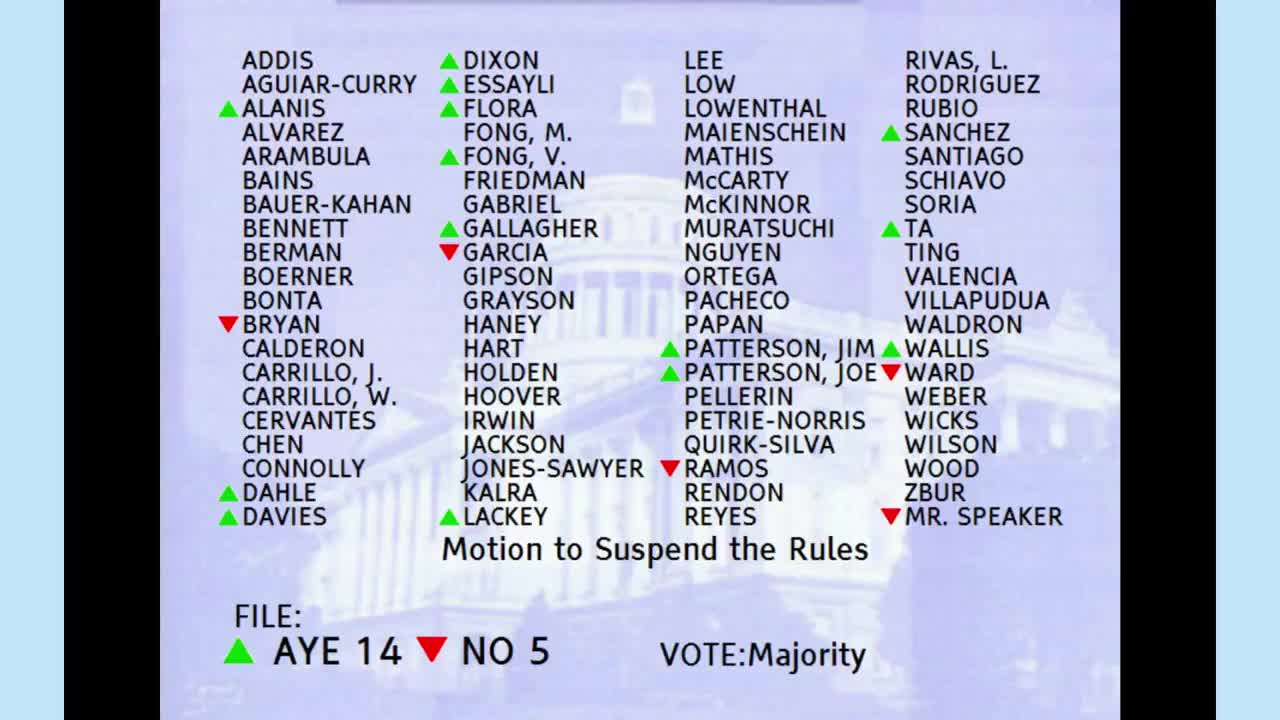
Bill Author

Bill Co-Author(s):