SB 48: Building Energy Savings Act.
- Session Year: 2023-2024
- House: Senate
- Latest Version Date: 2023-10-07
Current Status:
Passed
(2023-10-07: Chaptered by Secretary of State. Chapter 378, Statutes of 2023.)
Introduced
In Committee
First Chamber
In Committee
Second Chamber
Enacted
Existing law requires each utility to maintain records of the energy usage data of all buildings to which they provide service for at least the most recent 12 complete calendar months, and to deliver or otherwise provide that aggregated energy usage data for each covered building, as defined, to the owner, as specified. Existing law requires the State Energy Resources Conservation and Development Commission (Energy Commission) to adopt regulations providing for the delivery to the Energy Commission and public disclosure of benchmarking of energy use for covered buildings, and specifies that this requirement does not require the owner of a building with 16 or fewer residential utility accounts to collect or deliver energy usage information to the Energy Commission.
This bill would additionally specify that the requirement does not require the owner of a building with less than 50,000 square feet of gross floor space to collect or deliver energy usage information to the Energy Commission.
Existing law requires the Energy Commission to prescribe, by regulation, lighting, insulation, climate control system, and other building design and construction standards, and energy and water conservation design standards, for new residential and new nonresidential buildings to reduce the wasteful, uneconomic, inefficient, or unnecessary consumption of energy, as specified.
This bill would require the Energy Commission, in consultation with the State Air Resources Board, Public Utilities Commission, and Department of Housing and Community Development, on or before July 1, 2026, to develop a strategy for using the energy usage data described above to track and manage the energy usage and emissions of greenhouse gases of covered buildings in order to achieve the states goals, targets, and standards related to energy usage and emissions of greenhouse gases of covered buildings, as specified. The bill would require the Energy Commission to submit the strategy and recommendations for further legislative action that would help achieve certain objectives to the Legislature on or before August 1, 2026.
Existing law requires each utility to maintain records of the energy usage data of all buildings to which they provide service for at least the most recent 12 complete calendar months, and to deliver or otherwise provide that aggregated energy usage data for each covered building, as defined, to the owner, as specified. Existing law requires the State Energy Resources Conservation and Development Commission (Energy Commission) to adopt regulations providing for the delivery to the Energy Commission and public disclosure of benchmarking of energy use for covered buildings, and specifies that this requirement does not require the owner of a building with 16 or fewer residential utility accounts to collect or deliver energy usage information to the Energy Commission.
This bill would additionally specify that the requirement does not require the owner of a building with less than 50,000 square feet of gross floor space to collect or deliver energy usage information to the Energy Commission.
Existing law authorizes requires the Energy Commission to prescribe, by regulation, lighting, insulation, climate control system, and other building design and construction standards, and energy and water conservation design standards, for new residential and new nonresidential buildings to reduce the wasteful, uneconomic, inefficient, or unnecessary consumption of energy, as specified.
This bill would require the Energy Commission, in consultation with the State Air Resources Board, Public Utilities Commission, and Department of Housing and Community Development, on or before July 1, 2026, to develop a strategy for using the energy usage data described above to track and manage the energy usage and emissions of greenhouse gases of covered buildings in order to achieve the states goals, targets, and standards related to energy usage and emissions of greenhouse gases of covered buildings, as specified. The bill would require the Energy Commission to submit the strategy and recommendations for further legislative action that would help achieve certain objectives to the Legislature on or before August 1, 2026.
Existing law requires each utility to maintain records of the energy usage data of all buildings to which they provide service for at least the most recent 12 complete calendar months, and to deliver or otherwise provide that aggregated energy usage data for each covered building, as defined, to the owner, as specified. Existing law requires the State Energy Resources Conservation and Development Commission (Energy Commission) to adopt regulations providing for the delivery to the Energy Commission and public disclosure of benchmarking of energy use for covered buildings, and specifies that this requirement does not require the owner of a building with 16 or fewer residential utility accounts to collect or deliver energy usage information to the Energy Commission.
This bill would additionally specify that the requirement does not require the owner of a building with less than 50,000 square feet of gross floor space to collect or deliver energy usage information to the Energy Commission.
Existing law authorizes the Energy Commission to prescribe, by regulation, lighting, insulation, climate control system, and other building design and construction standards, and energy and water conservation design standards, for new residential and new nonresidential buildings to reduce the wasteful, uneconomic, inefficient, or unnecessary consumption of energy, as specified.
This bill would require the Energy Commission, in consultation with the State Air Resources Board, Public Utilities Commission, and Department of Housing and Community Development, on or before July 1, 2026, to develop a strategy for using the energy usage data described above to track and manage the energy usage and emissions of greenhouse gases of covered buildings in order to achieve the states goals, targets, and standards related to energy usage and emissions of greenhouse gases of covered buildings, as specified. The bill would require the Energy Commission to submit the strategy to the Legislature on or before August 1, 2026. The bill would authorize the Energy Commission, upon appropriation, to implement the strategy for commercial buildings, including by establishing and enforcing building performance standards consistent with the strategy. The bill would require the Energy Commission, as part of the building performance standards, to establish a process by which building owners can propose, and the commission, or a local city or county building department to which the commission delegates this authority, may approve or reject, an alternative compliance plan for unusual circumstances where a covered building cannot reasonably meet one or more of the applicable building performance standards within the required period of time, as specified. The bill would require the Energy Commission to triennially evaluate the progress of the strategy in achieving improvements in energy efficiency and reducing the emissions of greenhouse gases and evaluate the impacts of the strategy on disadvantaged communities, as specified.
Existing law requires each utility to maintain records of the energy usage data of all buildings to which they provide service for at least the most recent 12 complete calendar months, and to deliver or otherwise provide that aggregated energy usage data for each covered building, as defined, to the owner, as specified. Existing law requires the State Energy Resources Conservation and Development Commission (Energy Commission) to adopt regulations providing for the delivery to the Energy Commission and public disclosure of benchmarking of energy use for covered buildings, and specifies that this requirement does not require the owner of a building with 16 or fewer residential utility accounts to collect or deliver energy usage information to the Energy Commission.
This bill would expand those requirements, beginning January 1, 2025, to include each utility that provides water service and its water usage data. By imposing new duties on utilities that provide water service, the bill would impose a state-mandated local program. additionally specify that the requirement does not require the owner of a building with less than 50,000 square feet of gross floor space to collect or deliver energy usage information to the Energy Commission.
Existing law authorizes the State Energy Resources Conservation and Development Commission (Energy Commission) to prescribe, by regulation, lighting, insulation, climate control system, and other building design and construction standards, and energy and water conservation design standards, for new residential and new nonresidential buildings to reduce the wasteful, uneconomic, inefficient, or unnecessary consumption of energy, as specified.
This bill would require the Energy Commission and the State Water Resources Control Board, Commission, in consultation with the State Air Resources Board, Public Utilities Commission, and Department of Housing and Community Development, on or before July 1, 2026, to jointly develop a strategy for using the energy and water usage data described above to track and manage the energy and water usage and emissions of greenhouse gases of covered buildings in order to achieve the states goals, targets, and standards related to energy and water usage and emissions of greenhouse gases of covered buildings, as specified. The bill would require the Energy Commission to submit the strategy to the Legislature on or before August 1, 2026. The bill would authorize the Energy Commission and the State Water Resources Control Board, Commission, upon appropriation, to jointly implement the strategy, strategy for commercial buildings, including by establishing and enforcing building performance standards consistent with the strategy. The bill would require the Energy Commission, as part of the building performance standards, to establish a process by which building owners can propose, and the commission, or a local city or county building department to which the commission delegates this authority, may approve or reject, an alternative compliance plan for unusual circumstances where a covered building cannot reasonably meet one or more of the applicable building performance standards within the required period of time, as specified. The bill would require the Energy Commission and State Water Resources Control Board to triennially evaluate the progress of the strategy in achieving improvements in energy and water efficiency and reducing the emissions of greenhouse gases and evaluate the impacts of the strategy on disadvantaged communities, as specified.
The California Constitution requires the state to reimburse local agencies and school districts for certain costs mandated by the state. Statutory provisions establish procedures for making that reimbursement.This bill would provide that no reimbursement is required by this act for a specified reason.Existing law requires each utility to maintain records of the energy usage data of all buildings to which they provide service for at least the most recent 12 complete calendar months, and to deliver or otherwise provide that aggregated energy usage data for each covered building, as defined, to the owner, as specified.
This bill would expand those requirements, beginning January 1, 2025, to include each utility that provides water service and its water usage data. By imposing new duties on utilities that provide water service, the bill would impose a state-mandated local program.
Existing law authorizes the State Energy Resources Conservation and Development Commission (Energy Commission) to prescribe, by regulation, lighting, insulation, climate control system, and other building design and construction standards, and energy and water conservation design standards, for new residential and new nonresidential buildings to reduce the wasteful, uneconomic, inefficient, or unnecessary consumption of energy, as specified.
This bill would require the Energy Commission and the State Water Resources Control Board, in consultation with the State Air Resources Board, Public Utilities Commission, and Department of Housing and Community Development, on or before July 1, 2026, to jointly develop a strategy for using the energy and water usage data described above to track and manage the energy and water usage and emissions of greenhouse gases of covered buildings in order to achieve the states goals, targets, and standards related to energy and water usage and emissions of greenhouse gases of covered buildings, as specified. The bill would authorize the Energy Commission and the State Water Resources Control Board, upon appropriation, to jointly establish energy and water usage implement the strategy, including by establishing and enforcing building performance standards consistent with the strategy. The bill would require the Energy Commission, as part of the building performance standards, to establish a process by which building owners can propose, and the commission, or a local city or county building department to which the commission delegates this authority, may approve or reject, an alternative compliance plan for unusual circumstances where a covered building cannot reasonably meet one or more of the applicable building performance standards within the required period of time, as specified. The bill would require the Energy Commission and State Water Resources Control Board to triennially evaluate the progress of the strategy in achieving improvements in energy and water efficiency and reducing the emissions of greenhouse gases and evaluate the impacts of the strategy on disadvantaged communities, as specified.
The California Constitution requires the state to reimburse local agencies and school districts for certain costs mandated by the state. Statutory provisions establish procedures for making that reimbursement.
This bill would provide that no reimbursement is required by this act for a specified reason.
Existing law requires each utility to maintain records of the energy usage data of all buildings to which they provide service for at least the most recent 12 complete calendar months, and to deliver or otherwise provide that aggregated energy usage data for each covered building, as defined, to the owner, as specified.
This bill would expand those requirements, beginning January 1, 2025, to include each utility that provides water service and its water usage data. By imposing new duties on utilities that provide water service, the bill would impose a state-mandated local program.
Existing law authorizes the State Energy Resources Conservation and Development Commission (Energy Commission) to prescribe, by regulation, energy efficiency standards, including appliance efficiency standards, lighting, insulation, climate control system, and other building design and construction standards, and energy and water conservation design standards, for new residential and new nonresidential buildings to reduce the wasteful, uneconomic, inefficient, or unnecessary consumption of energy, including to reduce emissions of greenhouse gases associated with electricity generation and the timing of an appliances use, as specified.
This bill would provide that it is the intent of the Legislature to enact subsequent legislation to create building performance standards for improvements in energy efficiency and reductions in the emissions of greenhouse gases in large buildings, including measures to ensure that making the necessary investments to improve these buildings will improve equity and avoid displacement or increased energy burdens, especially in disadvantaged communities.This bill would require the Energy Commission and the State Water Resources Control Board, in consultation with the State Air Resources Board, Public Utilities Commission, and Department of Housing and Community Development, on or before July 1, 2026, to jointly develop a strategy for using the energy and water usage data described above to track and manage the energy and water usage and emissions of greenhouse gases of covered buildings in order to achieve the states goals, targets, and standards related to energy and water usage and emissions of greenhouse gases of covered buildings, as specified. The bill would authorize the Energy Commission and the State Water Resources Control Board, upon appropriation, to jointly establish energy and water usage building performance standards consistent with the strategy. The bill would require the Energy Commission and State Water Resources Control Board to triennially evaluate the progress of the strategy in achieving improvements in energy and water efficiency and reducing the emissions of greenhouse gases and evaluate the impacts of the strategy on disadvantaged communities, as specified.
The California Constitution requires the state to reimburse local agencies and school districts for certain costs mandated by the state. Statutory provisions establish procedures for making that reimbursement.
This bill would provide that no reimbursement is required by this act for a specified reason.
Existing law authorizes the State Energy Resources Conservation and Development Commission to prescribe, by regulation, energy efficiency standards, including appliance efficiency standards, to reduce the wasteful, uneconomic, inefficient, or unnecessary consumption of energy, including to reduce emissions of greenhouse gases associated with electricity generation and the timing of an appliances use, as specified.
This bill would provide that it is the intent of the Legislature to enact subsequent legislation to create building performance standards for improvements in energy efficiency and reductions in the emissions of greenhouse gases in large buildings, including measures to ensure that making the necessary investments to improve these buildings will improve equity and avoid displacement or increased energy burdens, especially in disadvantaged communities.
(a)This act shall be known, and may be cited, as the Building Energy Savings Act.
(b)The Legislature finds and declares all of the following:
(1)The state faces parallel challenges of climate change, climate-induced extreme weather and droughts, and affordability for housing and utility expenses.
(2)Improving the energy efficiency of our buildings can help address these challenges by reducing utility bills, improving the comfort and habitability of these buildings, reducing energy usage, and reducing the emissions of greenhouse gases that cause climate change.
(3)While changes to the California Building Standards Code (Title 24 of the California Code of Regulations) have dramatically improved the efficiency of energy use and lowered utility bills in our newer residential and commercial buildings, older buildings are often far less efficient and are not required to make code-compliant upgrades unless a major renovation is undertaken.
(4)While improvements in building energy efficiency are salutary, they should not be achieved at an undue cost to tenants, particularly those tenants who are vulnerable to formal or informal eviction, displacement, harassment, or rent increases, if state and local strategies to achieve those energy efficiency improvements are not properly designed.
(5)Improvements in building energy efficiency should be achieved in a way that benefits building inhabitants and the general public. Ensuring that those benefits accrue to tenants is particularly important because tenants have less control over the timing and nature of those improvements than the people who own the home the tenants live in.
(c)It is the intent of the Legislature to achieve improvements in energy efficiency and reductions of the emissions of greenhouse gases in buildings, including measures to ensure that making the necessary investments to improve these buildings will also improve equity and avoid displacement or increased utility burdens, especially in under-resourced communities.
SEC. 2.Section 25402.10 of the Public Resources Code is amended to read:25402.10.(a)For purposes of this section, the following definitions apply:
(1)To benchmark, in reference to energy use, means to obtain information on the energy use in an entire building for a specific period to enable that usage to be tracked or compared against other buildings.
(2)Covered building means either or both of the following:
(A)Any building with no residential utility accounts.
(B)Any building with five or more active utility accounts, residential or nonresidential.
(3)Energy means electricity, natural gas, steam, or fuel oil sold by a utility to a customer for end uses addressed by the ENERGY STAR Portfolio Manager.
(4)ENERGY STAR Portfolio Manager means the tool developed and maintained by the United States Environmental Protection Agency to track and assess the energy performance of buildings.
(b)On and after January 1, 2016, each utility shall maintain records of the energy usage data of all buildings to which they provide service for at least the most recent 12 complete calendar months.
(c)(1)Subject to the requirements of paragraph (2), on and after January 1, 2017, each utility shall, upon the request and written authorization or secure electronic authorization of the owner, owners agent, or operator of a covered building, deliver or otherwise provide aggregated energy usage data for a covered building to the owner, owners agent, building operator, or to the owners account in the ENERGY STAR Portfolio Manager. The commission may specify additional information to be delivered by utilities to enable building owners to complete benchmarking of the energy use in their buildings and in other systems or formats for information delivery and automation.
(2)The delivery of information by utilities pursuant to this section shall be subject to the following requirements:
(A)For covered buildings with three or more active utility accounts, each utility shall deliver information showing the aggregated energy usage data of all utility customers in the same building for each of the 12 prior months. Notwithstanding any other law, energy usage data aggregated in this manner shall not be deemed customer utility usage information or confidential information by the utility for purposes of delivery to the owner, owners agent, or operator of a building. The building owner and utility shall not have any liability for any use or disclosure of aggregated energy usage data delivered as required by this section.
(B)For covered buildings not subject to subparagraph (A), each utility shall deliver the information showing the aggregated energy usage data of all utility customers in each covered building for each of the prior 12 months if the accountholder provides written or electronic consent for the delivery of the accountholders energy usage data to the owner, owners agent, operator, or utility.
(C)Each utility shall deliver, upload, or otherwise provide aggregated energy usage data within four weeks of receiving a request from an owner, owners agent, or operator of a covered building.
(D)Each utility shall make available the covered building energy usage data aggregated at a monthly level unless otherwise specified by the commission.
(E)The building owner and utility shall not have any liability for any use or disclosure by others of usage information delivered as required by this section.
(d)The commission shall adopt regulations providing for the delivery to the commission and public disclosure of benchmarking of energy use for covered buildings, as follows:
(1)This subdivision does not require the owner of a building with less than 50,000 square feet of gross floor space or with 16 or fewer residential utility accounts to collect or deliver energy usage information to the commission.
(2)The commission may do, but is not limited to doing, all of the following in regulations adopted pursuant to this subdivision:
(A)Identify and provide for the collection of the energy usage data for calculations for the purpose of benchmarking of energy use.
(B)Identify and provide for the collection of the covered building characteristic information deemed necessary by the commission for the calculations for the purpose of the benchmarking of energy use.
(C)Specify the manner in which certain benchmarking of energy use shall be publicly disclosed.
(D)Determine which covered buildings, in addition to those described in paragraph (1), are not subject to the public disclosure requirement.
(E)Set a schedule to implement the requirements for public disclosure adopted by the commission.
(F)Determine if compliance with a local or county benchmarking program fulfills the commissions requirements adopted pursuant to this subdivision.
(G)Identify categories of information it receives pursuant to this section that are protected from release under either the California Public Records Act (Division 10 (commencing with Section 7920.000) of Title 1 of the Government Code) or the Information Practices Act of 1977 (Chapter 1 (commencing with Section 1798) of Title 1.8 of Part 4 of Division 3 of the Civil Code).
(3)The commission shall determine who will deliver the energy usage data and related information for any covered building to the commission.
(e)The commission may ensure timely and accurate compliance with the data submission requirements of this section by using the enforcement measures identified in Section 25321. An owner of a covered building, or its agents or operators, shall not be liable for any noncompliance due to the failure of a utility to provide the information required for compliance.
(f)For buildings that are not covered buildings, and for customer information that is not aggregated pursuant to subparagraph (A) of paragraph (2) of subdivision (c), the commission may adopt regulations prescribing how utilities shall either obtain the customers permission or determine that a building owner has obtained the customers permission, for the owner to receive aggregated energy usage data or, where applicable, individual customer usage information, including by use of electronic authorization and in a lease agreement between the owner and the customer.
(g)The reasonable costs of an electrical or gas corporation in delivering electrical or gas usage data pursuant to this section or other information as required under state or federal law or by an order of the commission shall be recoverable in rates evaluated and approved by the Public Utilities Commission.
(h)The reasonable costs of local publicly owned electric utilities in disclosing electrical usage data pursuant to this section may be considered cost-effective demand-side management services to promote energy efficiency and energy conservation and thereby reimbursable by their general funds.
(i)(1)For purposes of adopting or revising regulations pursuant to subdivision (d), the commission may include two or more buildings located on a single parcel or adjacent parcels with the same owner of record and with five or more active utility accounts, in aggregate, residential or nonresidential, as a single covered building, as described in subparagraph (B) of paragraph (2) of subdivision (a).
(2)An electrical or gas utility shall provide to the owner, owners agent, or operator of a property containing two or more buildings on a single parcel or adjacent parcels with five or more active utility accounts, in aggregate, residential or nonresidential, upon request of the owner, agent, or operator, aggregate energy usage data on all such buildings in a manner provided pursuant to subdivision (c) as if those buildings are a single covered building, as described in subparagraph (B) of paragraph (2) of subdivision (a).
(j)This section does not prevent a city or county from establishing its own benchmarking program requiring collection, delivery, and disclosure of building information.
SEC. 3.Section 25402.16 is added to the Public Resources Code, to read:25402.16.(a)For purposes of this section, the following definitions apply:
(1)Benchmarking data means data delivered to the commission pursuant to Section 25402.10.
(2)Covered building means any building subject to the benchmarking regulations adopted pursuant to Section 25402.10.
(3)Fuel-related emissions of greenhouse gases means emissions of greenhouse gases from the onsite usage of fuels or emissions of greenhouse gases from the offsite production of steam or other forms of thermal energy, or from locally generated electricity, as part of a district energy system, but excludes emissions of greenhouse gases associated with electricity from the electrical grid that is used by a covered building.
(4)Harassment means an act that is unlawful pursuant to subdivision (a) of Section 1940.2 of the Civil Code, a misrepresentation made to a tenant that the tenant is required to vacate a rented area, or any other act defined as harassment by an applicable city, county, or city and county ordinance.
(5)Under-resourced community has the same meaning as defined in Section 71130.
(b)On or before July 1, 2026, the commission, in consultation with the State Air Resources Board, Public Utilities Commission, and Department of Housing and Community Development, shall develop a strategy for using benchmarking data to track and manage the energy usage and emissions of greenhouse gases of covered buildings in order to achieve the states goals, targets, and standards related to energy usage and emissions of greenhouse gases of covered buildings, including both of the following targets:
(1)The annual targets for statewide energy efficiency savings and demand reduction established pursuant to subdivision (c) of Section 25310.
(2)The greenhouse gas emission reductions targets for the building sector established by the State Air Resources Board as part of achieving the economywide greenhouse gas emissions reductions required pursuant to the California Global Warming Solutions Act of 2006 (Division 25.5 (commencing with Section 38500) of the Health and Safety Code).
(c)In developing the strategy pursuant to subdivision (b), the commission shall do all of the following:
(1)Avoid increasing utility and rental cost burdens for, or causing evictions, harassment, or displacement of, tenants of covered buildings. For purposes of this paragraph, the commission shall consider including the following requirements as part of the strategy:
(A)Requirements to prohibit a renovation to a covered building that is required by the strategy from being a basis for terminating a tenancy and to ensure that any temporary relocation costs resulting from the renovation is paid for by the covered building owner.
(B)Requirements to prohibit an increase in rent for a tenant as a result of a renovation to a covered building that is required by the strategy or to limit the increase in rent to the long-term energy savings to a tenant resulting from the renovation.
(2)Assess the feasibility and cost-effectiveness of building upgrades available to covered building owners for achieving increased energy efficiency and reductions of the emissions of greenhouse gases.
(3)Provide flexibility, to the extent feasible, for covered building owners to select among technology options and to align the timing of building upgrades with equipment replacement cycles.
(4)Encourage equitable access to jobs and other economic opportunities that may result from increased investment in covered building upgrades.
(5)Prioritize reductions in fuel-related emissions of greenhouse gases because the state has already established targets, pursuant to Section 454.53 of the Public Utilities Code, for reducing, and ultimately eliminating, indirect emissions of greenhouse gases associated with electricity.
(6)Prioritize efficiency and decarbonization measures that will benefit tenants, including measures that reduce tenants energy costs and remove indoor environmental hazards.
(7)Consider including a process by which a covered building owner can propose, and the commission, or a local city or county building department to which the commission delegates this authority, may approve or reject, an alternative compliance plan. An alternative compliance plan shall, consistent with paragraph (1), avoid increasing utility and rental cost burdens for, or causing evictions, harassment, or displacement of, tenants.
(8)Consider authorizing a local jurisdiction to implement its own program for increasing energy efficiency and reducing the emissions of greenhouse gases as an alternative to the strategy developed pursuant to subdivision (b) if that program is expected to achieve substantially equivalent or better increases in energy efficiency and reductions of the emissions of greenhouse gases, and if that program guarantees substantially equivalent or stronger tenant protections.
(d)In developing the strategy pursuant to subdivision (b), the commission shall consider input from affected stakeholders, including all of the following:
(1)Members of under-resourced communities and community-based organizations representing tenant advocacy, equity, and environmental justice concerns of under-resourced communities.
(2)Representatives of local city or county government.
(3)Owners or operators of affordable housing.
(4)Groups representing low-income residential and small commercial tenants, including organizations that provide legal services to those tenants.
(5)Providers of energy efficiency, renewable energy, and building decarbonization equipment and services.
(6)Labor unions that represent workers who implement building upgrades related to, or who manage or service, the energy infrastructure of covered buildings.
(7)Technical building design professionals.
(8)Facility operations professionals.
(9)Multiunit residential building owners.
(10)Nonresidential building owners.
(11)Energy utilities.
(e)In order to ensure equitable participation and input from stakeholders representing under-resourced communities, low-income residential tenants, and small commercial tenants in the development of the strategy pursuant to subdivision (b), the commission shall do all of the following:
(1)Contract with one or more organizations with experience representing under-resourced communities, low-income residential tenants, and small commercial tenants to advise the commission on the development of the strategy.
(2)Consider the feedback and recommendations from each advisory organization contracted with pursuant to paragraph (1) on the proposed strategy in advance of adopting any final strategy and, to the extent that any recommendations are not adopted in the final strategy, provide a written explanation of why the recommendations were not adopted and how the final strategy attempts to address the issues raised in those recommendations in an alternative way.
(3)In consultation with the advisory organizations contracted with pursuant to paragraph (1) and other stakeholders, develop metrics that could be used if the strategy is implemented to measure how the strategy is impacting under-resourced communities, low-income residential tenants, and small commercial tenants, and assess whether the strategy is achieving just and equitable outcomes.
(f)(1)On or before August 1, 2026, the commission shall submit to the Legislature the strategy developed pursuant to subdivision (b) and recommendations for further legislative action that would help achieve the objectives described in subdivision (c) if the strategy is implemented.
(2)The commission may submit the strategy and recommendations to the Legislature as part of a report otherwise submitted to the Legislature.
(a)This act shall be known, and may be cited, as the Building Energy Savings Act.
(b)The Legislature finds and declares all of the following:
(1)The state faces parallel challenges of climate change, climate-induced extreme weather and droughts, and affordability for housing and utility expenses.
(2)Improving the energy efficiency of our buildings can help address these challenges by reducing utility bills, improving the comfort and habitability of these buildings, reducing energy usage, and reducing the emissions of greenhouse gases that cause climate change.
(3)While changes to the California Building Standards Code (Title 24 of the California Code of Regulations) have dramatically improved the efficiency of energy use and lowered utility bills in our newer residential and commercial buildings, older buildings are often far less efficient and are not required to make code-compliant upgrades unless a major renovation is undertaken.
(4)Building performance standards have been enacted in 10 United States jurisdictions as of January 1, 2023, including in New York City and Washington, D.C., and statewide in Washington, Maryland, and Colorado, as a practical policy for requiring large buildings to improve efficiency, lower utility costs for tenants, and reduce emissions of greenhouse gases, with interim targets that become more stringent over time while giving building owners flexibility and time to plan for how to achieve those requirements.(5)A focus on improving the performance of large buildings is desirable because large buildings represent a small share of total buildings, but a much larger share of total energy usage and emissions of greenhouse gases, and the owners of large buildings are usually more capable of making plans and obtaining capital for the needed improvements than the owners of smaller buildings.(6)Building performance standards that drive investment in older buildings can create local job opportunities, strengthen climate resilience, and result in healthier, more durable spaces in which to live, learn, and work.(7)(4)While improvements in building energy efficiency are salutary, they should not be achieved at an undue cost to tenants, particularly those tenants who are vulnerable to formal or informal eviction, displacement, harassment, or rent increases, if state and local strategies to achieve those energy efficiency improvements are not properly designed.
(8)(5)Improvements in building energy efficiency should be achieved in a way that benefits building inhabitants and the general public. Ensuring that those benefits accrue to tenants is particularly important because tenants have less control over the timing and nature of those improvements than the people who own the home the tenants live in.
(c)It is the intent of the Legislature to explore the feasibility of establishing building performance standards for large buildings in order to achieve improvements in energy efficiency and reductions of the emissions of greenhouse gases, gases in buildings, including measures to ensure that making the necessary investments to improve these buildings will also improve equity and avoid displacement or increased utility burdens, especially in under-resourced communities.
SEC. 2.Section 25402.10 of the Public Resources Code is amended to read:25402.10.(a)For purposes of this section, the following definitions apply:
(1)To benchmark, in reference to energy use, means to obtain information on the energy use in an entire building for a specific period to enable that usage to be tracked or compared against other buildings.
(2)Covered building means either or both of the following:
(A)Any building with no residential utility accounts.
(B)Any building with five or more active utility accounts, residential or nonresidential.
(3)Energy means electricity, natural gas, steam, or fuel oil sold by a utility to a customer for end uses addressed by the ENERGY STAR Portfolio Manager.
(4)ENERGY STAR Portfolio Manager means the tool developed and maintained by the United States Environmental Protection Agency to track and assess the energy performance of buildings.
(b)On and after January 1, 2016, each utility shall maintain records of the energy usage data of all buildings to which they provide service for at least the most recent 12 complete calendar months.
(c)(1)Subject to the requirements of paragraph (2), on and after January 1, 2017, each utility shall, upon the request and written authorization or secure electronic authorization of the owner, owners agent, or operator of a covered building, deliver or otherwise provide aggregated energy usage data for a covered building to the owner, owners agent, building operator, or to the owners account in the ENERGY STAR Portfolio Manager. The commission may specify additional information to be delivered by utilities to enable building owners to complete benchmarking of the energy use in their buildings and in other systems or formats for information delivery and automation.
(2)The delivery of information by utilities pursuant to this section shall be subject to the following requirements:
(A)For covered buildings with three or more active utility accounts, each utility shall deliver information showing the aggregated energy usage data of all utility customers in the same building for each of the 12 prior months. Notwithstanding any other law, energy usage data aggregated in this manner shall not be deemed customer utility usage information or confidential information by the utility for purposes of delivery to the owner, owners agent, or operator of a building. The building owner and utility shall not have any liability for any use or disclosure of aggregated energy usage data delivered as required by this section.
(B)For covered buildings not subject to subparagraph (A), each utility shall deliver the information showing the aggregated energy usage data of all utility customers in each covered building for each of the prior 12 months if the accountholder provides written or electronic consent for the delivery of the accountholders energy usage data to the owner, owners agent, operator, or utility.
(C)Each utility shall deliver, upload, or otherwise provide aggregated energy usage data within four weeks of receiving a request from an owner, owners agent, or operator of a covered building.
(D)Each utility shall make available the covered building energy usage data aggregated at a monthly level unless otherwise specified by the commission.
(E)The building owner and utility shall not have any liability for any use or disclosure by others of usage information delivered as required by this section.
(d)The commission shall adopt regulations providing for the delivery to the commission and public disclosure of benchmarking of energy use for covered buildings, as follows:
(1)This subdivision does not require the owner of a building with less than 50,000 square feet of gross floor space or with 16 or fewer residential utility accounts to collect or deliver energy usage information to the commission.
(2)The commission may do, but is not limited to doing, all of the following in regulations adopted pursuant to this subdivision:
(A)Identify and provide for the collection of the energy usage data for calculations for the purpose of benchmarking of energy use.
(B)Identify and provide for the collection of the covered building characteristic information deemed necessary by the commission for the calculations for the purpose of the benchmarking of energy use.
(C)Specify the manner in which certain benchmarking of energy use shall be publicly disclosed.
(D)Determine which covered buildings, in addition to those described in paragraph (1), are not subject to the public disclosure requirement.
(E)Set a schedule to implement the requirements for public disclosure adopted by the commission.
(F)Determine if compliance with a local or county benchmarking program fulfills the commissions requirements adopted pursuant to this subdivision.
(G)Identify categories of information it receives pursuant to this section that are protected from release under either the California Public Records Act (Division 10 (commencing with Section 7920.000) of Title 1 of the Government Code) or the Information Practices Act of 1977 (Chapter 1 (commencing with Section 1798) of Title 1.8 of Part 4 of Division 3 of the Civil Code).
(3)The commission shall determine who will deliver the energy usage data and related information for any covered building to the commission.
(e)The commission may ensure timely and accurate compliance with the data submission requirements of this section by using the enforcement measures identified in Section 25321. An owner of a covered building, or its agents or operators, shall not be liable for any noncompliance due to the failure of a utility to provide the information required for compliance.
(f)For buildings that are not covered buildings, and for customer information that is not aggregated pursuant to subparagraph (A) of paragraph (2) of subdivision (c), the commission may adopt regulations prescribing how utilities shall either obtain the customers permission or determine that a building owner has obtained the customers permission, for the owner to receive aggregated energy usage data or, where applicable, individual customer usage information, including by use of electronic authorization and in a lease agreement between the owner and the customer.
(g)The reasonable costs of an electrical or gas corporation in delivering electrical or gas usage data pursuant to this section or other information as required under state or federal law or by an order of the commission shall be recoverable in rates evaluated and approved by the Public Utilities Commission.
(h)The reasonable costs of local publicly owned electric utilities in disclosing electrical usage data pursuant to this section may be considered cost-effective demand-side management services to promote energy efficiency and energy conservation and thereby reimbursable by their general funds.
(i)(1)For purposes of adopting or revising regulations pursuant to subdivision (d), the commission may include two or more buildings located on a single parcel or adjacent parcels with the same owner of record and with five or more active utility accounts, in aggregate, residential or nonresidential, as a single covered building, as described in subparagraph (B) of paragraph (2) of subdivision (a).
(2)An electrical or gas utility shall provide to the owner, owners agent, or operator of a property containing two or more buildings on a single parcel or adjacent parcels with five or more active utility accounts, in aggregate, residential or nonresidential, upon request of the owner, agent, or operator, aggregate energy usage data on all such buildings in a manner provided pursuant to subdivision (c) as if those buildings are a single covered building, as described in subparagraph (B) of paragraph (2) of subdivision (a).
(j)This section does not prevent a city or county from establishing its own benchmarking program requiring collection, delivery, and disclosure of building information.
SEC. 3.Section 25402.16 is added to the Public Resources Code, to read:25402.16.(a)For purposes of this section, the following definitions apply:
(1)Benchmarking data means data delivered to the commission pursuant to Section 25402.10.
(2)Covered building means any building subject to the benchmarking regulations adopted pursuant to Section 25402.10.
(3)Fuel-related emissions of greenhouse gases means emissions of greenhouse gases from the onsite usage of fuels or emissions of greenhouse gases from the offsite production of steam or other forms of thermal energy, or from locally generated electricity, as part of a district energy system, but excludes emissions of greenhouse gases associated with electricity from the electrical grid that is used by a covered building.
(4)Harassment means an act that is unlawful pursuant to subdivision (a) of Section 1940.2 of the Civil Code, a misrepresentation made to a tenant that the tenant is required to vacate a rented area, or any other act defined as harassment by an applicable city, county, or city and county ordinance.
(5)Under-resourced community has the same meaning as defined in Section 71130.
(b)(1)On or before July 1, 2026, the commission, in consultation with the State Air Resources Board, Public Utilities Commission, and Department of Housing and Community Development, shall develop a strategy for using benchmarking data to track and manage the energy usage and emissions of greenhouse gases of covered buildings in order to achieve the states goals, targets, and standards related to energy usage and emissions of greenhouse gases of covered buildings, including both of the following targets:
(A)(1)The annual targets for statewide energy efficiency savings and demand reduction established pursuant to subdivision (c) of Section 25310.
(B)(2)The greenhouse gas emission reductions targets for the building sector established by the State Air Resources Board as part of achieving the economywide greenhouse gas emissions reductions required pursuant to the California Global Warming Solutions Act of 2006 (Division 25.5 (commencing with Section 38500) of the Health and Safety Code).
(2)The strategy may include building performance standards.(c)In developing the strategy pursuant to subdivision (b), the commission shall do all of the following:
(1)Avoid increasing utility and rental cost burdens for, or causing evictions, harassment, or displacement of, tenants of covered buildings. For purposes of this paragraph, the commission shall consider including the following requirements as part of the strategy:
(A)Requirements to prohibit a renovation to a covered building that is required by the strategy from being a basis for terminating a tenancy and to ensure that any temporary relocation costs resulting from the renovation is paid for by the covered building owner.
(B)Requirements to prohibit an increase in rent for a tenant as a result of a renovation to a covered building that is required by the strategy or to limit the increase in rent to the long-term energy savings to a tenant resulting from the renovation.
(2)Assess the feasibility and cost-effectiveness of building upgrades available to covered building owners for achieving increased energy efficiency and reductions of the emissions of greenhouse gases.
(3)Provide flexibility, to the extent feasible, for covered building owners to select among technology options and to align the timing of building upgrades with equipment replacement cycles.
(4)Encourage equitable access to jobs and other economic opportunities that may result from increased investment in covered building upgrades.
(5)Prioritize reductions in fuel-related emissions of greenhouse gases because the state has already established targets, pursuant to Section 454.53 of the Public Utilities Code, for reducing, and ultimately eliminating, indirect emissions of greenhouse gases associated with electricity used by buildings. electricity.
(6)Prioritize efficiency and decarbonization measures that will benefit tenants, including measures that reduce tenants energy costs and remove indoor environmental hazards.
(7)Consider including a process by which a covered building owner can propose, and the commission, or a local city or county building department to which the commission delegates this authority, may approve or reject reject, an alternative compliance plan for unusual circumstances where a covered building cannot reasonably meet the building performance standards that may be included within the strategy pursuant to paragraph (2) of subdivision (b). plan. An alternative compliance plan shall, consistent with paragraph (1), avoid increasing utility and rental cost burdens for, or causing evictions, harassment, or displacement of, tenants.
(8)Consider authorizing a local jurisdiction to implement its own program for increasing energy efficiency and reducing the emissions of greenhouse gases as an alternative to the strategy developed pursuant to subdivision (b) if that program is expected to achieve substantially equivalent or better increases in energy efficiency and reductions of the emissions of greenhouse gases, and if that program guarantees substantially equivalent or stronger tenant protections.
(d)In developing the strategy pursuant to subdivision (b), the commission shall consider input from affected stakeholders, including all of the following:
(1)Members of under-resourced communities and community-based organizations representing tenant advocacy, equity, and environmental justice concerns of under-resourced communities.
(2)Representatives of local city or county government.
(3)Owners or operators of affordable housing.
(4)Groups representing low-income residential and small commercial tenants, including organizations that provide legal services to those tenants.
(5)Providers of energy efficiency, renewable energy, and building decarbonization equipment and services.
(6)Labor unions that represent workers who implement building upgrades related to, or who manage or service, the energy infrastructure of covered buildings.
(7)Technical building design professionals.
(8)Facility operations professionals.
(9)Multiunit residential building owners.
(10)Nonresidential building owners.
(11)Energy utilities.
(e)In order to ensure equitable participation and input from stakeholders representing under-resourced communities, low-income residential tenants, and small commercial tenants in the development of the strategy pursuant to subdivision (b), the commission shall do all of the following:
(1)Contract with one or more organizations with experience representing under-resourced communities, low-income residential tenants, and small commercial tenants to advise the commission on the development of the strategy.
(2)Consider the feedback and recommendations from each advisory organization contracted with pursuant to paragraph (1) on the proposed strategy in advance of adopting any final strategy and, to the extent that any recommendations are not adopted in the final strategy, provide a written explanation of why the recommendations were not adopted and how the final strategy attempts to address the issues raised in those recommendations in an alternative way.
(3)In consultation with the advisory organizations contracted with pursuant to paragraph (1) and other stakeholders, develop metrics that could be used if the strategy is implemented to measure how the strategy is impacting under-resourced communities, low-income residential tenants, and small commercial tenants, and assess whether the strategy is achieving just and equitable outcomes.
(f)(1)On or before August 1, 2026, the commission shall submit to the Legislature the strategy developed pursuant to subdivision (b) and recommendations for further legislative action that would help achieve the objectives described in subdivision (c) if the strategy is implemented.
(2)The commission may submit the strategy and recommendations to the Legislature as part of a report otherwise submitted to the Legislature.
(a)This act shall be known, and may be cited, as the Building Energy Savings Act.
(b)The Legislature finds and declares all of the following:
(1)The state faces parallel challenges of climate change, climate-induced extreme weather and droughts, and affordability for housing and utility expenses.
(2)Improving the energy efficiency of our buildings can help address these challenges by reducing utility bills, improving the comfort and habitability of these buildings, reducing energy usage, and reducing the emissions of greenhouse gases that cause climate change.
(3)While changes to the California Building Standards Code (Title 24 of the California Code of Regulations) have dramatically improved the efficiency of energy use and lowered utility bills in our newer residential and commercial buildings, older buildings are often far less efficient and are not required to make code-compliant upgrades unless a major renovation is undertaken.
(4)Building performance standards have been enacted in 10 United States jurisdictions as of January 1, 2023, including in New York City and Washington, D.C., and statewide in Washington, Maryland, and Colorado, as a practical policy for requiring large buildings to improve efficiency, lower utility costs for tenants, and reduce emissions of greenhouse gases, with interim targets that become more stringent over time while giving building owners flexibility and time to plan for how to achieve those requirements.
(5)A focus on improving the performance of large buildings is desirable because large buildings represent a small share of total buildings, but a much larger share of total energy usage and emissions of greenhouse gases, and the owners of large buildings are usually more capable of making plans and obtaining capital for the needed improvements than the owners of smaller buildings.
(6)Building performance standards that drive investment in older buildings can create local job opportunities, strengthen climate resilience, and result in healthier, more durable spaces in which to live, learn, and work.
(7)While improvements in building energy efficiency are salutary, they should not be achieved at an undue cost to tenants, particularly those tenants who are vulnerable to formal or informal eviction, displacement, harassment, or rent increases, if state and local strategies to achieve those energy efficiency improvements are not properly designed.
(8)Improvements in building energy efficiency should be achieved in a way that benefits building inhabitants and the general public. Ensuring that those benefits accrue to tenants is particularly important because tenants have less control over the timing and nature of those improvements than the people who own the home the tenants live in.
(c)It is the intent of the Legislature to explore the feasibility of establishing building performance standards for large buildings in order to achieve improvements in energy efficiency and reductions of the emissions of greenhouse gases, including measures to ensure that making the necessary investments to improve these buildings will also improve equity and avoid displacement or increased utility burdens, especially in under-resourced communities.
SEC. 2.Section 25402.10 of the Public Resources Code is amended to read:25402.10.(a)For purposes of this section, the following definitions apply:
(1)To benchmark, in reference to energy use, means to obtain information on the energy use in an entire building for a specific period to enable that usage to be tracked or compared against other buildings.
(2)Covered building means either or both of the following:
(A)Any building with no residential utility accounts.
(B)Any building with five or more active utility accounts, residential or nonresidential.
(3)Energy means electricity, natural gas, steam, or fuel oil sold by a utility to a customer for end uses addressed by the ENERGY STAR Portfolio Manager.
(4)ENERGY STAR Portfolio Manager means the tool developed and maintained by the United States Environmental Protection Agency to track and assess the energy performance of buildings.
(b)On and after January 1, 2016, each utility shall maintain records of the energy usage data of all buildings to which they provide service for at least the most recent 12 complete calendar months.
(c)(1)Subject to the requirements of paragraph (2), on and after January 1, 2017, each utility shall, upon the request and written authorization or secure electronic authorization of the owner, owners agent, or operator of a covered building, deliver or otherwise provide aggregated energy usage data for a covered building to the owner, owners agent, building operator, or to the owners account in the ENERGY STAR Portfolio Manager. The commission may specify additional information to be delivered by utilities to enable building owners to complete benchmarking of the energy use in their buildings and in other systems or formats for information delivery and automation.
(2)The delivery of information by utilities pursuant to this section shall be subject to the following requirements:
(A)For covered buildings with three or more active utility accounts, each utility shall deliver information showing the aggregated energy usage data of all utility customers in the same building for each of the 12 prior months. Notwithstanding any other law, energy usage data aggregated in this manner shall not be deemed customer utility usage information or confidential information by the utility for purposes of delivery to the owner, owners agent, or operator of a building. The building owner and utility shall not have any liability for any use or disclosure of aggregated energy usage data delivered as required by this section.
(B)For covered buildings not subject to subparagraph (A), each utility shall deliver the information showing the aggregated energy usage data of all utility customers in each covered building for each of the prior 12 months if the accountholder provides written or electronic consent for the delivery of the accountholders energy usage data to the owner, owners agent, operator, or utility.
(C)Each utility shall deliver, upload, or otherwise provide aggregated energy usage data within four weeks of receiving a request from an owner, owners agent, or operator of a covered building.
(D)Each utility shall make available the covered building energy usage data aggregated at a monthly level unless otherwise specified by the commission.
(E)The building owner and utility shall not have any liability for any use or disclosure by others of usage information delivered as required by this section.
(d)The commission shall adopt regulations providing for the delivery to the commission and public disclosure of benchmarking of energy use for covered buildings, as follows:
(1)This subdivision does not require the owner of a building with less than 50,000 square feet of gross floor space or with 16 or fewer residential utility accounts to collect or deliver energy usage information to the commission.
(2)The commission may do, but is not limited to doing, all of the following in regulations adopted pursuant to this subdivision:
(A)Identify and provide for the collection of the energy usage data for calculations for the purpose of benchmarking of energy use.
(B)Identify and provide for the collection of the covered building characteristic information deemed necessary by the commission for the calculations for the purpose of the benchmarking of energy use.
(C)Specify the manner in which certain benchmarking of energy use shall be publicly disclosed.
(D)Determine which covered buildings, in addition to those described in paragraph (1), are not subject to the public disclosure requirement.
(E)Set a schedule to implement the requirements for public disclosure adopted by the commission.
(F)Determine if compliance with a local or county benchmarking program fulfills the commissions requirements adopted pursuant to this subdivision.
(G)Identify categories of information it receives pursuant to this section that are protected from release under either the California Public Records Act (Division 10 (commencing with Section 7920.000) of Title 1 of the Government Code) or the Information Practices Act of 1977 (Chapter 1 (commencing with Section 1798) of Title 1.8 of Part 4 of Division 3 of the Civil Code).
(3)The commission shall determine who will deliver the energy usage data and related information for any covered building to the commission.
(e)The commission may ensure timely and accurate compliance with the data submission requirements of this section by using the enforcement measures identified in Section 25321. An owner of a covered building, or its agents or operators, shall not be liable for any noncompliance due to the failure of a utility to provide the information required for compliance.
(f)For buildings that are not covered buildings, and for customer information that is not aggregated pursuant to subparagraph (A) of paragraph (2) of subdivision (c), the commission may adopt regulations prescribing how utilities shall either obtain the customers permission or determine that a building owner has obtained the customers permission, for the owner to receive aggregated energy usage data or, where applicable, individual customer usage information, including by use of electronic authorization and in a lease agreement between the owner and the customer.
(g)The reasonable costs of an electrical or gas corporation in delivering electrical or gas usage data pursuant to this section or other information as required under state or federal law or by an order of the commission shall be recoverable in rates evaluated and approved by the Public Utilities Commission.
(h)The reasonable costs of local publicly owned electric utilities in disclosing electrical usage data pursuant to this section may be considered cost-effective demand-side management services to promote energy efficiency and energy conservation and thereby reimbursable by their general funds.
(i)(1)For purposes of adopting or revising regulations pursuant to subdivision (d), the commission may include two or more buildings located on a single parcel or adjacent parcels with the same owner of record and with five or more active utility accounts, in aggregate, residential or nonresidential, as a single covered building, as described in subparagraph (B) of paragraph (2) of subdivision (a).
(2)An electrical or gas utility shall provide to the owner, owners agent, or operator of a property containing two or more buildings on a single parcel or adjacent parcels with five or more active utility accounts, in aggregate, residential or nonresidential, upon request of the owner, agent, or operator, aggregate energy usage data on all such buildings in a manner provided pursuant to subdivision (c) as if those buildings are a single covered building, as described in subparagraph (B) of paragraph (2) of subdivision (a).
(j)This section does not prevent a city or county from establishing its own benchmarking program requiring collection, delivery, and disclosure of building information.
SEC. 3.Section 25402.16 is added to the Public Resources Code, to read:25402.16.(a)For purposes of this section, the following definitions apply:
(1)Benchmarking data means data delivered to the commission pursuant to Section 25402.10.
(2)Covered building means any building subject to the benchmarking regulations adopted pursuant to Section 25402.10.
(3)Fuel-related emissions of greenhouse gases means emissions of greenhouse gases from the onsite usage of fuels or emissions of greenhouse gases from the offsite production of steam or other forms of thermal energy, or from locally generated electricity, as part of a district energy system, but excludes emissions of greenhouse gases associated with electricity from the electrical grid that is used by a covered building.
(4)Harassment means an act that is unlawful pursuant to subdivision (a) of Section 1940.2 of the Civil Code, a misrepresentation made to a tenant that the tenant is required to vacate a rented area, or any other act defined as harassment by an applicable city, county, or city and county ordinance.
(5)Under-resourced community has the same meaning as defined in Section 71130.
(b)(1)On or before July 1, 2026, the commission, in consultation with the State Air Resources Board, Public Utilities Commission, and Department of Housing and Community Development, shall develop a strategy for using benchmarking data to track and manage the energy usage and emissions of greenhouse gases of covered buildings in order to achieve the states goals, targets, and standards related to energy usage and emissions of greenhouse gases of covered buildings, including both of the following targets:
(A)The annual targets for statewide energy efficiency savings and demand reduction established pursuant to subdivision (c) of Section 25310.
(B)The greenhouse gas emission reductions targets for the building sector established by the State Air Resources Board as part of achieving the economywide greenhouse gas emissions reductions required pursuant to the California Global Warming Solutions Act of 2006 (Division 25.5 (commencing with Section 38500) of the Health and Safety Code).
(2)The strategy may include building performance standards.
(c)In developing the strategy pursuant to subdivision (b), the commission shall do all of the following:
(1)Avoid increasing utility and rental cost burdens for, or causing evictions, harassment, or displacement of, tenants of covered buildings. For purposes of this paragraph, the commission shall consider including the following requirements as part of the strategy:
(A)Requirements to prohibit a renovation to a covered building that is required by the strategy from being a basis for terminating a tenancy and to ensure that any temporary relocation costs resulting from the renovation is paid for by the covered building owner.
(B)Requirements to prohibit an increase in rent for a tenant as a result of a renovation to a covered building that is required by the strategy or to limit the increase in rent to the long-term energy savings to a tenant resulting from the renovation.
(2)Assess the feasibility and cost-effectiveness of building upgrades available to covered building owners for achieving increased energy efficiency and reductions of the emissions of greenhouse gases.
(3)Provide flexibility, to the extent feasible, for covered building owners to select among technology options and to align the timing of building upgrades with equipment replacement cycles.
(4)Encourage equitable access to jobs and other economic opportunities that may result from increased investment in covered building upgrades.
(5)Prioritize reductions in fuel-related emissions of greenhouse gases because the state has already established targets, pursuant to Section 454.53 of the Public Utilities Code, for reducing, and ultimately eliminating, indirect emissions of greenhouse gases associated with electricity used by buildings.
(6)Prioritize efficiency and decarbonization measures that will benefit tenants, including measures that reduce tenants energy costs and remove indoor environmental hazards.
(7)Consider including a process by which a covered building owner can propose, and the commission, or a local city or county building department to which the commission delegates this authority, may approve or reject an alternative compliance plan for unusual circumstances where a covered building cannot reasonably meet the building performance standards that may be included within the strategy pursuant to paragraph (2) of subdivision (b). An alternative compliance plan shall, consistent with paragraph (1), avoid increasing utility and rental cost burdens for, or causing evictions, harassment, or displacement of, tenants.
(8)Consider authorizing a local jurisdiction to implement its own program for increasing energy efficiency and reducing the emissions of greenhouse gases as an alternative to the strategy developed pursuant to subdivision (b) if that program is expected to achieve substantially equivalent or better increases in energy efficiency and reductions of the emissions of greenhouse gases, and if that program guarantees substantially equivalent or stronger tenant protections.
(d)In developing the strategy pursuant to subdivision (b), the commission shall consider input from affected stakeholders, including all of the following:
(1)Members of under-resourced communities and community-based organizations representing tenant advocacy, equity, and environmental justice concerns of under-resourced communities.
(2)Representatives of local city or county government.
(2)(3)Owners or operators of affordable housing.
(3)(4)Groups representing low-income residential and small commercial tenants, including organizations that provide legal services to those tenants.
(4)(5)Providers of energy efficiency, renewable energy, and building decarbonization equipment and services.
(5)(6)Labor unions that represent workers who implement building upgrades related to, or who manage or service, the energy infrastructure of covered buildings.
(6)(7)Technical building design professionals.
(7)(8)Facility operations professionals.
(8)(9)Multiunit residential building owners.
(9)(10)Nonresidential building owners.
(10)(11)Energy utilities.
(e)In order to ensure equitable participation and input from stakeholders representing under-resourced communities, low-income residential tenants, and small commercial tenants in the development of the strategy pursuant to subdivision (b), the commission shall do all of the following:
(1)Contract with one or more organizations with experience representing under-resourced communities, low-income residential tenants, and small commercial tenants to advise the commission on the development of the strategy.
(2)Consider the feedback and recommendations from each advisory organization contracted with pursuant to paragraph (1) on the proposed strategy in advance of adopting any final strategy and, to the extent that any recommendations are not adopted in the final strategy, provide a written explanation of why the recommendations were not adopted and how the final strategy attempts to address the issues raised in those recommendations in an alternative way.
(3)In consultation with the advisory organizations contracted with pursuant to paragraph (1) and other stakeholders, develop metrics that could be used if the strategy is implemented to measure how the strategy is impacting under-resourced communities, low-income residential tenants, and small commercial tenants, and assess whether the strategy is achieving just and equitable outcomes.
(f)(1)On or before August 1, 2026, the commission shall submit to the Legislature the strategy developed pursuant to subdivision (b) and recommendations for further legislative action that would help achieve the objectives described in subdivision (c) if the strategy is implemented.
(2)The commission may submit the strategy and recommendations to the Legislature as part of a report otherwise submitted to the Legislature.
(a)This shall act shall be known, and may be cited, as the Building Energy Savings Act.
(b)The Legislature finds and declares all of the following:
(1)The state faces parallel challenges of climate change, climate-induced extreme weather and droughts, and affordability for housing and utility expenses.
(2)Improving the energy efficiency of our buildings can help address these challenges by reducing utility bills, improving the comfort and habitability of these buildings, reducing energy usage, and reducing the emissions of greenhouse gases that cause climate change.
(3)While changes to the California Building Standards Code (Title 24 of the California Code of Regulations) have dramatically improved the efficiency of energy use and lowered utility bills in our newer residential and commercial buildings, older buildings are often far less efficient and are not required to make code-compliant upgrades unless a major renovation is undertaken.
(4)Building performance standards have been enacted in 10 United States jurisdictions as of January 1, 2023, including in New York City and Washington, D.C., and statewide in Washington, Maryland, and Colorado, as a practical policy for requiring large buildings to improve efficiency, lower utility costs for tenants, and reduce emissions of greenhouse gases, with interim targets that become more stringent over time while giving building owners flexibility and time to plan for how to achieve those requirements.
(5)A focus on improving the performance of large buildings is desirable because large buildings represent a small share of total buildings, but a much larger share of total energy usage and emissions of greenhouse gases, and the owners of large buildings are usually more capable of making plans and obtaining capital for the needed improvements than the owners of smaller buildings.
(6)Building performance standards that drive investment in older buildings can create local job opportunities, strengthen climate resilience, and result in healthier, more durable spaces in which to live, learn, and work.
(7)While improvements in building energy efficiency are salutary, they should not be achieved at an undue cost to tenants, particularly those tenants who are vulnerable to formal or informal eviction, displacement, harassment, or rent increases, if state and local strategies to achieve those energy efficiency improvements are not properly designed.
(8)Improvements in building energy efficiency should be achieved in a way that benefits building inhabitants and the general public. Ensuring that those benefits accrue to tenants is particularly important because tenants have less control over the timing and nature of those improvements than the people who own the home the tenants live in.
(c)It is the intent of the Legislature to explore the feasibility of establishing building performance standards for large buildings in order to achieve improvements in energy efficiency and reductions of the emissions of greenhouse gases, including measures to ensure that making the necessary investments to improve these buildings will also improve equity and avoid displacement or increased utility burdens, especially in disadvantaged under-resourced communities.
SEC. 2.Section 25402.10 of the Public Resources Code is amended to read:25402.10.(a)For purposes of this section, the following definitions apply:
(1)To benchmark, in reference to energy use, means to obtain information on the energy use in an entire building for a specific period to enable that usage to be tracked or compared against other buildings.
(2)Covered building means either or both of the following:
(A)Any building with no residential utility accounts.
(B)Any building with five or more active utility accounts, residential or nonresidential.
(3)Energy means electricity, natural gas, steam, or fuel oil sold by a utility to a customer for end uses addressed by the ENERGY STAR Portfolio Manager.
(4)ENERGY STAR Portfolio Manager means the tool developed and maintained by the United States Environmental Protection Agency to track and assess the energy performance of buildings.
(b)On and after January 1, 2016, each utility shall maintain records of the energy usage data of all buildings to which they provide service for at least the most recent 12 complete calendar months.
(c)(1)Subject to the requirements of paragraph (2), on and after January 1, 2017, each utility shall, upon the request and written authorization or secure electronic authorization of the owner, owners agent, or operator of a covered building, deliver or otherwise provide aggregated energy usage data for a covered building to the owner, owners agent, building operator, or to the owners account in the ENERGY STAR Portfolio Manager. The commission may specify additional information to be delivered by utilities to enable building owners to complete benchmarking of the energy use in their buildings and in other systems or formats for information delivery and automation.
(2)The delivery of information by utilities pursuant to this section shall be subject to the following requirements:
(A)For covered buildings with three or more active utility accounts, each utility shall deliver information showing the aggregated energy usage data of all utility customers in the same building for each of the 12 prior months. Notwithstanding any other law, energy usage data aggregated in this manner shall not be deemed customer utility usage information or confidential information by the utility for purposes of delivery to the owner, owners agent, or operator of a building. The building owner and utility shall not have any liability for any use or disclosure of aggregated energy usage data delivered as required by this section.
(B)For covered buildings not subject to subparagraph (A), each utility shall deliver the information showing the aggregated energy usage data of all utility customers in each covered building for each of the prior 12 months if the accountholder provides written or electronic consent for the delivery of the accountholders energy usage data to the owner, owners agent, operator, or utility.
(C)Each utility shall deliver, upload, or otherwise provide aggregated energy usage data within four weeks of receiving a request from an owner, owners agent, or operator of a covered building.
(D)Each utility shall make available the covered building energy usage data aggregated at a monthly level unless otherwise specified by the commission.
(E)The building owner and utility shall not have any liability for any use or disclosure by others of usage information delivered as required by this section.
(d)The commission shall adopt regulations providing for the delivery to the commission and public disclosure of benchmarking of energy use for covered buildings, as follows:
(1)This subdivision does not require the owner of a building with less than 50,000 square feet of gross floor space or with 16 or fewer residential utility accounts to collect or deliver energy usage information to the commission.
(2)The commission may do, but is not limited to doing, all of the following in regulations adopted pursuant to this subdivision:
(A)Identify and provide for the collection of the energy usage data for calculations for the purpose of benchmarking of energy use.
(B)Identify and provide for the collection of the covered building characteristic information deemed necessary by the commission for the calculations for the purpose of the benchmarking of energy use.
(C)Specify the manner in which certain benchmarking of energy use shall be publicly disclosed.
(D)Determine which covered buildings, in addition to those described in paragraph (1), are not subject to the public disclosure requirement.
(E)Set a schedule to implement the requirements for public disclosure adopted by the commission.
(F)Determine if compliance with a local or county benchmarking program fulfills the commissions requirements adopted pursuant to this subdivision.
(G)Identify categories of information it receives pursuant to this section that are protected from release under either the California Public Records Act (Division 10 (commencing with Section 7920.000) of Title 1 of the Government Code) or the Information Practices Act of 1977 (Chapter 1 (commencing with Section 1798) of Title 1.8 of Part 4 of Division 3 of the Civil Code).
(3)The commission shall determine who will deliver the energy usage data and related information for any covered building to the commission.
(e)The commission may ensure timely and accurate compliance with the data submission requirements of this section by using the enforcement measures identified in Section 25321. An owner of a covered building, or its agents or operators, shall not be liable for any noncompliance due to the failure of a utility to provide the information required for compliance.
(f)For buildings that are not covered buildings, and for customer information that is not aggregated pursuant to subparagraph (A) of paragraph (2) of subdivision (c), the commission may adopt regulations prescribing how utilities shall either obtain the customers permission or determine that a building owner has obtained the customers permission, for the owner to receive aggregated energy usage data or, where applicable, individual customer usage information, including by use of electronic authorization and in a lease agreement between the owner and the customer.
(g)The reasonable costs of an electrical or gas corporation in delivering electrical or gas usage data pursuant to this section or other information as required under state or federal law or by an order of the commission shall be recoverable in rates evaluated and approved by the Public Utilities Commission.
(h)The reasonable costs of local publicly owned electric utilities in disclosing electrical usage data pursuant to this section may be considered cost-effective demand-side management services to promote energy efficiency and energy conservation and thereby reimbursable by their general funds.
(i)(1)For purposes of adopting or revising regulations pursuant to subdivision (d), the commission may include two or more buildings located on a single parcel or adjacent parcels with the same owner of record and with five or more active utility accounts, in aggregate, residential or nonresidential, as a single covered building, as described in subparagraph (B) of paragraph (2) of subdivision (a).
(2)An electrical or gas utility shall provide to the owner, owners agent, or operator of a property containing two or more buildings on a single parcel or adjacent parcels with five or more active utility accounts, in aggregate, residential or nonresidential, upon request of the owner, agent, or operator, aggregate energy usage data on all such buildings in a manner provided pursuant to subdivision (c) as if those buildings are a single covered building, as described in subparagraph (B) of paragraph (2) of subdivision (a).
(j)This section does not prevent a city or county from establishing its own benchmarking program requiring collection, delivery, and disclosure of building information.
SEC. 3.Section 25402.16 is added to the Public Resources Code, to read:25402.16.(a)For purposes of this section, the following definitions apply:
(1)Benchmarking data means data delivered to the commission pursuant to Section 25402.10.
(2)Covered building means any building subject to the benchmarking regulations adopted pursuant to Section 25402.10.
(3)Disadvantaged communities advisory group means the advisory group established pursuant to Section 400 of the Public Utilities Code.(4)(3)Fuel-related emissions of greenhouse gases means emissions of greenhouse gases from the onsite usage of fuels or emissions of greenhouse gases from the offsite production of steam or other forms of thermal energy, or from locally generated electricity, as part of a district energy system, but excludes emissions of greenhouse gases associated with electricity from the electrical grid that is used by a covered building.
(4)Harassment means an act that is unlawful pursuant to subdivision (a) of Section 1940.2 of the Civil Code, a misrepresentation made to a tenant that the tenant is required to vacate a rented area, or any other act defined as harassment by an applicable city, county, or city and county ordinance.
(5)Under-resourced community has the same meaning as defined in Section 71130.
(b)(1)On or before July 1, 2026, the commission, in consultation with the State Air Resources Board, Public Utilities Commission, and Department of Housing and Community Development, shall develop a strategy for using benchmarking data to track and manage the energy usage and emissions of greenhouse gases of covered buildings in order to achieve the states goals, targets, and standards related to energy usage and emissions of greenhouse gases of covered buildings, including both of the following targets:
(A)The annual targets for statewide energy efficiency savings and demand reduction established pursuant to subdivision (c) of Section 25310.
(B)The greenhouse gas emission reductions targets for the building sector established by the State Air Resources Board as part of achieving the economywide greenhouse gas emissions reductions required pursuant to the California Global Warming Solutions Act of 2006 (Division 25.5 (commencing with Section 38500) of the Health and Safety Code).
(2)The strategy may include building performance standards.
(c)In developing the strategy pursuant to subdivision (b), the commission shall consider and attempt to incorporate into the strategy do all of the following:
(1)Avoiding Avoid increasing utility and rental cost burdens for, or causing evictions evictions, harassment, or displacement of, tenants of covered buildings as a result of building upgrades that may be required. buildings. For purposes of this paragraph, the commission shall consider including the following requirements as part of the strategy:
(A)Requirements to prohibit a renovation to a covered building that is required by the strategy from being a basis for terminating a tenancy and to ensure that any temporary relocation costs resulting from the renovation is paid for by the covered building owner.
(B)Requirements to prohibit an increase in rent for a tenant as a result of a renovation to a covered building that is required by the strategy or to limit the increase in rent to the long-term energy savings to a tenant resulting from the renovation.
(2)Assessing Assess the feasibility and cost-effectiveness of building upgrades available to covered building owners for achieving increased energy efficiency and reductions of the emissions of greenhouse gases.
(3)Providing Provide flexibility, to the extent feasible, for covered building owners to select among technology options and to align the timing of building upgrades with equipment replacement cycles.
(4)Encouraging Encourage equitable access to jobs and other economic opportunities that may result from increased investment in covered building upgrades.
(5)Authorizing local jurisdictions to implement their own strategies for increasing energy efficiency and reducing the emissions of greenhouse gases as an alternative to the strategy developed pursuant to subdivision (b) if those strategies are expected to achieve substantially equivalent or better increases in energy efficiency and reductions of the emissions of greenhouse gases.(6)Prioritizing(5)Prioritize reductions in fuel-related emissions of greenhouse gases because the state has already established targets, pursuant to Section 454.53 of the Public Utilities Code, for reducing, and ultimately eliminating, indirect emissions of greenhouse gases associated with electricity used by buildings.
(6)Prioritize efficiency and decarbonization measures that will benefit tenants, including measures that reduce tenants energy costs and remove indoor environmental hazards.
(7)Consider including a process by which a covered building owner can propose, and the commission, or a local city or county building department to which the commission delegates this authority, may approve or reject an alternative compliance plan for unusual circumstances where a covered building cannot reasonably meet the building performance standards that may be included within the strategy pursuant to paragraph (2) of subdivision (b). An alternative compliance plan shall, consistent with paragraph (1), avoid increasing utility and rental cost burdens for, or causing evictions, harassment, or displacement of, tenants.
(8)Consider authorizing a local jurisdiction to implement its own program for increasing energy efficiency and reducing the emissions of greenhouse gases as an alternative to the strategy developed pursuant to subdivision (b) if that program is expected to achieve substantially equivalent or better increases in energy efficiency and reductions of the emissions of greenhouse gases, and if that program guarantees substantially equivalent or stronger tenant protections.
(d)In developing the strategy pursuant to subdivision (b), the commission shall consider input from affected stakeholders, including all of the following:
(1)Community-based Members of under-resourced communities and community-based organizations representing housing, tenant advocacy, equity, and environmental justice concerns of disadvantaged under-resourced communities.
(2)Owners or operators of affordable housing.
(3)Groups representing low-income residential and small commercial tenants, including organizations that provide legal services to those tenants.
(4)Providers of energy efficiency, renewable energy, and building decarbonization equipment and services.
(5)Labor unions that represent workers who implement building upgrades related to, or who manage or service, the energy infrastructure of covered buildings.
(6)Technical building design professionals.
(7)Facility operations professionals.
(8)Multiunit residential building owners.
(9)Nonresidential building owners.
(10)Energy utilities.
(e)In order to ensure equitable participation and input from stakeholders representing low-income and disadvantaged communities under-resourced communities, low-income residential tenants, and small commercial tenants in the development of the strategy pursuant to subdivision (b), the commission shall do all of the following:
(1)In coordination with the disadvantaged communities advisory group, hold at least three community advisory meetings in different regions of the state to gather input regarding the proposed strategy.(1)Contract with one or more organizations with experience representing under-resourced communities, low-income residential tenants, and small commercial tenants to advise the commission on the development of the strategy.
(2)Consider the feedback and recommendations from the disadvantaged communities each advisory group organization contracted with pursuant to paragraph (1) on the proposed strategy in advance of adopting any final strategy and, to the extent that any recommendations are not adopted in the final strategy, provide a written explanation of why the recommendations were not adopted and how the final strategy attempts to address the issues raised in those recommendations in an alternative way.
(3)In consultation with the disadvantaged communities advisory group organizations contracted with pursuant to paragraph (1) and other stakeholders, develop metrics that could be used if the strategy is implemented to identify measure how the implementation of the strategy impacts disadvantaged communities is impacting under-resourced communities, low-income residential tenants, and small commercial tenants, and assess whether the strategy is achieving just and equitable outcomes.
(f)(1)On or before August 1, 2026, the commission shall submit to the Legislature the strategy developed pursuant to subdivision (b). (b) and recommendations for further legislative action that would help achieve the objectives described in subdivision (c) if the strategy is implemented.
(2)The commission may submit the strategy and recommendations to the Legislature as part of a report otherwise submitted to the Legislature.
(a)This shall act be known, and may be cited, as the Building Energy Savings Act.
(b)The Legislature finds and declares all of the following:
(1)The state faces parallel challenges of climate change, climate-induced extreme weather and droughts, and affordability for housing and utility expenses.
(2)Improving the energy efficiency of our buildings can help address these challenges by reducing utility bills, improving the comfort and habitability of these buildings, reducing energy usage, and reducing the emissions of greenhouse gases that cause climate change.
(3)While changes to the California Building Standards Code (Title 24 of the California Code of Regulations) have dramatically improved the efficiency of energy use and lowered utility bills in our newer residential and commercial buildings, older buildings are often far less efficient and are not required to make code-compliant upgrades unless a major renovation is undertaken.
(4)Building performance standards have been enacted in 10 United States jurisdictions as of January 1, 2023, including in New York City and Washington, D.C., and statewide in Washington, Maryland, and Colorado, as a practical policy for requiring large buildings to improve efficiency, lower utility costs for tenants, and reduce emissions of greenhouse gases, with interim targets that become more stringent over time while giving building owners flexibility and time to plan for how to achieve those requirements.
(5)A focus on improving the performance of large buildings is desirable because large buildings represent a small share of total buildings, but a much larger share of total energy usage and emissions of greenhouse gases, and the owners of large buildings are usually more capable of making plans and obtaining capital for the needed improvements than the owners of smaller buildings.
(6)Building performance standards that drive investment in older buildings can create local job opportunities, strengthen climate resilience, and result in healthier, more durable spaces in which to live, learn, and work.
(c)It is the intent of the Legislature to explore the feasibility of establishing building performance standards for large buildings in order to achieve improvements in energy efficiency and reductions of the emissions of greenhouse gases, including measures to ensure that making the necessary investments to improve these buildings will also improve equity and avoid displacement or increased utility burdens, especially in disadvantaged communities.
SEC. 2.Section 25402.10 of the Public Resources Code is amended to read:25402.10.(a)For purposes of this section, the following definitions apply:
(1)To benchmark, in reference to energy use, means to obtain information on the energy use in an entire building for a specific period to enable that usage to be tracked or compared against other buildings.
(2)Covered building means either or both of the following:
(A)Any building with no residential utility accounts.
(B)Any building with five or more active utility accounts, residential or nonresidential.
(3)Energy means electricity, natural gas, steam, or fuel oil sold by a utility to a customer for end uses addressed by the ENERGY STAR Portfolio Manager.
(4)ENERGY STAR Portfolio Manager means the tool developed and maintained by the United States Environmental Protection Agency to track and assess the energy performance of buildings.
(b)On and after January 1, 2016, each utility shall maintain records of the energy usage data of all buildings to which they provide service for at least the most recent 12 complete calendar months.
(c)(1)Subject to the requirements of paragraph (2), on and after January 1, 2017, each utility shall, upon the request and written authorization or secure electronic authorization of the owner, owners agent, or operator of a covered building, deliver or otherwise provide aggregated energy usage data for a covered building to the owner, owners agent, building operator, or to the owners account in the ENERGY STAR Portfolio Manager. The commission may specify additional information to be delivered by utilities to enable building owners to complete benchmarking of the energy use in their buildings and in other systems or formats for information delivery and automation.
(2)The delivery of information by utilities pursuant to this section shall be subject to the following requirements:
(A)For covered buildings with three or more active utility accounts, each utility shall deliver information showing the aggregated energy usage data of all utility customers in the same building for each of the 12 prior months. Notwithstanding any other law, energy usage data aggregated in this manner shall not be deemed customer utility usage information or confidential information by the utility for purposes of delivery to the owner, owners agent, or operator of a building. The building owner and utility shall not have any liability for any use or disclosure of aggregated energy usage data delivered as required by this section.
(B)For covered buildings not subject to subparagraph (A), each utility shall deliver the information showing the aggregated energy usage data of all utility customers in each covered building for each of the prior 12 months if the accountholder provides written or electronic consent for the delivery of the accountholders energy usage data to the owner, owners agent, operator, or utility.
(C)Each utility shall deliver, upload, or otherwise provide aggregated energy usage data within four weeks of receiving a request from an owner, owners agent, or operator of a covered building.
(D)Each utility shall make available the covered building energy usage data aggregated at a monthly level unless otherwise specified by the commission.
(E)The building owner and utility shall not have any liability for any use or disclosure by others of usage information delivered as required by this section.
(d)The commission shall adopt regulations providing for the delivery to the commission and public disclosure of benchmarking of energy use for covered buildings, as follows:
(1)This subdivision does not require the owner of a building with less than 50,000 square feet of gross floor space or with 16 or fewer residential utility accounts to collect or deliver energy usage information to the commission.
(2)The commission may do, but is not limited to doing, all of the following in regulations adopted pursuant to this subdivision:
(A)Identify and provide for the collection of the energy usage data for calculations for the purpose of benchmarking of energy use.
(B)Identify and provide for the collection of the covered building characteristic information deemed necessary by the commission for the calculations for the purpose of the benchmarking of energy use.
(C)Specify the manner in which certain benchmarking of energy use shall be publicly disclosed.
(D)Determine which covered buildings, in addition to those described in paragraph (1), are not subject to the public disclosure requirement.
(E)Set a schedule to implement the requirements for public disclosure adopted by the commission.
(F)Determine if compliance with a local or county benchmarking program fulfills the commissions requirements adopted pursuant to this subdivision.
(G)Identify categories of information it receives pursuant to this section that are protected from release under either the California Public Records Act (Division 10 (commencing with Section 7920.000) of Title 1 of the Government Code) or the Information Practices Act of 1977 (Chapter 1 (commencing with Section 1798) of Title 1.8 of Part 4 of Division 3 of the Civil Code).
(3)The commission shall determine who will deliver the energy usage data and related information for any covered building to the commission.
(e)The commission may ensure timely and accurate compliance with the data submission requirements of this section by using the enforcement measures identified in Section 25321. An owner of a covered building, or its agents or operators, shall not be liable for any noncompliance due to the failure of a utility to provide the information required for compliance.
(f)For buildings that are not covered buildings, and for customer information that is not aggregated pursuant to subparagraph (A) of paragraph (2) of subdivision (c), the commission may adopt regulations prescribing how utilities shall either obtain the customers permission or determine that a building owner has obtained the customers permission, for the owner to receive aggregated energy usage data or, where applicable, individual customer usage information, including by use of electronic authorization and in a lease agreement between the owner and the customer.
(g)The reasonable costs of an electrical or gas corporation in delivering electrical or gas usage data pursuant to this section or other information as required under state or federal law or by an order of the commission shall be recoverable in rates evaluated and approved by the Public Utilities Commission.
(h)The reasonable costs of local publicly owned electric utilities in disclosing electrical usage data pursuant to this section may be considered cost-effective demand-side management services to promote energy efficiency and energy conservation and thereby reimbursable by their general funds.
(i)(1)For purposes of adopting or revising regulations pursuant to subdivision (d), the commission may include two or more buildings located on a single parcel or adjacent parcels with the same owner of record and with five or more active utility accounts, in aggregate, residential or nonresidential, as a single covered building, as described in subparagraph (B) of paragraph (2) of subdivision (a).
(2)An electrical or gas utility shall provide to the owner, owners agent, or operator of a property containing two or more buildings on a single parcel or adjacent parcels with five or more active utility accounts, in aggregate, residential or nonresidential, upon request of the owner, agent, or operator, aggregate energy usage data on all such buildings in a manner provided pursuant to subdivision (c) as if those buildings are a single covered building, as described in subparagraph (B) of paragraph (2) of subdivision (a).
(j)This section does not prevent a city or county from establishing its own benchmarking program requiring collection, delivery, and disclosure of building information.
SEC. 3.Section 25402.16 is added to the Public Resources Code, to read:25402.16.(a)For purposes of this section, the following definitions apply:
(1)Benchmarking data means data delivered to the commission pursuant to Section 25402.10.
(2)Covered building means any building subject to the benchmarking regulations adopted pursuant to Section 25402.10.
(3)Disadvantaged communities advisory group means the advisory group established pursuant to Section 400 of the Public Utilities Code.
(4)Fuel-related emissions of greenhouse gases means emissions of greenhouse gases from the onsite usage of fuels or emissions of greenhouse gases from the offsite production of steam or other forms of thermal energy, or from locally generated electricity, as part of a district energy system, but excludes emissions of greenhouse gases associated with electricity from the electrical grid that is used by a covered building.
(b)(1)On or before July 1, 2026, the commission, in consultation with the State Air Resources Board, Public Utilities Commission, and Department of Housing and Community Development, shall develop a strategy for using benchmarking data to track and manage the energy usage and emissions of greenhouse gases of covered buildings in order to achieve the states goals, targets, and standards related to energy usage and emissions of greenhouse gases of covered buildings, including both of the following targets:
(A)The annual targets for statewide energy efficiency savings and demand reduction established pursuant to subdivision (c) of Section 25310.
(B)The greenhouse gas emission reductions targets for the building sector established by the State Air Resources Board as part of achieving the economywide greenhouse gas emissions reductions required pursuant to the California Global Warming Solutions Act of 2006 (Division 25.5 (commencing with Section 38500) of the Health and Safety Code).
(2)The strategy may include building performance standards.
(c)In developing the strategy pursuant to subdivision (b), the commission shall consider and attempt to incorporate into the strategy all of the following:
(1)Avoiding increasing utility and rental cost burdens for, or causing evictions or displacement of, tenants of covered buildings as a result of building upgrades that may be required.
(2)Assessing the feasibility and cost-effectiveness of building upgrades available to covered building owners for achieving increased energy efficiency and reductions of the emissions of greenhouse gases.
(3)Providing flexibility, to the extent feasible, for covered building owners to select among technology options and to align the timing of building upgrades with equipment replacement cycles.
(4)Encouraging equitable access to jobs and other economic opportunities that may result from increased investment in building upgrades.
(5)Authorizing local jurisdictions to implement their own strategies for increasing energy efficiency and reducing the emissions of greenhouse gases as an alternative to the strategy developed pursuant to subdivision (b) if those strategies are expected to achieve substantially equivalent or better increases in energy efficiency and reductions of the emissions of greenhouse gases.
(6)Prioritizing reductions in fuel-related emissions of greenhouse gases because the state has already established targets, pursuant to Section 454.53 of the Public Utilities Code, for reducing, and ultimately eliminating, indirect emissions of greenhouse gases associated with electricity used by buildings.
(d)In developing the strategy pursuant to subdivision (b), the commission shall consider input from affected stakeholders, including all of the following:
(1)Community-based organizations representing housing, equity, and environmental justice concerns of disadvantaged communities.
(2)Owners or operators of affordable housing.
(3)Groups representing low-income tenants.
(4)Providers of energy efficiency, renewable energy, and building decarbonization equipment and services.
(5)Labor unions that represent workers who implement building upgrades related to, or who manage or service, the energy infrastructure of covered buildings.
(6)Technical building design professionals.
(7)Facility operations professionals.
(8)Multiunit residential building owners.
(9)Nonresidential building owners.
(10)Energy utilities.
(e)In order to ensure equitable participation and input from stakeholders representing low-income and disadvantaged communities in the development of the strategy pursuant to subdivision (b), the commission shall do all of the following:
(1)In coordination with the disadvantaged communities advisory group, hold at least three community advisory meetings in different regions of the state to gather input regarding the proposed strategy.
(2)Consider the feedback and recommendations from the disadvantaged communities advisory group on the proposed strategy in advance of adopting any final strategy and, to the extent that any recommendations are not adopted in the final strategy, provide a written explanation of why the recommendations were not adopted and how the final strategy attempts to address the issues raised in those recommendations in an alternative way.
(3)In consultation with the disadvantaged communities advisory group and other stakeholders, develop metrics to identify how the implementation of the strategy impacts disadvantaged communities and assess whether the strategy is achieving just and equitable outcomes.
(f)(1)Upon appropriation by the Legislature, the commission may implement the strategy developed pursuant to subdivision (b) for commercial buildings, including by establishing and enforcing building performance standards consistent with the strategy.(2)A building performance standard established pursuant to this subdivision shall provide covered building owners with at least 15 years to meet the final building performance standard from the date on which the building performance standard is adopted or from the date on which buildings of the same size and usage type are required to start providing, related to the building performance standard, the applicable energy usage benchmarking data, whichever is later. The commission may establish interim building performance standards designed to ensure that adequate progress is being made from a buildings baseline performance toward meeting the final building performance standard.(3)As part of a building performance standard established pursuant to this subdivision, the commission shall establish a process by which building owners can propose, and the commission, or a local city or county building department to which the commission delegates this authority, may approve or reject, an alternative compliance plan for unusual circumstances where a covered building cannot reasonably meet one or more of the applicable building performance standards within the required period of time. If an alternative compliance plan is approved and its terms are fulfilled on a timely basis, the covered building shall be deemed in compliance with the requirements of this section for the period of time covered by the alternative compliance plan.(g)(1)At least once every three years, starting three years after the strategy developed pursuant to subdivision (b) is implemented for commercial buildings, the commission shall evaluate the progress of the strategy in achieving improvements in energy efficiency and reducing the emissions of greenhouse gases and shall evaluate the impacts of the strategy on disadvantaged communities according to the metrics developed pursuant to paragraph (3) of subdivision (e).(2)The results of each evaluation shall be made public and may be posted on the commissions internet website or included within another publicly available report.(3)The commission shall share draft versions of each evaluation, and the underlying data, with the disadvantaged communities advisory group so that the disadvantaged communities advisory group may independently assess whether the strategy is achieving just and equitable outcomes pursuant to paragraph (3) of subdivision (e) and provide comments on, and recommendations for, the evaluation before it is finalized.(4)The commission shall include in each evaluation a statement about the evaluation from the disadvantaged communities advisory group if the disadvantaged communities advisory group chooses to provide a statement.(h)(f)On or before August 1, 2026, the commission shall submit to the Legislature the strategy developed pursuant to subdivision (b).
SEC. 4.Section 25402.17 is added to the Public Resources Code, to read:25402.17.(a)For purposes of this section, the following definitions apply:(1)Alternative compliance plan means an alternative compliance plan described in paragraph (3) of subdivision (f) of Section 25402.16.(2)Building performance standards means the building performance standards established pursuant to subdivision (f) of Section 25402.16.(3)Certified energy efficiency professional means a person holding a widely recognized energy efficiency professional credential, as determined by the commission, such as a Certified Energy Analyst certification from the California Association of Building Energy Consultants.(4)Covered building means any building subject to the benchmarking regulations adopted pursuant to Section 25402.10.(b)For projects intended to meet the building performance standards, the owner of a covered building shall not terminate a tenancy in reliance on the substantial renovation no-fault just cause, as described in subparagraph (D) of paragraph (2) of subdivision (b) of Section 1946.2 of the Civil Code, unless all of the following conditions are met:(1)The building owner has submitted written evidence to the local city or county building department, as applicable, that the planned modifications required to meet the building performance standards cannot be reasonably accomplished in a safe manner with the tenant in place or without requiring the tenant to vacate the real property for more than 30 days.(2)The local city or county building department has provided a written response to the building owner agreeing that the planned modifications are necessary to meet the building performance standards and cannot be accomplished in a less disruptive way.(3)The building owner has submitted a proposed alternative compliance plan to the commission or the local city or county building department, as applicable, that includes a plan, developed by a certified energy efficiency professional, for the building to make as much progress toward achieving the building performance standards as is feasible without causing any evictions related to the planned modifications.(4)The building owner and the commission or the local city or county building department, as applicable, after good faith negotiations, are unable to reach an agreement on an alternative compliance plan for the building.(5)When issuing eviction notices, the building owner provides a copy of the evidence provided to the building department, the proposed alternative compliance plan, and the building departments written responses so that impacted tenants can verify that the building owner has complied with the law.(c)(1)For projects intended to meet the building performance standards, for covered buildings that are subject to limitations on rent increases under state law or any local ordinance, the building owner shall not recover through rent increases any costs in excess of average monthly utility bill savings to each tenant, as estimated by a certified energy efficiency professional.(2)A covered building owner subject to paragraph (1) may propose an alternative compliance plan, developed by a certified energy efficiency professional, that would implement all improvements available for achieving the building performance standards, the costs of which, after consideration and pursuit of all available grants, rebates, tax credits, or other forms of financial support, would not result in rent increases in excess of average monthly utility bill savings to each tenant.(3)As a condition of approving an alternative compliance plan, a covered building owner shall agree to limit any rent increases to recover the costs of the project to the estimated average monthly utility bill savings to each tenant described in the proposed alternative compliance plan.(d)If a covered building owner cannot comply with the building performance standards without evicting or increasing the total cost burden for tenants in the covered building, the commission or the local city or county building department, as applicable, shall not unreasonably refuse to approve an alternative compliance plan if the alternative compliance plan will result in substantial progress toward achieving the building performance standards for the covered building while avoiding evictions and avoiding increasing the total cost burden for tenants in the covered building.(a)This shall act be known, and may be cited, as the Water and Building Energy Savings Act.
(b)The Legislature finds and declares all of the following:
(1)The state faces parallel challenges of climate change, climate-induced extreme weather and droughts, and affordability for housing and utility expenses.
(2)Improving the energy and water efficiency of our buildings can help address these challenges by reducing utility bills, improving the comfort and habitability of these buildings, reducing energy and water usage, and reducing the emissions of greenhouse gases that cause climate change.
(3)While changes to the California Building Standards Code (Title 24 of the California Code of Regulations) have dramatically improved the efficiency of energy and water use and lowered utility bills in our newer residential and commercial buildings, older buildings are often far less efficient and are not required to make code-compliant upgrades unless a major renovation is undertaken.
(4)Building performance standards have been enacted in 10 United States jurisdictions as of January 1, 2023, including in New York City and Washington, D.C., and statewide in Washington, Maryland, and Colorado, as a practical policy for requiring large buildings to improve efficiency, lower utility costs for tenants, and reduce emissions of greenhouse gases, with interim targets that become more stringent over time while giving building owners flexibility and time to plan for how to achieve those requirements.
(5)A focus on improving the performance of large buildings is desirable because large buildings represent a small share of total buildings, but a much larger share of total energy and water usage and emissions of greenhouse gases, and the owners of large buildings are usually more capable of making plans and obtaining capital for the needed improvements than the owners of smaller buildings.
(6)Building performance standards that drive investment in older buildings can create local job opportunities, strengthen climate resilience, and result in healthier, more durable spaces in which to live, learn, and work.
(c)It is the intent of the Legislature to explore the feasibility of establishing building performance standards for large buildings in order to achieve improvements in energy and water efficiency and reductions of the emissions of greenhouse gases, including measures to ensure that making the necessary investments to improve these buildings will also improve equity and avoid displacement or increased utility burdens, especially in disadvantaged communities.
SEC. 2.Section 25402.10 of the Public Resources Code is amended to read:25402.10.(a)For purposes of this section, the following definitions apply:(1)To benchmark, in reference to energy use, means to obtain information on the energy use in an entire building for a specific period to enable that usage to be tracked or compared against other buildings.(2)Covered building means either or both of the following:(A)Any building with no residential utility accounts.(B)Any building with five or more active utility accounts, residential or nonresidential.(3)Energy means electricity, natural gas, steam, or fuel oil sold by a utility to a customer for end uses addressed by the ENERGY STAR Portfolio Manager.(4)ENERGY STAR Portfolio Manager means the tool developed and maintained by the United States Environmental Protection Agency to track and assess the energy performance of buildings.(b)On and after January 1, 2016, for each utility that provides energy service, and on and after January 1, 2025, for each utility that provides water service, the utility shall maintain records of the energy or water usage data of all buildings to which they provide service for at least the most recent 12 complete calendar months.(c)(1)Subject to the requirements of paragraph (2), on and after January 1, 2017, for each utility that provides energy service, and on and after January 1, 2025, for each utility that provides water service, the utility shall, upon the request and written authorization or secure electronic authorization of the owner, owners agent, or operator of a covered building, deliver or otherwise provide aggregated energy or water usage data for a covered building to the owner, owners agent, building operator, or to the owners account in the ENERGY STAR Portfolio Manager. The commission may specify additional information to be delivered by utilities to enable building owners to complete benchmarking of the energy and water use in their buildings and in other systems or formats for information delivery and automation.(2)The delivery of information by utilities pursuant to this section shall be subject to the following requirements:(A)For covered buildings with three or more active utility accounts, each utility shall deliver information showing the aggregated energy or water usage data of all utility customers in the same building for each of the 12 prior months. Notwithstanding any other law, energy and water usage data aggregated in this manner shall not be deemed customer utility usage information or confidential information by the utility for purposes of delivery to the owner, owners agent, or operator of a building. The building owner and utility shall not have any liability for any use or disclosure of aggregated energy or water usage data delivered as required by this section.(B)For covered buildings not subject to subparagraph (A), each utility shall deliver the information showing the aggregated energy or water usage data of all utility customers in each covered building for each of the prior 12 months if the accountholder provides written or electronic consent for the delivery of the accountholders energy or water usage data, as applicable, to the owner, owners agent, operator, or utility.(C)Each utility shall deliver, upload, or otherwise provide aggregated energy or water usage data within four weeks of receiving a request from an owner, owners agent, or operator of a covered building.(D)Each utility shall make available the covered building energy or water usage data aggregated at a monthly level unless otherwise specified by the commission.(E)The building owner and utility shall not have any liability for any use or disclosure by others of usage information delivered as required by this section.(d)The commission, in consultation with the State Water Resources Control Board, shall adopt regulations providing for the delivery to the commission and public disclosure of benchmarking of energy and water use for covered buildings, as follows:(1)This subdivision does not require the owner of a building with 16 or fewer residential utility accounts to collect or deliver energy or water usage information to the commission.(2)The commission may do, but is not limited to doing, all of the following in regulations adopted pursuant to this subdivision:(A)Identify and provide for the collection of the energy and water usage data for calculations for purpose of benchmarking of energy and water use.(B)Identify and provide for the collection of the covered building characteristic information deemed necessary by the commission for the calculations for the purpose of the benchmarking of energy and water use.(C)Specify the manner in which certain benchmarking of energy and water use shall be publicly disclosed.(D)Determine which covered buildings, in addition to those described in paragraph (1), are not subject to the public disclosure requirement.(E)Set a schedule to implement the requirements for public disclosure adopted by the commission.(F)Determine if compliance with a local or county benchmarking program fulfills the commissions requirements adopted pursuant to this subdivision.(G)Identify categories of information it receives pursuant to this section that are protected from release under either the California Public Records Act (Division 10 (commencing with Section 7920.000) of Title 1 of the Government Code) or the Information Practices Act of 1977 (Chapter 1 (commencing with Section 1798) of Title 1.8 of Part 4 of Division 3 of the Civil Code).(3)The commission shall determine who will deliver the energy and water usage data and related information for any covered building to the commission.(e)The commission may ensure timely and accurate compliance with the data submission requirements of this section by using the enforcement measures identified in Section 25321. An owner of a covered building, or its agents or operators, shall not be liable for any noncompliance due to the failure of a utility to provide the information required for compliance.(f)For buildings that are not covered buildings, and for customer information that is not aggregated pursuant to subparagraph (A) of paragraph (2) of subdivision (c), the commission, in consultation with the State Water Resources Control Board, may adopt regulations prescribing how utilities shall either obtain the customers permission or determine that a building owner has obtained the customers permission, for the owner to receive aggregated energy and water usage data or, where applicable, individual customer usage information, including by use of electronic authorization and in a lease agreement between the owner and the customer.(g)The reasonable costs of an electrical, gas, or water corporation in delivering electrical, gas, or water usage data pursuant to this section or other information as required under state or federal law or by an order of the commission shall be recoverable in rates evaluated and approved by the Public Utilities Commission.(h)The reasonable costs of local publicly owned electric utilities in disclosing electrical usage data pursuant to this section may be considered cost-effective demand-side management services to promote energy efficiency and energy conservation and thereby reimbursable by their general funds.(i)The reasonable costs of water districts in disclosing water usage data pursuant to this section may be reimbursable by their general funds.(j)(1)For purposes of adopting or revising regulations pursuant to subdivision (d), the commission may include two or more buildings located on a single parcel or adjacent parcels with the same owner of record and with five or more active utility accounts, in aggregate, residential or nonresidential, as a single covered building, as described in subparagraph (B) of paragraph (2) of subdivision (a).(2)A utility shall provide to the owner, owners agent, or operator of a property containing two or more buildings on a single parcel or adjacent parcels with five or more active utility accounts, in aggregate, residential or nonresidential, upon request of the owner, agent, or operator, aggregate energy or water usage data on all such buildings in a manner provided pursuant to subdivision (c) as if those buildings are a single covered building as described in subparagraph (B) of paragraph (2) of subdivision (a).(k)This section does not prevent a city or county from establishing its own benchmarking program requiring collection, delivery, and disclosure of building information.SEC. 2.Section 25402.10 of the Public Resources Code is amended to read:25402.10.(a)For the purposes of this section, the following terms have the following meanings: definitions apply:
(1)To benchmark, in reference to energy use, means to obtain information on the energy use in an entire building for a specific period to enable that usage to be tracked or compared against other buildings.
(2)Covered building means either or both of the following:
(A)Any building with no residential utility accounts.
(B)Any building with five or more active utility accounts, residential or nonresidential.
(3)Energy means electricity, natural gas, steam, or fuel oil sold by a utility to a customer for end uses addressed by the ENERGY STAR Portfolio Manager system. Manager.
(4)ENERGY STAR Portfolio Manager means the tool developed and maintained by the United States Environmental Protection Agency to track and assess the energy performance of buildings.
(b)On and after January 1, 2016, each utility shall maintain records of the energy usage data of all buildings to which they provide service for at least the most recent 12 complete calendar months.
(c)(1)Subject to the requirements of paragraph (2), beginning no later than on and after January 1, 2017, each utility shall, upon the request and written authorization or secure electronic authorization of the owner, owners agent, or operator of a covered building, deliver or otherwise provide aggregated energy usage data for a covered building to the owner, owners agent, building operator, or to the owners account in the ENERGY STAR Portfolio Manager. The commission may specify additional information to be delivered by utilities to enable building owners to complete benchmarking of the energy use in their buildings and in other systems or formats for information delivery and automation.
(2)The delivery of information by utilities pursuant to this section shall be subject to the following requirements:
(A)For covered buildings with three or more active utility accounts, each utility shall deliver information showing the aggregated energy usage data of all utility customers in the same building for each of the 12 prior months. Notwithstanding any other law, energy usage data aggregated in this manner shall not be deemed customer utility usage information or confidential information by the utility for purposes of delivery to the owner, owners agent, or operator of a building. The building owner and utility shall not have any liability for any use or disclosure of aggregated energy usage data delivered as required by this section.
(B)For covered buildings not subject to subparagraph (A), each utility shall deliver the information showing the aggregated energy usage data of all utility customers in each covered building for each of the prior 12 months if the accountholder provides written or electronic consent for the delivery of the accountholders energy usage data to the owner, owners agent, operator, or utility.
(C)Each utility shall deliver, upload, or otherwise provide aggregated energy usage data within four weeks of receiving a request from an owner, owners agent, or operator of a covered building.
(D)Each utility shall make available the covered building energy usage data aggregated at a monthly level unless otherwise specified by the commission.
(E)The building owner and utility shall not have any liability for any use or disclosure by others of usage information delivered as required by this section.
(d)The commission shall adopt regulations providing for the delivery to the commission and public disclosure of benchmarking of energy use for covered buildings, as follows:
(1)This subdivision does not require the owner of a building with less than 50,000 square feet of gross floor space or with 16 or fewer residential utility accounts to collect or deliver energy usage information to the commission.
(2)The commission may do, but is not limited to doing, all of the following in regulations adopted pursuant to this subdivision:
(A)Identify and provide for the collection of the energy usage data for calculations for purpose of benchmarking of energy use.
(B)Identify and provide for the collection of the covered building characteristic information deemed necessary by the commission for the calculations for the purposes purpose of the benchmarking of energy use.
(C)Specify the manner in which certain benchmarking of energy use shall be publicly disclosed.
(D)Determine which covered buildings, in addition to those described in paragraph (1), are not subject to the public disclosure requirement.
(E)Set a schedule to implement the requirements for public disclosure adopted by the commission.
(F)Determine if compliance with a local or county benchmarking program fulfills the commissions requirements adopted pursuant to this subdivision.
(G)Identify categories of information it receives pursuant to this section that are protected from release under either the California Public Records Act (Division 10 (commencing with Section 7920.000) of Title 1 of the Government Code) or the Information Practices Act of 1977 (Chapter 1 (commencing with Section 1798) of Title 1.8 of Part 4 of Division 3 of the Civil Code).
(3)The commission shall determine who will deliver the energy usage data and related information for any covered building to the commission.
(e)The commission may ensure timely and accurate compliance with the data submission requirements of this section by using the enforcement measures identified in Section 25321. An owner of a covered building, or its agents or operators, shall not be liable for any noncompliance due to the failure of a utility to provide the information required for compliance.
(f)For buildings that are not covered buildings, and for customer information that is not aggregated pursuant to subparagraph (A) of paragraph (2) of subdivision (c), the commission may adopt regulations prescribing how utilities shall either obtain the customers permission or determine that a building owner has obtained the customers permission, for the owner to receive aggregated energy usage data or, where applicable, individual customer usage information, including by use of electronic authorization and in a lease agreement between the owner and the customer.
(g)The reasonable costs of an electrical or gas corporation in delivering electrical or gas usage data pursuant to this section or other information as required under state or federal law or by an order of the commission shall be recoverable in rates evaluated and approved by the Public Utilities Commission.
(h)The reasonable costs of local publicly owned electric utilities in disclosing electrical usage data pursuant to this section may be considered cost-effective demand-side management services to promote energy efficiency and energy conservation and thereby reimbursable by their general fund. funds.
(i)(1)For purposes of adopting or revising regulations pursuant to subdivision (d), the commission may include two or more buildings located on a single parcel or adjacent parcels with the same owner of record and with five or more active utility accounts, in aggregate, residential or nonresidential, as a single covered building, as defined described in subparagraph (B) of paragraph (2) of subdivision (a).
(2)An electrical or gas utility shall provide to the owner, owners agent, or operator of a property containing two or more buildings on a single parcel or adjacent parcels with five or more active utility accounts, in aggregate, residential or nonresidential, upon request of the owner, agent, or operator, aggregate energy usage data on all such buildings in a manner provided pursuant to subdivision (c) as if those buildings are a single covered building building, as defined described in subparagraph (B) of paragraph (2) of subdivision (a).
(j)This section does not prevent a city or county from establishing its own benchmarking program requiring collection, delivery, and disclosure of building information.
SEC. 3.Section 25402.16 is added to the Public Resources Code, to read:25402.16.(a)For purposes of this section, the following definitions apply:
(1)Benchmarking data means data delivered to the commission pursuant to Section 25402.10.
(2)Covered building means any building subject to the benchmarking regulations adopted pursuant to Section 25402.10.
(3)Disadvantaged communities advisory group means the advisory group established pursuant to Section 400 of the Public Utilities Code.
(4)Fuel-related emissions of greenhouse gases means emissions of greenhouse gases from the onsite usage of fuels or emissions of greenhouse gases from the offsite production of steam or other forms of thermal energy, or from locally generated electricity, as part of a district energy system, but excludes emissions of greenhouse gases associated with electricity from the electrical grid that is used by a covered building.
(b)(1)On or before July 1, 2026, the commission and State Water Resources Control Board, commission, in consultation with the State Air Resources Board, Public Utilities Commission, and Department of Housing and Community Development, shall jointly develop a strategy for using benchmarking data to track and manage the energy and water usage and emissions of greenhouse gases of covered buildings in order to achieve the states goals, targets, and standards related to energy and water usage and emissions of greenhouse gases of covered buildings, including all both of the following goals, targets, or standards: targets:
(A)The annual targets for statewide energy efficiency savings and demand reduction established pursuant to subdivision (c) of Section 25310.
(B)The greenhouse gas emission reductions targets for the building sector established by the State Air Resources Board as part of achieving the economywide greenhouse gas emissions reductions required pursuant to the California Global Warming Solutions Act of 2006 (Division 25.5 (commencing with Section 38500) of the Health and Safety Code).
(C)Any water usage reduction goals established in the California Water Plan updated pursuant to Chapter 1 (commencing with Section 10004) of Part 1.5 of Division 6 of the Water Code.(D)The indoor residential water use standard established in Section 10609.4 of the Water Code.(E)The urban water use targets developed by each urban retail water supplier pursuant to Section 10608.20 of the Water Code.(F)The long-term standards for the efficient use of water adopted by the State Water Resources Control Board pursuant to Section 10609.2 of the Water Code.(2)The strategy may include building performance standards.
(c)In developing the strategy pursuant to subdivision (b), the commission and State Water Resources Control Board shall consider and attempt to incorporate into the strategy all of the following:
(1)Avoiding increasing utility and rental cost burdens for, or causing evictions or displacement of, tenants of covered buildings as a result of building upgrades that may be required.
(2)Assessing the feasibility and cost effectiveness cost-effectiveness of building upgrades available to covered building owners for achieving increased energy and water efficiency and reductions of the emissions of greenhouse gases.
(3)Providing flexibility, to the extent feasible, for covered building owners to select among technology options and to align the timing of building upgrades with equipment replacement cycles.
(4)Encouraging equitable access to jobs and other economic opportunities that may result from increased investment in building upgrades.
(5)Authorizing local jurisdictions to implement their own strategies for increasing energy and water efficiency and reducing the emissions of greenhouse gases as an alternative to the strategy developed pursuant to subdivision (b) if those strategies are expected to achieve substantially equivalent or better increases in energy and water efficiency and reductions of the emissions of greenhouse gases.
(6)Prioritizing reductions in fuel-related emissions of greenhouse gases because the state has already established targets, pursuant to Section 454.53 of the Public Utilities Code, for reducing, and ultimately eliminating, indirect emissions of greenhouse gases associated with electricity used by buildings.
(d)In developing the strategy pursuant to subdivision (b), the commission and State Water Resources Control Board shall consider input from affected stakeholders, including all of the following:
(1)Community-based organizations representing housing, equity, and environmental justice concerns of disadvantaged communities.
(2)Owners or operators of affordable housing.
(3)Groups representing low-income tenants.
(4)Providers of energy efficiency, water efficiency, renewable energy, and building decarbonization equipment and services.
(5)Labor unions that represent workers who implement building upgrades related to, or who manage or service, the energy or water infrastructure of covered buildings.
(6)Technical building design professionals.
(7)Facility operations professionals.
(8)Multiunit residential building owners.
(9)Nonresidential building owners.
(10)Energy and water utilities.
(e)In order to ensure equitable participation and input from stakeholders representing low-income and disadvantaged communities in the development of the strategy pursuant to subdivision (b), the commission and State Water Resources Control Board shall do all of the following:
(1)In coordination with the disadvantaged communities advisory group, hold at least three community advisory meetings in different regions of the state to gather input regarding the proposed strategy.
(2)Consider the feedback and recommendations from the disadvantaged communities advisory group on the proposed strategy in advance of adopting any final strategy and, to the extent that any recommendations are not adopted in the final strategy, provide a written explanation of why the recommendations were not adopted and how the final strategy attempts to address the issues raised in those recommendations in an alternative way.
(3)In consultation with the disadvantaged communities advisory group and other stakeholders, develop metrics to identify how the implementation of the strategy impacts disadvantaged communities and assess whether the strategy is achieving just and equitable outcomes.
(f)(1)Upon appropriation by the Legislature, the commission and State Water Resources Control Board may jointly implement the strategy developed pursuant to subdivision (b), (b) for commercial buildings, including by establishing and enforcing building performance standards consistent with the strategy.
(2)A building performance standard established pursuant to this subdivision shall provide covered building owners with at least 15 years to meet the final building performance standard from the date on which the building performance standard is adopted or from the date on which buildings of the same size and usage type are required to start providing, related to the building performance standard, the applicable energy or water usage benchmarking data, whichever is later. The commission and State Water Resources Control Board may establish interim building performance standards designed to ensure that adequate progress is being made from a buildings baseline performance toward meeting the final building performance standard.
(3)As part of a building performance standard established pursuant to this subdivision, the commission shall establish a process by which building owners can propose, and the commission, or a local city or county building department to which the commission delegates this authority, may approve or reject, an alternative compliance plan for unusual circumstances where a covered building cannot reasonably meet one or more of the applicable building performance standards within the required period of time. If an alternative compliance plan is approved and its terms are fulfilled on a timely basis, the covered building shall be deemed in compliance with the requirements of this section for the period of time covered by the alternative compliance plan.
(g)(1)At least once every three years, starting three years after the strategy developed pursuant to subdivision (b) is adopted, implemented for commercial buildings, the commission and State Water Resources Control Board shall evaluate the progress of the strategy in achieving improvements in energy and water efficiency and reducing the emissions of greenhouse gases and shall evaluate the impacts of the strategy on disadvantaged communities according to the metrics developed pursuant to paragraph (3) of subdivision (e).
(2)The results of each evaluation shall be made public and may be posted on the commissions internet website or included within another publicly available report.
(3)The commission and State Water Resources Control Board shall share draft versions of each evaluation, and the underlying data, with the disadvantaged communities advisory group so that the disadvantaged communities advisory group may independently assess whether the strategy is achieving just and equitable outcomes pursuant to paragraph (3) of subdivision (e) and provide comments on, and recommendations for, the evaluation before it is finalized.
(4)The commission and State Water Resources Control Board shall include in each evaluation a statement about the evaluation from the disadvantaged communities advisory group if the disadvantaged communities advisory group chooses to provide a statement.
(h)On or before August 1, 2026, the commission shall submit to the Legislature the strategy developed pursuant to subdivision (b).
SEC. 4.Section 25402.17 is added to the Public Resources Code, to read:25402.17.(a)For purposes of this section, the following definitions apply:
(1)Alternative compliance plan means an alternative compliance plan described in paragraph (3) of subdivision (f) of Section 25402.16.
(2)Building performance standards means the building performance standards established pursuant to subdivision (f) of Section 25402.16.
(3)Certified energy efficiency professional means a person holding a widely recognized energy efficiency professional credential, as determined by the commission, such as a Certified Energy Analyst certification from the California Association of Building Energy Consultants.
(4)Certified water efficiency professional means a person holding a widely recognized water use efficiency credential, as determined by the commission, such as a Water Use Efficiency Practitioner credential from the American Water Works Association.(5)(4)Covered building means any building subject to the benchmarking regulations adopted pursuant to Section 25402.10.
(b)For projects intended to meet the building performance standards, the owner of a residential covered building shall not terminate a tenancy in reliance on the substantial renovation no-fault just cause, as described in subparagraph (D) of paragraph (2) of subdivision (b) of Section 1946.2 of the Civil Code, unless all of the following conditions are met:
(1)The building owner has submitted written evidence to the local city or county building department, as applicable, that the planned modifications required to meet the building performance standards cannot be reasonably accomplished in a safe manner with the tenant in place or without requiring the tenant to vacate the residential real property for more than 30 days.
(2)The local city or county building department has provided a written response to the building owner agreeing that the planned modifications are necessary to meet the building performance standards and cannot be accomplished in a less disruptive way.
(3)The building owner has submitted a proposed alternative compliance plan to the commission or the local city or county building department, as applicable, that includes a plan, developed by a certified energy efficiency professional or certified water efficiency professional, as applicable, for the building to make as much progress toward achieving the building performance standards as is feasible without causing any evictions related to the planned modifications.
(4)The building owner and the commission or the local city or county building department, as applicable, after good faith negotiations, are unable to reach an agreement on an alternative compliance plan for the building.
(5)When issuing eviction notices, the building owner provides a copy of the evidence provided to the building department, the proposed alternative compliance plan, and the building departments written responses so that impacted tenants can verify that the building owner has complied with the law.
(c)(1)For projects intended to meet the building performance standards, for residential covered buildings that are subject to limitations on rent increases under state law or any local ordinance, the building owner shall not recover through rent increases any costs in excess of average monthly utility bill savings to each tenant, as estimated by a certified energy efficiency professional or certified water efficiency professional, as applicable. professional.
(2)A covered building owner subject to paragraph (1) may propose an alternative compliance plan, developed by a certified energy efficiency professional or certified water efficiency professional, as applicable, that would implement all improvements available for achieving the building performance standards, the costs of which, after consideration and pursuit of all available grants, rebates, tax credits, or other forms of financial support, would not result in rent increases in excess of average monthly utility bill savings to each tenant.
(3)As a condition of approving an alternative compliance plan, a covered building owner shall agree to limit any rent increases to recover the costs of the project to the estimated average monthly utility bill savings to each tenant described in the proposed alternative compliance plan.
(d)If a covered building owner cannot comply with the building performance standards without evicting or increasing the total cost burden for tenants in the residential covered building, the commission or the local city or county building department, as applicable, shall not unreasonably refuse to approve an alternative compliance plan if the alternative compliance plan will result in substantial progress toward achieving the building performance standards for the covered building while avoiding evictions and avoiding increasing the total cost burden for tenants in the covered building.
SEC. 5.No reimbursement is required by this act pursuant to Section 6 of Article XIIIB of the California Constitution because a local agency or school district has the authority to levy service charges, fees, or assessments sufficient to pay for the program or level of service mandated by this act, within the meaning of Section 17556 of the Government Code.(a)This shall act be known, and may be cited, as the Water and Energy Savings Act.
(b)The Legislature finds and declares all of the following:
(1)The state faces parallel challenges of climate change, climate-induced extreme weather and droughts, and affordability for housing and utility expenses.
(2)Improving the energy and water efficiency of our buildings can help address these challenges by reducing utility bills, improving the comfort and habitability of these buildings, reducing energy and water usage, and reducing the emissions of greenhouse gases that cause climate change.
(3)While changes to the California Building Standards Code (Title 24 of the California Code of Regulations) have dramatically improved the efficiency of energy and water use and lowered utility bills in our newer residential and commercial buildings, older buildings are often far less efficient and are not required to make code-compliant upgrades unless a major renovation is undertaken.
(4)Building performance standards have been enacted in 10 United States jurisdictions as of January 1, 2023, including in New York City and Washington, D.C., and statewide in Washington, Maryland, and Colorado, as a practical policy for requiring large buildings to improve efficiency, lower utility costs for tenants, and reduce emissions of greenhouse gases, with interim targets that become more stringent over time while giving building owners flexibility and time to plan for how to achieve those requirements.
(5)A focus on improving the performance of large buildings is desirable because large buildings represent a small share of total buildings, but a much larger share of total energy and water usage and emissions of greenhouse gases, and the owners of large buildings are usually more capable of making plans and obtaining capital for the needed improvements than the owners of smaller buildings.
(6)Building performance standards that drive investment in older buildings can create local job opportunities, strengthen climate resilience, and result in healthier, more durable spaces in which to live, learn, and work.
(c)It is the intent of the Legislature to explore the feasibility of establishing building performance standards for large buildings in order to achieve improvements in energy and water efficiency and reductions of the emissions of greenhouse gases, including measures to ensure that making the necessary investments to improve these buildings will also improve equity and avoid displacement or increased utility burdens, especially in disadvantaged communities.
SEC. 2.Section 25402.10 of the Public Resources Code is amended to read:25402.10.(a)For purposes of this section, the following definitions apply:
(1)To benchmark, in reference to energy use, means to obtain information on the energy use in an entire building for a specific period to enable that usage to be tracked or compared against other buildings.
(2)Covered building means either or both of the following:
(A)Any building with no residential utility accounts.
(B)Any building with five or more active utility accounts, residential or nonresidential.
(3)Energy means electricity, natural gas, steam, or fuel oil sold by a utility to a customer for end uses addressed by the ENERGY STAR Portfolio Manager.
(4)ENERGY STAR Portfolio Manager means the tool developed and maintained by the United States Environmental Protection Agency to track and assess the energy performance of buildings.
(b)On and after January 1, 2016, for each utility that provides energy service, and on and after January 1, 2025, for each utility that provides water service, the utility shall maintain records of the energy or water usage data of all buildings to which they provide service for at least the most recent 12 complete calendar months.
(c)(1)Subject to the requirements of paragraph (2), on and after January 1, 2017, for each utility that provides energy service, and on and after January 1, 2025, for each utility that provides water service, the utility shall, upon the request and written authorization or secure electronic authorization of the owner, owners agent, or operator of a covered building, deliver or otherwise provide aggregated energy or water usage data for a covered building to the owner, owners agent, building operator, or to the owners account in the ENERGY STAR Portfolio Manager. The commission may specify additional information to be delivered by utilities to enable building owners to complete benchmarking of the energy and water use in their buildings and in other systems or formats for information delivery and automation.
(2)The delivery of information by utilities pursuant to this section shall be subject to the following requirements:
(A)For covered buildings with three or more active utility accounts, each utility shall deliver information showing the aggregated energy or water usage data of all utility customers in the same building for each of the 12 prior months. Notwithstanding any other law, energy and water usage data aggregated in this manner shall not be deemed customer utility usage information or confidential information by the utility for purposes of delivery to the owner, owners agent, or operator of a building. The building owner and utility shall not have any liability for any use or disclosure of aggregated energy or water usage data delivered as required by this section.
(B)For covered buildings not subject to subparagraph (A), each utility shall deliver the information showing the aggregated energy or water usage data of all utility customers in each covered building for each of the prior 12 months if the accountholder provides written or electronic consent for the delivery of the accountholders energy or water usage data, as applicable, to the owner, owners agent, operator, or utility.
(C)Each utility shall deliver, upload, or otherwise provide aggregated energy or water usage data within four weeks of receiving a request from an owner, owners agent, or operator of a covered building.
(D)Each utility shall make available the covered building energy or water usage data aggregated at a monthly level unless otherwise specified by the commission.
(E)The building owner and utility shall not have any liability for any use or disclosure by others of usage information delivered as required by this section.
(d)The commission, in consultation with the State Water Resources Control Board, shall adopt regulations providing for the delivery to the commission and public disclosure of benchmarking of energy and water use for covered buildings, as follows:
(1)This subdivision does not require the owner of a building with 16 or fewer residential utility accounts to collect or deliver energy or water usage information to the commission.
(2)The commission may do, but is not limited to doing, all of the following in regulations adopted pursuant to this subdivision:
(A)Identify and provide for the collection of the energy and water usage data for calculations for purpose of benchmarking of energy and water use.
(B)Identify and provide for the collection of the covered building characteristic information deemed necessary by the commission for the calculations for the purpose of the benchmarking of energy and water use.
(C)Specify the manner in which certain benchmarking of energy and water use shall be publicly disclosed.
(D)Determine which covered buildings, in addition to those described in paragraph (1), are not subject to the public disclosure requirement.
(E)Set a schedule to implement the requirements for public disclosure adopted by the commission.
(F)Determine if compliance with a local or county benchmarking program fulfills the commissions requirements adopted pursuant to this subdivision.
(G)Identify categories of information it receives pursuant to this section that are protected from release under either the California Public Records Act (Division 10 (commencing with Section 7920.000) of Title 1 of the Government Code) or the Information Practices Act of 1977 (Chapter 1 (commencing with Section 1798) of Title 1.8 of Part 4 of Division 3 of the Civil Code).
(3)The commission shall determine who will deliver the energy and water usage data and related information for any covered building to the commission.
(e)The commission may ensure timely and accurate compliance with the data submission requirements of this section by using the enforcement measures identified in Section 25321. An owner of a covered building, or its agents or operators, shall not be liable for any noncompliance due to the failure of a utility to provide the information required for compliance.
(f)For buildings that are not covered buildings, and for customer information that is not aggregated pursuant to subparagraph (A) of paragraph (2) of subdivision (c), the commission, in consultation with the State Water Resources Control Board, may adopt regulations prescribing how utilities shall either obtain the customers permission or determine that a building owner has obtained the customers permission, for the owner to receive aggregated energy and water usage data or, where applicable, individual customer usage information, including by use of electronic authorization and in a lease agreement between the owner and the customer.
(g)The reasonable costs of an electrical, gas, or water corporation in delivering electrical, gas, or water usage data pursuant to this section or other information as required under state or federal law or by an order of the commission shall be recoverable in rates evaluated and approved by the Public Utilities Commission.
(h)The reasonable costs of local publicly owned electric utilities in disclosing electrical usage data pursuant to this section may be considered cost-effective demand-side management services to promote energy efficiency and energy conservation and thereby reimbursable by their general funds.
(i)The reasonable costs of water districts in disclosing water usage data pursuant to this section may be reimbursable by their general funds.
(j)(1)For purposes of adopting or revising regulations pursuant to subdivision (d), the commission may include two or more buildings located on a single parcel or adjacent parcels with the same owner of record and with five or more active utility accounts, in aggregate, residential or nonresidential, as a single covered building, as described in subparagraph (B) of paragraph (2) of subdivision (a).
(2)A utility shall provide to the owner, owners agent, or operator of a property containing two or more buildings on a single parcel or adjacent parcels with five or more active utility accounts, in aggregate, residential or nonresidential, upon request of the owner, agent, or operator, aggregate energy or water usage data on all such buildings in a manner provided pursuant to subdivision (c) as if those buildings are a single covered building as described in subparagraph (B) of paragraph (2) of subdivision (a).
(k)This section does not prevent a city or county from establishing its own benchmarking program requiring collection, delivery, and disclosure of building information.
SEC. 3.Section 25402.16 is added to the Public Resources Code, to read:25402.16.(a)For purposes of this section, the following definitions apply:
(1)Benchmarking data means data delivered to the commission pursuant to Section 25402.10.
(2)Covered building means any building subject to the benchmarking regulations adopted pursuant to Section 25402.10.
(3)Disadvantaged communities advisory group means the advisory group established pursuant to Section 400 of the Public Utilities Code.
(4)Fuel-related emissions of greenhouse gases means emissions of greenhouse gases from the onsite usage of fuels or emissions of greenhouse gases from the offsite production of steam or other forms of thermal energy, or from locally generated electricity, as part of a district energy system, but excludes emissions of greenhouse gases associated with electricity from the electrical grid that is used by a covered building.
(b)(1)On or before July 1, 2026, the commission and State Water Resources Control Board, in consultation with the State Air Resources Board, Public Utilities Commission, and Department of Housing and Community Development, shall jointly develop a strategy for using benchmarking data to track and manage the energy and water usage and emissions of greenhouse gases of covered buildings in order to achieve the states goals, targets, and standards related to energy and water usage and emissions of greenhouse gases of covered buildings, including all of the following goals, targets, or standards:
(A)The annual targets for statewide energy efficiency savings and demand reduction established pursuant to subdivision (c) of Section 25310.
(B)The greenhouse gas emission reductions targets for the building sector established by the State Air Resources Board as part of achieving the economywide greenhouse gas emissions reductions required pursuant to the California Global Warming Solutions Act of 2006 (Division 25.5 (commencing with Section 38500) of the Health and Safety Code).
(C)Any water usage reduction goals established in the California Water Plan updated pursuant to Chapter 1 (commencing with Section 10004) of Part 1.5 of Division 6 of the Water Code.
(D)The indoor residential water use standard established in Section 10609.4 of the Water Code.
(E)The urban water use targets developed by each urban retail water supplier pursuant to Section 10608.20 of the Water Code.
(F)The long-term standards for the efficient use of water adopted by the State Water Resources Control Board pursuant to Section 10609.2 of the Water Code.
(2)The strategy may include building performance standards as authorized pursuant to subdivision (f). standards.
(c)In developing the strategy pursuant to subdivision (b), the commission and State Water Resources Control Board shall consider and attempt to incorporate into the strategy all of the following:
(1)Avoiding increased increasing utility and rental cost burdens for, or causing evictions or displacement risk for of, tenants of covered buildings as a result of building upgrades that may be required.
(2)Assessing the feasibility and cost effectiveness of building upgrades available to covered building owners for achieving increased energy and water efficiency and reductions of the emissions of greenhouse gases.
(3)Providing flexibility, to the extent feasible, for covered building owners to select among technology options and to align the timing of building upgrades with equipment replacement cycles.
(4)Encouraging equitable access to jobs and other economic opportunities that may result from increased investment in building upgrades.
(5)Authorizing local jurisdictions to implement their own strategies for increasing energy and water efficiency and reducing the emissions of greenhouse gases as an alternative to the strategy developed pursuant to subdivision (b) if those strategies are expected to achieve substantially equivalent or better increases in energy and water efficiency and reductions of the emissions of greenhouse gases.
(6)Prioritizing reductions in fuel-related emissions of greenhouse gases because the state has already established targets, pursuant to Section 454.53 of the Public Utilities Code, for reducing, and ultimately eliminating, indirect emissions of greenhouse gases associated with electricity used by buildings.
(d)In developing the strategy pursuant to subdivision (b), the commission and State Water Resources Control Board shall consider input from affected stakeholders, including all of the following:
(1)Community-based organizations representing housing, equity, and environmental justice concerns of disadvantaged communities.
(2)Owners or operators of affordable housing.
(3)Groups representing low-income tenants.
(4)Providers of energy efficiency, water efficiency, renewable energy, and building decarbonization equipment and services.
(5)Labor unions that represent workers who implement building upgrades related to, or who manage or service, the energy or water infrastructure of covered buildings.
(6)Technical building design professionals.
(7)Facility operations professionals.
(8)Multiunit residential building owners.
(9)Nonresidential building owners.
(10)Energy and water utilities.
(e)In order to ensure equitable participation and input from stakeholders representing low-income and disadvantaged communities in the development of the strategy pursuant to subdivision (b), the commission and State Water Resources Control Board shall do all of the following:
(1)In coordination with the disadvantaged communities advisory group, hold at least three community advisory meetings in different regions of the state to gather input regarding the proposed strategy.
(2)Consider the feedback and recommendations from the disadvantaged communities advisory group on the proposed strategy in advance of adopting any final strategy and, to the extent that any recommendations are not adopted in the final strategy, provide a written explanation of why the recommendations were not adopted and how the final strategy attempts to address the issues raised in those recommendations in an alternative way.
(3)In consultation with the disadvantaged communities advisory group and other stakeholders, develop metrics to identify how the implementation of the strategy impacts disadvantaged communities and assess whether the strategy is achieving just and equitable outcomes.
(f)(1)Upon appropriation by the Legislature, the commission and State Water Resources Control Board may jointly establish energy and water usage implement the strategy developed pursuant to subdivision (b), including by establishing and enforcing building performance standards consistent with the strategy developed pursuant to subdivision (b). strategy.
(2)A building performance standard established pursuant to this subdivision shall provide covered building owners with at least 15 years to meet the final building performance standard from the date on which the building performance standard is adopted or from the date on which buildings of the same size and usage type are required to start providing, related to the building performance standard, the applicable energy or water usage benchmarking data, whichever is later. The commission and State Water Resources Control Board may establish interim building performance standards designed to ensure that adequate progress is being made from a buildings baseline performance toward meeting the final building performance standard.
(3)As part of a building performance standard established pursuant to this subdivision, the commission shall establish a process by which building owners can propose, and the commission, or a local city or county building department to which the commission delegates this authority, may approve or reject, an alternative compliance plan for unusual circumstances where a covered building cannot reasonably meet one or more of the applicable building performance standards within the required period of time. If an alternative compliance plan is approved and its terms are fulfilled on a timely basis, the covered building shall be deemed in compliance with the requirements of this section for the period of time covered by the alternative compliance plan.
(g)(1)At least once every three years, starting three years after the strategy developed pursuant to subdivision (b) is adopted, the commission and State Water Resources Control Board shall evaluate the progress of the strategy in achieving improvements in energy and water efficiency and reducing the emissions of greenhouse gases and shall evaluate the impacts of the strategy on disadvantaged communities according to the metrics developed pursuant to paragraph (3) of subdivision (e).
(2)The results of each evaluation shall be made public and may be posted on the commissions internet website or included within another publicly available report.
(3)The commission and State Water Resources Control Board shall share draft versions of each evaluation, and the underlying data, with the disadvantaged communities advisory group so that the disadvantaged communities advisory group may independently assess whether the strategy is achieving just and equitable outcomes pursuant to paragraph (3) of subdivision (e) and provide comments on, and recommendations for, the evaluation before it is finalized.
(4)The commission and State Water Resources Control Board shall include in each evaluation a statement about the evaluation from the disadvantaged communities advisory group if the disadvantaged communities advisory group chooses to provide a statement.
SEC. 4.Section 25402.17 is added to the Public Resources Code, to read:25402.17.(a)For purposes of this section, the following definitions apply:
(1)Alternative compliance plan means an alternative compliance plan described in paragraph (3) of subdivision (f) of Section 25402.16.
(1)(2)Building performance standards means the building performance standards established pursuant to subdivision (f) of Section 25402.16.
(3)Certified energy efficiency professional means a person holding a widely recognized energy efficiency professional credential, as determined by the commission, such as a Certified Energy Analyst certification from the California Association of Building Energy Consultants.
(4)Certified water efficiency professional means a person holding a widely recognized water use efficiency credential, as determined by the commission, such as a Water Use Efficiency Practitioner credential from the American Water Works Association.
(2)(5)Covered building means any building subject to the benchmarking regulations adopted pursuant to Section 25402.10.
(b)For projects primarily intended to meet the building performance standards, the owner of a residential covered building shall not terminate a tenancy in reliance on the substantial renovation no-fault just cause, as described in subparagraph (D) of paragraph (2) of subdivision (b) of Section 1946.2 of the Civil Code, unless all of the following conditions are met:
(1)The building owner has submitted written evidence to the local city or county building department, as applicable, that the planned modifications required to meet the building performance standards cannot be reasonably accomplished in a safe manner with the tenant in place or without requiring the tenant to vacate the residential real property for more than 30 days.
(2)The local city or county building department has provided a written response to the building owner agreeing that the planned modifications are necessary to meet the building performance standards and cannot be accomplished in a less disruptive way.
(3)The building owner has submitted a proposed alternative compliance plan to the commission or the local city or county building department, as applicable, that includes a plan, developed by a certified energy efficiency professional or certified water efficiency professional, as applicable, for the building to make as much progress toward achieving the building performance standards as is feasible without causing any evictions related to the planned modifications.
(4)The building owner and the commission or the local city or county building department, as applicable, after good faith negotiations, are unable to reach an agreement on an alternative compliance plan for the building.
(3)(5)When issuing eviction notices, the building owner provides a copy of the evidence provided to the building department department, the proposed alternative compliance plan, and the building departments written response responses so that impacted tenants can verify that the building owner has complied with the law.
(c)(1)For projects intended to meet the building performance standards, for residential covered buildings that are subject to limitations on rent increases under state law or any local ordinance, the building owner shall not recover through rent increases any costs in excess of average monthly utility bill savings to each tenant, as estimated by a certified energy efficiency professional or certified water efficiency professional, as applicable.
(2)A covered building owner subject to paragraph (1) may propose an alternative compliance plan, developed by a certified energy efficiency professional or certified water efficiency professional, as applicable, that would implement all improvements available for achieving the building performance standards, the costs of which, after consideration and pursuit of all available grants, rebates, tax credits, or other forms of financial support, would not result in rent increases in excess of average monthly utility bill savings to each tenant.
(3)As a condition of approving an alternative compliance plan, a covered building owner shall agree to limit any rent increases to recover the costs of the project to the estimated average monthly utility bill savings to each tenant described in the proposed alternative compliance plan.
(d)If a covered building owner cannot comply with the building performance standards without evicting or increasing the total cost burden for tenants in the residential covered building, the commission or the local city or county building department, as applicable, shall not unreasonably refuse to approve an alternative compliance plan if the alternative compliance plan will result in substantial progress toward achieving the building performance standards for the covered building while avoiding evictions and avoiding increasing the total cost burden for tenants in the covered building.
SEC. 5.No reimbursement is required by this act pursuant to Section 6 of Article XIIIB of the California Constitution because a local agency or school district has the authority to levy service charges, fees, or assessments sufficient to pay for the program or level of service mandated by this act, within the meaning of Section 17556 of the Government Code.
(a)This shall act be known, and may be cited, as the Water and Energy Savings Act.
(b)The Legislature finds and declares all of the following:
(1)The state faces parallel challenges of climate change, climate-induced extreme weather and droughts, and affordability for housing and utility expenses.
(2)Improving the energy and water efficiency of our buildings can help address these challenges by reducing utility bills, improving the comfort and habitability of these buildings, reducing energy and water usage, and reducing the emissions of greenhouse gases that cause climate change.
(3)While changes to the California Building Standards Code (Title 24 of the California Code of Regulations) have dramatically improved the efficiency of energy and water use and lowered utility bills in our newer residential and commercial buildings, older buildings are often far less efficient and are not required to make code-compliant upgrades unless a major renovation is undertaken.
(4)Building performance standards have been enacted in 10 United States jurisdictions as of January 1, 2023, including in New York City and Washington, D.C., and statewide in Washington, Maryland, and Colorado, as a practical policy for requiring large buildings to improve efficiency, lower utility costs for tenants, and reduce emissions of greenhouse gases, with interim targets that become more stringent over time while giving building owners flexibility and time to plan for how to achieve those requirements.
(5)A focus on improving the performance of large buildings is desirable because large buildings represent a small share of total buildings, but a much larger share of total energy and water usage and emissions of greenhouse gases, and the owners of large buildings are usually more capable of making plans and obtaining capital for the needed improvements than the owners of smaller buildings.
(6)Building performance standards that drive investment in older buildings can create local job opportunities, strengthen climate resilience, and result in healthier, more durable spaces in which to live, learn, and work.
(c)It is the intent of the Legislature to explore the feasibility of establishing building performance standards for large buildings in order to achieve improvements in energy and water efficiency and reductions of the emissions of greenhouse gases, including measures to ensure that making the necessary investments to improve these buildings will also improve equity and avoid displacement or increased utility burdens, especially in disadvantaged communities.
SEC. 2.Section 25402.10 of the Public Resources Code is amended to read:25402.10.(a)For the purposes of this section, the following terms have the following meanings: definitions apply:
(1)To benchmark, in reference to energy use, means to obtain information on the energy use in an entire building for a specific period to enable that usage to be tracked or compared against other buildings.
(2)Covered building means either or both of the following:
(A)Any building with no residential utility accounts.
(B)Any building with five or more active utility accounts, residential or nonresidential.
(3)Energy means electricity, natural gas, steam, or fuel oil sold by a utility to a customer for end uses addressed by the ENERGY STAR Portfolio Manager system. Manager.
(4)ENERGY STAR Portfolio Manager means the tool developed and maintained by the United States Environmental Protection Agency to track and assess the energy performance of buildings.
(b)On and after January 1, 2016, for each utility that provides energy service, and on and after January 1, 2025, for each utility that provides water service, the utility shall maintain records of the energy or water usage data of all buildings to which they provide service for at least the most recent 12 complete calendar months.
(c)(1)Subject to the requirements of paragraph (2), beginning no later than on and after January 1, 2017, for each utility that provides energy service, and on and after January 1, 2025, for each utility that provides water service, the utility shall, upon the request and written authorization or secure electronic authorization of the owner, owners agent, or operator of a covered building, deliver or otherwise provide aggregated energy or water usage data for a covered building to the owner, owners agent, building operator, or to the owners account in the ENERGY STAR Portfolio Manager. The commission may specify additional information to be delivered by utilities to enable building owners to complete benchmarking of the energy and water use in their buildings and in other systems or formats for information delivery and automation.
(2)The delivery of information by utilities pursuant to this section shall be subject to the following requirements:
(A)For covered buildings with three or more active utility accounts, each utility shall deliver information showing the aggregated energy or water usage data of all utility customers in the same building for each of the 12 prior months. Notwithstanding any other law, energy and water usage data aggregated in this manner shall not be deemed customer utility usage information or confidential information by the utility for purposes of delivery to the owner, owners agent, or operator of a building. The building owner and utility shall not have any liability for any use or disclosure of aggregated energy or water usage data delivered as required by this section.
(B)For covered buildings not subject to subparagraph (A), each utility shall deliver the information showing the aggregated energy or water usage data of all utility customers in each covered building for each of the prior 12 months if the accountholder provides written or electronic consent for the delivery of the accountholders energy or water usage data data, as applicable, to the owner, owners agent, operator, or utility.
(C)Each utility shall deliver, upload, or otherwise provide aggregated energy or water usage data within four weeks of receiving a request from an owner, owners agent, or operator of a covered building.
(D)Each utility shall make available the covered building energy or water usage data aggregated at a monthly level unless otherwise specified by the commission.
(E)The building owner and utility shall not have any liability for any use or disclosure by others of usage information delivered as required by this section.
(d)The commission commission, in consultation with the State Water Resources Control Board, shall adopt regulations providing for the delivery to the commission and public disclosure of benchmarking of energy and water use for covered buildings, as follows:
(1)This subdivision does not require the owner of a building with 16 or fewer residential utility accounts to collect or deliver energy or water usage information to the commission.
(2)The commission may do, but is not limited to doing, all of the following in regulations adopted pursuant to this subdivision:
(A)Identify and provide for the collection of the energy and water usage data for calculations for purpose of benchmarking of energy and water use.
(B)Identify and provide for the collection of the covered building characteristic information deemed necessary by the commission for the calculations for the purposes purpose of the benchmarking of energy and water use.
(C)Specify the manner in which certain benchmarking of energy and water use shall be publicly disclosed.
(D)Determine which covered buildings, in addition to those described in paragraph (1), are not subject to the public disclosure requirement.
(E)Set a schedule to implement the requirements for public disclosure adopted by the commission.
(F)Determine if compliance with a local or county benchmarking program fulfills the commissions requirements adopted pursuant to this subdivision.
(G)Identify categories of information it receives pursuant to this section that are protected from release under either the California Public Records Act (Division 10 (commencing with Section 7920.000) of Title 1 of the Government Code) or the Information Practices Act of 1977 (Chapter 1 (commencing with Section 1798) of Title 1.8 of Part 4 of Division 3 of the Civil Code).
(3)The commission shall determine who will deliver the energy and water usage data and related information for any covered building to the commission.
(e)The commission may ensure timely and accurate compliance with the data submission requirements of this section by using the enforcement measures identified in Section 25321. An owner of a covered building, or its agents or operators, shall not be liable for any noncompliance due to the failure of a utility to provide the information required for compliance.
(f)For buildings that are not covered buildings, and for customer information that is not aggregated pursuant to subparagraph (A) of paragraph (2) of subdivision (c), the commission commission, in consultation with the State Water Resources Control Board, may adopt regulations prescribing how utilities shall either obtain the customers permission or determine that a building owner has obtained the customers permission, for the owner to receive aggregated energy and water usage data or, where applicable, individual customer usage information, including by use of electronic authorization and in a lease agreement between the owner and the customer.
(g)The reasonable costs of an electrical or gas electrical, gas, or water corporation in delivering electrical or gas electrical, gas, or water usage data pursuant to this section or other information as required under state or federal law or by an order of the commission shall be recoverable in rates evaluated and approved by the Public Utilities Commission.
(h)The reasonable costs of local publicly owned electric utilities in disclosing electrical usage data pursuant to this section may be considered cost-effective demand-side management services to promote energy efficiency and energy conservation and thereby reimbursable by their general fund. funds.
(i)The reasonable costs of water districts in disclosing water usage data pursuant to this section may be reimbursable by their general funds.
(i)(j)(1)For purposes of adopting or revising regulations pursuant to subdivision (d), the commission may include two or more buildings located on a single parcel or adjacent parcels with the same owner of record and with five or more active utility accounts, in aggregate, residential or nonresidential, as a single covered building, as defined described in subparagraph (B) of paragraph (2) of subdivision (a).
(2)An electrical or gas A utility shall provide to the owner, owners agent, or operator of a property containing two or more buildings on a single parcel or adjacent parcels with five or more active utility accounts, in aggregate, residential or nonresidential, upon request of the owner, agent, or operator, aggregate energy or water usage data on all such buildings in a manner provided pursuant to subdivision (c) as if those buildings are a single covered building as defined described in subparagraph (B) of paragraph (2) of subdivision (a).
(j)(k)This section does not prevent a city or county from establishing its own benchmarking program requiring collection, delivery, and disclosure of building information.
SEC. 3.Section 25402.16 is added to the Public Resources Code, to read:25402.16.(a)For purposes of this section, the following definitions apply:
(1)Benchmarking data means data delivered to the commission pursuant to Section 25402.10.
(2)Covered building means any building subject to the benchmarking regulations adopted pursuant to Section 25402.10.
(3)Disadvantaged communities advisory group means the advisory group established pursuant to Section 400 of the Public Utilities Code.
(4)Fuel-related emissions of greenhouse gases means emissions of greenhouse gases from the onsite usage of fuels or emissions of greenhouse gases from the offsite production of steam or other forms of thermal energy, or from locally generated electricity, as part of a district energy system, but excludes emissions of greenhouse gases associated with electricity from the electrical grid that is used by a covered building.
(b)(1)On or before July 1, 2026, the commission and State Water Resources Control Board, in consultation with the State Air Resources Board, Public Utilities Commission, and Department of Housing and Community Development, shall jointly develop a strategy for using benchmarking data to track and manage the energy and water usage and emissions of greenhouse gases of covered buildings in order to achieve the states goals, targets, and standards related to energy and water usage and emissions of greenhouse gases of covered buildings, including all of the following goals, targets, or standards:
(A)The annual targets for statewide energy efficiency savings and demand reduction established pursuant to subdivision (c) of Section 25310.
(B)The greenhouse gas emission reductions targets for the building sector established by the State Air Resources Board as part of achieving the economywide greenhouse gas emissions reductions required pursuant to the California Global Warming Solutions Act of 2006 (Division 25.5 (commencing with Section 38500) of the Health and Safety Code).
(C)Any water usage reduction goals established in the California Water Plan updated pursuant to Chapter 1 (commencing with Section 10004) of Part 1.5 of Division 6 of the Water Code.
(D)The indoor residential water use standard established in Section 10609.4 of the Water Code.
(E)The urban water use targets developed by each urban retail water supplier pursuant to Section 10608.20 of the Water Code.
(F)The long-term standards for the efficient use of water adopted by the State Water Resources Control Board pursuant to Section 10609.2 of the Water Code.
(2)The strategy may include building performance standards as authorized pursuant to subdivision (f).
(c)In developing the strategy pursuant to subdivision (b), the commission and State Water Resources Control Board shall consider all of the following:
(1)Avoiding increased utility and rental cost burdens or displacement risk for tenants of covered buildings as a result of building upgrades that may be required.
(2)Assessing the feasibility and cost effectiveness of building upgrades available to covered building owners for achieving increased energy and water efficiency and reductions of the emissions of greenhouse gases.
(3)Providing flexibility, to the extent feasible, for covered building owners to select among technology options and to align the timing of building upgrades with equipment replacement cycles.
(4)Encouraging equitable access to jobs and other economic opportunities that may result from increased investment in building upgrades.
(5)Authorizing local jurisdictions to implement their own strategies for increasing energy and water efficiency and reducing the emissions of greenhouse gases as an alternative to the strategy developed pursuant to subdivision (b) if those strategies are expected to achieve substantially equivalent or better increases in energy and water efficiency and reductions of the emissions of greenhouse gases.
(6)Prioritizing reductions in fuel-related emissions of greenhouse gases because the state has already established targets, pursuant to Section 454.53 of the Public Utilities Code, for reducing, and ultimately eliminating, indirect emissions of greenhouse gases associated with electricity used by buildings.
(d)In developing the strategy pursuant to subdivision (b), the commission and State Water Resources Control Board shall consider input from affected stakeholders, including all of the following:
(1)Community-based organizations representing housing, equity, and environmental justice concerns of disadvantaged communities.
(2)Owners or operators of affordable housing.
(3)Groups representing low-income tenants.
(4)Providers of energy efficiency, water efficiency, renewable energy, and building decarbonization equipment and services.
(5)Labor unions that represent workers who implement building upgrades related to, or who manage or service, the energy or water infrastructure of covered buildings.
(6)Technical building design professionals.
(7)Facility operations professionals.
(8)Multiunit residential building owners.
(9)Nonresidential building owners.
(10)Energy and water utilities.
(e)In order to ensure equitable participation and input from stakeholders representing low-income and disadvantaged communities in the development of the strategy pursuant to subdivision (b), the commission and State Water Resources Control Board shall do all of the following:
(1)In coordination with the disadvantaged communities advisory group, hold at least three community advisory meetings in different regions of the state to gather input regarding the proposed strategy.
(2)Consider the feedback and recommendations from the disadvantaged communities advisory group on the proposed strategy in advance of adopting any final strategy and, to the extent that any recommendations are not adopted in the final strategy, provide a written explanation of why the recommendations were not adopted and how the final strategy attempts to address the issues raised in those recommendations in an alternative way.
(3)In consultation with the disadvantaged communities advisory group and other stakeholders, develop metrics to identify how the implementation of the strategy impacts disadvantaged communities and assess whether the strategy is achieving just and equitable outcomes.
(f)(1)Upon appropriation by the Legislature, the commission and State Water Resources Control Board may jointly establish energy and water usage building performance standards consistent with the strategy developed pursuant to subdivision (b).
(2)A building performance standard established pursuant to this subdivision shall provide covered building owners with at least 15 years to meet the final building performance standard from the date on which the building performance standard is adopted or from the date on which buildings of the same size and usage type are required to start providing, related to the building performance standard, the applicable energy or water usage benchmarking data, whichever is later. The commission and State Water Resources Control Board may establish interim building performance standards designed to ensure that adequate progress is being made from a buildings baseline performance toward meeting the final building performance standard.
(g)(1)At least once every three years, starting three years after the strategy developed pursuant to subdivision (b) is adopted, the commission and State Water Resources Control Board shall evaluate the progress of the strategy in achieving improvements in energy and water efficiency and reducing the emissions of greenhouse gases and shall evaluate the impacts of the strategy on disadvantaged communities according to the metrics developed pursuant to paragraph (3) of subdivision (e).
(2)The results of each evaluation shall be made public and may be posted on the commissions internet website or included within another publicly available report.
(3)The commission and State Water Resources Control Board shall share draft versions of each evaluation, and the underlying data, with the disadvantaged communities advisory group so that the disadvantaged communities advisory group may independently assess whether the strategy is achieving just and equitable outcomes pursuant to paragraph (3) of subdivision (e) and provide comments on, and recommendations for, the evaluation before it is finalized.
(4)The commission and State Water Resources Control Board shall include in each evaluation a statement about the evaluation from the disadvantaged communities advisory group if the disadvantaged communities advisory group chooses to provide a statement.
SEC. 4.Section 25402.17 is added to the Public Resources Code, to read:25402.17.(a)For purposes of this section, the following definitions apply:
(1)Building performance standards means the building performance standards established pursuant to Section 25402.16.
(2)Covered building means any building subject to the benchmarking regulations adopted pursuant to Section 25402.10.
(b)For projects primarily intended to meet the building performance standards, the owner of a covered building shall not terminate a tenancy in reliance on the substantial renovation no-fault just cause, as described in subparagraph (D) of paragraph (2) of subdivision (b) of Section 1946.2 of the Civil Code, unless all of the following conditions are met:
(1)The building owner has submitted written evidence to the local city or county building department, as applicable, that the planned modifications required to meet the building performance standards cannot be reasonably accomplished in a safe manner with the tenant in place or without requiring the tenant to vacate the residential real property for more than 30 days.
(2)The local city or county building department has provided a written response to the building owner agreeing that the planned modifications are necessary to meet the building performance standards and cannot be accomplished in a less disruptive way.
(3)When issuing eviction notices, the building owner provides a copy of the evidence provided to the building department and the building departments written response so that impacted tenants can verify that the building owner has complied with the law.
SEC. 5.No reimbursement is required by this act pursuant to Section 6 of Article XIIIB of the California Constitution because a local agency or school district has the authority to levy service charges, fees, or assessments sufficient to pay for the program or level of service mandated by this act, within the meaning of Section 17556 of the Government Code.
SECTION 1.It is the intent of the Legislature to enact subsequent legislation to create building performance standards for improvements in energy efficiency and reductions in the emissions of greenhouse gases in large buildings, including measures to ensure that making the necessary investments to improve these buildings will improve equity and avoid displacement or increased energy burdens, especially in disadvantaged communities.It is the intent of the Legislature to enact subsequent legislation to create building performance standards for improvements in energy efficiency and reductions in the emissions of greenhouse gases in large buildings, including measures to ensure that making the necessary investments to improve these buildings will improve equity and avoid displacement or increased energy burdens, especially in disadvantaged communities.
|
Date
|
Status
|
|---|---|
| Oct 7, 2023 | Chaptered by Secretary of State. Chapter 378, Statutes of 2023. |
| Oct 7, 2023 | Approved by the Governor. |
| Sep 21, 2023 | Enrolled and presented to the Governor at 4 p.m. |
| Sep 14, 2023 | Assembly amendments concurred in. (Ayes 31. Noes 9. Page 2800.) Ordered to engrossing and enrolling. |
| Sep 13, 2023 | In Senate. Concurrence in Assembly amendments pending. |
| Sep 13, 2023 | Read third time. Passed. (Ayes 57. Noes 17. Page 3394.) Ordered to the Senate. |
| Sep 5, 2023 | Read second time. Ordered to third reading. |
| Sep 1, 2023 | From committee: Do pass as amended. (Ayes 11. Noes 4.) (September 1). |
| Sep 1, 2023 | Read second time and amended. Ordered to second reading. |
| Aug 23, 2023 | August 23 set for first hearing. Placed on suspense file. |
| Jul 11, 2023 | From committee: Do pass and re-refer to Com. on APPR. (Ayes 8. Noes 2.) (July 10). Re-referred to Com. on APPR. |
| Jun 30, 2023 | Read second time and amended. Re-referred to Com. on NAT. RES. |
| Jun 29, 2023 | From committee: Do pass as amended and re-refer to Com. on NAT. RES. (Ayes 10. Noes 3.) (June 28). |
| Jun 8, 2023 | From committee with author's amendments. Read second time and amended. Re-referred to Com. on U. & E. |
| Jun 1, 2023 | Referred to Coms. on U. & E. and NAT. RES. |
| May 25, 2023 | In Assembly. Read first time. Held at Desk. |
| May 24, 2023 | Read third time. Passed. (Ayes 31. Noes 9. Page 1263.) Ordered to the Assembly. |
| May 22, 2023 | Read second time. Ordered to third reading. |
| May 18, 2023 | Read second time and amended. Ordered to second reading. |
| May 18, 2023 | From committee: Do pass as amended. (Ayes 5. Noes 2. Page 1158.) (May 18). |
| May 12, 2023 | Set for hearing May 18. |
| May 1, 2023 | May 1 hearing: Placed on APPR suspense file. |
| Apr 21, 2023 | Set for hearing May 1. |
| Apr 19, 2023 | Withdrawn from committee. |
| Apr 19, 2023 | Re-referred to Com. on APPR. |
| Apr 18, 2023 | Read second time and amended. Re-referred to Com. on E.Q. |
| Apr 17, 2023 | From committee: Do pass as amended and re-refer to Com. on E.Q. (Ayes 12. Noes 3. Page 637.) (April 10). |
| Apr 3, 2023 | Set for hearing April 10. |
| Mar 30, 2023 | From committee with author's amendments. Read second time and amended. Re-referred to Com. on E., U. & C. |
| Mar 16, 2023 | March 21 hearing postponed by committee. |
| Mar 13, 2023 | Set for hearing March 21. |
| Mar 8, 2023 | Re-referred to Coms. on E., U. & C. and E.Q. |
| Mar 1, 2023 | From committee with author's amendments. Read second time and amended. Re-referred to Com. on RLS. |
| Jan 18, 2023 | Referred to Com. on RLS. |
| Dec 6, 2022 | From printer. May be acted upon on or after January 5. |
| Dec 5, 2022 | Introduced. Read first time. To Com. on RLS. for assignment. To print. |
|
Date
|
Description
|
Location
|
Votes
|
|
|---|---|---|---|---|
| Sep 14, 2023 | Unfinished Business SB48 Becker Concurrence | Senate Floor |
Passed |
|
| Sep 13, 2023 | SB 48 Becker Senate Third Reading By Haney | Assembly Floor |
Passed |
|
| Sep 1, 2023 | Do pass as amended. | Assembly Standing Committee on Appropriations |
Passed |
|
| Jul 10, 2023 | Do pass and be re-referred to the Committee on [Appropriations] | Assembly Standing Committee on Natural Resources |
Passed |
|
| Jun 28, 2023 | Do pass as amended and be re-referred to the Committee on [Natural Resources] | Assembly Standing Committee on Utilities and Energy |
Passed |
|
| May 24, 2023 | Senate 3rd Reading SB48 Becker | Senate Floor |
Passed |
|
| May 18, 2023 | Do pass as amended | Senate Standing Committee on Appropriations |
Passed |
|
| May 1, 2023 | Placed on suspense file | Senate Standing Committee on Appropriations |
Passed |
|
| Apr 10, 2023 | Do pass as amended, but first amend, and re-refer to the Committee on [Environmental Quality] | Senate Standing Committee on Energy, Utilities and Communications |
Passed |
This list shows positions taken on this bill by organizations on the date displayed, which is linked to the original source.
Positions by individuals are not included.
|
Organization
|
Position
|
Date
|
|---|---|---|
| 1000 Grandmothers for Future Generations | * Support | Jul 10, 2023 |
| 350: Bay Area Action, Petaluma, Sacramento, SoCal Climate Action, and Ventura | ** Support | |
| A. O. Smith Corporation | ** Support | |
| Active San Gabriel Valley | ** Support | |
| Affordable Housing Management Association Pacific Southwest | ** Against | |
| All Rise Alameda | ** Support | |
| American Institute Of Architects California | ** Support | |
| Apartment Association Of Orange County | ** Against | |
| Association Of California Water Agencies | ** Against | |
| Ban SUP | ** Support | |
| Biodiversity First! | ** Support | |
| Breathe Southern Califoria | ** Support | |
| Building Decarbonization Coalition | ** Support | |
| Building the Base Face to Face | ** Support | |
| California Association Of Realtors | ** Against | |
| california efficiency + demand management council | ** Support | |
| California Energy Alliance | ** Support | |
| California Municipal Utilities Association | ** Against | |
| Californians for Energy Choice | ** Support | |
| Californians for Western Wilderness | ** Support | |
| CALPIRG | ** Support | |
| Carbon Free Palo Alto | ** Support | |
| Carbon Free Silicon Valley | ** Support | |
| Center for Community Energy | ** Support | |
| Center for Sustainable Energy | ** Support | |
| Ceres | ** Support | |
| Change Begins With Me | ** Support | |
| City of West Hollywood | ** Support | |
| CivicWell | ** Support | |
| cleanearth4kids.org | ** Support | |
| Climate Action California | ** Support | |
| Climate Action Campaign | ** Support | |
| Climate Action Mendocino | ** Support | |
| Coalition For Clean Air | ** Support | |
| Contra Costa Move On | ** Support | |
| County Climate Hub | ** Support | |
| Defending Our Future | ** Support | |
| Drawdown Bay Area | ** Support | |
| Easty Bay Rental Housing Association | ** Against | |
| El Cerrito Progressives | ** Support | |
| Elders Climate Action Norcal Chapter | ** Support | |
| Elders Climate Action Socal Chapter | ** Support | |
| Environment California | ** Support | |
| Environmental California | * Support | Jun 28, 2023 |
| Environmental Working Group | ** Support | |
| Environteers.org | ** Support | |
| Extinction Rebellion San Francisco Bay Area | ** Support | |
| Feminists In Action Los Angeles | ** Support | |
| Fossil Free California | * Support | Jul 10, 2023 |
| Friends Committee On Legislation Of California | ** Support | |
| Green the Church | ** Support | |
| Indivisible: Alta Pasadena, CA: StateStrong, California Green Team, Marin, San | ** Support | |
| Institute for Market Transformation | ** Support | |
| Jose, Sonoma County, Ventura, and Yolo | ** Support | |
| Lawrence Berkley National Laboratory | * Support | Jul 10, 2023 |
| Los Angeles County Democratic Party | * Support | Apr 10, 2023 |
| Los Angeles Regional Collaborative | ** Support | |
| Los Angeles Regional Collaborative for Climate Action and Sustainability | ** Support | |
| Menlo Spark | ** Support | |
| Mountain Progressives | ** Support | |
| Natural Heritage Institute | ** Support | |
| Natural Resources Defense Council | ** Support | |
| New Buildings Institute | ** Support | |
| North County Climate Change Alliance | ** Support | |
| Nothing Rhymes With Orange | ** Support | |
| Orinda Progressive Action Alliance | ** Support | |
| Our City San Francisco | ** Support | |
| our revolution, long beach | ** Support | |
| Pacifica Climate Committee | ** Support | |
| peninsula interfaith climate action | ** Support | |
| Rewiring America | ** Support | |
| Riseup | ** Support | |
| RMI | ** Support | |
| Rooted in Resistance | ** Support | |
| San Joaquin Valley Democratic Club | ** Support | |
| Santa Cruz Climate Action Network | ** Support | |
| Santa Cruz County Democratic Central Committee | ** Support | |
| Sierra Club California | ** Support | |
| Silicon Valley Youth Climate Action | ** Support | |
| Southern California Edison | ** Support | |
| Sunflower Alliance | ** Support | |
| Sunrise Movement Orange County | ** Support | |
| Sustainable Mill Valley | ** Support | |
| Sustaining Way | ** Support | |
| The Climate Alliance of Santa Cruz County | ** Support | |
| The Climate Center | ** Support | |
| The Energy Coalition | ** Support | |
| Throop Unitarian Universalist Church | ** Support | |
| Throop Unitarian Universalist Church, Pasadena | ** Support | |
| Together We Will Contra Costa | ** Support | |
| U.S. Green Building Council | ** Support | |
| U.S. Green Building Council - Los Angeles | ** Support | |
| UndauntedK12 | ** Support | |
| USGBC Los Angeles | ** Support | |
| Venice Resistance | ** Support | |
| Vote Solar | ** Support | |
| Women's Alliance Los Angeles | ** Support |
SENATE RULES COMMITTEE Office of Senate Floor Analyses (916) 651-1520 Fax: (916) 327-4478 | SB 48 |
UNFINISHED BUSINESS
Bill No: SB 48
Author: Becker (D)
Amended: 9/1/23
Vote: 21
SENATE ENERGY, U. & C. COMMITTEE: 12-3, 4/10/23
AYES: Bradford, Ashby, Becker, Dodd, Durazo, Eggman, Gonzalez, McGuire, Min, Newman, Rubio, Skinner
NOES: Dahle, Seyarto, Wilk
NO VOTE RECORDED: Caballero, Grove, Stern
SENATE APPROPRIATIONS COMMITTEE: 5-2, 5/18/23
AYES: Portantino, Ashby, Bradford, Wahab, Wiener
NOES: Jones, Seyarto
SENATE FLOOR: 31-9, 5/24/23
AYES: Allen, Archuleta, Ashby, Atkins, Becker, Blakespear, Bradford, Caballero, Cortese, Dodd, Durazo, Eggman, Glazer, Gonzalez, Hurtado, Laird, Limón, McGuire, Menjivar, Min, Newman, Padilla, Portantino, Roth, Rubio, Skinner, Smallwood-Cuevas, Stern, Umberg, Wahab, Wiener
NOES: Alvarado-Gil, Dahle, Grove, Jones, Nguyen, Niello, Ochoa Bogh, Seyarto, Wilk
ASSEMBLY FLOOR: 57-17, 9/13/23 - See last page for vote
SUBJECT: Building Energy Savings Act
SOURCE: Environment California
Institute for Market Transformation
DIGEST:
This bill requires the California Energy Commission (CEC) along with other agencies, to develop to a state strategy to achieve state goals for energy and greenhouse gas (GHG) emissions from existing buildings.
Assembly Amendments
add several requirements related to protecting tenants as part of the development of the strategy; add considerations for including a process by which a covered building owner can propose an alternative compliance; delete references to a specific advisory group and instead reference under-resourced communities and related entities; require the CEC to contract with organizations with experience representing under-resourced communities; require the development of metrics that could be used to measure how the strategy is impacting under-resourced communities; make clarifying changes to the findings and declarations; and other changes.
ANALYSIS:
Existing law:
- Requires each utility to maintain records of the energy usage data of all buildings to which they provide service for at least the most recent 12 complete calendar months, and to deliver or otherwise provide that aggregated energy usage data for each covered building, as defined, to the owner. Requires the CEC to adopt regulations providing for the delivery to the CEC and public disclosure of benchmarking of energy use for covered buildings, and specifies that this requirement does not require the owner of a building with 16 or fewer residential utility accounts to collect or deliver energy usage information to the CEC. (Public Resources Code §25402.10)
- Requires the CEC to assess the potential for the state to reduce the emissions of GHG from the state’s residential and commercial building stock by at least 40 percent below 1990 levels by January 1, 2030. (Public Resources Code §25403)
- Requires the CEC biennially to conduct assessments and forecasts of all aspects of energy industry supply, production, transportation, delivery and distribution, demand, and prices and to use these assessments and forecasts to develop energy policies that conserve resources, protect the environment, and protect public health and safety. The CEC publishes its assessments and forecasts every two years in its Integrated Energy Policy Report. (Public Resources Code §25301)
- Requires each electrical corporation plan to first meet unmet resource needs through all available energy efficiency, and demand reduction resources that are cost effective, reliable, and feasible. (Public Utilities Code §§454.5 (b)(9)(C))
- Requires the CEC to develop and implement a comprehensive program to achieve greater energy savings in California’s existing residential and nonresidential building stock. (Public Resources Code §25943)
This bill:
- Specifies that the building benchmarking requirement does not require the owner of a building with less than 50,000 square feet of gross floor space to collect or deliver energy usage information to the CEC.
- Requires the CEC, in consultation with the California Air Resources Board (CARB), CPUC, and Department of Housing and Community Development (HCD), on or before July 1, 2026, to develop a strategy for using the energy usage data from the benchmarking requirement to track and manage the energy and emissions of GHGs of covered buildings in order to achieve the state’s goals, targets, and standards related to energy usage and emissions of GHGs of covered buildings.
- Requires the CEC to consider and attempt to incorporate in the strategy a number of specified concerns, including: avoiding utility and rental cost burdens, evictions or displacement of tenants; cost-effectiveness of building upgrades, equitable access to jobs, prioritizing reductions in fuel-related GHG emissions, and others.
- Requires the CEC to consider input from affected stakeholders, including housing and environmental justice community-based organizations, labor unions, building owners, low-income tenants, and others.
- Requires the CEC to contract with one or more organizations with experience representing under-resourced communities, low-income residential tenants, and small commercial tenants to advise the CEC on the development of the strategy.
- Requires the CEC to submit to the Legislature, on or before August 1, 2026, the strategy and recommendations for further legislative action that would help achieve the required objectives of the strategy.
Background
Reducing emissions from the building sector. Residential and commercial buildings are responsible for roughly 25 percent of California’s GHG emissions when accounting for electricity demand, fossil fuels consumed onsite, and refrigerants, according to CARB. Of the 25 percent, roughly 10 percent of emissions are attributable to fossil fuel combustion, including natural gas, with residential buildings accounting for slightly more of those emissions than commercial buildings. However, CARB has noted that these emissions numbers can vary from year-to-year. There are several strategies that can be employed to reduce GHG emissions from the building sector, these include: improved energy efficiency of buildings and appliances, reducing carbon emissions from fossil fuel sources, ensuring cleaner sources of energy to operate buildings and associated appliances, addressing methane leaks, and others. CARB has noted that refrigerants used for space-cooling and refrigeration systems also contribute directly to building-related GHG emissions and these are a growing source of GHGs from buildings which must also be reduced. The Climate Change Scoping Plan identifies actions to reduce GHG emissions from the building sector, including progressively improving building codes and standards, pursuing voluntary efforts to exceed code requirements, and completing existing building retrofits. The most recent Scoping Plan also noted the adoption of Building Performance Standards as an approach to reduce GHGs from existing buildings.
CEC tasked to assess the potential for reducing GHGs from buildings. AB 3232 (Friedman, Chapter 373, Statutes of 2018) required the CEC by January 1, 2021, to develop an assessment of the feasibility of reducing the GHG emissions of California’s buildings 40 percent below 1990 levels by 2030, working in consultation with the CPUC and other state agencies. AB 3232 appropriately, does not require specific actions to implement the plan. Rather, the results of the assessments required of the CEC are intended to help inform whether future policies have merit and are cost-effective to achieve the stated goal. It is important to note that AB 3232 only required a cost-effectiveness assessment addressing emissions from space and water heating, but not other applications, such as cooking. The AB 3232 California Building Decarbonization Assessment was published in August of 2021 and analyzes scenarios to reduce GHG emissions from the building sector. The assessment identifies efficient electrification of space and water heating in California’s buildings combined with refrigerant leakage reduction presents the most readily achievable pathway to a greater than 40 percent reduction in GHG emissions by 2030. However, the assessment also acknowledged the challenges, including consumer awareness and availability of financing.
New v. Existing Buildings. California energy efficiency policy related to buildings is based on savings of electricity measured in kilowatt hours and gas savings measured in therms. The policies have also distinguished between new construction and existing/older building stock (although building renovations do sometimes fall under new construction regulations).
Building Energy Benchmarking Program. The Building Energy Benchmarking Program is the state’s program to publicly disclose the energy use of buildings in California. Benchmarking is tracking energy performance against a standard. Under the Building Energy Benchmarking Program, building owners calculate energy use intensity by dividing the energy use by the square footage of the building. That number acts as a baseline to compare the efficiency of the building to that of previous years or to those of similar buildings. Mandatory reporting began in 2018 for buildings with no residential units and more than 50,000 square feet of gross floor area, and in 2019 for buildings with 17 or more residential units and more than 50,000 square feet of gross floor area. Reporting is due by June 1st annually. The CEC reports roughly 65 percent of building owners have reported data for the roughly 98 percent of the 50,000 square foot buildings identified as required to report. The CEC encouraged participation in the program, but is contemplating a letter notification campaign to encourage more participation. However, in some instances, the CEC has noted challenges to tracking down contact information for the owner of the building.
Comments
Addressing affordability. Integrating strategies to reduce GHGs is generally more cost-effective in new building construction compared to existing buildings. The challenge to transition existing buildings is complicated by occupancy, inertia, limited consumer knowledge, but most especially costs. The Building Decarbonization Coalition, a group organized to support efforts to reduce GHGs from buildings, estimates that the investment needed to decarbonize the residential sector alone is about $5 billion annually for just low- and moderate-income households. This bill attempts to address affordability concerns as part of the development of the state strategy, including requiring input from stakeholders representing low-income tenants, building owners, and the contracting with organizations with experience representing under-resourced communities. However, there are still many questions and concerns about whether these measures are adequate to address impacts. This bill appropriately does not require the implementation of the strategy. Instead, this bill requires the CEC to develop the strategy and distribute a report with the strategy and recommendations to the Legislature. As such, the Legislature will be able to review the strategy to inform future policy actions.
Related/Prior Legislation
AB 1279 (Muratsuchi, Chapter 337, Statutes of 2022) established the policy of the state to achieve carbon neutrality as soon as possible, but no later than 2045
SB 1477 (Stern, Chapter 378, Statutes of 2018) required the CEC to develop a statewide market transformation initiative to transform the state’s market for low-emission space and water heating equipment for new and existing residential and nonresidential buildings and to develop an incentive program to fund near-zero emission technology for new residential and commercial buildings.
AB 3232 (Friedman, Chapter 373, Statutes of 2018) required the CEC to assess the potential for the state to achieve the goal of reducing the emissions of GHGs by the state’s residential and commercial building stock by at least 40 percent below the 1990 levels by January 1, 2030.
SB 32 (Pavley, Chapter 249, Statutes of 2016) required the CARB to reduce statewide GHG emissions to at least 40 percent below the 1990 emissions level by 2030.
AB 802 (Williams, Chapter 590, Statutes of 2015), among its three main provisions, abolished the CEC-administered “AB 1103” program of nonresidential building energy consumption disclosure and replaces it with an energy use “benchmarking” and disclosure program for existing buildings.
AB 531 (Saldaña, Chapter 323, Statutes of 2009) gave the CEC authority to set a schedule for compliance with the requirements of AB 1103.
AB 758 (Skinner, Chapter 470, Statutes of 2009) required the development of the Existing Buildings Program, which resulted in the triennial Existing Buildings Energy Efficiency Action Plan.
AB 1103 (Saldaña, Chapter 533, Statutes of 2007) required utilities to maintain records of energy consumption of all nonresidential buildings to which they provide service and to upload this data to US EPA ENERGY STAR Portfolio Manager. The bill also required the owner or operator of a nonresidential building to disclose the Portfolio Manager benchmarking data and ratings for the building to a prospective buyer, lessee, or lender.
FISCAL EFFECT: Appropriation: No Fiscal Com.: Yes Local: No
According to the Assembly Committee on Appropriations:
- CEC estimates it will need considerable resources—five full-time staff positions at an annual cost of $925,000 and $650,000 in contracting expenses—to develop, evaluate, and establish the strategy (Energy Resource Programs Account (ERPA)). CEC asserts these costs would be ongoing, as it would need to update the processes, evaluations and document every three years; however, it seems unfair to describe these costs as ongoing as the bill requires that CEC develop a strategy and submit it to the Legislature only once.
CEC notes ERPA is in a structural deficit and, as a result, the CEC has overspent revenues by more than $17.4 million since fiscal year 2014-15. This structural deficit limits ERPA’s ability to support new programs.
- Costs to ARB, CPUC and HCD to consult with CEC should be minor and absorbable.
SUPPORT: (Verified 9/8/23)
Environment California (co-source)
Institute for Market Transformation (co-source)
350: Bay Area Action, Petaluma, Sacramento, SoCal Climate Action, and Ventura
County Climate Hub
A. O. Smith Corporation
Active San Gabriel Valley
American Institute of Architects California
Ban SUP
Biodiversity First!
Breathe Southern California
Building Decarbonization Coalition
California Efficiency + Demand Management Council
California Energy Alliance
Californians for Energy Choice
Californians for Western Wilderness
CALPIRG
Carbon Free Palo Alto
Carbon Free Silicon Valley
Center for Community Energy
Center for Sustainable Energy
Ceres
City of West Hollywood
CivicWell
CleanEarth4Kids.org
Climate Action California
Climate Action Campaign
Climate Action Mendocino
Coalition for Clean Air
Drawdown Bay Area
Elders Climate Action, NorCal Chapter
Elders Climate Action, SoCal Chapter
Environmental Working Group
Environteers.org
Extinction Rebellion San Francisco Bay Area
Feminists in Action Los Angeles
Friends Committee on Legislation of California
Green the Church
Indivisible: Alta Pasadena, CA: StateStrong, California Green Team, Marin, San
Jose, Sonoma County, Ventura, and Yolo
Institute for Market Transformation
Los Angeles Regional Collaborative for Climate Action and Sustainability
Menlo Spark
Natural Heritage Institute
Natural Resources Defense Council
New Buildings Institute
North County Climate Change Alliance
Our City San Francisco
Pacifica Climate Committee
Peninsula Interfaith Climate Action
Rewiring America
RMI
Rooted in Resistance
San Joaquin Valley Democratic Club
Santa Cruz Climate Action Network
Santa Cruz County Democratic Central Committee
Sierra Club California
Silicon Valley Youth Climate Action
Southern California Edison
Sunflower Alliance
Sunrise Movement Orange County
Sustainable Mill Valley
Sustaining Way
The Climate Alliance of Santa Cruz County
The Climate Center
The Energy Coalition
Throop Unitarian Universalist Church
UndauntedK12
U.S. Green Building Council
U.S. Green Building Council - Los Angeles
Vote Solar
OPPOSITION: (Verified 9/8/23)
California Association of Realtors
ARGUMENTS IN SUPPORT: According to the author:
SB 48 directs the Energy Commission, in coordination with the State Water Resources Control Board, to develop a strategy for leveraging benchmarking data to help achieve the state’s targets for efficiency improvements and GHG emissions reductions. California can follow the example of other cities and states (including Washington, Maryland, Colorado, New York City, and Washington, DC) who have enacted building performance standard programs, leveraging benchmarking data, to improve efficiency in older buildings. The state already has a benchmarking program for energy usage of large commercial and residential buildings, and SB 48 bill adds water data into that program.
A strategy that encourages investment in older buildings can create job opportunities, strengthen climate resilience, and result in healthier, more durable, and less expensive spaces in which to live, learn, and work. SB 48 takes a first step in achieving those outcomes by starting an inclusive process to develop a strategy for cleaner, more efficient buildings.
ARGUMENTS IN OPPOSITION: The California Association of Realtors oppose this bill out of concerns that “a new energy efficiency strategy which, in turn, may impose onerous requirements on housing providers.” Additionally, they contend that this bill will “expand the definition of harassment, in current law, as well as allow the CEC to include rental rate, eviction and relocation assistance
requirements in the aforementioned strategy that go beyond the heavily negotiated provisions contained in existing law.”
ASSEMBLY FLOOR: 57-17, 9/13/23
AYES: Addis, Aguiar-Curry, Alvarez, Arambula, Bauer-Kahan, Bennett, Berman, Boerner, Bonta, Bryan, Calderon, Juan Carrillo, Wendy Carrillo, Cervantes, Connolly, Mike Fong, Friedman, Gabriel, Garcia, Gipson, Haney, Hart, Holden, Irwin, Jackson, Jones-Sawyer, Kalra, Lee, Low, Lowenthal, Maienschein, McCarty, McKinnor, Muratsuchi, Stephanie Nguyen, Ortega, Pacheco, Papan, Pellerin, Petrie-Norris, Quirk-Silva, Ramos, Rendon, Reyes, Luz Rivas, Rodriguez, Santiago, Schiavo, Soria, Ting, Ward, Weber, Wicks, Wilson, Wood, Zbur, Robert Rivas
NOES: Alanis, Chen, Megan Dahle, Davies, Dixon, Essayli, Flora, Vince Fong, Gallagher, Hoover, Lackey, Mathis, Jim Patterson, Joe Patterson, Sanchez, Ta, Waldron
NO VOTE RECORDED: Bains, Grayson, Blanca Rubio, Valencia, Villapudua, Wallis
Prepared by: Nidia Bautista / E., U. & C. / (916) 651-4107
9/14/23 11:35:12
**** END ****
SENATE THIRD READING
STR Bill Id:SB 48
Author:(Becker)
As Amended Ver:September 1, 2023
Majority vote
SUMMARY
Requires the California Energy Commission (CEC), in consultation with the California Air Resources Board (CARB), California Public Utilities Commission (CPUC), and Department of Housing and Community Development (HCD) on or before July 1, 2026, to jointly develop a strategy using "benchmarking data" to track and manage the energy usage and greenhouse gas (GHG) emissions of larger buildings in order to achieve the state's energy and GHG goals for buildings. This bill also requires CEC to submit the strategy and recommendations for further legislative action that would help achieve specified goals to the Legislature on or before August 1, 2026.
Major Provisions
COMMENTS
Building Emissions. According to CARB, residential and commercial buildings account for about 11% of the state's total GHG emissions. However, these buildings are responsible for roughly 25% of California's GHG emissions. This is largely attributed to natural gas being the primary fuel used for heat production in industrial facilities, as well as in residential and commercial buildings.
The 2019 Energy Efficiency Building Action Plan – In 2019, the SB 350 energy efficiency goal was integrated into the CEC's Energy Efficiency Building Action Plan, which provides a 10‐year roadmap to transform California's existing residential, commercial, and public building stock into high‐performing and energy‐efficient buildings. The Action Plan is separated into three goals that drive energy efficiency: doubling energy efficiency savings by 2030, removing and reducing barriers to energy efficiency in low-income and disadvantaged communities, and reducing GHG emissions from the building sector.
Building Energy Benchmarking Program – Energy benchmarking is a process for measuring a building's energy efficiency by comparing its energy consumption per square foot of floor space against similar buildings. The Building Energy Benchmarking program that is administered by the CEC requires building owners to calculate energy use intensity by dividing the energy use by the square footage of the floor space of the building. That number acts as a baseline to compare the efficiency of the building to that of previous years or those of similar buildings. Reporting of these numbers to the CEC began in 2018 for buildings with no residential units and more than 50,000 square feet of gross floor area, and in 2019 for buildings with 17 or more residential utility accounts and more than 50,000 square feet of gross floor area.
On the other hand, local benchmarking programs authorize cities and counties to customize California's benchmarking requirements to align with their energy, resiliency, and climate change plans. As such, building owners must report to their local jurisdiction, and not to the CEC.
Funding in Budget. On June 15, 2023, SB 101 (Committee on Budget) provided $10 million to support the Building Energy Benchmarking Program. Specifically, this funding requires the CEC to develop processes for outreach and enforcement to increase compliance by building owners, and improve the quality of the data collected by the program.
According to the Author
According to the author, "California faces parallel challenges of extreme weather and droughts, brought on by climate change, and housing and utility rate affordability. Improving building efficiency can help by reducing utility bills, energy usage, and greenhouse gas (GHG) emissions while improving the comfort of these buildings. Strong building codes have dramatically improved the efficiency of new buildings, but the state also needs a policy for improving its older buildings. SB 48 directs the CEC to develop a strategy for leveraging energy benchmarking data, which we already collect for large commercial and residential buildings, to help achieve the state's targets for efficiency improvements and GHG emissions reductions. This bill only applies to very large buildings, so it is not going to impact smaller building owners or single family homes. It makes sense to focus on large buildings because they represent a small share of all buildings but a majority of building emissions."
Arguments in Support
The bill is supported by Building Decarbonization Coalition which argues, "The state of California is experiencing more impacts of climate change like extreme weather, wildfires, and droughts. One of the smartest and lowest cost ways to cut down on the greenhouse gas emissions causing these impacts is to use less energy. Improving the energy efficiency of buildings with over 50,000 square feet of gross floor space can save a considerable amount of energy because these large buildings use a disproportionate amount of energy and are often far less efficient because they may have been built decades ago under less stringent building standards. California should obtain information on building energy usage and use it to create energy-saving strategies for the state's large buildings. By saving more energy, SB 48 will help achieve the state's climate targets, improve reliability of the electric grid, lower utility bills, and improve the comfort and habitability of buildings."
Arguments in Opposition
The California Association of REALTORS has an oppose unless amended position arguing that the bill may constrain a covered building owner's ability to increase rental rates or terminate tenancies pursuant to various Civil Code Sections.
FISCAL COMMENTS
According to the Assembly Appropriations Committee, CEC estimates it will need considerable resources – five full-time staff positions at an annual cost of $925,000 and $650,000 in contracting expenses – to develop, evaluate, and establish the strategy. The CEC asserts these costs would be ongoing, as it would need to update the processes, evaluations and document every three years; however, it seems unfair to describe these costs as ongoing as the bill requires that the CEC develop a strategy and submit it to the Legislature only once. CARB, CPUC and HCD consider costs to consult with CEC to be minor and absorbable.
VOTES
SENATE FLOOR: 31-9-0
YES: Allen, Archuleta, Ashby, Atkins, Becker, Blakespear, Bradford, Caballero, Cortese, Dodd, Durazo, Eggman, Glazer, Gonzalez, Hurtado, Laird, Limón, McGuire, Menjivar, Min, Newman, Padilla, Portantino, Roth, Rubio, Skinner, Smallwood-Cuevas, Stern, Umberg, Wahab, Wiener
NO: Alvarado-Gil, Dahle, Grove, Jones, Nguyen, Niello, Ochoa Bogh, Seyarto, Wilk
ASM UTILITIES AND ENERGY: 10-3-2
YES: Garcia, Bauer-Kahan, Calderon, Wendy Carrillo, Connolly, Hart, Muratsuchi, Reyes, Santiago, Schiavo
NO: Jim Patterson, Chen, Mathis
ABS, ABST OR NV: Holden, Wallis
ASM NATURAL RESOURCES: 8-2-1
YES: Luz Rivas, Addis, Friedman, Muratsuchi, Pellerin, Ward, Wood, Zbur
NO: Hoover, Mathis
ABS, ABST OR NV: Flora
ASM APPROPRIATIONS: 11-4-1
YES: Holden, Bryan, Calderon, Wendy Carrillo, Mike Fong, Hart, Lowenthal, Papan, Pellerin, Weber, Wilson
NO: Megan Dahle, Dixon, Mathis, Sanchez
ABS, ABST OR NV: Soria
UPDATED
VERSION: September 1, 2023
CONSULTANT: Lina V. Malova / U. & E. / (916) 319-2083 FN: 0001641
Date of Hearing: August 23, 2023
ASSEMBLY COMMITTEE ON APPROPRIATIONS
Chris Holden, Chair
SBPCA Bill Id:SB 48
Author:(Becker) – As Amended Ver:June 30, 2023
Policy Committee: | Utilities and Energy | Vote: | 10 - 3 |
Natural Resources | 8 - 2 | ||
|
|
Urgency: No State Mandated Local Program: No Reimbursable: No
SUMMARY:
This bill requires the California Energy Commission (CEC), in consultation with the Air Resources Board (ARB), California Public Utilities Commission (CPUC) and the Department of Housing and Community Development (HCD), on or before January 1, 2026, to develop a strategy for using “benchmarking data” on building energy use to track and manage the energy usage and greenhouse gas emissions of larger buildings to achieve the state energy usage and GHG emissions reduction targets.
CEC, in developing the strategy, is to consider the input of specified affected stakeholders, and to submit the strategy to the Legislature by August 1, 2026.
FISCAL EFFECT:
- CEC estimates it will need considerable resources—five full-time staff positions at an annual cost of $925,000 and $650,000 in contracting expenses—to develop, evaluate, and establish the strategy (Energy Resource Programs Account (ERPA)). CEC asserts these costs would be ongoing, as it would need to update the processes, evaluations and document every three years; however, it seems unfair to describe these costs as ongoing as the bill requires that CEC develop a strategy and submit it to the Legislature only once.
CEC notes ERPA is in a structural deficit and, as a result, the CEC has overspent revenues by more than $17.4 million since fiscal year 2014-15. This structural deficit limits ERPA’s ability to support new programs.
- Costs to ARB, CPUC and HCD to consult with CEC should be minor and absorbable.
COMMENTS:
- Purpose. The author intends this bill to build off an existing program whereby owners of large buildings report their energy use to CEC, a practice known as “benchmarking,” so that CEC may develop a strategy—a building performance standard (BPS)—to reduce the energy use, and associated greenhouse gas emissions, of such buildings. According to the author:
Building owners often lack an incentive to improve efficiency when it is their tenants who pay the higher utility bills – the so-called “split incentive” problem. And while building codes can drive efficiency in new buildings, the state lacks an approach for improving energy efficiency in existing buildings, even though these make up the majority of the state’s building stock, and older buildings are often much less efficient than new buildings…SB 48 directs the CEC to develop a strategy for using benchmarking data, potentially including a BPS, to track and manage energy usage to help achieve the state’s targets for efficiency improvements and GHG emissions reductions…A BPS that encourages investment in older buildings can create job opportunities, strengthen climate resilience, and result in healthier, more durable, and less expensive spaces in which to live, learn, and work. With SB 48, California can follow the example of other cities and states who have enacted building performance standard programs, leveraging benchmarking data, to improve efficiency in older buildings and reduce greenhouse gas emissions from the building sector.
- Background. Existing law creates a benchmarking program to track and publicly disclose the energy use of large buildings. Statute requires each energy utility to maintain records of the energy usage data of all buildings to which the utility provides service for at least the most recent 12 complete calendar months and to provide the data to a building owner upon request. CEC regulations require an owner of “covered building”—that is, a building that has (a) more than 50,000 square feet of gross floor area and (b) either no residential units or 17 or more residential units—to report the energy use data to CEC by June 1 of each year. The CEC annually discloses the energy use data on a public website, which, according to CEC, allows current and prospective building owners and tenants to better understand the buildings in which they live and work. The idea is that owners and tenants, thus informed, can take, or demand, actions that will improve the energy efficiency of the buildings in which they live and work.
ARB reports residential and commercial buildings are responsible for roughly 25% of California’s GHG emissions when accounting for fossil fuels consumed onsite and electricity demand. There has been interest in identifying ways to reduce those GHGs, and even compelling such reduction. For example, AB 3232 (Friedman), Chapter 373, Statutes of 2018, directed CEC to develop an assessment of the feasibility of reducing the GHG emissions of California’s buildings 40 % below 1990 levels by 2030. Several jurisdictions have adopted building performance standards that require buildings to meet progressively more stringent energy use standards. The analysis of this bill by the Assembly Natural Resources Committee notes that, as of February 2021, Washington, D.C., New York City, the City of St. Louis and Washington State have adopted building performance standards policies to help meet their goals and that, in January 2022, the Biden administration launched a National Building Performance Standards Coalition that includes 37 local officials (including several from California), the Governors of Washington and Colorado, and CEC Commissioner Andrew McAllister.
This bill is in a similar vein as those efforts. However, the bill does not establish a building performance standard. Rather, it directs CEC develop “a strategy” for using benchmarking data to track and manage the energy usage and GHGs of larger buildings to achieve the state energy usage and GHG emissions reduction targets. That strategy may include a building performance standard, though the bill does not require such an outcome.
Analysis Prepared by: Jay Dickenson / APPR. / (916) 319-2081
Date of Hearing: July 10, 2023
ASSEMBLY COMMITTEE ON NATURAL RESOURCES
Luz Rivas, Chair
SBPCA Bill Id:SB 48
Author:(Becker) – As Amended Ver:June 30, 2023
SENATE VOTE: 31-9
SUBJECT: Building Energy Savings Act
SUMMARY: Requires the California Energy Commission (CEC), in consultation with the Air Resources Board (ARB), California Public Utilities Commission (CPUC), and Department of Housing and Community Development (HCD), on or before July 1, 2026, to develop a strategy using the existing energy usage data found in the benchmarking program requirement to track and manage the energy and greenhouse gas (GHG) emissions of covered buildings in order to achieve the state’s energy and climate goals for buildings.
EXISTING LAW:
- Requires ARB, pursuant to California Global Warming Solutions Act of 2006 [AB 32 (Núñez), Chapter 488, Statutes of 2006], to adopt a statewide GHG emissions limit equivalent to 1990 levels by 2020 and adopt regulations to achieve maximum technologically feasible and cost-effective GHG emission reductions. AB 32 authorizes ARB to permit the use of market-based compliance mechanisms to comply with GHG reduction regulations once specified conditions are met. Requires ARB to approve a statewide GHG emissions limit equivalent to 85% below the 1990 level by 2045. (Health and Safety Code 38500-38599.11)
- Requires CEC, in collaboration with CPUC and local publicly owned electric utilities, to establish annual targets for statewide energy efficiency savings and demand reduction that will achieve a cumulative doubling of statewide energy efficiency savings in electricity and natural gas uses by retail customers by January 1, 2030. (Public Resources Code (PRC) 25310)
- Requires CEC to assess the potential for the state to reduce GHG emissions from the state’s residential and commercial building stock by at least 40% below 1990 levels by January 1, 2030. (PRC 25403)
- Requires CEC to award funds to research and develop projects that advance technologies critical to meeting the state’s environmental and energy goals and benefit electricity ratepayers. (PRC 25711)
- Requires CEC to adopt a biennial integrated energy policy report (IEPR) containing an overview of major energy trends and issues facing the state, including, but not limited to, supply, demand, pricing, reliability, efficiency, and impacts on public health and safety, the economy, resources, and the environment. (PRC 25302)
- Requires CEC to establish the Equitable Building Decarbonization Program, which includes developing a statewide incentive program for low-carbon building technologies and the direct install program to fund certain projects, including installation of energy efficient electric appliances, energy efficiency measures, demand flexibility measures, wiring and panel upgrades, building infrastructure upgrades, efficient air conditioning systems, ceiling fans, and other measures to protect against extreme heat, where appropriate, and remediation and safety measures to facilitate the installation of new technologies. (PRC 25665 et seq.)
- Requires utilities, upon the request and written authorization of the owner, deliver or otherwise provide aggregated energy usage data for a covered building (i.e., any building with no residential utility accounts or any building with five or more utility accounts) to the owner. Authorizes CEC to specify additional information to be delivered by utilities to enable building owners to complete benchmarking of the energy use in their buildings. (PRC 25402.10)
THIS BILL:
- Exempts owners of buildings with less than 50,000 square feet from the requirement to collect and deliver energy usage information to CEC.
- Requires CEC, by July 1, 2026, in consultation with ARB, CPUC, and HCD, to develop a strategy for using benchmarking data to track and manage the energy usage and GHG emissions of covered buildings in order to achieve the state’s goals, targets, and standards related to energy usage and GHG emissions of covered buildings, including:
- The annual targets for statewide energy efficiency savings and demand reduction established by PRC 25310; and,
- The GHG emission reduction targets for the building sector established by ARB pursuant to AB 32.
- The annual targets for statewide energy efficiency savings and demand reduction established by PRC 25310; and,
- Requires CEC, in adopting the strategy, to:
- Avoid increasing utility and rental cost burdens for, or causing evictions, harassment, or displacement of, tenants of covered buildings, as specified;
- Assess the feasibility and cost-effectiveness of building upgrades available to covered building owners for achieving increased energy efficiency and reductions of GHG emissions;
- Provide flexibility, to the extent feasible, for covered building owners to select among technology options and to align the timing of building upgrades with equipment replacement cycles;
- Encourage equitable access to jobs and other economic opportunities that may result from increased investment in covered building upgrades;
- Prioritize reductions in fuel-related GHG emissions;
- Prioritize efficiency and decarbonization measures that benefit tenants, including those that reduce tenant energy costs and remove indoor environmental hazards;
- Consider including a process by which a covered building owner can propose, and CEC or a local city or county building department, as specified, may approve or reject an alternative compliance plan for unusual circumstances where a covered building cannot reasonably meet the building performance standards in the strategy; and,
- Consider authorizing a local jurisdiction to implement its own program for increasing energy efficiency and reducing GHG emissions as an alternative to the strategy if that program is expected to achieve substantially equivalent or better increases in energy efficiency and GHG emissions reductions and guarantees substantially equivalent or stronger tenant protections.
- Avoid increasing utility and rental cost burdens for, or causing evictions, harassment, or displacement of, tenants of covered buildings, as specified;
- Requires CEC to consider input from affected stakeholders, as specified.
- Requires CEC, in order to ensure equitable participation and input from stakeholders representing under-resourced communities, low-income residential tenants, and small commercial tenants in the development of the strategy, to do all of the following:
- Contract with one or more organizations with experience representing under-resourced communities, low-income residential tenants, and small commercial tenants to advise CEC;
- Consider the feedback and recommendations from each advisory organization contracted with on the proposed strategy in advance of adopting any final strategy and, to the extent that any recommendations are not adopted in the final strategy, provide a written explanation of why the recommendations were not adopted and how the final strategy attempts to address the issues raised in those recommendations in an alternative way; and,
- Develop metrics, in consultation with the advisory organizations and other stakeholders, that could be used if the strategy is implemented to measure how the strategy is impacting under-resourced communities, low-income residential tenants, and small commercial tenants, and assess whether the strategy is achieving just and equitable outcomes.
- Contract with one or more organizations with experience representing under-resourced communities, low-income residential tenants, and small commercial tenants to advise CEC;
- Requires CEC, on or before August 1, 2026, to submit the strategy and recommendations for further legislative action. Authorizes CEC to submit the strategy as part of a report otherwise submitted to the Legislature.
- States legislative findings and declarations relating to the challenges of climate change, climate-induced extreme weather and droughts, and affordability for housing and utility expenses. States the intent of the Legislature to explore the feasibility of establishing building performance standards for large buildings to achieve improvements in energy efficiency and reductions in GHG emissions.
FISCAL EFFECT: According to the Senate Appropriations Committee:
- Likely significant ongoing costs from General Fund or the Energy Resources Program Account (ERPA) for the CEC to develop the state strategy.
- HCD estimates ongoing costs of $179,000 annually from General Fund and one position within its State Housing Law Program that would coordinate with other state agencies in order to develop a strategy for using data to track and manage energy use and emissions of GHGs of “covered buildings” to meet state energy savings and emissions targets by July 1, 2026.
- Potentially significant costs for the CPUC to consult and support the CEC and provide input from the Disadvantaged Community Advisory Group.
- Costs would be minor and absorbable as estimated by ARB estimates that any costs would be minor and absorbable.
COMMENTS:
- Building emissions. According to ARB’s GHG Emission Inventory, residential and commercial buildings account for more than 10% of the state’s total GHG emissions. However, residential and commercial buildings are responsible for roughly 25% of California’s GHG emissions when accounting for fossil fuels consumed onsite and electricity demand. Refrigerants used in heating and cooling systems also contribute to building-related GHG emissions.
Achieving net zero GHG emissions – when GHG emissions are either zero or are offset by equivalent atmospheric GHG removal – is an important part of reducing GHG emissions and minimizing the effects of climate change. Net zero GHG emissions is also often used interchangeably with carbon neutrality; however, net zero GHG emissions includes GHGs other than those that contain carbon, such as nitrous oxide. Constructing buildings to be net zero will substantially reduce the state’s GHG emissions.
- California Building Decarbonization Assessment. AB 3232 (Friedman), Chapter 373, Statutes of 2018, directed the CEC to develop an assessment of the feasibility of reducing the GHG emissions of California’s buildings 40 % below 1990 levels by 2030, working in consultation with the CPUC and other state agencies. The legislation only required a cost-effectiveness assessment addressing emissions from space and water heating, but not other applications, such as cooking. The assessment provided a framework to develop a path toward reducing GHG emissions associated with California’s buildings. The assessment was published in 2021 and has identified efficient electrification of space and water heating in California’s buildings combined with refrigerant leakage reduction as the most readily achievable pathways to a greater than 40% reduction in GHG emissions by 2030. However, the assessment also acknowledges significant challenges, including consumer awareness and financing availability.
- BUILD and TECH. SB 1477 (Stern), Chapter 378, Statutes of 2018, directed the CPUC to develop, in consultation with the CEC, two programs, the Building Initiative for Low-Emissions Development Program (BUILD) and the TECH Clean California Program (TECH), to reduce GHG emissions associated with buildings. SB 1477 made available $50 million annually for four years. CPUC is responsible for a Building Decarbonization proceeding to implement SB 1477 and develop pilot programs to address new construction in areas damaged by wildfires and coordinate policies with CEC's Energy Code and Appliance Efficiency Standards. The CPUC allocated 40% of the $200 million budget for the BUILD Program and 60% for the TECH Initiative.
- Energy Efficiency Building Action Plan. In 2019, the state’s energy efficiency goal was integrated into the CEC’s Energy Efficiency Building Action Plan, which provides a 10‐year roadmap to transform California’s existing residential, commercial, and public building stock into high‐performing and energy‐efficient buildings. The 2019 California Energy Efficiency Action Plan covers challenges, opportunities, and savings estimates relating to energy efficiency in California’s buildings, industrial, and agricultural sectors. The Action Plan is separated into three goals that drive energy efficiency: doubling energy efficiency savings by 2030; removing and reducing barriers to energy efficiency in low-income and disadvantaged communities; and, reducing GHG emissions from the building sector.
- Integrated Energy Policy Report (IEPR). Every two years, CEC prepares the IEPR to forecast all aspects of energy industry supply, production, transportation, delivery, distribution, demand, and pricing. CEC is required to use these assessments and forecasts to develop energy policies that conserve resources, protect the environment, ensure energy reliability, enhance the state's economy, and protect public health and safety. A lead commissioner provides oversight and policy direction related to collecting and analyzing data needed to complete the IEPR on trends and issues concerning electricity and natural gas, transportation, energy efficiency, renewables, and public interest energy research. The 2021 IEPR, states that, according to the U.S. EPA, “[building performance standards] can improve the comfort and productivity of building occupants. As building owners seek to manage indoor air quality, high-efficiency HVAC systems with improved controls have become increasingly important.” However, in the same IEPR, CEC recognized that there is a disconnect between the metrics required to show compliance for new buildings versus existing buildings. The CEC indicates that it intends to create a building performance standard with metrics for existing buildings that align with new building metrics.
- Building Energy Benchmarking Program. Energy benchmarking is a process for measuring a building’s energy efficiency by comparing its energy consumption per square foot of floor space against similar buildings. The Building Energy Benchmarking program that is administered by the CEC requires building owners to calculate energy use intensity, which acts as a baseline to compare the efficiency of the building to that of previous years or those of similar buildings. Reporting began in 2018 for buildings with no residential units and more than 50,000 square feet of gross floor area, and in 2019 for buildings with 17 or more residential utility accounts and more than 50,000 square feet of gross floor area. For the 2021 reporting year, 18,310 of the 26,054 building owners completed the reports. CEC regulations allow buildings that report under a local benchmarking program to be exempted from reporting to the state program. Local benchmarking programs authorize cities and counties to customize California’s benchmarking requirements to align with their energy, resiliency, and climate change plans.
- Building Performance Standards (BPS). Building performance standards are new policy tools that require owners of multifamily and commercial buildings to meet performance targets by actively improving their buildings over time, often with interim targets that drive energy savings and emission reductions. In California, Chula Vista seems to be the only city to have implemented BPS. As of February 2021, Washington, D.C., New York City, the City of St. Louis, and Washington State have adopted BPS policies to help meet their goals, and several more local and state governments are exploring them. In January 2022, President Biden’s Administration launched a National Building Performance Standards Coalition that includes 37 local officials (including several from California), the Governors of Washington and Colorado, and CEC Commissioner Andrew McAllister.
- This bill. This bill is intended to help California reach its building energy efficiency and GHG reduction goals by requiring CEC, in consultation with ARB, CPUC, and HCD to develop a strategy using the existing energy usage data found in the benchmarking program requirement to track and manage the energy and GHG emissions of covered buildings.
- Author’s statement:
California faces parallel challenges of extreme weather and droughts, brought on by climate change, and housing and utility rates affordability. Improving building efficiency can help by reducing utility bills, energy usage, and [GHG] emissions, while improving the comfort of these buildings. Strong building codes have dramatically improved the efficiency of new buildings, but the state also needs a policy for improving its older buildings. SB 48 directs the CEC to develop a strategy for leveraging energy benchmarking data, which we already collect for large commercial and residential buildings, to help achieve the state’s targets for efficiency improvements and GHG emissions reductions. This bill only applies to very large buildings, so it is not going to impact smaller building owners or single-family homes. It makes sense to focus on large buildings because they represent a small share of all buildings but a majority of building emissions. For example, the commercial buildings >50,000 square feet – the ones covered by this bill – make up 6% of all commercial buildings but 53% of total space and energy use. They account for about 19 million tons of CO2 per year – 5% of our state’s total. California can follow the example of other cities and states (including Washington, Maryland, Colorado, New York City, and Washington, DC) who have enacted building performance standard programs, leveraging benchmarking data, to improve efficiency in older buildings.
- Related legislation:
AB 43 (Holden) requires ARB to develop a market-based embodied carbon trading system to facilitate compliance with the state's strategy to reduce the carbon intensity of building materials by 40% by 2035. This bill has been referred to the Senate Environmental Quality Committee.
SB 306 (Caballero) revises the direct install program that was enacted in the 2022-23 Budget as part of the Equitable Building Decarbonization Program and codifies and requires updates to the Extreme Heat Action Plan. This bill is also scheduled to be heard in this committee on July 10th.
SB 755 (Becker) requires CEC to develop a website for energy efficiency and building decarbonization programs available in the state for residential buildings and residential electricity customers. Requires CEC to enable customers to apply for these programs through the website. This bill is also scheduled to be heard in this committee on July 10th.
- Double referral. This bill passed the Utilities and Energy Committee on June 28th with a vote of 10-3.
REGISTERED SUPPORT / OPPOSITION:
Support
350 Bay Area Action
350 Humboldt: Grass Roots Climate Action
350 Petaluma
350 Sacramento
350 Ventura County Climate Hub
52nd District
Active San Gabriel Valley
All Rise Alameda
Ban SUP
Biodiversity First!
Breathe Southern California
Building Decarbonization Coalition
Building the Base Face to Face
Californians for Energy Choice
Californians for Western Wilderness
CALPIRG
Carbon Free Palo Alto
Carbon Free Silicon Valley
Center for Community Energy
Center for Sustainable Energy
Change Begins With Me
Cleanearth4kids.org
Climate Action California
Climate Action Campaign
Climate Action Mendocino
Cloverdale Indivisible
Coalition for Clean Air
Contra Costa Moveon
Defending Our Future
Drawdown Bay Area
East Valley Indivisibles
Edison International and Affiliates, Including Southern California Edison
El Cerrito Progressives
Environment California
Environmental Working Group
Environteers.org
Extinction Rebellion San Francisco Bay Area
Feminists in Action Los Angeles
Friends Committee on Legislation of California
Green the Church
Hillcrest Indivisible
Indi Squared
Indian Valley Indivisibles
Indivisible East Bay
Indivisible 30/Keep Sherman Accountable
Indivisible 36
Indivisible 41
Indivisible Alta Pasadena
Indivisible Auburn CA
Indivisible Beach Cities
Indivisible CA Statestrong
Indivisible CA-25 Simi Valley-Porter Ranch
Indivisible CA-29
Indivisible CA-3
Indivisible CA-37
Indivisible CA-39
Indivisible CA-43
Indivisible CA-7
Indivisible California Green Team
Indivisible Claremont / Inland Valley
Indivisible Colusa County
Indivisible East Bay
Indivisible El Dorado Hills
Indivisible Elmwood
Indivisible Euclid
Indivisible Lorin
Indivisible Los Angeles
Indivisible Manteca
Indivisible Marin
Indivisible Media City Burbank
Indivisible Mendocino
Indivisible Normal Heights
Indivisible North Oakland Resistance
Indivisible North San Diego County
Indivisible OC 46
Indivisible OC 48
Indivisible Petaluma
Indivisible Ross Valley
Indivisible Sacramento
Indivisible San Bernardino
Indivisible San Jose
Indivisible San Pedro
Indivisible Santa Barbara
Indivisible Santa Cruz County
Indivisible Sausalito
Indivisible Sebastopol
Indivisible SF
Indivisible SF Peninsula and CA-14
Indivisible Sonoma County
Indivisible South Bay LA
Indivisible Stanislaus
Indivisible Suffragists
Indivisible Ventura
Indivisible Westside LA
Indivisible Windsor
Indivisible Yolo
Indivisible: San Diego Central
Indivisibles of Sherman Oaks
Livermore Indivisible
Los Angeles Regional Collaborative for Climate Action and Sustainability
Menlo Spark
Mountain Progressives
Natural Heritage Institute
North County Climate Change Alliance
Nothing Rhymes With Orange
Orchard City Indivisible
Orinda Progressive Action Alliance
Our City San Francisco
Our Revolution Long Beach
Pacifica Climate Committee
Peninsula Interfaith Climate Action
Rewiring America
RiseUp
RMI
Rooted in Resistance
Ross Valley Indivisible
San Diego Indivisible Downtown
San Joaquin Valley Democratic Club
Santa Cruz Climate Action Network
SFV Indivisible
Sierra Club California
Silicon Valley Youth Climate Action
SoCal 350 Climate Action
Sunflower Alliance
Sunrise Movement Orange County
Sustainable Mill Valley
Sustaining Way
Tehama Indivisible
The Climate Alliance of Santa Cruz County
The Climate Center
The Energy Coalition
The Resistance Northridge-Indivisible
Throop Unitarian Universalist Church, Pasadena
Together We Will Contra Costa
TWW/Indivisible - Los Gatos
UndauntedK12
US Green Building Council
Vallejo-Benicia Indivisible
Venice Resistance
Women's Alliance Los Angeles
Yalla Indivisible
Opposition
Affordable Housing Management Association – Pacific Southwest
Apartment Association of Orange County
California Association of Realtors
Easy Bay Rental Housing Association
Analysis Prepared by: Elizabeth MacMillan / NAT. RES. /
SENATE RULES COMMITTEE Office of Senate Floor Analyses (916) 651-1520 Fax: (916) 327-4478 | SB 48 |
THIRD READING
Bill No: SB 48
Author: Becker (D)
Amended: 5/18/23
Vote: 21
SENATE ENERGY, U. & C. COMMITTEE: 12-3, 4/10/23
AYES: Bradford, Ashby, Becker, Dodd, Durazo, Eggman, Gonzalez, McGuire, Min, Newman, Rubio, Skinner
NOES: Dahle, Seyarto, Wilk
NO VOTE RECORDED: Caballero, Grove, Stern
SENATE APPROPRIATIONS COMMITTEE: 5-2, 5/18/23
AYES: Portantino, Ashby, Bradford, Wahab, Wiener
NOES: Jones, Seyarto
SUBJECT: Building Energy Savings Act
SOURCE: Environment California
Institute for Market Transformation
DIGEST:
This bill requires the California Energy Commission (CEC) along with other agencies, to develop to a state strategy to achieve state goals for energy and greenhouse gas (GHG) emissions from existing buildings.
ANALYSIS:
Existing law:
- Authorizes the State Energy Resources Conservation and Development Commission (also known as the California Energy Commission (CEC)) to prescribe, by regulation, lighting, insulation, climate control system, and other building design and construction standards, and energy and water conservation design standards, for new residential and new nonresidential buildings to reduce the wasteful, uneconomic, inefficient, or unnecessary consumption of energy, as specified. (Public Resources Code §25402)
- Requires each utility to maintain records of the energy usage data of all buildings to which they provide service for at least the most recent 12 complete calendar months, and to deliver or otherwise provide that aggregated energy usage data for each covered building, as defined, to the owner, as specified. Requires the CEC to adopt regulations providing for the delivery to the CEC and public disclosure of benchmarking of energy use for covered buildings, and specifies that this requirement does not require the owner of a building with 16 or fewer residential utility accounts to collect or deliver energy usage information to the CEC. (Public Resources Code §25402.10)
- Requires the CEC to assess the potential for the state to reduce the emissions of GHG from the state’s residential and commercial building stock by at least 40 percent below 1990 levels by January 1, 2030. (Public Resources Code §25403)
- Requires the CEC biennially to conduct assessments and forecasts of all aspects of energy industry supply, production, transportation, delivery and distribution, demand, and prices and to use these assessments and forecasts to develop energy policies that conserve resources, protect the environment, and protect public health and safety. The CEC publishes its assessments and forecasts every two years in its Integrated Energy Policy Report. (Public Resources Code §25301)
- Requires each electrical corporation plan to first meet unmet resource needs through all available energy efficiency, and demand reduction resources that are cost effective, reliable, and feasible. (Public Utilities Code §§454.5 (b)(9)(C))
- Requires the California Public Utilities Commission (CPUC) to identify all potentially achievable cost-effective electricity and natural gas efficiency savings and to establish energy efficiency procurement targets and ratepayer-funded programs for investor-owned utilities (IOUs). Requires a gas corporation to first meet its unmet resource needs through all available natural gas efficiency and demand reduction resources that are cost effective, reliable, and feasible. (Public Utilities Code §§454.55 and 454.56.)
- Establishes a charge on electricity and natural gas consumption to fund cost-effective energy efficiency and conservation activities. (Public Utilities Code §§381 and 890)
- Requires the CEC to develop and implement a comprehensive program to achieve greater energy savings in California’s existing residential and nonresidential building stock. (Public Resources Code §25943)
This bill:
- Specifies that the building benchmarking requirement does not require the owner of a building with less than 50,000 square feet of gross floor space to collect or deliver energy usage information to the CEC.
- Requires the CEC, in consultation with the California Air Resources Board (CARB), CPUC, and Department of Housing and Community Development (HCD), on or before July 1, 2026, to jointly develop a strategy for using the energy usage data from the benchmarking requirement to track and manage the energy and emissions of GHG of covered buildings in order to achieve the state’s goals, targets, and standards related to energy and water usage and emissions of GHG of covered buildings.
- Authorizes the strategy to include building performance standards.
- Requires the CEC to consider and attempt to incorporate in the strategy a number of specified concerns, including: avoiding utility and rental cost burdens, evictions or displacement of tenants; cost-effectiveness of building upgrades, equitable access to jobs, prioritizing reductions in fuel-related GHG emissions, and others.
- Requires the CEC to consider input from affected stakeholders, including housing and environmental justice community-based organizations, labor unions, building owners, low-income tenants, and others.
- Requires the CEC, in coordination with the disadvantaged community advisory group, to hold at least three community advisory meetings in different regions of the state and develop metrics to identify how the implementation of the strategy may impact disadvantaged communities and assess whether the strategy is achieving just and equitable outcomes.
- Requires the CEC to submit the strategy to the Legislature on or before August 1, 2026.
Background
Reducing emissions from the building sector. Residential and commercial buildings are responsible for roughly 25 percent of California’s GHG emissions when accounting for electricity demand, fossil fuels consumed onsite, and refrigerants, according to CARB. Of the 25 percent, roughly 10 percent of emissions are attributable to fossil fuel combustion, including natural gas, with residential buildings accounting for slightly more of those emissions than commercial buildings. However, CARB has noted that these emissions numbers can vary from year-to-year. There are several strategies that can be employed to reduce GHG emissions from the building sector, these include: improved energy efficiency of buildings and appliances, reducing carbon emissions from fossil fuel sources, ensuring cleaner sources of energy to operate buildings and associated appliances, addressing methane leaks, and others. CARB has noted that refrigerants used for space-cooling and refrigeration systems also contribute directly to building-related GHG emissions and these are a growing source of GHGs from buildings which must also be reduced. The Climate Change Scoping Plan identifies actions to reduce GHG emissions from the building sector, including progressively improving building codes and standards, pursuing voluntary efforts to exceed code requirements, and completing existing building retrofits. The most recent Scoping Plan also noted the adoption of Building Performance Standards as an approach to reduce GHGs from existing buildings.
CEC tasked to assess the potential for reducing GHGs from buildings. AB 3232 (Friedman, Chapter 373, Statutes of 2018) required the CEC by January 1, 2021, to develop an assessment of the feasibility of reducing the GHG emissions of California’s buildings 40 percent below 1990 levels by 2030, working in consultation with the CPUC and other state agencies. AB 3232 appropriately, does not require specific actions to implement the plan. Rather, the results of the assessments required of the CEC are intended to help inform whether future policies have merit and are cost-effective to achieve the stated goal. It is important to note that AB 3232 only required a cost-effectiveness assessment addressing emissions from space and water heating, but not other applications, such as cooking. The AB 3232 California Building Decarbonization Assessment was published in August of 2021 and analyzes scenarios to reduce GHG emissions from the building sector. The assessment identifies efficient electrification of space and water heating in California’s buildings combined with refrigerant leakage reduction presents the most readily achievable pathway to a greater than 40 percent reduction in GHG emissions by 2030. However, the assessment also acknowledged the challenges, including consumer awareness and availability of financing.
New v. Existing Buildings. California energy efficiency policy related to buildings is based on savings of electricity measured in kilowatt hours and gas savings measured in therms. The policies have also distinguished between new construction and existing/older building stock (although building renovations do sometimes fall under new construction regulations).
Building Energy Benchmarking Program. The Building Energy Benchmarking Program is the state’s program to publicly disclose the energy use of buildings in California. Benchmarking is tracking energy performance against a standard. Under the Building Energy Benchmarking Program, building owners calculate energy use intensity by dividing the energy use by the square footage of the building. That number acts as a baseline to compare the efficiency of the building to that of previous years or to those of similar buildings. Mandatory reporting began in 2018 for buildings with no residential units and more than 50,000 square feet of gross floor area, and in 2019 for buildings with 17 or more residential units and more than 50,000 square feet of gross floor area. Reporting is due by June 1st annually. The CEC reports roughly 65 percent of building owners have reported data for the roughly 98 percent of the 50,000 square foot buildings identified as required to report. The CEC encouraged participation in the program, but is contemplating a letter notification campaign to encourage more participation. However, in some instances, the CEC has noted challenges to tracking down contact information for the owner of the building.
Building performance standards. Building performance standards are policies that require commercial and multifamily buildings to meet certain performance levels, typically energy use or GHG emissions. Each local or state government that implements a building performance standard customizes the requirements to fit its needs. In general, the standards include a performance target (often a specific level of energy or GHG emissions per square foot), and a timeframe by which all buildings must meet the target. Building performance standards are a relatively new policy tool, as most policies address new construction. Building performance standards are targeted to existing buildings. Nationally, only a few states (Washington, Colorado, and Maryland) and handful of local jurisdictions (New York City and Washington D.C., among others) have adopted building performance standards. In California, only the City of Chula Vista in San Diego County has adopted a building performance standard. President Biden’s Administration has launched a National Building Performance Standards Coalition which includes 37 local officials (mostly mayors, including several from California), the Governors of Washington and Colorado, and CEC Commissioner Andrew McAllister. The Coalition has committed to “inclusively design and implement equitable building performance standards and complementary programs and policies, working to advance legislation and/or regulation, with a goal of adoption by Earth Day 2024.”
Comments
Addressing affordability. Integrating decarbonization strategies is generally more cost-effective in new building construction compared to existing buildings. The challenge to transition existing buildings is complicated by occupancy, inertia, limited consumer knowledge, but most especially costs. The Building Decarbonization Coalition, a group organized to support efforts to reduce GHGs from buildings, estimates that the investment needed to decarbonize the residential sector alone is about $5 billion annually for just low- and moderate-income households. This bill attempts to address affordability concerns as part of the development of the strategy, including requiring input from stakeholders representing low-income tenants, building owners, and the coordination with the disadvantage advisory group. However, there are still many questions and concerns about whether these measures are adequate to address impacts. By authorizing the CEC to develop the strategy and distribute a report with the strategy to the Legislature. In so doing, the Legislature will be able to review the strategy prior to any future legislative action to authorize the strategy, including implementing building performance standards.
Related/Prior Legislation
AB 1279 (Muratsuchi, Chapter 337, Statutes of 2022) established the policy of the state to achieve carbon neutrality as soon as possible, but no later than 2045
SB 1477 (Stern, Chapter 378, Statutes of 2018) required the CEC to develop a statewide market transformation initiative to transform the state’s market for low-emission space and water heating equipment for new and existing residential and nonresidential buildings and to develop an incentive program to fund near-zero emission technology for new residential and commercial buildings.
AB 3232 (Friedman, Chapter 373, Statutes of 2018) required the CEC to assess the potential for the state to achieve the goal of reducing the emissions of GHGs by the state’s residential and commercial building stock by at least 40 percent below the 1990 levels by January 1, 2030.
SB 32 (Pavley, Chapter 249, Statutes of 2016) required the CARB to reduce statewide GHG emissions to at least 40 percent below the 1990 emissions level by 2030.
AB 802 (Williams, Chapter 590, Statutes of 2015), among its three main provisions, abolished the CEC-administered “AB 1103” program of nonresidential building energy consumption disclosure and replaces it with an energy use “benchmarking” and disclosure program for existing buildings.
AB 531 (Saldaña, Chapter 323, Statutes of 2009) gave the CEC authority to set a schedule for compliance with the requirements of AB 1103.
AB 758 (Skinner, Chapter 470, Statutes of 2009) required the development of the Existing Buildings Program, which resulted in the triennial Existing Buildings Energy Efficiency Action Plan.
AB 1103 (Saldaña, Chapter 533, Statutes of 2007) required utilities to maintain records of energy consumption of all nonresidential buildings to which they provide service and to upload this data to US EPA ENERGY STAR Portfolio Manager. The bill also required the owner or operator of a nonresidential building to disclose the Portfolio Manager benchmarking data and ratings for the building to a prospective buyer, lessee, or lender.
AB 32 (Nuñez/Pavley, Chapter 488, Statutes of 2006) required CARB to adopt policies to reduce statewide GHG emissions to 1990 levels by 2020.
FISCAL EFFECT: Appropriation: No Fiscal Com.: Yes Local: No
According to the Senate Appropriations Committee:
- Unknown but likely significant ongoing costs (General Fund or the Energy Resources Program Account [ERPA]) for the CEC to develop the state strategy.
- The Department of Housing and Community Development (HCD) estimates ongoing costs of $179,000 annually (General Fund) and one position within its State Housing Law Program that would coordinate with other state agencies in order to develop a strategy for using data to track and manage energy use and emissions of GHGs of “covered buildings” to meet state energy savings and emissions targets by July 1, 2026.
- Unknown, potentially significant costs for the California Public Utilities Commission (CPUC) to consult and support the CEC and provide input from the Disadvantaged Community Advisory Group.
- The California Air Resources Board (ARB) estimates that any costs would be minor and absorbable.
SUPPORT: (Verified 5/18/23)
Environment California (co-source)
Institute for Market Transformation (co-source)
350: Bay Area Action, Petaluma, Sacramento, SoCal Climate Action, and Ventura
County Climate Hub
A. O. Smith Corporation
Active San Gabriel Valley
American Institute of Architects California
Ban SUP
Biodiversity First!
Breathe Southern California
California Efficiency + Demand Management Council
California Energy Alliance
Californians for Energy Choice
Californians for Western Wilderness
CALPIRG
Center for Community Energy
Center for Sustainable Energy
City of West Hollywood
CleanEarth4Kids.org
Climate Action California
Climate Action Campaign
Climate Action Mendocino
Elders Climate Action, NorCal Chapter
Elders Climate Action, SoCal Chapter
Environmental Working Group
Environteers.org
Extinction Rebellion San Francisco Bay Area
Feminists in Action Los Angeles
Friends Committee on Legislation of California
Green the Church
Indivisible: Alta Pasadena, CA: StateStrong, California Green Team, Marin, San
Jose, Sonoma County, Ventura, and Yolo
Institute for Market Transformation
Los Angeles Regional Collaborative for Climate Action and Sustainability
Menlo Spark
New Buildings Institute
Natural Heritage Institute
North County Climate Change Alliance
Our City San Francisco
Pacifica Climate Committee
Peninsula Interfaith Climate Action
Rewiring America
RMI
Rooted in Resistance
San Joaquin Valley Democratic Club
Santa Cruz Climate Action Network
Santa Cruz County Democratic Central Committee
Sierra Club California
Silicon Valley Youth Climate Action
Southern California Edison
Sunflower Alliance
Sunrise Movement Orange County
Sustainable Mill Valley
Sustaining Way
The Climate Alliance of Santa Cruz County
The Climate Center
Throop Unitarian Universalist Church
UndauntedK12
U.S. Green Building Council
U.S. Green Building Council - Los Angeles
OPPOSITION: (Verified 5/18/23)
Association of California Water Agencies
California Association of Realtors
California Municipal Utilities Association
ARGUMENTS IN SUPPORT: According to the author:
SB 48 directs the Energy Commission, in coordination with the State Water Resources Control Board, to develop a strategy for leveraging benchmarking data to help achieve the state’s targets for efficiency improvements and GHG emissions reductions. California can follow the example of other cities and states (including Washington, Maryland, Colorado, New York City, and Washington, DC) who have enacted building performance standard programs, leveraging benchmarking data, to improve efficiency in older buildings. The state already has a benchmarking program for energy usage of large commercial and residential buildings, and SB 48 bill adds water data into that program.
A strategy that encourages investment in older buildings can create job opportunities, strengthen climate resilience, and result in healthier, more durable, and less expensive spaces in which to live, learn, and work. SB 48 takes a first step in achieving those outcomes by starting an inclusive process to develop a strategy for cleaner, more efficient buildings.
ARGUMENTS IN OPPOSITION: The California Association of Realtors (CAR) opposes many of the provisions of this bill that have been deleted in policy and Appropriations committees, and may, therefore, no longer be a concern as it relates to: the inclusion of small housing providers, those with 16 or fewer residential utility accounts; water-related requirements; and imposing just-cause eviction requirements. However, as of the time of the writing of this analysis, CAR has not removed their opposition and may still seek additional amendments/
Prepared by: Nidia Bautista / E., U. & C. / (916) 651-4107
5/23/23 11:04:14
SENATE COMMITTEE ON
Senator Anthony Portantino, Chair
2023 - 2024 Regular Session
SB 48 (Becker) - Building Energy Savings Act
Version: | Policy Vote: |
Urgency: | Mandate: |
Hearing Date: | Consultant: |
Bill Summary:
This bill would require the California Energy Commission (CEC), along with other agencies, to develop to a strategy to achieve state goals for energy and greenhouse gas (GHG) emissions from covered buildings, authorize the CEC upon appropriation to implement the strategy for commercial buildings, and require the CEC to evaluate progress and impacts, as specified.
*********** ANALYSIS ADDENDUM – SUSPENSE FILE ***********
The following information is revised to reflect amendments
adopted by the committee on May 18, 2023
Fiscal Impact:
- Unknown but likely significant ongoing costs (General Fund or the Energy Resources Program Account [ERPA]) for the CEC to develop the state strategy.
- The Department of Housing and Community Development (HCD) estimates ongoing costs of $179,000 annually (General Fund) and one position within its State Housing Law Program that would coordinate with other state agencies in order to develop a strategy for using data to track and manage energy use and emissions of GHGs of “covered buildings” to meet state energy savings and emissions targets by July 1, 2026.
- Unknown, potentially significant costs for the California Public Utilities Commission (CPUC) to consult and support the CEC and provide input from the Disadvantaged Community Advisory Group.
- The California Air Resources Board (ARB) estimates that any costs would be minor and absorbable.
Committee Amendments:
The committee amendments would strike provisions authorizing the CEC to implement the strategy for commercial buildings and requiring the CEC to evaluate progress and impacts.
-- END --
SENATE COMMITTEE ON APPROPRIATIONS
Senator Anthony Portantino, Chair
2023 - 2024 Regular Session
SB 48 (Becker) - Building Energy Savings Act
Version: April 18, 2023 | Policy Vote: E., U. & C. 12 - 3 |
Urgency: No | Mandate: No |
Hearing Date: May 1, 2023 | Consultant: Ashley Ames |
Bill Summary:
This bill would require the California Energy Commission (CEC), along with other agencies, to develop to a strategy to achieve state goals for energy and greenhouse gas (GHG) emissions from covered buildings, authorize the CEC upon appropriation to implement the strategy for commercial buildings, and require the CEC to evaluate progress and impacts, as specified.
Fiscal Impact:
- Unknown but likely significant ongoing costs (General Fund or the Energy Resources Program Account [ERPA]) for the CEC to develop the state strategy as well as unknown but likely significant cost pressure for the CEC to implement such a strategy for commercial buildings upon appropriation and evaluate its progress and impacts.
- The Department of Housing and Community Development (HCD) estimates ongoing costs of $179,000 annually (General Fund) and one position within its State Housing Law Program that would coordinate with other state agencies in order to develop a strategy for using data to track and manage energy use and emissions of GHGs of “covered buildings” to meet state energy savings and emissions targets by July 1, 2026.
- The California Public Utilities Commission (CPUC) estimates costs of $50,000 each year for at least two years, as well as ongoing costs of $30,000 beginning in in 2026 and recurring every three years thereafter (ratepayer funds) to consult and support the CEC in developing performance requirements and provide input from the Disadvantaged Community Advisory Group.
- The California Air Resources Board (ARB) estimates that any costs would be minor and absorbable.
Background:
Reducing emissions from the building sector. Residential and commercial buildings are responsible for roughly 25 percent of California’s GHG emissions when accounting for electricity demand, fossil fuels consumed onsite, and refrigerants, according to ARB. Of the 25 percent, roughly 10 percent of emissions are attributable to fossil fuel combustion, including natural gas, with residential buildings accounting for slightly more of those emissions than commercial buildings. However, ARB has noted that these emissions numbers can vary from year-to-year. There are several strategies that can be employed to reduce GHG emissions from the building sector, these include: improved energy efficiency of buildings and appliances, reducing carbon emissions from fossil fuel sources, ensuring cleaner sources of energy to operate buildings and associated appliances, addressing methane leaks, and others. ARB has noted that refrigerants used for space-cooling and refrigeration systems also contribute directly to building-related GHG emissions and these are a growing source of GHGs from buildings which must also be reduced. The Climate Change Scoping Plan identifies actions to reduce GHG emissions from the building sector, including progressively improving building codes and standards, pursuing voluntary efforts to exceed code requirements, and completing existing building retrofits. The most recent Scoping Plan also noted the adoption of Building Performance Standards as an approach to reduce GHGs from existing buildings.
CEC tasked to assess the potential for reducing GHGs from buildings. AB 3232 (Friedman, Chapter 373, Statutes of 2018) required the CEC by January 1, 2021, to develop an assessment of the feasibility of reducing the GHG emissions of California’s buildings 40 percent below 1990 levels by 2030, working in consultation with the CPUC and other state agencies. AB 3232 appropriately, does not require specific actions to implement the plan. Rather, the results of the assessments required of the CEC are intended to help inform whether future policies have merit and are cost-effective to achieve the stated goal. It is important to note that AB 3232 only required a cost-effectiveness assessment addressing emissions from space and water heating, but not other applications, such as cooking. The AB 3232 California Building Decarbonization Assessment was published in August of 2021 and analyzes scenarios to reduce GHG emissions from the building sector. The assessment identifies efficient electrification of space and water heating in California’s buildings combined with refrigerant leakage reduction presents the most readily achievable pathway to a greater than 40 percent reduction in GHG emissions by 2030. However, the assessment also acknowledged the challenges, including consumer awareness and financing availability.
Energy Efficiency Building Action Plan. In 2019, the SB 350 energy efficiency goal was incorporated into the CEC’s Energy Efficiency Building Action Plan, which provides a 10‐year roadmap to activate market forces and transform California’s existing residential, commercial, and public building stock into high‐performing and energy‐efficient buildings. The 2019 California Energy Efficiency Action Plan covers issues, opportunities, and savings estimates pertaining to energy efficiency in California’s buildings, industrial, and agricultural sectors. The Action Plan is separated into three goals that drive energy efficiency: doubling energy efficiency savings by 2030, removing and reducing barriers to energy efficiency in low-income and disadvantaged communities, and reducing GHG emissions from the buildings sector.
Title 24. The CEC is required by statute to adopt energy efficiency building standards every three years that are cost-effective for occupants over the 30-year lifespan of a building. The standards ensure that builders for new construction (or renovations of buildings) use the most energy efficient technologies and construction, save energy, increase electricity supply reliability, increase indoor comfort, avoid the need to construct new power plants and help preserve the environment. These measures (Title 24, Part 6) are listed in the California Code of Regulations. Since 1978, the standards have made buildings more comfortable with lower energy costs. Cost-effectiveness is calculated by determining the energy savings associated with a more efficient building standard. Savings are calculated by multiplying cumulative savings in each year by the average residential or commercial electricity rates to determine savings over the life of the measure.
BUILD and TECH. SB 1477 (Stern, Chapter 378, Statutes of 2018) directed the CPUC to develop, in consultation with the CEC, two programs (BUILD and TECH) aimed at reducing GHG emissions associated with buildings. SB 1477 makes available $50 million annually for four years, for a total of $200 million, derived from the revenue generated from the GHG emission allowances directly allocated to gas corporations and consigned to auction as part of ARB’s Cap-and-Trade program. CPUC is responsible for a Building Decarbonization proceeding to implement SB 1477, develop pilot programs to address new construction in areas damaged by wildfires, coordinate policies with CEC's Energy Code and Appliance Efficiency Standards, and establish a policy framework. The CPUC allocated 40 percent of the $200 million budget for the BUILD Program and 60 percent for the TECH Initiative. .
Building performance standards. Building performance standards are policies that require commercial and multifamily buildings to meet certain performance levels, typically energy use or GHG emissions. Each local or state government that implements a building performance standard customizes the requirements to fit its needs. In general, the standards include a performance target (often a specific level of energy or GHG emissions per square foot), and a timeframe by which all buildings must meet the target. Building performance standards are a relatively new policy tool, as most policies address new construction. Building performance standards are targeted to existing buildings. Nationally, only a few states (Washington, Colorado, and Maryland) and handful of local jurisdictions (New York City and Washington D.C., among others) have adopted building performance standards. In California, only the City of Chula Vista in San Diego County has adopted a building performance standard. President Biden’s Administration has launched a National Building Performance Standards Coalition which includes 37 local officials (mostly mayors, including several from California), the Governors of Washington and Colorado, and CEC Commissioner Andrew McAllister. The Coalition has committed to “inclusively design and implement equitable building performance standards and complementary programs and policies, working to advance legislation and/or regulation, with a goal of adoption by Earth Day 2024.”
Proposed Law:
This bill would require the California Energy Commission (CEC) along with other agencies, to develop to a strategy to achieve state goals for energy and greenhouse gas (GHG) emissions from covered buildings, authorize the CEC upon appropriation to implement the strategy for commercial buildings, and require the CEC to evaluate progress and impacts. Specifically, this bill would:
- Require the CEC, in consultation with the California Air Resources Board (ARB), CPUC, and Department of Housing and Community Development (HCD), on or before July 1, 2026, to jointly develop a strategy for using the energy usage data to track and manage the energy usage and emissions of GHG of covered buildings in order to achieve the state’s goals, targets, and standards related to energy and emissions of GHG of covered buildings.
- Authorize the CEC upon appropriation, to implement the strategy for commercial buildings, including establishing and enforcing building performance standards consistent with the strategy.
- Require the CEC, as part of the building performance standards, to establish a process by which building owners can propose, and the CEC, or a local city or county building department to which the CEC delegates this authority, may approve or reject, an alternative compliance plan for unusual circumstances where a covered building cannot reasonably meet one or more of the applicable building performance standards within the required period of time.
- Require the CEC to triennially evaluate the progress of the strategy in achieving improvements in energy efficiency and reducing the emissions of GHG and evaluate the impacts of the strategy on disadvantaged communities.
Related Legislation:
SB 1477 (Stern, Chapter 378, Statutes of 2018) required the CEC to develop a statewide market transformation initiative to transform the state’s market for low-emission space and water heating equipment for new and existing residential and nonresidential buildings and to develop an incentive program to fund near-zero emission technology for new residential and commercial buildings.
AB 3232 (Friedman, Chapter 373, Statutes of 2018) required the CEC to assess the potential for the state to achieve the goal of reducing the emissions of GHGs by the state’s residential and commercial building stock by at least 40 percent below the 1990 levels by January 1, 2030.
AB 802 (Williams, Chapter 590, Statutes of 2015), among its three main provisions, abolished the CEC-administered “AB 1103” program of nonresidential building energy consumption disclosure and replaces it with an energy use “benchmarking” and disclosure program for existing buildings.
AB 531 (Saldaña, Chapter 323, Statutes of 2009) gave the CEC authority to set a schedule for compliance with the requirements of AB 1103.
AB 758 (Skinner, Chapter 470, Statutes of 2009) required the development of the Existing Buildings Program, which resulted in the triennial Existing Buildings Energy Efficiency Action Plan.
AB 1103 (Saldaña, Chapter 533, Statutes of 2007) required utilities to maintain records of energy consumption of all nonresidential buildings to which they provide service and to upload this data to US EPA ENERGY STAR Portfolio Manager. The bill also required the owner or operator of a nonresidential building to disclose the Portfolio Manager benchmarking data and ratings for the building to a prospective buyer, lessee, or lender.
AB 1279 (Muratsuchi, Chapter 337, Statutes of 2022) established the policy of the state to achieve carbon neutrality as soon as possible, but no later than 2045
SB 32 (Pavley, Chapter 249, Statutes of 2016) required the ARB to reduce statewide GHG emissions to at least 40 percent below the 1990 emissions level by 2030.
AB 32 (Nuñez/Pavley, Chapter 488, Statutes of 2006) required ARB to adopt policies to reduce statewide GHG emissions to 1990 levels by 2020.
Staff Comments:
The CEC’s main funding source, the Energy Resources Program Account (ERPA), has a significant structural deficit. The ERPA was established to provide funds for ongoing energy programs and energy projects, including the operations of the CEC. The ERPA fund is supported by a statutory surcharge on electricity consumption. The surcharge was increased to its statutory maximum - from $0.00029 to $0.0003 per kilowatt-hour (kWh) - by the CEC effective January 1, 2019. The surcharge generated approximately $67.5 million in 2017-18 and costs the average household $2.01 annually.
ERPA is in a structural deficit that has overspent revenues by more than $17.4 million since 2014-15. The structural deficit results from the CEC’s growing role in implementing aggressive climate policies that reduce electricity consumption thereby reducing ERPA revenues. California has the lowest per capita electricity usage in the nation - 44 percent lower than the average - due in part to the Energy Commission's efficiency and behind-the-meter solar programs. Even as revenues drop, ERPA is repeatedly tapped to support new programs and must cover increases in employee compensation and benefit contributions.
-- END --
SENATE COMMITTEE ON ENERGY, UTILITIES AND COMMUNICATIONS
Senator Steven Bradford, Chair
2023 - 2024 Regular
Bill No: Hearing Date: 4/10/2023
Author: | |||
Version: | Amended | ||
Urgency: | Fiscal: | ||
Consultant: | |||
SUBJECT:
DIGEST: This bill: (1) expands the existing energy benchmarking program for buildings to include water usage data; (2) requires the California Energy Commission (CEC) along with other agencies, to develop to a state strategy to achieve State goals for water, energy, and greenhouse gas (GHG) emissions from existing buildings; and (3) authorizes the CEC to implement the strategy, upon appropriation, including authorizing establishing Building Performance Standards for existing buildings to require reductions in water and energy usage and GHG emissions.
ANALYSIS:
Existing law:
- Authorizes the State Energy Resources Conservation and Development Commission (also known as the California Energy Commission (CEC)) to prescribe, by regulation, lighting, insulation, climate control system, and other building design and construction standards, and energy and water conservation design standards, for new residential and new nonresidential buildings to reduce the wasteful, uneconomic, inefficient, or unnecessary consumption of energy, as specified. (Public Resources Code §25402)
- Requires each utility to maintain records of the energy usage data of all buildings to which they provide service for at least the most recent 12 complete calendar months, and to deliver or otherwise provide that aggregated energy usage data for each covered building, as defined, to the owner, as specified. (Public Resources Code §25402.10)
- Requires the CEC to assess the potential for the state to reduce the emissions of GHG from the state’s residential and commercial building stock by at least 40 percent below 1990 levels by January 1, 2030. (Public Resources Code §25403)
- Requires the CEC biennially to conduct assessments and forecasts of all aspects of energy industry supply, production, transportation, delivery and distribution, demand, and prices and to use these assessments and forecasts to develop energy policies that conserve resources, protect the environment, and protect public health and safety. The CEC publishes its assessments and forecasts every two years in its Integrated Energy Policy Report (IEPR). (Public Resources Code §25301)
- Requires each electrical corporation plan to first meet unmet resource needs through all available energy efficiency, and demand reduction resources that are cost effective, reliable, and feasible. (Public Utilities Code §§454.5 (b)(9)(C))
- Requires the California Public Utilities Commission (CPUC) to identify all potentially achievable cost-effective electricity and natural gas efficiency savings and to establish energy efficiency procurement targets and ratepayer-funded programs for investor-owned utilities (IOUs). Requires a gas corporation to first meet its unmet resource needs through all available natural gas efficiency and demand reduction resources that are cost effective, reliable, and feasible. (Public Utilities Code §§454.55 and 454.56.)
Establishes a charge on electricity and natural gas consumption to fund cost-effective energy efficiency and conservation activities. (Public Utilities Code §§381 and 890)
- Requires the CEC to develop and implement a comprehensive program to achieve greater energy savings in California’s existing residential and nonresidential building stock. (Public Resources Code §25943)
- Establishes the State Water Resources Control Board (SWRCB) and requires the SWRCB to administer provisions relating to the regulation of drinking water to protect public health, including, conducting research, studies, and demonstration programs relating to the provision of a dependable, safe supply of drinking water, enforcing the Federal Safe Drinking Water Act, adoption of enforcement regulations, and conducting studies and investigations to assess the quality of water in domestic water supplies. (Water Code §174 et seq. and Health and Safety Code §116271)
- Requires the state to reimburse local agencies and school districts for certain costs mandated by the state. Statutory provisions establish procedures for making that reimbursement. (California Constitution Article XIIIB §6 and Government Code §17556)
This bill:
- Expands the requirements of the existing energy benchmarking program administered by the CEC, beginning January 1, 2025, to include each utility that provides water service and its water usage data. As such, this bill imposes a state-mandated local program by imposing new duties on utilities that provide water service.
- Requires the CEC and the SWRCB, in consultation with the California Air Resources Board (CARB), CPUC, and Department of Housing and Community Development (HCD), on or before July 1, 2026, to jointly develop a strategy for using the energy and water usage data to track and manage the energy and water usage and emissions of GHG of covered buildings in order to achieve the state’s goals, targets, and standards related to energy and water usage and emissions of GHG of covered buildings.
- Authorizes the CEC and SWRCB, upon appropriation, to jointly implement the strategy, including establishing and enforcing building performance standards consistent with the strategy.
- Requires the CEC, as part of the building performance standards, to establish a process by which building owners can propose, and the CEC, or a local city or county building department to which the CEC delegates this authority, may approve or reject, an alternative compliance plan for unusual circumstances where a covered building cannot reasonably meet one or more of the applicable building performance standards within the required period of time.
- Requires the CEC and SWRCB to triennially evaluate the progress of the strategy in achieving improvements in energy and water efficiency and reducing the emissions of GHG and evaluate the impacts of the strategy on disadvantaged communities.
- Provides that no reimbursement is required by this act because a local agency or school district has the authority to levy service charges, fees, or assessments sufficient to pay for the program or level of service mandated by this act.
Background
Reducing emissions from the building sector. Residential and commercial buildings are responsible for roughly 25 percent of California’s GHG emissions when accounting for electricity demand, fossil fuels consumed onsite, and refrigerants, according to CARB. Of the 25 percent, roughly 10 percent of emissions are attributable to fossil fuel combustion, including natural gas, with residential buildings accounting for slightly more of those emissions than commercial buildings. However, CARB has noted that these emissions numbers can vary from year-to-year. There are several strategies that can be employed to reduce GHG emissions from the building sector, these include: improved energy efficiency of buildings and appliances, reducing carbon emissions from fossil fuel sources, ensuring cleaner sources of energy to operate buildings and associated appliances, addressing methane leaks, and others. CARB has noted that refrigerants used for space-cooling and refrigeration systems also contribute directly to building-related GHG emissions and these are a growing source of GHGs from buildings which must also be reduced. The Climate Change Scoping Plan identifies actions to reduce GHG emissions from the building sector, including progressively improving building codes and standards, pursuing voluntary efforts to exceed code requirements, and completing existing building retrofits. The most recent Scoping Plan also noted the adoption of Building Performance Standards as an approach to reduce GHGs from existing buildings.
CEC tasked to assess the potential for reducing GHGs from buildings. AB 3232 (Friedman, Chapter 373, Statutes of 2018) required the CEC by January 1, 2021, to develop an assessment of the feasibility of reducing the GHG emissions of California’s buildings 40 percent below 1990 levels by 2030, working in consultation with the CPUC and other state agencies. AB 3232 appropriately, does not require specific actions to implement the plan. Rather, the results of the assessments required of the CEC are intended to help inform whether future policies have merit and are cost-effective to achieve the stated goal. It is important to note that AB 3232 only required a cost-effectiveness assessment addressing emissions from space and water heating, but not other applications, such as cooking. The AB 3232 California Building Decarbonization Assessment was published in August of 2021 and analyzes scenarios to reduce GHG emissions from the building sector. The assessment identifies efficient electrification of space and water heating in California’s buildings combined with refrigerant leakage reduction presents the most readily achievable pathway to a greater than 40 percent reduction in GHG emissions by 2030. However, the assessment also acknowledged the challenges, including consumer awareness and financing availability.
New v. Existing Buildings. California energy efficiency policy related to buildings is based on savings of electricity measured in kilowatt hours and gas savings measured in therms. The policies have also distinguished between new construction and existing/older building stock (although building renovations do sometimes fall under new construction regulations).
Energy Efficiency Building Action Plan. In 2019, the SB 350 energy efficiency goal was incorporated into the CEC’s Energy Efficiency Building Action Plan, which provides a 10‐year roadmap to activate market forces and transform California’s existing residential, commercial, and public building stock into high‐performing and energy‐efficient buildings. The 2019 California Energy Efficiency Action Plan covers issues, opportunities, and savings estimates pertaining to energy efficiency in California’s buildings, industrial, and agricultural sectors. The Action Plan is separated into three goals that drive energy efficiency: doubling energy efficiency savings by 2030, removing and reducing barriers to energy efficiency in low-income and disadvantaged communities, and reducing GHG emissions from the buildings sector.
Title 24. The CEC is required by statute to adopt energy efficiency building standards every three years that are cost-effective for occupants over the 30-year lifespan of a building. The standards ensure that builders for new construction (or renovations of buildings) use the most energy efficient technologies and construction, save energy, increase electricity supply reliability, increase indoor comfort, avoid the need to construct new power plants and help preserve the environment. These measures (Title 24, Part 6) are listed in the California Code of Regulations. Since 1978, the standards have made buildings more comfortable with lower energy costs. Cost-effectiveness is calculated by determining the energy savings associated with a more efficient building standard. Savings are calculated by multiplying cumulative savings in each year by the average residential or commercial electricity rates to determine savings over the life of the measure.
BUILD and TECH. SB 1477 (Stern, Chapter 378, Statutes of 2018) directed the CPUC to develop, in consultation with the CEC, two programs (BUILD and TECH) aimed at reducing GHG emissions associated with buildings. SB 1477 makes available $50 million annually for four years, for a total of $200 million, derived from the revenue generated from the GHG emission allowances directly allocated to gas corporations and consigned to auction as part of CARB’s Cap-and-Trade program. CPUC is responsible for a Building Decarbonization proceeding to implement SB 1477, develop pilot programs to address new construction in areas damaged by wildfires, coordinate policies with CEC's Energy Code and Appliance Efficiency Standards, and establish a policy framework. The CPUC allocated 40 percent of the $200 million budget for the BUILD Program and 60 percent for the TECH Initiative.
Building Energy Benchmarking Program. The Building Energy Benchmarking Program is the state’s program to publicly disclose the energy use of buildings in California. Benchmarking is tracking energy performance against a standard. Under the Building Energy Benchmarking Program, building owners calculate energy use intensity by dividing the energy use by the square footage of the building. That number acts as a baseline to compare the efficiency of the building to that of previous years or to those of similar buildings. Mandatory reporting began in 2018 for buildings with no residential units and more than 50,000 square feet of gross floor area, and in 2019 for buildings with 17 or more residential units and more than 50,000 square feet of gross floor area. Reporting is due by June 1 annually. The CEC reports roughly 65 percent of building owners have reported data for the roughly 98 percent of the 50,000 square foot buildings identified as required to report. The CEC encouraged participation in the program, but is contemplating a letter notification campaign to encourage more participation. However, in some instances, the CEC has noted challenges to tracking down contact information for the owner of the building.
Building performance standards. Building performance standards are policies that require commercial and multifamily buildings to meet certain performance levels, typically energy use or GHG emissions. Each local or state government that implements a building performance standard customizes the requirements to fit its needs. In general, the standards include a performance target (often a specific level of energy or GHG emissions per square foot), and a timeframe by which all buildings must meet the target. Building performance standards are a relatively new policy tool, as most policies address new construction. Building performance standards are targeted to existing buildings. Nationally, only a few states (Washington, Colorado, and Maryland) and handful of local jurisdictions (New York City and Washington D.C., among others) have adopted building performance standards. In California, only the City of Chula Vista in San Diego County has adopted a building performance standard. President Biden’s Administration has launched a National Building Performance Standards Coalition which includes 37 local officials (mostly mayors, including several from California), the Governors of Washington and Colorado, and CEC Commissioner Andrew McAllister. The Coalition has committed to “inclusively design and implement equitable building performance standards and complementary programs and policies, working to advance legislation and/or regulation, with a goal of adoption by Earth Day 2024.”
Comments
Expanding Benchmarking program to include water usage. This bill proposes to include water usage as an additional data collection point for the energy benchmarking program administered by the CEC. The supporters of this bill contend that drought conditions and frequency in California merit additional tools to better manage water resources, especially those related to buildings. However, water utilities across the board express concerns (and opposition in some cases) noting there is a broader State framework to address water management, including with the passage of recent legislation currently being implemented by the SWRCB. While down the road this may be a helpful tool, it’s not as simple as adding water to the benchmarking program. Unlike energy utilities, there are over 2,000 water providers in the state, including many that are operated by part-time employees and volunteers. That landscape of water providers makes it much more complicated than the energy utilities. Additionally, water utilities argue that this bill’s focus is on indoor use, while the main source of water management concern is outdoor water use. Additionally, many water utilities issue utility bills on a two-month billing cycle, and in some cases an annual cycle. In this regard, the benchmarking reporting would need to be adjusted to reflect these dynamics. Most benchmarking programs across the country focus on energy usage and/or GHG emissions. The inclusion of water in this data collection would require some reworking to address the concerns of the water utilities. It may be that the water usage is not well-suited for the benchmarking program, particularly on the timeline proposed by this bill.
Addressing affordability – proceed with caution. Integrating decarbonization strategies is generally more cost-effective in new building construction compared to existing buildings. The challenge to transition existing buildings is complicated by occupancy, inertia, limited consumer knowledge, but most especially costs. The Building Decarbonization Coalition, a group organized to support efforts to reduce GHGs from buildings, estimates that the investment needed to decarbonize the residential sector alone is about $5 billion annually for just low- and moderate-income households. To the author’s credit, this bill attempts to address affordability concerns, including by providing alternative compliance options and providing tenant protections against displacement. However, there are still many questions and concerns about whether these measures are adequate to address impacts. By authorizing the CEC to adopt a building performance standard in advance of the Legislature reviewing the strategy, the Legislature may not have much say in ensuring the protections are sufficient for Californians prior to building performance standards being implemented. In order to limit the affordability impacts on Californians, especially as it related to housing affordability, the author and committee may wish to amend this bill to make explicit that the implementation of the strategy, including adoption of building performance standards shall only be adopted for existing commercial buildings that are 50,000 square feet or more.
Double Referral. This bill is also referred to the Senate Committee on Environmental Quality.
Prior/Related Legislation
SB 1477 (Stern, Chapter 378, Statutes of 2018) required the CEC to develop a statewide market transformation initiative to transform the state’s market for low-emission space and water heating equipment for new and existing residential and nonresidential buildings and to develop an incentive program to fund near-zero emission technology for new residential and commercial buildings.
AB 3232 (Friedman, Chapter 373, Statutes of 2018) required the CEC to assess the potential for the state to achieve the goal of reducing the emissions of GHGs by the state’s residential and commercial building stock by at least 40 percent below the 1990 levels by January 1, 2030.
AB 802 (Williams, Chapter 590, Statutes of 2015), among its three main provisions, abolished the CEC-administered “AB 1103” program of nonresidential building energy consumption disclosure and replaces it with an energy use “benchmarking” and disclosure program for existing buildings.
AB 531 (Saldaña, Chapter 323, Statutes of 2009) gave the CEC authority to set a schedule for compliance with the requirements of AB 1103.
AB 758 (Skinner, Chapter 470, Statutes of 2009) required the development of the Existing Buildings Program, which resulted in the triennial Existing Buildings Energy Efficiency Action Plan.
AB 1103 (Saldaña, Chapter 533, Statutes of 2007) required utilities to maintain records of energy consumption of all nonresidential buildings to which they provide service and to upload this data to US EPA ENERGY STAR Portfolio Manager. The bill also required the owner or operator of a nonresidential building to disclose the Portfolio Manager benchmarking data and ratings for the building to a prospective buyer, lessee, or lender.
AB 1279 (Muratsuchi, Chapter 337, Statutes of 2022) established the policy of the state to achieve carbon neutrality as soon as possible, but no later than 2045
SB 32 (Pavley, Chapter 249, Statutes of 2016) required the CARB to reduce statewide GHG emissions to at least 40 percent below the 1990 emissions level by 2030.
AB 32 (Nuñez/Pavley, Chapter 488, Statutes of 2006) requires CARB to adopt policies to reduce statewide GHG emissions to 1990 levels by 2020.
AB 1482 (Chau, Chapter 597, Statutes of 2019) places an upper limit on annual rent increases: five percent plus inflation and also requires that a landlord have and state a just cause, as specified, in order to evict tenants who have occupied the premises for a year for housing built more than 15 years prior and non-single family residences (unless owned by a real estate trust or a corporation). The bill sunsets after ten years and does not preempt any local rent control ordinances.
FISCAL EFFECT: Appropriation: Fiscal Com.: Local:
SUPPORT:
Environment California, Co-sponsor
Institute for Market Transformation, Co-sponsor
350 Bay Area Action
350 Petaluma
350 Sacramento
350 Ventura County Climate Hub
A. O. Smith Corporation
Active San Gabriel Valley
American Institute of Architects California
Ban SUP
Biodiversity First!
Breathe Southern California
California Efficiency + Demand Management Council
California Energy Alliance
Californians for Energy Choice
Californians for Western Wilderness
CALPIRG
Center for Community Energy
Center for Sustainable Energy
City of West Hollywood
CleanEarth4Kids.org
Climate Action California
Climate Action Campaign
Climate Action Mendocino
Elders Climate Action, NorCal Chapter
Elder Climate Action, SoCal Chapter
Environmental Working Group
Environteers.org
Extinction Rebellion San Francisco Bay Area
Feminists in Action Los Angeles
Friends Committee on Legislation of California
Green the Church
Indivisible Alta Pasadena
Indivisible CA: StateStrong
Indivisible California Green Team
Indivisible Marin
Indivisible San Jose
Indivisible Sonoma County
Indivisible Ventura
Indivisible Yolo
Los Angeles Regional Collaborative
Menlo Spark
New Buildings Institute
Natural Heritage Institute
North County Climate Change Alliance
Our City San Francisco
Pacifica Climate Committee
Peninsula Interfaith Climate Action
Rewiring America
RMI
Rooted in Resistance
San Joaquin Valley Democratic Club
Santa Cruz Climate Action Network
Santa Cruz County Democratic Central Committee
Sierra Club California
Silicon Valley Youth Climate Action
SoCal 350 Climate Action
Southern California Edison
Sunflower Alliance
Sunrise Movement Orange County
Sustainable Mill Valley
Sustaining Way
The Climate Alliance of Santa Cruz County
The Climate Center
Throop Unitarian Universalist Church
UndauntedK12
U.S. Green Building Council
U.S. Green Building Council - Los Angeles
OPPOSITION, unless amended:
Association of California Water Agencies
California Association of Realtors
California Municipal Utilities Association
ARGUMENTS IN SUPPORT: According to the author:
SB 48 directs the Energy Commission, in coordination with the State Water Resources Control Board, to develop a strategy for leveraging benchmarking data to help achieve the state’s targets for efficiency improvements and GHG emissions reductions. California can follow the example of other cities and states (including Washington, Maryland, Colorado, New York City, and Washington, DC) who have enacted building performance standard programs, leveraging benchmarking data, to improve efficiency in older buildings. The state already has a benchmarking program for energy usage of large commercial and residential buildings, and SB 48 bill adds water data into that program.
A strategy that encourages investment in older buildings can create job opportunities, strengthen climate resilience, and result in healthier, more durable, and less expensive spaces in which to live, learn, and work. SB 48 takes a first step in achieving those outcomes by starting an inclusive process to develop a strategy for cleaner, more efficient buildings.
ARGUMENTS IN OPPOSITION: In opposition to the bill, the Association of California Water Agencies (ACWA) and the California Municipal Utilities Association (CMUA) contend that the proposed requirements in SB 48 to have water utilities maintain water usage data are “largely duplicative of existing efforts by the State to track water usage and set water efficiency and drought planning goals and requirements.” ACWA and CMUA claim “water retailers are already subject to a significant water efficiency and drought preparedness reporting framework.” They oppose SB 48, unless amended to remove water and water efficiency goals, arguing that their inclusion in this bill would not provide additional water efficiency benefits. The California Association of Realtors opposes the bill unless the bill is amended to be consistent with the exemption in AB 801 intent language to limit the program to 50,000 square feet or more.
-- END --
Discussed in Hearing
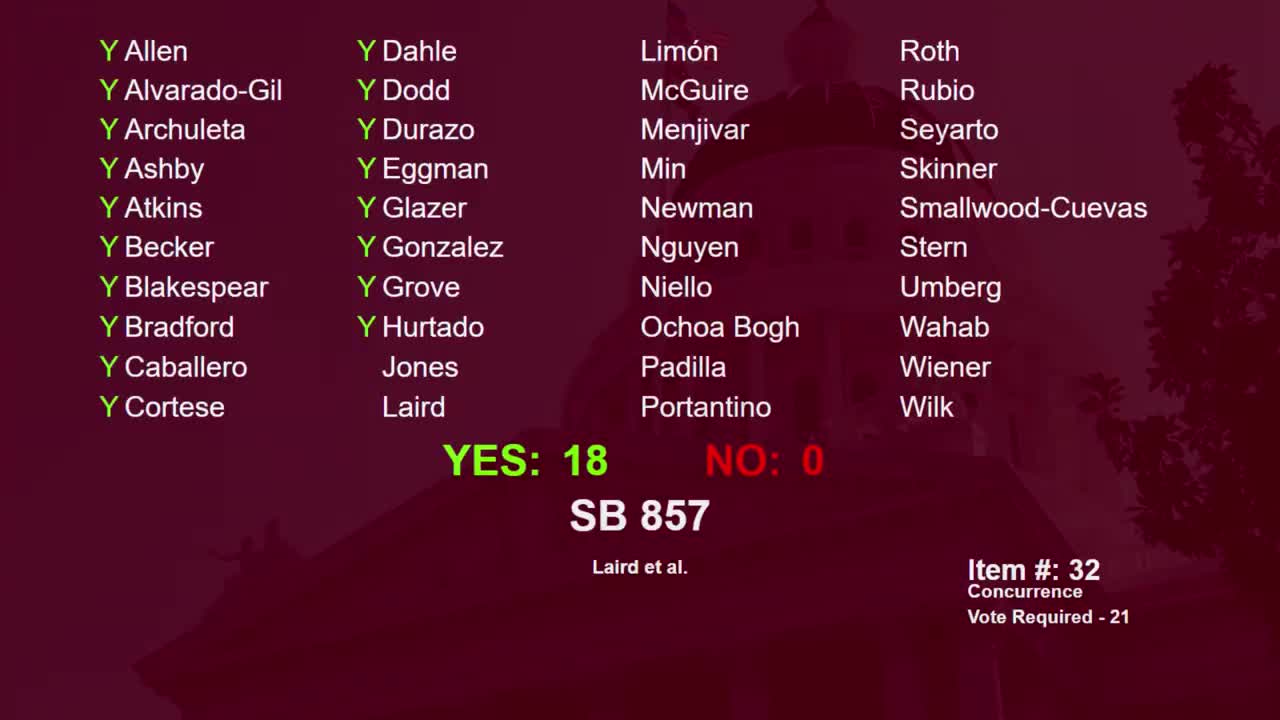 3MIN
Senate Floor
 1MIN
Assembly Floor
 9MIN
Assembly Standing Committee on Natural Resources
 13MIN
Assembly Standing Committee on Utilities and Energy
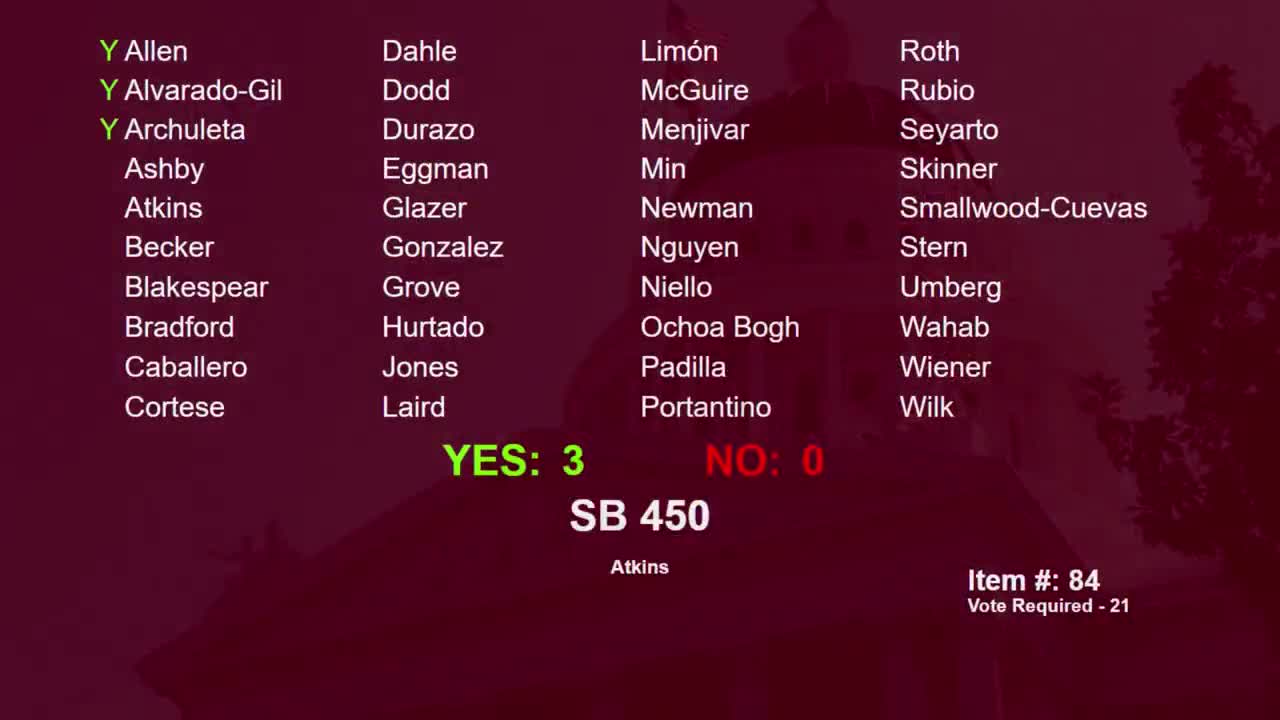 3MIN
Senate Floor
 32MIN
Senate Standing Committee on Energy, Utilities and Communications
Bill Author
Bill Co-Author(s):